*** START OF THE PROJECT GUTENBERG EBOOK 64703 ***
TESTED RECIPES
WATERLESS COOKING
for
BETTER MEALS
for
BETTER HEALTH
Copyright 1957 by Tested Recipe Institute, Inc., Long Island City 1,
N.Y.
The Buckeye Co., Wooster, Ohio
SUBJECT INDEX
page
STAINLESS STEEL WARE
Advantages of Stainless Steel Ware 28
How to Care for Stainless Steel Ware 1
IMPORTANT: Before using your Stainless Steel Cookware, read page 1 for
valuable hints on how to keep your cookware free from scratches, stains
and warping.
Au Gratin Vegetables 19
Bananas,
As garnish 26
Pan Fried 10, 13
BEEF
Frizzled Beef 12
Pot Roast with Vegetables 8
Roasting Timetable 6
Standing Rib Roast 7
Swedish Meat Balls 9
Swiss Steak 11
Beets, Harvard 20
Busy Day Supper Dish 22
Care of Stainless Steel Cookware 1
Chicken, Fried 14
Chili Con Carne 15
Christmas Plum Pudding 27
Creamed Vegetables 19
DESSERTS
Apricot Whip 26
Pineapple Upside Down Cake 25
Plum Pudding 27
Eggplant, Pan-Fried 19
Eggs Benedict 23
Fish, Fried Fillets 16
Food Buying Hints 2
Frosting, Pastel Plum 24
Frozen Meats 6
Frozen Vegetables 19
Gravy, Quick 22
Ham, Diced
Busy Day Supper Dish 22
Hollandaise Sauce 23
Jelly, Plum 24
Lamb, Roasting Timetable 6
Meal Planning 3, 4
Meats 5-6
Pineapple Upside Down Cake 25
Plum Jelly 24
Plum Pudding 27
PORK
Roasting Timetable 6
Stuffed Pork Chops 13
Quick Meal Preparation 4
Roasting Timetable 6
SAUCES
Custard Sauce 26
Hollandaise Sauce 23
Tartar Sauce 16
Spaghetti, Italian 17
Summer Squash, Pan-Fried 19
VEAL
Roasting Timetable 6
Veal in Mushroom Sauce 21
VEGETABLES
Frozen Vegetables 19
General Cooking Hints 18-19
Harvard Beets 20
Time-Table 19
Vegetable Platter 20
HOW TO CARE FOR STAINLESS COOKWARE
[Illustration: uncaptioned]
Stainless Cookware will retain original gleaming beauty through a
lifetime of service. Just follow these simple directions:
BEFORE USING NEW UTENSILS—Wash them thoroughly both inside and out in
hot suds. Use either soap or detergent. This removes the thin
coating of oil which clings to the utensil in the manufacturing
process. Rinse in clear hot water and dry thoroughly with a clean
towel. Now the utensil is ready for use.
HEAT CONTROL—Medium to Low Heat should be used for all cooking. Start
vegetables over medium heat. When the water comes to a boiling,
turn to low heat to keep water boiling gently. Brown meat slowly
over medium to low heat.
EASY CLEANING—Rinse the utensil with warm water immediately after each
use. Food particles which do not yield to rinsing usually may be
removed with a rubber food scraper.
FIRST AID—If food has been burned on or allowed to dry on the utensil,
fill it with cold water. Bring the water to boiling. Remove the
utensil from the heat and allow the water to cool to lukewarm.
Wash in hot suds. If a stain remains, scour with fine steel wool.
If necessary, polish with stainless steel cleaner.
DO NOT OVERHEAT—Overheating may sometimes cause discoloration on
Stainless Steel Cookware. These stains are easily removed with any
good stainless steel cleaner.
AVOID SUDDEN TEMPERATURE CHANGES—Sudden temperature changes and
overheating should be avoided. DO NOT put cold water in a hot
utensil. DO NOT set a hot utensil on a cold surface, such as the
sink.
SPEND _Wisely_, SPEND _Less_!
[Illustration: uncaptioned]
Take Advantage of Bargains
[Illustration: uncaptioned]
A really big step towards economical food buying is watching newspaper
advertisements. Each week the big super-markets and chain stores run all
of their weekly specials, and savings will add up fast if you plan as
many of your menus as possible around these featured items.
Compare Prices
[Illustration: uncaptioned]
Compare them at home in your newspaper, when you are deciding the best
place to shop and save. And compare the difference in price among fresh,
frozen, and canned foods. For example; food dollars will go a lot
further (yet meals will not suffer), if you serve frozen vegetables, or
fresh vegetables in season, on-the-plate ... and use less-expensive
canned vegetables in stews, casseroles, etc.
Read Labels Carefully
[Illustration: uncaptioned]
Look for the word “enriched” on white bread and flour labels. This means
that the “B” vitamins and Iron, lost in the milling process, have been
replaced. Also check the “net weight” when comparing similar bargains.
Avoid Waste
[Illustration: uncaptioned]
Extra-large sizes of canned fruits, vegetables, juices and staples like
baking powder may not ALWAYS be bargains. Often these purchases are only
partially used, and eventually go to waste. Unless you can use the
entire contents of the extra-large container, buy the smaller size.
Cut Meat Costs
[Illustration: uncaptioned]
Less tender cuts of meat are just as nutritious as the more expensive
ones. Properly cooked they are equally delicious, and you’ll be
surprised how often you can work them into well-planned menus.
Variety meats, such as heart, kidney, sweetbreads, brain, liver and
tongue are high in nutritive value and comparatively low in price.
Butter or Margarine?
[Illustration: uncaptioned]
These two table fats are equivalent in food value, and may be used
interchangeably in any recipe.
_Plan_ TO PLEASE!
[Illustration: uncaptioned]
Plan meals when you are a little hungry ... your culinary imagination is
better then. Articles in magazines and newspapers help provide
inspiration when you need it, for greater menu variety.
When there are small children in the family, it is easier to plan meals
around the type of food small-fry can eat. Adults, too, enjoy this
simple food, which can be served in attractive and tempting
combinations.
Plan the whole day’s meals as a unit. This is the only way you can be
sure of providing the proper amount of the right kind of food.
These are the foods needed every day for good health:
MILK—3 or 4 cups for children; 2 to 3 cups for adults. Milk used in
cooking may be counted in the total.
VEGETABLES and FRUITS—1 serving of green, leafy or yellow vegetable; 1
serving of citrus fruit; 1 serving of potato; 1 other vegetable or
fruit, preferably raw. Noodles, spaghetti and macaroni cannot be
considered substitutes for potatoes. True, they are high in
starch, but important minerals and vitamins found in potatoes are
lacking.
MEAT, FISH, POULTRY or CHEESE—1 serving daily.
EGGS—at least 4 a week; 1 daily is better.
Enriched or whole grain CEREALS and BREAD—2 servings or more.
BUTTER or MARGARINE—2 tablespoons or more.
EYE APPEAL—Colorful combinations are more appetizing. As you plan a
menu, try to visualize the food as it will appear on the table.
Strive for good contrast of flavor, color, and texture.
OFF THE BEATEN TRACK—Now and then introduce the family to a new food, or
an old favorite in new guise. But don’t overdo it. One new food at
a meal is enough.
DESSERT—Dessert is actually a part of the meal and should always be
planned as such. Serve a light dessert when the main course is
hearty. Serve rich cake and pie only when the main course is not
too filling.
LITTLE EXTRAS—A few sprigs of parsley go a long way to make the meat
platter more attractive. A sprinkling of paprika provides a
flourish of color for creamed dishes.
A tray of raw relishes ... carrot sticks, celery curls, green pepper
rings, radish roses and cucumbers cut lengthwise into fingers ... may
pinch-hit for the salad occasionally.
Used with discretion, food coloring is a boon to the cook. Add a few
drops of yellow coloring to chicken gravy; a few drops of red coloring
to step up the eye appeal of desserts made with canned cherries.
SUPPER IN A _Half-hour_!
[Illustration: uncaptioned]
Every homemaker needs two or three quick supper dishes “to fall back on”
when kitchen time is limited. They can be hearty and attractive, as well
as inexpensive.
Following are four such supper menus, easily prepared in about half an
hour. Three of them are planned around canned meat, dried beef and
corned beef, which should always be kept on hand for emergency meals.
Fruit in season, quick-frozen fruit, or canned fruit, well chilled,
always makes a tempting dessert. Strawberry shortcake is an all season
quick dessert, with frozen strawberries and individual sponge cakes made
especially for this purpose by professional bakers.
Tomato Juice Cocktail
Busy Day Supper Dish (page 22)
Tossed Chef’s Salad
Hard Rolls
Butter
Fresh or Frozen Peaches
• • • • • • •
Frizzled Beef (page 12)
Buttered Carrots
Head Lettuce Salad
Roquefort Dressing
Pumpernickel Bread
Butter
Orange Sherbet
Cookies
• • • • • • •
Corned Beef Hash with Poached Eggs
Buttered Peas
Tossed Green Salad
French Bread
Butter
Chilled Fruit Cup
• • • • • • •
Hamburger Platter (page 10)
Emergency Gravy (page 22)
Cole Slaw
Toasted English Muffins
Strawberry Shortcake
PREPARING _Meats_
[Illustration: uncaptioned]
[Illustration: LOW]
Cooking meat at a low temperature retains juices, reduces the amount of
shrinkage and improves the flavor. The theory that searing seals-in
juices has been disproved.
Tender cuts of meat are cooked by dry heat: roasting, pan-frying,
broiling, pan-broiling.
Less-tender cuts are cooked by moist heat: braising, stewing,
soup-making.
ROASTING—Place meat in Dutch oven, fat side up. Season with salt. Roast
uncovered, in moderate oven (325 degrees) to desired degree of
doneness. Do not add water; do not baste. Roast will be nicely
browned by the time cooking is completed. The use of a meat
thermometer is recommended. For easier carving, let meat stand in
warm place 20 to 30 minutes before serving.
BROILING—Place meat on greased broiler rack. Broil steaks and chops two
inches thick three inches away from source of heat. Cuts one inch
thick should be placed two inches from heat. Cook until meat is
nicely browned on top. Season and turn to brown other side. Season
and serve at once.
PAN-BROILING—Preheat chicken fryer or skillet. Brown meat on both sides
turning several times, if necessary. Pour off fat as it
accumulates. Do not add water; do not cover. Test for doneness by
cutting small slit next to bone. Reduce heat to finish cooking.
PAN-FRYING—Melt a small amount of fat in chicken fryer or skillet. Dip
meat in flour or egg and crumb coating. Fry slowly until browned
on both sides. Reduce heat to finish cooking, if necessary.
BRAISING—Brown meat slowly in hot fat in chicken fryer or saucepan. Meat
may be dipped in flour before browning, if desired. Add a small
amount of liquid. Cook at simmering temperature until tender.
STEWING—Cut meat into cubes; brown in hot fat in saucepan. Dredging with
flour before browning is a matter of choice. Nearly cover meat
with water. Cook, covered, at simmering temperature, until tender.
Corned beef, ham, tongue, etc., are cooked in water to cover
without preliminary browning.
NO SMOKE—Never heat fat to the point where it smokes. Keep heat low
enough at all times to avoid smoking. For best flavor, brown meat
slowly over moderate heat.
BEEF—Tender cuts of beef are cooked either rare, medium or well-done, by
dry heat: roasting, pan-broiling or broiling. Less-tender cuts
must be cooked to the well-done stage by moist heat (braising or
stewing) in order to make them tender.
PORK—All pork cuts are tender but must be cooked to the well-done stage.
Roasting is suitable for any of the larger cuts. Pork chops and
steaks should be cooked by braising for best results.
LAMB—Roasting, pan-broiling, or broiling are suitable methods to use
with lamb because all cuts are tender. The fell, the thin papery
membrane which covers the lamb carcass, should not be removed
before cooking. Lamb may be cooked rare, medium or well-done
according to personal preference.
VEAL—All cuts need to be cooked slowly to the well-done stage in order
to make veal tender. Veal may be roasted, braised or stewed. When
an egg and crumb coating is used, chops and steaks cut ½-inch
thick may be pan-fried successfully. (This must be done slowly
over medium to low heat.) (see front cover)
TIMETABLE FOR ROASTING
[Illustration: uncaptioned]
Poultry and all meat except pork is roasted at 325 degrees. Roast pork
at 350 degrees. Times given below are approximate, varying with size and
shape of roast. A meat thermometer is recommended for accurate
determination of degree of doneness.
MEAT MINUTES PER POUND
Beef
Rare 18-20
Medium 22-25
Well-done 27-30
Lamb 30-35
Pork 35-40
Smoked pork 20-30
Veal 30
Chicken 25-30
FROZEN MEAT—It is not necessary to thaw meat before cooking. When meat
is frozen solid at the beginning of the cooking process, allow up
to twice the usual cooking time.
STANDING RIB ROAST
[Illustration: uncaptioned]
Select a Standing Rib Roast. Place fat side up in Dutch Oven. Do not add
water; do not cover; do not baste. Roast in moderate oven, 325°F.
Rare 18-20 minutes per pound
Medium 22-25 minutes per pound
Well-done 27-30 minutes per pound
For sure results use a meat thermometer. Insert it in the thickest part
of the roast, being sure that the bulb does not rest on fat or bone. Use
the time periods above as a guide. Remove the roast from the oven when
the thermometer reading is “rare,” “medium,” or “well-done,” as you
prefer.
_Tomato-Bacon Garnish_
Halve small tomatoes; cross short strips of bacon on top of each half.
Broil until bacon is crisp.
MENU
Standing Rib Roast of Beef
Asparagus Hollandaise (p. 23)
Corn on The Cob
Tossed Green Salad
Lemon Chiffon Pie
BEEF POT ROAST and VEGETABLES
[Illustration: uncaptioned]
1 tablespoon fat
3 to 4-pound chuck roast
salt and pepper
1½ cups water
4 medium onions
8 small carrots
4 medium potatoes
3 tablespoons flour
1. Melt fat in Dutch oven. Brown meat on all sides in hot fat. Season
generously with salt and lightly with pepper.
2. Add water; cover and cook over low heat about 2 hours until meat is
nearly tender. Add onions; cook 10 minutes. Add carrots and potatoes;
cook 30-35 minutes longer, or until all vegetables are tender.
3. Remove meat and vegetables to platter. Measure stock in Dutch oven;
add water to make 1½ cups. Bring to a boil.
4. Blend flour with ⅓ cup water; stir into boiling stock. Stir
constantly until thickened. Season, if necessary, with salt. This makes
generous servings for 4 with enough meat left over for another meal.
SWEDISH MEAT BALLS
[Illustration: uncaptioned]
1 pound chopped beef
1 cup soft bread crumbs
1 cup rich milk
1 egg
2 medium onions, chopped
2 teaspoons salt
⅛ teaspoon pepper
¼ teaspoon nutmeg
1. Combine ingredients in order listed; mix thoroughly.
2. Melt 1 tablespoon each shortening and butter in skillet.
3. Form meat mixture into small balls about 1-inch in diameter using
teaspoon (mixture is too soft to shape with fingers.)
4. Brown meat balls in hot fat, a few at a time; place in bowl until all
have been browned. Add a little extra fat to skillet as needed.
5. To drippings in skillet add 1 cup water. Bring to boil. Blend 1
tablespoon flour with 2 tablespoons cold water; stir into gravy. Stir
constantly until thickened.
6. Return meat balls to skillet. Cover; simmer gently ½ hour. Makes 8
servings.
PAN-FRIED BANANAS
[Illustration: uncaptioned]
6 firm bananas[1]
Salt
¼ cup melted butter or margarine
Keep whole or cut crosswise into halves. Fry bananas slowly in butter or
margarine until tender ... easily pierced with a fork ... turning the
bananas until evenly browned. Sprinkle lightly with salt. Serve hot as a
vegetable.
_Meal Suggestions_: Pan-Fried Bananas, served as a hot vegetable, are
excellent flavor partners with fish, meat, poultry or eggs for luncheon
or dinner.
Pan-Fried Bananas with Hamburg Patties and Whole Carrots make an
appetizing, colorful and nutritious plate combination. To complete the
menu, begin with chilled vegetable juice. With the Hamburg platter,
serve hot rolls and a tossed green salad.
For dessert, jelly roll slices with ice cream and coffee.
SWISS STEAK
[Illustration: uncaptioned]
2 pounds top round, cut 1-inch thick
½ cup flour
1 teaspoon salt
⅛ teaspoon pepper
2 tablespoons fat
1 cup canned tomatoes
2 large onions
Cooked broad noodles
1. Cut meat into serving pieces.
2. Combine flour, salt and pepper. Pound flour mixture into meat, using
the edge of a heavy saucer or a mallet designed especially for the
purpose.
3. Melt fat in chicken fryer over low heat. Brown meat on both sides;
add tomatoes, cover; cook slowly about 1 hour.
4. Cut onions crosswise into half-inch slices. Place on top of meat.
Continue to cook, covered, about ½ hour longer, or until meat and onions
are tender.
5. Serve on hot noodles with one or two slices of onion on top of each
portion of meat. Pour pan drippings over all. Makes 6 servings.
FRIZZLED BEEF
[Illustration: uncaptioned]
4 tablespoons butter or margarine
1 small green pepper, chopped
1 small onion, finely chopped
1 jar (2½ oz.) dried beef
4 tablespoons flour
2 cups milk
1. Melt butter in skillet. Add chopped pepper and onion. Cover; cook
slowly about 5 minutes until onion is tender but not brown. (Cover for
4-quart saucepan fits skillet.)
2. Rinse dried beef with hot water; drain; add; cook slowly 2 or 3
minutes longer.
3. Sprinkle flour over all; stir to distribute flour evenly.
4. Stir in milk. Stir constantly until mixture comes to a boil and sauce
thickens.
5. Serve over squares of hot corn bread made with corn muffin mix. Makes
4 to 5 servings.
STUFFED PORK CHOPS
[Illustration: uncaptioned]
6 thick pork chops
2 cups soft bread crumbs
¼ cup melted butter or margarine
½ cup water
¼ teaspoon salt
¼ teaspoon poultry seasoning, sage or thyme
2 tablespoons minced onion
few grains pepper
1. Cut pocket in pork chops from side next to the bone.
2. Combine next 6 ingredients for stuffing. Fill pockets with stuffing.
Brown chops in chicken fryer over low heat.
3. Season with salt and pepper. Add water. Cover; cook over low heat 1
hour. Make gravy from pan drippings.
Makes 6 servings.
MENU
Stuffed Pork Chops
Gravy
Pan-fried Bananas (page 10)
Whipped Potatoes
Buttered Green Beans
Raw Vegetable Relishes
Apple Pie
FRIED CHICKEN
[Illustration: uncaptioned]
1 frying chicken, disjointed
½ cup vegetable fat
2 tablespoons butter or margarine
½ cup flour
1½ teaspoons onion salt
2 tablespoons water
1. Have chicken cut into serving pieces. Wash thoroughly in cold water
but do not soak.
2. Melt vegetable fat and butter over low heat in chicken fryer.
3. Combine flour and onion salt in sturdy paper bag. Place three or four
pieces of chicken in the bag. Shake the bag to coat the chicken with
flour. Put chicken pieces into hot fat. Repeat until all pieces of
chicken are floured.
4. Cook over low heat until browned on one side; turn to brown on all
sides evenly. Avoid turning more than necessary.
5. Add water. Cover pan. Cook over low heat for 30 minutes. Uncover;
cook 15 minutes longer.
Makes 4 servings.
CHILI CON CARNE
[Illustration: uncaptioned]
3 tablespoons fat
1 large onion, chopped
1 green pepper, chopped
1 pound ground beef
1 No. 2 can (2½ cups) tomatoes
1 can condensed tomato soup
½ teaspoon paprika
⅛ teaspoon cayenne
1 bay leaf
1 tablespoon chili powder
1 clove garlic
1 teaspoon salt
1 No. 2 can (2½ cups) kidney beans
Raw onion rings (optional)
1. Melt fat in 2-quart saucepan. Brown onion, green pepper and meat in
hot fat. Add tomatoes, soup, paprika, cayenne, bay leaf and chili
powder. Simmer about 1 hour, adding water if mixture gets too thick.
2. Mash garlic and salt together and stir into mixture. Stir in beans.
Heat thoroughly. Garnish with onion rings. Makes 6 servings.
FRIED FISH FILLETS
[Illustration: uncaptioned]
2 pounds fish fillets, steaks or pan-dressed fish
1 teaspoon salt
1 egg
1 tablespoon milk or water
1 cup bread crumbs, cracker crumbs, cornmeal or flour
1. Cut fish into serving-size portions. Sprinkle with salt.
2. Beat egg slightly; blend in milk.
3. Dip fish in egg; roll in crumbs.
4. Melt fat in skillet or chicken fryer. The fat should be about ⅛-inch
deep. When fat is hot but not smoking, fry fish at moderate heat. When
brown on one side, turn carefully; brown other side. Cook about 5
minutes on each side. Drain on absorbent paper. Makes 6 servings.
TARTAR SAUCE
Combine ½ cup mayonnaise, 1 teaspoon finely chopped onion, 1 tablespoon
chopped dill pickle, 1 tablespoon chopped olives, 1 teaspoon chopped
parsley. Serve with fish.
ITALIAN SPAGHETTI
[Illustration: uncaptioned]
1 pound chopped beef
1 large onion, chopped
1 small green pepper, chopped
1 6-oz. can tomato paste
1 No. 2 can (2½ cups) tomatoes
½ cup water
1 bay leaf
2 teaspoons sugar
1 clove garlic
1 teaspoon salt
1. Brown meat in 2-quart saucepan. (Hamburger contains enough fat so
that none extra is needed for browning. If lean ground beef is used,
brown in 4 tablespoons fat.)
2. Add onion and green pepper; cook about 10 minutes, until onion is
tender but not brown. Stir in tomato paste, tomatoes, water, bay leaf
and sugar. Simmer over low heat about 1 hour.
3. Mash garlic and salt together. Stir into sauce. Taste for seasoning.
If a more highly seasoned sauce is liked add a few drops tabasco.
4. To serve, pour sauce over cooked spaghetti; top with grated Parmesan
cheese. Makes 4 to 6 servings.
PREPARING _Vegetables_
[Illustration: uncaptioned]
When the natural color and flavor of vegetables are retained in cooking,
it generally follows that the maximum amount of food value is there,
too. Observe these three important rules for vegetable cookery if you
wish to get your money’s worth of vitamins and mineral elements.
1. Cook vegetables as quickly as possible.
Start vegetables in boiling water. When the vegetable is added, the
water stops boiling temporarily. Cover the pan and use high heat to
start the boiling again as quickly as possible. Then the heat may be
reduced, but the water should actually boil, not just simmer, throughout
the cooking process.
2. Use a minimum amount of water.
Half to ¾ cup of water is enough to cook four to six servings of most
vegetables in the 1-quart saucepan. Strong-flavored vegetables such as
onions, rutabaga and turnips are best cooked in water to barely cover in
an uncovered pan.
3. Utilize the cooking water.
Many of the important nutrients in vegetables are soluble in water. When
the cooking water is discarded these extra vitamins and mineral elements
go down the drain with it.
The most practical way to make use of the cooking water is to boil it
down and serve it as a sauce with the vegetable. After the vegetable has
been drained, boil the water rapidly until only two or three tablespoons
remain. Add a tablespoon of butter or margarine and pour over the
vegetable in the serving dish.
Water drained from potatoes is particularly good for use in gravy. In
the case of other vegetables, the flavor may not be compatible with that
of the meat stock. Small amounts, however, may be added to tomato juice
to be served as a cocktail.
SEASONING—Whether salt is added at the beginning of the cooking process
or at the end is a matter of personal preference. It has no
effect, one way or the other, on the food value.
TIMING—Cooking time will vary with the variety and age of the vegetable
and the size of the pieces. In general, green leafy varieties such
as spinach and new cabbage take 10 minutes or less. Allow about 15
minutes for peas, asparagus, brussels sprouts, cauliflower,
carrots and broccoli. The more fibrous, solid types like whole
cauliflower or green beans take approximately 20 minutes. Root
vegetables ... turnips, parsnips, potatoes, onions, beets, need 25
minutes or more cooking.
VARIATIONS—Perfectly cooked vegetables need only a little salt and a dab
of butter or margarine to enhance their flavor. Most cooks
however, like to “dress up” vegetables occasionally for greater
menu variety.
CREAMED—Carrots, broccoli, asparagus, snap beans, cabbage, onions and
peas, alone or in combinations, are the favorites for creaming.
Allow one cup of medium white sauce for two cups of cooked
vegetable. Spinach is excellent creamed. Use ½ cup thick white
sauce with two cups of the cooked greens. Season with a few drops
of onion juice and a dash of nutmeg.
AU GRATIN—Turn creamed vegetables into greased casserole and cover with
buttered crumbs or equal parts of grated cheese and crumbs. Brown
in moderate oven, 350 degrees.
PAN-FRIED—Eggplant and summer squash are best pan-fried. Cut into slices
½ to ¾ inch thick. Sprinkle generously with salt and allow to
stand about 15 minutes. Dip in flour. Fry in skillet in hot fat
⅛-inch deep. Brown on one side; turn to brown other side. Avoid
turning more than once.
RING MOLD—Buttered spinach, mashed rutabaga or potatoes hashed in cream
are attractive served this way. Pack the prepared vegetable into a
greased ring mold. Unmold at once onto serving plate. Fill center
with vegetable of contrasting color.
FROZEN VEGETABLES—Frozen vegetables are partially cooked by blanching
before freezing. Therefore, the cooking time is shorter. Keep all
frozen vegetables, except corn on the cob, frozen until ready to
cook. Specific directions for cooking each vegetable are found on
the package.
VEGETABLE PLATTER
[Illustration: uncaptioned]
Prepare cauliflower, lima beans, carrots and string beans according to
directions on pages 18 and 19. Arrange seasoned vegetables in an
attractive pattern on serving platter or chop plate. Top cauliflower
with hot mayonnaise or Hollandaise Sauce (page 23).
HARVARD BEETS
2 tablespoons butter or margarine
2 tablespoons flour
¼ cup boiling water
1 No. 2 can (2½ cups) sliced beets
⅓ cup brown sugar
⅛ teaspoon cloves
¼ cup vinegar
½ teaspoon salt
few grains pepper
Melt butter or margarine in saucepan. Add flour; blend. Add water and
liquid drained from beets; cook until thickened, stirring constantly.
Add remaining ingredients except beets, stir until sugar dissolves. Add
beets. Heat thoroughly.
VEAL IN MUSHROOM SAUCE
[Illustration: uncaptioned]
1 pound veal stew meat
2 tablespoons fat
½ teaspoon salt
½ cup water
1 can condensed mushroom soup
1 4-oz. can sliced mushrooms
1. Cut veal into 1½-inch cubes. Melt fat over low heat in 2-quart
saucepan. Brown veal slowly, stirring frequently.
2. Add salt and water. Cook, covered, over low heat until tender.
3. Stir in undiluted mushroom soup and drained sliced mushrooms. Heat
thoroughly. If necessary, thin gravy with liquid from mushrooms. Serve
in Rice Ring. Makes 4 servings.
RICE RING
3 cups hot, cooked rice
4 tablespoons butter or margarine
¼ teaspoon nutmeg
2 tablespoons chopped parsley (optional)
Combine all ingredients. Turn into ring mold. Pack down lightly with
spoon. Let stand 2 to 3 minutes. Turn out on serving dish. Or use 2
spoons to shape rice into ring on serving dish.
BUSY DAY SUPPER DISH
[Illustration: uncaptioned]
1 pkg. frozen asparagus cuts
1 cup cooked diced ham or canned luncheon meat
2 cups well-seasoned medium white sauce
1. Cook asparagus according to directions on package; drain.
2. Stir meat and asparagus into white sauce. Heat thoroughly.
3. Serve on hot split baking powder biscuits.
Makes 4 servings.
Or, serve left-over meat and vegetables in this gravy:
EMERGENCY GRAVY
1 beef bouillon cube
1 cup hot water
2 tablespoons flour
Kitchen Bouquet
Salt and pepper
1. Dissolve bouillon cube in hot water; set aside.
2. Melt fat in saucepan or skillet. Stir in flour. Cook over low heat,
stirring constantly, until bubbling.
3. Stir in bouillon. Stir constantly until thickened and smooth. Season
to taste with Kitchen Bouquet, salt and pepper. Makes 1 cup.
EGGS BENEDICT
[Illustration: uncaptioned]
Split, toast and butter 6 English muffins. Top each half with thin slice
fried ham, one poached egg and Hollandaise Sauce.
HOLLANDAISE SAUCE
⅓ cup butter or margarine
2 egg yolks
⅛ teaspoon salt
few grains pepper
⅓ cup boiling water
1 tablespoon lemon juice
1. Melt butter or margarine in double-boiler. Remove top section of
double-boiler.
2. Add egg yolks, one at a time, to melted butter, stirring with a
wooden spoon until thoroughly blended.
3. Add salt and pepper. Add boiling water _slowly_ while stirring.
4. Set over hot water again. Heat slowly, stirring constantly until
mixture is thick and custardlike (about 10 minutes). _Do not let water
boil._
5. Remove from heat; stir in lemon juice. Serve at once.
PLUM JELLY
[Illustration: uncaptioned]
3 cups prepared juice
4 cups sugar
1 box powdered fruit pectin
TO PREPARE THE JUICE: crush 1 lb. fully ripe plums. (Do not peel or
pit). Add ¾ cup water, bring to boil; simmer, covered, 10 minutes. Place
in jelly cloth or bag; squeeze out juice. Measure 3 cups into very large
saucepan.
TO MAKE THE JELLY: measure sugar; set aside. Place saucepan holding
juice over high heat. Add powdered fruit pectin; stir until mixture
comes to a hard boil. At once stir in sugar. _Bring to full rolling
boil; boil hard 1 minute_, stirring constantly. Remove from heat, skim,
pour quickly into glasses. Paraffin at once. Makes about 7 six-ounce
glasses.
PASTEL PLUM FROSTING: Combine ⅓ cup plum jelly, 1 egg white and dash of
salt in top of double-boiler. Beat with rotary egg beater until mixed.
Set over boiling water; beat constantly 3 minutes or until frosting
“peaks”. Cool. Spread on cake.
PINEAPPLE UPSIDE DOWN CAKE
[Illustration: uncaptioned]
6 tablespoons butter or margarine
⅔ cup brown sugar
1 No. 2 can (2 cups) crisp-cut crushed pineapple
Maraschino cherries
Pecan halves
1 package white cake mix
1. Melt butter or margarine in 9-inch skillet. Sprinkle with brown
sugar; top with drained pineapple; decorate with a pattern of Maraschino
cherries and pecan halves.
2. Prepare cake mix as directed on package. Pour batter evenly into
skillet. Bake in moderate oven, 350°F., 1 hour. Remove from oven. Run
spatula around edges of cake. Invert on serving plate. Serve warm with
whipped cream or ice cream. Makes 6 to 8 servings.
VARIATIONS
For delightful flavor, try Devil’s Food or Spice Cake Mix to make this
dessert.
APRICOT WHIP
[Illustration: uncaptioned]
2 egg whites
⅓ cup sugar
1 tablespoon lemon juice
2 tablespoons fruit juice
few grains salt
½ cup apricot pulp
1. Combine all ingredients except apricot pulp in top of double boiler.
Beat with rotary beater to blend.
2. Set over boiling water. Beat until mixture forms peaks.
3. Fold in fruit. Turn into serving dishes. Chill.
4. Garnish with banana slices; serve with Custard Sauce.
CUSTARD SAUCE
1 cup milk
2 tablespoons sugar
⅛ teaspoon salt
2 egg yolks (or 1 whole egg)
1. Scald milk in double boiler.
2. Mix salt, egg yolks and sugar in mixing bowl.
3. Stir hot milk into egg mixture. Return to double boiler.
4. Cook, stirring, over hot water, until mixture coats spoon.
5. Pour custard sauce into dish to cool. Stir in ¼ teaspoon vanilla.
CHRISTMAS PLUM PUDDING
[Illustration: uncaptioned]
1 cup seedless raisins
1½ cups mixed diced candied fruits and peels
½ cup chopped walnuts
1 cup sifted enriched flour
2 eggs, beaten
¾ cup molasses
¾ cup buttermilk
½ cup finely chopped suet
¼ cup grapejuice
1 cup fine dry bread crumbs
¾ teaspoon baking soda
¼ teaspoon allspice
¼ teaspoon cloves
¼ teaspoon cinnamon
¼ teaspoon nutmeg
¾ teaspoon salt
Combine raisins, fruits and peels, walnuts and ½ cup of the flour.
Combine eggs, molasses, buttermilk, suet and grapejuice. Combine
remaining flour, crumbs, baking soda, spices and salt; add to egg
mixture. Add floured fruit; mix well. Pour into well-greased 1½ quart
melon mold; cover; set on rack in deep kettle; add boiling water to
about one inch below cover of mold. Cover. Steam 1½ to 2 hours. Makes 10
to 12 servings.
Shape hard sauce into balls; roll in coconut; chill.
HERE’S HOW YOUR STAINLESS STEELWARE SAVES FOOD VALUES
[Illustration: uncaptioned]
STAINLESS STEEL, the most modern development in metallurgical science,
is wonderful for any type of cooking. America’s largest canneries, food
processors and the better restaurants cook and process food in stainless
steel utensils. Stainless steel not only preserves natural food flavors
... it is also easiest to keep sanitary and is immune to wear.
USE YOUR
STAINLESS STEELWARE FOR
HEALTHFUL WATER-LESS COOKING
(cooking with minimum amount of water)
The Water-Less way of cooking is highly recommended by leading health
and home economics authorities.
Heavy-weight Stainless Steel construction and seal-tight covers assure
perfect Water-Less cooking results. Meats and vegetables cooked the
Water-Less way (cooking with minimum amount of water) retain their
precious mineral elements and vitamins ... and this modern method also
preserves the natural flavors and color of the food.
WAYS TO USE LEFT-OVERS
[Illustration: uncaptioned]
If it’s good food, don’t throw it away. Little left-overs, or big ones,
fit into many dishes; adding extra food value or a fresh new touch to
favorite main dishes. Listed below are some left-over uses recommended
by the Bureau of Human Nutrition and Home Economics, U. S. Department of
Agriculture.
EGG YOLKS, in
Cakes
Cornstarch pudding
Custard or sauce
Pie filling
Salad dressing
Scrambled eggs
EGG WHITES, in
Custard
Fruit whip
Meringue
Souffles
HARD COOKED EGG OR YOLK, in
Casserole dishes
Garnish
Salads
Sandwiches
SOUR MILK, in
Cakes, cookies
Quick breads
SOUR CREAM, in
Cakes, cookies
Dessert sauce
Meat stews
Pie filling
Salad dressing
Sauce for vegetables
COOKED POTATOES, in
Croquettes
Fried or creamed potatoes
Meat-pie crust
Potatoes in cheese sauce
Stew or chowder
COOKED CARROTS, LIMA BEANS, CORN, SNAP BEANS, PEAS, in
Meat and vegetable pie
Soup
Stew
Stuffed peppers
Stuffed tomatoes
Vegetables in cheese sauce
COOKED LEAFY VEGETABLES, CHOPPED, in
Creamed vegetables
Soup
Meat loaf
Meat patties
Omelet
Souffle
COOKED OR CANNED FRUITS, in
Fruit cup
Fruit sauces
Jellied fruit
Quick breads
Shortcake
Upside-down cake
Yeast breads
COOKED MEATS, POULTRY, FISH, in
Casserole dishes
Hash
Meat patties
Meat pies
Salads
Sandwiches
Stuffed vegetables
COOKED WHEAT, OAT OR CORN CEREALS, in
Fried cereal
Meat loaf or patties
Sweet puddings
COOKED SPAGHETTI, RICE, NOODLES, in
Casseroles
Meat or cheese loaf
Timbales
BREAD
Slices, for
French toast
Dry crumbs, in
Brown betty
Croquettes
Fried chops
Soft crumbs, in
Meat loaf
Stuffings
CAKE OR COOKIES, in
Brown betty
Ice-box cake
Toasted, with sweet topping, for dessert
FOOTNOTES
[1]Use all-yellow or slightly green-tipped bananas. Peel bananas.
Printed by Brett Litho Co. L.I.C. 1, N.Y. 1-57
[Illustration: SUPREME QUALITY
TRI-PLY
STAINLESS STEEL
_Cookware_]
Transcriber’s Notes
—Silently corrected a few typos.
—Retained publication information from the printed edition: this eBook
is public-domain in the country of publication.
—In the text versions only, text in italics is delimited by
_underscores_.
*** END OF THE PROJECT GUTENBERG EBOOK 64703 ***
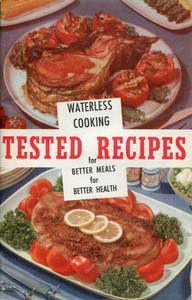
Tested Recipes: Waterless Cooking for Better Meals, Better Health
Subjects:
Download Formats:
Excerpt
WATERLESS COOKING
for
BETTER MEALS
for
BETTER HEALTH
Copyright 1957 by Tested Recipe Institute, Inc., Long Island City 1,
N.Y.
The Buckeye Co., Wooster, Ohio
page
STAINLESS STEEL WARE
Advantages of Stainless Steel Ware 28
How to Care for Stainless Steel Ware...
Read the Full Text
— End of Tested Recipes: Waterless Cooking for Better Meals, Better Health —
Book Information
- Title
- Tested Recipes: Waterless Cooking for Better Meals, Better Health
- Author(s)
- Tested Recipe Institute (New York, N.Y.)
- Language
- English
- Type
- Text
- Release Date
- March 5, 2021
- Word Count
- 5,386 words
- Library of Congress Classification
- TX
- Bookshelves
- Browsing: Cooking & Drinking
- Rights
- Public domain in the USA.
Related Books

Camp fires and camp cooking
by Sanderson, James M. (James Monroe)
English
79h 28m read

Vegetarian supplement to Scientific feeding
by Roper, Dora C. C. L. (Dora Cathrine Cristine Liebel)
English
678h 37m read

The royal baker and pastry cook
by Royal Baking Powder Company
English
701h 34m read

Left-over foods and how to use them
by Hiller, Elizabeth O.
English
186h 14m read

Aunt Caroline's Dixieland recipes
by McKinney, William, McKinney, Emma
English
286h 58m read

Season's best dishes for 2 or 4 or 6
by Pet Milk Company, Taylor, Mary Lee
English
115h 43m read