*** START OF THE PROJECT GUTENBERG EBOOK 75442 ***
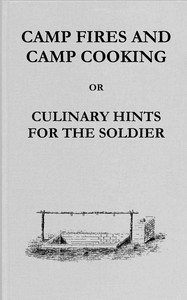
CAMP FIRES AND CAMP COOKING;
OR
CULINARY HINTS FOR THE SOLDIER:
INCLUDING
RECEIPT FOR MAKING BREAD IN THE “PORTABLE FIELD OVEN”
FURNISHED BY THE SUBSISTENCE DEPARTMENT.
BY
CAPTAIN JAMES M. SANDERSON,
COMMISSARY OF SUBSISTENCE OF VOLUNTEERS.
PUBLISHED FOR DISTRIBUTION TO THE TROOPS.
HEADQUARTERS “ARMY OF THE POTOMAC,”
January, 1862.
WASHINGTON:
GOVERNMENT PRINTING OFFICE.
1862.
CAMP FIRES AND CAMP COOKING.
In making up the following receipts, the author has been actuated by a
desire to aid the efforts of those of his countrymen who, with the best
intentions, lack the knowledge to utilize them; and having personally
assisted in the concoction of the various dishes he treats of, using
only camp fires, camp kettles, and soldiers’ rations, he knows that a
little attention on the part of any sensible man--and none other should
ever attempt to cook--will produce the most savory and gratifying
results.
CAMP COOKING AND CAMP KETTLES.
The utensils and means furnished by government to the soldier for
preparing his food are of the most primitive character. The former
consist of camp kettles, made of iron, with a handle, and varying in
size from four to seven gallons, (they should be made so as to have one
slide into the other, in nests of four,) and mess pans, also of iron,
about 12 inches in diameter, and sloping to the bottom. The latter
consist of a certain amount of wood per diem, which is to be consumed
as taste or ingenuity may dictate. The usual and most simple mode is to
dig a trench 18 inches wide, 12 inches deep, and from four to six feet
long. At each end plant a forked stick of equal height, with a stout
sapling, from which to suspend the kettles, extending from one to the
other.
[Illustration: Diagram No. 1.]
This, however, is neither the best nor most economical mode, as
it consumes much fuel, wastes much of the heat, and causes great
inconvenience to the cook. An improvement can be effected by casing the
sides of the trench with brick, adding a little chimney at one end,
and, in place of the forked sticks, using iron uprights and cross-bar,
to which half a dozen hooks for hanging kettles are attached.
[Illustration: Diagram No 2.]
In a clayey soil, the plan adopted by the salt boilers of New York is
perhaps the neatest, most economical, and most convenient that can
be devised. They dig a hole about three feet square and two feet in
depth, generally in the slope of a hill. On one side they run a shaft
laterally, about one foot square and six feet in length, and one foot
from the surface of the ground. At the extreme end they sink a shaft
vertically, and form a chimney; and at equi-distances they pierce three
holes of sufficient diameter to prevent the kettles from slipping
through. By this mode the kettles can be placed over the fire to
boil--or on either side, to simmer--with less difficulty than by any
other means.
[Illustration: Diagram No 3.]
[Illustration: Diagram No 4. Inside view--Side.]
Besides the allowance from government, however, the company cooks
should be furnished, from the “Company Fund,” with two large iron
spoons, two large iron forks, two stout knives, one tin cullender and
one yard of flannel; also a false tin bottom, closely fitting the
kettles; for all of which the cook should be responsible.
THE RATION.
No army in the world is so well provided for, in the shape of food,
either as to quantity or quality, as the army of the United States, and
very little attention on the part of the cook will enable him to lay up
a liberal amount weekly to the credit of the Company Fund. No one man
can consume his daily ration, although many waste it; and a systematic
issue will, in a great measure, prevent unnecessary extravagance.
THE COOK’S CREED.
Cleanliness is next to godliness, both in persons and kettles: be ever
industrious, then, in scouring your pots. Much elbow grease, a few
ashes, and a little water, are capital aids to the careful cook. Better
wear out your pans with scouring than your stomachs with purging; and
it is less dangerous to work your elbows than your comrade’s bowels.
Dirt and grease betray the poor cook, and destroy the poor soldier;
whilst health, content, and good cheer should ever reward him who does
his duty and keeps his kettles clean. In military life, punctuality is
not only a duty, but a necessity, and the cook should always endeavor
to be exact in time. Be sparing with sugar and salt, as a deficiency
can be better remedied than an overplus.
KITCHEN PHILOSOPHY.
Remember that beans, badly boiled, kill more than bullets; and fat is
more fatal than powder. In cooking, more than in anything else in this
world, always make haste slowly. One hour too much is vastly better
than five minutes too little, with rare exceptions. A big fire scorches
your soup, burns your face, and crisps your temper. Skim, simmer, and
scour, are the true secrets of good cooking.
BEEF SOUP WITH DESICCATED MIXED VEGETABLES.
The Americans, as a rule, are not fond of soups, unless of the thicker
kind; but in no form can meat and vegetables be served together more
profitably and more nourishingly. As a matter of economy, it admits
of no argument, because every portion is useful, both bone and flesh;
and, when properly made, it is wholesome and palatable. On fresh-beef
day, if among the rations there are some choice bits--such as sirloin,
tenderloin, or rump steaks--cut them into neat slices, and use for
breakfast, broiling them if it can be done; if not, fry them. Save all
the bones, if large cut them in pieces and distribute equally among
the kettles. If the company numbers seventy men or less, use one large
kettle and two smaller ones. Fill them nearly with pieces of meat,
from one to three pounds each, not too closely packed; then add water
enough to cover it, and place it over a brisk fire, throwing in a large
handful of salt to each kettle. As soon as the water begins to boil,
and the scum begins to rise, deaden the fire, and skim, carefully and
faithfully, every ten minutes, and be very sure that the water does
not again come to a boil--_it should only simmer_; for when the
meat is boiling hard the pores of the flesh are immediately closed,
the essence of the meat, and all its impurities, are retained within,
no scum arises, the meat becomes hard and tough, and the soup thin and
watery. If it is only permitted to simmer, the pores are kept open,
the blood is drawn out, the juices are extracted, the meat is rendered
tender and wholesome, and the soup rich, nutritious, and palatable.
In one hour and a half--carefully skimming all the while--the meat
should be done; but if it has only simmered, two hours will be better.
Then take the meat out, leaving only the bones. An hour previous to
this, however, break up a tablet of desiccated vegetables as small as
possible, and divide them into as many portions as there are kettles of
soup. Place each portion in a separate pan, and fill with fresh clean
water, standing them near the fire until thoroughly saturated with
water. When the meat is taken out, put the vegetables in, and let them
boil gently two hours longer, during that time carefully skimming off
all the fat which rises to the surface. Then season with pepper and
salt, and a tablespoonful of vinegar, and serve out.
Both the French and American desiccated vegetables come in tablets.
The former being twice as large as the latter, it will therefore be
necessary to use one of the French or two of the American tablets for
a company, which will be found amply sufficient, as they swell up to
sixteen times their bulk in a compressed state.
The fat taken from the soup is valuable--first for selling, next for
frying, but principally because you don’t swallow it in your soup.
PORK SOUP WITH VEGETABLES.
This soup is good for a change, and quite economical. Take four pounds
of clear pork, without rind or bone; cut it into pieces about one inch
square; put into a pan a little fat, which must be as hot as possible,
and throw in enough pork to cover the bottom, which is to be fried
quite brown, and turned into another pan whilst the balance is being
fried. Have three camp kettles filled with clean water; boil it, and
add to each kettle one-third of the fried pork, with a handful of salt.
Let it boil moderately for fifteen minutes, and in the meanwhile,
having soaked the desiccated vegetables, add one-third to each kettle,
and continue boiling, not too fast, for one hour and a half. Season
with pepper, salt, and a little vinegar, and if there is any stale
bread to be had, three or four loaves should be cut into pieces two
inches square, or less, and divided equally in the three kettles. After
fifteen minutes’ slow boiling the soup is ready to serve. Whatever
fat floats on the top, before the bread is added, should be carefully
removed.
PEA SOUP.
For some unexplained reason, this article is by no means popular with
the troops, and large quantities are constantly returned to the
commissary as company savings. This, it is believed, would not be the
case if the proper mode of cooking them was known, as they are not
only quite as nutritious as beans, but have always been considered by
epicures much more delicate.
To use them properly, they should first be washed; then boiled for at
least one hour, in a kettle with a false bottom. For a company, seven
or eight quarts should be boiled in double the quantity of water. In
default of a false bottom, they must be constantly stirred, to prevent
scorching. When quite soft, strain off the water, divide them into
three or four portions, according to the number of the kettles, and add
them to the pork soup, previously described, instead of the desiccated
vegetables, adding at the same time two large onions, sliced, to each
kettle. Let it boil slowly for two hours, skimming now and then; and
before serving out, season liberally with black pepper, some salt, and
a dash of vinegar. They should be well mashed with a pounder before
serving.
BOILED PORK AND BEAN SOUP.
Never serve beans until they have been soaked over night. At eight
o’clock in the morning, put eight quarts into two kettles, and fill up
with clean cold water. Boil constantly, over a brisk fire, for an hour
or more, during which many of the beans will rise to the top. At the
end of this time, take the kettles off the fire for fifteen or twenty
minutes, and then pour off all the water, replacing it with fresh clean
water. Add to each kettle a pound of parboiled pork, without rind, and
boil continuously for an hour and a half longer.
At quarter past eight o’clock, fill three kettles loosely with pieces
of pork weighing from three to five pounds, cover with water, and
boil briskly for one hour; then pour off all the liquid, and fill up
with clean _hot_ water, and boil for one hour and a half longer;
then take out all the pork, and lay it aside. Take out also one-half
of the beans from the other kettles, placing them aside for breakfast
next morning, and add to the remainder the liquor in which the pork
was boiled. To each kettle add also two onions chopped or sliced,
with plenty of black or red pepper, some salt, and a tablespoonful of
vinegar. After fifteen minutes’ longer boiling, mash the beans with a
wooden stick made for the purpose, and serve, with a slice of pork, in
a separate dish.
If onions are plenty, mince fine eight or ten of them, fry them in a
pan with a little flour and fat, with half a pint hot water, and the
same quantity of the liquor in which the pork was boiled. After cooking
five minutes, add pepper, salt, and half a glass of vinegar, and pour
over the slices of pork.
BEANS FOR BREAKFAST.
The beans left from the soup of the day before should be put in pans
and warmed over the fire, care being taken to prevent them from
scorching. In the meanwhile a few onions--say three or four--should be
chopped fine and slightly fried, and then strewed over the beans, with
pepper and salt, and a tablespoonful of vinegar. In this way they make
a first-rate dish for breakfast or supper with bread and coffee.
TO BOIL HOMINY.
Whatever be the size of the kettle, fill it half full of hominy,
covering it with water so as nearly to fill it to the top; throw in a
handful of salt, and boil it, over a _very moderate_ fire, for at
_least_ an hour, stirring it constantly to prevent scorching.
TO FRY HOMINY.
Should you have too much of it boiled for one meal, place the balance
in shallow dishes--mess pans being the handiest--and let it grow cold.
When it is to be used, cut it into slices about half an inch thick and
three inches long; have your fat as hot as fire can make it; then slip
your slices into it, and fry it until it obtains a golden brown color
on both sides. When you take it out, lay it on cloths, and let the fat
drain off; and, when serving, sprinkle a little salt over it.
BEEF STEW.
Take the pieces of beef reserved for frying or broiling, and cut them
into pieces about two inches square and one inch thick; sprinkle them
with pepper and salt, and put them into frying pans, with a little
fat; place them over the fire until half cooked; then turn them into
camp kettles, adding a handful of flour and six onions cut in quarters
to each kettle, with just enough cold water to cover the meat; add
also to each kettle two dozen potatoes pared and cut in quarters. Stew
slowly over a moderate fire, skimming every now and then, for three
hours and a half; then stir in each two tablespoonsful of vinegar, and
serve smoking hot. All kinds of vegetables--such as leeks, carrots,
parsnips, and turnips--can be added to this stew with advantage.
BUBBLE-AND-SQUEAK.
This is an old and favorite mode of getting rid of bits of corned beef
among good housewives at home, and can be advantageously introduced
into camp. Any pieces of cold corned or salt beef that may be on hand
should be cut into slices and sprinkled with pepper; then put them in
a pan, with a little grease or fat, and fry them slightly. Boil some
cabbage, and squeeze it quite dry; then cut it up very fine, and serve
a piece of beef with a spoonful of cabbage, first seasoning it with
pepper, salt, and vinegar.
BRAZILIAN STEW.
Take shins or legs of beef; cut them into slices or pieces two or three
ounces in weight, or about the size of an egg; dip them in vinegar,
and throw them into a kettle, with a dozen onions sliced, _but no
water_. Let it stand over a very slow fire from three to four hours;
then season with pepper and salt, and serve hot. Some boiled potatoes,
sliced or quartered, will be a great addition; but the principal thing
to be observed is that the fire be a moderate one.
CORNED BEEF AND CABBAGE.
The salt beef furnished the army is of the very best character; rather
too highly impregnated with salt, perhaps--a fault easily remedied,
however, by soaking in fresh water over night. When about to boil it,
renew the water, which should be clean and cold, and place it over a
moderate fire for three hours and a half, skimming it carefully every
fifteen minutes. By this means only can the salt and blood be drawn
from it, and the meat rendered tender. After it has been on the fire
at least two hours, add as much cabbage as will fill the pot to each
kettle, taking out a portion of the water, so as to be able to get in
enough for the whole company, or dividing the meat into more kettles
if necessary. Boil gently for an hour and a half after adding the
cabbage.
TO COOK BACON.
Bacon should be well washed and scraped and put to soak all night. In
the morning, put it to boil slowly; simmering is better. After it has
once boiled, throw the water off and fill up with fresh water; then let
it simmer for three hours. When thoroughly done, the rind comes off
easily, and the meat tastes fresh and sweet.
FRYING BACON.
The great secret in frying is to have the fat as hot as fire will make
it before putting the article to be cooked into it. The object is to
close up the pores of the flesh at once, and prevent the fat from
penetrating it, rendering it greasy and indigestible. After the bacon
is well soaked, cut it into thin slices, and fry it crisp. If it is
cold bacon, slice it into a pan, cover it with bread crumbs--stale
bread grated--add very little fat, and put it over a quick fire for
four or five minutes; then turn it, and cook the other side.
BACON, GERMAN STYLE.
When the bacon is parboiled, clean it thoroughly, taking off the rind
and all the bones; put it into clean pans, cutting it into strips, with
enough water to cover the bottom of the pan, place it in the oven, and
let it bake until the top is browned, basting it with the liquid in the
meanwhile to prevent its burning or becoming dry.
BOILING POTATOES.
Every cook thinks he can cook potatoes, but the number that can cook
them well is very small. Put the potatoes, with their skins on, into
the kettle, first washing them; then fill it with cold water, throw in
a handful of salt, and put it on the fire. When the water boils, throw
in a little cold water to check it; do so two or three times. When the
potatoes are very nearly cooked, pour off _all_ the water, and
stand the kettle over the fire until the steam evaporates. If this
does not make them mealy it is the fault of the potatoes. The potatoes
should always be picked out of uniform size for each kettle, as they
boil more equally.
FRIED POTATOES.
Cut the vegetable into thin slices and throw them into cold water
for half an hour; then put them into fat _hissing hot_, and fry
them until they acquire a golden hue. Some persons cut them only into
quarters, but they are not near so crisp and nice.
TO BOIL RICE.
Fill a camp kettle one-third full of rice, well washed and cleaned,
and add water enough to fill within an inch of the top of the kettle;
let it boil gently, stirring constantly until the rice is quite soft.
If a false bottom for the kettle is used, all danger of burning the
rice will be avoided; if not, great care must be taken _to keep it
from scorching by constant stirring_. When the rice is cooked,
turn the contents of the kettle into a cullender or coarse towel, and
pour rapidly through it a couple of pails of fresh cold water. Let it
strain, and then put the rice in a clean kettle, which is placed near
the fire until the rice is quite dry. Serve hot or cold, with molasses,
as may be most convenient.
TO PREPARE COFFEE.
Of all the articles of diet afforded the soldier none is more important
or popular than his coffee. The open tin pans used for roasting it are
singularly unfit, wasting, even when regularly burnt, the fragrance
or aroma, which forms the chief virtue of the drink. To obtain a
small roaster, coffee mill, and strainer, should be the first effort
of the cook, and the best outlay of the company fund. If, however,
circumstances prevent that, use what is given to the best advantage. In
roasting coffee, great care must be bestowed to prevent its burning.
To avoid this, some use a little fat, and others add a tablespoonful
of sugar; and all stir it constantly, over a very slow fire. When well
browned, cover immediately with a damp cloth, and allow it to cool;
then grind it, passing it through the mill twice. The kettles in which
it is to be prepared should be perfectly cleaned, and scoured inside
and out with ashes and hot water, scalding them before using. The water
should be fresh and perfectly clear. Fill the kettles very nearly to
the top, and place them over a brisk fire to boil. Whilst boiling,
throw in the coffee, which should be slightly moistened before with
warm (not hot) water; and, stirring it into the water, let it boil
up briskly for two minutes; then dash in a cup of cold fresh water,
and take it off the fire immediately. Let it stand five minutes, to
allow the grains to settle, and then pass it slowly through a flannel
strainer into another kettle, from which it is served. By this mode
alone can the coffee be prevented from being impregnated with the dust
formed by grinding it, and make it palatable and wholesome. Whatever
number of men may have to be served, measure out carefully so many
rations of water, adding five for lee-way, so that it may lose nothing
in strength or quantity.
TO MAKE TEA.
Have the kettles as clean and as bright as they can be made, and let
the water be free from all impurities; boil it over a bright, clear
fire, and, when it boils briskly, add the tea, which should, one minute
previous, be slightly steeped in boiling water, in a perfectly covered
vessel. Let it remain on the fire one minute, covering the kettle with
a clean pan, bottom upwards, or a close-fitting cover with a very small
hole in it; then remove it, and stand it near the fire five minutes
before serving.
TO MAKE BREAD IN THE “SHIRAS OVEN”--THE PORTABLE FIELD OVEN FURNISHED
BY THE SUBSISTENCE DEPARTMENT.
It generally happens that every regiment numbers among its men one or
more bakers; but fearing this may not be universally the case, I add
a receipt written by a practical baker--Frank M. Lockwood, of the 23d
regiment New York volunteers--whose bread has been frequently praised
by the general commanding the division, as well as many other officers
to whose notice it has been brought.
When on hand for distribution, any regiment can obtain three “Shiras
ovens” on requisition to the chief of the commissariat, which will
be found amply sufficient to do the baking for 900 men. These ovens
are very simple, and can be quickly placed and easily removed.
The furniture and utensils necessary for kneading, &c., are: one
dough-trough and cover; one pin board; one peel, or wooden spade; one
sieve; one brush, short handled; two common knives, large size; two
large camp kettles; one yeast tub; two wooden pails; and one stove,
which can be made in the ground sufficiently convenient to answer the
purpose. Of course a tent or hut must be erected, wherein to work and
keep the sponge warm.
To produce good bread requires good yeast, without which all efforts
are in vain. To effect this, your tubs must be faultlessly clean and
well scalded, and all your tins and kettles carefully scoured and free
from grease, using them, in fact, for nothing else.
TO MAKE YEAST.
Fill your kettle three-fourths full of clean, clear water; place it
over a brisk fire, and, when it boils, add three good handsful of hops;
then put into your yeast tub four pounds of flour, and strain into it,
from the kettle, enough of the hot “hop-water” to make a paste, working
it until it is perfectly free from lumps. By this time the hops in the
kettle will be sufficiently boiled, and must be strained into the yeast
tub and stirred with a wooden paddle until thoroughly amalgamated.
Let it stand until it cools a little--about blood heat--and add three
pints of cracked malt and two quarts of stock yeast, mixing it all well
together to prevent any lumps remaining, and setting it away in some
quiet, warm place, where it will remain undisturbed for fifteen hours;
then it must be strained before using. Care must be taken _always_
to keep enough on hand for stock for the next making.
TO MAKE BREAD.
The first process is to prepare the _ferment_. This is formed by
boiling thoroughly a peck and a half of potatoes, with their skins
on, which you place in a barrel kept exclusively for that purpose,
adding six pounds of flour, and mashing them well together. This is
called “scalding the flour.” Then add cold water until it is cool
enough to enable you to put your hands in, and break up the potatoes
as fine as possible, so as to obtain all their virtue. Then add about
six pailsful of warm water and six quarts of yeast. Stir it well
together, and place it in a warm spot, where it will not be disturbed.
Two good-sized tubs, made of salt or sugar barrels, would be the best
receptacle for it, as it requires space to work in. This should be
made at night, and will be ready for use in the morning after it is
carefully strained.
The second process is making the dough. This is done by sifting into
the trough a barrel and a half of flour, one-third of which is pinned
or blocked up at one end by the “pin board” or wooden slide. To this
you add three and a half pounds of salt and three and a half pailsful
of “ferment,” with four pailsful of hot water--not so hot, however, as
to scald your ferment--(in summer cold water is used instead of hot,)
and mix well together, kneading thoroughly and faithfully, adding to it
gradually all the flour in the trough until it is of one consistency.
It must then be placed at one end of the trough, and again pinned in
by the slide, leaving space enough, however, to allow it to prove. To
effect this requires at least two hours, when it will be ready to “work
off,” which is done by “throwing” it out of the trough, in masses, on
to the table or cover on the other side of the room or tent. It is then
cut into pieces and weighed, or “scaled off,” and immediately moulded
into shapes or loaves. This requires one man to scale, one to form into
loaves, and a third to “pan it away,” where it remains for at least
forty minutes before placing it in the oven. In the meantime the ovens
are heated, the coals and ashes drawn out, and the interior thoroughly
swabbed out, top and bottom. If too hot, wet the swab and dampen the
oven. The pans containing the dough are then set in, by means of the
peel, or wooden spade, the doors closed, and the hot coals and ashes
placed against them, in order to heat all sides equally. Fifty minutes
is the time generally required to bake the regular sized army loaves;
if larger, a longer period will be demanded.
The amount of ferment made in accordance with this receipt will be
sufficient for three batches of 288 loaves each. The first batch will
require four hours in preparing and baking; the second and third two
hours each.
Potatoes, hops, and malt should always be kept on hand, and a portion
of the yeast invariably retained for stock. To commence with, it will
be necessary to obtain brewers’ yeast; but, after making the first
essay, you can always be independent.
Transcriber’s Notes
New original cover art included with this eBook is granted to the
public domain.
Perceived typographical errors have been silently corrected.
Illustrations have been moved nearer to the text to which they refer.
*** END OF THE PROJECT GUTENBERG EBOOK 75442 ***
Camp fires and camp cooking
Download Formats:
Excerpt
RECEIPT FOR MAKING BREAD IN THE “PORTABLE FIELD OVEN”
FURNISHED BY THE SUBSISTENCE DEPARTMENT.
CAPTAIN JAMES M. SANDERSON,
COMMISSARY OF SUBSISTENCE OF VOLUNTEERS.
HEADQUARTERS “ARMY OF THE POTOMAC,”
January, 1862.
WASHINGTON:
GOVERNMENT PRINTING OFFICE.
1862.
In making up the following receipts, the author has been actuated by a
desire to aid the efforts of those...
Read the Full Text
— End of Camp fires and camp cooking —
Book Information
- Title
- Camp fires and camp cooking
- Author(s)
- Sanderson, James M. (James Monroe)
- Language
- English
- Type
- Text
- Release Date
- February 22, 2025
- Word Count
- 4,768 words
- Library of Congress Classification
- UC
- Rights
- Public domain in the USA.
Related Books
Vegetarian supplement to Scientific feeding
by Roper, Dora C. C. L. (Dora Cathrine Cristine Liebel)
English
678h 37m read
The royal baker and pastry cook
by Royal Baking Powder Company
English
701h 34m read

Left-over foods and how to use them
by Hiller, Elizabeth O.
English
186h 14m read

Aunt Caroline's Dixieland recipes
by McKinney, William, McKinney, Emma
English
286h 58m read

Season's best dishes for 2 or 4 or 6
by Pet Milk Company, Taylor, Mary Lee
English
115h 43m read
Mother Hubbard's cupboard: Recipes collected by the Young Ladies' Society, First Baptist Church, Rochester N.Y. Fourth Edition
by First Baptist Church (Rochester, N.Y.). Young Ladies' Society
English
333h 31m read