The Project Gutenberg eBook of The American Claimant, by Mark Twain
This eBook is for the use of anyone anywhere in the United States and
most other parts of the world at no cost and with almost no restrictions
whatsoever. You may copy it, give it away or re-use it under the terms
of the Project Gutenberg License included with this eBook or online at
www.gutenberg.org. If you are not located in the United States, you
will have to check the laws of the country where you are located before
using this eBook.
Title: The American Claimant
Author: Mark Twain
Release Date: February 3, 2001 [eBook #3179]
[Most recently updated: October 3, 2022]
Language: English
Character set encoding: UTF-8
Produced by: David Widger and Trevor Carlson
*** START OF THE PROJECT GUTENBERG EBOOK THE AMERICAN CLAIMANT ***
THE AMERICAN CLAIMANT
by Mark Twain
1892
Bookcover.jpg (135K)
Frontpiece.jpg (50K)
Titlepage.jpg (22K)
CONTENTS
CHAPTER I.
The Earl of Rossmore _vs_. the American Claimant—Viscount Berkeley
proposes to change places with the Claimant—The Claimant’s letter—Lord
Berkeley decides to visit America
CHAPTER II.
Colonel Mulberry Sellers and his art gallery—He receives a visit from
Washington Hawkins—Talking over old times —Washington informs the
colonel that he is the congressional delegate from Cherokee Strip.
CHAPTER III.
Mrs. Sellers pronounces the colonel “the same old scheming, generous,
good-hearted, moonshiny, hopeful, no-account failure he always was”—He
takes in Dan’l and Jinny—The colonel originates “Pigs in the Clover”—He
offers one of his art treasures to propitiate Suggs—One-armed Pete; the
bank thief
CHAPTER IV.
A Yankee makes an offer for “Pigs in the Clover”—By the death of a
relative Sellers becomes the rightful Earl of Rossmore and consequently
the American Clairnant—Gwendolen is sent for from school—The remains of
the late Claimant and brother to be shipped to England—Hawkins and
Sellers nail the hatchments on “Rossmore Towers"
CHAPTER V.
Gwendolen’s letter—Her arrival at home—Hawkins is introduced, to his
great pleasure—Communication from the bank thief—Hawkins and Sellers
have to wait ten days longer before getting the reward—Viscount
Berkeley and the late Claimant’s remains start simultaneously from
England and America
CHAPTER VI.
Arrival of the remains of late Claimant and brother in England —The
usurping earl officiates as chief mourner, and they are laid with their
kindred in Cholmondeley church—Sally Sellers a gifted
costume-designer—Another communication from the bank thief—Locating him
in the New Gadsby—The colonel’s glimpse of one—armed Pete in the
elevator—Arrival of Viscount Berkeley at the same hotel
CHAPTER VII.
Viscount Berkeley jots down his “impressions” to date with a quill
pen—The destruction of the New Gadsby by fire—Berkeley loses his
bearings and escapes with his journaled “impressions” only—Discovery
and hasty donning of one-armed Pete’s abandoned wardrobe—Glowing and
affecting account in the morning papers of the heroic death of the heir
of Rossmore—He will take a new name and start out “incog"
CHAPTER VIII.
The colonel’s grief at the loss of both Berkeley and one-armed
Pete—Materialization—Breaking the news to the family—The colonel starts
to identify and secure a body (or ashes) to send to the bereaved father
CHAPTER IX.
The usual actress and her diamonds in the hotel fire—The colonel
secures three baskets of ashes—Mrs. Sellers forbids their lying in
state—Generous hatchments—The ashes to be sent only when the earl sends
for them
CHAPTER X.
Lord Berkeley deposits the $500 found in his appropriated
clothes—Attends “Mechanics’ Debating Club”—Berkeley (_alias_ Tracy) is
glad he came to this country
CHAPTER XI.
No work for Tracy—Cheaper lodgings secured—Sleeping on the roof—“My
daughter Hattie”—Tracy receives further “impressions” from Hattie
(otherwise “Puss”)—Mr. Barrow appears—And offers to help Tracy find
work
CHAPTER XII.
A boarding—house dinner—“No money, no dinner” for Mr. Brady—“How did
you come to mount that hat?”—A glimpse of (the supposed) one-armed
Pete—Extract from Tracy’s diary
CHAPTER XIII.
Tracy and trades-unions—Unpopularity with fellow-boarders—Which changes
to popularity on his punishing Allen—The cablegram
CHAPTER XIV.
“Mechanics’ Debating Club” again—Tracy is comforted by Barrow’s
remarks—“Fool or _no_ fool, he would grab it”—“Earldom! oh, yes, take
it if it offers"
CHAPTER XV.
“You forgot to pay your board”—“I’ve been robbed “—Mr. Allen among the
missing, likewise other things—The cablegram: “Thanks”—Despair of
Tracy—“You’ve got to amuse your mind"
CHAPTER XVI.
The collaborative art collection—The artists—“The cannon’s our
trademark”—Tracy’s mind _is_ amused
CHAPTER XVII.
No further cablegram—“If those ghastly artists want a confederate, I’m
their man”—Tracy taken into partnership—Disappointments of
materialization —The phonograph adapted to marine service —Utilization
of wasted sewer gas
CHAPTER XVIII.
The colonel’s project to set Russia free—“I am going to buy
Siberia”—The materializee turns up—Being an artist he is invited to
restore the colonel’s collection—Which he forthwith begins
CHAPTER XIX.
The perplexities and nobilities of materialization—The materializee
eats a couple of apples—Horror of Hawkins and Sellers—It must be a
mistake"
CHAPTER XX.
Tracy’s perplexities with regard to the Claimant’s sanity—The Claimant
interviews him—Sally Sellers meets Tracy —A violent case of love at
first sight—Pinks
CHAPTER XXI.
Empty painting; empty millinerizing—Tracy’s work satisfactory—
Sellers’s new picture of Lord Berkeley—“He is a wobbler”—The
unsuccessful dinner—parties—“They flung their arms about each other’s
necks"
CHAPTER XXII.
“The materializing has got to stop where it is”—Sally Sellers
repudiates “Lady Gwendolen”—The late Lord Berkeley Sally’s hero—“The
shady devil [Doubt] had knifed her"
CHAPTER XXIII.
Tracy writes to his father—The rival houses to be united by his
marriage to Sally Sellers—The earl decides to “step over and take a
hand”—“The course of true love,” etc., as usual—“You an earl’s son!
show me the signs"
CHAPTER XXIV.
Time drags heavily for all concerned—Success of “Pigs in the
Clover”—Sellers is “fixed” for his temperance lecture— Colonel and Mrs.
Sellers start for Europe—Interview of Hawkins and Sally—Tracy an
impostor
CHAPTER XXV.
Telegram: “She’s going to marry the materializee”—Interview between
Tracy and Sally—Arrival of the usurping earl—“You can have him if
you’ll take him”—A quiet wedding at the Towers—Sellers does not join
the party to England—Preparing to furnish climates to order
APPENDIX.
The weather in this book
LIST OF ILLUSTRATIONS.
“He was constructing what seemed to be some kind of frail mechanical toy.”
“It must try your patience pretty sharply sometimes.”
One-armed Pete
“Father, I am going to shake hands with Major Hawkins.”
“Must he go down in his spectral night dress?”
“Clah to goodness it’s de fust time I’ve sot eyes on ’em.”
Parker, assistant editor of the _Democrat_
“How do you do?”
“Both were so paralyzed with joy.”
“It had already happened.”
“His thoughts had been far away from these things.”
“Fool or _no_ fool, he would grab it.”
“No. 5 started a laugh.”
Capt. Saltmarsh and brother of the brush
Wasted sewer gas
“Eastward with that great light transfiguring their faces.”
It was a violent case of mutual love at first sight
“Time dragged heavily for both, now.”
“Oh, my God, she’s kissing it!”
“The shady devil had knifed her.”
“You an earl’s son! Show me the signs.”
“My father!”
“Finally there was a quiet wedding at the Towers.”
EXPLANATORY
The Colonel Mulberry Sellers here re-introduced to the public is the
same person who appeared as _Eschol_ Sellers in the first edition of
the tale entitled “The Gilded Age,” years ago, and as _Beriah_ Sellers
in the subsequent editions of the same book, and finally as _Mulberry_
Sellers in the drama played afterward by John T. Raymond.
The name was changed from Eschol to Beriah to accommodate an Eschol
Sellers who rose up out of the vasty deeps of uncharted space and
preferred his request—backed by threat of a libel suit—then went his
way appeased, and came no more. In the play Beriah had to be dropped to
satisfy another member of the race, and Mulberry was substituted in the
hope that the objectors would be tired by that time and let it pass
unchallenged. So far it has occupied the field in peace; therefore we
chance it again, feeling reasonably safe, this time, under shelter of
the statute of limitations.
MARK TWAIN.
Hartford, 1891.
THE WEATHER IN THIS BOOK.
No weather will be found in this book. This is an attempt to pull a
book through without weather. It being the first attempt of the kind in
fictitious literature, it may prove a failure, but it seemed worth the
while of some dare-devil person to try it, and the author was in just
the mood.
Many a reader who wanted to read a tale through was not able to do it
because of delays on account of the weather. Nothing breaks up an
author’s progress like having to stop every few pages to fuss-up the
weather. Thus it is plain that persistent intrusions of weather are bad
for both reader and author.
Of course weather is necessary to a narrative of human experience. That
is conceded. But it ought to be put where it will not be in the way;
where it will not interrupt the flow of the narrative. And it ought to
be the ablest weather that can be had, not ignorant, poor-quality,
amateur weather. Weather is a literary specialty, and no untrained hand
can turn out a good article of it. The present author can do only a few
trifling ordinary kinds of weather, and he cannot do those very good.
So it has seemed wisest to borrow such weather as is necessary for the
book from qualified and recognized experts—giving credit, of course.
This weather will be found over in the back part of the book, out of
the way. _See Appendix_. The reader is requested to turn over and help
himself from time to time as he goes along.
CHAPTER I.
It is a matchless morning in rural England. On a fair hill we see a
majestic pile, the ivied walls and towers of Cholmondeley Castle, huge
relic and witness of the baronial grandeurs of the Middle Ages. This is
one of the seats of the Earl of Rossmore, K. G. G. C. B. K. C. M. G.,
etc., etc., etc., etc., etc., who possesses twenty-two thousand acres
of English land, owns a parish in London with two thousand houses on
its lease-roll, and struggles comfortably along on an income of two
hundred thousand pounds a year. The father and founder of this proud
old line was William the Conqueror his very self; the mother of it was
not inventoried in history by name, she being merely a random episode
and inconsequential, like the tanner’s daughter of Falaise.
In a breakfast room of the castle on this breezy fine morning there are
two persons and the cooling remains of a deserted meal. One of these
persons is the old lord, tall, erect, square-shouldered, white-haired,
stern-browed, a man who shows character in every feature, attitude, and
movement, and carries his seventy years as easily as most men carry
fifty. The other person is his only son and heir, a dreamy-eyed young
fellow, who looks about twenty-six but is nearer thirty. Candor,
kindliness, honesty, sincerity, simplicity, modesty—it is easy to see
that these are cardinal traits of his character; and so when you have
clothed him in the formidable components of his name, you somehow seem
to be contemplating a lamb in armor: his name and style being the
Honourable Kirkcudbright Llanover Marjoribanks Sellers
Viscount-Berkeley, of Cholmondeley Castle, Warwickshire. (Pronounced
K’koobry Thlanover Marshbanks Sellers Vycount Barkly, of Chumly Castle,
Warrikshr.) He is standing by a great window, in an attitude suggestive
of respectful attention to what his father is saying and equally
respectful dissent from the positions and arguments offered. The father
walks the floor as he talks, and his talk shows that his temper is away
up toward summer heat.
“Soft-spirited as you are, Berkeley, I am quite aware that when you
have once made up your mind to do a thing which your ideas of honor and
justice require you to do, argument and reason are (for the time
being,) wasted upon you—yes, and ridicule; persuasion, supplication,
and command as well. To my mind—”
“Father, if you will look at it without prejudice, without passion, you
must concede that I am not doing a rash thing, a thoughtless, wilful
thing, with nothing substantial behind it to justify it. _I_ did not
create the American claimant to the earldom of Rossmore; I did not hunt
for him, did not find him, did not obtrude him upon your notice. He
found himself, he injected himself into our lives—”
“And has made mine a purgatory for ten years with his tiresome letters,
his wordy reasonings, his acres of tedious evidence,—”
“Which you would never read, would never consent to read. Yet in common
fairness he was entitled to a hearing. That hearing would either prove
he was the rightful earl—in which case our course would be plain—or it
would prove that he wasn’t—in which case our course would be equally
plain. I have read his evidences, my lord. I have conned them well,
studied them patiently and thoroughly. The chain seems to be complete,
no important link wanting. I believe he is the rightful earl.”
“And I a usurper—a—nameless pauper, a tramp! Consider what you are
saying, sir.”
“Father, _if_ he is the rightful earl, would you, could you—that fact
being established—consent to keep his titles and his properties from
him a day, an hour, a minute?”
“You are talking nonsense—nonsense—lurid idiocy! Now, listen to me. I
will make a confession—if you wish to call it by that name. I did not
read those evidences because I had no occasion to—I was made familiar
with them in the time of this claimant’s father and of my own father
forty years ago. This fellow’s predecessors have kept mine more or less
familiar with them for close upon a hundred and fifty years. The truth
is, the rightful heir did go to America, with the Fairfax heir or about
the same time—but disappeared—somewhere in the wilds of Virginia, got
married, and began to breed savages for the Claimant market; wrote no
letters home; was supposed to be dead; his younger brother softly took
possession; presently the American did die, and straightway his eldest
product put in his claim—by letter—letter still in existence—and died
before the uncle in-possession found time—or maybe
inclination—to—answer. The infant son of that eldest product grew
up—long interval, you see—and _he_ took to writing letters and
furnishing evidences. Well, successor after successor has done the
same, down to the present idiot. It was a succession of paupers; not
one of them was ever able to pay his passage to England or institute
suit. The Fairfaxes kept their lordship alive, and so they have never
lost it to this day, although they live in Maryland; their friend lost
his by his own neglect. You perceive now, that the facts in this case
bring us to precisely this result: morally the American tramp _is_
rightful earl of Rossmore; legally he has no more right than his dog.
There now—are you satisfied?”
There was a pause, then the son glanced at the crest carved in the
great oaken mantel and said, with a regretful note in his voice:
“Since the introduction of heraldic symbols,—the motto of this house
has been _Suum cuique_—to every man his own. By your own intrepidly
frank confession, my lord, it is become a sarcasm: If Simon Lathers—”
“Keep that exasperating name to yourself! For ten years it has pestered
my eye—and tortured my ear; till at last my very footfalls time
themselves to the brain-racking rhythm of _Simon Lathers!—Simon
Lathers! —Simon Lathers!_ And now, to make its presence in my soul
eternal, immortal, imperishable, you have resolved to—to—what is it you
have resolved to do?”
“To go to Simon Lathers, in America, and change places with him.”
“What? Deliver the reversion of the earldom into his hands?”
“That is my purpose.”
“Make this tremendous surrender without even trying the fantastic case
in the Lords?”
“Ye—s—” with hesitation and some embarrassment.
“By all that is amazing, I believe you are insane, my son. See here
—have you been training with that ass again—that radical, if you prefer
the term, though the words are synonymous—Lord Tanzy, of Tollmache?”
The son did not reply, and the old lord continued:
“Yes, you confess. That puppy, that shame to his birth and caste, who
holds all hereditary lordships and privilege to be usurpation, all
nobility a tinsel sham, all aristocratic institutions a fraud, all
inequalities in rank a legalized crime and an infamy, and no bread
honest bread that a man doesn’t earn by his own work—_work_, pah!”—and
the old patrician brushed imaginary labor-dirt from his white hands.
“You have come to hold just those opinions yourself, I suppose,”—he
added with a sneer.
A faint flush in the younger man’s cheek told that the shot had hit and
hurt; but he answered with dignity:
“I have. I say it without shame—I feel none. And now my reason for
resolving to renounce my heirship without resistance is explained. I
wish to retire from what to me is a false existence, a false position,
and begin my life over again—begin it right—begin it on the level of
mere manhood, unassisted by factitious aids, and succeed or fail by
pure merit or the want of it. I will go to America, where all men are
equal and all have an equal chance; I will live or die, sink or swim,
win or lose as just a man—that alone, and not a single helping gaud or
fiction back of it.”
“Hear, hear!” The two men looked each other steadily in the eye a
moment or two, then the elder one added, musingly, “Ab-so-lutely
cra-zy—ab-solutely!” After another silence, he said, as one who, long
troubled by clouds, detects a ray of sunshine, “Well, there will be one
satisfaction—Simon Lathers will come here to enter into his own, and I
will drown him in the horsepond. The poor devil—always so humble in his
letters, so pitiful, so deferential; so steeped in reverence for our
great line and lofty-station; so anxious to placate us, so prayerful
for recognition as a relative, a bearer in his veins of our sacred
blood—and withal so poor, so needy, so threadbare and pauper-shod as to
raiment, so despised, so laughed at for his silly claimantship by the
lewd American scum around him—ah, the vulgar, crawling, insufferable
tramp! To read one of his cringing, nauseating letters—well?”
This to a splendid flunkey, all in inflamed plush and buttons and
knee-breeches as to his trunk, and a glinting white frost-work of
ground-glass paste as to his head, who stood with his heels together
and the upper half of him bent forward, a salver in his hands:
“The letters, my lord.”
My lord took them, and the servant disappeared.
“Among the rest, an American letter. From the tramp, of course. Jove,
but here’s a change! No brown paper envelope this time, filched from a
shop, and carrying the shop’s advertisement in the corner. Oh, no, a
proper enough envelope—with a most ostentatiously broad mourning
border—for his cat, perhaps, since he was a bachelor—and fastened with
red wax—a batch of it as big as a half-crown—and—and—our crest for a
seal!—motto and all. And the ignorant, sprawling hand is gone; he
sports a secretary, evidently—a secretary with a most confident swing
and flourish to his pen. Oh indeed, our fortunes are improving over
there—our meek tramp has undergone a metamorphosis.”
“Read it, my lord, please.”
“Yes, this time I will. For the sake of the cat:”
14,042 SIXTEENTH. STREET,
WASHINGTON, May 2.
_My Lord_—
It is my painful duty to announce to you that the head of our
illustrious house is no more—The Right Honourable, The Most Noble, The
Most Puissant Simon Lathers Lord Rossmore having departed this life
(“Gone at last—this is unspeakably precious news, my son,”) at his seat
in the environs of the hamlet of Duffy’s Corners in the grand old State
of Arkansas,—and his twin brother with him, both being crushed by a log
at a smoke-house-raising, owing to carelessness on the part of all
present, referable to over-confidence and gaiety induced by overplus of
sour-mash—(“Extolled be sour-mash, whatever that may be, eh Berkeley?”)
five days ago, with no scion of our ancient race present to close his
eyes and inter him with the honors due his historic name and lofty
rank—in fact, he is on the ice yet, him and his brother—friends took up
a collection for it. But I shall take immediate occasion to have their
noble remains shipped to you (“Great heavens!”) for interment, with due
ceremonies and solemnities, in the family vault or mausoleum of our
house. Meantime I shall put up a pair of hatchments on my house-front,
and you will of course do the same at your several seats.
I have also to remind you that by this sad disaster I as sole heir,
inherit and become seized of all the titles, honors, lands, and goods
of our lamented relative, and must of necessity, painful as the duty
is, shortly require at the bar of the Lords restitution of these
dignities and properties, now illegally enjoyed by your titular
lordship.
With assurance of my distinguished consideration and warm cousinly
regard, I remain
Your titular lordship’s
Most obedient servant,
_Mulberry Sellers Earl Rossmore_.
“Im-mense! Come, this one’s interesting. Why, Berkeley, his breezy
impudence is—is—why, it’s colossal, it’s sublime.”
“No, this one doesn’t seem to cringe much.”
“Cringe—why, he doesn’t know the meaning of the word. Hatchments! To
commemorate that sniveling tramp and his, fraternal duplicate. And he
is going to send me the remains. The late Claimant was a fool, but
plainly this new one’s a maniac. What a name! _Mulberry_
Sellers—there’s music for you, Simon Lathers—Mulberry Sellers—Mulberry
Sellers—Simon Lathers. Sounds like machinery working and churning.
Simon Lathers, Mulberry Sel—Are you going?”
“If I have your leave, father.”
The old gentleman stood musing some time, after his son was gone. This
was his thought:
“He is a good boy, and lovable. Let him take his own course—as it would
profit nothing to oppose him—make things worse, in fact. My arguments
and his aunt’s persuasions have failed; let us see what America can do
for us. Let us see what equality and hard-times can effect for the
mental health of a brain-sick young British lord. Going to renounce his
lordship and be a man! Yas!”
CHAPTER II.
p027.jpg (32K)
Colonel Mulberry Sellers—this was some days before he wrote his letter
to Lord Rossmore—was seated in his “library,” which was also his
“drawing-room” and was also his “picture gallery” and likewise his
“work-shop.” Sometimes he called it by one of these names, sometimes by
another, according to occasion and circumstance. He was constructing
what seemed to be some kind of a frail mechanical toy; and was
apparently very much interested in his work. He was a white-headed man,
now, but otherwise he was as young, alert, buoyant, visionary and
enterprising as ever. His loving old wife sat near by, contentedly
knitting and thinking, with a cat asleep in her lap. The room was
large, light, and had a comfortable look, in fact a home-like look,
though the furniture was of a humble sort and not over abundant, and
the knickknacks and things that go to adorn a living-room not plenty
and not costly. But there were natural flowers, and there was an
abstract and unclassifiable something about the place which betrayed
the presence in the house of somebody with a happy taste and an
effective touch.
Even the deadly chromos on the walls were somehow without offence; in
fact they seemed to belong there and to add an attraction to the room—a
fascination, anyway; for whoever got his eye on one of them was like to
gaze and suffer till he died—you have seen that kind of pictures. Some
of these terrors were landscapes, some libeled the sea, some were
ostensible portraits, all were crimes. All the portraits were
recognizable as dead Americans of distinction, and yet, through
labeling added, by a daring hand, they were all doing duty here as
“Earls of Rossmore.” The newest one had left the works as Andrew
Jackson, but was doing its best now, as “Simon Lathers Lord Rossmore,
Present Earl.” On one wall was a cheap old railroad map of
Warwickshire. This had been newly labeled “The Rossmore Estates.” On
the opposite wall was another map, and this was the most imposing
decoration of the establishment and the first to catch a stranger’s
attention, because of its great size. It had once borne simply the
title SIBERIA; but now the word “FUTURE” had been written in front of
that word. There were other additions, in red ink—many cities, with
great populations set down, scattered over the vast-country at points
where neither cities nor populations exist to-day. One of these cities,
with population placed at 1,500,000, bore the name
“Libertyorloffskoizalinski,” and there was a still more populous one,
centrally located and marked “Capital,” which bore the name
“Freedomolovnaivanovich.”
The “mansion”—the Colonel’s usual name for the house—was a rickety old
two-story frame of considerable size, which had been painted, some time
or other, but had nearly forgotten it. It was away out in the ragged
edge of Washington and had once been somebody’s country place. It had a
neglected yard around it, with paling fence that needed straightening
up, in places, and a gate that would stay shut. By the door-post were
several modest tin signs. “Col. Mulberry Sellers, Attorney at Law and
Claim Agent,” was the principal one. One learned from the others that
the Colonel was a Materializer, a Hypnotizer, a Mind-Cure dabbler; and
so on. For he was a man who could always find things to do.
A white-headed negro man, with spectacles and damaged white cotton
gloves appeared in the presence, made a stately obeisance and
announced:
“Marse Washington Hawkins, suh.”
“Great Scott! Show him in, Dan’l, show him in.”
The Colonel and his wife were on their feet in a moment, and the next
moment were joyfully wringing the hands of a stoutish,
discouraged-looking man whose general aspect suggested that he was
fifty years old, but whose hair swore to a hundred.
“Well, well, well, Washington, my boy, it _is_ good to look at you
again. Sit down, sit down, and make yourself at home. There, now—why,
you look perfectly natural; aging a little, just a little, but you’d
have known him anywhere, wouldn’t you, Polly?”
“Oh, yes, Berry, he’s _just_ like his pa would have looked if he’d
lived. Dear, dear, where have you dropped from? Let me see, how long is
it since—”
“I should say it’s all of fifteen years, Mrs. Sellers.”
“Well, well, how time does get away with us. Yes, and oh, the changes
that—”
There was a sudden catch of her voice and a trembling of the lip, the
men waiting reverently for her to get command of herself and go on; but
after a little struggle she turned away, with her apron to her eyes,
and softly disappeared.
“Seeing you made her think of the children, poor thing—dear, dear,
they’re all dead but the youngest.
“But banish care, it’s no time for it now—on with the dance, let joy be
unconfined is my motto, whether there’s any dance to dance; or any joy
to unconfine—you’ll be the healthier for it every time,—every time,
Washington—it’s my experience, and I’ve seen a good deal of this world.
Come—where have you disappeared to all these years, and are you from
there, now, or where are you from?”
“I don’t quite think you would ever guess, Colonel. Cherokee Strip.”
“My land!”
“Sure as you live.”
“You can’t mean it. Actually _living_ out there?”
“Well, yes, if a body may call it that; though it’s a pretty strong
term for ’dobies and jackass rabbits, boiled beans and slap-jacks,
depression, withered hopes, poverty in all its varieties—”
“Louise out there?”
“Yes, and the children.”
“Out there now?”
“Yes, I couldn’t afford to bring them with me.”
“Oh, I see,—you had to come—claim against the government. Make yourself
perfectly easy—I’ll take care of that.”
“But it isn’t a claim against the government.”
“No? Want to be postmaster? _That’s_ all right. Leave it to me. I’ll
fix it.”
“But it isn’t postmaster—you’re all astray yet.”
“Well, good gracious, Washington, why don’t you come out and tell me
what it is? What, do you want to be so reserved and distrustful with an
old friend like me for? Don’t you reckon I can keep a se—”
“There’s no secret about it—you merely don’t give me a chance to—”
“Now look here, old friend, I know the human race; and I know that when
a man comes to Washington, I don’t care if it’s from heaven, let alone
Cherokee-Strip, it’s because he _wants_ something. And I know that as a
rule he’s not going to get it; that he’ll stay and try—for another
thing and won’t get that; the same luck with the next and the next and
the next; and keeps on till he strikes bottom, and is too poor and
ashamed to go back, even to Cherokee Strip; and at last his heart
breaks—and they take up a collection and bury him. There—don’t
interrupt me, I know what I’m talking about. Happy and prosperous in
the Far West wasn’t I? _You_ know that. Principal citizen of Hawkeye,
looked up to by everybody, kind of an autocrat, actually a kind of an
autocrat, Washington. Well, nothing would do but I must go Minister to
St. James, the Governor and everybody insisting, you know, and so at
last I consented—no getting out of it, _had_ to do it, so here I came.
_A day too late_, Washington. Think of that—what little things change
the world’s history—yes, sir, the place had been filled. Well, there I
was, you see. I offered to compromise and go to Paris. The President
was very sorry and all that, but _that_ place, you see, didn’t belong
to the West, so there I was again. There was no help for it, so I had
to stoop a little—we all reach the day some time or other when we’ve
got to do that, Washington, and it’s not a bad thing for us, either,
take it by and large and all around—I had to stoop a little and offer
to take Constantinople. Washington, consider this—for it’s perfectly
true—within a month I _asked_ for China; within another month I
_begged_ for Japan; one year later I was away down, down, down,
supplicating with tears and anguish for the bottom office in the gift
of the government of the United States—Flint-Picker in the cellars of
the War Department. And by George I didn’t get it.”
“Flint-Picker?”
“Yes. Office established in the time of the Revolution, last century.
The musket-flints for the military posts were supplied from the
capitol. They do it yet; for although the flint-arm has gone out and
the forts have tumbled down, the decree hasn’t been repealed—been
overlooked and forgotten, you see—and so the vacancies where old
Ticonderoga and others used to stand, still get their six quarts of
gun-flints a year just the same.”
Washington said musingly after a pause:
“How strange it seems—to start for Minister to England at twenty
thousand a year and fail for flintpicker at—”
“Three dollars a week. It’s human life, Washington—just an epitome of
human ambition, and struggle, and the outcome: you aim for the palace
and get drowned in the sewer.”
There was another meditative silence. Then Washington said, with
earnest compassion in his voice—
“And so, after coming here, against your inclination, to satisfy your
sense of patriotic duty and appease a selfish public clamor, you get
absolutely nothing for it.”
“Nothing?” The Colonel had to get up and stand, to get room for his
amazement to expand. “_Nothing_, Washington? I ask you this: to be a
perpetual Member and the _only_ Perpetual Member of a Diplomatic Body
accredited to the greatest country on earth do you call that nothing?”
It was Washington’s turn to be amazed. He was stricken dumb; but the
wide-eyed wonder, the reverent admiration expressed in his face were
more eloquent than any words could have been. The Colonel’s wounded
spirit was healed and he resumed his seat pleased and content. He
leaned forward and said impressively:
“What was due to a man who had become forever conspicuous by an
experience without precedent in the history of the world?—a man made
permanently and diplomatically sacred, so to speak, by having been
connected, temporarily, through solicitation, with every single
diplomatic post in the roster of this government, from Envoy
Extraordinary and Minister Plenipotentiary to the Court of St. James
all the way down to Consul to a guano rock in the Strait of
Sunda—salary payable in guano—which disappeared by volcanic convulsion
the day before they got down to my name in the list of applicants.
Certainly something august enough to be answerable to the size of this
unique and memorable experience was my due, and I got it. By the common
voice of this community, by acclamation of the people, that mighty
utterance which brushes aside laws and legislation, and from whose
decrees there is no appeal, I was named Perpetual Member of the
Diplomatic Body representing the multifarious sovereignties and
civilizations of the globe near the republican court of the United
States of America. And they brought me home with a torchlight
procession.”
“It is wonderful, Colonel, simply wonderful.”
“It’s the loftiest official position in the whole earth.”
“I should think so—and the most commanding.”
“You have named the word. Think of it. I frown, and there is war; I
smile, and contending nations lay down their arms.”
“It is awful. The responsibility, I mean.”
“It is nothing. Responsibility is no burden to me; I am used to it;
have always been used to it.”
“And the work—the work! Do you have to attend all the sittings?”
“Who, I? Does the Emperor of Russia attend the conclaves of the
governors of the provinces? He sits at home, and indicates his
pleasure.”
Washington was silent a moment, then a deep sigh escaped him.
“How proud I was an hour ago; how paltry seems my little promotion now!
Colonel, the reason I came to Washington is,—I am Congressional
Delegate from Cherokee Strip!”
The Colonel sprang to his feet and broke out with prodigious
enthusiasm:
“Give me your hand, my boy—this is immense news! I congratulate you
with all my heart. My prophecies stand confirmed. I always said it was
in you. I always said you were born for high distinction and would
achieve it. You ask Polly if I didn’t.”
Washington was dazed by this most unexpected demonstration.
“Why, Colonel, there’s nothing _to_ it. That little narrow, desolate,
unpeopled, oblong streak of grass and gravel, lost in the remote wastes
of the vast continent—why, it’s like representing a billiard table—a
discarded one.”
“Tut-tut, it’s a great, it’s a staving preferment, and just opulent
with influence here.”
“Shucks, Colonel, I haven’t even a vote.”
“That’s nothing; you can make speeches.”
“No, I can’t. The population’s only two hundred—”
“That’s all right, that’s all right—”
“And they hadn’t any right to elect me; we’re not even a territory,
there’s no Organic Act, the government hasn’t any official knowledge of
us whatever.”
“Never mind about that; I’ll fix that. I’ll rush the thing through,
I’ll get you organized in no time.”
“_Will_ you, Colonel?—it’s _too_ good of you; but it’s just your old
sterling self, the same old ever-faithful friend,” and the grateful
tears welled up in Washington’s eyes.
“It’s just as good as done, my boy, just as good as done. Shake hands.
We’ll hitch teams together, you and I, and we’ll make things hum!”
CHAPTER III.
Mrs. Sellers returned, now, with her composure restored, and began to
ask after Hawkins’s wife, and about his children, and the number of
them, and so on, and her examination of the witness resulted in a
circumstantial history of the family’s ups and downs and driftings to
and fro in the far West during the previous fifteen years. There was a
message, now, from out back, and Colonel Sellers went out there in
answer to it. Hawkins took this opportunity to ask how the world had
been using the Colonel during the past half-generation.
“Oh, it’s been using him just the same; it couldn’t change its way of
using him if it wanted to, for he wouldn’t let it.”
“I can easily believe that, Mrs. Sellers.”
“Yes, you see, he doesn’t change, himself—not the least little bit in
the world—he’s always Mulberry Sellers.”
“I can see _that_ plain enough.”
“Just the same old scheming, generous, good-hearted, moonshiny,
hopeful, no-account failure he always was, and still everybody likes
him just as well as if he was the shiningest success.”
“They always did: and it was natural, because he was so obliging and
accommodating, and had something about him that made it kind of easy to
ask help of him, or favors—you didn’t feel shy, you know, or have that
wish—you—didn’t—have—to—try feeling that you have with other people.”
“It’s just so, yet; and a body wonders at it, too, because he’s been
shamefully treated, many times, by people that had used him for a
ladder to climb up by, and then kicked him down when they didn’t need
him any more. For a time you can see he’s hurt, his pride’s wounded,
because he shrinks away from that thing and don’t want to talk about
it—and so I used to think _now_ he’s learned something and he’ll be
more careful hereafter—but laws! in a couple of weeks he’s forgotten
all about it, and any selfish tramp out of nobody knows where can come
and put up a poor mouth and walk right into his heart with his boots
on.”
“It must try your patience pretty sharply sometimes.”
p038.jpg (36K)
“Oh, no, I’m used to it; and I’d rather have him so than the other way.
When I call him a failure, I mean to the world he’s a failure; he isn’t
to me. I don’t know as I want him different much different, anyway. I
have to scold him some, snarl at him, you might even call it, but I
reckon I’d do that just the same, if he was different—it’s my make. But
I’m a good deal less snarly and more contented when he’s a failure than
I am when he isn’t.”
“Then he isn’t always a failure,” said Hawking, brightening.
“Him? Oh, bless you, no. He makes a strike, as he calls it, from time
to time. Then’s my time to fret and fuss. For the money just
flies—first come first served. Straight off, he loads up the house with
cripples and idiots and stray cats and all the different kinds of poor
wrecks that other people don’t want and he _does_, and then when the
poverty comes again I’ve _got_ to clear the most of them out or we’d
starve; and that distresses him, and me the same, of course.
“Here’s old Dan’l and old Jinny, that the sheriff sold south one of the
times that we got bankrupted before the war—they came wandering back
after the peace, worn out and used up on the cotton plantations,
helpless, and not another lick of work left in their old hides for the
rest of this earthly pilgrimage—and we so pinched, _oh_ so pinched for
the very crumbs to keep life in us, and he just flung the door wide,
and the way he received them you’d have thought they had come straight
down from heaven in answer to prayer. I took him one side and said,
‘Mulberry we can’t have them—we’ve nothing for ourselves—we can’t feed
them.’ He looked at me kind of hurt, and said, ‘Turn them out?—and
they’ve come to me just as confident and trusting as—as—why Polly, I
must have _bought_ that confidence sometime or other a long time ago,
and given my note, so to speak—you don’t get such things as a
_gift_—and how am I going to go back on a debt like that? And you see,
they’re so poor, and old, and friendless, and—’ But I was ashamed by
that time, and shut him off, and somehow felt a new courage in me, and
so I said, softly, ‘We’ll keep them—the Lord will provide.’ He was
glad, and started to blurt out one of those over-confident speeches of
his, but checked himself in time, and said humbly, ‘_I_ will, anyway.’
It was years and years and years ago. Well, you see those old wrecks
are here yet.”
“But don’t they do your housework?”
“Laws! The idea. They would if they could, poor old things, and perhaps
they think they _do_ do some of it. But it’s a superstition. Dan’l
waits on the front door, and sometimes goes on an errand; and sometimes
you’ll see one or both of them letting on to dust around in here—but
that’s because there’s something they want to hear about and mix their
gabble into. And they’re always around at meals, for the same reason.
But the fact is, we have to keep a young negro girl just to take care
of _them_, and a negro woman to do the housework and _help_ take care
of them.”
“Well, they ought to be tolerably happy, I should think.”
“It’s no name for it. They quarrel together pretty much all the
time—most always about religion, because Dan’l’s a Dunker Baptist and
Jinny’s a shouting Methodist, and Jinny believes in special Providences
and Dan’l don’t, because he thinks he’s a kind of a free-thinker—and
they play and sing plantation hymns together, and talk and chatter just
eternally and forever, and are sincerely fond of each other and think
the world of Mulberry, and he puts up patiently with all their spoiled
ways and foolishness, and so—ah, well, they’re happy enough if it comes
to that. And I don’t mind—I’ve got used to it. I can get used to
anything, with Mulberry to help; and the fact is, I don’t much care
what happens, so long as he’s spared to me.”
“Well, here’s to him, and hoping he’ll make another strike soon.”
“And rake in the lame, the halt and the blind, and turn the house into
a hospital again? It’s what he would do. I’ve seen aplenty of that and
more. No, Washington, I want his strikes to be mighty moderate ones the
rest of the way down the vale.”
“Well, then, big strike or little strike, or no strike at all, here’s
hoping he’ll never lack for friends—and I don’t reckon he ever will
while there’s people around who know enough to—”
“Him lack for friends!” and she tilted her head up with a frank
pride—“why, Washington, you can’t name a man that’s anybody that isn’t
fond of him. I’ll tell you privately, that I’ve had Satan’s own time to
keep them from appointing him to some office or other. They knew he’d
no business with an office, just as well as I did, but he’s the hardest
man to refuse anything to a body ever saw. Mulberry Sellers with an
office! laws goodness, you know what that would be like. Why, they’d
come from the ends of the earth to see a circus like that. I’d just as
lieves be married to Niagara Falls, and done with it.” After a
reflective pause she added—having wandered back, in the interval, to
the remark that had been her text: “Friends?—oh, indeed, no man ever
had more; and _such_ friends: Grant, Sherman, Sheridan, Johnston,
Longstreet, Lee—many’s the time they’ve sat in that chair you’re
sitting in—” Hawkins was out of it instantly, and contemplating it with
a reverential surprise, and with the awed sense of having trodden shod
upon holy ground—
“_They!_” he said.
“Oh, indeed, yes, a many and a many a time.”
He continued to gaze at the chair fascinated, magnetized; and for once
in his life that continental stretch of dry prairie which stood for his
imagination was afire, and across it was marching a slanting flamefront
that joined its wide horizons together and smothered the skies with
smoke. He was experiencing what one or another drowsing, geographically
ignorant alien experiences every day in the year when he turns a dull
and indifferent eye out of the car window and it falls upon a certain
station-sign which reads “Stratford-on-Avon!” Mrs. Sellers went
gossiping comfortably along:
“Oh, they like to hear him talk, especially if their load is getting
rather heavy on one shoulder and they want to shift it. He’s all air,
you know,—breeze, you may say—and he freshens them up; it’s a trip to
the country, they say. Many a time he’s made General Grant laugh—and
that’s a tidy job, I can tell you, and as for Sheridan, his eye lights
up and he listens to Mulberry Sellers the same as if he was artillery.
You see, the charm about Mulberry is, he is so catholic and
unprejudiced that he fits in anywhere and everywhere. It makes him
powerful good company, and as popular as scandal. You go to the White
House when the President’s holding a general reception—sometime when
Mulberry’s there. Why, dear me, _you_ can’t tell which of them it is
that’s holding that reception.”
“Well, he certainly is a remarkable man—and he always was. Is he
religious?”
“Clear to his marrow—does more thinking and reading on that subject
than any other except Russia and Siberia: thrashes around over the
whole field, too; nothing bigoted about him.”
“What is his religion?”
“He—” She stopped, and was lost for a moment or two in thinking, then
she said, with simplicity, “I think he was a Mohammedan or something
last week.”
Washington started down town, now, to bring his trunk, for the
hospitable Sellerses would listen to no excuses; their house must be
his home during the session. The Colonel returned presently and resumed
work upon his plaything. It was finished when Washington got back.
“There it is,” said the Colonel, “all finished.”
“What is it for, Colonel?”
“Oh, it’s just a trifle. Toy to amuse the children.”
Washington examined it.
“It seems to be a puzzle.”
“Yes, that’s what it is. I call it Pigs in the Clover. Put them in—see
if you can put them in the pen.”
After many failures Washington succeeded, and was as pleased as a
child.
“It’s wonderfully ingenious, Colonel, it’s ever so clever and
interesting—why, I could play with it all day. What are you going to do
with it?”
“Oh, nothing. Patent it and throw it aside.”
“Don’t you do anything of the kind. There’s money in that thing.”
A compassionate look traveled over the Colonel’s countenance, and he
said:
“Money—yes; pin money: a couple of hundred thousand, perhaps. Not
more.”
Washington’s eyes blazed.
“A couple of hundred thousand dollars! do you call that pin money?”
The colonel rose and tip-toed his way across the room, closed a door
that was slightly ajar, tip-toed his way to his seat again, and said,
under his breath:
“You can keep a secret?”
Washington nodded his affirmative, he was too awed to speak.
“You have heard of materialization—materialization of departed
spirits?”
Washington had heard of it.
“And probably didn’t believe in it; and quite right, too. The thing as
practised by ignorant charlatans is unworthy of attention or
respect—where there’s a dim light and a dark cabinet, and a parcel of
sentimental gulls gathered together, with their faith and their
shudders and their tears all ready, and one and the same fatty
degeneration of protoplasm and humbug comes out and materializes
himself into anybody you want, grandmother, grandchild, brother-in-law,
Witch of Endor, John Milton, Siamese twins, Peter the Great, and all
such frantic nonsense—no, that is all foolish and pitiful. But when a
man that is competent brings the vast powers of _science_ to bear, it’s
a different matter, a totally different matter, you see. The spectre
that answers _that_ call has come to stay. Do you note the commercial
value of that detail?”
“Well, I—the—the truth is, that I don’t quite know that I do. Do you
mean that such, being permanent, not transitory, would give more
general satisfaction, and so enhance the price—of tickets to the show—”
“Show? Folly—listen to me; and get a good grip on your breath, for you
are going to need it. Within three days I shall have completed my
method, and then—let the world stand aghast, for it shall see marvels.
Washington, within three days—ten at the outside—you shall see me call
the dead of any century, and they will arise and walk. Walk?—they shall
walk forever, and never die again. Walk with all the muscle and spring
of their pristine vigor.”
“Colonel! Indeed it does take one’s breath away.”
“_Now_ do you see the money that’s in it?”
“I’m—well, I’m—not really sure that I do.”
“Great Scott, look here. I shall have a monopoly; they’ll all belong to
me, won’t they? Two thousand policemen in the city of New York. Wages,
four dollars a day. I’ll replace them with dead ones at half the
money.”
“Oh, prodigious! I never thought of that. F-o-u-r thousand dollars a
day. Now I do begin to see! But will dead policemen answer?”
“Haven’t they—up to this time?”
“Well, if you put it that way—”
“Put it any way you want to. Modify it to suit yourself, and my lads
shall still be superior. They won’t eat, they won’t drink—don’t need
those things; they won’t wink for cash at gambling dens and unlicensed
rum-holes, they won’t spark the scullery maids; and moreover the bands
of toughs that ambuscade them on lonely beats, and cowardly shoot and
knife them will only damage the uniforms and not live long enough to
get more than a momentary satisfaction out of that.”
“Why, Colonel, if you can furnish policemen, then of course—”
“Certainly—I can furnish any line of goods that’s wanted. Take the
army, for instance—now twenty-five thousand men; expense, twenty-two
millions a year. I will dig up the Romans, I will resurrect the Greeks,
I will furnish the government, for ten millions a year, ten thousand
veterans drawn from the victorious legions of all the ages—soldiers
that will chase Indians year in and year out on materialized horses,
and cost never a cent for rations or repairs. The armies of Europe cost
two billions a year now—I will replace them all for a billion. I will
dig up the trained statesmen of all ages and all climes, and furnish
this country with a Congress that knows enough to come in out of the
rain—a thing that’s never happened yet, since the Declaration of
Independence, and never will happen till these practically dead people
are replaced with the genuine article. I will restock the thrones of
Europe with the best brains and the best morals that all the royal
sepulchres of all the centuries can furnish—which isn’t promising very
much—and I’ll divide the wages and the civil list, fair and square,
merely taking my half and—”
“Colonel, if the half of this is true, there’s millions in
it—millions.”
“Billions in it—billions; that’s what you mean. Why, look here; the
thing is so close at hand, so imminent, so absolutely immediate, that
if a man were to come to me now and say, Colonel, I am a little short,
and if you could lend me a couple of billion dollars for—come in!”
This in answer to a knock. An energetic looking man bustled in with a
big pocket-book in his hand, took a paper from it and presented it,
with the curt remark:
“Seventeenth and last call—you want to out with that three dollars and
forty cents this time without fail, Colonel Mulberry Sellers.”
The Colonel began to slap this pocket and that one, and feel here and
there and everywhere, muttering:
“What _have_ I done with that wallet?—let me see—um—not here, not there
—Oh, I must have left it in the kitchen; I’ll just run and—”
“No you won’t—you’ll stay right where you are. And you’re going to
disgorge, too—this time.”
Washington innocently offered to go and look. When he was gone the
Colonel said:
“The fact is, I’ve got to throw myself on your indulgence just this
once more, Suggs; you see the remittances I was expecting—”
“Hang the remittances—it’s too stale—it won’t answer. Come!”
The Colonel glanced about him in despair. Then his face lighted; he ran
to the wall and began to dust off a peculiarly atrocious chromo with
his handkerchief. Then he brought it reverently, offered it to the
collector, averted his face and said:
“Take it, but don’t let me see it go. It’s the sole remaining Rembrandt
that—”
“Rembrandt be damned, it’s a chromo.”
“Oh, don’t speak of it so, I beg you. It’s the only really great
original, the only supreme example of that mighty school of art which—”
“Art! It’s the sickest looking thing I—”
The colonel was already bringing another horror and tenderly dusting
it.
“Take this one too—the gem of my collection—the only genuine Fra
Angelico that—”
“Illuminated liver-pad, that’s what it is. Give it here—good day—people
will think I’ve robbed a’ nigger barber-shop.”
As he slammed the door behind him the Colonel shouted with an anguished
accent—
“Do please cover them up—don’t let the damp get at them. The delicate
tints in the Angelico—”
But the man was gone.
Washington re-appeared and said he had looked everywhere, and so had
Mrs. Sellers and the servants, but in vain; and went on to say he
wished he could get his eye on a certain man about this time—no need to
hunt up that pocket-book then. The Colonel’s interest was awake at
once.
“What man?”
“One-armed Pete they call him out there—out in the Cherokee country I
mean. Robbed the bank in Tahlequah.”
“Do they have banks in Tahlequah?”
“Yes—_a_ bank, anyway. He was suspected of robbing it. Whoever did it
got away with more than twenty thousand dollars. They offered a reward
of five thousand. I believe I saw that very man, on my way east.”
“No—is that so?
“I certainly saw a man on the train, the first day I struck the
railroad, that answered the description pretty exactly—at least as to
clothes and a lacking arm.”
“Why din’t you get him arrested and claim the reward?”
“I couldn’t. I had to get a requisition, of course. But I meant to stay
by him till I got my chance.”
“Well?”
“Well, he left the train during the night some time.”
“Oh, hang it, that’s too bad.”
“Not so very bad, either.”
“Why?”
“Because he came down to Baltimore in the very train I was in, though I
didn’t know it in time. As we moved out of the station I saw him going
toward the iron gate with a satchel in his hand.”
“Good; we’ll catch him. Let’s lay a plan.”
“Send description to the Baltimore police?”
“Why, what are you talking about? No. Do you want them to get the
reward?”
“What shall we do, then?”
The Colonel reflected.
“I’ll tell you. Put a personal in the Baltimore _Sun_. Word it like
this:
“A. DROP ME A LINE, PETE.”
“Hold on. Which arm has he lost?”
“The right.”
“Good. Now then—
“A. DROP ME A LINE, PETE, EVEN IF YOU HAVE to write with your left
hand. Address X. Y. Z., General Postoffice, Washington. From YOU KNOW
WHO.”
“There—that’ll fetch him.”
“But he _won’t_ know who—will he?”
“No, but he’ll want to know, won’t he?”
“Why, certainly—I didn’t think of that. What made you think of it?”
“Knowledge of human curiosity. Strong trait, very strong trait.”
“Now I’ll go to my room and write it out and enclose a dollar and tell
them to print it to the worth of that.”
CHAPTER IV.
p051.jpg (17K)
The day wore itself out. After dinner the two friends put in a long and
harassing evening trying to decide what to do with the five thousand
dollars reward which they were going to get when they should find
One-Armed Pete, and catch him, and prove him to be the right person,
and extradite him, and ship him to Tahlequah in the Indian Territory.
But there were so many dazzling openings for ready cash that they found
it impossible to make up their minds and keep them made up. Finally,
Mrs. Sellers grew very weary of it all, and said:
“What is the sense in cooking a rabbit before it’s caught?”
Then the matter was dropped, for the time being, and all went to bed.
Next morning, being persuaded by Hawkins, the colonel made drawings and
specifications and went down and applied for a patent for his toy
puzzle, and Hawkins took the toy itself and started out to see what
chance there might be to do something with it commercially. He did not
have to go far. In a small old wooden shanty which had once been
occupied as a dwelling by some humble negro family he found a keen-eyed
Yankee engaged in repairing cheap chairs and other second-hand
furniture. This man examined the toy indifferently; attempted to do the
puzzle; found it not so easy as he had expected; grew more interested,
and finally emphatically so; achieved a success at last, and asked:
“Is it patented?”
“Patent applied for.”
“That will answer. What do you want for it?”
“What will it retail for?”
“Well, twenty-five cents, I should think.”
“What will you give for the exclusive right?”
“I couldn’t give twenty dollars, if I had to pay cash down; but I’ll
tell you what I’ll do. I’ll make it and market it, and pay you five
cents royalty on each one.”
Washington sighed. Another dream disappeared; no money in the thing. So
he said:
“All right, take it at that. Draw me a paper.” He went his way with the
paper, and dropped the matter out of his mind dropped it out to make
room for further attempts to think out the most promising way to invest
his half of the reward, in case a partnership investment satisfactory
to both beneficiaries could not be hit upon.
He had not been very long at home when Sellers arrived sodden with
grief and booming with glad excitement—working both these emotions
successfully, sometimes separately, sometimes together. He fell on
Hawkins’s neck sobbing, and said:
“Oh, mourn with me my friend, mourn for my desolate house: death has
smitten my last kinsman and I am Earl of Rossmore—congratulate me!”
He turned to his wife, who had entered while this was going on, put his
arms about her and said—“You will bear up, for my sake, my lady—it had
to happen, it was decreed.”
She bore up very well, and said:
“It’s no great loss. Simon Lathers was a poor well-meaning useless
thing and no account, and his brother never was worth shucks.”
The rightful earl continued:
“I am too much prostrated by these conflicting griefs and joys to be
able to concentrate my mind upon affairs; I will ask our good friend
here to break the news by wire or post to the Lady Gwendolen and
instruct her to—”
“_What_ Lady Gwendolen?”
“Our poor daughter, who, alas!—”
“Sally Sellers? Mulberry Sellers, are you losing your mind?”
“There—please do not forget who you are, and who I am; remember your
own dignity, be considerate also of mine. It were best to cease from
using my family name, now, Lady Rossmore.”
“Goodness gracious, well, I never! What _am_ I to call you then?”
“In private, the ordinary terms of endearment will still be admissible,
to some degree; but in public it will be more becoming if your ladyship
will speak _to_ me as my lord, or your lordship, and _of_ me as
Rossmore, or the Earl, or his Lordship, and—”
“Oh, scat! I can’t ever do it, Berry.”
“But indeed you must, my love—we must live up to our altered position
and submit with what grace we may to its requirements.”
“Well, all right, have it your own way; I’ve never set my wishes
against your commands yet, Mul—my lord, and it’s late to begin now,
though to my mind it’s the rottenest foolishness that ever was.”
“Spoken like my own true wife! There, kiss and be friends again.”
“But—Gwendolen! I don’t know how I am ever going to stand that name.
Why, a body wouldn’t _know_ Sally Sellers in it. It’s too large for
her; kind of like a cherub in an ulster, and it’s a most outlandish
sort of a name, anyway, to my mind.”
“You’ll not hear her find fault with it, my lady.”
“That’s a true word. She takes to any kind of romantic rubbish like she
was born to it. She never got it from me, that’s sure. And sending her
to that silly college hasn’t helped the matter any—just the other way.”
“Now hear her, Hawkins! Rowena-Ivanhoe College is the selectest and
most aristocratic seat of learning for young ladies in our country.
Under no circumstances can a girl get in there unless she is either
very rich and fashionable or can prove four generations of what may be
called American nobility. Castellated college-buildings—towers and
turrets and an imitation moat—and everything about the place named out
of Sir Walter Scott’s books and redolent of royalty and state and
style; and all the richest girls keep phaetons, and coachmen in livery,
and riding-horses, with English grooms in plug hats and tight-buttoned
coats, and top-boots, and a whip-handle without any whip to it, to ride
sixty-three feet behind them—”
“And they don’t learn a blessed thing, Washington Hawkins, not a single
blessed thing but showy rubbish and un-american pretentiousness. But
send for the Lady Gwendolen—do; for I reckon the peerage regulations
require that she must come home and let on to go into seclusion and
mourn for those Arkansas blatherskites she’s lost.”
“My darling! Blatherskites? Remember—_noblesse oblige_.”
“There, there—talk to me in your own tongue, Ross—you don’t know any
other, and you only botch it when you try. Oh, don’t stare—it was a
slip, and no crime; customs of a life-time can’t be dropped in a
second. Ross_more_—there, now, be appeased, and go along with you and
attend to Gwendolen. Are you going to write, Washington?—or telegraph?”
“He will telegraph, dear.”
“I thought as much,” my lady muttered, as she left the room. “Wants it
so the address will have to appear on the envelop. It will just make a
fool of that child. She’ll get it, of course, for if there are any
other Sellerses there they’ll not be able to claim it. And just leave
her alone to show it around and make the most of it. Well, maybe she’s
forgivable for that. She’s so poor and they’re so rich, of course she’s
had her share of snubs from the livery-flunkey sort, and I reckon it’s
only human to want to get even.”
Uncle Dan’l was sent with the telegram; for although a conspicuous
object in a corner of the drawing-room was a telephone hanging on a
transmitter, Washington found all attempts to raise the central office
vain. The Colonel grumbled something about its being “_always_ out of
order when you’ve got particular and especial use for it,” but he
didn’t explain that one of the reasons for this was that the thing was
only a dummy and hadn’t any wire attached to it. And yet the Colonel
often used it—when visitors were present—and seemed to get messages
through it. Mourning paper and a seal were ordered, then the friends
took a rest.
Next afternoon, while Hawkins, by request, draped Andrew Jackson’s
portrait with crape, the rightful earl, wrote off the family
bereavement to the usurper in England—a letter which we have already
read. He also, by letter to the village authorities at Duffy’s Corners,
Arkansas, gave order that the remains of the late twins be embalmed by
some St. Louis expert and shipped at once to the usurper—with bill.
Then he drafted out the Rossmore arms and motto on a great sheet of
brown paper, and he and Hawkins took it to Hawkins’s Yankee
furniture-mender and at the end of an hour came back with a couple of
stunning hatchments, which they nailed up on the front of the
house—attractions calculated to draw, and they did; for it was mainly
an idle and shiftless negro neighborhood, with plenty of ragged
children and indolent dogs to spare for a point of interest like that,
and keep on sparing them for it, days and days together.
The new earl found—without surprise—this society item in the evening
paper, and cut it out and scrapbooked it:
By a recent bereavement our esteemed fellow citizen, Colonel Mulberry
Sellers, Perpetual Member-at-large of the Diplomatic Body, succeeds, as
rightful lord, to the great earldom of Rossmore, third by order of
precedence in the earldoms of Great Britain, and will take early
measures, by suit in the House of Lords, to wrest the title and estates
from the present usurping holder of them. Until the season of mourning
is past, the usual Thursday evening receptions at Rossmore Towers will
be discontinued.
Lady Rossmore’s comment—to herself:
“Receptions! People who don’t rightly know him may think he is
commonplace, but to my mind he is one of the most unusual men I ever
saw. As for suddenness and capacity in imagining things, his beat don’t
exist, I reckon. As like as not it wouldn’t have occurred to anybody
else to name this poor old rat-trap Rossmore Towers, but it just comes
natural to him. Well, no doubt it’s a blessed thing to have an
imagination that can always make you satisfied, no matter how you are
fixed. Uncle Dave Hopkins used to always say, ‘Turn me into John
Calvin, and I want to know which place I’m going to; turn me into
Mulberry Sellers and I don’t care.’”
The rightful earl’s comment—to himself:
“It’s a beautiful name, beautiful. Pity I didn’t think of it before I
wrote the usurper. But I’ll be ready for him when he answers.”
CHAPTER V.
No answer to that telegram; no arriving daughter. Yet nobody showed any
uneasiness or seemed surprised; that is, nobody but Washington. After
three days of waiting, he asked Lady Rossmore what she supposed the
trouble was. She answered, tranquilly:
“Oh, it’s some notion of hers, you never can tell. She’s a Sellers, all
through—at least in some of her ways; and a Sellers can’t tell you
beforehand what he’s going to do, because he don’t know himself till
he’s done it. _She’s_ all right; no occasion to worry about _her_. When
she’s ready she’ll come or she’ll write, and you can’t tell which, till
it’s happened.”
It turned out to be a letter. It was handed in at that moment, and was
received by the mother without trembling hands or feverish eagerness,
or any other of the manifestations common in the case of long delayed
answers to imperative telegrams. She polished her glasses with
tranquility and thoroughness, pleasantly gossiping along, the while,
then opened the letter and began to read aloud:
KENILWORTH KEEP, REDGAUNTLET HALL,
ROWENA-IVANHOE COLLEGE, THURSDAY.
DEAR PRECIOUS MAMMA ROSSMORE:
Oh, the joy of it!—you can’t think. They had always turned up their
noses at our pretentions, you know; and I had fought back as well as I
could by turning up mine at theirs. They always said it might be
something great and fine to be the rightful Shadow of an earldom, but
to merely be shadow _of_ a shadow, and two or three times removed at
that—pooh-pooh! And I always retorted that not to be able to show four
generations of American-Colonial-Dutch
Peddler-and-Salt-Cod-McAllister-Nobility might be endurable, but to
_have_ to confess such an origin—pfew-few! Well, the telegram, it was
just a cyclone! The messenger came right into the great Rob Roy Hall of
Audience, as excited as he could be, singing out, “Dispatch for Lady
Gwendolen Sellers!” and you ought to have seen that simpering
chattering assemblage of pinchbeck aristocrats, turn to stone! I was
off in the corner, of course, by myself—it’s where Cinderella belongs.
I took the telegram and read it, and tried to faint—and I could have
done it if I had had any preparation, but it was all so sudden, you
know—but no matter, I did the next best thing: I put my handkerchief to
my eyes and fled sobbing to my room, dropping the telegram as I
started. I released one corner of my eye a moment—just enough to see
the herd swarm for the telegram—and then continued my broken-hearted
flight just as happy as a bird.
Then the visits of condolence began, and I had to accept the loan of
Miss Augusta-Templeton-Ashmore Hamilton’s quarters because the press
was so great and there isn’t room for three and a cat in mine. And I’ve
been holding a Lodge of Sorrow ever since and defending myself against
people’s attempts to claim kin. And do you know, the very first girl to
fetch her tears and sympathy to my market was that foolish Skimperton
girl who has always snubbed me so shamefully and claimed lordship and
precedence of the whole college because some ancestor of hers, some
time or other, was a McAllister. Why it was like the bottom bird in the
menagerie putting on airs because its head ancestor was a pterodactyl.
But the ger-reatest triumph of all was—guess. But you’ll never. This is
it. That little fool and two others have always been fussing and
fretting over which was entitled to precedence—by rank, you know.
They’ve nearly starved themselves at it; for each claimed the right to
take precedence of all the college in leaving the table, and so neither
of them ever finished her dinner, but broke off in the middle and tried
to get out ahead of the others. Well, after my first day’s grief and
seclusion—I was fixing up a mourning dress you see—I appeared at the
public table again, and then—what do you think? Those three fluffy
goslings sat there contentedly, and squared up the long famine—lapped
and lapped, munched and munched, ate and ate, till the gravy appeared
in their eyes—humbly waiting for the Lady Gwendolen to take precedence
and move out first, you see!
Oh, yes, I’ve been having a darling good time. And do you know, not one
of these collegians has had the cruelty to ask me how I came by my new
name. With some, this is due to charity, but with the others it isn’t.
They refrain, not from native kindness but from educated discretion. I
educated them.
Well, as soon as I shall have settled up what’s left of the old scores
and snuffed up a few more of those pleasantly intoxicating clouds of
incense, I shall pack and depart homeward. Tell papa I am as fond of
him as I am of my new name. I couldn’t put it stronger than that. What
an inspiration it was! But inspirations come easy to him.
These, from your loving daughter,
GWENDOLEN.
Hawkins reached for the letter and glanced over it.
“Good hand,” he said, “and full of confidence and animation, and goes
racing right along. She’s bright—that’s plain.”
“Oh, they’re all bright—the Sellerses. Anyway, they would be, if there
were any. Even those poor Latherses would have been bright if they had
been Sellerses; I mean full blood. Of course they had a Sellers strain
in them—a big strain of it, too—but being a Bland dollar don’t make it
a _dollar_ just the same.”
The seventh day after the date of the telegram Washington came dreaming
down to breakfast and was set wide awake by an electrical spasm of
pleasure.
Here was the most beautiful young creature he had ever seen in his
life. It was Sally Sellers Lady Gwendolen; she had come in the night.
And it seemed to him that her clothes were the prettiest and the
daintiest he had ever looked upon, and the most exquisitely contrived
and fashioned and combined, as to decorative trimmings, and fixings,
and melting harmonies of color. It was only a morning dress, and
inexpensive, but he confessed to himself, in the English common to
Cherokee Strip, that it was a “corker.” And now, as he perceived, the
reason why the Sellers household poverties and sterilities had been
made to blossom like the rose, and charm the eye and satisfy the
spirit, stood explained; here was the magician; here in the midst of
her works, and furnishing in her own person the proper accent and
climaxing finish of the whole.
“My daughter, Major Hawkins—come home to mourn; flown home at the call
of affliction to help the authors of her being bear the burden of
bereavement. She was very fond of the late earl—idolized him, sir,
idolized him—”
“Why, father, I’ve never seen him.”
“True—she’s right, I was thinking of another—er—of her mother—”
“_I_ idolized that smoked haddock?—that sentimental, spiritless—”
“I was thinking of myself! Poor noble fellow, we were inseparable com—”
“Hear the man! Mulberry Sel—Mul—Rossmore—hang the troublesome name I
can never—if I’ve heard you say once, I’ve heard you say a thousand
times that if that poor sheep—”
“I was thinking of—of—I don’t know who I was thinking of, and it
doesn’t make any difference anyway; _some_body idolized him, I
recollect it as if it were yesterday; and—”
“Father, I am going to shake hands with Major Hawkins, and let the
introduction work along and catch up at its leisure. I remember you
very well in deed, Major Hawkins, although I was a little child when I
saw you last; and I am very, very glad indeed to see you again and have
you in our house as one of us;” and beaming in his face she finished
her cordial shake with the hope that he had not forgotten her.
p061.jpg (29K)
He was prodigiously pleased by her outspoken heartiness, and wanted to
repay her by assuring her that he remembered her, and not only that but
better even than he remembered his own children, but the facts would
not quite warrant this; still, he stumbled through a tangled sentence
which answered just as well, since the purport of it was an awkward and
unintentional confession that her extraordinary beauty had so stupefied
him that he hadn’t got back to his bearings, yet, and therefore
couldn’t be certain as to whether he remembered her at all or not. The
speech made him her friend; it couldn’t well help it.
In truth the beauty of this fair creature was of a rare type, and may
well excuse a moment of our time spent in its consideration. It did not
consist in the _fact_ that she had eyes, nose, mouth, chin, hair, ears,
it consisted in their arrangement. In true beauty, more depends upon
right location and judicious distribution of feature than upon
multiplicity of them. So also as regards color. The very combination of
colors which in a volcanic irruption would add beauty to a landscape
might detach it from a girl. Such was Gwendolen Sellers.
The family circle being completed by Gwendolen’s arrival, it was
decreed that the official mourning should now begin; that it should
begin at six o’clock every evening, (the dinner hour,) and end with the
dinner.
“It’s a grand old line, major, a sublime old line, and deserves to be
mourned for, almost royally; almost imperially, I may say. Er—Lady
Gwendolen—but she’s gone; never mind; I wanted my Peerage; I’ll fetch
it myself, presently, and show you a thing or two that will give you a
realizing idea of what our house is. I’ve been glancing through Burke,
and I find that of William the Conqueror’s sixty-four natural ch—my
dear, would you mind getting me that book? It’s on the escritoire in
our boudoir. Yes, as I was saying, there’s only St. Albans, Buccleugh
and Grafton ahead of us on the list—all the rest of the British
nobility are in procession behind us. Ah, thanks, my lady. Now then, we
turn to William, and we find—letter for XYZ? Oh, splendid—when’d you
get it?”
“Last night; but I was asleep before you came, you were out so late;
and when I came to breakfast Miss Gwendolen—well, she knocked
everything out of me, you know—”
“Wonderful girl, wonderful; her great origin is detectable in her step,
her carriage, her features—but what does he _say?_ Come, this is
exciting.”
“I haven’t read it—er—Rossm—Mr. Rossm—er—”
“M’lord! Just cut it short like that. It’s the English way. I’ll open
it. Ah, now let’s see.”
A. TO YOU KNOW WHO. Think I know you. Wait ten days. Coming to
Washington.
The excitement died out of both men’s faces. There was a brooding
silence for a while, then the younger one said with a sigh:
“Why, _we_ can’t wait ten days for the money.”
“No—the man’s unreasonable; we are down to the bed rock, financially
speaking.”
“If we could explain to him in some way, that we are so situated that
time is of the utmost importance to us—”
“Yes—yes, that’s it—and so if it would be as convenient for him to come
at once it would be a great accommodation to us, and one which we—which
we—which we—wh—well, which we should sincerely appreciate—”
“That’s it—and most gladly reciprocate—”
“Certainly—that’ll fetch him. Worded right, if he’s a _man_—got any of
the _feelings_ of a man, _sympathies_ and all that, he’ll be here
inside of twenty-four hours. Pen and paper—come, we’ll get right at
it.”
Between them they framed twenty-two different advertisements, but none
was satisfactory. A main fault in all of them was urgency. That feature
was very troublesome: if made prominent, it was calculated to excite
Pete’s suspicion; if modified below the suspicion-point it was flat and
meaningless. Finally the Colonel resigned, and said:
“I have noticed, in such literary experiences as I have had, that one
of the most taking things to do is to conceal your meaning when you are
_trying_ to conceal it. Whereas, if you go at literature with a free
conscience and nothing to conceal, you can turn out a book, every time,
that the very elect can’t understand. They all do.”
Then Hawkins resigned also, and the two agreed that they must manage to
wait the ten days some how or other. Next, they caught a ray of cheer:
since they had something definite to go upon, now, they could probably
borrow money on the reward—enough, at any rate, to tide them over till
they got it; and meantime the materializing recipe would be perfected,
and then good bye to trouble for good and all.
The next day, May the tenth, a couple of things happened—among others.
The remains of the noble Arkansas twins left our shores for England,
consigned to Lord Rossmore, and Lord Rossmore’s son, Kirkcudbright
Llanover Marjoribanks Sellers Viscount Berkeley, sailed from Liverpool
for America to place the reversion of the earldom in the hands of the
rightful peer, Mulberry Sellers, of Rossmore Towers in the District of
Columbia, U. S. A.
These two impressive shipments would meet and part in mid-Atlantic,
five days later, and give no sign.
CHAPTER VI.
In the course of time the twins arrived and were delivered to their
great kinsman. To try to describe the rage of that old man would profit
nothing, the attempt would fall so far short of the purpose. However
when he had worn himself out and got quiet again, he looked the matter
over and decided that the twins had some moral rights, although they
had no legal ones; they were of his blood, and it could not be decorous
to treat them as common clay. So he laid them with their majestic kin
in the Cholmondeley church, with imposing state and ceremony, and added
the supreme touch by officiating as chief mourner himself. But he drew
the line at hatchments.
Our friends in Washington watched the weary days go by, while they
waited for Pete and covered his name with reproaches because of his
calamitous procrastinations. Meantime, Sally Sellers, who was as
practical and democratic as the Lady Gwendolen Sellers was romantic and
aristocratic, was leading a life of intense interest and activity and
getting the most she could out of her double personality. All day long
in the privacy of her work-room, Sally Sellers earned bread for the
Sellers family; and all the evening Lady Gwendolen Sellers supported
the Rossmore dignity. All day she was American, practically, and proud
of the work of her head and hands and its commercial result; all the
evening she took holiday and dwelt in a rich shadow-land peopled with
titled and coroneted fictions. By day, to her, the place was a plain,
unaffected, ramshackle old trap— just that, and nothing more; by night
it was Rossmore Towers. At college she had learned a trade without
knowing it. The girls had found out that she was the designer of her
own gowns. She had no idle moments after that, and wanted none; for the
exercise of an extraordinary gift is the supremest pleasure in life,
and it was manifest that Sally Sellers possessed a gift of that sort in
the matter of costume-designing. Within three days after reaching home
she had hunted up some work; before Pete was yet due in Washington, and
before the twins were fairly asleep in English soil, she was already
nearly swamped with work, and the sacrificing of the family chromos for
debt had got an effective check.
“She’s a brick,” said Rossmore to the Major; “just her father all over:
prompt to labor with head or hands, and not ashamed of it; capable,
always capable, let the enterprise be what it may; successful by
nature—don’t know what defeat is; thus, intensely and practically
American by inhaled nationalism, and at the same time intensely and
aristocratically European by inherited nobility of blood. Just me,
exactly: Mulberry Sellers in matter of finance and invention; after
office hours, what do you find? The same clothes, yes, but what’s in
them? Rossmore of the peerage.”
The two friends had haunted the general post-office daily. At last they
had their reward. Toward evening on the 20th of May, they got a letter
for XYZ. It bore the Washington postmark; the note itself was not
dated. It said:
“Ash barrel back of lamp post Black horse Alley. If you are playing
square go and set on it to-morrow morning 21st 10.22 not sooner not
later wait till I come.”
The friends cogitated over the note profoundly. Presently the earl
said:
“Don’t you reckon he’s afraid we are a sheriff with a requisition?”
“Why, m’lord?”
“Because that’s no place for a seance. Nothing friendly, nothing
sociable about it. And at the same time, a body that wanted to know who
was roosting on that ash-barrel without exposing himself by going near
it, or seeming to be interested in it, could just stand on the street
corner and take a glance down the alley and satisfy himself, don’t you
see?”
“Yes, his idea is plain, now. He seems to be a man that can’t _be_
candid and straightforward. He acts as if he thought we—shucks, I wish
he had come out like a man and told us what hotel he—”
“Now you’ve struck it! you’ve struck it sure, Washington; he has told
us.”
“Has he?”
“Yes, he has; but he didn’t mean to. That alley is a lonesome little
pocket that runs along one side of the New Gadsby. That’s his hotel.”
“What makes’ you think that?”
“Why, I just know it. He’s got a room that’s just across from that lamp
post. He’s going to sit there perfectly comfortable behind his shutters
at 10.22 to-morrow, and when he sees us sitting on the ash-barrel,
he’ll say to himself, ‘I saw _one_ of those fellows on the train’—and
then he’ll pack his satchel in half a minute and ship for the ends of
the earth.”
Hawkins turned sick with disappointment:
“Oh, dear, it’s all up, Colonel—it’s exactly what he’ll do.”
“Indeed he won’t!”
“Won’t he? Why?”
“Because _you_ won’t be holding the ash barrel down, it’ll be me.
You’ll be coming in with an officer and a requisition in plain
clothes—the officer, I mean—the minute you see him arrive and open up a
talk with me.”
“Well, what a head you have got, Colonel Sellers! I never should have
thought of that in the world.”
“Neither would any earl of Rossmore, betwixt William’s contribution and
Mulberry—_as_ earl; but it’s office hours, now, you see, and the earl
in me sleeps. Come—I’ll show you his very room.”
They reached the neighborhood of the New Gadsby about nine in the
evening, and passed down the alley to the lamp post.
“There you are,” said the colonel, triumphantly, with a wave of his
hand which took in the whole side of the hotel. “There it is—what did I
tell you?”
“Well, but—why, Colonel, it’s six stories high. I don’t quite make out
which window you—”
“All the windows, all of them. Let him have his choice—I’m indifferent,
now that I have located him. You go and stand on the corner and wait;
I’ll prospect the hotel.”
The earl drifted here and there through the swarming lobby, and finally
took a waiting position in the neighborhood of the elevator. During an
hour crowds went up and crowds came down; and all complete as to limbs;
but at last the watcher got a glimpse of a figure that was
satisfactory—got a glimpse of the back of it, though he had missed his
chance at the face through waning alertness. The glimpse revealed a
cowboy hat, and below it a plaided sack of rather loud pattern, and an
empty sleeve pinned up to the shoulder. Then the elevator snatched the
vision aloft and the watcher fled away in joyful excitement, and
rejoined the fellow-conspirator.
“We’ve got him, Major—got him sure! I’ve seen him—seen him good; and I
don’t care where or when that man approaches me backwards, I’ll
recognize him every time. We’re all right. Now for the requisition.”
They got it, after the delays usual in such cases. By half past eleven
they were at home and happy, and went to bed full of dreams of the
morrow’s great promise.
Among the elevator load which had the suspect for fellow-passenger was
a young kinsman of Mulberry Sellers, but Mulberry was not aware of it
and didn’t see him. It was Viscount Berkeley.
CHAPTER VII.
Arrived in his room Lord Berkeley made preparations for that first and
last and all-the-time duty of the visiting Englishman—the jotting down
in his diary of his “impressions” to date. His preparations consisted
in ransacking his “box” for a pen. There was a plenty of steel pens on
his table with the ink bottle, but he was English. The English people
manufacture steel pens for nineteen-twentieths of the globe, but they
never use any themselves. They use exclusively the pre-historic quill.
My lord not only found a quill pen, but the best one he had seen in
several years—and after writing diligently for some time, closed with
the following entry:
p071.jpg (18K)
BUT IN ONE THING I HAVE MADE AN IMMENSE MISTAKE, I OUGHT TO HAVE
SHUCKED MY TITLE AND CHANGED MY NAME BEFORE I STARTED.
He sat admiring that pen a while, and then went on:
“All attempts to mingle with the common people and become permanently
one of them are going to fail, unless I can get rid of it, disappear
from it, and re-appear with the solid protection of a new name. I am
astonished and pained to see how eager the most of these Americans are
to get acquainted with a lord, and how diligent they are in pushing
attentions upon him. They lack English servility, it is true—but they
could acquire it, with practice. My quality travels ahead of me in the
most mysterious way. I write my family name without additions, on the
register of this hotel, and imagine that I am going to pass for an
obscure and unknown wanderer, but the clerk promptly calls out, ‘Front!
show his lordship to four-eighty-two!’ and before I can get to the lift
there is a reporter trying to interview me as they call it. This sort
of thing shall cease at once. I will hunt up the American Claimant the
first thing in the morning, accomplish my mission, then change my
lodging and vanish from scrutiny under a fictitious name.”
He left his diary on the table, where it would be handy in case any new
“impressions” should wake him up in the night, then he went to bed and
presently fell asleep. An hour or two passed, and then he came slowly
to consciousness with a confusion of mysterious and augmenting sounds
hammering at the gates of his brain for admission; the next moment he
was sharply awake, and those sounds burst with the rush and roar and
boom of an undammed freshet into his ears. Banging and slamming of
shutters; smashing of windows and the ringing clash of falling glass;
clatter of flying feet along the halls; shrieks, supplications, dumb
moanings of despair, within, hoarse shouts of command outside;
cracklings and snappings, and the windy roar of victorious flames!
Bang, bang, bang! on the door, and a cry:
“Turn out—the house is on fire!”
The cry passed on, and the banging. Lord Berkeley sprang out of bed and
moved with all possible speed toward the clothes-press in the darkness
and the gathering smoke, but fell over a chair and lost his bearings.
He groped desperately about on his hands, and presently struck his head
against the table and was deeply grateful, for it gave him his bearings
again, since it stood close by the door. He seized his most precious
possession; his journaled Impressions of America, and darted from the
room.
p074.jpg (34K)
He ran down the deserted hall toward the red lamp which he knew
indicated the place of a fire-escape. The door of the room beside it
was open. In the room the gas was burning full head; on a chair was a
pile of clothing. He ran to the window, could not get it up, but
smashed it with a chair, and stepped out on the landing of the
fire-escape; below him was a crowd of men, with a sprinkling of women
and youth, massed in a ruddy light. Must he go down in his spectral
night dress? No—this side of the house was not yet on fire except at
the further end; he would snatch on those clothes. Which he did. They
fitted well enough, though a trifle loosely, and they were just a shade
loud as to pattern. Also as to hat—which was of a new breed to him,
Buffalo Bill not having been to England yet. One side of the coat went
on, but the other side refused; one of its sleeves was turned up and
stitched to the shoulder. He started down without waiting to get it
loose, made the trip successfully, and was promptly hustled outside the
limit-rope by the police.
The cowboy hat and the coat but half on made him too much of a centre
of attraction for comfort, although nothing could be more profoundly
respectful, not to say deferential, than was the manner of the crowd
toward him. In his mind he framed a discouraged remark for early entry
in his diary: “It is of no use; they know a lord through any disguise,
and show awe of him—even something very like fear, indeed.”
Presently one of the gaping and adoring half-circle of boys ventured a
timid question. My lord answered it. The boys glanced wonderingly at
each other and from somewhere fell the comment:
“_English_ cowboy! Well, if that ain’t curious.”
Another mental note to be preserved for the diary: “Cowboy. Now what
might a cowboy be? Perhaps—” But the viscount perceived that some more
questions were about to be asked; so he worked his way out of the
crowd, released the sleeve, put on the coat and wandered away to seek a
humble and obscure lodging. He found it and went to bed and was soon
asleep.
In the morning, he examined his clothes. They were rather assertive, it
seemed to him, but they were new and clean, at any rate. There was
considerable property in the pockets. Item, five one-hundred dollar
bills. Item, near fifty dollars in small bills and silver. Plug of
tobacco. Hymn-book, which refuses to open; found to contain whiskey.
Memorandum book bearing no name. Scattering entries in it, recording in
a sprawling, ignorant hand, appointments, bets, horse-trades, and so
on, with people of strange, hyphenated name—Six-Fingered Jake,
Young-Man-afraid-of-his-Shadow, and the like. No letters, no documents.
The young man muses—maps out his course. His letter of credit is
burned; he will borrow the small bills and the silver in these pockets,
apply part of it to advertising for the owner, and use the rest for
sustenance while he seeks work. He sends out for the morning paper,
next, and proceeds to read about the fire. The biggest line in the
display-head announces his own death! The body of the account furnishes
all the particulars; and tells how, with the inherited heroism of his
caste, he went on saving women and children until escape for himself
was impossible; then with the eyes of weeping multitudes upon him, he
stood with folded arms and sternly awaited the approach of the
devouring fiend; “and so standing, amid a tossing sea of flame and
on-rushing billows of smoke, the noble young heir of the great house of
Rossmore was caught up in a whirlwind of fiery glory, and disappeared
forever from the vision of men.”
The thing was so fine and generous and knightly that it brought the
moisture to his eyes. Presently he said to himself: “What to do is as
plain as day, now. My Lord Berkeley is dead—let him stay so. Died
creditably, too; that will make the calamity the easier for my father.
And I don’t have to report to the American Claimant, now. Yes, nothing
could be better than the way matters have turned out. I have only to
furnish myself with a new name, and take my new start in life totally
untrammeled. Now I breathe my first breath of real freedom; and how
fresh and breezy and inspiring it is! At last I am a man! a man on
equal terms with my neighbor; and by my manhood, and by it alone, I
shall rise and be seen of the world, or I shall sink from sight and
deserve it. This _is_ the gladdest day, and the proudest, that ever
poured it’s sun upon my head!”
CHAPTER VIII.
“God bless my soul, Hawkins!”
The morning paper dropped from the Colonel’s nerveless-grasp.
“What is it?”
“He’s gone!—the bright, the young, the gifted, the noblest of his
illustrious race—gone! gone up in flames and unimaginable glory!”
“Who?”
“My precious, precious young kinsman—Kirkcudbright Llanover
Marjoribanks Sellers Viscount Berkeley, son and heir of usurping
Rossmore.”
“No!”
“It’s true—too true.”
“When?”
“Last night.”
“Where?”
“Right here in Washington; where he arrived from England last night,
the papers say.”
“You don’t say!”
“Hotel burned down.”
“What hotel?”
“The New Gadsby!”
“Oh, my goodness! And have we lost both of them?”
“Both _who?_”
“One-Arm Pete.”
“Oh, great guns, I forgot all about him. Oh, I hope not.”
“Hope! Well, I should say! Oh, we _can’t_ spare _him!_ We can better
afford to lose a million viscounts than our only support and stay.”
They searched the paper diligently, and were appalled to find that a
one-armed man had been seen flying along one of the halls of the hotel
in his underclothing and apparently out of his head with fright, and as
he would listen to no one and persisted in making for a stairway which
would carry him to certain death, his case was given over as a hopeless
one.
“Poor fellow,” sighed Hawkins; “and he had friends so near. I wish we
hadn’t come away from there—maybe we could have saved him.”
The earl looked up and said calmly:
“His being dead doesn’t matter. He was uncertain before. We’ve got him
sure, this time.”
“Got him? How?”
“I will materialize him.”
“Rossmore, don’t—don’t trifle with me. Do you mean that? Can you do
it?”
“I can do it, just as sure as you are sitting there. And I will.”
“Give me your hand, and let me have the comfort of shaking it. I was
perishing, and you have put new life into me. Get at it, oh, get at it
right away.”
“It will take a little time, Hawkins, but there’s no hurry, none in the
world—in the circumstances. And of course certain duties have devolved
upon me now, which necessarily claim my first attention. This poor
young nobleman—”
“Why, yes, I am sorry for my heartlessness, and you smitten with this
new family affliction. Of course you must materialize him first—I quite
understand that.”
“I—I—well, I wasn’t meaning just that, but,—why, what am I thinking of!
Of course I must materialize him. Oh, Hawkins, selfishness is the
bottom trait in human nature; I was only thinking that now, with the
usurper’s heir out of the way. But you’ll forgive that momentary
weakness, and forget it. Don’t ever remember it against me that
Mulberry Sellers was once mean enough to think the thought that I was
thinking. I’ll materialise him—I will, on my honor—and I’d do it were
he a thousand heirs jammed into one and stretching in a solid rank from
here to the stolen estates of Rossmore, and barring the road forever to
the rightful earl!
“There spoke the real Sellers—the other had a false ring, old friend.”
“Hawkins, my boy, it just occurs to me—a thing I keep forgetting to
mention—a matter that we’ve got to be mighty careful about.”
“What is that?”
“We must keep absolutely still about these materializations. Mind, not
a hint of them must escape—not a hint. To say nothing of how my wife
and daughter—high-strung, sensitive organizations—might feel about
them, the negroes wouldn’t stay on the place a minute.”
“That’s true, they wouldn’t. It’s well you spoke, for I’m not naturally
discreet with my tongue when I’m not warned.”
Sellers reached out and touched a bell-button in the wall; set his eye
upon the rear door and waited; touched it again and waited; and just as
Hawkins was remarking admiringly that the Colonel was the most
progressive and most alert man he had ever seen, in the matter of
impressing into his service every modern convenience the moment it was
invented, and always keeping breast to breast with the drum major in
the great work of material civilization, he forsook the button (which
hadn’t any wire attached to it,) rang a vast dinner bell which stood on
the table, and remarked that he had tried that new-fangled dry battery,
now, to his entire satisfaction, and had got enough of it; and added:
“Nothing would do Graham Bell but I must try it; said the mere _fact_
of my trying it would secure public confidence, and get it a chance to
show what it could do. I _told_ him that in theory a dry battery was
just a curled darling and no mistake, but when it come to _practice_,
sho!—and here’s the result. Was I right? What should _you_ say,
Washington Hawkins? You’ve seen me try that button twice. Was I
right?—that’s the idea. Did I know what I was talking about, or didn’t
I?”
“Well, you know how I feel about you, Colonel Sellers, and always have
felt. It seems to me that you always know everything about
_every_thing. If that man had known you as I know you he would have
taken your judgment at the start, and dropped his dry battery where it
was.”
“Did you ring, Marse Sellers?”
“No, Marse Sellers didn’t.”
“Den it was you, Marse Washington. I’s heah, suh.”
“No, it wasn’t Marse Washington, either.”
“De good lan’! who did ring her, den?”
“Lord Rossmore rang it!”
The old negro flung up his hands and exclaimed:
“Blame my skin if I hain’t gone en forgit dat name agin! Come heah,
Jinny—run heah, honey.”
Jinny arrived.
“You take dish-yer order de lord gwine to give you I’s gwine down
suller and study dat name tell I git it.”
“I take de order! Who’s yo’ nigger las’ year? De bell rung for _you_.”
“Dat don’t make no diffunce. When a bell ring for anybody, en old
marster tell me to—”
“Clear out, and settle it in the kitchen!”
The noise of the quarreling presently sank to a murmur in the distance,
and the earl added: “That’s a trouble with old house servants that were
your slaves once and have been your personal friends always.”
“Yes, and members of the family.”
“Members of the family is just what they become—_the_ members of the
family, in fact. And sometimes master and mistress of the household.
These two are mighty good and loving and faithful and honest, but hang
it, they do just about as they please, they chip into a conversation
whenever they want to, and the plain fact is, they ought to be killed.”
It was a random remark, but it gave him an idea—however, nothing could
happen without that result.
“What I wanted, Hawkins, was to send for the family and break the news
to them.”
“O, never mind bothering with the servants, then. I will go and bring
them down.”
While he was gone, the earl worked his idea.
“Yes,” he said to himself, “when I’ve got the materializing down to a
certainty, I will get Hawkins to kill them, and after that they will be
under better control. Without doubt a materialized negro could easily
be hypnotized into a state resembling silence. And this could be made
permanent—yes, and also modifiable, at will—sometimes _very_ silent,
sometimes turn on more talk, more action, more emotion, according to
what you want. It’s a prime good idea. Make it adjustable—with a screw
or something.”
The two ladies entered, now, with Hawkins, and the two negroes
followed, uninvited, and fell to brushing and dusting around, for they
perceived that there was matter of interest to the fore, and were
willing to find out what it was.
Sellers broke the news with stateliness and ceremony, first warning the
ladies, with gentle art, that a pang of peculiar sharpness was about to
be inflicted upon their hearts—hearts still sore from a like hurt,
still lamenting a like loss—then he took the paper, and with trembling
lips and with tears in his voice he gave them that heroic
death-picture.
The result was a very genuine outbreak of sorrow and sympathy from all
the hearers. The elder lady cried, thinking how proud that
great-hearted young hero’s mother would be, if she were living, and how
unappeasable her grief; and the two old servants cried with her, and
spoke out their applauses and their pitying lamentations with the
eloquent sincerity and simplicity native to their race. Gwendolen was
touched, and the romantic side of her nature was strongly wrought upon.
She said that such a nature as that young man’s was rarely and truly
noble, and nearly perfect; and that with nobility of birth added it was
entirely perfect. For such a man she could endure all things, suffer
all things, even to the sacrificing of her life. She wished she could
have seen him; the slightest, the most momentary contact with such a
spirit would have ennobled her whole character and made ignoble
thoughts and ignoble acts thereafter impossible to her forever.
“Have they found the body, Rossmore?” asked the wife.
“Yes, that is, they’ve found several. It must be one of them, but none
of them are recognizable.”
“What are you going to do?”
“I am going down there and identify one of them and send it home to the
stricken father.”
“But papa, did you ever see the young man?”
“No, Gwendolen-why?”
“How will you identify it?”
“I—well, you know it says none of them are recognizable. I’ll send his
father one of them—there’s probably no choice.”
Gwendolen knew it was not worth while to argue the matter further,
since her father’s mind was made up and there was a chance for him to
appear upon that sad scene down yonder in an authentic and official
way. So she said no more—till he asked for a basket.
“A basket, papa? What for?”
“It might be ashes.”
CHAPTER IX.
The earl and Washington started on the sorrowful errand, talking as
they walked.
“And as _usual!_”
“What, Colonel?”
“Seven of them in that hotel. Actresses. And all burnt out, of course.”
“Any of them burnt _up?_”
“Oh, no they escaped; they always do; but there’s never a one of them
that knows enough to fetch out her jewelry with her.”
“That’s strange.”
“Strange—it’s the most unaccountable thing in the world. Experience
teaches them nothing; they can’t seem to learn anything except out of a
book. In some cases there’s manifestly a fatality about it. For
instance, take What’s-her-name, that plays those sensational thunder
and lightning parts. She’s got a perfectly immense reputation—draws
like a dog-fight—and it all came from getting burnt out in hotels.”
“Why, how could that give her a reputation as an actress?”
“It didn’t—it only made her name familiar. People want to see her play
because her name is familiar, but they don’t know what made it
familiar, because they don’t remember. First, she was at the bottom of
the ladder, and absolutely obscure—wages thirteen dollars a week and
find her own pads.”
“Pads?”
“Yes—things to fat up her spindles with so as to be plump and
attractive. Well, she got burnt out in a hotel and lost $30,000 worth
of diamonds.”
“She? Where’d she get them?”
“Goodness knows—given to her, no doubt, by spoony young flats and sappy
old bald-heads in the front row. All the papers were full of it. She
struck for higher pay and got it. Well, she got burnt out again and
lost all her diamonds, and it gave her such a lift that she went
starring.”
“Well, if hotel fires are all she’s got to depend on to keep up her
name, it’s a pretty precarious kind of a reputation I should think.”
“Not with her. No, anything but that. Because she’s so lucky; born
lucky, I reckon. Every time there’s a hotel fire she’s in it. She’s
always there—and if she can’t be there herself, her diamonds are. Now
you can’t make anything out of that but just sheer luck.”
“I never heard of such a thing. She must have lost quarts of diamonds.”
“Quarts, she’s lost bushels of them. It’s got so that the hotels are
superstitious about her. They won’t let her in. They think there will
be a fire; and besides, if she’s there it cancels the insurance. She’s
been waning a little lately, but this fire will set her up. She lost
$60,000 worth last night.”
“I think she’s a fool. If I had $60,000 worth of diamonds I wouldn’t
trust them in a hotel.”
“I wouldn’t either; but you can’t teach an actress that. This one’s
been burnt out thirty-five times. And yet if there’s a hotel fire in
San Francisco to-night she’s got to bleed again, you mark my words.
Perfect ass; they say she’s got diamonds in every hotel in the
country.”
When they arrived at the scene of the fire the poor old earl took one
glimpse at the melancholy morgue and turned away his face overcome by
the spectacle. He said:
“It is too true, Hawkins—recognition is impossible, not one of the five
could be identified by its nearest friend. You make the selection, I
can’t bear it.”
“Which one had I better—”
“Oh, take any of them. Pick out the best one.”
However, the officers assured the earl—for they knew him, everybody in
Washington knew him—that the position in which these bodies were found
made it impossible that any one of them could be that of his noble
young kinsman. They pointed out the spot where, if the newspaper
account was correct, he must have sunk down to destruction; and at a
wide distance from this spot they showed him where the young man must
have gone down in case he was suffocated in his room; and they showed
still a third place, quite remote, where he might possibly have found
his death if perchance he tried to escape by the side exit toward the
rear. The old Colonel brushed away a tear and said to Hawkins:
“As it turns out there was something prophetic in my fears. Yes, it’s a
matter of ashes. Will you kindly step to a grocery and fetch a couple
more baskets?”
Reverently they got a basket of ashes from each of those now hallowed
spots, and carried them home to consult as to the best manner of
forwarding them to England, and also to give them an opportunity to
“lie in state,”—a mark of respect which the colonel deemed obligatory,
considering the high rank of the deceased.
They set the baskets on the table in what was formerly the library,
drawing-room and workshop—now the Hall of Audience—and went up stairs
to the lumber room to see if they could find a British flag to use as a
part of the outfit proper to the lying in state. A moment later, Lady
Rossmore came in from the street and caught sight of the baskets just
as old Jinny crossed her field of vision. She quite lost her patience
and said:
“Well, what will you do next? What in the world possessed you to
clutter up the parlor table with these baskets of ashes?”
“Ashes?” And she came to look. She put up her hands in pathetic
astonishment. “Well, I _never_ see de like!”
“Didn’t you do it?”
“Who, me? Clah to goodness it’s de fust time I’ve sot eyes on ’em, Miss
Polly. Dat’s Dan’l. Dat ole moke is losin’ his mine.”
p088.jpg (16K)
But it wasn’t Dan’l, for he was called, and denied it.
“Dey ain’t no way to ’splain dat. Wen hit’s one er dese-yer common
’currences, a body kin reckon maybe de cat—”
“Oh!” and a shudder shook Lady Rossmore to her foundations. “I see it
all. Keep away from them—they’re _his_.”
“_His_, m’ lady?”
“Yes—your young Marse Sellers from England that’s burnt up.”
She was alone with the ashes—alone before she could take half a breath.
Then she went after Mulberry Sellers, purposing to make short work of
his program, whatever it might be; “for,” said she, “when his
sentimentals are up, he’s a numskull, and there’s no knowing what
extravagance he’ll contrive, if you let him alone.” She found him. He
had found the flag and was bringing it. When she heard that his idea
was to have the remains “lie in state, and invite the government and
the public,” she broke it up. She said:
“Your intentions are all right—they always are—you want to do honour to
the remains, and surely nobody can find any fault with that, for he was
your kin; but you are going the wrong way about it, and you will see it
yourself if you stop and think. You can’t file around a basket of ashes
trying to look sorry for it and make a sight that is really solemn,
because the solemner it is, the more it isn’t—anybody can see that. It
would be so with one basket; it would be three times so with three.
Well, it stands to reason that if it wouldn’t be solemn with one
mourner, it wouldn’t be with a procession—and there would be five
thousand people here. I don’t know but it would be pretty near
ridiculous; I think it would. No, Mulberry, they can’t lie in state—it
would be a mistake. Give that up and think of something else.”
So he gave it up; and not reluctantly, when he had thought it over and
realized how right her instinct was. He concluded to merely sit up with
the remains just himself and Hawkins. Even this seemed a doubtful
attention, to his wife, but she offered no objection, for it was plain
that he had a quite honest and simple-hearted desire to do the friendly
and honourable thing by these forlorn poor relics which could command
no hospitality in this far off land of strangers but his. He draped the
flag about the baskets, put some crape on the door-knob, and said with
satisfaction:
“There—he is as comfortable, now, as we can make him in the
circumstances. Except—yes, we must strain a point there—one must do as
one would wish to be done by—he must have it.”
“Have what, dear?”
“Hatchment.”
The wife felt that the house-front was standing about all it could well
stand, in that way; the prospect of another stunning decoration of that
nature distressed her, and she wished the thing had not occurred to
him. She said, hesitatingly:
“But I thought such an honour as that wasn’t allowed to any but very
_very_ near relations, who—”
“Right, you are quite right, my lady, perfectly right; but there aren’t
any nearer relatives than relatives by usurpation. We cannot avoid it;
we are slaves of aristocratic custom and must submit.”
The hatchments were unnecessarily generous, each being as large as a
blanket, and they were unnecessarily volcanic, too, as to variety and
violence of color, but they pleased the earl’s barbaric eye, and they
satisfied his taste for symmetry and completeness, too, for they left
no waste room to speak of on the house-front.
Lady Rossmore and her daughter assisted at the sitting-up till near
midnight, and helped the gentlemen to consider what ought to be done
next with the remains. Rossmore thought they ought to be sent home with
a committee and resolutions,—at once. But the wife was doubtful. She
said:
“Would you send all of the baskets?”
“Oh, yes, all.”
“All at once?”
“To his father? Oh, no—by no means. Think of the shock. No—one at a
time; break it to him by degrees.”
“Would _that_ have that effect, father?”
“Yes, my daughter. Remember, you are young and elastic, but he is old.
To send him the whole at once might well be more than he could bear.
But mitigated—one basket at a time, with restful intervals between, he
would be used to it by the time he got all of him. And sending him in
three ships is safer anyway. On account of wrecks and storms.”
“I don’t like the idea, father. If I were his father it would be
dreadful to have him coming in that—in that—”
“On the installment plan,” suggested Hawkins, gravely, and proud of
being able to help.
“Yes—dreadful to have him coming in that incoherent way. There would be
the strain of suspense upon me all the time. To have so depressing a
thing as a funeral impending, delayed, waiting, unaccomplished—”
“Oh, no, my child,” said the earl reassuringly, “there would be nothing
of that kind; so old a gentleman could not endure a long-drawn suspense
like that. There will be three funerals.”
Lady Rossmore looked up surprised, and said:
“How is _that_ going to make it easier for him? It’s a total mistake,
to my mind. He ought to be buried all at once; I’m sure of it.”
“I should think so, too,” said Hawkins.
“And certainly _I_ should,” said the daughter.
“You are all wrong,” said the earl. “You will see it yourselves, if you
think. Only one of these baskets has got him in it.”
“Very well, then,” said Lady Rossmore, “the thing is perfectly
simple—bury _that_ one.”
“Certainly,” said Lady Gwendolen.
“But it is _not_ simple,” said the earl, “because we do not know which
basket he is in. We know he is in _one_ of them, but that is all we
_do_ know. You see now, I reckon, that I was right; it takes three
funerals, there is no other way.”
“And three graves and three monuments and three inscriptions?” asked
the daughter.
“Well—yes—to do it right. That is what I should do.”
“It could not be done so, father. Each of the inscriptions would give
the same name and the same facts and say he was under each and all of
these monuments, and that would not answer at all.”
The earl nestled uncomfortably in his chair.
“No,” he said, “that _is_ an objection. That is a serious objection. I
see no way out.”
There was a general silence for a while. Then Hawkins said:
“It seems to me that if we mixed the three ramifications together—”
The earl grasped him by the hand and shook it gratefully.
“It solves the whole problem,” he said. “One ship, one funeral, one
grave, one monument—it is admirably conceived. It does you honor, Major
Hawkins, it has relieved me of a most painful embarrassment and
distress, and it will save that poor stricken old father much
suffering. Yes, he shall go over in one basket.”
“When?” asked the wife.
“To-morrow-immediately, of course.”
“I would wait, Mulberry.”
“Wait? Why?”
“_You_ don’t want to break that childless old man’s heart.”
“God knows I don’t!”
“Then wait till he sends for his son’s remains. If you do that, you
will never have to give him the last and sharpest pain a parent can
know—I mean, the _certainty_ that his son is dead. For he will never
send.”
“Why won’t he?”
“Because to send—and find out the truth—would rob him of the one
precious thing left him, the _uncertainty_, the dim hope that maybe,
after all, his boy escaped, and he will see him again some day.”
“Why Polly, he’ll know by the _papers_ that he was burnt up.”
“He won’t let himself _believe_ the papers; he’ll argue against
anything and everything that proves his son is dead; and he will keep
that up and live on it, and on nothing else till he dies. But if the
_remains_ should actually come, and be put before that poor old
dim-hoping soul—”
“Oh, my God, they never shall! Polly, you’ve saved me from a crime, and
I’ll bless you for it always. _Now_ we know what to do. We’ll place
them reverently away, and he shall never know.”
CHAPTER X.
The young Lord Berkeley, with the fresh air of freedom in his nostrils,
was feeling invincibly strong for his new career; and yet—and yet—if
the fight should prove a very hard one at first, very discouraging,
very taxing on untoughened moral sinews, he might in some weak moment
want to retreat. Not likely, of course, but possibly that might happen.
And so on the whole it might be pardonable caution to burn his bridges
behind him. Oh, without doubt. He must not stop with advertising for
the owner of that money, but must put it where he could not borrow from
it himself, meantime, under stress of circumstances. So he went down
town, and put in his advertisement, then went to a bank and handed in
$500 for deposit.
“What name?”
He hesitated and colored a little; he had forgotten to make a
selection. He now brought out the first one that suggested itself:
“Howard Tracy.”
When he was gone the clerks, marveling, said:
“The cowboy blushed.”
The first step was accomplished. The money was still under his command
and at his disposal, but the next step would dispose of that
difficulty. He went to another bank and drew upon the first bank for
the $500 by check. The money was collected and deposited a second time
to the credit of Howard Tracy. He was asked to leave a few samples of
his signature, which he did. Then he went away, once more proud and of
perfect courage, saying:
“No help for me now, for henceforth I couldn’t draw that money without
identification, and that is become legally impossible. No resources to
fall back on. It is work or starve from now to the end. I am ready—and
not afraid!”
Then he sent this cablegram to his father:
“Escaped unhurt from burning hotel. Have taken fictitious name.
Goodbye.”
During the evening while he was wandering about in one of the outlying
districts of the city, he came across a small brick church, with a bill
posted there with these words printed on it: “MECHANICS’ CLUB DEBATE.
ALL INVITED.” He saw people, apparently mainly of the working class,
entering the place, and he followed and took his seat. It was a humble
little church, quite bare as to ornamentation. It had painted pews
without cushions, and no pulpit, properly speaking, but it had a
platform. On the platform sat the chairman, and by his side sat a man
who held a manuscript in his hand and had the waiting look of one who
is going to perform the principal part. The church was soon filled with
a quiet and orderly congregation of decently dressed and modest people.
This is what the chairman said:
“The essayist for this evening is an old member of our club whom you
all know, Mr. Parker, assistant editor of the Daily Democrat. The
subject of his essay is the American Press, and he will use as his text
a couple of paragraphs taken from Mr. Matthew Arnold’s new book. He
asks me to read these texts for him. The first is as follows:
“‘Goethe says somewhere that “the thrill of awe,” that is to say,
REVERENCE, is the best thing humanity has.”
“Mr. Arnold’s other paragraph is as follows:
“‘I should say that if one were searching for the best means to efface
and kill in a whole nation the discipline of respect, one could not do
better than take the American newspapers.”
p095.jpg (18K)
Mr. Parker rose and bowed, and was received with warm applause. He then
began to read in a good round resonant voice, with clear enunciation
and careful attention to his pauses and emphases. His points were
received with approval as he went on.
The essayist took the position that the most important function of a
public journal in any country was the propagating of national feeling
and pride in the national name—the keeping the people “in love with
_their_ country and _its_ institutions, and shielded from the
allurements of alien and inimical systems.” He sketched the manner in
which the reverent Turkish or Russian journalist fulfilled this
function—the one assisted by the prevalent “discipline of respect” for
the bastinado, the other for Siberia. Continuing, he said:
The chief function of an English journal is that of all other journals
the world over: it must keep the public eye fixed admiringly upon
certain things, and keep it diligently diverted from certain others.
For instance, it must keep the public eye fixed admiringly upon the
glories of England, a processional splendor stretching its receding
line down the hazy vistas of time, with the mellowed lights of a
thousand years glinting from its banners; and it must keep it
diligently diverted from the fact that all these glories were for the
enrichment and aggrandizement of the petted and privileged few, at cost
of the blood and sweat and poverty of the unconsidered masses who
achieved them but might not enter in and partake of them. It must keep
the public eye fixed in loving and awful reverence upon the throne as a
sacred thing, and diligently divert it from the fact that no throne was
ever set up by the unhampered vote of a majority of any nation; and
that hence no throne exists that has a right to exist, and no symbol of
it, flying from any flagstaff, is righteously entitled to wear any
device but the skull and crossbones of that kindred industry which
differs from royalty only business-wise—merely as retail differs from
wholesale. It must keep the citizen’s eye fixed in reverent docility
upon that curious invention of machine politics, an Established Church,
and upon that bald contradiction of common justice, a hereditary
nobility; and diligently divert it from the fact that the one damns him
if he doesn’t wear its collar, and robs him under the gentle name of
taxation whether he wears it or not, and the other gets all the honors
while he does all the work.
The essayist thought that Mr. Arnold, with his trained eye and
intelligent observation, ought to have perceived that the very quality
which he so regretfully missed from our press—respectfulness, reverence
—was exactly the thing which would make our press useless to us if it
had it—rob it of the very thing which differentiates it from all other
journalism in the world and makes it distinctively and preciously
American, its frank and cheerful irreverence being by all odds the most
valuable of all its qualities. “For its mission—overlooked by Mr.
Arnold—is to stand guard over a nation’s liberties, not its humbugs and
shams.” He thought that if during fifty years the institutions of the
old world could be exposed to the fire of a flouting and scoffing press
like ours, “monarchy and its attendant crimes would disappear from
Christendom.” Monarchists might doubt this; then “why not persuade the
Czar to give it a trial in Russia?” Concluding, he said:
Well, the charge is, that our press has but little of that old world
quality, reverence. Let us be candidly grateful that it is so. With its
limited reverence it at least reveres the things which this nation
reveres, as a rule, and that is sufficient: what other people revere is
fairly and properly matter of light importance to us. Our press does
not reverence kings, it does not reverence so called nobilities, it
does not reverence established ecclesiastical slaveries, it does not
reverence laws which rob a younger son to fatten an elder one, it does
not reverence any fraud or sham or infamy, howsoever old or rotten or
holy, which sets one citizen above his neighbor by accident of birth:
it does not reverence any law or custom, howsoever old or decayed or
sacred, which shuts against the best man in the land the best place in
the land and the divine right to prove property and go up and occupy
it. In the sense of the poet Goethe—that meek idolater of provincial
three carat royalty and nobility—our press is certainly bankrupt in the
“thrill of awe”—otherwise reverence; reverence for nickel plate and
brummagem. Let us sincerely hope that this fact will remain a fact
forever: for to my mind a discriminating irreverence is the creator and
protector of human liberty—even as the other thing is the creator,
nurse, and steadfast protector of all forms of human slavery, bodily
and mental.
Tracy said to himself, almost shouted to himself, “I’m glad I came to
this country. I was right. I was right to seek out a land where such
healthy principles and theories are in men’s hearts and minds. Think of
the innumerable slaveries imposed by misplaced reverence! How well he
brought that out, and how true it is. There’s manifestly prodigious
force in reverence. If you can get a man to reverence your ideals, he’s
your slave. Oh, yes, in all the ages the peoples of Europe have been
diligently taught to avoid reasoning about the shams of monarchy and
nobility, been taught to avoid examining them, been taught to reverence
them; and now, as a natural result, to reverence them is second nature.
In order to shock them it is sufficient to inject a thought of the
opposite kind into their dull minds. For ages, any expression of
so-called irreverence from their lips has been sin and crime. The sham
and swindle of all this is apparent the moment one reflects that he is
himself the only legitimately qualified judge of what is entitled to
reverence and what is not. Come, I hadn’t thought of that before, but
it is true, absolutely true. What right has Goethe, what right has
Arnold, what right has any dictionary, to define the word Irreverence
for me? What their ideals are is nothing to me. So long as I reverence
my own ideals my whole duty is done, and I commit no profanation if I
laugh at theirs. I may scoff at other people’s ideals as much as I want
to. It is my right and my privilege. No man has any right to deny it.”
Tracy was expecting to hear the essay debated, but this did not happen.
The chairman said, by way of explanation:
“I would say, for the information of the strangers present here, that
in accordance with our custom the subject of this meeting will be
debated at the next meeting of the club. This is in order to enable our
members to prepare what they may wish to say upon the subject with pen
and paper, for we are mainly mechanics and unaccustomed to speaking. We
are obliged to write down what we desire to say.”
Many brief papers were now read, and several offhand speeches made in
discussion of the essay read at the last meeting of the club, which had
been a laudation, by some visiting professor, of college culture, and
the grand results flowing from it to the nation. One of the papers was
read by a man approaching middle age, who said he hadn’t had a college
education, that he had got his education in a printing office, and had
graduated from there into the patent office, where he had been a clerk
now for a great many years. Then he continued to this effect:
The essayist contrasted the America of to-day with the America of
bygone times, and certainly the result is the exhibition of a mighty
progress. But I think he a little overrated the college-culture share
in the production of that result. It can no doubt be easily shown that
the colleges have contributed the intellectual part of this progress,
and that that part is vast; but that the material progress has been
immeasurably vaster, I think you will concede. Now I have been looking
over a list of inventors—the creators of this amazing material
development—and I find that they were not college-bred men. Of course
there are exceptions—like Professor Henry of Princeton, the inventor of
Mr. Morse’s system of telegraphy—but these exceptions are few. It is
not overstatement to say that the imagination-stunning material
development of this century, the only century worth living in since
time itself was invented, is the creation of men not college-bred. We
think we see what these inventors have done: no, we see only the
visible vast frontage of their work; behind it is their far vaster
work, and it is invisible to the careless glance. They have
reconstructed this nation—made it over, that is—and metaphorically
speaking, have multiplied its numbers almost beyond the power of
figures to express. I will explain what I mean. What constitutes the
population of a land? Merely the numberable packages of meat and bones
in it called by courtesy men and women? Shall a million ounces of brass
and a million ounces of gold be held to be of the same value? Take a
truer standard: the measure of a man’s contributing capacity to his
time and his people—the work he can do—and then number the population
of this country to-day, as multiplied by what a man can now do, more
than his grandfather could do. By this standard of measurement, this
nation, two or three generations ago, consisted of mere cripples,
paralytics, dead men, as compared with the men of to-day. In 1840 our
population was 17,000,000. By way of rude but striking illustration,
let us consider, for argument’s sake, that four of these millions
consisted of aged people, little children, and other incapables, and
that the remaining 13,000,000 were divided and employed as follows:
2,000,000 as ginners of cotton.
6,000,000 (women) as stocking-knitters.
2,000,000 (women) as thread-spinners.
500,000 as screw makers.
400,000 as reapers, binders, etc.
1,000,000 as corn-shellers.
40,000 as weavers.
1,000 as stitchers of shoe soles.
Now the deductions which I am going to append to these figures may
sound extravagant, but they are not. I take them from Miscellaneous
Documents No. 50, second session 45th Congress, and they are official
and trustworthy. To-day, the work of those 2,000,000 cotton-ginners is
done by 2,000 men; that of the 6,000,000 stocking-knitters is done by
3,000 boys; that of the 2,000,000 thread-spinners is done by 1,000
girls; that of the 500,000 screw makers is done by 500 girls; that of
the 400,000 reapers, binders, etc., is done by 4,000 boys; that of the
1,000,000 corn-shellers is done by 7,500 men; that of the 40,000
weavers is done by 1,200 men; and that of the 1,000 stitchers of shoe
soles is done by 6 men. To bunch the figures, 17,900 persons to-day do
the above-work, whereas fifty years ago it would have taken thirteen
millions of persons to do it. Now then, how many of that ignorant
race—our fathers and grandfathers—with their ignorant methods, would it
take to do our work to-day? It would take forty thousand millions—a
hundred times the swarming population of China—twenty times the present
population of the globe. You look around you and you see a nation of
sixty millions—apparently; but secreted in their hands and brains, and
invisible to your eyes, is the true population of this Republic, and it
numbers forty billions! It is the stupendous creation of those humble
unlettered, un-college-bred inventors—all honor to their name.
“How grand that is!” said Tracy, as he wended homeward. “What a
civilization it is, and what prodigious results these are! and brought
about almost wholly by common men; not by Oxford-trained aristocrats,
but men who stand shoulder to shoulder in the humble ranks of life and
earn the bread that they eat. Again, I’m glad I came. I have found a
country at last where one may start fair, and breast to breast with his
fellow man, rise by his own efforts, and be something in the world and
be proud of that something; not be something created by an ancestor
three hundred years ago.”
CHAPTER XI.
During the first few days he kept the fact diligently before his mind
that he was in a land where there was “work and bread for all.” In
fact, for convenience’ sake he fitted it to a little tune and hummed it
to himself; but as time wore on the fact itself began to take on a
doubtful look, and next the tune got fatigued and presently ran down
and stopped. His first effort was to get an upper clerkship in one of
the departments, where his Oxford education could come into play and do
him service. But he stood no chance whatever. There, competency was no
recommendation; political backing, without competency, was worth six of
it. He was glaringly English, and that was necessarily against him in
the political centre of a nation where both parties prayed for the
Irish cause on the house-top and blasphemed it in the cellar. By his
dress he was a cowboy; that won him respect—when his back was not
turned—but it couldn’t get a clerkship for him. But he had said, in a
rash moment, that he would wear those clothes till the owner or the
owner’s friends caught sight of them and asked for that money, and his
conscience would not let him retire from that engagement now.
At the end of a week things were beginning to wear rather a startling
look. He had hunted everywhere for work, descending gradually the scale
of quality, until apparently he had sued for all the various kinds of
work a man without a special calling might hope to be able to do,
except ditching and the other coarse manual sorts—and had got neither
work nor the promise of it.
He was mechanically turning over the leaves of his diary, meanwhile,
and now his eye fell upon the first record made after he was burnt out:
“I myself did not doubt my stamina before, nobody could doubt it now,
if they could see how I am housed, and realise that I feel absolutely
no disgust with these quarters, but am as serenely content with them as
any dog would be in a similar kennel. Terms, twenty-five dollars a
week. I said I would start at the bottom. I have kept my word.”
A shudder went quaking through him, and he exclaimed:
“What have I been thinking of! _This_ the bottom! Mooning along a whole
week, and these terrific expenses climbing and climbing all the time! I
must end this folly straightway.”
He settled up at once and went forth to find less sumptuous lodgings.
He had to wander far and seek with diligence, but he succeeded. They
made him pay in advance—four dollars and a half; this secured both bed
and food for a week. The good-natured, hardworked landlady took him up
three flights of narrow, uncarpeted stairs and delivered him into his
room. There were two double-bedsteads in it, and one single one. He
would be allowed to sleep alone in one of the double beds until some
new boarder should come, but he wouldn’t be charged extra.
So he would presently be required to sleep with some stranger! The
thought of it made him sick. Mrs. Marsh, the landlady, was very
friendly and hoped he would like her house—they all liked it, she said.
“And they’re a very nice set of boys. They carry on a good deal, but
that’s their fun. You see, this room opens right into this back one,
and sometimes they’re all in one and sometimes in the other; and hot
nights they all sleep on the roof when it don’t rain. They get out
there the minute it’s hot enough. The season’s so early that they’ve
already had a night or two up there. If you’d like to go up and pick
out a place, you can. You’ll find chalk in the side of the chimney
where there’s a brick wanting. You just take the chalk and—but of
course you’ve done it before.”
“Oh, no, I haven’t.”
“Why, of course you haven’t—what am I thinking of? Plenty of room on
the Plains without chalking, I’ll be bound. Well, you just chalk out a
place the size of a blanket anywhere on the tin that ain’t already
marked off, you know, and that’s your property. You and your bed-mate
take turnabout carrying up the blanket and pillows and fetching them
down again; or one carries them up and the other fetches them down, you
fix it the way you like, you know. You’ll like the boys, they’re
everlasting sociable—except the printer. He’s the one that sleeps in
that single bed—the strangest creature; why, I don’t believe you could
get that man to sleep with another man, not if the house was afire.
Mind you, I’m not just talking, I know. The boys tried him, to see.
They took his bed out one night, and so when he got home about three in
the morning—he was on a morning paper then, but he’s on an evening one
now—there wasn’t any place for him but with the iron-moulder; and if
you’ll believe me, he just set up the rest of the night—he did, honest.
They say he’s cracked, but it ain’t so, he’s English—they’re awful
particular. You won’t mind my saying that. You—you’re English?”
“Yes.”
“I thought so. I could tell it by the way you mispronounce the words
that’s got a’s in them, you know; such as saying loff when you mean
laff —but you’ll get over that. He’s a right down good fellow, and a
little sociable with the photographer’s boy and the caulker and the
blacksmith that work in the navy yard, but not so much with the others.
The fact is, though it’s private, and the others don’t know it, he’s a
kind of an aristocrat, his father being a doctor, and _you_ know what
style _that_ is—in England, I mean, because in this country a doctor
ain’t so _very_ much, even if he’s _that_. But over there of course
it’s different. So this chap had a falling out with his father, and was
pretty high strung, and just cut for this country, and the first he
knew he had to get to work or starve. Well, he’d been to college, you
see, and so he judged _he_ was all right—did you say anything?”
“No—I only sighed.”
“And there’s where he was mistaken. Why, he mighty near starved. And I
reckon he would have starved sure enough, if some jour’ printer or
other hadn’t took pity on him and got him a place as apprentice. So he
learnt the trade, and then he was all right—but it was a close call.
Once he thought he had _got_ to haul in his pride and holler for his
father and—why, you’re sighing again. Is anything the matter with
you?—does my clatter—”
“Oh, _dear_—no. Pray go on—I like it.”
“Yes, you see, he’s been over here ten years; he’s twenty-eight, now,
and he ain’t pretty well satisfied in his mind, because he can’t get
reconciled to being a mechanic and associating with mechanics, he
being, as he says to me, a _gentleman_, which is a pretty plain
letting-on that the boys ain’t, but of course I know enough not to let
_that_ cat out of the bag.”
“Why—would there be any harm in it?”
“Harm in it? They’d lick him, wouldn’t they? Wouldn’t _you?_ Of course
you would. Don’t you ever let a man say you ain’t a gentleman in _this_
country. But laws, what am I thinking about? I reckon a body would
think twice before he said a cowboy wasn’t a gentleman.”
A trim, active, slender and very pretty girl of about eighteen walked
into the room now, in the most satisfied and unembarrassed way. She was
cheaply but smartly and gracefully dressed, and the mother’s quick
glance at the stranger’s face as he rose, was of the kind which
inquires what effect has been produced, and expects to find indications
of surprise and admiration.
“This is my daughter Hattie—we call her Puss. It’s the new boarder,
Puss.” This without rising.
The young Englishman made the awkward bow common to his nationality and
time of life in circumstances of delicacy and difficulty, and these
were of that sort; for, being taken by surprise, his natural, lifelong
self sprang to the front, and that self of course would not know just
how to act when introduced to a chambermaid, or to the heiress of a
mechanics’ boarding house. His other self—the self which recognized the
equality of all men—would have managed the thing better, if it hadn’t
been caught off guard and robbed of its chance. The young girl paid no
attention to the bow, but put out her hand frankly and gave the
stranger a friendly shake and said:
“How do you do?”
p109.jpg (23K)
Then she marched to the one washstand in the room, tilted her head this
way and that before the wreck of a cheap mirror that hung above it,
dampened her fingers with her tongue, perfected the circle of a little
lock of hair that was pasted against her forehead, then began to busy
herself with the slops.
“Well, I must be going—it’s getting towards supper time. Make yourself
at home, Mr. Tracy, you’ll hear the bell when it’s ready.”
The landlady took her tranquil departure, without commanding either of
the young people to vacate the room. The young man wondered a little
that a mother who seemed so honest and respectable should be so
thoughtless, and was reaching for his hat, intending to disembarrass
the girl of his presence; but she said:
“Where are you going?”
“Well—nowhere in particular, but as I am only in the way here—”
“Why, who said you were in the way? Sit down—I’ll move you when you are
in the way.”
She was making the beds, now. He sat down and watched her deft and
diligent performance.
“What gave you that notion? Do you reckon I need a whole room just to
make up a bed or two in?”
“Well no, it wasn’t that, exactly. We are away up here in an empty
house, and your mother being gone—”
The girl interrupted him with an amused laugh, and said:
“Nobody to protect me? Bless you, I don’t need it. I’m not afraid. I
might be if I was alone, because I do hate ghosts, and I don’t deny it.
Not that I believe in them, for I don’t. I’m only just afraid of them.”
“How can you be afraid of them if you don’t believe in them?”
“Oh, _I_ don’t know the _how_ of it—that’s too many for _me;_ I only
know it’s _so_. It’s the same with Maggie Lee.”
“Who is that?”
“One of the boarders; young lady that works in the fact’ry.”
“She works in a factory?”
“Yes. Shoe factory.”
“In a shoe factory; and you call her a young lady?”
“Why, she’s only twenty-two; what should you call her?”
“I wasn’t thinking of her age, I was thinking of the title. The fact
is, I came away from England to get away from artificial forms—for
artificial forms suit artificial people only—and here you’ve got them
too. I’m sorry. I hoped you had only men and women; everybody equal; no
differences in rank.”
The girl stopped with a pillow in her teeth and the case spread open
below it, contemplating him from under her brows with a slightly
puzzled expression. She released the pillow and said:
“Why, they _are_ all equal. Where’s any difference in rank?”
“If you call a factory girl a young _lady_, what do you call the
President’s wife?”
“Call her an _old_ one.”
“Oh, you make age the only distinction?”
“There ain’t any other to make as far as I can see.”
“Then _all_ women are ladies?”
“Certainly they are. All the respectable ones.”
“Well, that puts a better face on it. Certainly there is no harm in a
title when it is given to everybody. It is only an offense and a wrong
when it is restricted to a favored few. But Miss—er—”
“Hattie.”
“Miss Hattie, be frank; confess that that title _isn’t_ accorded by
everybody to everybody. The rich American doesn’t call her cook a
lady—isn’t that so?”
“Yes, it’s so. What of it?”
He was surprised and a little disappointed, to see that his admirable
shot had produced no perceptible effect.
“What _of_ it?” he said. “Why this: equality is _not_ conceded here,
after all, and the Americans are no better off than the English. In
fact there’s no difference.”
“Now _what_ an idea. There’s nothing in a title except what is _put_
into it—you’ve said that yourself. Suppose the title is _clean_,
instead of lady. You get that?”
“I believe so. Instead of speaking of a woman as a _lady_, you
substitute clean and say she’s a clean person.”
“That’s it. In England the swell folks don’t speak of the working
people as gentlemen and ladies?”
“Oh, no.”
“And the working people don’t call _themselves_ gentlemen and ladies?”
“Certainly not.”
“So if you used the other word there wouldn’t be any change. The swell
people wouldn’t call anybody but themselves ‘clean,’ and those others
would drop sort of meekly into their way of talking and _they_ wouldn’t
call themselves clean. We don’t do that way here. Everybody calls
himself a lady or gentleman, and thinks he _is_, and don’t care what
anybody else thinks him, so long as he don’t say it out loud. You think
there’s no difference. You _knuckle down_ and we _don’t_. Ain’t that a
difference?”
“It is a difference I hadn’t thought of; I admit that. Still—_calling_
one’s self a lady doesn’t—er—”
“I wouldn’t go on if I were you.”
Howard Tracy turned his head to see who it might be that had introduced
this remark. It was a short man about forty years old, with sandy hair,
no beard, and a pleasant face badly freckled but alive and intelligent,
and he wore slop-shop clothing which was neat but showed wear. He had
come from the front room beyond the hall, where he had left his hat,
and he had a chipped and cracked white wash-bowl in his hand. The girl
came and took the bowl.
“I’ll get it for you. You go right ahead and _give_ it to him, Mr.
Barrow. He’s the new boarder—Mr. Tracy—and I’d just got to where it was
getting too deep for me.”
“Much obliged if you will, Hattie. I was coming to borrow of the boys.”
He sat down at his ease on an old trunk, and said, “I’ve been listening
and got interested; and as I was saying, I wouldn’t go on, if I were
you. You see where you are coming to, don’t you? _Calling_ yourself a
lady doesn’t elect you; that is what you were going to say; and you saw
that if you said it you were going to run right up against another
difference that you hadn’t thought of: to-wit, Whose _right_ is it to
do the electing? Over there, twenty thousand people in a million elect
themselves gentlemen and ladies, and the nine hundred and eighty
thousand _accept_ that decree and swallow the affront which it puts
upon them. Why, if they didn’t accept it, it wouldn’t _be_ an election,
it would be a dead letter and have no force at all. Over here the
twenty thousand would-be exclusives come up to the polls and vote
themselves to be ladies and gentlemen. But the thing doesn’t stop
there. The nine hundred and eighty thousand come and vote themselves to
be ladies and gentlemen _too_, and that elects the whole nation. Since
the whole million vote themselves ladies and gentlemen, there is no
question about that election. It _does_ make absolute equality, and
there is no fiction about it; while over yonder the _inequality_, (by
decree of the infinitely feeble, and consent of the infinitely strong,)
is also absolute—as real and absolute as our equality.”
Tracy had shrunk promptly into his English shell when this speech
began, notwithstanding he had now been in severe training several weeks
for contact and intercourse with the common herd on the common herd’s
terms; but he lost no time in pulling himself out again, and so by the
time the speech was finished his valves were open once more, and he was
forcing himself to accept without resentment the common herd’s frank
fashion of dropping sociably into other people’s conversations
unembarrassed and uninvited. The process was not very difficult this
time, for the man’s smile and voice and manner were persuasive and
winning. Tracy would even have liked him on the spot, but for the
fact—fact which he was not really aware of—that the equality of men was
not yet a reality to him, it was only a theory; the _mind_ perceived,
but the _man_ failed to feel it. It was Hattie’s ghost over again,
merely turned around. Theoretically Barrow was his equal, but it was
distinctly distasteful to see him exhibit it. He presently said:
“I hope in all sincerity that what you have said is true, as regards
the Americans, for doubts have crept into my mind several times. It
seemed that the equality must be ungenuine where the sign-names of
castes were still in vogue; but those sign-names have certainly lost
their offence and are wholly neutralized, nullified and harmless if
they are the undisputed property of every individual in the nation. I
think I realize that caste does not exist and cannot exist except by
common consent of the masses outside of its limits. I thought caste
created itself and perpetuated itself; but it seems quite true that it
only creates itself, and is perpetuated by the people whom it despises,
and who can dissolve it at any time by assuming its mere sign-names
themselves.”
“It’s what I think. There isn’t any power on earth that can prevent
England’s thirty millions from electing themselves dukes and duchesses
to-morrow and calling themselves so. And within six months all the
former dukes and duchesses would have retired from the business. I wish
they’d try that. Royalty itself couldn’t survive such a process. A
handful of frowners against thirty million laughers in a state of
irruption. Why, it’s Herculaneum against Vesuvius; it would take
another eighteen centuries to find that Herculaneum after the
cataclysm. What’s a Colonel in our South? He’s a nobody; because
they’re all colonels down there. No, Tracy” (shudder from Tracy)
“nobody in England would call you a gentleman and you wouldn’t call
yourself one; and I tell you it’s a state of things that makes a man
put himself into most unbecoming attitudes sometimes—the broad and
general recognition and acceptance of caste _as_ caste does, I mean.
Makes him do it unconsciously—being bred in him, you see, and never
thought over and reasoned out. You couldn’t conceive of the Matterhorn
being flattered by the notice of one of your comely little English
hills, could you?”
“Why, no.”
“Well, then, let a man in his right mind try to conceive of Darwin
feeling flattered by the notice of a princess. It’s so grotesque that
it—well, it paralyzes the imagination. Yet that Memnon _was_ flattered
by the notice of that statuette; he _says_ so—says so himself. The
system that can make a god disown his godship and profane it—oh, well,
it’s all wrong, it’s all wrong and ought to be abolished, I should
say.”
The mention of Darwin brought on a literary discussion, and this topic
roused such enthusiasm in Barrow that he took off his coat and made
himself the more free and comfortable for it, and detained him so long
that he was still at it when the noisy proprietors of the room came
shouting and skylarking in and began to romp, scuffle, wash, and
otherwise entertain themselves. He lingered yet a little longer to
offer the hospitalities of his room and his book shelf to Tracy and ask
him a personal question or two:
“What is your trade?”
“They—well, they call me a cowboy, but that is a fancy. I’m not that. I
haven’t any trade.”
“What do you work at for your living?”
“Oh, anything—I mean I _would_ work at, anything I could get to do, but
thus far I haven’t been able to find an occupation.”
“Maybe I can help you; I’d like to try.”
“I shall be very glad. I’ve tried, myself, to weariness.”
“Well, of course where a man hasn’t a regular trade he’s pretty bad off
in this world. What you needed, I reckon, was less book learning and
more bread-and-butter learning. I don’t know what your father could
have been thinking of. You ought to have had a trade, you ought to have
had a trade, by _all_ means. But never mind about that; we’ll stir up
_something_ to do, I guess. And don’t you get homesick; that’s a bad
business. We’ll talk the thing over and look around a little. You’ll
come out all right. Wait for me—I’ll go down to supper with you.”
By this time Tracy had achieved a very friendly feeling for Barrow and
would have _called_ him a friend, maybe, if not taken too suddenly on a
straight-out requirement to realize on his theories. He was glad of his
society, anyway, and was feeling lighter hearted than before. Also he
was pretty curious to know what vocation it might be which had
furnished Barrow such a large acquaintanceship with books and allowed
him so much time to read.
CHAPTER XII.
Presently the supper bell began to ring in the depths of the house, and
the sound proceeded steadily upward, growing in intensity all the way
up towards the upper floors. The higher it came the more maddening was
the noise, until at last what it lacked of being absolutely deafening,
was made up of the sudden crash and clatter of an avalanche of boarders
down the uncarpeted stairway. The peerage did not go to meals in this
fashion; Tracy’s training had not fitted him to enjoy this hilarious
zoological clamor and enthusiasm. He had to confess that there was
something about this extraordinary outpouring of animal spirits which
he would have to get inured to before he could accept it. No doubt in
time he would prefer it; but he wished the process might be modified
and made just a little more gradual, and not quite so pronounced and
violent. Barrow and Tracy followed the avalanche down through an ever
increasing and ever more and more aggressive stench of bygone cabbage
and kindred smells; smells which are to be found nowhere but in a cheap
private boarding house; smells which once encountered can never be
forgotten; smells which encountered generations later are instantly
recognizable, but never recognizable with pleasure. To Tracy these
odors were suffocating, horrible, almost unendurable; but he held his
peace and said nothing. Arrived in the basement, they entered a large
dining-room where thirty-five or forty people sat at a long table. They
took their places. The feast had already begun and the conversation was
going on in the liveliest way from one end of the table to the other.
The table cloth was of very coarse material and was liberally spotted
with coffee stains and grease. The knives and forks were iron, with
bone handles, the spoons appeared to be iron or sheet iron or something
of the sort. The tea and coffee cups were of the commonest and heaviest
and most durable stone ware. All the furniture of the table was of the
commonest and cheapest sort. There was a single large thick slice of
bread by each boarder’s plate, and it was observable that he economized
it as if he were not expecting it to be duplicated. Dishes of butter
were distributed along the table within reach of people’s arms, if they
had long ones, but there were no private butter plates. The butter was
perhaps good enough, and was quiet and well behaved; but it had more
bouquet than was necessary, though nobody commented upon that fact or
seemed in any way disturbed by it. The main feature of the feast was a
piping hot Irish stew made of the potatoes and meat left over from a
procession of previous meals. Everybody was liberally supplied with
this dish. On the table were a couple of great dishes of sliced ham,
and there were some other eatables of minor importance—preserves and
New Orleans molasses and such things. There was also plenty of tea and
coffee of an infernal sort, with brown sugar and condensed milk, but
the milk and sugar supply was not left at the discretion of the
boarders, but was rationed out at headquarters—one spoonful of sugar
and one of condensed milk to each cup and no more. The table was waited
upon by two stalwart negro women who raced back and forth from the
bases of supplies with splendid dash and clatter and energy. Their
labors were supplemented after a fashion by the young girl Puss. She
carried coffee and tea back and forth among the boarders, but she made
pleasure excursions rather than business ones in this way, to speak
strictly. She made jokes with various people. She chaffed the young men
pleasantly and wittily, as she supposed, and as the rest also supposed,
apparently, judging by the applause and laughter which she got by her
efforts. Manifestly she was a favorite with most of the young fellows
and sweetheart of the rest of them. Where she conferred notice she
conferred happiness, as was seen by the face of the recipient; and at
the same time she conferred unhappiness—one could see it fall and dim
the faces of the other young fellows like a shadow. She never
“Mistered” these friends of hers, but called them “Billy,” “Tom,”
“John,” and they called her “Puss” or “Hattie.”
Mr. Marsh sat at the head of the table, his wife sat at the foot. Marsh
was a man of sixty, and was an American; but if he had been born a
month earlier he would have been a Spaniard. He was plenty good enough
Spaniard as it was; his face was very dark, his hair very black, and
his eyes were not only exceedingly black but were very intense, and
there was something about them that indicated that they could burn with
passion upon occasion. He was stoop-shouldered and lean-faced, and the
general aspect of him was disagreeable; he was evidently not a very
companionable person. If looks went for anything, he was the very
opposite of his wife, who was all motherliness and charity, good will
and good nature. All the young men and the women called her Aunt
Rachael, which was another sign. Tracy’s wandering and interested eye
presently fell upon one boarder who had been overlooked in the
distribution of the stew. He was very pale and looked as if he had but
lately come out of a sick bed, and also as if he ought to get back into
it again as soon as possible. His face was very melancholy. The waves
of laughter and conversation broke upon it without affecting it any
more than if it had been a rock in the sea and the words and the
laughter veritable waters. He held his head down and looked ashamed.
Some of the women cast glances of pity toward him from time to time in
a furtive and half afraid way, and some of the youngest of the men
plainly had compassion on the young fellow—a compassion exhibited in
their faces but not in any more active or compromising way. But the
great majority of the people present showed entire indifference to the
youth and his sorrows. Marsh sat with his head down, but one could
catch the malicious gleam of his eyes through his shaggy brows. He was
watching that young fellow with evident relish. He had not neglected
him through carelessness, and apparently the table understood that
fact. The spectacle was making Mrs. Marsh very uncomfortable. She had
the look of one who hopes against hope that the impossible may happen.
But as the impossible did not happen, she finally ventured to speak up
and remind her husband that Nat Brady hadn’t been helped to the Irish
stew.
Marsh lifted his head and gasped out with mock courtliness, “Oh, he
hasn’t, hasn’t he? What a pity that is. I don’t know how I came to
overlook him. Ah, he must pardon me. You must indeed
Mr—er—Baxter—Barker, you must pardon me. I—er—my attention was directed
to some other matter, I don’t know what. The thing that grieves me
mainly is, that it happens every meal now. But you must try to overlook
these little things, Mr. Bunker, these little neglects on my part.
They’re always likely to happen with me in any case, and they are
especially likely to happen where a person has—er—well, where a person
is, say, about three weeks in arrears for his board. You get my
meaning?—you get my idea? Here is your Irish stew, and—er—it gives me
the greatest pleasure to send it to you, and I hope that you will enjoy
the charity as much as I enjoy conferring it.”
A blush rose in Brady’s white cheeks and flowed slowly backward to his
ears and upward toward his forehead, but he said nothing and began to
eat his food under the embarrassment of a general silence and the sense
that all eyes were fastened upon him. Barrow whispered to Tracy:
“The old man’s been waiting for that. He wouldn’t have missed that
chance for anything.”
“It’s a brutal business,” said Tracy. Then he said to himself,
purposing to set the thought down in his diary later:
“Well, here in this very house is a republic where all are free and
equal, if men are free and equal anywhere in the earth, therefore I
have arrived at the place I started to find, and I am a man among men,
and on the strictest equality possible to men, no doubt. Yet here on
the threshold I find an inequality. There are people at this table who
are looked up to for some reason or another, and here is a poor devil
of a boy who is looked down upon, treated with indifference, and shamed
by humiliations, when he has committed no crime but that common one of
being poor. Equality ought to make men noble-minded. In fact I had
supposed it did do that.”
After supper, Barrow proposed a walk, and they started. Barrow had a
purpose. He wanted Tracy to get rid of that cowboy hat. He didn’t see
his way to finding mechanical or manual employment for a person rigged
in that fashion. Barrow presently said:
“As I understand it, you’re not a cowboy.”
“No, I’m not.”
“Well, now if you will not think me too curious, how did you come to
mount that hat? Where’d you get it?”
Tracy didn’t know quite how to reply to this, but presently said,
“Well, without going into particulars, I exchanged clothes with a
stranger under stress of weather, and I would like to find him and
re-exchange.”
“Well, why don’t you find him? Where is he?”
“I don’t know. I supposed the best way to find him would be to continue
to wear his clothes, which are conspicuous enough to attract his
attention if I should meet him on the street.”
“Oh, very well,” said Barrow, “the rest of the outfit, is well enough,
and while it’s not too conspicuous, it isn’t quite like the clothes
that anybody else wears. Suppress the hat. When you meet your man he’ll
recognize the rest of his suit. That’s a mighty embarrassing hat, you
know, in a centre of civilization like this. I don’t believe an angel
could get employment in Washington in a halo like that.”
p124.jpg (22K)
Tracy agreed to replace the hat with something of a modester form, and
they stepped aboard a crowded car and stood with others on the rear
platform. Presently, as the car moved swiftly along the rails, two men
crossing the street caught sight of the backs of Barrow and Tracy, and
both exclaimed at once, “There he is!” It was Sellers and Hawkins. Both
were so paralyzed with joy that before they could pull themselves
together and make an effort to stop the car, it was gone too far, and
they decided to wait for the next one. They waited a while; then it
occurred to Washington that there could be no use in chasing one
horse-car with another, and he wanted to hunt up a hack. But the
Colonel said:
“When you come to think of it, there’s no occasion for that at all. Now
that I’ve got him materialized, I can command his motions. I’ll have
him at the house by the time we get there.”
Then they hurried off home in a state of great and joyful excitement.
The hat exchange accomplished, the two new friends started to walk back
leisurely to the boarding house. Barrow’s mind was full of curiosity
about this young fellow. He said,
“You’ve never been to the Rocky Mountains?”
“No.”
“You’ve never been out on the plains?”
“No.”
“How long have you been in this country?”
“Only a few days.”
“You’ve never been in America before?”
“No.”
Then Barrow communed with himself. “Now what odd shapes the notions of
romantic people take. Here’s a young fellow who’s read in England about
cowboys and adventures on the plains. He comes here and buys a cowboy’s
suit. Thinks he can play himself on folks for a cowboy, all
inexperienced as he is. Now the minute he’s caught in this poor little
game, he’s ashamed of it and ready to retire from it. It is that
exchange that he has put up as an explanation. It’s rather thin, too
thin altogether. Well, he’s young, never been anywhere, knows nothing
about the world, sentimental, no doubt. Perhaps it was the natural
thing for him to do, but it was a most singular choice, curious freak,
altogether.”
Both men were busy with their thoughts for a time, then Tracy heaved a
sigh and said,
“Mr. Barrow, the case of that young fellow troubles me.”
“You mean Nat Brady?”
“Yes, Brady, or Baxter, or whatever it was. The old landlord called him
by several different names.”
“Oh, yes, he has been very liberal with names for Brady, since Brady
fell into arrears for his board. Well, that’s one of his sarcasms—the
old man thinks he’s great on sarcasm.”
“Well, what is Brady’s difficulty? What is Brady—who is he?”
“Brady is a tinner. He’s a young journeyman tinner who was getting
along all right till he fell sick and lost his job. He was very popular
before he lost his job; everybody in the house liked Brady. The old man
was rather especially fond of him, but you know that when a man loses
his job and loses his ability to support himself and to pay his way as
he goes, it makes a great difference in the way people look at him and
feel about him.”
“Is that so! _Is_ it so?”
Barrow looked at Tracy in a puzzled way. “Why of course it’s so.
Wouldn’t you know that, naturally. Don’t you know that the wounded deer
is always attacked and killed by its companions and friends?”
Tracy said to himself, while a chilly and boding discomfort spread
itself through his system, “In a republic of deer and men where all are
free and equal, misfortune is a crime, and the prosperous gore the
unfortunate to death.” Then he said aloud, “Here in the boarding house,
if one would have friends and be popular instead of having the cold
shoulder turned upon him, he must be prosperous.”
“Yes,” Barrow said, “that is so. It’s their human nature. They do turn
against Brady, now that he’s unfortunate, and they don’t like him as
well as they did before; but it isn’t because of any lack in Brady—he’s
just as he was before, has the same nature and the same impulses, but
they—well, Brady is a thorn in their consciences, you see. They know
they ought to help him and they’re too stingy to do it, and they’re
ashamed of themselves for that, and they ought also to hate themselves
on that account, but instead of that they hate Brady because he makes
them ashamed of themselves. I say that’s human nature; that occurs
everywhere; this boarding house is merely the world in little, it’s the
case all over—they’re all alike. In prosperity we are popular;
popularity comes easy in that case, but when the other thing comes our
friends are pretty likely to turn against us.”
Tracy’s noble theories and high purposes were beginning to feel pretty
damp and clammy. He wondered if by any possibility he had made a
mistake in throwing his own prosperity to the winds and taking up the
cross of other people’s unprosperity. But he wouldn’t listen to that
sort of thing; he cast it out of his mind and resolved to go ahead
resolutely along the course he had mapped out for himself.
Extracts from his diary:
Have now spent several days in this singular hive. I don’t know quite
what to make out of these people. They have merits and virtues, but
they have some other qualities, and some ways that are hard to get
along with. I can’t enjoy them. The moment I appeared in a hat of the
period, I noticed a change. The respect which had been paid me before,
passed suddenly away, and the people became friendly—more than
that—they became familiar, and I’m not used to familiarity, and can’t
take to it right off; I find that out. These people’s familiarity
amounts to impudence, sometimes. I suppose it’s all right; no doubt I
can get used to it, but it’s not a satisfactory process at all. I have
accomplished my dearest wish, I am a man among men, on an equal footing
with Tom, Dick and Harry, and yet it isn’t just exactly what I thought
it was going to be. I—I miss home. Am obliged to say I am homesick.
Another thing—and this is a confession—a reluctant one, but I will make
it: The thing I miss most and most severely, is the respect, the
deference, with which I was treated all my life in England, and which
seems to be somehow necessary to me. I get along very well without the
luxury and the wealth and the sort of society I’ve been accustomed to,
but I do miss the respect and can’t seem to get reconciled to the
absence of it. There is respect, there is deference here, but it
doesn’t fall to my share. It is lavished on two men. One of them is a
portly man of middle age who is a retired plumber. Everybody is pleased
to have that man’s notice. He’s full of pomp and circumstance and self
complacency and bad grammar, and at table he is Sir Oracle and when he
opens his mouth not any dog in the kennel barks. The other person is a
policeman at the capitol-building. He represents the government. The
deference paid to these two men is not so very far short of that paid
to an earl in England, though the method of it differs. Not so much
courtliness, but the deference is all there.
Yes, and there is obsequiousness, too.
It does rather look as if in a republic where all are free and equal,
prosperity and position constitute _rank_.
CHAPTER XIII.
The days drifted by, and they grew ever more dreary. For Barrow’s
efforts to find work for Tracy were unavailing. Always the first
question asked was, “What Union do you belong to?”
Tracy was obliged to reply that he didn’t belong to any trade-union.
“Very well, then, it’s impossible to employ you. My men wouldn’t stay
with me if I should employ a ‘scab,’ or ‘rat,’” or whatever the phrase
was.
Finally, Tracy had a happy thought. He said, “Why the thing for me to
do, of course, is to _join_ a trade-union.”
“Yes,” Barrow said, “that is the thing for you to do—if you can.”
“If I _can?_ Is it difficult?”
“Well, Yes,” Barrow said, “it’s sometimes difficult—in fact, very
difficult. But you can try, and of course it will be best to try.”
Therefore Tracy tried; but he did not succeed. He was refused admission
with a good deal of promptness, and was advised to go back home, where
he belonged, not come here taking honest men’s bread out of their
mouths. Tracy began to realize that the situation was desperate, and
the thought made him cold to the marrow. He said to himself, “So there
is an aristocracy of position here, and an aristocracy of prosperity,
and apparently there is also an aristocracy of the ins as opposed to
the outs, and I am with the outs. So the ranks grow daily, here.
Plainly there are all kinds of castes here and only one that I belong
to, the outcasts.” But he couldn’t even smile at his small joke,
although he was obliged to confess that he had a rather good opinion of
it. He was feeling so defeated and miserable by this time that he could
no longer look with philosophical complacency on the horseplay of the
young fellows in the upper rooms at night. At first it had been
pleasant to see them unbend and have a good time after having so well
earned it by the labors of the day, but now it all rasped upon his
feelings and his dignity. He lost patience with the spectacle. When
they were feeling good, they shouted, they scuffled, they sang songs,
they romped about the place like cattle, and they generally wound up
with a pillow fight, in which they banged each other over the head, and
threw the pillows in all directions, and every now and then he got a
buffet himself; and they were always inviting him to join in. They
called him “Johnny Bull,” and invited him with excessive familiarity to
take a hand. At first he had endured all this with good nature, but
latterly he had shown by his manner that it was distinctly distasteful
to him, and very soon he saw a change in the manner of these young
people toward him. They were souring on him as they would have
expressed it in their language. He had never been what might be called
popular. That was hardly the phrase for it; he had merely been liked,
but now dislike for him was growing. His case was not helped by the
fact that he was out of luck, couldn’t get work, didn’t belong to a
union, and couldn’t gain admission to one. He got a good many slights
of that small ill-defined sort that you can’t quite put your finger on,
and it was manifest that there was only one thing which protected him
from open insult, and that was his muscle. These young people had seen
him exercising, mornings, after his cold sponge bath, and they had
perceived by his performance and the build of his body, that he was
athletic, and also versed in boxing. He felt pretty naked now,
recognizing that he was shorn of all respect except respect for his
fists. One night when he entered his room he found about a dozen of the
young fellows there carrying on a very lively conversation punctuated
with horse-laughter. The talking ceased instantly, and the frank
affront of a dead silence followed. He said,
“Good evening gentlemen,” and sat down.
There was no response. He flushed to the temples but forced himself to
maintain silence. He sat there in this uncomfortable stillness some
time, then got up and went out.
The moment he had disappeared he heard a prodigious shout of laughter
break forth. He saw that their plain purpose had been to insult him. He
ascended to the flat roof, hoping to be able to cool down his spirit
there and get back his tranquility. He found the young tinner up there,
alone and brooding, and entered into conversation with him. They were
pretty fairly matched, now, in unpopularity and general ill-luck and
misery, and they had no trouble in meeting upon this common ground with
advantage and something of comfort to both. But Tracy’s movements had
been watched, and in a few minutes the tormentors came straggling one
after another to the roof, where they began to stroll up and down in an
apparently purposeless way. But presently they fell to dropping remarks
that were evidently aimed at Tracy, and some of them at the tinner. The
ringleader of this little mob was a short-haired bully and amateur
prize-fighter named Allen, who was accustomed to lording it over the
upper floor, and had more than once shown a disposition to make trouble
with Tracy. Now there was an occasional cat-call, and hootings, and
whistlings, and finally the diversion of an exchange of connected
remarks was introduced:
“How many does it take to make a pair?”
“Well, two generally makes a pair, but sometimes there ain’t stuff
enough in them to make a whole pair.” General laugh.
“What were you saying about the English a while ago?”
“Oh, nothing, the English are all right, only—I—”
“What was it you _said_ about them?”
“Oh, I only said they swallow well.”
“Swallow better than other people?”
“Oh, yes, the English swallow a good deal better than other people.”
“What is it they swallow best?”
“Oh, insults.” Another general laugh.
“Pretty hard to make ’em fight, ain’t it?”
“No, taint hard to make ’em fight.”
“Ain’t it, really?”
“No, taint hard. It’s impossible.” Another laugh.
“This one’s kind of spiritless, that’s certain.”
“_Couldn’t_ be the other way—in his case.”
“Why?”
“Don’t you know the secret of his birth?”
“No! has _he_ got a secret of his birth?”
“You bet he has.”
“What is it?”
“His father was a wax-figger.”
Allen came strolling by where the pair were sitting; stopped, and said
to the tinner;
“How are you off for friends, these days?”
“Well enough off.”
“Got a good many?”
“Well, as many as I need.”
“A friend is valuable, sometimes—as a protector, you know. What do you
reckon would happen if I was to snatch your cap off and slap you in the
face with it?”
“Please don’t trouble me, Mr. Allen, I ain’t doing anything to you.”
“You answer me! What do you reckon would happen?”
“Well, I don’t know.”
Tracy spoke up with a good deal of deliberation and said:
“Don’t trouble the young fellow, I can tell you what would happen.”
“Oh, you can, can you? Boys, Johnny Bull can tell us what would happen
if I was to snatch this chump’s cap off and slap him in the face with
it. Now you’ll see.”
He snatched the cap and struck the youth in the face, and before he
could inquire what was going to happen, it had already happened, and he
was warming the tin with the broad of his back. Instantly there was a
rush, and shouts of:
“A ring, a ring, make a ring! Fair play all round! Johnny’s grit; give
him a chance.”
The ring was quickly chalked on the tin, and Tracy found himself as
eager to begin as he could have been if his antagonist had been a
prince instead of a mechanic. At bottom he was a little surprised at
this, because although his theories had been all in that direction for
some time, he was not prepared to find himself actually eager to
measure strength with quite so common a man as this ruffian. In a
moment all the windows in the neighborhood were filled with people, and
the roofs also. The men squared off, and the fight began. But Allen
stood no chance whatever, against the young Englishman. Neither in
muscle nor in science was he his equal. He measured his length on the
tin time and again; in fact, as fast as he could get up he went down
again, and the applause was kept up in liberal fashion from all the
neighborhood around. Finally, Allen had to be helped up. Then Tracy
declined to punish him further and the fight was at an end. Allen was
carried off by some of his friends in a very much humbled condition,
his face black and blue and bleeding, and Tracy was at once surrounded
by the young fellows, who congratulated him, and told him that he had
done the whole house a service, and that from this out Mr. Allen would
be a little more particular about how he handled slights and insults
and maltreatment around amongst the boarders.
p135.jpg (28K)
Tracy was a hero now, and exceedingly popular. Perhaps nobody had ever
been quite so popular on that upper floor before. But if being
discountenanced by these young fellows had been hard to bear, their
lavish commendations and approval and hero-worship were harder still to
endure. He felt degraded, but he did not allow himself to analyze the
reasons why, too closely. He was content to satisfy himself with the
suggestion that he looked upon himself as degraded by the public
spectacle which he had made of himself, fighting on a tin roof, for the
delectation of everybody a block or two around. But he wasn’t entirely
satisfied with that explanation of it. Once he went a little too far
and wrote in his diary that his case was worse than that of the
prodigal son. He said the prodigal son merely fed swine, he didn’t have
to chum with them. But he struck that out, and said “All men are equal.
I will not disown my principles. These men are as good as I am.”
Tracy was become popular on the lower floors also. Everybody was
grateful for Allen’s reduction to the ranks, and for his transformation
from a doer of outrages to a mere threatener of them. The young girls,
of whom there were half a dozen, showed many attentions to Tracy,
particularly that boarding house pet Hattie, the landlady’s daughter.
She said to him, very sweetly,
“I think you’re ever so nice.”
And when he said, “I’m glad you think so, Miss Hattie,” she said, still
more sweetly,
“Don’t call me Miss Hattie—call me Puss.”
Ah, here was promotion! He had struck the summit. There were no higher
heights to climb in that boarding house. His popularity was complete.
In the presence of people, Tracy showed a tranquil outside, but his
heart was being eaten out of him by distress and despair.
In a little while he should be out of money, and then what should he
do? He wished, now, that he had borrowed a little more liberally from
that stranger’s store. He found it impossible to sleep. A single
torturing, terrifying thought went racking round and round in his head,
wearing a groove in his brain: What should he do—What was to become of
him? And along with it began to intrude a something presently which was
very like a wish that he had not joined the great and noble ranks of
martyrdom, but had stayed at home and been content to be merely an earl
and nothing better, with nothing more to do in this world of a useful
sort than an earl finds to do. But he smothered that part of his
thought as well as he could; he made every effort to drive it away, and
with fair success, but he couldn’t keep it from intruding a little now
and then, and when it intruded it came suddenly and nipped him like a
bite, a sting, a burn. He recognized that thought by the peculiar
sharpness of its pang. The others were painful enough, but that one cut
to the quick when it came. Night after night he lay tossing to the
music of the hideous snoring of the honest bread-winners until two and
three o’clock in the morning, then got up and took refuge on the roof,
where he sometimes got a nap and sometimes failed entirely. His
appetite was leaving him and the zest of life was going along with it.
Finally, one day, being near the imminent verge of total
discouragement, he said to himself—and took occasion to blush privately
when he said it, “If my father knew what my American name is,—he—well,
my duty to my father rather _requires_ that I furnish him my name. I
have no right to make his days and nights unhappy, I can do enough
unhappiness for the family all by myself. Really he ought to know what
my American name is.” He thought over it a while and framed a cablegram
in his mind to this effect:
“My American name is Howard Tracy.”
That wouldn’t be suggesting anything. His father could understand that
as he chose, and doubtless he would understand it as it was meant, as a
dutiful and affectionate desire on the part of a son to make his old
father happy for a moment. Continuing his train of thought, Tracy said
to himself, “Ah, but if he should cable me to come home! I—I—couldn’t
do that—I _mustn’t_ do that. I’ve started out on a mission, and I
mustn’t turn my back on it in cowardice. No, no, I couldn’t go home,
at—at—least I shouldn’t want to go home.” After a reflective pause:
“Well, maybe—perhaps—it would be my _duty_ to go in the circumstances;
he’s very old and he does need me by him to stay his footsteps down the
long hill that inclines westward toward the sunset of his life. Well,
I’ll think about that. Yes, of course it wouldn’t be right to stay
here. If I—well, perhaps I could just drop him a line and put it off a
little while and satisfy him in that way. It would be—well, it would
mar everything to have him require me to come instantly.” Another
reflective pause—then: “And yet if he should do that I don’t know
but—oh, dear me—_home!_ how good it sounds! and a body is excusable for
wanting to see his home again, now and then, anyway.”
He went to one of the telegraph offices in the avenue and got the first
end of what Barrow called the “usual Washington courtesy,” where “they
treat you as a tramp until they find out you’re a congressman, and then
they slobber all over you.” There was a boy of seventeen on duty there,
tying his shoe. He had his foot on a chair and his back turned toward
the wicket. He glanced over his shoulder, took Tracy’s measure, turned
back, and went on tying his shoe. Tracy finished writing his telegram
and waited, still waited, and still waited, for that performance to
finish, but there didn’t seem to be any finish to it; so finally Tracy
said:
“Can’t you take my telegram?”
The youth looked over his shoulder and said, by his manner, not his
words:
“Don’t you think you could wait a minute, if you tried?”
However, he got the shoe tied at last, and came and took the telegram,
glanced over it, then looked up surprised, at Tracy. There was
something in his look that bordered upon respect, almost reverence, it
seemed to Tracy, although he had been so long without anything of this
kind he was not sure that he knew the signs of it.
The boy read the address aloud, with pleased expression in face and
voice.
“The Earl of Rossmore! Cracky! Do you know him?”
“Yes.”
“Is that so! Does he know you?”
“Well—yes.”
“Well, I swear! Will he answer you?”
“I think he will.”
“Will he though? Where’ll you have it sent?”
“Oh, nowhere. I’ll call here and get it. When shall I call?”
“Oh, I don’t know—I’ll send it to you. Where shall I send it? Give me
your address; I’ll send it to you soon’s it comes.”
But Tracy didn’t propose to do this. He had acquired the boy’s
admiration and deferential respect, and he wasn’t willing to throw
these precious things away, a result sure to follow if he should give
the address of that boarding house. So he said again that he would call
and get the telegram, and went his way.
He idled along, reflecting. He said to himself, “There _is_ something
pleasant about being respected. I have acquired the respect of Mr.
Allen and some of those others, and almost the deference of some of
them on pure merit, for having thrashed Allen. While their respect and
their deference—if it is deference—is pleasant, a deference based upon
a sham, a shadow, does really seem pleasanter still. It’s no real merit
to be in correspondence with an earl, and yet after all, that boy makes
me feel as if there was.”
The cablegram was actually gone home! the thought of it gave him an
immense uplift. He walked with a lighter tread. His heart was full of
happiness. He threw aside all hesitances and confessed to himself that
he was glad through and through that he was going to give up this
experiment and go back to his home again. His eagerness to get his
father’s answer began to grow, now, and it grew with marvelous
celerity, after it began. He waited an hour, walking about, putting in
his time as well as he could, but interested in nothing that came under
his eye, and at last he presented himself at the office again and asked
if any answer had come yet. The boy said,
“No, no answer yet,” then glanced at the clock and added, “I don’t
think it’s likely you’ll get one to-day.”
“Why not?”
“Well, you see it’s getting pretty late. You can’t always tell where
’bouts a man is when he’s on the other side, and you can’t always find
him just the minute you want him, and you see it’s getting about six
o’clock now, and over there it’s pretty late at night.”
“Why yes,” said Tracy, “I hadn’t thought of that.”
“Yes, pretty late, now, half past ten or eleven. Oh yes, you probably
won’t get any answer to-night.”
CHAPTER XIV.
So Tracy went home to supper. The odors in that supper room seemed more
strenuous and more horrible than ever before, and he was happy in the
thought that he was so soon to be free from them again. When the supper
was over he hardly knew whether he had eaten any of it or not, and he
certainly hadn’t heard any of the conversation. His heart had been
dancing all the time, his thoughts had been faraway from these things,
and in the visions of his mind the sumptuous appointments of his
father’s castle had risen before him without rebuke. Even the plushed
flunkey, that walking symbol of a sham inequality, had not been
unpleasant to his dreaming view. After the meal Barrow said,
“Come with me. I’ll give you a jolly evening.”
“Very good. Where are you going?”
“To my club.”
“What club is that?”
“Mechanics’ Debating Club.”
p144.jpg (33K)
Tracy shuddered, slightly. He didn’t say anything about having visited
that place himself. Somehow he didn’t quite relish the memory of that
time. The sentiments which had made his former visit there so
enjoyable, and filled him with such enthusiasm, had undergone a gradual
change, and they had rotted away to such a degree that he couldn’t
contemplate another visit there with anything strongly resembling
delight. In fact he was a little ashamed to go; he didn’t want to go
there and find out by the rude impact of the thought of those people
upon his reorganized condition of mind, how sharp the change had been.
He would have preferred to stay away. He expected that now he should
hear nothing except sentiments which would be a reproach to him in his
changed mental attitude, and he rather wished he might be excused. And
yet he didn’t quite want to say that, he didn’t want to show how he did
feel, or show any disinclination to go, and so he forced himself to go
along with Barrow, privately purposing to take an early opportunity to
get away.
After the essayist of the evening had read his paper, the chairman
announced that the debate would now be upon the subject of the previous
meeting, “The American Press.” It saddened the backsliding disciple to
hear this announcement. It brought up too many reminiscences. He wished
he had happened upon some other subject. But the debate began, and he
sat still and listened.
In the course of the discussion one of the speakers—a blacksmith named
Tompkins arraigned all monarchs and all lords in the earth for their
cold selfishness in retaining their unearned dignities. He said that no
monarch and no son of a monarch, no lord and no son of a lord ought to
be able to look his fellow man in the face without shame. Shame for
consenting to keep his unearned titles, property, and privileges—at the
expense of other people; shame for consenting to remain, on any terms,
in dishonourable possession of these things, which represented bygone
robberies and wrongs inflicted upon the general people of the nation.
He said, “if there were a lord or the son of a lord here, I would like
to reason with him, and try to show him how unfair and how selfish his
position is. I would try to persuade him to relinquish it, take his
place among men on equal terms, earn the bread he eats, and hold of
slight value all deference paid him because of artificial position, all
reverence not the just due of his own personal merits.”
Tracy seemed to be listening to utterances of his own made in talks
with his radical friends in England. It was as if some eavesdropping
phonograph had treasured up his words and brought them across the
Atlantic to accuse him with them in the hour of his defection and
retreat. Every word spoken by this stranger seemed to leave a blister
on Tracy’s conscience, and by the time the speech was finished he felt
that he was all conscience and one blister. This man’s deep compassion
for the enslaved and oppressed millions in Europe who had to bear with
the contempt of that small class above them, throned upon shining
heights whose paths were shut against them, was the very thing he had
often uttered himself. The pity in this man’s voice and words was the
very twin of the pity that used to reside in his own heart and come
from his own lips when he thought of these oppressed peoples.
The homeward tramp was accomplished in brooding silence. It was a
silence most grateful to Tracy’s feelings. He wouldn’t have broken it
for anything; for he was ashamed of himself all the way through to his
spine. He kept saying to himself:
“How unanswerable it all is—how absolutely unanswerable! It is basely,
degradingly selfish to keep those unearned honors, and—and—oh, hang it,
nobody but a cur—”
“What an idiotic damned speech that Tompkins made!”
This outburst was from Barrow. It flooded Tracy’s demoralized soul with
waters of refreshment. These were the darlingest words the poor
vacillating young apostate had ever heard—for they whitewashed his
shame for him, and that is a good service to have when you can’t get
the best of all verdicts, self-acquittal.
“Come up to my room and smoke a pipe, Tracy.”
Tracy had been expecting this invitation, and had had his declination
all ready: but he was glad enough to accept, now. Was it possible that
a reasonable argument could be made against that man’s desolating
speech? He was burning to hear Barrow try it. He knew how to start him,
and keep him going: it was to seem to combat his positions—a process
effective with most people.
“What is it you object to in Tompkins’s speech, Barrow?”
“Oh, the leaving out of the factor of human nature; requiring another
man to do what you wouldn’t do yourself.”
“Do you mean—”
“Why here’s what I mean; it’s very simple. Tompkins is a blacksmith;
has a family; works for wages; and hard, too—fooling around won’t
furnish the bread. Suppose it should turn out that by the death of
somebody in England he is suddenly an earl—income, half a million
dollars a year. What would he do?”
“Well, I—I suppose he would have to decline to—”
“Man, he would grab it in a second!”
“Do you really think he would?”
“Think?—I don’t think anything about it, I know it.”
“Why?”
“Why? Because he’s not a fool.”
“So you think that if he were a fool, he—”
“No, I don’t. Fool or _no_ fool, he would grab it. Anybody would.
Anybody that’s alive. And I’ve seen dead people that would get up and
go for it. I would myself.”
p148.jpg (24K)
This was balm, this was healing, this was rest and peace and comfort.
“But I thought you were opposed to nobilities.”
“Transmissible ones, yes. But that’s nothing. I’m opposed to
millionaires, but it would be dangerous to offer me the position.”
“You’d take it?”
“I would leave the funeral of my dearest enemy to go and assume its
burdens and responsibilities.”
Tracy thought a while, then said:
“I don’t know that I quite get the bearings of your position. You say
you are opposed to hereditary nobilities, and yet if you had the chance
you would—”
“Take one? In a minute I would. And there isn’t a mechanic in that
entire club that wouldn’t. There isn’t a lawyer, doctor, editor,
author, tinker, loafer, railroad president, saint—land, there isn’t a
human _being_ in the United States that wouldn’t jump at the chance!”
“Except me,” said Tracy softly.
“Except you!” Barrow could hardly get the words out, his scorn so
choked him. And he couldn’t get any further than that form of words; it
seemed to dam his flow, utterly. He got up and came and glared upon
Tracy in a kind of outraged and unappeasable way, and said again,
“Except _you!_” He walked around him—inspecting him from one point of
view and then another, and relieving his soul now and then by exploding
that formula at him; “Except _you!_” Finally he slumped down into his
chair with the air of one who gives it up, and said:
“He’s straining his viscera and he’s breaking his heart trying to get
some low-down job that a good dog wouldn’t have, and yet wants to let
on that if he had a chance to scoop an earldom he wouldn’t do it.
Tracy, don’t put this kind of a strain on me. Lately I’m not as strong
as I was.”
“Well, I wasn’t meaning to put—a strain on you, Barrow, I was only
meaning to intimate that if an earldom ever does fall in my way—”
“There—I wouldn’t give myself any worry about _that_, if I was you. And
besides, I can settle what you would do. Are you any different from
me?”
“Well—no.”
“Are you any better than me?”
“O,—er—why, certainly not.”
“Are you as _good?_ Come!”
“Indeed, I—the fact is you take me so suddenly—”
“Suddenly? What is there sudden about it? It isn’t a difficult question
is it? Or doubtful? Just measure us on the only fair lines—the lines of
merit—and of course you’ll admit that a journeyman chairmaker that
earns his twenty dollars a week, and has had the good and genuine
culture of contact with men, and care, and hardship, and failure, and
success, and downs and ups and ups and downs, is just a trifle the
superior of a young fellow like you, who doesn’t know how to do
anything that’s valuable, can’t earn his living in any secure and
steady way, hasn’t had any experience of life and its seriousness,
hasn’t any culture but the artificial culture of books, which adorns
but doesn’t really educate—come! if _I_ wouldn’t scorn an earldom, what
the devil right have _you_ to do it!”
Tracy dissembled his joy, though he wanted to thank the chair-maker for
that last remark. Presently a thought struck him, and he spoke up
briskly and said:
“But look here, I really can’t quite get the hang of your notions—your
principles, if they are principles. You are inconsistent. You are
opposed to aristocracies, yet you’d take an earldom if you could. Am I
to understand that you don’t blame an earl for being and remaining an
earl?”
“I certainly don’t.”
“And you wouldn’t blame Tompkins, or yourself, or me, or anybody, for
accepting an earldom if it was offered?”
“Indeed I wouldn’t.”
“Well, then, whom _would_ you blame?”
“The whole nation—any bulk and mass of population anywhere, in any
country, that will put up with the infamy, the outrage, the insult of a
hereditary aristocracy which _they_ can’t enter—and on absolutely free
and equal terms.”
“Come, aren’t you beclouding yourself with distinctions that are not
differences?”
“Indeed I am not. I am entirely clear-headed about this thing. If I
could extirpate an aristocratic system by declining its honors, _then_
I should be a rascal to accept them. And if enough of the mass would
join me to make the extirpation possible, _then_ I should be a rascal
to do otherwise than help in the attempt.”
“I believe I understand—yes, I think I get the idea. You have no blame
for the lucky few who naturally decline to vacate the pleasant nest
they were born into, you only despise the all-powerful and stupid mass
of the nation for allowing the nest to exist.”
“That’s it, that’s it! You _can_ get a simple thing through your head
if you work at it long enough.”
“Thanks.”
“Don’t mention it. And I’ll give you some sound advice: when you go
back; if you find your nation up and ready to abolish that hoary
affront, lend a hand; but if that isn’t the state of things and you get
a chance at an earldom, don’t you be a fool—you take it.”
Tracy responded with earnestness and enthusiasm:
“As I live, I’ll do it!”
Barrow laughed.
“I never saw such a fellow. I begin to think you’ve got a good deal of
imagination. With you, the idlest fancy freezes into a reality at a
breath. Why, you looked, then, as if it wouldn’t astonish you if you
did tumble into an earldom.”
Tracy blushed. Barrow added: “Earldom! Oh, yes, take it, if it offers;
but meantime we’ll go on looking around, in a modest way, and if you
get a chance to superintend a sausage-stuffer at six or eight dollars a
week, you just trade off the earldom for a last year’s almanac and
stick to the sausage-stuffing.”
CHAPTER XV.
Tracy went to bed happy once more, at rest in his mind once more. He
had started out on a high emprise—that was to his credit, he argued; he
had fought the best fight he could, considering the odds against
him—that was to his credit; he had been defeated—certainly there was
nothing discreditable in that. Being defeated, he had a right to retire
with the honors of war and go back without prejudice to the position in
the world’s society to which he had been born. Why not? even the rabid
republican chair-maker would do that. Yes, his conscience was
comfortable once more.
He woke refreshed, happy, and eager for his cablegram. He had been born
an aristocrat, he had been a democrat for a time, he was now an
aristocrat again. He marveled to find that this final change was not
merely intellectual, it had invaded his feeling; and he also marveled
to note that this feeling seemed a good deal less artificial than any
he had entertained in his system for a long time. He could also have
noted, if he had thought of it, that his bearing had stiffened, over
night, and that his chin had lifted itself a shade. Arrived in the
basement, he was about to enter the breakfast room when he saw old
Marsh in the dim light of a corner of the hall, beckoning him with his
finger to approach. The blood welled slowly up in Tracy’s cheek, and he
said with a grade of injured dignity almost ducal:
“Is that for me?”
“Yes.”
“What is the purpose of it?”
“I want to speak to you—in private.”
“This spot is private enough for me.”
Marsh was surprised; and not particularly pleased. He approached and
said:
“Oh, in public, then, if you prefer. Though it hasn’t been my way.”
The boarders gathered to the spot, interested.
“Speak out,” said Tracy. “What is it you want?”
“Well, haven’t you—er—forgot something?”
“I? I’m not aware of it.”
“Oh, you’re not? Now you stop and think, a minute.”
“I refuse to stop and think. It doesn’t interest me. If it interests
you, speak out.”
“Well, then,” said Marsh, raising his voice to a slightly angry pitch,
“You forgot to pay your board yesterday—if you’re _bound_ to have it
public.”
Oh, yes, this heir to an annual million or so had been dreaming and
soaring, and had forgotten that pitiful three or four dollars. For
penalty he must have it coarsely flung in his face in the presence of
these people—people in whose countenances was already beginning to dawn
an uncharitable enjoyment of the situation.
“Is _that_ all! Take your money and give your terrors a rest.”
Tracy’s hand went down into his pocket with angry decision. But—it
didn’t come out. The color began to ebb out of his face. The
countenances about him showed a growing interest; and some of them a
heightened satisfaction. There was an uncomfortable pause—then he
forced out, with difficulty, the words:
“I’ve—been robbed!”
Old Marsh’s eyes flamed up with Spanish fire, and he exclaimed:
“Robbed, is it? _That’s_ your tune? It’s too old—been played in this
house too often; everybody plays it that can’t get work when he wants
it, and won’t work when he can get it. Trot out Mr. Allen, somebody,
and let _him_ take a toot at it. It’s _his_ turn next, _he_ forgot,
too, last night. I’m laying for him.”
One of the negro women came scrambling down stairs as pale as a sorrel
horse with consternation and excitement:
“Misto Marsh, Misto Allen’s skipped out!”
“What!”
“Yes-sah, and cleaned out his room _clean;_ tuck bofe towels en de
soap!”
“You lie, you hussy!”
“It’s jes’ so, jes’ as I tells you—en Misto Summer’s socks is gone, en
Misto Naylor’s yuther shirt.”
Mr. Marsh was at boiling point by this time. He turned upon Tracy:
“Answer up now—when are you going to settle?”
“To-day—since you seem to be in a hurry.”
“_To-day_ is it? Sunday—and you out of work? I like that. Come—where
are you going to get the money?”
Tracy’s spirit was rising again. He proposed to impress these people:
“I am expecting a cablegram from home.”
Old Marsh was caught out, with the surprise of it. The idea was so
immense, so extravagant, that he couldn’t get his breath at first. When
he did get it, it came rancid with sarcasm.
“A _cablegram_—think of it, ladies and gents, he’s expecting a
cablegram! _He’s_ expecting a cablegram—this duffer, this scrub, this
bilk! From his father—eh? Yes—without a doubt. A dollar or two a
word—oh, that’s nothing—_they_ don’t mind a little thing like
that—_this_ kind’s fathers don’t. Now his father is—er—well, I reckon
his father—”
“My father is an English earl!”
The crowd fell back aghast-aghast at the sublimity of the young
loafer’s “cheek.” Then they burst into a laugh that made the windows
rattle. Tracy was too angry to realize that he had done a foolish
thing. He said:
“Stand aside, please. I—”
“Wait a minute, your lordship,” said Marsh, bowing low, “where is your
lordship going?”
“For the cablegram. Let me pass.”
“Excuse me, your lordship, you’ll stay right where you are.”
“What do you mean by that?”
“I mean that I didn’t begin to keep boarding-house yesterday. It means
that I am not the kind that can be taken in by every hack-driver’s son
that comes loafing over here because he can’t bum a living at home. It
means that you can’t skip out on any such—”
Tracy made a step toward the old man, but Mrs. Marsh sprang between,
and said:
“Don’t, Mr. Tracy, please.” She turned to her husband and said, “_Do_
bridle your tongue. What has he done to be treated so? Can’t you _see_
he has lost his mind, with trouble and distress? He’s not responsible.”
“Thank your kind heart, madam, but I’ve not lost my mind; and if I can
have the mere privilege of stepping to the telegraph office—”
“Well, you can’t,” cried Marsh.
“—or sending—”
“Sending! That beats everything. If there’s anybody that’s fool enough
to go on such a chuckle-headed errand—”
“Here comes Mr. Barrow—he will go for me. Barrow—”
A brisk fire of exclamations broke out—
“Say, Barrow, he’s expecting a cablegram!”
“Cablegram from his father, you know!”
“Yes—cablegram from the wax-figger!”
“And say, Barrow, this fellow’s an earl—take off your hat, pull down
your vest!”
“Yes, he’s come off and forgot his crown, that he wears Sundays. He’s
cabled over to his pappy to send it.”
“You step out and get that cablegram, Barrow; his majesty’s a little
lame to-day.”
“Oh stop,” cried Barrow; “give the man a chance.” He turned, and said
with some severity, “Tracy, what’s the matter with you? What kind of
foolishness is this you’ve been talking. You ought to have more sense.”
“I’ve not been talking foolishness; and if you’ll go to the telegraph
office—”
“Oh; don’t talk so. I’m your friend in trouble and out of it, before
your face and behind your back, for anything in _reason;_ but you’ve
lost your head, you see, and this moonshine about a cablegram—”
“_I’ll_ go there and ask for it!”
“Thank you from the bottom of my heart, Brady. Here, I’ll give you a
Written order for it. Fly, now, and fetch it. We’ll soon see!”
Brady flew. Immediately the sort of quiet began to steal over the crowd
which means dawning doubt, misgiving; and might be translated into the
words, “Maybe he _is_ expecting a cablegram—maybe he _has_ got a father
somewhere—maybe we’ve been just a little too fresh, just a shade too
‘previous’!”
Loud talk ceased; then the mutterings and low murmurings and
whisperings died out. The crowd began to crumble apart. By ones and
twos the fragments drifted to the breakfast table. Barrow tried to
bring Tracy in; but he said:
“Not yet, Barrow—presently.”
Mrs. Marsh and Hattie tried, offering gentle and kindly persuasions;
but he said;
“I would rather wait—till he comes.”
Even old Marsh began to have suspicions that maybe he had been a trifle
too “brash,” as he called it in the privacy of his soul, and he pulled
himself together and started toward Tracy with invitation in his eyes;
but Tracy warned him off with a gesture which was quite positive and
eloquent. Then followed the stillest quarter of an hour which had ever
been known in that house at that time of day. It was so still, and so
solemn withal, that when somebody’s cup slipped from his fingers and
landed in his plate the shock made people start, and the sharp sound
seemed as indecorous there and as out of place as if a coffin and
mourners were imminent and being waited for. And at last when Brady’s
feet came clattering down the stairs the sacrilege seemed unbearable.
Everybody rose softly and turned toward the door, where stood Tracy;
then with a common impulse, moved a step or two in that direction, and
stopped. While they gazed, young Brady arrived, panting, and put into
Tracy’s hand,—sure enough—an envelope. Tracy fastened a bland
victorious eye upon the gazers, and kept it there till one by one they
dropped their eyes, vanquished and embarrassed. Then he tore open the
telegram and glanced at its message. The yellow paper fell from his
fingers and fluttered to the floor, and his face turned white. There
was nothing there but one word—
“_Thanks_.”
The humorist of the house, the tall, raw-boned Billy Nash, caulker from
the navy yard, was standing in the rear of the crowd. In the midst of
the pathetic silence that was now brooding over the place and moving
some few hearts there toward compassion, he began to whimper, then he
put his handkerchief to his eyes and buried his face in the neck of the
bashfulest young fellow in the company, a navy-yard blacksmith,
shrieked “Oh, pappy, how _could_ you!” and began to bawl like a
teething baby, if one may imagine a baby with the energy and the
devastating voice of a jackass.
So perfect was that imitation of a child’s cry, and so vast the scale
of it and so ridiculous the aspect of the performer, that all gravity
was swept from the place as if by a hurricane, and almost everybody
there joined in the crash of laughter provoked by the exhibition. Then
the small mob began to take its revenge—revenge for the discomfort and
apprehension it had brought upon itself by its own too rash freshness
of a little while before. It guyed its poor victim, baited him, worried
him, as dogs do with a cornered cat. The victim answered back with
defiances and challenges which included everybody, and which only gave
the sport new spirit and variety; but when he changed his tactics and
began to single out individuals and invite them by name, the fun lost
its funniness and the interest of the show died out, along with the
noise.
Finally Marsh was about to take an innings, but Barrow said:
“Never mind, now—leave him alone. You’ve no account with him but a
money account. I’ll take care of that myself.”
The distressed and worried landlady gave Barrow a fervently grateful
look for his championship of the abused stranger; and the pet of the
house, a very prism in her cheap but ravishing Sunday rig, blew him a
kiss from the tips of her fingers and said, with the darlingest smile
and a sweet little toss of her head:
“You’re the only man here, and I’m going to set my cap for you, you
dear old thing!”
“For shame, Puss! How you talk! I _never_ saw such a child!”
It took a good deal of argument and persuasion—that is to say, petting,
under these disguises—to get Tracy to entertain the idea of breakfast.
He at first said he would never eat again in that house; and added that
he had enough firmness of character, he trusted, to enable him to
starve like a man when the alternative was to eat insult with his
bread.
When he had finished his breakfast, Barrow took him to his room,
furnished him a pipe, and said cheerily:
“_Now_, old fellow, take in your battle-flag out of the wet, you’re not
in the hostile camp any more. You’re a little upset by your troubles,
and that’s natural enough, but don’t let your mind run on them anymore
than you can help; drag your thoughts away from your troubles by the
ears, by the heels, or any other way, so you manage it; it’s the
healthiest thing a body can do; dwelling on troubles is deadly, just
deadly—and that’s the softest name there is for it. You must keep your
mind amused—you must, indeed.”
“Oh, miserable me!”
“_Don’t!_ There’s just pure heart-break in that tone. It’s just as I
say; you’ve got to get right down to it and amuse your mind, as if it
was salvation.”
“They’re easy words to say, Barrow, but how am I going to amuse,
entertain, divert a mind that finds itself suddenly assaulted and
overwhelmed by disasters of a sort not dreamed of and not provided for?
No—no, the bare idea of amusement is repulsive to my feelings: Let us
talk of death and funerals.”
“No—not yet. That would be giving up the ship. We’ll not give up the
ship yet. I’m going to amuse you; I sent Brady out for the wherewithal
before you finished breakfast.”
“You did? What is it?”
“Come, this is a good sign—curiosity. Oh, there’s hope for you yet.”
CHAPTER XVI.
Brady arrived with a box, and departed, after saying, “They’re
finishing one up, but they’ll be along as soon as it’s done.”
Barrow took a frameless oil portrait a foot square from the box, set it
up in a good light, without comment, and reached for another, taking a
furtive glance at Tracy, meantime. The stony solemnity in Tracy’s face
remained as it was, and gave out no sign of interest. Barrow placed the
second portrait beside the first, and stole another glance while
reaching for a third. The stone image softened, a shade. No. 3 forced
the ghost of a smile, No. 4 swept indifference wholly away, and No. 5
started a laugh which was still in good and hearty condition when No.
14 took its place in the row.
p162.jpg (17K)
“Oh, _you’re_ all right, yet,” said Barrow. “You see you’re not past
amusement.”
The pictures were fearful, as to color, and atrocious as to drawing and
expression; but the feature which squelched animosity and made them
funny was a feature which could not achieve its full force in a single
picture, but required the wonder-working assistance of repetition. One
loudly dressed mechanic in stately attitude, with his hand on a cannon,
ashore, and a ship riding at anchor in the offing,—this is merely odd;
but when one sees the same cannon and the same ship in fourteen
pictures in a row, and a different mechanic standing watch in each, the
thing gets to be funny.
“Explain—explain these aberrations,” said Tracy.
“Well, they are not the achievement of a single intellect, a single
talent—it takes two to do these miracles. They are collaborations; the
one artist does the figure, the other the accessories. The
figure-artist is a German shoemaker with an untaught passion for art,
the other is a simple hearted old Yankee sailor-man whose possibilities
are strictly limited to his ship, his cannon and his patch of petrified
sea. They work these things up from twenty-five-cent tintypes; they get
six dollars apiece for them, and they can grind out a couple a day when
they strike what they call a boost—that is, an inspiration.”
“People actually pay money for these calumnies?”
“They actually do—and quite willingly, too. And these abortionists
could double their trade and work the women in, if Capt. Saltmarsh
could whirl a horse in, or a piano, or a guitar, in place of his
cannon. The fact is, he fatigues the market with that cannon. Even the
male market, I mean. These fourteen in the procession are not all
satisfied. One is an old ‘independent’ fireman, and he wants an engine
in place of the cannon; another is a mate of a tug, and wants a tug in
place of the ship —and so on, and so on. But the captain can’t make a
tug that is deceptive, and a fire engine is many flights beyond his
power.”
“This _is_ a most extraordinary form of robbery, I never have heard of
anything like it. It’s interesting.”
“Yes, and so are the artists. They are perfectly honest men, and
sincere. And the old sailor-man is full of sound religion, and is as
devoted a student of the Bible and misquoter of it as you can find
anywhere. I don’t know a better man or kinder hearted old soul than
Saltmarsh, although he does swear a little, sometimes.”
“He seems to be perfect. I want to know him, Barrow.”
“You’ll have the chance. I guess I hear them coming, now. We’ll draw
them out on their art, if you like.”
The artists arrived and shook hands with great heartiness. The German
was forty and a little fleshy, with a shiny bald head and a kindly face
and deferential manner. Capt. Saltmarsh was sixty, tall, erect,
powerfully built, with coal-black hair and whiskers, and he had a well
tanned complexion, and a gait and countenance that were full of
command, confidence and decision. His horny hands and wrists were
covered with tattoo-marks, and when his lips parted, his teeth showed
up white and blemishless. His voice was the effortless deep bass of a
church organ, and would disturb the tranquility of a gas flame fifty
yards away.
p165.jpg (16K)
“They’re wonderful pictures,” said Barrow. “We’ve been examining them.”
“It is very bleasant dot you like dem,” said Handel, the German,
greatly pleased. “Und you, Herr Tracy, you haf peen bleased mit dem
too, alretty?”
“I can honestly say I have never seen anything just like them before.”
“Schön!” cried the German, delighted. “You hear, Gaptain? Here is a
chentleman, yes, vot abbreviate unser aart.”
The captain was charmed, and said:
“Well, sir, we’re thankful for a compliment yet, though they’re not as
scarce now as they used to be before we made a reputation.”
“Getting the reputation is the up-hill time in most things, captain.”
“It’s so. It ain’t enough to know how to reef a gasket, you got to make
the mate know you know it. That’s reputation. The good word, said at
the right time, that’s the word that makes us; and evil be to him that
evil thinks, as Isaiah says.”
“It’s very relevant, and hits the point exactly,” said Tracy.
“Where did you study art, Captain?”
“I haven’t studied; it’s a natural gift.”
“He is born mit dose cannon in him. He tondt haf to do noding, his
chenius do all de vork. Of he is asleep, and take a pencil in his hand,
out come a cannon. Py crashus, of he could do a clavier, of he could do
a guitar, of he could do a vashtub, it is a fortune, heiliger Yohanniss
it is yoost a fortune!”
“Well, it is an immense pity that the business is hindered and limited
in this unfortunate way.”
The captain grew a trifle excited, himself, now:
“You’ve said it, Mr. Tracy!—Hindered? well, I should say so. Why, look
here. This fellow here, No. 11, he’s a hackman,—a flourishing hackman,
I may say. He wants his hack in this picture. Wants it where the cannon
is. I got around that difficulty, by telling him the cannon’s our
trademark, so to speak—proves that the picture’s our work, and I was
afraid if we left it out people wouldn’t know for certain if it _was_ a
Saltmarsh—Handel—now you wouldn’t yourself—”
“What, Captain? You wrong yourself, indeed you do. Anyone who has once
seen a genuine Saltmarsh-Handel is safe from imposture forever. Strip
it, flay it, skin it out of every detail but the bare color and
expression, and that man will still recognize it—still stop to
worship—”
“Oh, how it makes me feel to hear dose oxpressions!—”
—“still say to himself again as he had, said a hundred times before,
the art of the Saltmarsh-Handel is an art apart, there is nothing in
the heavens above or in the earth beneath that resembles it,—”
“Py chiminy, nur hören Sie einmal! In my life day haf I never heard so
brecious worts.”
“So I talked him out of the hack, Mr. Tracy, and he let up on that, and
said put in a hearse, then—because he’s chief mate of a hearse but
don’t own it—stands a watch for wages, you know. But I can’t do a
hearse any more than I can a hack; so here we are—becalmed, you see.
And it’s the same with women and such. They come and they want a little
johnry picture—”
“It’s the accessories that make it a _genre?_”
“Yes—cannon, or cat, or any little thing like that, that you heave in
to whoop up the effect. We could do a prodigious trade with the women
if we could foreground the things they like, but they don’t give a damn
for artillery. Mine’s the lack,” continued the captain with a sigh,
“Andy’s end of the business is all right I tell you _he’s_ an artist
from way back!”
“Yoost hear dot old man! He always talk ’poud me like dot,” purred the
pleased German.
“Look at his work yourself! Fourteen portraits in a row. And no two of
them alike.”
“Now that you speak of it, it is true; I hadn’t noticed it before. It
is very remarkable. Unique, I suppose.”
“I should say so. That’s the very _thing_ about Andy—he
_discriminates_. Discrimination’s the thief of time—forty-ninth Psalm;
but that ain’t any matter, it’s the honest thing, and it pays in the
end.”
“Yes, he certainly is great in that feature, one is obliged to admit
it; but—now mind, I’m not really criticising—don’t you think he is just
a trifle overstrong in technique?”
The captain’s face was knocked expressionless by this remark. It
remained quite vacant while he muttered to himself—
“Technique—technique—polytechnique—pyro-technique; that’s it,
likely—fireworks too much color.” Then he spoke up with serenity and
confidence, and said:
“Well, yes, he does pile it on pretty loud; but they all like it, you
know—fact is, it’s the life of the business. Take that No. 9, there,
Evans the butcher. He drops into the stoodio as sober-colored as
anything you ever see: _now_ look at him. You can’t tell him from
scarlet fever. Well, it pleases that butcher to death. I’m making a
study of a sausage-wreath to hang on the cannon, and I don’t really
reckon I can do it right, but if I can, we can break the butcher.”
“Unquestionably your confederate—I mean your—your fellow-craftsman—is a
great colorist—”
“Oh, danke schön!—”
—“in fact a quite extraordinary colorist; a colorist, I make bold to
say, without imitator here or abroad—and with a most bold and effective
touch, a touch like a battering ram; and a manner so peculiar and
romantic, and extraneous, and ad libitum, and heart-searching,
that—that—he—he is an impressionist, I presume?”
“No,” said the captain simply, “he is a Presbyterian.”
“It accounts for it all—all—there’s something divine about his
art,—soulful, unsatisfactory, yearning, dim hearkening on the void
horizon, vague—murmuring to the spirit out of ultra-marine distances
and far-sounding cataclysms of uncreated space—oh, if he—if, he—has he
ever tried distemper?”
The captain answered up with energy:
“Not if he knows himself! But his dog has, and—”
“Oh, no, it vas not _my_ dog.”
“Why, you _said_ it was your dog.”
“Oh, no, gaptain, I—”
“It was a white dog, wasn’t it, with his tail docked, and one ear gone,
and—”
“Dot’s him, dot’s him!—der fery dog. Wy, py Chorge, dot dog he would
eat baint yoost de same like—”
“Well, never mind that, now—‘vast heaving—I never saw such a man. You
start him on that dog and he’ll dispute a year. Blamed if I haven’t
_seen_ him keep it up a level two hours and a half.”
“Why captain!” said Barrow. “I guess that must be hearsay.”
“No, sir, no hearsay about it—he disputed with me.”
“I don’t see how you stood it.”
“Oh, you’ve got to—if you run with Andy. But it’s the only fault he’s
got.”
“Ain’t you afraid of acquiring it?”
“Oh, no,” said the captain, tranquilly, “no danger of that, I reckon.”
The artists presently took their leave. Then Barrow put his hands on
Tracy’s shoulders and said:
“Look me in the eye, my boy. Steady, steady. There—it’s just as I
thought—hoped, anyway; _you’re_ all right, thank goodness. Nothing the
matter with your mind. But don’t do that again—even for fun. It isn’t
wise. They wouldn’t have believed you if you’d _been_ an earl’s son.
Why, they _couldn’t_—don’t you know that? What ever possessed you to
take such a freak? But never mind about that; let’s not talk of it. It
was a mistake; you see that yourself.”
“Yes—it _was_ a mistake.”
“Well, just drop it out of your mind; it’s no harm; we all make them.
Pull your courage together, and don’t brood, and don’t give up. I’m at
your back, and we’ll pull through, don’t you be afraid.”
When he was gone, Barrow walked the floor a good while, uneasy in his
mind. He said to himself, “I’m troubled about him. He never would have
made a break like that if he hadn’t been a little off his balance. But
I know what being out of work and no prospect ahead can do for a man.
First it knocks the pluck out of him and drags his pride in the dirt;
worry does the rest, and his mind gets shaky. I must talk to these
people. No—if there’s any humanity in them—and there is, at
bottom—they’ll be easier on him if they think his troubles have
disturbed his reason. But I’ve _got_ to find him some work; work’s the
only medicine for his disease. Poor devil! away off here, and not a
friend.”
CHAPTER XVII.
The moment Tracy was alone his spirits vanished away, and all the
misery of his situation was manifest to him. To be moneyless and an
object of the chairmaker’s charity—this was bad enough, but his folly
in proclaiming himself an earl’s son to that scoffing and unbelieving
crew, and, on top of that, the humiliating result—the recollection of
these things was a sharper torture still. He made up his mind that he
would never play earl’s son again before a doubtful audience.
His father’s answer was a blow he could not understand. At times he
thought his father imagined he could get work to do in America without
any trouble, and was minded to let him try it and cure himself of his
radicalism by hard, cold, disenchanting experience. That seemed the
most plausible theory, yet he could not content himself with it. A
theory that pleased him better was, that this cablegram would be
followed by another, of a gentler sort, requiring him to come home.
Should he write and strike his flag, and ask for a ticket home? Oh, no,
that he couldn’t _ever_ do. At least, not yet. That cablegram would
come, it certainly would. So he went from one telegraph office to
another every day for nearly a week, and asked if there was a cablegram
for Howard Tracy. No, there wasn’t any. So they answered him at first.
Later, they said it before he had a chance to ask. Later still they
merely shook their heads impatiently as soon as he came in sight. After
that he was ashamed to go any more.
He was down in the lowest depths of despair, now; for the harder Barrow
tried to find work for him the more hopeless the possibilities seemed
to grow. At last he said to Barrow:
“Look here. I want to make a confession. I have got down, now, to where
I am not only willing to acknowledge to myself that I am a shabby
creature and full of false pride, but am willing to acknowledge it to
you. Well, I’ve been allowing you to wear yourself out hunting for work
for me when there’s been a chance open to me all the time. Forgive my
pride—what was left of it. It is all gone, now, and I’ve come to
confess that if those ghastly artists want another confederate, I’m
their man—for at last I am dead to shame.”
“No? Really, can you paint?”
“Not as badly as _they_. No, I don’t claim that, for I am not a genius;
in fact, I am a very indifferent amateur, a slouchy dabster, a mere
artistic sarcasm; but drunk or asleep I can beat _those_ buccaneers.”
“Shake! I want to shout! Oh, I tell you, I am immensely delighted and
relieved. Oh, just to work—that is life! No matter what the work
is—that’s of no consequence. Just work itself is bliss when a man’s
been starving for it. I’ve _been_ there! Come right along; we’ll hunt
the old boys up. Don’t you feel good? I tell you _I_ do.”
The freebooters were not at home. But their “works” were, displayed in
profusion all about the little ratty studio. Cannon to the right of
them, cannon to the left of them, cannon in front—it was Balaclava come
again.
“Here’s the uncontented hackman, Tracy. Buckle to—deepen the sea-green
to turf, turn the ship into a hearse. Let the boys have a taste of your
quality.”
The artists arrived just as the last touch was put on. They stood
transfixed with admiration.
“My souls but she’s a stunner, that hearse! The hackman will just go
all to pieces when he sees that won’t he Andy?”
“Oh, it is sphlennid, sphlennid! Herr Tracy, why haf you not said you
vas a so sublime aartist? Lob’ Gott, of you had lif’d in Paris you
would be a Pree de Rome, dot’s votes de matter!”
The arrangements were soon made. Tracy was taken into full and equal
partnership, and he went straight to work, with dash and energy, to
reconstructing gems of art whose accessories had failed to satisfy.
Under his hand, on that and succeeding days, artillery disappeared and
the emblems of peace and commerce took its place—cats, hacks, sausages,
tugs, fire engines, pianos, guitars, rocks, gardens, flower-pots,
landscapes—whatever was wanted, he flung it in; and the more out of
place and absurd the required object was, the more joy he got out of
fabricating it. The pirates were delighted, the customers applauded,
the sex began to flock in, great was the prosperity of the firm. Tracy
was obliged to confess to himself that there was something about
work,—even such grotesque and humble work as this—which most pleasantly
satisfied a something in his nature which had never been satisfied
before, and also gave him a strange new dignity in his own private view
of himself.
The Unqualified Member from Cherokee Strip was in a state of deep
dejection. For a good while, now, he had been leading a sort of life
which was calculated to kill; for it had consisted in regularly
alternating days of brilliant hope and black disappointment. The
brilliant hopes were created by the magician Sellers, and they always
promised that _now_ he had got the trick, sure, and would effectively
influence that materialized cowboy to call at the Towers before night.
The black disappointments consisted in the persistent and monotonous
failure of these prophecies.
At the date which this history has now reached, Sellers was appalled to
find that the usual remedy was inoperative, and that Hawkins’s low
spirits refused absolutely to lift. Something must be done, he
reflected; it was heart-breaking, this woe, this smileless misery, this
dull despair that looked out from his poor friend’s face. Yes, he must
be cheered up. He mused a while, then he saw his way. He said in his
most conspicuously casual vein:
“Er—uh—by the way, Hawkins, we are feeling disappointed about this
thing—the way the materializee is acting, I mean—we are disappointed;
you concede that?”
“Concede it? Why, yes, if you like the term.”
“Very well; so far, so good. Now for the _basis_ of the feeling. It is
not that your heart, your affections are concerned; that is to say, it
is not that you _want_ the materializee _Itself_. You concede that?”
“Yes, I concede that, too—cordially.”
“Very well, again; we are making progress. To sum up: The feeling, it
is conceded, is not engendered by the mere conduct of the materializee;
it is conceded that it does not arise from any pang which the
_personality_ of the materializee could assuage. Now then,” said the
earl, with the light of triumph in his eye, “the inexorable logic of
the situation narrows us down to this: our feeling has its source in
the _money_-loss involved. Come—isn’t that so?”
“Goodness knows I concede that, with all my heart.”
“Very well. When you’ve found out the source of a disease, you’ve also
found out what remedy is required—just as in this case. In this case
money is required. And _only_ money.”
The old, old seduction was in that airy, confident tone and those
significant words—usually called pregnant words in books. The old
answering signs of faith and hope showed up in Hawkins’s countenance,
and he said:
“_Only_ money? Do you mean that you know a way to—”
“Washington, have you the impression that I have no resources but those
I allow the public and my intimate friends to know about?”
“Well, I—er—”
“Is it _likely_, do you think, that a man moved by nature and taught by
experience to keep his affairs to himself and a cautious and reluctant
tongue in his head, wouldn’t be thoughtful enough to keep a few
resources in reserve for a rainy day, when he’s got as many as I have
to select from?”
“Oh, you make me feel so much better already, Colonel!”
“Have you ever been in my laboratory?”
“Why, no.”
“That’s it. You see you didn’t even know that I had one. Come along.
I’ve got a little trick there that I want to show you. I’ve kept it
perfectly quiet, not fifty people know anything about it. But that’s my
way, always been my way. Wait till you’re _ready_, that’s the idea; and
_when_ you’re ready, _zzip!_—let her go!”
“Well, Colonel, I’ve never seen a man that I’ve had such unbounded
confidence in as you. When you say a thing right out, I always feel as
if that ends it; as if that is evidence, and proof, and everything
else.”
The old earl was profoundly pleased and touched.
“I’m glad _you_ believe in me, Washington; not everybody is so just.”
“I always have believed in you; and I always shall as long as I live.”
“Thank you, my boy. You shan’t repent it. And you _can’t_.” Arrived in
the “laboratory,” the earl continued, “Now, cast your eye around this
room—what do you see? _Apparently_ a junk-shop; _apparently_ a hospital
connected with a patent office—in _reality_, the mines of Golconda in
disguise! Look at that thing there. Now what would you take that thing
to be?”
“I don’t believe I could ever imagine.”
“Of course you couldn’t. It’s my grand adaptation of the phonograph to
the marine service. You store up profanity in it for use at sea. You
know that sailors don’t fly around worth a cent unless you swear at
them—so the mate that can do the best job of swearing is the most
valuable man. In great emergencies his talent saves the ship. But a
ship is a large thing, and he can’t be everywhere at once; so there
have been times when one mate has lost a ship which could have been
saved if they had had a hundred. Prodigious storms, you know. Well, a
ship can’t afford a hundred mates; but she can afford a hundred Cursing
Phonographs, and distribute them all over the vessel—and there, you
see, she’s armed at every point. Imagine a big storm, and a hundred of
my machines all cursing away at once—splendid spectacle, splendid!—you
couldn’t hear yourself think. Ship goes through that storm perfectly
serene—she’s just as safe as she’d be on shore.”
“It’s a wonderful idea. How do you prepare the thing?”
“Load it—simply load it.”
“How?”
“Why you just stand over it and swear into it.”
“That loads it, does it?”
“Yes—because every word it collars, it _keeps_—keeps it forever. Never
wears out. Any time you turn the crank, out it’ll come. In times of
great peril, you can reverse it, and it’ll swear backwards. _That_
makes a sailor hump himself!”
“O, I see. Who loads them?—the mate?”
“Yes, if he chooses. Or I’ll furnish them already loaded. I can hire an
expert for $75 a month who will load a hundred and fifty phonographs in
150 hours, and do it _easy_. And an expert can furnish a stronger
article, of course, than the mere average uncultivated mate could. Then
you see, all the ships of the world will buy them ready loaded—for I
shall have them loaded in any language a customer wants. Hawkins, it
will work the grandest moral reform of the 19th century. Five years
from now, _all_ the swearing will be done by machinery—you won’t ever
hear a profane word come from human lips on a ship. Millions of dollars
have been spent by the churches, in the effort to abolish profanity in
the commercial marine. Think of it—my name will live forever in the
affections of good men as the man, who, solitary and alone,
accomplished this noble and elevating reform.”
“O, it _is_ grand and beneficent and beautiful. How _did_ you ever come
to think of it? You have a wonderful mind. How did you say you loaded
the machine?”
“O, it’s no trouble—perfectly simple. If you want to load it up loud
and strong, you stand right over it and shout. But if you leave it open
and all set, it’ll _eavesdrop_, so to speak—that is to say, it will
load itself up with any sounds that are made within six feet of it. Now
I’ll show you how it works. I had an expert come and load this one up
yesterday. Hello, it’s been left open—it’s too bad—still I reckon it
hasn’t had much chance to collect irrelevant stuff. All you do is to
press this button in the floor—so.”
The phonograph began to sing in a plaintive voice:
There is a boarding-house, far far away,
Where they have ham and eggs, 3 times a day.
“Hang it, _that_ ain’t it. Somebody’s been singing around here.”
The plaintive song began again, mingled with a low, gradually rising
wail of cats slowly warming up toward a fight;
O, _how_ the boarders yell,
When they hear that dinner bell
They give that landlord—
(momentary outburst of terrific catfight which drowns out one word.)
Three times a day.
(Renewal of furious catfight for a moment. The plaintive voice on a
high fierce key, “_Scat_, you devils”—and a racket as of flying
missiles.)
“Well, never mind—let it go. I’ve got some sailor-profanity down in
there somewhere, if I could get to it. But it isn’t any matter; you see
how the machine works.”
Hawkins responded with enthusiasm:
“O, it works admirably! I know there’s a hundred fortunes in it.”
“And mind, the Hawkins family get their share, Washington.”
“O, thanks, thanks; you are just as generous as ever. Ah, it’s the
grandest invention of the age!”
“Ah, well; we live in wonderful times. The elements are crowded _full_
of beneficent forces—always _have_ been—and ours is the first
generation to turn them to account and make them work for us. Why
Hawkins, _everything_ is useful—_nothing_ ought ever to be wasted. Now
look at sewer gas, for instance. Sewer gas has always been wasted,
heretofore; nobody tried to save up sewer-gas—you can’t name me a man.
Ain’t that so? _you_ know perfectly well it’s so.”
“Yes it is so—but I never—er—I don’t quite see why a body—”
“Should _want_ to save it up? Well, I’ll tell you. Do you see this
little invention here?—it’s a decomposer—I call it a decomposer. I give
you my word of honor that if you show me a house that produces a given
quantity of sewer-gas in a day, I’ll engage to set up my decomposer
there and make that house produce a hundred times that quantity of
sewer-gas in less than half an hour.”
“Dear me, but why should you want to?”
“_Want_ to? Listen, and you’ll see. My boy, for illuminating purposes
and economy combined, there’s nothing in the world that begins with
sewer-gas. And really, it don’t cost a cent. You put in a good inferior
article of plumbing,—such as you find everywhere—and add my decomposer,
and there you are. Just use the ordinary gas pipes—and there your
expense ends. Think of it. Why, Major, in five years from now you won’t
see a house lighted with anything but sewer-gas. Every physician I talk
to, recommends it; and every plumber.”
“But isn’t it dangerous?”
“O, yes, more or less, but everything is—coal gas, candles, electricity
—there isn’t anything that ain’t.”
“It lights up well, does it?”
“O, magnificently.”
“Have you given it a good trial?”
“Well, no, not a first rate one. Polly’s prejudiced, and she won’t let
me put it in here; but I’m playing my cards to get it adopted in the
President’s house, and _then_ it’ll go—don’t you doubt it. I shall not
need this one for the present, Washington; you may take it down to some
boarding-house and give it a trial if you like.”
CHAPTER XVIII.
Washington shuddered slightly at the suggestion, then his face took on
a dreamy look and he dropped into a trance of thought. After a little,
Sellers asked him what he was grinding in his mental mill.
“Well, this. Have you got some secret project in your head which
requires a Bank of England back of it to make it succeed?”
p184.jpg (28K)
The Colonel showed lively astonishment, and said:
“Why, Hawkins, are you a mind-reader?”
“I? I never thought of such a thing.”
“Well, then how did you happen to drop onto that idea in this curious
fashion? It’s just mind-reading, that’s what it is, though you may not
know it. Because I _have_ got a private project that requires a Bank of
England at its back. How could you divine that? What was the process?
This is interesting.”
“There wasn’t any process. A thought like this happened to slip through
my head by accident: How much would make you or me comfortable? A
hundred thousand. Yet you are expecting two or three of—these
inventions of yours to turn out some billions of money—and you are
_wanting_ them to do that. If you wanted ten millions, I could
understand that—it’s inside the human limits. But billions! That’s
clear outside the limits. There must be a definite project back of that
somewhere.”
The earl’s interest and surprise augmented with every word, and when
Hawkins finished, he said with strong admiration:
“It’s wonderfully reasoned out, Washington, it certainly is. It shows
what I think is quite extraordinary penetration. For you’ve hit it;
you’ve driven the centre, you’ve plugged the bulls-eye of my dream. Now
I’ll tell you the whole thing, and you’ll understand it. I don’t need
to ask you to keep it to yourself, because you’ll see that the project
will prosper all the better for being kept in the background till the
right time. Have you noticed how many pamphlets and books I’ve got
lying around relating to Russia?”
“Yes, I think most anybody would notice that—anybody who wasn’t dead.”
“Well, I’ve been posting myself a good while. That’s a great and,
splendid nation, and deserves to be set free.” He paused, then added in
a quite matter-of-fact way, “When I get this money I’m going to set it
free.”
“Great guns!”
“Why, what makes you jump like that?”
“Dear me, when you are going to drop a remark under a man’s chair that
is likely to blow him out through the roof, why don’t you put some
expression, some force, some noise into it that will prepare him? You
shouldn’t flip out such a gigantic thing as this in that colorless kind
of a way. You do jolt a person up, so. Go on, now, I am all right
again. Tell me all about it. I’m all interest—yes, and sympathy, too.”
“Well, I’ve looked the ground over, and concluded that the methods of
the Russian patriots, while good enough considering the way the boys
are hampered, are not the best; at least not the quickest. They are
trying to revolutionize Russia from _within;_ that’s pretty slow, you
know, and liable to interruption all the time, and is full of perils
for the workers. Do you know how Peter the Great started his army? He
didn’t start it on the family premises under the noses of the
Strelitzes; no, he started it away off yonder, privately,—only just one
regiment, you know, and he built to _that_. The first thing the
Strelitzes knew, the regiment was an _army_, their position was turned,
and they had to take a walk. Just that little idea _made_ the biggest
and worst of all the despotisms the world has seen. The same idea can
_un_make it. I’m going to prove it. I’m going to get out to one side
and work my scheme the way Peter did.”
“This is mighty interesting, Rossmore. What is it you are going to do?”
“I am going to buy Siberia and start a republic.”
“There,—bang you go again, without giving any notice! Going to _buy_
it?”
“Yes, as soon as I get the money. I don’t care what the price is, I
shall take it. I can afford it, and I will. Now then, consider this—and
you’ve never thought of it, I’ll warrant. Where is the place where
there is twenty-five times more manhood, pluck, true heroism,
unselfishness, devotion to high and noble ideals, adoration of liberty,
wide education, and _brains_, per thousand of population, than any
other domain in the whole world can show?”
“Siberia!”
“Right.”
“It is true; it certainly is true, but I never thought of it before.”
“Nobody ever thinks of it. But it’s so, just the same. In those mines
and prisons are gathered together the very finest and noblest and
capablest multitude of human beings that God is able to create. Now if
you had that kind of a population to sell, would you offer it to a
despotism? No, the despotism has no use for it; you would lose money. A
despotism has no use for anything but human cattle. But suppose you
want to start a republic?”
“Yes, I see. It’s just the material for it.”
“Well, I should say so! There’s Siberia with just the very finest and
choicest material on the globe for a republic, and more coming—more
coming all the time, don’t you see! It is being daily, weekly, monthly
recruited by the most perfectly devised system that has ever been
invented, perhaps. By this system the whole of the hundred millions of
Russia are being constantly and patiently sifted, sifted, sifted, by
myriads of trained experts, spies appointed by the Emperor personally;
and whenever they catch a man, woman or child that has got any brains
or education or character, they ship that person straight to Siberia.
It is admirable, it is wonderful. It is so searching and so effective
that it keeps the general level of Russian intellect and education down
to that of the Czar.”
“Come, that sounds like exaggeration.”
“Well, it’s what they say anyway. But I think, myself, it’s a lie. And
it doesn’t seem right to slander a whole nation that way, anyhow. Now,
then, you see what the material is, there in Siberia, for a republic.”
He paused, and his breast began to heave and his eye to burn, under the
impulse of strong emotion. Then his words began to stream forth, with
constantly increasing energy and fire, and he rose to his feet as if to
give himself larger freedom. “The minute I organize that republic, the
light of liberty, intelligence, justice, humanity, bursting from it,
flooding from it, flaming from it, will concentrate the gaze of the
whole astonished world as upon the miracle of a new sun; Russia’s
countless multitudes of slaves will rise up and march, march!—eastward,
with that great light transfiguring their faces as they come, and far
back of them you will see-what will you see?—a vacant throne in an
empty land! It can be done, and by God I will do it!”
p187.jpg (52K)
He stood a moment bereft of earthly consciousness by his exaltation;
then consciousness returned, bringing him a slight shock, and he said
with grave earnestness:
“I must ask you to pardon me, Major Hawkins. I have never used that
expression before, and I beg you will forgive it this time.”
Hawkins was quite willing.
“You see, Washington, it is an error which I am by nature not liable
to. Only excitable people, impulsive people, are exposed to it. But the
circumstances of the present case—I being a democrat by birth and
preference, and an aristocrat by inheritance and relish—”
The earl stopped suddenly, his frame stiffened, and he began to stare
speechless through the curtainless window. Then he pointed, and gasped
out a single rapturous word:
“Look!”
“What _is_ it, Colonel?”
“_It!_”
“No!”
“Sure as you’re born. Keep perfectly still. I’ll apply the
influence—I’ll turn on all my force. I’ve brought It thus far—I’ll
fetch It right into the house. You’ll see.”
He was making all sorts of passes in the air with his hands.
“There! Look at that. I’ve made It smile! See?”
Quite true. Tracy, out for an afternoon stroll, had come unexpectantly
upon his family arms displayed upon this shabby house-front. The
hatchments made him smile; which was nothing, they had made the
neighborhood cats do that.
“Look, Hawkins, look! I’m drawing It over!”
“You’re drawing it sure, Rossmore. If I ever had any doubts about
materialization, they’re gone, now, and gone for good. Oh, this is a
joyful day!”
Tracy was sauntering over to read the door-plate. Before he was half
way over he was saying to himself, “Why, manifestly these are the
American Claimant’s quarters.”
“It’s coming—coming right along. I’ll slide, down and pull It in. You
follow after me.”
Sellers, pale and a good deal agitated, opened the door and confronted
Tracy. The old man could not at once get his voice: then he pumped out
a scattering and hardly coherent salutation, and followed it with—
“Walk in, walk right in, Mr.—er—”
“Tracy—Howard Tracy.”
“Tracy—thanks—walk right in, you’re expected.”
Tracy entered, considerably puzzled, and said:
“Expected? I think there must be some mistake.”
“Oh, I judge not,” said Sellers, who—noticing that Hawkins had arrived,
gave him a sidewise glance intended to call his close attention to a
dramatic effect which he was proposing to produce by his next remark.
Then he said, slowly and impressively—“I am—_You Know Who_.”
To the astonishment of both conspirators the remark produced no
dramatic effect at all; for the new-comer responded with a quite
innocent and unembarrassed air—
“No, pardon me. I don’t _know_ who you are. I only suppose—but no doubt
correctly—that you are the gentleman whose title is on the doorplate.”
“Right, quite right—sit down, pray sit down.” The earl was rattled,
thrown off his bearings, his head was in a whirl. Then he noticed
Hawkins standing apart and staring idiotically at what to him was the
apparition of a defunct man, and a new idea was born to him. He said to
Tracy briskly:
“But a thousand pardons, dear sir, I am forgetting courtesies due to a
guest and stranger. Let me introduce my friend General Hawkins—General
Hawkins, our new Senator—Senator from the latest and grandest addition
to the radiant galaxy of sovereign States, Cherokee Strip”—(to himself,
“that name will shrivel him up!”—but it didn’t, in the least, and the
Colonel resumed the introduction piteously disheartened and
amazed),—“Senator Hawkins, Mr. Howard Tracy, of—er—”
“England.”
“England!—Why that’s im—”
“England, yes, native of England.”
“Recently from there?”
“Yes, quite recently.”
Said the Colonel to himself, “This phantom lies like an expert.
Purifying this kind by fire don’t work. I’ll sound him a little
further, give him another chance or two to work his gift.” Then
aloud—with deep irony—
“Visiting our great country for recreation and amusement, no doubt. I
suppose you find that traveling in the majestic expanses of our Far
West is—”
“I haven’t been West, and haven’t been devoting myself to amusement
with any sort of exclusiveness, I assure you. In fact, to merely live,
an artist has got to work, not play.”
“Artist!” said Hawkins to himself, thinking of the rifled bank; “that
_is_ a name for it!”
“Are _you_ an artist?” asked the colonel; and added to himself, “_now_
I’m going to catch him.”
“In a humble way, yes.”
“What line?” pursued the sly veteran.
“Oils.”
“I’ve got him!” said Sellers to himself. Then aloud, “This is
fortunate. Could I engage you to restore some of my paintings that need
that attention?”
“I shall be very glad. Pray let me see them.”
No shuffling, no evasion, no embarrassment, even under this crucial
test. The Colonel was nonplussed. He led Tracy to a chromo which had
suffered damage in a former owner’s hands through being used as a lamp
mat, and said, with a flourish of his hand toward the picture—
“This del Sarto—”
“Is _that_ a del Sarto?”
The colonel bent a look of reproach upon Tracy, allowed it to sink
home, then resumed as if there had been no interruption—
“This del Sarto is perhaps the only original of that sublime master in
our country. You see, yourself, that the work is of such exceeding
delicacy that the risk—could—er—would you mind giving me a little
example of what you can do before we—”
“Cheerfully, cheerfully. I will copy one of these marvels.”
Water-color materials—relics of Miss Sally’s college life—were brought.
Tracy said he was better in oils, but would take a chance with these.
So he was left alone. He began his work, but the attractions of the
place were too strong for him, and he got up and went drifting about,
fascinated; also amazed.
CHAPTER XIX.
Meantime the earl and Hawkins were holding a troubled and anxious
private consultation. The earl said:
“The mystery that bothers me, is, where did It get its other arm?”
“Yes—it worries me, too. And another thing troubles me—the apparition
is English. How do you account for that, Colonel?”
“Honestly, I don’t know, Hawkins, I don’t really know. It is very
confusing and awful.”
“Don’t you think maybe we’ve waked up the wrong one?”
“The wrong one? How do you account for the clothes?”
“The clothes _are_ right, there’s no getting around it. What are we
going to do? We can’t collect, as I see. The reward is for a one-armed
American. This is a two-armed Englishman.”
“Well, it may be that that is not objectionable. You see it isn’t
_less_ than is called for, it is _more_, and so,—”
But he saw that this argument was weak, and dropped it. The friends sat
brooding over their perplexities some time in silence. Finally the
earl’s face began to glow with an inspiration, and he said,
impressively:
“Hawkins, this materialization is a grander and nobler science than we
have dreamed of. We have little imagined what a solemn and stupendous
thing we have done. The whole secret is perfectly clear to me, now,
clear as day. _Every man is made up of heredities_, long-descended
atoms and particles of his ancestors. This present materialization is
incomplete. We have only brought it down to perhaps the beginning of
this century.”
“What do you mean, Colonel!” cried Hawkins, filled with vague alarms by
the old man’s awe-compelling words and manner.
“This. We’ve materialized this burglar’s ancestor!”
“Oh, don’t—don’t say that. It’s hideous.”
“But it’s true, Hawkins, I _know_ it. Look at the facts. This
apparition is distinctly English—note that. It uses good grammar—note
that. It is an Artist—note that. It has the manners and carriage of a
gentleman—note that. Where’s your cow-boy? Answer me that.”
“Rossmore, this is dreadful—it’s too dreadful to think of!”
“Never resurrected a rag of that burglar but the clothes, not a
solitary rag of him but the clothes.”
“Colonel, do you really mean—”
The Colonel brought his fist down with emphasis and said:
“I mean exactly this. This materialization was immature, the burglar
has evaded us, this is nothing but a damned ancestor!”
He rose and walked the floor in great excitement.
Hawkins said plaintively:
“It’s a bitter disappointment—bitter.”
“I know it. I know it, Senator; I feel it as deeply as anybody could.
But we’ve got to submit—on moral grounds. I need money, but God knows I
am not poor enough or shabby enough to be an accessory to the punishing
of a man’s ancestor for crimes committed by that ancestor’s posterity.”
“But Colonel!” implored Hawkins; “stop and think; don’t be rash; you
know it’s the _only_ chance we’ve got to get the money; and besides,
the Bible itself says posterity to the fourth generation shall be
punished for the sins and crimes committed by ancestors four
generations back that hadn’t anything to do with them; and so it’s only
fair to turn the rule around and make it work both ways.”
The Colonel was struck with the strong logic of this position. He
strode up and down, and thought it painfully over. Finally he said:
“There’s reason in it; yes, there’s reason in it. And so, although it
seems a piteous thing to sweat this poor ancient devil for a burglary
he hadn’t the least hand in, still if duty commands I suppose we must
give him up to the authorities.”
“_I_ would,” said Hawkins, cheered and relieved, “I’d give him up if he
was a thousand ancestors compacted into one.”
“Lord bless me, that’s just what he is,” said Sellers, with something
like a groan, “it’s exactly what he is; there’s a contribution in him
from every ancestor he ever had. In him there’s atoms of priests,
soldiers, crusaders, poets, and sweet and gracious women—all kinds and
conditions of folk who trod this earth in old, old centuries, and
vanished out of it ages ago, and now by act of ours they are summoned
from their holy peace to answer for gutting a one-horse bank away out
on the borders of Cherokee Strip, and it’s just a howling outrage!”
“Oh, don’t talk like that, Colonel; it takes the heart all out of me,
and makes me ashamed of the part I am proposing to—”
“Wait—I’ve got it!”
“A saving hope? Shout it out, I am perishing.”
“It’s perfectly simple; a child would have thought of it. He is all
right, not a flaw in him, as far as I have carried the work. If I’ve
been able to bring him as far as the beginning of this century, what’s
to stop me now? I’ll go on and materialize him down to date.”
“Land, I never thought of that!” said Hawkins all ablaze with joy
again. “It’s the very thing. What a brain you have got! And will he
shed the superfluous arm?”
“He will.”
“And lose his English accent?”
“It will wholly disappear. He will speak Cherokee Strip—and other forms
of profanity.”
“Colonel, maybe he’ll confess!”
“Confess? Merely that bank robbery?”
“Merely? Yes, but why ‘merely’?”
The Colonel said in his most impressive manner: “Hawkins, he will be
wholly under my command. I will make him confess every crime he ever
committed. There must be a thousand. Do you get the idea?”
“Well—not quite.”
“The rewards will come to us.”
“Prodigious conception! I _never_ saw such a head for seeing with a
lightning glance all the outlying ramifications and possibilities of a
central idea.”
“It is nothing; it comes natural to me. When his time is out in one
jail he goes to the next and the next, and we shall have nothing to do
but collect the rewards as he goes along. It is a perfectly steady
income as long as we live, Hawkins. And much better than other kinds of
investments, because he is indestructible.”
“It looks—it really does look the way you say; it does indeed.”
“Look?—why it _is_. It will not be denied that I have had a pretty wide
and comprehensive financial experience, and I do not hesitate to say
that I consider this one of the most valuable properties I have ever
controlled.”
“Do you really think so?”
“I do, indeed.”
“O, Colonel, the wasting grind and grief of poverty! If we could
realize immediately. I don’t mean sell it all, but sell part—enough,
you know, to—”
“See how you tremble with excitement. That comes of lack of experience.
My boy, when you have been familiar with vast operations as long as I
have, you’ll be different. Look at me; is my eye dilated? do you notice
a quiver anywhere? Feel my pulse: plunk-plunk-plunk—same as if I were
asleep. And yet, what is passing through my calm cold mind? A
procession of figures which would make a financial novice drunk just
the sight of them. Now it is by keeping cool, and looking at a thing
all around, that a man sees what’s really in it, and saves himself from
the novice’s unfailing mistake—the one you’ve just suggested—eagerness
to _realize_. Listen to me. Your idea is to sell a part of him for
ready cash. Now mine is—guess.”
“I haven’t an idea. What is it?”
“Stock him—of course.”
“Well, I should never have thought of that.”
“Because you are not a financier. Say he has committed a thousand
crimes. Certainly that’s a low estimate. By the look of him, even in
his unfinished condition, he has committed all of a million. But call
it only a thousand to be perfectly safe; five thousand reward,
multiplied by a thousand, gives us a dead sure cash basis of—what? Five
million dollars!”
“Wait—let me get my breath.”
“And the property indestructible. Perpetually fruitful—perpetually; for
a property with his disposition will go on committing crimes and
winning rewards.”
“You daze me, you make my head whirl!”
“Let it whirl, it won’t do it any harm. Now that matter is all
fixed—leave it alone. I’ll get up the company and issue the stock, all
in good time. Just leave it in my hands. I judge you don’t doubt my
ability to work it up for all it is worth.”
“Indeed I don’t. I can say that with truth.”
“All right, then. That’s disposed of. Everything in its turn. We old
operators, go by order and system—no helter-skelter business with us.
What’s the next thing on the docket? The carrying on of the
materialization—the bringing it down to date. I will begin on that at
once. I think—
“Look here, Rossmore. You didn’t lock It in. A hundred to one it has
escaped!”
“Calm yourself, as to that; don’t give yourself any uneasiness.”
“But why shouldn’t it escape?”
“Let it, if it wants to. What of it?”
“Well, _I_ should consider it a pretty serious calamity.”
“Why, my dear boy, once in my power, always in my power. It may go and
come freely. I can produce it here whenever I want it, just by the
exercise of my will.”
“Well, I am truly glad to hear that, I do assure you.”
“Yes, I shall give it all the painting it wants to do, and we and the
family will make it as comfortable and contented as we can. No occasion
to restrain its movements. I hope to persuade it to remain pretty
quiet, though, because a materialization which is in a state of
arrested development must of necessity be pretty soft and flabby and
substanceless, and—er—by the way, I wonder where It comes from?”
“How? What do you mean?”
The earl pointed significantly—and interrogatively toward the sky.
Hawkins started; then settled into deep reflection; finally shook his
head sorrowfully and pointed downwards.
“What makes you think so, Washington?”
“Well, I hardly know, but really you can see, yourself, that he doesn’t
seem to be pining for his last place.”
“It’s well thought! Soundly deduced. We’ve done that Thing a favor. But
I believe I will pump it a little, in a quiet way, and find out if we
are right.”
“How long is it going to take to finish him off and fetch him down to
date, Colonel?”
“I wish I knew, but I don’t. I am clear knocked out by this new
detail—this unforeseen necessity of working a subject down gradually
from his condition of ancestor to his ultimate result as posterity. But
I’ll make him hump himself, anyway.”
“Rossmore!”
“Yes, dear. We’re in the laboratory. Come—Hawkins is here. Mind, now
Hawkins—he’s a sound, living, _human being_ to all the family—_don’t_
forget that. Here she comes.”
“Keep your seats, I’m not coming in. I just wanted to ask, who is it
that’s painting down there?”
“That? Oh, that’s a young artist; young Englishman, named Tracy; very
promising—favorite pupil of Hans Christian Andersen or one of the other
old masters—Andersen I’m pretty sure it is; he’s going to half-sole
some of our old Italian masterpieces. Been talking to him?”
“Well, only a word. I stumbled right in on him without expecting
anybody was there. I tried to be polite to him; offered him a
snack”—(Sellers delivered a large wink to Hawkins from behind his
hand), “but he declined, and said he wasn’t hungry” (another sarcastic
wink); “so I brought some apples” (doublewink), “and he ate a couple
of—”
“What!” and the colonel sprang some yards toward the ceiling and came
down quaking with astonishment.
Lady Rossmore was smitten dumb with amazement. She gazed at the
sheepish relic of Cherokee Strip, then at her husband, and then at the
guest again. Finally she said:
“What is the matter with you, Mulberry?”
He did not answer immediately. His back was turned; he was bending over
his chair, feeling the seat of it. But he answered next moment, and
said:
“Ah, there it is; it was a tack.”
The lady contemplated him doubtfully a moment, then said, pretty
snappishly:
“All that for a tack! Praise goodness it wasn’t a shingle nail, it
would have landed you in the Milky Way. I do hate to have my nerves
shook up so.” And she turned on her heel and went her way.
As soon as she was safely out, the Colonel said, in a suppressed voice:
“Come—we must see for ourselves. It _must_ be a mistake.”
They hurried softly down and peeped in. Sellers whispered, in a sort of
despair—
It _is_ eating! What a grisly spectacle! Hawkins it’s horrible! Take me
away—I can’t stand it.
They tottered back to the laboratory.
CHAPTER XX.
Tracy made slow progress with his work, for his mind wandered a good
deal. Many things were puzzling him. Finally a light burst upon him all
of a sudden—seemed to, at any rate—and he said to himself, “I’ve got
the clew at last—this man’s mind is off its balance; I don’t know how
much, but it’s off a point or two, sure; off enough to explain this
mess of perplexities, anyway. These dreadful chromos which he takes for
old masters; these villainous portraits—which to his frantic mind
represent Rossmores; the hatchments; the pompous name of this
ramshackle old crib—Rossmore Towers; and that odd assertion of his,
that I was expected. How could I be expected? that is, Lord Berkeley.
He knows by the papers that that person was burned up in the New
Gadsby. Why, hang it, he really doesn’t know _who_ he was expecting;
for his talk showed that he was not expecting an Englishman, or yet an
artist, yet I answer his requirements notwithstanding. He seems
sufficiently satisfied with me. Yes, he is a little off; in fact I am
afraid he is a good deal off, poor old gentleman. But he’s
interesting—all people in about his condition are, I suppose. I hope
he’ll like my work; I would like to come every day and study him. And
when I write my father—ah, that hurts! I mustn’t get on that subject;
it isn’t good for my spirits. Somebody coming—I must get to work. It’s
the old gentleman again. He looks bothered. Maybe my clothes are
suspicious; and they are—for an artist. If my conscience would allow me
to make a change, but that is out of the question. I wonder what he’s
making those passes in the air for, with his hands. I seem to be the
object of them. Can he be trying to mesmerize me? I don’t quite like
it. There’s something uncanny about it.”
The colonel muttered to himself, “It has an effect on him, I can see it
myself. That’s enough for one time, I reckon. He’s not very solid, yet,
I suppose, and I might disintegrate him. I’ll just put a sly question
or two at him, now, and see if I can find out what his condition is,
and where he’s from.”
He approached and said affably:
“Don’t let me disturb you, Mr. Tracy; I only want to take a little
glimpse of your work. Ah, that’s fine—that’s very fine indeed. You are
doing it elegantly. My daughter will be charmed with this. May I sit
down by you?”
“Oh, do; I shall be glad.”
“It won’t disturb you? I mean, won’t dissipate your inspirations?”
Tracy laughed and said they were not ethereal enough to be very easily
discommoded.
The colonel asked a number of cautious and well-considered
questions—questions which seemed pretty odd and flighty to Tracy—but
the answers conveyed the information desired, apparently, for the
colonel said to himself, with mixed pride and gratification:
“It’s a good job as far as I’ve got with it. He’s solid. Solid and
going to last, solid as the real thing.”
“It’s wonderful—wonderful. I believe I could—petrify him.” After a
little he asked, warily “Do you prefer being here, or—or there?”
“There? Where?”
“Why—er—where you’ve been?”
Tracy’s thought flew to his boarding-house, and he answered with
decision.
“Oh, _here_, much!”
The colonel was startled, and said to himself, “There’s no uncertain
ring about that. It indicates where _he’s_ been to, poor fellow. Well,
I am satisfied, now. I’m glad I got him out.”
He sat thinking, and thinking, and watching the brush go. At length he
said to himself, “Yes, it certainly seems to account for the failure of
my endeavors in poor Berkeley’s case. _He_ went in the other direction.
Well, it’s all right. He’s better off.”
Sally Sellers entered from the street, now, looking her divinest, and
the artist was introduced to her. It was a violent case of mutual love
at first sight, though neither party was entirely aware of the fact,
perhaps. The Englishman made this irrelevant remark to himself,
“Perhaps he is not insane, after all.” Sally sat down, and showed an
interest in Tracy’s work which greatly pleased him, and a benevolent
forgiveness of it which convinced him that the girl’s nature was cast
in a large mould. Sellers was anxious to report his discoveries to
Hawkins; so he took his leave, saying that if the two “young devotees
of the colored Muse” thought they could manage without him, he would go
and look after his affairs. The artist said to himself, “I think he is
a little eccentric, perhaps, but that is all.” He reproached himself
for having injuriously judged a man without giving him any fair chance
to show what he really was.
p204.jpg (29K)
Of course the stranger was very soon at his ease and chatting along
comfortably. The average American girl possesses the valuable qualities
of naturalness, honesty, and inoffensive straightforwardness; she is
nearly barren of troublesome conventions and artificialities,
consequently her presence and her ways are unembarrassing, and one is
acquainted with her and on the pleasantest terms with her before he
knows how it came about. This new acquaintanceship—friendship,
indeed—progressed swiftly; and the unusual swiftness of it, and the
thoroughness of it are sufficiently evidenced and established by one
noteworthy fact—that within the first half hour both parties had ceased
to be conscious of Tracy’s clothes. Later this consciousness was
re-awakened; it was then apparent to Gwendolen that she was almost
reconciled to them, and it was apparent to Tracy that he wasn’t. The
re-awakening was brought about by Gwendolen’s inviting the artist to
stay to dinner. He had to decline, because he wanted to live, now—that
is, now that there was something to live for—and he could not survive
in those clothes at a gentleman’s table. He thought he knew that. But
he went away happy, for he saw that Gwendolen was disappointed.
And whither did he go? He went straight to a slopshop and bought as
neat and reasonably well-fitting a suit of clothes as an Englishman
could be persuaded to wear. He said—_to_ himself, but _at_ his
conscience—“I know it’s wrong; but it would be wrong _not_ to do it;
and two wrongs do not make a right.”
This satisfied him, and made his heart light. Perhaps it will also
satisfy the reader—if he can make out what it means.
The old people were troubled about Gwendolen at dinner, because she was
so distraught and silent. If they had noticed, they would have found
that she was sufficiently alert and interested whenever the talk
stumbled upon the artist and his work; but they didn’t notice, and so
the chat would swap around to some other subject, and then somebody
would presently be privately worrying about Gwendolen again, and
wondering if she were not well, or if something had gone wrong in the
millinery line. Her mother offered her various reputable patent
medicines, and tonics with iron and other hardware in them, and her
father even proposed to send out for wine, relentless prohibitionist
and head of the order in the District of Columbia as he was, but these
kindnesses were all declined—thankfully, but with decision. At bedtime,
when the family were breaking up for the night, she privately looted
one of the brushes, saying to herself, “It’s the one he has used, the
most.”
The next morning Tracy went forth wearing his new suit, and equipped
with a pink in his button-hole—a daily attention from Puss. His whole
soul was full of Gwendolen Sellers, and this condition was an
inspiration, art-wise. All the morning his brush pawed nimbly away at
the canvases, almost without his awarity—awarity, in this sense being
the sense of being aware, though disputed by some authorities—turning
out marvel upon marvel, in the way of decorative accessories to the
portraits, with a felicity and celerity which amazed the veterans of
the firm and fetched out of them continuous explosions of applause.
Meantime Gwendolen was losing her morning, and many dollars. She
supposed Tracy was coming in the forenoon—a conclusion which she had
jumped to without outside help. So she tripped down stairs every little
while from her work-parlor to arrange the brushes and things over
again, and see if he had arrived. And when she was in her work-parlor
it was not profitable, but just the other way—as she found out to her
sorrow.
She had put in her idle moments during the last little while back, in
designing a particularly rare and capable gown for herself, and this
morning she set about making it up; but she was absent minded, and made
an irremediable botch of it. When she saw what she had done, she knew
the reason of it and the meaning of it; and she put her work away from
her and said she would accept the sign. And from that time forth she
came no more away from the Audience Chamber, but remained there and
waited. After luncheon she waited again. A whole hour. Then a great joy
welled up in her heart, for she saw him coming. So she flew back up
stairs thankful, and could hardly wait for him to miss the principal
brush, which she had mislaid down there, but knew where she had mislaid
it. However, all in good time the others were called in and couldn’t
find the brush, and then she was sent for, and she couldn’t find it
herself for some little time; but then she found it when the others had
gone away to hunt in the kitchen and down cellar and in the woodshed,
and all those other places where people look for things whose ways they
are not familiar with. So she gave him the brush, and remarked that she
ought to have seen that everything was ready for him, but it hadn’t
seemed necessary, because it was so early that she wasn’t expecting—but
she stopped there, surprised at herself for what she was saying; and he
felt caught and ashamed, and said to himself, “I knew my impatience
would drag me here before I was expected, and betray me, and that is
just what it has done; she sees straight through me—and is laughing at
me, inside, of course.”
Gwendolen was very much pleased, on one account, and a little the other
way in another; pleased with the new clothes and the improvement which
they had achieved; less pleased by the pink in the buttonhole.
Yesterday’s pink had hardly interested her; this one was just like it,
but somehow it had got her immediate attention, and kept it. She wished
she could think of some way of getting at its history in a properly
colorless and indifferent way. Presently she made a venture. She said:
“Whatever a man’s age may be, he can reduce it several years by putting
a bright-colored flower in his button-hole. I have often noticed that.
Is that your sex’s reason for wearing a boutonniere?”
“I fancy not, but certainly that reason would be a sufficient one. I’ve
never heard of the idea before.”
“You seem to prefer pinks. Is it on account of the color, or the form?”
“Oh no,” he said, simply, “they are given to me. I don’t think I have
any preference.”
“They are given to him,” she said to herself, and she felt a coldness
toward that pink. “I wonder who it is, and what she is like.” The
flower began to take up a good deal of room; it obtruded itself
everywhere, it intercepted all views, and marred them; it was becoming
exceedingly annoying and conspicuous for a little thing. “I wonder if
he cares for her.” That thought gave her a quite definite pain.
CHAPTER XXI.
She had made everything comfortable for the artist; there was no
further pretext for staying. So she said she would go, now, and asked
him to summon the servants in case he should need anything. She went
away unhappy; and she left unhappiness behind her; for she carried away
all the sunshine. The time dragged heavily for both, now. He couldn’t
paint for thinking of her; she couldn’t design or millinerize with any
heart, for thinking of him. Never before had painting seemed so empty
to him, never before had millinerizing seemed so void of interest to
her. She had gone without repeating that dinner-invitation—an almost
unendurable disappointment to him. On her part-well, she was suffering,
too; for she had found she _couldn’t_ invite him. It was not hard
yesterday, but it was impossible to-day. A thousand innocent privileges
seemed to have been filched from her unawares in the past twenty-four
hours. To-day she felt strangely hampered, restrained of her liberty.
To-day she couldn’t propose to herself to do anything or say anything
concerning this young man without being instantly paralyzed into
non-action by the fear that he might “suspect.” Invite him to dinner
_to-day?_ It made her shiver to think of it.
And so her afternoon was one long fret. Broken at intervals. Three
times she had to go down stairs on errands—that is, she thought she had
to go down stairs on errands. Thus, going and coming, she had six
glimpses of him, in the aggregate, without seeming to look in his
direction; and she tried to endure these electric ecstasies without
showing any sign, but they fluttered her up a good deal, and she felt
that the naturalness she was putting on was overdone and quite too
frantically sober and hysterically calm to deceive.
The painter had his share of the rapture; he had his six glimpses, and
they smote him with waves of pleasure that assaulted him, beat upon
him, washed over him deliciously, and drowned out all consciousness of
what he was doing with his brush. So there were six places in his
canvas which had to be done over again.
p210.jpg (23K)
At last Gwendolen got some peace of mind by sending word to the
Thompsons, in the neighborhood, that she was coming there to dinner.
She wouldn’t be reminded, at _that_ table, that there was an absentee
who ought to be a presentee—a word which she meant to look out in the
dictionary at a calmer time.
About this time the old earl dropped in for a chat with the artist, and
invited him to stay to dinner. Tracy cramped down his joy and gratitude
by a sudden and powerful exercise of all his forces; and he felt that
now that he was going to be close to Gwendolen, and hear her voice and
watch her face during several precious hours, earth had nothing
valuable to add to his life for the present.
The earl said to himself, “This spectre can eat apples, apparently. We
shall find out, now, if that is a specialty. I think, myself, it’s a
specialty. Apples, without doubt, constitute the spectral limit. It was
the case with our first parents. No, I am wrong—at least only partly
right. The line _was_ drawn at apples, just as in the present case, but
it was from the other direction.” The new clothes gave him a thrill of
pleasure and pride. He said to himself, “I’ve got part of him down to
date, anyway.”
Sellers said he was pleased with Tracy’s work; and he went on and
engaged him to restore his old masters, and said he should also want
him to paint his portrait and his wife’s and possibly his daughter’s.
The tide of the artist’s happiness was at flood, now. The chat flowed
pleasantly along while Tracy painted and Sellers carefully unpacked a
picture which he had brought with him. It was a chromo; a new one, just
out. It was the smirking, self-satisfied portrait of a man who was
inundating the Union with advertisements inviting everybody to buy his
specialty, which was a three-dollar shoe or a dress-suit or something
of that kind. The old gentleman rested the chromo flat upon his lap and
gazed down tenderly upon it, and became silent and meditative.
Presently Tracy noticed that he was dripping tears on it. This touched
the young fellow’s sympathetic nature, and at the same time gave him
the painful sense of being an intruder upon a sacred privacy, an
observer of emotions which a stranger ought not to witness. But his
pity rose superior to other considerations, and compelled him to try to
comfort the old mourner with kindly words and a show of friendly
interest. He said:
“I am very sorry—is it a friend whom—”
“Ah, more than that, far more than that—a relative, the dearest I had
on earth, although I was never permitted to see him. Yes, it is young
Lord Berkeley, who perished so heroically in the awful conflagration.
Why what is the matter?”
“Oh, nothing, nothing.”
“It was a little startling to be so suddenly brought face to face, so
to speak, with a person one has heard so much talk about. Is it a good
likeness?”
“Without doubt, yes. I never saw him, but you can easily see the
resemblance to his father,” said Sellers, holding up the chromo and
glancing from it to the chromo misrepresenting the Usurping Earl and
back again with an approving eye.
“Well, no—I am not sure that I make out the likeness. It is plain that
the Usurping Earl there has a great deal of character and a long face
like a horse’s, whereas his heir here is smirky, moon-faced and
characterless.”
“We are all that way in the beginning—all the line,” said Sellers,
undisturbed. “We all start as moonfaced fools, then later we tadpole
along into horse-faced marvels of intellect and character. It is by
that sign and by that fact that I detect the resemblance here and know
this portrait to be genuine and perfect. Yes, all our family are fools
at first.”
“This young man seems to meet the hereditary requirement, certainly.”
“Yes, yes, he was a fool, without any doubt. Examine the face, the
shape of the head, the expression. It’s all fool, fool, fool, straight
through.”
“Thanks,—” said Tracy, involuntarily.
“Thanks?”
“I mean for explaining it to me. Go on, please.”
“As I was saying, fool is printed all over the face. A body can even
read the _de_tails.”
“What do they say?”
“Well, added up, he is a wobbler.”
“A which?”
“Wobbler. A person that’s always taking a firm stand about something or
other—kind of a Gibraltar stand, _he_ thinks, for unshakable fidelity
and everlastingness—and then, inside of a little while, he begins to
wobble; no more Gibraltar there; no, sir, a mighty ordinary commonplace
weakling wobbling around on stilts. That’s Lord Berkeley to a dot, you
can _see_ it—_look_ at that sheep! But,—why are you blushing like
sunset! Dear sir, have I unwittingly offended in some way?”
“Oh, no indeed, no indeed. Far from it. But it always makes me blush to
hear a man revile his own blood.” He said to himself, “How strangely
his vagrant and unguided fancies have hit upon the truth. By accident,
he has described me. I am that contemptible thing. When I left England
I thought I knew myself; I thought I was a very Frederick the Great for
resolution and staying capacity; whereas in truth I am just a Wobbler,
simply a Wobbler. Well—after all, it is at least creditable to _have_
high ideals and give birth to lofty resolutions; I will allow myself
that comfort.” Then he said, aloud, “Could this sheep, as you call him,
breed a great and self-sacrificing idea in his head, do you think?
Could he meditate such a thing, for instance, as the renunciation of
the earldom and its wealth and its glories, and voluntary retirement to
the ranks of the commonalty, there to rise by his own merit or remain
forever poor and obscure?”
“_Could_ he? Why, look at him—look at this simpering self-righteous
mug! There is your answer. It’s the very thing he would think of. And
he would start in to do it, too.”
“And then?”
“He’d wobble.”
“And back down?”
“Every time.”
“Is that to happen with _all_ my—I mean would that happen to _all_ his
high resolutions?”
“Oh certainly—certainly. It’s the Rossmore of it.”
“Then this creature was fortunate to die! Suppose, for argument’s sake,
that I was a Rossmore, and—”
“It can’t be done.”
“Why?”
“Because it’s not a supposable case. To be a Rossmore at your age,
you’d have to be a fool, and you’re not a fool. And you’d have to be a
Wobbler, whereas anybody that is an expert in reading character can see
at a glance that when you set your foot down once, it’s there to stay;
and earthquake can’t wobble it.” He added to himself, “That’s enough to
say to him, but it isn’t half strong enough for the facts. The more I
observe him, now, the more remarkable I find him. It is the strongest
face I have ever examined. There is almost superhuman firmness here,
immovable purpose, iron steadfastness of will. A most extraordinary
young man.”
He presently said, aloud:
“Some time I want to ask your advice about a little matter, Mr. Tracy.
You see, I’ve got that young lord’s remains—my goodness, how you jump!”
“Oh, it’s nothing, pray go on. You’ve got his remains?”
“Yes.”
“Are you sure they are his, and not somebody else’s?”
“Oh, perfectly sure. Samples, I mean. Not all of him.”
“Samples?”
“Yes—in baskets. Some time you will be going home; and if you wouldn’t
mind taking them along—”
“Who? I?”
“Yes—certainly. I don’t mean _now;_ but after a while; after—but look
here, would you like to see them?”
“No! Most certainly not. I don’t want to see them.”
“O, very well. I only thought—hey, where are you going, dear?”
“Out to dinner, papa.”
Tracy was aghast. The colonel said, in a disappointed voice:
“Well, I’m sorry. Sho, I didn’t know she was going out, Mr. Tracy.”
Gwendolen’s face began to take on a sort of apprehensive
What-have-I-done expression. “Three old people to one young one—well,
it _isn’t_ a good team, that’s a fact.” Gwendolen’s face betrayed a
dawning hopefulness and she said—with a tone of reluctance which hadn’t
the hall-mark on it—
“If you prefer, I will send word to the Thompsons that I—”
“Oh, is it the Thompsons? That simplifies it—sets everything right. We
can fix it without spoiling your arrangements, my child. You’ve got
your heart set on—”
“But papa, I’d _just_ as soon go there some other—”
“No—I won’t have it. You are a good hard-working darling child, and
your father is not the man to disappoint you when you—”
“But papa, I—”
“Go along, I won’t hear a word. We’ll get along, dear.”
Gwendolen was ready to cry with vexation. But there was nothing to do
but start; which she was about to do when her father hit upon an idea
which filled him with delight because it so deftly covered all the
difficulties of the situation and made things smooth and satisfactory:
“I’ve got it, my love, so that you won’t be robbed of your holiday and
at the same time we’ll be pretty satisfactorily fixed for a good time
here. You send Belle Thompson here—perfectly beautiful creature, Tracy,
perfectly beautiful; I want you to see that girl; why, you’ll just go
mad; you’ll go mad inside of a minute; yes, you send her right along,
Gwendolen, and tell her—why, she’s gone!” He turned—she was already
passing out at the gate. He muttered, “I wonder what’s the matter; I
don’t know what her mouth’s doing, but I think her shoulders are
swearing. Well,” said Sellers blithely to Tracy, “I shall miss
her—parents always miss the children as soon as they’re out of sight,
it’s only a natural and wisely ordained partiality—but you’ll be all
right, because Miss Belle will supply the youthful element for you and
to your entire content; and we old people will do our best, too. We
shall have a good enough time. And you’ll have a chance to get better
acquainted with Admiral Hawkins. That’s a rare character, Mr. Tracy—one
of the rarest and most engaging characters the world has produced.
You’ll find him worth studying. I’ve studied him ever since he was a
child and have always found him developing. I really consider that one
of the main things that have enabled me to master the difficult science
of character-reading was the vivid interest I always felt in that boy
and the baffling inscrutabilities of his ways and inspirations.”
Tracy was not hearing a word. His spirits were gone, he was desolate.
“Yes, a most wonderful character. Concealment—that’s the basis of it.
Always the first thing you want to do is to find the keystone a man’s
character is built on—then you’ve got it. No misleading and apparently
inconsistent peculiarities can fool you then. What do you read on the
Senator’s surface? Simplicity; a kind of rank and protuberant
simplicity; whereas, in fact, that’s one of the deepest minds in the
world. A perfectly honest man—an absolutely honest and honorable
man—and yet without doubt the profoundest master of dissimulation the
world has ever seen.”
“O, it’s devilish!” This was wrung from the unlistening Tracy by the
anguished thought of what might have been if only the dinner
arrangements hadn’t got mixed.
“No, I shouldn’t call it that,” said Sellers, who was now placidly
walking up and down the room with his hands under his coat-tails and
listening to himself talk. “One could quite properly call it devilish
in another man, but not in the Senator. Your _term_ is right—perfectly
right—I grant that—but the application is wrong. It makes a great
difference. Yes, he is a marvelous character. I do not suppose that any
other statesman ever had such a colossal sense of humor, combined with
the ability to totally conceal it. I may except George Washington and
Cromwell, and perhaps Robespierre, but I draw the line there. A person
not an expert might be in Judge Hawkins’s company a lifetime and never
find out he had any more sense of humor than a cemetery.”
A deep-drawn yard-long sigh from the distraught and dreaming artist,
followed by a murmured, “Miserable, oh, miserable!”
“Well, no, I shouldn’t say _that_ about it, quite. On the contrary, I
admire his ability to conceal his humor even more if possible than I
admire the gift itself, stupendous as it is. Another thing—General
Hawkins is a thinker; a keen, logical, exhaustive, analytical
thinker—perhaps the ablest of modern times. That is, of course, upon
themes suited to his size, like the glacial period, and the correlation
of forces, and the evolution of the Christian from the caterpillar—any
of those things; give him a subject according to his size, and just
stand back and watch him think! Why you can see the place rock! Ah,
yes, you must know him; you must get on the inside of him. Perhaps the
most extraordinary mind since Aristotle.”
Dinner was kept waiting for a while for Miss Thompson, but as Gwendolen
had not delivered the invitation to her the waiting did no good, and
the household presently went to the meal without her. Poor old Sellers
tried everything his hospitable soul could devise to make the occasion
an enjoyable one for the guest, and the guest tried his honest best to
be cheery and chatty and happy for the old gentleman’s sake; in fact
all hands worked hard in the interest of a mutual good time, but the
thing was a failure from the start; Tracy’s heart was lead in his
bosom, there seemed to be only one prominent feature in the landscape
and that was a vacant chair, he couldn’t drag his mind away from
Gwendolen and his hard luck; consequently his distractions allowed
deadly pauses to slip in every now and then when it was his turn to say
something, and of course this disease spread to the rest of the
conversation—wherefore, instead of having a breezy sail in sunny
waters, as anticipated, everybody was bailing out and praying for land.
What _could_ the matter be? Tracy alone could have told, the others
couldn’t even invent a theory.
Meanwhile they were having a similarly dismal time at the Thompson
house; in fact a twin experience. Gwendolen was ashamed of herself for
allowing her disappointment to so depress her spirits and make her so
strangely and profoundly miserable; but feeling ashamed of herself
didn’t improve the matter any; it only seemed to aggravate the
suffering. She explained that she was not feeling very well, and
everybody could see that this was true; so she got sincere sympathy and
commiseration; but that didn’t help the case. Nothing helps that kind
of a case. It is best to just stand off and let it fester. The moment
the dinner was over the girl excused herself, and she hurried home
feeling unspeakably grateful to get away from that house and that
intolerable captivity and suffering.
Will he be gone? The thought arose in her brain, but took effect in her
heels. She slipped into the house, threw off her things and made
straight for the dining room. She stopped and listened. Her father’s
voice—with no life in it; presently her mother’s—no life in that; a
considerable vacancy, then a sterile remark from Washington Hawkins.
Another silence; then, not Tracy’s but her father’s voice again.
“He’s gone,” she said to herself despairingly, and listlessly opened
the door and stepped within.
“Why, my child,” cried the mother, “how white you are! Are you—has
anything—”
“White?” exclaimed Sellers. “It’s gone like a flash; ’twasn’t serious.
Already she’s as red as the soul of a watermelon! Sit down, dear, sit
down—goodness knows you’re welcome. Did you have a good time? We’ve had
great times here—immense. Why didn’t Miss Belle come? Mr. Tracy is not
feeling well, and she’d have made him forget it.”
She was content now; and out from her happy eyes there went a light
that told a secret to another pair of eyes there and got a secret in
return. In just that infinitely small fraction of a second those two
great confessions were made, received, and perfectly understood. All
anxiety, apprehension, uncertainty, vanished out of these young
people’s hearts and left them filled with a great peace.
Sellers had had the most confident faith that with the new
reinforcement victory would be at this last moment snatched from the
jaws of defeat, but it was an error. The talk was as stubbornly
disjointed as ever. He was proud of Gwendolen, and liked to show her
off, even against Miss Belle Thompson, and here had been a great
opportunity, and what had she made of it? He felt a good deal put out.
It vexed him to think that this Englishman, with the traveling Briton’s
everlasting disposition to generalize whole mountain ranges from single
sample-grains of sand, would jump to the conclusion that American girls
were as dumb as himself—generalizing the whole tribe from this single
sample and she at her poorest, there being nothing at that table to
inspire her, give her a start, keep her from going to sleep. He made up
his mind that for the honor of the country he would bring these two
together again over the social board before long. There would be a
different result another time, he judged. He said to himself, with a
deep sense of injury, “He’ll put in his diary—they all keep
diaries—he’ll put in his diary that she was miraculously
uninteresting—dear, dear, but _wasn’t_ she!—I never saw the like—and
yet looking as beautiful as Satan, too—and couldn’t seem to do anything
but paw bread crumbs, and pick flowers to pieces, and look fidgety. And
it isn’t any better here in the Hall of Audience. I’ve had enough; I’ll
haul down my flag—the others may fight it out if they want to.”
He shook hands all around and went off to do some work which he said
was pressing. The idolaters were the width of the room apart; and
apparently unconscious of each other’s presence. The distance got
shortened a little, now. Very soon the mother withdrew. The distance
narrowed again. Tracy stood before a chromo of some Ohio politician
which had been retouched and chain-mailed for a crusading Rossmore, and
Gwendolen was sitting on the sofa not far from his elbow artificially
absorbed in examining a photograph album that hadn’t any photographs in
it.
The “Senator” still lingered. He was sorry for the young people; it had
been a dull evening for them. In the goodness of his heart he tried to
make it pleasant for them now; tried to remove the ill impression
necessarily left by the general defeat; tried to be chatty, even tried
to be gay. But the responses were sickly, there was no starting any
enthusiasm; he would give it up and quit—it was a day specially picked
out and consecrated to failures.
But when Gwendolen rose up promptly and smiled a glad smile and said
with thankfulness and blessing,—“_Must_ you go?” it seemed cruel to
desert, and he sat down again.
He was about to begin a remark when—when he didn’t. We have all been
there. He didn’t know how he knew his concluding to stay longer had
been a mistake, he merely knew it; and knew it for dead certain, too.
And so he bade goodnight, and went mooning out, wondering what he could
have done that changed the atmosphere that way. As the door closed
behind him those two were standing side by side, looking at that
door—looking at it in a waiting, second-counting, but deeply grateful
kind of way. And the instant it closed they flung their arms about each
other’s necks, and there, heart to heart and lip to lip—
“Oh, my God, she’s kissing it!”
Nobody heard this remark, because Hawkins, who bred it, only thought
it, he didn’t utter it. He had turned, the moment he had closed the
door, and had pushed it open a little, intending to re-enter and ask
what ill-advised thing he had done or said, and apologize for it. But
he didn’t re-enter; he staggered off stunned, terrified, distressed.
p222.jpg (33K)
CHAPTER XXII.
Five minutes later he was sitting in his room, with his head bowed
within the circle of his arms, on the table—final attitude of grief and
despair. His tears were flowing fast, and now and then a sob broke upon
the stillness. Presently he said:
“I knew her when she was a little child and used to climb about my
knees; I love her as I love my own, and now—oh, poor thing, poor thing,
I cannot bear it!—she’s gone and lost her heart to this mangy
materializee! Why _didn’t_ we see that that might happen? But how could
we? Nobody could; nobody could ever have dreamed of such a thing. You
couldn’t expect a person would fall in love with a wax-work. And this
one doesn’t even amount to that.”
He went on grieving to himself, and now and then giving voice to his
lamentations.
“It’s done, oh, it’s done, and there’s no help for it, no undoing the
miserable business. If I had the nerve, I would kill it. But that
wouldn’t do any good. _She_ loves it; she thinks it’s genuine and
authentic. If she lost it she would grieve for it just as she would for
a real person. And who’s to break it to the family! Not I—I’ll die
first. Sellers is the best human being I ever knew and I wouldn’t any
more think of—oh, dear, why it’ll break his heart when he finds it out.
And Polly’s too. _This_ comes of meddling with such infernal matters!
But for this, the creature would still be roasting in Sheol where it
belongs. How is it that these people don’t smell the brimstone?
Sometimes I can’t come into the same room with him without nearly
suffocating.”
After a while he broke out again:
“Well, there’s _one_ thing, sure. The materializing has got to stop
right where it is. If she’s got to marry a spectre, let her marry a
decent one out of the Middle Ages, like this one—not a cowboy and a
thief such as this protoplasmic tadpole’s going to turn into if Sellers
keeps on fussing at it. It costs five thousand dollars cash and shuts
down on the incorporated company to stop the works at this point, but
Sally Sellers’s happiness is worth more than that.”
He heard Sellers coming, and got himself to rights. Sellers took a
seat, and said:
“Well, I’ve got to confess I’m a good deal puzzled. It did certainly
eat, there’s no getting around it. Not eat, exactly, either, but it
nibbled; nibbled in an appetiteless way, but still it nibbled; and
that’s just a marvel. Now the question is, what does it do with those
nibblings? That’s it—what does it do with them? My idea is that we
don’t begin to know all there is to this stupendous discovery yet. But
time will show—time and science—give us a chance, and don’t get
impatient.”
But he couldn’t get Hawkins interested; couldn’t make him talk to
amount to anything; couldn’t drag him out of his depression. But at
last he took a turn that arrested Hawkins’s attention.
“I’m coming to like him, Hawkins. He is a person of stupendous
character—absolutely gigantic. Under that placid exterior is concealed
the most dare-devil spirit that was ever put into a man—he’s just a
Clive over again. Yes, I’m all admiration for him, on account of his
character, and liking naturally follows admiration, you know. I’m
coming to like him immensely. Do you know, I haven’t the heart to
degrade such a character as that down to the burglar estate for money
or for anything else; and I’ve come to ask if you are willing to let
the reward go, and leave this poor fellow—
“Where he is?”
“Yes—not bring him down to date.”
“Oh, there’s my hand; and my heart’s in it, too!”
“I’ll never forget you for this, Hawkins,” said the old gentleman in a
voice which he found it hard to control. “You are making a great
sacrifice for me, and one which you can ill afford, but I’ll never
forget your generosity, and if I live you shall not suffer for it, be
sure of that.”
Sally Sellers immediately and vividly realized that she was become a
new being; a being of a far higher and worthier sort than she had been
such a little while before; an earnest being, in place of a dreamer;
and supplied with a reason for her presence in the world, where merely
a wistful and troubled curiosity about it had existed before. So great
and so comprehensive was the change which had been wrought, that she
seemed to herself to be a real person who had lately been a shadow; a
something which had lately been a nothing; a purpose, which had lately
been a fancy; a finished temple, with the altar-fires lit and the voice
of worship ascending, where before had been but an architect’s
confusion of arid working plans, unintelligible to the passing eye and
prophesying nothing.
“Lady” Gwendolen! The pleasantness of that sound was all gone; it was
an offense to her ear now. She said:
“There—that sham belongs to the past; I will not be called by it any
more.”
“I may call you simply Gwendolen? You will allow me to drop the
formalities straightway and name you by your dear first name without
additions?”
She was dethroning the pink and replacing it with a rosebud.
“There—that is better. I hate pinks—some pinks. Indeed yes, you are to
call me by my first name without additions—that is,—well, I don’t mean
without additions _entirely_, but—”
It was as far as she could get. There was a pause; his intellect was
struggling to comprehend; presently it did manage to catch the idea in
time to save embarrassment all around, and he said gratefully—
“_Dear_ Gwendolen! I may say that?”
“Yes—part of it. But—don’t kiss me when I am talking, it makes me
forget what I was going to say. You can call me by part of that form,
but not the last part. Gwendolen is not my name.”
“Not your name?” This in a tone of wonder and surprise.
The girl’s soul was suddenly invaded by a creepy apprehension, a quite
definite sense of suspicion and alarm. She put his arms away from her,
looked him searchingly in the eye, and said:
“Answer me truly, on your honor. You are not seeking to marry me on
account of my _rank?_”
The shot almost knocked him through the wall, he was so little prepared
for it. There was something so finely grotesque about the question and
its parent suspicion, that he stopped to wonder and admire, and thus
was he saved from laughing. Then, without wasting precious time, he set
about the task of convincing her that he had been lured by herself
alone, and had fallen in love with her only, not her title and
position; that he loved her with all his heart, and could not love her
more if she were a duchess, or less if she were without home, name or
family. She watched his face wistfully, eagerly, hopefully, translating
his words by its expression; and when he had finished there was
gladness in her heart—a tumultuous gladness, indeed, though outwardly
she was calm, tranquil, even judicially austere. She prepared a
surprise for him, now, calculated to put a heavy strain upon those
disinterested protestations of his; and thus she delivered it, burning
it away word by word as the fuse burns down to a bombshell, and
watching to see how far the explosion would lift him:
“Listen—and do not doubt me, for I shall speak the exact truth. Howard
Tracy, I am no more an earl’s child than you are!”
To her joy—and secret surprise, also—it never phased him. He was ready,
this time, and saw his chance. He cried out with enthusiasm, “Thank
heaven for that!” and gathered her to his arms.
To express her happiness was almost beyond her gift of speech.
“You make me the proudest girl in all the earth,” she said, with her
head pillowed on his shoulder. “I thought it only natural that you
should be dazzled by the title—maybe even unconsciously, you being
English—and that you might be deceiving yourself in thinking you loved
only me, and find you didn’t love me when the deception was swept away;
so it makes me proud that the revelation stands for nothing and that
you _do_ love just me, only me—oh, prouder than any words can tell!”
“It is only you, sweetheart, I never gave one envying glance toward
your father’s earldom. That is utterly true, dear Gwendolen.”
“There—you mustn’t call me that. I hate that false name. I told you it
wasn’t mine. My name is Sally Sellers—or Sarah, if you like. From this
time I banish dreams, visions, imaginings, and will no more of them. I
am going to be myself—my genuine self, my honest self, my natural self,
clear and clean of sham and folly and fraud, and worthy of you. There
is no grain of social inequality between us; I, like you, am poor; I,
like you, am without position or distinction; you are a struggling
artist, I am that, too, in my humbler way. Our bread is honest bread,
we work for our living. Hand in hand we will walk hence to the grave,
helping each other in all ways, living for each other, being and
remaining one in heart and purpose, one in hope and aspiration,
inseparable to the end. And though our place is low, judged by the
world’s eye, we will make it as high as the highest in the great
essentials of honest work for what we eat and wear, and conduct above
reproach. We live in a land, let us be thankful, where this is
all-sufficient, and no man is better than his neighbor by the grace of
God, but only by his own merit.”
Tracy tried to break in, but she stopped him and kept the floor
herself.
“I am not through yet. I am going to purge myself of the last vestiges
of artificiality and pretence, and then start fair on your own honest
level and be worthy mate to you thenceforth. My father honestly thinks
he is an earl. Well, leave him his dream, it pleases him and does no
one any harm: It was the dream of his ancestors before him. It has made
fools of the house of Sellers for generations, and it made something of
a fool of me, but took no deep root. I am done with it now, and for
good. Forty-eight hours ago I was privately proud of being the daughter
of a pinchbeck earl, and thought the proper mate for me must be a man
of like degree; but to-day—oh, how grateful I am for your love which
has healed my sick brain and restored my sanity!—I could make oath that
no earl’s son in all the world—”
“Oh,—well, but—but—”
“Why, you look like a person in a panic. What is it? What is the
matter?”
“Matter? Oh, nothing—nothing. I was only going to say”—but in his
flurry nothing occurred to him to say, for a moment; then by a lucky
inspiration he thought of something entirely sufficient for the
occasion, and brought it out with eloquent force: “Oh, how beautiful
you are! You take my breath away when you look like that.”
It was well conceived, well timed, and cordially delivered—and it got
its reward.
“Let me see. Where was I? Yes, my father’s earldom is pure moonshine.
Look at those dreadful things on the wall. You have of course supposed
them to be portraits of his ancestors, earls of Rossmore. Well, they
are not. They are chromos of distinguished Americans—all moderns; but
he has carried them back a thousand years by re-labeling them. Andrew
Jackson there, is doing what he can to be the late American earl; and
the newest treasure in the collection is supposed to be the young
English heir—I mean the idiot with the crape; but in truth it’s a
shoemaker, and not Lord Berkeley at all.”
“Are you sure?”
“Why of course I am. He wouldn’t look like that.”
“Why?”
“Because his conduct in his last moments, when the fire was sweeping
around him shows that he was a man. It shows that he was a fine,
high-souled young creature.”
Tracy was strongly moved by these compliments, and it seemed to him
that the girl’s lovely lips took on a new loveliness when they were
delivering them. He said, softly:
“It is a pity he could not know what a gracious impression his behavior
was going to leave with the dearest and sweetest stranger in the land
of—”
“Oh, I almost loved him! Why, I think of him every day. He is always
floating about in my mind.”
Tracy felt that this was a little more than was necessary. He was
conscious of the sting of jealousy. He said:
“It is quite right to think of him—at least now and then—that is, at
intervals—in perhaps an admiring way—but it seems to me that—”
“Howard Tracy, are you jealous of that dead man?”
He was ashamed—and at the same time not ashamed. He was jealous—and at
the same time he was not jealous. In a sense the dead man was himself;
in that case compliments and affection lavished upon that corpse went
into his own till and were clear profit. But in another sense the dead
man was not himself; and in that case all compliments and affection
lavished there were wasted, and a sufficient basis for jealousy. A tiff
was the result of the dispute between the two. Then they made it up,
and were more loving than ever. As an affectionate clincher of the
reconciliation, Sally declared that she had now banished Lord Berkeley
from her mind; and added, “And in order to make sure that he shall
never make trouble between us again, I will teach myself to detest that
name and all that have ever borne it or ever shall bear it.”
This inflicted another pang, and Tracy was minded to ask her to modify
that a little just on general principles, and as practice in not
overdoing a good thing—perhaps he might better leave things as they
were and not risk bringing on another tiff. He got away from that
particular, and sought less tender ground for conversation.
“I suppose you disapprove wholly of aristocracies and nobilities, now
that you have renounced your title and your father’s earldom.”
“_Real_ ones? Oh, dear no—but I’ve thrown aside our sham one for good.”
This answer fell just at the right time and just in the right place, to
save the poor unstable young man from changing his political complexion
once more. He had been on the point of beginning to totter again, but
this prop shored him up and kept him from floundering back into
democracy and re-renouncing aristocracy. So he went home glad that he
had asked the fortunate question. The girl would accept a little thing
like a genuine earldom, she was merely prejudiced against the brummagem
article. Yes, he could have his girl and have his earldom, too: that
question was a fortunate stroke.
Sally went to bed happy, too; and remained happy, deliriously happy,
for nearly two hours; but at last, just as she was sinking into a
contented and luxurious unconsciousness, the shady devil who lives and
lurks and hides and watches inside of human beings and is always
waiting for a chance to do the proprietor a malicious damage, whispered
to her soul and said, “That question had a harmless look, but what was
_back_ of it?—what was the secret motive of it?—what suggested it?”
The shady devil had knifed her, and could retire, now, and take a rest;
the wound would attend to business for him. And it did.
p234.jpg (24K)
_Why_ should Howard Tracy ask that question? If he was not trying to
marry her for the sake of her rank, what should suggest that question
to him? Didn’t he plainly look gratified when she said her objections
to aristocracy had their limitations? Ah, he is after that earldom,
that gilded sham—it isn’t poor me he wants.
So she argued, in anguish and tears. Then she argued the opposite
theory, but made a weak, poor business of it, and lost the case. She
kept the arguing up, one side and then the other, the rest of the
night, and at last fell asleep at dawn; fell in the fire at dawn, one
may say; for that kind of sleep resembles fire, and one comes out of it
with his brain baked and his physical forces fried out of him.
CHAPTER XXIII.
Tracy wrote his father before he sought his bed. He wrote a letter
which he believed would get better treatment than his cablegram
received, for it contained what ought to be welcome news; namely, that
he had tried equality and working for a living; had made a fight which
he could find no reason to be ashamed of, and in the matter of earning
a living had proved that he was able to do it; but that on the whole he
had arrived at the conclusion that he could not reform the world
single-handed, and was willing to retire from the conflict with the
fair degree of honor which he had gained, and was also willing to
return home and resume his position and be content with it and thankful
for it for the future, leaving further experiment of a missionary sort
to other young people needing the chastening and quelling persuasions
of experience, the only logic sure to convince a diseased imagination
and restore it to rugged health. Then he approached the subject of
marriage with the daughter of the American Claimant with a good deal of
caution and much painstaking art. He said praiseful and appreciative
things about the girl, but didn’t dwell upon that detail or make it
prominent. The thing which he made prominent was the opportunity now so
happily afforded, to reconcile York and Lancaster, graft the warring
roses upon one stem, and end forever a crying injustice which had
already lasted far too long. One could infer that he had thought this
thing all out and chosen this way of making all things fair and right
because it was sufficiently fair and considerably wiser than the
renunciation-scheme which he had brought with him from England. One
could infer that, but he didn’t say it. In fact the more he read his
letter over, the more he got to inferring it himself.
When the old earl received that letter, the first part of it filled him
with a grim and snarly satisfaction; but the rest of it brought a snort
or two out of him that could be translated differently. He wasted no
ink in this emergency, either in cablegrams or letters; he promptly
took ship for America to look into the matter himself. He had staunchly
held his grip all this long time, and given no sign of the hunger at
his heart to see his son; hoping for the cure of his insane dream, and
resolute that the process should go through all the necessary stages
without assuaging telegrams or other nonsense from home, and here was
victory at last. Victory, but stupidly marred by this idiotic marriage
project. Yes, he would step over and take a hand in this matter
himself.
During the first ten days following the mailing of the letter Tracy’s
spirits had no idle time; they were always climbing up into the clouds
or sliding down into the earth as deep as the law of gravitation
reached. He was intensely happy or intensely miserable by turns,
according to Miss Sally’s moods. He never could tell when the mood was
going to change, and when it changed he couldn’t tell what it was that
had changed it. Sometimes she was so in love with him that her love was
tropical, torrid, and she could find no language fervent enough for its
expression; then suddenly, and without warning or any apparent reason,
the weather would change, and the victim would find himself adrift
among the icebergs and feeling as lonesome and friendless as the north
pole. It sometimes seemed to him that a man might better be dead than
exposed to these devastating varieties of climate.
The case was simple. Sally _wanted_ to believe that Tracy’s preference
was disinterested; so she was always applying little tests of one sort
or another, hoping and expecting that they would bring out evidence
which would confirm or fortify her belief. Poor Tracy did not know that
these experiments were being made upon him, consequently he walked
promptly into all the traps the girl set for him. These traps consisted
in apparently casual references to social distinction, aristocratic
title and privilege, and such things. Often Tracy responded to these
references heedlessly and not much caring what he said provided it kept
the talk going and prolonged the seance. He didn’t suspect that the
girl was watching his face and listening for his words as one who
watches the judge’s face and listens for the words which will restore
him to home and friends and freedom or shut him away from the sun and
human companionship forever. He didn’t suspect that his careless words
were being weighed, and so he often delivered sentence of death when it
would have been just as handy and all the same to him to pronounce
acquittal. Daily he broke the girl’s heart, nightly he sent her to the
rack for sleep. He couldn’t understand it.
Some people would have put this and that together and perceived that
the weather never changed until one particular subject was introduced,
and that then it _always_ changed. And they would have looked further,
and perceived that that subject was always introduced by the one party,
never the other. They would have argued, then, that this was done for a
purpose. If they could not find out what that purpose was in any
simpler or easier way, they would _ask_.
But Tracy was not deep enough or suspicious enough to think of these
things. He noticed only one particular; that the weather was always
sunny when a visit _began_. No matter how much it might cloud up later,
it always began with a clear sky. He couldn’t explain this curious fact
to himself, he merely knew it to be a fact. The truth of the matter
was, that by the time Tracy had been out of Sally’s sight six hours she
was so famishing for a sight of him that her doubts and suspicions were
all consumed away in the fire of that longing, and so always she came
into his presence as surprisingly radiant and joyous as she wasn’t when
she went out of it.
In circumstances like these a growing portrait runs a good many risks.
The portrait of Sellers, by Tracy, was fighting along, day by day,
through this mixed weather, and daily adding to itself ineradicable
signs of the checkered life it was leading. It was the happiest
portrait, in spots, that was ever seen; but in other spots a damned
soul looked out from it; a soul that was suffering all the different
kinds of distress there are, from stomach ache to rabies. But Sellers
liked it. He said it was just himself all over—a portrait that sweated
moods from every pore, and no two moods alike. He said he had as many
different kinds of emotions in him as a jug.
It was a kind of a deadly work of art, maybe, but it was a starchy
picture for show; for it was life size, full length, and represented
the American earl in a peer’s scarlet robe, with the three ermine bars
indicative of an earl’s rank, and on the gray head an earl’s coronet,
tilted just a wee bit to one side in a most gallus and winsome way.
When Sally’s weather was sunny the portrait made Tracy chuckle, but
when her weather was overcast it disordered his mind and stopped the
circulation of his blood.
Late one night when the sweethearts had been having a flawless visit
together, Sally’s interior devil began to work his specialty, and soon
the conversation was drifting toward the customary rock. Presently, in
the midst of Tracy’s serene flow of talk, he felt a shudder which he
knew was not his shudder, but exterior to his breast although
immediately against it. After the shudder came sobs; Sally was crying.
“Oh, my darling, what have I done—what have I said? It has happened
again! What _have_ I done to wound you?”
She disengaged herself from his arms and gave him a look of deep
reproach.
“What have you done? I will tell you what you have done. You have
unwittingly revealed—oh, for the twentieth time, though I _could_ not
believe it, _would_ not believe it!—that it is not me you love, but
that foolish sham, my father’s imitation earldom; and you have broken
my heart!”
“Oh, my child, what are you saying! I never dreamed of such a thing.”
“Oh, Howard, Howard, the things you have uttered when you were
forgetting to guard your tongue, have betrayed you.”
“Things I have uttered when I was _forgetting_ to guard my tongue?
These are hard words. When have I _remembered_ to guard it? Never in
one instance. It has no office but to speak the truth. It needs no
guarding for that.”
“Howard, I have noted your words and weighed them, when you were not
thinking of their significance—and they have told me more than you
meant they should.”
“Do you mean to say you have answered the trust I had in you by using
it as an ambuscade from which you could set snares for my unsuspecting
tongue and be safe from detection while you did it? You have not done
this—surely you have not done this thing. Oh, one’s enemy could not do
it.”
This was an aspect of the girl’s conduct which she had not clearly
perceived before. Was it treachery? Had she abused a trust? The thought
crimsoned her cheeks with shame and remorse.
“Oh, forgive me,” she said, “I did not know what I was doing. I have
been so tortured—you _will_ forgive me, you _must;_ I have suffered so
much, and I am so sorry and so humble; you _do_ forgive me, _don’t_
you?—don’t turn away, don’t refuse me; it is only my love that is at
fault, and you _know_ I love you, love you with all my heart; I
couldn’t bear to—oh, dear, dear, I am so miserable, and I _never_ meant
any harm, and I didn’t see where this insanity was carrying me, and how
it was wronging and abusing the dearest heart in all the world to
me—and—and—oh, take me in your arms again, I have no other refuge, no
other home and hope!”
There was reconciliation again—immediate, perfect, all-embracing—and
with it utter happiness. This would have been a good time to adjourn.
But no, now that the cloud-breeder was revealed at last; now that it
was manifest that all the sour weather had come from this girl’s dread
that Tracy was lured by her rank and not herself, he resolved to lay
that ghost immediately and permanently by furnishing the best possible
proof that he _couldn’t_ have had back of him at any time the suspected
motive. So he said:
“Let me whisper a little secret in your ear—a secret which I have kept
shut up in my breast all this time. Your rank _couldn’t_ ever have been
an enticement. I am son and heir to an English earl!”
The girl stared at him—one, two, three moments, maybe a dozen—then her
lips parted:
“You?” she said, and moved away from him, still gazing at him in a kind
of blank amazement.
“Why—why, certainly I am. Why do you act like this? What have I done
_now?_”
“What have you done? You have certainly made a most strange statement.
You must see that yourself.”
“Well,” with a timid little laugh, “it may be a strange enough
statement; but of what consequence is that, if it is true?”
“_If_ it is true. You are already retiring from it.”
“Oh, not for a moment! You should not say that. I have not deserved it.
I have spoken the truth; why do you doubt it?”
Her reply was prompt.
“Simply because you didn’t speak it earlier!”
“Oh!” It wasn’t a groan, exactly, but it was an intelligible enough
expression of the fact that he saw the point and recognized that there
was reason in it.
“You have seemed to conceal nothing from me that I ought to know
concerning yourself, and you were not privileged to keep back such a
thing as this from me a moment after—after—well, after you had
determined to pay your court to me.”
“Its true, it’s true, I know it! But there were circumstances—in—in the
way—circumstances which—”
She waved the circumstances aside.
“Well, you see,” he said, pleadingly, “you seemed so bent on our
traveling the proud path of honest labor and honorable poverty, that I
was terrified—that is, I was afraid—of—of—well, _you_ know how you
talked.”
“Yes, I know how I talked. And I also know that before the talk was
finished you inquired how I stood as regards aristocracies, and my
answer was calculated to relieve your fears.”
He was silent a while. Then he said, in a discouraged way:
“I don’t see any way out of it. It was a mistake. That is in truth all
it was, just a mistake. No harm was meant, no harm in the world. I
didn’t see how it might some time look. It is my way. I don’t seem to
see far.”
The girl was almost disarmed, for a moment. Then she flared up again.
“An Earl’s son! Do earls’ sons go about working in lowly callings for
their bread and butter?”
“God knows they don’t! I have wished they did.”
“Do earls’ sons sink their degree in a country like this, and come
sober and decent to sue for the hand of a born child of poverty when
they can go drunk, profane, and steeped in dishonorable debt and buy
the pick and choice of the millionaires’ daughters of America? _You_ an
earl’s son! Show me the signs.”
p243.jpg (29K)
“I thank God I am not able—if those are the signs. But yet I am an
earl’s son and heir. It is all I can say. I wish you would believe me,
but you will not. I know no way to persuade you.”
She was about to soften again, but his closing remark made her bring
her foot down with smart vexation, and she cried out:
“Oh, you drive all patience out of me! Would you have one believe that
you haven’t your proofs at hand, and yet are what you say you are? You
do not put your hand in your pocket _now_—for you have nothing there.
You make a claim like this, and then venture to travel without
credentials. These are simply incredibilities. Don’t you see that,
yourself?”
He cast about in his mind for a defence of some kind or other—hesitated
a little, and then said, with difficulty and diffidence:
“I will tell you just the truth, foolish as it will seem to you—to
anybody, I suppose—but it _is_ the truth. I had an ideal—call it a
dream, a folly, if you will—but I wanted to renounce the privileges and
unfair advantages enjoyed by the nobility and wrung from the nation by
force and fraud, and purge myself of my share of those crimes against
right and reason, by thenceforth comrading with the poor and humble on
equal terms, earning with my own hands the bread I ate, and rising by
my own merit if I rose at all.”
The young girl scanned his face narrowly while he spoke; and there was
something about his simplicity of manner and statement which touched
her —touched her almost to the danger point; but she set her grip on
the yielding spirit and choked it to quiescence; it could not be wise
to surrender to compassion or any kind of sentiment, yet; she must ask
one or two more questions. Tracy was reading her face; and what he read
there lifted his drooping hopes a little.
“An earl’s son to do that! Why, he were a man! A man to love!—oh, more,
a man to worship!”
“Why, I—?”
“But he never lived! He is not born, he will not be born. The
self-abnegation that could do that—even in utter folly, and hopeless of
conveying benefit to any, beyond the mere example—could be mistaken for
greatness; why, it would _be_ greatness in this cold age of sordid
ideals! A moment—wait—let me finish; I have one question more. Your
father is earl of what?”
“Rossmore—and I am Viscount Berkeley!”
The fat was in the fire again. The girl felt so outraged that it was
difficult for her to speak.
“How _can_ you venture such a brazen thing! You know that he is dead,
and you know that I know it. Oh, to rob the living of name and honors
for a selfish and temporary advantage is crime enough, but to rob the
defenceless dead—why it is more than crime, it _degrades_ crime!”
“Oh, listen to me—just a word—don’t turn away like that. Don’t go—don’t
leave me, so—stay one moment. On my honor—”
“Oh, on your honor!”
“On my honor I am what I say! And I will prove it, and you will
believe, I know you will. I will bring you a message—a cablegram—”
“When?”
“To-morrow—next day—”
“Signed ‘Rossmore’?”
“Yes—signed Rossmore.”
“What will that prove?”
“What will it prove? What _should_ it prove?”
“If you force me to say it—possibly the presence of a confederate
somewhere.”
This was a hard blow, and staggered him. He said, dejectedly:
“It is true. I did not think of it. Oh, my God, I do not know any way
to do; I do everything wrong. You are going?—and you won’t say even
good-night—or good-bye? Ah, we have not parted like this before.”
“Oh, I _want_ to run and—no, go, now.” A pause—then she said, “You may
bring the message when it comes.”
“Oh, may I? God bless you.”
He was gone; and none too soon; her lips were already quivering, and
now she broke down. Through her sobbings her words broke from time to
time.
“Oh, he is gone. I have lost him, I shall never see him any more. And
he didn’t kiss me good-bye; never even offered to force a kiss from me,
and he _knowing_ it was the very, very last, and I expecting he would,
and never _dreaming_ he would treat me so after all we have been to
each other. Oh, oh, oh, oh, what shall I do, what _shall_ I do! He is a
dear, poor, miserable, good-hearted, transparent liar and humbug, but
oh, I _do_ love him so—!” After a little she broke into speech again.
“How dear he is! and I shall miss him so, I shall miss him so! Why
_won’t_ he ever think to _forge_ a message and fetch it?—but no, he
never will, he never thinks of anything; he’s so honest and simple it
wouldn’t ever occur to him. Oh, what _did_ possess him to think he
could succeed as a fraud—and he hasn’t the first requisite except
duplicity that I can see. Oh, dear, I’ll go to bed and give it all up.
Oh, I _wish_ I had told him to come and tell me whenever he didn’t get
any telegram—and now it’s all my own fault if I never see him again.
How my eyes must look!”
CHAPTER XXIV.
Next day, sure enough, the cablegram didn’t come. This was an immense
disaster; for Tracy couldn’t go into the presence without that ticket,
although it wasn’t going to possess any value as evidence. But if the
failure of the cablegram on that first day may be called an immense
disaster, where is the dictionary that can turn out a phrase sizeable
enough to describe the tenth day’s failure? Of course every day that
the cablegram didn’t come made Tracy all of twenty-four hours’ more
ashamed of himself than he was the day before, and made Sally fully
twenty-four hours more certain than ever that he not only hadn’t any
father anywhere, but hadn’t even a confederate—and so it followed that
he was a double-dyed humbug and couldn’t be otherwise.
These were hard days for Barrow and the art firm. All these had their
hands full, trying to comfort Tracy. Barrow’s task was particularly
hard, because he was made a confidant in full, and therefore had to
humor Tracy’s delusion that he had a father, and that the father was an
earl, and that he was going to send a cablegram. Barrow early gave up
the idea of trying to convince Tracy that he hadn’t any father, because
this had such a bad effect on the patient, and worked up his temper to
such an alarming degree. He had tried, as an experiment, letting Tracy
think he had a father; the result was so good that he went further,
with proper caution, and tried letting him think his father was an
earl; this wrought so well, that he grew bold, and tried letting him
think he had two fathers, if he wanted to, but he didn’t want to, so
Barrow withdrew one of them and substituted letting him think he was
going to get a cablegram—which Barrow judged he wouldn’t, and was
right; but Barrow worked the cablegram daily for all it was worth, and
it was the one thing that kept Tracy alive; that was Barrow’s opinion.
And these were bitter hard days for poor Sally, and mainly delivered up
to private crying. She kept her furniture pretty damp, and so caught
cold, and the dampness and the cold and the sorrow together undermined
her appetite, and she was a pitiful enough object, poor thing. Her
state was bad enough, as per statement of it above quoted; but all the
forces of nature and circumstance seemed conspiring to make it
worse—and succeeding. For instance, the morning after her dismissal of
Tracy, Hawkins and Sellers read in the associated press dispatches that
a toy puzzle called Pigs in the Clover, had come into sudden favor
within the past few weeks, and that from the Atlantic to the Pacific
all the populations of all the States had knocked off work to play with
it, and that the business of the country had now come to a standstill
by consequence; that judges, lawyers, burglars, parsons, thieves,
merchants, mechanics, murderers, women, children, babies—everybody,
indeed, could be seen from morning till midnight, absorbed in one deep
project and purpose, and only one—to pen those pigs, work out that
puzzle successfully; that all gayety, all cheerfulness had departed
from the nation, and in its place care, preoccupation and anxiety sat
upon every countenance, and all faces were drawn, distressed, and
furrowed with the signs of age and trouble, and marked with the still
sadder signs of mental decay and incipient madness; that factories were
at work night and day in eight cities, and yet to supply the demand for
the puzzle was thus far impossible. Hawkins was wild with joy, but
Sellers was calm. Small matters could not disturb his serenity. He
said—
“That’s just the way things go. A man invents a thing which could
revolutionize the arts, produce mountains of money, and bless the
earth, and who will bother with it or show any interest in it?—and so
you are just as poor as you were before. But you invent some worthless
thing to amuse yourself with, and would throw it away if let alone, and
all of a sudden the whole world makes a snatch for it and out crops a
fortune. Hunt up that Yankee and collect, Hawkins—half is yours, you
know. Leave me to potter at my lecture.”
This was a temperance lecture. Sellers was head chief in the Temperance
camp, and had lectured, now and then in that interest, but had been
dissatisfied with his efforts; wherefore he was now about to try a new
plan. After much thought he had concluded that a main reason why his
lectures lacked fire or something, was that they were too transparently
amateurish; that is to say, it was probably too plainly perceptible
that the lecturer was trying to tell people about the horrid effects of
liquor when he didn’t really know anything about those effects except
from hearsay, since he had hardly ever tasted an intoxicant in his
life. His scheme, now, was to prepare himself to speak from bitter
experience. Hawkins was to stand by with the bottle, calculate the
doses, watch the effects, make notes of results, and otherwise assist
in the preparation. Time was short, for the ladies would be along about
noon—that is to say, the temperance organization called the Daughters
of Siloam—and Sellers must be ready to head the procession.
The time kept slipping along—Hawkins did not return—Sellers could not
venture to wait longer; so he attacked the bottle himself, and
proceeded to note the effects. Hawkins got back at last; took one
comprehensive glance at the lecturer, and went down and headed off the
procession. The ladies were grieved to hear that the champion had been
taken suddenly ill and violently so, but glad to hear that it was hoped
he would be out again in a few days.
As it turned out, the old gentleman didn’t turn over or show any signs
of life worth speaking of for twenty-four hours. Then he asked after
the procession, and learned what had happened about it. He was sorry;
said he had been “fixed” for it. He remained abed several days, and his
wife and daughter took turns in sitting with him and ministering to his
wants. Often he patted Sally’s head and tried to comfort her.
“Don’t cry, my child, don’t cry so; _you_ know your old father did it
by mistake and didn’t mean a bit of harm; you know he wouldn’t
intentionally do anything to make you ashamed for the world; you know
he was trying to do good and only made the mistake through ignorance,
not knowing the right doses and Washington not there to help. Don’t cry
so, dear, it breaks my old heart to see you, and think I’ve brought
this humiliation on you and you so dear to me and so good. I won’t ever
do it again, indeed I won’t; now be comforted, honey, that’s a good
child.”
But when she wasn’t on duty at the bedside the crying went on just the
same; then the mother would try to comfort her, and say:
“Don’t cry, dear, _he_ never meant any harm; it was all one of those
happens that you can’t guard against when you are trying experiments,
that way. You see _I_ don’t cry. It’s because I know him so well. I
could never look anybody in the face again if he had got into such an
amazing condition as that a-purpose; but bless you his intention was
pure and high, and that makes the _act_ pure, though it was higher than
was necessary. We’re not humiliated, dear, he did it under a noble
impulse and we don’t need to be ashamed. There, don’t cry any more,
honey.”
Thus, the old gentleman was useful to Sally, during several days, as an
explanation of her tearfulness. She felt thankful to him for the
shelter he was affording her, but often said to herself, “It’s a shame
to let him see in my crying a reproach—as if he could ever do anything
that could make me reproach him! But I can’t confess; I’ve got to go on
using him for a pretext, he’s the only one I’ve got in the world, and I
do need one so much.”
As soon as Sellers was out again, and found that stacks of money had
been placed in bank for him and Hawkins by the Yankee, he said, “_Now_
we’ll soon see who’s the Claimant and who’s the Authentic. I’ll just go
over there and warm up that House of Lords.” During the next few days
he and his wife were so busy with preparations for the voyage that
Sally had all the privacy she needed, and all the chance to cry that
was good for her. Then the old pair left for New York—and England.
Sally had also had a chance to do another thing. That was, to make up
her mind that life was not worth living upon the present terms. If she
_must_ give up her impostor and die, doubtless she must submit; but
might she not lay her whole case before some disinterested person,
first, and see if there wasn’t perhaps some saving way out of the
matter? She turned this idea over in her mind a good deal. In her first
visit with Hawkins after her parents were gone, the talk fell upon
Tracy, and she was impelled to set her case before the statesman and
take his counsel. So she poured out her heart, and he listened with
painful solicitude. She concluded, pleadingly, with—
“_Don’t_ tell me he is an impostor. I suppose he is, but doesn’t it
look to you as if he isn’t? You are cool, you know, and outside; and
so, maybe it can look to you as if he isn’t one, when it can’t to me.
_Doesn’t_ it look to you as if he isn’t? Couldn’t you—_can’t_ it look
to you that way—for—for my sake?”
The poor man was troubled, but he felt obliged to keep in the
neighborhood of the truth. He fought around the present detail a little
while, then gave it up and said he couldn’t really see his way to
clearing Tracy.
“No,” he said, “the truth is, he’s an impostor.”
“That is, you—you feel a little certain, but not entirely—oh, not
_entirely_, Mr. Hawkins!”
“It’s a pity to have to say it—I do hate to say it, but I don’t think
anything about it, I know he’s an impostor.”
“Oh, now, Mr. Hawkins, you _can’t_ go that far. A body _can’t_ really
know it, you know. It isn’t _proved_ that he’s not what he says he is.”
Should he come out and make a clean breast of the whole wretched
business? Yes—at least the most of it—it ought to be done. So he set
his teeth and went at the matter with determination, but purposing to
spare the girl one pain—that of knowing that Tracy was a criminal.
“Now I am going to tell you a plain tale; one not pleasant for me to
tell or for you to hear, but we’ve got to stand it. I know all about
that fellow; and I _know_ he is no earl’s son.”
The girl’s eyes flashed, and she said:
“I don’t care a snap for that—go on!”
This was so wholly unexpected that it at once obstructed the narrative;
Hawkins was not even sure that he had heard aright. He said:
“I don’t know that I quite understand. Do you mean to say that if he
was all right and proper otherwise you’d be indifferent about the earl
part of the business?”
“Absolutely.”
“You’d be entirely satisfied with him and wouldn’t _care_ for his not
being an earl’s son,—that _being_ an earl’s son wouldn’t add any value
to him?”
“Not the least value that I would care for. Why, Mr. Hawkins, I’ve
gotten over all that day-dreaming about earldoms and aristocracies and
all such nonsense and am become just a plain ordinary nobody and
content with it; and it is to _him_ I owe my cure. And as to anything
being able to add a value to him, nothing can do that. He is the whole
world to me, just as he is; he comprehends _all_ the values there
are—then how can you _add_ one?”
“She’s pretty far gone.” He said that to himself. He continued, still
to himself, “I must change my plan again; I can’t seem to strike one
that will stand the requirements of this most variegated emergency five
minutes on a stretch. Without making this fellow a criminal, I believe
I will invent a name and a character for him calculated to disenchant
her. If it fails to do it, then I’ll know that the next rightest thing
to do will be to help her to her fate, poor thing, not hinder her.”
Then he said aloud:
“Well, Gwendolen—”
“I want to be called Sally.”
“I’m glad of it; I like it better, myself. Well, then, I’ll tell you
about this man Snodgrass.”
“Snodgrass! Is _that_ his name?”
“Yes—Snodgrass. The other’s his nom de plume.”
“It’s hideous!”
“I know it is, but we can’t help our names.”
“And that is truly his real name—and not Howard Tracy?”
Hawkins answered, regretfully:
“Yes, it seems a pity.”
The girl sampled the name musingly, once or twice—
“Snodgrass. Snodgrass. No, I could not endure that. I could not get
used to it. No, I should call him by his first name. What is his first
name?”
“His—er—his initials are S. M.”
“His initials? I don’t care anything about his initials. I can’t call
him by his initials. What do they _stand_ for?”
“Well, you see, his father was a physician, and he—he—well he was an
idolater of his profession, and he—well, he was a very eccentric man,
and—”
“What do they _stand_ for! What are you shuffling about?”
“They—well they stand for Spinal Meningitis. His father being a phy—”
“I never heard such an infamous name! Nobody can ever call a person
_that_—a person they love. I wouldn’t call an enemy by such a name. It
sounds like an epithet.” After a moment, she added with a kind of
consternation, “Why, it would be _my_ name! Letters would come with it
on.”
“Yes—Mrs. Spinal Meningitis Snodgrass.”
“Don’t repeat it—don’t; I can’t bear it. Was the father a lunatic?”
“No, that is not charged.”
“I am glad of that, because that is transmissible. What do you think
_was_ the matter with him, then?”
“Well, I don’t really know. The family used to run a good deal to
idiots, and so, maybe—”
“Oh, there isn’t any maybe about it. This one was an idiot.”
“Well, yes—he could have been. He was suspected.”
“Suspected!” said Sally, with irritation. “Would one _suspect_ there
was going to be a dark time if he saw the constellations fall out of
the sky? But that is enough about the idiot, I don’t take any interest
in idiots; tell me about the son.”
“Very well, then, this one was the eldest, but not the favorite. His
brother, Zylobalsamum—”
“Wait—give me a chance to realize that. It is perfectly stupefying.
Zylo—what did you call it?”
“Zylobalsamum.”
“I never heard such a name: It sounds like a disease. Is it a disease?”
“No, I don’t think it’s a disease. It’s either Scriptural or—”
“Well, it’s not Scriptural.”
“Then it’s anatomical. I knew it was one or the other. Yes, I remember,
now, it _is_ anatomical. It’s a ganglion—a nerve centre—it is what is
called the zylobalsamum process.”
“Well, go on; and if you come to any more of them, omit the names; they
make one feel so uncomfortable.”
“Very well, then. As I said, this one was not a favorite in the family,
and so he was neglected in every way, never sent to school, always
allowed to associate with the worst and coarsest characters, and so of
course he has grown up a rude, vulgar, ignorant, dissipated ruffian,
and—”
“He? It’s no such thing! You ought to be more generous than to make
such a statement as that about a poor young stranger who—who—why, he is
the very opposite of that! He is considerate, courteous, obliging,
modest, gentle, refined, cultivated—_oh_, for shame! how can you say
such things about him?”
“I don’t blame you, Sally—indeed I haven’t a word of blame for you for
being blinded by—your affection—blinded to these minor defects which
are so manifest to others who—”
“Minor defects? Do you call these minor defects? What are murder and
arson, pray?”
“It is a difficult question to answer straight off—and of course
estimates of such things vary with environment. With us, out our way,
they would not necessarily attract as much attention as with you, yet
they are often regarded with disapproval—”
“Murder and arson are regarded with disapproval?”
“Oh, frequently.”
“With disapproval. Who _are_ those Puritans you are talking about? But
wait—how did you come to know so much about this family? Where did you
get all this hearsay evidence?”
“Sally, it isn’t hearsay evidence. That is the serious part of it. I
_knew_ that family—personally.”
This was a surprise.
“You? You actually knew them?”
“Knew Zylo, as we used to call him, and knew his father, Dr. Snodgrass.
I didn’t know your own Snodgrass, but have had glimpses of him from
time to time, and I heard about him all the time. He was the common
talk, you see, on account of his—”
“On account of his not being a house-burner or an assassin, I suppose.
That would have made him commonplace. Where did you know these people?”
“In Cherokee Strip.”
“Oh, how preposterous! There are not enough people in Cherokee Strip to
_give_ anybody a reputation, good or bad. There isn’t a quorum. Why the
whole population consists of a couple of wagon loads of horse thieves.”
Hawkins answered placidly—
“Our friend was one of those wagon loads.”
Sally’s eyes burned and her breath came quick and fast, but she kept a
fairly good grip on her anger and did not let it get the advantage of
her tongue. The statesman sat still and waited for developments. He was
content with his work. It was as handsome a piece of diplomatic art as
he had ever turned out, he thought; and now, let the girl make her own
choice. He judged she would let her spectre go; he hadn’t a doubt of it
in fact; but anyway, let the choice be made, and he was ready to ratify
it and offer no further hindrance.
Meantime Sally had thought her case out and made up her mind. To the
major’s disappointment the verdict was against him. Sally said:
“He has no friend but me, and I will not desert him now. I will not
marry him if his moral character is bad; but if he can prove that it
isn’t, I will—and he shall have the chance. To me he seems utterly good
and dear; I’ve never seen anything about him that looked
otherwise—except, of course, his calling himself an earl’s son. Maybe
that is only vanity, and no real harm, when you get to the bottom of
it. I do _not_ believe he is any such person as you have painted him. I
want to see him. I want you to find him and send him to me. I will
implore him to be honest with me, and tell me the whole truth, and not
be afraid.”
“Very well; if that is your decision I will do it. But Sally, you know,
he’s poor, and—”
“Oh, _I_ don’t care anything about that. That’s neither here nor there.
Will you bring him to me?”
“I’ll do it. When?—”
“Oh, dear, it’s getting toward dark, now, and so you’ll have to put it
off till morning. But you _will_ find him in the morning, _won’t_ you?
Promise.”
“I’ll have him here by daylight.”
“Oh, _now_ you’re your own old self again—and lovelier than ever!”
“I couldn’t ask fairer than that. Good-bye, dear.”
Sally mused a moment alone, then said earnestly, “I love him in _spite_
of his name!” and went about her affairs with a light heart.
CHAPTER XXV.
Hawkins went straight to the telegraph office and disburdened his
conscience. He said to himself, “She’s not going to give this
galvanized cadaver up, that’s plain. Wild horses can’t pull her away
from him. I’ve done my share; it’s for Sellers to take an innings,
now.” So he sent this message to New York:
“_Come back. Hire special train. She’s going to marry the
materializee_.”
Meantime a note came to Rossmore Towers to say that the Earl of
Rossmore had just arrived from England, and would do himself the
pleasure of calling in the evening. Sally said to herself, “It is a
pity he didn’t stop in New York; but it’s no matter; he can go up
to-morrow and see my father. He has come over here to tomahawk papa,
very likely—or buy out his claim. This thing would have excited me, a
while back; but it has only one interest for me now, and only one
value. I can say to—to—Spine, Spiny, Spinal—I don’t like any _form_ of
that name!—I can say to him to-morrow, ‘_Don’t_ try to keep it up any
more, or I shall have to tell you whom I have been talking with last
night, and then you will be embarrassed.’”
Tracy couldn’t know he was to be invited for the morrow, or he might
have waited. As it was, he was too miserable to wait any longer; for
his last hope—a letter—had failed him. It was fully due to-day; it had
not come. Had his father really flung him away? It looked so. It was
not like his father, but it surely looked so. His father was a rather
tough nut, in truth, but had never been so with his son—still, this
implacable silence had a calamitous look. Anyway, Tracy would go to the
Towers and —then what? He didn’t know; his head was tired out with
thinking—he wouldn’t think about what he must do or say—let it all take
care of itself. So that he saw Sally once more, he would be satisfied,
happen what might; he wouldn’t care.
He hardly knew how he got to the Towers, or when. He knew and cared for
only one thing—he was alone with Sally. She was kind, she was gentle,
there was moisture in her eyes, and a yearning something in her face
and manner which she could not wholly hide—but she kept her distance.
They talked. Bye and bye she said—watching his downcast countenance out
of the corner of her eye—
“It’s so lonesome—with papa and mamma gone. I try to read, but I can’t
seem to get interested in any book. I try the newspapers, but they do
put such rubbish in them. You take up a paper and start to read
something you thinks interesting, and it goes on and on and on about
how somebody—well, Dr. Snodgrass, for instance—”
Not a movement from Tracy, not the quiver of a muscle. Sally was amazed
—what command of himself he must have! Being disconcerted, she paused
so long that Tracy presently looked up wearily and said:
“Well?”
“Oh, I thought you were not listening. Yes, it goes on and on about
this Doctor Snodgrass, till you are so tired, and then about his
younger son—_the favorite son_—Zylobalsamum Snodgrass—”
Not a sign from Tracy, whose head was drooping again. What supernatural
self-possession! Sally fixed her eye on him and began again, resolved
to blast him out of his serenity this time if she knew how to apply the
dynamite that is concealed in certain forms of words when those words
are properly loaded with unexpected meanings.
“And next it goes on and on and on about the eldest son—_not_ the
favorite, this one—and how he is neglected in his poor barren boyhood,
and allowed to grow up unschooled, ignorant, coarse, vulgar, the
comrade of the community’s scum, and become in his completed manhood a
rude, profane, dissipated ruffian—”
That head still drooped! Sally rose, moved softly and solemnly a step
or two, and stood before Tracy—his head came slowly up, his meek eyes
met her intense ones—then she finished with deep impressiveness—
“—named Spinal Meningitis Snodgrass!”
Tracy merely exhibited signs of increased fatigue. The girl was
outraged by this iron indifference and callousness, and cried out—
“What _are_ you made of?”
“I? Why?”
“Haven’t you _any_ sensitiveness? Don’t these things touch any poor
_remnant_ of delicate feeling in you?”
“N—no,” he said wonderingly, “they don’t seem to. Why should they?”
“O, dear me, _how_ can you look so innocent, and foolish, and good, and
empty, and gentle, and all that, right in the hearing of such things as
those! Look me in the eye—straight in the eye. There, now then, answer
me without a flinch. Isn’t Doctor Snodgrass your father, and isn’t
Zylobalsamum your brother,” [here Hawkins was about to enter the room,
but changed his mind upon hearing these words, and elected for a walk
down town, and so glided swiftly away], “and isn’t your name Spinal
Meningitis, and isn’t your father a doctor and an idiot, like all the
family for generations, and doesn’t he name all his children after
poisons and pestilences and abnormal anatomical eccentricities of the
human body? Answer me, some way or somehow—and quick. _Why_ do you sit
there looking like an envelope without any address on it and see me
going mad before your face with suspense!”
“Oh, I wish I could do—do—I wish I could do something, _anything_ that
would give you peace again and make you happy; but I know of nothing—I
know of no way. I have never heard of these awful people before.”
“What? Say it again!”
“I have never—never in my life till now.”
“Oh, you _do_ look so honest when you say that! It _must_ be
true—surely you _couldn’t_ look that way, you _wouldn’t_ look that way
if it were not true—_would_ you?”
“I couldn’t and wouldn’t. It _is_ true. Oh, let us end this
suffering—take me back into your heart and confidence—”
“Wait—one more thing. Tell me you told that falsehood out of mere
vanity and are sorry for it; that you’re _not_ expecting to ever wear
the coronet of an earl—”
“Truly I am cured—cured this very day—I am not expecting it!”
“O, now you _are_ mine! I’ve got you back in the beauty and glory of
your unsmirched poverty and your honorable obscurity, and nobody shall
ever take you from me again but the grave! And if—”
“De earl of Rossmore, fum Englan’!”
“My father!” The young man released the girl and hung his head.
p266.jpg (21K)
The old gentleman stood surveying the couple—the one with a strongly
complimentary right eye, the other with a mixed expression done with
the left. This is difficult, and not often resorted to. Presently his
face relaxed into a kind of constructive gentleness, and he said to his
son:
“Don’t you think you could embrace me, too?”
The young man did it with alacrity.
“Then you _are_ the son of an earl, after all,” said Sally,
reproachfully.
“Yes, I—”
“Then I won’t have you!”
“O, but you know—”
“No, I will not. You’ve told me another fib.”
“She’s right. Go away and leave us. I want to talk with her.”
Berkeley was obliged to go. But he did not go far. He remained on the
premises. At midnight the conference between the old gentleman and the
young girl was still going blithely on, but it presently drew to a
close, and the former said:
“I came all the way over here to inspect you, my dear, with the general
idea of breaking off this match if there were _two_ fools of you, but
as there’s only one, you can have him if you’ll take him.”
“Indeed I will, then! May I kiss you?”
“You may. Thank you. Now you shall have that privilege whenever you are
good.”
Meantime Hawkins had long ago returned and slipped up into the
laboratory. He was rather disconcerted to find his late invention,
Snodgrass, there. The news was told him that the English Rossmore was
come.
—“And I’m his son, Viscount Berkeley, not Howard Tracy any more.”
Hawkins was aghast. He said:
“Good gracious, then you’re dead!”
“Dead?”
“Yes you are—we’ve got your ashes.”
“Hang those ashes, I’m tired of them; I’ll give them to my father.”
Slowly and painfully the statesman worked the truth into his head that
this was really a flesh and blood young man, and not the insubstantial
resurrection he and Sellers had so long supposed him to be. Then he
said with feeling—
“I’m so glad; so glad on Sally’s account, poor thing. We took you for a
departed materialized bank thief from Tahlequah. This will be a heavy
blow to Sellers.” Then he explained the whole matter to Berkeley, who
said:
“Well, the Claimant must manage to stand the blow, severe as it is. But
he’ll get over the disappointment.”
“Who—the colonel? He’ll get over it the minute he invents a new miracle
to take its place. And he’s already at it by this time. But look
here—what do you suppose became of the man you’ve been _representing_
all this time?”
“I don’t know. I saved his clothes—it was all I could do. I am afraid
he lost his life.”
“Well, you must have found twenty or thirty thousand dollars in those
clothes, in money or certificates of deposit.”
“No, I found only five hundred and a trifle. I borrowed the trifle and
banked the five hundred.”
“What’ll we do about it?”
“Return it to the owner.”
“It’s easy said, but not easy to manage. Let’s leave it alone till we
get Sellers’s advice. And that reminds me. I’ve got to run and meet
Sellers and explain who you are _not_ and who you _are_, or he’ll come
thundering in here to stop his daughter from marrying a phantom.
But—suppose your father came over here to break off the match?”
“Well, isn’t he down stairs getting acquainted with Sally? That’s all
safe.”
So Hawkins departed to meet and prepare the Sellerses.
Rossmore Towers saw great times and late hours during the succeeding
week. The two earls were such opposites in nature that they fraternized
at once. Sellers said privately that Rossmore was the most
extraordinary character he had ever met—a man just made out of the
condensed milk of human kindness, yet with the ability to totally hide
the fact from any but the most practised character-reader; a man whose
whole being was sweetness, patience and charity, yet with a cunning so
profound, an ability so marvelous in the acting of a double part, that
many a person of considerable intelligence might live with him for
centuries and never suspect the presence in him of these
characteristics.
Finally there was a quiet wedding at the Towers, instead of a big one
at the British embassy, with the militia and the fire brigades and the
temperance organizations on hand in torchlight procession, as at first
proposed by one of the earls. The art-firm and Barrow were present at
the wedding, and the tinner and Puss had been invited, but the tinner
was ill and Puss was nursing him—for they were engaged.
p270.jpg (39K)
The Sellerses were to go to England with their new allies for a brief
visit, but when it was time to take the train from Washington, the
colonel was missing.
Hawkins was going as far as New York with the party, and said he would
explain the matter on the road.
The explanation was in a letter left by the colonel in Hawkins’s hands.
In it he promised to join Mrs. Sellers later, in England, and then went
on to say:
The truth is, my dear Hawkins, a mighty idea has been born to me within
the hour, and I must not even stop to say goodbye to my dear ones. A
man’s highest duty takes precedence of all minor ones, and must be
attended to with his best promptness and energy, at whatsoever cost to
his affections or his convenience. And first of all a man’s duties is
his duty to his own honor—he must keep that spotless. Mine is
threatened. When I was feeling sure of my imminent future solidity, I
forwarded to the Czar of Russia—perhaps prematurely—an offer for the
purchase of Siberia, naming a vast sum. Since then an episode has
warned me that the method by which I was expecting to acquire this
money—materialization upon a scale of limitless magnitude—is marred by
a taint of temporary uncertainty. His imperial majesty may accept my
offer at any moment. If this should occur now, I should find myself
painfully embarrassed, in fact financially inadequate. I could not take
Siberia. This would become known, and my credit would suffer.
Recently my private hours have been dark indeed, but the sun shines
again now; I see my way; I shall be able to meet my obligation, and
without having to ask an extension of the stipulated time, I think.
This grand new idea of mine—the sublimest I have ever conceived, will
save me whole, I am sure. I am leaving for San Francisco this moment,
to test it, by the help of the great Lick telescope. Like all of my
more notable discoveries and inventions, it is based upon hard,
practical scientific laws; all other bases are unsound and hence
untrustworthy.
In brief, then, I have conceived the stupendous idea of reorganizing
the climates of the earth according to the desire of the populations
interested. That is to say, I will furnish climates to order, for cash
or negotiable paper, taking the old climates in part payment, of
course, at a fair discount, where they are in condition to be repaired
at small cost and let out for hire to poor and remote communities not
able to afford a good climate and not caring for an expensive one for
mere display. My studies have convinced me that the regulation of
climates and the breeding of new varieties at will from the old stock
is a feasible thing. Indeed I am convinced that it has been done
before; done in prehistoric times by now forgotten and unrecorded
civilizations. Everywhere I find hoary evidences of artificial
manipulation of climates in bygone times. Take the glacial period. Was
that produced by accident? Not at all; it was done for money. I have a
thousand proofs of it, and will some day reveal them.
I will confide to you an outline of my idea. It is to utilize the spots
on the sun—get control of them, you understand, and apply the
stupendous energies which they wield to beneficent purposes in the
reorganizing of our climates. At present they merely make trouble and
do harm in the evoking of cyclones and other kinds of electric storms;
but once under humane and intelligent control this will cease and they
will become a boon to man.
I have my plan all mapped out, whereby I hope and expect to acquire
complete and perfect control of the sun-spots, also details of the
method whereby I shall employ the same commercially; but I will not
venture to go into particulars before the patents shall have been
issued. I shall hope and expect to sell shop-rights to the minor
countries at a reasonable figure and supply a good business article of
climate to the great empires at special rates, together with fancy
brands for coronations, battles and other great and particular
occasions. There are billions of money in this enterprise, no expensive
plant is required, and I shall begin to realize in a few days—in a few
weeks at furthest. I shall stand ready to pay cash for Siberia the
moment it is delivered, and thus save my honor and my credit. I am
confident of this.
I would like you to provide a proper outfit and start north as soon as
I telegraph you, be it night or be it day. I wish you to take up all
the country stretching away from the north pole on all sides for many
degrees south, and buy Greenland and Iceland at the best figure you can
get now while they are cheap. It is my intention to move one of the
tropics up there and transfer the frigid zone to the equator. I will
have the entire Arctic Circle in the market as a summer resort next
year, and will use the surplusage of the old climate, over and above
what can be utilized on the equator, to reduce the temperature of
opposition resorts. But I have said enough to give you an idea of the
prodigious nature of my scheme and the feasible and enormously
profitable character of it. I shall join all you happy people in
England as soon as I shall have sold out some of my principal climates
and arranged with the Czar about Siberia.
Meantime, watch for a sign from me. Eight days from now, we shall be
wide asunder; for I shall be on the border of the Pacific, and you far
out on the Atlantic, approaching England. That day, if I am alive and
my sublime discovery is proved and established, I will send you
greeting, and my messenger shall deliver it where you are, in the
solitudes of the sea; for I will waft a vast sun-spot across the disk
like drifting smoke, and you will know it for my love-sign, and will
say “Mulberry Sellers throws us a kiss across the universe.”
APPENDIX.
WEATHER FOR USE IN THIS BOOK.
_Selected from the Best Authorities._
A brief though violent thunderstorm which had raged over the city was
passing away; but still, though the rain had ceased more than an hour
before, wild piles of dark and coppery clouds, in which a fierce and
rayless glow was laboring, gigantically overhung the grotesque and
huddled vista of dwarf houses, while in the distance, sheeting high
over the low, misty confusion of gables and chimneys, spread a pall of
dead, leprous blue, suffused with blotches of dull, glistening yellow,
and with black plague-spots of vapor floating and faint lightnings
crinkling on its surface. Thunder, still muttering in the close and
sultry air, kept the scared dwellers in the street within, behind their
closed shutters; and all deserted, cowed, dejected, squalid, like poor,
stupid, top-heavy things that had felt the wrath of the summer tempest,
stood the drenched structures on either side of the narrow and crooked
way, ghastly and picturesque, under the giant canopy. Rain dripped
wretchedly in slow drops of melancholy sound from their projecting
eaves upon the broken flagging, lay there in pools or trickled into the
swollen drains, where the fallen torrent sullenly gurgled on its way to
the river. “_The Brazen Android._”—_W. D. O’Connor_.
The fiery mid-March sun a moment hung
Above the bleak Judean wilderness;
Then darkness swept upon us, and ’t was night.
“_Easter-Eve at Kerak-Moab_.”—_Clinton Scollard_.
The quick-coming winter twilight was already at hand. Snow was again
falling, sifting delicately down, incidentally as it
were.—“_Felicia_.”—“_Fanny N. D. Murfree“_.
Merciful heavens! The whole west, from right to left, blazes up with a
fierce light, and next instant the earth reels and quivers with the
awful shock of ten thousand batteries of artillery. It is the signal
for the Fury to spring—for a thousand demons to scream and shriek—for
innumerable serpents of fire to writhe and light up the blackness.
Now the rain falls—now the wind is let loose with a terrible shriek—now
the lightning is so constant that the eyes burn, and the thunder-claps
merge into an awful roar, as did the 800 cannon at Gettysburg. Crash!
Crash! Crash! It is the cottonwood trees falling to earth. Shriek!
Shriek! Shriek! It is the Demon racing along the plain and uprooting
even the blades of grass. Shock! Shock! Shock! It is the Fury flinging
his fiery bolts into the bosom of the earth.—“_The Demon and the
Fury_.”—_M. Quad_.
Away up the gorge all diurnal fancies trooped into the wide liberties
of endless luminous vistas of azure sunlit mountains beneath the
shining azure heavens. The sky, looking down in deep blue placidities,
only here and there smote the water to azure emulations of its
tint.—“_In the People’s Country_.”—_Charles Egbert Craddock_.
There was every indication of a dust-storm, though the sun still shone
brilliantly. The hot wind had become wild and rampant. It was whipping
up the sandy coating of the plain in every direction. High in the air
were seen whirling spires and cones of sand—a curious effect against
the deep-blue sky. Below, puffs of sand were breaking out of the plain
in every direction, as though the plain were alive with invisible
horsemen. These sandy cloudlets were instantly dissipated by the wind;
it was the larger clouds that were lifted whole into the air, and the
larger clouds of sand were becoming more and more the rule.
Alfred’s eye, quickly scanning the horizon, descried the roof of the
boundary-rider’s hut still gleaming in the sunlight. He remembered the
hut well. It could not be farther than four miles, if as much as that,
from this point of the track. He also knew these dust-storms of old;
Bindarra was notorious for them: Without thinking twice, Alfred put
spurs to his horse and headed for the hut. Before he had ridden half
the distance the detached clouds of sand banded together in one dense
whirlwind, and it was only owing to his horse’s instinct that he did
not ride wide of the hut altogether; for during the last half-mile he
never saw the hut, until its outline loomed suddenly over his horse’s
ears; and by then the sun was invisible.—“_A Bride from the Bush_.”
It rained forty days and forty nights.—_Genesis_.
*** END OF THE PROJECT GUTENBERG EBOOK THE AMERICAN CLAIMANT ***
Updated editions will replace the previous one--the old editions will
be renamed.
Creating the works from print editions not protected by U.S. copyright
law means that no one owns a United States copyright in these works,
so the Foundation (and you!) can copy and distribute it in the
United States without permission and without paying copyright
royalties. Special rules, set forth in the General Terms of Use part
of this license, apply to copying and distributing Project
Gutenberg-tm electronic works to protect the PROJECT GUTENBERG-tm
concept and trademark. Project Gutenberg is a registered trademark,
and may not be used if you charge for an eBook, except by following
the terms of the trademark license, including paying royalties for use
of the Project Gutenberg trademark. If you do not charge anything for
copies of this eBook, complying with the trademark license is very
easy. You may use this eBook for nearly any purpose such as creation
of derivative works, reports, performances and research. Project
Gutenberg eBooks may be modified and printed and given away--you may
do practically ANYTHING in the United States with eBooks not protected
by U.S. copyright law. Redistribution is subject to the trademark
license, especially commercial redistribution.
START: FULL LICENSE
THE FULL PROJECT GUTENBERG LICENSE
PLEASE READ THIS BEFORE YOU DISTRIBUTE OR USE THIS WORK
To protect the Project Gutenberg-tm mission of promoting the free
distribution of electronic works, by using or distributing this work
(or any other work associated in any way with the phrase "Project
Gutenberg"), you agree to comply with all the terms of the Full
Project Gutenberg-tm License available with this file or online at
www.gutenberg.org/license.
Section 1. General Terms of Use and Redistributing Project
Gutenberg-tm electronic works
1.A. By reading or using any part of this Project Gutenberg-tm
electronic work, you indicate that you have read, understand, agree to
and accept all the terms of this license and intellectual property
(trademark/copyright) agreement. If you do not agree to abide by all
the terms of this agreement, you must cease using and return or
destroy all copies of Project Gutenberg-tm electronic works in your
possession. If you paid a fee for obtaining a copy of or access to a
Project Gutenberg-tm electronic work and you do not agree to be bound
by the terms of this agreement, you may obtain a refund from the
person or entity to whom you paid the fee as set forth in paragraph
1.E.8.
1.B. "Project Gutenberg" is a registered trademark. It may only be
used on or associated in any way with an electronic work by people who
agree to be bound by the terms of this agreement. There are a few
things that you can do with most Project Gutenberg-tm electronic works
even without complying with the full terms of this agreement. See
paragraph 1.C below. There are a lot of things you can do with Project
Gutenberg-tm electronic works if you follow the terms of this
agreement and help preserve free future access to Project Gutenberg-tm
electronic works. See paragraph 1.E below.
1.C. The Project Gutenberg Literary Archive Foundation ("the
Foundation" or PGLAF), owns a compilation copyright in the collection
of Project Gutenberg-tm electronic works. Nearly all the individual
works in the collection are in the public domain in the United
States. If an individual work is unprotected by copyright law in the
United States and you are located in the United States, we do not
claim a right to prevent you from copying, distributing, performing,
displaying or creating derivative works based on the work as long as
all references to Project Gutenberg are removed. Of course, we hope
that you will support the Project Gutenberg-tm mission of promoting
free access to electronic works by freely sharing Project Gutenberg-tm
works in compliance with the terms of this agreement for keeping the
Project Gutenberg-tm name associated with the work. You can easily
comply with the terms of this agreement by keeping this work in the
same format with its attached full Project Gutenberg-tm License when
you share it without charge with others.
1.D. The copyright laws of the place where you are located also govern
what you can do with this work. Copyright laws in most countries are
in a constant state of change. If you are outside the United States,
check the laws of your country in addition to the terms of this
agreement before downloading, copying, displaying, performing,
distributing or creating derivative works based on this work or any
other Project Gutenberg-tm work. The Foundation makes no
representations concerning the copyright status of any work in any
country other than the United States.
1.E. Unless you have removed all references to Project Gutenberg:
1.E.1. The following sentence, with active links to, or other
immediate access to, the full Project Gutenberg-tm License must appear
prominently whenever any copy of a Project Gutenberg-tm work (any work
on which the phrase "Project Gutenberg" appears, or with which the
phrase "Project Gutenberg" is associated) is accessed, displayed,
performed, viewed, copied or distributed:
This eBook is for the use of anyone anywhere in the United States and
most other parts of the world at no cost and with almost no
restrictions whatsoever. You may copy it, give it away or re-use it
under the terms of the Project Gutenberg License included with this
eBook or online at www.gutenberg.org. If you are not located in the
United States, you will have to check the laws of the country where
you are located before using this eBook.
1.E.2. If an individual Project Gutenberg-tm electronic work is
derived from texts not protected by U.S. copyright law (does not
contain a notice indicating that it is posted with permission of the
copyright holder), the work can be copied and distributed to anyone in
the United States without paying any fees or charges. If you are
redistributing or providing access to a work with the phrase "Project
Gutenberg" associated with or appearing on the work, you must comply
either with the requirements of paragraphs 1.E.1 through 1.E.7 or
obtain permission for the use of the work and the Project Gutenberg-tm
trademark as set forth in paragraphs 1.E.8 or 1.E.9.
1.E.3. If an individual Project Gutenberg-tm electronic work is posted
with the permission of the copyright holder, your use and distribution
must comply with both paragraphs 1.E.1 through 1.E.7 and any
additional terms imposed by the copyright holder. Additional terms
will be linked to the Project Gutenberg-tm License for all works
posted with the permission of the copyright holder found at the
beginning of this work.
1.E.4. Do not unlink or detach or remove the full Project Gutenberg-tm
License terms from this work, or any files containing a part of this
work or any other work associated with Project Gutenberg-tm.
1.E.5. Do not copy, display, perform, distribute or redistribute this
electronic work, or any part of this electronic work, without
prominently displaying the sentence set forth in paragraph 1.E.1 with
active links or immediate access to the full terms of the Project
Gutenberg-tm License.
1.E.6. You may convert to and distribute this work in any binary,
compressed, marked up, nonproprietary or proprietary form, including
any word processing or hypertext form. However, if you provide access
to or distribute copies of a Project Gutenberg-tm work in a format
other than "Plain Vanilla ASCII" or other format used in the official
version posted on the official Project Gutenberg-tm website
(www.gutenberg.org), you must, at no additional cost, fee or expense
to the user, provide a copy, a means of exporting a copy, or a means
of obtaining a copy upon request, of the work in its original "Plain
Vanilla ASCII" or other form. Any alternate format must include the
full Project Gutenberg-tm License as specified in paragraph 1.E.1.
1.E.7. Do not charge a fee for access to, viewing, displaying,
performing, copying or distributing any Project Gutenberg-tm works
unless you comply with paragraph 1.E.8 or 1.E.9.
1.E.8. You may charge a reasonable fee for copies of or providing
access to or distributing Project Gutenberg-tm electronic works
provided that:
* You pay a royalty fee of 20% of the gross profits you derive from
the use of Project Gutenberg-tm works calculated using the method
you already use to calculate your applicable taxes. The fee is owed
to the owner of the Project Gutenberg-tm trademark, but he has
agreed to donate royalties under this paragraph to the Project
Gutenberg Literary Archive Foundation. Royalty payments must be paid
within 60 days following each date on which you prepare (or are
legally required to prepare) your periodic tax returns. Royalty
payments should be clearly marked as such and sent to the Project
Gutenberg Literary Archive Foundation at the address specified in
Section 4, "Information about donations to the Project Gutenberg
Literary Archive Foundation."
* You provide a full refund of any money paid by a user who notifies
you in writing (or by e-mail) within 30 days of receipt that s/he
does not agree to the terms of the full Project Gutenberg-tm
License. You must require such a user to return or destroy all
copies of the works possessed in a physical medium and discontinue
all use of and all access to other copies of Project Gutenberg-tm
works.
* You provide, in accordance with paragraph 1.F.3, a full refund of
any money paid for a work or a replacement copy, if a defect in the
electronic work is discovered and reported to you within 90 days of
receipt of the work.
* You comply with all other terms of this agreement for free
distribution of Project Gutenberg-tm works.
1.E.9. If you wish to charge a fee or distribute a Project
Gutenberg-tm electronic work or group of works on different terms than
are set forth in this agreement, you must obtain permission in writing
from the Project Gutenberg Literary Archive Foundation, the manager of
the Project Gutenberg-tm trademark. Contact the Foundation as set
forth in Section 3 below.
1.F.
1.F.1. Project Gutenberg volunteers and employees expend considerable
effort to identify, do copyright research on, transcribe and proofread
works not protected by U.S. copyright law in creating the Project
Gutenberg-tm collection. Despite these efforts, Project Gutenberg-tm
electronic works, and the medium on which they may be stored, may
contain "Defects," such as, but not limited to, incomplete, inaccurate
or corrupt data, transcription errors, a copyright or other
intellectual property infringement, a defective or damaged disk or
other medium, a computer virus, or computer codes that damage or
cannot be read by your equipment.
1.F.2. LIMITED WARRANTY, DISCLAIMER OF DAMAGES - Except for the "Right
of Replacement or Refund" described in paragraph 1.F.3, the Project
Gutenberg Literary Archive Foundation, the owner of the Project
Gutenberg-tm trademark, and any other party distributing a Project
Gutenberg-tm electronic work under this agreement, disclaim all
liability to you for damages, costs and expenses, including legal
fees. YOU AGREE THAT YOU HAVE NO REMEDIES FOR NEGLIGENCE, STRICT
LIABILITY, BREACH OF WARRANTY OR BREACH OF CONTRACT EXCEPT THOSE
PROVIDED IN PARAGRAPH 1.F.3. YOU AGREE THAT THE FOUNDATION, THE
TRADEMARK OWNER, AND ANY DISTRIBUTOR UNDER THIS AGREEMENT WILL NOT BE
LIABLE TO YOU FOR ACTUAL, DIRECT, INDIRECT, CONSEQUENTIAL, PUNITIVE OR
INCIDENTAL DAMAGES EVEN IF YOU GIVE NOTICE OF THE POSSIBILITY OF SUCH
DAMAGE.
1.F.3. LIMITED RIGHT OF REPLACEMENT OR REFUND - If you discover a
defect in this electronic work within 90 days of receiving it, you can
receive a refund of the money (if any) you paid for it by sending a
written explanation to the person you received the work from. If you
received the work on a physical medium, you must return the medium
with your written explanation. The person or entity that provided you
with the defective work may elect to provide a replacement copy in
lieu of a refund. If you received the work electronically, the person
or entity providing it to you may choose to give you a second
opportunity to receive the work electronically in lieu of a refund. If
the second copy is also defective, you may demand a refund in writing
without further opportunities to fix the problem.
1.F.4. Except for the limited right of replacement or refund set forth
in paragraph 1.F.3, this work is provided to you 'AS-IS', WITH NO
OTHER WARRANTIES OF ANY KIND, EXPRESS OR IMPLIED, INCLUDING BUT NOT
LIMITED TO WARRANTIES OF MERCHANTABILITY OR FITNESS FOR ANY PURPOSE.
1.F.5. Some states do not allow disclaimers of certain implied
warranties or the exclusion or limitation of certain types of
damages. If any disclaimer or limitation set forth in this agreement
violates the law of the state applicable to this agreement, the
agreement shall be interpreted to make the maximum disclaimer or
limitation permitted by the applicable state law. The invalidity or
unenforceability of any provision of this agreement shall not void the
remaining provisions.
1.F.6. INDEMNITY - You agree to indemnify and hold the Foundation, the
trademark owner, any agent or employee of the Foundation, anyone
providing copies of Project Gutenberg-tm electronic works in
accordance with this agreement, and any volunteers associated with the
production, promotion and distribution of Project Gutenberg-tm
electronic works, harmless from all liability, costs and expenses,
including legal fees, that arise directly or indirectly from any of
the following which you do or cause to occur: (a) distribution of this
or any Project Gutenberg-tm work, (b) alteration, modification, or
additions or deletions to any Project Gutenberg-tm work, and (c) any
Defect you cause.
Section 2. Information about the Mission of Project Gutenberg-tm
Project Gutenberg-tm is synonymous with the free distribution of
electronic works in formats readable by the widest variety of
computers including obsolete, old, middle-aged and new computers. It
exists because of the efforts of hundreds of volunteers and donations
from people in all walks of life.
Volunteers and financial support to provide volunteers with the
assistance they need are critical to reaching Project Gutenberg-tm's
goals and ensuring that the Project Gutenberg-tm collection will
remain freely available for generations to come. In 2001, the Project
Gutenberg Literary Archive Foundation was created to provide a secure
and permanent future for Project Gutenberg-tm and future
generations. To learn more about the Project Gutenberg Literary
Archive Foundation and how your efforts and donations can help, see
Sections 3 and 4 and the Foundation information page at
www.gutenberg.org
Section 3. Information about the Project Gutenberg Literary
Archive Foundation
The Project Gutenberg Literary Archive Foundation is a non-profit
501(c)(3) educational corporation organized under the laws of the
state of Mississippi and granted tax exempt status by the Internal
Revenue Service. The Foundation's EIN or federal tax identification
number is 64-6221541. Contributions to the Project Gutenberg Literary
Archive Foundation are tax deductible to the full extent permitted by
U.S. federal laws and your state's laws.
The Foundation's business office is located at 809 North 1500 West,
Salt Lake City, UT 84116, (801) 596-1887. Email contact links and up
to date contact information can be found at the Foundation's website
and official page at www.gutenberg.org/contact
Section 4. Information about Donations to the Project Gutenberg
Literary Archive Foundation
Project Gutenberg-tm depends upon and cannot survive without
widespread public support and donations to carry out its mission of
increasing the number of public domain and licensed works that can be
freely distributed in machine-readable form accessible by the widest
array of equipment including outdated equipment. Many small donations
($1 to $5,000) are particularly important to maintaining tax exempt
status with the IRS.
The Foundation is committed to complying with the laws regulating
charities and charitable donations in all 50 states of the United
States. Compliance requirements are not uniform and it takes a
considerable effort, much paperwork and many fees to meet and keep up
with these requirements. We do not solicit donations in locations
where we have not received written confirmation of compliance. To SEND
DONATIONS or determine the status of compliance for any particular
state visit www.gutenberg.org/donate
While we cannot and do not solicit contributions from states where we
have not met the solicitation requirements, we know of no prohibition
against accepting unsolicited donations from donors in such states who
approach us with offers to donate.
International donations are gratefully accepted, but we cannot make
any statements concerning tax treatment of donations received from
outside the United States. U.S. laws alone swamp our small staff.
Please check the Project Gutenberg web pages for current donation
methods and addresses. Donations are accepted in a number of other
ways including checks, online payments and credit card donations. To
donate, please visit: www.gutenberg.org/donate
Section 5. General Information About Project Gutenberg-tm electronic works
Professor Michael S. Hart was the originator of the Project
Gutenberg-tm concept of a library of electronic works that could be
freely shared with anyone. For forty years, he produced and
distributed Project Gutenberg-tm eBooks with only a loose network of
volunteer support.
Project Gutenberg-tm eBooks are often created from several printed
editions, all of which are confirmed as not protected by copyright in
the U.S. unless a copyright notice is included. Thus, we do not
necessarily keep eBooks in compliance with any particular paper
edition.
Most people start at our website which has the main PG search
facility: www.gutenberg.org
This website includes information about Project Gutenberg-tm,
including how to make donations to the Project Gutenberg Literary
Archive Foundation, how to help produce our new eBooks, and how to
subscribe to our email newsletter to hear about new eBooks.
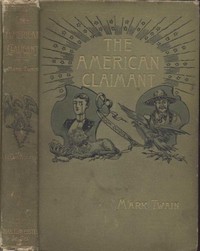
Excerpt
The Project Gutenberg eBook of The American Claimant, by Mark Twain
This eBook is for the use of anyone anywhere in the United States and
most other parts of the world at no cost and with almost no restrictions
whatsoever. You may copy it, give it away or re-use it under the terms
of the Project Gutenberg License included with this eBook or online at
www.gutenberg.org. If you are not located in the United States, you
will have to check the laws of the country where you are located before...
Read the Full Text
— End of The American Claimant —
Book Information
- Title
- The American Claimant
- Author(s)
- Twain, Mark
- Language
- English
- Type
- Text
- Release Date
- June 1, 2004
- Word Count
- 70,081 words
- Library of Congress Classification
- PS
- Bookshelves
- Browsing: Culture/Civilization/Society, Browsing: Humour, Browsing: Literature, Browsing: Fiction
- Rights
- Public domain in the USA.
Related Books

Three little Trippertrots
by Garis, Howard Roger
English
630h 28m read

Fish preferred
by Wodehouse, P. G. (Pelham Grenville)
English
1315h 21m read

Three little Trippertrots on their travels
by Garis, Howard Roger
English
647h 53m read

Amerikkalaisia kaskuja
by Twain, Mark
Finnish
148h 6m read
The catspaw of Piperock
by Tuttle, W. C. (Wilbur C.)
English
159h 36m read
Mr. Petre
by Belloc, Hilaire
English
1073h 41m read