The Project Gutenberg EBook of Robin Hood;, by Anonymous
This eBook is for the use of anyone anywhere at no cost and with
almost no restrictions whatsoever. You may copy it, give it away or
re-use it under the terms of the Project Gutenberg License included
with this eBook or online at www.gutenberg.org/license
Title: Robin Hood;
Being a Complete History of All the Notable and Merry
Exploits Performed by Him and His Men on Many Occasions
Author: Anonymous
Release Date: January 29, 2019 [EBook #58789]
Language: English
Character set encoding: UTF-8
*** START OF THIS PROJECT GUTENBERG EBOOK ROBIN HOOD; ***
Produced by Chuck Greif, hekula03 and the Online Distributed
Proofreading Team at http://www.pgdp.net (This book was
produced from images made available by the HathiTrust
Digital Library.)
[Illustration: Robin and his Mother going to Gamewell Hall.
_see page 2._
_London, William Darton, 58, Holborn Hill, Augˢᵗ. 29, 1821._]
ROBIN HOOD;
BEING A
_COMPLETE HISTORY_
OF ALL THE
NOTABLE AND MERRY EXPLOITS
PERFORMED BY HIM AND HIS MEN,
_ON MANY OCCASIONS_.
LONDON:
WILLIAM DARTON, 58, HOLBORN HILL.
1822.
_Price 6d. plain plates, or 1s. with the plates coloured._
ROBIN HOOD.
The reign of King Richard the First was very different from the times we
now live in. The roads were very bad, and were beset with robbers; and
there was a great number of large forests and parks in the country well
stocked with deer. At that time lived the famous Robin Hood. He was born
in the village of Locksley, in Nottinghamshire, and his father was very
skilful in the use of the cross-bow. His mother had a brother named
Gamewell, of Great Gamewell-hall, near Maxwell, in the same county, but
at the distance of twenty miles from the house of Robin Hood’s father.
When Robin Hood was about thirteen years old, his mother said one day to
his father, “Let Robin and me ride this morning to Gamewell-hall, to
taste my brother’s good cheer.” Her husband answered, “Do so, my dear;
let Robin Hood take my grey horse, and the best bridle and saddle: the
sun is rising, so, pray make haste, for to-morrow will be
Christmas-day.” The good wife then made no more ado, but put on her
holiday petticoat and gown, which were green. Robin got his basket-hilt
sword and dagger, and his new suit of clothes; and so rode, with his
mother behind him, till he came to Gamewell-hall.
Squire Gamewell made them welcome twenty times; and the next day six
tables were set out in the hall for dinner: and, when the company was
come, the squire said to them, “You are all welcome, but not a man here
shall taste my ale till he has sung a Christmas carol.” They now all
clapped their hands, and shouted, and sang, till the hall and the
parlour rung again.--After dinner, the chaplain said grace, and the
squire once again bid his friends be merry. “It snows and it blows out
of doors (said he), but we are snug here; let us have more ale, and lay
some logs upon the fire.” He then called for Little John; “for,” said
he, “Little John is a fine lad at gambols, and all sorts of tricks, and
it will do your hearts good to see him.” When Little John came, he was
indeed as clever as the squire had said; but Robin Hood got up, and
played all the very same tricks, and better still. The squire was quite
glad to see this; and he said, “Cousin Robin, you shall go no more home,
but shall stay and live with me: you shall have my estate when I die,
and, till then, you shall be the comfort of my age.” Robin Hood agreed
to this, if his uncle would but give him Little John to be his servant.
One time, when Robin Hood was gone to spend a week with his father and
mother, squire Gamewell was taken ill. In those days, the people of
this country were of the Roman Catholic religion. There was a convent of
priests near Gamewell-hall called Fountain Abbey; and the squire sent
for one of the priests or monks, to come and read prayers by his
bed-side. Fountain Abbey was a very fine building: it had a large
mansion in the centre, and a capital wing on the right side; but there
was no wing on the left; so that the building was not complete. Now the
monk who came to Gamewell-hall was very sorry about this, and wished
very much to have a left wing to his abbey: so he made the squire
believe that he could not die like a good man, unless he gave the whole
of his estate to Fountain Abbey. The squire was very ill, and hardly
knew what he did; he forgot Robin Hood, and all that he had said he
would do for him, and signed a paper that the monk brought him, to give
away his estate. As soon as Robin Hood heard that his uncle was very
ill, he made haste home; but the squire was dead a quarter of an hour
before Robin came. The monks now turned Robin Hood out of the hall; and,
as his father was poor, Robin was thus sent out into the world to seek
his fortune.
Robin Hood did not know what to do: he had been used to live like a rich
man, and did not know how to work; for he had learned no trade. He now
got together a number of young men, who had been brought up like
himself, and were just as poor; and they went to live what they called a
merry life, in Sherwood Forest, near Nottingham. Here there was plenty
of deer; and Robin Hood and his company were very excellent marksmen at
shooting them with the cross-bow. But they wanted something besides meat
to eat, so they at once turned robbers. After this, no man could travel
alone through Sherwood Forest, without being stripped of his money.
Robin Hood, and his company too, did not confine themselves to Sherwood
Forest, but sometimes went to plunder other parts of England. His gang
soon grew to above a hundred in number, and they were some of the
tallest, finest, and boldest, men in the kingdom. Robin Hood dressed
them in an uniform: he himself always wore scarlet; and each of his men
had a green coat, a pair of breeches, and cap.
Though Robin Hood was a robber, which to be sure is a very bad thing,
yet he behaved in such a manner as to have the good word and good wishes
of almost all the poor people in those parts. He never loved to rob any
body but people that were very rich, and that had not the spirit to make
good use of their riches. As he had lost his estate by the cunning of a
popish priest, he had a great dislike to the whole set; and the popish
priests at that time behaved in such a manner, that hardly any body
liked them: so that Robin Hood was not thought the worse of for his
usage of them. When he met with poor men, in his rambles, instead of
taking any thing from them, he gave them money of his own. He never let
any woman be either robbed or hurt; and, in cases of hardship, he always
took the part of the weak and the injured against the strong; so that it
was truely said, “that of all thieves he was the gentlest and most
generous thief.”
Robin Hood was fond of doing odd and strange things; and he loved a joke
quite as well as he loved a good booty. One day, as he strolled in the
Forest by himself, he saw a jolly butcher riding upon a fine mare, with
panniers on each side filled with meat. “Good morrow, good fellow!” said
Robin; “whither are you going so early?” Said the other, “I am a
butcher, and am going to Nottingham market to sell my meat.” “I never
learned any trade,” said Robin; “I think I should like to be a butcher.
What shall I give you for your mare, and your panniers, and all that is
in them?” “They are not dear at four marks,” said the butcher, “and I
will not sell them for less.” Robin made no words, but counted out the
money; and then made the butcher give him his blue linen coat and his
apron, in exchange for Robin Hood’s fine uniform of scarlet.
When Robin Hood had dressed himself in this manner, he rode straight to
Nottingham. The sheriff of Nottingham was master of the market, and
Robin Hood hired a stall there. But we may very well suppose that he did
not know much about his trade, and indeed, as long as he had any meat to
sell, no other butcher could sell a single joint; for Robin Hood sold
more meat for a penny than the others could do for five. “To be sure,”
said they, “this is some young fellow that has sold his father’s land.”
The butchers then went up to Robin Hood: “Come, brother,”
[Illustration: Robin Hood bargaining with the Nottingham Butcher.
_see page 8._
_London, William Darton, 58, Holborn Hill, Augˢᵗ. 29, 1821._]
said one of them, “we are all of one trade, will you go and dine with
us?” “I should be a shabby fellow,” said Robin, “if I was ashamed of my
calling; so I will go with you.” The sheriff was the tavern-keeper, and
sat at the head of the table; and, after dinner, Robin Hood would insist
upon paying the bill. The sheriff was a cunning old miser, and, when he
saw how madly Robin Hood behaved, he thought he would not miss such a
chance of turning a penny. “Good fellow,” said the sheriff, “hast thou
any horned beasts to sell to me?”--“That I have, good master sheriff,”
said Robin Hood. “I have a hundred or two, if you will please to go and
see them.” The sheriff then saddled his good palfrey, and took three
hundred pounds in gold, and away he went with Robin Hood.
The road they took led through the forest of Sherwood; and, as they rode
along, the sheriff cried out, “God preserve us this day from a man they
call Robin Hood!” But, when they came a little further, there chanced to
come out of the thicket a hundred good fat deer, skipping very near
them. “How do you like my horned beasts, master sheriff?” said Robin
Hood. “These are the cattle I told you of.” “To tell you the truth,”
replied the sheriff, “I wish I were away, for I do not like your
company.” Then Robin Hood put his bugle-horn to his mouth, and blowed
three times; when suddenly there came out of the wood Little John and
Robin Hood’s hundred men, clothed in green, and running all in a row.
“What is your will, master?” said Little John. “I have brought hither
the sheriff of Nottingham,” said Robin Hood, “this day, to dine with
me.” “He is welcome,” said Little John. “I hope he will pay us well for
his dinner.” Robin Hood now made the sheriff sit down under a tree; and,
after they had all eaten and drunk enough, he opened the sheriff’s bag,
[Illustration: Robin Hood telling out the Sheriffs money.
_see page 10._
_London, William Darton, 58, Holborn, Augˢᵗ. 29, 1821._]
and told out his three hundred pounds. He then seated the sheriff on his
palfrey again, and led him out of the forest. “Remember me kindly to
your wife,” said Robin Hood; and so went laughing away.
As Robin Hood was walking one day in the Forest, he took notice of a
handsome young man, dressed in very fine clothes, frisking over the
plain, and singing. When Robin Hood passed the same spot the next
morning, he saw this same young man come drooping along: his fine dress
was laid aside, his hair was loose about his shoulders, and at every
step he sighed deeply, saying, “Alas! and well-a-day!” Robin Hood sent
one of his company, to bring the young man to him. “What is the
distress,” said Robin Hood, “that hangs so heavy on your heart? Why were
you so merry yesterday, and why are you so sad to-day?” The young man
now pulled out his purse. “Look at this ring,” said he; “I bought it
yesterday; I was to have married a young maiden whom I have courted for
seven long years, and this morning she is gone to church to be married
to another.” “Do you think she loves you?” said Robin Hood. “She has
told me so,” said Allen-a-Dale, for that was his name, “a hundred
times.” “Then she is not worth caring about,” said Robin Hood, “for
changing in her love.” “She does not love him,” replied Allen-a-Dale.
“Why do you think so?” said Robin Hood. “He is a poor crippled old
fellow,” said Allen-a-Dale, “and quite unfit for such a young and lovely
lass.” “Then why does she marry him?” said Robin Hood. “Because the old
knight is rich,” replied Allen: “and her father and mother insist upon
it, and have scolded and stormed at her till she is as gentle as a
lamb.” “Where is the wedding to take place?” said Robin Hood. “At our
parish,” replied Allen, “only five miles from this place; and the bishop
of Hereford, who is the knight’s brother, is to read the service.”
Robin Hood said no more, but put off his scarlet suit, and dressed
himself like a harper, with a harp in his hand. He told twenty-four of
his company to follow at a little distance; and then went alone into the
church, and found the bishop putting on his robes. “What do you want
here?” said the bishop. “I am a harper,” said Robin Hood; “the best in
four counties round; I heard there was to be a wedding, and I am come to
offer my service.” “You are welcome,” said the bishop: “I shall be glad
to hear your music.” Soon after this, the bride and bridegroom came in.
The old knight hobbled along, and was hardly able to walk up to the
altar; and after him came a maiden, as fair as the day, and blushing
like the summer’s morning. “This is not a fit match,” said Robin Hood,
“and I cannot agree to its taking place; but, since we are come to the
church, the bride shall choose for herself.” Then Robin Hood put his
horn to his mouth, and blew into it; when straight four-and-twenty
archers were seen leaping along the church-yard path, and came in at the
porch. The first man was Allen-a-Dale, to give Robin Hood his bow.
Robin Hood now turned to the fair maiden, and said, “Now, my love, you
are free: tell me whom you will have for your husband. Will you have
this feeble and gouty old knight, or will you have one of the bold young
fellows you see now before you?” “Alas!” said the young maid, and
dropped her eyes on the ground as she spoke, “young Allen-a-Dale has
courted me for seven long years, and he is the man I would choose.”
“Then,” said Robin Hood, “you and Allen shall be married before we leave
this place.” “That shall not be,” said the bishop; “the law of the land
requires that they should be three times asked in the church, and a
marriage cannot be huddled up in this way.” “That we will try,” said
Robin Hood; and he then pulled off the bishop’s gown, and put it upon
Little John. “Indeed,” said Robin Hood, “you make a grave parson.” When
Little John took the book into his hand, the people began to laugh; and
he asked them seven times in the church, lest three times should not be
enough. Robin Hood gave away the maiden; the bishop slunk out of the
church; and his brother, the old knight, hobbled after as well as he
could. The whole company had a dinner upon two fat bucks in Sherwood
Forest; and from this day, Allen-a-Dale was a friend to Robin Hood as
long as he lived.
In the time of Robin Hood, the bishops were under the orders of the pope
of Rome; and they were great officers, and even soldiers. Robin Hood
lived in the see of the bishop of Hereford. Now Robin had a great
dislike to the popish clergy, because one of them had cheated him of his
uncle’s estate; and the bishop of Hereford had quite as much dislike to
Robin, because of the trick Robin had played him in the marriage of
Allen-a-Dale, and because he did not think it right that such a robber
should live in his see. The bishop therefore made several journeys into
the Forest of Sherwood, to take Robin prisoner, and bring him to the
gallows.
One time, when Robin was walking alone in the Forest of Sherwood, he
heard the trampling of horses; and, looking round, he saw his old enemy,
the bishop of Hereford, with six servants. The bishop was very near
Robin Hood before Robin looked round and saw him; and he had nothing to
trust to but the swiftness of his heels, to save him from danger.
As Robin ran along, he chanced to come up to a cottage where an old
woman lived all by herself; so he rushed in, and begged her to save his
life.--“Who are you?” said the old woman; “and what can I do for you?”
“I am an outlaw,” replied he, “and my name is Robin Hood;
[Illustration: Robin Hood flying for shelter from the Bishop of
Hereford.
_see page 16._
_London, William Darton, 58, Holborn Hill, Augˢᵗ. 29, 1821._]
[Illustration: Robin Hood making the Bishop of Hereford dance.
_see page 19._
_London, William Darton, 58, Holborn Hill, Augˢᵗ. 29, 1821._]
and yonder is the bishop of Hereford, with all his men, who wants to
bring me to the gallows.” “If thou be Robin Hood,” said the old woman,
“as I think thou art, I would as soon lose my own life, as not do all in
my power to save thee. Many a time have Little John and thou done me a
kindness, and brought me venison; and no longer ago than last Saturday
night thou gave me a pair of new shoes, and this green kirtle.” “Then,”
said Robin Hood, “give me thy green kirtle, and thy close-eared cap, and
put into my hands thy distaff and spindle, and do thou take my scarlet
mantle and my quiver and bow.”
As soon as they had made this change, Robin Hood left the house, and
went to the place where all his company were to be found. He looked
behind him a hundred times for the bishop, who had no thoughts of
finding him in this disguise. One of the robbers, who was a spiteful
fellow, as Robin Hood came near them, cried out, “A witch! a witch! I
will let fly an arrow at her.” “Hold thy hand,” said Robin Hood, “and
shoot not thy arrows so keen, for I am Robin Hood, thy master.” Then he
went up to Little John, and said, “Come, kill a good fat deer, for the
Bishop of Hereford is to dine with me to-day.”
While this was going on, the bishop came to the old woman’s house; and
seeing a man, as he thought, with a mantle of scarlet, and a quiver and
a bow in his hand, he shook his head, and said, “I am afraid you are one
of Robin Hood’s gang. If you have not a mind to be hanged yourself, shew
me where that traitor is, and set him before me.” The old woman agreed
to this. “Go with me,” said she to the bishop, “and I think I can bring
you to the man you want.” The bishop then mounted her upon a milk-white
steed, and himself rode upon a dapple-grey; and, for joy that he should
get Robin Hood, he went laughing all the way. But, as they were riding
along the forest, the bishop saw a hundred brave bowmen, drawn up
together under a tree. “Oh! who is yonder,” said the bishop, “ranging
within the wood?” “Why,” said the old woman, “I think it is a man they
call Robin Hood.” “Why, who art thou?” said the bishop; “for, to tell
thee the truth, I thought thou hadst been Robin Hood himself.” “Oh! my
lord,” said she, “I am only an old woman.”
By this time, Robin Hood and his company came up to the bishop; and
Robin Hood, taking him by his hand, said, “My lord, you must dine with
me to-day under my bower in merry Barnsdale. I cannot feast you like a
bishop, but I can give you venison, ale, and wine; and I hope you will
be content.” After dinner, Robin Hood made the music to strike up, and
would insist upon the bishop’s dancing a hornpipe in his boots; and the
bishop was forced to submit. The day was now far spent, and the bishop
begged leave to go away. “You have treated me very nobly,” said he to
Robin Hood, “and I suppose I must pay for it. Tell me how much.” “Lend
me your purse, master,” said Little John, “and I will settle it for
you.” He then spread the bishop’s cloak upon the ground, and opening his
bag, he counted five hundred pounds out of it. “Now,” said Robin Hood,
“we thank you for your company; and, to shew you that we know how to be
polite, we will see you part of the way home.” They then led the bishop
and his servants quite through the wood, till they brought him to the
high road: then Robin Hood’s gang gave three cheers, and told him to
remember that, though he had come meaning to hang them all, they had
done him no harm.
One day, in summer-time, when the leaves grew green, and the flowers
were fresh and gay, Robin Hood and his merry men were all in a humour
to play. Some would leap, some would run, some shot at a mark, and some
wrestled with each other on the green. Robin Hood was haughty and proud,
and said, “Now, my good fellows, do you think there is a man in the
world that could wrestle or play the quarter-staff with me, or kill a
doe or buck so sure as me?”
While Robin Hood was boasting in this manner, Will Scarlet stepped out
from the rest. Will Scarlet was a little a-kin to Robin Hood, and
thought he had as good a right himself to be captain of the gang.
Besides, he was rather spiteful: he was just going to shoot an arrow at
Robin Hood when he saw him dressed like an old woman. “If you wish to
meet with your match,” said Scarlet, “I can tell you where you can find
him. There is a friar in Fountain Abbey.” Now Fountain Abbey was the
convent that had been built with the money that Robin Hood’s uncle
Gamewell’s estate had been sold for, and perhaps Will Scarlet chose to
throw it in Robin’s teeth for that reason. “I had as soon you had talked
of the gallows,” said Robin Hood. “No matter for that,” said Will
Scarlet; “there is a friar in Fountain Abbey that can draw a strong bow
against any man in the world: he can handle a quarter-staff too; and
will beat you and all your yeomen, set them in a row.”
Robin Hood was a man of a bold spirit, and could not rest till he had
seen this friar; so he slung his bow across his shoulder, and took his
quarter-staff in his hand, and away he went to Fountain Dale. He had not
gone far, before he saw a tall brawny friar walking by the waterside:
and Robin Hood thought this must be the man the moment he saw him.
Robin Hood got off his horse, and tied him to a thorn. “Carry me over
this water, thou brawny friar,” said he, “or thou hast not an hour
[Illustration: Robin Hood asking the fair maiden whom she will have for
a husband.
_see page 14._
_London, William Darton, 58, Holborn Hill, Augˢᵗ. 29, 1821._]
longer to live.” The friar did not grumble; but stooped, and took Robin
upon his back. The water was deep, and the passage was long and not
easy; and neither of these rivals spoke a single word till they came to
the other side. Robin then leaped lightly off the friar’s back, and
seemed going away. “Stop,” said the friar, “carry me over this water,
thou fine fellow, or it will breed thee pain.” Robin took the friar upon
his back; and neither of the two spoke a single word till they came to
the other side. The friar then leaped lightly off Robin’s back, while
Robin said to him again, “Carry me over the water, thou brawny friar, or
it shall breed thee pain.” The friar once more took Robin upon his back;
but this time he did not carry him over; for, as soon as he had got to
the middle of the stream, he threw him into the water. “And now choose,
my fine fellow,” said he, “whether thou wilt sink or swim.” Robin swam
to the shore; and, when the friar was come to the same place, Robin
said to him, “I see by this trial that thou art worthy to be my match.”
Robin challenged him in wrestling, in shooting, and at the
quarter-staff; but Robin could not beat the friar, nor the friar beat
Robin in any of these. “I wish from my soul,” said Robin, “you would
quit this lazy life, and come and be one of us; we range the forest
merry and free, and are as happy as the day is long.” “I wish from my
soul,” said the friar, “thou wouldst leave thy rambling and wicked life,
and come and live in our convent. Thy thefts will bring thee to a bad
end, but I shall live out my days quiet and respected.” Robin could not
persuade the friar, and the friar could not persuade Robin: so they
shook hands and parted.
Robin Hood knew very well that his way of life was against the laws; and
that, if he were once caught, it would go very hard with him.
[Illustration: The Friar throwing Robin into the River.
_see page 23._
_London, William Darton, 58, Holborn Hill, Augˢᵗ. 29, 1821._]
He had now been in this way for several years; and began to wish that he
could change his way of living for a quiet dwelling in the village where
he was born. While he had thoughts of this sort, one time when he took
many rich prizes, he resolved to make a present to the queen. The name
of the queen was Eleanor; she was the mother of King Richard the First,
who had great power in her son’s reign.
Queen Eleanor was very much pleased with Robin Hood’s present, and said
to herself, If I live one year to an end, I will be a friend to thee,
and all thy men.
Soon after this, King Richard made a grand match in his court, of all
the bow-men of his guards and his army. Queen Eleanor thought this a
good time to do what she had in her mind; so she called her favourite
page, whose name was Richard Partington, and gave him his errand. The
page set out straight to Sherwood Forest; and when he came to Robin
Hood, he said: “Queen Eleanor greets you well; she bids you post to
London, where there is to be a match at the cross-bow, and she has
chosen you and your men to be her champions.”
On the day of this great match, the king’s bowmen, who were thought the
best archers in all England, were ranged on one side. After a time, the
queen’s champions came in, and were ranged on the other side; they were
all strangers, and no man in the court knew any of them. King Richard
then declared what the prize was that should be bestowed upon the
conquerors, and the lords of the court began to make bets upon the
venture. The bets were three to one in favour of the king’s men. “Is
there no knight of the privy council,” said Queen Eleanor, “who will
venture his money on my side? Come hither to me, Sir Robert Lee, thou
art a knight of high descent.” Sir Robert Lee begged the queen to
excuse him from such a trial. “Come hither to me, thou Bishop of
Hereford,” said Queen Eleanor, “for thou art a noble priest.” Now this
bishop was Robin Hood’s old foe. “By my silver mitre,” said the bishop,
“I will not bet a penny.” “If thou wilt not bet on the queen’s side,”
said Robin Hood, “what wilt thou bet on the king’s?” “On the king’s
side,” said the bishop, “I will venture all the money in my purse.”
“Throw thy purse on the ground,” said Robin Hood, “and let us see what
it contains.” It was a hundred pounds. Robin Hood took a bag of the same
value from his side, and threw it upon the green.
When the match was just going to begin, Queen Eleanor fell upon her
knees to the king her son. “A boon! a boon!” said she, “I must ask a
boon of thee before the trial begins.” “What is it?” said King Richard.
“Why,” replied the queen, “that you will not be angry with any of those
that are of my party; and that they shall be free to stay in our court
all the days of the match, and shall then have forty days to retire when
they like.” The king agreed to this. When the keepers of the course were
marking out the distance from which they should shoot at the butt, their
captain cried out, like a bold boaster as he was, “Measure no mark for
us, we will shoot at the sun and the moon.” But he was mistaken; for
Robin Hood and his party cleft with their arrows every wand and stick
that was set up, and won all the money. Said the Bishop of Hereford, “I
know very well now who these fellows are; they are Robin Hood and his
gang.” The king replied, “If I had known that, I would not have granted
them leave to depart; but I cannot break my word.” Saying this, King
Richard ordered a noble feast for Robin Hood and his yeomanry; and then
sent them away with honour.
King Richard often thought upon what he had seen of Robin Hood and his
fellows. He was very fond of archery; he had heard of many generous
actions that were told about them, and he admired their gallant spirit
and manners. Thought he, If I could but make these men my faithful
subjects, what a pride they would be to my court! The king at last fixed
upon a plan by which he might see Robin Hood once more.
He called twelve lords of his court, and told his plan to them; and then
he and his lords all dressed themselves like so many monks, and away
they rode to Sherwood Forest. Robin Hood saw them at a distance, as they
were coming, and resolved to rob them. The king was taller than the
rest, and Robin Hood judged that he was the abbot; so he took the king’s
horse by the bridle, and said, “Abbot. I bid you stand: it was a priest
that first worked my ruin, and I have sworn to spare none of his
fellows.” “But we are going on a message from the king,” said Richard.
Robin Hood then let go the bridle, and said, “God save the king! and
confound all his foes!” “Thou cursest thyself,” said Richard, “for thou
art a robber, an outlaw, and a traitor.” “If you were not his servant,”
said the other, “I should say, You lie; for I never yet hurt man that
was honest and true, but only those who give their minds to live upon
other people’s earnings. I never hurt the farmer who tills the ground; I
protect women and children; and the poor for twenty miles round are the
better for me.”
Robin Hood then asked the strangers to dine with him. “You would not be
used so,” said he, “if you were not the king’s servants: yet, for King
Richard’s sake, if you had as much money as ever I told, I would not
deprive you of a penny.” Then Robin Hood put his horn to his mouth, and
blew a shrill blast, when a hundred and ten of his company came marching
all in a row. The king thought, This is a fine sight: these men of Robin
Hood’s obey their captain better than his people did him.
After dinner, the king said to Robin, “What would you give, my brave
fellow, if I could get your pardon from the king? Would you set your
mind firmly in every thing to be a true and useful subject?”
This was the very thing that Robin wanted; it was the wish that had
haunted his thoughts night and day: it was with the hope of this that he
made the rich present to Queen Eleanor.
“My friend,” said Robin, “I am tired of the lawless life that I lead: I
never loved it. Other men may praise my bold adventures and generous
actions; but I hate my way of living, and every thing that belongs to
it. King Richard is a noble prince and a gallant soldier; and, if he
would take me into his favour, he should never have reason to repent
it, but should find me the most faithful and loving of all his
subjects.”
“I am King Richard,” said the stranger: and, when he had said this,
Robin and all his company fell upon their knees before him.
“Stand up, my brave fellows,” said the king; “you have been robbers, and
you ought not to have been such. The greatest miser in my kingdom ought
not to be treated with force, but to be persuaded to dispose of his
money properly. But you are brave fellows; you say that you are well
inclined, and you have power and skill to do me service. I freely grant
to every one of you my pardon. Not one of you shall be called to account
for any thing that is past; only take care that you behave yourselves in
such a manner in future, that I never may have reason to repent the
kindness that I now treat you with.”
THE END.
[Illustration: KING RICHARD discovering himself to Robin and his
company.
_see page 32._
_London, William Darton, 58, Holborn Hill, Augˢᵗ. 29, 1821._]
* * * * *
_Children’s Books sold by_
W. DARTON, 58, HOLBORN HILL, LONDON.
THIRTY-TWO REMARKABLE PLACES IN OLD ENGLAND, for the Instruction and
Entertainment of Youth. Price 6d. with 9 Copper-plates, and 1s. with 18
Plates.
THE MODERN GOODY TWO-SHOES; exemplifying the Good Consequences of an
early Attention to Learning and Virtue. By MARY BELSON, Author of “The
Orphan Boy,” “Industry and Idleness,” &c. &c. Price 1s.
THE ADVENTURES of THOMAS TWO-SHOES; being a Sequel to that of “The
Modern Goody Two-Shoes.” Price 1s.
THE PLEASING, INTERESTING, AND AFFECTING HISTORY OF PRINCE LEE BOO; with
an Account of the PELEW ISLANDS; embellished with elegant Copper-plates.
Price 1s.
INDUSTRY AND IDLENESS; a Tale for Little Girls, in Words not exceeding
Two Syllables. Price 1s.
THE YELLOW SHOE-STRINGS; or the Good Effects of Obedience to Parents.
Price 1s.
HENRY; a Story for Little Boys and Girls from Five to Seven Years old.
By FRANCIS BOWYER VAUX. Two Parts. Price 1s. each.
PROFITABLE AMUSEMENTS FOR CHILDREN; or, Familiar Tales; combining useful
Instruction with pleasing Entertainment. By the Author of “Learning
better than House and Land.” Price 2s. half-bound.
FOOD FOR THE YOUNG, adapted to the Mental Capacities of Children of
tender Years. By a Mother. Price 2s. half-bound.
THE METAMORPHOSES; or Effects of Education: a Tale. By the Author of
“Aunt Mary’s Tales,” “The Ornaments Discovered,” &c. &c. Price 2s. 6d.
half-bound.
End of the Project Gutenberg EBook of Robin Hood;, by Anonymous
*** END OF THIS PROJECT GUTENBERG EBOOK ROBIN HOOD; ***
***** This file should be named 58789-0.txt or 58789-0.zip *****
This and all associated files of various formats will be found in:
http://www.gutenberg.org/5/8/7/8/58789/
Produced by Chuck Greif, hekula03 and the Online Distributed
Proofreading Team at http://www.pgdp.net (This book was
produced from images made available by the HathiTrust
Digital Library.)
Updated editions will replace the previous one--the old editions
will be renamed.
Creating the works from public domain print editions means that no
one owns a United States copyright in these works, so the Foundation
(and you!) can copy and distribute it in the United States without
permission and without paying copyright royalties. Special rules,
set forth in the General Terms of Use part of this license, apply to
copying and distributing Project Gutenberg-tm electronic works to
protect the PROJECT GUTENBERG-tm concept and trademark. Project
Gutenberg is a registered trademark, and may not be used if you
charge for the eBooks, unless you receive specific permission. If you
do not charge anything for copies of this eBook, complying with the
rules is very easy. You may use this eBook for nearly any purpose
such as creation of derivative works, reports, performances and
research. They may be modified and printed and given away--you may do
practically ANYTHING with public domain eBooks. Redistribution is
subject to the trademark license, especially commercial
redistribution.
*** START: FULL LICENSE ***
THE FULL PROJECT GUTENBERG LICENSE
PLEASE READ THIS BEFORE YOU DISTRIBUTE OR USE THIS WORK
To protect the Project Gutenberg-tm mission of promoting the free
distribution of electronic works, by using or distributing this work
(or any other work associated in any way with the phrase "Project
Gutenberg"), you agree to comply with all the terms of the Full Project
Gutenberg-tm License (available with this file or online at
http://gutenberg.org/license).
Section 1. General Terms of Use and Redistributing Project Gutenberg-tm
electronic works
1.A. By reading or using any part of this Project Gutenberg-tm
electronic work, you indicate that you have read, understand, agree to
and accept all the terms of this license and intellectual property
(trademark/copyright) agreement. If you do not agree to abide by all
the terms of this agreement, you must cease using and return or destroy
all copies of Project Gutenberg-tm electronic works in your possession.
If you paid a fee for obtaining a copy of or access to a Project
Gutenberg-tm electronic work and you do not agree to be bound by the
terms of this agreement, you may obtain a refund from the person or
entity to whom you paid the fee as set forth in paragraph 1.E.8.
1.B. "Project Gutenberg" is a registered trademark. It may only be
used on or associated in any way with an electronic work by people who
agree to be bound by the terms of this agreement. There are a few
things that you can do with most Project Gutenberg-tm electronic works
even without complying with the full terms of this agreement. See
paragraph 1.C below. There are a lot of things you can do with Project
Gutenberg-tm electronic works if you follow the terms of this agreement
and help preserve free future access to Project Gutenberg-tm electronic
works. See paragraph 1.E below.
1.C. The Project Gutenberg Literary Archive Foundation ("the Foundation"
or PGLAF), owns a compilation copyright in the collection of Project
Gutenberg-tm electronic works. Nearly all the individual works in the
collection are in the public domain in the United States. If an
individual work is in the public domain in the United States and you are
located in the United States, we do not claim a right to prevent you from
copying, distributing, performing, displaying or creating derivative
works based on the work as long as all references to Project Gutenberg
are removed. Of course, we hope that you will support the Project
Gutenberg-tm mission of promoting free access to electronic works by
freely sharing Project Gutenberg-tm works in compliance with the terms of
this agreement for keeping the Project Gutenberg-tm name associated with
the work. You can easily comply with the terms of this agreement by
keeping this work in the same format with its attached full Project
Gutenberg-tm License when you share it without charge with others.
1.D. The copyright laws of the place where you are located also govern
what you can do with this work. Copyright laws in most countries are in
a constant state of change. If you are outside the United States, check
the laws of your country in addition to the terms of this agreement
before downloading, copying, displaying, performing, distributing or
creating derivative works based on this work or any other Project
Gutenberg-tm work. The Foundation makes no representations concerning
the copyright status of any work in any country outside the United
States.
1.E. Unless you have removed all references to Project Gutenberg:
1.E.1. The following sentence, with active links to, or other immediate
access to, the full Project Gutenberg-tm License must appear prominently
whenever any copy of a Project Gutenberg-tm work (any work on which the
phrase "Project Gutenberg" appears, or with which the phrase "Project
Gutenberg" is associated) is accessed, displayed, performed, viewed,
copied or distributed:
This eBook is for the use of anyone anywhere at no cost and with
almost no restrictions whatsoever. You may copy it, give it away or
re-use it under the terms of the Project Gutenberg License included
with this eBook or online at www.gutenberg.org/license
1.E.2. If an individual Project Gutenberg-tm electronic work is derived
from the public domain (does not contain a notice indicating that it is
posted with permission of the copyright holder), the work can be copied
and distributed to anyone in the United States without paying any fees
or charges. If you are redistributing or providing access to a work
with the phrase "Project Gutenberg" associated with or appearing on the
work, you must comply either with the requirements of paragraphs 1.E.1
through 1.E.7 or obtain permission for the use of the work and the
Project Gutenberg-tm trademark as set forth in paragraphs 1.E.8 or
1.E.9.
1.E.3. If an individual Project Gutenberg-tm electronic work is posted
with the permission of the copyright holder, your use and distribution
must comply with both paragraphs 1.E.1 through 1.E.7 and any additional
terms imposed by the copyright holder. Additional terms will be linked
to the Project Gutenberg-tm License for all works posted with the
permission of the copyright holder found at the beginning of this work.
1.E.4. Do not unlink or detach or remove the full Project Gutenberg-tm
License terms from this work, or any files containing a part of this
work or any other work associated with Project Gutenberg-tm.
1.E.5. Do not copy, display, perform, distribute or redistribute this
electronic work, or any part of this electronic work, without
prominently displaying the sentence set forth in paragraph 1.E.1 with
active links or immediate access to the full terms of the Project
Gutenberg-tm License.
1.E.6. You may convert to and distribute this work in any binary,
compressed, marked up, nonproprietary or proprietary form, including any
word processing or hypertext form. However, if you provide access to or
distribute copies of a Project Gutenberg-tm work in a format other than
"Plain Vanilla ASCII" or other format used in the official version
posted on the official Project Gutenberg-tm web site (www.gutenberg.org),
you must, at no additional cost, fee or expense to the user, provide a
copy, a means of exporting a copy, or a means of obtaining a copy upon
request, of the work in its original "Plain Vanilla ASCII" or other
form. Any alternate format must include the full Project Gutenberg-tm
License as specified in paragraph 1.E.1.
1.E.7. Do not charge a fee for access to, viewing, displaying,
performing, copying or distributing any Project Gutenberg-tm works
unless you comply with paragraph 1.E.8 or 1.E.9.
1.E.8. You may charge a reasonable fee for copies of or providing
access to or distributing Project Gutenberg-tm electronic works provided
that
- You pay a royalty fee of 20% of the gross profits you derive from
the use of Project Gutenberg-tm works calculated using the method
you already use to calculate your applicable taxes. The fee is
owed to the owner of the Project Gutenberg-tm trademark, but he
has agreed to donate royalties under this paragraph to the
Project Gutenberg Literary Archive Foundation. Royalty payments
must be paid within 60 days following each date on which you
prepare (or are legally required to prepare) your periodic tax
returns. Royalty payments should be clearly marked as such and
sent to the Project Gutenberg Literary Archive Foundation at the
address specified in Section 4, "Information about donations to
the Project Gutenberg Literary Archive Foundation."
- You provide a full refund of any money paid by a user who notifies
you in writing (or by e-mail) within 30 days of receipt that s/he
does not agree to the terms of the full Project Gutenberg-tm
License. You must require such a user to return or
destroy all copies of the works possessed in a physical medium
and discontinue all use of and all access to other copies of
Project Gutenberg-tm works.
- You provide, in accordance with paragraph 1.F.3, a full refund of any
money paid for a work or a replacement copy, if a defect in the
electronic work is discovered and reported to you within 90 days
of receipt of the work.
- You comply with all other terms of this agreement for free
distribution of Project Gutenberg-tm works.
1.E.9. If you wish to charge a fee or distribute a Project Gutenberg-tm
electronic work or group of works on different terms than are set
forth in this agreement, you must obtain permission in writing from
both the Project Gutenberg Literary Archive Foundation and Michael
Hart, the owner of the Project Gutenberg-tm trademark. Contact the
Foundation as set forth in Section 3 below.
1.F.
1.F.1. Project Gutenberg volunteers and employees expend considerable
effort to identify, do copyright research on, transcribe and proofread
public domain works in creating the Project Gutenberg-tm
collection. Despite these efforts, Project Gutenberg-tm electronic
works, and the medium on which they may be stored, may contain
"Defects," such as, but not limited to, incomplete, inaccurate or
corrupt data, transcription errors, a copyright or other intellectual
property infringement, a defective or damaged disk or other medium, a
computer virus, or computer codes that damage or cannot be read by
your equipment.
1.F.2. LIMITED WARRANTY, DISCLAIMER OF DAMAGES - Except for the "Right
of Replacement or Refund" described in paragraph 1.F.3, the Project
Gutenberg Literary Archive Foundation, the owner of the Project
Gutenberg-tm trademark, and any other party distributing a Project
Gutenberg-tm electronic work under this agreement, disclaim all
liability to you for damages, costs and expenses, including legal
fees. YOU AGREE THAT YOU HAVE NO REMEDIES FOR NEGLIGENCE, STRICT
LIABILITY, BREACH OF WARRANTY OR BREACH OF CONTRACT EXCEPT THOSE
PROVIDED IN PARAGRAPH 1.F.3. YOU AGREE THAT THE FOUNDATION, THE
TRADEMARK OWNER, AND ANY DISTRIBUTOR UNDER THIS AGREEMENT WILL NOT BE
LIABLE TO YOU FOR ACTUAL, DIRECT, INDIRECT, CONSEQUENTIAL, PUNITIVE OR
INCIDENTAL DAMAGES EVEN IF YOU GIVE NOTICE OF THE POSSIBILITY OF SUCH
DAMAGE.
1.F.3. LIMITED RIGHT OF REPLACEMENT OR REFUND - If you discover a
defect in this electronic work within 90 days of receiving it, you can
receive a refund of the money (if any) you paid for it by sending a
written explanation to the person you received the work from. If you
received the work on a physical medium, you must return the medium with
your written explanation. The person or entity that provided you with
the defective work may elect to provide a replacement copy in lieu of a
refund. If you received the work electronically, the person or entity
providing it to you may choose to give you a second opportunity to
receive the work electronically in lieu of a refund. If the second copy
is also defective, you may demand a refund in writing without further
opportunities to fix the problem.
1.F.4. Except for the limited right of replacement or refund set forth
in paragraph 1.F.3, this work is provided to you 'AS-IS' WITH NO OTHER
WARRANTIES OF ANY KIND, EXPRESS OR IMPLIED, INCLUDING BUT NOT LIMITED TO
WARRANTIES OF MERCHANTABILITY OR FITNESS FOR ANY PURPOSE.
1.F.5. Some states do not allow disclaimers of certain implied
warranties or the exclusion or limitation of certain types of damages.
If any disclaimer or limitation set forth in this agreement violates the
law of the state applicable to this agreement, the agreement shall be
interpreted to make the maximum disclaimer or limitation permitted by
the applicable state law. The invalidity or unenforceability of any
provision of this agreement shall not void the remaining provisions.
1.F.6. INDEMNITY - You agree to indemnify and hold the Foundation, the
trademark owner, any agent or employee of the Foundation, anyone
providing copies of Project Gutenberg-tm electronic works in accordance
with this agreement, and any volunteers associated with the production,
promotion and distribution of Project Gutenberg-tm electronic works,
harmless from all liability, costs and expenses, including legal fees,
that arise directly or indirectly from any of the following which you do
or cause to occur: (a) distribution of this or any Project Gutenberg-tm
work, (b) alteration, modification, or additions or deletions to any
Project Gutenberg-tm work, and (c) any Defect you cause.
Section 2. Information about the Mission of Project Gutenberg-tm
Project Gutenberg-tm is synonymous with the free distribution of
electronic works in formats readable by the widest variety of computers
including obsolete, old, middle-aged and new computers. It exists
because of the efforts of hundreds of volunteers and donations from
people in all walks of life.
Volunteers and financial support to provide volunteers with the
assistance they need, are critical to reaching Project Gutenberg-tm's
goals and ensuring that the Project Gutenberg-tm collection will
remain freely available for generations to come. In 2001, the Project
Gutenberg Literary Archive Foundation was created to provide a secure
and permanent future for Project Gutenberg-tm and future generations.
To learn more about the Project Gutenberg Literary Archive Foundation
and how your efforts and donations can help, see Sections 3 and 4
and the Foundation web page at http://www.pglaf.org.
Section 3. Information about the Project Gutenberg Literary Archive
Foundation
The Project Gutenberg Literary Archive Foundation is a non profit
501(c)(3) educational corporation organized under the laws of the
state of Mississippi and granted tax exempt status by the Internal
Revenue Service. The Foundation's EIN or federal tax identification
number is 64-6221541. Its 501(c)(3) letter is posted at
http://pglaf.org/fundraising. Contributions to the Project Gutenberg
Literary Archive Foundation are tax deductible to the full extent
permitted by U.S. federal laws and your state's laws.
The Foundation's principal office is located at 4557 Melan Dr. S.
Fairbanks, AK, 99712., but its volunteers and employees are scattered
throughout numerous locations. Its business office is located at
809 North 1500 West, Salt Lake City, UT 84116, (801) 596-1887, email
[email protected]. Email contact links and up to date contact
information can be found at the Foundation's web site and official
page at http://pglaf.org
For additional contact information:
Dr. Gregory B. Newby
Chief Executive and Director
[email protected]
Section 4. Information about Donations to the Project Gutenberg
Literary Archive Foundation
Project Gutenberg-tm depends upon and cannot survive without wide
spread public support and donations to carry out its mission of
increasing the number of public domain and licensed works that can be
freely distributed in machine readable form accessible by the widest
array of equipment including outdated equipment. Many small donations
($1 to $5,000) are particularly important to maintaining tax exempt
status with the IRS.
The Foundation is committed to complying with the laws regulating
charities and charitable donations in all 50 states of the United
States. Compliance requirements are not uniform and it takes a
considerable effort, much paperwork and many fees to meet and keep up
with these requirements. We do not solicit donations in locations
where we have not received written confirmation of compliance. To
SEND DONATIONS or determine the status of compliance for any
particular state visit http://pglaf.org
While we cannot and do not solicit contributions from states where we
have not met the solicitation requirements, we know of no prohibition
against accepting unsolicited donations from donors in such states who
approach us with offers to donate.
International donations are gratefully accepted, but we cannot make
any statements concerning tax treatment of donations received from
outside the United States. U.S. laws alone swamp our small staff.
Please check the Project Gutenberg Web pages for current donation
methods and addresses. Donations are accepted in a number of other
ways including checks, online payments and credit card donations.
To donate, please visit: http://pglaf.org/donate
Section 5. General Information About Project Gutenberg-tm electronic
works.
Professor Michael S. Hart is the originator of the Project Gutenberg-tm
concept of a library of electronic works that could be freely shared
with anyone. For thirty years, he produced and distributed Project
Gutenberg-tm eBooks with only a loose network of volunteer support.
Project Gutenberg-tm eBooks are often created from several printed
editions, all of which are confirmed as Public Domain in the U.S.
unless a copyright notice is included. Thus, we do not necessarily
keep eBooks in compliance with any particular paper edition.
Most people start at our Web site which has the main PG search facility:
http://www.gutenberg.org
This Web site includes information about Project Gutenberg-tm,
including how to make donations to the Project Gutenberg Literary
Archive Foundation, how to help produce our new eBooks, and how to
subscribe to our email newsletter to hear about new eBooks.
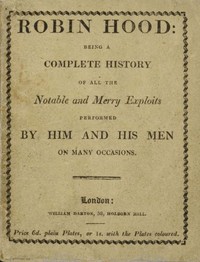
Robin Hood; - Being a Complete History of All the Notable and Merry Exploits Performed by Him and His Men on Many Occasions
by
Anonymous
Download Formats:
Excerpt
The Project Gutenberg EBook of Robin Hood;, by Anonymous
This eBook is for the use of anyone anywhere at no cost and with
almost no restrictions whatsoever. You may copy it, give it away or
re-use it under the terms of the Project Gutenberg License included
with this eBook or online at www.gutenberg.org/license
Title: Robin Hood;
Being a Complete History of All the Notable and Merry
Exploits Performed by Him and His Men on Many Occasions
Read the Full Text
— End of Robin Hood; - Being a Complete History of All the Notable and Merry Exploits Performed by Him and His Men on Many Occasions —
Book Information
- Title
- Robin Hood; - Being a Complete History of All the Notable and Merry Exploits Performed by Him and His Men on Many Occasions
- Author(s)
- Anonymous
- Language
- English
- Type
- Text
- Release Date
- January 29, 2019
- Word Count
- 9,080 words
- Library of Congress Classification
- PZ
- Bookshelves
- Browsing: Children & Young Adult Reading, Browsing: Literature
- Rights
- Public domain in the USA.
Related Books
Maisie's merry Christmas
by Rhoades, Nina
English
1006h 44m read
Three little Trippertrots
by Garis, Howard Roger
English
630h 28m read

My friend Doggie; or, An only child
by Glasgow, G. R. (Geraldine Robertson)
English
34h 30m read
Wreck of the "London."
by Anonymous
English
479h 16m read
Dimple Dallas
by Blanchard, Amy Ella
English
588h 4m read
A day in Mary Carrow's school
by Anonymous
English
88h 8m read