*** START OF THE PROJECT GUTENBERG EBOOK 75343 ***
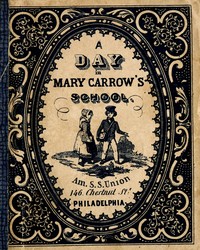
A DAY
IN
MARY CARROW’S SCHOOL.
------------------------------------------------------------------------
[Illustration:
~First Day.~
Anne Lyle standing by her Papa. p. 17.
]
------------------------------------------------------------------------
A DAY
IN
MARY CARROW’S SCHOOL
American Sunday-School Union.
_PHILADELPHIA_: 146 CHESTNUT ST.
_NEW YORK_: 147 NASSAU ST.
_BOSTON_: 9 CORNHILL.
_LOUISVILLE_: 103 FOURTH ST.
--------------------------------
Entered according to Act of Congress, in the year 1848, by the
AMERICAN SUNDAY-SCHOOL UNION,
in the Clerk’s Office of the District Court for the Eastern District of
Pennsylvania.
--------------------------------
→ No books are published by the AMERICAN SUNDAY-SCHOOL UNION without
the sanction of the Committee of Publication, consisting of fourteen
members, from the following denominations of Christians, viz. Baptist,
Methodist, Congregationalist, Episcopal, Presbyterian and Reformed
Dutch. Not more than three of the members can be of the same
denomination, and no book can be published to which any member of the
Committee shall object.
------------------------------------------------------------------------
A DAY
IN
MARY CARROW’S SCHOOL.
--------------------------------
After the roll had been called, the little boys and girls were invited
to say a lesson first; because Mary, the teacher, thought the bigger
ones could better understand why they were to wait.
They took their places in the class, and she gave out words of two
syllables for them to spell; such as Cam-el, Pea-cock, Hen-coop,
Par-lor, Tea-cup.
When they had done spelling, she allowed them to ask questions.
One little boy, whose name was Harry Linn, asked what a camel was? And
Mary took down a large book from the shelf, and showed him a picture of
a camel, and told him that it was a native both of Arabia and of Africa,
and that it could travel eight or nine days without water, over the
sandy deserts of those countries. It is covered with a hairy fur, which
it sheds in the spring, and this fur is used to make coarse cloth
shawls. The camel kneels down to receive burdens, and when it is loaded
it will rise again.
Harry was very much surprised, when his teacher told him that the camel
could carry men and burdens like a horse or an ass, and could travel a
great distance with a weight of eight hundred or a thousand pounds upon
its back; and that it gave milk for drink, like a cow.
Harry asked why we had not camels in America, instead of horses and
cows?
Mary told him that God had made this a very large world, and that it is
divided into many countries. In some countries the weather is very hot,
and in some countries it is very cold.
The animals and people, who are born in hot countries, such as Arabia
and Africa, could not endure the cold of America. They are happier and
more useful in the climate where they are born.
And Mary said, our heavenly Father was so good and kind to every thing
that he had made, that he designed all animals, as well as little boys
and girls and men and women too, to be useful and happy where he placed
them.
Harry asked if a little boy like him could be useful and happy? for
Harry was only four years old.
Mary told him, yes; and that when she had leisure, she would read aloud
to him and his school-mates the story of a little girl who was only four
years old, who was happy because she was useful.
Harry loved his teacher, because she was so kind to him, and though he
wanted very much to know how he could be useful and happy, he knew she
had not time to answer any more questions now; and he was willing to
wait, for his teacher always did what she said she would do, and Harry
was sure she would not forget her promise.
So he went to his seat as the other little boys and girls did, and while
Mary heard the larger scholars say their definitions, Harry’s class made
O’s, and strokes, and pothooks on their slates, as they are called, in
this way.
[Illustration: handwriting practice]
Mary had only eight scholars, and she had leisure to attend to each one,
and make them understand all their lessons, that they might have
something to think about when they went home from school.
On this morning the scholars were exercised in spelling, reading and
arithmetic. The large boys and girls did sums in multiplication and
subtraction, and the smaller ones made figures, after Mary had written a
line upon their slates for them thus:—
1 2 3 4 5 6 7 8 9 0.
After they had been two hours in school, Mary rang a little bell. As
soon as they heard it, they knew it was recess-time, and they all went
out to play for fifteen minutes.
The school was in the country, on the farm where Harry Linn’s father and
mother lived, and Mary lived with them.
Mary had been to the best schools to receive her education; and she was
very fond of two things—learning and children. So, she agreed to come
and live with Harry Linn’s father and mother, and teach school: and she
had five of the neighbouring children, besides Harry and his brother and
sister, for scholars.
[Illustration:
~First Day.~
The School House at the edge of the wood. p. 13.
]
The school-room was built at the edge of a piece of “woods,” not far
from the house, and it was very cool and shady round about, all summer.
In the winter, when the leaves had fallen off from the trees, the sun
shone in at the school-room windows, and it was so light and cheerful
that the teacher and her scholars liked to be there better than anywhere
else.
Harry Linn’s father used to say that Mary’s face was sunshiny, because
it was so good-humoured. When her little flock went out to play, at
recess-time, she sometimes went too, for the sake of the exercise; and
they were always glad when Mary went with them. She would take turns
with them in jumping rope, and playing “Let us see who can run fastest;”
and she would show the boys how to trundle their hoops; and she knew how
to fix the paper sails to the little boats which the boys made for
themselves; and then she would take them along by the side of the little
brook of water that was down in the woods, and find a place for them
where they could stoop down without getting their feet wet, to sail
their boats.
One of the home-made boats was such a fast sailer that Charles Linn, who
was quite a little carpenter, asked Mary to print a name on his boat.
She asked, “What shall its name be?” But they could not agree upon a
name, for one wanted one name, and another wanted something different.
So Mary cut up a piece of paper which she had in her hand into nine
slips; and then she went round to each scholar, and told every one to
whisper to her the name he or she liked best; and she wrote down the
choice of each one on a separate slip of the paper, and lastly, on the
ninth slip, she wrote down the name which she herself preferred.
After this was done, Mary read the names written down, aloud.
Two of the scholars had chosen the name of “Swan.” Three had chosen the
name of “Mary,” and four had chosen the name of “Water-witch.” So the
little fast-sailing boat was named “Water-witch.” I suppose they had
talked about this name before.
“Now,” said Mary, “we will all go back to school;” and her happy little
scholars were ready to do as she wished.
“All work and no play makes Jack a dull boy.”
Mary remembered her promise to Harry Linn, to read him a story which
would teach him how a little girl of four years old could be useful and
happy. And she said all who wished to hear it might put by their books
and slates, while she read it to them.
They all liked to have Mary read to them, and all the scholars put up
their work to listen to her.
Story of Anne Lyle,
A LITTLE GIRL OF FOUR YEARS OLD.
A little girl am I,
With sisters, two, three, four,
A father, and a mother,
One brother, and no more.
My name is Anne Lyle,
I hardly ever cry,
And in a little trundle-bed,
In mother’s room, I lie.
I wait on my mamma,
And tend our little Will,
I play with him, and sing to him,
And try to keep him still.
I play “Come, peaches buy”—
“Buy peaches, half a peck;”
Then Willy holds his arms both out,
To hug me round the neck.
Pa rolls him all about,
And jumps him up and down;
He rides him on his foot, and says,
“Now here we go to town.”
As soon as Willy hears
The front-door dead-latch key,
He knows it’s papa coming home,
He knows as well as we.
And then we’re all so glad,
And Willy tries to say
After mamma—“Pa-pa come home,
With Wil-ly boy to play.”
He cannot stand alone—
He creeps about the floor—
When mamma says, “Come, precious one!”
He laughs, and creeps some more.
He’s little, and don’t know
He ought to mind my mother—
Pa says he’ll be a noble man,
My little baby brother.
I’ve got a pretty dove,
My uncle gave to me,
And papa holds it on his hand
For little Will to see.
He strokes its feathers down,
They feel as soft as silk,
And then I try if it will drink
Out of my bowl of milk.
Trip wags his tail, and comes
To sit by papa’s feet;
When he is hungry, he will beg,
On his hind legs, for meat.
I have a grandpapa:
He’s old, and cannot see—
He kisses me, and strokes my hair,
And holds me on his knee.
We have a garden green,
Where pretty flowers grow;
When I walk there with grandpapa,
I lead him very slow.
And I can bring his chair,
And a cricket for his feet,
And put away his hat and cane—
He calls me, “Anne, sweet!”
He puts his face to mine,
He has shiny, soft, white hair;
And then he hugs me very close,
To feel if I am there.
He tells me about God,
And teaches me to pray,
“Keep me, O heavenly Father, out
Of every naughty way.”
My heavenly Father’s child,
Oh, I would like to be!
I love Him, I am very sure,
When I sit on grandpa’s knee.
I love my father then,
And my little brother Will,
And everybody, and mamma,
And my sisters, and old Phil.
Old Phil’s a beggar-man—
He goes from door to door
With a little basket on his arm,
Because he’s very poor.
Poor Phil! he must be cold—
His clothes are full of holes;
He has no stockings, and his shoes
Are ragged in the soles.
When I’m a bigger girl,
I’ll make old Phil some clothes,
And I’ll buy a pair of shoes for him
That won’t let out his toes.
Mamma has made a place
For my pennies, in her drawer,
And she shows me how to put by some
For Phil, till I get more.
Our cook is named Cathleen;
Nice gingerbread she bakes;
And little pies, with our names on,
She very often makes.
Cathleen gets sick sometimes
In bed she has to stay;
And then I take to her up stairs
Some good things every day.
I have four sisters: Kate,
Sophy, and Jane, and Grace;
And when they all come home from school,
We run a merry race.
Mamma just looks at us,
With Willy on her lap,
And Willy jumps, and crows, and tries
His little hands to clap.
Pa thinks it makes us grow,
To swing and play and run;
And grandpa says he likes young folks
To have a little fun.
My grandpa cannot read
His Bible, now he’s blind,
But all the pretty stories there,
He knows just where to find.
And when it gets quite dark,
Before I go to bed,
He says, “Come hither, Anne Lyle,
My little curly-head.”
And when he takes me up,
Right in his face I look;
I love to sit and hear him tell
About the Holy Book.
The stories there are true,
And I wish, on grandpa’s knee,
Some other little boys and girls
Could hear as well as me.
When I go up to bed,
Ma stays by me awhile;
She says, “God keep thee safe and good,
My little Anne Lyle.”
* * * * *
Mary’s scholars were all very still and attentive while she was reading
to them about Anne Lyle, and when she had finished it, she asked Harry
if he did not think Anne Lyle was a useful, happy, little girl? She
waited on her mother, and walked in the garden with her blind, old
grandfather, and put away his hat and cane for him, and kept her little
brother quiet; and she was a kind little girl too, for she took
something good to the sick cook, and saved some of her pennies to buy
shoes for a poor beggar.
Harry said, “Yes: and if I knew how, I would like to be useful too.”
Mary reminded him that one of his school-mates had lost her sponge, and
when she wanted to rub from her slate some crooked strokes that she had
made, she asked Harry for his sponge, and he had refused to lend it to
her, because he wanted it himself.
“You might have been useful, then, Harry,” said Mary, “but you did not
choose to be so.”
Harry hung his head and looked ashamed; but presently he ran away to his
desk, and brought out his sponge, and gave it to Lily Forester; (for
that was the little girl’s name who had asked him for it.) Lily said,
“Thank you, Harry,” and she cleaned her slate off nicely with it, and
gave it back to him.
His teacher stroked Harry’s hair with her hand, and said,
“Now, has not my little boy of four years old learned to be useful?”
Harry hid his curly head behind Mary’s apron for a few moments, and then
he peeped up into her kind face, and she knew he meant Yes, though he
did not say any thing.
“Oh,” said Mary, “my little Harry has discovered that he can be useful;
and that when he is useful, he is happy.”
Harry scampered off, and sat close by Lily Forester till school was out.
In the afternoon, Mary’s scholars were all collected around the
school-room door before she arrived. As soon as they saw her coming,
they ran to meet her, and Susan Field brought a bunch of beautiful
flowers for her. Mary was very fond of flowers, and she thanked Susan,
and said she would keep them in water for her little scholar’s sake.
Then she took a china vase which she kept for flowers, and allowed all
her scholars to go with her down to the spring for fresh water; and she
filled the vase with water and arranged the flowers, and then she said,
“Now we will all go to school, and enjoy them together.”
Three afternoons in the week Mary taught her scholars to sew, and knit,
and work samplers on canvas. She thought every little girl should know
how to use the needle, and cut out garments. Then, when she grew up to
be a woman, she could keep her own wardrobe neatly, and be _helpful_ in
her family besides; and if she had leisure, after doing her share of the
family sewing, she could teach poor little children, and make garments
for the sick and old, who were not able to help themselves.
This was sewing afternoon. As soon as they were all in their seats, Mary
took out a large work-basket, that was filled with little parcels,
nicely wrapped up, and the owner’s name was written on each parcel. Lily
Forester and Harry Linn stood beside Mary to pass along the work as she
gave it to them. They were the youngest scholars in the school, and they
were always glad when sewing afternoon came, because they could help
Mary.
One girl had a pocket handkerchief to hem for her brother; one had some
patch-work; one was working a Bible-cover in cross-stitch; one was
learning to knit a garter; and little Lily’s work was an apron for her
doll, which Mary had fitted for her.
While the girls were busied at their work, the boys, (except Harry
Linn,) stood up to say a geography lesson.
Now, my little readers, whoever you may be, can you tell how many boys
were in the geography class? You will remember Mary had eight scholars.
Read over how many girls were at their sewing, then add to their number
Harry Linn, and say how many boys were in the class.
Harry and Lily, somehow or other, always had their little heads close
together. Harry liked to help Lily, and Lily liked to help Harry.
Sometimes, like other little children, they quarrelled; but they soon
became friends again without any body’s help; and then Harry would say,
“Come, Lily, let us kiss and make up.”
This afternoon, Harry asked leave to show Lily a picture-book which his
father had given him, and Mary told him he might sit by Lily, as soon as
she had finished a finger’s length of hemming. Harry waited till the
sewing was done, and then he sat close to Lily, and showed her his
picture-book.
[Illustration:
~First Day.~
One of Harry’s Pictures. p. 31.
]
There was a picture of two little humming-birds and a nest; and one of a
horse, with a boy and a bag of flour on his back; and Harry told Lily,
the little boy was coming home from the mill, with a bag of flour to
make some cakes for supper; and Lily said,
“Harry, I would like to have some of the cakes; wouldn’t you?”
Harry’s book had more pictures than these two in it. There was one of a
little girl feeding chickens, and one of a shepherd and his sheep, and
one of a boy spinning a famous top.
Lily liked the picture of the little girl feeding chickens best: and
Harry liked the picture of the boy and his top best. And Harry said to
Lily,
“Lily, if you will look at my picture first, then I will look at your
picture;” but Lily was tired of looking at Harry’s picture; and she said
it was ugly; and she moved away from Harry.
This offended Harry, and he told her he didn’t love her any more, and
she should not see his book. And he went away from Lily and took his
book with him.
When the boys, who had been saying a geography lesson, had taken their
seats, Mary called Harry and Lily to come and repeat the multiplication
table.
They did not come when they were called, and Mary knew from their looks
and behaviour, that they had been naughty. But she only said to them
again very mildly,
“Come, Harry, come Lily,—it is almost recess-time, and you have not said
a lesson.”
Harry came along very slowly, at first, and looking sidewise to see if
Lily was coming too. At length she took her place beside him, but they
missed their tables. They knew they had done wrong, and they felt very
unhappy, and they did not think enough about their tables to answer
correctly.
When the scholars went out to play at recess-time, Harry and Lily did
not swing, and run, and play with one another. They walked about apart,
and they hardly knew what to do with themselves.
Harry’s brother Charles went and got his fast-sailing little boat, and
ran back to the school-house to Mary, to ask her to print on it in large
letters, “The Water-witch.”
Mary laid down her work and took a pen and did it for him immediately,
and he said, “I thank you,” and then he ran away, and all the scholars,
(boys and girls,) after him, down to the spring, to see how the boat
looked upon the water.
She sailed beautifully, and there was quite a little fleet of boats
behind her, but the “Water-witch” went ahead of them all.
While they were watching the boats the bell rang for school.
Then Charles took his little boats, and all the boys and girls took
their hoops, and ropes, and all their playthings, and put them into a
little tool-house, which Charles Linn’s father allowed them to use for
that purpose; and Mary made a rule, that every thing must be put into
its proper place, so that even their playthings should not be lost.
Then they all came back to school. Mary was there waiting for them. She
had not gone out with them this afternoon, but had stayed in school to
fit the girls’ work, and to set copies, in books, for the scholars who
used pen and ink, and on slates, for the smaller ones.
When they returned from play, she called them up, one by one, to read,
and after each scholar had done reading, he went to his desk and wrote a
copy; and then Mary said,
“It is now time to put up work.” The girls all rolled up their work, and
pinned their names on it, and held it in their hands till Harry and Lily
should come to get the different parcels and put them in the large
work-basket; but as Harry and Lily had been naughty, Mary did not ask
them to do it this time; so every girl put away her own work. Lily had
not learned to fold up hers, and put it away neatly, and she usually
brought it to Mary, and said,
“Please, Mary, fold up mine?” and Mary folded it up for her, and Lily
always watched how it was done, so that she might learn. We can learn a
great deal by the right use of our eyes.
This afternoon Lily brought her work to Mary, and turned away her head,
while Mary put it away, but she did not say “thank you,” as usual.
Mary now went round to see if all the desks were in order. One little
girl, Carry Deacon, said her desk would not hold all her things, and she
tried her best to get them all in, but she could not; so Mary went to
her and had her to take every thing out of the desk first, and then she
showed her how to arrange her reading book and her spelling book, and
her other books, all on one side of the desk, and her slate on the other
side; and then there was plenty of room for all.
Mary looked into every scholar’s desk, to see that it was neatly
arranged; and if she found it out of order, she would point to some
large letters that were printed over the mantel-piece.
“Would my little readers like to know what those large letters were?”
I will tell them.
A PLACE FOR EVERY THING,
AND
EVERY THING IN ITS PLACE.
If Mary’s scholars wanted her aid about any thing, she would always help
them, and they knew that she never required any thing of them, which
could not be done.
At the close of every afternoon school, it was Mary’s practice to gather
her little flock round her, and read to them out of the Bible.
Sometimes, when the weather was very warm, she took them out into the
woods, and sat down with them on the grass under a large oak tree. They
liked to go out of doors to read; for they loved Mary, and they could
sit very close to her under the oak tree while she read to them. Eddy
Forester said he liked to read out of doors, for it seemed as if God was
listening, up in the sky.
It was a very warm afternoon, and Mary said she would read under the oak
tree.
Eddy Forester carried the Bible, and when they were all seated, Mary
read to them the history of little Samuel, and how his heavenly Father
called him when he lay down to sleep in the temple.
After Mary had done reading, Eddy Forester asked, why little Samuel went
to Eli to inquire if he called him, when it was the Lord that called
him?
Mary said, “Samuel was a very little boy, and he did not know that it
was the Lord who had spoken to him. Our heavenly Father often speaks to
little children now by his good Spirit, when they are too young to
understand who it is that speaks to them.
“When we do right, we feel something which seems to say to us, ‘Well
done!’ and then we are happy; and when we do wrong, we feel something
which seems to say to us that it is wrong, and then we are unhappy.”
“Is it the Lord that makes us feel so?” asked Susan Field?
“Certainly,” said Mary, “and we should be very thankful to him that we
are not happy when we have done that which we know to be wrong; and we
should pray that God would teach us by his Holy Spirit what is right and
what is wrong, and make us understand and love what he has taught us in
the Bible.”
“Oh, yes!” said Eddy Forester, “I know what you mean, for my mother told
me—the other day, when I snatched an apple from George because he would
not give me a bite of it—she told me that I did not enjoy eating the
apple, and it did not taste good to me, because I had been very naughty
to take it away from George, and that our heavenly Father’s good Spirit
was rebuking me and making me feel unhappy all the time I was eating
George’s apple.”
While Eddy was talking, little Lily came and sat by Mary, and now she
was sobbing and crying out aloud.
The scholars all wondered what was the matter with Lily, but Mary said,
“Never mind, Lily, now;” and she only drew Lily close to her and said,
“Don’t cry, Lily dear.”
Harry Linn crept round to Lily very quietly, and took out his little
picture-book, and whispered to her, “Here, Lily.”
But she was too much distressed to notice Harry, though he got as near
to her as ever he could.
Mary now asked Eddy Forester to go on with what he was saying, but Eddy
said he had done, and that he was glad the Lord spoke to little children
now, even if they did not hear any voice, as Samuel did.
Mary wished her little scholars to understand what she read to them, and
she encouraged them to ask questions, at suitable times.
She now told them if they had no more questions to ask, they might go
home; all but Harry and Lily. So, they came one by one, and kissed Mary
and went home.
Eddy Forester said he would wait for Lily; but Mary told him she would
bring Lily home, and he might tell his mother that she kept Lily and
Harry Linn to talk to them.
After Eddy was gone, Mary took Lily up in her arms, and then she called
Harry to her, and told him to wipe off Lily’s tears; and Harry took his
handkerchief out of his pocket and wiped Lily’s face, and he said,
“Lily, will you love me again? and then I’ll love you, and you may look
at the little girl feeding her chickens as long as you like.”
Lily said, “I do love you, Harry,” and she put her arms round Harry’s
neck and they kissed one another.
Then Mary tied on Lily’s bonnet for her, and Harry put on his hat, and
carried the Bible back to the school-room for his teacher.
Mary locked up the school-room door and put the key in her pocket, and
then she took a hand of each of her little scholars, and said,
“Now, Harry, you and I will go home with Lily, shall we?”
You will remember, my little readers, that Mary lived with Harry Linn.
As they walked along, Harry seemed to be thinking about something, and
at last he said,
“Mary, does our heavenly Father ever speak to little children like me
and Lily?”
Mary said, “Yes! Harry, he has been speaking to you both, since you were
naughty. You sinned against his good Spirit when you quarrelled, and he
made you feel very unhappy because you were so disobliging to one
another, and had forgotten that he had told you to love one another. But
I hope you will hereafter know and obey his voice.”
“Oh!” said Lily, “I love to hear my heavenly Father’s voice.”
“So do I,” said Harry, “it makes me feel so happy.”
“You feel happy because you _obeyed_ His voice,” said Mary, “and we are
always happy when we are obedient to God. He loves us so much, and is so
kind to us, that he never tells us to do any thing that we cannot do;
and if it seems hard, and we ask him, he will help us to do it. He tells
little children to do very little things, because he loves them, and he
knows they are too little to do great things.”
“I hope our heavenly Father will talk to me and Lily often,” said Harry,
“do you think he will, Mary?”
“Yes, if you are good children.”
“And will he show us how to be good?” asked Lily.
“Oh, yes,” Mary said, “for you know he showed little Samuel what he
would have him do.”
“Does he love Lily and me as much as he loved little Samuel, Mary,” said
Harry.
Mary told him that God loved all little children, and he sent our
Saviour to bless them and to bring them to him. Do you remember, Harry,
what our Saviour said about little children?
“Yes,” said Harry, “He said, ‘Suffer little children to come unto me,
and forbid them not!’”
Now we are at Lily’s home.
Mary took Lily in to her mother, and told her that she kept Lily to talk
to her, and Lily’s mother said,
“I am glad to see my little daughter, for her supper of nice bread and
milk is all ready for her.”
Lily’s mother asked Mary and Harry to stay and eat supper; but Mary said
they had not leave to stay, and Harry’s father and mother would not know
where they were, if they stayed. So she thanked Lily’s mother for her
invitation, and then she and Harry kissed Lily, and bade her good-night.
And Mary and Harry went home.
[Illustration: THE END]
------------------------------------------------------------------------
=TRANSCRIBER’S NOTE:=
Italics, bold letters, small capitals and black letter font
have been converted to _ = ALL CAPS and ~ respectively.
Perceived typos have been silently corrected.
Inconsistencies in hyphenation have been standardized.
Archaic or variant spelling has been retained.
*** END OF THE PROJECT GUTENBERG EBOOK 75343 ***
Excerpt
------------------------------------------------------------------------
~First Day.~
Anne Lyle standing by her Papa. p. 17.
]
------------------------------------------------------------------------
_PHILADELPHIA_: 146 CHESTNUT ST.
_NEW YORK_: 147 NASSAU ST.
_BOSTON_: 9 CORNHILL.
_LOUISVILLE_: 103 FOURTH ST.
Entered according to Act of Congress, in the year 1848, by the
AMERICAN...
Read the Full Text
— End of A day in Mary Carrow's school —
Book Information
- Title
- A day in Mary Carrow's school
- Author(s)
- Anonymous
- Language
- English
- Type
- Text
- Release Date
- February 11, 2025
- Word Count
- 5,288 words
- Library of Congress Classification
- PZ
- Rights
- Public domain in the USA.
Related Books

Rhoda's education
by Guernsey, Lucy Ellen
English
1023h 56m read
Wreck of the "London."
by Anonymous
English
479h 16m read
The heiress of McGregor
by Guernsey, Lucy Ellen
English
1487h 44m read
La conqueste du chasteau d'amours conquestee par l'umilité du beau doulx
by Anonymous
French
126h 36m read
Opposite neighbours
by Guernsey, Lucy Ellen
English
1310h 28m read
The war record of the Fifth Company, New England Regiment, Second Plattsburg Training Camp
by Anonymous
English
205h 3m read