*** START OF THE PROJECT GUTENBERG EBOOK 65371 ***
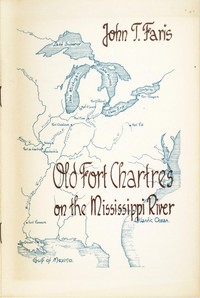
[Illustration: Old Fort Chartres on the Mississippi River]
Old Fort Chartres
on the Mississippi River
John T. Faris
Prepared by the Staff of the
Public Library of Fort Wayne and Allen County
1955
[Illustration: Boards of the Public Library of Fort Wayne and Allen
County]
One of a historical series, this pamphlet is published under the
direction of the governing Boards of the Public Library of Fort Wayne
and Allen County.
BOARD OF TRUSTEES OF THE SCHOOL CITY OF FORT WAYNE
_Mrs. Sadie Fulk Roehrs_
_B.F. Geyer, President_
_Joseph E. Kramer, Secretary_
_W. Page Yarnelle, Treasurer_
_Willard Shambaugh_
PUBLIC LIBRARY BOARD FOR ALLEN COUNTY
The members of this Board include the members of the Board of Trustees
of the School City of Fort Wayne (with the same officers) together with
the following citizens chosen from Allen County outside the corporate
City of Fort Wayne:
_James E. Graham_
_Mrs. Glenn Henderson_
_Mrs. Charles Reynolds_
FOREWORD
The following publication, which narrates the fortunes of Fort Chartres
in Illinois, originally appeared as chapter XII in THE ROMANCE OF
FORGOTTEN TOWNS by John T. Faris. The publishers, Harper & Brothers,
have graciously granted permission to reprint the chapter.
The Boards and the Staff of the Public Library of Fort Wayne and Allen
County present this account with the feeling that it is an important
part of our heritage and with the hope that it will be interesting and
informative to Library patrons.
More than two centuries ago there was an astonishing bit of feudal
France on the banks of the Mississippi River. It was called Fort
Chartres by those who chose the location near the southern extremity of
the fertile American Bottom, which extends from a point nearly opposite
the mouth of the Mississippi River nearly to Chester.
On the Bottom there were a number of French villages noted both for the
military prowess of the residents and for the sleepy, Old World life of
these residents among the Indians, with whom they were on friendly
terms.
The present Fort Chartres was occupied in 1720 by Philippe François de
Renault, the French director-general of mining operations, who brought
with him up the river for the purpose two hundred white men and five
hundred Santo Domingo negroes, thus introducing slavery in what became
Illinois. The purpose of the fort was to protect against the Spaniards
the servants of John Law’s famous Company of the Indies, whose startling
scheme for curing the financial ills of France was later known as the
Mississippi Bubble. Law’s plan was to set up a bank to manage the royal
revenue and to issue notes backed by landed security. In selling shares
in his Company of the Indies, which was to accomplish financial wonders,
“large engravings were distributed in France, representing the arrival
of the French at the Mississippi river, and savages with their squaws
rushing to meet the new arrivals with evident respect and admiration.”
Promises of great dividends from mountains of gold and silver, lead,
copper, and quicksilver were made. Shares rose rapidly and soon were
selling for 20,000 francs. For three months the French people believed
in Law. Then the Mississippi Bubble burst and there was sorrow in the
homeland.
In the meantime the work at Fort Chartres was continued. Within the
stockade of wood, which had earth between the palisades for purposes of
strength, were received many wandering savages who brought their furs
for barter. The French residents felt secure in the presence of their
protection.
Various expeditions were sent out against the Indians. One of these went
out against the Chickasaw Indians, on the Arkansas River. Disaster
overtook the company of French soldiers, and fifteen were captured and
put to death with savage barbarity.
In 1753 the fort was in such bad condition that it was decided to build
anew, this time of stone, brought from the bluff. When completed, the
new structure was one of the strongest forts ever built in America.
An English traveler who visited the new fort in 1765, when the British
were in control, told of finding walls two feet two inches thick,
pierced with loopholes at regular distances, and with two portholes for
cannon in the faces, and two in the flanks of each bastion. There was a
ditch, but this had not been completed. The entrance was a handsome
rustic gate. Within the fort he found the houses of the commander and of
the commissary, the magazine for stores, and the quarters of the
soldiers. There were also a powder magazine, a bunk house, and a prison.
The visitor told how the bank of the Mississippi was continually falling
in, and so was threatening the fort. In the effort to control the
destructive current a sand bank had been built to turn it from its
course; the sand bank had become an island, covered by willows. Yet it
was realized that the destruction of the fort was sure.
“When the fort was begun, in the year 1756,” he wrote, “it was a good
half mile from the water side; in the year 1766 it was but eighty paces;
eight years ago the river was fordable to the island; the channel is now
forty feet deep.”
In the year 1764 there were about forty families in the village near the
fort and a parish church served by a Franciscan friar. In the following
year, when the English took possession of the country, they abandoned
their houses, except three or four poor families, and settled at the
village on the west side of the Mississippi, choosing to continue under
the French government.
An English visitor who saw Fort Chartres in 1766, when it was still in
its prime, wrote of his impressions:
“The headquarters of the English commanding officer is now here, who in
fact is the arbitrary governor of the country. The fort is an irregular
quadrangle; the side of the exterior polygon is 490 feet. It is built of
stone plastered, and is only designed as a defense against the Indians,
the wall being two feet two inches thick, and pierced with loopholes at
regular distances, and with two portholes for cannon in the face and two
in the flank of each bastion.
“It is generally agreed that this is the most commodious and best built
fort in America.”
In 1772 a flood washed away part of the fort, on which a million dollars
had been spent—a large amount for that day. The garrison fled north to
Kaskaskia, where another fortress was built.
More than sixty years later the _Illinois Gazetteer_ said:
“The prodigious military work is now a heap of ruins. Many of the stones
have been removed by the people of Kaskaskia. On the whole fort is a
considerable growth of trees.”
But the Mississippi relented in its approach to Fort Chartres. A bit of
the old fort still stands—the powder magazine and bits of the old wall.
Fortunately, in 1778, Congress withdrew from entry or sale a tract of
land a mile square, including the site of the fort. Thus the way was
opened for the acquirement of the property by Illinois, which has made
of it a state park. The fort is to be rebuilt in accordance with the
original plans, which have been discovered in France.
Transcriber’s Notes
—Silently corrected a few typos.
—Retained publication information from the printed edition: this eBook
is public-domain in the country of publication.
—In the text versions only, text in italics is delimited by
_underscores_.
*** END OF THE PROJECT GUTENBERG EBOOK 65371 ***
Old Fort Chartres on the Mississippi River
Subjects:
Download Formats:
Excerpt
[Illustration: Old Fort Chartres on the Mississippi River]
Old Fort Chartres
on the Mississippi River
Prepared by the Staff of the
Public Library of Fort Wayne and Allen County
1955
[Illustration: Boards of the Public Library of Fort Wayne and Allen
County]
One of a historical series, this pamphlet is published under the
direction of the governing Boards of the Public Library of Fort Wayne
and Allen County....
Read the Full Text
— End of Old Fort Chartres on the Mississippi River —
Book Information
- Title
- Old Fort Chartres on the Mississippi River
- Author(s)
- Faris, John T. (John Thomson), Public Library of Fort Wayne and Allen County
- Language
- English
- Type
- Text
- Release Date
- May 18, 2021
- Word Count
- 1,253 words
- Library of Congress Classification
- F516
- Bookshelves
- Browsing: History - American, Browsing: History - General
- Rights
- Public domain in the USA.
Related Books

A Soldier's Life on the Western Frontier in 1813
by Public Library of Fort Wayne and Allen County
English
32h 15m read
George Croghan
by Public Library of Fort Wayne and Allen County
English
50h 39m read

Colonel Sion S. Bass, 1827-1862
by Public Library of Fort Wayne and Allen County
English
54h 41m read
The Death of Captain Wells
by Public Library of Fort Wayne and Allen County, Dougall, Allan H.
English
26h 50m read
Cincinnati's "Old Cunny": A Notorious Purveyor of Human Flesh
by Public Library of Fort Wayne and Allen County, Edwards, Linden F. (Linden Forest)
English
54h 23m read
General Anthony Wayne's Expedition into the Indian Country
by Public Library of Fort Wayne and Allen County
English
22h 46m read