*** START OF THE PROJECT GUTENBERG EBOOK 65646 ***
GENERAL ANTHONY WAYNE’S EXPEDITION INTO THE INDIAN COUNTRY
Prepared by the staff of the
Public Library of Fort Wayne and Allen County
1953
One of a historical series, this pamphlet is published under the
direction of the governing Boards of the Public Library of Fort Wayne
and Allen County.
BOARD OF TRUSTEES OF THE SCHOOL CITY OF FORT WAYNE
B. F. Geyer, President
Joseph E. Kramer, Secretary
W. Page Yarnelle, Treasurer
Willard Shambaugh
Mrs. Sadie Fulk Roehrs
PUBLIC LIBRARY BOARD FOR ALLEN COUNTY
The members of this Board include the members of the Board of Trustees
of the School City of Fort Wayne (with the same officers), together with
the following citizens chosen from Allen County outside the corporate
city of Fort Wayne:
James E. Graham
Arthur Niemeier
Mrs. Glenn Henderson
Mrs. Charles Reynolds
By the Treaty of Paris in 1783 ending the Revolutionary War Great
Britain ceded to the United States the territory lying between The
Alleghany mountains and the Mississippi River. The British, however,
continued to maintain garrisons in strong forts within this area. Among
the posts thus garrisoned were Detroit, Presque Isle near Erie, and Fort
Miamis near Toledo. From these vantage points the British continued to
influence the Indians and incite them to attacks upon white settlers.
Hundreds of families of frontiersmen were slain and their homes
plundered.
When General Washington assumed the Presidency in 1789 he dispatched
General Harmar at the head of an expedition to pacify the marauding
Indians. Little Turtle and his Indians bided their time. In a sneak
attack they utterly defeated the American forces near the Indian village
of Kekionga within the limits of the present city of Fort Wayne. In 1791
a second and more powerful American force under General Arthur St. Clair
was defeated by Little Turtle’s braves near the present town of Fort
Recovery, Ohio. This overwhelming defeat cost the little American army
most of its soldiers and nearly all of its officers. The frontier was
then unguarded, and the American Government for a time seemed impotent
to protect its citizens against the Indians and their British and
Canadian allies.
In this dire emergency, President Washington chose General Anthony Wayne
to re-organize the American forces and to bring the Indians to terms.
[Illustration: LEGEND
Wayne’s journey from Pittsburg into the Indian Country]
Pittsburg
Legionville
_Ohio River_
Wheeling
Marietta
Gallipolis
_Scioto River_
Hobson’s Choice
Cincinnati
Ft. Hamilton
Ft. St. Clair
Ft. Jefferson
Ft. Greenville
Ft. Recovery
_St. Mary’s River_
_Au Glaize River_
Ft. Defiance
_Maumee River_
Ft. Deposit
Fallen Timbers
Ft. Miamis
Detroit
_St. Joseph River_
Kekionga
Ft. Wayne
_Lake Erie_
Sandusky
Anthony Wayne, born in 1745, left his business as the leading American
tanner in 1775 to join the Pennsylvania line. He served through the
American Revolution with the rank of Brigadier-General and was our
leading hand-to-hand fighter. He was engaged in the battles of Trois
Rivieres, Paoli, Brandywine, Germantown, Monmouth and Green Springs; was
commandant at Ticonderoga; led the surprise attack on Stony Point; was
actively engaged in the campaign of Yorktown; and commanded the American
army in the Georgia campaign against the Indians. He was wounded a
number of times in battle. Likewise he suffered as did more than 5,000
other Americans at Valley Forge.
General Wayne proceeded westward toward Pittsburgh in the spring and
summer of 1792. There he was commissioned to recruit and organize an
American army. Some twenty-three miles from Pittsburgh at Legionville he
drilled his forces and taught them the use of the sabre, pistol,
bayonet, and espontoon. On April 30, 1793, his army embarked down the
Ohio for Fort Washington, now Cincinnati, where they arrived on May 8,
1793. Outside that village of 1,100 persons he established headquarters
at a point which he called Hobson’s Choice.
General Wayne continued to recruit additional forces and to drill his
men. By early fall the American forces seemed ready to meet the enemy,
and on October 7, 1793 General Wayne led his army northward into the
Indian country toward Kekionga. He rehabilitated the American forts
previously established at Hamilton (Fort Hamilton) and at Eaton (Fort
St. Clair) and advanced to Fort Jefferson six miles south of Greenville,
Ohio. Thence he advanced as far northward as the present site of
Greenville, on November 6, 1793. Wayne was now only a few miles from the
site where St. Clair was defeated two years previously. On December 24,
1793, he began the building of a fort at that point which he called Fort
Recovery. The Indians had made many attempts to surprise and ambush
Wayne’s forces but always found them well-guarded and invincible. From
this circumstance the Indians referred to Wayne as “the chief who never
sleeps”.
Wayne left a strong garrison at Fort Recovery and then returned to Fort
Green. In the spring of 1794 overwhelming Indian forces under Little
Turtle, Buckongehelas, Blue Jacket, and others made a surprise attack on
Fort Recovery. They killed a number of Americans and stole several
horses. However, the fortifications held, and Fort Recovery remained in
American hands. After a great feast on horse meat the Indians retired,
and many of them returned to their homes at a distance. This for them
was a tactical defeat, for many warriors did not return to the conflict.
General Wayne now felt that he could safely advance into the Indian
country. On July 28 his army moved forward via Fort Recovery to the
junction of the Auglaize and Maumee Rivers. Arriving there on August 8,
1794, he erected fortifications which he called Fort Defiance. When this
redoubt was completed he was in a dominating position. One large Indian
force was located at Kekionga at the confluence of the St. Mary’s and
the St. Joseph Rivers, just forty-eight miles southwest of him. Another
large force of Indians had assembled at Fort Miamis some 30 miles
northeast near Toledo. He spread false rumors of his intentions and thus
kept his enemy divided. Because they were uncertain of his future
movements they did not dare to combine against him. There was, however,
daily skirmishing. The Indians were plainly seeking a weak point in
Wayne’s defense.
Turning eastward General Wayne swiftly moved toward Fort Miamis. He
stopped eight miles from Fort Defiance and erected a redoubt which he
named Fort Deposit. This fort served as storage for military equipment.
Thereafter the legion marched with lightened burdens, ready for instant
combat. On their route they reached a point near the present town of
Maumee, Ohio where a large part of the forest had been uprooted by a
storm. Here on August 20, 1794, the Indians attacked but were
overwhelmingly defeated. The engagement is known in history as the
Battle of Fallen Timbers. The Indians fled to Fort Miamis a few miles
away expecting succor from their British friends, but on their arrival
the gates of the fort were closed against them. This indicated to them
that they had no hope of substantial British aid at this time. For a
week Wayne deployed his forces near the British fort, but when no action
occurred, he returned to Fort Defiance. He spent two weeks strengthening
the fortifications here, and then, on September 14 he advanced toward
Kekionga. After a three-days’ march he arrived at the capital of the
Miami Indians but the inhabitants had fled. Here he built a fort which
was named for himself—Fort Wayne. On October 22, 1794, to the
accompaniment of the roll of drums and the discharge of fifteen cannon,
the American soldiers marched into the fort and the authority of the
American Government was formally established at the confluence of the
Rivers. General Wayne left a strong garrison here and returned with most
of his forces to Greenville for the winter. Thus he completed the
conquest of the northwest Territory and at the same time destroyed the
strong alliance between the Indians and the British.
Anthony Wayne is the only leader who served in any of the opposing
armies of the Revolutionary War who enhanced his military reputation
after that war ended.
Transcriber’s Notes
—Silently corrected a few typos.
—Retained publication information from the printed edition: this eBook
is public-domain in the country of publication.
—In the text versions only, text in italics is delimited by
_underscores_.
*** END OF THE PROJECT GUTENBERG EBOOK 65646 ***
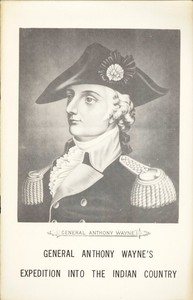
General Anthony Wayne's Expedition into the Indian Country
Download Formats:
Excerpt
GENERAL ANTHONY WAYNE’S EXPEDITION INTO THE INDIAN COUNTRY
Prepared by the staff of the
Public Library of Fort Wayne and Allen County
1953
One of a historical series, this pamphlet is published under the
direction of the governing Boards of the Public Library of Fort Wayne
and Allen County.
BOARD OF TRUSTEES OF THE SCHOOL CITY OF FORT WAYNE
B. F. Geyer, President
Joseph E. Kramer, Secretary
W. Page Yarnelle, Treasurer
Willard...
Read the Full Text
— End of General Anthony Wayne's Expedition into the Indian Country —
Book Information
- Title
- General Anthony Wayne's Expedition into the Indian Country
- Author(s)
- Public Library of Fort Wayne and Allen County
- Language
- English
- Type
- Text
- Release Date
- June 20, 2021
- Word Count
- 1,366 words
- Library of Congress Classification
- F516
- Bookshelves
- Browsing: History - American, Browsing: History - Warfare
- Rights
- Public domain in the USA.
Related Books
A Soldier's Life on the Western Frontier in 1813
by Public Library of Fort Wayne and Allen County
English
32h 15m read
George Croghan
by Public Library of Fort Wayne and Allen County
English
50h 39m read
Colonel Sion S. Bass, 1827-1862
by Public Library of Fort Wayne and Allen County
English
54h 41m read
The Death of Captain Wells
by Public Library of Fort Wayne and Allen County, Dougall, Allan H.
English
26h 50m read
Cincinnati's "Old Cunny": A Notorious Purveyor of Human Flesh
by Public Library of Fort Wayne and Allen County, Edwards, Linden F. (Linden Forest)
English
54h 23m read
Diary of Captain John Cooke, 1794
by Public Library of Fort Wayne and Allen County, Cooke, John, active 1792-1794
English
39h 20m read