The Project Gutenberg eBook, A Correct Account of the Horrible Occurence,
by Anonymous
This eBook is for the use of anyone anywhere in the United States and most
other parts of the world at no cost and with almost no restrictions
whatsoever. You may copy it, give it away or re-use it under the terms of
the Project Gutenberg License included with this eBook or online at
www.gutenberg.org. If you are not located in the United States, you'll have
to check the laws of the country where you are located before using this ebook.
Title: A Correct Account of the Horrible Occurence
The Bishop of Clogher ... a Common Soldier!
Author: Anonymous
Release Date: October 7, 2018 [eBook #58053]
Language: English
Character set encoding: UTF-8
***START OF THE PROJECT GUTENBERG EBOOK A CORRECT ACCOUNT OF THE HORRIBLE
OCCURENCE***
Transcribed from the [1822] J. L. Marks edition by David Price, email
[email protected]
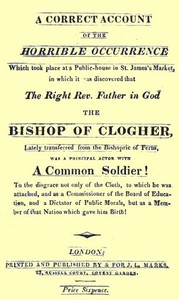
[Picture: Pamphlet front cover]
A CORRECT ACCOUNT
OF THE
_HORRIBLE OCCURRENCE_
Which took place at a Public-house in St. James’s Market,
in which it was discovered that
_The Right Rev. Father in God_
THE
BISHOP OF CLOGHER,
Lately transferred from the Bishopric of Ferns,
WAS A PRINCIPAL ACTOR WITH
A Common Soldier!
To the disgrace not only of the Cloth, to which he was attached, and as a
Commissioner of the Board of Education, and a Dictator of Public Morals,
but as a Member of that Nation which gave him Birth!
* * * * *
_LONDON_:
PRINTED AND PUBLISHED BY & FOR J. L. MARKS,
23, RUSSELL COURT, COVENT GARDEN.
* * * * *
_Price Sixpence_.
PREFACE.
TO hold the vicious up to odium and contempt should be at all times a
particular care of the Press; but when every powerful engine is exerted
to veil the vices of the privileged ranks, and to make it appear that
crime is peculiar to those who constitute what _are called_ the lower
classes, it becomes a sacred and _imperative duty_.
We know there are some who, from a pretended regard to religion, would
suppress every fact that exposes the licentious conduct of its ministers,
but, nine times out of ten, this is mere hypocritical cant to support
those who “bind heavy burdens, and grievous to be borne, and lay on men’s
shoulders.” The mistaken infidel may connect religion with the conduct
of its professors, but the truly religious person makes no distinction of
vice but its comparative enormity, and the more he venerates the doctrine
of Christianity, the greater abhorrence he feels towards the wretch who
violates every principle of the religion which it is his duty to
inculcate.
We see a certain Association evincing a most scandalous partiality, by
SELECTING the objects of their prosecution from those most unable to
defend themselves! we participate in the general feeling of censure
against them, and believe that they have done more injury to the cause
they profess to support, than the united efforts of the persecuted
parties could possibly have effected. This will ever be the case when
exertions are influenced only by feelings of _policy_ instead of
_principle_, for if as much pains were taken to keep improper characters
_without_ the pale of the church, as there is art exerted to defend them
through thick and thin, when they have _entered_ it, the CLOTH would
probably never have been disgraced by the “Rev. Father in God,” whose
notoriety promises to eclipse that of all former brothers in divinity.
The name of the Prelate may have appeared in the subscription columns of
a newspaper, the only place where the charity of many is heard of. Nay,
we have little doubt but it might be found in the list of subscribers to
the _highly respectable association_ the “_Bridge street gang_” or the
“_Society for the suppression of vice_.” We would not rob _him_ of any
action of _merit_ on this score, or them of any claim to _respectability_
in the eye of the public; for ourselves we would say, “Woe unto you,
Scribes and Pharisees, hypocrites, for ye—also outwardly appear righteous
unto men, but within ye are full of hypocrisy and iniquity.” Any comment
on the case itself must be superfluous, we therefore give it to the
reader as extracted verbatim from the Statesman.
From the Statesman.
_July_ 22, 1822.
OUR readers have often had to oblige us by their attention to what we
have said of the blessed THING. We are now going to trouble them upon an
extraordinary occasion indeed, and are going to give an instance of the
baseness and infamy of the London newspapers, such as we never before had
it in our power to give; and such as we are quite sure will, before we
have done with it, implant the character of everlasting infamy upon that
corrupt press, which has so long been boasting of its independence and
its honour. What a deal we have heard about the press being the
_guardian of public morals_! What volumes have we read about its powers
of correction of evil! We have, indeed, heard a part of it condemned,
the unstamped part of it; that part of it has been pointed out the refuse
part; as the vile part; as the part which required laws to restrain it,
to cramp it, to load it, to destroy it if possible. We have heard
honourable Members in the honourable House, make a distinction between
the _respectable_ part of the press and another part, which they
denominated disrespectable. We have heard volumes upon volumes of
commendation, praise and puffery, about this respectable part of the
press. We have always denominated it infamous; we have always said that
that part of it which was not absolutely in the pay of Corruption was
engaged in a sham warfare, quite as serviceable to Corruption as the
efforts of her own hirelings; and that with perhaps a trifling exception
or two, it was a mass of infamous fraud carried on under the name of
impartiality; sending forth lies, endless in number, and boundless in
magnitude, vomiting forth calumnies on the defenceless, and suppressing,
through the means of bribes, directly or indirectly received, every fact
that could tend to expose the thing, and give the common people their
fair chance in society. This has been the character of this infamous
press ever since we have known it; but we shall presently have to show
our readers, that it has now surpassed even its own infamy, and done a
deed so black as to make its former infamies turn pale.
We have first to insert an article from the weekly paper called _The
Observer_; to which paper the public will be in great part indebted for
the knowledge of the horrible affair which the article describes. We
shall then offer a few observations, that may serve just for the present
on the manner in which the thing has been and is likely to be illustrated
by the circumstances of the transaction alluded to; and then we shall lay
before our readers an account of the conduct of the “respectable” and
infamous part of the press, upon this occasion; naming the several
papers; and making them as notorious; as it is in our power to make them.
_From the Observer Sunday Newspaper_, _July_ 21, 1822.
HORRIBLE OCCURRENCE.—SATURDAY.
“It is our painful and disgusting task this day to notice a charge
which has been made against a _Right Reverend Bishop_, at
Marlborough-street police office, at which human nature revolts. The
circumstances are of such public notoriety at the west end of the
town, that it would be in vain, _if any delicacy were due_ to the
party accused, to attempt to keep them from general observation. The
individual to whom we allude was recently promoted to an Irish
bishopric, and is _nearly related to a Peer in Parliament_. He is an
elderly man, and we understand was much respected in that class of
society to which he belonged. On Friday night it appears _that he
was detected in a back room of the White Lion public-house_, _in St.
Alban’s place_, _St. James’s_, in a situation with a _private __in
the Foot Guards_, to which we will not more minutely allude, but
which led to his instant apprehension and removal with his companion
_to the watch house_. There were not fewer than _seven witnesses_ to
the fact; and it would seem that the Reverend Prelate with difficulty
escaped the _vengeance of the populace_, who, if not prevented by the
peace-officers, would have sacrificed him to their indignation on the
spot. As it was, he was _severely beaten_. On being secured in the
watch-house, he offered bail any amount for his liberation; but this
was very properly refused, and he remained locked up in the cell
during the night in a state of mind which may be more easily imagined
than described. Yesterday morning he was conveyed in a hackney-coach
to Marlborough street, and was soon afterwards followed by the
soldier. They were both pursued by the _execrations and revilings of
the crowd_ which had been collected on so extraordinary an occasion.
Mr. Dyer, the presiding magistrate, determined on a _private
examination_, at which Mr. Alley, who attended for the Bishop, was
present. The witnesses were called in separately, but their
testimony was in all respects consistent, and the case established
was to a _certain extent_ of the clearest nature. Mr. Alley,
however, submitted that as the capital charge had not been borne out,
his client was _entitled to bail_; a proposition to which we
understand Mr. Dyer _was obliged to accede_; and the wretched
offender was permitted, in the course of the day, _to go at large_,
upon _finding sureties_ to the amount of _one thousand pounds_. The
soldier, _not so fortunate_, was committed _to take his trial_.—For
reasons which are obvious, we decline entering more minutely into the
details of this most shocking affair; but we ought in justice _to a
worthy prelate_, whose name has _unfortunately been mentioned_ by
mistake, in connection with the charge, to request our readers _to
reflect_ before they come to a _positive determination_ as _to the
party really implicated_.”
When our readers have gone through this article, and have heard us
declare our perfect conviction of its truth; when they have heard us say,
that it is agreeable, as far as it goes, with the enquiries which we have
made, when they have further heard, that the scene of the brutal
transaction was in a back room of the public-house above mentioned; that
the parties had drawn the curtains of the room, but had left a part that
the curtains did not cover but that might be seen through; that a little
girl (vindicatress of her sex!) happening to go into the back court into
which the window looked, wondering to see the curtains drawn, had the
curiosity to look in, where she saw the parties engaged in that way not
to be described, that the little girl (better guardian of public morals
than the respectable part of the press) ran to the landlord, who came out
with other persons with him, who were all witnesses of the fact, to that
certain extent, at least, of which the _Observer_ speaks; that after
this, the landlord and others laudably went, dashed in the door, took the
parties in the state of Achilles as far as nakedness was necessary to
their intentions; that they then dragged them to the watch-house, in that
very same state: when our readers have heard all this, they will
naturally cry aloud, “why is the _name_ of this Bishop suppressed?” It
is a Bishop the article says. It is a “venerable prelate;” it is a Right
Reverend Father in God; and why then, is his name suppressed? The
_Observer_ informs us that another “worthy prelate” has been named; and
unfortunately named; and the _Observer_ requests its readers to reflect
before they come to a positive determination as to who the party is.
What, _are all the Bishops_ then, to live under this imputation or
suspicion? Are all the Bishops to be suspected for the sake of this
wretch, as the _Observer_ itself justly calls him? This would be
injustice towards the Bishops in general, equal to that which the most
respectable and most infamous part of the press has been guilty. We
shall do our duty. And we here inform our readers: without anticipating
the decisions of courts of justice; without pretending to know whether
the alledged crime can be proved or not; without pretending to anticipate
any thing of this sort, we inform our readers of that which they all
ought to know, that the person, who was taken from the White Lion
public-house above-mentioned to the watch-house, and who was afterwards
taken from the watch-house to Marlborough-street, and who was held to
bail as above-mentioned; we here inform our readers that that person who
was so taken along with the soldier of the guards was the _Honourable_
and _Right Reverend Father in God_, PERCY JOCELYN, Lord _Lord Bishop of
Clogher_, (lately translated to that Bishopric from the Bishopric of
Ferns,) a _Commissioner of the board of Education_ (“education of the
country!”) brother of the late _Earl of Roden_.
Having performed this duty, a duty due not less to the Bishops than to
the public, we have further to observe, that a man was tried in Ireland,
no great while ago, on the charge of having threatened this Bishop to
accuse him of such a crime; and, our readers will hear it with
shudderings of horror, this man was _condemned to death_, and, of course,
upon the oath of this Bishop! We believe the man was respited and
transported. Upon this we shall make no further observations for the
present. Our readers will need no observations from us, indeed, to
convince them how well things like this are calculated to excite the envy
of surrounding nations and the admiration of the world.
To return to the article in the _Observer_, we are somewhat surprised, if
it be true, that Mr. Dyer should have “_found himself obliged_,” and so
quickly, too, and without any remanding, to let the prisoner loose upon
bail; and the public will not fail to observe, and to reflect a little
upon the amount of this bail of a thousand pounds, _in such a case_, and
relating to such a party. The public will recollect the bail, the
sureties to which Mr. Carlile is sentenced, and compare that case with
this. A thousand pounds, not, probably, a tenth part of one year’s
produce of his Bishopric. The _Observer_ may be in error about this.
The fact has not been officially announced. If all the other facts
stated by the _Observer_ be true, what is the sum of a thousand pounds!
How is that to hold such a person to stand trial! What _sureties_ are
there in a thousand pounds in such a case! Whether he ever take his
trial or not; the thing will take its trial before the English people;
and on that trial the thing is now put.
The _Observer_ tell us, that the _soldier_ was not so fortunate. _He
could not get bail_! and was COMMITTED TO TAKE HIS TRIAL! Well said,
THING! it was very hard that those who bailed the Bishop would not bail
the soldier. The Bishop himself might have been bail for him. His
Bishopric of Clogher was sufficient surety for a whole battalion. Very
hard, indeed, that he was not to be bailed too! But there will be time
enough to talk about this. The main thing is for us to keep a sharp look
out, and see how the THING; to see how the “education of the country;”
how the envy of the surrounding nations and admiration of the world will
work this matter!
In the mean while, let us look at the conduct of the respectable and
infamous part of the press of this day, just looking back in one instance
to yesterday.
Our readers will observe, that the articles which we have quoted were in
the Observer of yesterday, consequently the thing was known to the
editors of all the morning papers. If such a thing had taken place
between two labourers, mechanics, or tradesmen, how it would have been
blazoned about through the morning papers of this day! What a cry would
have been set up by these respectable and infamous guardians of the
public morals! But now, what has been their conduct? The Morning Post,
the British Press, the Morning Herald, and the Morning Advertizer, have
given a part, and a part only, of what they found in the Observer.
The Morning Herald and the British Press gave nearly the words of the
Observe but inserted the article in as obscure a manner as possible. The
Morning Post curtails the article of the Observer to about a fifth part,
and puts it at the bottom of a column, in a part of the paper likely to
escape observation. The Morning Advertiser curtails the article still
further; bestows no expression of horror upon the deed, and merely says,
“That a person of consideration and a soldier were taken to the office,
charged with a _gross misdemeanor_.”
We now come to the Morning Chronicle, which fills four columns of its
paper with Mr. Hume’s nonsensical resolutions about the National Debt and
the operations of the Sinking Fund; but which can spare only just seven
lines, put in the obscurest part of all of the paper, to say that “two
persons” (and not a word about a bishop!) were discovered in a public
house, and so forth. But we will take the very words of the Chronicle.
They will not fill up much space; and they will enable the public to
judge of the real character of this paper.
“A Sunday paper states that on Friday night, _two persons_ were
discovered at public-house in St. James’s market, in a situation
which left no doubt respecting the nature of their crime, that they
were taken to watch-house, and brought to a Police-office on Saturday
morning, when it appeared from papers in the pocket of the one, that
he filled a high station, which we will not name. The magistrate is
said to have admitted them to bail.”
“Two persons!” And the _Chronicle_ could find out nothing but two
persons; though it had read the _Observer_ as well as we, and though it
would not take us much to prove that the _Chronicle_ must have heard all
about the matter on _Saturday night_, seeing that an Evening paper in the
neighbourhood _had the intelligence actually composed and going to the
press on Saturday afternoon_, and had stopped the press to cancel the
matter! From what motive this cancelling took place, let the indignant
public judge. The _Chronicle_, had this been an affair between two
persons in common life, would have rung us such a peel upon the subject
as would not soon have been forgotten; and let our readers judge how
powerful must have been the motive that could have induced it, not only
to abridge the article of the _Observer_, not only to tell less than it
had read in the Sunday paper; not only to cram this important matter into
seven lines and hide it at the bottom of a column; not only this, but to
talk of _two persons_; not to name a Bishop or a soldier at all; and to
be guilty of the infamous injustice of imputing by implication the crime
indiscriminately to all classes of Englishmen!
Let us now come to the elect of the respectable part of the press: _John
Bull_; the _New Times_; and the OLD TIMES. We have already told our
readers, that these were all of the same stamp; and now we shall see.
_John Bull_ is quite silent. _John_ came out very late on Sunday
morning. There was a rumour on float on Saturday, and we have already
related, that an evening paper had actually got the matter set up; that
is to say the types composed for printing an account of the transaction!
and that it was induced to stop the press, take out the article, scatter
the types and put in another article in its stead, probably an article
from the Vice Society or from some Bible Society. What happened to John
Bull we do not know precisely; but something seems to have seized John
all at once early on Sunday morning, or in the middle of the night
before. For, we sent to get John’s paper, on Sunday morning about ten
o’clock; and the vender of the paper informed us, that it would not come
out till very late, because an _accident had happened to the machinery_
in the office. This was the story told to those who went to buy the
paper! Yes, our readers will see that John’s machinery had been operated
upon by something perfectly accidental, and yet of a very potent nature.
Now. we come to that brace of brothers, the _New_ and _Old Times_.
Perfectly silent both! Not a single word upon the subject,—not a single
allusion to it, though the Old one has actually put forth this day two
papers, which it _sells for one_, in pursuance of those desperate efforts
which it is making to sustain itself. It has two papers, measuring
nearly two feet square, containing 16 square feet of print, one and a
half square foot of which consists of an advertisement of the Irish
Subscription. In the whole of this 16 feet of square print, room was not
to be found for the insertion of one single word about the Bishop and the
Soldier! not a single allusion. Nothing that could let its readers
suppose that such a thing had taken place. The _cause_ of this need not
be stated to our readers: they will all see the cause at once; and they
will all despise the man that they shall in future see with one of these
papers in his hand.
We could here, if we had time, refer to the statement of Dr. O’Meara, or
rather to what the Times has said about the bribe of £3000, the evidence
of which Buonaparte found amongst the papers of the run-away Bourbon. We
must leave that to be noticed another time; and in the mean time request
our readers to pay attention to the facts which we have now stated, never
forgetting the sentences on JOSEPH SWAN, Mr. CARLILE, his wife and
sister. We have said before and we repeat it, that the THING is now
fairly on its trail. In former cases, there may have been doubts and
difficulties in the way; there may have been that which blinded and
deluded honest and well-meaning people; but here the matter lies in a
nut-shell. Here the question is too plain to admit of being obscured and
too monstrous to admit of palliation. The time cannot be distant when
the decision shall take place; and in the mean time we beseech our
readers to keep watch; to look at the conduct of all these papers, to
contrast that conduct with that which they shewed in the case of the
Vere-street gang, to compare their present conduct; their present silence
with the unsparing, but just and laudable abhorrence which they then
expressed: our readers are requested to make this comparison, at the same
time that they make a comparison between the rank and riches of the party
now offending, and the obscurity and comparative poverty of the parties
then offending. They are requested to do this, and we are sure they will
exclaim with us, that this “respectable part of the press” is surely the
most infamous thing that ever existed in any country in the world.
We must quit the subject for the present; but not without assuring our
readers that, strong as corruption is, great as are her powers of
smothering and stifling, she will not have it in her power to stifle the
truth in this case. We care not how the THING acts. Let the THING do
what it pleases; and let the public watch it; look sharp after the
movements of the THING, and see what it will do. Thus we close our
remarks for the present, leaving the public, as we trust it will, to
congratulate itself on the existence of one newspaper that cannot be
_hushed_ into silence.
We cannot dismiss this article without observing that it is with great
and unfeigned _sorrow_ that we have to record this degradation of rank
and dignity; but the way to uphold rank and dignity is not to be guilty
of such base partiality as that which we have noticed; and the best way
is to single out, as we have done, the guilty, and leave it to be
supposed that it forms an exception to the mass.
* * * * *
_FINIS._
* * * * *
* * * * *
Printed by J. L. Marks, 23, Russell-court, Covent Garden.
***END OF THE PROJECT GUTENBERG EBOOK A CORRECT ACCOUNT OF THE HORRIBLE
OCCURENCE***
******* This file should be named 58053-0.txt or 58053-0.zip *******
This and all associated files of various formats will be found in:
http://www.gutenberg.org/dirs/5/8/0/5/58053
Updated editions will replace the previous one--the old editions will
be renamed.
Creating the works from print editions not protected by U.S. copyright
law means that no one owns a United States copyright in these works,
so the Foundation (and you!) can copy and distribute it in the United
States without permission and without paying copyright
royalties. Special rules, set forth in the General Terms of Use part
of this license, apply to copying and distributing Project
Gutenberg-tm electronic works to protect the PROJECT GUTENBERG-tm
concept and trademark. Project Gutenberg is a registered trademark,
and may not be used if you charge for the eBooks, unless you receive
specific permission. If you do not charge anything for copies of this
eBook, complying with the rules is very easy. You may use this eBook
for nearly any purpose such as creation of derivative works, reports,
performances and research. They may be modified and printed and given
away--you may do practically ANYTHING in the United States with eBooks
not protected by U.S. copyright law. Redistribution is subject to the
trademark license, especially commercial redistribution.
START: FULL LICENSE
THE FULL PROJECT GUTENBERG LICENSE
PLEASE READ THIS BEFORE YOU DISTRIBUTE OR USE THIS WORK
To protect the Project Gutenberg-tm mission of promoting the free
distribution of electronic works, by using or distributing this work
(or any other work associated in any way with the phrase "Project
Gutenberg"), you agree to comply with all the terms of the Full
Project Gutenberg-tm License available with this file or online at
www.gutenberg.org/license.
Section 1. General Terms of Use and Redistributing Project
Gutenberg-tm electronic works
1.A. By reading or using any part of this Project Gutenberg-tm
electronic work, you indicate that you have read, understand, agree to
and accept all the terms of this license and intellectual property
(trademark/copyright) agreement. If you do not agree to abide by all
the terms of this agreement, you must cease using and return or
destroy all copies of Project Gutenberg-tm electronic works in your
possession. If you paid a fee for obtaining a copy of or access to a
Project Gutenberg-tm electronic work and you do not agree to be bound
by the terms of this agreement, you may obtain a refund from the
person or entity to whom you paid the fee as set forth in paragraph
1.E.8.
1.B. "Project Gutenberg" is a registered trademark. It may only be
used on or associated in any way with an electronic work by people who
agree to be bound by the terms of this agreement. There are a few
things that you can do with most Project Gutenberg-tm electronic works
even without complying with the full terms of this agreement. See
paragraph 1.C below. There are a lot of things you can do with Project
Gutenberg-tm electronic works if you follow the terms of this
agreement and help preserve free future access to Project Gutenberg-tm
electronic works. See paragraph 1.E below.
1.C. The Project Gutenberg Literary Archive Foundation ("the
Foundation" or PGLAF), owns a compilation copyright in the collection
of Project Gutenberg-tm electronic works. Nearly all the individual
works in the collection are in the public domain in the United
States. If an individual work is unprotected by copyright law in the
United States and you are located in the United States, we do not
claim a right to prevent you from copying, distributing, performing,
displaying or creating derivative works based on the work as long as
all references to Project Gutenberg are removed. Of course, we hope
that you will support the Project Gutenberg-tm mission of promoting
free access to electronic works by freely sharing Project Gutenberg-tm
works in compliance with the terms of this agreement for keeping the
Project Gutenberg-tm name associated with the work. You can easily
comply with the terms of this agreement by keeping this work in the
same format with its attached full Project Gutenberg-tm License when
you share it without charge with others.
1.D. The copyright laws of the place where you are located also govern
what you can do with this work. Copyright laws in most countries are
in a constant state of change. If you are outside the United States,
check the laws of your country in addition to the terms of this
agreement before downloading, copying, displaying, performing,
distributing or creating derivative works based on this work or any
other Project Gutenberg-tm work. The Foundation makes no
representations concerning the copyright status of any work in any
country outside the United States.
1.E. Unless you have removed all references to Project Gutenberg:
1.E.1. The following sentence, with active links to, or other
immediate access to, the full Project Gutenberg-tm License must appear
prominently whenever any copy of a Project Gutenberg-tm work (any work
on which the phrase "Project Gutenberg" appears, or with which the
phrase "Project Gutenberg" is associated) is accessed, displayed,
performed, viewed, copied or distributed:
This eBook is for the use of anyone anywhere in the United States and
most other parts of the world at no cost and with almost no
restrictions whatsoever. You may copy it, give it away or re-use it
under the terms of the Project Gutenberg License included with this
eBook or online at www.gutenberg.org. If you are not located in the
United States, you'll have to check the laws of the country where you
are located before using this ebook.
1.E.2. If an individual Project Gutenberg-tm electronic work is
derived from texts not protected by U.S. copyright law (does not
contain a notice indicating that it is posted with permission of the
copyright holder), the work can be copied and distributed to anyone in
the United States without paying any fees or charges. If you are
redistributing or providing access to a work with the phrase "Project
Gutenberg" associated with or appearing on the work, you must comply
either with the requirements of paragraphs 1.E.1 through 1.E.7 or
obtain permission for the use of the work and the Project Gutenberg-tm
trademark as set forth in paragraphs 1.E.8 or 1.E.9.
1.E.3. If an individual Project Gutenberg-tm electronic work is posted
with the permission of the copyright holder, your use and distribution
must comply with both paragraphs 1.E.1 through 1.E.7 and any
additional terms imposed by the copyright holder. Additional terms
will be linked to the Project Gutenberg-tm License for all works
posted with the permission of the copyright holder found at the
beginning of this work.
1.E.4. Do not unlink or detach or remove the full Project Gutenberg-tm
License terms from this work, or any files containing a part of this
work or any other work associated with Project Gutenberg-tm.
1.E.5. Do not copy, display, perform, distribute or redistribute this
electronic work, or any part of this electronic work, without
prominently displaying the sentence set forth in paragraph 1.E.1 with
active links or immediate access to the full terms of the Project
Gutenberg-tm License.
1.E.6. You may convert to and distribute this work in any binary,
compressed, marked up, nonproprietary or proprietary form, including
any word processing or hypertext form. However, if you provide access
to or distribute copies of a Project Gutenberg-tm work in a format
other than "Plain Vanilla ASCII" or other format used in the official
version posted on the official Project Gutenberg-tm web site
(www.gutenberg.org), you must, at no additional cost, fee or expense
to the user, provide a copy, a means of exporting a copy, or a means
of obtaining a copy upon request, of the work in its original "Plain
Vanilla ASCII" or other form. Any alternate format must include the
full Project Gutenberg-tm License as specified in paragraph 1.E.1.
1.E.7. Do not charge a fee for access to, viewing, displaying,
performing, copying or distributing any Project Gutenberg-tm works
unless you comply with paragraph 1.E.8 or 1.E.9.
1.E.8. You may charge a reasonable fee for copies of or providing
access to or distributing Project Gutenberg-tm electronic works
provided that
* You pay a royalty fee of 20% of the gross profits you derive from
the use of Project Gutenberg-tm works calculated using the method
you already use to calculate your applicable taxes. The fee is owed
to the owner of the Project Gutenberg-tm trademark, but he has
agreed to donate royalties under this paragraph to the Project
Gutenberg Literary Archive Foundation. Royalty payments must be paid
within 60 days following each date on which you prepare (or are
legally required to prepare) your periodic tax returns. Royalty
payments should be clearly marked as such and sent to the Project
Gutenberg Literary Archive Foundation at the address specified in
Section 4, "Information about donations to the Project Gutenberg
Literary Archive Foundation."
* You provide a full refund of any money paid by a user who notifies
you in writing (or by e-mail) within 30 days of receipt that s/he
does not agree to the terms of the full Project Gutenberg-tm
License. You must require such a user to return or destroy all
copies of the works possessed in a physical medium and discontinue
all use of and all access to other copies of Project Gutenberg-tm
works.
* You provide, in accordance with paragraph 1.F.3, a full refund of
any money paid for a work or a replacement copy, if a defect in the
electronic work is discovered and reported to you within 90 days of
receipt of the work.
* You comply with all other terms of this agreement for free
distribution of Project Gutenberg-tm works.
1.E.9. If you wish to charge a fee or distribute a Project
Gutenberg-tm electronic work or group of works on different terms than
are set forth in this agreement, you must obtain permission in writing
from both the Project Gutenberg Literary Archive Foundation and The
Project Gutenberg Trademark LLC, the owner of the Project Gutenberg-tm
trademark. Contact the Foundation as set forth in Section 3 below.
1.F.
1.F.1. Project Gutenberg volunteers and employees expend considerable
effort to identify, do copyright research on, transcribe and proofread
works not protected by U.S. copyright law in creating the Project
Gutenberg-tm collection. Despite these efforts, Project Gutenberg-tm
electronic works, and the medium on which they may be stored, may
contain "Defects," such as, but not limited to, incomplete, inaccurate
or corrupt data, transcription errors, a copyright or other
intellectual property infringement, a defective or damaged disk or
other medium, a computer virus, or computer codes that damage or
cannot be read by your equipment.
1.F.2. LIMITED WARRANTY, DISCLAIMER OF DAMAGES - Except for the "Right
of Replacement or Refund" described in paragraph 1.F.3, the Project
Gutenberg Literary Archive Foundation, the owner of the Project
Gutenberg-tm trademark, and any other party distributing a Project
Gutenberg-tm electronic work under this agreement, disclaim all
liability to you for damages, costs and expenses, including legal
fees. YOU AGREE THAT YOU HAVE NO REMEDIES FOR NEGLIGENCE, STRICT
LIABILITY, BREACH OF WARRANTY OR BREACH OF CONTRACT EXCEPT THOSE
PROVIDED IN PARAGRAPH 1.F.3. YOU AGREE THAT THE FOUNDATION, THE
TRADEMARK OWNER, AND ANY DISTRIBUTOR UNDER THIS AGREEMENT WILL NOT BE
LIABLE TO YOU FOR ACTUAL, DIRECT, INDIRECT, CONSEQUENTIAL, PUNITIVE OR
INCIDENTAL DAMAGES EVEN IF YOU GIVE NOTICE OF THE POSSIBILITY OF SUCH
DAMAGE.
1.F.3. LIMITED RIGHT OF REPLACEMENT OR REFUND - If you discover a
defect in this electronic work within 90 days of receiving it, you can
receive a refund of the money (if any) you paid for it by sending a
written explanation to the person you received the work from. If you
received the work on a physical medium, you must return the medium
with your written explanation. The person or entity that provided you
with the defective work may elect to provide a replacement copy in
lieu of a refund. If you received the work electronically, the person
or entity providing it to you may choose to give you a second
opportunity to receive the work electronically in lieu of a refund. If
the second copy is also defective, you may demand a refund in writing
without further opportunities to fix the problem.
1.F.4. Except for the limited right of replacement or refund set forth
in paragraph 1.F.3, this work is provided to you 'AS-IS', WITH NO
OTHER WARRANTIES OF ANY KIND, EXPRESS OR IMPLIED, INCLUDING BUT NOT
LIMITED TO WARRANTIES OF MERCHANTABILITY OR FITNESS FOR ANY PURPOSE.
1.F.5. Some states do not allow disclaimers of certain implied
warranties or the exclusion or limitation of certain types of
damages. If any disclaimer or limitation set forth in this agreement
violates the law of the state applicable to this agreement, the
agreement shall be interpreted to make the maximum disclaimer or
limitation permitted by the applicable state law. The invalidity or
unenforceability of any provision of this agreement shall not void the
remaining provisions.
1.F.6. INDEMNITY - You agree to indemnify and hold the Foundation, the
trademark owner, any agent or employee of the Foundation, anyone
providing copies of Project Gutenberg-tm electronic works in
accordance with this agreement, and any volunteers associated with the
production, promotion and distribution of Project Gutenberg-tm
electronic works, harmless from all liability, costs and expenses,
including legal fees, that arise directly or indirectly from any of
the following which you do or cause to occur: (a) distribution of this
or any Project Gutenberg-tm work, (b) alteration, modification, or
additions or deletions to any Project Gutenberg-tm work, and (c) any
Defect you cause.
Section 2. Information about the Mission of Project Gutenberg-tm
Project Gutenberg-tm is synonymous with the free distribution of
electronic works in formats readable by the widest variety of
computers including obsolete, old, middle-aged and new computers. It
exists because of the efforts of hundreds of volunteers and donations
from people in all walks of life.
Volunteers and financial support to provide volunteers with the
assistance they need are critical to reaching Project Gutenberg-tm's
goals and ensuring that the Project Gutenberg-tm collection will
remain freely available for generations to come. In 2001, the Project
Gutenberg Literary Archive Foundation was created to provide a secure
and permanent future for Project Gutenberg-tm and future
generations. To learn more about the Project Gutenberg Literary
Archive Foundation and how your efforts and donations can help, see
Sections 3 and 4 and the Foundation information page at
www.gutenberg.org
Section 3. Information about the Project Gutenberg Literary
Archive Foundation
The Project Gutenberg Literary Archive Foundation is a non profit
501(c)(3) educational corporation organized under the laws of the
state of Mississippi and granted tax exempt status by the Internal
Revenue Service. The Foundation's EIN or federal tax identification
number is 64-6221541. Contributions to the Project Gutenberg Literary
Archive Foundation are tax deductible to the full extent permitted by
U.S. federal laws and your state's laws.
The Foundation's principal office is in Fairbanks, Alaska, with the
mailing address: PO Box 750175, Fairbanks, AK 99775, but its
volunteers and employees are scattered throughout numerous
locations. Its business office is located at 809 North 1500 West, Salt
Lake City, UT 84116, (801) 596-1887. Email contact links and up to
date contact information can be found at the Foundation's web site and
official page at www.gutenberg.org/contact
For additional contact information:
Dr. Gregory B. Newby
Chief Executive and Director
[email protected]
Section 4. Information about Donations to the Project Gutenberg
Literary Archive Foundation
Project Gutenberg-tm depends upon and cannot survive without wide
spread public support and donations to carry out its mission of
increasing the number of public domain and licensed works that can be
freely distributed in machine readable form accessible by the widest
array of equipment including outdated equipment. Many small donations
($1 to $5,000) are particularly important to maintaining tax exempt
status with the IRS.
The Foundation is committed to complying with the laws regulating
charities and charitable donations in all 50 states of the United
States. Compliance requirements are not uniform and it takes a
considerable effort, much paperwork and many fees to meet and keep up
with these requirements. We do not solicit donations in locations
where we have not received written confirmation of compliance. To SEND
DONATIONS or determine the status of compliance for any particular
state visit www.gutenberg.org/donate
While we cannot and do not solicit contributions from states where we
have not met the solicitation requirements, we know of no prohibition
against accepting unsolicited donations from donors in such states who
approach us with offers to donate.
International donations are gratefully accepted, but we cannot make
any statements concerning tax treatment of donations received from
outside the United States. U.S. laws alone swamp our small staff.
Please check the Project Gutenberg Web pages for current donation
methods and addresses. Donations are accepted in a number of other
ways including checks, online payments and credit card donations. To
donate, please visit: www.gutenberg.org/donate
Section 5. General Information About Project Gutenberg-tm electronic works.
Professor Michael S. Hart was the originator of the Project
Gutenberg-tm concept of a library of electronic works that could be
freely shared with anyone. For forty years, he produced and
distributed Project Gutenberg-tm eBooks with only a loose network of
volunteer support.
Project Gutenberg-tm eBooks are often created from several printed
editions, all of which are confirmed as not protected by copyright in
the U.S. unless a copyright notice is included. Thus, we do not
necessarily keep eBooks in compliance with any particular paper
edition.
Most people start at our Web site which has the main PG search
facility: www.gutenberg.org
This Web site includes information about Project Gutenberg-tm,
including how to make donations to the Project Gutenberg Literary
Archive Foundation, how to help produce our new eBooks, and how to
subscribe to our email newsletter to hear about new eBooks.
A Correct Account of the Horrible Occurrence Which Took Place at a Public-House in St. James's Market - In Which It Was Discovered That the Right Rev. Father in God the Bishop of Clogher, Lately Transferred From the Bishopric of Ferns, Was a Principal Actor With a Common Soldier! To the Disgrace Not Only of the Cloth, to Which He Was Attached, and as a Commissioner of the Board of Education, and a Dictator of Public Morals, but as a Member of That Nation Which Gave Him Birth!
by
Anonymous
Download Formats:
Excerpt
The Project Gutenberg eBook, A Correct Account of the Horrible Occurence,
by Anonymous
This eBook is for the use of anyone anywhere in the United States and most
other parts of the world at no cost and with almost no restrictions
whatsoever. You may copy it, give it away or re-use it under the terms of
the Project Gutenberg License included with this eBook or online at
www.gutenberg.org. If you are not located in the United States, you'll have
to check the laws of the country where...
Read the Full Text
— End of A Correct Account of the Horrible Occurrence Which Took Place at a Public-House in St. James's Market - In Which It Was Discovered That the Right Rev. Father in God the Bishop of Clogher, Lately Transferred From the Bishopric of Ferns, Was a Principal Actor With a Common Soldier! To the Disgrace Not Only of the Cloth, to Which He Was Attached, and as a Commissioner of the Board of Education, and a Dictator of Public Morals, but as a Member of That Nation Which Gave Him Birth! —
Book Information
- Title
- A Correct Account of the Horrible Occurrence Which Took Place at a Public-House in St. James's Market - In Which It Was Discovered That the Right Rev. Father in God the Bishop of Clogher, Lately Transferred From the Bishopric of Ferns, Was a Principal Actor With a Common Soldier! To the Disgrace Not Only of the Cloth, to Which He Was Attached, and as a Commissioner of the Board of Education, and a Dictator of Public Morals, but as a Member of That Nation Which Gave Him Birth!
- Author(s)
- Anonymous
- Language
- English
- Type
- Text
- Release Date
- October 7, 2018
- Word Count
- 7,143 words
- Library of Congress Classification
- KD
- Bookshelves
- Browsing: Crime/Mystery, Browsing: History - British, Browsing: Law & Criminology
- Rights
- Public domain in the USA.
Related Books
Wreck of the "London."
by Anonymous
English
479h 16m read
A day in Mary Carrow's school
by Anonymous
English
88h 8m read
La conqueste du chasteau d'amours conquestee par l'umilité du beau doulx
by Anonymous
French
126h 36m read
The war record of the Fifth Company, New England Regiment, Second Plattsburg Training Camp
by Anonymous
English
205h 3m read

Talon-Pojan Sää- eli Ilma-Kirja
by Anonymous
Finnish
39h 34m read

A brief history of the 3rd Battalion, 1st Punjab Regiment
by Anonymous
English
220h 40m read