*** START OF THE PROJECT GUTENBERG EBOOK 55671 ***
WOMEN
I’M NOT MARRIED TO
WOMEN
I’M NOT MARRIED TO
BY
FRANKLIN P. ADAMS
[Illustration: colophon]
GARDEN CITY NEW YORK
DOUBLEDAY, PAGE & COMPANY
1922
COPYRIGHT, 1922, BY
DOUBLEDAY, PAGE & COMPANY
ALL RIGHTS RESERVED, INCLUDING THAT OF
TRANSLATION INTO FOREIGN LANGUAGES,
INCLUDING THE SCANDINAVIAN
COPYRIGHT, 1922, BY THE CURTIS PUBLISHING COMPANY
IN THE UNITED STATES AND GREAT BRITAIN
PRINTED IN THE UNITED STATES
AT
THE COUNTRY LIFE PRESS, GARDEN CITY, N. Y.
TO
MRS. FRANKLIN P. ADAMS
BUT FOR WHOM THIS BOOK
MIGHT NOT HAVE BEEN WRITTEN,
BUT FOR WHOM IT WAS
CONTENTS
PAGE
ELAINE 2
MAUDE 7
ANNE 11
FLO 15
BELINDA 16
BLANCHE 19
MARGUERITE 21
WOMEN
I’M NOT MARRIED TO
“Whene’er I take my walks”--you know
The rest--“abroad,” I always meet
Elaine or Maude or Anne or Flo,
Belinda, Blanche, or Marguerite;
And Melancholy, bittersweet,
Sets seal upon me when I view--
Coldly, and from a judgment seat--
The women I’m not married to.
Not mine the sighs for Long Ago;
Not mine to mourn the obsolete;
With Burns and Shelley, Keats and Poe
I have no yearning to compete.
No Dead Sea pickled pears I eat;
I never touch a drop of rue;
I toast, and drink my pleasure neat,
The women I’m not married to!
Fate with her celebrated blow
Frequently knocks me off my feet;
And Life her dice box chucks a throw
That usually has me beat.
Yet although Love has tried to treat
Me rough, award the kid his due.
Look at the list, though incomplete:
The women I’m not married to.
L’ENVOI
My dears whom gracefully I greet,
Gaze at these lucky ladies who
Are of--to make this thing concrete--
The women I’m not married to.
ELAINE
There have been more beautiful girls than Elaine, for I have read about
them, and I have utter faith in the printed word. And I expect my
public, a few of whom are--just a second--more than two and a quarter
million weekly, to put the same credence in my printed word. When I
said there have been more beautiful girls than Elaine I lied. There
haven’t been. She was a darb. Blue were her eyes as the fairy flax, her
eyebrows were like curved snowdrifts, her neck was like the swan, her
face it was the fairest that e’er the sun shone on, she walked in beauty
like the night, her lips were like the cherries ripe that sunny walls of
Boreas screen, her teeth were like a flock of sheep with fleeces newly
washen clean, her hair was like the curling mist that shades the
mountain side at e’en, and oh, she danced in such a way no sun upon an
Easter day was half so fine a sight! If I may interrupt the poets, I
should say she was one pip. She was, I might add, kind of pretty.
Enchantment was hers, and fairyland her exclusive province. I would walk
down a commonplace street with her, and it would become the primrose
path, and a one-way path at that, with nobody but us on it. If I said it
was a nice day--and if I told her that once I told her a hundred
times--she would say, “Isn’t it? My very words to Isabel when I
telephoned her this morning!” So we had, I said to myself, a lot in
common.
And after a conversation like that I would go home and lie awake and
think, “If two persons can be in such harmony about the weather, a
fundamental thing, a thing that prehistoric religions actually were
based upon, what possible discord ever could be between us? For I have
known families to be rent by disagreements as to meteorological
conditions.
“Isn’t this,” my sister used to say, “a nice day?”
“No,” my reply used to be; “it’s a dreadful day. It’s blowy, and it’s
going to rain.” And I would warn my mother that my sister Amy, or that
child, was likely to grow up into a liar.
But, as I have tried to hint, beauty was Elaine’s, and when she spoke of
the weather I used to feel sorry for everybody who had lived in the
olden times, from yesterday back to the afternoon Adam told Eve that no
matter how hot it was they always got a breeze, before there was any
weather at all.
It wasn’t only the weather. We used to agree on other things. Once when
she met a schoolgirl friend in Hyde Park whom she hadn’t seen since a
year ago, out in Lake View, she said that it was a small world after
all, and I told her she never said a truer word. And about golf--she
didn’t think, she said one day, that it was as strenuous as tennis, but
it certainly took you out in the open air--well, that was how I felt
about it, too. So you see it wasn’t just the weather, though at that
time I thought that would be enough.
Well, one day we were walking along, and she looked at me and said, “I
wonder if you’d like me so much if I weren’t pretty.”
It came over me that I shouldn’t.
“No,” I said, “I should say not.”
“That’s the first honest thing you ever said to me,” she said.
“No, it isn’t,” I said.
“It is, too,” was her rejoinder.
“It’s nothing of the kind,” I said.
“Yes, it is!” she said, her petulant temper getting the better of her.
So we parted on that, and I often think how lucky I am to have escaped
from Elaine’s distrust of honesty, and from her violent and passionate
temper.
MAUDE
Maude and I might have been happy together. She was not the kind you
couldn’t be candid with. She used to say she admired honesty and
sincerity above all other traits. And she was deeply interested in me,
which was natural enough, as I had no reservations, no reticences from
her. I believed that when you cared about a girl it was wrong to have
secrets from her.
And that was her policy, too, though now and then she carried it too
far. One day I telephoned her and asked her what she had been doing that
morning.
“I’ve been reading the most fascinating book,” she said.
“What book?” I asked politely.
“I can’t remember the title,” she said, “but it’s about a man in love
with a girl, and he----”
“Who wrote it?” I interrupted.
“Wait a minute,” said Maude. I waited four minutes. “Sorry to have kept
you waiting,” she said. “I mislaid the book. I thought I left it in my
room and I looked all around for it, and then I asked Hulda if she’d
seen it, and she said no, though I asked her that the other day about
something else, and she said no, and later I found out that she had seen
it and put it in a drawer, so I went to the library and the book wasn’t
there, and then I went back to my room and looked again, and I was just
coming back to tell you I couldn’t find it when here it is, guess where,
right on the telephone stand. Who wrote it? Hutchison is the author. A.
M. S.--no, wait a minute--A. S. M. Hutchinson, not Hutchison. There’s an
‘n’ in it. Two ‘n’s’ really. But I mean an ‘n’ between the ‘i’ and the
‘s.’ I mean it’s Hut-chin-son, and not Hut-chi-son. But what’s the
difference who writes a book as long as it’s a good book?”
There may have been more, but I was reasonably certain that the author’s
name was Hutchinson, so I hung up the receiver, though the way I felt at
the time was that hanging was too good for it.
I had dinner with her that night at a restaurant.
“Coffee?” asked the waiter.
“No,” I said. And to her: “Coffee keeps me awake. If I took a cup now I
wouldn’t close an eye all night. Some folks can drink it and not notice
it, but take me; I’m funny that way, and if I took a cup now I wouldn’t
close an eye all night. Some can, and some can’t. I like it, but it
doesn’t like me. Ha, ha! I wouldn’t close an eye all night, and if I
don’t get my sleep--and a good eight hours at that--I’m not fit for a
thing all the next day. It’s a pretty important thing, sleep; and----”
It was important to Maude, self-centred thing that she was. Here was I
confiding to her something I never had told another soul, and she wasn’t
merely dozing; she was asleep. I rattled a knife against a plate, and
she awoke.
It was a good thing I found out about her in time.
ANNE
_In winter, when the ground was white,
I thought that Anne would be all right;
In summer, quite the other way,
I knew she’d never be O. K._
She liked to go to the theatre, but what she went for was to be amused,
as there was enough sadness in real life without going to the theatre
for it. She told me that I was just a great big boy; that all men, in
fact, were just little boys grown up. I took her to a movie show, and
she read most of the captions to me, slowly; and when she read them to
herself her lips moved. She never took a drink in days of old when booze
was sold and barrooms held their sway--that is my line, not Anne’s--but
now she takes a cocktail when one is offered, saying, “This may be my
last chance.” Women, she told me, didn’t like her much, but she didn’t
care, as she was, she always said, a man’s woman. Just the same, folks
said, she told me, that she was wonderful in a sick room.
And so, what with the movies and one thing and another the winter
passed. She was glad I was a tennis player, and we’d have some exciting
sets in the summer. No, she said games. I should have known then, but I
was thinking of her hair and how cool it was to stroke.
Well, one May afternoon there we were on the tennis court. It belonged
to a friend of hers, and it hadn’t been rolled recently, nor marked,
though you could tell that here a base line and there a service line
once had been.
I asked her which court she wanted and she said it didn’t matter; she
played equally rottenly on both sides. Nor was that, I found it,
overstating things. She served, and called “Ready?” before each service.
When she sent a ball far outside she called “Home run!” or “Just out!”
And if I served a double fault she said either “Two bad” or “Thank
you.” When the score was deuce she called it “Juice!” And when I beat
her 6-0--as you could have done, or you, or even you--she said she was
off her game, that it was a lot closer than the score indicated, that
she’d beat me before the summer was over, that didn’t the net seem
terribly low or something, and that I wasn’t used to playing with women
or I wouldn’t hit the ball so hard all the time.
Little remains to be told. Anne is now the wife of a golfing banker.
Wednesday night I met her at a party.
“Golf?” she echoed. “Oh, yes. That is, I don’t play it; I play at it.
Tennis is really my game, but I haven’t had a racket in my hand in two
years. We must have some of our games again. I nearly beat you last
time, remember.”
FLO
I hadn’t seen Flo since she was about fourteen, so when I got a letter
asking me to call I said I’d go. She was pretty, but the older I get the
fewer girls I see that aren’t.
Of course I ought to have known. The letter was addressed with a “For”
preceding my name, instead of “City” or the name of the town, Flo had
written “Local.” Even a professional detective should have known then.
It was just her refined vocabulary that sent me reeling into the night.
She wondered where I “resided” and how long I’d been “located” there;
she had “purchased” something; she said “gowned” when she meant
“dressed”; she had “gotten” tired, she said, of affectation. She said
she had “retired” early the night before, and she spoke of a
“boot-limber.”
And as I was leaving she said, “Don’t remain away so long this time.
Er--you know--hath no fury like a woman scorned.”
BELINDA
I remember Belinda. She was arguing with another young woman about the
car fare. “Let me pay,” said Belinda; and she paid.
“There,” I mused, “is a perfect woman, nobly planned.”
I met her shortly after that, and she came through many a test. Once I
saw her go up to an elevated railroad station, hand in a nickel, and not
say, “One, please.” Once I asked her about what day it was, and she said
“Wednesday” without adding “All day.” She spoke once of a cultivated
taste without adding “like olives,” and once said “That’s another story”
without adding “as Kipling says.” And once--and that was the day I
nearly begged her to be mine--when she said that something had been
grossly exaggerated she failed to giggle “like the report of Mark
Twain’s death.”
So you see Belinda had points. She had a dog that wasn’t more
intelligent than most human beings; she wasn’t forever saying that there
was no reason why a man and a woman shouldn’t be just good pals; she
didn’t put me at ease, the way the others did, by looking at me for
three minutes and then saying that good looks didn’t matter much to a
man, after all; she didn’t, when you gave her something, take it and say
coyly, “For me?” as who should say, “You dear thoughtful thing, when you
might have brought it for John D. Rockefeller.” And she didn’t say that
she couldn’t draw a straight line or that she had no card sense or that
she couldn’t write a decent letter.
She could write a decent letter. She did. Lots of them. To me, too. She
wrote the best letters I ever read. They were intelligent, humorous,
and--why shouldn’t I tell the truth?--ardent. Fervid is nearer.
Candescent is not far off. And that is how I lost her.
“P. S.” she wrote. “Burn this letter, and all of them.”
A few weeks later Belinda said, “At the rate I write you, my letters
must fill a large drawer by this time.”
“Why,” I said, “I burn them. They’re all burned.”
“I never want to see you again as long as I live,” she said. “Good-by.”
And my good-by was the last communication between me and Belinda.
BLANCHE
_Blanche is a girl
I’d hate to wed,
Because of a lot
Of things she said._
_“Excuse my French”
When she says “Gee-whiz!”
On the telephone:
“Guess who this is.”_
_You ask her did
She like the show
Or book, she’ll say,
“Well, yes and no.”_
_For the “kiddie” she
Buys a “comfy” “nighty”;
She says “My bestest,”
And “All rightie.”_
_“If I had no humour,
I’d simply die,”
Says Blanche.... I know
That that’s a lie._
_She wouldn’t marry;
“Oh, heaven forbid!
“Men are such brutes!”
You said it, kid._
MARGUERITE
Marguerite was an agreer. She strove, and not without success, to
please. She hated an argument, one reason perhaps being--I found this
out later--that she couldn’t put one forth on any subject. But I had
theories, in the days of Marguerite, and I wanted to know whether she
was in sympathy with them. One of my theories was that a lot of domestic
infelicity could be avoided if a husband didn’t keep his business
affairs to himself, if he made a confidante, a possible assistant, of
his wife. I had contempt for the women whose boast it was that Fred
never brings business into the house.
So I used to talk to Marguerite about that theory. When we were married
wouldn’t it be better to discuss the affairs of the business day at home
with her? Certainly. Because simply talking about them was something,
and maybe she could even help. Yes, that was what a wife was for. Why
should a man keep his thoughts bottled up just because his wife wasn’t
in his office with him? No reason at all; I agree with you perfectly.
About politics: Wasn’t this man Harding doing a good job, and weren’t
things looking pretty good, everything considered? He certainly is and
they certainly are, was Marguerite’s adroit summing up.
Well, I had theories about books and child labour and pictures and clam
chowder and Harry Leon Wilson’s stuff and music and the younger
generation and cord tires and things like that, and she’d agree with
everything I said.
Then one night, as in a vision, something came to me. I had a theory
that it would be terrible to have somebody around all the time who
agreed with you about everything. Marguerite agreed.
I had another theory. Don’t you agree, I put it, that we shouldn’t get
along at all well? And never had she agreed more quickly. I thought she
really put her heart into it.
And we never should have hit it off, either.
End of Project Gutenberg's Women I'm Not Married To, by Franklin Pierce Adams
*** END OF THE PROJECT GUTENBERG EBOOK 55671 ***
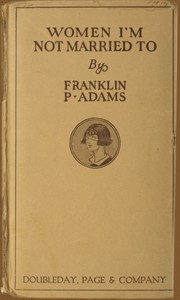
Women I'm Not Married To
Subjects:
Download Formats:
Excerpt
WOMEN
I’M NOT MARRIED TO
WOMEN
I’M NOT MARRIED TO
GARDEN CITY NEW YORK
DOUBLEDAY, PAGE & COMPANY
1922
COPYRIGHT, 1922, BY
DOUBLEDAY, PAGE & COMPANY
ALL RIGHTS RESERVED, INCLUDING THAT OF
TRANSLATION INTO FOREIGN LANGUAGES,
INCLUDING THE SCANDINAVIAN
COPYRIGHT, 1922, BY THE CURTIS PUBLISHING...
Read the Full Text
— End of Women I'm Not Married To —
Book Information
- Title
- Women I'm Not Married To
- Author(s)
- Adams, Franklin P. (Franklin Pierce)
- Language
- English
- Type
- Text
- Release Date
- October 2, 2017
- Word Count
- 3,050 words
- Library of Congress Classification
- PS
- Bookshelves
- Browsing: Gender & Sexuality Studies, Browsing: Humour, Browsing: Literature
- Rights
- Public domain in the USA.
Related Books
The Hybrids, An Epi-comic Satire
by An M. D.
English
191h 51m read
Les quinze joyes de mariage - Conforme au manuscript de la bibliothèque publique de Rouen
by La Sale, Antoine de
French
758h 44m read
Les évangiles des quenouilles
by Duval, Antoine, Fouquart, de Cambray, maistre, Jean, d'Arras, active 14th century
French
300h 51m read
Men I'm Not Married To; Women I'm Not Married To
by Adams, Franklin P. (Franklin Pierce), Parker, Dorothy
English
108h 16m read
A Guide to Men: Being Encore Reflections of a Bachelor Girl
by Rowland, Helen
English
290h 5m read
Something Else Again
by Adams, Franklin P. (Franklin Pierce)
English
319h 29m read