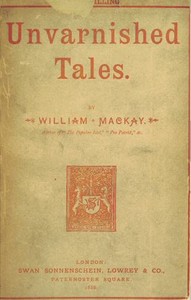
The Project Gutenberg eBook, William Mackay on T. W. Robertson's Play
"School", by William Mackay
This eBook is for the use of anyone anywhere in the United States and most
other parts of the world at no cost and with almost no restrictions
whatsoever. You may copy it, give it away or re-use it under the terms of
the Project Gutenberg License included with this eBook or online at
www.gutenberg.org. If you are not located in the United States, you'll have
to check the laws of the country where you are located before using this ebook.
Title: William Mackay on T. W. Robertson's Play "School"
Author: William Mackay
Release Date: May 9, 2016 [eBook #52033]
Language: English
Character set encoding: UTF-8
***START OF THE PROJECT GUTENBERG EBOOK WILLIAM MACKAY ON T. ROBERTSON'S
PLAY "SCHOOL"***
Transcribed by David Price, email [email protected]
William Mackay on T. W. Robertson’s New Play,
“School.”
This is the story of how William Mackay, then studying for the law, wrote
his first published piece, leading to his career in newspapers. The
letters that occasioned the piece and a criticism of Mr. Robertson’s play
are given first for context, followed by Mackay’s account and then his
first published piece.—DP.
_The Times_, 20 January 1869
_TO THE EDITOR OF THE TIMES_.
Sir,—It may be of some interest to you or your readers to learn that the
comedy _School_ now performed at the Prince of Wales’s Theatre is a play
which was performed with great success at the principal theatres in
Germany last year, and that Mr. Robertson has only the merit of
translation. I myself have seen it acted in Hamburg and Cologne. I do
not think Mr. Robertson will deny this fact.
I enclose my card, and beg to subscribe myself
VERITAS.
Jan. 18.
*** Why does not “Veritas” give the name of the German play?
_The Times_, 21 January 1869
MR. ROBERTSON’S NEW PLAY.
TO THE EDITOR OF THE TIMES.
Sir,—I am thankful to you for reminding me that I had forgotten to give
the name of the German play acted in the Prince of Wales’s Theatre under
the name _School_. It is called there Aschenbrödel, and the author is
Mr. Robert Benedix, a well-known theatrical author.
I remain, Sir, your obedient servant,
VERITAS.
January 20.
_The Times_, 26 January 1869
MR. ROBERTSON’S “SCHOOL”.
TO THE EDITOR OF THE TIMES.
Sir,—Is Mr. Robertson going to contradict or explain the allegation made
in your columns on the 20th and 21st inst., that his so-called new play
is, in fact, a German play, _Aschenbrödel_, by Robert Benedix? The
public have a right to be informed on this point, as _School_ was put
forward and accepted as an original work. If the charge is true, it
becomes difficult to understand the morality of those concerned. If your
correspondent’s statement be incorrect, Mr. Robertson and Miss Wilton owe
it to themselves to say so.
I am, Sir, your obedient servant,
R. S. E.
Jan. 32.
Once A Week, 6 February 1869
NEW COMEDIES.
WITH the new year has come new luck to the theatres. Covent Garden, and
Drury Lane, with their pantomimes, are doing wonderfully well; the new
Gaiety, with its brilliant extravaganza un-dresses, and Mr. Alfred
Wigan’s admirable acting in the second piece, is, and has been, drawing
crowded houses. The Strand, with its old burlesque, _The Field of the
Cloth of Gold_, is taking its share of the luck, and the little Royalty’s
novel style of burlesque-drama, _Claude du Val_, is in for as prosperous
if not as lengthy a career as fell to the lot of _Black-eyed Susan_. The
sensation drama is for a time in abeyance until Mr. Watts Phillips
produces his next at the Queen’s, and its startling companion at the
Holborn. The Princess’s coquetting with Mr. Boucicault, takes up with
Mr. Palgrave Simpson, and plays his _Marie Antoinette_.
Two theatres are playing comedy, pure and simple; rather pure, and
peculiarly simple. At the Haymarket, Mr. Buckstone now plays a comedy by
T. W. Robertson, entitled _Home_; and at the Prince of Wales’s Miss Marie
Wilton has produced a comedy by the same author, called _School_. Both
are successful, on both a vast amount of praise has been lavished, and
about both a great deal of nonsense has been written.
_Home_ is an adaptation of _L’Aventurière_; and _School_, is an
adaptation of a German piece; a fact of which but for the letters of
Veritas, to the _Times_, most of us would have remained in blissful
ignorance.
It matters not one atom to the public whether these plays are in every
sense original (as we suppose the author’s _Caste_ was—his third, and, to
our mind his best) or are translated literally, or adapted ingeniously
from the French, German, Sanskrit, or Hindu. The public, in general,
goes to the theatre to be amused, and so long as this end is attained,
cares nothing for details, however interesting they may be from a
literary or artistic point of view. _School_ and _Home_ satisfy the
public, which passes a very pleasant evening in seeing each piece—so far
so good. With whom, then, and with what do we find fault? Assuredly
with Mr. Robertson, if he has tacitly taken to himself and the praise
which generous admiring critics have publicly given him. For what has
been specially praised? what has specially attracted their notice in
_School_? Why, the author’s originality of invention and graceful
fancies, as displayed in (1) the choice of the old fairy story
_Cinderella_ on which to base an idyllic story; (2) the carrying out this
idea at the end in fitting the slipper on the girl’s foot; (3) the
love-making in the moonlight, when Lord Beaufoy and Bella talk in spooney
tones about their shadows. Now it appears that not only has the
Cinderella idea _not_ originated in Mr. Robertson’s inner consciousness,
but, beside the incident underlying the whole plot, the very name
Cinderella was that of the original German play. We regret that facts
like these have not been either acknowledged or contradicted by the
author. For we are, and have been, glad, in the true interests of
English dramatic art, to point to the author of _Caste_, _Ours_, and
_Society_, as an original writer whose successful career is a sufficient
answer to the taunts of the French dramatists and their admirers amongst
ourselves.
The first act of _School_ contains the gem of the piece in the way of
dialogue, which rises here to true comedy standard. We allude to the
luncheon in the wood, where Lord Beaufoy the beau, and Jack Poyntz
converse together. Suggested by the original German or not, it is
excellent. The scene is pretty, nothing remarkable; the schoolgirls sing
with a unanimity perfectly astonishing, except, perhaps, to German
schoolgirls out for a holiday after the foreign-peasant fashion.
The second act is a farce, and a stupid farce, too. Mr. Hare’s
performance of the old beau is good, though not up to his previous
delineations of character.
The third act is notable for its moonlight love-making scene. The
dialogue runs somewhat in this fashion,—
_Lord Beaufoy_ (_to Bella_), My shadow is taller than yours.
_Bella_ (_to Lord B._). Your shadow is shorter than mine.
_Lord B._ Now we’re together.
_Bella_. Now we’re apart.
_Lord B._ Now we’re together again.
_Bella_. Yes. The jug (_a milk jug in her hand_) joins us.
_Lord B._ (_with pathos_). Yes. But only for a time.
[_Exeunt to get the milk_.
And, we are told, that Mr. Robertson is a second Douglas Jerrold! No,
this is certainly not the parallel. Mr. Robertson, in a way, may be the
Antony Trollope of the drama; not as Jerrold, a writer of epigrams,
repartees, and sparkling witticisms, but a very lively recorder of such
natural conversation as would pass between two ordinary people, in an
ordinary situation.
We should be inclined to say that it is upon this absence of style,
polish, and turn, that Mr. Robertson especially prides himself. For
ourselves we would rather have a comedy be the concentrated essence of
conversation, trimmed, pruned, and polished, up to the _School for
Scandal_ smoothness and brilliancy.
As for _Home_, the first act is a prologue, the second is the play, the
third is the epilogue. The three chief characters are more or less
unprincipled, one of them (played by Mr. Sothern) justifying the end by
the means; and the sympathy of the audience is, at the conclusion,
entirely with the designing woman whose schemes have been foiled by the
aforesaid unprincipled son. Much has been said in praise of the business
of the love-making at the piano. There is nothing new under the sun or
behind the foot-lights, and the details of this, the diffidence, the
short sentences, the shyness, the nervousness, are as old as
stage-courtship itself. Mr. Sothern gets some laughs out of misplacing
words, by a sort of Dundreary habit, and obtains one roar by upsetting a
music-stand when he is talking to the young lady at the piano. He makes
false love, with affected earnestness, as he did in _A Lesson for Life_,
and his stage business is all good and careful. By the way, there is a
too brilliant screen in the corner, which distracts the attention of the
audience. It is never used during the play, nothing is done with it,
and, unless it be used to conceal some one who plays the piano,
(something of the sort was done in _Golden Daggers_, at the Princess’s)
while Miss Hill is pretending to perform a brilliant waltz, the screen is
useless—is worse, being an eye-sore.
In fine, we shall be glad to see another piece of Mr. Robertson’s, but he
owes it to his friends and the public, to inform us of its originality:
and we heartily advise him to work his own ground, and to leave the
French, German, and Italian fields to those who have no fertile soil of
their own.
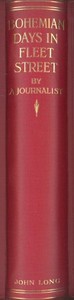
From “Bohemian Days in Fleet Street”
By William Mackay.
When “School” had been running for some little time, a letter appeared in
the _Times_, conceived in that spirit of dignified rebuke which, in its
correspondents, seems to have appealed to successive editors of that
great newspaper. In this communication Robertson was crudely accused of
having stolen the play, lock, stock, and barrel, from a play then (or
recently) running in Germany. I had no acquaintance with the German
language and no time (so insistent on protest was my indignation) to
inquire into the facts. But I felt that from the internal evidence
afforded by “School” I would be able to make a good case. Even in those
remote days many of our most admired articles of so-called British
manufacture were “made in Germany,” and most of them bore about with them
the ineffaceable signs of their origin. I strongly felt that on internal
evidence I should have little difficulty, in that “School” was “quite
English, you know,” and that, above all, there was no trace whatever of
anything German in the conception or the treatment. I had already seen
the play a second time when the _Times_ letter made its appearance. On
the night of the day on which it was published I paid a third visit to
the pit of the Tottenham Street playhouse. When I got back to my
“diggings,” I sat down and commenced to write what I intended to be a
letter to Jupiter Tonans of Printing House Square, but what turned out to
be my first professional contribution to the London Press. Next day I
abandoned my more legitimate studies, and rewrote and polished—as well as
I knew how—the essay over which I had burned my first sacrifice of
midnight oil. The result was in no way suitable as a letter in the
correspondence column of a newspaper. My own poor outlook assured me of
that. Where to send the essay? A copy of a weekly magazine called _Once
a Week_ lay on a chair in the room. I caught it up, looked for the
editorial address, wrote a brief note to the editor apprising him of the
drift of my contribution, addressed an envelope, and posted my “stuff,”
as I subsequently learned to call my articles in manuscript.
Had a mentor, skilled to advise, been available at that moment, he would
no doubt have advised me to send my essay to any other publication, but
_not_ to _Once a Week_, because the paper in question was then under the
editorial control of a member of the staff of the _Times_. So that—a
circumstance of which I was happily ignorant—the organ selected haphazard
for my venture was the very last that should be likely to serve my
purpose. Four days after its despatch I received a proof of the article
with a request that it should be “returned immediately” to the printer.
A delightful sensation—that of correcting one’s first galleys of matter
moist from the press! The following week the article appeared in all the
pride of print, though I confess that the pride of print (a mere
figurative locution) was as nothing to the pride of the author who
already saw himself on the high-road to fame and fortune. Alas! it is a
highroad which, while the gayest and cheeriest to travel, rarely leads to
fame, and never to fortune. . . . I have no doubt that this first
published composition of mine was a tremendously faulty piece of
work—immature and pretentious. But the appearance of no subsequent
production of mine has afforded me a tithe of the pleasure. And,
incidentally, it was the means of my making the acquaintance of “Tom”
Robertson.
Once a Week, 27 March 1869
SCHOOL.
By William Mackay.
WHEN in these days a dramatic author achieves undoubted success, without
having recourse to sensational incident, to intricacies of plot, and to
impossible situations, something has occurred to arrest the attention of
those who are eternally bemoaning the degraded position of the modern
stage. There is a play being performed in London at present which has
ensnared the public into admiration; which fills a theatre night after
night with pleased audiences; and in which, strange to say, there is
introduced no railway train, no hansom cab, no real pump. The title of
the play is _School_. The object of this article is to discover, if
possible, the secret of the author’s success.
We take it for granted that the cloud of accusation which, erewhile, hung
over Mr. Robertson’s head has been dissipated. Lord Macaulay informs us
in his essay on Byron, that the British public is subject to periodical
fits of morality. When _School_ was produced at the Prince of Wales’
Theatre, the town was suffering from one of these attacks. Almost every
event became a text. But it so happened that anent public exhibitions
the Briton was especially asserting himself. The State was interfering
in the matter of stage petticoats, and various journals were waxing
eloquent over the degrading and demoralising spectacle of the Siamese
Twins. It was impossible that _School_ should escape. True there are no
legs displayed in Tottenham Street,—nothing there to offend a correct
taste. In a happy moment, however, it was discovered that Mr. Robertson
had translated his comedy from the German. Here, indeed, was a charge of
immorality compared with which an accusation of legs would be less than
trivial. What Goldsmith once called “the busy disposition of some
correspondents,” went to work with a will. Printing House Square helped
it to utterance, and in a day or two the town rang with the echoes of it.
Those who have read the German play about which the correspondents wrote,
have been able to convince themselves, and those who have not, will have
by this time been convinced by the _Times_ article on the question that
_School_ is not a translation. Mr. Robertson has indeed borrowed the
idea of _a_ play, in which a boarding-school should afford some of the
characters, and the legend of _Cinderella_ a background. Further than
this, the author of _School_ is not indebted to his continental
contemporary. If there be criminality in so borrowing we should at once
commence to measure modern authors with a standard higher than that which
we apply to the great masters of the dramatic art.
But, after all, the most convincing refutation of the charge of
translation is afforded by the comedy itself. With one exception (that
of Krux the tutor) can anything be more thoroughly, more peculiarly
English than the delineation of the _dramatis personæ_ of _School_—than
the dialogue, the channels in which it runs, and the allusions with which
it is studded?
Mr. Robertson’s comedy, then, is not a translation. And in crossing the
channel to search for the author’s model, critics have put themselves to
unnecessary trouble. A great deal of the press praise lavished on our
author has been excessive. And probably no one feels this more than the
author himself. Mr. Robertson does not write for immortality. His plays
will never be _read_; after a few years, probably, will cease to be acted
even. He is not a Sheridan, any more than Sheridan was a Shakspeare.
But he is a dramatic author, capable of portraying a character with
ability and finish, and of writing dialogue which is sometimes sparkling,
often charming, and always clever. And much of his success in these
respects is attributable, as we think, to his having studied earnestly
the writings of Thackeray. This idea has not suddenly and only now
occurred to us. When we first saw it, we thought that _Society_ was not
altogether uninfluenced by _Vanity Fair_. And although in _Caste_ and
_Ours_ the genius of the master was not so observable, it reasserted
itself in _Play_, and in the author’s latest production it is more than
ever felt. In endeavouring to show the extent of Thackeray’s influence
on Mr. Robertson’s work, we purpose confining ourselves to that latest
production.
Glancing over the bill we meet with one or two of Thackeray’s names. We
have Farintosh, we have Poyntz. Mere indications these. But useful,
nevertheless, as evidence in confirmation of our theory—straws indicating
from what quarter the wind of inspiration blows. When the curtain rises
we meet with something more convincing than indications.
We meet, for example, with Beau Farintosh. It would be silliness to
attempt to identify Mr. Robertson’s Beau Farintosh with any of
Thackeray’s characters. The points of dissimilarity are almost as
numerous as the points of similarity to that character which he most
resembles. But what reader of the _History of Pendennis_, having seen
_School_, was not constantly reminded by Beau Farintosh of that
delightful but godless old dandy Major Pendennis, who, as we all know,
“could not have faced the day without his two hours’ toilet.” Major
Pendennis had a nephew; so has Beau Farintosh. The name of the Pendennis
nephew was Arthur; Beau Farintosh’s nephew is an Arthur too. But the
resemblance does not confine itself to names. Before Farintosh has been
ten minutes on the stage he gives his nephew sundry sage but dreadfully
worldly counsels on the subject of marriage, which set us thinking of
very similar advices confided years ago by Major Pendennis to _his_
nephew. In manner also the Beau possesses a strong family likeness to
the Major. There are little peculiarities of thought and expression
common to both. Major Pendennis especially, when conversing with an
author, was wont to adorn his conversation with little allusions and
quotations, just as samples of what he _could_ do were he so intended,
“Tempora mutantur, egad. And whatever is, is right, as Shakspeare says,”
said the Major one afternoon in Pall Mall. The Beau is equally happy in
his allusions. “Arthur, Arthur, this is blasphemy—atheism—reminds me of
Burke and Hare—and, and, Voltaire.” Perhaps on scientific matters the
Beau surpasses the Major. In act ii. of _School_ one of the young ladies
has given an answer displaying a more than ordinary amount of stupidity,
upon which the Beau expresses his delight by declaring that “She’s a
remarkable girl; a perfect Sir Humphrey Davy, begad.” How the Beau’s
studied compliments to the young ladies, of whom he “can’t distinguish a
feature,” seem familiar to us. And as to his “God bless you, Arthur,”
Pendennis senior has said it to Pendennis junior a hundred times. The
two characters most resemble each other (I should rather say, remind us
most of each other; for, in good sooth, the _characters_ differ most at
this point, though the resemblance of manner is strongest) towards the
close of the comedy, and towards the close of the novel. I Beau
Farintosh’s interview with his nephew in the last act of the play will
bear a not unfavourable comparison with those passages in chapter seventy
of _Pendennis_, in which the Major beseeches Arthur to marry Blanche
Amory, “Arthur,” says Major Pendennis, “for the sake of a poor
broken-down old fellow who has always been dev’lish fond of you, don’t
fling this chance away—I pray you—I beg you . . . dammy, on my knees,
there, I beg of you don’t do this.” Then when Arthur’s resolution
shatters the fond hopes of the old soldier, he goes on, “I’ve done my
best, and said my say; and I’m a dev’lish old fellow. And—and—it don’t
matter. And—and Shakspeare was right—and Cardinal Wolsey, begad—and had
I but served my God as I have served you—yes, on my knees by Jove, to my
own nephew—I mightn’t have been— Good night, sir, you needn’t trouble
yourself to call again.” This is, of course, inimitable. The
master-hand is there. But the later author has put a pathos into the
Beau’s confession of old age—confession after so many years of hair from
Truefitts, and bloom from Bond Street, too forceful to be ludicrous. And
the tears which he makes the repentant old sinner shed are too genuine to
be thought other than natural.
In the plays of Mr. Robertson it is a general resemblance to the novels
of Thackeray which arrests us, and not so much a similarity of particular
characters. Ever and anon we happen upon little well-known touches,
peculiarities of expression, turns of sentiment, moralisings, teachings,
which convince us of the justice of our assumption. They are impressions
of “the touch of a vanish’d hand.” They are echoes “of a voice that is
still.” Thackeray very largely adopted a strain, half satire, half
banter, with regard to certain shams both in high and low places. Some
people, who didn’t know the meaning of words, called this strain
cynicism. And, at one time, it was considered quite the fashion to dub
Thackeray a cynic. People know better now, let us hope. This note, or
strain, is easy of detection in _School_. In act i. it is particularly
noticeable.
There is one scene in the play—in the third act—which has been regarded
with especial admiration by the public; and concerning which some of the
journals have gone into ecstasies. It is a scene, however, concerning
the merit of which there is a difference of opinion. When a thing is
loudly praised by the Philistines, the children of light turn up their
noses. We are referring to the moonlight scene, in which Bella and Lord
Beaufoy are the actors. To us the bit of sentiment about the jug is a
touch worthy of Sterne. The comparison of the shadows, and the allusions
to the distance of the moon, are very susceptible of burlesque. But when
in _Vanity Fair_ we read of Miss Sharp’s walk in the moonlight with
Captain Osborne, and listen to her as she says, “Who’d think the moon was
two hundred and thirty-six thousand eight hundred and forty-seven miles
off?” it never occurs to us to burlesque _that_.
The letter of Jack Poyntz to Naomi Tighe is just such a composition as
Thackeray would attribute to a young officer of the Poyntz stamp; even to
the bad spelling. “He spells cochineal with two ee’s,” says Naomi on
reading the letter; though, we should scarcely imagine, from Naomi’s
previous appearances, that she was the most competent to decide on
matters of orthography. However, “with two ees” is exactly the way in
which Rawdon Crawley would have spelt cochineal, if the ever-watchful
Becky were not looking over his shoulder.
The influence of the most popular English novelist has for some years
been very potent on the stage. Imitators of Mr. Dickens do alarmingly
abound in these days. And so it happens that we can scarcely enter a
theatre without a strong foreboding that we are about to be entertained
by some thief from Whitechapel, whose highest notion of fun consists in
making “v” and “w” interchangeable; or some turfy clerk from the City,
who relies for his power of attraction principally upon his “get up.”
That this is no fault of the novelist (of whom we can never have too
much) we readily admit. The followers of Mr. Thackeray are less
numerous, and anything that indicates a spread of his influence on the
modern stage is worthy of note. Whatever may he said about Mr.
Robertson’s originality, the public is right in applauding his efforts.
This applause is at once an unconscious tribute to the genius of
Thackeray, and a mark of appreciation of Mr. Robertson’s ability. It
will surely be a matter for congratulation when eccentricities, whether
from St. Giles’s or St. James’s, are driven from the boards, and when in
their place we have put before us the men and women—or something like
them—which we meet in real life, and in the pages of _Vanity Fair_,
_Pendennis_, and _The Newcomes_.
One does not like to close a notice of this kind without some mention of
the actors, on whose efforts much of the success of the piece depends.
In having such a company as that of the Prince of Wales’ Theatre to
undertake his characters Mr. Robertson is especially fortunate. Miss
Wilton is perfection. Mr. Hare has genius, and his acting evinces
careful study. The other performers are so excellent, each in his or her
own way, that unless we mentioned all of them we dare not mention any;
and, indeed, any notice now is somewhat after date, for has not all
London seen the play, and all Pressdom said its say anent the same?
***END OF THE PROJECT GUTENBERG EBOOK WILLIAM MACKAY ON T. W. ROBERTSON'S
PLAY "SCHOOL"***
******* This file should be named 52033-0.txt or 52033-0.zip *******
This and all associated files of various formats will be found in:
http://www.gutenberg.org/dirs/5/2/0/3/52033
Updated editions will replace the previous one--the old editions will
be renamed.
Creating the works from print editions not protected by U.S. copyright
law means that no one owns a United States copyright in these works,
so the Foundation (and you!) can copy and distribute it in the United
States without permission and without paying copyright
royalties. Special rules, set forth in the General Terms of Use part
of this license, apply to copying and distributing Project
Gutenberg-tm electronic works to protect the PROJECT GUTENBERG-tm
concept and trademark. Project Gutenberg is a registered trademark,
and may not be used if you charge for the eBooks, unless you receive
specific permission. If you do not charge anything for copies of this
eBook, complying with the rules is very easy. You may use this eBook
for nearly any purpose such as creation of derivative works, reports,
performances and research. They may be modified and printed and given
away--you may do practically ANYTHING in the United States with eBooks
not protected by U.S. copyright law. Redistribution is subject to the
trademark license, especially commercial redistribution.
START: FULL LICENSE
THE FULL PROJECT GUTENBERG LICENSE
PLEASE READ THIS BEFORE YOU DISTRIBUTE OR USE THIS WORK
To protect the Project Gutenberg-tm mission of promoting the free
distribution of electronic works, by using or distributing this work
(or any other work associated in any way with the phrase "Project
Gutenberg"), you agree to comply with all the terms of the Full
Project Gutenberg-tm License available with this file or online at
www.gutenberg.org/license.
Section 1. General Terms of Use and Redistributing Project
Gutenberg-tm electronic works
1.A. By reading or using any part of this Project Gutenberg-tm
electronic work, you indicate that you have read, understand, agree to
and accept all the terms of this license and intellectual property
(trademark/copyright) agreement. If you do not agree to abide by all
the terms of this agreement, you must cease using and return or
destroy all copies of Project Gutenberg-tm electronic works in your
possession. If you paid a fee for obtaining a copy of or access to a
Project Gutenberg-tm electronic work and you do not agree to be bound
by the terms of this agreement, you may obtain a refund from the
person or entity to whom you paid the fee as set forth in paragraph
1.E.8.
1.B. "Project Gutenberg" is a registered trademark. It may only be
used on or associated in any way with an electronic work by people who
agree to be bound by the terms of this agreement. There are a few
things that you can do with most Project Gutenberg-tm electronic works
even without complying with the full terms of this agreement. See
paragraph 1.C below. There are a lot of things you can do with Project
Gutenberg-tm electronic works if you follow the terms of this
agreement and help preserve free future access to Project Gutenberg-tm
electronic works. See paragraph 1.E below.
1.C. The Project Gutenberg Literary Archive Foundation ("the
Foundation" or PGLAF), owns a compilation copyright in the collection
of Project Gutenberg-tm electronic works. Nearly all the individual
works in the collection are in the public domain in the United
States. If an individual work is unprotected by copyright law in the
United States and you are located in the United States, we do not
claim a right to prevent you from copying, distributing, performing,
displaying or creating derivative works based on the work as long as
all references to Project Gutenberg are removed. Of course, we hope
that you will support the Project Gutenberg-tm mission of promoting
free access to electronic works by freely sharing Project Gutenberg-tm
works in compliance with the terms of this agreement for keeping the
Project Gutenberg-tm name associated with the work. You can easily
comply with the terms of this agreement by keeping this work in the
same format with its attached full Project Gutenberg-tm License when
you share it without charge with others.
1.D. The copyright laws of the place where you are located also govern
what you can do with this work. Copyright laws in most countries are
in a constant state of change. If you are outside the United States,
check the laws of your country in addition to the terms of this
agreement before downloading, copying, displaying, performing,
distributing or creating derivative works based on this work or any
other Project Gutenberg-tm work. The Foundation makes no
representations concerning the copyright status of any work in any
country outside the United States.
1.E. Unless you have removed all references to Project Gutenberg:
1.E.1. The following sentence, with active links to, or other
immediate access to, the full Project Gutenberg-tm License must appear
prominently whenever any copy of a Project Gutenberg-tm work (any work
on which the phrase "Project Gutenberg" appears, or with which the
phrase "Project Gutenberg" is associated) is accessed, displayed,
performed, viewed, copied or distributed:
This eBook is for the use of anyone anywhere in the United States and
most other parts of the world at no cost and with almost no
restrictions whatsoever. You may copy it, give it away or re-use it
under the terms of the Project Gutenberg License included with this
eBook or online at www.gutenberg.org. If you are not located in the
United States, you'll have to check the laws of the country where you
are located before using this ebook.
1.E.2. If an individual Project Gutenberg-tm electronic work is
derived from texts not protected by U.S. copyright law (does not
contain a notice indicating that it is posted with permission of the
copyright holder), the work can be copied and distributed to anyone in
the United States without paying any fees or charges. If you are
redistributing or providing access to a work with the phrase "Project
Gutenberg" associated with or appearing on the work, you must comply
either with the requirements of paragraphs 1.E.1 through 1.E.7 or
obtain permission for the use of the work and the Project Gutenberg-tm
trademark as set forth in paragraphs 1.E.8 or 1.E.9.
1.E.3. If an individual Project Gutenberg-tm electronic work is posted
with the permission of the copyright holder, your use and distribution
must comply with both paragraphs 1.E.1 through 1.E.7 and any
additional terms imposed by the copyright holder. Additional terms
will be linked to the Project Gutenberg-tm License for all works
posted with the permission of the copyright holder found at the
beginning of this work.
1.E.4. Do not unlink or detach or remove the full Project Gutenberg-tm
License terms from this work, or any files containing a part of this
work or any other work associated with Project Gutenberg-tm.
1.E.5. Do not copy, display, perform, distribute or redistribute this
electronic work, or any part of this electronic work, without
prominently displaying the sentence set forth in paragraph 1.E.1 with
active links or immediate access to the full terms of the Project
Gutenberg-tm License.
1.E.6. You may convert to and distribute this work in any binary,
compressed, marked up, nonproprietary or proprietary form, including
any word processing or hypertext form. However, if you provide access
to or distribute copies of a Project Gutenberg-tm work in a format
other than "Plain Vanilla ASCII" or other format used in the official
version posted on the official Project Gutenberg-tm web site
(www.gutenberg.org), you must, at no additional cost, fee or expense
to the user, provide a copy, a means of exporting a copy, or a means
of obtaining a copy upon request, of the work in its original "Plain
Vanilla ASCII" or other form. Any alternate format must include the
full Project Gutenberg-tm License as specified in paragraph 1.E.1.
1.E.7. Do not charge a fee for access to, viewing, displaying,
performing, copying or distributing any Project Gutenberg-tm works
unless you comply with paragraph 1.E.8 or 1.E.9.
1.E.8. You may charge a reasonable fee for copies of or providing
access to or distributing Project Gutenberg-tm electronic works
provided that
* You pay a royalty fee of 20% of the gross profits you derive from
the use of Project Gutenberg-tm works calculated using the method
you already use to calculate your applicable taxes. The fee is owed
to the owner of the Project Gutenberg-tm trademark, but he has
agreed to donate royalties under this paragraph to the Project
Gutenberg Literary Archive Foundation. Royalty payments must be paid
within 60 days following each date on which you prepare (or are
legally required to prepare) your periodic tax returns. Royalty
payments should be clearly marked as such and sent to the Project
Gutenberg Literary Archive Foundation at the address specified in
Section 4, "Information about donations to the Project Gutenberg
Literary Archive Foundation."
* You provide a full refund of any money paid by a user who notifies
you in writing (or by e-mail) within 30 days of receipt that s/he
does not agree to the terms of the full Project Gutenberg-tm
License. You must require such a user to return or destroy all
copies of the works possessed in a physical medium and discontinue
all use of and all access to other copies of Project Gutenberg-tm
works.
* You provide, in accordance with paragraph 1.F.3, a full refund of
any money paid for a work or a replacement copy, if a defect in the
electronic work is discovered and reported to you within 90 days of
receipt of the work.
* You comply with all other terms of this agreement for free
distribution of Project Gutenberg-tm works.
1.E.9. If you wish to charge a fee or distribute a Project
Gutenberg-tm electronic work or group of works on different terms than
are set forth in this agreement, you must obtain permission in writing
from both the Project Gutenberg Literary Archive Foundation and The
Project Gutenberg Trademark LLC, the owner of the Project Gutenberg-tm
trademark. Contact the Foundation as set forth in Section 3 below.
1.F.
1.F.1. Project Gutenberg volunteers and employees expend considerable
effort to identify, do copyright research on, transcribe and proofread
works not protected by U.S. copyright law in creating the Project
Gutenberg-tm collection. Despite these efforts, Project Gutenberg-tm
electronic works, and the medium on which they may be stored, may
contain "Defects," such as, but not limited to, incomplete, inaccurate
or corrupt data, transcription errors, a copyright or other
intellectual property infringement, a defective or damaged disk or
other medium, a computer virus, or computer codes that damage or
cannot be read by your equipment.
1.F.2. LIMITED WARRANTY, DISCLAIMER OF DAMAGES - Except for the "Right
of Replacement or Refund" described in paragraph 1.F.3, the Project
Gutenberg Literary Archive Foundation, the owner of the Project
Gutenberg-tm trademark, and any other party distributing a Project
Gutenberg-tm electronic work under this agreement, disclaim all
liability to you for damages, costs and expenses, including legal
fees. YOU AGREE THAT YOU HAVE NO REMEDIES FOR NEGLIGENCE, STRICT
LIABILITY, BREACH OF WARRANTY OR BREACH OF CONTRACT EXCEPT THOSE
PROVIDED IN PARAGRAPH 1.F.3. YOU AGREE THAT THE FOUNDATION, THE
TRADEMARK OWNER, AND ANY DISTRIBUTOR UNDER THIS AGREEMENT WILL NOT BE
LIABLE TO YOU FOR ACTUAL, DIRECT, INDIRECT, CONSEQUENTIAL, PUNITIVE OR
INCIDENTAL DAMAGES EVEN IF YOU GIVE NOTICE OF THE POSSIBILITY OF SUCH
DAMAGE.
1.F.3. LIMITED RIGHT OF REPLACEMENT OR REFUND - If you discover a
defect in this electronic work within 90 days of receiving it, you can
receive a refund of the money (if any) you paid for it by sending a
written explanation to the person you received the work from. If you
received the work on a physical medium, you must return the medium
with your written explanation. The person or entity that provided you
with the defective work may elect to provide a replacement copy in
lieu of a refund. If you received the work electronically, the person
or entity providing it to you may choose to give you a second
opportunity to receive the work electronically in lieu of a refund. If
the second copy is also defective, you may demand a refund in writing
without further opportunities to fix the problem.
1.F.4. Except for the limited right of replacement or refund set forth
in paragraph 1.F.3, this work is provided to you 'AS-IS', WITH NO
OTHER WARRANTIES OF ANY KIND, EXPRESS OR IMPLIED, INCLUDING BUT NOT
LIMITED TO WARRANTIES OF MERCHANTABILITY OR FITNESS FOR ANY PURPOSE.
1.F.5. Some states do not allow disclaimers of certain implied
warranties or the exclusion or limitation of certain types of
damages. If any disclaimer or limitation set forth in this agreement
violates the law of the state applicable to this agreement, the
agreement shall be interpreted to make the maximum disclaimer or
limitation permitted by the applicable state law. The invalidity or
unenforceability of any provision of this agreement shall not void the
remaining provisions.
1.F.6. INDEMNITY - You agree to indemnify and hold the Foundation, the
trademark owner, any agent or employee of the Foundation, anyone
providing copies of Project Gutenberg-tm electronic works in
accordance with this agreement, and any volunteers associated with the
production, promotion and distribution of Project Gutenberg-tm
electronic works, harmless from all liability, costs and expenses,
including legal fees, that arise directly or indirectly from any of
the following which you do or cause to occur: (a) distribution of this
or any Project Gutenberg-tm work, (b) alteration, modification, or
additions or deletions to any Project Gutenberg-tm work, and (c) any
Defect you cause.
Section 2. Information about the Mission of Project Gutenberg-tm
Project Gutenberg-tm is synonymous with the free distribution of
electronic works in formats readable by the widest variety of
computers including obsolete, old, middle-aged and new computers. It
exists because of the efforts of hundreds of volunteers and donations
from people in all walks of life.
Volunteers and financial support to provide volunteers with the
assistance they need are critical to reaching Project Gutenberg-tm's
goals and ensuring that the Project Gutenberg-tm collection will
remain freely available for generations to come. In 2001, the Project
Gutenberg Literary Archive Foundation was created to provide a secure
and permanent future for Project Gutenberg-tm and future
generations. To learn more about the Project Gutenberg Literary
Archive Foundation and how your efforts and donations can help, see
Sections 3 and 4 and the Foundation information page at
www.gutenberg.org
Section 3. Information about the Project Gutenberg Literary
Archive Foundation
The Project Gutenberg Literary Archive Foundation is a non profit
501(c)(3) educational corporation organized under the laws of the
state of Mississippi and granted tax exempt status by the Internal
Revenue Service. The Foundation's EIN or federal tax identification
number is 64-6221541. Contributions to the Project Gutenberg Literary
Archive Foundation are tax deductible to the full extent permitted by
U.S. federal laws and your state's laws.
The Foundation's principal office is in Fairbanks, Alaska, with the
mailing address: PO Box 750175, Fairbanks, AK 99775, but its
volunteers and employees are scattered throughout numerous
locations. Its business office is located at 809 North 1500 West, Salt
Lake City, UT 84116, (801) 596-1887. Email contact links and up to
date contact information can be found at the Foundation's web site and
official page at www.gutenberg.org/contact
For additional contact information:
Dr. Gregory B. Newby
Chief Executive and Director
[email protected]
Section 4. Information about Donations to the Project Gutenberg
Literary Archive Foundation
Project Gutenberg-tm depends upon and cannot survive without wide
spread public support and donations to carry out its mission of
increasing the number of public domain and licensed works that can be
freely distributed in machine readable form accessible by the widest
array of equipment including outdated equipment. Many small donations
($1 to $5,000) are particularly important to maintaining tax exempt
status with the IRS.
The Foundation is committed to complying with the laws regulating
charities and charitable donations in all 50 states of the United
States. Compliance requirements are not uniform and it takes a
considerable effort, much paperwork and many fees to meet and keep up
with these requirements. We do not solicit donations in locations
where we have not received written confirmation of compliance. To SEND
DONATIONS or determine the status of compliance for any particular
state visit www.gutenberg.org/donate
While we cannot and do not solicit contributions from states where we
have not met the solicitation requirements, we know of no prohibition
against accepting unsolicited donations from donors in such states who
approach us with offers to donate.
International donations are gratefully accepted, but we cannot make
any statements concerning tax treatment of donations received from
outside the United States. U.S. laws alone swamp our small staff.
Please check the Project Gutenberg Web pages for current donation
methods and addresses. Donations are accepted in a number of other
ways including checks, online payments and credit card donations. To
donate, please visit: www.gutenberg.org/donate
Section 5. General Information About Project Gutenberg-tm electronic works.
Professor Michael S. Hart was the originator of the Project
Gutenberg-tm concept of a library of electronic works that could be
freely shared with anyone. For forty years, he produced and
distributed Project Gutenberg-tm eBooks with only a loose network of
volunteer support.
Project Gutenberg-tm eBooks are often created from several printed
editions, all of which are confirmed as not protected by copyright in
the U.S. unless a copyright notice is included. Thus, we do not
necessarily keep eBooks in compliance with any particular paper
edition.
Most people start at our Web site which has the main PG search
facility: www.gutenberg.org
This Web site includes information about Project Gutenberg-tm,
including how to make donations to the Project Gutenberg Literary
Archive Foundation, how to help produce our new eBooks, and how to
subscribe to our email newsletter to hear about new eBooks.
William Mackay on T. W. Robertson's Play "School"
Download Formats:
Excerpt
The Project Gutenberg eBook, William Mackay on T. W. Robertson's Play
"School", by William Mackay
This eBook is for the use of anyone anywhere in the United States and most
other parts of the world at no cost and with almost no restrictions
whatsoever. You may copy it, give it away or re-use it under the terms of
the Project Gutenberg License included with this eBook or online at
www.gutenberg.org. If you are not located in the United States, you'll have
to check the laws of the...
Read the Full Text
— End of William Mackay on T. W. Robertson's Play "School" —
Book Information
- Title
- William Mackay on T. W. Robertson's Play "School"
- Author(s)
- Mackay, William
- Language
- English
- Type
- Text
- Release Date
- May 9, 2016
- Word Count
- 7,442 words
- Library of Congress Classification
- PR
- Bookshelves
- Browsing: Literature, Browsing: Performing Arts/Film
- Rights
- Public domain in the USA.