*** START OF THE PROJECT GUTENBERG EBOOK 1368 ***
[Illustration]
When the World Shook
Being an Account of the Great Adventure
of Bastin, Bickley and Arbuthnot
by H. Rider Haggard
Contents
CHAPTER I. Arbuthnot Describes Himself
CHAPTER II. Bastin and Bickley
CHAPTER III. Natalie
CHAPTER IV. Death and Departure
CHAPTER V. The Cyclone
CHAPTER VI. Land
CHAPTER VII. The Orofenans
CHAPTER VIII. Bastin Attempts the Martyr’s Crown
CHAPTER IX. The Island in the Lake
CHAPTER X. The Dwellers in the Tomb
CHAPTER XI. Resurrection
CHAPTER XII. Two Hundred and Fifty Thousand Years!
CHAPTER XIII. Oro Speaks and Bastin Argues
CHAPTER XIV. The Under-world
CHAPTER XV. Oro in His House
CHAPTER XVI. Visions of the Past
CHAPTER XVII. Yva Explains
CHAPTER XVIII. The Accident
CHAPTER XIX. The Proposals of Bastin and Bickley
CHAPTER XX. Oro and Arbuthnot Travel by Night
CHAPTER XXI. Love’s Eternal Altar
CHAPTER XXII. The Command
CHAPTER XXIII. In the Temple of Fate
CHAPTER XXIV. The Chariot of the Pit
CHAPTER XXV. Sacrifice
CHAPTER XXVI. Tommy
CHAPTER XXVII. Bastin Discovers a Resemblance
NOTE By J. R. Bickley, M.R.C.S.
DEDICATION
Ditchingham, 1918.
MY DEAR CURZON,
More than thirty years ago you tried to protect me, then a stranger to
you, from one of the falsest and most malignant accusations ever made
against a writer.
So complete was your exposure of the methods of those at work to
blacken a person whom they knew to be innocent, that, as you will
remember, they refused to publish your analysis which destroyed their
charges and, incidentally, revealed their motives.
Although for this reason vindication came otherwise, your kindness is
one that I have never forgotten, since, whatever the immediate issue of
any effort, in the end it is the intention that avails.
Therefore in gratitude and memory I ask you to accept this romance, as
I know that you do not disdain the study of romance in the intervals of
your Imperial work.
The application of its parable to our state and possibilities—beneath
or beyond these glimpses of the moon—I leave to your discernment.
Believe me,
Ever sincerely yours,
H. RIDER HAGGARD.
To
The Earl Curzon of Kedleston, K.G.
WHEN THE WORLD SHOOK
CHAPTER I.
Arbuthnot Describes Himself
I suppose that I, Humphrey Arbuthnot, should begin this history in
which Destiny has caused me to play so prominent a part, with some
short account of myself and of my circumstances.
I was born forty years ago in this very Devonshire village in which I
write, but not in the same house. Now I live in the Priory, an ancient
place and a fine one in its way, with its panelled rooms, its beautiful
gardens where, in this mild climate, in addition to our own, flourish
so many plants which one would only expect to find in countries that
lie nearer to the sun, and its green, undulating park studded with
great timber trees. The view, too, is perfect; behind and around the
rich Devonshire landscape with its hills and valleys and its scarped
faces of red sandstone, and at a distance in front, the sea. There are
little towns quite near too, that live for the most part on visitors,
but these are so hidden away by the contours of the ground that from
the Priory one cannot see them. Such is Fulcombe where I live, though
for obvious reasons I do not give it its real name.
Many years ago my father, the Rev. Humphrey Arbuthnot, whose only child
I am, after whom also I am named Humphrey, was the vicar of this place
with which our family is said to have some rather vague hereditary
connection. If so, it was severed in the Carolian times because my
ancestors fought on the side of Parliament.
My father was a recluse, and a widower, for my mother, a Scotswoman,
died at or shortly after my birth. Being very High Church for those
days he was not popular with the family that owned the Priory before
me. Indeed its head, a somewhat vulgar person of the name of Enfield
who had made money in trade, almost persecuted him, as he was in a
position to do, being the local magnate and the owner of the rectorial
tithes.
I mention this fact because owing to it as a boy I made up my mind that
one day I would buy that place and sit in his seat, a wild enough idea
at the time. Yet it became engrained in me, as do such aspirations of
our youth, and when the opportunity arose in after years I carried it
out. Poor old Enfield! He fell on evil fortunes, for in trying to
bolster up a favourite son who was a gambler, a spendthrift, and an
ungrateful scamp, in the end he was practically ruined and when the bad
times came, was forced to sell the Fulcombe estate. I think of him
kindly now, for after all he was good to me and gave me many a day’s
shooting and leave to fish for trout in the river.
By the poor people, however, of all the district round, for the parish
itself is very small, my father was much beloved, although he did
practise confession, wear vestments and set lighted candles on the
altar, and was even said to have openly expressed the wish, to which
however he never attained, that he could see a censer swinging in the
chancel. Indeed the church which, as monks built it, is very large and
fine, was always full on Sundays, though many of the worshippers came
from far away, some of them doubtless out of curiosity because of its
papistical repute, also because, in a learned fashion, my father’s
preaching was very good indeed.
For my part I feel that I owe much to these High-Church views. They
opened certain doors to me and taught me something of the mysteries
which lie at the back of all religions and therefore have their home in
the inspired soul of man whence religions are born. Only the pity is
that in ninety-nine cases out of a hundred he never discovers, never
even guesses at that entombed aspiration, never sinks a shaft down on
to this secret but most precious vein of ore.
I have said that my father was learned; but this is a mild description,
for never did I know anyone quite so learned. He was one of those men
who is so good all round that he became pre-eminent in nothing. A
classic of the first water, a very respectable mathematician, an expert
in theology, a student of sundry foreign languages and literature in
his lighter moments, an inquirer into sociology, a theoretical musician
though his playing of the organ excruciated most people because it was
too correct, a really first-class authority upon flint instruments and
the best grower of garden vegetables in the county, also of apples—such
were some of his attainments. That was what made his sermons so
popular, since at times one or the other of these subjects would break
out into them, his theory being that God spoke to us through all of
these things.
But if I began to drift into an analysis of my father’s abilities, I
should never stop. It would take a book to describe them. And yet mark
this, with them all his name is as dead to the world to-day as though
he had never been. Light reflected from a hundred facets dissipates
itself in space and is lost; that concentrated in one tremendous ray
pierces to the stars.
Now I am going to be frank about myself, for without frankness what is
the value of such a record as this? Then it becomes simply another
convention, or rather conventional method of expressing the octoroon
kind of truths with which the highly civilised races feed themselves,
as fastidious ladies eat cakes and bread from which all but the
smallest particle of nourishment has been extracted.
The fact is, therefore, that I inherited most of my father’s abilities,
except his love for flint instruments which always bored me to
distraction, because although they are by association really the most
human of things, somehow to me they never convey any idea of humanity.
In addition I have a practical side which he lacked; had he possessed
it surely he must have become an archbishop instead of dying the vicar
of an unknown parish. Also I have a spiritual sense, mayhap mystical
would be a better term, which with all this religion was missing from
my father’s nature.
For I think that notwithstanding his charity and devotion he never
quite got away from the shell of things, never cracked it and set his
teeth in the kernel which alone can feed our souls. His keen intellect,
to take an example, recognised every one of the difficulties of our
faith and flashed hither and thither in the darkness, seeking
explanation, seeking light, trying to reconcile, to explain. He was not
great enough to put all this aside and go straight to the informing
Soul beneath that strives to express itself everywhere, even through
those husks which are called the World, the Flesh and the Devil, and as
yet does not always quite succeed.
It is this boggling over exteriors, this peering into pitfalls, this
desire to prove that what such senses as we have tell us is impossible,
is in fact possible, which causes the overthrow of many an earnest,
seeking heart and renders its work, conducted on false lines, quite
nugatory. These _will_ trust to themselves and their own intelligence
and not be content to spring from the cliffs of human experience into
the everlasting arms of that Infinite which are stretched out to
receive them and to give them rest and the keys of knowledge. When will
man learn what was taught to him of old, that faith is the only plank
wherewith he can float upon this sea and that his miserable works avail
him nothing; also that it is a plank made of many sorts of wood,
perhaps to suit our different weights?
So to be honest, in a sense I believe myself to be my father’s
superior, and I know that he agreed with me. Perhaps this is owing to
the blood of my Scotch mother which mixed well with his own; perhaps
because the essential spirit given to me, though cast in his mould, was
in fact quite different—or of another alloy. Do we, I wonder, really
understand that there are millions and billions of these alloys, so
many indeed that Nature, or whatever is behind Nature, never uses the
same twice over? That is why no two human beings are or ever will be
quite identical. Their flesh, the body of their humiliation, is
identical in all, any chemist will prove it to you, but that which
animates the flesh is distinct and different because it comes from the
home of that infinite variety which is necessary to the ultimate
evolution of the good and bad that we symbolise as heaven and hell.
Further, I had and to a certain extent still have another advantage
over my father, which certainly came to me from my mother, who was, as
I judge from all descriptions and such likenesses as remain of her, an
extremely handsome woman. I was born much better looking. He was small
and dark, a little man with deep-set eyes and beetling brows. I am also
dark, but tall above the average, and well made. I do not know that I
need say more about my personal appearance, to me not a very attractive
subject, but the fact remains that they called me “handsome Humphrey”
at the University, and I was the captain of my college boat and won
many prizes at athletic sports when I had time to train for them.
Until I went up to Oxford my father educated me, partly because he knew
that he could do it better than anyone else, and partly to save school
expenses. The experiment was very successful, as my love of all outdoor
sports and of any small hazardous adventure that came to my hand, also
of associating with fisherfolk whom the dangers of the deep make men
among men, saved me from becoming a milksop. For the rest I learned
more from my father, whom I always desired to please because I loved
him, than I should have done at the best and most costly of schools.
This was shown when at last I went to college with a scholarship, for
there I did very well indeed, as search would still reveal.
Here I had better set out some of my shortcomings, which in their sum
have made a failure of me. Yes, a failure in the highest sense, though
I trust what Stevenson calls “a faithful failure.” These have their
root in fastidiousness and that lack of perseverance, which really
means a lack of faith, again using the word in its higher and wider
sense. For if one had real faith one would always persevere, knowing
that in every work undertaken with high aim, there is an element of
nobility, however humble and unrecognised that work may seem to be. God
after all is the God of Work, it is written large upon the face of the
Universe. I will not expand upon the thought; it would lead me too far
afield, but those who have understanding will know what I mean.
As regards what I interpret as fastidiousness, this is not very easy to
express. Perhaps a definition will help. I am like a man with an
over-developed sense of smell, who when walking through a foreign city,
however clean and well kept, can always catch the evil savours that are
inseparable from such cities. More, his keen perception of them
interferes with all other perceptions and spoils his walks. The result
is that in after years, whenever he thinks of that beautiful city, he
remembers, not its historic buildings or its wide boulevards, or
whatever it has to boast, but rather its ancient, fish-like smell. At
least he remembers that first owing to this defect in his temperament.
So it is with everything. A lovely woman is spoiled for such a one
because she eats too much or has too high a voice; he does not care for
his shooting because the scenery is flat, or for his fishing because
the gnats bite as well as the trout. In short he is out of tune with
the world as it is. Moreover, this is a quality which, where it exists,
cannot be overcome; it affects day-labourers as well as gentlemen at
large. It is bred in the bone.
Probably the second failure-breeding fault, lack of perseverance, has
its roots in the first, at any rate in my case. At least on leaving
college with some reputation, I was called to the Bar where, owing to
certain solicitor and other connections, I had a good opening. Also,
owing to the excellence of my memory and powers of work, I began very
well, making money even during my first year. Then, as it happened, a
certain case came my way and, my leader falling ill suddenly after it
was opened, was left in my hands. The man whose cause I was pleading
was, I think, one of the biggest scoundrels it is possible to conceive.
It was a will case and if he won, the effect would be to beggar two
most estimable middle-aged women who were justly entitled to the
property, to which end personally I am convinced he had committed
forgery; the perjury that accompanied it I do not even mention.
Well, he did win, thanks to me, and the estimable middle-aged ladies
were beggared, and as I heard afterwards, driven to such extremities
that one of them died of her misery and the other became a
lodging-house keeper. The details do not matter, but I may explain that
these ladies were unattractive in appearance and manner and broke down
beneath my cross-examination which made them appear to be telling
falsehoods, whereas they were only completely confused. Further, I
invented an ingenious theory of the facts which, although the judge
regarded it with suspicion, convinced an unusually stupid jury who gave
me their verdict.
Everybody congratulated me and at the time I was triumphant, especially
as my leader had declared that our case was impossible. Afterwards,
however, my conscience smote me sorely, so much so that arguing from
the false premise of this business, I came to the conclusion that the
practice of the Law was not suited to an honest man. I did not take the
large view that such matters average themselves up and that if I had
done harm in this instance, I might live to do good in many others, and
perhaps become a just judge, even a great judge. Here I may mention
that in after years, when I grew rich, I rescued that surviving old
lady from her lodging-house, although to this day she does not know the
name of her anonymous friend. So by degrees, without saying anything,
for I kept on my chambers, I slipped out of practice, to the great
disappointment of everybody connected with me, and took to authorship.
A marvel came to pass, my first book was an enormous success. The whole
world talked of it. A leading journal, delighted to have discovered
someone, wrote it up; other journals followed suit to be in the
movement. One of them, I remember, which had already dismissed it with
three or four sneering lines, came out with a second and two-column
notice. It sold like wildfire and I suppose had some merits, for it is
still read, though few know that I wrote it, since fortunately it was
published under a pseudonym.
Again I was much elated and set to work to write another and, as I
believe, a much better book. But jealousies had been excited by this
leaping into fame of a totally unknown person, which were, moreover,
accentuated through a foolish article that I published in answer to
some criticisms, wherein I spoke my mind with an insane freedom and
biting sarcasm. Indeed I was even mad enough to quote names and to give
the example of the very powerful journal which at first carped at my
work and then gushed over it when it became the fashion. All of this
made me many bitter enemies, as I found out when my next book appeared.
It was torn to shreds, it was reviled as subversive of morality and
religion, good arrows in those days. It was called puerile,
half-educated stuff—I half-educated! More, an utterly false charge of
plagiarism was cooked up against me and so well and venomously run that
vast numbers of people concluded that I was a thief of the lowest
order. Lastly, my father, from whom the secret could no longer be kept,
sternly disapproved of both these books which I admit were written from
a very radical and somewhat anti-church point of view. The result was
our first quarrel and before it was made up, he died suddenly.
Now again fastidiousness and my lack of perseverance did their work,
and solemnly I swore that I would never write another book, an oath
which I have kept till this moment, at least so far as publication is
concerned, and now break only because I consider it my duty so to do
and am not animated by any pecuniary object.
Thus came to an end my second attempt at carving out a career. By now I
had grown savage and cynical, rather revengeful also, I fear. Knowing
myself to possess considerable abilities in sundry directions, I sat
down, as it were, to think things over and digest my past experiences.
Then it was that the truth of a very ancient adage struck upon my mind,
namely, that money is power. Had I sufficient money I could laugh at
unjust critics for example; indeed they or their papers would scarcely
dare to criticise me for fear lest it should be in my power to do them
a bad turn. Again I could follow my own ideas in life and perhaps work
good in the world, and live in such surroundings as commended
themselves to me. It was as clear as daylight, but—how to make the
money?
I had some capital as the result of my father’s death, about £8,000 in
all, plus a little more that my two books had brought in. In what way
could I employ it to the best advantage? I remembered that a cousin of
my father and therefore my own, was a successful stock-broker, also
that there had been some affection between them. I went to him, he was
a good, easy-natured man who was frankly glad to see me, and offered to
put £5,000 into his business, for I was not minded to risk every thing
I had, if he would give me a share in the profits. He laughed heartily
at my audacity.
“Why, my boy,” he said, “being totally inexperienced at this game, you
might lose us more than that in a month. But I like your courage, I
like your courage, and the truth is that I do want help. I will think
it over and write to you.”
He thought it over and in the end offered to try me for a year at a
fixed salary with a promise of some kind of a partnership if I suited
him. Meanwhile my £5,000 remained in my pocket.
I accepted, not without reluctance since with the impatience of youth I
wanted everything at once. I worked hard in that office and soon
mastered the business, for my knowledge of figures—I had taken a
first-class mathematical degree at college—came to my aid, as in a way
did my acquaintance with Law and Literature. Moreover I had a certain
aptitude for what is called high finance. Further, Fortune, as usual,
showed me a favourable face.
In one year I got the partnership with a small share in the large
profits of the business. In two the partner above me retired, and I
took his place with a third share of the firm. In three my cousin,
satisfied that it was in able hands, began to cease his attendance at
the office and betook himself to gardening which was his hobby. In four
I paid him out altogether, although to do this I had to borrow money on
our credit, for by agreement the title of the firm was continued. Then
came that extraordinary time of boom which many will remember to their
cost. I made a bold stroke and won. On a certain Saturday when the
books were made up, I found that after discharging all liabilities, I
should not be worth more than £20,000. On the following Saturday but
two when the books were made up, I was worth £153,000! _L’appétit vient
en mangeant_. It seemed nothing to me when so many were worth millions.
For the next year I worked as few have done, and when I struck a
balance at the end of it, I found that on the most conservative
estimate I was the owner of a million and a half in hard cash, or its
equivalent. I was so tired out that I remember this discovery did not
excite me at all. I felt utterly weary of all wealth-hunting and of the
City and its ways. Moreover my old fastidiousness and lack of
perseverance re-asserted themselves. I reflected, rather late in the
day perhaps, on the ruin that this speculation was bringing to
thousands, of which some lamentable instances had recently come to my
notice, and once more considered whether it were a suitable career for
an upright man. I had wealth; why should I not take it and enjoy life?
Also—and here my business acumen came in, I was sure that these times
could not last. It is easy to make money on a rising market, but when
it is falling the matter is very different. In five minutes I made up
my mind. I sent for my junior partners, for I had taken in two, and
told them that I intended to retire at once. They were dismayed both at
my loss, for really I was the firm, and because, as they pointed out,
if I withdrew all my capital, there would not be sufficient left to
enable them to carry on.
One of them, a blunt and honest man, said to my face that it would be
dishonourable of me to do so. I was inclined to answer him sharply,
then remembered that his words were true.
“Very well,” I said, “I will leave you £600,000 on which you shall pay
me five per cent interest, but no share of the profits.”
On these terms we dissolved the partnership and in a year they had lost
the £600,000, for the slump came with a vengeance. It saved them,
however, and to-day they are earning a reasonable income. But I have
never asked them for that £600,000.
CHAPTER II.
Bastin and Bickley
Behold me once more a man without an occupation, but now the possessor
of about £900,000. It was a very considerable fortune, if not a large
one in England; nothing like the millions of which I had dreamed, but
still enough. To make the most of it and to be sure that it remained, I
invested it very well, mostly in large mortgages at four per cent
which, if the security is good, do not depreciate in capital value.
Never again did I touch a single speculative stock, who desired to
think no more about money. It was at this time that I bought the
Fulcombe property. It cost me about £120,000 of my capital, or with
alterations, repairs, etc., say £150,000, on which sum it may pay a net
two and a half per cent, not more.
This £3,700 odd I have always devoted to the upkeep of the place, which
is therefore in first-rate order. The rest I live on, or save.
These arrangements, with the beautifying and furnishing of the house
and the restoration of the church in memory of my father, occupied and
amused me for a year or so, but when they were finished time began to
hang heavy on my hands. What was the use of possessing about £20,000 a
year when there was nothing upon which it could be spent? For after all
my own wants were few and simple and the acquisition of valuable
pictures and costly furniture is limited by space. Oh! in my small way
I was like the weary King Ecclesiast. For I too made me great works and
had possessions of great and small cattle (I tried farming and lost
money over it!) and gathered me silver and gold and the peculiar
treasure of kings, which I presume means whatever a man in authority
chiefly desires, and so forth. But “behold all was vanity and vexation
of spirit, and there was no profit under the sun.”
So, notwithstanding my wealth and health and the deference which is the
rich man’s portion, especially when the limit of his riches is not
known, it came about that I too “hated life,” and this when I was not
much over thirty. I did not know what to do; for Society as the word is
generally understood, I had no taste; it bored me; horse-racing and
cards I loathed, who had already gambled too much on a big scale. The
killing of creatures under the name of sport palled upon me, indeed I
began to doubt if it were right, while the office of a junior county
magistrate in a place where there was no crime, only occupied me an
hour or two a month.
Lastly my neighbours were few and with all due deference to them,
extremely dull. At least I could not understand them because in them
there did not seem to be anything to understand, and I am quite certain
that they did not understand me. More, when they came to learn that I
was radical in my views and had written certain “dreadful” and somewhat
socialistic books in the form of fiction, they both feared and
mistrusted me as an enemy to their particular section of the race. As I
had not married and showed no inclination to do so, their womenkind
also, out of their intimate knowledge, proclaimed that I led an immoral
life, though a little reflection would have shown them that there was
no one in the neighbourhood which for a time I seldom left, who could
possibly have tempted an educated creature to such courses.
Terrible is the lot of a man who, while still young and possessing the
intellect necessary to achievement, is deprived of all ambition. And I
had none at all. I did not even wish to purchase a peerage or a
baronetcy in this fashion or in that, and, as in my father’s case, my
tastes were so many and so catholic that I could not lose myself in any
one of them. They never became more than diversions to me. A hobby is
only really amusing when it becomes an obsession.
At length my lonesome friendlessness oppressed me so much that I took
steps to mitigate it. In my college life I had two particular friends
whom I think I must have selected because they were so absolutely
different from myself.
They were named Bastin and Bickley. Bastin—Basil was his Christian
name—was an uncouth, shock-headed, flat-footed person of large, rugged
frame and equally rugged honesty, with a mind almost incredibly simple.
Nothing surprised him because he lacked the faculty of surprise. He was
like that kind of fish which lies at the bottom of the sea and takes
every kind of food into its great maw without distinguishing its
flavour. Metaphorically speaking, heavenly manna and decayed cabbage
were just the same to Bastin. He was not fastidious and both were
mental pabulum—of a sort—together with whatever lay between these
extremes. Yet he was good, so painfully good that one felt that without
exertion to himself he had booked a first-class ticket straight to
Heaven; indeed that his guardian angel had tied it round his neck at
birth lest he should lose it, already numbered and dated like an
identification disc.
I am bound to add that Bastin never went wrong because he never felt
the slightest temptation to do so. This I suppose constitutes real
virtue, since, in view of certain Bible sayings, the person who is
tempted and would like to yield to the temptation, is equally a sinner
with the person who does yield. To be truly good one should be too good
to be tempted, or too weak to make the effort worth the tempter’s
while—in short not deserving of his powder and shot.
I need hardly add that Bastin went into the Church; indeed, he could
not have gone anywhere else; it absorbed him naturally, as doubtless
Heaven will do in due course. Only I think it likely that until they
get to know him he will bore the angels so much that they will
continually move him up higher. Also if they have any susceptibilities
left, probably he will tread upon their toes—an art in which I never
knew his equal. However, I always loved Bastin, perhaps because no one
else did, a fact of which he remained totally unconscious, or perhaps
because of his brutal way of telling one what he conceived to be the
truth, which, as he had less imagination than a dormouse, generally it
was not. For if the truth is a jewel, it is one coloured and veiled by
many different lights and atmospheres.
It only remains to add that he was learned in his theological fashion
and that among his further peculiarities were the slow, monotonous
voice in which he uttered his views in long sentences, and his total
indifference to adverse argument however sound and convincing.
My other friend, Bickley, was a person of a quite different character.
Like Bastin, he was learned, but his tendencies faced another way. If
Bastin’s omnivorous throat could swallow a camel, especially a
theological camel, Bickley’s would strain at the smallest gnat,
especially a theological gnat. The very best and most upright of men,
yet he believed in nothing that he could not taste, see or handle. He
was convinced, for instance, that man is a brute-descended accident and
no more, that what we call the soul or the mind is produced by a
certain action of the grey matter of the brain; that everything
apparently inexplicable has a perfectly mundane explanation, if only
one could find it; that miracles certainly never did happen, and never
will; that all religions are the fruit of human hopes and fears and the
most convincing proof of human weakness; that notwithstanding our
infinite variations we are the subjects of Nature’s single law and the
victims of blind, black and brutal chance.
Such was Bickley with his clever, well-cut face that always reminded me
of a cameo, and thoughtful brow; his strong, capable hands and his
rather steely mouth, the mere set of which suggested controversy of an
uncompromising kind. Naturally as the Church had claimed Bastin, so
medicine claimed Bickley.
Now as it happened the man who succeeded my father as vicar of Fulcombe
was given a better living and went away shortly after I had purchased
the place and with it the advowson. Just at this time also I received a
letter written in the large, sprawling hand of Bastin from whom I had
not heard for years. It went straight to the point, saying that he,
Bastin, had seen in a Church paper that the last incumbent had resigned
the living of Fulcombe which was in my gift. He would therefore be
obliged if I would give it to him as the place he was at in Yorkshire
did not suit his wife’s health.
Here I may state that afterwards I learned that what did not suit Mrs.
Bastin was the organist, who was pretty. She was by nature a woman with
a temperament so insanely jealous that actually she managed to be
suspicious of Bastin, whom she had captured in an unguarded moment when
he was thinking of something else and who would as soon have thought of
even looking at any woman as he would of worshipping Baal. As a matter
of fact it took him months to know one female from another. Except as
possible providers of subscriptions and props of Mothers’ Meetings,
women had no interest for him.
To return—with that engaging honesty which I have mentioned—Bastin’s
letter went on to set out all his own disabilities, which, he added,
would probably render him unsuitable for the place he desired to fill.
He was a High Churchman, a fact which would certainly offend many; he
had no claims to being a preacher although he was extraordinarily well
acquainted with the writings of the Early Fathers. (What on earth had
that to do with the question, I wondered.) On the other hand he had
generally been considered a good visitor and was fond of walking (he
meant to call on distant parishioners, but did not say so).
Then followed a page and a half on the evils of the existing system of
the presentation to livings by private persons, ending with the
suggestion that I had probably committed a sin in buying this
particular advowson in order to increase my local authority, that is,
if I had bought it, a point on which he was ignorant. Finally he
informed me that as he had to christen a sick baby five miles away on a
certain moor and it was too wet for him to ride his bicycle, he must
stop. And he stopped.
There was, however, a P.S. to the letter, which ran as follows:
“Someone told me that you were dead a few years ago, and of course it
may be another man of the same name who owns Fulcombe. If so, no doubt
the Post Office will send back this letter.”
That was his only allusion to my humble self in all those diffuse
pages. It was a long while since I had received an epistle which made
me laugh so much, and of course I gave him the living by return of
post, and even informed him that I would increase its stipend to a sum
which I considered suitable to the position.
About ten days later I received another letter from Bastin which, as a
scrawl on the flap of the envelope informed me, he had carried for a
week in his pocket and forgotten to post. Except by inference it
returned no thanks for my intended benefits. What it did say, however,
was that he thought it wrong of me to have settled a matter of such
spiritual importance in so great a hurry, though he had observed that
rich men were nearly always selfish where their time was concerned.
Moreover, he considered that I ought first to have made inquiries as to
his present character and attainments, etc., etc.
To this epistle I replied by telegraph to the effect that I should as
soon think of making inquiries about the character of an archangel, or
that of one of his High Church saints. This telegram, he told me
afterwards, he considered unseemly and even ribald, especially as it
had given great offence to the postmaster, who was one of the sidesmen
in his church.
Thus it came about that I appointed the Rev. Basil Bastin to the living
of Fulcombe, feeling sure that he would provide me with endless
amusement and act as a moral tonic and discipline. Also I appreciated
the man’s blunt candour. In due course he arrived, and I confess that
after a few Sundays of experience I began to have doubts as to the
wisdom of my choice, glad as I was to see him personally. His sermons
at once bored me, and, when they did not send me to sleep, excited in
me a desire for debate. How could he be so profoundly acquainted with
mysteries before which the world had stood amazed for ages? Was there
nothing too hot or too heavy in the spiritual way for him to dismiss in
a few blundering and casual words, as he might any ordinary incident of
every-day life, I wondered? Also his idea of High Church observances
was not mine, or, I imagine, that of anybody else. But I will not
attempt to set it out.
His peculiarities, however, were easy to excuse and entirely swallowed
up by the innate goodness of his nature which soon made him beloved of
everyone in the place, for although he thought that probably most
things were sins, I never knew him to discover a sin which he
considered to be beyond the reach of forgiveness. Bastin was indeed a
most charitable man and in his way wide-minded.
The person whom I could not tolerate, however, was his wife, who, to my
fancy, more resembled a vessel, a very unattractive vessel, full of
vinegar than a woman. Her name was Sarah and she was small, plain,
flat, sandy-haired and odious, quite obsessed, moreover, with her
jealousies of the Rev. Basil, at whom it pleased her to suppose that
every woman in the countryside under fifty was throwing herself.
Here I will confess that to the best of my ability I took care that
they did in outward seeming, that is, whenever she was present,
instructing them to sit aside with him in darkened corners, to present
him with flowers, and so forth. Several of them easily fell into the
humour of the thing, and I have seen him depart from a dinner-party
followed by that glowering Sarah, with a handful of rosebuds and
violets, to say nothing of the traditional offerings of slippers,
embroidered markers and the like. Well, it was my only way of coming
even with her, which I think she knew, for she hated me poisonously.
So much for Basil Bastin. Now for Bickley. Him I had met on several
occasions since our college days, and after I was settled at the Priory
from time to time I asked him to stay with me. At length he came, and I
found out that he was not at all comfortable in his London practice
which was of a nature uncongenial to him; further, that he did not get
on with his partners. Then, after reflection, I made a suggestion to
him. I pointed out that, owing to its popularity amongst seaside
visitors, the neighbourhood of Fulcombe was a rising one, and that
although there were doctors in it, there was no really first-class
surgeon for miles.
Now Bickley was a first-class surgeon, having held very high hospital
appointments, and indeed still holding them. Why, I asked, should he
not come and set up here on his own? I would appoint him doctor to the
estate and also give him charge of a cottage hospital which I was
endowing, with liberty to build and arrange it as he liked. Further, as
I considered that it would be of great advantage to me to have a man of
real ability within reach, I would guarantee for three years whatever
income he was earning in London.
He thanked me warmly and in the end acted on the idea, with startling
results so far as his prospects were concerned. Very soon his really
remarkable skill became known and he was earning more money than as an
unmarried man he could possibly want. Indeed, scarcely a big operation
took place at any town within twenty miles, and even much farther away,
at which he was not called in to assist.
Needless to say his advent was a great boon to me, for as he lived in a
house I let him quite near by, whenever he had a spare evening he would
drop in to dinner, and from our absolutely opposite standpoints we
discussed all things human and divine. Thus I was enabled to sharpen my
wits upon the hard steel of his clear intellect which was yet, in a
sense, so limited.
I must add that I never converted him to my way of thinking and he
never converted me to his, any more than he converted Bastin, for whom,
queerly enough, he had a liking. They pounded away at each other,
Bickley frequently getting the best of it in the argument, and when at
last Bastin rose to go, he generally made the same remark. It was:
“It really is sad, my dear Bickley, to find a man of your intellect so
utterly wrongheaded and misguided. I have convicted you of error at
least half a dozen times, and not to confess it is mere pigheadedness.
Good night. I am sure that Sarah will be sitting up for me.”
“Silly old idiot!” Bickley would say, shaking his fist after him. “The
only way to get him to see the truth would be to saw his head open and
pour it in.”
Then we would both laugh.
Such were my two most intimate friends, although I admit it was rather
like the equator cultivating close relationships with the north and
south poles. Certainly Bastin was as far from Bickley as those points
of the earth are apart, while I, as it were, sat equally distant
between the two. However, we were all very happy together, since in
certain characters, there are few things that bind men more closely
than profound differences of opinion.
Now I must turn to my more personal affairs. After all, it is
impossible for a man to satisfy his soul, if he has anything of the
sort about him which in the remotest degree answers to that
description, with the husks of wealth, luxury and indolence,
supplemented by occasional theological and other arguments between his
friends. Becoming profoundly convinced of this truth, I searched round
for something to do and, like Noah’s dove on the waste of waters, found
nothing. Then I asked Bickley and Bastin for their opinions as to my
best future course. Bickley proved a barren draw. He rubbed his nose
and feebly suggested that I might go in for “research work,” which, of
course, only represented his own ambitions. I asked him indignantly how
I could do such a thing without any scientific qualifications whatever.
He admitted the difficulty, but replied that I might endow others who
had the qualifications.
“In short, become a milch cow for sucking scientists,” I replied, and
broke off the conversation.
Bastin’s idea was, first, that I should teach in a Sunday School;
secondly, that if this career did not satisfy all my aspirations, I
might be ordained and become a missionary.
On my rejection of this brilliant advice, he remarked that the only
other thing he could think of was that I should get married and have a
large family, which might possibly advantage the nation and ultimately
enrich the Kingdom of Heaven, though of such things no one could be
quite sure. At any rate, he was certain that at present I was in
practice neglecting my duty, whatever it might be, and in fact one of
those cumberers of the earth who, he observed in the newspaper he took
in and read when he had time, were “very happily named—the idle rich.”
“Which reminds me,” he added, “that the clothing-club finances are in a
perfectly scandalous condition; in fact, it is £25 in debt, an amount
that as the squire of the parish I consider it incumbent on you to make
good, not as a charity but as an obligation.”
“Look here, my friend,” I said, ignoring all the rest, “will you answer
me a plain question? Have you found marriage such a success that you
consider it your duty to recommend it to others? And if you have, why
have _you_ not got the large family of which you speak?”
“Of course not,” he replied with his usual frankness. “Indeed, it is in
many ways so disagreeable that I am convinced it must be right and for
the good of all concerned. As regards the family I am sure I do not
know, but Sarah never liked babies, which perhaps has something to do
with it.”
Then he sighed, adding, “You see, Arbuthnot, we have to take things as
we find them in this world and hope for a better.”
“Which is just what I am trying to do, you unilluminating old donkey!”
I exclaimed, and left him there shaking his head over matters in
general, but I think principally over Sarah.
By the way, I think that the villagers recognised this good lady’s
vinegary nature. At least, they used to call her “Sour Sal.”
CHAPTER III.
Natalie
Now what Bastin had said about marriage stuck in my mind as his
blundering remarks had a way of doing, perhaps because of the grain of
honest truth with which they were often permeated. Probably in my
position it was more or less my duty to marry. But here came the rub; I
had never experienced any leanings that way. I was as much a man as
others, more so than many are, perhaps, and I liked women, but at the
same time they repelled me.
My old fastidiousness came in; to my taste there was always something
wrong about them. While they attracted one part of my nature they
revolted another part, and on the whole I preferred to do without their
intimate society, rather than work violence to this second and higher
part of me. Moreover, quite at the beginning of my career I had
concluded from observation that a man gets on better in life alone,
rather than with another to drag at his side, or by whom perhaps he
must be dragged. Still true marriage, such as most men and some women
have dreamed of in their youth, had always been one of my ideals;
indeed it was on and around this vision that I wrote that first book of
mine which was so successful. Since I knew this to be unattainable in
our imperfect conditions, however, notwithstanding Bastin’s strictures,
again I dismissed the whole matter from my mind as a vain imagination.
As an alternative I reflected upon a parliamentary career which I was
not too old to begin, and even toyed with one or two opportunities that
offered themselves, as these do to men of wealth and advanced views.
They never came to anything, for in the end I decided that Party
politics were so hateful and so dishonest, that I could not bring
myself to put my neck beneath their yoke. I was sure that if I tried to
do so, I should fail more completely than I had done at the Bar and in
Literature. Here, too, I am quite certain that I was right.
The upshot of it all was that I sought refuge in that last expedient of
weary Englishmen, travel, not as a globe-trotter, but leisurely and
with an inquiring mind, learning much but again finding, like the
ancient writer whom I have quoted already, that there is no new thing
under the sun; that with certain variations it is the same thing over
and over again.
No, I will make an exception, the East did interest me enormously.
There it was, at Benares, that I came into touch with certain thinkers
who opened my eyes to a great deal. They released some hidden spring in
my nature which hitherto had always been striving to break through the
crust of our conventions and inherited ideas. I know now that what I
was seeking was nothing less than the Infinite; that I had “immortal
longings in me.” I listened to all their solemn talk of epochs and
years measureless to man, and reflected with a thrill that after all
man might have his part in every one of them. Yes, that bird of passage
as he seemed to be, flying out of darkness into darkness, still he
might have spread his wings in the light of other suns millions upon
millions of years ago, and might still spread them, grown radiant and
glorious, millions upon millions of years hence in a time unborn.
If only I could know the truth. Was Life (according to Bickley) merely
a short activity bounded by nothingness before and behind; or
(according to Bastin) a conventional golden-harped and haloed
immortality, a word of which he did not in the least understand the
meaning?
Or was it something quite different from either of these, something
vast and splendid beyond the reach of vision, something God-sent,
beginning and ending in the Eternal Absolute and at last partaking of
His attributes and nature and from aeon to aeon shot through with His
light? And how was the truth to be learned? I asked my Eastern friends,
and they talked vaguely of long ascetic preparation, of years upon
years of learning, from whom I could not quite discover. I was sure it
could not be from them, because clearly they did not know; they only
passed on what they had heard elsewhere, when or how they either could
not or would not explain. So at length I gave it up, having satisfied
myself that all this was but an effort of Oriental imagination called
into life by the sweet influences of the Eastern stars.
I gave it up and went away, thinking that I should forget. But I did
not forget. I was quick with a new hope, or at any rate with a new
aspiration, and that secret child of holy desire grew and grew within
my soul, till at length it flashed upon me that this soul of mine was
itself the hidden Master from which I must learn my lesson. No wonder
that those Eastern friends could not give his name, seeing that
whatever they really knew, as distinguished from what they had heard,
and it was little enough, each of them had learned from the teaching of
his own soul.
Thus, then, I too became a dreamer with only one longing, the longing
for wisdom, for that spirit touch which should open my eyes and enable
me to see.
Yet now it happened strangely enough that when I seemed within myself
to have little further interest in the things of the world, and least
of all in women, I, who had taken another guest to dwell with me, those
things of the world came back to me and in the shape of Woman the
Inevitable. Probably it was so decreed since is it not written that no
man can live to himself alone, or lose himself in watching and
nurturing the growth of his own soul?
It happened thus. I went to Rome on my way home from India, and stayed
there a while. On the day after my arrival I wrote my name in the book
of our Minister to Italy at that time, Sir Alfred Upton, not because I
wished him to ask me to dinner, but for the reason that I had heard of
him as a man of archæological tastes and thought that he might enable
me to see things which otherwise I should not see.
As it chanced he knew about me through some of my Devonshire neighbours
who were friends of his, and did ask me to dinner on the following
night. I accepted and found myself one of a considerable party, some of
them distinguished English people who wore Orders, as is customary when
one dines with the representative of our Sovereign. Seeing these, and
this shows that in the best of us vanity is only latent, for the first
time in my life I was sorry that I had none and was only plain Mr.
Arbuthnot who, as Sir Alfred explained to me politely, must go in to
dinner last, because all the rest had titles, and without even a lady
as there was not one to spare.
Nor was my lot bettered when I got there, as I found myself seated
between an Italian countess and a Russian prince, neither of whom could
talk English, while, alas, I knew no foreign language, not even French
in which they addressed me, seeming surprised that I did not understand
them. I was humiliated at my own ignorance, although in fact I was not
ignorant, only my education had been classical. Indeed I was a good
classic and had kept up my knowledge more or less, especially since I
became an idle man. In my confusion it occurred to me that the Italian
countess might know Latin from which her own language was derived, and
addressed her in that tongue. She stared, and Sir Alfred, who was not
far off and overheard me (he also knew Latin), burst into laughter and
proceeded to explain the joke in a loud voice, first in French and then
in English, to the assembled company, who all became infected with
merriment and also stared at me as a curiosity.
Then it was that for the first time I saw Natalie, for owing to a
mistake of my driver I had arrived rather late and had not been
introduced to her. As her father’s only daughter, her mother being
dead, she was seated at the end of the table behind a fan-like
arrangement of white Madonna lilies, and she had bent forward and, like
the others, was looking at me, but in such a fashion that her head from
that distance seemed as though it were surrounded and crowned with
lilies. Indeed the greatest art could not have produced a more
beautiful effect which was, however, really one of naked accident.
An angel looking down upon earth through the lilies of Heaven—that was
the rather absurd thought which flashed into my mind. I did not quite
realise her face at first except that it seemed to be both dark and
fair; as a fact her waving hair which grew rather low upon her
forehead, was dark, and her large, soft eyes were grey. I did not know,
and to this moment I do not know if she was really beautiful, but
certainly the light that shone through those eyes of hers and seemed to
be reflected upon her delicate features, was beauty itself. It was like
that glowing through a thin vase of the purest alabaster within which a
lamp is placed, and I felt this effect to arise from no chance, like
that of the lily-setting, but, as it were, from the lamp of the spirit
within.
Our eyes met, and I suppose that she saw the wonder and admiration in
mine. At any rate her amused smile faded, leaving the face rather
serious, though still sweetly serious, and a tinge of colour crept over
it as the first hue of dawn creeps into a pearly sky. Then she withdrew
herself behind the screen of lilies and for the rest of that dinner
which I thought was never coming to an end, practically I saw her no
more. Only I noted as she passed out that although not tall, she was
rounded and graceful in shape and that her hands were peculiarly
delicate.
Afterwards in the drawing-room her father, with whom I had talked at
the table, introduced me to her, saying:
“My daughter is the real archaeologist, Mr. Arbuthnot, and I think if
you ask her, she may be able to help you.”
Then he bustled away to speak to some of his important guests, from
whom I think he was seeking political information.
“My father exaggerates,” she said in a soft and very sympathetic voice,
“but perhaps”—and she motioned me to a seat at her side.
Then we talked of the places and things that I more particularly
desired to see and, well, the end of it was that I went back to my
hotel in love with Natalie; and as she afterwards confessed, she went
to bed in love with me.
It was a curious business, more like meeting a very old friend from
whom one had been separated by circumstances for a score of years or so
than anything else. We were, so to speak, intimate from the first; we
knew all about each other, although here and there was something new,
something different which we could not remember, lines of thought,
veins of memory which we did not possess in common. On one point I am
absolutely clear: it was not solely the everyday and ancient appeal of
woman to man and man to woman which drew us together, though doubtless
this had its part in our attachment as under our human conditions it
must do, seeing that it is Nature’s bait to ensure the continuance of
the race. It was something more, something quite beyond that elementary
impulse.
At any rate we loved, and one evening in the shelter of the solemn
walls of the great Coliseum at Rome, which at that hour were shut to
all except ourselves, we confessed our love. I really think we must
have chosen the spot by tacit but mutual consent because we felt it to
be fitting. It was so old, so impregnated with every human experience,
from the direst crime of the tyrant who thought himself a god, to the
sublimest sacrifice of the martyr who already was half a god; with
every vice and virtue also which lies between these extremes, that it
seemed to be the most fitting altar whereon to offer our hearts and all
that caused them to beat, each to the other.
So Natalie and I were betrothed within a month of our first meeting.
Within three we were married, for what was there to prevent or delay?
Naturally Sir Alfred was delighted, seeing that he possessed but small
private resources and I was able to make ample provision for his
daughter who had hitherto shown herself somewhat difficult in this
business of matrimony and now was bordering on her twenty-seventh year.
Everybody was delighted, everything went smoothly as a sledge sliding
down a slope of frozen snow and the mists of time hid whatever might be
at the end of that slope. Probably a plain; at the worst the upward
rise of ordinary life.
That is what we thought, if we thought at all. Certainly we never
dreamed of a precipice. Why should we, who were young, by comparison,
quite healthy and very rich? Who thinks of precipices under such
circumstances, when disaster seems to be eliminated and death is yet a
long way off?
And yet we ought to have done so, because we should have known that
smooth surfaces without impediment to the runners often end in
something of the kind.
I am bound to say that when we returned home to Fulcombe, where of
course we met with a great reception, including the ringing (out of
tune) of the new peal of bells that I had given to the church, Bastin
made haste to point this out.
“Your wife seems a very nice and beautiful lady, Arbuthnot,” he
reflected aloud after dinner, when Mrs. Bastin, glowering as usual,
though what at I do not know, had been escorted from the room by
Natalie, “and really, when I come to think of it, you are an unusually
fortunate person. You possess a great deal of money, much more than you
have any right to; which you seem to have done very little to earn and
do not spend quite as I should like you to do, and this nice property,
that ought to be owned by a great number of people, as, according to
the views you express, I should have thought you would acknowledge, and
everything else that a man can want. It is very strange that you should
be so favoured and not because of any particular merits of your own
which one can see. However, I have no doubt it will all come even in
the end and you will get your share of troubles, like others. Perhaps
Mrs. Arbuthnot will have no children as there is so much for them to
take. Or perhaps you will lose all your money and have to work for your
living, which might be good for you. Or,” he added, still thinking
aloud after his fashion, “perhaps she will die young—she has that kind
of face, although, of course, I hope she won’t,” he added, waking up.
I do not know why, but his wandering words struck me cold; the
proverbial funeral bell at the marriage feast was nothing to them. I
suppose it was because in a flash of intuition I knew that they would
come true and that he was an appointed Cassandra. Perhaps this uncanny
knowledge overcame my natural indignation at such super-_gaucherie_ of
which no one but Bastin could have been capable, and even prevented me
from replying at all, so that I merely sat still and looked at him.
But Bickley did reply with some vigour.
“Forgive me for saying so, Bastin,” he said, bristling all over as it
were, “but your remarks, which may or may not be in accordance with the
principles of your religion, seem to me to be in singularly bad taste.
They would have turned the stomachs of a gathering of early Christians,
who appear to have been the worst mannered people in the world, and at
any decent heathen feast your neck would have been wrung as that of a
bird of ill omen.”
“Why?” asked Bastin blankly. “I only said what I thought to be the
truth. The truth is better than what you call good taste.”
“Then I will say what I think also to be the truth,” replied Bickley,
growing furious. “It is that you use your Christianity as a cloak for
bad manners. It teaches consideration and sympathy for others of which
you seem to have none. Moreover, since you talk of the death of
people’s wives, I will tell you something about your own, as a doctor,
which I can do as I never attended her. It is highly probable, in my
opinion, that she will die before Mrs. Arbuthnot, who is quite a
healthy person with a good prospect of life.”
“Perhaps,” said Bastin. “If so, it will be God’s will and I shall not
complain” (here Bickley snorted), “though I do not see what you can
know about it. But why should you cast reflections on the early
Christians who were people of strong principle living in rough times,
and had to wage war against an established devil-worship? I know you
are angry because they smashed up the statues of Venus and so forth,
but had I been in their place I should have done the same.”
“Of course you would, who doubts it? But as for the early Christians
and their iconoclastic performances—well, curse them, that’s all!” and
he sprang up and left the room.
I followed him.
Let it not be supposed from the above scene that there was any
ill-feeling between Bastin and Bickley. On the contrary they were much
attached to each other, and this kind of quarrel meant no more than the
strong expression of their individual views to which they were
accustomed from their college days. For instance Bastin was always
talking about the early Christians and missionaries, while Bickley
loathed both, the early Christians because of the destruction which
they had wrought in Egypt, Italy, Greece and elsewhere, of all that was
beautiful; and the missionaries because, as he said, they were
degrading and spoiling the native races and by inducing them to wear
clothes, rendering them liable to disease. Bastin would answer that
their souls were more important than their bodies, to which Bickley
replied that as there was no such thing as a soul except in the stupid
imagination of priests, he differed entirely on the point. As it was
quite impossible for either to convince the other, there the
conversation would end, or drift into something in which they were
mutually interested, such as natural history and the hygiene of the
neighbourhood.
Here I may state that Bickley’s keen professional eye was not mistaken
when he diagnosed Mrs. Bastin’s state of health as dangerous. As a
matter of fact she was suffering from heart disease that a doctor can
often recognise by the colour of the lips, etc., which brought about
her death under the following circumstances:
Her husband attended some ecclesiastical function at a town over twenty
miles away and was to have returned by a train which would have brought
him home about five o’clock. As he did not arrive she waited at the
station for him until the last train came in about seven
o’clock—without the beloved Basil. Then, on a winter’s night she tore
up to the Priory and begged me to lend her a dog-cart in which to drive
to the said town to look for him. I expostulated against the folly of
such a proceeding, saying that no doubt Basil was safe enough but had
forgotten to telegraph, or thought that he would save the sixpence
which the wire cost.
Then it came out, to Natalie’s and my intense amusement, that all this
was the result of her jealous nature of which I have spoken. She said
she had never slept a night away from her husband since they were
married and with so many “designing persons” about she could not say
what might happen if she did so, especially as he was “such a favourite
and so handsome.” (Bastin was a fine looking man in his rugged way.)
I suggested that she might have a little confidence in him, to which
she replied darkly that she had no confidence in anybody.
The end of it was that I lent her the cart with a fast horse and a good
driver, and off she went. Reaching the town in question some two and a
half hours later, she searched high and low through wind and sleet, but
found no Basil. He, it appeared, had gone on to Exeter, to look at the
cathedral where some building was being done, and missing the last
train had there slept the night.
About one in the morning, after being nearly locked up as a mad woman,
she drove back to the Vicarage, again to find no Basil. Even then she
did not go to bed but raged about the house in her wet clothes, until
she fell down utterly exhausted. When her husband did return on the
following morning, full of information about the cathedral, she was
dangerously ill, and actually passed away while uttering a violent
tirade against him for his supposed suspicious proceedings.
That was the end of this truly odious British matron.
In after days Bastin, by some peculiar mental process, canonised her in
his imagination as a kind of saint. “So loving,” he would say, “such a
devoted wife! Why, my dear Humphrey, I can assure you that even in the
midst of her death-struggle her last thoughts were of me,” words that
caused Bickley to snort with more than usual vigour, until I kicked him
to silence beneath the table.
CHAPTER IV.
Death and Departure
Now I must tell of my own terrible sorrow, which turned my life to
bitterness and my hopes to ashes.
Never were a man and a woman happier together than I and Natalie.
Mentally, physically, spiritually we were perfectly mated, and we loved
each other dearly. Truly we were as one. Yet there was something about
her which filled me with vague fears, especially after she found that
she was to become a mother. I would talk to her of the child, but she
would sigh and shake her head, her eyes filling with tears, and say
that we must not count on the continuance of such happiness as ours,
for it was too great.
I tried to laugh away her doubts, though whenever I did so I seemed to
hear Bastin’s slow voice remarking casually that she might die, as he
might have commented on the quality of the claret. At last, however, I
grew terrified and asked her bluntly what she meant.
“I don’t quite know, dearest,” she replied, “especially as I am
wonderfully well. But—but—”
“But what?” I asked.
“But I think that our companionship is going to be broken for a little
while.”
“For a little while!” I exclaimed.
“Yes, Humphrey. I think that I shall be taken away from you—you know
what I mean,” and she nodded towards the churchyard.
“Oh, my God!” I groaned.
“I want to say this,” she added quickly, “that if such a thing should
happen, as it happens every day, I implore you, dearest Humphrey, not
to be too much distressed, since I am sure that you will find me again.
No, I can’t explain how or when or where, because I do not know. I have
prayed for light, but it has not come to me. All I know is that I am
not talking of reunion in Mr. Bastin’s kind of conventional heaven,
which he speaks about as though to reach it one stumbled through
darkness for a minute into a fine new house next door, where excellent
servants had made everything ready for your arrival and all the lights
were turned up. It is something quite different from that and very much
more real.”
Then she bent down ostensibly to pat the head of a little black cocker
spaniel called Tommy which had been given to her as a puppy, a highly
intelligent and affectionate animal that we both adored and that loved
her as only a dog can love. Really, I knew, it was to hide her tears,
and fled from the room lest she should see mine.
As I went I heard the dog whimpering in a peculiar way, as though some
sympathetic knowledge had been communicated to its wonderful animal
intelligence.
That night I spoke to Bickley about the matter, repeating exactly what
had passed. As I expected, he smiled in his grave, rather sarcastic
way, and made light of it.
“My dear Humphrey,” he said, “don’t torment yourself about such
fancies. They are of everyday occurrence among women in your wife’s
condition. Sometimes they take one form, sometimes another. When she
has got her baby you will hear no more of them.”
I tried to be comforted but in vain.
The days and weeks went by like a long nightmare and in due course the
event happened. Bickley was not attending the case; it was not in his
line, he said, and he preferred that where a friend’s wife was
concerned, somebody else should be called in. So it was put in charge
of a very good local man with a large experience in such domestic
matters.
How am I to tell of it? Everything went wrong; as for the details, let
them be. Ultimately Bickley did operate, and if surpassing skill could
have saved her, it would have been done. But the other man had
misjudged the conditions; it was too late, nothing could help either
mother or child, a little girl who died shortly after she was born but
not before she had been christened, also by the name of Natalie.
I was called in to say farewell to my wife and found her radiant,
triumphant even in her weakness.
“I know now,” she whispered in a faint voice. “I understood as the
chloroform passed away, but I cannot tell you. Everything is quite
well, my darling. Go where you seem called to go, far away. Oh! the
wonderful place in which you will find me, not knowing that you have
found me. Good-bye for a little while; only for a little while, my own,
my own!”
Then she died. And for a time I too seemed to die, but could not. I
buried her and the child here at Fulcombe; or rather I buried their
ashes since I could not endure that her beloved body should see
corruption.
Afterwards, when all was over, I spoke of these last words of Natalie’s
with both Bickley and Bastin, for somehow I seemed to wish to learn
their separate views.
The latter I may explain, had been present at the end in his spiritual
capacity, but I do not think that he in the least understood the nature
of the drama which was passing before his eyes. His prayers and the
christening absorbed all his attention, and he never was a man who
could think of more than one thing at a time.
When I told him exactly what had happened and repeated the words that
Natalie spoke, he was much interested in his own nebulous way, and said
that it was delightful to meet with an example of a good Christian,
such as my wife had been, who actually saw something of Heaven before
she had gone there. His own faith was, he thanked God, fairly robust,
but still an undoubted occurrence of the sort acted as a refreshment,
“like rain on a pasture when it is rather dry, you know,” he added,
breaking into simile.
I remarked that she had not seemed to speak in the sense he indicated,
but appeared to allude to something quite near at hand and more or less
immediate.
“I don’t know that there is anything nearer at hand than the
Hereafter,” he answered. “I expect she meant that you will probably
soon die and join her in Paradise, if you are worthy to do so. But of
course it is not wise to put too much reliance upon words spoken by
people at the last, because often they don’t quite know what they are
saying. Indeed sometimes I think this was so in the case of my own
wife, who really seemed to me to talk a good deal of rubbish. Good-bye,
I promised to see Widow Jenkins this afternoon about having her
varicose veins cut out, and I mustn’t stop here wasting time in
pleasant conversation. She thinks just as much of her varicose veins as
we do of the loss of our wives.”
I wonder what Bastin’s ideas of _unpleasant_ conversation may be,
thought I to myself, as I watched him depart already wool-gathering on
some other subject, probably the heresy of one of those “early fathers”
who occupied most of his thoughts.
Bickley listened to my tale in sympathetic silence, as a doctor does to
a patient. When he was obliged to speak, he said that it was
interesting as an example of a tendency of certain minds towards
romantic vision which sometimes asserts itself, even in the throes of
death.
“You know,” he added, “that I put faith in none of these things. I wish
that I could, but reason and science both show me that they lack
foundation. The world on the whole is a sad place, where we arrive
through the passions of others implanted in them by Nature, which,
although it cares nothing for individual death, is tender towards the
impulse of races of every sort to preserve their collective life.
Indeed the impulse _is_ Nature, or at least its chief manifestation.
Consequently, whether we be gnats or elephants, or anything between and
beyond, even stars for aught I know, we must make the best of things as
they are, taking the good and the evil as they come and getting all we
can out of life until it leaves us, after which we need not trouble.
You had a good time for a little while and were happy in it; now you
are having a bad time and are wretched. Perhaps in the future, when
your mental balance has re-asserted itself, you will have other good
times in the afternoon of your days, and then follow twilight and the
dark. That is all there is to hope for, and we may as well look the
thing in the face. Only I confess, my dear fellow, that your experience
convinces me that marriage should be avoided at whatever inconvenience.
Indeed I have long wondered that anyone can take the responsibility of
bringing a child into the world. But probably nobody does in cold
blood, except misguided idiots like Bastin,” he added. “He would have
twenty, had not his luck intervened.”
“Then you believe in nothing, Friend,” I said.
“Nothing, I am sorry to say, except what I see and my five senses
appreciate.”
“You reject all possibility of miracle, for instance?”
“That depends on what you mean by miracle. Science shows us all kinds
of wonders which our great grandfathers would have called miracles, but
these are nothing but laws that we are beginning to understand. Give me
an instance.”
“Well,” I replied at hazard, “if you were assured by someone that a man
could live for a thousand years?”
“I should tell him that he was a fool or a liar, that is all. It is
impossible.”
“Or that the same identity, spirit, animating principle—call it what
you will—can flit from body to body, say in successive ages? Or that
the dead can communicate with the living?”
“Convince me of any of these things, Arbuthnot, and mind you I desire
to be convinced, and I will take back every word I have said and walk
through Fulcombe in a white sheet proclaiming myself the fool. Now, I
must get off to the Cottage Hospital to cut out Widow Jenkins’s
varicose veins. They are tangible and real at any rate; about the
largest I ever saw, indeed. Give up dreams, old boy, and take to
something useful. You might go back to your fiction writing; you seem
to have leanings that way, and you know you need not publish the
stories, except privately for the edification of your friends.”
With this Parthian shaft Bickley took his departure to make a job of
Widow Jenkins’s legs.
I took his advice. During the next few months I did write something
which occupied my thoughts for a while, more or less. It lies in my
safe to this minute, for somehow I have never been able to make up my
mind to burn what cost me so much physical and mental toil.
When it was finished my melancholy returned to me with added force.
Everything in the house took a tongue and cried to me of past days. Its
walls echoed a voice that I could never hear again; in the very
looking-glasses I saw the reflection of a lost presence. Although I had
moved myself for the purposes of sleep to a little room at the further
end of the building, footsteps seemed to creep about my bed at night
and I heard the rustle of a remembered dress without the door. The
place grew hateful to me. I felt that I must get away from it or I
should go mad.
One afternoon Bastin arrived carrying a book and in a state of high
indignation. This work, written, as he said, by some ribald traveller,
grossly traduced the character of missionaries to the South Sea
Islands, especially of those of the Society to which he subscribed, and
he threw it on the table in his righteous wrath. Bickley picked it up
and opened it at a photograph of a very pretty South Sea Island girl
clad in a few flowers and nothing else, which he held towards Bastin,
saying:
“Is it to this child of Nature that you object? I call her distinctly
attractive, though perhaps she does wear her hibiscus blooms with a
difference to our women—a little lower down.”
“The devil is always attractive,” replied Bastin gloomily. “Child of
Nature indeed! I call her Child of Sin. That photograph is enough to
make my poor Sarah turn in her grave.”
“Why?” asked Bickley; “seeing that wide seas roll between you and this
dusky Venus. Also I thought that according to your Hebrew legend sin
came in with bark garments.”
“You should search the Scriptures, Bickley,” I broke in, “and cultivate
accuracy. It was fig-leaves that symbolised its arrival. The garments,
which I think were of skin, developed later.”
“Perhaps,” went on Bickley, who had turned the page, “she” (he referred
to the late Mrs. Bastin) “would have preferred her thus,” and he held
up another illustration of the same woman.
In this the native belle appeared after conversion, clad in broken-down
stays—I suppose they were stays—out of which she seemed to bulge and
flow in every direction, a dirty white dress several sizes too small, a
kind of Salvation Army bonnet without a crown and a prayer-book which
she held pressed to her middle; the general effect being hideous, and
in some curious way, improper.
“Certainly,” said Bastin, “though I admit her clothes do not seem to
fit and she has not buttoned them up as she ought. But it is not of the
pictures so much as of the letterpress with its false and scandalous
accusations, that I complain.”
“Why do you complain?” asked Bickley. “Probably it is quite true,
though that we could never ascertain without visiting the lady’s home.”
“If I could afford it,” exclaimed Bastin with rising anger, “I should
like to go there and expose this vile traducer of my cloth.”
“So should I,” answered Bickley, “and expose these introducers of
consumption, measles and other European diseases, to say nothing of
gin, among an innocent and Arcadian people.”
“How can you call them innocent, Bickley, when they murder and eat
missionaries?”
“I dare say we should all eat a missionary, Bastin, if we were hungry
enough,” was the answer, after which something occurred to change the
conversation.
But I kept the book and read it as a neutral observer, and came to the
conclusion that these South Sea Islands, a land where it was always
afternoon, must be a charming place, in which perhaps the stars of the
Tropics and the scent of the flowers might enable one to forget a
little, or at least take the edge off memory. Why should I not visit
them and escape another long and dreary English winter? No, I could not
do so alone. If Bastin and Bickley were there, their eternal arguments
might amuse me. Well, why should they not come also? When one has money
things can always be arranged.
The idea, which had its root in this absurd conversation, took a
curious hold on me. I thought of it all the evening, being alone, and
that night it re-arose in my dreams. I dreamed that my lost Natalie
appeared to me and showed me a picture. It was of a long, low land, a
curving shore of which the ends were out of the picture, whereon grew
tall palms, and where great combers broke upon gleaming sand.
Then the picture seemed to become a reality and I saw Natalie herself,
strangely changeful in her aspect, strangely varying in face and
figure, strangely bright, standing in the mouth of a pass whereof the
little bordering cliffs were covered with bushes and low trees, whose
green was almost hid in lovely flowers. There in my dream she stood,
smiling mysteriously, and stretched out her arms towards me.
As I awoke I seemed to hear her voice, repeating her dying words: “Go
where you seem called to go, far away. Oh! the wonderful place in which
you will find me, not knowing that you have found me.”
With some variations this dream visited me twice that night. In the
morning I woke up quite determined that I would go to the South Sea
Islands, even if I must do so alone. On that same evening Bastin and
Bickley dined with me. I said nothing to them about my dream, for
Bastin never dreamed and Bickley would have set it down to indigestion.
But when the cloth had been cleared away and we were drinking our glass
of port—both Bastin and Bickley only took one, the former because he
considered port a sinful indulgence of the flesh, the latter because he
feared it would give him gout—I remarked casually that they both looked
very run down and as though they wanted a rest. They agreed, at least
each of them said he had noticed it in the other. Indeed Bastin added
that the damp and the cold in the church, in which he held daily
services to no congregation except the old woman who cleaned it, had
given him rheumatism, which prevented him from sleeping.
“Do call things by their proper names,” interrupted Bickley. “I told
you yesterday that what you are suffering from is neuritis in your
right arm, which will become chronic if you neglect it much longer. I
have the same thing myself, so I ought to know, and unless I can stop
operating for a while I believe my fingers will become useless. Also
something is affecting my sight, overstrain, I suppose, so that I am
obliged to wear stronger and stronger glasses. I think I shall have to
leave Ogden” (his partner) “in charge for a while, and get away into
the sun. There is none here before June.”
“I would if I could pay a _locum tenens_ and were quite sure it isn’t
wrong,” said Bastin.
“I am glad you both think like that,” I remarked, “as I have a
suggestion to make to you. I want to go to the South Seas about which
we were talking yesterday, to get the thorough change that Bickley has
been advising for me, and I should be very grateful if you would both
come as my guests. You, Bickley, make so much money out of cutting
people about, that you can arrange your own affairs during your
absence. But as for you, Bastin, I will see to the wherewithal for the
_locum tenens_, and everything else.”
“You are very kind,” said Bastin, “and certainly I should like to
expose that misguided author, who probably published his offensive work
without thinking that what he wrote might affect the subscriptions to
the missionary societies, also to show Bickley that he is not always
right, as he seems to think. But I could never dream of accepting
without the full approval of the Bishop.”
“You might get that of your nurse also, if she happens to be still
alive,” mocked Bickley. “As for his Lordship, I don’t think he will
raise any objection when he sees the certificate I will give you about
the state of your health. He is a great believer in me ever since I
took that carbuncle out of his neck which he got because he will not
eat enough. As for me, I mean to come if only to show you how
continually and persistently you are wrong. But, Arbuthnot, how do you
mean to go?”
“I don’t know. In a mail steamer, I suppose.”
“If you can run to it, a yacht would be much better.”
“That’s a good idea, for one could get out of the beaten tracks and see
the places that are never, or seldom, visited. I will make some
inquiries. And now, to celebrate the occasion, let us all have another
glass of port and drink a toast.”
They hesitated and were lost, Bastin murmuring something about doing
without his stout next day as a penance. Then they both asked what was
the toast, each of them, after thought, suggesting that it should be
the utter confusion of the other.
I shook my head, whereon as a result of further cogitation, Bastin
submitted that the Unknown would be suitable. Bickley said that he
thought this a foolish idea as everything worth knowing was already
known, and what was the good of drinking to the rest? A toast to the
Truth would be better.
A notion came to me.
“Let us combine them,” I said, “and drink to the Unknown Truth.”
So we did, though Bastin grumbled that the performance made him feel
like Pilate.
“We are all Pilates in our way,” I replied with a sigh.
“That is what I think every time I diagnose a case,” exclaimed Bickley.
As for me I laughed and for some unknown reason felt happier than I had
done for months. Oh! if only the writer of that tourist tale of the
South Sea Islands could have guessed what fruit his light-thrown seed
would yield to us and to the world!
I made my inquiries through a London agency which hired out yachts or
sold them to the idle rich. As I expected, there were plenty to be had,
at a price, but wealthy as I was, the figure asked of the buyer of any
suitable craft, staggered me. In the end, however, I chartered one for
six months certain and at so much per month for as long as I liked
afterwards. The owners paid insurance and everything else on condition
that they appointed the captain and first mate, also the engineer, for
this yacht, which was named _Star of the South_, could steam at about
ten knots as well as sail.
I know nothing about yachts, and therefore shall not attempt to
describe her, further than to say that she was of five hundred and
fifty tons burden, very well constructed, and smart to look at, as well
she might be, seeing that a deceased millionaire from whose executors I
hired her had spent a fortune in building and equipping her in the best
possible style. In all, her crew consisted of thirty-two hands. A
peculiarity of the vessel was that owing to some fancy of the late
owner, the passenger accommodation, which was splendid, lay forward of
the bridge, this with the ship’s store-rooms, refrigerating chamber,
etc., being almost in the bows. It was owing to these arrangements,
which were unusual, that the executors found it impossible to sell, and
were therefore glad to accept such an offer as mine in order to save
expenses. Perhaps they hoped that she might go to the bottom, being
heavily insured. If so, the Fates did not disappoint them.
The captain, named Astley, was a jovial person who held every kind of
certificate. He seemed so extraordinarily able at his business that
personally I suspected him of having made mistakes in the course of his
career, not unconnected with the worship of Bacchus. In this I believe
I was right; otherwise a man of such attainments would have been
commanding something bigger than a private yacht. The first mate,
Jacobsen, was a melancholy Dane, a spiritualist who played the
concertina, and seemed to be able to do without sleep. The crew were a
mixed lot, good men for the most part and quite unobjectionable, more
than half of them being Scandinavian. I think that is all I need say
about the _Star of the South_.
The arrangement was that the _Star of the South_ should proceed through
the Straits of Gibraltar to Marseilles, where we would join her, and
thence travel via the Suez Canal, to Australia and on to the South
Seas, returning home as our fancy or convenience might dictate.
All the first part of the plan we carried out to the letter. Of the
remainder I say nothing at present.
_Star of the South_ was amply provided with every kind of store. Among
them were medicines and surgical instruments, selected by Bickley, and
a case of Bibles and other religious works in sundry languages of the
South Seas, selected by Bastin, whose bishop, when he understood the
pious objects of his journey, had rather encouraged than hindered his
departure on sick leave, and a large number of novels, books of
reference, etc., laid in by myself. She duly sailed from the Thames and
reached Marseilles after a safe and easy passage, where all three of us
boarded her.
I forgot to add that she had another passenger, the little spaniel,
Tommy. I had intended to leave him behind, but while I was packing up
he followed me about with such evident understanding of my purpose that
my heart was touched. When I entered the motor to drive to the station
he escaped from the hands of the servant, whimpering, and took refuge
on my knee. After this I felt that Destiny intended him to be our
companion. Moreover, was he not linked with my dead past, and, had I
but known it, with my living future also?
CHAPTER V.
The Cyclone
We enjoyed our voyage exceedingly. In Egypt, a land I was glad to
revisit, we only stopped a week while the _Star of the South_, which we
rejoined at Suez, coaled and went through the Canal. This, however,
gave us time to spend a few days in Cairo, visit the Pyramids and
Sakkara which Bastin and Bickley had never seen before, and inspect the
great Museum. The journey up the Nile was postponed until our return.
It was a pleasant break and gave Bickley, a most omnivorous reader who
was well acquainted with Egyptian history and theology, the opportunity
of trying to prove to Bastin that Christianity was a mere development
of the ancient Egyptian faith. The arguments that ensued may be
imagined. It never seemed to occur to either of them that all faiths
may be and indeed probably are progressive; in short, different rays of
light thrown from the various facets of the same crystal, as in turn
these are shone upon by the sun of Truth.
Our passage down the Red Sea was cool and agreeable. Thence we shaped
our course for Ceylon. Here again we stopped a little while to run up
to Kandy and to visit the ruined city of Anarajapura with its great
Buddhist topes that once again gave rise to religious argument between
my two friends. Leaving Ceylon we struck across the Indian Ocean for
Perth in Western Australia.
It was a long voyage, since to save our coal we made most of it under
canvas. However, we were not dull as Captain Astley was a good
companion, and even out of the melancholy Dane, Jacobsen, we had
entertainment. He insisted on holding seances in the cabin, at which
the usual phenomena occurred. The table twisted about, voices were
heard and Jacobsen’s accordion wailed out tunes above our heads. These
happenings drove Bickley to a kind of madness, for here were events
which he could not explain. He was convinced that someone was playing
tricks upon him, and devised the most elaborate snares to detect the
rogue, entirely without result.
First he accused Jacobsen, who was very indignant, and then me, who
laughed. In the end Jacobsen and I left the “circle” and the cabin,
which was locked behind us; only Bastin and Bickley remaining there in
the dark. Presently we heard sounds of altercation, and Bickley emerged
looking very red in the face, followed by Bastin, who was saying:
“Can I help it if something pulled your nose and snatched off your
eyeglasses, which anyhow are quite useless to you when there is no
light? Again, is it possible for me, sitting on the other side of that
table, to have placed the concertina on your head and made it play the
National Anthem, a thing that I have not the slightest idea how to do?”
“Please do not try to explain,” snapped Bickley. “I am perfectly aware
that you deceived me somehow, which no doubt you think a good joke.”
“My dear fellow,” I interrupted, “is it possible to imagine old Basil
deceiving anyone?”
“Why not,” snorted Bickley, “seeing that he deceives himself from one
year’s end to the other?”
“I think,” said Bastin, “that this is an unholy business and that we
are both deceived by the devil. I will have no more to do with it,” and
he departed to his cabin, probably to say some appropriate prayers.
After this the seances were given up but Jacobsen produced an
instrument called a planchette and with difficulty persuaded Bickley to
try it, which he did after many precautions. The thing, a heart-shaped
piece of wood mounted on wheels and with a pencil stuck at its narrow
end, cantered about the sheet of paper on which it was placed, Bickley,
whose hands rested upon it, staring at the roof of the cabin. Then it
began to scribble and after a while stopped still.
“Will the Doctor look?” said Jacobsen. “Perhaps the spirits have told
him something.”
“Oh! curse all this silly talk about spirits,” exclaimed Bickley, as he
arranged his eyeglasses and held up the paper to the light, for it was
after dinner.
He stared, then with an exclamation which I will not repeat, and a
glance of savage suspicion at the poor Dane and the rest of us, threw
it down and left the cabin. I picked it up and next moment was
screaming with laughter. There on the top of the sheet was a rough but
entirely recognizable portrait of Bickley with the accordion on his
head, and underneath, written in a delicate, Italian female hand,
absolutely different from his own, were these words taken from one of
St. Paul’s Epistles—“Oppositions of science falsely so called.”
Underneath them again in a scrawling, schoolboy fist, very like
Bastin’s, was inscribed, “Tell us how this is done, you silly doctor,
who think yourself so clever.”
“It seems that the devil really can quote Scripture,” was Bastin’s only
comment, while Jacobsen stared before him and smiled.
Bickley never alluded to the matter, but for days afterwards I saw him
experimenting with paper and chemicals, evidently trying to discover a
form of invisible ink which would appear upon the application of the
hand. As he never said anything about it, I fear that he failed.
This planchette business had a somewhat curious ending. A few nights
later Jacobsen was working it and asked me to put a question. To oblige
him I inquired on what day we should reach Fremantle, the port of
Perth. It wrote an answer which, I may remark, subsequently proved to
be quite correct.
“That is not a good question,” said Jacobsen, “since as a sailor I
might guess the reply. Try again, Mr. Arbuthnot.”
“Will anything remarkable happen on our voyage to the South Seas?” I
inquired casually.
The planchette hesitated a while then wrote rapidly and stopped.
Jacobsen took up the paper and began to read the answer aloud—“To A, B
the D, and B the C, the most remarkable things will happen that have
happened to men living in the world.”
“That must mean me, Bickley the doctor and Bastin the clergyman,” I
said, laughing.
Jacobsen paid no attention, for he was reading what followed. As he did
so I saw his face turn white and his eyes begin to start from his head.
Then suddenly he tore the paper in pieces which he thrust into his
pocket. Lifting his great fist he uttered some Danish oath and with a
single blow smashed the planchette to fragments, after which he strode
away, leaving me astonished and somewhat disturbed. When I met him the
next morning I asked him what was on the paper.
“Oh!” he said quietly, “something I should not like you too-proper
English gentlemens to see. Something not nice. You understand. Those
spirits not always good; they do that kind of thing sometimes. That’s
why I broke up this planchette.”
Then he began to talk of something else and there the matter ended.
I should have said that, principally with a view to putting themselves
in a position to confute each other, ever since we had started from
Marseilles both Bastin and Bickley spent a number of hours each day in
assiduous study of the language of the South Sea Islands. It became a
kind of competition between them as to which could learn the most. Now
Bastin, although simple and even stupid in some ways, was a good
scholar, and as I knew at college, had quite a faculty for acquiring
languages in which he had taken high marks at examinations. Bickley,
too, was an extraordinarily able person with an excellent memory,
especially when he was on his mettle. The result was that before we
ever reached a South Sea island they had a good working knowledge of
the local tongues.
As it chanced, too, at Perth we picked up a Samoan and his wife who,
under some of the “white Australia” regulations, were not allowed to
remain in the country and offered to work as servants in return for a
passage to Apia where we proposed to call some time or other. With
these people Bastin and Bickley talked all day long till really they
became fairly proficient in their soft and beautiful dialect. They
wished me to learn also, but I said that with two such excellent
interpreters and the natives while they remained with us, it seemed
quite unnecessary. Still, I picked up a good deal in a quiet way, as
much as they did perhaps.
At length, travelling on and on as a voyager to the planet Mars might
do, we sighted the low shores of Australia and that same evening were
towed, for our coal was quite exhausted, to the wharf at Fremantle.
Here we spent a few days exploring the beautiful town of Perth and its
neighbourhood where it was very hot just then, and eating peaches and
grapes till we made ourselves ill, as a visitor often does who is
unaware that fruit should not be taken in quantity in Australia while
the sun is high. Then we departed for Melbourne almost before our
arrival was generally known, since I did not wish to advertise our
presence or the object of our journey.
We crossed the Great Australian Bight, of evil reputation, in the most
perfect weather; indeed it might have been a mill pond, and after a
short stay at Melbourne, went on to Sydney, where we coaled again and
laid in supplies.
Then our real journey began. The plan we laid out was to sail to Suva
in Fiji, about 1,700 miles away, and after a stay there, on to Hawaii
or the Sandwich Islands, stopping perhaps at the Phoenix Islands and
the Central Polynesian Sporades, such as Christmas and Fanning Isles.
Then we proposed to turn south again through the Marshall Archipelago
and the Caroline Islands, and so on to New Guinea and the Coral Sea.
Particularly did we wish to visit Easter Island on account of its
marvelous sculptures that are supposed to be the relics of a
pre-historic race. In truth, however, we had no fixed plan except to go
wherever circumstance and chance might take us. Chance, I may add, or
something else, took full advantage of its opportunities.
We came to Suva in safety and spent a while in exploring the beautiful
Fiji Isles where both Bastin and Bickley made full inquiries about the
work of the missionaries, each of them drawing exactly opposite
conclusions from the same set of admitted facts. Thence we steamed to
Samoa and put our two natives ashore at Apia, where we procured some
coal. We did not stay long enough in these islands to investigate them,
however, because persons of experience there assured us from certain
familiar signs that one of the terrible hurricanes with which they are
afflicted, was due to arrive shortly and that we should do well to put
ourselves beyond its reach. So having coaled and watered we departed in
a hurry.
Up to this time I should state we had met with the most wonderful good
fortune in the matter of weather, so good indeed that never on one
occasion since we left Marseilles, had we been obliged to put the
fiddles on the tables. With the superstition of a sailor Captain
Astley, when I alluded to the matter, shook his head saying that
doubtless we should pay for it later on, since “luck never goes all the
way” and cyclones were reported to be about.
Here I must tell that after we were clear of Apia, it was discovered
that the Danish mate who was believed to be in his cabin unwell from
something he had eaten, was missing. The question arose whether we
should put back to find him, as we supposed that he had made a trip
inland and met with an accident, or been otherwise delayed. I was in
favour of doing so though the captain, thinking of the threatened
hurricane, shook his head and said that Jacobsen was a queer fellow who
might just as well have gone overboard as anywhere else, if he thought
he heard “the spirits, of whom he was so fond,” calling him. While the
matter was still in suspense I happened to go into my own stateroom and
there, stuck in the looking-glass, saw an envelope in the Dane’s
handwriting addressed to myself. On opening it I found another sealed
letter, unaddressed, also a note that ran as follows:
“Honoured Sir,
“You will think very badly of me for leaving you, but the enclosed
which I implore you not to open until you have seen the last of the
_Star of the South_, will explain my reason and I hope clear my
reputation. I thank you again and again for all your kindness and
pray that the Spirits who rule the world may bless and preserve
you, also the Doctor and Mr. Bastin.”
This letter, which left the fate of Jacobsen quite unsolved, for it
might mean either that he had deserted or drowned himself, I put away
with the enclosure in my pocket. Of course there was no obligation on
me to refrain from opening the letter, but I shrank from doing so both
from some kind of sense of honour and, to tell the truth, for fear of
what it might contain. I felt that this would be disagreeable; also,
although there was nothing to connect them together, I bethought me of
the scene when Jacobsen had smashed the planchette.
On my return to the deck I said nothing whatsoever about the discovery
of the letter, but only remarked that on reflection I had changed my
mind and agreed with the captain that it would be unwise to attempt to
return in order to look for Jacobsen. So the boatswain, a capable
individual who had seen better days, was promoted to take his watches
and we went on as before. How curiously things come about in the world!
For nautical reasons that were explained to me, but which I will not
trouble to set down, if indeed I could remember them, I believe that if
we had returned to Apia we should have missed the great gale and
subsequent cyclone, and with these much else. But it was not so fated.
It was on the fourth day, when we were roughly seven hundred miles or
more north of Samoa, that we met the edge of this gale about sundown.
The captain put on steam in the hope of pushing through it, but that
night we dined for the first time with the fiddles on, and by eleven
o’clock it was as much as one could do to stand in the cabin, while the
water was washing freely over the deck. Fortunately, however, the wind
veered more aft of us, so that by putting about her head a little
(seamen must forgive me if I talk of these matters as a landlubber) we
ran almost before the wind, though not quite in the direction that we
wished to go.
When the light came it was blowing very hard indeed, and the sky was
utterly overcast, so that we got no glimpse of the sun, or of the stars
on the following night. Unfortunately, there was no moon visible;
indeed, if there had been I do not suppose that it would have helped us
because of the thick pall of clouds. For quite seventy-two hours we ran
on beneath bare poles before that gale. The little vessel behaved
splendidly, riding the seas like a duck, but I could see that Captain
Astley was growing alarmed. When I said something complimentary to him
about the conduct of the _Star of the South_, he replied that she was
forging ahead all right, but the question was—where to? He had been
unable to take an observation of any sort since we left Samoa; both his
patent logs had been carried away, so that now only the compass
remained, and he had not the slightest idea where we were in that great
ocean studded with atolls and islands.
I asked him whether we could not steam back to our proper course, but
he answered that to do so he would have to travel dead in the eye of
the gale, and he doubted whether the engines would stand it. Also there
was the question of coal to be considered. However, he had kept the
fires going and would do what he could if the weather moderated.
That night during dinner which now consisted of tinned foods and whisky
and water, for the seas had got to the galley fire, suddenly the gale
dropped, whereat we rejoiced exceedingly. The captain came down into
the saloon very white and shaken, I thought, and I asked him to have a
nip of whisky to warm him up, and to celebrate our good fortune in
having run out of the wind. He took the bottle and, to my alarm, poured
out a full half tumbler of spirit, which he swallowed undiluted in two
or three gulps.
“That’s better!” he said with a hoarse laugh. “But man, what is it you
are saying about having run out of the wind? Look at the glass!”
“We have,” said Bastin, “and it is wonderfully steady. About 29 degrees
or a little over, which it has been for the last three days.”
Again Astley laughed in a mirthless fashion, as he answered:
“Oh, that thing! That’s the passengers’ glass. I told the steward to
put it out of gear so that you might not be frightened; it is an old
trick. Look at this,” and he produced one of the portable variety out
of his pocket.
We looked, and it stood somewhere between 27 degrees and 28 degrees.
“That’s the lowest glass I ever saw in the Polynesian or any other seas
during thirty years. It’s right, too, for I have tested it by three
others,” he said.
“What does it mean?” I asked rather anxiously.
“South Sea cyclone of the worst breed,” he replied. “That cursed Dane
knew it was coming and that’s why he left the ship. Pray as you never
prayed before,” and again he stretched out his hand towards the whisky
bottle. But I stepped between him and it, shaking my head. Thereon he
laughed for the third time and left the cabin. Though I saw him once or
twice afterwards, these were really the last words of intelligible
conversation that I ever had with Captain Astley.
“It seems that we are in some danger,” said Bastin, in an unmoved kind
of way. “I think that was a good idea of the captain’s, to put up a
petition, I mean, but as Bickley will scarcely care to join in it I
will go into the cabin and do so myself.”
Bickley snorted, then said:
“Confound that captain! Why did he play such a trick upon us about the
barometer? Humphrey, I believe he had been drinking.”
“So do I,” I said, looking at the whisky bottle. “Otherwise, after
taking those precautions to keep us in the dark, he would not have let
on like that.”
“Well,” said Bickley, “he can’t get to the liquor, except through this
saloon, as it is locked up forward with the other stores.”
“That’s nothing,” I replied, “as doubtless he has a supply of his own;
rum, I expect. We must take our chance.”
Bickley nodded, and suggested that we should go on deck to see what was
happening. So we went. Not a breath of wind was stirring, and even the
sea seemed to be settling down a little. At least, so we judged from
the motion, for we could not see either it or the sky; everything was
as black as pitch. We heard the sailors, however, engaged in rigging
guide ropes fore and aft, and battening down the hatches with extra
tarpaulins by the light of lanterns. Also they were putting ropes round
the boats and doing something to the spars and topmasts.
Presently Bastin joined us, having, I suppose, finished his devotions.
“Really, it is quite pleasant here,” he said. “One never knows how
disagreeable so much wind is until it stops.”
I lit my pipe, making no answer, and the match burned quite steadily
there in the open air.
“What is that?” exclaimed Bickley, staring at something which now I saw
for the first time. It looked like a line of white approaching through
the gloom. With it came a hissing sound, and although there was still
no wind, the rigging began to moan mysteriously like a thing in pain. A
big drop of water also fell from the sides into my pipe and put it out.
Then one of the sailors cried in a hoarse voice:
“Get down below, governors, unless you want to go out to sea!”
“Why?” inquired Bastin.
“Why? Becos the ‘urricane is coming, that’s all. Coming as though the
devil had kicked it out of ‘ell.”
Bastin seemed inclined to remonstrate at this sort of language, but we
pushed him down the companion and followed, propelling the spaniel
Tommy in front of us. Next moment I heard the sailors battening the
hatch with hurried blows, and when this was done to their satisfaction,
heard their feet also as they ran into shelter.
Another instant and we were all lying in a heap on the cabin floor with
poor Tommy on top of us. The cyclone had struck the ship! Above the
wash of water and the screaming of the gale we heard other mysterious
sounds, which doubtless were caused by the yards hitting the seas, for
the yacht was lying on her side. I thought that all was over, but
presently there came a rending, crashing noise. The masts, or one of
them, had gone, and by degrees we righted.
“Near thing!” said Bickley. “Good heavens, what’s that?”
I listened, for the electric light had temporarily gone out, owing, I
suppose, to the dynamo having stopped for a moment. A most unholy and
hollow sound was rising from the cabin floor. It might have been caused
by a bullock with its windpipe cut, trying to get its breath and
groaning. Then the light came on again and we saw Bastin lying at full
length on the carpet.
“He’s broken his neck or something,” I said.
Bickley crept to him and having looked, sang out:
“It’s all right! He’s only sea-sick. I thought it would come to that if
he drank so much tea.”
“Sea-sick,” I said faintly—“sea-sick?”
“That’s all,” said Bickley. “The nerves of the stomach acting on the
brain or vice-versa—that is, if Bastin has a brain,” he added sotto
voce.
“Oh!” groaned the prostrate clergyman. “I wish that I were dead!”
“Don’t trouble about that,” answered Bickley. “I expect you soon will
be. Here, drink some whisky, you donkey.”
Bastin sat up and obeyed, out of the bottle, for it was impossible to
pour anything into a glass, with results too dreadful to narrate.
“I call that a dirty trick,” he said presently, in a feeble voice,
glowering at Bickley.
“I expect I shall have to play you a dirtier before long, for you are a
pretty bad case, old fellow.”
As a matter of fact he had, for once Bastin had begun really we thought
that he was going to die. Somehow we got him into his cabin, which
opened off the saloon, and as he could drink nothing more, Bickley
managed to inject morphia or some other compound into him, which made
him insensible for a long while.
“He must be in a poor way,” he said, “for the needle went more than a
quarter of an inch into him, and he never cried out or stirred.
Couldn’t help it in that rolling.”
But now I could hear the engines working, and I think that the bow of
the vessel was got head on to the seas, for instead of rolling we
pitched, or rather the ship stood first upon one end and then upon the
other. This continued for a while until the first burst of the cyclone
had gone by. Then suddenly the engines stopped; I suppose that they had
broken down, but I never learned, and we seemed to veer about, nearly
sinking in the process, and to run before the hurricane at terrific
speed.
“I wonder where we are going to?” I said to Bickley. “To the land of
sleep, Humphrey, I imagine,” he replied in a more gentle voice than I
had often heard him use, adding: “Good-bye, old boy, we have been real
friends, haven’t we, notwithstanding my peculiarities? I only wish that
I could think that there was anything in Bastin’s views. But I can’t, I
can’t. It’s good night for us poor creatures!”
CHAPTER VI.
Land
At last the electric light really went out. I had looked at my watch
just before this happened and wound it up, which, Bickley remarked, was
superfluous and a waste of energy. It then marked 3.20 in the morning.
We had wedged Bastin, who was now snoring comfortably, into his berth,
with pillows, and managed to tie a cord over him—no, it was a large
bath towel, fixing one end of it to the little rack over his bed and
the other to its framework. As for ourselves, we lay down on the floor
between the table legs, which, of course, were screwed, and the settee,
protecting ourselves as best we were able by help of the cushions,
etc., between two of which we thrust the terrified Tommy who had been
sliding up and down the cabin floor. Thus we remained, expecting death
every moment till the light of day, a very dim light, struggling
through a port-hole of which the iron cover had somehow been wrenched
off. Or perhaps it was never shut, I do not remember.
About this time there came a lull in the hellish, howling hurricane;
the fact being, I suppose, that we had reached the centre of the
cyclone. I suggested that we should try to go on deck and see what was
happening. So we started, only to find the entrance to the companion so
faithfully secured that we could not by any means get out. We knocked
and shouted, but no one answered. My belief is that at this time
everyone on the yacht except ourselves had been washed away and
drowned.
Then we returned to the saloon, which, except for a little water
trickling about the floor, was marvelously dry, and, being hungry,
retrieved some bits of food and biscuit from its corners and ate. At
this moment the cyclone began to blow again worse than ever, but it
seemed to us, from another direction, and before it sped our poor
derelict barque. It blew all day till for my part I grew utterly weary
and even longed for the inevitable end. If my views were not quite
those of Bastin, certainly they were not those of Bickley. I had
believed from my youth up that the individuality of man, the ego, so to
speak, does not die when life goes out of his poor body, and this faith
did not desert me then. Therefore, I wished to have it over and learn
what there might be upon the other side.
We could not speak much because of the howling of the wind, but Bickley
did manage to shout to me something to the effect that his partners
would, in his opinion, make an end of their great practice within two
years, which, he added, was a pity. I nodded my head, not caring
twopence what happened to Bickley’s partners or their business, or to
my own property, or to anything else. When death is at hand most of us
do not think much of such things because then we realise how small they
are. Indeed I was wondering whether within a few minutes or hours I
should or should not see Natalie again, and if this were the end to
which she had seemed to beckon me in that dream.
On we sped, and on. About four in the afternoon we heard sounds from
Bastin’s cabin which faintly reminded me of some tune. I crept to the
door and listened. Evidently he had awakened and was singing or trying
to sing, for music was not one of his strong points, “For those in
peril on the sea.” Devoutly did I wish that it might be heard.
Presently it ceased, so I suppose he went to sleep again.
The darkness gathered once more. Then of a sudden something fearful
happened. There were stupendous noises of a kind I had never heard;
there were convulsions. It seemed to us that the ship was flung right
up into the air a hundred feet or more.
“Tidal wave, I expect,” shouted Bickley.
Almost as he spoke she came down with the most appalling crash on to
something hard and nearly jarred the senses out of us. Next the saloon
was whirling round and round and yet being carried forward, and we felt
air blowing upon us. Then our senses left us. As I clasped Tommy to my
side, whimpering and licking my face, my last thought was that all was
over, and that presently I should learn everything or nothing.
I woke up feeling very bruised and sore and perceived that light was
flowing into the saloon. The door was still shut, but it had been
wrenched off its hinges, and that was where the light came in; also
some of the teak planks of the decking, jagged and splintered, were
sticking up through the carpet. The table had broken from its
fastenings and lay upon its side. Everything else was one confusion. I
looked at Bickley. Apparently he had not awakened. He was stretched out
still wedged in with his cushions and bleeding from a wound in his
head. I crept to him in terror and listened. He was not dead, for his
breathing was regular and natural. The whisky bottle which had been
corked was upon the floor unbroken and about a third full. I took a
good pull at the spirit; to me it tasted like nectar from the gods.
Then I tried to force some down Bickley’s throat but could not, so I
poured a little upon the cut on his head. The smart of it woke him in a
hurry.
“Where are we now?” he exclaimed. “You don’t mean to tell me that
Bastin is right after all and that we live again somewhere else? Oh! I
could never bear that ignominy.”
“I don’t know about living somewhere else,” I said, “although my
opinions on that matter differ from yours. But I do know that you and I
are still on earth in what remains of the saloon of the _Star of the
South_.”
“Thank God for that! Let’s go and look for old Bastin,” said Bickley.
“I do pray that he is all right also.”
“It is most illogical of you, Bickley, and indeed wrong,” groaned a
deep voice from the other side of the cabin door, “to thank a God in
Whom you do not believe, and to talk of praying for one of the worst
and most inefficient of His servants when you have no faith in prayer.”
“Got you there, my friend,” I said.
Bickley murmured something about force of habit, and looked smaller
than I had ever seen him do before.
Somehow we forced that door open; it was not easy because it had
jammed. Within the cabin, hanging on either side of the bath towel
which had stood the strain nobly, something like a damp garment over a
linen line, was Bastin most of whose bunk seemed to have disappeared.
Yes—Bastin, pale and dishevelled and looking shrunk, with his hair
touzled and his beard apparently growing all ways, but still Bastin
alive, if very weak.
Bickley ran at him and made a cursory examination with his fingers.
“Nothing broken,” he said triumphantly. “He’s all right.”
“If _you_ had hung over a towel for many hours in most violent weather
you would not say that,” groaned Bastin. “My inside is a pulp. But
perhaps you would be kind enough to untie me.”
“Bosh!” said Bickley as he obeyed. “All you want is something to eat.
Meanwhile, drink this,” and he handed him the remains of the whisky.
Bastin swallowed it every drop, murmuring something about taking a
little wine for his stomach’s sake, “one of the Pauline injunctions,
you know,” after which he was much more cheerful. Then we hunted about
and found some more of the biscuits and other food with which we filled
ourselves after a fashion.
“I wonder what has happened,” said Bastin. “I suppose that, thanks to
the skill of the captain, we have after all reached the haven where we
would be.”
Here he stopped, rubbed his eyes and looked towards the saloon door
which, as I have said, had been wrenched off its hinges, but appeared
to have opened wider than when I observed it last. Also Tommy, who was
recovering his spirits, uttered a series of low growls.
“It is a most curious thing,” he went on, “and I suppose I must be
suffering from hallucinations, but I could swear that just now I saw
looking through that door the same improper young woman clothed in a
few flowers and nothing else, whose photograph in that abominable and
libellous book was indirectly the cause of our tempestuous voyage.”
“Indeed!” replied Bickley. “Well, so long as she has not got on the
broken-down stays and the Salvation Army bonnet without a crown, which
you may remember she wore after she had fallen into the hands of your
fraternity, I am sure _I_ do not mind. In fact I should be delighted to
see anything so pleasant.”
At this moment a distinct sound of female tittering arose from beyond
the door. Tommy barked and Bickley stepped towards it, but I called to
him.
“Look out! Where there are women there are sure to be men. Let us be
ready against accidents.”
So we armed ourselves with pistols, that is Bickley and I did, Bastin
being fortified solely with a Bible.
Then we advanced, a remarkable and dilapidated trio, and dragged the
door wide. Instantly there was a scurry and we caught sight of women’s
forms wearing only flowers, and but few of these, running over white
sand towards groups of men armed with odd-looking clubs, some of which
were fashioned to the shapes of swords and spears. To make an
impression I fired two shots with my revolver into the air, whereupon
both men and women fled into groves of trees and vanished.
“They don’t seem to be accustomed to white people,” said Bickley. “Is
it possible that we have found a shore upon which no missionary has set
a foot?”
“I hope so,” said Bastin, “seeing that unworthy as I am, then the
opportunities for me would be very great.”
We stood still and looked about us. This was what we saw. All the after
part of the ship from forward of the bridge had vanished utterly; there
was not a trace of it; she had as it were been cut in two. More, we
were some considerable distance from the sea which was still raging
over a quarter of a mile away where great white combers struck upon a
reef and spouted into the air. Behind us was a cliff, apparently of
rock but covered with earth and vegetation, and against this cliff, in
which the prow of the ship was buried, she, or what remained of her,
had come to anchor for the last time.
“You see what has happened,” I said. “A great tidal wave has carried us
up here and retreated.”
“That’s it,” exclaimed Bickley. “Look at the debris,” and he pointed to
torn-up palms, bushes and seaweed piled into heaps which still ran salt
water; also to a number of dead fish that lay about among them, adding,
“Well, we are saved anyhow.”
“And yet there are people like you who say that there is no
Providence!” ejaculated Bastin.
“I wonder what the views of Captain Astley and the crew are, or rather
were, upon that matter,” interrupted Bickley.
“I don’t know,” answered Bastin, looking about him vaguely. “It is true
that I can’t see any of them, but if they are drowned no doubt it is
because their period of usefulness in this world had ended.”
“Let’s get down and look about us,” I remarked, being anxious to avoid
further argument.
So we scrambled from the remnant of the ship, like Noah descending out
of the ark, as Bastin said, on to the beach beneath, where Tommy rushed
to and fro, gambolling for joy. Here we discovered a path which ran
diagonally up the side of a cliff which was nowhere more than fifty or
sixty feet in height, and possibly had once formed the shore of this
land, or perhaps that of a lake. Up this path we went, following the
tracks of many human feet, and reaching the crest of the cliff, looked
about us, basking as we did so in the beautiful morning sun, for the
sky was now clear of clouds and with that last awful effort, which
destroyed our ship, the cyclone had passed away.
We were standing on a plain down which ran a little stream of good
water whereof Tommy drank greedily, we following his example. To the
right and left of this plain, further than we could see, stretched
bushland over which towered many palms, rather ragged now because of
the lashing of the gale. Looking inland we perceived that the ground
sloped gently downwards, ending at a distance of some miles in a large
lake. Far out in this lake something like the top of a mountain of a
brown colour rose above the water, and on the edge of it was what from
that distance appeared to be a tumbled ruin.
“This is all very interesting,” I said to Bickley. “What do you make of
it?”
“I don’t quite know. At first sight I should say that we are standing
on the lip of a crater of some vast extinct volcano. Look how it curves
to north and south and at the slope running down to the lake.”
I nodded.
“Lucky that the tidal wave did not get over the cliff,” I said. “If it
had the people here would have all been drowned out. I wonder where
they have gone?”
As I spoke Bastin pointed to the edge of the bush some hundreds of
yards away, where we perceived brown figures slipping about among the
trees. I suggested that we should go back to the mouth of our path, so
as to have a line of retreat open in case of necessity, and await
events. So we did and there stood still. By degrees the brown figures
emerged on to the plain to the number of some hundreds, and we saw that
they were both male and female. The women were clothed in nothing
except flowers and a little girdle; the men were all armed with wooden
weapons and also wore a girdle but no flowers. The children, of whom
there were many, were quite naked.
Among these people we observed a tall person clothed in what seemed to
be a magnificent feather cloak, and, walking around and about him, a
number of grotesque forms adorned with hideous masks and basket-like
head-dresses that were surmounted by plumes.
“The king or chief and his priests or medicine-men! This is splendid,”
said Bickley triumphantly.
Bastin also contemplated them with enthusiasm as raw material upon
which he hoped to get to work.
By degrees and very cautiously they approached us. To our joy, we
perceived that behind them walked several young women who bore wooden
trays of food or fruit.
“That looks well,” I said. “They would not make offerings unless they
were friendly.”
“The food may be poisoned,” remarked Bickley suspiciously.
The crowd advanced, we standing quite still looking as dignified as we
could, I as the tallest in the middle, with Tommy sitting at my feet.
When they were about five and twenty yards away, however, that wretched
little dog caught sight of the masked priests. He growled and then
rushed at them barking, his long black ears flapping as he went.
The effect was instantaneous. One and all they turned and fled
precipitately, who evidently had never before seen a dog and looked
upon it as a deadly creature. Yes, even the tall chief and his masked
medicine-men fled like hares pursued by Tommy, who bit one of them in
the leg, evoking a terrific howl. I called him back and took him into
my arms. Seeing that he was safe for a while the crowd reformed and
once again advanced.
As they came we noted that they were a wonderfully handsome people,
tall and straight with regularly shaped features and nothing of the
negro about them. Some of the young women might even be called
beautiful, though those who were elderly had become corpulent. The
feather-clothed chief, however, was much disfigured by a huge growth
with a narrow stalk to it that hung from his neck and rested on his
shoulder.
“I’ll have that off him before he is a week older,” said Bickley,
surveying this deformity with great professional interest.
On they came, the girls with the platters walking ahead. On one of
these were what looked like joints of baked pork, on another some
plantains and pear-shaped fruits. They knelt down and offered these to
us. We contemplated them for a while. Then Bickley shook his head and
began to rub his stomach with appropriate contortions. Clearly they
were quick-minded enough for they saw the point. At some words the
girls brought the platters to the chief and others, who took from them
portions of the food at hazard and ate them to show that it was not
poisoned, we watching their throats the while to make sure that it was
swallowed. Then they returned again and we took some of the food though
only Bickley ate, because, as I pointed out to him, being a doctor who
understood the use of antidotes; clearly he should make the experiment.
However, nothing happened; indeed he said that it was very good.
After this there came a pause. Then suddenly Bastin took up his parable
in the Polynesian tongue which—to a certain extent—he had acquired with
so much pains.
“What is this place called?” he asked slowly and distinctly, pausing
between each word.
His audience shook their heads and he tried again, putting the accents
on different syllables. Behold! some bright spirit understood him and
answered:
“Orofena.”
“That means a hill, or an island, or a hill in an island,” whispered
Bickley to me.
“Who is your God?” asked Bastin again.
The point seemed one upon which they were a little doubtful, but at
last the chief answered, “Oro. He who fights.”
“In other words, Mars,” said Bickley.
“I will give you a better one,” said Bastin in the same slow fashion.
Thinking that he referred to himself these children of Nature
contemplated his angular form doubtfully and shook their heads. Then
for the first time one of the men who was wearing a mask and a wicker
crate on his head, spoke in a hollow voice, saying:
“If you try Oro will eat you up.”
“Head priest!” said Bickley, nudging me. “Old Bastin had better be
careful or he will get his teeth into him and call them Oro’s.”
Another pause, after which the man in a feather cloak with the growth
on his neck that a servant was supporting, said:
“I am Marama, the chief of Orofena. We have never seen men like you
before, if you are men. What brought you here and with you that fierce
and terrible animal, or evil spirit which makes a noise and bites?”
Now Bickley pretended to consult me who stood brooding and majestic,
that is if I can be majestic. I whispered something and he answered:
“The gods of the wind and the sea.”
“What nonsense,” ejaculated Bastin, “there are no such things.”
“Shut up,” I said, “we must use similes here,” to which he replied:
“I don’t like similes that tamper with the truth.”
“Remember Neptune and Aeolus,” I suggested, and he lapsed into
consideration of the point.
“We knew that you were coming,” said Marama. “Our doctors told us all
about you a moon ago. But we wish that you would come more gently, as
you nearly washed away our country.”
After looking at me Bickley replied:
“How thankful should you be that in our kindness we have spared you.”
“What do you come to do?” inquired Marama again. After the usual
formula of consulting me Bickley answered:
“We come to take that mountain (he meant lump) off your neck and make
you beautiful; also to cure all the sickness among your people.”
“And I come,” broke in Bastin, “to give you new hearts.”
These announcements evidently caused great excitement. After
consultation Marama answered:
“We do not want new hearts as the old ones are good, but we wish to be
rid of lumps and sicknesses. If you can do this we will make you gods
and worship you and give you many wives.” (Here Bastin held up his
hands in horror.) “When will you begin to take away the lumps?”
“To-morrow,” said Bickley. “But learn that if you try to harm us we
will bring another wave which will drown all your country.”
Nobody seemed to doubt our capacities in this direction, but one
inquiring spirit in a wicker crate did ask how it came about that if we
controlled the ocean we had arrived in half a canoe instead of a whole
one.
Bickley replied to the effect that it was because the gods always
travelled in half-canoes to show their higher nature, which seemed to
satisfy everyone. Then we announced that we had seen enough of them for
that day and would retire to think. Meanwhile we should be obliged if
they would build us a house and keep us supplied with whatever food
they had.
“Do the gods eat?” asked the sceptic again.
“That fellow is a confounded radical,” I whispered to Bickley. “Tell
him that they do when they come to Orofena.”
He did so, whereon the chief said:
“Would the gods like a nice young girl cooked?”
At this point Bastin retired down the path, realising that he had to do
with cannibals. We said that we preferred to look at the girls alive
and would meet them again to-morrow morning, when we hoped that the
house would be ready.
So our first interview with the inhabitants of Orofena came to an end,
on which we congratulated ourselves.
On reaching the remains of the _Star of the South_ we set to work to
take stock of what was left to us. Fortunately it proved to be a very
great deal. As I think I mentioned, all the passenger part of the yacht
lay forward of the bridge, just in front of which the vessel had been
broken in two, almost as cleanly as though she were severed by a
gigantic knife. Further our stores were forward and practically
everything else that belonged to us, even down to Bickley’s instruments
and medicines and Bastin’s religious works, to say nothing of a great
quantity of tinned food and groceries. Lastly on the deck above the
saloon had stood two large lifeboats. Although these were amply secured
at the commencement of the gale one of them, that on the port side, was
smashed to smithers; probably some spar had fallen upon it. The
starboard boat, however, remained intact and so far as we could judge,
seaworthy, although the bulwarks were broken by the waves.
“There’s something we can get away in if necessary,” I said.
“Where to?” remarked Bastin. “We don’t know where we are or if there is
any other land within a thousand miles. I think we had better stop here
as Providence seems to have intended, especially when there is so much
work to my hand.”
“Be careful,” answered Bickley, “that the work to your hand does not
end in the cutting of all our throats. It is an awkward thing
interfering with the religion of savages, and I believe that these
untutored children of Nature sometimes eat missionaries.”
“Yes, I have heard that,” said Bastin; “they bake them first as they do
pigs. But I don’t know that they would care to eat me,” and he glanced
at his bony limbs, “especially when you are much plumper. Anyhow one
can’t stop for a risk of that sort.”
Deigning no reply, Bickley walked away to fetch some fine fish which
had been washed up by the tidal wave and were still flapping about in a
little pool of salt water. Then we took counsel as to how to make the
best of our circumstances, and as a result set to work to tidy up the
saloon and cabins, which was not difficult as what remained of the ship
lay on an even keel. Also we got out some necessary stores, including
paraffin for the swinging lamps with which the ship was fitted in case
of accident to the electric light, candles, and the guns we had brought
with us so that they might be handy in the event of attack. This done,
by the aid of the tools that were in the storerooms, Bickley, who was
an excellent carpenter, repaired the saloon door, all that was
necessary to keep us private, as the bulkhead still remained.
“Now,” he said triumphantly when he had finished and got the lock and
bolts to work to his satisfaction, “we can stand a siege if needed, for
as the ship is iron built they can’t even burn us out and that teak
door would take some forcing. Also we can shore it up.”
“How about something to eat? I want my tea,” said Bastin.
“Then, my reverend friend,” replied Bickley, “take a couple of the fire
buckets and fetch some water from the stream. Also collect driftwood of
which there is plenty about, clean those fish and grill them over the
saloon stove.”
“I’ll try,” said Bastin, “but I never did any cooking before.”
“No,” replied Bickley, “on second thoughts I will see to that myself,
but you can get the fish ready.”
So, with due precautions, Bastin and I fetched water from the stream
which we found flowed over the edge of the cliff quite close at hand
into a beautiful coral basin that might have been designed for a bath
of the nymphs. Indeed one at a time, while the other watched, we
undressed and plunged into it, and never was a tub more welcome than
after our long days of tempest. Then we returned to find that Bickley
had already set the table and was engaged in frying the fish very
skilfully on the saloon stove, which proved to be well adapted to the
purpose. He was cross, however, when he found that we had bathed and
that it was now too late for him to do likewise.
While he was cleaning himself as well as he could in his cabin basin
and Bastin was boiling water for tea, suddenly I remembered the letter
from the Danish mate Jacobsen. Concluding that it might now be opened
as we had certainly parted with most of the _Star of the South_ for the
last time, I read it. It was as follows:
“The reason, honoured Sir, that I am leaving the ship is that on the
night I tore up the paper, the spirit controlling the planchette wrote
these words: ‘After leaving Samoa the _Star of the South_ will be
wrecked in a hurricane and everybody on board drowned except A. B. and
B. Get out of her! Get out of her! Don’t be a fool, Jacob, unless you
want to come over here at once. Take our advice and get out of her and
you will live to be old.—SKOLL.”
“Sir, I am not a coward but I know that this will happen, for that
spirit which signs itself Skoll never tells a lie. I did try to give
the captain a hint to stop at Apia, but he had been drinking and openly
cursed me and called me a sneaking cheat. So I am going to run away, of
which I am very much ashamed. But I do not wish to be drowned yet as
there is a girl whom I want to marry, and my mother I support. You will
be safe and I hope you will not think too badly of me.—JACOB JACOBSEN.
“_P.S_.—It is an awful thing to know the future. Never try to learn
that.”
I gave this letter to Bastin and Bickley to read and asked them what
they thought of it.
“Coincidence,” said Bickley. “The man is a weak-minded idiot and heard
in Samoa that they expected a hurricane.”
“I think,” chimed in Bastin, “that the devil knows how to look after
his own at any rate for a little while. I dare say it would have been
much better for him to be drowned.”
“At least he is a deserter and failed in his duty. I never wish to hear
of him again,” I said.
As a matter of fact I never have. But the incident remains quite
unexplained either by Bickley or Bastin.
CHAPTER VII.
The Orofenans
To our shame we had a very pleasant supper that night off the grilled
fish, which was excellent, and some tinned meat. I say to our shame, in
a sense, for on our companions the sharks were supping and by rights we
should have been sunk in woe. I suppose that the sense of our own
escape intoxicated us. Also, notwithstanding his joviality, none of us
had cared much for the captain, and his policy had been to keep us
somewhat apart from the crew, of whom therefore we knew but little. It
is true that Bastin held services on Sundays, for such as would attend,
and Bickley had doctored a few of them for minor ailments, but there,
except for a little casual conversation, our intercourse began and
ended.
Now the sad fact is that it is hard to be overwhelmed with grief for
those with whom we are not intimate. We were very sorry and that is all
that can be said, except that Bastin, being High Church, announced in a
matter-of-fact way that he meant to put up some petitions for the
welfare of their souls. To this Bickley retorted that from what he had
seen of their bodies he was sure they needed them.
Yes, it was a pleasant supper, not made less so by a bottle of
champagne which Bickley and I shared. Bastin stuck to his tea, not
because he did not like champagne, but because, as he explained, having
now come in contact with the heathen it would never do for him to set
them an example in the use of spirituous liquors.
“However much we may differ, Bastin, I respect you for that sentiment,”
commented Bickley.
“I don’t know why you should,” answered Bastin; “but if so, you might
follow my example.”
That night we slept like logs, trusting to our teak door which we
barricaded, and to Tommy, who was a most excellent watch-dog, to guard
us against surprise. At any rate we took the risk. As a matter of fact,
nothing happened, though before dawn Tommy did growl a good deal, for I
heard him, but as he sank into slumber again on my bed, I did not get
up. In the morning I found from fresh footprints that two or three men
had been prowling about the ship, though at a little distance.
We rose early, and taking the necessary precautions, bathed in the
pool. Then we breakfasted, and having filled every available receptacle
with water, which took us a long time as these included a large tank
that supplied the bath, so that we might have at least a week’s supply
in case of siege, we went on deck and debated what we should do. In the
end we determined to stop where we were and await events, because, as I
pointed out, it was necessary that we should discover whether these
natives were hostile or friendly. In the former event we could hold our
own on the ship, whereas away from it we must be overwhelmed; in the
latter there was always time to move inland.
About ten o’clock when we were seated on stools smoking, with our guns
by our side—for here, owing to the overhanging cliff in which it will
be remembered the prow of the ship was buried, we could not be reached
by missiles thrown from above—we saw numbers of the islanders advancing
upon us along the beach on either side. They were preceded as before by
women who bore food on platters and in baskets. These people, all
talking excitedly and laughing after their fashion, stopped at a
distance, so we took no notice of them. Presently Marama, clad in his
feather cloak, and again accompanied by priests or medicine-men,
appeared walking down the path on the cliff face, and, standing below,
made salutations and entered into a conversation with us of which I
give the substance—that is, so far as we could understand it.
He reproached us for not having come to him as he expected we would do.
We replied that we preferred to remain where we were until we were sure
of our greeting and asked him what was the position. He explained that
only once before, in the time of his grandfather, had any people
reached their shores, also during a great storm as we had done. They
were dark-skinned men like themselves, three of them, but whence they
came was never known, since they were at once seized and sacrificed to
the god Oro, which was the right thing to do in such a case.
We asked whether he would consider it right to sacrifice us. He
replied:
Certainly, unless we were too strong, being gods ourselves, or unless
an arrangement could be concluded. We asked—what arrangement? He
replied that we must make them gifts; also that we must do what we had
promised and cure him—the chief—of the disease which had tormented him
for years. In that event everything would be at our disposal and we,
with all our belongings, should become _taboo_, holy, not to be
touched. None would attempt to harm us, nothing should be stolen under
penalty of death.
We asked him to come up on the deck with only one companion that his
sickness might be ascertained, and after much hesitation he consented
to do so. Bickley made an examination of the growth and announced that
he believed it could be removed with perfect safety as the attachment
to the neck was very slight, but of course there was always a risk.
This was explained to him with difficulty, and much talk followed
between him and his followers who gathered on the beach beneath the
ship. They seemed adverse to the experiment, till Marama grew furious
with them and at last burst into tears saying that he could no longer
drag this terrible burden about with him, and he touched the growth. He
would rather die. Then they gave way.
I will tell the rest as shortly as I can.
A hideous wooden idol was brought on board, wrapped in leaves and
feathers, and upon it the chief and his head people swore safety to us
whether he lived or died, making us the guests of their land. There
were, however, two provisos made, or as such we understood them. These
seemed to be that we should offer no insult or injury to their god, and
secondly, that we should not set foot on the island in the lake. It was
not till afterwards that it occurred to me that this must refer to the
mountain top which appeared in the inland sheet of water. To those
stipulations we made no answer. Indeed, the Orofenans did all the
talking. Finally, they ratified their oaths by a man who, I suppose,
was a head priest, cutting his arm and rubbing the blood from it on the
lips of the idol; also upon those of the chief. I should add that
Bastin had retired as soon as he saw that false god appear, of which I
was glad, since I felt sure that he would make a scene.
The operation took place that afternoon and on the ship, for when once
Marama had made up his mind to trust us he did so very thoroughly. It
was performed on deck in the presence of an awed multitude who watched
from the shore, and when they saw Bickley appear in a clean nightshirt
and wash his hands, uttered a groan of wonder. Evidently they
considered it a magical and religious ceremony; indeed ever afterwards
they called Bickley the Great Priest, or sometimes the Great Healer in
later days. This was a grievance to Bastin who considered that he had
been robbed of his proper title, especially when he learned that among
themselves he was only known as “the Bellower,” because of the loud
voice in which he addressed them. Nor did Bickley particularly
appreciate the compliment.
With my help he administered the chloroform, which was done under
shelter of a sail for fear lest the people should think that we were
smothering their chief. Then the operation went on to a satisfactory
conclusion. I omit the details, but an electric battery and a red-hot
wire came into play.
“There,” said Bickley triumphantly when he had finished tying the
vessels and made everything neat and tidy with bandages, “I was afraid
he might bleed to death, but I don’t think there is any fear of that
now, for I have made a real job of it.” Then advancing with the horrid
tumour in his hands he showed it in triumph to the crowd beneath, who
groaned again and threw themselves on to their faces. Doubtless now it
is the most sacred relic of Orofena.
When Marama came out of the anesthetic, Bickley gave him something
which sent him to sleep for twelve hours, during all which time his
people waited beneath. This was our dangerous period, for our
difficulty was to persuade them that he was not dead, although Bickley
had assured them that he would sleep for a time while the magic worked.
Still, I was very glad when he woke up on the following morning, and
two or three of his leading men could see that he was alive. The rest
was lengthy but simple, consisting merely in keeping him quiet and on a
suitable diet until there was no fear of the wound opening. We achieved
it somehow with the help of an intelligent native woman who, I suppose,
was one of his wives, and five days later were enabled to present him
healed, though rather tottery, to his affectionate subjects.
It was a great scene, which may be imagined. They bore him away in a
litter with the native woman to watch him and another to carry the
relic preserved in a basket, and us they acclaimed as gods.
Thenceforward we had nothing to fear in Orofena—except Bastin, though
this we did not know at the time.
All this while we had been living on our ship and growing very bored
there, although we employed the empty hours in conversation with
selected natives, thereby improving our knowledge of the language.
Bickley had the best of it, since already patients began to arrive
which occupied him. One of the first was that man whom Tommy had
bitten. He was carried to us in an almost comatose state, suffering
apparently from the symptoms of snake poisoning.
Afterward it turned out that he conceived Tommy to be a divine but most
venomous lizard that could make a very horrible noise, and began to
suffer as one might do from the bite of such a creature. Nothing that
Bickley could do was enough to save him and ultimately he died in
convulsions, a circumstance that enormously enhanced Tommy’s
reputation. To tell the truth, we took advantage of it to explain that
Tommy was in fact a supernatural animal, a sort of tame demon which
only harmed people who had malevolent intentions towards those he
served or who tried to steal any of their possessions or to intrude
upon them at inconvenient hours, especially in the dark. So terrible
was he, indeed, that even the skill of the Great Priest, _i.e._,
Bickley, could not avail to save any whom once he had bitten in his
rage. Even to be barked at by him was dangerous and conveyed a curse
that might last for generations.
All this we set out when Bastin was not there. He had wandered off, as
he said, to look for shells, but as we knew, to practise religious
orations in the Polynesian tongue with the waves for audience, as
Demosthenes is said to have done to perfect himself as a political
orator. Personally I admit that I relied more on the terrors of Tommy
to safeguard us from theft and other troubles than I did upon those of
the native _taboo_ and the priestly oaths.
The end of it all was that we left our ship, having padlocked up the
door (the padlock, we explained, was a magical instrument that bit
worse than Tommy), and moved inland in a kind of triumphal procession,
priests and singers going before (the Orofenans sang extremely well)
and minstrels following after playing upon instruments like flutes,
while behind came the bearers carrying such goods as we needed. They
took us to a beautiful place in a grove of palms on a ridge where grew
many breadfruit trees, that commanded a view of the ocean upon one side
and of the lake with the strange brown mountain top on the other. Here
in the midst of the native gardens we found that a fine house had been
built for us of a kind of mud brick and thatched with palm leaves,
surrounded by a fenced courtyard of beaten earth and having wide
overhanging verandahs; a very comfortable place indeed in that
delicious climate. In it we took up our abode, visiting the ship
occasionally to see that all was well there, and awaiting events.
For Bickley these soon began to happen in the shape of an
ever-increasing stream of patients. The population of the island was
considerable, anything between five and ten thousand, so far as we
could judge, and among these of course there were a number of sick.
Ophthalmia, for instance, was a prevalent disease, as were the growths
such as Marama had suffered from, to say nothing of surgical cases and
those resulting from accident or from nervous ailments. With all of
these Bickley was called upon to deal, which he did with remarkable
success by help of his books on Tropical Diseases and his ample
supplies of medical necessaries.
At first he enjoyed it very much, but when we had been established in
the house for about three weeks he remarked, after putting in a solid
ten hours of work, that for all the holiday he was getting he might as
well be back at his old practice, with the difference that there he was
earning several thousands a year. Just then a poor woman arrived with a
baby in convulsions to whose necessities he was obliged to sacrifice
his supper, after which came a man who had fallen from a palm tree and
broken his leg.
Nor did I escape, since having somehow or other established a
reputation for wisdom, as soon as I had mastered sufficient of the
language, every kind of knotty case was laid before me for decision. In
short, I became a sort of Chief Justice—not an easy office as it
involved the acquirement of the native law which was intricate and
peculiar, especially in matrimonial cases.
At these oppressive activities Bastin looked on with a gloomy eye.
“You fellows seem very busy,” he said one evening; “but I can find
nothing to do. They don’t seem to want me, and merely to set a good
example by drinking water or tea while you swallow whisky and their
palm wine, or whatever it is, is very negative kind of work, especially
as I am getting tired of planting things in the garden and playing
policeman round the wreck which nobody goes near. Even Tommy is better
off, for at least he can bark and hunt rats.”
“You see,” said Bickley, “we are following our trades. Arbuthnot is a
lawyer and acts as a judge. I am a surgeon and I may add a general—a
very general—practitioner and work at medicine in an enormous and
much-neglected practice. Therefore, you, being a clergyman, should go
and do likewise. There are some ten thousand people here, but I do not
observe that as yet you have converted a single one.”
Thus spoke Bickley in a light and unguarded moment with his usual
object of what is known as “getting a rise” out of Bastin. Little did
he guess what he was doing.
Bastin thought a while ponderously, then said:
“It is very strange from what peculiar sources Providence sometimes
sends inspirations. If wisdom flows from babes and sucklings, why
should it not do so from the well of agnostics and mockers?”
“There is no reason which I can see,” scoffed Bickley, “except that as
a rule wells do not flow.”
“Your jest is ill-timed and I may add foolish,” continued Bastin. “What
I was about to add was that you have given me an idea, as it was no
doubt intended that you should do. I will, metaphorically speaking,
gird up my loins and try to bear the light into all this heathen
blackness.”
“Then it is one of the first you ever had, old fellow. But what’s the
need of girding up your loins in this hot climate?” inquired Bickley
with innocence. “Pyjamas and that white and green umbrella of yours
would do just as well.”
Bastin vouchsafed no reply and sat for the rest of that evening plunged
in deep thought.
On the following morning he approached Marama and asked his leave to
teach the people about the gods. The chief readily granted this,
thinking, I believe, that he alluded to ourselves, and orders were
issued accordingly. They were to the effect that Bastin was to be
allowed to go everywhere unmolested and to talk to whom he would about
what he would, to which all must listen with respect.
Thus he began his missionary career in Orofena, working at it, good and
earnest man that he was, in a way that excited even the admiration of
Bickley. He started a school for children, which was held under a fine,
spreading tree. These listened well, and being of exceedingly quick
intellect soon began to pick up the elements of knowledge. But when he
tried to persuade them to clothe their little naked bodies his failure
was complete, although after much supplication some of the bigger girls
did arrive with a chaplet of flowers—round their necks!
Also he preached to the adults, and here again was very successful in a
way, especially after he became more familiar with the language. They
listened; to a certain extent they understood; they argued and put to
poor Bastin the most awful questions such as the whole Bench of Bishops
could not have answered. Still he did answer them somehow, and they
politely accepted his interpretation of their theological riddles. I
observed that he got on best when he was telling them stories out of
the Old Testament, such as the account of the creation of the world and
of human beings, also of the Deluge, etc. Indeed one of their elders
said—Yes, this was quite true. They had heard it all before from their
fathers, and that once the Deluge had taken place round Orofena,
swallowing up great countries, but sparing them because they were so
good.
Bastin, surprised, asked them who had caused the deluge. They replied,
Oro which was the name of their god, Oro who dwelt yonder on the
mountain in the lake, and whose representation they worshipped in
idols. He said that God dwelt in Heaven, to which they replied with
calm certainty:
“No, no, he dwells on the mountain in the lake,” which was why they
never dared to approach that mountain.
Indeed it was only by giving the name Oro to the Divinity and admitting
that He might dwell in the mountain as well as everywhere else, that
Bastin was able to make progress. Having conceded this, not without
scruples, however, he did make considerable progress, so much, in fact,
that I perceived that the priests of Oro were beginning to grow very
jealous of him and of his increasing authority with the people. Bastin
was naturally triumphant, and even exclaimed exultingly that within a
year he would have half of the population baptised.
“Within a year, my dear fellow,” said Bickley, “you will have your
throat cut as a sacrifice, and probably ours also. It is a pity, too,
as within that time I should have stamped out ophthalmia and some other
diseases in the island.”
Here, leaving Bastin and his good work aside for a while, I will say a
little about the country. From information which I gathered on some
journeys that I made and by inquiries from the chief Marama, who had
become devoted to us, I found that Orofena was quite a large place. In
shape the island was circular, a broad band of territory surrounding
the great lake of which I have spoken, that in its turn surrounded a
smaller island from which rose the mountain top. No other land was
known to be near the shores of Orofena, which had never been visited by
anyone except the strangers a hundred years ago or so, who were
sacrificed and eaten. Most of the island was covered with forest which
the inhabitants lacked the energy, and indeed had no tools, to fell.
They were an extremely lazy people and would only cultivate enough
bananas and other food to satisfy their immediate needs. In truth they
lived mostly upon breadfruit and other products of the wild trees.
Thus it came about that in years of scarcity through drought or
climatic causes, which prevented the forest trees from bearing, they
suffered very much from hunger. In such years hundreds of them would
perish and the remainder resorted to the dreadful expedient of
cannibalism. Sometimes, too, the shoals of fish avoided their shores,
reducing them to great misery. Their only domestic animal was the pig
which roamed about half wild and in no great numbers, for they had
never taken the trouble to breed it in captivity. Their resources,
therefore, were limited, which accounted for the comparative smallness
of the population, further reduced as it was by a wicked habit of
infanticide practised in order to lighten the burden of bringing up
children.
They had no traditions as to how they reached this land, their belief
being that they had always been there but that their forefathers were
much greater than they. They were poetical, and sang songs in a
language which themselves they could not understand; they said that it
was the tongue their forefathers had spoken. Also they had several
strange customs of which they did not know the origin. My own opinion,
which Bickley shared, was that they were in fact a shrunken and
deteriorated remnant of some high race now coming to its end through
age and inter-breeding. About them indeed, notwithstanding their
primitive savagery which in its qualities much resembled that of other
Polynesians, there was a very curious air of antiquity. One felt that
they had known the older world and its mysteries, though now both were
forgotten. Also their language, which in time we came to speak
perfectly, was copious, musical, and expressive in its idioms.
One circumstance I must mention. In walking about the country I
observed all over it enormous holes, some of them measuring as much as
a hundred yards across, with a depth of fifty feet or more, and this
not on alluvial lands although there traces of them existed also, but
in solid rock. What this rock was I do not know as none of us were
geologists, but it seemed to me to partake of the nature of granite.
Certainly it was not coral like that on and about the coast, but of a
primeval formation.
When I asked Marama what caused these holes, he only shrugged his
shoulders and said he did not know, but their fathers had declared that
they were made by stones falling from heaven. This, of course,
suggested meteorites to my mind. I submitted the idea to Bickley, who,
in one of his rare intervals of leisure, came with me to make an
examination.
“If they were meteorites,” he said, “of which a shower struck the earth
in some past geological age, all life must have been destroyed by them
and their remains ought to exist at the bottom of the holes. To me they
look more like the effect of high explosives, but that, of course, is
impossible, though I don’t know what else could have caused such
craters.”
Then he went back to his work, for nothing that had to do with
antiquity interested Bickley very much. The present and its problems
were enough for him, he would say, who neither had lived in the past
nor expected to have any share in the future.
As I remained curious I made an opportunity to scramble to the bottom
of one of these craters, taking with me some of the natives with their
wooden tools. Here I found a good deal of soil either washed down from
the surface or resulting from the decomposition of the rock, though
oddly enough in it nothing grew. I directed them to dig. After a while
to my astonishment there appeared a corner of a great worked stone
quite unlike that of the crater, indeed it seemed to me to be a marble.
Further examination showed that this block was most beautifully carved
in bas-relief, apparently with a design of leaves and flowers. In the
disturbed soil also I picked up a life-sized marble hand of a woman
exquisitely finished and apparently broken from a statue that might
have been the work of one of the great Greek sculptors. Moreover, on
the third finger of this hand was a representation of a ring whereof,
unfortunately, the bezel had been destroyed.
I put the hand in my pocket, but as darkness was coming on, I could not
pursue the research and disinter the block. When I wished to return the
next day, I was informed politely by Marama that it would not be safe
for me to do so as the priests of Oro declared that if I sought to
meddle with the “buried things the god would grow angry and bring
disaster on me.”
When I persisted he said that at least I must go alone since no native
would accompany me, and added earnestly that he prayed me not to go. So
to my great regret and disappointment I was obliged to give up the
idea.
CHAPTER VIII.
Bastin Attempts the Martyr’s Crown
That carved stone and the marble hand took a great hold of my
imagination. What did they mean? How could they have come to the bottom
of that hole, unless indeed they were part of some building and its
ornaments which had been destroyed in the neighbourhood? The stone of
which we had only uncovered a corner seemed far too big to have been
carried there from any ship; it must have weighed several tons.
Besides, ships do not carry such things about the world, and none had
visited this island during the last two centuries at any rate, or local
tradition would have recorded so wonderful a fact. Were there, then,
once edifices covered with elegant carving standing on this place, and
were they adorned with lovely statues that would not have disgraced the
best period of Greek art? The thing was incredible except on the
supposition that these were relics of an utterly lost civilisation.
Bickley was as much puzzled as myself. All he could say was that the
world was infinitely old and many things might have happened in it
whereof we had no record. Even Bastin was excited for a little while,
but as his imagination was represented by zero, all he could say was:
“I suppose someone left them there, and anyhow it doesn’t matter much,
does it?”
But I, who have certain leanings towards the ancient and mysterious,
could not be put off in this fashion. I remembered that unapproachable
mountain in the midst of the lake and that on it appeared to be
something which looked like ruins as seen from the top of the cliff
through glasses. At any rate this was a point that I might clear up.
Saying nothing to anybody, one morning I slipped away and walked to the
edge of the lake, a distance of five or six miles over rough country.
Having arrived there I perceived that the cone-shaped mountain in the
centre, which was about a mile from the lake shore, was much larger
than I had thought, quite three hundred feet high indeed, and with a
very large circumference. Further, its sides evidently once had been
terraced, and it was on one of these broad terraces, half-way up and
facing towards the rising sun, that the ruin-like remains were heaped.
I examined them through my glasses. Undoubtedly it was a cyclopean ruin
built of great blocks of coloured stone which seemed to have been
shattered by earthquake or explosion. There were the pillars of a
mighty gateway and the remains of walls.
I trembled with excitement as I stared and stared. Could I not get to
the place and see for myself? I observed that from the flat bush-clad
land at the foot of the mountain, ran out what seemed to be the residue
of a stone pier which ended in a large table-topped rock between two
and three hundred feet across. But even this was too far to reach by
swimming, besides for aught I knew there might be alligators in that
lake. I walked up and down its borders, till presently I came to a path
which led into a patch of some variety of cotton palm.
Following this path I discovered a boat-house thatched over with palm
leaves. Inside it were two good canoes with their paddles, floating and
tied to the stumps of trees by fibre ropes. Instantly I made up my mind
that I would paddle to the island and investigate. Just as I was about
to step into one of the canoes the light was cut off. Looking up I saw
that a man was crouching in the door-place of the boat-house in order
to enter, and paused guiltily.
“Friend-from-the-Sea” (that was the name that these islanders had given
to me), said the voice of Marama, “say—what are you doing here?”
“I am about to take a row on the lake, Chief,” I answered carelessly.
“Indeed, Friend. Have we then treated you so badly that you are tired
of life?”
“What do you mean?” I asked.
“Come out into the sunlight, Friend, and I will explain to you.”
I hesitated till I saw Marama lifting the heavy wooden spear he carried
and remembered that I was unarmed. Then I came out.
“What does all this mean, Chief?” I asked angrily when we were clear of
the patch of cotton palm.
“I mean, Friend, that you have been very near to making a longer
journey than you thought. Have patience now and listen to me. I saw you
leaving the village this morning and followed, suspecting your purpose.
Yes, I followed alone, saying nothing to the priests of Oro who
fortunately were away watching the Bellower for their own reasons. I
saw you searching out the secrets of the mountain with those magic
tubes that make things big that are small, and things that are far off
come near, and I followed you to the canoes.”
“All that is plain enough, Marama. But why?”
“Have I not told you, Friend-from-the-Sea, that yonder hill which is
called Orofena, whence this island takes its name, is sacred?”
“You said so, but what of it?”
“This: to set foot thereon is to die and, I suppose, great as you are,
you, too, can die like others. At least, although I love you, had you
not come away from that canoe I was about to discover whether this is
so.”
“Then for what are the canoes used?” I asked with irritation.
“You see that flat rock, Friend, with the hole beyond, which is the
mouth of a cave that appeared only in the great storm that brought you
to our land? They are used to convey offerings which are laid upon the
rock. Beyond it no man may go, and since the beginning no man has ever
gone.”
“Offerings to whom?”
“To the Oromatuas, the spirits of the great dead who live there.”
“Oromatuas? Oro! It is always something to do with Oro. Who and what is
Oro?”
“Oro is a god, Friend, though it is true that the priests say that
above him there is a greater god called Degai, the Creator, the Fate
who made all things and directs all things.”
“Very well, but why do you suppose that Oro, the servant of Degai,
lives in that mountain? I thought that he lived in a grove yonder where
your priests, as I am told, have an image of him.”
“I do not know, Friend-from-the-Sea, but so it has been held from the
beginning. The image in the grove is only visited by his spirit from
time to time. Now, I pray you, come back and before the priests
discover that you have been here, and forget that there are any canoes
upon this lake.”
So, thinking it wisest, I turned the matter with a laugh and walked
away with him to the village. On our road I tried to extract some more
information but without success. He did not know who built the ruin
upon the mountain, or who destroyed it. He did not know how the
terraces came there. All he knew was that during the convulsion of
Nature which resulted in the tidal wave that had thrown our ship upon
the island, the mountain had been seen to quiver like a tree in the
wind as though within it great forces were at work. Then it was
observed to have risen a good many more feet above the surface of the
lake, as might be noted by the water mark upon the shore, and then also
the mouth of the cave had appeared. The priests said that all this was
because the Oromatuas who dwelt there were stirring, which portended
great things. Indeed great things had happened—for had we not arrived
in their land?
I thanked him for what he had told me, and, as there was nothing more
to be learned, dropped the subject which was never mentioned between us
again, at least not for a long while. But in my heart I determined that
I would reach that mountain even though to do so I must risk my life.
Something seemed to call me to the place; it was as though I were being
drawn by a magnet.
As it happened, before so very long I did go to the mountain, not of my
own will but because I was obliged. It came about thus. One night I
asked Bastin how he was getting on with his missionary work. He
replied: Very well indeed, but there was one great obstacle in his
path, the idol in the Grove. Were it not for this accursed image he
believed that the whole island would become Christian. I asked him to
be more plain. He explained that all his work was thwarted by this
idol, since his converts declared that they did not dare to be baptised
while it sat there in the Grove. If they did, the spirit that was in it
would bewitch them and perhaps steal out at night and murder them.
“The spirit being our friends the sorcerers,” I suggested.
“That’s it, Arbuthnot. Do you know, I believe those devilish men
sometimes offer human sacrifices to this satanic fetish, when there is
a drought or anything of that sort.”
“I can quite believe it,” I answered, “but as they will scarcely remove
their god and with it their own livelihood and authority, I am afraid
that as we don’t want to be sacrificed, there is nothing to be done.”
At this moment I was called away. As I went I heard Bastin muttering
something about martyrs, but paid no attention. Little did I guess what
was going on in his pious but obstinate mind. In effect it was
this—that if no one else would remove that idol he was quite ready to
do it himself.
However, he was very cunning over that business, almost Jesuitical
indeed. Not one word did he breathe of his dark plans to me, and still
less to Bickley. He just went on with his teaching, lamenting from time
to time the stumbling-block of the idol and expressing wonder as to how
it might be circumvented by a change in the hearts of the islanders, or
otherwise. Sad as it is to record, in fact, dear old Bastin went as
near to telling a fib in connection with this matter as I suppose he
had ever done in his life. It happened thus. One day Bickley’s sharp
eye caught sight of Bastin walking about with what looked like a bottle
of whisky in his pocket.
“Hallo, old fellow,” he said, “has the self-denying ordinance broken
down? I didn’t know that you took pegs on the sly,” and he pointed to
the bottle.
“If you are insinuating, Bickley, that I absorb spirits
surreptitiously, you are more mistaken than usual, which is saying a
good deal. This bottle contains, not Scotch whisky but paraffin,
although I admit that its label may have misled you, unintentionally,
so far as I am concerned.”
“What are you going to do with the paraffin?” asked Bickley.
Bastin coloured through his tan and replied awkwardly:
“Paraffin is very good to keep away mosquitoes if one can stand the
smell of it upon one’s skin. Not that I have brought it here with that
sole object. The truth is that I am anxious to experiment with a lamp
of my own design made—um—of native wood,” and he departed in a hurry.
“When next old Bastin wants to tell a lie,” commented Bickley, “he
should make up his mind as to what it is to be, and stick to it. I
wonder what he is after with that paraffin? Not going to dose any of my
patients with it, I hope. He was arguing the other day that it is a
great remedy taken internally, being quite unaware that the lamp
variety is not used for that purpose.”
“Perhaps he means to swallow some himself, just to show that he is
right,” I suggested.
“The stomach-pump is at hand,” said Bickley, and the matter dropped.
Next morning I got up before it was light. Having some elementary
knowledge of the main facts of astronomy, which remained with me from
boyhood when I had attended lectures on the subject, which I had tried
to refresh by help of an encyclopedia I had brought from the ship, I
wished to attempt to obtain an idea of our position by help of the
stars. In this endeavour, I may say, I failed absolutely, as I did not
know how to take a stellar or any other observation.
On my way out of our native house I observed, by the lantern I carried,
that the compartment of it occupied by Bastin was empty, and wondered
whither he had gone at that hour. On arriving at my observation-post, a
rocky eminence on open ground, where, with Tommy at my side, I took my
seat with a telescope, I was astonished to see or rather to hear a
great number of the natives walking past the base of the mound towards
the bush. Then I remembered that some one, Marama, I think, had
informed me that there was to be a great sacrifice to Oro at dawn on
that day. After this I thought no more of the matter but occupied
myself in a futile study of the heavenly bodies. At length the dawn
broke and put a period to my labours.
Glancing round me before I descended from the little hill, I saw a
flame of light appear suddenly about half a mile or more away among
those trees which I knew concealed the image of Oro. On this personally
I had never had the curiosity to look, as I knew that it was only a
hideous idol stuck over with feathers and other bedizenments. The flame
shot suddenly straight into the still air and was followed a few
seconds later by the sound of a dull explosion, after which it went
out. Also it was followed by something else—a scream of rage from an
infuriated mob.
At the foot of the hill I stopped to wonder what these sounds might
mean. Then of a sudden appeared Bickley, who had been attending some
urgent case, and asked me who was exploding gunpowder. I told him that
I had no idea.
“Then I have,” he answered. “It is that ass Bastin up to some game. Now
I guess why he wanted that paraffin. Listen to the row. What are they
after?”
“Sacrificing Bastin, perhaps,” I replied, half in jest. “Have you your
revolver?”
He nodded. We always wore our pistols if we went out during the dark
hours.
“Then perhaps we had better go to see.”
We started, and had not covered a hundred yards before a girl, whom I
recognised as one of Bastin’s converts, came flying towards us and
screaming out, “Help! Help! They kill the Bellower with fire! They cook
him like a pig!”
“Just what I expected,” said Bickley.
Then we ran hard, as evidently there was no time to lose. While we went
I extracted from the terrified girl, whom we forced to show us the way,
that as the sacrifice was about to be offered Bastin had appeared, and,
“making fire,” applied it to the god Oro, who instantly burst into
flame. Then he ran back, calling out that the devil was dead. As he did
so there was a loud explosion and Oro flew into pieces. His burning
head went a long way into the air and, falling on to one of the
priests, killed him. Thereon the other priests and the people seized
the Bellower and made him fast. Now they were engaged in heating an
oven in which to put him to cook. When it was ready they would eat him
in honour of Oro.
“And serve him right too!” gasped Bickley, who, being stout, was not a
good runner. “Why can’t he leave other people’s gods alone instead of
blowing them up with gunpowder?”
“Don’t know,” I answered. “Hope we shall get there in time!”
“To be cooked and eaten with Bastin!” wheezed Bickley, after which his
breath gave out.
As it chanced we did, for these stone ovens take a long time to heat.
There by the edge of his fiery grave with his hands and legs bound in
palm-fibre shackles, stood Bastin, quite unmoved, smiling indeed, in a
sort of seraphic way which irritated us both extremely. Round him
danced the infuriated priests of Oro, and round them, shrieking and
howling with rage, was most of the population of Orofena. We rushed up
so suddenly that none tried to stop us, and took our stand on either
side of him, producing our pistols as we did so.
“Thank you for coming,” said Bastin in the silence which followed;
“though I don’t think it is the least use. I cannot recall that any of
the early martyrs were ever roasted and eaten, though, of course,
throwing them into boiling oil or water was fairly common. I take it
that the rite is sacrificial and even in a low sense, sacramental, not
merely one of common cannibalism.”
I stared at him, and Bickley gasped out:
“If you are to be eaten, what does it matter why you are eaten?”
“Oh!” replied Bastin; “there is all the difference in the world, though
it is one that I cannot expect you to appreciate. And now please be
quiet as I wish to say my prayers. I imagine that those stones will be
hot enough to do their office within twenty minutes or so, which is not
very long.”
At that moment Marama appeared, evidently in a state of great
perturbation. With him were some of the priests or sorcerers who were
dancing about as I imagine the priests of Baal must have done, and
filled with fury. They rolled their eyes, they stuck out their tongues,
they uttered weird cries and shook their wooden knives at the placid
Bastin.
“What is the matter?” I asked sternly of the chief.
“This, Friend-from-the-Sea. The Bellower there, when the sacrifice was
about to be offered to Oro at the dawn, rushed forward, and having
thrust something between the legs of the image of the god, poured
yellow water over it, and with fire caused it to burst into fierce
flame. Then he ran away and mocked the god who presently, with a loud
report, flew into pieces and killed that man. Therefore the Bellower
must be sacrificed.”
“What to?” I asked. “The image has gone and the piece of it that
ascended fell not upon the Bellower, as would have happened if the god
had been angry with him, but on one of its own priests, whom it killed.
Therefore, having been sacrificed by the god itself, he it is that
should be eaten, not the Bellower, who merely did what his Spirit bade
him.”
This ingenious argument seemed to produce some effect upon Marama, but
to the priests it did not at all appeal.
“Eat them all!” these cried. “They are the enemies of Oro and have
worked sacrilege!”
Moreover, to judge from their demeanour, the bulk of the people seemed
to agree with them. Things began to look very ugly. The priests rushed
forward, threatening us with their wooden weapons, and one of them even
aimed a blow at Bickley, which only missed him by an inch or two.
“Look here, my friend,” called the doctor whose temper was rising, “you
name me the Great Priest or Great Healer, do you not? Well, be careful,
lest I should show you that I can kill as well as heal!”
Not in the least intimidated by this threat the man, a great bedizened
fellow who literally was foaming at the mouth with rage, rushed forward
again, his club raised, apparently with the object of dashing out
Bickley’s brains.
Suddenly Bickley lifted his revolver and fired. The man, shot through
the heart, sprang into the air and fell upon his face—stone dead. There
was consternation, for these people had never seen us shoot anything
before, and were quite unacquainted with the properties of firearms,
which they supposed to be merely instruments for making a noise. They
stared, they gasped in fear and astonishment, and then they fled,
pursued by Tommy, barking, leaving us alone with the two dead men.
“It was time to teach them a lesson,” said Bickley as he replaced the
empty cartridge, and, seizing the dead man, rolled him into the burning
pit.
“Yes,” I answered; “but presently, when they have got over their
fright, they will come back to teach us one.”
Bastin said nothing; he seemed too dazed at the turn events had taken.
“What do you suggest?” asked Bickley.
“Flight,” I answered.
“Where to—the ship? We might hold that.”
“No; that is what they expect. Look! They are cutting off our road
there. To the island in the lake where they dare not follow us, for it
is holy ground.”
“How are we going to live on the island?” asked Bickley.
“I don’t know,” I replied; “but I am quite certain that if we stay here
we shall die.”
“Very well,” he said; “let us try it.”
While we were speaking I was cutting Bastin’s bonds. “Thank you,” he
said. “It is a great relief to stretch one’s arms after they have been
compressed with cords. But at the same time, I do not know that I am
really grateful. The martyr’s crown was hanging above me, so to speak,
and now it has vanished into the pit, like that man whom Bickley
murdered.”
“Look here,” exclaimed the exasperated Bickley, “if you say much more,
Bastin, I’ll chuck you into the pit too, to look for your martyr’s
crown, for I think you have done enough mischief for one morning.”
“If you are trying to shift the responsibility for that unfortunate
man’s destruction on to me—”
“Oh! shut it and trot,” broke in Bickley. “Those infernal savages are
coming with your blessed converts leading the van.”
So we “trotted” at no mean pace. As we passed it, Bastin stooped down
and picked up the head of the image of Oro, much as Atalanta in Academy
pictures is represented as doing to the apples, and bore it away in
triumph.
“I know it is scorched,” he ejaculated at intervals, “but they might
trim it up and stick it on to a new body as the original false god. Now
they _can’t_, for there’s nothing left.”
As a matter of fact, we were never in any real danger, for our pursuit
was very half-hearted indeed. To begin with, now that their first rage
was over, the Orofenans who were fond of us had no particular wish to
do us to death, while the ardour of their sorcerers, who wished this
very much, had been greatly cooled by the mysterious annihilation of
their idol and the violent deaths of two of their companions, which
they thought might be reduplicated in their own persons. So it came
about that the chase, if noisy, was neither close nor eager.
We reached the edge of the lake where was the boat-house of which I
have spoken already, travelling at little more than a walk. Here we
made Bastin unfasten the better of the two canoes that by good luck was
almost filled with offerings, which doubtless, according to custom,
must be made upon the day of this feast to Oro, while we watched
against surprise at the boat-house door. When he was ready we slipped
in and took our seats, Tommy jumping in after us, and pushed the canoe,
now very heavily laden, out into the lake.
Here, at a distance of about forty paces, which we judged to be beyond
wooden spear-throw, we rested upon our paddles to see what would
happen. All the crowd of islanders had rushed to the lake edge where
they stood staring at us stupidly. Bastin, thinking the occasion
opportune, lifted the hideous head of the idol which he had carefully
washed, and began to preach on the downfall of “the god of the Grove.”
This action of his appeared to awake memories or forebodings in the
minds of his congregation. Perhaps some ancient prophecy was
concerned—I do not know. At any rate, one of the priests shouted
something, whereon everybody began to talk at once. Then, stooping
down, they threw water from the lake over themselves and rubbed its
sand and mud into their hair, all the while making genuflexions toward
the mountain in the middle, after which they turned and departed.
“Don’t you think we had better go back?” asked Bastin. “Evidently my
words have touched them and their minds are melting beneath the light
of Truth.”
“Oh! by all means,” replied Bickley with sarcasm; “for then their
spears will touch _us_, and our bodies will soon be melting above the
fires of that pit.”
“Perhaps you are right,” said Bastin; “at least, I admit that you have
made matters very difficult by your unjustifiable homicide of that
priest who I do not think meant to injure you seriously, and really was
not at all a bad fellow, though opinionated in some ways. Also, I do
not suppose that anybody is expected, as it were, to run his head into
the martyr’s crown. When it settles there of itself it is another
matter.”
“Like a butterfly!” exclaimed the enraged Bickley.
“Yes, if you like to put it that way, though the simile seems a very
poor one; like a sunbeam would be better.”
Here Bickley gave way with his paddle so vigorously that the canoe was
as nearly as possible upset into the lake.
In due course we reached the flat Rock of Offerings, which proved to be
quite as wide as a double croquet lawn and much longer.
“What are those?” I asked, pointing to certain knobs on the edge of the
rock at a spot where a curved projecting point made a little harbour.
Bickley examined them, and answered:
“I should say that they are the remains of stone mooring-posts worn
down by many thousands of years of weather. Yes, look, there is the cut
of the cables upon the base of that one, and very big cables they must
have been.”
We stared at one another—that is, Bickley and I did, for Bastin was
still engaged in contemplating the blackened head of the god which he
had overthrown.
CHAPTER IX.
The Island in the Lake
We made the canoe fast and landed on the great rock, to perceive that
it was really a peninsula. That is to say, it was joined to the main
land of the lake island by a broad roadway quite fifty yards across,
which appeared to end in the mouth of the cave. On this causeway we
noted a very remarkable thing, namely, two grooves separated by an
exact distance of nine feet which ran into the mouth of the cave and
vanished there.
“Explain!” said Bickley.
“Paths,” I said, “worn by countless feet walking on them for thousands
of years.”
“You should cultivate the art of observation, Arbuthnot. What do you
say, Bastin?”
He stared at the grooves through his spectacles, and replied:
“I don’t say anything, except that I can’t see anybody to make paths
here. Indeed, the place seems quite unpopulated, and all the Orofenans
told me that they never landed on it because if they did they would
die. It is a part of their superstitious nonsense. If you have any idea
in your head you had better tell us quickly before we breakfast. I am
very hungry.”
“You always are,” remarked Bickley; “even when most people’s appetites
might have been affected. Well, I think that this great plateau was
once a landing-place for flying machines, and that there is the
air-shed or garage.”
Bastin stared at him.
“Don’t you think we had better breakfast?” he said. “There are two
roast pigs in that canoe, and lots of other food, enough to last us a
week, I should say. Of course, I understand that the blood you have
shed has thrown you off your balance. I believe it has that effect,
except on the most hardened. Flying machines were only invented a few
years ago by the brothers Wright in America.”
“Bastin,” said Bickley, “I begin to regret that I did not leave you to
take part in another breakfast yonder—I mean as the principal dish.”
“It was Providence, not you, who prevented it, Bickley, doubtless
because I am unworthy of such a glorious end.”
“Then it is lucky that Providence is a good shot with a pistol. Stop
talking nonsense and listen. If those were paths worn by feet they
would run to the edge of the rock. They do not. They begin there in
that gentle depression and slope upwards somewhat steeply. The air
machines, which were evidently large, lit in the depression, possibly
as a bird does, and then ran on wheels or sledge skids along the
grooves to the air-shed in the mountain. Come to the cave and you will
see.”
“Not till we have breakfast,” said Bastin. “I will get out a pig. As a
matter of fact, I had no supper last night, as I was taking a class of
native boys and making some arrangements of my own.”
As for me, I only whistled. It all seemed very feasible. And yet how
could such things be?
We unloaded the canoe and ate. Bastin’s appetite was splendid. Indeed,
I had to ask him to remember that when this supply was done I did not
know where we should find any more.
“Take no thought for the morrow,” he replied. “I have no doubt it will
come from somewhere,” and he helped himself to another chop.
Never had I admired him so much. Not a couple of hours before he was
about to be cruelly murdered and eaten. But this did not seem to affect
him in the least. Bastin was the only man I have ever known with a
really perfect faith. It is a quality worth having and one that makes
for happiness. What a great thing not to care whether you are
breakfasted on, or breakfast!
“I see that there is lots of driftwood about here,” he remarked, “but
unfortunately we have no tea, so in this climate it is of little use,
unless indeed we can catch some fish and cook them.”
“Stop talking about eating and help us to haul up the canoe,” said
Bickley.
Between the three of us we dragged and carried the canoe a long way
from the lake, fearing lest the natives should come and bear it off
with our provisions. Then, having given Tommy his breakfast off the
scraps, we walked to the cave. I glanced at my companions. Bickley’s
face was alight with scientific eagerness. Here are not dreams or
speculations, but facts to be learned, it seemed to say, and I will
learn them. The past is going to show me some of its secrets, to tell
me how men of long ago lived and died and how far they had advanced to
that point on the road of civilisation at which I stand in my little
hour of existence.
That of Bastin was mildly interested, no more. Obviously, with half his
mind he was thinking of something else, probably of his converts on the
main island and of the school class fixed for this hour which
circumstances prevented him from attending. Indeed, like Lot’s wife he
was casting glances behind him towards the wicked place from which he
had been forced to flee.
Neither the past nor the future had much real interest for Bastin; any
more than they had for Bickley, though for different reasons. The
former was done with; the latter he was quite content to leave in other
hands. If he had any clear idea thereof, probably that undiscovered
land appeared to him as a big, pleasant place where are no unbelievers
or erroneous doctrines, and all sinners will be sternly repressed, in
which, clad in a white surplice with all proper ecclesiastical
trappings, he would argue eternally with the Early Fathers and in due
course utterly annihilate Bickley, that is in a moral sense. Personally
and as a man he was extremely attached to Bickley as a necessary and
wrong-headed nuisance to which he had become accustomed.
And I! What did I feel? I do not know; I cannot describe. An
extraordinary attraction, a semi-spiritual exaltation, I think. That
cave mouth might have been a magnet drawing my soul. With my body I
should have been afraid, as I daresay I was, for our circumstances were
sufficiently desperate. Here we were, castaways upon an island,
probably uncharted, one of thousands in the recesses of a vast ocean,
from which we had little chance of escape. More, having offended the
religious instincts of the primeval inhabitants of that island, we had
been forced to flee to a rocky mountain in the centre of a lake, where,
after the food we had brought with us by accident was consumed, we
should no doubt be forced to choose between death by starvation, or, if
we attempted to retreat, at the hands of justly infuriated savages. Yet
these facts did not oppress me, for I was being drawn, drawn to I knew
not what, and if it were to doom—well, no matter.
Therefore, none of us cared: Bastin because his faith was equal to any
emergency and there was always that white-robed heaven waiting for him
beyond which his imagination did not go (I often wondered whether he
pictured Mrs. Bastin as also waiting; if so, he never said anything
about her); Bickley because as a child of the Present and a servant of
knowledge he feared no future, believing it to be for him non-existent,
and was careless as to when his strenuous hour of life should end; and
I because I felt that yonder lay my true future; yes, and my true past,
even though to discover them I must pass through that portal which we
know as Death.
We reached the mouth of the cave. It was a vast place; perhaps the arch
of it was a hundred feet high, and I could see that once all this arch
had been adorned with sculptures. Protected as these were by the
overhanging rock, for the sculptured mouth of the cave was cut deep
into the mountain face, they were still so worn that it was impossible
to discern their details. Time had eaten them away like an acid. But
what length of time? I could not guess, but it must have been
stupendous to have worked thus upon that hard and sheltered rock.
This came home to me with added force when, from subsequent
examination, we learned that the entire mouth of this cave had been
sealed up for unnumbered ages. It will be remembered that Marama told
me the mountain in the lake had risen much during the frightful cyclone
in which we were wrecked and with it the cave mouth which previously
had been invisible. From the markings on the mountain side it was
obvious that something of the sort had happened very recently, at any
rate on this eastern face. That is, either the flat rock had sunk or
the volcano had been thrown upwards.
Once in the far past the cave had been as it was when we found it. Then
it had gone down in such a way that the table-rock entirely sealed the
entrance. Now this entrance was once more open, and although of course
there was a break in them, the grooves of which I have spoken ran on
into the cave at only a slightly different level from that at which
they lay upon the flat rock. And yet, although they had been thus
sheltered by a great stone curtain in front of them, still these
sculptures were worn away by the tooth of Time. Of course, however,
this may have happened to them _before_ they were buried in some
ancient cataclysm, to be thus resurrected at the hour of our arrival
upon the island.
Without pausing to make any closer examination of these crumbled
carvings, we entered the yawning mouth of that great place, following
and indeed walking in the deep grooves that I have mentioned. Presently
it seemed to open out as a courtyard might at the end of a passage;
yes, to open on to some vast place whereof in that gloom we could not
see the roof or the limits. All we knew was that it must be
enormous—the echoes of our voices and footsteps told us as much, for
these seemed to come back to us from high, high above and from far, far
away. Bickley and I said nothing; we were too overcome. But Bastin
remarked:
“Did you ever go to Olympia? I did once to see a kind of play where the
people said nothing, only ran about dressed up. They told me it was
religious, the sort of thing a clergyman should study. I didn’t think
it religious at all. It was all about a nun who had a baby.”
“Well, what of it?” snapped Bickley.
“Nothing particular, except that nuns don’t have babies, or if they do
the fact should not be advertised. But I wasn’t thinking of that. I was
thinking that this place is like an underground Olympia.”
“Oh, be quiet!” I said, for though Bastin’s description was not bad,
his monotonous, drawling voice jarred on me in that solemnity.
“Be careful where you walk,” whispered Bickley, for even he seemed
awed, “there may be pits in this floor.”
“I wish we had a light,” I said, halting.
“If candles are of any use,” broke in Bastin, “as it happens I have a
packet in my pocket. I took them with me this morning for a certain
purpose.”
“Not unconnected with the paraffin and the burning of the idol, I
suppose?” said Bickley. “Hand them over.”
“Yes; if I had been allowed a little more time I intended—”
“Never mind what you intended; we know what you did and that’s enough,”
said Bickley as he snatched the packet from Bastin’s hand and proceeded
to undo it, adding, “By heaven! I have no matches, nor have you,
Arbuthnot!”
“I have a dozen boxes of wax vestas in my other pocket,” said Bastin.
“You see, they burn so well when you want to get up a fire on a damp
idol. As you may have noticed, the dew is very heavy here.”
In due course these too were produced. I took possession of them as
they were too valuable to be left in the charge of Bastin, and,
extracting a box from the packet, lit two of the candles which were of
the short thick variety, like those used in carriage-lamps.
Presently they burned up, making two faint stars of light which,
however, were not strong enough to show us either the roof or the sides
of that vast place. By their aid we pursued our path, still following
the grooves till suddenly these came to an end. Now all around us was a
flat floor of rock which, as we perceived clearly when we pushed aside
the dust that had gathered thickly on it in the course of ages,
doubtless from the gradual disintegration of the stony walls, had once
been polished till it resembled black marble. Indeed, certain cracks in
the floor appeared to have been filled in with some dark-coloured
cement. I stood looking at them while Bickley wandered off to the right
and a little forward, and presently called to me. I walked to him,
Bastin sticking close to me as I had the other candle, as did the
little dog, Tommy, who did not like these new surroundings and would
not leave my heels.
“Look,” said Bickley, holding up his candle, “and tell me—what’s that?”
Before me, faintly shown, was some curious structure of gleaming rods
made of yellowish metal, which rods appeared to be connected by wires.
The structure might have been forty feet high and perhaps a hundred
long. Its bottom part was buried in dust.
“What is that?” asked Bickley again.
I made no answer, for I was thinking. Bastin, however, replied:
“It’s difficult to be sure in this light, but I should think that it
may be the remains of a cage in which some people who lived here kept
monkeys, or perhaps it was an aviary. Look at those little ladders for
the monkeys to climb by, or possibly for the birds to sit on.”
“Are you sure it wasn’t tame angels?” asked Bickley.
“What a ridiculous remark! How can you keep an angel in a cage? I—”
“Aeroplane!” I almost whispered to Bickley.
“You’ve got it!” he answered. “The framework of an aeroplane and a
jolly large one, too. Only why hasn’t it oxidised?”
“Some indestructible metal,” I suggested. “Gold, for instance, does not
oxidise.”
He nodded and said:
“We shall have to dig it out. The dust is feet thick about it; we can
do nothing without spades. Come on.”
We went round to the end of the structure, whatever it might be, and
presently came to another. Again we went on and came to another, all of
them being berthed exactly in line.
“What did I tell you?” said Bickley in a voice of triumph. “A whole
garage full, a regular fleet of aeroplanes!”
“That must be nonsense,” said Bastin, “for I am quite sure that these
Orofenans cannot make such things. Indeed they have no metal, and even
cut the throats of pigs with wooden knives.”
Now I began to walk forward, bearing to the left so as to regain our
former line. We could do nothing with these metal skeletons, and I felt
that there must be more to find beyond. Presently I saw something
looming ahead of me and quickened my pace, only to recoil. For there,
not thirty feet away and perhaps three hundred yards from the mouth of
the cave, suddenly appeared what looked like a gigantic man. Tommy saw
it also and barked as dogs do when they are frightened, and the sound
of his yaps echoed endlessly from every quarter, which scared him to
silence. Recovering myself I went forward, for now I guessed the truth.
It was not a man but a statue.
The thing stood upon a huge base which lessened by successive steps,
eight of them, I think, to its summit. The foot of this base may have
been a square of fifty feet or rather more; the real support or
pedestal of the statue, however, was only a square of about six feet.
The figure itself was little above life-size, or at any rate above our
life-size, say seven feet in height. It was very peculiar in sundry
ways.
To begin with, nothing of the body was visible, for it was swathed like
a corpse. From these wrappings projected one arm, the right, in the
hand of which was the likeness of a lighted torch. The head was not
veiled. It was that of a man, long-nosed, thin-lipped, stern-visaged;
the countenance pervaded by an awful and unutterable calm, as deep as
that of Buddha only less benign. On the brow was a wreathed head-dress,
not unlike an Eastern turban, from which sprang two little wings
resembling in some degree those on the famous Greek head of Hypnos,
lord of Sleep. Between the folds of the wrappings on the back sprang
two other wings, enormous wings bent like those of a bird about to take
flight. Indeed the whole attitude of the figure suggested that it was
springing from earth to air. It was executed in black basalt or some
stone of the sort, and very highly finished. For instance, on the bare
feet and the arm which held the torch could be felt every muscle and
even some of the veins. In the same way the details of the skull were
perfectly perceptible to the touch, although at first sight not visible
on the marble surface. This was ascertained by climbing on the pedestal
and feeling the face with our hands.
Here I may say that its modelling as well as that of the feet and the
arm filled Bickley, who, of course, was a highly trained anatomist,
with absolute amazement. He said that he would never have thought it
possible that such accuracy could have been reached by an artist
working in so hard a material.
When the others had arrived we studied this relic as closely as our two
candles would allow, and in turn expressed our opinions of its
significance. Bastin thought that if those things down there were
really the remains of aeroplanes, which he did not believe, the statue
had something to do with flying, as was shown by the fact that it had
wings on its head and shoulders. Also, he added, after examining the
face, the head was uncommonly like that of the idol that he had blown
up. It had the same long nose and severe shut mouth. If he was right,
this was probably another effigy of Oro which we should do well to
destroy at once before the islanders came to worship it.
Bickley ground his teeth as he listened to him.
“Destroy that!” he gasped. “Destroy! Oh! you, you—early Christian.”
Here I may state that Bastin was quite right, as we proved subsequently
when we compared the head of the fetish, which, as it will be
remembered, he had brought away with him, with that of the statue.
Allowing for an enormous debasement of art, they were essentially
identical in the facial characteristics. This would suggest the descent
of a tradition through countless generations. Or of course it may have
been accidental. I am sure I do not know, but I think it possible that
for unknown centuries other old statues may have existed in Orofena
from which the idol was copied. Or some daring and impious spirit may
have found his way to the cave in past ages and fashioned the local god
upon this ancient model.
Bickley was struck at once, as I had been, with the resemblance of the
figure to that of the Egyptian Osiris. Of course there were
differences. For instance, instead of the crook and the scourge, this
divinity held a torch. Again, in place of the crown of Egypt it wore a
winged head-dress, though it is true this was not very far removed from
the winged disc of that country. The wings that sprang from its
shoulders, however, suggested Babylonia rather than Egypt, or the
Assyrian bulls that are similarly adorned. All of these symbolical
ideas might have been taken from that figure. But what was it? What was
it?
In a flash the answer came to me. A representation of the spirit of
Death! Neither more nor less. There was the shroud; there the cold,
inscrutable countenance suggesting mysteries that it hid. But the torch
and the wings? Well, the torch was that which lighted souls to the
other world, and on the wings they flew thither. Whoever fashioned that
statue hoped for another life, or so I was convinced.
I explained my ideas. Bastin thought them fanciful and preferred his
notion of a flying man, since by constitution he was unable to discover
anything spiritual in any religion except his own. Bickley agreed that
it was probably an allegorical representation of death but sniffed at
my interpretation of the wings and the torch, since by constitution he
could not believe that the folly of a belief in immortality could have
developed so early in the world, that is, among a highly civilised
people such as must have produced this statue.
What we could none of us understand was why this ominous image with its
dead, cold face should have been placed in an aerodrome, nor in fact
did we ever discover. Possibly it was there long before the cave was
put to this use. At first the place may have been a temple and have so
remained until circumstances forced the worshippers to change their
habits, or even their Faith.
We examined this wondrous work and the pedestal on which it stood as
closely as we were able by the dim light of our candles. I was anxious
to go further and see what lay beyond it; indeed we did walk a few
paces, twenty perhaps, onward into the recesses of the cave.
Then Bickley discovered something that looked like the mouth of a well
down which he nearly tumbled, and Bastin began to complain that he was
hot and very thirsty; also to point out that he wished for no more
caves and idols at present.
“Look here, Arbuthnot,” said Bickley, “these candles are burning low
and we don’t want to use up more if we can prevent it, for we may need
what we have got very badly later on. Now, according to my pocket
compass the mouth of this cave points due east; probably at the
beginning it was orientated to the rising sun for purposes of
astronomical observation or of worship at certain periods of the year.
From the position of the sun when we landed on the rock this morning I
imagine that just now it rises almost exactly opposite to the mouth of
the cave. If this is so, to-morrow at dawn, for a time at least, the
light should penetrate as far as the statue, and perhaps further. What
I suggest is that we should wait till then to explore.”
I agreed with him, especially as I was feeling tired, being exhausted
by wonder, and wanted time to think. So we turned back. As we did so I
missed Tommy and inquired anxiously where he was, being afraid lest he
might have tumbled down the well-like hole.
“He’s all right,” said Bastin. “I saw him sniffing at the base of that
statue. I expect there is a rat in there, or perhaps a snake.”
Sure enough when we reached it there was Tommy with his black nose
pressed against the lowest of the tiers that formed the base of the
statue, and sniffing loudly. Also he was scratching in the dust as a
dog does when he has winded a rabbit in a hole. So engrossed was he in
this occupation that it was with difficulty that I coaxed him to leave
the place.
I did not think much of the incident at that time, but afterwards it
came back to me, and I determined to investigate those stones at the
first opportunity.
Passing the wrecks of the machines, we emerged on to the causeway
without accident. After we had rested and washed we set to work to draw
our canoe with its precious burden of food right into the mouth of the
cave, where we hid it as well as we could.
This done we went for a walk round the base of the peak. This proved to
be a great deal larger than we had imagined, over two miles in
circumference indeed. All about it was a belt of fertile land, as I
suppose deposited there by the waters of the great lake and resulting
from the decay of vegetation. Much of this belt was covered with
ancient forest ending in mud flats that appeared to have been thrown up
recently, perhaps at the time of the tidal wave which bore us to
Orofena. On the higher part of the belt were many of the extraordinary
crater-like holes that I have mentioned as being prevalent on the main
island; indeed the place had all the appearance of having been
subjected to a terrific and continuous bombardment.
When we had completed its circuit we set to work to climb the peak in
order to explore the terraces of which I have spoken and the ruins
which I had seen through my field-glasses. It was quite true; they were
terraces cut with infinite labour out of the solid rock, and on them
had once stood a city, now pounded into dust and fragments. We
struggled over the broken blocks of stone to what we had taken for a
temple, which stood near the lip of the crater, for without doubt this
mound was an extinct volcano, or rather its crest. All we could make
out when we arrived was that here had once stood some great building,
for its courts could still be traced; also there lay about fragments of
steps and pillars.
Apparently the latter had once been carved, but the passage of
innumerable ages had obliterated the work and we could not turn these
great blocks over to discover if any remained beneath. It was as though
the god Thor had broken up the edifice with his hammer, or Jove had
shattered it with his thunderbolts; nothing else would account for that
utter wreck, except, as Bickley remarked significantly, the scientific
use of high explosives.
Following the line of what seemed to have been a road, we came to the
edge of the volcano and found, as we expected, the usual depression out
of which fire and lava had once been cast, as from Hecla or Vesuvius.
It was now a lake more than a quarter of a mile across. Indeed it had
been thus in the ancient days when the buildings stood upon the
terraces, for we saw the remains of steps leading down to the water.
Perhaps it had served as the sacred lake of the temple.
We gazed with wonderment and then, wearied out, scrambled back through
the ruins, which, by the way, were of a different stone from the lava
of the mountain, to the mouth of the great cave.
CHAPTER X.
The Dwellers in the Tomb
By now it was drawing towards sunset, so we made such preparations as
we could for the night. One of these was to collect dry driftwood, of
which an abundance lay upon the shore, to serve us for firing, though
unfortunately we had nothing that we could cook for our meal.
While we were thus engaged we saw a canoe approaching the table-rock
and perceived that in it were the chief Marama and a priest. After
hovering about for a while they paddled the canoe near enough to allow
of conversation which, taking no notice of their presence, we left it
to them to begin.
“O, Friend-from-the-Sea,” called Marama, addressing myself, “we come to
pray you and the Great Healer to return to us to be our guests as
before. The people are covered with darkness because of the loss of
your wisdom, and the sick cry aloud for the Healer; indeed two of those
whom he has cut with knives are dying.”
“And what of the Bellower?” I asked, indicating Bastin.
“We should like to see him back also, Friend-from-the-Sea, that we may
sacrifice and eat him, who destroyed our god with fire and caused the
Healer to kill his priest.”
“That is most unjust,” exclaimed Bastin. “I deeply regret the blood
that was shed on the occasion, unnecessarily as I think.”
“Then go and atone for it with your own,” said Bickley, “and everybody
will be pleased.”
Waving to them to be silent, I said:
“Are you mad, Marama, that you should ask us to return to sojourn among
people who tried to kill us, merely because the Bellower caused fire to
burn an image of wood and its head to fly from its shoulders, just to
show you that it had no power to hold itself together, although you
call it a god? Not so, we wash our hands of you; we leave you to go
your own way while we go ours, till perchance in a day to come, after
many misfortunes have overtaken you, you creep about our feet and with
prayers and offerings beg us to return.”
I paused to observe the effect of my words. It was excellent, for both
Marama and the priest wrung their hands and groaned. Then I went on:
“Meanwhile we have something to tell you. We have entered the cave
where you said no man might set a foot, and have seen him who sits
within, the true god.” (Here Bastin tried to interrupt, but was
suppressed by Bickley.)
They looked at each other in a frightened way and groaned more loudly
than before.
“He sends you a message, which, as he told us of your approach, we came
to the shore to deliver to you.”
“How can you say that?” began Bastin, but was again violently
suppressed by Bickley.
“It is that he, the real Oro, rejoices that the false Oro, whose face
is copied from his face, has been destroyed. It is that he commands you
day by day to bring food in plenty and lay it upon the Rock of
Offerings, not forgetting a supply of fresh fish from the sea, and with
it all those things that are stored in the house wherein we, the
strangers from the sea, deigned to dwell awhile until we left you
because in your wickedness you wished to murder us.”
“And if we refuse—what then?” asked the priest, speaking for the first
time.
“Then Oro will send death and destruction upon you. Then your food
shall fail and you shall perish of sickness and want, and the
Oromatuas, the spirits of the great dead, shall haunt you in your
sleep, and Oro shall eat up your souls.”
At these horrible threats both of them uttered a kind of wail, after
which, Marama asked:
“And if we consent, what then, Friend-from-the-Sea?”
“Then, perchance,” I answered, “in some day to come we may return to
you, that I may give you of my wisdom and the Great Healer may cure
your sick and the Bellower may lead you through his gate, and in his
kindness make you to see with his eyes.”
This last clause of my ultimatum did not seem to appeal to the priest,
who argued a while with Marama, though what he said we could not hear.
In the end he appeared to give way. At any rate Marama called out that
all should be done as we wished, and that meanwhile they prayed us to
intercede with Oro in the cave, and to keep back the ghosts from
haunting them, and to protect them from misfortune. I replied that we
would do our best, but could guarantee nothing since their offence was
very great.
Then, to show that the conversation was at an end, we walked away with
dignity, pushing Bastin in front of us, lest he should spoil the effect
by some of his ill-timed and often over-true remarks.
“That’s capital,” said Bickley, when we were out of hearing. “The enemy
has capitulated. We can stop here as long as we like, provisioned from
the mainland, and if for any reason we wish to leave, be sure of our
line of retreat.”
“I don’t know what you call capital,” exclaimed Bastin. “It seems to me
that all the lies which Arbuthnot has just told are sufficient to bring
a judgment upon us. Indeed, I think that I will go back with Marama and
explain the truth.”
“I never before knew anybody who was so anxious to be cooked and
eaten,” remarked Bickley. “Moreover, you are too late, for the canoe is
a hundred yards away by now, and you shan’t have ours. Remember the
Pauline maxims, old fellow, which you are so fond of quoting, and be
all things to all men, and another that is more modern, that when you
are at Rome, you must do as the Romans do; also a third, that necessity
has no law, and for the matter of that, a fourth, that all is fair in
love and war.”
“I am sure, Bickley, that Paul never meant his words to bear the
debased sense which you attribute to them—” began Bastin, but at this
point I hustled him off to light a fire—a process at which I pointed
out he had shown himself an expert.
We slept that night under the overhanging rock just to one side of the
cave, not in the mouth, because of the draught which drew in and out of
the great place. In that soft and balmy clime this was no hardship,
although we lacked blankets. And yet, tired though I was, I could not
rest as I should have done. Bastin snored away contentedly, quite
unaffected by his escape which to him was merely an incident in the
day’s work; and so, too, slumbered Bickley, except that he did not
snore. But the amazement and the mystery of all that we had discovered
and of all that might be left for us to discover, held me back from
sleep.
What did it mean? What could it mean? My nerves were taut as harp
strings and seemed to vibrate to the touch of invisible fingers,
although I could not interpret the music that they made. Once or twice
also I thought I heard actual music with my physical ears, and that of
a strange quality. Soft and low and dreamful, it appeared to well from
the recesses of the vast cave, a wailing song in an unknown tongue from
the lips of women, or of a woman, multiplied mysteriously by echoes.
This, however, must have been pure fancy, since there was no singer
there.
Presently I dozed off, to be awakened by the sudden sound of a great
fish leaping in the lake. I sat up and stared, fearing lest it might be
the splash of a paddle, for I could not put from my mind the
possibility of attack. All I saw, however, was the low line of the
distant shore, and above it the bright and setting stars that heralded
the coming of the sun. Then I woke the others, and we washed and ate,
since once the sun rose time would be precious.
At length it appeared, splendid in a cloudless sky, and, as I had
hoped, directly opposite to the mouth of the cave. Taking our candles
and some stout pieces of driftwood which, with our knives, we had
shaped on the previous evening to serve us as levers and rough shovels,
we entered the cave. Bickley and I were filled with excitement and hope
of what we knew not, but Bastin showed little enthusiasm for our quest.
His heart was with his half-converted savages beyond the lake, and of
them, quite rightly I have no doubt, he thought more than he did of all
the archaeological treasures in the whole earth. Still, he came,
bearing the blackened head of Oro with him which, with unconscious
humour, he had used as a pillow through the night because, as he said,
“it was after all softer than stone.” Also, I believe that in his heart
he hoped that he might find an opportunity of destroying the bigger and
earlier edition of Oro in the cave, before it was discovered by the
natives who might wish to make it an object of worship. Tommy came
also, with greater alacrity than I expected, since dogs do not as a
rule like dark places. When we reached the statue I learned the reason;
he remembered the smell he had detected at its base on the previous
day, which Bastin supposed to proceed from a rat, and was anxious to
continue his investigations.
We went straight to the statue, although Bickley passed the half-buried
machines with evident regret. As we had hoped, the strong light of the
rising sun fell upon it in a vivid ray, revealing all its wondrous
workmanship and the majesty—for no other word describes it—of the
somewhat terrifying countenance that appeared above the wrappings of
the shroud. Indeed, I was convinced that originally this monument had
been placed here in order that on certain days of the year the sun
might fall upon it thus, when probably worshippers assembled to adore
their hallowed symbol. After all, this was common in ancient days:
witness the instance of the awful Three who sit in the deepest recesses
of the temple of Abu Simbel, on the Nile.
We gazed and gazed our fill, at least Bickley and I did, for Bastin was
occupied in making a careful comparison between the head of his wooden
Oro and that of the statue.
“There is no doubt that they are very much alike,” he said. “Why,
whatever is that dog doing? I think it is going mad,” and he pointed to
Tommy who was digging furiously at the base of the lowest step, as at
home I have seen him do at roots that sheltered a rabbit.
Tommy’s energy was so remarkable that at length it seriously attracted
our attention. Evidently he meant that it should do so, for
occasionally he sprang back to me barking, then returned and sniffed
and scratched. Bickley knelt down and smelt at the stone.
“It is an odd thing, Humphrey,” he said, “but there is a strange odour
here, a very pleasant odour like that of sandal-wood or attar of
roses.”
“I never heard of a rat that smelt like sandal-wood or attar of roses,”
said Bastin. “Look out that it isn’t a snake.”
I knelt down beside Bickley, and in clearing away the deep dust from
what seemed to be the bottom of the step, which was perhaps four feet
in height, by accident thrust my amateur spade somewhat strongly
against its base where it rested upon the rocky floor.
Next moment a wonder came to pass. The whole massive rock began to turn
outwards as though upon a pivot! I saw it coming and grabbed Bickley by
the collar, dragging him back so that we just rolled clear before the
great block, which must have weighed several tons, fell down and
crushed us. Tommy saw it too, and fled, though a little late, for the
edge of the block caught the tip of his tail and caused him to emit a
most piercing howl. But we did not think of Tommy and his woes; we did
not think of our own escape or of anything else because of the marvel
that appeared to us. Seated there upon the ground, after our backward
tumble, we could see into the space which lay behind the fallen step,
for there the light of the sun penetrated.
The first idea it gave me was that of the jewelled shrine of some
mediaeval saint which, by good fortune, had escaped the plunderers;
there are still such existing in the world. It shone and glittered,
apparently with gold and diamonds, although, as a matter of fact, there
were no diamonds, nor was it gold which gleamed, but some ancient
metal, or rather amalgam, which is now lost to the world, the same that
was used in the tubes of the air-machines. I think that it contained
gold, but I do not know. At any rate, it was equally lasting and even
more beautiful, though lighter in colour.
For the rest this adorned recess which resembled that of a large
funeral vault, occupying the whole space beneath the base of the statue
that was supported on its arch, was empty save for two flashing objects
that lay side by side but with nearly the whole width of the vault
between them.
I pointed at them to Bickley with my finger, for really I could not
speak.
“Coffins, by Jove!” he whispered. “Glass or crystal coffins and people
in them. Come on!”
A few seconds later we were crawling into that vault while Bastin,
still nursing the head of Oro as though it were a baby, stood confused
outside muttering something about desecrating hallowed graves.
Just as we reached the interior, owing to the heightening of the sun,
the light passed away, leaving us in a kind of twilight. Bickley
produced carriage candles from his pocket and fumbled for matches.
While he was doing so I noticed two things—firstly, that the place
really did smell like a scent-shop, and, secondly, that the coffins
seemed to glow with a kind of phosphorescent light of their own, not
very strong, but sufficient to reveal their outlines in the gloom. Then
the candles burnt up and we saw.
Within the coffin that stood on our left hand as we entered, for this
crystal was as transparent as plate glass, lay a most wonderful old
man, clad in a gleaming, embroidered robe. His long hair, which was
parted in the middle, as we could see beneath the edge of the
pearl-sewn and broidered cap he wore, also his beard were snowy white.
The man was tall, at least six feet four inches in height, and rather
spare. His hands were long and thin, very delicately made, as were his
sandalled feet.
But it was his face that fixed our gaze, for it was marvelous, like the
face of a god, and, as we noticed at once, with some resemblance to
that of the statue above. Thus the brow was broad and massive, the nose
straight and long, the mouth stern and clear-cut, while the cheekbones
were rather high, and the eyebrows arched. Such are the characteristics
of many handsome old men of good blood, and as the mummies of Seti and
others show us, such they have been for thousands of years. Only this
man differed from all others because of the fearful dignity stamped
upon his features. Looking at him I began to think at once of the
prophet Elijah as he must have appeared rising to heaven, enhanced by
the more earthly glory of Solomon, for although the appearance of these
patriarchs is unknown, of them one conceives ideas. Only it seemed
probable that Elijah may have looked more benign. Here there was no
benignity, only terrible force and infinite wisdom.
Contemplating him I shivered a little and felt thankful that he was
dead. For to tell the truth I was afraid of that awesome countenance
which, I should add, was of the whiteness of paper, although the cheeks
still showed tinges of colour, so perfect was the preservation of the
corpse.
I was still gazing at it when Bickley said in a voice of amazement:
“I say, look here, in the other coffin.”
I turned, looked, and nearly collapsed on the floor of the vault, since
beauty can sometimes strike us like a blow. Oh! there before me lay all
loveliness, such loveliness that there burst from my lips an
involuntary cry:
“Alas! that she should be dead!”
A young woman, I supposed, at least she looked young, perhaps five or
six and twenty years of age, or so I judged. There she lay, her tall
and delicate shape half hidden in masses of rich-hued hair in colour of
a ruddy blackness. I know not how else to describe it, since never have
I seen any of the same tint. Moreover, it shone with a life of its own
as though it had been dusted with gold. From between the masses of this
hair appeared a face which I can only call divine. There was every
beauty that woman can boast, from the curving eyelashes of
extraordinary length to the sweet and human mouth. To these charms also
were added a wondrous smile and an air of kind dignity, very different
from the fierce pride stamped upon the countenance of the old man who
was her companion in death.
She was clothed in some close-fitting robe of white broidered with
gold; pearls were about her neck, lying far down upon the perfect
bosom, a girdle of gold and shining gems encircled her slender waist,
and on her little feet were sandals fastened with red stones like
rubies. In truth, she was a splendid creature, and yet, I know not how,
her beauty suggested more of the spirit than of the flesh. Indeed, in a
way, it was unearthly. My senses were smitten, it pulled at my
heart-strings, and yet its unutterable strangeness seemed to awake
memories within me, though of what I could not tell. A wild fancy came
to me that I must have known this heavenly creature in some past life.
By now Bastin had joined us, and, attracted by my exclamation and by
the attitude of Bickley, who was staring down at the coffin with a
fixed look upon his face, not unlike that of a pointer when he scents
game, he began to contemplate the wonder within it in his slow way.
“Well, I never!” he said. “Do you think the Glittering Lady in there is
human?”
“The Glittering Lady is dead, but I suppose that she was human in her
life,” I answered in an awed whisper.
“Of course she is dead, otherwise she would not be in that glass
coffin. I think I should like to read the Burial Service over her,
which I daresay was never done when she was put in there.”
“How do you know she is dead?” asked Bickley in a sharp voice and
speaking for the first time. “I have seen hundreds of corpses, and
mummies too, but never any that looked like these.”
I stared at him. It was strange to hear Bickley, the scoffer at
miracles, suggesting that this greatest of all miracles might be
possible.
“They must have been here a long time,” I said, “for although human,
they are not, I think, of any people known to the world to-day; their
dress, everything, shows it, though perhaps thousands of years ago—”
and I stopped.
“Quite so,” answered Bickley; “I agree. That is why I suggest that they
may have belonged to a race who knew what we do not, namely, how to
suspend animation for great periods of time.”
I said no more, nor did Bastin, who was now engaged in studying the old
man, and for once, wonderstruck and overcome. Bickley, however, took
one of the candles and began to make a close examination of the
coffins. So did Tommy, who sniffed along the join of that of the
Glittering Lady until his nose reached a certain spot, where it
remained, while his black tail began to wag in a delighted fashion.
Bickley pushed him away and investigated.
“As I thought,” he said—“air-holes. See!”
I looked, and there, bored through the crystal of the coffin in a line
with the face of its occupant, were a number of little holes that
either by accident or design outlined the shape of a human mouth.
“They are not airtight,” murmured Bickley; “and if air can enter, how
can dead flesh remain like that for ages?”
Then he continued his search upon the other side.
“The lid of this coffin works on hinges,” he said. “Here they are,
fashioned of the crystal itself. A living person within could have
pulled it down before the senses departed.”
“No,” I answered; “for look, here is a crystal bolt at the end and it
is shot from without.”
This puzzled him; then as though struck by an idea, he began to examine
the other coffin.
“I’ve got it!” he exclaimed presently. “The old god in here” (somehow
we all thought of this old man as not quite normal) “shut down the
Glittering Lady’s coffin and bolted it. His own is not bolted, although
the bolt exists in the same place. He just got in and pulled down the
lid. Oh! what nonsense I am talking—for how can such things be? Let us
get out and think.”
So we crept from the sepulchre in which the perfumed air had begun to
oppress us and sat ourselves down upon the floor of the cave, where for
a while we remained silent.
“I am very thirsty,” said Bastin presently. “Those smells seem to have
dried me up. I am going to get some tea—I mean water, as unfortunately
there is no tea,” and he set off towards the mouth of the cave.
We followed him, I don’t quite know why, except that we wished to
breathe freely outside, also we knew that the sepulchre and its
contents would be as safe as they had been for—well, how long?
It proved to be a beautiful morning outside. We walked up and down
enjoying it sub-consciously, for really our—that is Bickley’s and my
own—intelligences were concentrated on that sepulchre and its contents.
Where Bastin’s may have been I do not know, perhaps in a visionary
teapot, since I was sure that it would take him a day or two to
appreciate the significance of our discoveries. At any rate, he
wandered off, making no remarks about them, to drink water, I suppose.
Presently he began to shout to us from the end of the table-rock and we
went to see the reason of his noise. It proved to be very satisfactory,
for while we were in the cave the Orofenans had brought absolutely
everything belonging to us, together with a large supply of food from
the main island. Not a single article was missing; even our books, a
can with the bottom out, and the broken pieces of a little pocket
mirror had been religiously transported, and with these a few articles
that had been stolen from us, notably my pocket-knife. Evidently a
great taboo had been laid upon all our possessions. They were now
carefully arranged in one of the grooves of the rock that Bickley
supposed had been made by the wheels of aeroplanes, which was why we
had not seen them at once.
Each of us rushed for what we desired most—Bastin for one of the
canisters of tea, I for my diaries, and Bickley for his chest of
instruments and medicines. These were removed to the mouth of the cave,
and after them the other things and the food; also a bell tent and some
camp furniture that we had brought from the ship. Then Bastin made some
tea of which he drank four large pannikins, having first said grace
over it with unwonted fervour. Nor did we disdain our share of the
beverage, although Bickley preferred cocoa and I coffee. Cocoa and
coffee we had no time to make then, and in view of that sepulchre in
the cave, what had we to do with cocoa and coffee?
So Bickley and I said to each other, and yet presently he changed his
mind and in a special metal machine carefully made some extremely
strong black coffee which he poured into a thermos flask, previously
warmed with hot water, adding thereto about a claret glass of brandy.
Also he extracted certain drugs from his medicine-chest, and with them,
as I noted, a hypodermic syringe, which he first boiled in a kettle and
then shut up in a little tube with a glass stopper.
These preparations finished, he called to Tommy to give him the scraps
of our meal. But there was no Tommy. The dog was missing, and though we
hunted everywhere we could not find him. Finally we concluded that he
had wandered off down the beach on business of his own and would return
in due course. We could not bother about Tommy just then.
After making some further preparations and fidgeting about a little,
Bickley announced that as we had now some proper paraffin lamps of the
powerful sort which are known as “hurricane,” he proposed by their aid
to carry out further examinations in the cave.
“I think I shall stop where I am,” said Bastin, helping himself from
the kettle to a fifth pannikin of tea. “Those corpses are very
interesting, but I don’t see any use in staring at them again at
present. One can always do that at any time. I have missed Marama once
already by being away in that cave, and I have a lot to say to him
about my people; I don’t want to be absent in case he should return.”
“To wash up the things, I suppose,” said Bickley with a sniff; “or
perhaps to eat the tea-leaves.”
“Well, as a matter of fact, I have noticed that these natives have a
peculiar taste for tea-leaves. I think they believe them to be a
medicine, but I don’t suppose they would come so far for them, though
perhaps they might in the hope of getting the head of Oro. Anyhow, I am
going to stop here.”
“Pray do,” said Bickley. “Are you ready, Humphrey?”
I nodded, and he handed to me a felt-covered flask of the
non-conducting kind, filled with boiling water, a tin of preserved
milk, and a little bottle of meat extract of a most concentrated sort.
Then, having lit two of the hurricane lamps and seen that they were
full of oil, we started back up the cave.
CHAPTER XI.
Resurrection
We reached the sepulchre without stopping to look at the parked
machines or even the marvelous statue that stood above it, for what did
we care about machines or statues now? As we approached we were
astonished to hear low and cavernous growlings.
“There is some wild beast in there,” said Bickley, halting. “No, by
George! it’s Tommy. What can the dog be after?”
We peeped in, and there sure enough was Tommy lying on the top of the
Glittering Lady’s coffin and growling his very best with the hair
standing up upon his back. When he saw who it was, however, he jumped
off and frisked round, licking my hand.
“That’s very strange,” I exclaimed.
“Not stranger than everything else,” said Bickley.
“What are you going to do?” I asked.
“Open these coffins,” he answered, “beginning with that of the old god,
since I would rather experiment on him. I expect he will crumble into
dust. But if by chance he doesn’t I’ll jam a little strychnine, mixed
with some other drugs, of which you don’t know the names, into one of
his veins and see if anything happens. If it doesn’t, it won’t hurt
him, and if it does—well, who knows? Now give me a hand.”
We went to the left-hand coffin and by inserting the hook on the back
of my knife, of which the real use is to pick stones out of horses’
hoofs, into one of the little air-holes I have described, managed to
raise the heavy crystal lid sufficiently to enable us to force a piece
of wood between it and the top. The rest was easy, for the hinges being
of crystal had not corroded. In two minutes it was open.
From the chest came an overpowering spicy odour, and with it a
veritable breath of warm air before which we recoiled a little. Bickley
took a pocket thermometer which he had at hand and glanced at it. It
marked a temperature of 82 degrees in the sepulchre. Having noted this,
he thrust it into the coffin between the crystal wall and its occupant.
Then we went out and waited a little while to give the odours time to
dissipate, for they made the head reel.
After five minutes or so we returned and examined the thermometer. It
had risen to 98 degrees, the natural temperature of the human body.
“What do you make of that if the man is dead?” he whispered.
I shook my head, and as we had agreed, set to helping him to lift the
body from the coffin. It was a good weight, quite eleven stone I should
say; moreover, _it was not stiff_, for the hip joints bent. We got it
out and laid it on a blanket we had spread on the floor of the
sepulchre. Whilst I was thus engaged I saw something that nearly caused
me to loose my hold from astonishment. Beneath the head, the centre of
the back and the feet were crystal boxes about eight inches square, or
rather crystal blocks, for in them I could see no opening, and these
boxes emitted a faint phosphorescent light. I touched one of them and
found that it was quite warm.
“Great heavens!” I exclaimed, “here’s magic.”
“There’s no such thing,” answered Bickley in his usual formula. Then an
explanation seemed to strike him and he added, “Not magic but radium or
something of the sort. That’s how the temperature was kept up. In
sufficient quantity it is practically indestructible, you see. My word!
this old gentleman knew a thing or two.”
Again we waited a little while to see if the body begun to crumble on
exposure to the air, I taking the opportunity to make a rough sketch of
it in my pocket-book in anticipation of that event. But it did not; it
remained quite sound.
“Here goes,” said Bickley. “If he should be alive, he will catch cold
in his lungs after lying for ages in that baby incubator, as I suppose
he has done. So it is now or never.”
Then bidding me hold the man’s right arm, he took the sterilized
syringe which he had prepared, and thrusting the needle into a vein he
selected just above the wrist, injected the contents.
“It would have been better over the heart,” he whispered, “but I
thought I would try the arm first. I don’t like risking chills by
uncovering him.”
I made no answer and again we waited and watched.
“Great heavens, he’s stirring!” I gasped presently.
Stirring he was, for his fingers began to move.
Bickley bent down and placed his ear to the heart—I forgot to say that
he had tested this before with a stethoscope, but had been unable to
detect any movement.
“I believe it is beginning to beat,” he said in an awed voice.
Then he applied the stethoscope, and added, “It is, it is!”
Next he took a filament of cotton wool and laid it on the man’s lips.
Presently it moved; he was breathing, though very faintly. Bickley took
more cotton wool and having poured something from his medicine-chest on
to it, placed it over the mouth beneath the man’s nostrils—I believe it
was sal volatile.
Nothing further happened for a little while, and to relieve the strain
on my mind I stared absently into the empty coffin. Here I saw what had
escaped our notice, two small plates of white metal and cut upon them
what I took to be star maps. Beyond these and the glowing boxes which I
have mentioned, there was nothing else in the coffin. I had no time to
examine them, for at that moment the old man opened his mouth and began
to breathe, evidently with some discomfort and effort, as his empty
lungs filled themselves with air. Then his eyelids lifted, revealing a
wonderful pair of dark glowing eyes beneath. Next he tried to sit up
but would have fallen, had not Bickley supported him with his arm.
I do not think he saw Bickley, indeed he shut his eyes again as though
the light hurt them, and went into a kind of faint. Then it was that
Tommy, who all this while had been watching the proceedings with grave
interest, came forward, wagging his tail, and licked the man’s face. At
the touch of the dog’s red tongue, he opened his eyes for the second
time. Now he saw—not us but Tommy, for after contemplating him for a
few seconds, something like a smile appeared upon his fierce but noble
face. More, he lifted his hand and laid it on the dog’s head, as though
to pat it kindly. Half a minute or so later his awakening senses
appreciated our presence. The incipient smile vanished and was replaced
by a somewhat terrible frown.
Meanwhile Bickley had poured out some of the hot coffee laced with
brandy into the cup that was screwed on the top of the thermos flask.
Advancing to the man whom I supported, he put it to his lips. He tasted
and made a wry face, but presently he began to sip, and ultimately
swallowed it all. The effect of the stimulant was wonderful, for in a
few minutes he came to life completely and was even able to sit up
without support.
For quite a long while he gazed at us gravely, taking us in and
everything connected with us. For instance, Bickley’s medicine-case
which lay open showing the little vulcanite tubes, a few instruments
and other outfit, engaged his particular attention, and I saw at once
that he understood what it was. Thus his arm still smarted where the
needle had been driven in and on the blanket lay the syringe. He looked
at his arm, then looked at the syringe, and nodded. The paraffin
hurricane lamps also seemed to interest and win his approval. We two
men, as I thought, attracted him least of all; he just summed us up and
our garments, more especially the garments, with a few shrewd glances,
and then seemed to turn his thoughts to Tommy, who had seated himself
quite contentedly at his side, evidently accepting him as a new
addition to our party.
I confess that this behaviour on Tommy’s part reassured me not a
little. I am a great believer in the instincts of animals, especially
of dogs, and I felt certain that if this man had not been in all
essentials human like ourselves, Tommy would not have tolerated him. In
the same way the sleeper’s clear liking for Tommy, at whom he looked
much oftener and with greater kindness than he did at us, suggested
that there was goodness in him somewhere, since although a dog in its
wonderful tolerance may love a bad person in whom it smells out hidden
virtue, no really bad person ever loved a dog, or, I may add, a child
or a flower.
As a matter of fact, the “old god,” as we had christened him while he
was in his coffin, during all our association with him, cared
infinitely more for Tommy than he did for any of us, a circumstance
that ultimately was not without its influence upon our fortunes. But
for this there was a reason as we learned afterwards, also he was not
really so amiable as I hoped.
When we had looked at each other for a long while the sleeper began to
arrange his beard, of which the length seemed to surprise him,
especially as Tommy was seated on one end of it. Finding this out and
apparently not wishing to disturb Tommy, he gave up the occupation, and
after one or two attempts, for his tongue and lips still seemed to be
stiff, addressed us in some sonorous and musical language, unlike any
that we had ever heard. We shook our heads. Then by an afterthought I
said “Good day” to him in the language of the Orofenans. He puzzled
over the word as though it were more or less familiar to him, and when
I repeated it, gave it back to me with a difference indeed, but in a
way which convinced us that he quite understood what I meant. The
conversation went no further at the moment because just then some
memory seemed to strike him.
He was sitting with his back against the coffin of the Glittering Lady,
whom therefore he had not seen. Now he began to turn round, and being
too weak to do so, motioned me to help him. I obeyed, while Bickley,
guessing his purpose, held up one of the hurricane lamps that he might
see better. With a kind of fierce eagerness he surveyed her who lay
within the coffin, and after he had done so, uttered a sigh as of
intense relief.
Next he pointed to the metal cup out of which he had drunk. Bickley
filled it again from the thermos flask, which I observed excited his
keen interest, for, having touched the flask with his hand and found
that it was cool, he appeared to marvel that the fluid coming from it
should be hot and steaming. Presently he smiled as though he had got
the clue to the mystery, and swallowed his second drink of coffee and
spirit. This done, he motioned to us to lift the lid of the lady’s
coffin, pointing out a certain catch in the bolts which at first we
could not master, for it will be remembered that on this coffin these
were shot.
In the end, by pursuing the same methods that we had used in the
instance of his own, we raised the coffin lid and once more were driven
to retreat from the sepulchre for a while by the overpowering odour
like to that of a whole greenhouse full of tuberoses, that flowed out
of it, inducing a kind of stupefaction from which even Tommy fled.
When we returned it was to find the man kneeling by the side of the
coffin, for as yet he could not stand, with his glowing eyes fixed upon
the face of her who slept therein and waving his long arms above her.
“Hypnotic business! Wonder if it will work,” whispered Bickley. Then he
lifted the syringe and looked inquiringly at the man, who shook his
head, and went on with his mesmeric passes.
I crept round him and took my stand by the sleeper’s head, that I might
watch her face, which was well worth watching, while Bickley, with his
medicine at hand, remained near her feet, I think engaged in
disinfecting the syringe in some spirit or acid. I believe he was about
to make an attempt to use it when suddenly, as though beneath the
influence of the hypnotic passes, a change appeared on the Glittering
Lady’s face. Hitherto, beautiful as it was, it had been a dead face
though one of a person who had suddenly been cut off while in full
health and vigour a few hours, or at the most a day or so before. Now
it began to live again; it was as though the spirit were returning from
afar, and not without toil and tribulation.
Expression after expression flitted across the features; indeed these
seemed to change so much from moment to moment that they might have
belonged to several different individuals, though each was beautiful.
The fact of these remarkable changes with the suggestion of multiform
personalities which they conveyed impressed both Bickley and myself
very much indeed. Then the breast heaved tumultuously; it even appeared
to struggle. Next the eyes opened. They were full of wonder, even of
fear, but oh! what marvelous eyes. I do not know how to describe them,
I cannot even state their exact colour, except that it was dark,
something like the blue of sapphires of the deepest tint, and yet not
black; large, too, and soft as a deer’s. They shut again as though the
light hurt them, then once more opened and wandered about, apparently
without seeing.
At length they found my face, for I was still bending over her, and,
resting there, appeared to take it in by degrees. More, it seemed to
touch and stir some human spring in the still-sleeping heart. At least
the fear passed from her features and was replaced by a faint smile,
such as a patient sometimes gives to one known and well loved, as the
effects of chloroform pass away. For a while she looked at me with an
earnest, searching gaze, then suddenly, for the first time moving her
arms, lifted them and threw them round my neck.
The old man stared, bending his imperial brows into a little frown, but
did nothing. Bickley stared also through his glasses and sniffed as
though in disapproval, while I remained quite still, fighting with a
wild impulse to kiss her on the lips as one would an awakening and
beloved child. I doubt if I could have done so, however, for really I
was immovable; my heart seemed to stop and all my muscles to be
paralysed.
I do not know for how long this endured, but I do know how it ended.
Presently in the intense silence I heard Bastin’s heavy voice and
looking round, saw his big head projecting into the sepulchre.
“Well, I never!” he said, “you seem to have woke them up with a
vengeance. If you begin like _that_ with the lady, there will be
complications before you have done, Arbuthnot.”
Talk of being brought back to earth with a rush! I could have killed
Bastin, and Bickley, turning on him like a tiger, told him to be off,
find wood and light a large fire in front of the statue. I think he was
about to argue when the Ancient gave him a glance of his fierce eyes,
which alarmed him, and he departed, bewildered, to return presently
with the wood.
But the sound of his voice had broken the spell. The Lady let her arms
fall with a start, and shut her eyes again, seeming to faint. Bickley
sprang forward with his sal volatile and applied it to her nostrils,
the Ancient not interfering, for he seemed to recognise that he had to
deal with a man of skill and one who meant well by them.
In the end we brought her round again and, to omit details, Bickley
gave her, not coffee and brandy, but a mixture he compounded of hot
water, preserved milk and meat essence. The effect of it on her was
wonderful, since a few minutes after swallowing it she sat up in the
coffin. Then we lifted her from that narrow bed in which she had slept
for—ah! how long? and perceived that beneath her also were crystal
boxes of the radiant, heat-giving substance. We sat her on the floor of
the sepulchre, wrapping her also in a blanket.
Now it was that Tommy, after frisking round her as though in welcome of
an old friend, calmly established himself beside her and laid his black
head upon her knee. She noted it and smiled for the first time, a
marvelously sweet and gentle smile. More, she placed her slender hand
upon the dog and stroked him feebly.
Bickley tried to make her drink some more of his mixture, but she
refused, motioning him to give it to Tommy. This, however, he would not
do because there was but one cup. Presently both of the sleepers began
to shiver, which caused Bickley anxiety. Abusing Bastin beneath his
breath for being so long with the fire, he drew the blankets closer
about them.
Then an idea came to him and he examined the glowing boxes in the
coffin. They were loose, being merely set in prepared cavities in the
crystal. Wrapping our handkerchiefs about his hand, he took them out
and placed them around the wakened patients, a proceeding of which the
Ancient nodded approval. Just then, too, Bastin returned with his first
load of firewood, and soon we had a merry blaze going just outside the
sepulchre. I saw that they observed the lighting of this fire by means
of a match with much interest.
Now they grew warm again, as indeed we did also—too warm. Then in my
turn I had an idea. I knew that by now the sun would be beating hotly
against the rock of the mount, and suggested to Bickley, that, if
possible, the best thing we could do would be to get them into its
life-giving rays. He agreed, if we could make them understand and they
were able to walk. So I tried. First I directed the Ancient’s attention
to the mouth of the cave which at this distance showed as a white
circle of light. He looked at it and then at me with grave inquiry. I
made motions to suggest that he should proceed there, repeating the
word “Sun” in the Orofenan tongue. He understood at once, though
whether he read my mind rather than what I said I am not sure.
Apparently the Glittering Lady understood also and seemed to be most
anxious to go. Only she looked rather pitifully at her feet and shook
her head. This decided me.
I do not know if I have mentioned anywhere that I am a tall man and
very muscular. She was tall, also, but as I judged not so very heavy
after her long fast. At any rate I felt quite certain that I could
carry her for that distance. Stooping down, I lifted her up, signing to
her to put her arms round my neck, which she did. Then calling to
Bickley and Bastin to bring along the Ancient between them, with some
difficulty I struggled out of the sepulchre, and started down the cave.
She was more heavy than I thought, and yet I could have wished the
journey longer. To begin with she seemed quite trustful and happy in my
arms, where she lay with her head against my shoulder, smiling a little
as a child might do, especially when I had to stop and throw her long
hair round my neck like a muffler, to prevent it from trailing in the
dust.
A bundle of lavender, or a truss of new-mown hay, could not have been
more sweet to carry and there was something electric about the touch of
her, which went through and through me. Very soon it was over, and we
were out of the cave into the full glory of the tropical sun. At first,
that her eyes might become accustomed to its light and her awakened
body to its heat, I set her down where shadow fell from the overhanging
rock, in a canvas deck chair that had been brought by Marama with the
other things, throwing the rug about her to protect her from such wind
as there was. She nestled gratefully into the soft seat and shut her
eyes, for the motion had tired her. I noted, however, that she drew in
the sweet air with long breaths.
Then I turned to observe the arrival of the Ancient, who was being
borne between Bickley and Bastin in what children know as a
dandy-chair, which is formed by two people crossing their hands in a
peculiar fashion. It says much for the tremendous dignity of his
presence that even thus, with one arm round the neck of Bickley and the
other round that of Bastin, and his long white beard falling almost to
the ground, he still looked most imposing.
Unfortunately, however, just as they were emerging from the cave,
Bastin, always the most awkward of creatures, managed to leave hold
with one hand, so that his passenger nearly came to the ground. Never
shall I forget the look that he gave him. Indeed, I think that from
this moment he hated Bastin. Bickley he respected as a man of
intelligence and learning, although in comparison with his own, the
latter was infantile and crude; me he tolerated and even liked; but
Bastin he detested. The only one of our party for whom he felt anything
approaching real affection was the spaniel Tommy.
We set him down, fortunately uninjured, on some rugs, and also in the
shadow. Then, after a little while, we moved both of them into the sun.
It was quite curious to see them expand there. As Bickley said, what
happened to them might well be compared to the development of a
butterfly which has just broken from the living grave of its chrysalis
and crept into the full, hot radiance of the light. Its crinkled wings
unfold, their brilliant tints develop; in an hour or two it is perfect,
glorious, prepared for life and flight, a new creature.
So it was with this pair, from moment to moment they gathered strength
and vigour. Near-by to them, as it happened, stood a large basket of
the luscious native fruits brought that morning by the Orofenans, and
at these the Lady looked with longing. With Bickley’s permission, I
offered them to her and to the Ancient, first peeling them with my
fingers. They ate of them greedily, a full meal, and would have gone on
had not the stern Bickley, fearing untoward consequences, removed the
basket. Again the results were wonderful, for half an hour afterwards
they seemed to be quite strong. With my assistance the Glittering Lady,
as I still call her, for at that time I did not know her name, rose
from the chair, and, leaning on me, tottered a few steps forward. Then
she stood looking at the sky and all the lovely panorama of nature
beneath, and stretching out her arms as though in worship. Oh! how
beautiful she seemed with the sunlight shining on her heavenly face!
Now for the first time I heard her voice. It was soft and deep, yet in
it was a curious bell-like tone that seemed to vibrate like the sound
of chimes heard from far away. Never have I listened to such another
voice. She pointed to the sun whereof the light turned her radiant hair
and garments to a kind of golden glory, and called it by some name that
I could not understand. I shook my head, whereon she gave it a
different name taken, I suppose, from another language. Again I shook
my head and she tried a third time. To my delight this word was
practically the same that the Orofenans used for “sun.”
“Yes,” I said, speaking very slowly, “so it is called by the people of
this land.”
She understood, for she answered in much the same language:
“What, then, do you call it?”
“Sun in the English tongue,” I replied.
“Sun. English,” she repeated after me, then added, “How are you named,
Wanderer?”
“Humphrey,” I answered.
“Hum-fe-ry!” she said as though she were learning the word, “and
those?”
“Bastin and Bickley,” I replied.
Over these patronymics she shook her head; as yet they were too much
for her.
“How are you named, Sleeper?” I asked.
“Yva,” she answered.
“A beautiful name for one who is beautiful,” I declared with
enthusiasm, of course always in the rich Orofenan dialect which by now
I could talk well enough.
She repeated the words once or twice, then of a sudden caught their
meaning, for she smiled and even coloured, saying hastily with a wave
of her hand towards the Ancient who stood at a distance between Bastin
and Bickley, “My father, Oro; great man; great king; great god!”
At this information I started, for it was startling to learn that here
was the original Oro, who was still worshipped by the Orofenans,
although of his actual existence they had known nothing for uncounted
time. Also I was glad to learn that he was her father and not her old
husband, for to me that would have been horrible, a desecration too
deep for words.
“How long did you sleep, Yva?” I asked, pointing towards the sepulchre
in the cave.
After a little thought she understood and shook her head hopelessly,
then by an afterthought, she said,
“Stars tell Oro to-night.”
So Oro was an astronomer as well as a king and a god. I had guessed as
much from those plates in the coffin which seemed to have stars
engraved on them.
At this point our conversation came to an end, for the Ancient himself
approached, leaning on the arm of Bickley who was engaged in an
animated argument with Bastin.
“For Heaven’s sake!” said Bickley, “keep your theology to yourself at
present. If you upset the old fellow and put him in a temper he may
die.”
“If a man tells me that he is a god it is my duty to tell him that he
is a liar,” replied Bastin obstinately.
“Which you did, Bastin, only fortunately he did not understand you. But
for your own sake I advise you not to take liberties. He is not one, I
think, with whom it is wise to trifle. I think he seems thirsty. Go and
get some water from the rain pool, not from the lake.”
Bastin departed and presently returned with an aluminum jug full of
pure water and a glass. Bickley poured some of it into a glass and
handed it to Yva who bent her head in thanks. Then she did a curious
thing. Having first lifted the glass with both hands to the sky and
held it so for a few seconds, she turned and with an obeisance poured a
little of it on the ground before her father’s feet.
A libation, thought I to myself, and evidently Bastin agreed with me,
for I heard him mutter,
“I believe she is making a heathen offering.”
Doubtless we were right, for Oro accepted the homage by a little motion
of the head. After this, at a sign from him she drank the water. Then
the glass was refilled and handed to Oro who also held it towards the
sky. He, however, made no libation but drank at once, two tumblers of
it in rapid succession.
By now the direct sunlight was passing from the mouth of the cave, and
though it was hot enough, both of them shivered a little. They spoke
together in some language of which we could not understand a word, as
though they were debating what their course of action should be. The
dispute was long and earnest. Had we known what was passing, which I
learned afterwards, it would have made us sufficiently anxious, for the
point at issue was nothing less than whether we should or should not be
forthwith destroyed—an end, it appears, that Oro was quite capable of
bringing about if he so pleased. Yva, however, had very clear views of
her own on the matter and, as I gather, even dared to threaten that she
would protect us by the use of certain powers at her command, though
what these were I do not know.
While the event hung doubtful Tommy, who was growing bored with these
long proceedings, picked up a bough still covered with flowers which,
after their pretty fashion, the Orofenans had placed on the top of one
of the baskets of food. This small bough he brought and laid at the
feet of Oro, no doubt in the hope that he would throw it for him to
fetch, a game in which the dog delighted. For some reason Oro saw an
omen in this simple canine performance, or he may have thought that the
dog was making an offering to him, for he put his thin hand to his brow
and thought a while, then motioned to Bastin to pick up the bough and
give it to him.
Next he spoke to his daughter as though assenting to something, for I
saw her sigh in relief. No wonder, for he was conveying his decision to
spare our lives and admit us to their fellowship.
After this again they talked, but in quite a different tone and manner.
Then the Glittering Lady said to me in her slow and archaic Orofenan:
“We go to rest. You must not follow. We come back perhaps tonight,
perhaps next night. We are quite safe. You are quite safe under the
beard of Oro. Spirit of Oro watch you. You understand?”
I said I understood, whereon she answered:
“Good-bye, O Humfe-ry.”
“Good-bye, O Yva,” I replied, bowing.
Thereon they turned and refusing all assistance from us, vanished into
the darkness of the cave leaning upon each other and walking slowly.
CHAPTER XII.
Two Hundred and Fifty Thousand Years!
“You seem to have made the best of your time, old fellow,” said Bickley
in rather a sour voice.
“I never knew people begin to call each other by their Christian names
so soon,” added Bastin, looking at me with a suspicious eye.
“I know no other,” I said.
“Perhaps not, but at any rate _you_ have another, though you don’t seem
to have told it to her. Anyway, I am glad they are gone, for I was
getting tired of being ordered by everybody to carry about wood and
water for them. Also I am terribly hungry as I can’t eat before it is
light. They have taken most of the best fruit to which I was looking
forward, but thank goodness they do not seem to care for pork.”
“So am I,” said Bickley, who really looked exhausted. “Get the food,
there’s a good fellow. We’ll talk afterwards.”
When we had eaten, somewhat silently, I asked Bickley what he made of
the business; also whither he thought the sleepers had gone.
“I think I can answer the last question,” interrupted Bastin. “I expect
it is to a place well known to students of the Bible which even Bickley
mentions sometimes when he is angry. At any rate, they seem to be very
fond of heat, for they wouldn’t part from it even in their coffins, and
you will admit that they are not quite natural, although that
Glittering Lady is so attractive as regards her exterior.”
Bickley waved these remarks aside and addressed himself to me.
“I don’t know what to think of it,” he said; “but as the experience is
not natural and everything in the Universe, so far as we know it, has a
natural explanation, I am inclined to the belief that we are suffering
from hallucinations, which in their way are also quite natural. It does
not seem possible that two people can really have been asleep for an
unknown length of time enclosed in vessels of glass or crystal, kept
warm by radium or some such substance, and then emerge from them
comparatively strong and well. It is contrary to natural law.”
“How about microbes?” I asked. “They are said to last practically for
ever, and they are living things. So in their case your natural law
breaks down.”
“That is true,” he answered. “Some microbes in a sealed tube and under
certain conditions do appear to possess indefinite powers of life. Also
radium has an indefinite life, but that is a mineral. Only these people
are not microbes nor are they minerals. Also, experience tells us that
they could not have lived for more than a few months at the outside in
such circumstances as we seemed to find them.”
“Then what do you suggest?”
“I suggest that we did not really find them at all; that we have all
been dreaming. You know that there are certain gases which produce
illusions, laughing gas is one of them, and that these gases are
sometimes met with in caves. Now there were very peculiar odours in
that place under the statue, which may have worked upon our
imaginations in some such way. Otherwise we are up against a miracle,
and, as you know, I do not believe in miracles.”
“_I_ do,” said Bastin calmly. “You’ll find all about it in the Bible if
you will only take the trouble to read. Why do you talk such rubbish
about gases?”
“Because only gas, or something of the sort, could have made us imagine
them.”
“Nonsense, Bickley! Those people were here right enough. Didn’t they
eat our fruit and drink the water I brought them without ever saying
thank you? Only, they are not human. They are evil spirits, and for my
part I don’t want to see any more of them, though I have no doubt
Arbuthnot does, as that Glittering Lady threw her arms round his neck
when she woke up, and already he is calling her by her Christian name,
if the word Christian can be used in connection with her. The old
fellow had the impudence to tell us that he was a god, and it is
remarkable that he should have called himself Oro, seeing that the
devil they worship on the island is also called Oro and the place
itself is named Orofena.”
“As to where they have gone,” continued Bickley, taking no notice of
Bastin, “I really don’t know. My expectation is, however, that when we
go to look tomorrow morning—and I suggest that we should not do so
before then in order that we may give our minds time to clear—we shall
find that sepulchre place quite empty, even perhaps without the crystal
coffins we have imagined to stand there.”
“Perhaps we shall find that there isn’t a cave at all and that we are
not sitting on a flat rock outside of it,” suggested Bastin with heavy
sarcasm, adding, “You are clever in your way, Bickley, but you can talk
more rubbish than any man I ever knew.”
“They told us they would come back tonight or tomorrow,” I said. “If
they do, what will you say then, Bickley?”
“I will wait till they come to answer that question. Now let us go for
a walk and try to change our thoughts. We are all over-strained and
scarcely know what we are saying.”
“One more question,” I said as we rose to start. “Did Tommy suffer from
hallucinations as well as ourselves?”
“Why not?” answered Bickley. “He is an animal just as we are, or
perhaps we thought we saw Tommy do the things he did.”
“When you found that basket of fruit, Bastin, which the natives brought
over in the canoe, was there a bough covered with red flowers lying on
the top of it?”
“Yes, Arbuthnot, one bough only; I threw it down on the rock as it got
in the way when I was carrying the basket.”
“Which flowering bough we all thought we saw the Sleeper Oro carry away
after Tommy had brought it to him.”
“Yes; he made me pick it up and give it to him,” said Bastin.
“Well, if we did not see this it should still be lying on the rock, as
there has been no wind and there are no animals here to carry it away.
You will admit that, Bickley?”
He nodded.
“Then if it has gone you will admit also that the presumption is that
we saw what we thought we did see?”
“I do not know how that conclusion can be avoided, at any rate so far
as the incident of the bough is concerned,” replied Bickley with
caution.
Then, without more words, we started to look. At the spot where the
bough should have been, there was no bough, but on the rock lay several
of the red flowers, bitten off, I suppose, by Tommy while he was
carrying it. Nor was this all. I think I have mentioned that the
Glittering Lady wore sandals which were fastened with red studs that
looked like rubies or carbuncles. On the rock lay one of these studs. I
picked it up and we examined it. It had been sewn to the sandal-strap
with golden thread or silk. Some of this substance hung from the hole
drilled in the stone which served for an eye. It was as rotten as
tinder, apparently with extreme age. Moreover, the hard gem itself was
pitted as though the passage of time had taken effect upon it, though
this may have been caused by other agencies, such as the action of the
radium rays. I smiled at Bickley who looked disconcerted and even sad.
In a way it is painful to see the effect upon an able and earnest man
of the upsetting of his lifelong theories.
We went for our walk, keeping to the flat lands at the foot of the
volcano cone, for we seemed to have had enough of wonders and to desire
to reassure ourselves, as it were, by the study of natural and familiar
things. As it chanced, too, we were rewarded by sundry useful
discoveries. Thus we found a place where the bread-tree and other
fruits, most of them now ripe, grew in abundance, as did the yam. Also,
we came to an inlet that we noticed was crowded with large and
beautiful fish from the lake, which seemed to find it a favourite spot.
Perhaps this was because a little stream of excellent water ran in
here, overflowing from the great pool or mere which filled the crater
above.
At these finds we rejoiced greatly, for now we knew that we need not
fear starvation even should our supply of food from the main island be
cut off. Indeed, by help of some palm-leaf stalks which we wove
together roughly, Bastin, who was rather clever at this kind of thing,
managed to trap four fish weighing two or three pounds apiece, wading
into the water to do so. It was curious to observe with what ease he
adapted himself to the manners and customs of primeval man, so much so,
indeed, that Bickley remarked that if he could believe in
re-incarnation, he would be absolutely certain that Bastin was a
troglodyte in his last sojourn on the earth.
However this might be, Bastin’s primeval instincts and abilities were
of the utmost service to us. Before we had been many days on that
island he had built us a kind of native hut or house roofed with palm
leaves in which, until provided with a better, as happened afterwards,
we ate and he and Bickley slept, leaving the tent to me. Moreover, he
wove a net of palm fibre with which he caught abundance of fish, and
made fishing-lines of the same material (fortunately we had some hooks)
which he baited with freshwater mussels and the insides of fish. By
means of these he secured some veritable monsters of the carp species
that proved most excellent eating. His greatest triumph, however, was a
decoy which he constructed of boughs, wherein he trapped a number of
waterfowl. So that soon we kept a very good table of a sort, especially
after he had learned how to cook our food upon the native plan by means
of hot stones. This suited us admirably, as it enabled Bickley and
myself to devote all our time to archaeological and other studies which
did not greatly interest Bastin.
By the time that we got back to camp it was drawing towards evening, so
we cooked our food and ate, and then, thoroughly exhausted, made
ourselves as comfortable as we could and went to sleep. Even our
marvelous experiences could not keep Bickley and myself from sleeping,
and on Bastin such things had no effect. He accepted them and that was
all, much more readily than we did, indeed. Triple-armed as he was in
the mail of a child-like faith, he snapped his fingers at evil spirits
which he supposed the Sleepers to be, and at everything else that other
men might dread.
Now, as I have mentioned, after our talk with Marama, although we did
not think it wise to adventure ourselves among them again at present,
we had lost all fear of the Orofenans. In this attitude, so far as
Marama himself and the majority of his people were concerned, we were
quite justified, for they were our warm friends. But in the case of the
sorcerers, the priests and all their rascally and superstitious
brotherhood, we were by no means justified. They had not forgiven
Bastin his sacrilege or for his undermining of their authority by the
preaching of new doctrines which, if adopted, would destroy them as a
hierarchy. Nor had they forgiven Bickley for shooting one of their
number, or any of us for our escape from the vengeance of their god.
So it came about that they made a plot to seize us all and hale us off
to be sacrificed to a substituted image of Oro, which by now they had
set up. They knew exactly where we slept upon the rock; indeed, our
fire showed it to them and so far they were not afraid to venture,
since here they had been accustomed for generations to lay their
offerings to the god of the Mountain. Secretly on the previous night,
without the knowledge of Marama, they had carried two more canoes to
the borders of the lake. Now on this night, just as the moon was
setting about three in the morning, they made their attack, twenty-one
men in all, for the three canoes were large, relying on the following
darkness to get us away and convey us to the place of sacrifice to be
offered up at dawn and before Marama could interfere.
The first we knew of the matter, for most foolishly we had neglected to
keep a watch, was the unpleasant sensation of brawny savages kneeling
on us and trussing us up with palm-fibre ropes. Also they thrust
handfuls of dry grass into our mouths to prevent us from calling out,
although as air came through the interstices of the grass, we did not
suffocate. The thing was so well done that we never struck a blow in
self-defence, and although we had our pistols at hand, much less could
we fire a shot. Of course, we struggled as well as we were able, but it
was quite useless; in three minutes we were as helpless as calves in a
net and like calves were being conveyed to the butcher. Bastin managed
to get the gag out of his mouth for a few seconds, and I heard him say
in his slow, heavy voice:
“This, Bickley, is what comes of trafficking with evil spirits in
museum cases—” There his speech stopped, for the grass wad was jammed
down his throat again, but distinctly I heard the inarticulate Bickley
snort as he conceived the repartee he was unable to utter. As for
myself, I reflected that the business served us right for not keeping a
watch, and abandoned the issue to fate.
Still, to confess the truth, I was infinitely more sorry to die than I
should have been forty-eight hours earlier. This is a dull and in most
ways a dreadful world, one, if we could only summon the courage, that
some of us would be glad to leave in search of new adventures. But here
a great and unprecedented adventure had begun to befall me, and before
its mystery was solved, before even I could formulate a theory
concerning it, my body must be destroyed, and my intelligence that was
caged therein, sent far afield; or, if Bickley were right, eclipsed. It
seemed so sad just when the impossible, like an unguessed wandering
moon, had risen over the grey flats of the ascertained and made them
shine with hope and wonder.
They carried us off to the canoes, not too gently; indeed, I heard the
bony frame of Bastin bump into the bottom of one of them and reflected,
not without venom, that it served him right as he was the fount and
origin of our woes. Two stinking magicians, wearing on their heads
undress editions of their court cages, since these were too cumbersome
for active work of the sort, and painted all over with various
pigments, were just about to swing me after him into the same, or
another canoe, when something happened. I did not know what it was, but
as a result, my captors left hold of me so that I fell to the rock,
lying upon my back.
Then, within my line of vision, which, it must be remembered, was
limited because I could not lift my head, appeared the upper part of
the tall person of the Ancient who said that he was named Oro. I could
only see him down to his middle, but I noted vaguely that he seemed to
be much changed. For instance, he wore a different coloured dress, or
rather robe; this time it was dark blue, which caused me to wonder
where on earth it came from. Also, his tremendous beard had been
trimmed and dressed, and on his head there was a simple black cap,
strangely quilted, which looked as though it were made of velvet.
Moreover, his face had plumped out. He still looked ancient, it is
true, and unutterably wise, but now he resembled an antique youth, so
great were his energy and vigour. Also, his dark and glowing eyes shone
with a fearful intensity. In short, he seemed impressive and terrible
almost beyond imagining.
He looked about him slowly, then asked in a deep, cold voice, speaking
in the Orofenan tongue:
“What do you, slaves?”
No one seemed able to answer, they were too horror-stricken at this
sudden vision of their fabled god, whose fierce features of wood had
become flesh; they only turned to fly. He waved his thin hand and they
came to a standstill, like animals which have reached the end of their
tether and are checked by the chains that bind them. There they stood
in all sorts of postures, immovable and looking extremely ridiculous in
their paint and feathers, with dread unutterable stamped upon their
evil faces.
The Sleeper spoke again:
“You would murder as did your forefathers, O children of snakes and
hogs fashioned in the shape of men. You would sacrifice those who dwell
in my shadow to satisfy your hate because they are wiser than you. Come
hither thou,” and he beckoned with a bony finger to the chief magician.
The man advanced towards him in short jumps, as a mechanical toy might
do, and stood before him, his miniature crate and feathers all awry and
the sweat of terror melting the paint in streaks upon his face.
“Look into the eyes of Oro, O worshipper of Oro,” said the Sleeper, and
he obeyed, his own eyes starting out of his head.
“Receive the curse of Oro,” said the Ancient again. Then followed a
terrible spectacle. The man went raving mad. He bounded into the air to
a height inconceivable. He threw himself upon the ground and rolled
upon the rock. He rose again and staggered round and round, tearing
pieces out of his arms with his teeth. He yelled hideously like one
possessed. He grovelled, beating his forehead against the rock. Then he
sat up, slowly choked and—died.
His companions seemed to catch the infection of death as terrified
savages often do. They too performed dreadful antics, all except three
of them who stood paralysed. They rushed about battering each other
with their fists and wooden weapons, looking like devils from hell in
their hideous painted attire. They grappled and fought furiously. They
separated and plunged into the lake, where with a last grimace they
sank like stones.
It seemed to last a long while, but I think that as a matter of fact
within five minutes it was over; they were all dead. Only the three
paralysed ones remained standing and rolling their eyes.
The Sleeper beckoned to them with his thin finger, and they walked
forward in step like soldiers.
“Lift that man from the boat,” he said, pointing to Bastin, “cut his
bonds and those of the others.”
They obeyed with a wonderful alacrity. In a minute we stood at liberty
and were pulling the grass gags from our mouths. The Ancient pointed to
the head magician who lay dead upon the rock, his hideous, contorted
countenance staring open-eyed at heaven.
“Take that sorcerer and show him to the other sorcerers yonder,” he
said, “and tell them where your fellows are if they would find them.
Know by these signs that the Oro, god of the Mountain, who has slept a
while, is awake, and ill will it go with them who question his power or
dare to try to harm those who dwell in his house. Bring food day by day
and await commands. Begone!”
The dreadful-looking body was bundled into one of the canoes, that out
of which Bastin had emerged. A rower sprang into each of them and
presently was paddling as he had never done before. As the setting moon
vanished, they vanished with it, and once more there was a great
silence.
“I am going to find my boots,” said Bastin. “This rock is hard and I
hurt my feet kicking at those poor fellows who appear to have come to a
bad end, how, I do not exactly understand. Personally, I think that
more allowances should have been made for them, as I hope will be the
case elsewhere, since after all they only acted according to their
lights.”
“Curse their lights!” ejaculated Bickley, feeling his throat which was
bruised. “I’m glad they are out.”
Bastin limped away in search of his boots, but Bickley and I stood
where we were contemplating the awakened Sleeper. All recollection of
the recent tumultuous scene seemed to have passed from his mind, for he
was engaged in a study of the heavens. They were wonderfully brilliant
now that the moon was down, brilliant as they only can be in the
tropics when the sky is clear.
Something caused me to look round, and there, coming towards us, was
she who said her name was Yva. Evidently all her weakness had departed
also, for now she needed no support, but walked with a peculiar gliding
motion that reminded me of a swan floating forward on the water. Well
had we named her the Glittering Lady, for in the starlight literally
she seemed to glitter. I suppose the effect came from her golden
raiment, which, however, I noticed, as in her father’s case, was not
the same that she had worn in the coffin; also from her hair that
seemed to give out a light of its own. At least, she shimmered as she
came, her tall shape swaying at every step like a willow in the wind.
She drew near, and I saw that her face, too, had filled out and now was
that of one in perfect health and vigour, while her eyes shone softly
and seemed wondrous large.
In her hands she carried those two plates of metal which I had seen
lying in the coffin of the Sleeper Oro. These she gave to him, then
fell back out of his hearing—if it were ever possible to do this, a
point on which I am not sure—and began to talk to me. I noted at once
that in the few hours during which she was absent, her knowledge of the
Orofenan tongue seemed to have improved greatly as though she had drunk
deeply from some hidden fount of memory. Now she spoke it with
readiness, as Oro had done when he addressed the sorcerers, although
many of the words she used were not known to me, and the general form
of her language appeared archaic, as for instance that of Spenser as
compared with modern English. When she saw I did not comprehend her,
however, she would stop and cast her sentences in a different shape,
till at length I caught her meaning. Now I give the substance of what
she said.
“You are safe,” she began, glancing first at the palm ropes that lay
upon the rock and then at my wrists, one of which was cut.
“Yes, Lady Yva, thanks to your father.”
“You should say thanks to me. My father was thinking of other things,
but I was thinking of you strangers, and from where I was I saw those
wicked ones coming to kill you.”
“Oh! from the top of the mountain, I suppose.”
She shook her head and smiled but vouchsafed no further explanation,
unless her following words can be so called. These were:
“I can see otherwise than with my eyes, if I choose.” A statement that
caused Bickley, who was listening, to mutter:
“Impossible! What the deuce can she mean? Telepathy, perhaps.”
“I saw,” she continued, “and told the Lord, my father. He came forth.
Did he kill them? I did not look to learn.”
“Yes. They lie in the lake, all except three whom he sent away as
messengers.”
“I thought so. Death is terrible, O Humphrey, but it is a sword which
those who rule must use to smite the wicked and the savage.”
Not wishing to pursue this subject, I asked her what her father was
doing with the metal plates.
“He reads the stars,” she answered, “to learn how long we have been
asleep. Before we went to sleep he made two pictures of them, as they
were then and as they should be at the time he had set for our
awakening.”
“We set that time,” interrupted Bickley.
“Not so, O Bickley,” she answered, smiling again. “In the divine Oro’s
head was the time set. You were the hand that executed his decree.”
When Bickley heard this I really thought he would have burst. However,
he controlled himself nobly, being anxious to hear the end of this
mysterious fib.
[Illustration]
[Illustration]
“How long was the time that the lord Oro set apart for sleep?” I asked.
She paused as though puzzled to find words to express her meaning, then
held up her hands and said:
“Ten,” nodding at her fingers. By second thoughts she took Bickley’s
hands, not mine, and counted his ten fingers.
“Ten years,” said Bickley. “Well, of course, it is impossible, but
perhaps—” and he paused.
“Ten tens,” she went on with a deepening smile, “one hundred.”
“O!” said Bickley.
“Ten hundreds, one thousand.”
“I say!” said Bickley.
“Ten times ten thousand, one hundred thousand.”
Bickley became silent.
“Twice one hundred thousand and half a hundred thousand, two hundred
and fifty thousand years. _That_ was the space of time which the lord
Oro, my father, set for our sleep. Whether it has been fulfilled he
will know presently when he has read the book of the stars and made
comparison of it with what he wrote before we laid us down to rest,”
and she pointed to the metal plates which the Ancient was studying.
Bickley walked away, making sounds as though he were going to be ill
and looking so absurd in his indignation that I nearly laughed. The
Lady Yva actually did laugh, and very musical was that laugh.
“He does not believe,” she said. “He is so clever he knows everything.
But two hundred and fifty thousand years ago we should have thought him
quite stupid. Then we could read the stars and calculate their
movements for ever.”
“So can we,” I answered, rather nettled.
“I am glad, O Humphrey, since you will be able to show my father if in
one of them he is wrong.”
Secretly I hoped that this task would not be laid on me. Indeed, I
thought it well to change the subject for the edification of Bickley
who had recovered and was drawn back by his eager curiosity. Just then,
too, Bastin joined us, happy in his regained boots.
“You tell us, Lady Yva,” I said, “that you slept, or should have slept
for two hundred and fifty thousand years.” Here Bastin opened his eyes.
“If that was so, where was your mind all this time?”
“If by my mind you mean spirit, O Humphrey, I have to answer that at
present I do not know for certain. I think, however, that it dwelt
elsewhere, perhaps in other bodies on the earth, or some different
earth. At least, I know that my heart is very full of memories which as
yet I cannot unroll and read.”
“Great heavens, this is madness!” said Bickley.
“In the great heavens,” she answered slowly, “there are many things
which you, poor man, would think to be madness, but yet are truth and
perfect wisdom. These things, or some of them, soon I shall hope to
show you.”
“Do if you can,” said Bickley.
“Why not?” interrupted Bastin. “I think the lady’s remarks quite
reasonable. It seems to me highly improbable if really she has slept
for two hundred and fifty thousand years, which, of course, I can’t
decide, that an immortal spirit would be allowed to remain idle for so
long. That would be wallowing in a bed of idleness and shirking its
duty which is to do its work. Also, as she tells you, Bickley, you are
not half so clever as you think you are in your silly scepticism, and I
have no doubt that there are many things in other worlds which would
expose your ignorance, if only you could see them.”
At this moment Oro turned and called his daughter. She went at once,
saying:
“Come, strangers, and you shall learn.”
So we followed her.
“Daughter,” he said, speaking in Orofenan, I think that we might
understand, “ask these strangers to bring one of those lamps of theirs
that by the light of it I may study these writings.”
“Perhaps this may serve,” said Bickley, suddenly producing an electric
torch from his pocket and flashing it into his face. It was his form of
repartee for all he had suffered at the hands of this incomprehensible
pair. Let me say at once that it was singularly successful. Perhaps the
wisdom of the ages in which Oro flourished had overlooked so small a
matter as electric torches, or perhaps he did not expect to meet with
them in these degenerate days. At any rate for the first and last time
in my intercourse with him I saw the god, or lord—the native word bears
either meaning—Oro genuinely astonished. He started and stepped back,
and for a moment or two seemed a little frightened. Then muttering
something as to the cleverness of this light-producing instrument, he
motioned to his daughter to take it from Bickley and hold it in a
certain position. She obeyed, and in its illumination he began to study
the engraved plates, holding one of them in either hand.
After a while he gave me one of the plates to hold, and with his
disengaged hand pointed successively to the constellation of Orion, to
the stars Castor, Pollux, Aldebaran, Rigel, the Pleiades, Sirius and
others which with my very limited knowledge I could not recognise
offhand. Then on the plate which I held, he showed us those same stars
and constellations, checking them one by one.
Then he remarked very quietly that all was in order, and handing the
plate he held to Yva, said:
“The calculations made so long ago are correct, nor have the stars
varied in their proper motions during what is after all but an hour of
time. If you, Stranger, who, I understand, are named Humphrey, should
be, as I gather, a heaven-master, naturally you will ask me how I could
fix an exact date by the stars without an error of, let us say, from
five to ten thousand years. I answer you that by the proper motion of
the stars alone it would have been difficult. Therefore I remember that
in order to be exact, I calculated the future conjunctions of those two
planets,” and he pointed to Saturn and Jupiter. “Finding that one of
these occurred near yonder star,” and he indicated the bright orb,
Spica, “at a certain time, I determined that then I would awake.
Behold! There are the stars as I engraved them from my foreknowledge,
upon this chart, and there those two great planets hang in conjunction.
Daughter Yva, my wisdom has not failed me. This world of ours has
travelled round the sun neither less nor more than two hundred and
fifty thousand times since we laid ourselves down to sleep. It is
written here, and yonder,” and he pointed, first to the engraved plates
and then to the vast expanse of the starlit heavens.
Awe fell on me; I think that even Bickley and Bastin were awed, at any
rate for the moment. It was a terrible thing to look on a being, to all
appearance more or less human, who alleged that he had been asleep for
two hundred and fifty thousand years, and proceeded to prove it by
certain ancient star charts. Of course at the time I could not check
those charts, lacking the necessary knowledge, but I have done so since
and found that they are quite accurate. However this made no
difference, since the circumstances and something in his manner
convinced me that he spoke the absolute truth.
He and his daughter had been asleep for two hundred and fifty thousand
years. Oh! Heavens, _for two hundred and fifty thousand years!_
CHAPTER XIII.
Oro Speaks and Bastin Argues
The reader of what I have written, should there ever be such a person,
may find the record marvelous, and therefore rashly conclude that
because it is beyond experience, it could not be. It is not a wise
deduction, as I think Bickley would admit today, because without doubt
many things are which surpass our extremely limited experience.
However, those who draw the veil from the Unknown and reveal the New,
must expect incredulity, and accept it without grumbling. Was that not
the fate, for instance, of those who in the Middle Ages, a few hundred
years ago, discovered, or rather rediscovered the mighty movements of
those constellations which served Oro for an almanac?
But the point I want to make is that if the sceptic plays a Bickleyan
part as regards what has been written, it seems probable that his
attitude will be accentuated as regards that which it still remains for
me to write. If so, I cannot help it, and must decline entirely to
water down or doctor facts and thus pander to his prejudice and
ignorance. For my part I cannot attempt to explain these occurrences; I
only know that they happened and that I set down what I saw, heard and
felt, neither more nor less.
Immediately after Oro had triumphantly vindicated his stellar
calculations he turned and departed into the cave, followed by his
daughter, waving to us to remain where we were. As she passed us,
however, the Glittering Lady whispered—this time to Bastin—that he
would see them again in a few hours, adding:
“We have much to learn and I hope that then you who, I understand, are
a priest, will begin to teach us of your religion and other matters.”
Bastin was so astonished that he could make no reply, but when they had
gone he said:
“Which of you told her that I was a priest?”
We shook our heads for neither of us could remember having done so.
“Well, I did not,” continued Bastin, “since at present I have found no
opportunity of saying a word in season. So I suppose she must have
gathered it from my attire, though as a matter of fact I haven’t been
wearing a collar, and those men who wanted to cook me, pulled off my
white tie and I didn’t think it worth while dirtying a clean one.”
“If,” said Bickley, “you imagine that you look like the minister of any
religion ancient or modern in a grubby flannel shirt, a battered
sun-helmet, a torn green and white umbrella and a pair of ragged duck
trousers, you are mistaken, Bastin, that is all.”
“I admit that the costume is not appropriate, Bickley, but how
otherwise could she have learned the truth?”
“These people seem to have ways of learning a good many things. But in
your case, Bastin, the cause is clear enough. You have been walking
about with the head of that idol and always keep it close to you. No
doubt they believe that you are a priest of the worship of the god of
the Grove—Baal, you know, or something of that sort.”
When he heard this Bastin’s face became a perfect picture. Never before
did I see it so full of horror struggling with indignation.
“I must undeceive them without a moment’s delay,” he said, and was
starting for the cave when we caught his arms and held him.
“Better wait till they come back, old fellow,” I said, laughing. “If
you disobey that Lord Oro you may meet with another experience in the
sacrifice line.”
“Perhaps you are right, Arbuthnot. I will occupy the interval in
preparing a suitable address.”
“Much better occupy it in preparing breakfast,” said Bickley. “I have
always noticed that you are at your best extempore.”
In the end he did prepare breakfast though in a _distrait_ fashion;
indeed I found him beginning to make tea in the frying-pan. Bastin felt
that his opportunity had arrived, and was making ready to rise to the
occasion.
Also we felt, all three of us, that we were extremely shabby-looking
objects, and though none of us said so, each did his best to improve
his personal appearance. First of all Bickley cut Bastin’s and my hair,
after which I did him the same service. Then Bickley who was normally
clean shaven, set to work to remove a beard of about a week’s growth,
and I who wore one of the pointed variety, trimmed up mine as best I
could with the help of a hand-glass. Bastin, too, performed on his
which was of the square and rather ragged type, wisely rejecting
Bickley’s advice to shave it off altogether, offered, I felt convinced,
because he felt that the result on Bastin would be too hideous for
words. After this we cut our nails, cleaned our teeth and bathed; I
even caught Bickley applying hair tonic from his dressing case in
secret, behind a projecting rock, and borrowed some myself. He gave it
me on condition that I did not mention its existence to Bastin who, he
remarked, would certainly use the lot and make himself smell horrible.
Next we found clean ducks among our store of spare clothes, for the
Orofenans had brought these with our other possessions, and put them
on, even adding silk cumberbunds and neckties. My tie I fastened with a
pin that I had obtained in Egypt. It was a tiny gold statuette of very
fine and early workmanship, of the god Osiris, wearing the crown of the
Upper Land with the uraeus crest, and holding in his hands, which
projected from the mummy wrappings, the emblems of the crook, the
scourge and the _crux ansata_, or Sign of Life.
Bastin, for his part, arrayed himself in full clerical costume, black
coat and trousers, white tie and stick-up clergyman’s collar which, as
he remarked, made him feel extremely hot in that climate, and were
unsuitable to domestic duties, such as washing-up. I offered to hold
his coat while he did this office and told him he looked very nice
indeed.
“Beautiful!” remarked Bickley, “but why don’t you put on your surplice
and biretta?” (Being very High-Church Bastin did wear a biretta on
festival Sundays at home.) “There would be no mistake about you then.”
“I do not think it would be suitable,” replied Bastin whose sense of
humour was undeveloped. “There is no service to be performed at present
and no church, though perhaps that cave—” and he stopped.
When we had finished these vain adornments and Bastin had put away the
things and tidied up, we sat down, rather at a loose end. We should
have liked to walk but refrained from doing so for fear lest we might
dirty our clean clothes. So we just sat and thought. At least Bickley
thought, and so did I for a while until I gave it up. What was the use
of thinking, seeing that we were face to face with circumstances which
baffled reason and beggared all recorded human experience? What Bastin
did I am sure I do not know, but I think from the expression of his
countenance that he was engaged in composing sermons for the benefit of
Oro and the Glittering Lady.
One diversion we did have. About eleven o’clock a canoe came from the
main island laden with provisions and paddled by Marama and two of his
people. We seized our weapons, remembering our experiences of the
night, but Marama waved a bough in token of peace. So, carrying our
revolvers, we went to the rock edge to meet him. He crept ashore and,
chief though he was, prostrated himself upon his face before us, which
told me that he had heard of the fate of the sorcerers. His apologies
were abject. He explained that he had no part in the outrage of the
attack, and besought us to intercede on behalf of him and his people
with the awakened god of the Mountain whom he looked for with a
terrified air.
We consoled him as well as we could, and told him that he had best be
gone before the god of the Mountain appeared, and perhaps treated him
as he had done the sorcerers. In his name, however, we commanded Marama
to bring materials and build us a proper house upon the rock, also to
be sure to keep up a regular and ample supply of provisions. If he did
these things, and anything else we might from time to time command, we
said that perhaps his life and those of his people would be spared.
This, however, after the evil behaviour of some of them of course we
could not guarantee.
Marama departed so thoroughly frightened that he even forgot to make
any inquiries as to who this god of the Mountain might be, or where he
came from, or whither he was going. Of course, the place had been
sacred among his people from the beginning, whenever that may have
been, but that its sacredness should materialise into an active god who
brought sorcerers of the highest reputation to a most unpleasant end,
just because they wished to translate their preaching into practice,
was another matter. It was not to be explained even by the fact of
which he himself had informed me, that during the dreadful storm of
some months before, the cave mouth which previously was not visible on
the volcano, had suddenly been lifted up above the level of the Rock of
Offerings, although, of course, all religious and instructed persons
would have expected something peculiar to happen after this event.
Such I knew were his thoughts, but, as I have said, he was too
frightened and too hurried to express them in questions that I should
have found it extremely difficult to answer. As it was he departed
quite uncertain as to whether one of us was not the real “god of the
Mountain,” who had power to bring hideous death upon his molesters.
After all, what had he to go on to the contrary, except the word of
three priests who were so terrified that they could give no coherent
account of what had happened? Of these events, it was true, there was
evidence in the twisted carcass of their lamented high sorcerer, and,
for the matter of that, of certain corpses which he had seen, that lay
in shallow water at the bottom of the lake. Beyond all was vague, and
in his heart I am sure that Marama believed that Bastin was the real
“god of the Mountain.” Naturally, he would desire to work vengeance on
those who tried to sacrifice and eat him. Moreover, had he not
destroyed the image of the god of the Grove and borne away its head
whence he had sucked magic and power?
Thus argued Marama, disbelieving the tale of the frightened sorcerers,
for he admitted as much to me in after days.
Marama departed in a great hurry, fearing lest the “god of the
Mountain,” or Bastin, whose new and splendid garb he regarded with much
suspicion, might develop some evil energy against him. Then we went
back to our camp, leaving the industrious Bastin, animated by a
suggestion from Bickley that the fruit and food might spoil if left in
the sun, to carry it into the shade of the cave. Owing to the terrors
of the Orofenans the supply was so large that to do this he must make
no fewer than seven journeys, which he did with great good will since
Bastin loved physical exercise. The result on his clerical garments,
however, was disastrous. His white tie went awry, squashed fruit and
roast pig gravy ran down his waistcoat and trousers, and his high
collar melted into limp crinkles in the moisture engendered by the
tropical heat. Only his long coat escaped, since that Bickley kindly
carried for him.
It was just as he arrived with the seventh load in this extremely
dishevelled condition that Oro and his daughter emerged from the cave.
Indeed Bastin, who, being shortsighted, always wore spectacles that,
owing to his heated state were covered with mist, not seeing that
dignitary, dumped down the last basket on to his toes, exclaiming:
“There, you lazy beggar, I told you I would bring it all, and I have.”
In fact he thought he was addressing Bickley and playing off on him a
troglodytic practical joke.
Oro, however, who at his age did not appreciate jokes, resented it and
was about to do something unpleasant when with extraordinary tact his
daughter remarked:
“Bastin the priest makes you offerings. Thank him, O Lord my father.”
So Oro thanked him, not too cordially for evidently he still had
feeling in his toes, and once more Bastin escaped. Becoming aware of
his error, he began to apologise profusely in English, while the lady
Yva studied him carefully.
“Is that the costume of the priests of your religion, O Bastin?” she
asked, surveying his dishevelled form. “If so, you were better without
it.”
Then Bastin retired to straighten his tie, and grabbing his coat from
Bickley, who handed it to him with a malicious smile, forced his
perspiring arms into it in a peculiarly awkward and elephantine
fashion.
Meanwhile Bickley and I produced two camp chairs which we had made
ready, and on these the wondrous pair seated themselves side by side.
“We have come to learn,” said Oro. “Teach!”
“Not so, Father,” interrupted Yva, who, I noted, was clothed in yet a
third costume, though whence these came I could not imagine. “First I
would ask a question. Whence are you, Strangers, and how came you
here?”
“We are from the country called England and a great storm shipwrecked
us here; that, I think, which raised the mouth of the cave above the
level of this rock,” I answered.
“The time appointed having come when it should be raised,” said Oro as
though to himself.
“Where is England?” asked Yva.
Now among the books we had with us was a pocket atlas, quite a good one
of its sort. By way of answer I opened it at the map of the world and
showed her England. Also I showed, to within a thousand miles or so,
that spot on the earth’s surface where we spoke together.
The sight of this atlas excited the pair greatly. They had not the
slightest difficulty in understanding everything about it and the shape
of the world with its division into hemispheres seemed to be quite
familiar to them. What appeared chiefly to interest them, and
especially Oro, were the relative areas and positions of land and sea.
“Of this, Strangers,” he said, pointing to the map, “I shall have much
to say to you when I have studied the pictures of your book and
compared them with others of my own.”
“So he has got maps,” said Bickley in English, “as well as star charts.
I wonder where he keeps them.”
“With his clothes, I expect,” suggested Bastin.
Meanwhile Oro had hidden the atlas in his ample robe and motioned to
his daughter to proceed.
“Why do you come here from England so far away?” the Lady Yva asked, a
question to which each of us had an answer.
“To see new countries,” I said.
“Because the cyclone brought us,” said Bickley.
“To convert the heathen to my own Christian religion,” said Bastin,
which was not strictly true.
It was on this last reply that she fixed.
“What does your religion teach?” she asked.
“It teaches that those who accept it and obey its commands will live
again after death for ever in a better world where is neither sorrow
nor sin,” he answered.
When he heard this saying I saw Oro start as though struck by a new
thought and look at Bastin with a curious intentness.
“Who are the heathen?” Yva asked again after a pause, for she also
seemed to be impressed.
“All who do not agree with Bastin’s spiritual views,” answered Bickley.
“Those who, whether from lack of instruction or from hardness of heart,
do not follow the true faith. For instance, I suppose that your father
and you are heathen,” replied Bastin stoutly.
This seemed to astonish them, but presently Yva caught his meaning and
smiled, while Oro said:
“Of this great matter of faith we will talk later. It is an old
question in the world.”
“Why,” went on Yva, “if you wished to travel so far did you come in a
ship that so easily is wrecked? Why did you not journey through the
air, or better still, pass through space, leaving your bodies asleep,
as, being instructed, doubtless you can do?”
“As regards your first question,” I answered, “there are no aircraft
known that can make so long a journey.”
“And as regards the second,” broke in Bickley, “we did not do so
because it is impossible for men to transfer themselves to other places
through space either with or without their bodies.”
At this information the Glittering Lady lifted her arched eyebrows and
smiled a little, while Oro said:
“I perceive that the new world has advanced but a little way on the
road of knowledge.”
Fearing that Bastin was about to commence an argument, I began to ask
questions in my turn.
“Lord Oro and Lady Yva,” I said, “we have told you something of
ourselves and will tell you more when you desire it. But pardon us if
first we pray you to tell us what we burn to know. Who are you? Of what
race and country? And how came it that we found you sleeping yonder?”
“If it be your pleasure, answer, my Father,” said Yva.
Oro thought a moment, then replied in a calm voice:
“I am a king who once ruled most of the world as it was in my day,
though it is true that much of it rebelled against me, my councillors
and servants. Therefore I destroyed the world as it was then, save only
certain portions whence life might spread to the new countries that I
raised up. Having done this I put myself and my daughter to sleep for a
space of two hundred and fifty thousand years, that there might be time
for fresh civilisations to arise. Now I begin to think that I did not
allot a sufficiency of ages, since I perceive from what you tell me,
that the learning of the new races is as yet but small.”
Bickley and I looked at each other and were silent. Mentally we had
collapsed. Who could begin to discuss statements built upon such a
foundation of gigantic and paralysing falsehoods?
Well, Bastin could for one. With no more surprise in his voice than if
he were talking about last night’s dinner, he said:
“There must be a mistake somewhere, or perhaps I misunderstand you. It
is obvious that you, being a man, could not have destroyed the world.
That could only be done by the Power which made it and you.”
I trembled for the results of Bastin’s methods of setting out the
truth. To my astonishment, however, Oro replied:
“You speak wisely, Priest, but the Power you name may use instruments
to accomplish its decrees. I am such an instrument.”
“Quite so,” said Bastin, “just like anybody else. You have more
knowledge of the truth than I thought. But pray, how did you destroy
the world?”
“Using my wisdom to direct the forces that are at work in the heart of
this great globe, I drowned it with a deluge, causing one part to sink
and another to rise, also changes of climate which completed the work.”
“That’s quite right,” exclaimed Bastin delightedly. “We know all about
the Deluge, only _you_ are not mentioned in connection with the matter.
A man, Noah, had to do with it when he was six hundred years old.”
“Six hundred?” said Oro. “That is not very old. I myself had seen more
than a thousand years when I lay down to sleep.”
“A thousand!” remarked Bastin, mildly interested. “That is unusual,
though some of these mighty men of renown we know lived over nine
hundred.”
Here Bickley snorted and exclaimed:
“Nine hundred moons, he means.”
“I did not know Noah,” went on Oro. “Perhaps he lived after my time and
caused some other local deluge. Is there anything else you wish to ask
me before I leave you that I may study this map writing?”
“Yes,” said Bastin. “Why were you allowed to drown your world?”
“Because it was evil, Priest, and disobeyed me and the Power I serve.”
“Oh! thank you,” said Bastin, “that fits in exactly. It was just the
same in Noah’s time.”
“I pray that it is not just the same now,” said Oro, rising. “To-morrow
we will return, or if I do not who have much that I must do, the lady
my daughter will return and speak with you further.”
He departed into the cave, Yva following at a little distance.
I accompanied her as far as the mouth of the cave, as did Tommy, who
all this time had been sitting contentedly upon the hem of her gorgeous
robe, quite careless of its immemorial age, if it was immemorial and
not woven yesterday, a point on which I had no information.
“Lady Yva,” I said, “did I rightly understand the Lord Oro to say that
he was a thousand years old?”
“Yes, O Humphrey, and really he is more, or so I think.”
“Then are you a thousand years old also?” I asked, aghast.
“No, no,” she replied, shaking her head, “I am young, quite young, for
I do not count my time of sleep.”
“Certainly you look it,” I said. “But what, Lady Yva, do you mean by
young?”
She answered my question by another.
“What age are your women when they are as I am?”
“None of our women were ever quite like you, Lady Yva. Yet, say from
twenty-five to thirty years of age.”
“Ah! I have been counting and now I remember. When my father sent me to
sleep I was twenty-seven years old. No, I will not deceive you, I was
twenty-seven years and three moons.” Then, saying something to the
effect that she would return, she departed, laughing a little in a
mischievous way, and, although I did not observe this till afterwards,
Tommy departed with her.
When I repeated what she had said to Bastin and Bickley, who were
standing at a distance straining their ears and somewhat aggrieved, the
former remarked:
“If she is twenty-seven her father must have married late in life,
though of course it may have been a long while before he had children.”
Then Bickley, who had been suppressing himself all this while, went off
like a bomb.
“Do you tell us, Bastin,” he asked, “that you believe one word of all
this ghastly rubbish? I mean as to that antique charlatan being a
thousand years old and having caused the Flood and the rest?”
“If you ask me, Bickley, I see no particular reason to doubt it at
present. A person who can go to sleep in a glass coffin kept warm by a
pocketful of radium together with very accurate maps of the
constellations at the time he wakes up, can, I imagine, do most
things.”
“Even cause the Deluge,” jeered Bickley.
“I don’t know about _the_ Deluge, but perhaps he may have been
permitted to cause a deluge. Why not? You can’t look at things from far
enough off, Bickley. And if something seems big to you, you conclude
that therefore it is impossible. The same Power which gives you skill
to succeed in an operation, that hitherto was held impracticable, as I
know you have done once or twice, may have given that old fellow power
to cause a deluge. You should measure the universe and its
possibilities by worlds and not by acres, Bickley.”
“And believe, I suppose, that a man can live a thousand years, whereas
we know well that he cannot live more than about a hundred.”
“You don’t _know_ anything of the sort, Bickley. All you know is that
over the brief period of history with which we are acquainted, say ten
thousand years at most, men have only lived to about a hundred. But the
very rocks which you are so fond of talking about, tell us that even
this planet is millions upon millions of years of age. Who knows then
but that at some time in its history, men did not live for a thousand
years, and that lost civilisations did not exist of which this Oro and
his daughter may be two survivors?”
“There is no proof of anything of the sort,” said Bickley.
“I don’t know about proof, as you understand it, though I have read in
Plato of a continent called Atlantis that was submerged, according to
the story of old Egyptian priests. But personally I have every proof,
for it is all written down in the Bible at which you turn up your nose,
and I am very glad that I have been lucky enough to come across this
unexpected confirmation of the story. Not that it matters much, since I
should have learned all about it when it pleases Providence to remove
me to a better world, which in our circumstances may happen any day.
Now I must change my clothes before I see to the cooking and other
things.”
“I am bound to admit,” said Bickley, looking after him, “that old
Bastin is not so stupid as he seems. From his point of view the
arguments he advances are quite logical. Moreover I think he is right
when he says that we look at things through the wrong end of the
telescope. After all the universe is very big and who knows what may
happen there? Who knows even what may have happened on this little
earth during the æons of its existence, whenever its balance chanced to
shift, as the Ice Ages show us it has often done? Still I believe that
old Oro to be a Prince of Liars.”
“That remains to be proved,” I answered cautiously. “All I know is that
he is a wonderfully learned person of most remarkable appearance, and
that his daughter is the loveliest creature I ever saw.”
“There I agree,” said Bickley decidedly, “and as brilliant as she is
lovely. If she belongs to a past civilisation, it is a pity that it
ever became extinct. Now let’s go and have a nap. Bastin will call us
when supper is ready.”
CHAPTER XIV.
The Under-world
That night we slept well and without fear, being quite certain that
after their previous experience the Orofenans would make no further
attempts upon us. Indeed our only anxiety was for Tommy, whom we could
not find when the time came to give him his supper. Bastin, however,
seemed to remember having seen him following the Glittering Lady into
the cave. This, of course, was possible, as certainly he had taken an
enormous fancy to her and sat himself down as close to her as he could
on every occasion. He even seemed to like the ancient Oro, and was not
afraid to jump up and plant his dirty paws upon that terrific person’s
gorgeous robe. Moreover Oro liked him, for several times I observed him
pat the dog upon the head; as I think I have said, the only human touch
that I had perceived about him. So we gave up searching and calling in
the hope that he was safe with our supernatural friends.
The next morning quite early the Lady Yva appeared alone; no, not
alone, for with her came our lost Tommy looking extremely spry and well
at ease. The faithless little wretch just greeted us in a casual
fashion and then went and sat by Yva. In fact when the awkward Bastin
managed to stumble over the end of her dress Tommy growled at him and
showed his teeth. Moreover the dog was changed. He was blessed with a
shiny black coat, but now this coat sparkled in the sunlight, like the
Lady Yva’s hair.
“The Glittering Lady is all very well, but I’m not sure that I care for
a glittering dog. It doesn’t look quite natural,” said Bastin,
contemplating him.
“Why does Tommy shine, Lady?” I asked.
“Because I washed him in certain waters that we have, so that now he
looks beautiful and smells sweet,” she answered, laughing.
It was true, the dog did smell sweet, which I may add had not always
been the case with him, especially when there were dead fish about.
Also he appeared to have been fed, for he turned up his nose at the
bits we had saved for his breakfast.
“He has drunk of the Life-water,” explained Yva, “and will want no food
for two days.”
Bickley pricked up his ears at this statement and looked incredulous.
“You do not believe, O Bickley,” she said, studying him gravely.
“Indeed, you believe nothing. You think my father and I tell you many
lies. Bastin there, he believes all. Humphrey? He is not sure; he
thinks to himself, I will wait and find out whether or no these funny
people cheat me.”
Bickley coloured and made some remark about things which were contrary
to experience, also that Tommy in a general way was rather a greedy
little dog.
“You, too, like to eat, Bickley” (this was true, he had an excellent
appetite), “but when you have drunk the Life-water you will care much
less.”
“I am glad to hear it,” interrupted Bastin, “for Bickley wants a lot of
cooking done, and I find it tedious.”
“You eat also, Lady,” said Bickley.
“Yes, I eat sometimes because I like it, but I can go weeks and not
eat, when I have the Life-water. Just now, after so long a sleep, I am
hungry. Please give me some of that fruit. No, not the flesh, flesh I
hate.”
We handed it to her. She took two plantains, peeled and ate them with
extraordinary grace. Indeed she reminded me, I do not know why, of some
lovely butterfly drawing its food from a flower.
While she ate she observed us closely; nothing seemed to escape the
quick glances of those beautiful eyes. Presently she said:
“What, O Humphrey, is that with which you fasten your neckdress?” and
she pointed to the little gold statue of Osiris that I used as a pin.
I told her that it was a statuette of a god named Osiris and very, very
ancient, probably quite five thousand years old, a statement at which
she smiled a little; also that it came from Egypt.
“Ah!” she answered, “is it so? I asked because we have figures that are
very like to that one, and they also hold in their hands a staff
surmounted by a loop. They are figures of Sleep’s brother—Death.”
“So is this,” I said. “Among the Egyptians Osiris was the god of
Death.”
She nodded and replied that doubtless the symbol had come down to them.
“One day you shall take me to see this land which you call so very old.
Or I will take you, which would be quicker,” she added.
We all bowed and said we should be delighted. Even Bastin appeared
anxious to revisit Egypt in such company, though when he was there it
seemed to bore him. But what she meant about taking us I could not
guess. Nor had we time to ask her, for she went on, watching our faces
as she spoke.
“The Lord Oro sends you a message, Strangers. He asks whether it is
your wish to see where we dwell. He adds that you are not to come if
you do not desire, or if you fear danger.”
We all answered that there was nothing we should like better, but
Bastin added that he had already seen the tomb.
“Do you think, Bastin, that we live in a tomb because we slept there
for a while, awaiting the advent of you wanderers at the appointed
hour?”
“I don’t see where else it could be, unless it is further down that
cave,” said Bastin. “The top of the mountain would not be convenient as
a residence.”
“It has not been convenient for many an age, for reasons that I will
show you. Think now, before you come. You have naught to fear from us,
and I believe that no harm will happen to you. But you will see many
strange things that will anger Bickley because he cannot understand
them, and perhaps will weary Bastin because his heart turns from what
is wondrous and ancient. Only Humphrey will rejoice in them because the
doors of his soul are open and he longs—what do you long for,
Humphrey?”
“That which I have lost and fear I shall never find again,” I answered
boldly.
“I know that you have lost many things—last night, for instance, you
lost Tommy, and when he slept with me he told me much about you
and—others.”
“This is ridiculous,” broke in Bastin. “Can a dog talk?”
“Everything can talk, if you understand its language, Bastin. But keep
a good heart, Humphrey, for the bold seeker finds in the end. Oh!
foolish man, do you not understand that all is yours if you have but
the soul to conceive and the will to grasp? All, all, below, between,
above! Even I know that, I who have so much to learn.”
So she spoke and became suddenly magnificent. Her face which had been
but that of a super-lovely woman, took on grandeur. Her bosom swelled;
her presence radiated some subtle power, much as her hair radiated
light.
In a moment it was gone and she was smiling and jesting.
“Will you come, Strangers, where Tommy was not afraid to go, down to
the Under-world? Or will you stay here in the sun? Perhaps you will do
better to stay here in the sun, for the Under-world has terrors for
weak hearts that were born but yesterday, and feeble feet may stumble
in the dark.”
“I shall take my electric torch,” said Bastin with decision, “and I
advise you fellows to do the same. I always hated cellars, and the
catacombs at Rome are worse, though full of sacred interest.”
Then we started, Tommy frisking on ahead in a most provoking way as
though he were bored by a visit to a strange house and going home, and
Yva gliding forward with a smile upon her face that was half mystic and
half mischievous. We passed the remains of the machines, and Bickley
asked her what they were.
“Carriages in which once we travelled through the skies, until we found
a better way, and that the uninstructed used till the end,” she
answered carelessly, leaving me wondering what on earth she meant.
We came to the statue and the sepulchre beneath without trouble, for
the glint of her hair, and I may add of Tommy’s back, were quite
sufficient to guide us through the gloom. The crystal coffins were
still there, for Bastin flashed his torch and we saw them, but the
boxes of radium had gone.
“Let that light die,” she said to Bastin. “Humphrey, give me your right
hand and give your left to Bickley. Let Bastin cling to him and fear
nothing.”
We passed to the end of the tomb and stood against what appeared to be
a rock wall, all close together, as she directed.
“Fear nothing,” she said again, but next second I was never more full
of fear in my life, for we were whirling downwards at a speed that
would have made an American elevator attendant turn pale.
“Don’t choke me,” I heard Bickley say to Bastin, and the latter’s
murmured reply of:
“I never could bear these moving staircases and tubelifts. They always
make me feel sick.”
I admit that for my part I also felt rather sick and clung tightly to
the hand of the Glittering Lady. She, however, placed her other hand
upon my shoulder, saying in a low voice:
“Did I not tell you to have no fear?”
Then I felt comforted, for somehow I knew that it was not her desire to
harm and much less to destroy me. Also Tommy was seated quite at his
ease with his head resting against my leg, and his absence of alarm was
reassuring. The only stoic of the party was Bickley. I have no doubt
that he was quite as frightened as we were, but rather than show it he
would have died.
“I presume this machinery is pneumatic,” he began when suddenly and
without shock, we arrived at the end of our journey. How far we had
fallen I am sure I do not know, but I should judge from the awful speed
at which we travelled, that it must have been several thousand feet,
probably four or five.
“Everything seems steady now,” remarked Bastin, “so I suppose this
luggage lift has stopped. The odd thing is that I can’t see anything of
it. There ought to be a shaft, but we seem to be standing on a level
floor.”
“The odd thing is,” said Bickley, “that we can see at all. Where the
devil does the light come from thousands of feet underground?”
“I don’t know,” answered Bastin, “unless there is natural gas here, as
I am told there is at a town called Medicine Hat in Canada.”
“Natural gas be blowed,” said Bickley. “It is more like moonlight
magnified ten times.”
So it was. The whole place was filled with a soft radiance, equal to
that of the sun at noon, but gentler and without heat.
“Where does it come from?” I whispered to Yva.
“Oh!” she replied, as I thought evasively. “It is the light of the
Under-world which we know how to use. The earth is full of light, which
is not wonderful, is it, seeing that its heart is fire? Now look about
you.”
I looked and leant on her harder than ever, since amazement made me
weak. We were in some vast place whereof the roof seemed almost as far
off as the sky at night. At least all that I could make out was a dim
and distant arch which might have been one of cloud. For the rest, in
every direction stretched vastness, illuminated far as the eye could
reach by the soft light of which I have spoken, that is, probably for
several miles. But this vastness was not empty. On the contrary it was
occupied by a great city. There were streets much wider than
Piccadilly, all bordered by houses, though these, I observed, were
roofless, very fine houses, some of them, built of white stone or
marble. There were roadways and pavements worn by the passage of feet.
There, farther on, were market-places or public squares, and there,
lastly, was a huge central enclosure one or two hundred acres in
extent, which was filled with majestic buildings that looked like
palaces, or town-halls; and, in the midst of them all, a vast temple
with courts and a central dome. For here, notwithstanding the lack of
necessity, its builders seemed to have adhered to the Over-world
tradition, and had roofed their fane.
And now came the terror. All of this enormous city was _dead_. Had it
stood upon the moon it could not have been more dead. None paced its
streets; none looked from its window-places. None trafficked in its
markets, none worshipped in its temple. Swept, garnished, lighted,
practically untouched by the hand of Time, here where no rains fell and
no winds blew, it was yet a howling wilderness. For what wilderness is
there to equal that which once has been the busy haunt of men? Let
those who have stood among the buried cities of Central Asia, or of
Anarajapura in Ceylon, or even amid the ruins of Salamis on the coast
of Cyprus, answer the question. But here was something infinitely more
awful. A huge human haunt in the bowels of the earth utterly devoid of
human beings, and yet as perfect as on the day when these ceased to be.
“I do not care for underground localities,” remarked Bastin, his gruff
voice echoing strangely in that terrible silence, “but it does seem a
pity that all these fine buildings should be wasted. I suppose their
inhabitants left them in search of fresh air.”
“Why did they leave them?” I asked of Yva.
“Because death took them,” she answered solemnly. “Even those who live
a thousand years die at last, and if they have no children, with them
dies the race.”
“Then were you the last of your people?” I asked.
“Inquire of my father,” she replied, and led the way through the
massive arch of a great building.
It led into a walled courtyard in the centre of which was a plain
cupola of marble with a gate of some pale metal that looked like
platinum mixed with gold. This gate stood open. Within it was the
statue of a woman beautifully executed in white marble and set in a
niche of some black stone. The figure was draped as though to conceal
the shape, and the face was stern and majestic rather than beautiful.
The eyes of the statue were cunningly made of some enamel which gave
them a strange and lifelike appearance. They stared upwards as though
looking away from the earth and its concerns. The arms were
outstretched. In the right hand was a cup of black marble, in the left
a similar cup of white marble. From each of these cups trickled a thin
stream of sparkling water, which two streams met and mingled at a
distance of about three feet beneath the cups. Then they fell into a
metal basin which, although it must have been quite a foot thick, was
cut right through by their constant impact, and apparently vanished
down some pipe beneath. Out of this metal basin Tommy, who gambolled
into the place ahead of us, began to drink in a greedy and
demonstrative fashion.
“The Life-water?” I said, looking at our guide.
She nodded and asked in her turn:
“What is the statue and what does it signify, Humphrey?”
I hesitated, but Bastin answered:
“Just a rather ugly woman who hid up her figure because it was bad.
Probably she was a relation of the artist who wished to have her
likeness done and sat for nothing.”
“The goddess of Health,” suggested Bickley. “Her proportions are
perfect; a robust, a thoroughly normal woman.”
“Now, Humphrey,” said Yva.
I stared at the work and had not an idea. Then it flashed on me with
such suddenness and certainty that I am convinced the answer to the
riddle was passed to me from her and did not originate in my own mind.
“It seems quite easy,” I said in a superior tone. “The figure
symbolises Life and is draped because we only see the face of Life, the
rest is hidden. The arms are bare because Life is real and active. One
cup is black and one is white because Life brings both good and evil
gifts; that is why the streams mingle, to be lost beneath in the
darkness of death. The features are stern and even terrifying rather
than lovely, because such is the aspect of Life. The eyes look upward
and far away from present things, because the real life is not here.”
“Of course one may say anything,” said Bastin, “but I don’t understand
all that.”
“Imagination goes a long way,” broke in Bickley, who was vexed that he
had not thought of this interpretation himself. But Yva said:
“I begin to think that you are quite clever, Humphrey. I wonder whence
the truth came to you, for such is the meaning of the figure and the
cups. Had I told it to you myself, it could not have been better said,”
and she glanced at me out of the corners of her eyes. “Now, Strangers,
will you drink? Once that gate was guarded, and only at a great price
or as a great reward were certain of the Highest Blood given the
freedom of this fountain which might touch no common lips. Indeed it
was one of the causes of our last war, for all the world which was,
desired this water which now is lapped by a stranger’s hound.”
“I suppose there is nothing medicinal in it?” said Bastin. “Once when I
was very thirsty, I made a mistake and drank three tumblers of
something of the sort in the dark, thinking that it was Apollinaris,
and I don’t want to do it again.”
“Just the sort of thing you would do,” said Bickley. “But, Lady Yva,
what are the properties of this water?”
“It is very health-giving,” she answered, “and if drunk continually,
not less than once each thirty days, it wards off sickness, lessens
hunger and postpones death for many, many years. That is why those of
the High Blood endured so long and became the rulers of the world, and
that, as I have said, is the greatest of the reasons why the peoples
who dwelt in the ancient outer countries and never wished to die, made
war upon them, to win this secret fountain. Have no fear, O Bastin, for
see, I will pledge you in this water.”
Then she lifted a strange-looking, shallow, metal cup whereof the
handles were formed of twisted serpents, that lay in the basin, filled
it from the trickling stream, bowed to us and drank. But as she drank I
noted with a thrill of joy that her eyes were fixed on mine as though
it were me she pledged and me alone. Again she filled the cup with the
sparkling water, for it did sparkle, like that French liqueur in which
are mingled little flakes of gold, and handed it to me.
I bowed to her and drank. I suppose the fluid was water, but to me it
tasted more like strong champagne, dashed with Château Yquem. It was
delicious. More, its effects were distinctly peculiar. Something quick
and subtle ran through my veins; something that for a few moments
seemed to burn away the obscureness which blurs our thought. I began to
understand several problems that had puzzled me, and then lost their
explanations in the midst of light, inner light, I mean. Moreover, of a
sudden it seemed to me as though a window had been opened in the heart
of that Glittering Lady who stood beside me. At least I knew that it
was full of wonderful knowledge, wonderful memories and wonderful
hopes, and that in the latter two of these I had some part; what part I
could not tell. Also I knew that my heart was open to her and that she
saw in it something which caused her to marvel and to sigh.
In a few seconds, thirty perhaps, all this was gone. Nothing remained
except that I felt extremely strong and well, happier, too, than I had
been for years. Mutely I asked her for more of the water, but she shook
her head and, taking the cup from me, filled it again and gave it to
Bickley, who drank. He flushed, seemed to lose the self-control which
was his very strong characteristic, and said in a rather thick voice:
“Curious! but I do not think at this moment there is any operation that
has ever been attempted which I could not tackle single-handed and with
success.”
Then he was silent, and Bastin’s turn came. He drank rather noisily,
after his fashion, and began:
“My dear young lady, I think the time has come when I should expound to
you—” Here he broke off and commenced singing very badly, for his voice
was somewhat raucous:
From Greenland’s icy mountains,
From India’s coral strand,
Where Afric’s sunny fountains
Roll down their golden sand.
Ceasing from melody, he added:
“I determined that I would drink nothing intoxicating while I was on
this island that I might be a shining light in a dark place, and now I
fear that quite unwittingly I have broken what I look upon as a
promise.”
Then he, too, grew silent.
“Come,” said Yva, “my father, the Lord Oro, awaits you.”
We crossed the court of the Water of Life and mounted steps that led to
a wide and impressive portico, Tommy frisking ahead of us in a most
excited way for a dog of his experience. Evidently the water had
produced its effect upon him as well as upon his masters. This portico
was in a solemn style of architecture which I cannot describe, because
it differed from any other that I know. It was not Egyptian and not
Greek, although its solidity reminded me of the former, and the beauty
and grace of some of the columns, of the latter. The profuseness and
rather grotesque character of the carvings suggested the ruins of
Mexico and Yucatan, and the enormous size of the blocks of stone, those
of Peru and Baalbec. In short, all the known forms of ancient
architecture might have found their inspiration here, and the general
effect was tremendous.
“The palace of the King,” said Yva, “whereof we approach the great
hall.”
We entered through mighty metal doors, one of which stood ajar, into a
vestibule which from certain indications I gathered had once been a
guard, or perhaps an assembly-room. It was about forty feet deep by a
hundred wide. Thence she led us through a smaller door into the hall
itself. It was a vast place without columns, for there was no roof to
support. The walls of marble or limestone were sculptured like those of
Egyptian temples, apparently with battle scenes, though of this I am
not sure for I did not go near to them. Except for a broad avenue along
the middle, up which we walked, the area was filled with marble benches
that would, I presume, have accommodated several thousand people. But
they were empty—empty, and oh! the loneliness of it all.
Far away at the head of the hall was a dais enclosed, and, as it were,
roofed in by a towering structure that mingled grace and majesty to a
wonderful degree. It was modelled on the pattern of a huge shell. The
base of the shell was the platform; behind were the ribs, and above,
the overhanging lip of the shell. On this platform was a throne of
silvery metal. It was supported on the arched coils of snakes, whereof
the tails formed the back and the heads the arms of the throne.
On this throne, arrayed in gorgeous robes, sat the Lord Oro, his white
beard flowing over them, and a jewelled cap upon his head. In front of
him was a low table on which lay graven sheets of metal, and among them
a large ball of crystal.
There he sat, solemn and silent in the midst of this awful solitude,
looking in very truth like a god, as we conceive such a being to
appear. Small as he was in that huge expanse of buildings, he seemed
yet to dominate it, in a sense to fill the emptiness which was
accentuated by his presence. I know that the sight of him filled me
with true fear which it had never done in the light of day, not even
when he arose from his crystal coffin. Now for the first time I felt as
though I were really in the presence of a Being Supernatural. Doubtless
the surroundings heightened this impression. What were these mighty
edifices in the bowels of the world? Whence came this wondrous,
all-pervading and translucent light, whereof we could see no origin?
Whither had vanished those who had reared and inhabited them? How did
it happen that of them all, this man, if he were a man; and this lovely
woman at my side, who, if I might trust my senses and instincts, was
certainly a woman, alone survived of their departed multitudes?
The thing was crushing. I looked at Bickley for encouragement, but got
none, for he only shook his head. Even Bastin, now that the first
effects of the Life-water had departed, seemed overwhelmed, and
muttered something about the halls of Hades.
Only the little dog Tommy remained quite cheerful. He trotted down the
hall, jumped on to the dais and sat himself comfortably at the feet of
its occupant.
“I greet you,” Oro said in his slow, resonant voice. “Daughter, lead
these strangers to me; I would speak with them.”
CHAPTER XV.
Oro in His House
We climbed on to the dais by some marble steps, and sat ourselves down
in four curious chairs of metal that were more or less copied from that
which served Oro as a throne; at least the arms ended in graven heads
of snakes. These chairs were so comfortable that I concluded the seats
were fixed on springs, also we noticed that they were beautifully
polished.
“I wonder how they keep everything so clean,” said Bastin as we mounted
the dais. “In this big place it must take a lot of housemaids, though I
don’t see any. But perhaps there is no dust here.”
I shrugged my shoulders while we seated ourselves, the Lady Yva and I
on Oro’s right, Bickley and Bastin on his left, as he indicated by
pointing with his finger.
“What say you of this city?” Oro asked after a while of me.
“We do not know what to say,” I replied. “It amazes us. In our world
there is nothing like to it.”
“Perchance there will be in the future when the nations grow more
skilled in the arts of war,” said Oro darkly.
“Be pleased, Lord Oro,” I went on, “if it is your will, to tell us why
the people who built this place chose to live in the bowels of the
earth instead of upon its surface.”
“They did not choose; it was forced upon them,” was the answer. “This
is a city of refuge that they occupied in time of war, not because they
hated the sun. In time of peace and before the Barbarians dared to
attack them, they dwelt in the city Pani which signifies Above. You may
have noted some of its remaining ruins on the mount and throughout the
island. The rest of them are now beneath the sea. But when trouble came
and the foe rained fire on them from the air, they retreated to this
town, Nyo, which signifies Beneath.”
“And then?”
“And then they died. The Water of Life may prolong life, but it cannot
make women bear children. That they will only do beneath the blue of
heaven, not deep in the belly of the world where Nature never designed
that they should dwell. How would the voices of children sound in such
halls as these? Tell me, you, Bickley, who are a physician.”
“I cannot. I cannot imagine children in such a place, and if born here
they would die,” said Bickley.
Oro nodded.
“They did die, and if they went above to Pani they were murdered. So
soon the habit of birth was lost and the Sons of Wisdom perished one by
one. Yes, they who ruled the world and by tens of thousands of years of
toil had gathered into their bosoms all the secrets of the world,
perished, till only a few, and among them I and this daughter of mine,
were left.”
“And then?”
“Then, Humphrey, having power so to do, I did what long I had
threatened, and unchained the forces that work at the world’s heart,
and destroyed them who were my enemies and evil, so that they perished
by millions, and with them all their works. Afterwards we slept,
leaving the others, our subjects who had not the secret of this Sleep,
to die, as doubtless they did in the course of Nature or by the hand of
the foe. The rest you know.”
“Can such a thing happen again?” asked Bickley in a voice that did not
hide his disbelief.
“Why do you question me, Bickley, you who believe nothing of what I
tell you, and therefore make wrath? Still I will say this, that what I
caused to happen I can cause once more—only once, I think—as perchance
you shall learn before all is done. Now, since you do not believe, I
will tell you no more of our mysteries, no, not whence this light comes
nor what are the properties of the Water of Life, both of which you
long to know, nor how to preserve the vital spark of Being in the grave
of dreamless sleep, like a live jewel in a casket of dead stone, nor
aught else. As to these matters, Daughter, I bid you also to be silent,
since Bickley mocks at us. Yes, with all this around him, he who saw us
rise from the coffins, still mocks at us in his heart. Therefore let
him, this little man of a little day, when his few years are done go to
the tomb in ignorance, and his companions with him, they who might have
been as wise as I am.”
Thus Oro spoke in a voice of icy rage, his deep eyes glowing like
coals. Hearing him I cursed Bickley in my heart for I was sure that
once spoken, his decree was like to that of the Medes and Persians and
could not be altered. Bickley, however, was not in the least dismayed.
Indeed he argued the point. He told Oro straight out that he would not
believe in the impossible until it had been shown to him to be
possible, and that the law of Nature never had been and never could be
violated. It was no answer, he said, to show him wonders without
explaining their cause, since all that he seemed to see might be but
mental illusions produced he knew not how.
Oro listened patiently, then answered:
“Good. So be it, they are illusions. I am an illusion; those savages
who died upon the rock will tell you so. This fair woman before you is
an illusion; Humphrey, I am sure, knows it as you will also before you
have done with her. These halls are illusions. Live on in your
illusions, O little man of science, who because you see the face of
things, think that you know the body and the heart, and can read the
soul at work within. You are a worthy child of tens of thousands of
your breed who were before you and are now forgotten.”
Bickley looked up to answer, then changed his mind and was silent,
thinking further argument dangerous, and Oro went on:
“Now I differ from you, Bickley, in this way. I who have more wisdom in
my finger-point than you with all the physicians of your world added to
you, have in your brains and bodies, yet desire to learn from those who
can give me knowledge. I understand from your words to my daughter that
you, Bastin, teach a faith that is new to me, and that this faith tells
of life eternal for the children of earth. Is it so?”
“It is,” said Bastin eagerly. “I will set out—”
Oro cut him short with a wave of the hand.
“Not now in the presence of Bickley who doubtless disbelieves your
faith, as he does all else, holding it with justice or without, to be
but another illusion. Yet you shall teach me and on it I will form my
own judgment.”
“I shall be delighted,” said Bastin. Then a doubt struck him, and he
added: “But why do you wish to learn? Not that you may make a mock of
my religion, is it?”
“I mock at no man’s belief, because I think that what men believe is
true—for them. I will tell you why I wish to hear of yours, since I
never hide the truth. I who am so wise and old, yet must die; though
that time may be far away, still I must die, for such is the lot of man
born of woman. And I do not desire to die. Therefore I shall rejoice to
learn of any faith that promises to the children of earth a life
eternal beyond the earth. Tomorrow you shall begin to teach me. Now
leave me, Strangers, for I have much to do,” and he waved his hand
towards the table.
We rose and bowed, wondering what he could have to do down in this
luminous hole, he who had been for so many thousands of years out of
touch with the world. It occurred to me, however, that during this long
period he might have got in touch with other worlds, indeed he looked
like it.
“Wait,” he said, “I have something to tell you. I have been studying
this book of writings, or world pictures,” and he pointed to my atlas
which, as I now observed for the first time, was also lying upon the
table. “It interests me much. Your country is small, very small. When I
caused it to be raised up I think that it was larger, but since then
that seas have flowed in.”
Here Bickley groaned aloud.
“This one is much greater,” went on Oro, casting a glance at Bickley
that must have penetrated him like a searchlight. Then he opened the
map of Europe and with his finger indicated Germany and
Austria-Hungary. “I know nothing of the peoples of these lands,” he
added, “but as you belong to one of them and are my guests, I trust
that yours may succeed in the war.”
“What war?” we asked with one voice.
“Since Bickley is so clever, surely he should know better than an
illusion such as I. All I can tell you is that I have learned that
there is war between this country and that,” and he pointed to Great
Britain and to Germany upon the map; “also between others.”
“It is quite possible,” I said, remembering many things. “But how do
you know?”
“If I told you, Humphrey, Bickley would not believe, so I will not
tell. Perhaps I saw it in that crystal, as did the necromancers of the
early world. Or perhaps the crystal serves some different purpose and I
saw it otherwise—with my soul. At least what I say is true.”
“Then who will win?” asked Bastin.
“I cannot read the future, Preacher. If I could, should I ask you to
expound to me your religion which probably is of no more worth than a
score of others I have studied, just because it tells of the future? If
I could read the future I should be a god instead of only an
earth-lord.”
“Your daughter called you a god and you said that you knew we were
coming to wake you up, which is reading the future,” answered Bastin.
“Every father is a god to his daughter, or should be; also in my day
millions named me a god because I saw further and struck harder than
they could. As for the rest, it came to me in a vision. Oh! Bickley, if
you were wiser than you think you are, you would know that all things
to come are born elsewhere and travel hither like the light from stars.
Sometimes they come faster before their day into a single mind, and
that is what men call prophecy. But this is a gift which cannot be
commanded, even by me. Also I did not know that you would come. I knew
only that we should awaken and by the help of men, for if none had been
present at that destined hour we must have died for lack of warmth and
sustenance.”
“I deny your hypothesis _in toto_,” exclaimed Bickley, but nobody paid
any attention to him.
“My father,” said Yva, rising and bowing before him with her swan-like
grace, “I have noted your commands. But do you permit that I show the
temple to these strangers, also something of our past?”
“Yes, yes,” he said. “It will save much talk in a savage tongue that is
difficult to me. But bring them here no more without my command, save
Bastin only. When the sun is four hours high in the upper world, let
him come tomorrow to teach me, and afterwards if so I desire. Or if he
wills, he can sleep here.”
“I think I would rather not,” said Bastin hurriedly. “I make no
pretense to being particular, but this place does not appeal to me as a
bedroom. There are degrees in the pleasures of solitude and, in short,
I will not disturb your privacy at night.”
Oro waved his hand and we departed down that awful and most dreary
hall.
“I hope you will spend a pleasant time here, Bastin,” I said, looking
back from the doorway at its cold, illuminated vastness.
“I don’t expect to,” he answered, “but duty is duty, and if I can drag
that old sinner back from the pit that awaits him, it will be worth
doing. Only I have my doubts about him. To me he seems to bear a strong
family resemblance to Beelzebub, and he’s a bad companion week in and
week out.”
We went through the portico, Yva leading us, and passed the fountain of
Life-water, of which she cautioned us to drink no more at present, and
to prevent him from doing so, dragged Tommy past it by his collar.
Bickley, however, lingered under the pretence of making a further
examination of the statue. As I had seen him emptying into his pocket
the contents of a corked bottle of quinine tabloids which he always
carried with him, I guessed very well that his object was to procure a
sample of this water for future analysis. Of course I said nothing, and
Yva and Bastin took no note of what he was doing.
When we were clear of the palace, of which we had only seen one hall,
we walked across an open space made unutterably dreary by the absence
of any vegetation or other sign of life, towards a huge building of
glorious proportions that was constructed of black stone or marble. It
is impossible for me to give any idea of the frightful solemnity of
this domed edifice, for as I think I have said, it alone had a roof,
standing there in the midst of that brilliant, unvarying and most
unnatural illumination which came from nowhere and yet was everywhere.
Thus, when one lifted a foot, there it was between the sole of the boot
and the floor, or to express it better, the boot threw no shadow. I
think this absence of shadows was perhaps the most terrifying
circumstance connected with that universal and pervading light. Through
it we walked on to the temple. We passed three courts, pillared all of
them, and came to the building which was larger than St. Paul’s in
London. We entered through huge doors which still stood open, and
presently found ourselves beneath the towering dome. There were no
windows, why should there be in a place that was full of light? There
was no ornamentation, there was nothing except black walls. And yet the
general effect was magnificent in its majestic grace.
“In this place,” said Yva, and her sweet voice went whispering round
the walls and the arching dome, “were buried the Kings of the Sons of
Wisdom. They lie beneath, each in his sepulchre. Its entrance is
yonder,” and she pointed to what seemed to be a chapel on the right.
“Would you wish to see them?”
“Somehow I don’t care to,” said Bastin. “The place is dreary enough as
it is without the company of a lot of dead kings.”
“I should like to dissect one of them, but I suppose that would not be
allowed,” said Bickley.
“No,” she answered. “I think that the Lord Oro would not wish you to
cut up his forefathers.”
“When you and he went to sleep, why did you not choose the family
vault?” asked Bastin.
“Would you have found us there?” she queried by way of answer. Then,
understanding that the invitation was refused by general consent,
though personally I should have liked to accept it, and have never
ceased regretting that I did not, she moved towards a colossal object
which stood beneath the centre of the dome.
On a stepped base, not very different from that in the cave but much
larger, sat a figure, draped in a cloak on which was graved a number of
stars, doubtless to symbolise the heavens. The fastening of the cloak
was shaped like the crescent moon, and the foot-stool on which rested
the figure’s feet was fashioned to suggest the orb of the sun. This was
of gold or some such metal, the only spot of brightness in all that
temple. It was impossible to say whether the figure were male or
female, for the cloak falling in long, straight folds hid its outlines.
Nor did the head tell us, for the hair also was hidden beneath the
mantle and the face might have been that of either man or woman. It was
terrible in its solemnity and calm, and its expression was as remote
and mystic as that of Buddha, only more stern. Also without doubt it
was blind; it was impossible to mistake the sightlessness of those
staring orbs. Across the knees lay a naked sword and beneath the cloak
the arms were hidden. In its complete simplicity the thing was
marvelous.
On either side upon the pedestal knelt a figure of the size of life.
One was an old and withered man with death stamped upon his face; the
other was a beautiful, naked woman, her hands clasped in the attitude
of prayer and with vague terror written on her vivid features.
Such was this glorious group of which the meaning could not be
mistaken. It was Fate throned upon the sun, wearing the constellations
as his garment, armed with the sword of Destiny and worshipped by Life
and Death. This interpretation I set out to the others.
Yva knelt before the statue for a little while, bowing her head in
prayer, and really I felt inclined to follow her example, though in the
end I compromised, as did Bickley, by taking off my hat, which, like
the others, I still wore from force of habit, though in this place none
were needed. Only Bastin remained covered.
“Behold the god of my people,” said Yva. “Have you no reverence for it,
O Bastin?”
“Not much,” he answered, “except as a work of art. You see I worship
Fate’s Master. I might add that _your_ god doesn’t seem to have done
much for you, Lady Yva, as out of all your greatness there’s nothing
left but two people and a lot of old walls and caves.”
At first she was inclined to be angry, for I saw her start. Then her
mood changed, and she said with a sigh:
“Fate’s Master! Where does He dwell?”
“Here amongst other places,” said Bastin. “I’ll soon explain that to
you.”
“I thank you,” she replied gravely. “But why have you not explained it
to Bickley?” Then waving her hand to show that she wished for no
answer, she went on:
“Friends, would you wish to learn something of the history of my
people?”
“Very much,” said the irrepressible Bastin, “but I would rather the
lecture took place in the open air.”
“That is not possible,” she answered. “It must be here and now, or not
at all. Come, stand by me. Be silent and do not move. I am about to set
loose forces that are dangerous if disturbed.”
CHAPTER XVI.
Visions of the Past
She led us to the back of the statue and pointed to each of us where we
should remain. Then she took her place at right angles to us, as a
showman might do, and for a while stood immovable. Watching her face,
once more I saw it, and indeed all her body, informed with that strange
air of power, and noted that her eyes flashed and that her hair grew
even more brilliant than was common, as though some abnormal strength
were flowing through it and her. Presently she spoke, saying:
“I shall show you first our people in the day of their glory. Look in
front of you.”
We looked and by degrees the vast space of the apse before us became
alive with forms. At first these were vague and shadowy, not to be
separated or distinguished. Then they became so real that until he was
reproved by a kick, Tommy growled at them and threatened to break out
into one of his peals of barking.
A wonderful scene appeared. There was a palace of white marble and in
front of it a great courtyard upon which the sun beat vividly. At the
foot of the steps of the palace, beneath a silken awning, sat a king
enthroned, a crown upon his head and wearing glorious robes. In his
hand was a jewelled sceptre. He was a noble-looking man of middle age
and about him were gathered the glittering officers of his court. Fair
women fanned him and to right and left, but a little behind, sat other
fair and jewelled women who, I suppose, were his wives or daughters.
“One of the Kings of the Children of Wisdom new-crowned, receives the
homage of the world,” said Yva.
As she spoke there appeared, walking in front of the throne one by one,
other kings, for all were crowned and bore sceptres. At the foot of the
throne each of them kneeled and kissed the foot of him who sat thereon,
as he did so laying down his sceptre which at a sign he lifted again
and passed away. Of these kings there must have been quite fifty, men
of all colours and of various types, white men, black men, yellow men,
red men.
Then came their ministers bearing gifts, apparently of gold and jewels,
which were piled on trays in front of the throne. I remember noting an
incident. An old fellow with a lame leg stumbled and upset his tray, so
that the contents rolled hither and thither. His attempts to recover
them were ludicrous and caused the monarch on the throne to relax from
his dignity and smile. I mention this to show that what we witnessed
was no set scene but apparently a living piece of the past. Had it been
so the absurdity of the bedizened old man tumbling down in the midst of
the gorgeous pageant would certainly have been omitted.
No, it must be life, real life, something that had happened, and the
same may be said of what followed. For instance, there was what we call
a review. Infantry marched, some of them armed with swords and spears,
though these I took to be an ornamental bodyguard, and others with
tubes like savage blowpipes of which I could not guess the use. There
were no cannon, but carriages came by loaded with bags that had spouts
to them. Probably these were charged with poisonous gases. There were
some cavalry also, mounted on a different stamp of horse from ours,
thicker set and nearer the ground, but with arched necks and fiery eyes
and, I should say, very strong. These again, I take it, were
ornamental. Then came other men upon a long machine, slung in pairs in
armoured sacks, out of which only their heads and arms projected. This
machine, which resembled an elongated bicycle, went by at a tremendous
rate, though whence its motive power came did not appear. It carried
twenty pairs of men, each of whom held in his hand some small but
doubtless deadly weapon, that in appearance resembled an orange. Other
similar machines which followed carried from forty to a hundred pairs
of men.
The marvel of the piece, however, were the aircraft. These came by in
great numbers. Sometimes they flew in flocks like wild geese, sometimes
singly, sometimes in line and sometimes in ordered squadrons, with
outpost and officer ships and an exact distance kept between craft and
craft. None of them seemed to be very large or to carry more than four
or five men, but they were extraordinarily swift and as agile as
swallows. Moreover they flew as birds do by beating their wings, but
again we could not guess whence came their motive power.
The review vanished, and next appeared a scene of festivity in a huge,
illuminated hall. The Great King sat upon a dais and behind him was
that statue of Fate, or one very similar to it, beneath which we stood.
Below him in the hall were the feasters seated at long tables, clad in
the various costumes of their countries. He rose and, turning, knelt
before the statue of Fate. Indeed he prostrated himself thrice in
prayer. Then taking his seat again, he lifted a cup of wine and pledged
that vast company. They drank back to him and prostrated themselves
before him as he had done before the image of Fate. Only I noted that
certain men clad in sacerdotal garments not at all unlike those which
are worn in the Greek Church to-day, remained standing.
Now all this exhibition of terrestrial pomp faded. The next scene was
simple, that of the death-bed of this same king—we knew him by his
wizened features. There he lay, terribly old and dying. Physicians,
women, courtiers, all were there watching the end. The tableau vanished
and in place of it appeared that of the youthful successor amidst
cheering crowds, with joy breaking through the clouds of simulated
grief upon his face. It vanished also.
“Thus did great king succeed great king for ages upon ages,” said Yva.
“There were eighty of them and the average of their reigns was 700
years. They ruled the earth as it was in those days. They gathered up
learning, they wielded power, their wealth was boundless. They nurtured
the arts, they discovered secrets. They had intercourse with the stars;
they were as gods. But like the gods they grew jealous. They and their
councillors became a race apart who alone had the secret of long life.
The rest of the world and the commonplace people about them suffered
and died. They of the Household of Wisdom lived on in pomp for
generations till the earth was mad with envy of them.
“Fewer and fewer grew the divine race of the Sons of Wisdom since
children are not given to the aged and to those of an ancient, outworn
blood. Then the World said:
“‘They are great but they are not many; let us make an end of them by
numbers and take their place and power and drink of their Life-water,
that they will not give to us. If myriads of us perish by their arts,
what does it matter, since we are countless?’ So the World made war
upon the Sons of Wisdom. See!”
Again a picture formed. The sky was full of aircraft which rained down
fire like flashes of lightning upon cities beneath. From these cities
leapt up other fires that destroyed the swift-travelling things above,
so that they fell in numbers like gnats burned by a lamp. Still more
and more of them came till the cities crumbled away and the flashes
that darted from them ceased to rush upwards. The Sons of Wisdom were
driven from the face of the earth.
Again the scene changed. Now it showed this subterranean hall in which
we stood. There was pomp here, yet it was but a shadow of that which
had been in the earlier days upon the face of the earth. Courtiers
moved about the palace and there were people in the radiant streets and
the houses, for most of them were occupied, but rarely did the vision
show children coming through their gates.
Of a sudden this scene shifted. Now we saw that same hall in which we
had visited Oro not an hour before. There he sat, yes, Oro himself,
upon the dais beneath the overhanging marble shell. Round him were some
ancient councillors. In the body of the hall on either side of the dais
were men in military array, guards without doubt though their only
weapon was a black rod not unlike a ruler, if indeed it were a weapon
and not a badge of office.
Yva, whose face had suddenly grown strange and fixed, began to detail
to us what was passing in this scene, in a curious monotone such as a
person might use who was repeating something learned by heart. This was
the substance of what she said:
“The case of the Sons of Wisdom is desperate. But few of them are left.
Like other men they need food which is hard to come by, since the foe
holds the upper earth and that which their doctors can make here in the
Shades does not satisfy them, even though they drink the Life-water.
They die and die. There comes an embassy from the High King of the
confederated Nations to talk of terms of peace. See, it enters.”
As she spoke, up the hall advanced the embassy. At the head of it
walked a young man, tall, dark, handsome and commanding, whose aspect
seemed in some way to be familiar to me. He was richly clothed in a
purple cloak and wore upon his head a golden circlet that suggested
royal rank. Those who followed him were mostly old men who had the
astute faces of diplomatists, but a few seemed to be generals. Yva
continued in her monotonous voice:
“Comes the son of the King of the confederated Nations, the Prince who
will be king. He bows before the Lord Oro. He says ‘Great and Ancient
Monarch of the divine blood, Heaven-born One, your strait, and that of
those who remain to you, is sore. Yet on behalf of the Nations I am
sent to offer terms of peace, but this I may only do in the presence of
your child who is your heiress and the Queen-to-be of the Sons of
Wisdom.’”
Here, in the picture, Oro waved his hand and from behind the marble
shell appeared Yva herself, gloriously apparelled, wearing royal
ornaments and with her train held by waiting ladies. She bowed to the
Prince and his company and they bowed back to her. More, we saw a
glance of recognition pass between her and the Prince.
Now the real Yva by our side pointed to the shadow Yva of the vision or
the picture, whichever it might be called, a strange thing to see her
do, and went on:
“The daughter of the Lord Oro comes. The Prince of the Nations salutes
her. He says that the great war has endured for hundreds of years
between the Children of Wisdom fighting for absolute rule and the
common people of the earth fighting for liberty. In that war many
millions of the Sons of the Nations had perished, brought to their
death by fearful arts, by wizardries and by plagues sown among them by
the Sons of Wisdom. Yet they were winning, for the glorious cities of
the Sons of Wisdom were destroyed and those who remained of them were
driven to dwell in the caves of the earth where with all their strength
and magic they could not increase, but faded like flowers in the dark.
“The Lord Oro asks what are the terms of peace proposed by the Nations.
The Prince answers that they are these: That the Sons of Wisdom shall
teach all their wisdom to the wise men among the Nations. That they
shall give them to drink of the Life-water, so that their length of
days also may be increased. That they shall cease to destroy them by
sickness and their mastery of the forces which are hid in the womb of
the world. If they will do these things, then the Nations on their part
will cease from war, will rebuild the cities they have destroyed by
means of their flying ships that rain down death, and will agree that
the Lord Oro and his seed shall rule them for ever as the King of
kings.
“The Lord Oro asks if that be all. The Prince answers that it is not
all. He says that when he dwelt a hostage at the court of the Sons of
Wisdom he and the divine Lady, the daughter of the Lord Oro, and his
only living child, learned to love each other. He demands, and the
Nations demand, that she shall be given to him to wife, that in a day
to come he may rule with her and their children after them.
“See!” went on Yva in her chanting, dreamy voice, “the Lord Oro asks
his daughter if this be true. She says,” here the real Yva at my side
turned and looked me straight in the eyes, “that it is true; that she
loves the Prince of the Nations and that if she lives a million years
she will wed no other man, since she who is her father’s slave in all
else is still the mistress of herself, as has ever been the right of
her royal mothers.
“See again! The Lord Oro, the divine King, the Ancient, grows wroth. He
says that it is enough and more than enough that the Barbarians should
ask to eat of the bread of hidden learning and to drink of the
Life-water of the Sons of Wisdom, gifts that were given to them of old
by Heaven whence they sprang in the beginning. But that one of them,
however highly placed, should dare to ask to mix his blood with that of
the divine Lady, the Heiress, the Queen of the Earth to be, and claim
to share her imperial throne that had been held by her pure race from
age to age, was an insult that could only be purged by death. Sooner
would he give his daughter in marriage to an ape than to a child of the
Barbarians who had worked on them so many woes and striven to break the
golden fetters of their rule.
“Look again!” continued Yva. “The Lord Oro, the divine, grows angrier
still” (which in truth he did, for never did I see such dreadful rage
as that which the picture revealed in him). “He warns, he threatens. He
says that hitherto out of gentle love and pity he has held his hand;
that he has strength at his command which will slay them, not by
millions in slow war, but by tens of millions at one blow; that will
blot them and their peoples from the face of earth and that will cause
the deep seas to roll where now their pleasant lands are fruitful in
the sun. They shrink before his fury; behold, their knees tremble
because they know that he has this power. He mocks them, does the Lord
Oro. He asks for their submission here and now, and that in the name of
the Nations they should take the great oath which may not be broken,
swearing to cease from war upon the Sons of Wisdom and to obey them in
all things to the ends of the earth. Some of the ambassadors would
yield. They look about them like wild things that are trapped. But
madness takes the Prince. He cries that the oath of an ape is of no
account, but that he will tear up the Children of Wisdom as an ape
tears leaves, and afterwards take the divine Lady to be his wife.
“Look on the Lord Oro!” continued the living Yva, “his wrath leaves
him. He grows cold and smiles. His daughter throws herself upon her
knees and pleads with him. He thrusts her away. She would spring to the
side of the Prince; he commands his councillors to hold her. She cries
to the Prince that she loves him and him only, and that in a day to
come him she will wed and no other. He thanks her, saying that as it is
with her, so it is with him, and that because of his love he fears
nothing. She swoons. The Lord Oro motions with his hand to the guard.
They lift their death-rods. Fire leaps from them. The Prince and his
companions, all save those who were afraid and would have sworn the
oath, twist and writhe. They turn black; they die. The Lord Oro
commands those who are left to enter their flying ships and bear to the
Nations of the Earth tidings of what befalls those who dare to defy and
insult him; to warn them also to eat and drink and be merry while they
may, since for their wickedness they are about to perish.”
The scene faded and there followed another which really I cannot
describe. It represented some vast underground place and what appeared
to be a huge mountain of iron clothed in light, literally a thing like
an alp, rocking and spinning down a declivity, which farther on
separated into two branches because of a huge razor-edge precipice that
rose between. There in the middle of this vast space with the dazzling
mountain whirling towards him, stood Oro encased in some transparent
armour, as though to keep off heat, and with him his daughter who under
his direction was handling something in the rock behind her. Then there
was a blinding flash and everything vanished. All of this picture
passed so swiftly that we could not grasp its details; only a general
impression remained.
“The Lord Oro, using the strength that is in the world whereof he alone
has the secret, changes the world’s balance causing that which was land
to become sea and that which was sea to become land,” said Yva in her
chanting, unnatural voice.
Another scene of stupendous and changing awfulness. Countries were
sinking, cities crashing down, volcanoes were spouting fire; the end of
the earth seemed to be at hand. We could see human beings running to
and fro in thousands like ants. Then in huge waves hundreds and
hundreds of feet high, the ocean flowed in and all was troubled, yeasty
sea.
“Oro carries out his threat to destroy the Nations who had rebelled
against him,” said Yva. “Much of the world sinks beneath the waves, but
in place of it other lands arise above the waves, to be inhabited by
the seed of those who remain living in those portions of the Earth that
the deluge spared.”
This horrible vision passed and was succeeded by one more, that of Oro
standing in the sepulchre of the cave by the side of the crystal coffin
which contained what appeared to be the body of his daughter. He gazed
at her, then drank some potion and laid himself down in the companion
coffin, that in which we had found him.
All vanished away and Yva, appearing to wake from some kind of trance,
smiled, and in her natural voice asked if we had seen enough.
“Quite,” I answered in a tone that caused her to say:
“I wonder what you have seen, Humphrey. Myself I do not know, since it
is through me that you see at all and when you see I am in you who
see.”
“Indeed,” I replied. “Well, I will tell you about it later.”
“Thank you so much,” exclaimed Bastin, recovering suddenly from his
amazement. “I have heard a great deal of these moving-picture shows
which are becoming so popular, but have always avoided attending them
because their influence on the young is supposed to be doubtful, and a
priest must set a good example to his congregation. Now I see that they
can have a distinct educational value, even if it is presented in the
form of romance.”
“How is it done?” asked Bickley, almost fiercely.
“I do not altogether know,” she answered. “This I do know, however,
that everything which has happened on this world can be seen from
moment to moment at some point in the depths of space, for thither the
sun’s light takes it. There, too, it can be caught and thence in an
instant returned to earth again, to be reflected in the mirror of the
present by those who know how that mirror should be held. Ask me no
more; one so wise as you, O Bickley, can solve such problems for
himself.”
“If you don’t mind, Lady Yva,” said Bastin, “I think I should like to
get out of this place, interesting as it is. I have food to cook up
above and lots of things to attend to, especially as I understand I am
to come back here tomorrow. Would you mind showing me the way to that
lift or moving staircase?”
“Come,” she said, smiling.
So we went past the image of Fate, out of the temple, down the vast and
lonely streets so unnaturally illuminated, to the place where we had
first found ourselves on arrival in the depths. There we stood.
A moment later and we were whirling up as we had whirled down. I
suppose that Yva came with us though I never saw her do so, and the odd
thing was that when we arrived in the sepulchre, she seemed already to
be standing there waiting to direct us.
“Really,” remarked Bastin, “this is exactly like Maskelyne and Cook.
Did you ever see their performance, Bickley? If so, it must have given
you lots to explain for quite a long while.”
“Jugglery never appealed to me, whether in London or in Orofena,”
replied Bickley in a sour voice as he extracted from his pocket an end
of candle to which he set light.
“What is jugglery?” asked Bastin, and they departed arguing, leaving me
alone with Yva in the sepulchre.
“What have I seen?” I asked her.
“I do not know, Humphrey. Everyone sees different things, but perhaps
something of the truth.”
“I hope not, Yva, for amongst other things I seemed to see you swear
yourself to a man for ever.”
“Yes, and this I did. What of it?”
“Only that it might be hard for another man.”
“Yes, for another man it might be hard. You were once married, were you
not, Humphrey, to a wife who died?”
“Yes, I was married.”
“And did you not swear to that wife that you would never look in love
upon another woman?”
“I did,” I answered in a shamed voice. “But how do you know? I never
told you so.”
“Oh! I know you and therefore guessed.”
“Well, what of it, Yva?”
“Nothing, except that you must find your wife before you love again,
and before I love again I must find him whom I wish to be my husband.”
“How can that happen,” I asked, “when both are dead?”
“How did all that you have seen to-day in Nyo happen?” she replied,
laughing softly. “Perhaps you are very blind, Humphrey, or perhaps we
both are blind. If so, mayhap light will come to us. Meanwhile do not
be sad. Tomorrow I will meet you and you shall teach me—your English
tongue, Humphrey, and other things.”
“Then let it be in the sunlight, Yva. I do not love those darksome
halls of Nyo that glow like something dead.”
“It is fitting, for are they not dead?” she answered, with a little
laugh. “So be it. Bastin shall teach my father down below, since sun
and shade are the same to him who only thinks of his religion, and you
shall teach me up above.”
“I am not so certain about Bastin and of what he thinks,” I said
doubtfully. “Also will the Lord Oro permit you to come?”
“Yes, for in such matters I rule myself. Also,” she added meaningly,
“he remembers my oath that I will wed no man—save one who is dead. Now
farewell a while and bid Bastin be here when the sun is three hours
high, not before or after.”
Then I left her.
CHAPTER XVII.
Yva Explains
When I reached the rock I was pleased to find Marama and about twenty
of his people engaged in erecting the house that we had ordered them to
build for our accommodation. Indeed, it was nearly finished, since
house-building in Orofena is a simple business. The framework of poles
let into palm trunks, since they could not be driven into the rock, had
been put together on the further shore and towed over bodily by canoes.
The overhanging rock formed one side of the house; the ends were of
palm leaves tied to the poles, and the roof was of the same material.
The other side was left open for the present, which in that equable and
balmy clime was no disadvantage. The whole edifice was about thirty
feet long by fifteen deep and divided into two portions, one for
sleeping and one for living, by a palm leaf partition. Really, it was
quite a comfortable abode, cool and rainproof, especially after Bastin
had built his hut in which to cook.
Marama and his people were very humble in their demeanour and implored
us to visit them on the main island. I answered that perhaps we would
later on, as we wished to procure certain things from the wreck. Also,
he requested Bastin to continue his ministrations as the latter greatly
desired to do. But to this proposal I would not allow him to give any
direct answer at the moment. Indeed, I dared not do so until I was sure
of Oro’s approval.
Towards evening they departed in their canoes, leaving behind them the
usual ample store of provisions.
We cooked our meal as usual, only to discover that what Yva had said
about the Life-water was quite true, since we had but little appetite
for solid food, though this returned upon the following day. The same
thing happened upon every occasion after drinking of that water which
certainly was a most invigorating fluid. Never for years had any of us
felt so well as it caused us to do.
So we lit our pipes and talked about our experiences though of these,
indeed, we scarcely knew what to say. Bastin accepted them as something
out of the common, of course, but as facts which admitted of no
discussion. After all, he said, the Old Testament told much the same
story of people called the Sons of God who lived very long lives and
ran after the daughters of men whom they should have left alone, and
thus became the progenitors of a remarkable race. Of this race, he
presumed that Oro and his daughter were survivors, especially as they
spoke of their family as “Heaven born.” How they came to survive was
more than he could understand and really scarcely worth bothering over,
since there they were.
It was the same about the Deluge, continued Bastin, although naturally
Oro spoke falsely, or, at any rate, grossly exaggerated, when he
declared that he had caused this catastrophe, unless indeed he was
talking about a totally different deluge, though even then _he_ could
not have brought it about. It was curious, however, that the people
drowned were said to have been wicked, and Oro had the same opinion
about those whom he claimed to have drowned, though for the matter of
that, he could not conceive anyone more wicked than Oro himself. On his
own showing he was a most revengeful person and one who declined to
agree to a quite suitable alliance, apparently desired by both parties,
merely because it offended his family pride. No, on reflection he might
be unjust to Oro in this particular, since _he_ never told that story;
it was only shown in some pictures which very likely were just made up
to astonish us. Meanwhile, it was his business to preach to this old
sinner down in that hole, and he confessed honestly that he did not
like the job. Still, it must be done, so with our leave he would go
apart and seek inspiration, which at present seemed to be quite
lacking.
Thus declaimed Bastin and departed.
“Don’t you tell your opinion about the Deluge or he may cause another
just to show that you are wrong,” called Bickley after him.
“I can’t help that,” answered Bastin. “Certainly I shall not hide the
truth to save Oro’s feelings, if he has got any. If he revenges himself
upon us in any way, we must just put up with it like other martyrs.”
“I haven’t the slightest ambition to be a martyr,” said Bickley.
“No,” shouted Bastin from a little distance, “I am quite aware of that,
as you have often said so before. Therefore, if you become one, I am
sorry to say that I do not see how you can expect any benefit. You
would only be like a man who puts a sovereign into the offertory bag in
mistake for a shilling. The extra nineteen shillings will do him no
good at all, since in his heart he regrets the error and wishes that he
could have them back.”
Then he departed, leaving me laughing. But Bickley did not laugh.
“Arbuthnot,” he said, “I have come to the conclusion that I have gone
quite mad. I beg you if I should show signs of homicidal mania, which I
feel developing in me where Bastin is concerned, or of other abnormal
violence, that you will take whatever steps you consider necessary,
even to putting me out of the way if that is imperative.”
“What do you mean?” I asked. “You seem sane enough.”
“Sane, when I believe that I have seen and experienced a great number
of things which I know it to be quite impossible that I should have
seen or experienced. The only explanation is that I am suffering from
delusions.”
“Then is Bastin suffering from delusions, too?”
“Certainly, but that is nothing new in his case.”
“I don’t agree with you, Bickley—about Bastin, I mean. I am by no means
certain that he is not the wisest of the three of us. He has a faith
and he sticks to it, as millions have done before him, and that is
better than making spiritual experiments, as I am sorry to say I do, or
rejecting things because one cannot understand them, as you do, which
is only a form of intellectual vanity.”
“I won’t argue the matter, Arbuthnot; it is of no use. I repeat that I
am mad, and Bastin is mad.”
“How about me? I also saw and experienced these things. Am I mad, too?”
“You ought to be, Arbuthnot. If it isn’t enough to drive a man mad when
he sees himself exactly reproduced in an utterly impossible
moving-picture show exhibited by an utterly impossible young woman in
an utterly impossible underground city, then I don’t know what is.”
“What do you mean?” I asked, starting.
“Mean? Well, if you didn’t notice it, there’s hope for you.”
“Notice what?”
“All that envoy scene. There, as I thought, appeared Yva. Do you admit
that?”
“Of course; there could be no mistake on that point.”
“Very well. Then according to my version there came a man, still young,
dressed in outlandish clothes, who made propositions of peace and
wanted to marry Yva, who wanted to marry him. Is that right?”
“Absolutely.”
“Well, and didn’t you recognise the man?”
“No; I only noticed that he was a fine-looking fellow whose appearance
reminded me of someone.”
“I suppose it must be true,” mused Bickley, “that we do not know
ourselves.”
“So the old Greek thought, since he urged that this should be our
special study. ‘Know thyself,’ you remember.”
“I meant physically, not intellectually. Arbuthnot, do you mean to tell
me that you did not recognise your own double in that man? Shave off
your beard and put on his clothes and no one could distinguish you
apart.”
I sprang up, dropping my pipe.
“Now you mention it,” I said slowly, “I suppose there was a
resemblance. I didn’t look at him very much; I was studying the
simulacrum of Yva. Also, you know it is some time since—I mean, there
are no pier-glasses in Orofena.”
“The man was _you_,” went on Bickley with conviction. “If I were
superstitious I should think it a queer sort of omen. But as I am not,
I know that I must be mad.”
“Why? After all, an ancient man and a modern man might resemble each
other.”
“There are degrees in resemblance,” said Bickley with one of his
contemptuous snorts. “It won’t do, Humphrey, my boy,” he added. “I can
only think of one possible explanation—outside of the obvious one of
madness.”
“What is that?”
“The Glittering Lady produced what Bastin called that cinematograph
show in some way or other, did she not? She said that in order to do
this she loosed some hidden forces. I suggest that she did nothing of
the sort.”
“Then whence did the pictures come and why?”
“From her own brain, in order to impress us with a cock-and-bull,
fairy-book story. If this were so she would quite naturally fill the
role of the lover of the piece with the last man who had happened to
impress her. Hence the resemblance.”
“You presuppose a great deal, Bickley, including supernatural cunning
and unexampled hypnotic influence. I don’t know, first, why she should
be so anxious to add another impression to the many we have received in
this place; and, secondly, if she was, how she managed to mesmerise
three average but totally different men into seeing the same things.
_My_ explanation is that you were deceived as to the likeness, which,
mind you, I did not recognise; nor, apparently, did Bastin.”
“Bastin never recognises anything. But if you are in doubt, ask Yva
herself. She ought to know. Now I’m off to try to analyse that
confounded Life-water, which I suspect is of the ordinary spring
variety, lightened up with natural carbonic acid gas and possibly not
uninfluenced by radium. The trouble is that here I can only apply some
very elementary tests.”
So he went also, in an opposite direction to Bastin, and I was left
alone with Tommy, who annoyed me much by attempting continually to
wander off into the cave, whence I must recall him. I suppose that my
experiences of the day, reviewed beneath the sweet influences of the
wonderful tropical night, affected me. At any rate, that mystical side
of my nature, to which I think I alluded at the beginning of this
record, sprang into active and, in a sense, unholy life. The normal
vanished, the abnormal took possession, and that is unholy to most of
us creatures of habit and tradition, at any rate, if we are British. I
lost my footing on the world; my spirit began to wander in strange
places; of course, always supposing that we have a spirit, which
Bickley would deny.
I gave up reason; I surrendered myself to unreason; it is a not
unpleasant process, occasionally. Supposing now that all we see and
accept is but the merest fragment of the truth, or perhaps only a
refraction thereof? Supposing that we do live again and again, and that
our animating principle, whatever it might be, does inhabit various
bodies, which, naturally enough, it would shape to its own taste and
likeness? Would that taste and likeness vary so very much over, let us
say, a million years or so, which, after all, is but an hour, or a
minute, in the æons of Eternity?
On this hypothesis, which is so wild that one begins to suspect that it
may be true, was it impossible that I and that murdered man of the far
past were in fact identical? If the woman were the same, preserved
across the gulf in some unknown fashion, why should not her lover be
the same? What did I say—her lover? Was I her lover? No, I was the
lover of one who had died—my lost wife. Well, if I had died and lived
again, why should not—why should not that Sleeper—have lived again
during her long sleep? Through all those years the spirit must have had
some home, and, if so, in what shapes did it live? There were points,
similarities, which rushed in upon me—oh! it was ridiculous. Bickley
was right. We were all mad!
There was another thing. Oro had declared that we were at war with
Germany. If this were so, how could he know it? Such knowledge would
presume powers of telepathy or vision beyond those given to man. I
could not believe that he possessed these; as Bickley said, it would be
past experience. Yet it was most strange that he who was uninformed as
to our national history and dangers, should have hit upon a country
with which we might well have been plunged into sudden struggle. Here
again I was bewildered and overcome. My brain rocked. I would seek
sleep, and in it escape, or at any rate rest from all these mysteries.
On the following morning we despatched Bastin to keep his rendezvous in
the sepulchre at the proper time. Had we not done so I felt sure that
he would have forgotten it, for on this occasion he was for once an
unwilling missioner. He tried to persuade one of us to come with
him—even Bickley would have been welcome; but we both declared that we
could not dream of interfering in such a professional matter; also that
our presence was forbidden, and would certainly distract the attention
of his pupil.
“What you mean,” said the gloomy Bastin, “is that you intend to enjoy
yourselves up here in the female companionship of the Glittering Lady
whilst I sit thousands of feet underground attempting to lighten the
darkness of a violent old sinner whom I suspect of being in league with
Satan.”
“With whom you should be proud to break a lance,” said Bickley.
“So I am, in the daylight. For instance, when he uses _your_ mouth to
advance his arguments, Bickley, but this is another matter. However, if
I do not appear again you will know that I died in a good cause, and, I
hope, try to recover my remains and give them decent burial. Also, you
might inform the Bishop of how I came to my end, that is, if you ever
get an opportunity, which is more than doubtful.”
“Hurry up, Bastin, hurry up!” said the unfeeling Bickley, “or you will
be late for your appointment and put your would-be neophyte into a bad
temper.”
Then Bastin went, carrying under his arm a large Bible printed in the
language of the South Sea Islands.
A little while later Yva appeared, arrayed in her wondrous robes which,
being a man, it is quite impossible for me to describe. She saw us
looking at these, and, after greeting us both, also Tommy, who was
enraptured at her coming, asked us how the ladies of our country
attired themselves.
We tried to explain, with no striking success.
“You are as stupid about such matters as were the men of the Old
World,” she said, shaking her head and laughing. “I thought that you
had with you pictures of ladies you have known which would show me.”
Now, in fact, I had in a pocket-book a photograph of my wife in
evening-dress, also a miniature of her head and bust painted on ivory,
a beautiful piece of work done by a master hand, which I always wore.
These, after a moment’s hesitation, I produced and showed to her,
Bickley having gone away for a little while to see about something
connected with his attempted analysis of the Life-water. She examined
them with great eagerness, and as she did so I noted that her face grew
tender and troubled.
“This was your wife,” she said as one who states what she knows to be a
fact. I nodded, and she went on:
“She was sweet and beautiful as a flower, but not so tall as I am, I
think.”
“No,” I answered, “she lacked height; given that she would have been a
lovely woman.”
“I am glad you think that women should be tall,” she said, glancing at
her shadow. “The eyes were such as mine, were they not—in colour, I
mean?”
“Yes, very like yours, only yours are larger.”
“That is a beautiful way of wearing the hair. Would you be angry if I
tried it? I weary of this old fashion.”
“Why should I be angry?” I asked.
At this moment Bickley reappeared and she began to talk of the details
of the dress, saying that it showed more of the neck than had been the
custom among the women of her people, but was very pretty.
“That is because we are still barbarians,” said Bickley; “at least, our
women are, and therefore rely upon primitive methods of attraction,
like the savages yonder.”
She smiled, and, after a last, long glance, gave me back the photograph
and the miniature, saying as she delivered the latter:
“I rejoice to see that you are faithful, Humphrey, and wear this
picture on your heart, as well as in it.”
“Then you must be a very remarkable woman,” said Bickley. “Never before
did I hear one of your sex rejoice because a man was faithful to
somebody else.”
“Has Bickley been disappointed in his love-heart, that he is so angry
to us women?” asked Yva innocently of me. Then, without waiting for an
answer, she inquired of him whether he had been successful in his
analysis of the Life-water.
“How do you know what I was doing with the Life-water? Did Bastin tell
you?” exclaimed Bickley.
“Bastin told me nothing, except that he was afraid of the descent to
Nyo; that he hated Nyo when he reached it, as indeed I do, and that he
thought that my father, the Lord Oro, was a devil or evil spirit from
some Under-world which he called hell.”
“Bastin has an open heart and an open mouth,” said Bickley, “for which
I respect him. Follow his example if you will, Lady Yva, and tell us
who and what is the Lord Oro, and who and what are you.”
“Have we not done so already? If not, I will repeat. The Lord Oro and I
are two who have lived on from the old time when the world was
different, and yet, I think, the same. He is a man and not a god, and I
am a woman. His powers are great because of his knowledge, which he has
gathered from his forefathers and in a life of a thousand years before
he went to sleep. He can do things you cannot do. Thus, he can pass
through space and take others with him, and return again. He can learn
what is happening in far-off parts of the world, as he did when he told
you of the war in which your country is concerned. He has terrible
powers; for instance, he can kill, as he killed those savages. Also, he
knows the secrets of the earth, and, if it pleases him, can change its
turning so that earthquakes happen and sea becomes land, and land sea,
and the places that were hot grow cold, and those that were cold grow
hot.”
“All of which things have happened many times in the history of the
globe,” said Bickley, “without the help of the Lord Oro.”
“Others had knowledge before my father, and others doubtless will have
knowledge after him. Even I, Yva, have some knowledge, and knowledge is
strength.”
“Yes,” I interposed, “but such powers as you attribute to your father
are not given to man.”
“You mean to man as you know him, man like Bickley, who thinks that he
has learned everything that was ever learned. But it is not so.
Hundreds of thousands of years ago men knew more than it seems they do
today, ten times more, as they lived ten times longer, or so you tell
me.”
“Men?” I said.
“Yes, men, not gods or spirits, as the uninstructed nations supposed
them to be. My father is a man subject to the hopes and terrors of man.
He desires power which is ambition, and when the world refused his
rule, he destroyed that part of it which rebelled, which is revenge.
Moreover, above all things he dreads death, which is fear. That is why
he suspended life in himself and me for two hundred and fifty thousand
years, as his knowledge gave him strength to do, because death was near
and he thought that sleep was better than death.”
“Why should he dread to die,” asked Bickley, “seeing that sleep and
death are the same?”
“Because his knowledge tells him that Sleep and Death are _not_ the
same, as you, in your foolishness, believe, for there Bastin is wiser
than you. Because for all his wisdom he remains ignorant of what
happens to man when the Light of Life is blown out by the breath of
Fate. That is why he fears to die and why he talks with Bastin the
Preacher, who says he has the secret of the future.”
“And do you fear to die?” I asked.
“No, Humphrey,” she answered gently. “Because I think that there is no
death, and, having done no wrong, I dread no evil. I had dreams while I
was asleep, O Humphrey, and it seemed to me that—”
Here she ceased and glanced at where she knew the miniature was hanging
upon my breast.
“Now,” she continued, after a little pause, “tell me of your world, of
its history, of its languages, of what happens there, for I long to
know.”
So then and there, assisted by Bickley, I began the education of the
Lady Yva. I do not suppose that there was ever a more apt pupil in the
whole earth. To begin with, she was better acquainted with every
subject on which I touched than I was myself; all she lacked was
information as to its modern aspect. Her knowledge ended two hundred
and fifty thousand years ago, at which date, however, it would seem
that civilisation had already touched a higher water-mark than it has
ever since attained. Thus, this vanished people understood astronomy,
natural magnetism, the force of gravity, steam, also electricity to
some subtle use of which, I gathered, the lighting of their underground
city was to be attributed. They had mastered architecture and the arts,
as their buildings and statues showed; they could fly through the air
better than we have learned to do within the last few years.
More, they, or some of them, had learned the use of the Fourth
Dimension, that is their most instructed individuals, could move
_through_ opposing things, as well as over them, up into them and
across them. This power these possessed in a two-fold form. I mean,
that they could either disintegrate their bodies at one spot and cause
them to integrate again at another, or they could project what the old
Egyptians called the Ka or Double, and modern Theosophists name the
Astral Shape, to any distance. Moreover, this Double, or Astral Shape,
while itself invisible, still, so to speak, had the use of its senses.
It could see, it could hear, and it could remember, and, on returning
to the body, it could avail itself of the experience thus acquired.
Thus, at least, said Yva, while Bickley contemplated her with a cold
and unbelieving eye. She even went further and alleged that in certain
instances, individuals of her extinct race had been able to pass
through the ether and to visit other worlds in the depths of space.
“Have you ever done that?” asked Bickley.
“Once or twice I dreamed that I did,” she replied quietly.
“We can all dream,” he answered.
As it was my lot to make acquaintance with this strange and uncanny
power at a later date, I will say no more of it now.
Telepathy, she declared, was also a developed gift among the Sons of
Wisdom; indeed, they seem to have used it as we use wireless messages.
Only, in their case, the sending and receiving stations were skilled
and susceptible human beings who went on duty for so many hours at a
time. Thus intelligence was transmitted with accuracy and despatch.
Those who had this faculty were, she said, also very apt at reading the
minds of others and therefore not easy to deceive.
“Is that how you know that I had been trying to analyse your
Life-water?” asked Bickley.
“Yes,” she answered, with her unvarying smile. “At the moment I spoke
thereof you were wondering whether my father would be angry if he knew
that you had taken the water in a little flask.” She studied him for a
moment, then added: “Now you are wondering, first, whether I did not
see you take the water from the fountain and guess the purpose, and,
secondly, whether perhaps Bastin did not tell me what you were doing
with it when we met in the sepulchre.”
“Look here,” said the exasperated Bickley, “I admit that telepathy and
thought-reading are possible to a certain limited extent. But supposing
that you possess those powers, as I think in English, and you do not
know English, how can you interpret what is passing in my mind?”
“Perhaps you have been teaching me English all this while without
knowing it, Bickley. In any case, it matters little, seeing that what I
read is the thought, not the language with which it is clothed. The
thought comes from your mind to mine—that is, if I wish it, which is
not often—and I interpret it in my own or other tongues.”
“I am glad to hear it is not often, Lady Yva, since thoughts are
generally considered private.”
“Yes, and therefore I will read yours no more. Why should I, when they
are so full of disbelief of all I tell you, and sometimes of other
things about myself which I do not seek to know?”
“No wonder that, according to the story in the pictures, those Nations,
whom you named Barbarians, made an end of your people, Lady Yva.”
“You are mistaken, Bickley; the Lord Oro made an end of the Nations,
though against my prayer,” she added with a sigh.
Then Bickley departed in a rage, and did not appear again for an hour.
“He is angry,” she said, looking after him; “nor do I wonder. It is
hard for the very clever like Bickley, who think that they have
mastered all things, to find that after all they are quite ignorant. I
am sorry for him, and I like him very much.”
“Then you would be sorry for me also, Lady Yva?”
“Why?” she asked with a dazzling smile, “when your heart is athirst for
knowledge, gaping for it like a fledgling’s mouth for food, and, as it
chances, though I am not very wise, I can satisfy something of your
soul-hunger.”
“Not very wise!” I repeated.
“No, Humphrey. I think that Bastin, who in many ways is so stupid, has
more true wisdom than I have, because he can believe and accept without
question. After all, the wisdom of my people is all of the universe and
its wonders. What you think magic is not magic; it is only gathered
knowledge and the finding out of secrets. Bickley will tell you the
same, although as yet he does not believe that the mind of man can
stretch so far.”
“You mean that your wisdom has in it nothing of the spirit?”
“Yes, Humphrey, that is what I mean. I do not even know if there is
such a thing as spirit. Our god was Fate; Bastin’s god is a spirit, and
I think yours also.”
“Yes.”
“Therefore, I wish you and Bastin to teach me of your god, as does Oro,
my father. I want—oh! so much, Humphrey, to learn whether we live after
death.”
“You!” I exclaimed. “You who, according to the story, have slept for
two hundred and fifty thousand years! You, who have, unless I mistake,
hinted that during that sleep you may have lived in other shapes! Do
you doubt whether we can live after death?”
“Yes. Sleep induced by secret arts is not death, and during that sleep
the _I_ within might wander and inhabit other shapes, because it is
forbidden to be idle. Moreover, what seems to be death may not be
death, only another form of sleep from which the _I_ awakes again upon
the world. But at last comes the real death, when the _I_ is
extinguished to the world. That much I know, because my people learned
it.”
“You mean, you know that men and women may live again and again upon
the world?”
“Yes, Humphrey, I do. For in the world there is only a certain store of
life which in many forms travels on and on, till the lot of each _I_ is
fulfilled. Then comes the real death, and after that—what, oh!—what?”
“You must ask Bastin,” I said humbly. “I cannot dare to teach of such
matters.”
“No, but you can and do believe, and that helps me, Humphrey, who am in
tune with you. Yes, it helps me much more than do Bastin and his new
religion, because such is woman’s way. Now, I think Bickley will soon
return, so let us talk of other matters. Tell me of the history of your
people, Humphrey, that my father says are now at war.”
CHAPTER XVIII.
The Accident
Bickley did return, having recovered his temper, since after all it was
impossible for anyone to remain angry with the Lady Yva for long, and
we spent a very happy time together. We instructed and she was the
humble pupil.
How swift and nimble was her intelligence! In that one morning she
learned all our alphabet and how to write our letters. It appeared that
among her people, at any rate in their later periods, the only form of
writing that was used was a highly concentrated shorthand which saved
labour. They had no journals, since news which arrived telepathically
or by some form of wireless was proclaimed to those who cared to
listen, and on it all formed their own judgments. In the same way poems
and even romances were repeated, as in Homer’s day or in the time of
the Norse _sagas_, by word of mouth. None of their secret knowledge was
written down. Like the ritual of Freemasonry it was considered too
sacred.
Moreover, when men lived for hundreds of years this was not so
necessary, especially as their great fear was lest it should fall into
the hands of the outside nations, whom they called Barbarians. For, be
it remembered, these Sons of Wisdom were always a very small people who
ruled by the weight of their intelligence and the strength of their
accumulated lore. Indeed, they could scarcely be called a people;
rather were they a few families, all of them more or less connected
with the original ruling Dynasty which considered itself half divine.
These families were waited upon by a multitude of servants or slaves
drawn from the subject nations, for the most part skilled in one art or
another, or perhaps, remarkable for their personal beauty. Still they
remained outside the pale.
The Sons of Wisdom did not intermarry with them or teach them their
learning, or even allow them to drink of their Life-water. They ruled
them as men rule dogs, treating them with kindness, but no more, and as
many dogs run their course and die in the lifetime of one master, so
did many of these slaves in that of one of the Sons of Wisdom.
Therefore, the slaves came to regard their lords not as men, but gods.
They lived but three score years and ten like the rest of us, and went
their way, they, whose great-great-grandfathers had served the same
master and whose great-great-great-grandchildren would still serve him.
What should we think of a lord who we knew was already adult in the
time of William the Conqueror, and who remained still vigorous and
all-powerful in that of George V? One, moreover, who commanded almost
infinite knowledge to which we were denied the key? We might tremble
before him and look upon him as half-divine, but should we not long to
kill him and possess his knowledge and thereby prolong our own
existence to his wondrous measure?
Such, said Yva, was the case with their slaves and the peoples from
whence these sprang. They grew mad with jealous hate, till at length
came the end we knew.
Thus we talked on for hours till the time came for us to eat. As before
Yva partook of fruit and we of such meats as we had at hand. These, we
noticed, disgusted her, because, as she explained, the Children of
Wisdom, unless driven thereto by necessity, touched no flesh, but lived
on the fruits of the earth and wine alone. Only the slaves and the
Barbarians ate flesh. In these views Bickley for once agreed with her,
that is, except as regards the wine, for in theory, if not in
practice—he was a vegetarian.
“I will bring you more of the Life-water,” she said, “and then you will
grow to hate these dead things, as I do. And now farewell. My father
calls me. I hear him though you do not. To-morrow I cannot come, but
the day after I will come and bring you the Life-water. Nay, accompany
me not, but as I see he wishes it, let Tommy go with me. I will care
for him, and he is a friend in all that lonely place.”
So she went, and with her Tommy, rejoicing.
“Ungrateful little devil!” said Bickley. “Here we’ve fed and petted him
from puppyhood, or at least you have, and yet he skips off with the
first stranger. I never saw him behave like that to any woman, except
your poor wife.”
“I know,” I answered. “I cannot understand it. Hullo! here comes
Bastin.”
Bastin it was, dishevelled and looking much the worse for wear, also
minus his Bible in the native tongue.
“Well, how have you been getting on?” said Bickley.
“I should like some tea, also anything there is to eat.”
We supplied him with these necessaries, and after a while he said
slowly and solemnly:
“I cannot help thinking of a childish story which Bickley told or
invented one night at your house at home. I remember he had an argument
with my wife, which he said put him in mind of it, I am sure I don’t
know why. It was about a monkey and a parrot that were left together
under a sofa for a long while, where they were so quiet that everybody
forgot them. Then the parrot came out with only one feather left in its
tail and none at all on its body, saying, ‘I’ve had no end of a time!’
after which it dropped down and died. Do you know, I feel just like
that parrot, only I don’t mean to die, and I think I gave the monkey
quite as good as he gave me!”
“What happened?” I asked, intensely interested.
“Oh! the Glittering Lady took me into that palace hall where Oro was
sitting like a spider in a web, and left me there. I got to work at
once. He was much interested in the Old Testament stories and said
there were points of truth about them, although they had evidently come
down to the modern writer—he called him a _modern_ writer—in a
legendary form. I thought his remarks impertinent and with difficulty
refrained from saying so. Leaving the story of the Deluge and all that,
I spoke of other matters, telling him of eternal life and Heaven and
Hell, of which the poor benighted man had never heard. I pointed out
especially that unless he repented, his life, by all accounts, had been
so wicked, that he was certainly destined to the latter place.”
“What did he say to that?” I asked.
“Do you know, I think it frightened him, if one could imagine Oro being
frightened. At any rate he remarked that the truth or falsity of what I
said was an urgent matter for him, as he could not expect to live more
than a few hundred years longer, though perhaps he might prolong the
period by another spell of sleep. Then he asked me why I thought him so
wicked. I replied because he himself said that he had drowned millions
of people, which showed an evil heart and intention even if it were not
a fact. He thought a long while and asked what could be done in the
circumstances. I replied that repentance and reparation were the only
courses open to him.”
“Reparation!” I exclaimed.
“Yes, reparation was what I said, though I think I made a mistake
there, as you will see. As nearly as I can remember, he answered that
he was beginning to repent, as from all he had learned from us, he
gathered that the races which had arisen as a consequence of his
action, were worse than those which he had destroyed. As regards
reparation, what he had done once he could do again. He would think the
matter over seriously, and see if it were possible and advisable to
raise those parts of the world which had been sunk, and sink those
which had been raised. If so, he thought that would make very handsome
amends to the departed nations and set him quite right with any
superior Power, if such a thing existed. What are you laughing at,
Bickley? I don’t think it a laughing matter, since such remarks do not
seem to me to indicate any real change in Oro’s heart, which is what I
was trying to effect.”
Bickley, who was convulsed with merriment, wiped his eyes and said:
“You dear old donkey, don’t you see what you have done, or rather would
have done if there were a word of truth in all this ridiculous story
about a deluge? You would be in the way of making your precious pupil,
who certainly is the most masterly old liar in the world, repeat his
offence and send Europe to the bottom of the sea.”
“That did occur to me, but it doesn’t much matter as I am quite certain
that such a thing would never be allowed. Of course there was a real
deluge once, but Oro had no more to do with it than I had. Don’t you
agree, Arbuthnot?”
“I think so,” I answered cautiously, “but really in this place I am
beginning to lose count of what is or is not possible. Also, of course,
there may have been many deluges; indeed the history of the world shows
that this was so; it is written in its geological strata. What was the
end of it?”
“The end was that he took the South Sea Bible and, after I had
explained a little about our letters, seemed to be able to read it at
once. I suppose he was acquainted with the art of printing in his
youth. At any rate he said that he would study it, I don’t know how,
unless he can read, and that in two days’ time he would let me know
what he thought about the matter of my religion. Then he told me to go.
I said that I did not know the way and was afraid of losing myself.
Thereupon he waved his hand, and I really can’t say what happened.”
“Did you levitate up here,” asked Bickley, “like the late lamented Mr.
Home at the spiritualistic seances?”
“No, I did not exactly levitate, but something or someone seemed to get
a hold of me, and I was just rushed along in a most tumultuous fashion.
The next thing I knew was that I was standing at the door of that
sepulchre, though I have no recollection of going up in the lift, or
whatever it is. I believe those beastly caves are full of ghosts, or
devils, and the worst of it is that they have kept my solar-tope, which
I put on this morning forgetting that it would be useless there.”
“The Lady Yva’s Fourth Dimension in action,” I suggested, “only it
wouldn’t work on solar-topes.”
“I don’t know what you are talking about,” said Bastin, “but if my hat
had to be left, why not my boots and other garments? Please stop your
nonsense and pass the tea. Thank goodness I haven’t got to go down
there tomorrow, as he seems to have had enough of me for the present,
so I vote we all pay a visit to the ship. It will be a very pleasant
change. I couldn’t stand two days running with that old fiend, and his
ghosts or devils in the cave.”
Next morning accordingly, fearing no harm from the Orofenans, we took
the canoe and rowed to the main island. Marama had evidently seen us
coming, for he and a number of his people met us with every
demonstration of delight, and escorted us to the ship. Here we found
things just as we had left them, for there had been no attempt at theft
or other mischief.
While we were in the cabin a fit of moral weakness seemed to overcome
Bickley, the first and I may add the last from which I ever saw him
suffer.
“Do you know,” he said, addressing us, “I think that we should do well
to try to get out of this place. Eliminating a great deal of the
marvelous with which we seem to have come in touch here, it is still
obvious that we find ourselves in very peculiar and unhealthy
surroundings. I mean mentally unhealthy, indeed I think that if we stay
here much longer we shall probably go off our heads. Now that boat on
the deck remains sound and seaworthy. Why should not we provision her
and take our chance? We know more or less which way to steer.”
Bastin and I looked at each other. It was he who spoke first.
“Wouldn’t it be rather a risky job in an open boat?” he asked.
“However, that doesn’t matter much because I don’t take any account of
risks, knowing that I am of more value than a sparrow and that the
hairs of my head are all numbered.”
“They might be numbered under water as well as above it,” muttered
Bickley, “and I feel sure that on your own showing, you would be as
valuable dead as alive.”
“What I seem to feel,” went on Bastin, “is that I have work to my hand
here. Also, the _locum tenens_ at Fulcombe no doubt runs the parish as
well as I could. Indeed I consider him a better man for the place than
I am. That old Oro is a tough proposition, but I do not despair of him
yet, and besides him there is the Glittering Lady, a most open-minded
person, whom I have not yet had any real opportunity of approaching in
a spiritual sense. Then there are all these natives who cannot learn
without a teacher. So on the whole I think I would rather stay where I
am until Providence points out some other path.”
“I am of the same opinion, if for somewhat different reasons,” I said.
“I do not suppose that it has often been the fortune of men to come in
touch with such things as we have found upon this island. They may be
illusions, but at least they are very interesting illusions. One might
live ten lifetimes and find nothing else of the sort. Therefore I
should like to see the end of the dream.”
Bickley reflected a little, then said:
“On the whole I agree with you. Only my brain totters and I am terribly
afraid of madness. I cannot believe what I seem to hear and see, and
that way madness lies. It is better to die than to go mad.”
“You’ll do that anyway when your time comes, Bickley, I mean decease,
of course,” interrupted Bastin. “And who knows, perhaps all this is an
opportunity given by Providence to open your eyes, which, I must say,
are singularly blind. You think you know everything there is to learn,
but the fact is that like the rest of us, you know nothing at all, and
good man though you are, obstinately refuse to admit the truth and to
seek support elsewhere. For my part I believe that you are afraid of
falling in love with that Glittering Lady and of being convinced by her
that you are wrong in your most unsatisfactory conclusions.”
“I am out-voted anyway,” said Bickley, “and for the rest, Bastin, look
after yourself and leave me alone. I will add that on the whole I think
you are both right, and that it is wisest for us to stop where we are,
for after all we can only die once.”
“I am not so sure, Bickley. There is a thing called the second death,
which is what is troubling that old scoundrel, Oro. Now I will go and
look for those books.”
So the idea of flight was abandoned, although I admit that even to
myself it had attractions. For I felt that I was being wrapped in a net
of mysteries from which I saw no escape. Yes, and of more than
mysteries; I who had sworn that I would never look upon another woman,
was learning to love this sweet and wondrous Yva, and of that what
could be the end?
We collected all we had come to seek, and started homewards escorted by
Marama and his people, including a number of young women who danced
before us in a light array of flowers.
Passing our old house, we came to the grove where the idol Oro had
stood and Bastin was so nearly sacrificed. There was another idol there
now which he wished to examine, but in the end did not as the natives
so obviously objected. Indeed Marama told me that notwithstanding the
mysterious death of the sorcerers on the Rock of Offerings, there was
still a strong party in the island who would be glad to do us a
mischief if any further affront were offered to their hereditary god.
He questioned us also tentatively about the apparition, for such he
conceived it to be, which had appeared upon the rock and killed the
sorcerers, and I answered him as I thought wisest, telling him that a
terrible Power was afoot in the land, which he would do well to obey.
“Yes,” he said; “the God of the Mountain of whom the tradition has come
down to us from our forefathers. He is awake again; he sees, he hears
and we are afraid. Plead with him for us, O Friend-from-the-Sea.”
As he spoke we were passing through a little patch of thick bush.
Suddenly from out of this bush, I saw a lad appear. He wore a mask upon
his face, but from his shape could not have been more than thirteen or
fourteen years of age. In his hand was a wooden club. He ran forward,
stopped, and with a yell of hate hurled it, I think at Bastin, but it
hit me. At any rate I felt a shock and remembered no more.
Dreams. Dreams. Endless dreams! What were they all about? I do not
know. It seemed to me that through them continually I saw the stately
figure of old Oro contemplating me gravely, as though he were making up
his mind about something in which I must play a part. Then there was
another figure, that of the gracious but imperial Yva, who from time to
time, as I thought, leant over me and whispered in my ear words of rest
and comfort. Nor was this all, since her shape had a way of changing
suddenly into that of my lost wife who would speak with her voice. Or
perhaps my wife would speak with Yva’s voice. To my disordered sense it
was as though they were one personality, having two shapes, either of
which could be assumed at will. It was most strange and yet to me most
blessed, since in the living I seemed to have found the dead, and in
the dead the living. More, I took journeys, or rather some unknown part
of me seemed to do so. One of these I remember, for its majestic
character stamped itself upon my mind in such a fashion that all the
waters of delirium could not wash it out nor all its winds blow away
that memory.
I was travelling through space with Yva a thousand times faster than
light can flash. We passed sun after sun. They drew near, they grew
into enormous, flaming Glories round which circled world upon world.
They became small, dwindled to points of light and disappeared.
We found footing upon some far land and passed a marvelous white city
wherein were buildings with domes of crystal and alabaster, in the
latter of which were set windows made of great jewels; sapphires or
rubies they seemed to me. We went on up a lovely valley. To the left
were hills, down which tumbled waterfalls; to the right was a river
broad and deep that seemed to overflow its banks as does the Nile.
Behind were high mountains on the slopes of which grew forests of
glorious trees, some of them aflame with bloom, while far away up their
crests stood colossal golden statues set wide apart. They looked like
guardian angels watching that city and that vale. The land was lit with
a light such as that of the moon, only intensified and of many colours.
Indeed looking up, I saw that above us floated three moons, each of
them bigger than our own at the full, and gathered that here it was
night.
We came to a house set amid scented gardens and having in front of it
terraces of flowers. It seemed not unlike my own house at home, but I
took little note of it, because of a woman who sat upon the verandah,
if I may call it so. She was clad in garments of white silk fastened
about her middle with a jewelled girdle. On her neck also was a collar
of jewels. I forget the colour; indeed this seemed to change
continually as the light from the different moons struck when she
moved, but I think its prevailing tinge was blue. In her arms this
woman nursed a beauteous, sleeping child, singing happily as she rocked
it to and fro. Yva went towards the woman who looked up at her step and
uttered a little cry. Then for the first time I saw the woman’s face.
It was that of my dead wife!
As I followed in my dream, a little cloud of mist seemed to cover both
my wife and Yva, and when I reached the place Yva was gone. Only my
wife remained, she and the child. There she stood, solemn and sweet.
While I drew near she laid down the child upon the cushioned seat from
which she had risen. She stretched out her arms and flung them about
me. She embraced me and I embraced her in a rapture of reunion. Then
turning she lifted up the child, it was a girl, for me to kiss.
“See your daughter,” she said, “and behold all that I am making ready
for you where we shall dwell in a day to come.”
I grew confused.
“Yva,” I said. “Where is Yva who brought me here? Did she go into the
house?”
“Yes,” she answered happily. “Yva went into the house. Look again!”
I looked and it was Yva’s face that was pressed against my own, and
Yva’s eyes that gazed into mine. Only she was garbed as my wife had
been, and on her bosom hung the changeful necklace.
“You may not stay,” she whispered, and lo! it was my wife that spoke,
not Yva.
“Tell me what it means?” I implored.
“I cannot,” she answered. “There are mysteries that you may not know as
yet. Love Yva if you will and I shall not be jealous, for in loving Yva
you love me. You cannot understand? Then know this, that the spirit has
many shapes, and yet is the same spirit—sometimes. Now I who am far,
yet near, bid you farewell a while.”
Then all passed in a flash and the dream ended.
Such was the only one of those visions which I can recall.
I seemed to wake up as from a long and tumultuous sleep. The first
thing I saw was the palm roof of our house upon the rock. I knew it was
our house, for just above me was a palm leaf of which I had myself tied
the stalk to the framework with a bit of coloured ribbon that I had
chanced to find in my pocket. It came originally from the programme
card of a dance that I had attended at Honolulu and I had kept it
because I thought it might be useful. Finally I used it to secure that
loose leaf. I stared at the ribbon which brought back a flood of
memories, and as I was thus engaged I heard voices talking, and
listened—Bickley’s voice, and the Lady Yva’s.
“Yes,” Bickley was saying, “he will do well now, but he went near, very
near.”
“I knew he would not die,” she answered, “because my father said so.”
“There are two sorts of deaths,” replied Bickley, “that of the body and
that of the mind. I was afraid that even if he lived, his reason would
go, but from certain indications I do not think that will happen now.
He will get quite well again—though—” and he stopped.
“I am very glad to hear you say so,” chimed in Bastin. “For weeks I
thought that I should have to read the Burial Service over poor
Arbuthnot. Indeed I was much puzzled as to the best place to bury him.
Finally I found a very suitable spot round the corner there, where it
isn’t rock, in which one can’t dig and the soil is not liable to be
flooded. In fact I went so far as to clear away the bush and to mark
out the grave with its foot to the east. In this climate one can’t
delay, you know.”
Weak as I was, I smiled. This practical proceeding was so exactly like
Bastin.
“Well, you wasted your labour,” exclaimed Bickley.
“Yes, I am glad to say I did. But I don’t think it was your operations
and the rest that cured him, Bickley, although you take all the credit.
I believe it was the Life-water that the Lady Yva made him drink and
the stuff that Oro sent which we gave him when you weren’t looking.”
“Then I hope that in the future you will not interfere with my cases,”
said the indignant Bickley, and either the voices passed away or I went
to sleep.
When I woke up again it was to find the Lady Yva seated at my side
watching me.
“Forgive me, Humphrey, because I here; others gone out walking,” she
said slowly in English.
“Who taught you my language?” I asked, astonished.
“Bastin and Bickley, while you ill, they teach; they teach me much. Man
just same now as he was hundred thousand years ago,” she added
enigmatically. “All think one woman beautiful when no other woman
there.”
“Indeed,” I replied, wondering to what proceedings on the part of
Bastin and Bickley she alluded. Could that self-centred pair—oh! it was
impossible.
“How long have I been ill?” I asked to escape the subject which I felt
to be uncomfortable.
She lifted her beautiful eyes in search of words and began to count
upon her fingers.
“Two moon, one half moon, yes, ten week, counting Sabbath,” she
answered triumphantly.
“Ten weeks!” I exclaimed.
“Yes, Humphrey, ten whole weeks and three days you first bad, then mad.
Oh!” she went on, breaking into the Orofenan tongue which she spoke so
perfectly, although it was not her own. That language of hers I never
learned, but I know she thought in it and only translated into
Orofenan, because of the great difficulty which she had in rendering
her high and refined ideas into its simpler metaphor, and the strange
words which often she introduced. “Oh! you have been very ill, friend
of my heart. At times I thought that you were going to die, and wept
and wept. Bickley thinks that he saved you and he is very clever. But
he could not have saved you; that wanted more knowledge than any of
your people have; only I pray you, do not tell him so because it would
hurt his pride.”
“What was the matter with me then, Yva?”
“All was the matter. First, the weapon which that youth threw—he was
the son of the sorcerer whom my father destroyed—crushed in the bone of
your head. He is dead for his crime and may he be accursed for ever,”
she added in the only outbreak of rage and vindictiveness in which I
ever saw her indulge.
“One must make excuses for him; his father had been killed,” I said.
“Yes, that is what Bastin tells me, and it is true. Still, for that
young man I can make no excuse; it was cowardly and wicked. Well,
Bickley performed what he calls operation, and the Lord Oro, he came up
from his house and helped him, because Bastin is no good in such
things. Then he can only turn away his head and pray. I, too, helped,
holding hot water and linen and jar of the stuff that made you feel
like nothing, although the sight made me feel more sick than anything
since I saw one I loved killed, oh, long, long ago.”
“Was the operation successful?” I asked, for I did not dare to begin to
thank her.
“Yes, that clever man, Bickley, lifted the bone which had been crushed
in. Only then something broke in your head and you began to bleed
here,” and she touched what I believe is called the temporal artery.
“The vein had been crushed by the blow, and gave way. Bickley worked
and worked, and just in time he tied it up before you died. Oh! then I
felt as though I loved Bickley, though afterwards Bastin said that I
ought to have loved _him_, since it was not Bickley who stopped the
bleeding, but his prayer.”
“Perhaps it was both,” I suggested.
“Perhaps, Humphrey, at least you were saved. Then came another trouble.
You took fever. Bickley said that it was because a certain gnat had
bitten you when you went down to the ship, and my father, the Lord Oro,
told me that this was right. At the least you grew very weak and lost
your mind, and it seemed as though you must die. Then, Humphrey, I went
to the Lord Oro and kneeled before him and prayed for your life, for I
knew that he could cure you if he would, though Bickley’s skill was at
an end.
“‘Daughter,’ he said to me, ‘not once but again and again you have set
up your will against mine in the past. Why then should I trouble myself
to grant this desire of yours in the present, and save a man who is
nothing to me?’
“I rose to my feet and answered, ‘I do not know, my Father, yet I am
certain that for your own sake it will be well to do so. I am sure that
of everything even you must give an account at last, great though you
be, and who knows, perhaps one life which you have saved may turn the
balance in your favour.’
“‘Surely the priest Bastin has been talking to you,’ he said.
“‘He has,’ I answered, ‘and not he alone. Many voices have been talking
to me.’”
“What did you mean by that?” I asked.
“It matters nothing what I meant, Humphrey. Be still and listen to my
story. My father thought a while and answered:
“‘I am jealous of this stranger. What is he but a short-lived
half-barbarian such as we knew in the old days? And yet already you
think more of him than you do of me, your father, the divine Oro who
has lived a thousand years. At first I helped that physician to save
him, but now I think I wish him dead.’
“‘If you let this man die, my Father,’ I answered, ‘then we part.
Remember that I also have of the wisdom of our people, and can use it
if I will.’
“‘Then save him yourself,’ he said.
“‘Perhaps I shall, my Father,’ I answered, ‘but if so it will not be
here. I say that if so we part and you shall be left to rule in your
majesty alone.’
“Now this frightened the Lord Oro, for he has the weakness that he
hates to be alone.
“‘If I do what you will, do you swear never to leave me, Yva?’ he
asked. ‘Know that if you will not swear, the man dies.’
“‘I swear,’ I answered—for your sake, Humphrey—though I did not love
the oath.
“Then he gave me a certain medicine to mix with the Life-water, and
when you were almost gone that medicine cured you, though Bickley does
not know it, as nothing else could have done. Now I have told you the
truth, for your own ear only, Humphrey.”
“Yva,” I asked, “why did you do all this for me?”
“Humphrey, I do not know,” she answered, “but I think because I must.
Now sleep a while.”
CHAPTER XIX.
The Proposals of Bastin and Bickley
So far as my body was concerned I grew well with great rapidity, though
it was long before I got back my strength. Thus I could not walk far or
endure any sustained exertion. With my mind it was otherwise. I can not
explain what had happened to it; indeed I do not know, but in a sense
it seemed to have become detached and to have assumed a kind of
personality of its own. At times it felt as though it were no longer an
inhabitant of the body, but rather its more or less independent
partner. I was perfectly clear-headed and of insanity I experienced no
symptoms. Yet my mind, I use that term from lack of a better, was not
entirely under my control. For one thing, at night it appeared to
wander far away, though whither it went and what it saw there I could
never remember.
I record this because possibly it explains certain mysterious events,
if they were events and not dreams, which shortly I must set out. I
spoke to Bickley about the matter. He put it by lightly, saying that it
was only a result of my long and most severe illness and that I should
steady down in time, especially if we could escape from that island and
its unnatural atmosphere. Yet as he spoke he glanced at me shrewdly
with his quick eyes, and when he turned to go away I heard him mutter
something to himself about “unholy influences” and “that confounded old
Oro.”
The words were spoken to himself and quite beneath his breath, and of
course not meant to reach me. But one of the curious concomitants of my
state was that all my senses, and especially my hearing, had become
most abnormally acute. A whisper far away was now to me like a loud
remark made in a room.
Bickley’s reflection, for I can scarcely call it more, set me thinking.
Yva had said that Oro sent me medicine which was administered to me
without Bickley’s knowledge, and as she believed, saved my life, or
certainly my reason. What was in it? I wondered. Then there was that
Life-water which Yva brought and insisted upon my drinking every day.
Undoubtedly it was a marvelous tonic and did me good. But it had other
effects also. Thus, as she said would be the case, after a course of it
I conceived the greatest dislike, which I may add has never entirely
left me, of any form of meat, also of alcohol. All I seemed to want was
this water with fruit, or such native vegetables as there were. Bickley
disapproved and made me eat fish occasionally, but even this revolted
me, and since I gained steadily in weight, as we found out by a simple
contrivance, and remained healthy in every other way, soon he allowed
me to choose my own diet.
About this time Oro began to pay me frequent visits. He always came at
night, and what is more I knew when he was coming, although he never
gave me warning. Here I should explain that during my illness Bastin,
who was so ingenious in such matters, had built another hut in which he
and Bickley slept, of course when they were not watching me, leaving
our old bed-chamber to myself.
Well, I would wake up and be aware that Oro was coming. Then he
appeared in a silent and mysterious way, as though he had materialised
in the room, for I never saw him pass the doorway. In the moonlight, or
the starlight, which flowed through the entrance and the side of the
hut that was only enclosed with latticework, I perceived him seat
himself upon a certain stool, looking like a most majestic ghost with
his flowing robes, long white beard, hooked nose and hawk eyes. In the
day-time he much resembled the late General Booth whom I had often
seen, except for certain added qualities of height and classic beauty
of countenance. At night, however, he resembled no one but himself,
indeed there was something mighty and godlike in his appearance,
something that made one feel that he was not as are other men.
For a while he would sit and look at me. Then he began to speak in a
low, vibrant voice. What did he speak of? Well, many matters. It was as
though he were unburdening that hoary soul of his because it could no
longer endure the grandeur of its own loneliness. Amongst sundry secret
things, he told me of the past history of this world of ours, and of
the mighty civilisations which for uncounted ages he and his
forefathers had ruled by the strength of their will and knowledge, of
the dwindling of their race and of the final destruction of its
enemies, although I noticed that now he no longer said that this was
his work alone. One night I asked him if he did not miss all such pomp
and power.
Then suddenly he broke out, and for the first time I really learned
what ambition can be when it utterly possesses the soul of man.
“Are you mad,” he asked, “that you suppose that I, Oro, the King of
kings, can be content to dwell solitary in a great cave with none but
the shadows of the dead to serve me? Nay, I must rule again and be even
greater than before, or else I too will die. Better to face the future,
even if it means oblivion, than to remain thus a relic of a glorious
past, still living and yet dead, like that statue of the great god Fate
which you saw in the temple of my worship.”
“Bastin does not think that the future means oblivion,” I remarked.
“I know it. I have studied his faith and find it too humble for my
taste, also too new. Shall I, Oro, creep a suppliant before any Power,
and confess what Bastin is pleased to call my sins? Nay, I who am great
will be the equal of all greatness, or nothing.”
He paused a while, then went on:
“Bastin speaks of ‘eternity.’ Where and what then is this eternity
which if it has no end can have had no beginning? I know the secret of
the suns and their attendant worlds, and they are no more eternal than
the insect which glitters for an hour. Out of shapeless, rushing gases
they gathered to live their day, and into gases at last they dissolve
again with all they bore.”
“Yes,” I answered, “but they reform into new worlds.”
“That have no part with the old. This world, too, will melt, departing
to whence it came, as your sacred writings say, and what then of those
who dwelt and dwell thereon? No, Man of today, give me Time in which I
rule and keep your dreams of an Eternity that is not, and in which you
must still crawl and serve, even if it were. Yet, if I might, I confess
it, I would live on for ever, but as Master not as Slave.”
On another night he began to tempt me, very subtly. “I see a spark of
greatness in you, Humphrey,” he said, “and it comes into my heart that
you, too, might learn to rule. With Yva, the last of my blood, it is
otherwise. She is the child of my age and of a race outworn; too
gentle, too much all womanly. The soul that triumphs must shine like
steel in the sun, and cut if need be; not merely be beauteous and shed
perfume like a lily in the shade. Yet she is very wise and fair,” here
he looked at me, “perchance of her might come children such as were
their forefathers, who again would wield the sceptre of the dominion of
the earth.”
I made no answer, wondering what he meant exactly and thinking it
wisest to be silent.
“You are of the short-lived races,” he went on, “yet very much a man,
not without intelligence, and by the arts I have I can so strengthen
your frame that it will endure the shocks of time for three such lives
as yours, or perchance for more, and then—”
Again he paused and went on:
“The Daughter of kings likes you also, perhaps because you resemble—”
here he fixed me with his piercing eyes, “a certain kinglet of base
blood whom once she also liked, but whom it was my duty to destroy.
Well, I must think. I must study this world of yours also and therein
you may help me. Perhaps afterwards I will tell you how. Now sleep.”
In another moment he was gone, but notwithstanding his powerful
command, for a while I could not sleep. I understood that he was
offering Yva to me, but upon what terms? That was the question. With
her was to go great dominion over the kingdoms of the earth. I could
not help remembering that always this has been and still is Satan’s
favourite bait. To me it did not particularly appeal. I had been
ambitious in my time—who is not that is worth his salt? I could have
wished to excel in something, literature or art, or whatever it might
be, and thus to ensure the memory of my name in the world.
Of course this is a most futile desire, seeing that soon or late every
name must fade out of the world like an unfixed photograph which is
exposed to the sun. Even if it could endure, as the old demigod, or
demidevil, Oro, had pointed out, very shortly, by comparison with
Time’s unmeasured vastness, the whole solar system will also fade. So
of what use is this feeble love of fame and this vain attempt to be
remembered that animates us so strongly? Moreover, the idea of enjoying
mere temporal as opposed to intellectual power, appealed to me not at
all. I am a student of history and I know what has been the lot of
kings and the evil that, often enough, they work in their little day.
Also if I needed any further example, there was that of Oro himself. He
had outlived the greatness of his House, as a royal family is called,
and after some gigantic murder, if his own story was to be believed,
indulged in a prolonged sleep. Now he awoke to find himself quite alone
in the world, save for a daughter with whom he did not agree or
sympathise. In short, he was but a kind of animated mummy inspired by
one idea which I felt quite sure would be disappointed, namely, to
renew his former greatness. To me he seemed as miserable a figure as
one could imagine, brooding and plotting in his illuminated cave, at
the end of an extended but misspent life.
Also I wondered what he, or rather his _ego_, had been doing during all
those two hundred and fifty thousand years of sleep. Possibly if Yva’s
theory, as I understood it, were correct, he had reincarnated as
Attila, or Tamerlane, or Napoleon, or even as Chaka the terrible Zulu
king. At any rate there he was still in the world, filled with the
dread of death, but consumed now as ever by his insatiable and most
useless finite ambitions.
Yva, also! Her case was his, but yet how different. In all this long
night of Time she had but ripened into one of the sweetest and most
gentle women that ever the world bore. She, too, was great in her way,
it appeared in her every word and gesture, but where was the ferocity
of her father? Where his desire to reach to splendour by treading on a
blood-stained road paved with broken human hearts? It did not exist.
Her nature was different although her body came of a long line of these
power-loving kings. Why this profound difference of the spirit? Like
everything else it was a mystery. The two were as far apart as the
Poles. Everyone must have hated Oro, from the beginning, however much
he feared him, but everyone who came in touch with her must have loved
Yva.
Here I may break into my personal narrative to say that this, by their
own confession, proved to be true of two such various persons as Bastin
and Bickley.
“The truth, which I am sure it would be wrong to hide from you,
Arbuthnot,” said the former to me one day, “is that during your long
illness I fell in love, I suppose that is the right word, with the
Glittering Lady. After thinking the matter over also, I conceived that
it would be proper to tell her so if only to clear the air and prevent
future misunderstandings. As I remarked to her on that occasion, I had
hesitated long, as I was not certain how she would fill the place of
the wife of the incumbent of an English parish.”
“Mothers’ Meetings, and the rest,” I suggested.
“Exactly so, Arbuthnot. Also there were the views of the Bishop to be
considered, who might have objected to the introduction into the
diocese of a striking person who so recently had been a heathen, and to
one in such strong contrast to my late beloved wife.”
“I suppose you didn’t consider the late Mrs. Bastin’s views on the
subject of re-marriage. I remember that they were strong,” I remarked
rather maliciously.
“No, I did not think it necessary, since the Scriptural instructions on
the matter are very clear, and in another world no doubt all
jealousies, even Sarah’s, will be obliterated. Upon that point my
conscience was quite easy. So when I found that, unlike her parent, the
Lady Yva was much inclined to accept the principles of the faith in
which it is my privilege to instruct her, I thought it proper to say to
her that if ultimately she made up her mind to do so—of course _this_
was a _sine qua non_—I should be much honoured, and as a man, not as a
priest, it would make me most happy if she would take me as a husband.
Of course I explained to her that I considered, under the
circumstances, I could quite lawfully perform the marriage ceremony
myself with you and Bickley as witnesses, even should Oro refuse to
give her away. Also I told her that although after her varied
experiences in the past, life at Fulcombe, if we could ever get there,
might be a little monotonous, still it would not be entirely devoid of
interest.”
“You mean Christmas decorations and that sort of thing?”
“Yes, and choir treats and entertaining Deputations and attending other
Church activities.”
“Well, and what did she say, Bastin?”
“Oh! she was most kind and flattering. Indeed that hour will always
remain the pleasantest of my life. I don’t know how it happened, but
when it was over I felt quite delighted that she had refused me. Indeed
on second thoughts, I am not certain but that I shall be much happier
in the capacities of a brother and teacher which she asked me to fill,
than I should have been as her husband. To tell you the truth,
Arbuthnot, there are moments when I am not sure whether I entirely
understand the Lady Yva. It was rather like proposing to one’s guardian
angel.”
“Yes,” I said, “that’s about it, old fellow. ‘Guardian Angel’ is not a
bad name for her.”
Afterwards I received the confidence of Bickley.
“Look here, Arbuthnot,” he said. “I want to own up to something. I
think I ought to, because of certain things I have observed, in order
to prevent possible future misunderstandings.”
“What’s that?” I asked innocently.
“Only this. As you know, I have always been a confirmed bachelor on
principle. Women introduce too many complications into life, and
although it involves some sacrifice, on the whole, I have thought it
best to do without them and leave the carrying on of the world to
others.”
“Well, what of it? Your views are not singular, Bickley.”
“Only this. While you were ill the sweetness of that Lady Yva and her
wonderful qualities as a nurse overcame me. I went to pieces all of a
sudden. I saw in her a realisation of every ideal I had ever
entertained of perfect womanhood. So to speak, my resolves of a
lifetime melted like wax in the sun. Notwithstanding her queer history
and the marvels with which she is mixed up, I wished to marry her. No
doubt her physical loveliness was at the bottom of it, but, however
that may be, there it was.”
“She is beautiful,” I commented; “though I daresay older than she
looks.”
“That is a point on which I made no inquiries, and I should advise you,
when your turn comes, as no doubt it will, to follow my example. You
know, Arbuthnot,” he mused, “however lovely a woman may be, it would
put one off if suddenly she announced that she was—let us say—a hundred
and fifty years old.”
“Yes,” I admitted, “for nobody wants to marry the contemporary of his
great-grandmother. However, she gave her age as twenty-seven years and
three moons.”
“And doubtless for once did not tell the truth. But, as she does not
look more than twenty-five, I think that we may all agree to let it
stand at that, namely, twenty-seven, plus an indefinite period of
sleep. At any rate, she is a sweet and most gracious woman, apparently
in the bloom of youth, and, to cut it short, I fell in love with her.”
“Like Bastin,” I said.
“Bastin!” exclaimed Bickley indignantly. “You don’t mean to say that
clerical oaf presumed—well, well, after all, I suppose that he is a
man, so one mustn’t be hard on him. But who could have thought that he
would run so cunning, even when he knew my sentiments towards the lady?
I hope she told him her mind.”
“The point is, what did she tell _you_, Bickley?”
“Me? Oh, she was perfectly charming! It really was a pleasure to be
refused by her, she puts one so thoroughly at one’s ease.” (Here,
remembering Bastin and his story, I turned away my face to hide a
smile.) “She said—what did she say exactly? Such a lot that it is
difficult to remember. Oh! that she was not thinking of marriage. Also,
that she had not yet recovered from some recent love affair which left
her heart sore, since the time of her sleep did not count. Also, that
her father would never consent, and that the mere idea of such a thing
would excite his animosity against all of us.”
“Is that all?” I asked.
“Not quite. She added that she felt wonderfully flattered and extremely
honoured by what I had been so good as to say to her. She hoped,
however, that I should never repeat it or even allude to the matter
again, as her dearest wish was to be able to look upon me as her most
intimate friend to whom she could always come for sympathy and
counsel.”
“What happened then?”
“Nothing, of course, except that I promised everything that she wished,
and mean to stick to it, too. Naturally, I was very sore and upset, but
I am getting over it, having always practised self-control.”
“I am sorry for you, old fellow.”
“Are you?” he asked suspiciously. “Then perhaps you have tried your
luck, too?”
“No, Bickley.”
His face fell a little at this denial, and he answered:
“Well, it would have been scarcely decent if you had, seeing how lately
you were married. But then, so was that artful Bastin. Perhaps you will
get over it—recent marriage, I mean—as he has.” He hesitated a while,
then went on: “Of course you will, old fellow; I know it, and, what is
more, I seem to know that when your turn comes you will get a different
answer. If so, it will keep her in the family as it were—and good luck
to you. Only—”
“Only what?” I asked anxiously.
“To be honest, Arbuthnot, I don’t think that there will be real good
luck for any one of us over this woman—not in the ordinary sense, I
mean. The whole business is too strange and superhuman. Is she quite a
woman, and could she really marry a man as others do?”
“It is curious that you should talk like that,” I said uneasily. “I
thought that you had made up your mind that the whole business was
either illusion or trickery—I mean, the odd side of it.”
“If it is illusion, Arbuthnot, then a man cannot marry an illusion. And
if it is trickery, then he will certainly be tricked. But, supposing
that I am wrong, what then?”
“You mean, supposing things are as they seem to be?”
“Yes. In that event, Arbuthnot, I am sure that something will occur to
prevent your being united to a woman who lived thousands of years ago.
I am sorry to say it, but Fate will intervene. Remember, it is the god
of her people that I suppose she worships, and, I may add, to which the
whole world bows.”
At his words a kind of chill fell upon me. I think he saw or divined
it, for after a few remarks upon some indifferent matter, he turned and
went away.
Shortly after this Yva came to sit with me. She studied me for a while
and I studied her. I had reason to do so, for I observed that of late
her dress had become much more modern, and on the present occasion this
struck me forcibly. I do not know exactly in what the change, or
changes, consisted, because I am not skilled in such matters and can
only judge of a woman’s garments by their general effect. At any rate,
the gorgeous sweeping robes were gone, and though her attire still
looked foreign and somewhat oriental, with a touch of barbaric
splendour about it—it was simpler than it had been and showed more of
her figure, which was delicate, yet gracious.
“You have changed your robes, Lady,” I said.
“Yes, Humphrey. Bastin gave me pictures of those your women wear.” (On
further investigation I found that this referred to an old copy of the
_Queen_ newspaper, which, somehow or other, had been brought with the
books from the ship.) “I have tried to copy them a little,” she added
doubtfully.
“How do you do it? Where do you get the material?” I asked.
“Oh!” she answered with an airy wave of her hand, “I make it—it is
there.”
“I don’t understand,” I said, but she only smiled radiantly, offering
no further explanation. Then, before I could pursue the subject, she
asked me suddenly:
“What has Bickley been saying to you about me?”
I fenced, answering: “I don’t know. Bastin and Bickley talk of little
else. You seem to have been a great deal with them while I was ill.”
“Yes, a great deal. They are the nearest to you who were so sick. Is it
not so?”
“I don’t know,” I answered again. “In my illness it seemed to me that
_you_ were the nearest.”
“About Bastin’s words I can guess,” she went on. “But I ask again—what
has Bickley been saying to you about me? Of the first part, let it be;
tell me the rest.”
I intended to evade her question, but she fixed those violet,
compelling eyes upon me and I was obliged to answer.
“I believe you know as well as I do,” I said; “but if you will have it,
it was that you are not as other human women are, and that he who would
treat you as such, must suffer; that was the gist of it.”
“Some might be content to suffer for such as I,” she answered with
quiet sweetness. “Even Bastin and Bickley may be content to suffer in
their own little ways.”
“You know that is not what I meant,” I interrupted angrily, for I felt
that she was throwing reflections on me.
“No; you meant that you agreed with Bickley that I am not quite a
woman, as you know women.”
I was silent, for her words were true.
Then she blazed out into one of her flashes of splendour, like
something that takes fire on an instant; like the faint and distant
star which flames into sudden glory before the watcher’s telescope.
“It is true that I am not as your women are—your poor, pale women, the
shadows of an hour with night behind them and before. Because I am
humble and patient, do you therefore suppose that I am not great? Man
from the little country across the sea, I lived when the world was
young, and gathered up the ancient wisdom of a greater race than yours,
and when the world is old I think that I still shall live, though not
in this shape or here, with all that wisdom’s essence burning in my
breast, and with all beauty in my eyes. Bickley does not believe
although he worships. You only half believe and do not worship, because
memory holds you back, and I myself do not understand. I only know
though knowing so much, still I seek roads to learning, even the humble
road called Bastin, that yet may lead my feet to the gate of an
immortal city.”
“Nor do I understand how all this can be, Yva,” I said feebly, for she
dazzled and overwhelmed me with her blaze of power.
“No, you do not understand. How can you, when even I cannot? Thus for
two hundred and fifty thousand years I slept, and they went by as a
lightning flash. One moment my father gave me the draught and I laid me
down, the next I awoke with you bending over me, or so it seemed. Yet
where was I through all those centuries when for me time had ceased?
Tell me, Humphrey, did you dream at all while you were ill? I ask
because down in that lonely cavern where I sleep a strange dream came
to me one night. It was of a journey which, as I thought, you and I
seemed to make together, past suns and universes to a very distant
earth. It meant nothing, Humphrey. If you and I chanced to have dreamed
the same thing, it was only because my dream travelled to you. It is
most common, or used to be. Humphrey, Bickley is quite right, I am not
altogether as your women are, and I can bring no happiness to any man,
or at the least, to one who cannot wait. Therefore, perhaps you would
do well to think less of me, as I have counselled Bastin and Bickley.”
Then again she gazed at me with her wonderful, great eyes, and, shaking
her glittering head a little, smiled and went.
But oh! that smile drew my heart after her.
CHAPTER XX.
Oro and Arbuthnot Travel by Night
As time went on, Oro began to visit me more and more frequently, till
at last scarcely a night went by that he did not appear mysteriously in
my sleeping-place. The odd thing was that neither Bickley nor Bastin
seemed to be aware of these nocturnal calls. Indeed, when I mentioned
them on one or two occasions, they stared at me and said it was strange
that he should have come and gone as they saw nothing of him.
On my speaking again of the matter, Bickley at once turned the
conversation, from which I gathered that he believed me to be suffering
from delusions consequent on my illness, or perhaps to have taken to
dreaming. This was not wonderful since, as I learned afterwards,
Bickley, after he was sure that I was asleep, made a practice of tying
a thread across my doorway and of ascertaining at the dawn that it
remained unbroken. But Oro was not to be caught in that way. I suppose,
as it was impossible for him to pass through the latticework of the
open side of the house, that he undid the thread and fastened it again
when he left; at least, that was Bastin’s explanation, or, rather, one
of them. Another was that he crawled beneath it, but this I could not
believe. I am quite certain that during all his prolonged existence Oro
never crawled.
At any rate, he came, or seemed to come, and pumped me—I can use no
other word—most energetically as to existing conditions in the world,
especially those of the civilised countries, their methods of
government, their social state, the physical characteristics of the
various races, their religions, the exact degrees of civilisation that
they had developed, their attainments in art, science and literature,
their martial capacities, their laws, and I know not what besides.
I told him all I could, but did not in the least seem to satisfy his
perennial thirst for information.
“I should prefer to judge for myself,” he said at last.
“Why are you so anxious to learn about all these nations, Oro?” I
asked, exhausted.
“Because the knowledge I gather may affect my plans for the future,” he
replied darkly.
“I am told, Oro, that your people acquired the power of transporting
themselves from place to place.”
“It is true that the lords of the Sons of Wisdom had such power, and
that I have it still, O Humphrey.”
“Then why do you not go to look with your own eyes?” I suggested.
“Because I should need a guide; one who could explain much in a short
time,” he said, contemplating me with his burning glance until I began
to feel uncomfortable.
To change the subject I asked him whether he had any further
information about the war, which he had told me was raging in Europe.
He answered: “Not much; only that it was going on with varying success,
and would continue to do so until the nations involved therein were
exhausted,” or so he believed. The war did not seem greatly to interest
Oro. It was, he remarked, but a small affair compared to those which he
had known in the old days. Then he departed, and I went to sleep.
Next night he appeared again, and, after talking a little on different
subjects, remarked quietly that he had been thinking over what I had
said as to his visiting the modern world, and intended to act upon the
suggestion.
“When?” I asked.
“Now,” he said. “I am going to visit this England of yours and the town
you call London, and _you_ will accompany me.”
“It is not possible!” I exclaimed. “We have no ship.”
“We can travel without a ship,” said Oro.
I grew alarmed, and suggested that Bastin or Bickley would be a much
better companion than I should in my present weak state.
“An empty-headed man, or one who always doubts and argues, would be
useless,” he replied sharply. “You shall come and you only.”
I expostulated; I tried to get up and fly—which, indeed, I did do, in
another sense.
But Oro fixed his eyes upon me and slowly waved his thin hand to and
fro above my head.
My senses reeled. Then came a great darkness.
They returned again. Now I was standing in an icy, reeking fog, which I
knew could belong to one place only—London, in December, and at my side
was Oro.
“Is this the climate of your wonderful city?” he asked, or seemed to
ask, in an aggrieved tone.
I replied that it was, for about three months in the year, and began to
look about me.
Soon I found my bearings. In front of me were great piles of buildings,
looking dim and mysterious in the fog, in which I recognised the Houses
of Parliament and Westminster Abbey, for both could be seen from where
we stood in front of the Westminster Bridge Station. I explained their
identity to Oro.
“Good,” he said. “Let us enter your Place of Talk.”
“But I am not a member, and we have no passes for the Strangers’
Gallery,” I expostulated.
“We shall not need any,” he replied contemptuously. “Lead on.”
Thus adjured, I crossed the road, Oro following me. Looking round, to
my horror I saw him right in the path of a motor-bus which seemed to go
over him.
“There’s an end to Oro,” thought I to myself. “Well, at any rate, I
have got home.”
Next instant he was at my side quite undisturbed by the incident of the
bus. We came to a policeman at the door and I hesitated, expecting to
be challenged. But the policeman seemed absolutely indifferent to our
presence, even when Oro marched past him in his flowing robes. So I
followed with a like success. Then I understood that we must be
invisible.
We passed to the lobby, where members were hurrying to and fro, and
constituents and pressmen were gathered, and so on into the House. Oro
walked up its floor and took his stand by the table, in front of the
Speaker. I followed him, none saying us No.
As it chanced there was what is called a scene in progress—I think it
was over Irish matters; the details are of no account. Members shouted,
Ministers prevaricated and grew angry, the Speaker intervened. On the
whole, it was rather a degrading spectacle. I stood, or seemed to
stand, and watched it all. Oro, in his sweeping robes, which looked so
incongruous in that place, stepped, or seemed to step, up to the
principal personages of the Government and Opposition, whom I indicated
to him, and inspected them one by one, as a naturalist might examine
strange insects. Then, returning to me, he said:
“Come away; I have seen and heard enough. Who would have thought that
this nation of yours was struggling for its life in war?”
We passed out of the House and somehow came to Trafalgar Square. A
meeting was in progress there, convened, apparently, to advocate the
rights of Labour, also those of women, also to protest against things
in general, especially the threat of Conscription in the service of the
country.
Here the noise was tremendous, and, the fog having lifted somewhat, we
could see everything. Speakers bawled from the base of Nelson’s column.
Their supporters cheered, their adversaries rushed at them, and in one
or two instances succeeded in pulling them down. A woman climbed up and
began to scream out something which could only be heard by a few
reporters gathered round her. I thought her an unpleasant-looking
person, and evidently her remarks were not palatable to the majority of
her auditors. There was a rush, and she was dragged from the base of
one of Landseer’s lions on which she stood. Her skirt was half rent off
her and her bodice split down the back. Finally, she was conveyed away,
kicking, biting, and scratching, by a number of police. It was a
disgusting sight, and tumult ensued.
“Let us go,” said Oro. “Your officers of order are good; the rest is
not good.”
Later we found ourselves opposite to the doors of a famous restaurant
where a magnificent and gigantic commissionaire helped ladies from
motor-cars, receiving in return money from the men who attended on
them. We entered; it was the hour of dinner. The place sparkled with
gems, and the naked backs of the women gleamed in the electric light.
Course followed upon course; champagne flowed, a fine band played,
everything was costly; everything was, in a sense, repellent.
“These are the wealthy citizens of a nation engaged in fighting for its
life,” remarked Oro to me, stroking his long beard. “It is interesting,
very interesting. Let us go.”
We went out and on, passing a public-house crowded with women who had
left their babies in charge of children in the icy street. It was a day
of Intercession for the success of England in the war. This was
placarded everywhere. We entered, or, rather, Oro did, I following him,
one of the churches in the Strand where an evening service was in
progress. The preacher in the pulpit, a very able man, was holding
forth upon the necessity for national repentance and self-denial; also
of prayer. In the body of the church exactly thirty-two people, most of
them elderly women, were listening to him with an air of placid
acceptance.
“The priest talks well, but his hearers are not many,” said Oro. “Let
us go.”
We came to the flaunting doors of a great music-hall and passed through
them, though to others this would have been impossible, for the place
was filled from floor to roof. In its promenades men were drinking and
smoking, while gaudy women, painted and low-robed, leered at them. On
the stage girls danced, throwing their legs above their heads. Then
they vanished amidst applause, and a woman in a yellow robe, who
pretended to be tipsy, sang a horrible and vulgar song full of topical
allusions, which was received with screams of delight by the enormous
audience.
“Here the hearers are very many, but those to whom they listen do not
talk well. Let us go,” said Oro, and we went.
At a recruiting station we paused a moment to consider posters supposed
to be attractive, the very sight of which sent a thrill of shame
through me. I remember that the inscription under one of them was:
“What will your best girl say?”
“Is that how you gather your soldiers? Later it will be otherwise,”
said Oro, and passed on.
We reached Blackfriars and entered a hall at the doors of which stood
women in poke-bonnets, very sweet-faced, earnest-looking women. Their
countenances seemed to strike Oro, and he motioned me to follow him
into the hall. It was quite full of a miserable-looking congregation of
perhaps a thousand people. A man in the blue and red uniform of the
Salvation Army was preaching of duty to God and country, of
self-denial, hope and forgiveness. He seemed a humble person, but his
words were earnest, and love flowed from him. Some of his miserable
congregation wept, others stared at him open-mouthed, a few, who were
very weary, slept. He called them up to receive pardon, and a number,
led by the sweet-faced women, came and knelt before him. He and others
whispered to them, then seemed to bless them, and they rose with their
faces changed.
“Let us go,” said Oro. “I do not understand these rites, but at last in
your great and wonderful city I have seen something that is pure and
noble.”
We went out. In the streets there was great excitement. People ran to
and fro pointing upwards. Searchlights, like huge fingers of flame,
stole across the sky; guns boomed. At last, in the glare of a
searchlight, we saw a long and sinister object floating high above us
and gleaming as though it were made of silver. Flashes came from it
followed by terrible booming reports that grew nearer and nearer. A
house collapsed with a crash just behind us.
“Ah!” said Oro, with a smile. “I know this—it is war, war as it was
when the world was different and yet the same.”
As he spoke, a motor-bus rumbled past. Another flash and explosion. A
man, walking with his arms round the waist of a girl just ahead of us;
seemed to be tossed up and to melt. The girl fell in a heap on the
pavement; somehow her head and her feet had come quite close together
and yet she appeared to be sitting down. The motor-bus burst into
fragments and its passengers hurtled through the air, mere hideous
lumps that had been men and women. The head of one of them came dancing
down the pavement towards us, a cigar still stuck in the corner of its
mouth.
“Yes, this is war,” said Oro. “It makes me young again to see it. But
does this city of yours understand?”
We watched a while. A crowd gathered. Policemen ran up, ambulances
came. The place was cleared, and all that was left they carried away. A
few minutes later another man passed by with his arm round the waist of
another girl. Another motor-bus rumbled up, and, avoiding the hole in
the roadway, travelled on, its conductor keeping a keen look-out for
fares.
The street was cleared by the police; the airship continued its course,
spawning bombs in the distance, and vanished. The incident was closed.
“Let us go home,” said Oro. “I have seen enough of your great and
wonderful city. I would rest in the quiet of Nyo and think.”
The next thing that I remember was the voice of Bastin, saying:
“If you don’t mind, Arbuthnot, I wish that you would get up. The
Glittering Lady (he still called her that) is coming here to have a
talk with me which I should prefer to be private. Excuse me for
disturbing you, but you have overslept yourself; indeed, I think it
must be nine o’clock, so far as I can judge by the sun, for my watch is
very erratic now, ever since Bickley tried to clean it.”
“I am sorry, my dear fellow,” I said sleepily, “but do you know I
thought I was in London—in fact, I could swear that I have been there.”
“Then,” interrupted Bickley, who had followed Bastin into the hut,
giving me that doubtful glance with which I was now familiar, “I wish
to goodness that you had brought back an evening paper with you.”
A night or two later I was again suddenly awakened to feel that Oro was
approaching. He appeared like a ghost in the bright moonlight, greeted
me, and said:
“Tonight, Humphrey, we must make another journey. I would visit the
seat of the war.”
“I do not wish to go,” I said feebly.
“What you wish does not matter,” he replied. “_I_ wish that you should
go, and therefore you must.”
“Listen, Oro,” I exclaimed. “I do not like this business; it seems
dangerous to me.”
“There is no danger if you are obedient, Humphrey.”
“I think there is. I do not understand what happens. Do you make use of
what the Lady Yva called the Fourth Dimension, so that our bodies pass
over the seas and through mountains, like the vibrations of our
Wireless, of which I was speaking to you?”
“No, Humphrey. That method is good and easy, but I do not use it
because if I did we should be visible in the places which we visit,
since there all the atoms that make a man would collect together again
and be a man.”
“What, then, do you do?” I asked, exasperated.
“Man, Humphrey, is not one; he is many. Thus, amongst other things he
has a Double, which can see and hear, as he can in the flesh, if it is
separated from the flesh.”
“The old Egyptians believed that,” I said.
“Did they? Doubtless they inherited the knowledge from us, the Sons of
Wisdom. The cup of our learning was so full that, keep it secret as we
would, from time to time some of it overflowed among the vulgar, and
doubtless thus the light of our knowledge still burns feebly in the
world.”
I reflected to myself that whatever might be their other
characteristics, the Sons of Wisdom had lost that of modesty, but I
only asked how he used his Double, supposing that it existed.
“Very easily,” he answered. “In sleep it can be drawn from the body and
sent upon its mission by one that is its master.”
“Then while you were asleep for all those thousands of years your
Double must have made many journeys.”
“Perhaps,” he replied quietly, “and my spirit also, which is another
part of me that may have dwelt in the bodies of other men. But
unhappily, if so I forget, and that is why I have so much to learn and
must even make use of such poor instruments as you, Humphrey.”
“Then if I sleep and you distil my Double out of me, I suppose that you
sleep too. In that case who distils your Double out of _you_, Lord
Oro?”
He grew angry and answered:
“Ask no more questions, blind and ignorant as you are. It is your part
not to examine, but to obey. Sleep now,” and again he waved his hand
over me.
In an instant, as it seemed, we were standing in a grey old town that I
judged from its appearance must be either in northern France or
Belgium. It was much shattered by bombardment; the church, for
instance, was a ruin; also many of the houses had been burnt. Now,
however, no firing was going on for the town had been taken. The
streets were full of armed men wearing the German uniform and helmet.
We passed down them and were able to see into the houses. In some of
these were German soldiers engaged in looting and in other things so
horrible that even the unmoved Oro turned away his head.
We came to the market-place. It was crowded with German troops, also
with a great number of the inhabitants of the town, most of them
elderly men and women with children, who had fallen into their power.
The Germans, under the command of officers, were dragging the men from
the arms of their wives and children to one side, and with rifle-butts
beating back the screaming women. Among the men I noticed two or three
priests who were doing their best to soothe their companions and even
giving them absolution in hurried whispers.
At length the separation was effected, whereon at a hoarse word of
command, a company of soldiers began to fire at the men and continued
doing so until all had fallen. Then petty officers went among the
slaughtered and with pistols blew out the brains of any who still
moved.
“These butchers, you say, are Germans?” asked Oro of me.
“Yes,” I answered, sick with horror, for though I was in the mind and
not in the body, I could feel as the mind does. Had I been in the body
also, I should have fainted.
“Then we need not waste time in visiting their country. It is enough;
let us go on.”
We passed out into the open land and came to a village. It was in the
occupation of German cavalry. Two of them held a little girl of nine or
ten, one by her body, the other by her right hand. An officer stood
between them with a drawn sword fronting the terrified child. He was a
horrible, coarse-faced man who looked to me as though he had been
drinking.
“I’ll teach the young devil to show us the wrong road and let those
French swine escape,” he shouted, and struck with the sword. The girl’s
right hand fell to the ground.
“War as practised by the Germans!” remarked Oro. Then he stepped, or
seemed to step up to the man and whispered, or seemed to whisper, in
his ear.
I do not know what tongue or what spirit speech he used, or what he
said, but the bloated-faced brute turned pale. Yes, he drew sick with
fear.
“I think there are spirits in this place,” he said with a German oath.
“I could have sworn that something told me that I was going to die.
Mount!”
The Uhlans mounted and began to ride away.
“Watch,” said Oro.
As he spoke out of a dark cloud appeared an aeroplane. Its pilot saw
the band of Germans beneath and dropped a bomb. The aim was good, for
the missile exploded in the midst of them, causing a great cloud of
dust from which arose the screams of men and horses.
“Come and see,” said Oro.
We were there. Out of the cloud of dust appeared one man galloping
furiously. He was a young fellow who, as I noted, had turned his head
away and hidden his eyes with his hand when the horror was done yonder.
All the others were dead except the officer who had worked the deed. He
was still living, but both his hands and one of his feet had been blown
away. Presently he died, screaming to God for mercy.
We passed on and came to a barn with wide doors that swung a little in
the wind, causing the rusted hinges to scream like a creature in pain.
On each of these doors hung a dead man crucified. The hat of one of
them lay upon the ground, and I knew from the shape of it that he was a
Colonial soldier.
“Did you not tell me,” said Oro after surveying them, “that these
Germans are of your Christian faith?”
“Yes; and the Name of God is always on their ruler’s lips.”
“Ah!” he said, “I am glad that I worship Fate. Bastin the priest need
trouble me no more.”
“There is something behind Fate,” I said, quoting Bastin himself.
“Perhaps. So indeed I have always held, but after much study I cannot
understand the manner of its working. Fate is enough for me.”
We went on and came to a flat country that was lined with ditches, all
of them full of men, Germans on one side, English and French upon the
other. A terrible bombardment shook the earth, the shells raining upon
the ditches. Presently that from the English guns ceased and out of the
trenches in front of them thousands of men were vomited, who ran
forward through a hail of fire in which scores and hundreds fell,
across an open piece of ground that was pitted with shell craters. They
came to barbed wire defenses, or what remained of them, cut the wire
with nippers and pulled up the posts. Then through the gaps they surged
in, shouting and hurling hand grenades. They reached the German
trenches, they leapt into them and from those holes arose a hellish
din. Pistols were fired and everywhere bayonets flashed.
Behind them rushed a horde of little, dark-skinned men, Indians who
carried great knives in their hands. Those leapt over the first trench
and running on with wild yells, dived into the second, those who were
left of them, and there began hacking with their knives at the
defenders and the soldiers who worked the spitting maxim guns. In
twenty minutes it was over; those lines of trenches were taken, and
once more from either side the guns began to boom.
“War again,” said Oro, “clean, honest war, such as the god I call Fate
decrees for man. I have seen enough. Now I would visit those whom you
call Turks. I understand they have another worship and perhaps they are
nobler than these Christians.”
We came to a hilly country which I recognised as Armenia, for once I
travelled there, and stopped on a seashore. Here were the Turks in
thousands. They were engaged in driving before them mobs of men, women
and children in countless numbers. On and on they drove them till they
reached the shore. There they massacred them with bayonets, with
bullets, or by drowning. I remember a dreadful scene of a poor woman
standing up to her waist in the water. Three children were clinging to
her—but I cannot go on, really I cannot go on. In the end a Turk waded
out and bayoneted her while she strove to protect the last living child
with her poor body whence it sprang.
“These, I understand,” said Oro, pointing to the Turkish soldiers,
“worship a prophet who they say is the voice of God.”
“Yes,” I answered, “and therefore they massacre these who are
Christians because they worship God without a prophet.”
“And what do the Christians massacre each other for?”
“Power and the wealth and territories that are power. That is, the King
of the Germans wishes to rule the world, but the other Nations do not
desire his dominion. Therefore they fight for Liberty and Justice.”
“As it was, so it is and shall be,” remarked Oro, “only with this
difference. In the old world some were wise, but here—” and he stopped,
his eyes fixed upon the Armenian woman struggling in her death agony
while the murderer drowned her child, then added: “Let us go.”
Our road ran across the sea. On it we saw a ship so large that it
attracted Oro’s attention, and for once he expressed astonishment.
“In my day,” he said, “we had no vessels of this greatness in the
world. I wish to look upon it.”
We landed on the deck of the ship, or rather the floating palace, and
examined her. She carried many passengers, some English, some American,
and I pointed out to Oro the differences between the two peoples. These
were not, he remarked, very wide except that the American women wore
more jewels, also that some of the American men, to whom we listened as
they conversed, spoke of the greatness of their country, whereas the
Englishmen, if they said anything concerning it, belittled their
country.
Presently, on the surface of the sea at a little distance appeared
something strange, a small and ominous object like a can on the top of
a pole. A voice cried out “_Submarine!_” and everyone near rushed to
look.
“If those Germans try any of their monkey tricks on us, I guess the
United States will give them hell,” said another voice near by.
Then from the direction of the pole with the tin can on the top of it,
came something which caused a disturbance in the smooth water and
bubbles to rise in its wake.
“A torpedo!” cried some.
“Shut your mouth,” said the voice. “Who dare torpedo a vessel full of
the citizens of the United States?”
Next came a booming crash and a flood of upthrown water, in the wash of
which that speaker was carried away into the deep. Then horror! horror!
horror! indescribable, as the mighty vessel went wallowing to her doom.
Boats launched; boats overset; boats dragged under by her rush through
the water which could not be stayed. Maddened men and women running to
and fro, their eyes starting from their heads, clasping children,
fastening lifebelts over their costly gowns, or appearing from their
cabins, their hands filled with jewels that they sought to save. Orders
cried from high places by stern-faced officers doing their duty to the
last. And a little way off that thin pole with a tin can on the top of
it watching its work.
Then the plunge of the enormous ship into the deep, its huge screws
still whirling in the air and the boom of the bursting boilers. Lastly
everything gone save a few boats floating on the quiet sea and around
them dots that were the heads of struggling human beings.
“Let us go home,” said Oro. “I grow tired of this war of your Christian
peoples. It is no better than that of the barbarian nations of the
early world. Indeed it is worse, since then we worshipped Fate and but
a few of us had wisdom. Now you all claim wisdom and declare that you
worship a God of Mercy.”
With these words still ringing in my ears I woke up upon the Island of
Orofena, filled with terror at the horrible possibilities of nightmare.
What else could it be? There was the brown and ancient cone of the
extinct volcano. There were the tall palms of the main island and the
lake glittering in the sunlight between. There was Bastin conducting a
kind of Sunday school of Orofenans upon the point of the Rock of
Offerings, as now he had obtained the leave of Oro to do. There was the
mouth of the cave, and issuing from it Bickley, who by help of one of
the hurricane lamps had been making an examination of the buried
remains of what he supposed to be flying machines. Without doubt it was
nightmare, and I would say nothing to them about it for fear of
mockery.
Yet two nights later Oro came again and after the usual preliminaries,
said:
“Humphrey, this night we will visit that mighty American nation, of
which you have told me so much, and the other Neutral Countries.”
[At this point there is a gap in Mr. Arbuthnot’s M.S., so Oro’s
reflections on the Neutral Nations, if any, remain unrecorded. It
continues:]
On our homeward way we passed over Australia, making a detour to do so.
Of the cities Oro took no account. He said that they were too large and
too many, but the country interested him so much that I gathered he
must have given great attention to agriculture at some time in the
past. He pointed out to me that the climate was fine, and the land so
fertile that with a proper system of irrigation and water-storage it
could support tens of millions and feed not only itself but a great
part of the outlying world.
“But where are the people?” he asked. “Outside of those huge hives,”
and he indicated the great cities, “I see few of them, though doubtless
some of the men are fighting in this war. Well, in the days to come
this must be remedied.”
Over New Zealand, which he found beautiful, he shook his head for the
same reason.
On another night we visited the East. China with its teeming millions
interested him extremely, partly because he declared these to be the
descendants of one of the barbarian nations of his own day. He made a
remark to the effect that this race had always possessed points and
capacities, and that he thought that with proper government and
instruction their Chinese offspring would be of use in a regenerated
world.
For the Japanese and all that they had done in two short generations,
he went so far as to express real admiration, a very rare thing with
Oro, who was by nature critical. I could see that mentally he put a
white mark against their name.
India, too, really moved him. He admired the ancient buildings at Delhi
and Agra, especially the Taj Mahal. This, he declared, was reminiscent
of some of the palaces that stood at Pani, the capital city of the Sons
of Wisdom, before it was destroyed by the Barbarians.
The English administration of the country also attracted a word of
praise from him, I think because of its rather autocratic character.
Indeed he went so far as to declare that, with certain modifications,
it should be continued in the future, and even to intimate that he
would bear the matter in mind. Democratic forms of government had no
charms for Oro.
Amongst other places, we stopped at Benares and watched the funeral
rites in progress upon the banks of the holy Ganges. The bearers of the
dead brought the body of a woman wrapped in a red shroud that glittered
with tinsel ornaments. Coming forward at a run and chanting as they
ran, they placed it upon the stones for a little while, then lifted it
up again and carried it down the steps to the edge of the river. Here
they took water and poured it over the corpse, thus performing the rite
of the baptism of death. This done, they placed its feet in the water
and left it looking very small and lonely. Presently appeared a tall,
white-draped woman who took her stand by the body and wailed. It was
the dead one’s mother. Again the bearers approached and laid the corpse
upon the flaming pyre.
“These rites are ancient,” said Oro. “When I ruled as King of the World
they were practised in this very place. It is pleasant to me to find
something that has survived the changefulness of Time. Let it continue
till the end.”
Here I will cease. These experiences that I have recorded are but
samples, for also we visited Russia and other countries. Perhaps, too,
they were not experiences at all, but only dreams consequent on my
state of health. I cannot say for certain, though much of what I seemed
to see fitted in very well indeed with what I learned in after days,
and certainly at the time they appeared as real as though Oro and I had
stood together upon those various shores.
CHAPTER XXI.
Love’s Eternal Altar
Now of all these happenings I said very little to Bastin and Bickley.
The former would not have understood them, and the latter attributed
what I did tell him to mental delusions following on my illness. To Yva
I did speak about them, however, imploring her to explain their origin
and to tell me whether or not they were but visions of the night.
She listened to me, as I thought not without anxiety, from which I
gathered that she too feared for my mind. It was not so, however, for
she said:
“I am glad, O Humphrey, that your journeyings are done, since such
things are not without danger. He who travels far out of the body may
chance to return there no more.”
“But were they journeyings, or dreams?” I asked.
She evaded a direct answer.
“I cannot say. My father has great powers. I do not know them all. It
is possible that they were neither journeyings nor dreams. Mayhap he
used you as the sorcerers in the old days used the magic glass, and
after he had put his spell upon you, read in your mind that which
passes elsewhere.”
I understood her to refer to what we call clairvoyance, when the person
entranced reveals secret or distant things to the entrancer. This is a
more or less established phenomenon and much less marvelous than the
actual transportation of the spiritual self through space. Only I never
knew of an instance in which the seer, on awaking, remembered the
things that he had seen, as in my case. There, however, the matter
rested, or rests, for I could extract nothing more from Yva, who
appeared to me to have her orders on the point.
Nor did Oro ever talk of what I had seemed to see in his company,
although he continued from time to time to visit me at night. But now
our conversation was of other matters. As Bastin had discovered, by
some extraordinary gift he had soon learned how to read the English
language, although he never spoke a single word in that tongue. Among
our reference books that we brought from the yacht, was a thin paper
edition of the _Encyclopædia Britannica_, which he borrowed when he
discovered that it contained compressed information about the various
countries of the world, also concerning almost every other matter. My
belief is that within a month or so that marvelous old man not only
read this stupendous work from end to end, but that he remembered
everything of interest which it contained. At least, he would appear
and show the fullest acquaintance with certain subjects or places,
seeking further light from me concerning them, which very often I was
quite unable to give him.
An accident, as it chanced, whereof I need not set out the details,
caused me to discover that his remarkable knowledge was limited. Thus,
at one period, he knew little about any modern topic which began with a
letter later in the alphabet than, let us say, C. A few days afterwards
he was acquainted with those up to F, or G; and so on till he reached
Z, when he appeared to me to know everything, and returned the book.
Now, indeed, he was a monument of learning, very ancient and very new,
and with some Encyclopedia-garnered facts or deductions of what had
happened between.
Moreover, he took to astronomical research, for more than once we saw
him standing on the rock at night studying the heavens. On one of these
occasions, when he had the two metal plates, of which I have spoken, in
his hands, I ventured to approach and ask what he did. He replied that
he was checking his calculations that he found to be quite correct, an
exact period of two hundred and fifty thousand years having gone by
since he laid himself down to sleep. Then, by aid of the plates, he
pointed out to me certain alterations that had happened during that
period in the positions of some of the stars.
For instance, he showed me one which, by help of my glasses, I
recognised as Sirius, and remarked that two hundred and fifty thousand
years ago it was further away and much smaller. Now it was precisely in
the place and of the size which he had predicted, and he pointed to it
on his prophetic map. Again he indicated a star that the night-glass
told me was Capella, which, I suppose, is one of the most brilliant
stars in the sky, and showed me that on the map he had made two hundred
and fifty thousand years ago, it did not exist, as then it was too far
north to appear thereon. Still, he observed, the passage of this vast
period of time had produced but little effect upon the face of the
heavens. To the human eye the majority of the stars had not moved so
very far.
“And yet they travel fast, O Humphrey,” he said. “Consider then how
great is their journey between the time they gather and that day when,
worn-out, once more they melt to vaporous gas. You think me long-lived
who compared to them exist but a tiny fraction of a second, nearly all
of which I have been doomed to pass in sleep. And, Humphrey, I desire
to live—I, who have great plans and would shake the world. But my day
draws in; a few brief centuries and I shall be gone, and—whither,
whither?”
“If you lived as long as those stars, the end would be the same, Oro.”
“Yes, but the life of the stars is very long, millions of millions of
years; also, after death, they reform, as other stars. But shall I
reform as another Oro? With all my wisdom, I do not know. It is known
to Fate only—Fate-the master of worlds and men and the gods they
worship—Fate, whom it may please to spill my gathered knowledge, to be
lost in the sands of Time.”
“It seems that you are great,” I said, “and have lived long and learned
much. Yet the end of it is that your lot is neither worse nor better
than that of us creatures of an hour.”
“It is so, Humphrey. Presently you will die, and within a few centuries
I shall die also and be as you are. You believe that you will live
again eternally. It may be so because you _do_ believe, since Fate
allows Faith to shape the future, if only for a little while. But in me
Wisdom has destroyed Faith and therefore I must die. Even if I sleep
again for tens of thousands of years, what will it help me, seeing that
sleep is unconsciousness and that I shall only wake again to die, since
sleep does not restore to us our youth?”
He ceased, and walked up and down the rock with a troubled mien. Then
he stood in front of me and said in a triumphant voice:
“At least, while I live I will rule, and then let come what may come. I
know that you do not believe, and the first victory of this new day of
mine shall be to make you believe. I have great powers and you shall
see them at work, and afterwards, if things go right, rule with me for
a little while, perhaps, as the first of my subjects. Hearken now; in
one small matter my calculations, made so long ago, have gone wrong.
They showed me that at this time a day of earthquakes, such as those
that again and again have rocked and split the world, would recur. But
now it seems that there is an error, a tiny error of eleven hundred
years, which must go by before those earthquakes come.”
“Are you sure,” I suggested humbly, “that there is not also an error in
those star-maps you hold?”
“I am sure, Humphrey. Some day, who knows? You may return to your world
of modern men who, I gather, have knowledge of the great science of
astronomy. Take now these maps with which I have done, and submit them
to the most learned of those men, and let them tell you whether I was
right or wrong in what I wrote upon this metal two hundred and fifty
thousand years ago. Whatever else is false, at least the stars in their
motions can never die.”
Then he handed me the maps and was gone. I have them today, and if ever
this book is published, they will appear with it, that those who are
qualified may judge of them and of the truth or otherwise of Oro’s
words.
From that night forward for quite a long time I saw Oro no more. Nor
indeed did any of us, since for some reason of his own he forbade us to
visit the underground city of Nyo. Oddly enough, however, he commanded
Yva to bring down the spaniel, Tommy, to be with him from time to time.
When I asked her why, she said it was because he was lonely and desired
the dog’s companionship. It seemed to us very strange that this
super-man, who had the wisdom of ten Solomons gathered in one within
his breast, should yet desire the company of a little dog. What then
was the worth of learning and long life, or, indeed, of anything? Well,
Solomon himself asked the question ages since, and could give no answer
save that all is vanity.
I noted about this time that Yva began to grow very sad and troubled;
indeed, looking at her suddenly on two or three occasions, I saw that
her beautiful eyes were aswim with tears. Also, I noted that always as
she grew sadder she became, in a sense, more human. In the beginning
she was, as it were, far away. One could never forget that she was the
child of some alien race whose eyes had looked upon the world when, by
comparison, humanity was young; at times, indeed, she might have been
the denizen of another planet, strayed to earth. Although she never
flaunted it, one felt that her simplest word hid secret wisdom; that to
her books were open in which we could not read. Moreover, as I have
said, occasionally power flamed out of her, power that was beyond our
ken and understanding.
Yet with all this there was nothing elfish about her, nothing uncanny.
She was always kind, and, as we could feel, innately good and
gentle-hearted, just a woman made half-divine by gifts and experience
that others lack. She did not even make use of her wondrous beauty to
madden men, as she might well have done had she been so minded. It is
true that both Bastin and Bickley fell in love with her, but that was
only because all with whom she had to do must love her, and then, when
she told them that it might not be, it was in such a fashion that no
soreness was left behind. They went on loving her, that was all, but as
men love their sisters or their daughters; as we conceive that they may
love in that land where there is no marrying or giving in marriage.
But now, in her sadness, she drew ever nearer to us, and especially to
myself, more in tune with our age and thought. In truth, save for her
royal and glittering loveliness in which there was some quality which
proclaimed her of another blood, and for that reserve of hidden power
which at times would look out of her eyes or break through her words,
she might in most ways have been some singularly gifted and beautiful
modern woman.
The time has come when I must speak of my relations with Yva and of
their climax. As may have been guessed, from the first I began to love
her. While the weeks went on that love grew and grew, until it utterly
possessed me, although for a certain reason connected with one dead, at
first I fought against it. Yet it did not develop quite in the fashion
that might have been expected. There was no blazing up of passion’s
fire; rather was there an ever-increasing glow of the holiest
affection, till at last it became a lamp by which I must guide my feet
through life and death. This love of mine seemed not of earth but from
the stars. As yet I had said nothing to her of it because in some way I
felt that she did not wish me to do so, felt also that she was well
aware of all that passed within my heart, and desired, as it were, to
give it time to ripen there. Then one day there came a change, and
though no glance or touch of Yva’s told me so, I knew that the bars
were taken down and that I might speak.
It was a night of full moon. All that afternoon she had been talking to
Bastin apart, I suppose about religion, for I saw that he had some
books in his hand from which he was expounding something to her in his
slow, earnest way. Then she came and sat with us while we took our
evening meal. I remember that mine consisted of some of the Life-water
which she had brought with her and fruit, for, as I think I have said,
I had acquired her dislike to meat, also that she ate some plantains,
throwing the skins for Tommy to fetch and laughing at his play. When it
was over, Bastin and Bickley went away together, whether by chance or
design I do not know, and she said to me suddenly:
“Humphrey, you have often asked me about the city Pani, of which a
little portion of the ruins remains upon this island, the rest being
buried beneath the waters. If you wish I will show you where our royal
palace was before the barbarians destroyed it with their airships. The
moon is very bright, and by it we can see.”
I nodded, for, knowing what she meant, somehow I could not answer her,
and we began the ascent of the hill. She explained to me the plan of
the palace when we reached the ruins, showing me where her own
apartments had been, and the rest. It was very strange to hear her
quietly telling of buildings which had stood and of things that had
happened over two hundred and fifty thousand years before, much as any
modern lady might do of a house that had been destroyed a month ago by
an earthquake or a Zeppelin bomb, while she described the details of a
disaster which now frightened her no more. I think it was then that for
the first time I really began to believe that in fact Yva had lived all
those æons since and been as she still appeared.
We passed from the palace to the ruins of the temple, through what, as
she said, had been a pleasure-garden, pointing out where a certain
avenue of rare palms had grown, down which once it was her habit to
walk in the cool of the day. Or, rather, there were two terraced
temples, one dedicated to Fate like that in the underground city of
Nyo, and the other to Love. Of the temple to Fate she told me her
father had been the High Priest, and of the temple to Love she was the
High Priestess.
Then it was that I understood why she had brought me here.
She led the way to a marble block covered with worn-out carvings and
almost buried in the debris. This, she said, was the altar of
offerings. I asked her what offerings, and she replied with a smile:
“Only wine, to signify the spirit of life, and flowers to symbolise its
fragrance,” and she laid her finger on a cup-like depression, still
apparent in the marble, into which the wine was poured.
Indeed, I gathered that there was nothing coarse or bacchanalian about
this worship of a prototype of Aphrodite; on the contrary, that it was
more or less spiritual and ethereal. We sat down on the altar stone. I
wondered a little that she should have done so, but she read my
thought, and answered:
“Sometimes we change our faiths, Humphrey, or perhaps they grow. Also,
have I not told you that sacrifices were offered on this altar?” and
she sighed and smiled.
I do not know which was the sweeter, the smile or the sigh.
We looked at the water glimmering in the crater beneath us on the edge
of which we sat. We looked at heaven above in which the great moon
sailed royally. Then we looked into each other’s eyes.
“I love you,” I said.
“I know it,” she answered gently. “You have loved me from the first,
have you not? Even when I lay asleep in the coffin you began to love
me, but until you dreamed a certain dream you would not admit it.”
“Yva, what was the meaning of that dream?”
“I cannot say, Humphrey. But I tell you this. As you will learn in
time, one spirit may be clothed in different garments of the flesh.”
I did not understand her, but, in some strange way, her words brought
to my mind those that Natalie spoke at the last, and I answered:
“Yva, when my wife lay dying she bade me seek her elsewhere, for
certainly I should find her. Doubtless she meant beyond the shores of
death—or perhaps she also dreamed.”
She bent her head, looking at me very strangely.
“Your wife, too, may have had the gift of dreams, Humphrey. As you
dream and I dream, so mayhap she dreamed. Of dreams, then, let us say
no more, since I think that they have served their purpose, and all
three of us understand.”
Then I stretched out my arms, and next instant my head lay upon her
perfumed breast. She lifted it and kissed me on the lips, saying:
“With this kiss again I give myself to you. But oh! Humphrey, do not
ask too much of the god of my people, Fate,” and she looked me in the
eyes and sighed.
“What do you mean?” I asked, trembling.
“Many, many things. Among them, that happiness is not for mortals, and
remember that though my life began long ago, I am mortal as you are,
and that in eternity time makes no difference.”
“And if so, Yva, what then? Do we meet but to part?”
“Who said it? Not I. Humphrey, I tell you this. Nor earth, nor heaven,
nor hell have any bars through which love cannot burst its way towards
reunion and completeness. Only there must be love, manifested in many
shapes and at many times, but ever striving to its end, which is not of
the flesh. Aye, love that has lost itself, love scorned, love defeated,
love that seems false, love betrayed, love gone astray, love wandering
through the worlds, love asleep and living in its sleep, love awake and
yet sleeping; all love that has in it the germ of life. It matters not
what form love takes. If it be true I tell you that it will win its
way, and in the many that it has seemed to worship, still find the one,
though perchance not here.”
At her words a numb fear gripped my heart.
“Not here? Then where?” I said.
“Ask your dead wife, Humphrey. Ask the dumb stars. Ask the God you
worship, for I cannot answer, save in one word—Somewhere! Man, be not
afraid. Do you think that such as you and I can be lost in the aching
abysms of space? I know but little, yet I tell you that we are its
rulers. I tell you that we, too, are gods, if only we can aspire and
believe. For the doubting and timid there is naught. For those who see
with the eyes of the soul and stretch out their hands to grasp there is
all. Even Bastin will tell you this.”
“But,” I said, “life is short. Those worlds are far away, and you are
near.”
She became wonderful, mysterious.
“Near I am far,” she said; “and far I am near, if only this love of
yours is strong enough to follow and to clasp. And, Humphrey, it needs
strength, for here I am afraid that it will bear little of such fruit
as men desire to pluck.”
Again terror took hold of me, and I looked at her, for I did not know
what to say or ask.
“Listen,” she went on. “Already my father has offered me to you in
marriage, has he not, but at a price which you do not understand?
Believe me, it is one that you should never pay, since the rule of the
world can be too dearly bought by the slaughter of half the world. And
if you would pay it, I cannot.”
“But this is madness!” I exclaimed. “Your father has no powers over our
earth.”
“I would that I could think so, Humphrey. I tell you that he has powers
and that it is his purpose to use them as he has done before. You, too,
he would use, and me.”
“And, if so, Yva, we are lords of ourselves. Let us take each other
while we may. Bastin is a priest.”
“Lords of ourselves! Why, for ought I know, at this very moment Oro
watches us in his thought and laughs. Only in death, Humphrey, shall we
pass beyond his reach and become lords of ourselves.”
“It is monstrous!” I cried. “There is the boat, let us fly away.”
“What boat can bear us out of stretch of the arm of the old god of my
people, Fate, whereof Oro is the high priest? Nay, here we must wait
our doom.”
“Doom,” I said—“doom? What then is about to happen?”
“A terrible thing, as I think, Humphrey. Or, rather, it will not
happen.”
“Why not, if it must?”
“Beloved,” she whispered, “Bastin has expounded to me a new faith
whereof the master-word is Sacrifice. The terrible thing will not
happen _because of sacrifice!_ Ask me no more.”
She mused a while, seated there in the moonlight upon the ancient altar
of sacrifice, the veil she wore falling about her face and making her
mysterious. Then she threw it back, showing her lovely eyes and
glittering hair, and laughed.
“We have still an earthly hour,” she said; “therefore let us forget the
far, dead past and the eternities to come and be joyful in that hour.
Now throw your arms about me and I will tell you strange stories of
lost days, and you shall look into my eyes and learn wisdom, and you
shall kiss my lips and taste of bliss—you, who were and are and shall
be—you, the beloved of Yva from the beginning to the end of Time.”
CHAPTER XXII.
The Command
I think that both Bastin and Bickley, by instinct as it were, knew what
had passed between Yva and myself and that she had promised herself to
me. They showed this by the way in which they avoided any mention of
her name. Also they began to talk of their own plans for the future as
matters in which I had no part. Thus I heard them discussing the
possibility of escape from the island whereof suddenly they seemed to
have grown weary, and whether by any means two men (two, not three)
could manage to sail and steer the lifeboat that remained upon the
wreck. In short, as in all such cases, the woman had come between; also
the pressure of a common loss caused them to forget their differences
and to draw closer together. I who had succeeded where they both had
failed, was, they seemed to think, out of their lives, so much that our
ancient intimacy had ended.
This attitude hurt me, perhaps because in many respects the situation
was awkward. They had, it is true, taken their failures extremely well,
still the fact remained that both of them had fallen in love with the
wonderful creature, woman and yet more than woman, who had bound
herself to me. How then could we go on living together, I in
prospective possession of the object that all had desired, and they
without the pale?
Moreover, they were jealous in another and quite a different fashion
because they both loved me in their own ways and were convinced that I
who had hitherto loved them, henceforward should have no affection left
to spare, since surely this Glittering Lady, this marvel of wisdom and
physical perfections would take it all. Of course they were in error,
since even if I could have been so base and selfish, this was no
conduct that Yva would have wished or even suffered. Still that was
their thought.
Mastering the situation I reflected a little while and then spoke
straight out to them.
“My friends,” I said, “as I see that you have guessed, Yva and I are
affianced to each other and love each other perfectly.”
“Yes, Arbuthnot,” said Bastin, “we saw that in your face, and in hers
as she bade us good night before she went into the cave, and we
congratulate you and wish you every happiness.”
“We wish you every happiness, old fellow,” chimed in Bickley. He paused
a while, then added, “But to be honest, I am not sure that I
congratulate you.”
“Why not, Bickley?”
“Not for the reason that you may suspect, Arbuthnot, I mean not because
you have won where we have lost, as it was only to be expected that you
would do, but on account of something totally different. I told you a
while ago and repetition is useless and painful. I need only add
therefore that since then my conviction has strengthened and I am sure,
sorry as I am to say it, that in this matter you must prepare for
disappointment and calamity. That woman, if woman she really is, will
never be the wife of mortal man. Now be angry with me if you like, or
laugh as you have the right to do, seeing that like Bastin and
yourself, I also asked her to marry me, but something makes me speak
what I believe to be the truth.”
“Like Cassandra,” I suggested.
“Yes, like Cassandra who was not a popular person.” At first I was
inclined to resent Bickley’s words—who would not have been in the
circumstances? Then of a sudden there rushed in upon my mind the
conviction that he spoke the truth. In this world Yva was not for me or
any man. Moreover she knew it, the knowledge peeped out of every word
she spoke in our passionate love scene by the lake. She was aware, and
subconsciously I was aware, that we were plighting our troth, not for
time but for eternity. With time we had little left to do; not for long
would she wear the ring I gave her on that holy night.
Even Bastin, whose perceptions normally were not acute, felt that the
situation was strained and awkward and broke in with a curious air of
forced satisfaction:
“It’s uncommonly lucky for you, old boy, that you happen to have a
clergyman in your party, as I shall be able to marry you in a
respectable fashion. Of course I can’t say that the Glittering Lady is
as yet absolutely converted to our faith, but I am certain that she has
absorbed enough of its principles to justify me in uniting her in
Christian wedlock.”
“Yes,” I answered, “she has absorbed its principles; she told me as
much herself. Sacrifice, for instance,” and as I spoke the word my eyes
filled with tears.
“Sacrifice!” broke in Bickley with an angry snort, for he needed a vent
to his mental disturbance. “Rubbish. Why should every religion demand
sacrifice as savages do? By it alone they stand condemned.”
“Because as I think, sacrifice is the law of life, at least of all life
that is worth the living,” I answered sadly enough. “Anyhow I believe
you are right, Bickley, and that Bastin will not be troubled to marry
us.”
“You don’t mean,” broke in Bastin with a horrified air, “that you
propose to dispense—”
“No, Bastin, I don’t mean that. What I mean is that it comes upon me
that something will prevent this marriage. Sacrifice, perhaps, though
in what shape I do not know. And now good night. I am tired.”
That night in the chill dead hour before the dawn Oro came again. I
woke up to see him seated by my bed, majestic, and, as it seemed to me,
lambent, though this may have been my imagination.
“You take strange liberties with my daughter, Barbarian, or she takes
strange liberties with you, it does not matter which,” he said,
regarding me with his calm and terrible eyes.
“Why do you presume to call me Barbarian?” I asked, avoiding the main
issue.
“For this reason, Humphrey. All men are the same. They have the same
organs, the same instincts, the same desires, which in essence are but
two, food and rebirth that Nature commands; though it is true that
millions of years before I was born, as I have learned from the records
of the Sons of Wisdom, it was said that they were half ape. Yet being
the same there is between them a whole sea of difference, since some
have knowledge and others none, or little. Those who have none or
little, among whom you must be numbered, are Barbarians. Those who have
much, among whom my daughter and I are the sole survivors, are the
Instructed.”
“There are nearly two thousand millions of living people in this
world,” I said, “and you name all of them Barbarians?”
“All, Humphrey, excepting, of course, myself and my daughter who are
not known to be alive. You think that you have learned much, whereas in
truth you are most ignorant. The commonest of the outer nations, when I
destroyed them, knew more than your wisest know today.”
“You are mistaken, Oro; since then we have learned something of the
soul.”
“Ah!” he exclaimed, “that interests me and perhaps it is true. Also, if
true it is very important, as I have told you before—or was it Bastin?
If a man has a soul, he lives, whereas even we Sons of Wisdom die, and
in Death what is the use of Wisdom? Because you can believe, you have
souls and are therefore, perhaps, heirs to life, foolish and ignorant
as you are today. Therefore I admit you and Bastin to be my equals,
though Bickley, who like myself believes nothing, is but a common
chemist and doctor of disease.”
“Then you bow to Faith, Oro?”
“Yes, and I think that my god Fate also bows to Faith. Perhaps, indeed,
Faith shapes Fate, not Fate, Faith. But whence comes that faith which
even I with all my learning cannot command? Why is it denied to me and
given to you and Bastin?”
“Because as Bastin would tell you, it is a gift, though one that is
never granted to the proud and self-sufficient. Become humble as a
child, Oro, and perchance you too may acquire faith.”
“And how shall I become humble?”
“By putting away all dreams of power and its exercise, if such you
have, and in repentance walking quietly to the Gates of Death,” I
replied.
“For you, Humphrey, who have little or none of these things, that may
be easy. But for me who have much, if not all, it is otherwise. You ask
me to abandon the certain for the uncertain, the known for the unknown,
and from a half-god communing with the stars, to become an earthworm
crawling in mud and lifting blind eyes towards the darkness of
everlasting night.”
“A god who must die is no god, half or whole, Oro; the earthworm that
lives on is greater than he.”
“Mayhap. Yet while I endure I will be as a god, so that when night
comes, if come it must, I shall have played my part and left my mark
upon this little world of ours. Have done!” he added with a burst of
impatience. “What will you of my daughter?”
“What man has always willed of woman—herself, body and soul.”
“Her soul perchance is yours, if she has one, but her body is mine to
give or withhold. Yet it can be bought at a price,” he added slowly.
“So she told me, Oro.”
“I can guess what she told you. Did I not watch you yonder by the lake
when you gave her a ring graved with the signs of Life and
Everlastingness? The question is, will you pay the price?”
“Not so; the question is—what is the price?”
“This; to enter my service and henceforth do my will—without debate or
cavil.”
“For what reward, Oro?”
“Yva and the dominion of the earth while you shall live, neither more
nor less.”
“And what is your will?”
“That you shall learn in due course. On the second night from this I
command the three of you to wait upon me at sundown in the buried halls
of Nyo. Till then you see no more of Yva, for I do not trust her. She,
too, has powers, though as yet she does not use them, and perchance she
would forget her oaths, and following some new star of love, for a
little while vanish with you out of my reach. Be in the sepulchre at
the hour of sundown on the second day from this, all three of you, if
you would continue to live upon the earth. Afterwards you shall learn
my will and make your choice between Yva with majesty and her loss with
death.”
Then suddenly he was gone.
Next morning I told the others what had passed, and we talked the
matter over. The trouble was, of course, that Bickley did not believe
me. He had no faith in my alleged interviews with Oro, which he set
down to delusions of a semi-mesmeric character. This was not strange,
since it appeared that on the previous night he had watched the door of
my sleeping-place until dawn broke, which it did long after Oro had
departed, and he had not seen him either come or go, although the moon
was shining brightly.
When he told me this I could only answer that all the same he had been
there as, if he could speak, Tommy would have been able to certify. As
it chanced the dog was sleeping with me and at the first sound of the
approach of someone, woke up and growled. Then recognising Oro, he went
to him, wagged his tail and curled himself up at his feet.
Bastin believed my story readily enough, saying that Oro was a peculiar
person who no doubt had ways of coming and going which we did not
understand. His point was, however, that he did not in the least wish
to visit Nyo any more. The wonders of its underground palaces and
temples had no charms for him. Also he did not think he could do any
good by going, since after “sucking him as dry as an orange” with
reference to religious matters “that old vampire-bat Oro had just
thrown him away like the rind,” and, he might add, “seemed no better
for the juice he had absorbed.”
“I doubt,” continued Bastin, “whether St. Paul himself could have
converted Oro, even if he performed miracles before him. What is the
use of showing miracles to a man who could always work a bigger one
himself?”
In short, Bastin’s one idea, and Bickley’s also for the matter of that,
was to get away to the main island and thence escape by means of the
boat, or in some other fashion.
I pointed out that Oro had said we must obey at the peril of our lives;
indeed that he had put it even more strongly, using words to the effect
that if we did not he would kill us.
“I’d take the risk,” said Bickley, “since I believe that you dreamt it
all, Arbuthnot. However, putting that aside, there is a natural reason
why you should wish to go, and for my own part, so do I in a way. I
want to see what that old fellow has up his extremely long sleeve, if
there is anything there at all.”
“Well, if you ask me, Bickley,” I answered, “I believe it is the
destruction of half the earth, or some little matter of that sort.”
At this suggestion Bickley only snorted, but Bastin said cheerfully:
“I dare say. He is bad enough even for that. But as I am quite
convinced that it will never be allowed, his intentions do not trouble
me.”
I remarked that he seemed to have carried them out once before.
“Oh! you mean the Deluge. Well, no doubt there was a deluge, but I am
sure that Oro had no more to do with it than you or I, as I think I
have said already. Anyhow it is impossible to leave you to descend into
that hole alone. I suggest, therefore, that we should go into the
sepulchre at the time which you believe Oro appointed, and see what
happens. If you are not mistaken, the Glittering Lady will come there
to fetch us, since it is quite certain that we cannot work the lift or
whatever it is, alone. If you are mistaken we can just go back to bed
as usual.”
“Yes, that’s the best plan,” said Bickley, shortly, after which the
conversation came to an end.
All that day and the next I watched and waited in vain for the coming
of Yva, but no Yva appeared. I even went as far as the sepulchre, but
it was as empty as were the two crystal coffins, and after waiting a
while I returned. Although I did not say so to Bickley, to me it was
evident that Oro, as he had said, was determined to cut off all
communication between us.
The second day drew to its close. Our simple preparations were
complete. They consisted mainly in making ready our hurricane lamps and
packing up a little food, enough to keep us for three or four days if
necessary, together with some matches and a good supply of oil, since,
as Bastin put it, he was determined not to be caught like the foolish
virgins in the parable.
“You see,” he added, “one never knows when it might please that old
wretch to turn off the incandescent gas or electric light, or whatever
it is he uses to illumine his family catacombs, and then it would be
awkward if we had no oil.”
“For the matter of that he might steal our lamps,” suggested Bickley,
“in which case we should be where Moses was when the light went out.”
“I have considered that possibility,” answered Bastin, “and therefore,
although it is a dangerous weapon to carry loaded, I am determined to
take my revolver. If necessary I shall consider myself quite justified
in shooting him to save our lives and those of thousands of others.”
At this we both laughed; somehow the idea of Bastin trying to shoot Oro
struck us as intensely ludicrous. Yet that very thing was to happen.
It was a peculiarly beautiful sunset over the southern seas. To the
west the great flaming orb sank into the ocean, to the east appeared
the silver circle of the full moon. To my excited fancy they were like
scales hanging from the hand of a materialised spirit of calm. Over the
volcano and the lake, over the island with its palm trees, over the
seas beyond, this calm brooded. Save for a few travelling birds the sky
was empty; no cloud disturbed its peace; the world seemed steeped in
innocence and quiet.
All these things struck me, as I think they did the others, because by
the action of some simultaneous thought it came to our minds that very
probably we were looking on them for the last time. It is all very well
to talk of the Unknown and the Infinite whereof we are assured we are
the heirs, but that does not make it any easier for us to part with the
Known and the Finite. The contemplation of the wonders of Eternity does
not conceal the advantages of actual and existent Time. In short there
is no one of us, from a sainted archbishop down to a sinful suicide,
who does not regret the necessity of farewell to the pleasant light and
the kindly race of men wherewith we are acquainted.
For after all, who can be quite certain of the Beyond? It may be
splendid, but it will probably be strange, and from strangeness, after
a certain age, we shrink. We know that all things will be different
there; that our human relationships will be utterly changed, that
perhaps sex which shapes so many of them, will vanish to be replaced by
something unknown, that ambitions will lose their hold of us, and that,
at the best, the mere loss of hopes and fears will leave us empty. So
at least we think, who seek not variation but continuance, since the
spirit must differ from the body and that thought alarms our
intelligence.
At least some of us think so; others, like Bickley, write down the
future as a black and endless night, which after all has its
consolations since, as has been wisely suggested, perhaps oblivion is
better than any memories. Others again, like Bastin, would say of it
with the Frenchman, _plus ça change, plus c’est la même chose_. Yet
others, like Oro, consider it as a realm of possibilities, probably
unpleasant and perhaps non-existent; just this and nothing more. Only
one thing is certain, that no creature which has life desires to leap
into the fire and from the dross of doubts, to resolve the gold—or the
lead—of certainty.
“It is time to be going,” said Bastin. “In these skies the sun seems to
tumble down, not to set decently as it does in England, and if we wait
any longer we shall be late for our appointment in the sepulchre. I am
sorry because although I don’t often notice scenery, everything looks
rather beautiful this evening. That star, for instance, I think it is
called Venus.”
“And therefore one that Arbuthnot should admire,” broke in Bickley,
attempting to lighten matters with a joke. “But come on and let us be
rid of this fool’s errand. Certainly the world is a lovely place after
all, and for my part I hope that we haven’t seen the last of it,” he
added with a sigh.
“So do I,” said Bastin, “though of course, Faith teaches us that there
are much better ones beyond. It is no use bothering about what they are
like, but I hope that the road to them doesn’t run through the hole
that the old reprobate, Oro, calls Nyo.”
A few minutes later we started, each of us carrying his share of the
impedimenta. I think that Tommy was the only really cheerful member of
the party, for he skipped about and barked, running backwards and
forwards into the mouth of the cave, as though to hurry our movements.
“Really,” said Bastin, “it is quite unholy to see an animal going on in
that way when it knows that it is about to descend into the bowels of
the earth. I suppose it must like them.”
“Oh! no,” commented Bickley, “it only likes what is in them—like
Arbuthnot. Since that little beast came in contact with the Lady Yva,
it has never been happy out of her company.”
“I think that is so,” said Bastin. “At any rate I have noticed that it
has been moping for the last two days, as it always does when she is
not present. It even seems to like Oro who gives me the creeps, perhaps
because he is her father. Dogs must be very charitable animals.”
By now we were in the cave marching past the wrecks of the half-buried
flying-machines, which Bickley, as he remarked regretfully, had never
found time thoroughly to examine. Indeed, to do so would have needed
more digging than we could do without proper instruments, since the
machines were big and deeply entombed in dust.
We came to the sepulchre and entered.
“Well,” said Bickley, seating himself on the edge of one of the coffins
and holding up his lamp to look about him, “this place seems fairly
empty. No one is keeping the assignation, Arbuthnot, although the sun
is well down.”
As he spoke the words Yva stood before us. Whence she came we did not
see, for all our backs were turned at the moment of her arrival. But
there she was, calm, beautiful, radiating light.
CHAPTER XXIII.
In the Temple of Fate
Yva glanced at me, and in her eyes I read tenderness and solicitude,
also something of inquiry. It seemed to me as though she were wondering
what I should do under circumstances that might, or would, arise, and
in some secret fashion of which I was but half conscious, drawing an
answer from my soul. Then she turned, and, smiling in her dazzling way,
said:
“So, Bickley, as usual, you did not believe? Because _you_ did not see
him, therefore the Lord Oro, my father, never spoke with Humphrey. As
though the Lord Oro could not pass you without your knowledge, or,
perchance, send thoughts clothed in his own shape to work his errand.”
“How do you know that I did not believe Arbuthnot’s story?” Bickley
asked in a rather cross voice and avoiding the direct issue. “Do you
also send thoughts to work _your_ errands clothed in your own shape,
Lady Yva?”
“Alas! not so, though perhaps I could if I might. It is very simple,
Bickley. Standing here, I heard you say that although the sun was well
down there was no one to meet you as Humphrey had expected, and from
those words and your voice I guessed the rest.”
“Your knowledge of the English language is improving fast, Lady Yva.
Also, when I spoke, you were not here.”
“At least I was very near, Bickley, and these walls are thinner than
you think,” she answered, contemplating what seemed to be solid rock
with eyes that were full of innocence. “Oh! friend,” she went on
suddenly, “I wonder what there is which will cause you to believe that
you do not know all; that there exist many things beyond the reach of
your learning and imagination? Well, in a day or two, perhaps, even you
will admit as much, and confess it to me—elsewhere,” and she sighed.
“I am ready to confess now that much happens which I do not understand
at present, because I have not the key to the trick,” he replied.
Yva shook her head at him and smiled again. Then she motioned to all of
us to stand close to her, and, stooping, lifted Tommy in her arms. Next
moment that marvel happened which I have described already, and we were
whirling downwards through space, to find ourselves in a very little
time standing safe in the caves of Nyo, breathless with the swiftness
of our descent. How and on what we descended neither I nor the others
ever learned. It was and must remain one of the unexplained mysteries
of our great experience.
“Whither now, Yva?” I asked, staring about me at the radiant vastness.
“The Lord Oro would speak with you, Humphrey. Follow. And I pray you
all do not make him wrath, for his mood is not gentle.”
So once more we proceeded down the empty streets of that underground
abode which, except that it was better illuminated, reminded me of the
Greek conception of Hades. We came to the sacred fountain over which
stood the guardian statue of Life, pouring from the cups she held the
waters of Good and Ill that mingled into one health-giving wine.
“Drink, all of you,” she said; “for I think before the sun sets again
upon the earth we shall need strength, every one of us.”
So we drank, and she drank herself, and once more felt the blood go
dancing through our veins as though the draught had been some nectar of
the gods. Then, having extinguished the lanterns which we still
carried, for here they were needless, and we wished to save our oil, we
followed her through the great doors into the vast hall of audience and
advanced up it between the endless, empty seats. At its head, on the
dais beneath the arching shell, sat Oro on his throne. As before, he
wore the jewelled cap and the gorgeous, flowing robes, while the table
in front of him was still strewn with sheets of metal on which he wrote
with a pen, or stylus, that glittered like a diamond or his own fierce
eyes. Then he lifted his head and beckoned to us to ascend the dais.
“You are here. It is well,” he said, which was all his greeting. Only
when Tommy ran up to him he bent down and patted the dog’s head with
his long, thin hand, and, as he did so, his face softened. It was
evident to me that Tommy was more welcome to him than were the rest of
us.
There was a long silence while, one by one, he searched us with his
piercing glance. It rested on me, the last of the three of us, and from
me travelled to Yva.
“I wonder why I have sent for you?” he said at length, with a mirthless
laugh. “I think it must be that I may convince Bickley, the sceptic,
that there are powers which he does not understand, but that I have the
strength to move. Also, perhaps, that your lives may be spared for my
own purposes in that which is about to happen. Hearken! My labours are
finished; my calculations are complete,” and he pointed to the sheets
of metal before him that were covered with cabalistic signs. “Tomorrow
I am about to do what once before I did and to plunge half the world in
the deeps of ocean and lift again from the depths that which has been
buried for a quarter of a million years.”
“Which half?” asked Bickley.
“That is my secret, Physician, and the answer to it lies written here
in signs you cannot read. Certain countries will vanish, others will be
spared. I say that it is my secret.”
“Then, Oro, if you could do what you threaten, you would drown hundreds
of millions of people.”
“If I could do! If I could do!” he exclaimed, glaring at Bickley.
“Well, tomorrow you shall see what I can do. Oh! why do I grow angry
with this fool? For the rest, yes, they must drown. What does it
matter? Their end will be swift; some few minutes of terror, that is
all, and in one short century every one of them would have been dead.”
An expression of horror gathered on Bastin’s face.
“Do you really mean to murder hundreds of millions of people?” he
asked, in a thick, slow voice.
“I have said that I intend to send them to that heaven or that hell of
which you are so fond of talking, Preacher, somewhat more quickly than
otherwise they would have found their way thither. They have
disappointed me, they have failed; therefore, let them go and make room
for others who will succeed.”
“Then you are a greater assassin than any that the world has bred, or
than all of them put together. There is nobody as bad, even in the Book
of Revelation!” shouted Bastin, in a kind of fury. “Moreover, I am not
like Bickley. I know enough of you and your hellish powers to believe
that what you plan, that you can do.”
“I believe it also,” sneered Oro. “But how comes it that the Great One
whom you worship does not prevent the deed, if He exists, and it be
evil?”
“He _will_ prevent it!” raved Bastin. “Even now He commands me to
prevent it, and I obey!” Then, drawing the revolver from his pocket, he
pointed it at Oro’s breast, adding: “Swear not to commit this crime, or
I will kill you!”
“So the man of peace would become a man of blood,” mused Oro, “and kill
that _I_ may not kill for the good of the world? Why, what is the
matter with that toy of yours, Preacher?” and he pointed to the pistol.
Well might he ask, for as he spoke the revolver flew out of Bastin’s
hand. High into the air it flew, and as it went discharged itself, all
the six chambers of it, in rapid succession, while Bastin stood staring
at his arm and hand which he seemed unable to withdraw.
“Do you still threaten me with that outstretched hand, Preacher?”
mocked Oro.
“I can’t move it,” said Bastin; “it seems turned to stone.”
“Be thankful that you also are not turned to stone. But, because your
courage pleases me, I will spare you, yes, and will advance you in my
New Kingdom. What shall you be? Controller of Religions, I think, since
all the qualities that a high priest should have are yours—faith,
fanaticism and folly.”
“It is very strange,” said Bastin, “but all of a sudden my arm and hand
are quite well again. I suppose it must have been ‘pins and needles’ or
something of that sort which made me throw away the pistol and pull the
trigger when I didn’t mean to do so.”
Then he went to fetch that article which had fallen beyond the dais,
and quite forgot his intention of executing Oro in the interest of
testing its mechanism, which proved to be destroyed. To his proposed
appointment he made no illusion. If he comprehended what was meant,
which I doubt, he took it as a joke.
“Hearken all of you,” said Oro, lifting his head suddenly, for while
Bastin recovered the revolver he had been brooding. “The great thing
which I shall do tomorrow must be witnessed by you because thereby only
can you come to understand my powers. Also yonder where I bring it
about in the bowels of the earth, you will be safer than elsewhere,
since when and perhaps before it happens, the whole world will heave
and shake and tremble, and I know not what may chance, even in these
caves. For this reason also, do not forget to bring the little hound
with you, since him least of all of you would I see come to harm,
perhaps because once, hundreds of generations ago as you reckon time, I
had a dog very like to him. Your mother loved him much, Yva, and when
she died, this dog died also. He lies embalmed with her on her coffin
yonder in the temple, and yesterday I went to look at both of them. The
beasts are wonderfully alike, which shows the everlastingness of
blood.”
He paused a while, lost in thought, then continued: “After the deed is
done I’ll speak with you and you shall choose, Strangers, whether you
will die your own masters, or live on to serve me. Now there is one
problem that is left to me to solve—whether I can save a certain
land—do not ask which it is, Humphrey, though I see the question in
your eyes—or must let it go with the rest. I only answer you that I
will do my best because you love it. So farewell for a while, and,
Preacher, be advised by me and do not aim too high again.”
“It doesn’t matter where I aim,” answered Bastin sturdily, “or whether
I hit or miss, since there is something much bigger than me waiting to
deal with you. The countries that you think you are going to destroy
will sleep quite as well tomorrow as they do tonight, Oro.”
“Much better, I think, Preacher, since by then they will have left
sorrow and pain and wickedness and war far behind them.”
“Where are we to go?” I asked.
“The Lady Yva will show you,” he answered, waving his hand, and once
more bent over his endless calculations.
Yva beckoned to us and we turned and followed her down the hall. She
led us to a street near the gateway of the temple and thence into one
of the houses. There was a portico to it leading to a court out of
which opened rooms somewhat in the Pompeian fashion. We did not enter
the rooms, for at the end of the court were a metal table and three
couches also of metal, on which were spread rich-looking rugs. Whence
these came I do not know and never asked, but I remember that they were
very beautiful and soft as velvet.
“Here you may sleep,” she said, “if sleep you can, and eat of the food
that you have brought with you. Tomorrow early I will call you when it
is time for us to start upon our journey into the bowels of the earth.”
“I don’t want to go any deeper than we are,” said Bastin doubtfully.
“I think that none of us want to go, Bastin,” she answered with a sigh.
“Yet go we must. I pray of you, anger the Lord Oro no more on this or
any other matter. In your folly you tried to kill him, and as it
chanced he bore it well because he loves courage. But another time he
may strike back, and then, Bastin—”
“I am not afraid of him,” he answered, “but I do not like tunnels.
Still, perhaps it would be better to accompany you than to be left in
this place alone. Now I will unpack the food.”
Yva turned to go.
“I must leave you,” she said, “since my father needs my help. The
matter has to do with the Force that he would let loose tomorrow, and
its measurements; also with the preparation of the robes that we must
wear lest it should harm us in its leap.”
Something in her eyes told me that she wished me to follow her, and I
did so. Outside the portico where we stood in the desolate, lighted
street, she halted.
“If you are not afraid,” she said, “meet me at midnight by the statue
of Fate in the great temple, for I would speak with you, Humphrey,
where, if anywhere, we may be alone.”
“I will come, Yva.”
“You know the road, and the gates are open, Humphrey.”
Then she gave me her hand to kiss and glided away. I returned to the
others and we ate, somewhat sparingly, for we wished to save our food
in case of need, and having drunk of the Life-water, were not hungry.
Also we talked a little, but by common consent avoided the subject of
the morrow and what it might bring forth.
We knew that terrible things were afoot, but lacking any knowledge of
what these might be, thought it useless to discuss them. Indeed we were
too depressed, so much so that even Bastin and Bickley ceased from
arguing. The latter was so overcome by the exhibition of Oro’s powers
when he caused the pistol to leap into the air and discharge itself,
that he could not even pluck up courage to laugh at the failure of
Bastin’s efforts to do justice on the old Super-man, or rather to
prevent him from attempting a colossal crime.
At length we lay down on the couches to rest, Bastin remarking that he
wished he could turn off the light, also that he did not in the least
regret having tried to kill Oro. Sleep seemed to come to the others
quickly, but I could only doze, to wake up from time to time. Of this I
was not sorry, since whenever I dropped off dreams seemed to pursue me.
For the most part they were of my dead wife. She appeared to be trying
to console me for some loss, but the strange thing was that sometimes
she spoke with her own voice and sometimes with Yva’s, and sometimes
looked at me with her own eyes and sometimes with those of Yva. I
remember nothing else about these dreams, which were very confused.
After one of them, the most vivid of all, I awoke and looked at my
watch. It was half-past eleven, almost time for me to be starting. The
other two seemed to be fast asleep. Presently I rose and crept down the
court without waking them. Outside the portico, which by the way was a
curious example of the survival of custom in architecture, since none
was needed in that weatherless place, I turned to the right and
followed the wide street to the temple enclosure. Through the pillared
courts I went, my footsteps, although I walked as softly as I could,
echoing loudly in that intense silence, through the great doors into
the utter solitude of the vast and perfect fane.
Words can not tell the loneliness of that place. It flowed over me like
a sea and seemed to swallow up my being, so that even the wildest and
most dangerous beast would have been welcome as a companion. I was as
terrified as a child that wakes to find itself deserted in the dark.
Also an uncanny sense of terrors to come oppressed me, till I could
have cried aloud if only to hear the sound of a mortal voice. Yonder
was the grim statue of Fate, the Oracle of the Kings of the Sons of
Wisdom, which was believed to bow its stony head in answer to their
prayers. I ran to it, eager for its terrible shelter, for on either
side of it were figures of human beings. Even their cold marble was
company of a sort, though alas! over all frowned Fate.
Let anyone imagine himself standing alone beneath the dome of St.
Paul’s; in the centre of that cathedral brilliant with mysterious
light, and stretched all about it a London that had been dead and
absolutely unpeopled for tens of thousands of years. If he can do this
he will gather some idea of my physical state. Let him add to his
mind-picture a knowledge that on the following day something was to
happen not unlike the end of the world, as prognosticated by the Book
of Revelation and by most astronomers, and he will have some idea of my
mental perturbations. Add to the mixture a most mystic yet very real
love affair and an assignation before that symbol of the cold fate
which seems to sway the universes down to the tiniest detail of
individual lives, and he may begin to understand what I, Humphrey
Arbuthnot, experienced during my vigil in this sanctuary of a vanished
race.
It seemed long before Yva came, but at last she did come. I caught
sight of her far away beyond the temple gate, flitting through the
unholy brightness of the pillared courts like a white moth at night and
seeming quite as small. She approached; now she was as a ghost, and
then drawing near, changed into a living, breathing, lovely woman. I
opened my arms, and with something like a sob she sank into them and we
kissed as mortals do.
“I could not come more quickly,” she said. “The Lord Oro needed me, and
those calculations were long and difficult. Also twice he must visit
the place whither we shall go tomorrow, and that took time.”
“Then it is close at hand?” I said.
“Humphrey, be not foolish. Do you not remember, who have travelled with
him, that Oro can throw his soul afar and bring it back again laden
with knowledge, as the feet of a bee are laden with golden dust? Well,
he went and went again, and I must wait. And then the robes and
shields; they must be prepared by his arts and mine. Oh! ask not what
they are, there is no time to tell, and it matters nothing. Some folk
are wise and some are foolish, but all which matters is that within
them flows the blood of life and that life breeds love, and that love,
as I believe, although Oro does not, breeds immortality. And if so,
what is Time but as a grain of sand upon the shore?”
“This, Yva; it is ours, who can count on nothing else.”
“Oh! Humphrey, if I thought that, no more wretched creature would
breathe tonight upon this great world.”
“What do you mean?” I asked, growing fearful, more at her manner and
her look than at her words.
“Nothing, nothing, except that Time is so very short. A kiss, a touch,
a little light and a little darkness, and it is gone. Ask my father Oro
who has lived a thousand years and slept for tens of thousands, as I
have, and he will say the same. It is against Time that he fights; he
who, believing in nothing beyond, will inherit nothing, as Bastin says;
he to whom Time has brought nothing save a passing, blood-stained
greatness, and triumph ending in darkness and disaster, and hope that
will surely suffer hope’s eclipse, and power that must lay down its
coronet in dust.”
“And what has it brought to you, Yva, beyond a fair body and a soul of
strength?”
“It has brought a spirit, Humphrey. Between them the body and the soul
have bred a spirit, and in the fires of tribulation from that spirit
has been distilled the essence of eternal love. That is Time’s gift to
me, and therefore, although still he rules me here, I mock at Fate,”
and she waved her hand with a gesture of defiance at the stern-faced,
sexless effigy which sat above us, the sword across its knees.
“Look! Look!” she went on in a swelling voice of music, pointing to the
statues of the dotard and the beauteous woman. “They implore Fate, they
worship Fate. _I_ do not implore, _I_ do not worship or ask a sign as
even Oro does and as did his forefathers. _I_ rise above and triumph.
As Fate, the god of my people, sets his foot upon the sun, so I set my
foot upon Fate, and thence, like a swimmer from a rock, leap into the
waters of Immortality.”
I looked at her whose presence, as happened from time to time, had
grown majestic beyond that of woman; I studied her deep eyes which were
full of lights, not of this world, and I grew afraid.
“What do you mean?” I asked. “Yva, you talk like one who has finished
with life.”
“It passes,” she answered quickly. “Life passes like breath fading from
a mirror. So should all talk who breathe beneath the sun.”
“Yes, Yva, but if you went and left me still breathing on that mocking
glass—”
“If so, what of it? Will not your breath fade also and join mine where
all vapours go? Or if it were yours that faded and mine that remained
for some few hours, is it not the same? I think, Humphrey, that already
you have seen a beloved breath melt from the glass of life,” she added,
looking at me earnestly.
I bowed my head and answered:
“Yes, and therefore I am ashamed.”
“Oh! why should you be ashamed, Humphrey, who are not sure but that two
breaths may yet be one breath? How do you know that there is a
difference between them?”
“You drive me mad, Yva. I cannot understand.”
“Nor can I altogether, Humphrey. Why should I, seeing that I am no more
than woman, as you are no more than man? I would always have you
remember, Humphrey, that I am no spirit or sorceress, but just a
woman—like her you lost.”
I looked at her doubtfully and answered:
“Women do not sleep for two hundred thousand years. Women do not take
dream journeys to the stars. Women do not make the dead past live again
before the watcher’s eyes. Their hair does not glimmer in the dusk nor
do their bodies gleam, nor have they such strength of soul or eyes so
wonderful, or loveliness so great.”
These words appeared to distress her who, as it seemed to me, was above
all things anxious to prove herself woman and no more.
“All these qualities are nothing, Humphrey,” she cried. “As for the
beauty, such as it is, it comes to me with my blood, and with it the
glitter of my hair which is the heritage of those who for generations
have drunk of the Life-water. My mother was lovelier than I, as was her
mother, or so I have heard, since only the fairest were the wives of
the Kings of the Children of Wisdom. For the rest, such arts as I have
spring not from magic, but from knowledge which your people will
acquire in days to come, that is, if Oro spares them. Surely you above
all should know that I am only woman,” she added very slowly and
searching my face with her eyes.
“Why, Yva? During the little while that we have been together I have
seen much which makes me doubt. Even Bickley the sceptic doubts also.”
“I will tell you, though I am not sure that you will believe me.” She
glanced about her as though she were frightened lest someone should
overhear her words or read her thoughts. Then she stretched out her
hands and drawing my head towards her, put her lips to my ear and
whispered:
“Because once you saw me _die_, as women often die—giving life for
life.”
“I saw _you_ die?” I gasped.
She nodded, then continued to whisper in my ear, not in her own voice,
but another’s:
“_Go where you seem called to go, far away. Oh! the wonderful place in
which you will find me, not knowing that you have found me. Good-bye
for a little while; only for a little while, my own, my own!_”
I knew the voice as I knew the words, and knowing, I think that I
should have fallen to the ground, had she not supported me with her
strong arms.
“Who told you?” I stammered. “Was it Bickley or Bastin? They knew,
though neither of them heard those holy words.”
“Not Bickley nor Bastin,” she answered, shaking her head, “no, nor you
yourself, awake or sleeping, though once, by the lake yonder, you said
to me that when a certain one lay dying, she bade you seek her
elsewhere, for certainly you would find her. Humphrey, I cannot say who
told me those words because I do not know. _I think they are a memory,
Humphrey!_”
“That would mean that you, Yva, are the same as one who was—not called
Yva.”
“The same as one who was called _Natalie_, Humphrey,” she replied in
solemn accents. “One whom you loved and whom you lost.”
“Then you think that we live again upon this earth?”
“Again and yet again, until the time comes for us to leave the earth
for ever. Of this, indeed, I am sure, for that knowledge was part of
the secret wisdom of my people.”
“But you were not dead. You only slept.”
“The sleep was a death-sleep which went by like a flash, yes, in an
instant, or so it seemed. Only the shell of the body remained preserved
by mortal arts, and when the returning spirit and the light of life
were poured into it again, it awoke. But during this long death-sleep,
that spirit may have spoken through other lips and that light may have
shone through other eyes, though of these I remember nothing.”
“Then that dream of our visit to a certain star may be no dream?”
“I think no dream, and you, too, have thought as much.”
“In a way, yes, Yva. But I could not believe and turned from what I
held to be a phantasy.”
“It was natural, Humphrey, that you should not believe. Hearken! In
this temple a while ago I showed you a picture of myself and of a man
who loved me and whom I loved, and of his death at Oro’s hands. Did you
note anything about that man?”
“Bickley did,” I answered. “Was he right?”
“I think that he was right, since otherwise I should not have loved
you, Humphrey.”
“I remember nothing of that man, Yva.”
“It is probable that you would not, since you and he are very far
apart, while between you and him flow wide seas of death, wherein are
set islands of life; perhaps many of them. But I remember much who seem
to have left him but a very little while ago.”
“When you awoke in your coffin and threw your arms about me, what did
you think, Yva?”
“I thought _you_ were that man, Humphrey.”
There was silence between us and in that silence the truth came home to
me. Then there before the effigy of Fate and in the desolate, glowing
temple we plighted anew our troth made holy by a past that thus so
wonderfully lived again.
Of this consecrated hour I say no more. Let each picture it as he will.
A glory as of heaven fell upon us and in it we dwelt a space.
“Beloved,” she whispered at length in a voice that was choked as though
with tears, “if it chances that we should be separated again for a
little while, you will not grieve over much?”
“Knowing all I should try not to grieve, Yva, seeing that in truth we
never can be parted. But do you mean that I shall die?”
“Being mortal either of us might seem to die, Humphrey,” and she bent
her head as though to hide her face. “You know we go into dangers this
day.”
“Does Oro really purpose to destroy much of the world and has he in
truth the power, Yva?”
“He does so purpose and most certainly he has the power, unless—unless
some other Power should stay his hand.”
“What other power, Yva?”
“Oh! perhaps that which you worship, that which is called Love. The
love of man may avert the massacre of men. I hope so with all my heart.
Hist! Oro comes. I feel, I know that he comes, though not in search of
us who are very far from his thought tonight. Follow me. Swiftly.”
She sped across the temple to where a chapel opened out of it, which
was full of the statues of dead kings, for here was the entrance to
their burial vault. We reached it and hid behind the base of one of
these statues. By standing to our full height, without being seen we
still could see between the feet of the statue that stood upon a
pedestal.
Then Oro came.
CHAPTER XXIV.
The Chariot of the Pit
Oro came and of necessity alone. Yet there was that in his air as he
advanced into the temple, which suggested a monarch surrounded by the
pomp and panoply of a great court. He marched, his head held high, as
though heralds and pursuivants went in front of him, as though nobles
surrounded him and guards or regiments followed after him. Let it be
admitted that he was a great figure in his gorgeous robes, with his
long white beard, his hawk-like features, his tall shape and his
glittering eyes, which even at that distance I could see. Indeed once
or twice I thought that he glanced out of the corners of them towards
the chapel where we were hid. But this I think was fancy. For as Yva
said, his thoughts were set elsewhere.
He reached the statue of Fate and stood for a while contemplating it
and the suppliant figures on either side, as though he were waiting for
his invisible court to arrange itself. Then he doffed his jewelled cap
to the effigy, and knelt before it. Yes, Oro the Ancient, the
Super-man, the God, as the early peoples of the earth fancied such a
being, namely, one full of wrath, revenge, jealousy, caprice and power,
knelt in supplication to this image of stone which he believed to be
the home of a spirit, thereby showing himself to be after all not so
far removed from the savages whose idol Bastin had destroyed. More, in
a clear and resonant voice which reached us even across that great
space, he put up his prayer. It ran something as follows, for although
I did not understand the language in which he spoke Yva translated it
to me in a whisper:
“God of the Sons of Wisdom, God of the whole earth, only God to whom
must bow every other Power and Dominion, to thee I, Oro the Great King,
make prayer and offer sacrifice. Twenty times ten thousand years and
more have gone by since I, Oro, visited this, thy temple and knelt
before this, thy living effigy, yet thou, ruler of the world, dost
remember the prayer I made and the sacrifice I offered. The prayer was
for triumph over my enemies and the sacrifice a promise of the lives of
half of those who in that day dwelt upon the earth. Thou heardest the
prayer, thou didst bow thy head and accept the sacrifice. Yea, the
prayer was granted and the sacrifice was made, and in it were counted
the number of my foes.
“Then I slept. Through countless generations I slept on and at my side
was the one child of my body that was left to me. What chanced to my
spirit and to hers during that sleep, thou knowest alone, but doubtless
they went forth to work thy ends.
“At the appointed time which thou didst decree, I awoke again and found
in my house strangers from another land. In the company of one of those
whose spirit I drew forth, I visited the peoples of the new earth, and
found them even baser and more evil than those whom I had known.
Therefore, since they cannot be bettered. I purpose to destroy them
also, and on their wreck to rebuild a glorious empire, such as was that
of the Sons of Wisdom at its prime.
“A sign! O Fate, ruler of the world, give me a sign that my desire
shall be fulfilled.”
He paused, stretching out his arms and staring upwards. While he waited
I felt the solid rock on which I stood quiver and sway beneath my feet
so that Yva and I clung to each other lest we should fall. This chanced
also. The shock of the earth tremor, for such without doubt it was,
threw down the figures of the ancient man and the lovely woman which
knelt as though making prayers to Fate, and shook the marble sword from
off its knees. As it fell Oro caught it by the hilt, and, rising, waved
it in triumph.
“I thank thee, God of my people from the beginning,” he cried. “Thou
hast given to me, thy last servant, thine own sword and I will use it
well. For these worshippers of thine who have fallen, thou shalt have
others, yes, all those who dwell in the new world that is to be. My
daughter and the man whom she has chosen to be the father of the kings
of the earth, and with him his companions, shall be the first of the
hundreds of millions that are to follow, for they shall kiss thy feet
or perish. Thou shalt set thy foot upon the necks of all other gods;
thou shalt rule and thou alone, and, as of old, Oro be thy minister.”
Still holding the sword, he flung himself down as though in an ecstasy,
and was silent.
“I read the omen otherwise,” whispered Yva. “The worshippers of Fate
are overthrown. His sword of power is fallen, but not into the hands
that clasped it, and he totters on his throne. A greater God asserts
dominion of the world and this Fate is but his instrument.”
Oro rose again.
“One prayer more,” he cried. “Give me life, long life, that I may
execute thy decrees. By word or gesture show me a sign that I shall be
satisfied with life, a year for every year that I have lived, or
twain!”
He waited, staring about him, but no token came; the idol did not speak
or bow its head, as Yva had told me it was wont to do in sign of
accepted prayer, how, she knew not. Only I thought I heard the echo of
Oro’s cries run in a whisper of mockery round the soaring dome.
Once more Oro flung himself upon his knees and began to pray in a
veritable agony.
“God of my forefathers, God of my lost people, I will hide naught from
thee,” he said. “I who fear nothing else, fear death. The priest-fool
yonder with his new faith, has spoken blundering words of judgment and
damnation which, though I do not believe them, yet stick in my heart
like arrows. I will stamp out his faith, and with this ancient sword of
thine drive back the new gods into the darkness whence they came. Yet
what if some water of Truth flows through the channel of his leaden
lips, and what if because I have ruled and will rule as thou didst
decree, therefore, in some dim place of souls, I must bear these
burdens of terror and of doom which I have bound upon the backs of
others! Nay, it cannot be, for what power is there in all the universe
that dares to make a slave of Oro and to afflict him with stripes?
“Yet this can be and mayhap will be, that presently I lose my path in
the ways of everlasting darkness, and become strengthless and forgotten
as are those who went before me, while my crown of Power shines on
younger brows. Alas! I grow old, since æons of sleep have not renewed
my strength. My time is short and yet I would not die as mortals must.
Oh! God of my people, whom I have served so well, save me from the
death I dread. For I would not die. Give me a sign; give me the
ancient, sacred sign!”
So he spoke, lifting his proud and splendid head and watching the
statue with wide, expectant eyes.
“Thou dost not answer,” he cried again. “Wouldst thou desert me, Fate?
Then beware lest I set up some new god against thee and hurl thee from
thine immemorial throne. While I live I still have powers, I who am the
last of thy worshippers, since it seems that my daughter turns her back
on thee. I will get me to the sepulchre of the kings and take counsel
with the dust of that wizard who first taught me wisdom. Even from the
depths of death he must come to my call clad in a mockery of life, and
comfort me. A little while yet I will wait, and if thou answer not,
then Fate, soon I’ll tear the sceptre from thy hand, and thou shalt
join the company of dead gods.” And throwing aside the sword, again Oro
laid down his head upon the ground and stretched out his arms in the
last abasement of supplication.
“Come,” whispered Yva, “while there is yet time. Presently he will seek
this place to descend to the sepulchre, and if he learns that we have
read his heart and know him for a coward deserted of his outworn god,
surely he will blot us out. Come, and be swift and silent.”
We crept out of the chapel, Yva leading, and along the circle of the
great dome till we reached the gates. Here I glanced back and perceived
that Oro, looking unutterably small in that vastness, looking like a
dead man, still lay outstretched before the stern-faced, unanswering
Effigy which, with all his wisdom, he believed to be living and divine.
Perhaps once it was, but if so its star had set for ever, like those of
Amon, Jupiter and Baal, and he was its last worshipper.
Now we were safe, but still we sped on till we reached the portico of
our sleeping place. Then Yva turned and spoke.
“It is horrible,” she said, “and my soul sickens. Oh, I thank the
Strength which made it that I have no desire to rule the earth, and,
being innocent of death, do not fear to die and cross his threshold.”
“Yes, it is horrible,” I answered. “Yet all men fear death.”
“Not when they have found love, Humphrey, for that I think is his true
name, and, with it written on his brow, he stands upon the neck of Fate
who is still my father’s god.”
“Then he is not yours, Yva?”
“Nay. Once it was so, but now I reject him; he is no longer mine. As
Oro threatens, and perchance dare do in his rage, I have broken his
chain, though in another fashion. Ask me no more; perhaps one day you
will learn the path I trod to freedom.”
Then before I could speak, she went off:
“Rest now, for within a few hours I must come to lead you and your
companions to a terrible place. Yet whatever you may see or hear, be
not afraid, Humphrey, for I think that Oro’s god has no power over you,
strong though he was, and that Oro’s plans will fail, while I, who too
have knowledge, shall find strength to save the world.”
Then of a sudden, once again she grew splendid, almost divine; no more
a woman but as it were an angel. Some fire of pure purpose seemed to
burn up in her and to shine out of her eyes. Yet she said little. Only
this indeed:
“To everyone, I think, there comes the moment of opportunity when
choice must be made between what is great and what is small, between
self and its desires and the good of other wanderers in the way. This
day that moment may draw near to you or me, and if so, surely we shall
greet it well. Such is Bastin’s lesson, which I have striven to learn.”
Then she flung her arms about me and kissed me on the brow as a mother
might, and was gone.
Strangely enough, perhaps because of my mental exhaustion, for what I
had passed through seemed to overwhelm me so that I could no longer so
much as think with clearness, even after all that I have described I
slept like a child and awoke refreshed and well.
I looked at my watch to find that it was now eight o’clock in the
morning in this horrible place where there was neither morn, nor noon,
nor night, but only an eternal brightness that came I knew not whence,
and never learned.
I found that I was alone, since Bickley and Bastin had gone to fill our
bottles with the Life-water. Presently they returned and we ate a
little; with that water to drink one did not need much food. It was a
somewhat silent meal, for our circumstances were a check on talk;
moreover, I thought that the others looked at me rather oddly. Perhaps
they guessed something of my midnight visit to the temple, but if so
they thought it wisest to say nothing. Nor did I enlighten them.
Shortly after we had finished Yva appeared. She was wonderfully quiet
and gentle in her manner, calm also, and greeted all of us with much
sweetness. Of our experiences during the night she said no word to me,
even when we were alone. One difference I noticed about her, however;
that she was clothed in garments such as I had never seen her wear
before. They were close fitting, save for a flowing cape, and made of
some grey material, not unlike a coarse homespun or even asbestos
cloth. Still they became her very well, and when I remarked upon them,
all she answered was that part of our road would be rough. Even her
feet were shod with high buskins of this grey stuff.
Presently she touched Bastin on the shoulder and said that she would
speak with him apart. They went together into one of the chambers of
that dwelling and there remained for perhaps the half of an hour. It
was towards the end of this time that in the intense silence I heard a
crash from the direction of the temple, as though something heavy had
fallen to the rocky floor. Bickley also heard this sound. When the two
reappeared I noticed that though still quite calm, Yva looked radiant,
and, if I may say so, even more human and womanly than I had ever seen
her, while Bastin also seemed very happy.
“One has strange experiences in life, yes, very strange,” he remarked,
apparently addressing the air, which left me wondering to what
particular experience he might refer. Well, I thought that I could
guess.
“Friends,” said Yva, “it is time for us to be going and I am your
guide. You will meet the Lord Oro at the end of your journey. I pray
you to bring those lamps of yours with you, since all the road is not
lightened like this place.”
“I should like to ask,” said Bickley, “whither we go and for what
object, points on which up to the present we have had no definite
information.”
“We go, friend Bickley, deep into the bowels of the world, far deeper,
I think, than any mortal men have gone hitherto, that is, of your
race.”
“Then we shall perish of heat,” said Bickley, “for with every thousand
feet the temperature rises many degrees.”
“Not so. You will pass through a zone of heat, but so swiftly that if
you hold your breath you will not suffer overmuch. Then you will come
to a place where a great draught blows which will keep you cool, and
thence travel on to the end.”
“Yes, but to what end, Lady Yva?”
“That you will see for yourselves, and with it other wondrous things.”
Here some new idea seemed to strike her, and after a little hesitation
she added:
“Yet why should you go? Oro has commanded it, it is true, but I think
that at the last he will forget. It must be decided swiftly. There is
yet time. I can place you in safety in the sepulchre of Sleep where you
found us. Thence cross to the main island and sail away quickly in your
boat out into the great sea, where I believe you will find succour.
Know that after disobeying him, you must meet Oro no more lest it
should be the worse for you. If that be your will, let us start. What
say you?”
She looked at me.
“I say, Yva, that I am willing to go if you come with us. Not
otherwise.”
“I say,” said Bickley, “that I want to see all this supernatural
rubbish thoroughly exploded, and that therefore I should prefer to go
on with the business.”
“And I say,” said Bastin, “that my most earnest desire is to be clear
of the whole thing, which wearies and perplexes me more than I can
tell. Only I am not going to run away, unless you think it desirable to
do so too, Lady Yva. I want you to understand that I am not in the
least afraid of the Lord Oro, and do not for one moment believe that he
will be allowed to bring about disaster to the world, as I understand
is his wicked object. Therefore on the whole I am indifferent and quite
prepared to accept any decision at which the rest of you may arrive.”
“Be it understood,” said Yva with a little smile when Bastin had
finished his sermonette, “that I must join my father in the bowels of
the earth for a reason which will be made plain afterwards. Therefore,
if you go we part, as I think to meet no more. Still my advice is that
you should go.”[1]
[1] It is fortunate that we did not accept Yva’s offer. Had we done so
we should have found ourselves shut in, and perished, as shall be
told.—H. A.
To this our only answer was to attend to the lighting of our lamps and
the disposal of our small impedimenta, such as our tins of oil and
water bottles. Yva noted this and laughed outright.
“Courage did not die with the Sons of Wisdom,” she said.
Then we set out, Yva walking ahead of us and Tommy frisking at her
side.
Our road led us through the temple. As we passed the great gates I
started, for there, in the centre of that glorious building, I
perceived a change. The statue of Fate was no more! It lay broken upon
the pavement among those fragments of its two worshippers which I had
seen shaken down some hours before.
“What does this mean?” I whispered to Yva. “I have felt no other
earthquake.”
“I do not know,” she answered, “or if I know I may not say. Yet learn
that no god can live on without a single worshipper, and, in a fashion,
that idol was alive, though this you will not believe.”
“How very remarkable,” said Bastin, contemplating the ruin. “If I were
superstitious, which I am not, I should say that this occurrence was an
omen indicating the final fall of a false god. At any rate it is dead
now, and I wonder what caused it?”
“I felt an earth tremor last night,” said Bickley, “though it is odd
that it should only have affected this particular statue. A thousand
pities, for it was a wonderful work of art.”
Then I remembered and reminded Bickley of the crash which we had heard
while Yva and Bastin were absent on some secret business in the
chamber.
Walking the length of the great church, if so it could be called, we
came to an apse at the head of it where, had it been Christian, the
altar would have stood. In this apse was a little open door through
which we passed. Beyond it lay a space of rough rock that looked as
though it had been partially prepared for the erection of buildings and
then abandoned. All this space was lighted, however, like the rest of
the City of Nyo, and in the same mysterious way. Led by Yva, we
threaded our path between the rough stones, following a steep downward
slope. Thus we walked for perhaps half a mile, till at length we came
to the mouth of a huge pit that must, I imagine, have lain quite a
thousand feet below the level of the temple.
I looked over the edge of this pit and shrank back terrified. It seemed
to be bottomless. Moreover, a great wind rushed up it with a roaring
sound like to that of an angry sea. Or rather there were two winds,
perhaps draughts would be a better term, if I may apply it to an air
movement of so fierce and terrible a nature. One of these rushed up the
pit, and one rushed down. Or it may have been that the up rush
alternated with the down rush. Really it is impossible to say.
“What is this place?” I asked, clinging to the others and shrinking
back in alarm from its sheer edge and bottomless depth, for that this
was enormous we could see by the shaft of light which flowed downwards
farther than the eye could follow.
“It is a vent up and down which air passes from and to the central
hollows of the earth,” Yva answered. “Doubtless in the beginning
through it travelled that mighty force which blew out these caves in
the heated rocks, as the craftsman blows out glass.”
“I understand,” said Bastin. “Just like one blows out a bubble on a
pipe, only on a larger scale. Well, it is very interesting, but I have
seen enough of it. Also I am afraid of being blown away.”
“I fear that you must see more,” answered Yva with a smile, “since we
are about to descend this pit.”
“Do you mean that we are to go down that hole, and if so, how? I don’t
see any lift, or moving staircase, or anything of that sort.”
“Easily and safely enough, Bastin. See.”
As she spoke a great flat rock of the size of a small room appeared,
borne upwards, as I suppose, by the terrific draught which roared past
us on its upward course. When it reached the lip of the shaft, it hung
a little while, then moved across and began to descend with such
incredible swiftness that in a few seconds it had vanished from view.
“Oh!” said Bastin, with his eyes almost starting out of his head,
“that’s the lift, is it? Well, I tell you at once I don’t like the look
of the thing. It gives me the creeps. Suppose it tilted.”
“It does not tilt,” answered Yva, still smiling. “I tell you, Bastin,
that there is naught to fear. Only yesterday, I rode this rock and
returned unharmed.”
“That is all very well, Lady Yva, but you may know how to balance it;
also when to get on and off.”
“If you are afraid, Bastin, remain here until your companions return.
They, I think, will make the journey.”
Bickley and I intimated that we would, though to tell the truth, if
less frank we were quite as alarmed as Bastin.
“No, I’ll come too. I suppose one may as well die this way as any
other, and if anything were to happen to them and I were left alone, it
would be worse still.”
“Then be prepared,” said Yva, “for presently this air-chariot of ours
will return. When it appears and hangs upon the edge, step on to it and
throw yourselves upon your faces and all will be well. At the foot of
the shaft the motion lessens till it almost stops, and it is easy to
spring, or even crawl to the firm earth.”
Then she stooped down and lifted Tommy who was sniffing suspiciously at
the edge of the pit, his long ears blown straight above his head,
holding him beneath her left arm and under her cloak, that he might not
see and be frightened.
We waited a while in silence, perhaps for five or six minutes, among
the most disagreeable, I think, that I ever passed. Then far down in
the brightness below appeared a black speck that seemed to grow in size
as it rushed upwards.
“It comes,” said Yva. “Prepare and do as I do. Do not spring, or run,
lest you should go too far. Step gently on to the rock and to its
centre, and there lie down. Trust in me, all of you.”
“There’s nothing else to do,” groaned Bastin.
The great stone appeared and, as before, hung at the edge of the pit.
Yva stepped on to it quietly, as she did so, catching hold of my wrist
with her disengaged hand. I followed her feeling very sick, and
promptly sat down. Then came Bickley with the air of the virtuous hero
of a romance walking a pirate’s plank, and also sat down. Only Bastin
hesitated until the stone began to move away. Then with an ejaculation
of “Here goes!” he jumped over the intervening crack of space and
landed in the middle of us like a sack of coal. Had I not been seated
really I think he would have knocked me off the rock. As it was, with
one hand he gripped me by the beard and with the other grasped Yva’s
robe, of neither of which would he leave go for quite a long time,
although we forced him on to his face. The lantern which he held flew
from his grasp and descended the shaft on its own account.
“You silly fool!” exclaimed Bickley whose perturbation showed itself in
anger. “There goes one of our lamps.”
“Hang the lamp!” muttered the prostrate Bastin. “We shan’t want it in
Heaven, or the other place either.”
Now the stone which had quivered a little beneath the impact of Bastin,
steadied itself again and with a slow and majestic movement sailed to
the other side of the gulf. There it felt the force of gravity, or
perhaps the weight of the returning air pressed on it, which I do not
know. At any rate it began to fall, slowly at first, then more swiftly,
and afterwards at an incredible pace, so that in a few seconds the
mouth of the pit above us grew small and presently vanished quite away.
I looked up at Yva who was standing composedly in the midst of our
prostrate shapes. She bent down and called in my ear:
“All is well. The heat begins, but it will not endure for long.”
I nodded and glanced over the edge of the stone at Bastin’s lantern
which was sailing alongside of us, till presently we passed it. Bastin
had lit it before we started, I think in a moment of aberration, and it
burned for quite a long while, showing like a star when the shaft grew
darker as it did by degrees, a circumstance that testifies to the
excellence of the make, which is one advertised not to go out in any
wind. Not that we felt wind, or even draught, perhaps because we were
travelling with it.
Then we entered the heat zone. About this there was no doubt, for the
perspiration burst out all over me and the burning air scorched my
lungs. Also Tommy thrust his head from beneath the cloak with his
tongue hanging out and his mouth wide open.
“Hold your breaths!” cried Yva, and we obeyed until we nearly burst. At
least I did, but what happened to the others I do not know.
Fortunately it was soon over and the air began to grow cool again. By
now we had travelled an enormous distance, it seemed to be miles on
miles, and I noticed that our terrific speed was slackening, also that
the shaft grew more narrow, till at length there were only a few feet
between the edge of the stone and its walls. The result of this, or so
I supposed, was that the compressed air acted as a buffer, lessening
our momentum, till at length the huge stone moved but very slowly.
“Be ready to follow me,” cried Yva again, and we rose to our feet, that
is, Bickley and I did, but poor Bastin was semi-comatose. The stone
stopped and Yva sprang from it to a rock platform level with which it
lay. We followed, dragging Bastin between us. As we did so something
hit me gently on the head. It was Bastin’s lamp, which I seized.
“We are safe. Sit down and rest,” said Yva, leading us a few paces
away.
We obeyed and presently by the dim light saw the stone begin to stir
again, this time upwards. In another twenty seconds it was away on its
never-ending journey.
“Does it always go on like that?” said Bastin, sitting up and staring
after it.
“Tens of thousands of years ago it was journeying thus, and tens of
thousands of years hence it will still be journeying, or so I think,”
she replied. “Why not, since the strength of the draught never changes
and there is nothing to wear it except the air?”
Somehow the vision of this huge stone, first loosed and set in motion
by heaven knows what agency, travelling from aeon to aeon up and down
that shaft in obedience to some law I did not understand, impressed my
imagination like a nightmare. Indeed I often dream of it to this day.
I looked about me. We were in some cavernous place that could be but
dimly seen, for here the light that flowed down the shaft from the
upper caves where it was mysteriously created, scarcely shone, and
often indeed was entirely cut off, when the ever-journeying stone was
in the narrowest parts of the passage. I could see, however, that this
cavern stretched away both to right and left of us, while I felt that
from the left, as we sat facing the shaft, there drew down a strong
blast of fresh air which suggested that somewhere, however far away, it
must open on to the upper world. For the rest its bottom and walls
seemed to be smooth as though they had been planed in the past ages by
the action of cosmic forces. Bickley noticed this the first and pointed
it out to me. We had little time to observe, however, for presently Yva
said:
“If you are rested, friends, I pray you light those lamps of yours,
since we must walk a while in darkness.”
We did and started, still travelling downhill. Yva walked ahead with me
and Tommy who seemed somewhat depressed and clung close to our heels.
The other two followed, arguing strenuously about I know not what. It
was their way of working off irritation and alarms.
I asked Yva what was about to happen, for a great fear oppressed me.
“I am not sure, Beloved,” she answered in a sweet and gentle voice,
“who do not know all Oro’s secrets, but as I think, great things. We
are now deep in the bowels of the world, and presently, perhaps, you
will see some of its mighty forces whereof your ignorant races have no
knowledge, doing their everlasting work.”
“Then how is it that we can breathe here?” I asked. “Because this road
that we are following connects with the upper air or used to do so,
since once I followed it. It is a long road and the climb is steep, but
at last it leads to the light of the blessed sun, nor are there any
pitfalls in the path. Would that we might tread it together, Humphrey,”
she added with passion, “and be rid of mysteries and the gloom, or that
light which is worse than gloom.”
“Why not?” I asked eagerly. “Why should we not turn and flee?”
“Who can flee from my father, the Lord Oro?” she replied. “He would
snare us before we had gone a mile. Moreover, if we fled, by tomorrow
half the world must perish.”
“And how can we save it by not flying, Yva?”
“I do not know, Humphrey, yet I think it will be saved, perchance by
sacrifice. That is the keystone of your faith, is it not? Therefore if
it is asked of you to save the world, you will not shrink from it, will
you, Humphrey?”
“I hope not,” I replied, without enthusiasm, I admit. Indeed it struck
me that a business of this sort was better fitted to Bastin than to
myself, or at any rate to his profession. I think she guessed my
thoughts, for by the light of the lamp I saw her smile in her dazzling
way. Then after a swift glance behind her, she turned and suddenly
kissed me, as she did so calling down everlasting blessings on my head
and on my spirit. There was something very wonderful about this
benediction of Yva’s and it thrilled me through and through, so that to
it I could make no answer.
Next moment it was too late to retreat, for our narrowing passage
turned and we found ourselves in a wondrous place. I call it wondrous
because of it we could see neither the beginning nor the end, nor the
roof, nor aught else save the rock on which we walked, and the side or
wall that our hands touched. Nor was this because of darkness, since
although it was not illuminated like the upper caverns, light of a sort
was present. It was a very strange light, consisting of brilliant and
intermittent flashes, or globes of blue and lambent flame which seemed
to leap from nowhere into nowhere, or sometimes to hang poised in mid
air.
“How odd they are,” said the voice of Bastin behind me. “They remind me
of those blue sparks which jump up from the wires of the tramways in
London on a dark night. You know, don’t you, Bickley? I mean when the
conductor pulls round that long stick with an iron wheel on the top of
it.”
“Nobody but you could have thought of such a comparison, Bastin,”
answered Bickley. “Still, multiplied a thousandfold they are not
unlike.”
Nor indeed were they, except that each blue flash was as big as the
full moon and in one place or another they were so continuous that one
could have read a letter by their light. Also the effect of them was
ghastly and most unnatural, terrifying, too, since even their
brilliance could not reveal the extent of that gigantic hollow in the
bowels of the world wherein they leapt to and fro like lightnings, or
hung like huge, uncanny lanterns.
CHAPTER XXV.
Sacrifice
“The air in this place must be charged with some form of electricity,
but the odd thing is that it does not seem to harm us,” said Bickley in
a matter-of-fact fashion as though he were determined not to be
astonished.
“To me it looks more like marsh fires or St. Elmo lights, though how
these can be where there is no vapour, I do not know,” I answered.
As I spoke a particularly large ball of flame fell from above. It
resembled a shooting star or a meteor more than anything else that I
had ever seen, and made me wonder whether we were not perhaps standing
beneath some inky, unseen sky.
Next moment I forgot such speculations, for in its blue light, which
made him terrible and ghastly, I perceived Oro standing in front of us
clad in a long cloak.
“Dear me!” said Bastin, “he looks just like the devil, doesn’t he, and
now I come to think of it, this isn’t at all a bad imitation of hell.”
“How do you know it is an imitation?” asked Bickley.
“Because whatever might be the case with you, Bickley, if it were, the
Lady Yva and I should not be here.”
Even then I could not help smiling at this repartee, but the argument
went no further for Oro held up his hand and Yva bent the knee in
greeting to him.
“So you have come, all of you,” he said. “I thought that perhaps there
were one or two who would not find courage to ride the flying stone. I
am glad that it is not so, since otherwise he who had shown himself a
coward should have had no share in the rule of that new world which is
to be. Therefore I chose yonder road that it might test you.”
“Then if you will be so good as to choose another for us to return by,
I shall be much obliged to you, Oro,” said Bastin.
“How do you know that if I did it would not be more terrible, Preacher?
How do you know indeed that this is not your last journey from which
there is no return?”
“Of course I can’t be sure of anything, Oro, but I think the question
is one which you might more appropriately put to yourself. According to
your own showing you are now extremely old and therefore your end is
likely to come at any moment. Of course, however, if it did you would
have one more journey to make, but it wouldn’t be polite for me to say
in what direction.”
Oro heard, and his splendid, icy face was twisted with sudden rage.
Remembering the scene in the temple where he had grovelled before his
god, uttering agonised, unanswered prayers for added days, I understood
the reason of his wrath. It was so great that I feared lest he should
kill Bastin (who only a few hours before, be it remembered, had tried
to kill _him_) then and there, as doubtless he could have done if he
wished. Fortunately, if he felt it; the impulse passed.
“Miserable fool!” he said. “I warn you to keep a watch upon your words.
Yesterday you would have slain me with your toy. Today you stab me with
your ill-omened tongue. Be fearful lest I silence it for ever.”
“I am not in the least fearful, Oro, since I am sure that _you_ can’t
hurt me at all any more than I could hurt you last night because, you
see, it wasn’t permitted. When the time comes for me to die, I shall
go, but _you_ will have nothing to do with that. To tell the truth, I
am very sorry for you, as with all your greatness, your soul is of the
earth, earthy, also sensual and devilish, as the Apostle said, and, I
am afraid, very malignant, and you will have a great deal to answer for
shortly. Yours _won’t_ be a happy deathbed, Oro, because, you see, you
glory in your sins and don’t know what repentance means.”
I must add that when I heard these words I was filled with the most
unbounded admiration for Bastin’s fearless courage which enabled him
thus to beard this super-tyrant in his den. So indeed were we all, for
I read it in Yva’s face and heard Bickley mutter:
“Bravo! Splendid! After all there is something in faith!”
Even Oro appreciated it with his intellect, if not with his heart, for
he stared at the man and made no answer. In the language of the ring,
he was quite “knocked out” and, almost humbly, changed the subject.
“We have yet a little while,” he said, “before that happens which I
have decreed. Come, Humphrey, that I may show you some of the marvels
of this bubble blown in the bowels of the world,” and he motioned to us
to pick up the lanterns.
Then he led us away from the wall of the cavern, if such it was, for a
distance of perhaps six or seven hundred paces. Here suddenly we came
to a great groove in the rocky floor, as broad as a very wide roadway,
and mayhap four feet in depth. The bottom of this groove was polished
and glittered; indeed it gave us the impression of being iron, or other
ore which had been welded together beneath the grinding of some
immeasurable weight. Just at the spot where we struck the groove, it
divided into two, for this reason.
In its centre the floor of iron, or whatever it may have been, rose,
the fraction of an inch at first, but afterwards more sharply, and this
at a spot where the groove had a somewhat steep downward dip which
appeared to extend onwards I know not how far.
Following along this central rise for a great way, nearly a mile, I
should think, we observed that it became ever more pronounced, till at
length it ended in a razor-edge cliff which stretched up higher than we
could see, even by the light of the electrical discharges. Standing
against the edge of this cliff, we perceived that at a distance from it
there were now _two_ grooves of about equal width. One of these ran
away into the darkness on our right as we faced the sharp edge, and at
an ever-widening angle, while the other, at a similar angle, ran into
the darkness to the left of the knife of cliff. That was all.
No, there were two more notable things. Neither of the grooves now lay
within hundreds of yards of the cliff, perhaps a quarter of a mile, for
be it remembered we had followed the rising rock between them. To put
it quite clearly, it was exactly as though one line of rails had
separated into two lines of rails, as often enough they do, and an
observer standing on high ground between could see them both vanishing
into tunnels to the right and left, but far apart.
The second notable thing was that the right-hand groove, where first we
saw it at the point of separation, was not polished like the left-hand
groove, although at some time or other it seemed to have been subjected
to the pressure of the same terrific weight which cut its fellow out of
the bed of rock or iron, as the sharp wheels of a heavily laden wagon
sink ruts into a roadway.
“What does it all mean, Lord Oro?” I asked when he had led us back to
the spot where the one groove began to be two grooves, that is, a mile
or so away from the razor-edged cliff.
“This, Humphrey,” he answered. “That which travels along yonder road,
when it reaches this spot on which we stand, follows the left-hand path
which is made bright with its passage. Yet, could a giant at that
moment of its touching this exact spot on which I lay my hand, thrust
it with sufficient strength, it would leave the left-hand road and take
the right-hand road.”
“And if it did, what then; Lord Oro?”
“Then within an hour or so, when it had travelled far enough upon its
way, the balance of the earth would be changed, and great things would
happen in the world above, as once they happened in bygone days. Now do
you understand, Humphrey?”
“Good Heavens! Yes, I understand now,” I answered. “But fortunately
there is no such giant.”
Oro broke into a mocking laugh and his grey old face lit up with a
fiendish exultation, as he cried:
“Fool! I, Oro, am that giant. Once in the dead days I turned the
balance of the world from the right-hand road which now is dull with
disuse, to the left-hand road which glitters so brightly to your eyes,
and the face of the earth was changed. Now again I will turn it from
the left-hand road to the right-hand road in which for millions of
years it was wont to run, and once more the face of the earth shall
change, and those who are left living upon the earth, or who in the
course of ages shall come to live upon the new earth, must bow down to
Oro and take him and his seed to be their gods and kings.”
When I heard this I was overwhelmed and could not answer. Also I
remembered a certain confused picture which Yva had shown to us in the
Temple of Nyo. But supported by his disbelief, Bickley asked:
“And how often does the balance of which you speak come this way, Lord
Oro?”
“Once only in many years; the number is my secret, Bickley,” he
replied.
“Then there is every reason to hope that it will not trouble us,”
remarked Bickley with a suspicion of mockery in his voice.
“Do you think so, you learned Bickley?” asked Oro. “If so, I do not.
Unless my skill has failed me and my calculations have gone awry, that
Traveller of which I tell should presently be with us. Hearken now!
What is that sound we hear?”
As he spoke there reached our ears the first, far-off murmurs of a
dreadful music. I cannot describe it in words because that is
impossible, but it was something like to the buzz of a thousand
humming-tops such as are loved by children because of their weird song.
“Back to the wall!” cried Oro triumphantly. “The time is short!”
So back we went, Oro pausing a while behind and overtaking us with
long, determined strides. Yva led us, gliding at my side and, as I
thought, now and again glanced at my face with a look that was half
anxious and half pitiful. Also twice she stooped and patted Tommy.
We reached the wall, though not quite at the spot whence we had started
to examine the grooved roads. At least I think this was so, since now
for the first time I observed a kind of little window in its rocky
face. It stood about five feet from its floor level, and was perhaps
ten inches square, not more. In short, except for its shape it
resembled a ship’s porthole rather than a window. Its substance
appeared to be talc, or some such material, and inches thick, yet
through it, after Oro had cast aside some sort of covering, came a
glare like that of a search-light. In fact it was a search-light so far
as concerned one of its purposes.
By this window or porthole lay a pile of cloaks, also four objects
which looked like Zulu battle shields cut in some unknown metal or
material. Very deftly, very quietly, Yva lifted these cloaks and
wrapped one of them about each of us, and while she was thus employed I
noticed that they were of a substance very similar to that of the gown
she wore, which I have described, but harder. Next she gave one of the
metal-like shields to each of us, bidding us hold them in front of our
bodies and heads, and only to look through certain slits in them in
which were eyepieces that appeared to be of the same horny stuff as the
searchlight window. Further, she commanded us to stand in a row with
our backs against the rock wall, at certain spots which she indicated
with great precision, and whatever we saw or heard on no account to
move.
So there we stood, Bickley next to me, and beyond him Bastin. Then Yva
took the fourth shield, as I noted a much larger one than ours, and
placed herself between me and the search-light or porthole. On the
other side of this was Oro who had no shield.
These arrangements took some minutes and during that time occupied all
our attention. When they were completed, however, our curiosity and
fear began to reassert themselves. I looked about me and perceived that
Oro had his right hand upon what seemed to be a rough stone rod, in
shape not unlike that with which railway points are moved. He shouted
to us to stand still and keep the shields over our faces. Then very
gently he pressed upon the lever. The porthole sank the fraction of an
inch, and instantly there leapt from it a most terrific blaze of
lightning, which shot across the blackness in front and, as lightning
does, revealed far, far away another wall, or rather cliff, like that
against which we leant.
“All works well,” exclaimed Oro in a satisfied voice, lifting his hand
from the rod, “and the strength which I have stored will be more than
enough.”
Meanwhile the humming noise came nearer and grew in volume.
“I say,” said Bickley, “as you know, I have been sceptical, but I don’t
like this business. Oro, what are you going to do?”
“Sink half the world beneath the seas,” said Oro, “and raise up that
which I drowned more than two thousand centuries ago. But as you do not
believe that I have this power, Bickley, why do you ask such
questions?”
“_I_ believe that you have it, which was why I tried to shoot you
yesterday,” said Bastin. “For your soul’s sake I beg you to desist from
an attempt which I am sure will not succeed, but which will certainly
involve your eternal damnation, since the failure will be no fault of
yours.”
Then I spoke also, saying:
“I implore you, Lord Oro, to let this business be. I do not know
exactly how much or how little you can do, but I understand that your
object is to slay men by millions in order to raise up another world of
which you will be the absolute king, as you were of some past empire
that has been destroyed, either through your agency or otherwise. No
good can come of such ambitions. Like Bastin, for your soul’s sake I
pray you to let them be.”
“What Humphrey says I repeat,” said Yva. “My Father, although you know
it not, you seek great evil, and from these hopes you sow you will
harvest nothing save a loss of which you do not dream. Moreover, your
plans will fail. Now I who am, like yourself, of the Children of
Wisdom, have spoken, for the first and last time, and my words are
true. I pray you give them weight, my Father.”
Oro heard, and grew furious.
“What!” he said. “Are you against me, every one, and my own daughter
also? I would lift you up, I would make you rulers of a new world; I
would destroy your vile civilisations which I have studied with my
eyes, that I may build better! To you, Humphrey, I would give my only
child in marriage that from you may spring a divine race of kings! And
yet you are against me and set up your puny scruples as a barrier
across my path of wisdom. Well, I tread them down, I go on my appointed
way. But beware how you try to hold me back. If any one of you should
attempt to come between me and my ends, know that I will destroy you
all. Obey or die.”
“Well, he has had his chance and he won’t take it,” said Bastin in the
silence that followed. “The man must go to the devil his own way and
there is nothing more to be said.”
I say the silence, but it was no more silent. The distant humming grew
to a roar, the roar to a hellish hurricane of sound which presently
drowned all attempts at ordinary speech.
Then bellowing like ten millions of bulls, at length far away there
appeared something terrible. I can only describe its appearance as that
of an attenuated mountain on fire. When it drew nearer I perceived that
it was more like a ballet-dancer whirling round and round upon her
toes, or rather all the ballet-dancers in the world rolled into one and
then multiplied a million times in size. No, it was like a mushroom
with two stalks, one above and one below, or a huge top with a point on
which it spun, a swelling belly and another point above. But what a
top! It must have been two thousand feet high, if it was an inch, and
its circumference who could measure?
On it came, dancing, swaying and spinning at a rate inconceivable, so
that it looked like a gigantic wheel of fire. Yet it was not fire that
clothed it but rather some phosphorescence, since from it came no heat.
Yes, a phosphorescence arranged in bands of ghastly blue and lurid red,
with streaks of other colours running up between, and a kind of waving
fringe of purple.
The fire-mountain thundered on with a voice like to that of avalanches
or of icebergs crashing from their parent glaciers to the sea. Its
terrific aspect was appalling, and its weight caused the solid rock to
quiver like a leaf. Watching it, we felt as ants might feel at the
advent of the crack of doom, for its mere height and girth and size
overwhelmed us. We could not even speak. The last words I heard were
from the mouth of Oro who screamed out:
“Behold the balance of the World, you miserable, doubting men, and
behold me change its path—turning it as the steersman turns a ship!”
Then he made certain signs to Yva, who in obedience to them approached
the porthole or search-light to which she did something that I could
not distinguish. The effect was to make the beam of light much stronger
and sharper, also to shift it on to the point or foot of the spinning
mountain and, by an aiming of the lens from time to time, to keep it
there.
This went on for a while, since the dreadful thing did not travel fast
notwithstanding the frightful speed of its revolutions. I should doubt
indeed if it advanced more quickly than a man could walk; at any rate
so it seemed to us. But we had no means of judging its real rate of
progress whereof we knew as little as we did of the course it followed
in the bowels of the earth. Perhaps that was spiral, from the world’s
deep heart upwards, and this was the highest point it reached. Or
perhaps it remained stationary, but still spinning, for scores or
hundreds of years in some central powerhouse of its own, whence, in
obedience to unknown laws, from time to time it made these terrific
journeys.
No one knows, unless perhaps Oro did, in which case he kept the
information to himself, and no one will ever know. At any rate there it
was, travelling towards us on its giant butt, the peg of the top as it
were, which, hidden in a cloud of friction-born sparks that enveloped
it like the cup of a curving flower of fire, whirled round and round at
an infinite speed. It was on this flaming flower that the search-light
played steadily, doubtless that Oro might mark and measure its
monstrous progress.
“He is going to try to send the thing down the right-hand path,” I
shouted into Bickley’s ear.
“Can’t be done! Nothing can shift a travelling weight of tens of
millions of tons one inch,” Bickley roared back, trying to look
confident.
Clearly, however, Yva thought that it could be done, for of a sudden
she cast down her shield and, throwing herself upon her knees,
stretched out her hands in supplication to her father. I understood, as
did we all, that she was imploring him to abandon his hellish purpose.
He glared at her and shook his head. Then, as she still went on
praying, he struck her across the face with his hand and pushed her to
her feet again. My blood boiled as I saw it and I think I should have
sprung at him, had not Bickley caught hold of me, shouting, “Don’t, or
he will kill her and us too.”
Yva lifted her shield and returned to her station, and in the blue
discharges which now flashed almost continuously, and the
phosphorescent glare of the advancing mountain, I saw that though her
beautiful face worked beneath the pain of the blow, her eyes remained
serene and purposeful. Even then I wondered—what was the purpose
shining through them. Also I wondered if I was about to be called upon
to make that sacrifice of which she had spoken, and if so, how. Of one
thing I was determined—that if the call came it should not find me
deaf. Yet all the while I was horribly afraid.
At another sign from Oro, Yva did something more to the lens—again,
being alongside of her, I could not see what it was. The beam of light
shifted and wandered till, far away, it fell exactly upon that spot
where the rock began to rise into the ridge which separated the two
grooves or roads and ended in the razor-edged cliff. Moreover I
observed that Oro, who left it the last of us, had either placed
something white to mark this first infinitesimal bulging of the floor
of the groove, or had smeared it with chalk or shining pigment. I
observed also what I had not been able to see before, that a thin white
line ran across the floor, no doubt to give the precise direction of
this painted rise of rock, and that the glare of the search-light now
lay exactly over that line.
The monstrous, flaming gyroscope fashioned in Nature’s workshop, for
such without doubt it was, was drawing near, emitting as it came a
tumult of sounds which, with the echoes that they caused, almost
over-whelmed our senses. Poor little Tommy, already cowed, although he
was a bold-natured beast, broke down entirely, and I could see from his
open mouth that he was howling with terror. He stared about him, then
ran to Yva and pawed at her, evidently asking to be taken into her
arms. She thrust him away, almost fiercely, and made signs to me to
lift him up and hold him beneath my shield. This I did, reflecting
sadly that if I was to be sacrificed, Tommy must share my fate. I even
thought of passing him on to Bickley, but had no time. Indeed I could
not attract his attention, for Bickley was staring with all his eyes at
the nightmare-like spectacle which was in progress about us. Indeed no
nightmare, no wild imagination of which the mind of man is capable,
could rival the aspect of its stupendous facts.
Think of them! The unmeasured space of blackness threaded by those
globes of ghastly incandescence that now hung a while and now shot
upwards, downwards, across, apparently without origin or end, like a
stream of meteors that had gone mad. Then the travelling mountain, two
thousand feet in height, or more, with its enormous saucer-like rim
painted round with bands of lurid red and blue, and about its grinding
foot the tulip bloom of emitted flame. Then the fierce-faced Oro at his
post, his hand upon the rod, waiting, remorseless, to drown half of
this great world, with the lovely Yva standing calm-eyed like a saint
in hell and watching me above the edge of the shield which such a saint
might bear to turn aside the fiery darts of the wicked. And lastly we
three men flattened terror-stricken, against the wall.
Nightmare! Imagination! No, these pale before that scene which it was
given to our human eyes to witness.
And all the while, bending, bowing towards us—away from us—making
obeisance to the path in front as though in greeting, to the path
behind as though in farewell; instinct with a horrible life, with a
hideous and gigantic grace, that titanic Terror whirled onwards to the
mark of fate.
At the moment nothing could persuade me that it was not alive and did
not know its awful mission. Visions flashed across my mind. I thought
of the peoples of the world sleeping in their beds, or going about
their business, or engaged even in the work of war. I thought of the
ships upon the seas steaming steadily towards their far-off ports. Then
I thought of what presently might happen to them, of the tremors
followed by convulsions, of the sudden crashing down of cities, such as
we had seen in the picture Yva showed us in the Temple, of the inflow
of the waters of the deep piled up in mighty waves, of the woe and
desolation as of the end of the world, and of the quiet, following
death. So I thought and in my heart prayed to the great Arch-Architect
of the Universe to stretch out His Arm to avert this fearsome ruin of
His handiwork.
Oro glared, his thin fingers tightened their grip upon the rod, his
hair and long beard seemed to bristle with furious and delighted
excitement. The purple-fringed rim of the Monster had long overshadowed
the whited patch of rock; its grinding foot was scarce ten yards away.
Oro made more signs to Yva who, beneath the shelter of her shield,
again bent down and did something that I could not see. Then, as though
her part were played, she rose, drew the grey hood of her cloak all
about her face so that her eyes alone remained visible, took one step
towards me and in the broken English we had taught her, called into my
ear.
“Humphrey, God you bless! Humphrey, we meet soon. Forget not me!”
She stepped back again before I could attempt to answer, and next
instant with a hideous, concentrated effort, Oro bending himself
double, thrust upon the rod, as I could see from his open mouth,
shouting while he thrust.
At the same moment, with a swift spring, Yva leapt immediately in front
of the lens or window, so that the metallic shield with which she
covered herself pressed against its substance.
Simultaneously Oro flung up his arms as though in horror.
Too late! The shutter fell and from behind it there sprang out a rush
of living flame. It struck on Yva’s shield and expanded to right and
left. The insulated shield and garments that she wore seemed to resist
it. For a fraction of time she stood there like a glowing angel,
wrapped in fire.
Then she was swept outwards and upwards and at a little distance
dissolved like a ghost and vanished from our sight.
Yva was ashes! Yva was gone! The sacrifice was consummated!
And not in vain! Not in vain! On her poor breast she had received the
full blast of that hellish lightning flash. Yet whilst destroying, it
turned away from her, seeking the free paths of the air. So it came
about that its obstructed strength struck the foot of the travelling
gyroscope, diffused and did not suffice to thrust it that one necessary
inch on which depended the fate of half the world, or missing it
altogether, passed away on either side. Even so the huge, gleaming
mountain rocked and trembled. Once, twice, thrice, it bowed itself
towards us as though in majestic homage to greatness passed away. For a
second, too, its course was checked, and at the check the earth quaked
and trembled. Yes, then the world shook, and the blue globes of fire
went out, while I was thrown to the ground.
When they returned again, the flaming monster was once more sailing
majestically upon its way and _down the accustomed left-hand path!_
Indeed the sacrifice was not in vain. The world shook—but Yva had saved
the world!
CHAPTER XXVI.
Tommy
I lay still a while, on my back as I had fallen, and beneath the
shield-like defence which Yva had given to me. Notwithstanding the
fire-resisting, metalised stuff of which it was made, I noted that it
was twisted and almost burnt through. Doubtless the stored-up
electricity or earth magnetism, or whatever it may have been that had
leapt out of that hole, being diffused by the resistance with which it
was met, had grazed me with its outer edge, and had it not been for the
shield and cloak, I also should have been burned up. I wished, oh! how
I wished that it had been so. Then, by now all must have finished and I
should have known the truth as to what awaits us beyond the change:
sleep, or dreams, or perchance the fullest life. Also I should not have
learned alone.
Lying there thus, idly, as though in a half-sleep, I felt Tommy licking
my face, and throwing my arm about the poor little frightened beast, I
watched the great world-balance as it retreated on its eternal journey.
At one time its vast projecting rim had overshadowed us and almost
seemed to touch the cliff of rock against which we leant. I remember
that the effect of that shining arch a thousand feet or so above our
heads was wonderful. It reminded me of a canopy of blackest thunder
clouds supported upon a framework of wheeling rainbows, while beneath
it all the children of the devil shouted together in joy. I noted this
effect only a few seconds before Yva spoke to me and leapt into the
path of the flash.
Now, however, it was far away, a mere flaming wheel that became
gradually smaller, and its Satanic voices were growing faint. As I have
said, I watched its disappearance idly, reflecting that I should never
look upon its like again; also that it was something well worth going
forth to see. Then I became aware that the humming, howling din had
decreased sufficiently to enable me to hear human voices without
effort. Bastin was addressing Bickley—like myself they were both upon
the ground.
“Her translation, as you may have noticed, Bickley, if you were not too
frightened, was really very remarkable. No doubt it will have reminded
you, as it did me, of that of Elijah. She had exactly the appearance of
a person going up to Heaven in a vehicle of fire. The destination was
certainly the same, and even the cloak she wore added a familiar touch
and increased the similarity.”
“At any rate it did not fall upon you,” answered Bickley with something
like a sob, in a voice of mingled awe and exasperation. “For goodness’
sake! Bastin, stop your Biblical parallels and let us adore, yes, let
us adore the divinest creature that the earth has borne!”
Never have I loved Bickley more than when I heard him utter those
words.
“‘Divinest’ is a large term, Bickley, and one to which I hesitate to
subscribe, remembering as I do certain of the prophets and the Early
Fathers with all their faults, not of course to mention the Apostles.
But—” here he paused, for suddenly all three of us became aware of Oro.
He also has been thrown to the ground by the strength of the prisoned
forces which he gathered and loosed upon their unholy errand, but, as I
rejoiced to observe, had suffered from them much more than ourselves.
Doubtless this was owing to the fact that he had sprung forward in a
last wild effort to save his daughter, or to prevent her from
interfering with his experiment, I know not which. As a result his
right cheek was much scorched, his right arm was withered and helpless,
and his magnificent beard was half burnt off him. Further, very
evidently he was suffering from severe shock, for he rocked upon his
feet and shook like an aspen leaf. All this, however, did not interfere
with the liveliness of his grief and rage.
There he stood, a towering shape, like a lightning-smitten statue, and
cursed us, especially Bastin.
“My daughter has gone!” he cried, “burned up by the fiery power that is
my servant. Nothing remains of her but dust, and, Priest, this is your
doing. You poisoned her heart with your childish doctrines of mercy and
sacrifice, and the rest, so that she threw herself into the path of the
flash to save some miserable races that she had never even known.”
He paused exhausted, whereon Bastin answered him with spirit:
“Yes, Oro, she being a holy woman, has gone where you will never follow
her. Also it is your own fault since you should have listened to her
entreaties instead of boxing her ears like the brute you are.”
“My daughter is gone,” went on Oro, recovering his strength, “and my
great designs are ruined. Yet only for a while,” he added, “for the
world-balance will return again, if not till long after your life-spans
are done.”
“If you don’t doctor yourself, Lord Oro,” said Bickley, also rising, “I
may tell you as one who understands such things, that most likely it
will be after your life-span is done also. Although their effect may be
delayed, severe shocks from burns and over-excitement are apt to prove
fatal to the aged.”
Oro snarled at him; no other word describes it.
“And there are other things, Physician,” he said, “which are apt to
prove fatal to the young. At least now you will no longer deny my
power.”
“I am not so sure,” answered Bickley, “since it seems that there is a
greater Power, namely that of a woman’s love and sacrifice.”
“And a greater still,” interrupted Bastin, “Which put those ideas into
her head.”
“As for you, Humphrey,” went on Oro, “I rejoice to think that you at
least have lost two things that man desires above all other things—the
woman you sought and the future kingship of the world.”
I stood up and faced him.
“The first I have gained, although how, you do not understand, Oro,” I
answered. “And of the second, seeing that it would have come through
you, on your conditions, I am indeed glad to be rid. I wish no power
that springs from murder, and no gifts from one who answered his
daughter’s prayer with blows.”
For a moment he seemed remorseful.
“She vexed me with her foolishness,” he said. Then his rage blazed up
again:
“And it was you who taught it to her,” he went on. “You are guilty, all
three of you, and therefore I am left with none to serve me in my age;
therefore also my mighty schemes are overthrown.”
“Also, Oro, if you speak truth, therefore half the world is saved,” I
added quietly, “and one has left it of whom it was unworthy.”
“You think that these civilisations of yours, as you are pleased to
call them, are saved, do you?” he sneered. “Yet, even if Bickley were
right and I should die and become powerless, I tell you that they are
already damned. I have studied them in your books and seen them with my
eyes, and I say that they are rotten before ever they are ripe, and
that their end shall be the end of the Sons of Wisdom, to die for lack
of increase. That is why I would have saved the East, because in it
alone there is increase, and thence alone can rise the great last race
of man which I would have given to your children for an heritage.
Moreover, think not that you Westerners have done with wars. I tell you
that they are but begun and that the sword shall eat you up, and what
the sword spares class shall snatch from class in the struggle for
supremacy and ease.”
Thus he spoke with extraordinary and concentrated bitterness that I
confess would have frightened me, had I been capable of fear, which at
the moment I was not. Who is afraid when he has lost all?
Nor was Bastin alarmed, if for other reasons.
“I think it right to tell you, Oro,” he said, “that the only future you
need trouble about is your own. God Almighty will look after the
western civilisations in whatever way He may think best, as you may
remember He did just now. Only I am sure you won’t be here to see how
it is done.”
Again fury blazed in Oro’s eyes.
“At least I will look after you, you half-bred dogs, who yap out
ill-omened prophecies of death into my face. Since the three of you
loved my daughter whom you brought to her doom, and were by her
beloved, if differently, I think it best that you should follow on her
road. How? That is the question? Shall I leave you to starve in these
great caves?—Nay, look not towards the road of escape which doubtless
she pointed out to you, for, as Humphrey knows, I can travel swiftly
and I will make sure that you find it blocked. Or shall I—” and he
glanced upwards at the great globes of wandering fire, as though he
purposed to summon them to be our death, as doubtless he could have
done.
“I do not care what you do,” I answered wearily. “Only I would beg you
to strike quickly. Yet for my friends I am sorry, since it was I who
led them on this quest, and for you, too, Tommy,” I added, looking at
the poor little hound. “You were foolish, Tommy,” I went on, “when you
scented out that old tyrant in his coffin, at least for our own sake.”
Indeed the dog was terribly scared. He whined continually and from time
to time ran a little way and then returned to us, suggesting that we
should go from this horror-haunted spot. Lastly, as though he
understood that it was Oro who kept us there, he went to him and
jumping up, licked his hand in a beseeching fashion.
The super-man looked at the dog and as he looked the rage went out of
his face and was replaced by something resembling pity.
“I do not wish the beast to die,” he muttered to himself in low
reflective tones, as though he thought aloud, “for of them all it alone
liked and did not fear me. I might take it with me but still it would
perish of grief in the loneliness of the caves. Moreover, she loved it
whom I shall see no more; yes, Yva—” as he spoke the name his voice
broke a little. “Yet if I suffer them to escape they will tell my story
to the world and make me a laughingstock. Well, if they do, what does
it matter? None of those Western fools would believe it; thinking that
they knew all; like Bickley they would mock and say that they were mad,
or liars.”
Again Tommy licked his hand, but more confidently, as though instinct
told him something of what was passing in Oro’s mind. I watched with an
idle wonder, marvelling whether it were possible that this merciless
being would after all spare us for the sake of the dog.
So, strange to say, it came about, for suddenly Oro looked up and said:
“Get you gone, and quickly, before my mood changes. The hound has saved
you. For its sake I give you your lives, who otherwise should certainly
have died. She who has gone pointed out to you, I doubt not, a road
that runs to the upper air. I think that it is still open. Indeed,” he
added, closing his eyes for a moment, “I see that it is still open, if
long and difficult. Follow it, and should you win through, take your
boat and sail away as swiftly as you can. Whether you die or live I
care nothing, but my hands will be clean of your blood, although yours
are stained with Yva’s. Begone! and my curse go with you.”
Without waiting for further words we went to fetch our lanterns,
water-bottles and bag of food which we had laid down at a little
distance. As we approached them I looked up and saw Oro standing some
way off. The light from one of the blue globes of fire which passed
close above his head, shone upon him and made him ghastly. Moreover, it
seemed to me as though approaching death had written its name upon his
malevolent countenance.
I turned my head away, for about his aspect in those sinister
surroundings there was something horrible, something menacing and
repellent to man and of him I wished to see no more. Nor indeed did I,
for when I glanced in that direction again Oro was gone. I suppose that
he had retreated into the shadows where no light played.
We gathered up our gear, and while the others were relighting the
lanterns, I walked a few paces forward to the spot where Yva had been
dissolved in the devouring fire. Something caught my eye upon the rocky
floor. I picked it up. It was the ring, or rather the remains of the
ring that I had given her on that night when we declared our love
amidst the ruins by the crater lake. She had never worn it on her hand
but for her own reasons, as she told me, suspended it upon her breast
beneath her robe. It was an ancient ring that I had bought in Egypt,
fashioned of gold in which was set a very hard basalt or other black
stone. On this was engraved the _ank_ or looped cross, which was the
Egyptian symbol of Life, and round it a snake, the symbol of Eternity.
The gold was for the most part melted, but the stone, being so hard and
protected by the shield and asbestos cloak, for such I suppose it was,
had resisted the fury of the flash. Only now it was white instead of
black, like a burnt onyx that had known the funeral pyre. Indeed,
perhaps it was an onyx. I kissed it and hid it away, for it seemed to
me to convey a greeting and with it a promise.
Then we started, a very sad and dejected trio. Leaving with a shudder
that vast place where the blue lights played eternally, we came to the
shaft up and down which the travelling stone pursued its endless path,
and saw it arrive and depart again.
“I wonder he did not send us that way,” said Bickley, pointing to it.
“I am sure I am very glad it never occurred to him,” answered Bastin,
“for I am certain that we could not have made the journey again without
our guide, Yva.”
I looked at him and he ceased. Somehow I could not bear, as yet, to
hear her beloved name spoken by other lips.
Then we entered the passage that she pointed out to us, and began a
most terrible journey which, so far as we could judge, for we lost any
exact count of time, took us about sixty hours. The road, it is true,
was smooth and unblocked, but the ascent was fearfully steep and
slippery; so much so that often we were obliged to pull each other up
it and lie down to rest.
Had it not been for those large, felt-covered bottles of Life-water, I
am sure we should never have won through. But this marvelous elixir,
drunk a little at a time, always re-invigorated us and gave us strength
to push on. Also we had some food, and fortunately our spare oil held
out, for the darkness in that tunnel was complete. Tommy became so
exhausted that at length we must carry him by turns. He would have died
had it not been for the water; indeed I thought that he was going to
die.
After our last rest and a short sleep, however, he seemed to begin to
recover, and generally there was something in his manner which
suggested to us that he knew himself to be not far from the surface of
the earth towards which we had crawled upwards for thousands upon
thousands of feet, fortunately without meeting with any zone of heat
which was not bearable.
We were right, for when we had staggered forward a little further,
suddenly Tommy ran ahead of us and vanished. Then we heard him barking
but where we could not see, since the tunnel appeared to take a turn
and continue, but this time on a downward course, while the sound of
the barks came from our right. We searched with the lanterns which were
now beginning to die and found a little hole almost filled with fallen
pieces of rock. We scooped these away with our hands, making an
aperture large enough to creep through. A few more yards and we saw
light, the blessed light of the moon, and in it stood Tommy barking
hoarsely. Next we heard the sound of the sea. We struggled on
desperately and presently pushed our way through bushes and vegetation
on to a steep declivity. Down this we rolled and scrambled, to find
ourselves at last lying upon a sandy beach, whilst above us the full
moon shone in the heavens.
Here, with a prayer of thankfulness, we flung ourselves down and slept.
If it had not been for Tommy and we had gone further along the tunnel,
which I have little doubt stretched on beneath the sea, where, I
wonder, should we have slept that night?
When we woke the sun was shining high in the heavens. Evidently there
had been rain towards the dawn, though as we were lying beneath the
shelter of some broad-leaved tree, from it we had suffered little
inconvenience. Oh! how beautiful, after our sojourn in those unholy
caves, were the sun and the sea and the sweet air and the raindrops
hanging on the leaves.
We did not wake of ourselves; indeed if we had been left alone I am
sure that we should have slept the clock round, for we were terribly
exhausted. What woke us was the chatter of a crowd of Orofenans who
were gathered at a distance from the tree and engaged in staring at us
in a frightened way, also the barks of Tommy who objected to their
intrusion. Among the people I recognised our old friend the chief
Marama by his feather cloak, and sitting up, beckoned to him to
approach. After a good deal of hesitation he came, walking delicately
like Agag, and stopping from time to time to study us, as though he
were not sure that we were real.
“What frightens you, Marama?” I asked him.
“You frighten us, O Friend-from-the-Sea. Whence did you and the Healer
and the Bellower come and why do your faces look like those of ghosts
and why is the little black beast so large-eyed and so thin? Over the
lake we know you did not come, for we have watched day and night;
moreover there is no canoe upon the shore. Also it would not have been
possible.”
“Why not?” I asked idly.
“Come and see,” he answered.
Rising stiffly we emerged from beneath the tree and perceived that we
were at the foot of the cliff against which the remains of the yacht
had been borne by the great tempest. Indeed there it was within a
couple of hundred yards of us.
Following Marama we climbed the sloping path which ran up the cliff and
ascended a knoll whence we could see the lake and the cone of the
volcano in its centre. At least we used to be able to see this cone,
but now, at any rate with the naked eye, we could make out nothing,
except a small brown spot in the midst of the waters of the lake.
“The mountain which rose up many feet in that storm which brought you
to Orofena, Friend-from-the-Sea, has now sunk till only the very top of
it is to be seen,” said Marama solemnly. “Even the Rock of Offerings
has vanished beneath the water, and with it the house that we built for
you.”
“Yes,” I said, affecting no surprise. “But when did that happen?”
“Five nights ago the world shook, Friend-from-the-Sea, and when the sun
rose we saw that the mouth of the cave which appeared on the day of
your coming, had vanished, and that the holy mountain itself had sunk
deep, so that now only the crest of it is left above the water.”
“Such things happen,” I replied carelessly.
“Yes, Friend-from-the-Sea. Like many other marvels they happen where
you and your companions are. Therefore we beg you who can arise out of
the earth like spirits, to leave us at once before our island and all
of us who dwell thereon are drowned beneath the ocean. Leave us before
we kill you, if indeed you be men, or die at your hands if, as we
think, you be evil spirits who can throw up mountains and drag them
down, and create gods that slay, and move about in the bowels of the
world.”
“That is our intention, for our business here is done,” I answered
calmly. “Come now and help us to depart. But first bring us food. Bring
it in plenty, for we must victual our boat.”
Marama bowed and issued the necessary orders. Indeed food sufficient
for our immediate needs was already there as an offering, and of it we
ate with thankfulness.
Then we boarded the ship and examined the lifeboat. Thanks to our
precautions it was still in very fair order and only needed some little
caulking which we did with grass fibre and pitch from the stores. After
this with the help of the Orofenans who worked hard in their desperate
desire to be rid of us, we drew the boat into the sea, and provisioned
her with stores from the ship, and with an ample supply of water.
Everything being ready at last, we waited for the evening wind which
always blew off shore, to start. As it was not due for half an hour or
more, I walked back to the tree under which we had slept and tried to
find the hole whence we had emerged from the tunnel on to the face of
the cliff.
My hurried search proved useless. The declivity of the cliff was
covered with tropical growth, and the heavy rain had washed away every
trace of our descent, and very likely filled the hole itself with
earth. At any rate, of it I could discover nothing. Then as the breeze
began to blow I returned to the boat and here bade adieu to Marama, who
gave me his feather cloak as a farewell gift.
“Good-bye, Friend-from-the-Sea,” he said to me. “We are glad to have
seen you and thank you for many things. But we do not wish to see you
any more.”
“Good-bye, Marama,” I answered. “What you say, we echo. At least you
have now no great lump upon your neck and we have rid you of your
wizards. But beware of the god Oro who dwells in the mountain, for if
you anger him he will sink your island beneath the sea.”
“And remember all that I have taught you,” shouted Bastin.
Marama shivered, though whether at the mention of the god Oro, of whose
powers the Orofenans had so painful a recollection, or at the result of
Bastin’s teachings, I do not know. And that was the last we shall ever
see of each other in this world.
The island faded behind us and, sore at heart because of all that we
had found and lost again, for three days we sailed northward with a
fair and steady wind. On the fourth evening by an extraordinary stroke
of fortune, we fell in with an American tramp steamer, trading from the
South Sea Islands to San Francisco. To the captain, who treated us very
kindly, we said simply that we were a party of Englishmen whose yacht
had been wrecked on a small island several hundreds of miles away, of
which we knew neither the name, if it had one, nor the position.
This story was accepted without question, for such things often happen
in those latitudes, and in due course we were landed at San Francisco,
where we made certain depositions before the British Consul as to the
loss of the yacht _Star of the South_. Then we crossed America, having
obtained funds by cable, and sailed for England in a steamer flying the
flag of the United States.
Of the great war which made this desirable I do not speak since it has
nothing, or rather little, to do with this history. In the end we
arrived safely at Liverpool, and thence travelled to our homes in
Devonshire.
Thus ended the history of our dealings with Oro, the super-man who
began his life more than two hundred and fifty thousand years ago, and
with his daughter, Yva, whom Bastin still often calls the Glittering
Lady.
CHAPTER XXVII.
Bastin Discovers a Resemblance
There is little more to tell.
Shortly after our return Bickley, like a patriotic Englishman,
volunteered for service at the front and departed in the uniform of the
R.A.M.C. Before he left he took the opportunity of explaining to Bastin
how much better it was in such a national emergency as existed, to
belong to a profession in which a man could do something to help the
bodies of his countrymen that had been broken in the common cause, than
to one like his in which it was only possible to pelt them with vain
words.
“You think that, do you, Bickley?” answered Bastin. “Well, I hold that
it is better to heal souls than bodies, because, as even you will have
learned out there in Orofena, they last so much longer.”
“I am not certain that I learned anything of the sort,” said Bickley,
“or even that Oro was more than an ordinary old man. He said that he
had lived a thousand years, but what was there to prove this except his
word, which is worth nothing?”
“There was the Lady Yva’s word also, which is worth a great deal,
Bickley.”
“Yes, but she may have meant a thousand moons. Further, as according to
her own showing she was still quite young, how could she know her
father’s age?”
“Quite so, Bickley. But all she actually said was that she was of the
same age as one of our women of twenty-seven, which may have meant two
hundred and seventy for all I know. However, putting that aside you
will admit that they had both slept for two hundred and fifty thousand
years.”
“I admit that they slept, Bastin, because I helped to awaken them, but
for how long there is nothing to show, except those star maps which are
probably quite inaccurate.”
“They are not inaccurate,” I broke in, “for I have had them checked by
leading astronomers who say that they show a marvelous knowledge of the
heavens as these were two hundred and fifty thousand years ago, and are
today.”
Here I should state that those two metal maps and the ring which I gave
to Yva and found again after the catastrophe, were absolutely the only
things connected with her or with Oro that we brought away with us. The
former I would never part with, feeling their value as evidence.
Therefore, when we descended to the city Nyo and the depths beneath, I
took them with me wrapped in cloth in my pocket. Thus they were
preserved. Everything else went when the Rock of Offerings and the cave
mouth sank beneath the waters of the lake.
This may have happened either in the earth tremor, which no doubt was
caused by the advance of the terrific world-balance, or when the
electric power, though diffused and turned by Yva’s insulated body,
struck the great gyroscope’s travelling foot with sufficient strength,
not to shift it indeed on to the right-hand path as Oro had designed,
but still to cause it to stagger and even perhaps to halt for the
fraction of a second. Even this pause may have been enough to cause
convulsions of the earth above; indeed, I gathered from Marama and
other Orofenans that such convulsions had occurred on and around the
island at what must have corresponded with that moment of the loosing
of the force.
This loss of our belongings in the house of the Rock of Offerings was
the more grievous because among them were some Kodak photographs which
I had taken, including portraits of Oro and one of Yva that was really
excellent, to say nothing of pictures of the mouth of the cave and of
the ruins and crater lake above. How bitterly I regret that I did not
keep these photographs in my pocket with the map-plates.
“Even if the star-maps are correct, still it proves nothing,” said
Bickley, “since possibly Oro’s astronomical skill might have enabled
him to draw that of the sky at any period, though I allow this is
impossible.”
“I doubt his taking so much trouble merely to deceive three wanderers
who lacked the knowledge even to check them,” I said. “But all this
misses the point, Bickley. However long they had slept, that man and
woman did arise from seeming death. They did dwell in those marvelous
caves with their evidences of departed civilisations, and they did show
us that fearful, world-wandering gyroscope. These things we saw.”
“I admit that we saw them, Arbuthnot, and I admit that they are one and
all beyond human comprehension. To that extent I am converted, and, I
may add, humbled,” said Bickley.
“So you ought to be,” exclaimed Bastin, “seeing that you always swore
that there was nothing in the world that is not capable of a perfectly
natural explanation.”
“Of which all these things may be capable, Bastin, if only we held the
key.”
“Very well, Bickley, but how do you explain what the Lady Yva did? I
may tell you now what she commanded me to conceal at the time, namely,
that she became a Christian; so much so that by her own will, I
baptised and confirmed her on the very morning of her sacrifice.
Doubtless it was this that changed her heart so much that she became
willing, of course without my knowledge, to leave everything she cared
for,” here he looked hard at me, “and lay down her life to save the
world, half of which she believed was about to be drowned by Oro. Now,
considering her history and upbringing, I call this a spiritual marvel,
much greater than any you now admit, and one you can’t explain,
Bickley.”
“No, I cannot explain, or, at any rate, I will not try,” he answered,
also staring hard at me. “Whatever she believed, or did not believe,
and whatever would or would not have happened, she was a great and
wonderful woman whose memory I worship.”
“Quite so, Bickley, and now perhaps you see my point, that what you
describe as mere vain words may also be helpful to mankind; more so,
indeed, than your surgical instruments and pills.”
“You couldn’t convert Oro, anyway,” exclaimed Bickley, with irritation.
“No, Bickley; but then I have always understood that the devil is
beyond conversion because he is beyond repentance. You see, I think
that if that old scoundrel was not the devil himself, at any rate he
was a bit of him, and, if I am right, I am not ashamed to have failed
in his case.”
“Even Oro was not utterly bad, Bastin,” I said, reflecting on certain
traits of mercy that he had shown, or that I dreamed him to have shown
in the course of our mysterious midnight journeys to various parts of
the earth. Also I remembered that he had loved Tommy and for his sake
had spared our lives. Lastly, I do not altogether wonder that he came
to certain hasty conclusions as to the value of our modern
civilisations.
“I am very glad to hear it, Humphrey, since while there is a spark left
the whole fire may burn up again, and I believe that to the Divine
mercy there are no limits, though Oro will have a long road to travel
before he finds it. And now I have something to say. It has troubled me
very much that I was obliged to leave those Orofenans wandering in a
kind of religious twilight.”
“You couldn’t help that,” said Bickley, “seeing that if you had
stopped, by now you would have been wandering in religious light.”
“Still, I am not sure that I ought not to have stopped. I seem to have
deserted a field that was open to me. However, it can’t be helped,
since it is certain that we could never find that island again, even if
Oro has not sunk it beneath the sea, as he is quite capable of doing,
to cover his tracks, so to speak. So I mean to do my best in another
field by way of atonement.”
“You are not going to become a missionary?” I said.
“No, but with the consent of the Bishop, who, I think, believes that my
_locum_ got on better in the parish than I do, as no doubt was the
case, I, too, have volunteered for the Front, and been accepted as a
chaplain of the 201st Division.”
“Why, that’s mine!” said Bickley.
“Is it? I am very glad, since now we shall be able to pursue our
pleasant arguments and to do our best to open each other’s minds.”
“You fellows are more fortunate than I am,” I remarked. “I also
volunteered, but they wouldn’t take me, even as a Tommy, although I
misstated my age. They told me, or at least a specialist whom I saw did
afterwards, that the blow I got on the head from that sorcerer’s boy—”
“I know, I know!” broke in Bickley almost roughly. “Of course, things
might go wrong at any time. But with care you may live to old age.”
“I am sorry to hear it,” I said with a sigh, “at least I think I am.
Meanwhile, fortunately there is much that I can do at home; indeed a
course of action has been suggested to me by an old friend who is now
in authority.”
Once more Bickley and Bastin in their war-stained uniforms were dining
at my table and on the very night of their return from the Front, which
was unexpected. Indeed Tommy nearly died of joy on hearing their voices
in the hall. They, who played a worthy part in the great struggle, had
much to tell me, and naturally their more recent experiences had
overlaid to some extent those which we shared in the mysterious island
of Orofena. Indeed we did not speak of these until, just as they were
going away, Bastin paused beneath a very beautiful portrait of my late
wife, the work of an artist famous for his power of bringing out the
inner character, or what some might call the soul, of the sitter. He
stared at it for a while in his short-sighted way, then said: “Do you
know, Arbuthnot, it has sometimes occurred to me, and never more than
at this moment, that although they were different in height and so on,
there was a really curious physical resemblance between your late wife
and the Lady Yva.”
“Yes,” I answered. “I think so too.”
Bickley also examined the portrait very carefully, and as he did so I
saw him start. Then he turned away, saying nothing.
Such is the summary of all that has been important in my life. It is, I
admit, an odd story and one which suggests problems that I cannot
solve. Bastin deals with such things by that acceptance which is the
privilege and hall-mark of faith; Bickley disposes, or used to dispose,
of them by a blank denial which carries no conviction, and least of all
to himself.
What is life to most of us who, like Bickley, think ourselves learned?
A round, short but still with time and to spare wherein to be dull and
lonesome; a fateful treadmill to which we were condemned we know not
how, but apparently through the casual passions of those who went
before us and are now forgotten, causing us, as the Bible says, to be
born in sin; up which we walk wearily we know not why, seeming never to
make progress; off which we fall outworn we know not when or whither.
Such upon the surface it appears to be, nor in fact does our
ascertained knowledge, as Bickley would sum it up, take us much
further. No prophet has yet arisen who attempted to define either the
origin or the reasons of life. Even the very Greatest of them Himself
is quite silent on this matter. We are tempted to wonder why. Is it
because life as expressed in the higher of human beings, is, or will be
too vast, too multiform and too glorious for any definition which we
could understand? Is it because in the end it will involve for some, if
not for all, majesty on unfathomed majesty, and glory upon unimaginable
glory such as at present far outpass the limits of our thought?
The experiences which I have recorded in these pages awake in my heart
a hope that this may be so. Bastin is wont, like many others, to talk
in a light fashion of Eternity without in the least comprehending what
he means by that gigantic term. It is not too much to say that
Eternity, something without beginning and without end, and involving,
it would appear, an everlasting changelessness, is a state beyond human
comprehension. As a matter of fact we mortals do not think in
constellations, so to speak, or in æons, but by the measures of our own
small earth and of our few days thereon. We cannot really conceive of
an existence stretching over even one thousand years, such as that
which Oro claimed and the Bible accords to a certain early race of men,
omitting of course his two thousand five hundred centuries of sleep.
And yet what is this but one grain in the hourglass of time, one day in
the lost record of our earth, of its sisters the planets and its father
the sun, to say nothing of the universes beyond?
It is because I have come in touch with a prolonged though perfectly
finite existence of the sort, that I try to pass on the reflections
which the fact of it awoke in me. There are other reflections connected
with Yva and the marvel of her love and its various manifestations
which arise also. But these I keep to myself. They concern the wonder
of woman’s heart, which is a microcosm of the hopes and fears and
desires and despairs of this humanity of ours whereof from age to age
she is the mother.
HUMPHREY ARBUTHNOT.
NOTE By J. R. Bickley, M.R.C.S.
Within about six months of the date on which he wrote the last words of
this history of our joint adventures, my dear friend, Humphrey
Arbuthnot, died suddenly, as I had foreseen that probably he would do,
from the results of the injury he received in the island of Orofena.
He left me the sole executor to his will, under which he divided his
property into three parts. One third he bequeathed to me, one third
(which is strictly tied up) to Bastin, and one third to be devoted,
under my direction, to the advancement of Science.
His end appears to have been instantaneous, resulting from an effusion
of blood upon the brain. When I was summoned I found him lying dead by
the writing desk in his library at Fulcombe Priory. He had been writing
at the desk, for on it was a piece of paper on which appear these
words: “_I have seen her. I_—” There the writing ends, not stating whom
he thought he had seen in the moments of mental disturbance or delusion
which preceded his decease.
Save for certain verbal corrections, I publish this manuscript without
comment as the will directs, only adding that it sets out our mutual
experiences very faithfully, though Arbuthnot’s deductions from them
are not always my own.
I would say also that I am contemplating another visit to the South Sea
Islands, where I wish to make some further investigations. I dare say,
however, that these will be barren of results, as the fountain of
Life-water is buried for ever, nor, as I think, will any human being
stand again in the Hades-like halls of Nyo. It is probable also that it
would prove impossible to rediscover the island of Orofena, if indeed
that volcanic land still remains above the waters of the deep.
Now that he is a very wealthy man, Bastin talks of accompanying me for
purposes quite different from my own, but on the whole I hope he will
abandon this idea. I may add that when he learned of his unexpected
inheritance he talked much of the “deceitfulness of riches,” but that
he has not as yet taken any steps to escape their golden snare. Indeed
he now converses of his added “opportunities of usefulness,” I gather
in connection with missionary enterprise.
J. R. BICKLEY.
_P.S_.—I forgot to state that the spaniel Tommy died within three days
of his owner. The poor little beast was present in the room at the time
of Arbuthnot’s passing away, and when found seemed to be suffering from
shock. From that moment Tommy refused food and finally was discovered
quite dead and lying by the body on Marama’s feather cloak, which
Arbuthnot often used as a dressing-gown. As Bastin raised some
religious objections, I arranged without his knowledge that the dog’s
ashes should rest not far from those of the master and mistress whom it
loved so well.
J.R.B.
*** END OF THE PROJECT GUTENBERG EBOOK 1368 ***
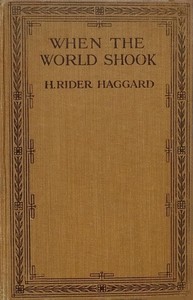
When the World Shook - Being an Account of the Great Adventure of Bastin, Bickley and Arbuthnot
Subjects:
Download Formats:
Excerpt
Being an Account of the Great Adventure
of Bastin, Bickley and Arbuthnot
CHAPTER I. Arbuthnot Describes Himself
CHAPTER II. Bastin and Bickley
CHAPTER III. Natalie
CHAPTER IV. Death and Departure
CHAPTER V. The Cyclone
CHAPTER VI. Land
CHAPTER VII. The Orofenans
CHAPTER VIII. Bastin Attempts the Martyr’s Crown
CHAPTER IX. The Island in the Lake
CHAPTER X. The Dwellers in the Tomb
CHAPTER XI. Resurrection
CHAPTER XII. Two Hundred and Fifty Thousand Years!
CHAPTER...
Read the Full Text
— End of When the World Shook - Being an Account of the Great Adventure of Bastin, Bickley and Arbuthnot —
Book Information
- Title
- When the World Shook - Being an Account of the Great Adventure of Bastin, Bickley and Arbuthnot
- Author(s)
- Haggard, H. Rider (Henry Rider)
- Language
- English
- Type
- Text
- Release Date
- June 1, 1998
- Word Count
- 120,901 words
- Library of Congress Classification
- PR
- Bookshelves
- Browsing: Literature, Browsing: Science-Fiction & Fantasy, Browsing: Fiction
- Rights
- Public domain in the USA.
Related Books
The crystal planetoids
by Coblentz, Stanton A. (Stanton Arthur)
English
441h 21m read

Terror out of the past
by Gallun, Raymond Z., Gallun, Raymond Z. (Raymond Zinke)
English
247h 56m read
Corsairs of the cosmos
by Hamilton, Edmond
English
152h 39m read
The incredible slingshot bombs
by Williams, Robert Moore
English
96h 4m read
The young naval captain
by Stratemeyer, Edward
English
700h 5m read
Tour of the Zero Club
by Stratemeyer, Edward
English
977h 48m read