*** START OF THE PROJECT GUTENBERG EBOOK 74518 ***
[Illustration: [Mice]]
[Illustration: [Frog]]
[Illustration]
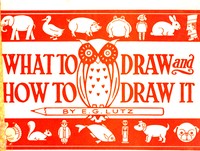
WHAT TO DRAW _and_ HOW TO DRAW IT
_by_ E.G. LUTZ
DODD, MEAD & COMPANY
Fourth Avenue and 30th Street
Publishers
Copyright, 1913, by E. G. Lutz
All rights reserved
Printed in U. S. A.
[Illustration: [Owl]]
INSTRUCTIONS
In drawing from this book, copy the last diagram, or finished picture,
of the particular series before you.
The other diagrams—beginning with number one, then number two, and so
on—show how to go on with your drawing. They give the order in which to
make the various strokes of the pencil that together form the completed
picture. The dotted lines indicate where light lines are drawn that help
in construction—that is; getting proportions correctly, outlining the
general form, or marking details in their proper places. Do not press
hard on the pencil in making these construction lines, then they can be
erased afterwards.
Use pencil compasses for the circles, or mark them off with buttons or
disks.
[Illustration: To Draw a Five-Pointed Star]
[Illustration: Pagoda Lighthouse Chateau]
[Illustration: Tent]
[Illustration: Cube House Barn]
[Illustration: Toy Horse]
[Illustration: Toys]
[Illustration: Crested Crane]
[Illustration: Cranes]
[Illustration: Cat IN BRIGHT DAYLIGHT PUPILS OF EYES ARE LIKE THIS
Things to notice when drawing a cat’s face SHAPE OF EARS EYES WIDE APART
A FEW LONG HAIRS ABOVE EYES EYES—PUPILS CHANGE IN SIZE AND SHAPE
TIGER-LIKE MARKINGS AROUND EYES LONG WHISKERS MAKE AN OUTLINE THE SAME
WAY AS ABOVE]
[Illustration: Mice]
[Illustration: CURIOUS FISHES 1 Cow Fish 2 Moon Fish 3 Angel Fish 4
Trunk Fish]
[Illustration: Fishes]
[Illustration: Cattail plant]
[Illustration: Water-lily Dragon-fly Frogs Tadpoles]
[Illustration: Rabbit Running Bob-white Rabbit Running]
[Illustration: Rabbits]
[Illustration: [Rooster]]
[Illustration: Hen and Chicks]
[Illustration: Swan]
[Illustration: Duck Goose Gosling]
[Illustration: Cow]
[Illustration: Pig Goat]
[Illustration: Bulldog]
[Illustration: Dogs]
[Illustration: FIRST DRAW A TRIANGLE WITH SIDES EQUAL Horse]
[Illustration: Turkey Fantail Pigeon]
[Illustration: Humming-Birds]
[Illustration: Various Birds]
[Illustration: Swallows]
[Illustration: Flying Birds]
[Illustration: Owl]
[Illustration: Owls]
[Illustration: [Crested Bird]]
[Illustration: Parrakeet and Parrot]
[Illustration: Squirrels]
[Illustration: Bears Raccoon]
[Illustration: BABY ELEPHANT CIRCUS ELEPHANT]
[Illustration: Monkey Elephant]
[Illustration: FIRST DRAW A RHOMBOID Pelican]
[Illustration: Magpie Heron Birds made with Straight Lines Stilt
Adjutant]
[Illustration: Kangaroo]
[Illustration: Giraffe and Camel Straight Line Drawings]
[Illustration: [Man]]
[Illustration: Faces—Easily drawn]
[Illustration: [Man]]
[Illustration: Figures—Men—Drawn with straight lines]
[Illustration: [Man]]
[Illustration: Faces— Straight Lines—]
[Illustration: The Clown’s Droll Face]
[Illustration: Drawing Faces in an Amusing Way]
[Illustration: A Mirthful Countenance]
[Illustration: Profiles—Easy to draw]
[Illustration: Expressions Lightly drawn lines like above will help in
making sketches]
[Illustration: Faces—Curves—]
[Illustration: [Men]]
[Illustration: Faces in Ovals]
[Illustration: [Girls]]
[Illustration: Little Girl and Boy]
[Illustration: Round Figures To draw these figures, first make circles
as shown in A1. & B1.]
[Illustration: An odd way of beginning Figures— Men—]
[Illustration: [Women]]
[Illustration: Figures— Women—]
[Illustration: Making an Oval with the Compasses DRAW TWO LINES CROSSING
AT RIGHT ANGLES WITH A AS CENTER DESCRIBE CIRCLE WITH DIAMETER WIDTH OF
OVAL WANTED FROM B and C DRAW LINES THROUGH AND BEYOND D FROM B and C AS
CENTERS DESCRIBE ARCS TO E and F WITH D AS CENTER CONNECT E and F BY AN
ARC COMPLETING OVAL]
DRAWING OVALS AND ELLIPSES
Take note, first of all, of the difference between an ellipse and an
oval.
The large plate explains the construction of an ellipse. It shows how to
find the points where the three pins are placed that determine the size
of the looped string. Be sure and make measurements accurately. Use a
string that will not give, cotton thread is good for small ellipses,
silk is too elastic. A suggestion to amateur gardeners: make elliptical
flower beds this way.
The caution in regard to accuracy also applies to the making of the
oval.
[Illustration: How to make an Ellipse DRAW TWO LINES CROSSING AT RIGHT
ANGLES IN CENTER WITH COMPASSES MEASURE DISTANCE BA WITH CENTER C AND
DISTANCE BA AS RADIUS INTERSECT LINE BD AT POINTS OF INTERSECTION E AND
F PLACE PINS PLACE PIN AT C LOOP A STRING AROUND ALL THREE PINS TAKE OUT
PIN AT C AND REPLACE WITH PENCIL POINT WITH STRING TAUT RUN THE PENCIL
AROUND UNTIL ELLIPSE IS COMPLETED]
[Illustration: [House]]
SUGGESTIONS FOR WATER-COLOR PAINTING
Here is a good list of colors for practical work. The first eight are
enough for every purpose; but add, if you wish, purple and orange. Moist
colors in pans are best. There are many different kinds of red, green,
blue and brown paints; and as you may be puzzled and not know what to
get, the names of the best hues of these particular colors are also
given. The most useful paints in this list are yellow ochre, light red,
Vandyke brown and Payne’s gray. Learn to work with them, use them often
and see the beautiful effects they produce. Delicate tints are made with
thin washes of yellow ochre and light red. Vandyke brown makes a variety
of pleasing tints.
Use the bright colors sparingly.
You do not need a black paint. Payne’s gray with either brown, blue,
crimson or green gives rich dark tones. Payne’s gray is also useful in
shadows and shading other colors. For the different kinds of greens, mix
yellow ochre, blue or brown with Hooker’s green. Use thin washes of
light red and blue for the gray of distances and clouds.
[Illustration]
┌──────────────────────────────────────────────┐
│ A USEFUL LIST OF WATER-COLORS │
│ │
│ ·COLORS· ·WHAT·TO·ASK·FOR·IN·THE·SHOP·│
│1 YELLOW YELLOW OCHRE │
│2 BRIGHT YELLOW GAMBOGE │
│3 RED LIGHT RED │
│4 CRIMSON CRIMSON LAKE │
│5 BROWN VANDYKE BROWN │
│6 BLUE NEW BLUE OR ULTRAMARINE │
│7 GREEN HOOKER’S GREEN No. 1 │
│8 GRAY PAYNE’S GRAY │
│ │
│ —Supplementary— │
│ │
│9 PURPLE MAUVE │
│10 ORANGE ORANGE-VERMILION │
└──────────────────────────────────────────────┘
[Illustration: [Profiles of men]]
[Illustration: [Profiles of women]]
[Illustration: [Chickens]]
[Illustration: [Rabbit]]
[Illustration: [Adjutant]]
------------------------------------------------------------------------
[Illustration: AN IDEAL GIFT FOR CHILDREN]
WHAT TO DRAW and HOW TO DRAW
This is really a remarkable book in which _line is made a good reason
for form_. The youngest child may grasp the magic progress of this way
of working and he will draw the picture naturally and well.
INSTRUCTIONS are very brief, for _the key lines_ of each object tell
their own story and the child is entranced by the results soon gained.
There is no stupid tracing in this book, for tracing accomplishes at
most only a little muscular control.
The book provides a step-by-step system that _fixes_ the object in
memory and develops naturally as a physical skill and a mental knowledge
of proportion and form.
Foreshortening and perspective, often bugbears to young artists, are
overcome by the simplest progressive examples.
REMEMBERING THE KEY LINE opens the way to the completed object. There
are hundreds of pictures to draw and all those most fascinating to the
child, who is thrilled by the “magic” that makes drawing easy and
delightfully interesting.
“_Just remember the KEY LINE, that’s all._”
------------------------------------------------------------------------
TRANSCRIBER’S NOTES
● Typos fixed; non-standard spelling and dialect retained.
● Enclosed italics font in _underscores_.
*** END OF THE PROJECT GUTENBERG EBOOK 74518 ***
What to draw and how to draw it
Subjects:
Download Formats:
Excerpt
DODD, MEAD & COMPANY
Fourth Avenue and 30th Street
Publishers
In drawing from this book, copy the last diagram, or finished picture,
of the particular series before you.
The other diagrams—beginning with number one, then number two, and so
on—show how to go on with your drawing. They give the order in which to
make the various strokes of the pencil that together form the completed
picture. The dotted lines indicate where light...
Read the Full Text
— End of What to draw and how to draw it —
Book Information
- Title
- What to draw and how to draw it
- Author(s)
- Lutz, Edwin George
- Language
- English
- Type
- Text
- Release Date
- October 4, 2024
- Word Count
- 1,166 words
- Library of Congress Classification
- NC
- Bookshelves
- Browsing: Children & Young Adult Reading, Browsing: How To...
- Rights
- Public domain in the USA.