*** START OF THE PROJECT GUTENBERG EBOOK 65804 ***
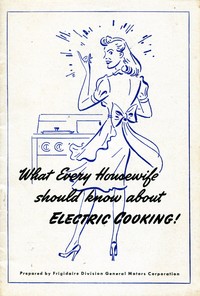
_What Every Housewife
should know about_
_Electric Cooking!_
Prepared by Frigidaire Division General Motors Corporation
_Where to find it...._
Electric Cooking in General Page 2
Surface Cooking Page 5
Using the Electric Oven Page 9
Utility of Electric Ranges Page 15
Care of the Electric Range Page 16
Vegetable Cooking Guide Page 20
Baking Times and Temperatures Page 21
Meat and Fowl Roasting Chart Page 22
Frozen Vegetable Cooking Guide Page 23
Frozen Meat Cooking Guide Page 24
[Illustration: uncaptioned]
This booklet has in it sixty-nine of the most frequently asked questions
(and their answers) about cooking with an Electric Range.
In it, too, is some interesting information about the cooking of frozen
food. This probably will answer more questions which have come up in
your mind and these answers will be even more important in the future
when Home Freezers are as common as Refrigerators and Electric Ranges.
So, keep this booklet handy. Read it. Learn for yourself the proven
facts about Electric Cooking ... the answers that every housewife should
know when she plans that new kitchen.
And remember: an Electric Range provides many cooking and baking
advantages which have made it the preferred appliance among thousands of
housewives.
Electric Cooking in General
[Illustration: uncaptioned]
1. Q. Do I Have to Learn to Cook All Over Again to Cook with
Electricity?
A. Of course not! Just use your same favorite recipes (and many
others) with confidence and ease—the only difference will be that your
electric range will give you greater simplicity and accuracy, and add
greater joy to cooking because it is cleaner, cooler and automatic.
2. Q. Is Cooking by Electricity Expensive?
A. In most sections of the country electrical cookery is no more
expensive than other methods, often less expensive. In fact most
modern electric ranges as produced by reliable manufacturers are
designed and engineered for economical operation.
3. Q. Approximately How Much Does It Cost an Average Family to Operate
an Electric Range?
A. Reproduced here is a table giving approximate electrical cooking
costs compiled from the experience of electric range users in all
parts of the country.
Electric Cooking Rate In Your Number of People in the Family
Locality (Per Kilowatt Hour)
2 3 4 5 6
1c $.56 $.72 $.84 $.95 $1.02
1¼c .70 .90 1.05 1.19 1.28
1½c .84 1.08 1.26 1.43 1.53
1¾c .98 1.26 1.47 1.66 1.79
2c 1.12 1.44 1.68 1.90 2.04
2¼c (Ave. Elec. Cooking Rate) 1.26 1.62 1.89 2.14 2.30
2½c 1.40 1.80 2.10 2.38 2.55
2¾c 1.54 1.98 2.31 2.61 2.81
3c 1.68 2.16 2.52 2.85 3.06
4. Q. Is It Expensive to Pre-heat Such a Large Oven?
A. No. It costs approximately 1¼c to pre-heat a large electric oven to
the average baking or roasting temperature—(350°F) and much of this
heat is conserved during baking or roasting by the oven insulation.
Actually, the current is on only a part of the time that the oven is
in use.
5. Q. What About the Safety of an Electric Range?
A. All reputable electric ranges are inspected, tested and approved by
the Underwriter Laboratories for fire and casualty hazards and must
comply with their rigid standards. As a matter of general practice and
recommendation of manufacturers, frames and all non-electrical parts
are grounded to insure against becoming electrically alive while in
use. All electrical parts are shielded and insulated to protect
against accidental contact.
6. Q. Can Cooking be Continued with Safety During an Electrical Storm?
A. Yes, completely. Due to the reasons of safety mentioned above.
7. Q. What Happens if a Switch Is Turned On and Left On By Mistake?
A. Current will be wasted, that’s all. The oven cannot overheat
because automatic controls prevent this. The surface units can be left
on at high speed for days without damage to the unit or without
hazard.
8. Q. Is There Any Hazard Involved By Leaving the Electric Oven
Operating During My Absence?
A. No. You can place an entire meal in the oven and leave the house
for the afternoon, and the range will automatically cook the dinner
and turn off the heat at the proper time if the range is equipped with
an automatic time control. Should you arrive home later than planned
the oven will have retained sufficient heat for a reasonable length of
time to keep the dinner warm enough for immediate serving.
9. Q. What Happens if Power Failure Occurs?
A. Experience indicates that power failures are negligible. And, even
should they occur, there is no danger from the electric range. Only
the inconvenience of being without the use of the range during the
period the power is off.
[Illustration: uncaptioned]
Surface Cooking on the Electric Range
[Illustration: uncaptioned]
1. Q. Do the “Definite” _Surface_ Heats Provided by Most Electric
Ranges, Have Any Advantages Over the “Infinite” Number of Surface
Heats Provided by Ranges Using Other Fuels?
A. Yes. This is important because it eliminates “guesswork” in cooking
and enables you to use even unfamiliar recipes with confidence and
ease. The heat obtained at each switch setting will be repeated
exactly each time you use it.
2. Q. How Many Surface Heats Should be Provided for Best Results?
A. Most ranges have five surface heats described here, and these have
been found adequate for every cooking need.
3. Q. What Is the Use for Surface “High” Heat?
A. “High” heat is always used to bring foods quickly to steaming
point. (As soon as cooking temperatures are reached one of the lower
heats is used to continue and complete that cooking.) It is used to
preheat fat for frying and used continuously for deep fat frying of
potatoes. “High” heat is always used for speed in heating water.
[Illustration: _High_]
4. Q. What Is the Use for the Surface “Medium-High” Heat?
A. “Medium-high” provides the right temperature for frying chicken or
browning meats and for maintaining cooking of large quantities of food
in extra large utensils. “Medium-high” on small units can be used for
baking griddle cakes when a small utensil is used.
[Illustration: _Medium High_]
5. Q. When Do You Use the Surface “Medium-Low” Heat?
A. “Medium-low” is just right for percolating coffee or for heating
small quantities of food quickly.
[Illustration: _Medium Low_]
6. Q. How Is “Low” Heat Used?
A. “Low” heat is used for keeping foods cooking after they have been
started on “high” heat. This low heat is sufficient for keeping quite
a large quantity of vegetables and other foods actively cooking.
[Illustration: _Low_]
7. Q. How Is “Simmer” Heat Used?
A. “Simmer” heat is used for low temperature cooking, for instance,
small quantities of vegetables, cooking custards, sauces and dried
fruits. The uses for “low” and “simmer” heats are much the same
excepting “low” is used for larger quantities of foods.
[Illustration: _Simmer_]
8. Q. Why Is Low Water Cooking Recommended for Vegetables?
A. Because more food value is retained, also flavor and appearance is
better. Very little water need be added to vegetables to create the
necessary steam for proper cooking.
9. Q. Which of the Five Surface Heats Is Most Practical to Use in Making
Coffee?
A. “Medium-low” on either the large or small unit, depending upon the
size percolator and amount of coffee to be made.
10. Q. Is the Deep Well Cooker More Practical Than a Fourth Surface
Unit?
A. Yes, because the deep well cooker will perform virtually any
cooking operation possible on a surface unit, plus baking, and do many
of them better and more economically.
11. Q. What Types of Food Are Best Prepared in the Deep Well Cooker?
A. Pot roasts, soups, stews and any foods requiring long cooking
times.
12. Q. What Are Some Uses for the Deep Well Cooker?
A. Steaming puddings, baking, simmering dried fruits and cooking
tougher cuts of meats. As a utensil it can be used for sterilizing.
13. Q. Do Flavors Mingle When Several Foods Are Cooked at One Time in
the Deep Well Cooker?
A. No—If you will remember to do one thing—always remove the foods
from the cooker as soon as the current is turned off. While foods are
cooking they are “exhaling” their odors. When they begin to cool they
begin to “inhale” and absorb the odors of other foods.
[Illustration: uncaptioned]
14. Q. Can the Deep Well Cooker Be Used for Steaming Brown Bread,
Puddings, etc.?
A. Yes, by pouring water in the bottom of the cooker and using a
“trivet” or rack.
15. Q. Can the Deep Well Cooker Be Used for Baking?
A. Yes. It is economical for baking several potatoes, cup custards or
baked apples. When the cooker well is used for baking the cooker
utensil is removed and a rack placed in the well. The well is heated
to proper baking temperature with the switch on “high” and baking is
continued on “low” heat.
16. Q. How Can the Deep Well Cooker Be Used as a Warming Oven?
A. Remove the utensil. Place the rack in the well and cover with the
lid of the cooker. “Low” heat provides sufficient heat for warming.
17. Q. Can the Deep Well Cooker Utensil Be Used on the Surface Unit?
A. Yes.
18. Q. Does Food Cook as Fast in a Deep Well Cooker?
A. Yes. It is ideal for soups, stews, pot roasts, etc., which require
uniform low temperatures over longer periods for best cooking results.
19. Q. Why Are Deep Well Cookers Usually Insulated?
A. Many foods prepared in the deep well cooker are those requiring
long cooking periods. Because of adequate insulation less current is
used. For example, the insulation on deep well cookers makes it
possible to prepare an entire meal at a total current cost of less
than two cents. (Based on an electric cooking rate of two-and-a-half
cents per kilowatt.)
Using the Electric Range Oven
[Illustration: uncaptioned]
1. Q. How Long Does It Take to Preheat the Electric Oven for Baking?
A. From seven to fifteen minutes is usually required for preheating to
a temperature of 350°F. (In one make of Range, two units provide
correct baking heat and fast preheating to _400°F_ in _less_ than
seven minutes.)
2. Q. How Can the User Determine When the Oven Has Reached the
Temperature She Desires for Baking or Roasting?
A. This is easily determined by the oven signal light which goes out
when the oven reaches the desired temperature.
3. Q. Is It Necessary to Preheat the Electric Oven for Baking?
A. No, however, for time-saving the oven should be preheated.
4. Q. Should the Oven Always be Preheated for Oven Meals?
A. This depends on the type of oven meal. For example, there are many
combinations of foods which can be placed in the oven and remain there
several hours before cooking is started and which do not require
preheat. Other types of oven meals require cooking immediately as soon
as they are prepared and better results are obtained from a preheated
oven.
5. Q. If Four Baking Pans Are Put Into an Electric Oven at One Time, How
Should They Be Placed to Allow for Even Heat Distribution?
A. The pans should be placed so they are not touching each other, or
any part of the oven. Since this usually means using two shelves, the
pans should be staggered, so one is not directly above the other.
6. Q. Why Is It Not Necessary to “Peek” Into an Electric Oven During
Roasting or Baking?
A. Because with accurate electric controls, much of the uncertainty of
cooking has been eliminated. Even if the recipe that you are using is
questionable, do not “peek” until the required baking time has passed.
7. Q. Why Do You Recommend Roasting in an Open Shallow Pan Without the
Addition of Water?
A. A shallow pan allows the heat from the oven to contact the food
more directly. With the even penetration of heat, meat will cook more
uniformly.
8. Q. Why Is There So Little Shrinkage and “Drying-out” of Meats Cooked
in an Electric Range?
A. Because electricity does not require additional air for fuel
combustion, there is no excess air circulation to absorb moisture and
carry it out of the oven.
9. Q. How Does an Oven Clock Control Work?
A. Simply set the automatic clock control at the time you want the
current to go on and at the time you want the cooking operation to
stop. Set the thermostat at a given temperature and the range will
automatically perform the desired cooking operation.
10. Q. Are All Ranges Equipped With Time Clocks Automatically
Controlling the Oven Operation?
A. No. This is a feature usually included as standard equipment on
higher priced models. It can be added as an accessory to many of the
lower priced models.
11. Q. Is It Possible to Operate an Electric Range Oven at Low
Temperature, Such as 200°F?
A. Thermostatic controls are capable of operating at temperatures as
low as 150°F. on practically all electric ranges.
12. Q. What Is the Maximum Temperature at Which Electric Range Ovens Can
Be Automatically Controlled?
A. Nearly all electric ovens will heat to 550°F. This is above
required baking temperatures, yet it avoids danger of burning foods
which would of course be possible at higher temperatures. The
thermostat is always set at this maximum temperature when broiling is
done to avoid having the broiling unit cut off during the cooking
operation.
13. Q. What Is the Advantage of Having the Oven Vent Open on the Front
of the Back Panel?
A. First, you can place the range flush against the wall without
damaging the wall paper or curtains. Second, the top vent prevents
moisture from collecting in the top of the oven. Accordingly the
housewife is assured that cakes baked on the upper shelf will not be
soggy but will turn out as beautifully browned as those baked on lower
shelves. Third, no flue pipe is necessary.
14. Q. Why Do Most Electric Ovens Have Shelf Type Doors?
A. This type of door cannot sag, as do swing doors, thus creating
drafts of cold air within the oven. Also, they serve as a convenient
shelf in placing pans in, or taking them out of the oven.
15. Q. Can the User Depend on an Electric Oven Thermostatic Control?
A. The hydraulic type control is so designed that the bulb can be
placed in the desired oven position to insure accurate temperatures
while the control knob can be located in that position which is most
convenient for the user.
16. Q. Does the Automatic Oven Control Increase Economy for Electric
Range Users?
A. Yes. By providing no more heat than is needed to maintain the
required temperature this control avoids waste of electricity.
17. Q. Some Electric Ranges Have Two Units for Heating the Oven. Others
Only Have One. What Is the Essential Difference?
A. First, two units give a greater degree of flexibility and a more
even distribution of heat throughout the oven. Also, they allow the
use of the upper unit for broiling in a more convenient position. The
single unit oven is not as convenient because broiling is done on the
lower part of the oven and it lacks the type of heat distribution made
possible by two units.
18. Q. Does the Electric Oven Give Off Much Heat in the Kitchen During
Baking or Roasting?
A. Because electric heating elements require no air supply for
combustion, the oven is completely insulated on all six sides, thus
giving off practically no heat.
19. Q. Should the Broiler Pan Be Heated Before Broiling Is Started?
A. No. A hot broiler pan is many times responsible for excess smoking
because of fat drippings from the meat striking the hot broiler pan.
20. Q. How Is Broiling Speed Regulated?
A. Broiling speed is regulated by raising or lowering the position of
the broiler pan in the oven. For fast broiling, place on oven shelf
located close to heating unit. This will produce results very similar
to charcoal broiling. For lower temperature or slower broiling, lower
the oven shelf so that top surface of food will be 2½ or 3 inches from
the broiling unit, and allow slightly more time for broiling.
21. Q. Are Broiler Meals Popular?
A. Yes. Much of the original flavor is retained in the food by this
method of cooking. For example, meat and fruits may be placed on the
broiler pan and cooked. The vegetable can be placed in the pan below
the broiler rack. The cooked vegetable will be heated while the food
on the rack is broiled.
22. Q. Is It Advisable to Use the Broiler Pan for Roasting?
A. Yes, the broiler pan is a convenient utensil for use in roasting.
23. Q. For Best Results, Should Frozen Meats Be Entirely Defrosted
Before Cooking?
A. Acceptable cooking results may be obtained either way. However, if
meat is allowed to thaw, cooking time can be judged more accurately;
also thick steaks broil more uniformly if allowed to thaw. Meat to be
thawed may be placed on the shelf of your household refrigerator
without removing the wrapping.
If it is more convenient to cook without thawing, the meat should be
cooked for a longer period of time than usual at a slightly lower
temperature. A thick steak cooking from the frozen condition may
appear cooked, but actually be cold and raw in the center. Generally
meats that are cooked from the frozen condition should be cooked half
again as long as thawed meats, and sometime longer. It isn’t easy to
figure cooking time, the length of time will depend, of course, upon
the kind of meat and whether you want it rare, medium or well done.
See the charts on pages 23 and 24 for a guide in cooking frozen foods.
Utility of the Electric Range
[Illustration: uncaptioned]
1. Q. Are All Electric Ranges Equipped With a Warming Drawer?
A. No. It is usually a regular feature on deluxe models and can be
installed as an accessory on some other models.
2. Q. Are the Temperatures in the Warming Drawer Harmful to China?
A. No. The temperature is sufficient for warming china but not high
enough to cause any harm.
3. Q. Are the Warming Drawer Temperatures Adequate for Keeping Food Warm
for Serving?
A. Yes. A common practice is that of placing fresh baked rolls in the
warming drawer for serving during the dinner period.
4. Q. Do All Ranges Have Storage Space for Cooking Utensils?
A. Most do. Some models of course offer more storage space than
others.
5. Q. Are Hot Pans Harmful to the Porcelain of the Work Surface of the
Range?
A. Yes. Sliding hot pans from the cooking unit to the porcelain work
surface may result in scratches. An inexpensive pad may be used to
protect the work surface.
6. Q. Will the Porcelain Surface of the Range Be Harmed By Large Pans
Which Extend Over the Unit and Contact Directly?
A. Yes. A good example of this is a large pressure cooker. The
recessed bottom on some pressure cookers has caused considerable
damage to the porcelain cooking top on ranges because the heating unit
does not come in contact with the pressure cooker resulting in
excessive temperatures adjacent to the surface unit. When such
utensils must be used, it is well to raise the unit from the surface
to insure direct contact.
One make of Range has available a metal ring which slips in under the
unit and raises it about 1 inch to prevent damage to the porcelain
top.
Care of the Electric Range
[Illustration: uncaptioned]
1. Q. Why Is It Easy to Keep Electric Ranges Clean?
A. First, electricity is the cleanest of all fuels. Second, one piece
ovens eliminate cracks and provide round corners—work surfaces with
coved backs and cooking units that are easily removed for cleaning.
Porcelain in itself is one of the easiest of all surfaces to clean.
2. Q. What Is the Best Way to Clean the Outer Surface of an Electric
Range?
A. First, let porcelain finished surfaces cool before cleaning.
Second, wipe up spots as soon as possible. If porcelain is warm, use a
dry cloth, never a wet one. Third, when porcelain is cool, wipe with a
damp soapy cloth, rinse and dry well. Do not use gritty soaps or acid.
3. Q. Are There Any Precautions That Should Be Used in Cleaning an
Electric Range?
A. Yes. First, see that all switches are “Off.” Second, do not use
abrasives or other cleaning materials that will scratch. Third, do not
immerse electrical units in water. If these units become damp in
cleaning, be sure that they are dry before connecting. Fourth, do not
clean surface units while hot. Fifth, always soften hardened foods
before removing as unnecessary scraping may damage any type of
surface.
4. Q. What Is the Best Way to Clean the Oven?
A. Always be sure the current is turned off and the oven is at least
partially cooled. The interior is more easily cleaned with a damp
cloth before the oven is entirely cooled. Be sure to remove shelves
and heat units first and put them in a dry place. Wipe out the inside
of the oven with a cloth wrung from soap water, rinse and dry well.
Fine steel wool may be used to remove any food particles adhering to
the surface. Spillovers which occur during baking or roasting may
involve a little more difficulty in cleaning. If so, a cloth saturated
with water to which household ammonia has been added may be placed
over the soiled surface of the oven or “baffle” and allowed to remain
for 20 minutes or an hour. Burned-on material may then be more easily
removed by a cloth or fine steel wool without damaging glossy surface.
Caution: Do not use the oven repeatedly after a spillover. This causes
continual burning on of the food particles making them more difficult
to remove, and in time will cause some damage to the glossy surface.
5. Q. What About Cleaning Under the Electric Range?
A. This is seldom necessary. However, if it is, remove the lower
utility drawers which gives access to the floor space below. If a
thorough cleaning is desired, the range can be moved away from the
wall where there is a long enough cord, or where it can be
disconnected.
6. Q. What Happens When Hot Grease Spatters Out of the Frying Pan on to
the Electric Range?
A. Nothing. After cooking has been completed and the surface units
have had time to cool completely, wash the surface with soap and
water, rinse, and dry well. Note: If spattering occurs in excess
during frying, you are using heat too high for this type of cooking
operation. Review again the suggested heats for the different cooking
operations on the surface units.
7. Q. What Is the Best Method of Cleaning the Broiler Pan?
A. The broiler pan and rack should be washed just as any of your other
cooking utensils. Place in water immediately after using and apply
steel wool to any food which cannot be removed easily.
8. Q. Should the Surface of the Range be Waxed to Protect the Porcelain?
A. No. Thorough cleaning and drying is the best protection you can
give to that glossy porcelain.
9. Q. Is It Necessary to Place the Range Some Distance from the Wall to
Prevent Soilage of the Paper?
A. No—in fact the range can be placed as close to the wall as desired
because oven vents are usually on the back panel and open towards the
front, eliminating danger of soiling from the oven.
10. Q. How Are Spillovers Cleaned from the Surface Units?
A. Most surface units are of the fully enclosed type and can be
cleaned by merely brushing them off occasionally. The ring around the
units should be cleaned with a damp cloth and soap powder.
11. Q. What Happens if Foods Spill Over on the Surface Unit?
A. Nothing. They are caught by the reflector and the drip tray causing
no damage to the unit. Wiring is so protected that no electrical
problems are involved.
12. Q. How May the Drip Tray Be Cleaned?
A. The drip tray which is located directly below the surface cooking
units is easily removed and can be washed as any other utensil.
[Illustration: uncaptioned]
• Time and temperature tables for cooking vegetables • baking and
roasting,
Vegetable Cooking Guide
The cooking time for vegetables will vary somewhat, depending upon their
freshness and the quantity. This should be taken into account when using
the following table, which is simply a guide to help you determine the
correct cooking time.
APPROXIMATE COOKING TIMES
VEGETABLE OR METHOD OF PREPARATION MINUTES ON MINUTES ON TOTAL
FRUIT HIGH FOR LOW OR MINUTES OF
STEAMING SIMMER COOKING
UNTIL TIME
TENDER
Apples Peeled and quartered 3 to 5 [1] [1]
Asparagus Tied in serving 4 to 6 10 to 15 14 to 20
bundles
Green Beans Cut in slivers, 5 to 8 10 to 15 15 to 20
lengthwise
Green Beans Broken 4 to 7 15 to 20 20 to 30
Beans, Lima Shelled 3 to 8 15 to 20 18 to 25
Beets Diced or sliced thin 5 to 6 15 to 20 20 to 25
Beets Whole unpeeled 5 to 8 15 to 20 25 to 35
Broccoli Stalks Split 5 to 8 15 to 20 20 to 30
Brussels Whole 3 to 5 10 to 15 15 to 20
Sprouts
Cabbage Shredded or quartered 4 to 5 6 to 7 10 to 12
Carrots Shredded 4 to 6 6 10 to 12
Carrots Sliced ⅛ inch thick 5 to 8 15 15 to 20
Cauliflower Separated into 4 to 6 10 to 12 15 to 18
flowerettes
Cauliflower Whole head 5 to 8 15 to 20 20 to 25
Corn Cut from the cob 3 to 5 [1] [1]
Onions Small, whole 4 to 6 10 to 20 20 to 25
Parsnips Quartered lengthwise 5 to 6 15 to 20 20 to 30
Peas, green Shelled 5 to 8 10 to 15 18 to 20
Potatoes Cut in halves 4 to 8 15 to 20 25 to 30
Potatoes, Cut in halves 3 to 8 20 to 25 25 to 30
sweet
Spinach No water added 5 to 8 [1] [1]
Squash, Hub. Sliced 3 to 8 15 to 20 20 to 30
Squash, Sum. Cut in slices 3 to 8 5 to 10 10 to 18
Tomatoes Quartered—no water 3 to 4 5 to 10 10 to 15
Turnips Sliced or cubed 5 to 6 15 20 to 25
[1]These are usually sufficiently cooked when they reach the boiling
point. Any additional cooking time, on lower heats will depend upon
the amount and “variety” of the food.
BAKING Time and Temperature Chart
_Quantity_ _Temperature_ _Approximate
Time_
BREAD, ROLLS
Bread 4 or 6 400°F. 1 hour
loaves
Frigidaire Rolls 400°F. 20 to 25 minutes
Swedish Tea Ring 375°F. 25 to 30 minutes
Honey Twist 375°F. 25 to 30 minutes
Brown Bread 2 loaves 375°F. 50 to 55 minutes
Butterscotch 2 loaves 350°F. 1 hour
Bread
Quick Coffee Cake 1 pan 400°F. 35 minutes
Corn Bread 400°F. 30 to 35 minutes
BISCUITS
Breakfast 450°F. 11 minutes
Biscuits
Southern Biscuits 450°F. 11 minutes
PIES
Pie Shell 1 or 2 pies 450°F. 15 minutes
Apple Pie 1 or 2 pies 450°F. 40 minutes
Blueberry Pie 1 or 2 pies 450°F. 40 minutes
Butterscotch Pie 1 or 2 pies 350°F. 10 to 15 minutes
(Meringue)
Custard Pie 1 or 2 pies {450°F. 10 minutes
{325°F. 25 minutes
MUFFINS
Plain Muffins 400°F. 25 to 30 minutes
Blueberry Muffins 400°F. 25 to 30 minutes
CAKES
Angel Food Tube cake {325°F. 15 minutes and
pan
{350°F. 55 minutes
Sponge Cake Tube cake 350°F. 45 to 50 minutes
pan
Layer Cake Two layers 375°F. 40 minutes
Pound Cake Two loaf 350°F. 1 hour, 10
pans minutes
Meringue Cake One layer 300°F. 55 minutes
Fudge Cake Two layers 375°F. 35 minutes
COOKIES
Refrigerator One sheet 400°F. 9 or 10 minutes
Cookies
Mincemeat Cookies One sheet 400°F. 10 minutes
Sugar Cookies One sheet 400°F. 10 minutes
Butterscotch One sheet 375°F. 10 minutes
Cookies
Walnut Cookies One sheet 400°F. 10 minutes
Cream Puffs One sheet {450°F. 20 minutes
{425°F. 20 minutes
ENTREES
Baked Potatoes 400°F. 1 hour
Scalloped 375°F. 1 hour
Potatoes
Candied Sweet 375°F. 1 hour
Potatoes
Cheese Souffle 325°F. 40 minutes
Salmon Souffle 325°F. 40 minutes
Corn Souffle 350°F. 40 minutes
Baked Macaroni 350°F. 45 minutes
Baked Apples 375°F. 30 to 40 minutes
Baked Hash 350°F. 1 hour
Baked Beans 300°F. 3 hours
ROASTING CHART for Meats and Fowl
_Cut of Meat_ _Cooking _Approximate Time_
Temperature_
BEEF—Standing Rib
Rare 300° to 350°F. 18-20 minutes per pound or to
internal temperature 140°F.
Medium 300° to 350°F. 22-25 minutes per pound or to
internal temperature 160°F.
Well Done 300° to 350°F. 27-30 minutes per pound or to
For very well internal temperature 170°F.
done allow full
time at 350°F.
Boned Roasts 300° to 350°F. Add 10-15 minutes per pound
Top Round
Medium 300°F. 20-25 minutes per pound
Well Done 300°F. 30-35 minutes per pound
Rump 300°F. 30-35 minutes per pound
Chuck 300°F. 30 minutes per pound
LAMB—Leg 300° to 350°F. 30 minutes per pound
Stuffed Shoulder 300° to 350°F. 45 minutes per pound
Stuffed Breast 300° to 350°F. 45-60 minutes per pound
Crown Roast 300° to 350°F. 30 minutes per pound
VEAL—Leg 300°F. 22 minutes per pound
Shoulder 300°F. 25 minutes per pound
Loin or Rack 300°F. 30-35 minutes per pound
PORK—Fresh
Ham 350°F. 40-45 minutes per pound
Loin 350°F. 30-35 minutes per pound
Cushion 350°F. 35-40 minutes per pound
Pork Butt 350°F. 40-45 minutes per pound
Spareribs 300°F. 1-1½ hours
Tenderloin 300°F. 1 hour
PORK—Cured
Large Ham (14-18 300°F. 20 minutes per pound
lbs.)
Small Ham (10-12 300°F. 25 minutes per pound
lbs.)
Half of Ham (5-6 300°F. 30 minutes per pound
lbs.)
Shank End 300°F. 40 minutes per pound
Butt End 300°F. 45 minutes per pound
CHICKEN
Large (4-6 lbs.) 325° to 350°F. 22-25 minutes per pound
Small (3½ lbs.) 325° to 350°F. 30 minutes per pound
TURKEY
Large (18-22 lbs.) 250° to 300°F. 15-18 minutes per pound
Medium (10-16 250° to 300°F. 18-20 minutes per pound
lbs.)
Small (6-10 lbs.) 250° to 300°F. 20-25 minutes per pound
DUCK—GOOSE 325°F. 30 minutes per pound
COOKING Guide for Frozen Vegetables
The cooking time for vegetables will vary somewhat, depending on
variety, state of maturity and how it has been prepared for freezing
(sliced, quartered, or whole). The following table is simply a guide to
help you in determining cooking time, based on one pound quantity,
cooked in covered utensil, starting in boiling water.
1. Frozen vegetables may be cooked without thawing. However, if they are
allowed to defrost partially, the frozen block can be easily broken up,
resulting in more even cooking. Complete thawing of vegetables before
cooking is not recommended.
2. Use covered cooking utensil—measure ½ to 1 cup of water, or enough to
cover bottom of utensil to depth of ⅛ to ¼ inch.
3. Start all vegetables on high heat in boiling water. Reduce heat when
active steaming is regained.
4. Keep all utensils tightly covered.
_Vegetables_ _APPROXIMATE COOKING TIME_
_Minutes on _Minutes on _Total Minutes
High Steaming_ Low Heat of Cooking
Until Tender_ Time_
Asparagus 4 to 6 10 to 15 14 to 20
Beans, Green 4 to 6 10 to 15 14 to 20
Beans, Lima 5 to 6 8 to 14 13 to 20
Beets, Young, Whole 5 to 6 13 to 14 18 to 20
Beets, (cooked and sliced — — Heated to
before freezing) proper
temperature
for serving.
Beet Greens 3 to 5 4 to 5 7 to 10
Broccoli 3 to 5 10 to 15 13 to 20
Brussels Sprouts 3 to 5 4 to 6 7 to 12
Carrots, Sliced 5 to 6 3 to 6 8 to 12
Cauliflower, Separated 5 to 6 6 to 10 11 to 16
Corn, Cut 5 to 6 — 8 to 10
Corn on Cob 4 to 5 — 5
Kale 5 to 6 13 to 14 18 to 20
Kohlrabi 4 to 5 4 to 5 8 to 10
Mushrooms Saute 4 to 5 10 to 15 13 to 20
Mustard, Curly 3 to 5 8 to 10 12 to 15
Peas 5 to 8 6 to 10 11 to 18
Rhubarb 5 to 6 — 8
Spinach 4 to 6 — 8
Squash, Summer 4 to 6 3 to 4 7 to 10
Swiss Chard 4 to 6 — 8 to 10
Turnips 4 to 5 2 to 5 6 to 10
Turnip Greens 4 to 5 4 to 5 8 to 10
COOKING Guide for Frozen Meats
APPROXIMATE COOKING TIMES[2]
_Thawed Before _Cooked from
Cooking_ Frozen State_
_Cut_ _Method of _Minutes _Total _Minutes _Total
Cooking_ Per Time Per Time
Pound_ Minutes_ Pound_ Minutes_
Standing Rib Roast Roasting at
300° to
325°F.[3]
Rare 18 — 43 —
Medium 22 — 47 —
Well-done 30 — 55 —
Rolled Rib Roast
Rare 28 — 53 —
Medium 32 — 57 —
Well-done 40 — 65 —
Beef Rump Braising 30 — 50 —
Porterhouse Steak Broiling
(Rare to
Medium)
1 Inch 8-10 — 21-33 —
1½ Inches 10-15 — 23-38 —
2 Inches 20-30 — 33-43 —
Club Steak
¾ Inch — 16-20 — 24-28
1 Inch — 20 — 30
Chuck Steak Panbroiling
½ Inch — 7 — 11
Round Steak Panbroiling
½ Inch — 7 — 11
Beef Patties Panbroiling
1 Inch — 8 — 16
Lamb Chops Panbroiling
¾ Inch — 10 — 15
1½ Inch — 20 — 25
Shoulder Lamb Chops Braising
½ Inch — 15 — 20
Boneless Lamb Roasting at 40 — 50 —
Shoulder 300-325°F.[3]
Leg of Lamb 30-35 — 40-45 —
Pork Chops Braising
¾ Inch — 45 — 55
Pork Loin Roasting at
300-350°F.[3]
Center Cut 30-35 — 50-55 —
Rib or Loin End. 50-55 — 70-75 —
Sausage Patties Panbroiling
½ Inch — 10 — 15
1 Inch — 15 — 23
[2]Adapted from “Food and Nutrition News,” National Live Stock and Meat
Board, Vol. X, No. 4, Dec., 1939.
[3]Meats cooked from the frozen state (for longer periods) are usually
better if roasted at 300°F.
ADVERTISEMENT
Frigidaire’s household appliances provide the utmost in convenience,
efficiency and economy. These include: Frigidaire—the only refrigerator
with the Meter-Miser ... Frigidaire—the electric range that combines Low
Cost, High Speed and Sure Results ... Frigidaire—the dependable,
entirely automatic water heater ... and Frigidaire—the dependable home
freezer.
Your Frigidaire Electric Range was built by the same company and to the
same high standards that have made the Frigidaire Electric Refrigerator
the largest-selling in the world.
For other helpful information on the preservation and cooking of foods,
get in touch with your Frigidaire Dealer, or write Frigidaire Division
of General Motors.
FRIGIDAIRE DIVISION
General Motors Corporation
Dayton, Ohio
[Illustration: uncaptioned]
FRIGIDAIRE
_Made only by_
GENERAL MOTORS
Refrigerators
Ranges
Water Heaters
Home Freezers
RA-399—9-45
Printed in U.S.A.
Transcriber’s Notes
—Silently corrected a few typos.
—Retained publication information from the printed edition: this eBook
is public-domain in the country of publication.
—In the text versions only, text in italics is delimited by
_underscores_.
*** END OF THE PROJECT GUTENBERG EBOOK 65804 ***
What Every Housewife Should Know About Electric Cooking (1945)
Subjects:
Download Formats:
Excerpt
_What Every Housewife
should know about_
_Electric Cooking!_
Prepared by Frigidaire Division General Motors Corporation
Electric Cooking in General Page 2
Surface Cooking Page 5
Using the Electric Oven Page 9
Utility of Electric Ranges Page 15
Care of the Electric Range...
Read the Full Text
— End of What Every Housewife Should Know About Electric Cooking (1945) —
Book Information
- Title
- What Every Housewife Should Know About Electric Cooking (1945)
- Author(s)
- General Motors Corporation. Frigidaire Division
- Language
- English
- Type
- Text
- Release Date
- July 9, 2021
- Word Count
- 5,325 words
- Library of Congress Classification
- TX
- Bookshelves
- Browsing: Computers & Technology, Browsing: Cooking & Drinking
- Rights
- Public domain in the USA.