*** START OF THE PROJECT GUTENBERG EBOOK 54487 ***
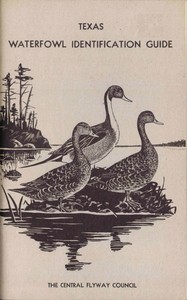
WATERFOWL IDENTIFICATION GUIDE
Published by
The Central Flyway Council
COUNCIL MEMBERS
Colorado
Kansas
Montana
Nebraska
New Mexico
North Dakota
Oklahoma
South Dakota
Texas
Wyoming
Acknowledgments
The Central Flyway Council wishes to thank the Atlantic Flyway Council
for making available the illustrations and most of the text of this
booklet.
The Council also wishes to thank the many persons who assisted in
preparation of this publication, particularly the Vermont Fish and Game
Commission and Alan R. Munro, the artist.
PRINTED IN U.S.A.
BY THE LANE PRESS. INC. · BURLINGTON, VERMONT
CONTENTS
Council Members 1
Acknowledgements 2
Foreword 5
Identification 6
Individual Problems 7
Nonhunting Enjoyments 8
Research and Management 8
Flyway Council Approach 9
Your Responsibility 10
Parts of a Duck 11
Whistling Swan 12
Canada Goose 13
Snow Goose 14
Ross Goose 15
White-Fronted Goose 16
Blue Goose 17
Puddle or Dabbling Duck Characteristics 18
Mallard 19
Black Duck 20
Mottled Duck 21
New Mexico Duck 22
Gadwall 23
Pintail 24
Green-Winged Teal 25
Blue-Winged Teal 26
Cinnamon Teal 27
American Widgeon 28
Shoveler 29
Wood Duck 30
Harlequin Duck 31
Diving Duck Characteristics 32
Redhead 33
Ring-Necked Duck 34
Canvasback 35
Greater Scaup 36
Lesser Scaup 37
Common Goldeneye 38
Barrow’s Goldeneye 39
Bufflehead 40
White-Winged Scoter 41
Fulvous Tree Duck 42
Black-Bellied Tree Duck 43
Ruddy Duck 44
Hooded Merganser 45
Common Merganser 46
Double-Crested Cormorant 47
Common Loon 48
Horned Grebe 49
Pied-Billed Grebe 49
Western Grebe 50
American Coot 51
King Rail 52
Clapper Rail 52
Virginia Rail 53
Sora 53
Common Snipe (Jacksnipe) 54
Waterfowler’s Code 55
FOREWORD
The North American continent, at the time of its discovery and early
settlement, had a waterfowl population which was one of its many
wonders. So far as the evidence shows, no equal area of the earth’s
surface ever supported such vast numbers of so many different ducks and
geese, and this situation persisted to a time within the memory of
living men. Long after the end of early settlement on this continent,
hunting was free and harvest unlimited. But as the advancing tide of
settlement reached into the north-central prairie states and provinces
in the final years of the Nineteenth Century, radical changes began.
From that time on North American waterfowl habitat began to deteriorate.
Literally millions of acres of former nesting ground in the north have
now been drained and put to the plow. South of the breeding range, not
only agriculture, but industrialization and urbanization also have
steadily reduced available resting and wintering grounds.
The progressive decline in waterfowl numbers which followed these
changes in land use led eventually to the scientific management of
waterfowl. Spring shooting and market hunting were abolished in the
second decade of this century. Ten years later the federal government
undertook detailed regulation of migratory waterfowl so the annual
harvest could be made proportional to the annual production. This was
accomplished through collective effort by State, Provincial and Federal
agencies of Canada, Mexico and the United States to obtain scientific
information. In keeping with biological principles, most of the
restrictions on bag limit and means of taking have been used with some
flexibility.
Throughout the decline of all waterfowl populations some species have
been underharvested. These species have declined in about the same
proportion as those species on which the bulk of the harvest occurred.
The Central Flyway Council feels that a refinement in waterfowl
management is possible by directing hunting pressure on these previously
underharvested species. This goal can only be accomplished through a
knowledge of species identification by the waterfowl hunter. This
booklet is a start in that direction.
In recent years most waterfowl populations have made encouraging
recoveries from the low point of the early 1930’s, when disastrous
drouths, drainage and changing land use patterns took their toll. Still
drainage continues, and industrialization is further reducing the
habitat. Hunting continues as a major sport, however, maximum
utilization of all species must be accomplished if hunting is to be
fostered at a reasonable level of freedom and enjoyment.
The very future of duck hunting depends upon a more effective
partnership between regulatory agencies and the many thousands of
gunners whom they serve. The federal agency is charged by treaty and law
with husbandry of the waterfowl resource. The State agencies assist in
the responsibility. However, they need the help of all sportsmen, and
particularly they need the understanding help of waterfowlers who know
their birds and who keep abreast of current plans for management. To
foster this essential cooperation between agencies and gunners is a
primary purpose of this booklet.
Identification
Identification of birds in the field, and particularly on the wing, as
ducks and geese are usually seen over decoys, is easier than appears at
first try. The trick is to note, in addition to shape and approximate
size, the general arrangement of light and dark areas in the plumage,
for nearly every species has its own distinctive pattern. With practice,
the eye can be trained to pick out this pattern at a glance, and within
a short time recognition becomes automatic. The illustrations which
follow, one for each important species of Central Flyway waterfowl, make
use of this practice of “pattern recognition” in the two or more flying
birds at the top of the page. Actually in many cases recognition by
flight pattern and flight characteristics will soon become evident.
In each drawing of ducks the flying female leads, with the drake
following, for this is the usual order in a mated pair during winter,
and spring. On the lower part of each page are shown enlarged heads,
adult male on the left, female on the right, with an immature head added
when the difference is substantial, or with certain details which
further aid identification when the bird is in hand. All ducks, both
flying pairs and heads, are drawn in direct proportion to each other,
but geese, because of their larger size, are reduced one third from the
duck proportion.
Drawings of geese show only a single enlarged head on each plate because
male and female geese are alike in color pattern. Finally, some birds
which are not “waterfowl” in the strict sense of the word, but are
nevertheless often seen, are shown in the last few illustrations. Some
of them (loon, grebe, and cormorant), although protected at all times,
are included because they are often mistakenly shot for waterfowl.
Others (rails, coot, and snipes) are included because they occupy
wet-land habitat along with ducks.
Individual Problems
Although “pattern recognition” simplifies the problem of identification
for the waterfowler, there are still several complications to be
considered. Of these, the most troublesome by far is the matter of
moults. The adult drakes of most species of ducks, very soon after the
hens begin to incubate eggs, moult the bright body-feathers of their
breeding dress and assume an “eclipse” plumage which resembles the
year-round coloration of the female. This dull plumage, serving as a
protective factor during the wing-moult which follows, is retained until
the new flight feathers are fully developed. By September a second
body-moult is under way by which these old drakes assume the bright
courting plumage of late fall and winter. During the same period, the
young males of the year, whose juvenile plumage likewise resembles the
female dress, are also assuming the adult plumage. Following December 1
most difficulties of identification by reason of the moult are resolved,
but in early fall the hunter may be puzzled by some of the transition
plumages noted on birds in his bag. Identification during this period
may appear extremely difficult, but it is well to remember that wing
patterns remain virtually unchanged regardless of stage of the moult.
The remaining problems of identification require only brief mention for
they appear but rarely. In the first place, this booklet includes all
species of ducks and geese which occur in numbers in any part of the
Central Flyway, but omits others which may be occasional visitors.
Second, hybrids are rather frequent among waterfowl, and some are
extremely puzzling. In such special cases as these your local wildlife
manager or biologist may be able to help.
The following publications contain further information for the hunter
interested in additional facts of natural history, distribution and
description:
Kortright, “Ducks, Geese and Swans of North America”
Peterson, “A Field Guide to the Birds”
Pough, “Audubon Water Bird Guide”
Nonhunting Enjoyments
For the nonhunter—and many avid outdoorsmen prefer to watch rather than
shoot—this guide to waterfowl can provide enjoyment beyond the simple
pleasure of seeing ducks and geese. Most of us remember seeing some
“oldtimer” identify flights or singles or rafts of birds at what seemed
impossible distances. The ability to do this does not really stem from
some mystic communion with the birds. Rather, through such a booklet as
this the waterfowling layman can develop the same powers in himself. For
the cost of a little concentrated effort he can gain great personal
satisfaction and the increased understanding that comes from resolving
“ducks” into the wide variety of individual species they really are.
Further, some knowledge of waterfowl distribution, annual abundance and
the approximate source and destination of the ducks and geese he hunts,
will often help the waterfowler understand the overall picture of
waterfowl management. For both administrative and biological purposes of
waterfowl management, the United States is divided into four flyways—the
Atlantic, the Mississippi, the Pacific, and the one for which this
booklet is written, the Central. Each flyway has its own segment of the
waterfowl population, subject to different conditions and pressures than
the populations of other flyways, and therefore is administered as a
separate unit. In general this is a sound premise, but it must not be
considered too rigid. Since the flyway principle is in part an
administrative device, it is important principally in fall and winter
when most North American waterfowl are within the United States. As the
wintering populations begin to move northward in the spring, many
species disperse throughout the nesting grounds of the northern states
and Canada. Much overlapping of the populations from various flyways in
which the birds wintered occurs.
Research and Management
Methods developed over the years and applied systematically supply
information which is necessary to intelligent management. Breeding pair
and brood surveys indicate the distribution of nesting populations, and
their success from year to year in hatching and raising their broods of
young. The banding of waterfowl, carefully aged, sexed, and released,
gives specific information on the travels of individual birds, on
mortality, and on some phases of hunting pressure. Periodic air-counts
in late summer and fall serve to measure, in a rough way, the
distribution of different species during southward migration, and the
rate of movement. Hunter-bag checks, carried out in the field during the
shooting season, complement fall counts with regard to distribution at
given points. A post-season sampling of hunter success, by mail,
supplies data on additional aspects of hunting pressure, and gives an
index of total kill. Finally, the annual winter count indicates the
distribution and relative size of populations remaining after the
shooting season ends. In combination, these methods are steadily
increasing our knowledge of North American waterfowl, and in particular
are providing the sort of “running inventory” which is the first
requirement for intelligent management of this resource.
The Central Flyway Council is the clearing house for coordinated
planning in this Flyway. It is a delegate organization, including in its
membership administrative and technical representatives from the fish
and game departments of all states and provinces in the flyway. A Flyway
Representative has been assigned from the Fish and Wildlife Service.
This group is concerned with all phases of waterfowl research and
management in the flyway. The Central Flyway Council provides for an
effective interchange of information between member agencies and assists
in the coordination and integration of flyway management programs. These
purposes have been furthered by regular meetings for the open discussion
of flyway problems.
Flyway Council Approach
In early 1953, the Council and the Fish and Wildlife Service, acting
jointly, adopted a flyway program which has been expanded and improved
as factual information and experience dictate. This program outlines
objectives and suggests methods and priorities for accomplishment. State
game departments now pattern their activities around the flyway program.
Extending the cooperative idea, the Council has joined with
corresponding organizations from the other flyways to form the National
Waterfowl Council, which annually participates in the official
discussion of continental and flyway management problems and
regulations. From their inception, the flyway councils have been
successful in promoting understanding and teamwork so necessary for the
perpetuation of the waterfowl resource.
Your Responsibility
As an individual reader of this booklet, you have a part to play in the
essential partnership between agencies and waterfowlers. Your part may
be small and may take various forms, depending on the circumstances, but
certainly it is there. Perhaps, having sent in one or two waterfowl
bands in the past and having experienced the initial novelty of hearing
where your birds came from, you now forget to report them. The next time
you have this choice between reporting or forgetting a band, remember
that its prompt recovery, with full data, might be the clue to some
missing fact to improve your future gunning.
Hunter bag checks indicate crippling losses in the Central Flyway run to
an average of about one quarter of the total kill. In certain marshes,
early in the season, crippling can greatly exceed the one quarter loss.
Shooting at birds on the fringe of effective killing range is a
crippling practice and, moreover, as you probably know from observation
is contagious. The usual effect of one “sky shooter” in a marsh is to
force other gunners nearby to attempt impossible shots which increase
crippling losses and soon ruin shooting for everybody. Controlling such
practices lies solely in the hands of individual gunners. With
large-gauge guns of modified bore, the shot-pattern that will produce
kills should be consistent up to forty yards, a distance well within
capabilities of the average gunner to hold and compute necessary lead.
Successful duck shooting is a matter of good judgment. To avoid errors
in judgment drive stakes in front of your blind at distances of thirty
and forty yards to indicate safe killing range. Hold your fire until the
feet of an incoming duck can be seen distinctly, for only then will the
bird be in range. Good sportsmanship in duck blinds and marshes is
equally as important as remaining friendly with your home neighbors.
Train a good retrieving dog, and add to your day’s pleasure by watching
him at work on downed birds.
Above all, remember that the future of waterfowling is partly in your
hands—that your good sportsmanship and cooperation are as necessary to
the work of the Central Flyway Council and its member agencies as their
activities are to you.
PARTS OF A DUCK
[Illustration: PARTS OF A DUCK]
CROWN
FOREHEAD
OCCIPUT
CHEEK
NAPE
SIDE NECK
BACK
SCAPULARS
RUMP
CHIN
THROAT
FORENECK
TERTIALS
UPPER TAIL COVERTS
BREAST
TAIL
UNDER TAIL COVERTS
BELLY
SIDE
LESSER COVERTS
SPURIOUS WING
GREATER COVERTS
PRIMARIES
SECONDARIES
TERTIALS
TIBIA
SCUTELLATE TARSUS
HEEL
HIND TOE
TOE
WEB
NAIL
LAMELLAE
LOWER MANDIBLE
UPPER MANDIBLE
NOSTRIL
NAIL
MALE
FEMALE
WHISTLING SWAN
(Cygnus columbianus)
[Illustration: WHISTLING SWAN (Cygnus columbianus)]
ENTIRE PLUMAGE WHITE
IMMATURE BIRDS HAVE GRAY-WHITE PLUMAGE WITH DULL PINKISH BILL
YELLOW SPOT
BLACK BILL
SEXES ARE SIMILAR
CARRIES NECK HELD ERECT
HEAD OF MUTE SWAN SHOWING BLACK KNOB AND ORANGE BILL
CANADA GOOSE
(Branta canadensis)
[Illustration: CANADA GOOSE (Branta canadensis)]
WHITE RUMP
BROWNISH GRAY BODY AND WINGS
BLACK BILL
WHITE PATCH
BLACK NECK
ALL GEESE HAVE RETICULATE TARSUS
SEXES ARE SIMILAR
SNOW GOOSE
(Chen hyperborea)
[Illustration: SNOW GOOSE (Chen hyperborea)]
WHITE BODY
BLACK WING TIPS
PINK FEET
LIGHT PINK BILL
BLACK “GRINNING” PATCH
FEATHERS OF CHEEKS, BREAST AND BELLY OFTEN STAINED WITH RUSTY BROWN
IMMATURE BIRDS TEND TOWARD A MORE GRAY PLUMAGE
SEXES ARE SIMILAR
ROSS GOOSE
(Chen rossi)
[Illustration: ROSS GOOSE (Chen rossi)]
ABOUT SIZE OF MALLARD
ADULT
WARTY PROTUBERANCES ON BILL.
NO BLACK “GRINNING” PATCH
PINKISH BILL
IMMATURE
WHITE-FRONTED GOOSE
(Anser albifrons)
[Illustration: WHITE-FRONTED GOOSE (Anser albifrons)]
ADULT
BARRED BELLY
IMMATURE
YELLOWISH BILL
PALE BREAST
WHITE PATCH
BROWNISH FOREPARTS
YELLOWISH LEGS
BLUE GOOSE
(Chen caerulescens)
[Illustration: BLUE GOOSE (Chen caerulescens)]
ADULT
PINK FEET, IMMATURE DUSKY FEET
IMMATURE
PINK BILL
WHITE NAIL
BLACK “GRINNING” PATCH
WHITE HEAD AND NECK
SEXES ARE SIMILAR
PUDDLE OR DABBLING DUCK CHARACTERISTICS
(Anatinae)
[Illustration: PUDDLE OR DABBLING DUCK CHARACTERISTICS (Anatinae)]
TIP UP TO FEED, RARELY DIVE
LEGS PLACED NEAR CENTER OF BODY
GENERALLY HAVE METALLIC SPECULUM
USUALLY SWIM WITH TAIL HELD CLEAR OF WATER
FOOT SMALLER THAN IN DIVING DUCKS
HIND TOE NOT LOBED
SPRING INTO AIR ON TAKE OFF
MALLARD
(Anas platyrhynchos)
[Illustration: MALLARD (Anas platyrhynchos)]
WHITE TAIL
WHITE BORDERS ON PURPLE SPECULUM
WHITISH TAIL
♂
GREEN HEAD
YELLOW BILL
WHITE COLLAR
RUDDY BREAST
♀
ORANGE BILL MOTTLED WITH BLACK
MOTTLED BROWN
BLACK DUCK
(Anas rubripes)
[Illustration: BLACK DUCK (Anas rubripes)]
YELLOWISH-BROWN HEAD
DUSKY-BROWN BODY
WHITE WING-LININGS
IMMATURE HAS STREAKED BREAST
PURPLE SPECULUM
IMMATURE SIDE BREAST FEATHER
ADULT MALE SIDE BREAST FEATHER
ADULT FEMALE SIDE BREAST FEATHER
♂
BILL COLOR VARIES FROM SOLID GREENISH YELLOW TO HIGH CHROME YELLOW
DEPENDING UPON AGE AND SEASON KILLED
♀
FEMALE BILL SHOWS VARYING AMOUNT OF BLACK SPOTTING
MOTTLED DUCK
(Anas fulvigula)
[Illustration: MOTTLED DUCK (Anas fulvigula)]
TRAILING EDGE OFTEN WHITE
LIGHT TAN HEAD
PURPLE SPECULUM
FEET ORANGE
CHIN AND THROAT PALE BUFF (WITH OR) WITHOUT STREAKING
♂
DARK BASE OF BILL
BILL YELLOW, DARK NAIL
♀
DARK SPOT (often absent)
VARIABLE SPOTTING
NEW MEXICAN DUCK
(Anas diazi novimexicana)
[Illustration: NEW MEXICAN DUCK (Anas diazi novimexicana)]
TAIL DARK.
SPECULUM BLUISH PURPLE TO GREEN. WHITE EDGE ABOVE SOMETIMES ABSENT.
FEET ORANGE.
♂
BILL YELLOW, DARK NAIL.
CHIN PINKISH BUFF WITHOUT STREAKING.
♀
BILL DARK OLIVE OR ORANGE, DARK ON RIDGE.
SMALL SPOTS NEAR BASE LIMITED OR ABSENT.
GADWALL
(Anas strepera)
[Illustration: GADWALL (Anas strepera)]
BLACK RUMP
WHITE BELLY
WHITE SPECULUM
WHITE BELLY
BOTH SEXES HAVE YELLOW FEET
♂
BILL BLUISH BLACK
♀
BILL DULL ORANGE VARYING SPOTTING
PINTAIL
(Anas acuta)
[Illustration: PINTAIL (Anas acuta)]
WHITE STRIPE
CINNAMON-BUFF BORDER
POINTED TAIL
WHITE STRIPE
♂
BROWN HEAD
GRAY BILL
♀
GRAY BILL
MOTTLED BROWN
GREEN-WINGED TEAL
(Anas carolinensis)
[Illustration: GREEN-WINGED TEAL (Anas carolinensis)]
GREEN SPECULUM
WHITE BELLY
♂
BROWN HEAD
GREEN PATCH
WHITE MARK
♀
BLUE-WINGED TEAL
(Anas discors)
[Illustration: BLUE-WINGED TEAL (Anas discors)]
CHALKY-BLUE PATCH
GREEN SPECULUM
♂
MALE HAS DARK BELLY
WHITE CRESCENT
♀
FEMALE HAS LIGHT BELLY
CINNAMON TEAL
(Anas cyanoptera)
[Illustration: CINNAMON TEAL (Anas cyanoptera)]
CHALKY-BLUE PATCH
GREEN SPECULUM
♂
UNIFORM CINNAMON BODY COLOR
♀
FEMALE HAS LIGHT BELLY
AMERICAN WIDGEON (Baldpate)
(Mareca americana)
[Illustration: AMERICAN WIDGEON (Baldpate) (Mareca americana)]
WHITE PATCH
WHITE BELLY
GREEN SPECULUM
WHITE BORDER
♂
WHITE CROWN
GREEN PATCH
GRAY BILL, BLACK TIPPED
WHITE PATCH
♀
SHOVELER
(Spatula clypeata)
[Illustration: SHOVELER (Spatula clypeata)]
CHALKY-BLUE PATCH
GREEN SPECULUM BORDERED WITH WHITE
♂
IRIDESCENT GREENISH BLACK
LARGE SHOVEL BILL
CONSPICUOUS BRISTLE-LIKE LAMELLAE
WHITE BREAST
CHESTNUT SIDES AND BELLY
♀
WOOD DUCK
(Aix sponsa)
[Illustration: WOOD DUCK (Aix sponsa)]
WHITE BORDER
WHITE BELLY
SILVERY BORDERED
♂
RED IRIS
RED AND WHITE BILL
ADULT MALE HIGHLY COLORED
ECLIPSE AND IMMATURE MALE
WHITE PATCH
♀
CONSPICUOUS WHITE EYE-RING
CRESTED
HARLEQUIN DUCK
(Histrionicus histrionicus)
[Illustration: HARLEQUIN DUCK (Histrionicus histrionicus)]
WHITE MARKS
♂
STOCKY, DARK, SMALL BILL
♀
FEMALE HAS SMALLER BILL
PLAIN DARK BODY
DIVING DUCK CHARACTERISTICS
(Aythyinae)
[Illustration: DIVING DUCK CHARACTERISTICS (Aythyinae)]
LEGS SET NEAR REAR OF BODY
DIVE COMPLETELY UNDER WATER TO SECURE FEED
SPECULUM GENERALLY DULL, LACKS IRIDESCENCE
USUALLY SWIM WITH TAIL HELD CLOSE TO WATER
HIND TOE LOBED, FOOT LARGE
ON TAKE OFF PATTER ALONG SURFACE FOR SOME DISTANCE
REDHEAD
(Aythya americana)
[Illustration: REDHEAD (Aythya americana)]
GRAY BACK
GRAY WING STRIPE
♂
CHESTNUT HEAD
HIGH ABRUPT FOREHEAD
BLUE BILL, BLACK TIP
BLACK BREAST
♀
LIGHT PATCH
RING-NECKED DUCK
(Aythya collaris)
[Illustration: RING-NECKED DUCK (Aythya collaris)]
BLACK BACK
GRAY WING STRIPE
♂
DISTINCT CREST
CONSPICUOUS BILL RING
CHESTNUT COLLAR
BLACK BREAST
WHITE PATCH
♀
WHITE EYE RING
LIGHT PATCH
CANVASBACK
(Aythya valisineria)
[Illustration: CANVASBACK (Aythya valisineria)]
WHITE BACK
GRAY WING STRIPE
♂
CHESTNUT HEAD
LONG SLOPING PROFILE, BLACK BILL
BLACK BREAST
♀
GRAY BACK
BROWN BREAST
GREATER SCAUP
(Aythya marila)
[Illustration: GREATER SCAUP (Aythya marila)]
DARK RUMP
WHITE WING STRIPE EXTENDING INTO PRIMARIES
WHITE BELLY
NAIL OF BILL 7.0-9.0 MILLIMETERS WIDE
♂
GRAY BACK
BLACK HEAD WITH GREENISH TINGE
BROAD BLUE BILL
BLACK BREAST
WHITE FLANKS
♀
BROWN BODY AND HEAD
DISTINCT WHITE MASK
LESSER SCAUP
(Aythya affinis)
[Illustration: LESSER SCAUP (Aythya affinis)]
DARK RUMP
WHITE WING STRIPE DOES NOT EXTEND INTO PRIMARIES
WHITE BELLY
NAIL OF BILL 5.0-6.5 MILLIMETERS WIDE
♂
SLIGHT CREST
GRAY BACK
BLACK HEAD WITH PURPLISH TINGE
BROAD BLUE BILL
BLACK BREAST
LIGHT FLANKS
♀
BROWN BODY AND HEAD
DISTINCT WHITE MASK
COMMON GOLDENEYE
(Bucephala clangula)
[Illustration: COMMON GOLDENEYE (Bucephala clangula)]
WHITE WING PATCHES
♂
GREENISH BLACK HEAD
LIGHT IRIS
DISTINCT WHITE PATCH
WHITE BREAST AND BELLY
2ND SEASON MALE WITH BROWN HEAD AND FAINT WHITE PATCH
♀
BROWN HEAD
ORANGE TIP IN BREEDING PLUMAGE
GRAY BACK AND FLANKS
WHITE NECK
GRAY BREAST
WHITE BELLY
1ST SEASON MALE IS SIMILAR IN COLORATION TO FEMALE BUT WITH HEAVIER
BODY AND MORE RUGGED HEAD AND BILL
BARROW’S GOLDENEYE
(Bucephala islandica)
[Illustration: BARROW’S GOLDENEYE (Bucephala islandica)]
WHITE WING PATCHES
♂
PURPLISH BLACK HEAD
WHITE CRESCENT PATCH
BLACK BACK
BLACK BILL
WHITE BREAST AND BELLY
♀
LIGHT IRIS
GRAY BACK AND FLANKS
ORANGE TIP IN BREEDING PLUMAGE
WHITE NECK
GRAY BREAST
WHITE BELLY
BUFFLEHEAD
(Bucephala albeola)
[Illustration: BUFFLEHEAD (Bucephala albeola)]
BLACK AND WHITE BACK
DARK BACK
WHITE WING PATCHES
WHITE BELLY
♂
BLACK WITH IRIDESCENT GREEN AND PURPLE
DISTINCT WHITE PATCH
BLUE-GRAY BILL
♀
DARK GRAYISH BROWN
DISTINCT WHITE PATCH
WHITE-WINGED SCOTER
(Melanitta deglandi)
[Illustration: WHITE-WINGED SCOTER (Melanitta deglandi)]
BLACK CHUNKY BODY
WHITE PATCH
♂
WHITE EYE PATCH
PROMINENT BLACK KNOB
REDDISH ORANGE
IMMATURE HAS DISTINCT WHITE PATCHES
♀
FEATHERING EXTENDS ALMOST TO NOSTRIL
ADULT FEMALE CHEEK PATCHES RANGE FROM SLIGHTLY DARKER THAN IMMATURE
TO NO WHITE AT ALL
FULVOUS TREE DUCK
(Dendrocygna bicolor helva)
[Illustration: FULVOUS TREE DUCK (Dendrocygna bicolor helva)]
LONG NECK
ADULT
WHITE LINE
IMMATURE
ADULT
LONG LEGS
BLACK-BELLIED TREE DUCK
(Dendrocygna autumnalis autumnalis)
[Illustration: BLACK-BELLIED TREE DUCK (Dendrocygna autumnalis
autumnalis)]
WHITE UPPER WING
ADULT
LONG NECK
IMMATURE
WHITE WING PATCH
RUDDY DUCK
(Oxyura jamaicensis)
[Illustration: RUDDY DUCK (Oxyura jamaicensis)]
DARK BROWN
BELLY SILVERY WHITE
♂ SUMMER PLUMAGE
WHITE CHEEK
CROWN GLOSSY BLACK
BILL BLUE
RICH CHESTNUT
♂ WINTER PLUMAGE
CROWN BROWNISH-BLACK
BILL DUSKY
ASHY WHITE
♀
MOTTLED CHEEK WITH DARK STRIPE
BILL NAIL DISTINCTLY SHARP-POINTED
GRAYISH BROWN
HOODED MERGANSER
(Lophodytes cucullatus)
[Illustration: HOODED MERGANSER (Lophodytes cucullatus)]
WHITE WING PATCH
♂
WHITE CREST OUTLINED WITH BLACK
THIN, SPIKE-LIKE BLACK BILL
TEETH NOT INCLINED BACKWARD AS IN OTHER MERGANSERS
WHITE BREAST
DOUBLE BLACK BANDS
♀
CREST, LIGHT BROWN
LIGHT THROAT
IN FLIGHT ALL MERGANSERS CARRY BILL, NECK AND BODY IN HORIZONTAL
PLANE, GIVING THEM A CHARACTERISTIC LONG-DRAWN APPEARANCE.
COMMON MERGANSER
(Mergus merganser)
[Illustration: COMMON MERGANSER (Mergus merganser)]
BLACK AND WHITE PATTERN
WHITE WING PATCH
♂
METALLIC GREENISH-BLACK
NOT CRESTED
RED BILL
NOSTRIL POSITIONED NEAR CENTER OF BILL
♀
DISTINCT CREST
WHITE THROAT
RED BILL
TEETH INCLINED BACKWARDS
GRAY BACK
DOUBLE-CRESTED CORMORANT
(Phalacrocorax auritus)
[Illustration: DOUBLE-CRESTED CORMORANT (Phalacrocorax auritus)]
ADULT
IMMATURE
PALE BREAST
YELLOW-ORANGE THROAT POUCH
BLACK BODY
COMMON LOON
(Gavia immer)
[Illustration: COMMON LOON (Gavia immer)]
SUMMER ADULT
CHECKERED BACK
IN FLIGHT HAS DOWNWARD CURVE TO NECK
WINTER ADULT
FEET EXTEND BEYOND TAIL
GRAY
SUMMER ADULT
BLACK HEAD, PURPLISH IRIDESCENCE
BLACK BILL
WHITE RIBBED
WHITE BREAST AND BELLY
WINTER ADULT
GRAY
WHITE
SEXES ARE SIMILAR
HORNED GREBE
(Colymbus auritus)
[Illustration: HORNED GREBE (Colymbus auritus)]
WINTER PLUMAGE
DARK BACK
THIN BILL
RED EYE
WHITE CHEEKS, THROAT AND BELLY
HEAD, SUMMER PLUMAGE
LOBED TOES
PIED-BILLED GREBE
(Podilymbus podiceps)
[Illustration: PIED-BILLED GREBE (Podilymbus podiceps)]
TARSUS FLATTENED LATERALLY
ADULT HEAD
BLACK
IMMATURE
CHICKEN-LIKE BILL
WHITE
STRIPED FACIAL PATTERN
SEXES ARE SIMILAR
WESTERN GREBE
(Aechmophorus occidentalis)
[Illustration: WESTERN GREBE (Aechmophorus occidentalis)]
WHITE UNDERPARTS
LONG SLENDER NECK
AMERICAN COOT
(Fulica americana)
[Illustration: AMERICAN COOT (Fulica americana)]
WHITE
SCALLOPED FLAPS
WHITE PATCH
SLATE GRAY BODY
WHITE BILL
KING RAIL
(Rallus elegans)
[Illustration: KING RAIL (Rallus elegans)]
COMMONLY INHABITS FRESH WATER MARSHES
GENERALLY HAS A RUSTY COLORATION
DARK BARRING
SEXES ARE SIMILAR
CLAPPER RAIL
(Rallus longirostris)
[Illustration: CLAPPER RAIL (Rallus longirostris)]
GENERALLY HAS A GRAYER COLORATION
COMMONLY INHABITS TIDAL MARSHES
LIGHT BARRING
IMMATURE BIRDS SIMILAR TO ADULTS: SPECIES DIFFERENTIATION OFTEN
DIFFICULT
VIRGINIA RAIL
(Rallus limicola)
[Illustration: VIRGINIA RAIL (Rallus limicola)]
IMMATURE
BLACKISH BODY
ADULT
REDDISH BODY
GRAY CHEEKS
LONG BILL
WHITE
SEXES ARE SIMILAR
SORA
(Porzana Carolina)
[Illustration: SORA (Porzana Carolina)]
IMMATURE
BUFFY BROWN BODY
ADULT
WHITE PATCH
GRAY-BROWN BODY
SHORT YELLOW BILL
BLACK FACIAL AND THROAT PATCH
COMMON SNIPE (JACKSNIPE)
(Capella gallinago)
[Illustration: COMMON SNIPE (JACKSNIPE) (Capella gallinago)]
LONG BILL
STRIPED BACK AND HEAD
ORANGE TAIL
HAS A CHARACTERISTIC ZIG-ZAG FLIGHT
POINTED WING
SEXES ARE SIMILAR
AMERICAN WOODCOCK
(Philohela minor)
[Illustration: AMERICAN WOODCOCK (Philohela minor)]
BARRED HEAD
LONG BILL
SHORT TAIL
CHUNKY BODY
LARGE EYE
APPEARS NECKLESS
BLUNT WING
WATERFOWLER’S CODE
Buy a State License, and if You Are 16 Years of Age or Older Obtain
Federal Duck Stamp. It is illegal to hunt waterfowl without these
licenses, and the dollars you spend for them help to maintain your
sport.
Know Your State, Provincial and Federal Migratory Bird Laws. When in
doubt consult your local game protector or U.S. Game Management Agent.
Treat the Landowner with Respect and Courtesy. Ownership of game is
vested in the State and Province, but landowners have the right to
prevent trespass on their land.
Learn to Identify Before You Shoot. A mistake may prove both
embarrassing and costly, a correct identification adds to your day’s
enjoyment.
Cooperate with Your Federal, State and Provincial Agencies. Solving the
many problems of waterfowl production, harvest and research is possible
only through continued cooperation of the duck hunter and
conservationist.
Use a Retriever if Possible, or at Least Pick Up Every Bird You Shoot. A
good dog will pick up cripples you would otherwise have to leave. A good
sportsman will never kill game needlessly. The use of retrieving dogs is
a sound conservation practice in reducing crippling losses in addition
to providing the pleasure of watching a good dog in action.
Good Sportsmanship in the Duck Blind and on the Marshes Is Equally
Important as Remaining Friendly with Your Neighbors.
DISTRIBUTED BY:
TEXAS GAME and FISH COMMISSION
Transcriber’s Notes
—Retained publication information from the printed edition: this eBook
is public-domain in the country of publication.
—Added several birds to the Table of Contents to match the text.
—Silently corrected a few typos.
—In the text versions only, text in italics is delimited by
_underscores_.
End of the Project Gutenberg EBook of Texas Waterfowl Identification Guide, by
Central Flyway Council
*** END OF THE PROJECT GUTENBERG EBOOK 54487 ***
Waterfowl Identification Guide
Subjects:
Download Formats:
Excerpt
Published by
The Central Flyway Council
Colorado
Kansas
Montana
Nebraska
New Mexico
North Dakota
Oklahoma
South Dakota
Texas
Wyoming
The Central Flyway Council wishes to thank the Atlantic Flyway Council
for making available the illustrations and most of the text of this
booklet.
The Council also wishes to thank the many persons who assisted in
preparation of this publication, particularly the Vermont Fish and Game
Commission and Alan R....
Read the Full Text
— End of Waterfowl Identification Guide —
Book Information
- Title
- Waterfowl Identification Guide
- Author(s)
- Central Flyway Council
- Language
- English
- Type
- Text
- Release Date
- April 5, 2017
- Word Count
- 4,369 words
- Library of Congress Classification
- QL
- Bookshelves
- Browsing: Nature/Gardening/Animals, Browsing: Science - General, Browsing: Travel & Geography
- Rights
- Public domain in the USA.