*** START OF THE PROJECT GUTENBERG EBOOK 56205 ***
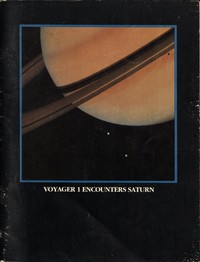
Voyager 1 Encounters Saturn
Contents
Foreword 1
Introduction 3
The Planet 4
The Rings 12
The Satellites 20
A Glimpse Back 32
The Voyager Mission 36
MISSION OBJECTIVES 36
SPACECRAFT CHARACTERISTICS 36
SATURN ENCOUNTER 36
Scientific Highlights 38
SATURN 38
RINGS 38
NEW SATELLITES 38
INNER SATELLITES 38
TITAN 39
OUTER SATELLITES 39
MAGNETOSPHERE 39
Scientific Investigations 40
[Illustration: COVER: Saturn and two of its moons, Tethys (above)
and Dione (below), were photographed by Voyager 1 on November 3,
1980, from 13 million kilometers (8 million miles). The shadow of
Tethys is cast onto the cloudtops in the upper right corner of the
image.]
Foreword
The pictures assembled in this publication are a part of the rich and
varied harvest of information returned by Voyager 1 across nearly a
billion miles of interplanetary space. These images are of great beauty
as well as great scientific interest, serving to remind us of the
awesome and breathtaking dimensions of the solar system we inhabit.
Voyager is providing intriguing new information which should help us to
understand how the Earth—and possibly the universe—was formed. Already
there have been surprises and puzzles that paint a completely new
picture of Saturn and its neighborhood, including the discovery of three
new moons, startling information about Saturn’s rings, and observation
of the unexpectedly complex structure of Saturn’s atmosphere and that of
its largest moon, Titan. It will take years for scientists to assimilate
completely the information which is cascading down from Voyager. What
more will this marvel of technology have to tell us before it departs
the solar system to travel endlessly among the stars?
Robert A. Frosch, _Administrator_
_National Aeronautics and Space Administration_
December 1980
The date of each photograph and the distance of the spacecraft from the
planet or satellite are included with each picture.
For sale by the Superintendent of Documents, U.S. Government
Printing Office, Washington, D.C. 20402
Stock No. 033-000-00817-1
[Illustration: _Voyager 1 was launched from Cape Canaveral, Florida,
on September 5, 1977, beginning its journey to Jupiter, Saturn, and
beyond._]
Introduction
No other generation has had the opportunity or the technology to reach
beyond our world—to see, to touch, to hear the forces that shape our
universe. In slightly over two decades, man has ingeniously explored
five distant planets—and two dozen moons. We have seen their weather and
surfaces, landed on some, probed the atmospheres of others, and listened
to their radio noises.
Under the planetary exploration program of the National Aeronautics and
Space Administration, the Voyager Mission, begun in 1972, was designed
to explore Jupiter, Saturn, their satellites, rings, magnetic fields,
and interplanetary space. Two automated, reprogrammable spacecraft,
Voyagers 1 and 2, were launched in late summer of 1977. Their goals: the
outer planets.
Both spacecraft made astounding discoveries in the Jupiter system in
1979—a thin ring, a thick ionized sulfur and oxygen torus, an actively
volcanic satellite—these were but a few of the treasures yielded by the
two Jupiter flybys.
Now, Voyager 1 has completed exploration of its final target: the ringed
planet Saturn and its enigmatic giant satellite, Titan. True to the
generally unpredictable nature of planetary exploration, the treasures
of the Saturn system far exceeded all expectations. We learned more
about Saturn in one week than in all of recorded history, thanks to one
trusty robot no larger than a compact car and to thousands of diligent
and imaginative people.
Both spacecraft carry an assortment of optical, radiometric, and fields
and particles sensing instruments. Taken together, their data present a
comprehensive picture of a planetary system—and clues to what is
happening, what has happened, and what may happen in our universe.
This publication presents the preliminary photographic results of
Voyager 1’s encounter with Saturn and its major satellites. Voyager 1
transmitted over 17,500 images in its four months of close observations
of the system. Many of these images have been combined to produce
mosaics and color pictures. Hundreds have yet to be closely examined.
The second Voyager spacecraft will begin its close Saturn observations
in early June 1981 and make its closest approach to the planet’s
northern hemisphere on August 25. Then, due to its launch during a
period of rare planetary alignment occurring only once every 175 years,
Voyager 2 will be able to continue on to a rendezvous with the seventh
planet, Uranus, in January 1986, and perhaps even the eighth planet,
Neptune, in August 1989.
Voyager 1’s primary mission is complete. But its usefulness is far from
over. As we go about our daily business, Voyager 1 is searching for
another frontier—the edge of our solar system. In 7 to 15 years, the
spacecraft will cross the heliopause—the farthest reaches of our Sun’s
magnetic field influence. Then, high above our ecliptic plane, Voyager 1
will continue its flight toward the star Alpha Ophiuchus. Eventually,
Voyager 1 will be too distant to communicate with Earth and will
silently drift in space forever.
Andrew J. Stofan, _Acting Associate Administrator for Space Science_
_National Aeronautics and Space Administration_
The Planet
[Illustration: 11/5/80 9 million km (5.5 million mi)
Saturn is the sixth planet from the Sun and second largest in our
solar system. Like Jupiter, it is a giant sphere of gas—mostly
hydrogen and helium—with a possible core of rocky material. Various
features in Saturn’s cloudtops are visible in the accompanying
color-enhanced image of the planet’s northern hemisphere:
small-scale convective cloud features (similar to, but much larger
than, thunderstorms in Earth’s atmosphere) are visible in the brown
belt; an isolated convective cloud with a dark ring is visible in
the light brown zone; and a longitudinal wave is visible in the
light blue region.]
[Illustration: 9/17/80 76 million km (47 million mi)
As Voyager 1 approached Saturn, a series of dark and light cloud
bands (belts and zones) became apparent in the planet’s northern
hemisphere through a high altitude atmospheric haze. The planet’s
shadow obscures the rings behind and immediately to the east of the
disk. In addition, the shadow of the rings on the planet’s disk can
be seen just north of the rings themselves as they cross in front of
the planet. Six of Saturn’s 15 known satellites are visible.
Saturn’s largest moon, Titan (considerably larger than Earth’s
moon), is clearly visible in the upper left corner. The smaller
satellites Dione, Tethys, and Rhea are shown in the lower left
corner (upper, middle, and lower, respectively). Two of the
innermost moons, Mimas and Enceladus, appear to the right of the
planet (Mimas is the one closer to the planet). These six moons
orbit Saturn in the equatorial plane and appear in their present
positions because Voyager is above that plane.]
[Illustration: 10/18/80 34 million km (21 million mi)
The North Temperate Belt is visible as the violet-colored belt in
this false-color photograph. In this image, features which are
especially bright in ultraviolet light appear as turquoise and
violet, while ultraviolet-dark areas appear orange. Notice in
particular the three spots (two bright orange and one pale violet)
at mid-northern latitudes. The bright spots are similar to those
shown at much higher resolution in later images. The distinct color
difference between the North Equatorial Belt and Saturn’s other
belts and zones may be due to a thick haze layer covering the
northern portion of the belt. It is not yet understood why the
southern hemisphere of the planet (below the rings) appears bluer
than the northern hemisphere. Color spots in the rings are artifacts
of image processing.]
[Illustration: 10/30/80 18 million km (11 million mi)
Saturn’s soft, velvety appearance and previously unseen detail in
its mysterious rings became visible as Voyager 1 approached the
planet. For example, a gap in the dark C-Ring is now visible, and
material can be seen within the relatively wide Cassini Division
(long believed to be empty), which separates the B-Ring (middle)
from the A-Ring (outer). The Encke Division appears near the outer
edge of the A-Ring. Detail can be seen within the shadow cast by the
rings upon the planet: the broad, dark band near the equator is the
shadow of the B-Ring; the thinner, brighter line just to the south
is the shadow of the less dense A-Ring. Three of Saturn’s moons,
Tethys (outer left), Enceladus (inner left), and Mimas (right) are
also visible in this computer mosaic of Voyager 1 images.]
[Illustration: 11/6/80 8.5 million km (5.3 million mi)
An unusual red oval cloud feature, similar to (but smaller than)
Jupiter’s Great Red Spot, was discovered in the southern hemisphere
of Saturn. The oval, 6000 kilometers (4000 miles) in length, is
located at 55 degrees south latitude. The difference in color
between the red oval and the surrounding bluish clouds in these two
false-color images indicates that material within the oval contains
a substance that absorbs more blue and violet light than the bluish
clouds. Voyager scientists first observed the oval in August 1980,
and the feature has retained its appearance since its discovery.]
[Illustration: 11/6/80 8 million km (5 million mi)
In this photograph, the shadow of the satellite Dione is seen as a
dark circle on the face of the planet.]
[Illustration: 11/10/80 3.5 million km (2.2 million mi)
A ribbon-like wave structure and small convective features marking a
westward jet stream above the wave are visible in this photograph of
Saturn’s cloudtops. The view, extending from 40 degrees to 60
degrees north latitude, shows features 65 kilometers (40 miles) in
diameter. Measurements in images such as this one indicate that
Saturn has fewer east-to-west wind currents than does Jupiter.]
[Illustration: 11/12/80 442,000 km (265,000 mi)
Numerous small cloud features were photographed as Voyager 1 passed
above Saturn’s southern hemisphere. At these polar latitudes, the
large-scale light and dark bands break down into small-scale
features, seen here as waves and eddies.]
[Illustration: 11/7/80 7.5 million km (4.6 million mi)
Two brown ovals, approximately 10,000 kilometers (6000 miles)
across, were discovered in Saturn’s northern hemisphere, at about 40
degrees and 60 degrees latitude. The polar oval (upper left) has a
structure similar to Saturn’s red oval located in the southern polar
latitudes. Detail within the ovals is not visible at this
resolution, so it is not yet known if they are rotating features
similar to the many spots in Jupiter’s atmosphere.]
The Rings
[Illustration: 11/12/80 717,000 km (444,000 mi)
The rings of Saturn have amazed and intrigued astronomers for over
300 years. Now that we have seen them up close, they are even more
astonishing. Although they stretch over 65,000 kilometers (40,000
miles), they may be only a few kilometers thick. The ring
particles—from a few microns to a meter (three feet) in size—have
been described as icy snowballs or ice-covered rock. Voyager
scientists continue to pore over their data, searching for answers
to the puzzles of the rings. The rings were named in order of their
discovery, so the labels do not indicate their relative positions.
From the planet outward, they are known as D, C, B, A, F, and E.]
[Illustration: 10/25/80 24 million km (15 million mi)
Extraordinarily complex structure is seen across the entire span of
Saturn’s ring system. The sequence (taken approximately every 15
minutes as Voyager 1 approached Saturn) proceeds from top to bottom
in each column and shows radial “spokes” rotating within the B-Ring.
The spokes may be caused by a combination of magnetic and
electrostatic forces.]
[Illustration: 11/6/80 8 million km (5 million mi)
Over 95 individual concentric features can he counted; the final
count in higher resolution images may be anywhere from 500 to 1000
separate rings. A few of the ringlets shown in this
computer-assembled mosaic are not concentric circles but are instead
elliptical. Ring particles are probably ice or ice covered rock.]
[Illustration: The classic features of the rings are illustrated in
the diagram.]
D-RING
C-RING
B-RING
“SPOKE”
CASSINI DIVISION
ENCKE DIVISION
A-RING
F-RING
[Illustration: 11/8/80 6 million km (3.7 million mi)
The Cassini Division is filled with numerous ringlets. Discovered by
Cassini in 1675, this area between the A- and B-Rings had long been
thought devoid of material. The Voyager observation of well-defined
rings within the Cassini Division was an unexpected discovery.]
[Illustration: 11/12/80 740,000 km (460,000 mi)
Saturn’s ring system, viewed from below, appears dramatically
different from its appearance on the sunlit side. This
computer-processed image shows the F-Ring circling outside the
A-Ring, the A-Ring with its Encke Division, the multiple ringlets in
the Cassini Division, and the optically thick B-Ring, seen here in
magenta hues (the coloration is an artifact of processing and is not
real). The B-Ring appears dark from below the ring plane because it
is dense enough to reflect most of the sunlight, causing it to
appear very bright when seen from the sunward side. The opaline
brightness of the Cassini Division here indicates a great deal of
sunlight being scattered through this region. The Encke Division may
really be empty, since it appears dark from both above and below.]
[Illustration: 11/12/80 720,000 km (450,000 mi)
Outbound and above the ring plane, Voyager 1 gave us this view of
Saturn’s rings eight hours after its closest approach to the planet.
The unique lighting accentuates the many hundreds of bright and dark
ringlets comprising the ring system. The C-Ring (dark gray area)
seems to blend into the brighter B-Ring as the concentric features
radiate out from the planet. The dark spoke-like features seen in
images taken during the approach to Saturn now appear as bright
streaks, indicating that they may be composed of small particles.]
[Illustration: 11/12/80 750,000 km (470,000 mi)
Two narrow, braided rings in the F-Ring are evident in this view, as
well as a broader, very diffuse component about 35 kilometers (20
miles) across. A totally unexpected discovery, the braided rings
trace distinctly separate orbits intertwining each other. The
“knots” may be local clumps of ring material or tiny moons. It is
difficult to explain this complicated structure using only the
gravitational forces known to be affecting the particles of this
ring. It is possible that additional, electrostatic forces may also
influence these particles.]
[Illustration: 11/8/80 7 million km (4.3 million mi)
Brightness variations in the F-Ring may be due to clumping in the
ring material. The features are seen at the top and again near the
left edge of the ring in this image. The “gap” in the ring (left
center) is not real but is the location of a reseau mark on the
camera’s vidicon tube. These bright features in the F-Ring appear to
move at the orbital rate of the ring particles and may be larger
bodies or thicknesses in the rings. Saturn’s thirteenth and
fourteenth satellites, which orbit on either side of the F-Ring, may
act like “sheepdogs,” herding the F-Ring particles between them.
Less than 100 kilometers (60 miles) wide, the F-Ring is located
outside of the A-Ring. Satellite 14, discovered by Voyager 1, is
seen just inside the F-Ring.]
The Satellites
[Illustration: In only twelve hours, Saturn’s satellites grew from
names in ancient mythology into dazzling worlds with personae of
their own. As Voyager 1 sailed through the Saturn system, it
returned photographs of Mimas, Enceladus, Tethys, Dione, and
Rhea—all part of a class of intermediate-sized icy bodies heretofore
unstudied by planetary spacecraft. All but Enceladus show heavily
cratered surfaces, evidence of aeons of meteorite bombardment.
Enceladus hints at internal processes, as yet unidentified, which
may have erased from its surface the evidence of early
bombardment—but we must await Voyager 2’s arrival next August to
better understand this body.]
[Illustration: 11/9/80 4.5 million km (2.8 million mi)
The surface of giant Titan, now dethroned from its seat as the solar
system’s largest satellite (Jupiter’s Ganymede is larger), remains
an enigma, shrouded beneath thick layers of haze.]
[Illustration: 11/12/80 22,000 km (14,000 mi)
Tiny moons—three new ones and three confirmed from previous
sightings—may tell us much about ring dynamics since gravitational
forces from satellites probably influence the ring structure. Two of
these tiny moons are on the verge of collision in the same orbit,
while several others appear to bound the A- and F-Rings. Iapetus,
whose two hemispheres differ dramatically in brightness, was
photographed in its orbit, almost 3.6 million kilometers (2.2
million miles) from the planet.]
[Illustration: 11/12/80 425,000 km (264,000 mi)
Mimas, Saturn’s innermost large satellite, has an impact crater
covering more than one quarter the diameter of the entire moon.
Nowhere else in the solar system has such a disproportionately large
feature been seen. In fact, it is believed that any impact larger
than this would probably have shattered Mimas into two or more
fragments. The crater has a raised rim and central peak, typical of
large impact structures on terrestrial planets. Additional smaller
craters, 15 to 45 kilometers (10 to 30 miles) in diameter, can be
seen scattered across the surface, particularly along the
terminator. Mimas is one of the small, low density Saturnian
satellites implying that it is composed primarily of ice.]
[Illustration: 11/12/80 130,000 km (80,000 mi)
Mimas’ other side shows a uniformly and heavily cratered surface—a
record of the bombardment that occurred throughout the solar system
in its early history 4.5 billion years ago. A long, narrow trough
about 5 kilometers (3 miles) wide crosses from northeast to
southwest. Mimas’ surface is very reflective (about 60 percent),
indicating that it consists largely of ice, which has been chipped
and pulverized by aeons of meteoritic bombardment. Such a surface on
a small, low mass moon would probably resemble light, powdery snow.
Features as small as 3 kilometers (2 miles) across are visible.]
[Illustration: 11/12/80 650,000 km (400,000 mi)
Enceladus appears to be largely devoid of craters or other major
surface relief, suggesting that perhaps internal processes may have
erased such structures. This satellite will be seen better by
Voyager 2 when it flies past Saturn in August 1981.]
[Illustration: 11/12/80 1.2 million km (750,000 mi)
This heavily cratered surface of Tethys faces toward Saturn and
includes a large valley about 750 kilometers (500 miles) long and 60
kilometers (40 miles) wide. The craters are the result of impacts,
and the valley appears to be a large fracture of unknown origin.
Tethys has a diameter of 1050 kilometers (650 miles), about
one-third that of Earth’s Moon. The smallest features visible in
this picture are about 24 kilometers (15 miles) across.]
[Illustration: 11/12/80 700,000 km (435,000 mi)
Dione reveals two distinctly different hemispheres. The photograph
shows Dione’s trailing side. Bright radiating patterns are probably
rays of debris thrown out of impact craters; other bright areas may
be topographic ridges and valleys.]
[Illustration: 11/12/80 162,000 km (101,000 mi)
Dione’s other hemisphere (mosaic) also has many impact craters—the
record of cosmic collisions. The largest crater is less than 100
kilometers (60 miles) in diameter and includes a well-developed
central peak. Sinuous valleys (seen near each pole) are probably the
result of crustal fracturing in the moon’s icy crust. Dione’s
diameter is only 1100 kilometers (700 miles), much smaller than any
of Jupiter’s icy moons.]
[Illustration: 11/13/80 80,000 km (50,000 mi)
Craters stand shoulder-to-shoulder on the surface of Saturn’s
satellite Rhea, seen in this mosaic of the highest-resolution
pictures of the north polar region. Rhea is 1500 kilometers (950
miles) in diameter and is the most heavily cratered Saturn moon. The
largest crater, made by the impact of cosmic debris, is about 300
kilometers (190 miles) in diameter.]
[Illustration: 11/12/80 128,000 km (79,500 mi)
Impact craters on the ancient surface of Rhea closely resemble those
on Mercury and Earth’s Moon. Many of the craters have central peaks
formed by rebound of the floor during the explosive formation of the
crater. Some craters are old and degraded by later impacts. Many
have sharp rims and appear relatively fresh, while others are very
shallow and have subdued rims, indicative of their antiquity. White
areas on the edges of several of the craters are probably fresh ice
exposed on steep slopes or possibly deposited by volatiles leaking
from fractured regions. Surface features as small as 2.5 kilometers
(1.5 miles) in diameter are visible.]
[Illustration: 11/9/80 4.5 million km (2.8 million mi)
Titan is a large, bizarre satellite. It is larger (almost 5120
kilometers or 3180 miles in diameter) than the planet Mercury and
possesses a dense atmosphere of unique composition. Voyager 1’s
cameras show Titan’s surface to be totally obscured by a thick layer
of atmospheric haze. In the full-disk photograph, only two features
are visible: a faint boundary between the southern and darker
northern hemispheres and a dark “hood” overlying Titan’s north polar
region.]
[Illustration: 11/12/80 435,000 km (270,000 mi)
This hood and greater detail in the haze layers are shown in the
higher resolution photograph.]
[Illustration: 11/10/80 4.6 million km (2.8 million mi)
Little detail can be seen in this distant view of Hyperion, the
satellite which orbits just beyond Titan. Voyager 2 will observe
Hyperion at a closer range.]
[Illustration: 11/12/80 3.2 million km (1.9 million mi)
Saturn’s satellite Iapetus displays a large, circular feature about
200 kilometers (120 miles) across with a dark spot in its center.
The circular feature is probably a large impact structure outlined
by dark material, possibly thrown out by the impact. The satellite’s
leading hemisphere is to the left, and the trailing hemisphere,
which is four to five times brighter, is to the right. Iapetus’
diameter is 1450 kilometers (900 miles).]
[Illustration: 11/12/80 177,000 km (110,000 mi)
Two satellites (Saturn’s tenth and eleventh) revolve in nearly
identical orbits 151,000 kilometers (94,000 miles) from Saturn’s
center. The satellites are each 100 to 200 kilometers in diameter,
larger than the distance separating their orbits, and they are
currently approaching one another at a rate which promises collision
in about two years. Such a collision, however, will probably be
averted by orbital changes induced by the satellites’ mutual
gravitational interactions as they near one another. The trailing
co-orbital satellite, seen in this photograph, has a very irregular
outline (the Sun is shining from the left). This color composite was
produced from three exposures taken over a period of more than six
minutes. During this period, a thin shadow, cast by a previously
unknown ring, moved across the satellite causing the “rainbow”
pattern shown here.]
[Illustration: 10/25/80 25 million km (16 million mi)
Two smaller satellites—Saturn’s thirteenth and fourteenth moons—were
discovered on October 25, 1980, in images taken to study the dark
“spokes” within Saturn’s B-Ring. The smaller, inner satellite has a
diameter of about 500 kilometers (300 miles) and is visible just
outside the A-Ring, near the bottom of the picture. It travels in an
orbit between the A-Ring and the F-Ring (not visible in this
photograph). The second satellite, seen to the left, travels just
outside the F-Ring and is about 600 kilometers (400 miles) in
diameter. Scientists believe the dimensions of the narrow F-Ring may
be determined by these two satellites, which orbit on either edge of
the ring.]
A Glimpse Back
[Illustration: 11/13/80 1.5 million km (930,000 mi)
Looking back at the Saturn system as it soared upward and outward,
Voyager 1 continued its observations for nearly five weeks after
closest Saturn approach. The spacecraft photographed the planet’s
sunlit crescent, the ring shadows falling on the planet, and
Saturn’s dark hemisphere illuminated by “ringshine.” It searched for
lightning and auroras on the planet’s dark side and looked for “sun
dogs” resulting from ammonia crystals in the atmosphere. It
continued temperature and composition measurements and searched for
new satellites out to the orbit of Mimas. It measured the flow of
plasma in Saturn’s magnetosphere and now, its journey far from over,
Voyager 1 proceeds toward the outer boundary of our solar system, as
it seeks to probe the space among the stars of our galaxy, the Milky
Way.]
[Illustration: 11/16/80 5.3 million km (3.3 million mi)
Departing Saturn, Voyager 1 photographed the planet from a unique
perspective, clearly showing Saturn’s shadow on the rings.]
[Illustration: 11/12/80 250,000 km (150,000 mi)
During a 40-minute period on the day of encounter, the spacecraft
was itself in the planet’s shadow. At this time, the wide-angle
camera acquired a photograph of this shadow line, revealing ring
material in a region very close to the planet, where no material had
been previously observed. This inner ring, the D-Ring, is roughly
6000 kilometers (4000 miles) wide and extends to within about 6000
kilometers of Saturn’s cloudtops.]
The Voyager Mission
Only once every 175 years are the outer planets aligned in their orbits
so that we can take advantage of gravity-assist trajectories to achieve
encounters with Jupiter, Saturn, Uranus, and Neptune on one mission. The
gravity-assist technique uses one planet’s gravity field and motion
through space to alter the spacecraft’s flight path and propel it
outward toward the next planet. Voyager 1’s trajectory, which was
selected to best view Titan, has now propelled the spacecraft out of the
ecliptic plane, while Voyager 2’s path will remain in this plane to
provide future encounters with Uranus and possibly with Neptune.
MISSION OBJECTIVES
The Voyager Project was approved in June 1972 and had as its mission
objectives:
★ Exploration of the Jupiter and Saturn planetary systems, including
their atmospheres, rings, satellites, and magnetospheres
★ Comparative analyses of the two systems
★ Investigation of the interplanetary medium between Earth and Saturn
A fourth objective, added in 1976, was to preserve the possibility of
extending the mission to include an investigation of the planet Uranus
and the interstellar medium.
With the completion of Voyager 1’s Saturn flyby, it is now clear that
these objectives will be achieved.
SPACECRAFT CHARACTERISTICS
Two identical spacecraft were developed for the 1977 launch opportunity.
These marvelous machines were cleverly designed to survive the rigors of
long voyages in outer space and to deliver high-quality scientific
information required for detailed understanding of planetary systems.
The spacecraft are both complex—automatically responding to their
Earth-bound monitors that remotely control them via radio commands—and
highly autonomous—capable of caring for themselves in many areas through
a system of sensors, computers, and spare equipment. Each spacecraft
functions on about 400 watts of electrical power which is provided by
nuclear generators. Broadcasts of data across a billion miles to Earth
are accomplished with a spacecraft transmitter power of only about 25
watts, the amount of energy required by a small household light bulb.
Voyager’s scientific payload was carefully chosen to observe Saturn over
a wide range of wave-lengths and to measure magnetic fields, charged
particles, and plasma waves.
SATURN ENCOUNTER
[Illustration: _Voyager 1 approached within 124,000 kilometers
(77,000 miles) of Saturn’s cloudtops. Six of the satellites that
were photographed are shown in their approximate positions at
closest approach by the spacecraft._]
TITAN
DIONE
TETHYS
MIMAS
ENCELADUS
RHEA
Voyager 1’s Saturn encounter period began on August 22, 1980, at a range
of 109 million kilometers (68 million miles) from the planet. Even at
this great distance, Voyager’s images were better than any from
Earth-based telescopes. During the long encounter period, which extended
through December 19, 1980, continuous observations of Saturn’s realm
were carried out by Voyager’s instruments. Voyager 1’s flight path
through the Saturn system demanded navigation of the highest precision
to meet three critical targets: (1) a close 4000-kilometer (2300-mile)
flyby and occultation at Titan, (2) a precise, three-minute time period
when the spacecraft was emerging from occultation at the same time Earth
was in a position to receive the spacecraft signals passing through the
gap between Saturn and its rings, and (3) a flight path through the
E-Ring at Dione’s orbit to assure safe passage through a zone clear of
potentially dangerous material. To assure these targets were achieved,
small trajectory trim maneuvers were executed on October 11, 1980, and
again on November 6, 1980, as Voyager 1 sped toward Saturn.
[Illustration: _Voyager spacecraft and scientific instruments._]
HIGH-GAIN ANTENNA (3.7-meter diameter)
LOW-ENERGY CHARGED PARTICLE
COSMIC RAY
PLASMA
IMAGING
ULTRAVIOLET SPECTROMETER
INFRARED INTERFEROMETER SPECTROMETER
PHOTOPOLARIMETER
OPTICAL CALIBRATION TARGET
PLANETARY RADIO ASTRONOMY AND PLASMA WAVE ANTENNA (2)
RADIOISOTOPE THERMOELECTRIC GENERATOR (3)
MAGNETOMETER BOOM
By October 24, 1980, when Voyager 1 was about 30 million kilometers (19
million miles) from Saturn, the spacecraft’s narrow-angle camera could
no longer capture the planet in a single picture. Thus, a period of
multiple images or mosaics began. By November 2, 1980, even four-picture
mosaics could no longer cover the rapidly growing scene. Voyager 1’s
pace of operations reached an exciting peak during the near-encounter
phase from November 11 through November 13, 1980. While still about 1.6
million kilometers (1 million miles) from closest approach to Saturn,
Voyager 1 encountered Titan on November 11, 1980, and then dipped below
the ring plane as it accelerated rapidly toward Saturn. On November 12,
1980, Voyager 1 came within 124,000 kilometers (77,000 miles) of the
cloudtops of Saturn’s southern hemisphere, where Saturn’s gravity
altered the spacecraft’s course, hurtling the spacecraft upward past the
ring plane. Close observation of Saturn’s other major satellites and its
rings were made during this passage.
From Earth to Saturn, Voyager 1 has traveled in the ecliptic plane, the
plane in which the major planets orbit. Now, having completed its final
planetary flyby, Voyager 1 is rising above this plane on a trajectory
that will eventually carry it above and out of the solar system,
probably before the end of this century. As it proceeds, the spacecraft
will return information about the solar wind and magnetic fields in the
far, unexplored reaches of our solar system and will observe cosmic rays
emitted from the distant stars among which Voyager will ultimately
cruise.
Scientific Highlights
Some of the most important information gathered by Voyager 1 on the
Saturn system is presented pictorially in this publication and is
supplemented here with brief summaries of the major discoveries,
observations, and theories.
SATURN
Saturn’s atmosphere appears similar to Jupiter’s, with alternating dark
belts and bright zones, circulating storm regions, and other dark and
light cloud markings. Saturn’s belt and zone system extends to higher
latitudes than those on Jupiter, and all of the features are muted by a
thick atmospheric haze, perhaps 70 kilometers (40 miles) deep.
Wind speeds up to 1500 kilometers per hour (900 miles per hour) occur at
the equator—four to five times faster than any Jovian winds.
Temperatures near the cloudtops range from 86 to 92 kelvins (-305° to
-294° Fahrenheit)—nearly 60 degrees colder than at Jupiter. Saturn still
radiates about 2.8 times as much heat as it receives from the Sun. The
coolest temperatures are found at the center of the equatorial zone.
Auroral emissions have been seen near Saturn’s poles, and auroral-type
emissions have been seen in ultraviolet light near the illuminated limb
of the planet.
Lightning bolts have not been seen on Saturn, but radio emissions
typical of lightning discharges have been recorded. The source of these
discharges is believed to be the rings rather than Saturn’s atmosphere.
RINGS
Hundreds of tiny ringlets—a few of them elliptical rather than
circular—comprise the classic A-, B-, and C-Rings, once thought to be
uniform disks of material. The F-Ring, which was first sighted by
Pioneer 11 in 1979, was observed to be three separate, intertwined
ringlets.
The existence of a D-Ring between the C-Ring and the planet has been
confirmed by observations during Voyager 1’s passage through Saturn’s
shadow. The tenuous E-Ring, previously observed from Earth only when
Saturn’s rings could be viewed edge-on (every 15 years), has also been
observed during shadow passage. At least one other ring has been found
between the E- and F-Rings in Voyager images.
Long, radial, spoke-like features in the B-Ring were dark when viewed
upon approach and bright when observed after encounter when the
spacecraft looked back toward the planet and the Sun.
NEW SATELLITES
Voyager 1 photographed six tiny moons, some that had never been seen
before. Satellites 10 and 11, dubbed the “co-orbitals,” share an orbit
91,000 kilometers (57,000 miles) above Saturn’s cloudtops. The leading
satellite has a diameter of about 160 kilometers (100 miles), while the
trailing satellite has an irregular shape, approximately 105 by 65
kilometers (65 by 40 miles).
Little is known about satellites 12, 13, 14, and 15 aside from their
orbits and periods. Satellite 12 orbits at the same distance from Saturn
as Dione, at a point about 60 degrees ahead of Dione. Satellites 13 and
14, outside and inside the F-Ring (respectively), appear to “herd” this
thin ring between them. Satellite 15 appears to limit the outer edge of
the A-Ring in a similar manner.
INNER SATELLITES
Mimas, Enceladus, Tethys, Dione, and Rhea represent a body size not
previously explored by spacecraft. They are larger than Jupiter’s
Amalthea and Mars’ Phobos and Deimos, yet smaller than Mercury, our
Moon, or Jupiter’s large satellites. Their diameters range from 390
kilometers (240 miles) for Mimas to 1530 kilometers (950 miles) for
Rhea, and they are probably composed primarily of water ice.
With the exception of Enceladus, all of these moons have heavily
cratered surfaces, looking much like the Moon and Mercury. Mimas
displays an impact crater whose diameter is one-fourth that of the
satellite—such an impact must have nearly shattered the icy satellite.
Tethys has a valley 70 kilometers (40 miles) wide that stretches 800
kilometers (500 miles) across the satellite, an apparent crustal
fracture resulting from seismic activity. Several sinuous valleys, some
of which appear to branch, are visible on Dione’s surface. Both Dione
and Rhea have bright, wispy streaks on their already highly reflective
surfaces, perhaps caused by ice thrown out of craters by meteorite
impacts.
Of the five inner moons, Enceladus appears the smoothest, but we will
have to wait for Voyager 2 to photograph the satellite at greater
resolution in 1981. Since the maximum intensity of the E-Ring occurs
near Enceladus’ orbit, Enceladus may be a source of E-Ring particles.
TITAN
Titan is now known to be smaller than Jupiter’s Ganymede. Its diameter
is less than 5120 kilometers (3180 miles), which implies a density twice
that of water ice. A dense, hazy atmosphere at least 400 kilometers (250
miles) thick obscures the surface. Voyager 1 determined that Titan has a
nitrogen-rich atmosphere (as does Earth), but with concentrations of
hydrocarbons such as methane (natural gas), ethane, acetylene, ethylene,
and deadly hydrogen cyanide. The haze layers merge into a darkened hood
over the north pole. At the poles, liquid nitrogen lakes may form. The
surface temperature is probably near 100 kelvins (-280° Fahrenheit),
only slightly warmer than the boiling point of liquid nitrogen.
Titan has no appreciable magnetic field and therefore possesses no large
liquid conducting core. It does, however, supply a small amount of
charged particles to Saturn’s magnetosphere.
The southern hemisphere is somewhat brighter than the northern, perhaps
as a result of seasonal effects.
OUTER SATELLITES
Of the three known outer satellites, Voyager 1 studied from a distance
only Hyperion and Iapetus. Tiny Phoebe, in its retrograde (clockwise)
orbit, will be studied by Voyager 2 in the summer of 1981. Hyperion and
Iapetus are most likely composed of water ice, although their masses and
densities are uncertain. Iapetus has one bright and one dark hemisphere.
The dark side, which faces forward as Iapetus circles Saturn, reflects
about one-fifth as much light as the trailing, bright side.
MAGNETOSPHERE
Although it is only about one-third the size of Jupiter’s magnetosphere,
Saturn’s magnetosphere is still an enormous structure, extending nearly
two million kilometers from the planet toward the Sun. The size of the
magnetosphere fluctuates rhythmically as the flow of charged particles
in the solar wind increases or decreases in intensity. The magnetosphere
can be pushed inside Titan’s orbit, so that at times the satellite finds
itself outside of the magnetosphere altogether.
Charged particles in the planet’s magnetosphere are dragged along by the
magnetic field, circling the planet at Saturn’s rotation rate of 10
hours, 39 minutes. These charged particles whiz by Titan at a dizzying
rate of more than 200 kilometers (120 miles) per second. Titan leaves a
motorboat-like wake in its orbital path.
Extending from the orbit of Titan inward to the orbit of Rhea, an
enormous cloud of uncharged hydrogen atoms forms a doughnut-shaped torus
of ultraviolet-emitting particles. Because of their neutrality, these
atoms are not towed around by Saturn’s magnetic field.
Close to the planet, Saturn’s rings act as an effective shield or
absorber of charged particles. The rings themselves are apparently
substantially affected in this process, however, as evidenced by their
“spokes” of fine particles and the lightning-like electrical discharges
attributed to the rings.
Scientific Investigations
INVESTIGATION SATURN ENCOUNTER OBJECTIVES
Imaging science Planetary meteorology; satellite geology;
ring structure and dynamics
Infrared Atmospheric composition, thermal structure
interferometry and dynamics; satellite surface composition
and thermal properties; ring composition
Radio science Atmospheric and ionospheric structure,
constituents, and dynamics at Saturn and
Titan; ring particle size
Ultraviolet Upper atmospheric composition and structure;
spectroscopy auroral processes; distribution of ions and
neutral atoms in the Saturn system
Magnetic fields Planetary magnetic field; magnetospheric
structure
Plasma particles Magnetospheric ion and electron
distribution; solar wind interaction with
Saturn; ions from satellites
Plasma waves Plasma electron densities; wave-particle
interactions; low-frequency wave emissions
Planetary radio Polarization and spectra of radio-frequency
astronomy emissions; plasma densities
Low-energy charged Distribution, composition, and flow of
particles energetic ions and electrons;
satellite-energetic particle interactions
Cosmic ray particles Distribution, composition, and flow of
high-energy trapped nuclei; energetic
electron spectra
“_Notre voyageur connaissait merveilleusement les lois de la
gravitation, et toutes les forces attractives et répulsives. Il s’en
servait si à propos, que tantôt à l’aide d’un rayon de soleil, tantôt
par la commodité d’une comète, il allait de globe en globe, lui et les
siens, comme un oiseau voltige de branche en branche._”
“_Our voyager knew marvelously the laws of gravitation, and all
attractive and repulsive forces. He used them in such a timely way that,
once with the help of a ray of sunshine, another time thanks to a
cooperative comet, he went from globe to globe, he and his kin, as a
bird flutters from branch to branch._”
VOLTAIRE—Micromégas, Histoire Philosophique, 1752.
[Illustration: NASA]
National Aeronautics and Space Administration
Jet Propulsion Laboratory
California Institute of Technology
Pasadena, California
JPL 400-100 12/80
Transcriber’s Notes
—Retained publication information from the printed edition: this eBook
is public-domain in the country of publication.
—Silently corrected a few palpable typos.
—Moved captions nearer the relevant images; tweaked image references
within captions accordingly.
—Added a Table of Contents.
—In the text versions only, text in italics is delimited by
_underscores_.
End of the Project Gutenberg EBook of Voyager 1 Encounters Saturn, by
National Aeronautics and Space Administration
*** END OF THE PROJECT GUTENBERG EBOOK 56205 ***
Voyager 1 Encounters Saturn
Download Formats:
Excerpt
Foreword 1
Introduction 3
The Planet 4
The Rings 12
The Satellites 20
A Glimpse Back 32
The Voyager Mission...
Read the Full Text
— End of Voyager 1 Encounters Saturn —
Book Information
- Title
- Voyager 1 Encounters Saturn
- Author(s)
- United States. National Aeronautics and Space Administration
- Language
- English
- Type
- Text
- Release Date
- December 18, 2017
- Word Count
- 6,176 words
- Library of Congress Classification
- QB
- Bookshelves
- Browsing: Science - Astronomy, Browsing: Science - General
- Rights
- Public domain in the USA.
Related Books
Voyage to Jupiter
by Samz, Jane, Morrison, David
English
1166h 13m read
Voyager Encounters Jupiter
by United States. National Aeronautics and Space Administration
English
120h 58m read
Pioneer Saturn Encounter
by United States. National Aeronautics and Space Administration
English
90h 26m read

Significant Achievements in Space Bioscience 1958-1964
by United States. National Aeronautics and Space Administration
English
785h 12m read