*** START OF THE PROJECT GUTENBERG EBOOK 62463 ***
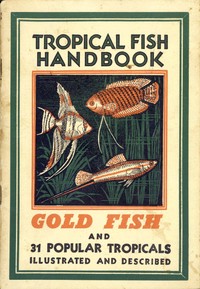
TROPICAL FISH HANDBOOK
GOLDFISH
AND
31 POPULAR TROPICALS
ILLUSTRATED AND DESCRIBED
“_Twice happy is the man who has a Hobby,
He has Two Worlds to Live in._”
TROPICAL FISH HANDBOOK
A book of practical information for the beginner, containing
illustrations and descriptions of Tropical Fish, Goldfish, Scavengers,
Turtles and Aquarium Accessories.
[Illustration: {Tropical lake scene}]
_Tenth Edition 1953_
Copyright 1945
By
GUENTHER L. SCHOTT
New York, N. Y.
PRINTED IN U. S. A.
For the beginner, the happy family collection is of most interest. Here
in one large tank he can observe the interesting habits, shapes and
colors of a great variety of fish. If he desires he may remove them to
separate tanks during breeding periods. The danger of cross breeding in
the community tank is practically eliminated by the presence of a pair
of each species.
The following fish are discussed in this handbook, those marked * being
recommended for the community tank.
_Bad tempered fish may appear in some normally peaceful species and
vice versa._
_Also fish which may make trouble in a small aquarium may be peaceful
in a large well planted one._
Live Bearers (young are born alive) *Guppy, *Swordtail, *Moon or Platy,
*Sailfin, *Black Mollienisia, *Helleri, *Mosquito Fish, *Platy
Variatus.
Labyrinth (breathe air taken from surface, bubble nest builders)
Paradise, Bettas, *Dwarf Gourami, Three-Spot Gourami.
Cichlids (Egg layers, guard eggs and fry) Jewel Fish, *Angel Fish, Mouth
Breeder, Blue Acara, Orange Chromide.
Danios (Egg droppers) *Zebra, *Pearl Danio, *Giant Danio.
Barbs (spawn on plants like goldfish) *Rosy Barb, *Barbus Oligolepis.
Characins (Deposit adhesive eggs on plants) *Silver Tetra, *Tetra Von
Buenos Aires, *Tetra Von Rio, *Blood Fin, *Pristella Riddlei,
*Head and Tail Light. *Featherfins, *Black Tetra, *Neon Tetra.
Cyprinodontidae (Egg droppers) *Medaka, *Panchax.
Cyprinidae (Egg droppers) *Rasbora.
[Illustration: The above illustration will assist the reader in
locating the markings of the fish described in this book.]
DORSAL
CAUDAL
PECTORAL
ANAL
VENTRAL
PREPARING THE BALANCED AQUARIUM
Much of the future enjoyment of your aquarium will depend upon the care
with which it is selected, and its proper location.
The aquarium should be rectangular, and the depth should not exceed its
width. The larger the tank the more satisfaction you will receive from
it—it is easier to balance, maintains a more uniform temperature, and
allows space to add to your collection.
The principles of the balanced aquarium are very simple. Fish breathe
oxygen (which they obtain from the water) and exhale carbon dioxide.
Thriving plants absorb the carbon from the carbon dioxide and liberate
the oxygen. This maintains a high oxygen content in the water necessary
to maintain healthy fish. No balanced aquarium can be maintained without
scavengers to consume bits of decaying food and plants. Fish, plants and
scavengers depend upon each other in the balanced aquarium.
Aquarium should be located where it will receive one or two hours of
direct sunshine daily and plenty of strong light all day. When aquarium
is located cover bottom with one or two inches of well washed coarse
sand. (For practical purposes sand may be considered well washed when
water runs clear.) Be sure that aquarium has been carefully washed
before introducing sand. Sand and aquarium may be washed in strong
solution of rock salt—RINSE THOROUGHLY.
Now fill aquarium about half full of water and set in plants. Be sure
that over one half your plants are excellent oxygenators. Vallisneria
and Sagittaria should not have crowns buried when planting. Plant tall
plants in back or in corners and smaller ones in front. You cannot use
too many plants—BUT ONLY GROWING AND HEALTHY PLANTS LIBERATE OXYGEN.
Fill tank, pouring water on piece of paper floating on top or into cup
submerged in tank to avoid uprooting plants. Allow water to stand 24
hours. Be sure it is the right temperature for fish it will contain. Add
snails and scavengers. PROVIDE GLASS COVER as tropicals are noted for
their jumping ability. Some type of heater should be provided for the
aquarium, in order to maintain a uniform temperature during the winter
months.
Fish may now be introduced, care being taken not to place too many fish
in a new tank until plants have had sufficient time to multiply. The
dissolution of uneaten food, dead snails, plants, etc., frequently
produces more food than can be consumed by the plant life present. At
this point Algae frequently steps in and the tank becomes green or
cloudy and foul smelling.
To avoid this condition, avoid too many fish in aquarium, siphon off
dirt on bottom frequently, remove plants that are not thriving, cut down
light when thread algae becomes a nuisance.
Water in a balanced aquarium will remain crystal clear for months.
Always keep glass cover on aquarium. It helps maintain a more uniform
temperature, and keeps fish from jumping out. It may be raised slightly
but this is not necessary.
Always use net in handling fish.
Do not use pebbles in aquarium—food gets into crevices where scavengers
cannot reach it—causing water to foul.
Always keep a thermometer in aquarium.
Avoid metals in aquarium. Lead is safe as it does not dissolve.
Rooted plants should not have crowns buried when planting—Fig. 1.
KEEP BOTTOM OF AQUARIUM CLEAN—remove all sediment with dip tube—Fig. 2.
To remove water—use either automatic siphon—Fig. 3—or siphon with rubber
hose.
[Illustration: FIG·1]
[Illustration: FIG·2]
[Illustration: FIG·3]
[Illustration: {Plants}]
ANACHARIS. LUDWIGIA. VALLISNERIA. SAGITTARIA. CABOMBA.
DUCK WEED.
HAIR GRASS. SOUTHERN VALLISNERIA. MYRIOPHYLLUM. SALVINIA.
SPATTERDOCK.
PLANTS
Anacharis: Fair oxygenator—planted or floating—needs abundance of light.
Ludwigia: Fair oxygenator. Leaves—top green, underneath red.
Sagittaria: Excellent oxygenators, three varieties: NATANS—long narrow
leaves; GIGANTEA—broad stocky 8″ leaves; SUBULATA—(dwarf) 4″ to 6″
narrow leaves.
Cabomba: Little value as oxygenator—fanlike green leaves.
Hair Grass: Fair oxygenator—rapidly covers floor with 4″ grassy needles.
Southern Spatterdock: Ornamental—broad bright green leaves.
Vallisneria: Excellent oxygenator—15″ long—multiplies rapidly by
runners.
Myriophyllum: Ornamental—excellent for spawn of adhesive egg layers.
Salvinia: Floating—¼″ leaves covered with velvety hairs.
Duck Weed: Ornamental bright green floating plant.
Riccia: Very fine bright green floating plant—valuable in spawning
bubble nest builders, especially Dwarf Gourami.
Cryptocoryne: Leaves top dark green, underside dark red. Needs some
soil, slow grower. Very decorative and necessary in spawning some
species.
[Illustration: {Scavengers}]
WEATHER FISH BLACK RAMSHORN SNAIL
POND SNAIL AMERICAN SALAMANDER
CLAM or FRESH WATER MUSSEL AFRICAN SNAIL
MELANTHO SNAIL
SCAVENGERS
Melantho (Trumpet) Snail: Very active—multiplies rapidly—consumes algae.
Pond Snail: Very active and useful—a fast moving fellow.
Black Ramshorn Snail: Multiplies rapidly—excellent scavenger.
Coral Snail: Same as Ramshorn with coral red body, and shell.
African Snail: Good scavenger—light yellow brown—dark spots.
Australian Snail: Similar to Pond but bright scarlet in color—very
active.
Catfish: (Corydoras Paleatus) most popular scavenger. Look for full
description on page 26.
American Salamander: Brown with red and black spots—vest yellow and
brown.
Clam or Fresh Water Mussel: Filters all floating matter from water
leaving it crystal clear. Must have large tank or pool and several
inches of sand in which to work.
Snails will eat eggs of egg-laying fish.
To breed snails—place in separate tank and feed lettuce. Well fed snails
lay an abundance of eggs, resembling a gelatin like mass attached
to plants and glass. Fish will eat snail eggs. Salt will kill
snails—when using salt treatment remove snails.
MOSQUITO FISH: HETERANDRIA FORMOSA
(Southern U. S.)
[Illustration: average size]
Color: Numerous black bands adorn gray sides—black horizontal line
extends from eye to caudal. Red edged dark spot on dorsal.
Breeding Habits: Live bearers—Females produce several young every few
days during breeding season. Young are hardy and mature in about 6
months.
Temperature: 65° to 75° F.
Temperament: Peaceful.
GUPPY: (below) LEBISTES RETICULATUS (Venezuela)
Color: Male—two males are never precisely alike. Every color of the
rainbow is present, intermingled with irregular black spots and
bars. Female—dull grayish green.
Breeding Habits: Live Bearers—mature females produce from 35 to 50 live
young every 5 weeks. Presence of young is indicated by darkened
area anterior to anal fin. “Heavy” females may be removed to
separate vessel, heavily stocked with plants—particularly floating
plants toward light. When young are born they seek safety among
plants. Remove female to prevent her eating young. Young are ready
to take fine food in a few hours. Guppy seem to thrive under
fairly crowded conditions.
Temperature: Thrive and breed at 65° to 80° F.
Maturity: Males 2 to 3 months—Females 4 month. Males less hardy.
Temperament: Very peaceful. Males very active.
SWORDTAIL: XIPHOPHORUS HELLERI
(Mexico)
[Illustration: average size]
Color: Male—body blue green, red line on side. Large dorsal with reddish
dots. Ornamental sword may be yellow, orange or green, edged with
black. Female—resembles male in color, lacks sword. (Both male and
female CRESCENT SWORDTAIL have black crescent at base of caudal.)
Breeding Habits: Live bearers—have 25 to 100 live young every 6 or 7
weeks. When female is “heavy” place her in large vessel heavily
stocked with plants. Young swim from mother, seeking safety among
plants usually at bottom toward light. Remove female—she will eat
fry.
Temperature: 70° to 85° F. Breed best at 75° F.
Maturity: Breed at about 9 months. Male resembles female until full
grown; then anal changes to reproducing organ and “sword”
develops.
Temperament: Very peaceful. Due to rivalry, stronger male will bully
others.
HELLERI (below) (Gold, Red and Black)
Mating a virgin female Swordtail and Platy male, the young inherit the
general color of the male and body type of the female, often becoming
larger than either parent. Some males develop short sword. A percentage
of the offspring are sterile.
PLATYPOECILIA VARIATUS (above)
(Mexico)
[Illustration: average size]
Color: Large dorsal, yellow with black edge, caudal reddish, body
various colors intermingled. Female, similar to female swordtail
in color and markings. Male has spot resembling gravid spot on
female. Color and markings vary.
Breeding Habits: Live bearers (same as swordtails). Do not breed true to
color.
Temperature: 72° to 80° F.
Maturity: 5 to 8 months.
Temperament: Peaceful, very hardy.
MOONS OR PLATY PLATYPOECILIA (Mexico)
Color: RED MOON—deep rich red. GOLD MOON—gold body, red dorsal fin, BLUE
MOON—blue body, black crescent at base of caudal. (Black Crescent
may appear on Red and Gold Moons.) BLACK MOON—black body sometimes
with greenish sheen, also found with red heads, (Black Helmet
Moon), GOLD WAGTAIL—Gold body with black fins and black caudal.
RED WAGTAILS—deep red body with black fins and black caudal.
Breeding Habits: Live bearers—15 to 30 young every 6 to 9 weeks.
Breeding habits same as swordtails, except most young moons come
to top. Cross breeding with swordtail common, producing beautiful
hybrids (HELLERI) larger than either parent and assuming color of
male (MOON).
Temperature: 70° to 80° F. Maturity: 4 to 6 months.
Temperament: Very peaceful. Fry must be kept very warm.
SAILFIN: MOLLIENISIA LATIPINNA
(Southern U. S., Northern Mexico)
[Illustration: About one half size]
Color: Male—body olive green, black stitching; large dorsal fin
(sailfin) lavender and orange spotted with black; caudal, orange
and light blue. Female—similar to male but without large dorsal.
Breeding Habits: Live bearers—have 20 to 100 young at irregular
intervals. All Mollienisia are hardy but females must not be moved
to another tank when young are expected. This frequently causes
young to be born prematurely and few will survive. Moving female
or undue excitement at this time may cause death of female.
Provide ample vegetation in tank. Sailfins are not very
cannibalistic but it is always safest to remove fry for several
weeks. Young are ⅜″ long when born.
Temperature: 45° to 85° F. Breed best at 70° F.
Maturity: 9 months.
Temperament: Very peaceful.
In breeding Mollienisia, no two varieties should be kept in the same
tank as they will cross breed. Each variety should be provided with a
separate tank. (This is also true of the moons). Only very careful
intelligent selective breeding has produced the Black Mollienisia,
later the Sailfin Black Molly, and most recently, Black Molly Sailfin
with an orange bordered dorsal.
BLACK MOLLIENISIA:
(Southern U. S.)
[Illustration: average size]
Color: Both male and female coal black.
Breeding Habits: Live bearers—15 to 25 young born at irregular intervals
throughout the year. Young when born are large and black. Turn
gray in a few weeks and then gradually turn black. Female should
never be moved when young are expected—as this usually results in
loss of young and frequently loss of female. (See Sailfin). Young
are fairly safe with parents if ample floating plants are
provided. “Mollies” are algae eaters. Black Mollienisia have been
crossed with Sailfins producing the beautiful BLACK MOLLIENISIA
SAILFIN.
Temperature: 65° to 80° F. Breed best at 75° F.
Maturity: Good male becomes black in about 6 months. Female about 18
months. Breed at 9 months. Males less hardy.
Temperament: Very peaceful.
“Mollies” are heavy eaters, and largely vegetarians. Some algae should
be present.
MEDAKA: (above) ORYZIAS LATIPES
(China)
[Illustration: average size]
Color: Male and female light lemon yellow. Male slim like
Zebra—sometimes called “Golden Danio.” Female—slightly heavier.
Breeding Habits: Egg layers—these interesting and attractive fish are
the easiest of the egg layers to breed. Eggs cluster about anal
region of female like bunch of grapes. Here they are carried for
several hours and later brushed off on plants where they become
attached. Eggs can be easily seen hanging to plants. Fish seldom
bother eggs but it is safest to remove plants containing eggs to
another jar. Fry hatch in 10 to 14 days. Feed fry infusoria. Never
have snails in tank containing fish eggs.
Temperature: 45° to 80° F. Spawn best at 70° F.
Maturity: Mature in about 6 mos.
Temperament: Very peaceful.
ZEBRA: DANIO RERIO (Ceylon)
Color: Both male and female striped from eyes through tail with
alternate lines of blue and silver. Underparts of male slightly
yellowish—female silvery white. Female—deeper in body.
Breeding Habits: Egg layers—non-adhesive eggs fall to bottom. Cover
bottom of breeding tank with several layers ½″ pebbles or glass
marbles, not over 3 inches of water above marbles. Place male and
female (kept separate several days) in prepared tank. Spawning
usually takes place within 24 hours. Spawning is preceded by very
fast swimming. Remove parents after spawning. Fry hatch in 2 to 8
days. Feed fry infusoria.
Temperature: 45° to 80° F.
Maturity: Breed when 4 to 5 months.
Temperament: Peaceful, swim in school, constantly moving.
(See Pearl Danio.)
PEARL DANIO (above): DANIO ALBOLINEATUS
(Burma)
[Illustration: average size]
Color: Iridescent mother-of-pearl and opal tints. Dull red line through
center of body and tail. Female—slightly heavier.
Breeding Habits: Egg layers—prepare aquarium same as for Zebra. Long
tank best for both. As they snatch eggs when they turn, long tank
eliminates many turns. Advisable to use two males to one female.
(See Zebra.)
Temperature and Temperament: Same as Zebra.
Maturity: 6 to 8 months.
GIANT DANIO DANIO MALABARICUS
(Malabar Coast)
Color: Deep metallic blue with two horizontal stripes of yellow gold.
Female—slightly heavier.
Breeding Habits: Egg layers—very small semi-adhesive eggs deposited on
plants. Fry need great amount of food. Remove parents after
spawning. (see Rosy Barb.)
Temperature: 60° to 80° F.
Maturity: 8 to 10 months.
Temperament: Peaceful, but will attack small fish.
Danios (Zebra, Pearl and Giant) are always active, and are large
consumers of oxygen, therefore are more susceptible to the effects of
lack of sufficient oxygen in the aquarium. Being fast swimmers and
especially fond of their own eggs, water in the breeding tank should
not exceed 6 inches and they should be removed as soon as spawning is
over.
ROSY BARB: BARBUS CONCHONIUS
(India)
[Illustration: average size]
Color: Silvery green, dark spot at base of caudal. Male has black dash
on dorsal and takes on rosy hue during spawning season.
Breeding Habits: Egg layers—lay eggs on fine plants similar to goldfish.
Stock aquarium well with fine plants like Myriophyllum or Cabomba,
weight down ends with a stone. Separate male and female for a few
days. Spawning usually takes place within 48 hours after pair is
placed together. After spawning is completed remove plants
containing eggs and place in tank free from other fish and
scavengers. Fry hatch in about a week and should be fed with Brine
Shrimp.
The following Barbs are prettily colored and easy to take care of.
Their breeding habits are like those of the Rosybarbs.
BARBUS SUMATRANUS
BARBUS EVERETTI (CLOWN BARB)
BARBUS SEMIFASCIOLATUS (HALF BANDED)
BARBUS SEMIFASCIOLATUS var. Schuberti, (GOLD BARB)
BARBUS NIGROFASCIATUS
Temperature: 45° to 80° F. Spawn best at 70° to 80° F.
Maturity: Mature in about 9 months.
Temperament: Peaceful.
BARBUS OLIGOLEPIS (below)
(Sumatra)
Color: Male—Large scales with blue-black spot, all fins orange-red with
dark edge. Female—Duller in color with 4 or 5 black spots on
sides.
Breeding Habits: Egg layers—Stock aquarium with Cabomba. Male turns
almost black during spawning period. Remove both parents as soon
as eggs are deposited on fine plants. Fry hatch in about 72 hours.
Temperature: 70° to 80° F.
Maturity: 10 months.
Temperament: (Peaceful.)
BLOOD FIN: (above) APHYOCHARAX RUBRIPINNIS
(Argentine)
[Illustration: average size]
Color: Iridescent steel blue with deep red fins. Sex determined same as
Silver Tetra.
Breeding Habits: Egg layers. Use large tank, cover bottom with fine
plants, and ample tall ones. Fish spawn at surface, some eggs
adhering to tall plants, others falling. Remove parents. Fry
appear in about 24 hours. Feed Brine Shrimp. Fry grow rapidly.
Temperature: 70° to 78° F.
Temperament: Peaceful.
SILVER TETRA: CTENOBRYCON SPILURUS
(Br. Guiana)
Color: Steel blue body covered with very fine bright silver scales. Body
very thin. Large black spot at base of caudal. Tetras are all
easily identified by the small adipose fin between dorsal and
caudal. Male slightly smaller with invisible processes on anterior
tip of anal which catch in fine net. Sex is determined in this
way.
Breeding Habits: Egg layers—lay great quantities of adhesive eggs on
fine plants. Plants or parents should be removed as soon as
spawning is completed. Fry will make their appearance in a few
days. Be sure there are no snails in tank with eggs.
Temperature: 70° to 90° F.
Maturity: 6 to 8 months.
Temperament: Very active. Not for community tank.
TETRA FROM RIO (above): HYPHESSOBRYCON FLAMMEUS
(Brazil)
TETRA FROM BUENOS AIRES: HEMIGRAMMUS CAUDOVITTATUS
(Argentina)
[Illustration: average size]
Color: TETRA FROM RIO—body bright silver—3 black bars near head; fins
brilliant red edged with black; black edge on anal of male wider
than on female. During mating season red runs well into body.
TETRA FROM BUENOS AIRES—body bright silver, fins blood red. Large
diamond shaped spot at base of caudal. Sex determined same as
Silver Tetra.
Breeding Habits: Egg layers. Use 15 gallon tank, 6 to 8 inches of water.
Stock tank heavily with Cabomba, Myriophyllum, or other fine
floating plants, also a thicket on bottom. Semi-adhesive eggs are
deposited on plants, some sinking to bottom. Best results are
obtained with 2 males and 1 female. Remove parents after spawning
is completed. Fry appear in about 3 days. Tiny fry hang on plants
and sides of aquarium about 3 days. Tetras may not spawn
immediately—have patience.
Temperature: 70° to 90° F.
Maturity: From Rio—8 months. Buenos Aires—10 months.
Temperament: From Rio—Very peaceful, Buenos Aires—Fairly peaceful.
PRISTELLA RIDDLEI: (above)
(Venezuela and Guiana)
[Illustration: average size]
Color: Silvery body, caudal reddish, anal and dorsal light yellow with
dark spot. Difficult to distinguish sex.
Breeding Habits: Egg Layers. Spawn on fine plants, Myriophyllum or
Cabomba—very small adhesive eggs, expelled 6 or 8 at a time, often
fall to bottom. Sometimes as many as 200 eggs at a spawning.
Remove parents after spawning.
Temperature: 72° to 80° F.; best above 75° F.
Maturity: About 1 year.
Temperament: Peaceful.
HEAD AND TAIL LIGHT: HEMIGRAMMUS OCELLIFER
(Amazon River, S. A.)
Color: Body translucent green, faint gold line through center of body,
thin black line toward caudal base broadens into diamond shape.
Gleaming gold spot on tail and brilliant red eye give fish its
common name. Male smaller, more slender and has pointed instead of
rounded dorsal.
Breeding Habits: Egg layers. Adhesive eggs are deposited on fine plants.
Use 2 males to one female for best results. Fry hatch in 2 days.
(See Pristella Riddlei.)
Temperature: 72° to 80° F.
Maturity: About 8 months.
Temperament: Peaceful. Young fairly hardy.
FEATHERFIN: HEMIGRAMMUS UNILINEATUS
Color: Like above Pristella Riddlei but has a black and white line down
the anal fin.
Breeding Habits and Temperament: like Pristella.
JEWEL FISH: HEMICHROMIS BIMACULATUS
(Africa)
[Illustration: average size]
Color: Body bright scarlet blending to rich olive on back. Emerald dots
(jewels) in irregular lines cover body and vertical fins.
Frequently difficult to obtain mated pair.
Breeding Habits: Egg layers—eggs are deposited on smooth stone or flower
pot, to which they adhere. During incubation (about 30 hours) one
parent stands guard, constantly fanning to circulate water over
eggs. Fry are unable to swim first three days so parents make
hollow in sand where fry are placed and guarded. After fry can
swim, they form school with parents in center. Remove parents when
fry are about one-fourth grown or sooner. Parents must not be
excited or they will eat spawn or fry.
Temperature: 70° to 90° F. Fry above 75° F. Breed best at 80° F.
Maturity: 10 to 14 months.
Temperament: Very savage—male frequently attacks carefully mated female.
* * * * * * * *
To spawn Cichlids (Jewel, Angel, Orange Chromide, Blue Acara and
Mouthbreeder) purchase several young fish—bring them to maturity
together. When ready for breeding a mated pair will be found associating
together and separated from the others.
Avoid disturbing Cichlids, any disturbance or noise may cause them to
devour their eggs or young.
ANGEL FISH: PTEROPHYLLUM SCALARE
(Amazon River, S. A.)
[Illustration: Reduced]
Color: Bright silver, black bars, body very thin. Black bars disappear
when disturbed or frightened. Difficult to distinguish sex.
Breeding Habits: Egg layers—very difficult to breed. Prefer sides of
aquarium or Sagittaria Gigantea for depositing eggs. Eggs are
fanned constantly by parents. Fry appear in about 8 days; guarded,
and transferred from one plant to another or depression in sand,
by parents. Fry swim in about a week and resemble thread like
worms. Remove parents when fry begin to swim. Feed infusoria. Fry
take shape of scalare in 3 to 5 weeks.
Temperature: 70° to 90° F. 85° for spawning.
Maturity: One to one and a half years. Growth depends upon quality and
quantity of food and size of tank. Angel fish should have as much
live food as possible, largest tank available.
Temperament: Peaceful. Easily frightened. Keep in large well planted
aquarium otherwise they may dart against sides and kill
themselves. Should be fed live food frequently. Large specimens
are not recommended for community tank.
BLUE ACARA: AEQUIDENS LATIFRONS
(Central America)
[Illustration: one half size]
Color: Yellowish brown with several dark vertical bands. One of these
bands widens in center of the body into a spot. Lines of shining
blue dots cover the entire body. Dorsal, anal and caudal are wine
red with rows of blue and blue-green spots. Both sexes similar,
female slightly subdued in color.
Breeding Habits: Egg layers—Mate fish of approximately the same size.
Provide a clean flower pot for the fish to deposit their spawn.
The adhesive eggs are placed on the inside of the flower pot and
are then fertilized by the male. Eggs are fanned by the parents
and fry appear in 3 or 4 days. Parents prepare a depression in the
sand and taking the newly hatched fry in their mouths deposit them
into these holes where they are carefully guarded by the parents.
Young live in a swarm in this “nest” for several days. Then they
swim freely and must be fed infusoria. Parents may be removed soon
after fry swim freely. The Blue Acara is hardy, prolific, easily
spawned, and the fry are hardy and develop rapidly.
Temperature: 70° to 85° F.
Maturity: Breed in about 8 months.
Temperament: Not peaceful—except with very large fish.
MOUTH BREEDER: HAPLOCHROMIS STRIGIGENA
(Egypt)
[Illustration: one half size]
Color: Body light blue gray—fins yellowish—head very massive.
Breeding Habits: Egg layers—deposit spawn in depression in sand. After
spawning is completed female picks up eggs and carries them in her
mouth. Water is circulated over eggs by a chewing movement. Female
refuses food during period she carries eggs. Male should be
removed as soon as female picks up eggs as he may bother her. Fry
appear in about two weeks, but at the slightest sign of danger
rush back into the mother’s mouth. This continues until fry are
too large for the maternal jaw. Female should be removed when fry
are about 5 weeks old. Because of “fast” while carrying eggs,
should be bred but 2 or 3 times a year.
Temperature: 70° to 85° F.
Maturity: 12 to 14 months.
Temperament: Rather vicious.
ORANGE CHROMIDE: (below) ETROPLUS MACULATUS
(India)
Color: Golden orange, 3 blue-black dots on sides crossed by rows of
small reddish dots. Dorsal brown, anal and pectorals dark. Sex
difficult to distinguish.
Breeding Habits: Egg layers—Spawn on flower pot or stones placed in the
aquarium. Fry hatch in about 4 days and are moved into pits in
sand. Fry swim freely in about 6 days. Remove parents in about two
weeks.
Temperature: 70° to 80° F.
Maturity: about 6 to 8 months.
Temperament: Usually peaceful in large well planted tank.
THREE-SPOT GOURAMI: TRICHOGASTER TRICHOPTERUS
(India)
[Illustration: average size]
Color: Silvery olive with black spot in center of body, another at
caudal base—the eye making the third spot.
Breeding Habits: Same as Dwarf Gourami.
Temperature: 70° to 85° F.
Maturity: 10 months.
Temperament: Not recommended for community tank.
BLUE GOURAMI: TRICHOGASTER SUMATRANUS
Form and size like three-spot gourami but color light blue.
DWARF GOURAMI: (below) COLISA LALIA (India)
Color: Body light blue crossed by orange-red stripes. Large fins colored
same as body. Female—subdued in color and fins (dorsal and anal)
slightly rounded.
Breeding Habits: Bubble nest builders—male blows nest of bubbles on
surface of water among floating plants. Female frequently assists,
weaving bits of plants into nest. Female is coaxed beneath nest
where eggs are expelled and fertilized. Male catches eggs and
blows them into bubble nest. Remove female. Eggs hatch in several
days. Male guards nest, blowing fry back into nest until they are
able to swim freely, to prevent their drowning. Remove male when
fry are 4 days old.
Temperature: 70° to 90° F.
Maturity: 8 to 10 months.
Temperament: Exceedingly peaceful and friendly.
_Labyrinth fish prefer shallow water—spawning tank not to exceed 6″—tank
for fry not to exceed 4″._
PARADISE: MACROPODUS OPERCULARIS
(South China)
[Illustration: average size]
Color: Body dark with vertical bars of deep red against bluish green
background. Fins similar in color, caudal deep red. Female—shorter
fins, color very pale during mating.
Breeding Habits: Bubble nest builder. When pair have mated (frequently
after the death of several undesirable females) the male builds a
floating nest of bubbles. Male coaxes female under nest, winds
himself about her, a gentle pressure expelling eggs. He then
gathers eggs in his mouth and blows them into nest. Falling eggs
and young fry are carefully blown back into nest by male. Remove
female when spawning is over. Fry appear within 36 hours. Remove
male in about 4 days.
Temperature: 50° to 90° F.
Maturity: About 12 months.
Temperament: Vicious, keep pair separated except when spawning. (see
Bettas.)
Labyrinth Fish (Gourami, Paradise, Bettas) are air breathers, coming to
the surface every few minutes for a bubble of air. For this reason they
can stand crowding, providing water is kept clear. Fry do not develop
this characteristic for several weeks so must be provided with a large
shallow container with ample oxygen.
BETTAS: SIAMESE FIGHTING FISH
(Siam)
[Illustration: average size]
Color: This attractive group (all hybrids of BETTA SPLENDENS) have many
color variations, all exceptionally attractive. BETTA CAMBODIA:
gold colored body—bright red fins. Those with most red in body
known as BETTA RUBRA. BETTA CYANA—body and fins iridescent
cornflower blue. Others often have various shades of blue, green,
red and purple predominating. Females—subdued in color and lack
long flowing fins.
Breeding Habits: Bubble nest builders—Male builds floating nest of
bubbles 3 to 6 inches in diameter. Female is coaxed and forced
under nest, male embraces her expelling eggs. Male catches eggs
and blows them into bubble nest. Remove female. Fry hatch in 48
hours. Remove male in 10 days. Do not crowd fry.
Temperature: 65° to 90° F. 80° F. best for spawning.
Maturity: 8 to 10 months.
Temperament: Savage—two males will fight to a finish. Siamese wager on
outcome of these battles. Not advisable to keep mated pairs
together except when spawning. Separate pairs with glass placed
diagonally across aquarium. When spawning, if male attacks female
too viciously, replace glass.
(_One of these fish may be kept in Community Tank—they seem to attack
only their own species._)
PANCHAX FROM MADRAS: PANCHAX PARVUS
(India)
[Illustration: average size]
Color: Male, rich deep greenish olive, sides covered with rows of
gleaming red and green spots, anal bright orange and red. Dorsal
and caudal are of similar colors. Female—dull with light orange
fins.
Breeding Habits: Egg layers, spawn readily in small tank, riccia being a
favorite plant for this purpose.
Temperature: 72° to 80° F.
Temperament: peaceful.
RASBORA HETEROMORPHA: (below)
(Sumatra)
Color: Silvery copper with large blue-black triangle from dorsal to
caudal base. Dorsal and caudal red. Scales above black triangle
wider on male.
Breeding Habits: Egg layers—Difficult to breed. Female swims upside down
against leaf of Cryptocoryne, expelling eggs, most of which drop
to bottom. Remove parents after spawning. Fry hatch in about 2
days and resemble zebra fry. Swim freely in about 5 days. Use 3
males and 2 females. Do not have aquarium in direct rays of sun.
Temperature: 72° to 85° F.
Maturity: Breed at 10 months.
Temperament: Peaceful.
CATFISH: CORYDORAS PALEATUS
(South America)
[Illustration: 1 to 2 inches]
Color: Shining olive green, towards the anal: yellowish to white. Body
covered with dark spots changing according to the surroundings.
Average size: 1 to 2 inches.
Breeding Habits: Egg layer. Distinguishing sex marks: male smaller than
female, and has pointed ventral fins, which are in the female,
rounded. Best breeding results are obtained in a large aquarium.
Two to three males for one female. Temperature 75 to 80 degrees.
60 to 500 eggs are carried by female in her ventral fins to a
clean spot which can be the glass of the aquarium, a plant or
stone. Babies hatch after 6 to 9 days. The opinion of breeders is
divided as to whether parents should be removed. Good results were
obtained either way.
Temperament: Paleatus Catfish are the most peaceful fish and very
essential for the maintenance of every balanced aquarium. They are
regarded as the officers of the “Dept. of Sanitation” among
successful aquarists. Paleatus is a ground fish, tirelessly
picking up food remnants and left-overs which other fish do not
eat. Through this activity, Paleatus helps to keep the food
particles from contaminating the water. Catfish dart up to the
surface to breathe atmospheric air.
WHITE CLOUD MOUNTAIN FISH: TANICHTHYS ALBONUBES
(China)
Color: Form and color similar to Pearl Danio but with gold and blue line
from eye to caudal fin, dorsal and caudal fins deep red, male has
white tip above red caudal fins.
Breeding Habits: Average temperature 80 degrees. Eggs not adhesive. One
female to two males, eggs hatch after two to three days. Remove
parents after spawning. Tiny fry must be supplied with infusoria
or better still, Brine Shrimp (see p. 27).
Temperament: Peaceful and hearty, “called poorman’s Neon Tetra” since
the bright colored babies closely resemble Neon Tetras.
WHITE PARADISE: ALBINO PARADISE
Color: Generally white and the red bars show faintly. Like most albinos
their eyes are pink.
Breeding Habits: Just like their original form, the Red Paradise. The
albino color breeds true. (See page 23.)
BLACK TETRA: GYMNOCORYMBUS TERNETZI
(Paraguay)
Color: Same size like Tetra from Rio but black in color.
Breeding Habits and Temperament also like Tetra from Rio. (see page 16.)
BLUE MOLLY: MOLLIENISIA SPHENOPS
Color: Sphenops are found in various color schemes varying from jet
black to pure light blue, very often blue body with scattered
black spots. The caudal of male adorned with bright orange border.
Breeding Habits: Heartier and more easily bred than ordinary Black
Mollies.
LIBERTY MOLLY: VAR. SPHENOPS
Color: Body color of male and female light blue, but males dorsal shows
“red, white and blue”.
Breeding Habits: (see page 11.)
GOLD FISH:
[Illustration: _Veiltail_]
History: The Gold Fish, the oldest and most popular of our numerous
Aquarium Fish, was developed by the Chinese during the Sung
Dynasty (960-1278) from the wild Carassius Auratus to the various
varieties now familiar to us.
In the year 1750 Madame de Pompadour imported the first Goldfish into
France as showpieces for the ornamental waterpools in her vast gardens.
In 1856, P. T. Barnum was sent by The American Museum to search for
oddities in Europe and to study the then popular fad of keeping live
fish in aquariums. Thus our now familiar Goldfish made its debut in
America. With its golden beauty and its sturdiness, the Goldfish quickly
became the Parlor Pet of our parents and grandparents. Today the sales
of American-bred Goldfish run into the millions.
It would be beyond the limits of this booklet to explain and fully
describe all the various forms and color variations of our goldfish, as
there are Comets, Fantails, Shubunkins, Black Moors, etc. Most Goldfish
do not reach their full life span of 4 to 6 years and often more,
because they are fed too much and are given too little “Living Space.”
Feed your fish only once a day during the morning and make sure that all
food is consumed within 10 to 15 minutes. Any surplus food will fall to
the bottom and will contaminate the water. The surest sign of
overfeeding is cloudy and milky looking water. This bad water is poor in
oxygen and the fish will hang on the surface and frantically gasp for
atmospheric air. Any nationally known brand of Goldfish food will be
suitable for your fish, but once more: DO NOT OVERFEED. The proper size
of the aquarium should be comparable to the amount of fish or vice
versa. The happy medium is about 1 small fish per gallon of water. An
aquarium of five gallons capacity can, therefore, hold no more than 4 to
5 small Goldfish, but fish of larger size must have much larger space.
The most suitable temperature is between 60 and 70 degrees, Fahrenheit.
Breeding Hints: During the breeding season which falls during the first
seven months of the year, the male will show small warts of pin
point size on his gill plates. The female is shorter than the male
but fuller in body, more so, when carrying spawn. A mature fish is
about 3-10 inches long, depending on type and a pair must
therefore have a breeding aquarium of at least 10 gallons. The
fish will spawn on myriophyllum, long rooted water hyacinths, or
other soft bunchy plants and the eggs will hatch in about 4-7
days. Since the parent fish like to eat their own spawn, it is
therefore advisable to remove either the parents or the plants
with their adhering eggs. The newly hatched babies are fed with
infusoria and later on with fish food of a fine grain.
Diseases: Fin Congestion and Fungus are the most frequent Goldfish
diseases. Their best cure is the salt treatment which is described
on page 33.
TURTLES
[Illustration: {Turtle aquarium}]
Baby turtles are very easily kept as pets and require little care. While
in captivity, Turtles will forget their time schedule and will not
hibernate. Any round or oval bowl, an aquarium or a flat pan with a rim
sufficiently high to prevent the turtle from crawling out, is an
adequate home. In this container, place white or colored pebbles, and in
the center a flat stone. Fill the container with clean water of room
temperature (60 to 80 degrees, fahrenheit) but see to it that the stone
is not covered by the water for it will serve as an “Island” and thus
give the turtle a chance to leave the wet element when desired. The best
place for the bowl is in a light place, but special care should be taken
to see that the bowl is not exposed too long to the direct sun. Ant
Eggs, commonly packed as “Turtle Food” will mainly be their diet but
lean raw beef, which is finely scraped, will be an appreciated change.
The same applies for green lettuce, rainworms, etc. A variation in food
and sunshine will prevent blindness, but should a turtle get a white
film over its eyes, a few drops of Cod liver Oil forced by a medicine
dropper in its mouth, might help. Boric acid swabbed over the eyes will
also be beneficial. Turtles will not feed “on land” therefore all food
should be placed in the water. Water should be changed two to three
times weekly.
HEALTH
It is much easier to keep fish healthy than to cure them.
Disturb your fish as little as possible.
Fish in good health are active and keep dorsal fin erect. (Folded fins
for a short period do not mean a sick fish.)
Most fish ills develop from chills. Keep fish above lowest safe
temperature. Young fry especially should be kept warm.
Avoid extremes of temperature. Avoid sudden changes of temperature.
Provide some type of aquarium heater for cold months.
Do not crowd fish—be sure plants are thriving and there is ample oxygen
in water.
Fish constantly at top indicate foul water and lack of oxygen. Remove
part of water and replace with fresh of same temperature.
Dying plants cause much trouble—be sure plants are healthy and growing.
It is much easier to keep fish healthy in a large tank (above 5
gallons). A large tank maintains a more uniform temperature, allows more
air surface, plants thrive better, and water is not fouled so easily by
excess food.
An aquarium can be maintained in healthy condition, both plants and fish
thriving, under artificial lighting furnished by an ordinary light bulb.
Vary the diet for the fish. Feed only as much as they will eat in ten
minutes. Feed sparingly and several times a day if necessary. Use glass
feeding ring. (Fig. 4). All uneaten food drops to one spot where it can
be easily removed with a dip tube.
Health and growth of fry depend upon oxygen supply. Use tank with large
air surface. BE SURE AND DO NOT CROWD YOUNG FRY. Crowding stunts growth
and frequently causes disease, and loss of whole brood. Fry demand
approximately same amount of water as adults—see page 31.
[Illustration: FIG·4]
[Illustration: Tropicals in poor condition, (usually indicated by
folded fins).
Fish constantly at top indicate foul water and lack of oxygen.]
[Illustration: SEVERAL HOURS DIRECT SUNLIGHT DAILY
Always keep glass cover on aquarium.
Always keep a thermometer in aquarium.]
[Illustration: Never give fish more food than they can clean up in
ten minutes.]
FOOD
Do Not Overfeed—Never give fish more food than they can clean up in ten
minutes.
Vary the Diet—Have several kinds of food on hand at all times. Dried
Shrimp, Dried Daphnae, scrapings from raw beef, bits of canned salmon,
bits of boiled spinach, finely crumbed graham cracker, bits of yolk of
boiled egg, and most of the prepared foods are excellent but should be
supplemented with some form of live food. Once a week they should be fed
chopped earth worms or Enchytrae (White worms). Feed live bearer’s fry
small quantity of fine foods several times a day. Feed egg layer’s fry
Brine Shrimp twice a day the first couple weeks and then feed same as
live bearer’s fry.
Several Feedings a Day—Feeding a very small quantity of food several
times a day (what the fish will clean up in several minutes) is probably
more desirable than one feeding providing great care is taken not to
feed too much at one time.
Tropicals Will Not Overeat—Unlike goldfish, tropicals will eat only as
much as they need but great care must be exercised in order to allow no
uneaten food in the aquarium to foul the water and cause disease.
Tubifex worms are found in fresh water streams and rivers, close to
shore in soft loamy bottom. They are an excellent live food provided
they are fed to the fish with care. Keep in cool place in container
having large air surface with just enough water to cover them. Since
they bury themselves in the gravel, it is best to feed them to the fish
with a worm feeder. The best type of feeder has a quantity of small
holes through which the worms wriggle into the mouths of the fish
eagerly waiting below. For baby fish it is best to cut the worms into
small pieces.
Enchytrae (White Worms) multiply rapidly in a wooden box (about 10″
square) filled with about 5″ of rich loamy soil. Portion of worms is
placed in soil and whole mass kept fairly moist. Feed slice of bread
soaked in sweet or sour milk every 3 or 4 days. Be sure all food is
covered with at least 1″ of soil. Before feeding be sure all old food is
consumed. They may be fed cooked oatmeal or mashed potatoes WITHOUT
SALT. Stir soil once a week to aerate it and prevent souring. Cover soil
with piece of glass to keep moisture in. Keep in cool dark place.
BRINE SHRIMP—To raise Egglaying Fish, the use of Brine Shrimp (fig. 5)
replaces the old fashioned Infusoria method more and more. Brine Shrimp
Eggs are available in any good pet shop and are easily hatched.
Directions for hatching Brine Shrimp Eggs are found on package.
DISEASE
Tropical Fish are naturally healthy. If kept in a healthy aquarium, fed
properly and kept warm little or no trouble will be experienced. In
short—IT IS EASIER TO KEEP FISH HEALTHY THAN TO CURE THEM.
Practically all diseases are due to one of the following: UNHEALTHY
TANK—water too acid or alkaline—lack of oxygen—decomposition of
food—plants not thriving. IMPROPER FEEDING—Overfeeding, lack of live
food, lack of variation in diet. CHILL—the cause of most fish ills. Fish
is weakened and subject to diseases, many incurable.
Ichthyopthirius (Ich): A parasite that attacks the fish. Recognized by
tiny white spot on fins. Fish have fins folded and scratch themselves on
sand. Contagious. Treat whole tank (plants and snails need not be
removed). Raise temperature to 80° F. Add about two drops 2%
Mercurochrome to each gallon of water. If fish are not cured in 3 or 4
days repeat treatment.
Shimmy: A wagging movement without changing position is usually the
result of a chill affecting digestive organs. Not contagious—give salt
treatment.
Dropsy: Body swells, scales stand out at an angle. Fish act normal until
a few days before death. Salt treatment sometimes brings relief. Cure
doubtful.
Wounds or Ulcers: Wrap piece of cotton on toothpick; hold fish in damp
cloth and paint wound for 2 minutes with Mercurochrome twice a day. Do
not allow Mercurochrome to touch gills.
Constipation: 1 tablespoon Epsom Salts to 5 gallons of water.
Air Bladder Trouble: Caused by sudden temperature change. Fish swim
either at top or stay near bottom. Cure unknown.
Blood Shot Fins—Tailrot: Condition caused by sudden temperature change
or injury. Use salt treatment.
Fungus—White scum forms over fish. Use salt treatment.
Fluke: Flat and sunken belly. No known cure.
Salt Treatment: Use glass or enamel container, raise temperature to 80°
F., 1 teaspoonful rock or sea salt per gallon of water. (May be doubled
in extreme cases.) Salt (Rock or Epsom) will kill snails and plants.
Tropicals in poor condition, usually indicated by folded fins, should be
isolated at once. Gradually raise temperature to 80° F. Feed live food.
Give salt treatment. Frequently a cure is affected by placing ailing
fish in tank of “green water.” (see page 31.)
Sick fish more easily cured in shallow water.
Sudden changes of temperature may be fatal to weakened fish.
Potassium permanganate solution is an excellent disinfectant and
deodorant. Also destroys algae in aquarium and pool. Tint water faint
pink, repeat when color disappears. Avoid excess.
ENEMIES
Fish enemies are usually transferred to the aquarium by the introduction
of new aquatic plants that are obtained from outside pools. To avoid
fish enemies—AVOID USING PLANTS AND SAND THAT ARE OBTAINED FROM OUTSIDE
POOLS OR PONDS. If you are suspicious of source rinse for a minute or
two through a strong solution of salt water. This should kill all
insects and not injure plants. Examine plants carefully for eggs. Fig. 6
shows larvae of Giant Beetle (Water Tiger). Fig. 7, larvae of Dragon
Fly. Both attack fairly large fish and devour small ones in quantities.
[Illustration: FIG·5]
[Illustration: FIG·6]
[Illustration: FIG·7]
HYDRA—a polyp, fastens itself to plants or glass. It has a variety of
shapes and is hard to distinguish particularly on plants. It attacks and
quickly drugs fish by injecting a poison. Hydra can be killed by
removing all fish and scavengers and raising temperature of tank to 115°
F.
AERATION
Replacing consumed oxygen by blowing a stream of very fine air bubbles
through the aquarium water is frequently necessary in aquariums, where
plants receive insufficient light or are not thriving, where the air
surface is small (depth greater than width), where crowding is
necessary, etc. Even in healthy aquariums, where plants are thriving,
conditions will be improved by an hour or two of aeration daily. Many
types of aerators are available.
CONTROL OF ACIDITY AND ALKALINITY
Due to the fact that in some localities the natural water supply is
alkaline, in others neutral, and in others acid much has been written
about controlling aquarium water.
Many aquarists believe that a slightly acid condition in the aquarium is
desirable.
There are a number of reliable water testing sets available at very
nominal prices.
Most of the fish described in this book seem to thrive and breed better
in slightly acid water (about pH6.8).
HELPFUL HINTS
Get your experience from the more common varieties first.
Half grown fish are best to buy—you are sure of obtaining young fish,
and it is interesting to watch them mature.
Fish ready to spawn: Females become heavier. Also on live bearers the
dark spot near vent becomes larger and darker. Males chase females
continually at spawning time. Labyrinth male builds bubble nest.
Live bearers are easiest to breed. Eggs are hatched within the female’s
body and the young are born alive.
Female live bearers seek secluded places to give birth to their young.
If one corner of the community tank (toward light) is heavily planted,
and ample floating plants provided, quite a few young will survive.
These can be removed until old enough to return to community tank—in
about 4 or 5 weeks, dependent on growth.
Female live bearers will eat their young. If placed in separate tank
remove female as soon as brood is produced.
Female live bearers will produce several broods after being separated
from male.
Live bearer’s fry are sometimes born with an “egg sac,” usually the
result of premature birth.
[Illustration: Tools]
NET
GLASS FEEDING RING
PLANTING TONGS
THERMOMETERS
PLANTING SNIPS
AQUARIUM CLEANER
DIP TUBE
[Illustration: AVOID
1·SUDDEN TEMPERATURE CHANGE.
2·CROWDING LACK OF OXYGEN.
3·EXCESS FOOD.]
To save young live bearers, females are frequently placed in a trap. Be
sure female has ample room to swim freely. Many varieties of traps are
available.
To breed egg layers, male and female should be separated for several
days before being placed in spawning tank.
All fish are more prolific during warm weather.
Practically all fish will eat young fry.
Algae—a fine green plant growth—is caused by an excess of light. Remove
as much of the growth as possible and reduce amount of light.
Floating algae—green water—is caused by the same condition. Cut down
light and condition usually clears itself. (See page 4.) Coloring water
in tank a faint pink with a solution of potassium permanganate will
usually clear this condition. Green water is actual healthy water for
fish.
Algae may be cleaned off glass by scraping with safety razor blade.
(Fig. 8.)
Cloudy water usually caused by improperly balanced tank. Remedy: more
plants or less fish, better light, more scavengers, less food.
[Illustration: FIG·8]
Cloud at bottom of tank is usually caused by decaying of excess food.
Plants thrive better in deep sand; roots spread and absorb decaying
matter.
Always use sea salt. Table salt is questionable since it is chemically
treated to prevent caking.
Tropicals thrive under more crowded conditions than goldfish. 2 or 3
pairs per gallon in healthy aquarium, about 6″ fish body per gallon.
Always sterilize net with boiling water after handling sick fish.
Slow leaks in aquariums will usually be sealed by painting all inside
and outside seams with liquid aquarium cement.
To obtain number of gallons of water in tank—divide cubic contents in
inches by 231.
INDEX
* Subjects marked * are illustrated
A
*Accessories 35
Aeration 34
*Aequidens Latifrons 20
*African Snail 6
Albino Paradise 27
Algae 4, 36
*Anacharis 5
*Angel Fish 19
*Aphyocharax Rubripinnis 15
*Artemia 32
Australian Snail 6
B
*Barbus Conchonius 14
*Barbus Oligolepis 14
*Betta 24
*Black Mollienisia 11
*Black Tetra 27
*Blood Fin 15
*Blue Acara 20
*Blue Gourami 22
Blue Molly 27
*Breeding Trap 35
*Brine Shrimp 32
C
*Catfish 26
Characins 2, 15, 16, 17
Cichlids 2, 18, 19, 20, 21
*Clams 6
*Cabomba 5
*Colisa Lalia 22
Coral Snail 6
*Corydoras Paleatus 26
Cryptocoryne 5
*Ctenobrycon Spilurus 15
Cyprinodontidae 2, 12, 25
D
*Danio Albolineatus 13
*Danio Malabaricus 13
*Danio Rerio 12
*Dip Tube 4
Disease 33
*Dragon Fly Larvae 34
Dropsy 33
*Duck Weed 5
*Dwarf Gourami 22
E
Electric Lighting 30
Enchytrae 32
Enemies 34
*Etroplus Maculatus 21
F
Families 2
Featherfins 17
*Feeding Rings 31
Food 32
*Fresh Water Mussel 6
G
*Giant Danio 13
*Golden Danio 12
*Goldfish 28, 29
*Guppy 7
*Gymnocorymbus Ternetzi 27
H
*Hair Grass 5
*Haplochromis Strigigena 21
Happy Family 2
*Head & Tail Light 17
Health 29
*Helleri 3
*Hemichromis Bimaculatus 18
*Hemigrammus Caudovittatus 16
*Hemigrammus Ocellifer 17
Hemigrammus Unilineatus 17
*Heterandria Formosa 7
Hydra 34
Hyphessobrycon Flameus 16
I
Ich 33
Ichthyopthirius 33
Infusoria 32
J
*Jewel Fish 18
L
Labyrinth 2, 22, 23, 24
*Lebistes Reticulatus 7
Liberty Molly 27
Live Bearers 2, 7, 8, 9, 10, 11, 27
Ludwigia 5
M
*Macropodus Opercularis 29
*Medaka 12
*Melantho Snail 6
*Mollienisia Latipinna 10
*Mollienisia Sphenops 27
*Moons Gold 9
Red 9
Blue 9
Black 9
Wagtail 9
*Mosquito Fish 7
*Mouth Breeder 21
*Myriophyllum 5
O
*Orange Chromide 21
*Oryzias Latipes 12
P
*Paleatus 26
*Panchax 25
*Paradise 23
*Pearl Danio 13
pH 34
Planting 3
*Platy 9
*Platy Variatus 9
*Platypoecilia 9
*Pond Snail 6
Preparing the Aquarium 3
*Pristella Riddlei 17
*Pterophyllum Scalare 19
R
*Rasbora Heteromorpha 25
Riccia 5
*Rosy Barb 14
S
*Sagittaria 5
*Sailfin 10
*Salamander American 6
*Salvinia 5
Schuberti 14
*Shrimp 32
*Siamese Fighting Fish 24
*Silver Tetra 15
*Siphon 4
*Snails 6
*Southern Spatterdock 5
Sphenops 27
*Swordtail 8
T
Tanichthys Albonubes 27
*Tetra from Buenos Aires 16
*Tetra From Rio 16
*Three-Spot Gourami 22
*Trichogaster Sumatranus 22
*Trumpet Snail 6
Tubifex Worms 32
Turtles 30
V
*Vallisneria 5
W
Wagtail, Platies 9
Water Control 34
*Water Tiger 34
White Cloud Mountain Fish 27
White Paradise 27
White Worms 32
X
*Xiphophorus Helleri 8
*Zebra Fish 12
Transcriber’s Notes
—Silently corrected a few typos.
—Retained publication information from the printed edition: this eBook
is public-domain in the country of publication.
—In the text versions only, text in italics is delimited by
_underscores_.
End of Project Gutenberg's Tropical Fish Handbook, by Guenther-Lothar Schott
*** END OF THE PROJECT GUTENBERG EBOOK 62463 ***
Tropical Fish Handbook - Tenth Edition, 1953
Subjects:
Download Formats:
Excerpt
GOLDFISH
AND
31 POPULAR TROPICALS
ILLUSTRATED AND DESCRIBED
“_Twice happy is the man who has a Hobby,
He has Two Worlds to Live in._”
A book of practical information for the beginner, containing
illustrations and descriptions of Tropical Fish, Goldfish, Scavengers,
Turtles and Aquarium Accessories.
Copyright 1945
By
GUENTHER L....
Read the Full Text
— End of Tropical Fish Handbook - Tenth Edition, 1953 —
Book Information
- Title
- Tropical Fish Handbook - Tenth Edition, 1953
- Author(s)
- Schott, Guenther-Lothar
- Language
- English
- Type
- Text
- Release Date
- June 24, 2020
- Word Count
- 8,341 words
- Library of Congress Classification
- QL
- Bookshelves
- Browsing: Nature/Gardening/Animals, Browsing: Science - General
- Rights
- Public domain in the USA.
Related Books

Ocean Gardens. The History of the Marine Aquarium - and the best methods now adopted for its establishment and preservation.
by Humphreys, Henry Noel
English
381h 57m read
The Book of the Aquarium and Water Cabinet - or Practical Instructions on the Formation, Stocking, and Mangement, in all Seasons, of Collections of Fresh Water and Marine Life
by Hibberd, Shirley
English
692h 47m read