The Project Gutenberg eBook of The Yale literary magazine (Vol.
LXXXIX, No. 3, December 1923), by Various
This eBook is for the use of anyone anywhere in the United States and
most other parts of the world at no cost and with almost no restrictions
whatsoever. You may copy it, give it away or re-use it under the terms
of the Project Gutenberg License included with this eBook or online at
www.gutenberg.org. If you are not located in the United States, you
will have to check the laws of the country where you are located before
using this eBook.
Title: The Yale literary magazine (Vol. LXXXIX, No. 3, December 1923)
Author: Various
Release Date: March 3, 2023 [eBook #70190]
Language: English
Produced by: hekula03 and the Online Distributed Proofreading Team at
https://www.pgdp.net (This book was produced from images
made available by the HathiTrust Digital Library.)
*** START OF THE PROJECT GUTENBERG EBOOK THE YALE LITERARY MAGAZINE
(VOL. LXXXIX, NO. 3, DECEMBER 1923) ***
Vol. LXXXIX No. 3
THE
YALE LITERARY MAGAZINE
CONDUCTED
BY THE
Students of Yale University
[Illustration]
“Dum mens grata manet, nomen laudesque YALENSES
Cantabunt SOBOLES, unanimique PATRES.”
DECEMBER, 1923
NEW HAVEN:
PUBLISHED BY THE EDITORS
VAN DYCK & CO., INC., PRINTERS, NEW HAVEN, CONN.
_Entered as second class matter at the New Haven Post Office._
_Yale Lit. Advertiser._
Harvard-Princeton
ART STUDIES
Medieval Renaissance and Modern—1923
Edited by the following members of the Departments of the Fine Arts at
Harvard and Princeton Universities
FRANK JEWETT MATHER, JR.
PAUL JOSEPH SACHS
CHARLES RUFUS MOREY
ARTHUR KINGSLEY PORTER
Managing Editors
BELLE DaCOSTA GREENE
GEORGE PARKER WINSHIP
The price of this volume is $3.50
Order from
Princeton University Press, Princeton, New Jersey
* * * * *
The Brick Row Book Shop, Inc.
Booksellers—Importers—Print Dealers
We have tried to establish and manage our organization so that the
college might use the shop as a friendly sort of club wherein might be
found the right sort of book.
The shop has been successful—so much so that we do not think it a boast
to say that you will find visiting it not only a pleasure but a kind of
comfortable habit.
The Brick Row Book Shop, Inc.
New Haven, 104 High Street.
New York, 19 East 47th Street
* * * * *
WOO THE MUSE
Before you start your Story, or Essay, or Poem, for the next issue of the
LIT., get into a VELVECORD LOUNGING ROBE, light your TREBOR PIPE, filled
with YOUR FAVORITE MIXTURE. See that your EMERALITE is properly fitted
with BULB and SHADE. Make your first draft on an ANTI-EYE-STRAIN THEME
TABLET and with an AUTOMATIC PENCIL, and then typewrite your stuff on a
REMINGTON PORTABLE. Keep a CARBON copy.
You can get everything except the MUSE at the YALE CO-OP.
* * * * *
Tailored Models Ready-to-Wear Suits
Tailored Models Ready-to-Wear Top-Coats
Introductory Offer
To introduce our individual line of imported English Woolens and Scotch
Tweeds we are making a special offering. We also have a few special
tailored models for immediate use.
English Lounge Suits $47.50
English Top-Coats $42.50
WILKES LTD.
English Tailors
York Street
Opposite Harkness
THE YALE LITERARY MAGAZINE
Contents
DECEMBER, 1923
Leader WALTER EDWARDS HOUGHTON, JR. 85
Dusk DAVID GILLIS CARTER 90
Viaticum, _XIV Century Italy_ C. G. POORE 91
Lament MORRIS TYLER 92
Roads WILLIAM TROY 93
Confession LAIRD SHIELDS GOLDSBOROUGH 94
Euterpe LUCIUS BEEBE 95
The Great Buddha of Kwang Ki LAIRD GOLDSBOROUGH 96
Yzlita-Audrey R. P. CRENSHAW, JR. 102
_Portfolio_
Song F. D. ASHBURN 108
Moon Magic PHILIP J. D. VAN DYKE 108
Echo R. P. CRENSHAW, JR. 111
_Book Reviews_ 112
_Editor’s Table_ 117
The Yale Literary Magazine
VOL. LXXXIX DECEMBER, 1923 NO. 3
_EDITORS_
WALTER EDWARDS HOUGHTON, JR.
LAIRD SHIELDS GOLDSBOROUGH
DAVID GILLIS CARTER
MORRIS TYLER
NORMAN REGINALD JAFFRAY
_BUSINESS MANAGERS_
GEORGE W. P. HEFFELFINGER
WALTER CRAFTS
_Leader_
“_He who fills his lamp with water will not dispel the
darkness, and he who tries to light a fire with rotten wood
will fail._”—_Buddha._
“It is impossible,” remarks Agnes Repplier, “for an American to cherish
any conviction, however harmless, without at once starting a League,
or a Society, or an Association, to represent that conviction, and to
persuade other Americans to embrace it at the cost of $10 a year.” She
goes on to point out that we have a “League for Peace”, a “League to Keep
the Peace”, and a “League to Abolish War”. You cannot escape: refuse
the first, and you are enrolled in the second. If you are still young,
there is a “League of Youth”, proposed by Sir James Barrie. If you are
an inveterate pedestrian, there is a “League of Walkers”. However dismal
our future may seem, there will always be the reward of membership
in the Rotary Club; or we may become an enthusiastic Kiwanian; even a
distinguished Klu Klux. Throughout the country people are being urged and
urging others to “get together”. He who attempts to slip away is looked
at askance—there is something wrong with him. Any desire to be alone, to
do anything alone, is beyond comprehension. And to seek solitude for its
own sake—the man is a heretic!
Three years ago a friend of mine began to commute to the city, an hour’s
trip morning and night. None of “the crowd” knew him, and efforts to get
acquainted proved futile. He was cordial but firm. And after refusing
repeatedly to join them at bridge, he was left quite to himself. One
evening as the train came into the station, some one tapped him on the
shoulder. “Say, old man, you ought to learn the game. Nothing like it for
killing these boresome hours.” My friend answered that he often played,
but preferred to read on the train. Yet he rarely bought a paper. If his
eyes were not fixed upon some “odd” book, they were peering out of the
window—at the morning mists or the first lights of the dusk. Those hours
of thought and solitude gave him a serenity, a clearness of vision, which
nothing else could. There he knit together the many strands of unrelated
effort into definite order. He could sit back and give each day’s work a
place in the Total Work. While his fellow-travellers lived day and night
in their particular cogs, he stood off and saw whither the wheel was
rolling. It was not that their natural endowments were different from
his, or that they might not have done likewise. They merely passed him by
as “hopeless”. Their eyes were narrowly focused—upon thirteen cards.
That is bridge on the train. Add to it golf on Sundays, dinners at the
country club, theatres, motor trips, downtown luncheons, the ever welcome
of the latest fad, and you have the outward criteria of our national
crowd complex. The great principle is to spend every moment with somebody
else, doing something—even if that be listening to the Chicago weather
reports over your neighbor’s radio. Oh, let us not have a spare moment
to think! Let us never be alone!—by ourselves!—completely at the mercy
of our own ingenuity. And solitude, the greatest of torments, must be
avoided at any cost—from $10 a year upward.
An odd state of affairs! Hardly possible in a cloister devoted to
learning and education. Its very nature should make it immune to such a
disease. Yet the symptoms of this widespread malady are quite evident
within our four walls. We are fortunate to have escaped the fraternity
system of most colleges. One is pre-eminently a member of Yale, and not
such-and-such a club or society. But the herd spirit is no less strong
on that account. From the beginning of Freshman year we are conscious
of it: we turn up our coat collars, buy a pipe—and are off in the right
direction. Slowly and in various degrees we are moulded to definite
standards. We come to dress as punctiliously as our allowances make
possible; to act as casual and reserved as our youthful exuberance will
permit. The few hours we have for reading are wisely devoted to _Vanity
Fair_. Our conversation is as circumspect: some subjects are not to
be talked of, some adjectives not to be used if one is to escape the
censure of aestheticism. And beneath these outward criteria we find the
primary cause—a fundamental uniformity of thought. Left to ourselves we
would certainly not think in the same channels; but thrown into a crowd
we think as the crowd does. We blandly accept those opinions which are
oftenest and loudest shouted in our ears, repeat them as our own, and
go merrily off to find a “fourth” for bridge. Thus, we are propagating
ideas which are not our own, which are second-hand. The voice, which was
once ours, has become an echo. To speak specifically, are we sure that
unlimited cuts would be a good thing? By nature opposed to paternalism,
we thoughtlessly advocate any measure which would seem to lessen its
power—our only assurance of this end being that “everybody says so”.
Therefore, if unlimited cuts are generally acclaimed, we join our cry
with the rest. The final result is that “most of us have only the courage
of our conventions”. What a courage is that! Splendid for a sham battle,
but hardly sufficient to withstand the first rumble of real cannon. And
as for convictions, they are never the product of “crowd” thought. Lamps
which are filled with water, fires built of damp wood, give neither light
nor heat.
That is the reflection among us of a national crowd complex. Its grave
danger, already hinted at, has been pointed out by Carlyle: if we live
in crowds we are going to think in crowds—which is not to think at all.
When that stage is reached, a stage where our ambitions and ideals are no
longer our own, we cease as individuals to live. We become automatons,
robots, beings rather below the par of an intelligent animal. Better a
man with a will and energy turned to wrong uses than such Donothingness,
such flotsam, such weight upon progress. The man who sinks into the crowd
has sold his birthright for a mess of pottage. He has lost his particular
spark of individuality—that unnameable fibre which differentiates him
from all others. What else has he to call his own? That lost, and all
is lost. Thus, Agnes Repplier ironically concludes: “All these Leagues,
Societies, Associations, and Guilds relieve man from the burden of
individualism. Therefore does he pay their dues.” What dues they are? A
Birthright for pottage!
Truly, the disease is a dangerous one, in many cases mortal. Its cure,
in proportion, is difficult. And once cured, constant vigilance must
be taken that it be not recontracted. The powers of nature are ever in
league against bodily decay. It is our responsibility to fight and guard
with like precision against mental inertia. There will be no help in any
attempt to abolish the superficial conformity of dress, conversation, or
interests. These things in themselves are trivial. They are the natural
consequents of “crowd” thinking. That is where we must strike, and with
all the power we can. Once cut away from us, its exterior betrayals will
vanish as well.
The obstacles are many. It is so easy to drift! A ready agreement, a
quiet acceptance of the latest tenets not only relieve us from the burden
of thinking, but can make us no enemies—neither a troubled conscience
nor scornful companions. That is why the herd mind is “essentially and
inevitably a timid mind”. The gaps are filled up with bridge, the movies,
plans for the next week-end. Little unorthodox doubtings, hesitances,
questions, are suppressed. They would only cause trouble. Things are
quite all right as they are!
Another obstacle is the over-organized life of the campus. Its rights and
wrongs, goods and bads are ever being debated. In the meanwhile, there
is little time for any of us to think. We are too busy putting out daily
papers, producing plays, establishing world’s swimming records. There is
no spare hour in the morning and another at night to sit back and reckon
where the past day has brought us. And if there is such time, it has
already been pledged to the card-table. Thus, solitude and intelligent
reading—both excellent cures—are out of reach to the majority. Those who
are privileged to enjoy both have always done so. They are quite immune
from our disease.
There is one course left, requiring no end of patience and care. But its
cure is certain. Moreover, it is within reach of us all—the busy and the
idle, the radical and the conservative. We can make ourselves consciously
challenge all ideas, opinions, theories which are foisted upon us—by
others, or by our own sluggish minds. We must convince ourselves in every
case that they are right or wrong, and once convinced, act fearlessly.
Here is no place for timidity. We shall now vote as we choose, defying
the dictates of the crowd. Ideas thoroughly analyzed and considered may
wield tremendous power. They have not the hollow sound of an echo. Theirs
is the true ring of the voice. All the Leagues for Peace in the world are
a waste of time unless each member has implicit belief in the worth and
need of peace. Progressive changes in college administration will never
be promoted by jabbering repetition of “current opinion”. They will come
only when a majority of us have quietly and firmly convinced ourselves
that such changes are right and necessary. Then you have solidarity,
which is uniformity of convictions and not conventions. Further, you
have accomplishment and progress. The old lamp is cleansed of its water,
and now at last pierces the darkness. Some dry wood is thrown upon the
smouldering fire, and the flames rise high above the countryside.
WALTER EDWARDS HOUGHTON, JR.
_Dusk_
I raise my face to evening’s veil
Beneath whose folds the trees grow pale,
And as its darkening shred-skeins crown
The yellow fields, they turn to brown,
While now a black brook bubbles down,
Star-touched, across the fading trail.
It is the hour when spirits steal
Along the path, and I can feel
The strange close-shouldering of those
Who dwell among the dim hedgerows,
Whispering things nobody knows,
And making every fancy real.
The wakened eyes of moonlit dew
At times evoke your glance, and you;
Your bosom forms the hill’s incline,
Your tresses are the trailing vine:
The dark has sometimes made you mine—
A vision formed by tears, looked-through.
DAVID GILLIS CARTER.
_Viaticum_
_XIV Century Italy_
I
The bed is rich with gilt and jet,
The silken sheets are edged with lace.
Death watches on the coverlet
A withered face.
II
The courtiers chant their false lament,
Professing each his sorrow here;
A ghostly priest gives sacrament.
The end is near.
III
The droning voices whisper low;
And listless threads of incense rise.
Tall pontificial candles glow;
A noble dies.
IV
_Ora pro nobis!_ He is gone.
Beside the face austere and cold,
Then gloat the knaves who watched till dawn
To share his gold.
V
Why posture sorrow now, or cry;
The soul that goes comes not again.
But ere the day breaks, more shall die,
By brothers slain.
VI
Now bursts the long pent bloody hate
That by one taking, Death gave seed.
He shall have more ... see, he will wait!
For Death sowed greed.
C. G. POORE.
_Lament_
Is silence sweet that you should rest so long
In hateful slumber, far from dance and song?
Does early love that found the rosy day
Once slow in coming, seek no more the grey
Cool shadows pendant o’er the summer moon,
(That perfect moment that is fled too soon)
Tinging thine image with mysterious grace
That centers soul and body in the face
As in an emerald pool?
It is not thus that I would have you live
A miser, when such treasure you might give
My heart in words. Your parent thoughts would tell
Of love and laughter that have cast the spell
I would not break for all the organ peals
Of grey cathedrals, nor to lose the seals
That bind the mystery of Circe’s lips,
Whispering toll of countless foundered ships
Whose pilots played the fool.
MORRIS TYLER.
_Roads_
I’ll turn down the forest path,
The narrow road and dark;
You may race on the clean clear plain
With sun and wind and lark.
I’ll go down the forest ways,
Stumbling with pain and fears;
I’ll search out her shadowy heart,
Though I see her face through tears.
You may go where the sky is bright,
But mine is the rain and hail;
Mine is the dark and the unseen bird,
Tangled wood and twisted trail.
WILLIAM TROY.
_Confession_
Each thought the other had nor sipped nor flung
The burning sense-wine tingling through each vein.
And so we sat and heard old ballads sung
With such child things throughout a night of rain;
Until a somehow smoldering poem rang
Through all my flesh. Sublimely without fear
Somehow that smoldering song I wildly sang!
And poured my wintry wine dregs full and clear.
It seemed a lighted radiance sought her face,
Till we were friends no more but strangely one;
And silently we left that sacred place
To muse how deep two secret rivers run.
LAIRD SHIELDS GOLDSBOROUGH.
_Euterpe_
Long, long ago we met,
Sweet Mother of Hellenic song,
Where argent hues and violet
Make hills articulate against the sun!
Full-lipped we met in the profound embrace
Of things immortal
Under the portal,
Wisteria crowned, of happy days.
And then I stood alone and deified,
Nor could I comprehend,
When you had swept
Out of my ways and vanished, and I cried
—Ah, come again!—You answered not,
And after a little space I wept.
But I have seen you since
When the dawn
Creeps jasmine-scented on Etrurian hills
Before the many-petaled day has blown
Into the world and died;
And in cities of the mightier West
At day’s decline
Have heard you in the boulevards,
At dusk, when street lamps shine
On watcher’s faces.
O fairest of the Graces,
Here also is your home.
They matter not, the cycles in their fashion,
And you shall ever sing, the while you roam,
Of life and hope and immemorial passion.
LUCIUS BEEBE.
_The Great Buddha of Kwang Ki_
I had not seen Helen Rochdale for almost a year. And indeed I cannot say
that I ever wanted greatly to see her again. Not that seeing her wasn’t
always to be a pleasure, but rejection by a girl whom one has loved
almost since childhood means that one does not exactly seek her company
afterwards. “You are such a wise, dear old thing—even if you’re only
twenty-three,” her letter had begun, illogically enough, “that I want
you to come over from your old Paris and tell me whether something I’ve
gotten on the track of is a bargain or not. Now do be sweet about it.
You know you love to talk about ‘patina’ and such things to father. And
really he respects your advice tremendously. Can’t see why. I never did.”
The letter wound on for several pages more. No other girl could have
been at once so unaffectedly cordial and so blandly disarming—I almost
imagined that our love affair was beginning, instead of buried a year
or more. I mean she had written me in just the tone we used to use long
before there was any thought of love between us, at least on her side.
For I cannot remember when I was not more or less in love with Helen.
Still, perhaps her request was not so remarkable. I was young, but I had
been brought up in the very center of the art world. My father had been
a collector by profession and a sculptor of sorts, as he used to say,
by accident. Then, at the time I was growing up, his business had waxed
profitable, so that we lived rather well, and the house of “Richards
of London”, as our firm was called, possessed a certain indefinable
halo of distinction that raised it quite out of the common rut of “art
salesrooms”.
The foundations of my acquaintance with Lord Rochdale’s family had been
laid when the late earl, Helen’s grandfather, appeared one day in a
wrought-up state, and declared that a painting sold to him by our firm
as a genuine Hobbema was spurious. I can remember to this very hour the
royal rage into which he flew, and the decidedly quaint invectives of
an earlier day that he hurled at my defenseless head, for I was alone
in our galleries that afternoon. I at once offered to repurchase the
picture from him at the original figure. But, at the same time, I assured
him that it was a genuine Hobbema, and in the course of our rather
long conversation on the subject I think we each rose considerably in
the other’s regard. The upshot was that he took the picture back to
its place in the ancient halls of Rochdale—pending the arrival of a
certain celebrated art critic from Italy. And, on the appearance of that
personage, he was so good as to invite me to take dinner at The Lawns,
and be present when the final judgment was passed. Had he known that our
own considerably more modest establishment almost adjoined The Lawns, and
that I had grown up to worship his granddaughter Helen from afar, perhaps
many things might have been different. But, be that as it may, I made the
most of this opportunity, as well as such others as were offered me, and
came in time to be a not unwelcome visitor at Lord Rochdale’s household.
The death of the old Lord Rochdale, with whom I had far more in common
than Helen’s father, coupled with the revelation, not long after, that
Helen liked me exceedingly but by no means wanted to become my wife, had
driven me to Paris, there to take charge of our French branch and occupy
myself exclusively with art matters. When Helen’s letter came, I do not
think it ever seriously occurred to me not to obey her request. I am not,
at least, a bad loser, and I very soon found myself speeding across the
Channel for the first time in almost a year. Arrived in London, I was met
by the very chauffeur who, years before, had tremblingly followed the
late Lord Rochdale into our galleries, carrying the disputed Hobbema. A
short ride, or rather a fairly longish one, brought me once again to the
threshold with which I associated so many varied memories. Lady Rochdale
was away, but I was received by the Honorable Helen Rochdale with a wink
and a hearty handshake, and by the Honorable Helen Rochdale’s Aunt Eugene
without a trace of the former and only a very feeble attempt at the
latter.
Of the ensuing evening there is, perhaps, no special need to tell. For
this is a story of the Great Buddha of Kwang Ki, with whom I became
acquainted next morning. I call it the Great Buddha of Kwang Ki because
that was its official title, but it was of medium size, standing some
four or four and a half feet high without the base, and hideously ugly—by
which I mean that one must have lived among examples of Chinese art
for many years to have understood its peculiar beauty. As the sale was
to be that afternoon, I fell to work at once and examined the statue
with the greatest care. It appeared to be an extraordinarily fine
example of the bronze Buddhas occasionally discovered in the north of
China, and belonging to the Chang period. I found that Helen, who had
a keen eye for such things and an unusually well-stocked pocketbook,
had discovered the Buddha in the not over reliable or pretentious shop
where it now reposed, and had realized its great value if genuine, but
feared to bid on it without advice to supplant her own knowledge of such
things. I told her that I felt sure the Buddha was genuine, and that it
undoubtedly was not later than the Chang period, which was made certain
not only by various indications in the carving, but by the unusually fine
greenish-golden patina, which the bronze had accumulated in the course of
centuries. I had withdrawn with Helen to some distance from the crowd,
in order to discuss this with her, when, just as I finished speaking, an
extraordinarily ill-kempt little man bustled out from behind a curtained
recess and spoke to us.
He seemed to be quivering with some suppressed emotion, and fairly
blurted out, “Excuse me, sir, and you, ma’am. But I suppose they’ve been
stuffing you with tales of how that’s the Great Buddha of Kwang Ki,
and has killed all its former owners by magic, and them as speaks ill
of it, too! But it’s all bosh! Perfect nonsense! The thing’s a fake!
Plaster clear through with a copper facing and weighted with lead!
I’ll show ’em!” And with that he rushed upon the Buddha, brandishing
his umbrella, apparently prepared to demolish it. Well, it was only a
coincidence, of course. But before the old fellow could reach the statue
his foot slipped, and he came down with the most terrible crash right on
the projecting corner of an antique bronze table that was standing in
the way. It knocked him out dreadfully, and he had to be carried to a
chemist’s shop across the street, and then taken to the hospital without
ever recovering consciousness. Poor Helen was dreadfully affected, and
I wanted her to abandon the whole thing and go back home. But she said
no, that she wasn’t going to be kept from a real find just because some
crank insisted it was made of plaster and had gotten himself hurt trying
to prove it. So we went back once more, and I again verified my former
conclusions, especially with regard to the patina, which was really
extremely fine, and is an infallible indication of age in a bronze of
that type.
Eventually I bid in the Buddha for Helen at £300, which was tremendously
cheap and only accounted for by the comparative obscurity of the sale. We
then arranged to have it delivered next day, and departed well pleased
with ourselves. But the next day passed, and part of a third without its
having arrived. At last, I decided to go and see what had become of it,
since in London such small shops do not usually have a telephone, and
this was one of those that did not. Arrived at the shop, I was greeted
by the proprietor, who made a thousand apologies, but said that he could
not deliver the Buddha before night. His story was that the “curse of the
Buddha”, as he insisted upon calling it, had fallen upon one of his men
who had attempted to remove it the day after the sale. This man, said the
proprietor, had been engaged in erecting a crane, with which to lower the
statue to the street. But he had been in a hurry, and had had so little
respect for the sacred personage before him as to roundly curse it for
an awkward, heavy slob of a heathen god. Whereupon, said my informant,
the Buddha had blasted the scaffold upon which he sat with holy fire and
hurled the impious blasphemer to his death in the street below. These
details, with the exception of the heavenly fire, were corroborated by
the other employees of the place, and the result was that not one of them
could be persuaded to approach the angry god for fear its vengeance might
not be exhausted. No outside truckman could be obtained until the evening
of the present day. But I was assured that Buddha would be faithfully
delivered before nightfall.
Returning to The Lawns, I endeavored to keep secret the cause of the
Buddha’s non-appearance. But alas, Helen is a witch who will wring
anything from my lips, which she suspects of being a secret. And so it
was not long before she knew the whole story, as it had been told me. I
confess that when the huge object finally loomed up the winding drive in
the dusk, brought though it was by a very matter-of-fact electric dray, I
did not feel entirely comfortable. But Helen, apparently, did not share
whatever eerie feelings I may have had. The bronze was duly installed
in a conspicuous place, the men were paid, we descended to dinner, we
dined, and still no calamity befell. When the meal was over, Helen
wanted to rush back to view her newly-acquired treasure, and I followed
in her wake, quite reassured. We stood for a while examining the way
in which the light from the chandelier fell across the statue and made
queer shadows on the wall. Finally Helen laughed, and, making light of
my previous nervousness, began calling “for little Buddha” by a string
of pet names, hardly suited to its oriental dignity. She, at least, was
not afraid, she said, of any lump of bronze, no matter how old it was.
But something within me seemed to sound a warning. And, just as she was
about to put her tongue out at the Great Buddha of Kwang Ki, I darted my
hand out and pulled her back, why I hardly know. At the same moment there
was a cracking sound, the table upon which the Buddha rested seemed to
crumble, the huge bulk of that awful statue gathered itself together and
hurled towards us with a terrific crash. At the same moment the lights
were extinguished. And then—then came the moment that has made the Great
Buddha of Kwang Ki my friend for life! I found Helen, sobbing, clinging
in my arms, pouring out that we were going to die, but that she loved me,
had always loved me!
* * * * *
The story really ends here—that is quite all that is of importance.
For, when you have lived as long as I with the old bronzes of the East,
you begin to have more than a vague sense of the unseen forces that may
linger about them, even after so many thousand years. And especially
when a very old and august god has troubled to bring you all the way
from France, just to throw the only girl you have ever loved into your
arms, it does not occur to you to search for the incredible series of
coincidences that may have brought about that almost too perfect result.
No, one allows others to speculate as to why a table, supposedly more
than strong enough to support the weight of even so considerable a deity,
should suddenly have crumbled at exactly the right moment, carrying the
chandelier with it. Or perhaps one permits them to prove that it was
only by coincidence that all who have ever insulted the Great Buddha of
Kwang Ki have been punished for their temerity. Indeed, I myself have
had to perform all those feats of explanation, in order to quiet Helen’s
fears to the point of getting her to allow the Buddha to remain solidly
ensconced in a little marble summer house, where he is admired and feared
by all the children of the place. But as for me, well, on moonlight
nights, I sometimes wander out to where the old bronze god sits quietly
dreaming of the time when he was fearsomely adored. And, as the moonlight
filters in upon him, I have a feeling that when he seems to nod in the
flickering shadows, he is only answering my unspoken question. And when,
again, the pale light softens the lines about his lips into a bland
and oriental smile, I imagine that he is smiling at the success of our
bargain—which has given to me a wife and to him a quiet place to dream.
LAIRD GOLDSBOROUGH.
_Yzlita-Audrey_
After ten years, Havana was again before him, bathed in the golden
freshness of a Caribbean dawn. The first rays of the sun had dispelled
the lingering strips of mist from the city, and they shone now in all
the vigor of strong contrasting colors. The yellows and whites of the
houses along the serpentine Malecon, the long drive above the apron of
black rocks by the sea, seemed buoyantly and even defiantly to answer the
morning challenge of the sun; while here and there the spring luxuriance
of trees punctuated the lighter colors. Beyond and behind the long gay
line of the Malecon was the body of the city, a welter of flat, tiled
roofs gradually, indistinctly ascending to a hint of green hills in
the distance, and of palms against the sky. The files of lofty trees
that lined the promenade of the Prado made a long straight isle from
the band-stand at the harbor’s mouth into the very heart of the city.
Opposite the band-stand, on the other flank of the harbor entrance,
the brooding grimness of the Morro Castle lifted an old gaze to the
sunrise, while behind it the brilliant whiteness of the fortress Cabañas
overlooked the city.
Havana was slowly rousing, and as the “Santiago” covered the last miles
of ocean to the harbor, Henry Mayo could see a movement of boats across
it, and a forest of the spars of small sailing-vessels beyond. The sight
of the great colorful city had now a different meaning for him than
the one it had borne when he had previously returned, and seen it as
now flame out across the sea. He went back to the time when for eleven
years it had been his home. His family had moved to Cuba when Mayo was
three months old, and almost every summer thereafter in his memory had
witnessed a trip back to the United States. He had in those years always
felt an eager anticipation on returning to Havana through the wonder of
the dawn, and some of his youthful breathlessness returned to his mind
now. Then it had seemed a city of promise, a vision of great vividness,
full of possibilities for childhood romance; a city where he could ride
through the kind mystery of a tropic night in an open coach, while his
father and his mother told him tales of the things they passed.
But now, due partly to the inevitable disillusion of growth combined with
absence, and partly to the perspective in which history and accumulated
impressions had since made him see the city, Havana seemed to him too
gaudy to be really beautiful, while the dead hand of decay that strikes
all tropical countries seemed palpably hanging over the city. From this
standpoint, the flaunted beauty of the Malecon, the riot of color over
the whole far-flung city, appeared empty and artificial and pitiful. What
a contrast to that girl whom every thought of Cuba brought to him, and of
whom the promise of the day, and all the fulsome glory before him, spoke
so mockingly.
Yzlita-Audrey! He drew from his wallet with reverence a worn
visiting-card, on which in old English type was engraved, “Mrs. Eduardo
Carlos Poëy, Arroyo Apolo, Havana, Cuba”. But Henry Mayo was gazing at
a line of writing above the engraving, where in a fine, dainty hand was
“Yzlita-Audrey Poëy”. He considered it for a moment, with a feeling akin
to awe, and then, just before the “Santiago” passed into the harbor,
raised his eyes to the suggestion of hills and palms in the distance.
Beyond those hills was “San Juan” de Poëy, where Yzlita-Audrey had once
lived, and where Mrs. Poëy would presently give him word of her.
* * * * *
Inland from Havana runs the great white highway to Guïnes. It is one of
the most magnificent roads in the island. Smooth as macadam can make
it, the way yet gathers, from the over-arching rows of trees that line
its entire course, a secluded vastness and solemnity. Of late years its
quiet has been more and more invaded by the raucous klaxons and open
cut-outs of a swelling stream of tourists. Whereas once great ox-carts
lumbered slowly, picturesquely over it, the road is now the slave of the
visitor and his forbidding chauffeur. One of the first things a child in
the neighborhood learns to say is, “Gee me wan pen-nee!” On the way to
Guïnes, the highway runs through the little town of Arroyo Apolo. Some
miles beyond, the passing visitor can gaze to his right down a long lane
of trees to the distant white façade of “San Juan” de Poëy.
As Henry Mayo stepped into an open carriage at Arroyo Apolo, the
drowsiness of a Cuban afternoon was over everything. It was such a day
as encouraged reflection, which in Mayo’s case was tinged with much
melancholy. His thoughts were of Yzlita-Audrey, that vivacious youthful
figure who had stepped from his life, and left it (as Mayo sadly assured
himself) empty. The years of his childhood came back vividly. How often,
on the way from Havana to see her, had he travelled over this same
road! And how often, in the house that was his destination, had he and
Yzlita-Audrey studied and played together, or vigorously pulled each
other’s hair in youthful quarrels.
But Henry Mayo was frank enough with himself to realize that this
youthful companionship, romantic and appealing as it was, nevertheless
gained vitality only from his view of Yzlita-Audrey the autumn before,
after he had been nine years absent from Cuba. During that time he had
carried with him the affectionate memory of those far-off childhood days,
epitomized in the flying golden hair and the dancing eyes of this girl.
Yet he had never stopped to consider that she must in the interval have
grown, and changed. Unconsciously, he had pictured her as always a child,
always the same. His trip to New York in September had made him realize
the impossibility of such a notion.
Passing through the city, he had gone to dine with some old Cuban friends
at a downtown hotel which is the favorite resort of Cuban visitors to
“the States”. As they sat at dinner, into the room had swept Mrs. Poëy
and Yzlita-Audrey, fresh from Cuba. There had been a moment of excited
recognitions, while Henry Mayo felt unsteady at the vision of this
older, different girl. The Poëys had joined them at dinner, and he had
sat beside her. With the reaction of his spirits to flood tide, he had
buoyantly set out to renew the old friendship, while his eyes frankly
appraised her. In one moment, the years of intimacy had come warmly
nearer, and he felt the one-time comradeship strengthened.
Yzlita-Audrey, however, was not as eager as he, though there was a slight
embarrassed flush on her face. She talked often. Her conversation, after
the first glad recognition, was carefully general, and she glanced at him
rather less than at the older people. But Mayo’s ardor was not so easily
quenched, and he shamelessly heaped on her compliments and innuendos,
and smiles playfully possessive. Her hair had been civilized to a simple
coiffure, but retained its old glory of color. Her eyes danced with a
suppressed excitement. Her face contained too much character to be really
pretty, and too much vivacity to be anything but attractive. Mayo’s
admiration had made her somehow thoughtful, until at last she had turned
to him and said, “I want you to see the picture of my fiancé.” Then she
had drily added, as though to temper the first effect, “You’ll be so
interested in his medals!”
When she returned, they all went to the parlor. Silently he had looked
at the picture, and then tried to hide the weariness of his tone as he
praised the man’s handsomeness. He was Count Nini Something, an Italian
naval officer, and with eager eyes Yzlita-Audrey had told of him. As she
talked, her manner had returned to one of confidential intimacy. The
love affair she sketched was one of dances on shore and on the count’s
vessel, which came to Havana at frequent intervals; of an intrigued
girl, and a loving but fiercely jealous man. As the tale unfolded, Mayo
numbly imagined how different matters might have been if he had seen
Yzlita-Audrey a year earlier, and realized sooner that she was, by
history, and destiny, for himself. As things stood, she was to be married
in January, and go to Italy—forever.
Life for Henry Mayo was from then on as the blank street into which he
stepped as he left the hotel. The tragedy of it was with him in hardly
lessened intensity for many months, until finally it had brought him back
to the old scenes, where through late afternoon a slow coach carried him
to “San Juan” de Poëy.
* * * * *
At length the coach turned down the long avenue of trees, and Mayo
could see more and more clearly the familiar front steps of white stone,
converging from a broad base to the simplicity of a massive oak door.
The entire house was white, and responded eloquently to the sunlight.
Mayo paused for a moment after stepping from the carriage, to look
sentimentally about him, and gaze on familiar things. Here Mrs. Poëy saw
him, from an open window on the first floor.
“Henry Mayo! How _glad_ I am that you’ve come!” she cried.
She received him at the head of the steps, with great cordiality, and led
the way to the parlor.
“Mrs. Poëy, you have no idea how splendid it is to get back after such a
long time,” he told her as they sat down. Whereupon they talked of old
times, while he avoided speaking of Yzlita-Audrey until Mrs. Poëy should
mention her. The sun was setting as they spoke at length on the changes
in Havana, on the passing of the old American colony and its replacement
by one grossly new. Mrs. Poëy did not seem so unhappy as Mayo had
expected to find her after her daughter’s departure. In fact, she looked
very cheerful and carefree. How brave women were!
Then, as dusk quickly came, they sat in silence for a few moments. It
was the sort of silence that can fall only between two friends of long
standing. And into the silence stepped Yzlita-Audrey, swiftly.
“Mother,” she began, but stopped as she realized there was a visitor.
“_Henry!_” Her recognition through the dimness of the room came joyfully,
her voice as thrilling as a midnight bell.
After an unreal moment of amazement, all Mayo could do was to turn to
Mrs. Poëy and slowly say, “Why didn’t you tell me?”
“Why didn’t you ask me?” she laughed back, with her inscrutable, quiet
smile; and then, suddenly brisk, “Well, I must go upstairs on a thousand
errands.” Her eyes, however, were very kind as she left the room.
Mayo turned to find that Yzlita-Audrey was standing slimly outlined
against the dusk of a tall French window, as she gazed pensively down
at the garden. He burst into a laugh for very joy—a laugh full of the
happiness that came flooding over him with the removal of that mantle
of sorrow. At the sound, the figure in the window turned, and her quiet
mirth came to him as she said, “You funny man! I love your laugh, but I
haven’t the slightest idea what you’re laughing at.”
“Not the slightest?”
“Well—perhaps, the very slightest.... But how are you? I suppose you’ve
come on your honeymoon, to mock an old maid?” The tone was bantering, but
seriousness underlay it.
“Nothing less!—six wives and four hundred hat-boxes!” He joined her at
the window, and told the story of his trip. “And you?”
“Oh, Nino was a bad little boy, so I spanked him verbally and sent him
away. And that’s that.” She moved her hands in pretty finality, and made
a humorous little move. “Besides,” she added, “Italy is so far away.”
“From Cuba?”
“Oh, yes,—Cuba,” as though that were an afterthought.
“And only from Cuba?” he pursued.
“Oh, Italy’s far from all sorts of places.” Then, as he waited, “Silly
Mr. Fisherman! And it’s ever so far from—wherever you live now.”
“Elysium, General Delivery,” he supplied.
“Elysium, then,” with elaborate boredom.
They stood at the window in silence, and watched a moon almost full move
slowly up the sky. Its wan radiance bathed the clusters of palms on the
plain that spread behind the house at the horizon, and put uncertain
silver fingers on the garden below them. Mayo turned to gaze at the girl
beside him, and saw the moon’s caress on her hair.
“Yzlita-Audrey.” He lingered over the name. “This is like a dream come
true.”
After a long moment, she answered musingly, “It’s almost too good to be
true. I am so glad you’re here.—Tell me, did you ever really think I’d
run off and marry an Italian count?”
Mayo took her reverently in his arms, and said with actual sincerity,
“Why, the very idea! It never occurred to me you would. That’s why I
came back.”
R. P. CRENSHAW, JR.
_Portfolio_
_Song_
You roses that lean away to the South,
You lilies the wind wanders over
Carry these kisses away from my mouth
To the pretty curved lips of my lover.
Please her and soothe her and smooth her hair,
Fragrant, and colored with pansies,
Lull her and sing to her dreaming there,
Maiden sweet with her fancies.
And you, O winds, that so carelessly go,
Lifting across the green grasses,
You, O winds, who exultantly know
That she is the Lady of Lasses,
Breathe on and warm her and charm her there,
And into the dusk of her sleeping
Bring her soft melodies crooning where
Honeysuckle is creeping.
F. D. ASHBURN.
“_Moon Magic_”
He lifted his head. He was drowsy and the dim light created an atmosphere
of restfulness. The rough wooden bench on which he sat lay against the
wall and the hardness of it, and the stone behind him, caused him to move
uneasily in an attempt to adjust himself to a greater degree of comfort.
He ceased to wonder why he stayed. It was an old church seldom visited
by tourists, perhaps because there was little of beauty about its grey
walls and ancient altar-stones. True, it had its tradition and history,
but little had occurred in this out-of-the-way corner of England to cause
the traveller to turn his steps thither. Moss grew within the crevices,
while the cold sides of a dismembered tomb, lying open to the fading
sunlight through a ruined corner, was the chapel of a horde of flowers
that climbed up and about it in long trailing wreaths.
Another corner, on the far side, contained the hideously modern statue
of a saint who stood with a finger warningly upraised, his gaze upon one
sandalled foot which stood revealed from beneath the painted cassock. A
sign beside him besought the curious to burn a candle; but there were no
candles and the saint himself seemed to have fallen on hard days: his
color had faded and his nose was broken.
Through the one-time windows the evening sun was slipping away beneath
a rose and gold cloak, and the blue of the hills was dark against the
paler blue of the sky. The mists from below crept up slowly, like white
shepherds driving their sheep. It became thicker, after a little, and
darker; the saint in his corner became a dim misshape, and, when the man
raised his head again, it was nearly dark. He sprang to his feet with an
exclamation and crossed towards the door, but he could not see his way
and he felt around the wall until he came to the tomb, where he paused
for a moment to consider.
From somewhere below, there came a faint piping. He raised his head
to listen, but it had gone and a feeling akin to apprehension stole
over him. It was strange to be alone in this once holy place, and he
determined to wait until the moon had risen and he could see to make his
way down to the village again. Something stirred before him and a small
shape scurried past his feet; he could hear it scraping across the stone
flagging. He called to it gently and there was silence which, although he
listened for several minutes, was not broken.
Drowsiness came upon him. He lay back upon the stone and closed his eyes.
When he awoke the moon was shining down upon him softly, a silver Argos
on a winking sea. He was strangely content, and it seemed at last that
the moon was falling and he could hear laughing voices about him, and
that a fierce, wild wind was lashing itself around him. He felt himself
lifted and carried he knew not where; but the moon was beside him, small
like a lantern, and he turned his head to watch it glimmer.
He thought he stood upon a high tower, while the wind sang about him and
the moon lay still at his feet like a silver bubble. Below him lay the
land, barren and grey like a dusky desert, while through it ran a blue
stream threading its way to the distant horizon. Then the wind caught him
up again and the moon brushed against his hand as they rose.
They were passing over a mighty sea and he saw, tossing upon the crest
of a mighty wave, a tiny ship, and he seemed to hear the cries of the
sailors; and the wind bore him on its way until he found himself upon the
shore of the sea, the moon hanging a little above him. Beside him stood
a warrior, clad in armor and leaning upon his shield. He moved a little
nearer and, as he looked into his face, the warrior turned away and let
his shield fall upon the ground. Whereupon the waves crept up around it
and carried it away with them down into the sea.
He stood upon a city wall. Below him the people were crowding the
marketplaces. Some carried torches and others garlands. It was a time of
rejoicing, but, hovered against the wall, he saw a beggar, old and blind.
He called upon the wind to take him away and he saw no more.
Their way lay over strange lands and grey mountains, and he lay half
sleeping as the wind bore him on its way. At last he felt himself falling.
He lay upon a barge going down a golden river. He could hear the boatmen
singing as they swept their oars against the side. He opened his eyes.
For a moment he stared fixedly and saw above him two shining stars which
laughed and danced like liquid flames. He knew at once that they were
eyes, the eyes of a woman bent low over him. Her lips gleamed red against
the whiteness of her face, and about her white shoulders her black hair
tumbled like an angry sea. She was singing softly above the chant of the
boatmen and her words were these:
“Come sail with me along Romance’s golden streams,
Our ship, Imagination, and our sailwinds—dreams!”
He reached his arms up to her, but her face had faded and he could see
only the moon high above, a dim white light steady, clear, and cold.
He lay in the green rushes and saw the face of a water nymph laughing at
him through the parted reeds. He stood within the vaulted chambers of a
mighty castle where ghosts of dreams he dreamt which never came true,
paced to and fro before him. At last he stood alone in a great lonely
place, vastness about him and vastness below him. And then the moon fell
beside him and he saw that she was a maid clad in silver cobwebs and
sheen and that across her eyes was a mask of cloud. She put her lips to
his and, though her lips were still, she sang:
“Night has been pierced and dawn’s scarlet
Runs from the wound.”
* * * * *
He awoke with a start. The mists of morning lay about. The saint in his
corner was smiling, or was it a ray of sunlight which lay across his
lips? The mists were shot with amber and gold. It was morning.
PHILIP J. D. VAN DYKE.
_Echo_
As through the park at dusk we went,
My Lady Evelyn and I,
The night-winds through the tall trees sent
A low moan trailing to a sigh.
And happy voices hushed to see
The majesty soft darkness lent,
While all romance came back to me,
As through the gathering night we went.
And I would have it always so,
To live in joy until I die,
That through the dusk might ever go
My lady Evelyn and I.
R. P. CRENSHAW, JR.
_Book Reviews_
_The High Place._ By JAMES BRANCH CABELL. (McBride.)
The hearts of young men have always provided Mr. Cabell with a ready
stamping-ground. Youth which has not yet lost its imagination, which is
still hoping its disillusionments are bad dreams, slips into the spirit
of the Cabellian fantasy with too ardent asperity, so that when Jurgen
or Manuel awakens in the world of things as they are, youth suffers
more than any old man may. None of us have ever had much sympathy with
the church-league critics of the manners of Poictesme, since the very
elements which aroused the righteousness of these people formed an
essential and legitimate part of our dreams and our ideals. We were
thankful that if life held little promise to our masculine delicacy of
desire, _Jurgen_ at least provided us with a satisfactory literature.
That is more or less our reason for wishing Mr. Cabell’s tales to go
unchallenged, and for our thinking his formerly slight eroticism a
necessary factor in the weaving of his enchantments.
Now, even the illusion of Poictesme has worn thin from over-handling.
Still in the _High Place_ there are those rare moments of adventure
or frustration we have learned to expect and love. But Mr. Cabell has
disclosed that his mind can be filthy as well as fantastic. His double
meanings are here inexcusable both for their schoolboy crudity and for
their quite obvious irrelevance to the general scheme of things; it is
not a question of morals, but of taste. When certain passages remain
inexplicable except as unadulterated smut, we cannot help smiling at the
irony of the exalted title. What Mr. Cabell regard as his _High Place_ is
sometimes far too low to sustain his reputation. We advise those who are
unacquainted with this author to begin elsewhere in his works.
D. G. C.
_Hassan._ By JAMES ELROY FLECKER. (Alfred A. Knopf.)
James Elroy Flecker is dead. But from London comes word that “Hassan”,
his latest and great work, is playing, and has for months played, to
packed houses. Flecker lived most of his life in the Orient, and has in
this play indelibly caught its beauty, its poetry, and its cruelty.
The setting of “Hassan”, and the manner in which it is outlined through
the characters, is the feature of a work whose merits are legion. The
background is one of liquid beauty, a tissue woven of moonbeams and
fancies, and of all the things in which the East finds inspiration. The
lyric passages are delightful, and sometimes burst spontaneously into
haunting poetry.
Upon this background there move living characters. Hassan, a humble
confectioner of Bagdad at the time of Haroun Al Raschid, is an ugly man
with a poetic soul. He falls in love, and his love is not returned until
the Caliph Haroun raises him to power. With loss of power, love leaves
him again. Subtle touches of humor and innuendo abound in the play, and
serve to outline its essential tragedy.
In the Oriental spirit which “Hassan” so well portrays, there is a
gorgeousness of beauty which is too highly colored long to retain its
first unfaded charm for a Westerner. Perhaps the reason why “Hassan’s”
influence holds is that in it a Westerner has given his own practical
application to the scenes he describes, from a mind kindred to our
own. However that may be, the work is strong and fundamental, and
fascinatingly interprets an unfamiliar view of life. The setting is
painted in enduring colors from Hassan’s love lyric to those final
deep-toned stanzas:
“We are the Pilgrims, master; we shall go
Always a little further; it may be
Beyond that last blue mountain barred with snow,
Across that angry or that glimmering sea.
“White on a throne or guarded in a cave
There lives a prophet who can understand
Why men were born; but surely we are brave,
Who take the Golden Road to Samarkand.”
R. P. C., JR.
_The Famous Tragedy of the Queen of Cornwall._ By THOMAS HARDY.
“The Famous Tragedy of the Queen of Cornwall” is, in Mr. Hardy’s own
words, “a new version of an old story”. And yet this version, it would
seem, lies closer to Gottfried of Strasburg and the traditional Celtic
story of “Tristram and Iseult” than many we have had of late, closer in
spirit at least if not in actual incident. This authenticity of spirit
might have been expected, though, for the realm of the tragic queen “at
Lintagel in Lyonnesse” lies within Mr. Hardy’s own special province of
Wessex, and Queen Iseult and Iseult the Whitehanded are after all but a
step removed from the heroines of the Wessex novels.
Mr. Hardy has chosen for his play, with an admirable sense of the
dramatic, that point in the story of the “twain mismated” when for the
last time the paths of their lives converged, when for the last time
Tristram came from Brittany—to see his Iseult the Fair and after a brief
moment of bitterness and ecstacy to fall at her feet, stabbed in the back
by her husband, King Mark. The spirit of Mr. Hardy’s play and the spirit
of Mr. Hardy’s characters are, I have said, essentially that of the
thirteenth century chronicler. There is a certain rudeness and strength
and withal a certain other-worldliness against which the slender flame of
the passion of Tristram and Iseult burns with exceeding brilliancy. There
is a certain subtlety in the painting of such emotions as the jealousy
of the Queen Iseult and of Iseult the Whitehanded in such a line as the
Queen Iseult’s—
“Love, others’ somewhile dainty,
Is my starved, all-day meal!”
—which gives to these figures of legend an unsuspected glow of life. But
through it all there is the firmness of touch and the strange broken
felicity of expression which we have found so characteristic of Mr. Hardy.
“... the seas sloped like houseroofs all the way.”
says Iseult of her journey to Brittany.
“I’ll fade your face to strangeness in my eyes!”
are Tristram’s words to his wife, Iseult the Whitehanded. Somewhere
Iseult speaks of “the self-sown pangs of prying”. And in the music of
such lines as those of Iseult the Whitehanded, broken with tragedy, lies
the note of the play itself:—
“... This stronghold moans with woes,
And jibbering voices join with winds and waves
To make a dolorous din!...”
Plays of the nature of “The Famous Tragedy of the Queen of Cornwall”
demand, it must be remarked, a curious type of production. On its
title page Mr. Hardy has called his work “a play for mummers in one
act requiring no theatre or scenery”. So it will be given by the local
players in Mr. Hardy’s own town of Dorchester. He has himself, in the
preface to “The Dynasty”, suggested for “such play of poesy and dream ...
a monotonic delivery of speeches, with dreamy conventionalized gestures,
something in the manner traditionally maintained by the old Christmas
mummers, the curiously hypnotizing impressiveness of whose automatic
style—that of persons who spoke by no will of their own—may be remembered
by all who ever experienced it”. The effectiveness of such a manner,
coupled with Mr. Hardy’s blank verse and the brooding accompaniment of
the chorus of chanters—the shades of dead old Cornish men and the shades
of dead Cornish women—would be very great indeed.
It is enough to say, though, that Mr. Hardy has held his position of
eminence for almost fifty years and that in “The Famous Tragedy of the
Queen of Cornwall” his power has not been lost. In such lines as—
“Nor life nor death
Is worth a special quest,”
we read the old hand.
R. L. P.
_Young Felix._ By FRANK SWINNERTON. (George H. Doran.)
In “Young Felix”, Frank Swinnerton has thoroughly exposed the Hunter
family. Grumps, Auntie Lallums, Ma and Pa, Godfrey and Felix—every one
is perfectly distinct and deeply comprehended. It is a beautiful tale of
bubbling mirth overcoming every disaster, for there is the charm of the
Hunter family—no matter how great the opposition may be, their infinite
good-nature rises to the top and the day is saved. As some one said
of Felix, “He would be a great success in any profession—or a great
failure”.
It is a pleasant contrast to the presentday novels of youth in America.
If the lack of sophistication in the young Felix seems improbable, at
least it is better to err on that side than the ultra-mature nature of
our own precocious urchins. There is quite enough humor in this book
without exaggerating the unruly side of youth. The story throughout is of
the lowest stratum of middle-class life already so well handled by Arnold
Bennett, the early H. G. Wells, Hugh Walpole, and John Galsworthy. We
have no such quintet over here, but we can take comfort in the fact that
they are writing in the same language and enriching it.
There is much in “Young Felix” which recalls the earlier “Nocturne”,
and yet I believe this is even finer. It has the same lovely quiet, but
there is added a treasure of irrepressible humor that outshines anything
Swinnerton has ever done. As Mr. Wells says: “Seen through his art, life
is seen as one sees things through a crystal lens, more intensely, more
completed, and with less turbidity.”
D. G. W.
_Jennifer Lorn._ By ELINOR WYLIE. (George H. Doran.)
A poet’s first novel usually brings forth a sharply defined list of
questions. Is it anything more than expression? Is it a poem in prose?
Is it sincere? Always “Is it sincere?” With Elinor Wylie none of these
are permissable. She sub-titles her story, “A Sedate Extravaganza”, and
that is just what it is—a burlesque on the latter eighteenth century.
Its step-sister, “Nets to Catch the Wind”, shows its relationship only
in the rare delicacy common to both and unsurpassed—even by Walter de la
Mare. “Jennifer Lorn” is whimsical, satiric—at times reminiscent of Max
Beerbohm in his early essays and yet far more like Jane Austen. It is a
far cry from Beerbohm to Austen and yet in this story we have the union.
There is the common outcry against willy-nilly women who swoon upon the
slightest provocation; women who tremble before their lord and master,
languishing beside their smelling salts.
This is the story of an aristocrat and his bride who voyage East
for the East India Company only to find disaster, discontent, and
disillusionment. Jennifer is dainty—and feminine. Gerald is dazzling—and
masculine. True caricatures of their time, sketched by the hand of a
most extraordinary stylist, it is delicate, diminutive, and diabolically
clever—just what a poet like Miss Wylie should do.
D. G. W.
_Editor’s Table_
*** *** *** *** *** ***
*** MOCKTURNe ***
*** It wAs aA furRy foreSt ***
*** Where sCorching kisSes greW ***
*** But lIttle miCeys barKed ***
*** At ME ***
*** onE oNe One ***
*** two 2 ***
*** 30c ***
*** *** *** *** *** ***
“That,” said Han proudly, as he surveyed his handiwork, “is probably not
only the greatest Editor’s Table ever written, ‘above all Greek, above
all Roman fame’, it is also without doubt the most sublime Editor’s Table
which will ever be written. It—”
“It looks like the Union Jack with an advertisement printed in the
middle of it,” interrupted Mr. and Mrs. Stevens in chorus, “and _that_
is not allowed by the Department of Internal Revenue. See Bulletin
12345678909876543210 X.” And Mrs. Stevens triumphantly produced the
document in question from her reticule.
“Ut qwong qwong! Jui day tong? Ut shaa maan! Jup bun long?” replied Han
tersely. (For he always resorted to Chinese in moments of excitement.)
“Oh,” said Mr. and Mrs. Stevens, Ariel, and Cherrywold.
“Yes,” said Han, dropping into the vernacular, “but even that is not
its chief advantage. Inspect it carefully, gentlemen. Not even in the
celebrated ‘Forties’ referred to by our recent and acrimonious reviewer
was there ever an Editor’s Table so magnificently devoid not only of
sense but even of the slightest trace of meaning. It combines Da-Daism,
Secessionism, Futurism, Patism and Presentism—”
“And pessimism?” suggested Mr. Stevens, already to protest if that should
be the case.
“Wait!” thundered Ariel. “I believe there’s some meaning in this, after
all!”
“There isn’t,” said Mrs. Stevens firmly. “If it isn’t the Union Jack,
it’s just hen tracks.”
“Nothing of the sort!” said Rabnon. “I see your point, Ariel. As the
poem advances, a capital letter is advanced one space in each word up to
‘ME’. That’s all capitals; and then the capitals recede until ‘two’ is
all small letters, and ‘2’ is just a numeral. Evidently it’s one of those
exotic poems of passion that blow first hot and then cold.”
“‘Scorching kisSes’ _does_ sound pretty hot,” said Mr. Stevens, beginning
to take an interest. Whereat Mrs. Stevens had to be forcibly restrained
from tearing up the whole Table.
“And look at that first line,” suggested Cherrywold, when the hubbub had
subsided. “‘It wAs aA furRy foreSt’. Take that with the second, and if
you don’t get just the feeling of kissing the bearded lady of a circus I
miss my guess.”
“It means no such thing!” said Han. “I told you it doesn’t mean anything.
Just because you may be reminded—”
But by then Mrs. Stevens had gotten out of hand again.
“‘lIttle miCeys’!” she shrieked. “Does that mean ‘little mice’? I’m going
home! An Editor’s Table where the bearded lady of a circus is kissed by
a man who is frightened by seven mice who bark at him is no place for a
lady!”
“That’s a rather involved sentence,” said Rabnon oracularly. “But do you
know, I believe Madame Stevens has hit upon the correct interpretation.”
“And of course the man felt like ‘30c’,” added Cherrywold. “A very
realistic touch. But I thought you said your Editor’s Table was so
remarkable, Han, because it didn’t mean anything. The joke’s on you.”
“I did, and it is, and it doesn’t, and as for the joke, that’s a serious
matter,” said
HAN.
*** END OF THE PROJECT GUTENBERG EBOOK THE YALE LITERARY MAGAZINE
(VOL. LXXXIX, NO. 3, DECEMBER 1923) ***
Updated editions will replace the previous one--the old editions will
be renamed.
Creating the works from print editions not protected by U.S. copyright
law means that no one owns a United States copyright in these works,
so the Foundation (and you!) can copy and distribute it in the
United States without permission and without paying copyright
royalties. Special rules, set forth in the General Terms of Use part
of this license, apply to copying and distributing Project
Gutenberg™ electronic works to protect the PROJECT GUTENBERG™
concept and trademark. Project Gutenberg is a registered trademark,
and may not be used if you charge for an eBook, except by following
the terms of the trademark license, including paying royalties for use
of the Project Gutenberg trademark. If you do not charge anything for
copies of this eBook, complying with the trademark license is very
easy. You may use this eBook for nearly any purpose such as creation
of derivative works, reports, performances and research. Project
Gutenberg eBooks may be modified and printed and given away--you may
do practically ANYTHING in the United States with eBooks not protected
by U.S. copyright law. Redistribution is subject to the trademark
license, especially commercial redistribution.
START: FULL LICENSE
THE FULL PROJECT GUTENBERG LICENSE
PLEASE READ THIS BEFORE YOU DISTRIBUTE OR USE THIS WORK
To protect the Project Gutenberg™ mission of promoting the free
distribution of electronic works, by using or distributing this work
(or any other work associated in any way with the phrase “Project
Gutenberg”), you agree to comply with all the terms of the Full
Project Gutenberg™ License available with this file or online at
www.gutenberg.org/license.
Section 1. General Terms of Use and Redistributing Project
Gutenberg™ electronic works
1.A. By reading or using any part of this Project Gutenberg™
electronic work, you indicate that you have read, understand, agree to
and accept all the terms of this license and intellectual property
(trademark/copyright) agreement. If you do not agree to abide by all
the terms of this agreement, you must cease using and return or
destroy all copies of Project Gutenberg™ electronic works in your
possession. If you paid a fee for obtaining a copy of or access to a
Project Gutenberg™ electronic work and you do not agree to be bound
by the terms of this agreement, you may obtain a refund from the
person or entity to whom you paid the fee as set forth in paragraph
1.E.8.
1.B. “Project Gutenberg” is a registered trademark. It may only be
used on or associated in any way with an electronic work by people who
agree to be bound by the terms of this agreement. There are a few
things that you can do with most Project Gutenberg™ electronic works
even without complying with the full terms of this agreement. See
paragraph 1.C below. There are a lot of things you can do with Project
Gutenberg™ electronic works if you follow the terms of this
agreement and help preserve free future access to Project Gutenberg™
electronic works. See paragraph 1.E below.
1.C. The Project Gutenberg Literary Archive Foundation (“the
Foundation” or PGLAF), owns a compilation copyright in the collection
of Project Gutenberg™ electronic works. Nearly all the individual
works in the collection are in the public domain in the United
States. If an individual work is unprotected by copyright law in the
United States and you are located in the United States, we do not
claim a right to prevent you from copying, distributing, performing,
displaying or creating derivative works based on the work as long as
all references to Project Gutenberg are removed. Of course, we hope
that you will support the Project Gutenberg™ mission of promoting
free access to electronic works by freely sharing Project Gutenberg™
works in compliance with the terms of this agreement for keeping the
Project Gutenberg™ name associated with the work. You can easily
comply with the terms of this agreement by keeping this work in the
same format with its attached full Project Gutenberg™ License when
you share it without charge with others.
1.D. The copyright laws of the place where you are located also govern
what you can do with this work. Copyright laws in most countries are
in a constant state of change. If you are outside the United States,
check the laws of your country in addition to the terms of this
agreement before downloading, copying, displaying, performing,
distributing or creating derivative works based on this work or any
other Project Gutenberg™ work. The Foundation makes no
representations concerning the copyright status of any work in any
country other than the United States.
1.E. Unless you have removed all references to Project Gutenberg:
1.E.1. The following sentence, with active links to, or other
immediate access to, the full Project Gutenberg™ License must appear
prominently whenever any copy of a Project Gutenberg™ work (any work
on which the phrase “Project Gutenberg” appears, or with which the
phrase “Project Gutenberg” is associated) is accessed, displayed,
performed, viewed, copied or distributed:
This eBook is for the use of anyone anywhere in the United States and
most other parts of the world at no cost and with almost no
restrictions whatsoever. You may copy it, give it away or re-use it
under the terms of the Project Gutenberg License included with this
eBook or online at www.gutenberg.org. If you are not located in the
United States, you will have to check the laws of the country where
you are located before using this eBook.
1.E.2. If an individual Project Gutenberg™ electronic work is
derived from texts not protected by U.S. copyright law (does not
contain a notice indicating that it is posted with permission of the
copyright holder), the work can be copied and distributed to anyone in
the United States without paying any fees or charges. If you are
redistributing or providing access to a work with the phrase “Project
Gutenberg” associated with or appearing on the work, you must comply
either with the requirements of paragraphs 1.E.1 through 1.E.7 or
obtain permission for the use of the work and the Project Gutenberg™
trademark as set forth in paragraphs 1.E.8 or 1.E.9.
1.E.3. If an individual Project Gutenberg™ electronic work is posted
with the permission of the copyright holder, your use and distribution
must comply with both paragraphs 1.E.1 through 1.E.7 and any
additional terms imposed by the copyright holder. Additional terms
will be linked to the Project Gutenberg™ License for all works
posted with the permission of the copyright holder found at the
beginning of this work.
1.E.4. Do not unlink or detach or remove the full Project Gutenberg™
License terms from this work, or any files containing a part of this
work or any other work associated with Project Gutenberg™.
1.E.5. Do not copy, display, perform, distribute or redistribute this
electronic work, or any part of this electronic work, without
prominently displaying the sentence set forth in paragraph 1.E.1 with
active links or immediate access to the full terms of the Project
Gutenberg™ License.
1.E.6. You may convert to and distribute this work in any binary,
compressed, marked up, nonproprietary or proprietary form, including
any word processing or hypertext form. However, if you provide access
to or distribute copies of a Project Gutenberg™ work in a format
other than “Plain Vanilla ASCII” or other format used in the official
version posted on the official Project Gutenberg™ website
(www.gutenberg.org), you must, at no additional cost, fee or expense
to the user, provide a copy, a means of exporting a copy, or a means
of obtaining a copy upon request, of the work in its original “Plain
Vanilla ASCII” or other form. Any alternate format must include the
full Project Gutenberg™ License as specified in paragraph 1.E.1.
1.E.7. Do not charge a fee for access to, viewing, displaying,
performing, copying or distributing any Project Gutenberg™ works
unless you comply with paragraph 1.E.8 or 1.E.9.
1.E.8. You may charge a reasonable fee for copies of or providing
access to or distributing Project Gutenberg™ electronic works
provided that:
• You pay a royalty fee of 20% of the gross profits you derive from
the use of Project Gutenberg™ works calculated using the method
you already use to calculate your applicable taxes. The fee is owed
to the owner of the Project Gutenberg™ trademark, but he has
agreed to donate royalties under this paragraph to the Project
Gutenberg Literary Archive Foundation. Royalty payments must be paid
within 60 days following each date on which you prepare (or are
legally required to prepare) your periodic tax returns. Royalty
payments should be clearly marked as such and sent to the Project
Gutenberg Literary Archive Foundation at the address specified in
Section 4, “Information about donations to the Project Gutenberg
Literary Archive Foundation.”
• You provide a full refund of any money paid by a user who notifies
you in writing (or by e-mail) within 30 days of receipt that s/he
does not agree to the terms of the full Project Gutenberg™
License. You must require such a user to return or destroy all
copies of the works possessed in a physical medium and discontinue
all use of and all access to other copies of Project Gutenberg™
works.
• You provide, in accordance with paragraph 1.F.3, a full refund of
any money paid for a work or a replacement copy, if a defect in the
electronic work is discovered and reported to you within 90 days of
receipt of the work.
• You comply with all other terms of this agreement for free
distribution of Project Gutenberg™ works.
1.E.9. If you wish to charge a fee or distribute a Project
Gutenberg™ electronic work or group of works on different terms than
are set forth in this agreement, you must obtain permission in writing
from the Project Gutenberg Literary Archive Foundation, the manager of
the Project Gutenberg™ trademark. Contact the Foundation as set
forth in Section 3 below.
1.F.
1.F.1. Project Gutenberg volunteers and employees expend considerable
effort to identify, do copyright research on, transcribe and proofread
works not protected by U.S. copyright law in creating the Project
Gutenberg™ collection. Despite these efforts, Project Gutenberg™
electronic works, and the medium on which they may be stored, may
contain “Defects,” such as, but not limited to, incomplete, inaccurate
or corrupt data, transcription errors, a copyright or other
intellectual property infringement, a defective or damaged disk or
other medium, a computer virus, or computer codes that damage or
cannot be read by your equipment.
1.F.2. LIMITED WARRANTY, DISCLAIMER OF DAMAGES - Except for the “Right
of Replacement or Refund” described in paragraph 1.F.3, the Project
Gutenberg Literary Archive Foundation, the owner of the Project
Gutenberg™ trademark, and any other party distributing a Project
Gutenberg™ electronic work under this agreement, disclaim all
liability to you for damages, costs and expenses, including legal
fees. YOU AGREE THAT YOU HAVE NO REMEDIES FOR NEGLIGENCE, STRICT
LIABILITY, BREACH OF WARRANTY OR BREACH OF CONTRACT EXCEPT THOSE
PROVIDED IN PARAGRAPH 1.F.3. YOU AGREE THAT THE FOUNDATION, THE
TRADEMARK OWNER, AND ANY DISTRIBUTOR UNDER THIS AGREEMENT WILL NOT BE
LIABLE TO YOU FOR ACTUAL, DIRECT, INDIRECT, CONSEQUENTIAL, PUNITIVE OR
INCIDENTAL DAMAGES EVEN IF YOU GIVE NOTICE OF THE POSSIBILITY OF SUCH
DAMAGE.
1.F.3. LIMITED RIGHT OF REPLACEMENT OR REFUND - If you discover a
defect in this electronic work within 90 days of receiving it, you can
receive a refund of the money (if any) you paid for it by sending a
written explanation to the person you received the work from. If you
received the work on a physical medium, you must return the medium
with your written explanation. The person or entity that provided you
with the defective work may elect to provide a replacement copy in
lieu of a refund. If you received the work electronically, the person
or entity providing it to you may choose to give you a second
opportunity to receive the work electronically in lieu of a refund. If
the second copy is also defective, you may demand a refund in writing
without further opportunities to fix the problem.
1.F.4. Except for the limited right of replacement or refund set forth
in paragraph 1.F.3, this work is provided to you “AS-IS”, WITH NO
OTHER WARRANTIES OF ANY KIND, EXPRESS OR IMPLIED, INCLUDING BUT NOT
LIMITED TO WARRANTIES OF MERCHANTABILITY OR FITNESS FOR ANY PURPOSE.
1.F.5. Some states do not allow disclaimers of certain implied
warranties or the exclusion or limitation of certain types of
damages. If any disclaimer or limitation set forth in this agreement
violates the law of the state applicable to this agreement, the
agreement shall be interpreted to make the maximum disclaimer or
limitation permitted by the applicable state law. The invalidity or
unenforceability of any provision of this agreement shall not void the
remaining provisions.
1.F.6. INDEMNITY - You agree to indemnify and hold the Foundation, the
trademark owner, any agent or employee of the Foundation, anyone
providing copies of Project Gutenberg™ electronic works in
accordance with this agreement, and any volunteers associated with the
production, promotion and distribution of Project Gutenberg™
electronic works, harmless from all liability, costs and expenses,
including legal fees, that arise directly or indirectly from any of
the following which you do or cause to occur: (a) distribution of this
or any Project Gutenberg™ work, (b) alteration, modification, or
additions or deletions to any Project Gutenberg™ work, and (c) any
Defect you cause.
Section 2. Information about the Mission of Project Gutenberg™
Project Gutenberg™ is synonymous with the free distribution of
electronic works in formats readable by the widest variety of
computers including obsolete, old, middle-aged and new computers. It
exists because of the efforts of hundreds of volunteers and donations
from people in all walks of life.
Volunteers and financial support to provide volunteers with the
assistance they need are critical to reaching Project Gutenberg™'s
goals and ensuring that the Project Gutenberg™ collection will
remain freely available for generations to come. In 2001, the Project
Gutenberg Literary Archive Foundation was created to provide a secure
and permanent future for Project Gutenberg™ and future
generations. To learn more about the Project Gutenberg Literary
Archive Foundation and how your efforts and donations can help, see
Sections 3 and 4 and the Foundation information page at
www.gutenberg.org
Section 3. Information about the Project Gutenberg Literary
Archive Foundation
The Project Gutenberg Literary Archive Foundation is a non-profit
501(c)(3) educational corporation organized under the laws of the
state of Mississippi and granted tax exempt status by the Internal
Revenue Service. The Foundation's EIN or federal tax identification
number is 64-6221541. Contributions to the Project Gutenberg Literary
Archive Foundation are tax deductible to the full extent permitted by
U.S. federal laws and your state's laws.
The Foundation's business office is located at 809 North 1500 West,
Salt Lake City, UT 84116, (801) 596-1887. Email contact links and up
to date contact information can be found at the Foundation's website
and official page at www.gutenberg.org/contact
Section 4. Information about Donations to the Project Gutenberg
Literary Archive Foundation
Project Gutenberg™ depends upon and cannot survive without
widespread public support and donations to carry out its mission of
increasing the number of public domain and licensed works that can be
freely distributed in machine-readable form accessible by the widest
array of equipment including outdated equipment. Many small donations
($1 to $5,000) are particularly important to maintaining tax exempt
status with the IRS.
The Foundation is committed to complying with the laws regulating
charities and charitable donations in all 50 states of the United
States. Compliance requirements are not uniform and it takes a
considerable effort, much paperwork and many fees to meet and keep up
with these requirements. We do not solicit donations in locations
where we have not received written confirmation of compliance. To SEND
DONATIONS or determine the status of compliance for any particular
state visit www.gutenberg.org/donate
While we cannot and do not solicit contributions from states where we
have not met the solicitation requirements, we know of no prohibition
against accepting unsolicited donations from donors in such states who
approach us with offers to donate.
International donations are gratefully accepted, but we cannot make
any statements concerning tax treatment of donations received from
outside the United States. U.S. laws alone swamp our small staff.
Please check the Project Gutenberg web pages for current donation
methods and addresses. Donations are accepted in a number of other
ways including checks, online payments and credit card donations. To
donate, please visit: www.gutenberg.org/donate
Section 5. General Information About Project Gutenberg™ electronic works
Professor Michael S. Hart was the originator of the Project
Gutenberg™ concept of a library of electronic works that could be
freely shared with anyone. For forty years, he produced and
distributed Project Gutenberg™ eBooks with only a loose network of
volunteer support.
Project Gutenberg™ eBooks are often created from several printed
editions, all of which are confirmed as not protected by copyright in
the U.S. unless a copyright notice is included. Thus, we do not
necessarily keep eBooks in compliance with any particular paper
edition.
Most people start at our website which has the main PG search
facility: www.gutenberg.org
This website includes information about Project Gutenberg™,
including how to make donations to the Project Gutenberg Literary
Archive Foundation, how to help produce our new eBooks, and how to
subscribe to our email newsletter to hear about new eBooks.
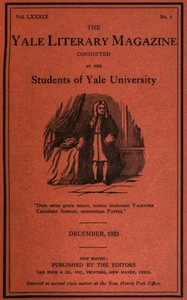
The Yale literary magazine (Vol. LXXXIX, No. 3, December 1923)
by
Various
Subjects:
Download Formats:
Excerpt
The Project Gutenberg eBook of The Yale literary magazine (Vol.
LXXXIX, No. 3, December 1923), by Various
This eBook is for the use of anyone anywhere in the United States and
most other parts of the world at no cost and with almost no restrictions
whatsoever. You may copy it, give it away or re-use it under the terms
of the Project Gutenberg License included with this eBook or online at
www.gutenberg.org. If you are not located in the United States, you
will have to check the laws of...
Read the Full Text
— End of The Yale literary magazine (Vol. LXXXIX, No. 3, December 1923) —
Book Information
- Title
- The Yale literary magazine (Vol. LXXXIX, No. 3, December 1923)
- Author(s)
- Various
- Language
- English
- Type
- Text
- Release Date
- March 2, 2023
- Word Count
- 14,193 words
- Library of Congress Classification
- AP
- Bookshelves
- Browsing: Encyclopedias/Dictionaries/Reference, Browsing: Literature, Browsing: Teaching & Education
- Rights
- Public domain in the USA.
Related Books
Blackwood's Edinburgh Magazine, Vol. 67, No. 415, May, 1850
by Various
English
1403h 23m read
Blackwood's Edinburgh Magazine, Vol. 67, No. 413, March, 1850
by Various
English
1544h 52m read
Chambers's Journal of Popular Literature, Science, and Art, fifth series, no. 149, vol. III, November 6, 1886
by Various
English
285h 2m read
The Delinquent, Vol. IV, No. 8, August, 1914
by Various
English
233h 1m read
Chambers's Journal of Popular Literature, Science, and Art, Fifth Series, No. 148, Vol. III, October 30, 1886
by Various
English
287h 25m read

Trial of the major war criminals before the International Military Tribunal, Nuremburg, 14 November 1945-1 October 1946, volume 18
by Various
English
3940h 53m read