The Project Gutenberg eBook, The Wreck of the "Royal Charter", by Frank
Fowler
This eBook is for the use of anyone anywhere in the United States and most
other parts of the world at no cost and with almost no restrictions
whatsoever. You may copy it, give it away or re-use it under the terms of
the Project Gutenberg License included with this eBook or online at
www.gutenberg.org. If you are not located in the United States, you'll have
to check the laws of the country where you are located before using this ebook.
Title: The Wreck of the "Royal Charter"
Compiled from Authentic Sources, with Some Original Matter
Author: Frank Fowler
Release Date: November 27, 2018 [eBook #58364]
Language: English
Character set encoding: UTF-8
***START OF THE PROJECT GUTENBERG EBOOK THE WRECK OF THE "ROYAL CHARTER"***
E-text prepared by Sam W. and the Online Distributed Proofreading Team
(http://www.pgdp.net) from page images generously made available by the
National Library of Australia (https://www.nla.gov.au)
Note: Images of the original pages are available through
the National Library of Australia. See
http://nla.gov.au/nla.obj-395637356
THE WRECK OF THE "ROYAL CHARTER."
Compiled from Authentic Sources, with
Some Original Matter.
by
FRANK FOWLER,
Late of Her Majesty's Civil Service, New South Wales.
Author of "Southern Lights and Shadows," "Dottings of a Lounger," etc.
London:
Sampson Low, Son, and Co., 47 Ludgate Hill.
1859.
London: Printed by William Clowes and Sons, Stamford Street.
CONTENTS.
PAGE
NOTE INTRODUCTORY 3
THE WRECK OF THE "ROYAL CHARTER" 5
THE PRESS ON THE CATASTROPHE 43
ADDENDA 58
LIST OF STEERAGE PASSENGERS 58
DR. SCORESBY ON THE 'ROYAL CHARTER' 59
THE REV. CHARLES VERE HODGE 64
THE ADJOURNED INQUEST 65
THE VERDICT 78
LATEST DETAILS FROM MOLFRA 78
POSTSCRIPT 80
NOTE INTRODUCTORY.
THIS little book is prepared under the conditions of saving the Mail
which leaves England on the 12th, and of being a complete narrative of
the Wreck. The one condition is adverse to the other; but I have
endeavoured to meet them both.
F.
_London, November the Eighth, 1859._
"Forth from the polar caverns of the snows,
Dripping with winter, leapt a northern storm,
And shook himself, and she lay buried white....
Oh! and we were homeward bound!"
_Balder._
THE WRECK OF THE "ROYAL CHARTER."
THE prints of Tuesday, the 25th of October, contained this brief
telegram:--
'QUEENSTOWN.--The "Royal Charter," from Melbourne, fifty-eight days
out, is off this port. She expects to be at Liverpool tomorrow
night.'
In the _Times_ of Thursday, the 27th, appeared the following:--
'A telegraphic despatch has reached us as we are going to press,
announcing the loss, on her way from Queenstown to Liverpool, of the
"Royal Charter," with over four hundred passengers on board, of
which number only about twenty are saved.'
The last news was so overwhelming--so unexpected and improbable after
the early telegram--that at first it was received with some amount of
incredulity. No other paper of that morning but the _Times_ contained
the intelligence; and from behind this fact there came a gleam of
hope. At about eleven o'clock, however, the journals issued as usual
their second editions, and then it was the statement in the _Times_
was confirmed, and that the mournfullest piece of news in connection
with marine disaster which ever reached this country was generally
accepted. The 'Royal Charter' was lost! Men passed the news from one
to another in whispers, shook their heads, and moved on to the
newspaper and telegraph offices for later items bearing upon the
calamity. The announcement in the first edition of the _Times_ was sad
enough. Such details, however, as that journal was enabled to give in
its second edition far more than confirmed the early telegram. Instead
of only four hundred persons being on board, it appeared there were
close upon five hundred, while the proportion of saved was not in the
slightest increased. Some of the circumstances grouped around the
wreck, too, were now supplied us. The vessel had, after a terrible
battle with the storm, in which masts were cut down and much noble
life was spent, struck upon the rocky coast of Wales, parted
amidships, and gone down not twenty yards from shore, and scarcely
four hours' sail from Liverpool.
I was in Sydney when the 'Dunbar' was lost. I remember, with painful
distinctness, the gloom cast upon the colony by that catastrophe. The
same cold sense of horror seemed on Thursday last to take possession
of the metropolis. At Lloyd's, at the Jerusalem, at the Baltic, men
moved silently about with white faces and knitted brows. As each new
telegram arrived and was posted in the rooms, groups would crowd
anxiously around it, and amongst them--thrust forward with a most
touching anxiousness--the face of many an old colonist could be seen.
There was an element of uncertainty in the disaster which added to its
painful and prostrating effect upon the public mind. The ship had
brought eleven days' later news; there was no list of its passengers
to be had in England; and who could tell but that his friends or
kinsmen were on board? We all knew here the splendid qualities of the
vessel: we all knew how high her colours stood in the colony. _I_ knew
I had travelled the six hundred miles of dangerous sea between Sydney
and Melbourne to make my journey home in her. Who then that had a
relative or connection in the colony could--or _can_ to this
hour--help the bleak conviction that in this vessel, which the cruel
rocks have battered, and the remorseless waves have beaten to
fragments, he or she was making a visit to the mother country? There
were many of course that Thursday morning at Lloyd's, and the colonial
coffee-houses, who by the last mail had received letters from friends
intimating their intention of coming home by the 'Charter.' To them
the intelligence of the wreck had terrible interest. Hour after hour
they hung about the City, and when, just before closing, a 'List of
the Saved' was received at Lloyd's, it was with difficulty the clerk
was enabled to keep them from tearing the document from his hands and
post it upon the walls. One gentleman, white-headed and bent with age,
who, I subsequently found, had a son on board, swooned the moment he
saw the list. _His boy was saved._
I endeavour to be brief in these introductory remarks; but somehow the
atmosphere of dejection which has rested upon us all since the evil
tidings first met us, reproduces itself as I write, and I find myself
calling up with mournful minuteness the earlier passages in the
History I have been requested to prepare. To that task let me now
compel myself.
While the news of the wreck was still being bandied from mouth to
mouth, I, who knew the ill-fated craft, and thought, without taking
upon myself to suggest a reason for the disaster, I could yet set down
many things which might enable others to do so, wrote the following
article for one of the newspapers:--
'The finest ship that ever left the port of Liverpool has gone down
with five hundred lives on board. I knew the ship--unhappily I knew
some of those who have perished. I purpose to tell my impressions of
the vessel, of the captain--everything I know that is likely to be
read with interest by the dread light of the calamity.
'Nearly this time two years I left Melbourne for Liverpool in the
vessel. She had--and, in most particulars, deserved it--the reputation
of being the finest ship that ever came to Hobson's Bay. The "Great
Britain," belonging to the same line, was of larger burden, and of
much higher steam capacity; but among her splendid performances there
was no record of a passage from England to Australia in fifty-nine
days. This extraordinary run the "Royal Charter" had made, and a
reputation had in consequence attached to her which always filled her
cabins with home-bound colonists within ten days or a fortnight of her
arrival at Melbourne. As I am writing this I am in utter ignorance of
the details connected with the loss of the vessel; and it would be a
mere impertinence were I to suggest a cause for the catastrophe. This
I must say, however--I feel bound to say it, for the sake of all those
who go down to the sea in ships--that if the "Royal Charter" had not
made such rapid passages, lives lost on board _before_ this final
casualty would certainly not have been sacrificed. Let me, before
proceeding further, explain what I mean. It is a practice with more
than one large shipping firm, like that to which the "Charter"
belonged, to give very heavy rewards to those captains who are enabled
to make "the voyage"--that is, the passage out and home--within a
specially limited time; let us say five months. Captain Taylor, of the
"Royal Charter," told me himself that his owners had promised him five
hundred pounds whenever he made the journey from Liverpool to
Melbourne and back in one hundred and fifty days. The consequence of
this arrangement was, that _speed_ rather than _safety_ became the
characteristic of Captain Taylor's command. It would be cruel to make
this statement if I were not prepared to prove it; but when I add
that the "Charter" never made a voyage without an accident of some
kind or other occurring--that when I came from Melbourne in her, her
gear was so defective that a yard-arm fell, killing one man and
wounding others, the very day we left Hobson's Bay, and that
throughout the passage her rudder was so faulty that we had to slacken
sail whenever the ship attained a speed of twelve knots,--the veracity
(or taste) of my assertion cannot be questioned. Everything was
sacrificed to speed: a quick passage seemed to be the sole aim of the
captain--_was_, in fact, the sole aim, as, to conclude these prefatory
remarks, one little circumstance will show. When I came home in the
ship, she happened, from a stress of foul winds, to make an
extraordinarily long run. Well, a month before we arrived in port, we
were placed on short allowance of food. Rapidity was so relied on that
only sixty or seventy days' provisions (instead of, as the Shipping
Act provides, one hundred and twenty) had been put on board when we
left Melbourne!
'But, with all, she was a noble vessel; and the captain was a noble
sailor. If he was a little reckless, the "Liverpool System" is rather
to blame than he. He had risen, I believe, from before the mast, and
was a man of a certain rough amiability, of seafaring energy, and
dogged determination. A slight anecdote fits in here as an
illustration. Once he was commanding a ship which had sprung a leak,
and a number of the sailors, for some reason or other, refused to
work. Captain Taylor ordered all the refractory men in irons, and
then, fitting up a windmill, pumped out the vessel without any manual
assistance whatever.
'The "Royal Charter" was a magnificent specimen of shipbuilding. She
was some thirty feet longer than the "Great Britain;" could, without
her "auxiliary screw," sail eighteen knots an hour; and was, in
matters of internal appointment, more like a West-end hotel than a
ship which had to brave the seas and storms of Cape Horn. Her
principal saloon was one hundred feet long, was fitted up with stained
glass, rich hangings, velvet couches, candelabra, bookcases, piano,
and all the other elegancies which have of late been made so much of
in the reporters' descriptions of the "Great Eastern." There were
about forty cabins at the sides of the saloons, beside some twenty or
thirty first-class berths on the deck immediately under. The
"intermediate" and "steerage" accommodation was very large--capable, I
should say, of receiving from four hundred and fifty to five hundred
passengers--while in the forecastle and "cock-pit" there were, when I
came from Australia, about one hundred men, consisting of officers,
pursers, midshipmen, crew, etc., etc. Along the main-deck there was a
row of shops--a wine-store, a grocery-store, a meat-store, and a
bakery, together with two or three kitchens. (I may add here that the
ship carried a score of stewards and cooks.) In the centre of the
vessel a large space was devoted to the engine and engineers'
apartments, and just on one side were the cow and sheep pens.
Altogether a noble craft--_so_ noble that I never looked at it without
thinking, "Great God! will this vessel ever be swallowed by the
waters!"
'Why was this Thought always uppermost as I walked about the ship? I
can scarcely tell. I used to think it arose from the gloomy influence
of the accident which occurred as we left Hobson's Bay; but then for
weeks after I arrived in England I seldom went to sleep without
dreaming I was perishing in a wreck, and that that wreck was the
"Royal Charter." There are those who will be inclined to smile at this
portion of my communication; but as I hope never to meet with such a
fate as that which has befallen those poor souls whose bodies now lie
rotting on the coast of Wales, I solemnly declare that, from the hour
I placed my foot on board the vessel until the moment when the news
reached me that she had gone to pieces, I had a presentiment some dire
calamity would overtake her. Some of those who were on board with me
will, doubtless, recognize the hand that pens this memoir.
Henceforward, the most stolidly sceptical of these must admit that
_feeling_ is sometimes higher than _reason_, and that there are more
things under heaven and earth than are dreamt of in our material
philosophy. I should not waste space to chronicle these
presentiments--which the majority of readers will, I am aware, regard,
and perhaps naturally so, as idle--had they not arisen with me in a
manner so utterly unaccountable, and been fulfilled in a manner so
utterly disastrous.
'And at this point, as bearing somewhat upon these forebodings, I may
as well state that, from first to last--from her birth to her death,
as it were--the "Royal Charter" was, except in the all but uniform
swiftness of her voyages, an unfortunate vessel. _Imprimis_, she was
originally built as a sister boat to the unfortunate "John Tayleur."
It will be in the recollection of the reader that, some years ago,
this "John Tayleur" was wrecked not very far distant from the spot
where the "Charter" went ashore, and with about as many passengers as
the "Charter" had on board. There was a great deal written and said at
the time about the negligence of the captain, but on inquiry he urged
that the wreck had been occasioned through a deviation--the ship was
of iron--in the compasses. This explanation was accepted; but it had
so much weight with the owners of the "Tayleur" that they at once sold
the iron hull of the sister ship they were engaged in building,
determining never to have anything more to do with other than wooden
vessels. This hull was bought by Messrs. Gibb and Brights, and, as it
was originally intended merely for a second-class ship of a thousand
or eleven hundred tons, it was, I was told, _lengthened amidships_ by
the new owners until it was thirty feet longer than the "Great
Britain," or nearly one-half the length of the "Great Eastern." It is
unnecessary to add that while this extension of the craft from stem to
stern was going on, her beam could never be increased. She was, in
fact, more like a long iron arrow than a ship. Her extreme length,
coupled with her extraordinary narrowness, rendered her a splendid
sailer; but it is a grave question with me whether her peculiarity of
build may not have had something to do with the accident. In a heavy
sea she rolled tremendously, and _would only "wear" on one tack_. But
to continue my record of her calamitous career, the very first time
the sister ship of the unfortunate "Tayleur" went to sea (and, let us
note, a year had been spent in trying to launch her) she had to put in
at Plymouth owing to bad weather, and--I think--some slight injury to
her machinery. On arriving at Melbourne, an accident happened on
board, and several men were killed. On returning to Liverpool, she ran
foul of a vessel just leaving that port, took away her anchor in her
bows (fortunately above water-mark), and carried it with her into
dock. On the next passage out to Melbourne, the unfortunate ship, soon
after crossing the line, was found to be on fire, and it was with
great difficulty the conflagration was extinguished. It was on the
same run, too, that her rudder was first discovered to be faulty in
its working--that is, it shook the vessel to such an extent that
sleepers were sometimes thrown from their bunks at night. On her
return to England, the yard-arm fell, and--as I have already
mentioned--one man was killed, and several were injured. On this
passage it was that the ship found itself short of food; moreover, the
coal had run out long before we had reached the tropics. In
consequence of the last fact, the journey home occupied ninety-seven
days; and I was subsequently told great was the anxiety throughout the
country for the safety of the vessel. And, apart from the long
passage, there was special cause, although unsuspected on shore, for
this anxiety. For three days before we made Cork, we had been unable
to get a sight of the sun, and, consequently, no observations had been
taken. On the eve of the last day a stiffish gale was blowing, and a
thick fog floated on the water. At about midnight the gale increased,
and the captain, not knowing exactly where we were, ordered the ship
to be laid to. Next morning we found we were about twelve miles from
the coast. Another hour's run overnight, and we should all have been
landed in eternity.
'My narrative is now brought down to about eighteen months ago. I know
little of the "Royal Charter" since then. She made, it seems, her last
run out to Australia in fifty-nine days, and in a Melbourne paper I
received by the last mail, I saw it stated that "an able band of
musicians had been engaged to proceed with the vessel home!" Ah!
jollity enough was there on board, I doubt not, as the barque neared
port! Fifty-eight days from Melbourne to Cork! Splendid winds must she
have had all the way home; high must have been the spirits of captain,
crew, and passengers! Where is the merry company now? It is a sad, sad
story. Women must wring their hands, and strong men must weep, as they
read that after a haven had been actually reached--after some of the
passengers had even landed in Ireland, and set the telegraph in motion
to tell their friends in distant places that they were safe on British
soil--the ship should have been dashed to pieces by the merciless
sea-spume, and that of the five hundred souls on board, four hundred
and seventy should have perished!
'I could write more. I knew so many of the brave officers and crew
who have perished. I knew the bluff, honest, daring captain. But of
what avail is it to speak of them now? They have all gone. May they
rest in peace until that day when even the sea shall render up its
dead!'
That was written on Thursday afternoon. The evening papers of that day
contained nothing very new. On the Friday morning, however, there was
sufficient in the daily journals to show me that I had--without
presuming to expressly state--rightly indicated the cause of the
ship's destruction. _Not a life need have been lost if the "Charter"
had not broken her back._ What a strange light that sentence sheds
upon what I have written concerning the build of the ship--of her
scant beam and startling length.... Of the setting aside, in fact, of
the normal conditions of the Thing!
How the vessel came upon the coast is a question running parallel with
the foregoing, and the character of the captain, as set forth in that
newspaper communication of mine, comes in here with answer. That
answer, we all desire, should carry due amount of weight with other
commanders of ships with precious freight of human souls on board.
There are a few iron plates, rolled up like shrivelled parchment, on
the rocks of Molfre Bay. They are all that is left to us of the wreck
of the "Royal Charter," auxiliary screw, thousands of tons burthen,
fire-proof bullion-room, patent reefing topsails, and the rest. What
precious warning in those crumpled iron plates! Will sea-captains read
of them and still go steaming up channel on nights piteously dark with
fog and mist? Unhappily, experience says they will.
If shrivelled iron plates fail, as perhaps they may, to carry caution,
then let our sea-captains read deeply of the narratives of the saved,
which I must now, assuming my proper duty as compiler, proceed to set
forth. And at the onset, the bitterest narrative lies in the fact that
of near five hundred souls--passengers and crew--on board the vessel,
the following mournfully scant catalogue contains the name of every
survivor[A]:--
_Saloon Passengers._
W. H. Morse.
F. Grundy.
H. C. Taylor.
_Saloon Passengers landed at Queenstown._
Mr. Gardner.
Mr. M'Evoy.
Mrs. Nahmur and child.
_Third-Class Passengers (including those landed at Queenstown)._
C. M'Phiel.
John Judge.
W. J. Ferris.
James M'Clappon.
W. Russell.
J. Bradbury.
Samuel Granfell.
Carl Bertal.
N. Hegan.
John Loome.
S. E. Gapper.
W. Bowden.
_Crew._
William Foster.
John O'Brien.
Thomas Griffiths.
William M'Arthur.
George Irisher.
George Suaicar.
E. Wilson.
Thomas Tims.
Henry Evans.
John Richards.
James Rogers.
David Stroman.
William Hughes.
Thomas Ellis.
George M'Givrin.
Owen Williams.
William Draper.
Thomas Cormick.
John Stannard.
[A] A list of the riggers who were saved will be found at p. 32.
We are anxiously awaiting the next mail, in order to learn the names
of those who are lost. At present the lists that have been published
are limited, contradictory, and hypothetical. Each survivor has
supplied the newspaper reporters with the names of just as many of his
lost fellow-passengers as he could remember. You in the colony,
however, will be able, with your files of papers, to complete this
section of the story of the Lost Ship.[B]
[B] The following is from the _Times_ of November 1st. It is
only a sample of a class of advertisements that are daily
appearing in the papers:--
TO the SURVIVING PASSENGERS of the ROYAL CHARTER.--Could any
one inform the under-mentioned whether among the saloon
passengers of that ill-fated vessel there was one named
HENRY LAFARGUE, age 26? They would greatly relieve the
anxious minds of that gentleman's relatives. There appeared
in the Times of Thursday, in the list of the lost, the name
of La Fargur; in Friday's, M. La Forgue; and in Saturday's,
La Fargol, which might all have been intended for Lafargue.
Address, Miss Lafargue, No. 2 Clarges-street, Piccadilly, W.
The narrative which is at once the completest and most touching is
that of Mr. Russell, which takes the following historical form:--
'On entering the saloon, Mr. Allen, the head steward of the second
cabin, came and told the passengers they had better not go on deck,
as it might cause confusion. The order was implicitly obeyed. Time
passed anxiously and wearily: the storm still raged. Suddenly the
vessel struck, not violently--not even with sufficient force to
throw the passengers off their seats. Water then came pouring down
into the cabin. A voice shouted for the second-class passengers to
go into the lower saloon, as the mainmast was going to be cut away.
The passengers nearest to the entrance doors attempted to open them
(they were hinged in the ceiling), and finding some difficulty, they
were immediately smashed. Still there was no hurrying or crushing;
all silently took their seats. On deck, sailors and officers,
stripped to the waist, laboured to cut away the mainmast. The vessel
rolled and thumped so heavily that in delivering their blows, the
men were many times thrown on to the deck, but the motion of the
vessel assisted the work; the waves, too, lent their aid, and soon
the mast tottered, then fell with a crash overboard. Immediately
afterwards the raging sea threw the vessel still higher up upon the
rocks. The foremast was then cut away, and almost at the same time
the mizenmast broke off at the mizenmast-head. Boats were lowered,
but the moment they touched the waves they were carried with
irresistible force against the rocks, and their inmates were either
crushed or drowned in the sea. No boat could live in such a storm.
There appeared scarcely any need of boats, so close upon the shore
was the vessel. Having struck, the vessel slewed round port side to
the rocks. When in the lower saloon, about this time, an apprentice
boy, Charley, entered, telling the passengers from the captain that
they were to keep up their hearts, all was well, they were only on
a sand-bank. The passengers still remained quietly in the cabin. Mr.
Cowie, the second mate, accompanied by the purser and two men, came
down; they were stripped, having on only their shirt and trousers.
They passed through the saloon to the powder-magazine--as they went
bidding the passengers keep up their hearts, as they were not far
from the shore. The water entered the saloon at the same time, and
the waves striking more heavily, the vessel thumped harder. Those in
the lower saloon then passed into the upper one. There they found
assembled some of the first and third class passengers. No words
were spoken, hope and fear struggled for the mastery in their
countenances; by this alone was it seen that life and death were in
the balances. The stillness of the assembly was at length broken: a
young lady, about twenty, Miss Murray, who was on board with her
father, mother, and brother, fainted, and was immediately carried to
her cabin, from whence she never emerged. Daylight now began to
dawn. They had been tossing on the sea and labouring on the rocks
all night. Shortly after daylight, a third-class passenger came
down; he had on only his trousers, and had been in the bows of the
vessel for several hours. He said the forepart of the vessel and the
bows touched the land--every one could wade ashore. All hopes of
saving the vessel having disappeared, and the boats having been
rendered unserviceable, the captain ordered a hawser to be got
ready. A seaman, named Joseph Rogers, volunteered to swim ashore
with it. The line was made fast to his body, and the noble fellow
gallantly dropped overboard and breasted the waves with the
resolution of a sailor. For a time he was lost to sight, as wave
after wave dashed over the vessel and broke upon the rocks; then the
line tightened, and the man was seen clambering up the rocks.
'The villagers (brought by the signal-lights) crowded round, the
hawser was hauled ashore and made fast to a rock, a boatswain's
chair was slung on to the rope, and a number of sailors ordered
ashore to work it. Every order was obeyed without confusion. Amongst
others landed were two brave fellows--George Suaicar, Malta,
boatswain's mate, and William Foster, Liverpool, carpenter. Word was
passed down to the saloons that the ladies were to come on deck.
There was a movement immediately towards the staircase. At the same
time the ship's sides began to creak: then there were two heavy
thumps experienced; and the ship broke in two across the main hatch.
A great number of passengers were standing amidships, and when the
vessel parted they disappeared for ever. At the same time a boat
abaft the fore rigging fell. The chief officer, Mr. Stevens, and the
chief engineer, Mr. Rogers, were standing under it, and both were
killed. A second line was attempted to be carried on shore from the
poop, but failed. Mr. Russell, his wife, and children, on gaining
the deck found that they were on the stern part of the vessel,
separated from the fore part by a yawning chasm, into which every
moment human beings were dropping, or being driven by the waves. It
was a moment of the intensest anguish. As each clung to the rail at
the top of the stairs, a hurried farewell was spoken; then they
awaited death calmly. Mr. Russell had several times essayed to get a
rope. So close were they to the shore, he imagined he might fasten
the rope around his family, cast the rope ashore and save them. In
vain were his efforts. They were still clinging to each other, when
a huge wave came and separated them. When the wave had passed, Mr.
Russell's eldest girl was missing; and when she was found, a box had
been washed on to her leg. Mr. Russell moved the box and liberated
her. Again for a few minutes they were united. Another wave
came--they lost hold of the rail; Mrs. Russell and the two girls
were washed against the side of the vessel, Mr. Russell overboard.
As the water returned, Mr. Russell sprang at a piece of iron which
hung from the side, seized it, then caught a rope; in another moment
he was on deck. His youngest daughter was nearest him; he attempted
to lay hold of her, had his hands just on her, when another wave
came, broke over the ship, poured down with irresistible force, and
washed him overboard again. For a time he was struggling in the
waves convulsively; he clutched at something which he felt against
his body; it was only a piece of canvas; another moment and he felt
seaweed under his feet. A wave came, he was almost insensible, yet
he saw a man standing before him. Was it a dream, or a reality? He
stretched out his hand, he grasped another hand--yet another wave
came, and the hand unloosed--he was borne back again--a mightier
wave broke, and the hand was again grasped--it held him--he was
saved. In a moment or two he recovered his senses, he was lying on a
rock; he turned his eyes seaward, there was no living creature left
on the stern of the vessel. He then became insensible again, and was
borne by the villagers to the hospitable cottage of Mr. and Mrs.
Lewis, in the neighbourhood.
'There were one or two scenes before Mr. Russell was finally washed
off the wreck, which imprinted themselves on his memory; words
uttered which no time can ever obliterate. They were the last
glimpses caught of fellow-voyagers; the dying expressions of old
companions. Mr. Henderson, a merchant of Melbourne, on his way to
London, was holding on to the binnacle with a gentleman named
Watson, one of the firm of Watson, Passmore, and Co., of Melbourne,
and he exclaimed, "Oh! Watson, all is gone." A Jewess, named Markes,
was jammed in near a place where the vegetables were kept: and her
husband, in vainly endeavouring to release her, tore all her clothes
to rags. They had two children on board, and came from Ballarat. A
gentleman named Welsh, while in the lower saloon, tied two black
canvas bags full of gold around his neck. He was lost. Several other
passengers fastened money about their persons; all were lost. Mr.
Taylor, one of the saved, had 35_l._ in his pockets when he jumped
into the sea: on reaching shore he had 10_l._ remaining. Mr. Gapper,
another saved, lost about 50_l._ out of his pockets while he was
being carried ashore by the waves. A gentleman named Bradbury, who
was on his way to Manchester, dislocated his right ankle on board,
and in endeavouring to free himself broke his leg. He afterwards
lowered himself overboard into the sea, exchanged one piece of wood
for another, shared it with a gentleman named Lewis, who was not
hurt at all, was dashed against the rocks several times, was saved,
and his companion was lost.'
Mr. Russell completes his statement in these affecting words:--
'When the vessel broke, an awful shriek--the death-cry of
hundreds--was heard above the violence of the storm. On shore, the
villagers and the sailors who had escaped unhurt linked hands, and
the bravest stepped into the surf to catch hold of those whom the
waves bore towards them on their crests, before they were drawn back
into the sea. Foremost in one link was George Suaicar, and he was
instrumental in laying hold of nine out of those rescued, until
exhausted, he fell senseless on the rock, and was borne away.
William Foster was another who joined in forming the link. The
vessel struck finally about seven, and broke about nine o'clock. On
board were the officers of three vessels coming from Australia, and
they, with the captain and officers of the ill-fated "Royal
Charter," were all lost.'
The George Suaicar, thus honourably mentioned, speaks for himself with
the modesty of a brave sailor. His position on the ship was that of
boatswain's mate. His testimony has special value as bearing upon the
earlier passages of the tragedy:--
'On Monday,' he says, assuming a staid, log-book form, 'we left
Queenstown in the afternoon, after putting some passengers on board
the pilot-boat "Petrel," who desired to be landed. We proceeded on
with calm weather and water smooth. We made Ballycotton Light at
half-past seven P.M.; and Youghal Light, on the Irish coast, at
half-past eight. Reached the Menay Light at nine; made the Nook
Light in half an hour; and sighted Tuskar at about half-past eleven
o'clock. On Tuesday morning saw Bardsey, at which time the wind
began to freshen. The wind heading, we took in the square-sails; and
at ten o'clock A.M., the wind increasing, took in all the fore and
aft sails. In the afternoon made Holyhead at half-past one, and at
half-past four were right ahead of Holyhead harbour. Could see the
steamship "Great Eastern." Off Bardsey the steam-tug "United
Kingdom" came alongside and handed on board some newspapers, asking
if we would give a free passage to eleven riggers, as we were going
to Liverpool, and the tug was not going until she got a tow. The
riggers were taken on board. At a quarter to eight on Tuesday
evening were abreast of the Skerries, distant about a mile and a
half. At this time the wind had increased to a heavy gale, and the
ship was making little or no progress in the water. She was driving
up with the strength of the tide, and nearing the shore; the steam
had no effect, but we did all to keep the ship off. The maintopsail
was lowered, but she still drifted. Clewed up the maintopsail, and
the hands were sent up to furl it. The wind had now increased
considerably, almost blew the sail from the yard, and it became
entangled on the starboard side. It was difficult to get the sail
stowed. At this time Mr. Bean, the third officer, with several
seamen and myself, were trying to make the sail fast, but could not
succeed in accomplishing it. Shortly afterwards orders were given to
cock-bill the port anchor, and let go. This was done, giving her
seventy-five fathoms of chain. The vessel was steaming the whole
time. Finding she was dragging, we let go the starboard anchor.
Still finding her dragging, we paid out all the port chain. The
vessel was still steaming, and the wind had now increased to a
perfect hurricane. We then went to get the stream anchor up, and
while doing so the starboard chain parted. I then felt the ship
canting over to port, and fancied the wind had changed.
'Orders were then given to cut away the mainmast, which was done,
and in a few minutes afterwards she struck on a bank. The captain
gave orders to the engineer to give her as much steam as he could,
to harden her on the bank. It was then about three-quarters ebb
tide. The place where she struck was at the west of Moelfra,
eastward of Point Lynas. Heard the captain give orders to starboard
the helm, to keep her on the shore, so that the sea would not have
so much power on her broadside. When she became hardened on, the
chief officer gave me and the boatswain orders to cut the main and
maintopmast stays, as they were lying across the boat, so that the
boat could be cleared in case of need. We did so. The chief
boatswain and myself were afterwards sitting on a spar, on the
deck-house, the sea at the time making a complete breach over the
ship. I then went forward to look out, and ascertain whether we were
on sand or rock, when I discovered the land distant about thirty
yards. I went back, and told the chief officer that it was land; and
he said, "We will loose the foretopmast-staysail, and when the tide
makes up run her up." I said it would be as well to give her the
foresail. It was then getting daylight. I volunteered to go ashore
with a line to get a hawser ashore, immediately after which I felt
the ship striking heavier than ever, supposing it was in consequence
of the tide making. The sea still broke over her with even greater
violence than ever. The captain was at this time on deck, standing
by the steam telegraph. I told the chief officer again I was willing
to go ashore with a line, and do everything to save life. Asked him
if he would allow me a few minutes to put my lifebelt on; and he
said of course he would. I afterwards told the boatswain I was going
to try and get a line on shore, and he said it was useless, the sea
was running too high. Afterwards had a small line slung round my
body, and wished some one to volunteer to attend to it while I swam
ashore. After some hesitation, a man volunteered. Just as I was
being lowered into the water, some one called out that there was a
line on shore from forward. Upon hearing that I did not go. A hawser
was got on shore and made fast to a rock, and with this contrivance
myself and some of the other seamen saved our lives. The hawser was
made fast by several of the inhabitants on shore, who came to render
assistance.
'After the ship struck, all the passengers were directed to go aft
until the hawser could be properly got out, so that as many as
possible might be saved. Shortly after this the vessel parted
amidships; and a large number of passengers, standing on the deck
where she parted, were swept into the sea and drowned. The boats
were smashed to pieces by the fury of the gale, and the others
could not be lowered, so that none of them could be made available.
The passengers saved were driven on shore by the force of the waves.
Sixteen of the crew got ashore by the hawser. An endeavour was made
to get a second hawser ashore to rescue the female passengers; but
this could not be accomplished. Not a single female passenger was
saved. In three hours after the vessel struck she began to go to
pieces. Saw about seventy passengers on the port bow, all anxiously
awaiting some means of getting them on shore; but a heavy sea which
struck the starboard bow stove it in, the ship gave a lurch, and the
people were all driven into the sea and drowned. Some of the
passengers saved were thrown upon the rocks, and picked up by the
crew and others who came to render assistance.'
From the narratives, then, of Mr. Russell and the Boatswain's Mate,
this much may be gathered--that the 'Royal Charter' had drifted (shall
we say had been foolishly allowed to drift?) too near the coast; that
the hurricane had gradually increased, and as the vessel laboured so
heavily, the masts had been cut away to ease her; that the screw,
which had to an extent served to keep the ship from striking, became
suddenly entangled with the falling spars, and ceased to work; that
the strong wind and stronger waves then bore the craft against the
rocks; that, through the courage of a seaman, a rope was carried to
the coast with a 'boatswain's chair' secured upon it; that (when a
sufficient number of the crew had landed to work 'this contrivance')
the passengers had been summoned to be sent ashore; that, just as they
were congregating amidships, a crash was heard, the vessel parted, and
fell to pieces like a house of cards; that a few hasty farewells, a
quick exchange of hopeless glances, a waving of hands which heretofore
had been joined in all life's struggles, and a last wild cry to
heaven, through which the wintry sun was slowly breaking, followed
that awful crash; that the ship gradually sank and the sea gradually
swelled; that a few bodies, cruelly mutilated, were washed upon the
shelving crags; that the sun rose higher and higher, until at length
its beams flickered among the crimson gouts upon the faces of the
rocks; and, finally, that the Welsh villagers gathered upon the spot,
and, with true Welsh hospitality, bore the bodies of the unfortunate
passengers to their homes.
And the sun set and the moon came up; and the wives of the officers
and crew--and all those who knew, or thought, they had friends or
relatives on board--assembled upon the spot, searching along the shore
for tokens or memorials however slight from which LIFE or DEATH might
be interpreted, and suspense changed, for better or for worse, to
certainty.
Other narratives come in at this point, all more or less afflicting.
The first is that of James Dean, which is remarkable as showing how,
in the most harrowing exigencies, the presence of mind of some men
never deserts them. Dean is a smith returned from Melbourne, and he
speaks bravely and bluffly, after the manner of his class. In reading
his story, it is well to mark the religion and heroism which breathe
through the words I have underlined.
'He says he was in bed in a berth with four other passengers when
the ship struck, and he was aroused by one of his comrades
exclaiming, "I think we're lost." He dressed himself, and _after a
few minutes' prayer_, ascended on deck, where he had not been more
than a very brief period when the vessel parted in the centre "like
the snapping of a tobacco stump." The people on board stood
petrified, as it were, seemingly unable to make the slightest
struggle for their lives; whilst their terror was increased by the
awful scenes presented as unfortunate creatures fell and were
crushed to atoms in the chasm separating the two parts of the ship.
He never for a moment lost his presence of mind. He saw that most of
those in the water struggled towards the large pieces of the wreck,
and he saw also that most of those who trusted to these heavy
portions of the vessel were crushed to death, and their bodies
dreadfully mutilated against the rocks. Though totally unable to
swim he jumped overboard, and just seized a box he saw floating near
him. Almost at the very moment he seized this a head was thrust
under his arm, and a second claimant appeared. _Dean said it would
not support both of them; so as soon as possible he left the box for
another piece of wood_, and with this he was thrown upon the shore.
He left his support and tried to gain a position of security; but
ere he could do so a wave overpowered him and carried him back to
sea, where he became entangled in the floating remnants of the
vessel, and it was with the greatest difficulty that he extricated
himself. When he had succeeded in this, he was again thrown on
shore. Whilst momentarily expecting the arrival of another wave, a
rope was thrown to him, and by it he was finally drawn out of
danger, without experiencing any injuries or bruises other than of a
very trifling description. He soon recovered strength. He was
bringing home a cheque for a considerable sum of money, and before
his voyage he had taken the precaution to enclose this in a
waterproof belt, which he kept around his waist. This cheque is
therefore saved, and his only losses are his clothes and a small sum
of money which was with them.'
Mr. John Bradbury speaks not only on the accident, but gives us a
glimpse of the earlier portion of the voyage. His sufferings on
escaping from the wreck were very great, and will serve as a _hint_ of
what may have been endured before death by many of those whose bones
are now bleaching beneath the waters. But for his athletic person and
robust constitution, John Bradbury--who speaks as under--would,
without doubt, have been numbered with the lost:--
'We sailed from Melbourne on the 26th of August, and had on board,
as I know, about five hundred passengers and crew. The captain was
Mr. Thomas Taylor; the chief officer, Mr. Stevens; and the second
mate, Mr. Cowie. The ship ran almost entirely under canvas up to the
equinoctial line, when she encountered strong head winds. Her screw
power was then brought into requisition. On the 10th of September,
about four o'clock in the morning, the weather being thick and dark,
we ran close past a large iceberg. Mr. Cowie was on watch, and had
it not been for his able manœuvring, the ship would have been in
imminent danger. The passengers showed their appreciation of his
ability by presenting him with a testimonial on the eve of the
dreadful disaster. We arrived at Queenstown on Monday forenoon, when
twelve passengers disembarked. We left Queenstown about two o'clock,
under steam alone. The ship was laid on her course for Liverpool,
but the storm had the effect of diverting her to such an extent that
I saw the "Great Eastern" at Holyhead. The wind was then blowing
very hard. We sighted the light on Point Lynas about five o'clock in
the afternoon. The sea was running high, though not equal to what we
had experienced on the passage; but the wind was stronger. It was
found we could make no headway, and two anchors were dropped. She
dragged her anchors, and the engines were working, but I understood
the screw was broken.
'About two o'clock on Wednesday morning the vessel struck. A great
number of passengers were then in their berths; but they suddenly
rushed upon deck, many of them but partially dressed. There was not
much confusion at first, but it increased as people became aware of
the real danger. I believe the captain was not sober; but Captain
Withers, who was a passenger, and the chief mate and officers, did
all they could to save the ship. A rope was got out from the head of
the vessel, but I cannot say how. A kind of rope chain was made and
placed upon it. By means of this some were drawn along the hawser to
the shore. When the rope was seen there was a great rush to the
forecastle deck, in order to get the first advantage. A large wave
washed over her head and carried them into the sea. Others followed,
but only to meet a similar fate. I was standing near the davit of a
boat on the poop, when a sea jammed me fast between the boat and
something else. I was beaten about and my ankle dislocated, and then
my leg was broken. I then became insensible for a short time, but on
regaining my consciousness I got a rope, and fastening it, lowered
myself down from the poop into the sea, upon a piece of the wreck,
along with the storekeeper. I was knocked up and down, turned topsy
turvy, driven and battered against this thing and the other till I
lighted upon a piece of cabin framework, and paddled myself along
with my hands. The waves washed me three times on the rocks, and
took me back, battering me about. The next time I fell between two
rocks, which held me, and I was picked up by two men. Four men
brought me to this house, which is kept by Mr. Owens; who has been
very kind to me. My leg was set by Mr. Thomas of Liverpool.'
The simplicity of that statement must touch the strongest. Captain
Withers, it may be worth mentioning, was returning from Australia,
after having lost his ship in the Pacific. His exertions throughout
the storm were very great, and it was under his advice that the masts
were cut away.[C] There are those who say that if the ship had been
earlier dismasted she would not have gone to pieces. I can speak with
no authority upon this point. This, however, I know, Captain Taylor so
loved his craft that when we ran short of provisions coming home, and
might, with two or three hours' supply more of fuel have made the
Island of St. Vincent, and taken in a stock both of firing and food,
he preferred running all the hazard of 'keeping on,' rather than touch
the 'beautiful spars' of his vessel. The loss to his owners in
consequence was many thousand pounds. In compensation to second and
third class passengers alone, they had to pay something like fifteen
hundred pounds. I can, therefore, readily understand that the
dismasting of the vessel may have been unfortunately delayed until it
was too late to save her. At the same time it is but fair to the
memory of the captain--than whom a braver sailor never trod a deck--to
say that all such rumours should be accepted with caution. Colonial
readers will well remember the many absurd and contradictory reports
which were current when the 'Dunbar' went ashore.
[C] The following appears in the _Morning Herald_ of November
2nd:--'Captain Withers, the master of the wrecked vessel
"Virginia" (lost in the South Pacific), with nine men, after
being nineteen days at sea in an open boat, and enduring
innumerable privations, all arrived safe at the Feejee islands,
and thence they were conveyed to Sydney, New South Wales. On
arriving at Sydney, Captain Withers after seeing that the crew
were provided with clothes, went on to Melbourne, and took a
passage home to England in the "Royal Charter." He is the
"Captain Withers" mentioned by one of the persons saved from the
wreck of the "Royal Charter," who behaved with such noble
fortitude and unflinching bravery when all seemed lost, and when
it was a mockery to hope against such a fearful tempest. But he
was doomed to die a sailor's death, for the last seen of him was
when he called out to Mr. Stevens and Captain Taylor, "God bless
you, Stevens! God bless you, Taylor! Keep firm." The ship broke
up immediately after: the rest already too well known.' Strange
are the ways of Providence! Captain Withers was saved, after
terrible privations, from perishing in the South Pacific to be
dashed to pieces on the rocks of Wales!
That the captain was in some degree ignorant of the exact spot where
he was, and was but imperfectly acquainted with the coast, seems
manifest from this,--when the hurricane gathered in its might, it was
proposed that a barrel of tar should be fired and sent adrift, in
order to light up the coast. 'When the vessel struck,' says one of the
daily newspaper reports, 'signal guns were fired, rockets sent off,
and every means adopted to attract attention from the shore; but the
houses in the neighbourhood being few and far between, no practicable
assistance was attracted. No life-boat could live in the raging sea,
and the boats of the vessel herself were perfectly unavailable.'
* * * * *
From the foregoing, a picture only too vivid of the catastrophe may be
realized. The Boatswain's Mate describes the storm; Mr. Russell paints
the ship with all its intense and death-foreboding excitement; and Mr.
Bradbury conveys, with dread distinctness, the manner in which the
handful of saved fought their way from the jaws of death.
One or two other narratives, purporting to be from survivors, have
appeared, but as they are mere paraphrases of those I have given, I
have some doubt in the first place of their genuineness, and in the
second of the desirability of occupying space with repetitions.
Let the description of the night of the wreck end here.
The moment the news of the disaster reached London and Liverpool,
agents from Lloyd's and the owners of the ship were despatched to
Molfre Bay. They were accompanied by representatives of the principal
London and Liverpool journals, and the communications which the
reporters subsequently addressed to their several papers were
affecting in the extreme. Here is the first:--
'MOLFRA BAY, THURSDAY EVENING.--It is my very painful duty to record
the total wreck of the screw steamship "Royal Charter," Captain
Taylor, which took place at from three to eight o'clock on the
morning of Wednesday, at Molfre, a rugged portion of the Anglesea
coast, and about midway between Amlwch and Ruffin Island. The
ill-fated vessel sailed from Melbourne on the 26th of August, having
on board 388 passengers, of whom 63 occupied the saloon, and a crew,
including officers, of 112 persons. While the ship was passing
Queenstown, on Monday morning, 13 of the passengers landed in a
pilot-boat. On Tuesday morning, at eleven o'clock, the "Royal
Charter" spoke the steam-tug "United Kingdom," which, instead of
returning to port with riggers who had been assisting in the working
of a ship to Cardiff, transferred 11 of the riggers to the "Royal
Charter," Captain Taylor having kindly agreed to take them to
Liverpool; so that there were on board at the time of the wreck 498
souls, and of these only 39 were saved.
'The loss of life on this sad occasion was 459 persons. The "Royal
Charter" had on board a large quantity of specie on freight, the
exact amount of which cannot be ascertained, as all the ship's
papers have been lost, but it was variously estimated by the
surviving passengers and crew at from 500,000_l._ to 800,000_l._ One
of the saloon passengers, who was drowned, was stated to have had in
his possession gold to the value of 10,000_l._ She had only a
moderate cargo, principally of wool and skins.' [Did the small cargo
have anything to do with the loss of the vessel? Would she, if more
heavily laden, have drifted so rapidly upon the rocks?] 'From the
time of leaving Port Phillip Heads till the arrival off the Irish
coast the passage was in the highest degree favourable; she was only
once in danger, and then from an iceberg. After passing Queenstown
the wind veered round to E.N.E., blowing strong. On Tuesday night it
blew a gale, and continued to increase in violence, till at length,
on the morning of the fatal disaster, it became a perfect hurricane.
Arriving off Point Lynas at six P.M. on Tuesday evening, signal
rockets were for several hours thrown up, in the hope of attracting
a pilot, but none made their appearance. Captain Taylor, finding
that his ship was making leeway, and gradually drifting towards the
shore, let go both the anchors, but such was the violence of the
wind, and the heavy cross sea prevailing, that the chains parted.'
[The same night the "Great Eastern" was all but lost through one of
her massive cables snapping.] 'Notwithstanding that the engines were
worked at their full power, the captain was unable to work to
windward, and the unfortunate vessel struck the rocks stern first in
four fathoms water. Up to this period (about three A.M.) not the
slightest alarm was evinced among the passengers, a large portion of
whom were women and children. The most perfect discipline and order
prevailed. The masts and rigging were cut adrift, but caused no
relief, as the ship continued to thump on the sharp-pointed rocks
with fearful rapidity.
'Shortly after she struck, the ship was thrown broadside on,
perfectly upright upon the shelving stony beach, the head and stern
lying due east and west, the former not being more than twenty yards
from a projecting rock. At this juncture one of the crew, a Maltese,
named Joseph Rogers, nobly volunteered to struggle through the heavy
surf and convey a rope on shore. Though it was not believed by any
one that danger was imminent, the captain gave the order, and Rogers
ably fulfilled his duty. A strong hawser was then passed and secured
on shore, and to this was rigged a "boatswain's chair." At five
o'clock the ship laboured and bumped to such an extent that the
ladies and children exhibited the greatest anxiety and fear: they
crowded together in the after part of the saloon, and the Rev. Mr.
Hodge, of East Retford, a Clergyman of the Church of England,
offered up a prayer; but his exhortations were interrupted by the
violent thumping of the vessel on the rocks, and the heavy seas
which came dashing into the cabin.' [Throughout the passage, this
reverend gentleman had administered religious service, and had made
so many friendships that his fellow-passengers had presented him
with a testimonial.] 'The scene in the saloon was of the most
heartrending description; children and parents, husbands and wives,
were clinging to each other in affectionate embrace. Captain Taylor
and Captain Withers came down and tried to allay their fears by
assuring them that there was no immediate danger. Scarcely had their
words been uttered before a succession of tremendous waves swung her
about on the rocks, and she divided amidships, engulfing all on
board. Shortly afterwards she also parted at the forehatch, throwing
a large number of persons into the sea. Many were killed by the
breaking up of the ship. Several of the crew saved themselves by
means of the hawser to the shore, while the remainder were hurled
upon the rocks by the waves. All the officers perished. Captain
Taylor was the last man seen alive on board. He had lashed his body
to a spar and was drowned.' [Some affirm he was killed, after he
was in the sea, by a boat falling from its davits. It is said he and
Mr. Cowie, the second officer, were seen together, and that the boat
struck both at once. Mr. Stevens, the first officer, and Mr. Rogers,
the chief engineer, were--runs the main body of testimony--also
killed together by the falling of a suspended boat upon the deck.]
'Mr. Stevens, the chief officer, was killed, it is thought, by the
falling rigging. Several of the more fortunate passengers received
severe injuries while struggling for life. With the exception of a
portion of the midship bulkhead, which appears a few feet above the
water, there is scarcely a vestige of the "Royal Charter" remaining.
The bullion chest, which was substantially built of iron, and
secured to the framing of the ship, is supposed to have been
shattered, from the fact of a gold box having been picked up with
the address of a leading banking firm upon it.' [The subsequent
operations of the divers have, up to the time I am writing, tended
to confirm this hypothesis, although assurances at fifty, sixty, and
eighty per cent. are still being effected at Lloyd's.]
'About two hundred and fifty sovereigns and a quantity of notes had
been picked up among the rocks.
'At least thirty bodies which have been cast ashore are lying in the
adjacent church; most of them are frightfully mutilated. William
Hughes, the only apprentice saved, states that when the vessel
parted he was in the waist, and was precipitated among the
machinery, which was hurled to and fro by the action of the waves.
He had given himself up for lost, when a wave lifted him clear of
the ship, and landed him in an unconscious state. The survivors
during their stay at the scene of the wreck were very kindly
treated. Two ladies made themselves conspicuous by their attention
to the sufferers. It is stated that all the boats were in perfect
readiness for lowering had circumstances permitted.' [Some of the
passengers say the boats _were_ launched, and were dashed to pieces
on the rocks.]
The second correspondent's letter is equally interesting. Of course a
number of persons describing one event will, as has been often pointed
out, fall into discrepancies of statement. It is not for me to make
the reports uniform. I have thrown in a parenthetical explanation here
and there; but otherwise the several newspapers must speak for, and
explain, themselves. The second communication runs thus:--
'The "Royal Charter" did not, as was at first stated, strike the
ground in Red Wharf Bay, but a place between that point and Amlwch.
It is a small opening in the coast, the beach being chiefly sand and
stones. It is to the west of Point Lynas, and known as Molfra, a
village in the immediate locality, being of that name. The coast is
thinly inhabited, and the land flat and uncultivated. Very soon
after the fatal catastrophe, which resulted in such an awful
sacrifice of human life, the vessel broke up, and nothing remains
but pieces of the wreck, which were moved to and fro by the action
of the tide. As one of the seamen described it, she broke up like a
bandbox.
'Those of the crew and passengers who escaped were provided with
temporary accommodation in the neighbouring cottages, where they
received every mark of kindness from the inhabitants. During the day
most of them left the place, and were conveyed to Liverpool in
steam-tugs sent out by the owners of the ship.' [And were, it is
said, shamefully treated after their arrival. But of this in time.]
'Last (Friday) evening only one passenger remained, Mr. Russell,
with the boatswain's mate and the carpenter of the ship. Many
persons visited the scene of the wreck yesterday, and were making
anxious inquiries as to the fate of relatives and friends. For this
purpose every facility was afforded. Some of the scenes arising out
of these inquiries amongst those deprived of their nearest relatives
and friends were affecting in the extreme. Shortly after the wreck
several of the bodies of the unfortunate sufferers by the calamity
floated upon the beach; subsequently others were picked up, and the
number amounted at a late hour last evening to twenty-six. Of these,
five were females, and two of them young children. The bodies were
conveyed to Llanallgo church, and carefully laid out on straw, so as
to afford an opportunity for identification. Some had on their
clothing, while others were only partially dressed, as though when
the vessel struck they had been in their berths, and rushed suddenly
to the deck in a state of alarm on being made acquainted with the
perilous position of the ship. Many of the bodies bore evidence of
injuries, probably sustained from being dashed against the rocks, or
coming into violent contact with portions of the wreck. One man had
nearly all his limbs broken, and the body had, as it were, to be
gathered up. Another was without the head, and several were much
bruised on various parts of the body. Some small boats and papers
were picked up yesterday on the beach. One of the papers appeared to
be a diary kept by a passenger on board, supposed to be a clergyman
of Nottingham. The various incidents of the voyage, from the time
of leaving Melbourne until the arrival at Queenstown, were carefully
recorded by the writer.' [This is doubtless Mr. Hodge, a good man
who _would_ keep a diary.] 'The riggers previously referred to as
being on board the "Royal Charter" when she grounded have lost six
of their number, namely, James O'Neill, Richard Morris, William
Thomas, Peter Topping, Thomas Corcoran, and Henry White. Those saved
are James White, Patrick Devine, ---- Pritchard, Thomas Cunningham,
and William Burton. Some of them swam ashore, and others succeeded
in saving themselves by the aid of the hawser. So far none of the
passengers' luggage or articles of a similar kind have been washed
on shore.' [Much was afterwards found, as will be seen.] 'A few
articles of male and female attire have been collected, and these
are taken care of by the officers of police and coast-guard now on
duty. The services of the Anglesea militia have also been called
into requisition, to assist in the protection of any property
received, and also in the removal of the bodies washed up on the
shore. The position of the vessel at the time of the catastrophe,
and whether or not blame attaches to the captain or his officers,
were subjects of comment amongst many of those who visited the spot
yesterday. At present it would be unfair to give currency to these
remarks, seeing that the matter will undergo a strict investigation
at the coroner's inquest. The number of persons saved is now stated
to be thirty-nine; and of these, twenty-one are passengers, and the
remainder belong to the crew. Only very few of the bodies recovered
have yet been identified. A gentleman attended yesterday, to make
inquiry as to his wife, whom he supposed to be on board the "Royal
Charter." The body of his beloved partner was not amongst those
lying in the church, but on a closer investigation, his eye fell on
the corpse of a faithful servant, who, he felt sure, would accompany
his wife on the voyage. This fact too truly told the mournful
result.
'The man who swam on shore with the hawser was a Maltese, and not a
Portuguese, as first said. He lost everything he possessed, and
swooned when he reached land.'
Depend upon it that man ("heroism has no country") will be rewarded.
We shall not do here as was done in Sydney when the 'Dunbar' was
lost,--allow our sympathy to expend itself upon the saved to the all
but utter forgetfulness of the saviour.
A third and a later newspaper reporter's letter must find a place:--
'MOLFRA VILLAGE, REDWHARF BAY, SATURDAY.--Who does not shudder at
the mention of a shipwreck? In Llanallgo church, about a mile from
the desolate coast on which the unfortunate "Royal Charter" has gone
on shore, lie about thirty distorted and mangled bodies, and to that
locality anxious and distracted relatives crowded early yesterday
morning. At another church hard by, which is known as Penrhos, there
were also the bodies of two children and two ladies laid out; and
the anxiety of friends may be gathered when it is stated that
through pelting and incessant rain, over almost inaccessible roads,
for more than fifteen miles, hundreds of people wended their way to
the _locus in quo_ of the wreck.
'This has been pronounced the most dreadful occurrence of the kind
that has happened on this coast. Perhaps it is the most terrible
marine disaster that has ever happened anywhere. So complete is the
wreck, that Captain Fell says in his _naïve_ nautical style, that he
has been seventeen years "at this sort of work," but never saw a
vessel so completely destroyed. The size of the ship, too, and the
number of persons lost, render it an unexampled calamity.
'Captain Fell, from Lloyd's, was in attendance early yesterday
(Friday) morning, at Molfra or Moelfra, deputed to make inquiries
for the underwriters. The vessel had on board 49,000_l._ in specie,
79,000 oz. in gold, valued at 320,000_l._, making a total of
369,000_l._, besides a large quantity of money in the hands of the
passengers. The excitement at Lloyd's on the arrival of the
disastrous intelligence is described by Captain Fell as intense, the
confidence from the first in the ship's sailing qualities being so
great that insurances were taken at 80_s._ per cent. As an
indication of the wealth in the hands of the crew and passengers, it
may be mentioned that torn and dilapidated garments have been picked
up on the shore, some of which contain considerable amounts of
money, watches, and other valuables. Intimation was early given of
the danger in which the ship was placed, but though little hope was
entertained of the safety of the vessel herself, every one seems to
have retained a hope of life, and rushed to his and her valuables
and money, and sought safety with as little encumbrance in the shape
of clothing as possible.'
And yet another communication, though only of a few lines, must be
given. It were easy to write a most pathetic prolusion to it, but I
prefer to let it stand in its nude significance:--
'LIVERPOOL, SUNDAY MORNING.--This banquet (that is, a Grand
Conservative Banquet to the Earl of Derby and Mr. Disraeli), which
during the last two months has been anticipated with so much
interest by the whole Conservative party, is just concluded....
Altogether the general effect was remarkably brilliant and
picturesque. It ought to be remarked, however, that many persons of
position were absent on account of the wreck of the "Royal Charter."
The calamity has cast a perceptible gloom over the town, and at the
beginning of the banquet the conversation rather turned on the
catastrophe than on politics. Some thought the banquet ought never
to have been held; but the news of the accident arriving so near the
day, it was impossible to delay it: otherwise there is no doubt it
would have been postponed.'
That one brief paragraph will attest to the colony how deep is the
sympathy entertained in England for the friends of those who are lost.
Had it been practicable to put off the feast to a more convenient
season it would have been done. The committee met and considered the
matter, and found it was impossible. The shadow of the lost ship,
however, rested upon the banquet!
How could it be otherwise? The day before, the inquest on the bodies
of some of the lost voyagers had been opened, and the following
heartrending description of it appeared in the Saturday's papers which
the banqueters must have bought on their way, from all parts of the
country, to Liverpool:--
'THE INQUEST.--The inquest on the bodies was commenced yesterday
(Friday) afternoon, at Llanallgo church, before Mr. William Jones,
coroner of Anglesea, and a jury who were sworn in Welsh. It was an
impressive sight when the coroner, standing at the communion table,
surrounded by the group of dead and mangled corpses, amid the
audible sobs of those who had recognized their friends, commenced
his melancholy task.
'Mr. Moore, solicitor of Warrington, before the opening of the
inquest, asked the coroner what course he intended to pursue.
'The coroner thought he should be satisfied, under the melancholy
circumstances, with the identification of the bodies.
'Mr. Bright, of the company owning the vessel, undertook to have any
of the surviving crew present who would be able to give any
information.
'Mr. James Russell, who said his father lived in Linlithgowshire,
and who was one of the passengers who escaped, recognized John
Smith, son of Edmund Smith, Mrs. Woodroff (companion to Mrs.
Forster, also in the vessel and lost), Catherine Margaret Russell,
and Richard Reed. Mr. Forster lives at Grindlow House, Manchester,
Mrs. Woodroff's husband is expected home by the "George Marshall."
Richard Walton, of 22 Duckworth Street, Brunswick Road, Liverpool,
identified his brother James, between 21 and 22. Thomas Outerside, 6
Clare Street, Liverpool, printer, identified John Emery, Stone,
Staffordshire.
'The coroner then proceeded to Penrhos church, where he also charged
the jury with the investigation into the circumstances of the death
of the bodies lying there. The inquests were adjourned until
Wednesday.' [Later proceedings before the coroner, will be found
elsewhere.] 'In reply to an application, the coroner undertook to
have an interpreter provided.
'Several parties were present who stated they were prepared to
vindicate the character and memory of Captain Taylor. The vessel it
was stated, made no water until it broke up. The ladies it was
arranged, should go first; but before opening the saloon doors, the
vessel parted in two and stopped all communication.
'Mr. Samuel Henry, a jeweller from Adelaide, who had been confined
on the ground that he was insane, was amongst the number in
Llanallgo church. Mr. Glover, a gentleman of fortune (from Adelaide,
it is said), who was coming to England for the purpose of consulting
some skilled oculist, is also amongst the number, and a large sum of
money was found on his person. Writing-desks, likenesses, letters, a
part of the post-office, and various other relics, have been washed
up.'
The touching allusion to the likenesses and letters leads naturally to
the following (further) particulars from the scene of the calamity:--
'MOLFRA BAY, Tuesday, Nov. the 2nd.--It is necessary that the
public should be on their guard against the rumours in circulation
as to the discoveries made by the divers who commenced operations on
Sunday. It was reported as an established fact in Bangor last night
that one of the divers had entered the saloon of the "Royal
Charter," and there found about 200 passengers in the positions they
occupied when the ship went down; some sitting round the table,
others standing upright, and others as if in the act of coming from
their berths. A similar story was told some six or seven years ago,
after the wreck of a large steamer off the Bailey Light, Hill of
Howth. Indeed, in that case, the diver was made to describe some of
the passengers as in the act of lifting glasses to their mouths. The
lie was printed, and obtained very general circulation before it was
contradicted. The less detailed account is in the present case
equally destitute of foundation. Two experienced divers, who came
from Liverpool in the steam-tug "Fury," the property of Gibb,
Brights, and Co., made a descent yesterday, and remained a
considerable time under the water, but they saw no corpses beneath;
neither did they find any gold; but they saw some copper. This
morning they resumed their descents under very favourable
circumstances as regards weather and the state of the sea. They have
discovered no bodies; but up to one o'clock this afternoon they had
succeeded, with the assistance given them by men on board the
steam-tug, in raising about three tons of copper bars. These bars
have undergone some smelting, but are not in a finished state. There
is a good deal of silver mixed with the copper. At one o'clock the
divers suspended operations for a short rest and refreshment. They
resumed after about an hour's interval.
'Some additional articles of wearing apparel, with spars, etc., have
been cast upon the beach. One or two canvas huts have been erected
on the remnants of masts, and in front of one of these such articles
as have names on them, or would otherwise serve for purposes of
identification, are spread out in melancholy array. Amongst them are
seven photographs, two of men, two of ladies, two of children, and
one landscape. None of these have as yet been identified as
portraits of individuals whose friends have arrived at the scene of
the wreck. There is a stocking with the name "Jane Murray," and
another with the name "F. Davis" upon it. There is a portion of a
shirt, with the name "J. E. Smith," and another with the name "R.
Thornhill," followed by the date "1846." A large, coarse wrapper has
the inscription "C. R. Ross, passenger, 'Royal Charter,'" painted in
black letters upon it. On a piece of a shirt, "E. Fenwick;" on
another, "John Lees, 1855." On a piece of a stocking, "T. W.;" and
on a small piece of linen, "T. G." There are a number of visiting
cards spread on a piece of wood: one has the inscription, "Mr.
Eddowes, 146 Cambridge-street, Pimlico;" another, "Mr. Sam. Moxley
Wade, Low, and Cill, Liverpool." On a piece of linen is "James
Davis, Woodside, 1859." The whole scene of the wreck is an extremely
melancholy one; but a peculiarly affecting incident took place
to-day. A poor young woman was searching along the beach to
endeavour to find some trace of her husband, about whose fate she
was uncertain. She discovered a waistcoat which had just been washed
in, and which had been hung up in front of the tent by one of the
coast-guard. Almost frantically, she pulled it down. It proved to be
that of her husband, a man named Barrett, who had been painter
aboard the "Royal Charter." The grief of the poor widow was
heartrending to witness. Some of the standers-by, in an attempt to
comfort her, suggested that she might be mistaken. "Oh, no," said
she, "here is my own work upon it. My husband, my husband! God, look
down upon me!" Amongst those who anxiously inspected this relic was
the Rev. Mr. Lewis, a Wesleyan minister. Two of his brothers were
aboard the ship--one as purser. Their arrival at Queenstown had been
telegraphed to their aged mother, who wrote to the rev. gentleman to
meet them at Liverpool. He now, poor fellow, paces the shore at
Molfra Bay to watch for the dead bodies. Five bodies were washed
ashore at Molfra, and seven at Penmaenmaur yesterday. None of these
have as yet been identified. No bodies have been washed up to-day.
Several of the dead persons have already been interred in Molfra and
Llanallgo churchyards. The wreck remains in precisely the state as
she was on Wednesday last when the coast-guard from Amlwch were put
in charge. At low water a good piece of her hull is visible. At high
water there are only portions of two of the masts. As the officials
along the line of the London and North-Western Railway are besieged
with inquiries as to where Molfra Bay is, it may be as well to state
that the nearest approach to it for any person not in the island of
Anglesey, is from Bangor railway station. It is fourteen miles from
Bangor, over a horrible road, with most expensive posting. There is
no mode of communicating with London from it but through Bangor, and
there are no public conveyances of any kind. But, notwithstanding
this, great numbers are visiting the scene. On the whole, the people
in the neighbourhood are reported to have acted very well. Several
sums of money found by them have been given up to the coast-guard.
The fragments of the spars, and even of the mainmast, seem as if
they had been smashed into small pieces by some crushing blade
impelled by steam power. If an army of giants had fallen to to hew
up the ship it could not have presented a more fragmentary
appearance.'
A correspondent of the _Manchester Guardian_ describes the wreck from
the same stand-point. He says:--
'Immediately after the adjournment of the inquest, on Friday, orders
were given for the interment of the bodies which had been
identified; the remainder were kept throughout the whole of
Saturday, and every hour brought a fresh accession of visitors bent
on the melancholy errand of inquiry after missing friends. The
distortion and disfigurement of the bodies consequent on drowning,
and the absence of clothing, made the examination necessarily more
minute and painful; but in some instances the features and limbs
were mangled from violent dashing against the rocks, and recognition
of friends was almost impossible. Mr. Bradbury, a survivor,
describes one of the young ladies whose bodies were lying in Penrhos
church as the recognized _belle_ of the vessel, and the charm and
admiration of a large circle. Mrs. Foster, who is among the lost,
had gone to Australia to superintend the sale of some land, and it
is conjectured that she had with her the whole of the proceeds of
the sale. Her companion, Mrs. Woodroff, who has been identified, was
the wife of an innkeeper in Melbourne: her husband is expected to
follow her. Among the company at Bangor was an elderly gentleman
from Gloucestershire, named Wright, who had heard of the wreck at
Liverpool, where he had come in expectation of meeting his son, Mr.
Iles Wright, of Evesham, who was the surgeon of the ship, and who
had written from Queenstown anticipatory of his arrival.
'At low water the remaining portion of the hull of the vessel is
quite discernible, and when the neap tides prevail it is expected
that much of the treasure and many more bodies will be recovered.
The fact that so few, proportionately to the number lost, have been
recovered has occasioned much wonder, and is variously accounted
for. The partition of the vessel is supposed by some to have
enclosed the bodies as in a box. The _débris_ of the wreck lies
scattered about the shore, the woodwork being literally nothing but
chips. The exact position of the wreck is about a mile and a half
from the Llanallgo church, where most of the bodies are lying. The
Anglesea militia, the coast-guard, and a body of police are placed
there for the protection of the property washed on shore, and a
temporary shed is constructed on the shore. The nearest dwellings to
the wreck are at Molfra village, which is more than half a mile from
the spot. Captain Fell and a staff from Lloyd's are located there.
At the inquest, which is adjourned to Wednesday, a strict
examination is expected to take place into the statement made of the
captain being intoxicated at the time of the fearful disaster. The
statement is broadly made by some of the survivors; but the owners
of the vessel and some nautical men say they can triumphantly
vindicate the memory of the deceased.
'Among the Lancashire people lost in the vessel whose friends came
to seek for them on hearing of the wreck, were Mr. Casper Lewin,
nephew of Mr. Adam Casper, of Market Street, Manchester; Miss
Wrigley, Byron Street, Manchester; Mr. and Mrs. Kirkbride,
Liverpool; and Mrs. Robinson, of Southport, wife of the editor of
one of the Melbourne newspapers.'
In a letter dated 'Molfra, Wednesday afternoon,' another writer
says:--
'Four more bodies, all males, have been cast ashore since my
communication of yesterday--one last night and three this morning.
Three of them are now lying in the parish church of Llanallgo; the
remaining body has been removed to the church of Penrhos Lligny,
having been thrown ashore in the latter parish. All yesterday
evening a very heavy sea rolled; and about four o'clock the
lifeboat, manned by a crew of eight, put out to rescue those on
board a brigantine, which was observed to be rapidly approaching the
rocks a little to the north of the spot in Dulas Bay, in which the
wreck of the "Royal Charter" lies. The brigantine, however, got
safely in on the sands, in a little creek about a mile from Molfra,
where she now lies. As the waves beat violently in on the Dulas
Rocks last evening, large quantities of clothing were to be seen
tossed about. Some of it was cast ashore, but a great deal was
carried out to sea again. It has been suggested by some of the
relatives of the drowned passengers and seamen, that if boats were
sent out many more bodies would be recovered. I think this extremely
likely, after what I have witnessed with respect to the action of
the waves on the clothing and spars. The Rev. Mr. Hughes is about to
take the matter in hand. There has been some objection on the part
of the authorities, as they apprehend that thefts might be committed
by some of the persons going out in the boats; but if rumour speaks
truly the watchers themselves require watching. It is unfair to make
charges against men having a responsible duty to perform, but one
of the police inspectors has told me that he himself caught a
coast-guardsman in the act of thieving. _Friends and relatives
complain that there is more anxiety to discover gold than bodies_;
but the fact is no gold has as yet been discovered by the divers.
They recommenced operations at ten o'clock this morning, but have
brought up nothing but copper bars. Fathers, mothers, wives,
children, and other relatives pace the beach from an early hour in
the morning. Yesterday delicate women braved the rain and storm all
day, making their melancholy search. Every now and then I was met by
persons with sorrowful faces, one inquiring, "Have you seen any
trace of my husband? his name was ----;" or "Have you found anything
with the name of ----? she was my child." Indeed, it is a
heartrending thing to go near the beach, and to see these mourners,
and to meet the carts carrying the mangled corpses, or the parish
coffins in which they are to be interred. None of the bodies found
last night have been identified. Forty-five bodies have been
discovered up to this time.'
The tone of one part of that communication leads naturally to the
following stinging words from a Liverpool journal:--
'Loud are the complaints here at the manner in which those saved
from the wreck were treated after their arrival here. It is said,
with great indignation, that when Captain Martin (the representative
of Messrs. Gibb and Brights) arrived here, with the rescued
passengers, in the steam-tug which had been despatched to the scene
of the wreck, he left them standing upon the landing-stage; and had
they not been received at the Sailors' Home, they would have had to
wander all night about the streets.'
This, of a verity, is caring more for gold than human bodies. One
would have thought the best accommodation the best hotel in Liverpool
could afford would have been prepared by the owners of the wrecked
vessel in anticipation of the arrival of the poor creatures whose all,
save life, had been buried beneath the waves.
In penning my narrative up to this point, it is impossible but that
the reader should have felt a large amount of interest in the captain
and officers of the vessel. Whatever mistake of those in command may
have brought the ship so near the coast, the heart of every one must
swell as he reads how heroically the storm was coped with. 'First
killed,' or 'last seen on the ship,' are phrases that, like the
noblest epitaphs, are associated with the captain and his officers.
They succumbed, after glorious battling, to the fate of the sailor;
but to show how ill the world could afford to lose such men let me
endeavour, in a few concluding lines, to portray them to the reader.
Brave and rugged as a lion was the captain. His defiant front, his
curt, honest conversation, his implacable will, which, like a wave,
bore down all before it; his natural humour and intense love of
jollity; his large solicitude for his passengers and crew; his all but
feminine love for his ship, and his fervent belief that no other craft
was fit to touch the waters with her,--all these points grow upon me
as I write, and cause me to blur the paper as I lash them to the name
of Thomas Taylor. I do not believe that man was drunk on the evening
of the calamity. This, however, I know, that to those who were not in
constant communication with him, Captain Taylor _always_ appeared
drunk. He had a ruddy face, a quick, abrupt manner, and a husky
utterance which, to the superficial observer, naturally proclaimed him
intoxicated. This concludes on that head: _I_ never saw Captain Taylor
the worse for liquor during our passage home. On the other hand, I
heard him pronounced drunk by second and third class passengers
nightly.
Mr. Stevens, the first officer, was a fine young fellow of some thirty
summers. He was a most agreeable companion, delighted in song or
dance, and if he got a quiet moment with a friend, would talk by the
hour of the young wife and little-ones he had left at home. He made
every one his friend--was a friend to every one.
Mr. Cowie, the second officer (he was third when I came home) was
like a character out of Marryat. He was about three or four and twenty
years of age, was as bold and bluff as the captain; and was never so
delighted as when he was singing 'Hearts of Oak' in the cock-pit.
Mr. Rogers, the chief engineer, was a man of rough exterior, but of
simple, child-like manners. His whole time during _my_ sojourn on the
ship was spent in looking after the engines, and entering into amusing
discussions with the purser on the right pronunciation of words. Poor
fellow!
The purser (Mr. Lewis) was one of the best men that ever walked the
earth. He did justice to passengers and owners, and at the time when
we ran short of food, I knew him, with all the ship's stores at his
command, to abstain from dinner, that the children of the intermediate
and steerage passengers might in turn receive his share of the slender
stock of dainties left to us on board. He has gone where stewards
cease from troubling!
But why continue these memorials of the dead? We call on the names of
the good and brave men in vain. Saddest of all sad stories is that
which I have attempted to tell. The cheek of the boldest grows pale as
he reads it, and my pen falls from my fingers as the old familiar
faces rise before me.
THE PRESS ON THE CATASTROPHE.
THE _Times_, after some preliminary observations on the gale of
Wednesday, contents itself with a general record of the calamity:--
'The "Royal Charter" was built about four years ago; she was of
2,719 tons register, and 200 horse power. Her owners were Messrs.
Gibb, Brights, and Co., of Liverpool. She was an iron vessel, worked
by a screw. On the 26th of August last she sailed from Melbourne,
having on board 388 passengers, and a crew, including officers, of
112 persons. She accomplished her passage in two months as near as
may be. On Monday morning she passed Queenstown, and thirteen of the
passengers landed in a pilot-boat. The next day the "Royal Charter"
took on board from a steam-tug eleven riggers who had been assisting
in working a ship to Cardiff. Thus, at the time of the calamity
there were on board 498 persons, and of these only 39 were saved.
The ship, as we are informed, had on board but a small cargo, mainly
of wool and skins. A more important item of her freight was gold and
specie, which at the lowest estimate is put at 500,000_l._ On
Tuesday evening there was blowing from the E.N.E. a violent gale,
which fell with full force on the ill-fated ship. She arrived off
Point Lynas at six o'clock in the evening of Tuesday, and for
several hours Captain Taylor continued throwing up signal rockets,
in the hope of attracting the attention of a pilot. None made his
appearance. The gale increased in violence; the ship was making
leeway, and drifting gradually towards the beach. It was pitch dark;
no help was at hand. The captain let go both anchors, but the gale
had now increased to a hurricane, and had lashed the sea up to
madness. The chains parted, and, notwithstanding that the engines
were worked at their full power, the "Royal Charter" continued to
drift towards the shore. At three A.M. she struck the rocks in four
fathoms of water. The passengers till this moment had no idea of the
imminence of their peril. The masts and rigging were cut adrift, but
this gave no relief. The ship continued to grind and dash upon the
rocks. The screw became foul with the drift spars and rigging, and
ceased to act. The consequence was, that the ship was thrown
broadside on to the rocks, and now the terror began. The officers of
the ship either hoped against hope, or endeavoured to alleviate the
agony of the passengers by assuring them there was no immediate
danger. A Portuguese sailor, Joseph Rogers--his name deserves to be
recorded--volunteered to convey a rope on shore through the heavy
surf, and succeeded in his attempt. Had time been given no doubt
every person on board could now have been safely conveyed on shore;
but it was fated that the end should be otherwise. One tremendous
wave came after another, playing with the "Royal Charter" like a
toy, and swinging her about on the rocks. She divided amidships, and
wellnigh all on board were swept into the furious sea. A few minutes
afterwards she also parted at the forehatch, and then there was an
end. Those who were not killed by the sea were killed by the
breaking up of the ship. In the course of a very few moments the
work was done, and four hundred and fifty-nine persons were numbered
among the dead. It was about seven A.M. on Wednesday that she broke
up.
'It is said by those who have visited the scene of the calamity that
never was destruction more complete. The ironwork of the vessel is
in mere shreds; the woodwork is in chips. The coast and the fields
above the cliffs are strewn with fragments of the cargo and of the
bedding and clothing. In the words of one of our reports, "A more
complete annihilation of a noble vessel never occurred on our
coast." Worse still, the rocks are covered with corpses of men and
women frightfully mutilated, and strewn with the sovereigns which
the poor creatures had gone so far to seek, and which were now torn
from them in so pitiful a way. Of course, as is usual in all such
cases, the reasons given for the occurrence of the calamity are
various. In one account we see it attributed to the order given
before midnight to veer out on the starboard cable. This, as it is
said, brought too much strain upon the port cable, which parted, and
then the other parted also, and then the ship drifted ashore. Others
tell us that if the screw had not been fouled by the drift rigging
and spars, the "Royal Charter" might have been saved. These,
however, could have been but secondary and minor causes. The origin
of the calamity seems to have been that in a wild night, with a
gale blowing that soon became a hurricane, the ship was brought up
dangerously near a lee shore. Let it be remembered, however, that
Captain Taylor was the last man seen alive on board.'
The _Morning Herald_, after chronicling the disaster, concludes with
this valuable paragraph:--
'This greatest and most terrible of the results of the late
hurricane--for it cannot be otherwise described--will argue strongly
either on behalf of those who demand ports of departure less
channel-bound than Liverpool, or for those who urge the great
necessity for a national system of providing life-boats which shall
give, even in such wild bays as this where the "Royal Charter" went
to pieces, a chance to some of the passengers of ill-fated ships
that may be driven into them in such a storm as that of Tuesday
night or Wednesday morning. Unfortunately the outcry on these
subjects rises only while the mind of the public is resting on such
a disaster as that which has just befallen the "Royal Charter," or
at a time when the whole country is deploring such a series of
wrecks as those which have strewn our coasts within the last three
days. The life-boat question should certainly not be left to private
benevolence, or to the efforts of companies. Governments have gone
too far in their neglect of such subjects or their refusal to
interfere, and we are certain that there is no other mode of using
the public money which would meet with more hearty popular assent
than that which would devote it to the provision of life-boats and
harbours of refuge.'
The colony may study these words with equal advantage to ourselves.
The _Daily News_ is none the less able on the subject, because for
once disposed to be smart. Does "Singleton Fontenoy" speak in the
following?--
'There is a true savour of sea-salt in the grim irony of that
couplet in one of Dibdin's sea-songs, where Jack is contrasting the
freedom and security of life aboard ship with the continual jeopardy
to which landsmen who walk about streets and dwell in houses are
exposed:--
"While you and I, Bill, on the deck
Are comfortably lying,
My eyes! what tiles and chimbly pots
Around their heads are flying!"
'The recklessness of temperament which sends a lad to sea, and
which, hardened and confirmed by conflict with the elements, laughs
at real danger, and yet is apt to shrink with a sort of dismayed
disgust from the vulgar inconveniences of artificial existence, is
happily and humorously expressed. The dweller in cities, on the
other hand, with all his habitual scepticism and indifference, who
peeps at the moon as at a raree show, and takes a return ticket to
go and gape at an eclipse from some distant hill in the
country--your acute, hard-headed, practical man on Change, in the
Law-court, in the Club, stares and marvels like a mere baby when he
is brought face to face with the terror and mystery of Nature in any
of her sublimer moods. A fashionable public at Brighton running out
to see the effects of a gale of wind upon real "water" is surely as
sorry and ludicrous a combination as the genius of mockery can
devise for the laughter of the stars. Accidents and offences, fires
and murders, burglaries and poisonings, are as dull and stale as
taxation, or as births, deaths, and marriages; they are the "useful
and the beautiful" of well-regulated society; and who but a dry
statistical philanthropist reads the wreck-list, or ponders the
significance of the annual catalogue of casualties among merchantmen
and coasters? It is only when the great meteorological staple of
English conversation derives a certain freshness and novelty from a
sudden attack of winter upon the rear of autumn, or when a hurricane
has torn up a tree in the park and blown an old woman into the river
or a child into the canal, that our inland world begins to feel that
the universe is not absolutely done to order yet.
'Last Tuesday night, when town and country were well abed, and let
us hope not without thankfulness of heart, nor without having taken
thought of "all those who travel by land or sea;"--when even the
rancid haunts of vice in London were emptying, and the homeless were
slinking off to snatch forgetfulness somewhere out of reach of wind
and rain:--in the dead hour of a desolate night, desolate enough
among street lamps flickering in a clammy fog, more desolate still
when a sickly moon peered dimly through a drift of ragged cloud, and
the wind howled and moaned with a roar of rage and anguish--in that
desolate night and that dead hour one of those terrible calamities
which are remembered for centuries was hurrying near five hundred of
our fellow-creatures to sudden death at sea, after a safe and
prosperous voyage of twelve thousand miles, within six hours of
port, and within stonethrow of the long-wished-for land.
Heartrending and disastrous is the shipping intelligence of this
week all round our coasts, but the wreck of the "Royal Charter"
will be a melancholy fireside tale among our children's children.
If, indeed, what is called "progress" be truly defined as an
increasing dominion over time and space, then England, marching at
the van, atones for her pre-eminence by many a hostage. We talk of
bridging seas by the size and speed of our ships, but every now and
then we offer up costly sacrifices to avenge our triumphs, and
correct our pride.
'It would be easy for some glib interpreters of Providence to
pronounce homilies on the fate of a ship laden with the root of all
evil, and of men hasting to be rich; for it is certain that the
"Royal Charter" had at least 500,000_l._ on board, and that many of
her passengers were returning from Australia with fortunes in their
hands. But this catastrophe may point, we think, a safer and more
serviceable moral. To mortal sight human destinies are at best a
chaos, and it is not for mortal wisdom to presume to fabricate out
of inexplicable chances a providential order of its own. Here, for
instance, was a ship touching at Queenstown, and landing thirteen
passengers, one of whom left his wife on board to pursue her voyage
to Liverpool, and, as it turned out, to meet death on the way; here
were ten poor riggers, just returned from working a vessel to
Cardiff, taken on board from a steam-tug in the Channel, and five of
them condemned to perish with a ship that had come all the way from
Australia in safety. Who will presume to judge? "The one was taken
and the other left." Let us be content to moralize more humbly and
humanely on the fate of our fellow-creatures. It were a miserable
task, while the bodies of the poor castaway people are still
awaiting Christian burial, to look about for whom to blame, when all
but a score are beyond the reach of blame or praise. It is easy for
us to wonder and regret that the "Royal Charter" should ever have
passed on from Queenstown and sailed up the Irish Channel without a
pilot in wild and threatening weather--that without a pilot, and
with a northerly gale coming on, she should have passed by Holyhead,
and kept hugging a dead lee shore at night along the most dangerous
line of all our coast. Any one who knows that coast, or who has even
glanced at a chart, cannot fail to be struck with consternation at
the bare thought of such a ship as the "Royal Charter" keeping that
Welsh land close on board in the worst of weather, night coming on,
without a pilot, in the hope of finding one, and for the sake of
saving a few hours at the close of an astonishingly rapid and
successful passage.
'How the "Royal Charter" ever had the right to get into that
atrocious Dulas Bay, where the rocks stick up like jagged teeth, is
a question quite as easy to ask as it is difficult to understand
how the "Royal Charter" should have ventured to pass Holyhead in a
gale without a pilot. From Holyhead to the point where the ship
struck is _all danger_; and though with the wind off the land and a
pilot on board the course for a ship bound to the Mersey may be in
shore, was it the safe course, it may be asked, under opposite
circumstances? Yet it is not to be presumed for a moment that the
common signs of weather, or the rules for approaching land, were
deliberately set at nought, or that the weather-glasses were not
consulted, or that the tidal currents and the notorious indraught on
the Welsh coast were forgotten or neglected by the lamented
commander of the "Royal Charter" and his officers, none of whom,
alas! remain to tell the story. From the moment when it was found
that the ship could not make head against the hurricane and the
indraught, and that it was impossible to make the Mersey, the fate
of the ship needs no explanation. Blue lights and rockets were burnt
for a pilot; but, as no one who knows Welsh pilots will be surprised
to hear, no pilot appeared; and, pilot or no pilot, it was now too
late. The ship was hove to, and drifting helplessly into Dulas Bay.
Here she let go her anchors, "keeping her screw working to ease the
cables." One after the other the cables parted with the strain; at
half-past two she struck, the tide ebbing, and with the flood she
went broadside on to the shelving beach, literally split in two
amidships, and was smashed to pieces on the rocks. We are guilty of
no presumption in drawing one conclusion, and that is, the worse
than uselessness, the absolutely fatal mischief of the so-called
"auxiliary" screw. The "Royal Charter" was, it should be remembered,
an iron ship of 2,749 tons, "originally intended for a sailing
vessel," but transformed into a screw steamer, "with engines of 300
horse power." The value of these screw engines to a ship of this
size and quality seems to us at least problematical; at best it
could only serve her in making way across the "calm belts;" and as a
set off to this exceptional service, there was the dead weight of
the engines and the space they occupied, often to no purpose.
Whatever may have been the use of the auxiliary screw in calms, it
is too certain that in working off a lee shore it was not only not
serviceable, but disastrous; it not only failed to claw the ship
off, but it failed to ease the cables, and when the spars were cut
away, the screw got fouled, and ceased to work. Is it absurd or
unjust to suppose that had there been no auxiliary steam power in
the "Royal Charter" she would never have been permitted to hug a lee
shore at night in search of a pilot, with a hurricane dead on her
weather bow, and strong indraught to the shore? Had she trusted to
her sailing powers only, would she not have consulted her
weather-glasses more anxiously, and kept well out to sea? We do not
attempt to answer these questions, but we ask them deferentially,
sorrowfully, and under a due sense of responsibility.
'The "Royal Charter," like others of her class, was probably built
for speed rather than for strength; and it is no secret that these
Australian clippers are severely strained by "carrying on." It is no
matter of surprise, then, that the ship "split amidships" after she
struck, "letting her engines and passengers through," and afterwards
parted longitudinally "at the forehatch." Even the "Great Eastern"
would have been' [was] 'sorely tried by such a sea on such a shore.
Let us draw a veil of pity over the horrors of that scene. The poet
of "The Shipwreck," with all his imagination, aided by all his terms
of art, has not conceived anything more terrible than the sudden,
complete and indiscriminate destruction of the "Royal Charter" with
her four hundred and seventy souls on board, and her chests of
gold--all going down together in that hungry sea, and torn to pieces
by those cruel rocks. Yet even a calamity like this has its
compensations; for all on board, from Captain Taylor--who by his
stedfast devotedness and unalterable courage preserved discipline to
the last, and died like a British seaman at his post of duty--to the
poor seaman who volunteered to carry through the blinding hurricane
and the foaming surf a hawser to the rocks, and the good clergyman
who calmly said the last prayers for the dying, all met death
unflinchingly, and in their last moments left an example to the few
who survive, and to all who mourn them.'
The above is the most notable article which has appeared on this
disaster. It deals with gale, ship, captain, causes, and results. Its
penultimate paragraph seems to me to hit the secret of the casualty
direct.
The _Morning Chronicle_ is rather didactic than descriptive:--
'The loss of the "Royal Charter" is an awful illustration of that
solemn text, the vanity of all human expectations. It preaches the
humiliating lesson which divines and moralists are ever urging with
an impressiveness which must make its way to the dullest and most
callous mind. When the poet or preacher of old drew his
illustration of mundane instability from the perils of the sea, and
bade men look how "a dark night and an ill guide, a boisterous sea,
and a broken cable, a hard rock and a rough wind, dashed in pieces
the fortune of a whole family," his imagination fell far short of
the fearful fact we now deplore. A noble vessel, which had sailed
round the world in safety, has been totally destroyed within a few
miles of its port; and nearly four hundred human beings, whose eyes
had already been gladdened by a glimpse of their native land, have
found a fearful death on the morning of that day whose evening
should have made that land again their home....
'We hardly know whether to note with satisfaction or sorrow that, so
far as can be gathered at present, this melancholy catastrophe was
not the result of negligence and overconfidence on the part of any
one. Whilst it is most gratifying to think that no prudence could
have averted the disaster, and that no blame attaches to the memory
of a man who perished as Captain Taylor did, at his post, it is
lamentable to reflect that no application of human ingenuity is able
to withstand the elemental rage. Here was a large stout ship, one of
the kind and size which assumed to enjoy an immunity from the power
of the tempest--left to work its will on small craft and old crazy
tubs--well manned, well commanded, nothing neglected that art or
experience could suggest, offering as useless a resistance to the
storm as the worn-out hulls in which greedy owners were wont to
convey poor Irish emigrants. A blunder on the part of some one would
have allowed us to cherish the idea that security is possible, and
may be guaranteed, to stout material and good seamanship; but the
new ship, the "Royal Charter," completely destroyed within sight of
port, with the loss of 400 lives, although it may read a useful
lesson of humility, and warn men against too great an assumption of
victory over natural forces, is a terrible blow to that confidence
which the past immunity of ocean steam navigation had fostered.'
Thus--judicially--the _Morning Post_:--
'Out at sea such a vessel as the "Royal Charter," if well commanded,
ought to be proof against any gale of wind; and in point of fact
hardly any ship can pass from Australia to these shores without
encountering as heavy seas in mid ocean as that which raged a few
days ago so fearfully in the Irish Sea. It is only when such a ship
accidentally fouls land that much danger is to be apprehended.
Captain Taylor has shared the fate of his crew and passengers; and
one may hesitate to criticise one who is not here to answer for his
seamanship. But it seems clear that Captain Taylor knew perfectly
well where he was, and that, instead of putting out to sea, there to
ride out the gale of Tuesday night, he stood in for the Welsh coast,
burning lights for a pilot in a sea in which no pilot, it may be
assumed, could have joined him, with the whole force and scope of
the Irish Sea to windward and an iron-bound coast to leeward. The
result was, as a mere instinct in dynamics would suggest, that the
force of wave, wind, and current was greater them the steam power of
the "Royal Charter." Captain Taylor soon found that his anxiety to
keep in the most direct track to Liverpool was fraught with fatal
results. The ship gradually made leeway; and when he attempted at
length to put out to sea he could not. At last he threw out two
anchors; but the chains of one of them broke. The ship, steaming
away from the rocks, gradually neared the rocks; and at length came
the first fatal crash. Then the masts and rigging were instantly cut
away in a forlorn attempt to save her; but it appears that the
falling rigging fouled the screw, and from that moment it ceased
working. From that moment, probably, in spite of desperate exertions
and words of encouragement, all hope was really abandoned. After the
first thump against the rocks, the ship rebounded, only to thump
again with fearful force in a few moments by the stern; for it was
in the attempt to steam away from the coast, nearly head to wind,
that the first crash took place. Then she was completely at the
mercy of wind and wave; and as soon as the screw ceased working her
position changed, and she went broadside against the rocks. Still
she did not lurch. At this juncture a negro sailor volunteers to
swim through the surf with a hawser, and thus to gain a
communication with the shore. Lucky fellow! he was well rewarded for
his heroism. He escaped the wreck first, and two others, according
to the most reliable accounts, got to shore by the rope thus thrown
out.
'Then followed the last scene with appalling and unexpected
rapidity. Time after time the "Royal Charter" was driven with the
same heavy thump against the rocky shore; the darkness and the
tempest mingled together in increasing confusion and relaxing
discipline. Everything was felt and nothing was seen. The waves
dashed with overwhelming force upon the ship, and the wind drowned
every voice; for when the "Royal Charter" struck it was but two
hours past midnight and by seven in the morning, when the sun rose,
she had entirely broken up. The passengers during these successive
collisions with the rocks, had huddled together in the saloon,
where the chaplain was offering up a prayer. In the midst of this
Captain Taylor came down to offer a few words of hope, couched in
that ominous assurance that "there was no immediate danger." But he
had hardly spoken when the waves burst upon the ship with new force,
and after being thus struck several times, she suddenly parted
amidships, the machinery falling through, and the waves sweeping out
the crew. Nearly at the same moment the fore part of the ship thus
dissevered from the rest, is reported to have split longitudinally
also. Then of course all perished but those few who, in a manner
which most of them themselves cannot explain, found themselves on
the beach. The force of the waves seems to have dashed some on shore
before they knew what had happened, and before life had become
extinct; while later in the morning the sea began to give up also
its dead who had been tossed upon the ebb and flow. One child was
thrown on the shore yet breathing, but it expired shortly
afterwards. Most of the bodies washed ashore were found with sums of
gold upon them, and all were placed in a field adjoining the
churchyard of Moelfre for identification.
'Such is the sad story of the loss of at least four hundred and
sixty lives, of a fine ship, and of gold variously estimated between
300,000_l._ and 500,000_l._ The gold lost is again computed at
seventy-nine thousand ounces; but it is hoped that the iron case
which contained the treasure may yet be recovered. The ship had had
a favourable and remarkably fast passage. It was supposed to be
eleven days in advance of every other in its letters and
information, and to anticipate the next overland mail from
Australia. Probably the pride of all this contributed to the
catastrophe; and the captain appears to have been resolved to make
Liverpool as soon as possible after his successful passage. The
scene of the wreck is in itself an ill-fated one. At Moelfre, some
ten miles from Beaumaris, the wreck happened, and close to that spot
the "Rothsay Castle" was also wrecked some years ago. Only one
danger appears to have been experienced by the "Royal Charter"
during her whole voyage from Australia to Queenstown, and that arose
from proximity to an iceberg. All this seems a cruel result of so
much hope, and so much apparent prosperity. All the care and
watchfulness devoted to a voyage from the antipodes--all the
prospects of return after long expatriation to one's native
country--all the sums hoarded through years of industry in the gold
fields or in Australian farming--all the self-felicitations for a
voyage thus far so favourably encountered--thus vain, thus useless,
thus belied.
'Viewing the shipwreck simply in its bearing on nautical
management, we can hardly doubt that it might have been prevented;
but the only utility of that reflection is now to warn other
captains from hugging a Welsh shore in a gale from the North.'
The _Morning Advertiser_:--
'One of those awful calamities which carry mourning and desolation
to hundreds of hearths, hearts, and homes--which send a pang not
only through the bosoms of bereaved relatives, but cast a gloom over
every thoughtful and feeling mind, has just visited us in the wreck
and total loss of a noble steamer, the "Royal Charter," which
perished with more than 400 souls, on the Welsh coast, on the night
of Tuesday last. There are circumstances which add largely to the
melancholy facts, so far as they are yet known of this dreadful
disaster. The stately steam-ship, with her rich freight and her
numerous passengers, had gallantly ploughed the waters of the broad
Pacific and breasted the waves of the rude Atlantic; she had sighted
the noble haven of Queenstown; and there, fondly dreaming the perils
of the deep were past, her joyful passengers had voted a testimonial
of gratitude to the commander of the gallant ship, who had so far
safely brought them from their far port of homeward departure at the
antipodes. Among these 450 passengers and crew, how many anxious
hearts already in anticipation embraced expectant kindred and
friends!--how many--the "battle of life" fought out successfully,
and competency gained--looked for that native shore, which they were
only to see with despairing eyes in their death-struggle, as the
haven of a peaceful life, to be closed by a calm death among those
they loved best, in the land of their birth! We can well imagine the
buoyant spirits of the young, and the calmer joy of the old, at the
near prospect of the happy close of their long sojourn on the wide
waters. But He, in whose hands are the issues of life and death,
willed otherwise. The ship left the shores of Ireland on Monday
last, all well; on Tuesday a gale arose, which towards night became
a tempest of surpassing violence. The doomed vessel was driven
towards the Welsh coast, and there her fate was sealed. There is at
present no reason to suppose that in this sad disaster any want of
precaution; any undue effort to effect a speedy passage by running a
dangerous course; any miscalculation of rate of sailing, deviation
of compass, or other neglect or accident, contributed to the
lamentable catastrophe. It seems to have been one of those
calamities beyond human foresight or wisdom to avert, to which we
must bow the head in silent resignation, not, however, without
thoughtful consideration as to whether human means might not have
mitigated the sufferings of the wrecked, or diminished the loss of
life. We are as yet without sufficient data to know whether a more
efficient life-boat service at this part of the coast, a supply of
life-lines, coast-mortars, &c., at the principal places near
Moelfra, at Beaumaris, Penmanmawr, might not have enabled us to add
to the scant list of the rescued sufferers. We repeat, we are as yet
without details, and write merely in presence of an overwhelming
calamity, hopeful that so solemn a warning to be prepared may have
its effect, while yet the grief is new, of producing an increased
energy in doing all that may be done by liberality and skill to save
the lives of our brave seamen, and of those who "go down into the
great waters." The steamship "Royal Charter," the loss of which has
given occasion for these remarks, was a nearly new and splendid
screw steamer. She had on freight 79,000 ounces of gold, valued at
316,000_l._, besides a large amount of gold and valuables belonging
to her 450 passengers and crew. She sailed from Melbourne on the
26th of August, with 60 cabin passengers, ten of whom are saved, and
ten others, we are happy to say, are reported as having been landed
at Queenstown. Of the seamen 25 survive, thus leaving nearly 400
souls, including Captain Taylor and all the officers of the
ill-fated ship, sharers in her sad fate.'
The _Standard_ touches on the event with its usual calmness of
utterance:--
'But as the approach to Liverpool was more alive with shipping, of
course the most terrible of the disasters were to be expected off
the coast of Wales; and there has seldom been recorded a more awful
wreck than that of the "Royal Charter" in Red Wharf Bay, near
Bangor. The "Royal Charter," a very splendid vessel, left Melbourne
on the 26th of August, having on board about five hundred souls, and
carrying seventy-five thousand ounces of gold. The power of the
vessel may be concluded from the fact that she made Cork Harbour in
less than two months. At this port some ten or a dozen of the
passengers had the fortune to quit her, and she proceeded on her way
to Liverpool as far as the Welsh coast, where she was overtaken by
the terrible storm of Wednesday morning, and utterly lost in a wild
bay some seven miles to the north-west of Beaumaris, and about three
miles west of Puffin Island, in Anglesea. The circumstances are
surrounded with unusual suspense and terror, for the railway has
been at several points washed away, the embankment thrown down, and
the action of the telegraph stopped. We are, in fact, acquainted
with only the details of the distressing disaster which we have
presented yesterday, and present elsewhere to-day. The rapidity of
the voyage had led the passengers to offer to unfortunate Captain
Taylor a testimonial, and everything in the shape of danger was
taken naturally to be at an end when the unfortunate ship went down
in sight of her port.'
The _Telegraph_ proposes the speedy exaltation of the sailor who swam
ashore with the rope:--
'The passengers were crowded in the saloon, where the scene was of
the most heartrending description. Children and parents, husbands
and wives, were clinging to each other in despairing embraces. The
captain endeavoured, hoping against hope, to reassure those under
his charge. Mr. Hodge, a missionary from New Zealand, did his best
to administer religious consolation, but the victory was on that
black Wednesday morning with the demon of the storm. A succession of
tremendous waves swung the "Royal Charter" from the rocks, and she
parted, first amidships and then longitudinally, and was soon but a
mass of shapeless spars, eddying about in a briny maelstrom. All the
officers, save, as we mentioned yesterday, the carpenter and a
boatswain's mate, perished. Captain Taylor was the last man seen
alive on board. A few of the crew saved themselves; the remainder
were hurled upon the rocks, and suffered a speedy but agonizing
death. It is some miserable consolation, however, to record that
between thirty and forty of the passengers and seamen were enabled
to save their lives by means of the hawser, rigged at the peril of
his life by the man described as a Negro. If this hero, foreigner
and civilian as he may be, does not deserve the Order of Valour,
Horatio Nelson was a coward, and Bayard was false and craven.'
The _Observer_ has a leader which, dealing with what may be termed the
technics of the matter, stands out from the mass of articles which
have appeared in the weekly papers:--
'The disastrous wreck of the "Royal Charter" is one of those
calamities that come upon us now and then, at intervals, to remind
us of the insignificance of man and his grandest works, when opposed
to the mighty forces of Nature. There has seldom happened such an
amount of destruction in one single storm of short duration as was
effected amongst the shipping upon the coasts of this island on
Tuesday night; but the list of mortality in that terrible conflict
with the elements is swollen to a lamentable extent by the four
hundred and sixty souls who perished at that one fell swoop. This
wreck is another illustration of the well-marked fact that all the
perils of long voyages across the broad ocean are little in
comparison with those that beset the mariner in leaving or
approaching these shores. The "Royal Charter" was a noble specimen
of the clippers employed in our great Australian trade, and had made
several prosperous voyages, of which the last, if it had ended
happily, would have been the most remarkable for rapidity. Iron
built, supplied with all the improvements of modern shipbuilding,
aided with the auxiliary power of steam, and manned with a
sufficient crew, well officered and commanded, it would have seemed
almost out of the range of probability that such a ship should have
been drifted upon a lee shore in a familiar locality by a gradually
increasing storm, and there shattered to fragments, and engulfed,
with well nigh all her human freight, within a few hours' sail of
her own port. In reading the account of this wreck we cannot escape
the conviction that the possession of auxiliary steam power, which
should have been her safety, was really the cause of the "Royal
Charter's" loss. This vessel was of nearly 3,000 tons burden. The
engines by which her screw propeller was worked were only of 300'
[only of 200] 'horse power. Such a power was enough for working a
vessel over the tropical calms, or aiding her progress now and then
in light winds, but it was a treacherous reliance in such a position
as she was allowed to get into on Tuesday evening. It was useless
for contending against the furious pressure of the hurricane that
was surely driving her upon the jagged rocks of Dulas Bay, whilst
the structure of the ship was greatly weakened by the dead weight of
the engines and the open spaces necessary to contain them.
'Captain Taylor was evidently an able and courageous seaman. He
animated all his officers and crew to maintain discipline and
continue their exertions to the latest moment, and it is with no
desire to suggest blame that we express the belief that but for
relying on the power of his screw to keep the vessel off, he would
never have been in the position he was on that fatal Tuesday
evening, when on a rugged lee shore he was losing precious hours
endeavouring to procure a pilot. Either a safe port or the open sea
were the only situations that could give security in a hurricane
like that of Tuesday. There seemed to be a fatality attending the
last voyage of the ill-fated ship that was to pursue her crew and
passengers to the extremity of destruction, for the rapidity of her
passage brought her upon the most perilous part of our coast that
she had to near, just at the outbreak of the most violent storm we
have experienced for very many years, and after striking upon the
shore, her hull succumbed to the fury of the waves, and became rent
and shattered almost in a moment, just as a communication had been
established, by means of the hawser passed to the shore, that
promised the fairest chance of saving the lives of all on board. The
gallant action of the seaman who performed this feat, all but too
late as it proved to be, was the means of saving many of the
thirty-nine, who were all that escaped out of near five hundred.
'The records of shipwrecks upon the coast of Great Britain have been
carefully compiled for some years past, and the annual number of
vessels totally lost is known to range from 1000 to 1200. Of these,
however, a very large proportion are small craft, coasting traders,
and colliers, whose short voyages generally keep them in dangerous
proximity to the shore, and whose crews are often insufficient for
working them successfully out of a sudden emergency. This year,
there will be a terrible excess over the average losses. The
destruction of vessels in the night between Tuesday and Wednesday
amounts, according to what is already known, to hundreds; whilst the
loss of life by the "Royal Charter," which, though the greatest, is
only one amongst a numerous list of such losses, will vastly
increase the average mortality. The sacrifices even of human life,
demanded and paid in the pursuit of our peaceful commerce, are not
less appalling sometimes than those which render war terrible. This
storm gives us a longer list of lives lost in a few hours on the
English coast than has been the result of many a mighty battle.'
Many other articles have appeared in the English journals; but those
here given will speak for the scope and tone of them all. British
sympathy was never perhaps more intensely quickened than it has been
by this unparalleled marine disaster. It is the topic of every tongue.
From almost every pulpit the subject was dwelt upon last Sunday. Mr.
Binney, who narrowly escaped coming home in the ship, preached with
pathetic power on the melancholy event of the week. Prayer was put up
for his miraculous preservation. Many good men have gone, but the blow
to Both Worlds--the Old and the New--would have been severe indeed if
the 'old man eloquent' had perished.
ADDENDA.
LIST OF STEERAGE PASSENGERS.
THE following list of steerage passengers is supplied by Mr. Lynch, of
Cashel, who was one of the fortunate passengers who landed at
Queenstown. The list is from memory:--
'Mr. Holland, wife and three children; had been in India, and was in
the volunteer corps. Two brothers named Hogarth, from Scotland; one
was married, and had a little boy about eight years old. Mr. and
Mrs. Lyons, from London, had two sons, one about ten and the other
about twelve. Mr. Lyons was a watchmaker. Mrs. Atkey, somewhere near
London, had a girl about sixteen. Mr. and Mrs. Kennedy, from Bruff,
county Limerick, and three children. Mrs. Willis and two children,
one a little boy about nine and a girl eleven years, English. Mr.
Faulkner and little girl about six years old. Mr. Barrett, belonged
to the medical profession, and was employed to take care of Mr.
Henry, a lunatic, English. A young man, native of Dublin, about
twenty-six, named Kelly, dark foxy hair, worked at Prarhan, near
Melbourne, brickmaking. A musician, named Harris, an Irishman, but
was going to see his brother to London, or some of his friends, age
about twenty-eight, foxy whiskers and hair, low size, but stout and
smart looking. Mr. Wickett, another musician, about thirty, dark
complexion, and dark hair. George Taylor, age about forty-five, was
going to Belfast, and went out to Melbourne as doctor in the "Ben
Nevis," and was only just recovering from colonial fever; was but a
few months in Australia. Henry Laughton, from some part of
Lincolnshire, was going home to his wife and children, and was seven
years in the colony: he had a son ten years old, who wrote him a
letter to come home, and it was signed John Hudson Laughton. William
J. Green, London; had been some time in South Australia. Edward
Allen, London, red hair, and about thirty years old; was a digger. A
fine-looking young man named Bishop, about twenty-five years old,
from London. Two brothers named Roe, English. Peter and John Morton,
Cornwall, England. Bakewell, a draper, about twenty; tall, and light
hair. I think he was from London. A most respectable man, named
Wade; tall and slight make, with dark hair, and was some time at the
Ovens Diggings; English, age about forty.
'A respectable man named Thompson; went out in the "Royal Charter,"
obtained a situation in Melbourne, and was coming home for the
purpose of bringing out his family. Mr. Thompson, aged about fifty;
a stout-looking man, an engineer; had left his wife and family in
Hobart Town, Tasmania. James Wyatt, a fine stout-looking young man,
age about twenty-eight, dark complexion and dark hair, about six
feet high; a native of England, and had been at sea before. An
Irishman, named Cavanagh, low sized, but very stout; light hair, and
age about thirty. I think he was from the county Limerick, but am
not certain; had been in America, and had been sailoring for some
time, and worked in a steamer that sailed between Melbourne and
Launceston, Tasmania. An Englishman named Cowley, age about
thirty-five. A stout-looking man named Grice, aged about forty-five.
An old man and his son, from about Nenagh; I think their name was
Faba. Charles Conway, from some part of England, age about
twenty-eight, and was a working jeweller; was of low size and slight
make, with light hair. William Ford, age about twenty-five, dark
complexion and dark hair, of low size and slight make, and was a
smart intelligent fellow; I think he was from London, or some part
of England, and was working at the Ovens Diggings for some time. A
young man named Purdy, a blacksmith, native of England; of low size,
age about twenty-five, dark complexion. Joseph Moss, London, a Jew,
age about forty-five; was in Australia before, and sailed in the
"Kent." Mr. Davis, a Jew, low size, dark hair, age about
forty-three. Mr. Rea was going to London, and had been some time in
New Zealand, spoke French and English, age about forty, with thin
features. A low size, thin-faced man, named Jones, age about forty,
very much pock-marked. An old man, over fifty, low size, stout make,
worked in a foundry in Castlemaine, was going home for his family. I
wrote a direction on two cards for him, one was Dowles and the other
Abergavenny; these were to put on his boxes or luggage. I think he
worked for Mr. Varian, Castlemaine, and was an Englishman. John
Tyrrel, age about twenty-three, dark hair; was a native of some part
of England. An Englishman named Jacob. George Sieter, a German, age
thirty. Francis Weber, German, age twenty-six. A young man named
Fowler, a German, age twenty-one. A young man named Hughes. Mr.
James P. O'Dowd, of Dublin, who had made several voyages in the
ill-fated vessel.'
This list is given with all its imperfections, because the names of
steerage passengers are not usually published in the colonial
newspapers.
DR. SCORESBY ON THE 'ROYAL CHARTER.'
IT will be recollected that the late Dr. Scoresby--who made himself so
great a name in the history of Arctic discovery--went round the world
in the 'Royal Charter' in order to study the deviation of compasses
in iron ships. The fine old sailor in his posthumous work[D] thus
speaks of the ship and her performances:--
[D] 'Journal of a Voyage to Australia and Round the World, for
Magnetical Research.'
'Now, as to the action and performance of the "Royal Charter" under
this hard gale and mighty disturbance of the waters, the experience
we again derived was truly astonishing, and, compared with all my
previous experience, what I should have deemed impossible; for by
far the greatest portion of the time, I should say four minutes out
of five, we had no observable motion, the ship being steady, quiet,
and often apparently absolutely still. A minute or two would often
pass whilst these heavy waves were rolling harmlessly forward, and
but just raising in a slight degree the stem and alternately
depressing it, when we might have seemed to be sailing in a sea of
extreme calmness in the finest weather. In these intervals of dead
quiet, no woodwork, joint, or junction of iron and timber, emitted
an audible sound--no creaking was heard,--and at night there was
sometimes a quiet most striking in its stillness. Of cases of this
perfect quiet in time of heavy sea, squalls, and storm, I frequently
noted intervals of seven and eight seconds, of ten to twelve,
sometimes twenty up to twenty-four seconds, where there was not
motion sufficient to break a silence of repose like that of dock or
harbour. Hence, notwithstanding the lurches on rolling, extending
sometimes to 16° or 20° on one side, and perhaps once in several
hours to 30°--the maximum never exceeded up to this time,--a rolling
inseparable from a progress directly before the wind, in difficult
steering and with squared yards,--yet most occupations below, while
ladies as well as others, went on as usual; and, when the state of
the decks as to dryness would admit, exercise on the deck likewise.
Thus when the waves were at the highest--when elevations of forty
feet and upwards were rolling around and beneath the ship--Mrs.
Scoresby accompanied me on deck for exercise, and to view, in an
instant of bright sunshine, the sublime scenes around, and found no
difficulty in walking the poop deck, which was unencumbered and dry.
She accompanied me, too, along the gangways extending from the poop
to the deck-house, and from thence to the broad and spacious
forecastle up to the very bitts, within a few feet of the stem,--and
even to this extent, and along a range of three hundred and twenty
feet of deck and platform, the progress was perfectly easy, and at
the time the whole extent was clean (unusually so, almost to
whiteness), and dry from end to end.
'Again, I may remark, that our meals were always served up to the
minute, in the handsome services, covers, and appendages before
noticed. Everything cooked with the same effectiveness and
completeness in storm as in calm: fresh provisions, roasted and
boiled, in fowls, mutton, pork, etc., unfailing and
abundant,--pastry, puddings, and the variety of niceties, for each
particular course, always ample and good of their kind; so that in
speaking of the servants and cooks as part of the ship, and of the
ship as a thing or creature of life, I may say that the "Royal
Charter" had no consciousness of bad weather, and made no signs of
complaining in storms or heavy seas. During a heavy squall, for
instance, at dinner-time on this day--a fierce snow-storm for a
period, the wind blowing tremendously--no effect whatever was
produced on the comfort of those who sat at table; and a wine-glass
I had emptied stood for many minutes entirely unsupported betwixt
the protecting bars of the table, and it was only liable to be
disturbed by some particular lurch which might happen to occur.
Again, in regard to pitching and "sending," the action of the ship
was equally remarkable, both for the easiness of the motion and the
smallness of the inclination of the keel from the horizontal level.
A forty-feet wave, on its entrance below the stern or counter of the
ship, whilst the bow was exactly in the lowest or most depressed
portion betwixt crest and crest, should raise the stern, as from the
simplest view of the case it might seem, to at least its own
elevation, or give an angle of inclination to the keel of about 7°;
but no such measure of pitching or "sending" motion was ever
observed--probably not above half as much. For, in no instance in
scudding, did I ever observe the bow of the ship plunge nor the
stern rise to anything like the position apparently due to the
elevation of the passing waves. The action, indeed, was obviously of
this nature; from the admirable adjustment of the ship's _lines_ of
construction, forward and aft, the loftiest wave, on its reaching
the stern-post below, exerts its lifting tendency, not abruptly or
suddenly, as where the _quarters_ are heavy and the _run_ thick, but
very gradually, so that the disturbing force, passing beyond the
place of greatest influence before its due action is realized,
becomes modified and reduced.
'These principles are no doubt in operation in every tolerable mode
of marine architecture, but not to the degree of perfection in which
the tendency to assume horizontality of position, and to receive the
least possible disturbing effects from the most formidable
disturbing causes in the action of rough, irregular, or heavy seas,
has been attained in the modelling and building of the "Royal
Charter;" and whilst similar results in kind will be found to have
been obtained in very many or most of the scientifically constructed
and splendid clipper and other first-class ships of this important
age, I should much doubt whether in any single instance the approach
to perfectness of the model of the "Royal Charter" has been
exceeded, or even--in all the elements of the perfect "sea-boat," as
adapted for these southern regions, proverbial for turbulent seas
and boisterous weather--been equalled. The view from the poop and
forecastle which my wife and some others of our ladies witnessed for
considerable periods together, even in the height of the gale, was
one, especially during the favourable occasions of bright sunshine,
of sublime magnificence; whilst the general view of the tumultuous
waters as we looked astern, as the ship was scudding before the
storm, and as we marked the waves rolling perpetually onward, and
overtaking in succession the swift-sailing ship, presented a picture
of striking grandeur. The more threatening storm seas, as every now
and then they rose high above our position, and intercepted (astern
and on the quarters of the ship) every other portion of the mighty
waters, could hardly be contemplated,--I ought to say, could not
_rationally_ be contemplated, without awe! Nor was the action of the
ship under the mighty disturbance the least impressive or least
striking feature in the general picture.'
I remember that passage being quoted in the _Athenæum_, with this
pleasant remark: 'Only to think of all this jollity at sea--in a
voyage round the world--dainty ladies for companions instead of
howling savages; fresh fish, flesh, and fowl, champagne, old port, and
silver dishes, in place of remainder biscuit, salt pork, and hot
grog.' Ah! _only_ to think of all the jollity! Little did Dr. Scoresby
imagine, when he penned that passage--little did the reviewer think
when he affixed that genial comment to it--that the ship, with its
jollity, its dainty ladies, and its silver trappings, would so soon
lie 'sunk in the waves!'
But the life on board the vessel has been elsewhere described. In a
tiny tome of sketches lately published[E] is the following attempt at
a picture:--
[E] 'Dottings of a Lounger.' By Frank Fowler.
'Our Ship looks best, I think, at night. She's by no means unworthy
of being sketched in the morning when a few albatrosses are sailing
round her, and a whale blowing his foamy fountain just a length or
two behind. She's pretty at sunset again, when her sails flush
purple, and the passengers form themselves into so many little
knots, and, as the twilight thickens, watch the roseate touches
dying in the west. She's brave in a storm at any time.... She shakes
off a sea as a restive horse throws its rider. But she's best of all
o' nights, when the dancing is going on aft, the sailors are singing
"Chiliman" round the galley, and any number of proposals are being
made among the "intermediates" behind the long-boat. How
beautifully, at the stilly hour of eight bells, she moves through
the water, and flings the phosphorescent foam about her like an
Eastern queen beneath a rain of pearls. What was Cleopatra's barge
in comparison, or any "Nicean barque" that ever sailed upon a
"perfumed sea?"
'But the best part of Our Ship, either by day or night, isn't on
deck at all. There is a snug little cockpit forward, before the
jollity of which mere cuddy luxuries count as nothing. The second
and third mates, one or two young middies, a guitar, plenty of grog
and smoke, a good old cheese, and some biscuits, will make as jolly
an evening among them as any Christian need wish to spend. On Our
Ship these parties are nightly occurrences. There is a young
midshipman on board with lots of money. He is always inviting his
friends to meet him. He is a pleasant youth, with large, bland eyes,
and a superfluous number of oaths. I never knew a lad, though, who
imprecated more innocently. He evidently thinks that good swearing
and good seamanship go together. He swears at a little child on
board all the time he is filling its lap with candy and comfits. He
is, withal, a good-tempered youth, but constantly getting into
scrapes with the officers. After the breaking up of these
festivities--which doesn't generally happen until an advanced hour,
when not even the ghost of a _deadlight_ remains--it sometimes
happens that you find it difficult to discover your right "home"
amongst the long line of cabins down the side of the dimly-lighted
saloon. This kind of thing, though, is by no means confined to
festivities at sea.
'There is pleasant work on the R---- C---- in the evening. A select
whist party takes one table, chess, draughts, and backgammon occupy
another, and a jovial circle of "speculators" a third. At nine
o'clock the hot water is served, when each brews his glass of
toddy--baling out a wine-glass of the smoking liquor for his lady
neighbour--and jollity holds sway for the remainder of the evening.
Those who don't understand Hoyle--who are dummies at whist, dull at
dominoes, and regularly thrown on their backs with regard to
all-fours--who think draughts dry, and see no point in
backgammon--generally retire to the poop after tea, to get up their
little music and dancing parties, and warble and waltz gaily enough
'neath the light of the glistening stars.
'In dirty weather Our Ship is not to be altogether slighted. She
rolls a good deal, I admit, but show me the vessel that doesn't.
There is a polarity, too, as Mr. Emerson would say, about this
rolling. See how it churns the preserved milk (there is a cow
attached to Our Ship, but I think she is only a kind of stage
property, for, certes, her _via lactea_ is as dry as leather), and
makes a rich syllabub of the port wine. What an excuse it affords,
too, for bad carving at dinner, and for becoming a sort of "shore"
to the pretty young lady who sits next to you. If the lurches do
empty the soup-plates occasionally in your lap, and chip the edges
of the crockery until the dishes look like circular saws--if they do
throw you out of your bunk at night, and land your head in the
water-jug--what of that? Of course, no harm can ever come to the
R---- C----, and, comforted by this conviction, all you have to do
is to put up with the little annoyances for the sake of the
"amenities" which, as I have shown, lurk beneath them.
'For there are some very nice girls--and with this I must
conclude--journeying upon Our Ship. I like to see them in the cold
morning furred up to their pretty little noses, peeping up the
companion-ladders to see if the weather will admit of a walk before
breakfast. I like to see them at "church" on Sundays, gathered round
a pork barrel "rigged" as a pulpit, with an old Union Jack rolled up
for the cushion, and hear them lifting up their voices in solemn
praise across the solemn sea. It is a grand sight this last. Full
service in a cathedral is nothing to it. Jack in his clean shirt,
and with that same Bible in his hand which his mother gave him years
ago, when his face, now hardened with brine and scarred with sleet,
was the pride of the old woman's heart, is as impressive a figure to
me as the finest-clad young neophyte who ever swung a censer. I know
Jack sings out of tune, and ultimately swamps the Old Hundredth in
the Bay of Biscay. But what matters that? Despite defects in
harmony, the song of praise goes aloft in all its purity.'
Truly, a very ghastly humour plays about these descriptions as we read
them now. The mirth seems like that in Holbein's 'Dance of Death.'
THE REV. CHARLES VERE HODGE.
'The rev. gentleman was appointed to the vicarage of Clareborough in
1844, and shortly afterwards his wife, from some unsettled
disposition, proposed to visit some distant relation in New Zealand.
Notwithstanding all the remonstrances of her husband, she proceeded
to the antipodes without a guide, protector, or friend. After
remaining some years there, she returned to this country, and again
took up her residence with her husband and children, of whom she was
the mother of ten--seven sons and three daughters. She, however,
could not rest long in this country, and ultimately persuaded her
husband and part of her family to accompany her to New Zealand. For
this purpose the rev. gentleman applied to and obtained leave of
absence from the bishop of his diocese for two years; but, at the
expiration of that period, not returning, a monition was issued for
his immediate return to his cure. It was in obedience to this
mandate that the rev. gentleman was returning in the "Royal
Charter," when he met his melancholy fate. Mr. Hodge left behind him
in New Zealand his wife and three sons. Three sons and one daughter
are at present in England, the others having died in infancy. Mr.
Hodge's only brother, the Rev. Henry Vere Hodge, M.A., perpetual
curate of Middleton, near Tamworth, is at present engaged in the
melancholy duty of watching the shore in the immediate neighbourhood
of the wreck, seeking to recognize the person of the deceased. Mr.
Hodge was universally respected and held in high esteem by his
parishioners for his deep-rooted piety and sincerity in all things.'
He died like old Gilbert--went down beneath the waters Bible in hand.
THE ADJOURNED INQUEST.
WHEN the inquest (see p. 34) was adjourned, every one imagined the
inquiry would be of a most searching character. The calamity was of a
nature which demanded the fullest investigation; and the public
naturally expected that an officer from the Board of Trade would be
despatched to Molfra to watch the proceedings. How these notions have
been realized will be gathered from the following remarks which
appeared in the _Manchester Guardian_ of November the 4th:--'Our
readers will peruse with deep and painful interest the report we give
to-day of the evidence adduced at the Llanallgo inquest. The
statements of the survivors examined yesterday and the day before add
but little perhaps to the information we were already in possession of
as to the general features of the wreck of the "Royal Charter," but
many details of a personal nature are given, and thus the several
narratives are invested with a peculiar fascination. It will be
observed that the statement that Captain Taylor was intoxicated at the
terrible moment that his ship was drifting on to destruction is
repudiated by all the witnesses who have hitherto been examined, and
that they bear the highest testimony to his courageous attitude from
the commencement of the storm down to the time when the vessel broke
up. He was always at his post, and they express their firm conviction
that everything was done which good seamanship could suggest. To their
testimony is added that of one of the passengers landed at Queenstown.
Mr. J. M'Envoy writes:--"Of all men I ever met, he was the most sober.
I cannot recollect an occasion on the voyage when he exceeded the
strictest bounds of temperance; he was always true to his duty,
devoting his abilities and his attention to the safe guidance of the
ship." If we may judge from the character of the proceedings so far,
it is highly probable that the Llanallgo inquest will be eminently
unsatisfactory. The jury is composed of Welshmen, and the evidence has
first to be written down--in English of course--by the Coroner, and
afterwards translated by an interpreter. This must prove a very
tedious process, but it will cause less concern than the behaviour of
the jurors. These gentlemen do not appear to appreciate, in the most
remote degree, the serious importance of the duty they have been
called upon to perform; they have to be watched like schoolboys by a
policeman, and, indeed, this latter functionary seems as much inclined
as his wards to steal out of the schoolroom whenever an opportunity
presents itself. We do not always perhaps expect to find Coroners'
Juries composed of the most intelligent men of the community; but we
cannot help observing that these Welshmen have conducted themselves
with a clownish levity which, in the interest of the public, we must
stigmatize as utterly disgraceful.'
The tone of this is fully justified, as the reader will admit when he
has perused the following:--
'The general inquiry into the cause of the wreck, and of the
consequent death of her crew and passengers, was commenced in the
schoolroom of Llanallgo parish at one o'clock on Tuesday, the 2nd of
November, before Mr. William Jones, coroner for Anglesea. The Rev.
Mr. Williams, of Tyddyn, and H. Pitchard, Esq., of Troscawan,
magistrates, attended to see that a full investigation was gone
into. Mr. Mellor, of Oldham, solicitor, attended for Messrs. Gibb
and Brights, the owners of the "Royal Charter."
'The jury was composed of very humble-looking men--small farmers and
seafaring persons.
'The Coroner asked Mr. Bright if he had got any witnesses?
'Mr. Bright replied that he had collected all the witnesses whom he
thought could throw any light on the matter, and several first-class
passengers were in attendance. Mr. Gapper, a second-class passenger;
William Foster, the carpenter of the ship; George Suaicar, the
boatswain's mate; John O'Brien, sailor; Henry Evans, sailor; and
Thomas Cormick, one of the stewards, were also present.
'Coroner.--Is there any one else who wishes to give evidence on this
inquiry?
'Several voices.--Mr. Russell.
'Mr. Russell then answered to his name.
'Coroner.--I believe there are other persons. Where is Mr. Bradbury?
'It was answered that he was laid up with a broken leg.
'Mr. Bright.--There is also Hughes, an apprentice, who is in bed,
laid up.
'The Coroner then said he was about to commence one of the most
painful investigations which it had ever been his or any other
coroner's lot to conduct. He hoped the jury would discharge their
duty without fear, favour, or affection, and quite uninfluenced by
anything which they might have read or heard outside that room. He
regretted the circumstance that some of the jury did not speak
English, or understand it at all when spoken; but he had requested
Mr. Robert Pritchard, auctioneer, of Bangor, to act as interpreter,
and that gentleman had kindly consented to do so. He (the Coroner)
was now prepared to hear any evidence that might be tendered to him,
and which might throw any light on the unfortunate occurrence, the
precise cause of which it would be desirable to ascertain. He had
every intention that the inquiry should be a full and searching one.
'Mr. Bright said that he had taken down a statement from Mr. Morse,
one of the saloon passengers, which the Coroner might avail himself
of if he thought it would be of any use to him.
'The Coroner.--I shall examine the witness in the first instance
myself.
'The interpreter having taken the usual oath,
'Mr. William Henry Morse, a saloon passenger, was sworn and examined
by the Coroner.--I was a saloon passenger on board the "Royal
Charter," from Australia. That vessel was wrecked on this coast on
Wednesday morning, the 26th ult. She sailed from Melbourne on the
26th of August last. The captain's name was Taylor. The "Royal
Charter" was bound to Liverpool. There were about sixty-one saloon
passengers, including myself, and about three hundred second and
third class. The vessel did not touch or call at any place before we
were wrecked. She was said to be 3500 tons burden. I do not know
what her register was. Her engines were 200 horse power. She had a
full supply of coal and a full cargo. The crew consisted of one
hundred and ten or one hundred and twelve persons, including
officers. At no time was the vessel deficient in sailing, or in any
other respect, up to the time of the wreck. We first saw land on the
Monday morning. We saw the Irish coast then. That was at daybreak.
We put some passengers on shore by a pilot-boat when we were off
Cork--about thirteen. We passed Holyhead about four or half-past
four on the evening of Tuesday, the 25th ult. No passengers were
landed at Holyhead. The wind was blowing fresh off Holyhead. I do
not know from what point, but it was rather ahead, and against us.
We passed two or three lighthouses. The storm continued to increase,
till at last it came to a perfect hurricane. She was drifting when
the anchors were let go in sight of Point Lynas at about twelve at
night. I cannot tell at what part of the vessel the anchors were let
go, as I am not a nautical man. We had passed Point Lynas then, I
believe. I do not know how far we had passed Point Lynas when the
anchors were let go. I had no conversation with the captain during
the hurricane, but I saw him. No one in my hearing made any
remonstrance with him about turning back or going into any harbour.
I saw him on deck, giving orders and directions, up to five o'clock
on Tuesday evening. I was not much on deck myself after that time.
There was nothing wrong that I knew of with the machinery of the
vessel after the anchors were let go. There was nothing that I knew
of wrong with the screw. She must have parted her first cable about
two in the morning. The anchors were let down at ten or twelve
o'clock. She parted her first anchor at, I think, two or three
o'clock. She parted the other about an hour after. Lights and
signals were "going" before we came to Point Lynas. Guns were fired
and blue lights and rockets sent up, which were continued till
daybreak on Wednesday morning. We struck on the rocks about three
o'clock. I was below at the time. I do not know what part struck
first, but I understood it to be the bow. The first shock was but a
slight one. I went on deck once after that. She divided about
daylight. She broke in two about seven or half-past seven o'clock.
It was four or five hours from the time she first struck till she
went to pieces. The hawser was out just before she went to pieces.
One of the seamen took it on shore. I did not see him. I was in the
saloon, and heard it. I saved myself by swimming. I was, I believe,
washed on shore. I had no conversation with the captain after the
vessel struck. He came down into the saloon, and spoke to some
ladies. I believe I saw him in the cabin. He told the ladies there
was no danger; that they would shortly be able to walk on shore. I
heard him say that.
'The Coroner.--I now come to a very painful part of the inquiry. Was
Captain Taylor sober then?
'Witness.--Perfectly sober.
'The Coroner.--Had you seen him intoxicated before?
'Witness.--Never at any time during the whole voyage, nor any of the
officers of the ship. Everything was going on well till this
accident occurred. I think the captain was aware of the part of the
coast he was on; but he thought we were on a sandy beach. I did not
hear him say that; I heard Captain Withers, one of the passengers,
tell that to the ladies. Captain Withers was consulted by Captain
Taylor, but I had no conversation with Captain Taylor after about
three o'clock on the Monday.
'The Coroner.--Mr. Bright, you can now put any question you like.
'Examination by Mr. Bright.--There was a testimonial given to
Captain Taylor by the passengers. All the saloon passengers except
two joined in that testimonial. There was a slight difference
between Captain Taylor and the second and third class passengers.
This was, I believe, about their not being allowed to dance on the
poop. After the anchors were let down I heard Captain Taylor speak
cheeringly to the passengers. He was calm and collected while doing
so. He was down two or three times after he cast the anchors, and
exhibited the same calm and collected manner. He came down to cheer
the ladies, and one time to order coffee. I partook of that coffee.
I did not see Captain Taylor drink anything whatever that night. He
was not at dinner with us on Tuesday evening. I heard him tell the
ladies and other passengers in the saloon that he had been forward,
and there was no strain on the cable. I do not know how far the
vessel was from the rock when she struck, but the anchor was in
sixteen fathoms of water.
'Examined by Mr. John W. Mellor, solicitor, of Oldham (who asked the
Coroner to pardon him if he exhibited any excitement, as he had lost
a brother and cousin).--The testimonial was presented to Captain
Taylor either on Saturday or Monday, I cannot say which. It was in
the evening. After leaving Cork we took riggers on board from a
steam tug; I do not know how many. We had had no weather so rough
during the voyage as we had off this coast at the time of the wreck,
or on the night of Tuesday, the 25th ult. I remember a storm off the
River Plate. It was not so bad there as here during the wreck. Up to
the time the ship had her anchors let go the weather was not so bad
as it became afterwards. I think the storm off the River Plate was
as bad as that which we had here previous to the anchors being let
go. I do not know where the riggers were shipped; I only know from
hearsay. I saw a vessel leaving the side of ours. I do not know how
long the vessel lay off Queenstown; I think about two hours. I had
no means of knowing accurately. I really cannot tell the hour of the
last time I was on deck before the vessel struck. I was on deck once
after dark and before she struck. I cannot tell the time, for, not
expecting any accident, I took no particular notice. I do not know
what part of the coast the ship was at; not being a nautical man I
did not pay much attention to that. I did not, to my knowledge, see
the captain on deck at that time. I was on deck several times after
half-past three in the afternoon, but I did not speak to the captain
after that hour. I saw him about three times. This was in the
saloon. He was in the saloon at the time word was sent him that she
had parted her anchor. I know nothing whatever about the management
of a ship.
'To the Coroner.--No one, in my hearing, asked the captain to turn
to Holyhead or any other harbour, saying it would be dangerous to
proceed.
'To Mr. Mellor.--It was when the first anchor parted the captain was
in the saloon. He had only shortly come down. The reason the captain
did not dine with us that day was that he had been up for three or
four nights, and was resting. The captain did not always dine with
us.
'The Coroner.--I cannot think that is material.
'Mr. Mellor.--It may become so. The witness now says the captain had
been up for two or three nights before, and before he said
everything had gone right up to the accident. If everything had gone
right, why was the captain up for two or three nights? (Laughter.)
Gentlemen, this may be a laughing matter for you; it is none for me.
'The Coroner.--The matter is not a laughing one for any one.
'To Mr. Bright.--The captain might have been on deck without my
seeing him. He left the saloon as soon as it was announced that the
anchor had parted.
'The Coroner.--I think it would be very convenient if the friends
and relatives of parties combined and employed one solicitor to put
all their questions.
'A Relative.--There is no combination amongst us.
'The Coroner.--I am only suggesting that there might be, so far as
regards the employment of a solicitor, for my convenience and that
of the public.
'Mr. Mellor.--I should be happy, not as a matter of business, but as
one of friendship, to put any question for a relative of any one who
has been lost (applause).
'Mr. Russell, one of the passengers, asked permission to make a
statement in reference to what had been said about a difference
between the captain and the second-class passengers.
'Mr. Martin, one of the owners of the vessel, said that any
statement made by a passenger ought to be on oath.
'The Coroner.--It is better for Mr. Russell to reserve any
observations he may have to make.
'Mr. Bright observed that the tonnage of the "Royal Charter" was
2719 tons register, and her horse-power 200.
'Mr. Thomas Carew Taylor said--I concur in the evidence given by Mr.
Morse up to the time of our arriving off Cork. Some of the
passengers were there sent ashore in a pilot-boat. While we were at
dessert on Tuesday one of the stewards came and asked me if I would
like to see the "Great Eastern." This was about five o'clock, I
think. It was then blowing very strong, almost a gale, and it was
foggy weather. I do not recollect having seen Captain Taylor on deck
the whole of that day. I might have seen him. I saw him after I
jumped overboard, when the accident occurred. I saw him in the
saloon after the vessel struck last. I saw him on deck when I jumped
over. I saw him before daylight come into the saloon, and assure the
ladies that they would be all on shore in ten minutes. I cannot tell
how long this was before the vessel divided, because I was greatly
frightened. Captain Withers joined him in what he said, and added,
"Ladies, you will all be able to walk on shore." Captain Taylor said
that we were firmly embedded in the sands. I was deputed by some
ladies to see some of the officers and get authentic information.
The two captains seemed so cheerful that when I saw them I felt sure
we should be saved. Captain Taylor made use of the expression, "We
shall be left high and dry." I felt so sure that all was safe that I
went to bed at eleven, and lay there till I heard Captain Withers
say to a lady, "I shall take your child." The port anchor was out
when I went to bed. He said, "Come directly; I shall take your
child." There was some answer to this, and Captain Withers said,
"No, directly. There is no time to be lost." His voice had awakened
me, and I jumped out of bed. I heard it was half-past two o'clock.
Then I opened my door and looked up and down the saloon. I saw no
one; but I am sure it was to Mrs. Woodroff he spoke. I then felt the
ship as if rubbing along the ground, and then there were three or
four violent concussions. I immediately put on my greatcoat,
trousers, and slippers, and ran up into the upper saloon. I found
ladies and gentlemen in the greatest state of consternation. Mr.
Hodge, the clergyman, was there, and they all prayed together. I
went up to look for my nurse and child. The lobby of the saloon was
so crammed that there was no chance of my being able to find my
child there. I eventually found them. The bumping of the vessel
continued and increased in rapidity and violence, and water began to
come in in all directions, so that I was perfectly wet through for
hours before I left the ship. I do not know what hour it was when I
jumped overboard; but the man who saved me told me it was half-past
seven. I was on deck when the vessel split. I was knocked down by
the waves, and I saw Captain Taylor lying on the deck, where he had
been knocked down by a wave. He had a rope round his waist and a log
tied to the end of it. I said, "Oh, Captain Taylor, what a fearful
scene this is!" He did not reply. Another wave came in on me. I
flung off my greatcoat and jumped overboard. I got hold of a log of
wood, on which there was a mainyard. I then got on the mainyard. I
was washed off it twice. I was washed to the rock, and grasped the
weed. I was twice washed away with weed in my hands. I was carried
in a third time, and two or three men caught me by the point of the
fingers, and prevented me from being carried out again. A man, named
Robert Lewis, had me carried to his house, where I was treated with
the greatest kindness by Lewis and his wife. My little daughter and
also her nurse were lost. Captain Taylor was perfectly sober when I
saw him, before I jumped overboard--as sober as a child three months
old. I never saw him intoxicated, or anything approaching to it. He
was rather averse to taking anything. I have frequently asked him to
take a glass, and he declined on the ground that he had already had
some. If I had thought he was intoxicated I should not have gone to
bed and left my valuables away from me, and I have left all except
ten sovereigns and my gold watch. I never heard any one suggest that
he was on any occasion intoxicated, till I heard a man do so after
this accident.
'To Mr. Bright.--Captain Taylor had been knocked down by a wave when
I saw him lying on the deck.
'To Mr. Mellor.--I heard Captain Withers say once or twice during
the voyage that there was some difficulty in steering the ship. I do
not know whether Captain Taylor was present.
'The Coroner did not think this was evidence.' [The Coroner seems
about equal in sagacity to his class.]
'Mr. Mellor.--I think it is, sir, and I hope the press will think
so.
'The Coroner.--Unfortunately the press are not the jury here, and I
think it is rather early for speeches.
'Mr. Mellor.--Oh, sir, I am not going to make any speeches.
'Examination by Mr. Mellor continued.--When Captain Taylor said all
was right, Mrs. Fenwick sent for her children's shoes and
stockings, and put them on, that they might walk ashore. I felt in
a state of uncertainty. I did not know what to think. Sometimes I
thought one thing and sometimes another.
'Mr. F. Thomas Gundy examined.--His evidence was corroborative of
the foregoing.
'The inquiry was then adjourned till next morning.
'The inquest was resumed on Thursday morning at eleven o'clock. As
on the previous day, the owners of the "Royal Charter," Messrs.
Gibb, Brights, and Martin, were present. Mr. Mellor, solicitor, of
Oldham, again attended. The room in which the inquest was held was
very much crowded.
'The Coroner observed that he was not a nautical man himself, and
asked Mr. Bright whether he had any gentleman present who could at a
future stage of the inquiry give a professional opinion on matters
connected with the management of the ship?
'Mr. Bright.--I have, sir.
'The Coroner said that, though the county paid for a large police
force, he had, on the day before, been left without the assistance
of even a single constable to see that the jury remained in their
places and that order was preserved.
'A constable who was present promised [!] to remain during the day.
'Mr. Samuel Edward Gapper, examined by the Coroner.--I was a
second-class passenger on board the "Royal Charter." I have been
working at threshing machines in New Zealand. The "Royal Charter"
reached Queenstown about half-past one on Monday, the 24th October.
Either eleven or thirteen passengers were sent on shore there. The
vessel arrived off Holyhead about half-past four on Tuesday
afternoon; it was hazy weather, and blowing fresh, when we arrived
off Holyhead. There was a tug called the "United Kingdom" came up
before we reached Holyhead, and put some men on board. I do not
recollect seeing Captain Taylor on deck on Monday. I saw him many
times on deck on Tuesday. It came on to blow very hard after we
passed Holyhead. The wind was on our port bow. The first signal of
distress or for pilots that I remember to have seen exhibited was
put out about eight o'clock on Tuesday evening. I do not know the
distinction between signals of distress and those for pilots. There
were rockets and blue lights, and occasional guns were fired. The
anchors were first let go about eleven o'clock; we had then passed
Point Lynas. Previously to the anchors being let go, or at any
time, I did not hear any one remonstrate with the captain about the
course of the vessel or any one say she ought to be turned back. I
should say she struck the rocks about half-past two in the morning,
but I cannot remember to within a quarter of an hour. She parted her
first anchor at about two o'clock. It would be impossible for me to
say how far we were from shore when the first anchor was let go. One
could not see from the poop to the other end of the ship. She first
struck on the sands, and not on the rocks. It must have been six
o'clock when she struck on the rocks. She was about three-quarters
of an hour on the rocks before she went to pieces. The hawser was
sent ashore as soon as it was light. I cannot say how it was sent
ashore. I saw the captain on deck during the three-quarters of an
hour that the ship was on the rocks. I was up and down the deck at
least twenty times during the night, and saw the captain several
times on the deck. In the intervals between the signals he was
walking on the quarter-deck, with a telescope in his hand. The gun
at last filled with water. The signals were continued up to the time
the anchors were let go. I did not hear the captain speak while he
was walking up and down. He appeared to be watching. He appeared to
me to be perfectly sober, for though the ship was pitching heavily
he did not stagger. At half-past four in the morning I heard him
speak to the ladies in the saloon. He said, "Ladies, we are on
shore, but I think we are on a sandy beach; with the help of God we
shall all get on land when daylight appears;" or words to that
effect.
'Examined by Mr. Bright.--We could see the "Great Eastern," but only
very dimly, when we were off Holyhead. I cannot answer as to whether
the wind was blowing a hurricane after we passed Point Lynas; but it
was blowing tremendously. The wind shifted about ten o'clock. There
was a captain on board named Adams. I was down stairs with him
examining a chart of the coast about ten o'clock at night. He said
he should not be surprised if we were on shore before morning, and,
describing the operation of swimming with his hands, he said he
thought we could not get off, and would have to do that. The vessel
was then to the eastward of Point Lynas Light. I never saw Captain
Taylor the worse for liquor on board.
'Mr. Pitcher (a gentleman who has lost several relatives by the
wreck).--Was there any request made of Captain Taylor on Tuesday to
go near Holyhead, for that was out of his course?
'Witness.--Yes; I heard persons in the second cabin say, they wished
he would go close to Holyhead, so that we might see the "Great
Eastern," the men who came on board having told us that she lay
there. The wind was blowing to the shore. I heard no orders given to
put the ship out to sea.
'The Coroner.--Did you hear any one ask Captain Taylor to go near
Holyhead?
'Witness.--I heard that that wish was expressed to him.
'Mr. Mellor.--What was the answer of Captain Taylor?
'The Coroner.--I think we are going too far.
'Mr. Mellor.--If this was an inquiry against Captain Taylor, it
would not be evidence, but as it is an inquiry into the cause of the
death of other people, the answer ought to be taken even on hearsay
for what it is worth.
'The Coroner.--What was the effect of the answer carried back?
'Witness.--That the captain said, we might sight the "Great
Eastern," but he must not stand away for it, as he wanted to get
home.
'By Mr. Mellor.--I knew the time I have mentioned principally by the
changes of the ship's watch. I cannot say there were no signals
before eight o'clock. Those that I saw at that hour were the first I
knew of. We had examined the chart three or four times with Captain
Adams previously to the time I have mentioned. Point Lynas Light
bore on the starboard quarter at ten o'clock. The chart was similar
to the one you now show me, and we were in hopes when the anchors
were snapped off. I do not know the exact hour when Captain Adams
said he should not be surprised if we were on the shore before
morning. It was after the anchors were let go.
'Examination by Mr. Mellor resumed.--When off Holyhead we saw the
"Great Eastern," but very indistinctly. This was on account of the
distance and of the thickness of the weather. It was not very thick.
I cannot say it was very hazy. It was not dark before we were off
Holyhead. The masts were cut after the anchors were broken from
their moorings. I have no idea how soon after. The mainmast was cut
away before the ship struck on the rock. Captain Withers, Captain
Adams, and Captain Taylor consulted together; I know that because
Mr. Croome, the fourth officer, came to the second cabin and took
Captain Adams from my side to the consultation. Croome told Adams
that Captain Withers was with Captain Taylor, and that they were
waiting for him to consult together as to the best means of saving
the ship. This was before the mainmast was cut away, and after the
anchors had parted. There were two guns on board. Both were used for
signals. The weather gun was full of salt water the last time they
went to charge it. The vessel ceased to use the screw when she was
hard and fast. She was lying for about half an hour near the rocks
before she struck. She was lying on the sand from half-past five
o'clock. No rocket was fired to the shore to carry a rope or
anything else. I never saw any mortar on board for firing shells. It
was so dark from half-past five to six o'clock that we could not
see. I saw no preparations on board between half-past five and six
o'clock for putting the passengers ashore, but I saw some of the
passengers with life-belts on, and others putting them on at that
time. I know of no light being shown from the ship's deck between
half-past five and six o'clock. I don't think I was on deck during
that time. Previously to half-past five I had seen a globe light at
the telegraph which communicated with the engine-room. I remarked it
because I had never seen a light there before. It was a globe light.
Rockets and blue lights were let off at intervals during the whole
night.
'Mr. Mellor said it might be a convenience to the Coroner and the
owners of the ship if he announced that he should confine himself to
endeavouring to ascertain what was the ship's course on Tuesday
night and Wednesday morning previously to the wreck. There was
another matter which he wished to ask, which was whether the "Royal
Charter" had been altered at any time after she was built.
'Mr. Bright.--No, sir, there was no--' [No what?]
'The Coroner.--Do not enter into an argument.
'Mr. Bright.--I am prepared to give evidence as to her course; the
vessel took--
'Mr. Mellor.--I wished to give you notice of what I intend to ask.
'The inquiry was then adjourned.'
At a later period in the day the inquiry was resumed.
'George Suaicar, a Maltese, was examined. On the Scriptures being
tendered to this witness, he asked what the book was, as he was a
Roman Catholic. On it being explained to him that the book was a
copy of the sacred Scripture, he said he felt an oath on it
perfectly binding on his conscience. He was then sworn, and gave
evidence similar to his statement at pp. 20-22.
'William Foster, examined by the Coroner.--I was carpenter on board
the "Royal Charter." Nothing wrong occurred to the ship from the
time she left Melbourne till she reached Queenstown, nor till we
came up to Point Lynas on this coast. The wind was right ahead as we
came from Holyhead, but I do not know in what point. It was blowing
a good stiff breeze after we came off Holyhead. We were obliged to
put out signals off Point Lynas, first for a pilot, and then signals
of distress. She reached Point Lynas in the evening.
'The inquiry was then adjourned till the following day.
'The Coroner and jury assembled at a quarter before ten o'clock the
next (Friday) morning, when
'William Foster, the carpenter of the "Royal Charter," proceeded
with his evidence.
'To the Coroner.--The "Royal Charter" was from half an hour to an
hour on the rocks before she parted. She broke right off at the
main-hatch, across the main-hatch. Previous to this a line had been
sent ashore. There were villagers on the rocks when the hawser was
cast ashore. Sixteen were sent ashore by the hawser. Those sixteen
were a portion of the crew. More could have been got across only
that there was a female in the forecastle who hesitated, and
delayed, and dallied for half an hour. There were a great many on
the forecastle at that time. In the end the female refused to go,
and I went across myself, and about three of the crew after me. Some
of the passengers were below in the saloon. A heavy sea broke across
the starboard bow and swept every one from the forecastle--about
sixty or seventy. During the whole time we were trying to wear and
stay the ship, the captain was on board. I saw him frequently, and
he was sober. I have been four or five voyages at sea. Considering
the gale of that night, I do not think the captain could have done
more than he did to save the vessel. I do not think I observed any
change in the wind after we passed Point Lynas. I never mind the
wind or the course of the vessel. The wind freshened and blew
stronger and stronger. Took soundings. The lead was kept going the
whole night, both hand and deep-sea leads. It is my duty to see that
the vessel was making no water. She made no water after she first
grounded.
'To Mr. Mellor.--We could see Point Lynas Light when the anchors
were dropped. I do not know how it bore. I cannot say how soon we
lost sight of it afterwards. I think we were between three and four
miles off shore when the ship dropped anchor. I cannot tell how far
we were from where the ship first grounded when we dropped anchor.
'To Mr. Bright.--I did' [? not] 'hear Suaicar say that the captain
was drunk.
'To the Coroner.--I have no recollection of seeing Mr. Mellor and
Mr. Walsh at the cottage where Suaicar and I lodged yesterday week.
There have been hundreds of people there. I never heard Suaicar tell
Mr. Mellor that he had asked the captain to cut away the masts, and
that the captain had refused. I never said that the captain was
drunk, or anything to corroborate that statement.
'Mr. John Brown Marsh, of Chester, said--I had a conversation with
Suaicar about nine o'clock on the night of Thursday, the day after
the wreck. Foster, the carpenter, was present at the time. After
taking down Suaicar's and Foster's narratives in writing, I asked
Suaicar whether he had anything more to tell me. He said--"Some man
on the beach has been saying the captain was drunk, but he was as
sober all the time as I am now. I should like to meet the man who
says he was drunk." He then added, "I was running about all night
carrying messages from the captain to the officers, and from the
officers to the crew, and I can swear he was not drunk." I took
these words down at the time.
'Mr. Mellor here announced that he had received a letter from home
announcing the death of another relative, and he was sorry to say
that he must now leave Molfra.
'The Coroner said he was sorry for the occurrence, as he should like
Mr. Mellor to hear some remarks which he should feel it his duty to
make to the jury. If the jury were satisfied that the captain was
sober, it would not be necessary to examine the steward on that
point.
'The Jury said they were satisfied that the captain was sober.
'The Coroner then asked, could any of the sailors give evidence as
to the navigation of the vessel?
'Mr. Bright observed that the common sailors did not understand
this.'
THE VERDICT.
'After some further evidence of the same general character, in the
course of which nothing new was elicited, the jury late the same
evening found a verdict to the effect that the wreck of the "Royal
Charter" was caused by purely accidental circumstances; that Captain
Taylor was perfectly sober; and that he did all in his power to save
the vessel and the lives of the passengers.'
Who doubted that Captain Taylor did all he could to save the vessel
after she struck upon the rocks? That was only one question out of
several that should have been considered. The construction of the
ship, the 'hugging of the coast,' looking for a pilot in such
tempestuous weather, the delay (if any delay there were) in cutting
down the masts--these were the lines of inquiry to which the coroner
and jury should have directed their special attention, and followed to
their just terminations. But the investigation was feebly conducted
throughout, and is not likely to rest at its present unsatisfactory
point. The Press will not be silent upon the matter. While no one
desires a different verdict, the public at large has a right to expect
that the evidence upon which any verdict in such a case as this is
founded should be of the completest character. Every calamity has its
lesson; and if that lesson is not learnt at once, depend upon it the
calamity will be repeated until it is. But what lesson is it possible
to learn from such an 'investigation' as that which has just concluded
at Bangor?[F]
[F] The _Times_ of this day (8th of Nov.) states that a
government inquiry into the causes of the catastrophe is
immediately to take place.
LATEST DETAILS FROM MOLFRA.[G]
[G] There is a want of sequaciousness in the arrangement of
these Addenda which the exigencies of a hurried publication can
alone justify.
The latest particulars (Nov. the 7th) from the scene of the wreck
which can be here incorporated are these:--
'The divers found one body yesterday forenoon, and some copper, but
no specie. No bodies have been cast ashore last night or this
morning. Up to the present moment forty-eight bodies have been
recovered, but of these few have been identified. The following is a
correct list of those who have been identified, with such further
particulars respecting them as have, after the best inquiries that
could have been made here, been discovered. A child named Pitcher,
claimed by the uncle, Mr. Pitcher, of Northfleet, Kent. John Emery,
of Liverpool, steward on board the "Royal Charter." [I know poor
Emery so well! He was a good, generous fellow.] John Smith, four
years old, child of Mr. and Mrs. Smith, passengers; there were five
of this family on board. Miss Russell, ten years old, child of Mr.
Russell, the passenger who had the miraculous escape, and whose wife
and two children were drowned. Mrs. Lyon, of Melbourne, identified
by Mr. Gapper, a passenger.' [There is some doubt as to this lady's
identity.] 'Miss Jane Fowler, supposed at one time to be a Mrs.
Woodroff. Richard Read, of Plymouth. Jacob Roberts, fireman. James
Walton, steward, son of Mr. Walton, of the Amphitheatre, Liverpool.
James Edwards, passenger. Henry Aspinall, rigger. Mr. John Grove, on
whose person a sum of 56_l._ 10_s._ was found. Richard Tierncough,
sailmaker. Wilson, boiler-maker. John Rees, of Pistill-Nevin.
Lambert, seaman. Russell, seaman.
'All the above have been interred. In cases where the relatives or
friends do not bury, the bodies are interred in trenches. Parish
coffins are provided for them, and the Rev. Mr. Hughes, of
Llanallgo, and other benevolent individuals, have provided linen and
flannel for several of the poor shipwrecked passengers. His lordship
the Bishop of Bangor, Mrs. Williams, lady of the Rev. Mr. Williams,
Llandygnan, Captain Moore, 4th Dragoons, and Mr. Marshall are
amongst those who have contributed to this charitable object.'
The whole of the details which have crowded the papers for the last
eight or ten days are now, in such summary manner as their importance
would permit, entirely disposed of. It would be useless to delay this
Narrative for any further particulars from Molfra. One knows so well
what the nature of those particulars will be--fresh bodies, more
tattered rags, more copper bolts and bars twisted like wire, more iron
plates and beams gnawed by the sea as dogs gnaw bones, more
recognitions by disconsolate friends of those whom, long ere this,
they had hoped to welcome at an English fireside!
Let us drop the curtain upon the picture as speedily as possible, and
pray Our Father in Heaven to take unto his keeping the bereaved
friends of those who have left Life's sea of troubles for the Haven of
Eternity.
POSTSCRIPT.
I have been for the last thirty-six hours (the time allowed me)
preparing this book. I have had to wade through a mass of most
mournful material. The labour has certainly not been a grateful one;
but perhaps my friends in the Australian Colonies will rightly
appreciate the motives which have induced me to supply them with a
reliable history of the Wreck.
F.
LONDON: PRINTED BY WILLIAM CLOWES AND SONS, STAMFORD STREET.
* * * * * *
Transcriber's note:
As much of the book contains material quoted from other sources,
inconsistent hyphenation and spelling is preserved as printed.
The Table of Contents has been created by the transcriber for the
convenience of the reader.
Punctuation errors have been corrected.
The following changes have been made:
Page 61--moed amended to mode--... in every tolerable mode of
marine architecture, ...
Page 63--short amended to sort--... and for becoming a sort of
"shore" to the pretty young lady ...
Page 66--readeir amended to reader--... as the reader will admit
when he has perused ...
Page 79--unastisfactory amended to unsatisfactory--... is not
likely to rest at its present unsatisfactory point.
***END OF THE PROJECT GUTENBERG EBOOK THE WRECK OF THE "ROYAL CHARTER"***
******* This file should be named 58364-0.txt or 58364-0.zip *******
This and all associated files of various formats will be found in:
http://www.gutenberg.org/dirs/5/8/3/6/58364
Updated editions will replace the previous one--the old editions will
be renamed.
Creating the works from print editions not protected by U.S. copyright
law means that no one owns a United States copyright in these works,
so the Foundation (and you!) can copy and distribute it in the United
States without permission and without paying copyright
royalties. Special rules, set forth in the General Terms of Use part
of this license, apply to copying and distributing Project
Gutenberg-tm electronic works to protect the PROJECT GUTENBERG-tm
concept and trademark. Project Gutenberg is a registered trademark,
and may not be used if you charge for the eBooks, unless you receive
specific permission. If you do not charge anything for copies of this
eBook, complying with the rules is very easy. You may use this eBook
for nearly any purpose such as creation of derivative works, reports,
performances and research. They may be modified and printed and given
away--you may do practically ANYTHING in the United States with eBooks
not protected by U.S. copyright law. Redistribution is subject to the
trademark license, especially commercial redistribution.
START: FULL LICENSE
THE FULL PROJECT GUTENBERG LICENSE
PLEASE READ THIS BEFORE YOU DISTRIBUTE OR USE THIS WORK
To protect the Project Gutenberg-tm mission of promoting the free
distribution of electronic works, by using or distributing this work
(or any other work associated in any way with the phrase "Project
Gutenberg"), you agree to comply with all the terms of the Full
Project Gutenberg-tm License available with this file or online at
www.gutenberg.org/license.
Section 1. General Terms of Use and Redistributing Project
Gutenberg-tm electronic works
1.A. By reading or using any part of this Project Gutenberg-tm
electronic work, you indicate that you have read, understand, agree to
and accept all the terms of this license and intellectual property
(trademark/copyright) agreement. If you do not agree to abide by all
the terms of this agreement, you must cease using and return or
destroy all copies of Project Gutenberg-tm electronic works in your
possession. If you paid a fee for obtaining a copy of or access to a
Project Gutenberg-tm electronic work and you do not agree to be bound
by the terms of this agreement, you may obtain a refund from the
person or entity to whom you paid the fee as set forth in paragraph
1.E.8.
1.B. "Project Gutenberg" is a registered trademark. It may only be
used on or associated in any way with an electronic work by people who
agree to be bound by the terms of this agreement. There are a few
things that you can do with most Project Gutenberg-tm electronic works
even without complying with the full terms of this agreement. See
paragraph 1.C below. There are a lot of things you can do with Project
Gutenberg-tm electronic works if you follow the terms of this
agreement and help preserve free future access to Project Gutenberg-tm
electronic works. See paragraph 1.E below.
1.C. The Project Gutenberg Literary Archive Foundation ("the
Foundation" or PGLAF), owns a compilation copyright in the collection
of Project Gutenberg-tm electronic works. Nearly all the individual
works in the collection are in the public domain in the United
States. If an individual work is unprotected by copyright law in the
United States and you are located in the United States, we do not
claim a right to prevent you from copying, distributing, performing,
displaying or creating derivative works based on the work as long as
all references to Project Gutenberg are removed. Of course, we hope
that you will support the Project Gutenberg-tm mission of promoting
free access to electronic works by freely sharing Project Gutenberg-tm
works in compliance with the terms of this agreement for keeping the
Project Gutenberg-tm name associated with the work. You can easily
comply with the terms of this agreement by keeping this work in the
same format with its attached full Project Gutenberg-tm License when
you share it without charge with others.
1.D. The copyright laws of the place where you are located also govern
what you can do with this work. Copyright laws in most countries are
in a constant state of change. If you are outside the United States,
check the laws of your country in addition to the terms of this
agreement before downloading, copying, displaying, performing,
distributing or creating derivative works based on this work or any
other Project Gutenberg-tm work. The Foundation makes no
representations concerning the copyright status of any work in any
country outside the United States.
1.E. Unless you have removed all references to Project Gutenberg:
1.E.1. The following sentence, with active links to, or other
immediate access to, the full Project Gutenberg-tm License must appear
prominently whenever any copy of a Project Gutenberg-tm work (any work
on which the phrase "Project Gutenberg" appears, or with which the
phrase "Project Gutenberg" is associated) is accessed, displayed,
performed, viewed, copied or distributed:
This eBook is for the use of anyone anywhere in the United States and
most other parts of the world at no cost and with almost no
restrictions whatsoever. You may copy it, give it away or re-use it
under the terms of the Project Gutenberg License included with this
eBook or online at www.gutenberg.org. If you are not located in the
United States, you'll have to check the laws of the country where you
are located before using this ebook.
1.E.2. If an individual Project Gutenberg-tm electronic work is
derived from texts not protected by U.S. copyright law (does not
contain a notice indicating that it is posted with permission of the
copyright holder), the work can be copied and distributed to anyone in
the United States without paying any fees or charges. If you are
redistributing or providing access to a work with the phrase "Project
Gutenberg" associated with or appearing on the work, you must comply
either with the requirements of paragraphs 1.E.1 through 1.E.7 or
obtain permission for the use of the work and the Project Gutenberg-tm
trademark as set forth in paragraphs 1.E.8 or 1.E.9.
1.E.3. If an individual Project Gutenberg-tm electronic work is posted
with the permission of the copyright holder, your use and distribution
must comply with both paragraphs 1.E.1 through 1.E.7 and any
additional terms imposed by the copyright holder. Additional terms
will be linked to the Project Gutenberg-tm License for all works
posted with the permission of the copyright holder found at the
beginning of this work.
1.E.4. Do not unlink or detach or remove the full Project Gutenberg-tm
License terms from this work, or any files containing a part of this
work or any other work associated with Project Gutenberg-tm.
1.E.5. Do not copy, display, perform, distribute or redistribute this
electronic work, or any part of this electronic work, without
prominently displaying the sentence set forth in paragraph 1.E.1 with
active links or immediate access to the full terms of the Project
Gutenberg-tm License.
1.E.6. You may convert to and distribute this work in any binary,
compressed, marked up, nonproprietary or proprietary form, including
any word processing or hypertext form. However, if you provide access
to or distribute copies of a Project Gutenberg-tm work in a format
other than "Plain Vanilla ASCII" or other format used in the official
version posted on the official Project Gutenberg-tm web site
(www.gutenberg.org), you must, at no additional cost, fee or expense
to the user, provide a copy, a means of exporting a copy, or a means
of obtaining a copy upon request, of the work in its original "Plain
Vanilla ASCII" or other form. Any alternate format must include the
full Project Gutenberg-tm License as specified in paragraph 1.E.1.
1.E.7. Do not charge a fee for access to, viewing, displaying,
performing, copying or distributing any Project Gutenberg-tm works
unless you comply with paragraph 1.E.8 or 1.E.9.
1.E.8. You may charge a reasonable fee for copies of or providing
access to or distributing Project Gutenberg-tm electronic works
provided that
* You pay a royalty fee of 20% of the gross profits you derive from
the use of Project Gutenberg-tm works calculated using the method
you already use to calculate your applicable taxes. The fee is owed
to the owner of the Project Gutenberg-tm trademark, but he has
agreed to donate royalties under this paragraph to the Project
Gutenberg Literary Archive Foundation. Royalty payments must be paid
within 60 days following each date on which you prepare (or are
legally required to prepare) your periodic tax returns. Royalty
payments should be clearly marked as such and sent to the Project
Gutenberg Literary Archive Foundation at the address specified in
Section 4, "Information about donations to the Project Gutenberg
Literary Archive Foundation."
* You provide a full refund of any money paid by a user who notifies
you in writing (or by e-mail) within 30 days of receipt that s/he
does not agree to the terms of the full Project Gutenberg-tm
License. You must require such a user to return or destroy all
copies of the works possessed in a physical medium and discontinue
all use of and all access to other copies of Project Gutenberg-tm
works.
* You provide, in accordance with paragraph 1.F.3, a full refund of
any money paid for a work or a replacement copy, if a defect in the
electronic work is discovered and reported to you within 90 days of
receipt of the work.
* You comply with all other terms of this agreement for free
distribution of Project Gutenberg-tm works.
1.E.9. If you wish to charge a fee or distribute a Project
Gutenberg-tm electronic work or group of works on different terms than
are set forth in this agreement, you must obtain permission in writing
from both the Project Gutenberg Literary Archive Foundation and The
Project Gutenberg Trademark LLC, the owner of the Project Gutenberg-tm
trademark. Contact the Foundation as set forth in Section 3 below.
1.F.
1.F.1. Project Gutenberg volunteers and employees expend considerable
effort to identify, do copyright research on, transcribe and proofread
works not protected by U.S. copyright law in creating the Project
Gutenberg-tm collection. Despite these efforts, Project Gutenberg-tm
electronic works, and the medium on which they may be stored, may
contain "Defects," such as, but not limited to, incomplete, inaccurate
or corrupt data, transcription errors, a copyright or other
intellectual property infringement, a defective or damaged disk or
other medium, a computer virus, or computer codes that damage or
cannot be read by your equipment.
1.F.2. LIMITED WARRANTY, DISCLAIMER OF DAMAGES - Except for the "Right
of Replacement or Refund" described in paragraph 1.F.3, the Project
Gutenberg Literary Archive Foundation, the owner of the Project
Gutenberg-tm trademark, and any other party distributing a Project
Gutenberg-tm electronic work under this agreement, disclaim all
liability to you for damages, costs and expenses, including legal
fees. YOU AGREE THAT YOU HAVE NO REMEDIES FOR NEGLIGENCE, STRICT
LIABILITY, BREACH OF WARRANTY OR BREACH OF CONTRACT EXCEPT THOSE
PROVIDED IN PARAGRAPH 1.F.3. YOU AGREE THAT THE FOUNDATION, THE
TRADEMARK OWNER, AND ANY DISTRIBUTOR UNDER THIS AGREEMENT WILL NOT BE
LIABLE TO YOU FOR ACTUAL, DIRECT, INDIRECT, CONSEQUENTIAL, PUNITIVE OR
INCIDENTAL DAMAGES EVEN IF YOU GIVE NOTICE OF THE POSSIBILITY OF SUCH
DAMAGE.
1.F.3. LIMITED RIGHT OF REPLACEMENT OR REFUND - If you discover a
defect in this electronic work within 90 days of receiving it, you can
receive a refund of the money (if any) you paid for it by sending a
written explanation to the person you received the work from. If you
received the work on a physical medium, you must return the medium
with your written explanation. The person or entity that provided you
with the defective work may elect to provide a replacement copy in
lieu of a refund. If you received the work electronically, the person
or entity providing it to you may choose to give you a second
opportunity to receive the work electronically in lieu of a refund. If
the second copy is also defective, you may demand a refund in writing
without further opportunities to fix the problem.
1.F.4. Except for the limited right of replacement or refund set forth
in paragraph 1.F.3, this work is provided to you 'AS-IS', WITH NO
OTHER WARRANTIES OF ANY KIND, EXPRESS OR IMPLIED, INCLUDING BUT NOT
LIMITED TO WARRANTIES OF MERCHANTABILITY OR FITNESS FOR ANY PURPOSE.
1.F.5. Some states do not allow disclaimers of certain implied
warranties or the exclusion or limitation of certain types of
damages. If any disclaimer or limitation set forth in this agreement
violates the law of the state applicable to this agreement, the
agreement shall be interpreted to make the maximum disclaimer or
limitation permitted by the applicable state law. The invalidity or
unenforceability of any provision of this agreement shall not void the
remaining provisions.
1.F.6. INDEMNITY - You agree to indemnify and hold the Foundation, the
trademark owner, any agent or employee of the Foundation, anyone
providing copies of Project Gutenberg-tm electronic works in
accordance with this agreement, and any volunteers associated with the
production, promotion and distribution of Project Gutenberg-tm
electronic works, harmless from all liability, costs and expenses,
including legal fees, that arise directly or indirectly from any of
the following which you do or cause to occur: (a) distribution of this
or any Project Gutenberg-tm work, (b) alteration, modification, or
additions or deletions to any Project Gutenberg-tm work, and (c) any
Defect you cause.
Section 2. Information about the Mission of Project Gutenberg-tm
Project Gutenberg-tm is synonymous with the free distribution of
electronic works in formats readable by the widest variety of
computers including obsolete, old, middle-aged and new computers. It
exists because of the efforts of hundreds of volunteers and donations
from people in all walks of life.
Volunteers and financial support to provide volunteers with the
assistance they need are critical to reaching Project Gutenberg-tm's
goals and ensuring that the Project Gutenberg-tm collection will
remain freely available for generations to come. In 2001, the Project
Gutenberg Literary Archive Foundation was created to provide a secure
and permanent future for Project Gutenberg-tm and future
generations. To learn more about the Project Gutenberg Literary
Archive Foundation and how your efforts and donations can help, see
Sections 3 and 4 and the Foundation information page at
www.gutenberg.org
Section 3. Information about the Project Gutenberg Literary
Archive Foundation
The Project Gutenberg Literary Archive Foundation is a non profit
501(c)(3) educational corporation organized under the laws of the
state of Mississippi and granted tax exempt status by the Internal
Revenue Service. The Foundation's EIN or federal tax identification
number is 64-6221541. Contributions to the Project Gutenberg Literary
Archive Foundation are tax deductible to the full extent permitted by
U.S. federal laws and your state's laws.
The Foundation's principal office is in Fairbanks, Alaska, with the
mailing address: PO Box 750175, Fairbanks, AK 99775, but its
volunteers and employees are scattered throughout numerous
locations. Its business office is located at 809 North 1500 West, Salt
Lake City, UT 84116, (801) 596-1887. Email contact links and up to
date contact information can be found at the Foundation's web site and
official page at www.gutenberg.org/contact
For additional contact information:
Dr. Gregory B. Newby
Chief Executive and Director
[email protected]
Section 4. Information about Donations to the Project Gutenberg
Literary Archive Foundation
Project Gutenberg-tm depends upon and cannot survive without wide
spread public support and donations to carry out its mission of
increasing the number of public domain and licensed works that can be
freely distributed in machine readable form accessible by the widest
array of equipment including outdated equipment. Many small donations
($1 to $5,000) are particularly important to maintaining tax exempt
status with the IRS.
The Foundation is committed to complying with the laws regulating
charities and charitable donations in all 50 states of the United
States. Compliance requirements are not uniform and it takes a
considerable effort, much paperwork and many fees to meet and keep up
with these requirements. We do not solicit donations in locations
where we have not received written confirmation of compliance. To SEND
DONATIONS or determine the status of compliance for any particular
state visit www.gutenberg.org/donate
While we cannot and do not solicit contributions from states where we
have not met the solicitation requirements, we know of no prohibition
against accepting unsolicited donations from donors in such states who
approach us with offers to donate.
International donations are gratefully accepted, but we cannot make
any statements concerning tax treatment of donations received from
outside the United States. U.S. laws alone swamp our small staff.
Please check the Project Gutenberg Web pages for current donation
methods and addresses. Donations are accepted in a number of other
ways including checks, online payments and credit card donations. To
donate, please visit: www.gutenberg.org/donate
Section 5. General Information About Project Gutenberg-tm electronic works.
Professor Michael S. Hart was the originator of the Project
Gutenberg-tm concept of a library of electronic works that could be
freely shared with anyone. For forty years, he produced and
distributed Project Gutenberg-tm eBooks with only a loose network of
volunteer support.
Project Gutenberg-tm eBooks are often created from several printed
editions, all of which are confirmed as not protected by copyright in
the U.S. unless a copyright notice is included. Thus, we do not
necessarily keep eBooks in compliance with any particular paper
edition.
Most people start at our Web site which has the main PG search
facility: www.gutenberg.org
This Web site includes information about Project Gutenberg-tm,
including how to make donations to the Project Gutenberg Literary
Archive Foundation, how to help produce our new eBooks, and how to
subscribe to our email newsletter to hear about new eBooks.
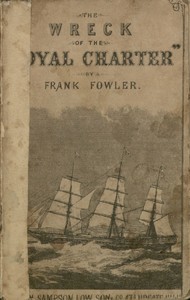
The Wreck of the "Royal Charter" - Compiled from Authentic Sources, with Some Original Matter
Download Formats:
Excerpt
The Project Gutenberg eBook, The Wreck of the "Royal Charter", by Frank
Fowler
This eBook is for the use of anyone anywhere in the United States and most
other parts of the world at no cost and with almost no restrictions
whatsoever. You may copy it, give it away or re-use it under the terms of
the Project Gutenberg License included with this eBook or online at
www.gutenberg.org. If you are not located in the United States, you'll have
to check the laws of the country where you are...
Read the Full Text
— End of The Wreck of the "Royal Charter" - Compiled from Authentic Sources, with Some Original Matter —
Book Information
- Title
- The Wreck of the "Royal Charter" - Compiled from Authentic Sources, with Some Original Matter
- Author(s)
- Fowler, Frank
- Language
- English
- Type
- Text
- Release Date
- November 27, 2018
- Word Count
- 35,366 words
- Library of Congress Classification
- G
- Bookshelves
- Browsing: History - General, Browsing: Travel & Geography
- Rights
- Public domain in the USA.
Related Books
Drawing in charcoal and crayon for the use of students and schools
by Fowler, Frank
English
217h 43m read

The Broncho Rider Boys on the Wyoming Trail - Or, A Mystery of the Prairie Stampede
by Fowler, Frank
English
1071h 40m read

The Broncho Rider Boys with the Texas Rangers - Or, The Capture of the Smugglers on the Rio Grande
by Fowler, Frank
English
930h 54m read

The Broncho Rider Boys Along the Border - Or, The Hidden Treasure of the Zuni Medicine Man
by Fowler, Frank
English
1063h 40m read

The Broncho Rider Boys with Funston at Vera Cruz - Or, Upholding the Honor of the Stars and Stripes
by Fowler, Frank
English
977h 16m read