*** START OF THE PROJECT GUTENBERG EBOOK 73558 ***
A Different Story, Off the Beaten Path, Is This Tale
of a Match That Fulfilled Its Destiny
THE THIN MATCH
By Henry S. Whitehead
Author of “Sea Change,” “The Fireplace,” etc.
She began her life as a match along with several hundred million near
relatives of the great family of pitch-pine, in the factory of the
Emerald Match Company, of Scranton, New Jersey.
She had not realized her inferiority until she was shut up tightly in
the close quarters of what was to be for a long time her home. Fate
placed her in that particular kind of box which was labeled as a
“Product of Finland, Average Contents Sixty Sticks.” There was also
other printed information on the box-label, couched in some
Scandinavian language for anyone who might be able to read it.
Life in a family, even one averaging sixty members, is a decidedly
different matter from being one item in a phalanx, a horde, of hundreds
of millions, all exactly alike. Just here was where the thin match’s
troubles began. She was different. In her ease it was not a mere slip
of the machine. It was natural depravity. She had grown a trifle too
close to the bark in the original tree. Along one of her slim sides
there was a brown streak, which set her off from the others like a
touch of the tar brush. Then, she was thin--altogether too thin for a
respectable match. Exact conformity to type is expected among matches.
Her inconsiderable cubic area was rather less than half what it should
have been, and besides all this, her head had a decided, an
unmistakable, hitch to one side.
Her box, along with fourteen gross of precisely similar boxes, was
shipped to a Nashville jobber, and she learned next to nothing of this
world’s experiences until her box, with twenty-three others, was placed
one sunny morning in a cent-in-the-slot machine on a cigar counter in
Chattanooga.
Here she got her first intimation that she was different. It was very
close quarters--would be, of course, until the box found a purchaser
and her box-mates began to go out one by one to fulfill their destiny.
She began to receive cool jostles, cold shoulders, from the other
matches, her particular near neighbors. Here, too, she had some
experience of coal smoke; rather premature, but inevitable in
Chattanooga.
One memorable day there came the familiar snick of an inserted cent and
the rasp of the lever, and her box dropped out and went into the pocket
of a young man who had bought it to light cigarettes. There was wild
excitement and no little speculation among the matches. They were like
troops on the very verge of an action. The young man gave them plenty
of action. He used the first thirteen matches very quickly, which made
a good deal more room in the box, and then there was a long undisturbed
period while the box remained in the pocket of an old vest which hung
on a hook in the closet of the young man’s boarding-house bedroom. One
day, the young man having moved away and carelessly left the old vest
behind him, the box was taken out by the boarding-house keeper’s
husband, a mild-mannered gentleman who smoked a pipe outdoors, and he
used nine more of the matches.
Between the unconscious selection of the normal matches by the owners
of the box and the jostling which the thin match had received from the
others, she found herself tucked away into a narrow corner where the
thin wood of the box-bottom was edged by the still thinner paper pasted
outside.
One day a companion of the boarding-house woman’s husband asked him for
a light, and, forgetting to return the box, this man became its new
owner. He used only one match, though, and then left the box on top of
one of his front gate-posts, where he had been talking to a neighbor,
and little Sallie Eaton saw it there and picked it off on her way home
from school. Sallie tucked it away in the pocket of her apron, where
her mother found it when the apron was going to the wash, and Lance
Eaton, Sallie’s brother, found it on the sewing machine where his
mother had laid it, and annexed it for himself.
* * * * *
There were thirty-seven matches in the box when Lance found it. There
may have been some slight variation in the “average contents” when the
box left the Emerald Match Company. It is certain that when Lance
handed it through the car window in the railroad station to Big Pete
Jenkins, there were only nine left and among these, quite tightly
wedged by now into her corner, and out of sight, was the thin match.
The other eight were dead-set against her by now. They had no further
contact with her; she was ostracized, a pariah of a match--too thin,
and too brown on one side, and with a head too little symmetrical and
too little apt to light at the first draw along the box-side for any
self-respecting match to notice her at all!
Pete Jenkins went all the way to New York. By the time he arrived there
were four of the nine left. The thin match was still in her corner,
wedged in. It was better for her there, on the whole, she had come to
believe. The pressure of the feeling against her had sent up strongly
into her head the idea of her destiny. This was, of course, only the
common destiny of all matches--to set something on fire. It might be
anything, from a joss-stick to a great conflagration; but it was to
start fire. That, she knew by instinct, was the great thing. What
difference did it really make, she said over and over again to herself,
that she was thin, had a crooked head, and a streak all down one side!
There lay within her power the possibility of anything--anything, that
is, that could come of setting something on fire. Patience! When it
came her turn, if it ever did come, to be taken out and scraped along
the side of the box, she must light, and blaze up, and burn clearly and
steadily. She must not fail. And it would be so easy to fail! Many a
match had failed, and for many reasons. There was the possibility of
dampness, that greatest of all match-dreads. Then, the outside of the
box would be sadly worn down by now, with most of the matches gone. The
first out, those nearest to the top as fate at the hands of the packer
adjusted it for them, always had the best chance. Then, too, she might
break! She would be especially likely to break, being so very thin; or
her paraffin-soaked neck, which was the thinnest part of her, might
have got too dry to burn properly!
But there was no way to regulate these chances. A match could only wait
and hope, and the thin match waited and hoped with a good courage,
resolved to light quickly and burn as clearly and steadily as she
possibly could, if ever her chance should come.
Pete, it seemed, had no particular use for the remaining matches in
this box. He had, in fact, quite forgotten them. For the box, very weak
and wobbly now, had been packed inside the pocket of a jacket which
Pete had replaced with a sweater a day out from New York and placed
inside a gripsack. Pete was on board a ship now, a ship bound to
Labrador, and he was using old-fashioned sulfur matches to light his
pipe against the wind up on deck.
It occurred to the thin match that she might never get her chance, even
though the box should be resurrected, because she was quite out of
sight. Even if someone opened the box again, she was wedged in so
tightly that she might not even be seen. Well, there was no use in
borrowing trouble! She knew she could not regulate the universe. She
could only wait, and so she waited, and waited....
* * * * *
It was more than four months before the crushed and battered old box,
so worn and greasy now that the printing on the cover could hardly have
been read by even the most learned Scandinavian, was brought to light
again in Pete’s cabin on the upper reaches of the Nasquapee.
It was a desperate day of still cold. The thermometer had sunk and sunk
for the past several weeks. It was too cold now for any more snow to
fall, but Pete was snowed in.
That sound behind him was the scratching of a lynx’s claws, a lynx
which had dug down through the snow to the lean-to, braced in with
river-bottom rocks--great, flat rocks, outside the hut--the lean-to
where Pete kept his spare provisions against this commonest of
sub-Arctic setbacks: being snowed in. Pete had plenty of provisions,
both inside the hut and out there in the handy lean-to, covered in. The
lynx had besieged him now for two days and nights.
He had plenty of food, and he might have shot the lynx at any time. But
he dared not shoot the lynx. He dared not shoot the lynx because he had
one cartridge left, and one only. The great ravenous animal, with the
deadly hunger-courage of the far North, had utterly put aside all his
natural fear of Man. Pete could thrust his rifle against the satiny
black fur which showed through the chinks of the hut and blow it to
pieces at any time.
But he dared not. He dared not because he had no matches. By a stroke
of the wildest ill-fortune he had destroyed a full box, the last box in
his store, by omitting to close it before striking one on its side. He
had struck it toward the end where the heads were, and they had flared
up and burned off to cinders in precisely two seconds. He was relying
on that cartridge, that last cartridge, to light the fire. He would
have to light it soon. There had not been a live ember since early
yesterday morning when the snow that had accumulated above his stone
chimney, far above at the outlet, had come pouring down and doused his
fire.
He could not kill the lynx and light the fire too. He must choose. And
now, crouched on the floor before the cold embers, his back to the
lynx, which scratched and scratched, the man, bundled like a great ball
in his parka and seal leggings and with his heavy furs about his
chilled body, was dully trying to decide what to do.
It was death either way, it seemed. He could only choose between the
bloody, riving death at the lynx’s claws, or the slower but perhaps no
less deadly alternative of being frozen stiff.
Suddenly, he thought of that old coat! There might--there just _might_
be, in one of the pockets, a stray match. He had worn it, he
remembered, on the train trip and for the first day on board the ship,
and had carried matches in the side pockets. First pounding his hands
together to start up some little circulation, he dug, with his great
fur gloves still on his hands, under his bunk against the end wall. Out
came the old coat at last. He hadn’t worn it for months now. Laying it
out roughly before him on the edge of the bunk, and again slapping his
gloved hands together, he hastily pulled off the right glove with his
teeth. Then he thrust into the pockets, first the right one, then the
left. What was this? He clawed out the crumbling remains of the old
box. Matches? He shook the box close to his ear. Matches!
God!--matches!
He spilled them on the bunk in his agitation and relief, which shook
him from head to foot with a violent trembling. He wept uncontrollably
and started to pick them up carefully. There were three, all good,
sound matches.
He slapped his hands together again, pulled off his other glove, and
rubbed his hands briskly up and down on the heavy fur of his parka.
Then he took his rifle, and laid it, ready loaded, beside him on the
bunk.
The scratching of the lynx seemed to him louder and bolder; more
imminent and menacing. The great beast, it would seem, could not
dislodge the heavy, flat stones with which the cache was overlaid.
There was not room enough for that--too little purchase to be obtained.
He looked around. The lynx had abandoned its old purpose, and was
coming through into the hut. It was working on the wood now. That was
what had made the change in the sound of the scratching. Already a
huge, wicked paw appeared, a paw armed with chisels! The lynx snuffled.
If not pemmican, then Man!
* * * * *
Carefully, gingerly, Pete drew the first match along the side of the
box. But the oily side caused it to slip without igniting. At the
second trial the head crumbled off the stick. He threw away the useless
stick and took the second. It broke off, close to the head. He fumbled
after the head on the floor, his hands like lumps of lead. At last he
got it between his thumb and the side of the box. It would burn him, he
knew; but what was a burn? He rubbed it against the box. It flared
suddenly, died at once, giving him a vicious burn in the process, and
smoked out to a tiny, inconsiderable cinder.
Pete turned pale under the dirt of his unshaven cheeks, and reached for
his last match. He struck it, with infinite care, seven times, drawing
it along different portions of the better preserved box-side. It
fizzled at last, but that was all. The head crumbled off as the first
had done.
Pete sat there looking at the fragments of the broken box and the
useless sticks in a dumb frenzy of despair. He was done--at the end of
his rope. Then, suddenly animated, he seized the useless wreck of the
empty box and threw it on the hard earthen floor, and ground it with
his heel. He sat and stared at it. The lynx broke off a great splinter
of wood, but Pete did not notice the lynx. What was that? It looked
like a good match-head, there under the edge of the flimsy match box
now ground and crushed flat.
Almost perishing now with the bitter cold in his ungloved hands, which
made them feel like useless lumps of lead, Pete groped for it. He got
it at last in his numb fingers, and carefully gathered up a bit of the
box-side, a mere splinter. He carried the find over to the fireplace
where he had his fire ready laid and looked closely at what he had
picked up in the failing light. It was the thin match, intact. Pete’s
grinding, angry heel had only rolled her about in the dirt. Her body
was wrenched--her poor, pitiful little body, thin and crooked--but
there had been something of stiffness in that disfiguring brown streak
which she had inherited from being too near the bark.
The thin match summoned up all her resolution. The time had come for
her to fulfill her destiny....
Against his broken, begrimed fragment of the box-side, Pete scraped the
crazy, splintered, wobbly, thin match. A bright, steady little flame
sprang up at him. Not breathing, his aching hands laboriously cupped,
he reached for the under side of the fire.
The thin match slipped from between his numbed fingers and fell, but
she landed just within the fireplace. Exactly above her hung a fragment
of oily pine bark. With her last expiring fragment of will, the thin
match, now two-thirds burned away, squeezed a thin trickle of yellow
flame up until it touched the very tip of the fringed edge of that
piece of pine bark. There was a fearful instant of suspense;
then--then--a thin and growing little blaze began to run up the
bark-splinter’s edge; the fire caught and roared up the stone chimney.
Pete wept, crouching there benumbed, his great body in the ungainly
furs sagging down almost against the blaze under the stress of this
reaction.
* * * * *
A ripping slither of tearing wood came from the other side of the hut.
Pete turned his head dully. The lynx had thrust an entire foreleg
through into the hut; the great head with its staring, inhuman yellow
eyes was pushing through. Peter saw the foamy slaver drip from the
snarling mouth.
Every joint protesting, aching in all his bones, Pete reached across to
the bunk for the rifle. His jaw set, and he dragged himself to his
feet. He took four steps across the hut, and thrust the muzzle of the
rifle against the lynx’s forehead between the great, staring eyes. A
shattering roar shook the solid hut, and, dropping his rifle, Pete
staggered back to the life-giving blaze.
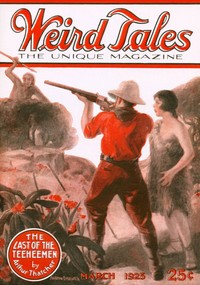
[Transcriber’s Note: This story appeared in the March 1925 issue of
Weird Tales magazine.]
*** END OF THE PROJECT GUTENBERG EBOOK 73558 ***
The thin match
Download Formats:
Excerpt
A Different Story, Off the Beaten Path, Is This Tale
of a Match That Fulfilled Its Destiny
Author of “Sea Change,” “The Fireplace,” etc.
She began her life as a match along with several hundred million near
relatives of the great family of pitch-pine, in the factory of the
Emerald Match Company, of Scranton, New Jersey.
She had not realized her inferiority until she was shut up tightly in
the close quarters of what was to be for a long time her home. Fate
placed her in that...
Read the Full Text
— End of The thin match —
Book Information
- Title
- The thin match
- Author(s)
- Whitehead, Henry S. (Henry St. Clair)
- Language
- English
- Type
- Text
- Release Date
- May 7, 2024
- Word Count
- 2,891 words
- Library of Congress Classification
- PS
- Bookshelves
- Browsing: Literature, Browsing: Fiction
- Rights
- Public domain in the USA.
Related Books

Famous stories from foreign countries
English
494h 26m read
The incredible slingshot bombs
by Williams, Robert Moore
English
96h 4m read

The eater of souls
by Kuttner, Henry
English
22h 19m read

Maehoe
by Leinster, Murray
English
115h 53m read
The air splasher
by Watkins, Richard Howells
English
138h 53m read

Hooking a sky ride
by Morrissey, Dan
English
37h 54m read