*** START OF THE PROJECT GUTENBERG EBOOK 73548 ***
[Transcriber's Note: Anglicized variants of German character names
have been retained as they are in the original (e.g., Rhinegold for
Rheingold, Logi for Loge, Friea for Freia). Obvious printer errors have
been corrected without note. Some full-page illustrations have been
moved to the nearest paragraph break for better readability.]
[Illustration:
[Page 58
WOTAN AND BRÜNNHILDE]
THE
STORY OF THE RHINEGOLD
(_DER RING DES NIBELUNGEN_)
Told for Young People
BY
ANNA ALICE CHAPIN
ILLUSTRATED
[Illustration]
NEW YORK AND LONDON
HARPER & BROTHERS PUBLISHERS
1900
Copyright, 1897, by HARPER & BROTHERS.
_All rights reserved._
TO
THE MASTER’S DAUGHTER
EVA WAGNER
WITH HEARTFELT GRATITUDE
FOR HER KINDNESS AND ENCOURAGEMENT
THIS BOOK
Is Dedicated
PREFACE
_The Story of the Rhinegold_ contains the four operas of Richard
Wagner’s “Nibelungen Ring,” arranged for young people. The “Nibelungen
Ring,” or “Nibelungen Cycle,” is built upon a colossal foundation:
a number of the great Teutonic myths, welded together with the most
masterly skill and consistency. It is evident that Wagner, like
William Morris and other writers, has taken from the fragmentary
mythological tales such material as would serve his purpose, adapting
such incidents as he chose and as he considered appropriate to his
work. But there are so many different versions of these old stories
that it is very difficult to trace Wagner’s plot to its original
birthplace. The various tales contained in the ancient sagas are so
seemingly contradictory that anything connectedly authoritative appears
impossible to trace. The one thing which seems to remain the same
in almost all versions of the stories, ancient and modern, is the
background of mythology, that great, gloomy cycle of gods, with the
ever-recurring note of Fate which seems to have impressed all searchers
in myths alike, and which inspired Wagner when he formed his mystical,
solemn Fate motif.
Odin, Wuotan, Wodin, or Wotan, according to the different names given
him in the old legends, is the central figure in the framework. If I
read the story aright, the Norns, or more properly Nornir, are next in
importance. They and their mother, the Vala, are the medium through
which the relentless something behind the gods made itself felt in the
world. The three sisters are named respectively _Urðr_, _Verðandi_,
and _Skuld_—freely translated Past, Present, and Future; or, as they
were once styled, as correctly perhaps, Was, Is, and Shall Be. It is a
question whether Erda and Urðr, the oldest Norn, might not originally
have been identical. Dr. Hueffer speaks of Erda as the “Mother of Gods
and Men,” but though “the Vala” is often found in mythology, the name
Erda is rarely mentioned, whereas the titles for the three Norns seem
to be unquestionably correct. The term _Vala_ is usually translated as
Witch, or Witch-wife, but, though a Vala was indeed a sorceress, she
was a prophetess as well.
A step lower than the gods, yet gifted with supernatural power and far
removed from the characteristics of human beings, were the dwarfs and
the giants. The giants, we are told, were creatures belonging properly
to the Age of Stone, which explains the fact that there were left but
two representatives of the race at the time of the Golden Age. The
dwarfs come under the head of elves. They were gifted with the utmost
cleverness and skill. The giants were stupid and clumsy, and, save for
their superhuman strength and size, entirely inferior to the small, sly
dwarfs.
The world was strangely peopled in those days; many of the heroes were
demi-gods, that is, descended from some god or goddess, and witches,
dwarfs, and sorcerers mingled with human beings.
Many mortals, also, had magic power then. Otter, the son of Rodmar,
changed himself into the animal for which he was named, and while
in the shape of the otter he was caught and killed by three of the
gods who were wandering over the earth in disguise. Rodmar demanded
weregild,[A] and Loki, with a net, caught Andvari, a rich and malignant
dwarf, and commanded him to pay a ransom of gold and gems, enough to
cover the skin of the otter; for such was the weregild demanded by
Rodmar. Andvari, of necessity, gave the gold for his own release, even
adding a wonderful wealth-breeding Ring to cover up a single hair
in the skin which the rest of the treasures had left unconcealed.
The dwarf cursed the Ring, and the curse attended it through all its
manifold ways of magic, to the end of the story.
[Footnote A: _Weregild_ is almost untranslatable. It may mean payment,
tax, forfeit, or ransom.]
Rodmar’s remaining sons, Fafnir and Regin, killed their father and
fought for the treasure. Fafnir obtained it, and, turning himself into
a monster-worm, went to Glistenheath (sometimes called Glittering
Hearth) to guard his wealth. Regin called upon Sigurd, a young hero,
to aid him, and, being a master-smith, forged for him a sharp sword
named Gram. Some versions give the forging of the sword to Sigurd,
but there are many sides to the story. The sword was sometimes called
Gram, and oftener Baldung, until Wagner gave it the more expressive
name of Nothung, or Needful. Prompted by Regin, Sigurd slew the Dragon
at Glistenheath, and, after tasting the blood by accident, was able to
understand the language of birds, and was told by two of Odin’s ravens
that Regin was treacherous. After slaying Regin, Sigurd rode away
with two bundles of the treasures slung across his horse’s back. He
found and awakened Brynhildr, a beautiful woman asleep in a house on a
hill. (She is known in the different tales in which she has figured as
Brynhildr, Brunhild, Brunehault, and Brünnhilde.) The next part of the
tale is most clearly set forth in the “Nibelungenlied,” an epic poem
in Middle High German dialect, containing a story—or, more correctly,
a series of stories—which originally belonged to the entire Teutonic
people. These have been found in multitudinous poems and sagas, from
those written by the ancient Norsemen, and most primitive in form,
to the modern books, essays, and poems of writers who have been
impressed with the interesting and picturesque aspects of the strange,
complicated old story. The “Nibelungenlied” itself deals rather with
the period of Christianity—with the knights and ladies of the time of
chivalry—than with the primeval gods and heroes of the Golden Age.
The substance of its contents may be found in the “Edda” and in the
“Thidrekssaga” (thirteenth century), and the original manuscripts of
the “Nibelungenlied” itself date from the thirteenth to the sixteenth
century.
The story contained in this poem is, briefly told, as follows:
Siegfried, son of Siegmund and Sieglind, woos Kreimhild, the sister of
King Gunther, of Burgundy, promising, in return for her hand, to aid
Gunther in winning Brunhild, Queen of Issland (Iceland). Siegfried,
with the help of his cloud-cloak, conquers Brunhild for Gunther—first
in three athletic games, which she makes a test for all suitors; and
later when, after the marriage, she proves stormy and untamed. He
takes her Ring and girdle, and gives them to his wife, Kreimhild. They
possess magic properties, and Brunhild, when deprived of them, loses
her great power and becomes like any ordinary woman. She sees her Ring
on Kreimhild’s hand one day, and, realizing that it is Siegfried,
and not her husband Gunther, who has conquered her great strength
and stolen her magic circlets, she tells her wrongs to Hagan, who
promises revenge. Hagan is the Knight of Trony, and he and his brother
Dankwort are Gunther’s vassals. Hagan entices Kreimhild to reveal to
him the secret of her husband’s safety in battle, and she tells him
that Siegfried once slew a dragon and bathed in the blood, which made
him invulnerable, save in one place, between his shoulders, where a
leaf fell, protecting the skin from the blood. Kreimhild is entirely
deceived by Hagan, and, not suspecting his treachery, she sews a circle
of silk upon her husband’s vesture over the vulnerable spot, that Hagan
may better know how to protect the hero’s one weakness when they are in
battle. It is there, where the circle of silk is sewn, that Hagan stabs
him.
There is much more in the “Nibelungenlied,” and a character famous in
poesy and sagas is introduced later in the poem—Atli, or Attila, King
of the Huns; but he has nothing to do with our story, though some one
has drawn a resemblance between his character and that of Hunding.
The “Nibelungenlied,” after Siegfried’s death, contains very little
connected in any way with Wagner’s four operas.
There are other versions of this tale, as there are of all ancient
stories. There are many tales of the killing of the Dragon and the
awakening of Brunhild, and the personality and history of the latter
have passed under diverse alterations in color and development. One
story says that Brynhildr, the Valkyrie, was made to slumber by her
father Odin, who pricked her in the temple with a sleep-thorn. Many
writers tell of a fire-circle which surrounded the sleeper and guarded
her slumbers. She is known as a great queen, a woman gifted with magic
powers, and a disobedient Walküre in different tales; and her character
changes as constantly as her history in the various legends where we
read of her. Sigurd, Siegfried, and Sinfiotli are, in many respects, so
similar that they might safely be termed identical, though sometimes,
as in William Morris’s “Sigurd, the Volsung,” they appear as distinct
characters.
Out of this confused and complicated sea of myths, legends, and old
Norse stories Wagner has drawn the material for his wonderful cycle.
His gods and goddesses are taken, with very few changes, directly from
their original place—the Teutonic mythology. His giants and dwarfs are
also unaltered as complete races. In his usage of them he differs in
some respects from the older stories.
Fafnir, the son of Rodmar, becomes the giant Fafner, and his brother
Fasolt is added. Regin is transformed into Mime, the master-smith.
Instead of Otter, who must be covered by gems, we have the love
goddess Friea, and instead of the hair which the Ring must cover in the
old legend, it is in Wagner’s adaptation one of Friea’s beautiful eyes.
Fafner hides in Hate Hole instead of upon Glistenheath, and is killed
by Siegfried instead of Sigurd. The lonely Walküres’ Rock takes the
place of the house on the hill, and instead of being made invulnerable
by the Dragon’s blood, Siegfried is protected by Brünnhilde’s spells—a
fancy which seems more poetic and beautiful, but which originates, I
believe, entirely with Wagner. Gutrune takes the place of Kreimhild,
and Hagan is not Gunther’s vassal, but his half-brother. These are,
after all, apparently slight changes, yet to Wagner’s cycle a new
poetry seems to have come. The barbaric aspects of the tale have faded,
and all the simple beauty of those wild, noble gods and demi-gods has
gleamed forth as gloriously as the wonderful Rhinegold, which the
master has made next in importance to the gods and the dusk of their
splendor.
Before going further, perhaps it might be well to say a few words of
explanation as to the motifs which form the key-notes of Wagner’s great
musical dramas.
When he set his poem of the Nibelungen Ring to music, he was not
satisfied with merely beautiful airs and harmonies linked together with
no purpose save the lovely sounds. He wished, above all, to have his
music fit his words; and for every character and thought and incident,
and indeed for almost everything in his operas, he wrote a melody,
and these descriptive musical phrases are called _motifs_. Each one
has its meaning, and when it is played it brings the thought of what
it describes and represents, and it makes a double language—what the
characters on the stage are saying and what the music is saying, as
well. Through the motifs we understand many things which we could not
possibly comprehend otherwise.
That Wagner wished to give the impression that Erda was the mother of
all beings, divine and human, at the beginning of the world, he has
shown by the fact that the motif of the Primal Element—the commencement
of all things—is identical with hers, save that where she is indicated
the melody takes a minor coloring, denoting her character of mystery
as well as the gloom in which her prophetic powers must necessarily
envelop her. The contrasting, yet harmonizing, elements of earth and
water are also shadowed forth, I think, in this motif of the Primal
Element, which is used for the _Rhine_, and also for the Goddess of
the _Earth_. When the Vala’s daughters—the Nornir—are mirrored in the
music, the same melody appears, fraught with the waving, weaving sound
of their mystic spinning.
The motifs in Wagner’s operas are, above all, descriptive. For example,
note the Walhalla, Nibelung, and Giant motifs.
The first of these, full of power, substance, and dignity, not only is
descriptive of the great palace itself, but also represents the entire
race of gods who inhabit it, seemingly secure in their conscious glory
and sovereignty. To indicate Wotan, the King of the gods and the ruler
in Walhalla, Wagner has constantly made use of this motif.
Its melody is measured, strong, and simple, and the nobility of those
worshipped gods of primeval years seems to breathe through it.
The Nibelungs were so intimately associated with their work that
they were scarcely more than living machines—soulless exponents of
the art of the forge and the anvil; so when we hear in the music the
beat of hammers—the sharp, metallic clang in measured time, our first
thought is that the hammers are swung by the Nibelungs. How cramped is
their melody, how monotonous and hopeless is the regular fall of the
hammers! When we hear it hushed and veiled with discords, we seem to
come in contact with the narrow, darkened souls of the Nibelungs.
And now we come to the motif of the giants.
It is, like themselves, heavy, lumbering, with a slur that is like
the stumbling of heavy feet. Clumsy and ungraceful, it and what it
represents cross the idyllic beauty of the motifs of Friea, Walhalla,
the Ring, the Rhinegold, and the rest, with a harsh and disagreeable
sense of an inharmonious element. How different from the majestic gods,
and the clever, small-souled Nibelungs, are these great creatures who
are all bodies and no brains, and who are so ably represented by the
music allotted them in the operas! Yet, in their own way, they and
their motif are extremely picturesque!
In these three motifs we can see the genius which formed them, and
so many others, even greater in conception and execution. Scattered
throughout _The Story of the Rhinegold_ will be found a few of these
motifs—only a few and not the most lovely—but enough I think to help
one, in a small way, to follow the operas with more interest and
understanding than if one did not know them.
One of the simplest motifs in the book is one of the most important:
the Rhinegold motif. It is like the blowing of a fairy horn heralding
to the world of sprites and elves the magic wonder in the river.
In the olden days they had a lovely legend of the formation of the
Rhinegold. They said that the sun’s rays poured down into the Rhine
so brilliantly every day that, through some magic—no one knew exactly
how—the glowing reflection became bright and beautiful gold, filled
with great mystic powers because of its glorious origin—the sunshine.
And that was the beginning of the Rhinegold.
A.A.C.
CONTENTS
Part I
THE RHINEGOLD, OR _DAS RHEINGOLD_
PAGE
PRELUDE 3
CHAPTER
I. THE RHINE MAIDENS 8
II. FASOLT AND FAFNER 13
III. NIBELHEIM 18
IV. THE RAINBOW BRIDGE 24
Part II
THE WARRIOR GODDESS, OR _DIE WALKÜRE_
PRELUDE 33
CHAPTER
I. THE HOUSE OF HUNDING 37
II. THE DAUGHTER OF WOTAN 45
III. BRÜNNHILDE’S PUNISHMENT 54
Part III
SIEGFRIED
PRELUDE 63
CHAPTER
I. SIEGFRIED AND MIME 67
II. HATE HOLE 79
III. THE MOUNTAIN PASS 88
IV. THE WALKÜRES’ ROCK 95
Part IV
THE DUSK OF THE GODS, OR _GÖTTERDÄMMERUNG_
PRELUDE 103
CHAPTER
I. THE HALL OF THE GIBICHUNGS 107
II. THE WALKÜRES’ ROCK ONCE MORE 113
III. THE RHINE CHIEF’S BRIDE 118
IV. ON THE BANKS OF THE RHINE 124
V. THE LAST TWILIGHT 133
ILLUSTRATIONS
WOTAN AND BRÜNNHILDE _Frontispiece_
THE GLEAMING TREASURE _Facing p._ 10
A WARRIOR GODDESS 34
THE WALKÜRE APPEARS 50
SIEGFRIED AT THE FORGE 76
THE DEATH OF THE DRAGON 82
BRÜNNHILDE ON THE WALKÜRES’ ROCK 104
GUTRUNE AND SIEGFRIED 110
BRÜNNHILDE AND SIEGFRIED 116
GUNTHER AND BRÜNNHILDE 122
HAGEN AND SIEGFRIED 128
AFTER SIEGFRIED’S DEATH 130
Part I
THE RHINEGOLD, OR _DAS RHEINGOLD_
[Music: Motif of the Rhinegold]
PRELUDE
We have, all of us, read of the Golden Age, when the gods ruled over
the world, and giants and dragons, dwarfs and water-fairies inhabited
the earth and mingled with mortals. The giants were then a strong,
stupid race, more rough than cruel, and, as a rule, generous among
themselves. They were very foolish creatures, and constantly did
themselves and others harm; but their race, even at that time, was
dying out, and there were left of it only two brothers, Fasolt and
Fafner.
The dwarfs, or Nibelungs, were entirely different. They were small and
misshapen, but very shrewd, and so skilful were their fingers that they
were able to do the most difficult work in the finest metals. They
lived in an underground country called Nibelheim (Home of the Dwarfs),
where they collected hoards of gold and gems, and strange treasures of
all kinds; and Alberich was one of them. He was a hideous creature,
so dark and evil-looking, with his small, wicked eyes and his hair and
beard the color of ink, that he was always called Black Alberich—a very
suitable name.
As for the dragons, they were rare even in those days, and though we
shall have to deal with one by-and-by when we are further on in my
story, I shall not say much about them now.
The water-fairies were beautiful spirits who lived in the depths of the
river Rhine. They were simple and innocent, as became children of the
Golden Age, and very lovely to look upon. In the peaceful twilight-land
under the water they were perfectly happy, dancing in and out among the
rocks at the river bottom, and singing soft songs, which, when wafted
up to the surface of the Rhine, sounded like the faint sighing ripple
of the river as it rolled onward through the valleys and the woods.
And the water-fairies had one great happiness in their quiet, shadowed
lives. I will tell you what it was: On the top of a tall black rock in
the river Rhine there rested a magical treasure, more wonderful than
any of the Nibelung hoards, or the possessions of the gods themselves—a
bright, beautiful Gold, the radiance of which was so great that when
the sun shone down into the river and touched it the gray-green water
was filled with golden light from depth to depth, and the fairies of
the Rhine circled about their treasure, singing and laughing with
delight.
What a wonderful time it must have been—the Golden Age—when such things
were possible!
You smile and say that they were not possible, even then! Remember
that this is a fairy tale—a day-dream—such as might come to you while
watching the sunlit ripples dancing on the water, and hearing the
little waves lapping on the pebbles—a fairy tale, that is all.
The Golden Age, as I think of it, seems a period in which anything
might have happened. Closing my eyes, I can picture the majestic gods
moving, great kings and queens among human beings; great kings and
queens made young by Friea’s apples of youth. Friea was the Goddess of
Love, Youth, and Beauty. She was the same as Venus, the Roman goddess,
called Aphrodite by the Greeks, of whom, perhaps, you have read
elsewhere. All that I am writing about happened, you know, in Germany;
and to the people there the gods—or rather men’s ideas of them, and
their names for them—were different from those of other lands.
So the King God, instead of being Jupiter, or Zeus, or Jove, was
called Wotan, or sometimes Odin. And the Queen Goddess was neither
Juno nor Hera, but Fricka; and the wild Thunder God was Thor; and the
Goddess of the Earth Erda, which means the earth. She was the wisest of
all the gods and goddesses (though Logi, the Fire God, was the quickest
and cleverest), and she could prophesy strange things about the gods
and the world, and everything happened just as she prophesied.
She would sink into the earth and dream, and all her dreams came true.
She would tell them to her daughters, the three Norns, or Fates, and
they would weave them into a long golden thread, into which they had
spun the world’s history.
They spun under a great ash-tree which grew by the Fountain of Wisdom,
and was called the Tree of the World.
One day Wotan, the king of the gods, came to the fountain for a draught
of the Water of Wisdom. He drank, and left one of his eyes in payment.
He tore a limb from the World-Ash and made it into a spear; and the
spear, having strange figures upon it representing Law and Knowledge,
was typical of the wisdom and power of the gods, and so long as that
wisdom and that power endured no sword could break the spear nor could
remain whole at its touch.
But the World-Ash, robbed of its branches, withered away and died, and
the Fountain of Wisdom became dry.
And these things were the beginning of the end of the Golden Age.
But wise people say that the Golden Age did not end until men began
to value gold for its own sake and the love of gain, and to do wrong
things to possess it. And now I will tell you how it all happened.
[Music: Motif of the Primal Element, out of which come the Erda, Norn,
and Rhine Motifs]
[Music: Song of the Rhine Maidens
Weia waga, wavering waters, weaving and whirling!
Walala weia!]
CHAPTER I
THE RHINE MAIDENS
At the bottom of the river Rhine, about the dark rock where rested the
invisible Rhinegold, there swam one morning before sunrise the Gold’s
fair guardians, the three children of the Rhine. They were beautiful
maidens, these three water-spirits, the most lovely of all the river
people, and their names were Flosshilde, Woglinde, and Wellgunde. They
were singing softly, and glancing constantly up to the rock’s crest,
waiting for the appearance of the Rhinegold, which could only be seen
when the sun had risen up above and sent its rays into the water to
disclose the treasure. They sang a little rippling refrain that meant
nothing except laughter and joy, and sounded very like the ripples of
the water themselves:
“Weia waga—”
sang Woglinde,
“Wavering waters, weaving and whirling,
Walala weia!”
And so they sang on, till their voices mingled so with the ripple that
both voices and water became almost one in sound.
Now, while these three lovely maids, seeming almost part of the water
in their dresses of shimmering blue-green, with pale wreaths of river
flowers in their hair, and their white arms looking frail as moonbeams
as they raised them through the water—while they moved about the rock
singing and laughing together, a strange, dark little man stood near
watching them. He had risen out of a black chasm in one of the rocks,
and he had come from far Nibelheim, through an underground passage. He
had small eyes, his hair and beard were the color of ink, and he looked
very wicked. Can you guess who he was?
He shouted gruffly to the Rhine Maidens, and they, being much amused
at his ugly appearance, drew near with laughter and mocking words.
They led him wild chases in among the rocks, they played with him merry
games of hide-and-seek—merry for them, but not at all so for him, for
he was clumsy in motion compared with them, and he became very angry
because he could not follow them over the rocks.
“Smooth, slippery, slush and slime,” he grumbled. “The dampness makes
me sneeze.”
At last, just as he had become thoroughly angry, there appeared
suddenly a strange brightness at the top of the rock—a wonderful golden
light that glowed with ever-increasing brilliance down into the water.
“Ah, see, sisters!” cried Woglinde. “The awakening sun laughs down into
the depths.”
“Yes,” said Wellgunde, with soft delight, “it greets the slumbering
Gold!”
“With a kiss of light the Gold is aroused!” said Flosshilde. And,
joining hands, they swam excitedly about the rock, singing in bursts of
gladness:
“Weia waga,
Weia waga,
Rhinegold, Rhinegold,
Glorious joy.”
“You gliders,” questioned Alberich (for it was he), “what is this
that gleams and glistens over yonder?”
[Illustration: THE GLEAMING TREASURE]
Laughing at his ignorance, the nymphs told him that it was a magical
Gold; that whoever made a Ring from it would have greater power than
any one else alive; that he could possess all the wealth of the world
if he wished; and they so described the fairy powers of the treasure
that Alberich’s wicked soul began to thrill with desire to have it as
his own.
The sisters further told him that the Gold was safe from thieves,
because it could only be stolen by some one who had made up his mind
never to love any one except himself so long as he might live.
“We have nothing to fear,” said gentle Woglinde, “for every one who
lives must love.”
But Alberich pondered silently. “All the wealth in the world!” he
thought. “For that who would not give up love?” And he sprang wildly up
the rocks.
“Listen, waves and water-witches!” he shouted, as he reached towards
the gleaming treasure. “Never will I, the Dwarf, give love to any
creature save myself through all my life.” And while, with wild cries,
the Rhine Maidens hastened near to prevent him, Alberich, the Nibelung,
tore the Rhinegold from the tall, black rock, and fled with it into
the black chasm, and so to Nibelheim.
And, left behind, the nymphs could only wail for their lost joy with
sobs and cries of “Sorrow, sorrow! Ah—to rescue the Gold!”
But it was too late. And in the dark hollow chasm, Alberich, fleeing
with the treasure, laughed at their despair.
[Music: Motif of the Giants]
[Music: Motif of Friea]
CHAPTER II
FASOLT AND FAFNER
One morning not long afterwards the rising sun shone upon strange
things up among the gods.
Wotan, and Fricka his wife, waking upon the mountain-top where they
had slept that night, gazed up to where, built among the clouds, the
spires of a wonderful palace glittered in the sunshine—Walhalla, the
fair, new home of the gods.
It had been built at Wotan’s command by Fasolt and Fafner, the two
brother giants, and they had been promised, in payment, the goddess
Friea. But Wotan had never intended giving her to them, and so he told
Fricka when she spoke anxiously of the reward promised the giants,
declaring that the goddess was as precious to him as to her.
Even as he spoke Friea rushed wildly in, calling upon him to save her
from the rude giants. In answer, Wotan asked where Logi, the Fire God,
could be found, saying that where cunning and craft were needed, Logi
was the one most to be sought after. But, look as he might, the wayward
Fire God was nowhere to be seen.
And then came the great brothers, bearing huge clubs, and fiercely
clamoring for a reward for their labors in building Walhalla.
“You slept while we worked,” they said. “Now claim we our payment.”
“What price do you demand?” asked Wotan, pretending not to remember any
promised reward. “What will you take as wages?”
“Would you deceive us so?” cried Fasolt, in astonished rage. “Friea
you promised us. We worked right heartily to win us so fair a woman.”
“Hush!” muttered Fafner. “Listen to me! Without Friea’s apples of youth
the gods will grow old, and their glory will fade away. They will die
like human beings if Friea be taken from them.”
So the giants talked together, planning how to steal the lovely
goddess, who stood aside trembling, fearing that Wotan would refuse to
protect her from the two savage workmen.
He meanwhile merely murmured softly to himself, “Logi is long coming,”
and gazed expectantly about. But still the Fire God could not be seen.
Thor and Froh, two other gods, had appeared. The giants were growing
more impatient and Friea more despairing, when Logi at last arrived.
When he did he talked on a variety of subjects before he would pay any
attention to the affairs that were worrying the other gods and the
giants. But at last he set his clever brain to work at some plan by
which his fair sister Friea might be saved. Knowing well the love of
wealth characteristic of the giants, he told the story of the Rhinegold
and the stealing of it by the Nibelung. He said that he had heard the
maids weeping for their lost treasure, and had promised them that
Wotan, the King God, would return it to them in time. The two giants
began to feel the same desire for it that Alberich had had, and to
whisper together concerning it, so vividly did Logi describe its powers.
“It seems,” muttered Fafner, “that this Gold is worth even more than
Friea.” And he cried out suddenly: “Listen, Wotan, you wise one! We
will give up Friea; but you will instead bestow upon us the Nibelung’s
Gold.”
“We will hold her meanwhile as ransom!” cried Fasolt. And they dragged
her away, despite her piteous appeals, to Riesenheim (or Home of the
Giants), leaving the gods perplexed and sorrowing for their lost
goddess.
As they stood silently together a mist seemed to steal upward from the
ground, and floated between them. A strange shadow rested upon the
faces of the gods. They looked pale and wrinkled; their hair was white.
“Alas! What has happened?” wailed Fricka, faintly.
The gods were growing old.
“See, then,” said Logi, the shrewd one. “Our Youth Goddess has gone. We
are old; we are gray. The race of gods will come to an end.”
Wotan started and looked about him. His face was pale.
“Down, Logi! Let us go down to Nibelheim!” he cried. “The Gold shall be
had for ransom.”
The gods called out good wishes after them through the mist, and Wotan,
the King God, and his fire-servant, Logi, went down through the hollow,
shadowy passages under the earth to Nibelheim, the home of the dwarfs.
[Music: Ring Motif]
[Music: Nibelung Motif]
CHAPTER III
NIBELHEIM
Alberich had forged a Ring from the Rhinegold, and, wearing it,
possessed absolute power over the rest of the Nibelungs. He was the
King Dwarf, ruler over all Nibelheim, the Land of Gloom. Ah! what a
land of gloom it was! Through the dark shadows there streamed fitfully
a lurid light from the forges where the dwarfs were working; their
hammers clanged monotonously on the anvils. Slowly they laid the
results of their toil in great heaps, and Alberich laughed at their
weariness and gloated over the treasures, which he promptly claimed as
his own.
Among the Nibelungs was one particularly crooked and ill-shapen, named
Mime. He was Alberich’s half-brother, and, not unnaturally, hated the
Black King with all his strength; for Alberich treated him even more
cruelly than the others.
Mime, at Alberich’s command, made a wonderful cap of darkness out of
some of the Rhinegold, which not only had the power of making its
wearer invisible at will, but could change him into whatever shape he
wished. This Alberich wore, and changed himself into a column of mist,
in which shape he found he could move about much faster, and make
things much harder for the dwarfs.
“Hohei, all you Nibelungs! Kneel to your King! Now he is everywhere,
all about you, unseen, but felt and heard, you idlers!”
And the column of mist drifted off through a rocky passage, leaving
Mime whimpering upon the ground.
Now, with the clang of the hammers there mingled the sound of steps,
and from the black crevice in the rocks came two figures slowly down to
Nibelheim. One was tall and majestic, with a helmet of gold and steel,
a long cloak with strange designs upon it, and a deep golden beard that
hung far down over his breast; one of his eyes was missing, and in his
hand he bore a great spear.
The other was clothed in brilliant red, his eyes were bright, his step
swift as a springing flame in dead grass. They were Wotan and Logi
searching for the Rhinegold.
Logi accosted Mime in friendly fashion, and asked what was wrong with
him.
“That wretch, my brother!” grumbled the Dwarf. “He treats us all
cruelly. Leave me in peace!”
“How came Alberich by his power?” asked the Fire God.
“From the ruddy Rhinegold he made a Ring. With it he rules us. But,”
asked the Nibelung, staring at them, “who are you both?”
“Friends that perhaps may free the Nibelung people,” laughed Logi,
and at the same time Alberich appeared, scolding, screaming, and
ill-treating all who came in his way. Driving Mime away with the rest
of the dwarfs, he, scowling, asked the two gods what they wished.
“We heard of the wonders worked by Alberich,” answered Wotan. “We come
to behold them.”
“Pooh! I know you well,” said the Dwarf King. “Such notable guests”—and
he sneered—“could only have been led by envy to Nibelheim.”
“Surely you know me,” said Logi. “I have lit your forges, gnome. Cannot
you trust me?”
“To be sure I know you,” grinned Alberich. “And I will always trust you
to be untrustworthy. I don’t fear you.”
“How brave you are,” said Logi, in pretended admiration.
“Do you see that treasure?” said the Nibelung, proudly pointing to a
great heap of gold and gems.
The gods assented.
“But,” said Wotan, “what good does it do you, here in Nibelheim?”
Alberich glared at him, and then laughed.
“Ha! ha! But wait!” he said. “You gods! You gods! You have looked down
upon us Nibelungs. Now we, with the help of the Golden Ring, will sway
the whole world. We will storm the gates of Walhalla! Beware! Ha! ha!
Do you hear me? Beware!”
Wotan, in anger, started forward, but Logi slipped in front of him.
“Most wonderful are you, O Nibelung!” he said, admiringly. “I salute
you as the mightiest creature alive. But tell me one thing, O wise
one. How guard you your Ring from thieves?”
“Does Logi think that all are as foolish as himself?” asked Alberich.
“That danger I provided for. A Cap of Darkness, called the Tarnhelm,
is mine, to change me into whatever shape I wish, and also to hide me
at any time. So, my friend, guard I my Ring, sleeping or waking, as I
wish.”
“Wondrous above all it seems!” cried Logi. “Prove it, O Dwarf!”
“That I will. What shape shall I take?”
“Whatever you wish,” answered Logi. “It is sure to be wonderful.”
Alberich placed the metal cap upon his head and became a great dragon,
writhing on the ground.
“Wonderful!” cried the gods.
“Yet I should again like to behold its magic. Is it possible to become
small as well as large by its aid?” asked Logi. “I beg of you show us
if you can become small, O great one!”
“Nothing easier!” cried Alberich, beginning to enjoy himself. “Look,
then, O gods!” He placed the helmet on his head and vanished. A toad
hopped on the ground in his stead.
“Quick! Hold him!” cried the Fire God; and Wotan firmly held the toad
with his foot, while Logi lifted up the Tarnhelm, which still rested
upon its great head. And behold! Alberich lay at their feet, struggling
and roaring with rage.
The Fire God produced a rope, and the two gods bound the Nibelung
and carried him with them up the dark passage-way through which they
had descended, and left behind them the crimson fires, the clanging
hammers, the gloom, and hopelessness of Nibelheim.
[Music: Motif of Alberich’s Spell]
CHAPTER IV
THE RAINBOW BRIDGE
Out of the underground world into the wild, mountainous country above,
veiled still with the strange gray mist of age, came the two gods and
their captive, Alberich.
He was snarling and grumbling, being much enraged at being bound by the
hated gods, and, above all, at having his beloved Tarnhelm in the hands
of Logi, whom he especially detested. Also, he feared that he would be
forced to give up the Ring, which he still wore on his finger; and,
partly to prevent the gods from wishing for this, he soon consented to
give them the hoard which his servants, the Nibelungs, had collected
in Nibelheim. Touching the Ring with his lips, he murmured a command,
or spell, and from the under-world came the little dark dwarfs bearing
great loads of treasure, which they placed at his feet.
Ashamed, and hating that they should see him a captive, Alberich loudly
ordered them off with threats and harsh words, and then demanded that
the gods should release him, while the Nibelungs crept back into the
dark hole that led to Nibelheim.
Logi, casting the Tarnhelm upon the pile, asked if the Dwarf should be
freed.
“He wears a bright Ring,” said the King God. “Let it be added to the
heap!”
“The Ring!” wildly cried Alberich. “The Ring! I will never give it up!
It is mine!”
“Thief! You stole it from the Rhine Children,” said Wotan. “Do you
call it, then, yours?” and he tore the Ring from Alberich’s finger and
placed it on his own.
“Let him go!” he said to Logi, who obeyed, and the Nibelung was free.
Rising from the ground, he glared horribly at the gods.
“Listen to the spell I cast on the Ring!” he said, with a peal of wild
laughter. “None who possess it shall ever through it come to happiness.
Sorrow attends it, and whoever owns it shall know grief. His death
shall be sad, his life a failure. This doom shall attend the Ring until
it comes back to my hand. Hear the spell Alberich has placed on the
Gold!”
He laughed again, and vanished in the dark hole that led to Nibelheim.
Wotan stood silently gazing at the Ring on his finger. Logi, looking
off in the distance, saw Fasolt and Fafner nearing, with Friea. As she
came closer, the gray mist began to clear slightly away, though it
still hung about in heavy clouds, hiding Walhalla’s spires. Fricka,
Thor, and Froh, quickly drawing near from another direction, spoke of
the growing warmth and clearness of the air.
“Dear sister, welcome back to us!” cried Fricka, as the giants strode
out with Friea. But, when the two goddesses started forward to meet
each other, Fasolt caught hold of his captive and held her fast.
“Wait! Wait!” he cried. “Where is the ransom?”
“Behold it!” said Wotan, pointing to the heap of treasure.
The giants declared that when a pile of gold had been erected high
enough to hide the Love Goddess from view, they would return her to the
gods—but not before. Accordingly, a heap was made which, as it grew
higher with added treasure, soon hid Friea entirely, save for a gleam
of her bright hair, which Fafner’s keen eye descried. The Tarnhelm
must go to hide it.
That accomplished, Fasolt strained his eyes to find an unfilled
crevice. Through a tiny space he beheld one of the goddess’s eyes, and
demanded the Ring to fill up the chink.
“The Ring!” exclaimed Wotan, starting back.
“The Ring!” cried Logi. “Nonsense! It is the Rhine Children’s treasure.
The King God will return it to them.”
“Foolish you are,” said Wotan, in a low voice. “I shall keep it myself.”
“Bad is the prospect for the fulfilment of my promise to the weeping
Rhine Children,” said Logi, softly.
“Your promise does not bind me,” said the King of the Gods. “I shall
keep the Ring.”
“Hand over the ransom!” cried Fafner, loudly.
“Never!” said Wotan.
“Then Friea is ours!” roared the giants, and they grasped her once more.
The gods, in chorus, begged Wotan to give the wranglers the treasure,
but he was deaf to their entreaties. His eyes were fastened upon the
bright Ring’s glitter; he was blind to all else.
Suddenly the light seemed to die out from the world. All grew dark.
From a black chasm in the rocks rose a woman’s figure in a strange
halo of blue light. Her face was pale, with a look of deepest mystery
upon it. Lifting her hand, she spoke in low, solemn tones to Wotan:
“Hear my warning! Avoid the Ring, with its terrible spell! Heed me, O
Wotan!”
“Who are you who warn me?” asked the god.
“I understand all things; wisest in all the world am I. The witch-wife
Erda, men call me, Mother of the Norns. Listen, listen, listen! A day
of dusk and gloom is coming for the gods. Beware of the Ring!”
She sank down into the earth once more. The blue light faded away. As
she vanished she spoke again:
“Think well on what I have said!”
She was gone. Slowly the light came back to the world. Lost in thought,
Wotan stood a moment; then turned quickly to the giants, and tore the
Ring from his finger.
“It is yours!” he declared; and he tossed it on to the pile. “Back to
us, Friea!” and the Love Goddess gladly flew back to their midst.
Fafner and Fasolt began fighting over the Ring at once, and Alberich’s
dark spell quickly made itself felt. For Fasolt, seizing the Ring, was
killed by his brother, who, with Ring and treasure, fled away to a
far cave, named Hate Hole, and there, in the shape of a great dragon,
guarded his hoard in loneliness for many years. But that is a different
part of my story.
After the death of Fasolt and the flight of Fafner with the treasure,
the clouds hanging low over the gods were cleared away by a great
storm, and, as Walhalla appeared shining in the sun, a rainbow bridge
spanned the space between the palace and the gods, who passed over it
to their new home.
“These gods—how foolish and blind!” said Logi to himself, as he went
with them. “I feel ashamed that I am one of them, bound to share in
their doings.”
The beautiful palace glittered brightly. The gods smiled as they passed
over the rainbow bridge. Only from the Rhine below there came a sound
of wailing.
“O Rhinegold! Rhinegold!” sang the weeping Rhine daughters. “We long
for your light. Trustful are those in the water; false are those above.”
[Music: Walhalla Motif]
Part II
THE WARRIOR GODDESS, or _DIE WALKÜRE_
[Music: Storm Motif]
PRELUDE
I shall now take a long leap in my story, going on to a time when the
gods had been happy in Walhalla for many years. Wotan alone felt dreary
forebodings, though, as yet, there were no real signs of any downfall
of the gods. So heavy were these presentiments that he began to fill
his halls with heroes able to defend Walhalla, if Alberich should
ever regain the Ring, and, keeping his word, storm the gates of the
gods’ palace. At Wotan’s command, his nine daughters, the Walküres (or
Warrior Goddesses) watched over all combats between heroes, carrying
those who were killed to Walhalla, where Friea’s smiles brought them to
life again.
And this was not the only strange thing that had come to pass since the
gods had entered their new palace.
Among Wotan’s descendants were a race of people called the Volsungs,
and at the time of which I am writing only two of them were alive,
a boy and a girl, who had been brought up from babyhood almost like
brother and sister, and who were very much alike, having the golden
hair of their ancestor Wotan, and eyes in which there was a curious
glitter, as bright as that of the snake’s glance.
Both were as beautiful as the sun, like all the Volsungs; both were
strong and warm-hearted and noble, and they loved each other as much as
though they had been really brother and sister.
While still very young, they became separated for years; for, while the
boy was out hunting, the girl, Sieglinde, was stolen away by a robber
named Hunding. She led a dreary life as the Robber’s servant, until she
became a woman. But she always felt confident that help would come to
her in time, because one night, at a feast given by Hunding, a stranger
had entered, robed in the rough garb of a wanderer, but with kingly
bearing. One of his eyes was missing. He had struck a sword into the
trunk of a great tree which grew up from the centre of Hunding’s house,
declaring that whoever could draw it out should have it for his own.
And all had tried their best, but the blade would not yield an inch.
[Illustration: A WARRIOR GODDESS]
Then the Wanderer had laughed and departed. But Sieglinde, thinking of
it dreamily, remembered that, while he had frowned on the others, he
had looked kindly on her; and, gazing at the sword, she began to feel,
after a while, that whoever could pull it forth would be her rescuer.
And so the years passed.
She did not know that the Wanderer had been none other than the first
father of all the race of Volsungs—Wotan, the king of the gods.
Siegmund, the boy, as he grew to manhood, became a very wolf in
wildness, but a great warrior, and a stanch hero. He led a roving life,
with few friends, and, alas! many enemies. His generous heart brought
him into sad dilemmas sometimes; as, for instance, when, at a maiden’s
request, he defended her from her relations, who wished to marry her to
some one whom she hated. When, in doing battle for her, he killed one
of her kinsmen, she had flung herself upon the dead man and accused her
defender of cruelty.
He fought the rude warriors who were pressing up about her until his
weapons were torn from him, and he was driven away into the woods
through a wild storm which seemed to blow him on with irresistible
violence, until he found himself at the door of a house.
Utterly exhausted, he staggered in, filled only with the desire to rest
and shelter his tired body from the storm. And the house was that of
Hunding, the Robber.
[Music: Hunding Motif]
[Music: Volsung Motif]
CHAPTER I
THE HOUSE OF HUNDING
Outside the storm was raging, the great pines were bending in the wild
gale, the thunder and lightning were in mad commotion.
Inside, rude as the hut was, there were warmth and apparent peace. A
large fire burned on the hearth, and sent its fitful glare from time
to time flashing about the bare hall; now shining on the sword-hilt in
the great oak-tree growing in the centre; now lighting the dark corners
with a faint red gleam. A heap of skins was beside the hearth, and upon
this Siegmund sank exhausted.
As he lay there the door opened, and Sieglinde came quickly from an
inner room. Frightened by the sight of a stranger, she accosted him in
trembling tones. Receiving no answer, she came nearer, and, looking
down at him, she saw a strong, tall man, with golden hair, and a face
as beautiful as the sun. Caught over his shoulder was a great black
bear-skin, and his face was like that of a king among men. His eyes
were closed as she bent over him; but, after a moment or two, he opened
them and gasped faintly, “Water! Water!” only to sink back once more,
exhausted, as Sieglinde hastened away to draw him a draught at the
spring. She was soon back with what he had asked for, and, giving it,
looked down kindly as he drank.
When he had finished, he gazed up at her and saw a beautiful maiden,
with the rough, gray skin of some wild animal worn loosely over her
long white robe. She had hair of as deep a gold as his own, and a face
full of sweetness and a sympathy that he had never known before.
Rising from the hearth, he gently wished her good fortune, and thanked
her for her kindness to a friendless man, who must now pass on his way
lest the sorrow which followed his footsteps should come to her; and,
so saying, was about to leave the house when Sieglinde, who in some
way felt that this man was to be her rescuer, sprang forward and begged
him to stay, saying that as sorrow had dwelt in the house for many days
she did not fear its coming. So he consented to remain until Hunding,
who was out hunting, should return.
Going back to the hearth, he stood there quietly looking, in a long
silence, towards Sieglinde, and both felt, I think, that it was Fate
that he, and none other, should stay and rescue her. So they stood
silently waiting for the Robber’s return, and the fire crackled and
glowed and flickered about the hall.
Suddenly, Sieglinde started; for the sound of hoofs broke the
stillness, and they could hear the Robber leading his horse to the
stable. Almost directly afterwards the door opened, and Hunding himself
came in. He was not a pleasant-looking creature, for he was very tall
and very broad-shouldered, and as wild in appearance as a wolf, and
his face was dark and angry. His long hair and beard were black and
tangled, his eyes were fierce, and he wore queer, jangling armor and
bands of steel on his bare arms.
He stopped short, and sternly pointed to the stranger, glaring at
Sieglinde in great anger. Reading a fierce question in his look, she
answered, quietly:
“I found this man weary upon the hearth. Need drove him into the house.”
Hunding relented a little; and, after handing her his shield and
weapons, said quietly to Siegmund:
“Safe is my hearth! Safe for you is my house!” Then, turning to
Sieglinde, he roughly bade her hasten with the supper. She bore away
the heavy weapons and rested them against the tree in the centre of
the hall; then went about arranging the evening meal. As they sat down
on the rough seats around the scantily spread table, Hunding asked his
guest his name, and whence he had come on so stormy a night. Sieglinde
leaned eagerly forward as the warrior began his tale.
He told them the story of his life, only calling himself Woful the
Wolfing instead of Siegmund the Volsung. And when he came to the tale
of the maiden and her kinsmen, and of how he had killed one of them,
and fought the others until he was disarmed and driven into the forest,
Hunding rose in great anger and stood looking at his guest with wrath
in his eyes.
“You win every one’s hate,” he declared. “My friends sent for me to
help them revenge the shedding of blood. I went to their aid, but it
was too late. Now, when I return, I find the enemy himself upon my
hearth. They were my friends against whom you fought; and, though
to-night custom makes you safe as a guest in my house, to-morrow you
shall die, Wolfing! So be prepared!”
So both the Robber and his servant, the maiden Sieglinde, went away,
leaving Siegmund alone by the hearth, sad and a little perplexed.
For Sieglinde, as she left the hall, had pointed swiftly towards the
sword-hilt buried in the tree. The fire leaped up wildly as he stood
gazing towards the oak, and the light touched the bright hilt and
painted it red for a moment, then died once more. Siegmund dreamily
wondered if the light on the steel had been left by the glance
Sieglinde had cast towards it. For you see he had fallen in love with
this lovely woman, who looked at him so kindly, and whose face was as
fair and beautiful as the sun.
The gold and rosy flashes from the fire grew fainter, the shadows
deepened, and Siegmund fell asleep.
Now perhaps you wonder why he stayed there instead of going out into
the night, where he would be safe. There were three good reasons to
keep him.
In the first place, he was too brave a hero to fly from danger; and, in
the second place, he did not want to leave the beautiful maiden alone
in the Robber’s power; and the third reason was as good a one as either
of the others. Hunding had said: “Custom makes you safe as a guest in
my house,” which meant that it would be both unfair and wrong if he,
Hunding, killed a stranger taking shelter under his roof. This was
called the Law of Hospitality, and the law was never taken advantage of
by any honorable guest. So, if Siegmund had run away after Hunding had
so well observed the Law of Hospitality he would have been dishonorable
as well as cowardly, and it was just as though he had given a promise
that he would not go away that night.
In the meantime Siegmund lay asleep. From an inner room came the
beautiful maiden swiftly to his side. Awaking him, she told him to
hurry away while there was yet time. She said that she had sprinkled
some sleep spices into Hunding’s wine, and that he would slumber
soundly and long; and she begged the guest to go away quietly into the
night and save himself.
Finally, she told him of the Wanderer who had come and struck the sword
into the oak-tree, and told him, too, how she had waited in vain for
some hero who would draw forth the sword and rescue her.
Siegmund said that he would claim the sword for his own, and drag it
from the tree, and, as he spoke, the door opened wide. Perhaps the good
fairies unlatched it. Without, it was very still; the storm had ceased,
and the moon was shining wondrously.
Then Sieglinde, looking in his face, seemed to see there a resemblance
to some one she had known long ago, and, gazing into his eyes, she
asked him if he were really a Wolfing.
“No, a Volsung!” replied the hero, proudly. And she cried out in joy:
“A Volsung! Are you, too, a Volsung—one of my race? It was for you,
indeed, that the Wanderer struck the sword into the oak.”
Springing to the tree, Siegmund laid his hand on the hilt and broke
into a wild chant, naming the sword which he had come to, when in such
pressing need, Nothung (or Needful).
With a mighty wrench he drew it out of the oak’s trunk, and held it
above his head.
“I am Siegmund the Volsung!” he shouted, exultantly.
Then he asked her more gently if she would follow him away from the
house of the enemy Hunding, telling her that if she would be his
wife he would defend her with Nothung, and make her life one long
spring-tide.
“As you are Siegmund, I am Sieglinde!” cried she, aloud. “It is right
that the Volsungs should become joined as one.”
And into the night they went away together; for the storm had ceased
and the brightness of the moonlight was most marvellous.
[Music: Sword Motif]
[Music: Brünnhilde’s Call
“Hoyotoho!”]
[Music: Motif of the Volsung’s heroism]
CHAPTER II
THE DAUGHTER OF WOTAN
Up in the mountains near a rocky gorge, where the wind swept and
the wild pines grew, stood Wotan, king of the gods, and before him,
awaiting his orders, was his favorite daughter, Brünnhilde, the Walküre.
She was very beautiful, more beautiful than any woman who ever
breathed. Her hair was golden bright, her figure queenly. When she
moved, the motion of a bird was not more fleet and graceful, and her
face was what you might suppose the face of a goddess would be. She
wore long white robes and glistening armor, and the wings in her bright
helmet were like snow. She bore a spear and shield also, for you know
she was a goddess of war, and, as her business was to attend the
battles of heroes, she arrayed herself accordingly.
She moved restlessly, and seemed anxious to be off, for at the top of a
rocky slope was not her horse, Grani, waiting for her to spring on his
back and gallop away through the clouds?
Wotan, whom, of course, you remember, stood leaning on his spear. He
looked for the moment glad, for he was very fond of his descendants,
the Volsungs, and he also believed that Siegmund would one day kill
Fafner, the Dragon, with the sword which had been placed in the oak for
the purpose, and would return to the Rhine Maidens their treasure. When
this should come to pass, the gods would have no more fear of Alberich.
When Wotan thought of all these possibilities, the dusk of the gods’
bright day seemed far off. So it was with a thrill of joy in his voice
that he spoke to Brünnhilde, and bade her make ready to attend the
fight between Siegmund and Hunding, which, as the Robber was already
hunting for his guest with fierce hounds, was sure to occur that day.
“Aid the Volsung, my brave maiden!” said the King God. “Overthrow
Hunding! Hasten to the battle!”
“Hoyotoho!” shouted the Walküre, waving her spear as she sprang up the
rocks. “Hoyotoho! Hoyotoho!”
On a high pinnacle of boulders she paused, and looked down on Wotan
once more. “Look well, father! Here comes Fricka. I leave you to her.”
With a clear burst of laughter she sped on again. Her boisterous
“Hoyotoho!” died away among the echoes.
In a golden car, drawn by two rams, came Fricka, the queen of the gods.
She seemed in great haste, and, springing to the ground, stood in all
her majesty before the King God, with anger in her eyes.
“I ask for right!” she began, drawing her scarlet draperies about
her. And she went on to demand vengeance for Hunding; vengeance upon
Siegmund, the guest, for having taken advantage of the host who had
observed so well the Law of Hospitality; vengeance upon him who, from
the house of Hunding, had stolen the Robber’s servant, Sieglinde.
All this made Wotan very unhappy, for he loved Siegmund, and already
in his heart had forgiven him for what he had done. Yet he knew that
all wrong must bring punishment, and asked Fricka what she wished him
to do.
“Call back the Walküre!” said the Queen Goddess, and there was a look
of triumph on her face. “Break the Volsung’s sword! Promise me!”
There was a pause.
“I—promise,” said the god, covering his face with his hands.
Triumphant and satisfied, Fricka drove away, and, as she went,
Brünnhilde, who had returned while the King and Queen were talking
together, and had led her horse into a cave near by, came to her
father, asking why he seemed so sorrowful.
Tenderly drawing her to him, he told her the story you know so well, of
the stealing of the Gold, the building of Walhalla, and the prophecy of
Erda. He told her of the day of which the Earth Witch had spoken, when
the world would be in twilight and gloom—the Dusk of the Gods.
He told her, too, the hopes he had had of the great deeds to be done by
Siegmund. He let her see how it filled him with the deepest sorrow to
overthrow the Volsung. But the Volsung had taken advantage of the Law
of Hospitality, and Wotan had promised that he would overthrow him; and
the promise must be kept. He bade her vanquish Siegmund in the coming
battle and give the victory to Hunding; then, heart-broken, he wended
his way among the rocks, and was gone.
Sadly Brünnhilde gazed after him. Her heart, too, was aching, because,
though she loved to carry heroes to Walhalla, she loved still more to
aid them in battle. She went slowly into the cave.
It was growing darker. Now, from out the gloom that filled the rocky
gorge came Siegmund and his beautiful wife, Sieglinde, seeking rest in
a sheltered place. Sieglinde was almost exhausted, for the way they
had come was long and hard; and, after trying vainly to make her tired
limbs carry her farther, she fainted at the young Volsung’s feet.
Tenderly he carried her to a rock near by, and, seating himself upon
it, gently supported her and stooped down to listen to her breathing.
As he raised his head, satisfied that she still lived, a grave, sweet
voice sounded on his ear. He turned his eyes to where stood a beautiful
woman in white and steel, one arm on the neck of her horse. It was the
Walküre, who, according to her custom, came to warn the man who was
shortly to be killed in battle. It grew still darker.
[Illustration: THE WALKÜRE APPEARS]
“Siegmund,” said the Walküre, “look on me! Soon you must follow me!”
Siegmund, wondering, asked who she was.
“Only those who are shortly to die may see my face,” answered
Brünnhilde. “I bear them away to Wotan, in Walhalla. There you will
find innumerable heroes who have died in battle. They will welcome you.”
Siegmund asked if his father, Volse, were among the heroes.
Brünnhilde answered “Yes.”
Quietly the young warrior asked if his beautiful bride might accompany
him.
The Walküre slowly shook her head.
“Lonely upon the earth she remains,” she answered. “Siegmund will see
Sieglinde no more.”
“Then greet Walhalla and the heroes for me,” said the Volsung; “for
there I will follow you not.”
“You have looked on the face of the Walküre,” said Brünnhilde. “You
must die.”
And, by degrees, she made him understand that death was awaiting
him, that he was doomed to be killed by Hunding. In despair Siegmund
raised Nothung, the sword, and declared that he would kill his wife and
himself, so that they might be together in death. But Brünnhilde, who
had felt her heart grow more and more tender towards this unhappy pair,
started forward, bidding him hope, and declared that she would help
him, instead of Hunding, in the combat, and save both himself and his
wife.
“I shall be with you in battle,” she promised; and she hurried away,
leading her horse.
It grew darker and darker. Storm-clouds were gathering, and the rocky
gorge was filled with a dense, black shadow. In the distance came the
sound of Hunding’s horn. Waving his sword, Siegmund sprang up the rocks
to meet the enemy.
Sieglinde, dreaming softly where her husband had left her, was awakened
by a wild burst of thunder and lightning. She started up frantically,
trying to see through the darkness. Clouds were all about her, veiling
the rocks on every side. Hunding’s deep horn-call sounded nearer and
nearer. Finally, from a high rock among the trees on the top of a
wooded slope she could hear the voices of the combatants and the
clash of weapons. Suddenly, in a vivid glare of lightning, Brünnhilde
appeared among the clouds, stooping low over Siegmund, and protecting
him with outstretched shield. Clear and strong rang out her voice over
the tumult:
“Be firm, Siegmund! Strike quickly.”
But now Sieglinde, staring wildly up through the darkness, paralyzed
with fright, saw a fierce crimson light—the light that heralded the
approach of the angry King God—and Wotan stood revealed in the clouds
above Hunding.
“Away from my spear!” he cried, in a terrible voice. “Let the sword be
splintered!” And he stretched out his weapon, made from the World-Ash.
Nothung was shivered in pieces upon it, and the Robber Hunding, with
one blow killed Siegmund, the Volsung.
With a great cry Sieglinde sank to the ground, but through the cloudy
darkness came Brünnhilde. She lifted the poor woman on her horse, and,
urging Grani to flight, sped away through the clouds.
Wotan, left alone with the Robber, turned towards him in contemptuous
anger. Before his gaze Hunding sank to the earth in death.
Suddenly the King God burst into supreme wrath.
“Brünnhilde, who has disobeyed me, must be punished!” he cried. And,
leaping upon his war-horse, he was gone through the clouds.
[Music: Motif of Siegmund and Sieglinde’s Love]
[Music: Motif of the Walküres’ Ride]
[Music: Motif of Brünnhilde’s Pleading]
[Music: Slumber Motif]
CHAPTER III
BRÜNNHILDE’S PUNISHMENT
It was a custom of the Walküres to meet every evening after their wild
rides, at a rock called “The Walküres’ Stone,” and thence go on to
Walhalla.
Upon the afternoon of the combat which had proved fatal to the Volsung,
the Walküres arrived one after the other at the rock. Only one was
missing—Wotan’s favorite, Brünnhilde.
The maidens sang merrily their Hoyotoho, waved their spears and climbed
the rocks, and kept a sharp lookout for Grani’s appearance in the
clouds. But it was very late before Brünnhilde was anywhere to be seen.
When she came, she brought with her Sieglinde, whom she was supporting.
In answer to her sisters’ anxious inquiries, the Walküre told them of
her disobedience and Sieglinde’s sorrow, and begged them to protect
Siegmund’s wife, and herself as well.
“And see, O sisters, if Wotan draws nigh!” she begged.
“A thunder-cloud approaches,” called Ortlinde, one of the Walküres,
from her high pinnacle of rock.
“The clouds grow thicker,” cried Waltraute. “Our father comes,” they
exclaimed in unison.
“Shelter this woman,” begged Brünnhilde. For she knew that Wotan, in
his rage, might kill the wife of the warrior whom he had overthrown.
But the maidens feared their father’s anger, and would give no aid.
So, at last, Brünnhilde told Sieglinde to fly and hide herself in the
forest, and that she, the Walküre, would remain behind to bear the
brunt of Wotan’s anger. Brünnhilde drew from under her shield the
splinters of Nothung, which she had picked up on the battle-field,
and gave them with words of kindness and comfort to Sieglinde, who,
murmuring tender thanks, sped away into the woods and was gone.
Then even Brünnhilde’s brave heart began to fail her. A great storm had
arisen, and amid the crash of thunder came Wotan’s voice calling her
name in tones of anger. Trembling, she took her place in the centre of
the group of maidens, concealed from view by them.
Surrounded by red light came Wotan, having left his war-steed snorting
in the wood.
“Where is Brünnhilde?” he demanded. But the Walküres, in trembling
tones, merely asked the cause of his anger. In growing rage, Wotan
commanded Brünnhilde to come forward and receive her punishment,
reproaching her in scornful words for hiding among her sisters.
Quietly the Walküre came out from among them, and stood before him. She
was quite ready to receive her sentence, whatever it might be, and bent
her head to listen to her father’s words.
Her punishment, Wotan told her, was to be this: She was to be laid in
helpless sleep, at the mercy of the first passer-by who might choose
to awaken her. Him she must follow as his wife, for, when she was
awakened from her sleep, she would be a woman—a goddess no longer.
Heart-broken, Brünnhilde sank to the ground with a cry. To be made
mortal seemed to her the most terrible punishment possible. And it
seemed so to the other Walküres as well. They besought the King God to
have mercy on their sister, but he was firm.
Amid wails of despair and pity for Brünnhilde, the Walküres separated
and rushed wildly out of sight in all directions. Only the echoes of
their cries and the last faint sound of their horses’ hoofs remained as
they rode off through the clouds.
The storm died away. All was quiet now. Slowly Brünnhilde rose from
where she lay and pleadingly spoke to her father, asking pardon for her
disobedience and begging for some mercy and tenderness. At last, when
she found that, though he still loved her as dearly as ever, he was
firm in his decision, she asked only one favor of him—a last one—that
he should place a circle of flame about the rock where she was to be
laid asleep, flame so fierce and high that only a brave man might come
through it and awaken her.
Wotan consented, and, overcome by his love for her, drew her into his
arms in a last, sad embrace. He bade her farewell with a tenderness
that comforted her even then, and, stooping, kissed her long and
lovingly.
Her eyes closed. Her head sank back against his shoulder. Laying her on
a rock that made a rude couch, he placed her shield on her arm and her
spear at her side. He looked down with deepest sorrow on the face of
this, his most beautiful child, the War Goddess, and then, raising his
spear, commanded Logi to light a ring of fire about the rock.
Great billows of flame spread from left to right, and glowed in a
brilliant circle about the sleeping goddess, casting a dim glare on her
figure, and lighting up the quiet night-sky.
Standing in the red firelight, Wotan once more stretched out his spear
in a spell, and pronounced these words:
“Only he who fears not my spear can pass through this fiery bar.”
And, so saying, he passed from out the charmed circle and left behind
him the Walküre in her long, fire-watched sleep, to be broken only by
one who feared not even the spear of Wotan, the king of the gods.
[Music: The Sleep of the Walküre]
Part III
SIEGFRIED
[Music: Motif of Mime’s Meditation]
PRELUDE
When Sieglinde ran into the woods with the pieces of the broken sword,
Nothung, she took shelter in a cave where a wicked old dwarf lived
alone. There a little boy was born. But Sieglinde had never thoroughly
recovered from the shock of her husband’s death. The way through the
woods had been difficult, and she had endured great hardships; so one
day she called the Dwarf to her and gave him the broken sword, telling
him to keep it for her son until he grew old enough to have a weapon of
his own, and she told the Dwarf that she was Sieglinde, and that her
husband had been Siegmund, the Volsung, and she finally said that she
wanted the child to be named Siegfried; then she sank back and died.
And so Siegfried, who was a very little baby then, never, really, saw
either his father or mother.
The only father he knew, as he grew older, was the Dwarf, who was none
other than Mime, Alberich’s half-brother. And he could not help knowing
that Mime was wicked and sly, though the Dwarf pretended to love his
foster-son, and tried to arouse some love in return.
Now, perhaps, you wonder, if Mime was so wicked, why he took care of
the boy. I will tell you.
Mime, like every one else, wanted the Rhinegold, and could not get
it, for Fafner, the Dragon, guarded it by night and day at Hate
Hole. And being as sly and evil-minded as the rest of the Nibelungs,
he had concocted a plot by which he thought he could obtain it. He
hoped Siegfried, when he grew older, would slay Fafner with the sword
Nothung, and win the Rhinegold. You see he hoped to accomplish Fafner’s
death through Siegfried, just as Wotan had once tried to do through
Siegmund. Only, after Siegfried had attained the Gold, Mime hoped to be
able to poison him and steal from him the treasure.
But, to accomplish this, the broken sword must be mended, and this Mime
could not do. Its splintered edges baffled even him—clever smith as
he was. So he set to work forging other swords, and trying to fashion
a blade keen enough to satisfy the boy-Volsung, and also to kill the
Dragon at Hate Hole. But every weapon he made Siegfried broke into
pieces, and demanded a stronger and still stronger sword, until Mime
was in despair.
It angered him terribly, too, that Siegfried, more by instinct than
anything else, knew how wicked his heart was, and how full of bad,
cruel thoughts. The little, dark Nibelung could not understand how
the boy, beautiful as the sun, golden-haired and keen-eyed, strong of
limb and true of heart, loved to roam in the wide forests all the day,
merrily blowing his silver horn and making friends with the woodland
creatures, only returning to Mime’s cave at night. He could not realize
the pleasure that the soft forest voices gave to the youth just growing
into manhood; how he loved the wolves and bears better than the
cringing, evil-eyed, horrible little Dwarf in the cave at home—the only
home he knew.
As for Siegfried, the only thing he wondered at was that he ever went
back to the cave at all. Why did he not roam away forever into the
forest, search out that far, strange place called the world, that
really seemed as if it must be a different universe from the one in
which he lived? He could not tell. He only knew that a strange,
irresistible something seemed to draw him back to Mime’s side every
night—a something he could not explain or even understand. Meanwhile
time passed.
[Music: Motif of Forest Life, sometimes called Motif of Love Life]
[Music: Motif of the Forging of Nothung
“Nothung! Nothung! Notable Sword!”]
CHAPTER I
SIEGFRIED AND MIME
The cave was a dark one, but it was not altogether a bad place in
which to live. It was as lofty as a stately cathedral, and the Dwarf’s
forge, built on one side, lent a fitful red light and a little warmth
to the dim, cold atmosphere. Skins of animals gave it a semblance of
comfort; and, indeed, to a wild creature like Siegfried, it would have
been a most desirable home had it not been for the continual presence
of Mime. On the day on which I will open my story, Mime was sitting
on a low stool trying to fashion a sword which would not break in the
hands of the impetuous young Volsung, who, at that particular moment,
was, as usual, out in the woods with his friends, the wild beasts. As
he hammered, Mime grumbled crossly because he had to work forever with
swords that seemed of no use to the crazy boy, who insisted on smashing
them all, and racing off to the woods, merely demanding as he went a
better and a stronger weapon.
“There is a blade that he could not break,” muttered the Nibelung, as
he worked. “Nothung he would find firm in his hands, but I cannot weld
the splinters. Ah! if I could, I should be well repaid.” He paused, and
then went on, mysteriously murmuring to himself:
“Fafner, the great, wicked worm! Well guards he the Rhinegold. Only
Siegfried can overthrow him. This can only be done by Nothung, I feel
sure. And, alas! I cannot shape Nothung, the sword.”
He began to hammer once more, grumbling continually because Siegfried
insisted that he should make swords, and snarling with rage because
every weapon he forged fell to pieces in the boy’s strong hands.
Suddenly, from without, came a clear, merry voice, shouting a blithe
“Hoyho!” and the next moment in came Siegfried himself, leading a great
bear, which he had harnessed with a bit of rope.
“Ask the foolish smith if he has finished the sword, Bruin!” he cried
to the bear, and, holding back the great creature firmly, he pretended
to chase Mime, who, springing behind the anvil, cried, savagely:
“Take him away! I don’t want the bear! I have done my best with your
sword.”
“Good!” laughed the boy. “Good-bye, Bruin; run away,” and he freed the
great creature, sending him lumbering off into the woods again.
Then, turning to the trembling Nibelung, he again asked for the sword,
and Mime handed it to him. The young Volsung took it into his hands
quickly, scorn on his handsome face and anger in his eyes. He was
dressed in a wild forest costume of wolf-skins, and his yellow hair
curled over his shoulders. He, indeed, made a great contrast to Mime,
and one could not wonder that they did not get on well together.
“What a toy!” he cried out. “Do you call this a sword?” and, striking
it on the anvil, he broke the blade into a hundred slivers, and then
burst into a rage with the smith, who had pretended to give him a sword
fit for battle, and had shaped him so foolish a switch, as he called
it. And finally, thoroughly out of breath, he flung himself upon the
stone couch at one side, and not all Mime’s coaxings could appease his
anger. He finally confessed that he did not know why he ever returned
to the cave, because, he said frankly, he could not help detesting the
Dwarf, and was much happier when away from him. And then he broke into
a passionate description of the wood-life he loved so well; the mating
of the birds in the spring-time, and the way they loved and helped each
other; the care that the mother deer lavished upon her little ones; the
tenderness among all the forest creatures that seemed so beautiful and
mysterious to him.
“I learned watching them,” said Siegfried, almost sorrowfully, “what
love must be. Mime, where is she whom _I_ may call mother?”
“Nonsense!” said Mime, and tried to draw Siegfried’s mind away from
the dangerous topic; for he had never told him anything about his
parents, always calling him his own son. And he feared the boy’s anger
if he should ever know that he had been deceived.
But, thoroughly aroused, the young Volsung fiercely demanded the names
of his father and mother, declaring that he was far too unlike Mime
to be his son. At last the Nibelung confessed the truth, and told him
the story of his mother’s death, and of how she had left her child in
his care. And, when the boy asked for proof, he slowly crept away, to
return with the broken sword Nothung, the mending of which was so hard
a riddle even to his sly brain.
Wildly excited, Siegfried commanded him to work at it anew and do his
best to weld the pieces; and, with a shout of delight and hope, he
went merrily away into the woods, leaving Mime in saddest, deepest
perplexity.
Despairing, he murmured at the hopelessness of the task, which his
rather unruly young charge had set him, and was sitting, a picture of
discouragement and misery, when from the dark woods came a stranger
clad as a wanderer, and bearing a great spear. He advanced to the door
of the cave and asked in slow, grave tones for rest and shelter. Mime
was at first frightened, then angry, and finally refused to harbor the
strange guest, until the Wanderer made the following proposal: Mime was
to ask him three questions, and if they were not correctly answered
the host should have the privilege of cutting off his guest’s head. To
this Mime consented, and, after a little thought, thus chose his first
question:
“Tell me what is the race down in the earth’s depths?”
And the Wanderer made answer: “In the earth’s depths dwell the
Nibelungs. Nibelheim is their land. Once they were ruled by Black
Alberich, who owned a magic Ring by which he possessed untold wealth.
What is the next question?”
Again Mime pondered.
“Now, Wanderer, since you know so much of the earth’s depths,” he said,
“tell me what is the race that dwells upon its surface?”
“The giants dwell upon its surface. Two of them, Fasolt and Fafner,
fought for Black Alberich’s hoard. Fafner guards it now as a dragon.
Put your third question!”
“What race dwells in the sky above?” demanded Mime.
And the Wanderer answered, majestically:
“The gods dwell above in Walhalla. Their King is Wotan, who owns a
spear made of the World-Ash. With that spear he rules the world.”
And, as he spoke, Wotan, the Wanderer, struck the earth with the haft
he held, and a peal of thunder crashed suddenly out upon the silence.
As Mime cowered, terror-stricken, recognizing his guest, the Wanderer
again spoke.
He said it was only fair that he should have the same right he had
given to Mime, and declared that he should ask three questions with the
privilege of cutting off the Nibelung’s head if they were not answered
aright.
“Tell me, O Dwarf,” he began, “what was that race which Wotan loved,
and yet treated harshly?”
“The Volsungs,” answered Mime, partially recovering from his terror.
“Siegmund and Sieglinde were descended from the race. Siegfried is
their son—the strongest Volsung who ever lived.”
“Well answered!” said the Wanderer. “Now listen and reply! A sly
Nibelung watches Siegfried, knowing that he is fated to kill Fafner,
the Dragon. What sword must he use to kill him?”
“Nothung!” cried Mime, eagerly. “Nothung is the name of the
sword. Siegmund once drew it from a great tree. It was broken by
the spear of Wotan. Now a clever smith”—and he rubbed his hands
gleefully—“understands all this, and he hoards well the splinters,
knowing that with these alone can Siegfried kill the Dragon.”
The Wanderer burst out into laughter.
“But who will mend the sword?” he asked.
Mime sprang to his feet in despair, filled with terror and rage; for
that was the one question he could not answer—that was his riddle, his
everlasting mystery.
Quietly Wotan rose from the hearth where he had been sitting.
“I gave you three chances to ask me the question which I have now asked
you. Foolishly, you let them all slip by. Listen while I answer it!
_Only he who has never felt fear can forge Nothung anew._”
He strode to the door of the cave, and there paused, looking back.
“Guard well your head, O Dwarf! I leave it to him who knows not fear.”
Smiling quietly, the Wanderer disappeared in the wood’s depths, and
thunder and lightning followed him as he went.
Mime was left—puzzled, despairing, terror-stricken. His vivid
imagination began to conjure up before him visions of Fafner, the
Dragon, and he had fallen behind the anvil, so great was his fear, when
Siegfried came hastily in, asking once more for the sword.
Mime, creeping out from behind the anvil, could not at once collect his
scattered wits, and merely muttered:
“_Only he who has never felt fear can forge Nothung anew._ My wits are
too wise for that job.”
Finally, as Siegfried demanded why he had not worked at the sword, he
said, slowly:
“I was fearing for your sake.”
“_Fearing!_” said Siegfried. “What do you mean by fearing?”
Mime described the tremblings, shudderings, and quakings aroused by
fear, and Siegfried remarked, as he finished:
“All that must seem very queer. I rather think I should like to feel
all that—but how shall I learn?”
Mime, delighted, told him of Fafner, and said that the Dragon would
teach him, or any one else, the art of fearing, and ended by promising
to lead him to Hate Hole the next day.
“Does the world lie that way?” asked the boy.
“To Hate Hole it is close at hand,” responded the wicked little
Nibelung, beginning to feel rapture glow in his heart.
But, when Siegfried again demanded the sword, the smith fell once more
into despair, wailing that he could not shape it, that only one who
knew not fear could forge it anew.
Straight to the hearth sprang the strong young Volsung with the
splinters of Nothung.
“My father’s blade will I forge!” he cried; and he began to move about
merrily, brightening the fire and hunting for the file with which to
work on the broken blade.
Mime watched him with wondering eyes. So swiftly and well did he work
that even the clever smith could not understand. And, as he dragged at
the rope of the bellows and blew up the fire in the forge, this is the
song that Siegfried sang:
“Nothung, Nothung, notable sword!
Who did thy bright steel shiver?
To shreds I have shattered the noble blade,
In the pot I shall melt each sliver.
“Oho, oho, aha, aha, oho!
Bellows blow,
Brighten the glow!
“Far in the woodlands wild and fair,
’Mid the thickets, a tree felled I;
I have burned the brown ash into coal,
On the hearth I have piled it high.
“Oho, oho, aha, aha, oho!
Bellows blow,
Brighten the glow!
“The coal from the tree how bravely it flames!
The fire how fierce to see!
It sends its wild sparks scattering far,
And the steel shreds it smelts for me.
“Oho, oho, aha, aha, oho!
Bellows blow,
Brighten the glow!”
[Illustration: SIEGFRIED AT THE FORGE]
Meanwhile Mime was busy about something, too. He was preparing a poison
for Siegfried, which he did not intend to give him until after he had
slain the Dragon. Round, round the cave capered the Dwarf, filled with
delight at the pleasant prospect he saw before him.
At last the sword was finished, and Siegfried fitted it into its
handle. It was mended anew.
Waving it aloft, he broke into a new verse of his song:
“Nothung, Nothung, new and young!
I have given thee life and might!
Dead and desolate hast thou lain,
Now leapest thou fearless and bright.
Show now thy sheen to the cowards all,
Shatter deceit, and on falsehood fall.”
He sprang to the anvil and swung the blade high in the air.
“See, Mime, so serves Siegfried’s sword!” he shouted, exultantly.
Down came the flashing steel, and the anvil was shattered in pieces.
Mime sank to the ground in terror, but, holding his father’s sword
above his head, and filled with absolute joy and triumph, stood young
Siegfried—he who had never felt fear, and who had forged Nothung anew.
[Music: Siegfried Motif]
[Music: Motif of the Niebelungs’ Hate]
[Music: Siegfried’s Horn-call]
CHAPTER II
HATE HOLE
To Hate Hole, in the dark time before dawn, came the Wanderer, and
found Alberich waiting and watching near the entrance. The Dwarf was
fearfully enraged at the sight of the old god, whom he hated with all
the strength of his wicked Nibelung soul. He burst into a torrent of
abuse and anger as Wotan drew near, speaking of the broken promise of
the giants and the deceit by which the Gold had been obtained from the
Nibelungs, and again threatening the downfall of the gods when the Ring
should come back to his hands. The Wanderer answered quietly that a
hero was even then drawing near through the woods—a hero fated to kill
Fafner and obtain the Gold; and, with hidden sarcasm, he bade the Dwarf
attempt to use the youth for his own ends.
The King God believed in the workings of Fate. The Norns wove
continually, and all that they wove came to pass. No one could change
the histories wound into their golden cord, until the Dusk of the Gods
had come, when they also would, in the Last Twilight, be gone forever.
So, feeling as he did, it mattered very little whom he aided, whom he
harmed. He even went so far as to arouse Fafner for Alberich, and ask
him to give the Dwarf the Ring. The old Dragon snarled and yawned and
went to sleep again. The Wanderer turned to the Nibelung, with a great
laugh.
“Listen!” he said. “Remember, O Alberich, what I say. All things work
in nature’s course. You can alter nothing.”
And, so saying, he vanished in the dark woods, and a faint, pale
flicker of lightning shot through the forest as he went. Alberich crept
hastily into a crevice in the rocks on one side, and the dawn broke
just as two figures came into the little green glade by Hate Hole.
The figures were those of Siegfried and Mime; for the Nibelung, true to
his word, had led the boy to the place where he was to learn to fear.
“If you do not hastily discover fear here, my dear boy, you never will
anywhere,” said the Dwarf, with a chuckle. And he described at great
length the means which Fafner would use to teach the art, saying that
the Dragon’s breath was fire, and his twisting tail strong enough to
crush any hero. But Siegfried merely laughed, and said that he would
find the great worm’s heart and strike Nothung into that; and then
he bade Mime be gone. The Nibelung crept away out of sight among the
trees, and as he went he muttered, in an exasperated undertone:
“Fafner and Siegfried! Siegfried and Fafner! Oh, that each might kill
the other!”
The boy, left alone, sat under a linden-tree, looking up through the
branches. At first Mime’s figure pervaded his brain, and he could not
help remembering the horrible little creature. But, after a while,
thoughts of his mother crept in—very vague and formless thoughts—for
this forest youth had never in his life seen a woman. Leaning back, he
gave himself up to the enchantment of the summer-day, dreaming boyish
dreams, and listening to the forest voices all around him.
Have you ever sat in a great, green wood and watched the soft
flickering shadows from the little leaves overhead dance back and forth
on the moss? Have you heard the great surge of music made of a thousand
tiny sounds, the hum of little, unseen insects, the ripple of far-away
brooks, the faint sigh of the wind in the tall reeds, the rustling
of the trees, the melodies that seemed made by the touch of some
master-hand on a great harp? That was what Siegfried saw and heard that
summer day when he lay under the linden-tree and dreamed day-dreams.
After a while a little bird began to sing in the tree above him, and
after listening for a moment, and wondering whether it brought him a
message from his mother, he resolved to try to imitate it, remembering
that Mime had once said that some people were able to talk with the
birds. So he fashioned a flute out of a reed and tried to play upon
it the melody that the bird sang. Finally, however, he gave it up in
despair, and instead, as he began to feel lonely, he blew a loud blast
on his horn—to bring him a friend, he said to himself.
[Illustration: THE DEATH OF THE DRAGON]
And what sort of a friend do you think it brought him?
Well, it waked Fafner, the monster worm; and he dragged his huge scaly
body to the door of the cave and peered out, and you may fancy like
what sort of a friend he looked.
Siegfried burst out into laughter when he saw him.
“At last!” he cried, merrily. “My call has brought me something truly
lovely!”
“What is that?” growled Fafner, glaring at him as though he were a
small insect of some sort.
“Hey! You can talk, can you?” cried Siegfried. “Being so wise, you
should be able to teach me how to fear. I have come for that.”
Fafner laughed, and showed his teeth, bidding the boy come and be eaten.
“I come, growler!” said the young Volsung; and, drawing his sword, he
sprang boldly at the great, hideous creature at the cave’s opening.
Fafner reared to receive him, and the combat began. It was fierce, but
not very long, for the boy was strong and Nothung was sharp, and soon
Alberich’s spell had again worked its misery; and, indeed, it could be
said of the dying Dragon that his death was sad—his life had been a
failure.
Before he died he told Siegfried to beware of Mime, and then spoke
slowly and sadly of the race of giants that had come to an end.
“Siegfried,” he began once more—but he never finished, poor old Dragon;
for, just at the word, he rolled over and died. And that was the end of
the race of giants.
Stooping down, the young warrior drew his sword from out the Dragon’s
heart. In so doing, a drop of blood fell on his hand. It burned like
the cruellest fire. He raised it quickly to his mouth to relieve
the smarting; and, as the blood touched his lips, a strange thing
happened—he could understand the language of birds. Yes, as the same
little singer that he had heard before began to twitter, he could
understand what it was saying to him.
“Hey! Siegfried will have now the Nibelung’s hoard! He will find the
hoard in the hole. The Tarnhelm would aid him through wonderful deeds;
but the Ring would give him might over the world.”
With a laugh and a word of thanks to the little singer, the boy stepped
into the cave to look for the treasure. At the same minute Mime crept
near from behind the clump of bushes. Alberich sprang out from his
rocky crevice, and the two little Nibelungs met, snarling, capering,
and making faces with rage.
Each claimed the Ring, and called the other names, and each proved
himself a marvel in wickedness and greed, and they were nearing a point
when blows were not far off when the hero himself stepped out from the
cave with the Tarnhelm thrust into his belt, and the Rhinegold Ring
upon his finger. The dwarfs hastened out of sight.
The heaped-up hoard of the Nibelungs, Siegfried had left, for he knew
little of its use, and he cared nothing for wealth. Indeed, both Helm
and Ring he had taken only because the bird had so advised him. He
could not fancy what good either of them would do him.
“Hey! Siegfried has now the Helm and the Ring!” sang the wood-bird in
the tree. “Trust not in Mime! The Dragon’s blood will tell Siegfried
what the treacherous Dwarf really means.”
At this point, Mime himself appeared, smiling and bowing, and holding
in his hands a horn of wine for Siegfried. He said that it would
refresh the boy after his labors, but we know that it was poisoned.
Thanks to the Dragon’s blood, Siegfried knew it too, and read all the
cruel thoughts that were passing through Mime’s brain, and, in a burst
of anger, he finally raised his sword and killed the treacherous Dwarf
with one blow.
So that was the end of the Nibelung Mime, the cleverest smith, they
say, that ever lived in the world—even though he could not fashion
Nothung, the sword. From a black crevice in the rocks came Alberich’s
laugh, loud and mocking—the echo of his own wicked thoughts.
Siegfried turned away wearily, and, seating himself under the linden,
listened for the bird’s song again. As it did not come at once, he
looked up into the branches and spoke:
“You seem very happy, flying among your brothers and sisters, birdie.
But I am all alone. I have no brothers nor sisters, and my father and
mother are both dead. Tell me where I may find a loving friend. I have
called one so often, but none ever comes.” He sighed. “Sing now, sing,”
he begged; and again the bird’s twitter sounded from among the leaves
above him.
“Hey! Siegfried has slain now the wicked Dwarf. I know where he’ll find
a glorious bride. On a rock she sleeps amid fire. If he passed through
the blaze and awakened her, Brünnhilde would then be his.”
Wild with excitement and joy, Siegfried sprang to his feet and asked
if he would really be able to do this.
“Brünnhilde is won only by him who knows not fear,” said the wood-bird,
and flew off before him, guiding him through the woods.
In a transport of joy Siegfried followed, and, shouting with delight,
he began his journey to the far-away rock in its circle of flame, where
the Walküre, in her long penance of sleep, waited for the hero brave
enough to pass through the fire and awaken her.
[Music: Song of the Wood-Bird
“Hey! Siegfried has slain now the wicked dwarf!
I know where he’ll find a glorious bride.”]
[Music: Motif of the Wanderer]
[Music: Erda Motif]
CHAPTER III
THE MOUNTAIN PASS
A wild storm was raging among the mountains. Great winds swept down
from the high peaks and up from the valleys and crashed roaring through
the woods. The thunder rumbled, and flashes of blue lightning shot
across the dark sky. The heart of the tempest seemed to be at a rocky
pass just below the path that led up to the Walküres’ rock.
Here, before a huge black cleft in the side of the mountain, stood the
Wanderer, the wild storm all about him. With outstretched spear he was
singing a strange chant, an awakening song, down into the black chasm
before him; singing it to the wise woman of the world, Erda, the Earth
Witch.
He called her by name, and bade her rise from her sleep and speak with
him; and, as he chanted, a faint blue light glowed in the chasm, and
Erda rose slowly from the black depths. Frost seemed to cling to her
garments, and light gleamed all about her. Her face wore the same look
of mystery as when she came so many years before to warn Wotan against
the Ring.
In slow, dreamy tones she asked what the Wanderer wished, and why he
had aroused her from her slumber of wisdom. He answered that he had
come to ask her to prophesy once more; to tell him the wonders that she
had dreamed.
“I sleep and dream!” answered the Earth Goddess. “I dream and search
for wisdom. But, while I sleep, the Norns are awake. They weave their
rope and spin. Why do you not seek them and ask them your questions?”
The Wanderer answered that they could only weave the histories of the
world, but that she, in her wisdom, could, perhaps, tell him how to
avert coming ill. But Erda shook her head dreamily, as though in a
trance, and answered that she could tell him nothing; that the ways of
the world bewildered her, and that she longed to return into her dark
chasm and dream once more.
But Wotan restrained her. He told her of the Walküre’s disobedience and
his own wrath. He spoke of the sorrow and grief that weighed heavily
on his mind, of his forebodings, and that the Dusk of the Gods seemed
nearer and nearer. And, after asking again for counsel, in vain,
he said that he had grown to feel very little dread of the Dusk of
the Gods. It was destiny, and he almost longed for it. And he spoke
tenderly of the Volsung, who was even then drawing near to pass through
the flame and free the Walküre from her chains of sleep.
When she was awakened, Wotan said—gifted with the power of prophecy for
a moment—she would, by some deed, release the world from the sadness
that it had labored under for so long, and she would expiate the old
sin of the stealing of the Gold that was the beginning of the end of
the Golden Age.
“Then sleep once more!” said the Wanderer. “Dream and foresee the end!
Away, Erda—all-fearing, all-sorrowing; away to eternal sleep!”
Slowly the Goddess of the Earth slipped down into the darkness, and the
blue light faded away.
The storm had ceased. Only faint, distant rumbles of thunder sounded
in the high hills; faint, shivering winds crept through the moaning
forest-trees, and a little light stole over the mountain pass from the
rising moon.
From the depths of the forest came Siegfried, staring about him and
looking in vain for his small feathered guide.
It had vanished, and he concluded, after a moment, that he had better
go on alone, find his way to the fire-circle without a guide, and
awaken the sleeping maiden. He started up the pass; but, suddenly, a
voice said slowly close beside him:
“Where are you going, boy?”
He turned and saw the Wanderer.
“Perhaps he can tell me the way,” thought Siegfried; and, aloud, he
answered: “I am seeking for a rock surrounded by fire. A woman sleeps
there whom I will wake.”
The Wanderer asked him who suggested such an idea to him, and
questioned him closely as to his life and deeds.
Siegfried answered simply and frankly, until, when he spoke of his
good sword, the Wanderer burst into a loud peal of laughter.
“Why do you laugh at me?” asked the boy. “Listen, old questioner! Tell
me the way, or, if you cannot do that, say nothing at all,” for he was
in a thoroughly bad humor, and in the woods he had never been taught to
accord old age much honor. So he strode up to the Wanderer and demanded
that he should tell him the way, threatening to serve him like Mime if
he insisted on barring the pass. For Wotan was standing directly before
the rocky way, and, as Siegfried was in great haste, it exasperated him.
“You will not tell me, then?” he said, finally. “Then get out of my
way! I will find the rock for myself. My little bird-friend showed me
in which direction the slumbering woman lies.”
“The bird!” said Wotan, wrathfully. “It fled to save its life. The
King-Ravens barred its way.”
For the god had sent his two great birds to turn back the little guide,
just as he himself intended to attempt to turn back Siegfried.
He had said in his spell, when he left Brünnhilde sleeping on the rock:
“Only one who fears not my spear can pass through the fire bar.” Now,
this must be the test. Would this strong, beautiful boy recoil before
the haft made of the World-Ash, or would the Dusk of the Gods come
through human courage, overthrowing the might of the gods?
The Wanderer stretched out his great spear, the spear which had strange
figures upon it representing Law and Knowledge; the spear which was
typical of the wisdom and the power of the gods; the spear upon which
Nothung, the sword, had once been shattered.
“The weapon you swing,” said the Wanderer, “was once shivered upon this
haft. It will again snap on the Eternal Spear.”
Siegfried drew his sword.
“Then you are my father’s enemy!” he cried. “Then you broke his
defence! Stretch out your spear! My sword shall break it in pieces!”
And a great peal of thunder crashed among the hills as Nothung broke
the Eternal Spear with which Wotan had ruled the world.
The old god stooped and gathered up the broken pieces of his once
mighty haft, and, with slow steps, passed out of sight in the forest
depths. The Dusk of the Gods seemed, indeed, at hand.
As Siegfried stood gazing after his retreating figure, he suddenly
became conscious of a great glare that seemed to grow brighter and
brighter every moment. Looking up the pass before him, he beheld great
billows of flame rolling about a high peak—billows that seemed to surge
down towards him as though defying him to conquer them.
“Ha! Wonderful glow!” shouted Siegfried. “In fire will I bathe! In fire
will I find my bride!”
And blowing a long, clear call on his silver horn, he sprang into
the sea of flame, and passed up the steep, fiery way that led to the
Walküres’ rock.
[Music: Love Motif]
[Music: Motif of Siegfried the Protector]
CHAPTER IV
THE WALKÜRES’ ROCK
The fire rolled and surged about him, the great red flames twisted
around him, and in many colors the vistas opened here and there like
rainbow avenues. For the colors in fire are more beautiful than those
in an opal.
As he passed up the steep way, and trampled the flames and beat them
back, laughing at their scorching heat, they began to burn lower and
sank into a narrow, bright circle of fire behind him; unobtrusive and
not at all fierce, just, in fact, what they had been until a hero drew
near to pass through them. Then they had done their best to keep him
from their fair, sleeping captive; but they were conquered, the wild,
bright flames; and they died down to almost nothing as the Volsung,
still blowing a merry call on his horn, sprang up the rocks to the
summit of the mountain.
It was quiet and calm there, full of deep peace and silence. It seemed
as if even the trees and flowers were asleep. No sound broke the
stillness, no leaf moved or insect darted. It was as though Nature were
laying her finger on her lip and saying, “Hush—hush! This place is
enchanted.”
It was broad day, and the blue sky, reaching overhead, seemed to smile
down on the young hero as he stood gazing wonderingly about him.
On one side stretched the dark wood, reaching down the
mountain-side—the wood into which his mother had run, bearing the
splinters of Nothung, so many years before. As he looked into the
dark depths he was amazed to see a war-horse asleep under the trees.
It was Grani, who had fallen under the same spell as his mistress.
As Siegfried took a step forward, he suddenly stopped short in
overpowering surprise. For before him, upon a rock, lay a figure clad
in brightest steel, with shield and spear and helmet gleaming in the
sun.
“Is it a warrior?” thought the young Volsung, drawing near—for Mime
had described to him the bright armor the great heroes wore in battle.
“Perhaps,” thought Siegfried, as he bent over the sleeper, “he would
rest better if his helmet were loosened.” And he unfastened it
carefully and took it off. Masses of golden curling hair gleamed like
sunny clouds about the fair face of the Walküre.
“Ah, how beautiful!” cried Siegfried, softly. “The face is like that of
the sun smiling between mists.”
He bent down still lower.
“How heavily he breathes! I would better open his armor,” said the
boy. Drawing his sword, he cut off the mail in which the sleeper was
arrayed. When the last ring was loosened and he had lifted off the
suit of mail-armor, he started erect, filled with a strange, wonderful
feeling that he had never known before. The sleeping Walküre, no longer
dressed in steel like a warrior, but in long, white, womanly robes, was
so marvellous and beautiful that this lion-hearted young Volsung felt
fear at last in the presence of the first woman he had ever seen.
Timidly he drew near, wondering how he should arouse her.
“Awaken, beautiful woman!” he cried, tremulously. But she did not hear.
At last he bent over her and kissed her.
Brünnhilde opened her eyes.
Starting up, she lifted both arms towards the sky, and cried, in glad
though solemn tones,
“Hail, O sun! Hail, O light! Hail, O glorious day! Long was my sleep—I
am awakened! Where is the hero who awakes me?”
The young Volsung, drawing timidly near, answered that it was he who
had come through the fire and awakened her, and that his name was
Siegfried; and he said, too, that, as she had first aroused fear in his
heart, she must bring his courage back to him. Passionately, he told
her that he loved her; but Brünnhilde could not remember that she was
no longer a Walküre, and at first she did not want to be a woman and a
mortal’s wife—however great that mortal might be.
But, after a time, with a sudden great rush of passion, she felt in
some strange way that she cared no longer for the gods and their glory,
and loved only Siegfried, and longed to serve him and be his wife.
So she promised to marry him, and she said that the Norns might break
their rope of histories, for the Dusk of the Gods drew near.
She taught Siegfried many strange things and much wisdom—the wisdom of
the gods. And she gave him her weapons, forgot that she had ever been a
Walküre, and loved him with all her heart.
[Music: Motif of Peace]
Part IV
THE DUSK OF THE GODS, OR _GÖTTERDÄMMERUNG_
[Music: Motif of the World-Ash-Tree]
PRELUDE
Holding in his hand his broken spear, the king of the gods wended his
way to Walhalla. He sent forth stanch messengers to hew the World-Ash
into a thousand pieces and pile them high about the gods’ palace. Then
he assembled round him his heroes and the Walküres and the rest of the
divinities, and sat in silence awaiting the Dusk of the Gods.
All the gods, far and wide, knew that the Last Twilight was impending;
and fate relentlessly led all things to the end. To the Walküres’ rock
came the Norns in the gray of dawn to spin. From hand to hand passed
the golden cord. Each told a history in gloomy, chanting measures.
The oldest Norn sang of the days when the World-Ash was green and the
Fountain of Wisdom purled softly in the shadow of the wide branches.
She sang of Wotan’s coming to the spring and drinking; of the tearing
of the limb from the World-Ash; of the withering of the great tree. Her
song ceased. She flung the cord to her sister.
The second Norn wound slowly as she sang. Her tale was of the making of
the great spear with which Wotan had ruled the world until one stronger
than the gods had shivered the haft and overpowered the Ruler. She sang
of how Wotan had now ordered that the World-Ash should be broken and
piled about Walhalla. She paused, and the youngest Norn took the rope.
She sang of the bright palace where Wotan sat among the gods and
heroes, with the great fagots from the World-Ash heaped around him. She
sang that, when these fagots should be lighted and Walhalla burned, the
Dusk of the Gods would come.
They sang of many strange events—these Norns—events of the past, of the
present, of the future. They sang of the circle of fire lit by Logi
about the rock. They sang of the Rhinegold stolen by Alberich; they
sang long and sadly of the gods and their king.
“The web is tangled,” said the first Norn.
“Alberich’s spell tears at the strands,” said the second, and flung it
to the third.
[Illustration: BRÜNNHILDE ON THE WALKÜRES’ ROCK]
“I cannot reach the rope—it is too short,” said the youngest, putting
out her hand.
The cord snapped. It had stretched across the past, but it could not
touch the future. It was, indeed, too short.
“It breaks!” wailed the Norns, crouching in dread, as the faint light
of day appeared.
“At an end is our wisdom!” they murmured in chorus, and wound the
broken bits of the rope about their gray-shrouded bodies; then fled
like mist into the earth, down to their mother, Erda, the all-wise one,
she who had first prophesied the Dusk of the Gods.
* * * * *
When she had taught him all the wisdom that she knew, and given him all
she had, Brünnhilde bade her hero go forth into the world and win fame
and honor by great deeds. He must journey to the far lands peopled by
brave men and high heroes and prove his courage and his strength. She
would wait for him patiently, and he would come back to her when he had
made all men know and honor him.
She gave him Grani, her stanch war-horse, and he placed on her finger
as a parting love-gift the beautiful bright Ring that he had won at
Hate Hole, and then he bade her farewell, and blithely passed down the
mountain-side, blowing a clear, merry blast on his horn.
Brünnhilde stood on the Walküres’ rock and gazed yearningly after him,
and the young hero went forth into far lands to know men and do great
deeds, and find at last that strange place called the world.
[Music: Motif of Brünnhilde]
[Music: Motif of the Gibichungs]
[Music: Motif of Hagen]
CHAPTER I
THE HALL OF THE GIBICHUNGS
On the banks of the river Rhine there lived a great warrior named
Gunther, who was one of a valiant race called Gibichungs. He was the
head of a great tribe of kinsmen and vassals, and his lands were wide
and his halls spacious. His sister, Gutrune, was a maiden very fair
and sweet to look upon, as beautiful as her brother was brave. They
were both generous and noble, and would have done nothing but good all
their lives had it not been for the evil influence of their wicked
half-brother Hagen, the son of Alberich, the Nibelung. When their
father, the brave Gibich, had died, their mother, Grimhilde, had wedded
the Nibelung, and after a while had died herself, leaving wild, dark
Hagen as a brother to Gunther and Gutrune.
He was a sinister and gloomy warrior, with gleaming black eyes and
blood that seemed of ice, for never did his cheek flush or his lip
redden. Pale he was and cold, dark-haired and sad, and his heart was
black and cruel. He, too, was working to obtain the Rhinegold.
One day Gunther, sitting on a high throne beside his sister, asked
Hagen what greater wealth could belong to the Gibichungs; what deed
their chief could do that would aid the good fortune of the race and
its vassals.
Hagen answered that it would be fitting for the head of the Gibichungs
to wed, and he craftily told Gunther of the fire-encircled rock where
dwelt the fair maiden, Brünnhilde. The fire could only be conquered, he
said, by Siegfried, the Volsung, who would make a fitting husband for
Gutrune.
Now, Hagen knew that Siegfried had already won the Walküre; but he was
laying a plot, and the plot was wicked and deep. He told Gunther that
Siegfried would go through the fire and bring Brünnhilde to the Rhine
Chief if he could be given a magic-potion—a potion that would make him
love Gutrune.
While they spoke of these things, a horn was heard, in the distance
at first, but coming nearer and nearer. Soon a boat came down the
river Rhine—a wide barge—holding a horse and a tall man in bright
armor. Siegfried, in his travels through the world, had heard of the
Gibichungs, and had come to see the great Rhine Chief, Gunther. As the
boat touched the shore, he sprang from it, and hailed the warrior, in
loud tones, asking if he would be friend or enemy. In answer, Gunther
said that his house, his lands, his people were all at the service of
the hero whose fame had reached even the hall of the Gibichungs; and
Siegfried offered the strength of his arm and the might of his sword
for Gunther’s defence and aid at all times.
So they made a vow, promising to remain true to each other, as heroes
and brave men should.
“I have heard that you hold the Nibelungs’ hoard,” said Hagen, when
Gutrune, at a sign from him, had left the hall, and the three warriors
were alone.
“I left it in the cavern,” said Siegfried. “I cared nothing for the
Gold. This is all I took”—and he showed the Tarnhelm. “What is its
use—do you know?”
“It is the most artful of all the Nibelung’s work,” said Hagen. “It
will change you to whatever shape you will, and carry you to the
farthest lands in a moment, if it is your wish. Did you take any more
of the hoard?”
Siegfried answered that he had carried away a Ring, but that it was now
worn by a beautiful woman.
Even as he spoke, Gutrune, the fair lady of the Gibichungs, came out
from her room at one side of the hall, bearing a drinking-horn, which
she offered to Siegfried. It was customary in those days that a maiden
should offer wine to a guest coming to the house of her race. So
Siegfried, without a thought, lifted the horn and drank the mixture,
saying softly to himself: “Brünnhilde, I drink to you!”
But, alas! it was not wine that was in the drinking-horn, but the
love-potion—the terrible magic potion—which, as it touched the hero’s
lips, laid a cloud upon his memory and a fire within his heart, so that
he straightway forgot Brünnhilde and loved only Gutrune, the lady of
the Gibichungs.
[Illustration: GUTRUNE AND SIEGFRIED]
As he gazed passionately upon her, she turned away, filled, perhaps,
with momentary regret for what she had done, and left the hall in
silence.
When she had gone, Siegfried stood looking after her for a moment, and
then, arousing himself from his reverie, turned to Gunther, asking if
he were married.
The Rhine Chief replied that he had never wed, because only one bride
would satisfy him, and she was out of reach of even his valor; for she
was surrounded by fire, and only he who could pass through the blaze
could win her.
Merrily, Siegfried replied that he would go through the flame and bring
the bride to Gunther if he might have in payment Gutrune for his wife.
And the two heroes went through a ceremony, very binding in those days,
which was called the Oath of Brotherhood. It meant that they must
remain as faithful to each other as though they were really brothers,
and that should one prove false to his vow the other would have the
right to kill him.
Then the two entered the boat and went away down the Rhine, Siegfried
to take Gunther’s shape, with the aid of the Tarnhelm, and go through
the fire to win the maiden; Gunther to wait on the banks of the Rhine
until Siegfried brought him the bride, and then took his own shape once
more.
Hagen, left alone in the hall, mused deeply as night drew near.
“Siegfried, unknowing, brings his own bride to the Rhine. _He brings
me the Ring!_” He paused, and then continued, in tones of bitter
scorn: “Little as I deem you all, you brave partners and happy
companions—small as you are, and as I hold your natures—you still may
serve the need of the Nibelung’s son!”
[Music: Motif of the Love-Potion]
[Music: Motif of the Magic-fire Circle]
CHAPTER II
THE WALKÜRES’ ROCK ONCE MORE
As afternoon darkened into evening Brünnhilde sat on her high rock
looking at the Ring on her finger with loving eyes, and thinking
tenderly of the hero who had placed it there, and who was perhaps, even
then, leaving the paths of men to come to her side once more.
Suddenly a flash of lightning appeared across the sky and a clap of
thunder sounded far away. Strange sounds broke the stillness, sounds
well remembered by her: the hoofs of wind-horses speeding through the
clouds, the whistling of rushing blasts, the ring of steel armor.
Starting up in wild excitement, she saw a black thunder-cloud rushing
towards the rock.
“Brünnhilde! Sister! Are you asleep or awake?” called the clear voice
of one of the warrior goddesses, as a war-horse sprang to earth from
the midst of the clouds.
With a cry of joy Brünnhilde ran to meet the Walküre, saying:
“Waltraute, truest sister, welcome!” and asking tenderly about the rest
of the maidens and her father Wotan.
But Waltraute was sad and anxious, and seemed in fearful haste. She
interrupted Brünnhilde’s passionate description of her hero and her
happiness in his love by sad words of the gloom that reigned in
Walhalla. She told the story of the hewing of the World-Ash, the fagots
piled high about the great palace; of the gods and heroes assembled in
awe. She spoke of Wotan sitting in silence holding his broken spear in
his hand.
She said that once, and once only, had he spoken, and that he had then
said: “When the Rhine daughters gain from Brünnhilde the Ring the world
will be released from the power of the spell.”
Waltraute begged Brünnhilde to give her the Ring, so that she,
Waltraute, might carry it to the Rhine Maidens.
“If you wish, you may ward off the shadow of the gods,” said the
Walküre, kneeling at her sister’s feet. But Brünnhilde looked at her as
though in a trance.
“Like a sorrowful dream it seems—this that you tell me. I do not
understand it. I am no longer one of the gods. You, pale sister—what
have you to do with me?”
Passionately, Waltraute asked for the Ring which she wore, but
Brünnhilde replied that it was Siegfried’s love-gift, and that she
would never give it up. Again Waltraute besought her, for the sake of
the gods, the bright mighty gods, who were going to destruction, to
give up the magic circlet.
Brünnhilde answered quietly that she prized love more than the welfare
of all the gods, and that the Ring was dearer to her than the palace of
Walhalla; and she bade Waltraute be gone, refusing once for all to give
up Siegfried’s gift.
“Woe! woe!” wailed the Walküre, speeding wildly away. “Woe for you,
sister! Woe for the gods in Walhalla! Woe!”
She was gone, amid thunder and rushing winds.
Sitting again on the rock alone, Brünnhilde looked down to where the
guarding fire-circle burned brighter and brighter. A horn-call sounded
in the distance.
“Siegfried!” cried Brünnhilde, rushing forward.
But who was that who sprang from out the fire and stood before her? Not
Siegfried, surely, but some stranger—a stranger with face partly masked
by a curious helmet of some sort.
No wonder that she did not recognize her hero in the man before her,
who, by the aid of the Tarnhelm, bore the semblance of Gunther, the
Gibichung. He told her that he had come to take her away with him and
marry her; and when she ordered him to yield before the strength of the
mighty Ring on her finger, he caught her hand and tore the circlet from
it, placing it on his own.
“Now yield to me! You must be my wife,” he commanded; and, weak and
powerless, Brünnhilde was conquered and led away by the warrior, who
was none other than Siegfried—had she but known it!—Siegfried, her
hero, who did not remember her at all, and only looked upon her as the
bride of his brother-hero Gunther, the bride that must be delivered
safely into the real Gibichung’s hand.
[Illustration: BRÜNNHILDE AND SIEGFRIED]
For Siegfried cared nothing for her himself, and thought only of
the fair maiden down in the great hall built upon the shore of the
Rhine—Gutrune, the lady of the Gibichungs.
And that was how the Nibelung’s spell again brought sorrow and misery
to the wearer of the Rhinegold’s Ring.
[Music: Tarnhelm Motif]
[Music: Gutrune Motif]
[Music: Motif of Revenge]
CHAPTER III
THE RHINE CHIEF’S BRIDE
It was night on the Rhine. Hagen sat asleep before the hall of the
Gibichungs, leaning against a pillar. Before him crouched his Nibelung
father, Alberich, who had come to speak with him through his dreams.
They spoke of the Rhinegold in mysterious undertones, Hagen in the
voice of one who talks in sleep. They spoke of the Dusk of the Gods
which drew near so quickly, and of the might which would be theirs when
the Ring fell into their hands. And until dawn came they concocted
plots deep and cruel.
Then the Nibelung’s small, dark figure disappeared in a pale mist,
and all that was left of him was the echo of his voice, as he called,
faintly, while vanishing:
“Be true, Hagen, my son; be true! Be true! True!” The voice died away
into silence.
As the dawn broke and the rising sun was mirrored brightly in the
Rhine, Hagen awoke with a start. At the same moment Siegfried appeared,
saying that he had hastened to the hall of the Gibichungs with the aid
of the Tarnhelm, leaving Gunther and his bride to follow in a barge up
the Rhine.
As Gutrune came out to meet him, he hailed her exultantly, saying that
he had won her as wife when he brought the wild mountain-maid to her
brother. He told her and Hagen the tale of how he had gone through the
fire and found the woman within the enchanted circle, and had conquered
her, and had brought her to Gunther, who had waited at the foot of the
mountain. The only thing that he did not tell them was that he had torn
the Ring from the woman’s finger, and so vanquished her. Strange to
say, he had forgotten that as completely as he had forgotten his old
love for Brünnhilde and his first journey through the fire. Now, when
he looked at the bright circlet on his finger, he remembered that it
was one which he had obtained at Hate Hole, but had forgotten that it
had ever left his hand. So that was the beginning of more sorrow.
Siegfried and Gutrune went into the hall together, and Hagen called
the vassals about him from far and wide to welcome the bride to her
new home on the Rhine. When the barge came slowly up the river, strong
warriors plunged into the water to meet it, and dragged the boat close
to the shore. From the hall came Gutrune, full of welcome and kindness.
For you know she had no idea it was Brünnhilde whom she had caused the
hero to forget, and she was really glad to greet her brother’s bride.
At her side walked Siegfried, and they were followed by innumerable
women who had come trooping out to behold the new lady of the
Gibichungs.
But, as Gunther led his pale, sad bride from the boat, she suddenly
stood still, trembling and shuddering, and staring with wild,
bewildered eyes at Siegfried. Her voice shook and her face was as
white as death as she asked how he came there with Gutrune; and when
he showed that he had totally forgotten her and looked upon her only
as Gunther’s bride, she staggered and sank into the young hero’s arms,
whispering, faintly and sorrowfully:
“Siegfried knows me not!”
Calling to Gunther to come near, the Volsung pointed to him and bade
poor Brünnhilde arouse herself, for the great chief’s sake. But, as
Siegfried stretched out his hand, she saw the Ring, and, starting
wildly up, asked furiously how he came by it—saying that Gunther had
torn it from her on the Walküres’ rock, and demanding of Gunther why he
had given it to Siegfried.
Now, of course, the Rhine Chief had never even seen the Ring, and
thought, not unnaturally, that Siegfried had taken it from Brünnhilde
and then kept it for himself from a feeling of greed and a desire to
possess it. The young hero, when questioned, merely answered that it
was one he had found at Hate Hole, and that he had won it from no
woman, but a monster worm which he had killed. And he thought that he
was telling the whole truth, for it was all that he could remember.
But Brünnhilde, who knew nothing of the magic-potion, saw in his words
the deepest and most terrible deceit, and she burst into such rage and
despair that Siegfried declared that he would try to satisfy her by
swearing the Spear-Oath.
So Hagen held out his spear, and Siegfried placed his hand upon the
point and declared by the haft of war that he had never harmed the
woman, or been for a moment false to Gunther, and bade that very spear
bring him death if he had.
Breaking into the circle which the warriors made around Siegfried,
Brünnhilde declared him a traitor and deceiver, and called down the
vengeance of the gods upon his head.
For her heart was broken, poor Brünnhilde! and she hardly knew what
she said or did; so that when Siegfried and the others ceased trying
to pacify her and left her alone with Gunther and Hagen, and when the
latter crept up to her and said that he would avenge her wrongs and
kill the hero who had made her love him and had then deserted her, she
told him how to do it. She said that she had placed divine spells of
protection upon every part of his body except his back.
“For I knew,” said Brünnhilde, with momentary tenderness, “that he was
too brave to ever, in flight, turn that to an enemy.”
“At his back shall my spear-point strike!” said Hagen, exultantly. “In
his back shall he be wounded unto death!”
Raising her arms towards the sky, Brünnhilde broke into wild,
passionate words of revenge. For she had almost lost her reason
through the shock of sorrow at finding Siegfried false to her, and she
declared that that was the sacrifice that was needed to lift the sorrow
off so many hearts; that was the one great deed that must bring relief
after so much misery. Earth and heaven cried aloud for one thing, she
said—Siegfried’s death.
[Illustration: GUNTHER AND BRÜNNHILDE]
As she stood, almost transfigured by her own words, sounds of joy
and merriment drew near, and the wedding procession of Siegfried and
Gutrune passed by. Gunther caught Brünnhilde’s hand and drew her into
the crowd of men and women, and she passed on with the other bridal
couple to be married.
Loudly and merrily rang the laughter, and the sounds of festivity rose
high. But Hagen, like a dark, evil spirit, laughed, because he seemed
at last so near to his desires.
[Music: Motif of the Rhine-Maidens’ Prophecy]
[Music: Fate Motif]
CHAPTER IV
ON THE BANKS OF THE RHINE
Where the steep rocks led down to the river Rhine, and the low shrubs
grew in green luxuriance, where the wildest part of the wild forest
was mirrored in the water, came the three water-fairies, Woglinde,
Flosshilde, and Wellgunde, to sing in the quiet, golden light of the
late afternoon. They sang sorrowfully and regretfully of their lost
treasure; they circled like wind-ripples upon the surface of the Rhine,
and tossed the bright drops of water about with a soft, splashing
sound as of tiny bells. The river murmured like a harp lightly played
upon by fairy fingers, and the voices of the nymphs were as sweet as
the tones of the wind moving through the rushes.
To this lovely, magic-haunted spot came Siegfried, looking for a bear
which he had wounded during a hunt, and had tracked through the woods.
The nymphs began to talk to him, and as he answered merrily they drew
nearer to the rock where he stood, telling him that they would see that
he found his bear if he would, in payment, give them the Ring that he
wore upon his finger.
Laughingly, he answered that he had slain a dragon before he could
obtain that Ring, and that it would be foolish to give it up now for
the sake of a bear.
After a few more merry words the nymphs became suddenly serious. Rising
together to the surface of the water, they raised their arms towards
him and spoke solemn words of prophecy. They told him that sadness
awaited him; that the Ring would bring him nothing but ill-hap; that it
was made of the stolen Rhinegold, and that a spell had been laid upon
it that brought sorrow and death to whoever possessed it.
“As the monster worm fell,” said the Rhine Maidens, slowly, “so will
you fall—and soon! Give it to us, that we may hide it in the river! For
that alone can break the spell.”
And, as Siegfried laughingly shook his head, they continued to plead
still more earnestly. They bade him avoid the spell, saying that its
history had been woven into the Norns’ great rope; that it must be
shunned and feared. But Siegfried scoffed at the Norns and the rope,
and said that Fafner had warned him of this danger long ago; that he
had no fear of his life, and would freely fling that away.
“Farewell, Siegfried!” said the Rhine Maidens, as they turned to leave
him. “A stately woman will soon possess your circlet. She will better
do our bidding. Let us go to her!”
They swam swiftly away, leaving Siegfried laughing on the shore. For he
thought nothing of their words, believing their prophecies to have been
threats because he would not give them what they wished.
Laughing still, he blew a long call on his horn, which was answered on
all sides by the other hunters, who soon made their appearance, most
of them carrying game of some sort—bear or deer; and Hagen, who was one
of the first to come into the little glen down by the Rhine, made sport
of Siegfried, because he, the best hunter of them all, had no booty to
show for his day’s sport.
Siegfried laughingly told them about the three Rhine Maidens who had
warned him of his approaching death; and Gunther, moving apart from the
others with a curious shadow and sadness on his face, started terribly,
while Hagen merely laughed a harsh, revengeful laugh.
Gunther did not forget his Oath of Brotherhood; and, though he believed
that Siegfried had deceived him, he hated to harm him, or allow him to
be harmed, without better cause. He shuddered and shook his head when
the young hero brought him the horn of wine. The rest of the hunters
flung themselves down under the trees, and drank merrily and rested in
the deepening golden light of the afternoon, but Gunther sat apart from
them, gloomy and silent, like one who dreamed sad dreams, and could not
arouse himself.
At last, Siegfried, noticing his depression, said that he would tell
him the story of his boyhood, if it would amuse and cheer him.
And sitting down on the stump of a great tree, with his shield and
weapons at his feet, and on all sides the warriors listening eagerly
to his words, the young Volsung began his tale, and Hagen stood near,
leaning on his spear, a look of grim expectation on his dark face.
It was of Mime that Siegfried spoke first, Mime and the life in the
cave; the forging of Nothung, and finally the journey to Hate Hole, and
the slaying of the monster worm, Fafner.
He told how the Dragon’s blood had given him power to understand the
language of birds; and, as he spoke, memories of the soft woodland
voices and the rustling of the trees passed tenderly across his mind.
He told of the winning of the Rhinegold Ring and the Tarnhelm, of the
treachery of Mime, and of how he had killed him with Nothung.
Then he paused, for Hagen came up to him with a drinking-horn filled
with wine, which he bade him swallow, saying it would help to clear
his memory. Siegfried raised it to his lips and drank, and Hagen stood
near, leaning on his spear, and smiling grimly. For the wine had in it
something that would, indeed, bring back the young hero’s memory, and
Hagen knew that, when he remembered Brünnhilde, he would be as one
deaf and blind to all else, and would so prove an easy victim.
[Illustration: HAGEN AND SIEGFRIED]
Siegfried put down the drinking-horn, and, after a moment’s silence,
resumed his tale, while the memory of the forest sounds passed softly
and constantly across his brain. He told, in tender tones, how the bird
had sung to him of a glorious bride sleeping amid fire far away; and of
how he had passed through the enchanted flame-circle, and, with a kiss,
awakened her from her long sleep; and he spoke her name with such love
and tenderness that even Hagen’s wicked heart should have been touched
for a moment; but he only stood leaning on his spear and smiling—always
smiling—as one smiles who has knowledge greater than his fellows.
Gunther started up wildly as Siegfried whispered the name of
“Brünnhilde”; for the Rhine Chief understood all now, and realized
in that short time what deep wickedness it must have been that had
parted the noble Volsung and his bride. There had been no deceit, no
treachery, no broken Oath of Brotherhood—none of the wickedness had
been on the young hero’s side. Gunther dropped his head in horror.
But Hagen took a step forward.
“See you those Ravens?” he said, slowly, pointing to two great black
birds flying upward from the Rhine. They were Wotan’s King-Ravens,
which had been sent out to bring tidings back to Walhalla, and which
were returning there with news that the Dusk of the Gods was at hand.
Siegfried turned to gaze after them as they flew. It was growing late.
The yellow afternoon light was deepening to red gold. The sun was
setting. The Ravens flew away, their broad black wings bathed in the
ruddy light, and it was like the light of a great fire.
“They arouse in me revenge!” cried Hagen, and he raised his spear and
stabbed the young Volsung in the back. Siegfried staggered wildly; and
then, raising his shield, tried to crush Hagen with it. But then even
his great strength left him, and he fell back upon the ground, while
the warriors drew near with exclamations of horror and faces on which a
great awe had fallen.
“I have been revenged,” said Hagen, and passed up the rocks and out of
sight amid the growing dusk. The sunset was as red as blood now. There
was an ominous look in its lurid light—yet a strange peace also. It lay
on the head and figure of the young hero like a king’s crown and robe.
[Illustration: AFTER SIEGFRIED’S DEATH]
In the hush that had fallen, Siegfried raised himself upon his arm and
spoke.
He spoke of Brünnhilde, his bride; again he seemed to be on the
Walküres’ rock; again she lay before him asleep; again he awakened her
with a kiss. He seemed to look into her eyes, to hear her voice; she
was his once more.
And with the words “Brünnhilde beckons to me! Greeting!” Siegfried sank
back and died. And the last light from the setting sun went out of the
sky.
It was very dark—very dark and silent. The warriors raised the hero
upon their shoulders and bore him up the rocks. After a while the moon
rose, and the pale light touched the helmets of the men and Siegfried’s
armor as the procession passed up through the shadows. A mist was
rising from the Rhine, and it was very still.
Siegfried was dead, the last of his race—the noble race of Volsungs. He
was the bravest of them all, this son of Siegmund and Sieglinde, who
had so loved each other. He had done many great deeds with his good
sword Nothung. He had been a courageous man and the highest hero in the
world, and he had won the love of Brünnhilde, the noblest woman ever
born. And he was dead—Siegfried, the Volsung.
[Music: Death Motif]
[Music: Motif of the Dusk of the Gods]
CHAPTER V
THE LAST TWILIGHT
Alone through the great hall of the Gibichungs wandered Gutrune,
awaiting Siegfried’s return from the hunt. Going to Brünnhilde’s
chamber in the hope of finding a companion in her anxiety, she saw that
the room was empty, and remembered that she had seen, some time before,
a woman’s figure descend towards the Rhine. As she thought of her
brother’s wild, strange bride, Gutrune shuddered. She moved restlessly
about the hall, listening for the clear horn-call that always heralded
the coming of the Volsung.
Suddenly, Hagen appeared with a look of triumph on his dark, evil face;
and, directly afterwards, many people came running, in wild confusion,
carrying torches, and lamenting the hero’s death. And, finally, came
the warriors bearing Siegfried upon a great bier.
With wails of anguish, Gutrune flung herself on her knees beside her
hero, and pushed Gunther away wildly when he strove to comfort her,
calling him the murderer of her husband.
But Gunther denied the charge, and pointed to Hagen, accusing him, in
heart-broken tones, of having slain their hero. Hagen answered, with
calm defiance, that he had, indeed, killed Siegfried, and that he now
demanded as booty the Ring that gleamed upon the finger of the Volsung.
Fiercely, Gunther claimed the circlet for his sister, as widow’s dower.
Hagen sprang forward to attack him, and the half-brothers fought wildly
together for the Rhinegold Ring. At last, with an exultant gesture,
Hagen raised his sword above his head; for, at his feet lay Gunther,
the Gibichung—dead.
“The Ring!” cried the Nibelung’s son, and he sprang to the bier. But,
ere he could touch Siegfried’s hand where gleamed the circlet, it
raised itself threateningly. And even Hagen started back in terror.
On all sides people trembled with fear and horror. Gutrune screamed
wildly as her eyes encountered her brother’s body on the ground.
Into this place of sorrow and confusion came a tall woman, robed in
white, with a face most beautiful in its gentleness and strength; and
before so calm and tender a gaze the crowd parted, as though in awe, to
let the woman pass.
It was Brünnhilde, who had heard from the water-maidens everything
that had happened on the shores of the Rhine. She understood all now.
She understood that he had never been false, knowingly; that his last
loving words had been of her—and her alone. And she had come, with her
great wisdom and her great love, to bring peace to the turbulent hearts
gathered about Siegfried’s bier.
She stood for a long time gazing down on the face of her hero—“The
highest hero of worlds,” she called him. She looked around her and
smiled upon the confusion and sorrow, and, before the tenderness and
solemn sweetness of that smile, the confusion seemed to die away and
the sorrow seemed but as something too small to be shown.
Piteously, Gutrune sobbed out words of regret for the wrong which had
been done Brünnhilde, and reproached Hagen for his share in the plot.
But Brünnhilde hardly heard.
In slow, solemn tones, she ordered a funeral pyre to be lighted on the
banks of the Rhine, and, bending over Siegfried, she spoke tenderly of
his love and of his nobility and truth.
Then, turning away, she raised her arms on high and broke into
sublime words, in which she reproached Wotan for his wrath, and added
that already his Ravens were on their way to Walhalla to carry the
long-deferred tidings of the last Twilight—so close at hand.
“Rest! Rest! O gods!” she said, softly, and paused. She turned towards
Siegfried again and drew the Ring from his finger. Then she spoke to
the three invisible Rhine children, and told them to take the circlet
from her ashes when she had been burned with her hero.
The pyre was erected now, and Siegfried’s body had been placed upon it.
Grani was led in, and Brünnhilde laid her arm upon his neck tenderly,
and spoke of the warrior who was dead and of the leap into the flames
they were both about to take. Wildly, she seized a torch and lighted
the pyre; and, as the flames rose high, she sprang upon the horse’s
back and raised him for a leap.
“Siegfried! Siegfried! See!” she cried—and her voice echoed both far
and near. “Gladly greets thee thy bride!”
Into the flames sprang Grani, the stanch war-horse, and the Walküre
was gone from the eyes of men forever. But, behold! Her deed brought
release from the sin and sorrow of many years.
The flames, rising high and higher, made a great fiery wall between
the earth and sky. The Rhine Maidens swam up to the shore and caught
a bright circlet lying near in the midst of a heap of ashes. Hagen,
springing after it, was lost in the Rhine’s rushing waters forever.
But now a wonderful sight met the gaze of the awe-stricken people
crouching in the hall of the Gibichungs.
In the high heavens, Walhalla’s stately towers appeared in a bright
ring of fire. The fagots made from the World-Ash had at last caught
fire. Dimly could be seen the great array of gods and heroes awaiting
the Last Twilight, and the end.
Wildly, and still more wildly, leaped the flames. Walhalla was
surrounded with red fire—it could no longer be seen. A fearful light
glowed upon earth and heaven.
Lo! the Dusk of the Gods was come.
* * * * *
And that was how the Last Twilight came to Walhalla, and how Brünnhilde
lifted the spell off the world and expiated the old sins of so many
years before.
And that was how the Golden Age came to an end, and a better and nobler
era of truth and happiness reigned upon the earth.
So the enchanted Rhinegold came back to the hands of its first
guardians—the maidens of the river; and, after great sorrow and
turmoil, there was at last peace.
[Music: Motif of Brünnhilde’s Expiation]
FINIS
*** END OF THE PROJECT GUTENBERG EBOOK 73548 ***
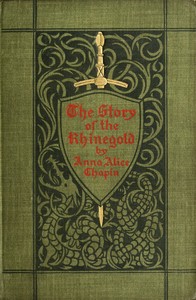
The story of the Rhinegold (Der Ring des Nibelungen) told for young people
Subjects:
Download Formats:
Excerpt
[Transcriber's Note: Anglicized variants of German character names
have been retained as they are in the original (e.g., Rhinegold for
Rheingold, Logi for Loge, Friea for Freia). Obvious printer errors have
been corrected without note. Some full-page illustrations have been
moved to the nearest paragraph break for better readability.]
NEW YORK AND LONDON
HARPER & BROTHERS PUBLISHERS
1900
_The Story of the Rhinegold_ contains the four operas of Richard
Wagner’s “Nibelungen...
Read the Full Text
— End of The story of the Rhinegold (Der Ring des Nibelungen) told for young people —
Book Information
- Title
- The story of the Rhinegold (Der Ring des Nibelungen) told for young people
- Author(s)
- Chapin, Anna Alice
- Language
- English
- Type
- Text
- Release Date
- May 5, 2024
- Word Count
- 24,811 words
- Library of Congress Classification
- ML
- Bookshelves
- Browsing: Children & Young Adult Reading, Browsing: Music
- Rights
- Public domain in the USA.
Related Books

The Pinafore Picture Book: the Story of H.M.S. Pinafore
by Gilbert, W. S. (William Schwenck)
English
361h 59m read
Stories from Wagner
by McSpadden, J. Walker (Joseph Walker), Wagner, Richard
English
1169h 35m read

Great opera stories
by Bender, Millicent Schwab
English
514h 12m read

Greenwich Village
by Chapin, Anna Alice
English
1039h 42m read