*** START OF THE PROJECT GUTENBERG EBOOK 50685 ***
The
Story of Genesis and Exodus,
AN EARLY ENGLISH SONG,
ABOUT A.D. 1250.
EDITED
FROM A UNIQUE MS. IN THE LIBRARY OF CORPUS CHRISTI COLLEGE, CAMBRIDGE,
WITH INTRODUCTION, NOTES, AND GLOSSARY,
BY THE
REV. RICHARD MORRIS, LL.D.,
AUTHOR OF "HISTORICAL OUTLINES OF ENGLISH ACCIDENCE;"
EDITOR OF "HAMPOLE'S PRICKS OF CONSCIENCE;" "EARLY ENGLISH ALLITERATIVE
POEMS,"
ETC. ETC.;
ONE OF THE VICE-PRESIDENTS OF THE PHILOLOGICAL SOCIETY.
[Second and Revised Edition, 1873.]
LONDON:
PUBLISHED FOR THE EARLY ENGLISH TEXT SOCIETY,
BY N. TRÜBNER & CO., 57 & 59, LUDGATE HILL.
MDCCCLXV.
PREFACE.
DESCRIPTION OF THE MANUSCRIPT, ETC.
The Editor of the present valuable and interesting record of our old
English speech will, no doubt, both astonish and alarm his readers by
informing them that he has never seen the manuscript from which the work he
professes to edit has been transcribed.
But, while the truth must be told, the reader need not entertain the
slightest doubt or distrust as to the accuracy and faithfulness of the
present edition; for, in the first place, the text was copied by Mr F. J.
Furnivall, an experienced editor and a zealous lover of Old English lore;
and, secondly, the proof sheets have been most carefully read with the
manuscript by the Rev. W. W. Skeat, who has spared no pains to render the
text an accurate copy of the original.[1] I have not been satisfied with
merely the general accuracy of the text, but all _doubtful_ or _difficult_
passages have been most carefully referred to, and compared with the
manuscript, so that the more questionable a word may appear, either as
regards its _form_ or _meaning_, the more may the reader rest assured of
its correctness, so that he may be under no apprehension that he is
perplexed by any typographical error, but feel confident that he is dealing
with the reading of the original copy.
The editorial portion of the present work includes the punctuation,
marginal analysis, conjectural readings, a somewhat large body of
annotations on the text of the poem, and a Glossarial Index, which, it is
hoped, will be found to be complete, as well as useful for reference.
The Corpus manuscript[2] is a small volume (about 8 in. × 4½ in.), bound in
vellum, written on parchment in a hand of about 1300 A.D., with several
final long ſ's, and consisting of eighty-one leaves. Genesis ends on fol.
49_b_; Exodus has the last two lines at the top of fol. 81_a_.
The writing is clear and regular; the letters are large, but the words are
often very close together. Every initial letter has a little dab of red on
it, and they are mostly capitals, except the _b_, the _f_, the _ð_, and
sometimes other letters. Very rarely, however, _B_, _F_, and _Ð_ are found
as initial letters.
The illuminated letters are simply large vermilion letters without
ornament, and are of an earlier form than the writing of the rest of the
manuscript. Every line ends with a full stop (or metrical point), except,
very rarely, when omitted by accident. Whenever this stop occurs in the
middle of a line it has been marked thus (.) in the text.
DESCRIPTION OF THE POEM.
Our author, of whom, unfortunately, we know nothing, introduces his subject
to his readers by telling them that they ought to love a rhyming story
which teaches the "layman" (though he be learned in no books) how to love
and serve God, and to live peaceably and amicably with his fellow
Christians. His poem, or "song," as he calls it, is, he says, turned out of
Latin into English speech; and as birds are joyful to see the dawning, so
ought Christians to rejoice to hear the "true tale" of man's fall and
subsequent redemption related in the vulgar tongue ("land's speech"), and
in easy language ("small words").
So eschewing a "high style" and all profane subjects, he declares that he
will undertake to sing no other song, although his present task should
prove unsuccessful.[3] Our poet next invokes the aid of the Deity for his
song in the following terms:—
"Fader god of alle ðhinge,
Almigtin louerd, hegeſt kinge,
ðu giue me ſeli timinge
To thaunen ðis werdes biginninge,
ðe, leuerd god, to wurðinge,
Queðer ſo hic rede or ſinge!"[4]
Then follows the Bible narrative of Genesis and Exodus, here and there
varied by the introduction of a few of those sacred legends so common in
the mediæval ages, but in the use of which, however, our author is far less
bold than many subsequent writers, who, seeking to make their works
attractive to the "lewed," did not scruple to mix up with the sacred
history the most absurd and childish stories, which must have rendered such
compilations more amusing than instructive. It seems to have been the
object of the author of the present work to present to his readers, in as
few words as possible, the most important facts contained in the Books of
Genesis and Exodus without any elaboration or comment, and he has,
therefore, omitted such facts as were not essentially necessary to the
completeness of his narrative;[5] while, on the other hand, he has included
certain portions of the Books of Numbers and Deuteronomy,[6] so as to
present to his readers a complete history of the wanderings of the
Israelites, and the life of Moses their leader.
In order to excite the reader's curiosity, we subjoin a few passages, with
a literal translation:—
LAMECH'S BIGAMY.
Lamech is at ðe sexte kne,
ðe ſeuende man after adam,
ðat of caymes kinde cam.
ðiſ lamech waſ ðe firme man,
ðe bigamie firſt bi-gan.
Bigamie is unkinde ðing,
On engleis tale, twie-wifing;
for ai was rigt and kire bi-forn,
On man, on wif, til he was boren.
Lamech him two wifes nam,
On adda, an noðer wif ſellam.
Adda bar him ſune Iobal,
He was hirde wittere and wal;
Of merke, and kinde, and helde, & ble,
ſundring and ſameni[n]g tagte he;
Iobal iſ broðer ſong and glew,
Wit of muſike, wel he knew;
On two tableſ of tigel and braſ
wrot he ðat wiſtom, wiſ he was,
ðat it ne ſulde ben undon
If fier or water come ðor-on.
Sella wuneð oc lamech wið,
ghe bar tubal, a ſellic ſmið;
Of irin, of golde, ſiluer, and bras
To ſundren and mengen wiſ he was;
Wopen of wigte and tol of grið,
Wel cuðe egte and ſafgte wið.
Lamech is at the sixth degree,
The seventh man after Adam,
That of Cain's kin came.
This Lamech was the first man
Who bigamy first began.
Bigamy is unnatural thing,
In English speech, twi-wiving;
For aye was right and purity before,
One man, one wife, till he was born.
Lamech to him two wives took,
One Adah, another wife Zillah.
Adah bare him a son Jubal,
He was a [shep-]herd wise and able;
Of mark,[7] breed, age, and colour,
Separating and assembling taught he;
Jubal his brother poetry and music,
Craft of music, well he knew;
On two tables of tile and brass,
Wrote he that wisdom, wise he was,
That it should not be effaced
If fire or water came thereon.
Zillah dwelleth also Lamech with,
She bare Tubal, a wonderful smith;
Of iron, of gold, silver and brass
To separate and mix, wise he was;
Weapon of war and tool of peace,
Well could he hurt and heal with.
—(ll. 444-470.)
DEATH OF CAIN.
Lamech ledde long lif til ðan
ðat he wurð biſne, and haued a man
ðat ledde him ofte wudeſ ner,
To scheten after ðe wilde der;
Al-so he miſtagte, alſo he ſchet,
And caim in ðe wude iſ let;
His knape wende it were a der,
An lamech droge iſ arwe ner,
And letet flegen of ðe ſtreng,
Caim unwar[_n_]de it under-feng,
Gruſnede, and ſtrekede, and ſtarf wið-ðan.
Lamech wið wreðe iſ knape nam,
Vn-bente iſ boge, and bet, and slog,
Til he fel dun on dedeſ ſwog.
Twin-wifing and twin-manſlagt,
Of his ſoule beð mikel hagt.
Lamech led long life till then
That he became blind and had a man
That led him oft to woods near,
To shoot after the wild deer (animals);
As he mistaught, so he shot,
And Cain in the wood is let;
His knave (servant) weened it were a deer,
And Lamech drew his arrow near
And let it fly off the string,
Cain unwarned it received,
Groaned, fell prostrate (stretched) and died with-that.
Lamech with wrath his knave seized,
Unbent his bow, and beat and slew,
Till he fell down in death's swoon.
Twi-wiving (bigamy) and twi-slaughter (double homicide)
On his soul is great trouble (anxiety).
—(ll. 471-486.)
HOW THE CHILD MOSES BEHAVED BEFORE PHARAOH.
Ghe brogte him bi-foren pharaon,
And ðiſ king wurð him in herte mild,
So ſwide faiger was ðiſ child;
And he toc him on ſunes ſtede,
And hiſ corune on his heued he dede,
And let it ſtonden ayne ſtund;
ðe child it warp dun to ðe grund.
Hamoneſ likeneſ was ðor-on;
ðiſ crune is broken, ðiſ iſ miſdon.
Biſſop Eliopoleos
ſag ðiſ timing, & up he roſ;
"If ðiſ child," quad he, "mote ðen,
He ſal egyptes bale ben."
If ðor ne wore helpe twen lopen,
ðiſ childe adde ðan ſone be dropen;
ðe king wið-ſtod & an wiſ man,
He ſeide, "ðe child doð alſ he can;
We ſulen nu witen for it dede
ðiſ witterlike, or in child-hede;"
He bad ðis child brennen to colen
And he toc is (hu migt he it ðolen),
And in hiſe muth ſo depe he iſ dede
Hiſe tunges ende iſ brent ðor-mide;
ðor-fore ſeide ðe ebru witterlike,
ðat he ſpac ſiðen miſerlike.
She (Thermutis) brought him (Moses) before Pharaoh,
And this king became to him in heart mild,
So very fair was this child;
And he took him on son's stead (instead of a son),
And his crown on his head he did (placed),
And let it stand a stound (while);
The child threw it down to the ground.
Hamon's likeness was thereon;
This crown is broken, this is misdone.
The Bishop of Heliopolis
Saw this circumstance, and up he rose;
If this child, quoth he, might thrive (grow up),
He shall Egypt's bale be.
If there had not helpers 'tween leapt,
This child had then soon been killed;
The king with-stood and a wise man,
He said, The child doth as he can (knows);
We should now learn whether it did
This wittingly, or in childishness;
He offered this child two burning coals
And he took them (how might he bear them?)
And in his mouth so deep (far) he them did (placed)
His tongue's end is burnt therewith;
Therefore said the Hebrew truly,
That he spake afterwards indistinctly.
—(ll. 2634-2658.)
HOW MOSES DEFEATED THE ETHIOPIANS.
Bi ðat time ðat he was guð,
Wið faigered and ſtrengthe kuð,
folc ethiopienes on egipte cam,
And brende, & ſlug, & wreche nam,
Al to memphin ðat riche cite,
And a-non to ðe reade ſe;
ðo was egipte folc in dred,
And aſkeden here godes red;
And hem ſeiden wið anſweren,
ðat on ebru cude hem wel weren.
Moyſes was louered of ðat here,
ðor he wurð ðane egyptes were;
Bi a lond weige he wente rigt,
And brogte vn-warnede on hem figt;
He hadden don egipte wrong,
He bi-loc hem & ſmette a-mong,
And ſlug ðor manige; oc ſumme flen,
Into ſaba to borgen ben.
Moyſes bi-ſette al ðat burg,
Oc it was riche & ſtrong ut-ðhurg;
Ethiopienes kinges dowter tarbis,
Riche maiden of michel priſ,
Gaf ðiſ riche burg moyſi;
Luue-bonde hire ghe it dede for-ði.
ðor iſe fon he leide in bonde,
And he wurð al-migt-ful in ðat lond;
He bi-lef ðor(.) tarbis him ſcroð,
ðog was him ðat ſurgerun ful loð;
Mai he no leue at hire taken
but-if he it mai wið crafte maken:
He waſ of an ſtrong migt [&] wiſ,
He carf in two gummes of priſ
Two likeneſſes, ſo grauen & meten,
ðis doð ðenken, & ðoð_er_ forgeten;
He feſt is in two ringes of gold,
Gaf hire ðe ton, he was hire hold;
[And quan awei nimen he wolde
Gaf hire ðe toðer, he was hire colde]
Ghe it bered and ðiſ luue iſ for-geten,
Moyſes ðus haued him leue bi-geten;
Sone it migte wið leue ben,
Into egypte e wente a-gen.
By that time that he was a youth (young man),
For beauty and strength renowned,
Ethiopian folk on Egypt came,
And burnt, and slew, and vengeance took,
All to Memphis that rich city,
And anon to the Red Sea;
Then was Egypt's folk in dread,
And asked their gods' advice;
And they said to them in answer,
That one Hebrew could them well defend.
Moses became leader of that (Egyptian) army,
There he became then Egypt's protector;
By a land-way he went right,
And brought unwarned on them fight;
They had done Egypt wrong,
He compassed them and smote among,
And slew there many; but some fled
Into Sheba to be saved.
Moses beset all that borough (city),
But it was rich and strong out-thorough (throughout);
Tarbis, the Ethiopian king's daughter,
Rich maiden of great renown,
Gave this rich city to Moses;
As love-bond's hire she did it, therefore.
There his foes he laid in bond,
And he became all-powerful in that land;
He remained there, Tarbis him urged,
Yet was to him that sojourn full loath;
May he no leave of her take
Unless he it may with craft make:
He was of a strong might and wise,
He carved in two gems (stones) precious,
Two likenesses alike carved and depicted,
This one causes to remember, and the other to forget;
He fastened them in two rings of gold,
Gave her the one, he was dear to her;
[And when depart he would
Gave her the other, and was distasteful to her]
She it beareth and this love is forgotten,
Moses thus hath for himself leave begotten;
Soon it might with leave be,
Into Egypt he went again.
—(ll. 2665-2708.)
THE PLAGUE OF FROGS.
And aaron held up his hond
to ðe water and ðe more lond;
ðo cam ðor up ſwilc froſkes here
ðe dede al folc egipte dere;
Summe woren wilde, and ſumme tame,
And ðo hem deden ðe moſte ſame;
In huſe, in drinc, in metes, in bed,
It cropen and maden hem for-dred;
Summe ſtoruen and gouen ſtinc,
And vn-hileden mete and drinc;
Polheuedes, and froſkes, & podes ſpile
Bond harde egipte folc un-ſile.[8]
And Aaron held up his hand
To the water and the greater land;
Then came there up such host of frogs
That did all Egypt's folk harm;
Some were wild, and some tame,
And those caused them the most (greatest) shame;
In house, in drink, in meats, in bed,
They crept and made them in great dread;
Some died and gave (out) stink,
And (others) uncovered meat and drink;
Tadpoles and frogs, and toad's venom
Bound hard Egypt's sorrowful folk.
—(ll. 2967-2978.)
The reader must not be disappointed if he fails to find many traces in this
work of our pious author's poetic skill; he must consider that the interest
attaching to so early an _English_ version of Old Testament History, as
well as the philological value of the poem, fully compensates him for the
absence of great literary merit, which is hardly to be expected in a work
of this kind. And, moreover, we must recollect that it is to the
patriotism, as well as piety, of such men as our author, that we owe the
preservation of our noble language. The number of religious treatises
written in English during the thirteenth and fourteenth centuries proves
that the dialect of religion approached more closely to the speech of the
people than did the language of history or romance. And it is a curious
fact that the most valuable monuments of our language are mostly
theological, composed for the lewed and unlearned, who knew no other
language than the one spoken by their forefathers, and who clung most
tenaciously to their mother tongue, notwithstanding the changes consequent
upon the Norman invasion, and the oppression of Norman rule, which,
inasmuch as it fostered and kept up a patriotic spirit, exercised a most
important and beneficial influence upon Early English literary culture and
civilization.
DATE AND DIALECT OF THE POEM.
The mere examination of an Early English work with respect to its
vocabulary and grammatical forms, will not enable us (as Price asserts) to
settle satisfactorily the date at which it was written. The place of
composition must also be taken into consideration, and a comparison, if
possible, must be made with other works in the same dialect, the date of
which is known with some degree of certainty. The date of the text before
us must not, therefore, be confounded with that of the manuscript, which
is, perhaps, a few years earlier than A.D. 1300. A careful comparison of
the poem with the Bestiary, written in the same dialect, and most probably
by the same author[9] (and printed by Mr Wright in the Reliquiæ Antiquæ, p.
208, and by myself in an Old English Miscellany), leads me to think that
the present poem is not later than A.D. 1250.[10]
The vocabulary, which contains very few words of Romance origin,[11] is not
that of Robert of Gloucester, or of Robert of Brunne, but such as is found
in Laȝamon's Brut, or Orm's paraphrases, and other works illustrating the
second period of our language, i.e. the twelfth and earlier part of the
thirteenth centuries.
The employment of a _dual_ for the pronouns of the first and second persons
marks an _early_ date (certainly not much later than the time of Henry
III.) even in works composed in the Southern dialect, which, it is well
known, retained to a comparatively late period those Anglo-Saxon
inflections that had long previously been disused in more Northern
dialects.
The Corpus manuscript is evidently the work of a scribe, to whom the
language was more or less archaic, which accounts for such blunders as
_ðrosing_ for _ðrosem_, _waspene_ for _wastme_, _lage_ for _vn-lage_,
_insile_ for _vn-sile_, _grauen_ for _ðrauen_, etc.
The original copy of Genesis most probably terminated with ll. 2521-4:
"And here ended completely
The book which is called Genesis,
Which Moses, through God's help,
Wrote for precious souls' need."
The concluding lines, in which both the author and scribe are mentioned,
seem to me to be the work of a subsequent transcriber:
"God shield his soul from hell-bale,
Who made it thus in English tale (speech)!
And he that these letters wrote,
May God help him blissfully,
And preserve his soul from sorrow and tears,
Of hell-pain, cold and hot!"
The Ormulum is the earliest[12] printed Early English work which has come
down to us that exhibits the uniform employment of the termination _-en_
(_-n_) as the inflection of the plural number, present tense, indicative
mood; or, in other words, it is the earliest printed example we have of a
_Midland_ dialect. I say _a_ Midland dialect, because the work of Orm is,
after all, only a specimen of _one_ variety of the Midland speech, most
probably of that spoken in the northern part of the eastern counties of
England, including what is commonly called the district of East Anglia.
Next in antiquity to the Ormulum come the Bestiary, already mentioned, and
the present poem, both of which uniformly employ the Midland affix _-en_,
to the exclusion of all others, as the inflection of the present plural
indicative.
There are other peculiarities which these works have in common; and a
careful comparison of them with the Ormulum induces me to assign them to
the East Midland area; but there are certain peculiarities, to be noticed
hereafter, which induce me to believe that the work of Orm represents a
dialect spoken in the northern part of this district, while the Story of
Genesis and Exodus, together with the Bestiary, exhibits the speech of the
more southern counties of the East Midland district.[13] Thus, if the
former be in the dialect of _Lincoln_, the latter is in that of
_Suffolk_.[14]
The chief points in which the present poem and the Bestiary agree with the
Ormulum are the following:—
I. The absence of compound vowels.
In the Southern dialects we find the compound vowels _ue_, _eo_, _ie_, _ea_
(_yea_). In the Ormulum _eo_ occurs, but with the sound of _e_, and _ea_ in
Genesis and Exodus is written for _e_.
II. The change of an initial _ð_ (th) into _t_ after words ending in _d_,
_t_, _n_, _s_, that is to say, after a dental or a sibilant.[15]
"ðanne iſ _tis_ fruit wel ſwiðe good."—(_Gen. and Ex._, l. 334.)
"ðe firſt moned and _te_ firſt dai,
He ſag erðe drie & _te_ water awai."—(_Ibid._, l. 615-6.)
"ðin berg and _tin_ werger ic ham."—(_Ibid._, l. 926.)
"at _te_ welle[n]."—(_Ibid._, l. 2756.)
This practice is much more frequent in the Bestiary, which is a proof,
perhaps, that the present poem has suffered somewhat in the course of
transcription.
"neddre is _te_ name."—(_O.E. Miscellany_, p. 5.)
"it is _te_ ned."—(_Ibid._, p. 6.)
"ðis lif bitokneð ðe sti
ðat _te_ neddre gangeð bi,
and _tis_ is ðe ðirl of ðe ston,
ðat _tu_ salt ðurg gon."—(_Ibid._, p. 7.)
"at _tin_ herte."—(_Ibid._, p. 7.)
III. Simplicity of grammatical structure and construction of sentences.[16]
1. The neglect of _gender_ and _number_ in nouns.
2. The genitive singular of substantives end in _-es_ in all genders.[17]
3. The absence of the gen. pl. of substantives in _-ene_.
4. The employment of an uninflected article.[18]
5. The use of _ðat_ (that) as a demonstrative adjective, and not as the
neuter of the article. The form _ðas_ (those), common enough in the
fourteenth century, does not occur in this poem or in the Ormulum.
6. No inflection of the adjective in the accusative singular. The phrase
'_godun_ dai,' good day, in l. 1430, p. 41, contains a solitary instance of
the accusative of the adjective, but it is, no doubt, a mere remnant of the
older speech, just like our 'for _the n_once' (= for _then_ once), and is
no proof that the writer or his readers employed it as a common inflection.
The form _godun_ is a corruption of _godne_, as it is more properly written
in works in the Southern dialects as late as the middle of the fourteenth
century.
7. Adjectives and adverbs with the termination _-like_.
The Southern form is, for adjectives, _-lich_ (sing.), _-liche_ (pl.); for
adverbs _-liche_. Thus the adoption of this affix really (though at first
it appears a matter of no importance) marks a _stage_ in the language when
the distinction between the sing. and pl. form of adjectives was not very
strictly observed, and was, moreover, a step towards our modern _-ly_,
which is adjectival as well as adverbial.
Even in this poem adjectives occur in _-li_, as _reuli_ = piteous, which is
the earliest example I have met with. Orm employs double forms in _-like_
and _-liȝȝ_ (= _ly_?). _-ly_ has arisen not out of _-lich_ or _-liche_
(which would have become _lidge_ or _litch_), but out of some such softened
form as _liȝ_.
8. The tendency to drop the initial _y_, _i_ (A.S. _ge_) of the passive
participles of strong verbs.
The Ormulum has two or three examples of this prefixal element, and in our
poem it occurs but seldom.
IV. A tendency to drop the _t_ of the second person of verbs, as _as_,
hast; _beas_, beëst; _findes_, findest.
Examples of this practice are very common in the Bestiary and Genesis and
Exodus, but it occurs only four times in the Ormulum.[19] It was very
common for the West-Midland to drop the _-e_ of 2nd person in strong verbs.
See Preface to O.E. Homilies, 1st Series.
V. The use of _arn_, _aren_, for _ben_ of the Midland dialect, or _beð_ of
the Southern dialect.[20]
VI. The employment of the adverbs _thethen_, _hethen_, _quethen_ (of
Scandinavian origin),[21] instead of the Southern _thenne_ (_thennen_),
thence; _henne_ (_hennen_), hence; _whanne_ (_whanene_), whence.
VII. The use of _oc_, _ok_ (also, and), a form which does not occur in any
specimen of a Southern, West-Midland, or Northern dialect that has come
under my notice. The use of _on_, _o_, for the Southern _an_ or _a_, as
_onlike_, _olike_, alike, _on-rum_, apart, _on-sunder_, asunder, is also
worth noticing.
VIII. The coalition of the pronoun _it_ with pronouns and verbs, as _get_
(Bestiary) = she it (_ȝhöt_ in Ormulum; cf. _þüt_ = _thu itt_, thou it);
_tellet_ = tell it; _wuldet_ = would it; _ist_ = is it, is there; _wast_,
was it, was there, etc. _þit_ = _þe_ + _hit_ = who it, occurs in O.E.
Homilies, 2nd Series.
The Ormulum, the Bestiary, and Genesis and Exodus have some few other
points of agreement which will be found noticed in the Grammatical Details
and Glossary. There are, however, grammatical forms in the latter works
which do not present themselves in the former, and which, in my opinion,
seem to indicate a more Southern origin. (See Preface to O.E. Homilies, 2nd
Series.)
I. Plurals in _n_.
I do not recollect any examples of plurals in _n_ in the Ormulum, except
_ehne_, eyes; in this poem we have _colen_, coals; _deden_, deeds; _fon_,
foes; _siðen_, sides; _son_, shoes; _steden_, places; _sunen_, sons;
_tren_, trees; _teten_, teats; _wunen_, laws, abilities, etc. (see p.
xxii.)
II. The pronoun _is_ (_es_) = them.[22] In the fourteenth century we only
find this form _is_ (_hise_) in pure _Southern_ writers.[23]
"Diep he _iſ_ dalf under an ooc."[24]—(_Gen. and Ex._, l. 1873, p. 54.)
"For ſalamon findin _iſ_ ſal."[25]—(_Ibid._, l. 1877, p. 54.)
"He toc _iſ_."[26]—(_Ibid._, l. 2654, p. 76.)
"Alle hise fet steppes
After him he filleð,
Drageð dust wið his stert
(_O.E. Miscell._, p. 1.)
ðer he steppeð,
Oðer dust oðer deu,
ðat he ne cunne _is_ finden."[27]
Our author, however, employs this curious pronoun in a way quite peculiar
to himself, for he constantly joins it to a _pronoun_ or a _verb_,[28] and
the compound was at first rather perplexing. _Hes_ = _he_ + _is_, he, them;
_wes_ = _we_ + _is_, we, them;[29] _caldes_, called them; _dedis_, did
(placed) them; _settes_, set them; _wroutis_, wrought them, etc.
"Alle _hes_ hadde wið migte bi-geten."[30]—(_Gen. and Ex._, l. 911, p.
26.)
"Vndelt _heſ_ leide quor-so _heſ_ tok."[31]—(_Ibid._, l. 943, p. 27.)
"Ðe culuer haueð costes gode,
alle _wes_ ogen to hauen in mode."[32]—(_O.E. Miscell._, p. 25.)
"Bala two childre bar bi him,
Rachel _caldes_ dan(.) neptalim;
And zelfa two sunes him ber,
Lia _calde is_(.) Gad(.) and asser."[33]—(_Gen. and Ex._, l. 1700, p.
49.)
"ðe tabernacle he _dedis_ in."[34]—(_Ibid._, l. 3830, p. 109.)
"He _settes_ in ðe firmament."[35]—(_Ibid._, l. 135, p. 5.)
In the Kentish Ayenbite of 1340 _he_ never coalesces with _hise_ (them),
_e.g._:—
"He (the devil) is lyeȝere and vader of leazinges, ase he þet made þe
verste leazinge, and yet _he hise_ makeþ and tekþ eche daye."—(Ayenbite
of Inwyt, p. 47.)
(He is a liar and the father of leasings, as he that made the first
leasing, and yet _he them_, i.e. lies, maketh and teacheth each day.)
In Old Kentish Sermons (Old Eng. Miscell p. 28) _has_ = _ha_ + _es_ = he
them.
III. The pronoun _he_, they (Southern _hii_, _heo_; Northumbrian _thay_).
Orm uses _þeȝȝ_, as well as _þeȝȝer_ (their), _þeȝȝm_ (them).[36]
IV. _hine_, _hin_, _in_ = him. This form occurs as late as 1340, and still
exists under the form _en_, _un_, in the modern dialects of the South of
England, but is not employed by Orm; nor do we find any traces of _whan_
(whom), another very common example of the _-n_ accusative inflection,
either in the Ormulum or the present work.
V. The substitution of _n_ for a vowel-ending in nouns. Dr Guest has
noticed this peculiarity, but he confines this substitution to the
_nominative_ case of nouns of the _n_ declension,[37] and to the definite
form of the adjective, which has, no doubt, given rise to the O.E.
_himseluen_, etc., _bothen_ (both), as well as, perhaps, to _ouren_ (ours),
_heren_ (theirs), etc.
In the present poem, however, the _n_ seems added to the vowel-ending of
all cases except the possessive, in order to rhyme with a verb in the
infinitive, a passive participle, or an adverb terminating in _-en_, and is
not always limited to nouns of the _-n_ declension, but represents in A.S.
an _a_ or _e_: 'on _boken_,'[38] on book, l. 4; 'on _soðe-sagen_,' on
sooth-saw, l. 14; _meten_, (acc.) meat, l. 2255, (nom.) 2079; _sunen_,
(nom.) son, l. 1656; 'of _luuen_,' of love, 635; 'after ðe _wunen_' (after
the custom), l. 688; _steden_, (nom.) place, 1114; 'for _on-sagen_,' for
reproach, 2045; _wliten_, (nom.) face, 3614, (acc.) 2289; 'wið _answeren_,'
in answer, 2673; _bileuen_, (acc.) remainder, 3154; _uuerslagen_, (acc.)
lintel, 3155.
Dr Guest considers this curious nunnation to be a Northern peculiarity, but
as we do not meet with it (as far as I know) in any Northumbrian work, his
statement is rather doubtful. On the other hand, it is well known that the
plurals _bretheren_ (_broðeren_[39] in Shoreham), _calveren_[40] (calves),
_children_,[41] _doren_ (doors),[42] _eyren_ (eggs),[43] _honden_
(hands),[44] _kine_,[45] _lambren_ (lambs),[46] _soulen_ (souls)—very
common forms in the _Southern_ dialects in the thirteenth and fourteenth
centuries—are examples of the substitution of _n_ for, or in addition to,
the vowel-ending, and were unknown in the Northern dialect.
The Southern dialect could drop or retain, at pleasure, the _n_ final in
the past participles, the preterite plurals, and infinitive mood of verbs.
VI. A very small Norse element in the vocabulary.
The only words of undoubtedly Norse element that occur in the present poem,
and were unknown to Southern English, are—_fro_ (from), _ille_ (bad),
_for-sweðen_ (to burn), _flitten_ (to remove), _laðe_ (barn), _lowe_
(flame), _mirk_ (dark), _ransaken_ (to search), _swaðe_ (flame), _til_
(to), _uglike_ (horrible), _werre_ (worse).[47]
The Ormulum, being more Northern, contains a _larger_ number of words that
must be referred to one of the Scandinavian idioms:[48]—_afell_ (strength),
_afledd_ (begotten), _beȝȝsc_ (bitter), *_blunnt_ (blunt, dull), _bracc_
(noise), *_braþ_ (angry), *_braþþe_ (anger), *_brodd_ (shoot), _brodden_
(to sprout), _broþþfall_ (fit), *_bun_ (ready, _bound_), *_clake_
(accusation), *_croc_ (device), *_derf_ (bold), *_dill_ (sluggish),
*_eggenn_ (to urge, egg on), *_egginng_ (urging), *_ettle_, *_flittenn_ (to
remove, flit), *_flitting_ (change, removal), *_forrgart_ (opposed,
condemned), *_forrgloppned_ (disturbed with fear, astonishment), *_gate_
(way), _gowesst_ (watchest), *_haȝherr_ (dexterous), _haȝherleȝȝc_ (skill),
*_haȝherrlike_ (fitly), _hof_ (moderation), _hofelæs_ (immoderately),
*_ille_ (bad), *_immess_ (variously), *_kinndlenn_ (to kindle), *_lasst_
(crime, fault), _leȝhe_ (hire, pay), *_leȝȝtenn_ (O.E. _layte_, inquire,
seek), _o-loft_ (aloft), *_loȝhe_ (fire), *_mune_ (must, will), _naþe_
(grace), _nowwt_ (cattle, O.N. _naut_; the Southern form is _neet_, _nete_,
A.S. _neát_), *_ploh_ (plough), *_radd_ (afraid), *_ros_ (praise), *_rosen_
(to boast), *_rosinng_ (boast), _rowwst_ (voice), *_scaldess_ (poets, O.E.
_scald_, a great talker, boaster, E. _scold_), *_sit_ (pain), *_sket_
(quickly), *_skirpeþþ_ (rejecteth), *_sloþ_ (track, path), _smikerr_
(beautiful, Eng. _smug_), _sowwþess_ (sheep), _stoffnedd_ (generated, O.E.
_stoven_, trunk, stem), *_summ_ (as), *_till_ (to), *_tór_ (hard,
difficult), *_trigg_ (true), _uppbrixle_ (object of reproach, O.E.
_brixle_, reproach), _usell_ (wretched), *_wand_ (rod), *_wandraþ_, O.E.
_wandreth_ (trouble), *_werre_ (worse).
As most, if not all, of the words in the foregoing list are not found in
works written in the Southern dialect,—so far as we at present know them—we
may reasonably suppose that they indicate fairly the Danish element in the
English literature of the 12th and 13th centuries. In the Northumbrian, and
the West, and East-Midland productions of a century later this element
prevails to a much larger extent, and Herbert Coleridge's list of such
words may be largely increased (Phil. Soc. Trans., 1859, p. 26-30).
GRAMMATICAL DETAILS.
I. NOUNS.
1. _Number._—The plural is generally formed by adding _-es_ to the
singular. Some few nouns make the plural in _-en_, as _feren_[49]
(companions), _fon_ (foes), _goren_ (spears), _loten_ (features), _sunen_
(sons), _teten_ (teats), _tren_ (trees), _weden_ (garments), _wunen_
(laws). The plurals of _brother_ and _child_ are _brethere_ and _childere_.
_Der_ (deer), _erf_, _orf_ (cattle), _got_ (goat), _neat_ (oxen), _sep_
(sheep), _scrud_ (garbs), _wrim_ (reptiles), of the neuter gender, are
uninflected in the plural. _Winter_, _ger_ (year), and _nigt_ (night), are
plural as in Anglo-Saxon.
2. _Gender._—As a general rule the names of inanimate things are of the
neuter gender. The names of towns, however, are considered as masculine.
3. _Case._—The genitive singular and plural of masculine and feminine nouns
end in _-es_. Occasionally proper nouns form the genitive in _-is_. The
means or instrument occasionally stands in the genitive without the
preposition: '_deades_ driuen,' influenced by death; '_swerdes_ slagen,'
slain of the sword; '_teres_ wet,' wet with tears. Cf. '_floures bred_,'
bread made with flour; '_bredes_ mel,' meal consisting of bread; '_wines_
drinc,' drink consisting of wine.
Corresponding to the modern word _kinsmen_ we have such forms as
'_daiges-ligt_' (daylight), '_hines-folk_' (servants), '_wifeskin_'
(women). The genitive is used adverbially, as _newes_, anew; _liues_,
alive.
We have a few traces of the genitive in _-e_ in the following examples:
'_helle_ nigt,' l. 89 (hell's night); '_helle_ bale,' l. 2525 (hell's
bale); '_sterre_ name,' l. 134 (star's name); '_safte_ same,' l. 349 (shame
of form); '_werlde_ nigt,' l. 1318 (world's night).[50]
The genitive of _fader_ and _moder_ is, as is very seldom the case in Early
English writers, _fadres_ and _modres_.
An _n_ is often added to the final _-e_ (representing an A.Sax.
vowel-ending) in the nom., dat., and acc. of nouns. For examples, see p.
xxi.
II. ADJECTIVES.
1. Adjectives have a definite and an indefinite form; the former is used
when the adjective is preceded by the definite article, a demonstrative
adjective, or possessive pronoun.
Indef. _wis_ (wise), _god_ (good).
Def. _wise_, _gode_.
2. _Number._—The plural is formed by the addition of _e_ to the singular.
SINGULAR. PLURAL.
_fet_ (fat), _fette_.
_gret_ (great) _grete_.
_other_, _othere_.
_tother_, _tothere_.
But the _-e_ (pl.) is seldom added to the past participle of irregular
verbs. _This_ forms the plurals _thes_ (oblique cases _these_), _this_
(_thise_). _Tho_ is the plural of _that_.
_Cases._—_One_ makes the genitive _ones_; as, '_ones_ bles,' of one colour.
The gen. pl. _-re_ occurs in _ald-re_ (= _alre_), of all; as, 'hure _aldre_
bale,' the bale of us all; 'here _aldre_ heuedes,' the heads of them all.
_Degrees of comparison._—The comparative ends in _-ere_ (_-er_), the
superlative in _-este_ (_est_).[51] Very few irregular forms occur in the
present poem.
POSITIVE. COMPARATIVE. SUPERLATIVE.
ille, werre. ——
lite, lesse, leist.
long, { leng. } ——
{ lengere. }
mikel, { mo, } moste.
{ mor, }
neg, —— neste.
old, eldere, eldeste.
_Numerals._—The Northumbrian forms in _-nde_ have superseded the Southern
ones in _-the_; as, _seuende_ (seventh), _egtende_ (eighth), _tende_
(tenth).[52]
III. PRONOUNS.
1. The first personal pronoun _Ic_ is never found softened into _Ich_ as in
Laȝamon's Brut, the Ancren Riwle, and other Southern works. _I_ is found
only once or twice throughout the poem.
2. The first and second personal pronouns have a _dual_ as well as a plural
number; as, _wit_, we two; _unc_, us two; _gunc_, you two; _gunker_, of you
two.
3. _Hine_ (_hin_, _in_) (acc.) occasionally occurs, but more frequently
_him_ (dat.) does duty for it.
4. _Ge_, _ghe_,[53] she, represents the A.Sax. _héo_ (O.E. _heo_, _ho_, and
_hi_). The curious form _sge_ (= _sye_), as well as _sche_, occurs for she,
the earliest instance of which is _scæ_ in the A.Sax. Chronicle.
5. The neuter pronoun is written _it_ and not _hit_, and is frequently used
as a plural. It coalesces with the pronoun _ge_, _ghe_[54] (she), and with
the preterite of verbs terminating in _-de_ or _-te_,[55] and with some few
irregular verbs; as, _sagt_ (saw there), p. 37, l. 1301. The curious form
_negt_ (in l. 3964, p. 112) = _neg_ + _it_ = nigh it.
6. The A.Sax. _hi_ (they) is represented by _he_ = _hie_.[56] _He_ is
common enough in the Romance of Havelok the Dane.[57]
The pronouns, as has already been shown, coalesce with the plural (acc.)
_is_ (them), and give us the compounds _hes_, he + them; _wes_, we +
them;[58] mes = _me_ + _hes_ = one + them.[59]
Not satisfied with joining _he_ (they) to the pronoun _is_, the author of
this poem occasionally employs the more perplexing combination _hem_ = _he_
+ _hem_, he, them.
bred kalueſ fleiſ, and flures bred,
_Roasted calves' flesh, and flour-bread,_
And buttere, _hem_ ðo sondes bed,
_And butter, he them the messengers offered._—(l. 1014.)
In ſichem feld ne fonde _hem_ nogt,
_In Shechem field found he them not._—(l. 1933.)
Ðo ſette ſundri _hem_ to waken,
_Then set sundry he them to watch._—(l. 2551.)
ðo ſeide ðuſ quanne _hem_ cam dun,
_Then said thus when he to them came down._—(l. 4022.)
In l. 2673 _hem_ seems to stand for _he_ + _hem_, they + them.
And _hem_ ſeiden wið anſweren,[60]
_And they to them said in answer._
The Southern _me_, one (Fr. _on_), is absent from this poem as well as from
the Ormulum; its place is supplied by _man_ and _men_[61] used with a verb
in the singular number. _ðe_ is frequently used as a relative pronoun as
well as _ðat_, but uninflected; _quo_ (who), _quat_ (what), are
interrogative; _whether_ signifies which of two.
TABLE OF PRONOUNS.
SINGULAR.
Nom. Ic, I ðu
Gen. min ðin
Dat. me ðe
Acc. me ðe
DUAL. PLURAL. DUAL. PLURAL.
Nom. wit we —— ge
Gen. —— ure gunker gure
Dat. —— us —— gu
Acc. unc us gunc gu
SINGULAR.
Nom. He ge, ghe (sge, sche) It
Gen. His Hire Is, His
Dat. Him Hire It
Acc. { Hin } Hire It
{ Him }
PLURAL.
Masc. Neut. Interrogative.
Nom. He It | Quo
Gen. Here Here | Quase }
| Was }
Dat. Hem It | ——
Acc. Hem It | Quam
The third personal pronoun is occasionally used reflexively; as _him_ =
himself. _Self_ is used adjectively in the sense of own, very, and the form
_selven_ (from the A.Sax. _sylfa_) is joined to the personal pronouns; as
_ðeselven_, _himselven_, etc.
The independent possessives are _min_, _ðin_, _his_ (_hise_), _hire_
(hers), _ure_ (ours), _gure_ (yours), _here_ (theirs).[62]
IV. VERBS.
_Infinitive Mood._—The infinitive terminates in _-en_, which is seldom
dropped.
There are no infinitives in _-y_ or _-ie_, as in Southern English writers,
nor do we find them in the Ormulum, or in Robert of Brunne's "Handlyng
Synne," and they were, most probably, wholly unknown to the East Midland
district.
The _t_ in the 2nd pers. sing. pres. is occasionally dropped, as _beas_ (=
_best_), art, _betes_, beatest, _findes_, findest, etc.; but not in the
preterite of regular verbs.
There are no instances of the 3rd pers. sing. present in _-es_ in this
poem.
The final _e_ of the first and third persons (sing.) of the preterite tense
is often dropped before a vowel or an _h_,[63] and, in a few cases, through
the carelessness of the scribe,[64] it is unwritten before a consonant,
where we should expect to, and do, find it in the majority of instances.
Some few strong verbs have become weak, as _grapte_ (grasped, felt),
_gette_ (poured), _smette_ (smote).
_Imperative Mood._—Verbs forming the past tense in _de_ or _te_ take no
inflexion in the 2nd pers. sing. imperative.
_Participles._—1. The active or imperfect participle ends in _-ende_ or
_-ande_, the former being the Midland and the latter the Northumbrian form.
The Southern affix is _-inde_, from which we have the modern _-ing_ (O.E.
_-inge_).
Our author rhymes _specande_ with _lockende_, and in the Bestiary we find
that the participle in _-ande_ rhymes with an infinitive in _-en_,[65] and
this accounts for such forms as _stinken_ = _stinkende_, _brennen_ =
_brennende_, in the present poem.
2. The passive or perfect participle of regular or weak verbs terminates in
_-ed_; of irregular or strong verbs in _-en_. In _bigote_ (begotten),
_funde_ (found), _geue_ (given), the absence of the _n_ is probably an
error of the scribe.
3. The prefix _i-_ or _y-_ (A.S. _ge-_) is not of frequent occurrence
either in this poem or in the Bestiary; in the former we have _i-wreken_
(avenged), _i-wrogt_ (wrought), _ybiried_ (buried), _y-oten_ (called); and
in the latter we find _i-digt_ (arranged).
There are two conjugations of verbs, regular (weak) and irregular (strong).
The regular verbs form their past tense in _-ede_, _-de_, or _-te_; the
past participle ends in _-ed_, _-d_, or _-t_. Irregular verbs form their
past tense by a change of vowel, and the past participle terminates in
_-en_.
CONJUGATION OF REGULAR VERBS.
I. CLASS. INFINITIVE MOOD—_Loven_, love.
INDICATIVE MOOD.
PRESENT.
Singular. Plural.
1. love, 1. loven,
2. lovest, 2. loven,
3. loveð. 3. loven.
PAST TENSE.
Singular. Plural.
1. lovede, 1. loveden,
2. lovedest, 2. loveden,
3. lovede. 3. loveden.
SUBJUNCTIVE MOOD.
PRESENT. PAST.
Singular. Plural. Singular. Plural.
love, loven. lovede, loveden.
IMPERATIVE MOOD.
Singular. Plural.
1st form. 2nd form.
2. love. loveð, love.[66]
PARTICIPLES.
PRESENT OR ACTIVE. PAST OR PASSIVE.
lovande, }
lovende, } loved.
II. CLASS. INFINITIVE MOOD—_Heren_, hear.
INDICATIVE MOOD.
PRESENT. PAST.
Singular. Plural. Singular. Plural.
1. here, heren, 1. herde, herden,
2. herest, heren, 2. herdest, herden,
3. hereð. heren. 3. herde. herden.
SUBJUNCTIVE MOOD.
PRESENT. PAST.
Singular. Plural.
here. heren. (Like the Indicative.)
IMPERATIVE MOOD.
Singular. Plural.
1st form. 2nd form.
2. her. hereð. here.[67]
PARTICIPLES.
PRESENT. PAST.
herande, }
herende. } herd.
III. CLASS. INFINITIVE MOOD—_Seken_, seek.
INDICATIVE MOOD.
PRESENT. PAST.
Singular. Plural. Singular. Plural.
1. seke, seken, 1. sogte, sogten,
2. sekest, seken, 2. sogtest, sogten,
3. sekeð. seken. 3. sogte. sogten.
SUBJUNCTIVE MOOD.
PRESENT. PAST.
Singular. Plural.
seke. seken. (Like the Indicative.)
IMPERATIVE MOOD.
Singular. Plural.
1st form. 2nd form.
2. sek. sekeð. seke.
PARTICIPLES.
PRESENT. PAST.
sekande, }
sekende. } sogt.
CONJUGATION OF IRREGULAR VERBS.
A. (no change of vowel in the plural preterite.)
INFINITIVE MOOD—_Holden_, hold.
INDICATIVE MOOD.
PRESENT. PAST.
Singular. Plural. Singular. Plural.
1. holde, holden, 1. held, helden,
2. holdest, holden, 2. helde,[68] helden,
3. holdeð. holden. 3. held, helden.
SUBJUNCTIVE MOOD.
PRESENT. PAST.
Singular. Plural. Singular. Plural.
holde. holden. helde. helden.
IMPERATIVE MOOD.
Singular. Plural.
1st form. 2nd form.
2. hold. holdeð. holde.
PARTICIPLES.
PRESENT. PAST.
holdande, }
holdand. } holden.
B. (change of vowel in the preterite plural.)
INFINITIVE MOOD—_Helpen_, help; _singen_, sing.
INDICATIVE MOOD.
PRESENT TENSE.
Singular. Plural.
1. helpe, singe, }
2. helpest, singest, } helpen, singen.
3. helpeð. singeð. }
PAST.
Singular. Plural.
1. halp, sang, }
2. holpe,[69] sunge,[69]} holpen, sungen.
3. halp. sang. }
SUBJUNCTIVE MOOD.
PRESENT. PAST.
Singular. Plural.
helpe, singe. holpen, sungen.
IMPERATIVE MOOD.
Singular. Plural.
1st form. 2nd form.
2. help, sing. helpeð, singeð. helpe, singe.
PARTICIPLES.
PRESENT. PAST.
helpande, singande, }
helpende, singende, } holpen, sungen.
TABLE OF VERBS.
A.—REGULAR.
Present. Preterite. Passive
Participle.
Class I. Loven (to love), lovede, loved.
etc. etc. etc.
Class II. (_a_) Callen (call), calde, cald.
Feden (feed), fedde, fed.
Greden (cry), gredde, gred.
Heren (hear), herde, herd.
Leden (lead), ledde, led.
Sriden (clothe), sridde, srid.
Wenen (think), wende, wend.
etc. etc. etc.
(_b_) Bimenen (lament), bimente, biment.
Bitiden (betide), bitidde, bitid.
Delen (divide), delte, delt.
Demen (judge), dempte, dempt.
Kepen (keep), kepte, kept.
Wenden (go), wente, went.
Class III. Bigen (buy), bogte, bogt.
Biseken (beseech), bisogte, bisogt.
Biteche (assign), bitagte, bitagt.
Cachen (drive), kagte, kagt.
Lachen (seize), lagte, lagt.
Sellen (sell), solde, sold.
Tellen (tell), tolde, told.
Worchen (work), wrogte, wrogt.
B.—IRREGULAR VERBS.
DIVISION I.
Class I. (_a_) Beren (bear), { bar, } boren.
{ bor, }
Bidden (bid), bad, beden.
Bi-speken (speak), bi-spac, bi-speken.
Bigeten (beget), bigat, { bigeten.
{ bigoten.
Breken (break), brac, broken.
Cumen (come), cam, { cumen.
{ comen.
Eten (eat), at, eten.
Forgeten (forget), forgat, forgeten.
Giuen (give), gaf, { geven.
{ given.
Nimen (take, go), nam, { nomen.
{ numen.
Seren (shear), —— soren.
Stelen (steal), stal, stolen.
Sweren (swear), swor, sworen.
Beten (beat), bet, beten.
Class II. Bidden (ask, entreat), bed, boden.
Biheten } (promise), { bihet, bihoten.
Heten } { het, hoten.
Drepen (slay), —— dropen.
Fallen (fall), fel, fallen.
Forhelen (hide), —— forholen.
Hingen (hang), heng, hangen.
Holden (hold), held, holden.
Lepen (leap), lep, lopen.
Leten (leave), let, leten.
Slepen (sleep), slep, slepen.
Wepen (weep), wep, wepen.
Wassen (wash), weis, wassen.
Waxen (wax), wex, waxen.
Wreken (avenge), wrek, { wroken.
{ wreken.
Class III. Dragen (draw), { drog, dragen.
{ drug, drogen.
Faren (go), for, faren.
Forsaken (forsake), forsoc, forsaken.
Graven (bury), —— graven.
Slon (slay), { slog, } slagen.
{ slug, }
Standen (stand), stod, standen.
Taken (take), toc, taken.
Waken (wake), woc, waken.
DIVISION II.
Class I. At-winden (depart), at-wond. ——
Abreden (awake), abraid. ——
Bergen (protect), barg, { borgen.
{ borwen.
Binden (bind), bond, bunden.
Bresten (burst), brast, { brusten.
{ brosten.
Biginnen (begin), bigan, bigunnen.
Delven (buy), dalf, dolven.
Drinken (drink), dranc, drunken.
Figten (fight), fagt, fogten.
Finden (find), { fand, } funden.
{ fond, }
Gelden (requite), { gald, golden.
{ geald, gulden.
Helpen (help), halp, holpen.
Melten (melt), malt, molten.
Scriðen (invite), scroð. ——
Singen (sing), sang, sungen.
Sinken (sink), sanc, sunken.
Springen (spring), sprong, sprungen.
Sterfen (die), starf, storven.
Stingen (sting), stong, stungen.
Wergen (defend), warg. ——
Werpen (throw), warp, worpen.
Ðresten (thrust), ðrast. ——
Class II. At-witen (go, depart), atwot. ——
Biten (bite), bot, biten.
Driven (drive), drof, driven.
Gliden (glide), glod, gliden.
Risen (rise), ros, risen.
Sinen (shine), son, sinen.
Smiten (smite), smot, smiten.
Writen (write), wrot, writen.
Class III. Beden (offer), { bed, } boden.
{ bead, }
Crepen (creep), crep, cropen.
Chesen (choose), ches, chosen.
Dregen (suffer), dreg, drogen.
Flegen (fly), { fleg, } flogen.
{ flew, }
Fleten (float), flet, floten.
Forlese (lose), { forles, } forloren.
{ forleas, }
Scheten (shoot), schet. ——
Segen (see), { seg, sogen.
{ sag, sowen.
Seðen (boil), seð, soden.
Stigen (ascend), steg, stigen.
Ten (go), teg, togen.
Ðen (thrive), ðeg, ðogen.
ANOMALOUS VERBS.
Cunen (can), 3 _pers. sing._ can, _pl._ cunen, _pret._ cuðe, _p.p._ cuð.
Daren (dare), _pres. pl._ duren, _pret._ durste.
Mogen (may), 3 _pers. sing._ mai, _pl._ mogen, mowen, _pret._ migte (2
_pers. pret._ migt).
Mot (may), _pret._ muste.
Ogen (owe, ought), 3 _pers. sing._ og, _pl._ ogen, _pret._ ogte.
Sal (shall), 2 _pers. sing._ salt, _pl._ sulen, _pret._ sulde, _pret. pl._
sulden.
Witen (know), 3 _pers. sing._ wot, _pret._ wiste.
Wilen (will), _pret._ wulde; nile = will not; nolde = would not.
The verb _ben_, 'to be,' is conjugated after the following manner:—
INDICATIVE MOOD.
PRESENT.
Singular. Plural.
1. am, }
2. art, beas, best, } ben, arn[70] (aren).
3. is, beð, }
PAST.
Singular. Plural.
1. was, }
2. wore, } weren, worn (woren, wore).
3. was, }
V. ADVERBS.
The adverbs _hence_, _thence_, _whence_, do not occur, being superseded by
the Norse forms _heðen_, _ðeðen_, _queðen_.
_Adverbial Terminations._—Adverbs are formed from adjectives by the
addition of _e_; as _long_ (adj.), _longe_ (adv.).
_-um_ (dative) occurs in _whilum_ and _seldum_.
_-es_ (gen.) in _lives_, alive, _newes_, anew.
_-en_ in _abouten_, _aboven_, _binnen_, _biforen_ (_foren_), _bisiden_,
_uten_, _wiðouten_.
VI. PREPOSITIONS.
_Fro_ (Northumbrian _fra_) takes the place of the Southern _fram_ (from),
and _til_ (unknown to Southern writers) occurs frequently for _to_.
THE METRE OF THE POEM.
The essence of the system of versification which the poet has adopted is,
briefly, that every line shall have _four accented_ syllables in it; the
_unaccented_ syllables being left in some measure, as it were, to take care
of themselves.
The words which Coleridge prefixed to his poem of "Christabel" are by no
means inapplicable here. He says, "I have only to add, that the metre of
the 'Christabel' is not, properly speaking, irregular, though it may seem
to be so from its being founded on a new (?) principle: namely, that of
counting in each line the accents, not the syllables. Though the latter may
vary from seven to twelve, yet in each line the accents will be found to be
only four."
The normal form of the line of the present poem is that simple one of eight
syllables, consisting of four (so-called) iambics, which is so common in
English poetry. But it should be remembered that this line is at all times
convertible with one of _seven_ syllables, generally described as
consisting of three trochees and a long syllable. This is easily
exemplified by taking the first two lines of the Conclusion to the Second
Part of Coleridge's "Christabel."
\/ —— \/ —— \/ —— \/ ——
A lit | tle child | a lim | ber elf ||
—— \/ —— \/ —— \/ ——
Singing | dancing | to it | self ||
This is adopting the common form of scansion given in English prosodies,
which is far from being a very correct method; since to make _trochaic_ and
_iambic_ metres convertible is to introduce all sorts of confusion.
The fact is, that the _seven-syllable_ line, though _trochaic_ to the
_ear_, is really an _iambic_ line, of which the _first_ syllable is
_deficient_, i.e., supplied by a _pause_; and the truer scansion is,
A lit | tle child | a lim | ber elf ||
— Sing | ing danc | ing to | itself ||
At any rate, to adopt this latter method (of beginning to mark off the feet
from the _end_, instead of from the _beginning_ of the line) will be found
to be far more convenient in practice; since the accented syllables,
instead of drifting about, will thus always be placed at the end of a foot.
We should thus, for instance, introduce the same marking off of syllables
in the line,
Ánd | ðe séx | te dá | is ligt || l. 167,
as we have in the line,
ðo cám | ðe fíf | te dá | is ligt || l. 158.
Examples of couplets containing a line of each kind are not uncommon; thus,
ll. 29, 30:—
Fá | der gód | of ál | le ðhínge ||
Almíg | tin lóu | erd hég | est kínge ||
Also lines 289, 290.
And gét | ne kú | ðe hé | nogt blínne ||
Fór | to dón | an óð | er ſínne ||
See also ll. 309, 310; 439, 440, etc.
The introduction of these seven-syllable lines, far from being a defect, is
a natural and agreeable variation, adopted by all our best poets.
The next chief variation to be noted is that two very rapid syllables are
often (as in other English metres) substituted for an unaccented one, as in
l. 88:—
Ór | ðe nígt | and áf | ter ðe dáy ||
~~~~~~
Again, in l. 93:—
On an óð | er daí | ðis míd | del érd ||
~~~~~
and in l. 474:—
To sché | ten áf | ter ðe wíl | de dér ||
~~~~~~
See also ll. 321, 503, 505, 656, etc.; and compare the line from
"Christabel:"
"That shá | dowy in | the moon | light shone ||"
~~~~
The syllables thus most frequently _slurred over_—the term _elided_ is but
weak and improper, explaining nothing—are the final syllables _-en_, _-er_,
_-et_, etc., as in ll. 96 and 116:—
Ál | abú | ten ðis wálk | ne sént ||
~~~~~~~
Was wá | ter and érðe | o ſún | der ſád ||
~~~~~~~
Some lines—and these sound rather harshly—require a little _forcing_ to
make them conform to the strict type; as, _e.g._, l. 66, which, to make it
agree with the rest, must be written,
Ín | to ðis ðhíſ | terneſſe hér | bi-néðen ||
~~~~~~~ ~~~~~~~~
A poet's business is, in fact, to take care that the syllables which _are_
to be rapidly pronounced are such as easily _can_ be so; and that the
syllables which are to be heavily accented are naturally those that _ought_
to be. If he gives attention to this it does not much matter whether each
foot has _two_ or _three_ syllables in it.
A man is master of his art when he can write—
Come in | to the gar | den, Maud ||
For the black | bat, night, | has flown ||
And the wood | bine spi | ces are waf | ted abroad ||
And the musk | of the rose | is blown ||
With respect to the final _-en_, it should be further noted—
(1) That it is sometimes fully pronounced, as in ll. 87 and 91—
fró | ðat tíme | we tél | len áy ||
ðo gán | hem dá | gen wél | iwíſſe ||
(2) That it is sometimes rapidly slurred over, as in l. 96, already cited;
and
(3) That (especially after an _r_) it is often so pronounced as to be
incorporated with the syllable preceding it, so that the whole word,
supposing it a dissyllable in appearance, becomes monosyllabic in
pronunciation; as in l. 514—
Matú | ſalé | was bóren | iſ ſúne ||
and, again, in l. 655—
Wóren | ſtalwúr | ði bóren | bi tále ||
Thus, we may find the same word written and pronounced as a dissyllable—
Wó | ren ðáne | don ſóne | a-nón || l. 3591;
and, in another place, written and pronounced as a monosyllable—
In geu | eléngðh | e wórn | it mád || l. 147.
Thus, the _n_ must have been _very slightly_ touched, as is shewn also by
the riming of _e_ and _en_. Examples, ll. 11, 12; 363, 364, etc.
As to the final _-e_, it may be observed that it is most frequently
pronounced just when it is most essential, viz., when it marks a
grammatical inflexion, or an adverbial form, as, _e.g._:—
Til ihé | sus béð | on Ró | dè dón || l. 386;
and,
Wél | he ſeí | den and ſwí | ðè wél || l. 1645.
In the second place, it is very liable to be slurred over before a vowel
following, as in l. 148—
In Ré | ke-fíl | le on ſún | der ſhád ||
~~~~~
and, thirdly, it is frequently added to words without cause, and is
therefore mute, as in l. 60—
ðat éu | ere ſpróng | in wérld | wíd ||
It seems to be sometimes mute after _-ed_, when _-ede_ forms part of a
verb. See ll. 1396, 1433, etc.
Attention to the metre may detect errors in the text. Thus, in l. 75, the
word _dais_ is missing:—
forð glód | ðat fír | me [dá | is] lígt ||
See l. 113, which proves the point.
In l. 1846 the definite form of the adjective is required, and _strong_
should be _stronge_—
ðe stróng | e gód | of ýs | raél ||
It has been noted that the first foot of a line sometimes consists of _one_
syllable only, and that one _accented_. By a bolder license, this is
sometimes the case not only with the _first_ foot, but with _other_ feet,
e.g. with the _third_ foot. Line 2572:—
Q_u_an é | bru chíld | ſúld | be bóren ||
Again, with the _last_ foot, as in l. 3580, unless we read _duste_:—
And ſtíred | it ál | to dúſt | ſir ||
Very many other curious variations occur, which the reader will probably
observe for himself with some interest. Thus, in l. 60, just above cited,
the question arises whether or not the _r_ in _werld_ was pronounced with
so strong a _burr_ as to render the word _dissyllabic_, as is often the
case in Scotch poetry with words containing _rl_, _rn_, etc.
CONTRACTIONS USED IN THE GLOSSARY.
A.S. Anglo-Saxon.
Da. Danish.
Du. Dutch.
Allit. Poems, Early English Alliterative Poems (Ed. Morris).
O.E. Old English.
Prov. E. Provincial English.
Fr. French.
Fris. Frisian.
Ger. German.
Goth. Gothic.
M.H.Ger. Middle High German.
O.H.Ger. Old High German.
Laȝ. Laȝamon's Brut (Ed. Sir F. Madden).
Met. Hom. Metrical Homilies (Ed. Small).
O.N. Old Norse.
Orm. Ormulum.
P. of C. Hampole's Pricke of Conscience (Ed. Morris).
Prompt. Parv. Promptorium Parvulorum (Ed. Way).
S.Sax. Semi-Saxon.
Sw. Swedish.
[1] My obligations to Mr Skeat (in whose accuracy and judgment I have the
fullest confidence) are numerous; and I am indebted to him, among
other obligations, for the description of the manuscript, and for
some interesting remarks upon the metre of the poem. My thanks are
also due to the Rev. J. R. Lumby, who most kindly and readily
re-collated the text with the manuscript.
[2] It is thus described—wrongly, of course, as to age—in the printed
catalogue of the Corpus manuscripts:—"ccccxliv. A parchment book in
8vo., written in the xv. century, containing the history of Genesis
and Exodus in Old English verse."
[3] From lines 19-26 we might infer that our author intended to include
in his song much more of the Bible narrative than we have in the
present work.
[4] Father, God of all things, Almighty Lord, highest of kings, Give thou
me a propitious season (enable thou me successfully), to show this
world's beginning, Thee, Lord God, to honour, whetherso I read or
sing.
[5] The following are the chief omissions:—1. Genesis, chapters ii.
10-14; ix. 20-27, x. 2-7, 10-32; xxiii. 3-20; xxx. 1-5, 14-16, 37-43;
xxxi. 1-17; xxxvi.; xxxviii.; xlviii.; xlix. 1-27. 2. Exodus,
chapters xii. 40-51; xiii. 1-16; xx. 20-26; xxi.; xxii.; xxiii.;
xxv.; xxvi.; xxvii.; xxviii.; xxix.; xxx.; xxxi.; xxxiii. 12-23;
xxxiv. 1-32; xxxv.; xxxvi.; xxxvii.; xxxviii.; xxxix.; xl.
[6] Numbers, chapters xi.; xii.; xiii.; xiv.; xvi.; xvii.; xix.; xx.;
xxi.; xxii.; xxiii.; xxiv.; xxv.; xxvi.; xxvii.; xxxi. Deut. xxxiv.
[7] Natural marks?
[8] MS. in-sile.
[9] The Bestiary presents not only the same _grammatical_ and _verbal_
forms which distinguish the Genesis and Exodus from other Early
English compositions, but also its _orthographical_ peculiarities,
_e.g._ _ſ_ for _sch_; _ð_ for _th_; _g_ for _y_ and _ȝ_ (_gh_), etc.
The editor assigns this poem to the _early_ part of the thirteenth
century.
[10] Warton assigned it to the reign of Henry II. or Richard I.; Sir F.
Madden to the time of Henry III. (1216-1272).
[11] Those employed (about _fifty_ altogether) are more or less
technical—_aucter_, _auter_, _astronomige_, _arsmetrike_, _bigamie_,
_bissop_, _crisme_, _charité_, _canticle_, _circumcis_, _corune_,
_crune_, _desert_, _graunte_, _gruchede_, _holocaust_, _hostel_,
_iurnee_, _iusted_ (allied), _lecherie_, _lepre_, _mount_, _mester_,
_meister_, _neve_ (nephew), _offiz_, _pais_, _plente_, _pore_,
_present_, _prest_, _pris_, _prisun_, _promissioun_, _prophet_,
_roche_, _sacrede_, _scité_ (city), _spirit_, _spices_, _suriurn_
(sojourn), _swinacie_ (quinsy), _serue_, _seruice_, _ydeles_,
_ydolatrie_.
[12] Since writing the above I have printed for the Early English Text
Society "Old English Homilies, 2nd Series," which are earlier than
the Ormulum, and contain many East Midland peculiarities. "The Wooing
of Our Lord" in Old English Homilies, 1st Series, contains some
peculiarities of the West Midland dialect.
[13] See Preface to O.E. Hom., 2nd Series.
[14] It must be recollected that the Ormulum is much earlier than the
Story of Genesis and Exodus.
[15] See Ormulum, Introduction, p. lxxviii., note 105; lxxxi., note 112.
[16] While agreeing with the editor of the Ormulum, that the simplicity of
grammatical forms may fairly be considered as indicating a less
artificial, and therefore advanced, stage of the language, I cannot
adopt his theory, that "the strict rules of grammar" were therefore
abandoned, and thereby was anticipated, to a certain extent, a later
phraseology and structure; or that Orm, or any other O.E. writer,
ever sacrificed "the more regular for a simpler, though more corrupt,
structure and style." It must always be borne in mind that our
earlier writers always speak of their language as English; but it was
the English of the district in which they lived. In some districts,
as in the Northumbrian, for instance, the language underwent certain
changes at a very early period, which more Southern dialects did not
adopt for more than a century afterwards: thus, in works of the 14th
century, we find the Midland more archaic than the Northumbrian, and
the Southern more archaic than either. Authors seeking to become
popular would write in the dialect best understood by their readers,
without considering whether it was simple or complex. Thus the
Ayenbite of Inwyt (A.D. 1340), written for the men of Kent, contains
far more of the older inflectional forms than the Ormulum of the
twelfth century.
[17] Southern writers before 1340 formed the g.s. of fem. nouns in _-e_
and not in _-es_.
[18] In the Southern dialect the article had separate forms for the
nominative fem. (_theo_, _tho_), and neuter (_thet_, _that_); the
fem. gen. sing. (_thar_, _ther_), and the masc. acc. (_than_,
_then_).
[19] See Ormulum, Introduction, p. lxxviii., note 105.
[20] _Sinden_, are, occurs in the Ormulum and the Bestiary, but is not
employed in the present poem.
[21] These forms occur in O.E. Hom., 2nd Series.
[22] In O.E. Hom., 2nd Series, we find _hes_ = them. See Moral Ode, l.
186, O.E. Hom., 2nd Series: "wel diere he _hes_ bohte."
[23] Robt. of Gloucester, Shoreham, Dan. Michel's Ayenbite of Inwyt.
[24] Deep he _them_ buried under an oak.
[25] For Solomon find _them_ shall.
[26] He took _them_.
[27] All his _footsteps_ after him he filleth, draweth dust with his tail
where he steppeth, or dust or dew (moisture), that they are not able
to find _them_.
[28] I have in one case taken the liberty of separating the pronoun from
the verb (for the convenience of the reader), giving the MS. reading
in the margin; but I am sorry now that I did not let them stand as in
the original copy.
[29] _Mes_ = _me_ + _es_ = one, them, occurs in O. E. Hom., 2nd Series.
[30] All _he them_ had (he had them all) with might begotten (obtained).
[31] Undealt (undivided) _he them_ laid, whereso _he them_ brought.
The dove hath habits good,
All _we them_ ought to have in mind
(_i.e._ we ought to have them all in mind).
Bilhah two children bore by him,
Rachel _called them_ Dan, Naphtali;
And Zilpah two sons to him bore,
Leah _called them_ Gad and Asher.
[34] The tabernacle he _put them_ in.
[35] He _set them_ in the firmament.
[36] _ðei_ occurs _once_ only in the present poem, _þeȝȝr_, _þeȝȝm_, not
at all; it occurs twice in O.E. Hom., 2nd Series.
[37] Philolog. Soc. Proceedings, vol. i. pp. 73, 261. _Almigtin_,
almighty, p. 2, l. 30, is the only _adjective_ I find with this
termination.
[38] The dative of the A.S. _bóc_ was _béc_.
[39] _gebroðeren_ (A.S. _broðru_) occurs in the Semi-Sax. Gospels.
[40] A.S. _cealfru_.
[41] _cildru_.
[42] _dura_.
[43] _ægru_.
[44] _handa_.
[45] _cý_.
[46] _lambru_.
[47] _greiðe_ (prepare), _kipte_ (seized), _lit_ (stain), _liðe_ (listen),
_mal_ (speech), _witterlike_ (truly), are found in Southern English,
and may be the remains of the Anglian element in the A.Saxon.
[48] Those marked * thus constantly occur in Northumbrian and Midland
works (with Northern peculiarities) of the 14th century.
[49] _fere_ occurs for _feren_, so _senwe_ = sinews (A.S. _sinu_, sing.,
_sina_, pl.).
[50] As a rule fem. nouns, and nouns of the _n_ declension, take the
inflexion _-es_; as, '_sinnes_ same' (sin's shame), '_sowles_ frame'
(soul's profit), '_helles_ male' (hell's mail), '_werldes_ drof'
(world's assembly). The Bestiary contains the following genitives in
_-e_:—'_nese_ smel' (O.E. Miscell., p. 1), '_welle_ grund' (_Ib._, p.
3), '_kirke_ dure' (_Ib._, p. 6), '_soule_ drink' (_Ib._, p. 7),
'_soule_ spuse' (_Ib._, p. 23), '_helle_ pine' (_Ib._, p. 24).
[51] The forms in _-er_, _-est_, are properly adverbial and not
adjectival.
[52] _tigðe_ = _tithe_, tenth, occurs in l. 895, and _tigðes_ in l. 1628.
[53] Orm uses the more Northern _ȝho_ (Northumbrian _sco_).
[54] _get_ = she it: "al _get_ bit otwinne," she biteth it all in two
(Bestiary, O.E. Miscell., p. 9).
[55] See p. xix.
[56] _ðei_ occurs but once only.
[57] O.E. Hom., 2nd Series.
[58] See pp. xix, xx.
[59] See Preface to O.E. Hom., 2nd Series.
[60] If _godes_ = god's, _seiden_ (pl.) may be an error for _seide_
(sing.), and _hem_ will then = _he_ + _hem_, he them.
[61] Chaucer constantly uses _men_ with a _verb_ in the _singular_ number,
third person. See Notes and Queries for Feb. 8th, 1873, where I have
shown that the West-Midland substituted _men_ for the Southern _me_.
[62] The genitive and possessive are denoted by one form; as, _ure_, of
us; _gure_, of you; _here_, of them.
[63] Because elided in these cases.
[64] The Bestiary is far more accurate in this respect.
[65] _gangande_ rhymes with _standen_ (O.E. Miscell., p. 21, ll. 654,
655).
[66] This form is used when the pronoun follows.
[67] _Followed_ by the pronoun.
[68] The second person of irregular verbs (pret.) does not occur in the
poem. In the Ormulum the inflection is _-e_, which is occasionally
dropped.
[69] These forms do not occur in the poem.
[70] _Sinden_ = are, occurs in the Bestiary and the Ormulum. _Sinde_ and
_senden_ in O.E. Hom., 2nd Series.
THE STORY OF GENESIS AND EXODUS, ETC.
Man ought to
love those who instruct
the lewd,
MAn og to luuen ðat rimes ren,
ðe Wiſſeð wel ðe logede men,
hu man may him wel loken
so that he who is
not book-learned
may love and
serve God.
ðog he ne be lered on no boken, 4
Luuen god and ſeruen him ay,
For he it hem wel gelden may,
And to alle criſtenei men
God shall love all
Christian men,
and give them
soul-rest
beren paiſ and luue bi-twen; 8
ðan ſal him almighti_n_ luuen,
Her bi-neðen and ðund[71] abuuen,
And giuen him bliſſe and ſoules reſte[n]
that shall last
evermore.
ðat him ſal earuermor[72] leſten. 12
Out of Latin is
this song turned
into English speech.
Ut of latin ðis ſong is dragen
on engleis ſpeche, on ſoðe ſagen;
Christian men
ought to be as
glad as birds are
of dawn to hear
the story
Cristene men ogen ben ſo fagen
ſo fueles arn q_u_an he it ſen dagen, 16
ðan man hem telled soðe tale
Wid[73] londes ſpeche and wordes ſmale,
of man's bliss and
sorrow,
Of bliſſes dune, of ſorwes dale;
Q_u_hu lucifer, ðat deuel dwale, 20
[Brogte mankinde in sinne and bale]
and how salvation
came through
Christ,
And held hem ſperd in helles male
til god ſrid him in manliched,
dede mankinde bote and red, 24
and destroyed the
power of Satan.
And unſpered al ðe fendes ſped,
And halp ðor he ſag mikel ned.
[71] _read_ gund?
[72] So in MS.
[73] _read_ wið
GOD MADE HEAVEN AND EARTH BY HIS WORD.
Biddi[74] hic ſingen no_n_ oðer led,
ðog[75] hic folgen idel-hed. 28
[Fol. 1b.]
Father, God of
all things,
FAder god of alle ðhinge,
Almigtin louerd, hegeſt kinge,
enable thou me to
sing this world's
creation,
ðu giue me ſeli timinge
To thaunen ðis werdes biginninge, 32
ðe, leuerd god, to wurðinge,
Queðer ſo hic rede or ſinge!
wrought with
wit, wisdom, and
good love.
Wit, and wisdam, and luue godd,
And fer ear biðohte al in his modd, 36
In the Creator's
wisdom was all
devised ere it
came into being.
In his wiſdom was al biðogt
Ear ðanne it was on werlde brogt.
In firme bigini[n]g, of nogt
Heaven and earth
were wrought
when God bad
exist time and
place.
Was heuene and erðe ſamen wrogt; 40
ðo bad god wurðen ſtund and ſtede,
ðis middes werld ðor-inne[76] he dede,
First all was
night.
Al was ðat firme ðroſing in nigt,
Til he wit hiſe word made ligt; 44
Light came by
God's word, that
is, His Son.
Of hiſe word, ðu wiſſike mune,
Hiſe word, ðat is, hiſe wiſe ſune,
ðe was of hin fer ear bi-foren
He existed long
before time.
Or ani werldes time boren; 48
And of hem two ðat leue luuen,
These two rule
all things with
wisdom.
ðe welden al her and abuuen,
ðat heli luue, ða[t] wiſe wil,
ðat weldet alle ðinge wit rigt and [ſ]kil; 52
In the Godhead
there are three
persons of one
counsel and
might.
Migt bat wit word wurðen ligt,
(Hali froure welt oc ðat migt;
[Fol. 2.]
for ðhre p_er_ſones and on reed,
On migt and on godfulhed.) 56
Light came at the
divine command.
ðo ſo wurð ligt ſo god it bad,
fro ðiſterneſſe o ſunde[r] ſad;
Then was the first
morning time
that ever sprang
in the world.
ðat waſ ðe firme morgen tid,
ðat euere ſprong in werld[e] wid. 60
[74] _read_ bidde
[75] 'may' is inserted between 'ðog' and 'hic' in a later hand.
[76] MS. īme.
THE DEVIL'S FALL FROM HEAVEN. THE FIRST LIGHT DAWNS.
With that light
were angels
made,
wid ðat ligt worn angles wrogt,
And in-to newe heuene brogt,
and brought into
a new heaven.
ðat iſ ouer dis[77] walkenes turn,
God hem q_u_uad ðor ſeli ſuriurn; 64
Some for pride
fell thence into
nether darkness.
Su_m_me for pride fellen ðeðen,
In-to ðis ðhiſterneſſe her bi-neðen;
Pride turned angels
into devils,
who became the
source of every
sorrow, bale, and
woe.
Pride made angel deuel dwale,
ðat made ilc ſorge, and eu_er_ilc bale, 68
And eu_er_ilc wunder, and eu_er_ilc wo,
ðat iſ, or ſal ben euere mo.
The devil was
made on the Sunday
and fell out
on the Monday.
He was mad on ðe ſunedai,
He fel out on ðe munendai; 72
(ðis ik wort in ebriſſe wen,
He witen ðe ſoðe ðat iſ ſen.)
Forth glided the
first light, and
afterwards the
first night.
forð glod ðat firme [dais] ligt,
And after glod ðat firme nigt; 76
The dawning
came again.
ðe daigening cam eſt[78] a-gon,
Thus in the welkin's
course
comes day and
night "of twenty-four
hours
right."
His firme kinde dei was a-gon,
On walkenes turn wid dai and nigt
Of foure and twenti time rigt; 80
[Fol. 2b.]
ðes frenkis men o france moal,
it nemnen "un iur natural;"
So ever came the
day first,
And eu_er_e gede ðe dai biforn,
ſiðen ðat newe werld was boren, 84
till Christ
brought his
saints from hell.
Til ih_esus_ criſt fro helle nam,
Hiſ quemed wid[79] eue and adam;
From that time
we ever reckon
first the night
and then the day.
fro ðat time we tellen ay,
Or ðe nigt and after ðe day, 88
For God led them
from Hell's might
into Paradise's
bright light.
for god ledde hem fro helle nigt
to paradises leue ligt;
ðo gan hem dagen wel iwiſſe,
Quan god hem ledde in-to bliſſe. 92
On the second day
the earth was
enclosed by the
firmament,
On an oðer dai ðiſ middel-erd,
waſ al luken and a-buten ſperd;
ðo god bad ben ðe firmament,
Al abuten ðis walkne ſent, 96
[77] _read_ ðis
[78] _read_ eft
[79] _read_ wið
THE HEAVENS AND THE EARTH ARE PARTED.
by frozen waters
and wall of ice.
Of watres froren, of yſeſ wal,
ðis middel werld it luket al;—
No fire has ever
yet melted this
ice.
May no fir get melten ðat yſ;
He ðe it made iſ migtful and wis,— 100
This enclosure
may be called
Heaven-roof.
It mai ben hoten heuene-Rof;
It hiled[80] al ðis werldes drof,
And fier, and walkne, and water, and lond,
Al iſ bi-luken in godes hond, 104
It shall last until
Doomsday.
Til domeſ-dai ne ſal it troken.
Al middel-erd ðer-inne is loken,
[Fol. 3.]
watres ben her ðer-under ſuuen,
And watres ðor a-buuen; 108
Above this is another
heaven full
of bliss and life.
And ouer ðat ſo ful i-wis,
An oðer heuene ful o blis,
And ful o lif ðe leſted oo,
wo may him ben ðe fel ðor-fro. 112
Thus passed this
second day's
night.
Forð glod ðis oðer daiſ nigt,
ðo cam ðe ðridde dais ligt:
Then came the
third day's light.
ðe ðridde dai, ſo god it bad,
Water and earth
became separated.
was water and erðe o ſunder ſad; 116
God bi-q_u_uad watres here ſtede,
The earth did
bring forth grass,
herb, and fruit
tree.
And erðe brimen and beren dede;
Ilk gres, ilc wurt, ilc birðheltre,
Hiſ owen ſed beren bad he; 120
Thus was earth
made mother of
wealth.
Of euerilc ougt, of eu_er_ilc ſed,
Waſ erðe mad moder of ſped.
ðe ðridde dai was al ðis wrogt,
And erðes fodme on werldes brogt; 124
An eu_er_ilc fodme his kinde q_u_uemeðen.
Then was all fair
here below.
ðo was it her fair bi-neðen,
God saw that it
was so, and
blessed it.
God ſag his ſafte fair and good,
And bliſcede it wid[81] milde mood. 128
Then came the
fourth day's
light, and Might
made the sun and
moon and each
bright star.
Forð glod ðis ðridde daiſ nigt,
ðo cam ðe ferðe daiſ ligt.
ðe ferðe dai made migt
Sunne, and mone, and ilc ſterre brigt, 132
[80] _read_ hileð
[81] _read_ wið
THE STARS ARE SET, AND FOWL AND FISH ARE MADE.
[Fol. 3b.]
walknes wurði_n_ge, and erdes frame,
He knowned[82] one ilc ſterre name,
God set them in
the firmament.
He ſettes in ðe firmament,
He let them be
Al abuten ðis walkne went; 136
ðe ſeuene he bad on fligte faren,
for signs and for
seasons.
And toknes ben, and times garen.
Sun and moon
are the greatest
of all these
tokens.
Sunne and mone ðe moſte ben
Of alle ðe toknes ðat men her ſen; 140
The moon is
greater than the
earth.
ðe mone iſ more bi mannes tale,
ðan al ðis erðe in werldes dale;
The sun's brightness
is greater
than the moon's
light.
And egeſt ſwilc ðe ſunnes brigt,
Iſ more ðanne ðe mones ligt. 144
The moon's light
is the measure of
a month.
ðe mones ligt is moneð met,
ðor-after iſ ðe ſunne ſet;
In the equinox
was it made.
In geuelengðhe worn it mad,
In Reke-fille, on ſunder ſhad; 148
Two equinoxes
and two solstices
are in the year.
Two geuelengðhes timen her,
And two ſolſtices i_n_ ðe ger.
In four parts the
year is divided,
each part being of
three months.
On four doles delen he
ðe ger, ilc dole of moneð ðhre; 152
Euere ſchinen ðo toknes brigt,
And often giuen iſ on erðe ligt;
wel wurðe his migt lefful ay,
ðe wroutis on ðe ferðe day! 156
Forð glod ðis ferðe daiſ nigt,
ðo cam ðe fifte dais ligt;
On the fifth day,
God made of
water each fowl
and fish,
[Fol. 4.]
ðe fifte day god made ywis
of water, ilc fuel and eru_er_ilc[83] fiſ, 160
And tagte fuel on walkene his fligt,
Ilc fiſ on water his flotes migt,
and bad them
multiply.
And bliſced he_m_, and bad hem ðen
And tuderande on werld[e] ben. 164
This fifth day
took its flight,
Ðiſ fifte dai held forð his fligt,
And forð endede ðat fifte nigt;
and on the sixth
day God made all
cattle, reptiles,
and wild deer
(beasts).
And [cam] ðe ſexte dais ligt,
So made god wid[84] witter migt, 168
[82] _read_ knoweð
[83] So in MS.
[84] _read_ wið
CATTLE ARE MADE FOR MAN'S SERVICE. ADAM IS CREATED.
Al erue, and wrim, and wilde der,
Qwel[85] man mai ſen on werlde her.
God knew that
Adam would sin,
God ſag bi-fore quat after cam,
ðat ſingen ſulde firme adam, 172
And him to fremen and do[86] frame,
so He made tame
cattle to help him
in his labour and
to give him food
and clothing.
He made on werlde al erue tame,
ðe ſulde him her, in ſwinkes ſtrif,
to fode, and ſrud, to helpen ðe lif; 176
And him to pine, and loar her,
God made the
wild deer to
trouble man with
sorrow and dread
and cause him to
moan his sinfulness.
God made wirme _and_ wilde der.
He pine man wid[87] ſorwe and dred,
And don hem[88] monen hiſ ſinfulhed, 180
ðat iſ him loar quan he ſeð,
ðan he for ſinne i_n_ ſorwe beð.
Each kind of
cattle, reptile,
and beast was
made of earth.
Ilk kinnes erf, and wrim, and der
Was mad of erðe on werlde her, 184
[Fol. 4b.]
All were good
while Adam was
pure.
And eu_er_ilc on in kinde good,
ðor quiles ada_m_ fro ſinne ſtod;
But reptiles and
wild beasts hurt
man as soon as he
became sinful.
Oc der and wrim it deren man
fro ðan ðat he ſingen bi-gan; 188
In ðe moſte and i_n_ ðe leſte he forleſ
Hiſ lou_er_d-hed[89] q_u_uanne he miſ-cheſ;
Lions and bears
tear him in
pieces.
Leunes and beres him wile to-dragen,
Flies have no awe
of him.
And fleges ſen on him non agen; 192
Hadde he wel loked him wið ſkil,
Ilc beſte ſulde don hiſ wil;
Cattle help him
through God's
mercy.
Erf helpeð him ðurg godes með,
Hiſ lordehed[90] ðor-onne he ſeð. 196
And for hiſe ſinne oc he to munen,
ðat moſte and leiſte hi_m_ ben binumen.
On this sixth day
God made Adam
of earth,
Ðiſ ſexte dai god made Adam,
And his licham of erðe he nam, 200
and blew into his
body a "life's
blast,"
And blew ðor-in a liues blaſt,
"a likeness of His
Holy Ghost,
A likneſſe of his hali gaſt,
[85] qwilc?
[86] to?
[87] _read_ wið
[88] him?
[89] louerd-hel in MS.
[90] _read_ louerd-hed
OF PARADISE AND THE CREATION OF EVE.
a spirit full of wit
and skill."
A ſpirit ful of wit and ſckil;
ðor quiles it folgede heli wil, 204
God ſelf ðor quile liket iſ,
An un-liſ q_u_uanne it wile miſ.
In Damascus field
Adam was made.
[I]N feld damaske adam was mad,
And ðeðen fer on londe ſad; 208
God bore him
into Paradise, an
abode full of
sweet bliss.
God bar him in-to paradiſ,
An erd al ful of ſwete bliſ;
[Fol. 5.]
fol wel he wid[91] him ðor dede,
He intrusted to
him all that
pleasant place.
bi-tagte him al ðat mirie ſtede; 212
Oc an bodeword ðer he hi_m_ forbed,
if he wulde him ſilden fro ðe ded,
But forbad him
to touch the fruit
which taught
"weal and woe."
ðat he ſulde him ðer loken fro
A fruit, ðe kenned wel and wo, 216
Dead should he
be if he broke
this command.
And hiegt him ded he ſulde ben
If he ðat bode-word ne gunne flen.
God brought all
beasts of the
earth, fowl, and
fish unto Adam,
God brogt ada_m_ ðor bi-forn
Ilc kinnes beſte of erðe boren, 220
and fugel, an fiſ, wilde and tame,
who gave to each
a name.
ðor gaf adam ilc here iſ name;
Ne was ðor non lik adam.
God caused a
sleep to come
upon Adam,
and in that sleep
he saw much that
should hereafter
be.
God dede dat[92] he on ſweuene cam, 224
And in ðat ſweuene he let him ſen
Mikel ðat after ſulde ben.
Out of his side
God took a rib,
and out of it
made a woman.
Ut of his ſide he toc a rib,
And made a wimman him ful ſib, 228
And heled him ðat ſide wel
ðat it ne wrocte him neu_er_e a del.
Adam awoke and
saw his wife.
Adam abraid, and ſag ðat wif,
Name he gaf hire dat[93] iſ ful Rif; 232
Issa was her first
name,
Iſſa waſ hire firſte name,
ðor-of ðurte hire ðinken no ſame;
because she was
made of man.
Mayden, for ſche was mad of man,
Hire firſt name ðor bi-gan; 236
After she brought
us to woe Adam
called her Eva.
[Fol. 5b.]
Siðen ghe brocte us to woa,
Adam gaf hire name eua.
[91] _read_ wið
[92] _read_ ðat
[93] _read_ ðat
THE SEVENTH DAY IS MADE A DAY OF REST.
Adden he folged godes red,
Al man-kin adde ſeli ſped; 240
For sin they lost
the bliss of Paradise.
for ſinne he ðat bliſſe for-loren,
ðat derede al ðat of hem was boren;
It is her-after in ðe ſong,
Hu adam fel in pine ſtrong. 244
The sixth day
passed and
Forð glod ðiſ ſexte dais lig[t],
After glod ðe ſexte nig[t];
the seventh
morning sprung.
That day betokened
long rest.
ðe ſeuendai morgen ſpro[_n_]g,
ðat dai tokenede reſte lo_n_g; 248
ðis dai waſ forð i_n_ reſte wrogt,
Ilc kinde newes ear waſ brog[t];
God ordained this
day a day of bliss
and rest.
God ſette ðis dai folk bitwen,
Dai of bliſſe and off reſte ben, 252
for ðat time ear fear bi-forn,
So it remained
until Christ rose
from the cold
rock.
Til ihesus was on werlde boren,
And til he was on ðe rode-wold,
And biried in ðe roche cold. 256
And reſtede him after ðe ded,
ðat ilke dai god aligen bed.
Then the Sunday
from that time
forth became hallowed
for ever.
Siðen for-leſ ðat dai iſ priſ,
for ih_esus_,[94] god and man ſo wis, 260
Roſ fro ded on ðe ſunenday,
[Fol. 6.]
ðat is forð ſiðen worðed ay;
So shall it remain
until Doomsday.
And it ſal ben ðe laſte tid,
Quan al man-kinde, on werlde wid, 264
Sal ben fro dede to liue brogt,
And ſeli ſad fro ðe forwrogt,
An ben don in bliſſe and in lif,
fro ſwinc, and ſorwe, and deades ſtrif. 268
Wisdom made
each thing of
nought.
Wiſdom ðe made ilc ðing of nogt,
q_u_uat-ſo-eu_er_e on heuone or her iſ wrogt.
Lucifer waxed
proud,
Ligber he ſridde a dere ſrud,
An he wurðe in him-ſeluen prud, 272
and with that
pride came envy.
An wid ðat p_ri_de him wex a nyð,
ðat iwel weldeð al his ſið;
[94] MS. ihc.
LUCIFER IS CAST INTO HELL, AND THERE PLOTS MAN'S FALL.
ðo ne migte he non lou_er_d ðhauen,
ðat him ſulde ðhinge grauen:[95] 276
"My flight," he
says, "I will up
take,
"Min fligt," he ſeide, "ic wile up-taken,
and make my seat
north of heaven,
and therein will
I sit and see all
things.
Min ſete norð on heuene maken,
And ðor ic wile ſitten and ſen
Al ðe ðhinges ðe in wer[l]de ben, 280
Twen heuone hil and helle dik,
And ben min lou_er_d geuelic."
Then became he
dragon that ere
was knight;
ðo wurð he drake ðat ear was knigt,
ðo wurð he mirc ðat ear was ligt, 284
all that held with
him became dark,
dim, and black,
And eu_er_ilc on ðat helden wid[96] him,
ðo wurðen mirc, and ſwart, and dim,
and fell out of
heaven's light.
And fellen ut of heuones ligt
In-to ðis middil walknes nigt; 288
[Fol. 6b.]
Yet would Satan
not cease to commit
sin.
And get ne kuðe he nogt blinne
for to don an oðer ſinne.
He saw Adam and
Eve in Paradise
in great bliss and
honour.
Eſten[97] he ſag in paradiſ
Adam and eue i_n_ mike[l] p_ri_ſ, 292
Newelike he was of erðe wrogt,
And to ðat mirie bliſſe brogt;
How may it be,
thought he, that
Adam is king and
Eve queen of all
things in the
world,
ðowgte ðis q_u_ead, "hu ma it ben,
Adam ben king and eue q_u_uen 296
Of alle ðe ðinge i_n_ werlde ben.
Hu mai it hauen, hu mai it ſen,
Of fiſ, of fugel, of wrim, of der,
Of alle ðhinge ðe wunen her, 300
Eu_er_ilc ðhing haued he geue name,
while I am in
sorrow, scathe,
and shame.
Me to ſorge, ſcaðe, and ſame;
for ada_m_ ſul ðus and his wif
In bliſſe ðus leden leſteful lif; 304
for alle ðo, ðe of hem ſule cumen,
Evermore shall
they remain in
bliss,
ſulen ermor i_n_ bliſſe wunen,
And we ðe ben fro heuene driuen,
while we must
live in sorrow.
Yet I think I
know of a plan
to bring them
into sin.
ſulen ðuſſe one in ſorwe liuen; 308
Get ic wene I can a red,
ðat hem ſal bringen iwel ſped;
[95] _read_ þrauen?
[96] _read_ wið
[97] _read_ eften
EVE AND ADAM EAT THE FORBIDDEN FRUIT.
For if they do
what God forbiddeth
they shall
die.
for gef he don ðad[98] god for-bead,
ðat ſal hem bringen to ðo dead, 312
This I will without
delay bring
about to-day.
And ſal get ðis ilke dai,
ðor buten hunte if ic mai
[Fol. 7.]
I think that Eve
and I shall deprive
Adam of his
life."
Ic wene ðat ic and eue hiſe wif
ſulen adam bilirten of hiſe lif. 316
Ic wene ðat ic and eue
ſulen alle is bliſſe dreue."
Thus he thought,
and up he went,
and to the earth
he came.
Ðus he ðhogte, and up he ſteg,
And eſten[99] til dat[100] erð he teg, 320
He went into a
"worm" and told
Eve a tale.
Wente in to a wirme, and tolde eue a tale;
And ſenkede hire hure aldre bale.
"Eve," he said,
"what meaneth
it that a tree is
forbidden you,
"Eue," ſeide he, ðat neddre bold,
"Quat oget nu ðat for-bode o-wold, 324
ðat a tre gu forboden is,
a tree that surpasses
all others,
ðat ouer alle oðre bered p_ri_s?
for iſ fruit ſired mannes mood,
which shall teach
you evil and good,
To witen boðen iwel and good, 328
Sone ge it ðor-of hauen eten,
Al ge it ſulen witent[101] and nogt forgeten,
and make you as
wise as those who
dwell above in
heaven?"
And ben ſo wiſe alle euene
So ðo ðe wunen a-buuen i_n_ heuone." 332
When Eve saw
that it was fair
to the sight and
soft to the hand,
Ðanne ðogte eue on hire mod,
ðanne iſ tiſ fruit wel ſwiðe good,
fair on ſigðhe and ſofte on hond,
Of ðiſ fruit wile ic hauen fond. 336
she ate thereof,
and took some
and brought it to
Adam.
Su_m_ ghe ðer at, and ſu_m_ ghe nam,
And bar it to her fere adam;
So manie times ghe him ſcroðt,
[Fol. 7b.]
Q_u_eðer so him was lef or loðt, 340
for to forðen iſ fendes wil,
He ate that fruit
and did foolishly.
At he dat[100] fruit, and dede unskil;
Sone it was under breſt numen;
Then death's two
bonds came upon
them.
Dedes two bondes on hem ben comen; 344
[98] _read_ ðat
[99] _read_ eften
[100] _read_ ðat
[101] witen?
GOD'S CURSE ON ADAM AND EVE, AND THE ADDER.
Vn-buxumhed he hauen hem don,
Vn-buxu_m_hed iſ hem cumen on;
Weakness and
sorrow troubled
their limbs.
Vn-welde woren and in win,
Here owen limes he_m_ wið-in. 348
They were
ashamed of their
nakedness,
fleſſes fremeðe and ſafte ſame
boðen he felten on here lichame;
ðo gunen he ſame ſriden,
and shrouded
themselves in
leaves.
And limes in leues hiden. 352
Nu wot adam ſum-del o wo,
Her-after ſal he leren mo.
After this deed a
voice came, saying,
"Where art
thou, Adam?"
Quoth Adam, "I
am naked, and
hid myself."
After ðiſ dede a ſteuone cam,
"ðu, nu, q_u_or art, adam, adam?" 356
"Lou_er_d, q_u_at ſame iſ me bi-tid,
for ic am naked and haue me hid?"
"Quo ſeide ðe dat gu[102] wer[e] naked;
ðu haues ðe ſorges ſigðhe waked, 360
Then said God,
"Because thou
hast broken my
command,
for ðhu min bode-word haues broken,
ðhu ſalt ben ut in ſorge luken,
thou shalt till thy
meat with toil,
and eat thy bread
with sweat and
tears,
In ſwinc ðu ſalt tilen ði mete[n],
ðin bred wid ſwotes t_e_res eten, 364
until thou come
again to the
earth.
Til gu[102] beas eft in to erðe cumen,
Q_u_er-of gu[102] beaſ to manne numen;
[Fol. 8]
Woman shall be
under man, and
have sorrow in
every birth.
And wif ſal under were wunen,
In heu_er_ilc birðhe ſorge numen; 368
The adder shall
glide on his breast
and eat earth.
And niðful neddre, loð an liðer,
ſal gliden on hiſe breſt neðer
And erðe freten wile he mai liuen,
Poison shall
cleave to his
tongue.
And atter on is tunge cliuen; 372
Envy, strife, hate,
and shame shall
be between the
adder and the
woman."
And nið, and ſtrif, and ate, and ſan,
Sal ben bi-twen neddre and wi_m_man;
And get ſal wi_m_man ou_er_cumen,
His heued under fote bi-numen." 376
Two pilches the
angels wrought
for Adam and
Eve,
Two pilches weren ðurg engeles wrogt,
And to adam and to eue brogt,
so that their
shame might be
hid.
ðor-wið he ben nu boðen ſrid,
And here ſame ſumdel is hid. 380
[102] _read_ ðu?
EVE BEGETS CAIN AND ABEL, AND OTHER CHILDREN.
They were turned
out of Paradise.
He ben don ut of paradiſ,
ðat erd al ful of ſwete bliſ;
He ben don ut of bliſſes erd,
Cherubim closed
the gates.
Cherubin hauet ðe gateſ ſperd; 384
Never shall they
be undone till
Christ is crucified.
Ne ſulen it neu_er_e ben un-don,
Til ih_esus_ beð on Rode don;
Ne ſulen it neu_er_more ben opened,
Til ih_esus_ beð on rode dead. 388
Thus Adam and
Eve became acquainted
with
sorrow and care.
Iff mikel is ſorge, and more care,
Ada_m_ and eue it wite ful gare;
Of paradiſ hem ðinkeð ſwem,
[Fol. 8b.]
Evil and death
troubled them.
They thought
that they must
never look upon
one another.
Of iwel and dead hem ſtondeð greim. 392
On ſundri ðhenken he to ben,
And neiðere on oðer ſen,
Til angel brogte ada_m_ bode,
Message came
from God,
bodeword and tiding fro gode:— 396
"Adam, know
Eve, thy wife, and
live together.
"Adam, ðhu knowe eue ðin wif,
And leded ſamen gunker lif;
Some that shall
be born of you
shall come to
bliss, others shall
be in sorrow after
their death.
Su_m_me ſulen of gu to kumen,
Sulen ben in to reſte numen; 400
Su_m_me ſulen folwen fendes red,
And ben in ſorwe after ðe dead;
And get ſal godeſ dere ſune
God's dear Son
shall bring man
again into Paradise."
In gure kin i_n_ werlde wunen, 404
And he ſal bringen man a-gen
In paradiſ to wunen and ben."
These tidings
partly softened
Adam's sorry
mood.
Swilc tiding ðhugte ada_m_ god,
And ſumdel quemeð it his ſeri mood. 408
Ðiſ angel is to heuone numen,
Adam and Eve
lived together.
And adam iſ to eue cumen,
More for erneſte dan[103] for gamen;
Adam and eue wunen ſamen, 412
Children had
they, many more
than Genesis tells
of.
And hadden childre manige i-wiſ,
Mo ðan of telleð de geneſis;
After fifteen
years Cain was
born,
for fiftene ger hadde adam,
ðan caim of eue cam, 416
[103] _read_ ðan
CAIN BUILDS ENO. LAMECH BEGINS BIGAMY.
and afterwards
Eve bore righteous
Abel.
And oðer fiftene al-ſwilc ſel,
Quane eue bar rigt-wiſe abel.[104]
[Fol. 9.]
Abel was a hundred
years old
when he was slain
by his brother.
Abel an hundred ger waſ hold,
ðan he was of iſ broðer wold; 420
An hundred ger after iſ dead,
After this Adam
from Eve in shrift
abode one hundred
years.
Adam fro eue in ſrifte abead.
To hundred ger and .xxx.^{ti} mo
was adam hold and eue ðo, 424
Seth was born
when Adam was
230 years old.
ðan bor ghe ſeht in ðe ſtede
Of caym ðat abel for-dede;
Or or midleſt, or after ðo
Bar eue of ada_m_ manige moo. 428
Cain fled from his
home and became
an outlaw.
Ðor quiles ðat adam ſorge dreg
for abel, caym fro him fleg,
wið wif and hagte, and wurð ut-lage,
wið dead him ſtood hinke and age. 432
He chose an
abode near Eden.
He ches a ſtede toward eden,
And to him[105] ſameden oðer men,
He built a city,
Enoch by name.
wallede a burg, e-no bi name;
Theft and robbery
was no sin
to him; many
foes he made.
ðeft and reflac ðhugte hi_m_ no ſame, 436
for ðat he made hi_m_ manige fon,
ðor he ðhogte he ſtonden agon.
Measure of corn,
weight of goods,
division of land,
taught he first.
Met of corn, and wigte of fe,
And merke of felde, first fond he. 440
Tellen ic wile ſo birðe bad,
Ada_m_, caym, enos, iraab,
Malaleel, matusale;
Lamech is at ðe sexte kne, 444
[Fol. 9b.]
The seventh man
after Adam, of
Cain's kind, was
Lamech.
ðe ſeuende man after adam,
ðat of caymes kinde cam.
ðiſ lamech waſ ðe firme man,
He first began
bigamy.
ðe bigamie firſt bi-gan. 448
Bigamie is unkinde ðing,
On engleis tale, twie-wifing;
[104] At the bottom of fol. 8b is the catchword—Abel a hundred.
[105] _him_ is by a later hand.
LAMECH KILLS CAIN AND HIS OWN SERVANT.
for ai was rigt and kire bi-forn,
On man, on wiſ, til he was boren. 452
Two wives he
took—Adah and
Zillah.
Lamech him two wifes nam,
On adda, an noðer wif ſellam.
Adah bare Jabal.
Adda bar him ſune Iobal,
He was a cunning
shepherd.
He was hirde witt_er_e and wal; 456
Of merke, and kinde, and helde, & ble,
He taught separation
and assembling.
ſundring and ſameni[n]g tagte he;
Jubal, his brother,
wise in song and
glee,
Iobal iſ broðer ſong and glew,
Wit of muſike, wel he knew; 460
wrote on tile and
brass.
On two tableſ of tigel and braſ
wrot he ðat wiſtom, wiſ he was,
ðat it ne ſulde ben undon
If fier or water come ðor-on. 464
Zillah bare Tubal,
a mighty smith.
Sella wuneð oc lamech wið,
ghe bar tubal, a ſellic ſmið;
Iron, gold, silver,
and brass he well
knew how to separate
and to mix.
Of irin, of golde, ſiluer, and bras
To ſundren and mengen wiſ he was; 468
He was skilled in
making weapons
of war and household
tools.
Wopen of wigte and tol of grið,
wel cuðe [106]egte and ſafgte[106] wið.
[Fol. 10.]
Lamech ledde long lif til ðan
Lamech at last
became blind.
He had a man to
lead him to the
woods in search of
wild deer.
ðat he wurð biſne, and haued a man 472
ðat ledde him ofte wudes ner,
To ſcheten after ðe wilde der;
Al-so he miſtagte, alſo he ſchet,
And caim in ðe wude iſ let; 476
The knave mistook
Cain for a
deer.
His knape wende it were a der,
An lamech droge iſ arwe ner,
Lamech let fly
an arrow,
And letet flegen of ðe ſtre_n_g,
Caim u_n_warde it under-feng, 480
which struck
Cain and killed
him.
Gruſnede, and ſtrekede, and ſtarf wið-ðan.
Lamech wið wreðe iſ knape nam,
Lamech beat and
slew his servant.
Vn-bente iſ boge, and bet, and slog,
Til he fel dun on dedeſ ſwog. 484
Thus was he
guilty of twi-wiving
and twin-slaughter.
Twin-wifing ant twin-manſlagt
Of his ſoule beð mikel hagt.
[106] _read_ fegte and sagte?
OF SETH, ENOCH, METHUSELAH, AND NOAH.
Of his death we
know nothing.
Of hiſe endinge ne wot ic nogt,
oc of iſ kinde woren brogt 488
His descendants
were all destroyed
by Noah's flood.
On werlde ſeue and ſeuenti ðhuſant men,
Or or flum noe ſpredde hiſ fen;
Queðer ſo it ðhogte hem iuel or good,
Alle he drinkilden i_n_ ðat flood. 492
Of Seth came
Enos, who was
prayerful and
God-fearing.
Of ſeth, ðe waſ adam-iſ ſune,
cam enos; he gan ali wune
Of bedes, and of godefrigtihed,
for liues helpe and ſoules red. 496
[Fol. 10b.]
Ic wile rigt tellen, if ic can,
God took Enoch
to Himself,
Adam, ſeth, enos, caynan,
Malaleel, iareth, enoch,
for alied[107] god ſelf him toch 500
fro ma_n_nes mene i_n_ to ðat ſtede
ðat adam forles for iuel dede;
to dwell with
Him in Paradise.
get liueð enoch wið-vten ſtrif,
In paradiſ in ſwete lif; 504
Enoch shall come
before Doomsday
to turn the Jews
to Christ.
Get he ſal cumen or domeſ-day,
And wenden iewes, if he may,
To ðe witteneſſe of ieſus criſt,
And tholen dead vnder a_n_tecrist; 508
Siðen ſal antecriſt ben ſlagen,
And man and angeles wurðen fagen.
chirches ben wurſiped mor and mor,
And fendes dregen ſorge and ſor. 512
Before Enoch
went from the
world Methuselah
was born.
Or enoch wente [fro] werldes wune,
Matuſale waſ boren iſ ſune,
Lamech came of
Methuselah.
And lamech of matuſale,
Lamech begat
Noah.
And of lamech rigt-wiſe noe. 516
Methodius, holy
martyr, knew
much of this
world's beginning,
middle, and
ending.
Metodius, ali martyr,
Adde in his herte ſighe[108] ſir;
Alſo he god adde ofte bi-ſogte,
Wiſlike was him in herte brogt 520
ðis midelerdes biginni_n_g,
And middel-hed, and iſ ending;
[107] _read_ halihed
[108] _read_ sigðhe
OF THE WORLD'S CORRUPTION AND NOAH'S FLOOD.
[Fol. 11.]
He wrote a book,
well known to
many.
He wrot a boc dat manige witen,
Manige tiding ðor-on iſ writen; 524
ðor iſ writen q_u_at agte awold,
dat[109] ðiſ werld waſ wat_er_ wold.
Fif hundred ger of ðat ðuſent
ðat mankin was on werlde ſent, 528
Cain's kind
wrought against
law.
Caymes ſunes wrogten vn-lage,
Wið breðere wifes hore-plage;
And on ðe ſexte hundred ger
Women waxed
evil, unchaste,
and unnatural.
Wimmen welten wereſ meſter, 532
And ſwilc woded wenten[110] on,
Golhed hunkinde he gunnen don;
And ðe fifte hundred ger,
Men began to addict
themselves
to wretched
practices.
wapmen bi-gu_n_nen q_u_ad meſter, 536
bi-twen hem-ſeluen hun-wreſte plage,
A ðefis kinde, a-genes lage.
Two hundred ger after ðo wunes,
Seth's sons made
marriages contrary
to Adam's
commands.
Mis-wiuen he_m_ gu_n_nen ſeðes ſunes, 540
Agenes ðat adam for-bead,
And leten godeſ frigti-hed;
They chose wives
of Cain's seed,
and mixed with
the accursed kind.
He choſen hem wiwes of caym,
And mengten wið waried kin; 544
Of hem woren ðe getenes boren,
Of them were
giants born who
wrought many
evils.
Migti men, and figti, [and] for-loren;
He wrogten manige [sinne] and bale,
Of ðat migt [nu] is litel tale; 548
[Fol. 11b.]
for ðat he god ne luueden nogt,
ðat migt iſ al to ſorge brogt;
For their great sin
there came wrath
and vengeance
upon the world.
for ſwilc ſinful dedes ſake,
ſo cam on werlde wreche and wrake 552
for to bliſſen ſwilc ſinnes ſame,
ðat it ne wexe at more hu_n_-frame.
A flood drowned
man and beast.
Ðo wex a flod ðis werlde wid-hin,
and [o]uer-flowged men & deres kin, 556
Noah and his
family were saved
in an ark.
wið-vten noe and hise ðre ſunen,
Sem, Cam, Iaphet, if we rigt munen,
[109] _read_ ðat
[110] wentem MS.
THE BUILDING OF THE ARK. THE FLOOD.
And here foure wifes woren he_m_ wið;
ðise .viij. hadden i_n_ ðe arche grið.[111] 560
The ark was a
good vessel.
Ðat arche was a feteles good,
ſet and limed a-gen ðe flood;
Three hundred
ells was it long,
ðhre hundred elne waſ it long,
Naild and ſperd, ðig and ſtrong, 564
fifty wide, and
thirty high.
And .l.^{ti} elne wid, and .xxx.^{ti} heg;
ðor buten noe (.) long ſwing he dreg,
A hundred winters
was Noah in
building it.
An hundred winter, eu_er_ilc del,
welken or it was ended wel; 568
Of alle der ðe on werlde wunen,
And foueles weren ðer-inne cume_n_
Clean animals entered
the ark by
seven and seven,
unclean by two
and two.
Bi ſeuene and ſeuene, or bi two & two,
Al-migti_n_ god him bad it ſo, 572
And mete q_u_orbi ðei migte_n_ liuen,
ðor q_u_iles he woren on water driuen.
[Fol. 12.]
Six hundred
years old was
Noah when he
entered the ark.
Sexe hundred ger noe was hold
Quan he dede him in ðe arche-wold; 576
Two ðhuſant ger, ſex hundred mo,
And ſex and fifti forð to ðo,
weren of werldes elde numen
ðan noe waſ in to ðe arche cumen. 580
The water
springs undid
their strength.
Rain poured
down on every
place.
Ilc wat_er_eſ ſpr_i_nge here ſtrengðe undede,
And Reyn gette dun on eu_er_ilk ſtede
fowerti daiſ and fowerti nigt,
So wex wat_er_ wið magti migt; 584
So wunderlike it wex & get
Fifteen ells it
overflowed, over
every hill and
vale.
ðat fiftene elne it ouer-flet,
Ouer ilk dune, and ou_er_ ilc hil,
ðhurge godes migt and godes wil; 588
And oðer fowerti ðore-to,
Daiſ and nigtes ſtodet ſo;
Then was all flesh
destroyed.
ðo waſ ilc fleiſ on wer[l]de ſlagen,
ðo gu_n_nen ðe wat_er_es hem wið-dragen. 592
[111] _At the end of the line in the margin_ 'Se archa Nœe.'
THE ARK STOOD IN ARMENIA.
In the seventh
month and the
twenty-seventh
day the ark stood
in Armenia.
Ðe ſeuend moned[112] waſ in cumen,
And ſeuene and .xx.^{ti} dais numen,
IN armenie ðat arche ſtod,
ðo waſ wið-dragen ðat ilc flod. 596
When the tenth
month came the
waters withdrew.
Ðo ðe tende moned[112] cam in,
So wurð dragen ðe watreſ win;
Dunes wexen, ðe flod wið-drog,
It adde leſted longe a-nog 600
[Fol. 12b.]
Forty days after
this the ark's
window is undone,
the raven
out flew, and
came not again
to the ark.
Fowerti daiſ after ðiſ,
Arches windoge undon it iſ,
ðe Rauen ut-fleg, hu ſo it gan ben,
Ne cam he nogt to ðe arche a-gen; 604
The dove found
no clean place,
and came again
to the ark.
ðe duue fond no clene ſtede,
And wente a-gen and wel it dede;
After seven days
the dove left the
ark and returned
with an olive
bough.
ðe ſeuendai eſt ut it tog,
And brogt a grene oliues bog; 608
Seue nigt ſiðen eu_er_ilc on
Seven nights
after all are let
out of the ark.
He is let ut flegen, crepen, and gon,
wið-uten ilc ſeuend clene der
ðe he ſacrede on an aucter. 612
Sex hundred ger and on dan[113] olde
Noah looked out
of the ark and
saw that the earth
was dry.
Noe ſag ut of ðe arche-wolde;
ðe firſt moned[112] and te firſt dai,
He ſag erðe drie & te wat_er_ awai; 616
get he waſ wiſ and nogt to rad,
Yet went he not
out till he was
bidden by God.
Gede he nogt ut, til god hi_m_ bad.
Ðe toðer moneð was in cumen,
And ſeuene and twenti dais numen, 620
ðo herde Noe wol bliðe bode
At God's command
he and his
family left the
ark.
Of a ſteuene, ðe cam fro gode;
He and hiſe wif wenten ut fre,
Hiſe ſunes and here wifes ðre; 624
Noah made an
altar and sacrificed
thereon.
He made an aucter on godeſ name,
And ſacrede he ðor-on, for ſowleſ frame,
[Fol. 13.]
The seventh deer
was offered up,
Ilc ſeuende der of clene kin,
ðe waſ holden in arche wið-hin, 628
[112] _read_ moneð
[113] _read_ ðan
THE RAINBOW APPEARS IN THE WELKIN.
the others were
allowed to escape
alive.
And leten ðe oðre to liue gon,
of hem ben tudered manigon.
Noah besought
God that he
would no more
send such destruction
upon
mankind.
Often he [bad] wid[114] frigti bede,
ðat ſwiulc wreche ſo god ðo dede 632
Ne ſulde more on werlde cumen,
Q_u_at wreche ſo ðor wurðe numen.
God granted his
request, and
shewed him the
rain-bow as a
token of His love.
God gat it a token of luuen,
Taunede him in ðe wa[l]kene a-buuen 636
The rain-bow is
called red and
blue.
Rein-bowe, men cleped[115] reed and blo;
The blue denotes
the water that
drowned all flesh.
ðe blo tokeneð de[116] wat_er_es wo,
ðat iſ wið-uten and is gon;
The red betokeneth
the destruction
of the world
by fire.
ðe rede wid-innen[117] toknet on 640
wreche ðat ſal get wurðen ſent,
wan al ðis werld wurðe brent;
And al-ſo hege ðe lowe ſal gon,
So ðe flod flet de dunes on; 644
fowerti ger or domeſ-dai,
ðiſ token no man ne ſen mai.
From Noah and
his three sons all
mankind have
come.
Of[118] noe ſiðen an iſ ðre ſunen,
ben boren alle ðe in werlde wunen, 648
Before his death
his family were
widely spread.
And or he waſ on werlde led,
His kinde waſ wel wide ſpred;
Al it iſ writen ic tellen mai
Of his kin bi hiſ liue dai; 652
[Fol. 13b.]
They numbered,
excluding women
and children,
24,000 stalworth
men.
vten childre and vten wi_m_men,
wel fowre and .xx. ðhuſent men
woren ſtalwurði boren bi tale,
wið-uten wif-kin and childre ſmale; 656
.ix. hundred ger and fifti told,
or or he ſtarf, noe waſ old.
Nimrod had
dread of water,
so he advised his
followers to make
a tower high and
strong.
Nembrot gat hiſe feres red,
for ðat he hadde of water dred, 660
To maken a tur, wel heg & ſtrong,
Of tigel and ter, for water-gong;
Seventy-two men
were employed
about it.
Twelwe and ſexti men woren ðor-to,
[114] _read_ wið
[115] _read_ clepeð
[116] _read_ ðe
[117] _read_ wið-innen.
[118] Oſ MS.
CONFUSION OF TONGUES. ORIGIN OF IDOLATRY.
Meiſt_er_ men for to maken it ſo. 664
All spoke one
speech before.
Al waſ on ſpeche ðor bi-foren,
Now sundry
tongues arose
and sorely terrified
the workmen.
ðor woren ſundri ſpeches boren;
ðo wurðen he frigti and a-griſen,
for dor[119] waſ ſundri ſpecheſ riſen, 668
Seventy-two land-speeches
were
then spoken.
Sexti lond-ſpeches and .xii. mo,
weren delt ðane i_n_ werlde ðo.
That tower was
called Babel.
Babel, ðat tur, bi-lef un-mad,
The folk became
scattered afar
upon the earth.
ðat folc iſ wide on lon[de] ſad; 672
Nembrot nam wið ſtrengðhe ðat lond,
And helde ðe tur o babel in hiſ hond.
Belus was Nimrod's
son, and
after him reigned
Nilus, who set up
an image in remembrance
of his
father.
Beluſ king waſ nembrot ſune,
Nilus hiſ ſune gan ille wune; 676
Belus wurð dead, and nilus king
Made likeneſſe, for muni[gin]g[120]
[Fol. 14.]
After hiſ fader, and he ſo dede,
He it ſetten on an mirie ſtede; 680
Nilus rewarded
all that honoured
this likeness.
Eu_er_ilc man he gaf lif and frið
ðat to ðat likeneſſe ſogte grið;
for ðat frið ðat hem [gaf] ðe king,
He boren ðat likneſſe wurðing, 684
They called it
Bel, after Belum.
Calden it bel, after belum;
After ðis cam ſwilc oðer ſum,
Many made likenesses
of their
friends.
Manie man, iſ frend for to munen,
Made likneſſe after ðe wunen, 688
Bel was the first,
and hence the
names Bal or
Balim.
Bel was ðe firſte, and after him
Sum higte beland, ſu_m_ balim,
And ſu_m_ bel, and ſu_m_ bal;
fendes fleiðing wex wið-al, 692
To wenden men fro godes reed,
To newe luue and to newe dred;
Thus was idolatry
introduced, by
which many are
destroyed.
Ydolatrie ðuſ waſ boren,
for q_u_uam mani man iſ for-loren. 696
Of ſem, and of ðe folc ðe of hi_m_ cam,
luue and dred under gode nam;
Of ðis kinge wil we leden ſong,
[119] _read_ ðor
[120] see l. 1623
ABRAM LEAVES MESOPOTAMIA.
Cristes helpe be us amonge! 700
The family of
Shem.
Noe, ſem, arfaxath, ſale,
Heber, phaleth, ðe ſexte iſ he,
Reu, ſaruch, nacor, thare,
ðiſ iſ ðe tende fro noe. 704
[Fol. 14b.]
Ðis oðer werldes elde iſ ſo,
A ðhuſent ger ſeuenti and two.
The third age of
the world began
when Terah begat
Abram.
ðe ðridde werldeſ elde cam,
Quanne thare bi-gat abram; 708
for he bi-gat a ſune aram,
Nachor midleſt, laſt ab_ra_m;
Haran begat Lot
and Sarai and
Milcah.
Aram bi-gat loth, and ſarray,
And melcham, and waſ ſort leui 712
They dwelt in Ur
of the Chaldees.
In lond caldea, hur hicte ðe tun,
Q_u_or deades ſtrenge warp him dun;
Much strife was
there between
father and brother,
children
and wife.
ðor fader, and breðere, and childre, and wif,
Him bi-ſtoden wið ſorwes ſtrif; 716
ðo ðogte thare on hiſ mod,
Terah did not
care to remain
long in this town.
long bigging iſ here nogt god.
Nachor he gaf wif melcam,
And trewe ſarray abram. 720
Abram having no
children adopted
Lot as his son.
Q_ua_nne abram wurð wiſ and war
ðat ſarray non childre ne bar,
He toc him loth on ſunes ſtede;
He waſ hiſe neve, wol wel he dede. 724
Terah left Ur and
came to Haran in
Mesopotamia.
Thare let hur, and ðeðen he nam,
And wulde to lond canahan,
Cam i_n_to a burgt[121] ðat het aram,
In londe meſopothaniam. 728
With him he took
his sons and
daughters.
Wið him ledde he nachor, melcam,
Sarray, loth, and abram.
[Fol. 15.]
Tho[122] hundred ger and fifue mo,
Terah died when
he was two hundred
and five
years old.
Thare waſ old, ſtarf he ðo. 732
Tereſ gliden for herteſ ſor
fro loth, and abram, and nachor;
He lies buried in
Haran.
Thare lið biried in aram.
[121] _read_ burg
[122] _read_ two
ABRAM REACHES CANAAN. HE GOES TO EGYPT.
God ſeide wurd to abram:— 736
God then commanded
Abram
to leave Haran.
"Abram, ðu fare ut of lond and kin
To a lond ic ðe ſal bringen hin."
Sex ger and fiftene mo,
Adde Abram on iſ elde ðo. 740
He departed,
taking with him
Lot and Sarai.
Abram tok loth wið ſarray,
Hiſe agte, and erue he ledde hi_m_ bi,
For in to lond cananeam,
First he came to
Sichem,
And i_n_-to ſichem, a burgt, he nam, 744
And ðeðen he nam to mirie dale;
fif burgeſ were ðor-inne bi tale,
and afterwards
to Pentapolis (the
five cities of the
plain),
ðer-fore it higte pentapolis,
Of weledeſ[123] fulſum and of bliſ, 748
Nov iſt a water of loðlic ble,
where now stands
the Dead Sea.
Men callið it ðe dede ſe;
Ilc ðing deieð ðor-inne iſ driuen;
Ne may no fiſ ðor-inne liuen; 752
The cities were
destroyed for
man's sin.
for mannes ſinne ðus it iſ went,
brent wið brimfir, ſunken and ſhent.
God q_u_ad to abra_m_, "al ðiſ lond
ſal cumen i_n_ to iſ kinneſ hond." 756
[Fol. 15b.]
ðor god him taunede, made hab_ra_m
An alter, and fro ðeðen he nam.
Abram raised an
altar between
Bethel and Ai.
An oðer alter abram ſeli
Made bi-twen betel and ai. 760
Damascus was
the third place
where Abram
dwelt.
At damaſke iſ ðe ðridde ſtede,
Quer abram iſ bigging dede,
And ðeden for he, for hunger bond,
Famine drove
him to Egypt.
feger ut in to egipte lond; 764
ðor he ſeide ðat ſarrai
To save his life
he said that Sarai
was his sister.
waſ hiſ ſiſter, al for-ði
for he dredde him to leten iſ lif
If he wiſten ghe wore iſ wif; 768
Sarai was fair
and Egypt's folk
were lecherous.
for ghe waſ fai[ge]r witter-like,
And ðat folc luuede lecherlike.
Quan ab_ra_m was to egipte cumen,
[123] werldes?
PHARAOH TAKES AWAY SARAI, AND IS PUNISHED BY A PLAGUE.
Soon was Sarai
taken from
Abram, and
brought to king
Pharaoh.
Sone him waſ ſarrai binumen; 772
Sone him waſ ſarray bi-lagt,
And [124]pharaon ðe kinge bi-tagt;
God plagued the
king with sickness.
God ſente on him ſekeneſſe & care,
And lettede al his lecher-fare. 776
Sarray liuede in clene lif,
Pharaoh at last
became aware
that all this strife
was on account
of Sarai,
And ðe king ðholede ſorges ſtrif
Til he wiſte al ðat ſtrif
Cam him on for ab_ra_m wif; 780
so he restored her
to her husband,
ðo ſente he after abram,
And bi-tagte he him iſ leman,
[Fol. 16.]
and gave Abram
land and cattle.
And gaf him lond, and agte, and fe,
And leue, ðor q_u_iles his wille be, 784
To wune egipte folc among,
And friðen him wel fro eu_er_ilc wro_n_g,
Bad him to god hiſ erdne beren,
In Egypt the patriarch
abode in
security.
ðat ywel him ſulde nu_n_mor deren. 788
ðor wunede abra_m_ in welðe and i_n_ frið,
Egypt's clerks
held him in high
honour.
Egipte clerkes woren him wið,
And hem lerede, witt_er_like,
Aſtronomige and arſmetike; 792
He was hem lef, he woren him hold.
God greatly increased
his riches.
God gaf him ðor ſiluer and gold,
And hird, and orf, and ſrud, and ſat,
Vn-achteled welðe he ðor bi-gat. 796
Out of Egypt
Abram went to
Canaan, and
abode between
Bethel and Ai.
Vt of egipte, riche man,
Wente abram i_n_ to lond canaan;
And loth hiſe neue and ſarray
bileften bi-twen betel and ay, 800
ðor he q_u_ilum her wiſten wunen,
Or he weren to egipte cumen.
Strife arose between
Abram and Lot's herdsmen.
So wex here erue, and ſo gan ðen
An twen here hirdeſ ſtriui_n_g gan ben; 804
Lot, by leave of
his uncle, chose
the plains of the
Loth him cheſ, bi leue of abram,
ðat herðe hende ðe flu_m_ iurdan;
[124] _w_ in MS. But the _w_ is much like _p_.
ABRAM DWELLS AT MAMRE. LOT IN SODOM.
Jordan for his
dwelling-place.
In mirie dale hiſe bigginge he ches,
ðat he ſiðen twie for-les. 808
[Fol. 16b.]
Abram let loth in welðe and wale,
Abram dwelt
in Mamre-dale,
towards Ebron.
And ferde a-wei to mambre dale;
ðor wunede abram henden ebron,
ðat burge an oðer man lið on, 812
This city is called
Kirjatharba, _i. e._
four cities.
It atteð cariatharbe,
On engle ſpeche fowre cite;
fowre arbe cariatht arn in,
Four lie buried
there.
for ðat fowre biried ðor ben; 816
There was laid
Adam and Eve,
Abram and
Sarai, Jacob and
Leah.
ðor waſ leid adam and eua,
Abram ſiðen and ſarra;
ðor yſaac and rebecca,
And iacob and hiſe wif lia. 820
Mamre, Eschol,
and Aner were
sworn brothers
with Abram.
MAmbre, wið excol and anel,
ðor luueden Abram ful wel;
He woren breðere of kinde boren,
And abram woren he breðre ſworen. 824
Q_u_or abram wunede, ðor wex bi
An ok' ðat waſ of gibi,
God promised
that Abram's
seed should possess
the land
wherein he was
a stranger.
ðer het god abre ðat tagte lond
Sal cumen al in hiſ kinneſ hond, 828
And eſt and weſt, and ſuð and norð;
Al ðat god wile ſal wel gon forð.
Then was pride
widely spread,
and desire of
sovereignty.
Ðo wurðen waxen ſo wide and ſpred,
pride and giſcinge of lou_er_d-hed; 832
Nearly every city
had its ruler.
Neg ilc burge hadde iſe lou_er_eding,
Sum waſ king, and ſum kumeling;
[Fol. 17.]
Sum waſ wið migte[125] ſo forð gon,
ðat hadden he under hem mani on. 836
The five cities of
Pentapolis, ruled
over by their own
kings,
Fif burges of pentapoliſ,
Adama, bala, Seboyſ,
And ſodoma wið gomorra,
ðe kinges welten burges ðoa, 840
[125] The MS. has migt; but migte is at the bottom of p. 16 b in the
catchwords—"Sū waſ wið migte."
THE BATTLE OF FOUR KINGS AGAINST FIVE.
were conquered
by Chedorlaomer,
and paid
him tribute.
On-kumen was cadalamor,
king of elam, wið ferding ſtor;
Twelve years
they were under
his hand.
.xij. ger he weren under iſ hond,
And gouen him gouel of here lond; 844
In the thirteenth
they rebelled,
.xiij. ger gan ſo forð gon
wulde he giuen him gouel non;
Chedorlaomer
and other three
kings made war
upon the cities.
ðre kinges haued he wið him brogt,
wið here-gonge hiſe gouel ſogt; 848
He ben cumen to mirie dale,
An ðere he werken ſckaðe and bale;
Much sorrow
they wrought.
The four kings
conquered the
five.
fowre on-ſeken and fifue weren,
Oc ðe fowre ðe fiue deren; 852
wunded ðor waſ gret folc and ſlagen,
ðe fifwe flen, ðe fowre ben fagen;
The five flee to
the hills, and the
four to the cities
of the plain.
ðe fifwe up to ðe dunes flen,
ðe fowre in to ðe tuneſ ten; 856
wifwes, and childre, and agte, and ſrud,
They led away
with them Lot,
his goods, children,
and wife.
He ledden a-wei wið herte prud.
Loth and iſ agte, childre and wif,
ben led a-wei bunden wið ſtrif; 860
[Fol. 17b.]
oc on of hem, ðe flogen a-wei
But one escaped
and told Abram,
who armed 313
servants and pursued
the enemy.
Told it abram ðat ilke deai.
ðre hundred men and .xiij. wigt,
Alle ſtalwurði and witt_er_ of figt, 864
wið mambre, and excol, and anel,
Abram let him tunde wel;
ðat hird he folged[126] alſ to ðan,
On heued-welle of flum iordan, 868
ðor he wenden ben ſiker on nigt;
Abram he brogte wel newe figt.
Abram found
them drunk and
sleepy.
He woren drunken and ſlepi,
Abram[127] folc made hem dredi; 872
ſo heg, ſo long, ne ſpared he_m_ nogt,
He brought them
all to ground.
Alle he ben ðor to gronde brogt,
wið-ðuten ðo ðe cuden flen;
[126] folgel in MS.
[127] An _is_ is inserted by a later hand.
ABRAM RESCUES LOT. MELCHIZEDEK BLESSES HIM.
get ne migten he ſiker ben, 876
He pursued them
unto Hoba, near
Damascus.
for magnie[128] of ðo woren ou_er_-taken,
Abram cude hem to ſorwe maken.
Henden damaſk, til burgt oba,
Abram hem folwede and wrogte woa; 880
Much spoil he
took.
wifes, and childre, and ſrud, and ſat,
He brogte agen and mikel he bat;
And tol, and takel, and orf, he dede
wenden hom to here ogen ſtede, 884
All this he did for
love of Lot.
for loteſ luue fel him ðuſ rigt,
Borwen he ben wel of dat[129] figt.
[Fol. 18.]
The king of
Sodom went out
to meet Abram.
Sodomes king in kinge dale,
Mette abram wið feres wale, 888
In ðe weie ðe ligið to ſalem,
ðe ſiðen iſ cald ieruſalem.
Melchizedek
brought him
bread and wine.
Melchiſedech, ſalameſ king,
dede ab_ra_m ðor mikel wurðing; 892
He froðer[ed]e him, after iſ ſwinc,
wið bredeſ fode and wines drinc;
Abram gave him
a tenth of the
spoil.
Habra_m_ gaf him ðe tigðe del
Of alle iſ bigete, and dede ðor wel, 896
And bliſcede dor[130] godeſ migt,
ðat bargt abram wel of ðat figt;
Melchizedek was
both priest and
king.
for he waſ boðen king and preſt,
of elde moſt, of wit hegest; 900
None knew from
what family he
sprung.
wiſte no man of werlðe ðo,
Quat kinde he waſ kumen fro;
Some said that
this king of Salem
was Shem,
Oc ſu_m_me ſeiden ðat it waſ ſem,
ðiſ p_re_ſt and [oc] king of ſalem, 904
or or ðe flod waſ long bi-forn
of noe bi-geten, of[131] iſ wif born,
who lived until
the birth of Isaac.
And fro ſo longe ðor bi-foren
Liuede til yſaac waſ boren. 908
The king of
Sodom offered
Abram the
goods and cattle
taken from the
enemy.
Sodomes king bed dor[132] ab_ra_m
Al agte and erf, wið-uten man,[133]
Alle heſ hadde wið migte bi-geten,
[128] _read_ manige
[129] _read_ ðat
[130] _read_ ðor
[131] MS. oſ.
[132] _read_ ðor
[133] ? nam
ABRAM COMPLAINS FOR WANT OF AN HEIR.
wolde he nogt hi_m_ hiſ ſwinc for-geten, 912
[Fol. 18b.]
The patriarch
would accept of
nothing.
oc ab_ra_m dede ðor meðelike wel,
wid-held he ðor-of neu[_er_]e on del,
oc al ðat eu_er_e fel him to,
Then first began
the custom of
keeping the 15th
year holy.
Sac-les he let hin welden it ſo. 916
Ebruiſ ſeigen, wune hem wex her
To algen ilk fiftene ger,
for loth waſ fifti winter hold,
Quan ab_ra_m him bi-told. 920
Abel first began
first-fruit.
Abel primiceſ firſt bi-gan,
Abram tithes.
And decimas first ab_ra_m;
Nu iſt ſo boden and ſo bitagt,
Quo-ſo hiſ alt him bi agt. 924
After this God
spake to Abram,
saying,
"I am thy safety
and thy defence,
thy toil shall be
requited."
After ðiſ ſpac god to abram:—
"ðin berg and tin werger ic ham.
ðin ſwinc ðe ſal ben gulden wel,
wid[134] michel welðe in good[e] ſel." 928
Quoth Abram,
"What avails
wealth, seeing
that I am childless,
and that Eliezer's
son shall inherit
my wealth?"
Quad he, "q_u_at ſal me welðes ware,
Q_u_ane ic child-leſ of werlde fare;
Damak eliezereſ ſune,
In al min welðe ſal he wunen?" 932
God said, "Of
thyself shall
thine heir come."
Q_u_at god, "ſo ſal it nogt ben,
Of ðe ſelf ſal ðin erward ten."
Abram leuede ðiſ hot i_n_ ſped,
dat[135] waſ him [told] to rigt-wiſhed. 936
Abram took
three deer each
three years old
and offered them
as a sacrifice.
ðre der he toc, ilc ðre ger hold,
And ſacrede god on an wold;
[Fol. 19.]
of godeſ bode he nam god kep,
An heifer, a goat,
and a sheep he
took, and divided
them in two and
set them apart.
A net, and a got, and a ſep; 940
Eu_er_ilc of ðeſe he delte on two,
And let hem lin on ſunder ſo,
Vndelt heſ leide q_u_or-ſo heſ tok;
The dove and the
turtle he divided
not.
And ðor a duue and a turtul ok 944
Sat up on-rum til heuene he tok,
And of ðo doles kep he nam
Greedy fowls fell
upon the carcases.
Gredi foueles fellen ðor-on,
[134] _read_ wið
[135] _read_ ðat
SARAI BEING BARREN GIVES HAGAR TO ABRAM.
ðat ðogte abram wel iwel don, 948
Abram drove
them away.
Then came on
him fear and
fright.
kagte iſ wei, quan it waſ nigt,
ðo cam on him vgging and frigt;
A great and
bright fire he saw
glide down between
the pieces.
A michel fier he ſag, and an brigt,
gliden ðor twen ðo doles rigt. 952
In a dream God
showed Abram
the future condition
of his descendants.
God ſeide him ðor a ſoðe drem
ðe timinge of iſ beren-tem,
And hu he ſulde in pine ben,
And uten erdes ſorge ſen; 956
fowre hundred ger ſulden ben gon,
Canaan is promised
as his inheritance.
Hor he ſulden wel cumen a-gon,
oc ſiðen ſulde in here hond,
bi-cumen ðat hotene lond. 960
Then knew
Abram much
more of what was
to come than he
ever knew before.
ðo wiſte abram wel michel mor
Quat waſ to cumen ðan he wiſte or.
Sarai, being barren,
gives Hagar
to Abram.
Siðen bi-fel ðat ſarrai,
for ghe waſ longe untuderi, 964
[Fol. 19b.]
Ghe bitagte abre maiden agar;
Ghe wurð wið childe and hem two bar;
forð ſiðen ghe bi ab_ra_m ſlep,
Hagar having
conceived,
despised her
mistress.
Of hire leuedi nam ghe no kep; 968
And ſarrai wuldet nogt ðolen
ðat agar wore ðuſ to-bolen;
Sarai afflicts her
thrall.
Ghe held hire hard in ðralleſ wune,
And dede hire ſorge and anger mune; 972
Hagar flees from
Sarai into the
desert homeless
and weary.
ðo fleg agar fro ſarray,
wimman wið childe, one and ſori,
In ðe diſerd, wil and weri,
And an angel cam ðor hire bi, 976
wiſte hire drogen ſori for ðriſt,
An angel commands
her to
return and be
buxom to her
lady.
At a welle q_ue_mede hire liſt,
And bad hire ſone wenden agen,
And to hire leuedi buxum ben; 980
He tells her of
her child.
And ſeide ghe ſulde ſunen wel
And timen, and clepen it ſmael,[136]
[136] A metrical licence for "iſmael."
ISHMAEL IS BORN. CIRCUMCISION IS INSTITUTED.
And he ſulde ben man migti,
And of him kumen folc frigti; 984
Hagar returns,
and Ishmael is
born.
Ghe wente agen, and bar ðat child,
And abra_m_ wurð wið hire milde.
Abram was then
fourscore and six
years old.
lxxx. gere and ſexe mo
Hadde ab_ra_m on hiſ elde ðo, 988
And .xiii. ger ðor after told,
When Abram
was ninety-nine
years old God
changed his name
to Abraham.
ix. and nigneti[137] ger he waſ old,
[Fol. 20.]
Q_u_uanne him cam bode in ſunder run,
fro gode of circumcicioun. 992
His name ðo wurð a lettre mor,
Hiſ wiueſ leſſe ðan it waſ or,
for ðo wurd abram abraham,
Sarai's name is
also changed to
Sarah.
And ſarray ſarra bi-cam; 996
And al ðat eu_er_e ðe lou_er_ed bad,
dede abraham redi and rad.
Circumcision is
instituted.
He him ſelf wurð ðanne circu_m_ciſ,
And yſmael hiſ ſune iwiſ; 1000
And of iſ hird eu_er_ilc wapman
wurð circu_m_ciſ, al-so he it bi-gan,
Whoso bore not
this mark upon
him was to be cut
off from God's
folk.
Q_u_uo ne bar ðanne iſ merk him on
fro godes folc ſulde he be don. 1004
Afterwards in the
dale of Mamre
Abraham saw
figures three,
seemly messengers
from God.
Siðen, in ðe dale of mambre,
ſag abraha_m_ figures ðre,
Sondes ſemlike kumen fro gode;
Abraha_m_ he broghten wel bliðe bode. 1008
Abraha_m_ he[m] ran wel ſwiðe agon,
Abraham entertains
the angels.
And of ðe ðre he wurðede ðe ton,
ðe god him dede in herte ſen,
ðe waſ wurði wurðed to ben; 1012
He set before
them calves flesh,
bread and flour
and butter.
bred, kalueſ fleiſ, and flures bred,
And buttere, hem ðo sondes bed;
What he offered
with a free heart
his guests took
in charity,
for ðat he bad wið herte fre,
He it nomen in charite; 1016
[Fol. 20b.]
though it was but
as a drop of water
in a fire.
So malt ðat mete in hem to nogt,
So a watreſ drope in a fier brogt.
[137] _read_ nigenti
ABRAHAM IS PROMISED A SON.
Abraham ſtod and q_u_amede hem wel,
Hiſ good[e] wil was hem good mel. 1020
Abraham is promised
a son.
Q_u_uad ðiſ on, "ðiſ time oðer ger,
Sal ic me to ðe taunen her;
Bi ðan ſal ſarra ſelðe timen,
ðat ge ſal of a ſune trimen." 1024
Sarah heard the
words of the
Lord.
ðanne herde ſarra ſwilc tiding,
And it hire ðogte a ſelli ðhing,
for ghe waſ nigenti winter hold,
Abraham on wane of an hundred told; 1028
She did not believe
them.
Ghe glente and ðhogte, migte it nogt ben,
And ghe ðat ſulde her wið childe be ſen;
Abraham, however,
trowed it
full well.
And Abraham trewid it ful wel,
And it wurð ſoð binnen ſwilc ſel. 1032
Then the three
went towards
Sodom.
Fro mambre dale wente ðo ðre,
to-ward ſodome geden he;
Q_u_ad ðe lou_er_ed, "wile ic nogt ſtelen,
The destruction
of Sodom is revealed
to Abraham.
Ne min dede abraham helen; 1036
Ic cume to ſen ðat ſinne dwale
ðat iſ me told of mirieſ dale."
He is in great
grief on account
of Lot.
ðo adde abram iſ herte ſor,
for loth hiſ newe wunede ðor. 1040
He intercedes for
the wicked cities.
"Lou_er_d," q_u_ad he, "hu ſaltu don,
If ðu ſalt nimen wreche ðor on;
[Fol. 21.]
Salt ðu nogt ðe rigt-wiſe weren,
Or for hem ðe toðere með beren?" 1044
God promises to
spare the cities
for the sake of
five righteous.
Q_u_ad god, "find ic ðor ten or mo,
Ic ſal meðen ðe ſtede for ðo."
Durſte Abraham freinen nu_n_mor,
Abraham departs
sore at heart.
Oc wente agen wið herte ſor; 1048
And god at-wot in-to hiſe ligt,
ðo to gon to ſodome rigt.
At even two angels
came to
Sodom.
Sunne iſ weſt under erðe numen,
Q_u_ua_n_ne he ben to ſodome cumen; 1052
Lot sat at the
city's gate, and
seeing them,
Get ſat loth at ðe burges gate,
After ſum geſte ſtod him quake;[138]
[138] _read_ quate
LOT ENTERTAINS TWO ANGELS.
He roſ, and lutte, and ſcroð hi_m_ wel,
he invited them to
his home to stay
with him that
night.
And bead hem hom to iſ oſtel 1056
To herbergen wið him ðat nigt,
ðo ſwete angeles, faier and brigt;
And he ſo deden alſ he hem bead,
He wiſten him bergen fro ðe dead; 1060
Lot served his
guests fair and
well.
And loth hem ſerued faire and wel,
And he him gulden it eu_er_ilc del.
Oc al ðat burgt folc ðat helde waſ on,
ðe migte lecher crafte don, 1064
The wicked Sodomites
beset
Lot's house.
To lothes huſ he cumen ðat nigt
And bi-ſetten it redi to figt;
They bade him
bring out the
strangers.
He boden him bringen ut o-non,
ðo men ðat woren ðidir in-gon. 1068
[Fol. 21b.]
Lot offered them
his daughters.
Loth hem bead iſ dogtres two,
for to friðen hiſe geſte ſwo;
Oc he ne wulden hiſ dogtres nogt,
The wicked folk
sought to harm
Lot.
for wicke and feble waſ here ðogt. 1072
ðat folc vn-ſeli, ſinne wod,
ðo ſori wrecches of yuel blod
wulden him ðor gret ſtrengðe don,
Til wreche and letting cam hem on. 1076
The angels drew
Lot in.
ðis angels two drogen loth in,
And ſhetten to ðe dure-pin.
Blindness came
upon the Sodomites,
Wil ſiðen cam on eu_er_ilc on,
ðo wrecches ðe wið-vten gon, 1080
for al ðat nigt he ſogten ðor
and they sought
the door in vain.
ðe dure, and fundend[139] neu_er_e mor.
ðo ſeiden ðiſ angeles to loth wið ſped,
Lot is commanded
to leave the
city with his
friends before
daybreak.
If ðu frend haueſt and wi[l]t don red, 1084
Bid him, or day, redi ben,
And ſwiðe ut ðiſ burgeſ flen,
elles ſulen he brennen and for-faren,
If he ne bi time heðe[n] waren. 1088
Two ðor werren q_u_am hi_m_ ðogte ear
To wedden hiſ two dogtres ðear;[140]
[139] So in MS.
[140] _read_ dear
THE DESTRUCTION OF SODOM AND GOMORRAH.
Lot warned his
sons-in-law in
vain.
Loth hem warnede, wiſlike and wel,
Oc he ne troweden hi_m_ neu_er_e a del. 1092
The angels led
Lot and his
family out of
Sodom,
On morgen quan day ca_m_ he_m_ to,
Loth and hiſ dogtres two
[Fol. 22.]
Ledden ðiſ angeles ut in ſel,
and bade them
turn not back.
And boden hem and tagten wel, 1096
ðat here non wente agen,
for non ðhing he migte ſen.
Lot thought the
way to the hills
hard and strong.
Loth waſ wanſum, and ðugte long
vp to ðo dunes ðe weie hard and ſtrong; 1100
He intreated that
he might dwell
in Segor.
"Lou_er_d," q_u_at he, "gunde under dun,
mot hic ben borgen in ðat tun!"
ðo angeles ſeiden, "we ſulen it ſren,[141]
ðor quile ðu wilt ðor-inne ben; 1104
This city was safe
while Lot abode
there;
Ai waſ borgen bala-ſegor
ðor q_u_ile ðat loth dwelledde ðor;
when he left it,
it was destroyed.
Oc ſiðen loth wente ut of hine,
brende it ðhunder, ſanc it erðe-dine. 1108
Sone ſo loth ut of ſodome cam,
Sodom was destroyed
by fire,
brend-fier-rein ðe burge bi-nam;
Hardere wreche ðor waſ cumen
ðan ear was vnder flode numen; 1112
for sin and "unkind
deeds."
for men ðor ſinne un-kinde deden,
ſo for-ſanc and brente ðat ſteden;
So bitter-like iſ it for-don,
Ne mai non dain waſſen ðor-on; 1116
So for-ſanc ðat folc ſinful ðor,
ſwilc ſinful ſinne wex ðer nu_n_mor.
Lot's wife turned
back, and "went
into a stone."
Ðo lotes wif wente hire a-gon,
Sone ghe ſtod, wente i_n_ to a ſton; 1120
[Fol. 22b.]
Thus is this
merry dale
turned into a
swarthy lake.
So iſt nu forwent mirie dale
In to dririhed and in to bale,
ðe ſwarte flum, ðe dede ſe,
Non fiſ, non fuel ðor-inne mai be. 1124
ðat water iſ ſo deades driuen,
Nothing may live
therein.
Non ðing ne mai ðor-inne liuen;
[141] ? fren
THE BIRTHS OF AMMON AND MOAB.
Men ſeið ðe treen ðat ðor henden ben
Trees on its banks
produce apples,
Waxen i_n_ time, and brimen, and ðen, 1128
Oc q_u_ane here apples ripe ben,
which contain
ashes only.
fier-iſles man mai ðor-i_n_ne ſen;
ðat erd iſ oten ſaltes dale,
Maniman ðor-of holdet litel tale. 1132
Lot soon left
Segor.
Loth wuned litel in ſegor,
for he dredde him for to forfare ðor;
Wið hiſe two dowtres ut he teg,
For fear he fled
to the hills, and
dwelt in a cave.
And for dred to ðo dunes he fleg; 1136
And ðor he biggede i_n_ a caue[n],
ðe waſ ðor i_n_ roche grauen.
Lot's daughters
thought _all mankind_
had perished,
and that, unless
they had
children, the
world would
come to an end.
ðo meidenes herden q_u_ilu_m_ ſeien,
ðat fier ſulde al ðis werld forſweðen, 1140
And wenden wel ðat it were cumen,
And fiereſ wreche on werld numen,
And ðat man-kinde wore al for-loren
but of hem ðre wore man boren. 1144
They consulted
as to what was
best to be done.
ðis maidenes redden ſone[142] on-on
Q_u_at hem two wore beſt to don,
[Fol. 23.]
Hu he migten vnder-gon
They made their
father drunk so
that he wrought
the deed, and
each begot a
child.
Here fader, ðat he ne[143] wore ðor gon; 1148
Wið wineſ drinc he wenten iſ ðhogt,
So ðat he haueð ðe dede wrogt,
And on eiðer here a knaue bi-geten,
ðiſ ne mai nogt ben for-geten. 1152
ðiſ maidenes deden it in god dhogt,[144]
ðe fader oc drunken ne wiſte he it nogt.
The first bore
Moab, the other
Ammon.
ðe firſte him bar moab ðat ſune,
Of him beð folc, [in] moab it wune; 1156
ðe leſſe him bar a ſune amon,
Amonit folces fader on.
Now turn we to
Abraham.
NV bi-oueð uſ to wenden a-gen,
And of abrah_a_m ſong under-gon. 1160
On the morrow
he looked toward
Sodom,
Abraha_m_ up on morgen ſtod,
Wið reuli lote and frigti mod;
[142] MS. ſono.
[143] MS. hene.
[144] _read_ ðogt.
ABRAHAM DWELLS IN GERAR.
and saw that the
city had been
destroyed.
To-ward ſodome he ſag ðe roke
And ðe brinfires ſtinken[145] ſmoke, 1164
For sorrow he left
Mamre's dale
And wente a-wei fro mambre dale,
So ſore him reu of ðat bale.
and went and
abode in Gerar.
Suðen he wente & wunede i_n_ geraris,
bi-twen cade and vr, y-wis; 1168
There he said
Sarah was his
sister.
ðor he ſeide eft, for luue of lif,
ðat ſiſter wore ſarra his wif.
Q_u_ilu_m_ of[146] er [147]pharraon hire toc,
Nu takeð abimalech hire oc; 1172
[Fol. 23b.]
Abimelech took
her to wife.
Sene it was ðat ghe waſ fair wif,
Quan ghe waſ luued in ſo long lif.
Abimalech wurð ſek on-on,
Sickness fell on
him and on his
folk.
And oðer wreche iſ folc cam on; 1176
Nogt wif-kinnes non birðe ne nam,
ðor q_u_iles he ðor wið-helð ſaram.
On dreme him cam tidi_n_g for-q_u_at
The cause of this
evil was made
known to him in
a dream.
He ðrowede and ðolede un-timing ðat; 1180
Al it waſ for abraham-iſ wif,
ðat he hire held ðor wið ſtrif;
ðo bi-ðhogte him ful wel,
And ſente after abraha_m_ ðat ilc ſel, 1184
He sent back
Sarah,
And bi-tagte him hiſ wif a-non,
And hiſ yuel ſort[148] waſ ouer-gon.
his wife and
others bore children,
and the quinsy
no more troubled
him.
His wif and oðere birðe beren,
ða ðe ſwinacie gan him nu_n_mor deren. 1188
Abimalech gaf abraham
Gold, and ſiluer, and lond for-ðan;
Plates of silver he
gave to Sarah.
A ðhuſant plates of ſilu_er_ god
Gaf he ſarra ðat faire blod, 1192
Bad hire ðor hir wið[149] heuod ben hid,
for ſwilc timing was hire bi-tid.
Ðo wulde god bi-ſewen ſo
of olde abraha_m_ and o ſarra ſo. 1196
Ghe wurd wið child, on elde wac,
The birth of
Isaac.
And trimede and cleped it yſaac.
[145] _for_ ſtinkende
[146] _read_ aſ?
[147] MS. w
[148] fort in MS.
[149] _read_ ðor wið hir
THE BANISHMENT OF HAGAR AND ISHMAEL.
[Fol. 24.]
ðe egtende dai ðat he waſ boren,
He was circumcised
on the
eighth day,
Circu_m_ciſed he waſ, a-buten ſchoren; 1200
ðor-of holden ðe ieuwes lay,
Circu_m_ciſed on ðe egtende day.
Arabit folc of yſmael,
which custom the
Jews follow.
After him don he it al ſwilk ſel, 1204
Q_u_ane he .xiii. ger ben old;
Of yſmael here time iſ told.
When Isaac was
three years old
Abraham made a
great feast.
Ðre ger woren yſaac on,
Q_u_ane he waſ fro teding don; 1208
Michel geſtni_n_ge made abraham
Q_u_ane he ðat ſune to borde nam.
Wintres forð-wexen on yſaac,
Ishmael often
mocked Isaac,
And yſmael waſ him vn-ſwac; 1212
Of-ten it gan yſaac un-framen,
And yſmael pleide hard gamen;
which caused
Sarah to be very
wroth.
Sarra waſ ðor-fore often wroð,
Hir waſ yſmaeles anger loð; 1216
She complains to
Abraham.
Ghe bi-mente hire to abraham,
And ſumdel ligtlike he it nam
Til god him bad iſ wiues tale
Liſten, and don a-wei ðat dwale. 1220
Abraham rapede hi_m_ ſone i_n_ ſped
for to fulfillen godeſ reed;
Abraham banishes
Hagar and
her son.
He flemede agar and yſmael
In ſumertid, In egeſt ſel; 1224
[Fol. 24b.]
Bred, and a fetles wið water fild,
Bar agar wið hire and wið ðe child;
By the desert
they took their
way.
Bi ðe deſert a-wei che nam,
In ard weie and hete gram; 1228
Wið ſwinc and hete hem wexon ðriſt,
They became
very thirsty.
ðe water ſleckede ðe childeſ liſt;
Tid-like hem gan ðat wat_er_ laken,
The water in the
bottle became
spent.
ðo gan agareſ ſorwe waken; 1232
Wantede ðit child faierneſſe and migt,
Hiſ moder wurð neg dead for frigt.
ABIMELECH COVENANTS WITH ABRAHAM,
Hagar placed her
child under a
tree,
Ghe leide ðe child under a tre,
fer ðeðen ghe gede, ſo it gan be, 1236
ðe child ne mai ghe for ſorge ſen;
Bi al-ſo fer ſo a boge mai ten,
and sat as far as
a bow-shot off.
ðor ſat hiſ moder in ſik and ſor,
She thought it
could not recover.
wende ghe it cou_er_en neu_er_e mor. 1240
Goddeſ merci dede hire reed,
An angel showed
her a well-spring,
An angel meðede hire ðat ned,
Tagte hire ðor a welle ſpring,
ðat waſ hire ðor ſeli timing; 1244
and she gave the
lad drink and
bread.
ðor ghe gan fremen yſmael
Wið watreſ drinc and bredeſ mel,
Forth they went
and dwelt in
Paran.
filt hire feteleſ, and na_m_ fro ðan
forð to ðe deſert of [150]pharan; 1248
Ishmael married
an Egyptian
woman.
ðor wunede yſmael and agar.
Ghe cheſ him a wif ðe childre bar;
[Fol. 25.]
Twelve sons he
had, of whom
sprang great nations.
.xii. ſuneſ he auede bi hiſ wif,
Of him cam kinde mikil and rif. 1252
Nabachot waſ hiſ firſt ſune,
In Arabia they
dwelt.
In arabie hiſ kinde wune
fro ðe riche flod eufrate,
Wid and fer to ðe rede ſe; 1256
Kedar gave name
to a kingdom.
Of hiſ oðer ſune cedar,
A ku[n]griche hiſ name bar;
From Dumah
came the kingdom
of Dirima.
And of duma hiſ ſexte ſune,
A ku[n]gdom dirima ðu mune; 1260
Hiſ .ix. waſ tema for-ðan,
Teman gets its
name from Tema.
Iſ ðor a ku[n]glond teman;
And .xii. of ðe cedima,
Het a guglond[151] eſten fro ða. 1264
Flemd waſ agar and yſmael,
and yſaac wex and ðehg wol wel.
Abimelech makes
a covenant with
Abraham,
Abimalech ſag abraham,
Hu welðe him wex and migte cam, 1268
He bad him maken ſiker pligt
Of luue and trewðe, in frendeſ rigt,
[150] _w_ MS.
[151] _read_ kunglond
AND GIVES HIM THE WELL OF BEERSHEBA.
ðat ne ſulde him nogwer deren,
Oc him and hiſe helpen and weren; 1272
and gives him
the well of Beersheba.
He gaf hi_m_ a welle and a lond fre,
Abraham it clepede berſabe;
ðor ben he boðen feren pligt
ðat here neiðer ſal don oðer un-rigt. 1276
[Fol. 25b.]
Abraham gan ðor longe ben,
And tillede corn and ſette treen,
Abraham left the
land much richer
than he found it.
ðog [it] waſ nogt iſ kinde lond;
Richere he it leet ðan he it fond. 1280
Iff ioſephus ne legeð me,
ðor q_u_iles he wunede in berſabe,
When Isaac was
twenty-five years
old,
ſo waſ yſaaceſ eld told
xx. and fiwe winter old; 1284
God's word came
to Abraham,—
ðo herde abraha_m_ ſteuene fro gode,
Newe tiding, and ſelkuð bode:—
"Take Isaac thy
son,
"Tac ðin ſune yſaac in hond,
And far wið him to ſiðhingeſ lond, 1288
and offer him on
a hill that I shall
show thee."
And ðor ðu ſalt him offren me
On an hil ðor ic ſal taunen ðe."
fro berſabe iurneſ two
Waſ ðat lond ðat he bed him two;[152] 1292
Moriah that hill
was called.
And morie, men ſeið, waſ ðat hil,
ðat god him tawne[de] i_n_ his wil;
Upon this hill
was afterwards
built Solomon's
temple.
Men ſeið ðat dune-iſ ſiðen on
Was mad temple ſalamon, 1296
And ðe auter mad on ðat ſtede
ðor abraha_m_ he[153] offrande dede.
Abraham was
obedient to God's
commands.
Abraham waſ buxu_m_ o rigt,
Hiſe weie he tok ſone bi nigt; 1300
ðe ðrid[d]e day he ſagt ðe ſtede
ðe god him witen in herte dede;
[Fol. 26.]
He came to the
hill and sent his
servants away.
ðan he cam dun to ðo duneſ fot,
Non of hiſ men forðere ne mot, 1304
But yſaac iſ dere childe,
Isaac bare the
wood,
He bar ðe wude wið herte mild,
[152] _read_ to
[153] _read_ ðe
THE OFFERING OF ISAAC.
and Abraham the
fire and the
sword.
And abraham ðe fier and ðe ſwerd bar;
ðo wurð ðe child witt_er_ and war 1308
ðat ðor ſal offrende ben don,
Oc ne wiſte he q_u_uat, ne q_u_or-on;
"Where," quoth
Isaac, "is the offering
that thou
wilt make?"
"fader," q_u_að he, "q_u_ar ſal ben taken
ðe offrende ðat ðu wilt maken?" 1312
Quoth Abraham,
"God will provide
the offering.
Q_u_at abraha_m_, "god ſal bi-ſen
Q_u_or-of ðe ofrende ſal ben;
In a wonderful
manner thou
camest into the
world, and so
shalt thou depart
hence.
Sellik ðu art on wer[l]de cumen,
Sellic ðu ſalt ben heðen numen; 1316
Wið-uten long ðhrowing and figt,
God wile ðe taken of werlde nigt,
God requires thee
as an offering."
And of ðe seluen holocaustu_m_ hauen,
ðanc it him ðat he it wulde crauen." 1320
Isaac was ready
to be sacrificed.
Yſaac waſ redi mildelike,
Quan ðat he it wiſte witt_er_like.
Oc abraham it wulde wel
q_u_at-ſo god bad, ðwerted he it neu_er_ a del; 1324
Isaac was placed
upon the altar.
Yſaac waſ leid ðat auter on,
So men ſulden holocauſt don;
Abraham drew
out his sword to
slay his son, but
an angel forbad
him to harm the
child.
And abraha_m_ ðat ſwerd ut-drog,
And waſ redi to ſlon hi_m_ nuge,[154] 1328
[Fol. 26b.]
Oc angel it him for-bed,
And barg ðe child fro ðe dead;
ðo wurð abraha_m_ frigti fagen,
for yſaac bi-leaf un-ſlagen; 1332
Bi-aften bak, aſ he nam kep,
A ram is offered
instead of Isaac.
faſte in ðornes he ſag a ſep,
ðat an angel ðor-inne dede;
It waſ brent on yſaac ſtede. 1336
Ere Abraham departed
God swore
to him that his
seed should inherit
the land.
And, or abraham ðeðen for,
God hi_m_ ðor bi hi_m_-ſeluen ſwor
ðat he ſal michil hiſ kinde maken,
And ðat lond he_m_ to honde taken; 1340
Good ſelðhe ſal him cumen on,
for he ðiſ dede wulde don.
[154] _read_ nog?
ELIEZER IS SENT TO MESOPOTAMIA.
Abraham went
home joyful and
glad.
He wente bliðe and fagen agen,
To berſabe he gunne teen, 1344
Sarra waſ fagen in kindes wune,
ðat [hire][155] bilef ðat dere ſune.
While at Beersheba
he heard
good tidings of
Nahor.
Ðor q_u_iles abraham wunede ðor,
Him cam good tiding of nachor, 1348
ðat melca bar him egte ſunen;
Huz was Nahor's
first-born.
Huſ waſ eldeſt, if we rigt munen.
Job came of his
kin.
Rigt-wiſ iob cam of hiſ kin,
Hus lond he waſ riche wid-hin;[156] 1352
Of Buz came the
Buzites, Eliv and
Balaam.
Of[157] buz, hiſ broðeres kin, cam
Buzites, Eliv, Balaam.
[Fol. 27.]
Abraham went
again to Mamre.
Abraham, riche of welðe and wale,
wente a-gen in to manbre dale; 1356
Sarah died being
127 years old.
Sarra ðo ſtarf, an hundred ger old
And ſeuene and .xx. winter told.
Abraham sent
Eliezer to Mesopotamia,
Abraham ſente eliezer
to lond meſopotanie fer, 1360
To caram ðor iſ fader lay,
(Or he cam ðor waſ manie day)
to fetch a wife
for Isaac.
To fechen yſaac hom a wif,
Of hiſ kinde ðe ðor waſ in lif. 1364
Ten camels he
took with him.
Ten kameles ſemeð[158] forð he nam,
Eliezer came to
a well without
the city.
Wið michel ſwinc he ðider cam
At a welle wið-uten ðe tun;
ðor he leide hiſe ſemes dun, 1368
He there prayed
to God to send
him good speed.
ðor he wulde him reſten and ben,
Sum good tiding heren or ſen.
"Lou_er_d god," q_u_að he mildelike,
"min erdne ðu forðe ſelðhelike, 1372
ðiſ dai me lene hire to ſen,
ðat ſal yſaaces leman ben."
He offered his
prayer in a good
time.
He bad hiſe bede on good ſel.
Rebecca, bi-geten of batuel, 1376
[155] MS. hire is written over in the later hand.
[156] _read_ wið-hin
[157] MS. "Ob."
[158] _read_ ſemede?
ELIEZER MEETS WITH REBEKAH.
Rebekah came to
that well,
Of nachor bi-geten, of melca boren,
Cam to ðat welle ðor him bi-foren,
and she gave him
and his camel
water to drink.
And hi_m_ and ilc-on his kamel
Wið watres drinc ghe q_ue_mede wel. 1380
[Fol. 27b.]
Oðere maidenes wið hire cumen,
Ne wor nogt ſo forð ðeuwe numen.
Eliezer learned
that she was of
the family of
Nahor.
Eliezer lerede ðor
ðat batuel cam of nachor; 1384
Of batuel ðis maiden cam
ghe waſ forð nifte of abraha_m_;
Thought he, this
maiden will I
have as a wife
for Isaac.
ðogte he, ðiſ maiden wile ic hauen
And to min lou_er_des bofte bi-crauen;[159] 1388
for kindes luue he waſ hire hold,
He gave her ear-rings
and bracelets
of gold.
Wið beges and ringes boðen of gold,
Aſkede here if ghe migte taken
Herberge for hire frendes ſake[n]. 1392
Maiden rebecca ðanne ran,
And kiddit to hire broðer laban,
Laban came to
the well, invited
him home, and
entertained him
well.
And laban cam to ðat welle ner,
faiger welcumede he ðer eliezer, 1396
And[160] fond good grið and good hostel,
Him, and hiſe men, and hiſe kamel.
Eliezer would not
eat till he had
told his errand;
Eliezer, or he wulde eten,
Wulde he nogt hiſe erdene for-geten; 1400
Al he tolde hem fro q_ue_ðen he cam,
And for q_u_at erdene he ðider nam;
Tolde hem tiding of abraham,
Quilc ſelðe and welðhe him wel bi-cam, 1404
how he had been
sent by Abraham
to seek a wife for
Isaac.
Sent he waſ ðider, for kinde wune,
After a wif to yſaac hiſ ſune.
[Fol. 28.]
ſeide he, "rebecca wile ic hauen,
To yſac-iſ bi-ofte wile ic crauen. 1408
Laban and the
mother were well
pleased with the
messenger.
Laban and hiſ moder wið-ðan
fagneden wel ðiſ ſondere man;
[159] _read_ bi-ofte crauen? _v._ l. 1408.
[160] Anð MS.
ISAAC TAKES REBEKAH TO WIFE.
(Quan god haueð it ſo bi-ſen,
Alſe he ſendet, alſ it ſal ben.) 1412
With gold and
silver and raiment
Eliezer
made the maiden
proud.
Wið gold, and ſilu_er_, and wið ſrud,
ðiſ ſonde made ðe mayden prud;
Gifts also he gave
to the brother
and mother.
ðe broðer and de[161] moder oc
Riche gifteſ eliezer ðe[162] toc. 1416
Sone o-morwen he gan hi_m_ garen,
No longer than
one night would
he delay his errand.
And crauede hiſ erdene, and wolde ho_m_ faren,
for ſcrið, ne mede, ne wold he ðor
Ou_er_ on nigt drechen nu_n_mor; 1420
And ðo gan ðat moder and laban
Rebekah's consent
was first
asked and obtained.
Rebecca freinen ðor for-ðan,
And ghe it grantede mildelike,
And he hire bi-tagten bliðelike. 1424
For this reason
men ask the woman's
will before
she is given in
marriage.
Siðen men hauen holden ſkil,
firſt to freinen ðe wi_m_maneſ wil,
Or or men hire to lou_er_d giue,
for wedding or for morgen-giwe. 1428
Eliezer takes his
departure, wishing
all a good
day.
Eliezer iſ went hiſ wei
And haueð hem boden godun dai.
Or he wel homward cumen was,
Yſaac waſ cume to geraſis, 1432
[Fol. 28b.]
Isaac mourned
for the death of
his mother.
And wunede ðor in ðogt and care,
for moderes dead and ſondes fare.
In a weie an time he cam,
And to a welle, ſigande, he nam, 1436
ðohgteful he waſ on felde gon;
Eliezer him cam a-gon,
Eliezer brought
him a wife by
whom he was
comforted.
Eððede hiſ ſorge, brogt him a wif
Of faiger waspene,[163] of clene lif. 1440
He fagnede hire wið milde mod,
Here ſameni[n]g was clene and god;
Isaac loved Rebekah
well, and
she never contradicted
him.
He luuede hire on-like and wel,
And ſge ne bi-ſpac him neu_er_e a del. 1444
[161] _read_ ðe
[162] _read_ ðo?
[163] An error for wasteme.
THE BIRTH OF ESAU AND JACOB.
Men say that
Abraham called
Hagar Keturah.
Get men seyn[164] ðat abraham,
ſiðen calde agar ceturam,
She bore him
seven sons.
And ſge bar him ſiðen ſex ſunen;
Abraham dede hem ſiðen ſundri wunen; 1448
fer eſt fro cratonidé,
Weren he ſpred to ðe rede se.
Yſaac he let al hiſ god,
for he waſ bi-geten of kinde blod. 1452
Abraham died at
the age of 175.
An hundred ger hold and ſeuenti
And .v. he waſ leid ſarram bi.
boðen yſaac and yſmael
Him bi-ſtoden wurlike and wel. 1456
Ishmael was 137
years old when
he died.
On hundred ger and .xxxvij.
Liuede yſmael and waſ ðor bi.
[Fol. 29.]
Isaac was forty
years old when
he took Rebekah
to wife.
Yſaac waſ hold .xl. ger
Quanne rebecca cam him ner; 1460
Longe it waſ or ghe him child bar,
Isaac intreated
the Lord for his
wife, who was
barren.
And he bad god, qua_n_ne he it wurð war,
ðat he ſulde fillen ðat quede
ðat he[165] abraham q_u_ilum dede. 1464
ðo wurð rebecca childre bere,
Rebekah conceived.
ðat ghe felte ful time i_n_ gere;
At on burdene ghe under-stod
two ðe weren hire ſibbe blod; 1468
Alſe ðhute hire day and nigt,
The children
struggled together
within
her.
Alſe he wrogten and[166] figt,
Queðer here ſulde birðen bi-foren.
Esau was the
first born, and
Jacob was born
soon after.
Oc eſau waſ firmeſt boren, 1472
And iacob ſone after, ic wot,
for ðat he heldim bi ðe fot.
Sixty years was
Isaac at this
time.
Sexti ger yſaac waſ old,
Quan ðiſ tidi[n]g him waſ told; 1476
Ghe[167] was abraham liues her,
After ðiſ, fiftene ger.
[164] _seyn_ is at the side in a later hand.
[165] In a later hand at the side.
[166] _read_ an?
[167] _read_ get
THE PRIVILEGES OF THE FIRST BORN.
Isaac's sons grew
up and had different
occupations.
Wexen boden yſaac ſunes,
And ðhogen, and adden ſundri wunes; 1480
Esau was a
hunter, and
Jacob a husbandman.
Eſau wilde man huntere,
And Iacob tame man tiliere.
Isaac loved Esau
for that he was
the eldest.
ðe fader luuede eſau wel,
for firme birðe & ſwete mel; 1484
[Fol. 29b.]
Rebekah loved
Jacob because of
his peaceful disposition.
ðe moder, iacob for tamehed,
And for ðe ali gaſteſ red.
Iacob An time him ſeð a mete
Jacob sod pottage.
ðat man callen lentil gete, 1488
Esau came from
the field hungry.
And eſau fro felde cam,
Sag ðis pulment, hunger hi_m_ nam.
"Brother," said
he, "give me of
this warm meat,
for I am weary."
"Broðer iacob," q_u_at eſau,
"Of ðiſ warme mete ðu gif me nu, 1492
for ic ham mattilike weri."
Iacob wurð war he waſ gredi;
Jacob said, "Sell
me thy birthright,
and I will
fill thee with
meat."
"Broðer," q_u_ad he, "ſel me ðo wunes,
ðe q_ue_ðen ben ðe firme ſunes, 1496
ðat ic ðin firme birðehe gete,
If ic ðe fille wið ðiſ mete."
Esau consented
full blithely.
Q_u_ad eſau, "ful bliðelike,"
And gafe it him wel ſikerlike. 1500
The eldest son
was highly honoured.
firme birðe waſ wurði wune
ðe fader dede ðe firme ſune;
ðe firme ſune at offrende ſel
Waſ wune ben ſcrid ſemelike and wel, 1504
At his father's
death he had the
blessing.
And ſulde auen ðe bliſcing
Or or ðe fader dede hiſ endi_n_g;
And at heg tide and at geſtni_n_g,
ðe gungere[168] ſune geuen ðe bliſcing, 1508
At meat he had
a double portion.
And hauen mete ðan at iſ mel,
More or ðe gungere twinne del;
[Fol. 30.]
His inheritance
was twice as
much as the
younger's share.
And q_u_anne ðe fader were grauen,
two doles of ereward riche auen. 1512
[168] An error for eldere.
JACOB DEFRAUDS ESAU OF THE BLESSING.
A famine banished
Isaac to Gerar.
An time dede hunger yſaac flen,
And he wulde to egipte then,[169]
Oc god him ſente reed in wis
ðat he bi-lef in geraſis; 1516
For his father's
sake he was
highly esteemed.
ðor he was for hiſ fadreſ luue[n]
Holden wurðelike a wel a-buuen.
An hundred ſo mikel wex hiſ tile,
So may god friðe ðor he wile. 1520
The folk of Gerar
envied Isaac, so
he left them and
went to Beersheba.
Niðede ðat folk him fel wel
And deden him flitten hiſe oſtel.
At berſabe he wunede beſt,
And ðor wurð wið him trewðe feſt 1524
Abimelech made
a covenant with
Isaac.
Abimalech, and luue ſworen,
So he waſ or iſ fader bi-foren.
And helde gede on yſaac,
Isaac became old
and sightless.
Wurðede ſighteleſ and elde ſwac;[170] 1528
He bad eſau, hiſ firme ſune,
He sends Esau
for venison,
fechin him fode, aſ he waſ wune;
If he toke him ðat he wulde eten,
and promises him
his blessing.
Hiſ ſeli bliſcing ſulde he bi-geten. 1532
Ðor q_u_iles eſau ſogte and ran,
Rebekah instructs
Jacob
how to obtain
the blessing.
Rebecca iacob reden gan;
Two kides he fette and brogtes hire,
And ghe knew wel ðe faderes kire,[171] 1536
[Fol. 30b.]
And made ſwiðe on ſele ðat mete,
ſwilc ghe wiſte he wulde eten;
She made him
rough like Esau.
Sridde ghe iacob and made him ru
ðor he was bare(.) nu lik eſau; 1540
And he ſeruede hiſ fader wel
Jacob obtained
the blessing from
his father.
Wið wines drinc and ſeles mel.
Yſaac wende it were eſau,
for he grapte him and fond hi_m_ ru; 1544
ðanne he wiſte him on gode ſel,
He him bliſcede holdelike and wel;
[169] _read_ ten?
[170] _read_ eldes wac
[171] Glossed _wune_ in later hand.
ESAU THREATENS TO KILL JACOB.
The dew of
heaven, the fatness
of the earth,
plenty of corn
and wine, and the
lordship over his
brethren.
"Heuene dew, and erðeſ fetthed,
Of win and olie fulſum-hed," 1548
And bad him of hiſ kindes lou_er_d ben,
In welðe and migt wurðinge ðen.
Wel bliðe and fagen was iacob ðo,
for bliſced he wente hiſ fader fro. 1552
When Isaac understood
that
Esau came too
late he was seized
with great fear.
Quan yſaac it under-nam
ðat eſau to late cam,
And ðat iſ broðer, af-ter boren,
Waſ kumen and hadde iſ bliſcing bi-foren, 1556
Wel ſelkuðlike he wurð for-dred;
In his dread he
saw how God
would that it
should so be.
And in ðat dred hiſ ðogt waſ led
In to ligtneſſe for to ſen
Quow god wulde it ſulde ben. 1560
To Esau thus he
spoke:
ðo ſeide yſaac to eſau,
"Thy brother
was here just
now, and has
taken thy blessing,
and he shall
be blessed."
"ðin broðer iacob waſ her nu,
[Fol. 31.]
And toc ðin bliſcing liðer-like,
And he wurð bliſced witterlike." 1564
Quad eſau, "rigt iſ hiſ name
hoten iacob, to min un-frame;
Esau intreats for
one blessing.
Or he min firme birðe toc,
Nu haued[172] he ſtolen min bliſcing oc; 1568
ðog, fader dere, bidde ic ðe,
ðat ſum bliſcing gif ðu me."
Isaac promises
him that his
dwelling shall be
of the fatness of
the earth and of
the dew of
heaven.
ðo gan eſau ðengen[173] and ſen
Quilc iſ bliſcing migte ben; 1572
In heuene deu, and erðes ſmere,
Gatte him bliſcing ðat him waſ gere;
Idumea became
Esau's inheritance.
for ydumea, ðat fulſum lond,
Of lewſe god, was in hiſe hond. 1576
Esau threatens
Jacob.
Q_u_ad eſau, "grot ſal bi-cumen,
And wreche of iacob ſal binumen."
Oc rebecca wiſte ðat ðhogt,
ðat hate waſ in hiſe herte brogt, 1580
Rebekah warns
Jacob of his brother's
intentions.
for-ði ghe iacob warnen gan,
And ſente him to hiſ broðer laban;
[172] _read_ haueð
[173] _read_ ðenken
JACOB IS SENT TO PADAN-ARAM.
"be ðu ðer," q_u_at ghe, "til eſau
Eðe moðed [be], ðe wreðed nu, 1584
And ðu ſalt ðe betre ſped,
Rebekah complains
to Isaac of
Esau's marriage
and connection
with the Canaanites.
If it beð bi ðin faderes red."
Q_u_ad rebecca to hire were,
"Eſau wifuede uſ to dere 1588
[Fol. 31b.]
Quan he iuſted & beð ſo mat,
Toc of kin ðe canaan bi-gat,
For-ði he maked him ſtið & ſtrong,
For he beð mengt ðat kin among; 1592
If iacob toke her alſo a wif,
Ne bode ic no lengere werldeſ lif.
Isaac blesses
Jacob,
Yſaac bad iacob hi_m_ garen,
and sends him to
Padan-aram.
And forð ſwiðe to laban faren; 1596
Iacob liſtenede ðo frendes red,
Fro berſabe he ferde wið ſped;
Jacob went a
long way about,
Long weie he gan to-ward aram,
bi cananeam forð he nam, 1600
in order to avoid
the houses of the
Canaanites.
And wulde nogt ðat folc bi-twen
Herberged in here huſes ben.
At Luz he tarried
all night.
He lay bi luzan ut on nigt,
A ſton under hiſe heued rigt, 1604
In a dream he
saw a ladder
reaching from
earth to heaven,
And ſlep and ſag, an ſoðe drem,
fro ðe erðe up til heuene bem,
A leddre ſtonden, and ðor-on
angels ascending
and descending,
and the Lord
stood above it.
Angeles dun-cumen and up-gon, 1608
And ðe lou_er_d ðor uppe a-buuen
Lened[174] ðor-on; and [Jacob] wurð ut-ſuuen,
"I am," He said,
"the God of
Abraham and of
Isaac;
Herde ðat he q_u_ad, "god ic am
ðe luued yſaac and abraham; 1612
this land will I
give thee, and in
thy seed shall
all mankind be
blessed."
And ðis lond ic ſal giuen ðin ſed,
And in ðis weige don ðe red;
[Fol. 32.]
And i ſal bringen ðe a-gen,
And of ðin kinde bliſced ðu ſalt ben." 1616
[174] _read_ leued = remained?
FROM LUZ HE JOURNEYS TO HARAN.
Jacob awoke.
"Surely," he
said, "here is
God's house.
Iacob abraid, & ſeide frigtilike:—
"God in ðis ſtede iſ wittirlike,
Her, dredful ſtede, her, godeſ hus,
Her, heuenegate amonguſ[175] us; 1620
If I may come
again to my father's
house,
Lou_er_d, if ic mote a-gen cumen,
Of ðis ſtede ic ſal i_n_ herte munen;"
(Sette he up ðat ſton for muniging,
And get on olige for tok-ning) 1624
the lord shall be
my God,
"He ſal eu_er_e min lou_er_d ben,
ðat dede me her ðis ſigt[e] ſen,
here I shall brake
offerings, and
yield tithes."
Her ic ſal offrendes here don
And tigðes wel gelden her-up-on; 1628
And wel ſal luz wurðed ben,
for ic gan her ðis ſigðhe ſen."
Jacob called the
place Bethel.
Iacob calde ðat ſtede betel;
Q_u_or-fore he it dede, he wiſte wel. 1632
Longe weie he ſiðen ou_er_-cam,
Jacob pursues his
journey.
And longe time or he ſag tharam.
Q_u_ane he cam ner, fond he ðor-on
He finds a well
at Haran; three
flocks of sheep
were lying by it.
A welle wel helid under a ſton, 1636
And ðre flockes of ſep dor-bi,[176]
The cattle did
not go to water
one by one, but
were all collected
together at
one time.
ðat ðor abiden al for-ði;
ðor waſ nogt wune on & on,
ðat orf ðor to water gon, 1640
[Fol. 32b.]
Oc at ſet time he ſulden ſamen,
ðor hem-ſelf & here orf framen.
Jacob asks the
herdsmen the
way to Laban's
house.
Iacob ðes hirdes freinen gan,
Hu fer iſt heðen to laban; 1644
Wel he ſeiden and ſwiðe wel,
They answered,
"Here is Rachel
his daughter."
She came to bring
the sheep to the
well.
"loc! her hiſ dogter rachel."
Sep he driuen ðiſ welle ner,
for ghe hem wulde wattre ðer. 1648
Jacob rolled the
stone from the
well's mouth.
Iacob wið hire wente ðat ſton,
And let hire ſep to wat_er_ gon;
He made known
his relationship
to Rachel.
And kidde he was hire mouies ſune,
And kiſte hire aftre kindes wune; 1652
[175] So in MS.
[176] _read_ ðor-bi
JACOB COVENANTS FOR RACHEL.
Rachel was bliðe and forð ghe nam,
And kiddit to hire fader laban.
Laban welcomes
his nephew and
brings him to his
house.
Laban fagnede hi_m_ in frendes wune,
feren ſwunken yſaaces ſunen. 1656
Iacob tolde him for q_u_at he ſwanc
So fer, and laban herte ranc;
He cuðe him ðer-of wel gret ðhanc,
He entertains
him well.
And dede him eten and to him dranc, 1660
And ſeide to him, "bi min blod,
ðin come iſ me leflike and good."
Jacob abode with
Laban for one
month,
Laban bi-tagte him, ſiðen to ſen,
Hiſ hirdeneſſe ðat it wel ben. 1664
after which time
Laban said to
him,
And q_u_anne a moneð was ou_er_-meten,
"Iacob," wað he, "q_u_at wiltu bi-geten?
[Fol. 33.]
"Tell me what
shall thy wages
be."
Quat-ſo [177][ðu] wilt for hire crauen,
Aſke it wið ſkil and ðu ſalt hauen." 1668
Jacob covenanted
for Rachel.
Q_u_at iacob, "ic ſal, for rachel,
Seruen ðe ſeuene winter wel."
Luue wel michil it agte a wold,
Swilc ſeruiſe and ſo longe told. 1672
Seven years passed
away and
Laban made a
feast.
forð geden ſeuene ger bi tale,
And laban made him hiſ bridale;
When even came
Jacob was deceived
with Leah.
Iacob wurð drunken, and euen cam,
Laban bi nigt tog him liam; 1676
And a maiden waſ hire bi-tagt,
Zelfa bi name, ðat ilke nagt.
Iacob gan hire under-fon,
Laban says that
it was not the
custom to marry
the younger before
the first-born.
O morgen ðugte it hi_m_ miſ-don. 1680
Q_u_at laban, "long wune iſ her driuen,
firmeſt on elde, firſt ben giuen:
And loð me waſ ſenden rachel
So fer, for ic luuede her wel; 1684
Jacob agrees to
serve other seven
years for Rachel.
Oc ſerf me ſeuene oðer ger,
If ðu ſalt rachel ſeruen her;
[177] At bottom of Fol. 32b is the catchword—"q_u_at ſo ðu wilt."
JACOB MARRIES RACHEL.
Seue nigt ſiðen forð ben numen
Or rachel beð to iacob cumen, 1688
And laban made a feſte oc
Jacob marries
Rachel.
Qua_n_ne iacob wid[178] rachel toc;
And for ghe ðanne cam hi_m_ ner,
ſeruede he hi_m_ ſiðen ſeuene ger. 1692
[Fol. 33b.]
Rachel adde, after londes kire,[179]
maiden balaam to ſeruen hire.
Leah was the
mother of four
sons.
LIa moder of fowre was,
Ruben, ſymeon, leui, iudas; 1696
Rachel was
barren.
for rachel non birðe ne nam,
Sge[180] bi-tagte iacob balaam;
Bilhah, her handmaid,
bare Dan
and Naphtali.
bala two childre bar bi him,
Rachel cald es[181] dan(.) neptalim; 1700
Zilpah bare Gad
and Asher.
And zelfa two ſunes him ber,
Lia calde iſ(.) Gad(.) and aſſer;
Leah afterwards
bare Zebulun,
Issachar, and
Dinah.
Lia ſiðen two ſunes bar,
Zabulon(.) laſt(.) or yſakar; 1704
Lia bar laſt dowter dinam,
Sichem, ſiðen, hire ille bi-nam.
At last Joseph
was born of
Rachel.
Last of rachel iosep was boren,
Beſt of alle ðe oðere bi-foren. 1708
Longe haued[182] nu iacob ben her,
wið laban fulle .xiii. ger;
Jacob desires
leave of Laban to
depart.
Leue aſkede hem hom to faren,
Wið wiues and childre ðeðen charen, 1712
Laban would not
let him depart.
But-if laban him ðelde bet
Hiſe ſeruiſe, and wið-holde hi_m_ get;
ſerue he ſcriðed ðat .vij. ger,
ðat he bi-leue and ſerue hi_m_ her; 1716
He promises him
to give him for
hire whatever he
shall ask.
Wel he ſeið him ðat he ſal hauen
for hire, quat-ſo he wile crauen.
[Fol. 34.]
forward iſ mad of alle ſep,
Of oneſ bles[183] iacob nim kep, 1720
Jacob is to have
all the speckled
And if of ðo ſpotted cumen,
[178] wið?
[179] Glossed _wune_ in a later hand.
[180] she?
[181] caldes MS.
[182] haueð?
[183] fles MS.
JACOB LEAVES LABAN SECRETLY.
and spotted cattle
for his hire.
ðo ſulen him ben for hire numen;
Sep or got, haſwed, arled, or grei,
Ben don fro iacob fer a-wei; 1724
The flocks produced
many
speckled and
spotted.
ðog him boren ðes oneſ bles
Vn-like manige and likeles.
Laban was
greatly displeased.
ðo ſag laban ðat iacob bi-gat
Michil, and him miſlikede ðat; 1728
He changed
Jacob's hire.
bi-tagte him ðo ðe ſunder bles,
And it him boren ones bles.
Ten times within
six years he
shifted the cattle.
Ten ſiðes ðus binnen .vi. ger,
Shiftede iacob hirdeneſſe her, 1732
And ai was labaneſ herte ſor,
for hiſ agte wex mor & mor.
Jacob saw that
Laban was unfriendly
towards
him,
Ðo ſag iacob laban wurð wroð,
Vnder him ben leng iſ hi_m_ loð, 1736
so he determined
to leave Padanaram.
And wið iſ wiues he takeð red,
And greiðet him deðenward[184] wið ſped.
Laban had left
Haran to shear
his sheep.
Laban ferde to nimen kep,
In clipping time to hiſe ſep, 1740
fro caram in-to vten ſtede,
ðor q_u_iles iacob ðiſ dede dede;
Wið wiues, and childre, & orf he nam,
Jacob came to
mount Gilead,
And to ðe munt galaad he bi-cam; 1744
[Fol. 34b.]
ðanne fleg he to meſopotaniam,
and drew towards
Canaan.
And drog to-ward cananeam.
And Rachel adde hid and for-olen
Rachel had stolen
her father's gods.
Hire faderes godes of gold, & ſtolen. 1748
Laban it wiſte on ðe ðridde dai
Laban, hearing
of Jacob's flight,
pursues him.
ðat iacob waſ ðus flogen a-wei;
He toc, and wente, and folwede on,
And ðhogt in mod iacob to ſlon, 1752
God, in a dream,
forbids Laban to
harm Jacob.
Oc god in ſweuene ſpac him to,
ðat he ſulde iacob non yuel do.
Laban overtakes
Jacob on the
seventh day.
vij. nigt forð-geden and dais oc,
Or laban iacob ouer-toc; 1756
[184] ðeðenward?
THE COVENANT BETWEEN JACOB AND LABAN.
So waſ he frig[t]ed ear in drem,
ðus meðelike ſpac ðiſ em:
He complains of
the wrong done
to him.
"Q_u_i wore ðu fro me for-holen,
And q_u_i aſ ðu min godes ſtolen? 1760
Min mog, min neue, and felage,
Me ne agtes ðu don ſwilc [vn-]lage."
"[I]c was for-dred ðe migte timen,
fro me ðine doutres bi-nimen, 1764
Jacob denies that
he has been
guilty of theft.
fro here childre ðhogt hem ſor,
mor for me bi-leuen ðor;
ſtalðe ic for-ſake, ðat iſ min red,
wið q_u_am ðu iſ findes, ðat he be dead." 1768
Laban searched
for his idols, but
found them not.
Of al ðat laban haued[185] iſ ſogt,
So woren it hid, ne fond he is nogt.
[Fol. 35.]
Then said Jacob,
"What is my sin
that thou ransackest
me as a
thief?"
Ðo [q]wað iacob, "yuel iſt bi-togen,
Min ſwinc a-buten ðin holðe drogen; 1772
ðu me ranſakes alſ an ðef,
And me was ðin wurðing lef."
Quoth Laban,
"Friends will we
be and plight
troth between
us."
ðo q_u_at laban, "frend ſule wit ben,
And trewðe pligt[186] nu unc bi-twen, 1776
And make we it her an hil of ſton,
Name of witneſſe be ðer-on;"
ðor-on he eten bliðe and glað,[187]
This covenant
was made at
Gilead.
ðat hil iſ hoten galaað; 1780
Laban hem bliſcede, & on nigt
Laban departed
before daylight.
wente a-gen-ward, or it waſ ligt;
And iacob waſ of weie rad,
Raðe he was fer fro laban ſad. 1784
As Jacob drew
near to Canaan,
he was met by
the angels of
God.
Alſ he cam ner cananeam,
Engel wirð a-gen him cam,
Als it were wopnede here,
Redi to ſilden him fro were; 1788
That place he
called Mahanaim.
ðat ſtede he calde manaim,
ðor ðis wird of engeles metten hi_m_.
ðor he bi-lef, and ſente ðeden[188]
Jacob sends messengers
to Esau.
Sondere men to freinen and q_ue_ðen 1792
[185] haueð?
[186] wligt MS.
[187] glad?
[188] ðeðen?
THE MEETING OF ESAU AND JACOB.
If eſau wulde him ogt deren,
Word came to
him that Esau
was on his way
to meet him.
ðog wiſte wel god ſulde hi_m_ weren;
ðor him cam bode him for to ſen,
ðat eſau him cam a-gen; 1796
[Fol. 35b.]
Jacob sends a
rich present to
Esau.
And iacob ſente fer bi-foren
hi_m_ riche loac, and ſundri boren,
And iordan he dede ouer waden,
Orf & men, wið welðe laden; 1800
And he bi-lef ðor on ðe nigt
to bidden helpe of godeſ migt.
He wrestled with
an angel,
And ðor wreſtelede an engel wið,
Senwe ſpru_n_gen fro ðe lið; 1804
and the sinew
shrank from the
thigh.
(wulde he non ſenwe ſiðen eten,
Self his kinde nile ðat wune forgeten.)
Jacob would not
let the angel go,
Get held he wið ðis angel faſt,
Til ðe daning up eſten it braſt; 1808
ðo ſeide ðe engel, "let me get ben,
ðe daining her nu men mai sen."
until he had
blessed him.
Q_u_ad iacob, "ðe ne leate ic nogt,
Til ðin bliſcing on me beð wrogt." 1812
Jacob prevailed,
and his name was
called Israel.
Ðo q_u_ad ðe angel, "ſal tu nu_m_mor
ben cald iacob, ſo ðu wore or,
Oc ðu ſal ben hoten iſr_ae_l,
for ðu ðe weries ſwiðe wel; 1816
Q_u_an ðe ðe migt wið angel weren,
Hu ſal ani man ðe mugen deren?
Ear iacob and nu iſrael."
This place was
called Penuel.
ðat ſte[de] was cald phanuel, 1820
for he nam ou_er_ phanuel;
And it wurð ligt and he ſag wel
[Fol. 36.]
The meeting of
Jacob and Esau.
Q_u_or eſau a-gen him cam,
And bi-foren a-gen him na_m_; 1824
And ſeue ſiðes he fell hi_m_ bi-foren,
And wurðe him ſo firmeſt boren;
The brothers become
reconciled
to each other.
And eſau ðo ran him to,
And kiſſede, and wept, ðo rew hi_m_ ſo. 1828
JACOB DWELLS AT SUCCOTH. DINAH'S FOLLY.
Esau welcomes
Jacob,
"Broðer," q_u_ad he, "ðu and ðin trume
ben here i_n_ ðiſ place to me welcume;
Haue and bruc wel al ðin p_re_ſent,
ðat ðu to me bringeſt and haueſt ſent." 1832
Iacob was wo ðat he iſ for-ſoc,
accepts his present,
And ſcroð hi_m_ ſo(.) ðat ſu_m_ he ðor tok.
Here luue ðo wurð hol and ſchir,
and departs unto
Seir.
And eſau ferde forð ðeden[189] to ſeyr; 1836
ðat newe burg waſ him to frame,
Mad and cald of iſ owen name.
From thence
Jacob went to
Succoth,
Iacob fro ðeðen wente, ic wot,
tgelt on a ſtede, and cald it[190] ſochot; 1840
fro ſochot ſiðen to ſichem,
and afterwards to
Shalem,
And wune ðor-inne ſalem,
where he bought
a piece of land
from Hamor.
ðor him ſolde an lond kinge emor,
And he drog ðider and wunede ðor; 1844
wið newe alter wurðed he wel
ðe ſtrong god of yſrael.
Here his daughter
Dinah "mis-did."
Hiſ dowter dina ðor miſ-dede,
ghe nam leueles fro ðat ſtede, 1848
[Fol. 36b.]
She went out to
see the world.
To ſen de werld ðhugte hire god,
ðat made hire ſiðen ſeri-mod,
for-liſtede hire owen red;
Shechem took
her maidenhead.
Sichem tok hire maiden-hed; 1852
Emor his fader, ſiðen for-ði,
And hiſ burge-folc fellen in wi;
Simeon and Levi
slew the Shechemites
and
spoiled the city.
Symeon and leui it bi-ſpeken,
And hauen here ſiſter ðor i-wreken; 1856
folc of ſalem ðor-fore waſ ſlagen,
wiwes, and childre, and agte up-dragen;
Oc iacob ne wiſte it nogt,
Jacob reproved
Simeon and Levi
for their cruelty.
Til ðat wreche to bale was wrogt, 1860
Oc michil he frigtede for-ði,
boðen ſymeon and leui.
They durst not
dwell longer at
Shechem, but
went to Bethel.
Henden ſichem ne durſten he wunen,
ðat folkes kin god bad hi_m_ ſunen, 1864
[189] ðeðen?
[190] caldit MS.
BENJAMIN IS BORN. RACHEL DIES.
And ðeden[191] faren to betel,
And he folgede iſ red on ſel;
Their unclean
goods they bore
not with them.
Agte unclene ne wulde he beren,
for he dredde hi_m_ it ſulde hi_m_ deren; 1868
Godes ðat rachel hadde ſtolen,
And ay til ðan wið hi_m_ for-holen,
Their idols and
gold rings they
buried under an
oak.
And oðre ydeles brogt fro ſichem,
Gol prenes and ringeſ wið hem, 1872
Diep he iſ dalf under an ooc,
Made him no_n_ giſcing i_n_ herte wooc.
[Fol. 37.]
Long they remained
buried,
until Solomon
found them and
decked his temple
with them.
Longe it weren ðor for-hid;
Men ſeið for-ði waſ ſo bi-tid, 1876
for ſalamon findin iſ ſal,
And hiſ temple ſriðen wið-al.
Iacob wente fro ðeden[192] i_n_ ſped,
God sent a fear
upon the folk
round about, so
they did no hurt
to the sons of
Jacob.
God ſente on ðat erdfolc ſwilc dred, 1880
ðan[193] here non iacob ſcaðe ne dede;
Q_u_ane he wente a-wei fro ðat ſtede,
Jacob makes an
altar at Bethel.
He made an alter at betel,
Alſ he god bi-het, ðor he geld wel. 1884
Benjamin is born.
Siðen ðo beniamin was boren,
Rachel dies.
Rachel adde ðe life for-loren;
Iacob dalf hire and merke dede,
ðat iſ get ſene on ðat ſtede. 1888
At Edar Reuben
"misdid" and
lay with his
father's concubine.
Ðor q_u_iles he wunede at tur ader,
Ruben miſdede wid[194] bala ðer.
Jacob arrives at
Hebron, and
finds his mother
gone from this
world.
Siðen cam iacob to ebron,
And fond his moder of werlde gon; 1892
Starf yſaac q_u_an he waſ hold
Isaac dies at the
age of nine score
years.
.ix. ſcore ger and fiue told,
And was doluen on ðat ſtede,
ðor man adam and eue dede. 1896
So riche were growen hiſe ſunen,
ðat he ne migte to-gider wunen;
Esau dwells in
Edom,
Oc eſau, ſeyr [and] edon
Lond ydumeam wunede on; 1900
[191] ðeðen?
[192] ðeðen?
[193] ðat?
[194] wið?
JOSEPH IS HATED BY HIS BRETHREN.
[Fol. 37b.]
Of edon ſo it higte ða,
which was before
called Bozra.
for it was hoten ear bozra.
Hear haued[195] moyſes ou_er_-gon,
ðor-fore he wended eft a-gon. 1904
xii. ger or yſaac waſ dead
Jacob's sons did
wickedly.
Iacobes ſunes deden un-red;
Joseph was sixteen
when sold
into Egypt.
FOr ſextene ger ioſeph was old,
Q_u_ane he was in-to egipte ſold; 1908
He was iacobes gunkeſte ſune,
Joseph informed
his father of his
brethren's misdeeds.
Bricteſt of waſpene,[196] and of witt_er_ wune,
If he ſag hiſe breðere miſ-faren,
Hiſ fader he it gan vn-hillen & baren; 1912
He wulde ðat he ſulde hem ten
ðat he wel-ðewed ſulde ben;
His brethren envied
him on account
of his
dreams.
for-ði wexem[197] wið gret nið
And hate, for it in ille [herte] lið. 1916
ðo wex her hertes niðful & bold
Q_u_anne he hem adde iſ dremeſ told,
ðat hiſ handful ſtod rigt up ſoren,
The vision of the
sun, moon, and
eleven stars.
And here it leigen alle he_m_ bi-foren; 1920
And ſunne, & mone, & ſterres .xi^e.[198]
wurðeden hi_m_ wið frigti luue;
ðo ſeide hiſ fader, "hu mai ðis ſen
ðat ðu ſalt ðuſ wurðed ben, 1924
Jacob reproached
his son, yet he
believed it should
be so.
ðat ðine breðere, and ic, and ſhe
ðat ðe bar, ſulen luten ðe?"
[Fol. 38.]
ðuſ he chidden hem bi-twen,
ðoge ðhogte iacob ſiðe it ſulde ben. 1928
The sons of
Jacob kept flocks
at Shechem.
Hiſe breðere kepten at ſichem
Hirdneſſe, & iacob to ſen hem
Joseph was sent
to see how they
fared.
ſente ioſeph to dalen ebron;
And he was redi his wil to don. 1932
In ſichem feld ne fonde he_m_ nogt,
His brethren
knew him from
afar,
In dotayin he fond he_m_ ſogt;
He knewen hi_m_ fro feren kumen,
[195] haueð?
[196] wasteme?
[197] So in MS.
[198] For endluue?
JOSEPH IS SOLD TO CHAPMEN,
Hate hem on ros, i_n_ herte numen; 1936
Swilc nið & hate roſ hem on,
and took counsel
to slay him.
He redden alle him for to ſlon.
"Nai," q_u_ad ruben, "ſlo we hi_m_ nogt,
Reuben advised
them to throw
Joseph into an
old and deep pit.
Oðer ſinne may ben wrogt, 1940
Q_u_at-ſo him drempte ðor q_u_iles he ſlep,
In ðiſ ðiſterneſſe,[199] old and dep,
Get wurðe[200] worpen naked and cold,
Q_u_at-ſo hiſ dremeſ owen a-wold." 1944
ðiſ dede waſ don wid[201] herte ſor,
Reuben left his
brethren to seek
better pasture for
his cattle.
Ne wulde ruben nogt drechen ðor;
He gede and ſogte an oðer ſtede,
Hiſ erue i_n_ bettre lewſe he dede; 1948
Judah gave them
bad advice,
Vdas dor[202] q_u_iles gaf hem red,
ðat was fulfilt of derne ſped;
fro galaad men wið chafare
Sag he ðor kumen wid ſpices ware; 1952
[Fol. 38b.]
To-warde egipte he gunne ten.
Iudas tagte hu it ſulde ben,
and Joseph was
sold for thirty
pieces of silver.
Ioseph ſolde ðe breðere ten,
for .xxx. plates to ðe chapmen; 1956
Get waſt bettre he ðuſ waſ ſold,
dan[203] he ðor ſtorue i_n_ here wold.
Reuben came
thither again and
found Joseph
gone.
Ðan r_u_ben cam ðider a-gen,
to ðat ciſt_er_neſſe[204] he ran to ſen; 1960
He miſſed Ioseph and ðhogte ſwem,
Great was his
outcry, which
did not cease
until he was
assured that
Joseph lived.
wende him ſlagen, ſet up an rem;
Nile he blinnen, ſwilc ſorwe he cliued,
Til him he ſweren ðat he liued. 1964
ðo nomen he ðe childes ſrud,
ðe iacob hadde mad im[205] i_n_ prud;
Joseph's coat was
dipt in kid's
blood,
In kides blod he wenten it,
ðo waſ ðor-on an rewli lit. 1968
Sondere men he it leiden on,
[199] cisterneſſe?
[200] _he_ is inserted in the later hand.
[201] wið?
[202] ðor?
[203] ðan?
[204] MS. cift_er_neſſe.
[205] madim in MS.
WHO SELL HIM TO POTIPHAR, AN EGYPTIAN.
and sent to Jacob
at Hebron.
And ſenten it iacob i_n_-to ebron,
And ſhewed it hi_m_, and boden hi_m_ ſen
If hiſ childes wede it migte ben; 1972
Senten him bode he funden it.
ðo iacob ſag dat[206] ſori writ,
"Evil beasts,"
said Jacob, "have
swallowed my
son."
He gret, and ſeide ðat "wilde der
Hauen min ſune ſwolgen her." 1976
Long was his
lamentation and
sorrow.
Hiſ cloðes rent, in haigre ſrid,
Long grot and ſorge is hi_m_ bi-tid.
[Fol. 39.]
His ſunes comen him to ſen,
And hertedin him if it migte ben; 1980
Jacob would not
be comforted for
the loss of
Joseph.
"Nai! nai!" q_u_at he, "helped it nogt,
Mai non herti_n_g on me ben wrogt;
ic ſal ligten til helle dale,
And groten ðor min ſunes bale." 1984
In hell was a
separate abode
where the righteous
rested,
(ðor was in helle a ſundri ſtede,
wor ðe ſeli folc reſte dede;
ðor he ſtunden til helpe cam,
till Christ took
them from
thence.
Til ih_es_u crist fro ðeden[207] he nam.) 1988
ðe chapmen ſkiuden here fare,
The merchants
took their ware
to Egypt.
In-to egipte ledden ðat ware;
wið putifar ðe kinges ſtiward,
He maden ſwiðe bigetel forward, 1992
So michel fe ðor iſ hem told,
He hauen him bogt, he hauen ſold.
Potiphar bought
Joseph.
Putifar waſ wol riche man,
And he bogte ioſeph al forðan 1996
He entertained
impure desires
towards him,
He wulde don iſ lechur-hed
wið ioseph, for hiſe faire-hed,
Oc he wurð ðo ſo kinde cold,
To don ſwilc dede adde he no wold; 2000
but Joseph was
strengthened
from above.
ſwilc ſelðe cam him fro a-buuen,
God dede it al for ioſeph luue[n].
Biſſop in eliopoli[208]
Men ſeið he was ſiðen for-ði, 2004
[206] ðat?
[207] ðeðen?
[208] In [H]Eliopolis; the words are run together.
JOSEPH IS CAST INTO PRISON.
[Fol. 39b.]
ðog had he ðo wif(.) and bi-foren
Childre of him bi-geten and of hire boren,
Oc after ðis it ſo bi-cam,
Ioseph iſ dowter to wiue nam. 2008
Potiphar loved
Joseph well.
Putifar luuede ioſeph wel,
bi-tagte him hiſ huſ eu_er_ilc del,
And he wurðede riche man an heg,
His wealth prospered
under
Joseph's care.
vnder ioſeph hiſ welðe ðeg. 2012
Hiſ wif wurð wilde, and nam i_n_ ðogt
His wife sought
to lead Joseph
astray.
vn-rigt-wiſ luue, and ſwanc for nogt,
One and ſtille ðogt hire gamen
wið ioſeph ſpeken and plaigen ſamen; 2016
For gold nor for
wealth of any
kind would he
"forget his chastity."
Ghe bed him gold, and agte, and fe,
To maken him riche man and fre,
wið-ðhan ðat he wið here wile;
Oc hi_m_ mislikede ðat ghe wile; 2020
for ſcrið, ne ðret, ne mai ghe bi-geten
for to don hi_m_ chaſthed for-geten;
Neither threats
nor intreaties
prevailed.
Often ghe ðrette, often ghe ſcroð,
Oc al it was him o-like loð. 2024
An time he was at hire tgeld,
ðo ghe him his mentel for-held;
Wherefore she
sought to be
revenged upon
Joseph.
for he wið hire ne wulde ſpeken,
Ghe ðhenkeð on hi_m_ for to ben wreken; 2028
Sone ghe mai hire lou_er_d[209] ſen,
Ghe god him bitt_er_like a-gen,
[Fol. 40.]
She accused him
falsely to
Potiphar,
And ſeið ioſeph hire wulde don,
ðat ghe ne migte hi_m_ bringen on; 2032
"ðiſ mentel ic wið-held for-ði,
To tawnen [ðe] ðe ſoðe her-bi."
ðe wite iſ hiſe(.) ðe right iſ hire,
God al-migtin ðe ſoðe ſhire. 2036
who, believing
his wife's tale,
Pvtifar trewið hiſe wiwes tale,
And haued[210] dempt ioſep to bale;
He bad [him] ben ſperd faſt dun,
threw Joseph
into prison.
And holden harde i_n_ priſun. 2040
[209] MS. loru_er_d.
[210] ? haueð.
HE INTERPRETS THE PRISONERS' DREAMS.
An litel ſtund, q_u_ile he waſ ðer,
The gaoler loved
Joseph.
So gan him luuen ðe p_ri_ſuner,
And hi_m_ de[211] chartre haueð bi-tagt,
In this prison,
either for misdeed
or bad words,
wið ðo p_ri_ſunes to liuen i_n_ hagt. 2044
Or for miſdede, or for on-ſagen,
ðor woren to ðat p_ri_ſun dragen,
were placed the
chief butler and
baker.
On ðat ðe kingeſ kuppe bed,
And on ðe made ðe kingeſ bred; 2048
Both dreamt
dreams in one
night,
Hem drempte dremes boðen onigt,
And he wurðen ſwiðe ſore o-frigt;
Ioſeph hem ſeruede ðor on ſel,
At here drink and at here mel, 2052
which caused
them to become
very sorrowful.
He herde hem m_ur_nen(.) he hem freinde for-q_u_at;
Harde dremes ogen awold ðat.
Joseph inquired
the reason of
their grief.
ðo ſeide he to ðe butuler,
"Tel me ðin drem, mi broðer her. 2056
[Fol. 40b.]
Q_u_eðer-ſo it wurðe ſofte or ſtrong,
ðe reching wurð on god bi-long."
The butler's
dream.
"Me drempte, ic ſtod at a win-tre,
A vine with three
branches
ðat adde waxen buges ðre, 2060
Oreſt it blomede, and ſiðen bar
bore grapes;
ðe beries ripe wurð ic war;
ðe kinges [kuppe] ic hadde on hond,
the juice the butler
squeezed into
Pharaoh's cup,
and gave him to
drink as he was
wont.
ðe beries ðor-inne me ðhugte ic wrong, 2064
And bar it drinken to pharaon,
Me drempte, alſ ic waſ wune to don."
"Good it is,"
said Joseph, "to
dream of wine.
"Good is," q_u_að Ioſeph, "to dremen of win,
heilneſſe an bliſſe iſ ðer-in; 2068
In three days
thou shalt be restored
to thy
office,
ðre daies ben get for to cumen,
ðu ſalt ben ut of p_ri_ſun numen,
And on ðin offiz ſet agen;
then think of me
and bear my
errand to Pharaoh,
Of me ðu ðhenke ðan it ſal ben, 2072
Bed min herdne to pharaon,
ða[t] ic ut of p_ri_sun wurðe don,
for I am here
wrongfully held
in prison."
for ic am ſtolen of kinde lond,
and her wrigteleſlike holden i_n_ bond." 2076
[211] ðe?
KING PHARAOH DREAMS A DREAM,
The "breadwright's"
dream.
Quað ðis bred-wrigte, "liðeð nu me,
me drempte ic bar bread-lepes ðre,
And ðor-in bread and oðer meten,
Q_u_ilke ben wune ðe kinges to eten; 2080
Fowls seized on
the baskets of
bread intended
for the king,
And fugeles hauen ðor-on lagt,
ðor-fore ic am i_n_ ſorge and hagt,
[Fol. 41.]
for ic ne migte me nogt weren,
and he could not
keep the meat
from them.
Ne ðat mete fro hem beren." 2084
"Me wore leuere," q_u_ad Ioſeph,
"Of eddi dremes rechen ſwep;
"In three days,"
said Joseph,
"thou shalt be
hanged, and
fowls shall tear
thy flesh in
pieces."
ðu ſalt, after ðe ðridde dei,
ben do on rode, weila-wei! 2088
And fugeles ſulen ði fleis to-teren,
ðat ſal non agte mugen ðe weren."
Soð wurð ſo ioſeph ſeide ðat,
The butler soon
forgat Joseph.
ðis buteler Ioſeph ſone for-gat. 2092
After two years,
Two ger ſiðen was Ioſeph ſperd
ðor in p_ri_ſun wið-uten erd;
Pharaoh dreamt
a dream.
Ðo drempte pharaon king a drem,
He stood by the
river, and there
came seven
"neat" fat and
great, and seven
lean after,
ðat he ſtod bi ðe flodes ſtrem, 2096
And ðeden[212] ut-comen .vii. neet,
Eu_er_ilc wel ſwiðe fet and gret,
And .vii. lene after ðo,
ðe deden ðe .vii. fette wo, 2100
which ate up the
fat ones.
ðe lene hauen ðe fette freten;
ðiſ drem ne mai ðe king for-geten.
An oðer drem cam hi_m_ bi-foren,
Seven full ears of
corn sprang up
"on a rank
bush," and then
came seven
withered ears,
.vii. eares wexen fette of coren, 2104
On an busk ranc and wel tidi,
And .vii. lene rigt ðor-bi,
welkede, and ſmale, and drugte numen,
ðe ranc he hauen ðo ou_er_-cumen, 2108
[Fol. 41b.]
which smote the
others to the
ground.
To-ſamen it ſmiten and, on a ſtund,
ðe fette ðriſt hem to ðo grund.
ðe king abraid and woc in ðhogt,
ðeſ dremes ſwep ne wot he nogt, 2112
[212] ðeðen?
WHICH IS INTERPRETED BY JOSEPH.
None were found
able to interpret
the dreams.
Ne was non ſo wis man i_n_ al hiſ lond,
ðe kude vn-don ðis dremes bond;
The butler bethought
him of
Joseph.
ðo him bi-ðhogte ðat buteler
Of ðat him drempte in p_ri_ſun ðer, 2116
And of ioſeph in ðe priſun,
And he it tolde ðe king pharaun.
Joseph is taken
from prison,
Ioſeph waſ ſone i_n_ priſun ðo hogt,
And ſhauen, & clad, & to hi_m_ brogt; 2120
and brought before
Pharaoh,
ðe king hi_m_ bad ben hardi & bold,
If he can rechen ðis dremeſ wold;
who related to
him his dreams.
He told him q_u_at him drempte o nigt,
And ioſep rechede his drem wel rigt. 2124
"The two
dreams," answered
Joseph,
"are one."
"ðis two dremes boðen ben on,
God wile ðe tawnen, king pharaon;
ðo .vij. ger ben get to cumen,
"Seven years of
plenty
In al fulſum-hed ſulen it ben numen, 2128
And .vij. oðere ſulen after ben,
shall be followed
by seven years
of famine.
Sori and nedful men ſulen iſ ſen;
Al ðat ðiſe firſt .vii. maken,
Sulen ðiſ oðere .vii. roſpen & raken; 2132
I advise thee
to make barns
and store up
corn, that thy
folk perish not."
Ic rede ðe king, nu her bi-foren,
To maken laðes and gadere_n_ coren,
[Fol. 42.]
ðat ðin folc ne wurð vnder-numen,
Q_u_an ðo hungri gere ben forð-cumen." 2136
King pharaon liſtnede hiſe red,
ðat wurð him ſiðen ſeli ſped.
Pharaoh gave
Joseph his ring,
He bi-tagte ioſep hiſ ring,
And his bege of gold for wurðing, 2140
and bad him rule
the whole land.
And bad him al hiſ lond bi-ſen,
And under him hegeſt for to ben,
And bad him welden in hiſ hond
His folc, and agte, & al his lond; 2144
Then were Potiphar
and his wife
under him.
ðo waſ vnder him ðanne putifar,
And hiſ wif ðat hem ſo to-bar.
Ioſep to wiue his dowter nam,
Oðer is nu q_u_an ear bi-cam; 2148
THE FAMINE IN EGYPT AND CANAAN.
Before the famine
came two sons
were born to
Joseph.
And ghe ðer him two childer bar,
Or men wurð of ðat hunger war,
first manaſſen and effraym;
He luueden god, he geld it hem. 2152
The years of
plenty pass
away.
ðe .vii. fulſu_m_ geres faren,
Ioſep cuðe him bi-foren waren;
ðan coren wantede in oðer lond,
ðo ynug [was] vnder his hond. 2156
The famine was
felt in Canaan.
Hvnger wex in lond chanaan,
And his .x. ſunes iacob for-ðan
Jacob sent his
ten sons to Egypt
to buy corn.
Sente in-to egipt to bringen coren;
He bilef at hom ðe was gungeſt boren. 2160
[Fol. 42b.]
ðe .x. comen, for nede ſogt,
To Ioſep, and he ne knewen hi_m_ nogt,
Though they
honoured Joseph,
And ðog he lutten him frigtilike,
Anð ſeiden to him mildelike, 2164
"We ben ſondes for nede driuen
To bigen coren ðor-bi to liuen."
yet he pretended
not to know
them.
(Ioſep hem knew al in his ðhogt,
Alſ he let he knew hem nogt.) 2168
"It ſemet wel ðat ge ſpies ben,
He accused them
of being spies.
And in-to ðiſ lond cumen to ſen,
And cume ge for non oðer ðing,
but for to ſpien ur lord ðe king." 2172
"Nai," he ſeiden eu_er_ilc on,
They declared
that they were
true men, the
sons of one
father.
"Spies were we neu_er_ non,
Oc alle we ben on faderes ſunen,
For hunger doð es[213] hider cumen." 2176
"Oc nu ic wot ge ſpieſ ben,
for bi gure bering men mai it ſen;
"Only kings,"
said Joseph, "had
so many sons."
Hu ſulde oni man[214] poure for-geten,
ſwilke and ſo manige ſunes bigeten? 2180
for ſeldu_m_ bi-tid ſelf ani king
ſwilc men to ſen of hiſe ofſpring."
[213] doðes MS.
[214] MS. Hu suld sulde oninan.
JOSEPH'S HARSHNESS TO HIS BRETHREN.
"One," the
brethren said,
"is at home
with his father."
"A lou_er_d, merci! get iſ ðor on
migt he nogt fro his fader gon; 2184
He iſ gungeſt, hoten beniamin,
for we ben alle of ebriſſe kin."
[Fol. 43.]
Quoth Joseph,
"Ye shall not all
go hence, until
ye bring me
Benjamin."
"Nu, bi ðe feið ic og to king pharaon,
ſule ge nogt alle eðen gon, 2188
Til ge me bringen beniamin,
ða gungeſte broðer of pore[215] kin."
For ðo waſ Ioſep ſore for-dred
ðat he wore oc ðhurg hem for-red; 2192
He dede hem binden, and leden dun,
He kept them in
prison, and on
the third day let
them all go
except Simeon.
And ſperen faſte in his priſun;
ðe ðridde dai he let hem gon,
Al but ðe ton broðer ſymeon; 2196
ðiſ ſymeon bi-lef ðor in bond,
To wedde under Ioſepes hond.
ðes oðere breðere, ſone on-on,
Token leue and wenten hom; 2200
The others bemoaned
their ill-luck.
And ſone he weren ðeden[216] went,
Wel ſore he hauen hem bi-ment,
And ſeiden hem ðan ðor bi-twen,
They thought of
their sin towards
Joseph.
"Wrigtful we in ſorwe ben, 2204
for we ſinigeden q_u_ilu_m_ or
On hure broðer michil mor,
for we werneden him merci,
Nu drege we ſorge al for-ði." 2208
Wende here non it on hiſ mod,
Oc Ioſep al it under-ſtod.
Joseph's men did,
meanwhile, as
they were commanded,
Ioſepes men ðor q_u_iles deden
Al-ſo Ioſep hem adde beden; 2212
[Fol. 43b.]
and filled the
brothers' sacks,
and placed in
them the money
paid for the corn.
ðo breðere ſeckes hauen he filt,
And in eu_er_ilc ðe ſilu_er_ pilt
ðat ðor was paid for ðe coren,
And bunden ðe muðes ðor bi-foren; 2216
Oc ðe breðere ne wiſte_n_ it nogt
Hu ðis dede wurðe wrogt;
[215] gure?
[216] ðeðen?
BENJAMIN IS TAKEN TO EGYPT.
Unopened they
brought them to
Jacob and told
him how they
had sped.
Oc alle he weren ou_er_-ðogt,
And hauen it ſo to iacob brogt, 2220
And tolden him ſo of here ſped,
And al he it liſtnede i_n_ frigtihed;
Great was their
fear when they
saw the money
in the sack's
mouth.
And q_u_an men ðo ſeckes ðor un-bond,
And in ðe coren ðo agtes fond, 2224
Alle he woren ðanne[217] ſori ofrigt.
Iacob ðus him bi-meneð o-rigt,
"Much sorrow,"
says Jacob, "is
come upon me,
"Wel michel ſorge is me bi-cumen,
ðat min two childre aren me for-nume_n_; 2228
since my two
children are
taken from me.
Of Ioſep wot ic ending non,
And bondes ben leid on ſymeon;
If ge beniamin fro me don,
Dead and ſorge me ſegeð on; 2232
Benjamin shall
remain with me."
Ai ſal beniamin wið me bi-lewen
ðor q_u_iles ic ſal on werlde liuen."
ðo q_u_að iudas, "us ſal ben hard,
If we no[218] holden him non forward." 2236
The corn is soon
consumed, and
Jacob bids them
go to Egypt for
more.
Wex derke,[219] ðis coren iſ gon,
Iacob eſt[220] bit hem faren agon,
[Fol. 44.]
Oc he ne duren ðe weie cumen in,
"but ge wið uſ ſenden beniamin;" 2240
Jacob is persuaded
to send
Benjamin.
ðo q_u_að he, "q_u_an it iſ ned,
And ne can no bettre red,
He sends back
the silver,
Bereð dat[221] ſilu_er_ hol agon,
ðat hem ðor-of ne wante non, 2244
and other corn-money,
And oðer ſiluer ðor bi-foren,
for to bigen wið oðer coren;
together with a
present of fruit
and spices for
Joseph.
fruit and ſpices of dere priſ,
Bereð ðat man ðat iſ ſo wiſ; 2248
God hunne him eði-modes ben,
And ſende me min childre agen."
The brethren
come again to
Egypt.
ðo nomen he forð weie rigt,
Til he ben cumen i_n_-to egypte ligt; 2252
Joseph treats
them kindly,
And q_u_anne Ioſep hem alle ſag,
Kinde ðogt i_n_ his herte was [ðag].
[217] MS. ðanno
[218] ne?
[219] derðe?
[220] eft?
[221] ðat?
JOSEPH'S INTERVIEW WITH HIS BRETHREN.
and bids his
steward prepare
a feast for them.
He bad hiſ ſtiward gerken iſ meten,
He ſeide he ſulden wið him alle eten; 2256
He ledde hem alle to Ioſepes biri,
Her non hadden ðo loten miri.
"Lou_er_d," he ſeiden ðo eu_er_ilc on,
They tell Joseph
that they have
brought back the
silver which they
found in their
sacks.
"Gur ſilu_er_ iſ gu brogt a-gon, 2260
It was in ure ſeckes don,
Ne wiſte ur non gilt ðor-on."
"Beð nu ſtille," q_u_ad ſtiward,
"for ic nu haue min forward." 2264
[Fol. 44b.]
Simeon was
brought out unto
them.
ðor cam ðat broðer ſymeon
And kiſte iſ breðere on and on;
Wel fagen he was of here come,
for he was numen ðor to nome. 2268
Joseph came
home about
noon,
It was vndren time or more,
Om cam ðat riche lou_er_d ðore;
And al ðo briðere, of frigti mod,
and the brethren
offered him their
present.
fellen bi-forn ðat lou_er_d-iſ fot, 2272
And bedden him riche p_re_ſent
ðat here fader hi[m] adde ſent;
And he leuelike it under-ſtod,
for alle he weren of kinde blod. 2276
He inquires after
his father.
"LIueð," q_u_ad he, "ðat fader get,
ðat ðus manige ſunes bi-gat?"
They answer that
Jacob is well,
"lou_er_d," he ſeiden, "get he liueð,
Wot ic ðor non ðat he ne biueð; 2280
and that Benjamin
stands before
him.
And ðiſ iſ gunge beniamin,
Hider brogt after bode-word ðin."
ðo Iosep ſag him ðor bi-foren,
Bi fader & moder broðer boren, 2284
Joseph was overcome.
Him ou_er_-wente his herte on-on,
Kinde luue gan hi_m_ ou_er_-gon;
He went out and
wept secretly.
Sone he gede ut and ſtille he gret,
ðat al his wlite wurð teres wet. 2288
After a while he
returned to them
and bade them
eat.
After ðat grot, he weiſ iſ wliten,
And cam ðan in and bad he_m_ eten
THE BRETHREN ARE ACCUSED OF THEFT.
[Fol. 45.]
He made his
brethren sit before
him according
to their age.
He dede hem waſſen and him bi-foren,
And ſette hem aſ he weren boren; 2292
Get he ðhogte of hiſ faderes wunes
Hu he ſette at ðe mete hiſe ſunes;
Of meat and
wine, the best he
gave to Benjamin.
Of eu_er_ilc ſonde, of eu_er_ilc win,
moſt and beſt he gaf beniamin. 2296
In fulſu_m_-hed he wurðen glaðe,[222]
Ioſep ne ðoht ðor-of no ſcaðe,
Oc it him likede ſwiðe wel,
Joseph gave
them good
counsel,
And hem lerede and tagte wel, 2300
And hu he ſulden hem beſt leden,
Q_u_ene he comen in vnkinde ðeden;
and advised them
to act truthfully.
"And al ðe bettre ſule ge ſpeden,
If ge wilen gu wið treweiðe leden." 2304
On the morrow
they depart.
Eft on morwen q_u_an it waſ dai,
Or or ðe breðere ferden a-wei,
Here ſeckes woren alle filt wið coren,
And ðe ſilu_er_ ðor-in bi-foren; 2308
Joseph's cup is
hid in Benjamin's
sack.
And ðe ſeck ðat agte beniamin
Ioſepes cuppe hid was ðor-in;
And q_u_uan he weren ut tune went,
Ioſep haueð hem after ſent. 2312
Joseph's messenger
overtakes
them,
ðis ſonde hem ou_er_takeð raðe,
And bi-calleð of harme and ſcaðe;
and accuses them
of theft.
"Vn-ſeli men, q_u_at haue ge don?
Gret vn-ſelðehe iſ gu cumen on, 2316
[Fol. 45b.]
for iſ it nogt min lord for-holen,
ða[t] gure on haueð iſ cuppe ſtolen."
ð[o] ſeiden ðe breðere ſikerlike,
The brethren assert
their innocence.
"Vp q_u_am ðu it findes witterlike, 2320
He ſlagen and we agen driuen
In-to ðraldom, eu_er_mor to liuen."
They are ransacked
one by
one,
He gan hem ranſaken on and on,
And fond it ðor ſone a-non, 2324
And nam ðo breðere eu_er_ilk on,
And ledde hem ſorful a-gon,
[222] = glade.
JOSEPH MAKES HIMSELF KNOWN TO HIS BRETHREN.
and brought before
Joseph,
And brogte hem bi-for ioſep
Wid reweli lote, and ſorwe, and wep. 2328
ðo q_u_at ioſep, "ne wiſte ge nogt
who reproaches
them for their
crime.
ðat ic am o wol witter ðogt?
Mai nogt longe me ben for-holen
Q_u_at-ſo-eu_er_e on londe wurð ſtolen." 2332
Judah tells Joseph
of his promise
to his father.
"Lou_er_d!" q_u_ad Iudas, "do wið me
Q_u_at-ſo ði wille on werlde be,
Wið-ðan-ðat ðu friðe beniamin;
ic ledde [him] ut on trewthe min, 2336
ðat he ſulde ef[223] cumen a-gen
to hiſe fader, and wið him ben."
Joseph commands
all, except
his brethren, to
leave him, and
makes himself
known to them.
ðo cam ioſep ſwilc rewðe up-on,
he dede halle ut ðe toðere gon, 2340
And ſpac un-eðes, ſo e gret,
ðat alle hiſe wlite wurð tereſ wet.
[Fol. 46.]
"Ic am ioſep, dredeð gu nogt,
for gure helðe or hider brogt; 2344
Two ger ben nu ðat derke[224] iſ cumen,
Get ſulen .v. fulle ben numen,
ðat men ne ſulen ſowen ne ſheren,
So ſal drugte ðe feldes deren. 2348
Tells them to
hasten to his
father,
Rapeð gu to min fader a-gen,
And ſeið him q_u_ilke min bliſſes ben,
And doð him to me cumen hider,
and return with
their cattle to
Egypt.
And ge and gure orf al to-gider; 2352
Of lewſe god in lond gerſen
ſulen ge ſundri riche ben."
Eu_er_ilc he kiſte, on ilc he gret,
Ilc here was of iſ teres wet. 2356
Soon did Pharaoh
learn the new
tidings.
Sone it was king pharaon kid
Hu ðis newe tiding wurð bi-tid;
And he was bliðe, in herte fagen,
ðat Ioſep wulde him ðider dragen, 2360
for luue of Ioſep migte he timen.
He bad them
take carts and
He bad cartes and waines nimen,
[223] eft?
[224] derðe?
JACOB AND HIS FAMILY GO INTO EGYPT.
wains and fetch
their wives and
children.
And fechen wiues, and childre, and men,
And gaf hem ðor al lond gerſen, 2364
And het hem ðat he ſulden hauen
More and bet ðan he kude crauen.
Joseph gave them
changes of raiment.
Ioſep gaf ilc here twinne ſrud,
Beniamin moſt he[225] made prud; 2368
[Fol. 46b.]
fif weden beſt bar beniamin,
ðre hundred plates of ſilu_er_ fin,
Al-ſo fele oðre ðor-til,
He bad them
take presents for
Jacob,
He bad ben in is faderes wil, 2372
And .x. aſſes wið ſemes feſt;
Of alle egiptes welðhe beſt
Gaf he iſ breðere, wið herte bliðe,
and hasten homeward.
And bad hem rapen hem homward ſwiðe; 2376
And he ſo deden wið herte fagen.
Toward here fader he gunen dragen,
When they came
home, Jacob
scarcely recognized
them.
And q_u_ane he comen him bi-foren,
Ne wiſte he nogt q_u_at he woren. 2380
"Lord Israel,"
they said,
"Joseph liveth
and greeteth thee
well."
"Lou_er_d," he ſeiden, "iſrael,
Ioſep ðin ſune greteð ðe wel,
And ſendeð ðe bode ðat he liueð,
Al egipte in hiſ wil cliueð." 2384
Jacob believed
not till he saw the
presents.
Iacob a-braid, and trewed it nogt,
Til he ſag al ðat welðe brogt.
"Wel me," quað he, "wel iſ me wel,
ðat ic aue abiden ðuſ ſwil[c] ſel! 2388
Then he said, "I
shall go to my son
ere I turn from
the world."
And ic ſal to min ſune fare
And ſen, or ic of werlde chare."
Jacob and his family
left Canaan.
[I]Acob wente ut of lond chanaan,
And of iſ kinde wel manie a man; 2392
Ioſep wel faire him vnder-ſtod,
And pharaon ðogte it ful good;
[Fol. 47.]
for ðat he weren hirde-men,
Pharaoh gives
them the land of
Goshen to live in.
Jacob is brought
before Pharaoh,
He bad hem ben in lond gerſen. 2396
Iacob waſ brogt bi-foren ðe king
for to geuen him hiſ bliſcing.
[225] MS. be.
THEY DWELL IN THE LAND OF GOSHEN.
"fader derer," q_u_að pharaon,
"hu fele ger be ðe on?" 2400
and tells him of
his age,
"An hundred ger and .xxx. mo
Haue ic her drogen i_n_ werlde wo,
ðog ðinkeð me ðor-offen fo,
of his many sorrows,
ðog ic iſ haue drogen i_n_ wo, 2404
ſiðen ic gan on werlde ben,
Her vten erd, man-kin bi-twen;
So ðinked[226] eu_er_ilc wiſ man,
and how all suffer
for the sin of
Adam.
ðe wot q_u_or-of man-kin bi-gan, 2408
And ðe of adames gilte muneð,
ðat he her uten herdes wuneð."
Pharaoh bad him
rest in peace.
Pharaon bad him wurðen wel
in ſofte reſte and ſeli mel; 2412
He and hiſe ſunes in reſte dede
In lond gerſen, on ſundri ſtede;
Siðen ðor waſ mad on ſcité,
ðe waſ y-oten Rameſé. 2416
Jacob lived one
hundred and
forty-four years.
Iacob on liue wunede ðor
In reſte fulle .xiiij. ger;
God showed him
the time of his
death.
And god him let bi-foren ſen
Q_u_ilc time hiſe ending ſulde ben; 2420
[Fol. 47b.]
Jacob bad Joseph
promise
He bad ioſep hiſe leue ſune,
On ðhing ðat[227] offe wel mune,
ðat q_u_an it wurð mid him don,
to bury him in
Hebron,
He ſulde him birien in ebron; 2424
And witterlike he it aueð hi_m_ ſeid,
where Abraham
was laid,
ðe ſtede ðor abraham was leid;
So was him lif[228] to wurðen leid,
Q_u_uor ali gast ſtille hadde ſeid 2428
and his elders before
him.
Him and hiſe eldere(.) fer ear bi-foren,
Q_u_uor ieſu criſt wulde ben boren,
And q_u_uor ben dead, and q_u_uor ben grauen;
He ðogt wið hem reſte to hauen. 2432
Joseph swore to
do as his father
wished.
Ioſep ſwor him al-ſo he bad,
And he ðor-of wurð bliðe & glad.
[226] ðinkeð?
[227] ðar?
[228] lef?
THE DEATH OF JACOB.
Before he died
Jacob called his
sons before him,
and "said what
of them should
be."
Or ðan he wiſte off werlde faren,
He bade hiſe kinde to him charen, 2436
And ſeide q_u_at of hem ſulde ben,
Hali gaſt dede it him ſeen;
In clene ending and ali lif,
So he for-let ðis werldes ſtrif. 2440
Joseph caused his
father's body to
be embalmed.
[I]Oſep dede hiſe lich faire geren,
Waſſen, and riche-like ſmeren,
And ſpice-like ſwete ſmaken;
Egypt's folk "bewaked"
Jacob
for forty nights
and forty days.
And egipte folc him bi-waken 2444
xl. nigtes and .xl. daiges,
ſwilc woren egipte lages.
[Fol. 48.]
The first nine
nights they
bathe, anoint,
etc., the body.
first .ix. nigt ðe liches beðen,
And ſmeren, and winden, and bi-q_ue_ðen, 2448
And waken iſ ſiðen .xl. nigt;
ðo men ſo deden ðe adden migt.
The Hebrews had
a different custom;
And ebriſſe folc adden an kire,
Nogt ſone deluen it wið yre, 2452
they wash the
body,
Oc waſſen it and kepen it rigt,
and keep it unanointed
for
seven nights.
Wið-vten ſmerles, ſeuene nigt,
And ſiden[229] ſmered .xxx. daiges.
Criſtene folc haueð oðer laiges, 2456
He ben ſmered ðor q_u_iles he liuen,
Christian folks
are anointed with
chrism and oil in
their life-time.
Wið criſme and olie, in trewðe geuen;
for trewðe and gode dedes mide,
ðon[230] ben ðan al ðat wech-dede; 2460
Su_m_ .on. ſum .ðre. su_m_ .vii. nigt,
Su_m_ .xxx., ſum .xii. moneð rigt;
And ſum eu_er_ilc wurðen ger,
ðor q_u_iles ðat he wunen her, 2464
For the dead they
perform alms-gift
and mass-song.
don for ðe dede chirche-gong,
elmeſſe-gifte, and meſſe-ſong,
And ðat iſ on ðe weches ſtede;
Wel him mai ben dat[231] wel it dede! 2468
Jacob's sons kept
a "wake" of
thirty days.
Egipte folc aueð him waked
xl. nigt, and feſte maked,
[229] ſiðen?
[230] don?
[231] ðat?
HE IS BURIED IN HEBRON.
And hiſe ſunes .xxx. daiges,
In clene lif and ali daiges;[232] 2472
[Fol. 48b.]
So ten weeks
passed away and
Jacob had no
burial.
So woren forð .x. wukes gon,
get adde Iacob birigeles non.
And pharaon king cam bode bi-foren,
Pharaoh heard of
Joseph's oath to
his father,
ðat Ioſep haueð his fader ſworen; 2476
And he it hi_m_ gatte ðor he wel dede,
and gave him
leave to bury his
father, and to
take with him
"weaponed"
men.
And bad hi_m_ nimen hi_m_ feres mide,
Wel wopnede men and wiſ of here[n],
dat[233] noman hem bi weie deren; 2480
ðat bere iſ led, ðiſ folc iſ rad,
he foren a-buten bi adad;
ful ſeuene nigt he ðer abiden,
And bi-meni_n_g for iacob deden; 2484
So longe he hauen ðeðen numen,
They crossed the
Jordan, and laid
the body in a
tomb, and Joseph
returned to
Egypt.
To flu_m_ iurdon ðat he ben cumen,
And ou_er_ pharan til ebron;
ðor iſ ðat liche in biriele don, 2488
And Ioſep in-to egipte went,
Wid[234] al iſ folc ut wið him ſent.
His brethren
came to him to
seek forgiveness,
Hiſe breðere comen hi_m_ ðanne to,
And gunnen him bi-ſeken alle ſo; 2492
"Vre fader," he ſeiden, "or he was dead,
Vs he ðiſ bodewurd ſeigen bead,
Hure ſinne ðu hi_m_ for-giue,
Wið-ðanne-ðat we vnder ðe liuen." 2496
and fell down
there before his
feet, and he forgave
and loved
them kindly.
Alle he fellen him ðor to fot,
To beðen meðe and bedden oc;
[Fol. 49.]
And he it for-gaf[235] hem mildelike,
And luuede hem alle kinde-like. 2500
Joseph waxed
old;
[I]Oſep an hundred ger waſ hold,
And hiſ kin wexen manige-fold;
he bad his relations
come before
him ere he died,
He bad ſibbe cumen him bi-foren,
Or he waſ ut of werlde boren; 2504
[232] laiges?
[233] ðat?
[234] wið?
[235] At the bottom of fol. 48b is the catchword—"And he it for-gaff."
THE DEATH OF JOSEPH.
"It ſal," q_u_að he, "ben ſoð, bi-foren
and told them of
God's promise to
their elders.
ðat god hað ure eldere ſworen;
He ſal gu leden i_n_ hiſ hond
Heðen to ðat hotene lond; 2508
for godeſ luue get bid ic gu,
Leſted it ðanne, hoteð it nu,
He asks them to
bear his bones
with them, when
they leave Egypt.
ðat mine bene ne be for-loren,
wið gu ben mine bones boren." 2512
He it him gatten and wurð he dead,
God do ðe ſoule ſeli red!
The death of Joseph.
Hiſe liche waſ ſpice-like maked,
And longe egipte-like waked, 2516
And ðo biried hem bi-foren,
And ſiðen late of londe boren.
Hiſe oðre breðere, on and on,
Woren ybiried at ebron. 2520
Here endeth the
book called Genesis,
written by
Moses, through
God's counsel.
An her endede to ful, in wiſ,
ðe boc ðe iſ hoten geneſis,
ðe moyſes, ðurg godes red,
Wrot for lefful ſoules ned. 2524
[Fol. 49b.]
God shield his
soul from hell-bale,
who translated
it into
English!
God ſchilde hiſe ſowle fro helle bale,
ðe made it ðus on engel tale!
And he ðat ðiſe lettres wrot,
May God help
and protect him
from hell-pain,
cold and hot!
God him helpe weli mot, 2528
And berge iſ ſowle fro ſorge & grot
Of helle pine, cold & hot!
And alle men, ðe it heren wilen,[236]
And all men who
will hear it, God
grant that they
may dwell in bliss
among angels for
ever!
God leue hem i_n_ hiſ bliſſe ſpilen 2532
Among engeles & ſeli men,
Wiðuten ende in reſte ben,
And luue & pais uſ bi-twen,
And god ſo graunte, amen, ameN! 2536
[236] MS. welin.
THE OPPRESSION OF THE ISRAELITES.
GOdes bliſcing be wið vs,
Here beginneth
Exodus.
Her nu bi-ginned[237] exodus.
Under Pharaoh,
and the seven
kings who succeeded
him,
Pharao kinges rigte name
Vephres, be dede ðe ebriſ frame; 2540
And bi oðere ſeuene kinges ſel,
the Israelites increased
and prospered.
Wexen he ðore & ðogen wel.
The eighth king
treated them
harshly,
ðe egtenede king amonaphis,
Agenes ðis folc hatel is; 2544
and the Egyptians
became jealous
of them.
And egipte folc adden nið,
for ebriſ adden ſeli ſið.
Q_u_uað ðis ging[238] wið hem ſtille i_n_ red,
"ðis ebris waxen michil ſped, 2548
[Fol. 50.]
Bute if we eraflike[239] hem for-don,
Ne ſulen he non eige ſen uſ on."
They made slaves
of them, and set
them to build
walls.
Ðo ſette ſundri hem to waken
His tigel and lim, and walles maken, 2552
burges feten; a_n_d rameſen
ðurge here ſwinc it walled ben;
Some they made
to do foul work,
Su_m_me he deden in vn-ðewed ſwinc,
for it was fugel and ful o ſtinc, 2556
to carry "muck
and fen out of
the city,"
Muc and fen ut of burgeſ beren,
ðuſ bitterlike he gun he_m_ deren;
ðe ðridde ſwinc was eui and ſtron[g],
and to creep
along dikes.
He deden hem crepen dikes long, 2560
And wide a-buten burges gon,
The comb of the
dike serves them
as protection
against their
enemies.
And cumen ðer ear waſ non;
And if ðat folc hem wulde deren,
ðe dikeſ comb he_m_ ſulde weren. 2564
for al ðat ſwinc heui & ſor,
For all that labour,
the folk
increased and
spread.
Ay wex ðat kinde, mor & mor,
And ðhogen, & ſpredden i_n_ londe ðor,
ðat made ðe kinges herte ful ſor. 2568
Then bad Pharaoh,
Ðo bad monophis pharaun
wimmen ben ſet i_n_ eu_er_ilc tun,
that every Hebrew
male child
should be put to
death as soon as
it was born.
And ðat he weren redi bi-foren,
Q_u_an ebru child ſuld be boren, 2572
[237] bi-ginneð?
[238] king?
[239] craftlike?
THE BIRTH AND PRESERVATION OF MOSES.
And ðe knapes to deade giuen,
And leten ðe mayden childre liuen.
[Fol. 50b.]
The midwives
saved the children's
lives,
Oc he it leten fro godeſ dred;
Get ðo childre wexen in ſped, 2576
And q_u_ane he komen to ðe king,
and lied to the
king, saying,
He wereden hem wið leſing;
He ſeiden ðe childre weren boren
that the children
were born ere
they arrived.
Or he migten ben hem bi-foren. 2580
God it geald ðeſe wifes wel,
On hom, on hagte, eddi ſel!
Pharaoh then
bad that every
"knave child"
should be drowned.
Ðo bad ðis king al opelike,
In alle burges modilike, 2584
Eu_er_ilc knape child of ðat kin
ben a-non don ðe flod wið-in.
By that time was
Moses born.
BI ðat time waſ moyſes boren,
So het abrah_a_m dor[240] bi-foren; 2588
And his moder het Iacabeð,
Ghe was for him dreful and bleð,
His mother hid
him for three
months.
wel is hire of bird[241] bi-tid.
ðre moneð haueð ghe him hid, 2592
durſte ghe non lengere him for-helen,
Ne ghe ne cuðe ðe wateres ſtelen;
Then she made
an ark,
In an fetles, of rigeſſes wrogt,
Terred, ðat water dered it nogt, 2596
placed the child
in it,
ðiſ child wunden ghe wulde don,
and set it on the
water.
And ſetten it ſo ðe water on;
Miriam was sent
to watch what
became of it.
Ghe adde or hire dowter ſent,
[Fol. 51.]
To loken q_u_ider it ſulde ben went; 2600
Maria dowter ful feren ſtod,
And ghe nam kep to-ward ðiſ flod.
The king's
daughter came
and saw the child
on the water.
Teremuth kinkes[242] dowter ðor cam,
ðor ðis child on ðe water nam; 2604
Ghe bad it ben to hire brogt,
And ſag ðis child wol fair[e] wrogt,
She wist it was of
Hebrew kin,
Ghe wiſte it was of ebrius kin,
And ðog cam hire rewde[243] wið-in; 2608
[240] ðor?
[241] birð?
[242] kinges?
[243] rewðe?
TEREMUTH ADOPTS HIM AS HER SON.
God haued[244] ſwilc fair-hed hi_m_ geuen,
but let it live for
its beauty.
ðat ſelf ðe fon it leten liuen.
Egyptians
wanted her to
destroy the
child.
Egipte wimmen comen ner,
And boden ðe childe letten ðer, 2612
Oc he wente it awei wið rem,
Of here bode nam he no gem.
Miriam, at Teremuth's
bidding,
ÐO q_u_ad maria to teremuth,
"wilt ðu, leuedi, ic go fear out, 2616
And take ſu_m_ wimman of ðat kin
ðor he waſ bi-gote & foſtred in?"
fetches a "foster
woman" for the
child.
Teremuth ſo bad, & ſche forð-ran,
And brogt hire a foſtre wimman, 2620
On waſ tette he ſone aueð lagt,
Teremuth consigned
Moses to
Jochabed, who
returned home
blithely.
And teremuth haueð hire hi_m_ bi-tagt.
Iakabeð wente bliðe agen,
ðat ghe ðe gildesſ[245] foſtre muſte ben; 2624
Ghe kepte it wel i_n_ foſtre wune,
Ghe knew it for hire owen ſune;
[Fol. 51b.]
When old
enough, the child
was adopted by
Teremuth, who
called it Moses.
And q_u_ane it ſulde ſundred ben,
Ghe bar it teremuth for to ſen; 2628
Teremuth toc it on ſunes ſtede,
And fedde it wel and cloðen dede;
And ghe it clepit moyſen,
Ghe wiſte of water it boren ben. 2632
She brought him
before Pharaoh,
who placed the
royal crown on
his head.
An time after ðat ðiſ was don,
Ghe brogte him bi-foren pharaon,
And ðiſ king wurð hi_m_ in herte mild,
So ſwide[246] faiger was ðiſ child; 2636
And he toc him on ſunes ſtede,
And hiſ corune on his heued he dede,
And let it ſtonden ayne ſtund;
The child soon
threw it to the
ground.
ðe child it warp dun to de grund. 2640
Hamon's likeness
was thereon.
Hamonel[247] likeneſ was ðor-on;
ðis crune is broken, ðiſ iſ miſdon.
The Bishop of
Heliopolis saw
this, and said,
Biſſop Eliopoleos
ſag ðiſ timing, & up he roſ; 2644
[244] haueð?
[245] cildeſ?
[246] ſwiðe?
[247] Hamoneſ?
THE ETHIOPIANS INVADE EGYPT,
"If this child be
allowed to thrive,
he shall become
Egypt's bale."
"If ðiſ child," q_u_ad he, "mote ðen,
He ſal egyptes bale ben."
If ðor ne wore helpe twen lopen,
ðiſ child adde ðan ſone be dropen; 2648
ðe king wið-ſtod & an wiſ man,
He ſeide, "ðe child doð alſ he can;
We ſulen nu witen for it dede
ðiſ witterlike, or in child-hede;" 2652
[Fol. 52.]
The king offered
the child two
burning coals (to
eat), and he put
them in his
mouth, and burnt
the end of his
tongue therewith,
and spake
indistinctly.
He bad ðis child brennen to colen
And he toc is hu migt he it ðolen,
And in hiſe muth ſo depe he iſ dede
Hiſe tunges ende iſ brent ðor-mide; 2656
ðor-fore ſeide de[248] ebru witt_er_like,
ðat he ſpac ſiðen miſerlike;
So fair was he to
look upon, that
none might be
angry with him.
Oc ſo faiger he waſ on to ſen,
ðat migte no_n_ man modi ben. 2660
ðor q_u_iles he ſeweden him up-on,
Mani dede b[i]leph un-don
In ðat burg folc bi-twen,
So waſ hem lef on hi_m_ to ſen. 2664
By the time that
he became renowned
for
beauty and
strength, the
Ethiopians invaded
Egypt, and
burnt and slew
as far as the Red
Sea.
Bi dat[249] time ðat he was guð,
Wið faigered and ſtrengthe kuð,
folc ethiopienes on egipte cam,
And brende, & ſlug, & wreche nam, 2668
Al to memphin dat[250] riche cite,
And a-non to ðe reade ſe;
The Egyptians
ask counsel of
their gods, who
tell them that a
Hebrew shall deliver
them.
ðo was egipte folc in dred,
And aſkeden here godes red; 2672
And hem ſeiden wið anſweren,
ðat on ebru cude he_m_ wel weren;
Teremuth un-eðes migte timen
Moses is permitted
by Teremuth
ðat moyſes ſal wið hire forð-nimen, 2676
Or haue he hire pligt & ſworen,
ðat him ſal feið wurðful ben boren.
[Fol. 52b.]
Moyſes was lou_er_ed of ðat here,
ðor he wurð ðane egyptes were; 2680
[248] ðe?
[249] ðat?
[250] ðat?
AND ARE DEFEATED BY MOSES.
to lead the Egyptians
against
their enemies.
Bi a lond weige he wente rigt,
And brogte vn-warnede on he_m_ figt;
He hadden don egipte wrong,
He smote and
slew them.
He bi-loc hem & ſmette a-mong, 2684
Many fled to
Sheba.
And ſlug ðor manige; oc ſu_m_me flen,
Into ſaba to borgen ben.
Moyſes bi-ſette al ðat burg,
Oc it was riche & ſtrong ut-ðhurg; 2688
The king of Ethiopia's
daughter,
for love,
Ethiopienes kinges dowt_er_ tarbis,
Riche maiden of michel priſ,
gave this rich city
to Moses,
Gaf ðiſ riche burg moyſi;
Luue-bonde hire ghe it dede for-ði. 2692
ðor iſe fon he leide i_n_ bonde,
who waxed
mighty in the
land.
And he wurð al-migt-ful in ðat lond;
He bi-lef ðor(.) tarbis him ſcroð,
His sojourn there
was distasteful to
him,
ðog was him ðat ſurgerun ful loð; 2696
Mai he no leue at hire taken
but by craft he
brought it to an
end.
but-if he it mai wið crafte maken:
He waſ of an ſtrong migt wiſ,
He carved upon
two gems two
likenesses;
He carf i_n_ two gummes of priſ 2700
Two likeneſſes, ſo grauen & meten,
the one caused
remembrance,
the other forgetfulness.
ðiſ doð ðenken, & ðoð[251] forgeten;
He feſt is i_n_ two ringes of gold,
Moses gave her
the one which
caused her to forget
her love,
Gaf hire ðe ton, he was hire hold; 2704
[Fol. 53.]
Ghe it bered[252] and ðiſ luue iſ for-geten,
Moyſes ðus haued[253] him leue bi-geten;
Sone it migte wið leue ben,
and so he came
again to Egypt.
Into egypte e[254] wente a-gen. 2708
On a time he
went to Goshen,
and found a
"moody steward"
beating a
Hebrew.
AN time he for to lond gerſen,
to ſpeken wið hiſe kinnes men;
And ſone he cam in-to ðat lond,
A modi ſtiward he ðor fond, 2712
Betende a man wid[255] hiſe wond;
ðat ðhugte moyſes michel ſond,
He seized the
churl, slew him,
and buried him
in the sand.
And hente ðe cherl wið hiſe wond,
And he fel dun in dedes bond; 2716
[251] ðoðer?
[252] bereð?
[253] haueð?
[254] MS. ewente.
[255] wið?
MOSES SLAYS AN EGYPTIAN,
And moyſes drug him to ðe ſtrond,
And ſtille[256] he dalf hi_m_ [in] ðe ſond;
He thought that
none had wist it.
wende he ðat non egipcien
ðat hadde it wiſt, ne ſulde a ſen; 2720
On the second
day he saw two
men chiding,
and reproved
them.
Til after ðiſ on oðer day,
He ſag chiden in ðe wey
two egypcienis, modi & ſtrong,
ðiſ on wulde don ðe toðer wrong; 2724
And moyſes nam ðer-of kep,
And to hemward ſwide[257] he lep,
And vndernam hi_m_ ðat it agte awold.
The wrong-doer
thus answered
him,
And he him anſwerede modi & bold; 2728
"Moses, who
made thee master?
"Meiſter(.) moyſes, q_u_o haueð ðe mad?
ðu art of dede and o word to rad.
[Fol. 53b.]
We know well
how yesterday
one was slain and
hid.
we witen wel q_u_at iſ bi-tid,
Q_u_uow giſter-dai waſ ſlagen and hid; 2732
ðe bode iſ cumen to pharaun,[258]
Soon shall thy
pride fall down."
Get ſal ðin pride fallen dun."
Then Moses fled
Ðo bi-thowte him moyſes,
And his weige ðeðen ches; 2736
ðurg ðe deſerd a-wei he nam,
and came to
Midian,
And to burge madian he cam,
And ſette hi[m] ðor vten ðe town,
where dwelt
Jethro,
Bi a welle ðo ſprong ðor dun. 2740
Raguel Ietro ðat riche man,
Was wuniende in madian,
who had seven
daughters.
He hadde ſeuene dowtreſ bi-geten;
ðor he comen water to feten, 2744
These maidens
took care of
cattle.
And for to wattren here ſep;
(Wimmen ðo nomen of here erf kep,
Pride was not so
great then as
now.
Pride ne cuðe bi ðat dai
Nogt ſo michel ſo it nu mai). 2748
Hirdes wulden ðe maidenes deren,
Moses helped the
maidens to water
the flocks.
Oc moyſes ðor hem gan weren,
And wattrede here erue eu_er_ilc on,
And dede hem tidelike to tune gon; 2752
[256] MS. ſtalle, _corrected to_ ſtille.
[257] ſwiðe?
[258] MS. pharaum.
AND FLEES INTO MIDIAN.
And ben ſone hom numen;
They told their
father
And b[i]foren here fader cumen,
And gunen him ðore tellen,
[Fol. 54.]
how a young man
at the well had
protected them.
Hu a gunge man, at te welle[n], 2756
ðewe and wurſipe hem dede;
Jethro sent after
him and kept him
in his house,
And ietro geld it him i_n_ eſtdede,
Sente after him, freinede hiſ kin,
Helde him wurðelike iſ huſ wið-in; 2760
Of ali kinde he wiſte him boren,
And bad him ðor wunen him bi-foren,
and gave him his
daughter to wife,
who bore him
two sons.
Gaf him iſ dowter ſephoram;
To wife in lage he hire nam, 2764
And bi-gat two ſunes on hire ðer,
firſt gerlon, ſiðen eliezer.
Egipte king to late waſ dead,
ðe ðe childre ſo drinkelen bead. 2768
On a time Moses
went into the
desert with his
flocks, for rich
men then kept
such ware.
And moyſes waſ numen an ſel
In ðe deſerd depe ſumdel,
for te loken hirdneſſe fare;
Riche men ðo kepten ſwilc ware. 2772
By Mount Sinai
he sees a wondrous
sight,
ðo ſag moyſes, at munt ſynay,
An ſwiðe ferli ſigt ðor-bi,
fier brennen on ðe grene leaf,
a bush burning,
and nevertheless
green and whole.
And ðog grene and hol bi-leaf; 2776
forð he nam to ſen witterlike,
Hu ðat fier brende milde-like;
Out of that bush
God's voice was
heard, clear and
high,
Vt of ðat buſk, ðe brende and ðheg,
God ſente an ſteuene, brigt and heg; 2780
'Moses, Moses,
take off thy
shoes, for thou
standest on holy
ground.
"Moyſes, moyſes, do of ðin ſon,
ðu ſtondes ſeli ſtede up-on;
[Fol. 54b.]
I am the God of
Jacob, Isaac, and
Abraham.
Hic am god ðe in min gemi_n_g nam
Iacob, yſaac, and abraham; 2784
I have seen the
affliction of my
people,
ic haue min folkes pine ſogen,
ðat he nu longe hauen drogen;
and have come
down to deliver
them,
Nu am ic ligt to fren hem ðeðen,
And milche and hunige lond he_m_ q_ue_ðen; 2788
GOD APPEARS TO MOSES AT SINAI.
and to bring them
into the land of
seven kingdoms.
An .vii. kinge-riches lond
Ic ſal hem bringen al on hond.
Come, thou shalt
be my messenger,
Cum, ðu ſalt ben min ſondere man,
Ic ſal ðe techen wel to ðan; 2792
and bid Pharaoh
release my people.
ðu ſalt min folc bringen a-gen,
And her ðu ſalt min migte ſen;
And ðu ſalt ſeien to faraon,
ðat he lete min folc ut-gon; 2796
If he refuse, I
shall work great
marvels,
If he it werne and be ðor-gen,
Ic ſal ðe techen hu it ſal ben;
for ic ſal werken ferlike ſtrong,
and cause my
people to go out
freely.
And maken min folc frelike ut-gong; 2800
Ge ſulen cumen wið feteles & ſrud,
As a sign, throw
down thy wand."
The wand then
became an ugly
snake.
And reuen egipte ðat iſ nu prud.
Werp nu to token dun ðat wond."
And it warp vt of hiſe hond, 2804
And wurð ſone an uglike ſnake,
And moyſes fleg for dredes ſake;
God bade Moses
take it by the
tail, and anon it
became a wand.
God him bad, bi ðe tail he it nam,
And it a-non a wond it bi-cam, 2808
[Fol. 55.]
He put his hand
into his bosom
and it became
leprous.
And in hiſe boſum he dede his hond,
Q_u_it and al unfer he it fond;
He put it in again
and it became
whole and sound.
And ſone he dede it eft agen,
Al hol and fer he wiſte it ſen. 2812
"If they believe
not these tokens,
pour out the
water of the flood
on the earth, and
it shall become
blood."
"If he for ðiſe tokenes two
Ne liſteðe ne troweð to,
Go, get ðe water of de[259] flod
On ðe erðe, and it ſal wurðen blod." 2816
"Lord! I am not
eloquent, and
cannot speak
well," said Moses.
"Lou_er_d, ic am wanmol, vn-reken
Of wurdes, and may ic Iuel ſpeken.
Nu iſ forð gon ðe ðridde dai,
Sende an oðer; bettre he mai." 2820
Quoth God, "Who
made the dumb,
the speaking, the
blind, and the
seeing?"
"Q_u_o made do_m_me, and q_u_o ſpecande?
Q_u_o made bisne, and q_u_o lockende?
Q_u_o but ic, ðat haue al wrogt?
Of me ſal fultu_m_ ben ðe brogt." 2824
[259] ðe?
MOSES AND AARON ARE SENT TO EGYPT.
"Lou_er_d, ſent him ðat iſ to cumen,
Vgging and dred me haueð[260] numen."
"Aaron, thy brother
can speak
well, thou shalt
meet him, and
make known to
him my words."
"Aaron ðin broðer can wel ſpeken,
ðu ſalt him meten and vnſteken 2828
Him bodeword min, and ic ſal red
Gunc boðen bringen read and ſped."
Moses asks leave
of Jethro to visit
his brethren.
Moyſes, frigti, ðo funden gan
to ſpeken wið ietro ðat riche man, 2832
And aſkede him leue to faren and ſen,
If hiſe breðere of liues ben;
[Fol. 55b.]
Moses delayed
until God's message
again came
to him.
ðog drechede he til god ef[t] bad,
And brogte him bode ðe made him glad, 2836
ðat pharaun, ðe wulde him ſ[l]en,
Waſ dead and hadde iſ werkes len.
Then he departed
with his wife and
children.
MOyſes and hiſe wif ſephoram,
And hiſe childre wið him nam; 2840
And ðat on waſ vncircu_m_ciſ.
One child was
uncircumcised,
and the angel in
the way sought
to slay him.
He nam ſo forð, ſoð it is;
An angel, wið an dragen ſwerd,
In ðe weie made him offerd, 2844
for ðat he ledden feren ſwike,
ðe ſulden him deren witt_er_like;
Zipporah circumcised
her son.
Sephora toc ðiſ gunge knaue,
And dede circu_m_ciſe haue, 2848
And gret, and wente frigti a-gen,
Moses pursued
his way alone.
And let moyſes forð one ten.
He bar hiſe gerde forð in iſ hond,
And nam a weie[261] bi deſerd lond; 2852
At Mount Sinai
he meets with
Aaron.
To mount ſynai forð he nam,
Aaron hiſe broðer a-gen him cam;
Eyðer [h]ere was of oðer fagen;
Moyſes him haueð iſ herte[262] vt-dragen, 2856
They come into
Egypt.
And he ben in-to egypte numen,
And a-mong folc ebriſſe ben cumen;
Moyſes tolde hem ðat bliðe bode,
The people believe
them.
And let hem ſen tockenes fro gode; 2860
[260] MS. haued.
[261] MS. aweie.
[262] MS. herðe.
GREATER LABOURS ARE LAID UPON THE ISRAELITES.
[Fol. 56.]
He redden ſamen he ſulden gon
wið[263] wiſe men to pharaon.
Moses and Aaron
come before Pharaoh,
"God," he ſeiden, "of iſr_ae_l
ðe bode ſente, and greteð wel, 2864
and deliver their
message.
ðat, bi ði leue, hiſe folc vt-fare,
ðre daiges gon and ben ðor gare,
In ðe deſerd an ſtede up-on,
Hiſ leue ſacrifiſe to don." 2868
Q_u_ad pharaun, "knowe ic[264] hi_m_ nogt,
Bi q_u_aſe read haue ge ðiſ ſowt?"
Moses says that
he is well known
to the Egyptians,
Seide moyſes, "ic am ſonder man,
Egipte folc me knowen can, 2872
for ic am ðat ilc moyſes,
having delivered
them from the
Ethiopians,
ðe egypte folc of ſorge les,
ðan ethiops woren her cumen;
ic warc al ðat ðu was binumen, 2876
And ſwanc and michel ſorwe dreg,
and that he
brings God's
message from
Mount Sinai.
Get iſt vnſene hu ic it bi-teg?
Ic haue ben ſiðen at munt ſyna,
Godes bode-wurd bringe ic ðor-fra." 2880
Pharaoh chides
Moses,
Qvað pharaun, "ðu art min ðral,
ðat hidel-like min lond vt-ſtal;
Sum ſwike-dom doð it nu ben,
ðat ðu beſt cumen nu eft agen; 2884
and declares that
the Israelites
shall suffer still
greater woe.
ðiſ folc, ðat ðu wilt me leden fro,
ſal ben luken i_n_ more wo."
[Fol. 56b.]
Ðe king it bad, and [it] wurð don;
More labour is
laid upon the Israelites.
More ſwinc ðo was hem leid on. 2888
Hem-ſeluen he fetchden ðe chaf
ðe men ðor hem to gode gaf,
And ðog holden ðe tigeles tale,
And elten and eilden,[265] grete & ſmale. 2892
Moses complains
to God.
Ðo fleg ðiſ folc wið moyſen,
And [he] to god made hiſe bimen.
"Lou_er_ed, q_u_i waſ ic hider ſent?
ðin folc iſ more in ſorwe went." 2896
[263] MS. wid.
[264] MS. ic hic.
[265] ? eldren and children?
MOSES AND AARON PERFORM MIRACLES BEFORE PHARAOH.
God renews his
promise by his
name Adonai,
God q_u_að, "ic ſal hem leſen fro,
And here fon weren wið wo;
Abraham, yſac, and hiſe ſunen
Woren to min ðhun_er_g wunen, 2900
ðog ne tagte ic hem nogt for-ði
Min mig[t]ful name adonay;
which was unknown
to Abraham,
Isaac, and
Jacob.
Min milche witt_er_ name eley
He knewen wel, and ely; 2904
ðat ic ðe haue hoten wel,
Ic it ſal leſten eu_er_ilc del."
Moses told the
Hebrews these
tidings, and yet
were they in
great anguish.
Moyſes told hem ðiſ tidding;
ðog woren he get in ſtrong murni[n]g. 2908
Siðen ſpac god to moyſen,
and tagte him hu it ſulde ben.
Moses was now
fourscore years
old.
fowre ſcore ger he waſ hold,
And aaron ðre more told,[266] 2912
[Fol. 57.]
Q_u_anne he ðat[267] bodewurd ſpoken,
And deden ðe firme token.
Aaron cast down
his rod before
Pharaoh.
AAron ðor warp vt of hiſ hond
Moyſeses migtful wond, 2916
And it wurð bi-foren pharaon
It became an
ugly snake.
An Iglic ſnake ſone on-on;
ðe king ſente after wiches kire,
The sorcerers, by
the devil's help,
did the like.
Wapmen ðe weren in ſowles lire, 2920
ðe ferden al bi fendes red,
fendeſ hem gouen ſinful ſped;
And worpen he ðor wondes dun,
Each of their rods
became a dragon.
fro euerilc ðor crep a dragun; 2924
Oc moyſes wirm hem alle ſmot,
Moses's serpent
bit off their
heads.
And here aldre heuedes he of bot;
ðog deden wicheſ ðo men to ſen
On oðere wiſe or ſoðe ben; 2928
for ðo fendes or he[m] bi-foren
Hadden ðo neddres ðider boren;
[266] At the bottom of this page is the catchword—"Qua_n_ne he ðat
bodewurd."
[267] MS. dat; see the catchword.
THE WATERS ARE TURNED INTO BLOOD.
Pharaoh would
not let the Israelites
go.
And pharaon ſtirte up a-non,
And for-bed ðiſ folc to gon. 2932
ÐO ſeide moyſes to araon,
"Q_u_at redeſ tu, broder, ſule wit don?
ðiſ king him his[268] wel wiðer-ward
Agen ðis folc, and herte hard; 2936
Moses and Aaron
again came before
Pharaoh.
Go we and ſpeken wið hem get,
And fonden wið ðiſ token bet."
[Fol. 57b.]
And ſo deden [he] ſone a-non,
And comen bi-foren pharaon, 2940
Quad aaron, "nu ſaltu ſen
Q_u_ilc godes migtful ſtrengðes ben."
Aaron smote on
the flood with his
wand;
He ſmot on ðat flod wið ðat wond,
soon anon it became
blood,
Sone anon blod men al it fond; 2944
and the fish in it
died.
And ðe fiſſes, in al ðat blod read,
floten a-buuen and wurðeden dead;
In every well and
pool blood was
found,
In eu_er_ilc welle, in eu_er_ilc trike,
men funden blod al witterlike, 2948
except in Goshen.
But-if it were in ðe lond gerſen,
ðor-inne woree[269] ðe ebriſſe men.
ðis wreche, in al egypte rigt,
This plague lasted
seven nights.
Leſtede fulle ſeuene nigt; 2952
ðo waſ ðiſ king ſumdel for-dred,
Pharaoh then
promised that
the Hebrews
should depart.
And het he_m_ he ſulden vt ben led;
And moyſes ðiſ pine vn-dede,
And water wurð on blodeſ ſtede. 2956
When the plague
was removed he
would not release
them.
ðan pharaon wurð war ðis bot,
ðiſ folc of londe funde_n_ ne mot;
Iannes and mambres, wicheſ wod,
Him ðhugte he maden water blod; 2960
Mad sorcerers
misled the king.
It waſ on fendes wiſe wrogt,
for to bi-tou_r_nen[270] ðe kingeſ ðogt.
Moyſes lerede god, ſpac hi_m_ mide,
Al ðat iſ broðer aaron dede. 2964
[Fol. 58.]
Eft he comen to pharaon,
And he wernede ðiſ folc ut-gon.
[268] _read_ is.
[269] woren?
[270] MS. bitou_er_en.
THE PLAGUES OF FROGS AND GNATS.
Aaron held up
his hand towards
the water, and
up came a host
of frogs.
And aaron held up his hond,
to ðe water and ðe more lond; 2968
ðo cam ðor up ſwilc froſkes here
ðe dede[271] al folc egipte dere;
Some were wild
and some tame.
Su_m_me woren wilde, and ſu_m_me tame,
And ðo hem deden ðe[272] moſte ſame; 2972
Some crept into
houses, drink,
meat, and bed.
In huſe, in drinc, in metes, in bed,
It cropen and maden hem for-dred;
Some died and
stank.
Su_m_me ſtoruen and gouen ſtinc,
And vn-hileden mete and drinc; 2976
Tadpoles, frogs,
and toads afflicted
Egypt's folk.
Polheuedes, and froſkes, & podes ſpile
Bond harde egipte folc [273]in ſile.
ðiſ king bad moyſes and aaron,
ðat he ſulden god bone don; 2980
The frogs died,
And ſone ſo moyſes bad iſ bede,
ðiſ wirmes ſtoruen in ðe ſtede;
but the king forbad
the departure
of the Hebrews.
And q_u_ane ðe king wurð war ðis dead,
Anon ðis folc fore he for-bead. 2984
Ðe ðridde wreche dede aaron
Bi-foren ðe king pharaon;
The third plague
of gnats, small
to look at, but
sharp in biting.
He ſmot wið ðat gerde on ðe lond,
And gnattes hird ðor ðicke up-wond, 2988
ſmale to ſen, and ſarp on bite,
In al egypte fleg ðiſ ſmite.
[Fol. 58b.]
And ðo dede men and herf wo,
Anger and tene, ſorge and wo. 2992
The sorcerers said,
"This is token
of God's ghost,"
Q_u_oðen ðo wiches clerkes(.) "ðiſ
fortoken godeſ gaſtes is."
for they lacked
might to do this.
Her hem wantede migt and ſped,
to ſwilc ðing cuðen he non red; 2996
ðiſ toknes dede aaron.
Pharaoh remained
obstinate,
God ſente ſiðen hem oðere on,
for euere eld ðiſ king on-on,
And wernede ðiſ folc vt to gon. 3000
Ðo ſeide god to moyſen,
"Go ðu gund pharaon agen;
[271] MS. ðede.
[272] MS. de.
[273] ? un-sile.
PLAGUES OF FLIES, BOILS, AND BLAINS,
Sei him, if min folc ne mote gon,
and was punished
by a plague of
flies.
fleges kin ſal hin ou_er_-gon, 3004
And al hiſ lond to ſorge ten;
Oc lond gerſen ne ſal non ben."
Then gave he
them leave to
depart,
And ðuſ[274] it was, and al ðiſ ſor
Sag pharaun, and dredde hi_m_ ðor. 3008
He gaf hem leue ðo vt to faren
wið-ðanne-ðat he to londe ef[t] charen;
And moyſes bad meðe here on,
and the flight of
flies was removed.
And ðiſ fleges fligt vt iſ don; 3012
And pharaon wroð[275] herte on hard,
And vn-dede hem ðat[276] forward.
Moyſes ſpac ſiðen wið gode,
Message comes to
Pharaoh of a
great plague.
And he brogte pharaun ðiſ bode; 3016
[Fol. 59.]
"To-morgen, bute he mugen vt-pharen,
Egyptes erf ſal al for-faren."
The murrain
among the cattle.
He wið-held[277] hem and, al-ſo he it b[e]ad,
Al ðe erf of egipt wurð dead; 3020
And get ne migte ðiſ folc vt-gon,
ſwilc har[d]neſſe iſ on pharaon.
After ðiſ time, it ſo bi-cam,
ðat moyſes aſkes up-nam, 3024
The plague of
boils and blains.
And warpes vt til heuene-ward;
ðo wex vn-ſelðe on hem wel hard,
dolc, ſor, and blein on erue and man;
The sorcerers hid
themselves, and
would not come
before Pharaoh,
ðe wicches hidden hem for-ðan, 3028
Bi-foren pharaun nolden he ben,
so loathsome
were they to look
upon.
So woren he lodelike on to ſen;
At laſt, q_u_an it waſ ou_er_-gon,
Hadde moyſes ðo leue non. 3032
Siðen ſente ðe lou_er_d gode,
God's message to
Pharaoh.
bi moyſes, to ðiſ king bode;
"for-ði lete ic ðe king her ben,
Men ſal, ðurg ðe, mi_n_ migte ſen, 3036
And knowen ſal ben, ðe to un-frame,
In eu_er_ilc lond min migte name.
[274] MS. duſ.
[275] worð?
[276] MS. dat.
[277] MS. wid-held.
HAIL-STORM, AND GRASSHOPPERS.
He threatens
the king with
hail-storm.
ſwilc hail was her or neuere nomen
So ſal ðiſ ſel to-morgen cumen; 3040
Do men and erue in huſe ben,
If ðu wilt more hem liues ſen."
[Fol. 59b.]
ðo men, ðe weren in eige and dred,
ben borwen, and erue, ðurg ðiſ red. 3044
On the morrow
came thunder,
hail, and lightning.
O morgen, al ſwilc time al ſir,
ðhunder, and hail, and leuenes fir,
Cam wel vnghere; al ðat it fond
It slew many
men, broke down
trees, grass, and
corn.
Bergles, it ſloge i_n_ ðat lond; 3048
Treeſ it for-brac, and greſ, and corn,
ðat waſ up-ſprungen ðor bi-foren;
Oc ðe ebrius in lond gerſen
ne derede it, coren, ne erf, ne men; 3052
ðo ſeide ðe folc to pharaon,
The Egyptians
beseech Moses to
remove this
plague.
"Nu ic wot we haue miſ-don;
Moyſes, do ðiſ weder charen,
And gu ſal [ic] leten ut-faren." 3056
Moyſes gede vt, helde up iſ hond,
And al ðiſ vnweder ðor atwond,
The storm
ceased,
And wurð ðiſ weder ſone al ſtille,
And al after ðe kinges wille. 3060
but though the
weather was soft,
the king's heart
was hard.
ðiſ weder iſ ſofte, And ðiſ king hard,
And brekeð hi_m_ eft ðat forward.
MOyſes ſiðen, and aaron,
Then said Moses,
Seiden bi-foren pharaon, 3064
"To-morrow shall
the grasshoppers
come into the
land."
"To-morgen ſulen greſſeoppes cumen,
And ðat ail ða bileaf ſal al ben numen;
So ſal ðin hardneſſe ben wreken,
ðat men ſulen longe ðor-after ſpeken." 3068
[Fol. 60.]
"Goð vt," q_u_að he, "red ic ſal taken,
And gu ſiðen i ſal anſwer maken."
The Egyptians
advise the king
to let the Israelites
go.
Qvað ðiſ folc, "bet_er_ iſt laten he_m_ vt-pharen,
Al ſal egipte elles for-faren." 3072
Pharaoh is at
first inclined to
let them go,
He calde hem in; q_u_ad pharaon,
"Q_u_ilc ben ðo ðe ſulen vt-gon?"
PLAGUES OF LOCUSTS AND DARKNESS.
Q_u_að moyſes, "but alle wapmen,
wið erf, and childre, and wimmen." 3076
but would only
grant permission
to the men.
"Hu! haue ge wrong," q_u_ad pharaon,
"Gu wapmen giue Ic leue to gon;
Of erf and wimmen leue ic nogt,
Ear one of wapmen waſ bi-ſogt." 3080
Ef[t] ðiſ andſwere, ben vt-gon
moyſes forð and aaron;
Moses held up
his hand, and a
southern wind
uprose,
MOyſes held up hiſ hond,
A ſuðen wind iſ flig[t] up-wond, 3084
And blew ðat day and al ðat nigt
And brogte egipte an newe figt;
which brought
the locusts.
ðiſ wind hem brogte ðe ſkipperes,
He deden on greſ and coren deres. 3088
Then was the
king full of woe,
ðat lond was ful, and ðiſ king wo,
He ſente after ðe breðere ðo.
Q_u_ad pharaon, "ic haue miſ-numen,
and besought
Moses to turn
from them the
evil.
Wreche iſ on vs wið rigte cumen; 3092
Bi-ſek get god, ðis one ſiðe,
ðat he vs of ðiſ pine friðe."
[Fol. 60b.]
A western wind
took away the
locusts.
And ſo [he] dede, and on wind cam
fro weſten, and ðo opperes nam, 3096
And warpes ou_er_ in-to ðe ſe;
ðo pharaun ſag iſ lond al fre,
Pharaoh broke
his covenant.
Hiſ herte ðo wurð ðwert and hard,
And al he brac hem [ðat] forward. 3100
MOyſes ſiðen held up iſ hond,
The plague of
thick darkness.
And ðhikke ðherkneſſe ca_m_ on ðat lond,
ðat migte non egipcien
Abuten hi_m_ for mirkneſſe ſen; 3104
Manige ðor ſorge on liue bead,
Many died from
fear.
And manige weren rewlike dead;
Q_u_or-ſo ðe folc waſ of yſrael,
The Israelites
had light.
He adden ligt and ſowen wel. 3108
ðo q_u_ad pharaon to moyſen,
The king tells
them to go, and
"Led vt al ðat iſ boren of man,
THE INSTITUTION OF THE PASSOVER.
to leave their
flocks and herds
behind.
And let her hen boden er[f] & ſep,
ic wile ðor-on[278] nimen kep." 3112
Q_u_ad moyſes, "la! god it wot,
Moses will not
consent to this
arrangement.
ſal ðe[r]-of bi-leuen non fot,
Al we ſulen iſ wið vs hauen;
'Wold,' q_u_ad god, 'wile ðor-of crauen.'" 3116
Q_u_að pharaon to moyſen,
Moses and Aaron
are driven out
from the presence
of Pharaoh.
"Nu ic rede ðat ge flen;
for ſe ic gu more-ou_er_ nu,
dead ſal be[279] wreken ou_er_ gu." 3120
[Fol. 61.]
MOyſes fleg to lond gerſen,
ðor wuneden hiſ kinnes men.
God tells Moses
of his final vengeance
upon the
Egyptians.
Quað god, "get ic ſal pharaon,
Or ge gon vt, don an wreche on, 3124
(Nu ſal ic in-to egipte gon,)
Swilc wreche waſ ear neu_er_e non;
Each first-born
shall be destroyed.
Deigen ðor ſal ilc firme bigeten
Of men and erf, non forgeten; 3128
Oc among gu, dredeð gu nogt,
to gu ne ſal non iuel ben ſogt,
Ne ſal ic gu nog[t] loten
Of ðat ic haue gu bi-hoten." 3132
The year shall
begin,
Siðen q_u_að god to moyſen,
"ðiſ ſal gure firmeſt moneð[280] ben,
ðoo gune men ðe mone ſen
when in April the
new moon is
seen.
In april Reke-fille ben." 3136
ðanne he lereden he_m_ newe wunen;
The institution
of the Passover.
"Eu_er_ilc ger, more to munen,
Eu_er_ilc huſ-folc ðe mai it ðauen
A lamb or kid of
the first year is
to be taken and
slain by each
household on the
fourteenth day of
the month,
On ger ſep oðer on kide hauen; 3140
ðe tende dai it ſulde ben lagt,
And ho[l]den in ðe tende nagt,
And [slagen] on ðe fowrtende dai;
So mikil hird ſo it noten mai, 3144
Ben at euen folc ſum to ſamen,
and to be roasted
whole.
And ilc folc iſ to fode framen,
[278] MS. dor-on.
[279] MS. me.
[280] MS. moned.
THE DESTRUCTION OF THE FIRST-BORN.
[Fol. 61b.]
And eten it bred, and non bon breken,
None of it is to
be taken out of
the house.
And nogt ðor-of vt huſe wreken, 3148
Oc ſod and girt, ſtondende, and ſtaf on hond,
It is to be roasted
whole,
Ilc man after his owen fond,
and eaten with
bitter herbs,
and unleavened
bread.
Heued and fet, and in rew mete[n],
leſen fro ðe bones and eten, 3152
Wið[281] wriðel and vn-lif bread;"
The remainder is
to be burnt, and
the blood is to be
sprinkled upon
the door-posts.
ðe bi-leuen brennen he bead.
"ðe dure-tren and ðe uu_er_ſlagen,
wið yſope ðe blod ben dragen; 3156
ðat nigt ſal ben feſt paſche,"
forð-for, on engle tunge, it be.
Vengeance came
upon the Egyptians.
ON midel ſel, ðat[282] ilc nigt,
So cam wreche on egipte rigt; 3160
The first-born of
man and beast
were slain.
Ilc firme bigeten, of erf and man,
was ſtoruen on morwen and dead forðan;
ðo waſ non biging of al egipte
lich-leſ, ſo manige dead ðor kipte.[283] 3164
Pharaoh consented
to let
Israel go.
ðo wurð phara[o]n nede driuen
And haueð[284] hem ðane leue giuen;
And egipte folc bad hem faren,
And ſwiðe a-weiward hem garen. 3168
The Egyptians
gave the Hebrews
whatever
they asked.
Q_u_at-ſo he boden, ſrud[285] or ſat,
Egipte folc hem lenen ðat;
Waſ hem nogt werned ðat he crauen,
for here ſwinc-hire he nu hauen; 3172
[Fol. 62.]
Gold and ſilu_er_ he hauen vt-brogt,
The Israelites
numbered
600,000 men.
ðe tabernacle ðor[286]-wið wurð[287] wrogt;
He woren ſexe hundred ðhuſent men,
wið-vten childre and wimmen; 3176
Al erf-kin hauen he ut-led,
Egipte folc hem hauen ut-ſped.
Moses thought of
the oath sworn to
Joseph.
Almost redi waſ here fare,
moyſes bi-ðogt him ful gare 3180
Of ðat ðe iſ kin haueð ſworen,
Joseph's grave
could not be
found.
Ioſepes bones ſulen ben boren;
[281] MS. wid.
[282] MS. dat.
[283] caught.
[284] MS. haued.
[285] MS. ſruð.
[286] MS. dor.
[287] MS. wurd.
THE ISRAELITES LEAVE EGYPT.
Oc ðe ail haueð[288] ſo wide ſpiled,
ðat hiſ graue iſ ðor vnder hiled, 3184
A golden rod
with the name
of God upon it
was laid upon
the flood.
On an gold gad ðe name god
Iſ grauen, and leid up-on ðe flod;
Moses followed
its course, and
thus discovered
the grave.
Moyſes it folwede ðider it flet,
And ſtod ðor ðe graue under let; 3188
ðor he doluen, and hauen ſogt,
And funden, and hauen up-brogt
ðe bones ut of ðe erðe wroken,
Some of the bones
were whole and
some broken.
Su_m_me hole, & ſu_m_me broken; 3192
He dede iſ binden & faire loken
Alle ðe bones ðe he ðor token.
When Israel left
Egypt there was
an earthquake.
Q_u_ane he geden egipte fro,
It wurð erðe-dine, and fellen ðo 3196
Many temples
fell down.
fele chirches and ideles mide,
Miracle it was ðat god ðor dede.
[Fol. 62b.]
Seven score years
were gone since
Joseph was
buried.
Gon woren .vii. ſcore ger
Siðen[289] ioſep waſ doluen ðer;[290] 3200
And .xxiii. ſcore fro ðan
ðat god it ſpac wið[291] abrah_ra_m.
The Israelites
journey from Rameses
to Succoth.
fro Rameſe to ſokoht ſtede
Non man on hem letting dede, 3204
For ſwinc and m_ur_ning hem was on,
fro ðe liches in-to ðe erðe don;
And manige of ðo grete_n_ forði
ðat he adden ben hard hem bi. 3208
From Succoth
they go to Etham,
and thence to Pihahiroth.
To burg ethan fer fro ſokoth,
And ðeðen he ten to pharaoth;[292]
ðor he ſtunden for to ſen
q_u_ilc pharaon wið he_m_ ſal ben. 3212
Pharaoh called
out his army.
Pharaon bannede vt hiſ here,
Iſrael he ðhogte to don dere;
Six hundred chariots
he brought
out of Egypt,
fifty thousand
horsemen, and
ten score thousand
men of foot.
Sex hundred carte-hird i-wrogt[293]
vt of egipte he haueð[294] brogt; 3216
On horſe fifiti ðhusent men,
x ſcore ðhusent of fote ren;
[288] MS. haued.
[289] MS. Siden.
[290] MS. der.
[291] MS. wid.
[292] MS. pharaofh.
[293] MS. hirdi wrogt.
[294] MS. haued.
THE ISRAELITES CROSS THE RED SEA.
Alle he ledde hem vt forði
ðat folc ebru to werchen wi. 3220
When the Israelites
saw the
Egyptian host
they became sore
afraid.
Ðiſ godes folc waſ und_er_-numen,
Q_ua_n he ſegen ðiſ hird al cumen,
Sore he gunen for-dredde ben,
for ne cuðen ne[295] gate flen, 3224
[Fol. 63.]
And if he ðore ben bi-ſet,
for they were
without
weapons.
Ille he ſulen ben hung_er_ gret;
He ne mogen figten a-gen,
They chided
Moses.
for [he] wið-vten wopen ben; 3228
ðanne he ðuſ woren alle in dred,
On moyſen he ſetten a gred.
"Beð nu ſtille," q_u_að moyſes,
Moses promises
them God's
assistance.
"ðor god wile(.) iſ non helpeles; 3232
Ge ſulen ſen ðiſ ilke dai
Q_u_at godes migt for gu mai."
He bad ðiſ folc dregen wið ſkil,
And he bi-ſogte godes wil. 3236
God instructs
Moses to stretch
out his rod over
the sea.
Qvað god, "q_u_or-at calles ðu me?
Hold up ðin gerde to ðe ſe
And del it ſo on ſundri del,
ðat gu ben garknede weigeſ wel." 3240
Moses did so.
ðo moyſes helde up hiſ hond,
A wind blew the
sea from the sand,
A wind blew ðe ſe fro ðe ſond;
On twel[fe] doles delt iſt ðe ſe,
and twelve
thoroughfares
were made for
the people.
xii. weiges ðer-in ben faiger and fre, 3244
ðat eu_er_ilc kinde of iſrael
Mai ðor hiſ weige finden wel.
The water stood
up as a wall on
both sides.
ðe water up-ſtod, ðurg godes migt,
On twinne half, alſo a wal up-rigt; 3248
Moyſes bad hem, alſo he ben boren,
ðe eldeſt kindes gon bi-foren;
[Fol. 63b.]
Moses went first,
and then the men
of Judah.
Oc moyſes gede in bi-foren,
And ðo ðe kinde of iuda boren; 3252
On and on kin, alſ herte he_m_ cam,
ðat folc ilc in his weige nam;
[295] ? he no-gate
THE EGYPTIAN HOSTS ARE DROWNED.
A cloud went before
them.
Bi-foren he_m_ fleg an ſkige brigt
ðat nigt he_m_ made ðe weige ligt; 3256
Egiptes folc gunnen ðiſ ſen,
Pharaoh pursued
the Israelites,
And wenden ðat he wode ben.
Ðis bode herde king pharaon
And him ðuhte ſellic ðer-on, 3260
Garkede his hird & after nam,
and to the Red
Sea he came.
And to ðe ſe bi nigte he cam;
In went this host
after the king.
In ferde ðiſ hird after ðiſ king,
And ðo ſprong ðe daieni_n_g. 3264
ðhunder, and leuene, and rein ðor-mong
God ſente on ðat hird, ſtið and ſtrong;
Some were for
going back.
ðo quoðen he, "wende we a-gen,
An[d] iſrael folc lete we ben." 3268
ðor-q_u_iles ben ðo kinges[296] cumen
The Israelites
reached the land,
Ou_er_, and hauen ðe londes numen;
Egipcienes woren i_n_ twired wen
q_u_eðer he ſulden folgen or flen; 3272
And moyſes ſtod up-on ðe ſond,
and God bade
Moses stretch his
rod over the sea.
God him bad helden up hiſ hond
to-ward ðiſ water, in a morgen q_u_ile
ðe ſe luked, ſo god it wile,[297] 3276
[Fol. 64.]
The sea covered
the Egyptians,
And on and on, ſwiðe litel ſtund,
Egypcienes fellen to ðe grund;[298]
and not one
remained undrowned
in that
salt spot.
Of hem alle bi-leaf non fot
Vn-drincled i_n_ ðat ſalte ſpot.[299] 3280
Ðvs iſ iſrael of hem wreken,
And here welðe iſ to londe weken,
Wepen, and ſrud, ſiluer, and gold;
wel hem mai ben ðe god beð hold! 3284
Moses made a
new song, and
taught it to the
people.
Moyſes ðor made a newe ſong,
And tag[t]e it al ðat folc a-mong;
Each day for a
week it was sung
over.
And ilke dai ðat ſeuen nigt,
Ones he ðor it ſungen rigt; 3288
[296] kindes?
[297] At the bottom of this page is the catchword—"And on and on."
[298] MS. grunð.
[299] MS. ſwot.
THE SOJOURN AT SHUR, ELIM, AND SIN.
In memory of
which are we
wont to come
seven times to the
font at Eastertide.
ðor-of in eſterne be we wunen
Seuene ſiðes to funt cumen.
Ðor q_u_iles he weren in ðe deſert,
God tagte hem weie, wis and pert; 3292
A fair piler ſon hem on o nigt,
And a ſkie[300] eu_er_e on daiges ligt.
The fifth sojourn
was in the wilderness
of Shur;
Ðe fifte ſuriuren ðat he deden,
In ðe deſert ſur, on drie ſtede; 3296
three days the
people were without
water.
ðre dages weren he ðider gon,
ðat he ne funden water non;
At Marah the
waters were
bitter, but
A welle he funde at marath,[301]
ðe water was bit_er_ and al wlath;[302] 3300
A funden trew ðor-inne dede
a tree rendered
them sweet.
Moyſes, and it wurð ſwet on ðe ſtede.
[Fol. 64b.]
The sixth sojourn
was at Elim,
Ðe ſexte ſuriuren at elim,
xij welle-ſpringes weren on him, 3304
An[d] then[303] and ſexti palme tren
bi ðo welles men migte ſen;
He maden ſiðen, fro elim,
and from thence
to Sin.
Mani ſuriuren in ðe deſert ſin. 3308
Bi-twen elim and ſinay,
Bread fails
them.
bred wantede, hem was wo forði;
ðat was on ðe ðrittiðe[304] dai,
ðat here wei fro egypte lay, 3312
ðor he woren hungur for-dred;
They murmur
against Moses.
"Ille," he ſeiden, "haue we ſped,
Bet uſ were in egipte ben,
Bred and fles ðer[305] we muwen ſen." 3316
Moyſes wurð war ðe folc was wroð,
And here gruching ðo god was loð.
"ſtille," q_u_að he, "and on-dreg,
Godeſ fulſum-hed iſ gu ful neg." 3320
God sends them
a flight of fowls,
At euen cam a fugel-fligt,
fro-ward arabie to hem rigt;
ðor migte eu_er_ilc man fugeles taken,
So fele so he wulden raken; 3324
[300] MS. aſkie.
[301] _read_ marach.
[302] _read_ wlach.
[303] ten?
[304] MS. ðrittide.
[305] MS. der.
THE MIRACULOUS FALL OF MANNA.
and on the morrow
a dew,
On morgen fel hem a dew a-gein.
firſt he wenden it were a rein,
knewen he nogt ðiſ dewes coſt;
like rime frost;
It lai ðor, q_u_it als a rim[306] froſt, 3328
"Man-hu," said
they, wherefore
they called it
Manna.
He ðe it ſogen,[307] ſeiden, "man hu,"
Manna for-ði men clepeð it nu.
[Fol. 65.]
Q_u_ad moyſes, "loc! her nu [iſ] bread,
Ille gruching iſ[308] gu for-bead." 3332
A met ðor was, it het Gomor,
Each man gathered
an omer of it
before the sun
shone,
Ilc man iſ he bead, and nu_n_mor,
Hi_m_ gaderen or ðe ſunne-ſine,
Elles he ſulden miſſen hine. 3336
for it melted at
the sunshine.
for it malt at ðe ſunne-ſine,
Oc oðer fir for-hadede hine.
When ground
and made into
bread, it tasted
like wafers made
with honey.
To duſt he it grunden and maden bread,
ðat huni and olies ðef he bead; 3340
Q_u_o-ſo nome up forbone mor,
it wirmede, bredde, and rotede ðor.
Moses filled an
omer of the
manna,
Moyſen dede ful ðe gomor,
In a gold pot, for muning ðor. 3344
Held it ſundri in clene ſtede,
and placed it in
the tabernacle.
And in ðe tabernacle he it dede.
Wið ðiſ mete weren he fed,
fowerti winter vten leð,[309] 3348
Til he to lond canaan
Comen(.) ðat god hem giuen gan.
Forth came this
folk, and came to
Rephidim,
Forð nam ðiſ folc, ſo god tagte him,
to ðe deſert of rafadim;[310] 3352
where they murmured
for thirst,
and did chide
with Moses.
Tidlike hem waſ ðat wat_er_ wane,
ðor he grucheden for ðriſt hane;[311]
[Fol. 65b.]
Harde he bi-haluen ðer moyſes,
And to god he made is bi-men. 3356
"Lou_er_ed," q_u_ad he, "q_u_at ſal ic don?
He ſulen me werpen ſtones on."
God sent him for
water to a rock
in Horeb.
Q_u_að god, "go ðu to erebiſ ſton,
And ſmit wið ðin gerde ðor-on." 3360
[306] MS. rin.
[307] MS. logen.
[308] ? ic.
[309] led?
[310] MS. rafaclim.
[311] MS. haue.
THE ISRAELITES OVERCOME THE AMALEKITES.
It was a ſtede henden ðor-bi,
Moses smote the
rock,
On a ſyde of munt ſynay;
And he ſmot wið his wond ðor-on,
And water gan ðor-vten gon; 3364
and the people
had enough to
drink without
toiling for it.
Anog adden he ðanne drinc,
Redi funden wið litel ſwinc;
This place was
called Temptation.
ðat ſtede waſ cald temptatio,
for he ðo god fondeden so. 3368
Amalek comes to
war against Israel.
Amalec, yſmaeles ſune,
Was ðor hende rafadim[312] wune,
He welte ðor ſtone and iaboch,
ðat herdes folc him lou_er_d toch; 3372
Wopened he ben a-gen iſrael.
Moses sends
Joshua with the
army to fight
with Amalek.
Moyſes ear it wiſte wel,
And ſente agen hem king ih_esu_m,
w_i_ð folc iſrael wopened ſum; 3376
He let bi-aften ðe[313] more del,
Moses, accompanied
by Aaron
and Hur, goes up
to the top of a
hill, and prays
for the folk of
Israel.
To kepen here ðing al wel.
He, and aaron, and hur ben gon,
Heg up to a dune ſone o-non; 3380
[Fol. 66.]
Moyſes bad [for] folc yſrael,
And hiſe benes hem holpen wel;
Ai q_u_iles he up iſ hondes bead,
Amalek is overcome
by the holding
up of Moses'
hands.
Amalechkes folc fledde for agte of dead, 3384
And q_u_ane he let[314] iſ hondes niðer,
Amalech folc fagt hard and wiðer;
Q_u_ane it wurð war, vr[315] and aaron
He iſ under-leiden wið an ſton, 3388
Til ſunne him ſeilede in ðe weſt;
Thus Moses
fought best of all.
ðus fagt Moyſes ðor alðer-beſt.
Amalech fleg, and iſrael
Hadde hegere hond, and timede wel. 3392
ðo ſente god to moyſen,
wið ðis timing to muning ben,
The future destruction
of
Amalek.
"Get ſal ðe kinde of amalech
Ben al fled dun in deades wrech." 3396
[312] MS. rafaclim.
[313] MS. de.
[314] MS. leth.
[315] MS. ut.
JETHRO VISITS MOSES.
Moses raises an
altar.
Moyſes made ðor alter on,
"Min bliſ" iſ name ðor-one don.
Jethro visits
Moses,
ÐO cam ietro to moysen,
To ſpeken him and ðo kinnes-men, 3400
bringing with
him Zipporah and
her two sons.
And ſephora, moyſes wif,
And hire two ſunes of faiger lif;
Ietro liſtnede moyſes tale,
Moses relates to
him the destruction
of Pharaoh.
Of him and pharaon ðe dwale, 3404
And ðhankede[316] it almigten wel,
ðat waſ bi-tid for iſrael;
[Fol. 66b.]
And at wið moyſen feſtelike,
Jethro counsels
Moses to appoint
rulers of the
people,
And tagte him ſiðen witt_er_like 3408
Vnder him helpes oðere don,
ðat folc ſtering to ſtreng[t]hen on.
rulers of thousands,
Al bi ðhuſenz ðiſ folc was told,
Ilc ðhuſent adde a meiſter wold; 3412
And vnder ðiſ tgen[317] ſteres ben,
rulers of hundreds,
Ilc here on hundred to bi-ſen;
Vnder ðis ilc two ſteres wunen,
rulers of fifties,
And vnder hem fif oðere numen; 3416
and rulers of
tens.
Ilc of ðe .v. ſteres-men
Vnder hem welden in ſtere tgen.[317]
An appeal to be
made from the
ruler of ten,
If ymong .x. wurð ogt miſ-don,
Here ſtere rigten [ſulde] ðor-on, 3420
And if he ne mai it rigten wel,
to the ruler of
hundreds,
Taunet iſ meiſter eu_er_ilc del;
And if he rigten it ne can,
and thence to the
superior ruler.
He taune it al hiſ ouer-man, 3424
Ai ſo forð fro man to man,
Til he it here, ðe rigten can;
The final appeal
to be made to
Moses.
If it ne mai or rigted ben,
ſo ſal it cumen to moysen. 3428
These rulers were
to be able men,
god-fearing,
lovers of truth,
and haters of
covetousness.
He bad him cheſen ſtereſ-men
Migti, ðe gode-frigti ben,
ðe ſoð-faſtneſſe lef ben,
And ðe niðing [and] giſcing flen. 3432
[316] MS. ðahankede.
[317] ten?
THE PEOPLE COME TO SINAI.
[Fol. 67.]
Moses accepts the
counsel.
ðiſ red ðhugte moyſes ful god,
And leuelike it under-ſtod.
Ietro wente in-to his lond a-gen;
Al[ſ] he redde, al-ſo gan it ben. 3436
In the third
month of the year
Exodus, and in
the forty-seventh
day after they
left Egypt,
Ðe ðridde moneð in iſ cumen,
To ſynay ðiſ folc iſ numen;
ðe ſeuene and forwerti dai
ðat he nomen fro egipte awei, 3440
the people come
to the desert of
Sinai.
Vnder ðiſ munt he funden ſteden,
And here teldes ðor he deden.
On oðer daiges morgen q_u_ile,
God tauned[318] moyſi q_u_at he wile. 3444
"Sei ðiſ folc ðat nu ðolen,
God's message by
Moses unto the
people out of the
mount.
for iſ here ðhogt nogt me for-holen;
'If ye liſten lefful to me,
Ic wile min folc owen be.'" 3448
And moyſes tolde ðiſ iſrael,
And him heten eu_er_ilc del,
ðat hem bideð, ſulen he don.
God dede moyſes ðiſ bodeword on, 3452
The people are to
be prepared
against the third
day.
"Clenſe ðiſ folc wel ðiſ to daiges,
And bidde hem leden clene la[i]ges;
Abute ðiſ munt ðu merke make,[319]
If erf or man ðor-one take, 3456
The mountain
must not be
touched.
It dead ðolen, wið ſtones ſlagen,
Or to dead wið goren dragen;
[Fol. 67b.]
ðiſ frig[t]ful [folc] ðus a-biden,
Q_u_iles ðiſ daiges for[ð] ben gliden." 3460
On the third day
there were thunders
and lightning
and a thick
cloud upon the
mount.
Ðe ðridde daiges morge q_u_ile,
ðunder and leuene made ſpile,
On ðiſ munt ſtod, and ſkies caſt,
And dinede an migtful hornes blast; 3464
Smoke up reeked
and the mount
quaked.
Smoke up-rekeð and munt q_u_akeð,
Slep ðor non ðe[320] ðane up-wakeð;
Ai was moſes one in ðis dine,
ðiſ folc wende haue_n_ for-loren hine;[321] 3468
[318] ? tauneð.
[319] MS. made.
[320] MS. de.
[321] MS. hi_m_ine.
MOSES RECEIVES THE TEN COMMANDMENTS.
Oc he cam faiger and fer him to,
Moses addresses
the people.
And gan wið hem ſpeken ſo;
"Ilc gure wel in herte mune,
Ne iſt nogt moyſes, amrame ſune, 3472
He reminds them
of their deliverance
from the
Egyptians,
ðe ge ſulen to dai here ſpeken;
Oc he ðe ſlog, gu for to wreken,
Egypte, an weige made in ðe se,
And let adam fonden ðe tre 3476
ðe noe barg, and abraham
and of God's
kindness to their
ancestors, to
Abraham, to
Isaac, and Joseph.
Ledde vt in-to lond canaan;
Of olde abraham and of ſarra bigeten
Dede yſaac, of olde teten; 3480
ðe gaf yſaac so manige ſunen,
ðe Ioſep dede ſo riche wunen;
His word gu wurðe digere[322] al-ſo lif,
Digere[322] or eiðer child or wif. 3484
[Fol. 68.]
Cumeð her forð, and beð alle reken,
And lereð wel q_u_at he ſal ſpeken."
Moses leadeth
the people to the
foot of the
mount.
He ledde hem to ðe muntes fot,
Non but non[323] forðere ne mot, 3488
And on iſ broðer aaron;
God bad hem ðat merke ou_er_-gon;
ðo ſo ſpac god ſo brigt-like,
ðat alle he it herden witt_er_like. 3492
The Ten Commandments.
First Commandment.
LOke ðat ð_u_ god oðer ne make,
Ne oðer ðan me ðat ðu ne take.
for ic am god, gelus and ſtrong,
Min wreche iſ hard, min ðole iſ long. 3496
Third Commandment.
Tac ðu nogt i_n_ idel min name[n],
Ne ſwer it les to fele in gamen,
Ne let ðu nogt min wurðfulhed
for-faren in ðe fendes red. 3500
Fourth Commandment.
Min hali dai ðu halge wel,
An do ðin dede on oðer ſel.
Fifth Commandment.
Wurð ðin fader and moder ſo,
ðat ðu hem drede and helpe do. 3504
[322] = dgere = diere = dere.
[323] ? Nun.
THE PEOPLE ARE AFRAID.
Sixth Commandment.
Ne ſlo ðu nogt wið hond ne wil,
Ne rend, ne beat nogt wið vn-ſkil;
Help de nedful, ðat he ne be dead
for truke of ðin helpe an[d] read. 3508
Seventh Commandment.
Oc horedom ðat ðu ne do,
Ne wend no lecherie to.
[Fol. 68b.]
Eighth Commandment.
Loke ðe wel ðat ðu ne ſtele,
Ne reflac, ne ðefte, for-hele.[324] 3512
Ninth Commandment.
Falſe witneſſe ðat[325] ðu ne bere,
Ne wið ðe leſe non ma[_n_][326] ne dere.
Tenth Commandment.
Ne giſce ðu nog[t] ðin neſtes ðing,
Huſ, ne agte, ne wif, in ðin giſcing; 3516
For if ðu it gernes and giſſe,
ðu tines vn-ended bliſce."
The Israelites at
the foot of the
mount are in
great dread and
fear.
Ðiſ for-frigted folc figeren ſtod,
dredful, and bleð, and ſori mod; 3520
Herden ðat dredful beames blaſt,
Sogen ðat figer, dred held he_m_ faſt.
ðo ſeiden he to moyſen,
They intreat
Moses to stand
between them
and God.
"Be ðu nu god and us bi-twen, 3524
Her nu q_u_at god ſal more q_ue_ðen,
And tellet uſ ſiðen her bi-neðen."
And moyſes ſteg up a-non,
God gave to
Moses many commandments
and
laws,
God hem bad bodes manige on 3528
And lages; and hu he ſulen maken
ðe tabernacle, and wor-of taken
instructed him
concerning the
making of the
Tabernacle,
ðe gold, and ſilu_er_, and ðe bras,
ðe ſyðen don ðor-on[327] was, 3532
And nemeld it beſeel,
and gave him
two tables of
stone upon
which were
written the Ten
Commandments.
And two oðere to maken it wel;
And gaf to[328] tabeles of ſton,
And .x. bodeword writen ðor-on. 3536
[Fol. 69.]
Ðor q_u_iles moyſes was up wið gode,
And liſtenede al ðat leue bode,
[324] MS. for for hele.
[325] MS. dat.
[326] MS. ma.
[327] MS. dor-on.
[328] two?
THEY WORSHIP A GOLDEN CALF.
The people, in
the absence of
Moses, said unto
Aaron,
Swilc wod-hed ðiſ folc[329] cam on,
ðat he ſeiden to aaraon, 3540
"Make us gods
to go before us,"
"Mac vs godes foren us to gon,
of moyſes haue we helpe non."
Aaron and vr ſtoden a-gen,
And boden hem ſwilc ðhowtes leten; 3544
ðat wod folc ðor ur of dage
and compelled
him to make a
molten calf,
Brogten, and deden aaron i_n_ age;
Here faigere ringes he boden taken,
And don in fier, and geten, and maken 3548
An calf of gold, and [an] alter
Made ðat folc, and lutten it ðer,
which they worshipped.
And ðat calf ofrendes deden,
And made gret feſt in ðat ſtede[n]. 3552
Ðo ſeide god to moyſen,
God is angered
thereby.
"Go ðu nu dun ðin folc to ſen,
He hauen ſineged and miſdon,
Let me taken wreche ðer-on." 3556
Moses intreateth
for them.
"LOru_er_d,[330] merci!" q_u_ad moyſes,
"get ne let hem nogt helpe-les;
If he nu her w_u_rðen ſlagen,
Egipte folc ſal ðor-of ben fagen, 3560
And ſeyen ðat he ben bi-ſwiken,
In ðe deſert wel liðerlike;[331]
[Fol. 69b.]
And ðenk, lou_er_d,[330] q_u_at ben bi-foren
Abram, and yſaac, and iacob ſworen." 3564
God listeneth to
Moses, and is
appeased.
God liſtnede wel[332] al ðis anſwere;
ðat he ðis folc al ðer[333] ne dere.
And moyſes gan neðer-ten,
Moses came down
with the tables,
And Ioſu cam him a-gen, 3568
Alſ he was ilc dai wune to don,
q_u_il moyſes ðat munt was on.
Q_u_at Ioſue to moyſi,
"Ic wene he figten dun her-bi," 3572
[329] MS. has "ðiſ folc" twice over.
[330] MS. lou_er_ð.
[331] MS. liderlike.
[332] MS. wel and wel.
[333] MS. alðer.
THE IDOLATERS ARE SLAIN.
"Nai, for gode," q_u_ad moyſes,
"It iſ a ſong wikke and redles."
and seeing the
idolatry of the
people, he brake
them in pieces.
Moyſes cam ner and ſag ðiſ plages,[334]
And ðiſ calf, and ðiſ ille lages; 3576
So wurð he wroð, o mode ſarp,
Hiſ tables broken dun he iſ warp,
The calf he burnt
and ground to
powder, and mixed
it with the
water they drank.
And dede ðat calf melten i_n_ fir,
And ſtired it al to duſt ſir, 3580
And mengde in wat_er_ and forð it of,
And gaf ðat folc drinken ðat drof.
ðo wiſte he wel q_u_ilc hauen it don,
Sene it was here berdes on. 3584
ðo gredde he lude, "goð me to,
Alle ðe god luuen so."
Moses caused the
idolaters to be
put to death.
Frend ne broðer ne ſpared he nogt
On of hem ðat haued ðiſ wunder wrogt; 3588
[Fol. 70.]
Of ðo ðe weren to ðiſ red,
The number slain
were about 3000.
.xxx. hundred to ðe dead
woren ðane don ſone a-non,
ðurg ſtrengðe of moyſes and aaron; 3592
On oðer ſtede men writen ſen,
xxiii. ðhusent ðat ðor ben;
On the morrow,
Moses reminded
the people of
their sin.
Ðo woren on liue ſumdel les.
On oðer dai q_u_ad moyſes, 3596
"Michel ſinne haue ðe[335] don,[336]
Ic ſal gon ſeken bote her on."
He returned to
Mount Sinai to
seek God's
mercy.
Eft he ſteg up to munt ſynay,
for to bi-ſeken god merci. 3600
"Lou_er_d," q_u_ad he, "ðin meðe iſ god,
Merci get for ðin milde mod![337]
Or ðu ðiſ folc wið milche mod,[338]
Or do min name ut of ðin boc." 3604
God promises to
send his angel
before the people.
God anſwerede, "of ſal ic don
Hem, ðe arn nogt to ben ðor-on;
Go, led ðiſ folc, min engel on
[334] MS. wlages.
[335] ge?
[336] MS. Michel ſinne q_u_að haue ðe don.
[337] ? milde-hod.
[338] MS. moð.
THE TABLES ARE RENEWED.
Sal ic don ðe bi-foren gon." 3608
Ebrus ſeigen it waſ michael
Engel ðe ſiðen ledde hem wel.
Moyſes faſtede ſiðen to pligt
xl. daiges and xl. nigt; 3612
Moses received
other tables.
Oðere tables he brogte eft(.) writen,
And ſunne-bem brigt ſon iſ wliten
[Fol. 70b.]
ðat folc on him ne migte ſen
But a veil wore hem bi-twen. 3616
The Israelites
offer Moses gold
and silver for the
tabernacle.
Ðo waſ ðiſ folc frigti and rad
To don al ðat moyſes he_m_ bad;
Offreden him ſiluer and golde,
And oðer metal ſwilc he wolde; 3620
Bezaleel and
Aholiab are appointed
for the
work of the
tabernacle.
He it bi-tagte beſſeleel,
And eliab, he maden wel
ðe tabernacle alſ he_m_ was tagt,
Goten and grauen wið witt_er_ dragt; 3624
Seven months
they were about
it.
.vii. moneð ðor-buten he ben,
And here ſwinc wel he bi-ten;
for ſwilc huſ was ear neu_er_e wrogt,
Ne ſwilc ſafte her on werlde brogt; 3628
God taught Moses
the fashion of it.
God it tagte al ear moyſen
Wiſlike hu it wrogt ſulde ben,
Q_u_ilc ſrud, q_u_at offrende, q_u_ilc[339] lage,
And q_u_at for luue, and q_u_at for age. 3632
Aaron and others
of his kin were
appointed to
serve in the
tabernacle.
Aaron biſſop, oðere of ðat kin,
Sette he he_m_ for to ſeruen ðor-in.
Bokes he wrot of lore wal,
Hu ðiſ folc hem rigt leden ſal, 3636
Bette_n_ miſ-dedes, and clene lif
Leden, wið-uten [h]ate and ſtrif.
Twelve months
passed ere the
people departed
from Sinai.
Twelf moneð forð ben alle cumen,
Or he fro ſynay ben forð numen; 3640
[Fol. 71.]
On the twentieth
day of the second
month (in the
second year),
On ðat oðer twentiðe[340] dai,
of ðe oðe[r] moneð[341] tagte he wei;
ðat brigte ſkie bi-foren hem fleg,[342]
[339] MS. q_u_il.
[340] MS. twentide.
[341] MS. moned.
[342] MS. flegt.
THE BURNING AT TABERAH.
the Israelites departed
from Sinai,
And ðiſ folc ðor after teg. 3644
ðre dages and nigtes faren it gan
and came into the
wilderness of
Paran.
And wið-ſtod i_n_ ðe deſerd pharan;
ðiſ folc iſ after ſofte togen,
For their complaining,
And hauen ſwinc in weige drogen; 3648
for ðat ſwinc he grucheden ðor,
ðor-fore hem cam on more ſor.
the fire of the
Lord consumed
them,
fier iſ on hem bi-ſiden ligt,
fele it brende and made o-frigt, 3652
but is quenched
by the prayers of
Moses.
Moyſes it bleſſ[ed]e wið his bede,
And brenni_n_ge he calde ðat ſtede.
Here hine-folc ðe waſ hem mide,
And ſu_m_me of hem ðor ille dede, 3656
The people lust
for flesh and
loathe manna.
He gerneden after oðer mete[n],
Of manna he ben for-hirked to eten;
He greten up-on moyſen,
And he to god made his bi-men. 3660
Moses complains
of his charge.
"Loru_er_d!" q_u_ad he, "ðiſ folc iſ ðin,
And al ðis ſorge nu iſ min;
But ic haue an oðer[343] read,
Ðu ſalt me raðe don[344] ðolen dead." 3664
God commands
him to choose
seventy wise
men to help him
in the government
of the
people.
Q_u_að god, "ches ðe nu her ſeuenti
Wiſe men to ſtonden ðe bi,
[Fol. 71b.]
And ic ſal hem geuen witt_er_-hed,
And he ðe ſulen don helpe at ned; 3668
And ðin folc ſal to-morgen bi-geten
ynog fles(.) into a moneð[345] for to eten."
Moyſes was bliðe an glad[346] of ðis,
The appointment
of seventy elders.
And ches ðo men [ðe] god made wiſ; 3672
waſ here non of herte dim,
p_ro_phetis he weren and holpen him.
Fro lond ortigie cam a wind,
Quails are sent in
wrath at Kibroth-Hattaavah.
And brogte turles michel mind; 3676
It flogen longe, and ðikke, and wel
Abuten ðe folc of yſrael;
For two days the
fowls came.
Two daiges hem ben fugeles cumen,
[343] MS. oder.
[344] MS. ðon.
[345] MS. moned.
[346] MS. glað.
MIRIAM IS SMITTEN WITH LEPROSY.
So fele he wilen, he [h]auen numen, 3680
And dried and holden to eten;
Oc god ne wile[347] it nogt for-geten;
The Lord smote
the people with a
plague because of
their murmuring.
ðat gruching hauen he der_re_ bogt,
fier haueð[348] on hem ðe wreche wrogt, 3684
Brend and doluen waſ ðat folc ſoth;
ðat ſtede beð cald ðor-fore cabroth.
The people come
to Hazaroth.
FOrð he nomen to aſſaroth,
Miriam speaks
against Moses,
ðor wurð maria ſumdel ſoth,[349] 3688
for ſche ðor haueð wið moyſes fliten;
and is smitten
with leprosy.
ðor wurð ghe ðanne wið lepre ſmiten,
And vten ſundred .vii. nigt,
In grot and i_n_ ſrifte, ſore offrigt;[350] 3692
[Fol. 72.]
Moyſes bi-ſogte, and ſche wurð fer
And frend, and cam ðat[351] broðer ner.
The people remove
from
Hazaroth and
come to Paran.
FOrð nam ðiſ folc ſiðen fro ðan
fele iurnes in-to pharan; 3696
Forð waſ gon al ðeſe oðer ger,
ðo he woren at ſyon-gaber;
Men are sent to
search the Land
of Promise.
Fro ðeðen[352] he ſente forð to ſen,
Q_u_ilc ðo riche londes ben, 3700
ðat god hem ſulde bringen in;
One is sent from
each tribe.
On man he ſente of ilc kin.
xii. ſondere men ðor vte faren,
ðiſ hoten lond ðurg-vt he charen, 3704
The spies having
been away forty
days,
xl. daigeſ faren ben;
Bi ðanne q_u_anne he wenten a-gen,
In-to cades ðe folc was ſogt.
ðeſ .xii. ðider hem hauen brogt 3708
return bringing
with them of the
plenty of the
land.
Of ðe plenteð ðe god ðor gaf,
An win-grape on an cuuel-ſtaf,
And tolden hem ðe lond iſ god,
ful of erf and of netes brod; 3712
In Hebron they
found walled
cities, stalworth
men, and giants.
Oc burges ſtronge and folc v[n-]frigt,
ſtalwurði to weren here rigt;
[347] MS. wile he.
[348] MS. haued.
[349] ? sot.
[350] At the bottom of the page is the catchword—"Moyſes bi-ſogte, &."
[351] MS. dat.
[352] MS. ðeden.
THE REPORT OF THE SPIES.
And geteniſſe men ben i_n_ ebron,
Q_u_ilc men mai get wundren on. 3716
The Israelites
murmur at the
news.
ðiſ folc ðo ſette up grot and gred,
And ſeiden he folwen iuel red;
[Fol. 72b.]
"Betre iſ vs get we wenden agen
And i_n_ egipte ðralles ben, 3720
ðan we wurðen her ſwerdeſ ſlagen,
"A captain,"
said they, "we
will make, and
return into
Egypt."
And ure kin to ſorge dragen;[353]
An loder-man we wilen us ſen,
And wenden i_n_-to egipte agen; 3724
Joshua and Caleb
endeavour to
still them.
Ðo quad Ioſue and calef,
"Leateð ben ſwilc wurdes ref,
And doð nogt god almigten wrong,
Iſ milce iſ mikel, iſ ſtrenge iſ ſtrong." 3728
God threatens
them.
ðor ðrette god hem alle to ſlen,
If moyſes ne wore ðor agen;
For Moses' sake
he spareth them.
Oc for iſ benes and for iſ ſake[n],
get he ſal wið hem milche maken, 3732
The murmurers
are deprived of
entering the land.
Oc alle he ſulen wenden a-gen,
And in ðe deſert longe ben;
And on ðe .xx. winter hold
or mor ut of egipte told, 3736
ðat hauen ðuſ often fand,
Ne ſulden welden ðat leue land,
Joshua and Caleb
are excepted.
Wið-vten Ioſue & calef,
Here rigt-wiſed waſ gode lef. 3740
Much sorrow
came upon the
people.
Moyſes told hem al ðis anſwere,
And he ben ſmiten i_n_ ſorweſ dere;
Yet thirty-seven
years shall they
be in the desert.
Get he ſulen .xxx.vii. ger
In ðe deſert ben vten her. 3744
[Fol. 73.]
Agen he maden here dragt,
Al-ſo ðat ſkie haueð[354] tagt.
Oſwas was moyſes eam,[355]
And chore was iſ bernteam; 3748
Korah, with two
hundred and fifty
princes, rebel
against Moses.
Ille nið iſ herte wexe on
A-gen moyſen and aaron,
[353] MS. ðragen.
[354] MS. haued.
[355] MS. cam.
THE REBELLION OF KORAH AND ABIRAM.
Hem two .ii. hundred men,
And two[356] ðo .xl. and ten; 3752
They said they
were more worthy
to perform the
services of the
Tabernacle.
He ſeiden he weren wurði bet
to ðat ſeruiſe to ben ſet;
And two migtful he hauen taken,
Meiſtres princes he wolden he_m_ make_n_, 3756
Dathan and
Abiram were
joined to Korah.
On dathan(.) an oðer Abiron.
Moyſes it herde and ſeide a-non,
"To-morwen beð her alle redi,
Moses' directions
to the company of
Korah.
And ilc gure oðer ſtonde bi; 3760
And ilc gure hiſe reklefat,
And fier ðor-inne and timi_n_ge on ðat,
And ðan ſulde we brigte ſen,
Q_u_ilc gure ſal god q_u_emest ben." 3764
And ðuſ it waſ on morgen don,
Dathan and
Abiram would not
obey the command
of Moses.
Ne wulde he, dathan(.) ne abiron,
For orgel p_ri_de forð ðor cumen;
Moyſes wið[357] folc iſ to hem numen, 3768
In here teld he ſtonden a-gen
Moyſes and vr, [&] ne wulde gon;
[Fol. 73b.]
Moyſes ðor gret and bad iſ bede,
The earth swallowed
up Korah.
And erðe denede[358] ſone i_n_ ðat ſtede, 3772
And opnede vnder [h]ere fet;
Held up neiðer ſton ne gret,
Alle he ſunken ðe erðe wið-in,
Wið wifes, and childre, and hines-kin, 3776
Swilc endeſið vn-bi-wen hauen;
None had need to
toil in burying
them.
darð[359] noman ſwinken hem to g_ra_uen,
ðiſ erðe iſ to-gidere luken,
Als it ne were neu_er_e or to-broken. 3780
FOr chore wel wiſte ðat
A fire came from
God,
Gret fier wond vt of is reclefat,
And of iſ fere on and on,
and burnt the two
hundred and fifty
men.
And for-brende hem ðor eu_er_ilck on; 3784
Oc aaron al hol and fer,
Cam hi_m_ no fieres ſwaðe ner;
[356] to?
[357] MS. wid.
[358] MS. deuede.
[359] MS. ðarð.
A PLAGUE SLAYS FOURTEEN THOUSAND PEOPLE.
Of the censers
were made crowns
for the altar of
brass.
Of ðo Reklefates for wurðing,
Woren mad, and for muning, 3788
Corunes at ðe alter of bras,
ðe at here tabernacle was.
On the morrow
the people murmured
against
Moses and Aaron,
who fled to the
Tabernacle.
For al ðiſ, oðer day ðor waſ neſt,
Agenes moyſes and iſ prest 3792
Gan al ðiſ folc wið wreðe gon,
And wulden hem werpen ſtones on;
To ðe tabernacle he ben flogen,
ðor [h]aueth a ſkie he_m_ wel bi-togen; 3796
[Fol. 74.]
A fire slew many
of the people.
A fier magti ðat folc feſt on,
And haueð manige ðor for-don.
ðan bad moyſes aaron,
wið hiſe Rekelefat, to ðat fir gon; 3800
And he it dede[360] alſ he hi_m_ b[e]ad,
Aaron stays the
plague.
Ran and ſtod tuen[361] liues and dead,
And ðiſ fier bleſſede and wið-drog,
It [h]adde or ſlagen manige ynog; 3804
Fourteen thousand
and eighty
were thus slain.
.xiiii. ðhusent it haueð ſlagen,
And .iiii. ſcore of liue dragen.
Ðog ðiſ folc miðe a ſtund for-dred,
The Israelites do
not recognise
Aaron's authority,
ðog he ben get i_n_ ſunder red, 3808
Get he aglen on here red(.) and wen
ðat it mai loked betre ben;
ðog ðiſe brende ben for-ſaken,
ðog he wenen ðat god ſal taken 3812
but think that
others are fitted
for the service of
God.
Of ðo .xii. tribuz ſu_m_me mo,
To ben ðor he for-hu-gede ðo,
Or ynog raðe of eu_er_ilc kin,
He wile ðat ſu_m_me ſerue ðor-in. 3816
"Childre," q_u_at moyſes, "gure ſtrif
Moses addresses
the people,
dereð ðe ſowle and greueð ðe lif;
Do we uſ alle in godes red,
and directs each
prince of the
tribes to take a
rod, and to write
every man his
name upon it.
Vs ſal timen ðe betre ſped; 3820
Ilc prince me take hiſe wond,
And do we us here i_n_ godes hond;
[360] MS. ðede.
[361] MS. tiren.
THE PRIESTHOOD OF AARON CONFIRMED.
[Fol. 74b.]
And on [ilc] wond writen ſal ben
ðe kindes name ðe ðor to tgen; 3824
God ſal to-morgen token don,
Q_u_ilc kinde he wile ðiſ meſt_er_ on.
The rods were
written upon,
ðuſ it was don, and on a wond
Wið-uten[362] ðo wrot he wið hond 3828
ðe twelfte names of ðat kin;
and laid before
the Lord in the
Tabernacle.
ðe tabernacle he dedis in,
And ðor he iſ haued god bi-tagt,
And let iſ ben ðor al ðat nagt. 3832
On the morrow
the rods were
examined,
O morgen q_u_an he com a-gen,
Q_u_at was bitid he let hem ſen;
Ilc wond he fond of eu_er_ilc kin
Alſ ſwilc alſ he iſ dede ðor-in; 3836
and Aaron's rod,
of the house of
Levi, had budded,
blossomed, and
brought forth
almonds,
Oc on, ðe was of aaron,
(Writen was name leui ðor-on),
It was grene and leaued bi-cumen,
And nutes amigdeles ðor-onne numen; 3840
ðo wiſten he ðat[363] aaron
so it was seen
that God had
appointed Aaron
as bishop.
Was hem biſſop ðurg god don;
To ſen gode witneſſe ðor-on,
ðat wond was in ðat arche don. 3844
[I]N ðe deſert he wuneden ðor
Thirty-seven
years and more
the people abode
in the desert,
.xxx.vii. winter and mor;
Longe abuten munt ſeyr,
folgede hem ðat ſkie ſcir, 3848
[Fol. 75.]
wandering about
from place to
place,
And often to ðe ſe ðor-bi,
And often to ðe munt ſynay;
Her and gund ðor he biried lin,
and all the old
ones died.
Alle he[364] olde deden ðor fin. 3852
And at ðe laſte ne-ðe-les,
Eft he come ſone to cades,
At Kadesh
Miriam died,
ðor was moyſes ſiſter dead;
ðat folc ðor .xxx. daiges a-bead, 3856
And after wune faire hire bi-stod,
wið teres, rem, and frigti mod;
[362] MS. wid-uten.
[363] MS. dat.
[364] ðhe?
THE DEATH OF AARON AT HOR.
and her body was
buried in Mount
Zin.
Hire lich iſ biried in munt ſin,
Hire ſowle iſ reſted ſtede wið-in. 3860
It bi-tidde after hire dead
The people
murmur for
water.
ðat ðis folc ſorge i_n_ ðriſte abead.
And ðer roſ wreððe and ſtrif a-non
Agen moyſen and aaron; 3864
Moses is commanded
to gather
the people before
the rock at
Meribah.
God [bad] ſemelen folc and gon,
And foren he_m_ ſmiten on ðe ſton
And ſeide, ut of ðe ſmiten ſton
Ynog hem ſulde wat_er_ gon; 3868
He and hiſ folc comen ðer-to,
Ic wene frigtlike ðat he do;
Ones he ſmot ðor on ðe ſton,
Moses smote the
rock twice, and
the water flowed
forth,
And miſte, and ſag ðe water gon; 3872
An oðer ſiðe he went iſ ðogt
Betre and ſoftere, and ne miſte nogt,
[Fol. 75b.]
and the folk and
cattle had
enough.
ðo flew ðor[365] water michil and ſtrong,
Al folc and erue a-nog a-mong. 3876
The people are
denied a passage
through Edom.
Ðvrg lond edom ne migte_n_ he faren,
ðor-fore he ſulen a-buten charen
Bi ðe deſert of arabie lond;
Long weige and coſtful he ðor fond, 3880
forð bi archim ðat meiſt_er_ burg;
ðe deſert aren he walkeden ðurg,
They come to
Mount Hor,
Til ðat[366] he comen to munt hor;
Aaron ðo wente of liwe ðor, 3884
where Aaron dies.
Eleazar, iſ ſune, him neſt
Was mad biſſop and meiſt_er_ p_re_ſt.
Thirty days the
folk mourned for
him.
xxx. daiges ðat folc in wep
Wið bedes, and gret, and teres wep; 3888
Get iſt ſene, on ðe mu_n_t on ðat ſtede,
Q_u_or men aaron i_n_ birieles dede;
The age of Aaron.
vii. ſcore ger and .iii. told,
ðor he lið doluen on ðat wold. 3892
Forð ðeðen he comen to ſalmona,
The people
murmur,
for-weried grucheden he ðoa,
[365] MS. dor.
[366] MS. dat.
SIHON AND OG ARE OVERCOME.
ðor-fore hem cam wrim-kin among,
and are plagued
with serpents.
ðat hem wel bitterlike ſtong; 3896
Non oðer red ðor don ne waſ,
They, repenting,
are healed by a
serpent of brass,
Moyſes ðor made a wirme of bras,
And henget hege up-on a ſaft,
ðurg godes bode and godes craf[t]; 3900
[Fol. 76.]
Q_u_at ſtungen man so ſag ðor-on,
ðat werk him ſone al was vn-don;
which long afterwards
was worshipped
in Jerusalem.
Digere it was al ðat berem-tem,[367]
figer ſiðen in-to ierusalem; 3904
oc ſiðen it waſ to duſte don,
for ðat folc miſleuede ðor-on.[368]
The people come
to Zered.
Frigti nam forð ðis folc and bleð,
Til he comen to flum iareth; 3908
ðiſ water him on-ſunder drog,
And let hem ouer, drige ynog;
Sihon, king of the
Amorites, comes
out against Israel
and is overcome.
King ouer(.) amor(.) reos(.) ſeon,
for to figten cam he_m_ ageon; 3912
ðiſ folc him ſlog and hiſ lond tok,
Suð fro arnon, norð to iabok,
And weſten al to flu_m_ iordan;
The king of Bashan
is slain.
Oc he ſlugen king of baſaan. 3916
To lond moab drugen he ſo,
ðor nu iſ a burg, ierico.
Balaac king was for-dred for-ðan,
And ſente in to lond madian, 3920
To hiſe frend ðe ben hi_m_ neſt;
Balak sends after
Balaam,
And ſente after balaam ðe preſt,
Wið riche men an[d] giftes oc,
for to ſtillen hiſe [vn-]eðe mod, 3924
And bad him cumen for to don
to curse the folk
of Israel.
fol[c] of yſrael hiſ curſing on.
[Fol. 76b.]
Balaam wið-[h]eld him ðor ðat nagt
The failure of the
first message.
To witen q_u_at him ſal wurðen tagt; 3928
Al waſ iſ fultu_m_ and hiſ ſped
[367] beren-tem?
[368] For this see 2 Kings, xviii. 4.
BALAAM SETS OUT TO CURSE ISRAEL.
Bi-luken ille, in fendes red.
On nigt hi_m_ cam ſonde fro gode,
Agen ðiſ kinges[369] red for-bode, 3932
God forbids
Balaam to curse
the Israelites.
And ðat he ne curſe non del
ðiſ folc ðat god bliſcede wel.
O morgen ſeide he, "fare ic nogt,
for bode iſ me fro gode brogt." 3936
Balak's second
message to the
prophet.
Balaac ſente richere an[d] mo
Medes, and oðer men to ðo.
"Sondes, ſondes," q_u_að balaam,
Or he ðeſe oðere medes nam, 3940
Balaam's answer
to the messengers.
"Ðog balaac king me goue hold,
Hiſ huſ ful of ſiluer and of gold,
Ne mai ic wenden her bi-neðen;"
Godes wurd iſ cumen alſ it iſ q_ue_ðen;[370] 3944
Oc or or ge wenden agen,
ðiſ nigt ic ſal fonden and ſen."
Q_u_at tiding so it cam on ðe nigt,
On morgen, at ðe daiges ligt, 3948
He consents to go
with the princes
of Moab,
Vp-on hiſe aſſe hiſ ſadel he dede,
To madian lond wente he hiſ ride,
And wente iſ herte on werre ðhogt;
Wicke giſcing it haueð[371] al wrogt. 3952
being influenced
by covetousness.
ðuſ rideð forð ðiſ man for-loren,
[Fol. 77.]
An angel meets
him in the way.
The ass is frightened,
An angel drog an ſwerd him bi-foren,
ðiſ aſſe wurð ſo ſore of-dred,
Vt of ðe weige it haueð him led. 3956
Sellic ðogte balaam for-ði,
And bet and wente it to ðe ſti
Bi-twen two walles of ſton;
and turns aside
to the wall,
Eft ſtod ðiſ angel him a-gon,[372] 3960
ðiſ aſſe iſ eft of weige ſtired,[373]
So ðat balames fot iſ hird;[374]
so that Balaam's
foot is crushed.
And he wurð ðo for anger wroð,
And ðiſ prikeð and negt ſloð; 3964
[369] MS. ginges.
[370] MS. queden.
[371] MS. haued.
[372] ? agen.
[373] ? stirt.
[374] ? hirt.
BALAAM'S ASS SPEAKS.
The angel went
further, and
stood in a narrow
place,
forð and narwere ðiſ aſſe hi_m_ bar,
And ðe ðridde ſiðe wurð ðe angel war.
ðo ne migte ðes aſſe flen,
and the ass fell
down under
Balaam,
Ne he ne durſte forðere ten, 3968
Oc fel ðor dun(.) ðan ðis was don,
who smote her
with his staff.
Balaam it ſpureð and ſmit ðor-on;
And god vndede ðiſ aſſes muð,
God opened the
mouth of the ass,
and she spoke to
her master.
So ſoð it iſ(.) ſo it is ſelcuð. 3972
Q_u_uað ðiſ aſſe ðus wið vn-miðe,
"Qui betes ðu me ðis ðridde ſiðe?"
Q_u_að balaam, "for ðu tregeſt me;
Had ic an ſwerd, ic ſluge ðe." 3976
Nevertheless this
infatuated man
was not frightened.
So was ðis were to wunder brogt,
ðhog ðe aſſe ſpac, frigtede he nogt;
[Fol. 77b.]
ðe let god[375] him ðat angel ſen,
The angel tells
Balaam,
wið ðe ſwerd dragen him agen. 3980
Q_u_að ðe angel, "ðin weige iſ me loð,
that but for the
ass he would have
slain him.
ðor-fore am ic wið ðe ðuſ loð;[376]
If ðin aſſe ne were wið-dragen,
Her ſuldes ðu nu wurðen ſlagen." 3984
The prophet
offers to return.
Q_u_að balaam, "q_u_ane ic haue miſ-faren,
If ðu wilt, ic agen ſal charen."
He is cautioned
by the angel.
"far forð," q_u_að ðe angel, "oc loc ðe wel,
for-bi min red, q_u_að ðu non del." 3988
Balak entertains
Balaam.
forð-na_m_ balaa_m_, and balaac king
Cam him a-gen for wurðing,
Gaf him giftes of mikil priſ;
And balaam ſeide him to wiſ, 3992
"Sal ic non wurd[377] mugen forð-don,
Vten ðat god me leið on."
Balak causes
seven altars to be
built.
Balaac him leddede[378] heg on an hil,
And .vii. alteres wrogte in his wil, 3996
On ilc alter fier alðerneðer,
On each altar
was offered a
bullock and a
wether.
And ðor-on an calf and a weðer,
And he bad balaac ſtonden ðor-bi,
And gede on-rum q_u_i[379] bute for-ði, 4000
[375] MS. goð.
[376] wroð?
[377] MS. wurð.
[378] ledde?
[379] q_u_ile?
BALAAM BLESSES ISRAEL.
fro abuuen cam to him bi-neðen,
Word in herte ðat[380] he ſal queðen;
God's word
comes to Balaam,
Q_u_an he cam to balaac a-gen,
Swilc wurdes he let vt-ten. 4004
[Fol. 78.]
"Hu mai ic ðat folc curſen on,
and he blesses
Israel.
ðor lou_er_d haueð[381] bliſcing don?
ðiſ folk ſal waxen wel and ðen,
And ou_er_ al oðer migtful ben, 4008
Hiſ lif beð bliðe, hiſ ending ſal,
ðe timeð al-ſo ðiſ time_n_ ſal."
Balak is greatly
displeased.
Balaac miſliked al ðiſ q_ue_ðe,[382]
And ledde he_m_ ðeðen on oðer ſtede, 4012
To munt faga, for to ſen wel
Of folc iſrael ðe oðer del.
He brings the
prophet to another
place.
He wente on oðer ſtund or ſtede,
Betre timi_n_g ðor-fore he it dede, 4016
And wende wenden godes ðogt,
Oc al he ſwinked him for nogt.
Again seven
altars were
raised, and offerings
made.
Hef[t] haueð he mad her .vii. alter,
And on ilc brend eft twin der. 4020
Gede eft balaam up on-rum,
ðo ſeide ðuſ q_u_anne hem ca_m_ dun,
The parable of
Balaam.
"ðis folc, ſprungen of iſrael,
Iſ vnder god timed wel; 4024
Al-ſo leun iſ migtful der,
Israel is compared
to a lion.
So ſal ðiſ folc ben migtful her;
ðiſ leun ſal oðer folc freten,
Lond canaan al preige bi-geten." 4028
Balak was ill
pleased with the
priest's words.
Ille liked ðanne balaac
Eu_er_ilc word ðe p_re_ſt balaam ſpac.
[Fol. 78b.]
Balak brings
Balaam to Mount
Peor.
Get he ledde him to munt fegor,
And efte he ſacrede deres mor; 4032
ðor[383] ſpac balaam mikel mor
Of ðiſ folckes migt, or he dede or.
"folc ebru," q_u_að he, "ðat ic ſe,
Again he blesses
the Israelites,
Bliſced ſal ben ðe bliſcede ðe; 4036
[380] MS. dat.
[381] MS. haued.
[382] quede?
[383] MS. dor.
BALAAM'S ADVICE TO BALAK.
And q_u_uo-ſo wile curſing maken,
Ille curſing ſal him taken;
and prophesies
their future happiness
and greatness.
Of ðe ſal riſen ſterre brigt,
And a wond ðe ſal ſmiten rigt 4040
Moab kinges, and under-don
Al ſedes-kin ðiſ werld up-on."
Such tidings
made Balak's
heart sore.
Manie tiding q_u_ad balaam ðor,
ðe made balakes herte ſor; 4044
Oc ðan balaam wente a-gen,
Balaam teaches
Balak how to
injure the Israelites,
Tagte he balaam q_u_at migte ben
ðiſ folc to dere, and gaf him red
ðat brogt iſr_ae_l iwel ſped. 4048
by sending out
young women
fair of face and
soft of speech,
"ðe ginge wi_m_men of ðin lond,
faiger on ſigte an[d] ſofte on hond,
And brigte on hewe, on ſpeche glad,
Wið ðgere[384] ſal ic ſondes ſad, 4052
ðe ðu ten vt gen ðiſ men,
who should
"brew heart-burning
and
love,"
ðe cunen[385] brewen herte-bren,
wið win, and wlite, & bodi, & dwale,
Luue[li]ke and wið ſpeche ſmale, 4056
[Fol. 79.]
and so turn the
people from God.
To wenden hem fro godes age
To ði londe godes and vre lage;
Bute-if ðu migt forðen ðiſ red,
And hem fro godes luue led, 4060
For war nor
weapon had no
power to harm
them.
And fonde to wenden ðuſ here ðhogt,
for wi ne wopen ne helpeð[386] nogt."
forð-nam balaam, ðat ille q_u_[e]ad
ðe gaf ðiſ read of ſoules dead. 4064
This counsel was
followed,
ðuſ it was don, and bi ðat ſel
and thus it fell
that Israel sinned
in Shittim,
In ſichin ſingede iſrael,
And for luue of ðiſ hore-plage
Manie for-leten godes lage, 4068
And wrogten ðor ſwilc ſoules for
and worshipped
Baal-peor.
ðat he ðor lutten belphegor.
Ðo ſeide god to moyſen,
"ðe me[i]ſtres of ðiſe hore-men, 4072
[384] gere?
[385] MS. cumen.
[386] MS. helped.
WHOREDOM AND IDOLATRY PUNISHED.
God commands
the chief men to
be hanged.
ðe fendes folgen and me flen,
ðe bidde ic hangen ðat he ben;
Ben ðeſe hangen ðe ſunne agen,
ðise oðer[387] folc ſal meðe ſen." 4076
Twenty-three
thousand were
slain.
Godes wreche ðor haueð of-ſlagen
xx.iii. ðuſent of dagen.[388]
Phinehas kills
Zimri and Cozbi
finees waſ a ſeli man,
ðe godes wreche forðen gan; 4080
He ſlug Zabri for godeſ luuen,
Hiſe hore bi-neðe and hi_m_ abuuen;
[Fol. 79b.]
with his long and
sharp pike.
ðurg and ðurg boðen he ſtong
wið hiſe giſarme ſarp & long. 4084
God moysen nemnen bead
God commands
Moses to take the
sum of the people
above twenty.
Hiſ folc ðe was firmeſt fro dead,
Or .xx. winter or more hold,
ðe in egypte or ne weren told; 4088
It was found to
be 601,720.
On and .vi. hundred ðuſent ðor,
And .vii. hundred and .xx. mor
Moyſes fond and eliazar;
Was non of he_m_ told in tale or, 4092
Of those who
were numbered
at Sinai, all died
except Joshua
and Caleb.
ðo moyſes tolde he_m_ and aaron,
ðan [h]e gunnen fro egipte gon.
Vten ioſue and caleph,
Alle elles he driuen i_n_ deades weph; 4096
Alle ðiſe wapmen ðor[389] god let liwen,
ðe lond hoten ſal hem ben giuen.
God moyſes clepede and q_u_ad to him,
Moses being told
of his death,
"ſtig hege up to munt Abarim, 4100
And ic ſal don ðe ðeðen[390] ſen
ðe lond ðe ſal ðiſ folc[e]s ben;
ðer ðu ſalt ben of werlde numen.
In to ðat lond ſalt ðu nogt cumen." 4104
"Lou_er_d, m_er_ci!" q_u_ad moyſes,
intreats God not
to let the people
be "helpless."
"Let ðu ðin folc nogt helpe-les,
And good let oc ðu he_m_ bi-ſe,
Alſwilc alſ hem bi-hu[f]lik bee." 4108
[387] MS. oder.
[388] MS. ðagen.
[389] MS. dor.
[390] MS. ðeden.
MOSES DIES IN MOAB.
[Fol. 80.]
Joshua is appointed
to succeed
him.
God hem andſwerede, "ioſue
Ic wile ben loder-man aft_er_ ðe;
Tac him bi-foren eleazar,
ðat al ðin folc wurð war, 4112
And ðine hondes ley him on,
Sey him on ðin ſtede to gon."
Alſ it is boden, alſo he dede,
Ioſue wurð ſet on hiſe ſtede. 4116
When Moses was
on Abarim, God
showed him the
promised land.
Ðo moyſes was on abarim,
ðat lond hoten god tawned him.
ðor q_u_iles him leſten liue dages,
Hiſ he tagte leue lages, 4120
Moses' song, setting
forth God's
vengeance
And writen hem, haueð[391] iſ hem bitagt,
Bute-if he iſ loken he_m_ beð agt,[392]
Erðe and heuene he wittneſſe tooc,
And wrot an canticle on ðat booc, 4124
upon those who
would not serve
Him truly.
ðat ðreated ðo men bitter-like
ðe god ne ſeruen luue-like.
ðo .xii. twelue kinderedes, on and on,
The blessings of
the twelve tribes.
He gaf bliſcing bi-leue gon; 4128
At munt nemboc on ðat knol faſga,
Wane he was ſtigen ðeðen ðoa,
Sag ðe lond of p_ro_miſſion,
ðurg god[393] hi_m_ was ſiðen ðat on. 4132
Moses dies in
Moab, and is
buried by angels'
hands.
ðer he ſtarf i_n_ne. ðe moab lond,
His bodi was biried wið angeles hond,
[Fol. 80b.]
No man ever
found his body.
ðer non man ſiðen it ne fond,
In to lef reſte hiſ ſowle wond. 4136
Ebrius ſeigen, ðuſ waſ bi-tid,
It was thus hid,
ðat moyſes waſ hem ðuſ hid,
for, migten he finden ðe ſtede,
that the people
might not afterwards
worship it.
Q_u_or engel-wird hiſ liche dede, 4140
fele ſulden him leuen on,
And leten god; ðat were miſ-don.
[391] MS. haued.
[392] MS. beð beð agt.
[393] MS. goð.
MAY GOD SHIELD US FROM HELL'S NIGHT!
Ydolatrie, ðat waſ hem lef,
ofte vt-wrogte he_m_ ſorges dref. 4144
Although Moses
was 120 years old,
MOyſes iſ faren, on elde told
fulle ſex ſcore winter old;
yet his eyesight
remained bright,
and every tooth
was "by tale
right."
And ðog hi_m_ leſtede hiſe ſigte brigt,
And eu_er_ilc toð bi tale rigt. 4148
.xxx. daiges wep iſrael
for hiſ dead(.) and bi-ment it wel.
Such a prophet
in Israel rose
none.
Swilc p_ro_phete i_n_ folc of iſrael
Roſ non, ne ſpac wið god ſo wel; 4152
Eſdras iſ witneſſe of [hiſ] ſage,
He was wel wiſ of ðe olde lage.
Beseech we now
God's might,
Bi-ſeke we nu godes migt,
ðat he make ure ſowles brigt, 4156
that he shield
us from Hell's
night,
And ſhilde us fro elles nigt,
And lede us to bliſſe and i_n_-to ligt;
In ſwilc ðewes lene[394] us to cumen,[395]
ðurg q_u_at we ben to liue numen, 4160
[Fol. 81.]
and bring us all
into bliss. Amen!
And in-to bliſſe wið ſeli men;
Wið muð and herte ſey we, Amen!
EXPLICIT LIBer EXOD_US_.
[394] ? leue.
[395] MS. cunen.
NOTES.
P. 1. ll. 1-2
_Man og to luuen ðat rimes ren,
ðe Wisseð wel ðe logede men._
_og_, another form of _agh_, = _ow_ = ought. _ren_ = _run_ = _rune_, song,
story.
"Nalde ha nane _runes_
Ne nane luue _runes_
leornen ne lustnen."—(St. Kath. 108.)
_logede_ = lay. It is not necessarily unlearned, ignorant, etc., for O.E.
writers frequently use the term in contradistinction to clergy. See
Ayenbite, p. 197. "Vor all manere of volk studieþ in avarice, and (both)
great and smale, kinges, prelates, clerkes, an _lewede_ and
religious."—(Ayenbite, p. 34.)
"And bathe klerk and _laued_ man
Englis understand kan,
That was born in Ingeland."—(Met. Hom. p. 4.)
3 _loken_, to take care of oneself, to direct one's course of life, keep
from sin. See Ayenbite of Inwyt, pp. 1, 197, 199, 201.
"Ac alneway hit is nyed to leawede men
that hi ham _loki_ vram þise zenne (avarice)."—Ayenbite, p. 31.
10 _ðund_ is evidently an error for _gund_ = yond, yonder, over. Cp. gu for
ðu, ll. 365, 366.
"& _þeond_ þat lond he heom to-draf (B. & ouer al þat lond he drof
heom)."—(Laȝ. i. 68.)
12 _earuermor_ = _eauermor_ = evermore. 14 _soðe-sagen_ = _soðe-sage_ =
_sooth-saw_ = sooth-saying, true saying.
15-16
_Cristene men ogen ben so fagen,
so fueles arn quan he it sen dagen._
Christian men ought to be as fain (glad)
As fowls (birds) are when they see it dawn.
17 _telled_ = _telleð_ = telleth. 20 _devil-dwale_ = devil-deceiver,
devil-heretic = arch-deceiver, arch-heretic. See l. 67. Cf. _maȝȝstredwale_
= master heretic = arch-heretic, in the following passage:—
"Off all þis laþe læredd follc
Þat we nu mælenn ummbe
Wass _maȝȝstredwale_, an defless þeww,
Þat Arrius was nemmnedd."
Of all this loathsome learned folk
That we now talk about
Was an arch-heretic, a devil's serf
That Arius was named.
—(Orm. i. p. 258, l. 7454.)
23
_til god srid him in manliched_,
till god shrouded (clothed) himself in manhood.
_srid_ = _sridde_.
24 _bote and red_, salvation and counsel. 25 _And unspered al ðe fendes
sped_ = undid all the fiend's successful work (luck). 26 _halp_ = Old and
Middle Eng. _holp_ = helped, assisted.
P. 2. l. 27 _Biddi_, an error for _bidde_?
31-34
_ðu giue me seli timinge,
To thaunen ðis wer[l]des biginninge,
ðe, leuerd god, to wurðinge,
Queðer so hic rede or singe!_
Give Thou me a propitious opportunity
To show (declare) this world's beginning,
Thee, Lord God, for honour,
Whether-so-ever I read or sing!
_thaunen_ = _taunen_, show, exhibit.
"Ful wel he [Crist] _taunede_ his luue to man,
Wan he ðurg holi spel him wan."
—Bestiary (O.E. Miscell. p. 24, l. 767.)
The word is very uncommon in O.E. writers. Cp. O.Du. _tônen_, to show. See
ll. 1022, 2034. _wurðinge_ = for worship, honour. _wurðinge_ is a noun, not
a participle or gerund. See l. 133. 38 _Ear ðanne_ = ere that.
41
_ðo bad god wurðen stund and stede,_
When God bad exist time and space.
43 _ðrosing_ seems to be an error for _ðrosim_ or _ðrosem_ = fog, mist,
chaos. Cf. _waspene_ in l. 1440, p. 41, where the correct form is
_wasteme_. _aðrusemen_, to suffocate, occurs in Ancren Riwle, p. 40.
wíte þoliað
hátne heaðo-welm
helle to-middes
brand & bráde lígas
swilce eác þa biteran récas,
_þrosm_ and þystro,
torment they suffer
burning heat intense
amidst hell,
fire, and broad flames;
so also the bitter reeks
smoke and darkness.
(Caedmon, p. 21, 18.)
45 _ðu wislike mune_ = do thou wisely bear in mind. 47 _hin_ = _hine_ =
him. 48 _or_, another form of _ar_, = ere, before. 49-56 The meaning of
these lines may be expressed as follows:—"And of them two [God the Father
and God the Son] that dearly love, who wield all here and above, _proceeds_
that holy love, that wise will [the Holy Ghost], that wieldeth all things
with right and skill [reason]. Might bad with word light exist; also that
might [the Holy Ghost] wieldeth _holy consolation_, for there are three
persons and one counsel, one might, and one godhead." 54 _Hali froure_ =
holy comfort, an allusion to the office of Holy Ghost as the comforter.
"Hire uoster moder wes an þe _frourede_ hire."
= Her foster mother was one who comforted her.—(St. Marherete, p. 8.) 58 _o
sunde[r] sad_ = _on sunder shad_, i. e. a-sunder shed = divided apart,
separated. It still exists in _water-shed_, Ger. _wasser-scheide_. Cf. l.
116. See Hampole's Pricke of Conscience, p. 271, l. 32. Cp. "the
_schedynge_ of tonges." (Trevisa's Translation of Higden's Polychron., p.
251.) "The longages & tonges were _ischad_ & to-schift."—Ib. p. 251.
P. 3. l. 63 _ðis walkenes turn_ = this welkin's course. See l. 79. 64
_quuad_ = _biquuad_ = bequeathed, ordained. See l. 117.
69
_And euerilc wunder, and euerilc wo._
And every evil and every woe.
_Wunder_ = misfortune, evil. S.Saxon _wundre_, mischief, hurt.
"hare lust leadeð ham to wurchen to _wundre_."
= their lust leadeth them to work to mischief.—(St. Marh. p. 14.)
(See Sir Gawaine and the Green Knyght. Ed. Morris, l. 16.)
71-72 Our ancestors had some strange chronological theories. In the Cursor
Mundi we read that Adam was made at _undern-tide_, at _mid-day_ Eve was
drawn from his side, and at _noon_ they both ate the apple, and were thus
only three _tides_ in bliss.[396]
73
_ðis ik_ (ilk?) _wort in ebrisse wen._
This same word is in Hebrew opinion (tradition). The true form is _wene_,
"_a wene_" = in supposition. See Laȝ. l. 18752; Orm. l. 4326; Owl and
Nightingale, l. 237.
77 _a-gon_ = _agen_ = again. 78 _a-gon_ = gone. It is our word _ago_.
Grammarians, therefore, altogether err in making the _a_ in _ago_ = the
prefixal element _ge_ (y) as in yclept. _agon_ and _ago_ = the A.Saxon
_agán_ = _af-gán_, gone by, past. We have abundant examples in O.E. writers
of the verb _agon_ (ago) = to go. The past participle is _agon_ or _ago_,
in conformity to the rule that the past participles of verbs with this
prefix do _not_ take the initial _y_. 81 _o france moal_; in French speech;
_moal_ = _mel_ = speech. S.Saxon _mælenn_, to speak. See Orm. vol. i. l.
99, 253. _mol_ also signifies tribute. See O.E. Hom. 2 S. p. 179; O.E.
Miscell. p. 151, l. 161. 87 _tellen_ = reckon. 88 _or_ = _ar_ = first.
P. 4. l. 102
_It hiled_ [= hileð] _al ðis werldes drof._
= It surrounds (encloses) all this world's drove (assemblage).
_drof_ = A.S. _dráf_, company.
105
_Til domes-dai ne sal it troken._
Till doomsday it shall not fail.
_troken_ = S.Saxon _truken_, O.E. _trokie_.
"Ah for nauer nare teonen
Nulle we þe _trukien_."
But never for no injury
Will we fail thee.
—(Laȝ. i. p. 186.)
"Ah nauest þu neuere nenne mon.
. . . . . .
Þe cunne wærc makien.
Þe nauere nulle _trukien_."
But thou hast never no [any] man
. . . . . .
Who can make a work,
That never will fail.
The later copy reads "þat neuere nolle _trokie_." See St. Kath. 1814.
107 _suuen_ = _shoven_, i. e. thrust, prest, driven.
111 _oo_ = O.E. _aa_ = _ai_ = ever.
119 _birðheltre_, fruit tree, from _birðel_, fruitbearing. Adjectives in
_-el_, _-ol_, are not uncommon in O.E. See O.E. Hom. 2 S. p. 131.
Cp. "ðare bwys bowys all for _byrtht_."
Their boughs bend all for fruit.—(Wyntown, i. p. 14.)
124-5 _fodme_. When we find, as on p. 2, l. 43, _ðrosing_ for _ðrosim_, we
must not be surprised at learning that _fodme_ is an error for _fodinge_,
production; A.S. _fadung_, dispensation, order, production, from _fadian_,
_gefadian_, to dispose, order, produce. "Hwæt is se Sunu? He is þæs Fæder
Wisdom, and his Word, and his Miht, þurh þone se Fæder gesceop ealle þing
and _gefadode_."—(Ælfric—"De Fide Catholica"—Thorpe's Analecta, p. 65.) "An
Scyppend is ealra þinga, gesewenlicra and ungesewenlicra; and we sceolon on
hine gelyfan, forþon þe hé is soð God and ána Aelmihtig, seðe næfre ne
ongann ne anginn næfde, ac hé sylf is anginn, and hé eallum gesceaftum
anginn and ordfruman forgeaf, þaet hí beon mihton, and þæt hí hæfdon agen
gecynd, swa swa hit þære godcundlican _fadunge_ gelicode."—(Ibid, p. 63.)
125 _quuemeðen_ = _quemeden_, pleased. See l. 86.
P. 5. l. 133
_walknes wurðinge, and erdes [erðes?] frame._
welkin's glory and earth's advantage.
_frame_ = advantage, gain, profit. See Handlyng Synne, ll. 5, 4249.
"Twifold forbisne in ðis der [the fox]
To _frame_ we mugen finden her."—(O.E. Miscell. p. 14, l. 425.)
"Summwhatt icc habbe shæwedd ȝuw
till ȝure sawle nede,
ȝiff þat ȝe willenn follȝenn itt
& ȝuw till _frame_ turrnenn."—(Orm. vol. i. p. 31.)
"_Manne frame_ = men's advantage."—(O.E. Miscell. p. 2, l. 39.)
"Jhesu, do me that for thi name
Me liketh to dreȝe pyne ant shame
That is thy (the?) soule note ant _frame_,
Ant make myn herte milde ant tame."—(Lyric Poetry, p. 71.)
134
_He knowned (= knoweð) one ilc sterre name._
He alone knoweth each star's name.
135 _He settes_ = He set (placed) _them_. Cf. l. 156, where _wroutis_ =
wrought _them_. The pronoun _is_ or _es_ = them. See Prefaces to Ayenbite
of Inwyt, O.E. Hom. 1st and 2nd SS. 136 _ðis walkne went_ = this welkin's
course. See l. 63. 141 _bi mannes tale_ = by man's reckoning. 143 _egest_ =
_hegest_ = highest. _ðe sunnes brigt_ = the sun's brightness. 145 _moneð
met_, measure of a month. Cp. O.E. _metwand_. 148 _Reke-fille_ (see l.
3136) = _reke-filleð_ (cp. O.E. _winter-fylleð_ = October. See Menologium,
p. 62, ed. Fox), April (the vapoury or watery month).
155
_wel wurðe his migt lefful ay._
Well worth his might ever holy!
Cf. "_wo worth_ the day!" etc. _lefful_ = O.E. _geleáfful_, faithful, holy.
O.E. Miscell. p. 23, l. 713. 160 _eruerilc_ = _eauerilc_ = every. 162 _his
flotes migt_ = his floating (swimming) power. Cp. "_a flote_," _a float_,
Rob. of Brunne, p. 169, l. 13. 163 _ðen_ = to prosper, be successful. Cf.
the O.E. phrase, "so mot I _the_." 164 _tuderande_ = propagating, fruitful.
"Þa gyt drihten cwæð
. . . . .
wórd to Noe
tymað nu & _tiedrað_."
Again the Lord spake
. . . . .
words to Noah:—
Teem now and propagate.
—(Cæd. p. 91.)
"I was borenn her
Off faderr & off moder.
. . . . .
Þa þeȝȝre time wass all gan
To _tiddrenn_ & to tæmenn."
I was born here
Of father and mother.
. . . . .
When their time was all gone
To propagate and to teem.
—(Orm. ii. p. 284.)
See O.E. Hom. 2nd S. p. 177, where _tuder_ = offspring.
168 _So_, an error for _ðo_?
P. 6. l. 169 _wrim_ = _wirm_ = reptiles. 170 _Qwel_ = _qwelc_; _quilc_ =
which.
172 _singen_, to sin. It is not an error for _sinnen_, but a genuine form
(contracted from _sinigen_), and not uncommon in O.E. writers. See
_sineged_ in l. 3555, p. 101.
"He _su[n]ggeden_ and sorgeden and weren in ðogt."
They sinned and sorrowed and were in thought.
(O.E. Miscell. p. 22, l. 682.)
"Þe verþe manere to _zeneȝi_ in chapare is to zelle to tyme."
—(Ayenbite, p. 33.)
"Alsuo may he mid his oȝene wyue _zeneȝi_ dyadliche.—(Ibid. p. 36.)
_Sunegi_ = to sin, occurs in the "Owl and Nightingale," 926.
See _Sunegie_, _sunehi_, in O.E. Miscell. pp. 67, 68, 78, 79, 193.
173
_to fremen and do frame_,
to serve and do good.—(See l. 133.)
"Heo scullen me mon-radene mid mo[n]scipe _fremmen_."
They shall me homage with honour perform.—(Laȝ. ii. 586.)
See St. Kath. 288; Anc. Riwle, p. 284.
_Freme_ and _frame_ are radically the same words, the former being of
A.Saxon and the latter of Norse origin. In the Ayenbite, p. 91, _vreme_ =
_freme_ = _frame_ is used exactly in the sense of _frame_: "We wylleþ wel
þet we be yvonded (tempted) vor hit is oure _vreme_ ine vele maneres, vor
we byeþ þe more ymylded and þe dredvoller and þe more wys ine alle þinges
and þe more worþ and þe more asayd." 197 _oc_ = _og_ = _ow_, ought.
P. 7. ll. 204-6
Whilst it (the soul) followed holy will,
God's self the while is pleased,
And displeased when it loves sin.
_un-lif_ is evidently an error for _un-lief_ = displeased = O.E. _unleôf_.
In the MS. the _f_ has a long tail, and might almost stand for an
incomplete _k_. 217 _kiegt_ = _hight_ = threatened, literally promised.
222 _ilc here_ = each of them. Cf. the expressions _her non_, _non her_ =
none of them. 228 _sib_ = akin, related; still preserved in _gossip_,
originally _godsib_. See Ayenbite, p. 36. 230 _wrocte_ = _wrogte_ = pret.
of _worken_, to _ache_, _pain_, _hurt_. Cf. A.S. _rop-weorc_ =
stomach-ache; _weorcsum_, irksome. In the Reliq. Antiq., p. 51, a receipt
is given "for evel and _werke_ in þe bledder." On p. 54 of the same work we
have a receipt for the "seke man" whose "heved _werkes_." 234 _ðurte_, an
abbreviated form of _ðurfte_ = behoved. This verb is used with the _dative_
of the pronoun. (See Handlynge Synne, l. 5826.)
"Whyne had God made us swa
Þat us _thurt_ never haf feled wele ne wa."
—(Hampole's P. of C. 6229.)
P. 8. l. 240 _seli sped_ may be regarded as a compound, and printed
_seli-sped_ = good speed, prosperity. Cf. l. 310, where _iwel sped_ =
_iwel-sped_ = misfortune. Cf. O.E. _gode-happe_, prosperity, and
_ille-happe_, mishap. 247 _seuendai_ = _seuend dai_ = seventh day. 250
_newes_ = _a-new_, a genitival adjective used adverbially. Cf. our modern
adverb _needs_, O.E. _nedes_, of necessity; _lives_, alive. (R. of
Gloucester, 301, 376. Owl and Nightingale, 1632.) _deathes_ = dead. (R. of
Gl., 375, 382. Owl and Nightingale, 1630.) 255 _rode-wold_ = rode tree. I
have printed _rode-wold_ and not _rode wold_, because the two expressions
are widely different in meaning. In the latter phrase the word _wold_ = put
to death, slain; in the former it is a suffix = -tree, -beam; so that
_rode-wold_ corresponds exactly to the O.E. _rode-tre_ = _rood-tre_ = the
cross.
"Þe ille men in manhed sal hym [Christ] se,
Anly als he henged on þe _rode-tre_," etc.
—(Hampole's P. of C., l. 5260.)
Cf. _dore-tree_, Piers Pl. 833, and the phrases "hanged on a _tree_," "the
gallows _tree_," etc. O.E. _Tre_ = _tree_ = wood, beam (and _treen_ =
wooden), still existing in _axle-tree_, _saddle-tree_, etc. The _-wold_ in
_rode-wold_ must therefore = _-tre_ = wood, beam, which we still preserve
in _threshold_. O.E. _threshwald_, _threshwold_ (A.S. _thersc-wald_,
_thyrscwold_). The affix _-wold_ fortunately occurs again in lines 576 and
614 in the word _arche-wold_ = ark-board.
Sexe hundred ger noe was hold,
Quan he dede him in ðe _arche-wold_.—(l. 576.)
Sex hundred ger and on dan olde
Noe ſag ut of ðe _arche-wolde_.—(l. 614.)
A passage in Cædmon's poems furnishes us with the very term _ark-board_ by
which we have rendered _arche-wold_.
"Læd swa ic ðe hate
under _earce-bord_
eaforan þine."
Lead so I thee hete (command)
under the ark-board
thy progeny.
—(l. 23, p. 80.)
"Him þa Noe gewat
swa hine nergand het
under _earce-bord_."
Noah then departed
as him the preserver bad,
under the ark board.
—(l. 4, p. 82.)
259
_Siðen for-les ðat dai is pris_
Afterwards lost that day its honour.
266
_And seli sad fro ðe forwrogt._
And _the_ righteous separated from the wicked (accursed).
_Seli_ constantly occurs in O.E. writers in the sense of _good_, and
_unseli_, with the opposite meaning of _bad_, _wicked_. At first sight it
would appear that the _for_ in _forwrogt_ is the same prefix which we have
in _forbid_, _forsake_, O.E. _for-worth_, "good for nothing;" but
_forwrogt_ in O.E. = overworked, and, hence, fatigued. _Forwrogt_ seems to
be connected with the O.H.Ger. _foruuerget_, cursed; O.E. _weried_, cursed.
The first interpretation, however, is supported by the Goth. verb
_fra-vaurkjan_; Ger. _verwirken_, sündigen.
271
_Ligber he sridde a dere srud._
Lucifer he shrouded (clothed) in dear (precious) shrouds (vestments).
_Ligber_ is evidently _Ligtber_ = Lucifer. It occurs in the Ayenbite, p.
10:—"And verst we willeþ zigge of þe zenne of prede, vor þet wes þe verste
zenne and þe aginninge of alle kueade, for prede brek verst velaȝrede and
ordre, huanne _Liȝtbere_ the angel for his greate vayrhede and his greate
wyt wolde by above þe oþre angeles and him wolde emni to God þet hine zo
vayr an zuo guod hedde ymad."
272-276
And he became in himself proud,
And with that pride upon him waxed envy
That evilly influenced all his conduct;
Then might he no lord tolerate,
That should in any wise control him.
P. 9. l. 275 _ðhauen_ = suffer, endure, tolerate. S.Saxon _ðafen_,
_iðeuen_; O.E. _thave_.
"Þe sexte bede þatt mann bitt
Uppo þe Paterr Nossterr
Þatt iss, þatt Godd ne þole nohht
Ne _þafe_ laþe gastess.
To winnenn oferrhand off uss
Þurrh heore laþe wiless."
The sixth petition that one prayeth
in the Pater Noster is that God should
not suffer nor permit loathsome spirits
to gain the upperhand of us
through their loathsome wiles.
—(Orm. i. p. 188.)
"& Hengest hine gon werien.
& nalde it noht _iþeuen_ [þolie]."
And Hengest gan him defend
And would not suffer it.
—(Laȝ. vol. ii. p. 215.)
276 _ðhinge_ = place, office, duty; it seems to be here used adverbially in
the sense of "any wise," "at all." 276 _grauen_ is perhaps an error for
_þrauen_, to compel, control. Cf. _gu_ for _ðu_, p. 11, ll. 365, 366, and
_ðund_ for _gund_. If _grauen_ be the original reading then it is
equivalent to _greven_. O.F. _grever_, Lat. _gravare_, to injure, grieve.
278
_Min sete norð on heuene maken._
"Sette," he (Lucifer) said, "mi sete I sal
Gain him þat heist es of alle;
In þe _north_ side it sal be sette,
O me seruis sal he non gette."—(Cursor Mundi, fol. 4b.)
282 _geuelic_ = _geuenlic_ = like. Cf. the A.S. _ge-efenlæcan_, to be
like, to imitate. O.E. _euening_ = equal.
"And ðeðen he sal cumen eft,
and thence he shall come again,
. . . . . .
for to demen alle men,
for to judge all men,
oc nout _on-geuelike_.
but not a-like."—(O.E. Miscell. p. 23.)
"It (the law) fet ðe licham and te gost oc nowt o _geuelike_."
It feedeth the body and the spirit but not alike.
—(Ibid. p. 10.)
295 _ðis quead_ = this wicked one. In Early English writers we meet with
several derivatives of this word, as _kueadliche_, wickedly, _kueadvol_,
sinful. (See Ayenbite of Inwyt, p. 4, and extract in Note to l. 271, p.
125.)
301
_Euerilc ðhing haued [haueð] he geue name_,
To everything hath he given name.
309-310 Yet I ween I know of a device, that shall bring them misfortune.
P. 10. l. 314 _ðor buten hunte_, there without search, or hunting, without
delay; _or_ thereabout to _hunt_ or search. 316 _bilirten_, to deprive of
by treachery, to cheat a person out of a thing.
"ða herodes gesægh for-ðon bisuicen
[& _bilyrtet_] wæs from dryum, [& tungul
cræftgum] urað wæs suiðe."
(Matthew ii. 16, Northumbrian version.)
"Listneð nu a wunder,
ðat tis der doð for hunger:
goð o felde to a furg,
and falleð ðar-inne,
in eried lond er in erð-chine,
forto _bilirten_ fugeles."
Listeneth now to a wonder,
That this deer (fox) doth for hunger:
Goeth a-field to a furrow,
And falleth therein,
In eared land or in earth-chink,
For to deceive fowls.
—(O.E. Miscell. p. 13, l. 403.)
318 _dreue_ = trouble, disturb. Cf. O.E. _drove_, to trouble, _droving_,
tribulation. "Þa Herodes þæt gehyrde, þa wearð he _gedrefed_,[397] & eal
Hierosolim-waru mid him."—Matt. ii. 3.
"& for-þi þatt he sahh þatt ȝho
Was _dræfedd_ of his spæche
He toc to froffrenn hire anann."—(Orm. i. p. 74.)
"And because that he saw that she was troubled at his word, he took to
comfort her anon." Southern writers, by metathesis, formed from _dreuen_
(_dreue_) the vb. _deruen_ (_derue_), thereby confounding it with another
vb. _deruen_ or _derue_, pret. _dorue_, p.p. _doruen_ (A.Sax. _deorfan_,
pret. _dearf_, p.p. _dorfen_), to labour, perish, be in trouble. _Dreue_ is
a transitive vb. of the weak conjugation, while _derue_ is intransitive and
of the strong conjugation, nevertheless we find _derue_ (pret. _dorue_),
taking the signification of _dreue_. "Stute nu earme steorue ant swic nuðe
lanhure swikele swarte deouel, þ_a_t tu ne _derue_ me na mare."—(Seinte
Marherete, p. 12.) "Stop now, poor stern one, and cease now at once,
deceitful swart devil, that thou harm me no more." In Laȝamon we find not
only pret. _drof_ = distressed, but _derfde_, and the p.p. _iderued_. In
the Owl and Nightingale (ed. Wright), p. 40, we find the p.p. _idorve_ =
troubled, injured.
"Other thou bodest cualm of oreve (orve),
Other that lond-folc wurth _i-dorve_."
322
_And senkede hire hure aldre bale_
= And poured out to her the bale of us all,
_i. e._ gave her the cup of sorrow, of which we all drink; _senkede_ =
_schenkede_, to pour out, to give to drink, to _skink_. See Orm. ii. 181.
Laȝ. ii. 202, 431; Alys. 7581; Owl and Nightingale, p. 70.
324
_Quat oget nu ðat for-bode o-wold_
= What does now that prohibition signify?
_i. e._ What is the meaning of the prohibition; _oget_ = has, possesses _o
wold_ = _a wold_ = in force, in signification. Cp.
_Quat-so his dremes owen a wold_
= What-soever his dreams do mean.
In ll. 1671, 2122 _wold_ occurs as a noun = interpretation, meaning. The
connection between the idea of _power_, and _meaning_, _interpretation_, is
not, after all, so very remote. Do we not speak of the _force_ of a word,
its _power_, _use_, etc., in an expression? See Ormulum, p. 56, l. 11815.
327
_for is fruit sired [sireð?] mannes mood_,
= for its fruit enlighteneth (cleareth) man's mind.
330 _witent_ for _witen it_ = know it. 333 _on hire mod_ = in her mind.
339 _scroðt_ = _scroð_ = solicited; the pret. of _scriðe_. The original
meaning of the verb is, (1) to go; (2) to cause to go, to urge; (3) to
solicit.
341
_for to forðen is fendes wil_,
for to further (do) his foe's will.
"For up he rigteð him
redi to deren,
to deren er to ded maken
if he it muge forðen."—(O.E. Miscell. pp. 5, 6.)
342
_At he ðat fruit, and dede unskil_,
Ate he that fruit and committed sin.
_unskil_, literally, signifies indiscretion, folly, and by an easy
transition, sin, crime. (See Ormulum, vol. i. p. 12. Cf. O.E. _unskilwis_ =
irrational.)
P. 11. l. 345 _Vn-buxumhed_ = disobedience; but in line 346 it signifies
weakness, _un-lithesomeness_.
347-8
_Vn-welde woren and in win
Here owen limes hem wið-in._
Their own limbs within them
Were powerless and in strife.
_vnwelde_ = unwieldy = the S. Saxon _vniwælde_, heavy.—(Gower i. 312.)
"——hise limes arn _unwelde_."—(O.E. Miscell. p. 3.)
(_i. e._ weak with age); _in win_, in strife, conflict.
"and wið al mankin
he (the devil) haueð nið and _win_" (envy and strife).
(O.E. Miscell. p. 8.)
"ðis fis wuneð wið ðe se grund,
and liueð ðer eure heil and sund,
til it cumeð ðe time
ðat storm stireð al ðe se,
ðanne sumer and winter _winnen_ (strive)."
(O.E. Miscell. pp. 16, 17.)
"Þar aros wale and _win_."
There arose slaughter and strife.—(Laȝ. i. 18.)
349
_flesses fremeðe and safte same
boðen he felten on here lichame._
Lust of flesh, and shame of form
both they felt in their bodies.
_fremeðe_ seems connected with _fremen_ and _frame_. In the translation I
have connected _fremeðe_ with O.E. _frim_, vigorous; but it may be another
form of O.E. _frumðe_, beginning. Then the translation of l. 349 would be
'the beginning of flesh and shame of form.'
360
_ðu haues ðe sorges sigðhe waked._
Thou hast for thyself a sight of sorrow roused.
_sigðhe_ = sight, but if it be an error for _siðhe_ it will signify
adversity, mishap. 362 _ut luken_ = shut out. 363 _tilen ði mete[n]_ = earn
thy food. _tilen_ (till), earn, procure.
"Ne maig he _tilen_ him non fode."
He is not able to procure food for himself.
(O.E. Miscell. p. 3.)
364 _wid_ = _wið_, with. _swotes teres_ = tears of sweat, _i. e._ drops of
sweat. We may, however, by spoiling the metre, read _swotes & teres_, for
in O.E. writers _swot_ is frequently used in the singular and makes the
plural _swotes_.
365, 366
_Til gu beas eft into erðe cumen_,
Till thou art again into earth come.
_beas_ = _be'st_ = art. The present has also a future signification.
369 _niðful_ = envious.
"O _nyth_ þare springes mani bogh,
Þat ledes man to mikel wogh,
for _nithful_ man he luuves lest,
Þe quilk he wat es dughtiest."
—(Cursor Mundi, MS. Cott. Vesp. A iii. fol. 153b.)
_loð an liðer_, loathsome and vile.
372
_And atter on is tunge cliuen_,
And poison on his tongue shall cleave.
373 _san_ = _schand_, disgrace, shame. Did the scribe originally write
_sam_ = shame? 377 _pilches_. This word answers to the "coats of skin" in
our English version of the Scriptures. In modern English _pilch_ is merely
the flannel swathe of an infant, but it formerly signified a fur garment.
Cf. Ital. _pellicia_, _pelizza_, any kind of fur; also Fr. _pelisse_
(pelice), a furred garment.
"Here kirtle, here _pilche_ of ermine,
Here keuerchefs of silk, here smok o line,
Al-togidere, with both fest,
Sche to-rent binethen here brest."—(Seven Sages, 473.)
P. 12. l. 384.
_Cherubin hauet [haueð] ðe gates sperd_,
Cherubim have the gates bolted (barred, fastened).
391 _swem_ = sorrow, grief. See Gloss. to Allit. Poems, s.v. _swemande_.
Legends of Holy Rood, pp. 135, 201.
392
_Of iwel and dead hem stondeð greim_
Of evil and death they stand in awe.
A similar phrase occurs in l. 432, p. 13. The phrase _stande awe_ is not
uncommon in O.E. writers.
"Than sal be herd the blast of bem,
The demster sal com to dem,
That al thing of _standes awe_."
(_i. e._ stands _in_ awe of.)
—(Met. Hom. p. xii.)
"For Crist com sal be sa bright
Þat thoru þat mikel lauerd might
Him sal of _stand sa mikel au_,
Þat alle þe filthes of his maugh
Sal brist ute at his hindwin,
For dred he sal haf of drightin."
—(Antichrist and the Signs of the Doom,
in _Jahrbuch für Romanische und Englische Literatur_,
1863, p. 203, l. 408.)
"Thereof ne _stod him non owe_."—(Seven Sages, 1887.)
See Havelok the Dane, p. 9, l. 277.
393 _on sundri_ = _asunder_ = apart, separate.
398
_And leded_ (ledeð) _samen gunker lif_.
And lead (pass) together your (two) lives.
_leded_ = _ledeð_, is a verb in the imperative mood; _gunker_, the A.S.
_incer_ (_dual_) = your two, of you two. Cf. _ȝunkerr baþre_ = of you
both.—(Orm. i. 214.)
408
_And sumdel quemeð it his seri mood_
And somewhat it cheereth his sorry mood.
411
_More for erneste dan [ðan] for gamen_,
More for necessity than for pleasure.
P. 13. l. 417 _al swilc sel_ = all such time.
420
_ðan he was of is broðer wold_,
When he was by his brother killed.
421, 422
_An hundred ger after is dead,
Adam fro eue in srifte abead._
A hundred years after his death,
Adam from Eve in shrift (penance) abode.
(_i. e._ on account of the death of Abel.)
"A hundred winter of his liue
fra þan forbar Adam his wiue,
for soru of Abel þat was slayn."—(Cursor Mundi, fol. 8.)
See Legends of the Holy Rood, pp. 20, 21.
431 _and wurð ut-lage_ = and became an outlaw.
432
_wið dead him stood hinke and age._
Of death he stood _in_ dread and fear.
_hinke_ = _inke_, doubt, dread. See note on l. 392.
436
_ðeft and reflac ðhugte him no same_,
theft and robbery appeared to him no shame.
_Reflac_ = robbery with violence, rapine. (See Laȝ. i. 172, 272, 424; ii.
526.)
"Þe first sin is o covatise
Þat revis mani man þair praise,
O þis cumes blindnes and tresun,
_Reuelaic_, theft, extorsiun."
—(The Seven Deadly Sins: _Cursor Mundi_, _Cott. MS. Vesp. A_ iii.)
438 _stonden agon_ = withstand, oppose. Cf. O.E. _again-stande_, to oppose.
439
_Met of corn, and wigte of fe_,
Measure of corn, and weight of goods.
The only objection against explaining _fe_ by goods or money is that in the
poem it signifies cattle, the proper term for goods, etc., being _agte_. In
Laȝamon _fe_, however, has the meaning of goods, money.
440
_And merke of felde, first fond he_,
And he first devised division (boundary) of fields (lands).
444 _at ðe sexte kne_ = at the sixth degree. _Kne_ in this sense is used
by Robert of Gloucester, p. 228:—"He come of Woden þe olde louerd, as in
teþe kne" (_i. e._ tenth generation). 450 _On engleis tale_ = in English
speech.
P. 14. l. 451 _kire_, modesty, purity. See Laȝ. l. 8077. K. Horn, l. 1446.
456
_He was hirde wittere and wal._
He was herdsman wise and experienced (skilful).
See Gloss. to Allit. Poems, s.v. _wale_.
457-8
_Of merke, and kinde, and helde, & ble,
sundring and sameni[n]g tagte he._
He taught of (concerning) the character, breed, age, colour [of cattle],
the keeping them asunder, and the matching them together. _merke_ refers,
perhaps, to the _form_, _shape_, etc., of the cattle, and _kinde_ to their
_pedigree_. 459 _glew_, music, still exists in glee, _gleeman_, etc., O.E.
_gleowinge_ = singing. _gleu_, to amuse by singing.
"Bi a piler was he þar sett
To _gleu_ þaa gomes at þair mete."—(Cursor Mundi, fol. 40b.)
Cf. _gleo_, music.—(Laȝ. i. 298.) _gleo-cræften_ = glee-crafts, arts of
music.—(Ibid. i. 299.) _gleo-dreme_ = glee-sound.—(Ibid. i. 77.) _gleowen_,
_gleowien_, to chant, play.—(Ibid. ii. 382, 429.) 466 _a sellic smið_, a
wonderful (rare) smith. 468 _To sundren and mengen_ = to separate (the ore
from the dross) and to mix (alloy).
469
_Wopen of wigte and tol of grið_
= weapon of war and tool of peace.
_wigte_ = _wig_ = war. _Wigte_ may signify sharpness; it usually = strong,
brave.
470
_wel cuðe egte and safgte wið._
This line seems to be very corrupt and to stand in need of some emendation.
I would propose to read as follows:—
_wel cuðe he fegte and sagte wið_
= well could he _fight_ [_i. e._ with the _wopen_ of _wigte_] and _heal_
with [the _tol_ of _grið_]. If this interpretation be right _tol of grið_
would refer to some curative agents. 472 _wurð bisne_, became blind.
"Þis Lamech was called Lamech þe blind,
Caym he slogh wit chaunce we find."—(Cursor Mundi, fol. 10.)
475
_Al-so he mistagte, also he schet,_
As he mistaught, so he shot.
477 _wende_ = _weened_, thought. 480-481 Cain unwarned, received it (the
arrow), groaned, and stretched (fell prostrate), and died with that
(immediately). _unwarde_ may be an error for _unwarnde_ = unwarned, or for
_unwared_ = A.S. _unwered_ = unprotected. 484 _dedes swog_ = death's swoon.
_Swog_ = O.E. _swowe_, _swoughe_.
"_Aswogh_ (in swoon) he fell adoun
An his hynder arsoun (rise of the saddle),
As man that was mate."—(Lybeaus Disconus, 1171.)
The verb to _swoon_ occurs often in English under the form _swoghen_ (p.p.
_yswowe_),
"The king _swoghened_ for that wounde."—(Kyng Alys., 5857.)
Cf. Laȝ. 130, "_he fel iswowen_;" i. 192, _stille he was iswoȝen_ (the
later copy reads _iswoȝe_).
486
_Of his soule beð mikel hagt._
On his soul is much sorrow.—(See l. 2044, p. 59.)
The literal signification seems to be thought, care. (See _Agte_ in l.
3384.)
P. 15. l. 490 _or or_, etc. = first ere, etc. = first before, etc. _fen_ =
mud, dirt.
"Man here is nathyng elles
Bot a foule slyme, wlatsom til men,
And a sekful of stynkand _fen_."
—(Hampole's P. of C., l. 566.)
See R. of Gloucester, 6; Ps. (in Surtees' Psalter) xvii. 43. 492
_drinkilden_ = were drowned; _drinkil_ is a derivative of O.E. _drinke_, to
drown, a softer form of which is _drenche_, which often signifies in O.E. a
drink, potion (R. of Gl., p. 151; Ayenbite, p. 151, _deaþes drenche_), as
well as to drink and to drown. See Laȝ. i. 64.
"& att te lattste _drunncnenn_ þeȝȝ
þa wrecchess, þat hemm trowwenn.
And at the last drown they
The wretches who them trow (believe)."—(Orm. ii. 181.)
"The see him gon _adrynke_
That Rymenil may of-thinke."—(Kyng Horn, 978.)
494
he began holy custom
Of prayers, and of god-fearing-ness,
for life's help and soul's comfort (counsel).
500 _alied_ = _halihed_ = holiness; _toch_ = _toc_ = took. 501 _fro mannes
mene_, from man's fellowship, society. The usual form of _mene_ in O.E. is
_ymene_, _ymone_ = common, general. 503-510 From Hampole's Pricke of
Conscience, pp. 122-126, we learn that both Enoch and Hely (Elijah) shall
come before doomsday to turn the Jews from following Antichrist to the
Christian law:—"For 1260 days, or three years, shall they continue to
preach. Antichrist, in great wrath, shall put the two prophets to death in
Jerusalem, where their bodies shall lie in the streets for three days and a
half, after which they shall ascend to heaven in a cloud. After their death
Antichrist shall only reign fifteen days, at the end of which time he shall
be slain before the Mount of Olivet." Some "clerks" affirm that he shall be
slain by St Michael in Babylon, "that great hill." (See "_Antichrist and
the Signs before the Doom_," in Jahrbuch für Romanische und Englische
Literatur, 1863.) 517 _Metodius_. In the "Polychronicon Ranulphi Higdeni,"
p. 23, ed. by Churchill Babington, 1865, amongst the "auctores names" we
find mention made of "Methodius etiam martyr et episcopus, cui incarcerato
revelavit angelus de mundi statu principio et fine." 518 _sighe sir_ =
_sigðhe sir_ = _sheer insight_, clear fore-knowledge.
P. 16. l. 525 _quat agte awold_ = what should happen. 526 _water wold_,
destroyed by water. _wold_ may = _walled_, flooded, from _wallen_. 530
_hore-plage_, whore-play, whoredom. Cf. O.Sax. _hor-uuilo_; O.H.G.
_huorgilust_. In O.E. _hore_ (not _w_hore) was an epithet applicable to men
as well as women. It occasionally signifies adultery. It is found in
combination as a qualifying term in _hore-cop_, _horesone_, a bastard;
_hore-hous_, a brothel. The O.E. _horwed_, defiled, unclean; _horowe_, foul
(Chaucer); _hori_, _ouri_, dirty; Provincial E. _horry_ (Devonshire), seem
to belong to another family of words.
532
_Wimmen welten weres mester_
Women wielded a man's art.—(See Rom. i. 26.)
See Allit. Poems, p. 46, ll. 269-272.
533
_And swilc woded wenten on_,
And such madness (folly) went on.
_woded_ = _wodhed_. Cf. _alied_ = _alihed_ = holiness (l. 500, p. 15). "Þe
oþer ontreuþe þet comþ of prede is _wodhede_, me halt ane man _wod_ þet is
out of his wytte, in huam skele is miswent."—(Ayenbite, p. 12.)
534
_Golhed hunkinde he gunnen don_,
Unnatural lust they did commit.
_Golnes_ = lust, lasciviousness, occurs in the Owl and Nightingale, l. 492.
Ancren Riwle, p. 198. Ps. lxvii. 14.
"Non lest (listen) on man do amys
Thorȝ hys oȝene _gale_ (lust)."—(Shoreham, p. 107.)
_hunkinde_ = _unkinde_, unlawful, unnatural. 536 _quad mester_, wicked
craft (practices). See Allit. Poems, p. 46, ll. 265-268. _Quad_ takes
several forms and meanings in O.E.; as _qued_, wicked (Kyng Alys., 5619;
evil, 4237); the devil (R. of Gl., 314); _quead_, wickedness (Ayenbite, p.
4); _quathe_, _wothe_, _wathe_, evil, harm (Hampole's P. of C., 2102, 4558;
Allit. Poems, B. 885).
"De _quât_ deit, de schuwet gêrn dat licht."—(Reynard the Fox.)
537 _hun-wreste plage_, wicked lust; _hun-wreste_ = _unwreste_, weak,
frail, and hence wicked.
"Mærling _vnwærste_ [_onwreste_] man
Whu hæuest þu me þus idon."—(Laȝ. ii. 228.)
"Þenne þat hæfd (leader) is _unwræst_ [_onwrest_]
Þe hæp (host) is þæ wurse."—(_Ibid._ vol. ii. 259.)
"Thanne aȝte men here wyves love,
Ase God doth holy cherche;
And wyves nauȝt aȝens men
Non _onwrestnesse_ werche,
Ac tholye,
And nauȝt _onwrest_ opsechen hy
Ne tounge of hefede holye."—(Shoreham, p. 57.)
See Orm. i. 168-9. A.Sax. Chron., 1052. Wright's Lyric Poems, 37. Kyng
Alys., 878. Owl and Night., 178. 538 _A ðefis kinde_ = in thief's kind, in
sodomy. _thief_ in O.E. was a general term of reproach. Perhaps in _ðefis_
we have an allusion to _Cain_.
542
_And leten godes frigti-hed_
And forsook the fear of God.
544
_And mengten wið waried kin_
And intermixed with accursed kin.
545
_Of hem woren ðe getenes boren_
Of them were the giants born.
—(See Genesis vi. 4.)
546
_Migti men, and figti, for-loren_
= _Migti men, figti and forloren_,
Mighty men, warlike and forlorn (doomed).
548 _litel tale_, little account (worth). 553 _blissen_ = _lessen_ =
_be-lessen_ (?) or _bi_ + _leschen_, to soften. Cf. _blinnen_ and
_linnen_ = to cease. See ll. 3653, 3803.
554
_ðat it ne wexe at more hun-frame_
lest it should grow to greater evil.
_hun-frame_ = _unframe_, loss, disadvantage. 556 _deres kin_ = animals.
P. 17. l. 560 _grið_, protection, safety.
"he wuneden (dwelt) seoððen (afterwards) here
inne _griðe_ and inne friðe (peace)."—(Laȝ. ii. 50.)
"Lauerd, lauerd, ȝef (give) me _grið_."—(Ibid. iii. 35.)
Cf. _greth_, quarter (Sir Cleges, 292). _grith-bruch_, breach of the peace
(Owl and Nightingale, 1043). _grith-sergeant_ (Havelok, 267). 561
_feteles_, a vessel, a _fat_ or _vat_.
"þe firrste _fetless_ wass
Brerdfull off waterr filledd."—(Orm. ii. 148.)
"Sex _feteles_ of stan war thar stan[d]and,
Als than was cumand in the land
And Crist bad thaim thir _feteles_ fille
Wit water, and thai did son his wille."
—(Met. Hom. p. 120.)
562 _set_, made, formed. _limed_, daubed, pitched. 564 _sperd_, _sparred_,
barred. See Orm. D. 261; H. i. 142, ii. 68; Havelok, 448. _spere_ or
_sparre_ signifies also to lock, shut up. _Chaucer_, Troilus and Creseide,
v. 455; _Bone Florence_, 1774. _ðig_ = _ðic_, thick.
566
_ðor buten noe(.) long swing he dreg._
Thereabout Noah endured long toil.
_swing_ = _swinc_, toil, labour. 568 _welken_, pass away, literally to
fade, wither; and usually applied to plants and flowers.
"It wites als gresse areli at dai,
Areli blomes and fares awai;
At euen doun es it brogt,
Un-lastes, and _welkes_, and gas to noght."—(Ps. lxxxix. 6.)
See Hampole's P. of C. l. 707. 576 _arche-wold_. See note to l. 255. 582
_gette_ or _get_, poured down. _gette_ is the preterite of _geten_ or
_gete_. See l. 585. Cf. O.E. _yhete_ (_ȝete_); pret. _yhet_; p.p. _yhoten_
(_iȝote_).
"_Yhet_ over þam þi wreth."—(Ps. lxviii. 25.)
See Ps. xli. 5, lxxiii. 21. Percy's Reliq. vol. ii. 81. Cf. "a metal
_geoter_," a metal caster, Kyng Alys. 6725. _out-yhetted_, poured out,
Hampole's P. of C. 7119. See Gloss. to Allit. Poems, s.v. _Gote_. 592
_moned_ = _moneð_ = month.
P. 18. l. 598 _dragen_ by metrical license for _wið-dragen_, withdrawn. _ðe
watres win_ = the water's force (strife). _Winne_ in O.E. has the
signification of to fight, contend with, strive, and hence to get. Cf. O.E.
_wunne_, victory; _wan_, contrivance, remedy. See l. 347.
"Alle we atter dragen off ure eldere,
ðe broken drigtinnes word ðurg ðe neddre;
ðer-ðurg haueð mankin
boðen nið and _win_."—(O.E. Miscell. p. 11.)
607 _est_ = east. Probably only an error for _eft_ = again. 614
_arche-wolde_. See note to l. 255. 617 _Rad_ = hasty, rash. Literally it
signifies ready, and frequently occurs in O.E. writers with this meaning.
Cf. O.E. _gerâd_, _rædlîce_, _rædliche_, _radely_, _radly_, promptly,
quickly, suddenly. See l. 2481, and Owl and Nightingale, ll. 423, 1041,
1279; Laȝ. 25603; St Marh. p. 10; Avow. Arth. xix. 6.
P. 19. l. 630 _tudered_ (see note to l. 164).
631-637
Often he prayed with timid prayer,
That such vengeance as God then did
Should no more on the world come,
What vengeance so _ever_ there should be taken.
God granted it in token of love,
Showed him in the welkin above
A rainbow, they call it, red and blue.
_so_ after _swiulc_ is a true relative, as in the oldest period.
635 _gat_ = granted. It is the preterite of a verb _gate_, to grant.
"Fourti dais he sal [tham] _yate_
Þat fallen ar ute o þair state
Þoru foluing o þat fals prophet,
Þat þai mai þam wit penance bete."
—(_Antichrist_, in Jahrbuch für Romanische und Englische Literatur,
1863, p. 204, l. 428.)
_gate_ or _yate_, pret. _yatte_, is the Northern form of the word, the
corresponding southern term is _ȝete_, pret. _ȝette_.
"& ȝho ne wass nohht tær onnȝæn,
Acc _ȝatte_ hemm hĕre wille
& _ȝatte_ þatt ȝho wollde ben
Rihht laȝhelike fesstnedd
Wiþþ macche, swa summ i þat ald
Wass laȝhe to ben fesstnedd."—(Orm. i. 80.)
"& þe king him _ȝette_
swa Hengist hit wolde."—(Laȝ. ii. 172.)
"& þe king him _ȝette_
al þat he ȝirnde."—(Laȝ. i. 189.)
See Seinte Marherete, p. 18. Allit. Poems, p. 17, l. 557. _a_ = _an_ = in.
637 _men cleped_ = one calleth it; _cleped_ = _clepet_ = _clepe_ + _et_;
_et_ = it. We have a similar construction in l. 1082:
"for al ðat nigt he sogten ðor
ðe dure, and _fundend_ neuere mor."
_fundend_ = _funden_ + _ed_ = _founden_ + _et_ = found it. The author of
the poem constantly joins the pronoun _et_ = _it_ to the preterite of weak
verbs. See line 479, where _letet_ = let it. 590 _stodet_ = _stod it_ = it
stood. 1654 _kiddit_ = _kidd it_ = showed it. As the plurals of the present
indicative do not end in _-eþ_ or _-et_ in the poem, but in _-en_ (_-n_),
_cleped_ may be an error for _clepeð_ or _clepeth_ = calls, and _men_ =
O.E. _me_ = one. See line 750.
643-644
And as high the flame shall go,
As the flood flowed on the downs (hill).
_lowe_, a northern term (of Norse origin) for flame, the southern form (of
A.Sax. origin) is _leie_. Religious Songs in Old Eng. Miscell., pp. 67,
182.
"Of his neose-þurles
cumeð þe rede _leie_."
See also Legend of St Brandan, 512.
"Þair throtes sal ay be filled omang
Of alle thyng þat es bitter and strang,
Of _lowe_ and reke with stormes melled,
Of pyk and brunstane togyder welled."
—(Hampole's P. of. C., l. 9431.)
653 _vten_ = _wið-vten_, without, besides. See l. 656. Cf. l. 596, with l.
598. 655 _bi tale_, in number.
P. 20. l. 676 _gan ille wune_, began wicked practices. 678 _muni[gin]g_ =
remembrance. 692 _fendes fleiðing_, fiends' strife. Probably _fleiðing_ =
_flitting_, contention, strife. The phrase _fendes fleathe_ = ? _fendes
fleiðing_, occurs in Shoreham's poems, p. 97.
"ȝyf thou rewardest thyne eldrynges nauȝt
A-lyve and eke a-dethe,
That were wel besy to brynge the forthe,
. . . . . . . .
ȝyf thou hy gnaȝst and flagȝst eke,
Ryȝt hys that _fendes fleathe_."
P. 21. l. 713 _hicte_ = _higte_, was called, named. 724 _wol wel_ = _wel
wel_ = very well, extremely well. Cf. the O.E. expressions _wel ald_, _wel
lang_, etc., very old, very long, etc.; _wol wel_ corresponds exactly to
the O.H.G. and M.H.G. _vil wol_; Mod. Ger. _sehr wohl_. See Erec. (ed.
Haupt. 1839), 2017.
725
_Thare let hur, and ðeðen he nam_,
Terah left Ur, and thence he went.
_let_ (pret. of _lete_) = left; _nam_, literally took, and hence took the
way, departed, went. See ll. 744, 745. 727 _burgt_, an error for _burg_.
P. 22. l. 743 _for_, went. See l. 763.
748
_Of weledes fulsum and of blis_ Rich of (in) wealth and of (in) bliss.
_weledes_ is an error for _welðes_; it may = _werldes_ = world's; _fulsum_
= rich, plenteous, bountiful, occurs in O.E. _fulsumhed_ (see l. 1548),
_fulsumly_.
749 _ist_ = _is it_, is there.
751
Each thing dieth that therein is cast.
753 _ðus it is went_ = thus is it turned _or_ changed. 754 _brimfir_, if
not an error for _brin-fire_ (burning fire; see l. 1164), signifies
wild-fire, _i.e._ brimstone. Cf. A.Sax. _cwic-fyr_ = fire of brimstone. 763
_hunger bond_. We ought, perhaps, to read _hunger-bond_, corresponding to
the German _hungersnoth_, famine, dearth. Cf. luue-bond, l. 2692, force of
love. 764 _feger_ = _feyer_, far. 767 _to leten_ = to lose.
P. 23. l. 787 _erdne_ = _ernde_, errand, prayer, petition, message.
"Ih scal iu sagen imbot,
gibot ther himilisgo Got,
Ouh nist ther er gihorti
so fronsig _arunti_."—(Otfried's Evangelienbuch.)
_to god erdne beren_ = to intercede with God. _Ernde_ occurs in Lyric
Poetry, p. 62, in the sense of to intercede. 792 _arsmetike_ =
_arsmet[r]ike_ = arithmetic.
793
_He was hem lef, he woren him hold_,
He was dear to them, they were true to him.
795 _sat_ = _schat_, treasure, still existing in _scot_, _shot_. 796
_vn-achteled_, unestimated, immense; from _achtel_, to estimate, reckon.
See Stratmann, s.v. _ahtlien_.
801
_ðor he quilum her wisten wunen_,
Where they formerly wished to dwell.
P. 24. l. 813 _atteð_ = _hatteð_, is called.
827
_ðer het god abre ðat tagte lond_, etc.
There God promised Abraham that promised land, etc.
_tagte_ = _bitagte_, literally, assigned, appointed. 832 _giscinge of
louerd-hed_ = desire of lordship, greed of dominion. _Giscinge_ =
covetousness; the correct form is _gitsing_ (_ȝitsung_, _ȝittsung_), but
_ȝissinge_ is found in Laȝ. ii. 227. Cp. _yssing_, O.E. Miscell. p. 38.
_icinge_, Ayenbite, p. 16, and see Orm. i. 157.
"Al his motinge (talk)
was ful of _ȝitsinge_."—(Laȝ. i. 280.)
833
_Neg ilc burge hadde ise louereding_,
Nigh each borough (city) had its lord.
834 _kumeling_ is literally a stranger, foreigner, but here signifies a
king or ruler not of native blood, one of foreign extraction. See
_Comeling_ in Prompt. Parv. p. 89.
"For I am a _commelyng_ toward þe
And pilgrym, als alle my faders was."
—(Hampole's P. of C., 1385.)
"Wande ein _chomelinch_ ih bin mit dir unde ellente also alle uatere
mine."—(Wendb. Ps. xxxviii. 22.)
P. 25. l. 842 _ferding stor_, a great army. See O.E. Hom. 2nd S. p. 189.
844 _gouel_, tribute, tax. Later writers use the word _gauel_ or _gouel_ in
the sense of usury. See Ayenbite, p. 35; O.E. Miscell. p. 46. Cf.
_gaueler_, usurer. Ayenbite, p. 35; Ps. cviii. 11. 847 _haued_ = _haueð_,
hath. 848 _here-gonge_, invasion.
"For ich am witi ful iwis,
And wot (knoweth) al that to cumen is:
Ich wot of hunger [and] of _hergonge_."
—(Owl and Nightingale, l. 1189.)
851 _fowre on-seken and fifue weren_ = four attack and five defend.
_on-seken_ = attack.
"heo wenden to beon sikere. They weened to be secure
þeo Belin heom _on-sohte_." when Belin attacked them.
—(Laȝ. i. 241.)
864 _witter of figt_ = skilled in fighting. See Gloss. to Allit. Poems,
s.v. _wyter_, and Laȝ. i. 260, 409; ii. 247.
866
_Abram let him tunde wel_,
Abram caused himself to be well surrounded (well guarded).
869 _wenden_, thought.
875
_wið-ðuten [= wiðð-uten] ðo ðe cuden flen_
= except those who could flee.
P. 26. l. 882 _bat_ = _bad_ = _bead_ = literally offered, and hence
restored. _bat_ = _bette_ occurs in Legends of Holy Rood for _amended_,
restored, p. 210, l. 6. 886 _Borwen_, delivered, rescued, the p.p. of
_bergen_ (O.E. _berȝe_, _berwen_).
"Þis boc is ymad vor lewede men
vor vader and vor moder and vor oþer ken
Ham vor to _berȝe_ vram alle manyere zen
þet in hare inwytte ne bleve no voul wen."
—(Ayenbite, p. 211.)
"And huo þat agelt ine enie of þe ilke hestes him ssel þer-of vor-þench,
and him ssrive, and bidde God merci yef he wyle by _yborȝe_."—(Ibid. p. 1.)
Orm uses _berrȝhenn_, to save, preserve, from which he forms the derivative
_berrhless_, salvation. 888 _feres wale_, brave companions (allies). _Wale_
signifies select, choice, worthy, and hence brave. See Gloss. to Allit.
Poems, s.v. _Wale_.
893
_He froðer[ed]e him after is swinc._
He comforted him after his toil.
Herbert Coleridge (Gloss. Index, p. 33) connects _froðere_ with the A.Sax.
_frofrian_, to comfort. Of course there is nothing to be said against the
interchange of _f_ and _th_ (cf. _afurst_, thirsty; _afyngred_, hungry,
etc.); but the A.S. _freoðian_, to protect, render secure, is nearer in
form, and there is the O.E. _vreþie_ (Ayenbite) to prove that this verb had
not gone out of use. 895 _ðe tigðe del_ = the tenth part. _tigðe_ = _tithe_
= tenth. 898 _bargt_ = _barg_ (the pret. of _bergen_) preserved. 910
_wið-uten man_ = except the men. The rhyme seems to require us to read
_nam_; the meaning would then be "without exception _or_ reserve."
911
_Alle hes hadde wið migte bi-geten._
He had them all with might begotten (obtained).
_hes_ = _he_ + _es_ = he + them. The combination _hes_ occurs again in l.
943. _es_ or _is_ = them, as in l. 949. See Note to l. 135, and Preface to
O.E. Miscell. p. xv, and O.E. Hom. 2nd S. p. xii.
P. 27. l. 913 _meðelike wel_, with great moderation, very meetly. Cf.
_unmeaðeliche_ in Seinte Marherete, p. 10. _meðeliche_ in O.E. Hom. 2nd S.
p. 7. _meðleas_, Ancren Riwle, p. 96. 918 _algen_ = _halgen_ = hallow. 920
_bi-told_ (rescued) should be the pret. of a vb. _bitellen_, but no such
word occurs in the poem. See O.E. Hom. 1st S. p. 205. Owl and Night. l.
263. Laȝamon uses _bi-tellen_, to win.
"Ac wih him we scullen ure freoscipe (freedom)
mid fehte _bitellen_."—(Vol. i. p. 328.)
"Bi-ðencheð eow ohte (bold) cnihtes
to _bi-tellen_ eoweore rihtes."—(i. 337.)
The editor explains _bitellen_ by to _win_, but _regain_ would suit the
context.
"Nu þu hauest Brutlond,
Al _bi-tald_ to þire hond."—(Vol. ii. p. 335.)
"Nu ich mi lond habben _bi-tald_."—(Vol. iii. p. 258.)
924
_Quo-so his alt him bi-agt_
= Whoso them (goods) holdeth, him it behoveth (yield as tithes).
_His_ = _is_ = _es_, them. 927 _gulden wel_, requited well.
934
_Of ðe-self sal ðin erward ten_,
Of thyself shall thine heir come.
_erward_ = _eruweard_, heir. 939 _nam god kep_ = took good heed to,
attended carefully to. _kep_ = care. See R. of Gl. 177, 191. Owl and Night.
l. 1226. Hampole's P. of C. ll. 381, 597. 941 _Euerilc_, each, every one.
_euerilc_ is the same as the O.E. _euerich_, Mod. Eng. _every_.
943
_Vndelt hes leide quor-so hes tok_,
Undivided he laid them where-so he took (brought) them.
This line refers to the "_duue and a turtul_," in the following line. See
Genesis xv. 10. 945 _on-rum_ the same as _a-rum_, apart, aside.
"Tho Alisaundre sygh this,
_Aroum_ anon he drow, ywis,
And suththe he renneth to his muthe (army)."
—(Kyng Alys., 1637.)
946
_And of ðo doles kep he nam._
And of the pieces care he took.
P. 28. l. 949 _kagte is wei_, drove them away. _kagte_ is the pret. of
_kache_, to drive.
"And he ansuered als he war medde,
And said, Allas and wailewaye.
That ever I com at yon abbaye,
For in na chaffar may I winne
Of tha lurdanes that won tharinne
For likes nan of thaim my play,
Bot alle thar _kache_ me away."—(Met. Hom. p. 151.)
953-954 God said to him in true dream, the _future_ condition of his seed.
_beren-tem_ = _barn-teem_, offspring, descendants.
"We are alle a (one) man _barn-teme_."—(Cursor Mundi, fol. 27b.)
956
_And uten erdes sorge sen._
And in foreign lands sorrow see (experience).
Cp.
"_Outen_ sones to me lighed þai,
_Outen_ sones elded er þai."—(Ps. xvii. 46.)
"Filii alieni mentiti sunt mihi, filii alieni inveteraverunt."
Cf. _uten stede_, l. 1741. O.E. _utenlande_, a foreigner. Havelok, l. 2153.
958 _Hor_ = _or_, before. 960 _ðat hotene lond_, that promised land. 964
_untuderi_, barren. The usual O.E. term is _unberand_, unbearing. See O.E.
Hom. 2nd S. p. 177. 965 _abre_ = to Abram. 969-971 And Sarai would not
suffer it, that Hagar were thus swollen (with pride). She held her hard in
thrall's wise (treated her as a slave). 974 _one and sori_, solitary and
sad. 975 _wil and weri_, lonely and weary. _Wil_ literally signifies
astray, _wild_, from the verb _wille_, to go astray. See Gloss. to Allit.
Poems, s.v. _Wyl_.
"He is hirde, we ben sep;
Silden he us wille,
If we heren to his word
ðat we ne gon nowor _wille_."—(O.E. Miscell. p. 2.)
"And child Jesus _willed_ them fra."—(Met. Hom. p. 108.)
977
_wiste hire drogen sori for ðrist._
Knew her to be suffering sorely for thirst.
_drogen_ may be an error for _drogende_ = suffering. _sori_ as an adjective
is not sorrowful, as most editors interpret the word, but heavy, painful,
and hence anxious, etc. See l. 974.
"Quen thai him (Jesus) missed, thai him soht
Imang thair kith and fand him noht,
And forthi Joseph and Mari
War for him sorful and _sari_."—(Met. Hom. 108.)
978 _quemede hire list_, satisfied her desire.
P. 29. l. 984 _folc frigti_, formidable folk, _frigti_ does not here
signify, as in other parts of the poem, _afraid_, but _to be feared_. 991
_in sunder run_, secret speech or secret communing, private conversation.
See O.E. Hom. 2nd S. p. 29. 1010 _ðe ton_ = the one. _ton_ = that one the
first; _toðer_ = that other, the second.
P. 30. l. 1019 _quamede_ = _quemede_, pleased.
1021-1024
Quoth this one, "this time next year,
Shall I appear to thee here;
By that time shall bliss befall Sarah,
That she shall of a son conceive."
1026
_And it hire ðogte a selli ðhing_,
And it appeared to her a marvellous thing.
1028 _on wane_, wanting one, _i.e._ one less. "In þis burh was wuniende a
meiden swiðe ȝung of ȝeres, _two wone_ of twenti."—(St. Kath. 69.)
1032
_And it wurð soð binnen swilc sel_,
And it became so (came to pass) within such time.
1035 _stelen_ = go away stealthily or secretly.
1036
_Ne min dede abraham helen_, Nor my deed from Abraham hide.
1037 _sinne dwale_ = complaint of sin (see l. 1220); _dwale_ may be taken
as an adj. = grievous, mischievous. 1038 _miries dale_, an error for _mirie
dale_ = pleasant dale. See l. 1121.
1039-40
_ðo adde abram-is herte sor,
for loth his newe wunede ðor_,
Then had Abraham's heart grief,
For Lot, his nephew, dwelt there.
1041-4 "Lord," quoth he, "how shalt thou do (this), if thou shalt take
vengeance thereon; shalt thou not the righteous protect (spare), or for
them (for their sake) to the others mercy bear (show)?" _með beren_ = to
bear mercy, to show mercy to. See ll. 1046, 1242.
1046
_Ic sal meðen ðe stede for ðo_,
I shall have mercy upon the place for those (for their sake).
_Meðen_ signifies to use gently, act with moderation towards any one, to
compassionate, to show mercy to. (See Allit. Poems, p. 45, l. 247; p. 51,
l. 436; p. 54, l. 565; O.E. Hom. 2nd S. p. 153.) 1049 _at-wot_, departed.
There is no such verb as _æt-wítan_, to depart, in Bosworth's A.Sax. Dict.
The only meaning given to _atwiten_ by Stratmann is to reproach, twit.
_At-wot_ may be a blunder for _at-wond_, departed. See l. 3058. Laȝ. l. 87.
We have the O.E. _at-flegen_, _at-gon_, _at-scape_, etc. The simple verb
_wite_ is not uncommon in Early English authors.
"The first dai sal al the se
Boln and ris, and heyer be
Than ani fel of al the land,
. . . . . . . . .
And als mikel the tother day
Sal it sattel and _wit_ away."—(Met. Hom., p. 25.)
"When this was sayd, scho _wyte_ away."—(_Ibid._, p. 169.)
1054 _quake_ is evidently an error for _quate_ = _wait_, look for.
P. 31. l. 1055
_He ros, and lutte, and scroð him_ [hem?] _wel._
He rose, and bowed, and urged (invited) them well.
1060
_He wisten him bergen fro ðe dead._
They wished to preserve him from death.
_bergen_ is literally to preserve, but it may be here used passively, as
the infinitive often is by O.E. writers, and we must then render the line
as follows:—"They wished him to be preserved from death."
1062
_And he him gulden it euerilc del._
And they him requited it every whit.
1063
_Oc al ðat burgt folc ðat helde was on._
But all that townsfolk that were old enough.
1073
_ðat folc vn-seli, sinne wod._
That wretched folk, mad with sin.
1076 _wreche and letting_ = vengeance and failure.
1079
_Wil siðen cam on euerilc on._
Blindness _or_ bewilderment afterwards came on every one.
1082 _fundend_ = _funden_ + _id_ = _funden_ + _it_ = found it. 1084 _don
red_ = do (obey) counsel, i.e. take advice.
P. 32. l. 1095 _in sel_ = in time, timely, opportunely.
1097
_ðat here non wente agen._
That none of them should turn back.
1101 _gunde under dun_, under yond hill. 1103 _sren_, if correct, might
signify _screen_, but it seems to be an error for _fren_, to set free, and
hence to save.
1105
_Ai was borgen bala-segor._
Aye was saved Bela Zoar (little Bela).
See Gen. xiv. 2; xix. 20, 22. 1107 _hine_ = him, the name of the town being
regarded as of the masculine gender. 1108 _erðe-dine_ = earthquake.
"Á hundyr á thowsand and seẅyntene yhere
Frá þe byrth of our Lord dere,
_Erddyn_ gret in Ytaly
And hugsum fell all suddanly,
And fourty dayis frá þine lestand."—(Wyntown, p. i. 289.)
The verb _dinne_ in O.E. has not only the sense of to _din_, but to shake,
quake. See Seinte Marherete, p. 20.
"Þe erth quok and _dind_ again."
—(Cursor Mundi; Cott. MS. Vesp. A. iii. fol. 11b.)
1109 _Sone so_, as soon as. 1110 _brend-fier-rein_, rain of burning fire.
1116
_Ne mai non dain wassen ðor-on_,
None may dare to wash therein.
_dain_, if not an error for _darin_ = _daren_, dare, venture, may = _ðain_,
a man, a servant, or = _duen_, avail. 1119 _wente hire a-gon_, turned her
aback. See l. 1097. 1120 _wente in to a ston_, turned into a stone.
1121
_So ist nu forwent mirie dale_,
So is there now changed merry (pleasant) dale.
_ist_ = _is_ + _it_, _is it_, there is. 1125 _deades driuen_, held
(influenced) of (by) death.
P. 33. l. 1127 They say the trees that are near it, come to maturity in
time, and bring forth fruit and thrive, but when their apples are ripe,
fire-ashes one may see therein. _fier-isles_, fire-ashes. For the meaning
of _isle_, see Gloss. to Allit. Poems, s.v. _Vsle_. 1131-2 That land is
called dale of salt, many a one taketh thereof little heed (account).
"Of thair schepe thai gif na _tale_,
Whether thai be seke or hale."—(MS. Harl. 4196, fol. 92.)
1137 _biggede_, dwelt. It signifies more properly to _build_. 1139-40 Here
is an allusion to the destruction of the world by fire mentioned in lines
640-644, p. 19. Those maidens erewhile heard some say that fire should all
this world consume. 1140 _forsweðen_, to burn up entirely, from the O.E.
_swethe_ or _swithe_, to burn, scorch. See Ancren Riwle, p. 306 (footnote).
Gloss. to Allit. Poems, s.v. _swythe_. 1142 _fieres wreche_, vengeance
(plague) of fire. 1143-4 The Cursor Mundi says that Lot's daughters seeing
only their father, thought that all men had perished.
"Bot Loth him held þat cave wit-in,
He and his doghtres tuin;
For þai nan bot þair fadre sau,
Þai wend alle men war don odau,
Thoru þat ilk waful wrak;
Þe elder to þe yonger spak:
'Sister to þe in dern I sai,
Þou seis þe folk er alle awai;
Bot Loth our fader es carman (male) nan,
Bot we twa left es na womman;
I think mankind sal perist be,
Bot it be stord wit me and þe.'"—(fol. 18.)
1147 _vnder-gon_, (1) to go under, (2) to cheat, deceive. In line 1160
_under-gon_ = to undertake, take up again.
Cp.
"ȝet our by-leave wole _onder-gon_,
That thyse thre (Persons of the Trinity) beth ryȝt al on."
—(Shoreham, p. 142.)
"Ope the heȝe eȝtynde day
He _onder-ȝede_ the Gywen lay."—(Ibid. p. 122.)
"And tus adam he [Christ] _under-gede_,
reisede him up, and al mankin,
ðat was fallen to helle dim."—(O.E. Miscell. p. 22.)
1151 _eiðer here_, each of them. Cf. O.E. _eiðer eȝe_, each eye, both eyes.
1159-60 Now behoveth us to turn back and take up _the_ song concerning
Abraham.
1162
_Wið reuli lote and frigti mod._
With mournful cheer and frightened mood (mind).
_reuli_ = sad, rueful, from the verb _rue_, to pity, compassionate, grieve
for. Cf. O.E. _rueness_, compassion; _Ruer_, a merciful person; _reuthe_,
pity.
"He saith 'we ben ybore euerichone
Making sorwe and _reuly_ mone.'"—(MS. Addit. 11305.)
_lote_, fare, cheer.
"Þis isah þe leodking
grimme heore _lates_."
The king saw this,
their grim gestures.
—(Laȝ. ii., 245.)
"Þat freond sæiðe to freonde,
mid fæire _loten_ hende,
'Leofue freond, wæs hail!'"
That friend saieth to his friend
With fair comely looks,
"Dear friend, wassail!"
—(_Ibid._ ii., 175.)
P. 34. l. 1163 _Roke_, East Anglian for _reke_, smoke. See Prompt. Parv. p.
436; Beve's, l. 2471.
1164
_And ðe brinfires stinken smoke_,
And the sulphur's stinking smoke.
_stinken_ = _stinkende_, stinking. 1166 _him reu_. The verb _rewe_ is used
impersonally in O.E. 1167 _suðen_ = southwards. (See Gen. xx. 1.) 1171-2
Erewhile as first Pharaoh her took, now taketh Abimelech her also. 1177
_wif-kinnes_, womankind. 1178 _wið-helð_ = _wið-held_. 1179-80 In dream to
him came tidings why he suffered and underwent that misfortune. 1180
_untiming_ is literally that which is unseasonable. We have the same notion
expressed in O.E. _unhap_ (mishap), misfortune; E. _happen_, happy, and E.
_hap_, _happen_, etc. Cp. _untime_, in Ancren Riwle, p. 344. 1184 _ðat il
sel_, that same time, immediately.
1186
_And his yuel sort was ouer-gon_,
And his evil lot was passed.
1188
_ða ðe swinacie gan him nunmor deren_,
When the quinsy did him no more vex (annoy).
Our author or his transcriber is certainly wrong about the "_swinacie_;"
for the punishment of "_lecher-craft_" was _meselry_ (leprosy), the quinsy
being the penalty for _gluttony_. The seven deadly sins were thus to be
punished in Purgatory:—
1. Pride, by a daily fever.
2. Covetousness, " the dropsy.
3. Sloth, " the gout.
4. Envy, " boils, ulcers, and blains.
5. Wrath, " the palsy.
6. Gluttony, " the quinsy.
7. Lechery, " meselry or leprosy.
1192 _ðat faire blod_, that fair woman. _blod_ in O.E. was used as a term
of the common gender, as also were such words as _girl_, _maid_, etc. See
Gloss. to Allit. Poems, s.v. _blod_.
1193
_Bad hire ðor hir wið heuod ben hid_
= _Bad hire ðor-wið hir heuod ben hid_?
Bad her there-with her head to be hid,
(That is, she was to buy a veil for her head).
1194 _timing_, good-fortune, happiness. See note to line 1180. 1195
_bi-sewen_, be seen. _so_ in this line seems an unnecessary addition of the
scribe's. 1197 _wurd_ = _wurð_, became; _on elde wac_, in age weak
(feeble). _Woc_ = weak; the older form is _wac_. See Laȝ. ii. 24, 195, 411.
"Forr icc amm i me sellfenn _wac_,
& full off unntrummnesse."—(Orm. ii. 285.)
"Vor nout makeð hire _woc_ but sunne one."
For nought maketh hir weak but sin only.
—(Ancren Riwle, p. 4.)
See O.E. Miscell. p. 135; ll. 581, 595.
1198 _trimede_ is, perhaps, for _timede_ = _teemed_ = brought forth; if not
it must be referred to O.E. _trumen_. See _trimen_ in l. 1024.
P. 35. l. 1200 _a-buten schoren_ = about shorn, is merely the explanation
of circumcized.
"O thritte yeir fra he was born,
was ysmael wen he was _schorn_."—(Cursor Mundi, fol. 16b.)
1201 _lay_ is another form of _law_. Cf. O.E. _daye_ and _dawe_. 1204 _al
swilk sel_, even at such time. 1206 _is told_, is reckoned. 1208 _fro
teding don_, removed from his mother's care (?). _teding_ = _tending_ (?),
nursing, care, not _teðing_ = _teething_. "_fro teding don_" in the Cursor
Mundi is expressed by the phrase _spaned fra the pap_ = weaned from the
breast.
1209
_Michel gestninge made abraham_,
great feasting _or_ entertainment made Abraham.
_gestninge_ (feasting) seems to be the same as the S.Saxon _gistninge_, a
banquet. The original meaning is hospitality; O.E. _gesten_, to entertain a
guest; S.Sax. _gistnen_, to lodge. See Ancren Riwle, p. 288_a_, 414. Laȝ.
ii. 172.
1212
_And ysmael was him vn-swac_,
And Ishmael was to him (Isaac) disagreeable.
_vn-swac_, displeasing, distasteful. There is no such word as _un-swæc_ to
be found in the A.Sax. glossaries, but we have _swæc_, savour, taste, from
which I have deduced the meaning here given to _un-swac_. See Ancren Riwle,
p. 48, where _spekung_ = _swekung_, and cp. _swæc_, stenc, and hrepung, in
Ælfric's Hom. i. 138.
1213 _un-framen_, to annoy, from O.E. _frame_, to benefit, to profit.
1216 _Hir was ysmaeles anger loð_, To her was Ishmael's anger displeasing.
1217 _Ghe bi-mente hire to abraham_, She bemoaned her to Abraham. _bimente_
= pret. of _bimene_, to complain, lament.
"_bimene_ we us, we hauen don wrong."—(O.E. Miscell. p. 25; see R. of
Gloucester, p. 490.)
1220 _dwale_, complaint, grief. See l. 1037.
"Be þu neuere to bold, to chiden agen oni scold,
ne mid mani tales to chiden agen alle _dwales_."
(O.E. Miscell., p. 127. See p. 126, l. 414.)
1221 _rapede_, hastened, hurried away. See Rich. Cœur de Lion, 2206.
"The wretche stiward ne might nowt slape;
Ac in the morewing he gan up _rape_."—(Seven Sages, l. 1620.)
"The king saide, 'I ne have no _rape_ (I am in no hurry)
For me lest yit ful wel slape.'"—(Ibid. l. 1631.)
1224
_In sumertid, In egest sel_,
In summer time, in the highest time (the hottest season) of the year.
Cp. 'in a _hyȝ_ seysoun.'—Allit. Poems, p. 2, l. 39. 1228 _hete gram_,
fierce heat. 1229 _wexon ðrist_. The sense requires us to read _wex on
ðrist_, with fatigue and heat thirst waxed on them.
1231
_Tid-like hem gan ðat water laken_,
Soon did that water fail them.
P. 36. l. 1238
_Bi al-so fer so a boge mai ten_,
By as far as a bow may reach.
1239 _sik and sor_, sighing and sadness. 1241 _dede hire reed_, brought her
help.
1242
_An angel meðede hire ðat ned_,
An angel alleviated her distress.
_hire_ is the dative of the personal pronoun. 1244 _seli timing_, a
fortunate occurrence. See note to l. 1180. 1247 _nam fro ðan_, went from
that place. _fro ðan_ = Sc. _fra thine_, from thence. 1252 _mikil and rif_,
great (powerful) and wide-spread. 1254 In Arabia his kin dwell. 1258
_kungriche_ = _kineriche_, kingdom. Cf. _kungdom_ = _kunedon_ = kingdom, l.
1260. _kunglond_, _kunelond_ = _kinglond_, kingdom, l. 1262. _guglond_ =
_kunglond_, kingdom, l. 1264.
1261-2
His ninth son was Tema,
Wherefore is there a kingdom called Teman.
1264
_Het a guglond esten_ (eften ?) _fro ða_,
Was called a kingdom afterwards from that time.
_esten fro ða_ = eastwards from those _other kingdoms_. 1269 _siker pligt_,
firm, sure pledge.
P. 37. l. 1275 _feren pligt_, pledged fellows.
1279
_ðog [it] was nogt is kinde lond_,
Nevertheless it was not his native land.
1280
_Richere he it leet ðan he it fond_,
richer he left it than he found it.
1290
_On an hil ðor ic sal taunen ðe_,
on a hill where I shall show thee.
1292 _ðat he bed him two_ [to ?], that he commanded him to go to. _two_, an
error for _to_. See l. 3752. 1295-6 They say on that hill's side was made
the temple of Solomon. 1295 _dune-is siðen_ = _dune-is siden_, down's
(hill's) sides. 1299 _buxum o rigt_, rightly obedient. 1301 _sagt_, an
error for _sag_ (saw). See l. 1334.
P. 38. l. 1308
_ðo wurð ðe child witter and war_,
Then became the child wise and wary.
1315-20
Wonderfully art thou in the world come,
Wonderfully shalt thou be hence taken;
Without long suffering and fight (struggle)
God will thee take from world's night,
And of thyself holocaust have,
Thank Him that He would it crave (demand).
1317 _ðhrowing_ = _throe_, suffering, agony.
"_ðrowwinge_ and pine."—(Orm. ii. 174.)
"Vor soð wisdom is don euere soule-hele biuoren flesches hele: and hwon me
ne mei nout boðe holden somed, cheosen er licomes hurt þen þuruh to stronge
vondunges, soule _þrowunge_."—(Ancren Riwle, p. 372.) For true wisdom is
ever to put soul-health before flesh-health, and when one may not hold both
together, to choose rather bodily hurt than, through too strong trials,
soul-agony (death). 1323 Supply _don_ after _wulde_. 1328 _nuge_ = _nog_,
now. 1331 _frigti fagen_ may be either _frigti and fagen_, timid _and_
glad, or else _frigti-fagen_, timidly glad.
1332 _for ysaac bi-leaf un-slagen_, for Isaac remained unslain.
1333 _Bi-aften_, behind, abaft.
"Tacc þær an shep _bafftenn_ þin bacc
and offre itt forr þe wennchell."—(Orm. ii. 156.)
1336 _on ysaac stede_, instead of Isaac.
P. 39. l. 1345
_Sarra was fagen in kindes wune_, Sarah was naturally glad.
_in kindes wune_ = after the manner of kinde (nature); _kindes wune_ =
kind-wise, kin-wise. 1365 _semeð_ is an error for _semes_, burdens, loads,
or for _semed_, burdened, loaded. See l. 1368. _seme_ is properly a load
for a pack-horse.
"An hors is strengur than a mon,
Ac for hit non i-wit ne kon,
Hit berth on rugge grete _semes_,
And draȝth bi-vore grete temes."
—(Owl and Nightingale, ed. Wright, p. 27.)
1372 _min erdne ðu forðe selðhelike_, mine errand do thou perform,
accomplish successfully. _forðe_ = _forðen_. See Orm. l. 1834; Ancren
Riwle, p. 408; Laȝ. l. 31561. 1373 _lene_, grant, still exists in _lend_,
_loan_, etc.
1375
_He bad hise bede on good sel_,
He offered his prayer (in good time) opportunely.
P. 40. l. 1379 _ilc on_ = each one.
1382
_Ne wor nogt so forð ðeuwe numen_,
The custom had not been so forth (up to that time) practised.
1388 _bofte_ = _bi-ofte_, behoof; cf. O.E. _byefþe_, _bi-ofþe_. See l.
1408. 1390 _beges_ = bracelets, armlets, probably from A.Sax. _bugan_ (=
_beogan_), to bow, to bend. The original meaning of _beg_ is crown. In
Piers Ploughman 346, _beighe_ signifies a collar. In the Middle High German
version of the Book of Genesis (ed. Diemer) it is stated that Eliezer, for
love, gave Rebekah
"Zwêne ôringe
und zuêne arm-_pouge_
ûz alrôteme golde."
1391 _ghe_ seems to be an error for _he_. 1394 _kiddit_ = made it known,
showed it. 1397 _good grið_ = good entertainment. 1398 _Him_ (the dative of
the personal pronoun), for him.
1404
_Quilc selðe and welðhe him wel bi-cam_,
What prosperity and wealth had well befallen him.
1409 _wið-ðan_, with-that, thereupon.
1410
_fagneden wel ðis sondere man_,
welcomed well this messenger.
_fagnen_ is literally to make _fain_ or glad, to welcome, entertain;
_sondere man_. The proper form is _sondes-man_. Ancren Riwle, p. 190.
Cf. _loder-man_ for _lodes-man_, l. 4110, p. 117; and _sander-bodes_, O.E.
Hom. 2nd S. p. 89.
P. 41. ll. 1411-12
When God hath it so ordained,
As he sendeth so it shall be.
1417 _garen_, to prepare (to set out), to make _yare_, to get ready.
1419-20
For entreaty nor meed not would he there.
Over one night delay no (any) more.
_drechen_ is (1) to trouble, annoy, (2) to hinder, delay.
(1) "Sir Pilates wife dame Porcula
Tille hir Lord thus gan say—
'Deme ȝe noght Ihesus tille ne fra,
Bot menske him that ȝe may
I have bene _drechid_ with dremes swa,
This ilk night als I lay.'"
—(Gospel of Nichodemus, Harl. MS. 4196.)
(2) "Quhen Claudius þe manhed kend
Of þe Brettownys, he message send
Tyl Arẅyragus, þan þe kyng
Þat Brettayne had in governyng,
For til amese all were and stryfe,
And tak his dochtyr til his wyfe,
And to Rowme þat Tribwte pay
Wycht-owtyn _drychyng_ or delay."—(Wyntown, vol. i. p. 92.)
In the Cursor Mundi we are told that _wanhope_ (despair) causes
"Lathnes to kirc at sermon here
_Dreching_ o scrift (delay of shrift)," etc.—(Cott. MS. Vesp. A. iii.)
1427 _Or or_ first ere, i.e. before. 1428 _morgen-giwe_ = _morgen-giue_,
nuptial gift, the morning gift, the gift of the husband presented to the
wife on the morning after marriage. See Ancren Riwle, p. 94. Hali Meid. p.
39. 1430 _godun dai_, good day. _godun_ = _godne_, the accusative of the
adjective.
"He let clipie þe saterday:
Þe freres bifore him alle
And bed alle _godne_ day."—(St Dunstan, l. 200.)
1434 _sondes fare_, the journey of the messenger (Eliezer). 1437 _on
felde_ = the O.E. _afelde_. 1439 _Eððede_ = _eðede_, alleviated, is
connected with the O.E. _eþe_ (_eað_), easy, and literally signifies
softened. 1440 _Of faiger waspene_, of fair form; _waspene_ is evidently an
error for _wasteme_ or _wastene_. "He seh þeos seli meiden marherete ... þe
schimede ant schan al of wlite (face) ant of _wastum_ (form)."—(Seinte
Marherete, p. 2.) "In þis burh was wuniende a meiden swiðe ȝung of ȝeres,
two wone of twenti, feir ant freolich o wlite & o _westum_."—(St Kath. p.
69.) 1442 _Here samening_, their union, intercourse.
1444
_And sge ne bi-spac him neuere a del._
And she contradicted him never a whit.
_bispeke_ in O.E. also signifies to threaten. See Castle of Love, l. 221.
P. 42. l. 1448
_Abraham dede hem siðen sundri wunen_,
Abraham assigned them afterwards sundry abodes.
1456
_Him bi-stoden wurlike and wel_,
Mourned for (bewailed) him worthily and well.
See ll. 716, 3857. _wurlike_ = _wurðlike_, worthily. 1461-4 Long it was ere
she him child bare, And he entreated God, when he became aware of it
(_i.e._ that Rebekah was barren), That he should fulfil that promise, That
he to Abraham erewhile made. 1463 _fillen_, to fulfil, accomplish. See Orm.
i. 91. _quede_, promise, saying, is the same as the O.E. _quede_, a
bequest, _quide_, a saying, from _queðe_, to say, still existing in
_quoth_. See Laȝ. i. 38, 43; ii. 151, 197, 613 ; iii. 3; Orm. ii. 321.
1467-8
At one burden she bore
Two, who were to her akin of blood.
_sibbe blod_ = O.H.G. _sippe-bluot_, blood relatives. Perhaps this line was
inserted by the author on account of the popular belief at this time, that
the birth of twins was an indication of unfaithfulness on the part of the
woman to her husband. 1469-71 Also it seemed to her day and night, As
(though) they wrought in fight (struggling, conflict), Which of them should
first be born. 1470 "And the children struggled together within her."—(Gen.
xxv. 22.) The following curious paraphrase of this passage occurs in the
Cursor Mundi, fol. 20b:—
"His wiif (Rebekah) þat lang had child forgane,
Now sco bredes tua for ane,
Tuinlinges þat hir thoght na gamen,
Þat in hir womb oft faght samen.
Swa hard wit-in hir wamb þai faght,
Þat sco ne might rest dai ne naght;
At pray to Godd ai was sco prest,
To rede hir quat þat hir was best;
Þat hir war best he wald hir rede.
Hir liif was likest to þe ded (death).
Strang weird was giuen to þam o were,
Þat þai moght noght þair strif forbere
Til þai had o þaim-seluen might
To se quarfor þat þai suld fight.
Fra biginning o þe werld
O suilk a wer was never herd,
Ne suilk a striif o childer tuin
Þat lai þer moder wamb wit-in.
Þair strut it was vn-stern stith,
Wit wrathli wrestes aiþer writh.
Bituix unborn a batel blind,
Suilk an was ferli to find.
He þat on þe right side lai
Þe tother him wraisted oft awai;
And he þat lay upon þe left,
Þe tother oft his sted him reft."
1470 _and_ = _an_ = in; or else _figt_ must be an error for _fagt_ =
fought; and _nigt_ = _nagt_. 1477 _Ghe_ is evidently an error for _ghet_ or
_get_, yet. _liues_ = alive. Cf. _newes_, anew, etc.
P. 43. l. 1484 _swete mel_, sweet meal (food), not sweet speech. "And Isaac
loved Esau, because he did eat of his venison."—(Gen. xxv. 28.) 1487 _seð a
mete_, sod a meat. "sod pottage."—(Gen. xxv. 29.) 1493 _mattilike weri_ =
_mattilike and weri_, overcome (faint) and weary. _Mattilike_ is connected
with the O.E. _mat_, _mote_, faint, half dead. See Allit. Poems, p. 12, l.
386.
1494
_Iacob wurð war he was gredi_,
Jacob became aware that he (Esau) was hungry.
—(See Gloss. s.v. _Gredi_.)
1495-6 "Brother," quoth he, "sell me those privileges Which are said to be
the first (eldest) son's." 1499 _bliðelike_, quickly; _blithelike_ has
often this sense in O.E. writers. 1501 _wurði wune_, a worthy (high, great)
privilege. 1503 _offrende sel_, offering time.
1504
_Was wune ben scrid semelike and wel_,
Was wont to be clothed seemly and well.
1506 _dede his ending_, came to his end (died). 1507 _heg tide_, hey (high)
days. 1510 _twinne del_, two-fold. 1511-12 And when the father were (should
be) buried, to have two portions of hereditary property. _ereward_ =
_erfeward_, is properly the guardian, keeper of the _erfe_ or inheritance,
and hence the heir, so that instead of _ereward riche_ we ought to read
_ereward-riche_, corresponding to the A.Sax. _yrfe-land_, hereditary land.
The _-riche_ is the affix found in O.E. _heven-riche_, heaven kingdom;
_kine-riche_, a kingdom; E. _bishoprick_. The _-ward_ (in _ereward_) =
_warder_, keeper, is found in O.E. _gate-ward_, _dore-ward_ (door-keeper),
_bat-ward_ (boat-keeper); _hey-ward_ (farm-yard keeper); _sti-ward_
(steward, the officer who originally had care of the highways or _sties_?).
P. 44. l. 1514 _then_, an error for _ten_, to go. 1515 _in wis_, in wise,
so that; but may we not read _in-wis_ = _i-wis_, indeed, truly? See l.
2521. 1518 _Holden wurðelike_, esteemed honourably, held in honour,
respect; _a_ may be for _and_, or for _aa_ = _aye_, ever.
1519-20
A hundred times as much waxed his honour,
So may God prosper where he will.
1521
_Niðede ðat folk_ [ðat] _him fel wel_,
That folk envied him because he prospered.
1522 And made him change his abode; _flitten_ is to remove, to _flit_.
"O land he (Noe) had ful grette plenté,
For him and for his sons thre;
Mast to tilth he gave him þan,
To _flitt_ þe breres he bigan;
Sua lang wit _flitting_ he þam sloght,
Þat wine-treis he þam wroght."
—(Cursor Mundi, fol. 13.)
1524 _trewðe fest_, _troth-fast_, pledged by troth or plighted faith;
_fest_ has usually the sense of confirming, pledging, in O.E.
"Þis neu forward (covenant) was _festened_ þan."
—(Cursor Mundi, fol. 23.)
1527-28
And age came upon Isaac,
_He_ became sightless and weak of (with) age.
_elde swac_ = _eldes wac_, weak of (with) age. 1531 _ðat_, what. 1535
_brogtes_, brought them. 1536 And she well knew the father's choice; _kire_
answers exactly to the later gloss, _wune_ = what is chosen, selected; S.
Sax. _cure_, choice.
"Þer stoden in þere temple
ten þusend monnen
þet wes þe bezste _cure_
Of al Brut-londe."—Laȝ. i. 345.
1537 And made exceedingly good, or very opportunely, that meat; _on sele_ =
_on-sele_, good, literally timely, opportunely; S.Sax. _on sele_, safely.
See note on l. 1542.
"Cnihtes fuseð me mid
leteð slæpen þene king
And fare we _on sele_."—Laȝ. i. 32.
sæ-men æfter
fóron flód-wége
folc wæs _on salum_.
_The_ sea men after
marched the flood way
_the_ folk prospered (was in prosperity).
—(Cædmon, 184, 13.)
1539 Clothed she Jacob and made him rough. 1542 _seles mel_, an error for
_selie mel_, good (timely) meal? Cf. _miries dale_ for _mirie dale_, l.
1038, p. 30. See Laȝ. i. 75; ii. 173.
"And þas word saide
Brutus þe _sele_ (the good)."—Laȝ. i. 30.
"haueð mi fader bi þære sæ
Castel swiðe _sæle_."—(_Ibid._ ii. 14.)
1544 For he handled him and found him rough. 1545 When he knew him,
opportunely he blessed him, faithfully and well. _on gode sel_, in good
time, opportunely. See note to l. 1542.
P. 45. ll. 1547-8
Heaven's dew and earth's fatness,
Abundance of wine and oil.
1550 Supply _and_ after _migt_.
1565-6
Quoth Esau, "right is his name
Called Jacob, to my disadvantage."
1569-70
Nevertheless, dear father, intreat I thee
That thou give me some blessing.
1573 _erðes smere_, earth's fatness; _smere_ is properly _fat_, grease,
butter. In the Orm. ii. 106 it is used in the sense of ointment. 1574
granted him blessing that was precious to him; _gere_ is evidently an error
for _dere_, beloved, dear, precious.
1575-6
For Idumea, that rich land,
Of pasture good, was in his hand.
_lewse_, cf. O.E. _leswen_, to pasture; _lezzer_[398] (Shropshire), a
pasture-land. (Wicliffe, 1 Kings xvi. 11; 1 Cor. ix. 7; Luke viii. 34.) "If
ony man schal entre by me, he schal be saved; and he schal go yn, and schal
go out, and he schal fynde _lesewis_." (Wicliffe, St John x. 9.) "Egipte
aȝenst kynde of oþer londes haþ plenté of corn; he is bareyne of _lesue_,
and whan he haþ plenté of _lesue_ it is bareyne of corn." (Trevisa's
translation of Higden's Polychronicon, vol. 1, p. 131.)
1577-8
Quoth Esau, "_The time of_ mourning shall pass away,
And _I_ shall take vengeance of (on) Jacob."
1577 _grot_ is a noun formed from the vb. to _grete_ (to weep, mourn), just
as _wop_ is from _wepe_ (weep). It is the same as the O.E. _gret_, _grete_,
cry, outcry.
P. 46. ll. 1583-4
"Be thou there," quoth she, "till Esau
Appeased be, who rages now."
_Eðe-moðed_ (= _eðe-moded_) is literally easy-minded, humble, mild, and
hence soft-mooded, appeased. S.Sax. _edmod_, _eadmodied_, _edmodie_. See
Laȝ. ii. 554; Ancren Riwle, 246, 278. The insertion of _be_ is necessary to
the metre as well as to the sense.
1588-9
Esau married _in order_ to annoy us
When he allied (himself to kin of Canaan) and is so foolish.
1591-2
Wherefore he maketh him stubborn and strong,
For he is mixed amongst that kin.
1594
_Ne bode ic no lengere werldes lif_,
I could endure (abide) no longer world's life.
1605 _an soðe drem_, in true dream. 1606 _heuene bem_ = heaven-beam (?),
the sun (?). 1610 _Lened_ = leaned; but the MS. also sanctions _leued_ =
remained; _and [Jacob] wurð ut-suuen_, and Jacob became cast out of
(aroused from) _his sleep_. 1615 _i_ = _ic_, I. It is common to find _i_
before _sal_, instead of the fuller _ic_.
P. 47. l. 1620 _amongus_ = _amonges_ = amongst. 1621 _a-gen cumen_ =
_agen-cumen_, return. 1623 _for muniging_ = for _a_ memorial. 1624 _And get
on olige_ = and poured on oil; _olige_ = the O.E. _olie_, _elye_ = oil;
_anelye_, to anoint. 1636 A well well-covered under a stone. 1638 _abiden_
(= abode) is the pret. pl. of _abide_. 1641 _sulden samen_ = should
assemble.
1649
_Iacob wið hire wente ðat ston_,
Jacob for her removed that stone.
_wið_ in O.E. signifies in, for, against, etc.
1651-2
And he made known he was her aunt's son,
And kissed her after kins-wise (as a relative).
_mouies_ is properly a female relative; S.Sax. _mawe_, _moȝe_, _mowe_, and
must be distinguished from _mæi_, _mey_, _may_, etc., a male relative. "Þis
ȝet þuncheð me wurst þæt tu þe ane hauest ouergan þi feder ant ti moder,
_meies_ ba ant _mehen_." (St Marherete, p. 16.)
"Nu is afered of þe
þi _mei_ and þi _mowe_;
Alle heo wereð þe weden
þat er weren þin owe."—(O.E. Miscell. p. 178.)
We occasionally, as in this instance, meet with the word in a more limited
sense.
"Annd hire _meȝhe_ Elysabaeþ
Wass gladd inoh & bliþe
Off hire dere child Iohan,
And lefliȝ ȝho himm fedd."—(Orm. i. 109.)
"Has þou her," þai said, "ani man,
Sun or dogter, mik or _mau_
To þe langand, or hei or lau."—(Cursor Mundi, fol. 17.)
We even find a confusion between the two terms, as in l. 1761, p. 51, and
in the following passage:
"Loth went and til his _maues_ (sons-in-law) spak."
—(Cursor Mundi, fol. 17.)
P. 48. ll. 1655-6 Laban welcomed him (Isaac's son travelled from afar) in
friend's wise (friendly); _feren_ = S.Sax. _feorren_, afar, far, from a
distance. (See Ancren Riwle, p. 70, l. 3888.)
"The sonne, and monne, and many sterren
By easte aryseth swythe _ferren_."—(Shoreham, p. 137.)
1658 _and laban herte ranc_ = and Laban's heart was wrung (with pity)? for
_ranc_ read _wranc_ = _wrang_. 1666 _wað_ = _quað_, quoth, spoke. 1668 _wið
skil_, in reason, reasonably.
1671
_Luue wel michil it agte a-wold_
Love so great it ought prevail.
_agte awold_, have in power, prevail, avail. Cp. "Þerfore everyche Romayn
overcomeþ oþer is overcome wiþ flaterynge and wiþ faire wordes; and ȝif
wordes failleþ, ȝiftes schal hym _awelde_." (Trevisa's translation of
Higden's Polychronicum, vol. i. p. 253.) 1676 _tog_ = _toc_ = took.
1681
_long wune is her driuen_,
long custom is here held (practised).
P. 49. l. 1693 _londes kire_, custom of the land (country). 1700 _caldes_,
called them. Cf. _calde is_ in l. 1702. 1706 _ille bi-nam_, foully
ravished. 1712 _charen_, to depart, literally to turn. 1713 _ðelde_ an
error for _gelde_ = should requite.
1713-14
Unless Laban should reward better
His service, and withhold (retain) him yet.
1715 _serue he scriðed_ = he entreated _him_ to serve.
1719-26
Covenant is made of all sheep,
Jacob should take charge _of those_ of one colour,
And if of those, spotted _ones_ came,
Those should be taken for hire (wages).
Sheep or goat, speckled, streaked, or gray,
Are placed from Jacob far away;
Nevertheless those of one colour
Bore many unlike and dissimilar.
P. 50. l. 1723 _haswed_ = _haswe_, "livid, a sad colour mixed with blue."
It also signifies rugged, shaggy. 1726 _vn-like_ = unlike in colour. It may
be, however, an error for _on-like_ = alike; _likeles_, unlike, dissimilar
in form. 1729 _ðe sunder bles_, the diverse coloured ones. 1736 To be under
him longer is displeasing to him. 1740 _clipping time_, shearing time. See
Allit. Poems, A. 802. 1747 _for-olen_ = _for-holen_, secreted.
P. 51. l. 1758
_ðus meðelike spac ðis em_,
thus kindly (mildly) spake this uncle.
1761-2
My relative, my nephew, my fellow (companion)
Thou oughtest not to do me such unlawfulness (wrong).
_mog._ See note to l. 1651.
1763-4
I was afraid it might occur to thee
To take thy daughters from me.
1765 _fro_ an error for _for_ (?).
1767
Theft I deny, that is my advice,
That he be dead (put to death) with whom thou findest them (thy gods).
1768-9 _is_ = them. 1771 _yuel ist bi-togen_, evil is there accused =
wrongfully has accusation been made, i. e. I am accused of a crime.
_bitogen_, the p.p. of _biteon_, signifies also _befallen_. _bitogen_ may
be an error for _bilogen_. 1772 My labour about thy property is drawn
(taken up), i. e. I am troubled about thy property. 1774 And to me was
thine honour dear; _wurðing_ = honour, respect, good opinion. 1775 _fend
sule wit ben_, friends shall _we two be_. 1776 And troth plight (pledge)
now _us two_ between. 1779 _glað_ = glad. 1782 Turned backward ere it was
light. 1783 _of weie rad_, quickly away. _of liues_ = alive; _of kin_ =
akin. 1784 Soon was he far from Laban separated. 1786 _Engel-wirð_ =
_engel-wird_, a troop, multitude of angels.
"Þer wes Bruttene _weored_
baldeliche isomned."—(Laȝ. ii. 412.)
1787 _wopnede here_, a weaponed (armed) host.
"_iwepned_ wel alle
heo wenden to þan walle."—(Laȝ. i. 401.)
"& sone anan se þiss wass seȝȝd
Þurrh an off Godess enngless,
A mikell _here_ off enngleþeod
Wass cumenn ut of heoffne,
& all þatt hirdeflocc hemm sahh
& herrde whatt teȝȝ sungenn."—(Orm. i. 115.)
"He comuth with so gret _here_
Wondur is the ground may heom beore."—(Kyng Alys., p. 91, l. 2101.)
P. 52. l. 1797-8
And Jacob sent far before
Him rich gifts, and sundry bearers.
1798 _loac_ = _lac_, _loc_, a gift, present.
"ðe riche reoðeren
& scheop & bule,
hwa se mihte
brohten to _lake_."—(St. Kath. 63.)
"And bi þatt allterr wass þe _lac_
O fele wise ȝarkedd."—(Orm. i. 34.)
"Alle hii nemen þat _lock_."—(Laȝ., later copy, ii. 320.)
_boren_ = bearers. A.S. _bora_. 1804 The sinews sprang from the limb. _lið_
= member, limb. See Hampole's P. of C. 1917.
1805-6
Would they (Jacob's kin) no sinews thenceforth eat,
His own kin will not forget that usage.
1808 Till the dawning up from the east burst. 1811 _leate_ = _lete_,
relinquish. 1818 How shall any man be able to hurt thee? 1826 And honoured
him as the first-born; _wurðe_ should be _wurð[ed]e_. 1828 _ðo rew him so_,
then had he such compassion upon Jacob.
P. 53. l. 1829 _trume_, host. (See Guy of Warwick, p. 291; Laȝ. iii. 73,
107.)
"And he arayeth hare _trome_
As me (one) areyt men in fyȝt."—(Shoreham, p. 108.)
Cp. _shel-ter_ = or _scheltron_ = _schild-trume_. 1833 Jacob was sorrowful
that he forsook (refused) them (the presents). 1835 _hol and schir_ = whole
and sound; _schir_ = sheer, pure, undefiled. 1837 _him to frame_ = for his
own use. 1840 _tgelt_ = _tyelt_ = encamped. Cf. Ger. _zelt_; Eng. _tilt_.
1843 There King Emor sold him a _piece of_ ground. 1848 She departed
leave-less (without permission) from that place. 1851 Her own counsel
misled (ruined) her. We might read
_for hire listede hire owen red_,
for her own counsel pleased her.
1854
_And his burge-folc fellen in wi_,
And his people (borough-folk) fell in war.
_wi_ = _wig_ = war. Cf. Semi-Sax. _wiȝe_, battle, conflict. (Laȝ. i. 201;
ii. 260; iii. 5.) _wi-ax_, _wi-eax_, a battle-axe. (Laȝ. i. 67, 96, 166,
286.) 1855 _bi-speken_, blamed. Cf. _bi-spac_, l. 1444, p. 41.
P. 54. l. 1872 _Gol prenes_ = _golde prenes_ = gold brooches. _Prene_ is
connected with O.E. _preonne_, to sew up. (See O.E. Miscell, p. 172, l.
68.) Sc. _prin_, a pin.
1873-4
Deep he them buried under an oak,
No covetousness made him weak (disobedient) in heart.
1877-8
For Solomon shall find them,
And his temple deck withal.
1887 _merke dede_, set up a mark (monument).
P. 55. ll. 1901-2
Of Edom so it was named then,
For it was before called Bozra.
1906 _deden un-red_ = committed sin; _unred_, want of wisdom, miscounsel,
folly, wickedness. (See Owl and Nightingale, 161.)
"For _unræd_ is swiðe ræh (rash)."—(Laȝ. i. 278.)
1910 _Brictest of waspene_ (_wasteme_), brightest of form; _witter wune_ =
skillwise, skilful, of good abilities. 1912 _vn-hillen & baren_, discover
and lay bare (disclose); _vnhillen_ = O.E. _unhelen_. (See Surtees, Ps.
xxviii. 9.)
1914 _wel-ðewed_, well conducted, well behaved.
1915
_for-ði wexem wið gret nið_;
unless _wexem_ = _wex hem_, we should perhaps read,
_for-ði he wexen wið gret nið_,
Wherefore they increased in great envy (jealousy).
_wið_ = in. 1919 _soren_ = _shorn_ = reaped. _Shear_ is still an E.Anglian
term for to reap.
"And I sal say til men _scherande_,
Gaderes the darnel first in bande,
And brennes it opon the land,
And _scheres_ sithen the corn rathe,
And bringes it unto my lathe."
—(Met. Hom. p. 146.)
1920 _here_ = theirs. Cf. _ure_ = ours. 1923 _hu mai ðis sen_, how may this
appear (be seen). 1928 _siðe_ = _siðen_ = afterwards. 1934 In Dothan he
found them come. _sogt_ = sought = come, arrived? 1935 _fro feren_ = from
afar.
P. 56. l. 1942 _ðisternesse_ = _cisternesse_ = cistern. (See l. 1960.)
Cistern occurs in the Middle High German Book of Genesis and Exodus, ed.
Diemer, p. 75.
"Nu sehet ze dem trômære, er bringet nivmare
Slahen wir den selben hunt,
Werfen in in der _zisterne_ grunt."
1942-4
In this pit, old and deep,
Yet shall he be cast, naked and cold,
What-so(ever) his dreams may signify.
1943 _wurðe_ = _wurð e_ = _wurð he_ (?) = he shall be. 1950 _derne sped_ =
secret haste. I should prefer _derue sped_ = _derfe sped_, bold (wicked)
haste. 1952 _spices ware_ = _spices-ware_ = spicery. 1958 Than he should
there die in their power. 1961 _ðhogte swem_ = appeared grieved = was
sorrowful.
1962-3
Believed him to be slain, set up a cry
He will not cease, such sorrow he endured.
1962 _rem_, cry, outcry.
"ðanne _remen_ he alle a _rem_,
so hornes blast oðer belles drem (noise)."
—(O.E. Miscell., p. 21.)
1967-8
In kid's blood they turned it,
Then was there-on a piteous stain.
1968 _lit_ = stain.
"Ah wið se swiðe lufsume leores
Ha leien, se rudie
& se reade _i-litet_ (coloured)
eauereach leor
as lilie i-leid to rose,
Þæt nawhit ne þuhte hit
Þæt ha weren deade."—(St. Kath. l. 1432.)
"Saide Laverd of Basan torne, torne sal I,
In depnesse of þe se for-þi;
Þat þi fote be _lited_ in blode o lim,
Þe tunge of þi hundes fra faas of him."—(Ps. lxvii. 24.)
P. 57. ll. 1975-8
He wept, and said that "wild beasts
Have my son swallowed here."
His clothes rent, in hair (cloth) shrouded,
Long mourning and sorrow is him befallen.
1977 _haigre_.
"Þai sal be, als þe appocalips spekes,
In harde _hayres_ clende and in sekkes."
—(Hampole's P. of C., 4530.)
1980 _hertedin_, consoled; literally encouraged him (to hope that his son
was still alive). 1982 _herting_ = consolation. 1989 _skiuden_ for
_skinden_ = went. 1992 They made quickly a gainful covenant. 1995 _wol_ =
_wel_ = very.
1999, 2000
But he became then so naturally cold,
To do such deed had he no power.
2004 The author of the poem seems to have confounded Potiphar with
Poti-pherah, the priest of On. (See Gen. xli. 45.)
P. 58. l. 2011 _an heg_ for _and heg_ = and high. 2015 _One and stille_,
alone and secretly. 2019 Provided that he would with her wanton; _wile_
seems to be the same as _wigele_, to play, sport. May we not supply
_plaige_, play, before _wile_? 2020 But what she desired was displeasing to
him. 2024 But it was to him all alike displeasing. 2025 _tgeld_ = _tyeld_ =
tent. Cf. _tilt_ (of a cart). 2030 _god_ = _goð_ = goes.
2031-2
And saith Joseph would do to her,
What she might not prove (or bring) against him.
2031 _seið_, says.
2035-6
The blame is his, the right is hers,
May God almighty discern the truth.
_wite_, blame, still exists in _twit_; O.E. _at-wite_.
P. 59. l. 2043 _chartre_ for _cwartre_ = prison.
"Forr nass nohht Sannt Johan ȝët ta
Intill _cwarrterrne_ worrpenn."—(Orm. ii. 270.)
2044 _in hagt_, in sorrow. We might translate ll. 2042-4 as follows:—"The
gaoler did love him, and hath entrusted him the prison to live in care with
the prisoners." 2045 _on-sagen_ = _un-sagen_ = O.E. _mis-saw_, opprobrious
language. 2047 One that the king's cup presented (the butler). 2049-50
_onigt_ = _anigt_, by night; _o-frigt_ = _afrigt_, in fright, affrighted.
2054 Hard (troublesome) dreams would cause that (_i. e._ cause them to
mourn). 2057 _softe or strong_ = pleasant or unpleasant. 2058 The
interpretation will on (to) God belong. 2059 _win-tre_, a vine.
"Me thoght I sagh a _win-tre_,
A bogh þar was wit branches thre;
O þis tre apon ilk bogh,
Me thoght hang _winberis_ inogh."—(Cursor Mundi, fol. 26.)
2060 That had full grown boughs three; _waxen_ = full grown, explains
Shakespear's _man of wax_. 2061 First it bloomed, and afterwards bore. 2062
Of the berries ripe became I aware. 2073 Present my petition (intercede for
me) to Pharaoh; _herdne_ = _ernde_. Cf. O.E. _wordle_ = world.
"Bute heore almesdede
heore _ernde_ schal bere."
But their alms-deed
Shall intercede for them.
—(O.E. Miscell. p. 164.)
2075 _kinde lond_, native land. 2076 And here wrongfully held in bond;
_wrigteleslike_ = _wrigte-les-like_, fault-less-ly; _wrigte_ = _wrihhte_, a
fault, crime.
"For niss nohht Godess griþþ wiþþ þa
Þatt wiþþrenn Godd onnȝæness,
Acc helle-wawenn iss till þa
All affterr þeȝȝre _wrihhte_."—(Orm. i. 136.)
P. 60. l. 2077 _liðeð nu me_, listen now to me. 2078 _bread-lepes_ =
bread-baskets. Cf. O.E. _bar-lepe_, a basket for keeping barley in. See
Townley Myst., p. 329; Wicliffe, Exod. ii. 3. _Leep_, or baskett (lepp. K).
Sporta, calathus, corbis.—(Prompt. Parv.)
2085-6
It were preferable to me (I had rather) quoth Joseph,
Tell the meaning of pleasant dreams.
2086 _rechen_ = _recken_ = to tell, explain; _swep_ = force, stroke. Cf.
the use of _bond_, _wold_, ll. 2114, 2122. 2088 _ben do[n] on rode_, be put
on the cross (be crucified).
2089-90
And fowls shall tear away thy flesh,
That no wealth shall be able to save thee.
2094 _wið-uten erd_, in _a_ foreign land. 2105 On a bush full grown and
very beautiful (seasonable? well-seasoned, prime?). 2107 _welkede_ =
withered. _drugte numen_, seized with drought (dryness).
P. 61. l. 2114 Who could explain the meaning of these dreams. 2119 _ðo
hogt_. Is _hogt_ an error for _logt_ = _lagt_, taken, or for _sogt_ =
sought? 2122 _ðis dremes wold_ = this dream's meaning. _Wold_ signifies (1)
power, (2) force, (3) meaning. 2130 _nedful_ = grievous; the O.E. _ned_
often signifies grief, trouble. 2132 _rospen and raken_, rasp and rake,
diminish and scatter. The Swedish _raka_ signifies to clip, shave, shear.
2134 _laðes_, barns. (See note to l. 1919.) Chaucer uses the word in the
Reve's Tale. "Berne or _lathe_, Horreum."—(Prompt. Parv.) 2136 _hungri
gere_, famine years. 2146 _so to-bar_, so _falsely_ accused him. (See
_baren_ in l. 1912.) In the Castle of Love _to-beren_ = disagree;
_to-boren_, at enmity, l. 49.
P. 62. l. 2153
The seven years of plenty pass away.
Joseph himself knew how to provide beforehand.
2161 _for nede sogt_, _sought_, come by compulsion. (See l. 2165.) 2163 _he
lutten him_, they did obeisance to him.
2167-8
Joseph knew them all in his thought (mind),
He made as _if_ he knew them not.
2176 For hunger doth (causes) them (Jacob's sons) hither to come.
2178 _bi gure bering_, by your behaviour. 2181 For seldom betideth even any
king.
P. 63. l. 2190 _ða_ = _ðat_; _pore_ is evidently an error for _gure_ =
your.
2191-2
For then was Joseph sore afraid
That he were also through them deceived.
2196 _ðe ton_ = the one. 2198 _to wedde_ = in pledge, as hostage.
"He said, 'Forsothe, a tokyne _to wedde_
Salle thou lefe with me.'"—(Sir Perceval of Galles, p. 19.)
2204 _Wrigtful_ = sinful. (See note to l. 2076.) 2209 For we denied him
mercy; _werneden_ = denied, refused.
"God schewes in his godspelle
Of þe riche man and laȝarus,
How þat he _warned_ him almus,
Þarfor God _warned_ him agayne
A drope of water, to sloken his payne
In þe fire of helle when he was þan."
—(Cott. MS. Tib. E. vii., fol. 37.)
2214 _pilt_ = O.E. _pult_, thrown, placed (R. of Gloucester, 3376, 459; Lay
le Freine, 136).
P. 64. l. 2219 _ouer-ðogt_, over-anxious. 2224 _ðo agtes_ = the monies.
2232 Death and sorrow come on me; _segeð_ = _sigeð_, cometh, alighteth,
falleth.
"& þi wracche (wretched) saule
[Scal] _siȝen_ to helle."—(Laȝ. ii. 186.)
2233 _bi-lewen_ = _bi-liuen_ = remain.
2235-8
Then quoth Judah, "It will go hard with us,
If we do not keep our agreement with him."
Famine increased, this corn is gone,
Jacob again biddeth them go again (to Egypt).
2241-2
Then quoth he, "When (since) it is necessary,
And _I_ know no better plan."
2249 God grant that he may be kindly disposed (towards you); _eði-modes_ =
_eðe-moded_ (see note to l. 1584). 2252 _ligt_ = soon; literally easily,
without difficulty. 2254 Kind thought (natural affection) was in his heart
then; _ðag_ = _ða_ = _ðo_ = then, is necessary for the sense and the rhyme.
P. 65. l. 2255 _gerken_ = O.E. _ȝarke_, Mod. Eng. _yark_, prepare, get
ready.
"He lætte bi sæ flode
_ȝearkien_ scipen gode."—(Laȝ. i. 111.)
2258 None of them had then merry cheers (countenances). 2262 _ur non_, none
of us; _ur_ should be properly _ure_. Cf. l. 2260, where we have _gur_ for
_gure_.
2267-8
Very glad (fain) he was of their coming,
For he was held there as a prisoner.
_to nome_ may have the same signification as the phrase _to wedde_ = as
hostage, as security; _nome_ (_nom_?), derived from _nimen_, to take,
capture, signifies seizure. Cf. _wop_ from _wepe_ (weep), _grot_ from
_grete_ (lament, cry), _lop_ (flee) from _lepe_ (leap, run), etc. 2269
_vndren time_ = A.Sax. _undern-tid_; _vndren_ is the Prov. _aandorn_,
_oandurth_, _orndorn_. It literally denotes "the intervening period, which
accounts for its sometimes denoting a part of the forenoon, or a meal taken
at that time, and sometimes a period between noon and sunset."—(Garnett.)
2275 And he willingly accepted it. 2279 Know I that none of them but what
trembles.
2287-9
Soon he went out, and secretly he wept,
That all his face became wet with tears.
After that weeping, he washed his face.
P. 66. l. 2295 _of euerilc sonde_, of every dish, of every mess; _sond_
signifies a dish, mess, meal. S.Sax. _sonden_, _sunde_, viands.
"wanliche (bad) weoren þa _sonden_."—(Laȝ. iii. 32.)
"þas beorn þa _sunde_
(þes beare þe _sondes_)
from kuchene to þan kinge."—(Laȝ. ii. 611.)
"Hwer beoð þine disches
midd þine swete _sonde_?"—(O.E. Miscell., p. 174.)
2297 In abundance they became glad. 2302 _ðeden_ = peoples. 2311 _weren ...
went_ = had gone. 2316 _vn-selðehe_ = _vnselðe_, misfortune, evil.
"Her waas _unnseollþe_ unnride inoh
Till an mann forr to dreȝhenn."—(Orm. i. 165.)
"Ah ich heom singe, for ich wolde
That hi wel understonde schulde
That sum _unselthe_ heom is i-hende (near)."
—(Owl and Nightingale, p. 43.)
Later writers use the word in the sense of wickedness. (See Shoreham's
Poems, p. 43.) 2314 _bi-calleð_, accuses. See Ywain and Gawin, p. 21, l.
491. 2318 _gure on_ = one of you. 2320 _vp_ = _vpe_ = _upon_.
"Moni of þisse riche
þat wereden foh and grei,
An rideþ _uppe_ stede
and uppen palefrai,
Heo schulen atte dome,
suggen weilawei."—(O.E. Miscell., p. 164.)
P. 67. l. 2335 Provided that thou spare Benjamin. 2341 _so e gret_ = _so he
gret_, so he wept. 2342 That all his face became wet of (with) tears. See
l. 2356. 2354 _sundri_ = _on-sundri_, apart. 2356 _Ilc here_, each of them.
P. 68. l. 2367 _twinne srud_, two _changes of_ raiment. 2369 _fif weden_,
five garments. 2373 _wið semes fest_, with burdens loaded. 2380 He knew not
who they were (on account of their princely garments). 2384 All Egypt in
his power is placed (fixed). 2390 _or ic of werlde chare_, ere I from the
world go (turn) = ere I die.
P. 69. l. 2399 _derer_, an error for _derë_ = beloved. 2400 How many years
are on thee. 2403 _fo_ = few; O.E. _fowe_. Cp. Northern _fon_, few, in
Hampole's P. of C. 2404 Although I have passed (suffered) them in woe. 2406
_her vten erd_ = here in foreign lands. See l. 2410. 2412 _seli mel_, good
sustenance (food). Cf. l. 1542. 2416 _y-oten_ = _y-hoten_, called.
2427-31
So was it pleasing to him to be laid,
Where the Holy Ghost secretly had said
To him and his elders, far ere before,
Where Jesus Christ would be born,
And where be dead, and where be buried.
P. 70. l. 2435 _Or ðan_ = ere that.
2441-3
Joseph caused his body to be honourably prepared (for burial),
To be washed, richly anointed,
And with spices to be scented.
_Smaken_ usually signifies to taste, savour, but here means to scent, to be
scented. _Smac_ in the Owl and Night., 821, is used for scent, while in the
Ayenbite of Inwyt it has the sense of flavour.
"Zalt yefþ _smac_ to þe mete."
See Gloss. to Allit. Poems, s. v. _Smach_.
2444-9
And Egypt's folk him bewaked,
Forty nights and forty days,
Such were Egypt's laws;
_The_ first nine nights the bodies they bathe,
And anoint, and shroud, and bewail
And watch them afterwards forty nights.
2451-5
And Hebrew folk had a custom,
Not immediately to bury it with iron,
But to wash it (the corpse) and keep it right,
Without anointing, seven nights,
And afterwards (keep it) anointed thirty days.
2452 _yre_ = iron; O.E. _ire_, _iren_ (Owl and Night. 1028). The form
_ize_, iron, is also met with in O.E. writers. (See Ayenbite, pp. 110,
133.) 2454 _smerles_, ointment, belongs to the same class of words as
_feteles_, a vessel, _reckeles_, incense, etc. "þe _smeryels_ ne is naȝt
worþ to hele þe wonde ne non oþer þing þer huile þet þet yzen is
þerinne."—(Ayenbite, p. 174.)
2459-60
For truth and with good deeds,
Done is then all that watch-deed.
2460 _wech-dede_, vigils. 2463 And some every year as it happens or comes
round. 2465 Do for the dead church-going; _chirche-gong_ = church-going.
"Þe gret cyte of Medes suþþe afure he (William) sette,
Vor me (one) ne myȝte non _chyrche gong_ wyþ out lyȝte do."
—(R. of Gloucester, p. 380.)
2467 And that is instead of the vigils.
P. 71. l. 2472 _daiges_ is evidently an error for _laiges_, laws. See l.
2456. 2479 _wis of here[n]_, skilful in arms. 2487 _ouer-pharan_ =
_ouer-faren_, pass over _or_ beyond Pharan. 2488 _in biriele don_, put into
the tomb. "And whanne Jhesus hadde comen over the water at the cuntre of
men of Genazereth, twey men havynge develis runnen to him, goynge out fro
_birielis_ (tombs), ful feerse, _or wickid_, so that no man miȝte passe by
that way."—(Wicliffe, St. Matt. viii. 28.) 2498 _To beðen meðe_, to
supplicate for mercy; _beðen_ may be an error for _beden_, to entreat,
_bedden oc_ = _beoden oth_ = to offer oath [of obedience].
P. 72. l. 2505-12
"It shall," quoth he, "be fulfilled
What God before hath to our elders sworn;
He shall lead you in his hand
Hence to that promised land;
For God's love I yet entreat you;
Perform it (my prayer) then, promise it now
That my petition shall not be lost (sight of);
With you let my bones be borne.
2510 _Lested_ = _lesteð_, perform. 2514 God bring the soul into bliss. 2516
_egipte-like_, after the custom of the Egyptians. 2521 _to ful in wis_ =
_to ful-iwis_, very full (completely), indeed. See l. 109. Orm uses the
word _fuliwis_, _ful iwiss_, _fuliȝwiss_, in the sense of certainly, truly.
See Gloss. to Orm, s. v. _fuliwis_. 2524 _for lefful soules ned_, for the
need of faithful souls. 2528 May God help him kindly (joyfully). For the
meaning of _weli_ see Gloss. to Allit. Poems, s. v. _wely_. 2529 And
preserve his soul from sorrow and tears. 2532 God grant them in his bliss
to have pleasure; _spilen_ signifies to sport, live pleasantly.
"Þan was Uortigerne þa king
in Cantuarie-buri.
Þer he mid his hirede,
hæhliche _spilede_ (nobly diverted themselves)."
—(Laȝ. ii. 153.)
"dâ was _spil_ unde wunne
under wîben unde manne.
vone benche ze benche
hiez man allûteren wîn scenchen:
Si _spilten_ unde trunchan
unz in iz der slâf binam."
—(M.H.G. version of Genesis and Exodus, ed. Deimer.)
P. 73. l. 2544 _hatel_, severe, cruel. See Gloss. to Allit. Poems, s. v.
_Hatel_. 2546 _seli sið_, prosperity. 2547 Quoth (spoke) this king with
them, secretly, in council. 2548 _michil sped_ = great speed, rapidly. 2553
_feten_ seems to be an error for _seten_, made. 2555 _vn-ðewed swinc_,
unaccustomed (extraordinary) labour; _vn-ðewed_ also signifies immoral,
wicked. See Orm. i. 74, Allit. Poems, B, l. 190. 2556 _fugel_ = _ful_,
foul, loathsome. 2560 They caused them to creep along (or through) dikes;
_dikes_ = O.E. _diches_, may here signify subterraneous passages, burrows;
or perhaps _dikes_ = sewers, from the allusion to _muc_ and _fen_. "And
Jhesus said to him, Foxes han _dichis_, or _borowis_, and briddis of the
eir han nestis, but mannes sone hath not where he reste his
heued."-(Wicliffe, St. Matt. viii. 20.)
2561-2
And wide about (through) the cities to go,
And come where none had been before.
2564 _comb_, crest or top (?). 2567 _ðhogen_ = _ðogen_, throve. See l.
2542.
P. 74. l. 2575 But they disobeyed from fear of God. 2578 They defended
themselves with lies.
2581-2
God requited it these women well,
On _their_ homes, _their_ wealth, _a_ happy time.
_eddi sel_ is, literally, pleasant time, but may here denote prosperity,
success, etc. 2583 _opelike_ = openlike, openly. 2588 _Abraham_ is an error
for _Amram_, _i.e._ Amram was Moses' first name. 2590 _dreful and bleð_,
sorrowful and afraid; _bleð_. In A.Sax. _bleað_ = gentle, slow; _blæt_ =
miserable; the S.Sax. _blæð_ = destitute, poor; _bliðere_, cowardlier. 2594
Nor could she take him stealthily (secretly) of (from) the water; or
_stelen_ may signify to still, to quiet. 2595 _rigesses_ = rushes. Cf. Sc.
_reesk_, _reyss_. 2596 _terred_ = _tarred_, pitched.
P. 75. l. 2609-10
God had such beauty him given,
That the very foes let him live.
2611-5
Egypt's women came near,
And bad _her_ leave the child there,
But she took it away with a cry (scream);
Of their command took she no heed.
2613-4 _he_ = _ghe_ = she. It cannot be the plural _he_ = they, for this
would require _namen_ instead of _nam_. 2621 On whose _teat_ (paps) he soon
hath seized. 2629 _on sunes stede_, instead of a son. See l. 2637. 2639
_ayne_ [= _ane_] _stund_, one minute. 2644 _ðis timing_ = this occurrence,
this timely assistance.
P. 76. l. 2647-8
If help had not run between
This child had then soon been killed.
2650-8 He said, "The child doth as he knows (_i. e._ acts according to the
extent of his knowledge); we shall now learn whether it did this wittingly,
or in childishness." He offered this child two burning coals, and he took
them; how was he able to bear it? and in his mouth so deep he placed them,
that his tongue's end is burnt therewith; therefore said the Hebrews truly
that he afterwards spake indistinctly. This legend is thus given in Lady
Eastlake's Life of Our Lord:—"Therefore when he (Moses) was three years of
age she (Thermutis) brought him to Pharaoh, who caressed him, and in sport,
put the crown on his head, when the child eagerly pulled it off, and dashed
it to the ground; for it is said that the crown was engraved within with
figures of idols, which Moses instinctively abominated.... Those around
Pharaoh looked upon it as a bad omen, and they counselled the king that he
should be slain; but another counsellor said that he should be pardoned,
because he was too young to know right from wrong; and a third counsellor
said, 'There is in this child something miraculous and uncommon. Cause,
therefore, a burning coal and a ruby ring to be set before him; and if he
take the ring it will show that he knows right from wrong, and then let him
be destroyed, lest he spoil the kingdom of Egypt. But if he take up the
burning coal, it will show that he is too young to know right from wrong,
and then let his life be spared.' Then the king said, 'Let the hot burning
coal and the king's signet ring (which was a large shining ruby) be placed
side by side, and we shall see what he will do.' And immediately the child
stretched out his hand to take the signet ring; but the angel Gabriel (who
instantly took the form of one of the attendants) turned his hand aside,
and the child Moses took up the burning coal, and put it to his mouth, and
his tongue was burnt therewith, so that he was unable afterwards to speak
distinctly, even to the end of his days." 2652 _childhede_; "ac zeþþe ich
com to elde of vol man, ich vorlet alle mine _childhedes_."—(Ayenbite, p.
208.) 2653 _brennen_ = _brennende_, burning; _to_ = _two_. 2654-5 _is_ =
them. 2658 _miserlike_ = S.Sax. _misliche_, variously, differently; and,
hence, thickly, indistinctly. The form _miser-like_ may be a corruption of
the A.Sax. _missen-lic_, dissimilar. _Misliche_ in Owl and Nightingale, l.
1771, signifies erroneously. 2662 _b[i]leph_ = _bi-lef_, remained.
2665-8
By that time that he was a youth (young man)
With (for) beauty and strength renowned,
The Ethiopian folk on Egypt came,
And burnt, and slew, and vengeance took.
2675-8
Teremuth scarcely might bring it about (prevail)
That Moses shall with them forth-go,
Ere she have her pledged and sworn,
That to him shall be borne (kept) honourable faith.
2676 _hire_, an error for _hem_, them. 2677 _he_ = _ghe_ = she. 2680 _were_
(a substantive from _weren_, to defend), a defender, protector. Cf. _dere_,
harm, from _deren_, to hurt.
P. 77. l. 2682 _vn-warnede_, unexpected. This enables us to correct the
reading _unwarde_ in l. 480. 2688 _ut-ðhurg_ = out-through, throughout. Cf.
O.E. _ut-with_, without, _in-with_, within, etc. 2696 Nevertheless that
sojourn was very distasteful to him. 2701 _meten_ is the p.p. of _mete_, to
measure. 2702 _This_ causes remembrance, _the other_ causes forgetfulness.
2703 _He fest is_ = he fixed them. 2704 Gave her the first _gem_; he was
kind to her. Two lines seem missing after this line. We might supply the
following:—
And quan awei nimen [faren] he wolde
Gaf hire ðe toðer, he was hire colde.
And when he would go away, he gave her the other gem, and was distasteful
to her. 2708 _e_ = he. 2712 _a modi stiward_, a moody (proud) steward. 2714
That seemed to Moses _a_ great shame.
P. 78. ll. 2718-20
And secretly he buried him in the sand,
He weened that no Egyptian
Had known it, or should have seen it.
2720 _a sen_ may signify 'have seen.' Northumbrian _ha_, to have; but more
probably we should read _a-sen_, to see, the infinitive being required
after _sulde_, so that _sulde a-sen_ = should see. In the Romans of King
Alysaundre _asen_ occurs as the p.p. of _a-see_, to see. Cf. our modern
words _wake_ and _awake_, _rise_ and _arise_, etc. These double forms were
far more common in O.E. writers than in the modern stage of our language.
2727 And enquired _of_ him what it should mean. 2730 _to rad_, too hasty.
2736 _his weige ðeðen ches_ = chose (took) his way thence.
P. 79. l. 2757 _ðewe and wursipe_, courtesy and honour. 2758 _estdede_,
kindly deed (actions). (See Owl and Nightingale, l. 997.) _Esste mete_
occurs in the Ormulum for delicate meat (food), etc.
"Ac thar lond is bothe _este_ and god."
—(Owl and Nightingale, p. 36, l. 1029.)
2764 To wife in law he her took; _in lage_ = in law, in marriage, is an
early use of a common phrase. 2769 And Moses had gone on a time. 2771 To
look after the condition of the herds. 2775 _brennen_ = _brennende_. See l.
2653. 2776 And nevertheless green and whole remained. 2783 _in min geming_,
under my care (protection). 2788 _milche_, milk; _queðen_, to promise.
P. 80. l. 2789 _an_ = _in_. 2790 _on hond_ = _on-hond_, soon, speedily.
Ger. _in die hand_. (See Laȝ. vol. ii. pp. 96, 106, 251, 264.) 2792 _to
ðan_, to that = for that purpose. 2797 If he refuse it and be there-_to_
contrary. 2803 _to token_, for a token (sign). Cf. _to wedde_, for a
pledge, etc. 2812 _fer_, sound, and hence _unfer_ (l. 2810), diseased. (See
Sir Gawayne and the Green Knight, l. 103; Ormulum, i. 41, 153, 212.) 2815
_get_ = pour (see l. 582). 2817 _wanmol_ = un-eloquent; _wan_ occurs in
O.E. _wan-hope_, despair; _wan-trauthe_, disbelief; _mol_ is the same as
_moal_ (speech) in l. 81, p. 3; _vn-reken_ = un-ready, slow. (See Gloss. to
Allit. Poems, s. v. _reken_.) 2822 Who made the blind, and who the looking
(seeing)? 2824 _fultum_, aid, assistance.
Þa cristine liðen after,
and heom on læide_n_,
& cleopeden Crist, godes sune,
beo_n_ heom a _fultume_.
The Christians pursued after,
and laid on them,
and called Christ, God's Son,
To be to them in aid (to help them).
—(Laȝ. ii. 264.)
P. 81. l. 2828 _vnsteken_, disclose. See Gloss. to Allit. Poems, s. v.
_Steke_. 2830 _Gunc_ = you two. See Orm. i. 301; ii. 98. 2831 _funden_;
O.E. _founde_, to go, occurs in Allit. Poems, p. 63, l. 903. 2834 _of
liues_ = alive. 2838 _is werkes len_, reward of his works. 2845 _feren
swike_, unfaithful companions, that is, his two sons who were
uncircumcised. _he_ = they, refers to Moses and his wife. 2847-50 Zipporah
took this young lad, and made him to have circumcision, and wept, and
turned back frightened, and let Moses forth alone proceed. 2855 _Eyðer
[h]ere_ = each of them. 2856 _haueð is herte vt-dragen_ = hath his heart
out-drawn. Cf. our expression, to unbosom oneself, with the Ger. _sein herz
anschütten_.
P. 82. l. 2876-78
I defended so that thou wast rescued,
And laboured, and great sorrow endured,
Yet is it unseen (is it a secret) how I accomplished it?
2882 _hidel-like_ (= hidingly), secretly. Cf. O.E. _hidel_, a hiding place
(Ps. xxvi. 5). 2890 _to gode_, for good, gratuitously. 2891-2 And yet they
hold (keep up) the number of the tiles (bricks), and knead and bake (them),
great and small. 2894 And to God he made his complaint (bemoaning).
P. 83. l. 2900 _ðhunerg_ = _ðuner_; O.E. _thoner_, thunder. 2903 _Min
milche witter name_ may signify (1) my great wise name, or (2) my merciful
wise name. In (1) _milche_ = _michel_ = _mikel_, great; but in (2) it =
_milce_, mild, merciful. See l. 3603. 2918 _Iglic_ = _uglic_, ugly,
horrible. 2919 _wiches kire_, select (choice) witches. 2920 _in sowles
lire_, in soul's loss. 2926 And the heads of them all he bit off.
P. 84. l. 2934 _wit_ = we two. See Orm. vii. 73, H. i. 4, 300. 2935-6 This
king himself is very bitter against this folk, and of heart hard. 2938 And
try better with this token. 2947 _trike_, a rivulet, small stream,
evidently connected with the verb _trick-le_. 2951 _wreche_ = _wreke_,
vengeance, plague. Cf. _michel_ and _mikel_, _dike_ and _diche_, etc. 2957
_bot_ = _boot_, release, deliverance, is connected with O.E. _bete_, to
amend, to alleviate. 2962 _bi-tournen_ = _biturnen_, turn, change.
P. 85. l. 2969 _froskes here_ = host of frogs.
2977-8
Pole-heads (tadpoles) and frogs, and sport of podes (toads),
Bound hard Egypt's wretched folk.
_in sile_ = _vn-sile_ = _vn-sele_, miserable, wretched. Stratmann says that
_sile_ = _sele_, epirhedium. _Polheuedes_ (Provincial Eng. _pole-head_), a
tadpole. Palsgrave has _polet_. _Polly-wigs_, tadpoles. "Tadpoles,
_pole-wigges_, young frogs." (Florio, p. 212.) _Pol-wygle_, wyrme, occurs
in the Prompt. Parv. (Hall.); _pode_ = Prov. E. _pode_, _paddock_, a toad
(Shakespeare); W. Prov. E. _padstool_ = toadstool. (See King Alis. 6124.)
"ðare nakyn best of wenym may
Lywe, or lest atoure a day;
As ask, or eddyre, táde or _pade_,
Suppos þat þai be þiddyr hade."—(Wyntown, i. p. 15.)
2988 _up-wond_ = up-went, but literally up-wound. 2989 _on bite_, in
_their_ bite. 2990 _smite_, a blight, plague.
P. 86. l. 3011 _bad meðe_, entreated for mercy. 3013 _wroð_ = _worð_ =
_wurð_, became. 3014 And broke them that promise (see l. 3062). 3027 _dolc_
= O.E. _dolg_, wound, ulcer. O.E. _dolc_ = pin, tongue. 3037 _ðe to
un-frame_, to thy sorrow.
P. 87. l. 3045 _al sir_ = _all sheer_, clearly, openly. 3047 _vnghere_ may
be an error for _undere_ = badly, or, what is more probable, for _vngere_ =
unready, unexpectedly, _gere_ being the same as _gare_, _yare_, ready,
prepared. 3048 _bergles_ = unprotected, shelterless, from _bergen_, to
protect.
3055-6
Moses, cause this weather to turn,
And I shall let you out fare (go).
3058 _vnweder_, storm. See ll. 3059, 3061. _Weder_ in O.E. is often used
for a tempest, storm. See Ywaine and Gawin, 411; Wyntown, i. 387; Romaunt
of the Rose, 72, 4302. _atwond_, departed = away-wound, or away winded. Cf.
_at_ in _at-wot_, departed, p. 30, l. 1049. 3065 _gresseopp-e_,
grasshopp-e-r, locust. Cf. O.E. _hunt-e_, a hunt-e-r, etc.
"And to lefe-worm þar fruit gaf he,
And þar swynkes (labours) to _gress-hope_ to be."
—(Ps. lxxvii. 46.)
3066 And what the hail then left (untouched) shall all be consumed.
P. 88. l. 3075 _but_, without exception (?). 3077 _Hu_ = how? 3080 Erewhile
alone of men was _leave_ besought. 3086 _an newe figt_, in _a_ new
conflict. 3087 _skipperes_, the grasshoppers. See l. 3096, where _opperes_
is similarly used. 3088 They did on grass and corn injuries. 3102
_ðherknesse_ = _derknesse_, darkness, is a genuine form, and occurs in the
Coventry Mysteries:—"_Therknesse_, or derknesse, tenebre, caligo."—(Prompt.
Parv.) 3105 Many there suffered sorrow in life; _bead_ = _abead_, suffered.
3108 _sowen_ = _sogen_, saw. See l. 3329.
P. 89. l. 3111 _boden_ = both. See _bothen_ in Glossary to Morte Arthure,
ed. E. Brock. 3120 Death shall be avenged over you.
3123-6
Said God, "Yet I shall on Pharaoh,
Ere ye go out, put a plague
(Now I shall into Egypt go)—
Such a plague was never any before."
3131-2
I shall not fail you
Of what I have promised you.
3139 Every house-folk (family) that may permit of it.
3141-3
The tenth day it should be taken,
And kept on the tenth night,
And slain on the fourteenth day.
3144 _so it noten mai_, as may partake of it; _noten_ = O.E. _note_,
_naite_, to make use of, enjoy, eat.
P. 90. l. 3147 _bred_ = O.E. _brad_, roasted. (See Sir Gawayne and the
Green Knight, l. 891.) 3148 _wreken_, taken, thrown out. "God nele naȝt þet
me make, his hous marcat ne boþe, huerout he _wrek_ þo þet zyalde and boȝte
in þe temple."—(Ayenbite, p. 172.) 3150 _his owen fond_, his own wants
(need). 3153 _wriðel_; can it mean _haste_? (see Ex. xii. 11.) At first
sight it seems to be a derivative of _wirt_ (by metathesis _writ_), an
herb; but the mention of _rew mete[n]_ in l. 3151 renders this rather
doubtful. 3154 _bi-leuen_, the remainder. O.E. _lave_, _leve_, the
remainder. 3155 _dure-tren_ = door-trees, posts.
"For James the gentile
Jugged in hise bokes
That feith withouten the feet
Is right nothyng worthi
And as ded as a _dore-tre_
But if the dedes folwe."
—(Piers Ploughman, 833.)
_uuerslagen_ = _overslagen_, _ouerslage_, over-piece, lintel. "_Ovyrslay_
of a doore. superliminare."—(Prompt. Parv.) 3172 For their toil they now
have hire.
P. 91. l. 3206 _fro_ = _for_, on account of. 3211 _stunden_ does not mean
stood, but is a vb. (formed from the sb. _stund_, a stound, a short space
of time) signifying to delay awhile, to wait. 3212 How Pharaoh should act
toward them. 3213 Pharaoh summoned (assembled) out his army; _bannen_ = to
call to arms.
"Þa bleou Brutus
& _bonnede_ [_bannede_] his ferde."
Then blew Brutus his horn
And assembled his forces.
—(Laȝ. i. 75.)
3218 _of fote ren_ = swift of foot.
P. 92. l. 3220 _to werchen wi_, to work war, to make war upon. 3224 _ne
gate_ = _no gate_, no ways; _gate_ is often used by Northern writers as an
affix = -wise or -ways; as _al-gate_, _thus-gate_, etc. 3230 On (against)
Moses they set _up_ a cry. 3234 Supply _don_ after _gu_. 3235 _dregen wið
skil_, endure with patience. 3240 That for you ways (paths) may be well
prepared.
P. 93. l. 3255 _an skige_, a cloud. Cf. Milton's '_sky-tinctured_'
(Paradise Lost, Book V.).
"..... it ne left not a _skie_
In al the welkin long and brode."
—(House of Fame, iii. 508-511.)
3264 _daiening_ = _daigening_, dawning. 3271 _in twired wen_, in perplexing
doubt; _twired_ signifies two-fold (doubtful) counsel.
"and [Bruttes] dude_n_ swiðe vnwraste
...... alle his haste,
and weoren alle _twiræde_."
And Brutus did very evilly
all his behests,
and all were of two counsels.
—(Laȝ. ii. 392.)
3274 _helden_, an error for _holden_. 3275 _a morgen quile_, a morrow
while, a minute. 3282 _weken_ seems to be an error for _wreken_, taken (see
l. 3148.)
P. 94. l. 3292 _pert_ = _apert_, open, clear. 3300 _wlath_, the reading of
the MS., = _lað_, loathsome. But _wlach_ = brackish, properly _warm_; cp.
_luke_-warm. 3301 _a funden_ (discovered) _trew_ = a tree _which he_ found.
3310 _bred wantede_, bread failed.
3315
_Bet us were in egipte ben_,
It were better for us in Egypt to be.
3319 _on-dreg_ = 'bear up,' endure patiently. 3324 _so fele so_, as many
as.
P. 95. l. 3327 _ðis dewes cost_, the nature of this dew. For the meaning of
_cost_ see O.E. Miscell., pp. 12, 25; Allit. Poems, p. 66; Chaucer's
Knight's Tale. 3328 _rim frost_ = _rime frost_, hoar frost. 3338
_for-hadede_. Read ? _for-hardede_, hardened. 3340 That it gave a flavour
of honey and oil. 3341 _forbone mor_, more _than_ was bidden; _forbone_ may
be an error for _forbode_, prohibition, command; or we may read (and the
MS. will admit of it) _forboue_, above. Cf. _bi_ and _for-bi_, etc. 3345
Kept it apart in _a_ clean place. 3348 _vten leð_ = in a foreign land;
_withouten let_ = without cessation. 3353 Soon was that water wanting to
them. 3354 MS. _haue_; the rhyme requires _hane_; _ðrist hane_ signifies
torment of thirst.
P. 96. l. 3378 _here ðing_, their affairs. 3381 Moses prayed for the folk
_of_ Israel. 3385 For _leth is_ read _let his_. 3388 They supported them
with a stone. 3393 _bode_ seems wanting after _sente_. 3394 Of this
occurrence to have a memorial.
P. 97. l. 3398 _min blis_. Jehovah-nissi is generally explained as "The
Lord is my banner." 3410 _stering_, government, rule; _stere_ in ll. 3418,
3420, rule; _steres_, rulers, ll. 3413, 3415; _steres-men_, rulers, ll.
3417, 3429. 3412 _a meister wold_, a master (head) ruler, the same as
_ouer-man_, l. 3424. 3413 _tgen_ = _tyen_, ten. See l. 3418. 3414 _Ilc
here_, each of them. 3429-32 He bad them choose rulers, mighty, who are
God-fearing, truth-loving, and who strife and covetousness forsake. 3432
_niðing_ signifies not only strife, but niggardliness, wickedness,
slaughter, etc. O.E. writers usually employ the word in the sense of a
coward, villain, miser, etc.
P. 98. l. 3434 And willingly (gladly) _he_ received (accepted) it. 3438 _is
numen_, has gone. 3448 May we not read _Ic wile min folc cnowen be_ = I
will be known to my people?
3449-51
And Moses told this to Israel,
And they promised him every whit
What he biddeth them they will do.
3453 _ðis to daiges_ = these two days. 3458 _wið goren dragen_ = pierced
with darts.
"heo beoren on heore honde
_gares_ [speres], swiðe stronge."
—(Laȝ. iii. 44.)
3459-60
These _people_ fearful thus abode,
While these days forth have passed.
3462 _Spile_, ravage, destruction (see l. 2977). 3463 On this mount stood a
cloud's shadow; _and_ = _an_ = _a_ (see l. 3475).
P. 99. l. 3471-84 Each of you bear in mind, that it is not Moses, Amram's
son, whom ye shall to-day hear speak, but He who slew Egypt (you for to
avenge), and a path made in the sea; and who let Adam discover the tree
which preserved Noah, and led Abraham out into the land of Canaan; who
caused Isaac to be begotten of old Abraham and of Sarah (of old teats); who
gave Isaac (Jacob?) so many sons, and who gave Joseph such rich gifts
(abilities); let His word be to you as precious as life, dearer than either
child or wife.
3488-9
None might go further except Nun,
And also his brother Aaron.
3489 _on_ = _one_. It may be an error for _oc_ = also. 3496 My vengeance is
severe, my forbearance is long. 3497 _in idel_, in vain; _idel_ in O.E.
signifies _empty_, _void_. 3498-3500 Nor swear it lyingly to defile in
sport, Nor let thou my honour be lost in the fiend's tempting (_i. e._ in
yielding to the devil's advice).
P. 100. l. 3508 _for truke of_ = for failure of, for want of. 3515 Covet
not thy neighbour's thing. 3518 Thou losest everlasting bliss. 3519
_figeren_ = _fiyeren_ = _feren_, afar. 3533 _nemeld_ = _nemend_ = _nemned_,
named, appointed (?).
P. 101. l. 3545-6 That mad folk there of day brought Hur (_i. e._ put Hur
to death) and put Aaron in fear; 'to don of dawe' = to bringen of dage =
put to death. (See Legend of St. Beket, l. 622; Allit. Poems, p. 9, l.
282.)
"For quen the childe es born, sal I
_Do it of daw_ sa priuely,
That na wiht sal the squeling here,
And delf it sithen in our herbere."—(Met. Hom. p. 167.)
P. 102. l. 3573 _for gode_ is frequently employed by Chaucer. 3574 It is a
song wicked and foolish.
3581-2
And mixed _it_ in _the_ water and poured it off,
And gave that folk that draff (dregs) to drink.
Cf. O.E. _draff_, chaff. "_Draffe_ or drosse, or mater stampyd, pilumen."
(Prompt. Parv.) Cf. "_draf-sak_." (Chaucer.)
3583-4
Then wist he well who had done it (committed idolatry),
Seen it (the dregs) was on their beards.
3603 _milche moð_ = _milce mod_, mild (merciful) mood.
3605-6
God answered, "Off shall I take them,
Who are not _worthy_ to be placed thereon."
3607 _min engel on_, my angel alone.
P. 103. l. 3611 _to pligt_, for _their_ sin. 3614 And as sun-beam bright
shone his features. 3624 _wið witter dragt_, with skilful device. 3626 And
their labour they well apply. 3635 _of lore wal_, of choice lore. 3637
_betten_ = _beten_, amend, from _bet_, better. 3640 Ere they from Sinai
forth have passed. 3642 _ðe oðer_, the second.
P. 104. l. 3647 This folk has after pleasure gone. 3653 Moses caused it to
cease with his prayer. See note on _blissen_, p. 182. 3658 _for-hirked_ =
_for-irked_, tired. 3661 _Loruerd_ = _louerd_, lord. 3664 Thou shalt cause
me quickly to suffer death. 3676 And brought a great mint of quails; but
_turles_ = _turtles_, doves. See Ayenbite of Inwyt, p. 181.
P. 105. l. 3688 There became Miriam somewhat foolish; _soth_ = _sott_, a
fool (see l. 3685). 3710 A bunch of grapes on a long pole; O.E. _cowele_,
_cowle_, a coop, tub, etc.; Prov. E. _cowl_; _cuuel-staf_ signifies the
staff or pole upon which the people carried their kneading troughs. This
interpretation is supported by the form _cowle-tre_ or _soo-tree_. Falanga,
vectatorium. (Prompt. Parv.) "Phalanga est hasta, vel quidam baculus ad
portandas cupas, Anglice a stang, or a _culstaffe_."—(Ortus.) "_Courge_, a
stang, pale-staffe, or _cole-staffe_, carried on the shoulder, and notched
for the hanging of a pale at both ends."—(Cotgrave.) In Caxton's Mirrour of
the World, c. 10, A.D. 1481, it is related that in Ynde "the clusters of
grapes ben so grete and so fulle of muste, that two men ben gretly charged
to bere one of them only upon a _cole-staff_." In Hoole's translation of
the Orbis sensualium, by Comenius, 1658, is given a representation of the
_cole-staff_ (_ærumna_), used for bearing a burden between two persons, p.
135; and again, at p. 113, where it appears as used by brewers to carry to
the cellar the new-made beer in "soes," or tubs with two handles (_labra_),
called also _cowls_. In Brand's "Popular Antiquities," ii. 107, will be
found an account of the local custom of riding the _cowl-staff_ or _stang_
(Way in Prompt. Parv.)
P. 106. l. 3721 _swerdes slagen_, slain of (with) sword. 3723 _loder-man_ =
_lodesman_, leader. A leader we will choose (take); _sen_ = _bi-sen_. 3730
If Moses were not opposed there-_to_. 3732 _milche_ = _milce_, mercy, pity.
See l. 3728, where the correct form occurs. 3740 Their righteousness was
pleasing to God. 3742 _sorwes dere_ = sorrow's hurt.
3745-6
Again (backwards) they made their course,
As that cloud had taught.
P. 107. l. 3755 _migtful_ qualifies _meistres_ in l. 3756. 3760-61 _ilc
gure_, each of you. Cf. _quilc gure_, which of you, l. 3764. 3761
_reklefat_, incense vat, the vessel holding the incense, censer. See Orm.
i. 2, 35, 58. 3762 _timinge_ seems to be an error for _time ge_, wait ye.
3767 _orgel pride_, arrogant pride. Cf. _orrȝhellmod_, pride (Orm. i. 216).
"Ichabbe isehen his ouergart, ant his egede _orhel_ ferliche afallet."—(St.
Marh. p. 11.) I have seen his presumption and his arrogance fearfully
felled. 3770 Instead of the reading in the text substitute the following:
_Moyses, and vt ne wulde gon_; _vr_ seems to be an error for _vt_ = out.
See Numbers xvi. 12. 3774 Held up neither stone nor grit. I do not think
_ston ne gret_ = _strong ne gret_ = strong nor great.
3777-80
Such destruction they have unexpectedly
No man need labour to bury them
This earth is together closed
As it were never ere broken up.
3786 _fieres swaðe_, flame (burning) of fire.
P. 108. l. 3796 There hath a cloud them well girded. 3802 Ran and stood
_between_ the living and the dead; _tiren_ seems, from the way it is
written in the MS., to be an error for _tuen_ = _twen_, between. 3807-14
Though this folk, much frightened, remained quiet for a time, nevertheless
they are yet in diverse counsels (_i. e._ of conflicting opinions).
Moreover, they vacillate in purpose, and think that it may be decided
better. Though these burnt (_i. e._ those destroyed by fire) are refused,
yet they ween that God shall take of the twelve tribes some more to be in
the place of those whom he had despised (rejected). _miðe_ is the pret.
subj. of _miðen_ = A.S. _míðan_ (pret. _mád_, pl. _midon_; pret. subj.
_mide_), to lie hid, to avoid, omit, hide, dissemble. 3809 _aglen_ =
_aylen_ = _ail_, become weak or foolish. 3814 _for-hugede_, despised,
rejected.
"Ah Gurmu_n_d hit _for-hoȝede_
And habbe he heo nolde."—(Laȝ. iii. 156.)
"For niss nan mann þatt uss birrþ att
_Forrhoȝhenn_ god to lernenn."—(Orm. ii. 107.)
P. 109. l. 3824. The name of the tribe which _shall_ thereto belong. 3826
Which tribe he desires this service _to be_ on.
3851-2
Here and there (yonder) there they buried lie,
All the old (ones) did there end (i. e. died).
P. 110. l. 3865-6
God bad assemble the folk and go,
And before them smite on the stone.
3880 _costful_, dangerous. See Met. Hom. p. xix, where _far-cost_ = a
dangerous voyage. 3884 _wente of liwe_ = turned from life = died. 3887 _in_
= _hin_ = _hine_, him.
P. 111. l. 3924 The sense requires us to read, _for to stillen his vn-eðe
mod_, for to quiet his uneasy (disturbed) mind.
P. 112. ll. 3931-2
In the night a message came to him from God,
And a prohibition against this king's counsel.
3941 _me goue hold_ = should give me faithfully; _hold_ = _holde_ =
faithfully, truly. 3945 _Oc or or_ = but first ere. 3951 And turned his
heart on worse thought. 3958 And beat and turned it to the path; _sti_,
path, way. "ðes is forðon ðeðe gecuoeden wæs ðerh esaias ðone witgo
cuoeðende: stefn cliopende in woestern gearuas woeg drihtnes, ræhta doeð
[wyrcas] _stiga_ his." (Matt. iii. 3. Northumbrian Version.) 3964 _negt_ =
_neg_ + _it_ = nigh it.
P. 113. ll. 3972-3
It is as true as it is marvellous.
Said this ass thus with anger.
3976-7
Had I a sword, I would slay thee.
So was this man to mischief (grief) brought.
3985-6
Quoth Balaam, "since I have mis-fared,
If thou wilt, I will turn back."
3988
Against my counsel speak thou nought.
3993-4
Shall I no word be able to forth-do (utter),
Except what God layeth on me.
4000-1 And went apart; why? but because from above, etc.
P. 114. ll. 4009-10
His life is blithe (joyful), so shall be his ending (death),
Who prospereth as this (one) shall prosper.
4015 For _or_ read _and_ (?). 4016 He did it for better success. 4022
_hem_, if not an error for _he_, stands for _he_ + _hem_.
P. 115. l. 4049 "The young women of thy land, fair of sight, and soft of
hand, and bright of hue (complexion), of speech glad (joyous), in haste
shall I set apart _as_ messengers; do thou send out against these men those
who can brew (produce) heart-burning with joy, with features, and with body
and sin, pleasantly, with speech small (flattery), to turn them from God's
fear to thy land gods and our laws; unless thou canst follow this advice
and lead them from God's love, and seek to turn thus their thought, for war
nor weapon helpeth not. 4052 _ðgere_ = _gere_ = haste. At first I was
inclined to take _ðgere_ for _dere_, so that _wið ðgere_ = for harm. 4053
_ten_ = _te_ (?). Or should we read, _ðe do ten vt_ = cause those to go
out. 4056 _Luueke_ may be an error for _luue-like_ = pleasantly; or it may
= _luue-leke_ = love; _-lec_ being a not uncommon ending of abstract nouns,
as in O.E. _feirlec_, fairness, beauty. 4063 _quad_. The rhyme seems to
require _quead_; _ðat ille quad_ = that wickedly spoke (advised); _ðat ille
quead_ = that wicked wretch.
P. 116. ll. 4086-88
God bad Moses number
His folk who were first preserved from death
Either twenty winters or more old,
Who in Egypt were not before numbered.
4096 All others were driven in death's web. 4106-8 Leave thou not thy folk
helpless, and do thou, O God, cause them to be governed just as it may be
advantageous for them.
P. 117. l. 4110 _loder-man_. See note on l. 3723.
4119-22
Whilst to him lasted life-days,
Them he taught precious laws,
And written hath committed them to them,
Unless they them keep, on them shall be sorrow (misfortune shall befall
them).
In line 4121 the first _hem_ should be omitted.
P. 118. l. 4143-4 Idolatry, that was pleasing to them, oft out-wrought
(effected) for them sorrow's trouble, i. e. brought sorrow and trouble upon
them.
4159-60
In such virtues grant us to come;
Through which we shall be to _everlasting_ life taken.
[396] See "The History of Our Lord," vol. i. p. 53.
[397] The Northumbrian version reads _gedroefed_, from which the O.E. vb.
_drove_.
[398] Written _leasowe_.
GLOSSARIAL INDEX.
A, in, 271, 538, 635, 953.
A, have, 2720.
Abead = abad, abode, 422, 3856, 3862.
A.S. _abídan_, pret. _abád_, p.p. _abiden_.
Abiden, (_pl. pret._) abode, 1638, 2483, 3459.
Abiden, (_p.p._) abided, remained, 2388.
Abraid, awoke, arose, started up, 231, 1617, 2111, 2385.
A.S. _abredan_ (pret. _abræd_).
Abute, about, 3455.
Abuten, about, 94, 1772, 2482.
A.S. _abútan_.
Abuten-schoren, circumcised, 1200.
See _Schoren_.
Abuuen, above, 10, 108, 332, 636, 1518.
A.S. _abufan_.
Adde = hadde, had (3 _pers. sing._), 240, 518, 519, 600, 1039, 1693,
1747, 2274.
Adden = hadden, had (3 _pers. pl._), 239, 1480, 2451, 2545, 2546.
Aftre, after, 1652.
Age, awe, 432, 3546, 3632.
A.S. _ege_, fear, terror, dread. Dan. _ave_, O.E. _age_, _awe_, is a
northern form corresponding to the southern _eige_ or _eie_.
Agen, awe, (_acc._) 192.
Agen, (_a_) again, 405, 604, 606, 979, 985;
(_b_) against, 562, 3373, 3375;
(_c_) adverse, opposed to, 3730;
(_d_) backwards, back, 1097, 3267;
(_e_) towards, 1786, 1796, 1823, 1824;
(_f_) for, 562.
A.S. _ongean_, _agen_.
See _Agon_.
Agenes, against, 538, 541.
Agenward, back, 1782.
Ageon, against, 3912.
A.S. _agean_.
Aglen, to become weak, foolish, 3809.
A.S. _eglian_, to ail, _egle_, troublesome; Goth. _aglo_, affliction,
_aglus_, difficult.
Agon, gone, 78.
A.S. _agán_.
Agon, again, 77, 958;
against, 438;
backwards, 1119;
towards, 1009, 1438.
Agrisen, terrified, alarmed, 667.
A.S. _agrýsan_.
Agt, Agte, property, possession, wealth, 742, 783, 857, 910, 924, 1858,
1867, 2017, 2090.
A.S. _ágan_, (pret. _ahte_, _áhte_) to own, possess. A.S. _æht_,
property.
Agte, owned, 2309.
Agte, ought, should, 525, 1671, 2727.
Agte, fear, 3384. It literally signifies thought, anxiety, sorrow.
A.S. _eaht_, estimation, _eahtian_, to meditate, devise. Ger. _acht_,
care, attention, _achten_, to mind, regard.
See _Hagt_.
Agtes, oughtest, 1762.
Agtes, moneys, 2224.
Ai, ever, aye, 451, 1105.
Ail, hail, 3066, 3183.
Al, all, 36, 37;
entirely, quite, 3059, 3098.
Al abuten, all about, 96, 136.
Aldre, of all;
'hure _aldre_ bale,' the bale of us all, 322;
'here _aldre_ heuedes,' the heads of them all, 2926.
Algen = halgen, to hallow, keep holy, 918.
A.S. _halgian_.
Alle, all, 874, 896.
Al-migt-ful, powerful, 2694.
Almigten, Almigtin, almighty, (_sb._) 9, 3405, (_adj._) 30, 572, 3727.
Als, Alse, also, 867;
as, 1773, 1785, 1787, 2650;
so, 1412.
Also, as, 475, 643, 1238, 2212;
so, 3436.
A.S. _alswá_.
Alswilc, Alsswilc, even as, 4108.
A.S. _alswilc_ = _eallswilc_, even as, likewise.
Alt = halt, holdeth (?), 924.
Alter, altar, 758.
Alðer-best, the best of all, 3390.
Alðerneðer, beneath all, 3997.
Amigdeles, almonds, 3840.
Gr. αμυγδαλη; Lat. _amygdala_.
Amonge, among, 700.
Amongus, amonges, amongst, 1620.
An (before a cons.), a, 680, 938, 951;
'_an_ time,' 1435, 1487;
'_an_ busk,' 2105;
'_an_ kire,' 2451;
'_an_ wis man,' 2649;
'_an_ sel,' 2769;
'_an_ steuene,' 2780;
'_an_ dragen swerd,' 2843.
An, in, 1605, 2789, 3086.
A.S. and O.S. _an_; South Prov. E. _an_.
An, and, 206, 221, 647.
And = an, a, 3463.
And = an, in, 1470.
Andswere, answer, 3081.
Andswerede, answered, 4109.
A.S. _andswerian_, to answer.
Anger, grief, 972.
Ani, any, 48, 2181.
Anog, enough, 600, 3365, 3876.
Answerede, answered, 2728, 3605.
Answeren, (_sb._) answer, 2673.
Ant, and, 485.
Apples, 1129.
Arche, ark, 560, 561, 580.
Arche-wold, ark-board, 576, 614.
Arches, ark's, 602.
Ard, hard, 1228.
Arled, ring-streaked, 1723.
A.S. _orl_, rim, welt, border.
Arn, Aren, are, (_pl._) 16, 815, 3606, 3882.
Arsmetike = arsmetrike, arithmetic, 792.
Arwe, arrow, 478.
As, hast, 1760.
Aske, ask, 1668.
Askede, asked, 1391.
Askeden, (_pl._) asked, 2672.
Askes, ashes, 3024.
Astronomige, astronomy, 792.
At, to, 554;
of, 2697;
in, 3790.
At, ate, did eat, 337, 342, 3407.
Ate, hate, 373, 3638.
Atter, poison, venom, 372.
A.S. _áter_, _atter_.
Atteð = hatteð, is called, 813.
At-wond, ceased, 3058.
A.S. _ætwíndan_, to wind off, escape, flee away (pret. _ætwánd_, p.p.
_ætwunden_).
At-wot, disappeared, departed, 1049.
A.S. _wítan_, to depart; _at_ = A.S. _æt_, as in _at-wond_, etc.
Aucter, altar, 612, 625.
Auter, altar, 1297, 1325.
Aue, have, 2388.
Auede = hauede, had, 1251.
Auen = hauen, have (_inf._), 1505, 1512;
(_pl._) 3680.
Aueð = haueð, hath, 2425, 2469.
Awai, Awei, away, 616, 810, 858, 860, 861.
Aweiward, away, 3168.
Awold, avail, be successful, 1671;
signify, 1944, 2727;
cause, 2054.
A.S. _walden_, to rule, _wealdan_, to govern (p. _weold_, p.p.
_wealden_).
Ay, ever, always, 5, 87, 155.
Ayne = ane, one, a, 2639.
Bad, commanded, 41, 57, 441, 572, 618;
prayed, 1462;
'_bad_ meðe,' besought mercy, 3011.
A.S. _biddan_ (pret. _bæd_, p.p. _beden_), to ask, pray, command.
Bad, offered, gave, 2653;
'_bad_ bede,' offered prayer, 1375, 2981.
A.S. _beódan_ (pret. _beád_, p.p. _boden_).
Bade, bad, 2436.
Bak, back, 1333.
Bale, sorrow, misery, calamity, destruction, 68, 322, 850, 1122, 1166;
death, 1984.
A.S. _bealu_.
Bannede, summoned, assembled, 3213.
A.S. _bannan_, _bonnan_, to proclaim.
Bar, bore, took, 209, 338;
gave birth to, 418, 428, 722;
carried, 2078.
Baren, to disclose, 1912.
Barg, (pret. of _bergen_) preserved, 1330, 3477.
Bargt = barg, preserved, 898.
Bat, bad, 53;
restored, 882;
offered, gave, 1015.
See _Bad_.
Be, shall be, 784.
Bead, bad, 1059, 2494, 2768;
invited, 1056;
offered, 1069;
presented, 3340.
Bead = abead, endured, suffered, 3105.
Beames, trumpet's, 3521.
A.S. _byme_, a trumpet.
Beas = beast = beëst, art, 365, 366.
Bed, (pret. of _bidden_) commanded, bad, 258, 1292.
See _Bad_.
Bed, (pret. of _beden_) offered, gave, presented, 909, 1014, 2017, 2047;
(_imp._) present, 2073.
Bedden, (_pl. pret._) offered, 2273;
prayed to, 2498.
Bede, prayer, 631, 1375, 2981.
A.S. _béd_.
Beden, (_p.p._) commanded, 2212.
Bedes, prayers, 495, 3888.
Bege, ring, 2140.
A.S. _beah_, _béh_, _beág_ (g. _beáges_), a crown, bracelet, ring.
Beges, bracelets, 1390.
A.S. _beágas_.
Bem, beam, 'heuene-_bem_' = the sun (?), 1606.
Ben, to be, 15, 101, 164;
are, 107, 139, 630.
Bene, prayer, petition, 2511.
A.S. _bén_.
Ber, bore, 1701.
Berdes, beards, 3584.
Bere, bier, 2481.
Bere, (_inf._) bear, 1465;
(_subj._) 3513.
Bered = bereð, beareth, 326, 2705.
Berem-tem = bern-tem, family, race, 3903.
Beren, (_inf._) bear, carry, 8, 118, 120, 787, 2084;
(_pl. pret._) 1187, 2557;
to show, 1044.
Beren-tem, family, descendants, 954.
Beres, (_sb._) bears, 191.
Bereð, bear, (_imp._) 2243, 2248.
Berg, (_sb._) defence, protector, 926.
A.S. _beorh_.
Berge, Bergen, to protect, 1060;
(_opt._) 2529.
A.S. _beorgan_ (pret. _bearh_, p.p. _borgen_).
Bergles, shelterless, unprotected, 3048.
Beries, berries, 2062, 2064.
Bering, bearing, behaviour, 2178.
Bernteam, descendant, 3748.
A.S. _bearn-team_, posterity, from _bearn_, a child, and _teamian_, to
generate.
Best, art, 2884.
Beste, beast, 194.
Bet, beat, (_pret._) 483, 3958.
A.S. _beót_.
Bet, better, 1713, 2366, 2938, 3753.
A.S.
Betende, beating, 2713.
Betes, beatest, 3974.
Betre, Bettre, better, 1585, 1957, 2820.
Betten = beten, amend, 3637.
A.S. _bétan_.
Beð, is, 182, 1156, 1589;
shall be, 386, 4122;
(_imp._) 2263, 3231.
Beðen, bathe, 2447.
A.S. _beþian_.
Beðen, pray, entreat, 2498.
O.N. _beiða_, to pray.
Bi, by, 141, 1586.
Bi-aften, behind, 1333, 3377.
A.S. _be-æftan_.
Bi-agt, ought, should, 924.
Bicalleð, calls after, accuses, 2314.
Bicam, became, befell, happened, 996, 1404, 2007, 2148;
went, 1744.
Bicrauen, (_inf._) ask, crave, 1388.
Bicumen, (_inf._) become, pass, come into, 960, 1577;
(_p.p._) befallen, 2227;
become, 3839.
Bid, intreat, pray, 2509.
Bidde, intreat, 1569;
command, 3454.
Bidden, (_inf._) pray, beseech, 1802.
Biddi = bidde, offer, 27.
Bideð, biddeth, 3451.
Bifel, befell, 963.
Biforen, Biforn, before, 47, 219, 253, 451, 665, 905, 907, 2272.
Bigan, began, 188, 236, 448, 921.
Bigamie, 448, 449.
Bigat, begot, 708, 709, 711, 1590;
obtained, 796.
Bigen, to buy, 2166, 2246.
A.S. _bygan_, _bycgan_.
Bigete, winnings, spoil, 896.
Bigetel, advantageous, 1992.
Bigeten, (_inf._) obtain, 1532;
beget, 2180;
require, 1666;
prevail, 2021;
(_p.p._) begotten, 906, 1151, 1376, 1377, 2006;
acquired, obtained, 911, 2706.
Biggede, dwelt, 1137.
A.S. _byggan_, to build; Icel. _byggia_; O.Sw. _bygga_, to build,
inhabit.
Bigging, Bigginge, Biging, sojourn, abode, dwelling, 718, 762, 807;
house, 3163.
Biginned = biginneð, beginneth, 2538.
Biginning, Biginninge, beginning, 32, 39, 521.
Bigote, begotten, 2618.
Bigunnen, (_pl. pret._) began, 536.
Bihaluen = surround, 3355.
See Havelok, l. 1834.
Bihet, (pret. of _bihete_) promised.
A.S. _beǽtan_, (pret. _behét_; p.p. _beháten_) to promise.
Bihoten, promised, 3132.
Bi-hu[f]lik (?), needful, necessary, 4108.
A.S. _behóflíc_.
Bilagt, taken away, 773.
A.S. _ge-læccan_ (pret. _gelæhte_), take, catch, seize.
Bileaf, remained, 1332, 2776;
left, 3066.
Bilef, remained, 671, 1346, 1516, 1791, 1801.
A.S. _belífan_ (pret. _belaf_).
Bileften, (_pl. pret._) dwelt, abode, 800.
Bileph = bilef, remained, 2662.
Bileue, should remain, 1716.
Bileue, quickly, 4128.
Bileuen, to remain, stay, 1766, 3114.
Bileuen, remainder, 3154.
Bilewen, to remain, 2233.
Bilirten, deprive of by fraud, 316.
Biloc, surrounded, 2684.
See _Biluken_.
Bilong, along of, _not_ belong, 2058.
Biluken, enclosed, shut up, 104.
A.S. _belúcan_ (pret. _beleác_; p.p. _belocen_).
Bimen, complaint, cry, 2894.
Bimeneð, bemoaneth, 2226.
Bimening, mourning, bemoaning, 2484.
Biment, Bimente, complained, 1217;
bewailed, bemoaned, 2202, 4150.
A.S. _bemǽnan_ (pret. _bimǽnde_).
Binam, used, 1706.
See _Binimen_.
Binden, to bind, 2193, 3193.
Bineðe, Bineðen, beneath, below, 10, 66, 126, 3526, 4082.
A.S. _benyðan_.
Binimen, to take away, 1764.
A.S. _beniman_ (pret. _benám_, p.p. _benumen_).
Binnen, within, 1032, 1731.
A.S. _binnan_.
Binumen = be taken, 1578.
Binumen, bereft, taken away, 198, 772;
rescued, 2876;
placed, 376.
Biofte, behoof, 1408.
A.S. _behofian_, to behove.
Bioueð, behoveth, 1159.
Biquuad, ordered, appointed, 117.
See _Quuad_.
Biqueðen, bewail, 2448.
See _Queðe_.
Bird, birth, 2591.
Biri, city, 2257.
A.S. _burh_ (pl. _byrig_).
Biried, buried, 256, 735, 2517, 3851.
Biriele, tomb, sepulchre, 2488.
A.S. _byrgels_.
Birien, to bury, 2424.
Birigeles, burial, interment, 2474.
Birðe, Birðehe, birth, 441, 1177, 1187, 1484, 1497.
Birðen, to be born, 1471.
Birðehe, birth, 368.
Birðheltre, fruit-bearing tree, 119.
Bise, rule, govern, 4107.
Bisek, (_imp._) beseech, 3093.
Biseke, (_imp._) beseech, 4155.
Biseken, to beseech, 2492, 3600.
Bisen, to provide, 1313;
ordained, 1411;
govern, direct, 2141, 3414.
A.S. _beseon_.
Biset, (_p.p._) beset, surrounded, 3225.
Bisette, (_pret._) beset, compassed, 2687.
Bisetten, surrounded, encompassed, 1066.
Bisne, blind, 472, 2822.
A.S. _bisen_.
Bisogt, (_p.p._) besought, asked, 3080.
Bisogte, (_pret._) besought, 3236;
interceded, 3693.
Bispac (= bespoke), gain-said, contradicted, 1444.
Bispeken, to blame, condemn, 1855.
A.S. _besprécan_, to accuse, blame.
Bistod, lamented, 3857.
Bistoden, (_pl._) bewailed, wept for, 716, 1456.
A.S. _bestanden_, to stand by.
Biswiken, betrayed, deceived, 3561.
A.S. _beswícan_.
Bit, biddeth, 2238.
Bitagt, (_p.p._) delivered, given over, assigned, 774, 1677.
Bitagte, (pret. of _bitaken_ or _bitechen_) gave, 212, 782, 1185;
appointed, assigned, 923, 965, 1663, 2622, 3621.
A.S. _betǽcan_ (pret. _betǽhte_).
Bitagten, (_pl._) delivered, consigned, 1424.
Biteg, accomplished, 2878.
See _Ten_.
Biten, (_pl._) accomplish, 3626.
See _Ten_.
Biter, bitter, 3300.
Bithowte, bethought, 2735.
Bitid, befallen, 357, 1194, 1876, 1978, 2358, 3406.
Bitidde, befell, 3861.
Bitime, betimes, 1088.
Bitogen, bestowed, applied, 1771;
guided, directed, 3796.
See _Ten_.
Bitold, rescued, 920;
from _bitellan_, to defend, rescue. See Orm. l. 2045, and O.E. Hom. 1st
S. p. 205.
Bitterlike, bitterly, 1115;
angrily, 2030;
severely, sharply, 3896.
Biðhogte, Biðogt, Biðohte, bethought, devised, 36, 37, 1183.
A.S. _beþencan_, to consider, bethink.
Bitwen, between, 8, 251, 760, 1168, 1601, 2406.
Biueð, trembleth, 2280.
A.S. _bifian_, _beofian_.
Biwaken, (_pl._) keep a wake (or vigil) for the dead, 2444.
A.S. _wæcan_, to watch, wake.
Blast; (_ph._) 'liues _blast_,' 201;
'hornes _blast_,' 3464.
Ble, colour, hue, 457;
appearance, 749.
A.S. _bleo_.
Blein, blain, 3027.
Bles, (g. sing. of _ble_) of colour, hue, 1725.
Blessede, turned aside, ceased, 3653, 3803.
See _Blissen_.
Bleð, timid, fearful, 2590, 3520, 3907.
A.S. _bleáð_, gentle, timid. O.N. _blauðr_.
Blinne, Blinnen, to cease, 289, 1963.
A.S. _blinnan_.
Blis, Blisce, bliss, 382, 748, 3518.
Blisced, (_p.p._) blessed, 1552, 1616.
Bliscede, (_pret._) blessed, 163, 897, 1546.
Bliscing, blessing, 1508, 1532, 1556, 1563, 1568, 2398.
Blisse, bliss, 11, 241, 2068.
Blissen, to lessen, 553.
Du. _bleschen_, to quench.
Blisses, (_g. sing._) of bliss, 19, 383;
_pl._ happiness, joys, 2350.
Bliðe, blithe, joyful, 1343, 1653.
Bliðelike, blithely, joyfully, 1424, 1499.
Blo, blue, 637, 638.
A.S. _bleo_; O.Du. _bla_.
Blod, blood, 1074, 1452, 1661, 2816.
Blod, woman, 1192.
See Gloss. to Allit. Poems, s.v. _Blod_.
Blodes, of blood, 2956.
Blomede, bloomed, flowered, 2061.
Boc, book, 523, 2522.
Bode, (_subj._) should tolerate, endure, 1594.
Bode, word, message, command, 395, 621, 939, 991, 1008, 1286, 1973, 2383,
2859.
A.S. _bod_, _gebod_, a command, message; _beódan_, to command, order,
bid.
Boden, (_pl. pret._) bad, commanded, 1067, 1096, 1971, 3544;
asked for, 3169;
_p.p._ bidden, 1430, 3111, 4115.
Bodes, commands, rules, 3528.
Bodeword, Bodewurd, commandment, prohibition, 213, 218, 361, 2282;
message, 396, 2494, 2880, 2913.
See _Bode_.
Bofte = Bihofte, behoof, 1388.
A.S. _be-hófian_, to behove.
Bog, bough, 608.
Boge, bow, 483, 1238.
Bogt, (_p.p._) bought, 1994, 3683.
Bogte, (_pret._) bought, 1996.
Boken, book;
_ph._ 'on no _boken_,' 4.
Bokes, books, 3635.
Bold, bad, 323;
stubborn, 1917;
boldly, 2728.
Bolen. See _To-bollen_.
Bond, Bonde, bond, prison, 2076, 2693;
force, power, 763, 2114, 2716.
Bondes, bonds, 344, 2230.
Bone, prayer, petition, _boon_, 2980.
O.N. _bón_; A.S. _bén_.
Booc, book, 4124.
Bor, (pret. of _beren_) bore, 425.
Borde, table, _board_, 1210.
Boren, _s. pl._ bearers, 1798.
Boren, (pl. pret. of _beren_, to bear) bore, 684, 1725, 1730;
_p.p._ born, 84, 220, 648, 655, 666, 1144;
borne, 2512, 2518.
Borgen, (p.p. of _bergen_) protected, saved, 1102, 1105, 2686.
See _Bergen_.
Borwen, (p.p. of _berge_) preserved, saved, 886, 3044.
Bosum, bosom, 2809.
Bot, (pret. of _biten_) bit, 2926.
Bot, Bote, salvation, deliverance from evil, forgiveness, atonement, 24,
2957, 3598.
A.S. _bót_, _bótu_; _bétan_, to amend.
Boðen, both, 328, 350, 899, 1275, 1390.
Brac, broke, 3100.
Bras, brass, 467.
Brast, (pret. of _bresten_) burst, 1808.
Bread-lepes, bread-baskets, 2078.
A.S. _leap_, a basket, hamper.
Bred, Bread, bread, 364, 1013, 1225, 2079.
Bred, (_p.p._) roasted, 1013, 3147.
A.S. _brǽdan_, (p. _brǽdde_; p.p. _gebrǽd_) to melt, roast.
Bredde, (_pret._) melted, 3342.
Bredes, of bread, 894, 1246.
Bred-wrigte, baker, 2077.
Breken, break, 3147.
Brekeð, breaketh, 3062.
Brend, (_p.p._) burnt, 3685.
Brende, (_pret._) burnt, 1108, 2668, 2778, 2779.
Brend-fier-rein, rain of burning fire, 1110.
Brennen, to burn, 1087, 2775, 3154.
Brennen = brennende, burning, 2653.
Brenninge, (_sb._) burning, 3654.
Brent, Brente, burnt, 754, 1114, 1336, 2656.
Brest, breast, 343, 370.
Brewen, to brew, produce, 4054.
Breðere, brethren, 823, 1911, 2217;
brothers', 530, 2213.
Brictest, brightest, 1910.
Bridale, wedding, 1674.
Brigt, (_adj._) bright, 132, 951;
beautiful, 1058;
clear, 2780;
(_sb._) brightness, 143.
Brigte, (_adv._) clearly, 3763.
Brigtlike, clearly, brightly, 3491.
Brimen, to become fertile, teem, 118;
bear fruit, 1128.
A.S. _breman_, to have in honour.
Brimfir, burning-fire, brimstone, 754.
Brinfires, burning-fires, brimstones, 1164.
Bringen, to bring, 312, 738, 1067;
'bringen on' = to bring against, 2032.
Briðere = breðere, brethren, 2271.
Brocte, brought, 237.
Brod, brood, 3712.
A.S. _bród_.
Brogt, (_p.p._) Brogte, (_pret._) brought, 62, 124, 219, 608, 847, 870,
874, 882, 2634.
Brogten, (_pl. pret._) brought, 3546.
Broðer, brother, 420, 1394.
Bruc, (_imp._) enjoy, 1831.
A.S. _brúcan_, (p. _bréac_; p.p. _gebrocen_) use, enjoy, eat.
Buges, boughs, 2060.
Bunden, (_p.p._) bound, 2216.
Burdene, burden, birth, 1467.
Burg, Burge, city, 812, 833, 1110, 1837.
A.S. _burh_, _burg_.
Burge-folc, townsfolk, 1854.
Burges, cities, 746, 840.
Burges, (_g. sing._) of the city, 1053, 1086.
Burgt = burg, city, 727, 744, 879.
Burgt-folk = burg-folc, towns-folc, people, 1063.
Busk, bush, 2779.
But, send out (?), 3075.
It may represent the A.S. _búte_, _bútu_, both.
But, Bute, unless, 3017, 3616;
only, 4000.
A.S. _búte_.
Bute if, unless, 4059.
Buteler, butler, 2092, 2115.
Buten, about, 566.
A.S. _bútan_.
But-if, unless, 1713, 2698, 2949.
Buttere, butter, 1014.
Buxum, obedient, 980, 1299.
A.S. _bocsum_, from _búgan_, to bend.
Cald, (_p.p._) called, 3367, 3686.
Calde, (_pret._) called, 1446, 1631, 1702.
Calden, (_pl. pret._) called, 685.
Calles, callest, 3237.
Cam, came, 114, 158, 416.
Can, know, 309;
did, 2872.
Canticle, 4124.
Care, sorrow, 775.
A.S. _cáru_.
Carf, cut, carved, 2700.
A.S. _ceorfan_, (pret. _cearf_; p.p. _corfen_) to cut, engrave.
Carte-hird, collection of carts (chariots), 3215.
Cartes, carts, 2362.
Cast, a shadow (?), 3463.
Caue[n], a cave, 1137.
Chaf, chaff, 2889.
Chafare, chaffer, 1951.
Chare, turn, go, 2390.
Charen, to turn, depart, journey, 1712, 2436, 3010, 3055, 3704, 3986.
A.S. _cérran_, _círran_, to turn, pass over or by.
Charite, charity, 1016.
Chartre, prison, 2043.
A.S. _cwartern_, a prison.
Chasthed, chastity, 2022.
Che, she, 1227.
Cherl, churl, man, fellow, 2715.
Ches, (pret. of _chesen_) chose, selected, 433, 805, 807, 1250, 2736,
3672;
(_imp._) 3665.
Chesen, to choose, 3429.
A.S. _ceósan_, (pret. _ceás_, p.p. _córen_) to choose, select.
Chidden, (_pret. pl._) chided, rebuked, 1927.
Chiden, to chide, 2722.
Childe, child, 966, 974.
Childes, child's, 1965, 1972.
Childhede, childishness, 2652.
Childles, childless, 930.
Childre, children, 656, 715, 722.
Chirche-gong, church-going, 2465.
Chirches, churches, 511, 3197.
Chosen, (_pl._) chose, 543.
Circumcicioun, circumcision, 992.
Circumcis, circumcised, 999, 1002.
Circumcise, circumcision, 2848.
Circumcised, circumcised, 1200, 1202.
Cisternesse, pit, cistern, 1960.
Clene, clean, pure, 605, 611, 627, 777, 3454, 3637.
Clense, cleanse, 3453.
Cleped, Clepede, Clepit, called, 1198, 1274, 2631, 4099.
A.S. _cleopian_, to cry, call.
Clepeð, calleth, 3330.
Clerkes, clerks, learned men, 2993.
Clipping-time, shearing time, 1740.
Cliued, 'he _cliued_' = _him cliueð_ = cleaves to him, 1963.
Cliuen, to stick, fasten, 372.
A.S. _clifian_.
Cliueð, adheres, remains, 2384.
Cloðen, to clothe, 2630.
Colen, coals, 2653.
Comb, top, crest, 2564.
Du. _kam_.
Come, coming, arrival, 2267.
Come, should come, 464.
Comen, (_p.p._) come, 344.
Comen, (_pret. pl._) came, 1979, 2611, 2940.
Coren, corn, 2104, 2237.
Corune, crown, 2638.
Corunes, crowns, 3789.
Cost, nature, kind, 3327.
A.S. _cost_. Icel. _kostr_, habits, character.
Costful, trying, dangerous, 3880.
A.S. _costian_, to try.
Craflik, craftily.
Crauede, craved, asked, 1418.
Crauen, to crave, ask, demand, 1320, 1408, 1667, 1718, 2366, 3171.
Crep, (pret. of _crepen_) crept, 2924.
A.S. _creópan_, to creep (pret. _creáp_, p.p. _cropen_).
Crepen, to creep, 610, 2560.
Crisme, chrisom, the anointing oil, 2458.
O.Fr. _cresme_, from χρισμα.
Cristene, Cristenei, Christian, 7, 15.
Cropen, crept, 2974.
Crune, crown, 2642.
Cude = cuðe, could, knew how to, 878, 2674.
Cuden = cuðen, (_pl._) could, 875.
A.S. _cunnan_, to ken, know (pret. _cúðe_, p.p. _cúð_).
Cum, (_imp._) come, 2791.
Cume, (_1st pers. sing._) come, 1037.
Cume, (_p.p._) come, 1432.
Cume, (_pl._) come, 2171.
Cumen, (_inf._) come, 305, 505, 2337.
Cumen, (_pl. pret._) came, 1065.
Cumen, (_p.p._) come, 365, 410, 570, 1141, 2316.
Cumeð, (_imp. pl._) come, 3485.
Cunen, (_pl._) can, are able, 4054.
Cuppe, cup, 2310, 2318.
Cursen, to curse, 4005.
Cursing, (_sb._) curse, 3926, 4037, 4038.
Cuðe, could, 470, 2594, 2747;
showed, 1659.
Cuðen, could, 3224;
knew, 2996.
Cuuel-staf, a cowl-staff, a pole for carrying two-handled vessels, 3710.
A.S. _ceofl_, _cawel_, a basket.
Dage, days, 'of _dage_ brogten,' put to death, 3545.
Dagen, to dawn, 16, 91.
A.S. _dæg_, a day; _dægian_, to shine; _dagian_, to dawn; _dagung_, a
dawning, daybreak.
Dages, days, 3297.
Dai, day, 83, 88, 93.
Daiening, Daigening, Daning, dawn, 77, 1808, 3264.
Daiges, day's, 3294.
Daiges, days, 2455, 2471.
Dain = ðain (?), a man, 1116.
Dais, day's, 113, 114, 157, 158.
Dais, days, 590.
Dale, dale, vale, 'sorwes _dale_,' 19;
'werldes _dale_,' 142.
Dalen, dale, 1931.
Dalf, buried, 2718.
See _Deluen_.
Dan = ðan, then, 411, 613, _et passim_.
Daning, dawn, 1808.
See _Daiening_ and _Dagen_.
Dat = ðat, 224, 232, 342.
Dead, Deade, death, 312, 392, 402, 421, 2573, 3120.
Dead, deed, 2983.
Deades, death's, 268, 714, 3396.
Deai, day, 862.
Ded, Dede, death, 214, 257, 261, 265.
Ded, Dede, dead, 217, 750, 2465.
Dede, deed, 355, 502, 1150, 2662.
Dede, did, 24, 118, 224;
put, placed, 42, 576;
made, 762, 2291;
showed, 2757.
Deden, (_pl. pret._) did, 1059, 1153;
made, caused, 1522, 2100, 2560;
put, 2555;
fixed, 3442;
gave, 3551.
Dedes, death's, 344, 484, 2716.
Dedes, deeds, 2459.
Dedes, deeds', 551.
Dedis = put them, 3830.
Dei, day, 78.
Deieð, dieth, 751.
Deigen, to die, 3127.
Del, a part, a whit, bit, 230, 1092, 567, 1062;
-what, -thing, 353;
parts, 3239.
A.S. _dǽl_, a part.
Del, (_imp._) divide, 3239.
A.S. _dǽlan_, to divide, distribute.
Delen, (_pl. pres._) divide, 151.
Delt, divided, scattered, 670, 3243.
Delte, (_pret._) divided, 941.
Deluen, to bury, 2452.
A.S. _delfan_, to dig, delve (pret. _dealf_, p.p. _dolfen_).
Dempt, doomed, condemned, 2038.
A.S. _déman_, to deem, doom.
Denede = dinede, shook, quaked, 3772.
A.S. _dynian_, to din.
Dep, deep, 1942.
Depe, Diep, deeply, 1873, 2655, 2770.
Der, _deer_, animal, 169, 178, 187, 299, 4020, 4025.
Dere, noble, precious, 271, 2247;
dear, beloved, 403, 1569.
Dere, to harm, annoy, 1588, 3514;
to injure, 4047;
destroy, 3566.
A.S. _derian_.
Dere, (_sb._) harm, hurt, 2970, 3214, 3742.
A.S. _dere_, _dar_, _daru_, hurt, damage.
Dered, Derede, harmed, hurt, 242, 2596, 3052.
Deren, to hurt, annoy, 788, 1188, 1271, 2348.
Deren, (_pl. pres._) hurt, annoy, 187, 852.
Derer = dere, dear, beloved, 2399.
Deres, injuries, 3088.
Deres, animals, 4032.
Deres-kin, animals, 556.
Dereð, harms, hurts, 3818.
Derke = derðe, dearth, famine, 2237, 2345.
Derne, secret, 1950.
A.S. _dearn_.
Derre = dearly, 3683.
Deserd, Desert, desert, 1227, 2737, 2770.
Dew, 3325.
Dhogt = ðhogt, thought, care, 1153.
Dewes, dew's, 3327.
Digere = diyere, dear, precious, 3483, 3484;
dearer, 3903.
Dik, dike, ditch, pit, 281.
Dikes, ditches, 2560.
Dim, dull, 286;
ignorant, 3673.
Dine, din, noise, 3467.
Dinede, sounded, 3464.
Dis = ðis, 63.
Diserd, desert, 975.
Do, take, put, 2781, 3604, 3819, 3822.
Dogtres, daughters, 1090, 1094.
Dole, part, 152.
Doles, parts, 151, 3243;
pieces, 952;
shares, 1512.
See _Del_.
Doluen, (_p.p._) buried, 1895, 3200, 3685.
Doluen, (_pret. pl._) dug, 3189.
Domesdai, Domesday, doomsday, 105, 505, 645.
Domme, dumb, 2821.
Don, (_inf._) to do, cause, 194, 534, 1146, 3608.
Don, (_pl. pres._) do, 311;
cause, 180.
Don, (_p.p._) done, 345, 3012;
placed, put, 267, 381, 383, 2586, 3206.
Dor = ðor, there, 668, 897.
Dor-bi = ðor-bi, thereby, 1637.
Doð, (_imp._) cause, 2351;
do, 3727.
Doð, doth, causes, 2702, 2883.
Dowter, daughter, 1847, 2147, 2599, 2601, 2603.
Dowtres, daughters, 2743.
Dragen, (_p.p._) drawn, 3980;
compiled, 13;
'to dead ... _dragen_,' put to death, 3458;
'of liue _dragen_,' slain, 3806;
withdrawn, 598;
led, drawn, 2046;
sprinkled, 3156.
Dragen, (_inf._) to draw near to, 2360, 2378.
Dragen, (_adj._) drawn, 2843.
Dragt, plan, 3624;
way, course, 3745.
Dragun, dragon, serpent, 2924.
Drake, dragon, 283.
Dranc, drank, 1660.
Drechede, delayed, 2835.
Drechen, delay, 1420, 1946.
A.S. _drécan_, to trouble, oppress.
Dred, dread, fear, 179, 660, 694, 698.
Dredde, dreaded, feared, 767, 1868, 3008.
Dredes, dread's, 2806.
Dredeð, (_imp._) dread, 2343, 3129.
Dredful, fearful, 3520;
dreadful, 3521.
Dredi, afraid, 872.
Dref, trouble, 4144.
See _Dreue_.
Dreful, sorrowful, 2590.
See _Dregen_.
Dreg, suffered, endured, 429, 566, 2877.
Drege, Dregen, (_pl._) endure, suffer, bear, 512, 2208.
Dregen, (_inf._) to suffer, 3235.
A.S. _dreógan_ (pret. _dreag_, p.p. _drogen_), to suffer, bear.
Drem, Dreme, dream, 953, 2095;
'on _dreme_,' in dream, 1179.
Dremen, to dream, 2067.
Drempte, (_vb. impers._) dreamt, 1941, 2049, 2059, 2078, 2095.
Dremes, (_pl._) dreams, 1918, 2086;
(_gen._) 2112, 2114.
Dreue, to trouble, 318.
A.S. _dréfan_, to trouble, disturb.
Drie, dry, 616.
Dried, 3681.
Drige, dry, 3910.
Drinc, drink, 1149, 1246.
Drinkelen, to drown, 2768.
Drinken, to drink, 2065, 3582.
Drinkilden, (_pl._) drowned, 492.
Dririhed, dreariness, 1122.
Driuen, (_pres. pl._) drive, 1647;
(_pret. pl._) drove, fell, 4096;
(_p.p._) driuen, 307, 574, 1125;
practised, 1681.
Drof, draff, dregs, 3582.
O.Du. _draf_. Dan. _drav_; Icel. _draf_, dregs.
"_Draffe_ or drosse, or matter stamped, pilumen."—(Prompt. Parv.)
Drof, assemblage, 102.
A.S. _dráf_.
Drog, Droge, drew, 478, 1746, 1844, 3909.
Drogen, (_pl._) drew, 1077.
Drogen = ? drogende, suffering, 977.
Drogen, (_p.p._) suffered, 1772, 2402, 2404, 2786, 3648.
See _Dregen_.
Drope, drop, 1018.
Dropen, killed, 2648.
A.S. _drepan_ (pret. _dræp_, p.p. _drepen_), to strike, wound.
Drug, drew, 2717.
Drugen, (_pl._) drew.
Drugte, drought, dryness, 2107, 2348.
A.S. _drugoð_.
Drunken, drunk, 871, 1154.
Dun, down, 484, 714, 1303.
Dun, Dune, hill, 19, 587, 1101, 1295, 3380.
A.S. _dún_.
Dun-cumen, to descend, 1608.
Dunes, hills, 599, 644, 855, 1100.
Dune-is, down's, hill's, 1295.
Dure, door, 1082.
Duren, dare, 2239.
Dure-pin, door pin, bolt of the door, 1078.
Dure-tren, door-posts, 3155.
Durste, durst, 2593, 3968.
Dursten, (_pl._) durst, 1863.
Duue, dove, 605, 944.
Dwale, heretic, apostate, 20, 67;
deceit, fraud, 4055.
A.S. _dwala_, an error; _dwelian_, to deceive.
Dwale, grief, complaint, 1037, 1220;
strife, contest, 3404.
O.E. _dule_, _dole_. Sc. _dool_.
Dwelledde, dwelt, 1106.
E = he, 2341, 2708.
E = _he_, they, 4094.
Ear, ere, before, formerly, 36, 47, 250, 284, 1089, 1757, 2562, 3080;
'_ear_ ðanne,' ere that.
A.S. _ear_, _ǽr_.
Eares, ears (of corn), 2104.
Earuermor = eauermor, evermore, 12.
Ebrisse, Hebrew, 73.
Eddi, pleasant, good, 2086.
A.S. _eadig_.
Eddi-sel = happy (pleasant) time, prosperity, 2582.
A.S. _eádig_, happy, blessed; _sǽl_, time.
Ef = eft, again, 2337.
Eft, Efte, again, 77, 365, 1169, 4032.
Egest = hegest, highest, 143, 1224.
Egte, probably miswritten for _fegte_, 470.
Egte, eight, 1349.
Egtende, Egtenede, eighth, 1199, 1202, 2543.
Eige, awe, fear, 2550, 3043.
A.S. _ége_, fear, terror.
Eilden, ? bake, 2892.
Stratmann proposes to derive it from O.N. _elda_, to make a fire.
Eld, Elde, age, 579, 705, 707, 740, 900, 1283;
_on elde_, in age, 1197.
A.S. _eld_, _yld_, age.
Eldes, of age, 1528.
Eld = held, 2999.
Elles, Hell's, 4157.
Elles, else, 3072;
besides, 4096.
Elmesse-gifte, alms-gift, 2466.
Elne, ells, 563, 565, 586.
Elten, knead, 2892.
O.N. _elta_. (Stratmann.)
Em, uncle, 1758.
A.S. _eám_.
Endede, ended, 166.
Endesið, destruction, death, 3777.
A.S. _ende_, end, _sið_, adversity.
_Endesið_ may be an error for _unsið_, from A.S. _unsið_, mishap.
Ending, Endinge, death, 487, 1506, 2420, 2439.
Engle, Engleis, English, 14, 450, 814.
Erd, Erde, land, abode, 210, 383,1131, 2094, 2406.
A.S. _eard_, province, country.
Erdes, abodes, lands, 956.
Erdfolc, people, 1880.
Erdne, Erdene, = _ernde_, errand, petition, 787, 1372, 1400, 1402.
A.S. _ærend_, _ærende_, message, news.
Ere = here, of them, 2855, 3773.
Ereward-riche, inheritance, 1512.
Du. _erfrijk_.
See _Erward_.
Erf, cattle, 183, 195, 910, 2746, 3018.
A.S. _ærfe_, _erfe_, _orfe_, _yrfe_.
Erf-kin, cattle, 3177.
Ermor = eauermor, evermore, 306.
Erneste, necessity, 411.
Erðe, earth, 40, 116, 118, 122.
Erðe-dine, earthquake, 1108, 3196.
A.S. _eorð-dýne_.
Erðes, earth's, 124, 1547, 1573.
Erue, cattle, 169, 174, 803, 1948, 2751.
See _Erf_.
Eruerilc = _euerilc_, every, 160.
Erward = erf-ward, heir, 934.
A.S. _yrfe-weard_, an heir.
Es = _is_, them, 135, 1535, 1700, 2176, 3025, 3097.
Est, an error for _eft_, 607.
Est, east, 829, 1449.
Estdede, kindness, 2758.
A.S. _este_, mild, favouring.
Esterne, Easter, 3289.
Et, it, 590, 3899.
Eten, (_p.p._) eaten, 329;
(_inf._) to eat, 364, 1531, 1538;
(_pl. pres._) eat, 1779.
Eðe-moðed = _eðe-moded_, appeased, 1584.
Eðen = _heðen_, hence, 2188.
Eði-modes = _eðe-moded_ (easy minded), kind, gentle, 2249.
A.S. _eáð_, easy, gentle, mild; _eáð-mód_, easy-minded, humble.
Eððede, softened, alleviated, 1439.
Euen, evening, 1675.
Euene, even, equally, 331.
Eui, heavy, 2559.
Euerilc, every, 68, 69, 121, 2407;
each, every one, 2214, 2355.
Euerilc del, every whit, 567.
Euerilc on, every one, 185, 609.
Euerilk, every, 582.
Fader, father, 29, 1148.
Faderes, father's, 1536, 1586, 1748, 2293.
Fagen, glad, joyful, 15, 510, 854, 1331, 1343, 1551.
A.S. _fægn_, _fægen_, glad; _fægnian_, to rejoice, be delighted with.
Fagnede, welcomed, 1441, 1655.
Fagneden, (_pl._) welcomed, 1410.
Fagt, fought, 3386, 3390.
Faier, Fair, Faire, (_adj._) fair, beautiful, 126, 127, 769, 1058, 1192;
(_adv._) 1061.
Faiernesse, fairness, colour, 1233.
Faiger, (_adj._) fair, beautiful, 1440, 2636, 2659;
good, 3244;
(_adv._) 1396.
A.S. _fæger_.
Faigere, (_pl._) fair, 3547.
Faigered, _fairhood_, beauty, 2666.
Faire, (_adv._) decently, honourably, 2393, 3193.
Faire-hed, Fair-hed, beauty, 1998, 2609.
Fallen, to fall, 2734.
Fand, temptation, strife, 3737.
See _Fonden_.
Far, Fare, (_imp._) fare, go, 737, 1288.
Fare, course, journey, 1434, 1989;
departure, 3179;
welfare, 2771.
A.S. _fær_, _faru_.
Fare, (_inf._) to go, 2389.
Fare, (_1st pers. sing._) go, 930.
Faren, (_inf._) to go, 137, 1418, 1596, 2238;
(_pl. pres._) pass away, 2153;
(_p.p._) gone, 3705, 4145.
A.S. _faran_, to go (pret. _fór_, p.p. _gefaren_).
Fastede, fasted, 3611.
Fe, goods, 439;
cattle, 783.
A.S. _feoh_, cattle, money, goods.
Fear, far, 253, 2616.
Feble, weak, bad, 1072.
Fechen, Fechin, (_inf._) to fetch, 1363, 1530, 2363.
Fedde, fed, 2630.
Feið, faith, 2187, 2678.
Feger, far, 764.
Fel, fell, 72, 484;
'_fel_ wel,' prospered, 1521.
Felage, fellow, companion, 1761.
Felde, field, 440, 1437.
Fele, many, 2371, 2400, 3197.
Fele, defile, dishonour, A.S. _fǽlan_, to defile; ? or 'to fele' = too
much, 3498.
Fellen, (_pl._) fell, 65, 287, 1854, 2272.
Felte, felt, 1466.
Felten, (_pl._) felt, 350.
Fen, mud, dirt, 490, 2557.
Fendes, fiend's, devil's, 25, 401.
Fendes, devils, 512, 2922, 2929.
Fendes wise, devil wise, 2961.
Fer, far, 36, 47, 1238, 1256.
Fer, sound, whole, 2812, 3469.
Dan. _fór_; O.N. _foerr_.
See Sir Gawaine and the Green Knight, l. 103.
Ferde, went, 810, 1598, 1739, 3263.
Ferden, (_pl._) went, 2306;
acted, 2921.
A.S. _féran_, to go.
Ferding, army, 842.
A.S. _ferd_, army; _fyrding_, an army, expedition.
Fere, companion, 338;
companions, 3783.
A.S. _fera_, _gefera_, a companion.
Feren, companions, fellows, 1275, 2845.
Feren, afar, 2601.
A.S. _feorran_, far from.
Feres, companions, 659, 888, 2478.
Ferli, wondrous, 2774.
A.S. _fǽrlíc_, sudden; _fǽrlíce_, suddenly, from _fǽr_, sudden,
fearful, strange.
Ferlike, marvellously, 2799.
Ferðe, fourth, 130, 131, 156, 157.
Fest, fastened, 2703, 3797.
Fest, Feste, feast, 1689, 2470, 3552.
Festelike, convivially, 3407.
Fet, feet, 3151.
Fet, (_sing._) Fette, (_pl._) fat, 2098, 2100, 2101, 2104, 2110.
Fetchden, (_pl._) fetched, 2889.
Feteles, Fetles, vessel, 561, 1225, 1247, 2595, 2801.
A.S. _fetels_.
Feten, an error for _ſeten_, set, built, 2553 (?). It may = _fettle_.
O.Fris. _fitia_; Goth. _fetjan_, to adorn.
Feten, fetch, 2744.
A.S. _fettan_.
Fette, fetched, 1535.
Fetthed, fatness, abundance, 1547.
Fier, fire, 103, 464, 1140.
Fier-isles, fire ashes, 1130.
A.S. _ysla_, ashes.
Fieres, fire's, 1142, 3786.
Fif, five, 527, 746.
Fifte, fifth, 158, 159, 165, 166.
Fiftene, fifteen, 415, 417.
Fifti, fifty, 578, 657.
Fifue, Fifwe, Fiue, five, 731, 852, 854, 855.
Figer, fire, 3522.
Figer, Figeren, far, 3519, 3904.
Figt, fight, 870, 886;
struggle, 1317, 1470.
Figten, (_inf._) fight, 3227;
(_pl._) 3572.
Figti, warlike, 546.
Figures, forms, 1006.
Fild, filled, 1225.
Fillen, fulfil, perform, 1463.
Filt, filled, 1247, 2213, 2307.
Fin, ending, death, 3852.
Finden, Findin, to find, 1877, 3246.
Findes, findest, 1768.
Fir, fire, 99, 3338.
Firmament, 95, 135.
Firme, first, 39, 43, 59, 75, 76, 78, 172.
Firmest, first, 1472, 1682, 1826, 4086.
Fis, fish, 162, 221, 299, 752.
Fisses, fishes, 2945.
Fled, put to flight, subdued, 3396.
Fledde, fled, 3384.
Fleg, fled, 430, 1136, 1745, 2806.
Flegen, to fly, 479, 610.
Fleges, flies, 192.
Fleges, flies', 3012.
Fleges-kin, flies, 3004.
Flegt = fleg, fled, 3643.
Fleis, flesh, 591, 1013, 2089.
Fleiðing, instigation, 692.
A.S. _flít_, strife, offence.
Flemd, banished, 1265.
Flemede, banished, 1223.
A.S. _flyman_, to banish.
Flen, (_inf._) to flee, 1086, 1513, (_pl._) 2685.
Fles, flesh, 3316.
Flesses, flesh's, 349.
Flet, flowed, 644;
floated, 3187.
A.S. _fleótan_, to flow.
Fligt, Fligte, flight, 137, 161, 277, 3012.
Fliten, striven, 3689.
A.S. _flítan_, to strive (pret. _flát_, p.p. _gefliten_).
Flitten, to remove, 1522.
Dan. _flytte_, to remove.
Flod, Flode, flood, 596, 644, 1112, 3186.
Flodes, flood's, 2096.
Flogen, (_pl._) flew, 861, 3677;
(_p.p._) fled, flown, 1750, 3795.
Flotes, swimming's, floating's, 162.
A.S. _flótan_, to swim, float; _flót_, a float, raft. Stratmann
compares _flote_ with O.H.Germ. _floza_ pinna.
Floten, (_pl._) floated, 2946.
Flum, flood, 490;
river, 806, 2486;
sea, 1123.
Flures, flour's, 1013.
Fo, few, 2403.
A.S. _feáw_, _feá_.
Fode, food, 176, 894, 3146.
Fodme, productions, 124, 125.
A.S. _fadung_, setting in order, disposition.
Fol, full, 211.
Folc, folk, people, 697, 770, 894.
Folckes, folk's, 4034.
Folged, (_p.p._) followed, 239.
Folgede, (_pret._) followed, 204, 1866.
Folgen, to follow, 28, 3272.
Folkes, folk's, people's, 2785.
Folkes-kin, people, 1864.
Folwede, followed, pursued, 880, 3187.
Folwede on, pursued, 1751.
Folwen, to follow, 401.
Fon, foes, 2610, 2693.
Fond, trial, 336;
need, want, 3150.
Cf. Du. _vond_, scheme, device.
See _Fonden_.
Fond, Fonde, found, 440, 1280, 1397, 1933, 2324.
Fondeden, (_pl._) tempted, 3368.
Fonden, to try, 2938;
to seek, 3476, 3946.
A.S. _fandian_, to try, tempt, seek, search out.
For, (_pret._ of _fare_) went, 743, 763, 1337, 2709.
For, whether, 2651.
Forbead, Forbed, forbad, 213, 311, 1329, 2932, 2984.
Forbi, against, 3988.
Forbode, prohibition, 324.
Forboden, forbidden, 325.
A.S. _forbeódan_, to forbid, prohibit.
Forbone, an error for _forbode_, command, law, 3341.
Forbrac, broke down, 3049.
A.S. _for-brecan_, to break in two.
Forbrende, burnt up, consumed, 3784.
Fordede, killed, 426.
A.S. _for-dón_, to destroy.
Fordred, afraid, 1557, 1763, 2191.
Fore, departure, 2984.
A.S. _fór_, _fóru_, _faru_, a way, journey.
Foren, before, 3541, 3866.
A.S. _fóran_, before.
Foren, (_pl._) went, 2482.
See _Fare_.
For-fare, For-faren, to perish, 1087, 1134, 3018.
A.S. _for-faran_.
Forfrigted, afraid, frightened, 3519.
Forgaf, forgave, 2499.
Forgat, forgot, 2092.
Forgeten, (_inf._) to forget, 912, 1400, 1806;
(_p.p._) forgotten, 1152, 2179, 3128.
For-hadede, consecrated (by burning), 3338.
A.S. _hadian_, to consecrate.
? for-ha[r]dede, hardened.
For-held, withheld, 2026.
For-hele, (_subj._) hide, 3512.
For-helen, (_inf._) to hide, 2593.
A.S. _for-hélan_, to hide, conceal.
For-hid, hidden, concealed, 1875.
For-hirked, tired of, 3658.
A.S. _earg_, slothful, dull, timid;
_yrhð_, sloth, fear.
For-holen, For-olen, (_p.p._) concealed, hidden, 1747, 1759, 1870, 2317,
2331, 3446.
For-hugede, rejected, 3814.
A.S. _for-hugian_, to despise.
Forles, lost, 189, 259, 502, 808.
A.S. _for-leósan_, to lose.
For-leten, (_pl._) forsook, 4068.
For-listede, from _forlisten_, to desire greatly, yearn for (see Orm. l.
11475);
or does forlistede = deceived (?), 1851.
Cf. Ger. _list_, craft, deceit.
For-loren, (_pret. pl._) lost, 241;
(_p.p._) 1886, 2511, 3468;
accursed, reprobate, 546;
destroyed, 1143.
For-numen, taken away, 2228.
See _Nimen_.
For-quat, wherefore, 1657, 2053.
For-red, deceived, 2192.
A.S. _forrǽdan_, to mislead, deceive.
For-sake, deny, 1767.
For-saken, refused, 3811.
For-sanc, sank entirely, 1114, 1117.
For-soc, refused, 1833.
For-sweðen, burn up, consume, 1140.
O.N. _sviða_, to burn, consume.
Forð, forth, away, forward, 249, 262, 578.
For-ðan, therefore, 1190, 1261;
because, 1996;
thereupon, 3162.
Forð-do, utter, 3993.
Forðe, perform, 1372.
Forðen, to promote, further, accomplish, 341, 4080;
follow, 4059.
A.S. _fyrðrian_, to further, support.
Forðere, further, 1304, 3488.
Forð-for, departure, exodus, 3158.
A.S. _forð-faru_.
Forð-geden, (_pl._) passed, 1755.
See _Gede_.
Forð-glod, passed away, 113, 129, 157.
See _Glod_.
Forð-gon, extended, 835;
pass, 845;
gone, 2819.
Forði, therefore, wherefore, 1581, 1591.
A.S. _forði_.
Forð-nam, forth went, 3351.
See _Nimen_.
Forð-nimen, proceed, 2676.
Forð-numen, passed, 3640.
Forð-wexen, (_pl._) passed, 1211.
For-token, token, sign, 2994.
Forward, covenant, agreement, 1719, 1992, 3014.
A.S. _for-weard_.
Forwerti, _fowertieðe_, fortieth, 3439.
For-went, changed, 1121.
See _Wente_.
For-weried, fatigued, 3894.
For-wrogt, accursed, 266.
Fostre, foster, nurse, 2620, 2624, 2625.
Fostred, fostered, brought up, 2618.
Fot, Fote, foot, 376, 1303, 1474;
'_to fot_,' at the feet, 2497.
Foueles, fowls, birds, 570, 947.
Foure, Fowre, four, 559, 814, 816, 852.
Fowerti, fourty, 583, 589, 601, 3348.
Fowrtende, fourteenth, 3143.
Frame, profit, advantage, 133, 173, 626, 1837;
benefit, 2540.
Framen, to profit, serve, 1642;
use, 3146.
A.S. _framian_, to avail; _freme_, profit, gain.
Fre, free, 623, 3244.
Freinen, to question, 1047;
inquire, ask, 1426, 1643, 1792.
A.S. _fregnan_, to inquire, interrogate.
Freinede, inquired, 2759.
Frelike, freely, 2800.
Fremen, to strengthen, aid, comfort, 173, 1245.
A.S. _fremian_, to profit, prosper, do well.
Fremeðe, force, lust, 349.
A.S. _freom_, strong.
Fren, to deliver, rescue, 2787.
A.S. _freón_, to set free.
Frend, friend, 1084, 3587.
Frend, friends, 1775.
Frendes, friend's, 1270; friends', 1392, 1597.
Frenkis, French, 81.
Freten, to eat, devour, 371, 4027;
(_p.p._) devoured, 2101.
A.S. _fretan_, to eat, _fret_ (pret. _fræt_, p.p. _freten_).
Frigt, fright, fear, 1234.
Frigted, Frigtede, feared, 1861, 3978;
frightened, 1757.
Frigtful, timid, 3459.
Frigti, timid, frightened, afraid, 667, 1162, 1331, 2849;
formidable, 984.
Frigtihed, fear, awe, 542, 2222.
Frigtilike, Frigtlike, timidly, 1617, 2163, 3870.
Frið, protection, safety, 681, 683, 789.
Friðe, Friðen, preserve, protect, 786, 1070, 2335;
deliver, 3094;
prosper, 1520.
A.S. _frið_, peace; _friðian_, to make peace, protect, defend, keep,
free.
Fro, from, 89, 261;
from the time that, 3206;
ph. _fro ðan_, from that time, 188;
from that place, 1247;
_fro ða_ = _fro ðan_, 1264.
O.N. _frá_.
Froren, frozen, 97.
Cf. _frore_ (Milton); and _forloren_ from _forleosan_.
Froskes, frogs, 2977;
frogs', 2969.
A.S. _frosc_.
Froðer[ed]e, comforted, 893.
A.S. _freoðian_, to protect, give peace to.
Froward, from, 3322.
Froure, comfort, consolation, 54.
A.S. _frofer_, comfort; _frofrian_, to comfort.
Fruit, 216.
Fuel, fowl, 160, 161, 1124.
Fueles, fowls, 16.
Fugel, foul, 2556.
Fugel, fowl, bird, 221, 299.
A.S. _fugel_.
Fugeles, fowls, 2081, 2089, 3323, 3679.
Fugel-fligt, fowl-flight, 3321.
Ful, full, 109, 110, 111.
Fulfillen, perform, 1222.
Fulfilt, accomplished, 1950.
Fulsum, rich, plenteous, abundant, 748, 2153.
Fulsum-hed, abundance, 1548, 2128, 2297, 3320.
Fultum, aid, help, 2824, 3929.
A.S. _fultum_, help.
Funde, Funden, (_pl._) found, 1973, 2948, 3298, 3299.
Funden, (_p.p._) found, 3190, 3366;
discovered, 3301.
Funden, to go, 2831, 2958.
A.S. _fundian_, to go forward.
Fundend = _funden et_, found it, 1082.
Funt, font, 3290.
Gad, a rod, 3185.
A.S. _gád_, goad.
Gaderen, gather, 2134, 3335.
Gaf, Gafe, gave, 232, 238, 681, 1500.
Gamen, pleasure, 411, 2015;
sport, 3498;
tricks, 1214.
A.S. _gamen_.
Gan, did, 91, 1417, 1421.
Gare = _yare_, soon, quickly, 390, 2866, 3180.
A.S. _gare_, _gearo_.
Garen, prepare, get ready for a journey, 1417, 1595;
exhibit, show, 138;
to hasten, 3168.
A.S. _gearwan_, _gyrwan_, to make ready, prepare.
Garkede, arrayed, 3261.
Garknede, prepared, 3240.
O.E. _yark_; A.S. _gearcian_, to prepare, make ready.
Gast, ghost, 202, 2428.
A.S. _gást_.
Gastes, ghost's, 1486, 2994.
Gat, Gatte, Gatten, granted, 635, 1574, 2477, 2513;
gave, 659.
A.S. _geatan_, to grant. O.N. _geta_.
Ge = ghe, she, 1024.
Ge, ye, 329, 330.
Geald, requited, 2581.
See _Gelden_.
Gede, went, 618, 1236, 1947, 3057.
Geden, (_pl._) went, 1034, 3195;
passed away, 1673.
Gef, if, 311.
Geld, (_pret._) performed, 1884;
requited, 2758;
(_imp._) requite, 2152.
Gelden, to requite, reward, 6;
pay, 1628.
A.S. _geldan_, to pay, yield, restore (pret. _geald_, p.p. _golden_).
Gelus, jealous, 3495.
Gem, heed, 2614.
A.S. _geame_, _gyme_, care.
Geming, care, protection, 2783.
A.S. _gýman_, to take care of, preserve.
Ger, year, 150, 152.
Ger, years, 415, 419.
Gerde = _yard_, rod, 2851, 2987.
A.S. _geard_.
Gere, an error for _dere_, precious, 1574.
Geren, set in order (for burial,) 2441.
See _Garen_.
Geres, years, 2153.
Gerken, prepare, 2255.
See _Garknede_.
Gerneden, (_pl._) yearned, 3657.
Geste, guest, 1054;
guests, 1070.
Gestning, feast, festival, 1507.
A.S. _gyst_, a guest; _gystenlíc_, hospitable.
Get, (_pret._) poured, flowed, 585;
(_imp._) pour, 2815.
A.S. _geótan_, to pour, pour out, shed (pret. _geát_, p.p. _gegoten_).
Get, Gete, yet, 313, 375, 503, 1488.
Gete, obtain, get, 1497.
Geten, melt, cast, 3548.
See _Get_.
Getenes = _yetenes_, giants, 545.
A.S. _eóten_, a giant.
Getenisse, gigantic, 3715.
Gette, poured, 582.
Geue, given, 301.
Geuelic, like, 282.
A.S. _ge-efenlǽcan_, to be like.
Geuelengðhe (even length), equinox, 147, 149.
Geuen, to give, 1508, 2398;
given, 2458.
Ghe = she, 237, 337, 339.
Ghe = _ghet_, yet, 1477.
Gif, (_imp._) give, 1492.
Giftes, gifts, 1416.
Gildes = _cildes_, child's, 2624.
Gilt, Gilte, guilt, 2262, 2409.
Ging, king, 2547.
Ginge, young, 4049.
A.S. _ging_.
Ginges, king's, 3932.
Girt, girded, 3149.
Gisarme, pike, axe, 4084.
Gisce, covet, 3515.
Giscing, covetousness, 1874, 3432, 3516.
A.S. _gítsung_, desire.
Gisse, covetest, 3517.
A.S. _gítsian_, to desire.
Gister-dai, yesterday, 2732.
Giuen, to give, 11, 1613.
Glað, Glaðe, = _glade_; glad, 1779; 2297, 3671.
Glente, looked affrighted, stared in astonishment, 1029.
It signifies originally merely to shine, look.
"Þys persone lay and lokede furth
Vntyl a cofre yn þe florthe;
Þar-to þe frere gaf gode tente
Whyderwarde hys eyȝen _glente_."
—(Robt. of Brunne's Handlying Synne.)
Glew, music, 459.
A.S. _gleó_.
Gliden, (_inf._) to glide, go, 370, 952;
flowed, (_pret pl._) 733;
(_p.p._) passed, 3460.
Glod, glided, passed, 76, 113, 129.
Gnattes, gnats', 2988.
God, Gode, good, 1191, 1545, 1576.
God, goeth, 2030.
Gode, '_to gode_,' gratuitously, 2890.
Gode-frigtihed, Godes-frigtihed, god-fearingness, the fear of God, 495,
542.
Godfulhed, godhead, 56.
Gol = gold, 1872.
Godun, (_acc._) good, 1430.
Golhed, lust, 534.
A.S. _gál_, wanton; _gálnes_, lust.
Gon, (_inf._) to go, 643, 845, 2561;
(_pl._) go, 3124;
(_p.p._) gone, 639, 835;
departed, 4128.
Goren, darts, 3458.
A.S. _gár_, a dart, javelin.
Got, goat, 940.
Goð, (_imp._) come, 3585.
Goð, God, 4132.
Goue, should give, 3941.
Gouel, tax, tribute, 844, 846, 848.
A.S. _gafel_, _gafol_, tax, tribute.
Gouen, (_pl._) gave, 844, 2922, 2975.
Grantede, consented, 1423.
Grapte, felt, grasped, 1544.
A.S. _grápian_, to feel, grope.
Gram, fierce, 1228.
A.S. _gram_, furious, fierce.
Grauen, (_inf._) to bury, 3778;
(_p.p._) dug, 1138;
buried, 2431;
carved, 2701, 3186, 3624.
Grauen, an error for _þrauen_, control, 276.
A.S. _þrafian_, to urge, compel.
Graunte, grant, 2536.
Gred, (_sb._) cry, clamour, 3230, 3717.
Gredde, cried, 3585.
A.S. _grædan_, to cry, call.
Gredi, hungry, 1494.
A.S. _grǽdig_, greedy, from _grædan_, to cry, call for. Goth.
_gredags_, hungry.
Grei, grey, 1723.
Greim, grievous, hard, 392.
A.S. _gremian_, to make severe or cruel; _grim_, rage; _grim_, sharp,
bitter.
Greiðet, hastens, 1738.
O.N. _greiða_, to make ready.
Grene, green, 608, 2775, 2776.
Gres, grass, 3049, 3088.
Gresseoppes, grasshoppers, locusts, 3065.
A.S. _gærshoppa_, grasshopper.
Gret, great, 2098, 3226.
Gret, grit, earth, 3774.
A.S. _greót_, dust, earth.
Gret, (_sb._) weeping, 3888.
Gret, wept, 1975, 2287, 2341.
A.S. _grǽtan_, to weep (pret. _grét_; p.p. _grǽten_).
Grete, (_pl._) great, 2892.
Greten, (_pl._) wept, cried, 3207, 3659.
Greteð, greeteth, 2382, 2864.
Greueð, grieveth, 3818.
Grið, protection, safety, security, 469, 560, 682, 1397.
A.S. _grið_, peace, protection; _griðian_, to protect, defend.
Grot, weeping, mourning, lamentation, 1577, 1978, 2289, 3717.
See _Gret_.
Groten, to bewail, 1984.
Grucheden, murmured, 3354.
Gruching, murmuring, 3318.
Grund, Grunð, ground, 2110, 2640, 3278.
Grunden, (_pret. pl._) ground, 3339.
Grusnede, groaned, 481.
O.N. _grijsen_, _grijnsen_, to snarl, grin. Ger. _grausen_, to shudder,
_grunzen_, to grunt.
Gu, you, 325, 399, 2260.
Guglond, kingdom, 1264.
Gulden, (_pl._) requited, 1062;
(_p.p._) requited, 927.
Gummes = _gimmes_, gems, 2700.
A.S. _gimm_.
Gunc, you two, 2830.
A.S. _inc_.
Gund, Gunde, yonder, 1101;
there, 3851.
A.S. _geond_.
Gune, (_pl._) did, 3135.
Gunen. See _Gunne_.
Gunge, young, 2281, 2756.
Gungere, younger, 1508, 1510.
Gungest, Gunkeste, youngest, 1909, 2160, 2190.
Gunker, of you two, both your, 398.
A.S. _incer_.
Gunne, Gunnen, Gunen, (_pl._) did, 218, 534, 540, 592, 1344, 1953, 2378,
2492, 2755.
Gur, Gure, your, 404, 2178, 2260;
of you, 2318, 3471.
Guð, youth, 2665.
A.S. _gugoð_, youth.
Hadde, (_pret._) had, 193, 3392.
Hadden, (_pret. pl._) had, 413, 2930.
Hagte = _agte_, possession, wealth, 431, 2582.
See _Agte_.
Hagt = _agt_, sorrow, grief, care, 486, 2044, 2082.
See _Agte_.
Haigre, hair cloth, 1977.
See Allit. Poems, C. 373.
A.S. _hæra_, sackcloth.
Halge, hallow, 3501.
Halle, all, 2340.
Hali, holy, 54;
'_hali_ day,' 3501;
'_hali_ gast,' 202, 2438.
Halp, helped, succoured, 26.
Ham, am, 926.
Hane, torment, oppression, 3354.
A.S. _hýnan_, to hurt, vex; _hean_, poor; _hænð_, want.
Hangen, hanged, 4075.
Hard, obstinate, 3061;
(_adv._) hard, 3386.
Harde, troublesome, difficult, 2054;
severely, 3355.
Hardi, fearless, 2121.
Hardnesse, obstinacy, 3022, 3067.
Haswed, spotted, variegated, 1723.
A.S. _haso_, livid, dusky, dark, rugged, _haswig_, variegated.
Hatte, called.
See _Het_.
Hatel, severe, cruel, 2544.
A.S. _hétol_; S.Sax. _hatel_.
Heg, Hege, high, 2011;
loud, 2780, 3380, 4100.
A.S. _heg_, _heh_.
Hegere, higher, upper, 3392.
Hegest, highest, 30, 2142.
Heilnesse, health, 2068.
A.S. _hǽlnes_, wholeness, health.
Helde = _eld_, age, 457, 1527.
Heled, healed, 229.
Helden, (_pl._) held, 285.
Helden, to hold, 3274.
Held forð, took, 165.
Heli, holy, 51, 204.
Helid, covered, 1636.
A.S. _hélan_, to cover, conceal. Prov. E. _hele_, _hile_.
Helle, hell;
'_helle_-dik,' 281;
'_helle_-bale,' 2525;
'_helle_-dale,' 1983;
'_helle_-pine,' 2530.
Helles, hell's, 22.
Helpe, (_vb._) help, 2528;
(_sb._) help, assistance, 496, 1802, 2647.
Helped, helpeth, 4062.
Helpeles, helpless, 3558.
Helpen, to help, 176, 1272.
Helpes, helpers, 3409.
Helðe, health, safety, 2344.
Hem, an error for _him_, 180.
Hem, them, 392, _et passim_.
Hem-seluen, themselves, 537, 2889.
Hemward; _to h._, to them, 2726.
Hende, Henden, near, 3361, 3370.
O.E. _i-hende_; A.S. _ge-hende_, _hende_.
Heug, hung, 3899.
Hente, seized, caught, struck, 2715.
A.S. _hentan_, to seize.
Her, here, 170, 175, 177, 184.
Her = _here_, of them, 2258.
Her, hear, 3525.
Her = _er_, before, 801.
Her-after, here-after, 243.
Herberge, lodging, 1392.
Herberged, lodged, 1602.
A.S. _here-bergan_, to lodge, harbour, from _here_, an army.
Herbergen, to lodge, 1057.
Her-bi, hereby, 3572.
Herdes, (_gen._); uten herdes = out of (his) own country, 2410.
Herdes-folc = _erdes-folc_, land-folk, people, 3372.
Herde, heard, 1285, 1611.
Herden, (_pl._) heard, 1139, 3492, 3521.
Here, theirs, 1920.
Here, army, host, 1787, 2679.
A.S. _here_.
Here, hear, 3426, 3473.
Here-gonge, invasion, 848.
Here[n], expedition, 2479.
See _Here_.
Heren, to hear, 1370, 2531.
Herf = _erf_, cattle, 2991.
Herte, heart, 518, 520, 1302;
_g.s._ of heart, 2936;
courage, 3253.
Herte-bren, heart-burning, lust, 4054.
Hertedin, encouraged, consoled, 1980.
Hertes, hearts, 1917.
Herting, consolation, 1982.
Herðe, an error for _herte_, heart, 2856.
Herðe = _herde_ = _erde_, land, 806.
Het, promised, 2365, 2954;
was called, 2588, 2589, 3333.
A.S. _hátan_, to command, promise (pret. _hét_, p.p. _háten_); _hátan_,
to call (pret. _hátte_).
Hete, heat, 1228, 1229.
Heten, (_pl._) promised, 3450.
Heðen, hence, 1644, 2508.
O.N. _hëðan_.
Heued, Heuod, head, 376, 1193, 1604.
Heuedes, heads, 2926.
Heued-welle, spring, 868.
Heuene, Heuone, heaven, 40, 270;
'_heuene_ bem' (the sun?), 1606;
'_heuene_ dew,' 1547, 1573;
'_heuene_ gate,' 1620;
'_heuone_ hil,' 281;
'_heuene_ rof' (heaven-roof, firmament), 101.
Heuene-ward, heaven-ward, 3025.
Heuerilc, every, 368.
Heui, heavy, 2565.
Heuones, heavens, 287.
Hewe, form, 4051,
Hic = _ic_, I, 34, 2783.
Hicte = _higte_, was called, 713.
See _Hiegt_.
Hidden, (_pl._) hid, 3028.
Hidel-like, secretly, 2882.
Hiden, to hide, 352.
Hider, hither, 2344, 2895.
Hiegt, threatened, 217.
A.S. _héht_, pret. of _hátan_, to promise.
Higte, was called, 747.
Hil, hill, 1290, 1293.
Hiled = _hileð_, covers, encloses, 102;
(_p.p._) hidden, concealed, 3184.
See _Helid_.
Himseluen, himself, 1338.
Hin, Hine, him, 47, 3004, 3468.
Hine-folc, servants, 3655.
A.S. _hína_, _híne_, a domestic.
Hines-kin, servants, 3776.
Hinke = _inke_, fear, dread, 432.
A.S. _inca_, doubt.
Hird, flock, 2988;
host, 3222, 3261, 3263, 3266;
household, 1001.
A.S. _heord_, _herd_.
Hird, hurt, 3962.
Hirde, shepherd, 456.
A.S. _hirde_.
Hirde-men, shepherds, 2395.
Hirdenesse, Hirdnesse, herds, flocks, 1664, 1732, 1930, 2771.
Hirdes, shepherds, 1643.
Hire, wages, 1718, 1722.
Hire, her, 238, 322;
hers, 2035.
His = is, 2935.
His, Hise, his, 44, 45, 46;
its, 125.
Hogt, called (?), 2119.
See _Higte_.
Hol, whole, 1835, 2776, 2812.
A.S. _hál_.
Hold, old, 419, 424, 1453.
Hold, kind, attentive, 1389;
true, faithful, 2704, 3284.
A.S. _hold_, faithful, friendly, true.
Hold, (_adv._) truly, 3941.
Holden, (_pl._) hold, 1201, 2236;
(_p.p._) held, 1425, 2040;
esteemed, 1518.
Holdet, holdeth, 1132.
Holdelike, faithfully, truly, 1546.
A.S. _holdlíce_.
Holocaust, Holocaustum, 1319, 1326.
Holpen, (_pl_.) helped, 3382, 3674.
Holðe, possession, property, 1772.
Hom, home, 1711.
Homward, homeward, 1431, 2376.
Hond, hand, 104, 959.
Hondes, hands, 3383, 3385.
Hor = or = before, 958.
See _Or_.
Hore, whore, 4082.
Horedom, whoredom, adultery, 3509.
Hore-men, adulterers, 4072.
Hore-plage, adultery, 530, 4067.
Hornes, horn's, 3464.
Hostel, lodging, 1397.
O.Fr. _hostel_, _hosteil_.
Hot, promise, 935.
Hoten, Hotene, (_p.p._) called, 101, 1566, 2522;
promised, 2508, 3704, 4098, 4118.
See _Het_.
Hoteð, (_imp._) promise, 2510.
Hu, how! 3077.
Hu, how, 244, 295.
Hun-frame, disadvantage, evil, 554.
A.S. _unfreme_.
Hunger, famine, 1513, 2150.
Hunger-bond, force of hunger, famine, 763.
Hungri gere, famine years, 2136.
Huni, Hunige, honey, 2788, 3340.
Hunkinde, unnatural, 534.
Hunne, grant, 2249.
A.S. _unnan_, to grant.
Hunte, delay, 314.
Huntere, hunter, 1481.
Hun-wreste, wicked, 537.
A.S. _wræst_, good; _unwræst_, base.
Hure, our, 322, 2206.
Hus, house, 1619, 2010.
Huses, houses, 1602.
Hus-folc, household, 3139.
I, Ic, I, 309, 314, 315, 317.
Idel, 'in _idel_,' in vain, 3497.
Ideles, idols, 3197.
Idelhed, vanity, 28.
Iglic, ugly, 2918.
See _Uglike_.
Ik = ilk, same, 73.
Ilc, Ilk, each, 68, 119, 134.
A.S. _ælc_.
Ilc, Ilke, same, 258, 313, 1184.
Ilc-kinnes, of each kind, 220.
Ilc-on, each one, every, 1379.
Ille, ill, wicked, 1916, 4038, 4063;
badly, wickedly, 1706, 4029.
In = hin = him, 3887.
In-gon, entered, 1068.
In-wis = iwis, truly, indeed, 1515, 2521.
A.S. _gewís_.
Irin, iron, 467.
Is, his, 482, 483, 1737.
Is = his, its, 327.
Is, them, 1702, 1768, 1769, 1770, 1833, 1873, 1877, 2654, 2655, 3115,
3831, 3832.
Ist = is it, is there, 1121.
It, they, 298, 1920.
It, there, 2808.
Iurnes, days' journeys, 1291, 3696.
Iusted, allied, intermarried, 1589.
Iuel, Iwel, (_sb._) evil, 328;
(_adj._) bad, evil, 310, 502, 3718;
(_adv._) wickedly.
I-wis, I-wisse, truly, indeed, 91, 109.
I-wreken, avenged, 1856.
I-wrogt, wrought, 3215.
Kagte, pret. of _catch_, drove, 949.
Kalues, calf's, 1013.
Kamel, camel, 1398.
Kameles, camels, 1365.
Kenned, taught, 216.
A.S. _cennan_, to adduce, to vouch the truth.
Kep, care, heed, 939, 946, 1333, 2602.
A.S. _cépan_, to _keep_, heed.
Kepen, to keep, look to, 2453, 3378.
Kepte, kept, 2625.
Kepten, (_pl._) kept, 2772.
Kid, made known, 2357.
Kidde, made known, 1651.
Kiddit, showed it, made it known, 1394, 1654.
Kides, kids, 1535;
kid's, 1967.
Kin, family, kin, 652.
Kinnes, kin's, 756, 828.
Kinde, natural, 78;
native, 1279.
Kinde, kind, nature, 185, 250, 457.
Kinde, kin, family, 488, 650.
Kindelike, _kindly_, with natural affection, 2500.
Kinderedes, kindreds, 4127.
Kindes, kinsmen, 1549;
'in _kindes_ wune,' kin-wise, naturally, 1345;
'aftre _kindes_ wune,' after the manner of relatives, 1652;
family's, tribe's, 1389, 3824.
Kinge-riches, kingdoms', 2789.
Kipte, seized, 3164.
O.N. _kippa_.
See Allit Poems, B. 1510, and Gloss., s.v. _Kyppe_.
Kire, purity, 451;
choice, 1536;
custom, 1693, 2451.
A.S. _cýre_, choice; Ger. _küren_, to choose.
Kiste, kissed, 1652, 2355.
Knape, man-servant, 477, 482;
male, 2585.
A.S. _cnápa_, a man.
Knapes, boys, 2573.
Knaue, male child, 1151.
Kne, degree, 444.
A.S. _cneo_.
Knewen, (_pl._) knew, 2904.
Knigt, knight, 283.
Knol, knoll, top, 4129.
A.S. _cnoll_.
Knowen, know, 2872;
known, 3037.
Komen, (_pl._) came, 2577.
Kude = _cuðe_, could, 2114, 2366.
Ku[n]glond, kingdom, 1262.
Kumeling, stranger, 834.
O.H.Ger. _chomeling_. O.E. _comeling_.
Kumen, to come, 399, 984, 1007.
Kumen, (_p.p._) come, 902, 1556.
Kuppe, cup, 2047.
Kuð, renowned, 2666.
A.S. _cúð_, known.
Kuðe, could, 289.
La, lo! 3113.
Lage, marriage, 538;
'in _lage_,' in marriage, 2764.
Cf. Goth. _liugan_, to marry, _liuga_, wedlock.
Lages, Laiges, laws, 2446, 2456.
Lagt, seized, 2081, 2621;
caught, 3141.
A.S. _læhte_, pret. of _læccan_, to seize.
Laken, to fail, lack, 1231.
O.E. _lac_, _lak_, fault. Du. _lack_, want, fault; _laecken_, to
decrease.
Laten = _leten_, to let, 3071.
Laðes, barns, 2134.
Dan. _lade_.
Lay, law, 1201.
Leate, (_imp._) leave, 1811.
Leateð, (_imp._) let, 3726.
Leaued, leafy, 3839.
Lecher-crafte, lechery, 1064.
Lecher-fare, lechery, 776.
Lecherlike, lecherously, 770.
Lecherie, lechery, 3510.
Lechur-hed, lechery, 1997.
Led, song, 27.
A.S. _leoð_. Ger. _lied_.
Led, (_p.p._) brought, 649;
(_imp._) lead, 3607.
Ledde, (_pret._) led, 89, 92.
Leddede = _ledde_, led, 3995.
Ledden = _ledde_, led, 2845.
Ledden, (_pl._) led, 858, 1990.
Leded = _ledeð_, (_imp._) lead, pass, 398.
Leden, to lead, 2193;
pass, 304;
take up, 699;
act, 2301, 2304.
Leddre, ladder, 1607.
Leet, left, 1280.
A.S. _lǽtan_, to leave (pret. _lét_, p.p. _lǽten_).
Lef, agreeable, pleasant, 340, 2664;
dear, precious, 793, 1774, 3431;
joyful, 4136.
A.S. _leóf_.
Lefful, dear, precious, 155, 2524;
faithful, 3447.
Legeð, lies, speaks falsely, 1281.
Leid, (_p.p._) laid, 817, 2426, 2427.
Leide, (_pret._) laid, 943, 2693.
Leiden, (_pl._) laid, 1969.
Leigen, (_pl._) lay, 1920.
Leiste, least, 198.
Leið, layeth, 3994.
Leman, wife, 782.
A.S. _leof-man_.
Len, reward, 2838.
Lene, lean, 2099, 2101, 2106.
Lene, grant, 4159.
Lened, leaned, 1610.
Lenen, lend, grant, 3170.
A.S. _lǽnan_.
Leng, Lengere, longer, 1594, 1736.
Lentil, 1488.
Lep, leapt, 2726.
Lepre, leprosy, 3690.
Lered, learned, 4.
Lerede, taught, instructed, 791, 2300, 2963;
learnt, 1383.
Lereden, (_pl._) learned, 3137.
Leren, to learn, 354.
A.S. _lǽran_, to teach, inform.
Lereð, (_imp._) learn, 3486.
Les, less, 3595.
Les, delivered, _loosed_, 2874.
Les, falsely, 3498.
A.S. _leas_, false.
Lese, lie, 3514.
Lesen, loosed, 3152;
deliver, 2897.
Lesing, lies, 2578.
Lesse, less, 994.
Leste, least, 189.
Lested, Lestede, lasted, 600, 2952, 4147.
Lested = _lesteð_, lasteth, 111.
Lested = _lesteð_, (_imp._) listen _or_ perform, 2510.
Lesteful, everlasting, 304.
Lesten, (_inf._) to last, 12;
(_pl._) last, 4119.
Lesten, to perform, 2906.
Ger. _leisten_.
"And thei ben false and traiterous
and _lasten_ not that thei bihoten."—(Mandeville.)
Let, '_let_ ben' = let be, 1809.
Let, pretended, 2168.
A.S. _lǽtan_, to pretend (pret. _lét_, p.p. _lǽten_).
Let, left, 725, 809.
Let, (_p.p._) led, 476.
Lete, (_sub._) permit, 2796.
Leten, (_inf._) to let, permit, 3056;
lose, 767.
Leten, (_inf._) forsake, 4142.
Leten, (_pl._) left, forsook, 542;
allowed, permitted, 629, 2610.
Letten, to leave, 2612.
Letting, hindrance, 1076, 3204.
Lettre, letter, 993, 2527.
Leð, diminution, 3348.
Leunes, lions, 191.
Leue, dear, precious, 90, 2421, 2868;
dearly, 49.
A.S. _leóf_.
Leue, grant, 2532.
Leue, leave, permission, 784, 805.
Leuede, believed, 935.
Leuedi, lady, 968, 980, 2616.
Leueles, without leave, 1848.
Leuelike, kindly, 2275;
gladly, joyfully, 3434.
Leuene, lightning, 3265.
Leuenes, lightning's, 3046.
Norse _ljón_, _ljún_.
Leuerd = louerd, lord, 33.
Leues, leaves, 352.
Lewse, pasture, 1576.
A.S. _lǽsu_ (acc. _lǽswe_), _lǽswian_, to pasture.
Ley, lay, 4113.
Lich, Liche, body, corpse, 2441, 2488, 4140.
A.S. _líc_.
Liches, bodies, 2447, 3206.
Licham, Lichame, body, 200, 350.
A.S. _líchama_, the (living) body.
Lichles, corpseless, 3164.
Liderlike, Liðerlike, treacherously, 3562;
wickedly, deceitfully, 1563.
See _Liðer_.
Lif, life, 176, 267, 504;
'in _lif_,' alive, 1364.
Ligber, Lucifer, 271.
A.S. _lig-bǽr_, flame-bearing.
Ligið, lies, 889.
Ligt, light, 44, 53, 57.
Ligt, descended, come upon, 2787.
Ligt, soon, 2252.
Ligten, to descend, 1983.
Ligtlike, lightly, 1218.
Ligtnesse, insight, knowledge, 1559.
Lik, like, 223.
Likede, pleased, 2299, 4029.
Likeles, dissimilar, 1726.
Likenes, Likenesse, Liknesse, likeness, 202, 678, 682, 684, 688, 2641.
Likenesses, 2701.
Liket = like it, 205.
Lim, lime, 2552.
Limed, cemented, 562.
Limes, limbs, members, 348, 352.
Lin, lie, 942, 3851.
Lire, loss, 2920.
A.S. _lyre_.
List = _lust_, desire, want, 978, 1230.
Listen, to listen, 1220.
Listeðe, 2814. Read 'liste ðe' = listen to thee.
Listnede, Listenede, listened, 1597, 2137, 2222, 3403, 3538.
Lit, stain, 1968.
O.N _lita_, to stain.
Lið, lieth, 735, 812, 1916, 3892.
Lið, limb, 1804.
A.S. _lið_.
Liðer, bad, vile, 369.
A.S. _lýðer_.
Liue, life, 265, 629, 3806.
Liue-dai, life, 652;
liue-dages, life-days, life-time, 4119.
Liuede, lived, 777, 908.
Liuen, (_inf._) to live, 308, 573, 2044.
Liuen, (_pl._) live, 2496.
Liues, life's, 201, 496.
Liues, alive, 1477, 3042;
living, 3802;
'of _liues_,' alive, 2834.
Liueð, liveth, 503.
Liwe, life, 3884.
Liwen, live, 4097.
Loac = _loc_, gift, 1798.
A.S. _lác_, _gelác_.
Loar, loss, 177, 181.
A.S. _lor_.
Loc, look, behold, 3331.
Lockende, looking, seeing, 2822.
Lodelike, loathly, 3030.
Loder-man, leader, 3723, 4110.
A.S. _lád-man_; O.E. _lodesman_, from A.S. _lád_, _ládu_, a way. Cf.
Eng. _loadstar_.
Logede men, laymen, 2.
Loke, (_imp._) look, take heed, 3511.
Loked, kept, guarded, 193.
Loked, awarded, decided, 3810.
Loken, to look, 2600;
look to, take care of, 2771, 3193.
A.S. _lócian_.
Loken, to keep from, abstain from, 215.
Lond, Londe, land, 103, 208, 1843.
Londes, lands, countries, 3700.
Londes-speche, (native) language, 18.
Lond-speches, languages, 669.
Lond-weige, land-way, path, 2681.
Lore, learning, wisdom, 3635.
A.S. _lár_.
Lordehed, lordship, 196.
Lote, cheer, face, 1162, 2328.
S.Sax. _lote_, _late_. O.N. _læti_. A.S. _wlíte_.
Loten, features, 2258.
Loten, to fail, 3131.
Loð, loathsome, 369;
displeasing, 1216, 1736.
A.S. _láð_.
Loðt = _loð_, displeasing, 340.
Loðlic, loathsome, horrid, 749.
Louerd, Louered, lord, 30, 275, 282, 997.
A.S. _hlaford_.
Louerdhed, lordship, 190, 832.
Louereding, _lording_, lord, ruler, 833.
Louerdes, lord's, 1388.
Louerdis, lord's, 2272.
Lowe, flame, 643.
O.N. _log_.
Lude, loudly, 3585.
Luked, _locked_, closed, 3276.
Luken, (_p.p._) enclosed, 94, 3779;
shut, 362;
beset, 2886.
Luket = lukeð, encloseth, 98.
Luten, to bow down to, 1926.
A.S. _lútan_, to bow down to (pret. sing. _leát_; pl. _luton_; p.p.
_loten_).
Lutten, (_pret. pl._) bowed down to, worshipped, 2163, 3550, 4070.
Luue, love, 8, 35, 51.
Luue-bonde, power of love, 2692.
Luued, Luuede, loved, 770, 1174.
Luueden, (_pl._) loved, 549, 2152.
Luuen, (_sb._) love, 635, 1517, 2002, 4081.
Luuen, to love, 1, 5, 9, 2042.
Luuen, (_pl._) love, 49, 3586.
Ma = mai, may, 295.
Mac, (_imp._) make, 3541.
Mad, (_p.p._) made, 122, 184.
Maden, (_pl._) made, 1992, 2960, 2974.
Magnie = manige, many, 877.
Magti, mighty, 584, 3797.
Mai, may, 371.
Maidenes, maidens, 1145, 1153, 2749.
Maidenhed, maidenhead, 1852.
Maked, _makeð_, maketh, 1591.
Maked, made, 2470, 2515.
Maken, to make, 278, 1269, 1312, 2018.
Male, 'helles _male_,' hell's mail, 22.
Malt, melted, 1017, 3337.
Man = _manie_, many, 1488.
Man, one, 1, 3, 1130.
Mani, Manie, many, 696, 836, 1362, 2392.
Manige, many, 413, 428, 437.
Manige-fold, many fold, 2502.
Manigon, many one, 630.
Mankin, mankind, 240.
Manliched, manhood, 23.
Manne, man, 366.
Mannes, man's, 141, 327, 501, 753.
Manslagt, manslaughter, 485.
Mat, foolish, doted, 1589.
Du. _mat_, exhausted, overcome; Ger. _matt_, feeble, faint.
Mattilike, faintly, 1493.
Mayden-childre, girls, 2574.
Mede, reward, _meed_, 1419.
Medes, rewards, 3940.
Meidenes, maidens, 1139.
Meister, (_adj._) master, chief, 664, 3412, 3881, 3886;
(_sb._) master, 2729, 3422.
Meistres, chiefs, 3756, 4072.
Mel, _meal_, food, 1020, 1246, 1484, 1509.
Melten, to melt, 99, 3579.
Men, one, 750, 1127, 1293.
Mene, company, fellowship, 501.
A.S. _ge-mána_, a company, marriage.
"Forr drihhtin haffde þanne sett
Amang Iudissken þeode,
Þatt nan ne shollde filedd ben
Þurrh hæþenn macchess _mæne_."
—(Orm. i. 65.)
Mengde, mixed, 3581.
Mengen, to mix, 468.
A.S. _mengian_.
Mengt, mixed, 1592.
Mengten, (_pl._) mixed, 544.
Mentel, mantle, 2026.
Merci, mercy, 1241, 3602.
Merk, Merke, character, mark, 457;
sign, 1003.
Merke, boundary, 440, 3455;
memorial, stone, 1887, 3490.
Messe-song, mass-song, 2466.
Mester, arts, devices, craft, 532, 536;
duty, office, 3826.
Lat. _ministerium_; Span. _menestre_.
Met, (_sb._) measure, 439, 3333.
Mete, _meat_, food, 573, 1487, 1492, 1498.
Meten, devised, formed, 2701.
Cf. _metedd_, painted (Orm. i. 34, 36).
A.S. _metan_, to measure, paint.
Meten, meat, 363, 2255, 3657.
Meten, to meet, 2828.
Mette, (_pret._) met, 888.
Metten, (_pl._) met, 1790.
Með, Meðe, mercy, pity, 195, 1044, 2498, 3011, 3601, 4076.
A.S. _mæð_, measure, moderation; _mæðian_, to use gently.
Meðede, pitied, compassionated, 1242.
Meðelike, mildly, kindly, 1758.
Meðen, to have mercy upon, to spare, 1046.
See _Með_.
Michel, Michil, great, 1209, 1366, 1671.
A.S. _mycel_.
Mide, with, 2478, 2963.
Middel, Middil, middle, 98, 288.
Middel-erd, middle-earth, earth, 106.
Middel-hed, (_sb._) middle, 522.
Middes-werld, the earth, 42.
Midel, middle, 3159.
Midelerdes, middle-earth's, 521.
Midlest, middle, 427, 710.
Migt, 54, 56, 584.
Migte, mighty, 3038.
Migten, (_pl._) might, 573, 876, 1147.
Migtful, (_adj._) mighty, powerful, 100, 2902, 2916, 3464, 4008, 4025,
4026;
(_sb._) mighty ones, 3755.
Migti, mighty, 546, 983.
Mikel, Mikil, great, 26, 389, 486, 1252.
See _Michel_.
Milce, mercy, 3728.
A.S. _milts_.
Milche, milk, 2788.
Milche = _Milce_, mercy, 3732;
merciful, 2903, 3603.
Milde, kind, merciful, 128;
meek, gentle, 1306, 1441.
Mildelike, meekly, 1321, 1371, 1423;
gently, 2778.
Min, mine, 1566, 1567.
Mind, quantity, 3676.
Mirc, dark, _mirk_, 286.
O.N. _myrkr_, dark; _myrka_, to darken.
Miri, Mirie, merry, pleasant, 212, 294;
cheerful, 2258.
Miries, an error for _mirie_, pleasant, 1038.
Mirknesse, darkness, 3104.
Mis, (_sb._) wrong, 206.
Mis-ches = _mischose_, sinned, 190.
Misdede, misdid, sinned, 1847, 1890.
Misdedes, misdeeds, 3637.
Misdon, misdone, 1680, 2642, 3054.
Miserlike, indistinctly, 2658.
A.S. _misse-líc_, dissimilar, various.
Misfaren, to misbehave, 1911.
Misleuede, disbelieved, 3906.
Misliked, Mislikede, displeased, 1728, 4011.
Misnumen, (_p.p._) sinned, 3091.
See _Nimen_.
Missen, to miss, lose, 3336.
O.N. _missa_. Du. _missen_.
Mistagte, misdirected, misled, 475.
Miste, missed, 3872, 3874.
Miswiuen, to miswive, marry unlawfully, 540.
Miðe, cease, remain quiet, 3807.
Du. _mijden_, to avoid, shun.
Mo, Moo, more, 354, 414, 428.
Moal = _mal_, speech, 81.
Du. _maal_. O.N. _mâl_.
"For Iesus o Grickisshe _mal_
Onn Ennglissch iss, Hælennde."
—(Orm. i. 147.)
Mod, Modd, Mode, mood, mind, 36, 128, 333, 717, 3577.
A.S. _mód_.
Moder, mother, 122, 1421.
Moderes, mother's, 1434.
Modi, _moody_, angry, 2660, 2712.
A.S. _módig_.
Modilike, cruelly, 2584.
Mog, male relative, 1761.
A.S. _mæg_, (_m._) a relation, kinsman; _mæge_, (_f._) a kinswoman.
Mogen, may, can, 3227.
Moned = _moneð_, month, 593, 597, 615.
Mone, moon, 132, 139, 141.
Monen, to moan, bewail, 180.
Mones, moon's, 144, 145.
Moneð, month, 145, 152, 619;
months, 2592.
Moo, more, 428.
Mor, more, 511, 993.
Morgen, morrow, morning, 247, 1161.
A.S. _morgen_.
Morgen-giwe = _morgen-giue_, nuptial gift, 1428.
A.S. _morgen-gifu_.
Morge-quile, Morgen-quile, morning while, a short space of time, 3275,
3443, 3461.
Morgen-tid, morning time, 59.
Morwen, morrow, morning, 2305, 3162.
Moste, most, greatest, 189, 198.
Mot, Mote, may, might, 1304, 1621, 3488;
should, 2645.
Moðed = _moded_, minded, 1584.
Mouies, aunt's, 1651.
Cp. Du. _moei_, aunt.
See _Mog_.
Mount, 2853.
Mugen, (_inf._) to be able, 1818, 2090, (_pl._) 3017.
A.S. _mágan_.
Mune, (_imp._) bear in mind, 45.
Mune, Munen, to bear in mind, remember, 197, 972, 1622, 2422;
commemorate, 687, 3138.
A.S. _ge-munan_, to remember, call to mind.
Munen, (_pl._) bear in mind, 558, 1350.
Munendai, Monday, 72.
Muneð, remembers, 2409.
Muniging, Muning, commemoration, memorial, 678, 1623, 3344, 3394.
Munt, mount, 1744, 2773.
Muntes, mount's, 3487.
Murnen, to mourn, 2053.
Murning, mourning, 2908, 3205.
Musike, music, 460.
Muste, (pret. of _mot_) might, 2624.
Muð, mouth, 2655, 3971.
Muðes, mouths, 2216.
Muwen, may, 3316.
See _Mugen_.
Nagt, night, 1678, 3142, 3832.
Naild, nailed, 564.
Nam, took, 85, 200, 1218;
seized, 482, 673;
conceived, 1177;
came, 698, 1402;
came upon, 1490;
went, _took_ the way, 744, 745, 1247, 1436.
See _Nimen_.
Name[n], name, 3497.
Narwere, narrower, 3965.
Ne, not, 554, _et passim_.
Ne-gate, no-gate, no-wise, 3224.
Nede, necessity, 2161, 2165, 3165.
Neddre, adder, serpent, 323, 369, 374.
Neddres, adders, serpents, 2930.
Nedful, needy, 2130.
Neet, neat, cattle, beeves, 2097.
See _Net_.
Neg, nigh, 833, 1234, 3320.
Negt = _neg it_, nigh it, 3964.
Neiðere, Neiðer, neither, 394, 1276.
Nemeld = _nemned_, assigned, 3533.
Nemnen, name, call, 82;
number, 4085.
A.S. _nemnan_, to name, call upon.
Ner, near, 478, 1395.
Nest, nearest, next, 3791, 3921.
Nestes, neighbour's, 3515.
A.S. _nesta_, a neighbour.
Net, Neet, neat, cattle, 940, 2097.
A.S. _nýten_, _níten_, cattle, beast. O.N. _naut_, an ox.
Netes, neat's, 3712.
Ne-ðe-les, nevertheless, 3853.
Neðer, downwards, 370.
Neðer-ten, to descend, 3567.
See _Ten_.
Neue, Neve, nephew, 724, 799, 1761.
A.S. _nefa_; Fr. _neveu_; O.Fr. _neve_.
Neuere, never, 230, 1240.
Newe, new, 694, 1286.
Newes, anew, 250.
Newelike, recently, 293.
Nifte, niece, 1386.
A.S. _nift_.
Nigt, night, 43, 76, 79.
Nigtes, nights, 590.
Nigenti, Nigneti, ninety, 990, 1027.
Nile, will not, 1806.
Nim, take, 1720.
Nimen, to take, 1042, 1739, 2362.
A.S. _niman_ (pret. _nám_, p.p. _numen_).
Nið, envy, 373, 1915.
A.S. _nið_, malice; Ger. _neid_; O.N. _nída_, to abuse, disgrace.
_Nídíngr_, a niggard, coward.
Niðede, envied, 1521.
Niðful, envious, 369, 1917.
Niðing, niggardliness, 3432.
Nogt, not, 330.
Nogwer, nowhere, 1271.
Nolden, (_pl._) would not, 3029.
Nome, (_sb._) hostage, pledge, 2268.
See _Nimen_.
Nome, should take, 3341.
Nomen, (_pl._) took, accepted, 1016, 1965;
(_p.p._) come, 3039.
Non, no, none, 223, 275.
Noten, use, enjoy, eat, 3144.
A.S. _notian_, use, enjoy.
Nov, now, 749.
Nu, now, 356, 379.
Nuge, now, at once, 1328.
Numen, (_p.p._) taken, 343, 366, 400, 409, 1316;
smitten, seized, 2107, 2826;
kept, 2268;
passed, gone, 579, 594, 1142, 2485, 2753, 2769;
practised, 1382.
Nunmor, no more, 788, 1118, 1420.
Nutes, nuts, 3840.
Nyð, envy, 273.
See _Nið_.
O, of, 111, 353, 674, 1196, 2330, 2556, 3577.
O = on, in, 81.
Oc, but = O.E. _ac_, 187, 213, 488, 852, 861.
A.S. _ac_.
Oc, also, 54, 465.
A.S. _eác_.
Oc = _og_, ought, 197.
Of, in, 1355, 1901;
from, 2390.
Of-dred, afraid, 3955.
Offerd, afraid, 2844.
Offiz, office, 2071.
Offrande, Offrende, Ofrende, (_sb._) offering, 1298, 1309, 1312, 1314,
3631;
(_adj._) 1503.
Offreden, (_pl._) offered, 3619.
Offrendes, Ofrendes, offerings, 1627, 3551.
Offrigt, Ofrigt, afraid, 2050, 2225, 3652, 3692.
Of-slagen, slain, 4077.
Og, (_pres._) owe, 2187;
ought, 1.
Ogen, (_pres. pl._) ought, 15;
would, 2054.
Ogen, (_adj._) own, 884.
Oget, ought, should, 324.
Ogt, aught, 1793.
Ok, also, 944.
See _Oc_.
Olde, old (ones), 3852.
Olie, oil, 1548, 2458.
Olige, oil, 1624.
Olike, alike, 2024.
Oliues, olive's, 608.
On, after, 1751.
On, an error for _of_ = from, 649.
On, in, 4, 14, 38, 151, 161, 162, 164.
On, one, 56, 185, 454, 665;
'on and on,' singly, 1639, 2323.
On-dreg, (_imp._) endure patiently, 3319.
See _Dreg_.
One, alone, 134, 308, 974, 2015.
Ones, once, 3288;
of one, 1720, 1725, 1730.
On-felde, afield, 1437.
On-kumen, invaded, 841.
A.S. _on-cuman_, to enter in.
On-liue, in life, alive, 2417, 3105, 3595.
On-morgen, On-morwen, a morrow, in the morning, 1093, 1161, 1417, 1680,
2305, 3162.
On-nigt, Onigt, by night, 869, 1781, 2049, 2123, 3293.
Onon, anon, at once, 1067, 1145.
On-ros, arose, 1936.
A.S. _on-rísan_, to rise up.
On-rum, aside, apart, 4000, 4021.
A.S. _rúm_, room, space, place.
On-sagen = _unsagen_ = _unsaw_, reproach, 2045.
On-seken, (_pl._) attack, 851.
On-sel, On-sele, in time, betimes, timely, 1537, 2051.
See _Sel_, _Sele_.
On-sunder, separate, apart, 148, 3909.
On-ðrist, athirst, 1229.
Oo, ever, 111.
Ooc, oak, 1873.
Opelike, openly, publicly, 2583.
Opnede, opened, 3773.
Opperes, _hoppers_, locusts, 3096.
A.S. _hoppere_, a hopper. Cf. Eng. grasshoppers.
Or, ere, before, previously, 48, 490, 645, 649, 658, 905, etc.;
'_or_ ðan,' ere that, 2435;
first, 88, 490, 658, 905, 2929.
Or, than, 1510, 2928.
Orest, first, 2061.
Orf, cattle, 795, 883, 1642.
See _Erf_, _Erue_.
Orgel, presumptuous, 3767.
A.S. _orh_, _orgel_. Fr. _orgueil_.
Origt, aright, rightly, 1299, 2226.
Ostel, lodging, 1056.
See _Hostel_.
O-sunder, asunder, apart, 58, 116.
Oten = _hoten_, called, 1131.
Oðer, second, 93, 705.
Oðer, or, 1940.
Oðere, others, 1187, 2132, 2199, 3613.
Oðer sum, 'some other,' 686.
Ougt, aught, thing, 121.
Ouer-cam, passed over, 1633.
Ouer-cumen, (_p.p._) overcome, 2108.
Ouer-flet, overflowed, 586.
See _Flet_.
Ouer-flowged, overflowed, 556.
Ouer-gon, passed, 1186, 1903, 3031.
Ouer-man, ruler, 3424.
Ouer-meten, passed over, elapsed, 1665.
Ouer-pharan = _over-faren_, overfare, pass over, 2487.
See _Faren_.
Ouertakeð, overtakes, 2313.
Ouer-toc, overtook, 1756.
Owen, should, 1944.
Owen, own, 120, 348, 1838.
Owold, Awold, signify, 324;
happen, 525.
See _Awold_.
Paid, (_p.p._) 2215.
Pais, peace, 8, 2535.
Palme-tren, palm-trees, 3305.
Paradis, Paradise, 291, 406.
Pert = _apert_, open, clear, 3292.
Pilches, garments of skin, 377.
A.S. _pylce_.
Piler, pillar, 3293.
Pilt, thrown, put, 2214.
O.E. _pult_. Dan. _putte_, to put into.
Pine, (_vb._) torment, plague, 179.
Pine, (_sb._) sorrow, torment, 177, 244, 955, 2530, 2785, 3094.
Plage, play, lust, 537.
Plages, plays, amusements, 3575.
Plaigen, to play, 2016.
Plates (of silver), 2370.
Pleide, played, 1214.
Plenteð = _plenté_, plenty, 3709.
Pligt, (_sb._) pledge, 1269;
sin, offence, 'to _pligt_' = for the offence, 3611.
A.S. _pliht_.
Pligt, (_vb._) pledge, 1776;
(_p.p._) pledged, 1275, 2677.
Podes, toads, 2977.
O.N. _padda_, a toad.
Polheuedes, tadpoles, 2977.
Does it signify spade-headed, from O.N. _pál_, a spade, as in pole-axe?
Pore, an error for _gore_ = _gure_, your, 2190.
Preige, prey, 4028.
Prenes, brooches, 1872.
A.S. _preon_, a clasp, bodkin. O.N. _priona_, to sew.
Present, (_sb._) 1831, 2273.
Prest, priest, 3886, 3922.
Prikeð, pricks, spurs, 3964.
Pris, honour, 292, 326;
value, worth, 2247, 2700;
riches, 2690.
Prisun, prison, 2040, 2046, 2070.
Prisuner, gaoler, 2042.
Prisunes, prisoners, 2044.
Prud, proud, 858, 1414;
pride, 1966.
Quad = _quead_, bad, evil, 536.
Quad = quoth, said, 755, 929, 1041, 1045.
Quake = _wake_, watch, 1054.
The rhyme requires _quate_ = wait.
Quamede, pleased, 1019.
See _Quemede_.
Quam, whom, 1768.
Quan, Quane, Quanne, when, 16, 92, 418, 576, 708, 721, 930.
Quan, since, 1817.
Quar, where, 1311.
Quase, whose, 2870.
Quat, what, 171, 324, 357, 634;
which, 4160.
Quat, quoth, 1313, 1775.
Quatso, whatso, 1324.
Quað, (_pret._) quoth, 1311, 1371;
in line 3988 read 'queð' (_imp._), speak.
Quead, wretch, wicked one, 295, 4063.
Du. _kwaad_, bad.
Quede, promise, 1463.
A.S. _cwede_, a saying; _cwiddian_, to speak.
Quemed, beloved (ones), 86.
A.S. _cweman_, to please, satisfy.
Quemede, satisfied, 978, 1380.
Quemest, most pleasing, 3764.
Quemeð, easeth, lightens, 408.
Quer, where, 762.
Quer-of, whereof, 366.
Queðe = _quede_, word, 4011.
See _Quede_.
Queðen, to speak, 3525, 4002;
to promise, 2788;
to enquire, 1792.
A.S. _cwéðan_ (pret. _cwǽð_, p.p. _ge-cweden_).
Queðen, (_p.p._) called, 1496;
promised, 3944.
Queðen, whence, 1401.
O.N. _hvaðan_.
Queðer, whether, 3272;
which (of the two), 1471.
Queðer-so, whether, 340, 491.
Quhu, how, 20.
Qui, why, 1759, 1760.
Qui = quile, awhile, 4000.
Quider, whither, 2600.
Quil = quilc, which, 3631.
Quilc = what, 1572;
which, 3764;
how, 3212.
Quile, while, 2041;
'ðor quile,' while, whilst, 205, 1104, 1106.
Quiles; 'ðor quiles,' whilst, 186, 204, 574.
Quilke, (_pl._) which, 2080;
what, 2350.
Quilum, whilom, formerly, 801, 1139, 1171, 1464.
Quit, white, 2810.
Quo, who, 359, 2821, 2822, 2823.
Quor, where, 356, 714.
Quor-at, where to, 3237.
Quor-bi, whereby, 573.
Quor-fore, wherefore, 1632.
Quor-of, whereof, 1314.
Quor-on, whereon, 1310.
Quor-so, where-so, 943, 3107.
Quo-so, whoso, 924.
Quoðen, (_pl._) spake, 2993, 3267.
Quow, how, 1560.
Quuad = _biquad_, ordained, 64.
Quuad, quoth, 1021.
Quuam, which, 696.
Quuan, Quuanne, when, 190, 206, 991, 2311.
Quuat, what, 1310.
Quuat-so-euere, whatsoever, 270.
Quuen, queen, 296.
Quuo, who, 1003.
Quuor, where, 2428, 2430, 2431.
Quuow, how, 2732.
Qwel = _quelc_ = _quilc_, which, 170.
Rad, hasty, 617, 2730;
expeditious, 2481;
eager, 3617;
readily, quickly, 998, 1783.
A.S. _rád_, ready, quick.
Raken, to scatter, 2132.
Sw. _raka_.
Raken, to gather, 3324.
A.S. _rǽcan_, to reach. Du. _ráken_, to handle.
Ranc = wrang (?) = was wrung (with pity), 1658.
Ranc, strong, 2105, 2108.
A.S. _ranc_.
Ransaken, to search, 2323.
O.N. _ransaka_.
Ransakes, searchest, 1773.
Rapede, hastened, 1221.
Du. _rap_, nimble. O.N. _rapa_, to hasten.
Rapen, to hasten, 2376.
Rapeð, (_imp._) hasten, 2349.
Raðe, quickly, soon, 1784, 2313, 3664.
A.S. _hraðe_.
Read, Red, Reed, counsel, advice, 401, 659, 1222, 1737, 2547, 3808, 4064;
instruction, 1515, 2830;
device, plan, 309, 3663, 4059;
remedy, help, 2996.
A.S. _rǽd_, counsel, advice, opinion.
Reade se, Red Sea, 2670.
Rechede, interpreted, 2124.
Rechen, to interpret, 2086, 2122.
A.S. _recan_, to explain, interpret.
Reclefat, censer, 3782.
Redde, advised, 3436.
Redden, (_pl._) consulted, 1145;
advised, 2861.
See _Read_.
Rede, read, 34.
Rede, Reed, red, 637, 640, 1256,
Rede, advise, 3118.
Reden, to counsel, 1534.
A.S. _rǽdan_, to counsel (pret. _réd_, p.p. _rǽden_).
Redes, advisest, 2934.
Redi, readily, 998;
ready, 1066.
Redles, foolish, wicked, 3574.
A.S. _rǽdleas_, rash.
Ref, rough, 3726.
A.S. _hreof_, rough, scabby.
Reflac, robbery, 436, 3512.
A.S. _reáflác_, spoil, rapine.
Rein, rain, 3265, 3326.
Rein-bowe, rainbow, 637.
Reke-fille, April, 148, 3136.
Rekelefat, Reklefat, censer, 3761, 3800.
A.S. _récels_, incense; _récelsfæt_, a censer.
Reken, ready, 3485.
Reklefates, censers, 3787.
Rem, cry, outcry, 1962, 2613, 3858.
A.S. _hream_.
Ren, course, 1.
A.S. _ryne_, _rene_.
Ren, swift, 3218.
A.S. _ryne_, course, race.
Reste, Resten, (_sb._) rest, 11, 249, 252, 400.
Restede, (_pret._) rested, 257.
Resten, to rest, 1369.
Reu, Rew, grieved, 1166;
sorrowed, 1828.
A.S. _hreówan_, to rue, grieve (pret. _hreáw_).
Reuen, spoil, 2802.
A.S. _reáfian_, to rob, spoil.
Reuli, sorrowful, mournful, 1162.
A.S. _hreówlíc_.
Rew, bitter, 3151.
A.S. _hreów_, raw, fierce.
Rewde, Rewðe, sorrow, grief, 2339;
pity, 2608.
Reweli, Rewli, = piteous, sorrowful, 1968, 2328.
See _Reuli_.
Rewlike, sorrowfully, 3106.
A.S. _hreówlíce_, mournfully.
Reyn, rain, 582.
Riche-like, richly, 2442.
Richere, richer, 1280, 3937.
Ride, road, way, course, 3950.
Rif, widely known, renowned, 232;
wide-spread, 1252.
A.S. _ryf_, rife, prevalent.
Rigesses, rushes, 2595.
A.S. _risce_, _rixe_, a rush.
Rigt, right, justice, 52, 451;
rights, 3714;
rightly, 885, 1565;
mode, wise, 1270.
Rigted, set right, 3427.
Rigten, to righten, set right, decide, 3421, 3423, 3426.
A.S. _rihtan_, to righten, correct, govern, rule.
Rigt-wise, righteous, 418, 516, 1043.
Rigt-wised, Rigt-wished, righteousness, 936, 3740.
Rimes, rhyme's, 1.
Rim-frost, rime, hoar frost, 3328.
A.S. _rím-forst_.
Ringes, rings, 1872, 2703.
Risen, to rise, 4039.
Roche, rock, 256, 1138.
Rode, cross, 386, 388.
A.S. _ród_.
Roke, reek, smoke, 1163.
A.S. _reác_, _réc_.
Ros, rose, 261, 1055.
Rospen, to _rasp_, diminish, 2132.
Du. _raspen_, to grate.
Rotede, became rotten, 3342.
Ru, rough, 1539, 1544.
A.S. _rúh_.
Run, discourse, conversation, 991.
A.S. _rún_.
Sac-les, without strife, willingly, 916.
A.S. _sacu_, strife; _sac-leas_, without contention.
Sacrede, sacrificed, 612, 626, 938.
Sad, separated, divided, 58, 116, 266, 1784;
set apart, 208;
scattered, 672.
See _Shad_.
Safgte, an error for _sagte_, cure, heal (?), 470.
Saft, a pole, 3899.
A.S. _sceaft_, _sceft_, a shaft, pole.
Safte, making, work, 3628;
creatures, 127.
A.S. _sceaft_, a creature, created, made, formed, from _scapan_, to
form.
Safte, of form, 349.
Sag, saw, 26, 127;
looked, 3901.
Sage, words, sayings, 4153.
A.S. _sagu_, a saying, speech, _saw_.
Sagen, saying, 14.
See _soðe-sagen_.
A.S. _sægen_, a saying.
Sagt, an error for _sag_, 1301.
It may = _sag_ + _it_ = saw it.
Sake[n], sake, 1392, 3731.
Sal, shall, 12, _et passim_.
Sal = salt, shalt, 1815.
Salt, shalt, 1042, 1043.
Salte, salt, 3280.
Saltes, of salt, 1131.
Saltu, shalt thou, 1041, 1813.
Same, shame, 234, 302, 349, 351.
Sameden, (_pl._) assembled, gathered, 434.
A.S. _samnian_, to assemble, collect.
Samen, together, 40, 398, 412.
Samening, assembling, matching, 458;
intercourse, 1442.
A.S. _samnung_, a congregation.
San, infamy, shame, 373.
A.S. _scǽnan_, to destroy; _scand_, disgrace.
Sanc, sank, 1108.
Sarp, sharp, 2989, 3577.
Sat, set, 945.
Sat, treasure, money, 795, 881, 3169.
A.S. _sceat_, treasure, gift, money.
Scaðe, harm, ruin, 302, 2314.
A.S. _sceaðan_, _sceaðian_, to hurt; _scæðþe_, injury, loss.
Schad, separated.
A.S. _scádan_, to separate, divide.
See _Shad_, _Sad_.
Sche, she, 235, 2619.
Schet, shot, 475.
Scheten, to shoot, 474.
A.S. _sceótan_, to shoot (pret. _sceat_).
Schilde, shield, 2525.
A.S. _scýldan_, to shield.
Schinen, (_pl._) shine, 153.
Schir. sheer, sincere, 1835.
Schoren, cut.
See _Abuten-schoren_.
Scir, bright, 3848.
Scité, city, 2415.
Sckaðe, harm, destruction, 850.
See _Scaðe_.
Sckil = _skil_, reason, 203.
See _Skil_.
Scrið, entreaty, 1419, 2021.
Scriðed, urged, 1715.
Scroð, urged, solicited, entreated, 1055, 1834, 2023, 2695.
A.S. _scríðan_, to go (pret. _scráð_).
Scroðt, an error for _scroð_, 339.
Se, sea, 1123.
Seek, sack, 2309.
Seckes, sacks, 2213, 2223.
Sed, seed, 121, 1613.
Sedes-kin, Seth's kin, 4042.
Segen, (_pl._) saw, 3222.
Segeð, cometh, falleth, 2232.
A.S. _sígan_, to fall.
Sei, (_imp._) say to, tell, 3445.
Seid, (_p.p._) said, 2425.
Seide, (_pret._) said, 277, 323.
Seiden, (_pl._) said, 903, 1083.
Seien, to say, 1139.
Seigen, (_pl._) say, 917;
(_inf._) 2494.
A.S. _secgan_, _seggan_, to say.
Seilede, sailed, went, 3389.
Seið, says, 1127, 1293, 1295.
Seið, (_imp._) say, 2350.
Sek, sick, 1175.
Seken, to seek, 3598.
Sekenesse, sickness, 775.
Sel, time, season, 417, 928, 1032, 1184, 1224, 1375, 1503, 1545, 2541,
2769, 3159;
'in _sel_,' quickly, opportunely, 1095;
'al swilk _sel_,' at such time, 1204;
'on _sel_,' 'on _sele_,' in time, timely, 1537.
A.S. _sǽl_, _seel_, time. Prov. E. _seel_.
Sel, (_imp._) sell, 1495.
Selcuð, marvellous, 3972.
A.S. _sel-cúð_ = seldom known, wonderful, rare.
Seldum, seldom, 2181.
Seles = _selie_, good, 1542.
See _Seli_.
Self; 'Self his kinde' = his own kin, 1806;
even, very, 2610.
Seli, blessed, righteous, 266, 1532, 1986, 2782;
good, 2412, 4079;
fortunate, 1244;
propitious, 31;
happy, blissful, 64.
A.S. _sél_, good; _sǽlig_, happy, blessed, prosperous.
Seli-red, good advice, help, 2514.
Seli-sið, prosperity, 2546.
Seli-sped, bliss, happiness, prosperity, 240, 2138.
Selkuð, strange, 1286.
See _Selcuð_.
Selkuðlike, wondrously, greatly, 1557.
Sellic, Selli, rare, wondrous, 466;
marvellous, 1026;
strange, 3260, 3957.
Sellik, Sellic, wonderfully, miraculously, 1315, 1316.
A.S. _séllíc_, _síllíc_, wonderful.
Selðe, Selðhe, bliss, luck, fortune, 1023, 1341, 1404, 2001.
A.S. _sǽlð_, _gesǽlð_, happiness, felicity.
Selðhelike, successfully, 1372.
Semelen = to assemble, 3865.
Semelike, Semlike, seemly 1007, 1504.
Semes, loads, 1368, 2373.
A.S. _seam_.
Semet, seemeth, 2169.
Semeð, 1365.
_Read_ semede, loaded.
Sen, to be, 298, 1923, 3843.
Ger. _sein_.
Sen, (_inf._) to see, 279, 956;
to look, 394, 2664;
to look after, take care of, 1663, 2628;
choose, take, 3723.
Sen, (_pl._) see, 16, 140.
Sen, Sene, visible, manifest, 74, 1173.
Sende, (_imp._) send, 2820.
Senden, to send, 1683.
Sendet, sendeth, 1412.
Senkede = schenkede, poured out, 322.
A.S. _scenc_, drink; _scencan_, to pour out, give to drink.
Sent, (_imp._) send, 2825.
Senten, (_pl._) sent, 1970, 1973.
Senwe, sinew, 1805;
sinews, 1804.
A.S. _sinewe_.
Sep, sheep, 1334.
Serf, (_imp._) serve, 1685.
Seri, sorry, 408.
Seri-mod, sorrowful-minded, 1850.
Serue, to serve, 1715.
Serue, should serve, 3816.
Seruede, served, 1692, 2051.
Seruen, (_pl._) serve, 4126.
Seruen, to serve, 5, 1670, 1694, 3634.
Seruen, to deserve, 1686.
Seruise, service, 1672, 1714, 3754.
Set, made, 562.
Sete, seat, 278.
Sette, planted, 1278.
Setten, (_inf._) set, place, 2598.
Seð, sees, 181, 196.
Seð, sod, seethed, 1487.
A.S. _seóðan_, to boil, seeth (pret. _seáð_; p.p. _soden_).
Seue, seven, 489, 1825.
Seuend, Seuende, seventh, 445, 593, 611.
Seuendai = seuend dai, seventh day, 247, 607.
Seue nigt, Seuene nigt, se'nnight, a week, 609, 1687, 2952.
Seuenti, seventy, 706, 3665.
Seweden, (_pl._) looked, gazed, 2661.
Sex, Sexe, six, 575, 577, 578.
Sexte, sixth, 167, 199, 531.
Sextene, sixteen, 1907.
Sexti, sixty, 663, 1475.
Sey, tell, 4114;
sey we, let us say, 4162.
Seyen, Seyn, say, 1445, 3561.
Sge, she, 1444, 1447, 1698.
Shad, separated, 148.
A.S. _sceádan_ (pret. _sceod_, p.p. _scaden_), to separate, divide.
Shauen, shaved, 2120.
She, 1925.
Shent, destroyed, 754.
A.S. _scendan_, to shend, disgrace.
Sheren, to reap, 2347.
Shetten, (_pl. pret._) shut, 1078.
Shewed = shewede, (_pl. pret._) showed, 1971.
Shiftede, changed, 1732.
Shilde, Schilde, shield, 2525, 4157.
Shire, make clear, 2036.
Sib, Sibbe, akin, 228;
relatives, 2503.
A.S. _sib_.
Sibbe-blod, blood-relatives, 1468.
Sid, side.
Siden = siðen, since.
Sigande, sighing, 1436.
Sighe = sigðhe, sight, 518.
Sighteles, blind, 1528.
Sigt, sight, 1626, 2774.
Sigðhe, sight, 335, 360.
Sik, sighing, 1239.
A.S. _sícan_, to sigh. Prov. E. _sike_.
Siker, secure, safe, 869, 876, 1269.
O.Fris. _sikur_; Ger. _sicher_.
Sikerlike, certainly, surely, 1500;
with confidence, boldly, 2319.
Silden, to shield, 214, 1788.
Sinfulhed, sinfulness, 180.
Sile = sel, time, 2978.
See _Sel_.
Singe, sing, 34.
Singede, sinned, 4066.
Singen, to sing, 27.
Singen, to sin, 172, 188.
A.S. _singian_.
Sinigeden, (_pl._) sinned, 2205.
Sinne, sin, 182, 186.
Sinnes, sin's, 553.
Sinne-wod, sin mad, 1073.
Sir, _sheer_, pure, 518, 3580;
clearly, 3045.
See _Scir_.
Sired, enlighteneth, 327.
A.S. _scír_, clear; _scýrian_, to divide.
Sitten, to sit, 279.
Sið, course, conduct, 274.
A.S. _sið_, path, way.
See _Seli-sið_.
Siðe, time, 3093.
A.S. _sið_.
Siðe, Siðen, since, 84, 262, 2405;
after, 237;
afterwards, 509, 609, 1928.
A.S. _síððan_.
Siðen = _siden_, sides, 1295.
Siðes, times, 1731, 1825.
Skie, cloud, 3294, 3643.
Skies, clouds, 3463.
Skige, sky, cloud, 3255.
Skil, Sckil, reason, discretion, wisdom, 193, 203, 1425;
'wit _skil_,' reasonably, 52.
O.N. _skil_.
Skipperes, locusts, 3087.
Skiuden, (_pl._) skewed, changed, 1989.
Slagen, (_p.p._) slain, 509, 591.
Sleckede, slaked, satisfied, 1230.
A.S. _sleacian_, to slacken; Sw. _sloka_, to droop.
Slen, to slay, 2837, 3729.
A.S. _sleán_.
Slep, slept, 967, 1605, 3466.
Slepi, sleepy, 871.
Slo, (_imp._) slay, 1939, 3505.
A.S. _sleán_; O.E. (N^n.) _sla_.
Slog, Slug, slew, 483, 2668, 2685, 3474, 3913, 4081.
Sloge, slew, 3048.
Slon, to slay, 1328, 1752.
Sloð, slays, 3964.
Sluge, would slay, 3976.
Slugen, (_pl._) slew, 3916.
Smaken, to scent, 2443.
A.S. _smæccan_, to savour, taste.
Smale, small, 656, 2107;
'wordes _smale_,' easy words, 18;
'speche _smale_,' flattery, 4056.
Smere, fatness, 1573.
A.S. _sméru_, fat.
Smered, anointed, 2455, 2457.
Smerles, anointing, 2454.
A.S. _smérels_, ointment.
Smeren, to anoint, 2442, 2448.
A.S. _smérian_, to anoint.
Smette, smote, 2684.
Smit, smiteth, 3970.
Smit, (_imp._) smite, 3360.
Smite, plague, 2990.
Smiten, to smite, 3866, 4040.
Smiten, (_p.p._) smitten, 3867.
Smiten, (_pl._) smote, 2109.
Smið, smith, workman, 466.
Smot, smote, 2925, 2943.
Snake, serpent, 2805.
So, as, 15, 57, 331, 332, _et passim_.
Sod, shod, 3149.
Softe, soft, mild, 335, 3061;
pleasant, 2057, 2412;
lust, pleasure, 3647.
Softere, (_adv._) softer, 3874.
Sogen, saw, 3522;
seen, 2785.
Sogt, united, at peace, 1934, 2161.
A.S. _saht_.
Sogt, (_p.p._) sought, 848, 3189;
come near, 3130;
'was _sogt_' = had come, 3707.
Sogte, sought, 682, 1533, 1947.
Sogten, (_pl._) sought, 1081.
Solde, sold, 1843;
(_pl._) 1955.
Solstices, 150.
Son, shoes, 2781.
Son, shone, 3293, 3614.
Sond, sand, 2718.
Sond, shame, 2714.
A.S. _sceond_.
Sonde, messenger, 1414, 2313;
message, 3931.
A.S. _sand_.
Sonde, dish, 2295.
A.S. _sand_.
Sonder-man, Sondere-man, messenger, 1410, 2791, 2871.
Sondere-men, messengers, 1792, 1969.
Sondes, messengers, 1007, 1014, 2165, 4052.
Sondes, messenger's, 1434.
Sone, immediately, _soon_, 329, 343, 979;
quickly, 1145, 1221;
'_sone_ so,' as soon as, 1109.
Sor, grief, heaviness, 512, 733, 1039, 1048, 1239, 1765, 3650.
A.S. _sár_.
Sor, sore, 3027.
Sore, sorely, 1166, 3223.
Soren = shorn, reaped, 1919.
Sorful, sorrowful, 2326.
Sorge, sorrow, 68, 302, 362, 512.
A.S. _sorh_.
Sorges, sorrow's, 360, 778.
Sori, sorrowful, distressed, heavy, 974, 977, 1974;
wicked, 1074.
Sori-mod, sorrowful-minded, 3520.
Sort, lot, 1186.
Sort-leui, short-lived, 712.
Sorwe, sorrow, 179, 268.
Sorwes, sorrow's, 19, 716, 3742.
Soth, foolish, 3685, 3688.
A.S. _sot_, a fool.
Soð, Soðe, true, 17, 953, 1032, 1605, 2091, 2842, 3972;
'ben _soð_' = be accomplished, 2505.
Soð, Soðe, truth, 74, 2034, 2036, 2928.
A.S. _sóð_, truth, true.
Soðe-sagen, sooth-saw, true story, 14.
Soule, Sowle, soul, 486, 4136.
Soules, Sowles, souls's, 496, 626, 2920.
Sowen, saw, 3108.
Sowen, to sow, 2347.
Sowles, souls, 4156.
Spac, spake, 925, 1753, 1758.
Specande, speaking, 2821.
Speche, speech, language, 665.
Speches, speeches, languages, 666, 668.
Sped, _speed_, success, 25;
abundance, 122;
'iwel _sped_,' misfortune, 310;
'in _sped_,' 'wið _sped_,' speedily, 935, 1083, 1221.
Sped, succeed, 1585.
Sped, succeeded, fared, 3314.
Speden, to prosper, succeed, 2303.
Sperd, fastened, enclosed, shut up, imprisoned, 22, 94, 384, 564, 2093.
Speken, to speak, 2016, 2027, 2710, 2827, 2832, 3400.
Speren, to shut up, 2194.
A.S. _sparran_; O.N. _sperra_.
See Hampole's P. of C., l. 3835.
Spice-like, with spices, 2443, 2515.
Spices, 2247.
Spices-ware, spicery, 1952,
Spien, to spy, 2172.
Spies, 2169, 2174.
Spile, sport, play, 3462;
multitude, 2977.
Spiled, scattered, 3183.
Spilen, to play, sport, live joyously, 2532.
A.S. _spilian_.
Spirit, 203.
Spoken, (_pl. pret_) spake, 2913.
Spot, place, 3280.
Spotted, spotted ones, 1721.
Spred, (_p.p._) spread, 650, 831.
Spredde, (_pret._) 490.
Spredden, (_pl. pret._) spread, 2567.
Springe, spring, 581.
Sprong, sprang, 60, 247, 2740.
Sprungen, (_pl._) sprang, 1804;
(_p.p._) sprung, 4023.
Spureð, spurs, 3970.
Sren, an error (?) for _fren_, to deliver, save, 1103.
Srid, (_p.p._) clothed, 379.
Srid, Sridde, (_pret._) clothed, 23, 271, 1539.
Sriden, to clothe, 351.
A.S. _scrýdan_ (pret. _scrydde_), to clothe.
Srifte, penance, 422, 3692.
Sriðen = _sriden_, to deck, 1878.
Srud, clothing, vestments, 176, 271, 795, 857, 2367, 3169.
A.S. _scrúd_.
Staf, staff, 3149.
Stalðe, theft, 1767.
A.S. _stálu_.
Stalwurði, stalworthy, strong, 655, 864, 3714.
Starf, died, 481, 658, 4133.
A.S. _steorfan_ (pret. _stearf_; p.p. _storfen_), to die.
Stede, place, 117, 425, 433.
Steden, places, 3441.
Steden, place, 1114.
Steg, ascended, 319, 3527.
See _Stigen_.
Stele, steal, 3511.
Stelen, to steal, do secretly, hide, 1035;
hide from, 2594.
A.S. _stélan_.
Stere, rule, 3418;
ruler, 3420.
A.S. _steóran_, to rule; _steóra_, ruler; _steóre_, rule.
Steres, rulers, 3413, 3415.
Steres-men, rulers, 3417, 3429.
Stering, rule, government, 3410.
Sterre, star, 132;
star's, 134.
A.S. _steorra_.
Sterres, stars, 1921.
Steuene, Steuone, voice, 355, 622, 1285.
A.S. _stefen_.
Sti, path, 3958.
A.S. _stíg_, a way, path.
Stig, (_imp._) ascend, go up, 4100.
Stigen, (_p.p._) ascended, 4130.
A.S. _stígan_, to ascend, go (pret. _stáh_; p.p. _gestígen_).
Stille, secretly, 2015, 2428, 2718.
Stille, (_imp._) be still, 3319.
Stillen, to quiet, still, 3924.
Stinc, stink, 2556, 2975.
Stinken, stinking, 1164.
Stired, stirred, 3580, 3961.
Stirte, started, 2931.
Stið, stiff, stubborn, 1591;
severe, 3266.
A.S. _stíð_, _stýð_, firm, stiff.
Stiward, steward, 1991, 2255, 2263, 2712.
A.S. _stiward_.
Stod, stood, 1019.
Stoden, (_pl._) stood, 3543.
Stodet = stood it, 590.
Ston, stone, 1120, 1604.
Stonde, (_imp._) stand, 3760.
Stonden, to stand, 1607, 2639, 3666.
Stonden agon, (_pl._) opposed, 438.
Stondende, standing, 3149.
Stondes, standest, 2782.
Stondeð, stands, 392.
Stong, stung, 3896;
pierced, 4083.
Stor, great, 842.
A.S. _stór_.
Storue, should die, 1958.
See _Starf_.
Storuen, (_pl. pret._) died, 2975, 2982.
Storuen, (_p.p._) dead, 3162.
Strekede, stretched, fell prostrate, 481.
A.S. _streccan_, to stretch.
Strem, stream, 2096.
Streng, Strenge, string, 479, 714.
A.S. _streng_.
Strenge, strength, 3728.
A.S. _strengo_.
Strengðe, Strengðhe, strength, 581, 673;
harm, 1075.
Strengthen, to make strong, 3410.
Strif, strife, 373;
toil, 175, 503;
grief, agony, 268, 716, 778, 779, 860.
Striuing, strife, 804.
Strond, strand, 2717.
Strong, 1846;
unpleasant, 2057.
Stronge, (_pl._) strong, 3713.
Stund, time, 41, 2041, 3277;
a _stound_, short space of time, moment, 2109, 2639.
A.S. _stund_.
Stunden, (_pl._) wait, abide, 3211;
waited, 1987.
Stungen, stung, 3901.
Sul, Sule, (_pl._) shall, 303, 305, 1775.
Sulde, should, 172, 175, 194.
Sulden, (_pl._) should, 958, 1326.
Suldes, shouldst, 3984.
Sulen, (_pl._) shall, 308, 316, 318, 3358.
Sum, (_sing._) some, 337, 690, 834, 835;
'oðer sum,' 686.
Sumdel, somewhat, 380.
Sumertid, summertime, 1224.
Summe, (_pl._) some, 399, 401.
Sunder, separate, 991;
diverse, 3808;
'_sunder bles_,' party coloured, 1729.
Sundren, to separate, 468.
Sundri, separate, apart, 393, 1985, 2354, 2414, 3239;
diverse, 1798;
several, 2551.
Sune, Sunen, son, 46, 403, 1656.
Sunedai, Sunenday, Sunday, 71, 261.
Sunen, sons, 2175, 2899, 3481.
Sunen, to bear a son, 981.
Sunen, to shun, 1864.
Sunes, sons, 529, 540, 1251.
Sunes, son's, 1984;
'on _sunes_ stede,' instead of a son, 723, 2629, 2637.
Sungen, (_pl._) sang, 3288.
Sunken, (_p.p._) sunk, 754;
(_pl._) sank, 3775.
Sunne, sun, 132, 139.
Sunnes, sun's, 143.
Surgerun, Suriuren, Suriurn, sojourn, 64, 2696, 3308.
Suð, south, 829.
Suðen, south, 1167.
Suuen, _shoved_, driven, 107.
Swanc, toiled, laboured, 2014, 2877;
travelled, 1657.
See _Swinken_.
Swart, black, 286.
A.S. _sweart_.
Swem, grievous, afflicting, 391;
grieved, 1961.
Swep (_lit._ stroke, force), meaning, 2086, 2112.
Swer, (_imp._) swear, 3498.
Swerd, sword, 1307, 1327.
Sweren, (_pl._) swear, 1964.
Swerdes, of sword, 3721.
Swet, Swete, sweet, nice, 210, 382, 1484, 3302.
Sweuene, dream, 224, 1753.
A.S. _swefen_.
Swide = _swiðe_, quickly, 2726.
Swike, unfaithful, 2845.
A.S. _swíc_.
Swike-dom, treachery, deceit, 2883.
Swilc, such, 143, 407, 417;
such as, 3620.
Swinacie, quinsy, 1188.
Swine, toil, labour, 268, 363, 2554, 2555.
A.S. _swinc_.
Swing = _swinc_, toil, labour, 566.
Swinked, laboured, 4018.
Swinken, to labour, 3778.
A.S. _swincan_, to toil (pret. _swánc_, p.p. _swuncen_).
Swinkes, labour's, 175.
Swiðe, very, 334, 1645;
quickly, 1009, 1086, 1537.
A.S. _swíð_, _swýð_, great, strong.
Swiulc = _swuilc_ = _swilc_, such, 632.
A.S. _swulc_.
Swog, swoon, 484.
Swolgen, (_p.p._) swallowed, 1976.
A.S. _swolgen_, p.p. of _swelgan_, to swallow.
Swor, sware, 1338.
Sworen, (_p.p._) sworn, pledged, 824, 1525.
Swotes, of sweat, 364.
A.S. _swát_.
Swunken, (_p.p._) toiled, travelled, 1656.
See _Swinc_.
Tabeles, tables, 3535.
Tabernacle, 3174, 3623.
Tac, (_imp._) take, 1287, 3497.
Tagt, (_p.p._) taught, directed, 3623, 3746.
Tagte, (_pret._) taught, showed, 458, 1243, 1954.
Tagte, (_adj._) assigned, promised, 827.
Tagten, (_pl._) taught, 1096.
Take, touch, 3456.
Takel, tackle, furniture, goods, 883.
Taken, to take, 1318, 3323.
Taken, to assign, give, 1340.
Tale, speech, language, 450;
tale, story, 321;
reckoning, number, 141, 1673, 2891, 4092;
heed, account, 548.
A.S. _tal_.
Tame, quiet, 1482.
Tamehed, quietness, docility, 1485.
Taune, (_imp._) let him show, 3424.
Tauned, Taunede, (_pret._) showed, 636, 757, 3444.
Taunen, to show, 1022, 1290.
Du. _toonen_.
Taunet = _taune it_, let him show it, 3422.
Tawned, Tawnede, showed, 1294, 4118.
Tawnen, to show, 2034, 2126.
Techen, to teach, 2792.
Teding, suckling, 1208.
A.S. _tiedrian_, _tyddrian_, to propagate, nourish, feed.
Teen = _ten_, to go, 1344.
A.S. _teón_, to pull, go, lead (pret. sing. _teah_, pret. pl. _tugon_,
p.p. _togen_).
Te, the, 2756.
Teg, went, 320, 1135, 3644.
See _Teen_.
Teld, tent, 3769.
A.S. _teld_.
Teldes, tents, 3442.
Telled = _telleð_, telleth, 17.
Tellen, to tell, 651, 2755;
to reckon, 87;
recount, 497.
Tellet, (_imp._) tell it, 3526.
Telleð, tells, 414.
Temple, 1296.
Ten, (_inf._) proceed, go, 934, 1238, 1953;
lead, 1913;
draw, 3005.
See _Teen_.
Ten, (_pl._) go, 856, 3210.
Tende, tenth, 597, 704, 3141.
Tene, sorrow, grief, affliction, 2992.
A.S. _teóna_, injury, reproach; _teonan_, to anger, incense.
Ter, tar, pitch, 662.
A.S. _tearo_.
Teres, tears, 364, 2356.
Teres, of tears, 2288, 2342.
Terred, tarred, 2596.
Teten, teats, breasts, 3480.
Tette, teat, pap, breast, 2621.
A.S. _tite_, _titte_.
Tgeld = telt, tent, 2025.
See _Teld_.
Tgelt, encamped, pitched tents.
A.S. _teldian_, to pitch a tent.
Tgen, ten, 3413, 3418.
Tgen, (_pl._) = _ten_, belong, 3824.
See _Teen_.
Thaunen, show, declare, 32.
See _Taunen_.
Then, ten, 3305.
Then = _ten_, go, 1514.
See _Ten_.
Tho = _to_, two, 731.
Tholen, suffer, 508.
A.S. _þólian_, to suffer, bear, endure.
Tid, Tide, time, 59, 263, 1507.
A.S. _tíd_.
Tidi, in good condition, beautiful, 2105.
O.Sw. _tidig_, beautiful.
Cf. Shakespeare's use of _tidy_ = plump, well-conditioned.
Tidelike, soon, quickly, 2752.
A.S. _tídlíce_.
Tiding, Tidding, tidings, message, 396, 407, 1348, 2907.
Tidlike, quickly, 1231, 3353.
See _Tidelike_.
Tigel, tile, brick, 461, 662, 2552.
A.S. _tigel_.
Tigeles, bricks, 2891.
Tigðe, _tithe_, tenth, 895.
A.S. _teogeða_.
Tigðes, tithes, 1628.
Til, till, until, 85, 254, 255;
to, 879, 945, 1606.
O.N. _til_, to.
Tile, gain, 1519.
A.S. _til_, fit, good; _tilian_, to honour, to get, obtain.
Tilen, to earn, 363.
A.S. _tilian_.
Tiliere, tiller, 1482.
Tillede, (_pret._) cultivated, 1278.
Timed, (_p.p._) prospered, 4024.
Timede, (_pret._) prospered, 3392.
Timen, to occur, happen, befall, 1763, 3820.
A.S. _getimian_, to happen, fall out.
Timen, to prosper, 1023, 2361, 4010.
Timen, to teem, bring forth, 982.
A.S. _tíman_, to teem.
Timeð, prospereth, 4010.
Timing, Timinge, fortune, success, 1194, 4016;
welfare, 954.
Timinge = ?_time ge_, wait ye, 3762.
Timinge, season, opportunity, 31;
circumstance, occurrence, 1244, 2644, 3394.
Tin, thine, 926.
Tines, losest, 3518.
O.N. _tyna_, to lose.
Tis, this, 334.
To, two, 423, 2653.
To-bar, falsely accused, 2146.
To-bolen, swollen with pride, 970.
Toc, took, 723, 937, 2654;
took up, 1690;
gave, 1416;
considered, 1751.
Tockenes, _tokens_, signs, miracles, 2860.
To-dragen, _to-draw_, to tear in pieces, 191.
To-ful in wis, fully, completely, 2521.
Tog = _toc_, gave, 1676.
Tog (pret. of _ten_, to go), went, 607.
See _Teen_.
Togen (p.p. of _ten_, to go), gone, 3647.
To-gider, To-gidere, together, 1898, 2352, 3779.
Tok, took (notice), 945.
Toke, (_subj._) gave, 1531.
Token, (_pl._) took, 2200.
Token, sign, miracle, 635, 646, 2803, 2914.
Tokenede, betokened, 248.
Tokenes, signs, miracles, 2813.
Tokeneð, Toknet, betokeneth, 638, 640.
Toknes, signs, miracles, 140, 153, 2997.
Tok-ning, token, memorial, 1624.
Tol, tool, 469;
tools, 883.
Told, (_p.p._) reckoned, 1358, 2912.
Tolde, (_pret._) told, 1401, 1403.
Tolden, (_pl._) told, 2221, 3711.
Ton, one (first), 1010, 2196, 2704.
To-samen, together, 2109, 3145.
See _Samen_.
To-teren, tear in pieces, 2089.
Toð, tooth, 4148.
Toðer, other, 2724;
second, 619.
Toðere, (_pl._) others, 1044, 2340.
To-wis, truly, 3992.
Treen, trees, 1127, 1278.
Tregest, disregardest, 3975.
A.S. _ge-tregian_, to disregard; _tregian_, to trouble, vex; or =
_treyest_ = betrayest.
Tren, trees, 3305.
Trew, tree, 3301.
A.S. _treow_.
Trewe, true, 720.
A.S. _treówe_.
Treweiðe, truth, fidelity;
'wið _treweiðe_,' faithfully, 2304.
A.S. _treówð_, truth, confidence.
Trewed, Trewid, believed, 1031, 2385.
A.S. _treówian_, to trust, believe.
Trewið, believes, 2037.
Trewðe, truth, 2458, 2459;
troth, 1524, 1776;
fidelity, 1270;
pledged word, 2336.
A.S. _treúð_, _treówð_, truth, troth, pledge.
Tribuz, tribes, 3813.
Trike, stream, 2947.
Trimede, brought forth, 1198.
Trimen, to teem, conceive, 1024.
A.S. _getrymian_, to dispose, bring forward; _trymian_, to provide,
prepare.
Troken, to fail, 105.
A.S. _trucan_, to fail, diminish.
Troweden, (_pl._) believed, 1092.
A.S. _trúwian_, to trust.
Troweð, 2814.
_Read_ Trowe ðe, believe thee.
Truke, failure, default, 3508.
See _Troken_.
Trume, host, company, 1829.
A.S. _truma_, a troop, band.
Tuderande, fruitful, 164.
Tudered, begotten, 630.
A.S. _tyddrian_, to propagate, procreate.
Tuen, between, 3802.
Tun, Tune, town, 713, 1102, 2311, 2570.
A.S. _tún_.
Tunde, surrounded, 866.
A.S. _týnan_, to hedge in, enclose.
Tunes, towns, 856.
Tunge, tongue, speech, 372, 3158.
Tunges, tongue's, 2656.
Tur, tower, 661.
Turles, (_lit._ doves) quails, 3676.
Turn, turning, course, 63, 79.
Turtul, turtle (dove), 944.
Twelfte = _twelfe_, twelve, 3829.
Twelwe, twelve, 663.
Twen, between, 804.
Twenti, twenty, 620.
Twentiðe, twentieth, 3641.
Twie, twice, 808.
Twie-wifing, Twin-wifing, bigamy, 450, 485.
Twin, two, 4020.
Twin-manslagt, double homicide, 485.
Twinne, two, 2367, 3248.
Twinne-del, twofold, 1510.
Twired, perplexing, conflicting.
A.S. _twy-rǽd_, of two opinions, differing.
Two, to, 1292.
Ða, then, 1901.
A.S. _þa_.
Ða = _ðat_, that, 2190.
Ðad = _ðat_, that, 311.
Ðan, Ðane, Ðanne, then, 9, 999, 1003, 2680;
than, 144;
when, 17, 182, 2072;
that time, 'bi _ðan_,' 'bi _ðanne_,' 1023, 3706;
'ear _ðanne_, or _ðan_,' 38, 2435;
'fro _ðan_,' 188, 3201;
'til _ðan_,' 471, 1870;
'to _ðan_,' 867;
'to _ðan_,' for that purpose, 2792.
Ðanc, (_imp._) give thanks to, 1320.
Ðarð, need, 3778.
Ðat, (_dem. adj._) that, 1, 43, 54;
what, 2020, 2032.
Ðat-offe = _ðar-offe_, thereof, 2422.
Ðauen, permit, allow of, 3139.
A.S. _þafian_, to suffer, permit, allow.
Ðe, (_rel. pron._) which, who, 2, 269, _et passim_.
Ðe = _ðo_, then, 1416.
Ðe = _the_, 778, _et passim_.
Ðear, there, 1090.
Ðeden, nations, peoples, 2302.
Ðeg, prospered, throve, 2012.
See _Ðen_.
Ðef = _ðeg_, property, quality, taste, 3340.
Ðef, thief, 1773.
Ðefis, thief's, 538.
Ðefte, theft, 3512.
Ðei, they, 573.
Ðelde = _gelde_, (_subj._) requite, 1713.
Ðen, thrive, 803, 1550, 2645;
prosper, 4007.
A.S. _þeón_, pret. _þeáh_, _þáh_, p.p. _geþogen_, to thrive, flourish,
grow, increase.
Ðengen = _ðenken_, to think, 1571.
Ðenk, (_imp._) think, 3563.
Ðhenke, (_subj._) think, 2072.
Ðenken, Ðhenken, think, 393.
Ðer, Ðere, there, 337, 850.
Ðer-fore, therefore, 747.
Ðer-in, therein, 2068.
Ðer-of, thereof, 1659.
Ðer-on, thereon, 1778.
Ðes, this, 3967.
Ðes, Ðese, these, 941, 1643, 2199, 3697.
Ðeself, thyself, 934.
Ðeðen, thence, 65, 208, 725, 1236.
O.N. _ðaðan_.
Ðeuwe, custom, 1382.
A.S. _þeáw_, manner, habit, behaviour.
Ðewe, courtesy, respect, 2757.
Ðewed, behaved, conducted, 1914.
Ðewes, virtues, 4159.
Ðgere = _gere_, haste, 4052.
Ðhanc, thanks, 1659.
Ðhankede, thanked, 3405.
Ðhauen, to tolerate, endure, 275.
See _Ðauen_.
Ðheg, Ðehg, throve, 1266, 2779.
See _Ðeg_, _Ðen_.
Ðhenken, think, 393.
Ðhenkeð, thinks, 2028.
Ðherknesse, darkness, 3102.
Ðhikke, thick, 3102.
Ðhing, Ðhinge, Ðing, Ðinge, thing, 301;
things, 29, 52, 297, 300;
affairs, 3378.
Ðhinges, things, 280.
Ðhog, though, 3978.
Ðhogen, throve, increased, 1480, 2567.
See _Ðen_.
Ðholede, suffered, 778.
See _Ðolede_.
Ðhogt, mind, 2167;
anxiety, 2111;
thought, 1149;
purpose, 1579.
Ðhogt, Ðhogte, Ðhugte, Ðhute, Ðuhte, seemed, appeared, 407, 436, 438,
491, 1469, 1765, 1849, 2064, 3260.
A.S. _þincan_ (pret. _þúhte_), to seem.
Ðhogte, (_pret._) thought, 319.
Ðhowtes, thoughts, 3544.
Ðhre, thre, 55, 152, 563.
Ðhride, Ðhridde, third.
Ðhrowing, agony, suffering, 1317.
A.S. _þrówung_, from _þrówian_, to suffer.
Ðhu, thou, 361, 362, 397.
Ðhunder, Ðhunerg = _ðuner_, thunder, 1108, 2900.
A.S. _þunor_.
Ðhurg, Ðhurge, through, 588, 2192.
Ðhusant, Ðhusent, thousand, 489, 577, 654.
Ðider, Ðidir, thither, 1068, 1366, 1402, 1844.
Ðicke, thick, thickly, 2988.
Ðig = thick, 564.
Ðin, Ðine, thy, 397, 1764.
Ðing, affairs, 3378.
Ðinken, to seem, appear, 234.
Ðinkeð, seemeth, 391, 2403.
See _Ðhogt_.
Ðis, Ðise, these, 1083, 2125, 2131, 2527.
Ðisternesse = _cisternesse_, pit, 1942.
Ðisternesse, darkness, 58.
A.S. _þýstre_, dark, _þeosternes_, darkness.
Ðit = _ðis_, this, 1233.
Ðo, those, 305, 875, 2099.
A.S. _þá_.
Ðo, the, 1303, 2110.
Ðo, then, 424, 717.
A.S. _þa_.
Ðoa, then, 840.
Ðog, Ðoge, though, nevertheless, 4, 1794, 1928, 2404, 2908, 3807, 3808.
Ðogen, (_pl._) throve, flourished, 2542.
Ðogt, thought, mind, 1558, 2013;
purpose, intention, 1072;
anxiety, 1433;
'kinde _ðogt_,' natural affection, 2254.
Ðogt, Ðogte, Ðoht, seemed, 948, 2015, 2298.
Ðogte, thought, 333, 1089.
Ðohgteful, anxious, 1437.
Ðole, forbearance, 3496.
Ðolede, suffered, 1180.
Ðolen, (_inf._) suffer, 3664;
(_imp._) 3457;
(_pl._) 3445.
A.S. _þólian_, to suffer, bear, endure.
Ðoo = _þo_, then, 3135.
Ðor, Ðore, there, 211, 222, 279, 2270;
where, 438, 757, 1520.
Ðor-agen, Ðor-gen, opposed thereto, 2797, 3730.
Ðor-after, thereafter, 146.
Ðor-bi, thereby, 1458, 2106.
Ðor-buten, thereabout, 566, 3625.
Ðor-fore, therefore, 1215.
Ðor-fra, Ðor-fro, therefore, 112, 2880.
Ðor-in, Ðor-inne, therein, 42, 746, 1104, 3634.
Ðor-mide, therewith, 2656.
Ðor-mong, thereamong, 3265.
Ðor-of, thereof, 234, 329.
Ðor-offen, thereof, 2403.
Ðor-on, Ðor-one, Ðor-onne, thereon, 196, 464, 1116, 3398.
Ðor-quiles, whilst, 574.
Ðore-to, besides, 589.
Ðor-til, besides, 2371.
Ðor-to, thereto, 3824.
Ðor-vnder, thereunder, 3184.
Ðor-uppe, thereup, 1609.
Ðor-vten, thereout, 3364.
Dor-wið, therewith, 379.
Ðornes, thorns, 1334.
Ðoð = _ðoðer_, the other, 2702.
Ðowgte, thought, 295.
Ðral, thrall, slave, 2881.
Ðraldom, slavery, bondage, 2322.
Ðralles, slave's, 971.
Ðralles, slaves, 3720.
Ðre, three, 647, 1006.
Ðreated, threatened, 4125.
Ðret, threat, 2021.
Ðrette, (_pret._) threatened, 2023, 3729.
Ðridde, third, 761, 1301.
Ðrist = _ðriste_, (_pret. pl._) thrust, 2110.
Ðrist, thirst, 977, 3354.
Ðrittiðe, thirtieth, 3311.
Ðrosing, chaos, 43.
A.S. _þrósm_, chaos, heap, smoke.
Ðrowede, suffered, 1180.
See _Ðhrowing_.
Ðu, thou, 363, 1084.
Ðugte, seemed, 1099.
Ðund = _gund_, over, above. See NOTES.
Ðurg, Ðhurg, through, 195, 377, 2192.
Ðurg-vt, throughout, 3704.
Ðurte, needed, 234.
A.S. _þearfan_, to need, behove (pret. _þorfte_).
Ðusent, Ðhusent, thousand, 527, 3412.
Ðusse, thus, 308.
Ðwert, obstinate, contrary, 3099.
Ðwerted, thwarted, 1324.
A.S. _þweor_, _þwer_, froward, cross, _thwart_.
Vgging, fear, dread, 950, 2826.
O.N. _ugga_, to terrify.
See Hampole's P. of C., ll. 6419, 6683.
Uglike, ugly, horrible, 2805.
Vn-achteled, untold, 796.
A.S. _æht_, value, estimation. O.E. _ahtle_, to estimate, endeavour.
Vn-bente, unbent, 483.
Vnbiwen, unexpectedly, 3777.
See _Wenen_, _Wen_.
Un-bond, unbound, opened, 2223.
Vn-buxumhed, disobedience, 345;
helplessness, unlithesomeness, rigidity, 346.
See _Buxum_.
Unc, us two, 1776.
A.S. _unc_.
Vncircumcis, uncircumcised, 2841.
Unclene, unclean, 1867.
Vndede, undid, opened, 581, 3971;
removed, 2955;
violated, 3014.
Under-don, subdue, 4041.
Under-feng, received, 480.
Under-fon, receive, 1679.
A.S. _under-fón_, to take (pret. _under-feng_).
Vnder-gon, deceive, 1147;
take up, 1160.
Under-leiden, supported, 3388.
Under-let, under-lay, lay under, 3188.
A.S. _lútan_, to stoop, lie at the bottom (pret. _leát_).
Under-nam, perceived, 1553;
questioned, 2728.
A.S. _under-niman_, to comprehend, take.
Vnder-numen, taken unawares, surprised, 2135, 3221.
Vnder-stod, bore, 1467;
accepted, received, 2275, 2393, 3434;
understood, 2210.
Vn-don, undone, opened, 385, 603;
removed, 3902.
Vn-don, to explain, 2114.
Vndren = _undern_, the time extending from nine to twelve in the morning,
2269.
A.S. _undern_.
Vn-drincled, undrowned, 3280.
O.E. _drinkle_, to drown.
"Alle _drenkled_ thorgh folie."
—(Robt. of Brunne, p. 241.)
[Vn]eðe, uneasy, disturbed, 3924.
Vn-ended, everlasting, 3518.
Un-eðes, with difficulty, scarcely, 2341.
A.S. _uneáðe_.
Unfer, diseased, 2810.
See _Fer_.
Un-frame, disadvantage, 1566;
sorrow, 3037.
A.S. _unfreme_.
Un-framen, be hurtful, 1213.
V[n-]frigt, fearless, bold, 3713.
Vnghere = _ungare_, unexpectedly, 3047.
A.S. _un-gearu_, un-prepared, sudden.
Vn-hileden, uncovered, 2976.
Vn-hillen, disclose, 1912.
A.S. _unhélan_, to unhele, reveal, uncover.
Unkinde, unnatural, 449, 1113;
foreign, 2302.
[Vn-]lage, wrong, 1762.
A.S. _unlagu_, wrong, injustice.
Vn-lif, displeasing, 206.
Vn-lif, unleavened, 3153.
Vn-like, unlike, 1726.
Un-mad, unfinished, 671.
Vn-miðe, anger, 3973, from O.E. _miðe_, quiet.
A.S. _myðgian_, to sooth, quiet. _Vn-miðe_ may signify _truth_, from
A.S. _míðan_, to hide, dissemble.
Un-red, sin, 1906.
A.S. _unrǽd_.
Vn-reken, slow, unready, 2817.
See _Reken_.
Un-rigt, wrong, 1276.
Vn-rigt-wis, unrighteous, 2014.
Vn-seli, wicked, wretched, 1073, 2315.
A.S. _unsǽlig_.
Vn-selðehe, Vn-selðe, misfortune, misery, 2316, 3026.
A.S. _unsǽlð_.
Vnsene, unseen, secret, 2878.
Vn-skil, wrong, 3506.
See _Skil_.
Un-slagen, unslain, 1332.
Unspered, undid, spoilt, 25.
See _Sperd_.
Vnsteken, disclose, 2828.
See Gloss. to Allit. Poems, s.v. _Steke_.
Vn-swac, displeasing, offensive, 1212.
Un-timing, misfortune, 1180.
Untuderi, barren, 964.
See _Tudered_.
Vn-ðewed, foul, 2555.
See _Ðeuwe_.
Unwarde, Un-warnede, unwarned, unawares, 480, 2682.
Vn-welde, unwieldy, 347.
See _Welden_.
Vnweder, storm, 3058.
A.S. _unweder_.
Vp, upon, 2320.
Up-dragen, carried off, 1858.
Up-gon, (_pl._) ascend, 1608.
Up-rekeð, up-reeks, 3465.
Up-rigt, upright, 3248.
Up-sprungen, up-sprung, grown up, 3050.
Up-stod, up-stood, 3247.
Up-wakeð, rouses up, awakes, 3466.
Up-wond, up-winded, up-went, 3084.
Vr, Ur, Vre, Ure, our, of us, 2172, 2261, 2262.
Ut, Vte, out, 13, 227, 362, 607, 3703.
Ut-comen, (_pl._) out-came, 2097.
Vt-dragen, out-drawn, opened, 2856.
Ut-drog, out-drew, 1327.
Vten, foreign, strange, 1741;
out of, 956, 2406, 2410;
without, 653, 2739, 3744;
apart, 3691.
Vt-fare, out-go, 2865.
Ut-faren, depart, 3056.
Vt-gon, depart, out-go, 2966, 3021.
Ut-gong, out-go, 2800.
Ut-lage, outlaw, 431.
Vt-pharen = _vt-faren_, depart, 3017, 3071.
Ut-sped, hurried away, 3178.
Vt-stal, stole out, 2882.
Ut-suuen, out-shoved, aroused, 1610.
Ut-ten, go forth, 4004.
Ut-ðhurg, throughout, 2688.
Vt-wrogte, brought on, caused, 4144.
Uuer-slagen, lintel, 3155.
A.S. _oferslæge_.
Wac, weak, 1197, 1528.
A.S. _wác_, _waac_, weak, frail.
Waden, to ford, 1799.
Waines, wains, waggons, 2362.
Waked, aroused, stirred up, 360.
A.S. _wacan_, to awake, take origin.
Waked, (_pret._) kept a vigil or liche-wake, 2469;
(_p.p._) 2516.
Waken, to keep a vigil or liche-wake, 2449.
A.S. _wæccan_, to watch.
Waken, to watch, 2551.
Wal, Wale, choice, select, 888, 3635.
Ger. _wählen_, to choose, select. O.N. _wal_, choice.
Wale, prosperity, 809, 1355.
A.S. _wæla_, weal, bliss.
Walkeden, 'aren _walkeden_,' have walked, 3882.
_Walkeden_ is evidently an error for _walked_.
Walkene, Walkne, welkin, clouds, 96, 103, 136, 161.
A.S. _wolcen_, a cloud, air, welkin; _wealcan_, to roll, turn.
Walknes, welkin's, 288.
Walled, Wallede, enclosed with a wall, 435, 2554.
Wan, Wane, when, 642, 4130.
Wane, wanting, 1028, 3353.
A.S. _wana_, want, lack.
Wanmol, uneloquent, 2817 (from _wan_ = _un_, and _mol_, _mal_, speech).
See _Moal_.
Wansum, sorrowful, 1099.
A.S. _wannan_, to be wan, pale.
Wante, should be wanting, 2244.
Wantede, wanted, failed, 1233, 2155, 2995, 3310.
Wapman, man, male, 1001.
A.S. _wǽpman_, a man, from _wǽpn_, a weapon.
Wapmen, men, 536, 2920, 3078, 3080.
War, aware, 721, 1308.
A.S. _wǽr_, wary, prepared, ready.
Warc = _warg_, defended, 2876.
Ware, merchandise, 1990;
property.
A.S. _warú_, ware, merchandise.
Waren, to make secure, 1088;
to provide for, 2154.
A.S. _wárian_, to beware, to guard, ward off.
Waried, cursed, 544.
A.S. _werigan_, to curse.
Warnede, warned, 1091.
Warnen, to warn, 1581.
Warp, (pret. of _werpen_) threw, 2640, 2804.
Wassen, to wash, 1116, 2291, 2442.
Waspene = _wasteme_, form, 1910.
A.S. _wǽstm_, growth, form.
Water, lake, 749, 1125.
Wateres, water's, 638.
Wateres, waters, 592, 2594.
Wateres-springe, water-spring, 581.
Water-gong, passage of water, 662.
Watres, water's, 598, 1246, 1380.
Watres, waters, 108, 117.
Wattre, Wattren, to water, 1648, 2745.
Wattrede, watered, 2751.
Wað = _quað_, spake, 1666.
Waxen, grow, increase, 1128, 2548.
Waxen, (_p.p._) increased, 831;
full-grown, 2060.
Wech-dede, watch-deed, vigil, 2460.
Weches, vigil's, 2467.
Wedde, hostage, pledge, 2198.
A.S. _wed_, pledge (dat. _wedde_).
Wedden, to marry, 1090.
Wedding, marriage, 1428.
Wede, garment, 1972.
A.S. _wǽd_, a garment.
Weden, garments, 2369.
Weder, weather, storm, 3055, 3059.
Wei, Weie, way, 1100, 1228, 1429, 1435.
Weige, way, 1614, 2681.
A.S. _weg_.
Weiges, ways, 3240, 3244.
Weila-wei, alas! 2088.
Weis, washed, 2289.
Weken = _wreken_, taken, 3282.
Wel, well, 229, 1521, 1541.
Welcume, welcome, 1830.
Welcumede, welcomed, 1396.
Welden, to rule, 2143;
take, enjoy, 916;
possess, 3738.
A.S. _wealdan_, to rule, direct, possess.
Welden, (_pl._) rule, 50, 3418.
Weldeð, influences, 274.
Weledes = _welðes_, wealth's, 748.
Weli, blissfully, prosperously, 2528.
A.S. _welig_, rich, bountiful.
Welkede, withered, 2107.
A.S. _wealwian_; Ger. _welken_, to fade.
Welken, (_pl._) elapsed, 568.
A.S. _wealcan_, to revolve (pret. _weolc_).
Welle, well, 2756.
Welles, wells, 3306.
Welle-spring, well-spring, 1243.
Welle-springes, well-springs, 3304.
Welt, exercises, 54.
See _Welden_.
Welte, ruled, 3371.
Welten, (_pl._) wielded, 532;
ruled over, governed, 840.
Welðe, Welðhe, wealth, 796, 1268, 1355, 1404, 1550, 2374.
Welðes ware, wealth, property, 929.
Cf. _Spices-ware_, etc.
Wen, belief, 73;
doubt, 3271.
A.S. _wén_, hope, weening.
Wen = _wenen_, believe, 3809.
A.S. _wénan_, to ween, think.
Wend, (_imp._) turn, 3510.
Wende = _weened_, thought, 477, 1240, 1543, 2209.
Wende we, let us turn, 3267.
Wended, — agon, turned back, 1904.
Wenden, (_pl._) weened, thought, believed, 869, 1141, 3258.
Wenden, (_inf._) turn, 693, 884, 4057, 4061.
A.S. _wendan_, turn, change.
Wenden-agen, return, 979, 1159, 3719, 3724.
A.S. _wendan_ (pret. _wende_), to turn, proceed, go.
Wene, think, ween, 309, 315, 317, 3572.
Wenen, (_pl._) think, 3812.
A.S. _wénan_.
Went, course, 136.
A.S. _wend_, a turn.
Went, (_p.p._) changed, 753;
gone, 1429, 2201;
turned, 2896.
Wente, turned, 321, 606, 1120, 3950, 3951;
removed, 1649;
took away, snatched, 2613;
went, 1107.
Wente agen, returned, 606, 985, 1048, 1343, 1356;
(_subj._) should return, 1097.
Wente agon, turned back, 1119.
Wenten, (_pl._) went, 533, 623;
turned, changed, 1149, 1967;
returned, 2200.
Wep, weeping, 2328, 3888.
A.S. _wóp_.
Wep, wept, 4149.
A.S. _wépan_, to weep (pret. _weóp_; p.p. _wépen_).
Wepen, weapon, 3283.
A.S. _wǽpen_.
Weph, web, 4096.
Werchen, to work, 3220.
Werdes = _werldes_, world's, 32.
Were, protector, 2680.
See _Weren_.
Were, man, 3977;
husband, 1587.
A.S. _wer_.
Were, war, 1788.
Wereden, saved, protected, 2578.
See _Weren_.
Weren, were, 377, 570, 1468.
Weren, annoy, 2898.
A.S. _wérian_, to weary.
Weren, defend, protect, 851, 1272, 1794, 1817, 2083, 2090, 2564, 3714;
spare, 1043.
A.S. _werian_, protect, hinder.
Weres, man's, 532.
Werger, defender, guardian, 926.
A.S. _wergan_, to defend.
Weri, weary, 975, 1493.
Werk = _wrek_, plague, 3902.
See _Wrake_, _Wrech_.
Werken = _wreken_, to take vengeance, 2799.
See _Wrake_, _Wrech_.
Werken, (_pl._) work, 850.
Werld, Werlde, world, 38, 42, 60.
Werlde, world's, 1318.
Werldes, world's, 48, 102, 142, 707, 1594, 2440.
Werlðe, world, 901.
Werne, deny, 2797.
A.S. _wyrnan_, to deny, forbid.
Werned, (_p.p._) refused, 3171.
Wernede, forbad, 2966, 3000.
Werneden, (_pl._) denied, refused, 2207.
Werp, (_imp._) throw, cast, 2803.
Werpen, to throw, cast, 3358, 3794.
A.S. _weorpan_, to throw, cast (pret. _wearp_; p.p. _worpen_).
Werre, worse, 3951.
Werren, were, 1089.
Westen, west, 3096.
Westen, (_pl._) wasted, 3915.
Weðer, wether, 3998.
Wex, increased, grew, 273, 584, 585, 1118, 1266.
See _Waxen_.
Wex = _wexe_, (_pl._) grew, 1917.
Wexe, should increase, 554.
Wexen, (_pl._) grew higher, 599;
increased, grew, 2104, 2502, 2542.
Wexem, for _wexen_, grew, increased, 1915.
Wi, war, 1854, 3220.
A.S. _wig_, _wih_, war.
Wiches, wizards, magicians, 2919, 2927.
Wicke, wicked, 1072, 3952.
Wid, an error for _wið_, with, 79, 86, 128, 168, 928.
Wid, (_adj._) wide, 60, 565;
(_adv._) 1256.
Wid-held, Wið-held, withheld, 914, 3019.
Wid-hin, Wid-innen, = _wið-in_, _wið-innen_, within, 555, 640, 1352.
Wide, widely, 672, 831.
Wif, wife, 231, 367.
Wifes, wife's, 530.
Wifes, Wifwes, wives, 453, 559, 624, 857.
Wif-kinnes, woman-kind, 1177.
Wifuede, wived, married, 1588.
Wigt, brave, 863.
Sw. _vig_.
Wigte, war (?), or sharpness (?), 469.
Wigte, weight, 439.
A.S. _wiht_.
Wikke, wicked, 3574.
Wil, (_sb._) will, 194.
Wil, homeless, astray, 975.
See Gloss. to Allit. Poems, s.v. _Wyl_.
Wil, blindness, 1079.
Wilde, lascivious, 2013;
wild, 169, 178.
Wile, while, 371.
Wile, (_vb._) will, 191, 277, 1318.
A.S. _willan_.
Wile, desires, likes, 206, 2020.
A.S. _willan_.
Wilen, (_pl._) will, 2304, 2531, 3723.
Wimman, woman, 374, 375.
A.S. _wífman_, _wimman_.
Wimmanes, woman's, 1426.
Wimmen, women, 532, 653, 2570.
Win, wine, 2295.
Win, strife, 347, 4055;
force, 598.
A.S. _win_, contention.
Winden, to enshroud, 2448.
Windoge, window, 602.
Wines, wine's, 894, 1542.
Win-grape, bunch of grapes, 3710.
Winter, (_pl._) years, 567, 919.
Win-tre, vine, 2059.
A.S. _wín-treow_.
Wintres, winters, years, 1211.
Wird, Wirð, troop, host, 1786, 1790, 4140.
A.S. _werod_, host, army.
Wirm, Wirme, reptile, 178;
serpent, 321, 2925, 3898.
A.S. _wyrm_.
Wirmede, bred worms, 3342.
Wirmes, reptiles, 2982.
Wis, wise, 100, 260, 462, 617.
Wisdam, wisdom, 35.
Wise, (_pl._) wise, 331.
Wise, manner, 2961.
Wislike, wisely, 45, 1091;
with wisdom, 520;
properly, 3630.
Wisseð, teacheth, showeth, 2.
A.S. _wissian_, to instruct, show.
Wiste, knew, 779, 901, 961, 962, 1154, 1310.
See _Wot_.
Wisten, (_pl_.) knew, 768, 2217, 3841.
Wisten, wished, 801, 1060.
Wistom, wisdom, 462.
Wit, we two, 1775.
A.S. _wit_.
Wit, wisdom, 460, 900.
A.S. _wit_.
Wit, with, 44, 52, 53.
Wite, (_pl_.) learn, know, 390.
Wite, (_sb_.) blame, 2035.
A.S. _wítan_, to blame.
Witen, to know, 328, 1302;
to learn, 2651, 3928.
See _Wot_.
Witen, (_pl._) know, 74, 523.
Witent = _witen_, to know, 330.
Witnesse, Wittenesse, witness, 507, 1778, 3843.
Witter, Wittere, wise, skilful, 168, 456, 1910, 2330, 3624;
true, 2903;
cognisant, 1308.
Witter-hed, wisdom, 3667.
Witterlike, surely, truly, indeed, 769, 791, 1322, 2320, 2425.
Da. _viterlig_, known, manifest.
Wið, of, 432;
in, 1083, 1668, 1915.
Wið-dragen, with-drawn, 596, 3983.
Wið-drog, with-drew, 599, 3803.
Wið-[h]eld, Wið-held, Wið-helð, withheld, 1178, 2033, 3927.
Wiðer, hostile, 3386.
A.S. _wiðerian_, to oppose.
Wiðer-ward, contrary, hostile, 2935.
A.S. _wiðer-weard_, contrary, rebellious.
Wið-stod, opposed, 2649;
stood still, tarried, 3646.
Wið-ðan, with that, thereupon, 481, 1409.
Wið-ðan-ðat, Wið-ðhan-ðat, provided that, 2019, 2335.
Wið-uten, Wið-vten, Wið-ðuten, except, 557, 611, 875, 910, 3739;
without, 503, 639, 1317, 2454;
outside, 1080, 1367.
A.S. _wið-útan_ (adv.), _wið-útan_ (prep.), without.
Wiue, wife, 2008, 2147.
Wiues, wife's, 1219.
Wiues, Wiwes, wives, 543, 1858, 2363;
wife's, 994, 2037.
Wlath, bad, loathsome, 3300.
A.S. _wlætian_, to nauseate, loath;
_wlath_ I take to be an error for _wlach_, A.S. _wlæc_, warm, slack.
Wlite, Wliten, face, 2288, 2289, 2342, 3614, 4055.
A.S. _wlíte_, form, person, countenance.
Wo, Woa, woe, sorrow, grief, 216, 237, 353, 880;
sorry, 1833.
A.S. _wá_, _waa_.
Woc, Wooc, weak, 1874.
See _Wac_.
Woc, awoke, 2111.
Wod, mad, foolish, 1073, 2959, 3545.
A.S. _wód_, mad, insane.
Wod-hed, Woded, madness, 533, 3539.
Wol, very, 1266, 1995.
Wold, power, 1958, 2000.
A.S. _wald_, power.
Wold, meaning, 2122.
It literally signifies power.
Wold, hill, 938, 3892.
A.S. _wald_, _weald_.
Wold, ruler, 3412.
A.S. _walda_.
Wold, sacrifice, 3116.
Wold, Wolde, would, 912, 1418, 1419.
Wold, (1) killed, slain, 420;
destroyed, 526 (?), or (2) flooded (?).
(1) A.S. _cwelian_, to kill. (2) A.S. _weallan_, to flow.
Wolden, (_pl._) would, 3756.
Wond, wand, 2715, 2803, 2808.
Du. _vaand_, a switch.
Wond, went up, 3782, 4136.
A.S. _windan_, to move or be borne in a winding course, to wind.
Wondes, wands, 2923.
Wooc, weak, 1874.
A.S. _wác_.
Wopen, weapon, 469, 3228, 4062.
A.S. _wǽpen_.
Wopened, Wopnede, armed, 1787, 2479, 3373, 3376.
Wordes, words, 18.
Wore, (_subj._) were, 768, 1144, 1148, 1170, 2192.
Wore, (2 _pers. sing._) 1759, 1814.
Woree = _woren_, were, 2950.
Woren, were, 347, 488, 790, 1207, 2380.
Worn, were, 61, 147.
Wor-of, whereof, 3530.
Worpen, cast, 1943, 2923.
See _Werpen_.
Wort, word, 73.
Worðed, honoured, 262.
See _Wurðen_.
Wot, know, 487, 1473;
knows, 353.
A.S. _witan_ (ic _wát_, þu _wást_, he _wát_; we _witon_; pret.
_wiste_).
Wrake, punishment, destruction, 552.
A.S. _wræc_, punishment.
Wrech, Wreche, vengeance, destruction, 552, 632, 634, 641, 1042, 1076,
1142, 3396;
plague, 1176.
A.S. _wracu_, vengeance, pain, punishment.
Wrecches, wretches, 1074, 1080.
A.S. _wræcca_, an exile, wretch.
Wreken, (_p.p._) revenged, 2028, 3067, 3281.
A.S. _wrécan_, to avenge.
Wreken, (_p.p._) taken, 3148.
Wrestelede, wrestled, 1803.
Wreðe, Wreððe, wrath, 482, 3793, 3863.
A.S. _wræðo_, wrath.
Wreðed = _wreðeð_, is angry, 1584.
A.S. _wraðian_, to be angry.
Wrigtful, guilty, 2204.
A.S. _wróht_; Da. _rygte_, a crime.
Wrigteleslike, guiltlessly, 2076.
A.S. _wróhtlíc_, accusing.
Wrim, reptile, 169, 187, 299.
A.S. _wyrm_, a worm, reptile, serpent.
Wrim-kin, serpents, 3895.
Writ, 1974.
Wriðel, herbs (?), from Du. _wortel_, an herb, 3153.
The A.S. _wríðels_, a band, fillet, cover, does not help us to explain
this satisfactorily. Is _wríðel_ written for _wrixel_, change,
alternation, course?
Wrocte, hurt, 230.
A.S. _wrécan_, to afflict. _Wrocte_ is the pret. of _werken_ =
_wreken_, to hurt. Cf. _wirm_ and _wrim_, _werk_ and _wrek_, etc.
Wrogt, Wrogte, wrought, did, made, 40, 61, 249;
done, 1150;
bestowed, 1812.
Wrogten, (_pl._) wrought, struggled, 1470;
did, 529, 547, 4069.
Wroken, turned, 3191.
A.S. _wrécan_, to banish, afflict (pret. _wrǽc_; p.p. _wrecen_).
Wrong, squeezed, 2064.
A.S. _wringan_ (pret. _wrang_; p.p. _wrungen_), to wring, press.
Wrot, wrote, 462, 523, 2524, 2527.
Wroutis, wrought them, 156.
Wroð, angry, 1215, 1735.
A.S. _wráð_.
Wroð = _worð_, became, 3013.
Wude, wood, 476, 1306.
A.S. _wude_, _wudu_.
Wudes, woods, 473.
Wukes, weeks, 2473.
A.S. _wuce_, _wucu_.
Wulde, would, 214, 846, 1195, 2430.
Wulden, (_pl._) would, 1071, 1075, 3324.
Wuldet, would it, 969.
Wunded, wounded, 853.
A.S. _wúndian_, to wound.
Wunden, wrapped up, 2597.
A.S. _windan_.
Wunder, sin, mischief, 69, 3588, 3977.
S.Sax. _wundre_, mischief.
Wunderlike, wonderfully, 585.
Wune, (_sb._) custom, 494, 1639, 1681, 1806, 3857;
wise, manner, 971, 1345, 1405, 1652;
practices, 676;
abilities, 1910;
privilege, 1501.
A.S. _wune_, practice, custom.
Wune, abode, 513, 3370.
See _Wunen_.
Wune, wont, 1504, 1530, 2066, 2080.
Wune, to dwell, 785.
Wune, (_pl._) dwell, 1156, 1254.
Wune = _wunede_, dwelt, 1842.
Wuned, Wunede, abode, dwelt, 789, 811, 825, 1133, 1167, 1249, 1282.
Wuneden, (_pl._) dwelt, 3122, 3845.
Wunen, to dwell, 306, 367, 404, 406, 1863, 1898.
A.S. _wunian_, to dwell, inhabit.
Wunen, (_pl._) dwell, 300, 332, 932, 2464.
Wunen, custom, fashion, 688;
customs, laws, 3137;
abilities, 3482.
Wunen, accustomed, 2900, 3289.
Wunes, customs, usages, 1480, 2293;
practices, 539;
privileges, 1495.
Wuneð, dwells, 465, 2410.
Wuniende, dwelling, 2742.
Wurd, word, 736.
Wurd = _wurð_, became, 995, 1197.
Wurdes, words, 2818, 3726.
Wurlike = _wurðlike_, worthily, 1456.
Wursipe, worship, honour, 2757.
A.S. _wurðscipe_.
Wursiped, honoured, 511.
Wurt, wort, herb, 119.
A.S. _wurt_.
Wurðe, 'wel _wurðe_,' well worth! 155.
Cf. 'woe _worth_ the day,' etc.
Wurð, Wurðe, became, 57, 272, 283, 284, 598, 634, 677, 721, 993, 999,
1175, 1462, 1494, 2218, 3196;
shall be, 1564, 2057, 2058, 2074;
let be, 3483.
Wurðe = wurð he, he shall be, 1943.
Wurðe = _wurðede_, honoured, 1826.
Wurðede, became, 1528, 2011.
Wurðed, Wurðede, honoured, 1010, 1012, 1629, 1845, 1924.
Wurðeden, (_pl._) honoured, 1922.
Wurðeden, (_pl._) became, 2946.
Wurðelike, honourably, worthily, 1518, 2760.
A.S. _wyrðlíc_, _wurðlíc_, worthy.
Wurðen, (_pl._) became, 286, 667, 831, 2050, 2297;
(_sbj. pl._) 3559, 3721.
Wurðen, to be, become, exist, 41, 53, 510, 641, 2411, 2427, 2816, 3928.
A.S. _weorðan_, _wurðan_, to become, to be, happen (pret. _wearð_; p.p.
_geworden_).
Wurðen, honour, 2463.
A.S. _wurðian_, _wyrðian_, to honour.
Wurðful, honourable, 2678.
A.S. _wyrð-full_, honourable.
Wurðfulhed, honour, 3499.
Wurði, worthy, 1012, 1501, 3753.
Wurðing, Wurðinge, honour, respect, 33, 133, 684, 892, 1550, 1774, 2140,
3787.
A.S. _wurðung_, honour.
Ybiried, 2520.
Ydeles, idols, 1871.
Ydolatrie, 695.
Ymong, among, 3419.
Ynog, enough, 3670.
Ynug, enough, 2156.
Y-oten, called, 2416.
See _Hoten_.
Yre, iron, 2452.
Ys, ice, 99.
Yses, ice's, 97.
Yuel, wicked, bad, 1074, 1186.
Ywel, evil, harm, 788.
Ywis, certainly, truly indeed, 159.
A.S. _gewís_.
INDEX OF NAMES.
Aaraon, Aaron, 3063, 3082, 3379, 3387, 3489, 3540, 3543, 3546, 3633,
3750, 3785, 3799, 3837, 3864, 3884, 3890.
Abel, 419, 426, 430, 921.
Abimalech, 1172, 1175, 1189, 1267, 1525.
Abiron, 3757, 3766.
Abraham = _Amram_, 2588.
Abraham, 995, 998, 1006, 1008, 1009, 1019, 1028, 1031, 1036, 1047, 1161,
1184, 1189, 1196, 1209, 1217, 1267, 1274, 1277, 1285, 1299, 1307,
1313, 1323, 1327, 1331, 1337, 1347, 1355, 1359, 1386, 1403, 1445,
1448, 1464, 1477, 1612, 2426, 3202, 3477, 3479.
Abram, Habram, 708, 710, 720, 721, 730, 734, 736, 737, 740, 741, 755,
757, 759, 762, 771, 780, 781, 798, 805, 809, 811, 818, 822, 824, 825,
862, 870, 872, 878, 880, 888, 892, 895, 898, 913, 920, 925, 935, 948,
961, 965, 967, 986, 988, 995, 3564.
Adam, 86, 199, 231, 238, 292, 296, 353, 356, 390, 397, 410, 412, 422,
424, 428, 429, 442, 445, 493, 498, 502, 541, 817, 1896, 3476.
Adama, 838.
Adda, 455.
Adonay, 2902.
Agar, 965, 970, 973, 1223, 1249, 1265, 1446.
Ai, Ay, 760, 800.
Amalec, Amalech, 3369, 3384, 3391, 3395.
Amon, 1157.
Amonit, 1158.
Amonaphis, Monophis, 2545, 2569.
Amrame, 3472.
Amorreos, 3911.
Anel, 821, 865.
Arabie, 1254, 3322, 3879.
Arabit, 1203.
Aram, 709, 711, 727, 735, 1599.
Archim, 3881.
Arfaxath, 701.
Armenie, 595.
Arnon, 3914.
Assaroth, 3687.
Babel, 671.
Bal, 691.
Bala, 838.
Bala, Balaam, 1694, 1698, 1699, 1890.
Balaac, 3919, 3937, 3941, 3989, 3995, 3999, 4011.
Balaam, 1354, 3922, 3927, 3939, 3957, 3962, 3975, 3985, 3989.
Balim, 690.
Basaan, 3916.
Batuel, 1376, 1384, 1385.
Bel, 689, 691.
Beland, 690.
Belum, 685.
Belus, 675.
Belphegor, 4070.
Beniamin, 1885, 2185, 2189, 2231, 2233, 2240, 2281, 2296, 2309, 2335,
2368, 2369.
Bersabe, 1274, 1291, 1344, 1523, 1598.
Beseel, Besseleel, 3533, 3621.
Betel, 760, 800, 1883.
Bozra, 1902.
Buz, 1353.
Buzites, 1354.
Cabroth, 3686.
Cadalamor, 841.
Cade, 1168.
Cades, 3707, 3854.
Caim, Caym, 416, 426, 430, 442, 446, 476, 529.
Caldea, 713.
Calef, Caleph, 3725, 3739, 4095.
Cam, 558.
Canaan, Canahan, Cananeam, Caynan, Chanaan, 498, 726, 743, 798, 1590,
1600, 1746, 1785, 2157, 2391, 3349, 4028.
Caram, 1361, 1741.
Cariatharbe, 813.
Cariatht, 815.
Cedar, 1257.
Cedima, 1263.
Ceturam, 1446.
Chore, 3748, 3781.
Cratonide, 1449.
Damak, 931.
Damask, Damaske, 207, 761, 879.
Dathan, 3757, 3766.
Dede Se, 750.
Dina, Dinam, 1705, 1847.
Dirima, 1260.
Dotayin, 1934.
Duma, 1259.
Ebron, 811, 1891, 1931, 2424, 2487, 2520, 3715.
Ebris, Ebrisse, 2451, 2540, 2858, 2950.
Ebru, Ebrius, 917, 2607, 2657, 2674, 3051, 3220, 3609, 4035, 4137.
Eden, 433.
Edom, 3877.
Edon, 1901.
Effraym, 2151.
Egipte, Egypte, 764, 785, 790, 797, 802, 1953, 1990, 2374, 2444, 2469,
2489, 2545, 2611, 2646, 2671, 2680, 2683, 2708, 2767, 2802, 2857,
2872, 2951, 2990, 3018, 3020, 3072, 3125, 3160, 3163, 3167, 3170,
3178, 3195, 3216, 3257, 3312, 3440, 3475, 3560, 3720, 3724, 3736,
4088.
Egypcien, Egipcien, 2723, 3103, 3271, 3278.
Eleazar, Eliazar, 3885, 4091, 4111.
Eliab, 3622.
Eliezer, 931, 1359, 1383, 1396, 1399, 1416, 1429, 1438, 2766.
Elim, 3303, 3307, 3309.
Eliopoleos, 2643.
Eliopoli, 2003.
Eliv, 1354.
Ely, 2904.
Emor, 1843, 1853.
Engle, 3158.
Engleis, 14.
Eno, 435.
Enoch, 499, 503, 513.
Enos, 442, 494, 498.
Erebis, 3359.
Esau, 1472, 1481, 1491, 1499, 1529, 1540, 1543, 1796, 1823, 1836, 1899.
Esdras, 4153.
Ethan, 3209.
Ethiops, 2875.
Ethiopien, 2667, 2689.
Eufrate, 1255.
Eue, Eua, 86, 292, 296, 317, 321, 333, 410, 412, 416, 418, 422, 424, 428,
817.
Excol, 821, 865.
Exodus, 2538.
Faga, 4013.
Fegor, 4031.
Faraon. See _Pharao_.
Fasga, 4129.
Finees, 4079.
Galaad, Galaað, 1744, 1780, 1951.
Genesis, 414, 2522.
Geraris, 1167.
Gerasis, 1432, 1516.
Gerlon, 2766.
Gersen, 2353, 2364, 2396, 2414, 2709, 3006, 3051, 3121.
Gibi, 826.
Gomorra, 839.
Hamones, 2641.
Heber, 702.
Hur (Ur), 725.
Hur, 3379.
Hus, 1350.
Iaboch, 3371.
Iabok, 3914.
Iacabeð, Iakabeð, 2589, 2623.
Iacob, 820, 1473, 1482, 1485, 1487, 1491, 1494, 1539, 1551, 1562, 1566,
1578, 1581, 1593, 1595, 1597, 1617, 1631, 1643, 1649, 1657, 1666,
1669, 1675, 1679, 1688, 1709, 1724, 1727, 1732, 1742, 1750, 1756,
1771, 1783, 1797, 1811, 1814, 1891, 1906, 1909, 1928, 1930, 1966,
1970, 1974, 2158, 2220, 2226, 2238, 2385, 2391, 2397, 2417, 2474,
2784, 3564.
Iannes, 2959.
Iaphet, 558.
Iareth, 499, 3908.
Ihesus, Iesus, 85, 254, 260, 386, 388, 507.
Ierusalem, 890, 3904.
Ierico, 3918.
Ietro, 2741, 2832, 3399, 3403, 3435.
Iewes, 506.
Ihesum (Joshua), 3375.
Iobal, 455, 459.
Iosep, Ioseph, 1907, 1931, 1955, 1961, 1996, 2002, 2008, 2009, 2012,
2016, 2031, 2038, 2051, 2067, 2085, 2092, 2093, 2117, 2119, 2124,
2139, 2147, 2154, 2162, 2167, 2191, 2198, 2210, 2211, 2212, 2229,
2253, 2257, 2283, 2298, 2310, 2312, 2329, 2343, 2360, 2361, 2367,
2382, 2393, 2421, 2433, 2489, 3182, 3200, 3482.
Iosephus, 1281.
Iosu, Iosue, 3568, 3571, 3725, 3739, 4095, 4109, 4116.
Iraab, 442.
Israel, 2381, 3214, 3245, 3268, 3373, 3376, 3406, 3449, 4014, 4023, 4048,
4066, 4149.
Issa, 233.
Iudas, Vdas, 1696, 1949, 1954, 2333, 3252.
Iurdan, Iordon, Iurdon, 806, 868, 1799, 2486, 3915.
Laban, 1395, 1421, 1582, 1596, 1644, 1655, 1658, 1663, 1674, 1676, 1681,
1689, 1710, 1713, 1727, 1733, 1735, 1739, 1749, 1756, 1769, 1775,
1781.
Lamech, 444, 447, 453, 465, 471, 482.
Leui, 1696, 1862.
Lia, Liam, 820, 1676, 1695, 1702, 1703, 1705.
Lote, Loth, 711, 723, 730, 734, 799, 805, 859, 885, 919, 1053, 1065,
1069, 1083, 1091, 1094, 1099, 1133.
Luz, Luzan, 1603, 1629.
Madian, 2738, 3920, 3950.
Malaleel, 443, 499.
Mambre, 810, 821, 865, 1033, 1165.
Mambres, 2959.
Manaim, 1789.
Manassen, 2151.
Marath, 3299.
Maria, 2601, 2615, 3688.
Matusale, 443, 514, 515.
Melca, 1349, 1377.
Melcam, Melcham, 712, 719, 729.
Melchisedech, 891.
Memphin, 2669.
Mesopotaniam, Mesopothaniam, Mesopotanie, 728, 1360, 1745.
Metodius, 517.
Michael, 3609.
Moab, 3917, 4041, 4133.
Morie, 1293.
Moysen, Moses, Moyses, Moysi, 1903, 2523, 2587, 2631, 2676, 2687, 2691,
2706, 2717, 2725, 2729, 2735, 2750, 2769, 2781, 2806, 2831, 2856,
2859, 2871, 2907, 2909, 2916, 2979, 2981, 3001, 3011, 3015, 3024,
3032, 3034, 3055, 3057, 3063, 3075, 3082, 3083, 3101, 3109, 3113,
3117, 3121, 3133, 3180, 3187, 3230, 3231, 3241, 3249, 3251, 3273,
3285, 3302, 3317, 3331, 3343, 3355, 3374, 3381, 3390, 3397, 3399,
3401, 3403, 3407, 3428, 3444, 3449, 3452, 3467, 3472, 3523, 3527,
3537, 3542, 3553, 3557, 3567, 3573, 3575, 3596, 3618, 3629, 3653,
3671, 3689, 3693, 3730, 3741, 3747, 3750, 3758, 3768, 3770, 3771,
3792, 3799, 3817, 3855, 3864, 3898, 4071, 4085, 4091, 4093, 4099,
4105, 4117, 4138, 4145.
Nabachot, 1253.
Nacor, Nachor, 703, 710, 719, 729, 734, 1377, 1384.
Nemboc, 4129.
Nembrot, 659, 673.
Neptalim, 1700.
Nilus, 676.
Noe, 516, 557, 566, 575, 580, 614, 621, 906.
Non, 3488.
Oba, 879.
Ortigie, 3675.
"Þe same Delon hatte _Ortygia_; for _ortigie_ (þat beeþ
coturnicies, curlewes,) beeþ þerynne greet plenté."—(Higden's
Polychronicon, vol. i., p. 309.)
Oswas, 3747.
Pasche, 3157.
Pentapolis, 747, 837.
Phaleth, 702.
Pharan, 1248, 3646, 3696.
Pharao, Pharaon, Pharraon, Pharaun, 774, 1171, 2073, 2095, 2118, 2126,
2137, 2187, 2357, 2394, 2399, 2411, 2539, 2569, 2634, 2733, 2795,
2837, 2862, 2869, 2881, 2931, 2940, 2957, 2965, 2986, 3002, 3008,
3013, 3016, 3022, 3029, 3053, 3064, 3073, 3091, 3098, 3109, 3117,
3123, 3212, 3213, 3259, 3404.
Pharaoth (Pi-hahiroth), 3210.
Putifar, Putiphar, 1991, 1995, 2009, 2037, 2145.
Rachel, 1646, 1653, 1669, 1683, 1688, 1690, 1693, 1697, 1700, 1707, 1886.
Raguel, 2741.
Ramese, Ramesen, 2416, 2553, 3203.
Rafadim, 3352, 3370.
Rebecca, 819, 1376, 1393, 1407, 1422, 1460, 1534, 1579, 1587.
Rede Se, Reade Se, 1450, 2670.
Reu, 703.
Ruben, 1696, 1890, 1939, 1959.
Saba, 2686.
Sale, 701.
Salam, 891.
Salamon, 1296, 1877.
Salem, 904, 1842, 1857.
Salmona, 3893.
Sarra, Sarrai, Sarray, Saram, 711, 741, 765, 772, 773, 777, 799, 818,
963, 969, 973, 996, 1023, 1170, 1178, 1192, 1196, 1215, 1345.
Saruch, 703.
Seboys, 838.
Sede (Seth), 4042.
Sella, 465.
Sem, 558, 701, 903.
Seth, Seht, 425, 493, 498, 540.
Seon, 3911.
Sephora, Sephoram, 2763, 2839, 2847, 3401.
Seyr, 1836, 1899, 3847.
Sichem, 744, 1706, 1841, 1852, 1855, 1863, 1929, 1933.
Sichin, 4066.
Sin, 3308.
Sinay, 3309.
Siðhinges lond, 1288.
Sodoma, Sodome, 839, 887, 909, 1034, 1050, 1052, 1163.
Sochot, Sokoht, Sokoth, 1840, 1841, 3203, 3209.
Sur, 3296.
Symeon, 1696, 1855, 1862, 2196, 2197, 2265.
Syna, Synai, Synay, 2853, 2879, 3362, 3438, 3599, 3640, 3850.
Syon-gaber, 3698.
Tarbis, 2689, 2695.
Thare, 703, 725, 732, 735.
Tharam (Charam), 1634.
Tema, 1261.
Teman, 1262.
Teremuth, 2603, 2615, 2628, 2629, 2675.
Tubal, 466.
Tur ader, 1889.
Vephres, 2540.
Ydumea, Ydumeam, 1575, 1900.
Ysaac, 819, 1198, 1207, 1211, 1213, 1266, 1283, 1287, 1305, 1321, 1325,
1336, 1363, 1406, 1408, 1432, 1451, 1455, 1459, 1475, 1479, 1513,
1527, 1595, 1612, 1656, 1893, 1905, 2784, 3480, 3481.
Ysakar, 1704.
Ysmael, 1000, 1203, 1212, 1214, 1216, 1223, 1245, 1249, 1265, 1455, 1458.
Ysrael, 3381, 3678.
Zabri, 4081.
Zabulon, 1704.
Zelfa, 1678, 1701.
INDEX OF RIMES.
-A
Cedima, _s._
_ða_, _adv. or pron._ 36/1264.
Bozra. _See_ ða.
Eua, _s._
Sarra, _s._ 24/818. _See_ woa.
Fasga, _s._
ðoa, _adv._ 117/4130.
Gomorra, _s._
ðoa, _adv._ 24/840.
Lia. _See_ Rebecca.
Oba, _s._
woa, _s._ 26/880.
Rebecca, _s._
Lia, _s._ 24/820.
Salmona, _s._
ðoa, _adv._ 110/3894.
Sarra. _See_ Eua.
Syna, _s._
ðor-fra, _adv._ 82/2880.
ða, _adv._
Bozra, _s._ 55/1902. _See_ Cedima.
ðoa. _See_ Fasga, Gomorra, Salmona.
ðor-fra. _See_ Syna.
woa, _s._
Eua, _s._ 7/238. _See_ Oba.
-AB
Iraab. _See_ bad.
-AC
Balaac, _s._
spac, _pret._ 114/4030.
Ysaac, _s._
swac, _a._ 44/1528;
vn-swac, _a._ 35/1212. _See_ wac.
spac. _See_ Balaac.
swac. _See_ Ysaac.
vn-swac. _See_ Ysaac.
wac, _a._
Ysaac, _s._ 34/1198.
-AD
Adad. _See_ rad.
bad, _pret._
glad, _a._ 69/2434, 81/2836;
Iraab, _s._ 13/442;
rad, _a._ 29/998;
sad, _pp._ 2/58, 4/116. _See_ rad.
glad, _a._
sad, (?) 115/4052. _See_ bad.
mad, _pp._
rad, _a._ 78/2730;
sad, _pp._ 7/208;
shad, _pp._ 5/148.
rad, _a. or pp._
Adad, _s._ 71/2482;
bad, _pret._ 18/618, 103/3618;
sad, _pp._ 51/1784. _See_ bad, mad.
sad. _See_ bad, glad, mad, rad, un-mad.
shad. _See_ mad.
un-mad, _a._
sad, _pp._ 20/672.
-ADEN
laden. _See_ waden.
waden, _inf._
laden, _pp._ 52/1800.
-AF
chaf, _s._
gaf, _pret._ 82/2890.
cuuel-staf. _See_ gaf.
gaf, _pret._
cuuel-staf, _s._ 105/3710. _See_ chaf.
-AFT
craf[t]. _See_ saft.
saft, _s._
craf[t], _s._ 111/3900.
-AG
sag, _pret._
[ðag], 64/2254.
-AGE
age, _s._
lage, _s._ 115/4058. _See_ dage, lage, ut-lage.
dage, _s. dat. pl._
age, _s._ 101/3546.
felage, _s._
[vn-]lage, _s._ 51/1762.
hore-plage, _s._
lage, _s._ 115/4068. _See_ vn-lage.
lage, _s._
age, _s._ 103/3632. _See_ age, hore-plage, plage, sage.
plage, _s._
lage, _s._ 16/538.
sage, _s._
lage, _s._ 118/4154.
vn-lage, _s._
hore-plage, _s._ 16/530.
[vn-]lage. _See_ felage.
ut-lage, _s._
age, _s._ 13/432.
-AGEN
agen. _See_ to-dragen.
dagen, _s. pl._ _See_ of-slagen.
dagen, _inf._ _See_ fagen.
dragen, _inf._ _See_ fagen.
dragen, _pp._
sagen, _s._ 1/14. _See_ on-sagen, slagen, uuerslagen.
fagen, _a._
dagen, _inf._ 1/16;
dragen, _inf._ 67/2360, 68/2378;
un-slagen, _a._ 38/1332;
vt-dragen, _pp._ 81/2856. _See_ slagen.
of-slagen, _pp._
dagen, _s. dat. pl._ 116/4078.
on-sagen, _s._
dragen, _pp._ 59/2046.
sagen. _See_ dragen, _pp._
slagen, _pp._
dragen, _pp._ 98/3458, 106/3722, 108/3806;
fagen, _a._ 15/510, 25/854, 101/3560;
up-dragen, _pp._ 53/1858;
wið-dragen, _inf._ 17/592. _See_ wið-dragen, _pp._
to-dragen, _inf._
agen, _s._ 6/192.
un-slagen. _See_ fagen.
up-dragen. _See_ slagen.
vt-dragen. _See_ fagen.
uuerslagen, _s._
dragen, _pp._ 90/3156.
wið-dragen, _inf._ _See_ slagen.
wið-dragen, _pp._
slagen, _pp._ 113/3984.
-AGES
dages, _s. pl._
lages, _s. pl._ 117/4120.
lages. _See_ dages, plages, daiges.
plages, _s. pl._
lages, _s. pl._ 102/3576.
-AGT
agt. _See_ bi-tagt.
bi-lagt, _pp._
bi-tagt, _pp._ 23/774.
bi-tagt, _pp._
agt, _s._ 27/924, 117/4122;
hagt, _s._ 59/2044;
nagt, _s._ 48/1678, 109/3832. _See_ bi-lagt, lagt.
dragt, _s._
tagt, _pp._ 106/3746. _See_ tagt.
hagt. _See_ bi-tagt, lagt, twin-manslagt.
lagt, _pp._
bi-tagt, _pp._ 75/2622;
hagt, _s._ 60/2082;
nagt, _s._ 89/3142.
nagt, _s._
tagt. _pp._ 111/3928. _See_ bi-tagt, lagt.
tagt, _pp._
dragt, _s._ 103/3624. _See_ dragt, nagt.
twin-manslagt, _s._
hagt, _s._ 14/486.
-AI, -AY
ay, _adv._
day, _s._ 3/88, 5/156;
may, _v._ 1/6. _See_ sunenday.
awai. _See_ dai.
dai, _s._
awai, _adv._ 18/616;
a-wei, _adv._ 50/1750, 66/2306;
awei, _adv._ 98/3440;
lay, _pret._ 94/3312;
mai, _v._ 10/314, 78/2748, 80/2820, 89/3144, 92/3234;
wei, _s._ 103/3642. _See_ mai, wei.
day, _s._
wey, _s._ 78/2722. _See_ ay, lay, _s._, lay, _pret._
domes-dai, _s._
mai, _v._ 19/646.
domes-day, _s._
may, _v._ 15/506.
lay, _s._
day, _s._ 35/1202.
lay, _pret._
day, _s._ 39/1362. _See_ dai.
mai, _v._
dai, _s._ 19/652. _See_ dai, domesdai.
may. _See_ ay, domes-day.
munendai. _See_ sunedai.
sunedai, _s._
munendai, _s._ 3/72.
sunenday, _s._
ay, _adv._ 8/262.
-AIGES
daiges, _s. pl._
daiges, _s. pl._ 71/2472;
lages, _s. pl._ 70/2446;
laiges, _s. pl._ 70/2456;
la[i]ges, _s. pl._ 98/3454.
-AKE
make, _v. sbj._
take, _v. sbj._ 99/3494.
make, _v. imper._
take, _v. sbj._ 98/3456.
quake. _See_ gate.
sake, _s._
wrake, _s._ 16/552. _See_ snake.
snake, _s._
sake, _s._ 80/2806.
take. _See_ make (_both_).
wrake. _See_ sake.
-AKED
maked, _pp._
waked, _ pp._ 72/2516. _See_ waked.
naked, _a._
waked, _pp._ 11/360.
waked, _pp._
maked, _pp._ 70/2470. _See_ maked, naked.
-AKEN
bi-waken. _See_ smaken.
for-saken, _pp._
taken, _inf._ 108/3812.
laken, _inf._
waken, _inf._ 35/1232.
maken, _v. pl._
raken, _inf._ 61/2132.
maken. _inf._
taken, _inf._ 38/1340, 100/3530, 115/4038. _See_ ouer-taken, sake[n],
taken (_both_), up-taken, waken.
ouer-taken, _pp._
maken, _inf._ 26/878.
raken. _See_ maken, _v. pl._, taken, _inf._
sake[n], _s._
maken, _inf._ 106/3732. _See_ taken, _inf._
smaken, _inf._
bi-waken, _inf._ 70/2444.
taken, _inf._
maken, _inf._ 77/2698, 87/3070, 101/3548;
raken, _inf._ 94/3324;
sake[n], _s._ 40/1392. _See_ for-saken, maken, _inf._
taken, _pp._
maken, _inf._ 38/1312, 107/3756.
up-taken, _inf._
maken, _inf._ 9/278.
waken, _inf._
maken, _inf._ 73/2552. _See_ laken.
-AKEÐ
quakeð, _v._ 3 _sg._
up-wakeð, _v._ 3 _sg._ 98/3466
-AL
al. _See_ wal, _s._
Bal, _s._
wið-al, _adv._ 20/692.
Iobal, _s._
wal, _a._ 14/456.
moal, _s._
natural, _a._ 3/82.
sal, _v._
sal, _v._ 114/4010;
wið-al, _adv._ 54/1878. _See_ wal, _a._
ðral, _s._
vt-stal, _pret._ 82/2882.
wal, _s._
al, _a._ 4/98.
wal, _a._
sal, _v._ 103/3636. _See_ Iobal.
wið-al. _See_ Bal, sal.
-ALE
[bale], _s._
male, _s._ 1/22.
bale, _s._
tale, _s._ 16/548, 72/2526. _See_ dale, dwale, tale.
bridale. _See_ tale.
dale, _s._
bale, _s._ 25/850, 32/1122, 34/1166, 57/1984;
dwale, _s._ 1/20;
tale, _s._ 22/746, 33/1132;
wale, _a._ 26/888. _See_ dwale, tale, wale, _s._
dwale, _s._
bale, _s._ 3/68;
dale, _s._ 30/1038;
smale, _a._ 115/4056. _See_ dale, tale.
male. _See_ [bale].
smale. _See_ dwale, tale.
tale, _s._
bale, _s._ 10/322, 58/2038;
bridale, _s._ 48/1674;
dale, _s._ 5/142;
dwale, _s._ 35/1220, 97/3404;
smale, _a. pl._ 1/18, 19/656, 82/2892. _See_ bale, dale.
wale, _s._
dale, _s._ 24/810, 39/1356.
wale, _a._ _See_ dale.
-ALEM
Ierusalem. _See_ Salem.
Salem, _s._
Ierusalem, _s._ 26/890.
-AM
Abraham, _s._
bi-cam, _pret._ 29/996, 40/1404;
cam, _pret._ 36/1268;
Canaan, _s._ 99/3478;
Ceturam, _s._ 42/1446;
for-ðan, _adv._ 34/1190;
nam, _pret._ 35/1210, 35/1218. _See_ am, cam, nam, ðan.
Abram, _s._
ham, _v._ 27/926;
Iurdan, _s._ 23/806;
leman, _s._ 23/782;
man, _s._ 26/910. _See_ Aram, cam, Melcam, bi-gan.
Adam, _s._
cam, _pret._ 7/224, 12/416, 13/446;
nam, _pret._ 6/200. _See_ cam, nam.
am, _v._
Abraham, _s._ 46/1612.
Aram, _s._
Abram, _s._ 21/710, 22/736;
Mesopothaniam, _s._ 21/728;
nam, _pret._ 46/1600.
Balaam, _s._
nam, _pret._ 112/3940. _See_ cam, nam.
bi-cam, _pret._
nam, _pret._ 58/2008;
up-nam, _pret._ 86/3024. _See_ Abraham, nam.
bi-nam. _See_ cam, Dinam.
cam, _pret._
Abraham, _s._ 40/1386;
Abram, _s._ 21/708;
Adam, _s._ 6/172, 11/356;
Balaam, _s._ 39/1354;
bi-nam, _pret._ 32/1110;
Liam, _s._ 48/1676;
nam, _pret._ 20/698, 40/1402, 41/1436, 43/1490, 52/1824, 57/1988,
74/2604, 76/2668, 88/3096, 92/3254. _See_ Abraham, Adam, Cananeam,
nam, under-nam.
Canaan. _See_ Abraham.
Cananeam, _s._
cam, _pret._ 51/1786;
nam, _pret._ 22/744. _See_ Mesopotaniam.
Ceturam. _See_ Abraham.
Dinam, _s._
bi-nam, _pret._ 49/1706.
gram. _See_ nam.
Habram, _s._
nam, _pret._ 22/758.
ham. _See_ Abram.
Liam. _See_ cam.
Melcam, _s._
Abram, _s._ 21/720, 21/730.
Mesopotaniam, _s._
Cananeam, _s._ 50/1746.
Mesopothaniam. _See_ Aram.
nam, _pret._
Abraham, _s._ 79/2784;
Adam, _s._ 3/86, 10/338;
Balaam, _s._ 49/1698;
bi-cam, _pret._ 50/1744, 61/2148, 80/2808;
cam, _pret._ 39/1366, 78/2738, 81/2854, 93/3262;
Canahan, _s._ 21/726;
gram, _a._ 35/1228;
Laban, _s._ 48/1654;
Saram, _s._ 34/1178;
Sellam, _s._ 14/454. _See_ Abraham, Adam, Aram, Balaam, bi-cam, cam,
Cananeam, Habram, Sephoram, wið-ðan, tok.
ouer-cam, _pret._
Tharam, _s._ 47/1634.
Saram. _See_ nam.
Sellam. _See_ nam.
Sephoram, _s._
nam, _pret._ 79/2764, 81/2840.
Tharam. _See_ ouer-cam.
under-nam, _pret._
cam, _pret._ 45/1554.
up-nam. _See_ bi-cam.
-AME
frame, _s._
name, _s._ 5/134, 53/1838;
tame, _a. pl._ 6/174. _See_ name.
hun-frame. _See_ same.
lichame. _See_ same.
name, _s._
frame, _s._ 18/626, 73/2540;
same, _s._ 7/234, 9/302, 13/436;
un-frame, _s._ 45/1566. _See_ frame, tame, un-frame.
same, _s._
hun-frame, _s._ 16/554;
lichame, _s._ 11/350. _See_ name, tame.
tame, _a. pl._
name, _s._ 7/222;
same, _s._ 85/2972. _See_ frame.
un-frame, _s._
name, _s._ 86/3038. _See_ name.
-AMEN
framen. _See_ samen, to samen.
gamen, _s._
samen, _adv._ 12/412, 58/2016. _See_ name[n], un-framen.
name[n], _s._
gamen, _s._ 99/3498.
samen, _adv._
framen, _inf._ 47/1642. _See_ gamen.
to samen, _adv._
framen, _v._ 89/3146.
un-framen, _inf._
gamen, _s._ 35/1214.
-AN
Basaan. _See_ Iordan.
bi-gan, _pret._
Abram, _s._ 27/922. _See_ man, wapman.
Caynan. _See_ can.
can, _v._
Caynan, _s._ 15/498;
ouer-man, _s._ 97/3424. _See_ man.
Canaan, _s._
gan, _pret._ 95/3350. _See_ man.
Canahan. _See_ nam.
Chanaan, _s._
for-ðan, _adv._ 62/2158;
man, _s._ 68/2392.
for-ðan, _conj._ _See_ man.
for-ðan, _adv._
Madian, _s._ 111/3920;
Teman, _s._ 36/1262. _See_ Abraham, Chanaan, Laban, man.
forð-ran, _pret._
wimman, _s._ 75/2620.
gan, _pret._
Laban, _s._ 45/1582, 47/1644;
man, _s._ 81/2832;
Pharan, _s._ 104/3646. _See_ Canaan, man, ran.
Iordan, _s._
Basaan, _s._ 111/3916. _See_ ðan.
Iurdan. _See_ Abram.
Laban, _s._
for-ðan, _adv._ 41/1422. _See_ nam, gan, ran.
leman. _See_ Abram.
Madian. _See_ for-ðan, _adv._, man.
man, _s._
bi-gan, _pret._ 6/188, 7/236, 13/448, 69/2408;
can, _v._ 76/2650, 82/2872, 97/3426;
Canaan, _s._ 23/798;
for-ðan, _conj._ 57/1996;
for-ðan, _adv._ 86/3028;
forðan, _adv._ 90/3162;
gan, _pret._ 116/4080;
Madian, _s._ 78/2742;
ðan, _pron._ 80/2792. _See_ Abram, Chanaan, gan, ðan, wið-ðan, Moysen.
ouer-man. _See_ can.
Pharan. _See_ gan, ðan.
ran, _pret._
gan, _pret._ 44/1534;
Laban, _s._ 40/1394.
san, _s._ (= schond).
wimman, _s._ 11/374.
Teman. _See_ for-ðan, _adv._
ðan, _pron._
Abraham, _s._ 91/3202;
Iordan, _s._ 25/868;
man, _s._ 14/472;
Pharan, _s._ 36/1248, 105/3696. _See_ man.
wapman, _s._
bi-gan, _pret._ 29/1002.
wimman. _See_ forð-ran, san.
wið-ðan, _adv._
man, _s._ 40/1410;
nam, _pret._ 14/482.
-ANC
dranc. _See_ ðhanc.
ranc. _See_ swanc.
swanc, _pret._
ranc, _pret._ 48/1658.
ðhanc, _s._
dranc, _pret._ 48/1660.
-AND
fand, ?
land, _s._ 106/3738.
-ANDE
specande, _pres. p._
lockende, _pres. p._ 80/2822.
-ANE
hane. _See_ wane.
wane, _a._
hane, 95/3354.
-AR
Agar, _s._
bar, _pret._ 28/966, 36/1250.
bar, _pret._
Ysakar, _s._ 49/1704;
war, _a._ 38/1308, 42/1462, 59/2062, 62/2150, 113/3966. _See_ Agar,
Cedar, war.
Cedar, _s._
bar, _pret._ 36/1258.
Eleazar, _s._
war, _a._ 117/4112.
Eliazar, _s._
or, _adv._ 116/4092.
Ysakar. _See_ bar.
Putifar, _s._
to-bar, _pret._ 61/2146.
war, _a._
bar, _pret._ 21/722. _See_ bar, Eleazar.
-ARD
forward. _See_ hard, on hard, stiward.
hard, _a._
forward, _s._ 64/2236, 87/3062, 88/3100. _See_ wiðer-ward.
hard, _adv._ _See_ heuene-ward.
heuene-ward, _adv._
hard, _adv._ 86/3026.
on hard, _pp._
forward, _s._ 86/3014.
stiward, _s._
forward, _s._ 57/1992, 65/2264.
wiðer-ward, _a._
hard, _a._ 84/2936.
-ARE
care, _s._
fare, _s._ 41/1434;
gare, _adv._ 12/390;
lecher-fare, _s._ 23/776.
chafare, _s._
ware, _s._ 56/1952.
chare, _v. sbj._ _See_ fare, _inf._
fare, _s._
gare, _adv._ 90/3180;
ware, _s._ 57/1990, 79/2772. _See_ care.
fare, _inf._
chare, _v. sbj._ 68/2390;
fare, _v._ 1 _sg._ _See_ ware.
gare. _See_ care, fare, _s._, vt-fare.
lecher-fare. _See_ care.
vt-fare, _pres. subj._
gare, _a. or adv._ 82/2866.
ware, _s._
fare, _v._ 1 _sg._ 27/930. _See_ chafare, fare, _s._
-AREN
baren. _See_ mis-faren, _inf._
charen, _inf._
ut-faren, _inf._ 87/3056. _See_ faren, _inf._, mis-faren, _pp._
charen, _v. pl._ _See_ faren (_both_).
faren, _inf._
charen, _inf._ 49/1712, 70/2436, 110/3878;
charen, _v. pl._ 86/3010;
garen, _inf._ 5/138, 90/3168. _See_ garen.
faren, _v. pl._
charen, _v. pl._ 105/3704;
waren, _inf._ 62/2154.
for-faren, _inf._
waren, _pret._ 31/1088. _See_ vt-pharen.
garen, _inf._
faren, _inf._ 41/1418, 46/1596. _See_ faren, _inf._
mis-faren, _inf._
baren, _inf._ 55/1912.
mis-faren, _pp._
charen, _inf._ 113/3986.
ut-faren. _See_ charen, _inf._
vt-pharen, _inf._
for-faren, _inf._ 86/3018, 87/3072.
waren, _inf._ _See_ faren, _v. pl._
waren, _pret._ _See_ for-faren.
-ARP
sarp, _a._
warp, _pret._ 102/3578.
-AS
bras, _s._
was, _pret._ 14/462, 14/468, 100/3532, 108/3790. _See_ was.
Iudas. _See_ was.
was, _pret._
bras, _s._ 111/3898;
Gerasis, _s._ 41/1432;
Iudas, _s._ 49/1696. _See_ bras.
-ASIS
Gerasis. _See_ was.
-AST
blast, _s._
fast, _adv._ 100/3522;
gast, _s._ 6/202. _See_ cast.
brast. _See_ fast.
cast, _pret._
blast, _s._ 98/3464.
fast, _adv._
brast, _pret._ 52/1808. _See_ blast.
gast. _See_ blast.
-AT
bat. _See_ sat.
bi-gat, _pret._
ðat, _pron._ 50/1728. _See_ mat, sat, get, _adv._
for-gat. _See_ ðat.
for-quat, _adv._
ðat, _pron._ 34/1180, 59/2054.
mat, _a._
bi-gat, _pret._ 46/1590.
reclefat. _See_ ðat.
reklefat, _s._
ðat, _pron._ 107/3762.
sat, _s._
bat, _pret._ 26/882;
bi-gat, _pret._ 23/796;
ðat, _pron._ 90/3170.
ðat, _pron._
for-gat, _pret._ 60/2092;
reclefat, _s._ 107/3782. _See_ bi-gat, for-quat, reklefat, sat.
-ATE
gate, _s._
quake, 30/1054.
-AÐ
Galaað. _See_ glað.
glað, _a._
Galaað, _s._ 51/1780.
-ATH
Marath, _s._
wlath, _a._ 94/3300.
-AÐE
glaðe, _a._
scaðe, _s._ 66/2298.
raðe, _adv._
scaðe, _s._ 66/2314.
scaðe. _See_ glaðe, raðe.
-AUE
haue. _See_ knaue.
knaue, _s._
haue, _inf._ 81/2848.
-AUEN
auen. _See_ grauen, _pp._
bi-crauen. _See_ hauen, _inf._
caue[n], _s._
grauen, _pp._ 33/1138.
crauen, _inf._
hauen, _inf._ 48/1668. _See_ hauen, _inf._
crauen, _v. pl._
hauen, _v. pl._ 90/3172.
grauen, _inf._ _See_ hauen, _v. pl._, ðhauen.
grauen, _pp._
auen, _inf._ 43/1512;
hauen, _inf._ 69/2432. _See_ caue[n].
hauen, _inf._
bi-crauen, _inf._ 40/1388;
crauen, _inf._ 38/1320, 40/1408, 49/1718, 68/2366, 89/3116. _See_
crauen, _inf._, grauen, _pp._, ðauen, _inf._
hauen, _v. pl._
grauen, _inf._ 107/3778. _See_ crauen, _v. pl._
ðauen, _inf._
hauen, _inf._ 89/3140.
ðhauen, _inf._
grauen, _inf._ 9/276.
-E
be. _See_ fe, me, paschë, se, _s._, tre.
bee. _See_ bi-se.
Bersabë. _See_ fre, me.
birðheltre, _s._
he, _pron. sg._ 4/120.
bi-se, _v._
bee, _v._ 116/4108.
ble, _s._
he, _pron. sg._ 14/458;
se, _s._ 22/750.
Cariatharbë, _s._
citë, _s._ 24/814.
charitë. _See_ fre.
citë, _s._
se, _s._ 76/2670. _See_ Cariatharbë.
Cratonidë, _s._
se, _s._ 42/1450.
Eufratë, _s._
se, _s._ 36/1256.
fe, _s._
be, _v._ 23/784.
he, _pron. sg._ 13/440;
sre (? fre), _a._ 58/2018.
fre, _a._
Bersabë, _s._ 37/1274;
charitë, _s._ 29/1016;
ðre, _a._ 18/624. _See_ se, _s._
he, _pron. sg._ _See_ birðheltre, ble, fe, Salë.
he, _pron. pl._
ðhre, _a._ 5/152. _See_ ðre.
Iosuë, _s._
ðe, _pron._ 117/4110.
kne. _See_ Matusalë.
Mambre, _s._
ðre, _a._ 29/1006.
Matusalë, _s._
kne, _s._ 13/444;
Noë, _s._ 15/516.
me, _pron._
be, _inf._ 98/3448;
be, _sbj._ 67/2334;
Bersabë, _s._ 37/1282;
se, _s._ 92/3238;
ðe, _pron._ 37/1290, 113/3976;
ðre, _a._ 60/2078. _See_ ðe.
Noë. _See_ Matusalë, Tharë.
paschë, _s._
be, _v._ 90/3158.
Ramesë. _See_ scitë.
Salë, _s._
he, _pron. sg._ 21/702.
scitë, _s._
Ramesë, _s._ 69/2416.
se, _s._
be, _inf._ 32/1124;
fre, _a._ 88/3098, 92/3244;
tre, _s._ 99/3476. _See_ ble, citë, Cratonidë, Eufratë, me.
se, _v._ 1 _sg._
ðe, _pron._ 114/4036.
she, _pron._
ðe, _pron._ 55/1926.
sre (for fre). _See_ fe.
Tharë, _s._
Noë, _s._ 21/704.
ðe, _pron._
me, _pron._ 45/1570. _See_ Iosuë, me, se, _v._ 1 _sg._, she.
ðhre. _See_ he, _pron. pl._
ðre, _a._
he, _pron. pl._ 30/1034. _See_ fre, Mambre, me, win-tre.
tre, _s._
be, _inf._ 36/1236. _See_ se, _s._
win-tre, _s._
ðre, _a._ 59/2060.
-EAD
abead, _pret._ _See_ dead, _s._
a-bead. _See_ dead, _a._
b[e]ad, _pret._
dead, _a._ 86/3020, 108/3802.
bead, _pret._
dead, _s._ 31/1060, 96/3384, 116/4086;
dead, _a._ 88/3106. _See_ bread, dead, _a._
bread, _s._
bead, _pret._ 90/3154, 95/3340;
for-bead, _pp._ 95/3332.
dead, _s._ (= dede).
for-bead, _pret._ 85/2984.
dead, _s._
abead, _pret._ 13/422, 110/3862. _See_ bead, for-bead, _pret._,
qu[e]ad, read, _s._, for-bed, red, _s._
dead, _a._
a-bead, _pret._ 109/3856;
bead, _pret._ 71/2494, 79/2768;
read, _s._ 100/3508;
red, _s._ 72/2514;
un-red, _s._ 55/1906. _See_ b[e]ad, bead, read, _a._, opened, red, _s._
for-bead, _pret._
dead, _s._ 10/312;
frigti-hed, _s._ 16/542. _See_ dead, _s._
for-bead, _pp._ _See_ bread.
qu[e]ad, _s._
dead, _s._ 115/4064.
read, _s._
dead, _s._ 104/3664. _See_ dead, _a._
read, _a._
dead, _a._ 84/2946.
-EAF
bi-leaf. _See_ leaf.
leaf, _s._
bi-leaf, _pret._ 79/2776.
-EAI (= AI)
deai. _See_ a-wei.
-EAM
bernteam. _See_ eam.
eam, _s._
bernteam, _s._ 106/3748.
-EAR
ear, _adv._
ðear, _adv._ 31/1090.
-ECH
Amalech, _s._
wrech, _s._ 96/3396.
-ED
bed, _s._
for-dred, _pp._ 85/2974.
bed, _pret._
bred, _s._ 59/2048. _See_ bred, ded.
bred, _s._
bed, _pret._ 29/1014. _See_ bed, _pret._
ded, _s._
bed, _pret._ 8/258. _See_ for-bed.
dred, _s._
gred, _s._ 92/3230;
red, _s._ 76/2672, 87/3044;
sinfulhed, _s._ 6/180;
sped, _s._ 74/2576. _See_ red, _s._, sped, _s._, reed.
faire-hed. _See_ lechur-hed.
fed, _pp._
leð, _s._ 95/3348.
fetthed, _s._
fulsum-hed, _s._ 45/1548.
for-bed, _pret._
dead, _s._ 38/1330;
ded, _s._ 7/214.
for-dred, _pp._
for-red, _pp._ 63/2192;
led, _pp._ 45/1558, 84/2954;
red, _s._ 108/3808;
sped, _pp._ 94/3314. _See_ bed, _s._
for-red. _See_ for-dred.
frigti-hed. _See_ for-bead, _pret._, sped, _s._
fulsum-hed. _See_ fetthed.
godefrigtihed, _s._
red, _s._ 15/496.
godfulhed. _See_ reed.
gred, _s._
red, _s._ 106/3718. _See_ dred.
idel-hed. _See_ led, _s._
lechur-hed, _s._
faire-hed, _s._ 57/1998.
led, _s._
idel-hed, _s._ 2/28.
led, _inf._ _See_ red, _s._
led, _pp._
spred, _pp._ 19/650. _See_ for-dred, of-dred.
louerd-hed. _See_ spred.
maiden-hed. _See_ red, _s._
manliched, _s._
red, _s._ 1/24.
ned, _s._
red, _s._ 64/2242. _See_ red, _s._, sped, _s._, witter-hed, reed.
of-dred, _pp._
led, _pp._ 112/3956.
opened, _pp._
dead, _a._ 12/388.
red, _s._
dead, _s._ 12/402, 102/3590;
dead, _a._ 51/1768;
dred, _s._ 19/660;
led, _inf._ 115/4060;
maiden-hed, _s._ 53/1852;
ned, _s._ 72/2524;
sped, _s._ 8/240, 9/310, 46/1598, 50/1738, 56/1950, 61/2138, 73/2548,
83/2922, 108/3820, 115/4048. _See_ dead, _a._, dred, for-dred,
godefrigtihed, gred, manliched, ned, sed, sped, _s._, sped, _inf._,
tamehed, wurðfulhed.
red, _inf._
sped, _s._ 81/2830.
rigt-wished. _See_ sped, _s._
sed, _s._
red, _s._ 46/1614;
sped, _s._ 4/122.
sinfulhed. _See_ dred.
sped, _s._
dred, _s._ 54/1880;
frigtihed, _s._ 64/2222;
ned, _s._ 1/26;
red, _s._ 31/1084, 85/2996, 112/3930;
reed, _s._ 35/1222;
rigt-wished, _s._ 27/936. _See_ dred, red, _s._, red, _inf._, sed.
sped, _inf._
red, _s._ 46/1586.
sped, _pp._ _See_ for-dred.
spred, _pp._
louerd-hed, _s._ 24/832, _See_ led, _pp._
tamehed, _s._
red, _s._ 43/1486.
un-red. _See_ dead, _a._
ut-led, _pp._
ut-sped, _pp._ 90/3178.
witter-hed, _s._
ned, _s._ 104/3668.
wurðfulhed, _s._
red, _s._ 99/3500.
-EDE
bede, _s._
dede, _pret._ 19/632;
stede, _s._ 85/2982, 104/3654, 107/3772.
child-hede. _See_ dede, _pret._
dede, _s._ _See_ stede.
dede, _pret._
child-hede, _s._ 76/2652;
estdede, _s._ 79/2758;
mide, _adv._ 71/2478;
ride, _s._ 112/3950;
stede, _s._ 7/212, 20/680, 26/884, 38/1336, 54/1882, 54/1888, 69/2414,
94/3302, 117/4116;
ðor-mide, _adv._ 76/2656. _See_ bede, quede, stede, mide.
estdede. _See_ dede, _pret._
for-dede. _See_ stede.
mis-dede, _pret._
stede, _s._ 53/1848.
quede, _s._
dede, _pret._ 42/1464.
stede, _s._
dede, _s._ 15/502;
dede, _pret._ 2/42, 4/118, 18/606, 21/724, 22/762, 37/1298, 37/1302,
50/1742, 54/1896, 56/1948, 57/1986, 70/2468, 75/2630, 75/2638,
91/3204, 95/3346, 110/3890, 114/4016, 117/4140;
for-dede, _pret._ 13/426. _See_ bede, dede, _pret._, mis-dede, undede,
vn-dede, deden, queðe.
undede, _pret._
stede, _s._ 17/582.
vn-dede, _pret._
stede, _s._ 84/2956.
wech-dede. _See_ mide.
-EDEN
beden. _See_ deden.
deden, _pret. pl._
beden, _pp._ 63/2212;
stede, _s._ 94/3296;
stede[n], _s._ 101/3552;
steden, _s. sg._ 32/1114. _See_ steden, _s. pl._, abiden.
leden, _inf._
ðeden, _s. pl._ 66/2302. _See_ speden.
speden, _inf._
leden, _inf._ 66/2304.
stede[n]. _See_ deden.
steden, _s. sg._ _See_ deden.
steden, _s. pl._
deden, _pret. pl._ 98/3442.
ðeden, _s. pl._ _See_ leden.
ðeden, _adv._
queðen, _inf._ 51/1792.
-EED
reed, _s._
dred, _s._ 20/694;
godfulhed, _s._ 2/56;
ned, _s._ 36/1242. _See_ sped, _s._
-EEN
seen. _See_ ben, _inf._
teen. _See_ a-gen, _adv._
treen. _See_ ben, _inf._
-EET
neet, _s. pl._
gret, _a._ 60/2098.
-EF
Calef, _s._
lef, _a._ 106/3740;
ref, _a._ 106/3726.
dref. _See_ lef.
lef, _a._
dref, _s._ 118/4144. _See_ Calef, ðef.
ref. _See_ Calef.
ðef, _s._
lef, _a._ 51/1774.
-EG
bi-teg. _See_ dreg.
dreg, _pret._
bi-teg, _pret._ 82/2878;
fleg, _pret._ 13/430. _See_ heg.
fleg, _pret._
teg, _pret._ 104/3644. _See_ dreg, teg.
heg, _a._
dreg, _pret._ 17/566;
ðeg, _pret._ 58/2012. _See_ ðheg.
neg. _See_ on-dreg.
on-dreg, _adv._
neg, _adv._ 94/3320.
steg, _pret._
teg, _pret._ 10/320.
teg, _pret._
fleg, _pret._ 33/1136. _See_ fleg, steg.
ðeg. _See_ heg.
ðheg, _pret._
heg, _a._ 79/2780.
-EI, -EY
a-wei, _adv._
deai, _s._ 25/862. _See_ dai, grei.
dei, _s._
weila-wei, _int._ 60/2088.
grei, _a._
a-wei, _adv._ 50/1724.
wei, _s._
dai, _s._ 41/1430. _See_ dai.
wey. _See_ day.
weila-wei. _See_ dei.
-EID
leid, _pp._
seid, _pp._ 69/2428. _See_ seid.
seid, _pp._
leid, _pp._ 69/2426. _See_ leid.
-EIM
greim. _See_ swem.
-EIN
a-gein, _postp._
rein, _s._ 95/3326.
-EKEN
bi-speken, _pret. pl._
i-wreken, _pp._ 53/1856.
breken, _sbj. pres._
wreken, _sbj. pres._ 90/3148.
i-wreken. _See_ bi-speken.
reken, _a._
speken, _inf._ 99/3486.
speken, _inf._
vnsteken, _inf._ 81/2828;
wreken, _inf._ 99/3474;
wreken, _pp._ 58/2028. _See_ reken, vn-reken, wreken, _pp._
vn-reken, _a._
speken, _inf._ 80/2818.
vnsteken. _See_ speken.
weken. _See_ wreken, _pp._
wreken, _inf._ _See_ speken.
wreken, _sbj. pres._ _See_ breken.
wreken, _pp._
speken, _inf._ 87/3068;
weken, _pp._ 93/3282. _See_ speken.
-EL
Abel. _See_ sel.
Anel, _s._
wel, _adv._ 24/822, 25/866.
Batuel. _See_ sel.
Beseël, _s._
wel, _adv._ 100/3534.
Besseleël, _s._
wel, _adv._ 103/3622.
Betel, _s._
sel, _s._ 54/1866;
wel, _adv._ 47/1632, 54/1884.
del, _s._
wel, _adv._ 17/568, 26/896, 92/3240, 96/3378, 112/3934. _See_ Israel,
mel, wel.
hostel, _s._
kamel, _s._ 40/1398.
Ysmael, _s._
mel, _s._ 36/1246;
sel, _s._ 35/1204, 35/1224;
wel, _adv._ 36/1266, 42/1456.
Israel, _s._
del, _s._ 98/3450;
Phanuel, _s._ 52/1820;
wel, _adv._ 52/1816, 68/2382, 82/2864, 92/3246, 96/3374, 96/3392,
114/4024, 118/4150, 118/4152. _See_ sel, wel.
Ysrael, _s._
wel, _adv._ 88/3108, 96/3382. _See_ wel.
kamel, _s._
wel, _adv._ 40/1380. _See_ hostel.
mel, _s._
del, _s._ 43/1510. _See_ Ysmael, sel, wel.
Michael, _s._
wel, _adv._ 103/3610.
ostel. _See_ wel.
Phanuel, _s._
wel, _adv._ 52/1822. _See_ Israel.
Rachel _s._
wel, _adv._ 48/1670, 48/1684. _See_ wel.
sel _s._
Abel, _s._ 13/418;
Batuel, _s._ 39/1376;
Israel, _s._ 115/4066;
mel, _s._ 59/2052;
sumdel, _adv._ 79/2770;
wel, _adv._ 32/1096, 43/1504, 44/1546, 73/2542. _See_ Betel, Ysmael,
wel.
Smael. _See_ wel.
sumdel. _See_ sel.
wel, _adv._
del, _s._ 7/230, 27/914, 31/1062, 32/1092, 38/1324, 41/1444, 58/2010,
83/2906, 97/3422, 113/3988, 114/4014;
Israel, _s._ 97/3406;
Ysrael, _s._ 53/1846, 104/3678;
mel, _s._ 30/1020, 43/1484, 44/1542, 69/2412;
ostel, _s._ 31/1056, 44/1522;
Rachel, _s._ 47/1646;
sel, _s._ 27/928, 30/1032, 34/1184, 68/2388, 74/2582, 99/3502;
Smael, _s._ 28/982;
wel, _adv._ 66/2300. _See_ Anel, Beseël, Besseleël, Betel, del, Ysmael,
Israel, Ysrael, kamel, Michael, Phanuel, Rachel, sel.
-ELD
for-held. _See_ tgeld.
tgeld, _s._
for-held, _pret._ 5/2026.
-ELE
for-hele. _See_ stele.
stele, _v. sbj._
for-hele, _v. sbj._ 100/3512.
-ELEN
for-helen, _inf._
stelen, _inf._ 74/2594.
helen. _See_ stelen.
stelen, _inf._
helen, _inf._ 30/1036. _See_ for-helen.
-ELLEN
tellen, _inf._
welle[n], _s._ 79/2756.
-EM
bem. _See_ drem.
berem-tem, _s._
Ierusalem, _s._ 111/3904.
beren-tem. _See_ drem.
drem, _s._
bem, _s._ 46/1606;
beren-tem, _s._ 28/954;
em, _s._ 51/1758;
strem, _s._ 60/2096.
em. _See_ drem.
gem. _See_ rem.
hem. _See_ Sichem, Effraym.
Ierusalem. _See_ berem-tem.
rem, _s._
gem, _s._ 75/2614. _See_ swem.
Salem. _See_ Sem, Sichem.
Sem, _s._
Salem, _s._ 26/904.
Sichem, _s._
hem, _pron. pl._ 54/1872, 55/1930;
Salem, _s._ 53/1842.
strem. _See_ drem.
swem, _s._
greim, _s._ 12/392;
rem, _s._ 56/1962.
-EN
a-gen, (agen) _adv._
ben, _inf._ 12/406, 28/980, 46/1616, 59/2072, 67/2338, 75/2624,
93/3268, 98/3436, 106/3734, 115/4046;
ben, _v. pl._ 67/2350, 92/3228, 106/3720;
gon, _inf._ 107/3770;
leten, _inf._ 101/3544;
sen, _inf._ 32/1098, 56/1960, 80/2794, 80/2812, 109/3834, 112/3946;
teen, _inf._ 39/1344;
ten, _inf._ 81/2850;
under-gon, _inf._ 33/1160;
vt-ten, _inf._ 114/4004. _See_ ben, _inf._, ben, _v. pl._, sen, _inf._
agen, _postp._
sen, _inf._ 116/4076. _See_ Moysen, neðer-ten, sen, _inf._ (= say),
sen, _inf._, ston.
amen. _See_ bi-twen, men.
ben, _inf._
agen, _adv._ 18/604, 64/2250, 77/2708, 82/2884;
bi-twen, _postp._ 51/1776, 69/2406;
flen, _inf._ 7/218, 31/1086, 92/3224;
Moysen, _s._ 97/3428;
quuen, _s._ 9/296;
seen, _inf._ 70/2438;
sen, _inf._ 12/394, 28/956, 39/1370, 47/1626, 47/1630, 52/1810,
61/2130, 75/2628, 86/3030, 86/3036, 87/3042, 94/3316;
sen, _pp._ 30/1030;
ten, _inf._ 27/934;
tgen, _v._ 109/3824;
ðen, _inf._ 45/1550;
treen, _s. pl._ 37/1278. _See_ a-gen, _adv._, bi-sen, _inf._, bi-sen,
_pp._, bi-twen, flen, _inf._, flen, _v. pl._, Gersen, men, Moysen,
sen, _inf._, sren, ten, _inf._, ðen, _inf._, ðor-gen, wen.
ben, _v. pl._
a-gen, _adv._ 105/3706;
bi-sen, _inf._ 97/3414;
bi-ten, _v. pl._ 103/3626;
flen, _v. pl._ 97/3432;
sen, _inf._ 9/298, 33/1130, 62/2170, 62/2178;
sen, _v. pl._ 6/140;
ðen, _v. pl._ 33/1128. _See_ a-gen, _adv._, flen, _v. pl._, Ramesen,
sen, _inf._, sen, _v. pl._, steres-men, ðor bi-twen, in.
ben, _v. sbj. sg._ _See_ sen, _inf._
bimen. _See_ Moysen, Moyses.
bi-sen, _inf._
ben, _inf._ 38/1314, 61/2142. _See_ ben, _v. pl._
bi-sen, _pp._
ben, _inf._ 41/1412.
bi-ten. _See_ ben, _v. pl._
bi-twen, _postp._
amen, _int._ 72/2536;
ben, _inf._ 8/252, 55/1928;
ben, _v. pl._ 46/1602;
sen, _inf._ 76/2664. _See_ ben, _inf._, men, Moysen, sen, _inf._
chapmen. _See_ ten, _a._
Eden, _s._
men, _s. pl._ 13/434.
Egipcien, _s._
sen, _inf._ 88/3104;
sen, _pp._ 78/2720.
fen. _See_ men.
flen, _inf._
ben, _inf._ 26/876;
ten, _inf._ 113/3968;
then, _inf._ 44/1514. _See_ ben, _inf._, wen.
flen, _v. pl._
ben, _inf._ 77/2686;
ben, _v. pl._ 116/4074;
ten, _v. pl._ 25/856. _See_ ben, _v. pl._, Moysen.
forsweðen. _See_ seien.
hore-men. _See_ Moysen.
Gersen, _s._
ben, _inf._ 67/2354;
men, _s. pl._ 77/2710, 84/2950, 87/3052, 89/3122. _See_ hirde-men, men.
herte-bren. _See_ men.
hirde-men, _s. pl._
Gersen, _s._ 68/2396.
hore-men. _See_ Moysen.
kinnes-men. _See_ Moysen.
len. _See_ s[l]en.
leten. _See_ a-gen, _adv._
men, _s. pl._
amen, _int._ 118/4162;
ben, _inf._ 72/2534;
bi-twen, _postp._ ⅛;
fen, _s._ 15/490;
Gersen, _s._ 68/2364;
herte-bren, _s._ 115/4054;
ren, (?) 91/3218;
ten, _a._ 107/3752;
wimmen, _s. pl._ 90/3176. _See_ Eden, Gersen, ren, wimmen.
Moysen, _s._
agen, _postp._ 85/3002;
ben, _inf._ 75/2632, 83/2910, 89/3134, 96/3394, 103/3630;
bimen, _s._ 82/2894;
bi-men, _s._ 104/3660;
bi-twen, _postp._ 100/3524;
flen, _v. pl._ 89/3118;
hore-men, _s. pl._ 115/4072;
kinnes-men, _s. pl._ 97/3400;
man, _s._ 88/3110;
sen, _inf._ 101/3554. _See_ ben, _inf._
neðer-ten, _inf._
a-gen, _postp._ 101/3568.
quuen. _See_ ben, _inf._
Ramesen, _s._
ben, _v. pl._ 73/2554.
ren, _s._
men, _s. pl._ ½. _See_ men.
seien, _inf._
forsweðen, _inf._ 33/1140.
sen, _inf._ (= say).
a-gen, _postp._ 52/1796;
sen, _inf._
agen, _adv._ 106/3724;
a-gen, _postp._ 58/2030, 113/3980;
ben, _inf._ 7/226, 29/1012, 39/1374, 45/1560, 45/1572, 55/1924,
57/1972, 57/1980, 69/2420, 76/2660, 83/2928, 89/3136, 91/3212,
107/3764, 116/4102;
ben, _v. pl._ 9/280, 81/2834, 84/2942, 93/3258, 105/3700;
ben, _v. sbj. sg._ 48/1664;
bi-twen, _postp._ 103/3616;
ten, _inf._ 36/1238. _See_ a-gen, _adv._, agen, _postp._, ben, _inf._,
ben, _v. pl._, bi-twen, Egipcien, Moysen, tren.
sen, _v. pl._
ben, _v. pl._ 102/3594. _See_ ben, _v. pl._
sen, _pp._ _See_ ben, _inf._, Egipcien, wen.
s[l]en, _inf._
len, _s._ 81/2838.
slen, _inf._
ðor agen, _adv._ 106/3730.
sren (_for_ fren), _inf._
ben, _inf._ 32/1104.
steres-men, _s. pl._
ben, _v. pl._ 97/3430;
tgen, _a._ 97/3418.
ten, _a._
chapmen, _s. pl._ 56/1956. _See_ men.
ten, _inf._
ben, _inf._ 55/1914, 56/1954, 86/3006. _See_ a-gen, _adv._, ben,
_inf._, flen, _inf._, sen, _inf._
ten, _v. pl._ _See_ flen, _v. pl._
tgen, _v._ _See_ ben, _inf._
tgen, _a._ _See_ steres-men.
then. _See_ flen, _inf._
ðen, _inf._
ben, _inf._ 5/164, 23/804, 76/2646, 114/4008. _See_ ben, _inf._
ðen, _v. pl._ _See_ ben, _v. pl._
ðor agen. _See_ slen.
ðor bi-twen, _adv._
ben, _v. pl._ 63/2204.
ðor-gen, _adv._
ben, _inf._ 80/2798.
tren, _s. pl._
sen, _inf._ 94/3306.
vt-ten. _See_ a-gen, _adv._
wapmen, _s. pl._
wimmen, _s. pl._ 88/3076.
wen, _s._
ben, _inf._ 108/3810;
flen, _inf._ 93/3272;
sen, _pp._ 3/74.
wimmen, _s. pl_.
men, _s. pl_. 19/654. _See_ men, wapmen.
-ENDE
lockende. _See_ specande.
-ENG
streng, _s._
under-feng, _pret._ 14/480.
-ENT
bi-ment. _See_ went.
brent. _See_ sent.
firmament, _s._
sent, _pp._ 3/96;
went, _pp._ 5/136.
present, _s._
sent, _pp._ 53/1832, 65/2274.
ſent. _See_ went.
sent, _pp._
brent, _pp._ 19/642;
went, _pp._ 74/2600, 82/2896. _See_ firmament, present, ðusent, went.
shent. _See_ went.
ðusent, _s._
sent, _pp._ 16/528.
went, _pp._
bi-ment, _pp._ 63/2202;
ſent, _pp._ 71/2490;
sent, _pp._ 66/2312;
shent, _pp._ 22/754. _See_ firmament, sent.
-EON
ageon. _See_ Seon.
Seon, _s._
ageon, _postp._ 111/3912.
-EP
dep. _See_ slep.
Iosep, _s._
wep, _s._ 67/2328.
kep, _s._
lep, _pret._ 78/2726;
sep, _s._ 27/940, 38/1334, 50/1740. _See_ sep, slep.
lep. _See_ kep.
sep, _s._
kep, _s._ 49/1720, 78/2746, 89/3112. _See_ kep.
slep, _pret._
dep, _a._ 56/1942;
kep, _s._ 28/968.
swep. _See_ Ioseph.
wep, _s._ _See_ Iosep, wep, _pret._
wep, _pret._
wep, _s._ 110/3888.
-EPH (= ep).
Caleph, _s._
weph, _s._ 116/4096.
Ioseph, _s._
swep, _s._ 60/2086.
weph. _See_ Caleph.
-ER
Ader, _s._
ðer, _adv._ 54/1890.
alter, _s._
der, _s._ 114/4020;
ðer, _adv._ 101/3550.
Asser. _See_ ber.
aucter. _See_ der.
ber, _pret._
Asser, _s._ 49/1702.
buteler, _s._
ðer, _adv._ 61/2116.
butuler, _s._
her, _adv._ 59/2056.
der, _s._
aucter, _s._ 18/612;
her, _adv._ 6/170, 6/184, 9/300, 57/1976, 114/4026;
ner, _adv._ 14/478. _See_ alter, her, ner.
Eliezer, _s._
fer, _adv._ 39/1360. _See_ ner, ðer.
fer, _a._
ner, _adv._ 105/3694, 107/3786.
fer, _adv._ _See_ Eliezer.
ger, _s._
her, _adv._ 30/1022, 48/1686, 49/1716, 50/1732, 70/2464, 106/3744;
mester, _s._ 16/532, 16/536;
ner, _adv._ 42/1460;
Syon-gaber, _s._ 105/3698;
ðer, _adv._ 91/3200. _See_ her, ner, ðor.
her, _adv._
der, _s._ 6/178;
ger, _s._ 5/150, 27/918, 42/1478, 49/1710. _See_ butuler, der, ger.
mester. _See_ ger.
ner, _adv. or postp._
der, _s._ 14/474;
Eliezer, _s._ 40/1396;
ger, _s._ 49/1692;
ðer, _adv._ 47/1648, 75/2612. _See_ der, fer, _a._, ger.
prisuner. _See_ ðer.
Syon-gaber. _See_ ger.
ðer, _adv._
Eliezer, _s._ 79/2766;
prisuner, _s._ 59/2042. _See_ Ader, alter, buteler, ger, ner.
-ERD
erd, _s._
sperd, _pp._ 12/384. _See_ sperd.
middel-erd, _s._
sperd, _pp._ 3/94.
offerd. _See_ swerd.
sperd, _pp._
erd, _s._ 60/2094. _See_ erd, middel-erd.
swerd, _s._
offerd, _pp._ 81/2844.
-ERE
answere, _s._
dere, _s._ 106/3742;
dere, _v. sbj._ 101/3566.
bere, _v. sbj._
dere, _v. sbj._ 100/3514.
childre-bere, _a._
gere, _s._ 42/1466.
dere, _s._ _See_ answere, here, were (= husband).
dere, _v. sbj._ _See_ answere, bere.
gere, _s._ _See_ childre-bere.
gere, _a._ _See_ smere.
here, _s._
dere, _s._ 85/2970, 91/3214;
were, _s._ (= war) 51/1788;
were, _s._ (= defence) 76/2680.
huntere, _s._
tiliere, _s._ 43/1482.
smere, _s._
gere, _a._ 45/1574.
tiliere. _See_ huntere.
were, _s._ (= husband).
dere, _s._ 46/1588. _See_ here.
were (= war). _See_ here.
were (= defence). _See_ here.
-EREN
answeren, _s._
weren, _inf._ 76/2674.
beren, _inf._
deren, _inf._ 23/788, 54/1868, 73/2558. _See_ weren, _inf._
beren, _pret. pl._
deren, _inf._ 34/1188.
deren, _inf._
weren, _inf._ 37/1272, 52/1794, 73/2564, 78/2750. _See_ beren, _inf._,
beren, _pret. pl._, sheren, weren, _inf._
deren, _v. pl._ _See_ weren, _v. pl._
deren, _v. sbj._ _See_ here[n].
geren, _inf._
smeren, _inf._ 70/2442.
here[n], _s._
deren, _v. sbj._ 71/2480.
sheren, _inf._
deren, _inf._ 67/2348.
smeren. _See_ geren.
to-teren, _inf._
weren, _inf._ 60/2090.
weren, _inf._
beren, _inf._ 30/1044, 60/2084;
deren, _inf._ 52/1818. _See_ answeren, deren, _inf._, to-teren.
weren, _v. pl._
deren, _v. pl._ 25/852.
-ERES
deres. _See_ skipperes.
skipperes, _s. pl._
deres, _s. pl._ 88/3088.
-ERT
desert, _s._
pert, _a._ 94/3292.
-ES
bles, _s. gen. sg._
bles, _s. gen. sg._ 50/1730;
likeles, _a._ 50/1726.
Cades. _See_ ne-ðe-les.
ches, _pret._
for-les, _pret._ 24/808. _See_ Moyses.
forles, _pret._
mis-ches, _pret._ 6/190. _See_ ches.
helpeles. _See_ Moyses.
les, _a._
Moyses, _s._ 102/3596.
les, _pret._ _See_ Moyses.
likeles. _See_ bles.
mis-ches. _See_ forles.
Moyses, _s._
bi-men, _s._ 95/3356;
ches, _pret._ 78/2736;
helpeles, _a._ 92/3232, 101/3558, 116/4106;
les, _pret._ 82/2874;
redles, _a._ 102/3574. _See_ les, _a._
ne-ðe-les, _adv._
Cades, _s._ 109/3854.
redles. _See_ Moyses.
-EST
alðer-best. _See_ west.
best, _a._ _See_ fest.
best, _adv._
fest, _a. or pp._ 44/1524.
fest, _a. or pp._
best, _a._ 68/2374. _See_ best, _adv._
hegest. _See_ prest.
nest, _a._
prest, _s._ 108/3792, 110/3886, 111/3922.
prest, _s._
hegest, _a._ 26/900. _See_ nest.
west, _s._
alðer-best, _adv._ 96/3390.
-ESTEN
lesten. _See_ reste[n].
reste[n], _s._
lesten, _inf._ 1/12.
-ET
bet, _adv._
get, _adv._ 49/1714;
set, _pp._ 107/3754. _See_ get, _adv._
bi-set, _pp._
gret, _pp._ 92/3226.
fet, _s. pl._
gret, _s._ 107/3774.
flet, _pret._
under-let, _pret._ 91/3188.
get, _adv._
bet, _adv._ 84/2938;
bi-gat, _pret._ 65/2278. _See_ bet.
get, _pret._
ouer-flet, _pret._ 17/586.
gret, _s._ _See_ fet.
gret, _a._ _See_ neet.
gret, _pret._
wet, _a._ 65/2288, 67/2342, 67/2356.
gret, _pp._ _See_ bi-set.
let. _See_ schet.
met, _s._
set, _pp._ 5/146.
ouer-flet. _See_ get, _pret._
schet, _pret._
let, _pp._ 14/476.
set. _See_ bet, met.
under-let. _See_ flet.
wet. _See_ gret, _pret._
-ETE
gete, _v._
mete, _s._ 43/1498.
gete, _adv._ _See_ mete.
mete, _s._
eten, _inf._ 44/1538;
gete, _adv._ 43/1488. _See_ gete, _v._
-ETEN
bi-geten, _inf._
eten, _inf._ 104/3670;
for-geten, _inf._ 58/2022;
teten, _s. pl._ 99/3480. _See_ eten, _inf._, for-geten, _pp._, freten,
_inf._, ouer-meten.
bi-geten, _pp._
feten, _inf._ 78/2744;
for-geten, _inf._ 27/912;
for-geten, _pp._ 33/1152, 89/3128. _See_ for-geten, _pp._
eten, _inf._
bi-geten, _inf._ 44/1532;
for-geten, _inf._ 40/1400, 52/1806, 105/3682. _See_ mete, bi-geten,
_inf._, mete[n], _s._, meten, _s._, wliten.
eten, _v. sbj._ _See_ mete[n] (?)
eten, _pp._
forgeten, _inf._ 10/330.
feten. _See_ bi-geten, _pp._
for-geten, _inf._ _See_ bi-geten, _inf._, bi-geten, _pp._, eten, _inf._,
eten, _pp._, freten, _pp._, meten, _pp._
for-geten, _pp._
bigeten, _inf._ 62/2180;
bi-geten, _pp._ 77/2706. _See_ bi-geten, _pp._
freten, _inf._
bi-geten, _inf._ 114/4028.
freten, _pp._
for-geten, _inf._ 60/2102.
mete[n], (?)
eten, _v. sbj._ 90/3152.
mete[n], _s._
eten, _inf._ 11/364, 104/3658.
meten, _s._
eten, _inf._ 60/2080, 65/2256.
meten, _pp._
forgeten, _inf._ 77/2702.
ouer-meten, _pp._
bi-geten, _inf._ 48/1666.
teten. _See_ bi-geten, _inf._
-EÐ, ETH
beð. _See_ seð.
bleð, _a._
Iareth, _s._ 111/3908. _See_ Iacabeð.
Iacabeð, _s._
bleð, _a._ 74/2590.
Iareth. _See_ bleð.
leð. _See_ fed.
með, _s._
seð, _v._ 3 _sg._ 6/196.
seð, _v._ 3 _sg._
beð, _v._ 3 _sg._ 6/182. _See_ með.
-EÐE
queðe, _s._
stede, _s._ 114/4012.
-EÐEN
beðen, _inf._
bi-queðen, _inf._ 70/2448.
bi-neðen, _adv._
queðen, _inf._ 114/4002;
queðen, _pp._ 112/3944. _See_ queðen, _inf._, quuemeðen, ðeðen.
bi-queðen. _See_ beðen.
queðen, _inf._
bi-neðen, _adv._ 100/3526. _See_ bi-neðen, ðeden, _adv._, ðeðen.
queðen, _pp._ _See_ bi-neðen.
quuemeðen, _pret. pl._
bi-neðen, _adv._ 4/126.
ðeðen, _adv._
bi-neðen, _adv._ 3/66;
queðen, _inf._ 79/2788.
-EÐER
alðerneðer, _adv._
weðer, _s._ 113/3998.
neðer. _See_ liðer.
weðer. _See_ alðerneðer.
-EUE
dreue. _See_ Eue.
Eue, _s._
dreue, _inf._ 10/318.
-EUEN, EWEN
bi-lewen, _inf._
liuen, _inf._ 64/2234.
geuen, _pp._
liuen, _inf._ 75/2610. _See_ liuen, _v. pl._
-EUENE, EUONE
euene, _adv._
heuone, _s._ 10/332.
-EW
glew, _s._
knew, _pret._ 14/460.
-I, -Y
Adonay. _See_ for-ði.
Ai. _See_ seli.
Ay. _See_ Sarray.
bi, _adv._
Gibi, _s._ 24/826.
bi, _postp._ _See_ for-ði, redi, Sarray, seuenti, weri.
dor-bi, _adv._
for-ði, _adv._ 47/1638.
dredi. _See_ slepi.
Eley, _s._
Ely, _s._ 83/2904.
Eliopoli, _s._
forði, _adv._ 57/2004.
for-ði, _adv._
Adonay, _s._ 83/2902;
bi, _postp._ 91/3208;
her-bi, _adv._ 58/2034;
Leui, _s._ 53/1862;
sti, _s._ 112/3958;
wi, _s._ 53/1854, 92/3220. _See_ dor-bi, Eliopoli, merci, Moysi,
Sarrai, Sinay, ðor-bi.
Gibi. _See_ bi, _adv._
gredi. _See_ weri.
her-bi. _See_ for-ði, Moysi.
Leui. _See_ for-ði.
merci, _s._
for-ði, _adv._ 63/2208. _See_ Synay.
Moysi, _s. dat._
for-ði, _adv._ 77/2692;
her-bi, _adv._ 101/3572.
redi, _a._
bi, _postp._ 107/3760.
Sarrai, _s._
for-ði, _adv._ 22/766;
untuderi, _a._ 28/964.
Sarray, _s._
Ay, _s._ 23/800;
bi, _postp._ 22/742;
sori, _a._ 28/974;
sort-leui, _a._ 21/712.
seli, _a._
Ai, _s._ 22/760.
seuenti _a._
bi, _postp._ 42/1454, 104/3666.
Sinay, _s._
forði, _adv._ 94/3310.
Synay, _s._
merci, _s._ 102/3600;
ðor-bi, _adv._ 79/2774. _See_ ðor-bi.
slepi, _a._
dredi, _a._ 25/872.
sori. _See_ Sarray.
sort-leui. _See_ Sarray.
sti. _See_ for-ði.
ðor-bi, _adv._
for-ði, _adv._ 113/4000;
Synay, _s._ 96/3362, 109/3850. _See_ Synay, ðritti, tidi.
ðritti, _a._ [xxxvij = seuen and ðritti].
ðor-bi, _adv._ 42/1458.
tidi, _a._
ðor-bi, _adv._ 60/2106.
untuderi. _See_ Sarrai.
weri, _a._
bi, _postp._ 28/976;
gredi, _a._ 43/1494.
wi. _See_ for-ði.
-IB
rib, _s._
sib, _a._ 7/228.
-IC
geuelic. _See_ dik.
-ID
bi-tid, _pp._
hid, _pp._ 11/358, 74/2592, 78/2732, 117/4138. _See_ for-hid, hid, kid,
srid.
for-hid, _pp._
bi-tid, _pp._ 54/1876.
hid, _pp._
bi-tid, _pp._ 34/1194. _See_ bi-tid, srid.
kid, _pp._
bi-tid, _pp._ 67/2358.
srid, _pp._
bi-tid, _pp._ 57/1978;
hid, _pp._ 11/380.
tid, _s._
wid, _a._ 2/60, 8/264.
-IDE
mide, _adv._
dede, _pret._ 84/2964, 91/3198, 104/3656;
wech-dede, _s._ 70/2460. _See_ dede, _pret._
ride. _See_ dede, _pret._
ðor-mide. _See_ dede, _pret._
-IDEN
abiden, _pret. pl._
deden, _pret. pl._ 71/2484;
gliden, _pp._ 98/3460.
gliden. _See_ abiden.
hiden. _See_ sriden.
sriden, _inf._
hiden, _inf._ 11/352.
-IDER
hider. _adv._
to-gider, _adv._ 67/2352.
-IF
lif, _s._
strif, _s._ 8/268, 23/778, 70/2440, 103/3638;
wif, _s._ 22/768, 34/1170, 99/3484. _See_ strif, wif.
rif. _See_ wif.
strif, _s._
lif, _s._ 6/176, 15/504, 108/3818;
wif, _s._ 23/780. _See_ lif, wif.
wif, _s._
lif, _s._ 9/304, 10/316, 12/398, 34/1174, 39/1364, 41/1440, 46/1594,
97/3402;
rif, _a._ 7/232, 36/1252;
strif, _s._ 21/716, 25/860, 34/1182. _See_ lif, strif.
-IGT
brigt, _s._
ligt, _s._ 5/144.
brigt, _a._
ligt, _s._ 5/154;
ligt, _a._ 93/3256;
rigt, _a._ 118/4148;
rigt, _adv._ 28/952, 115/4040. _See_ migt, nigt.
figt, _s._
nigt, _s._ 38/1318. _See_ migt, nigt, rigt, _adv._, wigt.
fligt, _s._
migt, _s._ 5/162;
nigt, _s._ 5/166.
frigt. _See_ migt, nigt.
fugel-fligt, _s._
rigt, _adv._ 94/3322.
knigt, _s._
ligt, _a._ 9/284.
lig[t], _s._
nig[t], _s._ 8/246.
ligt, _s._
migt, _s._ 2/54, 5/168;
nigt, _s._ 3/76, 9/288;
rigt, _adv._ 30/1050. _See_ brigt, _s._, brigt, _a._, nigt.
ligt, _a._ _See_ brigt, _a._, knigt, nigt.
ligt, _adv._ _See_ rigt, _adv._
ligt, _pp._
o-frigt, _pp._ 104/3652.
migt, _s._
brigt, _a._ 4/132, 118/4156;
figt, _s._ 26/898;
frigt, _s._ 35/1234;
up-rigt, _adv._ 92/3248. _See_ fligt, ligt, _s._, nigt.
nig[t]. _See_ lig[t].
nigt, _s._
brigt, _a._ 31/1058;
figt, _s._ 25/870, 31/1066, 42/1470, 88/3086;
frigt, _s._ 28/950;
ligt, _s._ 2/44, 3/90, 4/114, 4/130, 5/158, 94/3294, 112/3948,
118/4158;
ligt, _a._ 51/1782;
migt, _s._ 17/584, 52/1802, 70/2450;
offrigt, _pp._ 105/3692;
rigt, _adv._ 3/80, 46/1604, 61/2124, 70/2462, 90/3160, 93/3288. _See_
figt, fligt, ligt, _s._, pligt, _s._, rigt, _s._, rigt, _adv._
offrigt. _See_ nigt.
ofrigt, _pp._
o-rigt, _adv._ 64/2226. _See_ ligt, _pp._ onigt.
onigt, _adv._
o-frigt, _pp._ 59/2050.
o-rigt. _See_ ofrigt.
pligt, _s._
nigt, _s._ 103/3612;
rigt, _s._ 36/1270.
pligt, _pp._
un-rigt, _s._ 37/1276.
rigt, _s._
nigt, _s._ 37/1300. _See_ pligt, _s._, v[n]-frigt.
rigt, _a._ _See_ brigt, _a._
rigt, _adv._
figt, _s._ 26/886, 77/2682;
ligt, _adv._ 64/2252;
nigt, _s._ 70/2454, 84/2952. _See_ brigt, _a._, fugel-fligt, ligt,
_s._, nigt.
v[n]-frigt, _a._
rigt, _s._ 105/3714.
un-rigt. _See_ pligt, _pp._
up-rigt. _See_ migt.
wigt, _a._
figt, _s._ 25/864.
-IGTI
frigti. _See_ migti.
migti, _a._
frigti, _a._ 29/984.
-IK
dik, _s._
geuelic, _adv._ 9/282.
-IKE
arsmetike. _See_ witterlike.
bitter-like, _adv._
luue-like, _adv._ 117/4126.
bliðelike, _adv._
sikerlike, _adv._ 43/1500. _See_ mildelike.
brigt-like, _adv._
witterlike, _adv._ 99/3492.
festelike, _adv._
witterlike, _adv._ 97/3408.
frigtilike, _adv._
mildelike, _adv._ 62/2164;
wittirlike, _adv._ 47/1618.
kinde-like. _See_ mildelike.
lecherlike. _See_ witterlike.
liðer-like, _adv._
witterlike, _adv._ 45/1564. _See_ bi-swiken.
luue-like. _See_ bitter-like.
mildelike, _adv._
bliðelike, _adv._ 41/1424;
kinde-like, _adv._ 71/2500;
selðhelike, _adv._ 39/1372;
witterlike, _adv._ 38/1322. _See_ frigtilike, witterlike.
miserlike. _See_ witterlike.
modilike. _See_ opelike.
opelike, _adv._
modilike, _adv._ 74/2584.
selðhelike. _See_ mildelike.
sikerlike, _adv._
witterlike, _adv._ 66/2320. _See_ bliðelike.
swike, _a. pl._
witterlike, _adv._ 81/2846.
trike, _s._
witterlike, _adv._ 84/2948.
witterlike, _adv._
arsmetike, _s._ 23/792;
lecherlike, _adv._ 22/770;
milde-like, _adv._ 79/2778;
miserlike, _adv._ 76/2658. _See_ brigt-like, festelike, liðer-like,
mildelike, sikerlike, swike, trike.
wittirlike. _See_ frigtilike.
-IKEN
bi-swiken, _pp._
liðerlike, _adv._ 101/3562.
-IL
hil, _s._
wil, _s._ 17/588, 37/1294, 113/3996.
sckil, _s._
wil, _s._ 7/204.
ſkil. _See_ wil.
skil, _s._
wil, _s._ 6/194, 41/1426, 92/3236.
ðor-til, _adv._
wil, _s._ 68/2372.
unskil. _See_ wil.
vn-skil. _See_ wil.
wil, _s._
ſkil, _s._ 2/52;
unskil, _s._ 10/342;
vn-skil, _s._ 100/3506. _See_ hil, sckil, skil, ðor-til.
-ILD
child, _s._
milde, _a._ 29/986. _See_ fild, mild.
fild, _pp._
child, _s._ 35/1226.
mild, _a._
child, _s._ 75/2636. _See_ childe.
-ILDE
childe, _s._
mild, _a._ 37/1306.
milde. _See_ child.
-ILE
quile, _s._
spile, _s._ 98/3462;
wile, _v._ 3 _sg._ 93/3276, 98/3444.
sile. _See_ spile.
spile, _s._
sile, _s._ 85/2978. _See_ quile.
tile, _s._
wile, _v._ 3 _sg._ 44/1520.
wile, _v._ 3 _sg._
wile, _v._ 3 _sg._ 58/2020. _See_ quile, tile.
-ILED
hiled. _See_ spiled.
spiled, _pp._
hiled, _pp._ 91/3184.
-ILEN
spilen. _See_ wilen.
wilen (MS. welin), _v. pl._
spilen, _inf._ 72/2532.
-ILLE
stille, _a._
wille, _s. dat._ 87/3060.
-ILT
filt, _pp._
pilt, _pp._ 63/2214.
-IM, YM.
Abarim, _s._
him, _pron._ 117/4118. _See_ him.
Balim. _See_ him.
Caym, _s._
kin, _s._ 16/544.
dim, _a._
him, _pron._ 104/3674. _See_ him.
Effraym, _s._
hem, _pron. pl._ 62/2152.
Elim, _s._
him, _pron._ 94/3304;
Sin, _s._ 94/3308.
him, _pron._
Abarim, _s._ 116/4100;
Balim, _s. pl._ 20/690;
dim, _a._ 9/286;
Neptalim, _s._ 49/1700;
Rafadim, _s._ 95/3352. _See_ Abarim, dim, Elim, Manaim.
Manaim, _s._
him, _pron._ 51/1790.
Neptalim. _See_ him.
Rafadim. _See_ him.
-IMEN
bi-nimen. _See_ timen.
forð-nimen. _See_ timen.
nimen. _See_ timen.
timen, _inf._
bi-nimen, _inf._ 51/1764;
forð-nimen, _inf._ 76/2676;
nimen, _inf._ 67/2362;
trimen, _inf._ 30/1024.
trimen. _See_ timen.
-IN
Beniamin, _s._
fin, _a._ 68/2370;
kin, _s._ 63/2186, 63/2190;
min, _a._ 67/2336;
ðin, _a._ 65/2282;
ðor-in, _adv._ 66/2310. _See_ in, win.
dure-pin. _See_ in.
fin, _a._ _See_ Beniamin.
fin, _s._ _See_ lin.
hin. _See_ kin.
hines-kin. _See_ wið-in.
in, _postp. or adv._
ben, _v. pl._ 24/816;
Beniamin, _s._ 64/2240;
dure-pin, _s._ 31/1078;
kin, _s._ 105/3702;
win, _s._ 18/598. _See_ kin.
kin, _s._
hin, _adv._ 22/738;
in, _postp._ 75/2618, 109/3830;
ðor-in, _adv._ 103/3634, 108/3816, 109/3836;
wid-hin, _postp._ 39/1352;
wið-hin, _postp._ 18/628;
wið-in, _postp._ 74/2586, 74/2608, 79/2760. _See_ Caym, Beniamin, in,
wid-hin.
lin, _v. pl._
fin, _s._ 109/3852.
min. _See_ Beniamin, ðin.
Sin, _s._
wið-in, _postp._ 110/3860. _See_ Elim.
ðer-in. _See_ win.
ðin, _a._
min, _a._ 104/3662. _See_ Beniamin.
ðor-in. _See_ Beniamin, kin.
wid-hin, _postp._
kin, _s._ 16/556. _See_ kin.
win, _s._
Beniamin, _s._ 66/2296;
ðer-in, _adv._ 59/2068.
win, _s._
wið-in, _postp._ 11/348. _See_ in.
wið-hin. _See_ kin.
wið-in, _postp._
hines-kin, _s._ 107/3776. _See_ kin, Sin, win.
-INC
drinc, _s._
swinc, _s._ 96/3366. _See_ stinc, swinc.
stinc, _s._
drinc, _s._ 85/2976. _See_ swinc.
swinc, _s._
drinc, _s._ 26/894;
stinc, _s._ 73/2556. _See_ drinc.
-IND
mind. _See_ wind.
wind, _s._
mind, _s._ 104/3676.
-INE
dine, _s._
hine, _pron._ 98/3468.
erðe-dine. _See_ hine.
hine, _pron._
erðe-dine, _s._ 32/1108. _See_ dine, sunne-sine.
sunne-sine, _s._
hine, _pron._ 95/3336, 95/3338.
-ING
biginning, _s._
ending, _s._ 15/522.
bliscing, _s._
ending, _s._ 43/1506. _See_ gestning, king.
daiening. _See_ king.
ending. _See_ biginning, bliscing.
gestning, _s._
bliscing, _s._ 43/1508.
giscing. _See_ ðing.
king, _s._
bliscing, _s._ 68/2398;
daiening, _s._ 93/3264;
lesing, _s._ 74/2578;
muni[gin]g, _s._ 20/678;
ofspring, _s._ 62/2182;
wurðing, _s._ 20/684, 26/892, 113/3990. _See_ ðing.
kumeling. _See_ louereding.
lesing. _See_ king.
louereding, _s._
kumeling, _s._ 24/834.
muni[gin]g. _See_ king.
muniging, _s._
tok-ning, _s._ 47/1624.
muning. _See_ wurðing.
murni[n]g. _See_ tidding.
ofspring. _See_ king.
ring, _s._
wurðing, _s._ 61/2140.
spring, _s._
timing, _s._ 36/1244.
ðhing. _See_ tiding.
ðing, _s._
giscing, _s._ 100/3516;
king, _s._ 62/2172;
twie-wifing, _s._ 13/450.
tidding, _s._
murni[n]g, _s._ 83/2908.
tiding, _s._
ðhing, _s._ 30/1026.
timing. _See_ spring.
tok-ning. _See_ muniging.
twie-wifing. _See_ ðing.
wurðing, _s._
muning, _s._ 108/3788. _See_ king, ring.
-INGE
biginninge. _See_ timinge.
kinge. _See_ ðhinge.
singe. _See_ wurðinge.
ðhinge, _s. pl._
kinge, _s._ (_gen. pl._?) 2/30.
timinge, _s._
biginninge, _s._ 2/32.
wurðinge, _s._ (? _dat._)
singe, _v._ 1 _sg._ 2/34.
-INNE
blinne, _inf._
sinne, _s._ 9/290.
-IPTE
Egipte, _s._
kipte, _pret._ 90/3164.
-IR, YR
fir, _s._
sir, _a._ 102/3580. _See_ sir.
martyr, _s._
sir, _a._ 15/518.
schir, _a._
Seyr, _s._ 53/1836.
scir. _See_ Seyr.
Seyr, _s._
scir, _a._ 109/3848. _See_ schir.
sir, (?)
fir, _s._ 87/3046.
sir, _a._ _See_ fir, martyr.
-IRD
hird. _See_ stired.
-IRE
hire, _pron._
kire, _s._ 44/1536;
shire, _v. sbj. pres._ 58/2036. _See_ kire.
yre. _See_ kire.
kire, _s._
hire, _pron._ 49/1694;
yre, _s._ 70/2452;
lire, _s._ 83/2920. _See_ hire.
lire. _See_ kire.
shire. _See_ hire.
-IRED
stired, _pp._
hird, _pp._ 112/3962.
-IRI
biri, _s._
miri, _a._ 65/2258.
-IS, YS
Amonaphis, _s._
is, _v._ 73/2544.
blis. _See_ i-wis, paradis, Pentapolis.
circumcis, _a._
iwis, _adv._ 29/1000.
fis. _See_ ywis.
Genesis. _See_ in wis, i-wis.
Geraris, _s._
y-wis, _adv._ 34/1168.
Gerasis. _See_ in wis.
in wis, _adv._
Genesis, _s._ 72/2522;
Gerasis, _s._ 44/1516.
is, _v._
mis, _adv._ 7/206;
pris, _s._ 10/326. _See_ Amonaphis, ðis, vncircumcis.
ys, _s._
wis, _a._ 4/100.
i-wis, _adv._
blis, _s._ 4/110;
Genesis, _s._ 12/414. _See_ circumcis.
ywis, _adv._
fis, _s._ 5/160. _See_ Geraris.
mis. _See_ is.
paradis, _s._
blis, _s._ 7/210, 12/382;
pris, _s._ 9/292.
Pentapolis, _s._
blis, _s._ 22/748;
Seboys, _s._ 24/838.
pris, _s._
to wis, _adv._ 113/3992;
wis, _a._ 8/260, 64/2248. _See_ is, paradis, Tarbis, wis.
Seboys. _See_ Pentapolis.
Tarbis, _s._
pris, _s._ 77/2690.
ðis, _pron._
is, _v._ 18/602, 85/2994;
wis, _a._ 104/3672.
to wis. _See_ pris.
vncircumcis, _a._
is, _v._ 81/2842.
wis, _a._
pris, _s._ 77/2700. _See_ ys, pris, ðis.
-ISCE
blisce. _See_ gisse.
-ISEN
a-grisen, _pret. pl._
risen, _pp._ 20/668.
-ISSE
blisse. _See_ iwisse.
gisse, _v. sbj._
blisce, _s._ 100/3518.
iwisse, _adv._
blisse, _s._ 3/92.
-IST
Antecrist. _See_ Crist.
Crist, _s._
Antecrist, _s._ 15/508.
list. _See_ ðrist.
ðrist, _s._
list, _s._ 28/978, 35/1230.
-IT
it, _pron._
lit, _s._ 56/1968;
writ, _s._ 57/1974.
-ITE
bite, _s._
smite, _s._ 85/2990.
-ITEN
fliten, _pp._
smiten, _pp._ 105/3690.
witen, _v. pl._
writen, _pp._ 16/524.
wliten, _s. sg._
eten, _inf._ 65/2290. _See_ writen.
writen, _pp._
wliten, _s. sg._ 103/3614. _See_ witen.
-IÐ
frið, _s._
grið, _s._ 20/682;
wið, _postp._ 23/790.
grið, _s._
wið, _postp._ 14/470. _See_ frið, wið.
lið, _s._ _See_ wið.
lið, _v._ _See_ nið.
nið, _s._
lið, _v._ 3 _sg._ 55/1916;
sið, _s._ 73/2546.
nyð, _s._
sið, _s._ 8/274.
sið. _See_ nið, nyð.
smið. _See_ wið.
wið, _postp._
grið, _s._ 17/560;
lið, _s._ 52/1804;
smið, _s._ 14/466. _See_ frið, grið.
-IÐE
bliðe, _a._
swiðe, _adv._ 68/2376.
fiðe. _See_ vn-miðe.
friðe. _See_ siðe.
siðe, _s._
friðe, _v. sbj._ 88/3094.
swiðe. _See_ bliðe.
vn-miðe, _s._
fiðe (_for_ siðe), _s._ 113/3974.
-IÐER
liðer, _a._
neðer, _adv._ 11/370.
niðer, _adv._
wiðer, _adv._ 96/3386.
-IUE
for-giue, _v. sbj._
liuen, _v. pl._ 71/2496.
giue, _v. sbj._
morgen-giwe, _s._ 41/1428.
-IUED
cliued, _v._ 3 _sg._
liued, _v._ 3 _sg._ 56/1964.
-IUEN
cliuen. _See_ liuen, _inf._
driuen, _pp._
giuen, _pp._ 48/1682, 90/3166;
liuen, _inf._ 9/308, 22/752, 32/1126, 62/2166, 66/2322. _See_ liuen,
_inf._
giuen, _inf._
liuen, _inf._ 74/2574.
giuen, _pp._ _See_ driuen, liwen.
liuen, _inf._
cliuen, _inf._ 11/372;
driuen, _pp._ 17/574. _See_ geuen, bi-lewen, driuen, giuen, _inf._
liuen, _v. pl._
geuen, _pp._ 70/2458. _See_ for-giue.
-IUEÐ
biueð. _See_ liueð.
cliueð. _See_ liueð.
liueð, _v._ 3 _sg._
biueð, _v._ 3 _sg._ 65/2280;
cliueð, _v._ 3 _sg._ 68/2384.
-IWE (= ive)
morgen-giwe. _See_ giue.
-IWEN (= iven)
liwen, _inf._
giuen, _pp._ 116/4098.
-O
blo, _a._
wo, _s._ 19/638.
do, _inf._ _See_ to.
do, _v. sbj._
to, _postp._ 100/3510. _See_ so, ðer-to.
euere mo. _See_ wo, _s._
fo (= few), _a._
wo, _s._ 69/2404.
fro, _postp._
ðo, _adv._ 91/3196;
wo, _s._ 7/216, 82/2886, 83/2898. _See_ ðo, _adv._
Ierico. _See_ so.
mo, _a._
ðo, _adv._ 13/424, 20/670, 21/732, 22/740, 29/988;
ðo, _pron. pl._ 17/578, 30/1046, 108/3814, 112/3938;
wo, _s._ 69/2402. _See_ wo, _s._
so, _adv._
do, _v. sbj._ 99/3504;
Ierico, _s._ 111/3918;
so, _adv._ 34/1196;
two, _a._ 21/706. _See_ temptatio, ðore-to, ðor-to, to, two, _a._
swo. _See_ two, _a._
temptatio, _s._
so, _adv._ 96/3368.
ðer-to, _adv._
do, _v. sbj._ 110/3870.
ðo, _adv._
fro, _postp._ 26/902, 45/1552;
moo, _a._ 13/428. _See_ fro, mo, wo, _a._
ðo, _pron. pl._
wo, _s._ 60/2100. _See_ mo.
ðore-to, _adv._
so, _adv._ 17/590.
ðor-fro. _See_ oo.
ðor-to, _adv._
so, _adv._ 20/664.
to, _postp._
do, _inf._ 50/1754;
so, _adv._ 27/916, 52/1828, 71/2492, 99/3470, 102/3586;
two, _a._ 32/1094. _See_ do, _sbj._, two, _a._
two (_for_ to). _See_ two, _a._
two, _a._
so, _adv._ 17/572, 27/942;
swo, _adv._ 31/1070;
to, _postp._ 80/2814;
two (_for_ to), 37/1292. _See_ so, to.
wo, _s._
euere mo, _adv._ 3/70;
mo, _a._ 11/354;
wo, _s._ 85/2992. _See_ blo, fo, fro, mo, ðo, _pron._
wo, _a._
ðo, _adv._ 88/3090.
-OC
boc. _See_ mod [MS. moð].
for-soc, _pret._
tok, _pret._ 53/1834.
oc, _conj._
mod, _s._ 111/3924;
ouer-toc, _pret._ 50/1756;
toc, _pret._ 41/1416, 49/1690. _See_ toc, fot.
ouer-toc. _See_ oc.
toc, _pret._
oc, _conj._ 34/1172, 45/1568. _See_ oc.
-OCH
Enoch, _s._
toch, _pret._ 15/500.
Iaboch, _s._
toch, _pret._ 96/3372.
toch. _See_ Enoch, Iaboch.
-OD
bi-stod, _pret._
mod, _s._ 109/3858,
blod, _s._
good, _a._ 48/1662. _See_ flod, god, _s._, god, _a._, under-stod, wod.
brod. _See_ god, _a._
flod, _s._
blod, _s._ 80/2816. _See_ God, _s._, stod.
God, _s._
flod, _s._ 91/3186.
god, _s._
blod, _s._ 42/1452.
god, _a._
blod, _s._ 34/1192;
brod, _s._ 105/3712;
mod, _s._ 102/3602;
mood, _s._ 12/408;
seri-mod, _a._ 53/1850;
under-stod, _pret._ 98/3434. _See_ mod.
mod, _s._
fot, _s._ 65/2272;
god, _a._ 21/718, 41/1442;
good, _a._ 10/334;
under-stod, _pret._ 63/2210. _See_ oc, bi-stod, god, _a._, stod.
mod, _s._ [MS. moð.]
boc, _s._ 102/3604.
seri-mod. _See_ god, _a._
sori-mod. _See_ stod.
stod, _pret._
flod, _s._ 18/596, 74/2602;
mod, _s._ 33/1162;
sori-mod, _a._ 100/3520. _See_ good, _a._
under-stod, _pret._
blod, _s._ 42/1468, 65/2276. _See_ god, _a._, mod.
vnder-stod, _pret._
good, _a._ 68/2394.
wod, _a._
blod, _s._ 31/1074, 84/2960.
-ODD
Godd, _s._
modd, _s._ 2/36.
-ODE
bode, _s._
Gode, _s. dat._ 12/396, 18/622, 81/2860. _See_ Gode.
for-bode. _See_ Gode.
Gode, _s._
bode, _s._ 29/1008, 37/1286, 86/3016, 86/3034, 100/3538;
for-bode, _s._ 112/3932. _See_ bode.
-OF
drof. _See_ heuene-rof, of.
heuene-rof, _s._
drof, _s._ 4/102.
of, _adv._
drof, _s._ 102/3582.
-OG
a-nog. _See_ wið-drog.
bog. _See_ tog.
drog, _pret._
ynog, _adv._ 111/3910.
ynog. _See_ drog, wið-drog.
slog, _pret._
swog, _s._ 14/484.
tog, _pret._
bog, _s._ 18/608.
ut-drog, _pret._
nuge, _adv._ 38/1328.
wið-drog, _pret._
a-nog, _adv._ 18/600;
ynog, _adv._ 108/3804.
-OGEN
bi-togen, _pp._
drogen, _pp._ 51/1772. _See_ flogen.
drogen. _See_ bi-togen, sogen, togen.
flogen, _pp._
bi-togen, _pp._ 108/3796.
sogen, _pp._
drogen, _pp._ 79/2786.
togen, _pp._
drogen, _pp._ 104/3648.
-OGT
bi-sogt. _See_ nogt, _pron._
biðogt, _pp._
brogt, _pp._ 2/38.
bogt, _pp._
wrogt, _pp._ 105/3684.
brog[t]. _See_ wrogt.
brogt, _pp._
forwrogt, _pp._ 8/266;
nogt, _adv._ 113/3978;
sogt, _pp._ 25/848;
wrogt, _pp._ 74/2606. _See_ biðogt, hogt, i-wrogt, nogt, _pron._, nogt,
_adv._, ouer-ðogt, sogt, ðhogt, wrogt, bi-sogte.
dhogt, _s._
nogt, _adv._ 33/1154.
forwrogt. _See_ brogt.
hogt, _pp._
brogt, _pp._ 61/2120.
i-wrogt, _pp._
brogt, _pp._ 91/3216.
nogt, _pron._
bi-sogt, _pp._ 88/3080;
brogt, _pp._ 15/488, 29/1018;
wrogt, _pp._ 2/40, 8/270. _See_ ðogt.
nogt, _adv._
brogt, _pp._ 16/550, 25/874, 67/2344, 68/2386, 112/3936;
sogt, _pp._ 55/1934, 89/3130;
sowt, _pp._ 82/2870;
ðogt, _s._ 31/1072, 67/2330;
wrogt, _pp._ 52/1812, 53/1860, 56/1940, 57/1982, 63/2218, 102/3588.
_See_ brogt, dhogt, sogt, ðhogt, ðogt, wrogt.
ouer-ðogt, _pp._
brogt, _pp._ 64/2220.
sogt, _pp._
brogt, _pp._ 105/3708;
nogt, _adv._ 51/1770, 62/2162;
up-brogt, _pp._ 91/3190. _See_ brogt, nogt, _adv._
ðhogt, _s._
brogt, _pp._ 45/1580;
nogt, _adv._ 60/2112, 62/2168, 115/4062;
wrogt, _pp._ 33/1150, 112/3952.
ðogt, _s._
nogt, _pron._ 58/2014, 114/4018;
nogt, _adv._ 110/3874. _See_ nogt, _adv._, wrogt.
up-brogt. _See_ sogt.
vt-brogt, _pp._
wrogt, _pp._ 90/3174.
wrogt, _pp._
brog[t], _pp._ 8/250;
brogt, _pp._ 3/62, 4/124, 9/294, 11/378, 80/2824, 103/3628;
nogt, _adv._ 74/2596;
ðogt, _s._ 84/2962. _See_ bogt, brogt, nogt, _pron._, nogt, _adv._,
ðhogt, vt-brogt.
-OGTE
bi-sogte, _pp._
brogt, _pp._ 15/520.
-OK
Iabok. _See_ tok.
ok. _See_ tok.
tok, _pret._
Iabok, _s._ 111/3914;
nam, _pret._ 27/946;
ok, _conj._ 27/944. _See_ for-soc.
-OKE
roke, _s._
smoke, _s._ 34/1164.
-OKEN
boken. _See_ loken, _inf._
broken, _pp._
luken, _pp._ 11/362. _See_ wroken.
loken, _inf._
boken, _s._ ¼;
token, _pret. pl._ 91/3194.
loken, _pp._ _See_ troken.
spoken, _pret. pl._
token, _s._ 83/2914.
to-broken. _See_ luken.
token, _s._ _See_ spoken.
token, _pret. pl._ _See_ loken, _inf._
troken, _inf._
loken, _pp._ 4/106.
wroken, _pp. or pret. pl._
broken, _pp._ 91/3192.
-OLD
arche-wold. _See_ hold (= old).
awold,
bold, _a._ 78/2728;
told, _pp._ 48/1672;
wold, _pp._ 16/526. _See_ cold.
bi-told. _See_ hold (= old), _a._
bold, _a._
o-wold, 10/324;
told, _pp._ 55/1918;
wold, _s._ 61/2122. _See_ awold.
cold, _a._
a-wold, 56/1944;
wold, _s._ 57/2000. _See_ wold, _pp._
gold, _s._
hold, _a._ 77/2704, 93/3284. _See_ hold, hold, _a._
hold, (?)
gold, _s._ 112/3942.
hold, _a._
gold, _s._ 23/794, 40/1390. _See_ gold.
hold (= old), _a._
arche-wold, _s._ 17/576;
bi-told, _pret._ 27/920;
manige-fold, _a._ 71/2502;
told, _pp._ 30/1028, 54/1894, 83/2912, 106/3736, 116/4088;
wold, _s._ 27/938;
wold, _pp._ 13/420.
manige-fold. _See_ hold (= old).
old, _a._
sold, _pp._ 55/1908;
told, _pp._ 35/1206, 39/1358, 42/1476. _See_ told.
o-wold. _See_ bold.
sold, _pp._
wold, _s._ 56/1958. _See_ old, told.
told, _pp._
old, _a._ 19/658, 29/990, 37/1284, 118/4146;
sold, _pp._ 57/1994;
wold, _s._ 97/3412;
wold, _s._ 110/3892. _See_ awold, bold, hold (= old), old.
wold, _s._ (= hill). _See_ hold (= old), told.
wold, _s._ (= power, &c.). _See_ bold, cold, sold, told,
wold, _pp._
cold, _a._ 8/256. _See_ awold, hold (= old).
-OLDE
arche-wolde. _See_ olde.
golde, _s._
wolde, _pret._ 103/3620.
olde, _a._
arche-wolde, _s. dat._ 18/614.
wolde. _See_ golde.
-OLEN
colen, _s. pl._
ðolen, _inf._ 76/2654.
for-holen, _pp._
stolen, _pp._ 51/1760, 66/2318, 67/2332. _See_ stolen, ðolen, _v. pl._
for-olen, _pp._
stolen, _pp._ 50/1748.
stolen, _pp._
for-holen, _pp._ 54/1870. _See_ for-holen, for-olen.
ðolen, _inf._
to-bolen, _pp._ 28/970. _See_ colen.
ðolen, _v. pl._
for-holen, _pp._ 98/3446.
to-bolen. _See_ ðolen, _inf._
-OM
hom. _See_ on-on.
-OME
come, _s._
nome, _s._ 65/2268.
-OMEN
comen. _See_ numen.
nomen, _pp._
cumen, _inf._ 87/3040.
-ON
Aaraon. _See_ on, _postp._
Aaron, _s._
don, _inf._ 85/2980;
don, _pp._ 109/3842;
gon, _inf._ 108/3800, 116/4094;
on, _postp._ 85/2998;
ouer-gon, _inf._ 99/3490;
Pharaon, _s._ 85/2986, 87/3064;
ston, _s._ 96/3388;
ðor-on, _adv._ 109/3838. _See_ a-non, on, _postp._, vt-gon, _pp._
Abiron, _s._
a-non, _adv._ 107/3758. _See_ don, _pp._
a-gon, _pp._ _See_ a-gon, _adv._
a-gon, _adv._
a-gon, _pp._ 3/78;
non, _a._ 64/2244;
ston, _s._ 32/1120.
_See_ fon, gon, _pp._, on, _a._, ouer-gon, _pp._
agon, _postp._
ton, _a._ 29/1010.
_See_ gon, _pp._
Amon, _s._
on (?), 33/1158.
a-non, _adv._
Aaron, _s._ 102/3592, 110/3864 ;
gon, _inf._ 84/2932;
on, _a._ 100/3528;
ouer-gon, _pp._ 34/1186;
Pharaon, _s._ 84/2940. _See_ Abiron, on, _a._
Araon, _s._
don, _inf._ 84/2934.
don, _inf._
her-up-on, _adv._ 47/1628;
on, _postp._ 31/1076, 58/2032, 74/ 2598, 95/3358, 97/3410, 98/3452,
101/3570, 109/3826, 111/3926;
ðor-on, _adv._ 30/1042, 102/3606.
_See_ Aaron, Araon, Ebron. on, _postp._, on-on, Pharaon, up-on.
don, _v. pl._
on, _postp._ 64/2232.
don, _pp._
Abiron, _s._ 107/3766;
Ebron, _s._ 69/2424;
her-on, _adv._ 102/3598;
on, _postp._ 11/346, 66/2316, 82/2888, 102/3584;
Pharaon, _s._ 75/2634;
quor-on, _adv._ 38/1310;
ðor-on, _adv._ 65/2262, 111/3906, 113/ 3970.
_See_ Aaron, Ebron, here-on, on, _postp._, on, _a._, Pharaon, ðor-on,
un-don, _pp._
Ebron, _s._
don, _inf._ 55/1932;
don, _pp._ 71/2488;
gon, _pp._ 54/1892 ;
on, _postp._ 24/812, 106/3716.
_See_ don, _pp._, on, _postp._, on, _a._
Edon, _s._
on, _postp._ 54/1900.
Faraon, _s._
ut-gon, _inf._ 80/2796.
fon, _s. pl._
agon, _adv._ 13/438.
for-don, _v. pl._
on, _postp._ 73/2550.
for-don, _pp._
ðor-on, _adv._ 32/1116.
_See_ on, _postp._
forð-don, _inf._
on, _postp._ 113/3994.
gon, _inf._
manigon, _a._ 19/630;
non, _pron. or a._ 25/846, 73/2562, 89/3126, 101/3542;
on, _postp._ 19/644, 108/3794;
ouer-gon, _inf._ 86/3004;
Pharaon, _s._ 82/2862;
Symeon, _s._ 63/2196;
ston, _s._ 110/3866. _See_ a-gen, _adv._, Aaron, a-non, on, _postp._,
on, _a._, on-on, Pharaon, ston, ðor-on, up-on.
gon, _v. pl._ _See_ on, _a._
gon, _pp._
a-gon, _adv._ 28/958, 64/2238;
a-gon, _postp._ 41/1438;
non, _a._ 71/2474, 94/3298;
on, (?) 19/640;
on, _a. or pron._ 24/836;
o-non, _adv._ 96/3380. _See_ Ebron.
here-on, _adv._
don, _pp._ 86/3012.
her-on. _See_ don, _pp._
her-up-on. _See_ don, _inf._
in-gon. _See_ on-on.
manigon. _See_ gon, _inf._
misdon, _pp._
ðer-on, _adv._ 101/3556;
ðor-on, _adv._ 97/3420. _See_ on, _postp._, Pharaon, ðor-on, under-fon.
non, _a._
Symeon, _s._ 64/2230. _See_ a-gon, _adv._, gon, _inf._, gon, _pp._, on,
_a._, ouer-gon, _pp._
on. (?) _See_ Amon, gon, _pp._
on, _postp._
Aaraon, _s._ 101/3540;
Aaron, _s._ 106/3750;
don, _inf._ 16/534, 31/1064, 38/1326, 38/1342;
don, _pp._ 29/1004, 35/1208, 91/3206, 114/4006;
Ebron, _s._ 57/1970;
for-don, _pp._ 108/3798;
gon, _inf._ 117/4114;
mis-don, _pp._ 117/4142;
Salamon, _s._ 37/1296;
slon, _inf._ 50/1752, 56/1938. _See_ Aaron, don, _inf._, don, _v. pl._,
don, _pp._, Ebron, Edon, for-don, _v. pl._, forð-don, gon, _inf._,
on-on, Pharaon, promission.
on, _a. or pron._ (= one).
a-gon, _adv._ 65/2260, 66/2326;
a-non, _adv._ 66/2324;
don, _pp._ 97/3398;
Ebron, _s._ 72/2520;
gon, _inf._ 18/610, 47/1640, 63/2184, 78/2752, 103/3608, 117/4128;
gon, _v. pl._ 31/1080;
non, _a._ 62/2174;
on, _a._ 107/3784;
Pharaon, _s._ 61/2126. _See_ a-non, gon, _pp._, Symeon.
on-on, _adv._
don, _inf._ 33/1146;
gon, _inf._ 85/3000;
hom, _adv._ 63/2200;
in-gon, _pp._ 31/1068;
on, _postp._ 34/1176;
ouer-gon, _inf._ 65/2286. _See_ gon, _pp._, Pharaon.
ouer-gon, _inf._ _See_ Aaron, gon, _inf._, on-on.
ouer-gon, _pp._
a-gon, _adv._ 55/1904;
non, _a._ 86/3032. _See_ a-non.
Pharaon, _s._
don, _inf._ 59/2066;
don, _pp._ 59/2074;
gon, _inf._ 63/2188, 88/3078;
mis-don, _pp._ 87/3054;
on, _postp._ 69/2400, 89/3124;
on-on, _adv._ 83/2918;
ðer-on, _adv._ 93/3260;
ut-gon, _inf._ 84/2966;
vt-gon, _inf._ 87/3074. _See_ Aaron, a-non, don, _pp._, gon, _inf._,
on, _a._, vt-gon, _inf._
promission, _s._
on, _postp._ 117/4132.
quor-on. _See_ don, _pp._
Salamon. _See_ on, _postp._
Symeon, _s._
on, _a._ 65/2266. _See_ gon, _inf._, non.
slon. _See_ on, _postp._
son, _s. pl._
up-on, _postp._ 79/2782.
ston, _s._
a-gen, _postp._ 112/3960;
gon, _inf._ 47/1650, 110/3868, 110/3872;
ðer-on, _adv._ 51/1778;
ðor-on, _adv._ 95/3360, 100/3536. _See_ Aaron, a-gon, _adv._, gon,
_inf._, ðor-on.
ðer-on. _See_ misdon, Pharaon, ston.
ðor-gon. _See_ vnder-gon.
ðor-on, _adv._
don, _pp._ 28/948, 109/3844;
gon, _inf._ 96/3364;
misdon, _pp._ 75/2642;
ston, _s._ 47/1636;
vn-don, _pp._ 111/3902;
up-gon, _inf._ 46/1608. _See_ Aaron, don, _inf._, don, _pp._, for-don,
_pp._, misdon, ston, undon, _pp._
ton. _See_ agon, _postp._
under-don, _inf._
up-on, _postp._ 115/4042.
under-fon, _inf._
mis-don, _pp._ 48/1680.
under-gon, _inf._ _See_ a-gen, _adv._
vnder-gon, _inf._
ðor-gon, _adv._ 33/1148.
un-don, _a._ _See_ up-on.
un-don, _pp._
don, _pp._ 12/386;
ðor-on, _adv._ 14/464.
vn-don. _See_ ðor-on.
up-gon. _See_ ðor-on.
up-on, _postp._
don, _inf._ 82/2868;
gon, _inf._ 67/2340;
un-don, _a._ 76/2662. _See_ son, under-don.
ut-gon. _See_ Faraon, Pharaon.
vt-gon, _inf._
Pharaon, _s._ 86/3022. _See_ Pharaon.
vt-gon, _pp._
Aaron, _s._ 88/3082.
-OND
atwond. _See_ hond.
bond, _s._
hond, _s._ 63/2198;
lond, _s._ 22/764. _See_ lond, wond, _s._
fond, _s._ _See_ hond.
fond, _pret._
lond, _s._ 87/3048;
wond, _pret._ 117/4136. _See_ hond, lond, un-bond, wond, _s._
hond, _s._
atwond, _pret._ 87/3058;
fond, _s._ 10/336, 90/3150;
fond, _pret._ 80/2810;
lond, _s._ 25/844, 28/960, 37/1288, 61/2144, 72/2508, 81/2852, 85/2968,
88/3102;
sond, _s._ 92/3242;
up-wond, _pret._ 88/3084;
wond, _s._ 83/2916;
wrong, _pret._ 59/2064. _See_ bond, lond, sond (=sand), wond, _s._
lond, _s._
bond, _s._ 59/2076, 61/2114;
fond, _pret._ 37/1280, 77/2712, 110/ 3880;
hond, _s._ 4/104, 20/674, 22/756, 24/ 828, 45/1576, 62/2156, 80/2790,
115/4050, 117/4134;
up-wond, _pret._, 85/2988. _See_ bond, fond, _pret._, hond, bonde.
sond, _s._ (=sand).
hond, _s._ 93/3274. _See_ hond, strond.
sond, _s._ (=schond). _See_ wond, _s._
strond, _s._
sond, _s._ 78/2718.
un-bond, _pret._
fond, _pret._ 64/2224.
up-wond. _See_ hond, lond.
wond, _s._
bond, _s._ 77/2716;
fond, _pret._ 84/2944;
hond, _s._ 80/2804, 108/3822, 109/3828;
sond, _s._ 77/2714. _See_ hond.
wond, _pret._ _See_ fond, _pret._
-ONDE
bonde, _s._
lond, _s._ 77/2694.
-ONG
among, _postp._
stong, _pret._ 111/3896;
wrong, _s._ 23/786. _See_ strong,
a-mong, _adv._ _See_ song, strong, wrong, _s._
bi-long, _adv._ _See_ strong.
chirche-gong, _s._
messe-song, _s._ 70/2466.
long, _a._
strong, _a._ 17/564, 32/1100. _See_ spro[n]g, stong, strong.
long, _postp._ _See_ stron[g].
messe-song. _See_ chirche-gong.
song, _s._
a-mong, _adv._ 93/3286;
amonge, _postp._ 21/700;
strong, _a._ 8/244.
spro[n]g, _pret._
long, _a._ 8/248.
stong, _pret._
long, _a._ 116/4084. _See_ among, _postp._
stron[g], _a._
long, _postp._ 73/2560.
strong, _a._ (or _adv._)
among, _postp._ 46/1592;
a-mong, _adv._ 110/3876;
bi-long, _adv._ 59/2068;
long, _a._ 99/3496;
ut-gong, _s._ 80/2800;
water-gong, _s._ 19/662;
wrong, _s._ 78/2724. _See_ long, _a._ song, ðor-mong, wrong, _s._
ðor-mong, _adv._
strong, _a._ 93/3266.
ut-gong. _See_ strong.
water-gong. _See_ strong.
wrong, _s._
a-mong, _adv._ 77/2684;
strong, _a._ 106/3728. _See_ among, _postp._, strong.
wrong, _pret._ _See_ hond.
-ONGE
a-monge. _See_ song.
-OO (= Ō)
moo. _See_ ðo, _adv._
oo, _adv._
ðor-fro, _adv._ 4/112.
-OOC
booc. _See_ tooc.
ooc, _s._
wooc, _a._ 54/1874.
tooc, _pret._
booc, _s._ 117/4124.
wooc. _See_ ooc.
-OOD
flood. _See_ good, _a._
good, _s._ _See_ mood.
good, _a._
flood, _s._ 15/492, 17/562;
mood, _s._ 4/128;
stod, _pret._ 6/186. _See_ blod, mod, vnder-stod.
mood, _s._
good, _s._ 10/328. _See_ god, _a._, good, _a._
-OPEN
dropen. _See_ lopen.
lopen, _pp._
dropen, _pp._ 76/2648.
-OR
Bala-segor, _s._
ðor, _adv._ 32/1106.
Belphegor. _See_ sor, _s._
Cadalamor, _s._
stor, _a._ 25/842.
Emor, _s._
ðor, _adv._ 53/1844.
Fegor, _s._
mor, _a._ 114/4032.
for, _pret._
swor, _pret._ 38/1338.
gomor, _s._
nunmor, _adv._ 95/3334;
ðor, _adv._ 95/3344.
Hor, _s._
ðor, _adv._ 110/3884.
mor, _a. or adv._
or, _adv._ 28/962, 29/994, 114/4034;
sor, _s._ 15/512;
ðor, _adv._ 95/3342. _See_ Fegor, or, sor, _a._, ðor.
Nachor. _See_ sor, _s._ ðor.
neuere mor. _See_ sor, _s._ ðor.
nummor, _adv._
or, _adv._ 52/1814.
nunmor, _adv._
sor, _s._ 30/1048. _See_ gomor, ðor.
or, _adv._
mor, _adv._ 63/2206. _See_ Eliazar, mor, nummor.
Segor, _s._
ðor, _adv._ 33/1134.
sor, _s._
Belphegor, _s._ 115/4070;
Nachor, _s._ 21/734;
neuere mor, _adv._ 36/1240;
ðor, _adv._ 86/3008. _See_ mor, nunmor, ðor.
sor, _a._
mor, _a._ 50/1734;
mor, _adv._ 73/2566;
ðor, _adv._ 30/1040, 51/1766, 56/1946. _See_ ðor.
stor. _See_ Cadalamor.
swor. _See_ for.
ðor, _adv._
ger, _s. pl._ 69/2418;
mor, _a._ 109/3846, 116/4090;
Nachor, _s._ 39/1348, 40/1384;
neuere mor, _adv._ 31/1082;
nunmor, _adv._ 32/1118, 41/1420;
sor, _s._ 104/3650;
sor, _a._ 73/2568, 115/4044. _See_ Bala-*
*segor, Emor, gomor, Hor, mor, Segor, sor, _s._, sor, _a._
-ORE
more, _adv._
ðore, _adv._ 65/2270.
-OREN
bi-foren, _adv. or postp._
boren, _s. pl._ 52/1798;
boren, _pp._ 2/48, 42/1472, 52/1826, 58/2006, 65/2284, 66/2292,
69/2430, 71/2504, 72/2518, 73/2572, 83/2930, 92/3252;
coren, _s._ 60/2104, 61/2134;
sworen, _pp._ 71/2476, 72/2506, 101/3564;
woren, _pret. pl._ 68/2380. _See_ boren, _pp._, coren, forloren, _pp._,
soren, sworen.
boren, _s. pl._ _See_ bi-foren.
boren, _pp._
bi-foren, _adv. or postp._ 40/1378, 45/1556, 49/1708, 74/2580, 74/2588,
79/2762, 92/3250;
for-loren, _pp._ 16/546, 20/696, 54/1886;
schoren, _pp._ 35/1200;
sworen, _pp._ 24/824. _See_ bi-foren, coren, forloren, _pret. pl._,
forloren, _pp._, sworen, ðor bi-foren, biforn.
coren, _s._
bi-foren, _adv._ 63/2216, 66/2308;
boren, _pp._ 62/2160. _See_ bi-foren.
for-loren, _pret. pl._
boren, _pp._ 8/242.
for-loren, _pp._
bi-foren, _postp._ 112/3954;
boren, _pp._ 33/1144, 72/2512. _See_ boren, _pp._
schoren. _See_ boren, _pp._
soren, _pp._
bi-foren, _postp._ 55/1920.
sworen, _pp._
bi-foren, _postp._ 44/1526;
boren, _pp._ 76/2678, 90/3182. _See_ bi-foren, boren, _pp._
ðor bi-foren.
boren, _pp._ 20/666, 26/908;
coren, _s._ 64/2246. _See_ corn.
woren. _See_ bi-foren.
-ORN
biforn, _adv. (or postp.)_
boren, _pp._ 3/84, 7/220, 8/254, 14/452;
born, _pp._ 26/906.
born. _See_ biforn.
corn, _s._
ðor bi-foren, _adv._ 87/3050.
-ORÐ
forð. _See_ norð.
norð, _s._
forð, _adv._ 24/830.
-OS
Eliopoleos, _s. gen. sg._
ros, _pret._ 75/2644.
-OST
cost, _s._
frost, _s._ 95/3328.
-OT
bot, _s._
mot, _v._ 84/2958.
bot, _pret._ _See_ smot.
fot, _s._
mot, _v._ 37/1304, 99/3488;
oc, _conj._ 71/2498;
spot, _s._ 93/3280. _See_ mod, wot, _v._ 1 _sg._, wot, _v._ 3 _sg._
grot, _s._
hot, _a._ 72/2530.
mot. _See_ bot, fot, wrot.
smot, _pret._
bot, _pret._ 83/2926.
Sochot. _See_ wot, _v._ 1 _sg._
spot. _See_ fot.
wot, _v._ 1 _sg._
fot, _s._ 42/1474;
Sochot, _s._ 53/1840.
wot, _v._ 3 _sg._
fot, _s._ 89/3114.
wrot, _pret._
mot, _v._ 3 _sg._ 72/2528.
-OTEN
bi-hoten. _See_ loten.
loten, _inf._
bi-hoten, _pp._ 89/3132.
-OTH
Assaroth, _s._
soth, _a._ 105/3688.
Cabroth. _See_ soth.
Pharaoth. _See_ Sokoth.
Sokoth, _s._
Pharaoth, _s._ 91/3210.
soth, _a._
Cabroth, _s._ 105/3686. _See_ Assaroth.
-OÐ
loð, _a._
loð, _a._ 113/3982. _See_ scroð, wroð.
scroð, _pret._
loð, _a._ 58/2024, 77/2696.
sloð. _See_ wroð.
wroð, _a._
loð, _a._ 35/1216, 50/1736, 94/3318;
sloð, _v._ 3 _sg._ 112/3964.
-OÐT (= oð).
loðt. _See_ scroðt.
scroðt, _pret._
loðt, _a._ 10/340.
-OUN
circumcicioun. _See_ run.
-OUT
out. _See_ Teremuth.
-OWN
town, _s._
dun, _adv._ 78/2740.
-OWT
sowt. _See_ nogt, _adv._
-U
Esau, _s._
nu, _adv._ 43/1492, 45/1562, 46/1584;
ru, _a._ 44/1544. _See_ ru.
gu, _pron._
nu, _adv._ 72/2510. _See_ nu.
man hu.
nu, _adv._ 95/3330.
nu, _adv._
gu, _pron._ 89/3120. _See_ Esau, gu, man hu.
ru, _a._
Esau, _s._ 44/1540. _See_ Esau.
-UD
prud, _a._ _See_ srud.
prud, _s._ _See_ srud.
srud, _s._
prud, _s._ 56/1966;
prud, _a._ 8/272, 25/858, 41/1414, 68/2368, 80/2802.
-UGE
nuge. _See_ ut-drog.
-UKEN
luken, _pp._
to-broken, _pp._ 107/3780. _See_ broken.
-UM
Belum, _s._
sum, _a._ 20/686.
Ihesum, _s._
sum, _a._ 96/3376.
on-rum, _adv._
dun, _adv._ 114/4022.
sum. _See_ Belum, Ihesum.
-UME
trume, _s._
welcume, _a._ 53/1830.
-UMEN
bi-cumen, _inf._
binumen (= ben numen), 45/1578.
bi-cumen, _pp._
for-numen, _pp._ 64/2228;
numen, _pp._ 109/3840.
binumen (= ben numen). _See_ bi-cumen, _inf._
binumen, _pp._ _See_ cumen, _pp._, ouercumen, _inf._, munen, _inf._
cumen, _inf._
munen, _inf._ 47/1622;
numen, _pp._ 19/634, 69/2070, 61/2128, 81/2826, 87/3066, 107/3768,
118/4160;
wunen, _inf._ 9/306. _See_ nomen, numen, under-numen, sunen, _s. pl._,
wunen, _pp._
cumen, _pres. pl._
numen, _pp._ 50/1722.
cumen, _pret. pl._
numen, _pp._ 40/1382.
cumen, _pp._
binumen, 23/772, 82/2876;
numen, _pp._ 11/366, 18/594, 18/620, 32/1112, 33/1142, 38/1316,
67/2346, 93/3270, 98/3438, 103/3640, 105/3680. _See_ mis-numen,
numen, wunen, _s. pl._, wunen, _v. pl._
for-numen. _See_ bi-cumen, _pp._
forð-cumen. _See_ vnder-numen.
kumen, _inf._
numen, _pp._ 12/400.
kumen, _pp._
numen, _pp._ 56/1936.
mis-numen, _pp._
cumen, _pp._ 88/3092.
numen, _pp._
comen, _pp._ 10/344;
cumen, _inf._ 116/4104;
cumen, _pp._ 12/410, 17/580, 30/1052, 49/1688, 71/2486, 79/2754,
81/2858;
ouer-cumen, _pp._ 60/2108. _See_ bi-cumen, _pp._, cumen, _inf._, cumen,
_pres. pl._, cumen, _pret. pl._, cumen, _pp._, kumen, _inf._, kumen,
_pp._, wunen, _inf._, wunen, _v. pl._
ouercumen, _inf._
bi-numen, _pp._ 11/376.
ouer-cumen, _pp._ _See_ numen.
under-numen, _pp._
cumen, _inf._ 92/3222.
vnder-numen, _pp._
forð-cumen, _pp._ 61/2136.
-UN
dragun. _See_ dun, _adv._
dun, _s._
tun, _s._ 32/1102.
dun, _adv._
dragun, _s._ 83/2924;
prisun, _s._ 58/2040, 63/2194. _See_ town, on-rum, Pharaun, tun.
Pharaun, _s._
dun, _adv._ 78/2734;
tun, _s._ 73/2570. _See_ prisun.
prisun, _s._
Pharaun, _s._ 61/2118. _See_ dun, _adv._
run, _s._
circumcicioun, _s._ 29/992.
tun, _s._
dun, _adv._ 21/714, 39/1368. _See_ dun, _s._, Pharaun.
-UND
grund. _See_ stund.
stund, _s._
grund, _s._ 60/2110, 75/2640;
grund, _s._ [MS. grunð] 93/3278.
-UNE
mune, _inf._ _See_ sune, wune, _s._
mune, _sbj. or imp._
sune, _s._ 2/46, 99/3472. _See_ sune.
sune, _s._
mune, _sbj. or imp._ 36/1260;
mune, _inf._ 69/2422;
wune, _s._ 15/494, 20/676, 47/1652, 55/1910, 96/3370;
wune, _v._ 33/1156, 36/1254;
wune, _a._ 44/1530;
wunen, _inf._ 12/404, 27/932. _See_ mune, _sbj. or imp._, wune, _s._
wune, _s._
mune, _inf._ 28/972;
sune, _s._ 15/514, 39/1346, 40/1406, 43/1502, 75/2626;
sunen, _s._ ?_pl._ 48/1656. _See_ sune.
wune, _v._ _See_ sune.
wune, _a._ _See_ sune.
-UNEN
munen, _inf._
binumen, _pp._ 6/198;
wunen, _s. pl._ 20/688. _See_ cumen, _inf._, wunen, _s. pl._
munen, _v. pl._ _See_ sunen, _s. pl._
sunen, _s. pl._
cumen, _inf._ 62/2176;
munen, _v. pl._ 16/558, 39/1350;
wunen, _s. pl._ 99/3482;
wunen, _inf._ 42/1448, 54/1898;
wunen, _v. pl._ 19/648;
wunen, _pp._ 83/2900. _See_ wune, _s._
sunen, _inf._ _See_ wunen, _inf._
wunen, _s. pl._
cumen, _pp._ 23/802;
munen, _inf._ 89/3138. _See_ munen, _inf._, sunen, _s. pl._
wunen, _inf._
numen, _pp._ 11/368;
sunen, _inf._ 53/1864. _See_ cumen, _inf._, sune, sunen, _s. pl._
wunen, _v. pl._
cumen, _pp._ 17/570;
numen, _pp._ 97/3416. _See_ sunen, _s. pl._
wunen, _pp._
cumen, _inf._ 94/3290. _See_ sunen, _s. pl._
-UNES
sunes, _s. gen. sg._ _See_ wunes.
sunes, _s. pl._
wunes, _s. pl._ 43/1480. _See_ wunes.
wunes, _s. pl._
sunes, _s. gen. sg._ 43/1496;
sunes, _s. pl._ 16/540, 66/2294. _See_ sunes, _s. pl._
-UNEÐ
muneð, _v._ 3 _sg._
wuneð, _v._ 3 _sg._ 69/2410.
-URG
burg, _s._
ðurg, _postp._ 110/3882;
ut-ðhurg, _adv._ 77/2688.
-URN
suriurn. _See_ turn.
turn, _s._
suriurn, _s._ 3/64.
-US
Exodus. _See_ vs.
hus, _s._
us, _pron._ 47/1620.
vs, _pron._
Exodus, _s._ 73/2538.
-UTH (= UT)
Teremuth, _s._
out, _adv._ 75/2616.
-UÐ
guð, _s._
kuð, _pp._ 76/2666.
muð, _s._
selcuð, _a._ 113/3972.
-UUE
xi^e. (= endluue), _a._
luue, _s._ 55/1922.
-UUEN
a-buuen, _adv._
luue[n], _s._ 57/2002;
ut-suuen, _pp._ 46/1610. _See_ luue[n], luuen, _s._, luuen, _inf._,
luuen, _v. pl._, suuen.
luue[n], _s._
a-buuen, _adv._ 44/1518. _See_ a-buuen.
luuen, _s._
a-buuen, _adv._ 19/636, 116/4082.
luuen, _inf._
abuuen, _adv._ 1/10.
luuen, _v. pl._
abuuen, _adv._ 2/50.
suuen, _pp._
a-buuen, _adv._ 4/108.
ut-suuen. _See_ a-buuen.
ABBREVIATIONS USED IN THE INDEX OF RIMES.
_a._ = adjective; _adv._ = adverb; _conj._ = conjunction; _dat._ =
dative; _gen._ = genitive; _imp._ or _imper._ = imperative; _inf._ =
infinitive; _int._ = interjection; _p._ = participle; _pl._ = plural;
_postp._ = postposition; _pp._ = past or passive participle; _pres._ =
present; _pret._ = preterite; _pron._ = pronoun; _s._ = substantive;
_sbj._ = subjunctive; _sg._ = singular; _v._ = verb.
JOHN CHILDS AND SON, PRINTERS.
End of Project Gutenberg's The Story of Genesis and Exodus, by Unknown
*** END OF THE PROJECT GUTENBERG EBOOK 50685 ***
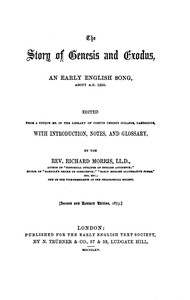
The Story of Genesis and Exodus: An Early English Song, about 1250 A.D.
Subjects:
Download Formats:
Excerpt
FROM A UNIQUE MS. IN THE LIBRARY OF CORPUS CHRISTI COLLEGE, CAMBRIDGE,
AUTHOR OF "HISTORICAL OUTLINES OF ENGLISH ACCIDENCE;"
EDITOR OF "HAMPOLE'S PRICKS OF CONSCIENCE;" "EARLY ENGLISH ALLITERATIVE
POEMS,"
ETC. ETC.;
ONE OF THE VICE-PRESIDENTS OF THE PHILOLOGICAL SOCIETY.
The Editor of the present valuable and interesting record of our old
English speech will, no doubt, both astonish and alarm his readers by
informing them that he has never seen the manuscript from which the work he...
Read the Full Text
— End of The Story of Genesis and Exodus: An Early English Song, about 1250 A.D. —
Book Information
- Title
- The Story of Genesis and Exodus: An Early English Song, about 1250 A.D.
- Language
- English
- Type
- Text
- Release Date
- December 13, 2015
- Word Count
- 95,450 words
- Library of Congress Classification
- PR
- Bookshelves
- Browsing: Literature, Browsing: Poetry, Browsing: Religion/Spirituality/Paranormal
- Rights
- Public domain in the USA.