*** START OF THE PROJECT GUTENBERG EBOOK 74482 ***
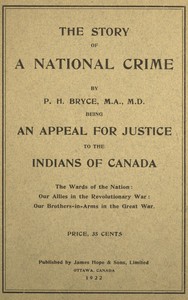
THE STORY
OF
A NATIONAL CRIME
BY
P. H. BRYCE, M.A., M.D.
BEING
AN APPEAL FOR JUSTICE
TO THE
INDIANS OF CANADA
The Wards of the Nation:
Our Allies in the Revolutionary War:
Our Brothers-in-Arms in the Great War.
Published by James Hope & Sons, Limited
OTTAWA. CANADA
1922
PRICE, 35 CENTS
THE STORY OF A NATIONAL CRIME
BEING A
Record of the Health Conditions of the Indians
of Canada from 1904 to 1921
--BY--
DR. P. H. BRYCE, M. A., M. D.
Chief Medical Officer of the Indian Department.
I. By Order in Council dated Jan. 22nd, 1904, the writer was
appointed Medical Inspector to the Department of the Interior and of
Indian Affairs, and was entrusted with the health interests of the
Indians of Canada. The Order in Council recites:--
“The undersigned has the honour to report that there is urgent
necessity for the appointment of a medical inspector to represent the
Department of the Interior and Department of Indian Affairs. The
undersigned believes that the qualifications for the position above
mentioned are possessed in an eminent degree by Mr. Peter Henderson
Bryce, M. D., at present and for a number of years past Secretary for
the Provincial Board of Health of Ontario, and who has had large
experience in connection with the public health of the province.”
(Signed) Clifford Sifton,
Minister of the Interior and
Superintendent General of Indian Affairs.
For the first months after the writer’s appointment he was much
engaged in organizing the medical inspection of immigrants at the
sea ports; but he early began the systematic collection of health
statistics of the several hundred Indian Bands scattered over Canada.
For each year up to 1914 he wrote an annual report on the health of
the Indians, published in the Departmental report, and on instructions
from the minister made in 1907 a special inspection of thirty-five
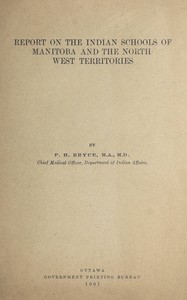
Indian schools in the three prairie provinces. This report was
published separately; but the recommendations contained in the
report were never published and the public knows nothing of them. It
contained a brief history of the origin of the Indian Schools, of the
sanitary condition of the schools and statistics of the health of the
pupils, during the 15 years of their existence. Regarding the health
of the pupils, the report states that 24 per cent. of all the pupils
which had been in the schools were known to be dead, while of one
school on the File Hills reserve, which gave a complete return to
date, 75 per cent. were dead at the end of the 16 years since the
school opened.
[Sidenote: Recommendations of school report 1907.]
Briefly the recommendations urged, (1) Greater school facilities,
since only 30 per cent. of the children of school age were in
attendance; (2) That boarding schools with farms attached be
established near the home reserves of the pupils; (3) That the
government undertake the complete maintenance and control of the
schools, since it had promised by treaty to insure such; and
further it was recommended that as the Indians grow in wealth and
intelligence they should pay at least part of the cost from their
own funds; (4) That the school studies be those of the curricula of
the several Provinces in which the schools are situated, since it
was assumed that as the bands would soon become enfranchised and
become citizens of the Province they would enter into the common
life and duties of a Canadian community; (5) That in view of the
historical and sentimental relations between the Indian schools and
the Christian churches the report recommended that the Department
provide for the management of the schools, through a Board of
Trustees, one appointed from each church and approved by the minister
of the Department. Such a board would have its secretary in the
Department but would hold regular meetings, establish qualifications
for teachers, and oversee the appointments as well as the control of
the schools; (6) That Continuation schools be arranged for on the
school farms and that instruction methods similar to those on the
File Hills farm colony be developed; (7) That the health interests
of the pupils be guarded by a proper medical inspection and that the
local physicians be encouraged through the provision at each school of
fresh air methods in the care and treatment of cases of tuberculosis.
II. The annual medical reports from year to year made reference to
the unsatisfactory health of the pupils, while different local
medical officers urged greater action in view of the results of their
experience from year to year. As the result of one such report the
Minister instructed the writer in 1909 to investigate the health of
the children in the schools of the Calgary district in a letter
containing the following:--
“As it is necessary that these residential schools should be filled
with a healthy class of pupils in order that the expenditure on
Indian education may not be rendered entirely nugatory, it seems
desirable that you should go over the same ground as Dr. Lafferty and
check his inspection.”
[Sidenote: Recommendations based upon examination of 243 school children.]
These instructions were encouraging and the writer gladly undertook
the work of examining with Dr. J. D. Lafferty the 243 children of 8
schools in Alberta, with the following results:--
(a) Tuberculosis was present equally in children at every age; (b) In
no instance was a child awaiting admission to school found free from
tuberculosis; hence it was plain that infection was got in the home
primarily; (c) The disease showed an excessive mortality in the
pupils between five and ten years of age; (d) The 10,000 children of
school age demanded the same attention as the thousand children
coming up each year and entering the schools annually.
Recommendations, made in this report, on much the same lines as those
made in the report of 1907, followed the examination of the 243
children; but owing to the active opposition of Mr. D. C. Scott, and
his advice to the then Deputy Minister, no action was taken by the
Department to give effect to the recommendations made. This too was
in spite of the opinion of Prof. George Adami, Pathologist of McGill
University, in reply to a letter of the Deputy Minister asking his
opinion regarding the management and conduct of the Indian schools.
Prof. Adami had with the writer examined the children in one of the
largest schools and was fully informed as to the actual situation. He
stated that it was only after the earnest solicitation of Mr. D. C.
Scott that the whole matter of Dr. Bryce’s report was prevented
from becoming a matter of critical discussion at the annual meeting
of the National Tuberculosis Association in 1910, of which he was
then president, and this was only due to Mr. Scott’s distinct
promise that the Department would take adequate action along the
lines of the report. Prof. Adami stated in his letter to the Deputy
Minister:--
“It was a revelation to me to find tuberculosis prevailing to such
an extent amongst these children, and as many of them were only
suffering from the early incipient form of the disease, though
practically everyone was affected, when under care it may be
arrested, I was greatly impressed with the responsibility of the
government in dealing with these children.... I can assure you my
only motive is a great sympathy for these children, who are the wards
of the government and cannot protect themselves from the ravages of
this disease.”
III. In reviewing his correspondence the writer finds a personal
letter, written by him to the Minister dated March 16th, 1911,
following an official letter regarding the inaction of the Department
with regard to the recommendations of the report. This letter refers
to the most positive promises of Mr. D. C. Scott that the Department
would at once take steps to put the suggestions contained in the
report into effect. The letter further says:--
“It is now over 9 months since these occurrences and I have not
received a single communication with reference to carrying out the
suggestions of our report. Am I wrong in assuming that the vanity of
Mr. D. C. Scott, growing out of his success at manipulating the
mental activities of Mr. Pedley, has led him to the fatal deception
of supposing that his cleverness will be equal to that of Prospero in
calming any storm that may blow up from a Tuberculosis Association or
any where else, since he knows that should he fail he has through
memoranda on file placed the responsibility on Mr. Pedley and
yourself. In this particular matter, he is counting upon the
ignorance and indifference of the public to the fate of the Indians;
but with the awakening of the health conscience of the people, we are
now seeing on every hand, I feel certain that serious trouble will
come out of departmental inertia, and I am not personally disposed to
have any blame fall upon me.”
It will then be understood with what pleasure the writer hailed the
appointment of Dr. W. A. Roche as Superintendent General of Indian
Affairs after the year’s term of the Hon. R. Rogers, whose chief
activity was the investigation of the Deputy Minister, which led up
to his retirement. Now at last he said, “A medical minister exists
who would understand the situation as relates to the health of the
Indians.” So an early opportunity was taken to set forth in a
memorandum to Dr. Roche, dated Dec. 9th, 1912, data and statistics
relating to the several hundred scattered bands on whose health the
total expenditure was but little more than $2 per capita, while the
death rate in many of the bands was as high as forty per thousand.
The reply acknowledging receipt of this memorandum contained the
following:--
[Sidenote: Dr. Roche is urged to act.]
“There is certainly something in your suggestion that should meet
with every consideration, and some time when I can find an
opportunity and it is convenient for you, I shall be pleased to
discuss this matter with you.” As Dr. Roche became ill and was
absent for some months nothing further was done; but on his return
the writer in a personal interview urged that this serious medical
Indian problem be taken up in earnest. It was stated that medical
science now knows just what to do and what was necessary was to put
our knowledge into practice. Dr. Roche stated that on his return from
the West he would certainly take the matter up. Since that moment
however, to the present, the matter has awaited the promised action.
The writer had done no regular inspection work since Mr. D. C. Scott
was made Deputy minister in 1913, but had in each year up to 1914
prepared his medical report, printed in the annual report of the
Department. About this time the following letter was received:--
P. H. Bryce, M. D.
Medical Inspector,
Immigration Branch.
Ottawa,
June 17, 1914.
Dear Sir,
In reply to your letter of the first instant, asking that the files
of the Department, containing our medical officers’ reports be
placed at your disposal, so that you may peruse them to enable you to
furnish a report for publication, I desire to point out, that by the
organization of this Department, under the Civil Service Act of 1908
you were not included therein and since that time your whole salary
has been a charge against the Department of the Interior. It is true
that since then we have availed ourselves of your services on a few
occasions; but during the past year, so far as I am aware, you have
not been called upon to do any duty for the Department. I may say
also that Dr. Grain of Winnipeg, has lately been appointed to oversee
the Western schools and reserves and his time is fully occupied in
the work. Under these circumstances, I do not think that you should
be asked to furnish a report on the medical work in connection with
Indians during the fiscal year. I must thank you cordially for the
offer to again prepare a report for publication.
Yours sincerely,
Duncan C. Scott,
D. S. G. I. A.
[Sidenote: Mr. Scott’s malign influence.]
The transparent hypocrisy contained in this remarkable communication
sent, not by the Minister Dr. W. A. Roche, but by his deputy, will
be seen in the fact that from 1908, five annual reports had been
prepared by the writer, while the special report on the eight schools
of the Calgary district with the recommendations already referred to
had been made on the instructions of the Department in 1909. The
other reason given, to the effect that a certain physician, since
retired for good cause, quite inexperienced in dealing with Indian
disease problems, had been appointed as Medical Inspector for the
Western Provinces, showed how little the Minister cared for the
solution of the tuberculosis problem. As a matter of fact the Order
in Council appointing the writer had neither been changed nor
rescinded, while the transfer to the Interior Department of the
payment of the total salary was made in 1908 in order that his
regular increase of pay under the new classification of the Civil
Service Act of that year might be made.
[Sidenote: Dr. Roche’s culpable apathy.]
[Sidenote: Value of man power of Indians.]
IV. As the war broke out in 1914 and immigration was largely
suspended, an unexpected opportunity occurred through the greater
time at his disposal for the writer’s special knowledge and
experience to be utilised in improving the health of the Indians; but
in no single instance, thereafter, were the services of the writer
utilised by this medical Minister, who in 1917 was transferred to
preside over the Civil Service Commission, and who must be held
responsible for the neglect of what proved to be a very serious
situation. In 1917, the writer prepared, at the request of the
Conservation Commission, a pamphlet on “The Conservation of the Man
Power of Canada,” which dealt with the broad problems of health
which so vitally affect the man power of a nation. The large demand
for this pamphlet led to the preparation of a similar study on “The
Conservation of the Man Power of the Indian Population of Canada,”
which had already supplied over 2000 volunteer soldiers for the
Empire. For obvious reasons this memorandum was not published, but
was placed in the hands of a minister of the Crown in 1918, in order
that all the facts might be made known to the Government. This
memorandum began by pointing out that in 1916 4,862,303 acres were
included in the Indian reserves and that 73,716 acres were then under
cultivation; that while the total per capita income for farm crops in
that year in all Canada was $110, that from the Indian reserves was
$69, while it was only $40 for Nova Scotia. It is thus obvious that
from the lowest standard of wealth producers the Indian population of
Canada was already a matter of much importance to the State. From the
statistics given in the “Man Power” pamphlet it was made plain
that instead of the normal increase in the Indian population being
1.5 per cent. per annum as given for the white population, there had
been between 1904 and 1917 an actual decrease in the Indian
population in the age period over twenty years of 1,639 persons
whereas a normal increase would have added 20,000 population in the
13 years. The comparisons showed that the loss was almost wholly due
to a high death rate since, though incomplete, the Indian birth rate
was 27 per thousand or higher than the average for the whole white
population.
The memorandum states, “As the Indian people are an unusually
strong native race, their children at birth are large and sturdy, and
under good sanitary conditions have a low mortality. Thus of the 134
children born in the File Hills Farm Colony in 17 years only 34 died,
while of 15 births in 1916 only 1 died, giving the unusually low rate
of 77 per thousand within the year.”
As it was further desirable to obtain the latest returns of deaths by
age periods and causes the writer communicated with the Secretary of
the Indian Department asking for such returns. In reply he received
the following letter:--
Ottawa, May 7, 1918.
Dear Dr. Bryce,
I have your letter of the third instant asking for certain vital
statistics. I am unable to give you the figures you ask as we are not
receiving any vital statistics now, and last year we obtained only
the total number of births and deaths from each Agency. These were
not printed and are not therefore available for distribution. The
causes of deaths have never been noted in our reports and we have no
information.
Your obedient servant,
(Signed) J. D. McLean,
Asst. Deputy and Secretary.
[Sidenote: Entire absence of causes of deaths.]
Thus after more than a hundred years of an organized Department of
Indian Affairs in Canada, though the writer had at once begun in 1904
on his appointment the regular collection of statistics of diseases
and deaths from the several Indian bands, he was officially informed
that in a Department with 287 paid medical officers, due to the
direct reactionary influence of the former Accountant and present
Deputy Minister no means exists, such as is looked upon as elementary
in any Health Department today, by which the public or the Indians
themselves can learn anything definite as to the actual vital
conditions amongst these wards of the nation.
[Sidenote: The famous File Hills Farm colony.]
A study of the 1916-17 statistics shows that in the wage earning
period of life, from 21 to 65 years, the Indians of Alberta had 161
less population, of British Columbia 901 less, of Ontario 991 less
and of Nova Scotia 399 less. In order however to show how an Indian
population may increase, the writer obtained from Mr. W. M. Graham,
at that time Superintendent of the File Hills colony from 1901 to
1917, the complete record for this period. In all there were 53
colonists from the neighbouring Indian schools, starting with five in
1901, who had taken up homesteads in the colony. Most of them married
although 15 either left or had died previous to marriage. In June
1917 there were resident 38 men, 26 women and 106 children, or
170 colonists in all. Thus we have the picture of a young Indian
population of 49 males who remained in the colony, of whom 10 died of
tuberculosis after an average sickness there of 2.7 years and of 29
females of whom 3 died and to whom had been born in all 134 children.
In 1916 the colony had 3,991 acres under cultivation or over a
hundred acres per farmer. This was one nineteenth of the total area
cultivated by 105,000 persons in all the Indian bands in Canada,
while 87,498 bushels of grain were grown, and 33,052 head of live
stock were kept. That this variation from the normal is viewed as
an anomaly may be judged from the following extract from the Deputy
Minister’s Annual Report for 1917; “The Indian population does
not vary much from year to year.” How misleading this statement is
may be judged from the fact that between 1906 and 1917 in the age
periods over 20 years in every Province but two the Indians had
decreased in population by a total of 2,632 deaths.
[Sidenote: Extraordinary mortality from tuberculosis.]
Naturally it is asked; Why this decrease should have taken place? In
1906 the report of the Chief Medical Officer shows that statistics
collected from 99 local medical officers having the care of a
population of 70,000 gave a total of 3,169 cases of tuberculosis or
1 case for every seven in a total of 23,109 diseases reported, and
the death rates in several large bands were 81.8, 82.6, and in a
third 86.4 per thousand; while the ordinary death rate for 115,000 in
the city of Hamilton was 10.6 in 1921. What these figures disclose
has been made more plain year by year, namely that tuberculosis,
contracted in infancy, creates diseases of the brain, joints, bones,
and to a less degree of the lungs and also that if not fatal till
adolescence it then usually progresses rapidly to a fatal termination
in consumption of the lungs.
[Sidenote: The amazing reduction of tuberculosis in Hamilton.]
The memorandum prepared by the writer in 1918 further showed that the
city of Hamilton with a population greater than the total Indian
population had reduced the death rate from tuberculosis in the same
period, from 1904 to 1917, by nearly 75 per cent. having in 1916
actually only 68 deaths. The memorandum further states, “If a
similar method had been introduced amongst the bands on the
health-giving uplands of Alberta, much might have been done to
prevent such a splendid race of warriors as the Blackfeet from
decreasing from 842 in 1904 to 726 in 1916, or, allowing for natural
increase, an actual loss of 40 per cent. since they should have
numbered at least 1,011.”
V. Such then is the situation made known to the Hon. N. W. Rowell,
who applied to the writer in 1918 to supply him with such facts and
arguments as would support the Bill he proposed to introduce into
Parliament for the creation of a Federal Department of Health.
[Sidenote: Occult influences again rob the Indians of a chance.]
It was with pleasure that the memorandum dealing with Indian health
matters was given him, along with a proposed Bill for a Department of
Health, which contained amongst its provisions one for including the
Indian Medical Service along with the other Medical Federal services
in the new Department. In the special medical committee called by Mr.
Rowell to discuss the Bill, such inclusion was of course approved of
and the clause appeared in the First Reading in Parliament. But
something then happened: What special occult influences came into
action may be imagined, when the Second Reading of the Bill took
place with this clause regarding the Indian Medical Service omitted.
It has been noted that from 1913 up to the time when Dr. W. A. Roche
was eliminated from the government in 1917 to make room for a more
hardy and subtle representative of Unionism the activities of the
Chief Medical Inspector of the Indian Department, had in practice
ceased; yet now he was to see as the outcome of all this health
legislation for which he had been struggling for years, the failure
of one of his special health dreams, which he has hoped to see
realized.
[Sidenote: One who failed them in their agony.]
If the writer had been much disturbed by the incapacity or inertia of
a medical Minister in the matter of the Indian health situation, he
now saw that it was hopeless to expect any improvement in it when the
new Minister of Health, who had posed as the Bayard of Social Uplift,
the Protagonist of Prohibition, the Champion of Oppressed Labour, the
Sir Galahad of Women’s rights, and the _preux Chevalier_ of Canadian
Nationalism, could with all the accumulated facts and statistics
before him condemn to further indefinite suffering and neglect these
Wards of the Canadian people, whom one Government after another had
made treaties with and whom deputies and officials had sworn to
assist and protect.
A side light however, may serve to illumine the beclouded situation.
With the formation of the Unionist Government the usual shuffle of
portfolios was made and the then dominating Solicitor General, grown
callous and hardened over a franchise Bill, which disfranchised many
thousands of his fellow native-born citizens, had now become Minister
of the Interior. That the desire for power and for the control
appointments should override any higher consideration such as
saving the lives of the Indians must be inferred from the following
statement of the Hon. A. Meighen, Minister of the Interior and now
Prime Minister. On June 8th, 1920, the estimates of the Indian
Department were under consideration in Parliament. Page 3275 of
Hansard has the following:--
Mr. D. D. McKenzie, “I understand that frightful ravages are being
made amongst them (Indians) by tuberculosis and the conditions of
life are certainly not such as to preserve them from the ravages of
that dread disease. I should be pleased to know at the earliest
possible moment if that branch of the Department was going to be
transferred to the Department of Health.”
Mr. Meighen, “The Health Department has no power to take over the
matter of the health of the Indians. That is not included in the Act
establishing the department. It was purposely left out of the Act. I
did not then think and do not think yet that it would be practicable
for the Health Department to do that work, because they would require
to duplicate the organization away in the remote regions, where
Indian reserves are, and there would be established a sort of divided
control and authority over the Indians.”
Mr. Beland, “Is tuberculosis increasing or decreasing amongst the
Indians?”
Mr. Meighen, “I am afraid I cannot give a very encouraging answer
to the question. We are not convinced that it is increasing, but it
is not decreasing.”
[Sidenote: Red tape condemns the Indians because of a pitiable
inertia.]
In this reply of the Minister we see fully illustrated the dominating
influence, stimulated by the reactionary Deputy Minister, which
prevents even the simplest effective efforts to deal with the health
problem of the Indians along modern scientific lines. To say that
confusion would arise is the equivalent of saying that co-operation
between persons toward a desired social end is impracticable; whereas
co-operation between Provincial and Federal Health Departments is the
basis upon which real progress is being made, while further a world
peace is being made possible in a league of once discordant nations.
The Premier has frankly said he can give no encouraging answer to Dr.
Beland’s question, while at the same moment he condemns the Indians
to their fate by a pitiable confession of utter official helplessness
and lack of initiative, based upon a cynical “non possumus.”
Thus we find a sum of only $10,000 has been annually placed in the
estimates to control tuberculosis amongst 105,000 Indians scattered
over Canada in over 300 bands, while the City of Ottawa, with about
the same population and having three general hospitals spent thereon
$342,860.54 in 1919 of which $33,364.70 is devoted to tuberculous
patients alone. The many difficulties of our problem amongst the
Indians have been frequently pointed out, but the means to cope with
these have also been made plain. It can only be said that any cruder
or weaker arguments by a Prime Minister holding the position of
responsibility to these treaty wards of Canada could hardly be
conceived, and such recall the satirical jibe of Voltaire, regarding
the Treaty of Shackmaxon between Wm. Penn and the Indians, which he
describes as “the only known treaty between savages and Christians
that was never sworn to and never broken.”
The degree and extent of this criminal disregard for the treaty
pledges to guard the welfare of the Indian wards of the nation may
be gauged from the facts once more brought out at the meeting of
the National Tuberculosis Association at its annual meeting held in
Ottawa on March 17th, 1922. The superintendent of the Qu’Appelle
Sanatorium, Sask., gave there the results of a special study of 1575
children of school age in which advantage was taken of the most
modern scientific methods. Of these 175 were Indian children, and it
is very remarkable that the fact given that some 93 per cent. of
these showed evidence of tuberculous infection coincides completely
with the work done by Dr. Lafferty and the writer in the Alberta
Indian schools in 1909.
It is indeed pitiable that during the thirteen years since then this
trail of disease and death has gone on almost unchecked by any
serious efforts on the part of the Department of Indian Affairs,
placed by the B. N. A. Act especially in charge of our Indian
population, and that a Provincial Tuberculosis Commission now
considers it to be its duty to publish the facts regarding these
children living within its own Province.
EPILOGUE.
This story should have been written years ago and then given to
the public; but in my oath of office as a Civil Servant swore that
“without authority on that behalf, I shall not disclose or make
known any matter or thing which comes to my knowledge by reason of
my employment as Chief Medical Inspector of Indian Affairs.” Today I
am free to speak, having been retired from the Civil Service and so
am in a position to write the sequel to the story. It has already
been stated that in 1918 and 1919 I had supplied to my then Minister
of Immigration, the Hon. J. A. Calder and to the then President of
the Council, the Hon. N. W. Rowell various memoranda regarding
the establishment of a Federal Department of Health, amongst these
being a draft of the Bill which later became the Act establishing the
Department of Health. To my disappointment the position of Deputy
Minister of Health to which I had a right to aspire after twenty-two
years as Chief Medical Officer of Ontario, and fifteen years as
Chief Medical Officer of Immigration and Indian Affairs was given to
another, wholly outside the Federal Civil Service and in violation
of the principle of promotion, which was supposed to prevail when
the patronage system was to be done away with. The excuse was on the
ground of my advancing years, although at that moment the position
of Auditor General was being filled by the promotion of one who had
reached sixty-five years, while a Historian to the Militia Department
was appointed at a salary of $7,000 per year, who likewise had
reached just then this age.
Naturally I felt that it would be impossible to carry on and retain
my self respect as a subordinate, while performing the duties, which
I had been engaged in for fifteen years as Chief Medical Officer and
so asked that I be given other congenial work. That my claims to the
position were deemed reasonable may be judged from the following
letter addressed to my brother the Rev. Professor Bryce, D.D., of
Winnipeg. Writing from Victoria, B. C., on March 9th, 1920, to myself
he said, quoting from a letter received from the Hon. Mr. Calder in
reply to one of his own:--
“I quite appreciate the views of your brother in reference to his
situation here, and personally would be only too glad to do anything
I can to help out. When the Public Health Department was created,
your brother certainly had claims to the appointment as Deputy
Minister. Owing to his advanced age however, Council finally
concluded that a younger man should receive the appointment. The
government has on several occasions considered the question of
placing your brother in some other branch of the Service, and I have
no doubt that this will be arranged in some way or other shortly.
He is now an official of the Public Health Department. He could of
course remain there but this apparently is not agreeable to him.
As a consequence some other arrangement, if possible must be made.
Signed, J. A. Calder.”
My indignation at subsequent treatment may be imagined when the same
Mr. Calder introduced the Act in 1920, commonly known as the Calder
Act, providing for the “Retirement of Certain Members of the Civil
Service.” This Act states that anyone retired thereunder shall
receive 1/60 of his salary for each year of service. So it came about
that on the 17th Sept. 1920, I received notice that I was recommended
for retirement under this Act. The clause of the Act quoted for my
information states:--
“Section 2(3). When it is decided to retire anyone under the
provisions of this Act, notice in writing giving the reasons for such
retirement shall be sent to such person, and he shall have the right
to appeal to the Civil Service Commission, and the Commission, after
giving such person an opportunity to be heard, shall make full report
to the Governor in Council and the decision of the Council thereon
shall be final.”
I appealed and in my appeal stated that no reason was assigned as
provided in the Act, and further that I was still Chief Medical
Officer in the Department of Indian Affairs as set out in the Order
in Council of 1904.
As bearing on this point made in my appeal I find the following in
Hansard of June 8th, 1921. The matter being dealt with is the
amendment to the Calder Act:
Mr. Fielding: But cases have been brought to my attention of men in
advanced years--some may think them old, I do not--being notified of
their retirement, although they are blessed with good health and
strength, both mental and physical, and are well able to discharge
their duties. How is such a man dealt with?
Mr. Calder: No man will be notified unless a proper official has
advised that his condition of life is such that in the public
interest he should be retired....
Mr. Calder: That in the main has been the practice in the past and
that is what the law contemplated last year. The question of age
alone was not taken into consideration.
But it was hardly to be supposed that Dr. W. A. Roche, now Chairman
of the Civil Service Commission, who during the years 1913-17
referred to had failed to utilise my services when he was
Superintendent of Indian Affairs would now consider my services as
necessary in that Department. So my protest was of no avail; my
elimination from the Service had been decreed and I received the
following Order in Council:
Ottawa, 14th Feb., 1921.
The Committee have had before them a report, dated Feb. 1st, 1921,
from the acting Secretary of State, from the Civil Service
Commission:
In accordance with the provisions of Cap. 67, 10-11 George V. “An
Act to provide for the Retirement of Certain Members of the Public
Service” the Civil Service has to report that Dr. P. H. Bryce of
the Department of Health at Ottawa was recommended by the Deputy
Minister of Health for retirement; that under Section 2 (3) of the
said Act he was given a personal hearing, which has resulted in the
Civil Service Commission now recommending that his appeal be not
allowed, but that his retirement be made effective from the 1st
of March, 1921. Dr. Bryce was born on August 17th, 1853, and is
consequently sixty-seven years of age. He was appointed temporarily
to the Service on Feb. 1st, 1904, and was made permanent on September
1st, 1908, and therefore will have been in the Service seventeen
years and one month on the 1st March, 1921, the date upon which his
retirement is proposed to be effective.
So it came about that I was retired in March, 1921, without any years
being added to my term of Federal service, though I had been brought
to Ottawa as an expert after 22 years in the Ontario Health Service,
as is provided for in the Superannuation Act of 1870. Neither did I
get any gratuity on leaving the Ontario Service after twenty-two
years, the excuse being then given that I was improving my position.
The irony and injustice of this Order in Council will be seen when it
is stated that a similar Order was passed on May 18th, 1921, retiring
231 persons from the Customs Department as being over sixty-five
years of age; but which was recalled when the protests of the many
friends of men who were faithfully performing their duties were made.
These and hundreds of other Civil Servants of similar age are in
different Departments still performing their duties.
In view, therefore, of all the facts herein recited I make my appeal
for simple justice; that I be permitted to carry on my work as Chief
Medical Officer of Indian Affairs, and I believe that I have the
right to demand, after a thorough investigation into all the facts
of the case, that the chief obstacle, as set forth in the story, to
insuring the health and prosperity of the one hundred thousand
Indians, the Wards of the nation, be removed.
Since the time of Edward I. the people have ever exercised their
historic right to lay their petitions before the King and Parliament.
I now desire herein respectfully to bring my appeal for the Indians
of Canada before the King’s representative and the Parliament of
Canada, feeling sure that justice will be done both to them and to
myself.
P. H. BRYCE.
Transcriber’s note:
Minor punctuation and hyphenation errors in the original have
been silently corrected.
A few grammatically incomplete sentences that appear to have a word
missing have been left as printed.
Other corrections of spelling misprints have been recorded in HTML
comments.
*** END OF THE PROJECT GUTENBERG EBOOK 74482 ***
The story of a national crime
Subjects:
Download Formats:
Excerpt
BEING
AN APPEAL FOR JUSTICE
TO THE
INDIANS OF CANADA
The Wards of the Nation:
Our Allies in the Revolutionary War:
Our Brothers-in-Arms in the Great War.
Published by James Hope & Sons, Limited
OTTAWA. CANADA
1922
BEING A
Record of the Health Conditions of the Indians
of Canada from 1904 to 1921
I. By Order in Council dated Jan. 22nd, 1904, the writer was
appointed Medical Inspector to the Department of the Interior and of
Indian Affairs, and was entrusted with...
Read the Full Text
— End of The story of a national crime —
Book Information
- Title
- The story of a national crime
- Author(s)
- Bryce, P. H. (Peter Henderson)
- Language
- English
- Type
- Text
- Release Date
- September 26, 2024
- Word Count
- 6,087 words
- Library of Congress Classification
- E011; F1001
- Bookshelves
- Browsing: Health & Medicine, Browsing: History - General
- Rights
- Public domain in the USA.