The Project Gutenberg eBook of The Rejuvenation of Aunt Mary by Anne Warner
This eBook is for the use of anyone anywhere in the United States and
most other parts of the world at no cost and with almost no restrictions
whatsoever. You may copy it, give it away or re-use it under the terms
of the Project Gutenberg License included with this eBook or online at
www.gutenberg.org. If you are not located in the United States, you
will have to check the laws of the country where you are located before
using this eBook.
Title: The Rejuvenation of Aunt Mary
Author: Anne Warner
Release Date: May 2005 [eBook #15775]
[Most recently updated: May 8, 2021]
Language: English
Character set encoding: UTF-8
Produced by: Suzanne Shell, Josephine Paolucci, Joshua Hutchinson and the Online Distributed Proofreading Team
*** START OF THE PROJECT GUTENBERG EBOOK THE REJUVENATION OF AUNT MARY ***
[Illustration]
The Rejuvenation of Aunt Mary
by Anne Warner
Author of “A Woman’s Will,” “Susan Clegg and Her Friend
Mrs. Lathrop,” “Susan Clegg and a Man in the House,”
etc.
NEW EDITION
With Additional Pictures from the Play
Boston
Little, Brown, and Company
1910
Copyright, 1904,
By Ainslee Magazine Company.
Copyright, 1905,
By Little, Brown, and Company.
Copyright, 1907,
By Little, Brown, and Company,
All rights reserved
Fourteenth Printing
Printers
S.J. Parkhill & Co., Boston, U.S.A.
Contents
Chapter One—Introducing Aunt Mary
Chapter Two—Jack
Chapter Three—Introducing Jack
Chapter Four—Married
Chapter Five—The Day After Falling in Love
Chapter Six—The Other Man
Chapter Seven—Developments
Chapter Eight—The Resolution He Took
Chapter Nine—The Downfall of Hope
Chapter Ten—The Woes of the Disinherited.
Chapter Eleven—The Dove of Peace
Chapter Twelve—A Trap For Aunt Mary
Chapter Thirteen—Aunt Mary Entrapped
Chapter Fourteen—Aunt Mary En Fête
Chapter Fifteen—Aunt Mary Enthralled
Chapter Sixteen—A Reposeful Interval
Chapter Seventeen—Aunt Mary’s Night About Town
Chapter Eighteen—A Departure And A Return
Chapter Nineteen—Aunt Mary’s Return
Chapter Twenty—Jack’s Joy
Chapter Twenty-One—The Peace and Quiet of the Country
Chapter Twenty-Two—“Granite”
Chapter Twenty-Three—“Granite”—Continued.
Chapter Twenty-Four—Two Are Company
Chapter Twenty-Five—Grand Finale
Illustrations
“Aunt Mary en fête” (May Robson as “Aunt Mary”)
“‘Do not let us play any longer,’ she said. ‘Let us be in earnest’”
“‘She’s goin’ to the city all alone!’ Lucinda’s voice suddenly proclaimed behind him”
Aunt Mary and Her Escorts
“The carriage stopped three hundred feet below the level of a roof-garden”
“And now the fun’s all over and the work begins”
“‘Yesterday I played poker until I didn’t know a blue chip from a white one’”
“Aunt Mary had also had her eyes open”
Chapter One
Introducing Aunt Mary
The first time that Jack was threatened with expulsion from college his
Aunt Mary was much surprised and decidedly vexed—mainly at the college.
His family were less surprised, viewing the young man through a clearer
atmosphere than his Aunt Mary ever had, and knowing that he had barely
escaped similar experiences earlier in his career by invariably leaving
school the day before the board of inquiry convened.
Jack’s preparatory days having been more or less tempestous, his family
(Aunt Mary excepted) had expected some sort of after-clap when he
entered college. Nevertheless, they had fervently hoped that it would
not be quite as bad as this.
Jack’s sister Arethusa was visiting her aunt when the news came. Not
because she wanted to, for the old lady was dreadfully deaf and
fearfully arbitrary, but because Lucinda had said that she must go to
her cousin’s wedding, and the family always had to bow to Lucinda’s
mandates. Lucinda was Aunt Mary’s maid, but she had become so
indispensable as a sitter at the off-end of the latter’s ear-trumpet
that none of the grand-nephews or grand-nieces ever thought for an
instant of crossing one of her wishes. So it was to Arethusa that the
explanations due Aunt Mary’s interest in her scapegrace fell, and she
bowed her back to the burden with the resignation which the
circumstances demanded.
“Whatever is the difference between bein’ expelled and bein’
suspended?” Aunt Mary demanded, in her tone of imperious impatience.
“Well, why don’t you answer? I was brought up to speak when you’re
spoken to, an’ I’m a great believer in livin’ up to your bringin’ up—if
you had a good one. What’s the difference, an’ which costs most? That’s
what I want to know. I do wish you’d answer me, Arethusa; there’s two
things I’ve asked you now, an’ you suckin’ your finger an’ puttin’ on
your thimble as if you were sittin’ alone in China.”
“I don’t know which costs most,” Arethusa shrieked.
“You needn’t scream so,” said Aunt Mary. “I ain’t so hard to hear as
you think. I ain’t but seventy, and I’ll beg you to remember that,
Arethusa. Besides, I don’t want to hear you talk. I just want to hear
about Jack. I’m askin’ about his bein’ expelled and suspended, an’
what’s the difference, an’ in particular if there’s anything to pay for
broken glass. It’s always broken glass! That boy’s bills for broken
glass have been somethin’ just awful these last two years. Well, why
don’t you answer?”
“I don’t know what to answer,” Arethusa screamed.
“What do you suppose he’s done, anyhow?”
“Something bad.”
Aunt Mary frowned.
“I ain’t mad,” she said sharply. “What made you think I was mad? I
ain’t mad at all! I’m just askin’ what’s the difference between bein’
expelled an’ bein’ suspended, an’ it seems to me this is the third time
I’ve asked it. Seems to me it is.”
Arethusa laid down her work, drew a mighty breath, very nearly got into
the ear-trumpet, and explained that being suspended was infinitely less
heinous than being expelled, and decidedly less final.
Aunt Mary looked relieved.
“Oh, then he’s gettin’ better, is he?” she said. “Well, I’m sure that’s
some comfort.”
And then there was a long pause, during which she appeared to be
engaged in deep reflection, and her niece continued her embroidery in
peace. The pause endured until a sudden sneeze on the part of the old
lady set the wheels of conversation turning again.
“Arethusa,” she said, “I wish you’d go an’ get the ink an’ write to Mr.
Stebbins. I want him to begin to look up another college with good
references right away. I don’t want to waste any of the boy’s life, an’
if bein’ suspended means waitin’ while the college takes its time to
consider whether it wants him back again or not I ain’t goin’ to wait.
I’m a great believer in a college education, but I don’t know that it
cuts much figure whether it’s the same college right through or not.
Anyway, you write Mr. Stebbins.”
Arethusa obeyed, and the authorities having seen fit to be uncommonly
discreet as to the cause of the young man’s withdrawal, no great
difficulty was experienced in finding another campus whereon Aunt
Mary’s pride and joy might freely disport himself. Mr. Stebbins threw
himself into the affair with all the tact and ardor of an experienced
legal mind and soon after Lucinda’s return to her home allowed Arethusa
to follow suit, the hopeful younger brother of the latter became a
candidate for his second outfit of new sweaters and hat bands that
year.
Aunt Mary wrote him a letter upon the occasion of his new start in
life, Mr. Stebbins delivered him a lecture, and things went smoothly in
consequence for three whole weeks. I say three whole weeks because
three whole weeks was a long time for the course of Jack’s life to flow
smoothly. At the end of a fortnight affairs were always due to run more
rapidly and three weeks produced, as a general thing, some species of
climax.
The climax in this case came to time as usual his evil genius inciting
the young man to attempt, one very dark night, the shooting of a cat
which he thought he saw upon the back fence. Whether he really had seen
a cat or not mattered very little in the later development of the
matter. He was certainly successful as far as the going off of the gun
was concerned, but the damage that resulted, resulted not to any cat,
but to the arm of a next-door’s cook, who was peacefully engaged in
taking in her week’s wash on the other side of the fence. The cook
ceased abruptly to take in the wash, the affair was at once what is
technically termed looked into, and three days later Jack became the
defendant in a suit for damages.
Naturally Mr. Stebbins was at once notified and he had no choice except
to write Aunt Mary.
Aunt Mary was somewhat less patient over the third escapade than she
had been with the first two.
The letter found her alone with Lucinda and she read it to herself
three times and then read it aloud to her companion. Lucinda, whose
thorough knowledge of the imperious will and impervious eardrums of her
mistress rendered her, as a rule, extremely monosyllabic, not to say
silent, vouchsafed no comment upon the contents of the epistle, and
after a few minutes Aunt Mary herself took the field:
“Now, what do you suppose possessed that boy to shoot at a cook?” she
asked, regarding the letter with a portentous frown. “Cooks are so
awful hard to get nowadays. I don’t see why he didn’t shoot a tramp if
he had to shoot somethin’.”
“He wa’n’t tryin’ to shoot a cook, ’pears like,” then cried
Lucinda—Lucinda’s voice, be it said, _en passant_, was of that sibilant
and penetrating timbre which is best illustrated in the accents of a
steamfitter’s file—“’pears like he was tryin’ for a cat.”
“Not a bat,” said her mistress correctively; “it was a cat. You look at
this letter an’ you’ll see. And, anyway, how could a man shootin’ at a
cat hit a cook?—not ’nless she was up a tree birds’-nestin’ after owls’
eggs. You don’t seem to pay much attention to what I read to you,
Lucinda; only I should think your commonsense would help you out some
when it comes to a boy you’ve known from the time he could walk, an’ a
strange cook. But, anyhow, that’s neither here nor there. The question
that bothers me is, what’s to pay with this damage suit? I think myself
five hundred dollars is too much for any cook’s arm. A cook ain’t in no
such vital need of two arms. If she has to shut the door of the oven
while she’s stirrin’ somethin’ on the top of the stove, she can easy
kick it to with her foot. It won’t be for long, anyway, and I’m a great
believer in making the best of things when you’ve got to.”
Lucinda screwed up her face and made no comment. Lucinda’s face in
repose was a cross between a monkey’s and a peanut; screwed up, it was
particularly awful, and always exasperated her mistress.
“Well, why don’t you say somethin’, Lucinda? I ain’t askin’ your
advice, but, all the same, you can say anything if you’ve got a mind
to.”
“I ain’t got a mind to say anythin’,” the faithful maid rejoined.
“I guess you hit the nail on the head that time,” said Aunt Mary,
without any unnecessary malevolence concealed behind her sarcasm; then
she re-read the note and frowned afresh.
“Five hundred dollars is too much,” she said again. “I’m going to write
to Mr. Stebbins an’ tell him so to-night. He can compromise on two
hundred and fifty, just as well as not. Get me some paper and my desk,
Lucinda. Now get a spryness about you.”
Lucinda laid aside her work and forthwith got a spryness about her,
bringing her mistress’ writing-desk with commendable alacrity. Aunt
Mary took the writing-desk and wrote fiercely for some time, to the end
that she finally wrote most of the fierceness out of herself.
“After all, boys will be boys,” she said, as she sealed her letter,
“and if this is the end I shan’t feel it’s money wasted. I’m a great
believer in bein’ patient. Most always, that is. Here, Lucinda you take
this to Joshua and tell him to take it right to mail. Be prompt, now.
I’m a great believer in doin’ things prompt.”
Lucinda took the letter and was prompt. “She wants this letter took
right to the mail,” she said to Joshua, Aunt Mary’s longest-tried
servitor.
“Then it’ll be took right to mail,” said Joshua.
“She’s pretty mad,” said Lucinda.
“Then she’ll soon get over it,” replied the other, taking up his hat
and preparing to depart for the barn forthwith.
Lucinda returned to Aunt Mary with a species of dried-up sigh. One is
not the less a slave because one has been enslaved for twenty years,
and Lucinda at moments did sort of peek out through her bars—possibly
envying Joshua the daily drives to mail when he had full control of
something that was alive.
Lucinda had been, comparatively speaking, young when she had come to
wait upon the pleasure of the Watkins millions, and her waiting had
been so pertinent and so patient that it had endured over a quarter of
a century. Aunt Mary had been under fifty in the hour of Lucinda’s
dawn; she was over seventy now. Jack hadn’t been born then; he was in
college now; and Jack’s older brothers and sisters and his
dead-and-gone father and mother had been living somewhere out West
then, quite hopeful as to their own lives and quite hopeless as to the
stern old great-aunt who never had paid any attention to her niece
since she had chosen to elope with the doctor’s reprobate son. Now the
father and mother were dead and buried, the brothers and sisters
reinstated in their rights and had all grown up and become great
credits to the old lady, whose heart had suddenly melted at the arrival
of five orphans all at once. And there was only Jack to continue to
worry about.
Jack was not anything particularly remarkable; he was just one of those
lovable good-for-nothings that seem born to get better people into
trouble all their lives long. He had been spoiled originally by being
ten years younger than the next youngest in the family; and then, when
the children had been shipped on to Aunt Mary’s tender mercies, Jack
had won her heart immediately because she accidentally discovered that
he had never been baptized, and so felt fully justified in re-naming
him after her own father and having the name branded into him for keeps
by her own religious apparatus. It followed naturally that John
Watkins, Jr., Denham, for so her father’s daughter had insisted that
her youngest nephew should be called, was the favorite nephew of his
aunt.
And it was lucky for him that he was the favorite, for Aunt Mary, who
was highly spiced at fifty, became peppery at sixty, and almost biting
at seventy. And yet for Jack she would sign checks almost without a
murmur. Mr. Stebbins was much more censorious and impatient with the
young man than she ever was; and to all the rest of the world Mr.
Stebbins was an urbane and agreeable gentleman, whereas to all the rest
of the world Aunt Mary was a problem or a terror. But Mr. Stebbins
needed to be a man of tact and management, for he was the real manager
of that fortune of which “Mary, only surviving child of John Watkins,
merchant and ship owner,” was the legal possessor; and so tactful was
Mr. Stebbins that he and his powerful client had never yet clashed, and
they had been in close business relations for almost as many years as
Lucinda had been established on the hearthstone of the Watkins home.
Perhaps one reason why Mr. Stebbins endured so well was that he had a
real talent for compromising, and that he had skillfully transformed
Aunt Mary’s inherited taste for driving a bargain into an acquired
pleasure in what is really a polite form of the same action.
So, when it came to the matter of Jack’s difficulties, Mr. Stebbins
could always find a half-way measure that saved the situation; and when
he received the letter as to the cook and her claim he hied himself to
the city at once, and wrote back that the claim could be settled for
three hundred dollars.
“And enough, I must say,” Aunt Mary remarked to Lucinda upon receipt of
the statement; “three hundred dollars for one cat—for, after all, Jack
blames the whole on the cat, an’ he didn’t hit it, even then.”
Lucinda did not answer.
“But if the boy settles down now I shan’t mind payin’ the three—Where
are you goin’?”
For Lucinda was walking out of the room.
“I’m goin’ to the door,” said she raspingly. “The bell’s ringin’.”
After a minute or two she came back.
“Telegram!” she announced, handing the yellow envelope over.
Aunt Mary put on her glasses, opened it, and read:
Cook has blood poison. Sues for a thousand. Probable amputation.
STEBBINS.
Aunt Mary dropped the paper with a gasp.
Lucinda looked at her with interest.
“It’s that same arm again,” said Aunt Mary, “just as I thought it was
settled for!” Her eyes seemed to fairly crackle with indignation. “Why
don’t she put it in a sling an’ have a little patience?”
Lucinda took the telegram and read it.
“’Pears like she can’t,” she commented, in a tone like a buzz saw;
“’pears like it’s goin’ to be took off.”
Aunt Mary reached forth her hand for the telegram and after a second
reading shook her head in a way that, if her companion had been a
globe-trotter, would have brought matadores and Seville to the front in
her mind in that instant.
“I declare,” she said, “seems like I had enough on my mind without a
cook, too. What’s to be done now? I only know one thing! I ain’t goin’
to pay no thousand dollars this week for no arm that wasn’t worth but
three hundred last week. Stands to reason that there ain’t no reason in
that. I guess you’d better bring me my desk, Lucinda; I’m goin’ to
write to Mr. Stebbins, an’ I’m goin’ to write to Jack, and I’m goin’ to
tell ’em both just what I think. I’m goin’ to write Jack that he’d
better be lookin’ out, and I’m goin’ to write to Mr. Stebbins that next
time he settles things I want him to take a receipt for that arm in
full.”
The letters were duly written and Mr. Stebbins, upon the receipt of
his, redoubled his efforts, and did succeed in permanently settling
with the cook, the arm being eventually saved. Aunt Mary regarded the
sum as much higher than necessary, but still pleasantly less than that
demanded of her, and so life in general moved quietly on until Easter.
But Easter is always a period of more or less commotion in the time of
youth and leads to various hilarious outbreaks. Jack’s Easter took him
to town for a “little time,” and the “little time” ended in the
station-house at three o’clock on Sunday morning.
Accusation: Producing concussion of the brain on a cab driver.
Chapter Two
Jack
The news was conveyed to Aunt Mary through private advices from Mr.
Stebbins (who had been hastily summoned to the city for purposes of
bail); she was very angry indeed, this time—primarily at the indignity
done her flesh and blood by arresting it. Then, as she re-read the
lawyer’s letter, other reflections crowded to the fore in her mind.
“Funny! Whatever could have made the boy get up and go downtown at
three in the morning, anyway?” she said. “Seems kind of queer, don’t
you think, Arethusa? Do you suppose he was ill and huntin’ for a drug
store?”
Arethusa had been sent for the second day previous because Lucinda’s
youngest sister’s youngest child had come down with scarlet fever, and
the family wanted Lucinda to enliven the quarantine. Arethusa had sent
invitations out for a dinner party, but she had recalled them and
hastened to obey the summons. It was an evil hour for her, for she
loved her brother and was mightily distressed at the bad news.
“I don’t believe he can have been ill,” she said, at the top of her
voice; “if he’d been ill he wouldn’t have had the strength to hit the
cab driver so hard.”
“I don’t blame him for hittin’ the cab driver,” said Aunt Mary warmly.
“As near as I can recollect, I’ve often wanted to do that myself. But I
can’t make out where he got the man to hit, or why he was there to hit
him. I can’t make rhyme or reason out of it. I wish we knew more. Well,
I presume we will, later.”
Her surmise was correct. They knew much more later. They knew more from
Mr. Stebbins, and they knew profusely more from the evening papers.
“I think our boy’d better have come home for his Easter,” Aunt Mary
remarked, with a species of angry undertow threading the current of her
speech. “There’s no sayin’ what this will cost before we’re done with
it.”
Arethusa choked; it was all so very terrible to her.
“What is it that the cabman wants, anyhow?” her aunt demanded
presently.
“He doesn’t want anything,” yelled the unhappy sister. “He’s going to
die.”
“Well, who is going to sue me, then?”
“It’s his wife; she wants five thousand dollars damages.”
Aunt Mary’s lips tightened.
“Five thousand dollars!” she said, with a bitter patience. “I can see
that this is goin’ to be an awful business. Five thousand dollars!
Dear, dear! I must say that that wife sets a pretty high price on her
husband—at least, a’cordin’ to my order of thinkin’, she does. From
what I’ve seen of cabmen, I’d undertake to get her another just as good
for a tenth of the money, any day.”
Arethusa was silent, staring thoughtfully at the newspaper cuts of a
great Tammany leader and a noted pugilist, which had been labeled as
the principals in the family tragedy.
Aunt Mary turned over another of the many papers received, and scanned
its sensational columns afresh.
“Arethusa,” she exclaimed suddenly, “do you know, I bet anythin’ I know
what this editor means to insinuate? It just strikes me that he’s
tryin’ to give the impression that our boy’s been drinkin’.”
“Perhaps so,” Arethusa screamed.
“Well, I don’t believe it,” said Aunt Mary firmly, “and I ain’t goin’
to believe it. And I ain’t goin’ to pay no five thousand dollars for no
cabman’s brains, neither. You write to Mr. Stebbins to compromise on
two or maybe three.”
She stopped and bit her lips and shook her head. “I don’t see why Jack
grows up so hard,” she murmured, half in anger and half in sorrow.
“Edward and Henry never had such times. Oh, well,” she sighed, “boys
will be boys, I suppose; an’ if this all results in the boy’s settlin’
down it’ll be money well spent in the end, after all.
Maybe—probably—most likely.”
The days that followed were anxious days, but at last the cabman
rallied and concluded not to die, and Jack went off yachting with a
light heart and a choice collection of good advice from Mr. Stebbins
and Aunt Mary.
Nothing happened to mar his holiday. He ran a borrowed steam launch on
to some rocks with rather heavy consequences to his aunt’s exchequer,
and returned from the West Indies so late that she never had a visit
from him at all that summer; but, barring these slightly unwelcome
incidents, he did remarkably well, and when he returned to college in
the fall he was regarded as having become, at last, a stable
proposition.
“I wonder whether our boy’s comin’ home for Christmas?” Aunt Mary asked
her niece, Mary, as that happy period of family reunions drew near.
Mary had come up to stay with her aunt while Lucinda went away to bury
a second cousin. Mary was very different from Arethusa, having a voice
that, when raised, was something between an icicle and a steam whistle,
and a temperament so much on the order of her aunt’s that neither could
abide the other an hour longer than was absolutely necessary. But
Arethusa had a sprained ankle, so there was no help for existing
circumstances.
“No, he isn’t,” said Mary, who had no patience at all with her brother,
and showed it. “He’s going West with the glee club.”
“With the she club!” cried poor Aunt Mary, in affright.
Mary explained.
“I don’t like the idea,” said the old lady, shaking her head.
“Somethin’ will be sure to happen. I can feel it runnin’ up and down my
bones this minute.”
“Oh, if he can get into trouble, of course, Jack will,” said Mary
cheerfully.
Aunt Mary didn’t hear her, because she didn’t raise her voice
particularly. Besides, the old lady was absorbed for the nonce in the
most dismal sort of prognostications.
And they all came true, too. Something unfortunate beyond all
expectations came to pass during the glee club’s visit to Chicago, and
the result was that, before the new year was well out of its incubator
Jack had papers in a breach-of-promise suit served on him. He wrote Mr.
Stebbins that it was all a joke, and had merely been a portion of that
foam which a train of youthful spirits are apt to leave in their wake;
but the girl stood solid for her rights, and, as she had never heard
from her fiancé since the night of the dance, her family—who were
rural, but sharp—thought it would take at least fifteen thousand
dollars to patch the crack in her heart. If the news could have been
kept from Aunt Mary until after Mr. Stebbins had looked into the
matter, everything might have resulted differently. But the Chicago
lawyer who had the case took good care that the wealthy aunt knew all
as quickly as possible, and it seemed as if this was the final straw
under which the camel must succumb.
And Aunt Mary did appear to waver.
“Fifteen thousand dollars!” she cried, aghast. “Heaven help us! What
next?”
It was Lucinda who was seated calmly opposite at this crisis.
“Do you suppose he really did it?” the aunt continued, after a minute
of appalled consideration.
“It’s about the only thing he ain’t never done,” the tried and true
servant answered, her tone more gratingly penetrative than ever.
Aunt Mary eyed her sharply, not to say furiously.
“I wish you’d give a plain answer when I ask you a plain question,
Lucinda,” she said coldly. “If you’d ever got a breach-of-promise suit
in the early mail you’d know how I feel. Perhaps—probably.”
“I ain’t a doubt but what he done it,” Lucinda screamed out; “an’ if I
was her an’ he wouldn’t marry me after sayin’ he would I’d sue him for
a hundred thousand, an’ think I let him off cheap then.”
Aunt Mary deigned to smile faintly over the subtlety of this speech;
but the next minute she was frowning blacker than ever.
“A girl from Kalamazoo, too, just up in Chicago for a week—just up in
Chicago long enough to come down on me for fifteen thousand dollars.”
“Maybe she’ll take five thousand instead,” Lucinda remarked.
“Maybe!” ejaculated her mistress, in fine scorn. “Maybe! Well, if you
don’t talk as if money was sweet peas an’ would dry up if it wasn’t
picked!”
Lucinda screwed up her face.
Aunt Mary gave her one awful look.
“You get me some paper an’ my desk, Lucinda,” she said. “I think it’s
about time I was takin’ a hand in it myself. I’ve been pretty patient,
an’ I don’t see as it’s helped matters any. Now I’m goin’ to write that
boy a letter that’ll settle him an’ his cats, an’ his cooks, an’ his
cabmen, an’ his Kalamazoo, just once for all. I guess I can do what I
set out to do. Pretty generally—most always.”
Lucinda brought the desk, and Aunt Mary frowned fearfully and began to
write the letter.
It developed very strongly. As her pen sized up the situation in black
and white, the old lady seemed to realize the iniquities of the case
more and more plainly; and as the letter grew her wrath grew also. The
whole came, in the end, to a threat—made in good earnest—to take a very
serious step indeed if any more “foolishness” developed.
Aunt Mary prided herself on her granite-like will. She had full faith
in her ability to slay her nearest and dearest if it seemed right and
best to do so.
She sealed her letter tight, stuck the stamp on square and hard, and
bid Lucinda convey it to Joshua and tell him never to quit it until he
saw it safe on to the evening train.
“She’s awful mad at him for sure, this time,” said Lucinda after she
had delivered her message, and while Joshua was considering the front
and back of the letter with a deliberateness born of long servitude.
“I sh’d think she would be,” he said.
As nearly all of Jack’s private difficulties were printed in every
newspaper in America, Joshua naturally was on the inside of all their
history.
“She scrinched up her face just awful over that letter,” Lucinda
continued. “I’m sure I wish he’d ’a’ been by to ’a’ taken warnin’.”
“He ain’t got nothin’ to really fret over,” said Joshua serenely; “he
knows it, ’n’ I know it, ’n’ you know it, too.”
“You don’t know nothin’ of the sort,” said Lucinda. “She’s madder’n
usual this time. She’s good an’ mad. You mark my words, if he goes off
on a ’nother spree this spring he’ll get cut out o’ her will.”
Joshua laughed.
“You mark my words!” rasped Lucinda, shaking her finger in witchlike
warning.
Joshua laughed again.
“Them laughs best what laughs last,” said Aunt Mary’s handmaiden. She
turned away, and then returned to give Joshua a look that proved that
the peppery mistress had inculcated some cayenne into the souls of
those about her. “You mark my words—them laughs best what laughs last,
an’ there’ll be little grinnin’ for him if he ain’t a chalk-walker for
one while now.”
Joshua laughed.
But, as a matter of fact, Jack’s situation was suddenly become
extremely precarious.
“There ain’t no sense in it,” said Aunt Mary to herself, with an
emphasis that screwed her face up until she looked quite like Lucinda;
“that life those young men lead on their little vacations is to blame
for everything. Cities are wells of iniquity; they’re full of all kinds
of doin’s that respectable people wouldn’t be seen at, and I’m proud to
say that I haven’t been in one myself for twenty-five years. I’m a
great believer in keepin’ out of trouble, an’ if Jack’d just stuck to
college an’ let towns go, he’d never have met the cabman and the
Kalamazoo girl, an’ I’d have overlooked the cook an’ the cat. As it is,
my patience is done. If he goes into one more scrape he’ll be done too.
I mean what I say. So my young man had better take warnin’.
Probably—most likely—pretty certainly.”
Chapter Three
Introducing Jack
It has been previously stated that Aunt Mary’s nephew, Jack, was a
scapegrace, and as delightful as scapegraces generally are. It goes
without saying that he was good-looking; and of course he must have
been jolly and pleasant or he wouldn’t have been so popular. As a
matter of fact, Jack was very good-looking, unusually jolly, and
uncommonly popular. He was one of the best liked men in each of the
colleges which he had attended. There was something so winning about
his smile and his eternal good humor that no one ever tried to dislike
him; and if anyone ever had tried he or she would not have succeeded
for very long. It is probably very unfortunate that the world is so
full of this type of young man, but that which should cause us all to
have infinite patience with them is the reflection of how much more
unfortunate it would be if they were suddenly eliminated from the
general scheme of things.
Like all college boys, Jack had a chum. The chum was Robert Burnett,
another charming young fellow of one-and-twenty, whose education had
been so cosmopolitan in design and so patriotic in practice that he
always said “Sacre bleu” and “Donnerwetter” when he thought of it, and
“Great Scott” when he didn’t. He and Jack were as congenial a pair as
ever existed, and they had just about as much in common as the aunt of
the one and the father of the other had had to pay for.
In the February of the year of which I write, Washington, celebrating
his birthday as usual, gave all American students their usual chance to
celebrate with him. Celebrations were temptations incarnate to Jack,
and he was feeling frowningly what a clog Aunt Mary’s latest epistle
was upon his joys, when his friend came to the rescue with an
invitation to spend the double holiday (it doubled that year—Sunday,
you know) at the brand-new ancestral castle which Burnett père had just
finished building for his descendants. It may be imagined that Jack
accepted the invitation with alacrity, and that his never-very-downcast
heart bounded gleefully higher than usual over the prospect of two days
of pleasure in the country.
It is not necessary to state where the castle of the Burnetts was
erected, but it was in a beautiful region, and the monthly magazines
had written it up and called it an architectural triumph. The owner
fully agreed with the monthly magazines, and his pride found vent in a
house-warming which filled every guest chamber in the place.
The festivities were in full swing before the youngest son and his
friend arrived; and when the dog-cart, which brought them from the
station, drew up under the mighty porte-cochère with its four stone
lions, rampant in four different directions, Jack felt one of those
delicious thrills which run through one under particularly hopeful and
buoyant circumstances.
“It’s like walking in a novel,” his friend said; as they entered under
some heavy draperies which the footman pushed aside and found a tiny
spiral staircase, which wound its way aloft in a style that Jack liked
immensely and the latter agreed with all his heart.
The staircase led them to the third floor and when they emerged
therefrom they found themselves in a big semi-circular billiard room,
with a fireplace at each end large enough to put one of the tables in,
and cues and counters and stools and divans and smoking utensils
sufficient for a regiment.
“I tell you, this is the way to do things,” exclaimed Burnett; “isn’t
it jolly? Time of your life, old man, time of your life!—And, oh, by
the way,” he said, suddenly interrupting himself, “I wonder if my
sister’s got here yet!”
“Which sister?” Jack inquired; for his friend was one of a very large
family, and he had met several of them on their various visits to town.
“Betty—the one who beats all the others hollow,”—but just there the
conversation was broken off by the servants coming up with the luggage
and setting two doors open that showed them two big rooms, both
exquisitely furnished, and both with windows that looked out, first on
to a stone balustrade, and secondly on to a superb view over the river
and the mountains beyond.
The men unstrapped the things and went away, leaving such a plenitude
of comfort behind them as led Jack to fling himself into the most
luxurious chair in the room and stretch his arms and legs far and wide
in utter contentment.
Burnett was fishing for his key ring.
“It’s a great old place, isn’t it?” he remarked parenthetically. “Great
Scott! but I’ll bet we have fun these two days! And if my sister Betty
is here—” He paused expressively.
“Doesn’t she live at home?” Jack asked.
“She’s just come home; she’s been in England for three years. Oh, but I
tell you she’s a corker!”
“I should think—”
The sentence was never completed because a voice without the
not-altogether-closed door cried:
“No, don’t think, please; let me come in instead.” And in the same
instant Burnett made one leap and flung the door open, crying as he did
so:
“Betty!”
Then Jack, bunching somewhat his starfish attitude, looked across the
room and realized instantly that it was all up with him forever after.
Because—
Because she who stood there in the door was quite the sweetest, the
loveliest, the most interesting looking girl whom he had ever laid eyes
on; and when she was seized in her brother’s arms, and kissed by her
brother’s lips, and dragged by her brother’s hands well into the room,
she proved to be a thousand times more irresistible than at first.
“I say, Betty, you’re absolutely prettier than ever,” her brother
exclaimed, holding her a little off from him and surveying her
critically; and then he seemed to remember his friend’s existence, and,
turning toward him, announced proudly:
“My sister Bertha.”
Jack was standing up now and thinking how lovely her eyes were just at
that instant when they were meeting his for the first time, thinking
much else too. Thinking that Monday was only two days away (hang it!);
thinking that such a smile was never known before; thinking that he had
_years_ ahead at college; thinking that the curl on her forehead was
simply distracting (whereas all other like curls were horrid); thinking
that he might cut college and—
“My chum, Jack Denham,” Burnett continued, proving in the same instant
how rapidly the mind may work since his friend had compassed his
encyclopedia of sentiment and probability between the two halves of a
formal introduction.
“Oh, I’m very glad to meet you, Mr. Denham,” she said, putting out her
hand—and he took and held it just long enough to realize that he really
was holding it, before she took it away to keep for her own again.
“I’ve often heard of you, and often wished I might know you.”
“I’m awfully glad to hear you say that,” he said, “and if I should have
the royal luck to be next to you at dinner, it doesn’t seem to me that
I shall have the strength to keep from telling you why.”
She clapped her hands at this, just as a very little girl might have
done.
“If that is so, I hope that they will put you next to me at dinner,”
she said gayly; “but if they don’t, you’ll tell me some other time,
won’t you? I’m always _so_ interested in what people have to tell me
about myself.”
Burnett began to laugh.
“Jack,” he said, “I see that we’d better have a clear and above-board
understanding right in the beginning and so I’ll just tell you that
this sister of mine, who appears so guileless, is the very worst flirt
ever. She looks honest, but she can’t tell the truth to save her neck.
She means well, but she drives folks to suicide just for fun. She’d do
anything for anybody in general, but when it’s a case of you
individually she won’t do a thing to you, and you must heed my words
and be forewarned and forearmed from now on. Mustn’t he, Betty?”
At this the sister laughed, nodding quite as gayly as if it were a
laughing matter, instead of the opening move in a possibly
serious—tremendously serious—game of life.
“It’s awful to have to subscribe to,” she said, with dancing eyes; “but
I’m afraid it’s true. I’m really quite a reprobate, and I admit it
frankly. And everyone is so good to me that I never get a chance to
reform. And so—and so—”
“But then, I suppose I ought to warn her about you, too,” said Burnett,
turning suddenly toward his friend. “It isn’t fair to show her up and
not show you up, you know. And really, Betty, he’s almost as bad as you
are yourself. I may tell you in confidence—in strict confidence (for
it’s only been in a few newspapers)—that he hasn’t got his
breach-of-promise suit all compromised yet. Ask him to deny it, if he
can!”
The sister looked suddenly startled and curious and Jack felt himself
to be blushing desperately.
“I don’t look as if he was lying, do I?” he asked smiling; “be honest
now, for you can see that Burnett and I both are.”
“No, you don’t,” she said. “You look as if it was a very true bill.”
“It is,” he said; “and it’s going to be an awfully big one, too, I’m
afraid.”
“I wouldn’t have thought you were such a bad man,” said the sister ever
so sweetly; “but I like bad men. They interest me. They—”
“There!—I see your finish,” said Burnett. “That’s one of her favorite
opening plays. It’s all up with you, Jack, and your aunt will have to
to go down for another damage suit when you begin to perceive that you
have had enough of our family. But you’ll have to get out now, Betty,
and let him get dressed for dinner. You needn’t cry about it either for
he’s even more attractive in his glad rags than he is in his railway
dust—my word of honor on it.”
“I look nice myself when I’m dinner-dressed,” said the sister, “so I
sympathize with him and I’ll go with pleasure. Good-bye.”
She sort of backed toward the door and Jack sprang to open it for her.
“You can kiss her hand, if you like,” Burnett said kindly. “They do in
Germany, you know. I don’t mind and mamma needn’t know.”
“May I?” Jack asked her; and then he caught her eye over her brother’s
bent head and added, so quickly that there was hardly any break at all
between the words: “Some other time?”
“Some other time,” she said, with a world of meaning in the promise;
and then she flashed one wonderful look straight into his eyes and was
gone.
“Isn’t she great?” Burnett asked, unlocking his suit-case in the most
provokingly every-day style, as if this day was an every-day sort of
day and not the beginning and end of all things. “Oh, I tell you, I’m
almost dotty over that sister myself.”
“Do you suppose that I could manage to have her for dinner?” Jack
asked, feeling desperately how dull any other place at the table would
be now.
“I don’t know. When I go down to my mother I’ll try to manage it; shall
I?”
“I wish you would.”
“I reckon I can; but, great loads of fire, fellow! don’t think you can
play tag with her, and feel funny at the finish. She’ll do you up
completely, and never turn a hair herself. She’s always at it. She
don’t mean to be cruel, but she’s naturally a carnivorous animal. It’s
her little way.”
Jack did not look as dismal as he should have done; he smiled, and
looked out of the window instead.
“She’ll have to marry someone some day, you know,” he said
thoughtfully.
“Have to marry someone some day!” Burnett cried. “Why, she is married.
Didn’t you know that?” and he unbuckled the shirt portfolio as he spoke
just as if calamities and tragedies and shooting stars might not follow
on the heels of such a simple statement as that last.
It was an awful moment, but poor Jack did manage to continue looking
out of the window. If any greater demand had been made upon him he
might have sunk beneath the double weight.
“No,” he said at last, his voice painfully steady; “I didn’t know it.”
Burnett laughed heartlessly, hauling forth his apparel with a refined
cruelty which took careful heed of possible interfolded shoes or
cravats.
“She married an Englishman when she was nineteen years old,” he said.
“That was when they sent me to Eton that little while,—until I drove
the horse through the drug shop. The time I told you about, don’t you
know?”
“Yes, I remember,” said Jack. He observed with sickening distinctness
that the night had begun to fall, the river’s silver ribbon had become
a black snake, and that the mountain range beyond loomed chill and dark
and cheerless. “I guess I ought to be getting into my things,” he said,
moving toward his own door.
“There’s a bath in here,” his friend called after him. “We’re to divide
it.”
“Sure,” was the reply. It sounded a trifle thick.
“I don’t think that she ought to,” said the brother to himself, as he
began to draw out his stick-pin before the mirror, “I don’t care if she
is my favorite sister—I don’t think that she ought to.”
Then he went on to make ready for the securing of his half of the bath,
and forthwith forgot his sister and his friend.
Chapter Four
Married
It was almost like a scene at a ball, the great white-and-gold music
room before dinner that night. The Burnett family proper numbered
fifteen among themselves, and there were nearly thirty guests added. It
was entirely too large a house party to have handled successfully for
very long, but it would be most awfully jolly for three or four days;
and now, when the whole crowd were gathered waiting for dinner, the
picture was one of such bubbling joy that Jack’s very heavy heart
seemed to himself to be terribly out of place there and he wondered
whether he should be able to put up even a fairly presentable front
during the endless hours that must ensue before the time for breaking
up arrived.
Burnett took him all around and introduced him to people in general,
and people in general seemed to him to merely bring the fact of her
pre-eminence more vividly than ever before his mind. He found himself
looking everywhere but at them too, and listening with an acutely
sensitive ear for sounds quite other than those of their various lips.
But eternal disappointment rewarded his eyes and ears. She was nowhere.
So he talked blindly about nothing to all the nobodies and laughed
stupidly over all their stupidities until—suddenly and without any
warning—a fearful jump in his throat sent the mercury in his
constitution shooting up to 160, and he saw, heard, felt, gasped, and
knew, that that radiant angel in silver tissue who had just entered the
farther end of the room was indubitably Herself.
(Married!)
He quite forgot who, what and where he was. There was a somebody
talking to him—a very awful and bony young lady, but she faded so
completely out of the general scheme of his immediate present that all
the use he made of her was to stare over her head at the distant
apparition that was become, now and forever, his All in All. The
distant apparition had not lied when she had told him up in her
brother’s room that she too, looked “nice” when dressed for dinner.
Only the word “nice” was as watered milk to the champagne of her
appearance. She was gowned superbly and her throat and arms were half
bared by the folds of silvered lace; her hair fitted into the back of
her neck in the smoothest mass of puffs and coils, and the curl on her
forehead was more distracting than ever.
(Married!)
She seemed to be speaking to everyone, and everyone seemed to be
crowding around her. He couldn’t go up like everyone else, because the
awful and bony young lady was talking hard at him and heightened her
charms with a smile that took up two-fifths of her face, and wrinkled
all the rest.
Her name was Lome—Maude Lome. He knew that she must be a relative
without being told, because otherwise she wouldn’t have been invited at
all. Anyone could divine that.
“Oh, isn’t dear Betty just lovely?” this fearful freak said. “I think
she’s just too lovely for anything! She’s my cousin, you know; we’re
often mistaken for one another.”
“I can well believe it,” said Jack, heavily, not ceasing to stare
beyond as he said it.
(Married!)
“Oh, you’re flattering me! Because she’s ever so much prettier than I
am, and I know it.”
He didn’t reply. It had suddenly come over him to wonder whether there
ever had been an authentic case of heartbreak. Because he had the most
terrible ache right in his left side!
(Married! Married!)
“But, then,” Miss Lome continued, “I’m younger than she is. Her being
married makes her seem young, but she’s really twenty-four. I’m only
twenty.”
He shut his eyes, and then opened them. He wished he hadn’t come here,
and then grew shivery to think that he might have happened not to; and
all the while that awful twisting and wrenching at his heart was
getting worse and worse.
(Married! Married! Married!)
Burnett came up just then with a man wearing a monocle and presented
him to Denham, and forthwith handed the bony cousin to his
safe-keeping.
“She’s a great pill, isn’t she?” he began, as the couple moved away;
and then he stopped short. “What’s the matter?” he asked. “Sick?”
“I hope not,” said Jack, trying to smile.
“You look hipped,” his friend said anxiously. “Better go get a bracer;
you’ll have time if you hurry. You can’t be sick before dinner, because
I’ve been moving all the cards around so as to get Betty next to you,
and I could never get them back as they were before if you gave out at
the last minute.”
“I don’t believe I’m ill,” said Jack, trying to realize whether the
news that she was to be his (for dinner) made him feel any better or
only just about the same. “I don’t know what ails me. Do I look seedy?”
“You look sort of knocked out, that’s all,” said Burnett. “Perhaps,
though, it was just the having to talk to my cousin Maude so long.
Isn’t she the limit, though? But I’ll tell you the one big thing about
that girl: She’s just the biggest kind of a catch. She was my uncle’s
eldest child; she’s worth twelve times what any of us ever will be.”
“I’m sure she’ll need it,” said Jack heartily.
“You’re right there,” laughed his friend; “but you’ve got to hurry and
get your brandy now if you want it, because they’ll be going out in a
minute.”
“Oh, I’m all right,” said the poor chap, straightening his shoulders
back a little. “I can make out well enough, I’m sure. I think I’d
better go over by your sister and let her know that I’m ready when the
hour of need shall strike.”
Burnet nodded and then he went on and his friend walked down the room,
no one but himself knowing that he was making his way into the lion’s
(or, rather, lioness’s) den.
And then he paused there beside her. Oh! she Was seven million times
lovelier close to than far away. All the rot about Venus and statues
and paintings and Helen of Troy was nowhere beside Her and he felt his
strength come surging mightily upward and then—oh Heavens!
She looked up—looked so sweetly up—right into his eyes and smiled.
“I expect you are to take me into dinner,” she said; and at her words
the man who had been talking to her murmured something meaningless and
got out of their way.
“I believe so,” he said.
She rose and he noticed that the top of her head was just level with
his coat lapel. He wondered, with a miserable pang, where she came to
on her husband’s coat and with the wonder his surging strength surged
suddenly out to sea again and left him feeling like Samson when he
awoke to the realization of his haircut.
“Dinner’s very late,” she said, quite as if life presented no problem
whatever; “you see, it’s the first big company in the house. We were
only seventeen last night, and to-night we’re forty-five. It makes a
difference.”
“I can imagine so,” he said. He was suddenly acutely aware of feeling
very awkward, and of finding her different—quite different from what
she had seemed up in her brother’s room.
“What is it?” she asked after a minute, looking up at him; and then she
showed that she was conscious of the change, for she added: “Something
has happened; Bob has been saying mean things about me to you?”
“Yes, he did tell me something,” he admitted; and just then the butler
announced dinner.
“What did he tell you?” she asked, as they moved away. “How could he
say anything worse than what he said before me?”
“He told me something that was worse—much worse.”
She looked troubled and as if she did not understand.
“But he said that I was a flirt, and that I couldn’t speak the truth,
and that I drove people—”
“Yes, I remember all that; but this was infinitely worse.”
“Infinitely worse!”
“Yes.”
She stopped in an angle where the big room dwindled into a narrow
gallery, and stared astonished.
“I can’t at all understand,” she said.
“No, you can’t,” he said, “and I can’t tell you—I mustn’t tell you—how
terrible it is to me to look at you and think of what he told me.”
After a second she went on again and presently they entered the
dining-room. The confusion of rustling skirts and sliding chairs quite
covered their speech for a moment and made them seem almost alone. Her
hand had been resting on his arm and now she drew it out, looking up at
him again as she did so. Her eyes had a premonitory mist over them.
“For Heaven’s sake,” she said very earnestly, “tell me what he said?”
He was silent.
“Tell me,” she pleaded.
He was still silent.
“Tell me,” she said imperiously.
He continued silent. They sat down.
“Mr. Denham,” she said, as she took up her napkin, and her voice grew
very low, and yet he heard, “I don’t think that we can pretend to be
joking any longer. You are my brother’s friend, and I am a married
woman. Please treat me as you should.”
“That’s just it,” said Jack; “that’s all there is to it. It wouldn’t
have amounted to anything except for that—or perhaps, if it hadn’t been
for that, it might have amounted to a great deal.”
“If it hadn’t been for what?”
“For your being married.”
She quite started in her seat.
“What do you mean?”
“You see I never knew it before.”
“You never knew what before?”
“That you were married.”
“Until when?”
“Until after you went out of the room to-night.”
The men were putting the clams around. She seemed to reflect. And then
she peppered and salted them before she spoke.
“Bob is very wrong to talk so,” she said at last, picking up her fork,
“when you’re his friend, too.”
He poked his clams—he hated clams.
“I suppose men think it’s amusing to do such things,” she continued,
“but I think it’s as ill-bred as practical joking.”
“But you are married,” he said, trying fiercely to pepper some taste
into the tasteless things before him.
“Yes, I’m married,” she admitted tranquilly, “but, then, my husband
went to Africa so soon afterwards that he hardly seemed to count at
all. And then he was killed there; so, after that, he seemed to count
less than ever.”
The air danced exclamation points and the man on the other side spoke
to her then so that her turning to answer him gave Jack time to rally
his wits.
(A widow!)
Then she turned back and said:
“I think Bob mystified you unnecessarily. Of course I don’t flatter
myself that you’ve suffered.”
“Oh, but I have,” he hastened to assure her.
(A widow! A widow!)
“But it always makes a difference whether a woman is married or not.”
“I should say it did,” he interrupted again. “It makes all the
difference in the world.”
At that she laughed outright, and someone suddenly abstracted the
distasteful clams and substituted for them a golden and glorious soup,
and music sounded forth from some invisible quartet, and—and—
(A widow! A widow! A widow!)
Chapter Five
The Day After Falling in Love
The next day was a very memorable day for Jack. The day after a falling
in love is always a red-letter day; but the day after _the_ falling in
love—ah!
One looks back—far back—to the day before, and those hours of the day
before, when her sun had not yet dawned, and struggles to recollect
what ends life could have represented then. And one looks forward to
the next day, the next week, the next year—but, particularly to the
next morning with sensations as indescribable as they are delightful.
Whichever way you tip it, the kaleidoscope of the future arranges
itself in equally attractive shapes of rainbow hue, and the prospect
over land or sea—even if it is raining—looks brilliant green, and
brighter red, and brightest yellow.
Upon that glorious “next day” of Jack’s the weather was quite a thing
apart for February—partaking of the warmth of May, and owing that fact
to a sun which early June need not have scorned to own. Under the
circumstances the house party overflowed the house and ravaged the
surrounding country, and Jack and Mrs. Rosscott began it all by having
the highest cart and the fastest cob in the stables and making for the
forest just as the clock was tolling ten.
“Do you want a groom?” asked Burnett, who was occasionally very cruel.
“Well, I’m not going to wait for him to get ready now,” replied his
sister, who had sharp wits and did not disdain to give even her own
family the benefit of them.
Then she gathered up the reins and whip in a most scientific manner,
and they were off. Jack folded his arms. He was simply flooded,
drenched, and saturated with joy. The evening before had been Elysium
when she had only been his now and again for a minute’s conversation,
but now she was to be his and his alone until—until they came back—and
his mind seemed able to grasp no dearer outlines of the form which
Bliss Incarnate may be supposed to take. He didn’t care where they went
or what they saw or what they talked of, just if only he and she might
be going, seeing, and talking for the benefit of one another and of one
another alone.
They bowled away upon a firm, hard road that skirted the park, and then
plunged deeply into the forest. Mrs. Rosscott handled the reins and the
whip with the hands of an expert.
“I like to drive,” said she.
“You appear to,” he answered.
“I like to do everything,” she said. “I’m very athletic and energetic.”
“I’m glad of that,” he told her warmly. “I like athletic girls.”
He really thought that he was speaking the truth, although upon that
first day if she had declared herself lazy and languid he would have
found her equally to his taste—because it was the first day.
“That’s kind of you, after my speech,” she said smiling, “but let’s
wait a bit before we begin to talk about me. Let us talk about you
first—you’re the company, you know.”
“But there’s nothing to tell about me,” said Jack, “except that I’m
always in difficulties—financial—or otherwise,—oftenest ‘otherwise,’ I
must confess.”
“But you have a rich aunt, haven’t you?” said Mrs. Rosscott. “I thought
that I had heard about your aunt.”
“Oh, yes, I have a rich aunt,” Jack said, laughing, “and I can assure
you that if I am not much credit to my aunt, my aunt is the greatest
possible credit to me.”
“Yes, I’ve heard that, too,” said Mrs. Rosscott, joining in the laugh,
“you see I’m well posted.”
“If you’re so well posted as to me,” Jack said, “do be kind and post me
a little as to yourself. You don’t need information and I do.”
She turned and looked at him.
“What shall I tell you first?” she inquired.
“Tell me what you like and what you don’t like—and that will give me
courage to do the same later,” he added boldly.
She laughed outright at that and then sobered quickly.
“I told you that I liked to drive and to do everything,” she said
lightly; “what else do you want to know about?”
“What you dislike.”
“But I don’t know of anything that I dislike;” she said
thoughtfully—“perhaps I don’t like England; I am not sure, though. I
had a pretty good time there after all—only you know, being in mourning
was so stupid. And then, too, I didn’t fit into their ideas. I really
didn’t seem to get the true inwardness of what was expected of me. Oh,
I never dared let them know at home what a failure I was as an
Englishwoman. I mortified my husband’s sisters all the time. Just
think—after a whole year I often forgot to say ‘Fancy now!’ and used to
say ‘Good gracious!’ instead.”
Jack laughed.
“My husband’s sisters were very unhappy about it. They did want to love
me, because I had so much money; but it was tough work for them. Did
you ever know any middle-aged English young ladies?” she asked him
suddenly.
“No, I never did,” he said.
“Really, they seem to be a thing apart that can’t grow anywhere but in
England. Every married man has not less than two, nor more than three,
and they always are a little gray and embroider very nicely. Someone
told me that as long as there’s any hope they wear stout boots and walk
about and hunt, but as soon as it’s hopeless they take to
embroidering.”
“It must be rather a blue day for them when they decide definitely to
make the change,” said Jack.
“I never thought of that,” said Mrs. Rosscott soberly. “Of course it
must! I was always very good to them. I gave them ever so many things
that I could have used longer myself, and they used to set pieces of
muslin in behind the open-work places and wear them.”
She sighed.
“It’s quite as bad as being a Girton girl,” she said. “Do you know what
a Girton girl is?”
“No, I don’t.”
“It’s a girl from Girton College. It’s the most awful freak you ever
saw. They’re really quite beyond everything. They’re so homely, and
their hands and feet are so enormous, and their pins never pin, and
their belts never belt. And no one has ever married one of them yet!”
She paused dramatically.
“I won’t either, then,” he declared.
She laughed at that, and touched up the cob a trifle.
“Did you live long in England?” he asked.
“Forever!” she answered with emphasis; “at least it seemed like
forever. Mamma left me there when I was nineteen (she married me off
before she left me, of course) and I stayed there until last
winter—until I was out of my mourning, you know—and then I was on the
Continent for a while, and then I returned to papa.”
“How do we strike you after your long absence?”
“Oh, you suit me admirably,” she said, turning and smiling squarely
into his face; “only the terrible ‘and’ of the majority does get on my
nerves somewhat.”
“What ‘and’?”
“Haven’t you noticed? Why when an American runs out of talking material
he just rests on one poor little ‘and’ until a fresh run of thought
overwhelms him; you listen to the next person you’re talking with, and
you’ll hear what I mean.”
Jack reflected.
“I will,” he said at last.
The road went sweeping in and out among a thicket of bare tree trunks
and brown copses, and the sunlight fell out of the blue sky above
straight down upon their heads.
“If it don’t annoy you, my referring to England so often,” said she
presently, “I will state that this reminds me of Kaysmere, the country
place of my father-in-law.”
“Is your father-in-law living yet?”
“Dear me, yes—and still has hold of the title that I supposed I was
getting when I was married to his eldest son. My father-in-law is a
particularly healthy old gentleman of eighty. He was forty years old
when he married. He didn’t expect to marry, you know—he couldn’t see
his way to ever affording it. But he jumped into the title suddenly and
then, of course, he married right away. He had to. You’d know what a
hurry he must have been in to look at my mamma-in-law’s portrait.”
“Was she so very beautiful?”
“No; she was so very homely. Maude’s very like her.”
Jack laughed.
She laughed, too.
“Aren’t we happy together?” she asked.
“My sky knows but one cloud,” he rejoined, “and that is that Monday
comes after Sunday.”
“But we shall meet again,” said Mrs. Rosscott. “Because,” she added
mischievously, “I don’t suppose that it’s on account of my cousin Maude
that you rebel at the approach of Monday.”
“No,” said Jack. “It may not be polite to say so to you, but I wasn’t
in the least thinking of your cousin.”
“Poor girl!” said Mrs. Rosscott thoughtfully; “and she was so sweet to
you, too. Mustn’t it be terrible to have a face like that?”
“It must indeed,” said Jack; “I can think of but one thing worse.”
“What?”
“To marry a face like that.”
She laughed again.
“You’re cruel,” she declared; “after all her face isn’t her fortune, so
what does it matter?”
“It doesn’t matter at all to me,” said Jack. “I know of very few things
that can matter less to me than Miss Lorne’s face.”
“Now, you’re cruel again; and she was so nice to you too. Absolutely, I
don’t believe that the edges of her smile came together once while she
was talking to you last night.”
“Did you spy on us to that extent?” said Jack. “I wouldn’t have
believed it of you.”
“Oh, I’m very awful,” she said airily. “You’ll be more surprised the
farther you penetrate into the wilderness of my ways.”
“And when will I have a chance to plunge into the jungle, do you
think?”
“Any Saturday or Sunday that you happen to be in town.”
“Are you going to live in town?”
“For a while. I’ve taken a house until the beginning of July. I expect
some friends over, and I want to entertain them.”
Jack felt the sky above become refulgent. He was in the habit of
spending every Saturday night in the city—he and Burnett together.
“May I come as often as I like?” he asked.
“Certainly,” said she; “because you know if you should come too often I
can tell the man at the door to say I’m ‘not at home’ to you.”
“But if he ever says: ‘She’s not at home to you,’ I shall walk right in
and fall upon the man that you are being at home to just then.”
“But he is a very large man,” said Mrs. Rosscott seriously; “he’s
larger than you are, I think.”
Jack felt the blue heavens breaking up into thunderbolts for his head
at _this_ speech.
“But I’m way over six feet,” he said, his heart going heavily faster,
even while he told himself that he might have known it, anyhow.
“He’s all of six feet two,” she said meditatively. “I do believe he’s
even taller. I remember liking him at the first glance, just because he
struck me as so royal looking.”
He was miserably conscious of acute distress.
“Do—do you mind my smoking?” he stammered.
(Might have known that, of course, there was bound to be someone like
that.)
“Not at all,” she rejoined amiably. “I like the odor of cigarettes.
Shall I stop a little, while you set yourself afire?”
“It isn’t necessary,” he said. “I can set myself afire under any
circumstances.”
He lit a cigarette.
“Is he English?” he couldn’t help asking then.
“Yes,” she said; “I like the English.”
“You appear to like everything to-day.” He did not intend to seem
bitter, but he did it unintentionally.
(Confounded luck some fellows have.)
“I do. I’m very well content to-day.”
He was silent, thinking.
“Well,” she queried, after a while.
He pulled himself together with an effort.
“I think perhaps it’s just as well,” he said.
“What is just as well?”
“That I know.”
“Know what?”
“About him. I shan’t ever take the chances of calling on you now.”
She laughed.
“He wouldn’t put you out unless I told him to,” she said. “You needn’t
be too afraid of him, you know.”
His face grew a trifle flushed.
“I’m not afraid,” he said, as coldly as it was in him to speak; “but
I’ll leave him the field.”
She turned and looked at him.
“The field?” she asked, with puzzled eyebrows.
“Yes.”
Then she frowned for an instant, and then a species of thought-ray
suddenly flew across her face and she burst out laughing.
“Why, I do believe,” she cried merrily, “I do believe you’re jealous of
the man at the door.”
“Weren’t you speaking of a man in the drawing-room?” he asked, all her
phrases recurring to his mind together.
“No,” she said laughing; “I was speaking of my footman. Oh, you are so
funny.”
The way the sun shone suddenly again! His horizon glowed so madly that
he quite lost his head and leaning quickly downward seized her hand in
its little tan driving glove of stitched dogskin, and kissed it—reins
and all.
“I’m not funny,” he said, “it was the most natural thing in the world.”
She was laughing, but she curbed it.
“You’d better not be foolish,” she said warningly. “It don’t mix well
with college.”
“I’m thinking of cutting college,” he declared boldly.
“Don’t let us decide on anything definite until we’ve known one another
twenty-four hours,” she said, looking at him with a gravity that was
almost maternal; and then she turned the horse’s head toward home.
Chapter Six
The Other Man
That evening Burnett felt it necessary to give his friend a word of
warning.
“Holloway’s going to take Betty in to-night,” he said, as they
descended the tower stairs together.
“Who’s Holloway?” Jack asked.
“You can’t expect to have her all the time, you know,” Burnett
continued: “She’s really one of the biggest guns here, even if she is
one of the family.”
“Who’s Holloway?”
“Last night the _mater_ had her all mapped out for General Jiggs, and I
had an awful time getting her off his hook and on to yours, and then
you drove her all this morning and walked her all the afternoon, and
the old lady says she’s got to play in Holloway’s yard to-night—jus’
lil’ bit, you know.”
“Who’s Holloway?” Jack demanded.
“You know Horace Holloway; we were up at his place once for the night.
Don’t you remember?”
“I remember his place well enough; but he hadn’t got in when we came,
and hadn’t got up when we left, so his features aren’t as distinctly
imprinted on my memory as they might be.”
“That’s so,” said Burnett, pushing aside the curtains that concealed
the foot of the wee stair; “I’d forgotten. Well, you’ll meet him
to-night, anyhow; he came on the five-five. Holly’s a nice fellow, only
he’s so darned over-full of good advice that he keeps you feeling
withersome.”
Jack laughed.
“Did he ever give you any advice?” he asked.
“Why?”
“I don’t recollect your taking it.”
“I never take anything,” said Burnett; “I consider it more blessed to
give than to receive—as regards good advice anyhow.”
“Who will I have for dinner?” Jack asked presently, glancing around to
see if there were any silver tissues or distracting curls in sight.
“Well,” his friend replied, rather hesitatingly, “you must expect to
balance up for last night, I reckon.”
“Your cousin, I suppose!”
Burnett nodded.
“She wanted you,” he said. “She’s taken a fancy to you; and she can
afford to marry for love,” he added.
“I’m thankful that I can, too,” the other answered fervently.
His friend laughed at the fervor.
“You make me think of her teacher,” he said. “She sings, and when she
was sixteen she meant to outrank Patti; she was lots homelier then.”
“Oh, I say!” Jack cried. “I can believe ’most anything, but—”
Burnett laughed and then sobered.
“She was,” he said solemnly; “she really and truly was. And her mother
said to her teacher,—there in Dresden: ‘She will be the greatest
soprano, won’t she?’ And he said: ‘Madame, she has only that one
chance—to be _the_ greatest.’”
Jack laughed.
“But why ‘Lorne’?” he asked suddenly. “Why not ‘Burnett,’ since she’s
your uncle’s child?”
“Oh, that’s straight enough; there’s a hyphen there. My uncle died and
my aunt married a title. My aunt’s Lady Chiheleywicks, but the family
name is Lorne. And you pronounce my aunt’s name Chix.”
“I’m glad I know,” said Jack.
“Oh, we’re great on titles,” said Burnett, modestly. “If the Boers
hadn’t killed Col. Rosscott, Betty would have been a Lady, too, some
day. But as it is—” he added thoughtfully, “she’s nothing but a widow.”
“‘Nothing but’!” Jack cried indignantly.
“Oh, well,” said Burnett, “of course it’s great, her being a widow—but
then she’d have been great the other way too.”
“But if he was English and a colonel,” Jack said suddenly, “he must
have been all of—”
“Fifty!” interposed Burnett; “oh, he was! Maybe more, but he dyed his
hair. It was a splendid match for her. It isn’t every girl who can get
a—”
Their conversation was suddenly cut short by voices, accompanied by a
sort of sweet and silky storm of little rustles and the sound of
feet—little feet—coming down the great hall. Aunt Mary’s nephew felt
himself suddenly wondering if any other fellow present had such a
tempest within his bosom as he himself was conscious of attempting to
regulate unperceived.
And then, after all, she wasn’t among the influx! Miss Maude, was,
though, and he had to go up to her and talk to her; and terribly dull
hard labor it was.
While he was rolling the Sisyphus stone of conversation uphill for the
sixth or seventh time, Jack noticed a gentleman pass by and throw a
more than ordinarily interesting glance their way. He was a very
well-built, fairly good-sized man of thirty-five or forty years, with a
handsome, uninteresting face and heavy, sleepy dark eyes.
“Who is that?” he asked of his companion, his curiosity supplementing
his wish that she would begin to bear her share of the burden of her
entertainment.
“Don’t you know?” she said in surprise. “That’s Mr. Holloway. He’s just
come. Oh, he’s so horrid! I think he’s just too awfully horrid for any
use.”
“Why?”
“Because he does such mean things. I just know Bob must have told you
how he treated me. Bob’s always telling it. Surely he’s told you. It’s
his favorite story.”
“No, never,” said Jack (his eyes riveted on the staircase); “he never
told me. But do tell me. I’ll enjoy hearing your side of it.”
“But I haven’t any side. It’s just Horace Holloway’s meanness. There’s
nothing funny.”
“But tell me anyway.”
“Do you really want to hear?”
“Indeed, I do.”
“Well, it’s just that we were up in the mountains, and I was rowing
myself, and the boat didn’t go well, and Mr. Holloway came down off the
hotel piazza and called to me that she needed ballast, and—and I said:
‘Is that the trouble?’ And he said: ‘Yes, row ashore, and I’ll ballast
you.’ And so, of course I rowed ashore to get him, and (of course, I
supposed he meant himself), and when I was up by the dock he picked up
a great stone and dropped it in, and shoved me off, and called after
me: ‘She’ll go better now,’ and—everyone laughed!”
Miss Lome stopped, breathless.
“I never would have believed it of him,” Jack exclaimed, turning to see
where Holloway kept his sense of humor; but just as his eye fell upon
the latter, the latter’s eyes altered and suddenly became so bright and
intent that his observer involuntarily turned his own gaze quickly in
the same direction.
It was Mrs. Rosscott who was approaching, all in cerise with lines of
Chantilly lace sweeping about her. It seemed a cruelty to every woman
present that she should be so beautiful. Jack wanted to fly and fall at
her feet, but he couldn’t, of course—he was tied to her hyphenated
cousin.
But Holloway went forward and greeted her with all possible
_empressement_, and the man who was so much his junior felt an awful
weight of youth upon him as he saw her led out of his sight.
“I think dear Betty will marry Mr. Holloway,” her cousin chirped
blandly, thus settling her fate forever. “He came over in her party,
you know, and—she’s always been fond of him.”
Jack suddenly recollected how Mrs. Rosscott had commented on the
terrible tendency to land upon “and,” and wondered why he had never
noticed before how disagreeable said tendency was.
(Going to marry Holloway!)
“But, then, dear Cousin Betty’s such a coquette that no one can ever
tell whom she does like. She’s very insincere.”
Jack twisted uneasily. If there was any comfort to be derived from Miss
Lorne’s last speech, it was certainly of a most chilly sort.
(Probably going to marry Holloway!)
“Now, I think it’s too bad, when there are so many simple, sweet girls
in the world, that men seem to adore those that flirt like dear Cousin
Betty. I don’t approve of flirting anyway. I wouldn’t flirt for
anything. I don’t want to break men’s hearts.”
“That’s awfully good of you,” Jack said, looking eagerly to where
Holloway and Mrs. Rosscott stood together.
“Oh, no it isn’t,” said Miss Lorne, “I don’t take any credit for it—I
was born so. Dear Betty was a regular flirt when she was ever so small,
but I never was. I’m sincere and I can’t take any credit for it. I was
born so.”
Holloway was talking and Mrs. Rosscott’s eyes were uplifted to his.
Jack was sure there was adoration in them. He knew Holloway was in love
with her. How could he be a man and help it. Oh, it was
damnable—unbearable.
He stood up suddenly. He couldn’t help it. He was crazed, maddened,
choked, stifled. The fates must intervene and rescue his reason or
else—
There was a blessed sound—the announcing of dinner.
Later there was music in the great white salon where the organ was.
Maude Lome sang, and the man with the monocle accompanied her on the
organ. Mrs. Rosscott sat on a divan between Holloway and General Jiggs.
Jack was left out in the cold.
(Surely in love with Holloway!)
It was only twenty-six hours since he had first met her, and he hated
to consider his life as unalterably blasted, or to even give up the
fight. Nevertheless, whenever he looked across the room he saw fresh
signs of the most awful kind. Even the way that she didn’t trouble to
trouble over the one man, but devoted herself to General Jiggs, was in
itself a very bad portent. Well, such was life and one must bear it
somehow and be a man. Probably he would suffer less after the first
five or ten years—he hoped so at any rate. But, great heavens, what a
fearful prospect until those first five or ten years were gone by!
Finally he went up to his own room and put on another collar and sat
down at the open window and thought about it for a good while all quiet
and alone by himself. After that he went back downstairs.
She was gone, and Holloway, too. He felt freshly unhappy. When you come
to consider, it was so damned unjust for one man to be thirty-five
while another—just as decent a fellow in every way—was in college. He—
A hand touched his arm.
He turned from where he was standing in the window recess, and looked
into her eyes.
“I’m very wicked, am I not?” she asked, looking up at him so straight
and honest.
“I can’t admit that,” he replied.
“But I am. I know it myself. What Bob told you was all true. I’m a
heartless wretch.”
She spoke so earnestly that his heart sank lower and lower.
“I wanted to speak to you about to-morrow morning,” she said, after a
little pause. “You know we were going to drive at ten together, and—and
I wondered if—you see, Mr. Holloway’s an old friend, and he’s had so
much to tell me to-night, and he isn’t half through—”
She was drawing him with a chain, a hair chain, which she had woven out
of her eyelashes in the twinkling of an eye (either eye).
He felt himself helpless—and choked.
“Of course I don’t mind. You go with him. It’s quite one to me.”
She gave a tiny little start.
“Oh, I didn’t mean that at all,” she cried. “I meant—I meant—you see
it’s all been a little tiring—and to-morrow’s Sunday anyway and I—I
Wanted to—to ask you if we couldn’t go out at eleven instead of ten?”
She looked so sweetly questioning, and his relief was so great, and his
joy—
(Probably don’t care a rap for Holloway!)
—so intense, that he could hardly refrain from seizing her in his arms.
But he only seized her little hand instead and pressed it fervently to
his lips. When he raised his eyes she was smiling, and her smile filled
him with happiness.
“You’re such a boy!” she said softly, and turned and left him there in
the window recess alone again,—but this time he didn’t care.
Chapter Seven
Developments
It was during that drive the next morning that Jack buoyed up by
memories of Saturday and hopes of coming Saturdays, poured out the
history of his life at Mrs. Rosscott’s knees. He told her the whole
story of Aunt Mary, and _his_ side of the cat, the cabman, and
Kalamazoo. It interested her, for she had arrived too recently to have
had the full details in the newspapers beforehand, but when he spoke of
Aunt Mary’s last letter she grew large-eyed and shook her head gravely.
“You will have to be very good now,” she said seriously.
“Why?” he asked. “Just to keep from being disinherited? That wouldn’t
be so awful.”
“Wouldn’t it be awful to you?” she asked, turning her bright eyes upon
him. “What could be worse?”
“Things,” he said very vaguely.
Then she touched up the cob a little; and, after a minute or two, as
she said nothing, he continued:
“I almost fancy quitting college and going to work. I was thinking
about it last night.”
She touched up the cob a little more, and remained silent.
Finally he said:
“What would you think of my doing that?”
“I don’t know,” she said slowly. “You see, I’m a great philosopher. I
never fret or worry, because I regard it as useless; similarly, I never
rebel at the way fate shapes my life—I regard that as something past
helping. I believe in predestination; do you?”
She turned and looked at him so seriously—so unlike her _riante_
self—that he felt startled, and did not know what to say for a minute.
Then:
“I don’t know,” he said slowly; “I don’t know that I dare to. It rather
startles me to think that maybe all of our future is laid out now.”
“It doesn’t startle me,” she said. “It seems to me the natural plan of
the universe. I believe that everything that crosses our path—down to
the tiniest gnat—comes there in the fulfillment of a purpose.”
“I’m sure that all the mosquitoes that ever crossed my path came there
in the fulfillment of a purpose,” Jack interrupted. “I never doubted
_that_.”
She smiled a little.
“It’s the same with people,” she went on.
[Illustration: “Do not let us play any longer,’ she said. ‘Let us be
in earnest.’”]
“Only less painful,” he interrupted again.
“Sometimes not,” she said, with a look that silenced him. “Sometimes
much more so—my Cousin Maude, for example.”
“Hip, hip, hurrah for the mosquito!” he murmured. They laughed softly
together. Then she grew earnest, and looked so grave that he became
serious too.
“There is always a purpose,” she said, with a touch of some feeling
which he had never guessed at. “If you and I have met, it is because we
are to have some influence over one another. I can’t just see how; I
can’t form any idea—”
“I can,” he said eagerly.
She looked up so suddenly and steadily that he was silent.
“Do not let us play any longer,” she said. “Let us be in earnest.”
“But I am in earnest,” he asseverated.
“You don’t know what I mean,” she went on very gently. “You’re in
college. Let’s fight it out on those lines if it takes all summer.”
He looked up into her face and loved her better than ever for the frank
kindliness that shone in her eyes.
“All right, if you say so,” he vowed.
“I do say so,” she said. “I like to see men stick it through in college
if they begin. I like to see people finish up every one of life’s jobs
that they set out on.”
“But I’m coming to see you in town, you know,” he went on with great
apparent irrelevance.
She laughed merrily.
“Yes, surely. You must promise me that.—No,” she stopped and looked
thoughtful, “I’ll tell you what I want you to promise me. Promise me
that you’ll come once a week or else write me why you can’t come. Will
you?”
“You can’t suppose that you’ll ever see my handwriting under such
circumstances—can you?” Jack asked.
She laughed again.
“Is it a promise?”
“Yes, it’s a promise.”
Oh, joy unmeasured in the time of spring! No other February like that
had ever been for them—nor ever would be. The drive came to an end, the
day came to an end, but the good-nights, which were good-bys, too, were
not so fraught with hopelessness as he had dreaded, for the promise
asked and given paved a broad road illuminated by the most hopeful kind
of stars,—a broad road leading straight from college to town,—and his
fancy showed him a figure treading it often. A figure that was his own.
Chapter Eight
The Resolution He Took
That first meeting was in February, you know, and by the last of April
it had been followed by so many others that Burnett remarked one day to
his chum:
“Say, aren’t you going a little faster than auntie’ll stand for?”
Jack turned in surprise.
“I never went so straight in my life before,” he exclaimed, not in
indignation but in astonishment.
“I didn’t mean that,” said Burnett. “Perhaps instead of ‘auntie’ I
should have said ‘Betty.’”
Jack hoisted the colors of Harvard, and was silent.
“I warned you at first that that was Tangle town,” his friend went on.
“Don’t suppose I’m saying anything against her—or against you; but
she’s just as much to ten other men as she is to you, and they all are
old enough to carry lots of weight.”
“And I suppose I’m not,” Jack answered, going over by the fireplace. “I
know that as well as anyone, of course.”
“_Natürlich_,” said Burnett, with conclusiveness that was not meant to
be cruel, yet cut like a two edged knife.
There was silence in the room. Jack stood by the chimney-piece, his
hands upraised to rest upon its lofty shelf, his head dropped forward,
and his eyes fixed on the empty blackness below.
“I wonder,” he said at last, “I wonder what will become of me if—if—”
He stopped.
Burnett didn’t speak.
“I wonder if she thinks of me as a boy,” the young man continued. “I
wonder if she’s so good to me because I’m her youngest brother’s
friend.”
Burnett did not comment on this speech.
“I don’t know what to do,” the other said. “When I first met her I
wanted to cut college and get out in the world and go to work like a
man. I told her so. But she wanted me to stay in college, and as it was
the first thing she’d ever wanted of me, I did it. I’d do anything she
asked me. I’ve quit drinking. I’m going at everything as hard as it’s
in me to go; but—I don’t know—I feel—I feel as if it isn’t me—it’s just
because she wants me to, and, do you know, old man, it frightens me to
think how—if she—if she went out of my—my life—”
He stopped and his broken phrases were not continued to any ending.
Another long silence ensued.
It was finally terminated by the brother’s saying:
“You must confess, old man, that you aren’t fixed so as to be able to
say one really serious word to any woman—unless it is, ‘Wait.’”
“I know that,” Jack answered; “but I suppose—”
“She’d be taking so many chances,” the friend interrupted. “A man in
college is never the real thing. You’d better give it up.”
Then the other whirled about and faced him.
“Give it up, did you say?” he asked almost angrily.
“Yes, that’s what.”
For a minute they looked at one another. Then:
“I shall never give it up,” the lover said very slowly and
steadily—“never, until she gives me up.”
Burnett sucked in his breath with a sudden compression of his lips.
“All right,” he said, not unkindly; “but I don’t believe you’ll ever
get her, and that’s flat. There are too many being entered for that
race, and long before you and I get out of here she’ll be Mrs. Somebody
Else.”
Jack stared at him as if he hardly heard, and then suddenly he stepped
nearer and spoke.
“Did she ask you to have this talk with me?”
“No,” said the brother in surprise, “she never says anything about you
to me.”
A look of relief fled across his friend’s face, and then a look of
resolution succeeded it.
“I’m not going to be discouraged,” he said; “not for a while, at any
rate.”
“You’d better be.”
Jack laughed. The laugh sounded a trifle hollow, but still it was a
laugh, and that in itself was a triumph of which none but himself might
ever measure the extent.
Because in that moment he decided to lay the whole case before her the
next time that he went to town, and the coming to a resolution was a
relief from the uncertainty that clouded his days and nights—even if a
further black curtain of darkest doubt hung before the possibilities of
what her answer might be.
Chapter Nine
The Downfall of Hope
It was on a Saturday about the middle of May that Jack came to town,
his mind well braced with love and arguments, and his main thoughts
being that when he returned something would be settled.
It was a beautiful day, warm and sunny, and at five in the afternoon
both of the drawing-room windows of Mrs. Rosscott’s house were wide
open, and the lace curtains were taking the breeze like little sails.
Just as Jack mounted the steps, the door opened, and a plainly dressed,
unattractive-looking man was let out. The servant who did the letting
out saw Jack and let him in without closing the door between the egress
of the one and the ingress of the other. So he entered without ringing,
and, as he was very well known and intensely popular with all of Mrs.
Rosscott’s servants, the man invited him to walk up unannounced, since
he himself was just “bringing in the tea.”
Jack went upstairs, and because the carpet was of thickly piled velvet
and his boots were the boots of a well-shod gentleman, he made no noise
whatever in the so doing.
There were double parlors above stairs in the domicile which Burnett’s
sister had taken until July, and they were furnished in the most
correct and trying mode of Louis XIV. The chairs were gilt and very
uncomfortable. The ornaments were all straight up and down and made in
such shapes that there was no place to flick off cigarette ashes
anywhere. Nothing could be pulled up to anything else and there was not
a single good place to rest one’s elbows anywhere. The only saving
grace in the situation was that after five minutes or so Mrs. Rosscott
invariably suggested removal to the library which lay beyond—a very
different species of apartment where no mode at all prevailed except
the terrible _démodé_ thing known as comfort. To prevent her visitors,
when seated (for the five minutes aforementioned) amid the correct
carving of French art, from looking longingly through at the
easy-chairs of American manufacture, Mrs. Rosscott had ordered that the
blue velvet portières which hung between should never be pushed aside,
and it was owing to this order that Jack, entering the drawing-room,
heard voices, but could not see into the library beyond. Also it was
owing to this order that those in the library could not see or hear
Jack.
The result was that the young man, finding the drawing-room unoccupied,
was just crossing toward the blue velvet curtains, intending to wait in
the library until the returning servant should advise him of the
whereabouts of his mistress, when he was stopped by suddenly hearing a
voice—her voice—crying (and laughing at the same time)—
“Kisses barred! Kisses barred!”
It may be understood that had Mrs. Rosscott known that anyone was
within hearing she certainly would never have made any such speech, and
it may be further understood that, had whoever was with her, also
mistrusted the close propinquity of another man, he would never have
replied (as he did reply):
“Certainly,” the same being spoken in a most calm and careless tone.
Jack, the eavesdropper, stood transfixed at the voices and speeches,
and forgot every other consideration in the overwhelming sickness of
soul which overcame him that instant. All his other soul-sicknesses
were trifles compared to this one, and the world—his world—their
world—seemed to revolve and whirl and turn upside down, as he steadied
himself against a spindle-legged cabinet and felt its spindle-legs
trembling in sympathy with his own.
“Darling,” said Holloway, a second or two later (and this time his
voice was not calm and careless, but deep and impassioned), “the letter
was very sweet, and if you knew how I longed to take the tired little
girl to my bosom and comfort her troubles, and replace them by joys!”
“Will that day ever come, do you think?” Mrs. Rosscott answered, in low
tones, which nevertheless were most painfully clear and distinct in the
next room.
“It must,” Holloway replied, “just as surely as that I hold this dear
little hand—”
But Jack never knew more. He had heard enough—more than enough. Four
thousand times too much. He turned and went out of the rooms, back down
the stairs and out of the door, closed it noiselessly behind him, and
found himself in a world which, although bright and sunny to all the
rest of mankind, had turned dark, lonely, and cheerless to him.
At first he hardly knew what to do with himself, he was so altogether
used up by the discovery just made. He drifted up and down some unknown
streets for an hour or two—or stood still on corners—he never was very
sure which. And then at last he went downtown and took a drink in a
half-dazed way; and because it was quite two months since his last
indulgence, its suggestion was potent.
The pity—or rather, the apparent pity—of what followed!
Burnett was Sundaying at the ancestral castle; and Burnett wasn’t the
warning sort, anyhow. He was always tow and pitch for any species of
flame. So his absence counted for nothing in the crisis.
And what ensued was a crisis—a crisis with a vengeance.
That tear upon which Aunt Mary’s nephew went was something lurid and
awful. It lasted until Monday, and then its owner returned to college,
as ill of body and as embittered of spirit as it was in him to be. The
lightsome devil who had ruled him up to his meeting with Mrs. Rosscott
resumed its sway with terrible force. The authorities showed a tendency
to patience because young Denham had appeared to reform lately and had
been working hard; but young Denham felt no thankful sentiments for
their leniency, and proved his position shortly.
There was a man named Tweedwell whom circumstances threw directly in
the path of destruction. Tweedwell was an inoffensive mortal who was
studying for the ministry. He was progressive in his ideas, and
believed that a clergyman, to hold a great influence, should know his
world. He thought that knowledge of the world was to be gained by
skirting the outside edge of every species of worldliness. The result
of this course of action was not what it should have been, for
Tweedwell was an easy mark for all who wanted fun, and the
consciousness of his innocence so little accelerated the pace at which
he got out of the way that he was always being called to account for
what he hadn’t done.
The Saturday night after his Saturday in town, Jack concocted a piece
of deviltry which was as dangerous as it was foolish. The result was
that an explosion took place, and the author of the gun-powder plot had
all the skin on both hands blistered. Burnett, in escaping, fell and
broke his collarbone and two ribs. The house in which the affair took
place caught fire, and was badly damaged. And Tweedwell was arrested on
the strongest kind of circumstantial evidence, and had to answer for
the whole. Naturally, in the investigation that followed, the two who
were guilty had to confess or see the candidate for the ministry
disgraced forever.
The result of their confession was that Burnett’s father, a jovial,
peppery old gentleman—we all know the kind—lost his patience and wrote
his son that he’d better not come home again that year. But Aunt Mary
lost her temper much more completely and the result, as affecting Jack,
was awful.
She might not have acted as she did had the disastrous news arrived
either a week later or a week earlier; but it came just in the middle
of a discouraging ten days’ downpour, which had caused a dam to break
and a chain of valuable cranberry bogs to be drowned out for that year.
The cranberry bogs were especially dear to their owner’s heart.
“Why can’t they drain ’em?” she had asked Lucinda, who was particularly
nutcracker-like in appearance since her quarantine episode.
“’Pears like they’re lower’n everywhere else,” Lucinda answered, her
words sounding as if she had sharpened them on a grindstone.
Aunt Mary bit her lip and frowned at the rain. She felt mad all the way
through, and longed to take it out on someone.
Ten minutes after Joshua arrived with the mail and the mail bore one
ominous letter. Joshua felt something was wrong before the fact was
assured.
“She wants the mail,” Lucinda said, coming to the door with her hand
out as usual.
“She’ll get the mail,” said Joshua, and as he spoke he gave the seeker
after tidings a blood-curdling wink.
“There isn’t a telegram in one o’ the letters, is there?” Lucinda
asked, much appalled by the wink.
“No, there isn’t no telegram in none o’ the letters,” said Joshua.
“Joshua Whittlesey, I do believe you was born to drive saints mad. What
_is_ the matter?”
“Nothin’ ain’t the matter as I know of.”
“Then what in Kingdom Come did you wink for?”
“I winked,” said Joshua meaningly, “cause I expect it’ll be a good
while before we’ll feel like winkin’ again.”
Lucinda gave him a look in which curiosity and aggravation fought
catch-as-catch-can. Then she turned and went in with the letters.
Aunt Mary was sitting stonily staring at the rain.
“I thought you’d gone to take a drive with Joshua,” she said coldly.
“Well, ’s long ’s you’re back I’ll be glad to have my mail. Most folks
like to get their mail as soon as it comes an’ I—Mercy on us!”
It was the letter from the authorities enclosed in one from Mr.
Stebbins.
Lucinda stood bolt upright before her mistress.
“What’s happened?” she yelled breathlessly, after a few seconds of the
direst kind of silence had loaded the atmosphere while the letter was
being carefully read.
Then:
“Happened!—” said Aunt Mary, transfixing the terrible typewritten
communication with a yet more terrible look of determination.
“Happened!—Well, jus’ what I expected ’s happened an’ jus’ what nobody
expects ’ll happen now. Lucinda, you run like you was paid for it and
tell Joshua not to unharness. Don’t stop to open your mouth. You’ll
need your breath before you get to the barn. Scurry!”
Lucinda scurried. She splashed and spattered down through the lane that
led to Joshua’s kingdom with a vigor that was commendable in one of her
age.
“She says ‘don’t unharness,’” she panted, bouncing in through the
doorway just as Joshua was slowly and carefully folding the lap-robe in
the crease to which it had become habituated.
Joshua continued to fold.
“Then I won’t unharness,” he said calmly. He hung the robe over the
line that was stretched to hang robes over and Lucinda gasped for wind
with which to inflate further conversation.
“She says what nobody expects is goin’ to happen,” she panted as soon
as she could.
“What nobody expects is always happenin’ where he’s concerned,” said
Joshua.
“I s’pose he’s in some new row,” said Lucinda.
“I’m sure he is,” said Joshua, “an’ if you don’t go back to her pretty
quick you won’t be no better off.”
Lucinda turned away and returned to the house. She found Aunt Mary
still staring at the letters with the same concentrated fury as before.
“Well, is Joshua a’comin’ to the door?” she asked when she saw her maid
before her.
“You didn’t say for him to come to the door,” Lucinda howled, “you said
for him to stay harnessed.”
Aunt Mary appeared on the verge of ignition.
“Lucinda,” she said, “every week I live under the same roof with you
your brains strike me ’s some shrunk from the week before. What in
Heaven’s name should I want Joshua to stay harnessed in the barn for? I
want him to go for Mr. Stebbins an’ I want him to understand ’t if Mr.
Stebbins can’t come he’s got to come just the same’s if he could
anyhow. I may seem quiet to you, Lucinda, but if I do, it only shows
all over again how little you know. This is a awful day an’ if you knew
how awful you’d be half way back to the barn right now. I ain’t
triflin’—I’m meanin’ every word. Every syllable. Every letter.”
Lucinda fled out into the open again. Her footprints of the time before
were little oblong ponds now and she laid out a new course parallel to
their splashes. She found Joshua sponging the dasher.
“She wants you to go straight out again.”
Joshua flung the sponge into the pail.
“Then I’ll go straight out again,” he said, moving toward the horse’s
head.
“You’re to bring Mr. Stebbins whether he can come or not.”
“He’ll come,” said Joshua; and then he backed the horse so suddenly
that the buggy wheel nearly went over Lucinda.
“She says this is an awful day—” began Lucinda.
Joshua got into the buggy and tucked the rubber blanket around himself.
“She says—”
Joshua drove out of the barn and away.
Lucinda went slowly back to the house. Aunt Mary had ceased to glare at
the letter and was now glaring at the rain instead.
“Lucinda,” she said “I’ll thank you not to ever mention my nephew to me
again. I’ve took a vow to never speak his name again myself. By no
means—not at all—never.”
“Which nephew?” shrieked Lucinda.
Aunt Mary’s eyes snapped.
“Jack!” she said, with an accent that seemed to split the short word in
two.
After a little she spoke again.
“Lucinda, it’s all been owin’ to the city an’ this last is all city. ’F
I cared a rap what happened to him after this I’d never let him go near
a place over two thousand again as long as he lived. It’s no use tryin’
to explain things to you, Lucinda, because it never has been any use
an’ never will be—an’ anyway, I’m done with it all. I sh’ll want you
for a witness when I’m through with Mr. Stebbins, and then you can get
some marmalade out for tea an’ we’ll all live in peace hereafter.”
Joshua returned with Mr. Stebbins and the latter gentleman went to work
with a will and willed Jack out of Aunt Mary’s. Later Joshua took him
home again. Lucinda got the marmalade out of the cellar and Aunt Mary
had it with her tea. It was a bitter tea—unsugared indeed—and the days
that followed matched.
Chapter Ten
The Woes of the Disinherited.
It was some days later on in the world’s history that Holloway was
calling on Bertha Rosscott.
They were sitting in that comfortable library previously referred to
and were sweetly unaware that any untoward series of incidents had ever
led to an invasion of their privacy.
Holloway lay well back in a sleepy-hollow chair and looked indolently,
lazily handsome; his hostess was up on—well up on the divan, and he had
the full benefit of her admirable bottines and their dainty heels and
buckles.
“Honestly,” he said, looking her over with a gaze that was at once
roving and well content, “honestly, I think that every time I see you,
you appear more attractive than the time before.”
“It’s very nice of you to say so,” she replied. “And, of course, I
believe you, for every time that I get a new gown I think that very
same thing myself. Still, I do regard it as strange if I look nicely
to-day, for I’ve been crying like a baby all the morning.”
“You crying! And why?”
She raised her eyes to his.
“Such bad news!” she said simply.
“From where? Of whom?”
“From mamma, about Bob.”
“Have _his_ wounds proved serious?” Holloway looked slightly distressed
as was proper.
“It isn’t that. It’s papa. Papa has forbidden him the house. He’s very,
very angry.”
Holloway looked relieved.
“Your father won’t stay angry long, and you know it,” he said. “Just
think how often he has lost his temper over the boys and how often he’s
found it again.”
“It isn’t just Bob,” said Mrs. Rosscott. “I’ve someone else on my mind,
too.”
“Who, pray?”
“His friend.”
“Young Denham?”
“Yes.”
With that she threw her head up and looked very straightly at her
caller whose visage shaded ever so slightly in spite of himself.
“Have his wounds proved serious?” he asked, smiling, but unable to
altogether do away with a species of parenthetical inflection in his
voice.
“It wasn’t over his wounds that I cried.”
“Did you really cry at all for him?”
“I cried more for him than I did for Bob,” she admitted boldly.
“He is a fortunate boy! But why the tears in his case?”
“I felt so badly to be disappointed in him.”
“Did you expect to work a miracle there, my dear? Did you think to
reform such an inveterate young reprobate with a glance?”
“I’m not sure that I ever asked myself either of those questions,” she
replied, slowly; “but he promised me something, and I expected him to
keep his word.”
“Men don’t keep such promises, Bertha,” the visitor said. “You
shouldn’t have expected it.”
“I don’t know why not.”
“Because a man who drinks will drink again.”
“I didn’t refer to drinking,” she said quietly. “It was quite another
thing.”
“Ah!”
She looked down at her rings and seemed to consider how much of her
confidence she should give him, and the consideration led her to look
up presently and say:
“He promised me that if he could not call any week he would write me a
line instead. He came to town last week, and he neither called nor
wrote. That wasn’t like the man I saw in him. That was a direct
breaking of his word. I can’t understand, and I’m disappointed.”
Holloway took out his cigarette case and turned it over and over
thoughtfully in his hands.
“He’s nothing but a boy,” he said at last, with an effort.
“He’s no boy,” she said. “He’s almost twenty-two years old. He’s a
man.”
“Some are men at twenty-two, and some are boys,” Holloway remarked. “I
was a man before I was eighteen—a man out in the world of men. But
Denham’s a boy.”
He rose as he spoke, and she held out her hand for him to raise her,
too.
“It’s early to go,” she remarked parenthetically.
“I know,” he replied; “but I hear someone being shown into the
drawing-room. I don’t feel formal to-day, and if I can’t lounge in here
alone with you I’d rather go.”
“How egotistical!” she commented.
“I am egotistical,” he admitted.
And went.
The footman passed him in the hall; he had a card upon his silver
salver, and was seeking his mistress in the library. But when he
entered there the room was empty. Mrs. Rosscott had slipped through the
blue velvet portières, expecting to see a friend, and had stopped short
on the other side, amazed at finding herself face to face with an utter
stranger.
“I gave the man my card,” said the stranger, in a tone as faded as his
mustache. He was a long, thin man, but what the Germans style “_sehr
korrect_.”
“I didn’t wait to get it,” the hostess said. “I supposed that, of
course, it was somebody that I knew.”
“That was natural,” he admitted.
There was a slight pause of awkwardness.
“Won’t you sit down?” she asked.
“Certainly,” said the caller, and sat down.
Then she sat down, too, and another awkward pause ensued.
“You didn’t expect to see me, did you?” said the stranger, smiling.
“No, I didn’t,” said Mrs. Rosscott frankly. “I expected to see someone
else—someone that I knew. Nearly all my visitors are people whom I
know.”
Her eyes rather demanded an observance of the conventionalities while
her words were putting the best face possible on the queer five
minutes. The stranger smiled.
“My name is Clover,” he said then. “Of course, as you never saw me
before, you want to know that first of all.”
“I’d choose to know,” she said. And then the uncompromising neutrality
of her expression deepened so plainly that he hastened to add:
“I’m H. Wyncoop Clover.”
“Oh!” she said. And then smiled, too; having heard the name before.
“Why don’t you ask me my business?” went on H. Wyncoop Clover. “I must
have come for some reason, you know.”
“I didn’t know it,” said Mrs. Rosscott—“I don’t know anything about you
yet.”
They both smiled—and then H. Wyncoop resumed his colorless sobriety at
once.
“It’s about Jack,” he said—“these terrible new developments—” he
stopped short, seeing his _vis-à-vis_ turn deathly white, “it’s nothing
to be frightened over,” he said reassuringly.
Mrs. Rosscott was furious with herself for having paled. She became
instantly haughty.
“I was alarmed for my brother,” she said. “I always think of them both
as together.”
“Oh, in that case, I can reassure you instantly,” said the caller.
“Burnett is doing finely.”
Mrs. Rosscott was conscious of being suddenly and skillfully
countercharged. She blushed with vexation, bit her lip in perturbation,
and cast upon the trying individual opposite a look of most appealing
interrogation.
“You see,” said Clover pleasantly, “I was coming to town, so I came in
handy for the purpose of telling you.”
She gave him a glance that prayed him to be decent and go on with his
errand.
“Burnett is about recovered,” he said.
She clasped her hands hard.
“I wouldn’t be a man for anything!” she exclaimed with sudden fervor,
“they are so awfully mean. Why _don’t_ you go on and tell me _what_
you’ve come about?”
He raised his eyebrows.
“May I?” he asked.
She choked down some of her exasperation.
“Yes, you may.”
“Oh, thank you so much. I’ll begin at once then. Only premising that as
I go to school with your little brother, and as he is rather under a
cloud just at present, we clubbed together to bring you a letter about
him and Jack. He was going to dictate it, but in the end Mitchell wrote
it all. Here it is.”
With that he put his hand into his pocket, drew out an envelope and
handed it to her.
“How awfully good of you,” she said gratefully. “Do excuse my reading
it at once, won’t you? You see, I’ve been so anxious about—about my
brother.”
He nodded understandingly, and she hastily tore open the envelope and
ran her eyes over the written sheets.
MY DEAR MRS. ROSSCOTT:—
Being the prize writer of the class, I am chosen to take down the
ante mortem confessions of our shattered friends. It is in a sad
hour for them that I do so, because I am naturally so truthful that
I shall not force you to look for my meaning between the lines. On
the contrary, I shall set the cold facts out as neatly as the
pickets on the fence. And in evidence thereof, I open the ball by
telling you frankly that they both look fierce. If they had looked
less awful, and Burnett had had more lime in his bones, we might
have escaped the Powers That Be by simply admitting a sprained
ankle and carefully concealing everything else. But if one man
cracks where you can’t finish the deal, even by the most unlimited
outlay of mucilage and persistence, and another blazes his whole
surface-area in a manner that seems to make the underbrush dubious
to count on forever henceforth; why, you then have a logarithm the
square of which is probably as far beyond your depth as I am beyond
my own just at this point of this sentence.
The long and short of my fresh start is, that your brother wants to
write you, but he is so handicapped (forgive me, but you’re the
only one who hasn’t had that joke sprung on them!) with bandages,
that it’s cruel to expect much of him. It is true that he has his
bosom friend to fall back upon, but if you could see that friend as
we see him these days you wouldn’t be sure whether it was true or
not. The old woman, who had the peddler-and-petticoat episode, was
not in it the same day with your brother’s friend! I do assure you.
And anyhow—even if he still has brains—his writing apparatus is all
done up in arnica, so there you are!
But do not allow me to alarm you unduly! When all’s said and done,
they’re not so badly off physically. Hair and ribs are mere
vanities, anyhow, and we’re here to-day and gone to-morrow!
Something much worse than disfigurements and broken bones has
sprung forth from chaos, and has almost stared them out of
countenance since. It is the wolf that is at the door, and the
howling and prowling of their particular wolf is not to be sneezed
at, let me tell you. To put a modern political face upon an ancient
Greek fable, the wolf in their case symbolizes the bitter question
of whose roof is going to roof them when they get out of the
plaster casts that are bed and board to them just at present. Where
are they to go? All those which used to be open to them are
suddenly shut tight. They’ve both been expelled, and both been
disinherited. If I was inclined to look on the blue side of the
blanket, I should certainly feel that they were playing in very
tough luck. Burnett, of course, can come to you, and his soul is
full of the wish to bring his fellow-fright along with him. Which
wish of his is the gist of my epistle. Can he bring him? He wants
to know before he broaches the proposition. I’m to be skinned alive
if Jack ever learns that such a plea was made, so I beg you
whatever other rash acts you see fit to commit during your meteoric
flight across my plane of existence, don’t ever give me away.
Firstly, because if I ever get a chance to do so, I’m positive that
I should want to cling to you as the mistletoe does to the oak, and
could not bear to be given away; and secondly, because I’m so
attached to my own skin that I should really suffer pain if it was
taken from me by force. Bob wants you to think it over, and let him
know as to the whats and whens by return mail.
You are so inspiring that I could write you all day, but those
relics of what once was, but alas! will never be again, need to be
rolled up afresh in absorbent cotton, and so I must nail my Red
Cross on to my left arm, and get down to business. If you saw how
useful I am to your brother, you’d thank his lucky stars that I
came through myself with nothing worse than getting my ear stepped
on. I was hugging the ladder (being canny and careful), and the man
above me toed in. Isn’t it curious to think that if he’d worn
braces in early youth my ear would be all right now.
Behold me at your feet.
Respectfully yours,
HERBERT KENDRICK MITCHELL.
When Mrs. Rosscott had finished the letter she looked across at her
caller, and said:
“You’ve read this, haven’t you?”
“No,” said he. “I tried to unstick it two or three times coming on the
train, but it was too much for me.”
“Don’t you really know what it says?” she asked more earnestly.
“Yes, I do,” Clover answered, “but Denham must never know that I do.”
“I won’t tell him,” she said smiling faintly. “But surely he can’t be
as badly off as this says. Has he really lost all his hair?”
“Not all—only in spots,” Clover reassured her; but then his
recollections overcame him, and he added, with a grin: “But he’s a
fearful looking specimen, all right, though.”
“About my brother,” she went on, turning the letter thoughtfully in her
fingers; “when can he get out, do they think?”
“Any time next week.”
“I’ll write him,” she said. “I’ll write him and tell him that
everything will be arranged for—for—for them both.”
Clover sprang to his feet.
“Oh, thank you,” he exclaimed. “That’s most awfully good in you!”
“Not at all,” she answered. “I’m very glad to be able to welcome them.
You must impress that upon them—particularly—particularly on my
brother.”
Clover smiled.
“I will,” he said, rising to go.
“I’d ask you to stay longer,” she said, holding out her hand, “but I’m
due at a charity entertainment to-night, and I have to go very early.”
“I know,” he said; “I’ve come up on purpose to go to it.”
“Then I shall see you there?” she asked him.
“It will be what I shall be looking forward to most of all,” he said.
“It’s been a great pleasure to meet you,” she said, holding out her
hand, “you’re—well, you’re ‘unlike,’ as they say in literary
criticisms.”
“Thank you,” he replied; “but may I ask if you intend that as a
compliment?”
“Dear me,” she laughed, “let me think how I did intend it.—Yes, it was
meant for a compliment.”
“Thank you,” he said, shaking her hand warmly, “it’s so nice to know,
you know. Good-by.”
“Good-by.”
Then he went away.
Chapter Eleven
The Dove of Peace
The first result of Mrs. Rosscott’s invitation was that Jack refused.
He said that he had a sister of his own—two, if it came to that—and so
he could easily manage for himself. He was very decided about it, and
somewhat lofty and bitter—a stand which no one understood his taking.
His flat refusal was communicated to his would be hostess and it goes
without saying that she was as unable to understand as all the rest. It
keyed well enough with his lately shown indifference, but the
indifference keyed not at all with all that had gone before and still
less with her very correct comprehension of Jack himself. She was quite
positive as to the sincerity of those protestations which he had made
so haltingly—so boyishly—and in such absolutely truthful accents. Why
he had turned over a new—and bad—leaf so suddenly she did not at all
know, but her woman’s wit—backed up by the many good instincts which
good women always get from Heaven knows just where—made her feel firmer
than ever as to her hospitable intentions. Jack had told her many times
that she was his good angel, and it did not seem to her that now, when
he was so deeply involved in so much trouble, was the hour for a man’s
good angel to quietly turn away. Suppose he was haughty!—she knew men
well enough to know that in his case haughtiness and shame would be two
Dromios that even he himself would be unable to tell apart. Suppose he
did rebel against her kindness!—she knew women well enough to know that
under some circumstances they can put down rebellion single-handed—if
they can only be left in the room alone with it for a few minutes. As
regarded Jack, she knew that there was something to explain; and as to
herself she was delightfully positive as to her own irresistibleness.
Given two such statements and the conclusion is easy. Mrs. Rosscott
wrote to Mitchell and here is what she wrote:
MY DEAR MR. MITCHELL:
I should have answered your letter before only that in the
excitement of corresponding with my brother I forgot all else. But
my manners have returned by slow degrees and in hunting through my
desk for a bill I found you and so take up my pen.
I am quite sure that—in spite of that beautiful opening play of
mine—you are wondering why I am really writing and so I will tell
you at once. When Bob comes here to stay with me I want Mr. Denham
to come too. I have various reasons for wanting him to come. One is
that he has nowhere else to go where he will have half as good a
time as he will here and another is that if he goes anywhere else I
won’t have half as good a time as if he comes here. Pray excuse my
brutal candor, but I am only a woman; brutal candor and womanly
weakness always have gone about encouraging one another, you know.
I cannot see any good reason for Mr. Denham’s not coming except
that he declines my invitation. It is very silly in him, and I
regard it as no reason at all. I am quite unused to being declined
and do not intend to acquire the habit until I am a good deal older
than I was my last birthday. Still, I can understand that he is too
big to force against his will, so I think the kindest way to break
the back of the opposition will be for me to do it personally. As
an over-ruler I nearly always succeed. All I require is an
opportunity.
Please lay the two halves of your brain evenly together and devise
a train and an interview for me. Of course you will meet me at the
train and leave me at the interview. These are the fundamental
rules of my game. I know that you are clever and before we have
left the station you will know that I am. As arch-conspirators we
shall surely win out together, won’t we?
Yours very truly,
BERTHA ROSSCOTT.
This missive posted, Jack’s good angel made herself patient until the
afternoon of the next day when she might and did expect an answer.
She was not disappointed. The letter came and it was pleasantly bulky
and appeared ample enough to have contained an indexed gun powder plot.
She was so sure that Mitchell had been fully equal to the occasion that
she tore the envelope open with a smile—and read:
MY DEAR MRS. ROSSCOTT:
To think of my having some of your handwriting for my own!—I was
nearly petrified with joy.
You see I know your writing from having read Burnett all those
“Burn this at once” epistles. And I know it still better from
having to catalogue them for his ready reference. You know how
impatient he is. (But I have run into an open switch and must
digress backwards.)
I shall preserve your letter till I die. In war I shall wear it
carefully spread all over wherever I may be killed, and in peace I
intend to keep my place in my Bible with it. Could words say more!
(Being backed up again, I will now begin.)
I was not at all surprised at your writing me. If you had known me
it would have been different. But where ignorance is bliss any
woman but yourself is always liable to pitch in with a pen, and you
see you are not yourself but only “any woman” to me as yet.
Besides, women have written to me before you. My mother does so
regularly. She encloses a postal card and all I have to do is to
mail it and there she is answered. It’s a great scheme which I
proudly invented when I first went away to school and I recommend
it to you if you—if you ever have a mother.
How my ink does run away with me! Let me refer to your esteemed
favor again! Ah! we have worked down to the bed-rock, or—in Hugh
Miller’s colloquial phrasing—to the “old red sandstone,” of the
fact that you want Jack. You state the fact with what you designate
as brutal candor—and I reply with candied brutality, that I have
thought that all along. If you are averse to my view of the matter,
you must look out of the window the whole time that I continue, for
once entered I always fight to a finish and I cannot retire to my
corner on this auspicious occasion without announcing through a
trumpet that even if Jack is a most idiotic fellow I never have
caught the microbe from him, and, as a sequence, have always seen
clear through and out of the other side of the whole situation. Of
course I should not say this to any woman but you because it would
not have any meaning to her, but, between you and me all things are
printed in plain black and white and, therefore, I respectfully
submit a program consisting of the two o’clock train Tuesday and
myself, to be recognized by a beaming look of burning joy, upon the
platform. Beyond that you may confide yourself to waxing waxy in my
hands. They are not bad hands to be in as your brother and
whatever-you-call-Jack can testify. I will lay my lines in the dark
to the end that you may bloom in the sun.
Trust me. You need do no more—except buy your ticket.
The two o’clock on Tuesday. You can easily remember it by the
T’s—if you don’t get mixed with three o’clock on Thursday. Try
remembering it by the 2’s. A safe way would be to put it down.
Yours to obey,
HERBERT KENDRICK MITCHELL.
P.S. Please recollect that I am only handsome according to the good old
proverb, and do not mistake me for an enterprising hackman.
Mrs. Rosscott clapped her hands with delight when she finished the
letter. She was overjoyed at the success of her “opening play,” and she
wrote her new correspondent two lines accepting his invitation, and
went down on the appointed train on the appointed day. He met her at
the depot and they divined one another at the first glance. It was
impossible not to know so pretty a woman—or so homely a man. For the
ancestors of Mitchell had worn kilts and red hair in centuries gone by,
and although he proved the truth of the red-hair proposition, no one
would ever believe that anything of his build could ever have been
induced to have put itself into kilts—knowingly. Furthermore, his voice
had a crick in it, and went by jerks, and his eyebrows sympathized with
his voice, and the eyes below them were little and gray and twinkling,
and altogether he was the sort of man who is termed—according to a
certain style of phrasing—“above suspicion.” But she liked him, oh!
immensely, and he liked her. And when they were riding up in the
carriage together she felt how thoroughly trustworthy his gray eyes and
good smile declared him to be, and had no hesitation in telling him
what she wanted to do, and in asking him what she wanted to know.
Mitchell certainly had a talent for plotting, for when they reached the
house where the culprits were temporarily domiciled, Burnett had gone
out to give his mended ribs some exercise, and Jack was reading alone
in the room where they shared one another’s liniments with friendly
generosity.
The arch-conspirator went upstairs, came down, and then, seeking the
lady whom he had left in the parlor, said to her:
“Denham’s up there and you can go up and say whatever you have to say.
You know ‘In union there is strength.’ Well you’ve got him alone now,
and he’ll prove weakly as a consequence or I miss my guess.”
Then he walked straight over by the window and picked up a magazine as
if it was all settled, and she only hesitated for half a second before
she turned and went upstairs.
There was a door half open in the hall above, and she knew that that
must be the door. She tapped at it lightly, and a man’s voice (a voice
that she knew well), called out gruffly:
“Come in!”
She pushed the door open at that and entered, and saw Jack, and he saw
her. He turned very pale at the sight, and then the color flooded his
face, and he rose from his chair abruptly, and put his hand up to the
strips that held the bandage on his head.
“Burnett isn’t here,” he said quickly. “He went out just a few minutes
ago.”
His tone was hard, and yet at the same time it shook slightly.
She approached him, holding out her hand.
“I’m glad of that,” she said, “because it was to see you that I came.”
To her great surprise something mutinous and scornful flashed in his
eyes as he rolled a chair forward for her.
“You honor me,” he said, and his tone and manner both hardened yet
more. His general appearance was that of a man ten years older; he had
changed terribly in the weeks since she had last seen him. She took the
chair and sat down, still looking at him. He sat down too, and his eyes
went restlessly around the room as if they sought a hold that should
withhold them from her searching gaze. There was a short pause.
“Don’t speak like that,” she said at last. “It isn’t your way, and I
know you too well—we know one another too well—to be anything but
sincere. You owe me something, too, and if I forbear you should
understand why.”
“I owe you something, do I?” he asked. “What do I owe you?”
Mrs. Rosscott caught her under lip in her teeth.
“You gave me a promise, Mr. Denham,” she said, quite low, but most
distinctly—“a promise which you broke.”
Jack flushed; his eyelids drooped for a minute.
“I didn’t break it,” he said. “I gave it up.”
“Is there any difference?”
“A great difference.”
He shrugged his shoulders.
“Do you want to have the truth?” he said. “If you really do, I’ll tell
you. But I don’t ask to tell you, recollect, and if I were you I’d drop
the whole—I certainly would.—If I were you.”
She looked at him in astonishment.
“I don’t understand,” she said. “Tell me what you mean.”
He raised his hand to his bandaged head again.
“I think,” he said, fighting hard to speak with utter indifference, “I
think that it would have been better if you had told me about
Holloway.”
At that her big eyes opened widely.
“What should I tell you about Mr. Holloway?” she asked. “What could I
tell you about him?”
“It isn’t any use speaking like that,” he said; and with the words he
suddenly leaped from his chair and began to plunge back and forth
across the small room. “You see I’m not a boy any more. I’ve come to my
senses. I know now! I understand now! It’s all plain to me now. Now and
always. I’ve been fooled once but only once and by All that Is, I never
will be fooled again. Your’re pretty and awfully fascinating, and it’s
always fun for the woman—especially if she knows all her bets are
safely hedged. And I was so completely done up that I was even more
sport than the common run, I suppose; but—” she was staring at him in
unfeigned amazement, and he was lashing himself to fury with the
feelings that underlaid his words—“but even if you made it all right
with yourself by calling your share by the name of ‘having a good
influence’ over me (I know that’s how married women always pat
themselves on the back while they’re sending us to the devil), even
then, I think that it would have been better to have been fair and
square with me. It would have been better all round. I’d have been left
with some belief in—in people. As it is, when I saw that you’d only
been laughing at me, I—well, I went pretty far.”
He stopped short, and transfixed her paleness with his big, dark eyes.
“Why weren’t you honest?” he asked angrily. And then he said again,
more bitterly, more scornfully, than before: “Why wasn’t I told about
Holloway?”
She clasped her hands tightly together.
“What has been told you about Mr. Holloway and myself?” she asked.
“Nothing.”
“Then why do you speak as you do?”
At that he thrust his hands into his pockets and again began to fling
himself back and forth across the room.
“Perhaps you’ll think I’m a sneak,” he said, “but I wasn’t a sneak. I
went in to see you that Saturday as usual, and when I went upstairs—you
were with him in the library. I heard three words. God! they were
enough! I didn’t know that anything could knock the bottom out of life
so quickly. My sun and stars all fell at once—I reckon my Heaven went
too. At all events I went out of your house and down town and I drank
and drank—and all to the truth and honor of women.”
He halted with his back to her, and there was silence in the room for
many minutes.
When he faced around after a little, she was weeping bitterly, having
turned in her seat so that her face might be buried in the chair back.
Her whole body was shaking with suppressed sobs. He stood still and
stared down upon her and finally she lifted up her face and said with
trembling lips:
“And all the trouble came from that. Oh, what shall I do? What shall I
say?”
“I don’t know what you can do, or what you can say,” he said, remaining
still and watching her sincere distress. “I’d feel pretty blamed mean
if I were you, though. Understand, I don’t question your good taste in
choosing Holloway, nor your right to love him, nor his right to be
there; but I fail to understand why you were to me just as you were,
and I think it was unfair—out-and-out mean!”
“Mr. Denham,” she said almost painfully, “you’ve made a dreadful
mistake.” Then she stopped and moistened her lips. “I don’t know just
what words you overheard, but the dramatic instructor was there that
afternoon drilling Mr. Holloway and myself for the parts which we took
in the charity play that week; after he went out we went over one of
the scenes alone. Perhaps you heard part of that.” She stopped and
almost choked. “Mr. Holloway has never really made any love to
me—perhaps he never wanted to—perhaps I’ve never wanted him to.”
Jack stared. His misconception was so strongly intrenched in the
forefront of his brain that he could not possibly dislodge it at once.
Mrs. Rosscott continued to dry the tears that continued to rise; she
seemed terribly affected at finding herself to have been the cause (no
matter how innocently) of this latest tale of wrack and ruin.
“Do you mean to say,” the young man said, at last, “that there was no
truth in what I heard? Don’t you expect to marry Holloway?”
“I never expect to marry anyone, but certainly not him,” she replied,
trying to regain her composure.
“Honest?”
“Assuredly.”
It was as if an unseen orchestra had suddenly burst forth just near
enough and just far enough away. He came to the side of her chair and
laid his hand upon its back.
“Then what have you been thinking of me lately?” he asked.
“Very sad thoughts,” she confessed—hiding her face again.
“Did you care?”
“Yes, I cared.”
He stood beside her for a long time without speaking or moving. Then he
suddenly pulled a chair forward, and sat down close in front of her.
“Don’t cry,” he said, almost daring to be tender. “There’s nothing to
cry about now, you know.”
“I think there’s plenty for me to cry about,” she said, looking up
through her long wet lashes. “It is so terrible for me to be the one
that is to blame. Papa swears he’ll never forgive Bob, and your aunt—”
“Lord love you!” he exclaimed; “don’t worry over me or my aunt. I
don’t. I don’t mind anything, with Holloway staked in the ditch. I can
get along well enough now.”
He smiled—actually smiled—as he spoke.
“Oh, you mustn’t speak so,” she said, blushing; “indeed, you must not.”
And smiled, too, in spite of herself.
“Who’s going to stop me?” he said. “You know that you can’t; I’m miles
the biggest.”
She looked at him and tried to frown, but only blushed again instead.
He put out his hand and took hers into its clasp.
“I’m everlasting glad to shake college,” he declared gayly; “it never
was my favorite alley. I’ve made up my mind to go to work just as soon
as I get these pastry strips off my head.”
“Where?”
“I don’t know. Anywhere. I don’t care.”
“But you’ll come to my house when Bob comes next week, won’t you?” she
asked suddenly. “I can see now why you wouldn’t before, but—but it’s
different now. Isn’t it?”
“Is it?” he said, asking the question chiefly of her pretty eyes. “Is
it honestly different now?”
“I think it is,” she answered.
A door banged below.
“That’s Burr!” he exclaimed, remembering suddenly the proximity of
their chairs, and making haste to place himself farther away.
Burnett’s step was heard on the stair.
“You never said anything to him, did you?” she questioned quickly.
“Certainly not.”
The next instant Burnett was in the room, and his sister was in his
arms. (Astonishing how coolly he accepted the fact, too.)
“Mr. Denham is coming to me with you, Bob,” she said when he released
her. “I’ve persuaded him.”
“How did you do it?” she was asked.
“By undertaking to reconcile him with his aunt, dear,” she replied,
blandly. “It’s a contract that we’ve drawn up between us. You know that
I was always rather good in the part of the peacemaker.”
As she spoke, her eyes fell warningly on the manifest astonishment of
Aunt Mary’s nephew.
“You don’t know what you’re undertaking, Betty,” said her brother. “You
never had a chance to take Aunt Mary for better, for worse—I have.”
“I’m not alarmed,” said she, “I’m very courageous. I’m sure I’ll
succeed.”
“Can the mender of ways—other people’s ways—come in?” asked a voice at
the door.
It was Mitchell’s voice, and he came in without waiting for an
invitation.
“Is it time that I went?” Mrs. Rosscott asked him, anxiously.
“Half an hour yet.”
“Oh, I say Jack,” cried Burnett, “let’s boil some water in the
witch-hazel pan, and make a rarebit in the poultice pan, and have some
tea here.”
“Sure,” said Jack, suddenly become his blithe and buoyant self again.
“You just take off your hat and look the other way, Mrs. Rosscott, and
we’ll have you a lunch in a jiffy.”
Chapter Twelve
A Trap For Aunt Mary
In Aunt Mary’s part of the country the skies had been crying themselves
sick for the last six weeks. The cranberry bog was a goner forever, it
was feared, and a little house, very handy for sorting berries in, had
had its foundations undermined, and disappeared beneath the face of the
waters also.
Under such propitious circumstances, Aunt Mary sat by her own
particular window and looked sternly and severely out across the garden
and down the road. Lucinda sat by the other window sewing. Lucinda
hadn’t changed materially, but her general appearance struck her
mistress as more irritating than ever. Everything and everybody seemed
to have become more and more irritating ever since Jack had been
disinherited. Of course, it was right that he should have been
disinherited, but Aunt Mary hadn’t thought much beforehand as to what
would happen afterward, and it was too aggravating to have him turn out
so well just when she had lost all patience with him and so cast him
off forever, and for him to develop such a beautiful character, all of
a sudden too—just as if education and good advice had been his undoing
and seclusion and illness were the guardian angels arrived just in time
to save him from the evil effects thereof.
It hadn’t occurred to Aunt Mary that people keep on living just the
same even after they have been cut out of a will. And she never had
counted on Jack’s taking his bitter medicine in the spirit he was
manifesting. She had not calculated any of the possible effects of her
hasty action very maturely, but she certainly had not anticipated a
lamblike submission to even the harshest of her edicts, nor had she
expected Jack to be one who would strictly observe the Bible
regulations and so return good for evil—in other words, write her now
when he had never written her in the bygone years (unless under
sharpest financial stress of circumstances).
Yet such was the case. Jack had become a “ready letter-writer” ever
since his removal to the city, whither some kind friends had invited
him directly he could leave his sick-room. Aunt Mary did not know who
the friends were and had hesitated somewhat as to opening the first
letter. But it had borne no sting—being instead most sweetly pathetic,
and since then, others had followed with touching frequency. Their
polished periods fell upon the old lady’s stony hardness of heart with
the persistent frequency of the proverbial drop of water. After the
second she had ceased to regard the instructions given Lucinda as to
mentioning her nephew’s name, and after the third he became again her
favorite topic of conversation.
It seemed that the poor boy had had the misfortune to contract measles,
and in his weakened state the disease had nearly proved fatal. You can
perhaps divine the effect of this statement on the grand-aunt, and the
further effect of the words: “But never mind, Aunt Mary,” with which he
concluded the brief narration.
Aunt Mary had tried to snort and had sniffed instead; she had turned
back to the first page, read, “All my head has been shaved, but I don’t
care about having any more fun, anyhow,” and had let the letter fall in
her lap. Every time that she had thought since of “our boy,” her anger
had fallen hotter upon whoever was handiest. Lucinda (who was used to
it) lived under a figurative rain of cinders, and thrived
salamander-like in their midst; but Arethusa—who had come up for a
week—found herself totally unable to stand the endless lava and boiling
ashes, and fled back to the bosom of Mr. Arethusa the third morning
after her arrival.
“I’ve got to go, I find,” she had yelled the night before her
departure.
“I certainly wish you would,” replied her aunt. “I’m a great believer
in married women paying attention at home before they begin to pry into
their neighbors’ affairs. It’s a good idea. Most generally—most
always.”
This was bitterly unkind, since Arethusa was in the habit of taking the
long journey purely out of a sense of duty and to keep Lucinda up to
the mark; but grateful appreciation is rarely ever a salient point in
the character of an autocrat.
“I’m glad she’s gone,” Aunt Mary told Lucinda, when they were left
together once more. “She puts me beyond all patience. She chatters
gibberish that I can’t make out a word of for an hour at a time, and
then, all of a sudden, she screams, ‘Dinner’s ready,’ or something
equally silly, in a voice like a carvin’ knife. It’s enough to drive a
sane person stark, raving mad. It is.”
Lucinda acquiesced with a nod. Lucinda herself was glad that Arethusa
had gone. She resented the manner in which the latter always looked
over the preserve closet and counted the silver. Nothing was ever
missing, because Lucinda was as honest as a day twenty-five hours long,
but the more honest those of Lucinda’s caliber are, the more mad they
get if they feel that they are being watched. So Lucinda acquiesced
with a nod.
The mistress and maid were sitting alone together, with the June rain
falling without, and it was that pleasantly exciting hour which comes
only in the country and is known as “about mail-time.”
“There’s Joshua now,” Aunt Mary exclaimed, presently, “I see him
turnin’ in the gate. He’ll be at the door before you get there,
Lucinda,—he will. There, he’s twistin’ his wheel off. He’s tryin’ to
hold Billy an’ hold the letters an’ whistle, all at once. Why don’t you
go to him, Lucinda? Can’t you hear a whistle that I can see? Or, if you
can’t hear the whistle, can’t you hear me? Do you think whoever wrote
those letters would be much pleased if they could see you so slow about
gettin’ them? Do—”
Just here the old lady, turning toward Lucinda, perceived that she had
been gone—Heaven knew how long. She felt decidedly vexed at finding
herself to be in the wrong, rubbed her nose impatiently, and waited in
a temper to match the rubbing.
“My Lord! how slow she is!” she thought. “Well, if I don’t die of old
age first, I presume I’ll get my letters some time. Maybe.”
As a matter of fact, the door had blown shut behind Lucinda, and the
latter personage was making her way, with well-hoisted skirts, around
the house to the back door. She didn’t pass the window where the
Argus-eyed was looking forth; because that lady had strong opinions of
those who let doors bang behind them without their own volition.
Five minutes later the maid did finally appear with one letter.
“I thought you was waitin’ to bring to-morrow’s mail at the same time,”
said Aunt Mary, icily.
Then she found that the letter was from Jack, and Lucinda was
completely forgotten in the pleasure of opening and reading it.
DEAR AUNT MARY:
It seems so strange how I’m just learning the pleasure of writing
letters. I enjoy it more every day. When I see a pen I can hardly keep
from feeling that I ought to write you directly. I think of you, then,
because I’m thinking of you most always. It seems as if I never
appreciated you before, Aunt Mary.
I want to tell you something that I know will make you happy. I’ve
never made you very happy Aunt Mary, but I’m going to begin now. I’ve
got a place where I can earn my own living, and I’m going to work just
as soon as I am strong enough. I’m as tickled as a baby over it. I’ll
lay you any odds I get to be a richer man than the other John Watkins.
I reckon money was bad for me, Aunt Mary, and I can see that you’ve
done just the right thing to make a man of me. That isn’t surprising,
because you always did do just the right thing, Aunt Mary; it was I
that always did just the wrong thing, but I’m straightened out now and
this time it’s forever—you just wait and see.
There’s one thing bothers me some, and that is I don’t get strong very
fast. They want me to take a tonic, but I don’t think a tonic would
help me much. I feel so sort of blue and depressed, and perhaps that’s
natural, for Bob’s away most of the time and I’m here all alone. It’s a
big house and sort of lonely and sometimes I find myself imagining how
it would seem to have someone from home in it with me, and I find
myself almost crying—I do, for a fact, Aunt Mary.
Next week, Bob is going to be away more than usual, and I’m dreading it
awfully; but never mind, Aunt Mary, I don’t want to make you blue,
because honestly I don’t think I’m going into a decline, even if the
doctor does. And, after all, if I did sort of dwindle away it wouldn’t
matter much, for I’m not worth anything, and no one knows that as well
as myself—except you, Aunt Mary. I must stop because it’s nine o’clock
and time I was in bed. I’ve got some socks to wash out first, too; you
see, I’m learning how to economize just as fast as I can. It’s only two
miles to my work, and I’m going to walk back and forth always—that’ll
be between fifty cents and a dollar saved each week. I’m figuring on
how to live on my salary and never have a debt, and you’ll be proud of
me yet, Aunt Mary—if I don’t die first.
Think of me all alone here next week. If I wasn’t steadfast as a rock I
believe I’d do something foolish just to get out of myself. But never
mind, Aunt Mary, it’s all right.
Your afft. nephew,
JOHN WATKINS, JR., DENHAM.
When Lucinda returned from drying her feet, Aunt Mary had her
handkerchief in one hand and spectacles in the other.
“Saints and sinners!” cried the maid, in a voice that grated with
sympathy. “He ain’t writ to say he’s dead, is he?”
“No,” said Aunt Mary; “but he isn’t as well as he makes out. There’s no
deceivin’ me, Lucinda!”
“Dear! dear!” cried the Trusty and True; “is that so? What’s to be
done? Do you want Joshua to run anywhere?”
Aunt Mary suddenly regained her composure.
“Run anywhere?” she asked, with her usual bitter intonation. “If you
ain’t the greatest fool I ever was called upon to bed and board,
Lucinda! Will you kindly explain to me how settin’ Joshua trottin’ is
goin’ to do any mortal good to my poor boy away off there in that
dreadful city?”
“He could telegraph to Miss Arethusa,” Lucinda suggested. The
suggestion bespoke the superior moral quality of Lucinda’s make-up—her
own feeling toward Arethusa being considered.
“I don’t want her,” said Aunt Mary with a positiveness that was final.
“I don’t want her. My heavens, Lucinda, ain’t we just had enough of
her? Anyhow, if you ain’t, I have. I don’t want her, nor no livin’ soul
except my trunk; an’ I want that just as quick as Joshua can haul it
down out of the attic.”
“You ain’t thinkin’ of goin’ travelin’!” the maid cried in
consternation; “you can’t never be thinkin’ of _that?_”
“No,” said her mistress with fine irony; “I want the trunk to make a
pie out of, probably.”
Lucinda was speechless.
“Lucinda,” her mistress said, after a few seconds had faded away
unimproved, “seems to me I mentioned wantin’ Joshua to get down a
trunk—seems to me I did.”
The maid turned and left the room. She felt more or less dazed. Nothing
so startling as Aunt Mary’s wanting a trunk had happened in years.
Disinheriting Jack was not in it by comparison. She went slowly away to
find Joshua and found him in the farther end of the rear woodhouse—John
Watkins, like several of his ilk, having marked each forward step in
the world by a back extension of his house.
Joshua was chopping wood; his ax was high in the air. He also was calm
and unsuspecting.
“She’s goin’ to the city all alone!” Lucinda’s voice suddenly
proclaimed behind him.
The ax fell.
“Who says so?” its handler demanded, facing about in surprise.
“She says so.”
Joshua picked up the ax and poised it afresh. He was himself again.
“She’ll go then,” he said calmly.
Lucinda marched around in front of him, and planted herself firmly
among the chips.
“Joshua Whittlesey!”
“We can’t help it,” said Joshua stolidly. “We’re here to mind her. If
she wants to go to New York, or to change her will, all we’ve got to do
is to be simple witnesses.”
“She don’t want Miss Arethusa telegraphed,” said Lucinda.
“I don’t blame her,” said Joshua; “if I was her and if I was goin’ to
New York I wouldn’t want no one telegraphed.”
“She wants her trunk out of the attic.”
“Then she’ll get her trunk out of the attic. When does she want it?”
“She wants it now.”
[Illustration: “She’s goin’ to the city all alone!’ Lucinda’s voice
suddenly proclaimed behind him.”]
“Then she’ll get it now,” said Joshua. From the general trend of this
and other remarks of Joshua the reader will readily divine why he had
been in Aunt Mary’s employ for thirty years, and had always been
characterized by her as “a most sensible man,” and anyone who had seen
the alacrity with which the trunk was brought and the respectful
attention with which Aunt Mary’s further commands were received would
have been forced to coincide in her opinion.
The packing of the trunk was a task which fell to Lucinda’s lot and was
performed under the eagle eye of her mistress. Aunt Mary’s ideas of
what she would require were delightfully unsophisticated and brought up
short on the farther-side of her tooth brush and her rubbers.
Nevertheless she agreed in Lucinda’s suggestions as to more extensive
supplies.
Late that afternoon Joshua drove into town (amidst a wealth of mud
spatters) and dispatched the answer to Jack’s letter. Aunt Mary was
urged to haste by several considerations, some well defined, and others
not so much so. To Lucinda she imparted her terrible anxiety over the
dear boy’s health, but not even to herself did she admit her much more
terrible anxiety lest Arethusa or Mary should suddenly appear and
insist on accompanying her. She wanted to go, but she wanted to go
alone.
Jack telegraphed a response that night, and his aunt left by the Monday
morning train. She had a six o’clock breakfast, and drove into town at
a quarter of nine so as to be absolutely certain not to miss the train.
Joshua drove, with the trunk perched beside him. It was a small and
unassuming trunk, but Aunt Mary was not one who believed in putting on
airs just because she was rich. Lucinda sat on the back seat with her
mistress.
“I’m sure I hope you’ll enjoy yourself,” she said.
“Of course he’s nothing but a boy,” Aunt Mary replied,—“an’ I’ve told
you a hundred times that boys will be boys and we mustn’t expect
otherwise.”
They arrived on time, and only had an hour and three-quarters to wait
in the station. Toward the last Aunt Mary grew very nervous for fear
something had happened to the train; but it came to time according to
the waiting-room clock. Joshua put her aboard, and she soon had nothing
left to worry over except the wonder as to whether Jack would be on
hand to meet her or not.
Joshua drove back home, let Lucinda out at the door, and put the horse
up before going in to where she sat in solitary glory.
“I wonder what _he’s_ up to?” she said with a pleasant sense of
unlimited freedom as to the subject and duration of the conversation.
“Suthin’, of course,” was the answer.
“Do you s’pose he’s really sick?”
“No, I don’t.”
“Do you s’pose she thinks he’s really sick?”
“Mebbe.”
“Ain’t you goin’ to sit down, Joshua?”
“I don’t see nothin’ to make me sit down here for.”
“What do you think of her going?” she said, as he walked toward the
door.
“I think she’ll have a good time.”
“At her age?”
“Havin’ a good time ain’t a matter o’ age,” said Joshua. “It’s a matter
o’ bein’ willin’ to have a good time.”
Lucinda screwed her face up mightily.
“If I was sure she’d be gone for a week,” she said, “I’d go a-visitin’
myself.”
“She’ll be gone a week,” said Joshua; and the manner and matter of his
speech were both those of a prophet.
Then he went out and the door slammed to behind him.
Chapter Thirteen
Aunt Mary Entrapped
Aunt Mary’s arrival in the city just coincided with the arrival of that
day’s five o’clock. Five o’clock in early June is very bright daylight,
therefore she was rather bewildered when the train pulled up in the
darkness and electricity of the station’s confusion. The change from
sunlight to smoke blinded her somewhat and the view from the car window
did not restore her equanimity. When the porter, to whom she had been
discreetly recommended by Joshua, came for her bags, she felt woefully
distressed and not at all like her usual self.
“Oh, do I have to get out?” she said. “I ain’t been in this place for
twenty-five years, and I was to be met.”
The porter’s grin hovered comfortingly over her head.
“You can stay here jus’ ’s long as you like, ma’am,” he yelled, in the
voice of a train dispatcher. “I’ll send your friends in when they
inquiahs.”
Aunt Mary eyed him gratefully, and gave him the nickel which she had
been carefully holding in her hand for the last hour.
Then she looked up, and saw Jack!
A perfectly splendid Jack, in resplendent attire, handsome, beaming,
with a big bouquet of violets in his hand!
“For you, Aunt Mary,” he said, and dropped them into her lap, and
hugged her fervently. She clung to him with a cling that forgot the
immediate past, disinheriting and all. Oh! she was so glad to see him!
The porter approached with a beneficent look.
“Has he taken good care of you, Aunt Mary?” Jack asked, as the man
gathered up the things and they started to leave the car.
“Yes, indeed,” Aunt Mary declared.
So Jack gave the porter a dollar.
Then they left the train.
“I was so worried,” Aunt Mary said, as she went along the platform
hanging on her nephew’s arm. “I thought you’d met with an accident.”
“I couldn’t get on until the rest got off,” he said, gazing down on her
with a smile; “but I was on hand, all right. My, but it’s good to think
that you’re here, Aunt Mary! Maybe you think that I don’t appreciate
your taking all this trouble for me, but I do, just the same.”
Aunt Mary smiled all over. Everyone who passed them was smiling, too,
and that added to the general joy of the atmosphere. Aunt Mary felt
proud of Jack, and rejoiced as to herself. Her content with life in
general was, for the moment, limitless. She did not stop to dissect the
sources of her delight. She was not in a critical mood just then.
“Why don’t you stick those flowers in your belt, Aunt Mary?” her nephew
asked, as they penetrated the worst of the human jungle, and the
preservation of the violets appeared to be the main question of the
day. “That’s what the girls do.”
His aunt looked vaguely down at herself. She had no belt to stick her
violets in. She wore no belt. She wore a basque. A basque is a beltless
something that you can’t remember, but that females did, once upon a
time, cover the upper half of their forms with. Basques buttoned down
the front with ten to thirty buttons, and may be studied at leisure in
any good collection of daguerreotypes. Ladies like Aunt Mary are apt to
scorn such futilities as waning styles after they pass beyond a certain
age, and for that reason there was no place for Jack’s violets.
“Never mind,” he said cheerfully, having followed her dubiousness with
his understanding. “Just hang on to them a minute longer, and we’ll be
out of all this.”
His words came true, and they finally did emerge from the seething mass
and found a carriage, the door of which happened to be standing
mysteriously open. Within, upon the small seat, some omniscient hands
had already deposited Aunt Mary’s bags. It did not take long to stow
Aunt Mary, face to her luggage, and she was barely established there
before her trunk came, too; and, although the coachman looked so
gorgeous, he was nevertheless obliging enough to allow it to couch
humbly at his feet.
Then they rolled away.
Jack sat sideways and looked at his aunt, holding her hand. His eyes
were unfeignedly happy, and his companion matched his eyes. Neither
seemed to recollect that one was bitterly angry, and that the other was
on the verge of melancholia. Instead, Jack declared fervently:
“Aunt Mary, I’ve made up my mind to give you the time of your life!”
And Aunt Mary drew a sigh of relief in his words and anticipation of
their fulfillment.
“I’ll be happy takin’ care of you,” she said, benevolently. “My!—but
your letter scared me. An’ yet you look well.”
He laughed.
“It’s the knowing you were coming that’s done that, Aunt Mary. You
ought to have seen me when I got your telegram. I almost turned a
somersault.”
Aunt Mary smiled rapturously and patted his hand.
And just then they drew up in front of the house. She looked out, and
her face fell a trifle.
“It’s awful high and narrow,” she said.
“They all are,” Jack replied, opening the carriage door and jumping out
to receive her.
The door at the top of the steps opened, and a man came down for the
bags. In the hall above, a pretty maid waited with a welcoming smile.
Jack piloted his aunt, first up the entrance steps, and then up the
staircase within, and led her to the lovely room which had been vacated
for her. The maid followed with tea and biscuits, and the man brought
the luggage and ranged it unobtrusively in a corner. There was a lavish
richness about everything which made Aunt Mary and her trunk appear as
gray and insignificant as a pair of mice, by contrast; but she didn’t
feel it, and so she didn’t mind it.
Jack kissed her tenderly.
“Welcome to town, Aunt Mary,” he said heartily, “and may you never live
to look upon this day as other than the luckiest of your life!” Then,
turning to the servant, he said:
“Janice, you see that you do all that money can buy for my aunt.”
The maid courtesied. She had arranged the tray upon a little table and
the spout of the tea pot and the round hole in the middle of the
toast-cover were each pouring forth a pleasant suggestion.
Aunt Mary began at once to haul forth her keys.
“Why, Aunt Mary,” Jack cried, wondering if her nose was deaf, too, or
whether she didn’t feel hungry, “don’t you see your tea? Or don’t you
want any?”
Aunt Mary thumbed her trunk key.
“I want a nightgown,” she said; “maybe I’ll want something else later.
Maybe.”
“You’re not going to _bed!_”
She drew herself up.
“I guess I can if I want to; I guess I can. There’s the bed and here’s
me.”
“Whatever are you saying? It isn’t half-past six o’clock.”
“I’m not _prayin_’ about anything,” said the old lady. “I don’t pray
about things. I do ’em when needful. And when I’m tired I go to bed.”
“All right, Aunt Mary,” with sugary sweetness and lamb-like
submissiveness. “I thought we’d dine out together, but if you don’t
want to, we needn’t. And if you feel like it when you waken, we can.”
“Dine out,” said Aunt Mary, blankly; “has the cook left? I never was a
great approver of goin’ and eatin’ at boarding houses.”
“Well, never mind,” Jack said in a key pitched to rhyme with high C.
“I’ll leave you now—and we can see about everything later.”
He kissed her, and retired from the room.
“Did he say we’re goin’ out to dinner?” Aunt Mary asked, when she was
left alone with the maid, who hurried to take her bonnet and shawl, and
get her into juxtaposition with the tea-tray as rapidly as possible.
“Yes, ma’am,” the girl screamed, nodding.
“I don’t want to,” said the old lady firmly. “Lots of trouble comes
through gettin’ out of house habits. I’ve come here to take care of a
sick boy and not to go gallivantin’ round myself. I’ve seen the evils
of gallivantin’ a good deal lately and I don’t want to see no more. Not
here and not nowhere.”
Then she began to eat and drink and reflect, all at the same time.
“By the way, what’s your name?” she asked, suddenly. “Jack didn’t tell
me.”
“Janice, ma’am.”
“Granite?” said Aunt Mary. “What a funny idea to name you that! Did
they call you for the tinware or for the rocks?”
“I don’t know,” shrieked Janice, who was busily occupied in unpacking
the traveler’s trunk.
Her new mistress watched her with a critical eye at first, but it
became a more or less sleepy eye as the warmth of the tea meandered
slowly through its owner. There was a battle within Aunt Mary’s brain;
she wanted to please Jack, and she was almost dead with sleep.
“Do you think that I ought to try and go out with my nephew to-night?”
she asked Janice.
“If it was me, I should go,” cried the maid.
“I never was called slow before,” Aunt Mary said, bridling. “I’ll thank
you to remember your place, young woman.”
Janice explained.
“Oh! I didn’t hear plainly,” said Aunt Mary. “I don’t always. Well go
or not go, I’ve _got_ to sleep first. I’m dreadfully sleepy, and I’ve
always been a great believer in sleepin’ when you’re sleepy.”
The fact of the sleepiness was so evident that no attempt was made to
gainsay it. Janice brought down a quilt from the closet and tucked her
charge up luxuriously on the great bed. Five minutes later she was in
dreamland.
Jack came in about seven and looked at her.
“She mustn’t be disturbed,” he said thoughtfully. “If she wakes up
before ten we’ll go out then.”
She awoke about nine, and when she opened her eyes the first thing that
she saw was Janice, sitting near by.
“I feel real good,” said Aunt Mary.
“I’m so glad,” yelled Janice, and smiled, too.
The old lady sat up.
“I believe I could have gone out, after all,” she said. “Only I don’t
want to take dinner anywhere.”
Then she paused and reflected. It was surprising how good she felt and
how she did want to make Jack happy. “After all boys will be boys,” she
thought, tenderly, “an’ I ain’t but seventy, so I don’t see why I
shouldn’t go out with him if he wants to. I’m a great believer in doin’
what you want to—I mean, in doin’ what other folks want you to. At any
rate I’m a great believer in it sometimes. To-day—this time.”
“Your nephew is waiting,” the maid howled. “Shall I tell him you want
to go after all?”
“Is it late?” the old lady inquired.
“Oh, dear, no!”
“Wouldn’t you go if you was me?” asked the old lady.
Janice smiled.
“Indeed I would.”
Aunt Mary rose. A flood of metropolitan fever suddenly surged up and
around and over and through her.
“Tell him I’ll be down in five minutes,” she said.
“Can you change in that time?” Janice stopped to shriek.
“What should I change for?” Aunt Mary demanded in astonishment. “Ain’t
I all dressed now?”
Janice did not attempt to shriek any counter-advice, and while she was
gone to find Jack, her mistress brushed herself in some places, soaped
herself in others, and considered her toilet made. When Janice returned
she caught up a loose lock of hair, and put the placket-hole of her
skirt square in the middle of Aunt Mary’s back, and dared go no
further. There was an air even about the back of Jack’s influential
aunt which forbade too much liberty to those dealing with her.
Chapter Fourteen
Aunt Mary En Fête
[Illustration: Aunt Mary en Fête. May Robson as “Aunt Mary.”]
Aunt Mary descended the stairs about half-past nine; she thought it was
about a quarter to eight, but the difference between the hour that it
was and the hour that she thought that it was will be all the same a
hundred years from now.
Jack came out of the Louis XIV. drawing room when he heard her step in
the hall. There was another young man with him.
“This is my friend Burnett, Aunt Mary,” her nephew roared. “You must
excuse his not bowing lower, but you know he broke his collarbone
recently.”
Aunt Mary shook hands warmly; she knew all about the ribs and the
collarbone, because they had formed big items in the testimony which
had momentarily and as momentously relegated Jack to the comradeship of
the devil himself, in her eyes. However, she recalled them merely as
facts now—not at all in a disagreeable way—and gave Burnett an extra
squeeze of good-fellowship, as she said:
“You had a narrow escape, young man.”
“I didn’t have any escape at all,” said Burnett. “The escape went down
at the back, and I had to jump from a cornice.”
“Burnett is going out to dine with us, Aunt Mary,” said Jack. “There’s
so little he can eat on account of his ribs that he’s a good dinner
guest for me.”
Jack’s aunt felt vaguely uncomfortable over this allusion to her
grand-nephew’s circumstances, and coughed in slight embarrassment.
Burnett opened the door, and the carriage lamp shone below. (Is there
ever anything more delightfully suggestive than a carriage lamp shining
down below?) They took her down and put her in, and the carriage rolled
away.
It was that June when “Bedelia” covered nearly the whole of the
political horizon; it was the date of June when West Point, Vassar, the
Blue, the Red, the Black and Yellow and every known device for getting
rid of young and growing-up America are all cast loose at once on our
fair land. The streets were a scene of glorious confusion, and but for
Aunt Mary no considerations could have kept Burnett’s collarbone and
Jack’s melancholia cooped up in a closed carriage. As it was, they were
both fidgeting like two youthful Uncle Sams in a European railway
coupé, when the latter suddenly exclaimed: “Here we are!” and threw
open the door as he spoke. Then he got out and Burnett got out and
between them they got Aunt Mary out.
Aunt Mary regarded the awning and carpet and general glitter with a
more or less appalled gaze.
“Looks like—” she began; and was interrupted by a voice at her side:
“Hello, Jack!”
“Hello, Clover!”
She turned and saw him of the pale mustache whom we once met in Mrs.
Rosscott’s drawing room. He was in no wise altered since that occasion
except that his attire was slightly more resplendent and he had on a
silk hat.
Jack shook hands warmly and then he turned to his relative.
“Aunt Mary, this is my friend Clover; he’s often heard me speak of
you.”
“Glad to meet you, Mr. Rover,” said Aunt Mary, cordially, and she, too,
shook hands with that cordiality that flourishes beyond city limits.
Her nephew bent over her ear-trumpet.
“Clover!” he howled, with all the strength he owned.
“I heard before,” said Aunt Mary, somewhat coldly.
“Come on and dine with us, Clover,” said Jack; “that’ll make four.” (By
the way, isn’t it odd how many people ask their friends to dinner for
the simple reason that, arithmetically considered, each counts as one!)
“All right, I will,” said Clover, in his languid drawl.
Aunt Mary saw his lips.
“It’s no use my deceivin’ you as to my bein’ a little hard of hearin’,”
she said to him, “because you can see my ear-trumpet; so I’ll trouble
you to say that over again.”
“All right, I will,” Clover wailed, good-humoredly.
“What?” asked Aunt Mary. “I didn’t—”
Jack cut her short by leading the party inside.
The scene within was as gorgeous with golden stucco as the dining-room
of a German liner. Aunt Mary was so overcome that she traversed half
the room before she became aware of the mighty attention which she and
her three escorts were attracting. In truth, it is not every day that
three good-looking young men take a tiny old lady, a bunch of violets
and an ear-trumpet out to dine at ten o’clock.
“Everyone’s lookin’,” she said to Jack.
“It’s your back, Aunt Mary,” he replied, in a voice that shook some
loose golden flakes from the ceiling. “I tell you, not many women of
your age have a back like yours, and don’t you forget it.”
The compliment pleased Aunt Mary, because she had all her life been
considered round-shouldered. It also pleased her because she never had
received many compliments. The Aunt Marys of this world love flattery
just as dearly as the Mrs. Rosscotts; the sad part of life is that they
rarely get any. The women like Mrs. Rosscott know why the Aunt Marys go
unflattered, but the Aunt Marys never understand. It’s all sad—and
true—and undeniable.
They went to a table, and were barely seated when another man came up.
“Hello, Jack!”
“Hello, Mitchell!”
It was he of Scotch ancestry. Jack sprang up and greeted him with
warmth, then he turned to Aunt Mary.
“Aunt Mary,” he screamed, “this is my friend”—he paused, put on all
steam and ploughed right through—“Herbert Kendrick Mitchell.”
“I didn’t catch that at all,” said Aunt Mary, calmly, “but I’m just as
glad to meet the gentleman.”
Mitchell clasped her hand with an expression as burning as if it was
real.
“I declare,” he yelled straight at her, “if this isn’t what I’ve been
dreaming towards ever since I first knew Jack.”
Aunt Mary fairly shone.
“Dear me,” she began, “if I’d known—”
“You’d better dine with us, Mitchell,” said Jack; “that’ll make five.”
“It won’t make but three for me,” said Mitchell. “I haven’t had but two
dinners before to-night.”
Clover smiled because he heard, and Aunt Mary smiled because she
didn’t, but was happy anyway. She had altogether forgotten that she had
demurred at dining out. They all sat down and shook out their napkins.
Mitchell and Clover shook Aunt Mary’s for her and gave it a beautiful
cornerways spread across her lap.
Then the waiter laid another plate for Mitchell, and brought oyster
cocktails for everyone. Aunt Mary eyed hers with early curiosity and
later suspicion; and she smelled of it very carefully.
“I don’t believe they’re good oysters,” she said.
“Yes, they are,” cried Mitchell reassuringly. His voice, when he turned
it upon her, was pitched like a clarionet. The blind would surely have
seen as well as the deaf have heard had there been any candidates for
miracles in his immediate vicinity. “They’re first-class,” he added,
“you just go at them and see.”
The reassured took another whiff.
“You can have mine,” she said directly afterwards; and there was an air
of decision about her speech which brooked no opposition. Yet Mitchell
persisted.
“Oh, no,” he yelled; “you must learn how. Just throw your head back and
take ’em quick—after the fashion that they eat raw eggs, don’t you
know?”
“But she can’t,” said Clover. “There’s too much, particularly as she
isn’t used to them. I’ll tell you, Miss Watkins,” he cried, hoisting
his own voice to the masthead, “you eat the oysters, and leave the
cocktail. That’s the way to get gradually trained into the wheel.”
Aunt Mary thought some of obeying; she fished out one oyster, wiped it
carefully with a bit of bread, regarded it with more than dubious
countenance, and then suddenly decided not to.
“I’d rather be at home when I try experiments,” she said, decidedly;
and the waiter carried off her cocktail and gave her food that was good
beyond question thereafter.
The dinner went with zest. It was an enlivening party that consumed it,
and what they consumed with it enlivened them still more. The gentlemen
soon reached the point where they could laugh over jokes they could not
understand, and the one lady member became equally merry over wit that
she did not hear. She forgot for the nonce that there were any phases
of life in which she was not a believer, and whether this was owing to
the surrounding gayety or to the champagne which they persuaded her to
taste it is not my province to explain.
“Now we must lay our lines for events to come,” Jack said, when they
advanced upon the dessert and prepared to occupy an extensive territory
of ices, fruit, and jellied something or other. “It would be a sin for
Aunt Mary to leave this famous battlefield without a few honorable
scars! We must take her out in a bubble for one thing and—”
“In mine!” cried Clover. “To-morrow! Why can’t she?—I held up my hand
first?”
“All right,” said Jack; “to-morrow she’s your’s. At four o’clock.”
“She must have goggles,” cried Mitchell. “She must have goggles and be
all fixed up, and when you have got her the goggles and she has been
all fixed up, I ask, as a last boon, that I may go along, just so as to
see everyone who sees her.”
“We’ll all go,” Clover explained. “I’ll ‘chuff’ her myself and then
there’ll be room for everyone.”
“To the auto and to to-morrow!” cried Burnett, hastily pouring out a
fresh toast, which even Aunt Mary applauded, not at all knowing what
she was applauding.
“And now for the next day,” said Jack. “I think I’ll give her a
box-party. Don’t you want to go to the theater in a box, Aunt Mary?”
“Go where in a box?” said Aunt Mary, starting a little. “I didn’t quite
catch that.”
“To the theater,” Jack yelled.
“To the theater,” repeated his aunt a trifle blankly, “I—”
“And the next day,” said Mitchell suddenly (he had been reflecting
maturely), “I’ll take you all up the sound in my yacht.”
“Oh, hurrah,” cried Burnett, “that’ll be bully! And the day after I’ll
give her a picnic.”
“Time of your life, Aunt Mary,” Jack shrieked in her ear-trumpet; “time
of your life!”
“Dear me!” said Aunt Mary, “I don’t just—”
“Aunt Mary! glasses down!” cried Clover; “may she live forever and
forever.”
“To Aunt Mary, glasses up,” said Mitchell. “Glasses up come before
glasses down always. It’s one of the laws of Nature—human nature—also
of good nature. Here’s to Aunt Mary, and if she isn’t the Aunt Mary of
all of us here’s a hoping she may get there some day; I don’t just see
how, but I ask the indulgence of those present on the plea that I have
indulged quite a little myself to-night. Honi soit qui mal y pense; ora
pro nobis, Erin-go-Bragh. Present company being present, and impossible
to except on that account, we will omit the three cheers and choke down
the tiger.”
They all drank, and the dinner having by this time dwindled down to
coffee grounds and cheese crumbs a vote was taken as to where they
should go next.
Aunt Mary suggested home, but she was over-ruled, and they all went
elsewhere. She never could recollect where she went or what she saw;
but, as everyone else has been and seen over and over again, I won’t
fuss with detailing it.
The visitor from the country reached home in a carriage in the small
hours in the morning, and Janice received her, looking somewhat
nervous.
“This is pretty late,” she ventured to remind the bearers; but as they
didn’t seem to think so, and she was a maiden, wise beyond her years,
she spoke no further word, but went to work and undressed the aged
reveller, got her comfortably established in bed, and then left her to
get a good sleep, an occupation which occupied the weary one fully
until two that afternoon.
When she did at last open her eyes it was several minutes before she
knew where she was. Her brain seemed dazed, her intellect more than
clouded. It is a state of mind to which those who habitually go about
in hansoms at the hour of dawn are well accustomed, but to Aunt Mary it
was painfully new. She struggled to remember, and felt helplessly
inadequate to the task. Janice finally came in with a glass of
something that foamed and fizzed, and the victim of late hours drank
that and came to her senses again. Then she recollected.
“My! but I had a good time last night!” she said, putting her hand to
her head. “What time is it now, anyhow?”
“Breakfast time,” cried the handmaiden. “You’ll have just long enough
to eat and dress leisurely before you go out.”
“Oh!” said Aunt Mary blankly; “where ’m I goin’? Do you know?”
“Mr. Denham told me that you had promised to attend an automobile party
at four.”
“Oh, yes,” said Aunt Mary hastily. “I guess I remember. I guess I do. I
saw Jack wanted to go, so I said I’d go, too. I’m a great believer in
lettin’ the young enjoy themselves.”
She looked sharply at Janice as she spoke, but Janice was serene.
“I didn’t come to town to do anything but make Jack happy,” continued
Aunt Mary, “and I see that he won’t take any fresh air without I go
along—so I shall go too while I’m here. Mostly. As a general thing.”
“Mr. Mitchell called and left these flowers with his card,” Janice
said, opening a huge box of roses; “and a man brought a package. Shall
I open it?”
Aunt Mary’s wrinkles fairly radiated.
“Well, did I ever!” she exclaimed. “Yes; open it.”
Janice proceeded to obey, and the package was found to contain an
automobile wrap, a pair of goggles and a note from Clover.
“My gracious me!” cried Aunt Mary.
“Mr. Denham sent the violets,” Janice said, pointing to a great bowl of
lilac and white blossoms.
Just then the doorbell rang, and it was a ten-pound box of candy from
Burnett.
Aunt Mary collapsed among her pillows.
“I _never_ did!” she murmured feebly, and then she suddenly exclaimed:
“An’ to think of me livin’ up there all my life with plenty of money—”
she stopped short. I tell you when you come to New York on a mission
and stay for the Bacchanalia it is hard to hold consistently to either
standard.
But Janice had gone for her lady’s breakfast, and after the lady had
eaten it and had herself dressed for the day’s joys, Jack knocked at
the door.
“Well, Aunt Mary,” he roared, when he was let in, “if you don’t look
fine! You’re the freshest of the bunch to-day, sure. You’ll be ready
for another night to-night, and you’ve only to say where, you know.”
“Granite did my hair,” said his aunt; “you must praise her, not me.”
“And you’ve got your goggles all ready, too,” he continued. “Who sent
’em?”
“Oh, I shan’t wiggle,” said Aunt Mary “although I can’t see how it
could hurt if I did.”
“Come on and let’s dress her up,” said Jack to the maid, “Glory! what
fun!”
Thereupon they went to work and rigged the old lady out. She was
certainly a sight, for she stood by her own bonnet, and that failed to
jibe with the goggles.
Burnett was summoned in to view the proceedings, but just as he caught
the first glimpse he was taken with a fearful cramp in his broken ribs
and was forced to beat the hastiest sort of a retreat.
“I hope he’ll get over it and be able to go out with us,” said Aunt
Mary anxiously.
“I guess he’ll recover,” Jack yelled cheerfully. “Oh, there’s Clover!”
A sort of dull, ponderous panting sounded in the street without, and
let all the neighbors know that “The Threshing Machine” (as Clover had
christened his elephantine toy) was waiting for someone.
Its owner came in for a stirrup cup; Mitchell was with him. Both were
togged out as if entered for the annual Paris-Bordeaux.
Burnett brought out the cut-glass jugs.
“Ye gods and little fishes! Sapristi! Sacre bleu!” he said to his
friends. “Just you wait till you see our Aunt Mary!”
“Has she got ’em all on?” Clover asked.
“Has she got ’em all on!” said Burnett. “She has got ’em all on; and
how Jack held his own in the room with her I cannot understand. I took
one look, and if mine had been a surgical case of stitches the last
thread would have bust that instant. I don’t believe I dare go out with
you. This is a life and death game to Jack, and I won’t risk smashing
his future by not being able to keep sober in the face of Aunt Mary.”
“Oh, come on,” Clover urged in his wiry voice. “You needn’t look at
her; or, if you do look at her, you can look the other way right
afterwards, you know.”
“I’ll sit next to her,” Mitchell explained. “As a sitter by Aunt Mary’s
side I shone last night; and where a man has sat once, the same man can
surely sit again.”
Burnett hesitated, and just then voices were heard in the hall. Jack
and Janice were convoying Aunt Mary below.
Mitchell went out into the hall.
“Well, Miss Watkins,” he said, in a tone such as one would use to call
down Santos-Dumont, “I’m mighty glad to see you looking so well.”
Aunt Mary turned the goggles full upon him.
“A present from Mr. Clover,” she said smiling.
“I never knew him to take so much trouble for any lady before,” said
Mitchell; and as she arrived just then at the foot of the staircase he
pressed her proffered hand warmly and forthwith led her in upon the two
men in the library.
She looked exactly like a living edition of one of the bug pictures,
and Clover had to think and swallow fast and hard to keep from being
overcome. But he was true blue, and came out right side up. Aunt Mary
was acclaimed on all sides, and escorted to the “bubble.”
Burnett couldn’t resist going, too, at the last moment; but, as his
ribs were really tender yet, he sat in front with Clover. Jack and
Mitchell sat behind, and deftly inserted the honored guest between
them.
“It’s an even thing as to which is the ear-trumpet side,” Mitchell
said, as they all stood about preparatory to climbing in. “Of course,
that side don’t need to holler quite so loud; but then, to balance, he
may get his one and only pair of front teeth knocked out any minute.”
“I’ll take that side,” said Jack. “I’m used to fighting under the
inspiration of the trumpet.”
“And God be with you,” said his friend piously. “May he watch over you
and bring you out safe and whole—teeth, eyes, etc.”
“Come on,” said Clover impatiently; “don’t you know this thing’s
getting up power and you’re wasting it talking.”
“Curious,” laughed Burnett. “I never knew that it was gasolene that men
were consuming when they kept an automobile waiting.”
And then they got in and were off—a merry load, indeed.
“Dear me, but it’s a-goin’!” Aunt Mary exclaimed, as the thing began to
whiz and she felt suddenly impelled to clutch wildly at her flanking
escorts. “Suppose we met a dog.”
“We’d leave a floor mat,” shrieked Mitchell. “Oh, but isn’t this
great—greater—greatest?”
“Time of your life, Aunt Mary!” Jack howled, as they went over a
boarded spot in the pavement, and the old lady nearly went over the
back in consequence. “You’re in for the time of your life!”
“How do you like it?” yelled Clover, throwing a glance over his
shoulder.
Aunt Mary started to answer, but they came to four car tracks one after
another, and the successive shocks rendered her speechless.
“Where are we going?” Burnett asked.
“Nowhere,” said Clover. “Just waking up the machine.” And he turned on
another million volts as he spoke.
“Oh, my bonnet!” cried poor Aunt Mary, and that bit of her adornment
was in the street and had been run over four times before they could
slow up, turn around, and get back to the scene of its output.
It speaks volumes for the permeating atmosphere of “having the time of
your life” that its owner laughed when the wreck was shown to her.
“I don’t care a bit,” she said. “I can go down to Delmonico’s an’ get
me another to-morrow mornin’, easy.”
“What a trump you are, Aunt Mary!” said Jack admiringly. “Here,
Burnett, fish her out that extra cap from the cane rack; there’s always
one in the bottom. There—now you won’t take cold, Aunt Mary.”
The cap, with its fore-piece, was the crowning glory of Aunt Mary’s
get-up. The brain measurements of him who had bought the cap being to
its present wearer’s as five is to three, the effect of its
proportions, in addition to the goggles and the ear-trumpet, was such
as to have overawed a survivor of Medusa’s stare.
“Oh, I say,” said Mitchell, “it’s a sin to keep as good a joke as this
in the family! We must drive her around town until the night falls down
or the battery burns out.”
“I say so too,” said Burnett. “This is more sport than oiling railroad
tracks and seeing old Tweedwell brought up for it. Say, set her
a-buzzing again. It’s a big game, isn’t it?”
Clover thought so, with the result that they speeded through tranquil
neighborhoods and churned leisurely where the masses seethed until
countless thousands were wondering what under the sun those four young
fellows had in the back of their car.
The sad part about all good fun is that it has to end sooner or later;
and about six o’clock the whole party began to be aware that, if
refreshments were not taken, their end was surely close at hand. They
therefore called a brief halt somewhere to get what is technically
known as a “sandwich,” and the results were thoroughly satisfactory to
everyone but Aunt Mary. She took one bite of her sandwich, and then
opened it with an abruptness which merged into disgust when it proved
to be full of fish eggs.
“Why didn’t you tell me what it was made of?” she asked in annoyance.
“I feel just as if I’d swallowed a marsh—a green one!”
“That’s a shame!” said Clover indignantly. “I’ll get you something that
will take that taste out of your mouth double quick. Here!” he called
to a waiter, and then he gave the man certain careful directions.
The latter nodded wisely, and a few minutes later brought in a tiny
glass containing a pousse-café in three different colors.
“It’s a cocktail. Drink it quick,” Clover directed.
Aunt Mary demurred.
“I never drank a cocktail,” she began.
“No time like the present to begin,” said Clover, “you’ll have to learn
some day.”
“Cocktails,” said Mitchell, “are the advance guard of a newer and
brighter civilization. They—”
“If she’s going to take it at all she must take it now,” said Clover
authoritatively. “The green and the yellow are beginning to run
together. Quick now!”
His confiding guest drank quick and became the three different colors
quicker yet.
“What’s the matter?” Jack asked anxiously.
Aunt Mary was speechless.
“He mixed it wrong,” said Clover in a sad, discouraged tone. “What she
ought to have got first she got last, that’s all. The cocktail is
upside down inside of her, and the effect of it is upside down on the
outside of her.”
“Feel any better now, Aunt Mary?” Jack yelled.
“I can’t seem to keep the purple swallowed,” said the poor old lady. “I
want to go home. I’ve always been a great believer in going home when
you feel like I do now. In general—as a rule.”
“I would strongly recommend your obeying her wishes,” said Mitchell,
with great earnestness. “There’s a time for all things, and, in my
opinion, she’s had about all the queer tastes that she can absorb for
to-day. Things being as they are and mainly as they shouldn’t be, I
cast my vote in with what looks as if it would soon become the losing
side, and vote to bubble back for all we’re worth.”
There was a general acquiescence in his view of the case, which led
them all to pile into “The Threshing Machine” with unaffected haste and
rush Aunt Mary bedward as rapidly as was possible considering the hour
and the policemen.
Janice received her mistress with the tender welcome that every
prodigal may count on and was especially expeditious with tea and toast
and a robe de nuit. Aunt Mary sighed luxuriously when she felt herself
finally tucked up.
“After all, Granite,” she said dreamily, “there’s nothin’ like gettin’
stretched out to think it over—is there?”
But Janice was turning out the lights.
Chapter Fifteen
Aunt Mary Enthralled
Jack’s aunt slept long and dreamlessly again. That thrice-blessed sleep
which follows nights abroad in the metropolis.
When, toward four o’clock, Aunt Mary opened her eyes, she was at first
almost as hazy in her conceptions as she had found herself upon the
previous day.
“I feel as if the automobile was runnin’ up my back and over my head,”
she said, thoughtfully passing her hand along the machine’s imaginary
course. Then she rang her bell and Janice appeared from the room
beyond.
“I guess you’d better give me some of that that you gave me yesterday,”
the elderly lady suggested; “what do you think?”
“Yes, indeed,” said Janice—and went at once and brought it in separate
glasses on a tray, and mixed it by pouring, while Aunt Mary looked on
with an intuitive understanding that passed instinct and bordered on a
complete comprehension of things to her hitherto unknown.
“They’d ought to advertise that,” she said, as she set down the empty
glass a few seconds later. “There’d be a lot of folks who’d be glad to
know there was such a thing when they first wake up mornin’s
after—after—well, mornin’s after anythin’. It’s jus’ what you want
right off; it sort of runs through your hair and makes you begin to
remember.”
“Yes, ma’am,” said Janice, turning to put down the tray, and then
crossing the room to seek something on the chimney-piece.
Aunt Mary gave a sudden twist,—as if the drink had infused an
effervescing energy into her frame. “Well what am I goin’ to do
to-day?” she asked.
“Mr. Denham has written out your engagements here,” said Janice,
handing her a jeweler’s box as she spoke.
Aunt Mary tore off the tissue paper with trembling haste—lifted the
cover—and beheld a tiny ivory and gold memoranda card.
“Well, that boy!” she ejaculated.
“Shall I read the list aloud to you?” the maid inquired.
“Yes, read it.”
So Janice read the dates proposed the night before and Aunt Mary sat up
in bed, held her ear-trumpet, and beamed beatifically.
“I don’t believe I ever can do all that,” she said when Janice paused;
“I never was one to rush around pell-mell, but I’ve always been a great
believer in lettin’ other folks enjoy themselves an’ I shall try not to
interfere.”
Janice hung the tiny memoranda up beside its owner’s watch and stood at
attention for further orders.
“But I d’n know I’m sure what I can wear to-night,” continued the one
in bed; “you know my bonnet was run over yesterday.”
“Was it?”
“Yes,—it was the most sudden thing I ever saw. I thought it was the top
of my head at first.”
“Was it spoiled?”
“Well, it wouldn’t do for me again and I don’t really believe it would
even do for Lucinda. We didn’t bring it home with us anyhow an’ so its
no use talkin’ of it any more. I’m sure I wish I’d brought my other
with me. It wasn’t quite as stylish, but it set so good on my head. As
it is I ain’t got any bonnet to wear an’ we’re goin’ in a box, Jack
says,—I should hate to look wrong in a box.”
“But ladies in boxes do not wear anything,” cried Janice reasuringly.
Aunt Mary jumped.
“Not _anything?_”
“On their heads.”
“Oh!—Well, then the bonnet half of me’ll be all right, but what _shall_
I wear on the rest of me? I don’t want to look out of fashion, you
know. My, but I wish I’d brought my Paisley shawl. I’ve got a Paisley
shawl that’s a very rare pattern. There’s cocoanuts in the border and a
twisted design of monkeys and their tails done in the center. An’ there
ain’t a moth hole in it—not one.”
Janice looked out of the window.
“I’ve got a cameo pin, too,” continued Aunt Mary reflectively. “My, but
that’s a handsome pin, as I remember it. It’s got Jupiter on it holdin’
a bunch of thunder and lightnin’ an’ receivin’ the news of somebody’s
bein’ born—I used to know the whole story. But, you see, I expected to
just be sittin’ by Jack’s bed and I never thought to bring any of those
dress-up kind of things,” she sighed.
Janice returned to the bed side.
“Hadn’t you better begin to dress?” she howled suggestively. “They are
going to dine here before going to the theater and dinner is ordered in
an hour.”
“Maybe I had,” said Aunt Mary, “but—oh dear—I don’t know what I _will_
wear!” She began to emerge from the bedclothes as she spoke.
“How would my green plaid waist do?” she asked earnestly.
“I think it would be lovely,” shrieked the maid.
“Well, shake it out then,” said Aunt Mary, “it ought to be in the
fashion—all the silk they put in the sleeves. An’ if you’ll do my hair
just as you did it yesterday—”
“Yes, I will.”
Then the labor of the toilette began in good earnest, and
three-quarters of an hour later Aunt Mary was done, and sitting by the
window while Janice laced her boots.
A rap sounded at the door.
“Come in,” cried the maid.
It was Jack with a regular fagot of American Beauties.
“Well, Aunt Mary,” he cried with his customary hearty greeting. “How!”
“How what?” asked Aunt Mary, whose knowledge of Sioux social customs
had been limited by the border line of New England.
Jack laughed. “How are you?” he asked in correction of his imperfect
phrasing. And then he handed over the rose wood.
“I’m pretty well,” said his aunt; “but, my goodness you mustn’t bring
me so many presents—you—”
Jack stopped her words with a kiss. “Now, Aunt Mary, don’t you scold,
because you’re my company and I won’t have it. This is my treat, and
just don’t you fret. What do you say to your roses?”
Aunt Mary looked a bit uneasy.
“They’re pretty big,” she hesitated.
“That’s the fashion,” said Jack; “the longer you can buy ’em the better
the girls like it. I tried to get you some eight feet long but they
only had two of that number and I wanted the whole bunch to match—”
He was interrupted by another rap on the door.
“Hallo!” he cried. “Come in.”
It was Mitchell with several dozen carnations, the most brilliant yet
prized—or priced.
“Well, I declare!” exclaimed Aunt Mary.
“For you, Miss Watkins,” cried the newcomer, gracefully offering his
homage, “with the assurance of my sincere regret that I came on the
scene too late to have been making a scene with you fifty years ago.”
“I didn’t quite catch that,” said Aunt Mary, rapturously. But never
mind,—Granite, get a tin basin or suthin’ for these flowers.”
“Where’s Burnett?” Jack asked the newcomer,—“isn’t he dressed? It’s
getting late.”
“He’s all right,” said Mitchell; “he and Clover are—here they are!”
The two came in together at that second. Clover’s mustache just showed
over the top of the largest bunch of violets ever constructed, and
Burnett bore with assiduous care a bouquet of orchids tied with a Roman
sash.
Aunt Mary leaned back and shut her eyes. If it hadn’t been for her
smile, they might possibly have feared for her life.
But she was only momentarily stunned by surpassing ecstasy.
“You’d better put some water in the bath-tub, Granite,” she said,
recovering, “nothing else will be big enough.”
The four young men drew up chairs and rivalled her smiles with theirs.
“I d’n know how I ever can thank you,” said the old lady warmly. “I’ve
always had such a poor opinion o’ life in cities, too!”
“Life in cities, my dear Miss Watkins,” screamed Mitchell, “is always
pictured as very black, but it’s only owing to the soft coal—not to the
people who burn it.”
Aunt Mary smiled again.
“I guess the bath-tub will be big enough to keep ’em fresh,” she said
simply, and Mitchell gave up and dried his forehead with his
handkerchief.
They dined at home upon this occasion and afterwards took two carriages
for the theater. Aunt Mary, Jack, Clover, the American Beauties and the
violets went in the first, and what remained of the party and the
floral decorations followed in the second.
“I mean to smoke,” said that part of the second load which habitually
answered to the name of Mitchell. “There is nothing so soothing when
you have thorns in your legs as a cigarette in your mouth.”
“Too—too;” laughed his companion. “Jimmy! but our aunt is game, isn’t
she?”
“To my order of thinking,” said Mitchell thoughtfully scratching a
match, “Aunt Mary has been hung up in cold storage just long enough to
have acquired the exactly proper gamey flavor. It cannot be denied that
to worn, worldly, jaded mortals like you and me, the sight of fresh,
ever bubbling, youthful enthusiasm like hers is as thrilling and
trilling and rilling as—as—as—” he paused to light his cigarette.
[Illustration: Aunt Mary and Her Escorts.]
“Yes, you’d better stutter,” said Burnett. “I thought you were running
ahead of your proper signals.”
“It isn’t that,” said Mitchell, puffing gently. “It is that I suddenly
recollected that I was alone with you, and my brains tell me that it is
a waste of brains to use them in the sense of a plural noun with you.
The word in your company,—my dear boy—only comes to me as a verb—as an
active verb—and dear knows how often I have itched to apply it
forcibly.”
Then they drew up in front of the theater and saw Aunt Mary being
unloaded just beyond.
“Great Scott, I feel as if I was a part of a poster!” said Burnett,
diving into the carriage depths for the last lot of flowers.
“I feel as if I were a part of the Revelation,” said Mitchell, “I
mean—the Revel-eration.”
They rapidly formed on somewhat after the plan of the famous “Marriage
under the Directoire.” Aunt Mary commanded the center-rush, leaning on
Jack’s arm, and the rest acted as half-backs, left wings, or
flower-bearers, just as the reader prefers.
They made quite a sensation as they proceeded to their box and more yet
when they entered it. They were late—very late—as is the privilege of
all box parties and their seating problem absorbed the audience to a
degree never seen before or since.
Jack put Aunt Mary and her green plaid waist in the middle and flanked
her with purple violets and red carnations. The ear-trumpet was laid
upon the orchids just where she could reach it easily. Then her escorts
took positions as a sort of half-moon guard behind and each held two or
three American Beauties straight up and down as if they were the
insignia of his rank and office.
The effect was gorgeous. The very actors saw and were interested at
once. They directed all their attention to that one box, and at the end
of the act the stage manager got the writer of the topical song on the
wire and had a brand new and very apropos verse added which brought
down the house.
Jack and his party caught on and clapped like mad, Aunt Mary beat the
front of the box with her ear-trumpet, and when Clover suggested that
she throw some flowers to the heroine she threw the orchids and came
near maiming the bass viol for life. Burnett rushed out between acts
and bought her a cane to pound with, Jack rushed out between more acts
and bought her a pair of opera glasses, Mitchell rushed out between
still further acts and procured her one of those Japanese fans which
they use for fire-screens, and agitated it around her during the rest
of the evening.
“Time of your life, Aunt Mary,” Jack vociferated under the cover of a
general chorus; “Time of your life!”
“Oh, my,” said Aunt Mary, heaving a great sigh, “seems if I’d _die_
when I think of Lucinda.”
They got out of the theater somewhat after eleven and Clover took them
all to a French café for supper, so that again it was pretty well along
into the day after when Janice regained her charge.
“Granite,” said Aunt Mary very solemnly, as she collapsed upon her bed
twenty minutes later yet, “put it down on that memoranda for me never
to find no fault with nothing ever again. Never—not ever—not never
again.”
The second day after was that which had been set for Mitchell’s
yachting party. They allowed a day to lapse between because a yachting
party has to begin early enough so that you can see to get on board.
Mitchell wanted his to begin early enough so that they could see the
yacht too.
“A yacht, Miss Watkins,” he said into the ear trumpet, “is a delight
that it takes daylight to delight in. If my words sound somewhat mixed,
believe me, it is the effect of what is to come casting its shadow
before. I speak with understanding and sympathy—you will know all
later.”
Aunt Mary smiled sweetly. Sometimes she thought that Mitchell was the
nicest of the three—times when she wasn’t talking to Clover or Burnett.
Jack took his aunt out to drive on the afternoon of the intervening day
and bought her a blue suit with a red tape around one arm, and some
rubbersoled shoes, and a yachting cap and a mackintosh. There was
something touching in Aunt Mary’s joyful confidence and
anticipation—she having never been cast loose from shore in all her
life.
“When do you s’pose we’ll get home?” she asked Jack.
“Oh, some time toward night,” he replied.
She smiled with a trust as colossal as Trusts usually are.
“I’m sure I shall have a good time,” she said. “I always liked to see
pictures of waves.”
“You’ll see the real things now, Aunt Mary,” cried her nephew heartily.
He was not a bit malicious, possessing a stomach whose equilibrium
could not conceive any other anatomical condition.
Janice, however, had doubts, and on the morning of the next day her
doubts deepened. She looked from the window and shook her head.
“Feel a fly?” inquired Aunt Mary.
“No, I see some clouds,” yelled her maid.
“I didn’t ask you to speak loud,” said the old lady. “I always hear
what you say. Always.”
Janice went out of the room and voiced her views of the weather to the
proprietors of the expedition. The proprietors were having an
uproarious breakfast on ham and eggs—all but Mitchell, who sat somewhat
aloof and contented himself with an old and reliable breakfast food
long known to his race.
“Are you really going to take her up the Sound to-day?” the maid
demanded of the merry mob.
“I’m not,” said Burnett; “it’s the yacht that’s going to take her. Pass
the syrup, Jack, like the jack you are.”
“Doesn’t she feel well?” Jack asked, passing the syrup as requested.
“If she doesn’t feel well, of course, we won’t go.”
“I like that,” said Mitchell, “when it’s my day for my party and my
cook all provisioned with provisions for provisioning us all. How long
do you suppose ice cream stays together in this month of roses,
anyhow?”
“She is very well,” said the maid quietly, “but it’s blowing pretty
fresh here in the city and I thought that out on the Sound—”
“Blowing fresh, is it?” laughed Burnett; “well, it’ll salt her fast
enough when we get out. Don’t you fuss over what’s none of your
business, my dear girl; just trot along upstairs and dress dolly, and
when she’s dressed we’ll take her off your hands.”
Jack appeared unduly quiet.
“Do you think it is going to storm?” he asked Mitchell. Mitchell was
scraping his saucer with the thrift that thrives north of the Firth of
Forth and hatches yachts on the west shores of the Atlantic.
“I don’t think at all during vacation,” he said mildly. “I repose and
reap ‘Oh’s’—from other people.”
“If there was any chance of a storm——?” said the nephew, thoughtfully.
“Fiddle-dee-dee,” said Burnett impatiently, “what do you think yachts
are for, anyhow? To let alone?” He looked at the maid as he spoke and
pointed significantly to the door. She went out at once and returned
upstairs to her mistress whom she found quite restless to “get-a-goin’”
as she expressed it.
The boxes filled with yesterday’s purchases were brought out at once
and Janice proceeded to rubber-sole and blue-serge Aunt Mary. The
latter regarded every step of the performance in the huge three-fold
cheval glass which had been wont to tell Mrs. Rosscott things that
every woman longs to know.
When her toilette was complete it must be admitted that as a
yachtswoman Aunt Mary fairly outshone her automobile portrait. She
surveyed herself long and carefully.
“I expect it’ll be quite an experience,” she said with many new
wrinkles of anticipation.
“Yes,” said Janice, with a glance at the fluttering window curtains, “I
expect it will be.”
Aunt Mary went downstairs and was greeted with loud acclamations. The
breakfast party broke up at once and, while Janice phoned for cabs,
Aunt Mary’s quartette of escorts sought hats, coats, etcetera. After
that they all sallied forth and took their places as joyfully as ever.
It was quite a long drive to where “Lady Belle” had been brought up,
and they had to stop once to lay in two or three pounds of current
literature.
“Do you read mostly?” asked Aunt Mary.
“It’s best to be on the safe side,” said Clover vaguely.
Then they entered the tangle of docks and express wagons and obstacles
in general and Mitchell had great difficulty in finding where his
launch had been taken to meet them.
But at last they got Aunt Mary down a flight of very slippery steps and
into a boat whose everything was labeled “Lady Belle,” and Mitchell
said something and they cast loose and were off.
“Seems rather a small yacht,” said Aunt Mary, glancing cheerfully
about. “I ain’t surprised that you’d rather come in nights.”
“Bless your heart, Aunt Mary,” shrieked Jack, “this isn’t the yacht,
this is the way we get to her.”
“Oh,” said Aunt Mary blankly.
“That’s the yacht,” yelled Burnett, “that white one with the black
smoke coming out and the sail up.”
“What are they getting up steam for?” asked Clover. “The time to get up
steam is when you get down sails generally.”
“They aren’t getting up steam,” said Mitchell, “they’re getting up
dinner. It looks like a lot of smoke because of the shadow on the sail.
And, speaking of getting up dinner, reminds me that the topic before us
now is, how in thunder are we to get up Aunt Mary?”
“Put a rope around her and board her as if she was a cavalry horse,”
suggested Burnett.
“I scorn the suggestion,” said their host; “if the worst comes to the
worst I can give her a back up, but I trust that Aunt Mary will rise to
the heights of the sail and the situation all at once and not make me
do any vertebratical stunts so early in the day.”
They were running alongside of “Lady Belle” as he spoke, and the first
thing Aunt Mary knew she and her party were attached to the former by
some mysterious and not altogether solid connection.
“What do we do now?” she asked uneasily.
“I’ll show you,” laughed Burnett, and seizing two flapping ropes he
went skipping up a sort of stepladder and sprang upon the deck above.
Aunt Mary started to emulate his prowess and stood up at once. But the
next second she sat down extremely hard without knowing why she had
done so.
“Hold on, Miss Watkins,” Mitchell cried hastily; “just you hold on
until I give you something to hold on to, and when you’ve got something
to hold on to, please keep holding on to it, until I tell you that the
hour has come in which to let go again.”
“I didn’t quite catch that,” said Aunt Mary, “but I’m ready to do
anythin’ you say if you only—” and again she sprang up and again was
thrown down as hard as before.
“Look out,” cried Jack, springing to her side; and he got hold of his
valuable relative and held her fast while Mitchell grasped the ladder
and a sailor strove to keep the launch still.
“Now, Aunt Mary,” cried the nephew, “hang on to me and hang on to those
ropes and remember I’m right back of you—”
“My Lord alive,” cried Aunt Mary, turning her gaze upwards, “am I
expected to go alone all that way to the top?”
“It’ll pay you to keep on to the top,” screamed Clover; “you’ll have,
comparatively speaking, very little fun if you hang on to the ladder
all day—and you’ll get so wet too.”
“There’s more room at the top,” cried Mitchell, “there’s always room at
the top, Miss Watkins. Put yourself in the place of any young man
entering a profession and struggle bravely upwards, bearing ever in—”
“Oh, I never can,” said Aunt Mary, recoiling abruptly; “I never could
climb trees when I was little—I never had no grip in my legs—and I just
know I can’t. It’s too high. An’ it looks slippery. An’ I don’t want
to, anyhow.”
“What rot!” yelled Jack, “the very idea! Why, Aunt Mary, you know you
can skin up there just like a cat if you only make up your mind to it.
Here, Mitchell, give her a boost and I’ll plant her feet firmly.
Now—have you got hold of the ropes, Aunt Mary?”
“Oh, mercy—on—me!” wailed Aunt Mary, “the yacht is turnin’ a-round an’
the harder I pull the faster it turns.”
“Catch her from above, Burr,” Clover called excitedly; “hook her with
anything if you can’t reach her with your hand.”
“Oh, my cap!” shrieked poor Aunt Mary, and the cap went off and she
went on up and was landed safe above.
“How on the chart do you suppose we’ll ever unload her?” Jack asked,
wide-eyed, as he swung himself quickly after her.
“What man hath done man can do,” quoted Mitchell sententiously,
following his lead.
“But no man ever unloaded Aunt Mary,” Clover reminded him, as they
brought up the rear.
Then they were all on deck, a chair was brought for the honored guest,
and Mitchell introduced his sailing-master who had been drawn to gaze
upon the rather novel manner in which she had been brought aboard.
“I want Miss Watkins to have the sail of her life, Renfew,” said
Mitchell. “We aren’t coming back until night.”
“We’ll have sail enough sure, sir,” said Renfew, touching his cap, and
then he walked away and the work of starting off began. A tug had been
engaged to tow them out into the breeze and Jack thought it would be
nice to show Aunt Mary around while they were being meandered through
coal barges, etc. They went below and Aunt Mary saw everything with a
most flattering interest.
“I d’n know but what I’d enjoy a little yacht of my own,” she said to
Mitchell. “I think it’s so amusin’ the way everythin’ turns over into
suthin’ else. I suppose Joshua could learn to sail me—I wouldn’t want
to trust no new man, I know.”
“Why, of course,” said Jack, “and we could all come and visit you, Aunt
Mary.”
Aunt Mary smiled hospitably.
“I’d be glad to see you all any day,” she said cordially; “and I shall
have a hole in the bottom of the boat for people to go in and out of,
and a nice staircase down to it, so you needn’t mind the notion of how
you’ll get on and off.”
They all laughed and continued the tour below and Aunt Mary grew more
and more enthusiastic for quite a while. She liked the kitchen and she
liked the dining-room. She thought the arrangement for keeping the
table level most ingenious. Mitchell took her into the main cabin and
told her that that was hers for the day. On the dresser was a
photograph of the “Lady Belle” framed in silver, which the young host
presented to his guest as a souvenir of the “voyage.”
Aunt Mary’s pleasure was at its height. Oh, the pity of Fate which
makes the apex of everything so very limited as to standing room! Three
minutes after the presentation and acceptation of the photograph Aunt
Mary’s glance became suddenly vague, and then especially piercing.
“What makes this up and down feeling?” she asked Mitchell.
“What up and down feeling?” he asked, secure in the good conscience and
pure living of an oatmeal breakfast. “I don’t feel up and down.”
“I do,” said Aunt Mary abruptly; “I want to be somewhere else.”
“You want to be on deck,” said Burnett, suddenly emerging from
somewhere; “I know the symptoms. I always have ’em. Come on. And when
we get up there, I’ll collar Jack for urging those six last griddle
cakes on me this morning.”
“I ain’t sure I want to be on deck,” said Aunt Mary; “dear me—I feel as
if I wasn’t sure of anythin’.”
“What did I tell you?” said Burnett to Mitchell; “it’s blowing fresh
and neither she nor I ought to have come. You know me when it blows.”
“Shut up,” said Mitchell, hurrying Aunt Mary up the companion-way and
shoving her into one chair and her feet into another; “there, Miss
Watkins, you’re all right now, aren’t you?”
“What’s the matter?” said Jack, coming from somewhere aloft or astern.
“Heaven bless me, what ails you, Aunt Mary?”
“I don’t wonder I’m pale,” said Aunt Mary faintly, “oh—oh—”
“We must put our heads together,” said Burnett, taking a drink from a
flask that he took out of his pocket; “I must soon put my head on
something, and your aunt looks to me to feel the same way. Mitchell,
why did you let me forget that vow I made last time to never come
again?”
“Your vows to never do things again are about as stable as your present
hold on an upright position,” said Clover, laying a steadying hand upon
his friend’s waveringness. “Sit down, little boy, sit down.”
Burnett sat down, Mitchell smiled, Jack laughed, and Aunt Mary groaned.
The boat was rising and falling rapidly now, and as she ran further and
further out into the ever freshening wind she kept on rising and
falling yet more rapidly. The more motion there was the more Aunt Mary
seemed to sift down in her two chairs.
“We’d better put back,” said Jack; “this won’t do, you know. How do you
feel now, Aunt Mary?” he added, leaning over her.
Aunt Mary opened her eyes and looked at him but made no reply.
“Ask me how I feel, if you dare,” said Burnett, from where his chair
was drawn up not far away. “I couldn’t kill you just now, but I will
some day I promise you.”
He was very white and had a look about his mouth that showed that he
meant what he said.
Some bells rang somewhere.
“That’s dinner,” exclaimed Clover.
Aunt Mary gave a piercing cry.
“Oh, take me somewhere else,” she said, throwing her hands up to her
face; “somewhere where there’ll never be nothin’ to eat again. I—I
can’t bear to hear about eatin’.”
“I’m going to take her down into one of the cabins,” said Jack hastily,
“she belongs in bed.”
“No, turn back the carpet and lay me in the bath-tub,” almost sobbed
the poor victim. “I don’t feel like I could get flat enough anywhere
else.”
“She has the proper spirit,” said Burnett faintly, “only I don’t feel
as if I could get flat enough anywhere at all. What in the name of the
Great Pyramid ever possessed me to come?”
Mitchell rose quickly to his feet.
“You put your aunt to bed, Jack,” he said, “and I’ll put my yacht to
backing. This expedition is expeditiously heading on to what might be
termed a failure. I can see that, even if we’re only in a Sound.”
“When do you suppose we’ll get back?” the nephew asked anxiously.
“About four o’clock, if we don’t lose time by having to tack.”
“I didn’t quite catch all that,” said Aunt Mary, “but I knew suthin’
was loose all along. I felt it inside of me right off at first. And
ever since, too.”
Jack gathered her up in his arms and bore her tenderly away to the
beautiful main cabin.
“I wanted to live to change my will,” she said sadly, as he laid her
down, “but somehow I don’t seem to care for nothin’ no more.”
He kissed her hand.
“They say being seasick is awfully _good_ for people, Aunt Mary,” he
yelled contritely.
Aunt Mary opened her eyes.
“John Watkins, Jr., Denham,” she said, “if you say ‘food’ to me again
_ever_, I’ll never leave you a penny—so there!”
Jack went away and left her.
“Come on to dinner, Burnett,” Clover called hilariously, “there’s liver
with little bits of bacon—your favorite dish.”
Burnett snarled the weakest kind of a snarl.
“I thought I’d suffered enough for one year last month,” he murmured in
a voice too low to be heard, and then he knew himself to be alone on
deck.
Down in the little dining-saloon the dishes were hopping merrily back
and forth and an agreeable odor of agreeable viands filled the air.
Clover and Jack sat down opposite their host and they all three ate and
drank with a zest that knew no breaking waves nor sad effects.
“Here’s to our aunt,” said Clover gayly, as the first course went
around; “of course, we all love her for Jack’s sake, but at the same
time I offer two to odds that it is a pleasure to converse in under
tones occasionally. Who takes?”
“Aunt Mary being laid upon her bed,” said Mitchell, “we will next
proceed to lay the motion of our honorable friend upon the table. We
regret Aunt Mary’s ill-health while we drink to her good—quotation
marks under the latter word. Aunt Mary!—and may she arise and prosper
all the way down into the launch again.”
“I’m troubled about her, really,” said Jack soberly; “we ought to have
brought someone to look out for her.”
“The maid,” cried Mitchell, “the dainty, adorable maid! Here’s to
Janice and—” his speech was brought to a sudden end by his two guests
nearly disappearing under the table.
Jack started up.
“Ginger! Did you feel that?” he asked.
“That’s nothing,” said Mitchell, calmly replacing the water-carafe
which in the excitement of the moment he had clasped to his bosom;
“it’s the waves which are rising to the occasion—that’s all.” But Jack
had hurried out.
He found poor Aunt Mary writhing in an agony of misery. “Oh—oh—” she
cried, “I want to be still—I’m too much tipped—and all the wrong way! I
want to lay smooth—and I stand on my head—all the—”
“We’re going back,” said Jack, striving to soothe her; “lie still, Aunt
Mary, and we’ll soon get there. Do you want some camphor to smell?”
“I don’t feel up to smellin’,” wailed Aunt Mary, “I don’t feel up to
anythin’. Go ’way. Right off.”
Jack went on deck. He found Burnett stretched pale and green upon the
chairs their lady guest had vacated.
“If you speak to me again,” he said, in halting accents, “I’ll never
speak to you again. Get out.”
Jack went back to his place at dinner.
“How are they?” asked Clover.
“I don’t know,” he said quietly, “but there’s a big storm coming up.
The sky’s all dark blue and it looks bad.”
“I don’t care,” said Mitchell, sawing into the game with vigor; “if we
go down we go down with Aunt Mary and if I were Uncle Mary I wouldn’t
feel happier and safer as to all concerned. The ship that bore Cæsar
and his fortune had nothing at all to bear compared to this which bears
Jack and his. Here’s to Jack and his fortune, and may we all survive
the dark blue sky.”
“I tell you it’s serious,” said Jack. As he spoke another ominous
heaving set the bottles tipping and nearly sent Clover backwards.
“And I’m serious,” exclaimed Mitchell. “I’m always serious only I never
can get any girl to believe it. Here’s to me, and may I grow more and
more serious each—”
A tremendous wave bore the yacht upright and then let her fall on her
forelegs again. Clover went over backwards and the dish of peas to
which he had just been helping himself followed after.
“You didn’t say ‘excuse me’ when you left the table,” said Mitchell,
whom the law of gravitation had suddenly raised to a pinnacle from
which he viewed his friends with mirthful scorn; “and if you’ve hurt
yourself it must be a judgment on you for leaving the table without
saying ‘excuse me.’ Here’s to Clover, who has a judgment and a dish of
peas served on him at the same time for leaving the table without
saying ‘excuse me.’”
The sailing-master appeared at the door, his cap in his hand.
“I beg your pardon, sir,” he said respectfully, “but I fear it’s
impossible to put back. We can’t turn without getting into the trough
of the sea.”
“All right, go ahead then,” said Mitchell; “go where we must go, and do
what you’ve got to do. My motto is _veni, vidi, vici_, which freely
translated means I can sleep asea when I can’t sleep ashore.”
“But Aunt Mary?” cried Jack blankly.
“She’s all right,” said Mitchell; “she’ll soon reach the cold burnt
toast stage and when she reaches the stage we’ll all welcome her into
any chorus. Here’s to choruses in general and one chorus girl in
particular. I haven’t met her yet, but I shall know her when I do, for
she will look at me. Up to now they’ve all looked elsewhere and at
other men. If my fortune was only in my face it might draw some
interest, but—”
“Lady Belle” careened violently and Clover went over backwards for the
second time with much in his wake.
“Oh, I say,” said Mitchell, rising in disgust, “if you want everything
on the table at once why take it. Only I’m going on deck. After you’ve
bathed in the gravy you can have it. Ditto the other liquids. Jack and
I are going up to dance a hornpipe and sing for Burnett. He looked
rather ennuyéd to me when we came down.”
Along toward eight o’clock that night “Lady Belle” anchored somewhere
in the Sound and tugged vigorously at her cables all night.
With the dawn she headed back towards New York.
“As a success my entertainment has been a failure,” said Mitchell to
Jack as they walked up and down the deck after breakfast; “but into
each life some rain must fall, and I offer myself as a sacrificial
background to Aunt Mary’s glowing, living pictures of New York.”
“I wish you hadn’t, though,” said Jack; “she’ll never want a yacht of
her own now. And how under Scorpion are we ever going to land her?”
“In a sheet, my able-bodied young friend, in a sheet,” said Mitchell
clapping him on the back. “Don’t you know the ‘Weigh the Baby’ game? It
may double her up a bit, but the redoubtable Janice will straighten her
out again. Here’s to the sheet, be it a wet sheet, a main sheet, or a
sheet with your Aunt Mary tied up in it.”
Mitchell was as good as his word and they landed Aunt Mary in a sheet.
The very harbor-tugs stopped puffing and stood open-mouthed to stare at
the performance, but it was an unalloyed success, and Aunt Mary was
gotten onto dry land at last.
“I don’t want to do nothin’ for a day or two,” she said, as they drove
to the house.
Janice had the bed open, and a hot-water bottle down where Aunt Mary’s
feet might be expected, and all sorts of comfort ready to hand.
“I’m so glad to see you safe back,” she said, almost weeping.
“I don’t believe it’s broke,” said Aunt Mary, “but you might look and
see. Oh, Granite—I—” she stopped and looked an unutterable meaning.
“It stormed, didn’t it?” said the maid.
“Stormed!” said Aunt Mary. “I guess it did storm. I guess it
hurricaned. I know it did. I’m sure of it.”
“But you’re safe now,” said the girl, tucking her up as snugly as if
she had been an infant in arms.
“Yes, I’m safe now,” said Aunt Mary, “but—” she looked very
earnest—“but, oh, my Granite, how I did need that white fuzzy stuff to
drink this morning. I never wanted nothin’ so bad in all my life
afore.”
Janice stood by the bed, her face full of regret that Aunt Mary had
known any aching void.
Aunt Mary grew yet more earnest.
“Granite,” she said, “you mind what I tell you. That ought to be
advertised. I sh’d think you could patent it. Folks ought to know about
it.”
Then she laid herself out in bed. “My heavens alive!” she sighed
sweetly, “there’s nothin’ like home. Not anywhere—not nowhere!”
Chapter Sixteen
A Reposeful Interval
The next date upon the little gold and ivory memorandum card which hung
beside Aunt Mary’s watch was that set for Burnett’s picnic, but its
dawning found both host and guest too much attached to their beds to
desire any fêtes champêtre just then.
Burnett was in that very weak state which follows in the immediate wake
of only too many yachts,—and Aunt Mary was sleeping one of her long
drawn out and utterly restorative sleeps.
Jack went in and looked at her.
“It did storm awfully,” he said to Janice, who was sitting by the
window. The maid just smiled, nodded, and laid her finger on her lip.
She never encouraged conversation when her charge was reposing.
Jack went softly out and turned his steps toward the room of the other
wreck.
“Well, how are stocks to-day?” he asked cheerfully on entering.
Burnett was stretched out pillowless and looked black under his hollow
eyes. But he appeared to be on the road to recovery.
“Jack,” he said seriously, “what in thunder makes me always so ready to
go on the water? I should think after a while I’d learn a thing or
two.”
Jack leaned his elbows on the high carved footboard and returned his
friend’s look with one of equal seriousness.
“What makes all of us do lots of things?” he asked. “Why don’t we all
learn?”
Burnett sighed.
“That’s a fact; why don’t we?” he said weakly. And then he shut his
eyes again and turned his back to his caller.
Jack went down to lunch. Clover and Mitchell were playing cards in the
library.
“Well, how is the hospital?” Clover asked, looking up while he shuffled
the pack.
“Never mind about Burnett,” said Mitchell, “but do relieve my mind
about Aunt Mary. Is the one sheet still taking effect, or has she begun
to rally on a diet of two?”
“She’s asleep,” said the nephew.
“God bless her slumber,” declared Clover piously. “I very much approve
of Aunt Mary asleep. When our dearly beloved aunt sleeps we know we’ve
got her and we don’t have to yell. Shall I deal for three?”
“They are bringing up lunch,” said the latest arrival,—“no time to
begin a hand. Better stack guns for the present.”
“So say I,” said Mitchell, “with me everything goes down when lunch
comes up. It’s quite the reverse with Burnett, isn’t it?” He laughed
brutally at his own wit.
“To think how enthusiastic Burr was,” said Clover, evening the cards
preparatory to slipping them into their holder on the side of the
table. “He’s always so enthusiastic and he’s always so sick. In his
place I should feel that, if a buoyant nature is a virtue, I didn’t get
much reward.”
The gong sounded just then, and they all went down to lunch, not at all
saddened by the sight of their comrade’s empty chair.
“Now, what are we going to do next?” Clover demanded as they finished
the bouillon.
“Have a meat course, I suppose,” said Mitchell.
“I don’t mean that; I mean, what are we going to do next with Aunt
Mary?”
“She hasn’t but two days more,” said Jack meditatively. “Of course—even
if she was all chipper—this storm has knocked any picnic endways.”
“I am not an ardent upholder of picnics, anyhow,” said Mitchell. “They
require a constant sitting down on the ground and getting up from the
ground to which I find our respected aunt very far from being equal.
Burnett mentioned that we should go to the scene on a coach. That also
did not meet my approval. Going anywhere on a coach requires a constant
getting up on the coach and getting down from the coach to which I also
consider the lady unequal. The events of yesterday have left a deep
impression on my mind. I—”
“Go on and carve,” interrupted Clover, “or else shove me the platter.
I’m hungry.”
“So’m I,” said a voice at the door. A weak voice—but one that showed
decision in its tone.
They looked up and saw Burnett, dressed in a pink silk negligée with
flowing sleeves.
“I’m ravenous,” he exclaimed explanatorily. “I haven’t had anything
since day before yesterday at breakfast. I didn’t know I wanted
anything till I smelt it,—then I dressed and came down.”
“How sweet you look,” said Clover. “The effect of your pajama cuffs and
collar where one greedily expects curves and contour is lovely. Where
did you find that bath-robe?”
“In the bureau drawer,” said Burnett. “It appeared to have been hastily
shoved in there some time. I would have thought that it was a woman’s
something-or-other, only I found one of Jack’s cards in the pocket.”
They all began to laugh—Clover and Mitchell more heartily than the
owner of the card.
“Sit down,” said Mitchell finally with great cordiality. “You may as
well sit down while they mess you up some weak tea and wet toast.”
“Tea and toast?” cried the one in pink. “I’m good for dinner. _Um
Gotteswillen_, what do you suppose I came down for?”
“I wasn’t sure,” said his friend mildly; “you must admit yourself that
your attire is misleading. My book on social etiquette says nothing as
to when it is correct to wear a pink silk robe over blue and white
striped pajamas. However, there’s no denying your presence, and what
can’t be denied must be supplied, so what will you have?”
“Everything.”
Mitchell dived into the edibles generally and Burnett’s void was
provided with fulfillment.
“We were talking about Aunt Mary,” Clover said presently. “We were
saying that neither you nor she would be up to a coach or down to a
picnic for one while.”
“Oh, I don’t know,” said Burnett. “I feel up to pretty nearly anything
now that I can eat again. Pass over the horseradish, will you?”
“You’re one thing, my sweet pink friend,” said Clover gently, “but Aunt
Mary’s another. I’m not saying that New York has not had a wonderfully
Brown-Sequardesque effect on her, but I am saying that if she is to be
raised and lowered frequently, I want to travel with a portable crane.”
“Hum, hum, hum!” cried Jack. “May I just ask who did most of the heavy
labor of Aunt Mary yesterday?—As the man in the opera sings twenty
times with the whole chorus to back him—‘’Twas I, ’twas I, ’twas I,
’twas I—’”
“Hand over the toast, Clover,” said Burnett. “I don’t care who it
was—it was a success anyhow, for she’s upstairs and still alive, and I
say she’d enjoy coaching out Riverside way, and—” he choked.
“Slap him anywhere,” said Mitchell. “On his mouth would be the proper
place. Such poor manners,—coming down to a company lunch in another
man’s bath-robe and then trying to preach and eat dry toast at once.”
Burnett gasped and recovered.
“There,” said Clover, who had risen to administer the proposed slap,
“he’s off our minds and we may again pick up Aunt Mary and put her back
on.”
“We want to send her home in a blaze of glory,” said Jack thoughtfully.
“I want her to feel that the fun ran straight through.”
“That’s just what I mean,” interposed his particular friend; “we want
her to go home on the wings of a giant cracker, so to speak.”
“How would it do,” said Clover suddenly, “to just make a night of it
and take her along? Stock up, stack up, and ho! for it. You all know
the kind of a time I mean.”
“Clover,” said Jack gravely, “does it occur to you that Aunt Mary
belongs to me and that I have a personal interest in keeping her
alive?”
“Nothing ever occurs to him,” said Mitchell. “Occasionally an idea
bangs up against him inadvertently, and as it splinters a sliver or two
penetrate his head—that’s all.”
“I don’t see why the last sliver he felt wasn’t to the point,” said
Burnett, turning the cream jug upside down as he spoke. “I think she’d
enjoy it of all things. She enjoys everything so. I’ll guarantee that
when she gets back home she’ll even enjoy the yachting trip. Lots of
people are made like that. In the winter I always enjoy yachting,
myself. Pass me the hot bread.”
“Burnett,” said Mitchell warmly, “I wish that you would remember that a
collapse invariably follows an inflated market.”
“Is it Aunt Mary who is on the market, or myself?”
“You.”
“Oh, the rule is reversed in my case—the collapse went first. I’m only
inflating up to the usual limit again. Is there any gravy left?”
“No, there isn’t,” said Clover, looking in the dish, “there isn’t much
of anything left.”
“Let’s go to the library,” said Mitchell, rising abruptly. “It always
makes me ill to see goose-stuffing before Thanksgiving. Come on.”
“I’m done,” said Burnett, springing up and winding his lacey draperies
about his manly form. “Come on yourself; and once settled and smoking,
let us canvass the question and agree with Clover.”
“You know there are nights about town and nights about town,” said
Clover, as they climbed the staircase. “I do not anticipate that Aunt
Mary will bring up with a round turn in the police station, as her
young relative once did.”
“Well, that’s some comfort,” said Mitchell. “I did not feel sure as to
just where you did mean her to bring up. You will perhaps allow me to
remark that making a night of it with Aunt Mary in tow is a subject
that really is provocative of mature reflection. Making a night of it
is a frothy sort of a proposition in which our beloved aunty may not
beat up to quite the buoyancy of you and me.”
As he finished this sage remark they all re-entered the library and
grouped themselves around the table of smoking things.
“That’s what I say,” said Jack. “I think she’s much more likely to beat
out than to beat up—I must say.”
“I’ll bet you she doesn’t,” cried Burnett eagerly. “I’ll bet five
dollars that she doesn’t.”
“I declare,” said Clover, “what a thing a backer is to be sure. I feel
positive that Aunt Mary will go through with it now. I had my doubts
before, but never now. Six to five on Aunt Mary for the Three-year-old
Stakes.”
“The best way is to hit a happy medium,” said Mitchell thoughtfully,
scratching a match for the lighting of his new-rolled cigarette. “I
think the wisest thing would be for us just to take Aunt Mary and sally
forth and then keep it up until she must be put to bed. What say?”
“Well,” said Jack, reflectively, “I don’t suppose that taking it that
way, it would really be any worse than the other nights—”
“Worse!” cried Clover. “Hear him!—slandering those brilliant occasions,
everyone of which is a jewel in the crown of Aunt Mary’s bonnet.”
“We’ll begin by dining out,” said Burnett. “I’ll give the dinner. One
of the souvenir kind of affairs. A white mouse for every man and a
canary bird for the lady. We’ll have a private room and speeches and
I’ll get megaphones so we can make her hear without bustin’.”
“My dear boy,” said Mitchell, “where is this private room to be in
which the party can converse through megaphones? I had two deaf uncles
once who played cribbage with megaphones, but they were influential and
the rest of the family were poor. Circumstances alter cases. I ask
again where you can get a private dining-room for the use of five
people and four megaphones?”
“I’ll see,” said Burnett; “I wish,” he added irritably, “that you’d
wait until I finished before beginning to smash in like that, you knock
everything out of my head.”
“It’ll do you good to have a little something knocked out of you,” said
Mitchell gently. “It may enlarge your premises, give you a spare room
somewhere, so to speak. I should think that you’d need some spare room
somewhere after such a breakfast.”
“I’ll tell you what I think;” said Clover. “I think it’s a great
scheme. It’s a sort of pull-in-and-out, field-glass species of idea. We
can develop it or we can shut it off; in other words, we can parade
Aunt Mary or bring her home just when we darn please.”
“That’s what I said,” said Burnett. “Begin with my dinner, white mice
and all, and when all is going just let it slide until it seems about
time to slide off.”
“Yes,” said Mitchell dryly, “it’s always a good plan to slide on until
you slide off. It would be so easy to reverse the game.”
“And then, too,—” began Burnett.
“Excuse me,” said a voice at the door,—a woman’s voice this time.
It was Janice, very pretty in her black dress and white decorations,
hands in pockets, smile on lips.
“What’s up now?” the last speaker interrupted himself to ask, “Aunt
Mary?”
“No, she’s not up,” said the maid; “but she’s awake and wants to know
about the picnic.”
“There, what did I say!” cried Burnett; “isn’t she a hero? I tell you
Aunt Mary’d fight in the last ditch—she’d never surrender! She’s one of
those dead-at-the-gun chaps. I’m proud to think we have known the
companionship of joint yachting results.”
“She says she feels as well as ever,” said Janice, opening her eyes a
trifle as she noted Burnett’s pink silk negligée, “and wishes to know
when you want to start.”
“Bravo,” said Mitchell; “I, too, am fired by this exposition of pluck.
I like spirit. She reminds me of the horse who was turned out to grass
and then suddenly broke the world’s record.”
“What horse was that?” asked Burnett.
“Pegasus,” said Mitchell cruelly; “I didn’t say what kind of a record
he broke, did I?”
“What shall I tell Miss Watkins?” asked the maid.
Jack, who had risen at her entrance and gone to the window, faced
around here and said:
“Tell her that if she’ll dress we’ll go out bonnet-shooting and
afterwards drive in the park.”
Janice hesitated.
“She will surely ask where you are to dine,” said she, half-smiling.
Jack looked at the crowd.
“Fellows,” he said, “we must save up for to-morrow’s blow-out; suppose
you let Mitchell and me dine Aunt Mary somewhere very tranquilly
to-night and we’ll get her home by eleven.”
“Yes, do,” said Janice, with sudden earnest entreaty. “Honestly, there
is a limit.”
“Of course, there is a limit,” said Mitchell. “Even cities have their
limits. This one tried to be an exception, but San Francisco yelled
‘Keep off’ and she drew in her claws again. Aunt Mary, possessing many
points in common with New York, also possesses that. She has limits.
Her limits took in more than we bargained for,—for they have taken us
into the bargain. Still they are there, and we bow to necessity. A
cheerful drive, a quiet tea, early to bed. And _pax vobiscum_.”
“No wonder,” said Burnett, “it’s easy for you to agree when you’re to
be one of the dinner party.” “I don’t mind being left out,” said Clover
contentedly. “I shall sit on the sofa and whisper to ‘the one behind.’
Whispering is an art that I have almost forgotten, but inspired by that
pink—”
“Then I’ll tell Miss Watkins to dress for the going out,” said Janice,
pointedly addressing herself to Jack.
“Yes, please do.”
The maid left the room and went upstairs. Aunt Mary was tossing about
on her pillow.
“Well, what’s it to be?” she asked instantly.
“The storm has made it too wet to picnic,” replied Janice. “Mr. Denham
wants to take you to drive and afterwards you and Mr. Mitchell and he
are to dine—”
“And Burnett and Clover?” cried Aunt Mary in appalled interruption;
“where are they goin’?”
“Really, I don’t know.”
“I don’t like the idea,” said Aunt Mary; “we’d ought to all be
together. I never did approve of splittin’ up in small parties. Did
Jack say anythin’ about my gettin’ another bonnet?”
“Yes, he thought that you would go to a milliner first.”
“I don’t know about lookin’ sillier,” said Aunt Mary. “Strikes me a
woman can’t look more foolish than she does without a bonnet. However,
I don’t feel like makin’ a fuss over anythin’ to-day. I’ve had a good
rest and I feel fine. I’ll dress and go out with Jack, an’ I know one
thing, I’ll enjoy every minute I can, for this week is goin’ like
lightnin’ and when it’s over—well, you never saw Lucinda, so it’s no
use tryin’ to make you understand, but—” she drew a long breath and
shook her head meaningly.
Janice did not reply. She busied herself with the cares of the toilet
of her mistress, and when that was complete the carriage was summoned
for the shopping tour.
Jack saw that the bonnet was attended to first of all and then they
went to another store and purchased a scarf pin for Joshua and a
workbox for Lucinda. After that Aunt Mary decided that she wanted her
four friends each to have a souvenir of her visit, so she insisted upon
being conducted to that gorgeous establishment which is lighted with
diamonds instead of electricity and ordered four dressing-cases to be
constructed, everything with gold tops, to be engraved with the proper
initials and also the inscription, “from M.W. in memory of N.Y.” Jack
rather protested at this, asking her if she realized what the engraving
would come to.
“I don’t know,” said Aunt Mary recklessly and lavishly. “I don’t care
what it comes to either. It’s comin’ to me, anyhow, ain’t it? I rather
think so. Seems likely.”
The clerk took down the order, and then as he was ushering them
door-wards he fell by the wayside and craved permission to show some
tiaras of emeralds and some pearl dog-collars. Jack rebelled.
“You don’t want any of those,” he exclaimed, trying to propel her by.
“I ain’t so sure,” said Aunt Mary. “I might have a dog some day.”
But her nephew got her back into their conveyance, and they drove away.
It was so late that they could not consider the park and so had to make
a tour of Fifth Avenue to use up the time left before dinner. Then when
they headed toward the café they were delighted to observe Mitchell
awaiting them just where he was to have been.
“I see him,” said Aunt Mary. “My! I’d know him as far off as I’d know
anybody.” But then she sighed. “I wish the others were there, too,” she
said sadly; “seems awful—just three of us.”
The dinner which followed echoed her sentiment. It was a very nice
dinner, but painfully quiet, and Aunt Mary grew very restless.
“Seems like wastin’ time, anyhow,” she said uneasily. “I don’t see why
the others didn’t come. Well, can’t we go to Coney Island or the Statue
of Liberty or somewhere when we’re through?”
Mitchell looked at Jack.
“Why, you see, Aunt Mary,” the latter promptly shrieked, “we thought
we’d be good and go home early and sort of rest up to-night so as to
have a high old time to-morrow.”
Aunt Mary’s face, which had fallen during the first part of their
speech, brightened up at the last words.
“What are we goin’ to do?” she inquired with unfeigned interest.
“Burnett’s going to give us a dinner,” Jack answered, “and then
afterwards we’re going to help you see the town.”
“Oh!” said Aunt Mary. A pleasant gleam fled over her face.
“I never was a great believer in bein’ out nights,” she said, “but I
guess I’ll make an exception to-morrow. I might as well be doin’ that
as anythin’, I presume. Maybe better—very likely better.”
“Oh, very much better,” said Mitchell. “It is the exceptions that
furnish all the oil in life’s machinery. The exceptions not only
generally prove too much for the rule, but they also generally prevent
the rule from proving too much for us. They—”
“But I don’t see why we couldn’t go to two or three vaudevilles
to-night, too,” said the old lady, suddenly. “I feel so sort of
ready-for-anythin’.”
“You always feel that way, Miss Watkins,” screamed Mitchell. “It is we
that are the blind and the halt. You are ever fresh, but we falter and
faint. You see it’s you that go out, but it’s we that you get back.
You—”
“We could go to one vaudeville, anyway,” said Aunt Mary abstractedly;
“an’ if we saw any places that looked lively we could stop a few
minutes there on our way back. I’ve never been into lots of things
here.”
Jack looked at Mitchell this time.
“I’m sorry, Miss Watkins,” he roared, “but _I’ll_ have to go home,
anyhow. You see, I’m not used to the lively life which has been
enlivening us all this week and, being weakly in my knees, needs must
look out.”
Aunt Mary looked very disappointed.
“Then Jack and I’ll go, too,” she said, “but oh! dear, I do hate to
waste my stay in the city sleepin’ so much. I can sleep all I want
after I get home, but—” she paused, and then said with deep feeling,
“Well, you don’t understand about Lucinda an’ so you don’t understand
about anythin’.”
Both the young men felt truly regretful as they put her into the
carriage for the return trip. Her deep enjoyment was so genuine and
naive that they sympathized with her feelings when cut off from it.
But it was best that this one night should pass unimproved, and so all
five threw themselves into their respective beds with equal zest and
slept—and slept—and slept.
Chapter Seventeen
Aunt Mary’s Night About Town
The next day came up out of the ocean fair and warm, and when it drew
toward later afternoon no more propitious night for setting forth ever
happened.
It was undeniably a night to be remembered. And Aunt Mary’s
entertainers drew in deep breaths as they girded themselves for the
conflict. They certainly intended to do themselves proud and on top of
all the lesser “times of her life” to pile the one pre-eminent which
should rest pre-eminent forever. Aunt Mary had been gay in the first
part of the week,—gayer and gayer as the week progressed, but that
final crowning night was indubitably the gayest of all. If you doubt
this read on—read on—and be convinced.
They began with Burnett’s dinner in the private room. No matter where
the private room was, for it really wasn’t a private room at all—it was
a suite of rooms borrowed and arranged especially for that one
occasion. They gathered there at eight o’clock and began with oysters
served on a large brass tray in a half-dim Turkish room where incense
sticks burned about and queer daggers held up the curtains. The oysters
were served on their arrival and the megaphones stood like
extinguishers over each with the name cards tied to the small end. The
effect was really unique. Aunt Mary had one, too, and they were all
rejoiced at her delight in the scheme, and a few seconds after they
were doubly rejoiced over its success for no one had to speak loud—the
megaphones did it all, producing a lovely clamor which deafened all
those who could hear and caused Aunt Mary to feel that she heard with
the rest.
Amidst the cheerful din they exchanged such very wild remarks as
oysters always inspire and each and all were mutually content at the
effect thereof. Then they finished, and Burnett rose at once, flung
back the portières, and led them in upon their soup which stood smoking
on a large card table in the next room. There were boutonnières with
the soup, and violets for Aunt Mary, and again they used the megaphones
and again the conversation partook of the customary conversation which
soup produces.
The soup finished, Burnett jumped up again and threw back other
portières and they all moved out into a dining-room, with its table
spread with a substantial dinner. This time it was the real thing.
Candelabra, ice-pails, etc.
Aunt Mary had a parrot in a gilt tower, and all the men had white mice
in houses shaped like hat-boxes. Mitchell’s seat was flanked with wine
coolers, and Burnett’s, too. There was all that they could desire to
eat and drink and more. The feast began, and it was grand and glorious.
“I’ll tell you what,” said Aunt Mary, in the midst of the revel, “if
this is what it means in papers when it speaks of high livin’, I don’t
blame ’em for bein’ willin’ to die of it young. One week like this is
worth ten years with Lucinda. Twenty. A whole life.”
“Say, Jack,” said Burnett in an undertone, “let’s have Lucinda come to
town next and see the effect on her.”
“Miss Watkins,” said Clover through his megaphone, “as a mark of my
affection I beg to offer you my white mouse. Do you accept?”
“Oh, I don’t want to go back to the house yet,” said Aunt Mary, much
disturbed. “It’s too soon.”
“We won’t go home till morning,” said Burnett. “Not by a long shot.
Here, Mitchell, give us a speech. Home! we don’t want to _drink_ to it,
but we do want to drink to it _here_.”
“Home!” said Mitchell, rising with his glass in his hand. “Home! here’s
to home, and I’ll drink to it in anything but a cab. Home, Aunt Mary
and gentlemen, is the place where one may go when every other place is
closed. As long as any other place is open, however, I do not recommend
going home. The contrast is always sharp and bitter and to be avoided
until unavoidable circumstances, over which we possess but little
control, force us to give our address to the man who drives and let him
drive us to the last place on the map. And so I drink to that last
place—home; and here’s to it, not now, but a good deal later, and not
then unless what must be has got to result.”
Mitchell paused and they all drank.
“Me next now,” exclaimed Burnett, jumping to his feet. “I’m going to
make a speech at my own dinner, and as a good speech is best made
off-hand, I’ve picked out an off-hand subject and arise to give you
‘Lucinda.’ Having never met her I feel able to say nothing good about
her and I call the company present to witness that I shall say nothing
bad either. I gather from what I have had a stray chance of picking up
that Lucinda is all that she should be, and nothing frisqué. The latter
quality is too bad, but it’s not my fault. Therefore, I say again
‘Lucinda’, and here’s to her very good health. May she never regret
that Fate has given her no chance to have anything to regret.”
Aunt Mary applauded this speech heartily even if she hadn’t quite
caught the whole of it and had no idea of whom it was about.
“Who’s goin’ to speak now?” she asked anxiously.
“I am,” said Clover modestly. “I rise to propose the health of our
honored guest, Miss Watkins. We all know what kin she is to one of us,
and we all weep that she didn’t do as well by the rest of us. Aunt
Mary! Glasses down!”
“You can’t drink this, you know, Aunt Mary,” said Jack,—“it’s bad taste
to drink to yourself.”
“I don’t want to drink,” said Aunt Mary, beaming,—“I like to watch
you.”
“Here’s to Aunt Mary’s liking to watch us!” cried Clover.
“No,” said Burnett rising, “don’t. It’s time to go and get the salad
now.”
“We’d ought to have the automobile for this party,” said Aunt Mary, and
everyone applauded her idea, as they rose and gathered up their
belongings.
It was a droll procession of men with mice and a lady with a parrot
that got under way and moved in among the Japanese fans and swinging
lanterns of the next room in the suite of Burnett’s friend. Five little
individual tables were laid there and on each table lay a Japanese
creature of some sort which—being opened somewhere—revealed salad
within.
“Well, I never did!” exclaimed the guest; “this dinner ought to be put
in a book!”
“We’ll put it in ourselves first,” said Mitchell. “I never believe in
booking any attraction until it has been tried on a select few. Burnett
having selected me for one of this few, I vote we begin on the salad.”
They began forthwith.
Aunt Mary suddenly stopped eating.
“Some one called,” she said.
“It’s the parrot,” said Jack; “I heard him before.”
“What does he say?” said Mitchell.
“Listen and you’ll find out,” said Jack.
They all listened and presently the parrot said solemnly:
“Now see what you’ve done!” and relapsed into silence.
“What does he mean?” Aunt Mary asked.
“He’s referring to his own affairs,” said Burnett; “come on—let’s get
coffee now!”
They all adjourned to a tiny room lined with posters and decorated with
pipe racks, and there had ice cream in the form of bulls and bears, and
coffee of the strongest variety. And then cordials and cigarettes.
“Now, where shall we go to first?” asked Burnett when all were well lit
up. No one would have guessed that he had ever felt used up in all his
life before.
“To a roof garden,” said Mitchell. “We’ll go to a roof garden first,
and then we’ll go to more roof gardens, and after that if the spirit
moves we’ll go to yet a few roof gardens in addition. We’ll show our
dear aunt what wonders can be done with roofs, and to-morrow she’ll
wonder what was done with her.”
“That’s the bill,” said Clover, “and let’s go now. I can see from the
general manner of my mouse that he’s dying to get out and make his way
in the wide world.”
“Mine the same,” said Mitchell; “by George, it worries me to see such
restless, feverish manners in what I had supposed would be a quiet
domestic companion. It presages a distracted existence. But come on.”
They all rose.
“Where are we goin’ now?” asked Aunt Mary.
“To a roof garden,” said Jack, “and we’re going to take the whole
menagerie, Aunt Mary. We’re going to get put in the papers. That’s the
great stunt,—to get put in the papers.”
“But we’ll leave the megaphones,” said Mitchell. “I won’t go about with
a mouse and a megaphone. People might think I looked silly. People are
so queer.”
“Put the mouse in the megaphone,” suggested Burnett. “That’s the way my
mother taught me to pack when I was a kid. You put your tooth brush in
a shoe, and the shoe in a sleeve and then turn the sleeve inside out.
Oh, I tell you—what is home without a mother?—Put the mouse in the
megaphone and stop up both ends. What are your hands and your mouth
for?”
“Yes,” said Mitchell, “I think I see myself so handling a megaphone
that the mouse doesn’t run out either end or into my mouth. My mouth is
a good mouth and it’s served me well and I won’t turn it over to a
mouse at this late day.”
“Let’s keep the mice in their cages,” said Clover, and as he spoke he
dropped his.
“Now see what you’ve done!” said the parrot.
“I didn’t hurt it,” said Clover. “Come on now.”
“Yes, come on,” said Burnett. “It’s long after ten o’clock. You want to
remember that even roof gardens are not eternally on tap.”
“Well, I’m trying to hurry all I can,” said Mitchell. “I’m the picture
of patience scurrying for dear life only unable to lay hands on her
gloves.”
“I don’t catch what’s the trouble,” said Aunt Mary to Jack.
[Illustration: “The carriage stopped three hundred feet below the
level of a roof-garden.”]
“Nothing’s the trouble,” said Jack, “everything’s fine and dandy. We’re
going out now. Time of your life, Aunt Mary, time of your life!”
They telephoned for a carriage and all got in. Then Clover slammed the
door.
“Now see what you’ve done!” said the parrot.
“Is he going to keep saying that?” Burnett asked.
“I don’t know,” said Jack. “It comes in pretty pat, don’t it?”
“Makes me think of my mother,” said Clover. “I wish it wouldn’t.”
“I don’t catch who’s sayin’ what,” said Aunt Mary.
“Nobody’s saying anything, Miss Watkins,” roared Mitchell; “we are all
talking airy nothings just to pass the time o’ day.”
The carriage stopped three hundred feet below the level of a roof
garden.
“We get out here,” said Burnett.
They all got out and went up in an elevator.
“Seems to be a good many goin’ to the same place,” said Aunt Mary.
“Yes,” said Mitchell, “a good many people generally go to places that
are great places for a good many people to go to.”
“You ought not to end with a preposition,” said Clover.
“There, I left my ear-trumpet in the carriage!” said Aunt Mary.
There was a pause of consternation. No one spoke except the parrot.
“We know what she’s done without your telling us,” said Clover,
addressing the bird. “The question is what to do next?”
Jack went back downstairs and found the carriage waiting in hopes of
picking up another load. He lost no time in personally picking up the
ear-trumpet and returning to his friends.
Then they all proceeded above and bought a table and turned their
chairs to the stage, where the attraction just at that moment was a
quartette of pretty girls.
“I’ll tell you what we’ll do,” said Burnett the instant the girls began
to sing. “Let’s each tie a card to a mouse and present them to the
girls!”
The suggestion found favor and was followed out to the letter. But when
the girls were through and the Chinaman who followed them on the
programme was also over, the pleasures of life in that spot palled upon
the party.
“Oh, come,” said Burnett, “let’s go somewhere else. Let’s go out in the
air.”
His suggestion found favor. And they sallied forth and visited another
roof garden, a theater where they saw the last quarter of the fourth
act, a place where Aunt Mary was given a gondola ride, and a place
where she was given something in the shape of light refreshments.
Then, becoming thirsty, they ordered a few White Horses and Red Horses
and the Necks of yet other horses, but Aunt Mary declined the horses of
all colors and Mitchell upheld her.
“That’s right,” he said, “I’m a great believer in knowing when you’ve
had enough, and I’m sure you’ve all had so much too much that I know
that I must have had enough and that she’s better off with none at
all.”
“I reckon you’re right,” said Clover. “I’ve had enough, surely. I can’t
see over my pile of little saucers, and when I can’t see over my pile
of little saucers I’m always positive that I’ve had enough.”
Jack laughed and then ceased laughing and drew down the corners of his
mouth.
“Why do people sit on chairs?” Clover asked just then. “Why don’t
everyone sit on the floor? You never feel as if you might slip off the
floor.”
“Ah,” said Mitchell, “if we were not always trying to rise above Nature
we should all be sitting where Nature intended,—when we weren’t
swinging by our tails and picking cocoanuts.”
“Come on and let’s go somewhere else,” said Burnett. “Every time I look
at somebody it’s someone else and that makes me nervous.”
“Now see what you’ve done!” said the parrot.
“Did you know his long suit when you bought him?” Clover asked Burnett.
“No,” said Burnett; “they told me that he didn’t use slang and that was
all.”
It was well along in the evening—or night—and a brisk discussion arose
as to where to go next.
“I’ll tell you,” said Clover, “we’ll take a ride. Let me see what time
is it?—12.30. Just the time for a drive. We’ll take three cabs and
sally forth and drive up and down and back and forth in the cool night
air.”
“And jews-harps!” cried Burnett. “Oh, I say, there’s a bully idea!
We’ll go to a drug store and buy some jews-harps and play on them as we
drive along. We’ll each sing our own tune, and the effect will be so
novel. Let’s do it.”
“Jews-harps—” said Clover thoughtfully, “jews-harps for three
cabs—that’ll make—let me see—that’ll make—” he hesitated.
“Oh, the driver will make the change,” said Burnett impatiently. “Come
on. If we’re going to have the cabs and jews-harps it’s time to get out
and take the stump in the good cause.”
“Where’s my ear-trumpet?” said Aunt Mary, blankly,—“it’s been left
somewhere.”
“No, it hasn’t,” said Mitchell. “It’s here! I’m holding it for you.
It’s much easier holding it than picking it up. It seems so slippery
to-night.”
“I’m not going out to get the cabs,” said Clover. “I thought of the
idea and someone else must work it out. I’m opposed to working after
time and I call time at midnight.”
Mitchell rose with a depressed air.
“I’ll go,” he said. “I feel the need of a walk. When I feel the need of
anything I always take it and I’ve needed and taken so freely to-night
that I need to take a walk to—”
“I don’t think it funny to talk that way,” said Burnett a little
heatedly. “If you want to get the cabs why get the cabs. I’m going to
get them, too, and I reckon we can get them combined just as easy as
alone.”
“I will go with you,” said his friend solemnly. “I will accompany you
because I feel the need—” He stopped and turned his hat over and over.
“I know there’s a hole to put my head into,” he declared, “but I can’t
just put my hand—I mean my head—on to—I mean, into—it.”
“Do you expect to find a brass hand pointing to it?” said Burnett
testily. “Come on!”
“Three cabs and five—or was it six?—jews-harps?” continued Mitchell
dreamily. “It must have been six, five for we five, and one for Lord
Chesterfield—but where is Lord Chesterfield?” he asked suddenly with a
disturbed glance around. “I hope he hasn’t deserted and gone home.”
“Come on, come on!” said Burnett. “There won’t be a sober cab left if
we don’t hurry while everything is still able to stand up.”
This reasoning seemed to alarm Mitchell and he went out with him at
once.
“My head feels awfully,” said Clover to Jack. “It sort of grinds and
grates—does yours?”
Jack stared straight ahead and made no reply.
“I’m goin’ home no more to roam,” said Aunt Mary slowly and sadly,—“I’m
goin’ home no more to roam, no more to sin an’ sorrow. I’m goin’ home
no more to roam—I’m goin’ home to-morrow. O hum!” She heaved a heavy
sigh.
“Now see what you’ve done!” said the parrot with emphasis.
“Never mind,” said Clover bitterly. “Better people than you have gone
home before now; I used to do it myself before I was old enough to know
worse. Will you excuse me if I say, ‘Damn this buzzing in my head?’”
“I know how you feel,” said Aunt Mary sympathetically. “Don’t you want
me to ring for the porter and have him make up your berth right away?”
Clover didn’t seem to hear. His eyes were roving moodily about the
room; they looked almost as faded as his mustache.
“Seems to me they’re gone a long time,” said Jack presently, twisting a
little in his seat. “It never takes me so long to get a cab. I hold up
my hand—the man stops—and I get in—what’s the matter, Aunt Mary?” He
asked the question in sudden alarm at seeing Aunt Mary bury her face
hastily in her handkerchief.
“What’s the matter?” he repeated loudly.
“Don’t mind me,” said Aunt Mary sobbing. “It’s just that I happened to
just think of Lu—Lu—Lucinda—and somehow I don’t seem to have no
strength to bear it.”
“Split the handkerchief between us,” said Clover. “I want to cry, too,
and there’s no time like the present for doing what you want to do.”
“Rot!” said Jack, “look here—”
He was interrupted by the return of the embassy, Mitchell bearing the
jews-harps.
“What’s the matter?” Burnett asked.
“Nothing,” said Clover; “we were so worried over you, that’s all.”
Burnett called for the bill and found that he had run out of cash; “Or
maybe I’ve had my pocket picked,” he suggested. “I’m beginning to be in
just the mood in which I always get my pocket picked.”
Jack produced a roll of bills and settled for the refreshments. Then
they all started down stairs as Aunt Mary wouldn’t risk an elevator
going down.
“It’s all right comin’ up,” she said, “but if it broke when you were
going down where’d you be?”
“In the elevator,” said Clover. “I’d never jump, I know that.”
“Oh, I’ve left my ear-trumpet,” said Aunt Mary.
“Let’s draw lots to see who goes back?” Burnett suggested.
They drew and the lot fell to Clover.
“I’m not going back,” he said coldly. “I haven’t got the energy. Let
her apply the megaphone.”
Jack went back.
Then they all got into the street and into the cabs. Aunt Mary and Jack
went first, Mitchell and Burnett second, and Clover brought up the rear
alone.
They set off and it must be admitted that the effect of the three cabs
going single file one after another with their five occupants giving
forth a most imperfect version of his or her favorite tune, was at once
novel and awe-inspiring. But like all sweet things upon this earth the
concert was not of long endurance. It was only a few minutes before the
duos ceased utterly to duo and the soloist in the rear fell sound
asleep. For several blocks there was a mournful and tell-tale lack of
harmony upon the air and then the three young men seemed to have
exhausted their mouths and all lapsed into a more or less conscious
state of quietude.
Only Aunt Mary was indefatigable. Like Cleopatra, age seemed to have no
power to stale her infinite variety, and leaning back in her own corner
she continued to placidly and peacefully intone with disregard for time
and tune which never ruffled a wrinkle. She hadn’t played on a
jews-harp in sixty years, and being deaf she was pleasantly astonished
at how well she still did it. Jack leaned in his corner with folded
arms; he was deeply conscious of wishing that it was the next day—any
day—any other day—for the week had been a wearing one and he could not
but be mortally glad that it was so nearly over. The task of fitting
the plan of Aunt Mary’s revelries to the measure of her personal
capacity had been a very hard one and his soul panted for relief
therefrom. It is one thing to undertake a task and another thing to
persevere to its successful completion. Aunt Mary’s nephew was
tired—very tired.
A little later he felt a weight against him; he looked; it was Aunt
Mary’s head,—she was oblivious there on his bosom.
He heard a voice; it was the parrot.
“Now see what you’ve done,” it said in sepulchral tones.
They reached the house, bore the honored guest within, and delivered
her to Janice.
“You can have that parrot,” Jack called back to the cabman. “He’s
guaranteed against slang.”
The cabman drove away.
Janice received them with a look which might have been construed in
many ways, but they were all far past construing and the look fell to
the ground unheeded.
And again Aunt Mary was tucked carefully up to dream herself rested
once more.
Chapter Eighteen
A Departure And A Return
The next day poor Aunt Mary had to undergo the ordeal of being obliged
to turn her face away from all those joys which had so suddenly and
brilliantly altered the hues of life for her. It pretty nearly used her
up. She took her reviving decoction with tears standing in her
eyes,—and sat down the glass with a bursting sigh. “My, but I wish I
knew when I’d be taking any more of this?” she said to Janice.
“Oh, you’ll come back to the city some day,” said the maid hopefully.
“Come back!” said Aunt Mary. “Well, I should say that I would come
back! Why—I—?” she stopped suddenly, “never mind,” she said after a
minute, “only you’ll see that I’ll come back. Pretty surely—pretty
positively.”
Janice was folding her dresses into the small trunk. Aunt Mary
contemplated the green plaid waist with an air of mournful reflection.
“I believe I’ll always keep that waist rolled away,” she murmured. “I
shall like to shake it out once in a while to remind me of things.”
“Hand me my purse,” she said to the maid five minutes afterwards.
“Here’s twenty-five dollars an’ I want you to take it and get anythin’
you like with it.”
“But that’s too much,” Janice cried, putting her hands behind her and
shaking her head.
“Take it,” said Aunt Mary imperiously; “you’re well worth it.”
“I don’t like to—truly,” said the girl.
“Take it,” said Aunt Mary sternly.
So Janice took it and thanked her.
The train went about 4 p.m., and it seemed wise to give the traveller a
quiet luncheon in her own room and rally her escort afterwards.
When she had eaten and drank she sighed again and thoughtfully folded
her napkin.
“I’ve had a nice time,” she said, gazing fixedly out of the window.
“I’ve had a nice time, and I guess those young men have enjoyed it,
too. I rather think my bein’ here has given them a chance to go to a
good many places where they’d never have thought of goin’ alone. I’m
pretty sure of it.”
Janice made no reply.
“But it’s all over now,” said Aunt Mary with something that sounded
suspiciously like a sob in her voice, “an’ I haven’t got only just one
consolation left an’ that’s—” again she paused.
Janice carried the tray away and the next minute they all burst in
bearing their parting gifts in their arms.
The gifts were an indiscriminate collection of flowers, candy,
magazines, books, etc.
Aunt Mary opened her closet door and showed the four dressing-cases.
Everyone but Jack was mightily surprised and everyone was mightily
pleased. The room looked like Christmas, and the faces, too.
“I shall die with my head on the hair brush,” Clover declared, and
Mitchell went down on his knees and kissed Aunt Mary’s hand.
“You must all come an’ see me if you ever go anywhere near,” said the
old lady. “Now promise.”
“We promise,” they yelled in unison, and then they asked in beautiful
rhythm “What’s the matter with Aunt Mary?” and yelled the answer “She’s
all right!” with a fervor that nearly blew out the window.
“I declare,” Aunt Mary exclaimed, as the echoes settled back among the
furniture, “when I think of Lucinda seems as if—” she paused; further
speech was for the nonce impossible.
“The carriages are ready,” Janice announced at the door, and from then
until they reached the train all was confusion and bustle.
Only the train whistle could drown the farewells which they poured into
her ear-trumpet, and when they could hover in her drawing-room no
longer they stood outside the window as long as the window was there to
stand outside of. And then they watched it until it was out of sight,
and after that turned solemnly away.
“By grab!” said Burnett, “I think she ought to leave us _all_ fortunes.
I never was so completely done up in my life.”
“My throat’s blistered,” said Clover feebly; “I’m going to stand on my
head and gargle with salve until my throat’s healed.”
“I shall never shine on the team again,” said Mitchell. “I shall hire
out for bleacher work. He who has successfully conversed with Aunt Mary
need not fear to attack a Wagner Opera single-handed.”
Jack did not say anything. His heart was athirst for Mrs. Rosscott.
She was back in her own library the next night, and he rushed thither
as soon as his first day’s labor was over. She was prettier and her
eyes were sweeter and brighter than ever as she rose to meet him and
held out—first one hand, and then both. He took the one hand and then
the two and the longing that possessed him was so overwhelming that
only his acute consideration for all she was to him kept him from
taking more yet.
“And the week’s over,” she said, when she had dragged her fingers out
of his and gone and nestled down upon the divan, among the pillows that
rivaled each other in their attempts to get closer to her, “the week’s
all over and our aunt is gone.”
“Yes,” he said, rolling his favorite chair up near to her seat, “all is
over and well over.”
She smiled and he smiled too.
“She must have enjoyed it,” she said thoughtfully.
“Enjoyed it!” said Jack. “She won’t like Paradise in comparison.”
“And you’ve been a good boy,” said Mrs. Rosscott, regarding him
merrily. “You’ve played your part well.”
He rose to his feet and put his hand to his temple.
“I salute my general,” he said. “I was well trained in the maneuver.”
“It’s odd,” said Mrs. Rosscott thoughtfully. “It was really so simple.
We are only women after all, whether it is I—or Aunt Mary—or all the
rest of the world. We do so crave the knowledge that someone cares for
us—for our hours—for our pleasures. It isn’t the bonbons—it’s that
someone troubled to buy the bonbons because he thought that they would
please us.”
“Doesn’t a man have the same feeling?” Jack asked. “It isn’t the tea we
come for—it’s the knowledge that someone bothers to make it and sugar
it and cream it.”
“I wasn’t laughing,” said she.
“I wasn’t laughing either,” said he.
“But it’s true,” she went on, “and I think the solution of many unhappy
puzzles lies there. Don’t forget if you ever have a wife to pay lots of
attention to her.”
“I always have paid lots of attention to her, haven’t I?” he demanded.
Mrs. Rosscott shook her head.
“We won’t discuss that,” she said. “We’ll stick to Aunt Mary. Aunt Mary
is a rock whose foundation is firm; when it comes to your relations
toward other women—” she stopped, shrugging her shoulders, and he
understood.
“But it’s going to come out all right now, I’m sure,” she went on after
a minute, “and I’m so glad—so very glad—that the chance was given to me
to right the wrong that I was the cause of.”
[Illustration: “‘And now the fun’s all over and the work begins,’ she
said, looking down.”]
He looked at her and his eyes almost burned, they were so strong in
their leaping desire to fling himself at her feet and adore her
goodness and sweetness and worldliness and wisdom from that
vantage-ground of worship.
She choked a little at the glance and put her hands together in her lap
with a quick catching at self-control.
“And now the fun’s all over and the work begins,” she said, looking
down.
“I know that,” he asseverated.
She lifted up her eyes and looked at him so very kindly. And then—after
a little pause to gain command of word and thought she spoke again,
slowly.
“Listen,” she said, this time very softly, but very seriously. “I want
to tell you one thing and I want to tell it to you now. I had a good
and sufficient reason for helping you out with Aunt Mary; but—” She
hesitated.
“But?” he asked.
“But I’ve no reason at all for helping your Aunt Mary out with you,
unless you prove worthy of her, and—”
“And?”
She looked at him, and shook her head slightly.
“I won’t say ‘and of me,’” she said finally.
“Why not?” he asked, a storm of tempestuous impatience raging behind
his lips. “Do say it,” he pleaded.
“No, I can’t say it. It wouldn’t be right. I don’t mean it, and so I
won’t say it. I’ll only tell you that I can promise nothing as things
are, and that unless you go at life from now on with a tremendous
energy I never shall even dream of a possible promising.”
He rose to his feet and towered above her, tall and straight and
handsome, and very grave.
“All right,” he said simply. “I’ll remember.”
Ever so much later that evening he rose to bid her good-night.
“Whatever comes, you’ve been an angel to me,” he said in that hasty
five seconds that her hand was his.
“Shall I ever regret it?” she asked, looking up to his eyes.
“Never,” he declared earnestly, “never, never. I can swear that, and I
shall be able to swear the same thing when I’m as old as my Aunt Mary.”
Mrs. Rosscott lowered her eyes.
“Who could ask more?” she said softly.
“I could,” said Jack—“but I’ll wait first.”
Chapter Nineteen
Aunt Mary’s Return
Joshua was at the station to meet his mistress, and Lucinda, full to
the brim with curiosity, sat on the back seat of the carryall.
Aunt Mary quitted the train with a dignity which was sufficiently
overpowering to counteract the effect of her bonnet’s being somewhat
awry. She greeted Joshua with a chill perfunctoriness that was
indescribable, and her glance glided completely over Lucinda and faded
away in the open country on the further side of her.
Lucinda did not care. Lucinda was of a hardy stock and stormy glances
neither bent nor broke her spirit.
“I’m glad to see you come back looking so well,” she screamed, when
Aunt Mary was in and they were off.
Aunt Mary raised her eyebrows in a manner that appeared a trifle
indignant, and riveted her gaze on the hindquarters of the horse.
“I thought it was more like heaven myself,” she said coldly. “Not that
your opinion matters any to me, Lucinda.”
Then she leaned forward and poked the driver.
“Joshua!” she said.
Joshua jumped in his seat at the asperity of her poke and her tone.
“What is it?” he said hastily.
“Jus’ ’s soon as we get home I want you to take the saw—that little,
sharp one, you know—and dock Billy’s tail. Cut it off as close as you
can; do you hear?”
“I hear,” was the startled answer.
“Did you have a good time?” Lucinda had the temerity to ask, after a
minute.
“I guess I could if I tried,” the lady replied; “but I’m too tired to
try now.”
“How did you leave Mr. Jack?”
“I couldn’t stay forever, could I?” asked the traveler impatiently. “I
thought that a week was long enough for the first time, anyhow.”
Lucinda subsided and the rest of the drive was taken in silence. When
they reached the house Aunt Mary enveloped everything in one glance of
blended weariness, scorn and contempt, and then made short work of
getting to bed, where she slept the luxurious and dreamless sleep of
the unjust until late that afternoon.
“My, but she’s come back a terror!” Lucinda cried to Joshua in a high
whisper when he brought in the trunk. “She looks like nothin’ was goin’
to be good enough for her from now on.”
“Nothin’ ain’t goin’ to be good enough for her,” said Joshua calmly.
“What are we goin’ to do, then?” asked Lucinda.
“We’ll have enough to do,” said Joshua, in a tone that was portentous
in the extreme, and then he placed the trunk in its proper position for
unpacking and went away, leaving Lucinda to unpack it.
Aunt Mary awoke just as the faithful servant was unrolling the green
plaid waist, and the instant that she spoke it was plain that her
attitude toward life in general was become strangely and vigorously
changed, and that for Lucinda the rack was to be newly oiled and
freshly racking.
This attitude was not in any degree altered by the unexpected arrival
of Arethusa that evening. Strange tales had reached Arethusa’s ears,
and she had flown on the wings of steam and coal dust to see what under
the sun it all meant. Aunt Mary was not one bit rejoiced to see her and
the glare which she directed over the edge of the counterpane bore
testimony to the truth of this statement.
“Whatever did you come for?” she demanded inhospitably. “Lucinda didn’t
send for you, did she?”
Arethusa screamed the best face that she could onto her visit, but Aunt
Mary listened with an inattention that was anything but flattering.
“I don’t feel like talkin’ over my trip,” she said, when she saw her
niece’s lips cease to move. “Of course I enjoyed myself because I was
with Jack, but as to what we did an’ said you couldn’t understand it
all if I did tell you, so what’s the use of botherin’.”
Arethusa looked neutral, calm and curious. But Aunt Mary frowned and
shook her head.
“S’long as you’re here, though, I suppose you may as well make yourself
useful,” she said a few minutes later. “Come to think of it, there’s an
errand I want you to do for me. I want you to go to Boston the very
first thing to-morrow morning an’ buy me some cotton.”
Arethusa stared blankly.
“Well,” said the aunt, “if you can’t hear, you’d better take my
ear-trumpet and I’ll say it over again.”
“What kind of cotton?” Arethusa yelled.
“Not _stockin’s!_” said Aunt Mary; “Cotton! Cotton! C-O-T-T-O-N! It
beats the Dutch how deaf everyone is gettin’, an’ if I had your ears in
particular, Arethusa, I’d certainly hire a carpenter to get at ’em with
a bit-stalk. Jus’s if you didn’t know as well as I do how many
stockin’s I’ve got already! I should think you’d quit bein’ so
heedless, an’ use your commonsense, anyhow. I’ve found commonsense a
very handy thing in talkin’ always. Always.”
Arethusa launched herself full tilt into the ear-trumpet.
“What—kind—of—cotton?” she asked in that key of voice which makes the
crowd pause in a panic.
Aunt Mary looked disgusted.
“The Boston kind,” she said, nipping her lips.
Arethusa took a double hitch on her larynx, and tried again.
“Do you mean thread?”
Aunt Mary’s disgust deepened visibly.
“If I meant silk I guess I wouldn’t say cotton. I might just happen to
say silk. I’ve been in the habit of saying silk when I meant silk and
cotton when I meant cotton, for quite a number of years, and I might
not have changed to-day—I might just happen to not have. I might not
have—maybe.”
Arethusa withered under this bitter irony.
“How many spools do you want?” she asked in a meek but piercing howl.
“I don’t care,” said Aunt Mary loftily. “I don’t care how many—or what
color—or what number. I just want some Boston cotton, and I want to see
you settin’ out to get it pretty promptly to-morrow morning.”
“But if you only want some cotton,” Arethusa yelled, with a force which
sent crimson waves all over her, “why can’t I get it in the village?”
Aunt Mary shot one look at her niece and the latter felt the
concussion.
“Because—I—want—you—to—get—it— in—Boston,” she said, filling the breaks
between her words with a concentrated essence of acerbity such as even
she had never displayed before. “When I say a thing, I mean it pretty
generally. Quite often—most always. I want that cotton and it’s to be
bought in Boston. There’s a train that goes in at seven-forty-five, and
if you don’t favor the idea of ridin’ on it you can take the express
that goes by at six-five.”
Arethusa pressed her hands very tightly together and carried the
discussion no further. She went to bed early and rose early the next
morning and Joshua drove her in town to the seven-forty-five.
“It doesn’t seem to me that my aunt is very well,” the niece said
during the drive. “What do you think?”
“I don’t think anything about her,” said Joshua with great candor. “If
I was to give to thinkin’ I’d o’ moved out to Chicago an’ been scalpin’
Indians to-day.”
“I wonder if that trip to New York was good for her?” Arethusa wondered
mildly.
Joshua flicked Billy with the whip and refused to voice any opinion as
to New York’s effect on his mistress.
Arethusa was well on her way to Boston when Aunt Mary’s bell, rung with
a sharp jangle, summoned Lucinda to open her bedroom blinds. While
Lucinda was leaning far out and attempting to cause said blinds to
catch on the hooks, which habitually held them back against the side of
the house, her mistress addressed her with a suddeness which showed
that she had awakened with her wits surprisingly well in hand.
“Where’s Joshua? Is he got back from Arethusa? Answer me, Lucinda.”
Lucinda drew herself in through the open window with an alacrity
remarkable for one of her years.
“Yes, he’s back,” she yelled.
Aunt Mary looked at her with a sort of incensed patience.
“Well, what’s he doin’? If he’s back, where is he? Lucinda, if you knew
how hard it is for me to keep quiet you’d answer when I asked things.
Why in Heaven’s name don’t you say suthin’? Anythin’? Anythin’ but
nothin’, that is.”
“He’s mowin’,” Lucinda shrieked.
“Sewin’!” exclaimed Aunt Mary. “What’s he sewin’? Where’s he sewin’?
Have you stopped doin’ his darnin’?”
Lucinda gathered breath by compressing her sides with her hands, and
then replied, directing her voice right into the ear-trumpet:
“He’s mowin’ the back lawn.”
Aunt Mary winced and shivered.
“My heavens, Lucinda!” she exclaimed, sharply. “I wish’t there was a
school to teach outsiders the use of an ear-trumpet. They can’t seem to
hit the medium between either mumblin’ or splittin’ one’s ear drums.”
Lucinda was too much out of breath from her effort to attempt any
audible penitence. Her mistress continued:
“Well, you find him wherever he is, and tell him to harness up the
buggy and go and get Mr. Stebbins as quick as ever he can. Hurry!”
Lucinda exited with a promptitude that fulfilled all that her lady’s
heart could wish. She found Joshua whetting his scythe.
“She wants Mr. Stebbins right off,” said Lucinda.
“Then she’ll get Mr. Stebbins right off,” said Joshua. And he headed
immediately for the barn.
Lucinda ran along beside him. It did seem to Lucinda as if in
compensation for her slavery to Aunt Mary she might have had a
sympathizer in Joshua.
“I guess she wants to change her will,” she panted, very much out of
breath.
“Then she’ll change her will,” said Joshua. And as his steady gait was
much quicker than poor Lucinda’s halting amble, and as he saw no
occasion to alter it, the conversation between them dwindled into space
then and there.
Half an hour later Billy went out of the drive at a swinging pace and
an hour after that Mr. Stebbins was brought captive to Aunt Mary’s
throne.
She welcomed him cordially; Lucinda was promptly locked out, and then
the old lady and her lawyer spent a momentous hour together. Mr.
Stebbins was taken into his client’s fullest confidence; he was regaled
with enough of the week’s history to guess the rest; and he foresaw the
outcome as he had foreseen it from the moment of the rupture.
Aunt Mary was very sincere in owning up to her own past errors.
“I made a big mistake about the life that boy was leadin’,” she said in
the course of the conversation. “He took me everywhere where he was in
the habit of goin’, an’ so far from its bein’ wicked, I never enjoyed
myself so much in my life. There ain’t no harm in havin’ fun, an’ it
does cost a lot of money. I can understand it all now, an’ as I’m a
great believer in settin’ wrong right whenever you can, I want Jack put
right in my will right off. I want—” and then were unfolded the
glorious possibilities of the future for her youngest, petted nephew.
He was not only to be reinstated in the will, but he was to reign
supreme. The other four children were to be rich—very rich,—but Jack
was to be _the_ heir.
Mr. Stebbins was well pleased. He was very fond of Jack and had always
been particularly patient with him on that account. He felt that this
was a personal reward of merit, for it cannot be denied that Jack had
certainly cashed very large checks on the bank of his forbearance.
When all was finished, and Joshua and Lucinda had been called in and
had duly affixed their signatures to the important document, the buggy
was brought to the door again and Mr. Stebbins stepped in and allowed
himself to be replaced where they had taken him from.
Joshua returned alone.
“There, what did I tell you!” said Lucinda, who was waiting for him
behind the wood-house,—“she did want to change her will.”
“Well, she changed it, didn’t she?” said Joshua.
“I guess she wants to give him all she’s got, since that week in New
York,” said Lucinda.
“Then she’ll give him all she’s got,” said Joshua.
Lucinda’s eyes grew big.
“An’ she’ll give it to you, too, if you don’t look out and stay where
you can hear her bell if she rings it,” Joshua added, with his usual
frankness, and then he whipped up Billy and drove on to the barn.
Arethusa returned late in the afternoon, very warm, very wilted. Aunt
Mary looked over the cotton purchase, and deigned to approve.
“But, my heavens, Arethusa,” she exclaimed immediately afterwards, “if
you had any idea how dirty and dusty and altogether awful you do look,
you wouldn’t be able to get to soap and water fast enough.”
At that poor Arethusa sighed, and, gathering up her hat, and hat-pins,
and veil, and gloves, and purse, and handkerchief, went away to wash.
Chapter Twenty
Jack’s Joy
About the first of July many agreeable things happened.
One was that Mr. Stebbins found it advisable to address a discreet
letter to John Watkins, Jr., Denham, conveying the information that
although he must not count unduly upon the future, still, if he behaved
himself, he might with safety allow his expenditures to mount upward
monthly to a certain limit. This was the way in which Aunt Mary salved
her conscience and saved her pride all at once.
“I don’t want him to think that I don’t mean things when I say ’em,”
she had carefully explained to Mr. Stebbins, “but I can’t bear to think
that there’s anybody in New York without money enough to have a good
time there.”
Mr. Stebbins had made a note of the sum which the allowance was to
compass and had promised to write the letter at once.
“What did you do the last time you were in the city?” Aunt Mary asked.
“I was much occupied with business,” said the lawyer, “but I found time
to visit the Metropolitan Museum of Art and—”
“Good gracious!” exclaimed Aunt Mary, “who was takin’ you ’round! I
never had a second for any museums or arts;—you ought to have seen a
vaudeville, or that gondola place! I was ferried around four times and
the music lasted all through.” She stopped and reflected. “I guess you
can make that money a hundred a month more,” she said slowly. “I don’t
want the boy to ever feel stinted or have to run in debt.”
Mr. Stebbins smiled, and the result was that Jack began to pay up the
bills for his aunt’s entertainment very much more rapidly than he had
anticipated doing.
Another pleasant thing was that a week or so later—very soon after Mrs.
Rosscott had given up her town house and returned to the protection of
the parental slate-tiles—Burnett’s father, a peppery but jovial old
gentleman (we all know the kind), suddenly asked why Bob never came
home any more. This action on the part of the head of the house being
tantamount to the completest possible forgiveness and obliviousness of
the past, Burnett’s mother, of whom the inquiry had been made, wept
tears of sincerest joy and wrote to the youngest of her flock to return
to the ancestral fold just as soon as he possibly could. He came, and
as a result, a fortnight later Jack came, and Mitchell came, and Clover
came. Mrs. Rosscott, as we have previously stated, was already there,
and so were Maude Lorne and a great many others. Some of the others
were pretty girls and Burnett and two of his friends found plenty to
amuse them, but Burnett’s dearest friend, his bosom friend, his Fidus
Achates, found no one to amuse him, because he was in earnest, and had
eyes for no feminine prettiness, his sight being dazzled by the
radiance of one surpassing loveliness. He had worked tremendously hard
the first month of daily laboring, and felt he deserved a reward. Be it
said for Jack that the reward of which Aunt Mary had the bestowing
counted for very little with him except in its relation to the far
future. The real goal which he was striving toward, the real laurels
that he craved—Ah! they lay in another direction.
Middle July is a lovely time to get off among the trees and grass, and
lie around in white flannels or white muslins, just as the case may be.
It was too warm to do much else than that, and Heaven knows that Jack
desired nothing better, as long as his goddess smiled upon him.
It was curious about his goddess. She seemed to grow more beautiful
every time that he saw her. Perhaps it was her native air that gave her
that charming flush; perhaps it was the joy of being at home again;
perhaps it was—no, he didn’t dare to hope that. Not yet. Not even with
all that she had done for him fresh in his memory. The humility of true
love was so heavy on his heart that his very dreams were dulled with
hopelessness, the majority of them seeming too vividly dyed in Paradise
hues for their fulfillment in daily life to ever appear possible. But
still he was very, very happy to be there with her—beside her—and to
hear her voice and look into her eyes whenever the trouble some “other
people” would leave them alone together. And she did seem happy, too.
And so rejoiced that the tide of Aunt Mary’s wrath had been
successfully turned. And so rejoiced that he was at work, even in the
face of her hopes as to his college career. And also so rejoiced to
take up the gay, careless thread of their mutual pleasure again.
The morning after the gathering of the party was Saturday and an ideal
day—that sort of ideal day when house parties naturally sift into pairs
and then fade away altogether. The country surrounding our particular
party was densely wooded and not at all settled, the woods were laid
out in a fascinating system of walks and benches which in no case
commanded views of one another, and the shade overhead was the shade of
July and as propitious to rest as it was to motion. Mitchell took a
girl in gray and two sets of golf clubs and started out in the opposite
direction from the links, Clover took a girl in green and a camera and
went another way, Burnett took a girl in a riding habit and two saddle
horses and followed the horses’ noses whither they led, and Jack—Jack
smoked cigarettes on the piazza and waited—waited.
Mrs. Rosscott came out after a while and asked him why he didn’t go to
walk also.
“Just what I was thinking as to yourself,” he said, very boldly as to
voice, and very beseechingly as to eyes.
“Oh, I’m so busy,” she said, laughing up into his eyes and then
laughing down at the ground—“you see I’m the only married daughter to
help mamma.”
“But you’ve been helping all the morning,” he complained, “and besides
how can you help? One would think that your mother was beating eggs or
turning mattresses.”
“I have to work harder than that,” said Mrs. Rosscott; “I have to make
people know one another and like one another and not all want to make
love to the same girl.”
“You can’t help their all wanting to make love to the same girl,” said
Jack; “the more you try to convince them of their folly the deeper in
love they are bound to fall. I’m an illustration of that myself.”
Mrs. Rosscott looked at him then and curved her mouth sweetly.
“You do say such pretty things,” she said. “I don’t see how you’ve
learned so much in so little time. Why, General Jiggs in there is three
times your age and he tangles himself awfully when he tries to be
sweet.”
“Perhaps his physician has recommended gymnastics,” said Jack.
“Perhaps,” said Mrs. Rosscott laughing, and then she turned as if to go
in.
“Oh, don’t,” said her lover, barring the way with great suddenness;
“you really mustn’t, you know. I’ve been patient for so long and been
good for so long and I must be rewarded—I really must. Do come out with
me somewhere—anywhere—for only a half-hour,—please.”
She looked at him.
“Won’t Maude do?” she asked.
“No, she won’t,” he said beneath his breath; “whatever do you suggest
such a thing for? You make me ready to tell you to your face that you
want to go as bad as I want you to go, but I shan’t say so because I
know too much.”
“You do know a lot, don’t you?” said she, with an expression of great
respect; “why, if you were to dare to hint to me that I wanted to go
out with you instead of staying in and talking Rembrandt with Mr.
Morley, I’d never forgive you the longest day I live.”
“I know you wouldn’t,” said he, “and you may be quite sure that I shall
not say it. On the contrary I shall merely implore you to forget your
own pleasure in consideration of mine.”
“I really ought to devote the morning to Mr. Morley,” she said
meditatively; “it’s such an honor his coming here, you know.”
“A little bit of a whiskered monkey,” said Jack in great disgust; “an
honor, indeed!”
“He’s a very great man,” said Mrs. Rosscott; “every sort of institution
has given him a few letters to put after his name, and some have given
him whole syllables.”
“You must get a straw hat, you know, or a sun-shade; it will be hot in
half an hour.”
“Oh, I couldn’t stay out half an hour; fifteen minutes would be the
longest.”
“All right, fifteen minutes, then, but do hurry.”
“I didn’t say that I would go,” she said, opening her eyes; “and yet I
feel myself gone.” She laughed lightly.
“Do hurry,” he pleaded freshly; “oh, I am so hungry to—”
She disappeared within doors and five minutes later came back with one
of those charming floppy English garden hats, tied with a muslin bow
beneath her dimpled chin.
“This is so good of me,” she said, as they went down the steps.
“Very good, heavenly good,” said Jack; and then neither spoke again
until they had crossed the Italian garden and entered the American
wood. She looked into his eyes then and smiled half-shyly and
half-provokingly.
“You are such a baby,” she said; “such a baby! Do ask me why and I’ll
tell you half a dozen whys. I’d love to.”
The path was the smoothest and shadiest of forest paths, the hour was
the sweetest and sunniest of summer hours, the moment was the brightest
and happiest of all the moments which they had known together—up to
now.
“Do tell me,” he said; “I’m wild to know.”
He took her hand and laid it on his arm. For that little while she was
certainly his and his alone, and no man had a better claim to her. “Go
on and tell me,” he repeated.
“There is one big reason and there are lots of little ones. Which will
you have first?”
“The little ones, please.”
“Then, listen; you are like a baby because you are impatient, because
you are spoilt, because when you want anything you think that you must
have it, and because you like to be walked with.”
“Are those the little reasons,” he said when she paused; “and what’s
the big one?”
“The big one,” she said slowly; “Oh, I’m afraid that you won’t like the
big one!”
“Perhaps it will be all the better for me if I don’t,” he laughed; “at
any rate I beg and pray and plead to know it.”
“What a dear boy!” she laughed. “If you want to know as badly as that,
I’d have to tell you anyhow, whether I wanted to or not. It’s because
I’m so much the oldest.”
“Oh!” said Jack, much disappointed. “Is that why?”
“And then too,” she continued, “you seem even younger because of your
being so unsophisticated.”
“So I am unsophisticated, am I?” he asked grimly.
“Yes,” she said nodding; “at least you impress me so.”
“I’m glad of that,” he said after a little pause.
She looked up quickly.
“Truly?”
“Yes, indeed.”
“Oh,” she laughed, “if you say that, then I shall know that you are
less unsophisticated than I thought you were.”
“Why so?” he asked surprised.
“Don’t you know that meek, mild men always try to insinuate that they
are regular fire-eaters, and vice versa? Well, it’s so—and it’s so
every time. There was once a man who was kissing me, and he drew my
hands up around his neck in such a clever, gentle way that I was
absolutely positive that he had had no end of practice drawing arms up
in that way and I just couldn’t help saying: ‘Oh, how many women you
must have kissed!’ What do you think he answered?—merely smiled and
said: ‘Not so many as you might imagine.’ He showed how much he knew by
the way he answered, for oh! he had. I found that out afterwards.”
“What did you do then?” he asked, frowning. “Cut him?”
“No; I married him. Why, of course I was going to marry him when he
kissed me, or I wouldn’t have let him kiss me. Do you suppose I let men
kiss me as a general thing? What are you thinking of?”
“I was thinking of you,” he said. “It’s a horrible habit I’ve fallen
into lately. But, never mind; keep on talking.”
“I don’t remember what I was saying,” she said. “Oh, yes, I do too.
About men, about good and bad men. Now, even if I didn’t know how much
trouble you’d made in the world, I’d divine it all the instant that you
were willing to admit being unsophisticated. People always crave to be
the opposite of what they are; the drug shops couldn’t sell any
peroxide of hydrogen if that wasn’t so.”
He laughed and forgot his previous vexation.
“Now, look at me,” she continued. “Oh, I didn’t mean really—I mean
figuratively; but never mind. Now, I’m nothing but a bubble and a toy,
and I ache to be considered a philosopher. Don’t you remember my
telling you what a philosopher I was, the very first conversation that
we ever had together? I do try so hard to delude myself into thinking I
am one, that some days I’m almost sure that I really am one. Last
night, for instance, I was thinking how nice it would be for my Cousin
Maude to marry you.”
“Ye gods!” cried Jack.
“She’s so very rich,” Mrs. Rosscott pursued calmly; “and you know the
law of heredity is an established scientific fact now, so you could
feel quite safe as to her nose skipping the next generation.”
Jack was audibly amused.
“It’s not anything to laugh over,” his companion continued gravely.
“It’s something to ponder and pray over. If I were Maude I should be on
my knees about it most of the time.”
“Nothing can help her now,” said Jack. “Her parents have been and gone
and done it, as far as she’s concerned, forever. Prayer won’t change
her nose, although age may broaden it still more.”
“Don’t you believe that nothing can help her now. A good-looking
husband could help her lots. I’ve seen homelier girls than she go just
everywhere—on account of their husbands, you know. That was where my
philosophy came in.”
“I’d quite forgotten your philosophy.” He laughed again as he spoke. “I
must apologize. Please tell me more about it.”
She laughed, too.
“I’m going to. You see, I was lying there, looking out at the moon, and
thinking how nice it would be for Maude to marry you.”
“Did you consider me at all?” he interposed.
“How you interrupt!” she declared, in exasperation. “You never let me
finish.”
“I am dumb.”
“Well, I thought how nice it would be for Maude to marry you. You’d
have a baron for a papa-in-law, and an heiress to balance Aunt Mary
with. If you went into consumption and had to retreat to Arizona for a
term of years, the climate could not ruin her complexion as it would
m—most people’s. And she’s so ready to have you that it’s almost
pathetic. I can’t imagine anything more awful than to be as ready to
marry a man who is’nt at all desirous of so doing, as Maude is of
marrying you. But if you would only think about it. I thought and
thought about it last night and the longer I thought the more it seemed
like such a nice arrangement all around; and then—all of a sudden—do
you know I began to wonder if I was philosopher enough to enjoy being
matron-of-honor to Maude and really—”
“At the wedding I could have kissed you!” he exclaimed, and suddenly
subsided at the look with which she withered his boldness.
“And really I wasn’t altogether sure; and then, it occurred to me that
nothing on the face of the earth would ever persuade you to marry
Maude. And I saw my card castle go smashing down, and then I saw that I
really am a philosopher, after all, for—for I didn’t mind a bit!”
Jack threw his head back and roared.
“Oh,” he said after a minute, “you are so refreshing. You ruffle me up
just to give me the joy of smoothing me down, don’t you?”
“I do what I can to amuse you,” she said, demurely. “You are my
father’s guest and my brother’s friend, and so I ought to—oughtn’t I?”
“Yes,” he said, “I have a two-fold claim on you if you look at it that
way and some day I mean to go to work and unfold still another.”
They had come to a delightful little nook where the trees sighed
gently, “Sit down,” and there seemed to be no adequate reason for
refusing the invitation.
“Let’s rest, I know you’re tired,” the young man said gently, and the
next minute found his companion down upon the soft grass, her back
against a twisted tree-root and her hands about her knees.
He threw himself down beside her and the hush and the song of
mid-summer were all about them, filling the air, and their ears, and
their hearts all at once.
Presently he took her hand up out of the grass where its fingers had
wandered to hide themselves, and kissed it. She looked at him
reprovingly when it was too late, and shook her head.
“Such a little one!” he said.
“I call it a pretty big one,” she answered.
“I mean the hand—not the kiss,” he said smiling.
“You really are sophisticated,” she told him. “Only fancy if you had
reversed those nouns!”
“I know,” he said; “but I’ve kissed hands before. You see, I’m more
talented than you think.”
“Don’t be silly,” she said smiling. “I really am beginning to think
very well of you. You don’t want me to cease to, do you?”
“Why do women always say ‘Don’t be silly’?” he queried. “I wish I could
find one who wanted to be very original, and so said, ‘Do be silly’,
just for a change.”
“Dear me, if women were to beg men to be silly what would happen?” Mrs.
Rosscott exclaimed. “The majority are so very foolish without any
special egging on.”
“But it is so dreadfully time-worn—that one phrase.”
“Oh, if it comes to originality,” she answered, “men are not original,
either. Whenever they lie down in the shade, they always begin to talk
nonsense. You reflect a bit and see if that isn’t invariably so.”
“But nonsense is such fun to talk in the shade,” he said, spreading her
fingers out upon his own broad palm. “So many things are so next to
heavenly in the shade.”
“You ought not to hold my hand.”
“I know it.”
“I am astonished that you do not remember your Aunt Mary’s teaching you
better.”
“She never forbade my holding your hand.”
“Suppose anyone should come suddenly down the path?”
“They would see us and turn and go back.”
“To tell everyone—”
“What?”
“A lie.”
Jack laughed, folded her hand hard in his, and drew himself into a
sitting posture beside her knee.
“Now, don’t be silly,” she said with earnest anxiety. “I won’t have it.
It’s putting false ideas in your head, because I’m really only playing,
you know.”
“The shadow of love,” he suggested.
“Quite so.”
“And if—” He leaned quite near.
“Not by any means,” she exclaimed, springing quickly to her feet.
“Come—come! It’s quite time that we were going back to the house.”
“Why must we?” he remonstrated.
“You know why,” she said. “It’s time we were being sensible. When a man
gets as near as you are, I prefer to be _en promenade_. And don’t let
us be foolish any longer, either. Let us be cool and worldly. How much
money has your aunt, anyhow?”
Jack had risen, too.
“What impertinence!” he ejaculated.
“Not at all,” she said. “Maude has so much money of her own that I ask
in a wholly disinterested spirit.”
“She’s very rich,” said Jack. “But if your spirit is so disinterested,
what do you want to know for?”
“This is a world of chance, and the main chance in a woman’s case is
alimony; so it’s always nice to know how to figure it.”
“It’s a slim chance for your cousin,” said Jack. “Do tell her that I
said so.”
“No, I shan’t,” said she perversely. “I won’t be a go-between for you
and her. Besides, as to that alimony, there are more heiresses than
Maude in our family.”
“Yes,” said he; “I know that. But I know, too, that there is one among
them who need never figure on getting any alimony out of me. If I ever
get the iron grasp of the law on that heiress, I can assure you that
only her death or mine will ever loosen its fangs.”
“How fierce you are!” said Mrs. Rosscott. “Why do you get so worked
up?”
“Oh,” he exclaimed, with something approaching a groan, “I don’t mean
to be—but I do care so much! And sometimes—” he caught her quickly in
his arms, drew her within their strong embrace, and kissed her
passionately upon the lips that had been tantalizing him for five
interminable months.
He was almost frightened the next second by her stillness.
“Don’t be angry,” he pleaded.
“I’m not,” she murmured, resting very quietly with her cheek against
his heart. “But you’ll have to marry me now. My other husband did, you
know.”
“Marry you!” he exclaimed. “Next week? To-morrow? This afternoon? You
need only say when—”
“Oh, not for years and years,” she said, interrupting him. “You mustn’t
dream of such a thing for years and years!”
“For years and years!” he cried in astonishment.
“That’s what I said,” she told him.
He released her in his surprise and stared hard at her. And then he
seized her again and kissed her soundly.
“You don’t mean it!” he declared.
“I do mean it!” she declared.
And then she shook her head in a very sweet but painfully resolute
manner.
“I won’t be called a cradle-robber,” she said, firmly; and at that her
companion swore mildly but fervently.
“You’re so young,” she said further; “and not a bit settled,” she
added.
“But you’re young, too,” he reminded her.
“I’m older than you are,” she said.
“I suppose that you aren’t any more settled than I am, and that’s why
you hesitate,” he said grimly.
“Now that’s unworthy of you,” she cried; “and I have a good mind—”
But the direful words were never spoken, for she was in his arms
again—close in his arms; and, as he kissed her with a delicious
sensation that it was all too good to be true, he whispered, laughing:
“I always meant to lord it over my wife, so I’ll begin by saying: ‘Have
it your own way, as long as I have you.’”
Mrs. Rosscott laid her cheek back against his coat lapel, and looked up
into his eyes with the sweetest smile that even he had ever seen upon
even her face.
“It’s a bargain,” she murmured.
Chapter Twenty-One
The Peace and Quiet of the Country
Along in the beginning of the fall Aunt Mary began suddenly to grow
very feeble indeed. After the first week or two it became apparent that
she would have to be quiet and very prudent for some time, and it was
when this information was imparted to her that the family discovered
that she had been intending to go to New York for the Horse-Show.
“She’s awful mad,” Lucinda said to Joshua. “The doctor says she’ll have
to stay in bed.”
“She won’t stay in bed long,” said Joshua.
“The doctor says if she don’t stay in bed she’ll die,” said Lucinda.
“She won’t die,” said Joshua.
Lucinda looked at Joshua and felt a keen desire to throw her flatiron
at him. The world always thinks that the Lucindas have no feelings; the
world never knows how near the flatirons come to the Joshuas often and
often.
Arethusa came for two days and looked the situation well over.
“I think I won’t stay,” she said to Lucinda, “but you must write me
twice a week and I’ll write the others.”
Then Arethusa departed and Lucinda remained alone to superintend things
and be superintended by Aunt Mary.
Aunt Mary’s superintendence waxed extremely vigorous almost at once.
She had out her writing desk, and wrote Jack a letter, as a consequence
of which everything published in New York was mailed to his aunt as
soon as it was off the presses. Lucinda was set reading aloud and,
except when the mail came, was hardly allowed to halt for food and
sleep.
“My heavens above,” said the slave to Joshua, “it don’t seem like I can
live with her!”
“You’ll live with her,” said Joshua.
“It’s more as flesh and blood can bear.”
“Flesh and blood can bear a good deal more’n you think for,” said
Joshua, and then he delivered up two letters and drove off toward the
barn.
“If those are letters,” said Aunt Mary from her pillow the instant she
heard the front door close, “I’d like ’em. I’m a great believer in
readin’ my own mail, an’ another time, Lucinda, I’ll thank you to bring
it as soon as you get it an’ not stand out on the porch hollyhockin’
with Joshua for half an hour while I wait.”
Lucinda delivered up the letters without demanding what species of
conversational significance her mistress attached to the phrase,
“holly-hocking.”
Aunt Mary turned the letters through eagerly.
“My lands alive!” she said suddenly, “if here isn’t one from
Mitchell,—the dear boy. Well, I never did!—Lucinda, open the blinds to
the other window, too—so I—can—see to—” her voice died away,—she was
too deep in the letter to recollect what she was saying.
Mitchell wrote:
MY DEAR MISS WATKINS:—
We are sitting in a row with ashes on the heads of our cigarettes
mourning, mourning, mourning, because we have had the news that you are
ill. As usual it is up to me to express our feelings, so I have decided
to mail them and the others agree to pay for the ink.
I wish to remark at once that we did not sleep any last night. Jack
told us at dinner, and we spent the evening making a melancholy tour of
places where we had been with you. If you had only been with us! The
roof gardens are particularly desolate without you. The whole of the
city seems to realize it. The watering carts weep from dawn to dark.
All the lamp-posts are wearing black. It is sad at one extreme and
sadder at the other.
You must brace up. If you can’t do that try a belt. Life is too short
to spend in bed. My motto has always been “Spend freely everywhere
else.” At present I recommend anything calculated to mend you. I may in
all modesty mention that just before Christmas I shall be traveling
north and shall then adore to stop and cheer you up a bit if you invite
me. I have made it an invariable rule, however, not to stay over night
anywhere when I am not invited, so I hope you will consider my feelings
and send me an invitation.
My eyes fill as I think what it will be to sit beside you and recall
dear old New York. It will be the next best thing to being run over by
an automobile, won’t it?
Yours, with fondest recollections,
HERBERT KENDRICK MITCHELL.
Aunt Mary laid the letter down.
“Lucinda,” she said in a curiously veiled tone, “give me a
handkerchief—a big one. As big a one as I’ve got.”
Lucinda did as requested.
“Now, go away,” said Aunt Mary.
Lucinda went away. She went straight to Joshua.
“She’s had a letter an’ read it an’ it’s made her cry,” she said.
“That’s better’n if it made her mad,” said Joshua, who was warming his
hands at the stove.
“I ain’t sure that it won’t make her mad later,” said Lucinda. “Say,
but she is a Tartar since she came back. Seems some days’s if I
couldn’t live.”
“You’ll live,” said Joshua, and, as his hands were now well-warmed, he
went out again.
After a while Aunt Mary’s bell jangled violently and Lucinda had to
hurry back.
“Lucinda, did the doctor say anythin’ to you about how long he thought
I might be sick?”
“Yes, he did.”
“What did he say? I want to know jus’ what he said. Speak up!”
“He said he didn’t have no idea how long you’d be sick.”
Aunt Mary threw a look at Lucinda that ought to have annihilated her.
“I want to see Jack,” she said. “Bring my writin’ desk. Right off.
Quick.”
She wrote to Jack, and he came up and spent the next Sunday with her,
cheering her mightily.
“I wish the others could have come, too,” she said once an hour all
through his visit. Mitchell’s letter seemed to have bred a tremendous
longing within her.
“They’ll come later,” said Jack, with hearty good-will. “They all want
to come.”
“I don’t know how we could ever have any fun up here though,” said his
aunt sadly. “My heavens alive, Jack,—but this is an awful place to live
in. And to think that I lived to be seventy before I found it out.”
Jack took her hand and kissed it. He did sympathize, even if he was
only twenty-two and longing unutterably to be somewhere else and
kissing someone else at that very minute.
“Mitchell wrote me a letter,” continued Aunt Mary. “He said he was
comin’. Well, dear me, he can eat mince pie and drive with Joshua when
he goes for the mail, but I don’t know what else I can do with him. Oh,
if I’d only been born in the city!”
Jack kissed her hand again. He didn’t know what to say. Aunt Mary’s lot
seemed to border upon the tragic just then and there.
The next day he returned to town and Lucinda came on duty again. She
soon found that the nephew’s visit had rendered the aunt harder than
ever to get along with.
“I’m goin’ to town jus’’s soon as ever I feel well enough,” she
declared aggressively on more than one occasion. “An’ nex’ time I go
I’m goin’ to stay jus’’s long as ever I’m havin’ a good time. Now,
don’t contradict me, Lucinda, because it’s your place to hold your
tongue. I’m a great believer in your holding your tongue, Lucinda.”
Lucinda, who certainly never felt the slightest inclination toward
contradiction, held her tongue, and the poor, unhappy one twisted about
in bed, and bemoaned the quietude of her environment by the hour at a
time.
“Did you say we had a calf?” she asked suddenly one day. “Well, why
don’t you answer? When I ask a question I expect an answer. Didn’t you
say we had a calf?”
Lucinda nodded.
“Well, I want Joshua to take that calf to the blacksmith and have him
shod behind an’ before right off. To-day—this minute.”
“You want the calf shod!” cried Lucinda, suddenly alarmed by the fear
lest her mistress had gone light-headed.
Aunt Mary glared in a way that showed that she was far from being out
of her usual mind.
“If I said shod, I guess I meant shod,” she said, icily. “I do
sometimes mean what I say. Pretty often—as a usual thing.”
Lucinda stood at the foot of the bed, petrified and paralyzed.
Then the invalid sat up a little and showed some mercy on her servant’s
very evident fright.
“I want the calf shod,” she explained, “so’s Joshua can run up an’ down
the porch with him.”
So far from ameliorating Lucinda’s condition, this explanation rendered
it visibly worse. Aunt Mary contemplated her in silence for a few
seconds, and she suddenly cried out, in a tone that was full of pathos:
“I feel like maybe—maybe—the calf’ll make me think it’s horses’ feet on
the pavement.”
Lucinda rushed from the room.
“She wants the calf shod!” she cried, bursting in upon Joshua, who was
piling wood.
For once in his life Joshua was shaken out of his usual placidity.
“She wants the calf shod!” he repeated blankly.
“Yes.”
“You can’t shoe a calf.”
“But she wants it done.”
Joshua regained his self-control.
“Oh, well,” he said, turning to go on with his work, “the calf’s gone
to the butcher, anyhow. Tell her so.”
Lucinda went back to Aunt Mary.
“The calf’s gone to the butcher,” she yelled.
Aunt Mary frowned heavily.
“Then you go an’ get a lamp and turn it up too high an’ leave it,” she
said,—“the smell’ll make me think of automobiles.”
Lucinda was appalled. As a practical housekeeper she felt that here was
a proposition which she could not face.
“Well, ain’t you goin’?” Aunt Mary asked tartly. “Of course if you
ain’t intendin’ to go I’d be glad to know it; ’n while you’re gone,
Lucinda, I wish you’d get me the handle to the ice-cream freezer an’
lay it where I can see it; it’ll help me believe in the smell.”
Lucinda went away and brought the handle, but she did not light the
lamp. The Fates were good to her, though, for Aunt Mary forgot the lamp
in her disgust over the appearance of the handle.
“Take it away,” she said sharply. “Anybody’d know it wasn’t an
automobile crank. I don’t want to look like a fool! Well, why ain’t you
takin’ it away, Lucinda?”
Lucinda took the crank back to the freezer; but as the days passed on,
the situation grew worse. Aunt Mary slept more and more, and awoke to
an ever-increasing ratio of belligerency.
Before long Lucinda’s third cousin demanded her assistance in “moving,”
and there was nothing for poor Arethusa to do but to take up the
burden, now become a fearfully heavy one.
Aunt Mary was getting to that period in life when the nearer the
relative the greater the dislike, so that when her niece arrived the
welcome which awaited her was even less cordial than ever.
“Did you bring a trunk?” she asked.
“A small one,” replied the visitor.
“That’s something to be grateful for,” said the aunt. “If I’d invited
you to visit me, of course I’d feel differently about things.”
Arethusa accepted this as she accepted all things, unpacked, saw
Lucinda off, assumed charge of the house, and then dragged a rocking
chair to her aunt’s bedside and unfolded her sewing. Ere she had
threaded her needle Aunt Mary was sound asleep, and so her niece sewed
placidly for an hour or more, until, like lightning out of a clear sky:
“Arethusa!”
The owner of the name started—but answered immediately:
“Yes, Aunt Mary.”
“When I die I want to be buried from a roof garden! Don’t you forget!
You’d better go an’ write it down. Go now—go this minute!”
Arethusa shook as if with the discharge of a contiguous field battery.
She had not had Lucinda’s gradual breaking-in to her aunt’s new trains
of thought.
“Aunt Mary,” she said feebly at last.
Aunt Mary saw her lips moving; she sat up in bed and her eyes flashed
cinders.
“Well, ain’t you goin’?” she asked wrathfully. “When I say do a thing,
can’t it be done? I declare it’s bad enough to live with a pack of
idiots without havin’ ’em, one an’ all, act as if I was the idiot!”
Arethusa laid aside her work and rose to quit the room. She returned
five minutes later with pen and ink, but Aunt Mary was now off on
another tack.
“I want a bulldog!” she cried imperatively.
“A bulldog!” shrieked her niece, nearly dropping what she held in her
hands. “What do you want a bulldog for?”
“Not a bullfrog!” the old lady corrected; “a bulldog. Oh, I do get so
sick of your stupidity, Arethusa,” she said. “What should I or any one
else want of a bullfrog?”
Arethusa sighed, and the sigh was apparent.
“I’d sigh if I was you,” said her aunt. “I certainly would. If I was
you, Arethusa, I’d certainly feel that I had cause to sigh;” and with
that she sat up and gave her pillow a punch that was full of the direst
sort of suggestion.
Arethusa did not gainsay the truth of the sighing proposition. It was
too apparent.
The next day Aunt Mary slept until noon, and then opened her eyes and
simultaneously declared:
“Next summer I’m goin’ to have an automobile!”
Then she looked about and saw that she had addressed the air, which
made her more mad than ever. She rang her bell violently, and Arethusa
left the lunch table so hastily that she reached the bedroom
half-choked.
“Next summer I’m goin’ to have an automobile,” said the old lady
angrily. “Now, get me some breakfast.”
Her niece went out quickly, and a maid was sent in with tea and toast
and eggs at once. Their effect was to brace the invalid up and make the
lot of those about her yet more wearing.
“I shall run it myself,” she vowed, when Arethusa returned; “an’ I bet
they clear out when they see me comin’.”
It did seem highly probable.
“I don’t know how I can live if I don’t get away from here soon,” she
declared a few minutes later. “You don’t appreciate what life is,
Arethusa. Seems like I’ll go mad with wantin’ to be somewhere else. I
can see Jack gets his disposition straight from me.”
There was a sigh and a pause.
“I shall die,” Aunt Mary then declared with violence, “if I don’t have
a change. Arethusa, you’ve got to write to Jack, and tell him to get me
Granite.”
“Granite!” screamed the niece in surprise.
“Yes, Granite. She was a maid I had in New York. I want her to come
here. She must come. Tell him to offer her anything, and send her
C.O.D. If I can have Granite, maybe I’ll feel some better. You write
Jack.”
“I’ll write to-night,” shrieked Arethusa.
“No, you won’t,” said Aunt Mary; “you’ll get the ink and write right
now. Because I’ve been meeker’n Moses all my life is no reason why I
sh’d be willin’ to be downtrodden clear to the end. Folks around me’d
better begin to look sharp an’ step lively from now on.”
Arethusa went to the desk at once and wrote:
DEAR JACK:
Aunt Mary wants the maid that she had when she was in New York. For
the love of Heaven, if the girl is procurable, do get her. Hire her
if you can and kidnap her if you can’t. Lucinda has played her
usual trick on me and walked off just when she felt like it. I
never saw Aunt Mary in anything like the state of mind that she is,
but I know one thing—if you cannot send the maid, there’ll be an
end of me.
Your loving sister,
ARETHUSA.
Jack was much perturbed upon receipt of this letter. He whistled a
little and frowned a great deal. But at last he decided to be frank and
tell the truth to Mrs. Rosscott. To that end he wrote her a lengthy
note. After two preliminary pages so personal that it would not be
right to print them for public reading, he continued thus:
I’ve had a letter from my sister, who is with Aunt Mary at present. She
says that Aunt Mary is not at all well and declares that she must have
Janice. What under the sun am I to answer? Shall I say that the girl
has gone to France? I’m willing to swear anything rather that put you
to one second’s inconvenience. You know that, don’t you? etc., etc.,
etc. [just here the letter abruptly became personal again].
Jack thought that he knew his fiancée well, but he was totally
unprepared for such an exhibition of sweet ness as was testified to by
the letter which he received in return.
It’s first six pages were even more personal than his own (being more
feminine) and then came this paragraph:
Janice is going to your aunt by to-night’s train. Now, don’t say a
word! It is nothing—nothing—absolutely nothing. Don’t you know that I
am too utterly happy to be able to do anything for anyone that
you—etc., etc., etc.
Jack seized his hat and hurried to where his lady-love was just then
residing. But Janice had gone!
Chapter Twenty-Two
“Granite”
Joshua was despatched to drive through mud and rain to bring Aunt
Mary’s solace from the station.
Aunt Mary had herself propped up in bed to be ready for the return
before Billy’s feet had ceased to cry splash on the road outside of the
gate. Her eagerness tinged her pallor pink. It was as if the prospect
of seeing Janice gave her some of that flood of vitality which always
seems to ebb and flow so richly in the life of a metropolis.
“My gracious heavens, Lucinda” (for Lucinda was back now), she said
joyfully, “to think that I needn’t look at you for a week if I don’t
want to! You haven’t any idea how tired I am of looking at you,
Lucinda. If you looked like anything it would be different. But you
don’t.”
Lucinda rocked placidly; hers was what is called an “even disposition.”
If it hadn’t been, she might have led an entirely different life—in
fact, she would most certainly have lived somewhere else, for she
couldn’t possibly have lived with Aunt Mary.
The hour that ensued after Joshua’s departure was so long that it
resulted in a nap for the invalid, and Lucinda had to wake her by
slamming the closet door when the arrival turned in at the gate.
“Has he got her?” Aunt Mary cried breathlessly. “Has he got someone
with him? Run, Lucinda, an’ bring her in. She needn’t wipe her feet,
tell her; you can brush the hall afterwards. Well, why ain’t you
hurryin’?”
Lucinda was hurrying, her curiosity being as potent as the commands of
her mistress, and five seconds later Janice appeared in the door with
her predecessor just behind her—a striking contrast.
“You dear blessed Granite!” cried the old lady, stretching out her
hands in a sort of ecstasy. “Oh, my! but I’m glad to see you! Come
right straight here. No, shut the door first. Lucinda, you go and do
’most anything. An’ how is the city?”
Janice came to the bedside and dropped on her knees there, taking Aunt
Mary’s withered hand close in both of her own.
“You didn’t shut the door,” the old lady whispered hoarsely. “I wish
you would—an’ bolt it, too. An’ then come straight back to me.”
Janice closed and bolted the door, and returned to the bedside. Aunt
Mary drew her down close to her, and her voice and eyes were hungry,
indeed. For a little she looked eagerly upon what she had so craved to
possess again, and then she suddenly asked:
“Granite, have you got any cigarettes with you?”
The maid started a little.
“Do you smoke now?” she asked, with interest.
“No,” said Aunt Mary sadly, “an’ that’s one more of my awful troubles.
You see I’m jus’ achin’ to smell smoke, an’ Joshua promised his mother
the night before he was twenty-one. You don’t know nothin’ about how
terrible I feel. I’m empty somewhere jus’ all the time. Don’t you
believe’t you could get some cigarettes an’ smoke ’em right close to
me, an’ let me lay here, an’ be so happy while I smell. I’ll have a
good doctor for you, if you’re sick from it.”
The maid reflected; then she nodded.
“I’ll write to town,” she cried, in her high, clear tones. “What brand
do you like best?”
“Mitchell’s,” said Aunt Mary. “But you can’t get those because he made
’em himself an’ sealed ’em with a lick. Oh!” she sighed, with the
accent of a starving Sybarite, “I do wish I could see him do it again!
Do you know,” she added suddenly, “he wrote me a letter and he’s goin’
to come here.”
“When?” asked Janice.
“After a while. But you must take off your things. That’s your room in
there,” pointing toward a half-open door at the side. “I wanted you as
close as I could get you. My, but I’ve wanted you! I can’t tell you how
much. But a good deal—a lot—awfully.”
Janice went into the room that was to be hers, and hung up her hat and
cloak.
When she returned Aunt Mary was looking a hundred per cent, improved
already.
“Can you hum ‘Hiawatha’?” she asked immediately. “Granite, I must have
suthin’ to amuse me an’ make me feel good. Can you hum ‘Hiawatha’ an’
can you do that kind of ‘sh—sh—sh—’that everybody does all together at
the end, you know?”
Janice smiled pleasantly, and placing herself in the closest possible
proximity with the ear trumpet, at once rendered the desired _morceau_
in a style which would have done credit to a soloist in a _café
chantant_.
Aunt Mary’s lips wreathed in seraphic bliss.
“My!” she said. “I feel just as if I was back eatin’ crabs’ legs and
tails again. No one’ll ever know how I’ve missed city life this winter
but—well, you saw Lucinda!”
The glance that accompanied the speech was mysterious but significant.
Janice nodded sympathetically.
“I hope you brought a trunk. I ain’t a bit sure when I’ll be able to
let you go,” pursued the old lady. “I don’t believe I can let you go
until I go, too. I’ve most died here alone.”
“I brought a trunk,” Janice cried into the ear trumpet.
“I’m glad,” said Aunt Mary. She paused, and her eyes grew wistful.
“Granite,” she asked, “do you think you could manage to do a skirt
dance on the footboard? I’m ’most wild to see some lace shake.”
Janice looked doubtfully at the footboard. It was wide for a footboard,
but narrow—too narrow—for a skirt dance.
“But I can do one on the floor,” she cried.
Aunt Mary’s features became suffused with heavenly joy.
“Oh, Granite!” she murmured, in accents of greatest anticipation.
The maid stood up, and, going off as far as the limits of the spacious
bedroom would allow, executed a most fetching and dainty _pas seul_ to
a tune of her own humming.
“Give me suthin’ to pound with!” cried her enthusiastic audience. “Oh,
Granite, I ain’t been so happy since I was home! Whatever you want you
can have, only don’t ever leave me alone with Lucinda again.”
Janice was catching her tired breath, but she answered with a smile.
“Can’t you get my Sunday umbrella out of the closet now an’ do a
parasol dance?” the insatiate demanded; “one of those where you shoot
it open an’ shut when people ain’t expectin’.”
The maid went to the closet and brought out the Sunday umbrella; but
its shiny black silk did not appear to inspire any fluffy maneuvres, so
she utilized it in the guise of a broadsword and did something that
savored of the Highlands, and seemed to rebel bitterly at the length of
her skirt. Aunt Mary writhed around in bliss—utter and intense.
“I feel like I was livin’ again,” she said, heaving a great sigh of
content. “I tell you I’ve suffered enough, since I came back, to know
what it is to have some fun again. Now, Granite, I’ll tell you what
we’ll do,” when the girl sat down to rest; “you write for those
cigarettes while I take a little nap and afterwards we’ll get the
Universal Knowledge book and learn how to play poker. You don’t know
how to play poker, do you?”
“A little,” cried the maid.
“Well, I want to learn how,” said the old lady, “an’ we’ll learn
when—when I wake up.”
Janice nodded assent.
“Excuse me shuttin’ my eyes,” said Aunt Mary—and she was asleep in two
minutes.
Chapter Twenty-Three
“Granite”
Continued.
Mary and Arethusa—Aunt Mary’s two nieces—were not uncommonly mercenary;
but about three weeks after the new arrival they became seriously
troubled over the ascendancy that she appeared to be gaining over the
mind of their aunt. Lucinda’s duties had included for many years the
writing of a weekly letter which contained formal advices of the
general state of affairs, and after Janice’s establishment, these
letters became so provocative of gradually increasing alarm that first
Mary, and then Arethusa thought it advisable to make the journey for
the purpose of investigating the affair personally. They found the new
maid apparently devoid of evil intent, but certainly fast becoming
absolutely indispensable to the daily happiness of their influential
relative. Mary feared that a codicil for five thousand dollars would be
the result; but Arethusa felt, with a sinking heart, that there was
another naught going on to the sum, and that, unless the tide turned,
the end might not be even then.
Aunt Mary was so cool that neither niece stayed long, and Lucinda’s
letters had to be looked to for the progress of events. Lucinda’s
letters were frequent and not at all reassuring. After the sisters had
talked them over, they sent them on to Jack.
She [thus Lucinda invariably began] is the same as ever. It’s cross the
heart and bend the knee, an’ then you ain’t down far enough to suit
her. But she’s gettin’ so afraid she’ll go that she’s wax in her hands.
It would scare you. She won’t let her out of her sight a minute. I must
say that whatever she’s giving her, she certainly is earning the money,
for she works her harder every day. The poor thing is hopping about, or
singing, or playing cards, from dawn to dark, and unless it’s a
provision in her will I can’t see what would pay her enough for working
so. Lord knows I considered I earned my wages without skipping around
with my legs crossed like she does, and she has no end of patience too,
even if she won’t ever let her take a walk. She’s getting as pale as
she is herself. Seems like something should be done.
Respectfully,
L. COOKE.
Three days later Lucinda wrote again:
She does seem to be getting worse and worse. She makes her sleep on a
sofa beside her, and she begins to look dreadfully worn out. I do
believe she’ll kill her, before she dies herself. I told her so to-day,
but she only smiled. It’s funny, but I like her even if I am bolted out
all the time. I ain’t jealous, and I’m glad of the rest. I should think
her throat would split with talking so much, but she certainly does
hear her better than anyone else. I think something must be done,
though. She’s getting as crazy as she is herself. They play cards and
call each other “aunty” for two hours at a stretch some days.
Respectfully,
L. COOKE.
At the end of the week Lucinda wrote again:
I think if you don’t come, she will surely die. She is very feeble
herself, but that don’t keep her from wearing her to skin and bone. She
keeps her doing tricks from morning to night. Every minute that she is
awake she keeps her jumping. It’s a mercy she sleeps so much, or she
wouldn’t get any sleep at all. I can’t do nothing, but I can see
something has got to be done. She’s killing her, and she’s getting
where she don’t care for nobody but her, and if she’s to be kept in
trim to keep on amusing her she’ll have to have some rest pretty quick.
Respectfully,
L. COOKE.
If the sisters were perturbed by the general trend of these epistles,
Jack was half wild over the situation. He swore vigorously and he
tramped up and down his room nights until the people underneath put it
in their prayers that his woes might suggest suicide as speedily as
possible. In vain he wrote to Mrs. Rosscott to restore Janice to her
proper place in town; Mrs. Rosscott answered that as long as Aunt Mary
desired Janice at her side, at her side Janice should stay. Jack knew
his lady well enough to know that she would keep her word, and although
he longed to assert his authority he was man enough to feel that he had
better wait now and settle the debt after marriage.
Nevertheless the whole affair was unbearably vexatious and at last he
felt that he could endure it no longer.
“I’m a fool,” he said, in a spirit of annoyance that came so close to
anger that it led to an utter loss of patience. “I’ll take the train
for Aunt Mary’s to-day, and straighten out that mess in short order.”
It was Saturday, and he arranged to leave by the noon train. He laid in
a heavy supply of bribes for his aged relative and of reading matter
for himself, and went to the station with a heart divided ’twixt many
different emotions. It was an unconscionably long ride, but he did get
there safely about ten o’clock.
It was a pleasant night—not too cold—even suggestive of some lingering
Indian summer intentions on the part of Jack’s namesake. The young man
thought that he would walk out to his childhood’s home, and his
decision was aided by the discovery that there was no other way to get
there.
So he took his suit-case in his hand and set off with a stride that
covered the intervening miles in short order and brought him, almost
before he knew it, to where he could see Lucinda’s light in the
dining-room and her pug-nosed profile outlined upon the drawn shade.
Everyone else was evidently abed, and as he looked, she, too, arose and
took up the lamp. He hurried his steps so that she might let him in
before she went upstairs, but in the same instant the light went out
and with its withdrawal he perceived a little figure sitting alone upon
the doorstep.
His heart gave a tremendous leap—but not with fright—and he made three
rapid steps and spoke a name.
She lifted up her head. Of course it was Janice, and although she had
been weeping, her eyes were as beautiful as ever.
“Oh, Jack!” she exclaimed, and happy the man who hears his name called
in such a tone—even if it be only for once in the whole course of his
existence.
He pitched his suit-case down upon the grass and took the maid in his
arms.
What did anything matter; they both were lonely and both needed
comforting.
He kissed her not once but twenty times,—not twenty times but a
hundred.
“It’s abominable you’re being here,” he said at last.
“I am very, very tired,” she confessed.
“And you’ll go back to the city when I go?” he asked.
“I don’t know,” she said, doubtfully. “I don’t know whether she’ll let
me.”
Jack laughed.
“To-morrow I will beard Aunt Mary in her den,” he declared; “now let’s
go in and—and—”
The hundred and first!
Chapter Twenty-Four
Two Are Company
To the large square room where he had slept (on and off) during a
goodly portion of his boyhood life, Jack went to repose from his
journey, there to meditate the situation which he had come to comfort,
and to try and devise a way to better its existing circumstances.
It was a pleasant room, one window looking down the driveway, and the
other leading forth to a square balcony that topped the little porch of
the side entrance. There were lambrequins of dark blue with fringe that
always caught in the shutters, and a bedroom suite of mahogany that had
come down from the original John Watkins’s aunt, and had been polished
by her descendants so faithfully that its various surfaces shone like
mirrors. Over the bed hung a tent drapery of chintz; over the washstand
hung a crayon done by Arethusa in her infancy—the same representing a
lady engaged in the pleasant and useful occupation of spinning wheat
with a hand composed of five fingers, and no thumb. In the corner stood
a cheval-glass which Jack had seen shrink steadily for years until now
it could no longer reflect his shoulders unless he retired back for
some two yards or more. There was a delectable closet to the room, all
painted white inside, with shelves and cupboards and little bins for
shoes and waste paper and soiled clothes.
Oh! it was really an altogether delightful place in which to abide, and
the pity was that its owner had spent so little time therein of late
years.
To-night—returning to the scene of many childish and boyish
meditations—Jack placed his lamp upon the nightstand at the head of the
bed and sat himself down on a chair near by.
It was late—quite midnight—for he and Aunt Mary’s new maid had talked
long and freely ere they separated at last. From his room he could hear
the little faint sounds below stairs, that told of her final
preparations for Lucinda’s morning eye, and he rested quiet until all
else was quiet and then leaned back upon the chair’s hind legs and,
tipping slowly to and fro in that position, tried to see just what he
had better do the first thing on the following day.
[Illustration: “‘Yesterday I played poker until I didn’t know a blue
chip from a white one.’”]
It was a riddle with a vengeance. It is so easy to say “I’ll cut that
Gordian knot!” and then pack one’s tooth-brush and start off
unknotting, but it is quite another matter when one comes face to face
with the problem and is met by the “buts” of those who have previously
been essaying to disentangle it.
“She won’t let me go,” Mrs. Rosscott had declared, “she won’t consider
it for a minute.”
“But she must,” Jack had declared on his side. “My dearest, you can’t
stay and play maid to Aunt Mary indefinitely, and you know that as well
as I do.”
“Yes, I know that,” the whilom Janice then murmured. “It’s getting to
be an awful question. They want me to come home for Thanksgiving. They
think that I’ve been at the rest-cure long enough.”
Jack had laughed a bit just there, and then he suddenly ceased laughing
and frowned a good deal instead.
“You were crying when I came,” he said. “The truth is you are working
yourself to death and getting completely used up.”
“It is wearing, I must confess,” she answered. “Yesterday I played
poker until I didn’t know a blue chip from a white one, and she won the
whole pot with two little bits of pairs while I was drawing to a king.
I begin to fear that my mind will give way. And yet, I really don’t see
how to stop. She is so sick and tired of life here and she isn’t strong
enough to go to town.”
“I know a very short way to put an end to everything,” said Jack. “I
see two ways in fact,—one is to tell her the truth.”
“Oh, don’t do that,” cried his fiancée affrightedly. “The shock would
kill her outright.”
“The other way,—” said Jack slowly, “would be for me to marry you and
let her think that you are Janice in good earnest.”
“Oh, that wouldn’t do at all,” said the pretty widow. “In the first
place she would go crazy at the idea of her darling nephew’s marrying
her maid,—and in the second place—”
“Well,—in the second place?”
“I wouldn’t marry you,—I said I wouldn’t and I won’t. You’re too
young.”
“But you’ve promised to marry me some day.”
“Yes, I know—but not till—not till—”
“Not till when?”
“I haven’t just decided,” said Mrs. Rosscott, airily. “Not for a good
while, not until you seem to require marrying at my hands.”
“I never shall require marrying at anyone else’s hands,” the lover
vowed, “but if you are so set about it as all that comes to, I shall
not cut up rough for a while. Aunt Mary is the main question just
now—not you.”
“I know,” said his lady in anything but a jealous tone, “and as she is
the question, what are we to do?”
“You will go to bed,” he said, kissing her, “and I will go to think.”
“Can you see any way?” she asked anxiously.
Then he put his hands on either side of her face and turned it up to
his own.
“You plotted once and overthrew my aunt,” he said. “It’s my turn now.”
“Are you going to plot?”
“I’m going to try.”
“I’ll pray for your success,” she whispered.
“Pray for me,” he answered, and shortly after they had achieved the
feat of saying good-night and parting once more, and the result of it
all had been that Jack found himself tipping back and forth on the
small chair, in the big room, at half-past midnight, puzzled,
perturbed, and very much perplexed as to what to do first when the next
morning should have become a settled fact. He was not used to
conspiring, and being only a man, he had not those curious instinctive
gifts of inspiration and luminous conception which fairly radiate
around the brain of clever womankind.
It was some time—a very long time indeed—before any light stole in upon
his Stygian darkness, and then, when the light did come, it came in
skyrocket guise, and had its share of cons attached to its very evident
pros.
“But I don’t care,” he declared viciously, as he rose and began to
undress; “something’s got to be done,—some chances have got to be
taken,—as well that as anything else. Perhaps better—very likely
better.”
Then he laughed over his unconscious imitation of his aunt’s
phraseology, and made short work of finishing his disrobing and getting
to bed.
It was when Lucinda crept forth to begin to unlock the house at 6.30
upon the morning after, that the fact of the nephew’s arrival was first
known to anyone except Janice.
Lucinda saw the coat and hat,—recognized the initial on the
handkerchief in the inside pocket, threw out her arms and gave a faint
squeak in utter bewilderment, and then tore off at once to the barn to
tell Joshua.
She found Joshua milking the cow.
“What do you think!” she panted briefly, with wide-open eyes and
uplifted hands; “Joshua Whittlesey, _what_ do you think?”
“I don’t think nothin’,” said Joshua. “I’m milkin’.”
“What would you say if I told you as _he_ was come.”
“I’d say he was here.”
“Well, he is. He must ’a’ come last night, an’ Lord only knows how he
ever got in, for nothing was left open an’ yet he’s there.”
Joshua made no comment.
“I wonder what he came for?”
Joshua made no comment.
“I wonder how long he’ll stay?”
Still Joshua made no comment.
“Joshua Whittlesey, before you get your breakfast, you’re the meanest
man I ever saw, and I’ll swear to that anywhere.”
“Why don’t you get me my breakfast then?” said Joshua calmly; and the
effect of his speech and his demeanor was to cause Lucinda to turn and
leave him at once—too outraged to address another word to him.
Aunt Mary herself did not awake until ten o’clock. She rang her bell
vigorously then and Janice flew to its answering.
“I dreamed of Jack,” said the old lady, looking up with a smile. “I
dreamed we was each ridin’ on camels in a merry-go-round.”
Janice smiled too, and then set briskly to work to put the room in
order and arrange its occupant for the day.
“Did there come any mail?” Aunt Mary inquired, when her coiffure was
made and her dressing-gown adjusted. “I feel jus’ like I might hear
from Jack. Seems as if I sort of can’t think of anythin’ but him.”
“I’ll go and see,” said Janice pleasantly, and she went to the dining
room where the Reformed Prodigal sat reading the newspaper with his
feet on the table—an action which convinced Lucinda that he had not
reformed so very much after all.
“Suppose you go to her—instead of me,” suggested the maid, pausing
before the reader and usurping all the attention to which the paper
should have laid claim.
“Suppose I do,” said Jack, jumping up, “and suppose you stay away and
let me try what I can accomplish single-handed.”
“Only—” began Janice—and then she stopped and lifted a warning finger.
Jack listened and a stealthy creak betrayed Lucinda’s proximity
somewhere in the vicinity.
It was plain to be seen that there were many issues to be kept in mind,
and the young man grit his teeth because he didn’t dare embrace his
betrothed, and then walked away in the direction of Aunt Mary’s room.
If she was glad to see him! One would have supposed that ten years and
two oceans had elapsed since their last meeting the month before.
She fairly screamed with joy.
“Jack!—You dear, dear, _dear_ boy! Well, if I ever did!—When did you
come?”
He was by the bed hugging her. “And how are they all? How _is_ the
city? Oh, Jack, if I could only go back with you this time!”
“Never mind, Aunt Mary; you’ll be coming soon—in the spring, you know.”
Aunt Mary sank back on the pillows.
“Jack,” she said, “if I have to wait for spring, I shall die. I ain’t
strong enough to be able to bear livin’ in the country much longer.
I’ve pretty much made up my mind to buy a house in town and just keep
this place so’s to have somewhere to put Lucinda.”
“Do you think you’d be happy in town, Aunt Mary?” Jack yelled; “I mean
if you lived there right along?”
“I don’t see how I could be anythin’ else. I don’t see how anyone could
be anythin’ else. I want a nice house with a criss-cross iron gate in
front of it an’ an automobile. An’—I don’t want you to say nothin’
about this to her jus’ yet—but I’m goin’ to keep Granite to look after
everythin’ for me. I don’t ever mean to let Granite go again. Never.
Not for one hour.”
Jack smiled. He felt as if Fate was playing into his hands.
“I want you to live with me,” Aunt Mary continued, “an’ I want the
house big enough so’s Clover an’ Mitchell an’ Burnett can come whenever
they feel like it and stay as long as they like. I don’t want any house
except for us all together. Oh, my! Seems like I can’t hardly wait!”
She leaned back and shut her eyes in a sort of impatient ecstasy of
joys been and to be.
Jack reached forward to get a cigarette from the box on the table at
the bedside.
“Do you smoke now, Aunt Mary?” he inquired, as he took a match.
“No, Granite does.”
“Janice does!” he repeated, quickly knitting his brows.
“Yes, she does it for me—I’m so happy smellin’ the smell. They made her
a little sick at first but she took camphor and now she don’t mind. Not
much—not any.”
Jack arose and walked about the room. The idea of his darling sickening
herself to provide smoke for Aunt Mary braced him afresh to the
conflict.
“What do you do all day?” he asked, presently.
“Well, we do most everythin’. When Lucinda’s out she does Lucinda for
me an’ when Lucinda’s in she does Joshua. It’s about as amusin’ as
anythin’ you ever saw to see her do Lucinda. I never found Lucinda
amusin’, Lord knows, but I like to see Granite do her. An’ we play
cards, an’ she dances, an’—”
“Aunt Mary,” said Jack abruptly, “do you know the people who had Janice
want her back again?”
“I didn’t quite catch that,” said his aunt, “but you needn’t bother to
repeat it because I ain’t never goin’ to let her go. Not never.”
Jack came back and sat down beside the bed, and took her hand.
“Aunt Mary,” he said in a pleading shriek, “don’t you see how pale and
thin she’s getting?”
“No, I don’t,” said his aunt, turning her head away, “an’ it’s no use
tellin’ me such things because it’s about my nap-time and I’ve always
been a great believer in takin’ my nap when it’s my nap-time. As a
general thing.”
Jack sighed and watched her close her eyes and go instantly to sleep.
Janice came in a few minutes later.
“No—no,” she whispered hastily, as he came toward her,—“you mustn’t—you
mustn’t. I don’t believe that she really is asleep and even if she is,
Lucinda is _everywhere_.”
“Where can we go?” Jack asked in despair. “It’s out of all reason to
expect me to behave all the time.”
“We can’t go anywhere,” said Mrs. Rosscott; “we must resign ourselves.
I’ve learned that it’s the only way. Dear me, when I think how long
I’ve been resigned it certainly seems to me that you might do a little
in the same line.”
“Well, but I haven’t learned to resign myself,” said her lover, “and
what is more, I positively decline to learn to resign myself. You
should do the same, too. Where is the sense in humoring her so? I
wouldn’t if I were you.”
Janice lifted up her lovely eyes.
“Oh, yes, you would,” she said simply. “If somebody’s future happiness
depended upon her you would humor her just as much as I do.”
Jack was touched.
“You are an angel of unselfishness,” he exclaimed, warmly, “and I don’t
deserve such devotion.”
“Oh, don’t be too grateful,” she replied, dimpling. “The person to
whose future happiness I referred was myself.”
They both laughed softly at that—softly and mutually.
“Nevertheless,” Jack went on after a minute, “if to all the other
puzzles is to be added the torture of being unable to see you or speak
freely to you, I think the hour for action has arrived.”
“For action!” she cried; “what are you thinking of doing?”
“This,” he said, and straightway took her into his arms and kissed her
as he had kissed her on the night before.
“Oh, if Lucinda has heard or your aunt has seen!” poor Janice cried,
extricating herself and setting her cap to rights with a species of
fluttered haste that led Jack to wonder suddenly why men didn’t fall in
love with maids even oftener than they do. “I do believe that you have
gone and done it this time.”
“Nobody heard and nobody saw,” he assured her, but he didn’t at all
mean what he said, for his prayers were fervent that his kiss had been
public property.
And such was the fact.
Lucinda bounced in on Joshua with a bounce that turned the can of
harness polish upside down, for Joshua was oiling the harnesses.
“He kissed her!” she cried in a state of tremendous excitement.
“Well, she’s his aunt, ain’t she?” Joshua demanded, picking up the can
and privately wishing Lucinda in Halifax.
“I don’t mean her;—I mean Janice.”
“I don’t see anythin’ surprisin’ in that,” said Joshua,—“not if he got
a good chance.”
“What do you think of such goin’s on?”
“I think they’ll lead to goin’s offs.”
“I never would ’a’ believed it,” said Lucinda; “Well, all I can say is
I wish he’d ’a’ tried it on me.”
“You’ll wish a long time,” said Joshua, placidly; and his tone, as
usual, made Lucinda even more angry than his words; so she forthwith
left him and tore back to the house.
Aunt Mary had also had her eyes open, and in this particular case it
was impossible to have one’s eyes open without having one’s eyes
opened. So Aunt Mary had both.
She shut them at once and reflected deeply, and when Janice went out of
the room at last she immediately sat up in bed and addressed her
nephew.
“Jack, what did you kiss her for?”
Jack was fairly wild with joy at the brilliant way in which he had
begun. Mrs. Rosscott had laid one scheme for the overthrow of Aunt Mary
and her plan of attack had been absolutely successful. Now it was his
turn and he, too, was in it to win undying glory or else—well, no
matter. There wouldn’t be any “also ran” in this contest.
“You don’t deny that you kissed her, do you?” said his aunt severely.
“Answer this minute. I’m a great believer in answerin’ when you’re
spoken to.”
“Yes, I kissed her,” he said easily.
[Illustration: “Aunt Mary had also had her eyes open.”]
“Well, what did you do it for?”
“I’m very fond of her;” the words came forth with great apparent
reluctance.
“Fond of her!” said Aunt Mary with great contempt.
Jack lifted his eyes quickly at the tone of her comment.
“_Fond_ of her! Do you think a girl like that is the kind to be fond
of! Why ain’t you in _love_ with her?”
The young man felt his brains suddenly swimming. This surpassed his
maddest hopes.
“Shall I say that I am in love with her?” he cried into the
ear-trumpet.
Aunt Mary raised up in bed,—her eyes sparkling.
“Jack,” she said, almost quivering with excitement, “_are_ you in love
with her?”
“Yes, I am,” he owned, wondering what would come next, but feeling that
the tide was all his way.
Aunt Mary collapsed with a joyful sigh.
“My heavens alive,” she said rapturously, “seems like it’s too good to
be true! Jack,” she continued solemnly, “if you’re in love with her you
shall marry her. If there’s any way to keep a girl like that in the
family I guess I ain’t goin’ to let her slip through my fingers not
while I’ve got a live nephew. You shall marry her an’ I’ll buy you a
house in New York and come an’ live with you.”
Jack sat silent, but smiling.
“Do you think she will want to marry me?” he asked presently.
“You go and bring her to me,” said the old lady vigorously. “I’ll soon
find out. Just tell her I want to speak to her—don’t tell her what
about. That ain’t none of your business an’ I’m a great believer in
people’s not interfering in what’s none of their business. You just get
her and then leave her to me.”
Jack went and found Janice. He was sufficiently mean not to tell her
what had happened, and Janice—being built on a different plan from
Lucinda—had not kept near enough to the keyhole to be posted anyway.
“Mr. Denham says you want me,” she said, coming to the bedside with her
customary pleasant smile.
“I do,” said her mistress. “I want to speak to you on a very serious
subject and I want you to pay a lot of attention. It’s this: I want you
to marry Jack.”
Poor Janice jumped violently,—there was no doubt as to the genuineness
of her surprise.
“Well, don’t you want to?” asked Aunt Mary.
“I don’t believe I do.”
At this it was the old lady’s turn to be astonished.
“Why don’t you?” she said; “my heavens alive, what are you a-expectin’
to marry if you don’t think my nephew’s good enough for you?”
“But I don’t want to marry!” cried poor Janice, in most evident
distress.
Aunt Mary looked at her severely.
“Then what did you kiss him for?” she asked, in the tone in which one
plays the trump ace.
Janice started again.
“Kiss—him—” she faltered.
Aunt Mary regarded her sternly.
“Granite,” she said, “I ain’t a-intendin’ to be unreasonable, but I
must ask you jus’ one simple question. You kissed him, for I saw you;
an’ will you kindly tell me why, in heaven’s name, you ain’t willin’ to
marry any man that you’re willin’ to kiss?”
“There’s such a difference,” wailed the maid.
“I don’t see it,” said her mistress, shaking her head. “I don’t see it
at all. Of course I never for a minute thought of doin’ either myself,
but if I had thought of doin’ either, I’d had sense enough to have seen
that I’d have to make up my mind to do both. I’m a great believer in
never doin’ things by halves. It don’t pay. Never—nohow.”
Janice was biting her lips.
“But I don’t want to marry!” she repeated obstinately.
“Then you shouldn’t have let him kiss you. You’ve got him all started
to lovin’ you and if he’s stopped too quick no one can tell what may
happen. I want him to settle down, but I want him to settle down
because he’s happy an’ not because he’s shattered. He says he’s willin’
to marry you an’ I don’t see any good reason why not.”
Janice’s mouth continued to look rebellious.
“Go and get him,” said Aunt Mary. “I can see that this thing has got to
be settled pleasantly right off, or we shan’t none of us have any
appetite for dinner. You find Jack, or if you can’t find him tell
Lucinda that she’s got to.”
Janice went out and found Jack in the hall.
“Is this a trap?” she asked reproachfully.
Jack laughed.
“No,” he said “it’s a counter-mine.”
“Your aunt wants you at once,” said Janice, putting her hands into her
pockets and looking out of the window.
“I fly to obey,” he said obediently, and went at once to his elderly
relative.
“Jack,” she said, the instant he opened the door, “I’ve had a little
talk with Granite. She don’ want to marry you, but she looks to me like
she really didn’t know her own mind. I’ve said all I can say an’ I’m
too tired holdin’ the ear-trumpet to say any more. I think the best
thing you can do is to take her out for a walk an’ explain things
thoroughly. It’s no good our talkin’ to her together; and, anyway, I’ve
always been a great believer in ‘Two’s company—three’s none.’ That was
really the big reason why I’d never let Lucinda keep a cat. You take
her and go to walk and I guess everything’ll come out all right. It
ought to. My heavens alive!”
Jack took the maid and they went out to walk. When they were beyond
earshot the first thing that they did was to laugh long and loud.
“Of all my many and varied adventures!” cried Mrs. Rosscott, and Jack
took the opportunity to kiss her again—under no protest this time.
“We shall have to be married very soon, now, you know,” he said gayly.
“Aunt Mary won’t be able to wait.”
“Oh, as to that—we’ll see,” said Mrs. Rosscott, and laughed afresh.
“But there is one thing that must be done at once.”
“What’s that?” Jack asked.
“We must tell Aunt Mary who I am.”
“Oh, to be sure,” said the young man.
“I hope she won’t take it in any way but the right way!” the widow said
thoughtfully.
“My dearest, in what other way could she take it? I think she has
proved her opinion of you pretty sincerely.”
“Yes,” said Mrs. Rosscott, with a little smile, “I certainly have cause
to feel that she loves me for myself alone.”
When they returned to the house they went straightway to Aunt Mary’s
room, and the first glance through the old lady’s eye-glasses told her
that her wishes had all been fulfilled. She sat up in bed, took a hand
of each into her own, and surveyed them in an access of such utter joy
as nearly caused all three to weep together.
“Well, I am so glad,” was all she said for the first few seconds, and
nobody doubted her words forever after.
Then Mrs. Rosscott removed her hat and jacket, and when she returned to
the bedside her future aunt made her sit down close to her and hold one
of her hands while Jack held the other.
“I’m so glad you’re to have the runnin’ of Jack,” the old lady declared
sincerely. “All I ask of you is to be patient with him. I always was.
That is, most always.”
“Dear Aunt Mary,” said Mrs. Rosscott, slipping down on her knees beside
the bed, “you are so good to me that you encourage me to tell you my
secret. It isn’t long, and it isn’t bad, but I have a confession to
make.”
“Oh, I say,” cried Jack, “if you put it that way let me do the owning
up!”
“Hush,” said his love authoritatively, “it’s my confession. Leave it to
me.”
“What is it?” said Aunt Mary, looking anxiously from one to the other;
“you haven’t broke your engagement already, I hope.”
“No,” said Mrs. Rosscott, “it’s nothing like that. It’s only rather a
surprise. But it’s a nice surprise,—at least, I hope you’ll think that
it is.”
“Well, hurry and tell me then,” said the old lady. “I’m a great
believer in bein’ told good news as soon as possible. What is it?”
“It’s that I’m not a maid,” said the pretty widow.
“Not—a—” cried Aunt Mary blankly.
“I’m a widow!” said Janice. “I’m Burnett’s sister.”
“Wh—a—at!” cried Aunt Mary. “I didn’t jus’ catch that.”
“You see,” screamed Jack, “she was afraid to have me entertain you in
New York,—afraid you wouldn’t be properly looked after, Aunt Mary, so
she dressed up for your maid and looked after you herself.”
“My heavens alive!”
“Wasn’t she an angel?” he asked.
“But whatever made you take such an interest?” Aunt Mary demanded of
Janice.
Janice rose from her knees and, leaning over the bed, drew the old lady
close in her arms.
“I’ll tell you,” she screamed gently. “I loved Jack, and so I loved his
aunt even before I had ever seen her.”
Aunt Mary’s joy fairly overflowed at that view of things, and, putting
her hands to either side of the lovely face so close to her own, she
kissed it warmly again and again.
“I always knew you were suthin’ out of the ordinary,” she declared
vigorously. “You know I wouldn’t have let him marry you if I hadn’t
been pretty sure as you were different from Lucinda an’ the common
run.”
And then she beamed on them both and Jack beamed on them both and Mrs.
Rosscott kissed each of them and dried her own happy eyes.
“Now I want to know jus’ how an’ where you learned to love him?” the
aunt asked next.
“I loved him almost directly I knew him,” she answered, and at that
Aunt Mary seemed on the point of applauding with the ear-trumpet
against the headboard.
“It was jus’ the same with me,” she said delightedly. “He was only a
baby then, but the first look I took I jus’ had a feelin’—”
“Yes,” said Mrs. Rosscott sympathetically, “so did I.”
They all laughed together.
“An’ now,” said Aunt Mary, laying back and folding her arms upon her
bosom, “an’ now comes the main question,—when do you two want to be
married?”
“Oh!” said the widow starting, “we—I—Jack—”
“Well, go on,” said Aunt Mary. “Say whenever you like. An’ then Jack
can do the same.”
The two young people exchanged glances.
“Speak right up,” said Aunt Mary. “I’m a great believer in not hangin’
back when anythin’ has got to be decided. Jack, what do you think?”
“I want to get married right off,” said Jack decidedly.
“I think he’s too young,” put in Mrs. Rosscott hastily.
“I don’t know,” said Aunt Mary, looking at her nephew reflectively.
“Seems to me he’s big enough, an’ I’m a great believer in never
dilly-dallyin’ over what’s got to be done some time. Why not
Thanksgiving?”
“Thanksgiving!” shrieked Mrs. Rosscott.
“Yes,” said Aunt Mary. “I think it would be a good time, an’ then I can
come and spend Christmas with you in the city.”
“Great idea!” declared her nephew; “me for Thanksgiving.”
“What do you say?” said Aunt Mary to the bride-to-be.
“Oh, I don’t see—” began the latter, wrinkling her pretty forehead in a
prettier perplexity and looking helplessly back and forth between their
double eagerness.
“Well, why not?” said the aunt. “It ain’t as if there was any reason
for waitin’. If there was I’d be the first to be willin’ to do all I
could to be patient, but as it is—even if you an’ Jack ain’t in any
particular hurry, I am, an’ I was brought up to go right to work at
gettin’ what you want as soon as you know what it is.”
“But this is so sudden,” wailed Mrs. Rosscott.
Aunt Mary glanced at her sharply.
“That’s what they all say, a’cordin’ to the papers,” she said calmly,
“an’ it never is counted as anythin’ but a joke.”
“But I’m not joking,” Janice cried.
“Then you jus’ take a little time an’ think it over,” proposed the old
lady,—“I’ll tell you what you can do. You can get me Lucinda because I
want to tell her suthin’ and then you and Jack can sit down together
an’ think it over anywhere an’ anyhow you like.”
“Do you really want Lucinda,” said Janice, rising to her feet, “or is
it something that I can do? You know I’m yours just the same as ever,
Aunt Mary. Next to being good to Jack, I want to always be good to
you.”
Aunt Mary looked up with a light in her eyes that was fine to see.
“Bless you, my child,” she said heartily. “I know that, but I really
want Lucinda, an’ you an’ Jack can take care of yourselves for a while.
Leastways, I hope you can. I guess you can. I presume so, anyway.”
It was late that afternoon that Lucinda, looking as if she had been
accidentally overtaken by a road-roller, joined Joshua in the potato
cellar.
“Well, the sky c’n fall whenever it likes now!” she said, sitting down
on an empty barrel with a resigned sigh.
“That’s a comfort to know,” said Joshua.
“She’s got it all made up for ’em to marry each other.”
“That ain’t no great news to me,” said Joshua.
“Joshua Whittlesey, you make my blood boil. Things is goin’ rackin’ and
ruinin’ at a great pace here an’ you as cold as a cauliflower over it
all.”
Joshua sorted potatoes phlegmatically and said nothing.
“S’posin’ I’d ’a’ wanted to marry him?”
Joshua continued to sort potatoes.
“Or, s’posin’ you wanted to marry her?”
Joshua looked up quickly.
“Which one?” he said.
“Janice!”
“Oh,” he said in a relieved tone.
“Why did you say ‘oh,’—did you think I meant her?”
“I didn’t know who you meant.”
“Why, you wouldn’t think o’ marryin’ her, would you?”
“No,” said Joshua emphatically. “I’d as soon think o’ marryin’ you
yourself.”
Lucinda deliberated for a minute or so as to whether to accept this
insult in silence or not, and finally decided to make just one more
remark.
“I wonder if she’ll send any word to Arethusa ’n’ Mary.”
“They’ll know soon enough,” said Joshua oracularly.
“How’ll they know, I’d like to know?”
“You’ll write ’em.”
Lucinda was dumb. The fact that the letter was already written only
made the serpent-tooth of Joshua’s intimate knowledge cut the deeper.
Chapter Twenty-Five
Grand Finale
She has it all made up for him to marry her, and she is certainly as
happy as she is and he is themselves. She is making plans at a great
rate and she has consented to have her wedding here because she wants
to be there herself. The day is set for Thanksgiving and the Lord be
with us for everything has got to be just so and she is no more good at
helping now that he’s come. They are all going back to New York as soon
as possible after it’s over and I hope to be forgiven for stating
plainly that it will be the happiest day’ of my life.
Respectfully,
L. COOKE.
Upon receipt of this astounding news Arethusa took the train and flew
to the scene where such momentous happenings were piling up on one
another. Her arrival was unexpected and the changes which she found
ensued and ensuing were of a nature bewildering in the extreme. Aunt
Mary had quit her régime of soup and sleep and was not only more
energetically vigorous as to mind than ever, but strengthening daily as
to bodily force. It might have been the excitement, for Burnett was
there, Clover was _en route_, and Mitchell was expected within
twenty-four hours. Other great changes were visible everywhere. A corps
of servants from town had fairly swamped Lucinda and twenty carpenters
were putting up an extra addition to the house in which to give the
wedding room to spread. Nor was this all, for Aunt Mary had turned a
furniture man and an upholsterer loose with no other limit than that
comprised by the two words “_carte blanche_.”
Mrs. Rosscott still continued to wait upon Aunt Mary, but another maid
had arrived to await upon Mrs. Rosscott. The latter had shed her black
uniform and bloomed forth in rose-hued robes. Mr. Stebbins was kept on
tap from dawn to dark and the checks flowed like water. Emissaries had
been despatched to New York to buy the young couple a suitable house
and furnish that also from top to bottom.
“Well, Arethusa,” the aunt said to the niece when they met the morning
after her arrival, “I’m feelin’ better ’n I was last time you were
here.”
“I’m so glad,” yelled Arethusa.
“They’ll live in New York and I’ll live with them. As far as I’ve seen
there ain’t no other place on earth to live. I’m goin’ to get me a coat
lined with black-spotted white cat’s fur and have my glasses put on a
parasol handle, and I’m going to have the collars and sleeves left out
of most of my dresses an’ look like other people. I’m a great believer
in doin’ as others do, an’ Jack won’t ever have no cause to complain
that I didn’t take easy to city life.”
Arethusa felt herself dumb before these revelations.
Later she was conducted to see the wedding presents, which were
gorgeous. Among them was the biggest and brightest of crimson
automobiles; and Mitchell, who had presented it, had christened it
beforehand “The Midnight Sun.” Aunt Mary’s gift was the New York house
and money enough for them to live on the income.
“I know you’re able to look out for yourself,” she told the bride, “but
I don’t want Jack to have to worry over things at all, and, although I
know it’s a good habit, still I shouldn’t like to have him ever work so
hard that he wouldn’t feel like goin’ around with us nights. Not ever.
Not even sometimes.”
Mitchell was overjoyed at the way things had turned out.
“My dear Miss Watkins,” he screamed, when he was ushered into Aunt
Mary’s presence, “who could have guessed in the hour of that sad
parting in New York that such a glad future was held in store for us
all!”
“I didn’t quite catch that,” Aunt Mary exclaimed, rapturously, “but it
doesn’t matter—as long as you got here safe at last.”
“Safe!” exclaimed the young man; “it would have been the very
refinement of cruelty if my train had smashed me on this journey.”
Burnett was equally happy.
“I suppose it will be up to me to give you away,” he said to his
sister; “before all these people, too. What a mean trick!”
Jack had thought that he would like to have Tweedwell marry him, as
that young man had put in the summer vacation getting ordained.
Tweedwell accepted—although he had just taken charge of a living in
Seattle and came through on a flyer which arrived two hours before
_the_ hour. Some fifty or sixty of the guests came in on the same
train, and Burnett and Clover met them all at the cars and made the
majority comfortable in the different hotels and honored the minority
with Aunt Mary’s hospitality.
The day was gorgeous. The addition to the house was done and lined with
white and decorated in gold. An orchestra was ensconced behind palms
just as orchestras always covet to be and a magnificent breakfast had
been sent up from the city in its own car with its own service and
attendants to serve it.
There was only one hitch in the entire programme. That was that when
they got to the church Tweedwell did not show up. Jack was distressed
even though Mrs. Rosscott laughed. Mitchell wanted to read the
ceremony, but Aunt Mary was afraid it wouldn’t be legal, and Mr.
Stebbins agreed with her. In the end the regular clergyman married
them; and just as they were all filing out they met Tweedwell and
Lucinda tearing along, he in his surplice and she in the black silk
dress which Aunt Mary had given her in celebration of the occasion.
They were both too exhausted to be able to explain for several minutes;
but it finally came out (of Lucinda) that Burnett, whose place it was
to have overseen officiating Tweedwell, had forgotten all about him,
and the poor fellow, exhausted by his long journey, had never awakened
until Lucinda, going in to clear up his room, had let forth a piercing
howl of surprise.
So far from dampening anyone’s spirits this little _contretemps_ only
seemed to set things off at a livelier pace. They had a brisk ride
home, and the wedding feast and the wedding cake were all that could be
desired. What went with it was the finest that any of the guests ever
tasted before or since, and the champagne was all but served in beer
steins.
When it came to the healths they drank to Aunt Mary along with the
bride and groom, and Mitchell made a speech, invoking Heaven’s
blessings on the triple compact and covering himself with glory.
“Here’s to Aunt Mary and her bride and her groom,” he cried, when they
told him to rise and proclaim. “Here’s to Aunt Mary and her bride and
groom, and here’s to their health and their wealth and their happiness.
Here’s to their brilliant past, their roseate present and their
gorgeous future. And here’s to hoping that Fate, who is ready and
willing to deal any man a bride, may some time see fit to deal some one
of us another such as Jack’s Aunt Mary. So I propose her health before
all else. Aunt Mary, long may she wave!”
Aunt Mary looked as if words and actions were poor things in which to
attempt to express her feelings, but no one who glanced at her could be
in two minds as to her state of approval as to everything that was
going on.
The bridal pair drove away somewhere after five o’clock, and about
seven the main body of the guests returned to the city.
Mrs. Rosscott’s mother and Mitchell and Burnett remained a day or two
to keep Aunt Mary from feeling blue, but Aunt Mary was not at all
inclined that way.
“If those two young people are lookin’ forward to anythin’ like as much
fun as I am,” she said over and over again, “well, all is they’re
lookin’ forward to a good deal.”
“Won’t we whoop her up next summer!” said Burnett; “well, I don’t
know!”
“My dear Robert,” said his mother gently.
“Don’t stop him,” said Aunt Mary. “He knows just how I feel an’ I know
jus’ how he feels. It isn’t wrong, Mrs. Burnett, it’s natural. We were
born to be happy, only sometimes we don’t know just how to set about
it.”
“Miss Watkins has hit the nail on the head,” said Mitchell, rolling a
cigarette. “She has not only hit the nail on its own head, but she has
succeeded in driving its point well into all our heads. She taught us
many things during her short visit. I, for one, am her debtor forever.
Me for joy, from now on!”
Aunt Mary smiled. “My heavens!” she murmured; “to think how nice it all
come out, and how really put out I was when Jack first began, too.”
Burnett put his hand in his pocket and pulled out some gum.
“Robert!” cried his mother, “you don’t chew gum, do you?”
“Of course he doesn’t,” said his friend quickly; “that’s why he had it
in his pocket.”
Aunt Mary looked thoughtfully at him.
“Give me a little,” she said, “maybe it’s suthin’ I’ve been missin’.”
Mrs. Burnett left the next day, and Mitchell went the day after.
The carpenters took down the addition, and the wedding presents were
shipped to town.
“She says she’ll be goin’ soon,” said Lucinda to Joshua.
“Then she’ll be goin’ soon,” said Joshua.
“I’m sure I’ll be glad,” said Lucinda; “such hifalutin sky-larkin’!”
Joshua said nothing. Mr. Stebbins had apprised him of Aunt Mary’s
arrangements in his behalf and he felt no inclination to criticize any
of her doings and sayings.
Toward the end of the next week this telegram was received.
Dear Aunt Mary: We’re home and ready when you are. Telegraph what
train.
J. and J.
The telegram was handed to Aunt Mary at ten in the morning. Her fingers
trembled as she opened it.
“My heavens alive, Lucinda,” she cried, the next minute, “I do believe,
if you’ll be quick, that I can make the twelve-twenty! Run! Tell Joshua
to get my trunk down and harness Billy as quick as he can. He can
telegraph that I’m comin’ after I’m gone.”
Lucinda flew Joshua-wards.
“She wants to make the twelve-twenty train!” she cried. Joshua looked
up.
“Then she’ll make it,” he said.
She made it!
_Anne Warner’s “Susan Clegg” Books_
SUSAN CLEGG AND HER FRIEND MRS. LATHROP
_By_ ANNE WARNER
With Frontispiece, $1.00
Nothing better in the new homely philosophy style of fiction has been
written.—_San Francisco Bulletin_.
One of the most genuinely humorous books ever written.—_St. Louis
Globe-Democrat_.
Anything more humorous than the Susan Clegg stories would be hard to
find.—_The Critic_, New York.
_By the Same Author:_
SUSAN CLEGG AND HER NEIGHBORS’ AFFAIRS
With Frontispiece, $1.00
All the stories brim over with quaint humor, caustic sarcasm, and
concealed contempt for male and matrimonial chains.—_Philadelphia
Ledger_.
SUSAN CLEGG AND A MAN IN THE HOUSE
Illustrated by Alice Barber Stephens. $1.50
Susan is a positive joy, and the reading world owes Anne Warner a vote
of thanks for her contribution to the list of American humor.—_New York
Times_.
LITTLE, BROWN, & CO., Publishers
34 Beacon Street, Boston
_An exceedingly clever volume of stories_
AN ORIGINAL GENTLEMAN
_By_ ANNE WARNER
With frontispiece by Alice Barber Stephens
Cloth. $1.50
Exhibits her cleverness and sense of humor.—_New York Times_.
Crisply told, quaintly humorous.—_Boston Transcript_.
An “Original Gentleman” is truly also one of the most entertaining and
witty gentlemen that it has been our fortune to run across in many a
day, not to mention the more original lady that he has to do
with.—_Louisville Evening Post_.
By the same author
A WOMAN’S WILL
Illustrated. 360 pages. Cloth. $1.50
A deliciously funny book.—_Chicago Tribune_.
It is bright, charming, and intense as it describes the wooing of a
young American widow on the European Continent by a German musical
genius.—_San Francisco Chronicle_.
As refreshing a bit of fiction as one often finds.—_Providence
Journal_.
LITTLE, BROWN, & CO., PUBLISHERS
34 BEACON STREET, BOSTON
_Anne Warner’s Latest Character Creation_
IN A MYSTERIOUS WAY
_By_ ANNE WARNER
Illustrated by J.V. McFall. Cloth. $1.50
A story of love and sacrifice that teems with the author’s original
humor.—_Baltimore American_.
The humor peculiar to her pen is here in wonted strength, but in a new
guise; and set against it, or interwoven with it, is a story of love
and the strange sacrifice of which a few loving hearts are
capable.—_New York American_.
_By the same author_
YOUR CHILD AND MINE
Illustrated. 12mo. Cloth. $1.50
The child heart, strange and sweet and tender, lies open to this
sympathetic writer, and other human hearts—and eyes—should be opened by
her narratives.—_Chicago Record-Herald_.
The literary charm of the stories is not the least of their
attractions. The interest is all the greater for the style in which the
story is told, and the author’s sympathy with her young friends lends a
vital warmth to her narrative.—_Philadelphia Public Ledger_.
LITTLE, BROWN, & CO., PUBLISHERS
34 BEACON STREET, BOSTON
_By the Author of “Aunt Jane of Kentucky”_
THE LAND OF LONG AGO
_By_ ELIZA CALVERT HALL
Illustrated by G. Patrick Nelson and Beulah Strong 12mo. Cloth. $1.50
The book is an inspiration.—_Boston Globe_.
Without qualification one of the worthiest publications of the
year.—_Pittsburg Post_.
Aunt Jane has become a real personage in American literature.—_Hartford
Courant_.
A philosophy sweet and wholesome flows from the lips of “Aunt
Jane.”—_Chicago Evening Post_.
The sweetness and sincerity of Aunt Jane’s recollections have the same
unfailing charm found in “Cranford.”—_Philadelphia Press_.
To a greater degree than her previous work it touches the heart by its
wholesome, quaint human appeal.—_Boston Transcript_.
The stories are prose idyls; the illuminations of a lovely spirit shine
upon them, and their literary quality is as rare as
beautiful.—_Baltimore Sun_.
MARGARET E. SANGSTER says: “It is not often that an author competes
with herself, but Eliza Calvert Hall has done so successfully, for her
second volume centred about Aunt Jane is more fascinating than her
first.”
LITTLE, BROWN, & CO., PUBLISHERS
34 BEACON STREET, BOSTON
*** END OF THE PROJECT GUTENBERG EBOOK THE REJUVENATION OF AUNT MARY ***
***** This file should be named 15775-0.txt or 15775-0.zip *****
This and all associated files of various formats will be found in:
https://www.gutenberg.org/1/5/7/7/15775/
Updated editions will replace the previous one--the old editions will
be renamed.
Creating the works from print editions not protected by U.S. copyright
law means that no one owns a United States copyright in these works,
so the Foundation (and you!) can copy and distribute it in the
United States without permission and without paying copyright
royalties. Special rules, set forth in the General Terms of Use part
of this license, apply to copying and distributing Project
Gutenberg-tm electronic works to protect the PROJECT GUTENBERG-tm
concept and trademark. Project Gutenberg is a registered trademark,
and may not be used if you charge for an eBook, except by following
the terms of the trademark license, including paying royalties for use
of the Project Gutenberg trademark. If you do not charge anything for
copies of this eBook, complying with the trademark license is very
easy. You may use this eBook for nearly any purpose such as creation
of derivative works, reports, performances and research. Project
Gutenberg eBooks may be modified and printed and given away--you may
do practically ANYTHING in the United States with eBooks not protected
by U.S. copyright law. Redistribution is subject to the trademark
license, especially commercial redistribution.
START: FULL LICENSE
THE FULL PROJECT GUTENBERG LICENSE
PLEASE READ THIS BEFORE YOU DISTRIBUTE OR USE THIS WORK
To protect the Project Gutenberg-tm mission of promoting the free
distribution of electronic works, by using or distributing this work
(or any other work associated in any way with the phrase "Project
Gutenberg"), you agree to comply with all the terms of the Full
Project Gutenberg-tm License available with this file or online at
www.gutenberg.org/license.
Section 1. General Terms of Use and Redistributing Project
Gutenberg-tm electronic works
1.A. By reading or using any part of this Project Gutenberg-tm
electronic work, you indicate that you have read, understand, agree to
and accept all the terms of this license and intellectual property
(trademark/copyright) agreement. If you do not agree to abide by all
the terms of this agreement, you must cease using and return or
destroy all copies of Project Gutenberg-tm electronic works in your
possession. If you paid a fee for obtaining a copy of or access to a
Project Gutenberg-tm electronic work and you do not agree to be bound
by the terms of this agreement, you may obtain a refund from the
person or entity to whom you paid the fee as set forth in paragraph
1.E.8.
1.B. "Project Gutenberg" is a registered trademark. It may only be
used on or associated in any way with an electronic work by people who
agree to be bound by the terms of this agreement. There are a few
things that you can do with most Project Gutenberg-tm electronic works
even without complying with the full terms of this agreement. See
paragraph 1.C below. There are a lot of things you can do with Project
Gutenberg-tm electronic works if you follow the terms of this
agreement and help preserve free future access to Project Gutenberg-tm
electronic works. See paragraph 1.E below.
1.C. The Project Gutenberg Literary Archive Foundation ("the
Foundation" or PGLAF), owns a compilation copyright in the collection
of Project Gutenberg-tm electronic works. Nearly all the individual
works in the collection are in the public domain in the United
States. If an individual work is unprotected by copyright law in the
United States and you are located in the United States, we do not
claim a right to prevent you from copying, distributing, performing,
displaying or creating derivative works based on the work as long as
all references to Project Gutenberg are removed. Of course, we hope
that you will support the Project Gutenberg-tm mission of promoting
free access to electronic works by freely sharing Project Gutenberg-tm
works in compliance with the terms of this agreement for keeping the
Project Gutenberg-tm name associated with the work. You can easily
comply with the terms of this agreement by keeping this work in the
same format with its attached full Project Gutenberg-tm License when
you share it without charge with others.
1.D. The copyright laws of the place where you are located also govern
what you can do with this work. Copyright laws in most countries are
in a constant state of change. If you are outside the United States,
check the laws of your country in addition to the terms of this
agreement before downloading, copying, displaying, performing,
distributing or creating derivative works based on this work or any
other Project Gutenberg-tm work. The Foundation makes no
representations concerning the copyright status of any work in any
country other than the United States.
1.E. Unless you have removed all references to Project Gutenberg:
1.E.1. The following sentence, with active links to, or other
immediate access to, the full Project Gutenberg-tm License must appear
prominently whenever any copy of a Project Gutenberg-tm work (any work
on which the phrase "Project Gutenberg" appears, or with which the
phrase "Project Gutenberg" is associated) is accessed, displayed,
performed, viewed, copied or distributed:
This eBook is for the use of anyone anywhere in the United States and
most other parts of the world at no cost and with almost no
restrictions whatsoever. You may copy it, give it away or re-use it
under the terms of the Project Gutenberg License included with this
eBook or online at www.gutenberg.org. If you are not located in the
United States, you will have to check the laws of the country where
you are located before using this eBook.
1.E.2. If an individual Project Gutenberg-tm electronic work is
derived from texts not protected by U.S. copyright law (does not
contain a notice indicating that it is posted with permission of the
copyright holder), the work can be copied and distributed to anyone in
the United States without paying any fees or charges. If you are
redistributing or providing access to a work with the phrase "Project
Gutenberg" associated with or appearing on the work, you must comply
either with the requirements of paragraphs 1.E.1 through 1.E.7 or
obtain permission for the use of the work and the Project Gutenberg-tm
trademark as set forth in paragraphs 1.E.8 or 1.E.9.
1.E.3. If an individual Project Gutenberg-tm electronic work is posted
with the permission of the copyright holder, your use and distribution
must comply with both paragraphs 1.E.1 through 1.E.7 and any
additional terms imposed by the copyright holder. Additional terms
will be linked to the Project Gutenberg-tm License for all works
posted with the permission of the copyright holder found at the
beginning of this work.
1.E.4. Do not unlink or detach or remove the full Project Gutenberg-tm
License terms from this work, or any files containing a part of this
work or any other work associated with Project Gutenberg-tm.
1.E.5. Do not copy, display, perform, distribute or redistribute this
electronic work, or any part of this electronic work, without
prominently displaying the sentence set forth in paragraph 1.E.1 with
active links or immediate access to the full terms of the Project
Gutenberg-tm License.
1.E.6. You may convert to and distribute this work in any binary,
compressed, marked up, nonproprietary or proprietary form, including
any word processing or hypertext form. However, if you provide access
to or distribute copies of a Project Gutenberg-tm work in a format
other than "Plain Vanilla ASCII" or other format used in the official
version posted on the official Project Gutenberg-tm website
(www.gutenberg.org), you must, at no additional cost, fee or expense
to the user, provide a copy, a means of exporting a copy, or a means
of obtaining a copy upon request, of the work in its original "Plain
Vanilla ASCII" or other form. Any alternate format must include the
full Project Gutenberg-tm License as specified in paragraph 1.E.1.
1.E.7. Do not charge a fee for access to, viewing, displaying,
performing, copying or distributing any Project Gutenberg-tm works
unless you comply with paragraph 1.E.8 or 1.E.9.
1.E.8. You may charge a reasonable fee for copies of or providing
access to or distributing Project Gutenberg-tm electronic works
provided that:
* You pay a royalty fee of 20% of the gross profits you derive from
the use of Project Gutenberg-tm works calculated using the method
you already use to calculate your applicable taxes. The fee is owed
to the owner of the Project Gutenberg-tm trademark, but he has
agreed to donate royalties under this paragraph to the Project
Gutenberg Literary Archive Foundation. Royalty payments must be paid
within 60 days following each date on which you prepare (or are
legally required to prepare) your periodic tax returns. Royalty
payments should be clearly marked as such and sent to the Project
Gutenberg Literary Archive Foundation at the address specified in
Section 4, "Information about donations to the Project Gutenberg
Literary Archive Foundation."
* You provide a full refund of any money paid by a user who notifies
you in writing (or by e-mail) within 30 days of receipt that s/he
does not agree to the terms of the full Project Gutenberg-tm
License. You must require such a user to return or destroy all
copies of the works possessed in a physical medium and discontinue
all use of and all access to other copies of Project Gutenberg-tm
works.
* You provide, in accordance with paragraph 1.F.3, a full refund of
any money paid for a work or a replacement copy, if a defect in the
electronic work is discovered and reported to you within 90 days of
receipt of the work.
* You comply with all other terms of this agreement for free
distribution of Project Gutenberg-tm works.
1.E.9. If you wish to charge a fee or distribute a Project
Gutenberg-tm electronic work or group of works on different terms than
are set forth in this agreement, you must obtain permission in writing
from the Project Gutenberg Literary Archive Foundation, the manager of
the Project Gutenberg-tm trademark. Contact the Foundation as set
forth in Section 3 below.
1.F.
1.F.1. Project Gutenberg volunteers and employees expend considerable
effort to identify, do copyright research on, transcribe and proofread
works not protected by U.S. copyright law in creating the Project
Gutenberg-tm collection. Despite these efforts, Project Gutenberg-tm
electronic works, and the medium on which they may be stored, may
contain "Defects," such as, but not limited to, incomplete, inaccurate
or corrupt data, transcription errors, a copyright or other
intellectual property infringement, a defective or damaged disk or
other medium, a computer virus, or computer codes that damage or
cannot be read by your equipment.
1.F.2. LIMITED WARRANTY, DISCLAIMER OF DAMAGES - Except for the "Right
of Replacement or Refund" described in paragraph 1.F.3, the Project
Gutenberg Literary Archive Foundation, the owner of the Project
Gutenberg-tm trademark, and any other party distributing a Project
Gutenberg-tm electronic work under this agreement, disclaim all
liability to you for damages, costs and expenses, including legal
fees. YOU AGREE THAT YOU HAVE NO REMEDIES FOR NEGLIGENCE, STRICT
LIABILITY, BREACH OF WARRANTY OR BREACH OF CONTRACT EXCEPT THOSE
PROVIDED IN PARAGRAPH 1.F.3. YOU AGREE THAT THE FOUNDATION, THE
TRADEMARK OWNER, AND ANY DISTRIBUTOR UNDER THIS AGREEMENT WILL NOT BE
LIABLE TO YOU FOR ACTUAL, DIRECT, INDIRECT, CONSEQUENTIAL, PUNITIVE OR
INCIDENTAL DAMAGES EVEN IF YOU GIVE NOTICE OF THE POSSIBILITY OF SUCH
DAMAGE.
1.F.3. LIMITED RIGHT OF REPLACEMENT OR REFUND - If you discover a
defect in this electronic work within 90 days of receiving it, you can
receive a refund of the money (if any) you paid for it by sending a
written explanation to the person you received the work from. If you
received the work on a physical medium, you must return the medium
with your written explanation. The person or entity that provided you
with the defective work may elect to provide a replacement copy in
lieu of a refund. If you received the work electronically, the person
or entity providing it to you may choose to give you a second
opportunity to receive the work electronically in lieu of a refund. If
the second copy is also defective, you may demand a refund in writing
without further opportunities to fix the problem.
1.F.4. Except for the limited right of replacement or refund set forth
in paragraph 1.F.3, this work is provided to you 'AS-IS', WITH NO
OTHER WARRANTIES OF ANY KIND, EXPRESS OR IMPLIED, INCLUDING BUT NOT
LIMITED TO WARRANTIES OF MERCHANTABILITY OR FITNESS FOR ANY PURPOSE.
1.F.5. Some states do not allow disclaimers of certain implied
warranties or the exclusion or limitation of certain types of
damages. If any disclaimer or limitation set forth in this agreement
violates the law of the state applicable to this agreement, the
agreement shall be interpreted to make the maximum disclaimer or
limitation permitted by the applicable state law. The invalidity or
unenforceability of any provision of this agreement shall not void the
remaining provisions.
1.F.6. INDEMNITY - You agree to indemnify and hold the Foundation, the
trademark owner, any agent or employee of the Foundation, anyone
providing copies of Project Gutenberg-tm electronic works in
accordance with this agreement, and any volunteers associated with the
production, promotion and distribution of Project Gutenberg-tm
electronic works, harmless from all liability, costs and expenses,
including legal fees, that arise directly or indirectly from any of
the following which you do or cause to occur: (a) distribution of this
or any Project Gutenberg-tm work, (b) alteration, modification, or
additions or deletions to any Project Gutenberg-tm work, and (c) any
Defect you cause.
Section 2. Information about the Mission of Project Gutenberg-tm
Project Gutenberg-tm is synonymous with the free distribution of
electronic works in formats readable by the widest variety of
computers including obsolete, old, middle-aged and new computers. It
exists because of the efforts of hundreds of volunteers and donations
from people in all walks of life.
Volunteers and financial support to provide volunteers with the
assistance they need are critical to reaching Project Gutenberg-tm's
goals and ensuring that the Project Gutenberg-tm collection will
remain freely available for generations to come. In 2001, the Project
Gutenberg Literary Archive Foundation was created to provide a secure
and permanent future for Project Gutenberg-tm and future
generations. To learn more about the Project Gutenberg Literary
Archive Foundation and how your efforts and donations can help, see
Sections 3 and 4 and the Foundation information page at
www.gutenberg.org
Section 3. Information about the Project Gutenberg Literary
Archive Foundation
The Project Gutenberg Literary Archive Foundation is a non-profit
501(c)(3) educational corporation organized under the laws of the
state of Mississippi and granted tax exempt status by the Internal
Revenue Service. The Foundation's EIN or federal tax identification
number is 64-6221541. Contributions to the Project Gutenberg Literary
Archive Foundation are tax deductible to the full extent permitted by
U.S. federal laws and your state's laws.
The Foundation's business office is located at 809 North 1500 West,
Salt Lake City, UT 84116, (801) 596-1887. Email contact links and up
to date contact information can be found at the Foundation's website
and official page at www.gutenberg.org/contact
Section 4. Information about Donations to the Project Gutenberg
Literary Archive Foundation
Project Gutenberg-tm depends upon and cannot survive without
widespread public support and donations to carry out its mission of
increasing the number of public domain and licensed works that can be
freely distributed in machine-readable form accessible by the widest
array of equipment including outdated equipment. Many small donations
($1 to $5,000) are particularly important to maintaining tax exempt
status with the IRS.
The Foundation is committed to complying with the laws regulating
charities and charitable donations in all 50 states of the United
States. Compliance requirements are not uniform and it takes a
considerable effort, much paperwork and many fees to meet and keep up
with these requirements. We do not solicit donations in locations
where we have not received written confirmation of compliance. To SEND
DONATIONS or determine the status of compliance for any particular
state visit www.gutenberg.org/donate
While we cannot and do not solicit contributions from states where we
have not met the solicitation requirements, we know of no prohibition
against accepting unsolicited donations from donors in such states who
approach us with offers to donate.
International donations are gratefully accepted, but we cannot make
any statements concerning tax treatment of donations received from
outside the United States. U.S. laws alone swamp our small staff.
Please check the Project Gutenberg web pages for current donation
methods and addresses. Donations are accepted in a number of other
ways including checks, online payments and credit card donations. To
donate, please visit: www.gutenberg.org/donate
Section 5. General Information About Project Gutenberg-tm electronic works
Professor Michael S. Hart was the originator of the Project
Gutenberg-tm concept of a library of electronic works that could be
freely shared with anyone. For forty years, he produced and
distributed Project Gutenberg-tm eBooks with only a loose network of
volunteer support.
Project Gutenberg-tm eBooks are often created from several printed
editions, all of which are confirmed as not protected by copyright in
the U.S. unless a copyright notice is included. Thus, we do not
necessarily keep eBooks in compliance with any particular paper
edition.
Most people start at our website which has the main PG search
facility: www.gutenberg.org
This website includes information about Project Gutenberg-tm,
including how to make donations to the Project Gutenberg Literary
Archive Foundation, how to help produce our new eBooks, and how to
subscribe to our email newsletter to hear about new eBooks.
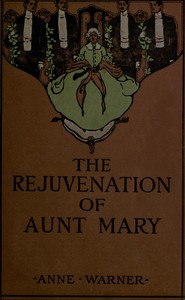
Excerpt
The Project Gutenberg eBook of The Rejuvenation of Aunt Mary by Anne Warner
This eBook is for the use of anyone anywhere in the United States and
most other parts of the world at no cost and with almost no restrictions
whatsoever. You may copy it, give it away or re-use it under the terms
of the Project Gutenberg License included with this eBook or online at
www.gutenberg.org. If you are not located in the United States, you
will have to check the laws of the country where you are located...
Read the Full Text
— End of The Rejuvenation of Aunt Mary —
Book Information
- Title
- The Rejuvenation of Aunt Mary
- Author(s)
- Warner, Anne
- Language
- English
- Type
- Text
- Release Date
- May 6, 2005
- Word Count
- 73,001 words
- Library of Congress Classification
- PS
- Bookshelves
- Browsing: Culture/Civilization/Society, Browsing: Humour, Browsing: Fiction
- Rights
- Public domain in the USA.
Related Books
Wild oats
by Oppenheim, James
English
685h 5m read
Carolyn of the sunny heart
by Endicott, Ruth Belmore
English
1234h 25m read
Three little Trippertrots
by Garis, Howard Roger
English
630h 28m read
Fish preferred
by Wodehouse, P. G. (Pelham Grenville)
English
1315h 21m read
The fatal three, vol. III
by Braddon, M. E. (Mary Elizabeth)
English
807h 15m read

The fatal three, vol. II
by Braddon, M. E. (Mary Elizabeth)
English
854h 48m read