The Project Gutenberg eBook, The People's Palace and the Religious World,
by A Layman
This eBook is for the use of anyone anywhere in the United States and most
other parts of the world at no cost and with almost no restrictions
whatsoever. You may copy it, give it away or re-use it under the terms of
the Project Gutenberg License included with this eBook or online at
www.gutenberg.org. If you are not located in the United States, you'll have
to check the laws of the country where you are located before using this ebook.
Title: The People's Palace and the Religious World
thoughts on public agitation against the promised charter to the
new Crystal Palace Company, and on "Sabbath desecration"
Author: A Layman
Release Date: May 23, 2020 [eBook #62205]
Language: English
Character set encoding: UTF-8
***START OF THE PROJECT GUTENBERG EBOOK THE PEOPLE'S PALACE AND THE
RELIGIOUS WORLD***
Transcribed from the [1853?] Arthur Hall, Virtue, & Co. edition by David
Price, email [email protected]
[Picture: Pamphlet cover]
THE
PEOPLE’S PALACE
AND THE
RELIGIOUS WORLD;
OR,
THOUGHTS ON PUBLIC AGITATION AGAINST THE PROMISED
CHARTER TO THE NEW CRYSTAL PALACE COMPANY,
AND ON “SABBATH DESECRATION.”
BY
A LAYMAN.
“THE SABBATH WAS MADE FOR MAN, NOT MAN FOR THE SABBATH.”
_Mark_ ii. 27.
* * * * *
LONDON:
PUBLISHED FOR THE AUTHOR BY
ARTHUR HALL, VIRTUE, & CO., 25, PATERNOSTER ROW,
INTRODUCTION.
DISAGREEMENT with the object and dislike of the tone of the incipient
agitation for preventing the concession of a Royal Charter to the Crystal
Palace Company, except upon the condition of its gates being closed on
Sunday—a desire to vindicate the consistency of many religious people,
whose silence might be construed into sympathy with the movement—and the
wish to offer a few thoughts on the impolicy, in a religious point of
view, of such attacks on the pleasures of the poor:—are, in brief, the
motives which have determined the printing of the following pages. The
Writer believes the ground traversed is firm and solid, though he is
unable to beguile the journey with those flowers of rhetoric and gleams
of warm fancy with which more gifted writers can brighten their course.
Though inexperience in book-making and pamphleteering is no excuse for
unsound conclusions, he hopes it may avail to disarm the severity of
criticism. Convinced that for the advantage of true religion, as well as
its professors, the ideas he has broached require to be freely, closely,
and sincerely discussed, he ventures to claim for them candid and
unprejudiced consideration. He hopes it is superfluous to state that he
has no pecuniary interest in, nor connexion with, the project in
question.
THE PEOPLE’S PALACE,
_&c._ _&c._
SHALL the new Crystal Palace be open on Sunday? This question is
exciting a good deal of attention—especially in the religious world, and
is likely to attract more, ere finally set at rest. It is a question of
magnitude, and possibly of political importance. It becomes, therefore,
the duty of all who feel interested in its solution, to ascertain clearly
the facts upon which it is based, the principles with which it is bound
up, and the consequences which will flow from its decision. The occasion
seems to have been seized upon by what may be called the Sabbatarian
party, to make a determined stand on behalf of the principle for which
they have often fought and been vanquished—the right of the religious
world to impose their notions of Sabbath observance upon the community at
large. The particular point at issue may be readily decided by any
unbiassed mind, on examination of the actual facts. But the Sabbatarians
refuse to be bound down to the case as it stands. They exaggerate and
pervert the facts; and, under cover of the smoke and excitement thus
created, advance to a general assault upon what they term “Sabbath
desecration.” The design of the next few pages is rather to point out
the impolicy, danger, and hopelessness of any public movement to prevent
the opening of this place of recreation on the Sunday, than to advocate
or defend that step.
Although the facts of the case are conveniently lost sight of by the
agitators in question, they are really so important to a right
understanding of its merits as to admit of re-statement. It appears,
then, that the New Crystal Palace at Sydenham is in the hands of a
joint-stock company, and is to be conducted on the same commercial
principles as all speculations of a like character. Their object is
familiar to every newspaper reader. In brief, they propose to provide
for the people recreation and instruction of a kind not now within their
reach. If the programme be faithfully carried out, the project will
unquestionably tend to improve the health, enlarge the knowledge, and
refine the taste of the public. The Company have applied for a Royal
Charter of Incorporation, the effect of which, as is well known, is to
confine the liability of individual shareholders to the amount of their
shares. In making their application to Lord Derby, the Directors, we are
told by the _Times_, communicated to his Lordship the terms upon which
they proposed to open the building and grounds on Sunday. “They were of
opinion that until after one o’clock no trains should run from London,
and the Crystal Palace itself should be strictly closed. After that hour
they proposed to throw open the park and the winter-garden, but not to
exhibit those departments of the building which will partake exclusively
of a manufacturing and commercial character, the intention being to
devote a certain portion of the space to specimens of manufacture, &c.,
which the public will be invited, upon certain conditions, to display.
In the third place, the Directors undertook that on Sunday no spirituous
liquors should be sold in their grounds.” After an interview with the
Directors, Lord Derby acquiesced in the stipulations proffered by the
Crystal Palace Company, suggested a few trifling variations, and promised
to grant the required Charter.
The announcement of this decision or promise—for it can scarcely be
regarded as a _fait accompli_—has excited not a little alarm amongst a
section of the religious world. The Lord’s Day Society have taken up the
matter very warmly—publishing pamphlets and holding public meetings in
condemnation of the arrangement. The Evangelical Alliance, a wide-spread
organization, at its recent Conference in Dublin, adopted a
strongly-worded resolution and memorial to the Prime Minister to the same
effect. These acts of organized bodies have been vigorously followed up
by journals representing respectively the Evangelical clergy of the
Establishment, Wesleyans, Free Churchmen, and a portion of the Dissenting
community; who call upon their readers, in every capacity, and by every
means, to resist the proposed “wholesale violation of the Lord’s Day.”
{6} The strength of this disapprobation and alarm may be gathered from
one or two quotations. A widely-circulated religious magazine denounces
the proposal as “sinful,” and calculated to “lead to sin on an extensive
and alarming scale,” and calls “upon all religious and moral men,
throughout the United Kingdom, to lift up their voices like a trumpet,
and to cause them to be heard on this great and vital question.” A very
influential newspaper in the North predicts that “the measure will have a
most fatal operation on the religious interests of the country,” and
urges a general expression of public opinion “to prevent the Minister
from persevering in his intention to grant a Charter containing
permission to open the Crystal Palace on Sunday.” A Clapham clergyman,
in a pamphlet very loosely put together, {7} says, “The projected
_aggression of pleasure_ in 1853, is to me a greater object of dread than
the _aggression of Popery_ in 1850, because it falls in with the taste of
the vast majority of mankind.” A metropolitan Dissenting journal speaks
of the question as one involving a principle “that would speedily extend
itself to other institutions,” and expresses its belief that the
recognition by the State that the Sabbath ends at one o’clock, would be
“a far deeper stab to public morality, and afford a greater triumph to
Popery and Infidelity, than any act of the British Government since the
days of James II.” Ministers of religion, of every denomination, are
therefore called upon to protest against the threatened evil, and
Sunday-school teachers to petition against a measure aiming a deadly blow
at those institutions. Another London paper is even more emphatic, not
to say intemperate, upon the subject, describing “this new guild of
Sunday traders as craving, through the sign-manual of the Sovereign,
license to open a gorgeous temple of rampant pleasure, and to filch, by
Royal authority, both coin and conscience from every unit of the
countless myriads, which from Sunday to Sunday, they know, will throng to
this haunt of unzoned enjoyment, and this under the wicked plea of
sympathy for the poor.” These are but specimens of the style of writing
adopted by the self-elected defenders of “Sabbath observance,” in order
to excite their readers to the proper pitch of apprehension. But _ex
pede Herculem_. They will suffice to indicate the real or affected panic
which seems to have seized the leading organs of the religious world, at
the proposed boon to the Crystal Palace Company—an alarm, be it observed,
which may be communicated to thousands of minds, and result in a
virulent, perhaps a formidable movement. Before matters have assumed
this shape, it in worth while to inquire what occasion there is for all
this outcry, and whether Christian men are either right, honest, or wise,
in originating a wide-spread agitation to prevent the concession of the
promised Charter.
The end sought by the objectors is twofold—first, the prevention of the
threatened act of “Sabbath desecration” by Royal authority; and second,
the entire closing of the Palace on Sunday. To produce the greater
effect upon the public, the two questions are ingeniously, but
unscrupulously, mixed up, and furnish a wide margin for that kind of
indignant declamation on encroaching upon “the poor man’s day of rest,”
opening the floodgates of vice and irreligion, &c., &c., which is likely
to tell on the unreflecting. For purposes of dispassionate inquiry, the
questions are better separated.
It appears, then, that the Sabbatarian party are greatly alarmed at the
contemplated sanction by the Crown of the opening of this great theatre
of secular enjoyment on Sunday. It is, they say, a public recognition by
the State of the Sabbath as a secular institution—official encouragement
to Sabbath-breaking. It may be objected, _in limine_, that the facts of
the case do not bear out their assertion in the form presented. When the
new Company went to Government, they were _already_ in possession of the
right to open their grounds on Sunday. The Crystal Palace is private
property; and if the law permits Cremorne and Rosherville Gardens to be
open on that day, what is to prevent the Sydenham Company from using the
same privilege? They, like other joint-stock companies, could exist and
conduct the speculation without the advantages of a Royal Charter. It
is, then, clearly a mistake to suppose that they request Government to
sanction the exercise of that right. They do no such thing. In asking
for the advantages of a Charter, they _volunteer_ certain concessions to
the feelings of the religious world. If Lord Derby had declared himself
not satisfied with the conditions, they might have turned round and said:
“We will, then, do without the privilege, and pursue our own course
unshackled by any restrictions beyond what the law imposes.” Whichever
way, therefore, the question is settled, it cannot be fairly alleged that
the State makes itself a party to “Sabbath desecration.”
It may further be urged, that Government have no right to refuse, on
religious grounds, a privilege which it happens to be at their discretion
to confer. To upholders of the principle of a State religion this
argument will, of course, not avail. They will maintain that the Queen
is the Head of the Church, which, by a legal fiction, includes the
nation; and that, therefore, the exercise of her influence in this matter
is perfectly legitimate. But where is the educated man who, in the
present day, advocates the _theory_ of a church establishment in all its
entirety—that is, who would insist upon the duty of the State to maintain
“the truth,” or, in other words, to exclude all Dissenters and Catholics
from Parliament, and repeal the Toleration Act? The present system of
toleration is confessedly a half-way house to full religious freedom. So
long as Dissent in any shape is recognised by the Government, that
Government—which, for civil purposes, represents the whole community, and
is, moreover, virtually chosen and controlled by a power composed of
diverse religious elements—has no right to make itself the partisan of
any religious opinions. It has long given up the principle in practical
legislation, and the nation has ratified the decision. It is really
surprising that any Dissenters, the fundamental principle of whose
nonconformity is the repudiation of State interference in religious
matters, can, by any sophistry, reconcile their minds to such a violation
of it as is involved in the demand made upon Government to become the
organ of particular religious views on the Sabbath.
“Oh! but,” these Sabbatarians will, doubtless, reply, “we only call upon
the Crown to preserve the Sabbath as a civil institution—a day of rest
from toil—a barrier to the encroachments of ‘money-getting’ companies and
capitalists.” This style of argument is very much like begging the
question. It is simply a claim that the State should accept _their_
definition of what constitutes “a day of rest.” Is it not an enormous
fallacy for religious men to seek to impose upon Government their
interpretation of the Sabbath,—which, moreover, it cannot be denied, is
at variance with that of the bulk of the population,—and require that on
“civil” grounds it shall have the force of law upon the nation?
Cessation from labour, and the observance of certain religious duties,
are by no means one and the same thing. The former may be perfectly
consistent with an excursion into the country, or recreation amid the
woodland scenery of Sydenham—which is the precise thing the religious
agitators, repudiate, and are trying to prevent. The argument has force
only when applied to the case of the servants of the new company, who
will be required to perform certain work on the Sabbath; but even to it
is exceptional; for there _are_ cases in which even the most rigid
Sabbatarians would admit of deviations from its conclusions.
But, putting aside the principle involved;—on the ground of expediency
there are reasons why Government should not refuse the promised Charter
on the plea advanced. They would not be acting consistently. Much
stress is laid upon the presumption that the granting of this Charter—or,
as the Sabbatarians say, the Royal sanction to an act of “Sabbath
desecration”—will be a precedent for the opening on Sunday of every other
place of amusement or recreation, in the metropolis and kingdom. A
precedent forsooth! Has not the metropolis and every large town its
tea-gardens, and places of popular resort? The supply of this species of
Sunday enjoyment already pretty nearly equals the demand. The only
difference between them and the new claimant of popular favour is, that
the latter proposes to furnish a higher style of recreation; and having
many independent recommendations, asks Government for the concession of a
privilege granted to other parties without regard to religious
considerations. Would Lord Derby be dealing out “even-handed justice” to
higgle with this new Company because it had a boon to ask, for a
concession to religious prejudice which was not required in other cases?
But, still further, with what decency could he require the Crystal Palace
Company to close their grounds on the Sabbath, when the Hampton Court
grounds are open to the public by the express authority of the Government
and Legislature? The precedent, at which so much alarm has been
expressed, _has_ for some years past been established. If, as one of the
agitating organs phrases it, the granting of the proposed Charter would
transfer the “sin” of Sabbath desecration from individuals to the nation,
we have been for some time under the threatened curse.
There is no escape, therefore, from the conclusion, that if the Crystal
Palace grounds are to be closed on Sunday—the present law being
confessedly inadequate for that purpose—it must be by a new act of
legislation, not of specific, but of general application—an act which
will include Hampton Court as well as Sydenham, and Rosherville as well
as Hampton Court—which will have the effect of shutting up every place of
popular recreation on Sunday. Are the objectors to the Crystal Palace
Charter prepared for such a wholesale crusade against the recreations of
the people? Have they contemplated such an alternative? Probably
not—that is, so far as the rank and file of the new agitation are
concerned. As respects the leaders, experience is the best test; and
from the avowed desire of the Lord’s Day Society, the Agnewites and the
Plumptres, to enforce by law the “bitter observance of the Sabbath” upon
the nation, it may be easily imagined that they have anticipated such a
crisis, and rather chuckle at the dilemma in which many timid friends of
religious freedom—panic-stricken at the prospect of increased “Sabbath
desecration”—would thereby be placed. Let the latter take warning in
time. It is only by a sweeping measure of legislation which would raise
the working classes up in arms against the religious world, that the new
Crystal Palace, or rather its grounds, can be closed on Sunday.
If there be any truth in the foregoing arguments, the reckless
denunciations we have referred to seem very much beside the mark. One
might have been better pleased, if the tastes and tendencies of the great
bulk of the people were such that the Sydenham Palace were no attraction
to them on the Sabbath—their leisure such as that they did not stand in
peremptory need of such relaxation. The more highly men value communion
with God, the more gladly will they cherish the opportunities of
cultivating the spiritual faculty on the day of rest from secular
employment. But it is only as the privilege is valued that it is useful.
The pleasure and the profit go together. If there be not the spirit of
devotion, will the form of it suffice? Does not the very attempt to
impose the one where the other is wanting, indicate a misconception of
the true spirit of religion? The fuss made by the religious organs about
this proposed Charter is wholly inexplicable on any rational grounds
consistent with the intelligence and truthfulness of those concerned. To
speak of it as fraught with injury to morality and religion is simply a
perversion of language—unsupported by evidence or probabilities. For,
observe—we are not, or only to a small extent, dealing with a population
who now “keep” the Sabbath according to the notions of the religious
world, but with people who, if they do not spend the Sunday at Sydenham,
will, almost without exception, spend it in a worse manner elsewhere.
According to _their_ acceptation of a well-spent Sabbath, it is but a
choice of ills. Where, then, is the alarming evil? Is it, that a
saunter through the Crystal Palace grounds, reached by a railway, is so
much more irreligious than a stroll in the Parks, reached by an omnibus?
Does a change of scenery transform the character of the deed? Do a man’s
nature and tendencies become metamorphosed by exchanging, for a few
hours, his squalid abode for a public-house, a gin-palace, a steamboat, a
tea-garden, or a Crystal Palace? Is there something so deleterious in a
Sunday glance at the beautiful prospects of Anerley, that the country
must be convulsed to prevent it? {12}
It becomes Christian men to look this matter fairly in the face, and not
be deluded by cant and prejudice. Let them manfully examine facts and
probabilities, before they commit themselves to unreasoning clamour.
Neither the cause of religion nor of truth will gain by allowing common
sense to be overborne by invective and exaggeration. The Sabbatarians
themselves will admit that the people who are likely to crown the heights
of Norwood are _not_ those who would otherwise frequent a place of
worship; but, for the most part, overworked artisans and labourers, with
their families, who systematically spend the Sabbath at the tea-garden or
ale-house—who, if they were not at Sydenham would perhaps be at
Gravesend—who, if they could not enjoy the beauties of Sydenham, and
restore their wasted energies amidst its health-inspiring breezes, would
probably kill the time by the indulgence of depraved appetites in a
poisoned atmosphere. The recreations of Sydenham are as elevating,
refining, and harmless, as at any other place of Sunday resort—probably
more so. At the same time, they are more attractive. Is it, then, so
very irrational to suppose that, under the circumstances of the case, the
change will be a gain? Surely it is not Quixotic, though opposed to the
Sabbatarian view, to conclude, that the facilities offered to the working
classes by means of steam for recruiting their strength and improving
their tastes by country excursions, and, in particular, the superior
attractions and judicious regulations of the new Crystal Palace Company,
are, on the whole, calculated to promote the health, temperance, and
morality of the people.
It is not assuming too much to conclude that the “attractions” and
“regulations” of Sydenham will be superior to those which obtain
elsewhere, A visit to the tea-gardens of Chelsea or Camberwell on a
Sunday afternoon or evening—accessible to all who purchase a ticket of
“refreshment”—will satisfy any unprejudiced person on this head. The
scenes he will there witness can scarcely fail to convince him that the
cause of morality will gain from the transference of a portion of the
crowds there assembled to the Norwood grounds and their stricter
surveillance. Other things being equal, ought not the religions world to
_prefer_ that the working classes of London should enjoy the fresh air of
the tea-garden to the drunkenness of the gin-palace—the temperance
associated with the sylvan landscape of Sydenham, to the license of
Cremorne?
No doubt there is another side to the picture. The event so much
deprecated will unquestionably tend to induce many people to “break the
Sabbath” who would not otherwise do so. This will especially be the case
with the young, who will, to some extent, desert our Sunday-schools, as
well as places of worship. But the anticipation of harm from this cause
may be exaggerated. The attractions held out by the Crystal Palace _do_
exist elsewhere, with others of a more baneful character, and you cannot
suppress them but by a general act of legislation. If the number of
pleasure-takers is increased, the influence for evil is diminished. The
argument, too, is essentially vicious; for if its “superior attractions”
is a reason for closing the Crystal Palace on Sunday, fine weather is to
be deprecated on the same ground, and rain and fogs courted as the allies
of church and school!
But the Crystal Palace Charter is menaced because it will rob the poor of
their day of rest! If the poor were _obliged_ to visit Sydenham on
Sunday, there would be some force in the plea. But it is notoriously
otherwise. Are not the hundreds and thousands who every Sunday crowd the
outward-bound railway-carriage, steamboat, and omnibus, following their
own inclination as much as the aristocracy who take their afternoon
airing in Hyde Park, or the thousands who frequent their places of
worship? What right, then, have the latter to dictate to the former how
they shall spend the day of rest—or, unbidden, to constitute themselves
the champions of the “poor man’s day?” May not the journals who hold
such language be fairly called upon to produce their authority? If the
working-classes object to the opening of the Crystal Palace, or to
railway and steamboat travelling, on Sunday, they will refrain from using
them; but so long as it is otherwise, nay, the reverse, religious men
only injure the Christianity they profess, and assume the garb of
hypocrites and intolerants, by pretending that the poor are thereby
wronged, and calling upon the Crown to interfere for their protection.
* * * * *
Briefly to recapitulate the foregoing facts and arguments:—The Crystal
Palace Company is a private speculation, not a public institution. They
propose to open _only_ their grounds and winter-garden on Sunday, and
that but for half the day. This place of recreation, therefore, stands
on much the same footing as Richmond or any other public park—being
accessible to the masses by no other means than a conveyance—differing
only in providing refreshment (exclusive of spirituous liquors) to its
frequenters. It is untrue to assert that a Royal Charter will enable the
Company to open their grounds—for the right exists independent of the
Charter. Government, therefore, cannot be said to sanction “the
desecration of the Sabbath”—being unable to prevent it. The State has no
right to refuse a privilege on religious grounds, seeing that it is a
purely civil institution, and bound to secure entire liberty of
conscience; which is inconsistent with partiality to the views of any
sect. To spend the Sabbath as a day of recreation does not clash with
its definition as “a civil institution.” In exacting the shutting-up of
the Sydenham grounds, Government would be acting inequitably, for other
and worse pleasure-gardens are open on Sunday—inconsistently, for the
grounds of Hampton Court Palace, which are national property, have been
for some years accessible to the people with their express sanction. It
would not, therefore, be a precedent for “the desecration of the
Sabbath.” If the Crystal Palace is closed on that day by authority, all
other places of recreation must be closed also—for you cannot have
partial legislation on the subject. Such a general measure would be
highly unjust and injurious, besides being impracticable. The
much-deprecated event would not be likely to increase the irreligion or
immorality of the people; for, although some few might be led to desert
places of worship and neglect Sabbath privileges, by the superior
attractions of the Sydenham Palace, many more would substitute its
pleasures for those of a less elevating character, offered without
restriction elsewhere; while the bulk of those who frequented it would
not, in all probability, if it were entirely closed, “keep the Sabbath”
in the sense of these alarmists. The day of rest can only be a period of
spiritual profit to those who value it for that purpose. To impose its
religious observances upon those who do not, is to promote hypocrisy, not
piety. For the religious world, confessedly a minority, to seek to
impose, by State interference, their notions of what constitutes a day of
rest upon the bulk of their fellow-countrymen, is intolerant—an act of
coercion at variance with the first principles of Christianity. There is
good reason for believing that the cause of morality, and therefore of
religion, will, with the present tendencies of the metropolitan
working-classes, decidedly _gain_ by the opening of the Sydenham
pleasure-grounds. It will be no more harmful than free access to the
Parks. It will not rob the poor of their “day of rest,” because it is
quite optional with them to go there; and, while they act as free agents,
it may be presumed, that they spend the day as best suits their
inclinations.
* * * * *
The Crystal Palace Company are well able to take care of themselves, nor
does it form part of the plan of these pages to defend their cause. But
the wholesale abuse which is heaped upon them is positively nauseating to
the impartial observer, considering how far they have gone in attempting
to meet religious scruples and prejudices. {15} The mingled rant and
cant issuing from these professedly religious newspapers is extremely
injurious to that Christianity in whose name they profess to speak. Sad
would it be for religion if its holy claims were really associated with
the untruthfulness these organs have uttered—and the more reason why
those, who are jealous for the honour of their faith, should protest
against its name being mixed up with the effusions of intemperate
alarmists. From their spirit it might be thought that the Company had
set the religious world at defiance, instead of shutting up for half the
Sunday, closing the manufacturing and commercial portions of the
building, and forbidding the sale of intoxicating drinks. If they _are_
to blame, it is for conceding too much to prejudice. Nothing is gained
by closing the grounds up to one o’clock—not even the good will of
opponents. The principle which would allow them to be thrown open for
half, would be equally valid to keep them open all, the day. At present,
the arrangement is a mischievous compromise between devotion and
recreation, and stamps the Sabbath on high authority with a continental
character. It gives a wrong notion of godliness, bringing it into
apparent antagonism to secular enjoyment—making one portion of the day a
counterpoise to the other—fostering the delusion that religion is simply
the observances of certain duties and attendance in a place of worship.
If there be any truth in this plain statement of facts and arguments, it
follows that the agitation, being got up professedly to prevent the Crown
from sanctioning the opening of the Crystal Palace on Sunday, is really
directed against all places of recreation accessible to the public on
that day. This, indeed, is the main drift of the declamatory appeals of
its promoters. They are either agitating on false pretences, or covertly
aiming at an object injurious to the liberties and welfare of the
country. If that object were openly avowed, many timid friends of
religious freedom who indulge certain vague fears of the increase of
“Sabbath desecration,” would shrink from supporting it. In either case,
the leaders prove their unfitness to be the guides of opinion. Want of
candour, fairness, and truthfulness, are doubly worthy of exposure and
condemnation when exhibited in connexion with the name of Christianity.
Religion suffers enough from open foes, without the need for injuries
from professed friends. Hence, _because_ they are jealous of its true
character, _because_ anxious to vindicate its purity and self-sustaining
efficiency, it becomes the followers of Christ to protest against this
movement. The very fact that they agree to a great extent in the
religious views of the agitators in question, and sincerely desire to see
the Sabbath valued by all men as an opportunity for spiritual culture and
enjoyment, is an additional reason why they should repudiate the
sentiments uttered, and the course pursued, under the banner of their
faith. The alarmists may rely upon it, that there are many more
followers of Christian truth than the writer of these pages, who have no
sympathy with that intolerance which would coerce others into their
convictions and their method of “keeping” the Sabbath, and who observe,
with pain and indignation, the attempt of misguided, though perhaps
conscientious, men, to originate a crusade against the Sunday recreations
of the people.
* * * * *
It is scarcely possible to discuss this particular topic without the mind
being directed to the general question—of which it is only an
offshoot—_the position assumed by religious men in relation to the world
at large_, _especially to the masses_. A few considerations on this
momentous subject may appropriately and usefully be thrown out in
connexion with the foregoing arguments.
It may be at once stated, that there is no intention of entering into any
argument with the believers in the efficacy of a State-appointed religion
and priesthood. Those who encourage this practical infidelity to the
truths of Christianity—whose principles would have obliged Christ to
exclaim, “My kingdom _is_ of this world”—are, doubtless, doing no
violence to their views in calling upon Government to insist upon “the
bitter observance of the Sabbath,” and to enforce upon Jews, Infidels,
and Mahomedans, outward conformity to the State religion.
But it does so happen that many who are in bondage to this intolerant
principle, do, nevertheless, somehow or other, acknowledge the
transforming influence of Christian truth upon the individual heart, and
are at one, in their religious convictions, with the open adherents of
the voluntary principle. To this united body of what are usually
designated “Evangelical Christians,” the question may fairly be
put—whether they are pursuing that line of policy towards the world which
is best adapted to bring the world over to their views?
Their object, next to their own spiritual improvement—for that _seems_
the great aim of modern Christianity—is to commend the Gospel to those
who have it not—to win over to hearts of men to the authority of
Christ—to induce them to accept to the free offers of reconciliation with
God made through to Saviour, and evermore live in His likeness. They
will readily acknowledge that religion is founded upon love, and adapted
to call forth to willing homage of grateful souls; and that the
spontaneous, cheerful surrender of self to God, the preference of His
will to ours, the cordial reliance upon Him for “every good and every
perfect gift,” is the very essence of Christianity. Institutions, forms,
and ceremonies, are but the media for expressing this truth, and are
worse than useless without it. Sympathy between man and his Creator is
religion—to awaken that sympathy in others, will be the aim of all who
have felt it for themselves.
How, then, do Evangelical Christians commend this living truth to those
who do not profess allegiance to it? To a great extent they conceal its
benign character. They build a wall around it, and make it appear to be
an exclusive property. Oftentimes they refuse to acknowledge it in
others unless associated with certain forms, symbols, and institutions.
They overlay it with the claims of this and that interest, or make it
speak in the language of this or the other ism. They proclaim that the
Gospel is omnipotent to save—that Christ’s kingdom is a spiritual
kingdom, and His reign in the heart of man—but, alas! practice and belief
do not correspond. They are, to a great extent, afraid to trust
Christianity to its inherent power. For the propagation of the truth, or
the extinction of unbelief, they will often have recourse to means not in
harmony with their convictions. “The end sanctifies the means”—often,
unconsciously, forms their rule of conduct, and quiets their scruples in
trying to make men religious by irreligious means, in claiming the aid of
the magistrate’s sword in putting down error, in demanding that the
incitements to sin be removed by the strong arm of compulsion, yea,
sometimes, in attempting to _coerce_ the indifferent into the reception
of to truth. How greatly does this want of confidence in the power of
the Gospel contrast with that scriptural faith which is able “to remove
mountains!”
A State religion is, no doubt, the greatest obstacle to a proper
appreciation of Christianity by the working classes—for through that
medium it is reflected as simply an elaborate machinery to provide
comfortable incomes for an army of priests—a gigantic establishment based
upon selfishness. But even this dead weight upon the progress of
religion would be greatly lightened if Evangelical Christians rightly
commended it to the affections of the people—if, instead of bowing down
to the great imposture, and drinking into its spirit, they unceasingly
displayed the benign and disinterested character of the Gospel. Whatever
the religious organizations of the present day accomplish—and it is not
denied that they do something—they do not seem to be capable of
evangelizing the masses. To this objection it is no reply to urge that
they never have, except to a small extent, effected that purpose. If
true religion be what the religious world say it is, there must be,
irrespective of all former experience, some lamentable deficiency in the
mode of presenting its great and omnipotent truths to the people. For it
is a notorious fact that the bulk of our working population do not care
for religion, scarcely come within range of its teachings, and, for the
most part, dislike its professional representatives. Is there not here
something more than the natural aversion to superior goodness, and the
preference for self-gratification?
Every one will have fresh in recollection a touching episode in that
eminently religious book, “Uncle Tom’s Cabin,” in which are detailed the
successive steps in the training of a little outcast negro. Miss Ophelia
undertook the benevolent task, and performed it only too conscientiously.
No pains, no sacrifices, were spared in educating the benighted Topsy.
The system of the Northern lady was perfect in its mechanism.
Instruction, exhortation, reproof, punishment, followed in due order.
The young mind exhibited unusual quickness and aptitude in the
acquisition of knowledge. One element alone was wanting—the moral
influence of the teacher. That being absent, all the rest seemed
comparatively valueless. Between the upright New Englander, with her
unflinching sense of duty and her prejudice against colour, and the
hardened negro girl, there was no connecting link—an entire absence of
affection and sympathy. Yet that moral waste on which the lady of strong
sense and set rules could make no impression, was reclaimed by the
kindness of a child. Topsy’s heart, steeled to Miss Ophelia’s
exhortations, melted at Eva’s sympathy. {18}
This story fitly illustrates the present relationship of the Church and
the world. Organised religious communities may establish their
societies, may erect their places of worship, may give their lectures
with the object of reclaiming the masses from vice and irreligion, may
proclaim the sinfulness and the duties of men—and yet their labours may
achieve only partial success. The means may be admirable, but the spirit
that breathes through them may be defective. There may be a great show
of concern, the conscientious performance of a duty, but an absence of
that cordial, hearty interest which is requisite to kindle sympathy.
Surely there is a philosophy in the use of religious agencies as in
ordinary affairs. In our efforts to evangelize the poor—to whom
originally the Gospel was preached, and amongst whom, it should never be
forgotten, were its greatest triumphs—we are bound to consider the
probable results of the _means_ put in operation, as well as the _end_
sought, unless we expect God to work a miracle. Otherwise, with all the
elements of success, we may make no progress; and, perchance, pull down
with one hand while we are building up with the other.
Is it reasonable, or at all in accordance with experience, to suppose
that the way to reach the hearts of the people is to put ourselves into
direct antagonism to their rights, habits, or wishes? Do we commend the
Gospel to them by fostering the notion that men may be made religious by
Act of Parliament, or the fiat of the Crown—by insisting that they shall
“keep” the Sabbath according to our notions, not their own—by clamouring
to curtail the means of obtaining pure air and recreation one day out of
seven, because we consider it “sinful?” The religious world is absorbed
with its “causes” and “interests,” “enjoyments” and “privileges;” and,
while thus systematically turning its attention _inwards_, and
calculating every pulsation of the great world around in relation to
itself, is too apt to forget that there is a moral law whose foundations
lie deep in the principles of revealed truth—and that any violation of
the precepts of that law, whether by abrogating natural rights, dictating
the actions and occupations of others, or coercing them into an apparent
piety of heart and life, is altogether foreign to the genius of
Christianity. Our Lord has given his followers an injunction to preach
the Gospel—the power of which over the heart none who have felt it can
mistrust. If by this agency, and this alone, the affections of man are
to be changed and a new life created within him—if, in a word, the world
is to be _won_ over to the cause of truth, by the exhibition of God’s
love—surely it indicates a want of worldly wisdom as well as distrust of
the Divine power and promises, for the disciples of Christ to be calling
to their aid extraneous help;—at one time relying upon the sword of the
civil magistrates—at another on Parliamentary legislation. If its
professors are to be believed, Christianity is _ever_ in imminent danger.
Between the encroachments of Popery and the progress of Infidelity, we
are always in a state of chronic alarm for organized religion. Really it
would seem, that if it were not for the frequent exercise of a little
authority—that is, physical force, an occasional crusade against Popery,
a persecution _by society_ of free inquiry, the religious world would
lose all confidence—Samson must inevitably be overcome by the seductions
of Delilah or the hosts of the Philistines. It may safely be concluded
that, where this faithlessness obtains, the power of the Gospel is
deficient. Christianity is essentially aggressive, but, according to the
experience of its degenerate disciples, it is hard work to act upon the
defensive. Does not the outside world take note of these things? What
more natural than that the sceptic and indifferent should doubt the
alleged power of religion when such are its apparent manifestations—when,
positively, any particular discovery of great advantage to mankind, such
as the application of steam to locomotion, or any special event promising
social benefit, such as the opening of the new Crystal Palace, fills its
adherents with apprehension, because it seems to disturb their particular
interests?
* * * * *
How is the great gulph that separates the masses of the people from
religious institutions to be bridged over? Here is a problem worthy of
the anxious consideration of the religious world. To treat so great a
subject would require the compass of a volume instead of a pamphlet.
Indeed, it has already been discussed _in extenso_ by others; so that it
is superfluous to do more in these pages, than refer to one or two points
directly bearing on the question in hand. It may then be remarked, that
to secure the required end it is needful not only _to do_, but that much
_must be left undone_—especially in the direction of the poor man’s
pleasures. If the Gospel be not taken to them they were better left
alone; for interference with their rights only irritates them, and widens
the gulph. The two forces will, as things go, move on like parallel
lines, but never unite. The bulk of the people are far beyond the reach
of such delusive palliatives as stopping Sunday trains, and shutting up
tea-gardens and public-houses. The preacher’s voice rarely reaches them,
and Christianity itself wears, in their eyes, the stigma of being a
middle-class religion, not adapted to the poor, to whom originally it was
“glad tidings of salvation.” They are, besides, almost ostracised from
our religious assemblies. Talk of Sabbath desecration! Suppose
working-men—say, for example, the 10,000 pleasure-seekers on the Croydon
line—were to flock to our places of worship? What is to be done with
them? There is at present no room for them _in the system_. It requires
time and money to erect and consecrate steepled buildings, fashion pews,
make cushions, choose a professional minister, and organize collections,
&c. And _when_ done, how does it suit the tastes and sympathies of the
poor? Do they not feel themselves out of place, and suspect the means
are made of importance disproportionate to, and even obstructive of, the
end? Christianity appears to them entrenched behind a barricade of forms
and creeds, and genteel requirements, which its followers have erected.
The world without catches but a distant and imperfect glimpse of its
benign features. Religious men prefer standing behind their
entrenchments to an aggressive movement in front, or if they do advance
it is with incumbrances great as those which impede an English army
marching over the plains of India. Costly temples, with elegant spires,
are becoming increasingly necessary to the proclamation of Divine truth,
and, in not a few cases, pious men half sink under the sacrifices thus
incurred, or the load of debt contracted. There is something quite
affecting in the fact, that while the masses of the people are getting
farther and farther off from the agency of religious institutions,
Christians who are ever denouncing the external pomp and show of Popery
are, as it were, _concentrating_ their attention on genteel and elegant
places of worship, and in all their arrangements for the celebration of
religion approximating to the Romanist standard. And this—when a portion
of such superfluous expenditure would provide means for carrying the
Gospel into the ranks of the poor—is boasted of as a mark of taste—of
Christian earnestness—of religious progress! Fatal delusion! {21}
Men’s susceptibilities are the same as ever they were—but how to awaken
them? The religious world will find it in the career and directions of
their great Exemplar, _not_ in the bearing of the Pharisees. The grand
truth embodied in the aphorism of our great dramatist—
“One touch of Nature
Makes the whole world kin,”
has a spiritual as well as a social meaning. To recur to our former
illustration. A child with love in her heart and sympathy in her eye,
may subdue the will when reason and authority utterly fail. By
approaching the masses in this spirit, the religious world may gain
access to their affections, and will, no doubt, find that the Gospel
retains its pristine omnipotence. But if they are to be treated as the
patrimony of organized religious societies and institutions, to be
“cribbed, cabined, and confined” at their pleasure, and admonished from
afar off on the sinfulness of Sunday recreation—if the enormities of
Popery are more zealously denounced, and hair-splitting differences
agitated, by ministers and their flocks, than THE TRUTH preached “_in the
love of it_”—farewell to all hopes of making any substantial progress in
evangelizing the great bulk of the working classes! {22}
By such movements as that we have objected to, the poor are being driven
_farther off_ from Christianity. Suppose this particular Sabbatarian
agitation to be successful, where is the gain to religion? Will it not
be associated in the minds of those already out of reach of the preaching
of the Gospel, with a dog-in-the-manger meddlesomeness, with the claims
of rival systems, and the designs of interested priests? What an
encouragement would it be to that party represented by the “Lord’s Day
Society,” who would avowedly use their triumph as a stepping-stone to
further demands—who would stop all trains and conveyances on the Sabbath,
except, perhaps, the carriage of the rich—who would ruthlessly sacrifice
the health of the working-man by confining him to the filth and closeness
of this wilderness of bricks and mortar, and who would erect over the
remains of pure and gentle Christianity, a gigantic system of hypocrisy
and formalism which would ill conceal the hatred and disgust of all
classes for a religion without heart or sincerity!
To treat the working-classes in the spirit of those who are fomenting
this agitation, is unjust and cruel, as well as impolitic. The point has
been before adverted to, but will bear amplification. Suppose the Rev.
Mr. Orthodox, the popular preacher of the West End, discussing this
question of “Sabbath desecration” in the squalid apartment (if ever he
has found his way there) of John Starveling, the overworked slop-tailor,
of Typhus Court, Westminster. To the weighty arguments of the wealthy
rector, on the necessity of shutting up all railways and stopping all
conveyances, may not the poor underpaid artizan reply, that the Sabbath
was made for man, not man for the Sabbath—that God requires mercy, not
sacrifice—that the Sunday trip is to him the safety valve of life—that so
long as he is obliged to work for six days out of seven, without
intermission, to keep body and soul together, the seventh _must_ be
devoted to renovation. Let the charge of mammon-worship rest on the
right shoulders. If the Crystal Palace Company, who enable this poor man
to inhale the pure air and enjoy the beauties of nature, are actuated by
sordid motives, how much more are they—and their name is legion—who allow
their passion for money-getting to reduce thousands to a life of slavery,
and oblige them to regard Sunday not as the Lord’s Day, but only an
opportunity to repair their wasted health and energies.
There is not much doubt or danger in the conclusion that whatever tends
to ameliorate the condition of the people, to ennoble their tastes, to
expand their ideas, or to improve their physical well-being, opens a more
favourable field for the influence of religion. The converse of this
truth will be seen in the almost hopelessly-irreclaimable state of the
adult “dangerous” classes. Religious bodies mistake in shaping their
plans as if there were no medium, looked at from a Christian point of
view, between the lowest depths of depraved self-indulgence, and the pure
aspirations of devotion. They are not exempt from recognising the truth,
that all physical, social, and political improvements, as well as the
consistency, meekness, and gentleness of the followers of the Gospel,
have a bearing upon the spiritual destinies of mankind. When will they
cordially acknowledge in their creed that the man who discountenances the
mammon-grasping spirit of the age—who promotes the education of the
poor—who advocates a reform of prison discipline—who helps to sweeten an
unwholesome neighbourhood—who encourages pure and healthy recreation, is
doing more to prepare a soil favourable for the reception of religious
truth, and to break down the barriers which interpose between the working
classes and the religious world than the No-Popery agitator, the
loud-mouthed denouncer of “Sabbath desecration,” or the zealous stickler
for outward uniformity and formal observances? The one is doing
something to repair dilapidated humanity—the other is interposing fresh
obstacles to that great desideratum.
FOOTNOTES.
{6} We have diligently read all we have been able to lay our hands upon
in favour of the agitation—but only one out of what may be called the
“religious newspapers”—the _Nonconformist_—has, so far as we are aware,
discountenanced it. Still it is to be borne in mind that this seeming
unanimity is by no means indicative of the same feeling amongst
intelligent Evangelicals, in whom a liberalizing leaven is largely at
work.
{7} The Divided Sabbath. Remarks concerning the Crystal Palace, now
erecting at Sydenham. By the Rev. Wm. Jowett, M.A. London: Seeleys.
{12} The Sabbatarians can scarcely be aware that the Croydon Railway
Company _now_ often carry as many as 10,000 pleasure-seekers up and down
their line on Sunday.
{15} One journal calls them “the devil’s caterers.”
{18} This beautiful episode has been quoted with admiration by some
newspapers, which, if the truth wrapped up in it had been invested with
the folds of modern religionism, would, doubtless, have described it as
fanaticism. So much depends upon the shape and spirit in which religion
is presented. May not some portion of the aversion set down to the
_thing_ sometimes result from the _mode_ of its presentation?
{21} This statement may be set down as an exaggeration of the facts. It
was, however suggested to the mind of the writer, by the perusal of a
striking speech of the Rev. Dr. Campbell’s, at a recent meeting in
Manchester, in aid of a Jubilee Fund for the Sunday School Union. In the
course of his address, he adverted to “the terrible fact” that if the
clergy of all denominations, and the city missionaries, with all their
converts and adherents, were removed from the great metropolis, “the
blank thereby created would not be very great.” He went on to say that
“adult conversions” in London and England were “a rare thing,” and to
describe the class as “sealed, unapproachable, unimpressible.” He
proceeded in the following strain:—“Were you to multiply your ministers,
both Church and Dissent, with real evangelical men, and to build edifices
so that each thousand of our adult population should command for its
service—if it choose to avail itself of it—such clergymen, or minister,
it would very slightly alter the case . . . I have no hesitation in
saying, that, unless some other agency than the public ministration of
the Word is brought actively into operation, even if we had such an
assemblage of gifts and talents concentred in our preachers as the world
never saw, we could not do much.” His hope lay only in the influence of
Sunday Schools upon the minds of the young.
{22} The writer does not deem the tenour of the above arguments
inconsistent with a belief in the fact that the major part of whatever
good is _done_ in this world for elevating fallen humanity, socially or
religiously, results from the self-denying efforts of pious men. While
others _talk_ they _act_. They deserve all honour for what they
accomplish, but have no claim, on that account, to be exempted from fair
comment. These strictures will, no doubt, be set down to a censorious
spirit, and not unlikely the writer will be denounced as an enemy in
disguise. This, however, is the lot of all reformers and objectors to
things as they are. _For its own sake_, irrespectively of the general
principle, the Christian Church ought to value the right of free
discussion. Honest criticism of a good cause, is much more to be desired
than undiscriminating praise. It is a mournful fact, and _in itself_ a
sure symptom of unhealthiness, that there is scarcely a religious
magazine or newspaper which dare venture to give utterance to such
sentiments as are contained in this pamphlet. The outcry raised against
the candid expression of opinion has these, amongst others, injurious
effects—it perpetuates corruption, it drives intelligent young men away
from religious societies, and it furnishes unbelievers with a cogent
argument against the Gospel. God grant that the Christian Church may put
away this mischievous intolerance, and pursue their mission with a
greater breadth of plan, wisdom of purpose, toleration of differences,
and economy of means.
***END OF THE PROJECT GUTENBERG EBOOK THE PEOPLE'S PALACE AND THE
RELIGIOUS WORLD***
******* This file should be named 62205-0.txt or 62205-0.zip *******
This and all associated files of various formats will be found in:
http://www.gutenberg.org/dirs/6/2/2/0/62205
Updated editions will replace the previous one--the old editions will
be renamed.
Creating the works from print editions not protected by U.S. copyright
law means that no one owns a United States copyright in these works,
so the Foundation (and you!) can copy and distribute it in the United
States without permission and without paying copyright
royalties. Special rules, set forth in the General Terms of Use part
of this license, apply to copying and distributing Project
Gutenberg-tm electronic works to protect the PROJECT GUTENBERG-tm
concept and trademark. Project Gutenberg is a registered trademark,
and may not be used if you charge for the eBooks, unless you receive
specific permission. If you do not charge anything for copies of this
eBook, complying with the rules is very easy. You may use this eBook
for nearly any purpose such as creation of derivative works, reports,
performances and research. They may be modified and printed and given
away--you may do practically ANYTHING in the United States with eBooks
not protected by U.S. copyright law. Redistribution is subject to the
trademark license, especially commercial redistribution.
START: FULL LICENSE
THE FULL PROJECT GUTENBERG LICENSE
PLEASE READ THIS BEFORE YOU DISTRIBUTE OR USE THIS WORK
To protect the Project Gutenberg-tm mission of promoting the free
distribution of electronic works, by using or distributing this work
(or any other work associated in any way with the phrase "Project
Gutenberg"), you agree to comply with all the terms of the Full
Project Gutenberg-tm License available with this file or online at
www.gutenberg.org/license.
Section 1. General Terms of Use and Redistributing Project
Gutenberg-tm electronic works
1.A. By reading or using any part of this Project Gutenberg-tm
electronic work, you indicate that you have read, understand, agree to
and accept all the terms of this license and intellectual property
(trademark/copyright) agreement. If you do not agree to abide by all
the terms of this agreement, you must cease using and return or
destroy all copies of Project Gutenberg-tm electronic works in your
possession. If you paid a fee for obtaining a copy of or access to a
Project Gutenberg-tm electronic work and you do not agree to be bound
by the terms of this agreement, you may obtain a refund from the
person or entity to whom you paid the fee as set forth in paragraph
1.E.8.
1.B. "Project Gutenberg" is a registered trademark. It may only be
used on or associated in any way with an electronic work by people who
agree to be bound by the terms of this agreement. There are a few
things that you can do with most Project Gutenberg-tm electronic works
even without complying with the full terms of this agreement. See
paragraph 1.C below. There are a lot of things you can do with Project
Gutenberg-tm electronic works if you follow the terms of this
agreement and help preserve free future access to Project Gutenberg-tm
electronic works. See paragraph 1.E below.
1.C. The Project Gutenberg Literary Archive Foundation ("the
Foundation" or PGLAF), owns a compilation copyright in the collection
of Project Gutenberg-tm electronic works. Nearly all the individual
works in the collection are in the public domain in the United
States. If an individual work is unprotected by copyright law in the
United States and you are located in the United States, we do not
claim a right to prevent you from copying, distributing, performing,
displaying or creating derivative works based on the work as long as
all references to Project Gutenberg are removed. Of course, we hope
that you will support the Project Gutenberg-tm mission of promoting
free access to electronic works by freely sharing Project Gutenberg-tm
works in compliance with the terms of this agreement for keeping the
Project Gutenberg-tm name associated with the work. You can easily
comply with the terms of this agreement by keeping this work in the
same format with its attached full Project Gutenberg-tm License when
you share it without charge with others.
1.D. The copyright laws of the place where you are located also govern
what you can do with this work. Copyright laws in most countries are
in a constant state of change. If you are outside the United States,
check the laws of your country in addition to the terms of this
agreement before downloading, copying, displaying, performing,
distributing or creating derivative works based on this work or any
other Project Gutenberg-tm work. The Foundation makes no
representations concerning the copyright status of any work in any
country outside the United States.
1.E. Unless you have removed all references to Project Gutenberg:
1.E.1. The following sentence, with active links to, or other
immediate access to, the full Project Gutenberg-tm License must appear
prominently whenever any copy of a Project Gutenberg-tm work (any work
on which the phrase "Project Gutenberg" appears, or with which the
phrase "Project Gutenberg" is associated) is accessed, displayed,
performed, viewed, copied or distributed:
This eBook is for the use of anyone anywhere in the United States and
most other parts of the world at no cost and with almost no
restrictions whatsoever. You may copy it, give it away or re-use it
under the terms of the Project Gutenberg License included with this
eBook or online at www.gutenberg.org. If you are not located in the
United States, you'll have to check the laws of the country where you
are located before using this ebook.
1.E.2. If an individual Project Gutenberg-tm electronic work is
derived from texts not protected by U.S. copyright law (does not
contain a notice indicating that it is posted with permission of the
copyright holder), the work can be copied and distributed to anyone in
the United States without paying any fees or charges. If you are
redistributing or providing access to a work with the phrase "Project
Gutenberg" associated with or appearing on the work, you must comply
either with the requirements of paragraphs 1.E.1 through 1.E.7 or
obtain permission for the use of the work and the Project Gutenberg-tm
trademark as set forth in paragraphs 1.E.8 or 1.E.9.
1.E.3. If an individual Project Gutenberg-tm electronic work is posted
with the permission of the copyright holder, your use and distribution
must comply with both paragraphs 1.E.1 through 1.E.7 and any
additional terms imposed by the copyright holder. Additional terms
will be linked to the Project Gutenberg-tm License for all works
posted with the permission of the copyright holder found at the
beginning of this work.
1.E.4. Do not unlink or detach or remove the full Project Gutenberg-tm
License terms from this work, or any files containing a part of this
work or any other work associated with Project Gutenberg-tm.
1.E.5. Do not copy, display, perform, distribute or redistribute this
electronic work, or any part of this electronic work, without
prominently displaying the sentence set forth in paragraph 1.E.1 with
active links or immediate access to the full terms of the Project
Gutenberg-tm License.
1.E.6. You may convert to and distribute this work in any binary,
compressed, marked up, nonproprietary or proprietary form, including
any word processing or hypertext form. However, if you provide access
to or distribute copies of a Project Gutenberg-tm work in a format
other than "Plain Vanilla ASCII" or other format used in the official
version posted on the official Project Gutenberg-tm web site
(www.gutenberg.org), you must, at no additional cost, fee or expense
to the user, provide a copy, a means of exporting a copy, or a means
of obtaining a copy upon request, of the work in its original "Plain
Vanilla ASCII" or other form. Any alternate format must include the
full Project Gutenberg-tm License as specified in paragraph 1.E.1.
1.E.7. Do not charge a fee for access to, viewing, displaying,
performing, copying or distributing any Project Gutenberg-tm works
unless you comply with paragraph 1.E.8 or 1.E.9.
1.E.8. You may charge a reasonable fee for copies of or providing
access to or distributing Project Gutenberg-tm electronic works
provided that
* You pay a royalty fee of 20% of the gross profits you derive from
the use of Project Gutenberg-tm works calculated using the method
you already use to calculate your applicable taxes. The fee is owed
to the owner of the Project Gutenberg-tm trademark, but he has
agreed to donate royalties under this paragraph to the Project
Gutenberg Literary Archive Foundation. Royalty payments must be paid
within 60 days following each date on which you prepare (or are
legally required to prepare) your periodic tax returns. Royalty
payments should be clearly marked as such and sent to the Project
Gutenberg Literary Archive Foundation at the address specified in
Section 4, "Information about donations to the Project Gutenberg
Literary Archive Foundation."
* You provide a full refund of any money paid by a user who notifies
you in writing (or by e-mail) within 30 days of receipt that s/he
does not agree to the terms of the full Project Gutenberg-tm
License. You must require such a user to return or destroy all
copies of the works possessed in a physical medium and discontinue
all use of and all access to other copies of Project Gutenberg-tm
works.
* You provide, in accordance with paragraph 1.F.3, a full refund of
any money paid for a work or a replacement copy, if a defect in the
electronic work is discovered and reported to you within 90 days of
receipt of the work.
* You comply with all other terms of this agreement for free
distribution of Project Gutenberg-tm works.
1.E.9. If you wish to charge a fee or distribute a Project
Gutenberg-tm electronic work or group of works on different terms than
are set forth in this agreement, you must obtain permission in writing
from both the Project Gutenberg Literary Archive Foundation and The
Project Gutenberg Trademark LLC, the owner of the Project Gutenberg-tm
trademark. Contact the Foundation as set forth in Section 3 below.
1.F.
1.F.1. Project Gutenberg volunteers and employees expend considerable
effort to identify, do copyright research on, transcribe and proofread
works not protected by U.S. copyright law in creating the Project
Gutenberg-tm collection. Despite these efforts, Project Gutenberg-tm
electronic works, and the medium on which they may be stored, may
contain "Defects," such as, but not limited to, incomplete, inaccurate
or corrupt data, transcription errors, a copyright or other
intellectual property infringement, a defective or damaged disk or
other medium, a computer virus, or computer codes that damage or
cannot be read by your equipment.
1.F.2. LIMITED WARRANTY, DISCLAIMER OF DAMAGES - Except for the "Right
of Replacement or Refund" described in paragraph 1.F.3, the Project
Gutenberg Literary Archive Foundation, the owner of the Project
Gutenberg-tm trademark, and any other party distributing a Project
Gutenberg-tm electronic work under this agreement, disclaim all
liability to you for damages, costs and expenses, including legal
fees. YOU AGREE THAT YOU HAVE NO REMEDIES FOR NEGLIGENCE, STRICT
LIABILITY, BREACH OF WARRANTY OR BREACH OF CONTRACT EXCEPT THOSE
PROVIDED IN PARAGRAPH 1.F.3. YOU AGREE THAT THE FOUNDATION, THE
TRADEMARK OWNER, AND ANY DISTRIBUTOR UNDER THIS AGREEMENT WILL NOT BE
LIABLE TO YOU FOR ACTUAL, DIRECT, INDIRECT, CONSEQUENTIAL, PUNITIVE OR
INCIDENTAL DAMAGES EVEN IF YOU GIVE NOTICE OF THE POSSIBILITY OF SUCH
DAMAGE.
1.F.3. LIMITED RIGHT OF REPLACEMENT OR REFUND - If you discover a
defect in this electronic work within 90 days of receiving it, you can
receive a refund of the money (if any) you paid for it by sending a
written explanation to the person you received the work from. If you
received the work on a physical medium, you must return the medium
with your written explanation. The person or entity that provided you
with the defective work may elect to provide a replacement copy in
lieu of a refund. If you received the work electronically, the person
or entity providing it to you may choose to give you a second
opportunity to receive the work electronically in lieu of a refund. If
the second copy is also defective, you may demand a refund in writing
without further opportunities to fix the problem.
1.F.4. Except for the limited right of replacement or refund set forth
in paragraph 1.F.3, this work is provided to you 'AS-IS', WITH NO
OTHER WARRANTIES OF ANY KIND, EXPRESS OR IMPLIED, INCLUDING BUT NOT
LIMITED TO WARRANTIES OF MERCHANTABILITY OR FITNESS FOR ANY PURPOSE.
1.F.5. Some states do not allow disclaimers of certain implied
warranties or the exclusion or limitation of certain types of
damages. If any disclaimer or limitation set forth in this agreement
violates the law of the state applicable to this agreement, the
agreement shall be interpreted to make the maximum disclaimer or
limitation permitted by the applicable state law. The invalidity or
unenforceability of any provision of this agreement shall not void the
remaining provisions.
1.F.6. INDEMNITY - You agree to indemnify and hold the Foundation, the
trademark owner, any agent or employee of the Foundation, anyone
providing copies of Project Gutenberg-tm electronic works in
accordance with this agreement, and any volunteers associated with the
production, promotion and distribution of Project Gutenberg-tm
electronic works, harmless from all liability, costs and expenses,
including legal fees, that arise directly or indirectly from any of
the following which you do or cause to occur: (a) distribution of this
or any Project Gutenberg-tm work, (b) alteration, modification, or
additions or deletions to any Project Gutenberg-tm work, and (c) any
Defect you cause.
Section 2. Information about the Mission of Project Gutenberg-tm
Project Gutenberg-tm is synonymous with the free distribution of
electronic works in formats readable by the widest variety of
computers including obsolete, old, middle-aged and new computers. It
exists because of the efforts of hundreds of volunteers and donations
from people in all walks of life.
Volunteers and financial support to provide volunteers with the
assistance they need are critical to reaching Project Gutenberg-tm's
goals and ensuring that the Project Gutenberg-tm collection will
remain freely available for generations to come. In 2001, the Project
Gutenberg Literary Archive Foundation was created to provide a secure
and permanent future for Project Gutenberg-tm and future
generations. To learn more about the Project Gutenberg Literary
Archive Foundation and how your efforts and donations can help, see
Sections 3 and 4 and the Foundation information page at
www.gutenberg.org
Section 3. Information about the Project Gutenberg Literary
Archive Foundation
The Project Gutenberg Literary Archive Foundation is a non profit
501(c)(3) educational corporation organized under the laws of the
state of Mississippi and granted tax exempt status by the Internal
Revenue Service. The Foundation's EIN or federal tax identification
number is 64-6221541. Contributions to the Project Gutenberg Literary
Archive Foundation are tax deductible to the full extent permitted by
U.S. federal laws and your state's laws.
The Foundation's principal office is in Fairbanks, Alaska, with the
mailing address: PO Box 750175, Fairbanks, AK 99775, but its
volunteers and employees are scattered throughout numerous
locations. Its business office is located at 809 North 1500 West, Salt
Lake City, UT 84116, (801) 596-1887. Email contact links and up to
date contact information can be found at the Foundation's web site and
official page at www.gutenberg.org/contact
For additional contact information:
Dr. Gregory B. Newby
Chief Executive and Director
[email protected]
Section 4. Information about Donations to the Project Gutenberg
Literary Archive Foundation
Project Gutenberg-tm depends upon and cannot survive without wide
spread public support and donations to carry out its mission of
increasing the number of public domain and licensed works that can be
freely distributed in machine readable form accessible by the widest
array of equipment including outdated equipment. Many small donations
($1 to $5,000) are particularly important to maintaining tax exempt
status with the IRS.
The Foundation is committed to complying with the laws regulating
charities and charitable donations in all 50 states of the United
States. Compliance requirements are not uniform and it takes a
considerable effort, much paperwork and many fees to meet and keep up
with these requirements. We do not solicit donations in locations
where we have not received written confirmation of compliance. To SEND
DONATIONS or determine the status of compliance for any particular
state visit www.gutenberg.org/donate
While we cannot and do not solicit contributions from states where we
have not met the solicitation requirements, we know of no prohibition
against accepting unsolicited donations from donors in such states who
approach us with offers to donate.
International donations are gratefully accepted, but we cannot make
any statements concerning tax treatment of donations received from
outside the United States. U.S. laws alone swamp our small staff.
Please check the Project Gutenberg Web pages for current donation
methods and addresses. Donations are accepted in a number of other
ways including checks, online payments and credit card donations. To
donate, please visit: www.gutenberg.org/donate
Section 5. General Information About Project Gutenberg-tm electronic works.
Professor Michael S. Hart was the originator of the Project
Gutenberg-tm concept of a library of electronic works that could be
freely shared with anyone. For forty years, he produced and
distributed Project Gutenberg-tm eBooks with only a loose network of
volunteer support.
Project Gutenberg-tm eBooks are often created from several printed
editions, all of which are confirmed as not protected by copyright in
the U.S. unless a copyright notice is included. Thus, we do not
necessarily keep eBooks in compliance with any particular paper
edition.
Most people start at our Web site which has the main PG search
facility: www.gutenberg.org
This Web site includes information about Project Gutenberg-tm,
including how to make donations to the Project Gutenberg Literary
Archive Foundation, how to help produce our new eBooks, and how to
subscribe to our email newsletter to hear about new eBooks.
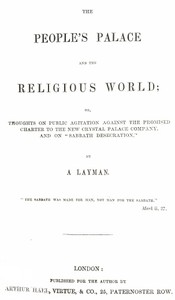
The People's Palace and the Religious World - or, thoughts on public agitation against the promised charter to the new Crystal Palace Company, and on "Sabbath desecration"
by
Layman
Download Formats:
Excerpt
The Project Gutenberg eBook, The People's Palace and the Religious World,
by A Layman
This eBook is for the use of anyone anywhere in the United States and most
other parts of the world at no cost and with almost no restrictions
whatsoever. You may copy it, give it away or re-use it under the terms of
the Project Gutenberg License included with this eBook or online at
www.gutenberg.org. If you are not located in the United States, you'll have
to check the laws of the country where...
Read the Full Text
— End of The People's Palace and the Religious World - or, thoughts on public agitation against the promised charter to the new Crystal Palace Company, and on "Sabbath desecration" —
Book Information
- Title
- The People's Palace and the Religious World - or, thoughts on public agitation against the promised charter to the new Crystal Palace Company, and on "Sabbath desecration"
- Author(s)
- Layman
- Language
- English
- Type
- Text
- Release Date
- May 23, 2020
- Word Count
- 12,103 words
- Library of Congress Classification
- BV
- Bookshelves
- Browsing: Philosophy & Ethics, Browsing: Politics, Browsing: Religion/Spirituality/Paranormal
- Rights
- Public domain in the USA.
Related Books
A Few Words on the Crystal Palace Question
by Vaughan, C. J. (Charles John)
English
70h 56m read
A Second Letter on the late Post Office Agitation
by Vaughan, C. J. (Charles John)
English
108h 1m read
A Reply to Dr. Vaughan's "Letter on the Late Post-Office Agitation"
by Pears, James Roberts
English
89h 32m read
A Letter on the Late Post Office Agitation
by Vaughan, C. J. (Charles John)
English
40h 14m read
An Apology for the Colouring of the Greek Court in the Crystal Palace
by Jones, Owen
English
273h 37m read
Our Sabbaths in Danger - A Sermon, deprecating the contemplated opening of the Crystal Palace on the Lord's-Day
by Moore, Daniel
English
179h 58m read