The Project Gutenberg EBook of The Orbis Pictus, by John Amos Comenius
This eBook is for the use of anyone anywhere at no cost and with
almost no restrictions whatsoever. You may copy it, give it away or
re-use it under the terms of the Project Gutenberg License included
with this eBook or online at www.gutenberg.org
Title: The Orbis Pictus
Author: John Amos Comenius
Editor: Charles William Bardeen
Translator: Charles Hoole
Release Date: March 9, 2009 [EBook #28299]
Language: English
Character set encoding: UTF-8
*** START OF THIS PROJECT GUTENBERG EBOOK THE ORBIS PICTUS ***
Produced by Louise Hope, Chris Curnow, Joseph Cooper and
the Online Distributed Proofreading Team at
https://www.pgdp.net
[Transcriber’s Note:
This e-text includes characters that require UTF-8 (Unicode) file
encoding:
œ [oe ligature, used in all Latin text]
☉ ♂ ♈ ... [astrological symbols: see below]
If any of these characters do not display properly, or if the
apostrophes and quotation marks in this paragraph appear as garbage,
make sure your text reader’s “character set” or “file encoding” is set
to Unicode (UTF-8). You may also need to change the default font.
The two sections numbered CIV use astrological symbols. Most are
accompanied by a definition, so the meaning will be plain even if your
text reader cannot display them. When a symbol is used in place of a
word, an alternative text is shown after the affected paragraph.
In the _Orbis Pictus_ text, apparent errors in punctuation and
typography (such as Italic type where Roman is expected) were unchanged
except in chapter headers. Other errors, whether corrected or not, are
listed at the end of the e-text. Note that “Dutch” generally means
“German”.
The original text was printed in parallel columns with English on the
left. For this e-text the English and the Latin are shown in small
blocks with differing indentation. Line breaks are approximately but
not exactly the same as in the original.]
The
ORBIS PICTUS
of
JOHN AMOS COMENIUS.
This work is, indeed, the first children’s picture book.
--ENCYCLOPÆDIA BRITANNICA, 9TH EDITION, vi. 182.
[Publisher’s Device:
School Bulletin Publications 1874]
SYRACUSE, N.Y.:
C. W. BARDEEN, PUBLISHER,
1887.
Copyright, 1887, by C. W. BARDEEN.
It may not be generally known that Comenius was once solicited to become
President of Harvard College. The following is a quotation from Vol. II,
p. 14, of Cotton Mather’s MAGNALIA:
“That brave old man, Johannes Amos Commenius, the fame of whose
worth has been TRUMPETTED as far as more than three languages
(whereof everyone is indebted unto his JANUA) could carry it, was
indeed agreed withal, by one Mr. Winthrop in his travels through
the LOW COUNTRIES, to come over to New England, and illuminate
their Colledge and COUNTRY, in the quality of a President, which
was now become vacant. But the solicitations of the Swedish
Ambassador diverting him another way, that incomparable Moravian
became not an American.”
This was on the resignation of President Dunster, in 1654--Note of Prof.
PAYNE, Compayre’s History of Education, Boston, 1886, p. 125.
EDITOR’S PREFACE.
When it is remembered that this work is not only an educational classic
of prime importance, but that it was the first picture-book ever made
for children and was for a century the most popular text-book in Europe,
and yet has been for many years unattainable on account of its rarity,
the wonder is, not that it is reproduced now but that it has not been
reproduced before. But the difficulty has been to find a satisfactory
copy. Many as have been the editions, few copies have been preserved. It
was a book children were fond of and wore out in turning the leaves over
and over to see the pictures. Then as the old copper-plates became
indistinct they were replaced by wood-engravings, of coarse execution,
and often of changed treatment. Von Raumer complains that the edition of
1755 substitutes for the original cut of the Soul, (No. 43, as here
given,) a picture of an eye, and in a table the figures I. I. II. I. I.
II., and adds that it is difficult to recognize in this an expressive
psychological symbol, and to explain it. In an edition I have, published
in Vienna in 1779, this cut is omitted altogether, and indeed there are
but 82 in place of the 157 found in earlier editions, the following, as
numbered in this edition, being omitted:
1, the alphabet, 2, 36, 43, 45, 66, 68, 75, 76, 78-80, 87, 88, 92-122,
124, 126, 128, 130-141.
On the other hand, the Vienna edition contains a curious additional cut.
It gives No. 4, the Heaven, practically as in this edition, but puts
another cut under it in which the earth is revolving about the sun; and
after the statement of Comenius, “_Coelum rotatur, et ambit terram, in
medio stantem_” interpolates: “_prout veteres crediderunt; recentiores
enim defendunt motum terrae circa solem_” [as the ancients used to
think; for later authorities hold that the motion of the earth is about
the sun.]
Two specimen pages from another edition are inserted in Payne’s
Compayré’s History of Education (between pp. 126, 127). The cut is the
representative of No. 103 in this edition, but those who compare them
will see not only how much coarser is the execution of the wood-cut
Prof. Payne has copied, but what liberties have been taken with the
design. The only change in the Latin text, however, is from _Designat
Figuras rerum_ in the original, to _Figuram rerum designat_.
In this edition the cuts are unusually clear copies of the copper-plates
of the first edition of 1658, from which we have also taken the Latin
text. The text for the English translation is from the English edition
of 1727, in which for the first time the English words were so arranged
as to stand opposite their Latin equivalents.
The cuts have been reproduced with great care by the photographic
process. I thought best not to permit them to be retouched, preferring
occasional indistinctness to modern tampering with the originals that
would make them less authentic.
The English text is unchanged from that of the 1727 edition, except in
rare instances where substitutions have been made for single words not
now permissible. The typography suggests rather than imitates the
quaintness of the original, and the paper was carefully selected to
produce so far as practicable the impression of the old hand-presses.
In short my aim has been to put within the reach of teachers at a
moderate price a satisfactory reproduction of this important book; and
if the sale of the _Orbis Pictus_ seems to warrant it, I hope
subsequently to print as a companion volume the _Vestibulum_ and _Janua_
of the same author, of which I have choice copies.
C. W. BARDEEN.
_Syracuse, Sept. 28, 1887_.
COMMENTS UPON THE ORBIS PICTUS.
During four years he here prosecuted his efforts in behalf of education
with commendable success, and wrote, among other works, his celebrated
Orbis Pictus, which has passed through a great many editions, and
survived a multitude of imitations. --SMITH’S HISTORY OF EDUCATION,
N.Y., 1842, p. 129.
The most eminent educator of the seventeenth century, however, was John
Amos Comenius...... His Orbis Sensualium Pictus, published in 1657,
enjoyed a still higher renown. The text was much the same with the
Janua, being intended as a kind of elementary encyclopædia; but _it
differed from all previous text-books_, in being illustrated with
pictures, on copper and wood, of the various topics discussed in it.
This book was universally popular. In those portions of Germany where
the schools had been broken up by the “Thirty years’ war,” mothers
taught their children from its pages. Corrected and amended by later
editors, it continued for nearly two hundred years, to be a text-book of
the German schools. --HISTORY AND PROGRESS OF EDUCATION, BY
PHILOBIBLIUS, N.Y., 1860, p. 210.
The “Janua” would, therefore, have had but a short-lived popularity with
teachers, and a still shorter with learners, if Comenius had not carried
out his principle of appealing to the senses, and called in the artist.
The result was the “Orbis Pictus,” a book which proved a favorite with
young and old, and maintained its ground in many a school for more than
a century.... I am sorry I cannot give a specimen of this celebrated
book with its quaint pictures. The artist, of course, was wanting in the
technical skill which is now commonly displayed even in the cheapest
publications, but this renders his delineations none the less
entertaining. As a picture of the life and manners of the
seventeenthcentury, the work has great historical interest, which will,
I hope, secure for it another English edition. --QUICK’S EDUCATIONAL
REFORMERS, 1868; Syracuse edition, p. 79.
But the principle on which he most insisted is that the teaching of
words and things must go together, hand in hand. When we consider how
much time is spent over new languages, what waste of energy is lavished
on mere preparation, how it takes so long to lay a foundation that there
is no time to lay a building upon it, we must conclude that it is in the
acceptance and development of this principle that the improvement of
education will in the future consist. Any one who attempts to inculcate
this great reform will find that its first principles are contained in
the writings of Comenius. --ENCYCLOPAEDIA BRITANNICA, 9th edition, vii.
674.
The first edition of this celebrated book was published at Nuremberg in
1657; soon after a translation was made into English by Charles Hoole.
The last English edition appeared in 1777, and this was reprinted in
America in 1812. This was the first illustrated school-book, and was the
first attempt at what now passes under the name of “object lessons.”
--SHORT HISTORY OF EDUCATION, W. H. PAYNE, Syracuse, 1881, p. 103.
Of these, the “Janua” and the “Orbis” were translated into most European
and some of the Oriental languages. It is evident that these practices
of Comenius contain the germs of things afterwards connected with the
names of Pestalozzi and Stow. It also may be safely assumed that many
methods that are now in practical use, were then not unknown to earliest
teachers. --GILL’S SYSTEMS OF EDUCATION, London, 1876, p. 13.
The more we reflect on the method of Comenius, the more we shall see it
is replete with suggestiveness, and we shall feel surprised that so much
wisdom can have lain in the path of schoolmasters for two hundred and
fifty years, and that they have never stooped to avail themselves of its
treasures. --BROWNING’S INTRODUCTION TO THE HISTORY OF EDUCATIONAL
THEORIES, 1882, New York edition, p. 67.
The “Orbis Pictus,” the first practical application of the intuitive
method, had an extraordinary success, and has served as a model for the
innumerable illustrated books which for three centuries have invaded the
schools. --COMPAYRE’S HISTORY OF PEDAGOGY, Payne’s translation, Boston,
1886, p. 127.
He remained at Patak four years, which were characterized by surprising
literary activity. During this short period he produced no less than
fifteen different works, among them his “World Illustrated” (_Orbis
Pictus_), the most famous of all his writings. It admirably applied the
principle that words and things should be learned together.... The
“World Illustrated” had an enormous circulation, and remained for a long
time the most popular text-book in Europe. --PAINTER’S HISTORY OF
EDUCATION, N.Y., 1886, p. 206.
Or, si ce livre n’est qu’un équivalent se la véritable intuition; si,
ensuite, le contenu du tout paraît fort défectueux, au point de vue de
la science de nos jours; si, enfin, un effort exagéré pour l’intégrité
de la conception de l’enfant a créé, pour les choses modernes, trop de
dénominations latines qui paraissent douteuses, l’Orbis pictus était
pourtant, pour son temps, une oeuvre très originale et très spirituelle,
qui fit faire un grand progrès à la pédagogie et servit longtemps de
livre d’école utile et de modèle à d’innombrables livres d’images,
souvent pires. --HISTOIRE D’ ÉDUCATION, FREDERICK DITTES, Redolfi’s
French translation, Paris, 1880, p. 178.
Here Comenius wrote, among others, his second celebrated work the “Orbis
Pictus.” He was not, however, able to finish it in Hungary for want of a
skilful engraver on copper. For such a one he carried it to Michael
Endter, the bookseller at Nuremberg, but the engraving delayed the
publication of the book for three years more. In 1657 Comenius expressed
the hope that it would appear during the next autumn. With what great
approbation the work was received at its first appearance, is shown by
the fact that within two years, in 1659, Endter had published a second
enlarged edition. --KARL VON RAUMER, translated in Barnard’s Journal of
Education, v. 260.
The “Janua” had an enormous sale, and was published in many languages,
but the editions and sale of the “Orbis Pictus” far exceeded those of
the “Janua,” and, indeed, for some time it was the most popular
text-book in Europe, and deservedly so. --LAURIE’S JOHN AMOS COMENIUS,
Boston edition, p. 185.
Joh. Amos Comenii
ORBIS SENSUALIUM PICTUS:
hoc est
Omnium principalium in Mundo
Rerum, & in Vita Actionum,
PICTURA & NOMENCLATURA.
Joh. Amos Comenius’s
VISIBLE WORLD:
or, a
NOMENCLATURE, AND PICTURES
of all the
CHIEF THINGS that are in the WORLD, and
of MENS EMPLOYMENTS therein;
In above 150 COPPER CUTS.
Written
By the Author in Latin and High Dutch, being
one of his last ESSAYS; and the most suitable to
Childrens Capacity of any he hath hitherto made.
Translated into English
By CHARLES HOOLE, M.A.
For the Use of Young Latin Scholars.
The ELEVENTH EDITION Corrected, and the English made to
answer Word for Word to the Latin.
_Nihil est in intellectu, quod non prius fuit in sensu._ Arist.
_London_; Printed for, and sold by _John_ and _Benj._
_Sprint_, at the _Bell_ in _Little Britain_, 1728.
_Gen._ ii. 19, 20.
The Lord God brought unto _Adam_ every Beast of the Field, and every
Fowl of the Air, to see what he would call them. And _Adam_ gave Names
to all Cattle, and to the Fowl of the Air, and to every Beast of the
Field.
Gen. ii. 19, 20.
_Adduxit Dominus Deus ad _Adam_ cuncta Animantia Terræ, & universa
volatilia Cœli, ut videret quomodo vocaret illa. Appellavitque _Adam_
Nominibus suis cuncta Animantia, & universa volatilia Cœli, & omnes
Bestias Agri._
I. A. Comenii opera Didactica par. 1. p. 6, Amst. 1657. fol.
Didacticæ nostræ prora & puppis esto: Investigare, & invenire modum, quo
Docentes minus doceant, Discentes vero plus discant: Scholæ minus
habeant Strepitus, nauseæ, vani laboris; plus autem otii, deliciarum,
solidique profectus: Respublica Christiana minus tenebrarum confusionis
dissidiorum; plus lucis, ordinis, pacis & tranquilitatis.
THE AUTHOR’S PREFACE TO THE READER.
_Instruction is the means to expel Rudeness_, with which young wits
ought to be well furnished in Schools: But so, as that the teaching be
1. _True_, 2. _Full_, 3. _Clear_, and 4. _Solid_.
1. It will be _true_, if nothing be taught but such as is beneficial to
ones life; lest there be a cause of complaining afterwards. We know not
necessary things, because we have not learned things necessary.
2. It will be _full_, if the mind be polished for wisdom, the tongue for
eloquence, and the hands for a neat way of living. This will be that
_grace_ of one’s life, _to be wise, to act, to speak_.
3, 4. It will be _clear_, and by that, firm and _solid_, if whatever is
taught and learned, be not obscure, or confused, but apparent, distinct,
and articulate, as the fingers on the hands.
The ground of this business, is, that sensual objects may be rightly
presented to the senses, for fear they may not be received. I say, and
say it again aloud, that this last is the foundation of all the rest:
because we can neither act nor speak wisely, unless we first rightly
understand all the things which are to be done, and whereof we are to
speak. Now there is nothing in the understanding, which was not before
in the sense. And therefore to exercise the senses well about the right
perceiving the differences of things, will be to lay the grounds for all
wisdom, and all wise discourse, and all discreet actions in ones course
of life. Which, because it is commonly neglected in schools, and the
things which are to be learned are offered to scholars, without being
understood or being rightly presented to the senses, it cometh to pass,
that the work of teaching and learning goeth heavily onward, and
affordeth little benefit.
See here then a new help for schools, A Picture and Nomenclature of all
the chief things in the world, and of men’s actions in their way of
living: Which, that you, good Masters, may not be loath to run over with
your scholars, I will tell you, in short, what good you may expect from
it.
It is _a little Book_, as you see, of no great bulk, yet a brief of the
whole world, and a whole language: full of Pictures, Nomenclatures, and
Descriptions of things.
I. _The Pictures_ are the representation of all visible things, (to
which also things invisible are reduced after their fashion) of the
whole world. And that in that very order of things, in which they are
described in the _Janua Latinæ Linguæ_; and with that fulness, that
nothing very necessary or of great concernment is omitted.
II. _The Nomenclatures_ are the Inscriptions, or Titles set every one
over their own Pictures, expressing the whole thing by its own general
term.
III. _The Descriptions_ are the explications of the parts of the
Picture, so expressed by their own proper terms, as that same figure
which is added to every piece of the picture, and the term of it, always
sheweth what things belongeth one to another.
Which such Book, and in such a dress may (I hope) serve,
I. To entice witty children to it, that they may not conceit a torment
to be in the school, but dainty fare. For it is apparent, that children
(even from their infancy almost) are delighted with Pictures, and
willingly please their eyes with these lights: And it will be very well
worth the pains to have once brought it to pass, that scare-crows may be
taken away out of Wisdom’s Gardens.
II. This same little Book will serve to stir up the Attention, which is
to be fastened upon things, and even to be sharpened more and more:
which is also a great matter. For the Senses (being the main guides of
childhood, because therein the mind doth not as yet raise up itself to
an abstracted contemplation of things) evermore seek their own objects,
and if they be away, they grow dull, and wry themselves hither and
thither out of a weariness of themselves: but when their objects are
present, they grow merry, wax lively, and willingly suffer themselves to
be fastened upon them, till the thing be sufficiently discerned. This
Book then will do a good piece of service in taking (especially
flickering) wits, and preparing them for deeper studies.
III. Whence a third good will follow; that children being won hereunto,
and drawn over with this way of heeding, may be furnished with the
knowledge of the prime things that are in the world, by sport and merry
pastime. In a word, this Book will serve for the more pleasing using of
the _Vestibulum_ and _Janua Linguarum_, for which end it was even at the
first chiefly intended. Yet if it like any, that it be bound up in their
native tongues also, it promiseth three good thing of itself.
I. First it will afford a device for learning to read more easily than
hitherto, especially having a symbolical alphabet set before it, to wit,
the characters of the several letters, with the image of that creature,
whose voice that letter goeth about to imitate, pictur’d by it. For the
young _Abc_ scholar will easily remember the force of every character by
the very looking upon the creature, till the imagination being
strengthened by use, can readily afford all things; and then having
looked over a _table of the chief syllables_ also (which yet was not
thought necessary to be added to this book) he may proceed to the
viewing of the Pictures, and the inscriptions set over ’em. Where again
the very looking upon the thing pictured suggesting the name of the
thing, will tell him how the title of the picture is to be read. And
thus the whole book being gone over by the bare titles of the pictures,
reading cannot but be learned; and indeed too, which thing is to be
noted, without using any ordinary tedious spelling, that most
troublesome torture of wits, which may wholly be avoided by this method.
For the often reading over the Book, by those larger descriptions of
things, and which are set after the Pictures, will be able perfectly to
beget a habit of reading.
II. The same book being used in English, in English Schools, will serve
for the perfect learning of the whole English tongue, and that from the
bottom; because by the aforesaid descriptions of things, the words and
phrases of the whole language are found set orderly in their own places.
And a short English Grammar might be added at the end, clearly resolving
the speech already understood into its parts; shewing the declining of
the several words, and reducing those that are joined together under
certain rules.
III. Thence a new benefit cometh, that that very English Translation may
serve for the more ready and pleasant learning of the Latin tongue: as
one may see in this Edition, the whole book being so translated, that
every where one word answereth to the word over against it, and the book
is in all things the same, only in two idioms, as a man clad in a double
garment. And there might be also some observations and advertisements
added in the end, touching those things only, wherein the use of the
Latin tongue differeth from the English. For where there is no
difference, there needeth no advertisement to be given. But, because the
first _tasks of learners ought to be little and single_, we have filled
this first book of training one up to see a thing of himself, with
nothing but rudiments, that is, with the chief of things and words, or
with the grounds of the whole world, and the whole language, and of all
our understanding about things. If a more perfect description of things,
and a fuller knowledge of a language, and a clearer light of the
understanding be sought after (as they ought to be) they are to be found
somewhere whither there will now be an easy passage by this our _little
Encyclopædia_ of things subject to the senses. Something remaineth to be
said touching the more chearful use of this book.
I. Let it be given to children into their hands to delight themselves
withal as they please, with the sight of the pictures, and making them
as familiar to themselves as may be, and that even at home before they
be put to school.
II. Then let them be examined ever and anon (especially now in the
school) what this thing or that thing is, and is called, so that they
may see nothing which they know not how to name, and that they can name
nothing which they cannot shew.
III. And let the things named them be shewed, not only in the Picture,
but also in themselves; for example, the parts of the body, clothes,
books, the house, utensils, &c.
IV. Let them be suffered also to imitate the Pictures by hand, if they
will, nay rather, let them be encouraged, that they may be willing:
first, thus to quicken the attention also towards the things; and to
observe the proportion of the parts one towards another; and lastly to
practise the nimbleness of the hand, which is good for many things.
V. If anything here mentioned, cannot be presented to the eye, it will
be to no purpose at all to offer them by themselves to the scholars; as
colours, relishes, &c., which cannot here be pictured out with ink. For
which reason it were to be wished, that things rare and not easy to be
met withal at home, might be kept ready in every great school, that they
may be shewed also, as often as any words are to be made of them, to the
scholars.
Thus at last this school would indeed become a school of things obvious
to the senses, and an entrance to the school intellectual. But enough:
Let us come to the thing it self.
THE TRANSLATOR, TO ALL JUDICIOUS AND INDUSTRIOUS SCHOOL-MASTERS.
Gentlemen.
There are a few of you (I think) but have seen, and with great
willingness made use of (or at least perused,) many of the Books of this
well-deserving Author Mr. John Comenius, which for their profitableness
to the speedy attainment of a language, have been translated in several
countries, out of Latin into their own native tongue.
Now the general verdict (after trial made) that hath passed, touching
those formerly extant, is this, that they are indeed of singular use,
and very advantageous to those of more discretion, (especially to such
as already have a smattering of Latin) to help their memories to retain
what they have scatteringly gotten here and there, to furnish them with
many words, which (perhaps) they had not formerly read, or so well
observed; but to young children (whom we have chiefly to instruct) as
those that are ignorant altogether of things and words, and prove rather
a meer toil and burthen, than a delight and furtherance.
For to pack up many words in memory, of things not conceived in the
mind, is to fill the head with empty imaginations, and to make the
learner more to admire the multitude and variety (and thereby, to become
discouraged,) than to care to treasure them up, in hopes to gain more
knowledge of what they mean.
He hath therefore in some of his latter works seemed to move retrograde,
and striven to come nearer the reach of tender wits: and in this present
Book, he hath, according to my judgment, descended to the very bottom of
what is to be taught, and proceeded (as nature it self doth) in an
orderly way; first to exercise the senses well, by representing their
objects to them, and then to fasten upon the intellect by impressing the
first notions of things upon it, and linking them on to another by a
rational discourse. Whereas indeed, we, generally missing this way, do
teach children as we do parrots, to speak they know not what, nay which
is worse, we, taking the way of teaching little ones by Grammar only at
the first, do puzzle their imaginations with abstractive terms and
secondary intentions, which till they be somewhat acquainted with
things, and the words belonging to them, in the language which they
learn, they cannot apprehend what they mean. And this I guess to be the
reason, why many great persons do resolve sometimes not to put a child
to school till he be at least eleven or twelve years of age, presuming
that he having then taken notice of most things, will sooner get the
knowledge of the words which are applyed to them in any language. But
the gross misdemeanor of such children for the most part, have taught
many parents to be hasty enough to send their own to school, if not that
they may learn, yet (at least) that they might be kept out of harm’s
way; and yet if they do not profit for the time they have been at
school, (no respect at all being had for their years) the Master shall
be sure enough to bear the blame.
So that a School-master had need to bend his wits to come within the
compass of a child’s capacity of six or seven years of age (seeing we
have now such commonly brought to our Grammar-schools to learn the Latin
Tongue) and to make that they may learn with as much delight and
willingness, as himself would teach with dexterity and ease. And at
present I know no better help to forward his young scholars than this
little Book, which was for this purpose contrived by the Author in the
German and Latin Tongues.
What profitable use may be had thereof, respecting chiefly that his own
country and language, he himself hath told you in his preface; but what
use we may here make of it in our Grammar-schools, as it is now
translated into English, I shall partly declare; leaving all other men,
according to my wont, to their own discretion and liberty, to use or
refuse it, as they please. So soon then as a child can read English
perfectly, and is brought to us to school to learn Latin, I would have
him together with his Accidence, to be provided of this Book, in which
he may at least once a day (beside his Accidence) be thus exercised.
I. Let him look over the pictures with their general titles and
inscriptions, till he be able to turn readily to any one of them, and to
tell its name either in English or Latin. By this means he shall have
the method of the Book in his head; and be easily furnished with the
knowledge of most things; and instructed how to call them, when at any
time he meeteth with them elsewhere, in their real forms.
II. Let him read the description at large: First in English, and
afterward in Latin, till he can readily read, and distinctly pronounce
the words in both Languages, ever minding how they are spelled. And
withal, let him take notice of the figures inserted, and to what part of
the picture they direct by their like till he be well able to find out
every particular thing of himself, and to name it on a sudden, either in
English or Latin. Thus he shall not only gain the most primitive words,
but be understandingly grounded in Orthography, which is a thing too
generally neglected by us; partly because our English schools think that
children should learn it at the Latin, and our Latin schools suppose
they have already learn’d it at the English; partly, because our common
Grammar is too much defective in this part, and scholars so little
exercised therein, that they pass from schools to the Universities and
return from thence (some of them) more unable to write true English,
than either Latin or Greek. Not to speak of our ordinary Tradesmen, many
of whom write such false English, that none but themselves can interpret
what they scribble in their bills and shop-books.
III. Then let him get the Titles and Descriptions by heart, which he
will more easily do, by reason of these impressions which the viewing of
the pictures hath already made in his memory. And now let him also
learn, 1. To construe, or give the words one by one, as they answer one
another in Latin and English. 2. To Parse, according to the rules,
(which I presume by this time) he hath learn’d in the first part of his
Accidence; where I would have him tell what part of Speech any word is,
and then what accidents belong to it; but especially to decline the
nouns and conjugate the verbs according to the Examples in his
Rudiments; and this doing will enable him to know the end and use of his
Accidence. As for the Rules of Genders of Nouns, and the
Præter-perfect-tenses and Supines of Verbs, and those of Concordance and
Construction in the latter part of the Accidence, I would not have a
child much troubled with them, till by the help of this Book he can
perfectly practise so much of Etymology, as concerns the first part of
his Accidence only. For that, and this book together, being thoroughly
learn’d by at least thrice going them over, will much prepare children
to go chearfully forward in their Grammar and School-Authors,
especially, if whilst they are employed herein, they be taught also to
write a fair and legible hand.
There is one thing to be given notice of, which I wish could have been
remedied in this Translation; that the Book being writ in high-Dutch
doth express many things in reference to that Country and Speech, which
cannot without alteration of some Pictures as well as words be expressed
in ours: for the Symbolical Alphabet is fitted for German children
rather than for ours. And whereas the words of that Language go orderly
one for one with the Latin, our English propriety of Speech will not
admit the like. Therefore it will behove those Masters that intend to
make use of this Book, to construe it verbatim to their young Scholars,
who will quickly learn to do it of themselves, after they be once
acquainted with the first words of Nouns, and Verbs, and their manner of
variation.
Such a work as this, I observe to have been formerly much desired by
some experienced Teachers, and I my self had some years since (whilst my
own Child lived) begun the like, having found it most agreeable to the
best witted Children, who are most taken up with Pictures from their
Infancy, because by them the knowledge of things which they seem to
represent (and whereof Children are as yet ignorant) are most easily
conveyed to the Understanding. But for as much as the work is now done,
though in some things not so completely as it were to be wished, I
rejoyce in the use of it, and desist in my own undertakings for the
present. And because any good thing is the better, being the more
communicated; I have herein imitated a Child who is forward to impart to
others what himself has well liked. You then that have the care of
little Children, do not much trouble their thoughts and clog their
memories with bare Grammar Rudiments, which to them are harsh in
getting, and fluid in retaining; because indeed to them they signifie
nothing, but a mere swimming notion of a general term, which they know
not what it meaneth, till they comprehend particulars, but by this or
the like subsidiary, inform them, first with some knowledge of things
and words wherewith to express them, and then their Rules of speaking
will be better understood and more firmly kept in mind. Else how should
a Child conceive what a Rule meaneth, when he neither knoweth what the
Latin word importeth, nor what manner of thing it is which is signified
to him in his own native Language, which is given him thereby to
understand the Rule? For Rules consisting of generalities, are delivered
(as I may say) at a third hand, presuming first the things, and then the
words to be already apprehended touching which they are made. I might
indeed enlarge upon this Subject, it being the very Basis of our
Profession, to search into the way of Childrens taking hold by little
and little of what we teach them, that so we may apply ourselves to
their reach: But I leave the observation thereof to your own daily
exercise, and experience got thereby.
And I pray God, the fountain and giver of all wisdom, that hath bestowed
upon us this gift of Teaching, so to inspire and direct us by his Grace,
that we may train up Children in his Fear and in the knowledge of his
Son Jesus Christ our Lord; and then no doubt our teaching and their
learning of other things subordinate to these, will by the assistance of
his blessed Spirit make them able and willing to do him faithful Service
both in Church and Commonwealth, as long as they live here, that so they
may be eternally blessed with him hereafter. This, I beseech you, beg
for me and mine, as I shall daily do for you and yours, at the throne of
God’s heavenly grace; and remain while I live
Ready to serve you, as I truly love and honour you, and labour willingly
in the same Profession with you,
CHARLES HOOLE.
From my School, in
_Lothbury, London, Jan. 25, 1658_.
_N.B._ Those Heads or Descriptions which concern things beyond the
present apprehension of Children’s wits, as, those of Geography,
Astronomy, or the like, I would have omitted, till the rest be learned,
and a Child be _better able to understand them_.
_The Judgment of Mr. _Hezekiah Woodward_, sometimes an _eminent
Schoolmaster in LONDON_, touching a work of this Nature; in his _Gate to
Science_, chap. 2._
Certainly _the use of Images or Representations is great_: If we could
make our words as legible to Children as Pictures are, their information
therefrom would be quickned and surer. But so we cannot do, though we
must do what we can. And if we had Books, wherein are the Pictures of
all Creatures, Herbs, Beasts, Fish, Fowls, they would stand us in great
stead. For Pictures are the most intelligible Books that Children can
look upon. They come closest to Nature, nay, saith Scaliger, Art exceeds
her.
AN ADVERTISEMENT CONCERNING THIS EDITION.
As there are some considerable Alterations in the present Edition of
this Book from the former, it may be expected an Account should be given
of the Reasons for them. ’Tis certain from the Author’s Words, that when
it was first published, which was in Latin and Hungary, or in Latin and
High-Dutch; every where one word answer’d to another over-against it:
This might have been observ’d in our English Translation, which wou’d
have fully answer’d the design of COMENIUS, and have made the Book much
more useful: But Mr. Hoole, (whether out of too much scrupulousness to
disturb the Words in some places from the order they were in, or not
sufficiently considering the Inconveniences of having the Latin and
English so far asunder) has made them so much disagree, that a Boy has
sometimes to seek 7 or 8 lines off for the corresponding Word; which is
no small trouble to Young Learners who are at first equally unacquainted
with all Words, in a Language they are strangers to, except it be such
as have Figures of Reference, or are very like in sound; and thus may
perhaps, innocently enough join an Adverb in one Tongue, to a Noun in
the other; whence may appear the Necessity of the Translation’s being
exactly literal, and the two Languages fairly answering one another,
Line for Line.
If it be objected, such a thing cou’d not be done (considering the
difference of the Idioms) without transplacing Words here and there, and
putting them into an order which may not perhaps be exactly classical;
it ought to be observed, this is design’d for Boys chiefly, or those who
are just entering upon the Latin Tongue, to whom every thing ought to be
made as plain and familiar as possible, who are not, at their first
beginning, to be taught the elegant placing of Latin, nor from such
short Sentences as these, but from Discourses where the Periods have a
fuller Close. Besides, this way has already taken (according to the
Advice of very good Judges,) in some other School-Books of Mr. Hoole’s
translating, and found to succeed abundantly well.
Such Condescensions as these, to the capacities of young Learners are
certainly very reasonable, and wou’d be most agreeable to the Intentions
of the Ingenious and worthy Author, and his design to suit whatever he
taught, to their manner of apprehending it. Whose Excellency in the art
of Education made him so famous all over Europe, as to be solicited by
several States and Princes to go and reform the Method of their Schools;
and whose works carried that Esteem, that in his own Life-time some part
of them were not only translated into 12 of the usual Languages of
Europe, but also into the _Arabic_, _Turkish_, _Persian_, and _Mogolic_
(the common Tongue of all that part of the _East-Indies_) and since his
death, into the _Hebrew_, and some others. Nor did they want their due
Encouragement here in _England_, some Years ago; ’till by an indiscreet
use of them, and want of a thorow acquaintance with his Method, or
unwillingness to part from their old road, they began to be almost quite
left off: Yet it were heartily to be wish’d, some Persons of Judgment
and Interest, whose Example might have an influence upon others, and
bring them into Reputation again, wou’d revive the COMENIAN METHOD,
which is no other, than to make our Scholars learn with Delight and
chearfulness, and to convey a solid and useful Knowledge of Things, with
that of Languages, in an easy, natural and familiar way. _Didactic
Works_ (as they are now collected into one volume) for a speedy
attaining the Knowledge of Things and Words, join’d with the Discourses
of Mr. Lock[A] and 2 or 3 more out of our own Nation, for forming the
Mind and settling good Habits, may doubtless be look’d upon to contain
the most reasonable, orderly, and completed System of the Art of
Education, that can be met with.
[Footnote A: Mr. Lock’s Essay upon Education.
Dr. Tabor’s Christian Schoolmaster.
Dr. Ob. Walker of Education.
Mr. Monro’s Essay on Education.
--His just Measures of the pious Institutions of Youth, &c.]
Yet, alas! how few are there, who follow the way they have pointed out?
tho’ every one who seriously considers it, must be convinc’d of the
Advantage; and the generality of Schools go on in the same old dull
road, wherein a great part of Children’s time is lost in a tiresome
heaping up a Pack of dry and unprofitable, or pernicious Notions (for
surely little better can be said of a great part of that Heathenish
stuff they are tormented with; like the feeding them with hard Nuts,
which when they have almost broke their teeth with cracking, they find
either deaf or to contain but very rotten and unwholesome Kernels)
whilst Things really perfected of the understanding, and useful in every
state of Life, are left unregarded, to the Reproach of our Nation, where
all other Arts are improved and flourish well, only this of Education of
Youth is at a stand; as if that, the good or ill management of which is
of the utmost consequence to all, were a thing not worth any Endeavors
to improve it, or was already so perfect and well executed that it
needed none, when many of the greatest Wisdom and Judgment in several
Nations, have with a just indignation endeavor’d to expose it, and to
establish a more easy and useful way in its room.
’Tis not easy to say little on so important a subject, but thus much may
suffice for the present purpose. The Book has merit enough to recommend
it self to those who know how to make a right use of it. It was reckon’d
one of the Author’s best performances; and besides the many Impressions
and Translations it has had in parts beyond Sea, has been several times
reprinted here. It was endeavor’d no needless Alterations shou’d be
admitted in this Edition, and as little of any as cou’d consist with the
design of making it plain and useful; to shun the offence it might give
to some; and only the Roman and Italic Character alternately made use
of, where transplacing of Words cou’d be avoided.
J. H.
London,
July 13, 1727.
Orbis Sensualium Pictus,
A World of Things Obvious to the Senses drawn in Pictures.
I.
Invitation.
Invitatio.
[Illustration]
_The Master and the Boy._
_Magister & Puer._
M. Come, Boy, learn to be wise.
M. Veni, Puer, disce sapere.
P. What doth this mean, _to be wise_?
P. Quid hoc est, _Sapere_?
M. To understand rightly,
to do rightly,
and to speak out rightly
all that are necessary.
M. Intelligere recte,
agere recte,
et eloqui recte
omnia necessaria.
P. Who will teach me this?
P. Quis docebit me hoc?
M. I, by God’s help.
M. Ego, cum DEO.
P. How?
P. Quomodo?
M. I will guide thee thorow all.
M. Ducam te per omnia.
I will shew thee all.
Ostendam tibi omnia.
I will name thee all.
Nominabo tibi omnia.
P. See, here I am;
lead me in the name of God.
P. En, adsum;
duc me in nomine DEI.
M. Before all things,
thou oughtest to learn
the plain _sounds_,
of which man’s _speech_
consisteth;
M. Ante omnia,
debes discere
simplices _Sonos_
ex quibus _Sermo_ humanus
constat;
which _living creatures_
know how _to make_,
and thy _Tongue_
knoweth how to _imitate_,
and thy _hand_
can _picture out_.
quos _Animalia_
sciunt _formare_,
& tua _Lingua_
scit _imitari_,
& tua _Manus_
potest _pingere_.
Afterwards we will go
into the _World_,
and we will view all things.
Postea ibimus
Mundum,
& spectabimus omnia.
Here thou hast a lively
and Vocal Alphabet.
Hic habes vivum
et vocale Alphabetum.
[Illustrations]
[Transcriber’s Note: Each item has a separate small illustration.
Note that the letters of the alphabet refer to the sound, not to
the English or Latin word.]
_Cornix_ cornicatur, à à
The _Crow_ crieth.
A a
_Agnus_ balat, b è è è
The _Lamb_ blaiteth.
B b
_Cicàda_ stridet, cì cì
The _Grasshopper_ chirpeth.
C c
_Upupa_ dicit, du du
The _Whooppoo_ saith.
D d
_Infans_ ejulat, è è è
The _Infant_ crieth.
E e
_Ventus_ flat, fi fi
The _Wind_ bloweth.
F f
_Anser_ gingrit, ga ga
The _Goose_ gagleth.
G g
_Os_ halat, hà’h hà’h
The _Mouth_ breatheth.
H h
_Mus_ mintrit, ì ì ì
The _Mouse_ chirpeth.
I i
_Anas_ tetrinnit, kha, kha
The _Duck_ quaketh.
K k
_Lupus_ ululat, lu ulu
The _Wolf_ howleth.
L
_Ursus_ murmurat, mum mum
The _Bear_ grumbleth.
M m
_Felis_ clamat, nau nau
The _Cat_ crieth.
N n
_Auriga_ clamat, ò ò ò
The _Carter_ crieth.
O o
_Pullus_ pipit, pi pi
The _Chicken_ peepeth.
P p
_Cúculus_ cuculat, kuk ku
The _cuckow_ singeth.
Q q
_Canis_ ringitur, err
The _dog_ grinneth.
R r
_Serpens_ sibilat, si
The _Serpent_ hisseth.
S s
_Graculus_ clamat, tac tac
The _Jay_ crieth.
T t
_Bubo_ ululat, ù ù
The _Owl_ hooteth.
U u
_Lepus_ vagit, va
The _Hare_ squeaketh.
W w
_Rana_ coaxat, coax
The _Frog_ croaketh.
X x
_Asinus_ rudit, y y y
The _Asse_ brayeth.
Y y
_Tabanus_ dicit, ds ds
The _Breeze_ or _Horse-flie_ saith.
Z z
II.
God.
Deus.
[Illustration]
_God_ is of himself
from everlasting to everlasting.
_Deus_ est ex seipso,
ab æterno in æternum.
A most perfect
and a most blessed _Being_.
Perfectissimum
& beatissimum _Ens_.
In his _Essence_ Spiritual,
and One.
_Essentiâ_ Spiritualis
& unus.
In his _Personality_, Three.
_Hypostasi_ Trinus.
In his _Will_, Holy, Just,
Merciful and True.
_Voluntate_, Sanctus, Justus,
Clemens, Verax.
In his _Power_ very great.
_Potentiâ_ maximus.
In his _Goodness_, very good.
_Bonitate_ Optimus.
In his _Wisdom_, unmeasurable.
_Sapientiâ_, immensus.
A _Light_ inaccessible;
and yet all in all.
_Lux_ inaccessa;
& tamen omnia in omnibus.
Every where, and no where.
Ubique & nullibi.
The chiefest _Good_, and
the only and inexhausted
Fountain of all good things.
Summum _Bonum_, et
solus et inexhaustus
Fons omnium Bonorum.
As the _Creator_, so the
_Governour_ and _Preserver_
of all things, which we call
the _World_.
Ut _Creator_, ita
_Gubernator_ et _Conservator_
omnium rerum, quas vocamus
_Mundum_.
III.
The World.
Mundus.
[Illustration]
The _Heaven_, 1.
hath _Fire_, and _Stars_.
_Cœlum_, 1.
habet _Ignem_ & _Stellas_.
The _Clouds_, 2.
hang in the _Air_.
_Nubes_, 2.
pendent in _Aere_.
_Birds_, 3.
fly under the Clouds.
_Aves_, 3.
volant sub nubibus.
_Fishes_, 4.
swim in the _Water_.
_Pisces_, 4.
natant in _Aqua_.
The _Earth_ hath _Hills_, 5.
_Woods_, 6. _Fields_, 7.
_Beasts_, 8. and _Men_, 9.
_Terra_ habet _Montes_, 5.
_Sylvas_, 6. _Campos_, 7.
_Animalia_, 8. _Homines_, 9.
Thus the greatest _Bodies_
of the World,
the four _Elements_,
are full of
their own Inhabitants.
Ita maxima _Corpora_
Mundi,
quatuor _Elementa_,
sunt plena
Habitatoribus suis.
IV.
The Heaven.
Cœlum.
[Illustration]
_The Heaven_, 1.
is wheeled about, and
encompasseth the _Earth_, 2.
standing in the middle.
_Cœlum_, 1.
rotatur, &
ambit _Terram_, 2.
stantem in medio.
The _Sun_, 3.
wheresoever it is,
shineth perpetually,
howsoever dark _Clouds_, 4.
may take it from us;
_Sol_, 3.
ubi ubi est,
fulget perpetuo,
ut ut _densa Nubila_, 4.
eripiant eum a nobis;
and causeth by his _Rays_, 5.
_Light_, and the Light, _Day_.
facitque suis _Radiis_, 5.
_Lucem_, Lux _Diem_.
On the other side, over against it,
is _Darkness_, 6.
and thence _Night_.
Ex opposito,
sunt _Tenebræ_, 6.
inde _Nox_.
In the Night
shineth the _Moon_, 7.
and the _Stars_, 8.
glister and twinkle.
Nocte
splendet _Luna_, 7.
& _Stellæ_, 8.
micant, scintillant.
In the Evening, 9.
is _Twilight_:
Vesperi, 9.
est _Crepusculum_:
In the _Morning_, 10.
the breaking,
and dawning of the Day.
Manè
Aurora, 10.
& Diluculum.
V.
Fire.
Ignis.
[Illustration]
The _Fire_ gloweth, burneth
and consumeth to ashes.
_Ignis_ ardet, urit,
cremat.
A _spark_ of it struck out
of a _Flint_ (or Firestone), 2.
by means of a _Steel_, 1.
and taken by _Tynder_
in a _Tynder-box_, 3.
lighteth a _Match_, 4.
_Scintilla_ ejus elisa
e _Silice_, (Pyrite) 2.
Ope _Chalybis_, 1.
et excepta a _Fomite_
in _Suscitabulo_, 3.
accendit _Sulphuratum_, 4.
and after that a _Candle_, 5.
or _stick_, 6.
and causeth a _flame_, 7.
or _blaze_, 8.
which catcheth hold of
the Houses.
et inde _Candelam_, 5.
vel _Lignum_, 6.
et excitat _Flammam_, 7.
vel _Incendium_, 8.
quod corripit
Ædificia.
_Smoak_, 9.
ascendeth therefrom,
which, sticking to
the _Chimney_, 10.
turneth into _Soot_.
_Fumus_, 9.
ascendit inde,
qui, adhærans
_Camino_, 10.
abit in _Fuliginem_.
Of a _Fire-brand_,
(or burning stick)
is made a _Brand_, 11.
(or quenched stick).
Ex _Torre_,
(ligno ardente,)
fit _Titio_, 11.
(lignum extinctum.)
Of a _hot Coal_
(red hot piece
of a Fire-brand)
is made a _Coal_, 12.
(or a _dead Cinder_).
Ex _Pruna_,
(candente particulâ
Torris,)
fit _Carbo_, 12.
(_Particula mortua_.)
That which remaineth,
is at last _Ashes_, 13.
and _Embers_ (or hot _Ashes_).
Quod remanet,
tandem est _Cinis_, 13.
& _Favilla_ (ardens _Cinis_.)
VI.
The Air.
Aër.
[Illustration]
A cool _Air_, 1.
breatheth gently.
_Aura_, 1.
spirat leniter.
The _Wind_, 2.
bloweth strongly.
_Ventus_, 2.
flat valide.
A _Storm_, 3.
throweth down Trees.
_Procella_, 3.
sternit Arbores.
A _Whirl-wind_, 4.
turneth it self
in a round compass.
_Turbo_, 4.
agit se
in gyrum.
A Wind _under Ground_, 5.
causeth an _Earthquake_.
Ventus _subterraneus_, 5.
excitat _Terræ motum_.
An Earthquake causeth
gapings of the Earth,
(and falls of Houses.) 6.
Terræ motus facit
Labes (& ruinas.) 6.
VII.
The Water.
Aqua.
[Illustration]
The _Water_ springeth
out of a _Fountain_, 1.
floweth downwards
in a _Brook_, 2.
runneth in a _Beck_, 3.
_Aqua_ scatet
è _Fonte_, 1.
defluit
in _Torrente_, 2.
manat in _Rivo_, 3.
standeth in a _Pond_, 4.
glideth in a _Stream_, 5.
is whirled about
in a _Whirl-pit_, 6.
and causeth _Fens_, 7.
stat in _Stagno_, 4.
fluit in _Flumine_, 5.
gyratur
in _Vortice_, 6.
& facit _Paludes_, 7.
The _River_ hath _Banks_, 8.
Flumen habet _Ripas_.
The _Sea_ maketh _Shores_, 9.
_Bays_, 10. _Capes_, 11.
_Islands_, 12.
_Almost Islands_, 13.
_Mare_ facit _Littora_, 9.
_Sìnus_, 10. _Promontoria_, 11.
_Insulas_, 12.
_Peninsulas_, 13.
_Necks of Land_, 14.
_Straights_, 15.
and hath in it _Rocks_, 16.
_Isthmos_, 14.
_Freta_, 15.
& habet _Scopulos_, 16.
VIII.
The Clouds.
Nubes.
[Illustration]
A _Vapour_, 1. ascendeth
from the _Water_.
_Vapor_, 1. ascendit
ex _Aquâ_.
From it a _Cloud_, 2.
is made, and a _white Mist_, 3.
near the Earth.
Inde _Nubes_, 2.
fit, et _Nebula_, 3.
prope terram.
_Rain_, 4.
and a small _Shower_
distilleth out of a _Cloud_,
drop by drop.
_Pluvia_, 4.
et _Imber_,
stillat e _Nube_,
guttatim.
Which being frozen, is _Hail_, 5.
half frozen is _Snow_, 6.
being warm is _Mel-dew_.
Quæ gelata, _Grando_, 5.
semigelata, _Nix_, 6.
calefacta, _Rubigo_ est.
In a rainy Cloud,
set over against the Sun
the _Rainbow_, 7. appeareth.
In nube pluviosâ,
oppositâ soli
_Iris_, 7. apparet.
A _drop_ falling into the water
maketh a _Bubble_, 8.
many _Bubbles_ make
froth, 9.
_Gutta_ incidens in aquam,
facit _Bullam_, 8.
multæ _Bullæ_ faciunt
spumam, 9.
Frozen Water
is called _Ice_, 10.
_Dew_ congealed,
is called a _white Frost_.
Aqua congelata
_Glacies_, 10.
_Ros_ congelatus,
dicitur _Pruina_.
_Thunder_ is made of
a brimstone-like _vapour_,
which breaking out of a Cloud,
with _Lightning_, 11.
thundereth and
striketh with lightning.
_Tonitru_ fit ex
_Vapore_ sulphureo,
quod erumpens è Nube
cum _Fulgure_, 11.
tonat &
fulminat.
IX.
The Earth.
Terra.
[Illustration]
In the _Earth_
are high _Mountains_, 1.
Deep _Vallies_, 2.
_Hills_ rising, 3.
In _Terra_
sunt Alti _Montes_, 1.
Profundæ _valles_, 2.
Elevati Colles, 3.
Hollow Caves, 4.
Plain _Fields_, 5.
Shady _Woods_, 6.
cavæ Speluncæ, 4.
Plani _campi_, 5.
Opacæ Sylvæ, 6.
X.
The Fruits of the Earth.
Terræ Fœtus.
[Illustration]
A _meadow_, 1.
yieldeth _grass_
with _Flowers_ and _Herbs_,
which being cut down,
are made _Hay_, 2.
_Pratum_, 1.
fert _Gramina_,
cum _Floribus_ & _Herbis_
quæ defecta
fiunt _Fænum_, 2.
A _Field_, 3. yieldeth _Corn_,
and _Pot-herbs_, 4.
_Arvum_, 3. fert _Fruges_,
& _Olera_, 4.
_Mushrooms_, 5.
_Straw-berries_, 6.
_Myrtle-trees_, &c.
_come up_ in Woods.
_Fungi_, 5.
_Fraga_, 6.
_Myrtilli_, &c.
_Proveniunt_ in Sylvis.
_Metals_, _Stones_, and
_Minerals_
grow _under the earth_.
_Metalla_, _Lapides_,
_Mineralia_,
_nascuntur sub terra_.
XI.
Metals.
Metalla.
[Illustration]
_Lead_, 1.
is soft, and heavy.
_Plumbum_, 1.
est molle & grave.
_Iron_, 2. is hard,
and _Steel_, 3. harder.
_Ferrum_, 2. est durum,
& _Calybs_, 3. durior.
They make _Tankards_
(or _Cans_), 4. of _Tin_.
_Kettles_, 5. of _Copper_,
_Candlesticks_, 6. of _Latin_,
Faciunt _Cantharos_, 4.
e _Stanno_.
_Ahena_, 5, e _Cupro_,
_Candelabra_, 6. ex _Orichalco_,
_Dollers_, 7. of _Silver_,
_Ducats_ and _Crown-pieces_, 8.
of Gold.
_Thaleros_, 7. ex _Argento_,
_Scutatos_ et _Coronatos_, 8.
Ex, _Auro_.
_Quick-silver_
is always liquid,
and eateth thorow _Metals_.
_Argentum Vivum_,
semper liquet,
& corrodit _Metalla_.
XII.
Stones.
Lapides.
[Illustration]
_Sand_, 1. and _Gravel_, 2.
is _Stone_ broken into bits.
_Arena_, 1. & _Sabulum_, 2.
est _Lapis_ comminutus.
A _great Stone_, 3.
is a piece of
a _Rock_ (or Crag) 4.
_Saxum_, 3.
est pars
_Petræ_ (Cautis) 4.
A _Whetstone_, 5.
a _Flint_, 6. a _Marble_, 7. &c.
are ordinary Stones.
_Cos_, 5.
_Silex_, 6. _Marmor_, 7. &c.
sunt obscuri Lapides.
A _Load-stone_, 8.
draweth Iron to it.
_Magnes_, 8.
adtrahit ferrum.
_Jewels_, 9.
are clear Stones, as
_Gemmæ_, 9.
sunt pellucidi Lapilli,
The _Diamond_ white
ut _Adamas_ candidus,
The _Ruby_ red,
_Rubinus_ rubeus,
The _Sapphire_ blue,
_Sapphirus_ cæruleus,
The _Emerald_ green,
_Smaragdus_ viridis,
The _Jacinth_ yellow, &c.
_Hyacynthus_ luteus, &c.
And they glister
being cut into corners.
et micant
angulati.
_Pearls_ and _Unions_, 10.
grow in Shell-fish.
_Margaritæ_ & _Uniones_, 10.
crescunt in Conchis.
_Corals_, 11.
in a Sea-shrub.
_Corallia_, 11.
in Marinâ arbusculâ.
_Amber_, 12. is gathered
from the Sea.
_Succinum_, 12. colligitur
è mari.
_Glass_, 13, is like
_Chrystal_.
_Vitrum_, 13. simile est
_Chrystallo_.
XIII.
Tree.
Arbor.
[Illustration]
A _Plant_, 1. groweth
from a _Seed_.
_Planta_, 1. procrescit
e _Semine_.
A plant waxeth
to a _Shoot_, 2.
Planta abit
in _Fruticem_, 2.
A _Shoot_ to a _Tree_, 3.
_Frutex_ in _Arborem_, 3.
The _Root_, 4.
beareth up the Tree.
_Radix_, 4.
Sustentat arborem.
The _Body_ or _Stem_, 5.
riseth from the Root.
_Stirps_ (_Stemma_) 5.
Surgit e radice.
The _Stem_ divideth it self
into _Boughs_, 6.
and green _Branches_, 7.
made of _Leaves_, 8.
_Stirps_ se dividit
in _Ramos_, 6.
& _Frondes_, 7.
factas e _Foliis_, 8.
The _top_, 9.
is in the height.
_Cacumen_, 9.
est in summo.
The _Stock_, 10.
is close to the roots.
_Truncus_, 10.
adhærat radicibus.
A _Log_, 11.
is the body fell’d down
without Boughs; having
_Bark_ and _Rind_, 12.
_Pith_ and _Heart_, 13.
_Caudex_, 11.
est Stipes dejectus,
sine ramis; habens
_Corticem_ & _Librum_, 12.
_pulpam_ & _medullam_, 13.
_Bird-lime_, 14.
groweth upon the boughs,
which also sweat
_Gumm_,
_Rosin_,
_Pitch_, &c.
_Viscum_, 14.
adnascitur _ramis_,
qui etiam sudant,
_Gummi_,
_Resinam_,
_Picem_, &c.
XIV.
Fruits of Trees.
Fructus Arborum.
[Illustration]
_Fruits_ that have no shells
are pull’d from
fruit-bearing trees.
_Poma_
decerpuntur, a
fructiferis arboribus.
The _Apple_, 1. is round.
_Malum_, 1. est rotundum.
The _Pear_, 2. and _Fig_, 3.
are something long.
_Pyrum_, 2. & _Ficus_, 3.
sunt oblonga.
The _Cherry_, 4.
hangeth by a long start.
_Cerasum_, 4.
pendet longo _Pediolo_.
The _Plumb_, 5.
and _Peach_, 6.
by a shorter.
_Prunum_, 5.
& _Persicum_, 6.
breviori.
The _Mulberry_, 7.
by a very short one.
_Morum_, 7.
brevissimo.
The _Wall-nut_, 8.
the _Hazel-nut_, 9.
and _Chest-nut_, 10.
are wrapped in a _husk_
and a _Shell_.
_Nux Juglans_, 8.
_Avellana_, 9.
& _Castanea_, 10.
involuta sunt _Cortici_
& _Putamini_.
Barren trees are 11.
The _Firr_, the _Alder_,
The _Birch_, the _Cypress_,
The _Beech_, the _Ash_,
Steriles arbores sunt 11.
_Abies_, _Alnus_,
_Betula_, _Cupressus_,
_Fagus_, _Fraxinus_,
The _Sallow_, the _Linden-tree_,
&c., but most of them
affording shade.
_Salix_, _Tilia_,
&c. sed pleræque
umbriferæ.
But the _Juniper_, 12.
and _Bay-tree_, 13.
yield _Berries_.
At _Juniperus_, 12.
& _Laurus_, 13.
ferunt _Baccas_.
The _Pine_, 14. _Pine-apples_.
_Pinus_, 14. _Strobilos_.
The _Oak_, 15.
_Acorns_ and _Galls_.
_Quercus_, 15.
_Glandes_ & _Gallas_.
XV.
Flowers.
Flores.
[Illustration]
Amongst the Flowers
the most noted,
Inter flores
notissimi,
In the beginning
of the Spring are
the _Violet_, 1. the _Crow-toes_, 2.
the _Daffodil_, 3.
Primo vere,
_Viola_, 1. _Hyacinthus_, 2.
_Narcissus_, 3.
Then the _Lillies_, 4.
white and yellow
and blew, 5.
and the _Rose_, 6. and the
_Clove-gilliflowers_, 7. &c.
Tum _Lilia_, 4.
alba & lutea,
& cœrulea, 5.
tandem _Rosa_, 6. &
_Caryophillum_, 7. &c.
Of these _Garlands_, 8.
and _Nosegays_, 9.
are tyed round with twigs.
Ex his _Serta_, 8.
& _Serviæ_, 9.
vientur.
There are added also
_sweet herbs_, 10.
as _Marjoram_,
_Flower gentle_, _Rue_,
_Lavender_,
_Rosemary_.
Adduntur etiam
_Herbæ odoratæ_, 10.
ut _Amaracus_,
_Amaranthus_, _Ruta_,
_Lavendula_,
_Rosmarinus_, (Libanotis).
_Hysop_, _Spike_,
_Basil_, _Sage_,
_Mints_, &c.
_Hypossus_, _Nard_,
_Ocymum_, _Salvia_,
_Menta_, &c.
Amongst Field-flowers, 11.
the most noted are
the _May-lillie_,
_Germander_, the _Blew-Bottle_,
_Chamomel_, &c.
Inter Campestres Flores, 11.
notissimi sunt
_Lilium Convallium_,
_Chamædrys_, _Cyanus_,
_Chamæmelum_, &c.
And amongst Herbs,
_Trefoil_.
_Wormwood_, _Sorrel_,
the _Nettle_, &c.
Et Herbæ,
_Cytisus_ (Trifolium)
_Absinthium_, _Acetosa_,
_Urtica_, &c.
The _Tulip_, 12.
is the grace of flowers,
but affording no smell.
_Tulipa_, 12.
est decus Florum,
sed expers odoris.
XVI.
Potherbs.
Olera.
[Illustration]
_Pot-herbs_
grow in Gardens,
as _Lettice_, 1.
_Colewort_, 2.
_Onions_, 3. _Garlick_, 4.
_Gourd_, 5.
_Olera_
nascuntur in hortis,
ut _Lactuca_, 1.
_Brassica_, 2.
_Cepa_, 3. _Allium_, 4.
_Cucurbita_, 5.
The _Parsnep_, 6.
The _Turnep_, 7.
The _Radish_, 8.
_Horse-radish_, 9.
_Siser_, 6.
_Rapa_, 7.
_Raphanus minor_, 8.
_Raphanus major_, 9.
_Parsly_, 10.
_Cucumbers_, 11.
and _Pompions_, 12.
_Petroselinum_, 10.
_Cucumeres_, 11.
_Pepones_, 12.
XVII.
Corn.
Fruges.
[Illustration]
Some _Corn_ grows
upon a _straw_,
parted by _knots_,
_Frumenta_ quædam crescunt
super _culmum_,
distinctum _geniculis_,
as _Wheat_, 1.
_Rie_, 2, _Barley_, 3.
in which the _Ear_ hath _awnes_,
ut, _Triticum_, 1.
_Siligo_, 2. _Hordeum_, 3.
in quibus _Spica_ habet _Aristas_,
or else it is without awnes,
and it nourisheth the _Corn_
in the _Husk_.
aut est mutica,
fovetque _grana_
in _gluma_.
Some instead of an ear,
have a _rizom_ (or plume)
containing the corn
by bunches,
as _Oats_, 4. _Millet_, 5.
_Turkey-wheat_, 6.
Quædam pro Spica,
habent _Paniculam_,
continentem grana
fasciatim,
ut, _Avena_, 4. _Milium_, 5.
_Frumentum Saracenicum_, 6.
_Pulse_ have _Cods_,
which enclose the corns
in two _Shales_,
_Legumina_ habent _Siliquas_,
quæ includunt grana
_valvulis_,
as _Pease_, 7.
_Beans_, 8. _Vetches_, 9. and
those that are less than these
_Lentils_ and _Urles_
(or Tares).
ut, _Pisum_, 7.
_Fabæ_, 8. _Vicia_, 9. &
minores his
_Lentes_ & _Cicera_.
XVIII.
Shrubs.
Frutices.
[Illustration]
A plant being greater,
and harder than an herb,
is called a _Shrub_:
such as are
Planta major
& durior herba,
dicitur _Frutex_:
ut sunt
In Banks and Ponds,
the _Rush_, 1.
the _Bulrush_, 2.
or Cane without knots
In ripis & stagnis,
_Juncus_, 1.
_Scirpus_, 2.
[Canna] _enodis_
bearing _Cats-tails_,
and the _Reed_, 3.
which is knotty and hollow
within.
ferens _Typhos_,
& _Arundo_, 3.
nodosa et cava
intus.
Elsewhere, 4. the _Rose_,
the _Bastard-Corinths_,
the _Elder_, the _Juniper_.
Alibi, 4. _Rosa_,
_Ribes_,
_Sambucus_, _Juniperus_,
Also the _Vine_, 5. which
putteth forth _branches_, 6.
and these _tendrels_, 7.
Item _Vitis_, 5. quæ
emittit _Palmites_, 6.
et hi _Capreolos_, 7.
_Vine-leaves_, 8.
and Bunches of grapes, 9.
on the stock whereof
hang _Grapes_,
which contain _Grape-stones_.
_Pampinos_, 8.
et _Racemos_, 9.
quorum Scapo
pendent _Uvæ_,
continentes _Acinos_.
XIX.
Living-Creatures: and First, Birds.
Animalia: & primum, Aves
[Illustration]
A _living Creature_ liveth,
perceiveth, moveth it self;
is born, dieth,
is nourished, and groweth:
standeth, or sitteth,
or lieth, or goeth.
_Animal_ vivit,
sentit, movet se;
nascitur, moritur,
nutritur, & crescit;
stat, aut sedet,
aut cubat, aut graditur.
A _Bird_,
(here the King’s _Fisher_, 1.
making her nest in the Sea.)
_Avis_,
(hic _Halcyon_, 1.
in mari nidulans.)
is covered with _Feathers_, 2.
flyeth with _Wings_, 3.
hath two _Pinions_, 4.
as many _Feet_, 5.
a _Tail_, 6.
and a _Bill_, 7.
tegitur _Plumis_, 2.
volat _Pennis_, 3.
habet duas _Alas_, 4.
totidem _Pedes_, 5.
_Caudam_, 6.
& _Rostrum_, 7.
The _Shee_, 8.
_layeth_ Eggs, 10.
in a nest, 9.
and sitting upon them,
hatcheth _young ones_, 11.
_Fæmella_, 8.
_ponit_ Ova, 10.
in nido, 9.
et incubans iis,
excludit _Pullos_, 11.
An _Egg_ is cover’d
with a _Shell_, 12.
under which is
the _White_, 13.
in this the _Yolk_, 14.
_Ovum_ tegitur
_testa_, 12.
sub qua est
_Albumen_, 13.
in hoc _Vitellus_, 14.
XX.
Tame Fowls.
Aves Domesticæ.
[Illustration]
The _Cock_, 1. (which
croweth in the Morning.)
hath a _Comb_, 2.
and _Spurs_, 3.
_Gallus_, 1. (qui
cantat mane.)
habet _Cristam_, 2.
& _Calcaria_, 3.
being gelded, he is called
a _Capon_, and is crammed
in a _Coop_, 4.
castratus dicitur
_Capo_ & saginatur
in _Ornithotrophico_, 4.
A _Hen_, 5.
scrapeth the _Dunghil_,
and picketh up Corns:
_Gallina_, 5.
ruspatur _fimetum_,
& colligit grana:
as also the _Pigeons_, 6.
(which are brought up in
a _Pigeon-house_, 7.)
and the _Turkey-cock_, 8.
with his _Turkey-hen_, 9.
sicut & _Columbæ_, 6,
(quæ educantur in
_Columbario_, 7.)
& _Gallopavus_, 8.
cum sua _Meleagride_, 9.
The gay _Peacock_, 10.
prideth in his Feathers.
Formosus _Pavo_, 10.
superbit pennis.
The _Stork_, 11.
buildeth her nest
on the top of the House.
_Ciconia_, 11.
nidificat
in tecto.
The _Swallow_, 12.
the _Sparrow_, 13.
the _Mag-pie_, 14.
the _Jackdaw_, 15.
_Hirundo_, 12.
_Passer_, 13.
_Pica_, 14.
_Monedula_, 15.
and the _Bat_, 16.
(or Flettermouse)
use to flie about Houses.
& _Vespertilio_, 16.
(Mus alatus)
volitant circa Domus.
XXI.
Singing-Birds.
Oscines.
[Illustration]
The _Nightingal_, 1.
singeth the sweetlyest of all.
_Luscinia_ (_Philomela_), 1.
cantat suavissime omnium.
The _Lark_, 2. singeth
as she flyeth in the Air.
_Alauda_, 2. cantillat
volitans in aere;
The _Quail_, 3.
sitting on the ground;
_Coturnix_, 3.
sedens humi;
others on the boughs of trees, 4.
as the _Canary-bird_,
the _Chaffinch_,
the _Goldfinch_,
Cæteræ, in ramis arborum, 4.
ut _Luteola_ peregrina.
_Fringilla_,
_Carduelis_,
the _Siskin_,
the _Linnet_,
the little _Titmouse_,
the _Wood-wall_,
the _Robin-red-breast_,
the _Hedge-sparrow_, &c.
_Acanthis_,
_Linaria_,
parvus _Parus_,
_Galgulus_,
_Rubecula_,
_Curruca_, &c.
The party colour’d _Parret_, 5.
the _Black-bird_, 6.
the _Stare_, 7.
with the _Mag-pie_
and the _Jay_, learn
to frame men’s words.
Discolor _Psittacus_, 5.
_Merula_, 6.
_Sturnus_, 7.
cum _Pica_,
& _Monedula_, discunt
humanas voces formare
A great many are wont
to be shut in _Cages_, 8.
Pleræque solent
includi _Caveis_, 8.
XXII.
Birds that haunt the Fields and Woods.
Aves Campestres & Sylvestres
[Illustration]
The _Ostrich_, 1.
is the greatest Bird.
_Struthio_, 1.
ales est maximus.
The _Wren_, 2.
is the least.
_Regulus_, 2.
(Trochilus) minimus.
The _Owl_, 3.
is the most despicable.
_Noctua_, 3.
despicatissimus.
The _Whoopoo_, 4.
is the most nasty,
for it eateth dung.
_Upupa_, 4.
sordidissimus,
vescitur enim stercoribus.
The _Bird of Paradise_, 5.
is very rare.
_Manucodiata_, 5.
rarissimus.
The _Pheasant_, 6.
the _Bustard_, 7.
the deaf wild _Peacock_, 8.
_Phasianus_, 6.
_Tarda_ (Otis), 7.
surdus, _Tetrao_, 8.
the _Moor-hen_, 9.
the _Partrige_, 10.
the _Woodcock_, 11.
and the _Thrush_, 12.
are counted Dainties.
_Attagen_, 9.
_Perdix_, 10.
_Gallinago_ (Rusticola), 11.
& _Turdus_, 12,
habentur in deliciis.
Among the rest,
the best are,
the watchful _Crane_, 13.
the mournful _Turtle_, 14.
Inter reliquas,
potissimæ sunt,
_Grus_ 13. pervigil.
_Turtur_, 14. gemens.
the _Cuckow_, 15.
the _Stock-dove_,
the _Speight_,
the _Jay_,
the _Crow_, &c., 16.
_Cuculus_, 15.
_Palumbes_,
_Picus_,
_Garrulus_,
_Cornix_, &c., 16.
XXIII.
Ravenous Birds.
Aves Rapaces.
[Illustration]
The _Eagle_, 1.
the King of Birds
looketh upon the Sun,
_Aquila_, 1.
Rex Avium,
intuetur Solem.
The _Vulture_, 2.
and the _Raven_, 3.
feed upon _Carrion_.
_Vultur_, 2.
& _Corvus_, 3.
pascuntur _morticinis_,
[cadaveribus.]
The _Kite_, 4. pursueth
Chickens.
_Milvus_, 4. insectatur
pullos gallinaceos.
The _Falcon_, 5.
the _Hobbie_, 6.
and the _Hawk_, 7.
catch at little Birds.
_Falco_, 5,
_Nisus_, 6.
& _Accipiter_, 7.
captant aviculas.
The _Gerfalcon_, 8. catcheth
Pigeons and greater Birds.
_Astur_, 8. captat
columbas & aves majores.
XXIV.
Water-Fowl.
Aves Aquaticæ.
[Illustration]
The white _Swan_, 1.
the _Goose_, 2.
and the _Duck_, 3.
swim up and down.
_Oler_, 1. candidus,
_Anser_, 2.
& _Anas_, 3.
natant.
The _Cormorant_, 4.
diveth.
_Mergus_, 4.
se mergit.
Add to these the water-hen,
and the _Pelican_, &c., 10.
Adde his Fulicam,
_Pelecanum_, &c., 10.
The _Osprey_, 5.
and the _Sea-mew_, 6.
flying downwards
use to catch Fish,
but the _Heron_, 7.
standing on the Banks.
_Haliæetus_, 5.
& _Gavia_, 6.
devolantes,
captant pisces,
sed _Ardea_, 7.
stans in ripis.
The _Bittern_, 8. putteth
his Bill in the water,
and belloweth like an Ox.
_Butio_, 8. inferit
rostrum aquæ,
& mugit ut bos.
The _Water-wagtail_, 9.
waggeth the tail.
_Motacilla_, 9.
motat caudam.
XXV.
Flying Vermin.
Insecta volantia.
[Illustration]
The _Bee_, 1. maketh honey
which the _Drone_, 2. devoureth.
_Apis_, 1. facit mel
quod _Fucus_, 2. depascit
The _Wasp_, 3.
and the _Hornet_, 4.
molest with a sting;
_Vespa_, 3.
& _Crabro_, 4.
infestant oculeo;
and the _Gad-Bee_
(or Breese), 5.
especially _Cattel_;
but the _Fly_, 6.
and the _Gnat_, 7. us.
& _Oestrum_
(Asilus), 5.
imprimis _pecus_.
autem _Musca_, 6.
& _Culex_, 7. nos.
The _Cricket_, 8. singeth.
_Gryllus_, 8. _cantillat_.
The _Butterfly_, 9. is a
winged _Caterpillar_.
_Papillio_, 9. est
alata _Eruca_.
The _Beetle_, 10. covereth
her wings with _Cases_.
_Scarabæus_, 10. tegit
alas _vaginis_.
The _Glow-worm_, 11.
shineth by night.
_Cicindela_ [Lampyris], 11.
nitet noctu.
XXVI.
Four-Footed Beasts: and First those about the House.
Quadrupeda: & primum Domestica.
[Illustration]
The _Dog_, 1.
with the _Whelp_, 2.
is keeper of the House.
_Canis_, 1.
cum _Catello_, 2.
est custos Domûs.
The _Cat_, 3.
riddeth the House
of _Mice_, 4.
which also
a _Mouse-trap_, 5. doth.
_Felis_ (Catus) 3.
purgat domum
à _Muribus_, 4.
quod etiam
_Muscipula_, 5. facit.
A _Squirrel_, 6.
The _Ape_, 7.
and the _Monkey_, 8.
are kept at home
for delight.
_Sciurus_, 6.
_Simia_, 7.
& _Cercopithecus_, 8.
habentur domi
delectamento.
The _Dormouse_, 9. and
other greater Mice, 10.
as, the _Weesel_, the _Marten_,
and the _Ferret_,
trouble the House,
_Glis_, 9. &
cæteri Mures majores, 10.
ut, _Mustela_, _Martes_,
_Viverra_,
infestant domum.
XXVII.
Herd-Cattle.
Pecora.
[Illustration]
The _Bull_, 1. the _Cow_, 2.
and the _Calf_, 3.
are covered with hair.
_Taurus_, 1. _Vacca_, 2.
& _Vitulus_, 3.
teguntur pilis.
The _Ram_, the _Weather_, 4.
the _Ewe_, 5. and the _Lamb_, 6.
bear wool.
_Aries_, _Vervex_, 4.
_Ovis_, 5. cum _Agno_, 6.
gestant lanam.
The _He-goat_, the _Gelt-goat_, 7.
with the _She-goat_, 8.
and _Kid_, 9. have
_shag-hair_ and _beards_.
_Hircus_, _Caper_, 7.
cum _Capra_, 8.
& _Hædo_, 9. habent.
_Villos_ & _aruncos_.
The _Hog_, the _Sow_, 10.
and the _Pigs_, 11.
have _bristles_,
but not _horns_;
but also _cloven feet_
as those others (have.)
_Porcus_, _Scrofa_, 10.
cum _Porcellis_, 11.
habent _Setas_,
at non _Cornua_;
sed etiam _Ungulas bisulcas_
ut illa.
XXVIII.
Labouring-Beasts.
Jumenta.
[Illustration]
The _Ass_, 1.
and the _Mule_, 2.
carry burthens.
_Asinus_, 1.
& _Mulus_, 2.
gestant Onera.
The _Horse_, 3.
(which a _Mane_, 4. graceth)
carryeth us.
_Equus_, 3.
(quam _Juba_, 4. ornat)
gestat nos ipsos.
The _Camel_, 5.
carryeth the Merchant
with his Ware.
_Camelus_, 5.
gestat Mercatorem
cum mercibus suis.
The _Elephant_, 6.
draweth his meat to him
with his _Trunk_, 7.
_Elephas_, (Barrus) 6.
attrahit pabulum
_Proboscide_, 7.
He hath two _Teeth_, 8.
standing out,
and is able to carry
full thirty men.
Habet duos _dentes_, 8.
prominentes,
& potest portare
etiam triginta viros.
XXIX.
Wild-Cattle.
Feræ Pecudes.
[Illustration]
The _Buff_, 1.
and the _Buffal_, 2.
are wild Bulls.
_Urus_, 1.
& _Bubalus_, 2.
sunt feri Boves.
The _Elke_, 3.
being bigger than an Horse
(whose back is impenetrable)
hath knaggy horns
as also the _Hart_, 4.
_Alces_, 3.
major equo
(cujus tergus est impenetrabilis)
habet ramosa cornua:
ut & _Cervus_, 4.
but the _Roe_, 5. and
the _Hind-calf_, almost none.
Sed _Caprea_, 5. cum
_Hinnulo_, ferè nulla.
The _Stone-back_, 6.
huge great ones.
_Capricornus_, 6.
prægrandia;
The _Wild-goat_, 7.
hath very little ones,
by which she hangeth
her self on a Rock.
_Rupicapra_, 7.
minuta,
quibus suspendit
se ad rupem.
The _Unicorn_, 8.
hath but one,
but that a precious one.
_Monoceros_, 8.
habet unum,
sed pretiosum.
The _Boar_, 9.
assaileth one with his tushes.
_Aper_, 9.
grassatur dentibus.
The _Hare_, 10. is fearful.
_Lepus_, 10. pavet.
The _Cony_, 11.
diggeth the Earth.
_Cuniculus_, 11.
perfodit terram;
As also the _Mole_, 12.
which maketh hillocks.
Ut & _Talpa_, 12.
quæ facit grumos.
XXX.
Wild-Beasts.
Feræ Bestiæ.
[Illustration]
_Wild Beasts_ have
sharp paws, and teeth,
and are flesh eaters.
_Bestiæ_ habent
acutos ungues, & dentes,
suntque carnivoræ,
As the _Lyon_, 1.
the King of four-footed Beasts,
having a mane;
with the _Lioness_.
Ut _Leo_, 1.
Rex quadrupedum,
jubatus;
cum _Leænâ_.
The spotted _Panther_, 2.
Maculosus, _Pardo_ (Panthera) 2.
The _Tyger_, 3.
the cruellest of all.
_Tygris_, 3.
immanissima omnium.
The Shaggy _Bear_, 4.
Villosus _Ursus_, 4.
The ravenous _Wolf_, 5.
Rapax _Lupus_, 5.
The quick sighted _Ounce_, 6.
_Lynx_, 6. visu pollens,
The tayled _fox_, 7.
the craftiest of all.
Caudata _Vulpes_, 7.
astutissima _omnium_.
The _Hedge-hog_, 8.
is prickly.
_Erinaceus_, 8.
est aculeatus.
The _Badger_, 9.
delighteth in holes.
_Melis_, 9.
gaudet latebris.
XXXI.
Serpents and Creeping things.
Serpentes & Reptilia.
[Illustration]
_Snakes_ creep
by winding themselves;
_Angues_ repunt
sinuando se;
The _Adder_, 1.
in the wood;
_Coluber_, 1.
in Sylvâ;
The _Water-snake_, 2.
in the water;
_Natrix_, (hydra) 2.
in Aquâ;
The _Viper_, 3.
amongst great stones.
_Vipera_, 3.
in saxis;
The _Asp_, 4. in the fields.
_Aspis_, 4, in campis.
The _Boa_, (or Mild-snake) 5.
in Houses.
_Boa_, 5.
in Domibus.
The _Slow-worm_, 6.
is blind.
_Cæcilia_, 6.
est cœca.
The _Lizzard_, 7.
and the _Salamander_, 8.
(that liveth long in fire)
have feet.
_Lacerta_, 7.
_Salamandra_, 8.
(in igne vivax,)
habent pedes.
The _Dragon_, 9.
_a winged Serpent_,
killeth with his Breath.
_Draco_, 9.
_Serpens alatus_,
necat halitu.
The _Basilisk_, 10.
with his Eyes;
_Basiliscus_, 10.
Oculis;
And the _Scorpion_, 11.
with his poysonous tail.
_Scorpio_, 11.
venenatâ caudâ.
XXXII.
Crawling-Vermin.
Insecta repentia.
[Illustration]
_Worms_ gnaw _things_.
_Vermes_, rodunt _res_.
The _Earth-worm_, 1.
the Earth.
_Lumbricus_, 1.
terram.
The _Caterpillar_, 2.
the Plant.
_Eruca_, 2.
plantam.
The _Grashopper_, 3.
the Fruits.
_Cicada_, 3.
Fruges.
The _Mite_, 4. the Corn.
_Circulio_, 4. Frumenta.
The _Timber-worm_, 5.
Wood.
_Teredo_, (cossis) 5.
Ligna.
The _Moth_, 6. a garment.
_Tinea_, 6. vestem.
The _Book-worm_, 7.
a Book.
_Blatta_, 7.
Librum.
_Maggots_, 8.
Flesh and Cheese.
_Termites_, 8.
carnem & caseum.
_Hand-worms_, the Hair.
_Acari_, Capillum.
The skipping _Flea_, 9.
the _Lowse_, 10.
and the stinking _Wall-louse_, 11.
bite us.
Saltans _Pulex_, 9.
_Pediculus_, 10.
fœtans _Cimex_, 11.
mordent nos.
The _Tike_, 12.
is a blood-sucker.
_Ricinus_, 12.
sanguisugus est.
The _Silk-worm_, 13.
maketh silk.
_Bombyx_, 13.
facit sericum.
The _Pismire_, 14.
is painful.
_Formica_, 14.
est laboriosa.
The _Spider_, 15.
weaveth a Cobweb,
nets for flies.
_Aranea_, 15.
texit Araneum,
retia muscis.
The _Snail_, 16.
carrieth about her Snail-horn.
_Cochlea_, 16.
circumfert testam.
XXXIII.
Creatures that live as well by Water as by Land.
Amphibia.
[Illustration]
Creatures that live
by land and by water, are
Viventia
in terrâ & aquâ, sunt
The _Crocodile_, 1.
a cruel and preying Beast
of the River _Nilus_;
_Crocodilus_, 1.
immanis & prædatrix bestia
_Nili_ fluminis;
The _Castor_ or _Beaver_, 2.
having feet like a Goose,
and a scaly tail to swim.
_Castor_, (Fiber) 2.
habens pedes anserinos
& squameam Caudam
ad natandum.
The _Otter_, 3.
_Lutra_, 3.
The croaking _Frog_, 4.
with the _Toad_.
& coaxans _Rana_, 4.
cum _Bufone_.
The _Tortoise_, 5.
covered above and beneath
with shells,
as with a target.
_Testudo_, 5.
Operta & infra,
testis,
ceu scuto.
XXXIV.
River Fish and Pond Fish.
Pisces Fluviatiles & Lacustres.
[Illustration]
A _Fish_ hath _Fins_, 1.
with which it swimmeth,
and _Gills_, 2.
by which it taketh breath,
_Piscis_ habet _Pinnas_, 1.
quibus natat;
& _Branchias_, 2.
quibus respirat;
and _Prickles_
instead of bones: besides
the _Male_ hath a _Milt_,
and the _Female_ a _Row_.
& _Spinas_
loco ossium: præterea,
_Mas Lactes_,
_Fœmina Ova_.
Some have _Scales_.
as the _Carp_, 3.
and the _Luce_ or _Pike_, 4.
Quidam habent _Squamas_,
ut _Carpio_, 3.
_Lucius_, (Lupus) 4.
Some are sleek
as the _Eel_, 5.
and the _Lamprey_, 6.
Alii sunt glabri,
ut, _Anguilla_, 5.
_Mustela_, 6.
The _Sturgeon_, 7.
having a sharp snout,
groweth beyond
the length of a Man.
_Accipenser_ (Sturio), 7.
mucronatus,
crescit ultra
longitudinem viri.
The _Sheath-fish_, 8.
having wide Cheeks,
is bigger than he:
_Silurus_, 8.
bucculentus,
major illo est:
But the greatest,
is the _Huson_, 9.
Sed maximus
_Antaseus_ (Huso,) 9.
_Minews_, 10.
swimming by shoals,
are the least.
_Apuæ_, 10.
natantes gregatim,
sunt minutissimæ.
Others of this sort are
the _Perch_, the _Bley_,
the _Barbel_,
Alii hujus generis sunt
_Perca_, _Alburnus_,
_Mullus_, (Barbus)
the _Esch_, the _Trout_,
the _Gudgeon_,
and _Trench_, 11.
_Thymallus_, _Trutta_,
_Gobius_,
_Tinca_, 11.
The _Crab-fish_, 12.
is covered with a shell,
and it hath _Claws_, and crawleth
forwards and backwards.
_Cancer_, 12.
tegitur crusta,
habetque _chelas_, & graditur
porro & retrò.
The _Horse-leech_, 13.
sucketh blood.
_Hirudo_, 13.
sugit sanguinem.
XXXV.
Sea-fish, and Shell-fish.
Marini pisces & Conchæ.
[Illustration]
The _Whale_, 1. is the
greatest of the Sea-fish.
_Balæna_, (Cetus) 1.
maximus Piscium marinorum.
The _Dolphin_, 2.
the swiftest.
_Delphinus_, 2.
velocissimus.
The _Scate_, 3.
the most monstrous.
_Raia_, 3.
monstrosissimus.
Others are the _Lamprel_, 4.
the _Salmon_, or the _Lax_, 5.
Alii sunt _Murænula_, 4.
_Salmo_, (Esox) 5.
There are also fish that flie, 6.
Dantur etiam volatiles, 6.
Add _Herrings_, 7.
which are brought pickled,
and _Place_, 8. and _Cods_, 9.
which are brought dry;
Adde _Haleces_, 7.
qui salsi,
& _Passeres_, 8. cum _Asellis_, 9.
qui adferuntur arefacti;
and the Sea monsters,
the _Seal_. 10.
and the _Sea-horse_, &c.
& monstra marina,
_Phocam_, 10.
_Hippopotamum_, &c.
_Shell-fish_, 11. have Shells.
_Concha_, 11. habet testas,
The _Oyster_, 12.
affordeth sweet meat.
_Ostrea_, 12.
dat sapidam carnem.
The _Purple-fish_, 13.
purple;
_Murex_, 13.
purpuram;
The others, Pearls, 14.
_Alii_, 14. Margaritas.
XXXVI.
Man.
Homo.
[Illustration]
_Adam_, 1. the first Man,
was made by God
after his own Image
the sixth day of the Creation,
of a lump of Earth.
_Adamus_, 1. primus Homo,
formatus est a Deo
ad Imaginem suam
sextâ die Creationis,
e Gleba Terræ.
And _Eve_, 2.
the first Woman, was made
of the Rib of the Man.
Et _Eva_, 2.
prima mulier, formata est
e costâ viri.
These, being tempted
by the _Devil_ under
the shape of a _Serpent_, 3.
when they had eaten of
the fruit of the _forbidden Tree_, 4.
Hi, seducti
à _Diabolo_ sub
specie _Serpentis_, 3.
cum comederent de
fructu _vetitæ arboris_, 4.
were condemned, 5.
to misery and death,
with all their posterity,
and cast out of _Paradise_, 6.
damnati sunt, 5.
ad miseriam & mortem,
cum omni posteritate sua,
& ejecti e _Paradiso_ 6.
XXXVII.
The Seven Ages of Man.
Septem Ætates Hominis.
[Illustration]
A _Man_ is first an _Infant_, 1.
then a _Boy_, 2.
then a _Youth_, 3.
then a _Young-man_, 4.
inde _Juvenis_, 4.
_Homo_ est primum _Infans,_ 1.
deinde _Puer_, 2.
tum _Adolescens_, 3.
then a _Man_, 5.
after that an _Elderly-man_, 6.
and at last, a _decrepid old man_, 7.
posteà _Vir_, 5.
dehinc _Senex_, 6.
tandem _Silicernium_, 7.
So also in the other _Sex_,
there are, a _Girl_, 8.
A _Damosel_, 9. a _Maid_, 10.
Sic etiam in altero _Sexu_,
sunt, _Pupa_, 8.
_Puella_, 9. _Virgo_, 10.
A _Woman_, 11.
an _elderly Woman_, 12. and
a _decrepid old Woman_, 13.
_Mulier_, 11.
_Vetula_, 12.
_Anus decrepita_, 13.
XXXVIII.
The Outward Parts of a Man.
Membra Hominis Externa.
[Illustration]
The _Head_, 1. is above,
the _Feet_, 20. below.
_Caput_, 1. est supra,
infra _Pedes_, 20.
the fore part of the Neck
(which ends at
the _Arm-holes_, 2.)
is the _Throat_, 3.
the hinder part, the _Crag_, 4.
Anterior pars Colli
(quod desit
in _Axillas_, 2.)
est _Jugulum_, 3.
posterior _Cervix_, 4.
The _Breast_, 5, is before;
the _back_, 6, behind;
Women have in it
two _Dugs_, 7.
with _Nipples_,
_Pectus_, 5. est ante;
_Dorsum_, 6. retro;
Fœeminis sunt in illo
binæ _Mammæ_, 7.
cum _Papillis_.
Under the Breast
is the _Belly_, 9.
in the middle of it
the _Navel_, 10.
underneath the _Groyn_, 11.
and the _privities_.
Sub pectore
est _Venter_, 9.
in ejus medio,
_Umbelicus_, 10.
subtus _Inguen_, 11.
& _pudenda_.
The _Shoulder-blades_, 12.
are behind the back,
on which the _Shoulders_
depend, 13.
_Scapulæ_, 12.
sunt a tergo,
â quibus pendent
_humeri_, 13.
on these the _Arms_, 14.
with the _Elbow_, 15. and then
on either side the _Hands_,
the _right_, 8. and the _left_, 16.
ab his _Brachia_, 14.
cum _Cubito_, 15. inde
ad utrumque Latus, _Manus_,
_Dextera_, 8. & _Sinistra_, 16.
The _Loyns_
are next the Shoulders,
with the _Hips_, 18.
and in the _Breech_,
the _Buttocks_, 19.
_Lumbi_, 17.
excipiunt Humeros,
cum _Coxis_, 18.
& _in Podice_, (culo)
_Nates_, 19.
These make the _Foot_;
the _Thigh_, 21. then the _Leg_, 23.
(the _Knee_,
being betwixt them, 22.)
Absolvunt Pedem;
_Femur_, 21. tum _Crus_, 23.
_(Genu_, 22. intermedio.)
in which is the _Calf_, 24.
with the _Shin_, 25.
then the _Ankles_, 26.
in quo _Sura_, 24.
cum _Tilia_, 25.
abhinc _Tali_, 26.
the _Heel_, 27.
and the _Sole_, 28.
in the very end,
the great _Toe_, 29.
with four (other) _Toes_.
_Calx_, (Calcaneum) 27.
& _Solum_, 28.
in extremo
_Hallux_, 29.
cum quatuor _Digitis_.
XXXIX.
The Head and the Hand.
Caput & Manus.
[Illustration]
In the _Head_ are
the _Hair_, 1.
(which is combed
with a _Comb_, 2.)
two _Ears_, 3.
the _Temples_, 4.
and the _Face_, 5.
In _Capite_ sunt
_Capillus_, 1.
(qui pectitur
_Pectine_, 2.)
_Aures_, 3. binæ,
& _Tempora_, 4.
_Facies_, 5.
In the Face are
the _Fore-head_, 6.
both the _Eyes_, 7.
the _Nose_, 8.
(with two _Nostrils_)
In facie sunt
_Frons_, 6.
_Oculus_, 7.
uterque, _Nasus_, 8.
(cum duabus _Naribus_)
the _Mouth_, 9.
the _Cheeks_, 10.
and the _Chin_, 13.
_Os_, 9.
_Genæ_, (Malæ) 10.
& _Mentum_, 13.
The _Mouth_ is fenced
with a _Mustacho_, 11.
and _Lips_, 12.
A _Tongue_ and a _Palate_,
and _Teeth_, 16.
in the _Cheek-bone_.
Os septum est
_Mystace_, 11.
& _Labiis_, 12.
_Lingua_ cum _Palato_,
_Dentibus_, 16.
in _Maxilla_.
A Man’s Chin
is covered with a _Beard_, 14.
Mentum virile
tegitur _Barba_, 14.
and the Eye
(in which is the _White_
and the _Apple_)
with _eye-lids_,
and an _eye-brow_, 15.
Oculos vero
(in quo _Albugo_
& _Pupilla_)
_palpæbris_,
& _supercilio_, 15.
The _Hand_ being closed
is a _Fist_, 17.
being open is a _Palm_, 18.
in the midst, is the _hollow_, 19.
of the Hand.
_Manus_ contracta,
_Pugnus_, 17.
est aperta, _Palma_, 18.
in medio _Vola_, 19.
the extremity is
the _Thumb_, 20.
with four _Fingers_,
the _Fore-finger_, 21.
the _Middle-finger_, 22.
the _Ring-finger_, 23.
and the _Little-finger_, 24.
extremitas,
_Pollex_, 20.
cum quatuor _Digitis_,
_Indice_, 21.
_Medio_, 22.
_Annulari_, 23.
& _Auriculari_, 24.
In every one are
three _joynts_, a. b. c.
and as many _knuckles_, d. e. f.
with a _Nail_, 25.
In quolibet sunt
_articuli_ tres, a. b. c.
& totidem _Condyli_, d. e. f.
cum _Ungue_, 25.
XL.
The Flesh and Bowels.
Caro & Viscera.
[Illustration]
In the _Body_ are the _Skin_
with the _Membranes_,
the _Flesh_ with the _Muscles_,
In _Corpore_ sunt _Cutis_
cum _Membranis_,
_Caro_ cum _Musculis_,
the _Chanels_,
the _Gristles_,
the _Bones_ and the _Bowels_.
_Canales_,
_Cartilagines_,
_Ossa_ & _Viscera_.
The _Skin_, 1. being pull’d off,
the _Flesh_, 2. appeareth,
not in a continual lump,
but being distributed,
as it were in stuft puddings,
_Cute_, 1. detractâ,
_Caro_, 2. apparet,
non continuâ massâ,
sed distributa,
tanquam in farcimina,
which they call _Muscles_,
whereof there are reckoned
four hundred and five,
being the Chanels of the _Spirits_,
to move the _Members_.
quos vocant _Musculos_,
quorum numerantur
_quadringenti quinque_,
canales _Spirituum_,
ad movendum _Membra_.
The _Bowels_ are
the inward _Members_:
_Viscera_ sunt
_Membra_ interna:
As in the Head,
the _Brains_, 3.
being compassed about
with a _Skull_, and
the _Skin_ which covereth the _Skull_.
Ut in Capite,
_Cerebrum_, 3.
circumdatum
_Cranio_, &
_Pericranio_.
In the Breast, the _Heart_, 4.
covered with
a thin _Skin_ about it,
and the _Lungs_, 5.
breathing to and fro.
In Pectore, _Cor_, 4.
obvolutum
_Pericardio_,
& _Pulmo_, 5.
respirans.
In the _Belly_,
the _Stomach_, 6.
and the _Guts_, 7.
covered with a _Caul_.
In _Ventre_,
_Ventriculus_, 6.
& _Intestina_, 7.
obducta _Omento_.
The _Liver_, 8.
and in the left side opposite
against it, the _Milt_, 9.
the two _Kidneys_, 10.
and the _Bladder_, 11.
_Jecur_, (Hepar) 8.
& à sinistro oppositus
ei _Lien_, 9.
duo _Renes_, 10.
cum _Vesica_, 11.
The Breast
is divided from the Belly
by a thick Membrane,
which is called
the _Mid-riff_, 12.
Pectus
dividitur à Ventre
crassâ Membranâ,
quæ vocatur
_Diaphragma_, 12.
XLI.
The Chanels and Bones.
Canales & Ossa.
[Illustration]
The Chanels of the Body are
the _Veins_, carrying
the Blood from the Liver;
Canales Corporis sunt
_Venæ_ deferentes
Sanguinem ex Hepate;
The _Arteries_ (carrying)
_Heart_ and _Life_ from the
_Heat_;
_Arteriæ_, _Calorem_
& _Vitam_ è _Corde_;
The _Nerves_ (carrying)
Sense and Motion
throughout the Body from
the _Brain_.
_Nervi_,
Sensum et Motum,
per Corpus a
_Cerebro_.
You shall find these three, 1.
everywhere joined together.
Invenies hæc tria, 1.
ubique sociata.
Besides, from the Mouth
into the Stomach is
the _Gullet_, 2. the
way of the meat and drink;
Porrò, ab Ore
in Ventriculum
_Gula_, 2.
via cibi ac potus;
and by it to the Lights, the
_Wezand_, 5. for breathing;
& juxta hanc, ad Pulmonem
_Guttur_, 5. pro respiratione;
from the Stomach to the Anus
is a great _Intestine_, 3.
to purge out the _Ordure_;
à ventriculo ad Anum
_Colon_, 3.
ad excernendum _Stercus_;
from the Liver to the
Bladder, the _Ureter_, 4.
for making water.
ab Hepate ad
Vesicam, _Ureter_, 4.
reddendæ urinæ.
The _Bones_ are
in the Head, the _Skull_, 6.
the two _Cheek-bones_, 7.
with thirty-two _Teeth_, 8.
_Ossa_ sunt
in Capite, _Calvaria_, 6.
duæ _Maxillæ_, 7.
cum XXXII. _Dentibus_, 8.
Then the _Back-bone_, 9.
the Pillar of the Body,
consisting of thirty-four
turning _Joints_, that
the Body may bend it self.
Tum, _Spina dorsi_, 9.
columna Corporis,
constans ex XXXIV.
_Vertebris_, ut
Corpus queat flectere se
The _Ribs_, 10. whereof
there are twenty-four.
_Costæ_, 10. quarum
viginti quatuor.
The _Breast-bone_, 11.
the two _Shoulder-blades_, 12.
the _Buttock-bone_, 13.
the _bigger Bone_
in the Arm, 15. and
the _lesser Bone_ in the Arm.
_Os Pectoris_, 11.
duæ _Scapulæ_, 12.
_Os sessibuli_, 13.
_Lacerti_, 15. &
_Ulna_.
The _Thigh-bone_, 14.
the foremost, 16.
and the hindmost Bone,
in the Leg, 17.
_Tibia_, 14.
_Fibula_, 16. anterior,
& posterior, 17.
The Bones of the Hand, 18.
are thirty-four, and
of the Foot, 19. thirty.
Ossa Manûs, 18.
sunt triginta quatuor,
Pedis, 19. triginta.
The _Marrow_ is in
the Bones.
_Medulla_ est in Ossibus,
XLII.
The Outward and Inward Senses.
Sensus externi & interni.
[Illustration]
There are five outward
_Senses_;
Sunt quinque externi
_Sensus_;
The _Eye_, 1. seeth Colours,
what is white or black,
green or blew,
red or yellow.
_Oculus_, 1. videt _Colores_,
quid album vel atrum,
viride vel cœruleum,
rubrum aut luteum, sit.
The _Ear_, 2. heareth
_Sounds_, both natural,
Voices and Words;
and artificial,
Musical Tunes.
_Auris_, 2. audit
_Sonos_, tum naturales,
Voces & Verba;
tum artificiales,
Tonos Musicos.
The _Nose_, 3. scenteth
smells and stinks.
_Nasus_, 3, _olfacit_
odores & fœtores.
The _Tongue_, 4.
with the roof of the Mouth
tastes _Savours_,
what is sweet or bitter,
keen or biting,
sower or harsh.
_Lingua_, 4.
cum Palato
gustat _Sapores_,
quid dulce aut amarum,
acre aut acidum,
acerbum aut austerum.
The _Hand_, 5. by touching
discerneth the quantity
and quality of things;
_Manus_, 5. tangendo
dignoscit quantitatem,
& qualitatem rerum;
the hot and cold,
the moist and dry,
the hard and soft,
the smooth and rough,
the heavy and light.
calidum & frigidum,
humidum & siccum,
durum & molle,
læve & asperum,
grave & leve.
The inward _Senses_ are
three.
_Sensus_ interni sunt tres.
The _Common Sense_, 7.
under the _forepart of the_
_head_, apprehendeth
things taken from
the outward Senses.
_Sensus Communis_, 7.
sub _sincipite_
apprehendit
res perceptas a
Sensibus externis.
The _Phantasie_, 6.
under the _crown of the head_
judgeth of those things,
thinketh and dreameth,
_Phantasia_, 6.
sub _vertice_,
dijudicat res istas,
cogitat, somniat.
The _Memory_, 8.
under the _hinder part of the_
_head_, layeth up every thing
and fetcheth them out:
it loseth some,
and this is _forgetfulness_.
_Memoria_, 8.
sub _occipitio_,
recondit singula
& depromit:
deperdit quædam,
& hoc est _oblivio_.
_Sleep_, is
the rest of the Senses.
_Somnus_, est
requies Sensuum.
XLIII.
The Soul of Man.
Anima hominis.
[Illustration]
The _Soul_ is the Life
of the Body, one in the whole.
_Anima_ est vita
corporis, una in toto.
Only _Vegetative_ in _Plants_;
Tantùm _Vegetativa_ in
_Plantis_;
Withal _Sensitive_ in
_Animals_;
Simul _Sensitiva_ in
_Animalibus_;
And also rational in
_Men_.
Etiam _Rationalis_ in
_Homine_.
This consisteth in three
things;
Hæc consistet in tribus:
In the _Understanding_,
whereby it judgeth
and understandeth
a thing good and evil,
or true, or apparent.
In _Mente_ (Intellectu)
quâ cognoscit,
& intelligit,
bonum ac malum,
vel verum, vel apparens.
In the _Will_,
whereby it chooseth,
and desireth,
or rejecteth, and
misliketh a thing known.
In _Voluntate_,
quâ eligit,
& concupiscit,
aut rejicit, &
aversatur cognitum.
In the _Mind_,
whereby it pursueth
the Good chosen or
avoideth the Evil rejected.
In _Animo_,
quo prosequitur
Bonum electum, vel
fugit Malum rejectum.
Hence is _Hope_ and _Fear_
in the desire,
and dislike.
Hinc _Spes_ & _Timor_,
in cupidine,
& aversatione:
Hence is _Love_ and _Joy_,
in the Fruition:
Hinc _Amor_ & _Gaudium_,
in fruitione:
But _Anger_ and _Grief_,
in suffering.
Sed _Ira_ ac _Dolor_,
in passione.
The true judgment of a
thing is _Knowledge_;
the false, is _Error_,
_Opinion_ and _Suspicion_.
Vera cognitio
rei, est _Scientia_;
falsa, _Error_,
_Opinio_, _Suspicio_.
XLIV.
Deformed and Monstrous People.
Deformes & Monstrosi.
[Illustration]
_Monstrous_ and
_deformed_ People are those
which differ in the Body
from the ordinary shape,
_Monstrosi_, &
_deformes_ sunt
abeuntes corpore
à communi formâ,
as the huge _Gyant_, 1.
the little _Dwarf_, 2.
One with _two Bodies_, 3.
One with _two Heads_, 4.
and such like Monsters.
ut sunt, immanis _Gigas_,
nanus (_Pumilio_), 2.
_Bicorpor_, 3.
_Biceps_, 4.
& id genus monstra.
Amongst these are reckoned,
The _jolt-headed_, 5.
The great _nosed_, 6.
The _blubber-lipped_, 7.
His accensentur,
_Capito_, 5.
_Naso_, 6.
_Labeo_, 7.
The _blub-cheeked_, 8.
The _goggle-eyed_, 9.
The _wry-necked_, 10.
The _great-throated_, 11.
_Bucco_, 8.
_Strabo_, 9.
_Obstipus_, 10.
_Strumosus_, 11.
The _Crump-backed_, 12.
The _Crump-footed_, 13.
The _steeple-crowned_, 15.
add to these
The _Bald-pated_, 14.
_Gibbosus_, 12.
_Loripes_, 13.
_Cilo_, 15.
adde
_Calvastrum_, 14.
XLV.
The Dressing of Gardens.
Hortorum cultura.
[Illustration]
We have seen Man:
Now let us go on to
Man’s _living_, and to
_Handy-craft-Trades_,
which tend to it.
Vidimus hominem:
Jam pergamus ad
_Victum_ hominis, & ad
_Artes Mechanicas_,
quæ huc faciunt.
The first and most ancient
_sustenance_, were the
_Fruits of the Earth_.
Primus & antiquissimus
_Victus_, erant
_Fruges Terræ_.
Hereupon the first
labour of Adam, was
_the dressing of a garden_.
Hinc primus
Labor Adami,
_Horti cultura_.
The _Gardener_, 1.
diggeth in a _Garden-plot_,
with a _Spade_, 2.
or _Mattock_, 3.
_Hortulanus_ (Olitor), 1.
fodit in _Viridario_,
_Ligone_, 2.
aut _Bipalio_, 3.
and maketh _Beds_, 4.
and places wherein to plant _Trees_, 5.
on which he setteth
_Seeds_ and _Plants_.
facitque _Pulvinos_, 4.
ac _Plantaria_, 5.
quibus inserit
_Semina_ & _Plantas_.
The _Tree-Gardener_, 6.
planteth Trees, 7.
in an _Orchard_,
and grafteth _Cyons_, 8.
in _Stocks_, 9.
_Arborator_, 6.
plantat Arbores, 7.
in _Pomario_,
_inseritque Surculos_, 8.
_Viviradicibus_, 9.
He fenceth his Garden,
either by care,
with a _mound_, 10.
or a _Stone-wall_, 11.
or a _rail_, 12.
Sepit hortum
vel Cura,
_Muro_, 10.
aut _Macerie_, 11.
aut _Vacerra_, 12.
or _Pales_, 13.
or a _Hedge_, 14.
made of _Hedge-stakes_,
and _bindings_;
aut _Plancis_, 13.
aut _Sepe_, 14.
flexâ è _sudibus_
& _vitilibus_;
Or by Nature, with
_Brambles_ and _Bryers_, 15.
Vel Natura
_Dumis_ & _Vepribus_, 15.
It is beautified
with _Walks_, 16.
and _Galleries_, 17.
Ornatur
_Ambulacris_, 16.
& _Pergulis_, 17.
It is watered
with _Fountains_, 18.
and a _Watering-pot_, 19.
Rigatur
_Fontanis_, 18.
& _Harpagio_, 19.
XLVI.
Husbandry.
Agricultura.
[Illustration]
The _Plow-man_, 1.
yoketh _Oxen_, 3.
to a _Plough,_ 2.
_Arator_, 1.
jungit _Boves_, 3.
_Aratro_, 2.
and holding the _Plow-stilt_, 4.
in his left hand,
and the _Plow-staff_, 5.
in his right hand,
& tenens _Stivam_, 4.
lævâ,
_Rallum_, 5.
dextrâ,
with which he removeth
_Clods_, 6.
he cutteth the Land,
(which was manured afore
with _Dung_, 8.)
quâ amovet
_Glebas_, 6.
scindit terram
(stercoratam antea
_Fimo_, 8.)
with a _Share_, 7.
and a _Coulter_,
and maketh _furrows_, 9.
_Vomere_, 7.
et _Dentali_,
facitque _Sulcos_, 9.
Then he _soweth_
the _Seed_, 10.
and harroweth it in
with a _Harrow_, 11.
Tum _seminat_
_Semen_, 10.
& inoccat
_Occâ_, 11.
The _Reaper_, 12.
sheareth the ripe corn
with a _Sickle_, 13.
gathereth up the _handfuls_, 14.
and bindeth the _Sheaves_, 15.
_Messor_, 12.
metit fruges maturas
_Falce messoris_, 13.
colligit _Manipulos_, 14.
& colligat _Mergetes_, 15.
The _Thrasher_, 16.
thrasheth Corn
on the _Barn-floor_, 17.
with a _Flayl_, 18.
_Tritor_, 16.
triturat frumentum
in _Area Horrei_, 17.
_Flagello_ (tribula), 18.
tosseth it in a _winnowing-basket_, 19.
and so when the _Chaff_,
and the _Straw_, 20.
are separated from it,
he putteth it into _Sacks_, 12.
jactat _ventilabro_, 19.
atque ita _Paleâ_
& _Stramine_, 20.
separatâ,
congerit in _Saccos_, 21.
The _Mower_, 22.
maketh _Hay_
in a _Meadow_,
cutting down _Grass_
with a _Sithe_, 23.
_Fœniseca_, 22.
facit _Fœnum_
in _Prato_,
desecans _Gramen_
_Falce fœnaria_, 23.
and raketh it together
with a _Rake_, 24.
and maketh up _Cocks_, 26.
with a _fork_, 25,
and carrieth it on _Carriages_, 27.
into the _Hay-barn_, 28.
corraditque
_Rastro_, 24.
componit _Acervos_, 26.
_Furca_, 25.
& convehit _Vehibus_, 27.
in _Fœnile_, 28.
XLVII.
Grasing.
Pecuaria.
[Illustration]
_Tillage of ground_,
and _keeping Cattle_,
was in old time
the care of Kings and Noble-men;
at this Day only
of the meanest sort of People,
_Cultus Agrorum_,
& _res pecuaria_,
antiquissimis temporibus, erat
cura Regum, Heroum;
hodie tantum
infirmæ Plebis,
The _Neat-heard_, 1.
calleth out the _Heards_, 2.
out of the _Beast-houses_, 3.
with a _Horn_, 4.
and driveth them to feed.
_Bubulcus_, 1.
evocat _Armenta_, 2.
è _Bovilibus_, 3.
_Buccina_ (Cornu), 4,
& ducit pastum.
The _Shepherd_, 5.
feedeth his _Flock_, 6.
being furnished with a
_Pipe_, 7. and a _Scrip_, 8.
and a _Sheep-hook_, 9.
_Opilio_ (Pastor), 5.
pascit _Gregem_, 6.
instructus _Fistula_, 7.
& _Pera_, 8.
ut & _Pedo_, 9.
having with him
a great _Dog_, 10.
fenced with a _Collar_, 11.
against the _Wolves_.
habens secum
_Molossum_, 10.
munitum _Millo_, 11.
contra Lupos.
_Swine_, 12. are fed
out of a _Swine-Trough_.
_Sues_, 12. saginantur
ex _aqualiculo haræ_.
The _Farmer’s Wife_, 13.
milketh the _Udders_
of the _Cow_, 15.
at the _Cratch_, 15.
over a _milk-pale_, 16.
_Villica_, 13.
mulget _Ubera_
_vaccæ_, 14.
ad _Præsepe_, 15.
super _mulctra_, 16.
and maketh _Butter_
of _Cream_
in a _Churn_, 17.
and _Cheeses_, 18.
of _Curds_.
et facit _Butyrum_
è _flore lactis_,
in _Vase butyraceo_, 17.
et _Caseos_, 18.
è _Coagulo_.
The _Wool_, 19.
is shorn from _Sheep_,
whereof several _Garments_
are made.
_Lana_, 19.
detondetur _Ovibus_,
ex quà variæ _Vestes_
conficiuntur.
XLVIII.
The making of Honey.
Mellificium.
[Illustration]
The _Bees_ send out
a _swarm_, 1. and set over it
a _Leader_, 2.
_Apes_ emittunt
_Examen_, 1. adduntque illi
_Ducem_ (Regem), 2.
That swarm
being ready to fly away
is recalled by the Tinkling
of a _brazen Vessel_, 3.
and is put up
into a new _Hive_, 4.
Examen illud,
avolaturum,
revocatur tinnitu
_Vasis ænei_, 3.
& includitur
novo _Alveari_, 4.
They make little _Cells_
with six corners, 5.
and fill them with _Honey-dew_,
and make _Combs_, 6.
out of which the _Honey_
runneth, 7.
Struunt _Cellulas_
sexangulares, 5.
et complent eas _Melligine_,
& faciunt _Favos_, 6.
è quibus _Mel_
effluit, 7.
The _Partitions_
being melted by fire,
turn into _Wax_, 8.
_Crates_
liquati igne
abeunt in _Ceram_, 8.
XLIX.
Grinding.
Molitura.
[Illustration]
In a _Mill_, 1.
a Stone, 2. runneth
upon a stone, 3.
In _Mola_,
Lapis, 2. currit
super lapidem, 3,
A _Wheel_, 4.
turning them about and
grindeth Corn poured in
by a _Hopper_, 5.
_Rota_, 4.
circumagente, et
conterit grana infusa
per _Infundibulum_, 5.
and parteth the _Bran_, 6.
falling into the _Trough_, 7.
from the _Meal_
slipping through a _Bolter_, 8.
separatque _Furfurem_, 6.
decidentem in _Cistam_, 7.
à _Farina_ (Polline)
elabente per _Excussorium_, 8.
Such a Mill was first
a _Hand-mill_, 9.
then a _Horse-mill_, 10.
then a _Water-mill_, 11.
then a _Ship-mill_, 12.
and at last a _Wind-mill_, 13.
Talis Mola primùm fuit
_Manuaria_, 9.
deinde _Jumentaria_, 10.
tum _Aquatica_, 11.
& _Navalis_, 12.
tandem, _Alata_ (pneumatica), 13.
L.
Bread-baking.
Panificium.
[Illustration]
The _Baker_, 1.
sifteth the _Meal_
in a _Rindge_, 2.
and putteth it into
the _Kneading-trough_, 3.
_Pistor_, 1.
cernit _Farinam_
_Cribo_, 2. (pollinario)
& indit _Mactræ_, 3.
Then he poureth water to it
and maketh _Dough_, 4.
and kneadeth it
with a _wooden slice_, 5.
Tum affundit aquam,
& facit _Massam_, 4.
depsitque
_spatha_, 5. ligneâ.
Then he maketh
_Loaves_, 6. _Cakes_, 7.
_Cimnels_, 8. _Rolls_, 9, &c.
Dein format
_Panes_, 6. _Placentas_, 7.
_Similas_, 8. _Spiras_, 9. &c.
Afterwards he setteth them
on a _Peel_, 10.
and putteth them
thorow the _Oven-mouth_, 12.
into the _Oven_, 11.
Post imponit
_Palæ_, 10.
& ingerit
_Furno_, 11.
per _Præfurnium_, 12.
But first he pulleth out
the fire and the Coals
with a _Coal-rake_, 13.
which he layeth on a heap
underneath, 14.
Sed priùs eruit
ignem & Carbones
_Rutabulo_, 13.
quos congerit
infra, 14.
And thus is _Bread_ baked,
having the _Crust_ without, 15.
and the _Crumb_ within, 16.
Et sic _Panis_ pinsitur
habens extra _Crustam_, 15.
intus _Micam_, 16.
LI.
Fishing.
Piscatio.
[Illustration]
The _Fisher-man_, 1.
catcheth fish,
either on the Shoar,
with an _Hook_, 2.
_Piscator_, 1.
captat pisces,
sive in littore,
_Hamo_, 2.
which hangeth by a _Line_
from the _angling-rod_,
on which the _Bait_ sticketh;
qui pendet _filo_
ab _arundine_,
& cui _Esca_ inhæret;
or with a _Cleek-net_, 3.
which hangeth on a _Pole_, 4.
is put into the Water;
sive _Fundâ_, 3.
quæ pendens _Pertica_, 4.
immittitur aquæ;
or in a _Boat_, 5.
with a _Trammel-net_, 6.
or with a _Wheel_, 7.
which is laid in the Water
by Night.
sive in _Cymba_, 5.
_Reti_, 6.
sive _Nassa_, 7.
quæ demergitur
per Noctem.
LII.
Fowling.
Aucupium.
[Illustration]
The _Fowler_, 1.
maketh a _Bed_, 2,
spreadeth
a _Bird-net_, 3.
throweth a _Bait_, 4. upon it,
_Auceps_, 1.
exstruit _Aream_, 2.
superstruit illi
_Rete_ aucupatorium, 3.
obsipat _Escam_, 4.
and hiding himself in a _Hut_, 5.
he allureth Birds,
by the chirping of _Lurebirds_,
which partly
hop upon the Bed, 6.
and are partly shut in _Cages_, 7.
& abdens se in _Latibulo_, 5.
allicit Aves,
cantu _Illicum_,
qui partim
in Area currunt, 6.
partim inclusi sunt _Caveis_, 7.
and thus he entangleth
Birds that fly over,
in his net whilst
they settle themselves down.
atque ita obruit
transvolantes Aves
Reti, dum
se demittunt:
Or he setteth _Snares_, 8.
on which they hang and
strangle themselves:
Aut tendit _Tendiculas_, 8.
quibus suspendunt &
suffocant seipsas:
Or setteth _Lime-twigs_, 9.
on a _Perch_, 10.
Aut exponit _Viscatos calamos_, 9.
_Amiti_, 10.
upon which if they sit
they enwrap their Feathers,
so that they cannot fly away,
and fall down to the ground.
quibus si insident,
implicant pennas,
ut nequeant avolare,
& decidunt in terram.
Or he catcheth them
with a _Pole_, 11.
or a _Pit-fall_, 12.
Aut captat
_Perticâ_, 11.
vel _Decipulâ_, 12.
LIII.
Hunting.
Venatus.
[Illustration]
The _Hunter_, 1.
hunteth wild Beasts
whilst he besetteth a Wood
with _Toyls_, 2.
stretched out upon
_Shoars_, 3.
_Venator_, 1.
venatur Feras,
dum cingit Sylvam,
_Cassibus_, 2.
tentis super
_Varos_, 3. (furcillas.)
The _Beagle_, 4.
tracketh the wild Beast
or findeth him out by the scent;
the _Tumbler_, or _Greyhound_, 5.
pursueth it.
_Canis sagax_, 4.
vestigat Feram,
aut indagat odoratu;
_Vertagus_, 5.
persequitur.
The _Wolf_,
falleth in a _Pit_, 6.
the _Stag_, 7. as he runneth away,
into _Toyls_.
_Lupus_,
incidit in _Foveam_, 6.
fugiens _Cervus_, 7.
in _Plagas_.
The _Boar_, 8.
is struck through
with a _Hunting-spear_, 9.
_Aper_, 8.
transverberatur
_Venabulo_, 9.
The _Bear_, 10.
is bitten by Dogs,
and is knocked
with a _Club_, 11.
_Ursus_, 10.
mordetur à Canibus,
& tunditur
_Clavâ_, 11.
If any thing get away,
it escapeth, 12. as here
a _Hare_ and a _Fox_.
Si quid effugit,
evadit, 12. ut hic
_Lepus_ & _Vulpes_.
LIV.
Butchery.
Lanionia.
[Illustration]
The _Butcher_, 1.
killeth _fat Cattle_, 2.
(The _Lean_, 3.
are not fit to eat.)
_Lanio_, 1.
mactat _Pecudem altilem_, 2.
(_Vescula_, 3.
non sunt vescenda.)
He knocketh them down
with an _Ax_, 4.
or cutteth their Throat.
with a _Slaughter-knife_, 5.
Prosternit
_Clavâ_, 4.
vel jugulat.
_Cunaculo_, 5.
he flayeth them, 6.
and cutteth them in pieces,
and hangeth out the flesh
to sell in the _Shambles_, 7.
excoriat (deglubit,) 6.
dissecatque
& exponit carnes,
venum in _Macello_, 7.
He dresseth a _Swine_, 8.
with fire
or scalding water, 9.
and maketh _Gamons_, 10.
_Pistils_, 11.
and _Flitches_, 12.
Glabrat _Suem_, 8.
igne,
vel aquâ fervidâ, 9.
& facit _Pernas_, 10.
_Petasones_, 11.
& _Succidias_, 12.
Besides several _Puddings_,
_Chitterlings_, 13.
_Bloodings_, 14.
_Liverings_, 15.
_Sausages_, 16.
Prætereà _Farcimina_ varia,
_Faliscos_, 13.
_Apexabones_, 14.
_Tomacula_, 15.
_Botulos_, (Lucanicas) 16.
The _Fat_, 17. and
_Tallow_, 18. are melted.
_Adeps_, 17. &
_Sebum_, 18. eliquantur.
LV.
Cookery.
Coquinaria.
[Illustration]
_The Yeoman of the Larder_, 1.
bringeth forth _Provision_, 2.
out of the _Larder_, 3.
_Promus Condus_, 1.
profert _Obsonia_, 2.
è _Penu_, 3.
The _Cook_, 4. taketh them
and maketh _several Meats_.
_Coquus_, 4. accipit ea
& coquit _varia Esculenta_.
He first pulleth off the Feathers
and draweth the Gutts
out of the _Birds_, 5.
Prius deplumat,
& exenterat _Aves_, 5.
He scaleth and
splitteth _Fish_, 6.
Desquamat &
exdorsuat _Pisces_, 6.
He draweth some flesh
with _Lard_, by means of
a _Larding-needle_, 7.
Trajectat quasdem carnes
_Lardo_, ope
_Creacentri_, 7.
He caseth _Hares_, 8.
then he boileth them in _Pots_, 9.
and _Kettles_, 10.
on the _Hearth_, 11.
and scummeth them
with a _Scummer_, 12.
_Lepores_, 8. exuit,
tum elixat _Ollis_, 9.
& _Cacabis_, 10.
in _Foco_, 11.
& despumat
_Lingula_, 12.
He seasoneth things
that are boyled with Spices,
which he poundeth with
a _Pestil_, 14. in a _Morter_, 13.
or grateth with a _Grater_, 15.
Condit elixata,
Aromatibus,
quæ comminuit
_Pistillo_, 14. in _Mortario_, 13.
aut terit _Radulâ_, 15.
He roasteth some on _Spits_, 16.
and with a _Jack_, 17.
or upon a _Grid-iron_, 18.
Quædam assat _Verubus_, 16.
& _Automato_, 17.
vel super _Craticulum_, 18.
Or fryeth them
in a _Frying-pan_, 19.
upon a _Brand-iron_, 20.
Vel frigit
_Sartagine_, 19.
super _Tripodem_, 20.
_Kitchen utensils_
besides are,
a _Coal-rake_, 21.
a _Chafing-dish_, 22.
_Vasa Coquinaria_
præterea sunt,
_Rutabulum_, 21.
_Foculus_ (Ignitabulum), 22.
a _Trey_, 23.
(in which _Dishes_, 24. and
_Platters_, 25. are washed),
_Trua_, 23.
(in quà _Catini_, 24. &
_Patinæ_, 25. eluuntur)
a pair of _Tongs_, 26.
a _Shredding-knife_, 27.
a _Colander_, 28.
a _Basket_, 29.
and a _Besom_, 30.
_Forceps_, 26.
_Culter incisorius,_ 27.
_Qualus_, 28.
_Corbis_, 29.
& _Scopa_, 30.
LVI.
The Vintage.
Vindemia.
[Illustration]
_Wine_ groweth
in the _Vine-yard_, 1.
where _Vines_ are propagated
_Vinum_ crescit
in _Vinea_, 1.
ubi _Vites_ propagantur,
and tyed with Twigs
to _Trees_, 2.
or to _Props_, 3.
or _Frames_, 4.
& alligantur viminibus
ad _Arbores_, 2.
vel ad _Palos_ (ridicas), 3.
vel ad _Juga_, 4
When the time of
Grape-gathering is come,
they cut off the _Bunches_,
and carry them in
_Measures of three Bushels_, 5.
Cùm tempus
vindemiandi adest,
abscindunt _Botros_,
& comportant
_Trimodiis_, 5.
and throw them into a _Vat_, 6.
and tread them
with their _Feet_, 7.
or stamp them
with a _Wooden-Pestil_, 8.
conjiciuntque in _Lacum_, 6.
calcant
_Pedibus_, 7.
aut tundunt
_Ligneo Pilo_, 8.
and squeeze out the juice
in a _Wine-press_, 9.
which is called _Must_, 11.
& exprimunt succum
_Torculari_, 9.
qui dicitur _Mustum_, 11.
and being received
in a great _Tub_, 10.
it is poured into
_Hogsheads_, 12.
& exceptum
_Orcâ_, 10.
infunditur
_Vasis_ (Doliis), 12.
it is stopped up, 15.
and being laid close in _Cellars_
upon _Settles_, 14.
it becometh _Wine_.
operculatur, 15.
& abditum in _Cellis_,
super _Cantherios_, 14.
abit in _Vinum_.
It is drawn out of the _Hogshead_,
with a _Cock_, 13.
or _Faucet_, 16.
(in which is a _Spigot_)
the Vessel being unbunged.
Promitur e _Dolio_
_Siphone_, 13.
aut _Tubulo_, 16.
(in quo est _Epistomium_)
Vase relito.
LVII.
Brewing.
Zythopœia.
[Illustration]
Where _Wine_ is not to be had
they drink _Beer_,
Ubi _Vinum_ non habetur,
bibitur _Cerevisia_ (Zythus),
which is brewed of _Malt_, 1.
and _Hops_, 2.
in a _Caldron_, 3.
quæ coquitur ex _Byne_, 1.
& _Lupulo_, 2.
in _Aheno_, 3.
afterwards it is poured
into _Vats_, 4.
and when it is cold,
it is carried in _Soes_, 5.
into the _Cellar_, 6.
and is put into Vessels.
post effunditur
in _Lacus_, 4.
& frigefactum.
defertur _Labris_, 5.
in _Cellaria_, 6.
& intunditur vasibus.
_Brandy-wine_,
extracted by the power of heat
from dregs of Wine
in a _Pan_, 7.
_Vinum sublimatum_,
extractum vi Caloris
e fecibus Vini
in _Aheno_, 7.
over which a _Limbeck_, 8.
is placed,
droppeth through a _Pipe_, 9.
into a _Glass_.
cui _Alembicum_, 8.
superimpositum est.
destillat per _Tubum_, 9.
in _Vitrum_.
Wine and Beer
when they turn sowre,
become _Vinegar_.
Vinum & Cerevisia,
cum acescunt,
fiunt _Acetum_.
Of Wine and Honey
they make _Mead_.
Ex Vino & Melle
faciunt _Mulsum_.
LVIII.
A Feast.
Convivium.
[Illustration]
When a _Feast_
is made ready,
the table is covered
with a _Carpet_, 1.
and a _Table-cloth_, 2.
Cum _Convivium_
apparatur,
Mensa sternitur
_Tapetibus_, 1.
& _Mappa_, 2.
by the _Waiters_,
who besides lay
the _Trenchers_, 3.
_Spoons_, 4.
_Knives_, 5.
à _Tricliniariis_,
qui prætereà opponunt
_Discos_ (Orbes), 3.
_Cochlearia_, 4.
_Cultros_, 5.
with little _Forks_, 6.
_Table-napkins_, 7.
_Bread_, 8.
with a _Salt-seller_, 9.
cum _Fuscinulis_, 6.
_Mappulas_, 7.
_Panem_, 8.
cum _Salino_, 9.
_Messes_ are brought
in _Platters_, 10.
a _Pie_, 19. on a _Plate_.
_Fercula_ inferuntur
in _Patinis_, 10.
_Artocrea_, 19. in _Lance_.
The Guests being brought in
by the _Host_, 11.
wash their Hands
out of a _Laver_, 12.
or _Ewer_, 14.
Convivæ introducti
ab _Hospite_, 11.
abluunt manus
è _Gutturnio_, 12.
vel _Aquali_, 14.
over a _Hand-basin_, 13.
or _Bowl_, 15.
and wipe them
on a _Hand-towel_, 16.
super _Malluvium_, 13.
aut _Pelvim_, 15.
terguntque
_Mantili_, 16.
then they sit at the Table
on _Chairs_, 17.
tum assident Mensæ
per _Sedilia_, 17.
The _Carver_, 18.
breaketh up the good Cheer,
and divideth it.
_Structor_, 18.
deartuat dapes,
& distribuit.
_Sauces_ are set amongst
_Roast-meat_, in Sawcers, 20.
_Embammata_ interponuntur
_Assutaris_ in Scutellis, 20.
The _Butler_, 21.
filleth _strong Wine_
out of a _Cruise_, 25.
or _Wine-pot_, 26.
or _Flagon_, 27.
_Pincerna_, 21.
infundit _Temetum_,
ex _Urceo_, 25.
vel _Cantharo_, 26.
vel _Lagena_, 27.
into _Cups_, 22.
or _Glasses_, 23.
which stand
on a _Cupboard_, 24.
in _Pocula_, 22.
vel _Vitrea_, 23.
quæ extant
in _abaco_, 24.
and he reacheth them
to the _Master of the Feast_, 28.
who drinketh to his _Guests_.
& porrigit,
_Convivatori_, 28.
qui propinat _Hospitibus_.
LIX.
The Dressing of Line.
Tractatio Lini.
[Illustration]
_Line_ and _Hemp_
being rated in water,
and dryed again, 1.
_Linum_ & _Cannabis_,
macerata aquis,
et siccata rursum, 1.
are braked
with a _wooden Brake_, 2.
where the _Shives_, 3.
fall down,
contunduntur
_Frangibulo ligneo_, 2.
ubi _Cortices_, 3.
decidunt
then they are heckled
with an _Iron Heckle_, 4.
where the _Tow_, 5.
is parted from it.
tum carminantur
_Carmine ferreo_, 4.
ubi _Stupa_, 5.
separatur.
_Flax_ is tyed to a _Distaff_, 6.
by the _Spinster_, 7.
_Linum purum_ alligatur _Colo_, 6.
à _Netrice_, 7.
which with her left hand
pulleth out the _Thread_, 8.
and with her right hand
turneth a _Wheel_, 9.
quæ sinistra
trahit _Filum_, 8.
dexterâ, 12.
_Rhombum_ (girgillum), 9.
or a _Spindle_, 10.
upon which is a _Wharl_, 11.
vel _Fusum_, 10.
in quo _Verticillus_, 11.
The _Spool_ receiveth
the _Thread_, 13.
which is drawn thence
upon a _Yarn-windle_, 14.
_Volva_ accipit
_Fila_, 13.
inde deducuntur
in _Alabrum_, 14.
hence either _Clews_, 15.
are wound up,
or _Hanks_, 16. are made.
hinc vel _Glomi_, 15.
glomerantur,
vel _Fasciculi_, 16. fiunt.
LX.
Weaving.
Textura.
[Illustration]
The _Webster_
undoeth the _Clews_, 1.
into _Warp_,
_Textor_
diducit _Glomos_, 1.
in _Stamen_,
and wrappeth it about
the _Beam_, 2.
and as he sitteth
in his _Loom_, 3.
he treadeth upon the _Treddles_, 4.
with his Feet.
& circumvolvit
_Jugo_, 2.
ac sedens
in _Textrino_, 3.
calcat _Insilia_, 4.
pedibus.
He divideth the _Warp_, 5.
with _Yarn_.
and throweth the _Shuttle_, 6. through,
Diducit _Stamen_, 5.
_Liciis_,
& trajicit _Radium_, 6.
in which is the _Woofe_,
and striketh it close.
with the _Sley_, 7.
and so maketh
_Linen cloth_, 8.
in quo est _Trama_,
ac densat.
_Pectine_, 7.
atque ita conficit
_Linteum_, 8.
So also the _Clothier_
maketh _Cloth_ of _Wool_.
Sic etiam _Pannifex_
facit _Pannum_ è _Lana_.
LXI.
Linen Cloths.
Lintea.
[Illustration]
_Linnen-webs_
are bleached in the _Sun_, 1.
with Water poured on them, 2.
till they be white.
_Linteamina_
insolantur, 1.
aquâ perfusâ, 2.
donec candefiant.
Of them the _Sempster_, 3.
soweth _Shirts_, 4.
_Handkirchers_, 5.
_Bands_, 6. _Caps_, &c.
Ex iis _Sartrix_, 3.
suit _Indusia_, 4.
_Muccinia_, 5.
_Collaria_, 6. _Capitia_, &c.
These if they be fouled,
are washed again
by the _Laundress_, 7. in water,
or _Lye_ and _Sope_.
Haec, si sordidentur
lavantur rursum,
a _Lotrice_, 7. aquâ,
sive _Lixivio_ ac _Sapone_.
LXII.
The Taylor.
Sartor.
[Illustration]
The _Taylor_, 1. cutteth
_Cloth_, 2. with _Shears_, 3.
_Sartor_, 1. discindit
_Pannum_, 2. _Forfice_, 3.
and seweth it together with a _Needle_
and _double thread_,
consuitque _Acu_
& _Filo duplicato_, 4.
Then he presseth the _Seams_
with a _Pressing-iron_, 5.
Posteâ complanat _Suturas_
_Ferramento_, 5.
And thus he maketh
_Coats_, 6.
with _Plaits_, 7.
in which the _Border_, 8. is below
with _Laces_, 9.
Sicque conficit
_Tunicas_, 6.
_Plicatas_, 7.
in quibus infra est _Fimbria_, 8.
cum _Institis_, 9.
_Cloaks_, 10.
with a _Cape_, 11.
and _Sleeve Coats_, 12.
_Pallia_, 10.
cum _Patagio_, 11.
& _Togas Manicatas_, 12.
_Doublets_, 13.
with _Buttons_, 14.
and _Cuffs_, 15.
_Thoraces_, 13.
cum _Globulis_, 14.
& _Manicis_, 15.
_Breeches_, 16.
sometimes with _Ribbons_, 17.
_Caligas_, 16.
aliquando cum _Lemniscis_, 17.
_Stockins_, 18.
_Tibialia_, 18.
_Gloves_, 19.
_Muntero Caps_, 20. &c.
_Chirothecas_, 19.
_Amiculum_, 20. &c.
So the _Furrier_
maketh _Furred Garments_
of _Furs_.
Sic _Pellio_
facit _Pellicia_
è _Pellibus_.
LXIII.
The Shoemaker.
Sutor.
[Illustration]
The _Shoemaker_, 1.
maketh _Slippers_, 7.
_Sutor_, 1.
conficit _Crepidas_ (Sandalia,) 7.
_Shoes_, 8.
(in which is seen
above, the _Upper-leather_,
beneath the _Sole_,
and on both sides
the _Latchets_)
_Calceos_, 8.
(in quibus spectatur
superne _Obstragulum_,
inferne _Solea_,
et utrinque
_Ansæ_)
_Boots_, 9.
and _High Shoes_, 10.
of _Leather_, 5.
(which is cut with
a _Cutting-knife_), 6.
_Ocreas_, 9.
et _Perones_, 10.
e _Corio_, 5.
(quod discinditur
_Scalpro Sutorio_, 6.)
by means of an _Awl_, 2.
and _Lingel_, 3.
upon a _Last_, 4.
ope _Subulæ_, 2.
et Fili _picati_, 3.
super _Modum_, 4.
LXIV.
The Carpenter.
Faber lignarius.
[Illustration]
We have seen Man’s food
and clothing:
now his Dwelling followeth.
Hominis victum
& amictum, vidimus:
sequitur nunc Domicilium ejus.
At first they dwelt
in _Caves_, 1. then in
_Booths_ or _Huts_, 2.
and then again in _Tents_, 3.
at the last in _Houses_.
Primò habitabant
in _Specubus_, 1. deinde in
_Tabernaculis_ vel _Tuguriis_, 2.
tum etiam in _Tentoriis_, 3.
demum in _Domibus_.
The _Woodman_
felleth and heweth down
_Trees_, 5. with an _Ax_, 4.
the _Boughs_, 6. remaining.
_Lignator_
sternit & truncat
_Arbores_, 5. _Securi_, 4.
remanentibus _Sarmentis_, 6.
He cleaveth _Knotty Wood_
with a _Wedge_, 7.
which he forceth in
with a _Beetle_, 8.
and maketh _Wood-stacks_, 9.
Findit _Nodosum_,
_Lignum Cuneo_, 7.
quem adigit
_Tudite_, 8.
& componit _Strues_, 9.
The _Carpenter_
squareth _Timber_
with a _Chip-Ax_, 10.
_Faber Lignarius_
ascit _Ascia_, 10.
_Materiem_,
whence _Chips_, 11. fall,
and saweth it with a _Saw_, 12.
where the _Saw-dust_, 13.
falleth down.
unde _Assulæ_, 11. cadunt,
& serrat _Serrâ_, 12.
ubi _Scobs_, 13.
decidit.
Afterwards he lifteth
the _Beam_ upon _Tressels_, 14.
Post elevat
_Tignum_ super _Canterios_, 14·
by the help of a _Pully_, 15.
fasteneth it
with _Cramp-irons_, 16.
and marketh it out
with a _Line_, 17.
ope _Trochleæ_, 15.
affigit
_Ansis_, 16.
& lineat
_Amussi_, 17.
Thus he frameth
the _Walls_ together, 18.
and fasteneth the great pieces
with _Pins_, 19.
Tum compaginat
_Parietes_, 18.
& configit trabes
_Clavis trabalibus_, 19.
LXV.
The Mason.
Faber Murarius,
[Illustration]
The _Mason_, 1.
layeth a _Foundation_,
and buildeth _Walls_, 2.
_Faber Murarius_, 1.
ponit _Fundamentum_,
& struit _Muros_, 2.
Either of _Stones_
which the _Stone-digger_
getteth out of the _Quarry_, 3.
and the _Stone-cutter_, 4.
squareth by a _Rule_, 5.
Sive è _Lapidibus_,
quos _Lapidarius_
eruit in _Lapicidina_, 3.
& _Latomus_, 4.
conquadrat ad _Normam_, 5.
Or of _Bricks_, 6.
which are made
of _Sand_ and _Clay_
steeped in water,
and are burned in fire.
Sive è _Lateribus_, 6.
qui formantur,
ex _Arena_ & _Luto_,
aquâ intritis
& excoquuntur igne.
Afterwards he plaistereth it
with _Lime_,
by means of a _Trowel_,
and garnisheth with
a _Rough-cast_, 8.
Dein crustat
_Calce_,
ope _Trullæ_, 7.
& vestit _Tectorio_, 8.
LXVI.
Engines.
Machinæ.
[Illustration]
One can carry
as much by thrusting
a _Wheel-barrow_, 3.
before him,
(having an _Harness_, 4.
hanging on his neck,)
Unus potest ferre
tantum trudendo
_Pabonem_, 3.
ante se,
(_Ærumna_,
Suspensâ a Collo)
as two men
can carry on a _Colestaff_, 1.
or _Hand-barrow_, 2.
quantum duo
possunt ferre _Palangâ_,
vel _Feretro_, 2.
But he can do more that
rolleth a Weight laid upon
_Rollers_, 6. with a _Leaver_, 5.
Plus autem potest qui
provolvit Molem impositam
_Phalangis_ (Cylindris, 6.)
_Vecte_, 5.
A _Wind-beam_, 7.
is a post, which
is turned by going about it.
_Ergata_, 7.
est columella, quæ
versatur circumeundo.
A _Crane_, 8.
hath a _Hollow-wheel_,
in which one walking
draweth weights out of a Ship,
or letteth them down
into a Ship.
_Geranium_, 8.
habet _Tympanum_,
cui inambulans quis
extrahit pondera navi,
aut demittit in navem.
A _Rammer_, 9.
is used to fasten
_Piles_, 10.
_Fistuca_, 9.
adhibetur ad pangendum
_Sublicas_, 10.
it is lifted with a Rope
drawn by _Pullies_, 11.
or with hands.
if it have _handles_, 12.
adtollitur Fune
tracto per _Trochleas_, 11.
vel manibus,
si habet _ansas_, 12.
LXVII.
A House.
Domus.
[Illustration]
The _Porch_, 1.
is before the _Door_
of the _House_.
_Vestibulum_, 1.
est ante _Januam_
_Domûs_.
The _Door_ hath
a _Threshold_, 2.
and a _Lintel_, 3.
and _Posts_, 4. on both sides.
_Janua_ habet
_Limen_, 2.
& _Superliminare_, 3.
& _Postes_, 4. utrinque.
The _Hinges_, 5.
are upon the right hand,
upon which the _Doors_, 6. hang,
_Cardines_, 5.
sunt a dextris,
à quibus pendent _Fores_, 6.
the _Latch_, 7.
and the _Bolt_, 8.
are on the left hand.
_Claustrum_, 7.
aut _Pessulus_, 8.
a sinistris.
Before the House
is a _Fore-court_, 9.
with a _Pavement_
of _square stones_, 10.
Sub ædibus
est _Cavædium_, 9.
_Pavimento_
_Tessellato_, 10.
born up with _Pillars_, 11.
in which is the _Chapiter_, 12.
and the _Base_, 13.
fulcitum _Columnis_, 11.
in quibus _Peristylium_, 12.
& _Basis_, 13.
They go up into the upper
Stories by _Greeses_, 14.
and _Winding-stairs_, 15.
Ascenditur in superiores
contignationes per _Scalas_, 14.
& _Cochlidia_, 15.
The _Windows_, 16.
appear on the outside,
_Fenestræ_, 16.
apparent extrinsecus,
and the _Grates_, 17.
the _Galleries_, 18.
the _Watertables_, 19.
the _Butteresses_, 20.
to bear up the walls.
& _Cancelli_ (clathra), 17.
_Pergulæ_, 18.
_Suggrundia_, 19.
& _Fulcra_, 20.
fulciendis muris.
On the top is the _Roof_, 21.
covered with _Tyles_, 22.
or _Shingles_, 23.
which lie upon _Laths_, 24.
and these upon _Rafters_, 25.
In summo est _Tectum_, 21.
contectum _Imbricibus_
(_tegulis_), 22.
vel _Scandulis_, 23.
quæ incumbunt _Tigillis_, 24.
hæc _Tignis_, 25.
The _Eaves_, 26.
adhere to the _Roof_.
_Tecto_ adhæret
_Stillicidium_, 26.
The place without a Roof
is called an _open Gallery_, 27.
Locus sine Tecto
dicitur _Subdiale_, 27.
In the Roof are
_Jettings out_, 28.
and _Pinnacles_, 29.
In Tecto sunt
_Meniana_, 28.
& _Coronides_, 29.
LXVIII.
A Mine.
Metallifodina.
[Illustration]
_Miners_, 1.
go into the _Grave_, 2.
by a _Stick_, 3.
or by _Ladders_, 4.
with _Lanthorns_, 5.
_Metalli fossores_, 1.
ingrediuntur _Puteum fodinæ_, 2.
_Bacillo_, 3.
sive _Gradibus_, 4.
cum _Lucernis_, 5.
and dig out with a _Pick_, 6.
the _Oar_,
which being put in _Baskets_, 7.
is drawn out with a _Rope_, 8.
by means of a _Turn_, 9.
& effodiunt _Ligone_, 6.
_terram Metallicam_,
quæ imposita _Corbibus_, 7.
extrahitur _Fune_, 8.
ope _Machinæ tractoriæ_, 9.
and is carried
to the _Melting-house_, 10.
where it is forced with fire,
that the _Metal_ may run out, 12.
& defertur
in _Ustrinam_, 10.
ubi urgetur igne,
ut _Metallum_, 12. profluat
the _Dross_, 11.
is thrown aside.
_Scoriæ_, 11.
abjiciuntur seorsim.
LXIX.
The Blacksmith.
Faber Ferrarius.
[Illustration]
The _Blacksmith_, 1.
in his _Smithy_ (or Forge), 2.
bloweth the fire
_Faber ferrarius_, 1.
in _Ustrina_ (Fabricâ), 2.
inflat ignem
with a _pair of Bellows_, 3.
which he bloweth
with his _Feet_, 4.
and so heateth the _Iron_:
_Folle_, 3.
quem adtollit
_Pede_, 4.
atq; ita candefacit _Ferrum_:
And then he taketh it out
with the _Tongs_, 5.
layeth it upon the _Anvile_, 6.
and striketh it
with an _Hammer_, 7.
where the _sparks_, 8. fly off.
Deinde eximit
_Forcipe_, 5.
imponit _Incudi_, 6.
& cudit
_Malleo_, 7.
ubi _Stricturæ_, 8. exiliunt.
And thus are hammer’d out,
_Nails_, 9.
_Horse-shoes_, 10.
_Cart-strakes_, 11.
_Chains_, 12.
Et sic excuduntur,
_Clavi_, 9.
_Solea_, 10.
_Canthi_, 11.
_Catenæ_, 12.
_Plates_, _Locks_ and _Keys_,
_Hinges_, &c.
_Laminæ_, _Seræ_ cum _Clavibus_,
_Cardines_, &c.
He quencheth hot Irons
in a _Cool-trough_.
Restinguit cadentia,
Ferramenta in _Lacu_.
LXX.
The Box-maker and the Turner.
Scrinarius & Tornator.
[Illustration]
The _Box-maker_, 1.
smootheth _hewen Boards_, 2.
with a _Plain_, 3.
upon a _work-board_, 4.
_Arcularius_, 1.
edolat _Asseres_, 2.
_Runcina_, 3.
in _Tabula_, 4.
he maketh them very smooth
with a _little-plain_, 5.
he boreth them thorow
with an _Augre_, 6.
deplanat
_Planula_, 5.
perforat (terebrat)
_Terebra_, 6.
carveth them
with a _Knife_, 7.
fasteneth them together
with _Glew_ and _Cramp-Irons_, 8.
sculpit
_Cultro_, 7.
combinat
_Glutine_ & _Subscudibus_, 8.
and maketh _Tables_, 9.
_Boards_, 10.
_Chests_, 11. &c.
& facit _Tabulas_, 9.
_Mensas_, 10.
_Arcus_ (Cistas), 11. &c.
The _Turner_, 12.
sitting over the _Treddle_, 13.
turneth with a _Throw_, 15.
upon a _Turner’s Bench_, 14.
_Tornio_, 12.
sedens in _Insili_, 13.
tornat _Torno_, 15.
super _Scamno Tornatorio_, 14.
_Bowls_, 16. _Tops_, 17,
_Puppets_, 18. and
such like _Turners Work_.
_Globos_, 16. _Conos_, 17.
_Icunculas_, 18. &
similia _Toreumata_.
LXXI.
The Potter.
Figulus.
[Illustration]
The _Potter_, 1.
sitting over a _Wheel_, 2.
maketh _Pots_, 4.
_Pitchers_, 5.
_Pipkins_, 6.
_Figulus_, 1.
sedens super _Rota_, 2.
format _Ollas_, 4.
_Urceos_, 5.
_Tripodes_, 6.
_Platters_, 7.
_Pudding-pans_, 8.
_Juggs_, 9.
_Lids_, 10. &c.
of _Potter’s Clay_, 3.
_Patinas_, 7.
_Vasa testacea_, 8.
_Fidelias_, 9.
_Opercula_, 10. &c.
ex _Argillâ_, 3.
afterwards he baketh them
in an _Oven_, 11.
and glazeth them
with _White Lead_.
postea excoquit
in _Furno_, 11.
& incrustat
_Lithargyro_.
A broken Pot affordeth
_Pot-sheards_, 1
Fracta Olla dat
_Testas_, 12.
LXXII.
The Parts of a House.
Partes Domus.
[Illustration]
A _House_ is divided
into inner _Rooms_,
such as are the _Entry_, 1.
_Domus_ distinguitur
in _Conclavia_,
ut sunt _Atrium_, 1.
the _Stove_, 2.
the _Kitchen_, 3.
the _Buttery_, 4.
the _Dining Room_, 5.
_Hypocaustum_, 2.
_Culina_, 3.
_Cella Penuaria_, 4.
_Cœnaculum_, 5.
the _Gallery_, 6.
the _Bed Chamber_, 7.
with a _Privy_, 8.
made by it.
_Camera_, 6.
_Cubiculum_, 7.
cum _Secessu_ (Latrina), 8.
adstructo.
_Baskets_, 9.
are of use for
carrying things.
and _Chests_, 10. (which are
made fast with a _Key_, 11.)
for keeping them.
_Corbes_, 9.
inserviunt
rebus transferendis,
_Arcæ_, 10. (quæ
_Clavâ_, 11. recluduntur)
adservandis illis.
Under the _Roof_,
is the _Floor_, 12.
Sub _Tecto_,
est _Solum_ (Pavimentum), 12.
In the _Yard_, 13.
is a _Well_, 14.
a _Stable_, 15.
and a _Bath_, 16.
In _Area_, 13.
_Puteus_, 14.
_Stabulum_, 15.
cum _Balneo_, 16.
Under the House
is the _Cellar_, 17.
Sub Domo
est _Cella_, 17.
LXXIII.
The Stove with the Bed-room.
Hypocaustum cum Dormitorio.
[Illustration]
The _Stove_, 1.
is beautified
with an _Arched Roof_, 2.
and _wainscoted Walls_, 3.
_Hypocaustum_, 1.
ornatur
_Laqueari_, 2.
& _tabulatis Parietibus_, 3.
It is enlightened
with _Windows_, 4.
Illuminatur
_Fenestris_, 4.
It is heated
with an _Oven_, 5.
Calefit
_Fornace_, 5.
Its Utensils are
_Benches_, 6.
_Stools_, 7.
_Tables_, 8.
Ejus Utensilia sunt
_Scamna_, 6.
_Sellæ_, 7.
_Mensæ_, 8.
with _Tressels_, 9.
_Footstools_, 10.
and _Cushions_, 11.
cum _Fulcris_, 9.
ac _Scabellis_, 10.
& _Culcitris_, 11.
There are also _Tapestries_
hanged, 12.
Appenduntur etiam
_Tapetes_, 12.
For soft lodging
in a _Sleeping-room_, 13.
there is a _Bed_, 14.
Pro levi cubatu,
in _Dormitorio_, 13.
est _Lectus_, (Cubile) 14.
spread on a _Bed-sted_, 15.
upon a _Straw-pad_, 16.
with _Sheets_, 17.
and _Cover-lids_, 18.
stratus in _Sponda_, 15.
super _Stramentum_, 16.
cum _Lodicibus_, 17.
& _Stragulis_, 18.
The _Bolster_, 19.
is under ones head.
_Cervical_, 19.
est sub capite.
The Bed is covered
with a _Canopy_, 20.
_Canopeo_, 20.
_Lectus_ tegitur.
A _Chamber-pot_, 21.
is for making water in.
_Matula_, 21.
est vesicæ levandæ.
LXXIV.
Wells.
Putei.
[Illustration]
Where _Springs_ are wanting,
_Wells_, 1. are digged.
and they are compassed about
with a _Brandrith_, 2.
lest any one fall in.
Ubi _Fontes_ deficiunt,
_Putei_, 1. effodiuntur,
& circumdantur
_Crepidine_, 2.
ne quis incidat.
Thence is water drawn
with _Buckets_, 3.
hanging either at a _Pole_, 4.
or a _Rope_, 5.
or a _Chain_, 6.
Inde aqua hauritur
_Urnis_ (situlis), 3.
pendentibus vel _Pertica_, 4.
vel _Fune_, 5.
vel _Catena_, 6.
and that either by a _Swipe_, 7.
or a _Windle_, 8.
or a _Turn_, 9.
idque aut _Tollenone_, 7.
aut _Girgillo_, 8.
aut _Cylindro_, 9.
with a _Handle_
or a _Wheel_, 10.
or to conclude,
by a _Pump_, 11.
_Manubriato_.
aut _Rota_ (tympano), 10.
aut denique
_Antliâ_, 11.
LXXV.
The Bath.
Balneum.
[Illustration]
He that desireth to be wash’d
in cold water,
goeth down into a _River_, 1.
Qui cupit lavari
aquâ frigidâ,
descendit in _Fluvium_, 1.
In a _Bathing-house_, 2.
we wash off the _filth_
either sitting in a _Tub_, 3.
In _Balneario_, 2.
abluimus _squalores_,
sive sedentes in _Labro_, 3.
or going up
into the _Hot-house_, 4.
and we are rubbed
with a _Pumice-stone_, 6.
or a _Hair-cloth_, 5.
sive conscendentes
in _Sudatorium_, 4.
& defricamur
_Pumice_, 6.
aut _Cilicio_, 5.
In the _Stripping-room_, 7.
we put off our clothes,
and are tyed about
with an _Apron_, 8.
In _Apodyterio_, 7.
exuimus Vestes,
& præcingimur
_Castula_ (Subligari), 8.
We cover our Head
with a _Cap_, 9.
and put our feet
into a _Bason_, 10.
Tegimus caput
_Pileolo_, 9.
& imponimus pedes
_Telluvio_, 10.
The _Bath-woman_, 11.
reacheth water in a _Bucket_, 12.
drawn out of the _Trough_, 13.
into which it runneth
out of _Pipes_, 14.
_Balneatrix_, 11.
ministrat aquam _Situla_, 12.
haustam ex _Alveo_, 13.
in quem defluit
è _Canalibus_, 14.
The _Bath-keeper_, 15.
lanceth with a _Lancet_, 16.
_Balneator_, 15.
scarificat _Scalpro_, 16.
and by applying
_Cupping-glasses_, 17.
he draweth the _Blood_
betwixt the skin and the flesh,
which he wipeth away
with a _Spunge_, 18.
& applicando
_Cucurbitas_, 17.
extrahit _Sanguinem_
subcutaneum,
quem abstergit
_Spongiâ_, 18.
LXXVI.
The Barbers Shop.
Tonstrina.
[Illustration]
The _Barber_, 1.
in the _Barbers-shop_, 2.
cutteth off the _Hair_
and the _Beard_
_Tonsor_, 1.
in _Tonstrina_, 2.
tondet _Crines_
& _Barbam_
with a pair of _Sizzars_, 3.
or shaveth with a _Razor_,
which he taketh
out of his _Case_, 4.
_Forcipe_, 3.
vel radit _Novaculâ_,
quam depromit
è _Theca_, 4.
And he washeth one
over a _Bason_, 5.
with _Suds_ running
out of a _Laver_, 6.
and also with _Sope_, 7.
Et lavat
super _Pelvim_, 5.
_Lixivio_ defluente
è _Gulturnio_, 6.
ut & _Sapone_, 7.
and wipeth him
with a _Towel_, 8.
combeth him with a _Comb_, 9.
and curleth him
with a _Crisping Iron_, 10.
& tergit
_Linteo_, 8.
pectit _Pectine_, 9.
crispat
_Calamistro_, 10.
Sometimes he cutteth a _Vein_
with a _Pen-knife_, 11.
where the Blood
spirteth out, 12.
Interdum secat Venam
_Scalpello_, 11.
ubi Sanguis
propullulat, 12.
The _Chirurgeon_ cureth
_Wounds_.
_Chirurgus_ curat
_Vulnera_.
LXXVII.
The Stable.
Equile.
[Illustration]
The _Horse-keeper_, 1.
cleaneth the _Stable_
from _Dung_, 2.
_Stabularius_ (Equiso), 1.
purgat _Stabulum_
a _Fimo_, 2.
He tyeth a _Horse_, 3.
with a _Halter_, 4.
to the _Manger_, 5.
aut si mordax
constringit
_Fiscella_, 6.
or if he apt to bite,
he maketh him fast
with a _Muzzle_, 6.
Alligat _Equum_, 3.
_Capistro_, 4.
ad _Præsepe_, 5.
Then he streweth _Litter_, 7.
under him.
Deinde substernit
_Stramenta_, 7.
He _winnoweth Oats_
with a _Van_, 8.
(being mixt with Chaff,
and taken out
of a _Chest_, 10.)
_Ventilat Avenam_,
_Vanno_, 8.
(Paleis mixtam,
ac depromptam
à _Cista Pabulatoria_, 10.)
and with them feedeth the Horse,
as also with _Hay_, 9.
eâque pascit equum,
ut & _Fœno_, 9.
Afterwards he leadeth him
to the _Watering-trough_, 11.
to water.
Postea ducit
ad _Aquarium_, 11.
aquatum.
Then he rubbeth him
with a _Cloth_, 12.
combeth him
with a _Curry-comb_, 15.
covereth him
with an _Housing-cloth_, 14.
Tum detergit
_Panno_, 12.
depectit
_Strigili_, 15.
insternit
_Gausape_, 14.
and looketh upon his _Hoofs_
whether the _Shoes_, 13.
be fast with the _Nails_.
& inspicit _Soleas_,
an _Calcei ferrei_, 13.
firmis _Clavis_ hæreant.
LXXVIII.
Dials.
Horologia.
[Illustration]
A _Dial_
measureth Hours.
_Horologium_
dimetitur Horas.
A _Sun-dial_, 1.
sheweth by the shadow
of the _Pin_, 2.
what a _Clock_ it is;
either on a Wall,
or a _Compass_, 3,
_Solarium_, 1.
ostendit umbrâ
_Gnomonis_, 2.
quota sit _Hora_;
sive in Pariete,
sive in _Pyxide Magnetica_, 3.
An _Hour-glass_, 4.
sheweth the four parts of an hour
by the running of _Sand_,
heretofore of water.
_Clepsydra_, 4.
ostendit partes horæ quatuor,
fluxu _Arenæ_,
olim aquæ.
A _Clock_, 5.
numbereth also
the Hours of the Night,
_Automaton_, 5.
numerat etiam
Nocturnas Horas,
by the turning of the Wheels,
the greatest whereof
is drawn by a _Weight_, 6.
and draweth the rest.
circulatione Rotarum,
quarum maxima
trahitur à _Pondere_, 6.
& trahit cæteras.
Then either the _Bell_, 7.
by its sound, being struck on
by the _Hammer_,
or the _Hand_, 8. without,
by its motion about
sheweth the hour.
Tum vel _Campana_, 7.
sonitu suo, percussâ
a _Malleolo_,
vel _Index_ extra
Circuitione sua
indicat horam.
LXXIX.
The Picture.
Pictura.
[Illustration]
_Pictures_, 1.
delight the Eyes
and adorn Rooms.
_Picturæ_, 1.
oblectant Oculos
& ornant Conclavia.
The _Painter_, 2.
painteth an _Image_
with a _Pencil_, 3.
_Pictor_, 2.
pingit _Effigiem_
_Penicilio_, 3.
in a _Table_, 4.
upon a _Case-frame_, 5.
holding his _Pollet_, 6.
in his left hand,
in _Tabula_, 4.
super _Pluteo_, 5.
tenens _Orbem Pictorium_, 6.
in sinistra,
on which are the _Paints_
which were ground
by the _Boy_, 7. on a _Marble_.
in quo _Pigmenta_
quæ terebantur
à _puero_, 7. in _marmore_.
The _Carver_
and _Statuary_
carve _Statues_, 8.
of Wood and Stone.
_Sculptor_,
& _Statuarius_
exsculpunt _Statuas_, 8.
è Ligno & Lapide.
The _Graver_
and the _Cutter_
grave _Shapes_, 10.
and _Characters_
_Cœlator_
& _Scalptor_
insculpit _Figuras_, 10.
& _Characteres_,
with a _Graving Chesil_, 9.
in Wood, Brass,
and other Metals.
_Cœlo_, 9.
Ligno, Æri,
aliisque Metallis.
LXXX.
Looking-glasses.
Specularia.
[Illustration]
_Looking-glasses_, 1.
are provided that Men
may see themselves.
_Specularia_, 1.
parantur, ut homines
intueantur seipsos.
_Spectacles_, 2.
that he may see better,
who hath a weak sight.
_Perspicilla_, 2.
ut cernat acius
qui habet visum debilem.
Things afar off are seen
in a _Perspective Glass_, 3.
as things near at hand.
Remota videntur
per _telescopium_, 3.
ut proxima.
A _Flea_ appeareth
in a _muliplying-glass_, 4.
like a little hog.
_Pulex_, 4.
in _Microscopio_ apparet
ut porcellus.
The Rays of the Sun,
burn wood
through a _Burning-glass_, 5.
Radii Solis
accendunt ligna
per _Vitrum urens_, 5.
LXXXI.
The Cooper.
Vietor.
[Illustration]
The _Cooper_, 1.
having an _Apron_, 2,
tied about him,
_Vietor_, 1.
amictus
_Præcinctorio_, 2.
maketh _Hoops_
of _Hazel-rods_, 3.
upon a _cutting-block_, 4.
with a _Spoke-Shave_, 5.
and _Lags_, 6. of _Timber_,
facit _Circulos_,
è _Virgis Colurnis_, 3.
super _Sellam incisoriam_, 4.
_Scalpro bimanubriato_, 5.
& _Assulas_, 6. ex _Ligno_.
Of _Lags_ he maketh
_Hogsheads_, 7. and _Pipes_, 8.
with two _Heads_;
Ex Assulis conficit
_Dolia_, 7. & _Cupas_, 8.
_Fundo_ bino;
and _Tubs_, 9.
_Soes_, 10.
_Flaskets_, 11.
_Buckets_, 12.
with one Bottom.
tum _Lacus_, 9.
_Labra_, 10.
_Pitynas_ [Trimodia], 11.
& _Situlas_, 12.
fundo uno.
Then he bindeth them
with _Hoops_, 13.
which he tyeth fast
with small _Twigs_, 15.
Postea vincit
_Circulis_, 13.
quos ligat
_Viminibus_, 15.
by means of a _Cramp-iron_, 14.
and he fitteth them on
with a _Mallet_, 16.
and a _Driver_, 17.
ope _Falcis vietoriæ_, 14.
& aptat
_Tudite_, 16.
ac _Tudicula_, 17.
LXXXII.
The Roper, and the Cordwainer.
Restio, & Lorarius.
[Illustration]
The _Roper_, 1.
twisteth _Cords_, 2.
of _Tow_, or _Hemp_, 4.
_Restio_, 1.
contorquet _Funes_, 2.
è _Stupa_, 4. vel _Cannabi_,
(which he wrappeth about
himself)
by the turning of a _Wheel_, 3.
quam circumdat
sibi
agitatione _Rotulæ_, 3.
Thus are made
first _Cords_, 5.
then _Ropes_, 6.
and at last, _Cables_, 7.
Sic fiunt,
primò _Funiculi_, 5.
tum _Restes_, 6.
tandem _Rudentes_, 7.
The _Cord-wainer_, 8.
cutteth great _Thongs_, 10.
_Bridles_, 11.
_Girdles_, 12.
_Lorarius_, 8.
scindit _Loramenta_, 10.
_Fræna_, 11.
_Cingula_, 12.
_Sword-belts_, 13.
_Pouches_, 14.
_Port-mantles_, 15. &c.
out of a _Beast-hide_, 9.
_Baltheos_, 13.
_Crumenas_, 14.
_Hippoperas_, 15., &c.
de _corio bubulo_, 9.
LXXXIII.
The Traveller.
Viator.
[Illustration]
A _Traveller_, 1.
beareth on his shoulders
in a _Budget_, 2.
those things
which his _Satchel_, 3.
or _Pouch_, 4. cannot hold.
Viator, 1.
portat humeris
in _Bulga_, 2.
quæ non capit
_Funda_, 3.
vel _Marsupium_, 4.
He is covered
with a _Cloak_, 5.
Tegitur
_Lacernâ_, 5.
He holdeth a _Staff_, 6.
in his hand wherewith
to bear up himself.
Tenet _Baculum_, 6.
Manu quo
se fulciat.
He hath need of
_Provision for the way_,
as also of a pleasant and
merry _Companion_, 7.
Opus habet
_Viatico_,
ut & fido &
facundo _Comite_, 7.
Let him not forsake
the _High-road_, 9.
for a _Foot-way_, 8.
unless it be a _beaten Path_.
Non deserat
_Viam regiam_
propter _Semitam_, 8.
nisi sit _Callis tritus_.
_By-ways_, 10.
and _places where two ways meet_, 11.
deceive and lead men aside
_Avia_, 10.
& _Bivia_, 11.
fallunt & seducunt,
into _uneven-places_, 12.
so do not _By-paths_, 13.
and _Cross-ways_, 14.
in _Salebras_, 12.
non æquè _Tramites_, 13.
& _Compita_, 14,
Let him therefore enquire
of _those he meeteth_, 15.
which way he must go;
Sciscitet igitur
_obvios_, 15.
quà sit eundum;
and let him take heed
of _Robbers_, 16.
as in the _way_, so also
in the _Inn_, 17.
where he lodgeth all Night.
& caveat
_Prædones_, 16.
ut in _viâ_, sic etiam
in _Diversorio_, 17.
ubi pernoctat.
LXXXIV.
The Horse-man.
Eques.
[Illustration]
The _Horse-man_, 1.
setteth a _Saddle_, 2.
on his _Horse_, 3.
and girdeth it on
with a _Girth_, 4.
_Eques_, 1.
imponit _Equo_, 2.
_Ephippium_, 3.
idque succingit
_Cingulo_, 4.
He layeth a _Saddle-cloth_, 5.
also upon him.
Insternit etiam
_Dorsuale_, 5.
He decketh him with
_Trappings_, a _Fore-stall_, 6.
a _Breast-cloth_, 7.
and a _Crupper_, 8.
Ornat eum
_Phaleris_, _Frontali_, 6.
_Antilena_, 7.
& _Postilena_, 8,
Then he getteth upon
his Horse, putteth his feet
into the _Stirrops_, 9.
taketh
the _Bridle-rein_, 10. 11.
Deinde insilit in
Equum, indit pedes
_Stapedibus_, 9.
capessit _Lorum_
(habenam), 10. _Freni_, 11.
in his left hand,
wherewith he guideth
and holdeth the Horse.
sinistrâ
quo flectit,
& retinet Equum.
Then he putteth to
his _Spurs_, 12.
and setteth him on
with a _Switch_, 13.
and holdeth him in
with a _Musrol_, 14.
Tum admovet
_Calcaria_, 12.
incitatque
_Virgula_, 13.
& coërcet
_Postomide_, 14.
The _Holsters_, 15.
hang down from the _Pummel_
of the _Saddle_, 16.
in which the _Pistols_, 17.
are put.
_Bulgæ_, 15.
pendent ex _Apice_
_Ephippii_, 16.
quibus _Sclopi_, 17.
inseruntur.
The Rider is clad in
a short _Coat_, 18.
his _Cloak_ being tyed
behind him, 19.
Ipse Eques induitur
_Chlamyde_, 18.
_Lacernâ_ revinctâ, 19.
à tergo.
A _Post_, 20.
is carried on Horseback
at full Gallop.
_Veredarius_, 20.
fertur Equo
cursim.
LXXXV.
Carriages.
Vehicula.
[Illustration]
We are carried on a _Sled_, 1.
over Snow and Ice.
Vehimur _Trahâ_, 1.
super Nivibus & Glacie.
A Carriage with one Wheel,
is called a _Wheelbarrow_, 2.
with two Wheels, a _Cart_, 3.
Vehiculum unirotum,
dicitur _Pabo_, 2.
birotum, _Carrus_, 3.
with four Wheels, a _Wagon_,
which is either
a _Timber-wagon_, 4.
or a _Load-wagon_, 5.
quadrirotum, _Currus_,
qui vel
_Sarracum_, 4.
vel _Plaustrum_, 5.
The parts of the Wagon are,
the _Neep_ (or draught-tree), 6.
the _Beam_, 7.
the _Bottom_, 8.
and the _Sides_, 9.
Partes Currûs sunt,
_Temo_, 6.
_Jugum_, 7.
_Compages_, 8.
_Spondæ_, 9.
Then the _Axle-trees_, 10.
about which the _Wheels_ run,
the _Lin-pins_, 11.
and _Axletree-staves_, 12.
being fastened before them.
Tum _Axes_, 10.
circa quos _Rotæ_ currunt,
_Paxillis_, 11.
& _Obicibus_, 12.
præfixis.
The _Nave_, 13. is
the groundfast of the _Wheel_, 14.
from which come
twelve _Spokes_, 15.
_Modiolus_, 13. est
Basis _Rotæ_, 14.
ex quo prodeunt
duodecim _Radii_, 15.
The _Ring_ encompasseth
these, which is made
of six _Felloes_, 16.
and as many _Strakes_, 17.
_Orbile_ ambit
hos, compositum
è sex _Absidibus_, 16.
& totidem _Canthis_, 17.
_Hampiers_ and _Hurdles_, 18,
are set in a Wagon.
_Corbes_ & _Crates_, 18.
imponuntur Currui.
LXXXVI.
Carrying to and fro.
Vectura.
[Illustration]
The _Coach-man_, 1.
joineth a _Horse fit to match_
_a Saddle-horse_, 2, 3.
_Auriga_, 1.
jungit _Parippum_, 2.
_Sellario_, 3.
to the _Coach-tree_,
with _Thongs_ or _Chains_, 5.
hanging down from
the _Collar_, 4.
ad _Temonem_,
_Loris_ vel _Catenis_, 5.
dependentibus de
_Helcio_, 4.
Then he sitteth upon
the _Saddle-horse_,
and driveth them that go
before him, 6.
with a _Whip_, 7.
and guideth them
with a _String_, 8
Deinde insidet
_Sellario_,
agit ante se
antecessores, 6.
_Scuticâ_, 7.
& flectit
_Funibus_, 8.
He greaseth the _Axle-tree_
with _Axle-tree grease_
out of a _Grease-pot_, 9.
and stoppeth the wheel
with a _Trigen_, 10.
in a steep descent.
Ungit _Axem_
_Axungiâ_,
ex _vase unguentorio_, 9.
& inhibet rotam
Sufflamine, 10.
in præcipiti descensu.
And thus the Coach is driven
along the _Wheel-ruts_, 11.
Et sic aurigatur
per _Orbitas_, 11.
_Great Persons_ are carryed
_with six Horses_, 12.
by two _Coachmen_,
in a Hanging-wagon,
which is called
a _Coach_, 13.
_Magnates_ vehuntur
_Sejugibus_, 12.
duobus _Rhedariis_,
Curru pensili,
qui vocatur
_Carpentum_ (Pilentum), 13.
Others _with two Horses_, 14.
in a _Chariot_, 15.
Alii _Bijugibus_, 14.
_Essedo_, 15.
_Horse Litters_, 16, 17.
are carried by two Horses.
_Arceræ_, 16. & _Lacticæ_, 17.
portantur à duobus Equis.
They use
_Pack-Horses_,
instead of _Waggons_,
thorow _Hills_
that are not passable, 18.
Utuntur
_Jumentis Clitellariis_,
loco _Curruum_,
per _montes_
invios, 18.
LXXXVII.
Passing over Waters.
Transitus Aquarum.
[Illustration]
Lest he that is to pass
over a River should be wet,
_Bridges_, 1.
were invented for Carriages,
and _Foot-bridges_, 2.
for Foot-men.
Trajecturus
flumen ne madefiat,
_Pontes_, 1.
excogitati sunt pro Vehiculis
& _Ponticuli_, 2.
pro Peditibus.
If a river
have a _Foord_, 3.
it is _waded over_, 4.
Si Flumen
habet _Vadum_, 3.
_vadatur_, 4.
_Flotes_, 5. also are made
of Timber pinned together;
or _Ferry-boats_, 6.
of planks laid close together
for fear they should
receive Water.
_Rates_, 5. etiam struuntur
ex compactis tignis:
vel _Pontones_, 6.
ex trabibus consolidatis,
ne excipiant aquam.
Besides _Scullers_, 7.
are made, which
are rowed with an _Oar_, 8.
or _Pole_, 9.
or haled
with an _Haling-rope_, 10.
Porrò _Lintres_ (Lembi), 7.
fabricantur, qui
aguntur _Remo_, 8.
vel _Conto_, 9.
aut trahuntur
_Remulco_, 10.
LXXXVIII.
Swimming.
Natatus.
[Illustration]
Men are wont also
to swim over Waters
upon a _bundle of flags_, 1.
Solent etiam
tranare aquas
super _scirpeum fascem_, 1.
and besides upon blown
_Beast-bladders_, 2.
and after, by throwing
their _Hands_ and _Feet_, 3.
abroad.
porrò super inflatas
_boum Vesicas_, 2.
deinde liberè jactatu
_Manuum Pedumque_, 3.
And at last they learned
_to tread the water_, 4.
being plunged
up to the girdle-stead,
and carrying
their Cloaths upon their head.
Tandem didicerunt
_calcare aquam_, 4.
immersi
cingulo tenus
& gestantes
Vestes supra caput.
A _Diver_, 5.
can swim also under
the water like a Fish.
_Urinator_, 5.
etiam natare potest sub
aquâ, ut Piscis.
LXXXIX.
A Galley.
Navis actuaria.
[Illustration]
A _Ship_ furnished
with _Oars_, 1.
is a _Barge_, 2.
or a _Foyst_, &c.
_Navìs_ instructa
_Remis_, 1.
est _Uniremis_, 2.
vel _Biremis_, &c.
in which the _Rowers_, 3.
sitting on _Seats_, 4.
by the _Oar-rings_,
row, by striking the water
with the _Oars_, 5.
in quâ _Remiges_, 3.
considentes pre _Transtra_, 4.
ad _Scalmos_,
remigant pellendo aquam
_Remis_,
The _Ship-master_, 6.
standing in the _Fore-castle_,
_Proreta_, 6.
stans in _Prora_,
and the _Steers-man_, 7.
sitting at the _Stern_,
and holding the _Rudder_, 8.
steer the _Vessel_.
& _Gubernator_, 7.
sedens in _Puppi_,
tenensque _Clavum_, 8.
gubernant _Navigium_.
XC.
A Merchant-ship.
Navis oneraria.
[Illustration]
A _Ship_, 1.
is driven onward
not by Oars, but by the only
force of the Winds.
_Navigium_, 1.
impellitur,
non remis, sed solâ
vi Ventorum.
In it is a _Mast_, 2. set up,
fastened with _Shrowds_, 3.
on all sides to
the _main-chains_.
In illo _Malus_, 2. erigitur,
firmatus _Funibus_, 3.
undique ad _Oras Navis_,
to which the _Sail-yards_, 4.
are tied,
and the _Sails_, 5. to these,
which are _spread open_, 6.
to the wind,
and are hoysed by _Bowlings_, 7.
cui annectuntur
_Antennæ_, 4.
his, _Vela_, 5.
quæ _expanduntur_, 6.
ad Ventum
& _Versoriis_, 7. versantur.
The Sails are
the _Main-sail_, 8.
the _Trinket_, or _Fore-sail_, 9.
the _Misen-sail_ or _Poop-sail_, 10.
Vela sunt
_Artemon_, 8.
_Dolon_, 9.
& _Epidromus_, 10.
The _Beak_, 11.
is in the _Fore-deck_.
_Rostrum_, 11.
est in _Prora_.
The _Ancient_, 12.
is placed in the _Stern_.
_Signum_ (vexillum), 12.
ponitur in _Puppi_.
On the Mast
is the _Foretop_, 13.
the _Watch-tower_ of the Ship
In Malo
est _Corbis_, 13.
_Specula_ Navis
and over the _Fore-top_
a _Vane_, 14.
to shew which way
the Wind standeth.
& supra _Galeam_
_Aplustre_, 14.
Ventorum Index.
The ship is stayed
with an _Anchor_, 15.
Navis sistitur
_Anchorâ_, 15.
The depth is fathomed
with a _Plummet_, 16.
Profunditas exploratur
_Bolide_, 16.
Passengers walk up and down
the _Decks_, 17.
Navigantes deambulant
in _Tabulato_, 17.
The Sea men run to and fro
through the _Hatches_, 18.
Nautæ cursitant
per _Foros_, 18.
And thus, even Seas
are passed over.
Atque ita, etiam Maria
trajiciuntur.
XCI.
Ship-wreck.
Naufragium.
[Illustration]
When a _Storm_, 1.
ariseth on a sudden,
they strike _Sail_, 2.
Cum _Procella_, 1.
oritur repentè
contrahunt _Vela_, 2.
lest the Ship should be
dashed against _Rocks_, 3 or
light upon _Shelves_, 4.
ne Navis
ad _Scopulos_, 3. allidatur, aut
incidat in _Brevia_ (Syrtes), 4.
If they cannot hinder her
they suffer _Ship-wreck_, 5.
Si non possunt prohibere
patiuntur _Naufragium_, 5.
And then the men,
the _Wares_, and all things
are miserably lost.
Tum Homines,
_Merces_, omnia
miserabiliter pereunt.
Nor doth the _Sheat-anchor_, 6.
being cast with a _Cable_,
do any good.
Neque hic _Sacra anchora_, 6.
_Rudenti_ jacta
quidquam adjuvat.
Some escape,
either on a _Plank_, 7.
and by swimming,
or in the _Boat_, 8.
Quidam evadunt,
vel _tabula_, 7.
ac enatando,
vel _Scapha_, 8.
Part of the Wares,
with the dead folks,
is carried out of the _Sea_, 9.
upon the Shoars.
Pars Mercium
cum mortuis
a _Mari_, 9.
in littora defertur.
XCII.
Writing.
Ars Scriptoria.
[Illustration]
The Ancients writ
in _Tables done over with wax_
with a brazen _Poitrel_, 1.
Veteres scribebant
in _Tabellis ceratis_
æneo _Stilo_, 1.
with the _sharp end_, 2. whereof
letters were engraven
and rubbed out again
with the _broad end_, 3.
cujus _parte cuspidata_, 2.
exarabantur literæ,
rursum vero obliterabantur
_planâ_.
Afterwards
they writ _Letters_
with a _small Reed_, 4.
Deinde
_Literas_ pingebant
_subtili Calamo_, 4.
We use a _Goose-quill_, 5.
the _Stem_, 6. of which
we make
with a _Pen-knife_, 7.
Nos utimur _Anserina Penna_, 5.
cujus _Caulem_, 6.
temperamus
_Scalpello_, 7.
then we dip the _Neb_
in an _Ink-horn_, 8.
which is stopped
with a _Stopple_, 9.
tum intingimus _Crenam_
in _Atramentario_, 8.
quod obstruitur
_Operculo_, 9.
and we put our _Pens_,
into a _Pennar_, 10.
& _Pennas_
recondimus in _Calamario_, 10.
We dry a Writing
with _Blotting-paper_,
or _Calis-sand_
out of a _Sand-box_, 11.
Siccamus Scripturam
_Chartâ bibulâ_,
vel _Arenâ scriptoria_,
ex _Theca Pulveraria_, 11.
And we indeed
write from the left hand
towards the right, 12.
the _Hebrews_
from the right hand
towards the left, 13.
Et nos quidem
scribimus â sinistra
dextrorsum, 12.
_Hebræi_
â dextrâ
sinistrorsum, 13.
the _Chinese_ and other _Indians_,
from the top
downwards, 14.
_Chinenses_ & _Indi_ alii,
â summo
deorsum, 14.
XCIII.
Paper.
Papyrus.
[Illustration]
The Ancients used
_Beech-Boards_, 1.
or _Leaves_, 2.
as also _Barks_, 3. of _Trees_;
Veteres utebantur
_Tabulis Faginis_, 1.
aut _Foliis_, 2.
ut & _Libris_, 3. _Arborum_;
especially of an Egyptian Shrub,
which was called _Papyrus_.
præsertim Arbusculæ Ægyptiæ,
cui nomen erat _Papyrus_.
Now _Paper_ is in use
which the _Paper-maker_
maketh in a _Paper-mill_, 4.
Nunc _Charta_ est in usu,
quam _Chattopœus_
in _mola Papyracea_, 4. conficit
of _Linen rags_, 5.
stamped to _Mash_, 6.
which being taken up
in _Frames_, 7.
è _Linteis vetustis_, 5.
in _Pulmentum_ contusis, 6.
quod haustum
_Normulis_, 7.
he spreadeth into _Sheets_, 8.
and setteth them in the Air
that they may be dryed.
diducit in _Plagulas_, 8.
exponitque aëri,
ut siccentur.
Twenty-five of these
make a _Quire_, 9.
twenty Quires a _Ream_, 10.
and ten of these
a _Bale of Paper_, 11.
Harum XXV.
faciunt _Scapum_, 9.
XX. Scapi _Volumen minus_, 10.
horum X.
_Volumen majus_, 11.
That which is to last long
is written on
_Parchment_, 12.
Duraturum diu
scribitur in
_Membrana_, 12.
XCIV.
Printing.
Typographia.
[Illustration]
The _Printer_ hath
_metal Letters_
in a large number
put into _Boxes_, 5.
_Typographus_ habet
_Typos Metallos_,
magno numero
distributos per _Loculamenta_, 5.
The _Compositor_, 1.
taketh them out one by one
and according to the _Copy_,
(which he hath fastened
before him in a _Visorum_, 2.)
_Typotheta_, 1.
eximit illos singulatim,
& secundum _exemplar_,
(quod habet præfixum
sibi _Retinaculo_, 2.)
composeth words
in a _Composing-stick_, 3.
till a _Line_ be made;
componit Verba
_Gnomone_, 3.
donec _versus_ fiat;
he putteth these in a _Gally_, 4.
till a _Page_, 6. be made,
and these again
in a _Form_, 7.
hos indit _Formæ_, 4.
donec _Pagina_, 6. fiat;
has iterum
_Tabulâ compositoriâ_, 7.
and he locketh them up
in _Iron Chases_, 8.
with _Coyns_, 9.
lest they should drop out,
coarctaque eos
_Marginibus ferreis_, 8.
ope _Cochlearum_, 9.
ne dilabantur,
and putteth them under
the _Press_, 10.
ac subjicit
_Prelo_, 10.
Then the _Press-man_
beateth it over
with _Printers Ink_,
by means of _Balls_, 11.
Tum _Impressor_
illinit
_Atramento impressorio_
ope _Pilarum_, 11.
spreadeth upon it the Papers
put in the _Frisket_, 12.
super imponit Chartas
inditas _Operculo_, 12.
which being put under
the _Spindle_, 14.
on the _Coffin_, 13.
and pressed down with
a _Bar_, 15. he maketh
to take impression.
quas subditas
_Trochleæ_, 14.
in _Tigello_, 13.
& impressas
_Suculâ_, 15. facit
imbibere typos.
XCV.
The Booksellers Shop.
Bibliopolium.
[Illustration]
The _Bookseller_, 1
selleth _Books_
in a _Booksellers Shop_, 2.
of which he writeth
a _Catalogue_, 3.
_Bibliopola_, 1.
vendit _Libros_
in _Bibliopolio_, 2.
quorum conscribit
_Catalogum_, 3.
The Books are placed
on _Shelves_, 4.
and are laid open for use
upon a _Desk_, 5.
Libri disponuntur
per _Repositoria_, 4.
& exponuntur ad usum,
super _Pluteum_, 5.
A Multitude of Books
is called a _Library_, 6.
Multitudo Librorum
vocatur _Bibliotheca_, 6.
XCVI.
The Book-binder.
Bibliopegus.
[Illustration]
In times past they glewed
Paper to Paper,
and rolled them up together
into one _Roll_, 1.
Olim agglutinabant
Chartam Chartæ,
convolvebantque eas
in unum _Volumen_, 1.
At this day
the _Book-binder_
bindeth Books,
whilst he wipeth, 2. over
Papers steept
in _Gum-water_, and then
foldeth them together, 3.
Hodiè
_Compactor_
compingit Libros,
dum tergit, 2.
chartas maceratas
_aquâ glutinosâ_, deinde
complicat, 3.
beateth with a hammer, 4.
then stitcheth them up, 5.
presseth them in a _Press_, 6.
which hath two _Screws_, 7.
malleat, 4.
tum consuit, 5.
conprimit _Prelo_, 6.
quod habet duos _Cochleas_, 7.
glueth them on the back,
cutteth off the edges
with a _round Knife_, 8.
conglutinat dorso,
demarginat
rotundo _Cultro_, 8.
and at last covereth them
with _Parchment_ or _Leather_, 9.
maketh them handsome,
and setteth on _Clasps_, 10.
tandem vestit
_Membranâ_ vel _Corio_, 9.
efformat,
& affigit _Uncinulos_, 10.
XCVII.
A Book.
Liber.
[Illustration]
A _Book_
as to its outward shape,
is either in _Folio_, 1.
or in _Quarto_, 2.
in _Octavo_, 3.
in _Duodecimo_, 4.
_Liber_,
quoad exteriorem formam
est vel in _Folia_, 1.
vel in _Quarto_, 2.
in _Octavo_, 3.
in _Duodecimo_, 4.
either _made to open Side-wise_, 5.
or _Long-wise_, 6.
with _Brazen Clasps_, 7.
or _Strings_, 8.
and _Square-bofles_, 9.
vel _Columnatus_, 5.
vel _Linguatus_, 6.
cum _Æneis Clausuris_, 7.
vel _Ligulis_, 8.
& _angularibus Bullis_, 9.
Within are _Leaves_, 10.
with two _Pages_,
sometimes divided
with _Columns_, 11. and
_Marginal Notes_, 12.
Intùs sunt _Folia_, 10.
duabis _Paginis_,
aliquando _Columnis_, 11.
divisa cumq;
_Notis Marginalibus_, 12.
XCVIII.
A School.
Schola.
[Illustration]
A _School_, 1.
is a Shop in which
_Young Wits_ are fashion’d
to vertue, and it is
distinguish’d into _Forms_.
_Schola_, 1.
est Officina, in quâ
_Novelli Animi_ formantur
ad virtutem, &
distinguitur in _Classes_.
The _Master_, 2.
sitteth in a _Chair_, 3.
the _Scholars_, 4.
in _Forms_, 5.
he teacheth, they learn.
_Præceptor_, 2.
sedet in _Cathedra_, 3.
_Discipuli_, 4.
in _Subselliis_, 5.
ille docet, hi discunt.
Some things
are writ down before them
with _Chalk_ on a _Table_, 6.
Quædam
præscribuntur illis
_Cretâ_ in _Tabella_, 6.
Some sit
at a Table, and write, 7.
he mendeth their Faults, 8.
Quidam sedent
ad Mensam, & scribunt, 7.
ipse corrigit Mendas, 8.
Some stand and rehearse
things committed
to memory, 9.
Quidam stant, & recitant
mandata memoriæ, 9.
Some talk together, 10.
and behave themselves
wantonly and carelessly;
these are chastised
with a _Ferrula_. 11.
and a _Rod_, 12.
Quidam confabulantur, 10.
ac gerunt se
petulantes, & negligentes;
hi castigantur
_Ferulâ_ (baculo), 11.
& _Virgâ_, 12.
XCIX.
The Study.
Museum.
[Illustration]
The _Study_, 1.
is a place where a Student, 2.
apart from Men,
sitteth alone,
addicted to his _Studies_,
_Museum_, 1.
est locus ubi Studiosus, 2.
secretus ab Hominibus,
sedet solus
deditus _Studiis_,
whilst he readeth _Books_, 3.
which being within his reach
he layeth open upon a _Desk_, 4.
dum lectitat _Libros_, 3.
quos penes se
& exponit super _Pluteum_, 4.
and picketh all the best things
out of them
into his own _Manual_, 5.
& excerpit optima quæque
ex illis
in _Manuale_ suum, 5.
or marketh them in them
with a _Dash_, 6.
or a _little Star_, 7.
in the _Margent_.
notat in illis
_Liturâ_, 6.
vel _Asterisco_, 7.
ad _Margiem_.
Being to sit up late,
he setteth a _Candle_, 8.
on a _Candlestick_, 9.
which is snuffed with _Snuffers_, 10.
Lucubraturus,
elevat _Lychnum_ (_Canelam_), 8.
in _Candelabra_, 9.
qui emungitur _Emunctorio_, 10.
before the Candle,
he placeth a _Screen_, 11.
which is green, that it may not
hurt his eye-sight;
ante Lynchum
collocat _Umbraculum_, 11.
quod viride est, ne
hebetet oculorum aciem;
richer Persons use a _Taper_,
for a _Tallow-candle_
stinketh and smoaketh.
opulentiores utuntur _Cereo_
nam _Candela sebacea_
fœtet & fumigat.
A _Letter_, 12. is wrapped up,
writ upon, 13.
and sealed, 14.
_Epistola_, 12. complicatur,
inscribitur, 13.
& obsignatur, 14.
Going abroad by night,
he maketh use of a _Lanthorn_, 15.
or a _Torch_, 16.
Prodiens noctu
utitur _Lanterna_, 15.
vel _Face_, 16.
C.
Arts belonging to Speech.
Artes Sermones.
[Illustration]
_Grammar_, 1.
is conversant about _Letters_, 2.
of which it maketh
_Words_, 3.
_Grammatica_, 1.
versatur circa _Literas_, 2.
ex quibus componit
_Voces_, _verba_, 3.
and teacheth how
to utter, write, 4.
put together and part
them rightly.
docetque
eloqui, scribere, 4.
construere, distinguere
(interpungere) eas recte.
_Rhetorick_, 5.
doth as it were paint, 6.
a rude form, 7.
of Speech
_Rhetorica_, 5.
pingit, 6.
quasi rudem _formam_, 7.
Sermonis
with _Oratory Flourishes_, 8.
such as are _Figures_,
_Elegancies_,
_Adagies_,
_Oratoriis Pigmentis_, 8.
ut sunt _Figuræ_,
_Elegantiæ_,
_Adagia_ (proverbia)
_Apothegms_,
_Sentences_,
_Similies_,
_Hierogylphicks, &c._
_Apothegmata_,
_Sententiæ_ (Gnomæ)
_Similia_,
_Hieroglyphica, &c._
_Poetry_, 9.
gathereth these _Flowers_
_of Speech_, 10.
_Poesis_, 9.
colligit hos _Flores_
_Orationis_, 10.
and tieth them as it were
into a little _Garland_, 11.
and so making of _Prose_
a _Poem_,
& colligat quasi
in _Corallam_, 11.
atque ita, faciens è _prosa_
_ligatam orationem_,
it maketh several sorts
of _Verses_ and _Odes_,
and is therefore crowned
with a _Laurel_, 12.
componit varia
_Carmina_ & _Hymnos_ (_Odas_)
ac propterea coronatur
_Lauru_, 12.
_Musick_, 13.
setteth _Tunes_, 14.
with _pricks_,
_Musica_, 13.
componit _Melodias_, 14.
_Notis_,
to which it setteth words,
and so singeth alone,
or in _Consort_,
or by Voice,
or Musical Instruments, 15.
quibus aptat verba,
atque ita cantat sola
vel _Concentu_ (_Symphonia_),
aut voce
aut Instrumentis Musicis, 15.
CI.
Musical Instruments.
Instrumenta musica.
[Illustration]
_Musical Instruments_ are
those which make a sound:
_Musica instrumenta_ sunt
quæ edunt vocem:
First,
when they are beaten upon,
as a _Cymbal_, 1. with a _Pestil_,
Primò,
cum pulsantur,
ut _Cymbalum_, 1. _Pistillo_,
a _little Bell_, 2.
with an _Iron pellet_ within;
or _Rattle_, 3.
by tossing it about:
_Tintinnabulum_, 2.
intus _Globulo ferreo_,
_Crepitaculum_, 3.
circumversando;
a _Jews-Trump_, 4.
being put to the mouth,
with the fingers;
a _Drum_, 5.
and a _Kettle_, 6.
with a _Drum-stick_, 7.
_Crembalum_, 4.
ori admotum,
Digito;
_Tympanum_, 5.
& _Ahenum_, 6.
_Claviculâ_, 7.
as also the _Dulcimer_, 8.
with the _Shepherds-harp_, 9.
and the _Tymbrel_, 10.
ut & _Sambuca_, 8.
cum _Organo pastoritio_, 9.
& _Sistrum_ (Crotalum), 10.
Secondly,
upon which _strings_
are stretched, and struck upon,
Secundò,
in quibus _Chordæ_
intenduntur & plectuntur
as the _Psaltery_, 11.
and the _Virginals_, 12.
with both hands;
ut _Nablium_, 11.
cum _Clavircordio_, 12.
utrâque manu;
the _Lute_, 13.
(in which is the _Neck_, 14.
the _Belly_, 15,
the _Pegs_, 16.
_Testudo_ (Chelys), 13.
(in quâ _Jugum_, 14.
_Magadium_, 15.
& _Verticilli_, 16.
by which the _Strings_, 17.
are stretched
upon the _Bridge_, 18.)
quibus _Nervi_, 17.
intenduntur
super _Ponticulam_, 18.)
the _Cittern_, 19.
with the right hand only,
the _Vial_, 20.
with a _Bow_, 21.
& _Cythara_, 19.
Dexterâ tantum,
_Pandura_, 20.
_Plectro_, 21.
and the _Harp_, 23.
with a _Wheel_ within,
which is turned about:
the _Stops_, 22.
in every one are touched
with the left hand.
& _Lyra_, 23.
intus rotâ,
quæ versatur:
_Dimensiones_, 22.
in singulis tanguntur
sinistra.
At last,
those which are blown,
as with the mouth,
Tandem
quæ inflantur,
ut Ore,
the _Flute_, 24.
the _Shawm_, 25.
the _Bag-pipe_, 26.
_Fistula_ (_Tibia_), 24.
_Gingras_, 25.
_Tibia utricularis_, 26.
the _Cornet_, 27.
the _Trumpet_, 28, 29.
or with _Bellows_,
as a _pair of Organs_, 30.
_Lituus_, 27.
_Tuba_, 28. _Buccina_, 29.
vel _Follibus_,
ut _Organum pneumaticum_, 30.
CII.
Philosophy.
Philosophia.
[Illustration]
The _Naturalist_, 1.
vieweth all the works of God
in the World.
_Physicus_, 1.
speculatur omnia Dei Opera
in Mundo.
The _Supernaturalist_, 2.
searches out the _Causes_
and _Effects_ of things.
_Metaphysicus_, 2.
perscrutatur _Causas_,
& rerum _Effecta_.
The _Arithmetician_,
reckoneth _numbers_,
by adding, subtracting,
multiplying and dividing;
_Arithmeticus_
computat _numeros_,
addendo, subtrahendo,
multiplicando, dividendo;
and that either by _Cyphers_, 3.
on a _Slate_,
or by _Counters_, 4.
upon a _Desk_.
idque vel _Cyphris_, 3.
in _Palimocesto_,
vel _Calculis_, 4.
super _Abacum_.
_Country people_ reckon, 5.
with _figures of tens_, X.
and _figures of five_, V.
_Rustici_ numerant, 5.
_Decussibus_, X.
& _Quincuncibus_, V.
by _twelves_, _fifteens_,
and _threescores_.
per _Duodenas_, _Quindenas_,
& _Sexagenas_.
CIII.
Geometry.
Geometria.
[Illustration]
A _Geometrician_
measureth the _height_
of a _Tower_, 1....2.
_Geometra_
metitur _Altitudinem_
_Turris_, 1....2.
or the _distance_
of _places_, 3....4.
either with a _Quadrant_, 5.
or a _Jacob’s-staff_, 6.
aut _distantiam_
_Locorum_, 3....4.
sive _Quadrante_, 5.
sive _Radio_, 6.
He maketh out
the _Figures of things_,
with _Lines_, 7.
_Angles_, 8.
and _Circles_, 9.
Designat
_Figuras rerum_
_Lineis_, 7,
_Angulis_, 8.
& _Circulis_, 9.
by a _Rule_, 10.
a _Square_, 11.
and a _pair of Compasses_, 12.
ad _Regulam_, 10.
_Normam_, 11.
& _Circinum_, 12.
Out of these arise
an _Oval_, 13.
a _Triangle_, 14.
a _Quadrangle_, 15.
and other figures.
Ex his oriuntur
_Cylindrus_, 13.
_Trigonus_ 14.
_Tetragonus_, 15.
& aliæ figuræ.
CIV.
The Celestial Sphere.
Sphera cælestis.
[Illustration]
_Astronomy_ considereth
the _motion of the Stars_,
_Astrology_
the Effects of them.
_Astronomia_ considerat
_motus Astrorum_,
_Astrologia_
eorum Effectus.
The _Globe of Heaven_
is turned about upon
an _Axle-tree_, 1.
about the _Globe_
_of the Earth_, 2.
in the space of XXIV. hours.
_Globus Cæli_
volvitur super
_Axem_, 1.
circa _globum_
_terræ_, 2.
spacio XXIV. horarum.
The _Pole-stars_, or _Pole_,
the _Arctick_, 3.
the _Antarctick_, 4.
conclude the _Axle-tree_
at both ends.
_Stellæ polares_,
_Arcticus_, 3.
_Antarcticus_, 4.
finiunt _Axem_
utrinque.
The _Heaven_ is
full of Stars every where.
_Cælum_ est
Stellatum undique.
There are reckoned
above a _thousand fixed Stars_;
but of _Constellations_
_towards the North_, XXI.
_towards the South_, XVI.
_Stellarum fixarum_
numerantur plus _mille_;
_Siderum_ verò
_Septentrionarium_, XXI.
_Meridionalium_, XVI.
Add to these the XII.
_signs_ of the _Zodiaque_, 5.
every one XXX. degrees,
whose names are
Adde _Signa_, XII.
_Zodiaci_, 5.
quodlibet graduum, XXX,
quorum nomina sunt
♈ _Aries_ ♉ _Taurus_,
♊ _Gemini_, ♋ _Cancer_,
♌ _Leo_, ♍ _Virgo_,
♎ _Libra_, ♏ _Scorpius_,
♐ _Sagittarius_, ♑ _Capricorn_,
♒ _Aquarius_, ♓ _Pisces_.
♈ _Aries_ ♉ _Taurus_,
♊ _Gemini_, ♋ _Cancer_,
♌ _Leo_, ♍ _Virgo_,
♎ _Libra_, ♏ _Scorpius_,
♐ _Sagittarius_, ♑ _Capricorn_,
♒ _Aquarius_, ♓ _Pisces_.
Under this move
the seven _Wandring-stars_
which they call _Planets_,
Sub hoc cursitant
_Stellæ errantes_ VII.
quas vocant _Planetas_,
whose way is a circle
in the middle of the Zodiack,
called the _Ecliptick_, 6.
quorum via est Circulvs,
in medio Zodiaci,
dictus _Ecliptica_, 6.
Other Circles are
the _Horizon_, 7.
the _Meridian_, 8.
the _Æquator_, 9.
the two _Colures_,
Alii Circuli sunt
_Horizon_, 7.
_Meridianus_, 8.
_Equator_, 9.
duo _Coluri_,
the one of the _Equinocts_, 10.
(of the _Spring_
when the ☉ entreth into ♈;
_Autumnal_
when it entreth in ♎)
alter _Æquinoxiorum_, 10.
(_Verni_,
quando ☉ ingreditur ♈;
_Autumnalis_,
quando ingreditur ♎)
the other of the _Solstices_, 11.
(_of the Summer_,
when the ☉ entreth into ♋
of the _Winter_
when it entreth into ♑)
alter _Solsticiorum_, 11.
(_Æstivi_,
quando ☉ ingreditur ♋;
_Hyberni_,
quando ingreditur ♑)
the _Tropicks_,
the _Tropick of Cancer_, 12.
the _Tropick of Capricorn_, 13.
and the two
_Polar Circles_, 14....15.
duo _Tropici_,
_Tr. Cancri_, 12.
_Tr. Capricorni_, 13.
& duo
_Polares_, 14....15.
[Alternate Text:
of the _Spring_
when the [Sun] entreth into [Aries];
_Autumnal_
when it entreth in [Libra]
...
_of the Summer_,
when the [Sun] entreth into [Cancer]
of the _Winter_
when it entreth into [Capricorn] ]
CIV.
The Aspects of the Planets.
Planetarum Aspectus.
[Illustration]
The _Moon_
runneth through the _Zodiack_
every _Month_.
_Luna_
percurrit _Zodiacum_
singulis _Mensibus_.
The _Sun_, ☉ in a Year.
_Sol_, ☉ Anno.
_Mercury_, ☿
and _Venus_, ♀
about the Sun,
the one in a hundred and fifteen,
the other in 585 days.
_Mercurius_, ☿
& _Venus_, ♀
circa Solem,
illa CXV.,
hæc DLXXXV. Diebus.
_Mars_, ♂ in two years;
_Mars_, ♂ Biennio;
_Jupiter_, ♃
in almost twelve;
_Jupiter_, ♃
ferè duodecim;
_Saturn_, ♄
in thirty years.
_Saturnus_, ♄
triginta annis.
Hereupon they meet
variously among themselves,
and have mutual Aspects
one towards another.
Hinc conveniunt
variè inter se
& se mutuo adspiciunt.
As here the ☉ and ☿ are
in _Conjunction_.
☉ and _Moon_
in _Opposition_,
Ut hic sunt, ☉ & ☿
in _Conjunctione_,
☉ and _Luna_
in _Oppositione_,
☉ and ♄ in a _Trine Aspect_,
☉ and ♃ in a _Quartile_,
☉ and ♀ in a _Sextile_.
☉ & ♄ in _Trigono_,
☉ & ♃ in _Quadratura_,
☉ & ♀ in _Sextili_.
[Alternate Text:
As here the [Sun] and [Mercury] are
in _Conjunction_.
[Sun] and _Moon_
in _Opposition_,
[Sun] and [Saturn] in a _Trine Aspect_,
[Sun] and [Jupiter] in a _Quartile_,
[Sun] and [Mars] in a _Sextile_. ]
CV.
The Apparitions of the Moon.
Phases Lunæ.
[Illustration]
The _Moon_ shineth
not by her own _Light_
but that which is borrowed
of the _Sun_.
_Luna_, lucet
non sua propria _Luce_,
sed mutuatâ
a _Sole_.
For the one half of it
is always enlightned,
the other remaineth darkish.
Nam altera ejus medietas
semper illuminatur,
altera manet caliginosa.
Hereupon we see it in
_Conjunction_ with the _Sun_, 1.
to be obscure,
almost none at all;
Hinc videmus, in
_Conjunctione Solis_, 1.
obscuram, imo nullam:
in _Opposition_, 5.
whole and clear,
(and we call it
the _Full Moon_;)
in _Oppositione_, 5.
totam & lucidam,
(& vocamus
_Plenilunium_;)
sometimes in the half,
(and we call it the _Prime_, 3.
and _last Quarter_, 7.)
alias dimidiam,
(& dicimus _Primam_, 3.
& _ultimam Quadram_, 7.)
Otherwise it waxeth, 2....4.
or waneth, 6....8.
and is said to be _horned_,
or more than half _round_.
Cæteroqui crescit, 2....4.
aut decrescit, 6....8.
& vocatur _falcata_,
vel _gibbosa_.
CVI.
The Eclipses.
Eclipses.
[Illustration]
The _Sun_
is the fountain of light,
inlightning all things,
_Sol_
est fons Lucis,
illuminans omnia;
but the _Earth_, 1.
and the _Moon_, 2.
being shady bodies,
are not pierced with its rays,
for they cast a shadow
upon the place
just over against them.
sed _Terra_, 1.
& _Luna_, 2.
Corpora opaca,
non penetrantur ejus radiis,
nam jaciunt umbram
in locum oppositum.
Therefore,
when the Moon lighteth
into the shadow
of the _Earth_, 2.
Ideo
cum Luna incidit
in umbram
_Terræ_, 2.
it is darkened,
which we call an _Eclipse_,
or defect.
obscuratur
quod vocamus _Eclipsin_
(deliquium) Lunæ.
But when the _Moon_
runneth betwixt the _Sun_
and the _Earth_, 3.
it covereth it with
its shadow;
Cum vero _Luna_
currit inter _Solem_
& _Terram_, 3.
obtegit illum umbrâ suâ;
and this we call
the _Eclipse_ of the _Sun_,
because it taketh from us
the sight of the _Sun_,
and its light;
& hoc vocamus
_Eclipsin Solis_,
quia adimit nobis
prospectum _Solis_,
& lucem ejus;
neither doth the _Sun_
for all that suffer any thing,
but the _Earth_.
nec tamen _Sol_
patitur aliquid,
sed _Terra_.
CVII. _a_
The terrestial Sphere.
Sphera terrestris.
[Illustration]
The _Earth_ is round, and
therefore to be represented
by two _Hemispheres_, a..b.
_Terra_ est rotunda,
fingenda igitur
duobus _Hemispheriis_, a..b.
The Circuit of it
is 360 _degrees_
(whereof every one maketh
60 _English_ Miles
or 21600 Miles,)
Ambitus ejus
est _graduum_ CCCLX.
(quorum quisque facit
LX. Milliaria _Anglica_
vel 21600 Milliarium)
and yet it is but a prick,
compared with the World,
whereof it is the _Centre_.
& tamen est punctum,
collata cum orbe,
cujus _Centrum_ est.
They measure Longitude
of it by _Climates_, 1.
and the _Latitude_
by _Parallels_, 2.
Longitudinem ejus
dimetiuntur _Climatibus_, 1.
_Latitudinem_,
lineis _Parallelis_, 2.
The _Ocean_, 3.
compasseth it about,
and five _Seas_ wash it,
_Oceanus_, 3.
ambit eam
& _Maria_ V. perfundunt
the _Mediterranean Sea_, 4.
the _Baltick Sea_, 5. the _Red Sea_, 6.
the _Persian Sea_, 7.
and the _Caspian Sea_, 8.
_Mediterraneum_, 4.
_Balticum_, 5. _Erythræum_, 6.
_Persicum_, 7.
_Caspium_, 8.
CVII. _b_
The terrestial Sphere.
Sphera terrestris.
[Illustration]
It is divided into V. _Zones_,
whereof the II. _frigid ones_,
9....9.
are uninhabitable;
Distribuitur in _Zonas_ V.,
quarum duæ _frigidæ_,
9....9.
sunt inhabitabiles;
the II. _Temperate_ ones, 10....10.
and the _Torrid_ one, 11.
habitable.
duæ _Temperatæ_, 10....10.
& _Torrida_, 11.
habitantur.
Besides it is divided
into three _Continents_;
Ceterum divisa est
in tres _Continentes;_
this of ours, 12. which
is subdivided into _Europe_, 13.
_Asia,_ 14. _Africa_, 15.
nostram, 12. quæ
subdividitur in _Europam_, 13.
_Asiam_, 14. & _Africam_, 15.
_America_, 16....16.
(whose Inhabitants are
_Antipodes_ to us;)
and the _South Land_, 17....17.
yet unknown.
in _Americam_, 16....16.
(cujus incolæ sunt
_Antipodes_ nobis;)
& in _Terram Australem_, 17....17.
adhuc incognitam.
They that dwell
under the _North pole_, 18.
have the days and nights
6 months long.
Habitantes
sub _Arcto_, 18.
habent Dies Noctes
semestrales,
Infinite _Islands_
float in the Seas.
Infinitæ _Insulæ_
natant in maribus.
CVIII.
Europe.
Europa.
[Illustration]
The chief _Kingdoms_
of _Europe_, are
In _Europâ_ nostrâ
sunt _Regna_ primaria,
_Spain_, 1.
_France_, 2.
_Italy_, 3.
_Hispania_, 1.
_Gallia_, 2.
_Italia_, 3.
_England_, 4.
_Scotland_, 5.
_Ireland_, 6.
_Anglia_ (Britania), 4.
_Scotia_, 5.
_Hibernia_, 6.
_Germany_, 7.
_Bohemia_, 8.
_Hungary_, 9.
_Germania_, 7.
_Bohemia_, 8.
_Hungaria_, 9.
_Croatia_, 10.
_Dacia_, 11.
_Sclavonia_, 12.
_Greece_, 13.
_Thrace_, 14.
_Croatia_, 10.
_Dacia_, 11.
_Sclavonia_, 12.
_Græcia_, 13.
_Thracia_, 14.
_Podolia_, 15.
_Tartary_, 16.
_Lituania_, 17.
_Poland_, 18.
_Podolia_, 15.
_Tartaria_, 16.
_Lituania_, 17.
_Polonia_, 18.
The _Netherlands_, 19.
_Denmark_, 20.
_Norway_, 21.
_Swethland_, 22.
_Belgium_, 19.
_Dania_, 20.
_Norvegia_, 21.
_Suecia_, 22.
_Lapland_, 23.
_Finland_, 24.
_Lappia_, 23.
_Finnia_, 24.
_Lisland_, 25.
_Prussia_, 26.
_Muscovy_, 27.
and _Russia_, 28.
_Livonia_, 25.
_Borussia_, 26.
_Muscovia_, 27.
_Russia_, 28.
CIX.
Moral Philosophy.
Ethica.
[Illustration]
This _Life_ is a _way_,
or a _place divided into two ways_,
like
_Pythagoras’s Letter_ Y.
_Vita_ hæc est _via_,
sive _Bivium_,
simile
Litteræ _Pithagoricæ_ Y.
broad, 1.
on the left hand track;
narrow, 2. on the right;
latum, 1.
sinistro tramite
angustum, 2. dextro;
that belongs to _Vice_, 3.
this to _Vertue_, 4.
ille _Vitii_, 3.
est his _Virtutis_, 4.
Mind, Young Man, 5.
imitate _Hercules_:
leave the left hand way,
turn from Vice;
Adverte juvenis, 5.
imitare _Herculem_;
linque sinistram,
aversare Vitium;
the _Entrance_, 6. is fair,
but the _End_, 7.
is ugly and steep down.
_Aditus_ speciosus, 6.
sed _Exitus_, 7.
turpis & præceps.
Go on the right hand,
though it be thorny, 8.
no way is unpassible
to vertue; follow whither
vertue leadeth
Dextera ingredere,
utut spinosa, 8.
nulla via invia
virtuti; sequere quâ
viâ ducit virtus
through _narrow places_
to _stately palaces_,
to the _Tower of honour_, 9.
per _angusta_,
ad _augusta_,
ad _Arcem honoris_, 9.
Keep the middle
and streight _path_,
and thou shalt go very safe.
Tene medium
& rectum _tramitem_;
ibis tutissimus.
Take heed thou do not go
too much on the right hand, 10.
Cave excedas
ad dextram, 10.
Bridle in, 12.
the wild Horse, 11. of Affection,
lest thou fall down headlong.
Compesce freno, 12.
equum ferocem, 11. Affectûs
ne præceps fias.
See thou dost not
go amiss on the left hand, 13.
in an ass-like sluggishness, 14.
Cave
deficias ad sinistram, 13.
segnitie asininâ, 14.
but go onwards constantly,
persevere to the end,
and thou shalt be crown’d, 15.
sed progredere constanter
pertende ad finem,
& coronaberis, 15.
CX.
Prudence.
Prudentia.
[Illustration]
_Prudence_, 1.
looketh upon all things
as a _Serpent_, 2.
and doeth, speaketh, or
thinketh nothing in vain.
_Prudentia_, 1.
circumspectat omnia
ut _Serpens_, 2.
agitque, loquitur, aut
cogitat nihil incassum.
She _looks backwards_, 3.
as into a _Looking-glass_, 4.
to _things past_;
_Respicit_, 3.
tanquam in _Speculum_, 4.
ad _præterita_;
and seeth _before her_, 5.
as with a _Perspective-glass_, 7.
_things to come_,
or the _End_, 6.
& _prospicit_, 5.
tanquam _Telescopio_, 7.
_Futura_,
seu _Finem_, 6.
and so she perceiveth
what she hath done, and
what remaineth to be done.
atque ita perspicit
quid egerit, &
quid restet agendum.
She proposeth
an _Honest_, _Profitable_
Actionibus suis
præfigit _Scopum_,
_Honestum_, _Utilem_,
and withal, if it may be done,
a _Pleasant End_,
to her Actions.
simulque, si fieri potest,
_Jucundum_.
Having foreseen the _End_,
she looketh out _Means_,
as a _Way_, 8.
which leadeth to the End;
_Fine_ prospecto,
dispicit _Media_,
ceu _Viam_, 8.
quæ ducit ad finem,
but such as are certain
and easie, and fewer
rather than more,
lest anything should hinder.
sed certa
& facilia; pauciora
potiùs quàm plura,
ne quid impediat.
She watcheth _Opportunity_, 9.
(which having
a _bushy fore-head_, 10.
and being _bald-pated_, 11.
Attendit _Occasioni_, 9.
(quæ
_Fronte Capillata_, 10.
sed vertice _calva_, 11.
and moreover
_having wings_, 12.
doth quickly slip away,)
and catcheth it.
adhæc
_alata_, 12.
facile elabitur)
eamque captat.
She goeth on her way
warily,
for fear she should stumble
or go amiss.
In viâ pergit
cautè (providè)
ne impingat
aut aberret.
CXI.
Diligence.
Sedulitas.
[Illustration]
_Diligence_, 1. loveth labours,
avoideth _Sloth_,
is always at work,
like the _Pismire_, 2.
_Sedulitas_, 1. amat labores,
fugit _Ignaviam_,
semper est in _opere_,
ut _Formica_, 2.
and carrieth together,
as she doth, for herself,
_Store_ of all things, 3.
& comportat,
ut illa, sibi,
omnium rerum _Copiam_, 3.
She doth not always
sleep, or make holidays,
as the _Sluggard_, 4.
and the _Grashopper_, 5. do,
whom _Want_, 6.
at the last overtaketh.
Non semper
dormit, ferias agit,
aut ut _Ignavus_, 4.
& _Cicada_, 5.
quos _Inopia_, 6.
tandem premit.
She pursueth what things she hath undertaken
chearfully,
even to the end;
she putteth nothing off
till the morrow,
Urget incepta
alacriter
ad finem usque;
procrastinat nihil,
nor doth she sing
the _Crow’s_ song, 7.
which saith over and over,
_Cras, Cras_.
nec cantat
cantilenam _Corvi_, 7.
qui ingeminat
_Cras, Cras_.
After _labours_
_undergone_, and ended,
being even wearied,
she resteth her self;
Post _labores_
_exantlatos_,
& lassata,
quiescit;
but being refreshed with _Rest_,
that she may not use her self
to _Idleness_, she falleth again
to her _Business_,
sed recreata _Quiete_,
ne adsuescat
_Otio_, redit
ad _Negotia_.
A diligent _Scholar_
is like _Bees_, 8.
which carry honey
from divers _Flowers_, 9.
into their _Hive_, 10.
Diligens _Discipulus_,
similis est _Apibus_, 8.
qui congerunt mel
ex variis _Floribus_, 9.
in _Alveare_ suum, 10.
CXII.
Temperance.
Temperantia.
[Illustration]
_Temperance_, 1.
prescribeth a mean
to _meat_ and _drink_, 2.
_Temperantia_, 1.
præscribit _modum_
_Cibo_ & _Potui_, 2.
and restraineth the _desire_,
as with a _Bridle_, 3.
and so moderateth all things,
lest any thing
too much be done.
& continet _cupidinem_,
ceu _Freno_, 3.
& sic moderatur omnia
ne quid
nimis fiat.
_Revellers_
are made _drunk_, 4.
they _stumble_, 5.
they _spue_, 6.
and _babble_, 7.
_Heluones_ (ganeones)
_inebriantur_, 4.
_titubant_, 5.
_ructant_ (vomunt), 6.
& _rixantur_, 7.
From _Drunkenness_
proceedeth _Lasciviousness_;
E _Crapula_
oritur _Lascivia_;
from this a _lewd Life_
amongst _Whoremasters_, 8.
and _Whores_, 9.
ex hâc _Vita libidinosa_
inter _Fornicatores_, 8.
& _Scorta_, 9.
in _kissing_,
_touching_,
_embracing_,
and _dancing_, 10.
_osculando_ (basiando),
_palpando_,
_amplexando_,
& _tripudiando_, 10.
CXIII.
Fortitude.
Fortitudo.
[Illustration]
_Fortitude_, 1.
is undaunted in adversity,
and bold as a _Lion_, 2. but
not haughty in Prosperity,
_Fortitudo_, 1.
impavida est in adversis,
& confidens ut _Leo_, 2. at
non tumida in Secundis,
leaning on her own _Pillar_, 3.
_Constancy_, and
being the same in all things,
ready to undergo both
_estates_ with an even mind.
innixa suo _Columini_, 3.
_Constantiæ_; &
eadem in omnibus,
parata ad ferendam utramque
_fortunam_ æquo animo.
She receiveth the strokes
of _Misfortune_
with the _Shield_, 4.
of _Sufferance_: and
keepeth off the _Passions_,
Excipit ictus
_Infortunii_
_Clypeo_, 4.
_Tolerantiæ_: &
propellit _Affectus_,
the enemies of quietness
with the _Sword_, 5.
of _Valour_.
hostes Euthymiæ
_gladio_, 5.
_Virtutis_.
CXIV.
Patience.
Patientia.
[Illustration]
_Patience_, 1.
endureth _Calamities_, 2.
and _Wrongs_, 3. meekly
like a _Lamb_, 4.
as the Fatherly
_chastisement of God_, 5.
_Patientia_, 1.
tolerat _Calamitates_, 2.
& _Injurias_, 3. humiliter
ut _Agnus_, 4.
tanquam paternam
_ferulam Dei_, 5.
In the meanwhile she leaneth
upon the _Anchor of Hope_, 6.
(as a _Ship_, 7.
tossed by waves in the Sea)
Interim innititur
_Spei Anchoræ_, 6.
(ut _Navis_, 7.
fluctuans mari)
_she prayeth to God_, 8.
weeping,
and expecteth the _Sun_, 10.
after _cloudy weather_, 9.
suffering evils,
and hoping better things.
_Deo supplicat_, 8.
illacrymando,
& expectat _Phœbum_, 10.
post _Nubila_, 9.
ferens mala,
sperans meliora.
On the contrary,
the _impatient person_, 11.
waileth, lamenteth,
_rageth against himself_, 12.
Contra,
_Impatiens_, 11.
plorat, lamentatur,
_debacchatur_, 12. _in seipsum_,
grumbleth like a _Dog_, 13.
and yet doth no good;
at the last he despaireth,
and becometh
_his own Murtherer_, 14.
obmurmurat ut _Canis_, 13.
& tamen nil proficit;
tandem desperat,
& fit
_Autochir_, 14.
Being full of rage he desireth
to revenge wrongs.
Furibundus cupit
vindicare injurias.
CXV.
Humanity.
Humanitas.
[Illustration]
_Men_ are made
for one another’s _good_;
therefore let them be _kind_.
_Homines_ facti sunt
ad mutua _commoda_;
ergò sint _humani_.
Be thou sweet and lovely
in thy _Countenance_, 1.
gentle and civil
in thy _Behaviour_ and _Manners_, 2.
Sis suavis & amabilis
_Vultu_, 1.
comis & urbanus
_Gestu_ ac _Moribus_, 2.
affable and true spoken
with thy _Mouth_, 3.
affectionate and _candid_
in thy _Heart_, 4.
affabilis & verax,
_Ore_, 3.
candens & _candidus_
_Corde_, 4.
So love,
and so shalt thou be loved;
and there will be
a mutual _Friendship_, 5.
Sic ama,
sic amaberis;
& fiat
mutua _Amicitia_, 5.
as that of _Turtle-doves_, 6.
hearty, gentle, and
wishing well on both parts.
ceu _Turturum_, 6.
concors, mansueta, &
benevola utrinque.
Froward Men are
hateful, teasty, unpleasant.
contentious, _angry_, 7.
_cruel_, 8.
and implacable,
Morosi homines, sunt
odiosi, torvi, illepidi.
contentiosi, _iracundi_, 7.
_crudeles_, 8.
ac implacabiles,
(rather Wolves and Lions,
than Men)
and such as fall out among themselves,
hereupon
they fight in a _Duel_, 9.
(magis Lupi & Leones,
quàm homines)
& inter se discordes,
hinc
confligunt _Duelle_, 9.
_Envy_, 10.
wishing ill to others,
pineth away her self.
_Invidia_, 10.
malè cupiendo aliis,
conficit seipsam.
CXVI.
Justice.
Justitia.
[Illustration]
_Justice_, 1.
is painted, sitting
on a _square stone_, 2. for
she ought to be immoveable;
_Justitia_, 1.
pingitur, sedens
in _lapide quadrato_, 2. nam
decet esse immobilis;
with _hood-winked eyes_, 3.
that she may not respect
persons;
_stopping the left ear_, 4.
to be reserved
for the other party;
_obvelatis oculis_, 3.
ad non respiciendum
personas;
_claudens aurem sinistram_, 4.
reservandam
alteri parti;
Holding in her right Hand
a _Sword_, 5.
and a _Bridle_, 6.
to punish
and restrain evil men;
Tenens dextrâ
_Gladium_, 5.
& _Frænum_, 6.
ad puniendum
& coërcendum malos;
Besides,
_a pair of Balances_, 7.
in the _right Scale_, 8. whereof
_Deserts_,
and in the _left_, 9.
_Rewards_ being put,
Præterea,
_Stateram_, 7.
cujus _dextræ Lanci_, 8.
_Merita_,
_Sinistræ_, 9.
_Præmia_ imposita,
are made even one with another,
and so good Men
are incited to virtue,
as it were with _Spurs_, 10.
sibi invicem exequantur,
atque ita boni
incitantur ad virtutem,
ceu _Calcaribus_, 10.
In _Bargains_, 11.
let Men deal candidly,
let them stand to their
_Covenants_ and _Promises_;
In _Contractibus_, 11.
candidè agatur:
stetur
_Pactis_ & _Promissis_;
let _that which is given one to keep_,
and _that which is lent_,
be restored:
_Depositum_,
& _Mutuum_,
reddantur:
let no man be _pillaged_, 12.
or _hurt_, 13.
let every one have his own:
these are the precepts
of Justice.
nemo _expiletur_, 12.
aut _lædatur_, 13.
suum cuique tribuatur:
hæc sunt præcepta
Justitiæ.
Such things as these are forbidden
in _God’s 5th._ and _7th._
_Cammandment_,
and deservedly punish’d
on the _Gallows_ and the _Wheel_, 14.
Talia prohibentur,
_quinto_ & _septimo Dei_
_Præcepto_,
& merito puniuntur
_Cruce_ ac _Rotâ_, 14.
CXVII.
Liberality.
Liberalitas.
[Illustration]
_Liberality_, 1.
keepeth a mean about _Riches_,
which she honestly seeketh,
that she may have
somewhat to bestow
on them that _want_, 2.
_Liberalitas_, 1.
servat modum circa _Divitias_,
quas honestè quærit
ut habeat
quod largiatur
_Egenis_, 2.
She _cloatheth_, 3.
_nourisheth_, 4.
and _enricheth_, 5. these
with a _chearful countenance_, 6.
and a _winged hand_, 7.
Hos _vestit_, 3.
_nutrit_, 4.
_ditat_, 5.
_Vultu hilari_, 6.
& _Manu alatâ_, 7.
She submitteth her
_wealth_, 8. to her self,
not her self to it,
Subjicit
_opes_, 8. sibi,
non se illis,
as the _covetous man_, 9. doth,
who hath,
that he may have,
and is not the _Owner_,
but the _Keeper_ of his goods,
ut _Avarus_, 9.
qui habet,
ut habeat,
& non est _Possessor_
sed _Custos_ bonorum suorum,
and being unsatiable,
always _scrapeth together_, 10.
with his Nails.
& insatiabilis,
semper _corradit_, 10.
Unguibus suis.
Moreover he spareth
and keepeth,
_hoarding up_, 11.
that he may always have.
Sed & parcit
& adservat,
_occludendo_, 11.
ut semper habeat.
But the _Prodigal_, 12.
badly spendeth
things well gotten,
and at the last wanteth.
At _Prodigus_, 12.
malè disperdit
benè parta,
ac tandem eget.
CXVIII.
Society betwixt Man and Wife.
Societas Conjugalis.
[Illustration]
_Marriage_
was appointed by God
in Paradise,
for mutual _help_,
and the _Propagation_
of mankind.
_Matrimonium_
institutum est à Deo
in Paradiso,
ad mutuum _adjutorium_,
& _propagationem_
generis humani.
_A young man_ (_a single man_)
being to be married,
should be furnished
either with _Wealth_,
or a _Trade_ and _Science_,
_Vir Juvenis_ (_Cœlebs_)
conjugium initurus,
instructus sit
aut _Opibus_,
aut _Arte_ & _Scientiâ_,
which may serve
for getting a living;
that he may be able
to maintain a _Family_.
quæ sit
de pane lucrando;
ut possit
sustentare _Familiam_.
Then he chooseth himself
a _Maid_ that is _Marriageable_,
(or a _Widow_)
whom he loveth;
Deinde eligit sibi
_Virginem Nubilem_,
(aut _Viduam_)
quam adamat;
nevertheless a greater Regard
is to be had of _Virtue_,
and _Honesty_,
than of _Beauty_ or _Portion_.
ubi tamen major ratio
habenda _Virtutis_
& _Honestatis_,
quàm _Formæ_ aut _Dotis_.
Afterwards, he doth not
betroth her to himself closely,
but entreateth for her
as a _Woer_,
Posthæc, non
clam despondet sibi eam,
sed ambit,
ut _Procus_,
first to the _Father_, 1.
and then the _Mother_, 2.
or the _Guardians_,
or _Kinsfolks_, by
such _as help to make the match_, 3.
apud _Patrem_, 1.
& _Matrem_, 2.
vel apud _Tutores_,
& _Cognatos_, per
_Pronubos_, 3.
When she is espous’d to him,
he becometh the _Bridegroom_, 4.
and she the _Bride_, 5.
Eâ sibi desponsâ,
fit _Sponsus_, 4.
& ipsa _Sponsa_, 5.
and the _Contract_ is made.
and an _Instrument_ of _Dowry_ 6.
is written.
fiuntque _Sponsalia_,
& scribitur _Instrumentum_
_Dotale_, 6.
At the last
the _Wedding_ is made,
where they are joined together
by the _Priest_, 7.
Tandem
fiunt _Nuptiæ_
ubi copulantur
à _Sacerdote_, 7.
giving their _Hands_, 8.
one to another.
and _Wedding-rings_, 9.
then they feast with
the witnesses that are invited.
datis _Manibus_, 8.
ultrò citroque,
& _Annulis Nuptialibus_, 9.
tum epulantur cum
invitatis testibus.
After this they are called
_Husband_ and _Wife_;
when she is dead he becometh
a _Widower_.
Abhinc dicuntur
_Maritus_ & _Uxor_;
hâc mortuâ ille fit
_Viduus_.
CXIX.
The Tree of Consanguinity.
Arbor Consanguinitatis.
[Illustration]
In _Consanguinity_
there touch a _Man_, 1.
in _Lineal Ascent_,
_Hominem_, 1.
_Consanguinitate_ attingunt,
_in Linea ascendenti_,
the _Father_
(the _Father-in-law_), 2.
and the _Mother_
(the _Mother-in-law_), 3.
_Pater_
(_Vitricus_), 2.
& _Mater_
(_Noverca_), 3.
the _Grandfather_, 4.
and the _Grandmother_, 5.
the _Great Grandfather_, 6.
and the _Great Grandmother_, 7.
_Avus_, 4.
& _Avia_, 5.
_Proavus_, 6.
& _Proavia_, 7.
the _great great Grandfather_, 8.
the _great great Grandmother_, 9.
the _great great Grandfather’s Father_, 10.
the _great great Grandmother’s Mother_, 11.
the _great great Grandfather’s Grandfather_, 12.
the _great great Grandmother’s Grandmother_, 13.
_Abavus_, 8.
& _Abavia_, 9.
_Atavus_, 10.
& _Atavia_, 11
_Tritavus_, 12.
& _Tritavia_, 13.
Those beyond these are called
_Ancestors_, 14....14.
Ulteriores dicuntur
_Majores_, 14...14.
In a _Lineal descent_,
the _Son_ (_the son-in-law_), 15.
and the _Daughter_,
(_the Daughter-in-law_), 16.
In _Linea descendenti_,
_Filius_ (_Privignus_), 15.
& _Filia_ (_Privigna_), 16.
the _Nephew_, 17.
and the _Neece_, 18.
the _Nephews Son_, 19.
and the _Nephews Daughter_, 20.
_Nepos_, 17.
& _Neptis_, 18.
_Pronepos_, 19.
& _Proneptis_, 26.
the _Nephews Nephew_, 21.
and the _Neeces Neece_, 22.
the _Nephews Nephews Son_, 23.
the _Neeces Neeces Daughter_, 24.
the _Nephews Nephews Nephew_, 25.
the _Neeces Neeces Neece_, 26.
_Abnepos_, 21.
& _Abneptis_, 22.
_Atnepos_, 23.
& _Atneptis_, 24.
_Trinepos_, 25.
& _Trineptis_, 26.
Those beyond these are called
_Posterity_, 27....27.
Ulteriores dicuntur
_Posteri_, 27....27.
In a _Collateral Line_
are the _Uncle by the Fathers side_, 28.
and the _Aunt by the Fathers side_, 29.
In _Linea Collaterali_
sunt _Patruus_, 28.
& _Amita_, 29.
the _Uncle by the Mothers side_, 30.
and the _Aunt by the Mothers side_, 31.
_Avunculus_, 30.
& _Matertera_, 31.
the _Brother_, 32.
and the _Sister_, 33.
the _Brothers Son_, 34.
the _Sisters Son_, 35.
and the _Cousin by_
_the Brother_ and _Sister_, 36.
_Frater_, 32.
& _Soror_, 33.
_Patruelis_, 34.
_Sobrinus_, 35.
& _Amitinus_, 36.
CXX.
The Society betwixt Parents and Children.
Societas Parentalis.
[Illustration]
_Married Persons_,
(by the blessing of God)
have _Issue_,
and become _Parents_.
_Conjuges_,
(ex benedictione Dei)
suscipiunt _Sobolem_ (Prolem)
& fiunt _Parentes_.
The _Father_, 1. begetteth
and the _Mother_, 2. beareth
_Sons_, 3. and _Daughters_, 4.
(sometimes _Twins_).
_Pater_, 1. generat
& _Mater_, 2. parit
_Filios_, 3. & _Filias_, 4.
(aliquando _Gemellos_).
The _Infant_, 5.
is wrapped in
_Swadling-cloathes_, 6.
is laid in a _Cradle_, 7.
_Infans_, 5.
involvitur
_Fasciis_, 6.
reponitur in _Cunas_, 7.
is suckled by the Mother
with her _Breasts_, 8.
and fed with _Pap_, 9.
lactatur a matre
_Uberibus_, 8.
& nutritur _Pappis_, 9.
Afterwards it learneth
to go by a _Standing-stool_, 10.
playeth with _Rattles_, 11.
and beginneth to speak.
Deinde discit
incedere _Seperasto_, 10.
ludit _Crepundiis_, 11.
& incipit fari.
As it beginneth to grow older,
it is accustomed
to _Piety_, 12.
and _Labour_, 13.
and is chastised, 14.
if it be not dutiful.
Crescente ætate,
adsuescit
_Pietati_, 12.
& _Labori_, 13.
& castigatur, 14.
si non sit morigerus.
_Children_ owe to Parents
Reverence and Service.
_Liberi_ debent Parentibus
Cultum & Officium.
The Father maintaineth
his Children
_by taking pains_, 15.
Pater sustentat
Liberos,
_laborando_, 15.
CXXI.
The Society betwixt Masters and Servants.
Societas herilis.
[Illustration]
The _Master_
(_the goodman of the House_), 1.
hath _Men-servants_, 2.
_Herus_
(_Pater familias_), 1.
habet _Famulos_ (_Servos_), 2.
the _Mistress_
(_the good wife of the House_), 3.
_Maidens_, 4.
_Hera_
(_Mater familias_), 3.
_Ancillas_, 4.
They appoint these
their _Work_, 6.
and divide
_them their tasks_, 5. which
are faithfully to be done by them
Illi mandant his
_Opera_, 6.
& distribuunt
_Laborum Pensa_, 5. quæ
ab his fideliter sunt exsequenda
without murmuring
and loss:
for which
their _Wages_, and _Meat_ and _Drink_
is allowed them.
sine murmure
& dispendio;
pro quo
_Merces_ & _Alimonia_
præbentur ipsis.
A _Servant_ was heretofore
a _Slave_,
over whom the Master
had power of life and death.
_Servus_ olim erat
_Mancipium_,
in quem Domino
potestas fuit vitæ & necis
At this day the poorer sort
serve in a free manner,
being hired for Wages.
Hodiè pauperiores
serviunt liberè,
conducti mercede.
CXXII.
A City.
Urbs.
[Illustration]
Of many Houses
is made a _Village_, 1.
or a _Town_, or a _City_, 2.
Ex multis Domibus
fit _Pagus_, 1.
vel _Oppidum_, vel _Urbs_, 2.
That and this are fenced
and begirt with a _Wall_, 3.
a _Trench_, 4.
_Bulwarks_, 5.
and _Pallisadoes_, 6.
Istud & hæc muniuntur
& cinguntur _Mœnibus_ (_Muro_), 3.
_Vallo_, 4.
_Aggeribus_, 5.
& _Vallis_, 6.
Within the Walls is
the _void Place_, 7.
without, the _Ditch_, 8.
Intra muros est
_Pomœrium_, 7.
extrà, _Fossa_, 8.
In the Walls are
_Fortresses_, 9.
and _Towers_, 10.
_Watch-Towers_, 11. are
upon the higher places.
In mœnibus sunt
_Propugnacula_, 9.
& _Turres_, 10.
_Specula_, 11. extant
in editioribus locis.
The entrance into a City
is made out of the _Suburbs_, 12.
through _Gates_, 13.
over the _Bridge_, 14.
Ingressus in Urbem
fit ex _Suburbio_, 12.
per _Portam_, 13.
super _Pontem_, 14.
The _Gate_ hath
a _Portcullis_, 15.
a _Draw-bridge_, 16.
_two-leaved Doors_, 17.
_Porta_ habet
_Cataractas_, 15.
_Pontem versatilem_, 16.
_Valvas_, 17.
_Locks_ and _Bolts_,
as also _Barrs_, 18.
_Claustra_ & _Repagula_,
ut & _Vectes_, 18.
In the Suburbs are
_Gardens_, 19.
and _Garden-houses_, 20.
and also _Burying-places_, 21.
In Suburbiis sunt
_Horti_, 19.
& _Suburbana_, 20.
ut & _Cœmeteria_, 21.
CXXIII.
The inward parts of a City.
Interiora Urbis.
[Illustration]
Within the City are
_Streets_, 1.
paved with Stones;
Intra urbem sunt
_Plateæ_ (Vici), 1.
stratæ Lapidibus;
_Market-places_, 2.
(in some places with
_Galleries_), 3.
and _narrow Lanes_, 4.
_Fora_, 2.
(alicubi cum
_Porticibus_), 3.
& _Angiportus_, 4.
The Publick Buildings
are in the middle of the City,
the _Church_, 5.
the _School_, 6.
the _Guild-Hall_, 7.
the _Exchange_, 8.
Publica ædificia
sunt in medio Urbis,
_Templum_, 5.
_Schola_, 6.
_Curia_, 7.
_Domus Mercaturæ_, 8.
About the Walls and the Gates
are the _Magazine_, 9.
the _Granary_, 10.
_Inns_, _Ale-houses_,
Circa Mœnia, & Portas
_Armamentarium_, 9.
_Granarium_, 10.
_Diversoria_, _Popinæ_,
_Cooks-shops_, 11.
the _Play-house_, 12.
and the _Spittle_, 13.
& _Cauponæ_, 11.
_Theatrum_, 12.
_Nosodochium_, 13.
In the by-places
are _Houses of Office_, 14.
and the _Prison_, 15.
In recessibus,
_Foricæ_ (Cloacæ), 14.
& _Custodia_ (Carcer), 15.
In the chief Steeple
is the _Clock_, 16. and
the _Watchmans_ Dwelling, 17.
In turre primariâ
est _Horologium_, 16. &
habitatio _Vigilum_, 17.
In the Streets are _Wells_, 18.
In Plateis sunt _Putei_, 18.
The _River_, 19. or _Beck_,
runneth about the City,
serveth to wash away
the _filth_.
_Fluvius_, 19. vel _Rivus_,
interfluens Urbem,
inservit eluendis
_sordibus_.
The _Tower_, 20.
standeth in the highest
part of the City.
_Arx_, 20.
extat in summo
Urbis.
CXXIV.
Judgment.
Judicium.
[Illustration]
The best Law, is
a quiet _agreement_,
made either by themselves,
betwixt whom the sute is,
or by an _Umpire_.
Optimum Jus, est
placida _conventio_,
facta vel ab ipsis,
inter quos lis est
vel ab _Arbitro_.
If this do not proceed,
they come into _Court_, 1.
(heretofore they judg’d
in the Market-place;
at this day in the _Moot-hall_)
Hæc si non procedit,
venitur in _Forum_, 1.
(olim judicabant
in Foro,
hodiè in _Prætorio_)
in which the _Judge_, 2.
sitteth with his _Assessors_, 3.
the _Clerk_, 4. taketh
their Votes in writing.
cui _Judex_ (Prætor), 2.
præsidet cum _Assessoribus_, 3.
_Dicographus_, 4. excipit
Vota calamo.
The _Plaintiff_, 5.
accuseth the _Defendant_, 6.
and produceth _Witnesses_, 7.
against him.
_Actor_, 5.
accusat _Reum_, 6.
& producit _Testes_, 7.
contra illum.
The _Defendant_ excuseth
himself by a _Counsellor_, 8.
_Reus_ excusat
se per _Advocatum_, 8.
whom the Plaintiff’s _Counsellor_, 9.
contradicts.
cui Actoris _Procurator_, 9.
contradicit.
Then the _Judge_
pronounceth _Sentence_,
acquitting the _innocent_,
and condemning
him that is _guilty_,
Tum _Judex_
_Sententiam_ pronunciat,
absolvens _insontem_,
& damnans
_sontem_
to a _Punishment_,
or a _Fine_,
or _Torment_.
ad _Pœnam_,
vel _Mulctam_,
vel ad _Supplicium_.
CXXV.
The Tormenting of Malefactors.
Supplicia Malefactorum.
[Illustration]
_Malefactors_, 1.
are brought
from the _Prison_, 3.
(where they are wont to be tortured)
_Malefici_, 1.
producuntur,
è _Carcere_, 3.
(ubi torqueri solent)
by _Serjeants_, 2.
or _dragg’d with a Horse_, 15.
to place of _Execution_.
per _Lictores_, 2.
vel _Equo raptantur_, 15.
ad locum _Supplicii_.
_Thieves_, 4.
are hanged by the _Hangman_, 6.
on a _Gallows_, 5.
_Fures_, 4.
suspenduntur a _Carnifice_, 6.
in _Patibulo_, 5.
_Whoremasters_
are beheaded, 7.
_Mœchi_
decollantur, 7.
_Murtherers_
and _Robbers_
_Homicidæ_ (Sicarii)
ac _Latrones_ (Piratæ)
are either laid upon a _Wheel_, 8.
having their _Legs broken_,
or fastened upon a _Stake_, 9.
vel imponuntur _Rotæ_
_crucifragio plexi_, 8.
vel _Palo_ infiguntur, 9.
_Witches_
are burnt in
a _great Fire_, 10.
_Striges_ (Lamiæ)
cremantur super
_Rogum_, 10.
Some before
they are executed
have their _Tongues cut out_, 11.
or have their _Hand_, 12.
cut off upon a _Block_, 13.
or are burnt with _Pincers_, 14.
Quidam antequam
supplicio afficiantur
_elinguantur_, 11.
aut plectuntur _Manu_, 12.
super _Cippum_, 13.
aut _Forcipibus_, 14. uruntur
They that have their Life given them,
are set on the _Pillory_, 16.
or _strapado’d_, 17.
Vitâ donati,
constringuntur _Numellis_, 16.
luxantur, 17.
are set upon
a _wooden Horse_, 18.
have their _Ears cut off_, 19.
are _whipped with Rods_, 20.
imponuntur
_Equuleo_, 18.
_truncantur Auribus_, 19.
_cæduntur Virgis_, 20.
are branded,
are banished,
are condemned
to the _Gallies_, or to
perpetual Imprisonment.
Stigmate notantur,
relegantur,
damnantur
ad _Triremes_, vel ad
Carcerem perpetuum.
_Traytors_ are pull’d in pieces
with four _Horses_.
_Perduelles_ discerpuntur
_Quadrigis_.
CXXVI.
Merchandizing.
Mercatura.
[Illustration]
_Wares_
brought from other places
are either exchanged
in an _Exchange_, 1.
_Merces_,
aliunde allatæ,
aliunde vel commutantur
in _Domo Commerciorum_, 1,
or exposed to sale
in _Warehouses_, 2.
and they are sold
for _Money_, 3.
vel exponuntur venum
in _Tabernis Mercimoniorum_, 2.
& venduntur
pro _Pecuniâ_ (monetâ), 3.
being either measured
with an _Eln_, 4.
or weighed in
a _pair of Balances_, 5.
vel mensuratæ
_Ulnâ_, 4.
vel ponderatæ
_Librâ_, 5.
_Shop-keepers_, 6.
_Pedlars_, 7.
and _Brokers_, 8.
would also be called
_Merchants_, 9.
_Tabernarii_. 6.
_Circumforanei_, 7.
& _Scrutarii_, 8.
etiam volunt dici
_Mercatores_, 9.
The _Seller_
braggeth of a thing
that is to be sold,
and setteth the rate of it,
and how much
it may be sold for.
_Venditor_
ostentat
rem promercalem,
& indicat pretium,
quanti
liceat.
The _Buyer_, 10. cheapneth
and offereth the price.
_Emptor_, 10. licetur,
& pretium offert.
If any one
bid _against him_, 11.
the thing is delivered to him
that promiseth the most.
Si quis
_contralicetur_, 11.
ei res addicitur
qui pollicetur plurimum.
CXXVII.
Measures and Weights.
Mensuræ & Pondera.
[Illustration]
We measure things that hang together
with an _Eln_, 1.
liquid things
with a _Gallon_, 2.
and dry things
by a _two-bushel Measure_, 3.
Res continuas metimur
_Ulnâ_, 1.
liquidas
_Congio_, 2.
aridas
_Medimno_, 3.
We try the heaviness of things
by _Weights_, 4.
and _Balances_, 5.
Gravitatem rerum experimur
_Ponderibus_, 4.
& _Librâ_ (bilance), 5.
In this is first
the _Beam_, 6.
in the midst whereof
is a little _Axle-tree_, 7.
In hâc primò est
_Jugum_ (Scapus), 6.
in cujus medio
_Axiculus_, 7.
above the _cheeks_ and the _hole_, 8.
in which the _Needle_, 9.
moveth it self to and fro:
superiùs _trutina_ & _agina_, 8.
in quâ _Examen_, 9.
sese agitat:
on both sides are
the _Scales_, 10.
hanging by _little Cords_, 11.
utrinque sunt
_Lances_, 10.
pendentes _Funiculis_, 11.
The _Brasiers balance_, 12.
weigheth things by hanging
them on a _Hook_, 13.
and the _Weight_, 14.
opposite to them which
_Statera_, 12.
ponderat res, suspendendo
illas _Unco_, 13.
& _Pondus_, 14.
ex opposito, quod
in (a) weigheth just as much
as the thing,
in (b) twice so much
in (c) thrice so much, &c.
in (a) æquiponderat
rei,
in (b) bis tantum,
in (c) ter, &c.
CXXVIII.
Physick.
Ars Medica.
[Illustration]
The _Patient_, 1.
sendeth for a _Physician_, 2.
who feeleth his _Pulse_, 3,
and looketh upon his _Water_, 4.
_Ægrotans_, 1.
accersit _Medicum_, 2.
qui tangit ipsius _Arteriam_, 3.
& inspicit _Urinam_, 4.
and then prescribeth
a _Receipt_ in a _Bill_, 5.
tum præscribit
_Medicamentum_ in _Schedula_, 5.
That is made ready
by an _Apothecary_, 6.
in a _Apothecaries Shop_, 7.
Istud paratur
à _Pharmacopæo_, 6.
in _Pharmacopolio_, 7.
where _Drugs_
are kept in _Drawers_, 8.
_Boxes_, 9.
and _Gally-pots_, 10.
ubi _Pharmaca_
adservantur in _Capsulis_, 8.
_Pyxidibus_, 9.
& _Lagenis_, 10.
And it is
either a _Potion_, 11.
or _Powder_, 12.
or _Pills_, 13.
or _Trochisks_, 14.
or an _Electuary_, 15.
_Estque_
vel _Potio_, 11.
vel _Pulvis_, 12.
vel _Pillulæ_, 13.
vel _Pastilli_, 14.
vel _Electuarium_, 15.
_Diet_ and _Prayer_, 16.
is the best _Physick_.
_Diæta_ & _Oratio_, 16.
est optima _Medicina_.
The _Chirurgeon_, 18.
cureth _Wounds_, 17.
and _Ulcers_,
with _Plasters_, 19.
_Chirurgus_, 18.
curat _Vulnera_, 17.
& _Ulcera_,
_Spleniis_ (emplastris), 19.
CXXIX.
A Burial.
Sepultura.
[Illustration]
_Dead Folks_
heretofore were burned,
and their Ashes
put into an _Urn_, 1.
_Defuncti_
olim cremabantur,
& Cineres
recondebantur in _Urna_, 1.
We enclose
our _dead Folks_
in a _Coffin_, 2.
Nos includimus
nostros _Demortuos_
_Loculo_, (_Capulo_), 2.
lay them upon a _Bier_, 3.
and see they be carried out
in a _Funeral Pomp_
towards the _Church-yard_, 4.
imponimus _Feretro_, 3.
& curamus efferri
_Pompâ Funebri_
versus _Cœmeterium_, 4.
where they are laid
in a _Grave_, 6.
by the _Bearers_, 5.
and are interred;
ubi inferuntur,
_Sepulchro_, 6,
a _Vespillonibus_, 5.
& humantur;
this is covered with
a _Grave-stone_, 7.
and is adorned
with _Tombs_, 8.
and _Epitaphs_, 9.
hoc tegitur
_Cippo_, 7.
& ornatur
_Monumentis_, 8.
ac _Epitaphiis_, 9.
As the Corps go along
_Psalms_ are sung,
and the _Bells_ are rung, 10.
Funere prodeunte,
_Hymni_ cantantur,
& _Campanæ_, 10. pulsantur.
CXXX.
A Stage-play.
Ludus Scenicus.
[Illustration]
In a _Play-house_, 1.
(which is trimmed
with _Hangings_, 2. and
covered with _Curtains_, 3.)
In _Theatro_, 1.
(quod vestitur
_Tapetibus_, 2. &
tegitur _Sipariis_, 3.)
_Comedies_ and _Tragedies_
are acted,
wherein memorable things
are represented;
_Comediæ_ vel _Tragœdiæ_
aguntur,
quibus repræsentantur
res memorabiles
as here, the History
of the _Prodigal Son_, 4.
and his _Father_, 5.
by whom he is entertain’d,
being return’d home.
ut hic, Historia
de _Filio Prodigo_, 4.
& _Patre_, 5. ipsius,
à quo recipitur,
domum redux.
The _Players_ act
being in disguise;
the _Fool_, 6. maketh Jests.
_Actores_ (_Histriones_) agunt
personati;
_Morio_, 6. dat Jocos.
The chief of the Spectators
sit in the _Gallery_, 7.
the common sort stand
on the _Ground_, 8.
Spectatorum primarii,
sedent in _Orchestra_, 7.
plebs stat
in _Cavea_, 8.
and clap the hands,
if anything please them.
& plaudit,
si quid arridet.
CXXXI.
Sleights.
Præstigiæ.
[Illustration]
The _Tumbler_, 1.
maketh several _Shows_
by the nimbleness
of his body, walking to and fro
on his hands,
_Præstigiator_, 1.
facit varia _Spectacula_,
volubilitate
corporis, deambulando
_manibus_,
leaping
through a _Hoop_, 2. &c.
saliendo
per _Circulum_, 2. &c.
Sometimes also
he _danceth_, 4.
having on a Vizzard.
Interdum etiam
_tripudiat_, 4.
Larvatus.
The _Jugler_, 3.
sheweth _sleights_,
out of a _Purse_.
_Agyrta_, 3.
facit _præstigias_
è _Marsupio_.
The _Rope-dancer_, 5.
goeth and danceth
upon a _Rope_,
_Funambulus_, 5.
graditur & saltat
super _Funem_,
holdeth a _Poise_, 6.
in his hand;
or hangeth himself
by the _hand_ or _foot_, 7. &c.
tenens _Halterem_, 6.
manu;
aut suspendit se
_manu_ vel _pede_, 7. &c.
CXXXII.
The Fencing-School.
Palestra.
[Illustration]
_Fencers_
meet in a Duel
in a _Fencing-place_,
_Pugiles_
congrediuntur Duello
in _Palestra_,
fighting with _Swords_, 1.
or _Pikes_, 2.
and _Halberds_, 3.
or _Short-swords_, 4.
decertantes vel _Gladiis_, 1.
vel _Hastilibus_, 2.
& _Bipennibus_, 3.
vel _Semispathis_, 4.
or _Rapiers_, 5.
_having balls at the point_
(lest they wound
one another mortally)
or with _two edged-Swords_
and a _Dagger_, 6. together.
vel _Ensibus_, 5.
_mucronem obligatis_,
(ne lædet
lethaliter)
vel _Frameis_
& _Pugione_, 6. simul.
_Wrestlers_, 7.
(among the Romans
in time past were nayked
and anointed with Oyl)
_Luctatores_, 7.
(apud Romanos
olim nudi
& inuncti Oleo)
take hold of one another
and strive whether
can throw the other,
especially
by _tripping up his heels_, 8.
prehendunt se invicem
& annituntur uter
alterum prosternere possit,
præprimis
_supplantando_, 8.
_Hood-winked Fencers_, 9.
fought with their fists
in a ridiculous strife,
to wit, with their Eyes covered.
_Andabatæ_, 9.
pugnabant pugnis
ridiculo certamine,
nimirum Oculis obvelatis.
CXXXIII.
Tennis-play.
Ludus Pilæ.
[Illustration]
In a _Tennis Court_, 1.
they play with a _Ball_, 2.
which one throweth,
and another taketh,
and sendeth it back
In _Sphæristerio_, 1.
luditur _Pilâ_, 2.
quam alter mittit,
alter excipit,
& remittit
with a _Racket_, 3.
and that is the Sport
of Noble Men
to stir their Body.
_Reticulo_, 3.
idque est Lusus
Nobilium
ad commotionem Corporis.
A _Wind-ball_, 4.
being filled with Air,
by means of a _Ventil_,
_Follis_ (pila magna), 4.
distenta Aere
ope _Epistomii_,
is tossed to and fro
with the _Fist_, 5.
in the open Air.
reverberberatur
_Pugno_, 5.
sub Dio.
CXXXIV.
Dice-play.
Ludus Aleæ.
[Illustration]
We play with _Dice_, 1.
either they that throw the most
_take up all_;
_Tesseris_ (_talis_), 1. ludimus
vel _Plistobolindam_;
or we throw them
through a _Casting-box_, 2.
upon a _Board_, 3.
marked with figures,
vel immittimus illas
per _Frittillum_, 2.
in _Tabellam_, 3.
notatam numeris,
and this is _Dice-players game_
at _casting Lots_.
idque est _Ludas Sortilegii_
_Aleatorum_.
Men play by _Luck_ and _Skill_
at _Tables_.
in a _pair of Tables_, 4.
and at _Cards_, 5.
_Sorte_ & _Arte_ luditur
_Calculis_
in _Alveo aleatorio_, 4.
& _Chartis lusoriis_, 5.
We play at _Chesse_
on a _Chesse-board_, 6. where
only art beareth the sway.
Ludimus _Abaculis_
in _Abaco_, 6. ubi
sola ars regnat.
The most ingenious Game
is the Game of _Chesse_, 7.
wherein as it were
two Armies
fight together in Battel.
Ingeniosissimus Ludus
est Ludus _Latrunculorum_, 7.
quo veluti
duo Exercitus
confligunt Prælio.
CXXXV.
Races.
Cursus Certamina.
[Illustration]
Boys exercise themselves
by running,
either upon the _Ice_, 1.
in _Scrick-shoes_, 2.
where they are carried also
upon _Sleds_, 3.
Pueri exercent se
cursu,
sive super _Glaciem_, 1.
_Diabatris_, 2.
ubi etiam vehuntur
_Trahis_, 3.
or in the open Field,
making a _Line_, 4.
which he that desireth to win,
ought to touch,
but not to run beyond it.
sive in Campo,
designantes _Lineam_, 4.
quam qui vincere cupit
debet attingere,
at non ultrâ procurrere.
Heretofore _Runners_, 5.
run betwixt _Rails_, 6.
to the _Goal_, 7.
Olim decurrebant _Cursores_, 5.
inter _Cancellos_, 6.
ad _Metam_, 7.
and he that toucheth it first
receiveth the _Prize_, 8.
from _him that gave the prize_, 9.
& qui primum contingebat eam,
accipiebat _Brabeum_, (_præmium_), 8.
à _Brabeuta_, 9.
At this day _Tilting_
(or the quintain) is used,
Hodie _Hastiludia_
habentur,
(where a _Hoop_, 11.
is struck at with
a _Truncheon_, 10.)
instead of _Horse-races_, which
are grown out of use.
(ubi _Circulus_, 11.
petitur
_Lancea_, 10.)
loco _Equiriorum_, quæ
abierunt in desuetudinem.
CXXXVI.
Boys Sport.
Ludi Pueriles.
[Illustration]
_Boys_ use to play
either with _Bowling-stones_ 1.
or throwing a _Bowl_, 2.
at _Nine-pins_, 3.
_Pueri_ solent ludere
vel _Globis fictilibus_, 1.
vel jactantes _Globum_, 2.
ad _Conas_, 3.
or striking a _Ball_,
through a _Ring_, 5.
with a _Bandy_, 4.
or scourging a _Top_, 6.
with a _Whip_, 7.
vel mittentes _Sphærulam_
per _Annulum_, 5.
_Clava_, 4.
versantes _Turbinem_, 6.
_Flagello_, 7.
or shooting with a _Trunk_, 8.
and a _Bow_, 9. or going
upon _Stilts_, 10, or
tossing and swinging themselves
upon a _Merry-totter_, 11.
vel jaculantes _Sclopo_, 8.
& _Arcu_, 9. vel incidentes
_Grallis_, 10. vel
super _Petaurum_, 11.
se agitantes & oscillantes.
CXXXVII.
The Kingdom and the Region.
Regnum & Regio.
[Illustration]
Many _Cities_ and _Villages_
make a _Region_
and a _Kingdom_.
Multæ _Urbes_ & _Pagi_
faciunt _Regionem_
& _Regnum_.
The _King_ or _Prince_
resideth in the _chief City_, 1.
_Rex_ aut _Princeps_
sedet in _Metropoli_. 1.
the _Noblemen_, _Lords_,
and _Earls_ dwell
in the _Castles_, 2.
_Nobiles_, _Barones_,
& _Comites_ habitant
in _Arcibus_, 2.
that lie about it;
the _Country People_
dwell in _Villages_, 3.
circumjacentibus;
_Rustici_
in _Pagis_, 3.
He hath his _toll-places_
upon _navigable Rivers_, 4.
and _high-Roads_, 5.
Habet _telonia sua_
juxta _Flumina navigabilia_, 4.
& _Vias regias_, 5.
where _Portage_ and _Tollage_
is exacted of them
that sail
or travel.
ubi _Portorum_ & _Vectigal_
exigitur a
navigantibus
& iter facientibus.
CXXXVIII.
Regal Majesty.
Regia Majestas.
[Illustration]
The _King_, 1.
sitteth on his _Throne_, 2.
in Kingly State,
with a stately _Habit_, 3.
crowned with a _Diadem_, 4.
_Rex_, 1.
sedet in suo _Solio_, 2.
in regio splendore,
magnifico _Habitu_, 3.
redimitus _Diademate_, 4.
holding a _Scepter_, 5.
in his Hand,
being attended with
a Company of _Courtiers_.
tenens _Sceptrum_, 5.
manu,
stipatus
frequentiâ _Aulicorum_.
The chief among these,
are the _Chancellor_, 6.
with the _Counsellors_
and _Secretaries_,
Inter hos primarii
sunt _Cancellarius_, 6.
cum _Consiliariis_
& _Secretariis_,
the _Lord-marshall_, 7.
the _Comptroller_, 8.
the _Cup-bearer_, 9.
the _Taster_, 10.
_Præfectus Prætorii_, 7.
_Aulæ Magister_, 8.
_Pocillator_ (pincerna), 9.
_Dapifer_, 10.
the _Treasurer_, 11.
the _High Chamberlain_, 12.
and the _Master of the Horse_, 13.
_Thesaurarius_, 11.
_Archi-Cubicularius_, 12.
& _Stabuli Magister_, 13.
There are subordinate
to these
the _Noble Courtiers_, 14.
the _Noble Pages_, 15.
Subordinantur
his
_Nobiles Aulici_, 14.
_Nobile Famulitium_, 15.
with the _Chamberlains_,
and _Lacquies_, 16.
the _Guard_, 17.
with their _Attendance_.
cum _Cubiculariis_,
& _Cursoribus_, 16.
_Stipatores_, 17.
cum _Satellitio_.
He solemnly giveth Audience
to the _Ambassadors_
of Foreign Princes, 18.
Solemniter recipit
_Legatos_
exterorum, 18.
He sendeth
his _Vice-gerents_,
_Deputies_,
_Governors_, _Treasurers_,
and _Ambassadors_
Ablegat
_Vicarios_ suos,
_Administratores_,
_Præfectos_, _Quæstores_,
& _Legatos_,
to other places,
to whom he sendeth
new _Commissions_
ever and anon by the _Posts_, 19.
aliorsum,
quibus mittit
_Mandata nova_
subinde per _Veredarios_, 19.
The _Fool_, 20.
maketh Laughter
by his toysom Actions.
_Morio_, 20.
movet Risum
ludicris Actionibus.
CXXXIX.
The Soldier.
Miles.
[Illustration]
If we be to make War
_Soldiers_ are lifted, 1.
Si bellandum est
scribuntur _Milites_. 1.
Their _Arms_ are
a _Head-piece_, 2.
(which is adorned with
a _Crest_) and the _Armour_,
Horum _Arma_ sunt,
_Galea_ (Cassis, 2.)
(quæ ornatur
_Cristâ_) & _Armatura_,
whose parts are a _Collar_, 3.
a _Breast-plate_, 4.
_Arm-pieces_, 5.
_Leg-pieces_, 6.
_Greaves_, 7.
cujus partes _Torquis ferreus_, 3.
_Thorax_, 4.
_Brachialia_, 5.
_Ocreæ ferreæ_, 6.
_Manicæ_, 7.
with a _Coat of Mail_, 8.
and a _Buckler_, 9.
these are the defensive Arms.
cum _Lorica_, 8.
& _Scuto_ (Clypeo), 9.
hæc sunt Arma defensiva.
The offensive are
a _Sword_, 10.
a _two-edged Sword_, 11.
a _Falchion_, 12.
Offensiva sunt
_Gladius_, 10.
_Framea_, 11.
& _Acinaces_, 12.
which are put up into
a _Scabbard_, 13.
and are girded with
a _Girdle_, 14. or _Belt_, 15.
qui reconduntur
_Vaginâ_, 13.
accinguntur
_Cingulo_, 14. vel _Baltheo_, 15.
(a _Scarf_, 16.
serveth for ornament)
a _two handed-Sword_, 17.
and a _Dagger_, 18.
(_Fascia militaris_, 16.
inservit ornatui)
_Romphæa_, 17.
& _Pugio_, 18.
In these is the _Haft_, 19.
with the _Pummel_, 20.
and the _Blade_, 21.
having a _Point_, 22.
In his est _Manubrium_, 19.
cum _Pomo_, 20.
& _Verutum_, 21.
_Cuspidatum_, 22.
in the middle are
the _Back_, 23.
and the _Edge_, 24.
in medio
_Dorsum_, 23.
& _Acies_, 24.
The other Weapons are
a _Pike_, 25. a _Halbert_, 26.
Reliqua arma sunt
_Hasta_, 25. _Bipennis_, 26.
(in which is the _Haft_, 27.
and the _Head_, 28.)
a _Club_, 29. and a _Whirlebat_, 30.
(in quibus _Hastile_, 27.
& _Mucro_, 28.)
_Clava_, 29. & _Cœstus_, 30.
They fight at a distance
with _Muskets_, 31.
and _Pistols_, 32. which
Pugnatur eminùs
_Bombardis_ (Sclopetis), 31.
& _Sclopis_, 32. quæ
are charged with _Bullets_, 33.
out of a _Bullet-bag_, 34.
and with _Gun-powder_
out of a _Bandalier_, 35.
onerantur _Globis_, 33.
è _Theca bombardica_, 34.
& _Pulvere nitrato_
è _Pyxide pulveraria_, 35.
CXL.
The Camps.
Castra.
[Illustration]
When a _Design_ is undertaken
the _Camp_, 1. is pitched
_Expeditione_ susceptâ,
_Castra_, 1. locantur
and the _Tents_
of _Canvas_, 2. or _Straw_, 3.
are fastned with _Stakes_;
& _Tentoria_
_Linteis_, 2. vel _Stramentis_, 3.
figuntur _Paxillis_;
and they entrench them about
for security’s sake,
with _Bulwarks_, 4.
and _Ditches_, 5.
eaque circumdant,
securitatis gratiâ
_Aggeribus_, 4.
& _Fossis_, 5.
_Sentinels_, 6. are also set;
and _Scouts_, 7. are sent out.
_Excubiæ_, 6. constituuntur;
& _Exploratores_, 7. emittuntur.
_Sallyings out_, 8.
are made for Forage
and Plunder-sake,
where they often cope with
the _Enemy_, 9. in skirmishing.
_Excursiones_, 8.
fiunt Pabulationis
& Prædæ causâ,
ubi sæpius confligitur cum
_Hostibus_, 9. velitando.
The _Pavilion_
of the _Lord General_ is in
the midst of the _Camp_, 10.
_Tentorium_
_summi Imperatoris_ est in
medio _Castrorum_, 10.
CXLI.
The Army and the Fight.
Acies & Prœlium.
[Illustration]
When the _Battel_
is to be fought
the _Army_ is set in order, and
divided into the _Front_, 1.
the _Rere_, 2.
and the _Wings_, 3.
Quando _Pugna_
committenda est,
_Acies_ instruitur, &
dividitur in _Frontem_, 1.
_Tergum_, 2.
& _Alas_ (_Cornua_), 3.
The _Foot_, 4.
are intermixed
with the _Horse_, 5.
_Peditatus_, 4.
intermiscetur
_Equitatui_, 5.
That is divided
into _Companies_,
this into _Troops_.
Ille distinguitur
in _Centurias_,
hic in _Turmas_.
These carry _Banners_, 6.
those _Flags_, 7.
in the midst of them.
Illæ in medio
ferunt _Vexilla_, 6.
hæ _Labara_, 7.
Their Officers are,
_Corporals_, _Ensigns_,
_Lieutenants_, _Captains_, 8.
Eorum Præfecti sunt,
_Decuriones_, _Signiferi_,
_Vicarii_, _Centuriones_, 8.
_Commanders of the Horse_, 9.
_Lieutenant Colonels_,
_Colonels_,
and he that is the chief of all,
the _General_.
_Magistri Equitum_, 9.
_Tribuni_,
_Chiliarchæ_,
& summus omnium
_Imperator_.
The _Drummers_, 10.
and the _Drumslades_, 11.
as also the _Trumpeters_, 12.
call to Arms,
and inflame the Soldier.
_Tympanistæ_, 10.
& _Tympanotribæ_, 11.
ut & _Tubicines_, 12.
vocant ad Arma
& inflammant Militem.
At the first Onset
the _Muskets_, 13. and
_Ordnance_, 14. are shot off.
Primo Conflictu,
_Bombardæ_, 13. &
_Tormenta_, 14. exploduntur.
Afterwards they fight, 15.
hand to hand
with _Pikes_ and _Swords_.
Postea pugnatur, 15.
cominus
_Hastis_ & _Gladiis_.
_They that are overcome_
are _slain_, 16.
or taken prisoners,
or _run away_, 17.
_Victi_
_trucidantur_, 16.
vel capiuntur,
vel _aufugiunt_, 17.
_They that are for the Reserve_, 18.
come upon them
out of their _places where_
_they lay in wait_.
_Succenturiati_, 18.
superveniunt
ex _insidiis_.
The _Carriages_, 19.
are plundered.
_Impedimenta_, 19.
spoliantur.
CXLII.
The Sea-Fight.
Pugna Navalis.
[Illustration]
A _Sea-fight_
is terrible,
when huge _Ships_,
like _Castles_,
run one upon another
_Navale prœlium_
terribile est,
quum ingentes _Naves_,
veluti _Arces_,
concurrunt
with their _Beaks_, 1.
or shatter one another
with their _Ordnance_, 2.
_Rostris_, 1.
aut se invicem quassant
_Tormentis_, 2.
and so being bored thorow
they drink in
their own Destruction,
and are _sunk_, 3.
atque ita perforatæ,
imbibunt
perniciem suam
& _submerguntur_, 3.
Or when they are set on fire
and either by the firing
of _Gun-powder_, 4.
Aut quum igne corripiuntur,
& vel ex incendio
_pulveris tormentarii_, 4.
men are blown up into the air,
or are burnt in
the midst of the waters,
or else leaping into
the Sea are drowned.
homines ejiciuntur in ærem,
vel exuruntur in
mediis aquis,
vel etiam desilientes
in mare, suffocantur.
A _Ship_ that flieth away, 5.
is overtaken
by those that _pursue her_, 6.
and is taken.
_Navis_ fugitiva, 5.
intercipitur
ab _insequentibus_, 6.
& capitur.
CXLIII.
The Besieging of a City.
Obsidium Urbis.
[Illustration]
A _City_ that
is like to endure a _Siege_,
is first summoned
by a _Trumpeter_, 1.
and persuaded to _yield_.
_Urbs_
passura _Obsidionem_,
primum provocatur
per _Tubicinem_, 1.
& invitatur ad _Depitionem_.
Which if it refuseth to do,
it is assaulted by the Besiegers,
and taken by storm.
Quod si abnuat facere,
oppugnatur ab Obsidentibus
& occupatur.
Either by climbing over
the walls with _Scaling-ladders_, 2.
or breaking them down
with _Battering-engins_, 3.
Vel muros per _Scalas_, 2.
transcendendo,
aut diruendo
_Arietibus_, 3.
or demolishing them
with _great Guns_, 4.
or breaking through
the Gates with a _Petarr_, 5.
aut demoliendo
_Tormentis_, 4.
vel dirumpendo
portas _Exostra_, 5.
or casting _Granadoes_, 6.
out of _Mortar-pieces_, 7.
into the City,
by _Engineers_, 8.
vel ejaculando _Globos Tormentarios_, 6.
e _Mortariis_ (_balistis_), 7.
in Urbem
per _Balistarios_, 8.
(who lye behind
_Leagure-baskets_, 9.)
or overthrowing it with
_Mines_ by _Pioneers_, 10.
(qui latitant post
_Gerras_, 9.)
vel subvertendo
_Cuniculis_ per _Fossores_, 10,
_They that are besieged_
defend themselves
from the _Walls_, 11.
with fire and stones, &c,
or _break out by force_, 12.
_Obsessi_
defendunt se
de _Muris_, 11.
ignibus, lapidibus, &c.
aut _erumpunt_, 12.
A _City_
_that is taken by Storm_
is plundered,
destroyed,
and sometimes laid even
with the ground.
_Urbs_
_vi expugnata_,
diriditur,
exciditur,
interdum equatur
solo.
CXLIV.
Religion.
Religio.
[Illustration]
_Godliness_, 1.
the Queen of Vertues,
_worshippeth God_, 4. devoutly,
_Pietas_, 1.
Regina Virtutum
_colit Deum_, 4. humiliter,
the Knowledge of God
being drawn either from
the _Book of Nature_, 2.
(for the work commendeth
the Work-master)
Notitiâ Dei,
haustâ vel ex
_Libro Naturæ_, 2.
(nam opus commendat
Artificem)
or from
the _Book of Scripture_, 3.
she meditateth upon
his Commandments contained
in the _Decalogue_, 5.
vel ex
_Libro Scripturæ_, 3.
recolit
Mandata ejus comprehensa
in _Decalogo_, 5.
and treading Reason under foot,
that _Barking Dog_, 6.
she giveth _Faith_, 7.
and assent
to the Word of God,
& conculcans Rationem,
_oblatrantem Canem_, 6.
præbet _Fidem_, 7.
& assensum
Verbo Dei,
and _calleth_ upon him, 8.
as a Helper in adversity.
eumque _invocat_, 8.
ut Opitulatorem in adversis.
_Divine Services_
are done in the _Church_, 9.
in which are the _Quire_, 10.
with the _Altar_, 11.
_Officia Divina_
fiunt in _Templo_, 9.
in quo est _Penetrale_ (Adytum, 10.)
cum _Altari_, 11.
the _Vestry_, 12.
the _Pulpit_, 13.
_Seats_, 14.
_Galleries_, 15.
and a _Font_, 16.
_Sacrarium_, 12.
_Suggestus_, 13.
_Subsellia_, 14.
_Ambones_, 15.
& _Baptisterium_, 16.
All men perceive
that there is a God,
but all men do not
rightly know God.
Omnes homines sentiunt
esse Deum,
sed non omnes
rectè nôrunt Deum.
Hence are divers _Religions_
whereof IV. are reckoned
yet as the chief.
Hinc diversæ _Religiones_
quarum IV. numerantur
adhuc primariæ.
CXLV.
Gentilism.
Gentilimus.
[Illustration]
The _Gentiles_ feigned
to themselves near upon
XIIM. _Deities_.
_Gentiles_ finxerunt
sibi prope
XIIM. _Numina_.
The chief of them were
_Jupiter_, 1. _President_, and
_petty-God of Heaven_;
Eorum præcipua erant
_Jupiter_, 1. _Præses_ &
_Deaster cœli_;
_Neptune_, 2. of the Sea;
_Pluto_, 3. of Hell;
_Mars_, 4. of War;
_Apollo_, 5. of Arts;
_Neptunus_, 2. Maris;
_Pluto_, 3. Inferni;
_Mars_, 4. Belli;
_Apollo_, 5. Artium;
_Mercury_, 6. of Thieves,
Merchants,
and Eloquence;
_Vulcan_, (_Mulciber_)
of Fire and Smiths;
_Mercurius_, 6. Furum,
Mercatorum,
& Eloquentiæ;
_Vulcanus_ (_Mulciber_),
Ignis & Fabrorum;
_Æolus_, of Winds:
and the most obscene of
all the rest, _Priapus_.
_Æolus_, Ventorum;
& obscænissimus,
_Priapus_.
They had also
Womanly Deities:
such as were _Venus_, 7.
the Goddess of Loves,
and Pleasures, with
her little son _Cupid_, 8.
Habuerant etiam
Muliebria Numina;
qualia fuerunt _Venus_, 7.
Dea Amorum,
& Voluptatum, cum
filiolo _Cupidine_, 8.
_Minerva_ (_Pallas_), with
the nine _Muses of Arts_;
_Juno_, of Riches and Weddings;
_Minerva_ (_Pallas_), cum
novem _Musis Artium_;
_Juno_, Divitiarum & Nuptiarum;
_Vesta_, of Chastity;
_Ceres_, of Corn;
_Diana_, of Hunting,
and Fortune;
and besides these _Morbona_,
and _Febris_ her self.
_Vesta_, Castitatis;
_Ceres_, Frumentorum;
_Diana_, Venationum;
& Fortuna:
quin & _Morbona_,
ac _Febris_ ipsa.
The _Egyptians_,
instead of God
worshipped all sorts
of Beasts and Plants,
and whatsoever they saw
first in the morning.
_Ægyptii_,
pro Deo
colebant omne genus
Animalium & Plantarum,
& quicquid conspiciebantur
primum mane.
The _Philistines_ offered
to _Moloch_, 9.
their Children to be burnt alive,
_Philistæi_ offerebant
_Molocho_ (_Saturno_), 9.
Infantes cremandos vivos.
The _Indians_, 10. even to this day,
worship
the _Devil_, 11.
_Indi_, 10. etiamnum
venerantur
_Cacodæmona_, 11.
CXLVI.
Judaism.
Judaismus.
[Illustration]
Yet the true _Worship_
of the true _God_,
remained with the _Patriarchs_,
who lived before
and after the Flood.
Verus tamem _Cultus_
veri _Dei_,
remansit apud _Patriarchas_,
qui vixerunt ante
& post Diluvium.
Amongst these,
that Seed of the Woman,
the _Messias_ of the World,
was promised to _Abraham_, 1.
Inter hos,
Semen illud Mulieris,
_Messias_ Mundi,
promissus est _Abrahamo_. 1.
the Founder of the _Jews_,
the Father of them that believe:
and he (being called away
from the Gentiles)
with his Posterity,
Conditori _Judæorum_,
Patri credentium:
& ipse (avocatus
a Gentilibus)
cum Posteris,
being marked with the _Sacrament_
_of Circumcision_, 2.
made a peculiar people,
and _Church_ of God.
notatus _Sacramento_
_Circumcisionis_, 2.
constitutus singularis populus,
& _Ecclesia_ Dei.
Afterwards God
gave his _Law_,
written with his own Finger
in _Tables of Stone_, 5.
to this people
by _Moses_, 3.
in Mount _Sinai_, 4.
Postea Deus
exhibuit _Legem_ suam,
scriptam Digito suo
in _Tabulis Lapideis_, 5.
huic Populo
per _Mosen_, 3.
in Monte _Sinai_, 4.
Furthermore, he ordained
the eating the _Paschal Lamb_, 6.
and _Sacrifices_
to be offered upon an _Altar_, 7.
Porrò ordinavit
manducationem _Agni Paschalis_, 6.
& _Sacrificia_
offerenda in _Altari_, 7.
by _Priests_, 8.
and _Incense_, 9. and commanded
a _Tabernacle_, 10.
with the Ark of the Covenant, 11.
to be made:
per _Sacerdotes_, 8.
& _Suffitus_, 9. & jussit
_Tabernaculum_, 10.
cum Arca Fœderis, 11.
fieri:
and besides,
a _brazen Serpent_, 12.
to be set up against
the biting of Serpents in
the Wilderness.
præterea,
_æneum Serpentem_, 12.
erigi contra
morsum Serpentum in
Deserto.
All which things
were _Types_ of the _Messias_
to come, whom
the _Jews_ yet look for.
Quæ omnia
_Typi_ erant _Messiæ_
venturi, quem
_Judæi_ adhuc expectant.
CXLVII.
Christianity.
Christianismus.
[Illustration]
The only begotten eternal
_Son of God_, 3.
Unigenitus æternus
_Dei Filius_, 3.
being promised to
_our first Parents in Paradise,_
at the last being conceived
by the _Holy Ghost_,
promissus
_Protoplastis in Paradiso_,
tandem conceptus
per _Sanctum Spiritum_
in the most Holy Womb
of the _Virgin Mary_, 1.
of the royal house of _David_
and clad with humane flesh,
in sanctissimo utero
_Virginis Mariæ_, 1.
de domo regiâ _Davidis_,
& indutus humanâ carne,
came into the World
at _Bethlehem of Judæa_,
in the extream poverty
of a _Stable_, 2.
prodiit in mundum
_Bethlehemæ Judæâ_,
in summâ paupertate
_Stabuli_, 2.
in the fullness of time,
_in the year of the world_ 3970,
but pure from all sin,
impleto tempore,
_Anno Mundi_ 3970,
sed mundus ab omni peccato
and the name of _Jesus_
was given him,
which signifieth a _Saviour_.
& nomen _Jesu_
impositum fuit ei,
quod significat _Salvatorem_.
When he was sprinkled
with _holy Baptism_, 4.
(the _Sacrament_
of the _new Covenant_)
by _John_ his Forerunner, 5.
Hic, cum imbueretur
_sacro Baptismo_, 4.
(_Sacramento_
_novi Fœderis_)
à _Johanne_ præcursore suo, 5.
in _Jordan_,
the most sacred _Mystery_
of the divine _Trinity_,
appear’d
by the _Father’s_ voice, 6.
in _Jordane_
apparuit
sacratissimum _Mysterium_
Divinæ _Trinitatis_,
_Patris_ voce, 6.
(whereby he testified
that this was his _Son_)
and the _Holy Ghost_
in the shape of a _Dove_, 7.
coming down from Heaven.
(quâ testabatur
hunc esse _Filium_ suum)
& _Spiritu sancto_
in specie _Columbæ_, 7.
delabente cœlitus.
From that time,
being the 30th year of his Age,
unto the fourth year,
he declared who he was,
Ab eo tempore,
tricesimo anno ætatis suæ,
usque an annum quartum,
declaravit quis esset,
his words and works
manifesting his Divinity,
being neither owned,
nor entertained by the _Jews_,
because of his voluntary poverty.
verbis & operibus
præ se ferentibus Divinitatem,
nec agnitus,
nec acceptus a _Judæis_,
ob voluntariam paupertatem.
He was at last taken by
these (when he had first
instituted the _Mystical Supper_, 8.
_of his Body and Blood_
Captus tandem ab
his (quum prius
instituisset _Cœnam Mysticam_, 8.
_Corporis_ & _Sanguinis sui_,
for a Seal
of the _new Covenant_ and
the remembrance of himself)
in Sigillum
_novi Fœderis_, &
sui recordationem)
carried to the _Judgment-seat_
_of Pilate_,
Governour under _Cæsar_,
accused and condemned
as an innocent _Lamb_;
raptus ad _Tribunal_
_Pilati_,
Præfecti _Cæsarei_,
accusatus & damnatus est
_Agnus_ innocentissimus;
and being fastned upon a _Cross_, 9.
_he dyed_, being
sacrificed upon the Altar
for the sins of the World.
actusque in _Crucem_, 9.
_mortem subiit_,
immolatus in arâ
pro peccatis mundi.
But when he had revived
by his Divine Power,
he rose again the third day
out of the _Grave_, 10.
Sed quum revixisset
Divinâ suâ Virtute,
resurrexit tertia die
è _Sepulchro_, 10.
and forty days after
being taken up
from _Mount Olivet_, 11.
into _Heaven_, 12.
& post dies XL.
sublatus
de _Monte Oliveti_, 11.
in _Cœlum_, 12.
and returning thither
whence he came,
he vanished as it were,
while the _Apostles_, 13.
gazed upon him,
& eo rediens
unde venerat,
quasi evanuit,
_Apostolis_, 13.
aspectantibus,
to whom he sent
his _Holy Spirit_, 14.
from _Heaven_, the tenth day
after his _Ascension_,
quibus misit
_Spiritum Sanctum_, 14.
de _Cœlo_, decima die
post _Ascensum_,
and them,
(being filled with his power)
into the World
to preach of him;
ipsos vero,
(hac virtute impletos)
in Mundum
prædicaturos;
being henceforth to come again
to the _last Judgment_,
sitting in the mean time
at the _right hand_
_of the Father_,
and interceding for us.
olim rediturus
ad _Judicium extremum_,
interea sedens
ad _dextram_
_Patris_,
& intercedens pro nobis.
From this _Christ_
we are called _Christians_,
and are saved in him alone.
Ab hoc _Christo_
dicimur _Christiani_,
inque eo solo salvamur.
CXLVIII.
Mahometism.
Mahometismus.
[Illustration]
_Mahomet_, 1.
a warlike Man,
invented to himself
a new Religion,
mixed with _Judaism_,
_Christianity_ and _Gentilism_,
_Mahomet_, 1.
Homo bellator,
excogitabat sibi
novam Religionem,
mixtam ex _Judaismo_,
_Christianismo_ & _Gentilismo_,
by the advice of a _Jew_, 2.
and an _Arian Monk_, 3.
named _Sergius_; feigning,
whilst he had the _Fit_
_of the Falling-sickness_,
consilio _Judæi_, 2.
& _Monachi Ariani_, 3.
nomine _Sergii_; fingens,
dum laboraret _Epilepsia_,
that the _Archangel Gabriel_
and the _Holy Ghost_,
talked with him,
using a _Pigeon_, 4.
to fetch Meat
out of his Ear.
_Archangelum Gabrielem_,
& _Spiritum Sanctum_,
secum colloqui,
adsuefaciens _Columbam_, 4.
petere Escam
ex Aure sua.
His _Followers_
refrain themselves
from _Wine_;
are circumcised,
have many _Wives_;
_Asseclæ_ ejus
abstinent se
à _Vino_;
circumciduntur,
sunt _Polygami_;
build _Chapels_, 5.
from the _Steeples_ whereof,
they are called to Holy Service
not by _Bells_,
but by a _Priest_, 6.
exstruunt _Sacella_, 5.
de quorum _Turriculis_,
convocantur ad sacra
non a _Campanis_,
sed a _Sacerdote_, 6.
they wash themselves often, 7.
they deny the _Holy Trinity_:
they _honour Christ_,
not as the _Son of God_,
sæpius se abluunt, 7.
negant _SS. Trinitatem_:
_Christum honorant_,
non ut _Dei Filium_,
but as a great _Prophet_,
yet less than _Mahomet_;
they call their _Law_,
the _Alchoran_.
sed ut magnum _Prophetam_,
minorem tamen _Mahomete_;
_Legem_ suam vocant
_Alcoran_.
CXLIX.
Gods Providence.
Providentia Dei.
[Illustration]
Mens States
are not to be attributed
to _Fortune_ or _Chance_,
or the _Influence of the Stars_,
Humanæ Sortes
non tribuendæ sunt
_Fortunæ_ aut _Casui_,
aut _Influxui Siderum_,
(_Comets_, 1. indeed
are wont to portend no good)
but to the provident
_Eye of God_, 2.
(_Cometæ_, 1. quidem
solent nihil boni portendere)
sed provido
_Dei Oculo_, 2.
and to his _governing Hand_, 3.
even our _Sights_,
or _Oversights_,
or even our _Faults_.
& ejusdem _Manui rectrici_, 3.
etiam nostræ _Prudentiæ_,
vel _Imprudentiæ_,
vel etiam _Noxæ_.
_God_ hath his _Ministers_
and _Angels_, 4.
who accompany a _Man_, 5.
from his birth,
as _Guardians_,
against wicked _Spirits_,
_Deus_ habet _Ministros_ suos,
& _Angelos_, 4.
qui associant se _Homini_, 5.
à nativitate ejus,
ut _Custodes_,
contra malignos _Spiritus_,
or the _Devil_, 6.
who every minute
layeth wait for him,
to tempt
and vex him.
seu _Diabolum_, 6.
qui minutatim
struit insidias ei,
ad tentandum
vel vexandum.
Wo to the mad
_Wizzards_ and _Witches_
who give themselves to the _Devil_,
(being inclosed in a _Circle_, 7.
calling upon him
with Charms)
Væ dementibus
_Magis_ & _Lamiis_
qui Cacodæmoni se dedunt
(inclusi _Circulo_, 7.
eum advocantes
Incantamentis)
they dally with him,
and fall from God!
for they shall receive
their reward with him.
cum eo colludunt
& à Deo deficiunt!
nam cum illo
mercedem accipient.
CL.
The Last Judgment.
Judicium extremum.
[Illustration]
For the _last day_
shall come
which shall raise up the _Dead_, 2.
with the sound of a _Trumpet_, 1.
Nam _dies novissima_
veniet,
quæ resuscitabit _Mortuos_, 2.
voce _Tubæ_, 1.
and summon the _Quick_
with them
to the _Judgment-seat_
of _Christ Jesus_, 3.
(appearing in the Clouds)
& citabit _Vivos_,
cum illis
ad _Tribunal_
_Jesu Christi_, 3.
(apparentis in Nubibus)
to give an Account
of all things done.
ad reddendam rationem
omnium actorum.
When the _Godly_ & _Elect_, 4.
shall enter into life eternal
into the place of Bliss,
and the new _Hierusalem_, 5.
Ubi _pii_ (_justi_) & _Electi_, 4.
introibunt in vitam æternam,
in locum Beatitudinis
& novum _Hierosolymam_, 5.
But the _Wicked_
and the _damned_, 6.
shall be thrust into _Hell_, 8.
with the _Devils_, 7.
to be there tormented for ever.
_Impii_ vero,
& _damnati_, 6.
cum _Cacodæmonibus_, 7.
in _Gehennum_, 8.
detrudentur,
ibi cruciandi æternum.
CLI.
The Close.
Clausula.
[Illustration]
Thus thou hast seen in short,
all things
that can be shewed,
Ita vidisti summatim
res omnes
quæ poterunt ostendi,
and hast learned
the _chief Words_
of the _English_ and _Latin_
_Tongue_.
& didicisti
_Voces primarias_
_Anglicæ_ & _Latinæ_
_Linguæ_.
Go on now
and read other good _Books_
diligently,
and thou shalt become
_learned_, _wise_, and _godly_.
Perge nunc
& lege diligenter alias
bonos _Libros_,
ut fias
_doctus_, _sapiens_, & _pius_.
Remember these things;
fear God, and call upon him,
that he may bestow
upon thee
the _Spirit of Wisdom_.
Memento horum;
Deum time, & invoca eum,
ut largiatur
tibi
_Spiritum Sapientiæ_.
Farewell.
Vale.
INDEX TITULORUM.
Cap. Pag.
A.
141 Acies & Prælium 178
6 Aer 10
46 Agricultura 58
33 Amphibia 40
43 Animi hominis 54
19 Animalia & _primum_ Aves 24
7 Aqua 12
13 Arbor 17
119 Arbor Consanguinitatis 150
128 Ars Medica 163
92 Ars Scriptoria 112
100 Artes Sermonis 121
52 Aucupium 65
24 Aves Aquaticæ 30
22 Aves Campestres & Sylvestres 28
20 Aves Domesticæ 25
23 Aves Rapaces 29
B.
75 Balneum 91
96 Bibliopegus 117
95 Bibliopolium 116
C.
41 Canales & Ossa 50
39 Caput & Manus 47
40 Caro & Viscera 49
140 Castra 177
147 Christianismus 187
4 Cœlum 7
58 Convivium 72
55 Coquinaria 68
135 Cursus Certamina 171
D.
44 Deformes & Monstrosi 55
2 Deus 5
67 Domus 82
E.
106 Eclipses 131
84 Eques 102
77 Equile 194
109 Ethica 36
108 Europa 134
F.
69 Faber Ferrarius 85
64 Faber lignarius 79
65 Faber murarius 80
30 Feræ Bestiæ 36
29 Feræ Pecudes 35
71 Figulus 87
15 Flores 20
113 Fortitudo 141
14 Fructus Arborum 18
17 Fruges 22
18 Frutices 23
G.
145 Gentilismus 184
103 Geometria 126
H.
36 Homo 43
78 Horologia 95
45 Hortorum cultura 56
115 Humanitas 144
73 Hypocaustum _cum_ Dormitorio 89
I.
5 Ignis 8
32 Insecta repentia 38
25 Insecta volantia 31
101 Instrumenta Musica 123
123 Interiora Urbis 156
1 Invitatio 1
146 Judaismus 186
124 Judicium 157
150 Jud’m extremum 193
28 Jumenta 34
116 Justitia 145
L.
12 Lapides 15
54 Lanionia 67
97 Liber 118
117 Liberalitas 147
61 Lintea 76
134 Ludus Aleæ 170
136 Ludi pueriles 172
133 Ludus Pilæ 169
130 Ludus Scenicus 166
M.
66 Machinæ 81
148 Mahometismus 190
35 Marinæ Pisces & Conchæ 42
48 Mellificium 61
38 Membra Hominis Externa 45
127 Mensuræ & Pondera 162
126 Mercatura 161
68 Metallifodina 84
11 Metalla 15
139 Miles 176
49 Molitura 62
3 Mundus 6
99 Museum 120
N.
88 Natatus 107
91 Naufragium 111
89 Navis actuaria 108
90 Navis oneraria 109
8 Nubes 12
O.
143 Obsidium Urbis 181
16 Olera 21
21 Oscines 27
P.
132 Palæstra 168
50 Panificium 63
93 Papyrus 113
72 Partes Domus 88
114 Patientia 142
27 Pecora 33
47 Pecuaria 59
105 Phases Lunæ 130
102 Philosophia 125
79 Pictura 96
51 Piscatio 64
34 Pisces Fluviatiles 41
104 Planet. Aspectus 129
131 Præstigiæ 167
149 Providentia Dei 191
110 Prudentia 137
142 Pugna Navalis 180
74 Putei 90
Q.
26 Quadrupedia & _primum_ Domestica 32
R.
138 Regia Majestas 174
137 Regnum & Regio 173
144 Religio 183
82 Restio & Lorarius 99
S.
62 Sartor 77
98 Schola 119
70 Scriniarius & Tornator 86
111 Sedulitas 139
42 Sensus externi & interni 52
37 Septum Ætat. Hominis 44
129 Sepultura 165
31 Serpentes & Reptilia 37
118 Societas Conjugalis 144
121 Societas Herilis 153
120 Soc’tas Parentalis 152
80 Specularia 97
104 Sphæra cœlestis 127
107 Sphæra terrestris 132
125 Supplicia Maleficiorum 159
63 Sutor 78
T.
112 Temperantia 140
9 Terra 13
10 Terræ fœtus 14
60 Textura 75
76 Tonstrina 93
59 Tractio Lini 74
87 Transitus Aqua’m 106
94 Typographia 114
V.
86 Vectura 105
85 Vehicula 103
53 Venatus 66
83 Viator 100
81 Vietor 98
56 Vindemia 70
122 Urbs 144
Z.
57 Zythopœia 71
An Index of the Titles.
Chap. Page.
A.
37 _The Seven Ages of Man_ 44
6 _The Air_ 10
33 _Amphibious Creatures_ 40
105 _The Apparitions of the Moon_ 130
141 _The Army and the Fight_ 178
100 _Arts belonging to Speech_ 121
104 _The Aspects of the Planets_ 129
B.
75 _The Bath_ 91
76 _The Barbers Shop_ 93
28 _Labouring Beasts_ 34
30 _Wild Beasts_ 36
143 _The Besieging of a City_ 181
19 _Birds_ 24
22 _Birds that live in the Fields and Woods_ 28
23 _Ravenous Birds_ 29
21 _Singing Birds_ 27
41 _The Chanels and Bones_ 50
97 _A Book_ 118
96 _The Book-binder_ 117
95 _The Book-sellers Shop_ 116
70 _The Box-maker_ 86
136 _Boys Sports_ 172
50 _Bread-baking_ 63
57 _Brewing_ 71
129 _A Burial_ 165
54 _Butchery_ 67
C.
104 _The Celestial Sphere_ 127
140 _The Camp_ 177
85 _Carriages_ 103
86 _Carrying to and fro_ 105
64 _The Carpenter_ 79
27 _Herd-Cattle_ 33
29 _Wild-Cattle_ 35
41 _The Chanels and Bones_ 50
147 _Christianity_ 187
123 _A City_ 154
143 _The Besieging of a City_ 181
123 _The Inward parts of a City_ 156
151 _The Close_ 194
8 _The Clouds_ 12
119 _The Tree of Consanguinity_ 150
56 _Cookery_ 68
81 _The Cooper_ 98
82 _The Cord-wainer_ 99
17 _Corn_ 22
32 _Crawling Vermin_ 38
33 _Creatures that live as well by water as by land_ 40
31 _Creeping things_ 37
D.
44 _Deformed and monstrous People_ 55
78 _Dials_ 95
134 _Dice-play_ 170
111 _Diligence_ 139
45 _The Dressing of Gardens_ 56
E.
9 _The Earth_ 13
106 _The Eclipses_ 131
66 _Engines_ 81
108 _Europe_ 134
F.
58 _A Feast_ 72
132 _The Fencing-School_ 168
5 _Fire_ 8
51 _Fishing_ 64
34 _River-fish and Pond-fish_ 41
35 _Sea-fish and Shell-fish_ 43
40 _The Flesh and Bowels_ 49
15 _Flowers_ 20
25 _Flying Vermin_ 31
113 _Fortitude_ 141
26 _Four footed Beasts about the House_ 32
52 _Fowling_ 65
20 _Tame-Fowl_ 25
24 _Water-Fowl_ 30
10 _The Fruits of the Earth_ 14
14 _Fruits of Trees_ 18
G.
89 _A Galley_ 108
145 _Gentilism_ 184
103 _Geometry_ 126
2 _God_ 5
149 _God’s Providence_ 191
47 _Grasing_ 59
49 _Grinding_ 62
H.
39 _The Head and the Hands_ 47
16 _Pot-herbs_ 21
27 _Herd-Cattle_ 33
4 _Heaven_ 7
48 _The making of Honey_ 61
84 _The Horseman_ 102
67 _A House_ 82
72 _The parts of a House_ 88
115 _Humanity_ 144
53 _Hunting_ 66
46 _Husbandry_ 58
I.
1 _The Invitation_ 1
101 _Musical Instruments_ 123
146 _Judaism_ 186
124 _Judgment_ 157
150 _The last Judgment_ 193
116 _Justice_ 145
K.
137 _The Kingdom and Region_ 173
L.
28 _Labouring Beasts_ 34
117 _Liberality_ 147
19 _Living Creatures_ 24
59 _The dressing of Line_ 74
61 _Linen Cloaths_ 76
80 _Looking-glasses_ 97
M.
148 _Mahometism_ 190
138 _Kingly Majesty_ 174
36 _Man_ 43
37 _The Seven Ages of Man_ 44
38 _The outward parts of a Man_ 45
65 _The Mason_ 80
127 _Measures and Weights_ 162
126 _Merchandizing_ 161
90 _A Merchant Ship_ 109
11 _Metals_ 15
68 _A Mine_ 84
105 _The Apparitions of the Moon_ 137
109 _Moral Philosophy_ 136
101 _Musical Inst’ments_ 123
P.
93 _Paper_ 113
87 _Passage over Waters_ 106
114 _Patience_ 142
102 _Philosophy_ 125
109 _Moral Philosophy_ 136
128 _Physick_ 163
79 _The Picture_ 96
34 _Pond-fish_ 41
16 _Pot-herbs_ 21
71 _The Potter_ 87
94 _Printing_ 114
149 _God’s Providence_ 191
110 _Prudence_ 137
R.
135 _Races_ 171
23 _Ravenous Birds_ 29
144 _Religion_ 183
34 _River-fish_ 41
82 _The Roper_ 99
138 _Regal Majesty_ 174
S.
98 _A School_ 119
142 _The Sea-fight_ 180
35 _Sea-fish and Shell-fish_ 42
42 _The outward and inward Senses_ 52
31 _Serpents_ 37
91 _Shipwreck_ 111
64 _The Shoe-maker_ 78
18 _Shrubs_ 23
21 _Singing Birds_ 27
131 _Sleights_ 167
118 _The Society betwixt Man and Wife_ 148
120 _The Society betwixt Parents and Children_ 152
121 _The Society betwixt Master and Servant_ 153
43 _The Soul of Man_ 54
139 _The Souldier_ 176
69 _The Black-smith_ 85
136 _Boys Sports_ 172
104 _The Celestial Sphere_ 127
107 _The Terrestial Sphere_ 132
100 _Arts belonging to Speech_ 121
77 _The Stable_ 94
130 _A Stage-play_ 166
12 _Stones_ 16
73 _The Stove with the Bed-room_ 89
99 _The Study_ 120
88 _Swimming_ 107
T.
62 _The Taylor_ 77
112 _Temperance_ 140
133 _Tennis play_ 169
107 _The Terrestial Sphere_ 132
125 _The Torments of Malefactors_ 159
83 _The Travellor_ 100
13 _A Tree_ 17
70 _The Turner_ 86
U.
25 _Flying Vermin_ 31
32 _Crawling Vermin_ 38
56 _The Vintage_ 70
W.
7 _The Water_ 11
60 _Weaving_ 75
74 _Wells_ 90
29 _Wild Cattle_ 35
30 _Wild Beasts_ 36
3 _The World_ 6
92 _Writing_ 112
Trinuni Deo Gloria.
FINIS.
* * * * *
* * * *
* * * * *
Errors and Inconsistencies (noted by transcriber)
The Editor’s Preface says:
“The text for the English translation is from the English edition of
1727, in which for the first time the English words were so arranged
as to stand opposite their Latin equivalents.”
The 1659 English translation has the same general layout, but word order
within sentences is often different, as explained in the “Advertisement”
to the 1727 edition.
In the 1659 edition the _Invitatio_ and _Clausula_ (Close) are
unnumbered, and in the 1727 edition there are two chapters CIV (104).
Chapter numbers 64 through 104 were off by one (printed as 63-103) in
the 1727 Index.
Chapter Name
1659 text
1727 index
1727 text
Invitation
--
--
I (1)
God
I (1)
2
II (2)
...
Shoemaker
LXII (62)
63
LXIII (63)
Carpenter
LXIII (63)
63
LXIV (64)
...
Geometry
CII (102)
102
CIII (103)
Celestial Sphere
CIII (103)
103
CIV (104)
Aspects of the Planets
CIV (104)
104
CIV (104)
...
The Last Judgement
CL (150)
150
CL (150)
The Close
--
--
CLI (151)
Errata:
Editor’s Preface [1874]
but what liberties have been taken with the design [with with]
Comments Upon ...
the life and manners of the seventeeth century [seventeeth]
n’est qu’un équivalent de la [equivalent le la]
fort défectueux [defectueux]
pour l’intégrité [integrité]
à la pédagogie [pedagogie]
livre d’école [ecole]
modèle à d’innombrables livres [modèle á d’innomorables]
Histoire d’Éducation [Historie]
The Translator, to All ... [1727]
many of the Books of this well-deserving Author [of this of this]
[Footnote]
Dr. Tabor’s Christian Schoolmaster [Christain]
the pious Institutions of Youth, &c. [final . missing]
Orbis Pictus (Main Text):
Where appropriate, line breaks are shown as “ / ”. All chapter headers
are shown in the form “II. / God. / Deus.” Notes about uncorrected
errors are given in [[double brackets]].
The inconsistent marking of final long â is unchanged.
The _Wolf_ howleth. / L [[missing lower-case l]]
[XI] _Ducats_ and _Crown-pieces_, 8. / of Gold.
[_Words “of Gold” printed at end of page, after “thorow Metals”._]
[XV] alba & lutea, & cœrulea, 5. [[spelling unchanged]]
[XIX] here the King’s _Fisher_, 1.
[_printed text has “_Fisher_, 1. here the King’s”:
the 1659 text has “here the King’s Fisher” with the word “Fisher”
overflowing onto the preceding line, after “Bird”_]
[XXII] _Upupa_, 4. / sordidissimus [sordidssimus]
[XXIV] Add to these the water-hen, [And to]
XXX. / Wild-Beasts. / Feræ Bestiæ. [Besitæ.]
[XXXI] _Cæcilia_, 6. / est cœca. [[inconsistent spelling unchanged]]
[XXXV] _Raia_, 3. / monstrosissimus [monstrossimus]
[XXXVI] Hi, seducti à _Diabolo_
[_Printed “seducti _abolo_”; missing text supplied from 1659
edition._]
[XXXVIII] The _Loyns_ [[17. missing]]
[XLI] (carrying) / _Heart_ and _Life_ / from the _Heat_;
[_Printed as shown, with “Heart” and “Heat” reversed_]
The _Thigh-bone_, 14.; _Tibia_, 14.
[_Text unchanged; 14. in the illustration is the thigh or femur.
1659 edition is the same_]
[XLIV] ut sunt, immanis _Gigas_ [[1. missing]]
[XLVII] the _Udders_ / of the _Cow_, 15. [[error for 14.]]
[XLIX] In _Mola_, [[1. missing]]
LVII. / Brewing. / Zythopœia. [Zythopie]
[_Spelling changed to agree with Index and 1659 form._]
[LXV] by means of a _Trowel_ [[7. missing]]
[LXVI] _Ærumna_ [[4. missing]]
_Palangâ_ [[1. missing]]
[LXVII] by _Greeses_, 14. [Greess]
per _Scalas_, 14. / & _Cochlidia_, 15. [Cocklidia]
[LXVIII] _Scoriæ_, 11. / abjiciuntur seorsim [scorsim]
[LXXI] _Figulus_, 1. [Figulas]
[LXXII] the _Kitchen_, 3. / _Culina_, 3.
[_Missing Latin line supplied from 1659 edition._]
adservandis illis [adfervandis]
[LXXIV] aut denique / _Antliâ_, 11. [deinque]
[LXXVII] _Stabularius_ (Equiso), 1. [Stabularias]
eâque pascit equum [câque]
LXXVIII. / Dials. / Horologia [LXXVII.]
[[See also note about chapter numbering.]]
[LXXIX] The _Painter_, 2. [Puinter]
[LXXXIII] Non deserat / Viam regiam [[9. missing]]
[LXXXVI] _Horse Litters_, 16, 17. [Liiters]
[XCI] upon the Shoars. [oupn]
[XCVI] beateth with a hammer, 4. [beatheth]
[XCIX] fœtet & fumigat [fugimat]
[C] componit varia / _Carmina_ & _Hymnos_ [componi]
[CIV] ♑ _Capricorn_ [Capricor] [[on English side]]
quorum via est Circulvs [[v for u unchanged]]
CIV. / The Celestial Sphere. / Sphera cælestis.
CIV. / The Aspects of the Planets. / Planetarum Aspectus.
[[Duplicate chapter numbers: see note about chapter numbering.]]
[CX] She proposeth ... _End_, / to her Actions.
Actionibus suis / præfigit _Scopum_ ...
[[Text shown as printed. The first Latin line corresponds to the
last English line.]]
[CXII] _Revellers_ ... babble; _Heluones_ ... rixantur
[[1659 edition has “brabble”, meaning “quarrel” or “brawl”.]]
[CXVI] Talia prohibentur [Talio]
[CXXI] _Laborum Pensa_, 5. quæ [qua]
[CXXXII] with their Eyes covered [coverered]
[CXXXVIII] his _Vice-gerents_ [_text unchanged: rare word_]
[CXLVII] ob voluntariam paupertatem [pauperatem]
Punctuation
In chapters CII, CV, CVIIb and CXIX, number pairs were printed with two
to four dots based on available space in the line. For this e-text they
have been regularized to four: “9....9”.
Punctuation errors were corrected in chapter headings, where readers may
need the exact format for text searches:
II. / God. / Deus. [God]
XL. / The Flesh and Bowels. / Caro & Viscera. [XL]
XLIX. / Grinding. / Molitura. [Molitura]
LXXII. / The Parts of a House. / Partes Domus. [... Domus]
LXXIX. / The Picture. / Pictura. [LXXIX,]
LXXXV. / Carriages. / Vehicula. [LXXXV]
LXXXVII. / Passing over Waters. / Transitus Aquarum. [... Aquarum]
CXIX. / The Tree of Consanguinity. / Arbor Consanguinitatis.
[... Consanguinity,]
CXXVIII. / Physick. / Ars Medica. [Physick]
Indexes
See note on chapter numbering, above. In both Indexes, chapter
references 64-104 were off by one (printed as 63-103) and have been
silently corrected. Only those with additional errors are individually
noted. All page numbers are correct as printed. Minor differences in
spelling and hyphenization are not noted.
Index: Latin
The chapter number for _Invitatio_ (1) was missing, and there is no
entry for _Clausula_ (151).
58 Convivium [53 for 58]
67 Domus [96 for expected 66]
88 Natatus [17 for expected 87; Natats]
96 Bibliopegus [Bibilopegus]
S. [_letter header missing_]
104 Sphæra cœlestis
107 Sphæra terrestris [[both spelled “Sphera” in body text]]
Index: English
Chapter numbers for _The Invitation_ (1) and _The Close_ (151) were
missing.
22 _Birds that live in the Fields and Woods_
[[body text has “Birds that haunt the ...”]]
56 _Cookery_ [55]
87 _Passage over Waters_ [16 for expected 86]
100 _Musical Instruments_ [Insruments]
112 _Temperance_ [182]
131 _Sleights_ [121]
136 _Boys Sports_ [126]
138 _Regal Majesty_ [[Alphabetized as if “Royal”.]]
End of the Project Gutenberg EBook of The Orbis Pictus, by John Amos Comenius
*** END OF THIS PROJECT GUTENBERG EBOOK THE ORBIS PICTUS ***
***** This file should be named 28299-0.txt or 28299-0.zip *****
This and all associated files of various formats will be found in:
https://www.gutenberg.org/2/8/2/9/28299/
Produced by Louise Hope, Chris Curnow, Joseph Cooper and
the Online Distributed Proofreading Team at
https://www.pgdp.net
Updated editions will replace the previous one--the old editions
will be renamed.
Creating the works from public domain print editions means that no
one owns a United States copyright in these works, so the Foundation
(and you!) can copy and distribute it in the United States without
permission and without paying copyright royalties. Special rules,
set forth in the General Terms of Use part of this license, apply to
copying and distributing Project Gutenberg-tm electronic works to
protect the PROJECT GUTENBERG-tm concept and trademark. Project
Gutenberg is a registered trademark, and may not be used if you
charge for the eBooks, unless you receive specific permission. If you
do not charge anything for copies of this eBook, complying with the
rules is very easy. You may use this eBook for nearly any purpose
such as creation of derivative works, reports, performances and
research. They may be modified and printed and given away--you may do
practically ANYTHING with public domain eBooks. Redistribution is
subject to the trademark license, especially commercial
redistribution.
*** START: FULL LICENSE ***
THE FULL PROJECT GUTENBERG LICENSE
PLEASE READ THIS BEFORE YOU DISTRIBUTE OR USE THIS WORK
To protect the Project Gutenberg-tm mission of promoting the free
distribution of electronic works, by using or distributing this work
(or any other work associated in any way with the phrase "Project
Gutenberg"), you agree to comply with all the terms of the Full Project
Gutenberg-tm License (available with this file or online at
https://gutenberg.org/license).
Section 1. General Terms of Use and Redistributing Project Gutenberg-tm
electronic works
1.A. By reading or using any part of this Project Gutenberg-tm
electronic work, you indicate that you have read, understand, agree to
and accept all the terms of this license and intellectual property
(trademark/copyright) agreement. If you do not agree to abide by all
the terms of this agreement, you must cease using and return or destroy
all copies of Project Gutenberg-tm electronic works in your possession.
If you paid a fee for obtaining a copy of or access to a Project
Gutenberg-tm electronic work and you do not agree to be bound by the
terms of this agreement, you may obtain a refund from the person or
entity to whom you paid the fee as set forth in paragraph 1.E.8.
1.B. "Project Gutenberg" is a registered trademark. It may only be
used on or associated in any way with an electronic work by people who
agree to be bound by the terms of this agreement. There are a few
things that you can do with most Project Gutenberg-tm electronic works
even without complying with the full terms of this agreement. See
paragraph 1.C below. There are a lot of things you can do with Project
Gutenberg-tm electronic works if you follow the terms of this agreement
and help preserve free future access to Project Gutenberg-tm electronic
works. See paragraph 1.E below.
1.C. The Project Gutenberg Literary Archive Foundation ("the Foundation"
or PGLAF), owns a compilation copyright in the collection of Project
Gutenberg-tm electronic works. Nearly all the individual works in the
collection are in the public domain in the United States. If an
individual work is in the public domain in the United States and you are
located in the United States, we do not claim a right to prevent you from
copying, distributing, performing, displaying or creating derivative
works based on the work as long as all references to Project Gutenberg
are removed. Of course, we hope that you will support the Project
Gutenberg-tm mission of promoting free access to electronic works by
freely sharing Project Gutenberg-tm works in compliance with the terms of
this agreement for keeping the Project Gutenberg-tm name associated with
the work. You can easily comply with the terms of this agreement by
keeping this work in the same format with its attached full Project
Gutenberg-tm License when you share it without charge with others.
1.D. The copyright laws of the place where you are located also govern
what you can do with this work. Copyright laws in most countries are in
a constant state of change. If you are outside the United States, check
the laws of your country in addition to the terms of this agreement
before downloading, copying, displaying, performing, distributing or
creating derivative works based on this work or any other Project
Gutenberg-tm work. The Foundation makes no representations concerning
the copyright status of any work in any country outside the United
States.
1.E. Unless you have removed all references to Project Gutenberg:
1.E.1. The following sentence, with active links to, or other immediate
access to, the full Project Gutenberg-tm License must appear prominently
whenever any copy of a Project Gutenberg-tm work (any work on which the
phrase "Project Gutenberg" appears, or with which the phrase "Project
Gutenberg" is associated) is accessed, displayed, performed, viewed,
copied or distributed:
This eBook is for the use of anyone anywhere at no cost and with
almost no restrictions whatsoever. You may copy it, give it away or
re-use it under the terms of the Project Gutenberg License included
with this eBook or online at www.gutenberg.org
1.E.2. If an individual Project Gutenberg-tm electronic work is derived
from the public domain (does not contain a notice indicating that it is
posted with permission of the copyright holder), the work can be copied
and distributed to anyone in the United States without paying any fees
or charges. If you are redistributing or providing access to a work
with the phrase "Project Gutenberg" associated with or appearing on the
work, you must comply either with the requirements of paragraphs 1.E.1
through 1.E.7 or obtain permission for the use of the work and the
Project Gutenberg-tm trademark as set forth in paragraphs 1.E.8 or
1.E.9.
1.E.3. If an individual Project Gutenberg-tm electronic work is posted
with the permission of the copyright holder, your use and distribution
must comply with both paragraphs 1.E.1 through 1.E.7 and any additional
terms imposed by the copyright holder. Additional terms will be linked
to the Project Gutenberg-tm License for all works posted with the
permission of the copyright holder found at the beginning of this work.
1.E.4. Do not unlink or detach or remove the full Project Gutenberg-tm
License terms from this work, or any files containing a part of this
work or any other work associated with Project Gutenberg-tm.
1.E.5. Do not copy, display, perform, distribute or redistribute this
electronic work, or any part of this electronic work, without
prominently displaying the sentence set forth in paragraph 1.E.1 with
active links or immediate access to the full terms of the Project
Gutenberg-tm License.
1.E.6. You may convert to and distribute this work in any binary,
compressed, marked up, nonproprietary or proprietary form, including any
word processing or hypertext form. However, if you provide access to or
distribute copies of a Project Gutenberg-tm work in a format other than
"Plain Vanilla ASCII" or other format used in the official version
posted on the official Project Gutenberg-tm web site (www.gutenberg.org),
you must, at no additional cost, fee or expense to the user, provide a
copy, a means of exporting a copy, or a means of obtaining a copy upon
request, of the work in its original "Plain Vanilla ASCII" or other
form. Any alternate format must include the full Project Gutenberg-tm
License as specified in paragraph 1.E.1.
1.E.7. Do not charge a fee for access to, viewing, displaying,
performing, copying or distributing any Project Gutenberg-tm works
unless you comply with paragraph 1.E.8 or 1.E.9.
1.E.8. You may charge a reasonable fee for copies of or providing
access to or distributing Project Gutenberg-tm electronic works provided
that
- You pay a royalty fee of 20% of the gross profits you derive from
the use of Project Gutenberg-tm works calculated using the method
you already use to calculate your applicable taxes. The fee is
owed to the owner of the Project Gutenberg-tm trademark, but he
has agreed to donate royalties under this paragraph to the
Project Gutenberg Literary Archive Foundation. Royalty payments
must be paid within 60 days following each date on which you
prepare (or are legally required to prepare) your periodic tax
returns. Royalty payments should be clearly marked as such and
sent to the Project Gutenberg Literary Archive Foundation at the
address specified in Section 4, "Information about donations to
the Project Gutenberg Literary Archive Foundation."
- You provide a full refund of any money paid by a user who notifies
you in writing (or by e-mail) within 30 days of receipt that s/he
does not agree to the terms of the full Project Gutenberg-tm
License. You must require such a user to return or
destroy all copies of the works possessed in a physical medium
and discontinue all use of and all access to other copies of
Project Gutenberg-tm works.
- You provide, in accordance with paragraph 1.F.3, a full refund of any
money paid for a work or a replacement copy, if a defect in the
electronic work is discovered and reported to you within 90 days
of receipt of the work.
- You comply with all other terms of this agreement for free
distribution of Project Gutenberg-tm works.
1.E.9. If you wish to charge a fee or distribute a Project Gutenberg-tm
electronic work or group of works on different terms than are set
forth in this agreement, you must obtain permission in writing from
both the Project Gutenberg Literary Archive Foundation and Michael
Hart, the owner of the Project Gutenberg-tm trademark. Contact the
Foundation as set forth in Section 3 below.
1.F.
1.F.1. Project Gutenberg volunteers and employees expend considerable
effort to identify, do copyright research on, transcribe and proofread
public domain works in creating the Project Gutenberg-tm
collection. Despite these efforts, Project Gutenberg-tm electronic
works, and the medium on which they may be stored, may contain
"Defects," such as, but not limited to, incomplete, inaccurate or
corrupt data, transcription errors, a copyright or other intellectual
property infringement, a defective or damaged disk or other medium, a
computer virus, or computer codes that damage or cannot be read by
your equipment.
1.F.2. LIMITED WARRANTY, DISCLAIMER OF DAMAGES - Except for the "Right
of Replacement or Refund" described in paragraph 1.F.3, the Project
Gutenberg Literary Archive Foundation, the owner of the Project
Gutenberg-tm trademark, and any other party distributing a Project
Gutenberg-tm electronic work under this agreement, disclaim all
liability to you for damages, costs and expenses, including legal
fees. YOU AGREE THAT YOU HAVE NO REMEDIES FOR NEGLIGENCE, STRICT
LIABILITY, BREACH OF WARRANTY OR BREACH OF CONTRACT EXCEPT THOSE
PROVIDED IN PARAGRAPH F3. YOU AGREE THAT THE FOUNDATION, THE
TRADEMARK OWNER, AND ANY DISTRIBUTOR UNDER THIS AGREEMENT WILL NOT BE
LIABLE TO YOU FOR ACTUAL, DIRECT, INDIRECT, CONSEQUENTIAL, PUNITIVE OR
INCIDENTAL DAMAGES EVEN IF YOU GIVE NOTICE OF THE POSSIBILITY OF SUCH
DAMAGE.
1.F.3. LIMITED RIGHT OF REPLACEMENT OR REFUND - If you discover a
defect in this electronic work within 90 days of receiving it, you can
receive a refund of the money (if any) you paid for it by sending a
written explanation to the person you received the work from. If you
received the work on a physical medium, you must return the medium with
your written explanation. The person or entity that provided you with
the defective work may elect to provide a replacement copy in lieu of a
refund. If you received the work electronically, the person or entity
providing it to you may choose to give you a second opportunity to
receive the work electronically in lieu of a refund. If the second copy
is also defective, you may demand a refund in writing without further
opportunities to fix the problem.
1.F.4. Except for the limited right of replacement or refund set forth
in paragraph 1.F.3, this work is provided to you 'AS-IS' WITH NO OTHER
WARRANTIES OF ANY KIND, EXPRESS OR IMPLIED, INCLUDING BUT NOT LIMITED TO
WARRANTIES OF MERCHANTIBILITY OR FITNESS FOR ANY PURPOSE.
1.F.5. Some states do not allow disclaimers of certain implied
warranties or the exclusion or limitation of certain types of damages.
If any disclaimer or limitation set forth in this agreement violates the
law of the state applicable to this agreement, the agreement shall be
interpreted to make the maximum disclaimer or limitation permitted by
the applicable state law. The invalidity or unenforceability of any
provision of this agreement shall not void the remaining provisions.
1.F.6. INDEMNITY - You agree to indemnify and hold the Foundation, the
trademark owner, any agent or employee of the Foundation, anyone
providing copies of Project Gutenberg-tm electronic works in accordance
with this agreement, and any volunteers associated with the production,
promotion and distribution of Project Gutenberg-tm electronic works,
harmless from all liability, costs and expenses, including legal fees,
that arise directly or indirectly from any of the following which you do
or cause to occur: (a) distribution of this or any Project Gutenberg-tm
work, (b) alteration, modification, or additions or deletions to any
Project Gutenberg-tm work, and (c) any Defect you cause.
Section 2. Information about the Mission of Project Gutenberg-tm
Project Gutenberg-tm is synonymous with the free distribution of
electronic works in formats readable by the widest variety of computers
including obsolete, old, middle-aged and new computers. It exists
because of the efforts of hundreds of volunteers and donations from
people in all walks of life.
Volunteers and financial support to provide volunteers with the
assistance they need are critical to reaching Project Gutenberg-tm's
goals and ensuring that the Project Gutenberg-tm collection will
remain freely available for generations to come. In 2001, the Project
Gutenberg Literary Archive Foundation was created to provide a secure
and permanent future for Project Gutenberg-tm and future generations.
To learn more about the Project Gutenberg Literary Archive Foundation
and how your efforts and donations can help, see Sections 3 and 4
and the Foundation web page at https://www.pglaf.org.
Section 3. Information about the Project Gutenberg Literary Archive
Foundation
The Project Gutenberg Literary Archive Foundation is a non profit
501(c)(3) educational corporation organized under the laws of the
state of Mississippi and granted tax exempt status by the Internal
Revenue Service. The Foundation's EIN or federal tax identification
number is 64-6221541. Its 501(c)(3) letter is posted at
https://pglaf.org/fundraising. Contributions to the Project Gutenberg
Literary Archive Foundation are tax deductible to the full extent
permitted by U.S. federal laws and your state's laws.
The Foundation's principal office is located at 4557 Melan Dr. S.
Fairbanks, AK, 99712., but its volunteers and employees are scattered
throughout numerous locations. Its business office is located at
809 North 1500 West, Salt Lake City, UT 84116, (801) 596-1887, email
[email protected]. Email contact links and up to date contact
information can be found at the Foundation's web site and official
page at https://pglaf.org
For additional contact information:
Dr. Gregory B. Newby
Chief Executive and Director
[email protected]
Section 4. Information about Donations to the Project Gutenberg
Literary Archive Foundation
Project Gutenberg-tm depends upon and cannot survive without wide
spread public support and donations to carry out its mission of
increasing the number of public domain and licensed works that can be
freely distributed in machine readable form accessible by the widest
array of equipment including outdated equipment. Many small donations
($1 to $5,000) are particularly important to maintaining tax exempt
status with the IRS.
The Foundation is committed to complying with the laws regulating
charities and charitable donations in all 50 states of the United
States. Compliance requirements are not uniform and it takes a
considerable effort, much paperwork and many fees to meet and keep up
with these requirements. We do not solicit donations in locations
where we have not received written confirmation of compliance. To
SEND DONATIONS or determine the status of compliance for any
particular state visit https://pglaf.org
While we cannot and do not solicit contributions from states where we
have not met the solicitation requirements, we know of no prohibition
against accepting unsolicited donations from donors in such states who
approach us with offers to donate.
International donations are gratefully accepted, but we cannot make
any statements concerning tax treatment of donations received from
outside the United States. U.S. laws alone swamp our small staff.
Please check the Project Gutenberg Web pages for current donation
methods and addresses. Donations are accepted in a number of other
ways including including checks, online payments and credit card
donations. To donate, please visit: https://pglaf.org/donate
Section 5. General Information About Project Gutenberg-tm electronic
works.
Professor Michael S. Hart was the originator of the Project Gutenberg-tm
concept of a library of electronic works that could be freely shared
with anyone. For thirty years, he produced and distributed Project
Gutenberg-tm eBooks with only a loose network of volunteer support.
Project Gutenberg-tm eBooks are often created from several printed
editions, all of which are confirmed as Public Domain in the U.S.
unless a copyright notice is included. Thus, we do not necessarily
keep eBooks in compliance with any particular paper edition.
Most people start at our Web site which has the main PG search facility:
https://www.gutenberg.org
This Web site includes information about Project Gutenberg-tm,
including how to make donations to the Project Gutenberg Literary
Archive Foundation, how to help produce our new eBooks, and how to
subscribe to our email newsletter to hear about new eBooks.
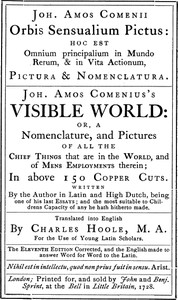
The Orbis Pictus
Subjects:
Download Formats:
Excerpt
The Project Gutenberg EBook of The Orbis Pictus, by John Amos Comenius
This eBook is for the use of anyone anywhere at no cost and with
almost no restrictions whatsoever. You may copy it, give it away or
re-use it under the terms of the Project Gutenberg License included
with this eBook or online at www.gutenberg.org
Read the Full Text
— End of The Orbis Pictus —
Book Information
- Title
- The Orbis Pictus
- Author(s)
- Comenius, Johann Amos
- Language
- English
- Type
- Text
- Release Date
- March 9, 2009
- Word Count
- 35,750 words
- Library of Congress Classification
- LT
- Bookshelves
- Browsing: Children & Young Adult Reading, Browsing: Teaching & Education
- Rights
- Public domain in the USA.
Related Books
The story of Robinson Crusoe in Latin
by Defoe, Daniel, Campe, Joachim Heinrich
Latin
1071h 58m read

Millions of cats
by Gág, Wanda
English
17h 50m read

Robinson Crusoëus
by Defoe, Daniel, Campe, Joachim Heinrich
Latin
1287h 49m read

Mammy's baby
by Blanchard, Amy Ella
English
28h 8m read
A. L. O. E.'s picture story book.
by A. L. O. E.
English
300h 4m read
Cobwebs to catch flies
by Lovechild, Mrs.
English
179h 26m read