The Project Gutenberg eBook of The Mystery of the Yellow Room, by
Gaston Leroux
This eBook is for the use of anyone anywhere in the United States and
most other parts of the world at no cost and with almost no restrictions
whatsoever. You may copy it, give it away or re-use it under the terms
of the Project Gutenberg License included with this eBook or online at
www.gutenberg.org. If you are not located in the United States, you
will have to check the laws of the country where you are located before
using this eBook.
Title: The Mystery of the Yellow Room
Extraordinary adventures of Joseph Rouletabille, reporter
Author: Gaston Leroux
Release Date: April 15, 2023 [eBook #1685]
Language: English
Produced by: Transcribed and produced by Brian Raiter
*** START OF THE PROJECT GUTENBERG EBOOK THE MYSTERY OF THE YELLOW
ROOM ***
The Mystery of the Yellow Room
Extraordinary Adventures of Joseph Rouletabille
Reporter
by Gaston Leroux
[Frontispiece: Joseph Rouletabille]
Contents
I. In which we Begin not to Understand
II. In which Joseph Rouletabille Appears for the First Time
III. “A Man Has Passed like a Shadow through the Blinds”
IV. “In the Bosom of Wild Nature”
V. In which Joseph Rouletabille Makes a Remark to Monsieur Robert
Darzac which Produces its Little Effect
VI. In the Heart of the Oak Grove
VII. In which Rouletabille Sets out on an Expedition under the Bed
VIII. The Examining Magistrate Questions Mademoiselle Stangerson
IX. Reporter and Detective
X. “We shall have to eat Red Meat—Now”
XI. In which Frédéric Larsan Explains how the Murderer was Able to
get out of The Yellow Room
XII. Frédéric Larsan’s Cane
XIII. “The Presbytery has Lost Nothing of its Charm, nor the Garden
its Brightness”
XIV. “I Expect the Assassin this Evening”
XV. The Trap
XVI. Strange Phenomenon of the Dissociation of Matter
XVII. The Inexplicable Gallery
XVIII. Rouletabille has Drawn a Circle between the Two Bumps on his
Forehead
XIX. Rouletabille Invites me to Breakfast at the Donjon Inn
XX. An Act of Mademoiselle Stangerson
XXI. On the Watch
XXII. The Incredible Body
XXIII. The Double Scent
XXIV. Rouletabille Knows the Two Halves of the Murderer
XXV. Rouletabille Goes on a Journey
XXVI. In which Joseph Rouletabille is Awaited with Impatience
XXVII. In which Joseph Rouletabille Appears in all his Glory
XXVIII. In which it is Proved that one does not Always Think of
Everything
XXIX. The Mystery of Mademoiselle Stangerson
Chapter I
In Which We Begin not to Understand
It is not without a certain emotion that I begin to recount here the
extraordinary adventures of Joseph Rouletabille. Down to the present
time he had so firmly opposed my doing it that I had come to despair
of ever publishing the most curious of police stories of the past
fifteen years. I had even imagined that the public would never know
the whole truth of the prodigious case known as that of “The Yellow
Room,” out of which grew so many mysterious, cruel, and sensational
dramas, with which my friend was so closely mixed up, if, à propos of
a recent nomination of the illustrious Stangerson to the grade of
grand-cross of the Legion of Honour, an evening journal—in an article,
miserable for its ignorance, or audacious for its perfidy—had not
resuscitated a terrible adventure of which Joseph Rouletabille had
told me he wished to be for ever forgotten.
“The Yellow Room!” Who now remembers this affair which caused so much
ink to flow fifteen years ago? Events are so quickly forgotten in
Paris. Has not the very name of the Nayves trial and the tragic
history of the death of little Menaldo passed out of mind? And yet the
public attention was so deeply interested in the details of the trial
that the occurrence of a ministerial crisis was completely unnoticed
at the time. Now “The Yellow Room” trial, which preceded that of the
Nayves by some years, made far more noise. The entire world hung for
months over this obscure problem—the most obscure, it seems to me,
that has ever challenged the perspicacity of our police or taxed the
conscience of our judges. The solution of the problem baffled
everybody who tried to find it. It was like a dramatic rebus with
which old Europe and new America alike became fascinated. That is, in
truth—I am permitted to say, because there cannot be any author’s
vanity in all this, since I do nothing more than transcribe facts on
which an exceptional documentation enables me to throw a new
light—that is because, in truth, I do not know that, in the domain of
reality or imagination, one can discover or recall to mind anything
comparable, in its mystery, with the natural mystery of “The Yellow
Room.”
That which nobody could find out, Joseph Rouletabille, aged eighteen,
then a reporter engaged on a leading journal, succeeded in
discovering. But when, at the Assize Court, he brought in the key to
the whole case, he did not tell the whole truth. He only allowed so
much of it to appear as sufficed to ensure the acquittal of an
innocent man. The reasons which he had for his reticence no longer
exist. Better still, the time has come for my friend to speak out
fully. You are going to know all; and, without further preamble, I am
going to place before your eyes the problem of “The Yellow Room” as it
was placed before the eyes of the entire world on the day following
the enactment of the drama at the Château du Glandier.
On the 25th of October, 1892, the following note appeared in the
latest edition of the “Temps”:—
“A frightful crime has been committed at the Glandier, on the border
of the forest of Sainte-Geneviève, above Epinay-sur-Orge, at the house
of Professor Stangerson. On that night, while the master was working
in his laboratory, an attempt was made to assassinate Mademoiselle
Stangerson, who was sleeping in a chamber adjoining this laboratory.
The doctors do not answer for the life of Mdlle. Stangerson.”
The impression made on Paris by this news may be easily imagined.
Already, at that time, the learned world was deeply interested in the
labours of Professor Stangerson and his daughter. These labours—the
first that were attempted in radiography—served to open the way for
Monsieur and Madame Curie to the discovery of radium. It was expected
the Professor would shortly read to the Academy of Sciences a
sensational paper on his new theory,—the Dissociation of Matter,—a
theory destined to overthrow from its base the whole of official
science, which based itself on the principle of the Conservation of
Energy.
On the following day, the newspapers were full of the tragedy. The
“Matin,” among others, published the following article, entitled: “A
Supernatural Crime”:—
“These are the only details,” wrote the anonymous writer in the
“Matin”—“we have been able to obtain concerning the crime of the
Château du Glandier. The state of despair in which Professor
Stangerson is plunged, and the impossibility of getting any
information from the lips of the victim, have rendered our
investigations and those of justice so difficult that, at present, we
cannot form the least idea of what has passed in ‘The Yellow Room’ in
which Mdlle. Stangerson, in her night-dress, was found lying on the
floor in the agonies of death. We have, at least, been able to
interview Daddy Jacques—as he is called in the country—an old servant
in the Stangerson family. Daddy Jacques entered ‘The Yellow Room’ at
the same time as the Professor. This chamber adjoins the laboratory.
Laboratory and Yellow Room are in a pavilion at the end of the park,
about three hundred metres (a thousand feet) from the château.
“‘It was half-past twelve at night,’ this honest old man told us, ‘and
I was in the laboratory, where Monsieur Stangerson was still working,
when the thing happened. I had been cleaning and putting instruments
in order all the evening and was waiting for Monsieur Stangerson to go
to bed. Mademoiselle Stangerson had worked with her father up to
midnight; when the twelve strokes of midnight had sounded by the
cuckoo-clock in the laboratory, she rose, kissed Monsieur Stangerson
and bade him good-night. To me she said “bon soir, Daddy Jacques” as
she passed into “The Yellow Room.” We heard her lock the door and
shoot the bolt, so that I could not help laughing, and said to
Monsieur: “There ’s Mademoiselle double-locking herself in,—she must
be afraid of the ‘Bête du bon Dieu!’” Monsieur did not even hear me,
he was so deeply absorbed in what he was doing. Just then we heard the
distant miawing of a cat. “Is that going to keep us awake all night?”
I said to myself; for I must tell you, Monsieur, that, to the end of
October, I live in an attic of the pavilion over The Yellow Room, so
that Mademoiselle should not be left alone through the night in the
lonely park. It was the fancy of Mademoiselle to spend the fine
weather in the pavilion; no doubt, she found it more cheerful than the
château and, for the four years it had been built, she had never
failed to take up her lodging there in the spring. With the return of
winter, Mademoiselle returns to the château, for there is no fireplace
in The Yellow Room.
“‘We were staying in the pavilion, then—Monsieur Stangerson and me. We
made no noise. He was seated at his desk. As for me, I was sitting on
a chair, having finished my work and, looking at him, I said to
myself: “What a man!—what intelligence!—what knowledge!” I attach
importance to the fact that we made no noise; for, because of that,
the assassin certainly thought that we had left the place. And,
suddenly, while the cuckoo was sounding the half after midnight, a
desperate clamour broke out in The Yellow Room. It was the voice of
Mademoiselle, crying “Murder!—murder!—help!” Immediately afterwards
revolver shots rang out and there was a great noise of tables and
furniture being thrown to the ground, as if in the course of a
struggle, and again the voice of Mademoiselle calling,
“Murder!—help!—Papa!—Papa!—”
“‘You may be sure that we quickly sprang up and that Monsieur
Stangerson and I threw ourselves upon the door. But alas! it was
locked, fast locked, on the inside, by the care of Mademoiselle, as I
have told you, with key and bolt. We tried to force it open, but it
remained firm. Monsieur Stangerson was like a madman, and truly, it
was enough to make him one, for we heard Mademoiselle still calling
“Help!—help!” Monsieur Stangerson showered terrible blows on the door,
and wept with rage and sobbed with despair and helplessness.
“‘It was then that I had an inspiration. “The assassin must have
entered by the window!” I cried;—“I will go to the window!” and I
rushed from the pavilion and ran like one out of his mind.
“‘The inspiration was that the window of The Yellow Room looks out in
such a way that the park wall, which abuts on the pavilion, prevented
my at once reaching the window. To get up to it one has first to go
out of the park. I ran towards the gate and, on my way, met Bernier
and his wife, the gate-keepers, who had been attracted by the pistol
reports and by our cries. In a few words I told them what had
happened, and directed the concierge to join Monsieur Stangerson with
all speed, while his wife came with me to open the park gate. Five
minutes later she and I were before the window of The Yellow Room.
“‘The moon was shining brightly and I saw clearly that no one had
touched the window. Not only were the bars that protect it intact, but
the blinds inside of them were drawn, as I had myself drawn them early
in the evening, as I did every day, though Mademoiselle, knowing that
I was tired from the heavy work I had been doing, had begged me not to
trouble myself, but leave her to do it; and they were just as I had
left them, fastened with an iron catch on the inside. The assassin,
therefore, could not have passed either in or out that way; but
neither could I get in.
“‘It was unfortunate,—enough to turn one’s brain! The door of the room
locked on the inside and the blinds on the only window also fastened
on the inside; and Mademoiselle still calling for help!—No! she had
ceased to call. She was dead, perhaps. But I still heard her father,
in the pavilion, trying to break down the door.
“‘With the concierge I hurried back to the pavilion. The door, in
spite of the furious attempts of Monsieur Stangerson and Bernier to
burst it open, was still holding firm; but at length, it gave way
before our united efforts,—and then what a sight met our eyes! I
should tell you that, behind us, the concierge held the laboratory
lamp—a powerful lamp, that lit the whole chamber.
“‘I must also tell you, monsieur, that The Yellow Room is a very small
room. Mademoiselle had furnished it with a fairly large iron bedstead,
a small table, a night-commode, a dressing-table, and two chairs. By
the light of the big lamp we saw all at a glance. Mademoiselle, in her
night-dress, was lying on the floor in the midst of the greatest
disorder. Tables and chairs had been overthrown, showing that there
had been a violent struggle. Mademoiselle had certainly been dragged
from her bed. She was covered with blood and had terrible marks of
finger-nails on her throat,—the flesh of her neck having been almost
torn by the nails. From a wound on the right temple a stream of blood
had run down and made a little pool on the floor. When Monsieur
Stangerson saw his daughter in that state, he threw himself on his
knees beside her, uttering a cry of despair. He ascertained that she
still breathed. As to us, we searched for the wretch who had tried to
kill our mistress, and I swear to you, monsieur, that, if we had found
him, it would have gone hard with him!
“‘But how to explain that he was not there, that he had already
escaped? It passes all imagination!—Nobody under the bed, nobody
behind the furniture!—All that we discovered were traces,
blood-stained marks of a man’s large hand on the walls and on the
door; a big handkerchief red with blood, without any initials, an old
cap, and many fresh footmarks of a man on the floor,—footmarks of a
man with large feet whose boot-soles had left a sort of sooty
impression. How had this man got away? How had he vanished? Don’t
forget, monsieur, that there is no chimney in The Yellow Room. He
could not have escaped by the door, which is narrow, and on the
threshold of which the concierge stood with the lamp, while her
husband and I searched for him in every corner of the little room,
where it is impossible for anyone to hide himself. The door, which had
been forced open against the wall, could not conceal anything behind
it, as we assured ourselves. By the window, still in every way
secured, no flight had been possible. What then?—I began to believe in
the Devil.
“‘But we discovered my revolver on the floor!—Yes, _my_ revolver! Oh!
that brought me back to the reality! The Devil would not have needed
to steal my revolver to kill Mademoiselle. The man who had been there
had first gone up to my attic and taken my revolver from the drawer
where I kept it. We then ascertained, by counting the cartridges, that
the assassin had fired two shots. Ah! it was fortunate for me that
Monsieur Stangerson was in the laboratory when the affair took place
and had seen with his own eyes that I was there with him; for
otherwise, with this business of my revolver, I don’t know where we
should have been,—_I_ should now be under lock and bar. Justice wants
no more to send a man to the scaffold!’”
The editor of the “Matin” added to this interview the following
lines:—
“We have, without interrupting him, allowed Daddy Jacques to recount
to us roughly all he knows about the crime of The Yellow Room. We have
reproduced it in his own words, only sparing the reader the continual
lamentations with which he garnished his narrative. It is quite
understood, Daddy Jacques, quite understood, that you are very fond of
your masters; and you want them to know it, and never cease repeating
it—especially since the discovery of your revolver. It is your right,
and we see no harm in it. We should have liked to put some further
questions to Daddy Jacques—Jacques—Louis Moustier—but the inquiry of
the examining magistrate, which is being carried on at the château,
makes it impossible for us to gain admission at the Glandier; and, as
to the oak wood, it is guarded by a wide circle of policemen, who are
jealously watching all traces that can lead to the pavilion, and that
may perhaps lead to the discovery of the assassin.
“We have also wished to question the concierges, but they are
invisible. Finally, we have waited in a roadside inn, not far from the
gate of the château, for the departure of Monsieur de Marquet, the
magistrate of Corbeil. At half-past five we saw him and his clerk and,
before he was able to enter his carriage, had an opportunity to ask
him the following question:—
“‘Can you, Monsieur de Marquet, give us any information as to this
affair, without inconvenience to the course of your inquiry?’
“‘It is impossible for us to do it,’ replied Monsieur de Marquet. ‘I
can only say that it is the strangest affair I have ever known. The
more we think we know something, the further we are from knowing
anything!’
“We asked Monsieur de Marquet to be good enough to explain his last
words; and this is what he said,—the importance of which no one will
fail to recognise:—
“‘If nothing is added to the material facts so far established, I fear
that the mystery which surrounds the abominable crime of which
Mademoiselle Stangerson has been the victim will never be brought to
light; but it is to be hoped, for the sake of our human reason, that
the examination of the walls, and of the ceiling of The Yellow Room—an
examination which I shall to-morrow intrust to the builder who
constructed the pavilion four years ago—will afford us the proof that
may not discourage us. For the problem is this: we know by what way
the assassin gained admission,—he entered by the door and hid himself
under the bed, awaiting Mademoiselle Stangerson. But how did he leave?
How did he escape? If no trap, no secret door, no hiding-place, no
opening of any sort is found; if the examination of the walls—even to
the demolition of the pavilion—does not reveal any passage
practicable—not only for a human being, but for any being
whatsoever—if the ceiling shows no crack, if the floor hides no
underground passage, one must really believe in the Devil, as Daddy
Jacques says!’”
And the anonymous writer in the “Matin” added in this article—which I
have selected as the most interesting of all those that were published
on the subject of this affair—that the examining magistrate appeared
to place a peculiar significance to the last sentence: “One must
really believe in the Devil, as Jacques says.”
The article concluded with these lines: “We wanted to know what Daddy
Jacques meant by the cry of the Bête du Bon Dieu. The landlord of the
Donjon Inn explained to us that it is the particularly sinister cry
which is uttered sometimes at night by the cat of an old woman,—Mother
Angenoux, as she is called in the country. Mother Angenoux is a sort
of saint, who lives in a hut in the heart of the forest, not far from
the grotto of Sainte-Geneviève.
“The Yellow Room, the Bête du Bon Dieu, Mother Angenoux, the Devil,
Sainte-Geneviève, Daddy Jacques,—here is a well entangled crime which
the stroke of a pickaxe in the wall may disentangle for us to-morrow.
Let us at least hope that, for the sake of our human reason, as the
examining magistrate says. Meanwhile, it is expected that Mademoiselle
Stangerson—who has not ceased to be delirious and only pronounces one
word distinctly, ‘Murderer! Murderer!’—will not live through the
night.”
In conclusion, and at a late hour, the same journal announced that the
Chief of the Sûreté had telegraphed to the famous detective, Frédéric
Larsan, who had been sent to London for an affair of stolen
securities, to return immediately to Paris.
Chapter II
In Which Joseph Rouletabille Appears for the First Time
I remember as well as if it had occurred yesterday, the entry of young
Rouletabille into my bedroom that morning. It was about eight o’clock
and I was still in bed reading the article in the “Matin” relative to
the Glandier crime.
But, before going further, it is time that I present my friend to the
reader.
I first knew Joseph Rouletabille when he was a young reporter. At that
time I was a beginner at the Bar and often met him in the corridors of
examining magistrates, when I had gone to get a “permit to
communicate” for the prison of Mazas, or for Saint-Lazare. He had, as
they say, “a good nut.” He seemed to have taken his head—round as a
bullet—out of a box of marbles, and it is from that, I think, that his
comrades of the press—all determined billiard-players—had given him
that nickname, which was to stick to him and be made illustrious by
him. He was always as red as a tomato, now gay as a lark, now grave as
a judge. How, while still so young—he was only sixteen and a half
years old when I saw him for the first time—had he already won his way
on the press? That was what everybody who came into contact with him
might have asked, if they had not known his history. At the time of
the affair of the woman cut in pieces in the Rue Oberskampf—another
forgotten story—he had taken to one of the editors of the “Epoque,”—a
paper then rivalling the “Matin” for information,—the left foot, which
was missing from the basket in which the gruesome remains were
discovered. For this left foot the police had been vainly searching
for a week, and young Rouletabille had found it in a drain where
nobody had thought of looking for it. To do that he had dressed
himself as an extra sewer-man, one of a number engaged by the
administration of the city of Paris, owing to an overflow of the
Seine.
When the editor-in-chief was in possession of the precious foot and
informed as to the train of intelligent deductions the boy had been
led to make, he was divided between the admiration he felt for such
detective cunning in a brain of a lad of sixteen years, and delight at
being able to exhibit, in the “morgue window” of his paper, the left
foot of the Rue Oberkampf.
“This foot,” he cried, “will make a great headline.”
Then, when he had confided the gruesome packet to the medical lawyer
attached to the journal, he asked the lad, who was shortly to become
famous as Rouletabille, what he would expect to earn as a general
reporter on the “Epoque”?
“Two hundred francs a month,” the youngster replied modestly, hardly
able to breathe from surprise at the proposal.
“You shall have two hundred and fifty,” said the editor-in-chief;
“only you must tell everybody that you have been engaged on the paper
for a month. Let it be quite understood that it was not you but the
‘Epoque’ that discovered the left foot of the Rue Oberkampf. Here, my
young friend, the man is nothing, the paper everything.”
Having said this, he begged the new reporter to retire, but before the
youth had reached the door he called him back to ask his name. The
other replied:—
“Joseph Josephine.”
“That ’s not a name,” said the editor-in-chief, “but since you will
not be required to sign what you write it is of no consequence.”
The boy-faced reporter speedily made himself many friends, for he was
serviceable and gifted with a good humour that enchanted the most
severe-tempered and disarmed the most zealous of his companions. At
the Bar café, where the reporters assembled before going to any of the
courts, or to the Prefecture, in search of their news of crime, he
began to win a reputation as an unraveller of intricate and obscure
affairs which found its way to the office of the Chief of the Sûreté.
When a case was worth the trouble and Rouletabille—he had already been
given his nickname—had been started on the scent by his
editor-in-chief, he often got the better of the most famous detective.
It was at the Bar café that I became intimately acquainted with him.
Criminal lawyers and journalists are not enemies, the former need
advertisement, the latter information. We chatted together, and I soon
warmed towards him. His intelligence was so keen, and so original!—and
he had a quality of thought such as I have never found in any other
person.
Some time after this I was put in charge of the law news of the “Cri
du Boulevard.” My entry into journalism could not but strengthen the
ties which united me to Rouletabille. After a while, my new friend
being allowed to carry out an idea of a judicial correspondence
column, which he was allowed to sign “Business,” in the “Epoque,” I
was often able to furnish him with the legal information of which he
stood in need.
Nearly two years passed in this way, and the better I knew him, the
more I learned to love him; for, in spite of his careless
extravagance, I had discovered in him what was, considering his age,
an extraordinary seriousness of mind. Accustomed as I was to seeing
him gay and, indeed, often too gay, I would many times find him
plunged in the deepest melancholy. I tried then to question him as to
the cause of this change of humour, but each time he laughed and made
me no answer. One day, having questioned him about his parents, of
whom he never spoke, he left me, pretending not to have heard what I
said.
While things were in this state between us, the famous case of “The
Yellow Room” took place. It was this case which was to rank him as the
leading newspaper reporter, and to obtain for him the reputation of
being the greatest detective in the world. It should not surprise us
to find in the one man the perfection of two such lines of activity if
we remember that the daily press was already beginning to transform
itself and to become what it is to-day—the gazette of crime.
Morose-minded people may complain of this; for myself I regard it a
matter for congratulation. We can never have too many arms, public or
private, against the criminal. To this some people may answer that, by
continually publishing the details of crimes, the press ends by
encouraging their commission. But then, with some people we can never
do right.
Rouletabille, as I have said, entered my room that morning of the 26th
of October, 1892. He was looking redder than usual, and his eyes were
bulging out of his head, as the phrase is, and altogether he appeared
to be in a state of extreme excitement. He waved the “Matin” with a
trembling hand, and cried:—
“Well, my dear Sainclair,—have you read it?”
“The Glandier crime?”
“Yes; ‘The Yellow Room’!—What do you think of it?”
“I think that it must have been the Devil or the Bête du Bon Dieu that
committed the crime.”
“Be serious!”
“Well, I don’t much believe in murderers who make their escape through
walls of solid brick. I think Daddy Jacques did wrong to leave behind
him the weapon with which the crime was committed and, as he occupied
the attic immediately above Mademoiselle Stangerson’s room, the
builder’s job ordered by the examining magistrate will give us the key
of the enigma and it will not be long before we learn by what natural
trap, or by what secret door, the old fellow was able to slip in and
out, and return immediately to the laboratory to Monsieur Stangerson,
without his absence being noticed. That, of course, is only an
hypothesis.”
Rouletabille sat down in an armchair, lit his pipe, which he was never
without, smoked for a few minutes in silence—no doubt to calm the
excitement which, visibly, dominated him—and then replied:—
“Young man,” he said, in a tone the sad irony of which I will not
attempt to render, “young man, you are a lawyer and I doubt not your
ability to save the guilty from conviction; but if you were a
magistrate on the bench, how easy it would be for you to condemn
innocent persons!—You are really gifted, young man!”
He continued to smoke energetically, and then went on:—
“No trap will be found, and the mystery of ‘The Yellow Room’ will
become more and more mysterious. That ’s why it interests me. The
examining magistrate is right; nothing stranger than this crime has
ever been known.”
“Have you any idea of the way by which the murderer escaped?” I asked.
“None,” replied Rouletabille—“none, for the present. But I have an
idea as to the revolver; the murderer did not use it.”
“Good Heavens! By whom, then, was it used?”
“Why—by Mademoiselle Stangerson.”
“I don’t understand,—or rather, I have never understood,” I said.
Rouletabille shrugged his shoulders.
“Is there nothing in this article in the ‘Matin’ by which you were
particularly struck?”
“Nothing,—I have found the whole of the story it tells equally
strange.”
“Well, but—the locked door—with the key on the inside?”
“That ’s the only perfectly natural thing in the whole article.”
“Really!—And the bolt?”
“The bolt?”
“Yes, the bolt—also inside the room—a still further protection against
entry? Mademoiselle Stangerson took quite extraordinary precautions!
It is clear to me that she feared someone. That was why she took such
precautions—even Daddy Jacques’s revolver—without telling him of it.
No doubt she did n’t wish to alarm anybody, and least of all, her
father. What she dreaded took place, and she defended herself. There
was a struggle, and she used the revolver skilfully enough to wound
the assassin in the hand—which explains the impression on the wall and
on the door of the large, blood-stained hand of the man who was
searching for a means of exit from the chamber. But she did n’t fire
soon enough to avoid the terrible blow on the right temple.”
“Then the wound on the temple was not done with the revolver?”
“The paper does n’t say it was, and I don’t think it was; because
logically it appears to me that the revolver was used by Mademoiselle
Stangerson against the assassin. Now, what weapon did the murderer
use? The blow on the temple seems to show that the murderer wished to
stun Mademoiselle Stangerson,—after he had unsuccessfully tried to
strangle her. He must have known that the attic was inhabited by Daddy
Jacques, and that was one of the reasons, I think, why he must have
used a quiet weapon,—a life-preserver, or a hammer.”
“All that does n’t explain how the murderer got out of ‘The Yellow
Room,’” I observed.
“Evidently,” replied Rouletabille, rising, “and that is what has to be
explained. I am going to the Château du Glandier, and have come to see
whether you will go with me.”
“I?”—
“Yes, my boy. I want you. The ‘Epoque’ has definitely entrusted this
case to me, and I must clear it up as quickly as possible.”
“But in what way can I be of any use to you?”
“Monsieur Robert Darzac is at the Château du Glandier.”
“That ’s true. His despair must be boundless.”
“I must have a talk with him.”
Rouletabille said it in a tone that surprised me.
“Is it because—you think there is something to be got out of him?” I
asked.
“Yes.”
That was all he would say. He retired to my sitting-room, begging me
to dress quickly.
I knew Monsieur Robert Darzac from having been of great service to him
in a civil action, while I was acting as secretary to Maître Barbet
Delatour. Monsieur Robert Darzac, who was at that time about forty
years of age, was a professor of physics at the Sorbonne. He was
intimately acquainted with the Stangersons, and, after an assiduous
seven years’ courtship of the daughter, had been on the point of
marrying her. In spite of the fact that she has become, as the phrase
goes, “a person of a certain age,” she was still remarkably
good-looking.
While I was dressing I called out to Rouletabille, who was impatiently
moving about my sitting-room:—
“Have you any idea as to the murderer’s station in life?”
“Yes,” he replied; “I think if he is n’t a man in society, he is, at
least, a man belonging to the upper class. But that, again, is only an
impression.”
“What has led you to form it?”
“Well,—the greasy cap, the common handkerchief, and the marks of the
rough boots on the floor,” he replied.
“I understand,” I said; “murderers don’t leave traces behind them
which tell the truth.”
“We shall make something out of you yet, my dear Sainclair,” concluded
Rouletabille.
Chapter III
“A Man Has Passed like a Shadow through the Blinds”
Half an hour later Rouletabille and I were on the platform of the
Orleans station, awaiting the departure of the train which was to take
us to Epinay-sur-Orge.
On the platform we found Monsieur de Marquet and his Registrar, who
represented the Judicial Court of Corbeil. Monsieur de Marquet had
spent the night in Paris, assisting in the final rehearsal, at the
Scala, of a little play of which he was the unknown author, signing
himself simply “Castigat Ridendo.”
Monsieur Marquet was beginning to be a “noble old gentleman.”
Generally he was extremely polite and full of gay humour, and in all
his life had had but one passion,—that of dramatic art. Throughout his
magisterial career he was interested solely in cases capable of
furnishing him with something in the nature of a drama. Though he
might very well have aspired to the highest judicial positions, he had
never really worked for anything but to win a success at the romantic
Porte-Saint-Martin, or at the sombre Odéon.
Because of the mystery which shrouded it, the case of “The Yellow
Room” was certain to fascinate so theatrical a mind. It interested him
enormously, and he threw himself into it, less as a magistrate eager
to know the truth, than as an amateur of dramatic embroglios, tending
wholly to mystery and intrigue, who dreads nothing so much as the
explanatory final act.
So that, at the moment of meeting him, I heard Monsieur de Marquet say
to the Registrar with a sigh:—
“I hope, my dear Monsieur Maleine, this builder with his pickaxe will
not destroy so fine a mystery.”
“Have no fear,” replied Monsieur Maleine, “his pickaxe may demolish
the pavilion, perhaps, but it will leave our case intact. I have
sounded the walls and examined the ceiling and floor and I know all
about it. I am not to be deceived.”
Having thus reassured his chief, Monsieur Maleine, with a discreet
movement of the head, drew Monsieur de Marquet’s attention to us. The
face of that gentleman clouded, and, as he saw Rouletabille
approaching, hat in hand, he sprang into one of the empty carriages
saying, half aloud to his Registrar, as he did so, “Above all, no
journalists!”
Monsieur Maleine replied in the same tone, “I understand!” and then
tried to prevent Rouletabille from entering the same compartment with
the examining magistrate.
“Excuse me, gentlemen,—this compartment is reserved.”
“I am a journalist, Monsieur, engaged on the ‘Epoque,’” said my young
friend with a great show of gesture and politeness, “and I have a word
or two to say to Monsieur de Marquet.”
“Monsieur is very much engaged with the inquiry he has in hand.”
“Ah! his inquiry, pray believe me, is absolutely a matter of
indifference to me. I am no scavenger of odds and ends,” he went on,
with infinite contempt in his lower lip, “I am a theatrical reporter;
and this evening I shall have to give a little account of the play at
the Scala.”
“Get in, sir, please,” said the Registrar.
Rouletabille was already in the compartment. I went in after him and
seated myself by his side. The Registrar followed and closed the
carriage-door.
Monsieur de Marquet looked at him.
“Ah, sir,” Rouletabille began, “You must not be angry with Monsieur de
Maleine. It is not with Monsieur de Marquet that I desire to have the
honour of speaking, but with Monsieur ‘Castigat Ridendo.’ Permit me to
congratulate you—personally, as well as the writer for the ‘Epoque.’”
And Rouletabille, having first introduced me, introduced himself.
Monsieur de Marquet, with a nervous gesture, caressed his beard into a
point, and explained to Rouletabille, in a few words, that he was too
modest an author to desire that the veil of his pseudonym should be
publicly raised, and that he hoped the enthusiasm of the journalist
for the dramatist’s work would not lead him to tell the public that
Monsieur “Castigat Ridendo” and the examining magistrate of Corbeil
were one and the same person.
“The work of the dramatic author may interfere,” he said, after a
slight hesitation, “with that of the magistrate, especially in a
province where one’s labours are little more than routine.”
“Oh, you may rely on my discretion!” cried Rouletabille.
The train was in motion.
“We have started!” said the examining magistrate, surprised at seeing
us still in the carriage.
“Yes, Monsieur,—truth has started,” said Rouletabille, smiling
amiably,—“on its way to the Château du Glandier. A fine case, Monsieur
de Marquet,—a fine case!”
“An obscure—incredible, unfathomable, inexplicable affair—and there is
only one thing _I_ fear, Monsieur Rouletabille,—that the journalists
will be trying to explain it.”
My friend felt this a rap on his knuckles.
“Yes,” he said simply, “that is to be feared. They meddle in
everything. As for my interest, monsieur, I only referred to it by
mere chance,—the mere chance of finding myself in the same train with
you, and in the same compartment of the same carriage.”
“Where are you going, then?” asked Monsieur de Marquet.
“To the Château du Glandier,” replied Rouletabille, without turning.
“You ’ll not get in, Monsieur Rouletabille!”
“Will you prevent me?” said my friend, already prepared to fight.
“Not I!—I like the press and journalists too well to be in any way
disagreeable to them; but Monsieur Stangerson has given orders for his
door to be closed against everybody, and it is well guarded. Not a
journalist was able to pass through the gate of the Glandier
yesterday.”
Monsieur de Marquet compressed his lips and seemed ready to relapse
into obstinate silence. He only relaxed a little when Rouletabille no
longer left him in ignorance of the fact that we were going to the
Glandier for the purpose of shaking hands with an “old and intimate
friend,” Monsieur Robert Darzac—a man whom Rouletabille had perhaps
seen once in his life.
“Poor Robert!” continued the young reporter, “this dreadful affair may
be his death,—he is so deeply in love with Mademoiselle Stangerson.”
“His sufferings are truly painful to witness,” escaped like a regret
from the lips of Monsieur de Marquet.
“But it is to be hoped that Mademoiselle Stangerson’s life will be
saved.”
“Let us hope so. Her father told me yesterday that, if she does not
recover, it will not be long before he joins her in the grave. What an
incalculable loss to science his death would be!”
“The wound on her temple is serious, is it not?”
“Evidently; but, by a wonderful chance, it has not proved mortal. The
blow was given with great force.”
“Then it was not with the revolver she was wounded,” said
Rouletabille, glancing at me in triumph.
Monsieur de Marquet appeared greatly embarrassed.
“I did n’t say anything—I don’t want to say anything—I will not say
anything,” he said. And he turned towards his Registrar as if he no
longer knew us.
But Rouletabille was not to be so easily shaken off. He moved nearer
to the examining magistrate and, drawing a copy of the “Matin” from
his pocket, he showed it to him and said:—
“There is one thing, Monsieur, which I may enquire of you without
committing an indiscretion. You have, of course, seen the account
given in the ‘Matin’? It is absurd, is it not?”
“Not in the slightest, Monsieur.”
“What! The Yellow Room has but one barred window—the bars of which
have not been moved—and only one door, which had to be broken open—and
the assassin was not found!”
“That ’s so, monsieur,—that ’s so. That ’s how the matter stands.”
Rouletabille said no more but plunged into thought. A quarter of an
hour thus passed.
Coming back to himself again he said, addressing the magistrate:—
“How did Mademoiselle Stangerson wear her hair on that evening?”
“I don’t know,” replied Monsieur de Marquet.
“That ’s a very important point,” said Rouletabille. “Her hair was
done up in bands, was n’t it? I feel sure that on that evening, the
evening of the crime, she had her hair arranged in bands.”
“Then you are mistaken, Monsieur Rouletabille,” replied the
magistrate; “Mademoiselle Stangerson that evening had her hair drawn
up in a knot on the top of her head,—her usual way of arranging it—her
forehead completely uncovered. I can assure you, for we have carefully
examined the wound. There was no blood on the hair, and the
arrangement of it has not been disturbed since the crime was
committed.”
“You are sure! You are sure that, on the night of the crime, she had
not her hair in bands?”
“Quite sure,” the magistrate continued, smiling, “because I remember
the Doctor saying to me, while he was examining the wound, ‘It is a
great pity Mademoiselle Stangerson was in the habit of drawing her
hair back from her forehead. If she had worn it in bands, the blow she
received on the temple would have been weakened.’ It seems strange to
me that you should attach so much importance to this point.”
“Oh! if she had not her hair in bands, I give it up,” said
Rouletabille, with a despairing gesture.
“And was the wound on her temple a bad one?” he asked presently.
“Terrible.”
“With what weapon was it made?”
“That is a secret of the investigation.”
“Have you found the weapon—whatever it was?”
The magistrate did not answer.
“And the wound in the throat?”
Here the examining magistrate readily confirmed the decision of the
doctor that, if the murderer had pressed her throat a few seconds
longer, Mademoiselle Stangerson would have died of strangulation.
“The affair as reported in the ‘Matin,’” said Rouletabille eagerly,
“seems to me more and more inexplicable. Can you tell me, Monsieur,
how many openings there are in the pavilion? I mean doors and
windows.”
“There are five,” replied Monsieur de Marquet, after having coughed
once or twice, but no longer resisting the desire he felt to talk of
the whole of the incredible mystery of the affair he was
investigating. “There are five, of which the door of the vestibule is
the only entrance to the pavilion,—a door always automatically closed,
which cannot be opened, either from the outer or inside, except with
the two special keys which are never out of the possession of either
Daddy Jacques or Monsieur Stangerson. Mademoiselle Stangerson had no
need for one, since Daddy Jacques lodged in the pavilion and because,
during the daytime, she never left her father. When they, all four,
rushed into The Yellow Room, after breaking open the door of the
laboratory, the door in the vestibule remained closed as usual and, of
the two keys for opening it, Daddy Jacques had one in his pocket, and
Monsieur Stangerson the other. As to the windows of the pavilion,
there are four; the one window of The Yellow Room and those of the
laboratory looking out on to the country; the window in the vestibule
looking into the park.”
“It is by that window that he escaped from the pavilion!” cried
Rouletabille.
“How do you know that?” demanded Monsieur de Marquet, fixing a strange
look on my young friend.
“We ’ll see later how he got away from The Yellow Room,” replied
Rouletabille, “but he must have left the pavilion by the vestibule
window.”
“Once more,—how do you know that?”
“How? Oh, the thing is simple enough! As soon as he found he could not
escape by the door of the pavilion his only way out was by the window
in the vestibule, unless he could pass through a grated window. The
window of The Yellow Room is secured by iron bars, because it looks
out upon the open country; the two windows of the laboratory have to
be protected in like manner for the same reason. As the murderer got
away, I conceive that he found a window that was not barred,—that of
the vestibule, which opens on to the park,—that is to say, into the
interior of the estate. There ’s not much magic in all that.”
“Yes,” said Monsieur de Marquet, “but what you have not guessed is
that this single window in the vestibule, though it has no iron bars,
has solid iron blinds. Now these iron blinds have remained fastened by
their iron latch; and yet we have proof that the murderer made his
escape from the pavilion by _that_ window! Traces of blood on the
inside wall and on the blinds as well as on the floor, and footmarks,
of which I have taken the measurements, attest the fact that the
murderer made his escape that way. But then, how did he do it, seeing
that the blinds remained fastened on the inside? He passed through
them like a shadow. But what is more bewildering than all is that it
is impossible to form any idea as to how the murderer got out of The
Yellow Room, or how he got across the laboratory to reach the
vestibule! Ah, yes, Monsieur Rouletabille, it is altogether as you
said, a fine case, the key to which will not be discovered for a long
time, I hope.”
“You hope, Monsieur?”
Monsieur de Marquet corrected himself.
“I do not hope so,—I think so.”
“Could that window have been closed and refastened after the flight of
the assassin?” asked Rouletabille.
“That is what occurred to me for a moment; but it would imply an
accomplice or accomplices,—and I don’t see—”
After a short silence he added:—
“Ah—if Mademoiselle Stangerson were only well enough to-day to allow
of her being questioned!”
Rouletabille following up his thought, asked:—
“And the attic?—There must be some opening to that?”
“Yes; there is a window, or rather skylight, in it, which, as it looks
out towards the country, Monsieur Stangerson has had barred, like the
rest of the windows. These bars, as in the other windows, have
remained intact, and the blinds, which naturally open inwards, have
not been unfastened. For the rest, we have not discovered anything to
lead us to suspect that the murderer had passed through the attic.”
“It seems clear to you, then, Monsieur, that the murderer
escaped—nobody knows how—by the window in the vestibule?”
“Everything goes to prove it.”
“I think so, too,” confessed Rouletabille gravely.
After a brief silence, he continued:—
“If you have not found any traces of the murderer in the attic, such
as the dirty footmarks similar to those on the floor of The Yellow
Room, you must come to the conclusion that it was not he who stole
Daddy Jacques’s revolver.”
“There are no footmarks in the attic other than those of Daddy Jacques
himself,” said the magistrate with a significant turn of his head.
Then, after an apparent decision, he added: “Daddy Jacques was with
Monsieur Stangerson in the laboratory—and it was lucky for him he
was.”
“Then what part did his revolver play in the tragedy?—It seems very
clear that this weapon did less harm to Mademoiselle Stangerson than
it did to the murderer.”
The magistrate made no reply to this question, which doubtless
embarrassed him. “Monsieur Stangerson,” he said, “tells us that the
two bullets have been found in The Yellow Room, one embedded in the
wall stained with the impression of a red hand—a man’s large hand—and
the other in the ceiling.”
“Oh! oh! in the ceiling!” muttered Rouletabille. “In the ceiling! That
’s very curious!—In the ceiling!”
He puffed awhile in silence at his pipe, enveloping himself in the
smoke. When we reached Savigny-sur-Orge, I had to tap him on the
shoulder to arouse him from his dream and come out on to the platform
of the station.
There the magistrate and his Registrar bowed to us, and, by rapidly
getting into a cab that was awaiting them, made us understand that
they had seen enough of us.
“How long will it take to walk to the Château du Glandier?”
Rouletabille asked one of the railway porters.
“An hour and a half or an hour and three quarters—easy walking,” the
man replied.
Rouletabille looked up at the sky and, no doubt, finding its
appearance satisfactory, took my arm and said:—
“Come on!—I need a walk.”
“Are things getting less entangled?” I asked.
“Not a bit of it!” he said, “more entangled than ever! It ’s true, I
have an idea—”
“What ’s that?” I asked.
“I can’t tell you what it is just at present—it ’s an idea involving
the life or death of two persons at least.”
“Do you think there were accomplices?”
“I don’t think it—”
We fell into silence. Presently he went on:—
“It was a bit of luck, our falling in with that examining magistrate
and his Registrar, eh? What did I tell you about that revolver?”
His head was bent down, he had his hands in his pockets, and he was
whistling. After a while I heard him murmur:—
“Poor woman!”
“Is it Mademoiselle Stangerson you are pitying?”
“Yes; she ’s a noble woman and worthy of being pitied!—a woman of a
great, a very great character—I imagine—I imagine.”
“You know her then?”
“Not at all. I have never seen her but once.”
“Why, then, do you say that she is a woman of great character?”
“Because she bravely faced the murderer; because she courageously
defended herself—and, above all, because of the bullet in the
ceiling.”
I looked at Rouletabille and inwardly wondered whether he was not
mocking me, or whether he had not suddenly gone out of his senses. But
I saw that he had never been less inclined to laugh, and the
brightness of his keenly intelligent eyes assured me that he retained
all his reason. Then, too, I was used to his broken way of talking,
which only left me puzzled as to his meaning, till, with a very few
clear, rapidly uttered words, he would make the drift of his ideas
clear to me, and I saw that what he had previously said, and which had
appeared to me void of meaning, was so thoroughly logical that I could
not understand how it was I had not understood him sooner.
Chapter IV
“In the Bosom of Wild Nature”
The Château du Glandier is one of the oldest châteaux in the Ile de
France, where so many building remains of the feudal period are still
standing. Built originally in the heart of the forest, in the reign of
Philip le Bel, it now could be seen a few hundred yards from the road
leading from the village of Sainte-Geneviève to Monthery. A mass of
inharmonious structures, it is dominated by a donjon. When the visitor
has mounted the crumbling steps of this ancient donjon, he reaches a
little plateau where, in the seventeenth century, Georges Philibert de
Sequigny, Lord of the Glandier, Maisons-Neuves and other places, built
the existing town in an abominably rococo style of architecture.
It was in this place, seemingly belonging entirely to the past, that
Professor Stangerson and his daughter installed themselves to lay the
foundations for the science of the future. Its solitude, in the depths
of woods, was what, more than all, had pleased them. They would have
none to witness their labours and intrude on their hopes, but the aged
stones and grand old oaks. The Glandier—ancient Glandierum—was so
called from the quantity of glands (acorns) which, in all times, had
been gathered in that neighbourhood. This land, of present mournful
interest, had fallen back, owing to the negligence or abandonment of
its owners, into the wild character of primitive nature. The buildings
alone, which were hidden there, had preserved traces of their strange
metamorphoses. Every age had left on them its imprint; a bit of
architecture with which was bound up the remembrance of some terrible
event, some bloody adventure. Such was the château in which science
had taken refuge—a place seemingly designed to be the theatre of
mysteries, terror, and death.
Having explained so far, I cannot refrain from making one further
reflexion. If I have lingered a little over this description of the
Glandier, it is not because I have reached the right moment for
creating the necessary atmosphere for the unfolding of the tragedy
before the eyes of the reader. Indeed, in all this matter, my first
care will be to be as simple as is possible. I have no ambition to be
an author. An author is always something of a romancer, and God knows,
the mystery of “The Yellow Room” is quite full enough of real tragic
horror to require no aid from literary effects. I am, and only desire
to be, a faithful “reporter.” My duty is to report the event; and I
place the event in its frame—that is all. It is only natural that you
should know where the things happened.
I return to Monsieur Stangerson. When he bought the estate, fifteen
years before the tragedy with which we are engaged occurred, the
Château du Glandier had for a long time been unoccupied. Another old
château in the neighbourhood, built in the fourteenth century by Jean
de Belmont, was also abandoned, so that that part of the country was
very little inhabited. Some small houses on the side of the road
leading to Corbeil, an inn, called the “Auberge du Donjon,” which
offered passing hospitality to waggoners; these were about all to
represent civilisation in this out-of-the-way part of the country, but
a few leagues from the capital.
But this deserted condition of the place had been the determining
reason for the choice made by Monsieur Stangerson and his daughter.
Monsieur Stangerson was already celebrated. He had returned from
America, where his works had made a great stir. The book which he had
published at Philadelphia, on the “Dissociation of Matter by Electric
Action,” had aroused opposition throughout the whole scientific world.
Monsieur Stangerson was a Frenchman, but of American origin. Important
matters relating to a legacy had kept him for several years in the
United States, where he had continued the work begun by him in France,
whither he had returned in possession of a large fortune. This fortune
was a great boon to him; for, though he might have made millions of
dollars by exploiting two or three of his chemical discoveries
relative to new processes of dyeing, it was always repugnant to him to
use for his own private gain the wonderful gift of invention he had
received from nature. He considered he owed it to mankind, and all
that his genius brought into the world went, by this philosophical
view of his duty, into the public lap.
If he did not try to conceal his satisfaction at coming into
possession of this fortune, which enabled him to give himself up to
his passion for pure science, he had equally to rejoice, it seemed to
him, for another cause. Mademoiselle Stangerson was, at the time when
her father returned from America and bought the Glandier estate,
twenty years of age. She was exceedingly pretty, having at once the
Parisian grace of her mother, who had died in giving her birth, and
all the splendour, all the riches of the young American blood of her
parental grandfather, William Stangerson. A citizen of Philadelphia,
William Stangerson had been obliged to become naturalised in obedience
to family exigencies at the time of his marriage with a French lady,
she who was to be the mother of the illustrious Stangerson. In that
way the professor’s French nationality is accounted for.
Twenty years of age, a charming blonde, with blue eyes, milk-white
complexion, and radiant with divine health, Mathilde Stangerson was
one of the most beautiful marriageable girls in either the old or the
new world. It was her father’s duty, in spite of the inevitable pain
which a separation from her would cause him, to think of her marriage;
and he was fully prepared for it. Nevertheless, he buried himself and
his child at the Glandier at the moment when his friends were
expecting him to bring her out into society. Some of them expressed
their astonishment, and to their questions he answered: “It is my
daughter’s wish. I can refuse her nothing. She has chosen the
Glandier.”
Interrogated in her turn, the young girl replied calmly: “Where could
we work better than in this solitude?” For Mademoiselle Stangerson had
already begun to collaborate with her father in his work. It could not
at the time be imagined that her passion for science would lead her so
far as to refuse all the suitors who presented themselves to her for
over fifteen years. So secluded was the life led by the two, father
and daughter, that they showed themselves only at a few official
receptions and, at certain times in the year, in two or three friendly
drawing-rooms, where the fame of the professor and the beauty of
Mathilde made a sensation. The young girl’s extreme reserve did not at
first discourage suitors; but at the end of a few years, they tired of
their quest.
One alone persisted with tender tenacity and deserved the name of
“eternal fiancé,” a name he accepted with melancholy resignation; that
was Monsieur Robert Darzac. Mademoiselle Stangerson was now no longer
young, and it seemed that, having found no reason for marrying at
five-and-thirty, she would never find one. But such an argument
evidently found no acceptance with Monsieur Robert Darzac. He
continued to pay his court—if the delicate and tender attention with
which he ceaselessly surrounded this woman of five-and-thirty could be
called courtship—in face of her declared intention never to marry.
Suddenly, some weeks before the events with which we are occupied, a
report—to which nobody attached any importance, so incredible did it
sound—was spread about Paris, that Mademoiselle Stangerson had at last
consented to “crown” the inextinguishable flame of Monsieur Robert
Darzac! It needed that Monsieur Robert Darzac himself should not deny
this matrimonial rumour to give it an appearance of truth, so unlikely
did it seem to be well founded. One day, however, Monsieur Stangerson,
as he was leaving the Academy of Science, announced that the marriage
of his daughter and Monsieur Robert Darzac would be celebrated in the
privacy of the Château du Glandier, as soon as he and his daughter had
put the finishing touches to their report summing up their labours on
the “Dissociation of Matter.” The new household would install itself
in the Glandier, and the son-in-law would lend his assistance in the
work to which the father and daughter had dedicated their lives.
The scientific world had barely had time to recover from the effect of
this news, when it learned of the attempted assassination of
Mademoiselle under the extraordinary conditions which we have detailed
and which our visit to the château was to enable us to ascertain with
yet greater precision. I have not hesitated to furnish the reader with
all these retrospective details, known to me through my business
relations with Monsieur Robert Darzac. On crossing the threshold of
“The Yellow Room” he was as well posted as I was.
Chapter V
In Which Joseph Rouletabille Makes a Remark to Monsieur Robert Darzac
Which Produces its Little Effect
Rouletabille and I had been walking for several minutes, by the side
of a long wall bounding the vast property of Monsieur Stangerson and
had already come within sight of the entrance gate, when our attention
was drawn to an individual who, half bent to the ground, seemed to be
so completely absorbed in what he was doing as not to have seen us
coming towards him. At one time he stooped so low as almost to touch
the ground; at another he drew himself up and attentively examined the
wall; then he looked into the palm of one of his hands, and walked
away with rapid strides. Finally he set off running, still looking
into the palm of his hand. Rouletabille had brought me to a standstill
by a gesture.
“Hush! Frédéric Larsan is at work! Don’t let us disturb him!”
Rouletabille had a great admiration for the celebrated detective. I
had never before seen him, but I knew him well by reputation. At that
time, before Rouletabille had given proof of his unique talent, Larsan
was reputed as the most skilful unraveller of the most mysterious and
complicated crimes. His reputation was world-wide, and the police of
London, and even of America, often called him in to their aid when
their own national inspectors and detectives found themselves at the
end of their wits and resources.
No one was astonished, then, that the head of the Sûreté had, at the
outset of the mystery of “The Yellow Room,” telegraphed his precious
subordinate to London, where he had been sent on a big case of stolen
securities, to return with all haste. Frédéric who, at the Sûreté, was
called the “great Frédéric,” had made all speed, doubtless knowing by
experience that, if he was interrupted in what he was doing, it was
because his services were urgently needed in another direction; so, as
Rouletabille said, he was that morning already “at work.” We soon
found out in what it consisted.
What he was continually looking at in the palm of his right hand was
nothing but his watch, the minute hand of which he appeared to be
noting intently. Then he turned back still running, stopping only when
he reached the park gate, where he again consulted his watch and then
put it away in his pocket, shrugging his shoulders with a gesture of
discouragement. He pushed open the park gate, reclosed and locked it,
raised his head and, through the bars, perceived us. Rouletabille
rushed after him, and I followed. Frédéric Larsan waited for us.
“Monsieur Fred,” said Rouletabille, raising his hat and showing the
profound respect, based on admiration, which the young reporter felt
for the celebrated detective, “can you tell me whether Monsieur Robert
Darzac is at the château at this moment? Here is one of his friends,
of the Paris Bar, who desires to speak with him.”
“I really don’t know, Monsieur Rouletabille,” replied Fred, shaking
hands with my friend, whom he had several times met in the course of
his difficult investigations. “I have not seen him.”
“The concierges will be able to inform us no doubt?” said
Rouletabille, pointing to the lodge the door and windows of which were
close shut.
“The concierges will not be able to give you any information, Monsieur
Rouletabille.”
“Why not?”
“Because they were arrested half an hour ago.”
“Arrested!” cried Rouletabille; “then they are the murderers!”
Frédéric Larsan shrugged his shoulders.
“When you can’t arrest the real murderer,” he said with an air of
supreme irony, “you can always indulge in the luxury of discovering
accomplices.”
“Did you have them arrested, Monsieur Fred?”
“Not I!—I have n’t had them arrested. In the first place, I am pretty
sure that they have not had anything to do with the affair, and then
because—”
“Because of what?” asked Rouletabille eagerly.
“Because of nothing,” said Larsan, shaking his head.
“Because there were no accomplices!” said Rouletabille.
“Aha!—you have an idea, then, about this matter?” said Larsan, looking
at Rouletabille intently, “yet you have seen nothing, young man,—you
have not yet gained admission here!”
“I shall get admission.”
“I doubt it. The orders are strict.”
“I shall gain admission, if you let me see Monsieur Robert Darzac. Do
that for me. You know we are old friends. I beg of you, Monsieur Fred.
Do you remember the article I wrote about you on the gold bar case?”
The face of Rouletabille at the moment was really funny to look at. It
showed such an irresistible desire to cross the threshold beyond which
some prodigious mystery had occurred; it appealed with so much
eloquence, not only of the mouth and eyes, but with all its features,
that I could not refrain from bursting into laughter. Frédéric Larsan,
no more than myself, could retain his gravity. Meanwhile, standing on
the other side of the gate, he calmly put the key in his pocket. I
closely scrutinised him.
He might be about fifty years of age. He had a fine head, his hair
turning grey; a colourless complexion, and a firm profile. His
forehead was prominent, his chin and cheeks clean shaven. His upper
lip, without moustache, was finely chiselled. His eyes were rather
small and round, with a look in them that was at once searching and
disquieting. He was of middle height and well built, with a general
bearing elegant and gentlemanly. There was nothing about him of the
vulgar policeman. In his way, he was an artist, and one felt that he
had a high opinion of himself. The sceptical tone of his conversation
was that of a man who had been taught by experience. His strange
profession had brought him into contact with so many crimes and
villainies that it would have been remarkable if his nature had not
been a little hardened.
Larsan turned his head at the sound of a vehicle which had come from
the château and reached the gate behind him. We recognised the cab
which had conveyed the examining magistrate and his Registrar from the
station at Epinay.
“Ah!” said Frédéric Larsan, “if you want to speak with Monsieur Robert
Darzac, he is here.”
The cab was already at the park gate and Robert Darzac was begging
Frédéric Larsan to open it for him, explaining that he was pressed for
time to catch the next train leaving Epinay for Paris. Then he
recognised me. While Larsan was unlocking the gate, Monsieur Darzac
inquired what had brought me to the Glandier at such a tragic moment.
I noticed that he was frightfully pale, and that his face was lined as
if from the effects of some terrible suffering.
“Is Mademoiselle getting better?” I immediately asked.
“Yes,” he said. “She will be saved perhaps. She _must_ be saved!”
He did not add “or it will be my death”; but I felt that the phrase
trembled on his pale lips.
Rouletabille intervened:—
“You are in a hurry, Monsieur; but I must speak with you. I have
something of the greatest importance to tell you.”
Frédéric Larsan interrupted:—
“May I leave you?” he asked of Robert Darzac. “Have you a key, or do
you wish me to give you this one.”
“Thank you. I have a key and will lock the gate.”
Larsan hurried off in the direction of the château, the imposing pile
of which could be perceived a few hundred yards away.
Robert Darzac, with knit brow, was beginning to show impatience. I
presented Rouletabille as a good friend of mine, but, as soon as he
learnt that the young man was a journalist, he looked at me very
reproachfully, excused himself, under the necessity of having to reach
Epinay in twenty minutes, bowed, and whipped up his horse. But
Rouletabille had seized the bridle and, to my utter astonishment,
stopped the carriage with a vigorous hand. Then he gave utterance to a
sentence which was utterly meaningless to me.
“The presbytery has lost nothing of its charm, nor the garden its
brightness.”
The words had hardly left the lips of Rouletabille than I saw Robert
Darzac quail. Pale as he was, he became paler. His eyes were fixed on
the young man in terror, and he immediately descended from the vehicle
in an inexpressible state of agitation.
“Come!—come in!” he stammered.
Then, suddenly, and with a sort of fury, he repeated:—
“Let us go, monsieur.”
He turned up by the road he had come from the château, Rouletabille
still retaining his hold on the horse’s bridle. I addressed a few
words to Monsieur Darzac, but he made no answer. My looks questioned
Rouletabille, but his gaze was elsewhere.
Chapter VI
In the Heart of the Oak Grove
We reached the château, and, as we approached it, saw four gendarmes
pacing in front of a little door in the ground floor of the donjon. We
soon learned that in this ground floor, which had formerly served as a
prison, Monsieur and Madame Bernier, the concierges, were confined.
Monsieur Robert Darzac led us into the modern part of the château by a
large door, protected by a projecting awning—a “marquise” as it is
called. Rouletabille who had resigned the horse and the cab to the
care of a servant, never took his eyes off Monsieur Darzac. I followed
his look and perceived that it was directed solely towards the gloved
hands of the Sorbonne professor. When we were in a tiny sitting-room
fitted with old furniture, Monsieur Darzac turned to Rouletabille and
said sharply:—
“What do you want?”
The reporter answered in an equally sharp tone:—
“To shake you by the hand.”
Darzac shrank back.
“What does that mean?”
Evidently he understood, what I also understood, that my friend
suspected him of the abominable attempt on the life of Mademoiselle
Stangerson. The impression of the blood-stained hand on the walls of
“The Yellow Room” was in his mind. I looked at the man closely. His
haughty face with its expression ordinarily so straightforward was at
this moment strangely troubled. He held out his right hand and,
referring to me, said:—
“As you are a friend of Monsieur Sainclair who has rendered me
invaluable services in a just cause, monsieur, I see no reason for
refusing you my hand—”
Rouletabille did not take the extended hand. Lying with the utmost
audacity, he said:—
“Monsieur, I have lived several years in Russia, where I have acquired
the habit of never taking any but an ungloved hand.”
I thought that the Sorbonne professor would express his anger openly,
but, on the contrary, by a visibly violent effort, he calmed himself,
took off his gloves, and showed his hands; they were unmarked by any
cicatrice.
“Are you satisfied?”
“No!” replied Rouletabille. “My dear friend,” he said, turning to me,
“I am obliged to ask you to leave us alone for a moment.”
I bowed and retired, stupefied by what I had seen and heard. I could
not understand why Monsieur Robert Darzac had not already shown the
door to my impertinent, insulting, and stupid friend. I was angry
myself with Rouletabille at that moment, for his suspicions, which had
led to this scene of the gloves.
For some twenty minutes I walked about in front of the château, trying
vainly to link together the different events of the day. What was in
Rouletabille’s mind? Was it possible that he thought Monsieur Robert
Darzac to be the murderer? How could it be thought that this man, who
was to have married Mademoiselle Stangerson in the course of a few
days, had introduced himself into “The Yellow Room” to assassinate his
fiancée? I could find no explanation as to how the murderer had been
able to leave “The Yellow Room”; and so long as that mystery, which
appeared to me so inexplicable, remained unexplained, I thought it was
the duty of all of us to refrain from suspecting anybody. But, then,
that seemingly senseless phrase—“The presbytery has lost nothing of
its charm, nor the garden its brightness”—still rung in my ears. What
did it mean? I was eager to rejoin Rouletabille and question him.
At that moment the young man came out of the château in the company of
Monsieur Robert Darzac, and, extraordinary to relate, I saw, at a
glance, that they were the best of friends.
“We are going to ‘The Yellow Room.’ Come with us,” Rouletabille said
to me. “You know, my dear boy, I am going to keep you with me all day.
We ’ll breakfast together somewhere about here—”
“You ’ll breakfast with me, here, gentlemen—”
“No, thanks,” replied the young man. “We shall breakfast at the Donjon
Inn.”
“You ’ll fare very badly there; you ’ll not find anything—”
“Do you think so? Well, I hope to find something there,” replied
Rouletabille. “After breakfast, we ’ll set to work again. I ’ll write
my article and if you ’ll be so good as to take it to the office for
me—”
“Won’t you come back with me to Paris?”
“No; I shall remain here.”
I turned towards Rouletabille. He spoke quite seriously, and Monsieur
Robert Darzac did not appear to be in the least degree surprised.
We were passing by the donjon and heard wailing voices. Rouletabille
asked:
“Why have these people been arrested?”
“It is a little my fault,” said Monsieur Darzac. “I happened to remark
to the examining magistrate yesterday that it was inexplicable that
the concierges had had time to hear the revolver shots, to dress
themselves, and to cover so great a distance as that which lies
between their lodge and the pavilion, in the space of two minutes; for
not more than that interval of time had elapsed after the firing of
the shots when they were met by Daddy Jacques.”
“That was suspicious evidently,” acquiesced Rouletabille. “And were
they dressed?”
“That is what is so incredible—they were dressed—completely—not one
part of their costume wanting. The woman wore sabots, but the man had
on laced boots. Now they assert that they went to bed at half-past
nine. On arriving this morning, the examining magistrate brought with
him from Paris a revolver of the same calibre as that found in the
room (for he could n’t use the one held for evidence), and made his
Registrar fire two shots in ‘The Yellow Room’ while the doors and
windows were closed. We were with him in the lodge of the concierges,
and yet we heard nothing, not a sound. The concierges have lied, of
that there can be no doubt. They must have been already waiting, not
far from the pavilion, waiting for something! Certainly they are not
to be accused of being the authors of the crime, but their complicity
is not improbable. That was why Monsieur de Marquet had them arrested
at once.”
“If they had been accomplices,” said Rouletabille, “they would not
have been there at all. When people throw themselves into the arms of
justice with the proofs of complicity on them, you can be sure they
are _not_ accomplices. I don’t believe there are any accomplices in
this affair.”
“Then, why were they abroad at midnight? Why don’t they say?”
“They have certainly some reason for their silence. What that reason
is, has to be found out; for, even if they are not accomplices, it may
be of importance. Everything that took place on such a night is
important.”
We had crossed an old bridge thrown over the Douve and were entering
the part of the park called the Oak Grove. The oaks here were
centuries old. Autumn had already shrivelled their tawny leaves, and
their high branches, black and contorted, looked like horrid heads of
hair, mingled with quaint reptiles such as the ancient sculptors have
made on the head of Medusa. This place, which Mademoiselle found
cheerful and in which she lived in the summer season, appeared to us
as sad and funereal now. The soil was black and muddy from the recent
rains and the rotting of the fallen leaves; the trunks of the trees
were black and the sky above us was now, as if in mourning, charged
with great, heavy clouds.
And it was in this sombre and desolate retreat that we saw the white
walls of the pavilion as we approached. A queer-looking building
without a window visible on the side by which we neared it. A little
door alone marked the entrance to it. It might have passed for a tomb,
a vast mausoleum in the midst of a thick forest. As we came nearer, we
were able to make out its disposition. The building obtained all the
light it needed from the south, that is to say, from the open country.
The little door closed on the park. Monsieur and Mademoiselle
Stangerson must have found it an ideal seclusion for their work and
their dreams.
[Illustration: A ground plan of the pavilion, a square building,
situated such that its north and east sides connect with a wall that
encloses the surrounding park. The building contains four rooms,
labeled “1” through “4”. The front door is in the southwest corner and
leads into room 3. A door in the north side of room 3 leads into room
4, a narrow room by a staircase labeled “5”. Room 1 is in the
northwest corner and contains a bed in one corner. Room 2 fully
occupies the right half of the building. It has doors connecting to
rooms 1 and 3, and windows on the north and east walls. Against its
south wall is a rectangle labeled “6”. There is a trail of footsteps
marked on the plan, starting just outside a window in room 3 and
leading off into the park.]
Here is the ground plan of the pavilion. It had a ground-floor which
was reached by a few steps, and above it was an attic, with which we
need not concern ourselves. The plan of the ground-floor only,
sketched roughly, is what I here submit to the reader.
1. The Yellow Room, with its one window and its one door opening into
the laboratory.
2. Laboratory, with its two large, barred windows and its doors, one
serving for the vestibule, the other for The Yellow Room.
3. Vestibule, with its unbarred window and door opening into the park.
4. Lavatory.
5. Stairs leading to the attic.
6. Large and the only chimney in the pavilion, serving for the
experiments of the laboratory.
The plan was drawn by Rouletabille, and I assured myself that there
was not a line in it that was wanting to help to the solution of the
problem then set before the police. With the lines of this plan and
the description of its parts before them, my readers will know as much
as Rouletabille knew when he entered the pavilion for the first time.
With him they may now ask: How did the murderer escape from The Yellow
Room?
Before mounting the three steps leading up to the door of the
pavilion, Rouletabille stopped and asked Monsieur Darzac point blank:—
“What was the motive for the crime?”
“Speaking for myself, Monsieur, there can be no doubt on the matter,”
said Mademoiselle Stangerson’s fiancé, greatly distressed. “The marks
of the fingers, the deep scratches on the chest and throat of
Mademoiselle Stangerson show that the wretch who attacked her
attempted to commit a frightful crime. The medical experts who
examined these traces yesterday affirm that they were made by the same
hand as that which left its red imprint on the wall; an enormous hand,
Monsieur, much too large to go into my gloves,” he added with an
indefinable smile.
“Could not that blood-stained hand,” I interrupted, “have been the
hand of Mademoiselle Stangerson who, in the moment of falling, had
pressed it against the wall, and, in slipping, enlarged the
impression?”
“There was not a drop of blood on either of her hands when she was
lifted up,” replied Monsieur Darzac.
“We are now sure,” said I, “that it was Mademoiselle Stangerson who
was armed with Daddy Jacques’s revolver, since she wounded the hand of
the murderer. She was in fear, then, of somebody or something.”
“Probably.”
“Do you suspect anybody?”
“No,” replied Monsieur Darzac, looking at Rouletabille.
Rouletabille then said to me:—
“You must know, my friend, that the inquiry is a little more advanced
than Monsieur de Marquet has chosen to tell us. He not only knows that
Mademoiselle Stangerson defended herself with the revolver, but he
knows what the weapon was that was used to attack her. Monsieur Darzac
tells me it was a mutton-bone. Why is Monsieur de Marquet surrounding
this mutton-bone with so much mystery? No doubt for the purpose of
facilitating the inquiries of the agents of the Sûreté? He imagines,
perhaps, that the owner of this instrument of crime, the most terrible
invented, is going to be found amongst those who are well-known in the
slums of Paris who use it. But who can ever say what passes through
the brain of an examining magistrate?” Rouletabille added with
contemptuous irony.
“Has a mutton-bone been found in The Yellow Room?” I asked him.
“Yes, Monsieur,” said Robert Darzac, “at the foot of the bed; but I
beg of you not to say anything about it.” (I made a gesture of
assent.) “It was an enormous mutton-bone, the top of which, or rather
the joint, was still red with the blood of the frightful wound. It was
an old bone, which may, according to appearances, have served in other
crimes. That ’s what Monsieur de Marquet thinks who has had it sent to
the municipal laboratory at Paris to be analysed. In fact, he thinks
he has detected on it, not only the blood of the last victim, but
other stains of dried blood, evidences of previous crimes.”
“A mutton-bone in the hand of a _skilled_ assassin is a frightful
weapon,” said Rouletabille, “a more certain weapon than a heavy
hammer.”
“The scoundrel has proved it to be so,” said Monsieur Robert Darzac,
sadly. “The joint of the bone found exactly fits the wound inflicted.
My belief is that the wound would have been mortal, if the murderer’s
blow had not been arrested in the act by Mademoiselle Stangerson’s
revolver. Wounded in the hand, he dropped the mutton-bone and fled.
Unfortunately, the blow had been already given, and Mademoiselle was
stunned after having been nearly strangled. If she had succeeded in
wounding the man with the first shot of the revolver, she would,
doubtless, have escaped the blow with the bone. But she had certainly
employed her revolver too late; the first shot deviated and lodged in
the ceiling; it was the second only that took effect.”
Having said this, Monsieur Darzac knocked at the door of the pavilion.
I must confess to feeling a strong impatience to reach the spot where
the crime had been committed. It was some time before the door was
opened by a man whom I at once recognised as Daddy Jacques.
He appeared to be well over sixty years of age. He had a long white
beard and white hair, on which he wore a flat Basque cap. He was
dressed in a complete suit of chestnut-coloured velveteen, worn at the
sides; sabots were on his feet. He had rather a waspish-looking face,
the expression of which lightened, however, as soon as he saw Monsieur
Darzac.
“Friends,” said our guide. “Nobody in the pavilion, Daddy Jacques?”
“I ought not to allow anybody to enter, Monsieur Robert, but of course
the order does not apply to you. These gentlemen of justice have seen
everything there is to be seen, and made enough drawings, and drawn up
enough reports—”
“Excuse me, Monsieur Jacques, one question before anything else,” said
Rouletabille.
“What is it, young man? If I can answer it—”
“Did your mistress wear her hair in bands, that evening? You know what
I mean—over her forehead?”
“No, young man. My mistress never wore her hair in the way you
suggest, neither on that day nor on any other. She had her hair drawn
up, as usual, so that her beautiful forehead could be seen, pure as
that of an unborn child!”
Rouletabille grunted and set to work examining the door, finding that
it fastened itself automatically. He satisfied himself that it could
never remain open and needed a key to open it. Then we entered the
vestibule, a small, well-lit room paved with square red tiles.
“Ah! This is the window by which the murderer escaped!” said
Rouletabille.
“So they keep on saying, monsieur, so they keep on saying! But if he
had gone off that way, we should have been sure to have seen him. We
are not blind, neither Monsieur Stangerson nor me, nor the concierges
who are in prison. Why have they not put me in prison, too, on account
of my revolver?”
Rouletabille had already opened the window and was examining the
shutters.
“Were these closed at the time of the crime?”
“And fastened with the iron catch inside,” said Daddy Jacques, “and I
am quite sure that the murderer did not get out that way.”
“Are there any blood stains?”
“Yes, on the stones outside; but blood of what?”
“Ah!” said Rouletabille, “there are footmarks visible on the path—the
ground was very moist. I will look into that presently.”
“Nonsense!” interrupted Daddy Jacques; “the murderer did not go that
way.”
“Which way did he go, then?”
“How do I know?”
Rouletabille looked at everything, smelled everything. He went down on
his knees and rapidly examined every one of the paving tiles. Daddy
Jacques went on:—
“Ah!—you can’t find anything, monsieur. Nothing has been found. And
now it is all dirty; too many persons have tramped over it. They would
n’t let me wash it, but on the day of the crime I had washed the floor
thoroughly, and if the murderer had crossed it with his hobnailed
boots, I should not have failed to see where he had been; he has left
marks enough in Mademoiselle’s chamber.”
Rouletabille rose.
“When was the last time you washed these tiles?” he asked, and he
fixed on Daddy Jacques a most searching look.
“Why—as I told you—on the day of the crime, towards half-past
five—while Mademoiselle and her father were taking a little walk
before dinner, here in this room; they had dined in the laboratory.
The next day, the examining magistrate came and saw all the marks
there were on the floor as plainly as if they had been made with ink
on white paper. Well, neither in the laboratory nor in the vestibule,
which were both as clean as a new pin, were there any traces of a
man’s footmarks. Since they have been found near this window outside,
he must have made his way through the ceiling of The Yellow Room into
the attic, then cut his way through the roof and dropped to the ground
outside the vestibule window. But—there ’s no hole, neither in the
ceiling of The Yellow Room nor in the roof of my attic—that ’s
absolutely certain! So you see we know nothing—nothing! And nothing
will ever be known! It ’s a mystery of the devil’s own making.”
Rouletabille went down upon his knees again almost in front of a small
lavatory at the back of the vestibule. In that position he remained
for about a minute.
“Well?” I asked him when he got up.
“Oh! nothing very important,—a drop of blood,” he replied, turning
towards Daddy Jacques as he spoke. “While you were washing the
laboratory and this vestibule, was the vestibule window open?” he
asked.
“No, Monsieur, it was closed; but after I had done washing the floor,
I lit some charcoal for Monsieur in the laboratory furnace, and, as I
lit it with old newspapers, it smoked, so I opened both the windows in
the laboratory and this one, to make a current of air; then I shut
those in the laboratory and left this one open when I went out. When I
returned to the pavilion, this window had been closed and Monsieur and
Mademoiselle were already at work in the laboratory.”
“Monsieur or Mademoiselle Stangerson had, no doubt, shut it?”
“No doubt.”
“You did not ask them?”
“No.”
After a close scrutiny of the little lavatory and of the staircase
leading up to the attic, Rouletabille—to whom we seemed no longer to
exist—entered the laboratory. I followed him. It was, I confess, in a
state of great excitement. Robert Darzac lost none of my friend’s
movements. As for me, my eyes were drawn at once to the door of The
Yellow Room. It was closed and, as I immediately saw, partially
shattered and out of commission.
My friend, who went about his work methodically, silently studied the
room in which we were. It was large and well-lighted. Two big
windows—almost bays—were protected by strong iron bars and looked out
upon a wide extent of country. Through an opening in the forest, they
commanded a wonderful view through the length of the valley and across
the plain to the large town which could be clearly seen in fair
weather. To-day, however, a mist hung over the ground—and blood in
that room!
The whole of one side of the laboratory was taken up with a large
chimney, crucibles, ovens, and such implements as are needed for
chemical experiments; tables, loaded with phials, papers, reports, an
electrical machine,—an apparatus, as Monsieur Darzac informed me,
employed by Professor Stangerson to demonstrate the Dissociation of
Matter under the action of solar light—and other scientific
implements.
Along the walls were cabinets, plain or glass-fronted, through which
were visible microscopes, special photographic apparatus, and a large
quantity of crystals.
Rouletabille, who was ferreting in the chimney, put his fingers into
one of the crucibles. Suddenly he drew himself up, and held up a piece
of half-consumed paper in his hand. He stepped up to where we were
talking by one of the windows.
“Keep that for us, Monsieur Darzac,” he said.
I bent over the piece of scorched paper which Monsieur Darzac took
from the hand of Rouletabille, and read distinctly the only words that
remained legible:—
“Presbytery—lost nothing—charm, nor the gar—its brightness.”
Twice since the morning these same meaningless words had struck me,
and, for the second time, I saw that they produced on the Sorbonne
professor the same paralysing effect. Monsieur Darzac’s first anxiety
showed itself when he turned his eyes in the direction of Daddy
Jacques. But, occupied as he was at another window, he had seen
nothing. Then tremblingly opening his pocket-book he put the piece of
paper into it, sighing: “My God!”
During this time, Rouletabille had mounted into the opening of the
fire-grate—that is to say, he had got upon the bricks of a furnace—and
was attentively examining the chimney, which grew narrower towards the
top, the outlet from it being closed with sheets of iron, fastened
into the brickwork, through which passed three small chimneys.
“Impossible to get out that way,” he said, jumping back into the
laboratory. “Besides, even if he _had_ tried to do it, he would have
brought all that ironwork down to the ground. No, no; it is not on
that side we have to search.”
Rouletabille next examined the furniture and opened the doors of the
cabinet. Then he came to the windows, through which he declared no one
could possibly have passed. At the second window he found Daddy
Jacques in contemplation.
“Well, Daddy Jacques,” he said, “what are you looking at?”
“That policeman who is always going round and round the lake. Another
of those fellows who think they can see better than anybody else!”
“You don’t know Frédéric Larsan, Daddy Jacques, or you would n’t speak
of him in that way,” said Rouletabille in a melancholy tone. “If there
is anyone who will find the murderer, it will be he.” And Rouletabille
heaved a deep sigh.
“Before they find him, they will have to learn how they lost him,”
said Daddy Jacques, stolidly.
At length we reached the door of The Yellow Room itself.
“There is the door behind which some terrible scene took place,” said
Rouletabille, with a solemnity which, under any other circumstances,
would have been comical.
Chapter VII
In Which Rouletabille Sets out on an Expedition under the Bed
Rouletabille having pushed open the door of The Yellow Room paused on
the threshold saying, with an emotion which I only later understood,
“Ah, the perfume of the lady in black!”
The chamber was dark. Daddy Jacques was about to open the blinds when
Rouletabille stopped him.
“Did not the tragedy take place in complete darkness?” he asked.
“No, young man, I don’t think so. Mademoiselle always had a
night-light on her table, and I lit it every evening before she went
to bed. I was a sort of chambermaid, you must understand, when the
evening came. The real chambermaid did not come here much before the
morning. Mademoiselle worked late—far into the night.”
“Where did the table with the night-light stand,—far from the bed?”
“Some way from the bed.”
“Can you light the burner now?”
“The lamp is broken and the oil that was in it was spilled when the
table was upset. All the rest of the things in the room remain just as
they were. I have only to open the blinds for you to see.”
“Wait.”
Rouletabille went back into the laboratory, closed the shutters of the
two windows and the door of the vestibule. When we were in complete
darkness, he lit a wax vesta, and asked Daddy Jacques to move to the
middle of the chamber with it to the place where the night-light was
burning that night.
Daddy Jacques who was in his stockings—he usually left his sabots in
the vestibule—entered The Yellow Room with his bit of a vesta. We
vaguely distinguished objects overthrown on the floor, a bed in one
corner, and, in front of us, to the left, the gleam of a looking-glass
hanging on the wall, near to the bed.
“That will do!—you may now open the blinds,” said Rouletabille.
“Don’t come any further,” Daddy Jacques begged, “you may make marks
with your boots, and nothing must be deranged; it ’s an idea of the
magistrate’s—though he has nothing more to do here.”
And he pushed open the shutter. The pale daylight entered from
without, throwing a sinister light on the saffron-coloured walls. The
floor—for though the laboratory and the vestibule were tiled, The
Yellow Room had a flooring of wood—was covered with a single yellow
mat which was large enough to cover nearly the whole room, under the
bed and under the dressing-table—the only piece of furniture that
remained upright. The centre round table, the night-table and two
chairs had been overturned. These did not prevent a large stain of
blood being visible on the mat, made, as Daddy Jacques informed us, by
the blood which had flowed from the wound on Mademoiselle Stangerson’s
forehead. Besides these stains, drops of blood had fallen in all
directions, in line with the visible traces of the footsteps—large and
black—of the murderer. Everything led to the presumption that these
drops of blood had fallen from the wound of the man who had, for a
moment, placed his red hand on the wall. There were other traces of
the same hand on the wall, but much less distinct.
“See!—see this blood on the wall!” I could not help exclaiming. “The
man who pressed his hand so heavily upon it in the darkness must
certainly have thought that he was pushing at a door! That ’s why he
pressed on it so hard, leaving on the yellow paper the terrible
evidence. I don’t think there are many hands in the world of that
sort. It is big and strong and the fingers are nearly all one as long
as the other! The thumb is wanting and we have only the mark of the
palm; but if we follow the trace of the hand,” I continued, “we see
that, after leaving its imprint on the wall, the _touch_ sought the
door, found it, and then felt for the lock—”
“No doubt,” interrupted Rouletabille, chuckling,—“only there is no
blood, either on the lock or on the bolt!”
“What does that prove?” I rejoined with a good sense of which I was
proud; “he might have opened the lock with his left hand, which would
have been quite natural, his right hand being wounded.”
“He did n’t open it at all!” Daddy Jacques again exclaimed. “We are
not fools; and there were four of us when we burst open the door!”
“What a queer hand!—Look what a queer hand it is!” I said.
“It is a very natural hand,” said Rouletabille, “of which the shape
has been deformed by its having slipped on the wall. The man dried his
hand on the wall. He must be a man about five feet eight in height.”
“How do you come at that?”
“By the height of the marks on the wall.”
My friend next occupied himself with the mark of the bullet in the
wall. It was a round hole.
“This ball was fired straight, not from above, and consequently, not
from below.”
Rouletabille went back to the door and carefully examined the lock and
the bolt, satisfying himself that the door had certainly been burst
open from the outside, and, further, that the key had been found in
the lock on the inside of the chamber. He finally satisfied himself
that with the key in the lock, the door could not possibly be opened
from without with another key. Having made sure of all these details,
he let fall these words: “That ’s better!”—Then sitting down on the
ground, he hastily took off his boots and, in his socks, went into the
room.
The first thing he did was to examine minutely the overturned
furniture. We watched him in silence.
“Young fellow, you are giving yourself a great deal of trouble,” said
Daddy Jacques ironically.
Rouletabille raised his head and said:—
“You have spoken the simple truth, Daddy Jacques; your mistress did
not have her hair in bands that evening. I was a donkey to have
believed she did.”
Then, with the suppleness of a serpent, he slipped under the bed.
Presently we heard him ask:—
“At what time, Monsieur Jacques, did Monsieur and Mademoiselle
Stangerson arrive at the laboratory?”
“At six o’clock.”
The voice of Rouletabille continued:
“Yes,—he’s been under here,—that’s certain; in fact, there was no
where else where he could have hidden himself. Here, too, are the
marks of his hobnails. When you entered—all four of you—did you look
under the bed?”
“At once,—we drew it right out of its place—”
“And between the mattresses?”
“There was only one on the bed, and on that Mademoiselle was placed;
and Monsieur Stangerson and the concierge immediately carried it into
the laboratory. Under the mattress there was nothing but the metal
netting, which could not conceal anything or anybody. Remember,
monsieur, that there were four of us and we could n’t fail to see
everything—the chamber is so small and scantily furnished, and all was
locked behind in the pavilion.”
I ventured on a hypothesis:—
“Perhaps he got away with the mattress—in the mattress!—Anything is
possible, in the face of such a mystery! In their distress of mind
Monsieur Stangerson and the concierge may not have noticed they were
bearing a double weight; especially if the concierge were an
accomplice! I throw out this hypothesis for what it is worth, but it
explains many things,—and particularly the fact that neither the
laboratory nor the vestibule bear any traces of the footmarks found in
the room. If, in carrying Mademoiselle on the mattress from the
laboratory of the château, they rested for a moment, there might have
been an opportunity for the man in it to escape.”
“And then?” asked Rouletabille, deliberately laughing under the bed.
I felt rather vexed and replied:—
“I don’t know,—but anything appears possible”—
“The examining magistrate had the same idea, monsieur,” said Daddy
Jacques, “and he carefully examined the mattress. He was obliged to
laugh at the idea, monsieur, as your friend is doing now,—for whoever
heard of a mattress having a double bottom?”
I was myself obliged to laugh, on seeing that what I had said was
absurd; but in an affair like this one hardly knows where an absurdity
begins or ends.
My friend alone seemed able to talk intelligently. He called out from
under the bed.
“The mat here has been moved out of place,—who did it?”
“We did, monsieur,” explained Daddy Jacques. “When we could not find
the assassin, we asked ourselves whether there was not some hole in
the floor—”
“There is not,” replied Rouletabille. “Is there a cellar?”
“No, there ’s no cellar. But that has not stopped our searching, and
has not prevented the examining magistrate and his Registrar from
studying the floor plank by plank, as if there had been a cellar under
it.”
The reporter then reappeared. His eyes were sparkling and his nostrils
quivered. He remained on his hands and knees. He could not be better
likened than to an admirable sporting dog on the scent of some unusual
game. And, indeed, he was scenting the steps of a man,—the man whom he
has sworn to report to his master, the manager of the “Epoque.” It
must not be forgotten that Rouletabille was first and last a
journalist.
Thus, on his hands and knees, he made his way to the four corners of
the room, so to speak, sniffing and going round everything—everything
that we could see, which was not much, and everything that we could
not see, which must have been infinite.
The toilette table was a simple table standing on four legs; there was
nothing about it by which it could possibly be changed into a
temporary hiding-place. There was not a closet or cupboard.
Mademoiselle Stangerson kept her wardrobe at the château.
Rouletabille literally passed his nose and hands along the walls,
constructed of solid brickwork. When he had finished with the walls,
and passed his agile fingers over every portion of the yellow paper
covering them, he reached to the ceiling, which he was able to touch
by mounting on a chair placed on the toilette table, and by moving
this ingeniously constructed stage from place to place he examined
every foot of it. When he had finished his scrutiny of the ceiling,
where he carefully examined the hole made by the second bullet, he
approached the window, and, once more, examined the iron bars and
blinds, all of which were solid and intact. At last, he gave a grunt
of satisfaction and declared “Now I am at ease!”
“Well,—do you believe that the poor dear young lady was shut up when
she was being murdered—when she cried out for help?” wailed Daddy
Jacques.
“Yes,” said the young reporter, drying his forehead, “The Yellow Room
was as tightly shut as an iron safe.”
“That,” I said, “is why this mystery is the most surprising I know.
Edgar Allan Poe, in the ‘Double Assassination of the Rue Morgue,’
invented nothing like it. The place of that crime was sufficiently
closed to prevent the escape of a man; but there was that window
through which the monkey, the perpetrator of the murder, could slip
away! But here, there can be no question of an opening of any sort.
The door was fastened, and through the window blinds, secure as they
were, not even a fly could enter or get out.”
“True, true,” assented Rouletabille as he kept on drying his forehead,
which seemed to be perspiring less from his recent bodily exertion
than from his mental agitation. “Indeed, it ’s a great, a beautiful,
and a very curious mystery.”
“The Bête du bon Dieu,” muttered Daddy Jacques, “the Bête du bon Dieu
herself, if she had committed the crime, could not have escaped.
Listen! Do you hear it? Hush!”
Daddy Jacques made us a sign to keep quiet and, stretching his arm
towards the wall nearest the forest, listened to something which we
could not hear.
“It ’s answering,” he said at length. “I must kill it. It is too
wicked, but it ’s the Bête du bon Dieu, and, every night, it goes to
pray on the tomb of Sainte-Geneviève and nobody dares to touch her,
for fear that Mother Angenoux should cast an evil spell on them.”
“How big is the Bête du bon Dieu?”
“Nearly as big as a small retriever,—a monster, I tell you. Ah!—I have
asked myself more than once whether it was not her that took our poor
Mademoiselle by the throat with her claws. But the Bête du bon Dieu
does not wear hobnailed boots, nor fire revolvers, nor has she a hand
like _that_!” exclaimed Daddy Jacques, again pointing out to us the
red mark on the wall. “Besides, we should have seen her as well as we
would have seen a man—”
“Evidently,” I said. “Before we had seen this Yellow Room, I had also
asked myself whether the cat of Mother Angenoux—”
“You also!” cried Rouletabille.
“Did n’t you?” I asked.
“Not for a moment. After reading the article in the ‘Matin,’ I knew
that a cat had nothing to do with the matter. But I swear now that a
frightful tragedy has been enacted here. You say nothing about the
Basque cap, or the handkerchief, found here, Daddy Jacques?”
“Of course, the magistrate has taken them,” the old man answered,
hesitatingly.
“I have n’t seen either the handkerchief or the cap, yet I can tell
you how they are made,” the reporter said to him gravely.
“Oh, you are very clever,” said Daddy Jacques, coughing and
embarrassed.
“The handkerchief is a large one, blue with red stripes and the cap is
an old Basque cap, like the one you are wearing now.”
“You are a wizard!” said Daddy Jacques, trying to laugh and not quite
succeeding. “How do you know that the handkerchief is blue with red
stripes?”
“Because, if it had not been blue with red stripes, it would not have
been found at all.”
Without giving any further attention to Daddy Jacques, my friend took
a piece of paper from his pocket, and taking out a pair of scissors,
bent over the footprints. Placing the paper over one of them he began
to cut. In a short time he had made a perfect pattern which he handed
to me, begging me not to lose it.
He then returned to the window and, pointing to the figure of Frédéric
Larsan, who had not quitted the side of the lake, asked Daddy Jacques
whether the detective had, like himself, been working in The Yellow
Room?
“No,” replied Robert Darzac, who, since Rouletabille had handed him
the piece of scorched paper, had not uttered a word, “He pretends that
he does not need to examine The Yellow Room. He says that the murderer
made his escape from it in quite a natural way, and that he will, this
evening, explain how he did it.”
As he listened to what Monsieur Darzac had to say, Rouletabille turned
pale.
“Has Frédéric Larsan found out the truth, which I can only guess at?”
he murmured. “He is very clever—very clever—and I admire him. But what
we have to do to-day is something more than the work of a
policeman,—something quite different from the teachings of experience.
We have to take hold of our reason by the right end.”
The reporter rushed into the open air, agitated by the thought that
the great and famous Fred might anticipate him in the solution of the
problem of The Yellow Room.
I managed to reach him on the threshold of the pavilion.
“Calm yourself, my dear fellow,” I said. “Are n’t you satisfied?”
“Yes,” he confessed to me, with a deep sigh. “I am quite satisfied. I
have discovered many things.”
“Moral or material?”
“Several moral,—one material. This, for example.”
And rapidly he drew from his waistcoat pocket a piece of paper in
which he had placed a _light coloured hair from a woman’s head_.
Chapter VIII
The Examining Magistrate Questions Mademoiselle Stangerson
Two minutes later, as Rouletabille was bending over the footprints
discovered in the park, under the window of the vestibule, a man,
evidently a servant at the château, came towards us rapidly and called
out to Monsieur Darzac then coming out of the pavilion:—
“Monsieur Robert, the magistrate, you know, is questioning
Mademoiselle.”
Monsieur Darzac uttered a muttered excuse to us and set off running
towards the château, the man running after him.
“If the corpse can speak,” I said, “it would be interesting to be
there.”
“We must know,” said my friend. “Let ’s go to the château.” And he
drew me with him. But, at the château, a gendarme placed in the
vestibule denied us admission up the staircase of the first floor. We
were obliged to wait down stairs.
This is what passed in the chamber of the victim while we were waiting
below.
The family doctor, finding that Mademoiselle Stangerson was much
better, but fearing a relapse which would no longer permit of her
being questioned, had thought it his duty to inform the examining
magistrate of this, who decided to proceed immediately with a brief
examination. At this examination, the Registrar, Monsieur Stangerson,
and the doctor were present. Later, I obtained the text of the report
of the examination, and I give it here, in all its legal dryness:—
“Question. Are you able, mademoiselle, without too much fatiguing
yourself, to give some necessary details of the frightful attack of
which you have been the victim?
“Answer. I feel much better, monsieur, and I will tell you all I know.
When I entered my chamber I did not notice anything unusual there.
“Q. Excuse me, mademoiselle,—if you will allow me, I will ask you some
questions and you will answer them. That will fatigue you less than
making a long recital.
“A. Do so, monsieur.
“Q. What did you do on that day?—I want you to be as minute and
precise as possible. I wish to know all you did that day, if it is not
asking too much of you.
“A. I rose late, at ten o’clock, for my father and I had returned home
late on the night previously, having been to dinner at the reception
given by the President of the Republic, in honour of the Academy of
Science of Philadelphia. When I left my chamber, at half-past ten, my
father was already at work in the laboratory. We worked together till
midday. We then took half-an-hour’s walk in the park, as we were
accustomed to do, before breakfasting at the château. After breakfast,
we took another walk for half an hour, and then returned to the
laboratory. There we found my chambermaid, who had come to set my room
in order. I went into The Yellow Room to give her some slight orders
and she directly afterwards left the pavilion, and I resumed my work
with my father. At five o’clock, we again went for a walk in the park
and afterward had tea.
“Q. Before leaving the pavilion at five o’clock, did you go into your
chamber?
“A. No, monsieur, my father went into it, at my request to bring me my
hat.
“Q. And he found nothing suspicious there?
“A. Evidently no, monsieur.
“Q. It is, then, almost certain that the murderer was not yet
concealed under the bed. When you went out, was the door of the room
locked?
“A. No, there was no reason for locking it.
“Q. You were absent from the pavilion some length of time, Monsieur
Stangerson and you?
“A. About an hour.
“Q. It was during that hour, no doubt, that the murderer got into the
pavilion. But how? Nobody knows. Footmarks have been found in the
park, leading away from the window of the vestibule, but none has been
found going towards it. Did you notice whether the vestibule window
was open when you went out?
“A. I don’t remember.
“Monsieur Stangerson. It was closed.
“Q. And when you returned?
“Mademoiselle Stangerson. I did not notice.
“M. Stangerson. It was still closed. I remember remarking aloud:
‘Daddy Jacques must surely have opened it while we were away.’
“Q. Strange!—Do you recollect, Monsieur Stangerson, if during your
absence, and before going out, he had opened it? You returned to the
laboratory at six o’clock and resumed work?
“Mademoiselle Stangerson. Yes, monsieur.
“Q. And you did not leave the laboratory from that hour up to the
moment when you entered your chamber?
“M. Stangerson. Neither my daughter nor I, monsieur. We were engaged
on work that was pressing, and we lost not a moment,—neglecting
everything else on that account.
“Q. Did you dine in the laboratory?
“A. For that reason.
“Q. Are you accustomed to dine in the laboratory?
“A. We rarely dine there.
“Q. Could the murderer have known that you would dine there that
evening?
“M. Stangerson. Good Heavens!—I think not. It was only when we
returned to the pavilion at six o’clock, that we decided, my daughter
and I, to dine there. At that moment I was spoken to by my gamekeeper,
who detained me a moment, to ask me to accompany him on an urgent tour
of inspection in a part of the woods which I had decided to thin. I
put this off until the next day, and begged him, as he was going by
the château, to tell the steward that we should dine in the
laboratory. He left me, to execute the errand and I rejoined my
daughter, who was already at work.
“Q. At what hour, mademoiselle, did you go to your chamber while your
father continued to work there?
“A. At midnight.
“Q. Did Daddy Jacques enter The Yellow Room in the course of the
evening?
“A. To shut the blinds and light the night-light.
“Q. He saw nothing suspicious?
“A. He would have told us if he had seen. Daddy Jacques is an honest
man and very attached to me.
“Q. You affirm, Monsieur Stangerson, that Daddy Jacques remained with
you all the time you were in the laboratory?
“M. Stangerson. I am sure of it. I have no doubt of that.
“Q. When you entered your chamber, mademoiselle, you immediately shut
the door and locked and bolted it? That was taking unusual
precautions, knowing that your father and your servant were there?
Were you in fear of something, then?
“A. My father would be returning to the château and Daddy Jacques
would be going to his bed. And, in fact, I _did_ fear something.
“Q. You were so much in fear of something that you borrowed Daddy
Jacques’s revolver without telling him you had done so?
“A. That is true. I did not wish to alarm anybody,—the more, because
my fears might have proved to have been foolish.
“Q. What was it you feared?
“A. I hardly know how to tell you. For several nights, I seemed to
hear, both in the park and out of the park, round the pavilion,
unusual sounds, sometimes footsteps, at other times the cracking of
branches. The night before the attack on me, when I did not get to bed
before three o’clock in the morning, on our return from the Élysée, I
stood for a moment before my window, and I felt sure I saw shadows.
“Q. How many?
“A. Two. They moved round the lake,—then the moon became clouded and I
lost sight of them. At this time of the season, every year, I have
generally returned to my apartment in the château for the winter; but
this year I said to myself that I would not quit the pavilion before
my father had finished the résumé of his works on the ‘Dissociation of
Matter’ for the Academy. I did not wish that that important work,
which was to have been finished in the course of a few days, should be
delayed by a change in our daily habit. You can well understand that I
did not wish to speak of my childish fears to my father, nor did I say
anything to Daddy Jacques who, I knew, would not have been able to
hold his tongue. Knowing that he had a revolver in his room, I took
advantage of his absence and borrowed it, placing it in the drawer of
my night-table.
“Q. You know of no enemies you have?
“A. None.
“Q. You understand, mademoiselle, that these precautions are
calculated to cause surprise?
“M. Stangerson. Evidently, my child, such precautions are very
surprising.
“A. No;—because I have told you that I had been uneasy for two nights.
“M. Stangerson. You ought to have told me of that! This misfortune
would have been avoided.
“Q. The door of The Yellow Room locked, did you go to bed?
“A. Yes, and, being very tired, I at once went to sleep.
“Q. The night-light was still burning?
“A. Yes, but it gave a very feeble light.
“Q. Then, mademoiselle, tell us what happened.
“A. I do not know whether I had been long asleep, but suddenly I
awoke—and uttered a loud cry.
“M. Stangerson. Yes—a horrible cry—‘Murder!’—It still rings in my
ears.
“Q. You uttered a loud cry?
“A. A man was in my chamber. He sprang at me and tried to strangle me.
I was nearly stifled when suddenly I was able to reach the drawer of
my night-table and grasp the revolver which I had placed in it. At
that moment the man had forced me to the foot of my bed and brandished
over my head a sort of mace. But I had fired. He immediately struck a
terrible blow at my head. All that, monsieur, passed more rapidly than
I can tell it, and I know nothing more.
“Q. Nothing?—Have you no idea as to how the assassin could escape from
your chamber?
“A. None whatever—I know nothing more. One does not know what is
passing around one, when one is unconscious.
“Q. Was the man you saw tall or short, little or big?
“A. I only saw a shadow which appeared to me formidable.
“Q. You cannot give us any indication?
“A. I know nothing more, monsieur, than that a man threw himself upon
me and that I fired at him. I know nothing more.”
Here the interrogation of Mademoiselle Stangerson concluded.
Rouletabille waited patiently for Monsieur Robert Darzac, who soon
appeared.
From a room near the chamber of Mademoiselle Stangerson, he had heard
the interrogatory and now came to recount it to my friend with great
exactitude, aided by an excellent memory. His docility still surprised
me. Thanks to hasty pencil-notes, he was able to reproduce, almost
textually, the questions and the answers given.
It looked as if Monsieur Darzac were being employed as the secretary
of my young friend and acted as if he could refuse him nothing; nay,
more, as if under a compulsion to do so.
The fact of the closed window struck the reporter as it had struck the
magistrate. Rouletabille asked Darzac to repeat once more Mademoiselle
Stangerson’s account of how she and her father had spent their time on
the day of the tragedy, as she had stated it to the magistrate. The
circumstance of the dinner in the laboratory seemed to interest him in
the highest degree; and he had it repeated to him three times. He also
wanted to be sure that the forest-keeper knew that the professor and
his daughter were going to dine in the laboratory, and how he had come
to know it.
When Monsieur Darzac had finished, I said: “The examination has not
advanced the problem much.”
“It has put it back,” said Monsieur Darzac.
“It has thrown light upon it,” said Rouletabille, thoughtfully.
Chapter IX
Reporter and Detective
The three of us went back towards the pavilion. At some distance from
the building the reporter made us stop and, pointing to a small clump
of trees to the right of us, said:—
“That ’s where the murderer came from to get into the pavilion.”
As there were other patches of trees of the same sort between the
great oaks, I asked why the murderer had chosen that one, rather than
any of the others. Rouletabille answered me by pointing to the path
which ran quite close to the thicket to the door of the pavilion.
“That path is, as you see, topped with gravel,” he said; “the man
_must_ have passed along it going to the pavilion, since no traces of
his steps have been found on the soft ground. The man did n’t have
wings; he walked; but he walked on the gravel which left no impression
of his tread. The gravel has, in fact, been trodden by many other
feet, since the path is the most direct way between the pavilion and
the château. As to the thicket, made of the sort of shrubs that don’t
flourish in the rough season—laurels and fuchsias—it offered the
murderer a sufficient hiding-place until it was time for him to make
his way to the pavilion. It was while hiding in that clump of trees
that he saw Monsieur and Mademoiselle Stangerson, and then Daddy
Jacques, leave the pavilion. Gravel has been spread nearly, very
nearly, up to the windows of the pavilion. The footprints of a man,
parallel with the wall—marks which we will examine presently, and
which I have already seen—prove that he only needed to make one stride
to find himself in front of the vestibule window, left open by Daddy
Jacques. The man drew himself up by his hands and entered the
vestibule.”
“After all it is very possible,” I said.
“After all what? After all what?” cried Rouletabille.
I begged of him not to be angry; but he was too much irritated to
listen to me and declared, ironically, that he admired the prudent
doubt with which certain people approached the most simple problems,
risking nothing by saying “that is so,” or “that is not so.” Their
intelligence would have produced about the same result if nature had
forgotten to furnish their brain-pan with a little grey matter. As I
appeared vexed, my young friend took me by the arm and admitted that
he had not meant that for me; he thought more of me than that.
“If I did not reason as I do in regard to this gravel,” he went on, “I
should have to assume a balloon!—My dear fellow, the science of the
aerostation of dirigible balloons is not yet developed enough for me
to consider it and suppose that a murderer would drop from the clouds!
So don’t say a thing is possible, when it could not be otherwise. We
know now how the man entered by the window, and we also know the
moment at which he entered,—during the five o’clock walk of the
professor and his daughter. The fact of the presence of the
chambermaid—who had come to clean up The Yellow Room—in the
laboratory, when Monsieur Stangerson and his daughter returned from
their walk, at half-past one, permits us to affirm that at half-past
one the murderer was not in the chamber under the bed, unless he was
in collusion with the chambermaid. What do you say, Monsieur Darzac?”
Monsieur Darzac shook his head and said he was sure of the
chambermaid’s fidelity, and that she was a thoroughly honest and
devoted servant.
“Besides,” he added, “at five o’clock Monsieur Stangerson went into
the room to fetch his daughter’s hat.”
“There is that also,” said Rouletabille.
“That the man entered by the window at the time you say, I admit,” I
said; “but why did he shut the window? It was an act which would
necessarily draw the attention of those who had left it open.”
“It may be the window was not shut at once,” replied the young
reporter. “_But if he did shut the window, it was because of the bend
in the gravel path, a dozen yards from the pavilion, and on account of
the three oaks that are growing at that spot._”
“What do you mean by that?” asked Monsieur Darzac, who had followed us
and listened with almost breathless attention to all that Rouletabille
had said.
“I ’ll explain all to you later on, Monsieur, when I think the moment
to be ripe for doing so; but I don’t think I have anything of more
importance to say on this affair, if my hypothesis is justified.”
“And what is your hypothesis?”
“You will never know if it does not turn out to be the truth. It is of
much too grave a nature to speak of it, so long as it continues to be
only a hypothesis.”
“Have you, at least, some idea as to who the murderer is?”
“No, monsieur, I don’t know who the murderer is; but don’t be afraid,
Monsieur Robert Darzac—I shall know.”
I could not but observe that Monsieur Darzac was deeply moved; and I
suspected that Rouletabille’s confident assertion was not pleasing to
him. Why, I asked myself, if he was really afraid that the murderer
should be discovered, was he helping the reporter to find him? My
young friend seemed to have received the same impression, for he said,
bluntly:—
“Monsieur Darzac don’t you want me to find out who the murderer was?”
“Oh!—I should like to kill him with my own hand!” cried Mademoiselle
Stangerson’s fiancé, with a vehemence that amazed me.
“I believe you,” said Rouletabille gravely; “but you have not answered
my question.”
We were passing by the thicket, of which the young reporter had spoken
to us a minute before. I entered it and pointed out evident traces of
a man who had been hidden there. Rouletabille, once more, was right.
“Yes, yes!” he said. “We have to do with a thing of flesh and blood,
who uses the same means that we do. It ’ll all come out on those
lines.”
Having said this, he asked me for the paper pattern of the footprint
which he had given me to take care of, and applied it to a very clear
footmark behind the thicket. “Aha!” he said, rising.
I thought he was now going to trace back the track of the murderer’s
footmarks to the vestibule window; but he led us instead, far to the
left, saying that it was useless ferreting in the mud, and that he was
sure, now, of the road taken by the murderer.
“He went along the wall to the hedge and dry ditch, over which he
jumped. See, just in front of the little path leading to the lake,
that was his nearest way to get out.”
“How do you know he went to the lake?”
“Because Frédéric Larsan has not quitted the borders of it since this
morning. There must be some important marks there.”
A few minutes later we reached the lake.
It was a little sheet of marshy water, surrounded by reeds, on which
floated some dead water-lily leaves. The great Fred may have seen us
approaching, but we probably interested him very little, for he took
hardly any notice of us and continued to be stirring with his cane
something which we could not see.
“Look!” said Rouletabille, “here again are the footmarks of the
escaping man; they skirt the lake here and finally disappear just
before this path, which leads to the high road to Epinay. The man
continued his flight to Paris.”
“What makes you think that?” I asked, “since these footmarks are not
continued on the path?”
“What makes me think that?—Why these _footprints_, which I expected to
find!” he cried, pointing to the sharply outlined imprint of a neat
boot. “See!”—and he called to Frédéric Larsan.
“Monsieur Fred, these neat footprints seem to have been made since the
discovery of the crime.”
“Yes, young man, yes, they have been carefully made,” replied Fred
without raising his head. “You see, there are steps that come, and
steps that go back.”
“And the man had a bicycle!” cried the reporter.
Here, after looking at the marks of the bicycle, which followed, going
and coming, the neat footprints, I thought I might intervene.
“The bicycle explains the disappearance of the murderer’s big
footprints,” I said. “The murderer, with his rough boots, mounted a
bicycle. His accomplice, the wearer of the neat boots, had come to
wait for him on the edge of the lake with the bicycle. It might be
supposed that the murderer was working for the other.”
“No, no!” replied Rouletabille with a strange smile. “I have expected
to find these footmarks from the very beginning. These are not the
footmarks of the murderer!”
“Then there were two?”
“No—there was but one, and he had no accomplice.”
“Very good!—Very good!” cried Frédéric Larsan.
“Look!” continued the young reporter, showing us the ground where it
had been disturbed by big and heavy heels; “the man seated himself
there, and took off his hobnailed boots, which he had worn only for
the purpose of misleading detection, and then no doubt, taking them
away with him, he stood up in his own boots, and quietly and slowly
regained the high road, holding his bicycle in his hand, for he could
not venture to ride it on this rough path. That accounts for the
lightness of the impression made by the wheels along it, in spite of
the softness of the ground. If there had been a man on the bicycle,
the wheels would have sunk deeply into the soil. No, no; there was but
one man there, the murderer on foot.”
“Bravo!—bravo!” cried Fred again, and coming suddenly towards us and,
planting himself in front of Monsieur Robert Darzac, he said to him:—
“If we had a bicycle here, we might demonstrate the correctness of the
young man’s reasoning, Monsieur Robert Darzac. Do you know whether
there is one at the château?”
“No!” replied Monsieur Darzac. “There is not. I took mine, four days
ago, to Paris, the last time I came to the château before the crime.”
“That ’s a pity!” replied Fred, very coldly. Then, turning to
Rouletabille, he said: “If we go on at this rate, we ’ll both come to
the same conclusion. Have you any idea, as to how the murderer got
away from The Yellow Room?”
“Yes,” said my young friend; “I have an idea.”
“So have I,” said Fred, “and it must be the same as yours. There are
no two ways of reasoning in this affair. I am waiting for the arrival
of my chief before offering any explanation to the examining
magistrate.”
“Ah! Is the Chief of the Sûreté coming?”
“Yes, this afternoon. He is going to summon, before the magistrate, in
the laboratory, all those who have played any part in this tragedy. It
will be very interesting. It is a pity you won’t be able to be
present.”
“I shall be present,” said Rouletabille confidently.
“Really—you are an extraordinary fellow—for your age!” replied the
detective in a tone not wholly free from irony. “You ’d make a
wonderful detective—if you had a little more method—if you did n’t
follow your instincts and that bump on your forehead. As I have
already several times observed, Monsieur Rouletabille, you reason too
much; you do not allow yourself to be guided by what you have seen.
What do you say to the handkerchief full of blood, and the red mark of
the hand on the wall? You have seen the stain on the wall, but I have
only seen the handkerchief.”
“Bah!” cried Rouletabille, “the murderer was wounded in the hand by
Mademoiselle Stangerson’s revolver!”
“Ah!—a simply instinctive observation! Take care!—You are becoming too
strictly logical, Monsieur Rouletabille; logic will upset you if you
use it indiscriminatively. You are right, when you say that
Mademoiselle Stangerson fired her revolver, but you are wrong when you
say that she wounded the murderer in the hand.”
“I am sure of it,” cried Rouletabille.
Fred, imperturbable, interrupted him:—
“Defective observation—defective observation!—the examination of the
handkerchief, the numberless little round scarlet stains, the
impression of drops which I found in the tracks of the footprints, at
the moment when they were made on the floor, prove to me that the
murderer was not wounded at all. Monsieur Rouletabille, the murderer
bled at the nose!”
The great Fred spoke quite seriously. However, I could not refrain
from uttering an exclamation.
The reporter looked gravely at Fred, who looked gravely at him. And
Fred immediately concluded:—
“The man allowed the blood to flow into his hand and handkerchief, and
dried his hand on the wall. The fact is highly important,” he added,
“because there is no need of his being wounded in the hand for him to
be the murderer.”
Rouletabille seemed to be thinking deeply. After a moment he said:—
“There is something—a something, Monsieur Frédéric Larsan, much graver
than the misuse of logic—the disposition of mind in some detectives
which makes them, in perfect good faith, twist logic to the
necessities of their preconceived ideas. You, already, have your idea
about the murderer, Monsieur Fred. Don’t deny it; and your theory
demands that the murderer should _not_ have been wounded in the hand,
otherwise it comes to nothing. And you have searched, and have found
something else. It ’s dangerous, very dangerous, Monsieur Fred, to go
from a preconceived idea to find the proofs to fit it. That method may
lead you far astray. Beware of judicial error, Monsieur Fred, it will
trip you up!”
And laughing a little, in a slightly bantering tone, his hands in his
pockets, Rouletabille fixed his cunning eyes on the great Fred.
Frédéric Larsan silently contemplated the young reporter who pretended
to be as wise as himself. Shrugging his shoulders, he bowed to us and
moved quickly away, hitting the stones on his path with his stout
cane.
Rouletabille watched his retreat, and then turned toward us, his face
joyous and triumphant.
“I shall beat him!” he cried. “I shall beat the great Fred, clever as
he is; I shall beat them all!”
And he danced a double shuffle. Suddenly he stopped. My eyes followed
his gaze; they were fixed on Monsieur Robert Darzac, who was looking
anxiously at the impression left by his feet side by side with the
elegant footmarks. There was not a particle of difference between
them!
We thought he was about to faint. His eyes, bulging with terror,
avoided us, while his right hand, with a spasmodic movement, twitched
at the beard that covered his honest, gentle, and now despairing face.
At length regaining his self-possession, he bowed to us, and
remarking, in a changed voice, that he was obliged to return to the
château, left us.
“The deuce!” exclaimed Rouletabille.
He, also, appeared to be deeply concerned. From his pocket-book he
took a piece of white paper as I had seen him do before, and with his
scissors, cut out the shape of the neat bootmarks that were on the
ground. Then he fitted the new paper pattern with the one he had
previously made—the two were exactly alike. Rising, Rouletabille
exclaimed again: “The deuce!” Presently he added: “Yet I believe
Monsieur Robert Darzac to be an honest man.” He then led me on the
road to the Donjon Inn, which we could see on the highway, by the side
of a small clump of trees.
Chapter X
“We Shall Have to Eat Red Meat—Now”
The Donjon Inn was of no imposing appearance; but I like these
buildings with their rafters blackened with age and the smoke of their
hearths—these inns of the coaching-days, crumbling erections that will
soon exist in the memory only. They belong to the bygone days, they
are linked with history. They make us think of the _Road_, of those
days when highwaymen rode.
I saw at once that the Donjon Inn was at least two centuries
old—perhaps older. Under its sign-board, over the threshold, a man
with a crabbed-looking face was standing, seemingly plunged in
unpleasant thought, if the wrinkles on his forehead and the knitting
of his brows were any indication.
When we were close to him, he deigned to see us and asked us, in a
tone anything but engaging, whether we wanted anything. He was, no
doubt, the not very amiable landlord of this charming dwelling-place.
As we expressed a hope that he would be good enough to furnish us with
a breakfast, he assured us that he had no provisions, regarding us, as
he said this, with a look that was unmistakably suspicious.
“You may take _us_ in,” Rouletabille said to him, “we are not
policemen.”
“I ’m not afraid of the police—I ’m not afraid of anyone!” replied the
man.
I had made my friend understand by a sign that we should do better not
to insist; but, being determined to enter the inn, he slipped by the
man on the doorstep and was in the common room.
“Come on,” he said, “it is very comfortable here.”
A good fire was blazing in the chimney, and we held our hands to the
warmth it sent out; it was a morning in which the approach of winter
was unmistakable. The room was a tolerably large one, furnished with
two heavy tables, some stools, a counter decorated with rows of
bottles of syrup and alcohol. Three windows looked out on to the road.
A coloured advertisement lauded the many merits of a new vermouth. On
the mantelpiece was arrayed the innkeeper’s collection of figured
earthenware pots and stone jugs.
“That ’s a fine fire for roasting a chicken,” said Rouletabille.
“We have no chicken—not even a wretched rabbit,” said the landlord.
“I know,” said my friend slowly; “I know—We shall have to eat red
meat—now.”
I confess I did not in the least understand what Rouletabille meant by
what he had said; but the landlord, as soon as he heard the words,
uttered an oath, which he at once stifled, and placed himself at our
orders as obediently as Monsieur Robert Darzac had done, when he heard
Rouletabille’s prophetic sentence—“The presbytery has lost nothing of
its charm, nor the garden its brightness.” Certainly my friend knew
how to make people understand him by the use of wholly
incomprehensible phrases. I observed as much to him, but he merely
smiled. I should have proposed that he give me some explanation; but
he put a finger to his lips, which evidently signified that he had not
only determined not to speak, but also enjoined silence on my part.
Meantime the man had pushed open a little side door and called to
somebody to bring him half a dozen eggs and a piece of beefsteak. The
commission was quickly executed by a strongly-built young woman with
beautiful blonde hair and large, handsome eyes, who regarded us with
curiosity.
The innkeeper said to her roughly:—
“Get out!—and if the Green Man comes, don’t let me see him.”
She disappeared. Rouletabille took the eggs, which had been brought to
him in a bowl, and the meat which was on a dish, placed all carefully
beside him in the chimney, unhooked a frying-pan and a gridiron, and
began to beat up our omelette before proceeding to grill our
beefsteak. He then ordered two bottles of cider, and seemed to take as
little notice of our host as our host did of him. The landlord let us
do our own cooking and set our table near one of the windows.
Suddenly I heard him mutter:
“Ah!—there he is.”
His face had changed, expressing fierce hatred. He went and glued
himself to one of the windows, watching the road. There was no need
for me to draw Rouletabille’s attention; he had already left our
omelette and had joined the landlord at the window. I went with him.
A man dressed entirely in green velvet, his head covered with a
huntsman’s cap of the same colour, was advancing leisurely, lighting a
pipe as he walked. He carried a fowling-piece slung at his back. His
movements displayed an almost aristocratic ease. He wore eye-glasses
and appeared to be about five and forty years of age. His hair as well
as his moustache were salt grey. He was remarkably handsome. As he
passed near the inn, he hesitated, as if asking himself whether or no
he should enter it; gave a glance towards us, took a few whiffs at his
pipe, and then resumed his walk at the same nonchalant pace.
Rouletabille and I looked at our host. His flashing eyes, his clenched
hands, his trembling lips, told us of the tumultuous feelings by which
he was being agitated.
“He has done well not to come in here to-day!” he hissed.
“Who is that man?” asked Rouletabille, returning to his omelette.
“The Green Man,” growled the innkeeper. “Don’t you know him? Then all
the better for you. He is not an acquaintance to make.—Well, he is
Monsieur Stangerson’s forest-keeper.”
“You don’t appear to like him very much?” asked the reporter, pouring
his omelette into the frying-pan.
“Nobody likes him, monsieur. He ’s an upstart who must once have had a
fortune of his own; and he forgives nobody because, in order to live,
he has been compelled to become a servant. A keeper is as much a
servant as any other, is n’t he? Upon my word, one would say that _he_
is the master of the Glandier, and that all the land and woods belong
to him. He ’ll not let a poor creature eat a morsel of bread on the
grass—_his_ grass!”
“Does he often come here?”
“Too often. But I ’ve made him understand that his face does n’t
please me, and, for a month past, he has n’t been here. The Donjon Inn
has never existed for him!—he has n’t had time!—been too much engaged
in paying court to the landlady of the Three Lilies at Saint-Michel. A
bad fellow!—There is n’t an honest man who can bear him. Why, the
concierges of the château would turn their eyes away from a picture of
him!”
“The concierges of the château are honest people, then?”
“Yes, they are, as true as my name’s Mathieu, monsieur. I believe them
to be honest.”
“Yet they ’ve been arrested?”
“What does that prove?—But I don’t want to mix myself up in other
people’s affairs.”
“And what do you think of the murder?”
“Of the murder of poor Mademoiselle Stangerson?—A good girl much loved
everywhere in the country. That ’s what I think of it—and many things
besides; but that ’s nobody’s business.”
“Not even mine?” insisted Rouletabille.
The innkeeper looked at him sideways and said gruffly:
“Not even yours.”
The omelette ready, we sat down at table and were silently eating,
when the door was pushed open and an old woman, dressed in rags,
leaning on a stick, her head doddering, her white hair hanging loosely
over her wrinkled forehead, appeared on the threshold.
“Ah!—there you are, Mother Angenoux!—It ’s long since we saw you
last,” said our host.
“I have been very ill, very nearly dying,” said the old woman. “If
ever you should have any scraps for the Bête du Bon Dieu—?”
And she entered, followed by a cat, larger than any I had ever
believed could exist. The beast looked at us and gave so hopeless a
miau that I shuddered. I had never heard so lugubrious a cry.
As if drawn by the cat’s cry a man followed the old woman in. It was
the Green Man. He saluted by raising his hand to his cap and seated
himself at a table near to ours.
“A glass of cider, Daddy Mathieu,” he said.
As the Green Man entered, Daddy Mathieu had started violently; but
visibly mastering himself he said:—
“I ’ve no more cider; I served the last bottles to these gentlemen.”
“Then give me a glass of white wine,” said the Green Man, without
showing the least surprise.
“I ’ve no more white wine—no more anything,” said Daddy Mathieu,
surlily.
“How is Madame Mathieu?”
“Quite well, thank you.”
So the young woman with the large, tender eyes, whom we had just seen,
was the wife of this repugnant and brutal rustic, whose jealousy
seemed to emphasise his physical ugliness.
Slamming the door behind him, the innkeeper left the room. Mother
Angenoux was still standing, leaning on her stick, the cat at her
feet.
“You ’ve been ill, Mother Angenoux?—Is that why we have not seen you
for the last week?” asked the Green Man.
“Yes, Monsieur keeper. I have been able to get up but three times, to
go to pray to Sainte-Geneviève, our good patroness, and the rest of
the time I have been lying on my bed. There was no one to care for me
but the Bête du bon Dieu!”
“Did she not leave you?”
“Neither by day nor by night.”
“Are you sure of that?”
“As I am of Paradise.”
“Then how was it, Madame Angenoux, that all through the night of the
murder nothing but the cry of the Bête du bon Dieu was heard?”
Mother Angenoux planted herself in front of the forest-keeper and
struck the floor with her stick.
“I don’t know anything about it,” she said. “But shall I tell you
something? There are no two cats in the world that cry like that.
Well, on the night of the murder I also heard the cry of the Bête du
bon Dieu outside; and yet she was on my knees, and did not mew once, I
swear. I crossed myself when I heard that, as if I had heard the
devil.”
I looked at the keeper when he put the last question, and I am much
mistaken if I did not detect an evil smile on his lips. At that
moment, the noise of loud quarrelling reached us. We even thought we
heard a dull sound of blows, as if some one was being beaten. The
Green Man quickly rose and hurried to the door by the side of the
fireplace; but it was opened by the landlord who appeared, and said to
the keeper:—
“Don’t alarm yourself, Monsieur—it is my wife; she has the toothache.”
And he laughed. “Here, Mother Angenoux, here are some scraps for your
cat.”
He held out a packet to the old woman, who took it eagerly and went
out by the door, closely followed by her cat.
“Then you won’t serve me?” asked the Green Man.
Daddy Mathieu’s face was placid and no longer retained its expression
of hatred.
“I ’ve nothing for you—nothing for you. Take yourself off.”
The Green Man quietly refilled his pipe, lit it, bowed to us, and went
out. No sooner was he over the threshold than Daddy Mathieu slammed
the door after him and, turning towards us, with eyes bloodshot, and
frothing at the mouth, he hissed to us, shaking his clenched fist at
the door he had just shut on the man he evidently hated:
“I don’t know who you are who tell me ‘We shall have to eat red
meat—now’; but if it will interest you to know it—_that_ man is the
murderer!”
With which words Daddy Mathieu immediately left us. Rouletabille
returned towards the fireplace and said:
“Now we ’ll grill our steak. How do you like the cider?—It ’s a little
tart, but I like it.”
We saw no more of Daddy Mathieu that day, and absolute silence reigned
in the inn when we left it, after placing five francs on the table in
payment for our feast.
Rouletabille at once set off on a three mile walk round Professor
Stangerson’s estate. He halted for some ten minutes at the corner of a
narrow road black with soot, near to some charcoal-burners’ huts in
the forest of Sainte-Geneviève, which touches on the road from Epinay
to Corbeil, to tell me that the murderer had certainly passed that
way, before entering the grounds and concealing himself in the little
clump of trees.
“You don’t think, then, that the keeper knows anything of it?” I
asked.
“We shall see that, later,” he replied. “For the present I ’m not
interested in what the landlord said about the man. The landlord hates
him. I did n’t take you to breakfast at the Donjon Inn for the sake of
the Green Man.”
Then Rouletabille, with great precaution glided, followed by me,
towards the little building which, standing near the park gate, served
for the home of the concierges, who had been arrested that morning.
With the skill of an acrobat, he got into the lodge by an upper window
which had been left open, and returned ten minutes later. He said
only, “Ah!”—a word which, in his mouth, signified many things.
We were about to take the road leading to the château, when a
considerable stir at the park gate attracted our attention. A carriage
had arrived and some people had come from the château to meet it.
Rouletabille pointed out to me a gentleman who descended from it.
“That ’s the Chief of the Sûreté,” he said. “Now we shall see what
Frédéric Larsan has up his sleeve, and whether he is so much cleverer
than anybody else.”
The carriage of the Chief of the Sûreté was followed by three other
vehicles containing reporters, who were also desirous of entering the
park. But two gendarmes stationed at the gate had evidently received
orders to refuse admission to anybody. The Chief of the Sûreté calmed
their impatience by undertaking to furnish to the press, that evening,
all the information he could give that would not interfere with the
judicial inquiry.
Chapter XI
In Which Frédéric Larsan Explains How the Murderer Was Able to Get out
of The Yellow Room
Among the mass of papers, legal documents, memoirs, and extracts from
newspapers, which I have collected, relating to the mystery of “The
Yellow Room,” there is one very interesting piece; it is a detail of
the famous examination which took place that afternoon, in the
laboratory of Professor Stangerson, before the Chief of the Sûreté.
This narrative is from the pen of Monsieur Maleine, the Registrar,
who, like the examining magistrate, had spent some of his leisure time
in the pursuit of literature. The piece was to have made part of a
book which, however, has never been published, and which was to have
been entitled: “My Examinations.” It was given to me by the Registrar
himself, some time after the astonishing dénouement to this case, and
is unique in judicial chronicles.
Here it is. It is not a mere dry transcription of questions and
answers, because the Registrar often intersperses his story with his
own personal comments.
The Registrar’s Narrative
The examining magistrate and I (the writer relates) found ourselves in
“The Yellow Room” in the company of the builder who had constructed
the pavilion after Professor Stangerson’s designs. He had a workman
with him. Monsieur de Marquet had had the walls laid entirely bare;
that is to say, he had had them stripped of the paper which had
decorated them. Blows with a pick, here and there, satisfied us of the
non-existence of any sort of opening. The floor and the ceiling were
thoroughly sounded. We found nothing. There was nothing to be found.
Monsieur de Marquet appeared to be delighted and never ceased
repeating:
“What a case! What a case! We shall never know, you ’ll see, how the
murderer was able to get out of this room!”
Then suddenly, with a radiant face, he called to the officer in charge
of the gendarmes.
“Go to the château,” he said, “and request Monsieur Stangerson and
Monsieur Robert Darzac to come to me in the laboratory, also Daddy
Jacques; and let your men bring here the two concierges.”
Five minutes later all were assembled in the laboratory. The Chief of
the Sûreté, who had arrived at the Glandier, joined us at that moment.
I was seated at Monsieur Stangerson’s desk ready for work, when
Monsieur de Marquet made us the following little speech—as original as
it was unexpected:—
“With your permission, gentlemen—as examinations lead to nothing—we
will, for once, abandon the old system of interrogation. I will not
have you brought before me one by one, but we will all remain here as
we are,—Monsieur Stangerson, Monsieur Robert Darzac, Daddy Jacques,
and the two concierges, the Chief of the Sûreté, the Registrar, and
myself. We shall all be on the same footing. The concierges may, for
the moment, forget that they have been arrested. We are going to
confer together. We are on the spot where the crime was committed. We
have nothing else to discuss but the crime. So let us discuss it
freely—intelligently or otherwise, so long as we speak just what is in
our minds. There need be no formality or method since this won’t help
us in any way.”
Then, passing before me, he said in a low voice:
“What do you think of that, eh? What a scene! Could _you_ have thought
of that? I ’ll make a little piece out of it for the Vaudeville.” And
he rubbed his hands with glee.
I turned my eyes on Monsieur Stangerson. The hope he had received from
the doctor’s latest reports, who had stated that Mademoiselle
Stangerson might recover from her wounds, had not been able to efface
from his noble features the marks of the great sorrow that was upon
him. He had believed his daughter to be dead, and he was still broken
by that belief. His clear, soft, blue eyes expressed infinite sorrow.
I had had occasion, many times, to see Monsieur Stangerson at public
ceremonies, and from the first had been struck by his countenance,
which seemed as pure as that of a child—the dreamy gaze with the
sublime and mystical expression of the inventor and thinker.
On those occasions his daughter was always to be seen either following
him or by his side; for they never quitted each other, it was said,
and had shared the same labours for many years. The young lady, who
was then five and thirty, though she looked no more than thirty, had
devoted herself entirely to science. She still won admiration for her
imperial beauty which had remained intact, without a wrinkle,
withstanding time and love. Who would have dreamed that I should one
day be seated by her pillow with my papers, and that I should see her,
on the point of death, painfully recounting to us the most monstrous
and most mysterious crime I have heard of in my career? Who would have
thought that I should be, that afternoon, listening to the despairing
father vainly trying to explain how his daughter’s assailant had been
able to escape from him? Why bury ourselves with our work in obscure
retreats in the depths of woods, if it may not protect us against
those dangerous chances to life and death which meet us in the busy
cities?
“Now, Monsieur Stangerson,” said Monsieur de Marquet, with somewhat of
an important air, “place yourself exactly where you were when
Mademoiselle Stangerson left you to go to her chamber.”
Monsieur Stangerson rose and, standing at a certain distance from the
door of The Yellow Room, said, in an even voice and without the least
trace of emphasis—a voice which I can only describe as a dead voice:—
“I was here. About eleven o’clock, after I had made a brief chemical
experiment at the furnaces of the laboratory, needing all the space
behind me, I had my desk moved here by Daddy Jacques, who spent the
evening in cleaning some of my apparatus. My daughter had been working
at the same desk with me. When it was her time to leave she rose,
kissed me, and bade Daddy Jacques good-night. She had to pass behind
my desk and the door to enter her chamber, and she could do this only
with some difficulty. That is to say, I was very near the place where
the crime occurred later.”
“And the desk?” I asked, obeying, in thus mixing myself in the
conversation, the express orders of my chief, “as soon as you heard
the cry of ‘murder’ followed by the revolver shots, what became of the
desk?”
Daddy Jacques answered.
“We pushed it back against the wall, here—close to where it is at the
present moment—so as to be able to get at the door at once.”
I followed up my reasoning, to which, however, I attached but little
importance, regarding it as only a weak hypothesis, with another
question.
“Might not a man in the room, the desk being so near to the door, by
stooping and slipping under the desk, have left it unobserved?”
“You are forgetting,” interrupted Monsieur Stangerson wearily, “that
my daughter had locked and bolted her door, that the door had remained
fastened, that we vainly tried to force it open when we heard the
noise, and that we were at the door while the struggle between the
murderer and my poor child was going on immediately after we heard her
stifled cries while she was being held by the fingers that have left
their red mark upon her throat. Rapid as the attack was, we were no
less rapid in our endeavours to get into the room where the tragedy
was taking place.”
I rose from my seat and once more examined the door with the greatest
care. Then I returned to my place with a despairing gesture.
“If the lower panel of the door,” I said, “could be removed without
the whole door being necessarily opened, the problem would be solved.
But, unfortunately, that last hypothesis is untenable after an
examination of the door—it ’s of oak, solid and massive. You can see
that quite plainly, in spite of the injury done in the attempt to
burst it open.”
“Ah!” cried Daddy Jacques, “it is an old and solid door that was
brought from the château—they don’t make such doors now. We had to use
this bar of iron to get it open, all four of us—for the concierge,
brave woman she is—helped us. It pains me to find them both in prison
now.”
Daddy Jacques had no sooner uttered these words of pity and
protestation than tears and lamentations broke out from the
concierges. I never saw two accused people crying more bitterly. I was
extremely disgusted. Even if they were innocent, I could not
understand how they could behave like that in the face of misfortune.
A dignified bearing at such times is better than tears and groans,
which, most often, are feigned.
“Now then, enough of that snivelling,” cried Monsieur de Marquet;
“and, in your interest, tell us what you were doing under the windows
of the pavilion at the time your mistress was being attacked; for you
were close to the pavilion when Daddy Jacques met you.”
“We were coming to help!” they whined.
“If we could only lay hands on the murderer, he ’d never taste bread
again!” the woman gurgled between her sobs.
As before we were unable to get two connecting thoughts out of them.
They persisted in their denials and swore, by heaven and all the
saints, that they were in bed when they heard the sound of the
revolver shot.
“It was not one, but two shots that were fired!—You see, you are
lying. If you had heard one, you would have heard the other.”
“Mon Dieu! Monsieur—it was the second shot we heard. We were asleep
when the first shot was fired.”
“Two shots _were_ fired,” said Daddy Jacques. “I am certain that _all_
the cartridges were in my revolver. We found afterward that two had
been exploded, and we heard two shots behind the door. Was not that
so, Monsieur Stangerson?”
“Yes,” replied the Professor, “there were two shots, one dull, and the
other sharp and ringing.”
“Why do you persist in lying?” cried Monsieur de Marquet, turning to
the concierges. “Do you think the police are the fools you are?
Everything points to the fact that you were out of doors and near the
pavilion at the time of the tragedy. What were you doing there? So far
as I am concerned,” he said, turning to Monsieur Stangerson, “I can
only explain the escape of the murderer on the assumption of help from
these two accomplices. As soon as the door was forced open, and while
you, Monsieur Stangerson, were occupied with your unfortunate child,
the concierge and his wife facilitated the flight of the murderer,
who, screening himself behind them, reached the window in the
vestibule, and sprang out of it into the park. The concierge closed
the window after him and fastened the blinds, which certainly could
not have closed and fastened of themselves. That is the conclusion I
have arrived at. If anyone here has any other idea, let him state it.”
Monsieur Stangerson intervened:—
“What you say was impossible. I do not believe either in the guilt or
in the connivance of my concierges, though I cannot understand what
they were doing in the park at that late hour of the night. I say it
was impossible, because Madame Bernier held the lamp and did not move
from the threshold of the room; because I, as soon as the door was
forced open, threw myself on my knees beside my daughter, and no one
could have left or entered the room by the door, without passing over
her body and forcing his way by me! Daddy Jacques and the concierge
had but to cast a glance round the chamber and under the bed, as I had
done on entering, to see that there was nobody in it but my daughter
lying on the floor.”
“What do you think, Monsieur Darzac?” asked the magistrate.
Monsieur Darzac replied that he had no opinion to express.
Monsieur Dax, the Chief of the Sûreté, who, so far, had been listening
and examining the room, at length deigned to open his lips:—
“While search is being made for the criminal, we had better try to
find out the motive for the crime; that will advance us a little,” he
said. Turning towards Monsieur Stangerson, he continued, in the even,
intelligent tone indicative of a strong character, “I understand that
Mademoiselle was shortly to have been married?”
The professor looked sadly at Monsieur Robert Darzac.
“With my friend here, whom I should have been happy to call my
son—with Monsieur Robert Darzac.”
“Mademoiselle Stangerson is much better and is rapidly recovering from
her wounds. The marriage is simply delayed, is it not, Monsieur?”
insisted the Chief of the Sûreté.
“I hope so.”
“What! Is there any doubt about that?”
Monsieur Stangerson did not answer. Monsieur Robert Darzac seemed
agitated. I saw that his hand trembled as it fingered his watch-chain.
Monsieur Dax coughed, as did Monsieur de Marquet. Both were evidently
embarrassed.
“You understand, Monsieur Stangerson,” he said, “that in an affair so
perplexing as this, we cannot neglect anything; we must know all, even
the smallest and seemingly most futile thing concerning the
victim—information apparently the most insignificant. Why do you doubt
that this marriage will take place? You expressed a hope; but the hope
implies a doubt. Why do you doubt?”
Monsieur Stangerson made a visible effort to recover himself.
“Yes, Monsieur,” he said at length. “You are right. It will be best
that you should know something which, if I concealed it, might appear
to be of importance; Monsieur Darzac agrees with me in this.”
Monsieur Darzac, whose pallor at that moment seemed to me to be
altogether abnormal, made a sign of assent. I gathered he was unable
to speak.
“I want you to know then,” continued Monsieur Stangerson, “that my
daughter has sworn never to leave me, and adheres firmly to her oath,
in spite of all my prayers and all that I have argued to induce her to
marry. We have known Monsieur Robert Darzac many years. He loves my
child; and I believed that she loved him, because she only recently
consented to this marriage which I desire with all my heart. I am an
old man, Monsieur, and it was a happy hour to me when I knew that,
after I had gone, she would have at her side, one who loved her and
who would help her in continuing our common labours. I love and esteem
Monsieur Darzac both for his greatness of heart and for his devotion
to science. But, two days before the tragedy, for I know not what
reason, my daughter declared to me that she would never marry Monsieur
Darzac.”
A dead silence followed Monsieur Stangerson’s words. It was a moment
fraught with suspense.
“Did Mademoiselle give you any explanation,—did she tell you what her
motive was?” asked Monsieur Dax.
“She told me she was too old to marry—that she had waited too long.
She said she had given much thought to the matter and while she had a
great esteem, even affection, for Monsieur Darzac, she felt it would
be better if things remained as they were. She would be happy, she
said, to see the relations between ourselves and Monsieur Darzac
become nearer to us, but only on the understanding that there would be
no more talk of marriage.”
“That is very strange!” muttered Monsieur Dax.
“Strange!” repeated Monsieur de Marquet.
“You ’ll certainly not find the motive there, Monsieur Dax,” Monsieur
Stangerson said with a cold smile.
“In any case, the motive was not theft!” said the Chief impatiently.
“Oh! we are quite convinced of that!” cried the examining magistrate.
At that moment the door of the laboratory opened and the officer in
charge of the gendarmes entered and handed a card to the examining
magistrate. Monsieur de Marquet read it and uttered a half angry
exclamation:
“This is really too much!” he cried.
“What is it?” asked the Chief.
“It ’s the card of a young reporter engaged on the ‘Epoque,’ a
Monsieur Joseph Rouletabille. It has these words written on it: ‘One
of the motives of the crime was robbery.’”
The Chief smiled.
“Ah!—young Rouletabille—I ’ve heard of him—he is considered rather
clever. Let him come in.”
Monsieur Joseph Rouletabille was allowed to enter. I had made his
acquaintance in the train that morning on the way to Epinay-sur-Orge.
He had introduced himself almost against my wish into our compartment.
I had better say at once that his manners, and the arrogance with
which he assumed to know what was incomprehensible even to us,
impressed him unfavourably on my mind. I do not like journalists. They
are a class of writers to be avoided as the pest. They think that
everything is permissible and they respect nothing. Grant them the
least favour, allow them even to approach you, and you never can tell
what annoyance they may give you. This one appears to be scarcely
twenty years old, and the effrontery with which he dared to question
us and discuss the matter with us made him particularly obnoxious to
me. Besides, he had a way of expressing himself that left us guessing
as to whether he was mocking us or not. I know quite well that the
“Epoque” is an influential paper with which it is well to be on good
terms, but the paper ought not to allow itself to be represented by
sneaking reporters.
Monsieur Joseph Rouletabille entered the laboratory, bowed to us, and
waited for Monsieur de Marquet to ask him to explain his presence.
“You pretend, Monsieur, that you know the motive for the crime, and
that that motive—in the face of all the evidence that has been
forthcoming—was robbery?”
“No, Monsieur, I do not pretend that. I do not say that robbery was
the motive for the crime, and I don’t believe it was.”
“Then, what is the meaning of this card?”
“It means that robbery was _one_ of the motives for the crime.”
“What leads you to think that?”
“If you will be good enough to accompany me, I will show you.”
The young man asked us to follow him into the vestibule, and we did.
He led us towards the lavatory and begged Monsieur de Marquet to kneel
beside him. This lavatory is lit by the glass door, and, when the door
was open, the light which penetrated was sufficient to light it
perfectly. Monsieur de Marquet and Monsieur Joseph Rouletabille knelt
down on the threshold, and the young man pointed to a spot on the
pavement.
“The stones of the lavatory have not been washed by Daddy Jacques for
some time,” he said; “that can be seen by the layer of dust that
covers them. Now, notice here, the marks of two large footprints and
the black ash they left where they have been. That ash is nothing else
than the charcoal dust that covers the path along which you must pass
through the forest, in order to get directly from Epinay to the
Glandier. You know there is a little village of charcoal-burners at
that place, who make large quantities of charcoal. What the murderer
did was to come here at midday, when there was nobody at the pavilion,
and attempt his robbery.”
“But what robbery?—Where do you see any signs of robbery? What proves
to you that a robbery has been committed?” we all cried at once.
“What put me on the trace of it,” continued the journalist,—
“Was this?” interrupted Monsieur de Marquet, still on his knees.
“Evidently,” said Rouletabille.
And Monsieur de Marquet explained that there were on the dust of the
pavement marks of two footsteps, as well as the impression,
freshly-made, of a heavy rectangular parcel, the marks of the cord
with which it had been fastened being easily distinguished.
“You have been here, then, Monsieur Rouletabille? I thought I had
given orders to Daddy Jacques, who was left in charge of the pavilion,
not to allow anybody to enter.”
“Don’t scold Daddy Jacques, I came here with Monsieur Robert Darzac.”
“Ah!—Indeed!” exclaimed Monsieur de Marquet, disagreeably, casting a
side-glance at Monsieur Darzac, who remained perfectly silent.
“When I saw the mark of the parcel by the side of the footprints, I
had no doubt as to the robbery,” replied Monsieur Rouletabille. “The
thief had not brought a parcel with him; he had made one here—a parcel
with the stolen objects, no doubt; and he put it in this corner
intending to take it away when the moment came for him to make his
escape. He had also placed his heavy boots beside the parcel,—for,
see—there are no marks of steps leading to the marks left by the
boots, which were placed side by side. That accounts for the fact that
the murderer left no trace of his steps when he fled from The Yellow
Room, nor any in the laboratory, nor in the vestibule. After entering
The Yellow Room in his boots, he took them off, finding them
troublesome, or because he wished to make as little noise as possible.
The marks made by him _in going_ through the vestibule and the
laboratory were subsequently washed out by Daddy Jacques. Having, for
some reason or other, taken off his boots, the murderer carried them
in his hand and placed them by the side of the parcel he had made,—by
that time the robbery had been accomplished. The man then returned to
The Yellow Room and slipped under the bed, where the mark of his body
is perfectly visible on the floor and even on the mat, which has been
slightly moved from its place and creased. Fragments of straw also,
recently torn, bear witness to the murderer’s movements under the
bed.”
“Yes, yes,—we know all about that,” said Monsieur de Marquet.
“The robber had another motive for returning to hide under the bed,”
continued the astonishing boy-journalist. “You might think that he was
trying to hide himself quickly on seeing, through the vestibule
window, Monsieur and Mademoiselle Stangerson about to enter the
pavilion. It would have been much easier for him to have climbed up to
the attic and hidden there, waiting for an opportunity to get away, if
his purpose had been only flight.—No! No!—he _had_ to be in The Yellow
Room.”
Here the Chief intervened.
“That ’s not at all bad, young man. I compliment you. If we do not
know yet how the murderer succeeded in getting away, we can at any
rate see how he came in and committed the robbery. But what did he
steal?”
“Something very valuable,” replied the young reporter.
At that moment we heard a cry from the laboratory. We rushed in and
found Monsieur Stangerson, his eyes haggard, his limbs trembling,
pointing to a sort of bookcase which he had opened, and which, we saw,
was empty. At the same instant he sank into the large armchair that
was placed before the desk and groaned, the tears rolling down his
cheeks, “I have been robbed again! For God’s sake, do not say a word
of this to my daughter. She would be more pained than I am.” He heaved
a deep sigh and added, in a tone I shall never forget: “After all,
what does it matter,—so long as she lives!”
“She will live!” said Monsieur Darzac, in a voice strangely touching.
“And we will find the stolen articles,” said Monsieur Dax. “But what
was in the cabinet?”
“Twenty years of my life,” replied the illustrious professor sadly,
“or rather of _our_ lives—the lives of myself and my daughter! Yes,
our most precious documents, the records of our secret experiments and
our labours of twenty years were in that cabinet. It is an irreparable
loss to us and, I venture to say, to science. All the processes by
which I had been able to arrive at the precious proof of the
destructibility of matter were there—all. The man who came wished to
take all from me,—my daughter and my work—my heart and my soul.”
And the great scientist wept like a child.
We stood around him in silence, deeply affected by his great distress.
Monsieur Darzac pressed closely to his side, and tried in vain to
restrain his tears—a sight which, for the moment, almost made me like
him, in spite of an instinctive repulsion which his strange demeanour
and his inexplicable anxiety had inspired me.
Monsieur Rouletabille alone,—as if his precious time and mission on
earth did not permit him to dwell in the contemplation on human
suffering—had, very calmly, stepped up to the empty cabinet and,
pointing at it, broke the almost solemn silence. He entered into
explanations, for which there was no need, as to why he had been led
to believe that a robbery had been committed, which included the
simultaneous discovery he had made in the lavatory, and the empty
precious cabinet in the laboratory. The first thing that had struck
him, he said, was the unusual form of that piece of furniture. It was
very strongly built of fire-proof iron, clearly showing that it was
intended for the keeping of most valuable objects. Then he noticed
that the key had been left in the lock. “One does not ordinarily have
a safe and leave it open!” he had said to himself. This little key,
with its brass head and complicated wards, had strongly attracted
him,—its presence had suggested robbery.
Monsieur de Marquet appeared to be greatly perplexed, as if he did not
know whether he ought to be glad of the new direction given to the
inquiry by the young reporter, or sorry that it had not been done by
himself. In our profession and for the general welfare, we have to put
up with such mortifications and bury selfish feelings. That was why
Monsieur de Marquet controlled himself and joined his compliments with
those of Monsieur Dax. As for Monsieur Rouletabille, he simply
shrugged his shoulders and said: “There ’s nothing at all in that!” I
should have liked to box his ears, especially when he added: “You will
do well, Monsieur, to ask Monsieur Stangerson who usually kept that
key?”
“My daughter,” replied Monsieur Stangerson, “she was never without
it.”
“Ah! then that changes the aspect of things which no longer
corresponds with Monsieur Rouletabille’s ideas!” cried Monsieur de
Marquet. “If that key never left Mademoiselle Stangerson, the murderer
must have waited for her in her room for the purpose of stealing it;
and the robbery could not have been committed until after the attack
had been made on her. But after the attack four persons were in the
laboratory! I can’t make it out!”
“The robbery,” said the reporter, “could only have been committed
before the attack upon Mademoiselle Stangerson in her room. When the
murderer entered the pavilion he already possessed the brass-headed
key.”
“That is impossible,” said Monsieur Stangerson in a low voice.
“It is quite possible, Monsieur, as this proves.”
And the young rascal drew a copy of the “Epoque” from his pocket,
dated the 21st of October (I recall the fact that the crime was
committed on the night between the 24th and 25th), and showing us an
advertisement, he read:—
“‘Yesterday a black satin reticule was lost in the Grands Magasins de
la Louvre. It contained, amongst other things, a small key with a
brass head. A handsome reward will be given to the person who has
found it. This person must write, poste restante, bureau 40, to this
address: M. A. T. H. S. N.’ Do not these letters suggest Mademoiselle
Stangerson?” continued the reporter. “The ‘key with a brass head’—is
not _this_ the key? I always read advertisements. In my business, as
in yours, Monsieur, one should always read the ‘personals.’ They are
often the keys to intrigues, that are not always brass-headed, but
which are none the less interesting. This advertisement interested me
specially; the woman of the key surrounded it with a kind of mystery.
Evidently she valued the key, since she promised a big reward for its
restoration! And I thought on these six letters: M. A. T. H. S. N. The
first four at once pointed to a Christian name; evidently I said Math
is Mathilde. But I could make nothing of the two last letters. So I
threw the journal aside and occupied myself with other matters. Four
days later, when the evening paper appeared with enormous head-lines
announcing the murder of Mademoiselle Stangerson, the letters in the
advertisement mechanically recurred to me. I had forgotten the two
last letters, S. N. When I saw them again I could not help exclaiming,
‘Stangerson!’ I jumped into a cab and rushed into the bureau No. 40,
asking: ‘Have you a letter addressed to M. A. T. H. S. N.?’ The clerk
replied that he had not. I insisted, begged and entreated him to
search. He wanted to know if I were playing a joke on him, and then
told me that he had had a letter with the initials M. A. T. H. S. N.,
but he had given it up three days ago, to a lady who came for it. ‘You
come to-day to claim the letter, and the day before yesterday another
gentleman claimed it! I ’ve had enough of this,’ he concluded angrily.
I tried to question him as to the two persons who had already claimed
the letter; but whether he wished to entrench himself behind
professional secrecy,—he may have thought that he had already said too
much,—or whether he was disgusted at the joke that had been played on
him—he would not answer any of my questions.”
Rouletabille paused. We all remained silent. Each drew his own
conclusions from the strange story of the poste restante letter. It
seemed, indeed, that we now had a thread by means of which we should
be able to follow up this extraordinary mystery.
“Then it is almost certain,” said Monsieur Stangerson, “that my
daughter did lose the key, and that she did not tell me of it, wishing
to spare any anxiety, and that she begged whoever had found it to
write to the poste restante. She evidently feared that, by giving our
address, inquiries would have resulted that would have apprised me of
the loss of the key. It was quite logical, quite natural for her to
have taken that course—for I have been robbed once before.”
“Where was that, and when?” asked the Chief of the Sûreté.
“Oh! many years ago, in America, in Philadelphia. There were stolen
from my laboratory the drawings of two inventions that might have made
the fortune of a man. Not only have I never learnt who the thief was,
but I have never heard even a word of the object of the robbery,
doubtless because, in order to defeat the plans of the person who had
robbed me, I myself brought these two inventions before the public,
and so rendered the robbery of no avail. From that time on I have been
very careful to shut myself in when I am at work. The bars to these
windows, the lonely situation of this pavilion, this cabinet, which I
had specially constructed, this special lock, this unique key, all are
precautions against fears inspired by a sad experience.”
“Most interesting!” remarked Monsieur Dax.
Monsieur Rouletabille asked about the reticule. Neither Monsieur
Stangerson nor Daddy Jacques had seen it for several days, but a few
hours later we learned from Mademoiselle Stangerson herself that the
reticule had either been stolen from her, or she had lost it. She
further corroborated all that had passed just as her father had
stated. She had gone to the poste restante and, on the 23rd of
October, had received a letter which, she affirmed, contained nothing
but a vulgar pleasantry, which she had immediately burned.
To return to our examination, or rather to our conversation. I must
state that the Chief of the Sûreté, having inquired of Monsieur
Stangerson under what conditions his daughter had gone to Paris on the
20th of October, we learned that Monsieur Robert Darzac had
accompanied her, and Darzac had not been again seen at the château
from that time to the day after the crime had been committed. The fact
that Monsieur Darzac was with her in the Grands Magasins de la Louvre
when the reticule disappeared, could not pass unnoticed, and, it must
be said, strongly awakened our interest.
This conversation between magistrates, accused, victim, witnesses and
journalist, was coming to a close when quite a theatrical sensation—an
incident of a kind displeasing to Monsieur de Marquet—was produced.
The officer of the gendarmes came to announce that Frédéric Larsan
requested to be admitted,—a request that was at once complied with. He
held in his hand a heavy pair of muddy boots, which he threw on the
pavement of the laboratory.
“Here,” he said, “are the boots worn by the murderer. Do you recognise
them, Daddy Jacques?”
Daddy Jacques bent over them and, stupefied, recognised a pair of old
boots which he had, some time back, thrown into a corner of his attic.
He was so taken aback that he could not hide his agitation.
Then pointing to the handkerchief in the old man’s hand, Frédéric
Larsan said:—
“That ’s a handkerchief astonishingly like the one found in The Yellow
Room.”
“I know,” said Daddy Jacques, trembling, “they are almost alike.”
“And then,” continued Frédéric Larsan, “the old Basque cap also found
in The Yellow Room might at one time have been worn by Daddy Jacques
himself. All this, gentlemen, proves, I think, that the murderer
wished to disguise his real personality. He did it in a very clumsy
way—or, at least, so it appears to us. Don’t be alarmed, Daddy
Jacques; we are quite sure that you were not the murderer; you never
left the side of Monsieur Stangerson. But if Monsieur Stangerson had
not been working that night and had gone back to the château after
parting with his daughter, and Daddy Jacques had gone to sleep in his
attic, no one would have doubted that he was the murderer. He owes his
safety, therefore, to the tragedy having been enacted too soon,—the
murderer, no doubt, from the silence in the laboratory, imagined that
it was empty, and that the moment for action had come. The man who had
been able to introduce himself here so mysteriously and to leave so
many evidences against Daddy Jacques, was, there can be no doubt,
familiar with the house. At what hour exactly he entered, whether in
the afternoon or in the evening, I cannot say. One familiar with the
proceedings and persons of this pavilion could choose his own time for
entering The Yellow Room.”
“He could not have entered it if anybody had been in the laboratory,”
said Monsieur de Marquet.
“How do we know that?” replied Larsan. “There was the dinner in the
laboratory, the coming and going of the servants in attendance. There
was a chemical experiment being carried on between ten and eleven
o’clock, with Monsieur Stangerson, his daughter, and Daddy Jacques
engaged at the furnace in a corner of the high chimney. Who can say
that the murderer—an intimate!—a friend!—did not take advantage of
that moment to slip into The Yellow Room, after having taken off his
boots in the lavatory?”
“It is very improbable,” said Monsieur Stangerson.
“Doubtless—but it is not impossible. I assert nothing. As to the
escape from the pavilion—that ’s another thing, the most natural thing
in the world.”
For a moment Frédéric Larsan paused,—a moment that appeared to us a
very long time. The eagerness with which we awaited what he was going
to tell us may be imagined.
“I have not been in The Yellow Room,” he continued, “but I take it for
granted that you have satisfied yourselves that he could have left the
room only by way of the door; it is by the door, then, that the
murderer made his way out. At what time? At the moment when it was
most easy for him to do so; at the moment when it became most
explainable—so completely explainable that there can be no other
explanation. Let us go over the _moments_ which followed after the
crime had been committed. There was the first moment, when Monsieur
Stangerson and Daddy Jacques were close to the door, ready to bar the
way. There was the second moment, during which Daddy Jacques was
absent and Monsieur Stangerson was left alone before the door. There
was a third moment, when Monsieur Stangerson was joined by the
concierge. There was a fourth moment, during which Monsieur
Stangerson, the concierge and his wife and Daddy Jacques were before
the door. There was a fifth moment, during which the door was burst
open and The Yellow Room entered. The moment at which the flight is
explainable is the very moment when there was the least number of
persons before the door. There was one moment when there was but one
person,—Monsieur Stangerson. Unless a complicity of silence on the
part of Daddy Jacques is admitted—in which I do not believe—the door
was opened in the presence of Monsieur Stangerson alone and the man
escaped.
“Here we must admit that Monsieur Stangerson had powerful reasons for
not arresting, or not causing the arrest of the murderer, since he
allowed him to reach the window in the vestibule and closed it after
him!—That done, Mademoiselle Stangerson, though horribly wounded, had
still strength enough, and no doubt in obedience to the entreaties of
her father, to refasten the door of her chamber, with both the bolt
and the lock, before sinking on the floor. We do not know who
committed the crime; we do not know of what wretch Monsieur and
Mademoiselle Stangerson are the victims, but there is no doubt that
_they_ both know! The secret must be a terrible one, for the father
had not hesitated to leave his daughter to die behind the door which
she had shut upon herself,—terrible for him to have allowed the
assassin to escape. For there is no other way in the world to explain
the murderer’s flight from The Yellow Room!”
The silence which followed this dramatic and lucid explanation was
appalling. We all of us felt grieved for the illustrious professor, so
driven into a corner by the pitiless logic of Frédéric Larsan, so
forced to confess the whole truth of his martyrdom or to keep silent,
and thus make a yet more terrible admission. The man himself, a
veritable statue of sorrow, raised his hand with a gesture so solemn
that we bowed our heads to it as before something sacred. He then
pronounced these words, in a voice so loud that it seemed to exhaust
him:—
“I swear by the head of my suffering child that I never for an instant
left the door of her chamber after hearing her cries for help; that
that door was not opened while I was alone in the laboratory; and
that, finally, when we entered The Yellow Room, my three domestics and
I, the murderer was no longer there! I swear I do not know the
murderer!”
Must I say it,—in spite of the solemnity of Monsieur Stangerson’s
words, we did not believe in his denial? Frédéric Larsan had shown us
the truth and it was not so easily given up.
Monsieur de Marquet announced that the conversation was at an end, and
as we were about to leave the laboratory, Joseph Rouletabille
approached Monsieur Stangerson, took him by the hand with the greatest
respect, and I heard him say:—
“_I_ believe you, Monsieur.”
I here close the citation which I have thought it my duty to make from
Monsieur Maleine’s narrative. I need not tell the reader that all that
passed in the laboratory was immediately and faithfully reported to me
by Rouletabille.
Chapter XII
Frédéric Larsan’s Cane
It was not till six o’clock that I left the château, taking with me
the article hastily written by my friend in the little sitting-room
which Monsieur Robert Darzac had placed at our disposal. The reporter
was to sleep at the château, taking advantage of the to me
inexplicable hospitality offered him by Monsieur Robert Darzac, to
whom Monsieur Stangerson, in that sad time, left the care of all his
domestic affairs. Nevertheless he insisted on accompanying me to the
station at Epinay. In crossing the park, he said to me:—
“Frédéric is really very clever and has not belied his reputation. Do
you know how he came to find Daddy Jacques’s boots?—Near the spot
where we noticed the traces of the neat boots and the disappearance of
the rough ones, there was a square hole, freshly made in the moist
ground, where a stone had evidently been removed. Larsan searched for
that stone without finding it, and at once imagined that it had been
used by the murderer with which to sink the boots in the lake. Fred’s
calculation was an excellent one, as the success of his search proves.
That escaped me; but my mind was turned in another direction by the
large number of false indications of his track which the murderer
left, and by the measure of the black foot-marks corresponding with
that of Daddy Jacques’s boots, which I had established without his
suspecting it, on the floor of The Yellow Room. All which was a proof,
in my eyes, that the murderer had sought to turn suspicion on to the
old servant. Up to that point, Larsan and I are in accord; but no
further. It is going to be a terrible matter; for I tell you he is
working on wrong lines, and I—I, must fight him with _nothing_!”
I was surprised at the profoundly grave accent with which my young
friend pronounced the last words.
He repeated:
“Yes—terrible!—terrible! For it is fighting with nothing, when you
have only an idea to fight with.”
At that moment we passed by the back of the château. Night had come. A
window on the first floor was partly open. A feeble light came from it
as well as some sounds which drew our attention. We approached until
we had reached the side of a door that was situated just under the
window. Rouletabille, in a low tone, made me understand, that this was
the window of Mademoiselle Stangerson’s chamber. The sounds which had
attracted our attention ceased, then were renewed for a moment, and
then we heard stifled sobs. We were only able to catch these words,
which reached us distinctly: “My poor Robert!”—Rouletabille whispered
in my ear:—
“If we only knew what was being said in that chamber, my inquiry would
soon be finished.”
He looked about him. The darkness of the evening enveloped us; we
could not see much beyond the narrow path bordered by trees, which ran
behind the château. The sobs had ceased.
“If we can’t hear we may at least try to see,” said Rouletabille.
And, making a sign to me to deaden the sound of my steps, he led me
across the path to the trunk of a tall beech tree, the white bole of
which was visible in the darkness. This tree grew exactly in front of
the window in which we were so much interested, its lower branches
being on a level with the first floor of the château. From the height
of those branches one might certainly see what was passing in
Mademoiselle Stangerson’s chamber. Evidently that was what
Rouletabille thought, for, enjoining me to remain hidden, he clasped
the trunk with his vigorous arms and climbed up. I soon lost sight of
him amid the branches, and then followed a deep silence.
In front of me, the open window remained lighted, and I saw no shadow
move across it. I listened, and presently from above me these words
reached my ears:—
“After you!”
“After you, pray!”
Somebody was overhead, speaking,—exchanging courtesies. What was my
astonishment to see on the slippery column of the tree two human forms
appear and quietly slip down to the ground. Rouletabille had mounted
alone, and had returned with another.
“Good evening, Monsieur Sainclair!”
It was Frédéric Larsan. The detective had already occupied the post of
observation when my young friend had thought to reach it alone.
Neither noticed my astonishment. I explained that to myself by the
fact that they must have been witnesses of some tender and despairing
scene between Mademoiselle Stangerson, lying in her bed, and Monsieur
Darzac on his knees by her pillow. I guessed that each had drawn
different conclusions from what they had seen. It was easy to see that
the scene had strongly impressed Rouletabille in favour of Monsieur
Robert Darzac; while, to Larsan, it showed nothing but consummate
hypocrisy, acted with finished art by Mademoiselle Stangerson’s
fiancé.
As we reached the park gate, Larsan stopped us.
“My cane!” he cried. “I left it near the tree.”
He left us, saying he would rejoin us presently.
“Have you noticed Frédéric Larsan’s cane?” asked the young reporter,
as soon as we were alone. “It is quite a new one, which I have never
seen him use before. He seems to take great care of it—it never leaves
him. One would think he was afraid it might fall into the hands of
strangers. I never saw it before to-day. Where did he find it? It is
n’t natural that a man who had never before used a walking-stick
should, the day after the Glandier crime, never move a step without
one. On the day of our arrival at the château, as soon as he saw us,
he put his watch in his pocket and picked up his cane from the
ground—a proceeding to which I was perhaps wrong not to attach some
importance.”
We were now out of the park. Rouletabille had dropped into silence.
His thoughts were certainly still occupied with Frédéric Larsan’s new
cane. I had proof of that when, as we came near to Epinay, he said:—
“Frédéric Larsan arrived at the Glandier before me; he began his
inquiry before me; he has had time to find out things about which I
know nothing. Where did he find that cane?” Then he added: “It is
probable that his suspicion—more than that, his reasoning—has led him
to lay his hand on something tangible. Has this cane anything to do
with it? Where the deuce could he have found it?”
As I had to wait twenty minutes for the train at Epinay, we entered a
cabaret. Almost immediately the door opened and Frédéric Larsan made
his appearance, brandishing his famous cane.
“I found it!” he said laughingly.
The three of us seated ourselves at a table. Rouletabille never took
his eyes off the cane; he was so absorbed that he did not notice a
sign Larsan made to a railway employé, a young man with a chin
decorated by a tiny blond and ill-kept beard. On the sign he rose,
paid for his drink, bowed, and went out. I should not myself have
attached any importance to the circumstance, if it had not been
recalled to my mind, some months later, by the reappearance of the man
with the beard at one of the most tragic moments of this case. I then
learned that the youth was one of Larsan’s assistants and had been
charged by him to watch the going and coming of travellers at the
station of Epinay-sur-Orge. Larsan neglected nothing in any case on
which he was engaged.
I turned my eyes again on Rouletabille.
“Ah!—Monsieur Fred!” he said, “when did you begin to use a
walking-stick? I have always seen you walking with your hands in your
pockets!”
“It is a present,” replied the detective.
“Recent?” insisted Rouletabille.
“No, it was given to me in London.”
“Ah, yes, I remember—you have just come from London. May I look at
it?”
“Oh!—certainly!”
Fred passed the cane to Rouletabille. It was a large yellow bamboo
with a crutch handle and ornamented with a gold ring.
Rouletabille, after examining it minutely, returned it to Larsan, with
a bantering expression on his face, saying:—
“You were given a French cane in London!”
“Possibly,” said Fred, imperturbably.
“Read the mark there, in tiny letters: Cassette, 6a, Opera.”
“Cannot English people buy canes in Paris?”
When Rouletabille had seen me into the train, he said:—
“You ’ll remember the address?”
“Yes,—Cassette, 6a, Opera. Rely on me; you shall have word to-morrow
morning.”
That evening, on reaching Paris, I saw Monsieur Cassette, dealer in
walking-sticks and umbrellas, and wrote to my friend:—
“A man unmistakably answering to the description of Monsieur Robert
Darzac—same height, slightly stooping, putty-coloured overcoat, bowler
hat—purchased a cane similar to the one in which we are interested, on
the evening of the crime, about eight o’clock. Monsieur Cassette had
not sold another such cane during the last two years. Fred’s cane is
new. It is quite clear that it ’s the same cane. Fred did not buy it,
since he was in London. Like you, I think that he found it somewhere
near Monsieur Robert Darzac. But if, as you suppose, the murderer was
in The Yellow Room for five, or even six hours, and the crime was not
committed until towards midnight, the purchase of this cane proves an
incontestable alibi for Darzac.”
Chapter XIII
“The Presbytery Has Lost Nothing of its Charm, nor the Garden its
Brightness”
A week after the occurrence of the events I have just recounted—on the
2nd of November, to be exact—I received at my home in Paris the
following telegraphic message: “Come to the Glandier by the earliest
train. Bring revolvers. Friendly greetings. Rouletabille.”
I have already said, I think, that at that period, being a young
barrister with but few briefs, I frequented the Palais de Justice
rather for the purpose of familiarising myself with my professional
duties than for the defence of the widow and orphan. I could,
therefore, feel no surprise at Rouletabille disposing of my time.
Moreover, he knew how keenly interested I was in his journalistic
adventures in general and, above all, in the murder at the Glandier. I
had not heard from him for a week, nor of the progress made with that
mysterious case, except by the innumerable paragraphs in the
newspapers and by the very brief notes of Rouletabille in the
“Epoque.” Those notes had divulged the fact that traces of human blood
had been found on the mutton-bone, as well as fresh traces of the
blood of Mademoiselle Stangerson—the old stains belonged to other
crimes, probably dating years back.
It may be easily imagined that the crime engaged the attention of the
press throughout the world. No crime known had more absorbed the minds
of people. It appeared to me, however, that the judicial inquiry was
making but very little progress; and I should have been very glad, if,
on the receipt of my friend’s invitation to rejoin him at the
Glandier, the despatch had not contained the words, “Bring revolvers.”
That puzzled me greatly. Rouletabille telegraphing for revolvers meant
that there might be occasion to use them. Now, I confess it without
shame, I am not a hero. But here was a friend, evidently in danger,
calling on me to go to his aid. I did not hesitate long; and after
assuring myself that the only revolver I possessed was properly
loaded, I hurried towards the Orleans station. On the way I remembered
that Rouletabille had asked for two revolvers; I therefore entered a
gunsmith’s shop and bought an excellent weapon for my friend.
I had hoped to find him at the station at Epinay; but he was not
there. However, a cab was waiting for me and I was soon at the
Glandier. Nobody was at the gate, and it was only on the threshold of
the château that I met the young man. He saluted me with a friendly
gesture and threw his arms about me, inquiring warmly as to the state
of my health.
When we were in the little sitting-room of which I have spoken,
Rouletabille made me sit down.
“It ’s going badly,” he said.
“What ’s going badly?” I asked.
“Everything.”
He came nearer to me and whispered:
“Frédéric Larsan is working with might and main against Darzac.”
This did not astonish me. I had seen the poor show Mademoiselle
Stangerson’s fiancé had made at the time of the examination of the
footprints. However, I immediately asked:—
“What about that cane?”
“It is still in the hands of Frédéric Larsan. He never lets go of it.”
“But does n’t it prove the alibi for Monsieur Darzac?”
“Not at all. Gently questioned by me, Darzac denied having, on that
evening, or on any other, purchased a cane at Cassette’s. However,”
said Rouletabille, “I ’ll not swear to anything; Monsieur Darzac has
such strange fits of silence that one does not know exactly what to
think of what he says.”
“To Frédéric Larsan this cane must mean a piece of very damaging
evidence. But in what way? The time when it was bought shows it could
not have been in the murderer’s possession.”
“The time does n’t worry Larsan. He is not obliged to adopt my theory
which assumes that the murderer got into The Yellow Room between five
and six o’clock. But there ’s nothing to prevent him assuming that the
murderer got in between ten and eleven o’clock at night? At that hour
Monsieur and Mademoiselle Stangerson, assisted by Daddy Jacques, were
engaged in making an interesting chemical experiment in the part of
the laboratory taken up by the furnaces. Larsan says, unlikely as that
may seem, that the murderer may have slipped behind them. He has
already got the examining magistrate to listen to him. When one looks
closely into it, the reasoning is absurd, seeing that the
‘intimate’—if there is one—must have known that the professor would
shortly leave the pavilion, and that the ‘friend’ had only to put off
operating till after the professor’s departure. Why should he have
risked crossing the laboratory while the professor was in it? And
then, when he had got into The Yellow Room?—
“There are many points to be cleared up before Larsan’s theory can be
admitted. I sha’n’t waste my time over it, for my theory won’t allow
me to occupy myself with mere imagination. Only, as I am obliged for
the moment to keep silent, and Larsan sometimes talks, he may finish
by coming out openly against Monsieur Darzac,—if I ’m not there,”
added the young reporter proudly. “For there are surface evidences
against Darzac, much more convincing than the cane, which remains
incomprehensible to me, all the more so as Larsan does not in the
least hesitate to let Darzac see him with it!—I understand many things
in Larsan’s theory, but I can’t make anything of that cane.”
“Is he still at the château?”
“Yes; he hardly ever quits it!—He sleeps there, as I do, at the
request of Monsieur Stangerson, who has done for him what Monsieur
Robert Darzac has done for me. In spite of the accusation made by
Larsan that Monsieur Stangerson knows who the murderer is he yet
affords him every facility for arriving at the truth,—just as Darzac
is doing for me.”
“But you are convinced of Darzac’s innocence?”
“At one time I did believe in the possibility of his guilt. That was
when we arrived here for the first time. The time has come for me to
tell you what has passed between Monsieur Darzac and myself.”
Here Rouletabille interrupted himself and asked me if I had brought
the revolvers. I showed him them. Having examined both, he pronounced
them excellent, and handed them back to me.
“Shall we have any use for them?” I asked.
“No doubt; this evening. We shall pass the night here—if that won’t
tire you?”
“On the contrary,” I said with an expression that made Rouletabille
laugh.
“No, no,” he said, “this is no time for laughing. You remember the
phrase which was the ‘Open sesame’ of this château full of mystery?”
“Yes,” I said, “perfectly,—‘The presbytery has lost nothing of its
charm, nor the garden its brightness.’ It was the phrase which you
found on the half-burned piece of paper amongst the ashes in the
laboratory.”
“Yes; at the bottom of the paper, where the flame had not reached, was
this date: 23rd of October. Remember this date, it is highly
important. I am now going to tell you about that curious phrase. On
the evening before the crime, that is to say, on the 23rd, Monsieur
and Mademoiselle Stangerson were at a reception at the Élysée. I know
that, because I was there on duty, having to interview one of the
savants of the Academy of Philadelphia, who was being fêted there. I
had never before seen either Monsieur or Mademoiselle Stangerson. I
was seated in the room which precedes the Salon des Ambassadeurs, and,
tired of being jostled by so many noble personages, I had fallen into
a vague reverie, when I scented near me the perfume of the lady in
black.
“Do you ask me what is the ‘perfume of the lady in black’? It must
suffice you to know that it is a perfume of which I am very fond,
because it was that of a lady who had been very kind to me in my
childhood,—a lady whom I had always seen dressed in black. The lady
who, that evening, was scented with the perfume of the lady in black,
was dressed in white. She was wonderfully beautiful. I could not help
rising and following her. An old man gave her his arm, and, as they
passed, I heard voices say: ‘Professor Stangerson and his daughter.’
It was in that way I learned who it was I was following.
“They met Monsieur Robert Darzac, whom I knew by sight. Professor
Stangerson, accosted by Mr. Arthur William Rance, one of the American
savants, seated himself in the great gallery, and Monsieur Robert
Darzac led Mademoiselle Stangerson into the conservatory. I followed.
The weather was very mild that evening; the garden doors were open.
Mademoiselle Stangerson threw a fichu shawl over her shoulders and I
plainly saw that it was she who was begging Monsieur Darzac to go with
her into the garden. I continued to follow, interested by the
agitation plainly exhibited by the bearing of Monsieur Darzac. They
slowly passed along the wall abutting on the Avenue Marigny. I took
the central alley, walking parallel with them, and then crossed over
for the purpose of getting nearer to them. The night was dark, and the
grass deadened the sound of my steps. They had stopped under the
vacillating light of a gas jet and appeared to be both bending over a
paper held by Mademoiselle Stangerson, reading something which deeply
interested them. I stopped in the darkness and silence.
“Neither of them saw me, and I distinctly heard Mademoiselle
Stangerson repeat, as she was refolding the paper: ‘The presbytery has
lost nothing of its charm, nor the garden its brightness!’—It was said
in a tone at once mocking and despairing, and was followed by a burst
of such nervous laughter that I think her words will never cease to
sound in my ears. But another phrase was uttered by Monsieur Robert
Darzac: ‘Must I commit a crime, then, to win you?’ He was in an
extraordinarily agitated state. He took the hand of Mademoiselle
Stangerson and held it for a long time to his lips, and I thought,
from the movement of his shoulders, that he was crying. Then they went
away.
“When I returned to the great gallery,” continued Rouletabille, “I saw
no more of Monsieur Robert Darzac, and I was not to see him again
until after the tragedy at the Glandier. Mademoiselle was near Mr.
Rance, who was talking with much animation, his eyes, during the
conversation, glowing with a singular brightness. Mademoiselle
Stangerson, I thought, was not even listening to what he was saying,
her face expressing perfect indifference. His face was the red face of
a drunkard. When Monsieur and Mademoiselle Stangerson left, he went to
the bar and remained there. I joined him, and rendered him some little
service in the midst of the pressing crowd. He thanked me and told me
he was returning to America three days later, that is to say, on the
26th (the day after the crime). I talked with him about Philadelphia;
he told me he had lived there for five-and-twenty years, and that it
was there he had met the illustrious Professor Stangerson and his
daughter. He drank a great deal of champagne, and when I left him he
was very nearly drunk.
“Such were my experiences on that evening, and I leave you to imagine
what effect the news of the attempted murder of Mademoiselle
Stangerson produced on me,—with what force those words pronounced by
Monsieur Robert Darzac, ‘Must I commit a crime, then, to win you?’
recurred to me. It was not this phrase, however, that I repeated to
him, when we met here at Glandier. The sentence of the presbytery and
the bright garden sufficed to open the gate of the château. If you ask
me if I believe now that Monsieur Darzac is the murderer, I must say I
do not. I do not think I ever quite thought that. At the time I could
not really think seriously of anything. I had so little evidence to go
on. But I needed to have at once the proof that he had not been
wounded in the hand.
“When we were alone together, I told him how I had chanced to overhear
a part of his conversation with Mademoiselle Stangerson in the garden
of the Élysée; and when I repeated to him the words, ‘Must I commit a
crime, then, to win you?’ he was greatly troubled, though much less so
than he had been by hearing me repeat the phrase about the presbytery.
What threw him into a state of real consternation was to learn from me
that the day on which he had gone to meet Mademoiselle Stangerson at
the Élysée, was the very day on which she had gone to the Post Office
for the letter. It was that letter, perhaps, which ended with the
words: ‘The presbytery has lost nothing of its charm, nor the garden
its brightness.’ My surmise was confirmed by my finding, if you
remember, in the ashes of the laboratory, the fragment of paper dated
October the 23rd. The letter had been written and withdrawn from the
Post Office on the same day.
“There can be no doubt that, on returning from the Élysée that night,
Mademoiselle Stangerson had tried to destroy that compromising paper.
It was in vain that Monsieur Darzac denied that that letter had
anything whatever to do with the crime. I told him that in an affair
so filled with mystery as this, he had no right to hide this letter;
that I was persuaded it was of considerable importance; that the
desperate tone in which Mademoiselle Stangerson had pronounced the
prophetic phrase,—that his own tears, and the threat of a crime which
he had professed after the letter was read—all these facts tended to
leave no room for me to doubt. Monsieur Darzac became more and more
agitated, and I determined to take advantage of the effect I had
produced on him. ‘You were on the point of being married, Monsieur,’ I
said negligently and without looking at him, ‘and suddenly your
marriage becomes impossible because of the writer of that letter;
because as soon as his letter was read, you spoke of the necessity for
a crime to win Mademoiselle Stangerson. Therefore there is someone
between you and her—someone who is preventing your marriage with
her—someone who has attempted to kill her, so that she should not be
able to marry!’ And I concluded with these words: ‘Now, monsieur, you
have only to tell me in confidence the name of the murderer!’—The
words I had uttered must have struck him ominously, for when I turned
my eyes on him, I saw that his face was haggard, the perspiration
standing on his forehead, and terror showing in his eyes.
“‘Monsieur,’ he said to me, ‘I am going to ask of you something which
may appear insane, but in exchange for which I place my life in your
hands. You must not tell the magistrates of what you saw and heard in
the garden of the Élysée,—neither to them nor to anybody. I swear to
you, that I am innocent, and I know, I feel, that you believe me; but
I would rather be taken for the guilty man than see justice go astray
on that phrase, “The presbytery has lost nothing of its charm, nor the
garden its brightness.” The judges must know nothing about that
phrase. All this matter is in your hands. Monsieur, I leave it there;
but forget the evening at the Élysée. A hundred other roads are open
to you in your search for the criminal. I will open them for you
myself. I will help you. Will you take up your quarters here?—You may
remain here to do as you please.—Eat—sleep here—watch my actions—the
actions of all here. You shall be master of the Glandier, Monsieur;
but forget the evening at the Élysée.’”
Rouletabille here paused to take breath. I now understood what had
appeared so unexplainable in the demeanour of Monsieur Robert Darzac
towards my friend, and the facility with which the young reporter had
been able to instal himself on the scene of the crime. My curiosity
could not fail to be excited by all I had heard. I asked Rouletabille
to satisfy it still further. What had happened at the Glandier during
the past week?—Had he not told me that there were surface indications
against Monsieur Darzac much more terrible than that of the cane found
by Larsan?
“Everything seems to be pointing against him,” replied my friend, “and
the situation is becoming exceedingly grave. Monsieur Darzac appears
not to mind it much; but in that he is wrong. I was interested only in
the health of Mademoiselle Stangerson, which was daily improving, when
something occurred that is even more mysterious than—than the mystery
of The Yellow Room!”
“Impossible!” I cried, “What could be more mysterious than _that_?”
“Let us first go back to Monsieur Robert Darzac,” said Rouletabille,
calming me. “I have said that everything seems to be pointing against
him. The marks of the neat boots found by Frédéric Larsan appear to be
really the footprints of Mademoiselle Stangerson’s fiancé. The marks
made by the bicycle may have been made by _his_ bicycle. He had
usually left it at the château; why did he take it to Paris on that
particular occasion? Was it because he was not going to return again
to the château? Was it because, owing to the breaking off of his
marriage, his relations with the Stangersons were to cease? All who
are interested in the matter affirm that those relations were to
continue unchanged.
“Frédéric Larsan, however, believes that all intercourse was at an
end. From the day when Monsieur Darzac accompanied Mademoiselle
Stangerson to the Grands Magasins de la Louvre until the day after the
crime, he had not been at the Glandier. Remember that Mademoiselle
Stangerson lost her reticule containing the key with the brass head
while she was in his company. From that day to the evening at the
Élysée, the Sorbonne professor and Mademoiselle Stangerson did not see
one another; but they may have written to each other. Mademoiselle
Stangerson went to the Post Office to get a letter, which Larsan says
was written by Robert Darzac; for knowing nothing of what had passed
at the Élysée, Larsan believes that it was Monsieur Darzac himself who
stole the reticule with the key, with the design of forcing her
consent, by getting possession of the precious papers of her
father—papers which he would have restored to him on condition that
the marriage engagement was to be fulfilled.
“All that would have been a very doubtful and almost absurd
hypothesis, as Larsan admitted to me, but for another and much graver
circumstance. In the first place here is something which I have not
been able to explain—Monsieur Darzac had himself, on the 24th, gone to
the Post Office to ask for the letter which Mademoiselle had called
for and received on the previous evening. The description of the man
who made application tallies in every respect with the appearance of
Monsieur Darzac, who, in answer to the questions put to him by the
examining magistrate, denies that he went to the Post Office. Now even
admitting that the letter was written by him—which I do not believe—he
knew that Mademoiselle Stangerson had received it, since he had seen
it in her hands in the garden at the Élysée. It could not have been
he, then, who had gone to the Post Office, the day after the 24th, to
ask for a letter which he knew was no longer there.
“To me it appears clear that somebody, strongly resembling him, stole
Mademoiselle Stangerson’s reticule and in that letter, had demanded of
her something which she had not sent him. He must have been surprised
at the failure of his demand, hence his application at the Post
Office, to learn whether his letter had been delivered to the person
to whom it had been addressed. Finding that it had been claimed, he
had become furious. What had he demanded? Nobody but Mademoiselle
Stangerson knows. Then, on the day following, it is reported that she
had been murdered during the night, and, the next day, I discovered
that the Professor had, at the same time, been robbed by means of the
key referred to in the poste restante letter. It would seem, then,
that the man who went to the Post Office to inquire for the letter
must have been the murderer. All these arguments Larsan applies as
against Monsieur Darzac. You may be sure that the examining
magistrate, Larsan, and myself, have done our best to get from the
Post Office precise details relative to the singular personage who
applied there on the 24th of October. But nothing has been learned. We
don’t know where he came from—or where he went. Beyond the description
which makes him resemble Monsieur Darzac, we know nothing.
“I have announced in the leading journals that a handsome reward will
be given to a driver of any public conveyance who drove a fare to No.
40, Post Office, about ten o’clock on the morning of the 24th of
October. Information to be addressed to ‘M. R.,’ at the office of the
‘Epoque’; but no answer has resulted. The man may have walked; but, as
he was most likely in a hurry, there was a chance that he might have
gone in a cab. Who, I keep asking myself night and day, is the man who
so strongly resembles Monsieur Robert Darzac, and who is also known to
have bought the cane which has fallen into Larsan’s hands.
“The most serious fact is that Monsieur Darzac was, at the very same
time that his double presented himself at the Post Office, down for a
lecture at the Sorbonne. He had not delivered that lecture, and one of
his friends took his place. When I questioned him as to how he had
employed the time, he told me that he had gone for a stroll in the
Bois de Boulogne. What do you think of a professor who, instead of
giving his lecture, obtains a substitute to go for a stroll in the
Bois de Boulogne? When Frédéric Larsan asked him for information on
this point, he quietly replied that it was no business of his how he
spent his time in Paris. On which Fred swore aloud that he would find
out, without anybody’s help.
“All this seems to fit in with Fred’s hypothesis, namely, that
Monsieur Stangerson allowed the murderer to escape in order to avoid a
scandal. The hypothesis is further substantiated by the fact that
Darzac was in The Yellow Room and was permitted to get away. That
hypothesis I believe to be a false one.—Larsan is being misled by it,
though that would not displease me, did it not affect an innocent
person. Now does that hypothesis _really_ mislead Frédéric Larsan?
That is the question—that is the question.”
“Perhaps he is right,” I cried, interrupting Rouletabille. “Are you
sure that Monsieur Darzac is innocent?—It seems to me that these are
extraordinary coincidences—”
“Coincidences,” replied my friend, “are the worst enemies to truth.”
“What does the examining magistrate think now of the matter?”
“Monsieur de Marquet hesitates to accuse Monsieur Darzac, in the
absence of absolute proofs. Not only would he have public opinion
wholly against him, to say nothing of the Sorbonne, but Monsieur and
Mademoiselle Stangerson. She adores Monsieur Robert Darzac.
Indistinctly as she saw the murderer, it would be hard to make the
public believe that she could not have recognised him, if Darzac had
been the criminal. No doubt The Yellow Room was very dimly lit; but a
night-light, however small, gives some light. Here, my boy, is how
things stood when, three days, or rather three nights ago, an
extraordinarily strange incident occurred.”
Chapter XIV
“I Expect the Assassin this Evening”
“I must take you,” said Rouletabille, “so as to enable you to
understand, to the various scenes. I myself believe that I have
discovered what everybody else is searching for, namely, how the
murderer escaped from The Yellow Room, without any accomplice, and
without Mademoiselle Stangerson having had anything to do with it. But
so long as I am not sure of the real murderer, I cannot state the
theory on which I am working. I can only say that I believe it to be
correct and, in any case, a quite natural and simple one. As to what
happened in this place three nights ago, I must say it kept me
wondering for a whole day and a night. It passes all belief. The
theory I have formed from the incident is so absurd that I would
rather matters remained as yet unexplained.”
Saying which the young reporter invited me to go and make the tour of
the château with him. The only sound to be heard was the crunching of
the dead leaves beneath our feet. The silence was so intense that one
might have thought the château had been abandoned. The old stones, the
stagnant water of the ditch surrounding the donjon, the bleak ground
strewn with the dead leaves, the dark, skeleton-like outlines of the
trees, all contributed to give to the desolate place, now filled with
its awful mystery, an aspect the most funereal. As we passed round the
donjon, we met the Green Man, the forest-keeper, who did not greet us,
but walked by as if we had not existed. He was looking just as I had
formerly seen him through the window of the Donjon Inn. He had still
his fowling-piece slung at his back, his pipe was in his mouth, and
his eye-glasses on his nose.
“An odd kind of fish!” Rouletabille said to me, in a low tone.
“Have you spoken to him?” I asked.
“Yes, but I could get nothing out of him. His only answers are grunts
and shrugs of the shoulders. He generally lives on the first floor of
the donjon,—a big room that once served for an oratory. He lives like
a bear, never goes out without his gun, and is only pleasant with the
girls. The women, for twelve miles round, are all setting their caps
at him. For the present, he is paying attention to Madame Mathieu,
whose husband is keeping a lynx eye upon her in consequence.”
After passing the donjon, which is situated at the extreme end of the
left wing, we went to the back of the château. Rouletabille, pointing
to a window which I recognised as the only one belonging to
Mademoiselle Stangerson’s apartment, said to me:—
“If you had been here, two nights ago, you would have seen your humble
servant at the top of a ladder, about to enter the château by that
window.”
As I expressed some surprise at this piece of nocturnal gymnastics, he
begged me to notice carefully the exterior disposition of the château.
We then went back into the building.
“I must now show you the first floor of the château, where I am
living,” said my friend.
To enable the reader the better to understand the disposition of these
parts of the dwelling, I annex a plan of the first floor of the right
wing, drawn by Rouletabille the day after the extraordinary phenomenon
occurred, the details of which I am about to relate.
[Illustration: A plan of the upper floor of the château, showing the
right wing. A large hallway, labelled “Right Gallery,” runs east-west
through the wing, and has doors to the lumber room and Mademoiselle
Stangerson’s rooms. Branching off south from the right gallery is a
hallway labelled “Winding Gallery,” which has doors to Rouletabille’s
room and Frédéric Larsan’s room. A dot at the southern end of the
winding gallery is labelled “1”. The right gallery has a dot labelled
“2” on the west end, and a dot labelled “3” where the right wing meets
the stairs to the ground floor. There is a dot labelled “4” just
outside of a window of Mademoiselle Stangerson’s bedroom. The window
at the south end of the winding gallery is labelled “5”. Just outside
this window is a semicircular area labelled “6”.]
1. Position where Rouletabille placed Frédéric Larsan.
2. Position where Rouletabille placed Daddy Jacques.
3. Position where Rouletabille placed Monsieur Stangerson.
4. Window by which Rouletabille entered.
5. Window found open by Rouletabille when he left the room. He
re-closed it. All the other doors and windows were shut.
6. Terrace surmounting a projecting room on the ground-floor.
Rouletabille motioned me to follow him up a magnificent flight of
stairs ending in a landing on the first floor. From this landing one
could pass to the right or left wing of the château by a gallery
opening from it. This gallery, high and wide, extended along the whole
length of the building and was lit from the front of the château
facing the north. The rooms, the windows of which looked to the south,
opened out of the gallery. Professor Stangerson inhabited the left
wing of the building. Mademoiselle Stangerson had her apartment in the
right wing.
We entered the gallery to the right. A narrow carpet, laid on the
waxed oaken floor, which shone like glass, deadened the sound of our
footsteps. Rouletabille asked me, in a low tone, to walk carefully, as
we were passing the door of Mademoiselle Stangerson’s apartment. This
consisted of a bed-room, an ante-room, a small bath-room, a boudoir,
and a drawing-room. One could pass from one to another of these rooms
without having to go by way of the gallery. The gallery continued
straight to the western end of the building, where it was lit by a
high window (window 2 on the plan). At about two-thirds of its length
this gallery, at a right angle, joined another gallery following the
course of the right wing.
The better to follow this narrative, we shall call the gallery leading
from the stairs to the eastern window, the “right” gallery and the
gallery quitting it at a right angle, the “off-turning” gallery
(winding gallery in the plan). It was at the meeting point of the two
galleries that Rouletabille had his chamber, adjoining that of
Frédéric Larsan, the door of each opening on to the “off-turning”
gallery, while the doors of Mademoiselle Stangerson’s apartment opened
into the “right” gallery. (See the Plan.)
Rouletabille opened the door of his room and after we had passed in,
carefully drew the bolt. I had not had time to glance round the place
in which he had been installed, when he uttered a cry of surprise and
pointed to a pair of eye-glasses on a side-table.
“What are these doing here?” he asked.
I should have been puzzled to answer him.
“I wonder,” he said, “I wonder if this is what I have been searching
for. I wonder if these are the eye-glasses from the presbytery!”
He seized them eagerly, his fingers caressing the glass. Then looking
at me, with an expression of terror on his face, he murmured,
“Oh!—Oh!”
He repeated the exclamation again and again, as if his thoughts had
suddenly turned his brain.
He rose and, putting his hand on my shoulder, laughed like one
demented as he said:
“Those glasses will drive me silly! Mathematically speaking the thing
is possible; but humanly speaking it is impossible—or afterwards—or
afterwards—”
Two light knocks struck the door. Rouletabille opened it. A figure
entered. I recognised the concierge, whom I had seen when she was
being taken to the pavilion for examination. I was surprised, thinking
she was still under lock and key. This woman said in a very low tone:—
“In the grove of the _parquet_.”
Rouletabille replied: “Thanks.”—The woman then left. He again turned
to me, his look haggard, after having carefully refastened the door,
muttering some incomprehensible phrases.
“If the thing is mathematically possible, why should it not be
humanly!—And if it is humanly possible, the matter is simply awful.”
I interrupted him in his soliloquy:—
“Have they set the concierges at liberty, then?” I asked.
“Yes,” he replied, “I had them liberated. I needed people I could
trust. The woman is thoroughly devoted to me, and her husband would
lay down his life for me.”
“Oho!” I said, “when will he have occasion to do it?”
“This evening,—for this evening I expect the murderer.”
“You expect the murderer this evening? Then you know him?”
“I _shall_ know him; but I should be mad to affirm, categorically, at
this moment that I do know him. The mathematical idea I have of the
murderer gives results so frightful, so monstrous, that I hope it is
still possible that I am mistaken. I hope so, with all my heart!”
“Five minutes ago, you did not know the murderer; how can you say that
you expect him this evening?”
“Because I know that he must come.”
Rouletabille very slowly filled his pipe and lit it. That meant an
interesting story. At that moment we heard some one walking in the
gallery and passing before our door. Rouletabille listened. The sound
of the footstep died away in the distance.
“Is Frédéric Larsan in his room?” I asked, pointing to the partition.
“No,” my friend answered. “He went to Paris this morning,—still on the
scent of Darzac, who also left for Paris. That matter will turn out
badly. I expect that Monsieur Darzac will be arrested in the course of
the next week. The worst of it is that everything seems to be in
league against him,—circumstances, things, people. Not an hour passes
without bringing some new evidence against him. The examining
magistrate is overwhelmed by it—and blind.”
“Frédéric Larsan, however, is not a novice,” I said.
“I thought so,” said Rouletabille, with a slightly contemptuous turn
of his lips, “I fancied he was a much abler man. I had, indeed, a
great admiration for him, before I got to know his method of working.
It ’s deplorable. He owes his reputation solely to his ability; but he
lacks reasoning power,—the mathematics of his ideas are very poor.”
I looked closely at Rouletabille and could not help smiling, on
hearing this boy of eighteen talking of a man who had proved to the
world that he was the finest police sleuth-hound in Europe.
“You smile,” he said; “you are wrong! I swear I will outwit him—and in
a striking way! But I must make haste about it, for he has an enormous
start of me—given him by Monsieur Robert Darzac, who is this evening
going to increase it still more. Think of it!—every time the murderer
comes to the château, Monsieur Darzac, by a strange fatality, absents
himself and refuses to give any account of how he employs his time.”
“Every time the assassin comes to the château!” I cried. “Has he
returned then—?”
“Yes, during that famous night when the strange phenomenon occurred.”
I was now going to learn about the astonishing phenomenon to which
Rouletabille had made allusion half an hour earlier without giving me
any explanation of it. But I had learned never to press Rouletabille
in his narratives. He spoke when the fancy took him and when he judged
it to be right. He was less concerned about my curiosity than he was
for making a complete summing up for himself of any important matter
in which he was interested.
At last, in short rapid phrases, he acquainted me with things which
plunged me into a state bordering on complete bewilderment. Indeed,
the results of that still unknown science known as hypnotism, for
example, were not more inexplicable than the disappearance of the
matter of the murderer at the moment when four persons were within
touch of him. I speak of hypnotism as I would of electricity, for of
the nature of both we are ignorant and we know little of their laws. I
cite these examples because, at the time, the case appeared to me to
be only explicable by the inexplicable,—that is to say, by an event
outside of known natural laws. And yet, if I had had Rouletabille’s
brain, I should, like him, have had a presentiment of the natural
explanation; for the most curious thing about all the mysteries of the
Glandier case was the natural manner in which he explained them.
I have among the papers that were sent me by the young man, after the
affair was over, a note-book of his, in which a complete account is
given of the phenomenon of the disappearance of the “matter” of the
assassin, and the thoughts to which it gave rise in the mind of my
young friend. It is preferable, I think, to give the reader this
account, rather than continue to reproduce my conversation with
Rouletabille; for I should be afraid, in a history of this nature, to
add a word that was not in accordance with the strictest truth.
Chapter XV
The Trap
(Extract from the Note-Book of Joseph Rouletabille)
“Last night—the night between the 29th and 30th of October—” wrote
Joseph Rouletabille, “I woke up towards one o’clock in the morning.
Was it sleeplessness, or noise without?—The cry of the Bête du Bon
Dieu rang out with sinister loudness from the end of the park. I rose
and opened the window. Cold wind and rain; opaque darkness; silence. I
reclosed my window. Again the sound of the cat’s weird cry in the
distance. I partly dressed in haste. The weather was too bad for even
a cat to be turned out in it. What did it mean, then—that imitating of
the mewing of Mother Angenoux’ cat so near the château? I seized a
good-sized stick, the only weapon I had, and, without making any
noise, opened my door.
“The gallery into which I went was well lit by a lamp with a
reflector. I felt a keen current of air and, on turning, found the
window open, at the extreme end of the gallery, which I call the
‘off-turning’ gallery, to distinguish it from the ‘right’ gallery, on
to which the apartment of Mademoiselle Stangerson opened. These two
galleries cross each other at right angles. Who had left that window
open? Or, who had come to open it? I went to the window and leaned
out. Five feet below me there was a sort of terrace over the
semi-circular projection of a room on the ground-floor. One could, if
one wanted, jump from the window on to the terrace, and allow oneself
to drop from it into the court of the château. Whoever had entered by
this road had, evidently, not had a key to the vestibule-door. But why
should I be thinking of my previous night’s attempt with the
ladder?—Because of the open window—left open, perhaps, by the
negligence of a servant? I reclosed it, smiling at the ease with which
I built a drama on the mere suggestion of an open window.
“Again the cry of the Bête du Bon Dieu!—and then silence. The rain
ceased to beat on the window. All in the château slept. I walked with
infinite precaution on the carpet of the gallery. On reaching the
corner of the ‘right’ gallery, I peered round it cautiously. There was
another lamp there with a reflector which quite lit up the several
objects in it,—three chairs and some pictures hanging on the wall.
What was I doing there? Perfect silence reigned throughout. Everything
was sunk in repose. What was the instinct that urged me towards
Mademoiselle Stangerson’s chamber? Why did a voice within me cry: ‘Go
on, to the chamber of Mademoiselle Stangerson!’ I cast my eyes down
upon the carpet on which I was treading and saw that my steps were
being directed towards Mademoiselle Stangerson’s chamber by the marks
of steps that had already been made there. Yes, on the carpet were
traces of footsteps stained with mud leading to the chamber of
Mademoiselle Stangerson. Horror! Horror!—I recognised in those
footprints the impression of the neat boots of the murderer! He had
come, then, from without in this wretched night. If you could descend
from the gallery by way of the window, by means of the terrace, then
you could get into the château by the same means.
“The murderer was still in the château, for here were marks as of
returning footsteps. He had entered by the open window at the
extremity of the ‘off-turning’ gallery; he had passed Frédéric
Larsan’s door and mine, had turned to the right, and had entered
Mademoiselle Stangerson’s room. I am before the door of her
ante-room—it is open. I push it, without making the least noise. Under
the door of the room itself I see a streak of light. I listen—no
sound—not even of breathing! Ah!—if I only knew what was passing in
the silence that is behind that door! I find the door locked and the
key turned on the inner side. And the murderer is there, perhaps. He
_must_ be there! Will he escape this time?—All depends on me!—I must
be calm, and above all, I must make no false steps. I must see into
that room. I can enter it by Mademoiselle Stangerson’s drawing-room;
but, to do that I should have to cross her boudoir; and while I am
there, the murderer may escape by the gallery door—the door in front
of which I am now standing.
“I am sure that no other crime is being committed, on this night; for
there is complete silence in the boudoir, where two nurses are taking
care of Mademoiselle Stangerson until she is restored to health.
“As I am almost sure that the murderer is there, why do I not at once
give the alarm? The murderer may, perhaps, escape; but, perhaps, I may
be able to save Mademoiselle Stangerson’s life. Suppose the murderer
on this occasion is not here to murder? The door has been opened to
allow him to enter; by whom?—And it has been refastened—by
whom?—Mademoiselle Stangerson shuts herself up in her apartment with
her nurses every night. Who turned the key of that chamber to allow
the murderer to enter?—The nurses,—two faithful domestics? The old
chambermaid, Sylvia? It is very improbable. Besides, they slept in the
boudoir, and Mademoiselle Stangerson, very nervous and careful,
Monsieur Robert Darzac told me, sees to her own safety since she has
been well enough to move about in her room, which I have not yet seen
her leave. This nervousness and sudden care on her part, which had
struck Monsieur Darzac, had given me, also, food for thought. At the
time of the crime in The Yellow Room, there can be no doubt that she
expected the murderer. Was he expected _this_ night?—Was it she
herself who had opened her door to him? Had she some reason for doing
so? was she _obliged_ to do it?—Was it a meeting for purposes of
crime?—Certainly it was not a lover’s meeting, for I believe
Mademoiselle Stangerson adores Monsieur Darzac.
“All these reflections ran through my brain like a flash of lightning.
What would I not give to _know_!
“It is possible that there was some reason for the awful silence. My
intervention might do more harm than good. How could I tell? How could
I know I might not any moment cause another crime? If I could only see
and know, without breaking that silence!
“I left the ante-room and descended the central stairs to the
vestibule and, as silently as possible, made my way to the little room
on the ground-floor where Daddy Jacques had been sleeping since the
attack made at the pavilion.
“I found him dressed, his eyes wide open, almost haggard. He did not
seem surprised to see me. He told me that he had got up because he had
heard the cry of the Bête du bon Dieu, and because he had heard
footsteps in the park, close to his window, out of which he had looked
and, just then, had seen a black shadow pass by. I asked him whether
he had a firearm of any kind. No, he no longer kept one, since the
examining magistrate had taken his revolver from him. We went out
together, by a little back door, into the park, and stole along the
château to the point which is just below Mademoiselle Stangerson’s
window.
“I placed Daddy Jacques against the wall, ordering him not to stir
from the spot, while I, taking advantage of a moment when the moon was
hidden by a cloud, moved to the front of the window, out of the patch
of light which came from it,—for the window was half-open! If I could
only know what was passing in that silent chamber! I returned to Daddy
Jacques and whispered the word ‘ladder’ in his ear. At first I had
thought of the tree which, a week ago, served me for an observatory;
but I immediately saw that, from the way the window was half-opened, I
should not be able to see from that point of view anything that was
passing in the room; and I wanted, not only to see, but to hear,
and—to act.
“Greatly agitated, almost trembling, Daddy Jacques disappeared for a
moment and returned without the ladder, but making signs to me with
his arms, as signals to me to come quickly to him. When I got near him
he gasped: ‘Come!’
“He led me round the château, past the donjon. Arrived there, he said:
“‘I went to the donjon in search of my ladder, and in the lower part
of the donjon which serves me and the gardener for a lumber room, I
found the door open and the ladder gone. On coming out, that ’s what I
caught sight of by the light of the moon.’
“And he pointed to the further end of the château, where a ladder
stood resting against the stone brackets supporting the terrace, under
the window which I had found open. The projection of the terrace had
prevented my seeing it. Thanks to that ladder, it was quite easy to
get into the ‘off-turning’ gallery of the first floor, and I had no
doubt of it having been the road taken by the unknown.
“We ran to the ladder, but at the moment of reaching it, Daddy Jacques
drew my attention to the half-open door of the little semi-circular
room, situated under the terrace, at the extremity of the right wing
of the château, having the terrace for its roof. Daddy Jacques pushed
the door open a little further and looked in.
“‘He ’s not there!’ he whispered.
“‘Who is not there?’
“‘The forest-keeper.’
“With his lips once more to my ear, he added:
“‘Do you know that he has slept in the upper room of the donjon ever
since it was restored?’ And with the same gesture he pointed to the
half-open door, the ladder, the terrace, and the windows in the
‘off-turning’ gallery which, a little while before, I had re-closed.
“What were my thoughts then? I had no time to think. I _felt_ more
than I thought.
“Evidently, I felt, if the forest-keeper is up there in the chamber (I
say, _if_, because at this moment, apart from the presence of the
ladder and his vacant room, there are no evidences which permit me
even to suspect him)—if he is there, he has been obliged to pass by
the ladder, and the rooms which lie behind his, in his new lodging,
are occupied by the family of the steward and by the cook, and by the
kitchens, which bar the way by the vestibule to the interior of the
château. And if he had been there during the evening on any pretext,
it would have been easy for him to go into the gallery and see that
the window could be simply pushed open from the outside. This question
of the unfastened window easily narrowed the field of search for the
murderer. He must belong to the house, unless he had an accomplice,
which I do not believe he had; unless—unless Mademoiselle Stangerson
herself had seen that that window was not fastened from the inside.
But, then,—what could be the frightful secret which made her under the
necessity of doing away with obstacles that separated her from the
murderer?
“I seized hold of the ladder, and we returned to the back of the
château to see if the window of the chamber was still half-open. The
blind was drawn but did not join and allowed a bright stream of light
to escape and fall upon the path at our feet. I planted the ladder
under the window. I am almost sure that I made no noise; and while
Daddy Jacques remained at the foot of the ladder, I mounted it, very
quietly, my stout stick in my hand. I held my breath and lifted my
feet with the greatest care. Suddenly a heavy cloud discharged itself
at that moment in a fresh downpour of rain.
“At the same instant the sinister cry of the Bête du bon Dieu arrested
me in my ascent. It seemed to me to have come from close by me—only a
few yards away. Was the cry a signal?—Had some accomplice of the man
seen me on the ladder!—Would the cry bring the man to the
window?—Perhaps! Ah, there he was at the window! I felt his head above
me. I heard the sound of his breath! I could not look up towards him;
the least movement of my head, and—I might be lost. Would he see
me?—Would he peer into the darkness? No; he went away. He had seen
nothing. I felt, rather than heard, him moving on tip-toe in the room;
and I mounted a few steps higher. My head reached to the level of the
window-sill; my forehead rose above it; my eyes looked between the
opening in the blinds—and I saw—
“A man seated at Mademoiselle Stangerson’s little desk, writing. His
back was turned toward me. A candle was lit before him, and he bent
over the flame, the light from it projecting shapeless shadows. I saw
nothing but a monstrous, stooping back.
“Mademoiselle Stangerson herself was not there!—Her bed had not been
lain on! Where, then, was she sleeping that night? Doubtless in the
side-room with her women. Perhaps this was but a guess. I must content
myself with the joy of finding the man alone. I must be calm to
prepare my trap.
“But who, then, is this man writing there before my eyes, seated at
the desk, as if he were in his own home? If there had not been that
ladder under the window; if there had not been those footprints on the
carpet in the gallery; if there had not been that open window, I might
have been led to think that this man had a right to be there, and that
he was there as a matter of course and for reasons about which as yet
I knew nothing. But there was no doubt that this mysterious unknown
was the man of The Yellow Room,—the man to whose murderous assault
Mademoiselle Stangerson—without denouncing him—had had to submit. If I
could but see his face! Surprise and capture him!
“If I spring into the room at this moment, he will escape by the
right-hand door opening into the boudoir,—or crossing the
drawing-room, he will reach the gallery and I shall lose him. I have
him now and in five minutes more he ’ll be safer than if I had him in
a cage.—What is he doing there, alone in Mademoiselle Stangerson’s
room?—What is he writing? I descend and place the ladder on the
ground. Daddy Jacques follows me. We re-enter the château. I send
Daddy Jacques to wake Monsieur Stangerson, and instruct him to await
my coming in Mademoiselle Stangerson’s room and to say nothing
definite to him before my arrival. I will go and awaken Frédéric
Larsan. It ’s a bore to have to do it, for I should have liked to work
alone and to have carried off all the honors of this affair myself,
right under the very nose of the sleeping detective. But Daddy Jacques
and Monsieur Stangerson are old men, and I am not yet fully developed.
I might not be strong enough. Larsan is used to wrestling and putting
on the handcuffs. He opened his eyes swollen with sleep, ready to send
me flying, without in the least believing in my reporter’s fancies. I
had to assure him that _the man_ was there!
“‘That ’s strange!’ he said; ‘I thought I left him this afternoon in
Paris.’
“He dressed himself in haste and armed himself with a revolver. We
stole quietly into the gallery.
“‘Where is he?’ Larsan asked.
“‘In Mademoiselle Stangerson’s room.’
“‘And—Mademoiselle Stangerson?’
“‘She is not in there.’
“‘Let ’s go in.’
“‘Don’t go there! On the least alarm the man will escape. He has four
ways by which to do it—the door, the window, the boudoir, or the room
in which the women are sleeping.’
“‘I ’ll draw him from below.’
“‘And if you fail?—If you only succeed in wounding him—he ’ll escape
again, without reckoning that he is certainly armed. No, let me direct
the expedition, and I ’ll answer for everything.’
“‘As you like,’ he replied, with fairly good grace.
“Then, after satisfying myself that all the windows of the two
galleries were thoroughly secure, I placed Frédéric Larsan at the end
of the ‘off-turning’ gallery, before the window which I had found open
and had reclosed.
“‘Under no consideration,’ I said to him, ‘must you stir from this
post till I call you. The chances are even that the man, when he is
pursued, will return to this window and try to save himself that way;
for it is by that way he came in and made a way ready for his flight.
You have a dangerous post.’
“‘What will be yours?’ asked Fred.
“‘I shall spring into the room and knock him over for you.’
“‘Take my revolver,’ said Fred, ‘and I ’ll take your stick.’
“‘Thanks,’ I said; ‘You are a brave man.’
“I accepted his offer. I was going to be alone with the man in the
room writing and was really thankful to have the weapon.
“I left Fred, having posted him at the window (No. 5 on the plan),
and, with the greatest precaution, went towards Monsieur Stangerson’s
apartment in the left wing of the château. I found him with Daddy
Jacques, who had faithfully obeyed my directions, confining himself to
asking his master to dress as quickly as possible. In a few words I
explained to Monsieur Stangerson what was passing. He armed himself
with a revolver, followed me, and we were all three speedily in the
gallery. Since I had seen the murderer seated at the desk ten minutes
had elapsed. Monsieur Stangerson wished to spring upon the assassin at
once and kill him. I made him understand that, above all, he must not,
in his desire to kill him, miss him.
“When I had sworn to him that his daughter was not in the room, and in
no danger, he conquered his impatience and left me to direct the
operations. I told them that they must come to me the moment I called
to them, or when I fired my revolver. I then sent Daddy Jacques to
place himself before the window at the end of the ‘right’ gallery.
(No. 2 on my plan.) I chose that position for Daddy Jacques because I
believed that the murderer, tracked, on leaving the room, would run
through the gallery towards the window which he had left open, and,
instantly seeing that it was guarded by Larsan, would pursue his
course along the ‘right’ gallery. There he would encounter Daddy
Jacques, who would prevent his springing out of the window into the
park. Under that window there was a sort of buttress, while all the
other windows in the galleries were at such a height from the ground
that it was almost impossible to jump from them without breaking one’s
neck. All the doors and windows, including those of the lumber-room at
the end of the ‘right’ gallery—as I had rapidly assured myself—were
strongly secured.
“Having indicated to Daddy Jacques the post he was to occupy, and
having seen him take up his position, I placed Monsieur Stangerson on
the landing at the head of the stairs not far from the door of his
daughter’s ante-room. Everything led me to suppose that when I
surprised the murderer in the room, he would run by way of the
ante-room, rather than the boudoir, where the women were, and of which
the door must have been locked by Mademoiselle Stangerson herself if,
as I thought, she had taken refuge in the boudoir for the purpose of
avoiding the murderer who was coming to see her. In any case, he must
return to the gallery where my people were awaiting him at every
possible issue.
“On coming there, he would see on his left, Monsieur Stangerson; he
would turn to the right, towards the ‘off-turning’ gallery—the way he
had pre-arranged for flight, where, at the intersection of the two
galleries, he would see at once, as I have explained, on his left,
Frédéric Larsan at the end of the ‘off-turning’ gallery, and in front,
Daddy Jacques, at the end of the ‘right’ gallery. Monsieur Stangerson
and myself would arrive by way of the back of the château.—He is
ours!—He can no longer escape us! I was sure of that.
“The plan I had formed seemed to me the best, the surest, and the most
simple. It would, no doubt, have been simpler still, if we had been
able to place some one directly behind the door of Mademoiselle’s
boudoir, which opened out of her bedchamber, and, in that way, had
been in a position to besiege the two doors of the room in which the
man was. But we could not penetrate the boudoir except by way of the
drawing-room, the door of which had been locked on the inside by
Mademoiselle Stangerson. But even if I had had the free disposition of
the boudoir, I should have held to the plan I had formed; because any
other plan of attack would have separated us at the moment of the
struggle with the man, while my plan united us all for the attack, at
a spot which I had selected with almost mathematical precision,—the
intersection of the two galleries.
“Having so placed my people, I again left the château, hurried to my
ladder, and, replacing it, climbed up, revolver in hand.
“If there be any inclined to smile at my taking so many precautionary
measures, I refer them to the mystery of The Yellow Room, and to all
the proofs we have of the weird cunning of the murderer. Further, if
there be some who think my observations needlessly minute at a moment
when they ought to be completely held by rapidity of movement and
decision of action, I reply that I have wished to report here, at
length and completely, all the details of a plan of attack conceived
so rapidly that it is only the slowness of my pen that gives an
appearance of slowness to the execution. I have wished, _by_ this
slowness and precision, to be certain that nothing should be omitted
from the conditions under which the strange phenomenon was produced,
which, until some natural explanation of it is forthcoming, seems to
me to prove, even better than the theories of Professor Stangerson,
the Dissociation of Matter—I will even say, the instantaneous
Dissociation of Matter.”
Chapter XVI
Strange Phenomenon of the Dissociation of Matter
(Extract from the Note-Book of Joseph Rouletabille, continued)
“I am again at the window-sill,” continues Rouletabille, “and once
more I raise my head above it. Through an opening in the curtains, the
arrangement of which has not been changed, I am ready to look, anxious
to note the position in which I am going to find the murderer,—whether
his back will still be turned towards me!—whether he is still seated
at the desk writing! But perhaps—perhaps—he is no longer there!—Yet
how could he have fled?—Was I not in possession of his ladder? I force
myself to be cool. I raise my head yet higher. I look—he is still
there. I see his monstrous back, deformed by the shadow thrown by the
candle. He is no longer writing now, and the candle is on the parquet,
over which he is bending—a position which serves my purpose.
“I hold my breath. I mount the ladder. I am on the uppermost rung of
it, and with my left hand seize hold of the window-sill. In this
moment of approaching success, I feel my heart beating wildly. I put
my revolver between my teeth. A quick spring, and I shall be on the
window-ledge. But—the ladder! I had been obliged to press on it
heavily, and my foot had scarcely left it, when I felt it swaying
beneath me. It grated on the wall and fell. But, already, my knees
were touching the window-sill, and, by a movement quick as lightning,
I got on to it.
“But the murderer had been even quicker than I had been. He had heard
the grating of the ladder on the wall, and I saw the monstrous back of
the man raise itself. I saw his head. Did I really see it?—The candle
on the parquet lit up his legs only. Above the height of the table the
chamber was in darkness. I saw a man with long hair, a full beard,
wild-looking eyes, a pale face, framed in large whiskers,—as well as I
could distinguish, and, as I think—red in colour. I did not know the
face. That was, in brief, the chief sensation I received from that
face in the dim half-light in which I saw it. I did not know it—or, at
least, I did not recognise it.
“Now for quick action! It was indeed time for that, for as I was about
to place my legs through the window, the man had seen me, had bounded
to his feet, had sprung—as I foresaw he would—to the door of the
ante-chamber, had time to open it, and fled. But I was already behind
him, revolver in hand, shouting ‘Help!’
“Like an arrow I crossed the room, but noticed a letter on the table
as I rushed. I almost came up with the man in the ante-room, for he
had lost time in opening the door to the gallery. I flew on wings, and
in the gallery was but a few feet behind him. He had taken, as I
supposed he would, the gallery on his right,—that is to say, the road
he had prepared for his flight. ‘Help, Jacques!—help, Larsan!’ I
cried. He could not escape us! I raised a shout of joy, of savage
victory. The man reached the intersection of the two galleries hardly
two seconds before me for the meeting which I had prepared—the fatal
shock which must inevitably take place at that spot! We all rushed to
the crossing-place—Monsieur Stangerson and I coming from one end of
the right gallery, Daddy Jacques coming from the other end of the same
gallery, and Frédéric Larsan coming from the ‘off-turning’ gallery.
“The man was not there!
“We looked at each other stupidly and with eyes terrified. The man had
vanished like a ghost. ‘Where is he—where is he?’ we all asked.
“‘It is impossible he can have escaped!’ I cried, my terror mastered
by my anger.
“‘I touched him!’ exclaimed Frédéric Larsan.
“‘I felt his breath on my face!’ cried Daddy Jacques.
“‘Where is he?’—where is he?’ we all cried.
“We raced like madmen along the two galleries; we visited doors and
windows—they were closed, hermetically closed. They had not been
opened. Besides, the opening of a door or window by this man whom we
were hunting, without our having perceived it, would have been more
inexplicable than his disappearance?
“Where is he?—where is he?—He could not have got away by a door or a
window, nor by any other way. He could not have passed through our
bodies!
“I confess that, for the moment, I felt ‘done for.’ For the gallery
was perfectly lighted, and there was neither trap, nor secret door in
the walls, nor any sort of hiding-place. We moved the chairs and
lifted the pictures. Nothing!—nothing! We would have looked into a
flower-pot, if there had been one to look into!”
When this mystery, thanks to Rouletabille, was naturally explained, by
the help alone of his masterful mind, we were able to realise that the
murderer had got away neither by a door, a window, nor the stairs—a
fact which the judges would not admit.
Chapter XVII
The Inexplicable Gallery
(Extract from the Note-Book of Joseph Rouletabille, continued)
“Mademoiselle Stangerson appeared at the door of her ante-room,”
continues Rouletabille’s note-book. “We were near her door in the
gallery where this incredible phenomenon had taken place. There are
moments when one feels as if one’s brain were about to burst. A bullet
in the head, a fracture of the skull, the seat of reason
shattered—with only these can I compare the sensation which exhausted
and left me void of sense.
“Happily, Mademoiselle Stangerson appeared on the threshold of her
ante-room. I saw her, and that helped to relieve my chaotic state of
mind. I breathed _her_—I inhaled the perfume of the lady in black,
whom I should never see again. I would have given ten years of my
life—half my life—to see once more the lady in black! Alas! I no more
meet her but from time to time,—and yet!—and yet! how the memory of
that perfume—felt by me alone—carries me back to the days of my
childhood.¹ It was this sharp reminder from my beloved perfume, of the
lady in black, which made me go to her—dressed wholly in white and so
pale—so pale and so beautiful!—on the threshold of the inexplicable
gallery. Her beautiful golden hair, gathered into a knot on the back
of her neck, left visible the red star on her temple which had so
nearly been the cause of her death. When I first got on the right
track of the mystery of this case I had imagined that, on the night of
the tragedy in The Yellow Room, Mademoiselle Stangerson had worn her
hair in bands. But then, how could I have imagined otherwise when I
had not been in The Yellow Room!
¹ When I wrote these lines, Joseph Rouletabille was eighteen years
of age,—and he spoke of his “youth.” I have kept the text of my
friend, but I inform the reader here that the episode of the mystery
of The Yellow Room has no connection with that of the perfume of the
lady in black. It is not my fault if, in the document which I have
cited, Rouletabille thought fit to refer to his childhood.
“But now, since the occurrence of the inexplicable gallery, I did not
reason at all. I stood there, stupid, before the apparition—so pale
and so beautiful—of Mademoiselle Stangerson. She was clad in a
dressing-gown of dreamy white. One might have taken her to be a
ghost—a lovely phantom. Her father took her in his arms and kissed her
passionately, as if he had recovered her after being long lost to him.
I dared not question her. He drew her into the room and we followed
them,—for we had to know!—The door of the boudoir was open. The
terrified faces of the two nurses craned towards us. Mademoiselle
Stangerson inquired the meaning of all the disturbance. That she was
not in her own room was quite easily explained—quite easily. She had a
fancy not to sleep that night in her chamber, but in the boudoir with
her nurses, locking the door on them. Since the night of the crime she
had experienced feelings of terror, and fears came over her that are
easily to be comprehended.
“But who could imagine that on that particular night when _he_ was to
come, she would, by a mere chance, determine to shut herself in with
her women? Who would think that she would act contrary to her father’s
wish to sleep in the drawing-room? Who could believe that the letter
which had so recently been on the table in her room would no longer be
there? He who could understand all this, would have to assume that
Mademoiselle Stangerson _knew_ that the murderer was coming—she could
not prevent his coming again—unknown to her father, unknown to all but
to Monsieur Robert Darzac. For he must know it now—perhaps he had
known it before! Did he remember that phrase in the Élysée garden:
‘Must I commit a crime, then, to win you?’ Against whom the crime, if
not against the _obstacle_, against the murderer? ‘Ah, I would kill
him with my own hand!’—And I replied, ‘You have not answered my
question.’ That was the very truth. In truth, in truth, Monsieur
Darzac knew the murderer so well that—while wishing to kill him
himself—he was afraid I should find him. There could be but two
reasons why he had assisted me in my investigation. First, because I
have forced him to do it; and, second, because she would be the better
protected.
“I am in the chamber—her room. I look at her, also at the place where
the letter had just now been. She has possessed herself of it; it was
evidently intended for her—evidently. How she trembles!—Trembles at
the strange story her father is telling her, of the presence of the
murderer in her chamber, and of the pursuit. But it is plainly to be
seen that she is not wholly satisfied by the assurance given her until
she had been told that the murderer, by some incomprehensible means,
had been able to elude us.
“Then follows a silence. What a silence! We are all there—looking at
_her_,—her father, Larsan, Daddy Jacques and I. What were we all
thinking of in the silence? After the events of that night, of the
mystery of the inexplicable gallery, of the prodigious fact of the
presence of the murderer in her room, it seemed to me that all our
thoughts might have been translated into the words which were
addressed to her. ‘You who know of this mystery, explain it to us, and
we shall perhaps be able to save you.’ How I longed to save her—from
herself, and, from the other!—It brought the tears to my eyes.
“She is there, shedding about her the perfume of the lady in black. At
last, I see her, in the silence of her chamber. Since the fatal hour
of the mystery of The Yellow Room, we have hung about this invisible
and silent woman to learn what she knows. Our desires, our wish to
know must be a torment to her. Who can tell that, should we learn the
secret of her mystery, it would not precipitate a tragedy more
terrible than that which had already been enacted here? Who can tell
if it might not mean her death? Yet it had brought her close to
death,—and we still knew nothing. Or, rather, there are some of us who
know nothing. But I—if I knew _who_, I should know all. Who?—Who?—Not
knowing _who_, I must remain silent, out of pity for her. For there is
no doubt that _she_ knows how he escaped from The Yellow Room, and yet
she keeps the secret. When I know _who_, I will speak to him—to _him_!
“She looked at us now—with a far-away look in her eyes—as if we were
not in the chamber. Monsieur Stangerson broke the silence. He declared
that, henceforth, he would no more absent himself from his daughter’s
apartments. She tried to oppose him in vain. He adhered firmly to his
purpose. He would install himself there this very night, he said.
Solely concerned for the health of his daughter, he reproached her for
having left her bed. Then he suddenly began talking to her as if she
were a little child. He smiled at her and seemed not to know either
what he said or what he did. The illustrious professor had lost his
head. Mademoiselle Stangerson in a tone of tender distress said:
‘Father!—father!’ Daddy Jacques blows his nose, and Frédéric Larsan
himself is obliged to turn away to hide his emotion. For myself, I am
able neither to think or feel. I felt an infinite contempt for myself.
“It was the first time that Frédéric Larsan, like myself, found
himself face to face with Mademoiselle Stangerson since the attack in
The Yellow Room. Like me, he had insisted on being allowed to question
the unhappy lady; but he had not, any more than had I, been permitted.
To him, as to me, the same answer had always been given: Mademoiselle
Stangerson was too weak to receive us. The questionings of the
examining magistrate had over-fatigued her. It was evidently intended
not to give us any assistance in our researches. I was not surprised;
but Frédéric Larsan had always resented this conduct. It is true that
he and I had a totally different theory of the crime.
“I still catch myself repeating from the depths of my heart: ‘Save
her!—save her without _his_ speaking!’ Who is _he_—the murderer? Take
him and shut his mouth. But Monsieur Darzac made it clear that in
order to shut his mouth he must be killed. Have I the right to kill
Mademoiselle Stangerson’s murderer? No, I had not. But let him only
give me the chance! Let me find out whether he is really a creature of
flesh and blood!—Let me see his dead body, since it cannot be taken
alive.
“If I could but make this woman, who does not even look at us,
understand! She is absorbed by her fears and by her father’s distress
of mind. And I can do nothing to save her. Yes, I will go to work once
more and accomplish wonders.
“I move towards her. I would speak to her. I would entreat her to have
confidence in me. I would, in a word, make her understand—she
alone—that I know how the murderer escaped from The Yellow Room—that I
have guessed the motives for her secrecy—and that I pity her with all
my heart. But by her gestures she begged us to leave her alone,
expressing weariness and the need for immediate rest. Monsieur
Stangerson asked us to go back to our rooms and thanked us. Frédéric
Larsan and I bowed to him and, followed by Daddy Jacques, we regained
the gallery. I heard Larsan murmur: ‘Strange! strange!’ He made a sign
to me to go with him into his room. On the threshold he turned towards
Daddy Jacques.
“‘Did you see him distinctly?’ he asked.
“‘Who?’
“‘The man?’
“‘Saw him!—why, he had a big red beard and red hair.’
“‘That ’s how he appeared to me,’ I said.
“‘And to me,’ said Larsan.
“The great Fred and I were alone in his chamber, now, to talk over
this thing. We talked for an hour, turning the matter over and viewing
it from every side. From the questions put by him, from the
explanation which he gives me, it is clear to me that—in spite of all
our senses he is persuaded the man disappeared by some secret passage
in the château known to him alone.
“‘He knows the château,’ he said to me; ‘he knows it well.’
“‘He is a rather tall man—well-built,’ I suggested.
“‘He is as tall as he wants to be,’ murmured Fred.
“‘I understand,’ I said; ‘but how do you account for his red hair and
beard?’
“‘Too much beard—too much hair—false,’ says Fred.
“‘That ’s easily said. You are always thinking of Robert Darzac. You
can’t get rid of that idea? _I_ am certain that he is innocent.’
“‘So much the better. I hope so; but everything condemns him. Did you
notice the marks on the carpet?—Come and look at them.’
“‘I have seen them; they are the marks of the neat boots, the same as
those we saw on the border of the lake.’
“‘Can you deny that they belong to Robert Darzac?’
“‘Of course, one may be mistaken.’
“‘Have you noticed that those footprints only go in one
direction?—that there are no return marks? When the man came from the
chamber, pursued by all of us, his footsteps left no traces behind
them.’
“‘He had, perhaps, been in the chamber for hours. The mud from his
boots had dried, and he moved with such rapidity on the points of his
toes—We saw him running, but we did not hear his steps.’
“I suddenly put an end to this idle chatter—void of any logic, and
made a sign to Larsan to listen.
“‘There—below; some one is shutting a door.’
“I rise; Larsan follows me; we descend to the ground-floor of the
château. I lead him to the little semi-circular room under the terrace
beneath _the_ window of the ‘off-turning’ gallery. I point to the
door, now closed, open a short time before, under which a shaft of
light is visible.
“‘The forest-keeper!’ says Fred.
“‘Come on!’ I whisper.
“Prepared—I know not why—to believe that the keeper is the guilty
man—I go to the door and rap smartly on it.
“Some might think that we were rather late in thinking of the keeper,
since our first business, after having found that the murderer had
escaped us in the gallery, ought to have been to search everywhere
else,—around the château,—in the park—
“Had this criticism been made at the time, we could only have answered
that the assassin had disappeared from the gallery in such a way that
we thought he was no longer _anywhere_! He had eluded us when we all
had our hands stretched out ready to seize him—when we were almost
touching him. We had no longer any ground for hoping that we could
clear up the mystery of that night.
“As soon as I rapped at the door it was opened, and the keeper asked
us quietly what we wanted. He was undressed and preparing to go to
bed. The bed had not yet been disturbed.
“We entered and I affected surprise.
“‘Not gone to bed yet?’
“‘No,’ he replied roughly. ‘I have been making a round of the park and
in the woods. I am only just back—and sleepy. Good-night!’
“‘Listen,’ I said. ‘An hour or so ago, there was a ladder close by
your window.’
“‘What ladder?—I did not see any ladder. Good-night!’
“And he simply put us out of the room. When we were outside I looked
at Larsan. His face was impenetrable.
“‘Well?’ I said.
“‘Well?’ he repeated.
“‘Does that open out any new view to you?’
“There was no mistaking Larsan’s bad temper. On re-entering the
château, I heard him mutter:
“‘It would be strange—very strange—if I had deceived myself on that
point!’
“He seemed to be talking to me rather than to himself. He added:
“‘In any case, we shall soon know what to think. The morning will
bring light with it.’”
Chapter XVIII
Rouletabille Has Drawn a Circle between the Two Bumps on His Forehead
(Extract from the Note-Book of Joseph Rouletabille, continued)
“We separated on the thresholds of our rooms, with a melancholy shake
of the hands. I was glad to have aroused in him a suspicion of error.
His was an original brain, very intelligent but—without method. I did
not go to bed. I awaited the coming of daylight and then went down to
the front of the château, and made a detour, examining every trace of
footsteps coming towards it or going from it. These, however, were so
mixed and confusing that I could make nothing of them. Here I may make
a remark,—I am not accustomed to attach an exaggerated importance to
exterior signs left in the track of a crime.
“The method which traces the criminal by means of the tracks of his
footsteps is altogether primitive. So many footprints are identical.
However, in the disturbed state of my mind, I did go into the deserted
court and did look at all the footprints I could find there, seeking
for some indication, as a basis for reasoning.
“If I could but find a right starting-point! In despair I seated
myself on a stone. For over an hour I busied myself with the common,
ordinary work of a policeman. Like the least intelligent of detectives
I went on blindly over the traces of footprints which told me just no
more than they could.
“I came to the conclusion that I was a fool, lower in the scale of
intelligence than even the police of the modern romancer. Novelists
build mountains of stupidity out of a footprint on the sand, or from
an impression of a hand on the wall. That ’s the way innocent men are
brought to prison. It might convince an examining magistrate or the
head of a detective department, but it ’s not _proof_. You writers
forget that what the senses furnish is not proof. If I am taking
cognisance of what is offered me by my senses I do so but to bring the
results within the circle of my reason. That circle may be the most
circumscribed, but if it is, it has this advantage—it holds nothing
but _the truth_! Yes, I swear that I have never used the evidence of
the senses but as servants to my reason. I have never permitted them
to become my master. They have not made of me that monstrous
thing,—worse than a blind man,—a man who sees falsely. And that is why
I can triumph over your error and your merely animal intelligence,
Frédéric Larsan.
“Be of good courage, then, friend Rouletabille; it is _impossible_
that the incident of the inexplicable gallery should be outside the
circle of your reason. You know that! Then have faith and take thought
with yourself and forget not that you took hold of the right end when
you drew that circle in your brain within which to unravel this
mysterious play of circumstance.
“To it, once again! Go back to the gallery. Take your stand on your
reason and rest there as Frédéric Larsan rests on his cane. You will
then soon prove that the great Fred is nothing but a fool.—30th
October. Noon.
“Joseph Rouletabille.”
* * * * *
“I acted as I planned. With head on fire, I retraced my way to the
gallery, and without having found anything more than I had seen on the
previous night, the right hold I had taken of my reason drew me to
something so important that I was obliged to cling to it to save
myself from falling.
“Now for the strength and patience to find _sensible_ traces to fit in
with my thinking—and these must come within the circle I have drawn
between the two bumps on my forehead!—30th of October. Midnight.
“Joseph Rouletabille.”
Chapter XIX
Rouletabille Invites Me to Breakfast at the Donjon Inn
It was not until later that Rouletabille sent me the Note-Book in
which he had written at length the story of the phenomenon of the
inexplicable gallery. On the day I arrived at the Glandier and joined
him in his room, he recounted to me, with the greatest detail, all
that I have now related, telling me also how he had spent several
hours in Paris where he had learned nothing that could be of any help
to him.
The event of the inexplicable gallery had occurred on the night
between the 29th and 30th of October, that is to say, three days
before my return to the château. It was on the 2nd of November, then,
that I went back to the Glandier, summoned there by my friend’s
telegram, and taking the revolvers with me.
I am now in Rouletabille’s room and he has finished his recital.
While he had been telling me the story I noticed him continually
rubbing the glass of the eye-glasses he had found on the side table.
From the evident pleasure he was taking in handling them I felt they
must be one of those _sensible_ evidences destined to enter, what he
had called, the circle of the right end of his reason. That strange
and unique way of his, to express himself in terms wonderfully
adequate for his thought, no longer surprised me. It was often
necessary to know his thought to understand the terms he used; and it
was not easy to penetrate into Rouletabille’s thinking.
This lad’s brain was one of the most curious things I have ever
observed. Rouletabille went on the even tenor of his way without
suspecting the astonishment and even bewilderment he roused in others.
I am sure he was not himself in the least conscious of the originality
of his genius. He was himself and at ease wherever he happened to be.
When he had finished his recital he asked me what I thought of it. I
replied that I was much puzzled by his question. Then he begged me to
try, in my turn, to take my reason in hand “by the right end.”
“Very well,” I said. “It seems to me that the point of departure of my
reason would be this—there can be no doubt that the murderer you
pursued was in the gallery.” I paused.
“After making so good a start, you ought not to stop so soon,” he
exclaimed. “Come, make another effort.”
“I ’ll try. Since he disappeared from the gallery without passing
through any door or window, he must have escaped by some other
opening.”
Rouletabille looked at me pityingly, smiled carelessly, and remarked
that I was reasoning like a postman, or—like Frédéric Larsan.
Rouletabille had alternate fits of admiration and disdain for the
great Fred. It all depended as to whether Larsan’s discoveries tallied
with Rouletabille’s reasoning or not. When they did he would exclaim:
“He is really great!” When they did not he would grunt and mutter,
“What an ass!” It was a petty side of the noble character of this
strange youth.
We had risen, and he led me into the park. When we reached the court
and were making towards the gate, the sound of blinds thrown back
against the wall made us turn our heads, and we saw, at a window on
the first floor of the château, the ruddy and clean shaven face of a
person I did not recognise.
“Hullo!” muttered Rouletabille. “Arthur Rance!”—He lowered his head,
quickened his pace, and I heard him ask himself between his teeth:
“Was he in the château that night? What is he doing here?”
We had gone some distance from the château when I asked him who this
Arthur Rance was, and how he had come to know him. He referred to his
story of that morning and I remembered that Mr. Arthur W. Rance was
the American from Philadelphia with whom he had had so many drinks at
the Élysée reception.
“But was he not to have left France almost immediately?” I asked.
“No doubt; that ’s why I am surprised to find him here still, and not
only in France, but above all, at the Glandier. He did not arrive this
morning; and he did not get here last night. He must have got here
before dinner, then. Why did n’t the concierges tell me?”
I reminded my friend, apropos of the concierges, that he had not yet
told me what had led him to get them set at liberty.
We were close to their lodge. Monsieur and Madame Bernier saw us
coming. A frank smile lit up their happy faces. They seemed to harbour
no ill-feeling because of their detention. My young friend asked them
at what hour Mr. Arthur Rance had arrived. They answered that they did
not know he was at the château. He must have come during the evening
of the previous night, but they had not had to open the gate for him,
because, being a great walker, and not wishing that a carriage should
be sent to meet him, he was accustomed to get off at the little hamlet
of Saint-Michel, from which he came to the château by way of the
forest. He reached the park by the grotto of Sainte-Geneviève, over
the little gate of which, giving on to the park, he climbed.
As the concierges spoke, I saw Rouletabille’s face cloud over and
exhibit disappointment—a disappointment, no doubt, with himself.
Evidently he was a little vexed, after having worked so much on the
spot, with so minute a study of the people and events at the Glandier,
that he had to learn now that Arthur Rance was accustomed to visit the
château.
“You say that Monsieur Arthur Rance is accustomed to come to the
château. When did he come here last?”
“We can’t tell you exactly,” replied Madame Bernier—that was the name
of the concierge—“we could n’t know while they were keeping us in
prison. Besides, as the gentleman comes to the château without passing
through our gate he goes away by the way he comes.”
“Do you know when he came the _first_ time?”
“Oh yes, Monsieur!—nine years ago.”
“He was in France nine years ago, then,” said Rouletabille, “and,
since that time, as far as you know, how many times has he been at the
Glandier?”
“Three times.”
“When did he come the last time, as far as you know?”
“A week before the attempt in The Yellow Room.”
Rouletabille put another question—this time addressing himself
particularly to the woman:—
“In the grove of the parquet?”
“In the grove of the parquet,” she replied.
“Thanks!” said Rouletabille. “Be ready for me this evening.”
He spoke the last words with a finger on his lips as if to command
silence and discretion.
We left the park and took the way to the Donjon Inn.
“Do you often eat here?”
“Sometimes.”
“But you also take your meals at the château?”
“Yes, Larsan and I are sometimes served in one of our rooms.”
“Has n’t Monsieur Stangerson ever invited you to his own table?”
“Never.”
“Does your presence at the château displease him?”
“I don’t know; but, in any case, he does not make us feel that we are
in his way.”
“Does n’t he question you?”
“Never. He is in the same state of mind as he was in at the door of
The Yellow Room when his daughter was being murdered, and when he
broke open the door and did not find the murderer. He is persuaded,
since he could discover nothing, that there ’s no reason why we should
be able to discover more than he did. But he has made it his duty,
since Larsan expressed his theory, not to oppose us.”
Rouletabille buried himself in thought again for some time. He aroused
himself later to tell me of how he came to set the two concierges
free.
“I went lately to see Monsieur Stangerson, and took with me a piece of
paper on which was written: ‘I promise, whatever others may say, to
keep in my service my two faithful servants, Bernier and his wife.’ I
explained to him that, by signing that document, he would enable me to
compel those two people to speak out; and I declared my own assurance
of their innocence of any part in the crime. That was also his
opinion. The examining magistrate, after it was signed, presented the
document to the Berniers, who then did speak. They said, what I was
certain they would say, as soon as they were sure they would not lose
their place.
“They confessed to poaching on Monsieur Stangerson’s estates, and it
was while they were poaching, on the night of the crime, that they
were found not far from the pavilion at the moment when the outrage
was being committed. Some rabbits they caught in that way were sold by
them to the landlord of the Donjon Inn, who served them to his
customers, or sent them to Paris. That was the truth, as I had guessed
from the first. Do you remember what I said, on entering the Donjon
Inn?—‘We shall have to eat red meat—now!’ I had heard the words on the
same morning when we arrived at the park gate. You heard them also,
but you did not attach any importance to them. You recollect, when we
reached the park gate, that we stopped to look at a man who was
running by the side of the wall, looking every minute at his watch.
That was Larsan. Well, behind us the landlord of the Donjon Inn,
standing on his doorstep, said to someone inside: ‘We shall have to
eat red meat—now.’
“Why that ‘now’? When you are, as I am, in search of some hidden
secret, you can’t afford to have anything escape you. You ’ve got to
know the meaning of everything. We had come into a rather
out-of-the-way part of the country which had been turned topsy-turvey
by a crime, and my reason led me to suspect every phrase that could
bear upon the event of the day. ‘Now,’ I took to mean, ‘since the
outrage.’ In the course of my inquiry, therefore, I sought to find a
relation between that phrase and the tragedy. We went to the Donjon
Inn for breakfast; I repeated the phrase and saw, by the surprise and
trouble on Daddy Mathieu’s face, that I had not exaggerated its
importance, so far as he was concerned.
“I had just learned that the concierges had been arrested. Daddy
Mathieu spoke of them as of dear friends—people for whom one is sorry.
That was a reckless conjunction of ideas, I said to myself. ‘Now,’
that the concierges are arrested, ‘we shall have to eat red meat.’ No
more concierges, no more game! The hatred expressed by Daddy Mathieu
for Monsieur Stangerson’s forest-keeper—a hatred he pretended was
shared by the concierges—led me easily to think of poaching. Now as
all the evidence showed the concierges had not been in bed at the time
of the tragedy, why were they abroad that night? As participants in
the crime? I was not disposed to think so. I had already arrived at
the conclusion, by steps of which I will tell you later—that the
assassin had had no accomplice, and that the tragedy held a mystery
between Mademoiselle Stangerson and the murderer, a mystery with which
the concierges had nothing to do.
“With that theory in my mind, I searched for proof in their lodge,
which, as you know, I entered. I found there under their bed, some
springs and brass wire. ‘Ah!’ I thought, ‘these things explain why
they were out in the park at night!’ I was not surprised at the dogged
silence they maintained before the examining magistrate, even under
the accusation so grave as that of being accomplices in the crime.
Poaching would save them from the Assize Court, but it would lose them
their places; and, as they were perfectly sure of their innocence of
the crime, they hoped it would soon be established, and then their
poaching might go on as usual. They could always confess later. I,
however, hastened their confession by means of the document Monsieur
Stangerson signed. They gave all the necessary ‘proofs,’ were set at
liberty, and have now a lively gratitude for me. Why did I not get
them released sooner? Because I was not sure that nothing more than
poaching was against them. I wanted to study the ground. As the days
went by, my conviction became more and more certain. The day after the
events of the inexplicable gallery I had need of help I could rely on,
so I resolved to have them released at once.”
That was how Joseph Rouletabille explained himself. Once more I could
not but be astonished at the simplicity of the reasoning which had
brought him to the truth of the matter. Certainly this was no big
thing; but I think, myself, that the young man will, one of these
days, explain with the same simplicity, the fearful tragedy in The
Yellow Room as well as the phenomenon of the inexplicable gallery.
We reached the Donjon Inn and entered it.
This time we did not see the landlord, but were received with a
pleasant smile by the hostess. I have already described the room in
which we found ourselves, and I have given a glimpse of the charming
blonde woman with the gentle eyes who now immediately began to prepare
our breakfast.
“How ’s Daddy Mathieu?” asked Rouletabille.
“Not much better—not much better; he is still confined to his bed.”
“His rheumatism still sticks to him, then?”
“Yes. Last night I was again obliged to give him morphine—the only
drug that gives him any relief.”
She spoke in a soft voice. Everything about her expressed gentleness.
She was, indeed, a beautiful woman; somewhat with an air of indolence,
with great eyes seemingly black and blue—amorous eyes. Was she happy
with her crabbed, rheumatic husband? The scene at which we had once
been present did not lead us to believe that she was; yet there was
something in her bearing that was not suggestive of despair. She
disappeared into the kitchen to prepare our repast, leaving on the
table a bottle of excellent cider. Rouletabille filled our earthenware
mugs, loaded his pipe, and quietly explained to me his reason for
asking me to come to the Glandier with revolvers.
“Yes,” he said, contemplatively looking at the clouds of smoke he was
puffing out, “yes, my dear boy, I expect the assassin to-night.”
A brief silence followed, which I took care not to interrupt, and then
he went on:—
“Last night, just as I was going to bed, Monsieur Robert Darzac
knocked at my room. When he came in he confided to me that he was
compelled to go to Paris the next day, that is, this morning. The
reason which made this journey necessary was at once peremptory and
mysterious; it was not possible for him to explain its object to me.
‘I go, and yet,’ he added, ‘I would give my life not to leave
Mademoiselle Stangerson at this moment.’ He did not try to hide that
he believed her to be once more in danger. ‘It will not greatly
astonish me if something happens to-morrow night,’ he avowed, ‘and yet
I must be absent. I cannot be back at the Glandier before the morning
of the day after to-morrow.’
“I asked him to explain himself, and this is all he would tell me. His
anticipation of coming danger had come to him solely from the
coincidence that Mademoiselle Stangerson had been twice attacked, and
both times when he had been absent. On the night of the incident of
the inexplicable gallery he had been obliged to be away from the
Glandier. On the night of the tragedy in The Yellow Room he had also
not been able to be at the Glandier, though this was the first time he
had declared himself on the matter. Now a man so moved who should
still go away must be acting under compulsion—must be obeying a will
stronger than his own. That was how I reasoned, and I told him so. He
replied ‘Perhaps.’—I asked him if Mademoiselle Stangerson was
compelling him. He protested that she was not. His determination to go
to Paris had been taken without any conference with Mademoiselle
Stangerson.
“To cut the story short, he repeated that his belief in the
possibility of a fresh attack was founded entirely on the
extraordinary coincidence. ‘If anything happens to Mademoiselle
Stangerson,’ he said, ‘it would be terrible for both of us. For her,
because her life would be in danger; for me because I could neither
defend her from the attack nor tell of where I had been. I am
perfectly aware of the suspicions cast on me. The examining magistrate
and Monsieur Larsan are both on the point of believing in my guilt.
Larsan tracked me the last time I went to Paris, and I had all the
trouble in the world to get rid of him.’
“‘Why do you not tell me the name of the murderer now, if you know
it?’ I cried.
“Monsieur Darzac appeared extremely troubled by my question, and
replied to me in a hesitating tone:—
“‘I?—I know the name of the murderer? Why, how could I know his name?’
“I at once replied: ‘From Mademoiselle Stangerson.’
“He grew so pale that I thought he was about to faint, and I saw that
I had hit the right nail on the head. Mademoiselle and he knew the
name of the murderer! When he recovered himself, he said to me: ‘I am
going to leave you. Since you have been here I have appreciated your
exceptional intelligence and your unequalled ingenuity. But I ask this
service of you. Perhaps I am wrong to fear an attack during the coming
night; but, as I must act with foresight, I count on you to frustrate
any attempt that may be made. Take every step needful to protect
Mademoiselle Stangerson. Keep a most careful watch of her room. Don’t
go to sleep, nor allow yourself one moment of repose. The man we dread
is remarkably cunning—with a cunning that has never been equalled. If
you keep watch his very cunning may save her; because it ’s impossible
that he should not know that you are watching; and knowing it, he may
not venture.’
“‘Have you spoken of all this to Monsieur Stangerson?’
“‘No. I do not wish him to ask me, as you just now did, for the name
of the murderer. I tell you all this, Monsieur Rouletabille, because I
have great, very great, confidence in you. I know that _you_ do not
suspect me.’
“The poor man spoke in jerks. He was evidently suffering. I pitied
him, the more because I felt sure that he would rather allow himself
to be killed than tell me who the murderer was. As for Mademoiselle
Stangerson, I felt that she would rather allow herself to be murdered
than denounce the man of The Yellow Room and of the inexplicable
gallery. The man must be dominating her, or both, by some inscrutable
power. They were dreading nothing so much as the chance of Monsieur
Stangerson knowing that his daughter was ‘held’ by her assailant. I
made Monsieur Darzac understand that he had explained himself
sufficiently, and that he might refrain from telling me any more than
he had already told me. I promised him to watch through the night. He
insisted that I should establish an absolutely impassable barrier
about Mademoiselle Stangerson’s chamber, around the boudoir where the
nurses were sleeping, and around the drawing-room where, since the
affair of the inexplicable gallery, Monsieur Stangerson had slept. In
short, I was to put a cordon round the whole apartment.
“From his insistence I gathered that Monsieur Darzac intended not only
to make it impossible for the expected man to reach the chamber of
Mademoiselle Stangerson, but to make that impossibility so visibly
clear that, seeing himself expected, he would at once go away. That
was how I interpreted his final words when we parted: ‘You may mention
_your_ suspicions of the expected attack to Monsieur Stangerson, to
Daddy Jacques, to Frédéric Larsan, and to anybody in the château.’
“The poor fellow left me hardly knowing what he was saying. My silence
and my eyes told him that I had guessed a large part of his secret.
And, indeed, he must have been at his wits’ end, to have come to me at
such a time, and to abandon Mademoiselle Stangerson in spite of his
fixed idea as to the coincidence.
“When he was gone, I began to think that I should have to use even a
greater cunning than his so that if the man should come that night, he
might not for a moment suspect that his coming had been expected.
Certainly! I would allow him to get in far enough, so that, dead or
alive, I might see his face clearly! He must be got rid of.
Mademoiselle Stangerson must be freed from this continual impending
danger.
“Yes, my boy,” said Rouletabille, after placing his pipe on the table,
and emptying his mug of cider, “I must see his face distinctly, so as
to make sure to impress it on that part of my brain where I have drawn
my circle of reasoning.”
The landlady re-appeared at that moment, bringing in the traditional
bacon omelette. Rouletabille chaffed her a little, and she took the
chaff with the most charming good humour.
“She is much jollier when Daddy Mathieu is in bed with his
rheumatism,” Rouletabille said to me.
But I had eyes neither for Rouletabille nor for the landlady’s smiles.
I was entirely absorbed over the last words of my young friend and in
thinking over Monsieur Robert Darzac’s strange behaviour.
When he had finished his omelette and we were again alone,
Rouletabille continued the tale of his confidences.
“When I sent you my telegram this morning,” he said, “I had only the
word of Monsieur Darzac, that ‘perhaps’ the assassin would come
to-night. I can now say that he will _certainly_ come. I expect him.”
“What has made you feel this certainty?”
“I have been sure since half-past ten o’clock this morning that he
would come. I knew that before we saw Arthur Rance at the window in
the court.”
“Ah!” I said, “But, again—what made you so sure? And why since
half-past ten this morning?”
“Because, at half-past ten, I had proof that Mademoiselle Stangerson
was making as many efforts to permit of the murderer’s entrance as
Monsieur Robert Darzac had taken precautions against it.”
“Is that possible!” I cried. “Have n’t you told me that Mademoiselle
Stangerson loves Monsieur Robert Darzac?”
“I told you so because it is the truth.”
“Then do you see nothing strange—”
“Everything in this business is strange, my friend; but take my word
for it, the strangeness you now feel is nothing to the strangeness
that ’s to come!”
“It must be admitted, then,” I said, “that Mademoiselle Stangerson and
her murderer are in communication—at any rate in writing?”
“Admit it, my friend, admit it! You don’t risk anything! I told you
about the letter left on her table, on the night of the inexplicable
gallery affair,—the letter that disappeared—into the pocket of
Mademoiselle Stangerson. Why should it not have been a summons to a
meeting? Might he not, as soon as he was sure of Darzac’s absence,
appoint the meeting for the coming night?”
And my friend laughed silently. There are moments when I ask myself if
he is not laughing at _me_.
The door of the inn opened. Rouletabille was on his feet so suddenly
that one might have thought he had received an electric shock.
“Mr. Arthur Rance!” he cried.
Mr. Arthur Rance stood before us calmly bowing.
Chapter XX
An Act of Mademoiselle Stangerson
“You remember me, Monsieur?” asked Rouletabille.
“Perfectly!” replied Arthur Rance. “I recognise you as the lad at the
bar. [The face of Rouletabille crimsoned at being called a “lad.”] I
want to shake hands with you. You are a bright little fellow.”
The American extended his hand and Rouletabille, relaxing his frown,
shook it and introduced Mr. Arthur Rance to me. He invited him to
share our meal.
“No thanks. I breakfasted with Monsieur Stangerson.”
Arthur Rance spoke French perfectly,—almost without an accent.
“I did not expect to have the pleasure of seeing you again, Monsieur.
I thought you were to have left France the day after the reception at
the Élysée.”
Rouletabille and I, outwardly indifferent, listened most intently for
every word the American would say.
The man’s purplish red face, his heavy eyelids, the nervous
twitchings, all spoke of his addiction to drink. How come it that so
sorry a specimen of a man should be so intimate with Monsieur
Stangerson?
Some days later, I learned from Frédéric Larsan—who, like ourselves,
was surprised and mystified by his appearance and reception at the
château—that Mr. Rance had been an inebriate for about fifteen years
only; that is to say, since the professor and his daughter left
Philadelphia. During the time the Stangersons lived in America they
were very intimate with Arthur Rance, who was one of the most
distinguished phrenologists of the new world. Owing to new
experiments, he had made enormous strides beyond the science of Gall
and Lavater. The friendliness with which he was received at the
Glandier may be explained by the fact that he had rendered
Mademoiselle Stangerson a great service by stopping, at the peril of
his own life, the runaway horses of her carriage. The immediate result
of that could, however, have been no more than a mere friendly
association with the Stangersons; certainly, not a love affair.
Frédéric Larsan did not tell me where he had picked up this
information; but he appeared to be quite sure of what he said.
Had we known these facts at the time Arthur Rance met us at the Donjon
Inn, his presence at the château might not have puzzled us, but they
could not have failed to increase our interest in the man himself. The
American must have been at least forty-five years old. He spoke in a
perfectly natural tone in reply to Rouletabille’s question.
“I put off my return to America when I heard of the attack on
Mademoiselle Stangerson. I wanted to be certain the lady had not been
killed, and I shall not go away until she is perfectly recovered.”
Arthur Rance then took the lead in talk, paying no heed to some of
Rouletabille’s questions. He gave us, without our inviting him, his
personal views on the subject of the tragedy,—views which, as well as
I could make out, were not far from those held by Frédéric Larsan. The
American also thought that Robert Darzac had something to do with the
matter. He did not mention him by name, but there was no room to doubt
whom he meant. He told us he was aware of the efforts young
Rouletabille was making to unravel the tangled skein of The Yellow
Room mystery. He explained that Monsieur Stangerson had related to him
all that had taken place in the inexplicable gallery. He several times
expressed his regret at Monsieur Darzac’s absence from the château on
all these occasions, and thought that Monsieur Darzac had done
cleverly in allying himself with Monsieur Joseph Rouletabille, who
could not fail, sooner or later, to discover the murderer. He spoke
the last sentence with unconcealed irony. Then he rose, bowed to us,
and left the inn.
Rouletabille watched him through the window.
“An odd fish, that!” he said.
“Do you think he ’ll pass the night at the Glandier?” I asked.
To my amazement the young reporter answered that it was a matter of
entire indifference to him whether he did or not.
As to how we spent our time during the afternoon, all I need say is
that Rouletabille led me to the grotto of Sainte-Geneviève, and, all
the time, talked of every subject but the one with which we were most
interested. Towards evening I was surprised to find Rouletabille
making none of the preparations I had expected him to make. I spoke to
him about it when night had come on, and we were once more in his
room. He replied that all his arrangements had already been made, and
this time the murderer would not get away from him.
I expressed some doubt on this, reminding him of his disappearance in
the gallery, and suggested that the same phenomenon might occur again.
He answered that he hoped it would. He desired nothing more. I did not
insist, knowing by experience how useless that would have been. He
told me that, with the help of the concierges, the château had since
early dawn, been watched in such a way that nobody could approach it
without his knowing it, and that he had no concern for those who might
have left it and remained without.
It was then six o’clock by his watch. Rising, he made a sign to me to
follow him, and, without in the least trying to conceal his movements
or the sound of his footsteps, he led me through the gallery. We
reached the “right” gallery and came to the landing-place which we
crossed. We then continued our way in the gallery of the left wing,
passing Professor Stangerson’s apartment.
At the far end of the gallery, before coming to the donjon, is the
room occupied by Arthur Rance. We knew that, because we had seen him
at the window looking on to the court. The door of the room opens on
to the end of the gallery, exactly facing the east window, at the
extremity of the “right” gallery, where Rouletabille had placed Daddy
Jacques, and commands an uninterrupted view of the gallery from end to
end of the château.
“That ‘off-turning’ gallery,” said Rouletabille, “I reserve for
myself; when I tell you you ’ll come and take your place here.”
And he made me enter a little dark, triangular closet built in a bend
of the wall, to the left of the door of Arthur Rance’s room. From this
recess I could see all that occurred in the gallery as well as if I
had been standing in front of Arthur Rance’s door, and I could watch
that door, too. The door of the closet, which was to be my place of
observation, was fitted with panels of transparent glass. In the
gallery, where all the lamps had been lit, it was quite light. In the
closet, however, it was quite dark. It was a splendid place from which
to observe and remain unobserved.
I was soon to play the part of a spy—a common policeman. I wonder what
my leader at the bar would have said had he known! I was not
altogether pleased with my duties, but I could not refuse Rouletabille
the assistance he had begged me to give him. I took care not to make
him see that I in the least objected, and for several reasons. I
wanted to oblige him; I did not wish him to think me a coward; I was
filled with curiosity; and it was too late for me to draw back, even
had I determined to do so. That I had not had these scruples sooner
was because my curiosity had quite got the better of me. I might also
urge that I was helping to save the life of a woman, and even a lawyer
may do that conscientiously.
We returned along the gallery. On reaching the door of Mademoiselle
Stangerson’s apartment, it opened from a push given by the steward who
was waiting at the dinner-table. (Monsieur Stangerson had, for the
last three days, dined with his daughter in the drawing-room on the
first floor.) As the door remained open, we distinctly saw
Mademoiselle Stangerson, taking advantage of the steward’s absence,
and while her father was stooping to pick up something he had let
fall, pour the contents of a phial into Monsieur Stangerson’s glass.
Chapter XXI
On the Watch
The act, which staggered me, did not appear to affect Rouletabille
much. We returned to his room and, without even referring to what we
had seen, he gave me his final instructions for the night. First we
were to go to dinner; after dinner, I was to take my stand in the dark
closet and wait there as long as it was necessary—to look out for what
might happen.
“If you _see_ anything before I do,” he explained, “you must let me
know. If the man gets into the ‘right’ gallery by any other way than
the ‘off-turning’ gallery, you will see him before I shall, because
you have a view along the whole length of the ‘right’ gallery, while I
can only command a view of the ‘off-turning’ gallery. All you need do
to let me know is to undo the cord holding the curtain of the ‘right’
gallery window, nearest to the dark closet. The curtain will fall of
itself and immediately leave a square of shadow where previously there
had been a square of light. To do this, you need but stretch your hand
out of the closet, I shall understand your signal perfectly.”
“And then?”
“Then you will see me coming round the corner of the ‘off-turning’
gallery.”
“What am I to do then?”
“You will immediately come towards me, behind the man; but I shall
already be upon him, and shall have seen his face.”
I attempted a feeble smile.
“Why do you smile? Well, you may smile while you have the chance, but
I swear you ’ll have no time for that a few hours from now.”
“And if the man escapes?”
“So much the better,” said Rouletabille, coolly, “I don’t want to
capture him. He may take himself off any way he can. _I will let him
go—after I have seen his face._ That ’s all I want. I shall know
afterwards what to do so that as far as Mademoiselle Stangerson is
concerned he shall be dead to her even though he continues to live. If
I took him alive, Mademoiselle Stangerson and Robert Darzac would,
perhaps, never forgive me! And I wish to retain their good-will and
respect.
“Seeing, as I have just now seen, Mademoiselle Stangerson pour a
narcotic into her father’s glass, so that he might not be awake to
interrupt the conversation she is going to have with her murderer, you
can imagine she would not be grateful to me if I brought the man of
The Yellow Room and the inexplicable gallery, bound and gagged, to her
father. I realise now that if I am to save the unhappy lady, I must
silence the man and not capture him. To kill a human being is no small
thing. Besides, that ’s not my business, unless the man himself makes
it my business. On the other hand, to render him forever silent
without the lady’s assent and confidence is to act on one’s own
initiative and assumes a knowledge of everything with nothing for a
basis. Fortunately, my friend, I have guessed, no, I have reasoned it
all out. All that I ask of the man who is coming to-night is to bring
me his face, so that it may enter—”
“Into the circle?”
“Exactly! And his face won’t surprise me!”
“But I thought you saw his face on the night when you sprang into the
chamber?”
“Only imperfectly. The candle was on the floor; and, his beard—”
“Will he wear his beard this evening?”
“I think I can say for certain that he _will_. But the gallery is
light and, now, I know—or—at least, my brain knows—and my eyes will
see.”
“If we are here only to see him and let him escape, why are we armed?”
“Because, if the man of The Yellow Room and the inexplicable gallery
knows that _I_ know, he is capable of doing anything! We should then
have to defend ourselves.”
“And you are sure he will come to-night?”
“As sure as that you are standing there! This morning, at half-past
ten o’clock, Mademoiselle Stangerson, in the cleverest way in the
world, arranged to have no nurses to-night. She gave them leave of
absence for twenty-four hours, under some plausible pretexts, and did
not desire anybody to be with her but her father, while they are away.
Her father, who is to sleep in the boudoir, has gladly consented to
the arrangement. Darzac’s departure and what he told me, as well as
the extraordinary precautions Mademoiselle Stangerson is taking to be
alone to-night leaves me no room for doubt. She has prepared the way
for the coming of the man whom Darzac dreads.”
“That ’s awful!”
“It is!”
“And what we saw her do was done to send her father to sleep?”
“Yes.”
“Then there are but two of us for to-night’s work?”
“Four; the concierge and his wife will watch at all hazards. I don’t
set much value on them _before_—but the concierge may be useful
after—if there ’s to be any killing!”
“Then you think there may be?”
“If _he_ wishes it.”
“Why have n’t you brought in Daddy Jacques?—Have you made no use of
him to-day?”
“No,” replied Rouletabille sharply.
I kept silence for awhile, then, anxious to know his thoughts, I asked
him point blank:
“Why not tell Arthur Rance?—He may be of great assistance to us?”
“Oh!” said Rouletabille crossly, “then you want to let everybody into
Mademoiselle Stangerson’s secrets?—Come, let us go to dinner; it is
time. This evening we dine in Frédéric Larsan’s room,—at least, if he
is not on the heels of Darzac. He sticks to him like a leech. But,
anyhow, if he is not there now, I am quite sure he will be, to-night!
He ’s the one I am going to knock over!”
At this moment we heard a noise in the room near us.
“It must be he,” said Rouletabille.
“I forgot to ask you,” I said, “if we are to make any allusion to
to-night’s business when we are with this policeman. I take it we are
not. Is that so?”
“Evidently. We are going to operate alone, on our own personal
account.”
“So that all the glory will be ours?”
Rouletabille laughed.
We dined with Frédéric Larsan in his room. He told us he had just come
in and invited us to be seated at table. We ate our dinner in the best
of humours, and I had no difficulty in appreciating the feelings of
certainty which both Rouletabille and Larsan felt. Rouletabille told
the great Fred that I had come on a chance visit, and that he had
asked me to stay and help him in the heavy batch of writing he had to
get through for the “Epoque.” I was going back to Paris, he said, by
the eleven o’clock train, taking his “copy,” which took a story form,
recounting the principal episodes in the mysteries of the Glandier.
Larsan smiled at the explanation like a man who was not fooled and
politely refrains from making the slightest remark on matters which
did not concern him.
With infinite precautions as to the words they used, and even as to
the tones of their voices, Larsan and Rouletabille discussed, for a
long time, Mr. Arthur Rance’s appearance at the château, and his past
in America, about which they expressed a desire to know more, at any
rate, so far as his relations with the Stangersons. At one time,
Larsan, who appeared to me to be unwell, said, with an effort:
“I think, Monsieur Rouletabille, that we ’ve not much more to do at
the Glandier, and that we sha’ n’t sleep here many more nights.”
“I think so, too, Monsieur Fred.”
“Then you think the conclusion of the matter has been reached?”
“I think, indeed, that we have nothing more to find out,” replied
Rouletabille.
“Have you found your criminal?” asked Larsan.
“Have you?”
“Yes.”
“So have I,” said Rouletabille.
“Can it be the same man?”
“I don’t know if you have swerved from your original idea,” said the
young reporter. Then he added, with emphasis: “Monsieur Darzac is an
honest man!”
“Are you sure of that?” asked Larsan. “Well, I am sure he is not. So
it ’s a fight then?”
“Yes, it is a fight. But I shall beat you, Monsieur Frédéric Larsan.”
“Youth never doubts anything,” said the great Fred laughingly, and
held out his hand to me by way of conclusion.
Rouletabille’s answer came like an echo:—
“Not anything!”
Suddenly Larsan, who had risen to wish us good-night, pressed both his
hands to his chest and staggered. He was obliged to lean on
Rouletabille for support, and to save himself from falling.
“Oh! Oh!” he cried. “What is the matter with me?—Have I been
poisoned?”
He looked at us with haggard eyes. We questioned him vainly; he did
not answer us. He had sunk into an armchair and we could get not a
word from him. We were extremely distressed, both on his account and
on our own, for we had partaken of all the dishes he had eaten. He
seemed to be out of pain; but his heavy head had fallen on his
shoulder and his eyelids were tightly closed. Rouletabille bent over
him, listening for the beatings of the heart.
My friend’s face, however, when he stood up, was as calm as it had
been a moment before agitated.
“He is asleep,” he said.
He led me to his chamber, after closing Larsan’s room.
“The drug?” I asked. “Does Mademoiselle Stangerson wish to put
everybody to sleep, to-night?”
“Perhaps,” replied Rouletabille; but I could see he was thinking of
something else.
“But what about us?” I exclaimed. “How do we know that we have not
been drugged?”
“Do you feel indisposed?” Rouletabille asked me coolly.
“Not in the least.”
“Do you feel any inclination to go to sleep?”
“None whatever.”
“Well, then, my friend, smoke this excellent cigar.”
And he handed me a choice Havana, one Monsieur Darzac had given him,
while he lit his briarwood—his eternal briarwood.
We remained in his room until about ten o’clock without a word passing
between us. Buried in an armchair Rouletabille sat and smoked
steadily, his brow in thought and a far-away look in his eyes. On the
stroke of ten he took off his boots and signed to me to do the same.
Standing in our socks he said, in so low a tone that I guessed, rather
than heard, the word:
“Revolver.”
I drew my revolver from my jacket pocket.
“Cock it!” he said.
I did as he directed.
Then moving towards the door of his room, he opened it with infinite
precaution; it made no sound. We were in the “off-turning” gallery.
Rouletabille made another sign to me which I understood to mean that I
was to take up my post in the dark closet.
When I was some distance from him, he rejoined me and embraced me; and
then I saw him, with the same precaution, return to his room.
Astonished by his embrace, and somewhat disquieted by it, I arrived at
the right gallery without difficulty, crossing the landing-place, and
reaching the dark closet.
Before entering it I examined the curtain-cord of the window and found
that I had only to release it from its fastening with my fingers for
the curtain to fall by its own weight and hide the square of light
from Rouletabille—the signal agreed upon. The sound of a footstep made
me halt before Arthur Rance’s door. He was not yet in bed, then! How
was it that, being in the château, he had not dined with Monsieur
Stangerson and his daughter? I had not seen him at table with them, at
the moment when we looked in.
I retired into the dark closet. I found myself perfectly situated. I
could see along the whole length of the gallery. Nothing, absolutely
nothing could pass there without my seeing it. But what was going to
pass there? Rouletabille’s embrace came back to my mind. I argued that
people don’t part from each other in that way unless on an important
or dangerous occasion. Was I then in danger?
My hand closed on the butt of my revolver and I waited. I am not a
hero; but neither am I a coward.
I waited about an hour, and during all that time I saw nothing
unusual. The rain, which had begun to come down strongly towards nine
o’clock, had now ceased.
My friend had told me that, probably, nothing would occur before
midnight or one o’clock in the morning. It was not more than half-past
eleven, however, when I heard the door of Arthur Rance’s room open
very slowly. The door remained open for a minute which seemed to me a
long time. As it opened into the gallery, that is to say, outwards, I
could not see what was passing in the room behind the door.
At that moment I noticed a strange sound, three times repeated, coming
from the park. Ordinarily I should not have attached any more
importance to it than I would to the noise of cats on the roof. But
the third time, the mew was so sharp and penetrating that I remembered
what I had heard about the cry of the Bête du bon Dieu. As the cry had
accompanied all the events at the Glandier, I could not refrain from
shuddering at the thought.
Directly afterwards I saw a man appear on the outside of the door, and
close it after him. At first I could not recognise him, for his back
was towards me and he was bending over a rather bulky package. When he
had closed the door and picked up the package, he turned towards the
dark closet, and then I saw who he was. He was the forest-keeper, the
Green Man. He was wearing the same costume that he had worn when I
first saw him on the road in front of the Donjon Inn. There was no
doubt about his being the keeper. As the cry of the Bête du Bon Dieu
came for the third time, he put down the package and went to the
second window, counting from the dark closet. I dared not risk making
any movement, fearing I might betray my presence.
Arrived at the window, he peered out on to the park. The night was now
light, the moon showing at intervals. The Green Man raised his arms
twice, making signs which I did not understand; then, leaving the
window, he again took up his package and moved along the gallery
towards the landing-place.
Rouletabille had instructed me to undo the curtain-cord when I saw
anything. Was Rouletabille expecting this? It was not my business to
question. All I had to do was obey instructions. I unfastened the
window-cord; my heart beating the while as if it would burst. The man
reached the landing-place, but, to my utter surprise—I had expected to
see him continue to pass along the gallery—I saw him descend the
stairs leading to the vestibule.
What was I to do? I looked stupidly at the heavy curtain which had
shut the light from the window. The signal had been given, and I did
not see Rouletabille appear at the corner of the off-turning gallery.
Nobody appeared. I was exceedingly perplexed. Half an hour passed, an
age to me. What was I to do now, even if I saw something? The signal
once given I could not give it a second time. To venture into the
gallery might upset all Rouletabille’s plans. After all, I had nothing
to reproach myself with, and if something had happened that my friend
had not expected he could only blame himself. Unable to be of any
further assistance to him by means of a signal, I left the dark closet
and, still in my socks, picked my steps and made my way to the
“off-turning” gallery.
There was no one there. I went to the door of Rouletabille’s room and
listened. I could hear nothing. I knocked gently. There was no answer.
I turned the door-handle and the door opened. I entered. Rouletabille
lay extended at full length on the floor.
Chapter XXII
The Incredible Body
I bent in great anxiety over the body of the reporter and had the joy
to find that he was deeply sleeping, the same unhealthy sleep that I
had seen fall upon Frédéric Larsan. He had succumbed to the influence
of the same drug that had been mixed with our food. How was it then,
that I, also, had not been overcome by it? I reflected that the drug
must have been put into our wine; because that would explain my
condition. I never drink when eating. Naturally inclined to obesity, I
am restricted to a dry diet. I shook Rouletabille, but could not
succeed in waking him. This, no doubt, was the work of Mademoiselle
Stangerson.
She had certainly thought it necessary to guard herself against this
young man as well as her father. I recalled that the steward, in
serving us, had recommended an excellent Chablis which, no doubt, had
come from the professor’s table.
More than a quarter of an hour passed. I resolved, under the pressing
circumstances, to resort to extreme measures. I threw a pitcher of
cold water over Rouletabille’s head. He opened his eyes. I beat his
face, and raised him up. I felt him stiffen in my arms and heard him
murmur: “Go on, go on; but don’t make any noise.” I pinched him and
shook him until he was able to stand up. We were saved!
“They sent me to sleep,” he said. “Ah! I passed an awful quarter of an
hour before giving way. But it is over now. Don’t leave me.”
He had no sooner uttered those words than we were thrilled by a
frightful cry that rang through the château,—a veritable death cry.
“Malheur!” roared Rouletabille; “we shall be too late!”
He tried to rush to the door, but he was too dazed, and fell against
the wall. I was already in the gallery, revolver in hand, rushing like
a madman towards Mademoiselle Stangerson’s room. The moment I arrived
at the intersection of the “off-turning” gallery and the “right”
gallery, I saw a figure leaving her apartment, which, in a few strides
had reached the landing-place.
I was not master of myself. I fired. The report from the revolver made
a deafening noise; but the man continued his flight down the stairs. I
ran behind him, shouting: “Stop!—stop! or I will kill you!” As I
rushed after him down the stairs, I came face to face with Arthur
Rance coming from the left wing of the château, yelling: “What is it?
What is it?” We arrived almost at the same time at the foot of the
staircase. The window of the vestibule was open. We distinctly saw the
form of a man running away. Instinctively we fired our revolvers in
his direction. He was not more than ten paces in front of us; he
staggered and we thought he was going to fall. We had sprung out of
the window, but the man dashed off with renewed vigour. I was in my
socks, and the American was barefooted. There being no hope of
overtaking him, we fired our last cartridges at him. But he still kept
on running, going along the right side of the court towards the end of
the right wing of the château, which had no other outlet than the door
of the little chamber occupied by the forest-keeper.
The man, though he was evidently wounded by our bullets, was now
twenty yards ahead of us. Suddenly, behind us, and above our heads, a
window in the gallery opened and we heard the voice of Rouletabille
crying out desperately:—
“Fire, Bernier!—Fire!”
At that moment the clear moonlight night was further lit by a broad
flash. By its light we saw Daddy Bernier with his gun on the threshold
of the donjon door.
He had taken good aim. The shadow fell. But as it had reached the end
of the right wing of the château, it fell on the other side of the
angle of the building; that is to say, we saw it about to fall, but
not the actual sinking to the ground. Bernier, Arthur Rance and myself
reached the other side twenty seconds later. The shadow was lying dead
at our feet.
Aroused from his lethargy by the cries and reports, Larsan opened the
window of his chamber and called out to us. Rouletabille, quite awake
now, joined us at the same moment, and I cried out to him:
“He is dead!—is dead!”
“So much the better,” he said. “Take him into the vestibule of the
château.” Then as if on second thought, he said: “No!—no! Let us put
him in his own room.”
Rouletabille knocked at the door. Nobody answered. Naturally, this did
not surprise me.
“He is evidently not there, otherwise he would have come out,” said
the reporter. “Let us carry him to the vestibule then.”
Since reaching the dead _shadow_, a thick cloud had covered the moon
and darkened the night, so that we were unable to make out the
features. Daddy Jacques, who had now joined us, helped us to carry the
body into the vestibule, where we laid it down on the lower step of
the stairs. On the way, I had felt my hands wet from the warm blood
flowing from the wounds.
Daddy Jacques flew to the kitchen and returned with a lantern. He held
it close to the face of the dead shadow, and we recognised the keeper,
the man called by the landlord of the Donjon Inn the Green Man, whom,
an hour earlier, I had seen come out of Arthur Rance’s chamber
carrying a parcel. But what I had seen I could only tell Rouletabille
later, when we were alone.
* * * * *
Rouletabille and Frédéric Larsan experienced a cruel disappointment at
the result of the night’s adventure. They could only look in
consternation and stupefaction at the body of the Green Man.
Daddy Jacques showed a stupidly sorrowful face and with silly
lamentations kept repeating that we were mistaken—the keeper could not
be the assailant. We were obliged to compel him to be quiet. He could
not have shown greater grief had the body been that of his own son. I
noticed, while all the rest of us were more or less undressed and
barefooted, that he was fully clothed.
Rouletabille had not left the body. Kneeling on the flagstones by the
light of Daddy Jacques’s lantern he removed the clothes from the body
and laid bare its breast. Then snatching the lantern from Daddy
Jacques, he held it over the corpse and saw a gaping wound. Rising
suddenly he exclaimed in a voice filled with savage irony:—
“The man you believe to have been shot was killed by the stab of a
knife in his heart!”
I thought Rouletabille had gone mad; but, bending over the body, I
quickly satisfied myself that Rouletabille was right. Not a sign of a
bullet anywhere—the wound, evidently made by a sharp blade, had
penetrated the heart.
Chapter XXIII
The Double Scent
I had hardly recovered from the surprise into which this new discovery
had plunged me, when Rouletabille touched me on the shoulder and asked
me to follow him into his room.
“What are we going to do there?”
“To think the matter over.”
I confess I was in no condition for doing much thinking, nor could I
understand how Rouletabille could so control himself as to be able
calmly to sit down for reflection when he must have known that
Mademoiselle Stangerson was at that moment almost on the point of
death. But his self-control was more than I could explain. Closing the
door of his room, he motioned me to a chair and, seating himself
before me, took out his pipe. We sat there for some time in silence
and then I fell asleep.
When I awoke it was daylight. It was eight o’clock by my watch.
Rouletabille was no longer in the room. I rose to go out when the door
opened and my friend re-entered. He had evidently lost no time.
“How about Mademoiselle Stangerson?” I asked him.
“Her condition, though very alarming, is not desperate.”
“When did you leave this room?”
“Towards dawn.”
“I guess you have been hard at work?”
“Rather!”
“Have you found out anything?”
“Two sets of footprints!”
“Do they explain anything?”
“Yes.”
“Have they anything to do with the mystery of the keeper’s body?”
“Yes; the mystery is no longer a mystery. This morning, walking round
the château, I found two distinct sets of footprints, made at the same
time, last night. They were made by two persons walking side by side.
I followed them from the court towards the oak grove. Larsan joined
me. They were the same kind of footprints as were made at the time of
the assault in The Yellow Room—one set was from clumsy boots and the
other was made by neat ones, except that the big toe of one of the
sets was of a different size from the one measured in The Yellow Room
incident. I compared the marks with the paper patterns I had
previously made.
“Still following the tracks of the prints, Larsan and I passed out of
the oak grove and reached the border of the lake. There they turned
off to a little path leading to the high road to Epinay where we lost
the traces in the newly macadamised highway.
“We went back to the château and parted at the courtyard. We met
again, however, in Daddy Jacques’s room to which our separate trains
of thinking had led us both. We found the old servant in bed. His
clothes on the chair were wet through and his boots very muddy. He
certainly did not get into that state in helping us to carry the body
of the keeper. It was not raining then. Then his face showed extreme
fatigue and he looked at us out of terror-stricken eyes.
“On our first questioning him he told us that he had gone to bed
immediately after the doctor had arrived. On pressing him, however,
for it was evident to us he was not speaking the truth, he confessed
that he had been away from the château. He explained his absence by
saying that he had a headache and went out into the fresh air, but had
gone no further than the oak grove. When we then described to him the
whole route he had followed, he sat up in bed trembling.
“‘And you were not alone!’ cried Larsan.
“‘Did you see it then?’ gasped Daddy Jacques.
“‘What?’ I asked.
“‘The phantom—the black phantom!’
“Then he told us that for several nights he had seen what he kept
calling the black phantom. It came into the park at the stroke of
midnight and glided stealthily through the trees; it appeared to him
to pass through the trunks of the trees. Twice he had seen it from his
window, by the light of the moon, and had risen and followed the
strange apparition. The night before last he had almost overtaken it;
but it had vanished at the corner of the donjon. Last night, however,
he had not left the château, his mind being disturbed by a
presentiment that some new crime would be attempted. Suddenly he saw
the black phantom rush out from somewhere in the middle of the court.
He followed it to the lake and to the high road to Epinay, where the
phantom suddenly disappeared.
“‘Did you see his face?’ demanded Larsan.
“‘No!—I saw nothing but black veils.’
“‘Did you go out after what passed on the gallery?’
“‘I could not!—I was terrified.’
“‘Daddy Jacques,’ I said, in a threatening voice, ‘you did not
_follow_ it; you and the phantom walked to Epinay together—arm in
arm!’
“‘No!’ he cried, turning his eyes away, ‘I did not. It came on to
pour, and—I turned back. I don’t know what became of the black
phantom.’
“We left him, and when we were outside I turned to Larsan, looking him
full in the face, and put my question suddenly to take him off his
guard:
“‘An accomplice?’
“‘How can I tell?’ he replied, shrugging his shoulders. ‘You can’t be
sure of anything in a case like this. Twenty-four hours ago I would
have sworn that there was no accomplice!’ He left me saying he was off
to Epinay.”
“Well, what do you make of it?” I asked Rouletabille, after he had
ended his recital. “Personally I am utterly in the dark. I can’t make
anything out of it. What do you gather?”
“Everything! Everything!” he exclaimed. “But,” he said abruptly, “let
’s find out further about Mademoiselle Stangerson.”
Chapter XXIV
Rouletabille Knows the Two Halves of the Murderer
Mademoiselle Stangerson had been for the second time almost murdered.
Unfortunately, she was in too weak a state to bear the severer
injuries of this second attack as well as she had those of the first.
She had received three wounds in the breast from the murderer’s knife,
and she lay long between life and death. Her strong physique, however,
saved her; but though she recovered physically it was found that her
mind had been affected. The slightest allusion to the terrible
incident sent her into delirium, and the arrest of Robert Darzac which
followed on the day following the tragic death of the keeper seemed to
sink her fine intelligence into complete melancholia.
Robert Darzac arrived at the château towards half-past nine. I saw him
hurrying through the park, his hair and clothes in disorder and his
face a deadly white. Rouletabille and I were looking out of a window
in the gallery. He saw us, and gave a despairing cry: “I ’m too late!”
Rouletabille answered: “She lives!”
A minute later Darzac had gone into Mademoiselle Stangerson’s room
and, through the door, we could hear his heart-rending sobs.
* * * * *
“There ’s a fate about this place!” groaned Rouletabille. “Some
infernal gods must be watching over the misfortunes of this family!—If
I had not been drugged, I should have saved Mademoiselle Stangerson. I
should have silenced him forever. And the keeper would not have been
killed!”
* * * * *
Monsieur Darzac came in to speak with us. His distress was terrible.
Rouletabille told him everything: his preparations for Mademoiselle
Stangerson’s safety; his plans for either capturing or for disposing
of the assailant for ever; and how he would have succeeded had it not
been for the drugging.
“If only you had trusted me!” said the young man, in a low tone, “if
you had but begged Mademoiselle Stangerson to confide in me!—But,
then, everybody here distrusts everybody else, the daughter distrusts
her father, and even her lover. While you ask me to protect her she is
doing all she can to frustrate me. That was why I came on the scene
too late!”
At Monsieur Robert Darzac’s request Rouletabille described the whole
scene. Leaning on the wall, to prevent himself from falling, he had
made his way to Mademoiselle Stangerson’s room, while we were running
after the supposed murderer. The ante-room door was open and when he
entered he found Mademoiselle Stangerson lying partly thrown over the
desk. Her dressing-gown was dyed with the blood flowing from her
bosom. Still under the influence of the drug, he felt he was walking
in a horrible nightmare.
He went back to the gallery automatically, opened a window, shouted
his order to fire, and then returned to the room. He crossed the
deserted boudoir, entered the drawing-room, and tried to rouse
Monsieur Stangerson who was lying on a sofa. Monsieur Stangerson rose
stupidly and let himself be drawn by Rouletabille into the room where,
on seeing his daughter’s body, he uttered a heart-rending cry. Both
united their feeble strength and carried her to her bed.
On his way to rejoin us Rouletabille passed by the desk. On the floor,
near it, he saw a large packet. He knelt down and, finding the wrapper
loose, he examined it, and made out an enormous quantity of papers and
photographs. On one of the papers he read: “New differential
electroscopic condenser. Fundamental properties of substance
intermediary between ponderable matter and imponderable ether.”
Strange irony of fate that the professor’s precious papers should be
restored to him at the very time when an attempt was being made to
deprive him of his daughter’s life! What are papers worth to him now?
* * * * *
The morning following that awful night saw Monsieur de Marquet once
more at the château, with his Registrar and gendarmes. Of course we
were all questioned. Rouletabille and I had already agreed on what to
say. I kept back any information as to my being in the dark closet and
said nothing about the drugging. We did not wish to suggest in any way
that Mademoiselle Stangerson had been expecting her nocturnal visitor.
The poor woman might, perhaps, never recover, and it was none of our
business to lift the veil of a secret the preservation of which she
had paid for so dearly.
Arthur Rance told everybody, in a manner so natural that it astonished
me, that he had last seen the keeper towards eleven o’clock of that
fatal night. He had come for his valise he said, which he was to take
for him early next morning to the Saint-Michel station; and had been
kept out late running after poachers. Arthur Rance had, indeed,
intended to leave the château and, according to his habit, to walk to
the station.
Monsieur Stangerson confirmed what Rance had said, adding that he had
not asked Rance to dine with him because his friend had taken his
final leave of them both earlier in the evening. Monsieur Rance had
had tea served him in his room, because he had complained of a slight
indisposition.
Bernier testified, instructed by Rouletabille, that the keeper had
ordered him to meet at a spot near the oak grove, for the purpose of
looking out for poachers. Finding that the keeper did not keep his
appointment, he, Bernier, had gone in search of him. He had almost
arrived at the donjon, when he saw a figure running swiftly in a
direction opposite to him, towards the right wing of the château. He
heard revolver shots from behind the figure and saw Rouletabille at
one of the gallery windows. He heard Rouletabille call out to him to
fire, and he had fired. He believed he had killed the man until he
learned, after Rouletabille had uncovered the body, that the man had
died from a knife thrust. Who had given it he could not imagine.
“Nobody could have been near the spot without my seeing him.” When the
examining magistrate reminded him that the spot where the body was
found was very dark and that he himself had not been able to recognise
the keeper before firing, Daddy Bernier replied that neither had they
seen the other body; nor had they found it. In the narrow court where
five people were standing it would have been strange if the other
body, had it been there, could have escaped. The only door that opened
into the court was that of the keeper’s room, and that door was
closed, and the key of it was found in the keeper’s pocket.
However that might be, the examining magistrate did not pursue his
inquiry further in this direction. He was evidently convinced that we
had missed the man we were chasing and we had come upon the keeper’s
body in our chase. This matter of the keeper was another matter
entirely. He wanted to satisfy himself about that without any further
delay. Probably it chimed in with the conclusions he had already
arrived at as to the keeper and his intrigues with the wife of Mathieu
the landlord of the Donjon Inn. This Mathieu, later in the afternoon,
was arrested and taken to Corbeil in spite of his rheumatism. He had
been heard to threaten the keeper, and though no evidence against him
had been found at his inn, the evidence of carters who had heard the
threats was enough to justify his retention.
The examination had proceeded thus far when, to our surprise, Frédéric
Larsan returned to the château. He was accompanied by one of the
employés of the railway. At that moment Rance and I were in the
vestibule discussing Mathieu’s guilt or innocence, while Rouletabille
stood apart buried, apparently, in thought. The examining magistrate
and his Registrar were in the little green drawing-room, while Darzac
was with the doctor and Stangerson in the lady’s chamber. As Frédéric
Larsan entered the vestibule with the railway employé, Rouletabille
and I at once recognised him by the small blond beard. We exchanged
meaning glances. Larsan had himself announced to the examining
magistrate by the gendarme and entered with the railway servant as
Daddy Jacques came out. Some ten minutes went by during which
Rouletabille appeared extremely impatient. The door of the
drawing-room was then opened and we heard the magistrate calling to
the gendarme who entered. Presently he came out, mounted the stairs
and, coming back shortly, went in to the magistrate and said:—
“Monsieur,—Monsieur Robert Darzac will not come!”
“What! Not come!” cried Monsieur de Marquet.
“He says he cannot leave Mademoiselle Stangerson in her present
state.”
“Very well,” said Monsieur de Marquet; “then we ’ll go to him.”
Monsieur de Marquet and the gendarme mounted the stairs. He made a
sign to Larsan and the railway employé to follow. Rouletabille and I
went along too.
On reaching the door of Mademoiselle Stangerson’s chamber, Monsieur de
Marquet knocked. A chambermaid appeared. It was Sylvia, with her hair
all in disorder and consternation showing on her face.
“Is Monsieur Stangerson within?” asked the magistrate.
“Yes, Monsieur.”
“Tell him that I wish to speak with him.”
Stangerson came out. His appearance was wretched in the extreme.
“What do you want?” he demanded of the magistrate. “May I not be left
in peace, Monsieur?”
“Monsieur,” said the magistrate, “it is absolutely necessary that I
should see Monsieur Darzac at once. If you cannot induce him to come,
I shall be compelled to use the help of the law.”
The professor made no reply. He looked at us all like a man being led
to execution, and then went back into the room.
Almost immediately after Monsieur Robert Darzac came out. He was very
pale. He looked at us and, his eyes falling on the railway servant,
his features stiffened and he could hardly repress a groan.
We were all much moved by the appearance of the man. We felt that what
was about to happen would decide the fate of Monsieur Robert Darzac.
Frédéric Larsan’s face alone was radiant, showing a joy as of a dog
that had at last got its prey.
Pointing to the railway servant, Monsieur de Marquet said to Monsieur
Darzac:
“Do you recognise this man, Monsieur?”
“I do,” said Monsieur Darzac, in a tone which he vainly tried to make
firm. “He is an employé at the station at Epinay-sur-Orge.”
“This young man,” went on Monsieur de Marquet, “affirms that he saw
you get off the train at Epinay-sur-Orge—”
“That night,” said Monsieur Darzac, interrupting, “at half-past ten—it
is quite true.”
An interval of silence followed.
“Monsieur Darzac,” the magistrate went on in a tone of deep emotion,
“Monsieur Darzac, what were you doing that night, at
Epinay-sur-Orge—at that time?”
Monsieur Darzac remained silent, simply closing his eyes.
“Monsieur Darzac,” insisted Monsieur de Marquet, “can you tell me how
you employed your time, that night?”
Monsieur Darzac opened his eyes. He seemed to have recovered his
self-control.
“No, Monsieur.”
“Think, Monsieur! for, if you persist in your strange refusal, I shall
be under the painful necessity of keeping you at my disposition.”
“I refuse.”
“Monsieur Darzac!—in the name of the law, I arrest you!”
The magistrate had no sooner pronounced the words than I saw
Rouletabille move quickly towards Monsieur Darzac. He would certainly
have spoken to him, but Darzac, by a gesture, held him off. As the
gendarme approached his prisoner, a despairing cry rang through the
room:—
“Robert!—Robert!”
We recognised the voice of Mademoiselle Stangerson. We all shuddered.
Larsan himself turned pale. Monsieur Darzac, in response to the cry,
had flown back into the room.
The magistrate, the gendarme, and Larsan followed closely after.
Rouletabille and I remained on the threshold. It was a heart-breaking
sight that met our eyes. Mademoiselle Stangerson, with a face of
deathly pallor, had risen on her bed, in spite of the restraining
efforts of two doctors and her father. She was holding out her
trembling arms towards Robert Darzac on whom Larsan and the gendarme
had laid hands. Her distended eyes saw—she understood—her lips seemed
to form a word, but nobody made it out; and she fell back insensible.
Monsieur Darzac was hurried out of the room and placed in the
vestibule to wait for the vehicle Larsan had gone to fetch. We were
all overcome by emotion and even Monsieur de Marquet had tears in his
eyes. Rouletabille took advantage of the opportunity to say to
Monsieur Darzac:—
“Are you going to put in any defense?”
“No!” replied the prisoner.
“Very well, then I will, Monsieur.”
“You cannot do it,” said the unhappy man with a faint smile.
“I can—and I will.”
Rouletabille’s voice had in it a strange strength and confidence.
“I can do it, Monsieur Robert Darzac, because I know more than you
do!”
“Come! Come!” murmured Darzac, almost angrily.
“Have no fear! I shall know only what will benefit you.”
“You must know _nothing_, young man, if you want me to be grateful.”
Rouletabille shook his head, going close up to Darzac.
“Listen to what I am about to say,” he said in a low tone, “and let it
give you confidence. You do not know the name of the murderer.
Mademoiselle Stangerson knows it; but only half of it; but _I_ know
his two halves; _I_ know the whole man!”
Robert Darzac opened his eyes, with a look that showed he had not
understood a word of what Rouletabille had said to him. At that moment
the conveyance arrived, driven by Frédéric Larsan. Darzac and the
gendarme entered it, Larsan remaining on the driver’s seat. The
prisoner was taken to Corbeil.
Chapter XXV
Rouletabille Goes on a Journey
That same evening Rouletabille and I left the Glandier. We were very
glad to get away and there was nothing more to keep us there. I
declared my intention to give up the whole matter. It had been too
much for me. Rouletabille, with a friendly tap on my shoulder,
confessed that he had nothing more to learn at the Glandier; he had
learned there all it had to tell him. We reached Paris about eight
o’clock, dined, and then, tired out, we separated, agreeing to meet
the next morning at my rooms.
Rouletabille arrived next day at the hour agreed on. He was dressed in
a suit of English tweed, with an ulster on his arm, and a valise in
his hand. Evidently he had prepared himself for a journey.
“How long shall you be away?” I asked.
“A month or two,” he said. “It all depends.”
I asked him no more questions.
“Do you know,” he asked, “what the word was that Mademoiselle
Stangerson tried to say before she fainted?”
“No—nobody heard it.”
“_I_ heard it!” replied Rouletabille. “She said ‘Speak!’”
“Do you think Darzac will speak?”
“Never.”
I was about to make some further observations, but he wrung my hand
warmly and wished me good-bye. I had only time to ask him one question
before he left.
“Are you not afraid that other attempts may be made while you ’re
away?”
“No! Not now that Darzac is in prison,” he answered.
With this strange remark he left. I was not to see him again until the
day of Darzac’s trial at the court when he appeared to explain the
inexplicable.
Chapter XXVI
In Which Joseph Rouletabille is Awaited with Impatience
On the 15th of January, that is to say, two months and a half after
the tragic events I have narrated, the “Epoque” printed, as the first
column of the front page, the following sensational article:—
“The Seine-et-Oise jury is summoned to-day to give its verdict on one
of the most mysterious affairs in the annals of crime. There never has
been a case with so many obscure, incomprehensible, and inexplicable
points. And yet the prosecution has not hesitated to put into the
prisoner’s dock a man who is respected, esteemed, and loved by all who
knew him—a young savant, the hope of French science, whose whole life
has been devoted to knowledge and truth. When Paris heard of Monsieur
Robert Darzac’s arrest a unanimous cry of protest arose from all
sides. The whole Sorbonne, disgraced by this act of the examining
magistrate, asserted its belief in the innocence of Mademoiselle
Stangerson’s fiancé. Monsieur Stangerson was loud in his denunciation
of this miscarriage of justice. There is no doubt in the mind of
anybody that could the victim speak she would claim from the jurors of
Seine-et-Oise the man she wishes to make her husband and whom the
prosecution would send to the scaffold. It is to be hoped that
Mademoiselle Stangerson will shortly recover her reason, which has
been temporarily unhinged by the horrible mystery at the Glandier. The
question before the jury is the one we propose to deal with this very
day.
“We have decided not to permit twelve worthy men to commit a
disgraceful miscarriage of justice. We confess that the remarkable
coincidences, the many convicting evidences, and the inexplicable
silence on the part of the accused, as well as a total absence of any
evidence for an alibi, were enough to warrant the bench of judges in
assuming that in this man alone was centered the truth of the affair.
The evidences are, in appearance, so overwhelming against Monsieur
Robert Darzac that a detective so well informed, so intelligent, and
generally so successful, as Monsieur Frédéric Larsan, may be excused
for having been misled by them. Up to now everything has gone against
Monsieur Robert Darzac in the magisterial inquiry. To-day, however,
_we_ are going to defend him before the jury, and we are going to
bring to the witness stand a light that will illumine the whole
mystery of the Glandier. _For we possess the truth._
“If we have not spoken sooner, it is because the interests of certain
parties in the case demand that we should take that course. Our
readers may remember the unsigned reports we published relating to the
‘Left foot of the Rue Oberkampf,’ at the time of the famous robbery of
the Crédit Universel, and the famous case of the ‘Gold Ingots of the
Mint.’ In both those cases we were able to discover the truth long
before even the excellent ingenuity of Frédéric Larsan had been able
to unravel it. These reports were written by our youngest reporter,
Joseph Rouletabille, a youth of eighteen, whose fame to-morrow will be
world-wide. When attention was first drawn to the Glandier case, our
youthful reporter was on the spot and installed in the château, when
every other representative of the press had been denied admission. He
worked side by side with Frédéric Larsan. He was amazed and terrified
at the grave mistake the celebrated detective was about to make, and
tried to divert him from the false scent he was following; but the
great Fred refused to receive instructions from this young journalist.
We know now to where it brought Monsieur Robert Darzac.
“But now, France must know—the whole world must know, that, on the
very evening on which Monsieur Darzac was arrested, young Rouletabille
entered our editorial office and informed us that he was about to go
away on a journey. ‘How long I shall be away,’ he said, ‘I cannot say;
perhaps a month—perhaps two—perhaps three—perhaps I may never return.
Here is a letter. If I am not back on the day on which Monsieur Darzac
is to appear before the Assize Court, have this letter opened and read
to the court, after all the witnesses have been heard. Arrange it with
Monsieur Darzac’s counsel. Monsieur Darzac is innocent. In this letter
is written the name of the murderer; and—that is all I have to say. I
am leaving to get my proofs—for the irrefutable evidence of the
murderer’s guilt.’ Our reporter departed. For a long time we were
without news from him; but, a week ago, a stranger called upon our
manager and said: ‘Act in accordance with the instructions of Joseph
Rouletabille, if it becomes necessary to do so. The letter left by him
holds the truth.’ The gentleman who brought us this message would not
give us his name.
“To-day, the 15th of January, is the day of the trial. Joseph
Rouletabille has not returned. It may be we shall never see him again.
The press also counts its heroes, its martyrs to duty. It may be he is
no longer living. We shall know how to avenge him. Our manager will,
this afternoon, be at the Court of Assize at Versailles, with the
letter—the letter containing the name of the murderer!”
At the head of the article appeared a portrait of Rouletabille—the
same given as the frontispiece to this book.
* * * * *
Those Parisians who flocked the Assize Court at Versailles, to be
present at the trial of what was known as the “Mystery of The Yellow
Room,” will certainly remember the terrible crush at the Saint-Lazare
station. The ordinary trains were so full that special trains had to
be made up. The article in the “Epoque” had so excited the populace
that discussion was rife everywhere even to the verge of blows.
Partisans of Rouletabille fought with the supporters of Frédéric
Larsan. Curiously enough the excitement was due less to the fact that
an innocent man was in danger of a wrongful conviction than to the
interest taken in their own ideas as to the Mystery of The Yellow
Room. Each had his explanation to which each held fast. Those who
explained the crime on Frédéric Larsan’s theory would not admit that
there could be any doubt as to the perspicacity of the popular
detective. Others who had arrived at a different solution, naturally
insisted that this was Rouletabille’s explanation, though they did not
as yet know what that was.
With the day’s “Epoque” in their hands, the “Larsans” and the
“Rouletabilles” fought and shoved each other on the steps of the
Palais de Justice, right into the court itself. Those who could not
get in remained in the neighbourhood until evening and were, with
great difficulty, kept back by the soldiery and the police. They
became hungry for news, welcoming the most absurd rumours. At one time
the rumour spread that Monsieur Stangerson himself had been arrested
in the court and had confessed to being the murderer. This goes to
show to what a pitch of madness nervous excitement may carry people.
Rouletabille was still expected. Some pretended to know him; and when
a young man with a “pass” crossed the open space which separated the
crowd from the Court House, a scuffle took place. Cries were raised of
“Rouletabille!—there ’s Rouletabille!” The arrival of the manager of
the paper was the signal for a great demonstration. Some applauded,
others hissed.
* * * * *
The trial itself was presided over by Monsieur de Rocouz, a judge
filled with the prejudice of his class, but a man honest at heart. The
witnesses had been called. I was there, of course, as were all who
had, in any way, been in touch with the mysteries of the Glandier.
Monsieur Stangerson—looking many years older and almost
unrecognisable—Larsan, Arthur Rance, with his face ruddy as ever,
Daddy Jacques, Daddy Mathieu, who was brought into court handcuffed
between two gendarmes, Madame Mathieu, in tears, the two Berniers, the
two nurses, the steward, all the domestics of the château, the employé
of the Paris Post Office, the railway employé from Epinay, some
friends of Monsieur and Mademoiselle Stangerson, and all Monsieur
Darzac’s witnesses. I was lucky enough to be called early in the
trial, so that I was then able to watch and be present at almost the
whole of the proceedings.
The court was so crowded that many lawyers were compelled to find
seats on the steps. Behind the bench of justices were representatives
from other benches. Monsieur Robert Darzac stood in the prisoner’s
dock between policemen, tall, handsome, and calm. A murmur of
admiration rather than of compassion greeted his appearance. He leaned
forward towards his counsel, Maître Henri Robert, who, assisted by his
chief secretary, Maître André Hesse, was busily turning over the
folios of his brief.
Many expected that Monsieur Stangerson, after giving his evidence,
would have gone over to the prisoner and shaken hands with him; but he
left the court without another word. It was remarked that the jurors
appeared to be deeply interested in a rapid conversation which the
manager of the “Epoque” was having with Maître Henri Robert. The
manager, later, sat down in the front row of the public seats. Some
were surprised that he was not asked to remain with the other
witnesses in the room reserved for them.
The reading of the indictment was got through, as it always is,
without any incident. I shall not here report the long examination to
which Monsieur Darzac was subjected. He answered all the questions
quickly and easily. His silence as to the important matters of which
we know was dead against him. It would seem as if this reticence would
be fatal for him. He resented the President’s reprimands. He was told
that his silence might mean death.
“Very well,” he said; “I will submit to it; but I am innocent.”
With that splendid ability which has made his fame, Maître Robert took
advantage of the incident, and tried to show that it brought out in
noble relief his client’s character; for only heroic natures could
remain silent for moral reasons in face of such a danger. The eminent
advocate however, only succeeded in assuring those who were already
assured of Darzac’s innocence. At the adjournment Rouletabille had not
yet arrived. Every time a door opened, all eyes there turned towards
it and back to the manager of the “Epoque,” who sat impassive in his
place. When he once was feeling in his pocket a loud murmur of
expectation followed. The letter!
It is not, however, my intention to report in detail the course of the
trial. My readers are sufficiently acquainted with the mysteries
surrounding the Glandier case to enable me to go on to the really
dramatic dénouement of this ever-memorable day.
When the trial was resumed, Maître Henri Robert questioned Daddy
Mathieu as to his complicity in the death of the keeper. His wife was
also brought in and was confronted by her husband. She burst into
tears and confessed that she had been the keeper’s mistress, and that
her husband had suspected it. She again, however, affirmed that he had
had nothing to do with the murder of her lover. Maître Henri Robert
thereupon asked the court to hear Frédéric Larsan on this point.
“In a short conversation which I have had with Frédéric Larsan, during
the adjournment,” declared the advocate, “he has made me understand
that the death of the keeper may have been brought about otherwise
than by the hand of Mathieu. It will be interesting to hear Frédéric
Larsan’s theory.”
Frédéric Larsan was brought in. His explanation was quite clear.
“I see no necessity,” he said, “for bringing Mathieu in this. I have
told Monsieur de Marquet that the man’s threats had biassed the
examining magistrate against him. To me the attempt to murder
Mademoiselle and the death of the keeper are the work of one and the
same person. Mademoiselle Stangerson’s murderer, flying through the
court, was fired on; it was thought he was struck, perhaps killed. As
a matter of fact, he only stumbled at the moment of his disappearance
behind the corner of the right wing of the château. There he
encountered the keeper who, no doubt, tried to seize him. The murderer
had in his hand the knife with which he had stabbed Mademoiselle
Stangerson and with this he killed the keeper.”
This very simple explanation appeared at once plausible and
satisfying. A murmur of approbation was heard.
“And the murderer? What became of him?” asked the President.
“He was evidently hidden in an obscure corner at the end of the court.
After the people had left the court carrying with them the body of the
keeper, the murderer quietly made his escape.”
The words had scarcely left Larsan’s mouth when from the back of the
court came a youthful voice:—
“I agree with Frédéric Larsan as to the death of the keeper; but I do
not agree with him as to the way the murderer escaped!”
Everybody turned round, astonished. The clerks of the court sprang
towards the speaker, calling out silence, and the President angrily
ordered the intruder to be immediately expelled. The same clear voice,
however, was again heard:—
“It is I, Monsieur President—Joseph Rouletabille!”
Chapter XXVII
In Which Joseph Rouletabille Appears in All His Glory
The excitement was extreme. Cries from fainting women were to be heard
amid the extraordinary bustle and stir. The “majesty of the law” was
utterly forgotten. The President tried in vain to make himself heard.
Rouletabille made his way forward with difficulty, but by dint of much
elbowing reached his manager and greeted him cordially. The letter was
passed to him and pocketing it he turned to the witness-box. He was
dressed exactly as on the day he left me even to the ulster over his
arm. Turning to the President, he said:—
“I beg your pardon, Monsieur President, but I have only just arrived
from America. The steamer was late. My name is Joseph Rouletabille!”
The silence which followed his stepping into the witness-box was
broken by laughter when his words were heard. Everybody seemed
relieved and glad to find him there, as if in the expectation of
hearing the truth at last.
But the President was extremely incensed:
“So, you are Joseph Rouletabille,” he replied; “well, young man, I ’ll
teach you what comes of making a farce of justice. By virtue of my
discretionary power, I hold you at the court’s disposition.”
“I ask nothing better, Monsieur President. I have come here for that
purpose. I humbly beg the court’s pardon for the disturbance of which
I have been the innocent cause. I beg you to believe that nobody has a
greater respect for the court than I have. I came in as I could.” He
smiled.
“Take him away!” ordered the President.
Maître Henri Robert intervened. He began by apologising for the young
man, who, he said, was moved only by the best intentions. He made the
President understand that the evidence of a witness who had slept at
the Glandier during the whole of that eventful week could not be
omitted, and the present witness, moreover, had come to name the real
murderer.
“Are you going to tell us who the murderer was?” asked the President,
somewhat convinced though still sceptical.
“I have come for that purpose, Monsieur President!” replied
Rouletabille.
An attempt at applause was silenced by the usher.
“Joseph Rouletabille,” said Maître Henri Robert, “has not been
regularly subpoenaed as a witness, but I hope, Monsieur President, you
will examine him in virtue of your discretionary powers.”
“Very well!” said the President, “we will question him. But we must
proceed in order.”
The Advocate-General rose:
“It would, perhaps, be better,” he said, “if the young man were to
tell us now whom he suspects.”
The President nodded ironically:—
“If the Advocate-General attaches importance to the deposition of
Monsieur Joseph Rouletabille, I see no reason why this witness should
not give us the name of the murderer.”
A pin drop could have been heard. Rouletabille stood silent looking
sympathetically at Darzac, who, for the first time since the opening
of the trial, showed himself agitated.
“Well,” cried the President, “we wait for the name of the murderer.”
Rouletabille, feeling in his waistcoat pocket, drew his watch and,
looking at it, said:—
“Monsieur President, I cannot name the murderer before half-past six
o’clock!”
Loud murmurs of disappointment filled the room. Some of the lawyers
were heard to say: “He ’s making fun of us!”
The President in a stern voice, said:—
“This joke has gone far enough. You may retire, Monsieur, into the
witnesses’ room. I hold you at our disposition.”
Rouletabille protested.
“I assure you, Monsieur President,” he cried in his sharp, clear
voice, “that when I do name the murderer you will understand why I
could not speak before half-past six. I assert this on my honour. I
can, however, give you now some explanation of the murder of the
keeper. Monsieur Frédéric Larsan, who has seen me at work at the
Glandier, can tell you with what care I studied this case. I found
myself compelled to differ with him in arresting Monsieur Robert
Darzac, who is innocent. Monsieur Larsan knows of my good faith and
knows that some importance may be attached to my discoveries, which
have often corroborated his own.”
Frédéric Larsan said:—
“Monsieur President, it will be interesting to hear Monsieur Joseph
Rouletabille, especially as he differs from me.”
A murmur of approbation greeted the detective’s speech. He was a good
sportsman and accepted the challenge. The struggle between the two
promised to be exciting.
As the President remained silent, Frédéric Larsan continued:
“We agree that the murderer of the keeper was the assailant of
Mademoiselle Stangerson; but as we are not agreed as to how the
murderer escaped, I am curious to hear Monsieur Rouletabille’s
explanation.”
“I have no doubt you are,” said my friend.
General laughter followed this remark. The President angrily declared
that if it was repeated, he would have the court cleared.
“Now, young man,” said the President, “you have heard Monsieur
Frédéric Larsan; how did the murderer get away from the court?”
* * * * *
Rouletabille looked at Madame Mathieu, who smiled back at him sadly.
“Since Madame Mathieu,” he said, “has freely admitted her intimacy
with the keeper—”
“Why, it ’s the boy!” exclaimed Daddy Mathieu.
“Remove that man!” ordered the President.
Mathieu was removed from the court. Rouletabille went on:—
“Since she has made this confession, I am free to tell you that she
often met the keeper at night on the first floor of the donjon, in the
room which was once an oratory. These meetings became more frequent
when her husband was laid up by his rheumatism. She gave him morphine
to ease his pain and to give herself more time for the meetings.
Madame Mathieu came to the château that night, enveloped in a large
black shawl which served also as a disguise. This was the phantom that
disturbed Daddy Jacques. She knew how to imitate the mewing of Mother
Angenoux’ cat and she would make the cries to advise the keeper of her
presence. The recent repairs of the donjon did not interfere with
their meetings in the keeper’s old room, in the donjon, since the new
room assigned to him at the end of the right wing was separated from
the steward’s room by a partition only.
“Previous to the tragedy in the court Madame Mathieu and the keeper
left the donjon together. I learnt these facts from my examination of
the footmarks in the court the next morning. Bernier, the concierge,
whom I had stationed behind the donjon—as he will explain
himself—could not see what passed in the court. He did not reach the
court until he heard the revolver shots, and then he fired. When the
woman parted from the man she went towards the open gate of the court,
while he returned to his room.
“He had almost reached the door when the revolvers rang out. He had
just reached the corner when a shadow bounded by. Meanwhile, Madame
Mathieu, surprised by the revolver shots and by the entrance of people
into the court, crouched in the darkness. The court is a large one
and, being near the gate, she might easily have passed out unseen. But
she remained and saw the body being carried away. In great agony of
mind she neared the vestibule and saw the dead body of her lover on
the stairs lit up by Daddy Jacques’ lantern. She then fled; and Daddy
Jacques joined her.
“That same night, before the murder, Daddy Jacques had been awakened
by the cat’s cry, and, looking through his window, had seen the black
phantom. Hastily dressing himself he went out and recognised her. He
is an old friend of Madame Mathieu, and when she saw him she had to
tell him of her relations with the keeper and begged his assistance.
Daddy Jacques took pity on her and accompanied her through the oak
grove out of the park, past the border of the lake to the road to
Epinay. From there it was but a very short distance to her home.
“Daddy Jacques returned to the château, and, seeing how important it
was for Madame Mathieu’s presence at the château to remain unknown, he
had done all he could to hide it. I appeal to Monsieur Larsan, who saw
me, next morning, examine the two sets of footprints.”
Here Rouletabille turning towards Madame Mathieu, with a bow, said:—
“The footprints of Madame bear a strange resemblance to the neat
footprints of the murderer.”
Madame Mathieu trembled and looked at him with wide eyes as if in
wonder at what he would say next.
“Madame has a shapely foot, long and rather large for a woman. The
imprint, with its pointed toe, is very like that of the murderer’s.”
A movement in the court was repressed by Rouletabille. He held their
attention at once.
“I hasten to add,” he went on, “that I attach no importance to this.
Outward signs like these are often liable to lead us into error, if we
do not reason rightly. Monsieur Robert Darzac’s footprints are also
like the murderer’s, and yet he is not the murderer!”
The President turning to Madame Mathieu asked:—
“Is that in accordance with what you know occurred?”
“Yes, Monsieur President,” she replied, “it is as if Monsieur
Rouletabille had been behind us.”
“Did you see the murderer running towards the end of the right wing?”
“Yes, as clearly as I saw them afterwards carrying the keeper’s body.”
“What became of the murderer?—You were in the court and could easily
have seen?”
“I saw nothing of him, Monsieur President. It became quite dark just
then.”
“Then Monsieur Rouletabille,” said the President, “must explain how
the murderer made his escape.”
Rouletabille continued:
“It was impossible for the murderer to escape by the way he had
entered the court without our seeing him; or if we could n’t see him
we must certainly have felt him, since the court is a very narrow one
enclosed in high iron railings.”
“Then if the man was hemmed in that narrow square, how is it you did
not find him?—I have been asking you that for the last half hour.”
“Monsieur President,” replied Rouletabille, “I cannot answer that
question before half-past six!”
By this time the people in the court-room were beginning to believe in
this new witness. They were amused by his melodramatic action in thus
fixing the hour; but they seemed to have confidence in the outcome. As
for the President, it looked as if he also had made up his mind to
take the young man in the same way. He had certainly been impressed by
Rouletabille’s explanation of Madame Mathieu’s part.
“Well, Monsieur Rouletabille,” he said, “as you say; but don’t let us
see any more of you before half-past six.”
Rouletabille bowed to the President, and made his way to the door of
the witnesses’ room.
* * * * *
I quietly made my way through the crowd and left the court almost at
the same time as Rouletabille. He greeted me heartily, and looked
happy.
“I ’ll not ask you, my dear fellow,” I said, smiling, “what you ’ve
been doing in America; because I ’ve no doubt you ’ll say you can’t
tell me until after half-past six.”
“No, my dear Sainclair, I ’ll tell you right now why I went to
America. I went in search of the name of the _other half_ of the
murderer!”
“The name of the other half?”
“Exactly. When we last left the Glandier I knew there were two halves
to the murderer and the name of only one of them. I went to America
for the name of the other half.”
I was too puzzled to answer. Just then we entered the witnesses’ room,
and Rouletabille was immediately surrounded. He showed himself very
friendly to all except Arthur Rance to whom he exhibited a marked
coldness of manner. Frédéric Larsan came in also. Rouletabille went up
and shook him heartily by the hand. His manner toward the detective
showed that he had got the better of the policeman. Larsan smiled and
asked him what he had been doing in America. Rouletabille began by
telling him some anecdotes of his voyage. They then turned aside
together apparently with the object of speaking confidentially. I,
therefore, discreetly left them and, being curious to hear the
evidence, returned to my seat in the court-room where the public
plainly showed its lack of interest in what was going on in their
impatience for Rouletabille’s return at the appointed time.
* * * * *
On the stroke of half-past six Joseph Rouletabille was again brought
in. It is impossible for me to picture the tense excitement which
appeared on every face, as he made his way to the bar. Darzac rose to
his feet, frightfully pale.
The President, addressing Rouletabille, said gravely:—
“I will not ask you to take the oath, because you have not been
regularly summoned; but I trust there is no need to urge upon you the
gravity of the statement you are about to make.”
Rouletabille looked the President quite calmly and steadily in the
face, and replied:
“Yes, Monsieur.”
“At your last appearance here,” said the President, “we had arrived at
the point where you were to tell us how the murderer escaped, and also
his name. Now, Monsieur Rouletabille, we await your explanation.”
“Very well, Monsieur,” began my friend amidst a profound silence. “I
had explained how it was impossible for the murderer to get away
without being seen. And yet he was there with us in the court.”
“And you did not see him? At least that is what the prosecution
declares.”
“No! we all of us saw him, Monsieur le Président!” cried Rouletabille.
“Then why was he not arrested?”
“Because no one, besides myself, knew that he was the murderer. It
would have spoiled my plans to have had him arrested, and I had then
no proof other than my own reasoning. I was convinced we had the
murderer before us and that we were actually looking at him. I have
now brought what I consider the indisputable proof.”
“Speak out, Monsieur! Tell us the murderer’s name.”
“You will find it on the list of names present in the court on the
night of the tragedy,” replied Rouletabille.
The people present in the court-room began showing impatience. Some of
them even called for the name, and were silenced by the usher.
“The list includes Daddy Jacques, Bernier the concierge, and Mr.
Arthur Rance,” said the President. “Do you accuse any of these?”
“No, Monsieur!”
“Then I do not understand what you are driving at. There was no other
person at the end of the court.”
“Yes, Monsieur, there was, not at the end, but above the court, who
was leaning out of the window.”
“Do you mean Frédéric Larsan!” exclaimed the President.
“Yes! Frédéric Larsan!” replied Rouletabille in a ringing tone.
“Frédéric Larsan is the murderer!”
* * * * *
The court-room became immediately filled with loud and indignant
protests. So astonished was he that the President did not attempt to
quiet it. The quick silence which followed was broken by the
distinctly whispered words from the lips of Robert Darzac:
“It ’s impossible! He ’s mad!”
“You dare to accuse Frédéric Larsan, Monsieur?” asked the President.
“If you are not mad, what are your proofs?”
“Proofs, Monsieur?—Do you want proofs? Well, here is one,” cried
Rouletabille shrilly. “Let Frédéric Larsan be called!”
“Usher, call Frédéric Larsan.”
The usher hurried to the side door, opened it, and disappeared. The
door remained open, while all eyes turned expectantly towards it. The
clerk re-appeared and, stepping forward, said:
“Monsieur President, Frédéric Larsan is not here. He left at about
four o’clock and has not been seen since.”
“That is my proof!” cried Rouletabille, triumphantly.
“Explain yourself?” demanded the President.
“My proof is Larsan’s flight,” said the young reporter. “He will not
come back. You will see no more of Frédéric Larsan.”
“Unless you are playing with the court, Monsieur, why did you not
accuse him when he was present? He would then have answered you.”
“He could give no other answer than the one he has now given by his
flight.”
“We cannot believe that Larsan has fled. There was no reason for his
doing so. Did he know you ’d make this charge?”
“He _did_. I told him I would.”
“Do you mean to say that knowing Larsan was the murderer you gave him
the opportunity to escape?”
“Yes, Monsieur President, I did,” replied Rouletabille, proudly. “I am
not a policeman, I am a journalist; and my business is not to arrest
people. My business is in the service of truth, and is not that of an
executioner. If you are just, Monsieur, you will see that I am right.
You can now understand why I refrained until this hour to divulge the
name. I gave Larsan time to catch the 4-17 train for Paris, where he
would know where to hide himself, and leave no traces. You will not
find Frédéric Larsan,” declared Rouletabille, fixing his eyes on
Monsieur Robert Darzac. “He is too cunning. He is a man who has
_always_ escaped you and whom you have long searched for in vain. If
he did not succeed in outwitting me, he can yet easily outwit any
police. This man who, four years ago, introduced himself to the
Sûreté, and became celebrated as Frédéric Larsan, is notorious under
another name—a name well known to crime. Frédéric Larsan, Monsieur
President, is Ballmeyer!”
“Ballmeyer!” cried the President.
“Ballmeyer!” exclaimed Robert Darzac, springing to his feet.
“Ballmeyer!—It was true, then!”
“Ah! Monsieur Darzac; you don’t think I am mad, now!” cried
Rouletabille.
Ballmeyer! Ballmeyer! No other word could be heard in the court-room.
The President adjourned the hearing.
* * * * *
Those of my readers who may not have heard of Ballmeyer will wonder at
the excitement the name caused. And yet the doings of this remarkable
criminal form the subject-matter of the most dramatic narratives of
the newspapers and criminal records of the past twenty years. It had
been reported that he was dead, and thus had eluded the police as he
had eluded them throughout the whole of his career.
Ballmeyer was the best specimen of the high-class “gentleman
swindler.” He was an adept at sleight of hand tricks, and no bolder or
more ruthless crook ever lived. He was received in the best society,
and was a member of some of the most exclusive clubs. On many of his
depredatory expeditions he had not hesitated to use the knife and the
mutton-bone. No difficulty stopped him and no “operation” was too
dangerous. He had been caught, but escaped on the very morning of his
trial, by throwing pepper into the eyes of the guards who were
conducting him to Court. It was known later that, in spite of the keen
hunt after him by the most expert of detectives, he had sat that same
evening at a first performance in the Théâtre Français, without the
slightest disguise.
He left France, later, to “work” America. The police there succeeded
in once capturing him, but the extraordinary man escaped the next day.
It would need a volume to recount the adventures of this
master-criminal. And yet this was the man Rouletabille had allowed to
get away! Knowing all about him and who he was, he afforded the
criminal an opportunity for another laugh at the society he had
defied! I could not help admiring the bold stroke of the young
journalist, because I felt certain his motive had been to protect both
Mademoiselle Stangerson and rid Darzac of an enemy at the same time.
The crowd had barely recovered from the effect of the astonishing
revelation when the hearing was resumed. The question in everybody’s
mind was: Admitting that Larsan was the murderer, how did he get out
of The Yellow Room?
Rouletabille was immediately called to the bar and his examination
continued.
“You have told us,” said the President, “that it was impossible to
escape from the end of the court. Since Larsan was leaning out of his
window, he had left the court. How did he do that?”
“He escaped by a most unusual way. He climbed the wall, sprang onto
the terrace, and, while we were engaged with the keeper’s body,
reached the gallery by the window. He then had little else to do than
to open the window, get in and call out to us, as if he had just come
from his own room. To a man of Ballmeyer’s strength all that was mere
child’s play. And here, Monsieur, is the proof of what I say.”
Rouletabille drew from his pocket a small packet, from which he
produced a strong iron peg.
“This, Monsieur,” he said, “is a spike which perfectly fits a hole
still to be seen in the cornice supporting the terrace. Larsan, who
thought and prepared for everything in case of any emergency, had
fixed this spike into the cornice. All he had to do to make his escape
good was to plant one foot on a stone which is placed at the corner of
the château, another on this support, one hand on the cornice of the
keeper’s door and the other on the terrace, and Larsan was clear of
the ground. The rest was easy. His acting after dinner as if he had
been drugged was make believe. He was not drugged; but he did drug me.
Of course he had to make it appear as if he also had been drugged so
that no suspicion should fall on him for my condition. Had I not been
thus overpowered, Larsan would never have entered Mademoiselle
Stangerson’s chamber that night, and the attack on her would not have
taken place.”
A groan came from Darzac, who appeared to be unable to control his
suffering.
“You can understand,” added Rouletabille, “that Larsan would feel
himself hampered from the fact that my room was so close to his, and
from a suspicion that I would be on the watch that night. Naturally,
he could not for a moment believe that I suspected _him_! But I might
see him leaving his room when he was about to go to Mademoiselle
Stangerson. He waited till I was asleep, and my friend Sainclair was
busy trying to rouse me. Ten minutes after that Mademoiselle was
calling out, ‘Murder!’”
“How did you come to suspect Larsan?” asked the President.
“My pure reason pointed to him. That was why I watched him. But I did
not foresee the drugging. He is very cunning. Yes, my pure reason
pointed to him; but I required tangible proof so that my eyes could
see him as my pure reason saw him.”
“What do you mean by your pure reason?”
“That power of one’s mind which admits of no disturbing elements to a
conclusion. The day following the incident of ‘the inexplicable
gallery,’ I felt myself losing control of it. I had allowed myself to
be diverted by fallacious evidence; but I recovered and again took
hold of the right end. I satisfied myself that the murderer could not
have left the gallery, either naturally or supernaturally. I narrowed
the field of consideration to that small circle, so to speak. The
murderer could not be outside that circle. Now who were in it? There
was, first, the murderer. Then there were Daddy Jacques, Monsieur
Stangerson, Frédéric Larsan, and myself. Five persons in all, counting
in the murderer. And yet, in the gallery, there were but four. Now
since it had been demonstrated to me that the fifth could not have
escaped, it was evident that one of the four present in the gallery
must be a double—he must be himself and the murderer also. Why had I
not seen this before? Simply because the phenomenon of the double
personality had not occurred before in this inquiry.
“Now who of the four persons in the gallery was both that person and
the assassin? I went over in my mind what I had seen. I had seen at
one and the same time, Monsieur Stangerson and the murderer, Daddy
Jacques and the murderer, myself and the murderer; so that the
murderer, then, could not be either Monsieur Stangerson, Daddy
Jacques, or myself. Had I seen Frédéric Larsan and the murderer at the
same time?—No!—Two seconds had passed, during which I lost sight of
the murderer; for, as I have noted in my papers, he arrived two
seconds before Monsieur Stangerson, Daddy Jacques, and myself at the
meeting-point of the two galleries. That would have given Larsan time
to go through the ‘off-turning’ gallery, snatch off his false beard,
return, and hurry with us as if, like us, in pursuit of the murderer.
I was sure now I had got hold of the right end in my reasoning. With
Frédéric Larsan was now always associated, in my mind, the personality
of the unknown of whom I was in pursuit—the murderer, in other words.
“That revelation staggered me. I tried to regain my balance by going
over the evidences previously traced, but which had diverted my mind
and led me away from Frédéric Larsan. What were these evidences?
“1st. I had seen the unknown in Mademoiselle Stangerson’s chamber. On
going to Frédéric Larsan’s room, I had found Larsan sound asleep.
“2nd. The ladder.
“3rd. I had placed Frédéric Larsan at the end of the ‘off-turning’
gallery and had told him that I would rush into Mademoiselle
Stangerson’s room to try to capture the murderer. Then I returned to
Mademoiselle Stangerson’s chamber where I had seen the unknown.
“The first evidence did not disturb me much. It is likely that, when I
descended from my ladder, after having seen the unknown in
Mademoiselle Stangerson’s chamber, Larsan had already finished what he
was doing there. Then, while I was re-entering the château, Larsan
went back to his own room and, undressing himself, went to sleep.
“Nor did the second evidence trouble me. If Larsan were the murderer,
he could have no use for a ladder; but the ladder might have been
placed there to give an appearance to the murderer’s entrance from
without the château; especially as Larsan had accused Darzac and
Darzac was not in the château that night. Further, the ladder might
have been placed there to facilitate Larsan’s flight in case of
absolute necessity.
“But the third evidence puzzled me altogether. Having placed Larsan at
the end of the ‘off-turning gallery,’ I could not explain how he had
taken advantage of the moment when I had gone to the left wing of the
château to find Monsieur Stangerson and Daddy Jacques, to return to
Mademoiselle Stangerson’s room. It was a very dangerous thing to do.
He risked being captured,—and he knew it. And he was very nearly
captured. He had not had time to regain his post, as he had certainly
hoped to do. He had then a very strong reason for returning to his
room. As for myself, when I sent Daddy Jacques to the end of the
‘right gallery,’ I naturally thought that Larsan was still at his
post. Daddy Jacques, in going to his post, had not looked, when he
passed, to see whether Larsan was at _his_ post or not.
“What, then, was the urgent reason which had compelled Larsan to go to
the room a second time? I guessed it to be some evidence of his
presence there. He had left something very important in that room.
What was it? And had he recovered it? I begged Madame Bernier who was
accustomed to clean the room to look, and she found a pair of
eye-glasses—this pair, Monsieur President!”
And Rouletabille drew the eye-glasses, of which we know, from his
pocket.
“When I saw these eye-glasses,” he continued, “I was utterly
nonplussed. I had never seen Larsan wear eye-glasses. What did they
mean? Suddenly I exclaimed to myself: ‘I wonder if he is
long-sighted?’ I had never seen Larsan write. He might, then, be
_long-sighted_. They would certainly know at the Sûreté, and also know
if the glasses were his. Such evidence would be damning. That
explained Larsan’s return. I know now that Larsan, or Ballmeyer, is
long-sighted and that these glasses belonged to him.
“I now made one mistake. I was not satisfied with the evidence I had
obtained. I wished to see the man’s face. Had I refrained from this,
the second terrible attack would not have occurred.”
“But,” asked the President, “why should Larsan go to Mademoiselle
Stangerson’s room, at all? Why should he twice attempt to murder her?”
“Because he loves her, Monsieur President.”
“That is certainly a reason, but—”
“It is the only reason. He was madly in love, and because of that,
and—other things, he was capable of committing any crime.”
“Did Mademoiselle Stangerson know this?”
“Yes, Monsieur; but she was ignorant of the fact that the man who was
pursuing her was Frédéric Larsan, otherwise, of course, he would not
have been allowed to be at the château. I noticed, when he was in her
room after the incident in the gallery, that he kept himself in the
shadow, and that he kept his head bent down. He was looking for the
lost eye-glasses. Mademoiselle Stangerson knew Larsan under another
name.”
“Monsieur Darzac,” asked the President, “did Mademoiselle Stangerson
in any way confide in you on this matter? How is it that she has never
spoken about it to anyone? If you are innocent, she would have wished
to spare you the pain of being accused.”
“Mademoiselle Stangerson told me nothing,” replied Monsieur Darzac.
“Does what this young man say appear probable to you?” the President
asked.
“Mademoiselle Stangerson has told me nothing,” he replied stolidly.
“How do you explain that, on the night of the murder of the keeper,”
the President asked, turning to Rouletabille, “the murderer brought
back the papers stolen from Monsieur Stangerson?—How do you explain
how the murderer gained entrance into Mademoiselle Stangerson’s locked
room?”
“The last question is easily answered. A man like Larsan, or
Ballmeyer, could have had made duplicate keys. As to the documents, I
_think_ Larsan had not intended to steal them, at first. Closely
watching Mademoiselle with the purpose of preventing her marriage with
Monsieur Robert Darzac, he one day followed her and Monsieur into the
Grands Magasins de la Louvre. There he got possession of the reticule
which she lost, or left behind. In that reticule was a key with a
brass head. He did not know there was any value attached to the key
till the advertisement in the newspapers revealed it. He then wrote to
Mademoiselle, as the advertisement requested. No doubt he asked for a
meeting, making known to her that he was also the person who had for
some time pursued her with his love. He received no answer. He went to
the Post Office and ascertained that his letter was no longer there.
He had already taken complete stock of Monsieur Darzac, and, having
decided to go to any lengths to gain Mademoiselle Stangerson, he had
planned that, whatever might happen, Monsieur Darzac, his hated rival,
should be the man to be suspected.
“I do not think that Larsan had as yet thought of murdering
Mademoiselle Stangerson; but whatever he might do, he made sure that
Monsieur Darzac should suffer for it. He was very nearly of the same
height as Monsieur Darzac and had almost the same sized feet. It would
not be difficult, to take an impression of Monsieur Darzac’s
footprints, and have similar boots made for himself. Such tricks were
mere child’s play for Larsan, or Ballmeyer.
“Receiving no reply to his letter, he determined, since Mademoiselle
Stangerson would not come to him, that he would go to her. His plan
had long been formed. He had made himself master of the plans of the
château and the pavilion. So that, one afternoon, while Monsieur and
Mademoiselle Stangerson were out for a walk, and while Daddy Jacques
was away, he entered the latter by the vestibule window. He was alone,
and, being in no hurry, he began examining the furniture. One of the
pieces, resembling a safe, had a very small key-hole. That interested
him! He had with him the little key with the brass head, and,
associating one with the other, he tried the key in the lock. The door
opened. He saw nothing but papers. They must be very valuable to have
been put away in a safe, and the key to which to be of so much
importance. Perhaps a thought of blackmail occurred to him as a useful
possibility in helping him in his designs on Mademoiselle Stangerson.
He quickly made a parcel of the papers and took it to the lavatory in
the vestibule. Between the time of his first examination of the
pavilion and the night of the murder of the keeper, Larsan had had
time to find out what those papers contained. He could do nothing with
them, and they were rather compromising. That night he took them back
to the château. Perhaps he hoped that, by returning the papers he
might obtain some gratitude from Mademoiselle Stangerson. But whatever
may have been his reasons, he took the papers back and so rid himself
of an encumbrance.”
Rouletabille coughed. It was evident to me that he was embarrassed. He
had arrived at a point where he had to keep back his knowledge of
Larsan’s true motive. The explanation he had given had evidently been
unsatisfactory. Rouletabille was quick enough to note the bad
impression he had made, for, turning to the President, he said: “And
now we come to the explanation of the Mystery of The Yellow Room!”
* * * * *
A movement of chairs in the court with a rustling of dresses and an
energetic whispering of “Hush!” showed the curiosity that had been
aroused.
“It seems to me,” said the President, “that the Mystery of The Yellow
Room, Monsieur Rouletabille, is wholly explained by your hypothesis.
Frédéric Larsan is the explanation. We have merely to substitute him
for Monsieur Robert Darzac. Evidently the door of The Yellow Room was
open at the time Monsieur Stangerson was alone, and that he allowed
the man who was coming out of his daughter’s chamber to pass without
arresting him—perhaps at her entreaty to avoid all scandal.”
“No, Monsieur President,” protested the young man. “You forget that,
stunned by the attack made on her, Mademoiselle Stangerson was not in
a condition to have made such an appeal. Nor could she have locked and
bolted herself in her room. You must also remember that Monsieur
Stangerson has sworn that the door was not open.”
“That, however, is the only way in which it can be explained. The
Yellow Room was as closely shut as an iron safe. To use your own
expression, it was impossible for the murderer to make his escape
either naturally or supernaturally. When the room was broken into he
was not there! He must, therefore, have escaped.”
“That does not follow.”
“What do you mean?”
“There was no need for him to escape—if he was not there!”
“Not there!”
“Evidently, not. He _could_ not have been there, if he were not found
there.”
“But, what about the evidences of his presence?” asked the President.
“That, Monsieur President, is where we have taken hold of the wrong
end. From the time Mademoiselle Stangerson shut herself in her room to
the time her door was burst open, it was impossible for the murderer
to escape. He was not found because he was not there during that
time.”
“But the evidences?”
“They have led us astray. In reasoning on this mystery we must not
take them to mean what they apparently mean. Why do we conclude the
murderer was there?—Because he left his tracks in the room? Good! But
may he not have been there _before_ the room was locked. Nay, he
_must_ have been there before! Let us look into the matter of these
traces and see if they do not point to my conclusion.
“After the publication of the article in the ‘Matin’ and my
conversation with the examining magistrate on the journey from Paris
to Epinay-sur-Orge, I was certain that The Yellow Room had been
hermetically sealed, so to speak, and that consequently the murderer
had escaped before Mademoiselle Stangerson had gone into her chamber
at midnight.
“At the time I was much puzzled. Mademoiselle Stangerson could not
have been her own murderer, since the evidences pointed to some other
person. The assassin, then, had come _before_. If that were so, how
was it that Mademoiselle had been attacked _after_? or rather, that
she appeared to have been attacked after? It was necessary for me to
reconstruct the occurrence and make of it two phases—each separated
from the other, in time, by the space of several hours. One phase in
which Mademoiselle Stangerson had really been attacked—the other phase
in which those who heard her cries _thought_ she was being attacked. I
had not then examined The Yellow Room. What were the marks on
Mademoiselle Stangerson? There were marks of strangulation and the
wound from a hard blow on the temple. The marks of strangulation did
not interest me much; they might have been made _before_, and
Mademoiselle Stangerson could have concealed them by a collarette, or
any similar article of apparel. I had to suppose this the moment I was
compelled to reconstruct the occurrence by two phases. Mademoiselle
Stangerson had, no doubt, her own reasons for so doing, since she had
told her father nothing of it, and had made it understood to the
examining magistrate that the attack had taken place in the night,
during the second phase. She was forced to say that, otherwise her
father would have questioned her as to her reason for having said
nothing about it.
“But I could not explain the blow on the temple. I understood it even
less when I learned that the mutton-bone had been found in her room.
She could not hide the fact that she had been struck on the head, and
yet that wound appeared evidently to have been inflicted during the
first phase, since it required the presence of the murderer! I thought
Mademoiselle Stangerson had hidden the wound by arranging her hair in
bands on her forehead.
“As to the mark of the hand on the wall, that had evidently been made
during the first phase—when the murderer was really there. All the
traces of his presence had naturally been left during the first phase;
the mutton-bone, the black footprints, the Basque cap, the
handkerchief, the blood on the wall, on the door, and on the floor. If
those traces were still all there, they showed that Mademoiselle
Stangerson—who desired that nothing should be known—had not yet had
time to clear them away. This led me to the conclusion that the two
phases had taken place one shortly after the other. She had not had
the opportunity, after leaving her room and going back to the
laboratory to her father, to get back again to her room and put it in
order. Her father was all the time with her, working. So that after
the first phase she did not re-enter her chamber till midnight. Daddy
Jacques was there at ten o’clock, as he was every night; but he went
in merely to close the blinds and light the night-light. Owing to her
disturbed state of mind she had forgotten that Daddy Jacques would go
into her room and had begged him not to trouble himself. All this was
set forth in the article in the ‘Matin.’ Daddy Jacques did go,
however, and, in the dim light of the room, saw nothing.
“Mademoiselle Stangerson must have lived some anxious moments while
Daddy Jacques was absent; but I think she was not aware that so many
evidences had been left. After she had been attacked she had only time
to hide the traces of the man’s fingers on her neck and to hurry to
the laboratory. Had she known of the bone, the cap, and the
handkerchief, she would have made away with them after she had gone
back to her chamber at midnight. She did not see them, and undressed
by the uncertain glimmer of the night light. She went to bed, worn-out
by anxiety and fear—a fear that had made her remain in the laboratory
as late as possible.
“My reasoning had thus brought me to the second phase of the tragedy,
when Mademoiselle Stangerson was _alone_ in the room. I had now to
explain the revolver shots fired during the second phase. Cries of
‘Help!—Murder!’ had been heard. How to explain these? As to the cries,
I was in no difficulty; since she was alone in her room these could
result from nightmare only. My explanation of the struggle and noise
that were heard is simply that in her nightmare she was haunted by the
terrible experience she had passed through in the afternoon. In her
dream she sees the murderer about to spring upon her and she cries,
‘Help! Murder!’ Her hand wildly seeks the revolver she had placed
within her reach on the night-table by the side of her bed, but her
hand, striking the table, overturns it, and the revolver, falling to
the floor, discharges itself, the bullet lodging in the ceiling. I
knew from the first that the bullet in the ceiling must have resulted
from an accident. Its very position suggested an accident to my mind,
and so fell in with my theory of a nightmare. I no longer doubted that
the attack had taken place before Mademoiselle had retired for the
night. After wakening from her frightful dream and crying aloud for
help, she had fainted.
“My theory, based on the evidence of the shots that were heard at
midnight, demanded two shots—one which wounded the murderer at the
time of his attack, and one fired at the time of the nightmare. The
evidence given by the Berniers before the examining magistrate was to
the effect that only one shot had been heard. Monsieur Stangerson
testified to hearing a dull sound first followed by a sharp ringing
sound. The dull sound I explained by the falling of the marble-topped
table; the ringing sound was the shot from the revolver. I was now
convinced I was right. The shot that had wounded the hand of the
murderer and had caused it to bleed so that he left the bloody imprint
on the wall was fired by Mademoiselle in self-defence, before the
second phase, when she had been really attacked. The shot in the
ceiling which the Berniers heard was the accidental shot during the
nightmare.
“I had now to explain the wound on the temple. It was not severe
enough to have been made by means of the mutton-bone, and Mademoiselle
had not attempted to hide it. It must have been made during the second
phase. It was to find this out that I went to The Yellow Room, and I
obtained my answer there.”
Rouletabille drew a piece of white folded paper from his pocket, and
drew out of it an almost invisible object which he held between his
thumb and forefinger.
“This, Monsieur President,” he said, “is a hair—a blond hair stained
with blood;—it is a hair from the head of Mademoiselle Stangerson. I
found it sticking to one of the corners of the overturned table. The
corner of the table was itself stained with blood—a tiny stain—hardly
visible; but it told me that, on rising from her bed, Mademoiselle
Stangerson had fallen heavily and had struck her head on the corner of
its marble top.
“I had still to learn, in addition to the name of the assassin, which
I did later, the time of the original attack. I learned this from the
examination of Mademoiselle Stangerson and her father, though the
answers given by the former were well calculated to deceive the
examining magistrate. Mademoiselle Stangerson had stated very minutely
how she had spent the whole of her time that day. We established the
fact that the murderer had introduced himself into the pavilion
between five and six o’clock. At a quarter past six the professor and
his daughter had resumed their work. At five the professor had been
with his daughter, and since the attack took place in the professor’s
absence from his daughter, I had to find out just when he left her.
The professor had stated that at the time when he and his daughter
were about to re-enter the laboratory he was met by the keeper and
held in conversation about the cutting of some wood and the poachers.
Mademoiselle Stangerson was not with him then since the professor
said: ‘I left the keeper and rejoined my daughter who was at work in
the laboratory.’
“It was during that short interval of time that the tragedy took
place. That is certain. In my mind’s eye I saw Mademoiselle Stangerson
re-enter the pavilion, go to her room to take off her hat, and find
herself faced by the murderer. He had been in the pavilion for some
time waiting for her. He had arranged to pass the whole night there.
He had taken off Daddy Jacques’s boots; he had removed the papers from
the cabinet; and had then slipped under the bed. Finding the time
long, he had risen, gone again into the laboratory, then into the
vestibule, looked into the garden, and had seen, coming towards the
pavilion, Mademoiselle Stangerson—alone. He would never have dared to
attack her at that hour, if he had not found her alone. His mind was
made up. He would be more at ease alone with Mademoiselle Stangerson
in the pavilion, than he would have been in the middle of the night,
with Daddy Jacques sleeping in the attic. So he shut the vestibule
window. That explains why neither Monsieur Stangerson, nor the keeper,
who were at some distance from the pavilion, had heard the revolver
shot.
“Then he went back to The Yellow Room. Mademoiselle Stangerson came
in. What passed must have taken place very quickly. Mademoiselle tried
to call for help; but the man had seized her by the throat. Her hand
had sought and grasped the revolver which she had been keeping in the
drawer of her night-table, since she had come to fear the threats of
her pursuer. The murderer was about to strike her on the head with the
mutton-bone—a terrible weapon in the hands of a Larsan or Ballmeyer;
but she fired in time, and the shot wounded the hand that held the
weapon. The bone fell to the floor covered with the blood of the
murderer, who staggered, clutched at the wall for support—imprinting
on it the red marks—and, fearing another bullet, fled.
“She saw him pass through the laboratory, and listened. He was long at
the window. At length he jumped from it. She flew to it and shut it.
The danger past, all her thoughts were of her father. Had he either
seen or heard? At any cost to herself she must keep this from him.
Thus when Monsieur Stangerson returned, he found the door of The
Yellow Room closed, and his daughter in the laboratory, bending over
her desk, at work!”
Turning towards Monsieur Darzac, Rouletabille cried:—
“You know the truth! Tell us, then, if that is not how things
happened.”
“I don’t know anything about it,” replied Monsieur Darzac.
“I admire you for your silence,” said Rouletabille, “but if
Mademoiselle Stangerson knew of your danger, she would release you
from your oath. She would beg of you to tell all she has confided to
you. She would be here to defend you!”
Monsieur Darzac made no movement, nor uttered a word. He looked at
Rouletabille sadly.
“However,” said the young reporter, “since Mademoiselle is not here, I
must do it myself. But, believe me, Monsieur Darzac, the only means to
save Mademoiselle Stangerson and restore her to her reason, is to
secure your acquittal.”
“What is this secret motive that compels Mademoiselle Stangerson to
hide her knowledge from her father?” asked the President.
“That, Monsieur, I do not know,” said Rouletabille. “It is no business
of mine.”
The President turning to Monsieur Darzac endeavoured to induce him to
tell what he knew.
“Do you still refuse, Monsieur, to tell us how you employed your time
during the attempts on the life of Mademoiselle Stangerson?”
“I cannot tell you anything, Monsieur.”
The President turned to Rouletabille as if appealing for an
explanation.
“We must assume, Monsieur President, that Monsieur Robert Darzac’s
absensions are closely connected with Mademoiselle Stangerson’s
secret, and that Monsieur Darzac feels himself in honour bound to
remain silent. It may be that Larsan, who, since his three attempts,
has had everything in training to cast suspicion on Monsieur Darzac,
had fixed on just those occasions for a meeting with Monsieur Darzac
at a spot most compromising. Larsan is cunning enough to have done
that.”
The President seemed partly convinced, but still curious, he asked:
“But what is this secret of Mademoiselle Stangerson?”
“That I cannot tell you,” said Rouletabille. “I think, however, you
know enough now to acquit Monsieur Robert Darzac! Unless Larsan should
return, and I don’t think he _will_,” he added, with a laugh.
“One question more,” said the President. “Admitting your explanation,
we know that Larsan wished to turn suspicion on Monsieur Robert
Darzac, but why should he throw suspicion on Daddy Jacques also?”
“There came in the professional detective, Monsieur, who proves
himself an unraveller of mysteries, by annihilating the very proofs he
had accumulated. He ’s a very cunning man, and a similar trick had
often enabled him to turn suspicion from himself. He proved the
innocence of one before accusing the other. You can easily believe,
Monsieur, that so complicated a scheme as this must have been long and
carefully thought out in advance by Larsan. I can tell you that he had
long been engaged on its elaboration. If you care to learn how he had
gathered information, you will find that he had, on one occasion,
disguised himself as the commissionaire between the ‘Laboratory of the
Sûreté’ and Monsieur Stangerson, of whom ‘experiments’ were demanded.
In this way he had been able before the crime, on two occasions to
take stock of the pavilion. He had ‘made up’ so that Daddy Jacques had
not recognised him. And yet Larsan had found the opportunity to rob
the old man of a pair of old boots and a cast-off Basque cap, which
the servant had tied up in a handkerchief, with the intention of
carrying them to a friend, a charcoal-burner on the road to Epinay.
When the crime was discovered, Daddy Jacques had immediately
recognised these objects as his. They were extremely compromising,
which explains his distress at the time when we spoke to him about
them. Larsan confessed it all to me. He is an artist at the game. He
did a similar thing in the affair of the ‘Crédit Universel,’ and in
that of the ‘Gold Ingots of the Mint.’ Both these cases should be
revised. Since Ballmeyer or Larsan has been in the Sûreté a number of
innocent persons have been sent to prison.”
Chapter XXVIII
In Which it is Proved That One Does not Always Think of Everything
Great excitement prevailed when Rouletabille had finished. The
court-room became agitated with the murmurings of suppressed applause.
Maître Henri Robert called for an adjournment of the trial and was
supported in his motion by the public prosecutor himself. The case was
adjourned. The next day Monsieur Robert Darzac was released on bail,
while Daddy Jacques received the immediate benefit of a “no cause for
action.” Search was everywhere made for Frédéric Larsan, but in vain.
Monsieur Darzac finally escaped the awful calamity which, at one time,
had threatened him. After a visit to Mademoiselle Stangerson, he was
led to hope that she might, by careful nursing, one day recover her
reason.
Rouletabille, naturally, became the “man of the hour.” On leaving the
Palais de Justice, the crowd bore him aloft in triumph. The press of
the whole world published his exploits and his photograph. He, who had
interviewed so many illustrious personages, had himself become
illustrious and was interviewed in his turn. I am glad to say that the
enormous success in no way turned his head.
We left Versailles together, after having dined at “The Dog That
Smokes.” In the train I put a number of questions to him which, during
our meal, had been on the tip of my tongue, but which I had refrained
from uttering, knowing he did not like to talk “shop” while eating.
“My friend,” I said, “that Larsan case is wonderful. It is worthy of
you.”
He begged me to say no more, and humorously pretended an anxiety for
me should I give way to silly praise of him because of a personal
admiration for his ability.
“I ’ll come to the point, then,” I said, not a little nettled. “I am
still in the dark as to your reason for going to America. When you
left the Glandier you had found out, if I rightly understand, all
about Frédéric Larsan; you had discovered the exact way he had
attempted the murder?”
“Quite so. And you,” he said, turning the conversation, “did you
suspect nothing?”
“Nothing!”
“It ’s incredible!”
“I don’t see how I could have suspected anything. You took great pains
to conceal your thoughts from me. Had you already suspected Larsan
when you sent for me to bring the revolvers?”
“Yes! I had come to that conclusion through the incident of the
‘inexplicable gallery.’ Larsan’s return to Mademoiselle Stangerson’s
room, however, had not then been cleared up by the eye-glasses. My
suspicions were the outcome of my reasoning only; and the idea of
Larsan being the murderer seemed so extraordinary that I resolved to
wait for actual evidence before venturing to act. Nevertheless, the
suspicion worried me, and I sometimes spoke to the detective in a way
that ought to have opened your eyes. I spoke disparagingly of his
methods. But until I found the eye-glasses I could but look upon my
suspicion of him in the light of an absurd hypothesis only. You can
imagine my elation after I had explained Larsan’s movements. I
remember well rushing into my room like a madman and crying to you: ‘I
’ll get the better of the great Fred. I ’ll get the better of him in a
way that will make a sensation!’
“I was then thinking of Larsan, the murderer. It was that same evening
that Darzac begged me to watch over Mademoiselle Stangerson. I made no
efforts until after we had dined with Larsan, until ten o’clock. He
was right there before me, and I could afford to wait. You ought to
have suspected, because when we were talking of the murderer’s
arrival, I said to you: ‘I am quite sure Larsan will be here
to-night.’
“But one important point escaped us both. It was one which ought to
have opened our eyes to Larsan. Do you remember the bamboo cane? I was
surprised to find Larsan had made no use of that evidence against
Robert Darzac. Had it not been purchased by a man whose description
tallied exactly with that of Darzac? Well, just before I saw him off
at the train, after the recess during the trial, I asked him why he
had n’t used the cane evidence. He told me he had never had any
intention of doing so; that our discovery of it in the little inn at
Epinay had much embarrassed him. If you will remember, he told us then
that the cane had been given him in London. Why did we not immediately
say to ourselves: ‘Fred is lying. He could not have had this cane in
London. He was _not_ in London. He bought it in Paris’? Then you found
out, on inquiry at Cassette’s, that the cane had been bought by a
person dressed very like Robert Darzac, though, as we learned later,
from Darzac himself, it was not he who had made the purchase. Couple
this with the fact we already knew, from the letter at the poste
restante, that there was actually a man in Paris who was passing as
Robert Darzac, why did we not immediately fix on Fred himself?
“Of course, his position at the Sûreté was against us; but when we saw
the evident eagerness on his part to find convicting evidence against
Darzac, nay, even the passion he displayed in his pursuit of the man,
the lie about the cane should have had a new meaning for us. If you
ask why Larsan bought the cane, if he had no intention of
manufacturing evidence against Darzac by means of it, the answer is
quite simple. He had been wounded in the hand by Mademoiselle
Stangerson, so that the cane was useful to enable him to close his
hand in carrying it. You remember I noticed that he always carried it?
“All these details came back to my mind when I had once fixed on
Larsan as the criminal. But they were too late then to be of any use
to me. On the evening when he pretended to be drugged I looked at his
hand and saw a thin silk bandage covering the signs of a slight
healing wound. Had we taken a quicker initiative at the time Larsan
told us that lie about the cane, I am certain he would have gone off,
to avoid suspicion. All the same, we worried Larsan or Ballmeyer
without our knowing it.”
“But,” I interrupted, “if Larsan had no intention of using the cane as
evidence against Darzac, why had he made himself up to look like the
man when he went in to buy it?”
“He had not specially ‘made up’ as Darzac to buy the cane; he had come
straight to Cassette’s immediately after he had attacked Mademoiselle
Stangerson. His wound was troubling him and, as he was passing along
the Avenue de l’Opera, the idea of the cane came to his mind and he
acted on it. It was then eight o’clock. And I, who had hit upon the
very hour of the occurrence of the tragedy, almost convinced that
Darzac was not the criminal, and knowing of the cane, I still never
suspected Larsan. There are times . . .”
“There are times,” I said, “when the greatest intellects . . .”
Rouletabille shut my mouth. I still continued to joke him, but,
finding he did not reply, I saw he was no longer paying any attention
to what I was saying. I found he was fast asleep.
Chapter XXIX
The Mystery of Mademoiselle Stangerson
During the days that followed I had several opportunities to question
him as to his reason for his voyage to America, but I obtained no more
precise answers than he had given me on the evening of the adjournment
of the trial, when we were on the train for Paris. One day, however,
on my still pressing him, he said:
“Can’t you understand that I had to know Larsan’s true personality?”
“No doubt,” I said, “but why did you go to America to find that out?”
He sat smoking his pipe, and made no further reply. I began to see
that I was touching on the secret that concerned Mademoiselle
Stangerson. Rouletabille evidently had found it necessary to go to
America to find out what the mysterious tie was that bound her to
Larsan by so strange and terrible a bond. In America he had learned
who Larsan was and had obtained information which closed his mouth. He
had been to Philadelphia.
And now, what was this mystery which held Mademoiselle Stangerson and
Monsieur Robert Darzac in so inexplicable a silence? After so many
years and the publicity given the case by a curious and shameless
press; now that Monsieur Stangerson knows all and has forgiven all;
all may be told. In every phase of this remarkable story Mademoiselle
Stangerson had always been the sufferer.
The beginning dates from the time when, as a young girl, she was
living with her father in Philadelphia. A visitor at the house, a
Frenchman, had succeeded by his wit, grace and persistent attention,
in gaining her affections. He was said to be rich and had asked her of
her father. Monsieur Stangerson, on making inquiries as to Monsieur
Jean Roussel, found that the man was a swindler and an adventurer.
Jean Roussel was but another of the many names under which the
notorious Ballmeyer, a fugitive from France, tried to hide himself.
Monsieur Stangerson did not know of his identity with Ballmeyer; he
learned that the man was simply undesirable for his daughter. He not
only refused to give his consent to the marriage but denied him
admission into the house. Mathilde Stangerson, however, had fallen in
love. To her Jean Roussel was everything that her love painted him.
She was indignant at her father’s attitude, and did not conceal her
feelings. Her father sent her to stay with an aunt in Cincinnati.
There she was joined by Jean Roussel and, in spite of the reverence
she felt for her father, ran away with him to get married.
They went to Louisville and lived there for some time. One morning,
however, a knock came at the door of the house in which they were and
the police entered to arrest Jean Roussel. It was then that Mathilde
Stangerson, or Roussel, learned that her husband was no other than the
notorious Ballmeyer!
The young woman in her despair tried to commit suicide. She failed in
this, and was forced to rejoin her aunt at Cincinnati. The old lady
was overjoyed to see her again. She had been anxiously searching for
her and had not dared to tell Monsieur Stangerson of her
disappearance. Mathilde swore her to secrecy, so that her father
should not know she had been away. A month later, Mademoiselle
Stangerson returned to her father, repentant, her heart dead within
her, hoping only one thing: that she would never again see her
husband, the horrible Ballmeyer. A report was spread, a few weeks
later, that he was dead, and she now determined to atone for her
disobedience by a life of labour and devotion for her father. And she
kept her word.
All this she had confessed to Robert Darzac, and, believing Ballmeyer
dead, had given herself to the joy of a union with him. But fate had
resuscitated Jean Roussel—the Ballmeyer of her youth. He had taken
steps to let her know that he would never allow her to marry
Darzac—that he still loved her.
Mademoiselle Stangerson never for one moment hesitated to confide in
Monsieur Darzac. She showed him the letter in which Jean Roussel asked
her to recall the first hours of their union in their beautiful and
charming Louisville home. “The presbytery has lost nothing of its
charm, nor the garden its brightness,” he had written. The scoundrel
pretended to be rich and claimed the right of taking her back to
Louisville. She had told Darzac that if her father should know of her
dishonour, she would kill herself. Monsieur Darzac had sworn to
silence her persecutor, even if he had to kill him. He was outwitted
and would have succumbed had it not been for the genius of
Rouletabille.
Mademoiselle Stangerson was herself helpless in the hands of such a
villain. She had tried to kill him when he had first threatened and
then attacked her in The Yellow Room. She had, unfortunately, failed,
and felt herself condemned to be for ever at the mercy of this
unscrupulous wretch who was continually demanding her presence at
clandestine interviews. When he sent her the letter through the Post
Office, asking her to meet him, she had refused. The result of her
refusal was the tragedy of The Yellow Room. The second time he wrote
asking for a meeting, the letter reaching her in her sick chamber, she
had avoided him by sleeping with her women. In that letter the
scoundrel had warned her that, since she was too ill to come to him,
he would come to her, and that he would be in her chamber at a
particular hour on a particular night. Knowing that she had everything
to fear from Ballmeyer, she had left her chamber on that night. It was
then that the incident of the “inexplicable gallery” occurred.
The third time she had determined to keep the appointment. He asked
for it in the letter he had written in her own room, on the night of
the incident in the gallery, which he left on her desk. In that letter
he threatened to burn her father’s papers if she did not meet him. It
was to rescue these papers that she made up her mind to see him. She
did not for one moment doubt that the wretch would carry out his
threat if she persisted in avoiding him, and in that case the labours
of her father’s lifetime would be for ever lost. Since the meeting was
thus inevitable, she resolved to see her husband and appeal to his
better nature. It was for this interview that she had prepared herself
on the night the keeper was killed. They did meet, and what passed
between them may be imagined. He insisted that she renounce Darzac.
She, on her part, affirmed her love for him. He stabbed her in his
anger, determined to convict Darzac of the crime. As Larsan he could
do it, and had so managed things that Darzac could never explain how
he had employed the time of his absence from the château. Ballmeyer’s
precautions were most cunningly taken.
Larsan had threatened Darzac as he had threatened Mathilde—with the
same weapon, and the same threats. He wrote Darzac urgent letters,
declaring himself ready to deliver up the letters that had passed
between him and his wife, and to leave them for ever, if he would pay
him his price. He asked Darzac to meet him for the purpose of
arranging the matter, appointing the time when Larsan would be with
Mademoiselle Stangerson. When Darzac went to Epinay, expecting to find
Ballmeyer or Larsan there, he was met by an accomplice of Larsan’s,
and kept waiting until such time as the “coincidence” could be
established.
It was all done with Machiavellian cunning; but Ballmeyer had reckoned
without Joseph Rouletabille.
* * * * *
Now that the Mystery of The Yellow Room has been cleared up, this is
not the time to tell of Rouletabille’s adventures in America. Knowing
the young reporter as we do, we can understand with what acumen he had
traced, step by step, the story of Mathilde Stangerson and Jean
Roussel. At Philadelphia he had quickly informed himself as to Arthur
William Rance. There he learned of Rance’s act of devotion and the
reward he thought himself entitled to for it. A rumour of his marriage
with Mademoiselle Stangerson had once found its way into the
drawing-rooms of Philadelphia. He also learned of Rance’s continued
attentions to her and his importunities for her hand. He had taken to
drink, he had said, to drown his grief at his unrequited love. It can
now be understood why Rouletabille had shown so marked a coolness of
demeanour towards Rance when they met in the witnesses’ room, on the
day of the trial.
The strange Roussel-Stangerson mystery had now been laid bare. Who was
this Jean Roussel? Rouletabille had traced him from Philadelphia to
Cincinnati. In Cincinnati he became acquainted with the old aunt, and
had found means to open her mouth. The story of Ballmeyer’s arrest
threw the right light on the whole story. He visited the
“presbytery”—a small and pretty dwelling in the old colonial
style—which had, indeed, “lost nothing of its charm.” Then, abandoning
his pursuit of traces of Mademoiselle Stangerson, he took up those of
Ballmeyer. He followed them from prison to prison, from crime to
crime. Finally, as he was about leaving for Europe, he learned in New
York that Ballmeyer had, five years before, embarked for France with
some valuable papers belonging to a merchant of New Orleans whom he
had murdered.
And yet the whole of this mystery has not been revealed. Mademoiselle
Stangerson had a child, by her husband,—a son. The infant was born in
the old aunt’s house. No one knew of it, so well had the aunt managed
to conceal the event.
What became of that son?—That is another story which, so far, I am not
permitted to relate.
* * * * *
About two months after these events, I came upon Rouletabille sitting
on a bench in the Palais de Justice, looking very depressed.
“What ’s the matter, old man?” I asked. “You are looking very
downcast. How are your friends getting on?”
“Apart from you,” he said, “I have no friends.”
“I hope that Monsieur Darzac—”
“No doubt.”
“And Mademoiselle Stangerson—How is she?”
“Better—much better.”
“Then you ought not to be sad.”
“I am sad,” he said, “because I am thinking of the perfume of the lady
in black—”
“The perfume of the lady in black!—I have heard you often refer to it.
Tell me why it troubles you.”
“Perhaps—some day; some day,” said Rouletabille.
And he heaved a profound sigh.
[Transcriber’s Notes: This transcription follows the text of the first
edition published by Brentano’s in 1908. Archaic and inconsistent
spellings and punctuation have generally been left unchanged. However,
the following alterations have been made to correct what are believed
to be unambiguous errors in the text.
* Fourteen occurrences of invalid or misleading punctuation (twelve of
which involved errors in placement or type of quotation marks) have
been corrected.
* Two occurrences of paragraphs ending without punctuation have been
corrected.
* The original text contained the misspelled words “uttereed”,
“villanies”, and “hmself”; these have all been corrected.
* The original text also contained the following misspellings specific
to non-English names and phrases:
* two occurrences of “Bête Du Bon Dieu”,
* two occurrences of “Monsieur Marquet”,
* two occurrences of “Frédérick Larsan”,
* three occurrences of “Rue Oberskampf”,
* four occurrences of “Mâitre”, and
* thirteen occurrences of “Elysée”.
These have all been corrected.
* The phrase “is if we were” has been corrected to “as if we were”, in
Chapter XVII.
* The original text has no heading for Chapter XVII, despite being
part of the same continuous excerpt as Chapters XVI and XVIII. This
absence has been corrected.]
*** END OF THE PROJECT GUTENBERG EBOOK THE MYSTERY OF THE YELLOW
ROOM ***
Updated editions will replace the previous one--the old editions will
be renamed.
Creating the works from print editions not protected by U.S. copyright
law means that no one owns a United States copyright in these works,
so the Foundation (and you!) can copy and distribute it in the
United States without permission and without paying copyright
royalties. Special rules, set forth in the General Terms of Use part
of this license, apply to copying and distributing Project
Gutenberg™ electronic works to protect the PROJECT GUTENBERG™
concept and trademark. Project Gutenberg is a registered trademark,
and may not be used if you charge for an eBook, except by following
the terms of the trademark license, including paying royalties for use
of the Project Gutenberg trademark. If you do not charge anything for
copies of this eBook, complying with the trademark license is very
easy. You may use this eBook for nearly any purpose such as creation
of derivative works, reports, performances and research. Project
Gutenberg eBooks may be modified and printed and given away--you may
do practically ANYTHING in the United States with eBooks not protected
by U.S. copyright law. Redistribution is subject to the trademark
license, especially commercial redistribution.
START: FULL LICENSE
THE FULL PROJECT GUTENBERG LICENSE
PLEASE READ THIS BEFORE YOU DISTRIBUTE OR USE THIS WORK
To protect the Project Gutenberg™ mission of promoting the free
distribution of electronic works, by using or distributing this work
(or any other work associated in any way with the phrase “Project
Gutenberg”), you agree to comply with all the terms of the Full
Project Gutenberg™ License available with this file or online at
www.gutenberg.org/license.
Section 1. General Terms of Use and Redistributing Project
Gutenberg™ electronic works
1.A. By reading or using any part of this Project Gutenberg™
electronic work, you indicate that you have read, understand, agree to
and accept all the terms of this license and intellectual property
(trademark/copyright) agreement. If you do not agree to abide by all
the terms of this agreement, you must cease using and return or
destroy all copies of Project Gutenberg™ electronic works in your
possession. If you paid a fee for obtaining a copy of or access to a
Project Gutenberg™ electronic work and you do not agree to be bound
by the terms of this agreement, you may obtain a refund from the
person or entity to whom you paid the fee as set forth in paragraph
1.E.8.
1.B. “Project Gutenberg” is a registered trademark. It may only be
used on or associated in any way with an electronic work by people who
agree to be bound by the terms of this agreement. There are a few
things that you can do with most Project Gutenberg™ electronic works
even without complying with the full terms of this agreement. See
paragraph 1.C below. There are a lot of things you can do with Project
Gutenberg™ electronic works if you follow the terms of this
agreement and help preserve free future access to Project Gutenberg™
electronic works. See paragraph 1.E below.
1.C. The Project Gutenberg Literary Archive Foundation (“the
Foundation” or PGLAF), owns a compilation copyright in the collection
of Project Gutenberg™ electronic works. Nearly all the individual
works in the collection are in the public domain in the United
States. If an individual work is unprotected by copyright law in the
United States and you are located in the United States, we do not
claim a right to prevent you from copying, distributing, performing,
displaying or creating derivative works based on the work as long as
all references to Project Gutenberg are removed. Of course, we hope
that you will support the Project Gutenberg™ mission of promoting
free access to electronic works by freely sharing Project Gutenberg™
works in compliance with the terms of this agreement for keeping the
Project Gutenberg™ name associated with the work. You can easily
comply with the terms of this agreement by keeping this work in the
same format with its attached full Project Gutenberg™ License when
you share it without charge with others.
1.D. The copyright laws of the place where you are located also govern
what you can do with this work. Copyright laws in most countries are
in a constant state of change. If you are outside the United States,
check the laws of your country in addition to the terms of this
agreement before downloading, copying, displaying, performing,
distributing or creating derivative works based on this work or any
other Project Gutenberg™ work. The Foundation makes no
representations concerning the copyright status of any work in any
country other than the United States.
1.E. Unless you have removed all references to Project Gutenberg:
1.E.1. The following sentence, with active links to, or other
immediate access to, the full Project Gutenberg™ License must appear
prominently whenever any copy of a Project Gutenberg™ work (any work
on which the phrase “Project Gutenberg” appears, or with which the
phrase “Project Gutenberg” is associated) is accessed, displayed,
performed, viewed, copied or distributed:
This eBook is for the use of anyone anywhere in the United States and
most other parts of the world at no cost and with almost no
restrictions whatsoever. You may copy it, give it away or re-use it
under the terms of the Project Gutenberg License included with this
eBook or online at www.gutenberg.org. If you are not located in the
United States, you will have to check the laws of the country where
you are located before using this eBook.
1.E.2. If an individual Project Gutenberg™ electronic work is
derived from texts not protected by U.S. copyright law (does not
contain a notice indicating that it is posted with permission of the
copyright holder), the work can be copied and distributed to anyone in
the United States without paying any fees or charges. If you are
redistributing or providing access to a work with the phrase “Project
Gutenberg” associated with or appearing on the work, you must comply
either with the requirements of paragraphs 1.E.1 through 1.E.7 or
obtain permission for the use of the work and the Project Gutenberg™
trademark as set forth in paragraphs 1.E.8 or 1.E.9.
1.E.3. If an individual Project Gutenberg™ electronic work is posted
with the permission of the copyright holder, your use and distribution
must comply with both paragraphs 1.E.1 through 1.E.7 and any
additional terms imposed by the copyright holder. Additional terms
will be linked to the Project Gutenberg™ License for all works
posted with the permission of the copyright holder found at the
beginning of this work.
1.E.4. Do not unlink or detach or remove the full Project Gutenberg™
License terms from this work, or any files containing a part of this
work or any other work associated with Project Gutenberg™.
1.E.5. Do not copy, display, perform, distribute or redistribute this
electronic work, or any part of this electronic work, without
prominently displaying the sentence set forth in paragraph 1.E.1 with
active links or immediate access to the full terms of the Project
Gutenberg™ License.
1.E.6. You may convert to and distribute this work in any binary,
compressed, marked up, nonproprietary or proprietary form, including
any word processing or hypertext form. However, if you provide access
to or distribute copies of a Project Gutenberg™ work in a format
other than “Plain Vanilla ASCII” or other format used in the official
version posted on the official Project Gutenberg™ website
(www.gutenberg.org), you must, at no additional cost, fee or expense
to the user, provide a copy, a means of exporting a copy, or a means
of obtaining a copy upon request, of the work in its original “Plain
Vanilla ASCII” or other form. Any alternate format must include the
full Project Gutenberg™ License as specified in paragraph 1.E.1.
1.E.7. Do not charge a fee for access to, viewing, displaying,
performing, copying or distributing any Project Gutenberg™ works
unless you comply with paragraph 1.E.8 or 1.E.9.
1.E.8. You may charge a reasonable fee for copies of or providing
access to or distributing Project Gutenberg™ electronic works
provided that:
• You pay a royalty fee of 20% of the gross profits you derive from
the use of Project Gutenberg™ works calculated using the method
you already use to calculate your applicable taxes. The fee is owed
to the owner of the Project Gutenberg™ trademark, but he has
agreed to donate royalties under this paragraph to the Project
Gutenberg Literary Archive Foundation. Royalty payments must be paid
within 60 days following each date on which you prepare (or are
legally required to prepare) your periodic tax returns. Royalty
payments should be clearly marked as such and sent to the Project
Gutenberg Literary Archive Foundation at the address specified in
Section 4, “Information about donations to the Project Gutenberg
Literary Archive Foundation.”
• You provide a full refund of any money paid by a user who notifies
you in writing (or by e-mail) within 30 days of receipt that s/he
does not agree to the terms of the full Project Gutenberg™
License. You must require such a user to return or destroy all
copies of the works possessed in a physical medium and discontinue
all use of and all access to other copies of Project Gutenberg™
works.
• You provide, in accordance with paragraph 1.F.3, a full refund of
any money paid for a work or a replacement copy, if a defect in the
electronic work is discovered and reported to you within 90 days of
receipt of the work.
• You comply with all other terms of this agreement for free
distribution of Project Gutenberg™ works.
1.E.9. If you wish to charge a fee or distribute a Project
Gutenberg™ electronic work or group of works on different terms than
are set forth in this agreement, you must obtain permission in writing
from the Project Gutenberg Literary Archive Foundation, the manager of
the Project Gutenberg™ trademark. Contact the Foundation as set
forth in Section 3 below.
1.F.
1.F.1. Project Gutenberg volunteers and employees expend considerable
effort to identify, do copyright research on, transcribe and proofread
works not protected by U.S. copyright law in creating the Project
Gutenberg™ collection. Despite these efforts, Project Gutenberg™
electronic works, and the medium on which they may be stored, may
contain “Defects,” such as, but not limited to, incomplete, inaccurate
or corrupt data, transcription errors, a copyright or other
intellectual property infringement, a defective or damaged disk or
other medium, a computer virus, or computer codes that damage or
cannot be read by your equipment.
1.F.2. LIMITED WARRANTY, DISCLAIMER OF DAMAGES - Except for the “Right
of Replacement or Refund” described in paragraph 1.F.3, the Project
Gutenberg Literary Archive Foundation, the owner of the Project
Gutenberg™ trademark, and any other party distributing a Project
Gutenberg™ electronic work under this agreement, disclaim all
liability to you for damages, costs and expenses, including legal
fees. YOU AGREE THAT YOU HAVE NO REMEDIES FOR NEGLIGENCE, STRICT
LIABILITY, BREACH OF WARRANTY OR BREACH OF CONTRACT EXCEPT THOSE
PROVIDED IN PARAGRAPH 1.F.3. YOU AGREE THAT THE FOUNDATION, THE
TRADEMARK OWNER, AND ANY DISTRIBUTOR UNDER THIS AGREEMENT WILL NOT BE
LIABLE TO YOU FOR ACTUAL, DIRECT, INDIRECT, CONSEQUENTIAL, PUNITIVE OR
INCIDENTAL DAMAGES EVEN IF YOU GIVE NOTICE OF THE POSSIBILITY OF SUCH
DAMAGE.
1.F.3. LIMITED RIGHT OF REPLACEMENT OR REFUND - If you discover a
defect in this electronic work within 90 days of receiving it, you can
receive a refund of the money (if any) you paid for it by sending a
written explanation to the person you received the work from. If you
received the work on a physical medium, you must return the medium
with your written explanation. The person or entity that provided you
with the defective work may elect to provide a replacement copy in
lieu of a refund. If you received the work electronically, the person
or entity providing it to you may choose to give you a second
opportunity to receive the work electronically in lieu of a refund. If
the second copy is also defective, you may demand a refund in writing
without further opportunities to fix the problem.
1.F.4. Except for the limited right of replacement or refund set forth
in paragraph 1.F.3, this work is provided to you “AS-IS”, WITH NO
OTHER WARRANTIES OF ANY KIND, EXPRESS OR IMPLIED, INCLUDING BUT NOT
LIMITED TO WARRANTIES OF MERCHANTABILITY OR FITNESS FOR ANY PURPOSE.
1.F.5. Some states do not allow disclaimers of certain implied
warranties or the exclusion or limitation of certain types of
damages. If any disclaimer or limitation set forth in this agreement
violates the law of the state applicable to this agreement, the
agreement shall be interpreted to make the maximum disclaimer or
limitation permitted by the applicable state law. The invalidity or
unenforceability of any provision of this agreement shall not void the
remaining provisions.
1.F.6. INDEMNITY - You agree to indemnify and hold the Foundation, the
trademark owner, any agent or employee of the Foundation, anyone
providing copies of Project Gutenberg™ electronic works in
accordance with this agreement, and any volunteers associated with the
production, promotion and distribution of Project Gutenberg™
electronic works, harmless from all liability, costs and expenses,
including legal fees, that arise directly or indirectly from any of
the following which you do or cause to occur: (a) distribution of this
or any Project Gutenberg™ work, (b) alteration, modification, or
additions or deletions to any Project Gutenberg™ work, and (c) any
Defect you cause.
Section 2. Information about the Mission of Project Gutenberg™
Project Gutenberg™ is synonymous with the free distribution of
electronic works in formats readable by the widest variety of
computers including obsolete, old, middle-aged and new computers. It
exists because of the efforts of hundreds of volunteers and donations
from people in all walks of life.
Volunteers and financial support to provide volunteers with the
assistance they need are critical to reaching Project Gutenberg™'s
goals and ensuring that the Project Gutenberg™ collection will
remain freely available for generations to come. In 2001, the Project
Gutenberg Literary Archive Foundation was created to provide a secure
and permanent future for Project Gutenberg™ and future
generations. To learn more about the Project Gutenberg Literary
Archive Foundation and how your efforts and donations can help, see
Sections 3 and 4 and the Foundation information page at
www.gutenberg.org
Section 3. Information about the Project Gutenberg Literary
Archive Foundation
The Project Gutenberg Literary Archive Foundation is a non-profit
501(c)(3) educational corporation organized under the laws of the
state of Mississippi and granted tax exempt status by the Internal
Revenue Service. The Foundation's EIN or federal tax identification
number is 64-6221541. Contributions to the Project Gutenberg Literary
Archive Foundation are tax deductible to the full extent permitted by
U.S. federal laws and your state's laws.
The Foundation's business office is located at 809 North 1500 West,
Salt Lake City, UT 84116, (801) 596-1887. Email contact links and up
to date contact information can be found at the Foundation's website
and official page at www.gutenberg.org/contact
Section 4. Information about Donations to the Project Gutenberg
Literary Archive Foundation
Project Gutenberg™ depends upon and cannot survive without
widespread public support and donations to carry out its mission of
increasing the number of public domain and licensed works that can be
freely distributed in machine-readable form accessible by the widest
array of equipment including outdated equipment. Many small donations
($1 to $5,000) are particularly important to maintaining tax exempt
status with the IRS.
The Foundation is committed to complying with the laws regulating
charities and charitable donations in all 50 states of the United
States. Compliance requirements are not uniform and it takes a
considerable effort, much paperwork and many fees to meet and keep up
with these requirements. We do not solicit donations in locations
where we have not received written confirmation of compliance. To SEND
DONATIONS or determine the status of compliance for any particular
state visit www.gutenberg.org/donate
While we cannot and do not solicit contributions from states where we
have not met the solicitation requirements, we know of no prohibition
against accepting unsolicited donations from donors in such states who
approach us with offers to donate.
International donations are gratefully accepted, but we cannot make
any statements concerning tax treatment of donations received from
outside the United States. U.S. laws alone swamp our small staff.
Please check the Project Gutenberg web pages for current donation
methods and addresses. Donations are accepted in a number of other
ways including checks, online payments and credit card donations. To
donate, please visit: www.gutenberg.org/donate
Section 5. General Information About Project Gutenberg™ electronic works
Professor Michael S. Hart was the originator of the Project
Gutenberg™ concept of a library of electronic works that could be
freely shared with anyone. For forty years, he produced and
distributed Project Gutenberg™ eBooks with only a loose network of
volunteer support.
Project Gutenberg™ eBooks are often created from several printed
editions, all of which are confirmed as not protected by copyright in
the U.S. unless a copyright notice is included. Thus, we do not
necessarily keep eBooks in compliance with any particular paper
edition.
Most people start at our website which has the main PG search
facility: www.gutenberg.org
This website includes information about Project Gutenberg™,
including how to make donations to the Project Gutenberg Literary
Archive Foundation, how to help produce our new eBooks, and how to
subscribe to our email newsletter to hear about new eBooks.
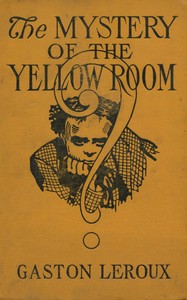
The Mystery of the Yellow Room
Subjects:
Download Formats:
Excerpt
The Project Gutenberg eBook of The Mystery of the Yellow Room, by
Gaston Leroux
This eBook is for the use of anyone anywhere in the United States and
most other parts of the world at no cost and with almost no restrictions
whatsoever. You may copy it, give it away or re-use it under the terms
of the Project Gutenberg License included with this eBook or online at
www.gutenberg.org. If you are not located in the United States, you
will have to check the laws of the country where you are...
Read the Full Text
— End of The Mystery of the Yellow Room —
Book Information
- Title
- The Mystery of the Yellow Room
- Author(s)
- Leroux, Gaston
- Language
- English
- Type
- Text
- Release Date
- March 1, 1999
- Word Count
- 78,749 words
- Library of Congress Classification
- PQ
- Bookshelves
- Detective Fiction, Browsing: Crime/Mystery, Browsing: Literature, Browsing: Fiction
- Rights
- Public domain in the USA.
Related Books
The Assassination Bureau, Ltd.
by London, Jack, 1876-1916, Fish, Robert L., 1912-1981
English
839h 5m read
The purple sickle murders
by Crofts, Freeman Wills
English
1177h 52m read

The poisoned chocolates case
by Berkeley, Anthony
English
1127h 45m read

The Desert Moon mystery
by Strahan, Kay Cleaver
English
1486h 49m read

Tragedy at Ravensthorpe
by Connington, J. J.
English
1228h 13m read
The patient in Room 18
by Eberhart, Mignon G. (Mignon Good)
English
1379h 49m read