*** START OF THE PROJECT GUTENBERG EBOOK 63219 ***
THE MISSOURI ARCHAEOLOGIST
[Illustration: The Pamplin Kiln]
Vol. 34 Nos. 1-2 Dec. 1972
THE MISSOURI ARCHAEOLOGIST
VOLUME 34, NOS. 1-2 COLUMBIA, MO. DECEMBER, 1972
Editor: Robert T. Bray, University of Missouri-Columbia
SOCIETY OFFICERS 1972
Henry W. Hamilton, President
VICE-PRESIDENTS
Leonard W. Blake
J. Allen Eichenberger
Dr. H. Lee Hoover
Dr. Carl H. Chapman, Secretary
Edward C. Matthews, Jr.
Clem T. Kelly
Leo J. Roedl
David R. Evans, Treasurer
TRUSTEES
Harold W. Mohrman, (Chairman)
Leo O. Anderson
Ramsey Bearden
Dale Belshe
John E. Berry
C. L. Blanton, Jr.
Freddie Bollinger
Fred Brandenburger
Mrs. Mary B. Bruno
C. Warren Cagle
Miss Harryette Campbell
R. I. Colborn
J. L. Connelly
Paul Corbin
J. M. Crick
Mrs. W. L. Davidson
W. B. Debo
Jack Dennis
Richard V. Dolby
Terrance Dyche
Benedict Ellis
Jim D. Feagins
Dr. Raymond Felling
Forrest Femmer
Charles R. Fiorita
Maynard A. Fisher
Michael R. Fisher
Howell Geiger
Henry H. Gerdes
J. W. Gerhardt
Harold Green
T. M. Hamilton
Dr. E. B. Hanan
Harry L. Harner
Dr. M. M. Hart
Dr. William Hayes
O. Lee Herberger
J. P. Herring
Leo P. Hopper
James G. Houser
Dr. Shelby Hughes
Elmo Ingenthron
Sam C. Irvine
Sam G. Jones
James F. Keefe
Thomas Keel, Jr.
David Kimbrough
George W. Kirk
Claude Knoles
Miss Margaret Lawlor
I. H. Lehmer
Dr. James L. Lowe
Frank Magre
Winton O. Meyer
Steve Miller
George W. Nichols
Dr. Peter Nichols
Charles V. Orr
W. L. Philyaw
Mrs. Howard Platz
Art Province
Julian D. Pyatt
Nelson Reed
Donovan Reynolds
Ralph G. Roberts
Paul V. Sellers
Dr. Francis L. Stubbs
John W. Taylor
Floyd Vavak
John C. Vinton
George Von Hoffman, Jr.
James Walden
PRESERVATION OF SITES COMMITTEE
J. J. McKinny (Chairman)
Joseph B. Abell
Dr. Hugh L. Cutler
William R. Denslow
Robert L. Elgin
Arthur L. Freeman, Jr.
Genevieve Huss
Charles E. Martien
Haysler A. Poague
Robert M. Seelen
George U. Shelby, Jr.
Allen B. Soper
Frank Stonner
C. H. Turner
Art. L. Wallhausen, Jr.
CONTENTS
CLAY PIPES FROM PAMPLIN by Henry W. Hamilton and Jean Tyree
Hamilton 1
Acknowledgments 1
Introduction 2
The Home Pipemaking Industry 3
Home Industry Pipe Making Methods 7
The Pamplin Smoking Pipe and Manufacturing Company 8
Factory Machinery 11
Factory Firing and Glazing 12
Reed Stems 12
Pipes Made By The Factory 12
Factory Price List of Pipes and Jobbers Discounts, As of 1941 13
Pamplin Area Pipe Forms 14
Conclusions 21
Bibliography 23
THE UTLAUT SITE (23SA162W): AN ONEOTA-HISTORIC MISSOURI BURIAL
SITE By Patricia J. O’Brien and Kevin Hart 48
Burial Descriptions 48
Discussion 61
References Cited 65
Appendix: Skeletal Remains from the Utlaut Site by Kevin Hart
and Clark Larsen 67
A REPORT OF SALVAGE INVESTIGATIONS AT ST. CHARLES, MISSOURI By J.
M. Shippee 75
ILLUSTRATIONS
CLAY PIPES FROM PAMPLIN By Henry W. Hamilton and Jean Tyree
Hamilton
_Plate_ _Page_
1. Tools of the Home Pipemaking Industry 26
2. Pamplin Pipe from the steamboat _Bertrand_ 27
3. Stencils on the Box of Pamplin Pipes from the _Bertrand_ 27
4. The Pamplin Smoking Pipe and Manufacturing Company, Inc. 28
5. Kiln of the Pamplin Smoking Pipe Company 29
6. Pipe Molding Machine from Pamplin Factory 30
7. Saggers from the Pamplin Factory 31
8. Advertising Brochure, Pamplin Pipe Company 32
9. The “original” Powhatan and other Pamplin Pipe Forms 33
10. Price List of Pamplin Company Pipe Forms 34
11. “Tomahawk Pipe,” 1941 Brochure 35
12. Sales Tag for “Original” Powhatan Pipe 36
13. Pamplin Area Pipe Forms 37
14. Pamplin Area Pipe Forms 38
15. Pamplin Area Pipe Forms 39
16. Pamplin Area Pipe Forms 40
17. Pamplin Area Pipe Forms 41
18. Pamplin Area Pipe Forms 42
19. Pamplin Area Pipe Forms 43
20. Pamplin Area Pipe Forms 44
21. Pamplin Area Pipe Forms 45
22. Pamplin Area Pipe Forms 46
23. Pamplin Area Pipe Forms 47
_Tables_ _Page_
1. Sources of Pipes and Relative Numbers available for Examination 14
2. Identifications Appearing on Certain Pamplin Pipes 15
THE UTLAUT SITE (23SA162W): AN ONEOTA-HISTORIC MISSOURI BURIAL
SITE By Patricia J. O’Brien and Kevin Hart
_Figures_ _Page_
1. Floodplain of the Missouri River with Locations of 23SA4,
23SA162W and 23SA162 49
2. Test Excavations at the Utlaut Site 50
3. Burial 1, 23SA162W 51
4. Artifacts from the Utlaut Site 53
5. Burial 2, 23SA162W 54
6. Pottery Vessels from the Utlaut Site 55
7. Burial 3, 23SA162W 56
8. Burial 4, 23SA162W 58
9. Burial 6, 23SA162W 59
10. Pottery Vessels Associated with Burial 6 60
11. Tibiae of Burial 1 68
12. Skull Profiles of Burial 3 71
_Tables_ _Page_
1. Post-Cranial Measurements and Indices for Skeletal Material
from 23SA162W 73
2. Cranial Measurements and Indices, Burials, 2, 6 73
3. Comparison of Male Stature for Oneota Indians 74
A REPORT OF SALVAGE INVESTIGATIONS AT ST. CHARLES, MISSOURI By J.
M. Shippee
_Figures_ _Page_
1. Pit A Pottery 77
2. Pits B and D Artifacts 79
3. Pit D Pottery 81
4. Pottery from Pit D and from Surface of Road 82
CLAY PIPES FROM PAMPLIN
by Henry W. Hamilton & Jean Tyree Hamilton
ACKNOWLEDGMENTS
We wish to express appreciation to all of the following for their help
and assistance in the preparation of this report. The contributions of
some are discussed in detail in the text, but we are grateful to each
and every one.
Miss Wilsie Thornton, Mrs. Bess Franklin Mattox, Stuart M. Farrar and
Jack Price, Pamplin, Virginia.
Dr. Clyde G. O’Brien, M.D.; Calvin Robinson, retired editor; Ray Noble
and William Sperry, Appomattox, Virginia.
Mrs. Aldah B. Gordon, Clerk Circuit Court, Appomattox County,
Appomattox, Virginia.
Vernon C. Womack, Clerk Circuit Court, Prince Edward County, Farmville,
Virginia.
Alford L. Rector, Charles H. Meadows, and Mrs. Charles S. Martin,
Appomattox Court House, National Historic Park, Virginia.
Edward A. Chappell, Virginia Historic Landmarks Commission, Richmond,
Virginia.
Edward F. Heite, formerly with Virginia Historic Landmarks Commission.
Francis B. Fitzgerald, Suffolk, Virginia.
David Dautenhahn, Marshall, Missouri
John W. Walker, John W. Griffin and Richard D. Faust, Southeast
Archaeological Center, National Park Service, Macon, Georgia.
J. Paul Hudson, Jamestown National Historic Park, Virginia.
Rex L. Wilson, Acting Chief, Division of Archaeology and Anthropology,
National Park Service, Washington.
John C. Ewers, Smithsonian Institution, Washington.
Jerome E. Petsche, National Park Service, Washington.
Charles Phillips, Williamstown, Massachusetts.
Miss Mary M. Watts, Times-Dispatch, Richmond, Virginia.
Robert L. Saville, Jr., Lawyers Title Insurance Corp, Richmond Virginia.
Morton L. Wallerstein and Ralph Dombrower, Richmond, Partners in the
last factory operation.
Microfilm Department, Virginia State Library, Richmond.
Miss Eleanor Thompson, Assistant Librarian, Missouri Valley College,
Marshall, Missouri.
Mrs. Dorothy Erdmann, Summit County Historical Society, Akron, Ohio.
Floyd Painter, Editor, _The Chesopiean_, Norfolk, Virginia.
Ronald A. Thomas, State Archaeologist, Dover, Delaware.
Mrs. Elizabeth Schick and L. T. Alexander, Archaeological Society of
Delaware, Wilmington.
R. H. Landon, Minnesota Archaeological Society, Minneapolis.
Howard A. MacCord, Sr., Archaeology Society of Virginia, Richmond,
Virginia.
Ronald R. Switzer, Bertrand Conservation Laboratory, DeSoto National
Wildlife Refuge, Missouri Valley, Iowa.
The photography is by T. M. Hamilton, Miami, Missouri, except where
otherwise noted.
To the many others who have helped, we also wish to express our thanks.
INTRODUCTION
This is presented as an aid in the identification of clay pipes from the
general area of Pamplin, Virginia, that might appear in archaeological
and historic sites. Interest in these pipes has been stimulated by their
being reported as found in various sites in the western United States.
The circumstances under which this information has been gathered and the
fact that it has been a number of years since clay pipes were made here,
either as a home industry or commercially by the Pamplin Smoking Pipe
and Manufacturing Company, leave much to be desired. On the other hand,
in our work we have inspected a total of 4,451 Pamplin pipes; of this
number 39% were from the factory grounds, and 61% were from the Thornton
Store Site and represented the home industry, so we feel that the 39
forms presented represent at least a majority of the pipe forms made at
Pamplin.
This is not to say that a similar form could not have been made
elsewhere; however the style, the generally heavier and thicker
character of the piece, and the finish, or lack of it, as well as the
usual deep red color of the Virginia clay, would seem to make these
pipes distinctive.
Under the conditions in which these pipes were retrieved it is obvious
that the numbers of the different forms located give little indication
of the relative numbers of the different styles that were manufactured,
the popularity of the various styles, or the relative time of their
manufacture.
Nearly all of the pipes examined were retrieved by excavation, by people
who simply happened to become interested; this is equally true whether
the pipes had been made by the factory and excavated out of fill on the
old factory grounds, or whether they were made at the homes and
excavated from the basement of the old Thornton Store, which through the
years had taken them in trade for merchandise.
In some cases among the pipes examined there were not more than one, or
a few, examples of a certain form. In other cases there were hundreds.
Among the examples available to us there was generally little variation
in size within the same form. We have illustrated the largest and the
smallest, since this also gives an opportunity to note minor variations
that may exist between different molds for the same pipe form. However,
a rather wide variation in size was present in that shown as (Plate 13
A), the “Original” Powhatan, where a total of 12 gradations from largest
to smallest were found.
The predominant color of the pipes is dark red. A lighter color is
infrequently present, running from almost yellow, to salmon, to light
brown. The very dark, almost black coloration of some is said to come
either from minerals present in the soil of this area, to which the
pipes presented here had been subjected since nearly all had been many
years underground, or from actual fire that had fallen into the saggers
of the Company kiln, or the iron pots in which the pipes had been fired
in the home industry.
During the last years of factory operation “some white clay from either
West Virginia or Kentucky was shipped in by railroad”. This resulted in
pipes of a lighter color, at times light grey to white. Apparently no
pipes made from this particular clay were seen by us, except possibly
those illustrated in Plate 23 AJ.
THE HOME PIPEMAKING INDUSTRY
Well established local tradition indicates that clay pipemaking in the
homes, for home and neighborhood use, started almost as soon as the
first settlers reached the area, and after the suitability of the local
clay was discovered. Initial county organization in this part of
Virginia was well underway by the 1740’s.
Bradshaw’s _History of Prince Edward County_, Virginia, 1955, p. 5
states, _Batho Austin road to be cleared from the Appomattox River near
Colonel Richard Randolph’s quarter to Hill’s Fork on Vaughan’s Creek by
all who lived near the route and were not employed on other roads.
1742._
Vernon C. Womack, Clerk of the Circuit Court, Prince Edward County, in a
personal letter states, “Since the south fork of Vaughan’s Creek
originates a short distance from where the pipe factory was later
located in Pamplin, this might be the starting point. John Wood’s map of
Prince Edward County, dated 1820 which shows that part that was later
cut off to form Appomattox County, gives a detail network of roads
through Kelso’s Old Store, which appears to be near the present location
of Pamplin.”
_There were stores at Sandy River, Wm. and Samuel Matthew had a store at
Walker’s Church, and Kelso’s Old Store was between Walker’s Church and
Merriman’s Shop_ (now Pamplin).” The statement is footnoted _John Wood
map_, 1820. (Bradshaw, 1955:319).
_Merriman’s Shop Post Office, 94 miles from Richmond, 185 miles from
Washington._ (Martin, 1835:269).
_Advertisement for renewal of bids for rural route for port office in
Merriman’s Shop in 1843-1848_ (Bradshaw, 1955:315).
The area that was later to become Appomattox County had been,
successively, included in the areas of several earlier and larger
counties. Appomattox County was formed in 1845. The railroad came
through Merriman’s Shop in 1854, and was renamed Pamplin. The Appomattox
County Courthouse burned and the county records were destroyed by fire
on February 2, 1892 (Communication from Mrs. Aldah Gordon).
Mrs. Bess Franklin Mattox reported, “Nicholas Pamplin, a resident of
Merriman’s Shop, was the only citizen who permitted the railroad to go
through his land without charge and so the village was renamed for him”
(Mattox, personal communication). For a time it was known as Pamplin
Depot, then Pamplin City, finally simply Pamplin.
The home manufacture of pipes has had a long history in this part of
Virginia and can be considered as well underway by the 1740s. It existed
long before the Company came to Pamplin and continued after the Company
had ceased operations, or as long as there was an active demand for clay
pipes.
The Home Industry finally came to a close in 1953. “Mrs. Betty Price of
Appomattox County was the last to make pipes. I have a mold used by her.
She made them from childhood and in her prime could make 40,000 pipes
per year, having been taught by her mother in 1866 when she was eight
years old. Her mother had made them a lifetime before her. In the last
year of Mrs. Betty Price’s life, 1953, she made 500 pipes at the age of
95. They were made from clay from her own farm.” (Personal letter from
Dr. Clyde G. O’Brien of Appomattox, and her son, Jack Price of Pamplin).
A column by the _News-Leader_ correspondent from Appomattox, April 30,
(year unknown) said, _Hollywood bar reached all the way to Pamplin to
get Mrs. Betty Price’s pipes for use by the Indians in the movie,
“Northwest Mounted Police”. Cecil B. DeMille’s research man ferreted out
the Powhatan pipe some months before the film went into production.
Several dozen were ordered. Frank Lloyd also bought pipes to be used in
the production of “Howards of Virginia”._
Practically speaking, all of the pipes made at the homes were made by
white women, and from about the time of the first settlement of the
territory, as the special suitability of the local clay for that purpose
was early discovered.
Miss Wilsie Thornton of Pamplin said that this industry had become
especially important after the War Between the States, because with so
many men having been killed and the area in such straitened
circumstances, the women were badly in need of some means of making a
living. The pipes they made could be traded at several general stores,
or sold for a few cents, and there was no cost for materials.
One such establishment at which the local women disposed of their pipes
was J. R. Franklin & Co., of Pamplin. Some of these pipes were recovered
when the cargo of the sternwheeler, _Bertrand_, which sank in the
Missouri River at Port La Force, Nebraska, April 1, 1865, (Petsche,
1970:1) was salvaged in 1968-69. The official list of artifacts
recovered in the salvage operation, supplied by Jerome E. Petsche,
National Park Service, who was in charge of that operation shows:
_Pipes, Smoking; Several types and sizes recovered; briars and clay; one
lot included clay bowls exclusively, others contained stems and bowls.
Consignee: Vivian and Simpson, Virginia City. Manufacturer’s
stenciling_: ‘THE CELEBRATED VIRGINIA POWHATAN (CLAY), J. R. FRANKLIN &
CO., SOLE AGENTS FOR THE MANUFACTURERS, PAMPLIN DEPOT, APPOMATTOX
COUNTY, VA.’ Field lot numbers MPC 104, MPC 358, FSC 171.
The following description of the pipe shipment on the _Bertrand_ was
provided by Ronald R. Switzer, Director, Bertrand Conservation
Laboratory, National Park Service, Missouri Valley, Iowa.
“The pipes are of one type and design (Plate 2). Forty pipe bowls plus
136 fragments ... all but 15 are chipped or broken, condition otherwise
good. Clay, predominantly grayish-tan, mottled with brick red and brown.
Paste soft, fine, and uniform, ... exterior has soft sheen.
Preservation: Brushed with soft bristle brush in running tap water to
remove mud.” (Switzer, personal communication).
This pipe is similar to (Plate 19 U); however, there are slight
variations due to differences in individual molds made for production of
the same pipe form.
The two pipe forms (Plate 19 T & U), were the only examples we found
that carried the peculiar pinkish-gray tan color, and they were found
only among the pipes made by the Home Industry. They were probably made
of clay from the same source and by the same individual, since home
pipemakers usually dug their clay on their own premises, and the
condition of the pipes, after a century in mud and moisture, indicates
that the work was done well.
The shipment was contained in a wooden box, which was approximately 15½
inches long, 8½ inches wide, and 8 inches tall (Plate 2). The stenciling
on the box is faint, but legible.
“Lettering on the top of the box indicated the consignee but is so faded
that it was impossible to obtain a good photograph; however the stencil
once read,—B. A. L. Vivian & Simpson, Virginia City, M. T.” (Plate 3)
(Switzer, personal communication).
“One end of the box was lettered, No. 1, 216, M. Size” (Plate 3). The
meaning of this can only be conjectured, however it may have indicated
shipment No. 1, to this consignee; containing 216 pipes; of Medium size.
The stencils identifying the consignor, J. R. Franklin & Co., appeared
on both sides of the box and were identical (Plate 3). The same, except
in abbreviated form, appeared diagonally on one end of the box.
The account book of the store at New Store, Virginia, about 23 miles
northeast of Pamplin, which is in the collections at Appomattox
Courthouse, records that on Sept. 1, 1866, I. H. Schenault was paid
$8.00 for 1,600 pipes, and later, (apparently the same day) was paid
$8.75 for 2,175 pipes. The latter was evidently a partial and immediate
“in trade” transaction.
So in the Pamplin area in the 1860s general stores were taking clay
pipes made in the home industry, allowing about ½¢ each in trade for
commodities, and at least in one instance were shipping them west for
use by the miners in the gold fields.
Mrs. Betty Price has said that the Powhatan “Original” (Plate 13 A) the
“Hamburg” (Plate 14 F) and the “Zuvee” or “Zoo” (Plate 19 T) were some
of the first pipe forms made in the area. (_News-Leader_, April 30, year
unknown).
Many of the clay pipes made at homes near Pamplin were traded for
commodities at the Thornton General Store in Pamplin, and this store was
truly “general”, for it handled, in addition to groceries, everything
from threshing machines and horsepower mills to silk thread.
Miss Wilsie Thornton had a copy of her Father’s letterhead: the letter
was dated, Jan. 9, 1892. The letterhead reads,—
_W. D. THORNTON, DEALER.
General Merchandise and Agricultural Implements.
Wholesale dealer in All Styles of Clay Pipes and Stems
Manufacturer’s Agent for
Aultman and Taylor Threshers, Horse Power and Farm Engines.
Also Buckeye Reapers & Mowers & Thornmill Wagons._
“The pipes made by the local women,” Miss Thompson said, “were traded to
the Thornton Store for the necessities of life. The pipes were stored in
the basement of the store and packed in barrels, in either pine needles
or sawdust, and shipped to the Baltimore Bargain House, or to other
wholesale houses. From the wholesale houses they were shipped to the
Cotton States and to the West. Large orders were filled for a tobacco
factory in Pennsylvania, where they sold bags of tobacco with the
pipes.”
Pamplin pipes have been reported from the sites of Fort Laramie,
Wyoming; Fort Sanders, Wyoming; Fort Stambaugh, Wyoming; Fort Phil
Kearny, Wyoming; Fort Union, New Mexico; Fort Sully, South Dakota; and
Fort Davis, Texas (Wilson, 1971).
Miss Thornton’s parents were married in 1874, but the store was already
in operation at that time. Her father continued operation until his
death, December 16, 1897; after that the store was run by her brother. A
bank, the “Farmer’s and Merchant’s National Bank” was also operated in
the store. In later years the building became a drug store.
Finally with time and disuse the old building came down and erosion,
with perhaps some intentional filling of the area, took place. So the
site of the old general store, which in its heyday had meant so much to
Pamplin and Appomattox County and its people in their daily living,
became simply a vacant area.
Some years ago Miss Thornton had made a train trip and met an old
colored woman in a rest room to which they had both gone to smoke. (When
we met her, Miss Thornton chain-smoked at the age of 89). The colored
woman had a sack of tobacco and pulled out a clay pipe which Miss
Thornton recognized as of the kind that her father used to take in
trade, so she asked the woman if it was a good one.
The woman answered, “Law, yes, but I can’t buy them any more!” so Miss
Thornton told her that it was made long ago, in her home town, and that
she would try to get her some.
Her next problem was to find some pipes. After several days she thought
of the pipes that she felt sure were covered with earth and still in the
basement of her father’s old store, so she talked to her cousin and next
door neighbor, Mrs. Bess Franklin Mattox.
Shortly after that, they dug at the site. Mrs. Mattox thinks it was
around 1958, though possibly 2 years earlier. “Erosion through the years
had covered the pipes and when we first started to dig we found none,
then there they were, under the dirt. We found two or three sugar
barrels full. Tar was on a few of the pipes, from road tar that was also
stored in the basement and spilled”. (This tar, in hard-dried rough
spots, is present on some of the pipes we examined; however it chips off
readily and leaves the pipe relatively clean).
So the colored woman who couldn’t find a Pamplin pipe to buy received
“either 15 or 16” and Miss Thornton received a letter of thanks from her
from Atlanta.
Miss Thornton still had approximately 1,450 of the home manufactured
pipes for us to see when we visited her in July 1969, and Mrs. Mattox
had a few.
Dr. Clyde G. O’Brien of Appomattox has had a lifelong interest in the
clay pipes of his area and in the history of their manufacture. He has a
collection of pipes as well as two pipe molds, and has given us much
information.
HOME INDUSTRY PIPE MAKING METHODS
We asked Dr. O’Brien for an account of the method of making pipes in the
homes. The following is his contribution, in a letter dated March 11,
1971.
“I talked to Jack Price, age 86, he had worked in the plant for years.
His mother, Mrs. Betty Price, and grandmother made pipes at home in
Pamplin.
“The clay was made up and put into molds, when the pipe was removed from
the mold the shaper was used to smooth mold marks, if the pipe was to be
identified with ‘Original’, ‘Hayiti’, or some other marking this was
impressed on the base with a stamp at this time. The pipe was then
sun-dried on a board in summer, or in the stove oven in winter. Then
after they had ‘set-up’ the pipes were put into an iron pot, the pots
were put into an oven in the back yard and dry chestnut wood was placed
around the pots and this was then set on fire. They did not have a
thermometer so he did not know the temperature, but when the wood had
burned completely the pipes were brought out to cool.
“If a piece of wood fell into the burning pot and started to smoke it
was removed at once to keep from blackening or staining the pipes.
“After the pipes cooled they were brought into the house and Mr. Price
said that when the pipes were poured out of the pot in which they were
baked, to the floor, they would ring or chime when they hit against each
other.
“The pipes were then waxed with bee’s wax and mutton tallow and then
polished with a woolen cloth, and the children helped.”
In all of this, Bob Davis of Pamplin, age 91, in talking to John W.
Walker in 1962, had concurred. He said, “The pipes were molded, trimmed,
put on a board and dried in the sun, baked in iron pots, waxed, and
rubbed. The pipes were made all through the country, the local stores
bought and shipped them, and the Factory would buy these ‘country
pipes’.” Here was more direct evidence that the Factory, on occasion at
least, bought and shipped pipes made by the Home Industry (Walker,
personal communication).
There were, however, two men who made pipes.
Dr. O’Brien’s father Thomas O’Brien, was born in 1843. When he came back
after the War, about 1865, he made his own mold of white-oak with lead
lining and made pipes for his own use.
According to Miss Wilsie Thornton, a Mr. Rodgers was making molds and
pipes until about 1938 as a hobby. One of them was in the form of an
Indian head (Plate 23 AL). The “peach seed” pipe (Plate 23 AM) is also
thought to be one of his manufacture.
THE PAMPLIN SMOKING PIPE AND MANUFACTURING COMPANY
In the middle 1850’s that part of Ohio that surrounds Akron was the
pipemaking capital of the United States, with at least six clay products
companies producing them (Blair, 1965:26-30). The leading producer of
clay smoking pipes in the Akron vicinity was the E. H. Merrill Co.,
which had been producing pottery objects since its founding in 1831. In
1843 or 1844 Calvin, brother of E. H. Merrill, invented a machine for
making pipes which greatly increased the output of the company and gave
quite an advantage over its competitors (Blair, 1965:3).
The Pamplin Smoking Pipe and Manufacturing Company, Inc., was
established by the Akron Smoking Pipe Company of Akron, Ohio, when they
built the plant at Pamplin.
That the clay in Appomattox County was well suited to pipe manufacture
was well known. The establishment of this plant was no doubt the result
of the Company’s realization of the availability of the fine red clay
from which the local women were producing pipes, a clay that could be
used without even sifting.
When the Pamplin Factory was established is quite uncertain. Examination
of the microfilm of newspapers of the area that were available from the
Virginia State Library, beginning February 3, 1869 through December 25,
1896, gave no clue to the date of the establishment of the Pamplin
Factory, nor did county records, probably due to the fire of 1892.
_Sometime immediately prior to 1880 William Merrill of Akron, Ohio,
undoubtedly a member of the pipe making family, established a pipe
making factory at Pamplin._ (Omwake, 1967:23). Our Pamplin informants
were of the opinion that the Akron plant was devoted to the manufacture
of drain tile after the pipe machinery was moved to Pamplin.
Bob Davis of Pamplin, born 1871, in an interview with John W. Walker in
September 1962, said, “I was a kid when the factory came in”. Timewise
this would be in general agreement with Omwake’s estimate for the date
of the establishment of the factory at Pamplin.
That Pamplin pipes were also available from Akron in 1893 is evidenced
by a letterhead of the Akron Smoking Pipe Company, dated June 26, 1893,
showing examples of two clay pipes similar to Plate 22 AF & AG, (Blair,
1965:36). A communication from the Summit County Historical Society
reports, “The Akron Smoking Pipe Co. is recorded as being in business
from 1891 to 1895, and were manufacturers of stone, Powhatan Clay, and
corn cob tobacco pipes. Daily capacity 100,000 pipes. General offices,
Akron, Ohio. Factories, Pamplin City, Virginia; Mogadore, Ohio.”
Statements in company literature are also confusing. In a leaflet which
carries a testimonial for their pipes, dated April 28, 1941 and price
lists “effective November 15, 1941”, the statement is made, _from
careful search of the records, this factory started more than 200 years
ago ... the present plant has been in operation for 44 years. Skilled
American labor is used in a modern, day-lit plant with special attention
to cleanliness, sanitation, and ideal working conditions_ (Plate 8).
This would give a date for the “present plant” of 1897, but it also
suggests that an earlier plant had been rebuilt or replaced. (An undated
and unidentified news clipping does state that at some time the pipe
plant had burned). Company literature also states, “Established 1739”
(Plate 8). This obviously cannot refer to the establishment of the
plant, nor even to the mother plant at Akron, since pottery was first
produced in Summit County, Ohio, in 1828 (Blair, 1965:2). The Company
may simply have been employing “poet’s license” and appropriated a date
which they felt representative of the start of the Home Pipe Making
Industry in the Pamplin area.
The _Times-Virginian_ of Appomattox, date unknown, carried a news
article, _Pamplin Clay Pipe Plant once termed largest in the World_. The
_Farmville Herald_ of March 29, 1935 stated, ... _the output of the Clay
Pipe Factory at Pamplin is 1,000,000 a month, when it is running full
time. In the roster of business in Virginia, this factory is mentioned
as the largest clay pipe factory in the United States, and so far as is
known, in the world._
At one point in the history of the plant, pipes were sold to England as
well as some other countries in Europe.
Also vague has been the terminal date of the Pamplin Company; it is
variously given locally as 1948 to 1951.
There is a contemporary news article on the factory published in the
_Richmond Times-Dispatch_, April 21, 1946. _A History of Appomattox,
Virginia_, published 1948, states, _The Akron Pipe Factory of Pamplin
holds the title of manufacturing the finest clay smoking pipes in the
world, known as the ‘Powhatan’_ (Featherstone, 1948:44).
In a personal letter to the writers, John C. Ewers said, “During my
field work on the Fort Peck Reservation in Montana, in 1953, I first
learned of the Pamplin clay pipes. One of my Indian informants told me
about selling them when he was working at a trading post on the
reservation during the first decade of the present century....
“Later I visited the trading post at Oswego on the Fort Peck
Reservation. There the proprietor showed me the illustrated price list
of the Pamplin Smoking Pipe and Manufacturing Company, Inc. He showed me
the only type of pipe he still had in stock—the ‘Century of Progress’,
Chicago type (Plate 23 AJ). He said the manufacturer wrote him in 1951
that he planned to go back into the manufacture of the other styles,
which the Assiniboine preferred.”
The Tomahawk pipe was a good specialty item for sale at such events as
fairs and expositions, and the Company’s sales to the “Century of
Progress” in Chicago in 1933 must have been excellent, even though they
had not sold all they had made in anticipation of that demand. The bowl,
necessarily narrow and elongated since it was in the blade of the
tomahawk, did not recommend it to serious smokers, nor to the
Assiniboine.
It would seem evident that these pipes were left over from the
production of the Company in 1933, that their regular pipe models had by
this time been sold out, and that the Company was already in a State of
quiescence in 1951.
Dr. Clyde G. O’Brien of Appomattox stated that the Company ceased
operations in 1951.
The Charter of the Pamplin Smoking Pipe and Manufacturing Company shows
that it was incorporated by the Commonwealth of Virginia on the 15th day
of August, 1929. The officers at that time were, J. V. Lewis, Pres.,
Prospect, Virginia; J. W. Franklin, V.Pres., Pamplin; L. N. Ligon,
V.Pres., Pamplin; T. R. Pugh, Secy-Treas., Pamplin.
The purposes of the Company then were, among other things, to deal in
wood of all kinds, own timber lands, contract to do construction work,
deal in real estate, _and to buy and sell all kinds of necessary
material ... and operate all the necessary equipment and machinery for
the purpose of manufacturing clay pipes, crocks, and earthenware_....
(Charter Book No. 1, Page 108, Appomattox County, Virginia). The
corporation (Charter No. 34565-16) was dissolved by the State
Corporation Commission, at the request of the stockholders, on February
21, 1952.
A personal communication, February 23, 1972, from Morton L. Wallerstein
who with Ralph L. Dombrower as corporate officers were the last active
operators of the pipe factory, states, “Mr. Dombrower and myself, as
sole stockholders, started the operation in 1938 and baked the clay
pipes up to the time of the enactment of the Minimum Wage Law by
Congress. At that time it was apparent that the part-time workers,
largely farm girls and boys who worked in the afternoon, would cease to
be employed because the pipes could not be marketed under the wages
required to be paid.
“However, Mrs. Betty Price and another woman made the hand-made clay
pipes at their homes, which pipes Mr. Dombrower bought after 1938 and
very cleverly boxed in antique fashion and sold them for some years.
However, unfortunately the women who made these pipes died and they were
no longer made.
“The factory, itself, did not manufacture pipes beyond the period stated
above. The property was sold in 1947 and the corporation was dissolved
in 1952.”
Apparently then, the Pamplin Smoking Pipe and Manufacturing Company
ceased all activity in 1951, having been in existence slightly more than
70 years.
Some time after the closing, the main factory building was used as a
garage. In July of 1969 this frame building, with the name “Pamplin
Smoking Pipe and Manufacturing Co., Inc., American Indian Clay Smoking
Pipes” still painted above the entrance, stood unoccupied; the crumbling
old smokestack and large round kiln of brick construction were still
there (Plates 4 & 5). Another building which had served Company purposes
had been destroyed.
FACTORY MACHINERY
The machinery to mold smoking pipes and bottles was invented by Calvin
J. Merrill of the E. H. Merrill Pottery, Summit County, Ohio, in 1843
(Blair, 1965:3).
The pipe machine was simple: the individual metal molds in the foot
powered mechanism could be changed to vary the pipe form. The whole was
contained in a simple wooden bench (Plate 6). Miss Wilsie Thornton felt
that a man working such a machine could produce thousands of pipes per
day. It is unknown how many such machines were used by the factory, nor
how many people were employed since ideas of our informants varied;
however, the best estimate seems to be 8 to 10 machines, with employees
varying from 10 to 40, depending upon the press of work and the rush of
orders at any given time.
Bob Davis of Pamplin, in the interview with John W. Walker said, “Old
man Taz Harvey made the Powhatan mold. He had a shop and made many
molds”.
FACTORY FIRING AND GLAZING
The pipes were packed in round stoneware crocks or saggers made from
fireclay, and the saggers were stacked alternately around the kiln. The
saggers were some eight inches high and 16 to 18 inches in diameter
(Plate 7). There was an opening in the top of the kiln through which, in
glazing, salt was put when the pipes were hot. They were fired some 24
or 48 hours (Miss Thornton’s statement).
Mrs. Maddox said: “As a child I used to go with a colored man who worked
with us and also for the factory, and watch him throw salt down a hole
in the top of the kiln on the pipes to make a glaze.”
At a high temperature the salt vaporized and combined with the silica in
the body of the clay to form a glassy or ‘silicate glaze’. The kiln was
fired 32 to 36 hours before maximum temperature was reached; it was
cooled the same period to prevent crazing (minute cracking) of the glaze
(Blair, 1965:15). This description of glazing refers to stoneware in the
mid-nineteenth century potteries near Akron, Ohio. However since the
Pamplin kiln was the same sort of “walk-in” kiln, the detail would fit,
and it is substantiated by Miss Thornton’s statement of firing time.
From the scarcity of glazed pipes among the many that we examined, we
conclude that the majority were finished without glazing.
REED STEMS
The stems sold with the factory pipes were made from switch cane
_Arundinara gigantea_ known locally as reed and once abundant in the
Great Dismal Swamp in southeastern Virginia (R. H. Woodling to Chas. H.
Meadows, May 15, 1969). (The stems used with the pipes made by the Home
Industry usually came from the same source.)
The reeds were cut in 12 foot lengths by men in boats, allowed to dry
for six months, cut in lengths and reamed out. Some were put in a
machine and bent (Miss Thornton, Dr. O’Brien).
Cork plugs or washers were used in the base of the pipes to hold the
stem in place. Some were still in place in pipes we examined. A plug
mill, a high pressure machine, extruded the cork plugs which were cut
off by wire (Heite).
(Replacement reed stems for clay, hickory, or corn cob pipes, retailed
in the grocery stores in Lexington, Missouri, for 10¢ per dozen about
1916).
PIPES MADE BY THE FACTORY
A number of people and institutions with varying numbers of Pamplin
Factory pipes in their possession have given us an opportunity to
examine them. The largest number of specimens were in the hands of the
following.
Our attention was first called to these pipes in 1968 at the Craft Club
in Arrow Rock, Missouri, where some of them appeared for sale as an
unusual item. They obviously had been underground, for the bowls and
bases were still filled with earth containing numerous rootlets growing
through the pipe cavities.
It was learned that the pipes had been supplied by Francis B.
Fitzgerald, Suffolk, Virginia; David I. Dautenhahn, Marshall, Missouri,
put us in touch with him. As a youngster, Fitzgerald had on various
occasions visited his grandfather’s farm, which was near the Pamplin
Factory, and had played in the water of a little creek on pipe plant
property. In so doing, he discovered that there were numerous clay pipes
in a bank which apparently had been placed in the creek to form a dam.
(The dam was probably for the purpose of retaining water to mix with the
clay). He had hundreds of these pipes. Practically none would seem to
have been rejects—how or why they got into the dirt which was used to
make the fill is unknown. Through the years Fitzgerald had made a
selection of forms representative of this group, all of which he made
available to us.
Since that time an owner of the pipe plant property had secured many
pipes, later acquired by the Appomattox National Historic Park. They
were made available to us by Alford L. Rechtor, Superintendent.
The Virginia Historic Landmarks Commission supplied photographs of some
Pamplin pipes, as well as photographs of a pipe mold and pipe maker’s
bench (Plate 6) and saggers (Plate 7). We were granted the use of these
by Edward F. Heite and Edward A. Chappell of that institution.
John W. Walker of the National Park Service, who had worked in the area
and become interested in the pipes made there, provided us with a copy
of his field notes and some examples of pipes.
John C. Ewers of the Smithsonian Institution had visited Pamplin. He
gave us much information and showed us several pipe forms from the area
that are in the collections of that institution.
Rex L. Wilson, National Park Service, loaned us a copy of his
manuscript, “Clay Tobacco Pipes from Fort Laramie, Wyoming and Related
Sites”, in which he identified some specimens as having come from
Pamplin.
FACTORY PRICE LIST OF PIPES AND JOBBERS DISCOUNTS, AS OF 1941.
The Company’s price list of November 1941 listed “The Powhatan Machine
Made”, fitted with cork closures and 10″ reed stems, bowls trade-marked,
packed 50 to box, 25¢ retailer. Price $6.00 per box.”
(Plate 10).
Five other models were listed, “5 in. reed stems, packed 100 to box, 15¢
retailer. Price $3.00 per box.” Two models were listed similarly, but
10¢ retailers, price $2.50 per box. Two other 10¢ retailers were listed
at $2.70 per box, and one model at $2.85 per box but the suggested
retail price was still 10¢ each.
One model, their “Ole Virginny Hamburg”, was offered in finest
fire-clay, hard-burned, white, simulates meerschaum, also in red.
Similar to “Ole Virginny Shaker”. It was a 10¢ retailer, $2.70 per box
of 100. (It is of interest that this pipe, listed elsewhere in this same
price list, but as “Ole Virginny Shaker of Virginia red clay, a heavier
stone pipe”, was priced as a 15¢ retailer and $3.00 per box). (Plate 10
).
Jobbers discounts were offered. “10 to 20 boxes, 20%”, and going up by
5% stages to “101 to 500 boxes, 35% discount”. “We make many other
styles of Indian Clay and Stone Pipes, ... we can make any style of pipe
that can be made of clay. Our own designers and artists are at your
service” (Plate 11).
In the last years of Factory operation their sales carried an
identification tag, “This Is An ‘Original’ Powhatan Pipe”, and it was
being made by the last two women of the Pamplin area who were still
making pipes at their homes (Plate 12).
PAMPLIN AREA PIPE FORMS
The pipes are illustrated natural size. The largest and the smallest
pipe of each form available to us are shown. In many instances this
difference in size is not great; however, it does illustrate that minor
variations often existed in different molds for the same pipe form. The
diameters for the stem openings have not been included since they have
proved useful only in consideration of the earlier integral-stem clays,
and not for consideration of the “short-base” pipes of the type and time
included in this report (Wilson, 1971:2).
TABLE NO. 1.
Sources of Pipes, and Relative Numbers Available for Examination.
Total number of pipes inspected—4,451.
Plate. Source. Number of Examples.
13 A. Both Many
13 B. Home 2
13 C. Home 11
14 D. Home 4
14 E. Home Many
14 F. Both Many
15 G. Factory Many
15 H. Home 3
15 I. Factory Many
16 J. Factory Many
16 K. Both Many
16 L. Factory Many
17 M. Both 37
17 N. Factory 1
17 O. Factory 1
17 P. Both Many
18 Q. Both Many
18 R. Home 10
18 S. Both Many
19 T. Home 14
19 U. Home 2
19 V. Factory 1
19 W. Surface 1
20 X. Factory 1
20 Y. Both 2
20 Z. Factory 4
20 AA. Factory 4
21 AB. Factory 1
21 AC. Home 1
21 AD. Factory 1
21 AE. Factory 1
22 AF. Factory 2
22 AG. Factory 1
22 AH. Factory 1
22 AI. Factory 2
23 AJ. Factory 1
23 AK. Factory 1
23 AL. Surface 1
23 AM. Home 2
TABLE NO. 2
Identifications Appearing On Certain Pamplin Pipes.
Plate: Source of Pipe. Designation. Lettering.
13 A. Both Original Impressed
13 B. Home Original Impressed
17 M. Both Original or Florence Impressed
18 Q. Both Hayiti Impressed
18 R. Home Genuine Impressed
19 V. Factory 117 Raised
20 Z. Factory Catlins Raised
20 AA. Factory 103 Raised
21 AC. Home Original Impressed
21 AD. Factory Powhatan Impressed
_Plate 13 A._ Slightly Acute Angle. Made _both_ in the factory and in
the home. Many examples. All are a deep, dark, glossy red, except 9
pipes which were a light brown. Plain round bowl, octagonal base. It was
made in at least 12 slightly varying sizes, there being that many
variations between the large and the small pipe illustrated. This was
the Pamplin Company’s “Original” Powhatan, and it was no doubt one of
the Company’s leaders in production and sales. The word “ORIGINAL” is
impressed in the right side of each base, with the exception of one
single pipe, and the lettering appears in at least three different
sizes, there being no correlation between the letter size and pipe size.
This is a sturdily made pipe.
The Company emphasized in its publicity that the Indians had originally
demonstrated to the early settlers the method of making the Powhatan and
so had enabled them to make this exact form, thereby inferring that this
model should have been of particular interest and worth. No doubt at
some time and place in our history a happening of this nature may have
occurred. However, the Powhatan is a usual form which has been found in
aboriginal sites, with some modifications and of varying materials, over
a wide area.
Many of these pipes appeared, both from the factory site and among those
made by local women and retrieved from the basement of the Thornton
General Store. Mrs. Betty Price said that this form was a standard
product of the local Home Industry pipe makers before the factory ever
came to Pamplin and one of the earliest made in the area. All of the
pipes available to us carried the designation “Original” except one.
The making of clay pipes was an old and well established business at
Pamplin; whether the impressing of the word ORIGINAL on the base of this
pipe was an innovation of the Pamplin Smoking Pipe and Manufacturing
Company, or whether this had been long done by the Home Industry is
unknown.
_Plate 13 B._ Slightly Acute Angle. Home. 2 examples. Dark red. Plain
round bowl, octagonal base. Quite similar to “A” except both bowl and
base are shorter, and diameter of bowl proportionally larger. “ORIGINAL”
is impressed on right side of base. A very sturdy pipe.
_Plate 13 C._ Slightly Acute Angle. Home. 11 examples. Glossy dark red.
Round bowl, octagonal base. Upper part of bowl plain, lower front
portion decorated with a series of raised dots. The dotted area is
divided into two triangles, as well as separated from the undecorated
area by raised and rounded bands. The mold marks in the undecorated area
have been almost entirely smoothed. It would seem that all pipes of this
form came from the same mold, in contrast to the fact that at least most
other Pamplin pipe forms seem to have come from a number of different
molds.
The two pipe forms “C” and “B” are quite similar, except that “C” has
decoration as well as a slightly longer base, and is not marked
“Original” Both are sturdily built, with thicker than average bowl
walls, and both were retrieved from the Thornton Store site; no examples
were found at the factory site. They are probably the product of the
same individual woman working at her home.
_Plate 14 D._ Slightly Acute Angle. Home. 4 examples. This is a black
pipe. The deep, solid color was probably intentionally achieved by
allowing portions of the burning wood of the kiln to fall into the iron
kettles which were used as saggers for the firing of pipes in the Home
Industry. The bowl and base are round, with diagonal cross-hatched
decoration on bowl, separated from the same decoration on remainder of
base by a narrow rounded band. Flat band at both top of bowl and end of
base. The right and left halves of the pipe are separated from each
other, front and back, by a broad smooth ridge covering the mold mark.
_Plate 14 E._ Slightly Acute Angle. Home. Many examples. Bright red.
Bowl and base decoration similar to “D”, but this form is somewhat
smaller than “D”. Double band at both top of bowl and end of base, the
outside band broad and flat, inside band narrow and rounded. Only slight
variations in size.
_Plate 14 F._ Right Angle. Both. Many examples. Dull red. The Company
called this their “Akron Hamburg”. The diagonally cross-hatched bowl
decoration is separated from the diagonal line base decoration by a
rounded band. Double band at both top of bowl and end of base, the
outside band broad and flat, the inside band narrow and rounded. The
right and left halves of the pipe are divided from each other, front and
back, by a broad smooth ridge covering the mold mark. Only slight
variations in size.
_Plate 15 G._ Right Angle. Factory. Many examples. Dull red. Diagonal
line decoration on bowl runs at right angles to that on base. Double
band at top of bowl and stem end of base, outside band flat, inside band
narrower and rounded. The right and left halves of the pipe are divided
from each other, front and back, by a broad smooth ridge which covers
the mold mark. Two slightly different sizes.
_Plate 15 H._ Acute Angle. Home. 3 examples. Dull, dark red. Spiral
decoration on bowl, plain hexagonal base. Double band at top of bowl,
upper flat, lower rounded. Large rounded band at end of base.
_Plate 15 I._ Right Angle. Factory. Many examples. Dull, dark red; a few
are light brown. The Company called this model their “Ole Virginny
Shaker”. Grooves of decoration run vertically on bowl and curve toward
the bottom to stop at a rounded band, then continue horizontally to stem
end of base. Double band at top of bowl, upper flat, lower rounded.
Double band at stem end of base, inside band rounded; the outside band
may be either rounded or flat; if flat, the end of base is noticeably
swelled. Five slightly varying sizes.
_Plate 16 J._ Sharply acute Angle. Factory. Many examples. Dark red.
Broad grooves of decoration run from top of bowl and curve toward bottom
to continue to stem end of base, or curve back around bowl. Double band
at top of bowl, upper flat, lower rounded. Prominent rounded swell at
stem end of base. At least 4 different sizes.
_Plate 16 K._ Acute Angle. Both. Many examples. Dull red to dark brown.
Quite similar to “J” in form and decoration except that lines of
decoration are more narrow and the bowl does not set at such an acute
angle to base. Only slight variations in size.
_Plate 16 L._ Obtuse Angle. Factory. Many examples. Dark red to brown.
Round undecorated bowl and round tapering base. These pipes are somewhat
similar to early stemmed clay imports except that the base is cut off
rather short, to form a flat vertical face, instead of terminating in a
stem which was an integral part of the bowl and base. The opening in the
end of the base is quite small and does not have the usual taper. All of
the pipes of this form are nearly identical in size.
_Plate 17 M._ Acute Angle. Both Home and Factory products, 37 examples.
Bright, light red. Plain round bowl, hexagonal base expanding to a
bell-shaped swell at stem end of base. The flat bottom extends around
and under the bowl. “ORIGINAL” is impressed in the right side of base of
some examples and “FLORENCE” in others, while some have no wording. The
factory examples that we saw were marked either “ORIGINAL” or
“FLORENCE”, as were some of those of home manufacture; however, 16 pipes
of home manufacture had no wording. At least three sizes are
represented.
_Plate 17 N._ Acute Angle. Factory. One Example. Dull, dark red. Similar
to “M” except heavy rounded band of beading around near top of bowl, no
wording. Hexagonal base expands to a bell-shaped swell at stem end. Mold
marks are more distinct.
_Plate 17 O._ Acute Angle. Factory. One example. Dull, dark red. Plain
octagonal bowl, with planes continuing along base to large rounded swell
at stem end. From deep in the dam at factory site.
_Plate 17 P._ Obtuse Angle. Both Home and Factory. Many examples. Dull,
dark red or brown. Octagonal bowl and base. No decoration. Base expands
slightly towards stem end. Relatively small pipe, three slightly varying
sizes.
_Plate 18 Q._ Obtuse Angle. Both Home and Factory. Many examples.
Glossy, light red to deep red. Plain round bowl and base: the base
terminates in rounded and swelled end. “Hayiti” impressed on right side
of base. At least three sizes of lettering. A few of these pipes are
right angled. A similar pipe, except that it had one small rounded band
of beading near the top of bowl, the Company called theirs “Powow Smooth
Shaker”.
_Plate 18 R._ Very Acute Angle. Home. 10 examples. Dark, glossy red.
“Genuine” is impressed on the right side of base, except one example
which had no lettering. Plain round bowl and base, terminating in
rounded and swelled base end. All apparently from same mold except one
which was not marked “Genuine”.
_Plate 18 S._ Acute Angle. Both Home and Factory. Many examples. Glossy,
dark red. Plain hexagonal bowl which expands towards the bottom. Plain,
slim round base tapering towards stem end. These pipes usually carry a
high glossy finish. Two slightly different sizes.
_Plate 19 T._ Slightly Acute Angle. Home. Fourteen examples. Uniform
light tan color. Undecorated round bowl and base. Bowl tapers uniformly
from top to bottom and base expands uniformly to stem end. Two slightly
varying sizes. No mold marks, but some evidence of smoothing.
_Plate 19 U._ Right Angle. Home. Two examples. Uniform, light pinkish
tan color. Quite similar to “T” except bowl diameter is slightly larger
and does not have the extreme taper, but rounds towards the base. Two
slightly varying sizes. Probably made of the same clay by the same
person who made “T”. No evidence of mold marks, but some evidence of
smoothing.
_Plate 19 V._ Acute Angle. Factory. One example. Dull red. Round bowl
and base. Two bands of rounded beading encircle mid-portion of bowl,
base expands towards stem end. “117” in raised figures appears on the
left side of the base near stem end.
_Plate 19 W._ Right Angle (A Surface find). One example. Dull red.
Except for its angle, this pipe is quite similar to “V” with its two
bands of rounded beading encircling the bowl.
_Plate 20 X._ Slightly Acute Angle. Factory. One example. Salmon pink
color. Ten-sided bowl and base. A rounded band of beading is near the
top of bowl, the base end is simply cut off flat.
_Plate 20 Y._ Acute Angle. Both Home and Factory. Two examples. The bowl
is decorated by narrow upright grooves and ridges which extend from the
base up to and lightly across a rounded band which encircles the bowl
near its top. The hexagonal base flares somewhat toward the stem end.
This the Company called “Wigwam Shaker”.
_Plate 20 Z._ Acute Angle. Factory. Four examples. Color ranges from
pale red to light orange, though two are very dark, probably from having
lain long in the stream bed. The round bowl is encircled by a band of
rounded beading near the top. Below this, on each side of the bowl,
appears “CATLINS”. The base is hexagonal and its planes merge into the
lower portions of the round bowl. The top plane of the base seems to be
divided into two narrower planes which give the base a seven-sided
appearance; this however is probably due to lack of trimming of the mold
mark. The base terminates in a large rounded stem end. This was probably
a specialty pipe, and apparently all the pipes of this form had these
characteristics.
_Plate 20 AA._ Acute Angle. Factory. Four examples. Color ranges from
pale red to light orange to medium red. The 14 upright panels which
constitute the bowl, with its two encircling rounded bands near the top,
give the effect of a wooden bucket whose staves are held by hoops. The
raised number “103” appears on the flat bottom. In one example a metal
ferrule, apparently of brass, is still in place around the stem end of
base. Other examples of this pipe no longer retain the ferrule; however,
the discolored pattern of the ferrule was present to show that each had
originally had one in place. All pipes of this form seem identical and
evidently came from the same mold.
_Plate 21 AB._ Right Angle. Factory. One example. Dark Red. Round
undecorated bowl and base. Stem end of base has an inside taper to hold
a small reed stem.
_Plate 21 AC._ Slight Obtuse Angle. Home. One example. Glossy, dark red.
Similar to “AB” except the angle of bowl and “ORIGINAL” is impressed on
the right side of the longer base.
_Plate 21 AD._ Obtuse Angle. Factory. One example. The plain bowl and
base have a uniform high glossy red finish. “POWHATAN” is impressed on
the right side of base. The stem end of base has been broken off, and it
is possible that this base terminated in a clay stem which was an
integral part of the pipe. In that event it would have followed the
pattern of some of the old white clay imports. There are no spurs or
projections of any nature at the bottom of the bowl.
_Plate 21 AE._ Probably Obtuse Angle. Factory. One example. Glossy
medium red. This is a form similar to some early white clay imports.
While the only example available to us was badly broken, it seems to
have its own integral clay stem, and it definitely has one spur below
the bowl.
_Roll of Fired Clay._ A portion of a roll of fired clay was found in the
fill on the Factory site. It evidently had been prepared for molding,
and some clay had been broken from each end. It could have been a test
firing of the clay, or the piece may have unintentionally gotten into
the kiln.
_Plate 22 AF._ Right Angle. Factory. Two examples. Colors are light
orange and red. A flat band encircles the top of the bowl, and below
this is a more narrow rounded band, whose lower edge is here and there
lightly cut in line with the grooves below. The vertical grooves of
decoration on the bowl continue, or merge with a lesser number of
horizontal grooves and ridges which run to the stem end of the base.
These grooves, in part at least, extend over the large rounded swell at
stem end of base. These two pipes illustrate the minor differences that
may exist in different molds used in making the same basic pipe form.
This and the following three pipe forms seem to represent a transition
from the earlier, rather heavy, sturdy and relatively thick side-walled
clay pipes, to a pipe lighter in weight, which is more representative of
the form in use by what might be considered the last generation of
regular clay pipe smokers.
_Plate 22 AG._ Acute Angle. Factory. One example. Color is gray. This
piece was among the eight pipe sherds, still sufficiently intact to give
an indication of the original pipe form from which they had come, that
were picked up by us on the driveway of the Pamplin Smoking Pipe and
Manufacturing Company in July 1969. Some were heavily glazed and of a
different character from the pipes dealt with up to this point, and seem
to have come from pipes resulting from the change in style mentioned
under “AF”.
This pipe fragment has some characteristics similar to “AF”. The bowl
decoration towards the top is unknown, but vertical lines of decoration
occupy the bowl, and only those on the front of the bowl continue along
the base; those on the sides terminate upon joining the front lines. The
stem end of the base is also somewhat different, being decorated by a
rounded and finally a flat band. This sherd carries a moderately heavy
glaze and it is the first pipe form presented which actually shows
evidence of a salt glaze.
_Plate 22 AH._ Right Angle. Factory. One example. Color pale yellow to
light brown. Round bowl and base, double rounded band of beading around
top of bowl and stem end of base. Bowl decorated with raised dots in
cross-hatched pattern. Spiral decoration on base. Prominent mold marks,
thin sidewalls. Heavily glazed.
_Plate 22 AI._ Right Angle. Factory. Two examples. Color ranges from
deep red through light orange to yellow. This lighter pipe with thin
sidewalls has two narrow rounded bands encircling the top of bowl, which
is otherwise plain. A large rounded band is at stem end of base. These
pipes are well glazed.
_Plate 23 AJ._ Right Angle. Factory. One example. Dark Red. This is a
version of the Company’s novelty “Tomahawk Pipe”, decorated to order for
special occasions. The pipe illustrated was made specifically for sale
at the Chicago World’s Fair and has “Century of Progress, Chicago” in
raised letters on the left side. “1833—(likeness of an Indian)—1933” is
on the right side of bowl.
_Plate 23 AK._ Right Angle. Factory. One example. Color light tan. This
was the Company’s standard novelty pipe, recommended for all occasions,
and it was shaped like a tomahawk. A likeness of Washington appears on
the right side of the bowl, with the name “Washington” in raised letters
above. On the left side is the likeness of an Indian wearing a Plains
headdress, and above it in raised letters is the name “Powhatan”. A wide
flat band encircles the stem end of base.
The Pamplin Company’s literature stated, _Tomahawk Pipe-Novelty, molded
from hand engraved brass die, of finest clay, hard-burned and glazed. An
attractive item for carnivals, conventions, fairs, etc. Packed 200 to a
box with 5″ reed stems. Price $13.50 per box._ This pipe was a regular
sales item for festive occasions (Plate 11).
_Plate 23 AL._ Right Angle. (A surface find). One example. Deep red.
Most Pamplin pipes of home manufacture were made by women; however, Miss
Wilsie Thornton and Dr. C. G. O’Brien said that a Mr. Rodgers, about
1938, made pipe molds and pipes of unusual form as a hobby. Miss
Thornton mentioned two forms that he made—an Indian Head, and a Woman’s
Leg, the calf being the bowl and the foot being the base, with the toes
at the stem end of base. This pipe is credited locally as being of his
manufacture.
_Plate 23 AM._ Right Angle. Home. Two examples. Deep glossy red. The
decoration on the lower portion of the round and expanding bowl reminds
one somewhat of a peach seed; this decoration is separated from the
upper part of the plain upper bowl by a rounded band. The base is
undecorated, and terminates in a smooth enlarged stem end. The second
pipe of this form was a surface find.
If the Factory had Nos. 103 and 117 how many more numbers may they have
had?
Impressed identifications, usually put on the base of the pipe with a
stamp after the pipe came from the mold, appear on pipes from both the
Homes and from the Factory. It is of interest that apparently
identifications in raised lettering came only from the Factory.
CONCLUSIONS
In the beginning of this effort we had assumed that the pipes made by
the Factory would be quite different, in both form and decoration, from
those made in the homes. We have found that this assumption is not
valid.
There is a great deal of overlapping, probably due to the Factory, after
its arrival in Pamplin, taking over and producing a number of the shapes
and designs that had long been in use in the Home Industry. It is also
possible that the Home Industry appropriated some of the Factory pipe
forms.
In addition, all local evidence agrees that the Thornton Store did not
purchase pipes from the Factory; they were getting plenty themselves,
taken in trade for their merchandise, and which they would have to
dispose of on the wholesale market in competition with the Factory.
There is local evidence that the Factory did, at times, buy locally made
pipes in order to fill large orders, as well as when their machinery was
not in operation. It is quite unlikely however, after buying and paying
for them, that these pipes would be found in the landfill on the Factory
grounds, the fill from which the “factory” pipes considered in this
study came.
Of the total of 39 pipe forms located by us, 10 were from Home Industry,
19 from the Factory, (eight appeared in both), and two were either
surface finds or the knowledge of their exact place of manufacture lost,
as they had long been in the hands of their local Pamplin area owners.
The Akron Company had made pipes before they established the pipe plant
at Pamplin, and the names of some of their pipes in the Pamplin
literature would infer that at least one form, the “Akron Hamburg”, had
been carried from Akron to Pamplin, which then is described as “from
Virginia clay, attractive red color”.
On the other hand, Mrs. Betty Price has been quoted as saying that the
pipe form known as “Hamburg” was one of the first made by the women of
the area.
For a time in later years, at least by 1941, the Pamplin Factory made a
pipe similar in form and decoration to their “Akron Hamburg”, but of
fire clay, and called it “Akron Shaker”.
Since there is so much overlapping of form and decoration between the
pipes made in the homes and those made by the Company, one wonders if
there might not have been even more overlapping had the sample available
to us at this late date been greater than the 4,451 pipes examined.
It is our conclusion that when the Akron Company came to Pamplin they
started to produce pipes of a number of forms that had long been made by
the Home Industry of the Pamplin area. They may also have brought one or
more Akron pipe forms and decorations with them, to be manufactured at
Pamplin. In turn the Pamplin Home Industry possibly adopted some forms
now being produced by the Company. (Some of these forms may also have
been in production in other areas, but probably of different clay).
The foremost factor distinguishing Pamplin area pipes, from either
manufacturing source, was the “Virginia clay, of attractive red color”.
So far as we have been able to determine, no particular friction ever
developed between the Factory and the industry being carried on at the
homes; each had its own wholesale outlets.
To the best of our knowledge, the Home Industry started about 1740 and
definitely closed in 1953.
The Pamplin Smoking Pipe and Manufacturing Company was established about
1878, and it definitely closed in 1951.
In our work we have handled literally hundreds of the pipes, Plate 13 A,
called “Powhatan Original” in the Company’s literature and advertising.
These had been excavated both from the factory grounds and from the
basement of the old Thornton Store, and we found nothing about these two
lots of pipes that would seem to distinguish the two manufacturing
sources. Of the total, only one single pipe failed to carry the word
“Original” impressed in the base.
This “Original” was an early Home Industry form, and there is strong
evidence that when the Company came to Pamplin they adopted this form,
and added “Powhatan” in their advertising, just as they must have
adopted some other local pipe forms. “Original” was also impressed, but
probably at a still later date, on the base of three other pipe forms;
they were forms “B”, “M”, and “AC”.
We also believe that the Company made the best estimate as to the
starting date of the home pipemaking industry, (they would have had
about a hundred year advantage in arriving at such a date, as compared
to the problem under present circumstances), and applied that date to
Pamplin Smoking Pipe and Manufacturing Company as having been
“established 1739”. In other words, they pictured themselves as being a
continuation of the industry that was already there.
If the date of 1878, or one near that time, for the establishment of the
Pamplin Smoking Pipe and Manufacturing Co. is correct, then this is
later than the terminal date of some of the western forts and trading
posts at which Pamplin pipes have been reported. It would therefore seem
evident that the Pamplin pipes found in some western locations were the
result of Home Industry, made before the pipe plant ever got to Pamplin.
This is authenticated by the fact that they were being carried by the
_Bertrand_.
It would seem desirable, instead of considering these pipes as Pamplin
Company products, to simply think of them as Pamplin Area Pipes.
BIBLIOGRAPHY
BLAIR, C. DEAN
1965 _The Potters and Potteries of Summit County, 1828-1915_ The
Summit County Historical Society, Akron, Ohio.
BRADSHAW, HERBERT C.
1955 _History of Prince Edward County, Virginia_ Dietz Press,
Inc. Richmond.
COTTER, JOHN L.
1958 _Archaeological Excavations at Jamestown, Virginia_
Archaeological Research Series No. 4, National Park Service,
Washington.
COTTER, JOHN L. AND J. PAUL HUDSON
1957 _New Discoveries at Jamestown_ National Park Service,
Washington.
CRESTHULL, PAUL
1969 “Styles of Detachable Stem Pipes” _Maryland Archaeology_
V:2.
EWERS, JOHN C.
1969 Personal Communication January 27, 1969.
1972 Personal Communication January 19, 1972.
FEATHERSTONE, NATHANIEL R.
1948 _The History of Appomattox County, Virginia._ Appomattox
American Legion Post 104, Appomattox.
FONTANA, BERNARD L., AND J. CAMERON GREENLEAF
1962 _Johnny Ward’s Ranch_ The Kiva, 28:1-2, Tucson.
HEITE, EDWARD F.
1969 “Pipe Industry History Reflected in Tools” _Quarterly
Bulletin_, Archaeological Society of Virginia 24:2, 118-119.
1971 “Pipes from the Pamplin Factory in Appomattox County
Virginia” _Quarterly Bulletin_, Archaeological Society of
Virginia 25:3, 195-196.
MARTIN, JOSEPH
1835 _Gazetteer of Virginia_ published by Joseph Martin,
Charlottesville.
MILLER, CARL F.
1960 “Excavation And Investigations of Fort Lookout Trading Post
II in the Fort Randall Reservoir, South Dakota” _River Basin
Surveys Papers No. 17_, Bureau of American Ethnology, Bulletin
No. 176, Nos. 15-20 pp. 49-82.
OMWAKE, H. GEIGER
1967 “Supplemental Report on Additional White Clay Pipe Evidence
Recovered from the Buck Site Near Chestertown, Maryland”
_Bulletin Archaeological Society of Delaware_ Nos. 5 and 6,
New Series, Fall 1967: 23-30.
PRUCHA, FRANCIS PAUL
1964 _Guide to the Military Posts of the U.S._ State Historical
Society of Wisconsin. 1964.
SACKET, RICHARD
1943 “Historical Clay Pipes of the Minnesota Area”. _Minnesota
Archaeologist_ 9:3, 69-82. Minneapolis.
SMITH, G. HUBERT
1960a. “Fort Pierre II, an Historic Trading Post in the Oahe Dam
Area, South Dakota”. _River Basin Surveys Papers No. 18_
Bureau American Ethnology, Bulletin 176, Nos. 15-20: 83-158.
1960b. “Investigations at Fort Stevenson” _River Basin Surveys
Papers No. 19_, Bureau of American Ethnology, Bulletin 176,
Nos. 15-20: 159-238.
THOMPSON, ERWIN T.
1965 Communication to John W. Walker, Jan. 8, 1965.
THOMPSON, WILLIAM A., JR.
1969 “Pamplin Pipes” _The Chesopiean_ 7:1.
WALKER, JOHN W.
1962 Field Notes, on Pamplin Pipes, while engaged in
Archaeological Research Appomattox Courthouse.
WILSON, REX L.
1961 “Clay Pipes from Fort Laramie” _Annals of Wyoming_, 33:2,
120-134 Cheyenne.
1966 “Tobacco Pipes from Fort Union, New Mexico” _El Palacio_,
73: 1, 32-40. Santa Fe.
1971 _Clay Tobacco Pipes from Fort Laramie, National Historic
Site and Related Locations._ Division of Archaeology and
Anthropology, National Park Service, Washington.
WOODLING, R. H.
1969 Communication to Charles H. Meadows, Appomattox National
Historic Park, May 15, 1969
WOOLWORTH, ALLAN R. AND W. RAYMOND WOOD
1960 “Archaeology at Kipp’s Post” _River Basin Surveys Papers No.
20_, Bureau of American Ethnology, Bulletin 176: 239-321.
Washington.
Newspapers
1935 _Farmville Herald_, Farmville, Va. Mar. 29, 1935 “Pamplin
Pipe Factory”
1946 _Times-Dispatch_, Richmond, Va. April 21, 1946 “Indian Pipes
are Still Produced from Clay Found in Virginia”.
1965 _Times-Dispatch_, Richmond, Va. March 31, 1965 “Pamplin Pipes
in Smithsonian”.
? _Times-Dispatch_, Richmond, Va. March 30 ? “Historic Pipes
Shipped West From Virginia”.
1962 _Times-Virginian_, Appomattox, Va. “Ramblings About Clay
Pipes” Oct. 18, ’62
[Illustration: Plate 1. Tools of the Home Pipemaking Industry.
Drawing, Edward F. Heite, Virginia Historic Landmarks Commission.]
PIPEMAKER’S TOOLS FROM APPOMATTOX COUNTY, VIRGINIA
COMPOSITE DRAWING DERIVED FROM SPECIMENS OWNED BY DR. C. G. O’BRIEN
VIRGINIA HISTORIC LANDMARKS COMMISSION ARCHÆOLOGY OFFICE
1 MOLD CLOSED
TOP VIEW
2 MOLD CLOSED
EDGE VIEW
3 MOLD OPEN, TO SHOW WORKINGS
4 KNIFE
5 STEM TOOL
6 BOWL TOOL
[Illustration: Plate 2. Pamplin Pipe, from the Bertrand, sunk in the
Missouri River, April 1, 1865. Photos, Ronald R. Switzer, Bertrand
Conservation Laboratory, National Park Service.]
[Illustration: Plate 3. Stencils on Box of Pamplin Pipes retrieved
from the Bertrand. The box top carried the name and address of the
Consignee. One end evidently identified the shipment. The Consignor
was identified on one end and on both sides of the box. Copies,
Ronald R. Switzer, Bertrand Conservation Laboratory, National Park
Service.]
[Illustration: Plate 4. The Pamplin Smoking Pipe and Manufacturing
Company, Inc., March 1965. Photo, Richmond Times-Dispatch.]
[Illustration: Plate 5. Kiln of the Pamplin Smoking Pipe and
Manufacturing Company, Inc., March 1965. The kiln had a capacity of
200,000 pipes at a single burning. Photo, Richmond Times-Dispatch.]
[Illustration: Plate 6. Pipe Molding Machine from the Pamplin
Factory. Photos, Virginia Historic Landmarks Commission.]
[Illustration: The machine.]
[Illustration: Detail of mold.]
[Illustration: Plate 7. Saggers Used by the Pamplin Factory.
Dimensions of the larger sagger,—overall height 6″, overall width,
10¼ to 10½″, wall thickness ⅞ to 1″. Dark Brown glaze, mottled.
Photos and description, Edward A Chappell, Virginia Historic
Landmarks Commission.]
[Illustration: Plate 8. Brochure, Pamplin Smoking Pipe and
Manufacturing Co., Inc., 1941. Copy, Morton L. Wallerstein.]
This is the largest plant in the world devoted exclusively to the
manufacture of Indian stone clay pipes. Our plant has a capacity of
25,000 pipes per day; our kiln has a capacity of 200,000 pipes at a
single burning.
From careful search of the records, this factory started more than 200
years ago. The present plant has been in operation for 44 years. Skilled
American labor is used in a modern, day-lit plant with special attention
to cleanliness, sanitation and ideal conditions.
The buying trend is toward Indian clay and stone pipes. Tourists and
visitors to your locality are buying them as gifts, souvenirs and for
personal use. Every true American wants a genuine Indian pipe—and can
buy one, for little more than the cost of a can of smoking tobacco.
Order your assortment today. Display them well and they will sell
quickly. Pamplin Indian Pipes give you a profit unheard of in the
tobacco trade.
PAMPLIN SMOKING PIPE AND MANUFACTURING CO., Inc.
Established 1739
Manufacturers of All Styles of
Stone and Powhatan Clay Pipes and Reed Stems
PAMPLIN, VIRGINIA, U. S. A.
Printed in U. S. A.
Hand-Made “Powhatan”
_Powhatan_
INDIAN CLAY PIPES
MILD
_mellow_
SWEET
PURE
_50¢_ WITH _Two_ STEMS
_Be A Modern Indian Chief!
Smoke the Genuine
“Powhatan” pipe_
MADE IN VIRGINIA BY NATIVES OF VIRGINIA
This handsome display card, in five colors, given with each order for
five dozen “Powhatan” Hand-Made Pipes, makes selling easy. Order yours.
[Illustration: Plate 9. The “Original” Powhatan and other Pamplin
Pipe forms. Brochure, 1941. Copy, Morton L. Wallenstein.]
The POWHATAN, the original Indian hand-made Pipe, sells on sight,
pays Big Profit!
“POWOW” SMOOTH SHAKER
“WIGWAM” SHAKER
ORIGINAL “POWHATAN” HAND-MADE
“AKRON” SHAKER
“OLE VIRGINNY” SHAKER
THESE ARE THE MOST POPULAR STYLES OF PAMPLIN INDIAN PIPES All (except
“Powhatan”) are available in both Shaker (Stone) and Hamburg (Clay).
The Original Powhatan Pipe
The original Powhatan Indian hand-made Pipe has the distinction of being
the exact reproduction of the real pipe made and smoked by the Red Men
in pre-colonial days.
Pipe smoking was introduced into England by Sir Walter Raleigh who had
seen the Indians smoking. With the start of tobacco cultivation in
Virginia, the Powhatan Pipe became generally used in England and in all
of the American colonies.
A host of that day took great pride in offering his guests tobacco grown
on his own plantation, in a Powhatan Indian hand-made Pipe.
An Authentic American Treasure
The natives who have been making Powhatan Pipes for centuries are
rapidly disappearing. Their children seem unwilling to do the necessary
primitive and tedious work. Manual clay pipe-making, probably America’s
oldest industry, will soon be only a tradition.
Today the Powhatan Pipe is more than a source of peaceful, contented
smoking enjoyment. It is a collector’s prize, an authentic American
treasure. In a few years it will be generally unobtainable.
This company is the world’s sole producer of genuine Indian pipes. Since
1739 it has preserved this historic industry. Its clay deposit in
Appomattox County, Virginia, holds the only clay discovered as ideal for
Indian pipes. The trade-mark and name, “Original Powhatan Indian Pipe,”
is its exclusive property.
Yet the famous Powhatan Pipe is very low in price, as for many years
past, giving the consumer a splendid value, and the jobber and retailer
a profit unheard of in the tobacco trade.
[Illustration: Plate 10. Price list of Pamplin Company Pipe Forms.
Brochure, November 15, 1941. Copy, Morton L. Wallenstein.]
PRICE LIST
(EFFECTIVE NOVEMBER 15, 1941)
[_See Page 6 for Jobber’s Discounts_]
POWHATAN HAND-MADE PIPES
Individually packaged in attractive rustic container, Historical
Booklet, instruction tag, and two 10″ reed stems—one curved, one
straight, ready for mailing.
Gross $48.00
Minimum order ¼ Gross
_Retails for from 50¢ to $1.00_
Buy Pipes Made in America—For American Smokers!
POWHATAN COUNTER DISPLAY
Twelve Powhatan Pipes, each with Historical Booklet, instruction tag,
and extra 10″ straight stem included.
DOZEN TO DISPLAY CARD
Gross $48.00
Minimum order ¼ Gross.
(_Display card illustrated on Page 3 of this Catalog._)
Page 10
Powhatan Machine-Made
Machine-made Powhatan, fitted with cork closures and 10″ reed stems,
bowls trade-marked. Packed 50 to the box with stems. 25¢ Retailer.
Price, $4.00 per box.
Akron Shaker
Machine moulded from fire clay, hard-burned and glazed; a stone pipe
fitted with 5″ reed stem. Packed 100 to a box with stems. 15¢ Retailer.
Price, $3.00 per box.
Powow Shaker
Stone pipe, smooth finish, glazed, fitted with 5″ reed stem. Packed 100
to a box with stems. 15¢ Retailer. Price, $3.00 per box.
Ole Virginny Shaker
Heavier stone pipe, attractive finish, fitted with 5″ reed stem. Packed
100 to box with stems. 15¢ Retailer. Price, $3.00 per box.
Wigwam Shaker.
Real character distinguishes this attractive stone pipe, fitted with 5″
reed stem. Packed 100 to box with stems. 15¢ Retailer. Price, $3.00 per
box.
Shaker Assortment.
An assortment of 25 each of the four above described stone pipes, 100
pipes, fitted with 5″ reed stem. Packed 100 to box. 15¢ Retailer. Price,
$3.50 per box.
Stems can be furnished straight or bent. Additional Stems and Stems
Extra Length Can Be Supplied at Slight Extra Cost.
_Send Money Order or Check with Order to Save Time._
Terms: 20% Cash With Order. Net 30 Days.
Page 11
Akron Hamburg
(_Similar to Akron Shaker_)
Machine-made from Virginia Clay, hard-burned, attractive red color. Also
made in white. Packed 100 to box with 5″ reed stems. 10¢ Retailer.
Price, $2.50 per box.
Powow Hamburg
(_Similar to Powow Shaker_)
Machine-made from Virginia Clay, hard-burned, an attractive small bowl.
Packed 100 to box with 5″ reed stems. 10¢ Retailer. Price, $2.50 per
box.
Ole Virginny Hamburg
(_Similar to Ole Virginny Shaker_)
Machine-made from finest fire-clay, hard-burned, white, simulates
meerschaum, one of the most popular shapes. Also made in red. Packed 100
to box with 5″ reed stems. 10¢ Retailer. Price, $2.70 per box.
Wigwam Hamburg
(_Similar to Wigwam Shaker_)
Machine-made from Virginia Clay, hard-burned. Choice of red or white.
Shape appeals to young and old. Packed 100 to box with 5″ reed stems.
10¢ Retailer. Price, $2.70 per box.
Hamburg Assortment
An assortment of 25 each of the four above described clay pipes, 100
pipes, fitted with 5″ reed stems. Packed 100 to box with stems. 15¢
Retailer. Price, $2.85 per box.
Stems can be furnished straight or bent. Additional Stems and Stems
Extra Length Can Be Supplied at Slight Extra Cost.
_Send Money Order or Check with Order to Save Time._
Terms: 20% Cash With Order. Net 30 Days.
Page 12
[Illustration: Plate 11. “Tomahawk Pipe”—A Real Novelty, and
Jobber’s Discounts. Brochure, 1941. Copy, Morton L. Wallerstein.]
The Tomahawk Pipe—A Real Novelty
Moulded from hand-engraved brass die, of finest quality fire clay,
hard-burned and glazed. An attractive item for carnivals, conventions,
fairs, club meetings, etc. Packed 200 to box, with 5″ reed stems. Price,
$13.50 per box.
To the Trade
JOBBER’S DISCOUNTS
Apply ONLY When Whole Order Is Shipped At
SAME Time
10 to 20 Boxes 20%
21 to 40 Boxes 25%
41 to 100 Boxes 30%
101 to 500 Boxes 35%
In addition to the 10 styles of Indian Pipes illustrated and quoted in
this folder, we make many other styles of Indian Clay and Stone Pipes.
Orders for additional designs—for Advertising, Souvenirs, Gifts,
Tourists, Fairs, Exhibitions, and Special Purposes—are solicited. We can
make any style of pipe that can be made from either Virginia Red Clay or
Fire Clay. Our own designers and artists are at your service. _We invite
your inquiries._ Samples will be mailed promptly to rated firms.
(Note: If you have a friend to whom you would like for us to send one of
these folders, please write. It will be sent promptly.)
[Illustration: Plate 12. Sales Tag, carried by the “Original”
Powhatan Pipe, 1941. Copy, Morton L. Wallerstein.]
_This Is An
“Original”
Powhatan Pipe_
Made entirely by hand in a primitive way, from hand-carved moulds
several centuries old, by natives in Appomattox County, Va. Succeeding
generations, dating back to the earliest days of America, have practiced
the ancient art of making these Indian pipes by hand. The slow, tedious
work, requiring innate skill, is not attractive to the moderns. This art
is rapidly disappearing. Soon the genuine Powhatan Pipe will be
generally unobtainable. This Pipe, therefore, will become a rare and
cherished antique and keepsake.
This Powhatan Pipe is an original, made exactly like those the Indians
used prior to the coming of the white man to America, and as smoked in
the early colonies and in England following Sir Walter Raleigh’s
introduction of tobacco into that country. The clay is porous and the
old Virginia reed stem also absorbs the nicotine. To clean the pipe
according to the old Virginia method, remove the stem and place the bowl
into the fire-place. This will burn out the absorbed nicotine without in
any way harming the pipe. New stems may be obtained from your
tobacconist.
PAMPLIN INDIAN PIPE CO.,
Pamplin, Va., U. S. A.
[Illustration: Plate 13. Pamplin Area Pipe Forms.]
[Illustration: Plate 14. Pamplin Area Pipe Forms.]
[Illustration: Plate 15. Pamplin Area Pipe Forms.]
[Illustration: Plate 16. Pamplin Area Pipe Forms.]
[Illustration: Plate 17. Pamplin Area Pipe Forms.]
[Illustration: Plate 18. Pamplin Area Pipe Forms.]
[Illustration: Plate 19. Pamplin Area Pipe Forms.]
[Illustration: Plate 20. Pamplin Area Pipe Forms.]
[Illustration: Plate 21. Pamplin Area Pipe Forms.]
[Illustration: Plate 22. Pamplin Area Pipe Forms.]
[Illustration: Plate 23. Pamplin Area Pipe Forms.]
THE UTLAUT SITE (23SA162W): AN ONEOTA-HISTORIC MISSOURI BURIAL SITE
by
Patricia J. O’Brien and Kevin Hart
The Utlaut site (23SA162W) is located on the floodplain of the Missouri
River about one mile west of Malta Bend, Saline County, Missouri and
approximately two miles northwest of the junction of Highway 65 and 127.
The site is situated on land owned by Oscar John of Sweet Springs,
Missouri and was farmed by Ryland Utlaut of Grand Pass. Both kindly
allowed us to excavate there. We were directed to the site by J. M.
“Buster” Crick of Corder, Missouri, a local collector who had been
finding ceramics which looked “Mississippian.” His aid was invaluable,
for without it this work could not have been done.
Scattered occupational debris was found covering an area ca. 100 feet in
diameter around our test, but the major materials recovered, in six
burials, seem not to be related to the surface debris. Those materials
will be reported in a later paper dealing with site 23SA162, the Cole
Lake Sand Ridge site.
As mentioned, the Utlaut site is situated on the floodplain of the
river. The area, though, is in reality an old beach of the Missouri,
formed when the river swung south of its present course and came near
Grand Pass. Because the soil was almost pure sand, all of it was
screened.
The initial test was an east-west trench comprising five alternating
squares (Fig. 2). Burial materials were found between stakes 35W and 55W
north and south of the 0 line (Fig. 2). Remains of five burials were
recovered. While a few bones were treated as a separate burial in the
field (Burial 5), they were found to be related to Burial 2 on
completion of the analysis. The bones in burials 1 through 5 were in
very poor condition, and because of cultivation many are missing.
BURIAL DESCRIPTIONS
The osteological analysis of the skeletal remains found in Appendix I is
by the junior author and Clark Larsen. The descriptions to follow will
focus on the cultural nature of the burials.
_Burial 1._ This is an adult male. The body was extended and oriented on
a northeast-southwest axis with the head northeast. Although a vessel
was found in the same square as the burial, it is thought that it
belongs to Burial 4. One projectile point was found just east of the
neck. Due north by about one foot was a biface chopper/scraper. These
artifacts may be associated with this burial (Figs. 2 and 3).
[Illustration: Figure 1. Floodplain of the Missouri River with
locations of 23SA4 Gumbo Point site, 23SA162W Utlaut site, and
23SA162 Cole Lake Sand Ridge site.]
[Illustration: Figure 2. Test excavations at the Utlaut site,
23SA162W, with Detail “A” showing the burials.]
_BURIAL 6_
_Pot_
_BURIAL 2_
_Child’s skull_
_Pot_
_Shell Spoon_
_BURIAL 3_
_Scraper_
_BURIAL 4_
_Pot_
_Biface_
_BURIAL_
_Projectile point_
_Bundled bones_
[Illustration: Figure 3. Burial 1, 23SA162W. View is toward
northeast.]
The projectile point is triangular, of tan-cream chert and is 3.1 cm.
long, 1.44 cm. wide and 0.25 cm. thick (Fig. 4a). It is a typical
Mississippian/Oneota point. The biface was cream colored with cortex
present. There is a scraper edge on the long axis on one side (Fig. 4b).
It is 14.0 cm. long, 9.9 cm. wide, and 3.1 cm. thick.
One of the most interesting aspects of this 35+ year old male burial is
the possible “trophy” skeletal materials placed on the knee area.
Remains of three persons and possibly a fourth were found in a
fragmentary condition, and while some of the long bones were intact, the
cranial remains present were shattered. Two explanations seem most
obvious: (1) the remains are the result of some type of human sacrifice,
or (2) they are secondary burial of remains disturbed from their
original location. These ideas will be more fully explored later in the
paper.
_Burial 2._ The skeletal material recovered from this burial was very
fragmentary and the actual number of individuals involved could be three
rather than the two suggested in the anatomical analysis. No complete
skeleton was found, rather a series of jumbled long bones with the femur
head facing southwest (Figs. 2 and 5), suggesting an extended burial on
a northeast-southwest axis. At the knee area was found a skull which
showed evidence of burning. This data, even more than that of Burial 1,
suggests “human sacrifice” or some such exotic behavior. Because some of
the long bones were burnt too, it is possible the firing occurred as a
part of the burial ritual. At the northeastern end of the burial was
found a child’s skull; its relationship to the adult is unclear at this
time.
Also associated with Burial 2 was a ceramic vessel and a fresh water
mollusc spoon (Fig. 6a-b). The spoon was very fragile and crumbled on
cleaning. The vessel was a small globular jar with an everted rim and
two strap handles. On the shoulder of the vessel below the handles were
incised double nestled chevrons, while two single incised lines ran
vertically from neck to base between the handles (Fig. 6a). The handles
had double incised lines on them. The vessel was shell tempered with a
slight scalloping of the lip. It was 7.63 cm. high, the orifice was 6.27
and 6.07 cm. in diameter, while the shoulder was 9.95 and 9.5 cm. in
diameter. The vessel seems to be a typical Oneota form.
_Burial 3._ This burial was extended with head to the northeast and body
on a northeast-southwest axis (Fig. 7). It was a child’s, and the only
grave goods associated with it was a chert scraper (Fig. 4c). It was
found south of the pelvic area. It is cream chert, is 3.39 cm. long,
1.78 cm. wide and 0.6 cm. thick. Anterioral and posterioral flattening
of the frontal and occipital region is marked on this individual’s
skull.
_Burial 4._ The burial when found was highly fragmentary; the legs are
all that remain. No artifacts were found with it. Alignment of the legs
indicates that the head was to the northeast and the body was on a
northeast-southwest axis. However, in the process of analyzing these
data it was discovered that by projecting the former location of the
missing head and torso, this burial seems to be associated with the
isolated pot from square 0-40W. As figures 2 and 8 show, the vessel
would have been placed beside the left shoulder.
[Illustration: Figure 4. Artifacts recovered from the Utlaut site,
23SA162W: a. triangular un-notched projectile point, Burial 1; b.
Biface chopper/scraper, Burial 1; c. scraper, Burial 3.]
[Illustration: Figure 5. Burial 2, 235A162W. View is toward
northeast.]
[Illustration: Figure 6. Top and side views of vessels recovered at
the Utlaut site, 23SA162W: a-b Burial 2; c-d Burial 4.]
[Illustration: Figure 7. Burial 3, 23SA162W. View is toward the
south. Burial 4 is to the left.]
This oval-shaped vessel has 14 rows of punctations running around the
whole surface. There are two strap handles each with two incised lines
placed vertical to the rim (Fig. 6c-d). The rim has been damaged by the
plow. Orifice size is 8.21 cm. at the handles and 7.7 cm. between them.
It is 12.36 by 13.2 cm. at the shoulder and 8.15 cm. high (incomplete).
Vessels with similar extensive all-over punctation are reported from the
Lower Mississippi River Valley and called Parkin Punctated (Phillips,
Ford and Griffin 1951:Fig. 94). But a vessel with extensive punctation
over the upper two-thirds of it, with some zoned punctates in parallel
lines below the handles, has been reported from Gumbo Point (23SA4), an
historic Missouri site about a mile and a quarter to the northeast
(Chapman 1959:Fig. 36).
Henning (1970) does not report such a design from the Utz site nor other
nearby Oneota sites. This tempts one to suggest the vessel has stronger
affinities to the historic Missouri than to the Oneota component nearby.
_Burial 5._ These highly fragmentary remains probably belong with the
child in Burial 2. They were found in the northeast corner of square
5N-50W which is just north of the area of the child’s skull in Burial 2.
_Burial 6._ This individual was interred in a different pattern from the
others. It was semi-flexed with the head and shoulders slumped forward
and down as if the burial pit was not large enough to hold him (Figs. 2
and 9). Rodents had run through the chest area and gnawed some of the
bone.
Grave goods consisted of a whole vessel and glass trade beads. The
vessel, which was at his knee, was a globular jar having two strap
handles with four incised lines running vertically from the rim, and
double nestled chevrons below them. The chevron was filled with
narrow-line, incised punctates (Fig. 10a-b). The rim was damaged. The
vessel is 10.5 by 11.7 cm. at the orifice, 16.3 by 18.0 cm. at the
shoulder and 12.8 cm. high, making it slightly oval in shape.
Two kinds of beads were found. One was a “seed” bead _ca._ 0.18 cm. in
diameter with a 0.05 cm. hole. There were 202 of these found in the sand
around the head and shoulders. They may have been in the hair. All were
turquoise in color. The second kind included three larger specimens—two
turquoise blue and one black. The blue were 0.66 x 0.84 cm., 0.8 x 0.75
cm. and 0.82 x 0.63 cm. in diameter and length. The first had a 0.2 cm.
hole and the others 0.18 cm. The black was 0.58 x 0.58 cm. with a 0.12
cm. hole. These beads were found in the area of the left wrist.
These materials are historic trade goods, and are not significantly
different from those at Gumbo Point (Chapman 1959) or at the Utz site
(Robert T. Bray, personal communication). Although these materials could
be the result of English or even American trading activities, it is
thought they are French, for the following reasons.
[Illustration: Figure 8. Burial 4 23SA162W. View is toward the
southwest. The skull of Burial 3 is in the right hand corner.]
[Illustration: Figure 9. View of Burial 6, 23SA162W. View is toward
the north.]
[Illustration: Figure 10. Top and side view of vessel recovered with
Burial 6 at the Utlaut site, 23SA162W.]
It is probable that this individual was a member of the Gumbo Point late
Missouri village which may date 1727-1777 A.D. (Chapman 1959:63). This
village was very near Fort Orleans which dates 1723-1728 A.D. (Bray
1961a:216-219). At the same time, this burial is associated with others
which have no trade goods and apparently are completely prehistoric.
Therefore, one could argue that the body was interred at the time of the
proto-historic-historic boundary for that village. That boundary would
be about 1727 A.D. if Chapman’s (1959:2) assumed dating of the beginning
of the village following the abandonment of the Utz site is correct.
However, it could be argued that Burial 6 had nothing to do with the
Oneota burials with it, and that the body could date as late as 1777
A.D. But for that to be so, we would have to assume it was just chance
that of the several old beaches in that field this Indian was placed
right in an earlier burial area. Rather, it seems more reasonable to
have the cemetery area known and indeed the burials marked, so that the
interment could take place without disturbing them.
Whether the Missouri Indians marked their graves cannot be stated, as no
data on their mortuary practices are known. We do know that the
Winnebago placed a post at the head of a grave (Radin 1923:144), and as
the Missouri and Winnebago are both Chiwere Sioux, it is possible that
this is an old shared trait. If this is so, and if the 1727 A.D. dating
is correct, the trade goods are probably French as they were extremely
active in this area at this early date.
DISCUSSION
Two separate, but related, cultural components are present at the site:
Oneota and historic Missouri. Burials 1 through 4 were originally supine
extended interments, although they have suffered much from plowing, and
their associated artifacts indicate a general Oneota affiliation. Burial
4 with its punctated vessel though is probably late, bordering on the
late proto-historic-historic Missouri line. Burial 6, with its glass
trade beads, is historic, and since the Gumbo Point site (23SA4), a
historic Missouri village dating around 1727-1777 A.D., is only one and
a quarter miles to the northeast of the Utlaut site, the burial is
probably an Indian of that village.
The following data on Oneota burial practices can be extracted from
these data. Individuals are buried in a supine extended position on a
northeast-southwest axis. In three cases, Burials 1, 3 and 4, the head
is to the northeast; in one, Burial 2, it is southwest. Grave goods of
pots, projectile point, shell spoon or scraper were present but
seemingly not very diagnostic of social position, although the pots may
be associated only with children here (Burials 2 and 4). Also, unless
one assumes everyone was buried at the same time, it seems that the
graves were marked so people could be interred over a period of time
without disturbing early graves, and so they could be aligned with each
other.
Two adults seem to have “trophy” skeletal materials with them: a skull
on the knees of Burial 2 (burnt) and many fragments of three and
possibly four people on the lower legs of Burial 1. Bray (1961b:17-19)
reports a “trophy head” with an Orr focus Oneota burial at the Flynn
site, and glass trade beads with it point to this being an historic
Ioway trait. Because there is no historic data on Missouri Indian burial
practices, it is not possible now to tell if the trait is associated
with them nor just what it may mean.
One could explain the skeletal remains, especially those with Burial 1
as secondary interments of graves which were somehow disturbed. In which
case the term “trophy” would be inappropriate and misleading. This
possibility is found in the fact that the Winnebago had two burial
patterns: inhumation and platform associated with the phratry divisions
of the culture, although the latter practice died out in historic times
(Radin 1923:140). Since the Missouri are related to the Winnebago it is
possible that these materials are inhumed platform burials.
However, the presence of single skulls with Burial 2, burnt too, and
with an Ioway at the Flynn site cannot be explained that easily. The
skull on the knees of Burial 2 was burnt at the time of interment as the
knee area was also burned. Then too, if one was collecting platform
burial remains to be inhumed, more than just the skulls would be lying
about to be collected. Again if we look at the Winnebago we get some
interesting data. In a discussion of grave-post markings, Radin
(1923:155) points out that a warrior who had killed a man and cut off
his head received a special grave-post signifying the deed.
Unfortunately, he does not tell us if the head was buried with him.
As can be seen by the above discussion, there are data to support both
interpretations, and indeed, maybe these burials in fact are the result
of both sets of behavior rather than only one set.
A comparison of the Utlaut site Oneota burials with other Oneota burial
data follows. From the Leary site in Nebraska Wedel reports (1935:25-26)
two types of interments: (1) supine burials with beads to the north (3),
east (3) or south (2). Associated with them are knives, hematite and a
bison hoe as grave goods. (2) Bundled or jumbled bones within a pit and
probably removed from scaffolds. Bass reports (1961) a body without
head, semi-flexed on its back and left side.
Myers and Bass (n.d.) give the following data on Oneota burial material
from Iowa. At the Hartley site (13AM103) in Allamakee County, Burial 1
was primary extended with head west and face north. It was a child about
ten years old and with it was a pot and chert knife. Burial 2 was a
female, 20-30 years old, primary extended with head northeast and no
artifacts. Burial 3 was a child, 10-13 years old with a pot. It was a
secondary burial. Burial 4 was a female, 20-30 years of age, primary
extended with head to the east. A bison scapula hoe was with it. Burial
5 was a male, 25-35 years old; it was a primary one with the body in a
semi-sitting position and head on chest. The head faced northwest and
the face was down. No grave goods were present. Burial 7 was a secondary
bundled indeterminate adult. Burial 8 was a female, 18-28 years, primary
extended burial with head to the northwest and no artifacts. Burial 10
was a nine year old child, primary extended with head to east. A pot was
associated with it (Myers and Bass n.d.:7-11).
At the Blood Run site (13L02) in Lyon county, five burials were reported
by Myers and Bass (n.d.). Burial 1 was a 3 to 4 year old child. It was
extended in a pit in a mound with head facing northwest. Associated were
copper earrings, two wooden tubes at the ears and a rim sherd at the
right elbow. Burial 2 was a 30-40 year old male, extended supine with
head northwest and no artifacts. Burial 3 was a 35-45 year old male,
extended with head north and face to the east. It may be burnt on the
left side. Associated was a catlinite pipe and a shell bead. Burial 4
was a male, 21-28 years of age, extended supine with head northeast and
no artifacts. Finally, Burial 5 was a 2-3 year old child, associated
with Burial 2; the grave goods were three blue glass beads (Myers and
Bass n.d.:35-40).
At Correctionville site the burials are reported as extended supine
(Myers and Bass n.d.:43). At the Flynn site (13AM51) in Allamakee county
ten burials were recovered (Bray 1961b: 15-18). Burial 1 was a fully
extended, supine adult with head to north. Associated were a raven
skull, two bone beads, two shell beads, two copper or brass ornaments, a
bone pendant and a small animal scapula. Burial 2 was a fully extended
supine adult with head north. Associated were a pumice lump, red ochre,
rolled copper or brass tubes, chert flakes and a belt of rolled copper
or brass beads. Burial 3 was a fully extended supine adult with two
triangular projectile points and some small animal bones. Burial 4 was a
fully extended supine adult oriented east-west. No trade goods were
found; only aboriginal bone whistles, a heron beak, a bone tube and a
squirrel skull. Burial 5 was an adult oriented north-south and
accompanied by many offerings: a pot, a fresh water clam shell, 100
copper/brass beads, 12 copper/brass bracelets, sheet copper, two steel
knives, a steel awl, chert flakes, glass beads and “bead” girdle as in
Burial 1. Burial 6 was a fully extended supine adult with a north-south
orientation, with the head north. Artifact associations were blue and
green glass beads, a beaver incisor, chert flakes, a polished bison rib,
a beaded girdle as with Burials 1 and 5 and a “trophy” human skull at
the left knee area. Burial 7 was different because it was deeper, under
slabs of rock, and in a pit. Present was a child’s skull and two
carnivore jaws. Burials 8 and 9 were incomplete and damaged, but seem to
have been an adult and a 30-month old child. Burial 10 was a fetus or
newborn infant.
Ten burials are reported (Henning 1970:120-212) from the Utz site
(23SA2), the nearest large Oneota site just a few miles east of the
Utlaut site. Position, sex and age are known only for a few. Burial 3
was a 27 year old male, fully extended with a mussel shell, sheet copper
and bone tube. Burial 4 consisted of two adults, but only one complete,
fully extended 40 year old female. Burial 5 was a 30 year old male with
a bone awl, a deer phalanx and worked hematite. Burial 7 was a 35 year
old male with knives and abrader. Burial 8 was fully extended, 35 years
old, male, covered with red ochre and was accompanied by several chert
flakes. He may have died of wounds, since a projectile point was found
in the cervical vertebrae. Finally, in the summer of 1970 an adult male
was found in a storage/trash pit at the site (Robert T. Bray, personal
communication).
Having reviewed the data on Oneota burials in Nebraska, Iowa and
Missouri, the following hypotheses or assertions or guesses are offered
concerning the general character of Oneota mortuary practices. Hopefully
they will be tested in the future when more, especially descriptive,
data become available.
(1) The bodies typically seem to be supine and fully extended.
(2) Orientation to a specific cardinal point does not seem to be
involved as they range all around the compass.
(3) There appears to be some evidence that the graves were marked.
(4) Although most burials have some grave goods material, some do not.
Except for the “trophy” material and the fact that some of the historic
burials have more artifacts, there do not seem to be marked differences
in the wealth of the burials. Possibly each individual is accompanied by
some personal tool or ornament. At the Flynn, Hartley and Utlaut sites,
burials of children are accompanied by ceramic vessels—at the Blood Run
site, with a rim sherd. If this is a pattern, it changed in historic
times because burials with pots and trade goods are adult (Flynn, B. 5,
and Utlaut, B. 6).
(5) The lack of rich burials in the proto-historic (Oneota) period and
their presence in the historic suggests a process of social
stratification may be occurring because of new wealth. But this may be
more apparent than real, if the “trophy” material at the Utlaut site was
the proto-historic means of marking status to be replaced in the
historic period by trade goods. If that is so, then it would suggest
some social stratification in Oneota continuing through to the known
historic Missouri chiefs.
_Acknowledgments._ The senior author is pleased to acknowledge the
support of Kansas State University’s Bureau of General Research for a
1970 Summer Fellowship. The fellowship made possible this research. The
cooperation of Robert T. Bray, Director, Lyman Archaeological Research
Center, University of Missouri, is gratefully acknowledged for his help
and many kindnesses throughout this work. To him, and my other
colleagues: Alfred E. Johnson and W. Raymond Wood, who all helped to run
the joint Midwestern Archaeological Field School in the summer of 1970
go my thanks. William M. Bass kindly loaned me the Myers and Bass
manuscript which was most appreciated as it was essential for this
analysis. Finally, thanks are due to the students of the field school
who excavated these materials: Mike Gilman, Tom Green, Kevin Hart, Ann
Hirsh and Donna Roper, for without their good spirits and effort the
work could not have been done.
REFERENCES CITED
ANDERSON, J. E.
1969 _The Human Skeleton: A Manual for Archaeologists._ National
Museum of Canada, Ottawa.
BASS, WILLIAM M.
1971 Personal Communication.
BASS, WILLIAM M.
1961 1960 Excavations at the Leary Site, Richardson County,
Nebraska 25RH1. _Plains Anthropologist_, 6: 31, 201-202.
BRAY, ROBERT T.
1961a The Missouri Indian Tribe in Archaeology and History.
_Missouri Historical Review_, LV: 3, 213-225. Columbia.
1961b The Flynn Cemetery: An Orr Focus Oneota Burial Site in
Allamakee County, Iowa. _Journal of the Iowa Archaeological
Society_, 10: 4, 15-25.
BROTHWELL, DON R.
1963 _Digging Up Bones._ British Museum, London.
HENNING, DALE R.
1970 Development and Interrelationships of Oneota Culture in the
Lower Missouri River Valley. _The Missouri Archaeologist_,
Vol. 32, Whole Volume. Columbia.
KROGMAN, WILTON M.
1962 _The Human Skeleton in Forensic Medicine._ Charles C.
Thomas, Springfield, Illinois.
MCKERN, THOMAS W. AND T. D. STEWART
1957 _Skeletal Age Changes in Young American Males._ Technical
Report EP-45, Quartermaster Research and Development Center,
U.S. Army, Natick, Massachusetts.
MORSE, DAN
1969 _Ancient Disease in the Midwest._ Reports of Investigations
No. 15, Illinois State Museum.
MYERS, JUDY A. AND WILLIAM M. BASS
n.d. An Analysis of the Human Skeletal Material from Some Oneota
Sites. Unpublished Manuscript.
TROTTER, MILDRED AND GOLDEN C. GLESER
1958 A Re-evaluation of Estimation of Stature Based on
Measurements of Stature During Life and of Long Bones After
Death. _American Journal of Physical Anthropology_, 16: 1,
79-124. Philadelphia.
PHILLIPS, P., J. A. FORD AND J. B. GRIFFIN
1951 Archaeological Survey in the Lower Mississippi Alluvial
Valley, 1940-1947. _Papers of the Peabody Museum of American
Archaeology and Ethnology, Harvard University_, Vol. XXV.
Cambridge.
RADIN, PAUL
1923 _The Winnebago Tribe._ Thirty-seventh Annual Report of the
Bureau of American Ethnology, Smithsonian Institution.
APPENDIX I
SKELETAL REMAINS FROM THE UTLAUT SITE
by
Kevin Hart and Clark Larsen
The following paper reports the osteological data on the burials from
the Utlaut site. The authors are indebted to Dr. William M. Bass,
formerly of the University of Kansas, now Chairman, Department of
Anthropology, University of Tennessee, for his encouragement and
criticisms on this paper, and especially for his training while Visiting
Professor of Anthropology at Kansas State University in the Spring,
1971. He is, of course, not responsible for any errors on our part.
_Burial 1_
Sex: Male
Age: 35⁺
Stature: 5′8″ ± 1.28″ (173.46 cm ± 3.24 cm)
Burial One is a middle aged male in good condition, represented by an
almost complete skeleton. Of the major bones, only the left radius,
right ulna and left clavicle are absent, along with the second cervical,
four thoracic and one lumbar vertebra. Except for eight phalanges of the
hand, all of the hand and feet bones are also missing.
The sex of the individual is based on several factors. First, the width
of the femur head is 46 mm., within the male range according to Krogman
(1962:143-146). The skull is characterized by heavy brow ridges, blunt
upper edges of the eye orbits, and a general overall ruggedness
indicating a male. The pelvis, however, does have a wider than usual
sciatic notch for a male.
Despite some erosion, the pubic symphyses show a breakdown of the
symphyseal rim and face indicating an age of 38⁺ (McKern and
Stewart:83). Endocranial suture closure is complete, suggesting an
approximate age of at least 40. Thirdly, toothwear on the remaining
molars seem to follow the pattern in Brothwell (1963:69) for the 35-45
age group.
The Stature was calculated using the formula 1.22 (Femur and Tibia) +
70.37 ± 3.24 (Trotter and Gleser 1958:120).
Both the tibiae (Fig. 11) and fibulae show evidence of inflammation of
the Periosteum (Periostitis), similar to cases noted in Morse
(1969:108). In addition, one lumbar vertebra has an anomalous growth on
it, and the chin of the individual protrudes abnormally. The hole in the
skull shown in the burial picture is the result of an accident in the
excavation.
[Illustration: Figure 11. Tibiae from Burial 1, 23SA162W, showing
evidence of periostitis.]
Resting on and around the knees of Burial One were a number of whole
bones and bone fragments of at least three other individuals.
_Sex_ _Age_ _Stature_
Male 30⁺ ——
—— 30⁺ ——
—— —— ——
These bones were laid in a haphazard manner. Most of the larger post
cranial bones are represented by fragments from two separate
individuals, but there are parts of three left femora present and
possibly four. The poor condition of the fourth femur fragment left the
side in doubt. The skull fragments are from at least two different
persons. Mixed in with these human bones are two tibia fragments from a
deer.
A skull fragment from one individual shows heavy muscle marking on the
occipital region, and a fairly large mastoid process, suggesting a male.
There are insufficient pieces of skull from the other individual or
individuals for any judgment on their sex. The pieces of innominate are
also fragmentary, although it appears that one acetabulum is rather
large, possibly indicating a large femur head. While the long bones from
all the individuals seem large, all the femur and humerus heads are
missing, preventing any measurements for sex. All the long bones are
broken.
The age determination is based on the presence of completely closed
endocranial sutures on the skull fragments of two persons, suggesting a
mature age. Although suture closure is not a good criterion for age
(McKern and Stewart 1957:37), a more accurate age estimate is not
possible because of the absence of pubic symphyses and teeth.
Stature could not be determined because of the broken condition of the
long bones.
_Burial 2_
There are at least two individuals represented in this burial.
_Sex_ _Age_ _Stature_
Male 28-35 5′9.3″ (175.9 cm ± 3.24 cm)
—— 3-6 ——
The adult bones associated with this burial included the upper portion
of a skull, right and left femur, right and left tibia, two fibula
fragments, a first sacral vertebra, and fragments of both the right and
left innominates. The child is represented by a left parietal. Several
of the skull fragments as well as the right femur and sacral vertebra of
the adult showed evidence of burning. Most of the skeletal material is
fragmentary and in poor condition.
The age of the adult is based on cranial suture closure. The sutures
endocranially are closing, but ectocranially the sutures are still quite
distinctive and have not yet begun to close. This indicates an age of 28
to 35 years. However, some authorities feel this is not a good criterion
for aging (McKern and Stewart 1957:37).
The sex is based on morphological characteristics of the cranial
material. The skull contained large frontal sinuses and heavy muscle
markings, indicative of the male sex (Krogman 1962:112-152).
Stature was based on the formula for Mongoloids given by Trotter and
Gleser (1958:120) for the femur plus the tibia. Using the left femur
plus the tibia the stature estimation was calculated to be 5′9.3″ with a
range from 5′8″ to 5′10.6″ (175.9 cm ± 3.24 cm). This stature is also
indicative of the male sex.
Age of the child is determined by the thickness and size of the left
parietal. This indicated an age of probably not younger than three and
not older than six.
_Burial 3_
Age: 10-12
This child’s burial consisted of the major portion of an articulated
skull, a mandible, a left scapula, right and left tibia, right and left
femur, right and left innominates, two rib fragments, and two lumbar
vertebrae. The condition of this burial is poor with all the bones being
in various stages of fragmentation.
The age of this individual is based on tooth eruption and wear. The
adult second molars are fully erupted and show no wear. The adult second
premolars are in the process of erupting, indicating an age of 10-12
(Brothwell 1963:59).
Skull deformation is quite noticeable. It is flattened both anteriorly
and posteriorly, particularly in the frontal and occipital regions. This
deformation is probably due to pressure applied to the head of the
infant through binding to a flat structure, such as a cradle board (Fig.
12).
All mandibular teeth are present with no caries or tartar. The adult
second premolars are quite late in erupting. As previously indicated the
skull is mostly articulated, but is in poor condition. Parts of the
frontal and occipital are missing.
_Burial 4_
Sex: Indeterminate
Age: Child
Stature: Indeterminate
Burial four is the remains of one individual: a child, in poor
condition. The remaining bones are fragments from the right femur, tibia
and fibula, and from the left tibia. In addition, there were also
several unidentifiable pieces. The size and condition of the fragments
make any specific judgment as to sex, age, or stature impossible other
than to say the individual was rather young. No anomalies or pathologies
were evident.
[Illustration: Figure 12. Right and left profiles of the skull from
Burial 3, 23SA162W, showing skull deformation.]
_Burial 6_
Age: 19-25
Sex: Male
Stature: 5′8.6″ ± 1.3″ (174.2 cm ± 3.24 cm)
Most of the bones of this burial are present with the exception of the
majority of the hand phalanges, carpal and tarsal bones, one lumbar
vertebra, and the coccygeal vertebrae. The condition of the bones is
fair.
The age of this individual is based on the fact that the basilar suture
has just closed and the sacral vertebrae have not completely fused. The
sutures have not yet begun to close, and all of the epiphyses of the
long boxes have united, suggesting an age range of 19 to 25.
Sex determination is based on morphological and anthropometric
characteristics of both the post-cranial and cranial skeleton. The
diameter of the femur head is 46 mm, well within the male range (Krogman
1962:143-146). The innominates showed narrow pubic portions and
sub-pubic angles. The skull has distinctive muscle markings, large
mastoid processes, heavy brow ridges, and a square chin, all of which
are characteristically male.
The stature estimation was calculated from the length of the left femur
and tibia, using Trotter and Gleser’s formula for Mongoloids (Trotter
and Gleser 1958:120). It was calculated to be 5′8.6″ with a range from
5′7.3″ to 5′9.9″ (1.74 cm ± 3.24 cm). As indicated in Table 2, this
individual was hyperbrachycranic or very broad headed. As in Burial 3,
lambdoidal flattening was quite noticeable, probably a result of
pressure of a cradle board.
Due to the poor condition of the material from the Utlaut site,
anatomical comparisons other than male stature are not possible. Table 3
gives the stature comparisons of the Iowa-Nebraska Oneota material, and
they suggest that for height of males, the Utlaut population are most
similar to the males at the Leary site in Nebraska.
Table 1
Post-cranial Measurements (in millimeters) and Indices for
Skeletal Material from The Utlaut Site, 23SA162W
Burial 1 Burial 2 Burial 6
R L R L R L
Femur
Maximum morphological length 451 455 — 485 — 454
A-P diameter midshaft 31 31.5 — — — 27.5
Transverse diameter midshaft 26 27.5 — — — 24
Maximum diameter of head — 46 — — — 46
Tibia
Maximum morphological length — 390 — 380 (392)[1] 397
A-P diameter nutrient foramen — 40 — — 36 35
Transverse diameter nutrient — 23 — — 26 25
foramen
Bicondylar breadth — 79 — — — —
Post Cranial Indices
Pilastric Index 119.24 114.28 — — — 116.67
Cnemic Index — 56.00 — — 72.22 71.42
Crural Index — 85.49 — — — 87.45
Table 2
Cranial Measurements (in millimeters) and Indices
Burial 2
Parietal thickness near bregma (average) 3
Burial 6
Cranium
Maximum length 161
Maximum breadth 150
Basion-bregma 128
Bizygomatic 126
Basi-nasal length 96.5
Basi-alveolar length 91
Nasion-alveolar height 68
Left orbital breadth 43
Left orbital height 34
Nasal breadth 24
Nasal height 52
Palatal length 46
Palatal breadth 39
Mandible
Maximum length (76)[1]
Symphysis height 37
Bigonial diameter (101)[1]
Foramen mentale breadth 49
Cranial Indices
Cranial module 146.33
Cranial index 93.17
Height-length index 79.50
Height-breadth index 85.33
Upper facial index 54.97
Nasal index 46.15
Orbital index 79.07
Table 3
Comparison of Male Stature for Oneota Indians
Utlaut Site Height
Burial 1 (Oneota) 173.46 cm
Burial 2 (Oneota) 175.9 cm
Oneota Sites[2] Mean Height
Leary site (Nebraska) 173.1 cm
Hartley site (Iowa) 164.2 cm
Leary site (Nebraska) 173.1 cm
Flynn site (Iowa) 169.7 cm
Blood Run site (Iowa) 168.2 cm
Correctionville site (Iowa) 171.2 cm
All sites 170.0 cm
A REPORT OF SALVAGE INVESTIGATIONS AT ST. CHARLES, MISSOURI
by J. M. Shippee
In the latter part of August 1956, Mr. Andrew H. McCulloch of St.
Charles, Missouri addressed a letter to the Department of Anthropology,
University of Missouri, in which he told of the discovery of buried
remains which were thought to be of Indian origin. Road construction in
a new housing area just north of St. Charles, Missouri had exposed an
Indian camp site on high ground overlooking the Missouri-Mississippi
River flood plain. Mr. McCulloch had been informed by the land owner,
Mr. J. D. Wright, that a portion of a grave had been opened, exposing
bones of humans and animals and broken pottery vessels.
The letter was delivered to Carl H. Chapman, then Director of American
Archaeology at the university, who visited the site and decided that
further investigations were advisable. Professor Chapman directed the
writer to make limited investigations at the site. This work was done in
3 days beginning September 1, with the very capable assistance of
Leonard Blake and Winton Meyer of St. Louis, and Robert Wright of St.
Charles.
The new road cut which exposed the remains is located at the eastern
edge of an old field, which has an elevation of 90 feet above the river
flood plain. Erosion had removed much of the dark topsoil from above the
light colored loess, which apparently is very deep. At five locations in
the road cut, dark deposits of cultural debris were observed in clearly
defined pits which had been cross-sectioned by the grading machines.
These pits were grouped at the deeper excavations for the road which
were approximately 500 feet apart. At several places, in loose earth
along the road, Indian artifacts were found where the grading operations
had deposited them; their exact provenience is therefore, doubtful.
Pits _A_ and _B_ were at the north end of the field and were exposed in
the vertical bank at the east side of the new road. Both had been gouged
by curious persons, and nothing is known of the material removed prior
to the work described here.
Pit _A_ could be clearly defined in outline beneath 28 inches of
overburden. This overburden consisted of 4 inches of top soil and 24
inches of light colored soil. The pit outlined by the cultural fill
measured 8 inches deep, and had been approximately 40 inches in
diameter. Excavation later revealed that the deposit extended only 13
inches into the bank, the greater part of the deposit having been
previously removed. The sterile overburden was examined as it was
removed from above the pit. The pit fill was so compact that Blake had
difficulty in examining it. The deposit contained 3 rimsherds (Fig. 1)
and 31 bodysherds in the upper part, and considerable bone scrap of
animals in the lower. A trace of burned clay and a few small lumps of
fired limestone were scattered in the fill. Charred wood was collected
for radiocarbon dating, and according to Dr. J. B. Griffin of the
University of Michigan and Professor H. R. Crane, University of Michigan
Memorial-Phoenix Radiocarbon Laboratory, it was found to be dated
(M-619)—1240±200 years before present, which would give the date before
1950 as A.D. 710±200. Also found in the pit were a few flint flakes and
one crude flint blank. The bones in pit _A_ were thought to be from game
animals and consisted of 5 mandibles and 2 long bones. A large mandible,
from which all the teeth had been removed by pot-hunters, is thought to
be that of a bison. Three mandibles were from deer.
[Illustration: Figure 1. Pit A pottery]
a
THE LIP HAS BEEN SMOOTHED.
THE CORDMARKED EXTERIOR SURFACE IS BROWN, THE INTERIOR IS DARK GREY
b
c
EXTERIOR COLOR OF b AND C IS DARK BROWN TO LIGHT BROWN. THE
CORDMARKING IS TYPICAL OF THE SITE, INTERIORS ARE SMOOTH,
COLOR IS A DULL BROWN. THE TEMPER IS CLAY
c
THIS SHERD IS PROBABLY NAPLES DENTATE STAMPED OF THE MIDDLE WOODLAND
OR HOPEWELL COMPLEX. ITS OCCURRENCE IN THIS PIT IS PUZZLING.
The potsherds from pit _A_ are from large vessels, and with one
exception they have lightly re-smoothed cordmarked exteriors. All sherds
have been smoothed inside. Of the three rimsherds recovered, two have
rounded lips and one a rather flat lip which, in the process of
smoothing, received considerable more burring over the outer edge than
those with the rounded lip. All sherds are hard and clay tempered. The
color of these sherds is a muddy-brown or brownish-grey. An exceptional
sherd from pit _A_ is tan in color, clay tempered except for a few
particles of grit, has a smooth interior and is decorated on the outer
surface with roulette or dentate stamping (Fig. 1, d).
Pit _B_, located 33 feet south of pit _A_ in the same east bank was
similar, but only a small remnant of it remained after the usual
vandalism. This pit was beneath 24 inches of overburden; it had a
concentration of cultural fill that measured 6 inches in depth and the
diameter had been approximately 30 inches. Small lumps of fired
limestone were scattered through the fill, which included two rimsherds
(Fig. 2, a and b) and 12 small body sherds. One rimsherd is evidently
from a miniature pot. It is smooth inside and out, grey in color, very
hard and without apparent tempering material. The other rimsherd is
similar to those from pit _A_ which have the rounded lips. The body
sherds seem to be from rather large vessels which had cordmarked
exterior surfaces and are clay tempered except for one which was
tempered with grit. One flake of white chert showed usage.
Pit _C_ was a small, poorly defined deposit of material foreign to the
light colored soil about it. The top of the deposit was 15 inches below
the present surface of the field. Three large cordmarked sherds and a
number of small ones were excavated. There were also bits of burned clay
and a few flint chips. Nearby, in the disturbed earth of the road,
several large, grit tempered and cordmarked sherds were recovered.
Pit _D_ was exposed partly in the west bank of the road at its southern
end. In addition to the part of the pit exposed in the cutbank, the
horizontal outline of the pit could be traced on the surface of the
graded road. Approximately half the contents of the pit had been graded
away. This pit, which excavation revealed to be 20 inches deep, as
marked by the dark fill, was covered by 18 inches of light colored soil.
The sides belled considerably and the flat, oval bottom measured 4 feet
northwest to southeast by 5 feet northeast to southwest.
[Illustration: Figure 2. Pits B and D, Artifacts]
PIT B POTTERY
a
INTERIOR IS DARK GREY
b
FRAGMENT OF A MINIATURE POT SURFACES ARE SMOOTH AND GREY
NO TEMPERING VISIBLE.
SECTION OF CLAY RING
PERFORATED CANINE
CORDMARKED DISC OF TAN COLORED POTTERY
PROJECTILE POINTS ARE FROM FLAKES CHIPPED AROUND THE EDGES
a AND d. ARE OF PINK CHALCEDONY
FLINT FLAKE DRILL
Over 150 potsherds were recovered; 17 were rims of vessels, nine are
sketched in Figure 3. With few exceptions, these rims were similar to
those from pits _A_ and _B_ and are from large vessels. They were
cordmarked, very hard, and are tempered with clay and some grit. Many
sherds break squarely, others flake badly and even crumble. From these
potsherds, one vessel has been restored sufficiently to give its
characteristics (Fig. 4). The pot, of about 3 quarts capacity, is 8
inches high, 8 inches at its greatest diameter and is rather thin
walled. It has dark grey paste, is clay tempered, very hard and has fine
vertical cordmarks over the upper body with cordmarks at random below
the shoulder. The smooth interior has small angular impressions or
punctates inside the lip, which is slightly everted. This vessel,
considerably different from the others at the site, is very similar to
one from Arnold-Research Cave which is 70 miles west in Callaway County,
Missouri (Shippee, 1966). The pot from the cave was shell tempered. In a
personal communication of April 13, 1959, Dr. James B. Griffin states
that in theory the pottery from this site can be compared to that from
sites where Canteen grit tempered cordmarked and perhaps Korando clay
tempered cordmarked material is recovered. Of the many sherds recovered
from pit _D_, all are cordmarked or brushed. One sherd is from a vessel
with a thick conical base.
A baked clay object from pit _D_ seems to be a section of a small ring
(Fig. 2). One unperforated disc of cordmarked pottery was found (Fig.
2). Three projectile points were found (Fig. 2). These points were made
from flakes struck from cores. Two have only primary chipping around the
perimeter; the third has secondary chipping on one edge. Two of the
points were made from a pale pink chalcedony. Of the small number of
flint flakes found, few show evidence of use, but one had been modified
to form a drill (Fig. 2). The perforated canine of a dog or wolf was in
the fill of this pit (Fig. 2). Two antler sections have been altered;
one by a cut which removed the tine and the other by cutting or scraping
to thin it. Bone scrap of fish and animals, mussel shells and burned
limestone fragments occurred in pit _D_. Of the considerable charcoal
recovered from pit _D_, a sample sent to Michigan was dated (M-620) at
930±100 years B.P. or A.D. 1020±100 before 1950. The wood was from a
white ash group, a red oak group and hickory. Identification by R.
Yarnell Nov. 21, 1962. Reported by letter from George J. Armelagos Jan.
28, 1963.
Pit _E_ contained one rimsherd similar to those numerous on the site,
and 14 body sherds, one of which was from a large vessel having a
conoidal base. Three sherds were from a miniature pot. Pit _E_ was 24
feet south of pit _D_ and on the same west road bank. It could be
defined below 19 inches of light colored overburden and had a depth of 8
inches. A radiocarbon date for charcoal from pit _E_ is (M-621)—1180±100
B.P. or A.D. 770±100 before 1950. The charcoal was from red oak and
white oak groups, as identified by Richard Yarnell at the University of
Michigan.
[Illustration: Figure 3. Pit D pottery]
INTERIOR
IMPRESSIONS INSIDE LIP ARE BY A CORD WRAPPED ROD
INTERIOR
EXTERIOR OF THE LARGE RIMS HAVE VERTICAL CORDMARKS, LIP TO SHOULDER
AND AT RANDOM BELOW.
SLIGHT RESMOOTHING IS EVIDENT, COLOR IS BROWN TO BLACK.
ALL PIT D RIMS HAVE CORDMARKED EXTERIORS
LIP AND INTERIOR ARE PREDOMINATELY SMOOTHED
SHERD INTERIOR IS ON RIGHT
[Illustration: Figure 4.]
RESTORED FROM PIT D
SMALL DENTATE IMPRESSIONS ARE ON THE INSIDE OF THE LIP.
EXTERIOR
BRUSHED EXTERIOR
INTERIOR
SURFACE OF ROAD
From the surface of the road there was collected three rimsherds, 20
body sherds, bone scrap, and a hammerstone which had a pit in two of its
flat faces. Artifacts are reported to have been found on the surface of
the field surrounding this hilltop site, but we found scant evidence of
occupation in the plowed soil. This lack of surface material may be
further evidence of considerable deposition over the pits that were
exposed in the roadway across the site.
Leonard Blake sent a copy of the original manuscript of this excavation
to Patrick J. Munson of the Department of Anthropology, University of
Illinois, and Mr. Munson kindly submitted comparisons and comments on
the 23SC50 and Late Woodland ceramics in the American Bottoms. The
following is from his letter of June 15, 1966.
“The pottery shows similarities to both Korondo Cordmarked and what I
call “Early Bluff” (which includes part of what Griffin calls Canteen
Cordmarked and which conforms to part of Titterington’s Jersey Bluff
focus). Korondo and Early Bluff are definitely related in some way
(probably regional variants of what is basically the same cultural
pattern) and your material therefore represents still another variant of
this same pattern.
The comparisons and contrasts can best be illuminated in the following
table:
Korondo Early Bluff St. Charles
Vessel Shape x x x
Mostly Cordmarked x x x
Mostly Sherd Tempered x x
Mostly Grit Tempered x
Squared Lip x
Rounded, “sloppy” lip x x
Interior Lip Cord Wrapped Stick stamp x x x
Interior Lip plain stamp x x
Exterior Lip plain stamp x
Vertical Lip plain stamp x
Undecorated Lip x x x
As such, your material seems about as similar to one as the other, every
attribute being shared with either Korondo or Early Bluff, or with both.
Also your radiocarbon dates, or at least the two earliest ones, conform
quite well. Dr. Robert Hall, now of the University of Chicago, has two
dates for a Korondo site in the southern part of the American Bottoms
(Stolle Quarry) AD-700 and 900, and by a process of elimination, Early
Bluff in the northern portion of the Bottoms must date pre-850. (Korondo
is found in the southern part of the Bottoms and south; Early Bluff is
in the northern portion and north.) Your one dentate stamped sherd (Fig.
1) is probably Naples Dentate Stamped, and as such is surely an
accidental inclusion—I doubt if this Middle Woodland type was made later
than A.D. 400 at the latest. Also the largest projectile point from pit
_D_ looks like a sloppy Snyders Point, again a Middle Woodland type and
probably an accident (or a specimen collected by the Late Woodland
peoples). The smallest point from the pit is probably a Late Woodland
Koster Point (cf. Perino, 1963, Central States Arch. Jour., Vol. 10, No.
3, pp. 95-100).
An attribute you might include in your pottery description is the
direction of twist of cords used in making the cordmarkings; “S” twist
(right hand) and “Z” twist (left hand)—but remember, the impressions on
the pottery are negative, so the _cord was the opposite of the
impressions that you see_. I found the percentage of this attribute
quite significant in separating Early Bluff from Late Bluff.”
CONCLUSION
The three days of salvage archaeology at this site at St. Charles,
Missouri were well rewarded by the information gained and especially by
the recovery of charcoal associated with the artifacts in the pits. The
three radiocarbon dates, with the exception of the late one, must be of
considerable value to archaeologists investigating sites in the Midwest,
and especially those in the vicinity of St. Louis and the American
Bottoms. As for the site, the writer understands that it is totally
built over, but isolated finds during construction work at the location
could provide further important knowledge of the prehistoric Indians who
inhabited the site. The passage of 16 years since the initial
investigation, before this report could be concluded, is further proof
that the archaeologist’s job is a difficult one to pursue, and it is
only by the persistent endeavor and cooperation of the various persons
interested that anything is accomplished.
FOOTNOTES
[1]Parentheses indicate estimated measurement
[2]Based on data from Table 34, Myers and Bass (n.d.)
Transcriber’s Notes
—Silently corrected a few typos.
—Retained publication information from the printed edition: this eBook
is public-domain in the country of publication.
—In the text versions only, text in _italics_ is delimited by
_underscores_.
End of the Project Gutenberg EBook of The Missouri Archaeologist, Volume 34,
No. 1 and 2, December 1972, by Various
*** END OF THE PROJECT GUTENBERG EBOOK 63219 ***
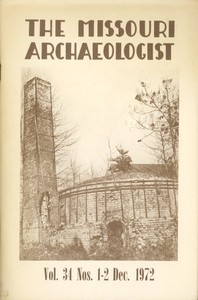
The Missouri Archaeologist, Volume 34, No. 1 and 2, December 1972
by
Various
Subjects:
Download Formats:
Excerpt
Editor: Robert T. Bray, University of Missouri-Columbia
SOCIETY OFFICERS 1972
Henry W. Hamilton, President
Leonard W. Blake
J. Allen Eichenberger
Dr. H. Lee Hoover
Dr. Carl H. Chapman, Secretary
Edward C. Matthews, Jr.
Clem T. Kelly
Leo J. Roedl
David R. Evans, Treasurer
TRUSTEES
Harold W. Mohrman, (Chairman)
Leo O. Anderson
Ramsey Bearden
Dale Belshe
John E. Berry
C. L. Blanton, Jr.
Freddie Bollinger
Fred...
Read the Full Text
— End of The Missouri Archaeologist, Volume 34, No. 1 and 2, December 1972 —
Book Information
- Title
- The Missouri Archaeologist, Volume 34, No. 1 and 2, December 1972
- Author(s)
- Various
- Language
- English
- Type
- Text
- Release Date
- September 17, 2020
- Word Count
- 21,391 words
- Library of Congress Classification
- E011; F396
- Bookshelves
- Browsing: Archaeology, Browsing: Encyclopedias/Dictionaries/Reference, Browsing: History - American
- Rights
- Public domain in the USA.
Related Books
Blackwood's Edinburgh Magazine, Vol. 67, No. 415, May, 1850
by Various
English
1403h 23m read
Blackwood's Edinburgh Magazine, Vol. 67, No. 413, March, 1850
by Various
English
1544h 52m read
Chambers's Journal of Popular Literature, Science, and Art, fifth series, no. 149, vol. III, November 6, 1886
by Various
English
285h 2m read

The Delinquent, Vol. IV, No. 8, August, 1914
by Various
English
233h 1m read
Chambers's Journal of Popular Literature, Science, and Art, Fifth Series, No. 148, Vol. III, October 30, 1886
by Various
English
287h 25m read

Trial of the major war criminals before the International Military Tribunal, Nuremburg, 14 November 1945-1 October 1946, volume 18
by Various
English
3940h 53m read