*** START OF THE PROJECT GUTENBERG EBOOK 74635 ***
THE MINSTREL’S CURSE.
By Mrs. Alex McVeigh Miller,
_Author of “The Bride of the Tomb,” etc._
IN FOUR PARTS.
TABLE OF CONTENTS
PART I.
PART II.
PART III.
PART IV.
_PART I._
“‘When nightly my wild harp I bring
To wake all its music for thee,
So sweet looks that face while I sing,
To reason no longer I’m free.
I forget thou art queen of the land--
’Tis thy beauty alone that I see:
And, trembling at touch of thy hand,
All else is forgotten by me!
“‘The spell is upon me in sleep,
In the region of dreams thou art mine!
I wake--but, ah! ’tis to weep,
And the hope of my slumbers resign.
Ah! hadst thou been less than thou art,
Or I more deserving of thee,
Thou mightst have been queen of my heart,
Thou mightst have been all things to me!’”
The exquisite tenor voice of the singer died away into mournful echoes;
the low accompaniment wailed along the piano-keys like the cry of a
breaking heart, then sobbed itself out--and silence reigned.
“There is still another verse, Mr. Winthrop,” said Lady Edith Chilton,
softly.
“Which I shall not sing,” answered Guy Winthrop, coolly.
“_Shall_ not?” the girl repeated after him, in a rising tone of
displeasure. “No one ever says ‘_shall not_’ to me, Mr. Winthrop.”
“I suppose not”--Mr. Winthrop bowed slightly in homage to her fair
young beauty--“therefore I say it. I--whom fate has placed so far
beneath you, that I am not restricted to the sweet flatteries of your
ladyship’s lordly admirers, nor yet to the passive subservience of your
vassals--can afford to speak my mind!”
The long, magnificent drawing-room was deserted save for these two at
the grand piano--Lady Edith Chilton of Chilton Park, Somersetshire, and
Guy Winthrop, her young brother’s handsome tutor, who had just been
singing at her request, the touching lines written in commemoration of
Catlett’s love for the hapless Queen of Scots.
A sudden gleam of anger in her azure eyes reminded him of summer
lightning in evening skies.
“At least you are very ungracious,” she said, petulantly; “you refuse
out of mere perversity to sing that song for me, although you know I am
not clever in singing, and have to learn after others like a parrot.”
An amused smile curved Guy Winthrop’s handsome mouth at her girlish
pique.
“Pardon me, Lady Edith, but, to quote the compliments of your lordly
admirers, you sing divinely, and even the dullest parrot might have
learned that song during the three months in which I have daily sung it
for you!”
“Well, then,” she confessed, frankly, “I like the song and like to hear
you sing it. I regret that I have asked you to sing it once too often.”
“Once too often!” the young man rose to his feet, speaking impetuously,
forgetting all restraint “Twice too often, twenty times too often for
my peace of mind, Lady Edith, and you know it! You know as well as I
that Catlett cherished no more hopeless love for beauteous Mary Stuart
than I for you. Nay, start not--your brother’s humble tutor presumes
not too much! He but tells you what you deserve to hear! Lady Edith,
you knew when you asked me to teach you to sing, when you stood at my
side in the pride of your high-born beauty and mingled your heavenly
voice with mine, what the end must be! Perhaps you planned it all, you
fair coquette!”
“Hush!” she cried, indignantly, but he went on, bitterly:
“You knew while I sung that song that it was but the expression of my
love for you, that the heart throbbing bitterly below, lent its passion
to the voice. There was your triumph, trifler with human hearts! Not
content with your higher lovers, you bent from your loftly sphere to
ensnare an humble heart--one weak enough to own your charms, but too
lowly even to dare to hope!”
She stood still, confused, surprised, unable to speak one word in
self-defense, her color rising and falling by turns, her lips half
parted, the pale winter sunshine glinting through the stained-glass
window crowning her golden head like a halo, making her seem not like a
“trifler with human hearts,” but some fair saint or angel.
And ere she could recover herself, Guy Winthrop bowed with cold
deference and withdrew.
Springing to the window, half-hidden behind the rich lace curtain, she
watched the tall, straight figure striding swiftly down the elm avenue.
Something--perhaps it was the red evening light shining on a waste
of snow, or perhaps a tear--blurred the outlines of the fair winter
landscape, and, sighing, she turned away.
“Poor and proud!” faltered in a soft undertone from her lips. “Why, he
has nothing in the world but his profession, yet he talks to me like
a prince royal, upbraids me with my coquetry, and leaves me with cold
disdain! Ah, my haughty lover, did you but know”--then she started and
bit her lip as if not even to solitude would she whisper the secret
trembling on that coral portal.
“So the Minstrel’s Curse is like to be fulfilled again,” said a mocking
voice behind her.
She turned with a start, the rosy color flooding cheek and throat, but
it was only old Katharine, her nurse, who was almost a century old, and
in her dotage.
There she sat, curled cozily behind the curtain that draped that odd
little bay-window, and she had heard every word Guy Winthrop uttered.
Lady Edith paled with indignation.
“How came you there? How dared you listen?” she cried, and rushed away
in a pet.
Old Katharine hobbled slowly after her mistress, and found her sobbing
on her silken couch.
“Don’t cry, that’s a dearie,” she whispered, smoothing the silken curls
with a tender hand. “Old Kathie didn’t mean to make her bairn angry.
She only feared the curse would fall again. She hid herself in the
window to see for herself, and she _has_ seen--alas, alas!” the old
creature moaned half deliriously, rocking her body to and fro.
“What curse is it you’re talking of, Katharine?” sobbed Edith in a sort
of awe.
“The Minstrel’s Curse, to be sure,” answered Katharine, between
intervals of her rocking. “It’s never been told you, child. Pity it
hadn’t. It might have been better for the poor young man.”
“Well, tell me about it now,” exclaimed the imperious young beauty. She
loved to hear the old crone’s tales of the past, and settling herself
among her silken pillows, she prepared to enjoy some marvelous story.
“Tell me, then, first,” said old Katharine, seriously--“you love the
young man with the handsome dark eyes and the voice of music, do you
not, my pet?”
A little storm of blushing denial answered her, but the protest was
all in vain. The old nurse had seen three generations of fair Chilton
dames bloom and fade. She paid no heed to the angry remonstrance, but
looking in her nurseling’s eyes, read the secret in her heart.
“Ah, I knew it!” she sighed. “I knew it; but you must crush that love
out of your heart, my child. It is his doom--his death. Better if you
hated him.”
“Katharine,” cried her young mistress, growing suddenly white and
chill, “cease this foolish driveling at once, and tell me what you mean
by the Minstrel’s Curse.”
“I will then,” muttered the old nurse, crouching down on the floor
beside the couch.
“Go on,” said her young mistress, almost sternly in her impatience.
“Almost two centuries ago,” said Katherine, “when the Chiltons were
richer and more powerful than they are to-day, and before English
minstrelsy was on the wane, there was a Lady Edith Chilton as fair
and sweet as yourself. Her portrait hangs in the gallery now, and
you have her sweet blue eyes, her golden hair, her lovely face. The
Chiltons were a proud race; proud of their long line of ancestry,
proud of their blue blood, and their sovereign’s favor. But the men of
the race were as cruel and harsh as the women were fair and loving.
It was the fashion then for all the fair ladies of the court to have
a minstrel attached to the household to beguile the idle hours with
songs and improvisations. Lady Edith followed the fashion and had a
favorite minstrel, too, one Douglas North. He was of gentle blood,
handsome, brave, and chivalrous. My Lady Edith, was a flirt in her day.
She angled for the young minstrel’s heart, meaning to play with it a
moment, then cast it aside like a broken toy. But in the meanwhile she
lost her own, and when they found it out they made a precious pair of
lovers, you may be sure, and she persuaded Douglas North to ask her
father for her hand in marriage. Well, my lady, to make the story as
short as possible, the youth was murdered among those proud, lawless
Chiltons. They blamed him for it all, never said a word to her, but
shut him up in a lonely tower, and one night he was secretly taken
out, and made way with. One of the castle retainers told afterward a
story of how young Douglas sat up until after midnight improvising and
playing sad tunes upon his harp up in the lonely tower. The last song
he sung the old servitor remembered, and long afterward it was printed
in a book of Chilton legends and has come down to us as ‘The Minstrel’s
Curse.’”
“And the curse? What was it?” breathed the young girl eagerly.
“I’ll get the book and show you,” answered Katharine, hobbling out of
the room. When she tottered back with the antique volume, Lady Edith
eagerly turned the musty, yellow pages. She looked eagerly at the date.
It was more than a hundred years old--a book of traditions and stories
of the great Chilton race.
“Oh, Kathie, you should have shown me this long ago,” she began,
reproachfully, and just then her fascinated gaze lighted upon:
“THE MINSTREL’S CURSE!
“The minstrel’s curse be on the love
Of all who bear the Chilton name
Long after he shall sleep in death,
Who, blameless, bore their blame.
A Chilton maiden ne’er shall love
A man of low degree,
But she shall bring on him the doom
That one has brought on me.
Until there meet in future years
Some Chilton of _her_ name,
And some proud branch of my own blood
Who knows not whence he came,
But bears the name that now I bear--
Douglas the True--and she
Is named for my lost Edith--
Edith, so dear to me--
When these shall meet, and, meeting, wed,
The minstrel’s curse has died,
And Douglas and his love shall know
The bliss I was denied!”
Lady Edith read these singular lines over twice before she turned her
inquiring gaze on old Katharine. The nurse nodded, gravely.
“You see how it is, my lady. You dare not love ‘a man of low degree,’
for the curse of Douglas North, the murdered minstrel, always comes
upon every such man that the ladies of Chilton have doomed with their
love. They have all died, one after another, strange, unnatural deaths;
and this young singer you love will die, too, if you do not in mercy to
him forget your fancy for his handsome face and sweet voice.”
“Nonsense!” cried Lady Edith; but she was still pale, and her voice
trembled. There was a vein of superstition in her nature that she could
not overcome. It had descended to her along with the blue blood that
flowed in her veins. Then a gleam of hope brightened her eyes as she
continued: “You forget, Katharine, that my name is Edith, and the curse
says expressly, that when the lady’s name is Edith the curse is ended.”
“It says no such thing,” the privileged old nurse answered flatly. “It
says when her name is Edith, and he is a descendant of the Norths’, and
named Douglas, the doom is ended--not before. And now I have warned
you! If you keep on loving this Guy Winthrop, with his sweet voice, and
his ‘low degree,’ you love him to his doom and to his death.”
_PART II._
“The _curse_ is come upon me!” cried
The lady of Shalott.
--_Tennyson._
Lady Edith tried to banish the memory of her eventful day in the gayety
and splendor of the masquerade ball she attended that night. In vain,
for, strangely enough, it seemed to her excited fancy, she had not been
in the rooms more than an hour before a black domino in the costume of
a minstrel of the Fifteenth Century approached her and begged for the
honor of a promenade with the “beauteous Mary.”
Lady Edith, in the superb costume of the lovely Mary, Queen of Scots,
and looking magnificently grand, bowed with queenly dignity, and
placing her white-gloved hand on the minstrel’s arm, moved on with him
among the throng of revelers.
Who was he, she wondered. His face was so shrouded in his mask that she
could not guess his identity, and his voice sounded unfamiliar. Yet, as
she leaned upon his arm a sweet sense of restfulness and peace crept
over her such as she had never known before, and a quick thought of Guy
Winthrop thrilled her, only to be dispelled with a shuddering sigh at
the memory of Nurse Katherine’s warning.
“You tremble,” murmured her stately companion, in deep musical tones.
“What earthly emotion can have power to disturb the serenity of a
crowned forehead?”
“A woman’s heart is the same, whether born to the russet or the
purple,” she answered lowly, and almost, it seemed to her, without
volition of her own.
“I should like to believe it,” the minstrel answered, simply.
The queen asked lightly:
“Have any of my fair subjects given you cause to doubt my assertion? If
so, you have but to speak--and I punish!”
“‘He jests at scars who never felt a wound.’”
“You have no proof that your assertion applies to me,” the queen
replied tremblingly.
“Your pardon, my liege, but:
“‘Your heart is a snowdrift where foot never trod,
Love’s sun has not wakened a bud on its sod.’”
A laugh rippled sweetly over her lips, like the soft music of a little
stream dashing over rocks and pebbles.
“How do you know that?” she queried.
“Because I know you! You are glorious as Mary, Queen of Scots, but not
less lovely as Edith, Queen of Hearts!”
She gave a violent start, then, tossing her head, tried to rectify the
unconscious admittal that he had penetrated her mask.
“I think you mistake,” she said lightly. “But you show me your secret
‘as a bird betrays its nest by striving to conceal it.’ So you love
some cruel, fair maid whose name is Edith?”
“_Edith!_”--he repeated it after her, in almost a passion of pain, “I
have never dared call her so--she is as far above me as yonder star.”
He paused at an open window and lifted his hand to a glorious planet
glittering in mid heaven. “Ah, Mary, ah, my queen! ‘Hadst thou been
less than thou art!’”
“Guy Winthrop!” broke wildly from her parted lips.
“Your majesty!” he straightened his fine form, and made a deprecatory
movement with his white hand. “It seems that we have mutually mistaken
each other for a different person. But suppose--remember, I only say
suppose--that you were really the Edith whom I love, and I the Guy you
named--what do you think they would say to each other? For instance
now, what would Guy say to Edith? What do you think he would say, I
mean?”
A sudden daring spirit, inherent in the grand old Chilton blood, leaped
to her lips, and before she could think twice, she had uttered these
words:
“He would say, ‘Edith, my darling, I love you!’”
The arm she leaned on trembled with the fierce throb of his heart.
“And what would Edith say?” he asked her, in low, unsteady tones.
“What would you like her to say?”--coquettishly.
“I should like to have her say, ‘Guy, I love you, and am yours
forever!’ But what do you think she would say?”
Low and tenderly she whispered:
“Guy, I love you, and am yours forever!”
At that moment a fine courtier pushed in between the pair.
“Your majesty, your fair hand was promised me for this dance,” he
reminded her; and with a slight, imperial bow to the young minstrel,
the Queen of Scots swept away on the arm of her partner.
And then a great horror of remorse struck coldly to her heart. Oh, what
had she done? Betrayed her heart to the man who loved her so well, but
whom to love in return was to doom to a cruel death. Oh, horror of
horrors!
The lights danced before her, the ballroom whirled around in a
fantastic measure, the sea of faces grew dim and faded. She gasped for
air, threw up her arms with a feeling of suffocation, and fell back
fainting. The handsome courtier caught her in his arms and bore her to
the door.
“Give her to me. She is _mine_!” cried a passionate voice; and the
strong arms of the minstrel took her forcibly from the other’s clasp.
Presently, with a weary sigh, she drifted back to life.
“The dressing-room,” she murmured, and the minstrel’s arm was again at
her service. He left her with her maid, and mingled, as before, with
the crowd.
“A word with you, Sir Poet,” said a stern voice in his ear.
It was the jeweled courtier. His eyes burned balefully beneath his mask.
“You forcibly took Mary Stuart from my arms--an insult for which I
demand instant satisfaction.”
Two fiery spirits confronted each other in the wide grounds the next
moment, two swords leaped from their scabbards, and two men struck at
each other with vengeful fury.
The silver moon looked down on a scene of strife and bloodshed, and
presently on a still form bathed in gore, around which a crowd was
gathering, shouting, gesticulating, uttering all sorts of frenzied
cries, while some struck out in hot haste after the murderer who
had thrown away his sword and rushed headlong from the scene of his
dastardly crime.
Presently, through the moving throng of excited maskers rushed the form
of a beautiful woman. She flung herself on her knees by the dead man
and tore the shrouding mask from his face.
As the moonlight fell on the closed eyes and pallid, handsome face, the
Queen of Scots uttered a cry of sharp despair.
“The curse, oh, God! the curse! It is I--it is I who have killed him!”
Some one lifted the swooning form away, some one else knelt there by
the still form and felt for the heart.
“He is not dead,” proclaimed the authoritative voice of a physician.
“Let a litter be brought immediately and we will carry him into the
house.”
The ball broke up in confusion as the wounded man was taken into Lady
Heathcote’s house, and a stream of carriages marked the departure of
the guests. In one of them was the weeping Lady Edith, attended by her
uncle, who was also her guardian.
_PART III._
“Alas! it’s far from russet frieze
To silks and satin gowns,
But I doubt if God made like degrees
In courtly hearts and clowns;
Yet homely hose must step apart
Where gartered princes stand;
Ah, may he wear my love at heart
That wins her lily hand!”
--_Hood._
“Well, I warned you,” said old Katharine, “but you would not heed an
old crone’s tale. I warned your grandmother before you, but she would
not listen, and there was the young squire of Elmdale broke his heart
and died for love of her, and she knowing all the time that she caused
it all by her unwise love of him. Oh, I’ve no patience with these
willful Chiltons! But I’m getting on, thank the Lord! I won’t live to
see your unborn children, my lady, driving thoughtless men to their
death.”
“Oh, Kathie, how wicked and cruel you are!” sobbed Lady Edith.
Lady Edith lifted a warm, white face from the pillow and looked at
old Katharine with heavy eyes full of pain and remorse. The long
wretched night had worn away, and the old nurse was opening the
blinds, letting in the morning sunshine. It glowed through the rosy
silk of the curtains, and made Edith’s face look terribly pale and
sad in its dim light. She had not slept all night, and she looked as
conscience-stricken and remorseful as her nurse could possibly desire.
“Don’t think I’m not sorry for you, dearie,” soothed the old crone.
“But I’m grieved for the manly young fellow--yester eve so full of life
and love and health--to-day another victim to the dreadful curse that
has come down to us from barbarous times to blight the innocent and
unoffending.”
Lady Edith bowed her head in a passion of tears.
“Oh,” she sobbed. “I never knew the truth until it was too late, too
late! Guy, Guy, I would have given my life to have saved yours!” she
cried in a passion of impotent despair.
Old Katharine took the slight form into her motherly arms, and let
Edith sob on until the rest of exhaustion stole over her, and, too
weak for tears or cries, she lay still, with her violet eyes fixed on
vacancy, and a frozen calm, more terrible than tears, on her lovely
face.
Presently the kind old face of the earl, her uncle and guardian, looked
in upon his petted darling.
“Dear uncle, you--have--news! Speak, but do not tell me that--that--he
is dead!” she cried, with trembling lips.
“Tut, no, of course he is not dead, my love; but----” He broke off and
looked distressfully at her pale face.
“Speak!” she cried, almost imperiously in her impatience.
“Yes, I have news,” he said. “Eustace and I went to Lady Heathcote’s
this morning to see the poor fellow, and she told us that it had been
discovered that Guy was not mortally wounded--a flesh wound, deep, but
not necessarily fatal, but----” He paused and regarded her curiously.
“Poor darling, how badly she looks! Yet I never suspected before that
she and her brother’s handsome tutor were in love with each other,” he
thought.
“Dear uncle, please go on,” she exclaimed, eagerly.
“Oh, yes. Where was I when I stopped to think? Yes, Lady Heathcote
told us that this morning, at daybreak, a conveyance was sent for Mr.
Winthrop. An old gentleman was in it who claimed to be a relative of
the young man. He insisted on taking the wounded man away, and as no
one had the authority to prevent him, he did so.”
“And you followed?” she asked.
“No, for he left no address, saying bitterly that the young fellow had
no friends to mourn for him. That is all I have to tell you, Edith.”
“But Guy will certainly send and let Eustace know where he is, uncle,
do you not think so?”
Lord Chilton looked relieved at her brightening face.
“Certainly, undoubtedly, to-day or to-morrow,” he replied, cheerily.
“Keep up your heart, little one. I will go now and send your brother to
sit with you this morning if indeed he can tear himself away from the
library, dry book-worm that he is. By-by, dear.”
He kissed her, smoothed her fair curls lovingly, and went out.
Presently came Eustace--pale, studious, quiet--a handsome pair they
made--he was twenty, she eighteen.
Edith leaned her head on his shoulder and wept softly. Poor Eustace,
he hardly knew how to soothe a girl’s grief. He was shy and quiet, his
thoughts were up among the stars. He meant to be a great scholar. But
he smoothed her hair and said, tenderly:
“Don’t cry, sis, Guy will be sure to let us hear from him soon, and
I hope he will soon get well. I didn’t know you loved each other,
dear, but I’m not sorry it’s so, and uncle and I sha’n’t oppose your
marriage. I don’t hold with so much nonsense about rank and blue blood.
A scholar is as good as a man of rank, and Guy Winthrop is one of the
greatest scholars of his time.”
But between tears and blushes Lady Edith whispered the story of old
Katharine’s story--the minstrel’s curse that must part her from her
lover, and cause his death, Lord Eustace laughed the old tradition to
scorn.
“Nonsense,” he said, lightly. “There’s nothing in it, and when Guy
comes back to us alive and well, you’ll forget old Katharine’s
superstitions in your new-found happiness.”
“Yes, when he comes back,” croaked the old nurse, entering, and
catching the sentence. “But he hasn’t come back yet.”
The longest day of Edith’s life dragged wearily to its close.
And still no word from Guy. The suspense grew almost unendurable.
After dinner she threw a long wrap over her white dress, and walked
alone in the garden.
Twilight had fallen long ago, and the air was chilly. Lady Edith walked
briskly up and down the elm avenue, thinking, thinking, till her brain
seemed on fire. Was it only yesterday he had told her how he loved her?
How long ago it seemed. Perhaps he was dead now. The dark eyes would
never look into hers again. A stifled sob escaped her lips.
Hark! a footstep. Through the gloom a man came toward her with
uncovered head, mutely respectful. He bore a note which she deciphered
hurriedly in the moonlight. Oh, heavens! what cruel, cruel words to be
signed with her lover’s name!
“Edith, I am dying, they tell me. Will you come to me with Eustace?
GUY.”
_PART IV._
Oh, linger by my side to-night,
The hour will soon be past
When I shall turn and gaze again
To look on thee my last.
--_Mrs. Alex. McVeigh Miller._
The shaded night-lamp glimmered softly in the large, oak-paneled
room where the recumbent form of a man lay extended on a large,
old-fashioned bed. Heavy curtains of crimson damask were pushed back
over the gilded canopy, and brought out in pale relief the white,
pain-drawn face of the sufferer. The physician stood by with finger on
the sick man’s wrist. An old man and his elderly wife were the only
other occupants of the room.
Presently the door swung lightly ajar, and the faint light shone on the
faces of Lady Edith and her brother as they crossed the room to the
bedside.
Poor Edith! She threw out her hands with a smothered moan of despair,
and the heavy cloak fell from her shoulders, revealing her exquisite
dinner gown of white lace. Priceless pearls gleamed on her neck, and
her wealth of golden ringlets fell around her in sad beauty as she bent
over her lover.
“Edith, dear Edith, I am glad you have come in time,” he whispered,
faintly. “Tell her, Uncle Jamie, before it is too late. But place her
chair close by my side. Let me see her now all the while until the
last.”
They obeyed his wish, and Edith sitting still, with her hand clasped in
the weak one of her lover, listened to a story told in the quivering
voice of the old man--a story of wrong and treachery to the dead and to
the living--a wrong done to a brother’s orphan heir and repented of,
alas! too late.
“I deserted the infant boy--put him in a foundling asylum without a
name. His father had been a wealthy man, and I wanted the child’s
fortune. So I announced that the little Douglas was dead, and there
being no near relatives to inquire into its fate, my scheme succeeded
well. My wife and I have enjoyed our ill-gotten gains for twenty-five
years, but we always kept cognizant of my nephew’s whereabouts, meaning
when we died to right the cruel wrong we had done to the orphan boy.
Alas, alas!” moaned the old man in futile sorrow.
“Leave us now,” said the weak voice from the bed, and the old man moved
away, leaving Edith alone by the side of the beloved one drifting away
from her so swiftly out on the shoreless waters of Eternity.
She bent over him, brushing the dark curls back from his white brow, a
world of love in her tender eyes.
The clasp of his hand tightened on hers, and he murmured:
“My darling, I have so much to tell you. They have told me such strange
things to-day. Have you ever heard that strange tradition of the
Chilton race--the Minstrel’s Curse?”
“Yes,” she sobbed. “But, my own dear love, I pray you forgive me the
doom I have brought upon you. Never until yesterday, was I told that
strange story--yesterday when it was all too late.”
Oh, the love and sorrow in the sad dark eyes looking into hers, they
almost broke her heart.
“Oh, my own love, how could I blame you?” whispered the dying man, “I
would have given my life at any moment to win your heart. And it is
mine, although I must leave you soon, for the doctor has told me, I
cannot live until to-morrow’s sunset.”
“Oh, no, no, no!” she sobbed, bitterly.
“Be calm, Edith, for I have such good news for you. I, your beloved,
have it in my power to end the curse that has darkened the lives of so
many fair women of the Chilton race. Do you guess how?”
She shook her golden head, gazing at him with dilated blue eyes.
Smiling faintly at her wonder, he continued:
“I want you to become my wife for the few hours I have to live. Will
you, Edith?”
It was too solemn an hour for girlish coquetry. Edith gave him a frank,
sweet assent, and sealed it with a tender kiss.
There was silence for awhile--the eloquent silence of love--between
them; then he spoke again:
“But you have not asked me, Edith, how I have power to end the
Minstrel’s Curse. Listen, dear. It is to be accomplished by your
marriage with me.”
“I do not understand,” Lady Edith answered, with puzzled eyes.
“It is this way, my darling. You are the namesake and descendant of
Lady Edith, the minstrel’s beautiful love of two centuries ago, and I
am really and truly a descendant of the only brother of the minstrel,
and namesake of----”
“Douglas North!” she cried, in startled tones.
“Yes, Edith, and ‘knew it not’ until to-day, when my uncle’s grief and
repentance at my untimely end caused him to confess the truth to me.
And ‘unknowing whence I came,’ I loved you, dearest, so it only remains
for us to wed to fulfill the last clause of the doomed minstrel’s weird
prophecy.”
“Not the last,” she wept, sadly. “They were to be happy, you know.”
“And shall we not be happy, dearest? You on earth rejoicing that you
have delivered future generations of the great Chilton race from that
dread curse, and I--happy”--his voice broke slightly--“in heaven.”
Lord Eustace came over to them, grave, tender, thoughtful.
“They have told me everything, my poor Douglas;” he bent
compassionately over the sufferer. “The earl will give his consent, I
know. I am going to him now. I will leave my sister to nurse you.”
The earl did not refuse, you may be sure, and the next morning there
was a quiet, solemn marriage in the sick-room, where Lady Edith Chilton
gave heart and hand to Douglas North, and so ended the Minstrel’s
Curse. Old Katharine was there, weeping for blended joy and sorrow--joy
that the curse was void forever, sorrow that bonny Douglas North must
die and leave his young bride desolate.
But physicians are not always infallible, or perhaps love has some
potent power that can conquer death.
Douglas North did not die of the wound he had received from the unknown
courtier. I will show you one more picture of his life ere I write that
solemn word, the End.
It is almost the same picture you saw in the beginning. He is sitting
with Lady Edith at the grand piano in the Chilton drawing room, his
fingers wandering softly over the pearl keys. He has inherited, not
only the name but the musical talent of his ancestor, Douglas North. He
looks very handsome, very distinguished to the fair young wife by his
side.
How lovely she is, with her golden tresses floating over her white robe
like a halo of light!
He looks at her in passionate admiration.
“My darling, you are beautiful as an angel!” he says.
“Did I ever!” cries a shocked voice, and old Katharine, passing by,
shakes her head at the married lovers. “Mr. Douglas North, that’s
simple profanity, calling your wife an angel. You’ll be punished for
it,” she said.
Lady Edith’s sweet, ringing laugh woke all the echoes in the long,
magnificent room.
“Nurse Kathie will never be anything but a croaker,” she says.
“Giddy children, silly children!” responds the old crone, passing out.
Lord Eustace enters with his usual companion, a book, his fine,
scholarly face lighted up with pleasure.
“Katharine has made me a present,” he said, showing an old moth-eaten
volume. “Here, it is--full of marvelous traditions of the Chilton race,
and last but not least, The Ministrel’s Curse.”
Lady Edith shuddered at the words, but Douglas North took the book and
read the quaint verses with deep interest.
“‘And Douglas and his love shall know the bliss I was denied,’” he
repeats, in a musing tone. “Well, Edith the prophecy comes true. We are
indeed blest,” and he returns the volume to its proud owner with a sigh
to the memory of his fated ancestor and the lovely lady whom he loved.
“By the way,” he added, “I have never heard what became of that fair
Lady Edith.”
“Oh,” says Lord Eustace, “she married an earl, as this musty chronicle
relates; but it says, also, that she died three years after of a broken
heart.”
“Eustace,” calls his uncle’s voice in the hall, “here is that box of
new books you ordered from London.”
The book-worm rushes out in eager haste, and Douglas, drawing his wife
to his heart, kisses off the dew of tears from her lashes.
“They are at rest after their blighted life,” he whispers, reverently.
“Sing for me, Douglas dear. Sing something sad, and sweet, and tender.”
A smile, half-sad, half-mischievous, dawned in his dark eyes as he
touched the keys with skillful fingers, and sang with his heart in his
voice the last verse of that sweet love song, over which he and Lady
Edith had quarreled when we first saw them:
“When, Mary, thy love is at rest.
His harp all unstrung in thy bowers;
And others like him, but more blest,
Shall seek to beguile thy lone hours,
Thou wilt think of the days of lang syne,
When Holyrood echoed the strain;
And your voice sweetly mingled with mine
As it never shall mingle again!”
Transcriber’s Notes:
This story was originally serialized in Norman L. Munro’s _New York
Family Story Paper_, volume XIX, numbers 952-955 (January 2-23, 1892).
A table of contents has been added by the transcriber and placed in the
public domain.
Obvious typographical errors have been silently corrected.
*** END OF THE PROJECT GUTENBERG EBOOK 74635 ***
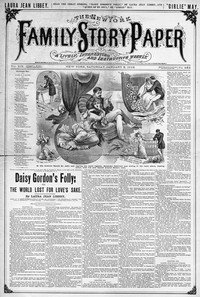
The minstrel's curse
Download Formats:
Excerpt
By Mrs. Alex McVeigh Miller,
_Author of “The Bride of the Tomb,” etc._
“‘When nightly my wild harp I bring
To wake all its music for thee,
So sweet looks that face while I sing,
To reason no longer I’m free.
I forget thou art queen of the land--
’Tis thy beauty alone that I see:
And, trembling at touch of thy hand,
All else is forgotten by me!
“‘The spell is upon me in sleep,
In the region of dreams thou art...
Read the Full Text
— End of The minstrel's curse —
Book Information
- Title
- The minstrel's curse
- Author(s)
- Miller, Alex. McVeigh, Mrs.
- Language
- English
- Type
- Text
- Release Date
- October 24, 2024
- Word Count
- 6,016 words
- Library of Congress Classification
- PS
- Bookshelves
- Browsing: History - General, Browsing: Fiction
- Rights
- Public domain in the USA.
Related Books
Famous stories from foreign countries
English
494h 26m read

Adrienne
by Le Feuvre, Amy
English
1207h 19m read
The incredible slingshot bombs
by Williams, Robert Moore
English
96h 4m read
The eater of souls
by Kuttner, Henry
English
22h 19m read
Le roman de Joël
by Maël, Pierre
French
561h 14m read
Sab (novela original)
by Gómez de Avellaneda, Gertrudis
Spanish
1017h 24m read