*** START OF THE PROJECT GUTENBERG EBOOK 51243 ***
THE LIFE OF MIDHAT PASHA
[Illustration:
_From a Photograph._
_The Typographic Etching Co. Ph. Sc._
_Midhat Pasha._]
THE LIFE OF
MIDHAT PASHA
A RECORD OF HIS SERVICES,
POLITICAL REFORMS, BANISHMENT,
AND JUDICIAL MURDER
DERIVED FROM PRIVATE DOCUMENTS AND
REMINISCENCES
BY HIS SON ALI HAYDAR MIDHAT BEY
WITH PORTRAITS
LONDON
JOHN MURRAY, ALBEMARLE STREET, W.
1903
PREFACE
As the Son of Midhat Pasha I was for fifteen years compelled to reside
as an exile in Smyrna, but finding the physical and moral sufferings to
which I was there subjected greater than I could endure, I succeeded
in quitting the territories of the Sultan, and came to take up my
residence in this hospitable land, and among this great and free people.
In the following pages I have endeavoured to carry out a duty which has
long been incumbent on me, by letting the public, and especially the
English public, know the true story of my father’s career, and of his
death.
The record is based mainly on documents and notes left by him. In
obedience to requests from high quarters I abstain from publishing
certain documents and correspondence which, bearing as they do on
International affairs, might be calculated to cause embarrassment and
do harm.
It is possible that some of my father’s papers which I have now
printed, and which were written in Turkish, may have lost some of their
original brightness in the process of translation, but at least, most
scrupulous care has been taken to give the sense of them accurately.
There can be no doubt that at the present time Turkey is suffering
from a Reign of Terror, and is in a state of anarchy. I hope that the
narrative contained in these pages may afford some evidence of the
methods by which this condition of affairs has been produced.
My readers will learn how the Sovereign of the Ottoman Empire, in order
to carry out his own system of Government, has suppressed every effort
for reform, and has removed those men, who by their force of character,
by their uprightness, and by their popularity, seemed capable of
thwarting his designs, and amending the condition of the country and of
the people.
I wish to state here that I have a profound respect for the Imperial
Throne, and it is this consideration alone, I repeat it, and the honour
of my country, which makes me regard it as a duty to humanity to expose
the nefarious system of Sultan Abdul Hamid.
In conclusion, I would beg to offer my thanks to the Proprietors of the
_Times_ newspaper for giving me permission to reprint the excellent
report of my father’s trial which appeared in their columns.
ALI HAYDAR MIDHAT.
EASTBOURNE, _August 6, 1903_.
CONTENTS
CHAPTER I
EARLY HISTORY OF THE OTTOMAN EMPIRE
Page
Christians in Turkey—Turkish treatment of Subject
Races—Corruptions of the Ottoman System—Persistent policy of
Russia—Panslavic Committees—The Palace and the Porte—Growth
of Autocracy—The Janissaries—Revolt of Mehemet Ali—Reforms
of Abdul Medjid—The Czar Nicholas—Origins of the Crimean
War—The Crimean War—Attitude of France—Attitude of Austria 1–31
CHAPTER II
MIDHAT’S EARLY YEARS
Midhat in the Balkan Provinces—Governorship of Nish,
etc.—Widdin and Silistria—Midhat’s Success in Danube
Provinces—Intrigues of General Ignatieff—Insurrection
stirred up—Organisation of local Militia—Appointed Vali
of Bagdad—Fighting and Reforms—Finance and Engineering
Work—Bussora—Koweit, the Nedjed—The Conquest of
Nedjed—Defeat of Abdul Kerim—Aali Pasha—Extravagance of
Abdul Aziz—Midhat as Grand Vizier 32–66
CHAPTER III
DEPOSITION AND DEATH OF ABDUL AZIZ
Troubles in Herzegovina—Riots at Salonica—Outbreak
in Bulgaria—Meeting at Reichstadt—The Andrassy
Memorandum—The Sultan opposes Reform—Deposition of Abdul
Aziz—Preparations for the _Coup d’État_—Sultan Murad—Death
of Abdul Aziz—Breakdown of Sultan Murad—Damad Mahmoud’s
Conspiracy—Prince Hamid—Deposition of Murad 67–99
CHAPTER IV
ABDUL HAMID SULTAN
Abdul Hamid II.—The Imperial Household—The Speech from the
Throne—Nominal Reforms—Midhat’s Difficulties—Nominal and
Real Reforms—The New Constitution—Sovereign Rights 100–115
CHAPTER V
SECOND GRAND VIZIERATE OF MIDHAT PASHA
Opposition Intrigues—“Midhat’s Constitution”—Intrigues
against Midhat—Zia Bey—The Press—Promulgation of the
Constitution—Rescript of Abdul Hamid—Favourable Reception of
the Constitution 116–131
CHAPTER VI
THE CONFERENCE AND MIDHAT’S EXILE
Conference at Constantinople—General Ignatieff’s Conduct—The
New Constitution and the Powers—Galib Pasha and the
Finances—Mixed Schools—Protest of Midhat—Midhat Exiled—The
Sultan’s Precautions—Prince Gortchakoff and General
Ignatieff—Russian Declaration—Prince Gortchakoff’s Circular 132–154
CHAPTER VII
MIDHAT PASHA IN EUROPE
The Sultan’s Speech—Russia Declares War—Midhat in
Naples—Midhat’s Efforts for Peace—Midhat’s Recall by the
Sultan—Midhat and Kiamil Bey 155–171
CHAPTER VIII
THE RETURN OF MIDHAT PASHA TO TURKEY
Midhat in Crete—Appointed Governor of Syria 172–175
CHAPTER IX
MIDHAT PASHA, GOVERNOR‐GENERAL OF SYRIA
The Sultan Opposes Reforms—Cause of Midhat’s
Resignation—Condition of Syria—The Druses and the Arabs—The
Turbulent Druses—Troops to be sent—The Druses—Resignation
of Midhat—The Palace and Judicial Reforms—Midhat and Syria 176–195
CHAPTER X
MIDHAT, GOVERNOR‐GENERAL OF SMYRNA
Abdul Aziz’ Death—The _Terdjumani Hakikat_—Attack on
Midhat—Attitude of the French Consul—Midhat’s Arrest 196–206
CHAPTER XI
THE TRIAL OF MIDHAT PASHA
Mustapha the Wrestler—The Case for the Defence—Midhat’s
Defence—A Parody of Justice—The Public Prosecutor—Before
the Court of Appeal—Grand Council—The British
Parliament—Questions in Parliament—Mr M’Coan—Mr
Gladstone—Lord Stratheden and Campbell—England’s
Intervention 207–233
CHAPTER XII
EXILE OF MIDHAT PASHA
Midhat in Prison—Attempt to Poison Midhat—Arrest of Shereef
Abdul Mutalib—Haïroullah Effendi 234–241
CHAPTER XIII
DETAILS OF THE ASSASSINATION OF MIDHAT PASHA, ACCORDING
TO INFORMATION DERIVED FROM HAÏROULLAH EFFENDI
Return of Bekir—Midhat and Bekir—Tampering with
Food—Attempts to Poison—Preparations for the Murder—The
Murder 242–256
APPENDIX A
THE NEGOTIATIONS BETWEEN THE BERLIN NOTE AND THE
CONFERENCE OF CONSTANTINOPLE
Negotiations following the Berlin Note—The Conference at
Reichstadt—Servian Diplomacy and Defeat—England Proposes
Terms—An Ultimatum to the Porte—Disagreement among the
Powers 257–270
APPENDIX B
THE INSURRECTION OF HERZEGOVINA AND BOSNIA AND THE
BERLIN NOTE
Herzegovina and Bosnia—Lord Derby and Austria—Intentional
Bad Faith—Austrian Diplomacy—The Berlin Note—Austria and
Russia—Mr Monson’s Despatch 271–284
APPENDIX C
BULGARIAN ATROCITIES
A Bulgarian Insurrection—Revolutionary Agents at
Work—Fictions and Ingenious Credulity 285–292
MIDHAT PASHA
CHAPTER I
EARLY HISTORY OF THE OTTOMAN EMPIRE
It would be inconsistent with the general plan of this book to give
more than a very summary and cursory view of the early history of the
Ottoman Empire before the time of Midhat Pasha; but it will not be
inappropriate, and may possibly aid in elucidating the history of his
times, and throw light on his work of reform, if the main features of
that history be here drawn in outline, and some of the phases traced
through which the Turkish Empire passed during the four centuries that
elapsed between the taking of Constantinople by Mehemet II. and the
Crimean War.
It has sometimes been objected to Midhat Pasha and the Constitution
of 1876, by those who have given a very superficial study to the
subject, or who have a political object in depreciating all reforms
in Turkey, that, however admirable the Constitution may have been
in itself, it was prematurely and precipitately introduced, and ill
adapted to the peculiar conditions of the Ottoman people. One of the
aims of this book is to show that, so far from this being the case,
the reforms associated with the name of Midhat Pasha were conceived in
the very spirit of the early Ottoman Constitution, and were expressly
suggested by the wants and requirements of that country as revealed
in the course of its administration to a succession of statesmen, who
found themselves in practice hampered at every turn, and their best
efforts continually thwarted by the absence of the very checks and
safeguards which Midhat’s Constitution endeavoured to impose. Within
half a century of the taking of Constantinople (1454) by Mehemet II.,
Bulgaria, Servia, Moldavia, Wallachia and large portions of Hungary and
Poland were added to the Ottoman dominions. It was (as all impartial
writers now admit) as much by virtue of the simplicity and purity
of its creed, and the force of propagandism that it in consequence
possessed, as by the force of arms, that Islam made such astounding
progress in those days. If extensive provinces and important kingdoms
yielded with slight resistance before the advance of the Ottoman
armies, and if large masses of the conquered populations adopted the
religion of the conquerors, it was because their moral conquest was
effected before their political subjection was attempted.
The reputation, too, for justice and moderation enjoyed by the early
Ottoman sovereigns was no insignificant factor in conciliating the
goodwill and blunting the opposition of nations, who might under
different conditions have opposed a more serious resistance to the
advance of the Ottoman armies. Sixty years before the appearance of
the Turks before Constantinople, the people of the ancient kingdoms
of Roumania were called upon to choose between the Magyars—who,
in conformity with their traditional policy, desired to Magyarise
Wallachia—and the Ottoman sovereign, who offered the inhabitants the
enjoyment of their religious and civil liberty. They did not hesitate
between the two, and Mircea signed, with the Sultan Bayazid, the first
capitulation of Roumania (1393). Twenty‐six years later, in 1419, the
Servian ruler Brankovich, pressed by John Hunyadi, ruler of Hungary,
to join him in an alliance against the Turks, invited him to state the
policy in respect to religion that he proposed to adopt, in the event
of victory attending their joint military efforts. Hunyadi answered
without periphrasis, that the Servians would have to adopt the Catholic
worship. Brankovich then addressed a similar question to Mehemet I. “I
propose,” replied the latter, “to build a church next to every mosque,
and proclaim that every one shall be at liberty to follow his own
worship and religion.” Brankovich rejected the Hungarian alliance, and
declared himself the vassal of the Turkish Sultan.
But, it has been contended, the condition of the Christian populations
(_Raias_) of the countries actually conquered by Islam was very
different; and there is even a widespread popular belief that these
populations were forced to “opt” (to use a modern phrase) between the
religion of the conquerors and death, the poll‐tax (_kharadj_) being
the money composition imposed in commutation of the death sentence.
Nothing can be more erroneous. The _kharadj_ was the tax imposed on the
Christian population in lieu of the military service and other similar
duties from which they were exempted, disabilities generally regarded
by them as privileges, and in consequence of which they have increased
and multiplied and become rich and prosperous in the land. An entirely
false interpretation has been given to a passage in the Koran, which
was even quoted by the Austrian plenipotentiaries at the Conference
of Niemirow, in 1737, in support of the “Death or Koran” theory here
referred to. The true answer, which indeed is obvious from the context,
was given by the Ottoman negotiators on this occasion, viz., that the
text quoted applied only to idolaters and not to the “people of the
Book.” Anyone who knows anything of the religion of Mahomet is aware
of the important distinction recognised therein between the “people of
the Book” (_kitabi_) and idolaters (_medjous_), and knows that whereas
little mercy, it is true, was shown to the latter, the former were
included in the Dar‐ul‐Islam (the house of Islam), where they formed an
integral portion of the empire, and that the true Mahomedan was taught,
with respect to the latter, that “their substance is as our substance,
their eyes as our eyes, and their souls as our souls.” The fable, too,
that the murder of a Christian by a Mahomedan was considered by the
Cheri (sacred law) as a trivial offence, and was visited by a lighter
punishment than the same crime committed on the person of a Mussulman,
is disposed of by the _Fetva_ delivered by the Mufti (Supreme Judge
of the Sacred Law), and quoted by Cantimer[1] in answer to the
question, “What should be the penalty if eleven Mussulmans murdered one
Christian?” “If the Mussulmans were one thousand and one in number,
instead of only eleven, they should all be put to death.”
So far indeed is it from being historically true that the conquered
Christian populations were forced by the sword to adopt the religion of
Mahomet, that when Selim I. desired, for reasons of what he considered
long‐sighted policy, so to convert the Christians of the Balkans, he
was stopped short in the attempt by a _Fetva_ of the Sheik‐ul‐Islam,
Zenbilli Ali Effendi, who pronounced such a proceeding to be contrary
to the Koran and the Cheri (sacred law), and the attempt was
accordingly abandoned.
It may be remarked, in passing, that history does not relate that
Cromwell was ever diverted from a policy similar to that from which
Selim was deflected, or hampered in his enactment of the penal laws
in Ireland by any such scruples or protests on the part of the
ecclesiastical authorities of his day. However that may be, the policy
of the Ottoman sovereigns with reference to the conquered Raias was
the exact opposite to that popularly supposed. Nor was the policy
actually adopted the result of any idiosyncracy or peculiar generosity
on their part. It was in strict obedience to the injunctions of the
Prophet, and in conformity with the policy pursued by himself in the
“letters patent,” accorded to the Christians (_nassara_) on the 4th day
of Moharem of the year 11 of the Hegira. It was in fact the fixed and
settled policy of the Mussulman political system.
In proof of this position some European authorities, by no means
particularly inclined to the Ottoman cause, Montesquieu for example,
may be quoted. This author bears testimony to the happy change effected
in the condition of the Greek population of the empire after the
occupation of their capital by the Turks: “The people,” he says, “in
place of that continued series of vexations which the subtle avarice
of the Byzantine Emperors had devised, were now subjected to a simple
tribute, easily paid and lightly borne, happy in having to submit to
even a barbarous nation (_sic_) rather than to a corrupt government
under which they suffered all the inconveniences of a fictitious
liberty with all the horrors of a real servitude.”
The reports of the Venetian ambassadors, and the narratives of
travellers in the sixteenth century, like La Motraye, offer concurrent
testimony to the tolerance and moderation of this “barbarous nation.”
“The other (_i.e._ the Christian) subjects of the Empire,” says La
Motraye, “enjoy all the liberty of conscience that they can desire.
They go to the churches and pilgrimages and practise all the rights of
their religion, without fear or molestation. The same thing applies
to their commerce and temporal affairs. They have no dread of being
deprived of the fruits of their labours, which they enjoy without let
or hindrance.”[2]
Compare with this condition of the Greek Raias of the Ottoman Empire
that, for instance, of the Greek population of Chio under Genoese
domination, as described by Genoese writers themselves, and quoted by
Mr Fustel de Coulanges, where the unfortunate population, in addition
to daily exactions and injustices, were compelled four times a year, at
Christmas, Easter, Whitsunday, and the Feast of the Circumcision, to
attend a ceremony, best described as “a feast of humiliation,” at which
their clergy and chief citizens were summoned to the palace of the
Podesta, where a herald, mounted on a stand, with a wand in his hand,
read four prayers for the Pope, the Emperor, the Republic of Genoa, and
the family of the Justiniani, and obliged the assembled Chiotes, at
the end of each prayer, to answer in responsive and quasi‐enthusiastic
acclamations; these poor Chiotes being thus compelled to acclaim and
pray for the Pope—their greatest enemy—the Emperor they knew nothing
about, the Republic that had subjected them, and the family of the
Justiniani whom they detested, representing as it did the “Maona” (a
financial company) that ruthlessly pillaged them.
Take again the case of the Candiotes under the domination of the
Venetians, in which the Greek population of the island did not hesitate
to conspire with the Turkish besiegers in order to deliver their
capital into their hands, and thus free themselves from the oppression
of the Italian Republic.[3]
Even the Greeks of the Morea complained bitterly of the religious
persecution of the Venetians, whereas, said they, “the Turks allowed
us all the liberty we required.”[4]
These quotations, which could be multiplied _ad infinitum_, will
probably suffice. It was indeed the universal cry of all the Christian
population in the East, from the middle of the fifteenth century to the
beginning of the eighteenth—“A thousand times rather the Turks than
the Latins.”
That corruptions gradually grew up in the land of the Osmanli; that
perversions of the law crept into its practice, and that prejudices,
engendered by ignorance, created abuses which in earlier days were
sternly repressed, it is not intended here to deny. Indeed it is the
contention of this book that such perversions, the causes of which
it will be its purpose to trace, did spring up, as rank weeds, in
the Ottoman system; but what is strenuously asserted, and what will,
it is hoped, be proved, is that they formed no part or parcel of the
original Ottoman Constitution, but were, on the contrary, excrescences
in that system, violations of its spirit and essence; and further, that
the efforts of the reforming party in the nation, from the days of
Selim III. to the accession of Abdul Hamid II., through an apostolic
succession of patriots and statesmen—including the Keuprulu Mehemets,
the Reshids, the Aalis, the Fuads and the Midhats—were directed to the
end of restoring the spirit of that Constitution, with such adaptation
of it to the requirements of the day as the experience, science and
political conditions of the world required.
Mehemet II., from the moment he sheathed his sword on victory being
assured, manifested his determination that the lives and properties of
the conquered populations should be respected, and, in order to give
weight to his orders to that effect, took immediate measures to offer
a conspicuous example of respect for the religion of his new subjects
by his conduct as its hierarchical chief. He summoned the Greek
Patriarch (_Roum milleti patriki_) to a solemn Divan, stepped down from
his throne, and breaking through all established usage, advanced ten
steps to meet him, took him by the hand, and seated him next to himself
in the place of honour, delivering into his hands, as a symbol of
power, a golden sceptre, which to this day is carried in processions on
occasions of great ceremonies, investing him with unlimited authority
over all Orthodox schools, monasteries and churches, and with judicial
and administrative functions over all his co‐religionists.
Such a delegation of power was the nearest approach to the
establishment of an _imperium in imperio_ as is afforded in history,
with, let it be added, all the weakness that attaches to such a
_régime_, as was subsequently too clearly proved by the pernicious use
made of these privileges by a foreign Power, in founding on them a
claim to interfere in the internal affairs of the empire, and in using
them as a lever to overthrow it.
But wise or unwise, such at any rate was the policy adopted by the
Sultans of Turkey towards their Christian subjects, and the legend of
conversion by the sword must be relegated, with so many similar fables
with respect to Turkey, to the mythology of history.
From the foundation of the empire, and under the ægis of its
government, the Hellenisation of the Raias, under the authority of
the Patriarch of the Phanar, proceeded apace throughout the country.
So effectually indeed was this taking place, that the very name of
Slav, or Bulgarian, implying as it did an inferior social status, was
gradually falling into disuse, and the prouder appellation of “Roum,”
or Greek, substituted for it.
It is probable that another half‐century of this process would have
blotted out the very name of Slav, had not a new Power appeared on
the world’s stage, introducing a new factor in the Eastern problem,
and profoundly modifying its conditions. This was the rise of Russia
as a world Power, under the rule of that extraordinary man of genius,
Peter I. After finally breaking the power of Sweden at the great battle
of Pultava, and after adding Livonia, Esthonia, Ingria, Finland, and
Lithuania to his already vast dominions, and founding a capital with
a maritime outlet on the Northern Seas, he turned his ambition to
the sunny lands of the South, which the legend of the marriage of
a Byzantine princess with a Russian _Kneze_ had already annexed in
imagination to the Empire of Moscovy.
This is the place to refer to an historical event which has more than
a passing interest, as it may be said to be the source and origin of
the undeviating policy of Russia in her dealings with Turkey. At the
historical interview between Peter the Great and Cantimir, Voivode of
Moldavia, the latter initiated the Russian Czar into the secret of the
Eastern problem, and explained to him the profit that might be derived
from taking adroit advantage of the privileges of self‐government
enjoyed by the Christians in the East, and from the steady pursuit of a
policy exploiting this autonomy to the best advantage.
The lesson here learnt was never forgotten, and the political strategy
here determined on became henceforth the very keystone of Russia’s
policy in regard to Turkey.
Whether the famous will of Peter the Great be apocryphal or not,
as historically speaking it probably is, there is no doubt that it
expresses, with prophetic instinct at any rate, the great lines of
policy that have ever since been pursued with reference to Turkey by
all Peter’s successors.
Two distinct phases have marked the manner of Russia’s dealings
with the Christians of the East, although those dealings have been
undeviating in their aims and in general plan of attack on the Ottoman
Empire.
The first phase was marked by a close alliance with a Greek Patriarch
and his Metropolitans, and a general identification of views between
the Russian and Greek propaganda.
The Greek liturgy and the Greek priesthood were accepted without
a question, whilst portraits of the Czar, with the superscription
“Emperor of the Greco‐Russians,” were freely circulated by the Greek
clergy among their flocks. Colonel Repnin’s plot, in 1837, took
place in connivance with the Greek Patriarch, and a few years later
Marshal Munich was received by the peasants of Moldavia with the
Greek archbishop and his clergy marching at their head. The convents
and monasteries in Moldavia, Wallachia, Servia, and Montenegro were
used as _dépôts_ for arms, and monks were not the least audacious
of the leaders of the revolutionists. Piccolo Stefano in Servia
and Montenegro, Papazoglou in Greece, and Gamana in Wallachia, put
themselves at the head of armed bands, that were joined by others from
across the frontier. This alliance continued until Russia, having by
her victories and prestige acquired the position of the recognised
leader of the anti‐Turkish movement, was strong enough to dispense with
the Greek alliance and to champion the cause of pure Slavism undiluted
with Hellenism.
The second phase of Russian policy in the Slav provinces was marked
by the feverish activity of the Panslavic Committees of Bucharest,
Kischnoff, Moscow and Kieff, the cynical intrigues of the Russian
ambassadors at Constantinople, and the fanatical articles of Katkoff
in the _Moscow Gazette_, the aim of all which was to give a national
direction to the Slavic movement in the Turkish provinces. The
nationalisation of the religion of the people, the substitution of
the authority of national Exarchs as heads of their churches, in the
place of the Greek Patriarch, and of a native clergy educated in
Russia in the place of that nominated at the Phanar, were the measures
called for, and successively adopted, to stimulate a movement that now
embraced all Slav dependencies of Turkey in its action. The pretext of
protecting and securing the privileges of the Christian communities
in the Turkish Empire was finally dropped, and the liberation of
the oppressed nationalities of the South‐West of Europe became the
watchword of the new propaganda.
All the machinery of the heavily subsidised Panslavic Committee was
set in motion; band after band was raised and sent across the frontier;
rebellion was openly preached, and the ignorant peasantry were deluded,
by arguments which they did not understand, to complain of grievances
which they did not feel.
The answer to the question of how such an encroaching and cynically
pursued policy, violating as it did every principle of international
law and comity in its dealings with a neighbouring nation, was
possible—in a century, too, that was roused to indignation against
a not dissimilar but entirely unofficial raid in South Africa—must
be sought in the unfortunate condition and weakness of the Ottoman
Empire that exposed it, almost defenceless, to the attacks of its
powerful neighbour, and dispensed the latter from even the decencies of
international intercourse as practised among civilised nations.
This weakness in its turn was the result, as this work is specially
intended to show, of corruptions and perversions that had crept into
an originally admirable Constitution, and had produced a paralysis of
all its important functions, placing its nation almost as much at the
mercy of its enemies as had the _Liberum Veto_ the fair land of Poland.
The successive steps of these innovations must now be rapidly traced.
When the conquering energies of the new empire were exhausted, and its
victorious armies checked under the walls of Vienna by Sobieski and
his Poles, and the maritime power of its fleet broken by Don John of
Austria’s victory at Lepanto, a new phase was entered upon in which
internal re‐organisation took the place of external conquest.
The latter half of the sixteenth century was devoted to attempts to
organise the empire on quasi‐feudal principles. It was divided into
_timars_ and _zeamets_ (fiefs), represented by the great feudatories,
the Derebeys. This was the first serious innovation, involving a
perversion of the cardinal principle of the Ottoman Constitution,
which was in spirit and essence purely democratic; and when the
counter‐revolution took place, and the Sultans determined to get rid
of the Derebeys, so as to establish their own exclusive power, the
mischief was already done, for the old principle of democracy, as
understood by the companions of Othman, was by this time seriously
impaired by the long disuse of its ancient rights and functions; so
that this counter‐revolution, instead of restoring the old order of
things, only redounded to the exclusive profit of autocracy. Nothing
but the Porte (that is the Government), and the traditional authority
it exercised, now stood in the way of the complete absolutism of
the Sultan, and, owing to the veneration of the Ottoman people for
their sovereigns—a veneration founded partly on religious, partly on
secular, sentiments, and due in no small measure to the exceptional
merits of their early rulers—the Sultans entered on the struggle for
absolutism equipped with superior advantages. Having no fear of popular
encroachments before their eyes, or of popular passion directed
against their persons, they could devote their entire thoughts and
energies to the task of dominating the Porte and monopolising power in
the State.
The struggle of these two contending forces, the Palace and the Porte,
continued for a long time, with alternate preponderance on either
side, a strong Sultan and a weak vizier inclining the scales towards
autocracy, whilst a strong vizier with a weak or luxurious Sultan,
redressed the balance to the other side. The Keuprulu Mehemets,
Reshids, Aalis and Fuads left the impress of their minds on the
Ottoman policy and administration, whilst a host of so‐called Grand
Viziers—whom it would be superfluous to name singly, inasmuch as
their collective name is legion—were the mere registers of the will,
and instruments of the caprices, of their masters. The Sultan Abdul
Medjid counted with Reshid Pasha, and Abdul Aziz with Aali and Fuad,
as long as they were alive; but it was reserved for his successor,
after he had suppressed a Constitution that he had sworn to observe as
the very condition of his mounting to the throne, to brush all checks
and counterpoises of every kind aside, and to set up a pure, unmixed
despotism, based on caprice and corruption alone. Such a system of
government had been hitherto unknown to the Ottoman Constitution, was
emphatically denounced by the prophets, was contrary to the express
provisions of the Sacred Law, was repudiated by Mehemet II. and all the
early Sultans as well as Caliphs of Islam, and ran counter to all the
traditions of the Ottoman people.
Simultaneously with the beginning of this fatal perversion and this
gradual absorption by the Sultans of all power in the State, another
change was taking place, closely connected with it, and aggravating all
its worst effects.
The high character of the early Sultans of Turkey—to which all
contemporary authorities, Christian and Mahomedan alike, bear
testimony—had, as has been said, profoundly affected the Ottoman
character. Their fervid loyalty to their rulers sprang in no small
measure from the lessons inculcated by their early history and their
most cherished traditions. Now, up to the reign of Selim II., the
Sultan of Turkey received a very superior education. They were not
merely patrons of learning, but often themselves men of letters of
no mean order. Mehemet II., the conqueror of Constantinople, was a
distinguished poet; Selim I., a poet and a litterateur, prided himself,
above all his prerogatives, on being the patron of men of letters
and of science. This pursuit of science and learning was, moreover,
in strict conformity with the spirit and letter of the Koran. “Seek
science, even if it be in China”; “The wise and learned are the heirs
of the Prophet,” are not isolated texts in a book teeming with passages
of a similar kind. The early Caliphs, too, of Bagdad and Cordova, the
Abdur Rahmans, Solimans, and Haroun el Reshid, were living proofs and
typical examples of enlightened Mahomedan teaching.
But from the middle of the seventeenth century a change came over the
spirit of the Sultanate in Turkey. Instead of identifying themselves
with the life of their people and priding themselves on being the light
that guided them, the Sultans now retired into the harems and gave
themselves up to a life of ease and indulgence utterly foreign to the
habits and principles of their great predecessors. They surrendered the
reins of government into the hands of their Kizlar‐Agassi (chiefs of
eunuchs), or Bostandji Bashi, and as one favourite succeeded another,
or one palace clique displaced another, so vizier followed vizier
in rapid and bewildering succession. All the corrupt and turbulent
elements in the State were now unchained, justice was sacrificed to
private interests, the muscles of the State were relaxed, and its most
vital interests neglected and ignored. To such a pass had things come
in this “State of Denmark,” that when at last a reforming Sultan arose
in the person of Selim III., he had to pay with his life his reforming
ardour, and leave to his successor, Mahmoud II., a task almost beyond
human strength to accomplish. The reigns of the next three Sultans
after Selim are the history of honest, though intermittent, struggles
against the fatal legacies of the past two centuries, and of many
abortive attempts to grapple with the evils that a departure from the
primitive Constitution of the Empire had entailed on it, aggravated as
these evils were by revolutions organised across its borders, and the
systematic intrigues and almost uninterrupted hostility of its nearest
neighbours.
But in following the evolution of the struggle between autocracy and
the Ottoman people, and endeavouring to trace its origin, we have been
anticipating the chronological order of events. We must now return to
the narrative of the military movement of the eighteenth century, from
the time that Peter the Great turned the energies of his diplomacy and
his armies in the direction of the Ottoman provinces.
The first collision between the armed forces of Turkey and Russia ended
unfavourably for the latter. By the treaty of Falksen (1711), Russia
was compelled to restore Azov, that she had seized, and to undertake to
abstain from meddling in the affairs of Poland. But for the treachery
of Baltadji Mehemet Pasha, it is probable that this first campaign
would have ended still more disastrously for Russian arms, and possibly
the final partition of Poland would have been averted. That unhappy
country found, at this crisis of her history, in the Sultan of Turkey
her sole champion and defender among the sovereigns of Europe, and her
name figured for the last time in history in a public instrument in
which her rights were safeguarded by a Mahomedan sovereign against the
deadly machinations of her Christian neighbour.
It was certainly unfortunate for the Ottoman Empire—and it may
possibly not have been altogether fortunate for the rest of
Europe—that the rise of the power of Russia should have been
synchronous with the period of the greatest weakness of Turkey.
Russia’s principal attacks on the integrity and independence of Turkey
were skilfully timed so as to coincide with the moment when that empire
was in the throes of internal revolution, and could offer the least
resistance to an external foe. At the time of Mahmoud II.’s accession
to the throne, after the murder of Selim III., the accumulation of
difficulties and dangers that beset the empire were such that it
seemed as if nothing short of a miracle could prevent its complete
destruction. It required at any rate some very potent principles of
internal strength and cohesion to resist the centrifugal forces in
full activity at that crisis. Servia was in open revolt under Michel
Obrenowitz, Egypt was in the hands of the able and ambitious Mehemet
Ali, Arabia was in the effervescence of a Wahabee rising, the Pasha of
Janina had raised the standard of revolt, and the Governor of Widdin,
the famous Pasvan Oglou, had proclaimed his independence, and—most
serious danger of all—the insurrection of Greece, supported by a
consensus of enthusiasm in Europe, threatened the integrity of the
empire; all this, too, at the very moment when the military forces of
the empire were undergoing the complete re‐organisation which Selim had
begun, and Mahmoud was resolved to carry out. This revolution, for it
was nothing less, consisted in the abolition of the ancient corps
of Janissaries and the substitution for it of a regular force (the
_Nizam_) drilled and organised on the European model.
The Janissaries from being a redoubtable _corps d’élite_ recruited
from Christian youths, who embraced the military as a life‐long
profession, and were imbued with a military spirit which proved its
worth on the hard‐fought fields of Mohacs, Nicopolis and Cossovo, had
become through successive relaxings of the bonds of discipline and
the ruin of its military _esprit de corps_, nothing but an unruly
Pretorian Guard, a greater terror to the sovereign and to peaceful
citizens than to the enemies of the empire. The gratuities that they
were accustomed to receive on the accession of a new Sultan, and the
licensed pillagings that invariably ensued on these occasions, were
irresistible temptations to them to render this event as frequent as
possible, and they consequently deposed sovereigns and proclaimed
new ones almost at their will. The privileges, moreover, that they
wrested from the terrified sovereigns, especially after the death of
Soliman I.—such as the right to marry, to desert barrack life (their
_odjaks_), and to pursue trades and industries—completely changed and
deteriorated their martial character, and from the victorious soldiery
that they were in the days of Ilderim Bayazid they became nothing but
a turbulent militia. At last the scandal caused by their depredations
and violence became intolerable, and their disbandment was loudly
demanded by public opinion in all classes of the population. Selim
III. determined to suppress them, and, as a necessary preliminary,
commenced the re‐organisation of the naval and military forces of the
empire by inviting French engineers to build ships of war, and French
officers to drill and discipline a new army on European principles.
Unfortunately Bonaparte’s expedition to Egypt, and the declaration
of war that ensued between France and Turkey, recalled these military
instructors before the work of instruction and re‐organisation was half
completed. It was these threatened Janissaries who, on their return to
Constantinople from an expedition to Syria, willingly lent themselves
as instruments of the ambition of the Sultan’s brother, Mustafa, and
who deposed and finally murdered Selim. But the deposed sovereign,
in his retirement and before his death, found time and opportunity
thoroughly to imbue with his reforming enthusiasm his cousin Mahmoud,
and he, on ascending the throne, determined, as the only means of
saving the empire from ruin, and in spite of the menacing attitude
of the new Czar Nicholas of Russia—who inaugurated his accession by
sending an Ultimatum to Constantinople—to carry out unflinchingly
the whole programme of reforms conceived by Selim. At a Grand Council
(_Divan_) assembled in 1826, a unanimous vote was passed in favour of
the total suppression of the Janissaries, and shortly afterwards, the
decree being resisted by the mutinous soldiery, they were surrounded
and overpowered, and in the massacre that ensued this famous Pretorian
Guard finally disappeared.
The organisation, however, of the regular forces (_Nizam_), which were
to take their place, being only half complete, it was just at the
moment when the military organisation of the empire was undergoing a
radical transformation that the new Sultan was called upon to face
all the complications of internal revolution and foreign wars that
confronted him on his accession. Mahmoud, however, set resolutely
about the task, and a certain measure of success attended his first
efforts. The Pashas of Widdin and Janina were successively reduced to
subjection, and by the help of the Pasha of Egypt who had not yet
thrown off his allegiance, the Morea was reconquered by the troops
of Ibrahim Pasha, and Greece would undoubtedly have been restored to
her position as the Western horn of the Ottoman Crescent but for the
forcible interference of Europe and the military expedition of Marshal
Maison.
By a protocol, signed at St Petersburg, on 4th April 1826, Greece was
declared an autonomous and vassal State; but after the rejection by
the Sultan of the collective mediation of the four Great Powers (5th
February 1827), Austria, France, Great Britain and Russia (Protocol
of London), and the destruction by the allied forces, without the
formality of a declaration of war, of the Turkish fleet at Navarino
(1827), immediately followed by a declaration of war on the part of
Russia, and the campaigns of Diebitch in Europe, and Paskiewitz in
Asia Minor, terminating in the disastrous Treaty of Adrianople (14th
September 1829), Mahmoud had no choice but to consent in the following
year (1830) to the creation of Greece into an independent kingdom, an
arrangement confirmed by the Treaty of London on the 13th July 1841.
The still more serious revolt of Mehemet Ali—imperilling as it
did not only the integrity of the empire, but the solidarity of
Islam—immediately followed. On the Ottoman sovereign refusing to
concede the government of Syria to Mehemet Ali, in return for his
services in the campaign against Greece, the latter, picking a quarrel
with the governor of the coveted province, quickly invaded Syria, and,
defeating the Ottoman troops in a great battle at Konia, compelled the
Sultan to agree to a truce (credited with the name of peace), whilst
both sides prepared for an early resumption of hostilities. When this
took place the Egyptian troops were again successful in a decisive
battle at Nezib (24th June 1839), which placed the whole of Syria,
up to the walls of Acre, in the possession of the victorious Pasha of
Egypt.
Russia was, of course, too alert in following the traditional policy
in regard to Turkey not to profit by these distractions, and it was
at this mortal crisis of the Ottoman Empire that she stepped in and
secured the secret clauses of the Treaty of Unkiar Iskelessi (8th July
1833), by which she bound Turkey to an offensive and defensive alliance
that was to last for eight years, and to exclude all flags but her own
from passing through the Bosphorus.
These events, however, at last brought England and Austria into the
field, and an English fleet under Napier appeared before Alexandria,
and an English force under Sydney Smith before Acre (Saint Jean
d’Acre). Mehemet Ali, who was now deserted by France, was thus obliged
to sign the Convention of Alexandria, by which Egypt was restored to
the suzerainty of the Sultan, with, however, the viceroyalty of the
country made hereditary in his family. By the Treaty of London (13th
July 1841), this arrangement became part of the public law of Europe,
and at the same time the clauses of the Treaty of Unkiar Iskelessi were
revised, and the neutrality of the Straits was solemnly reaffirmed.
Six days after the disastrous battle of Nezib (June 25, 1839), the
Sultan Mahmoud died, and was succeeded by his son, Abdul Medjid. The
youthful sovereign, who was only seventeen years old, in spite of the
misfortunes that had befallen his country, or, perhaps, rather on
account of them, resolved to persevere steadily in the course of reform
initiated by his two predecessors. Fortunately he possessed in Reshid
Pasha a great Minister, who shared and seconded, and perhaps prompted,
the reforming ardour of his master; and on the 3rd November 1839 an
Imperial Rescript, the famous Hatti Humayoun of Gulhané, proclaimed
the following reforms for the whole empire:—
I. A guarantee of life and honour to all Ottoman subjects, without
distinction.
II. A regulation of taxation so as to put an end to arbitrary
exactions.
III. The equality of all before the law.
IV. Public instruction to be secularised.
V. The slave trade to be abolished.
VI. The decentralisation of the provincial governments, and a
separation of civil, military, and fiscal functions.
This great charter was certainly not intended by its author to be a
dead letter. It was, on the contrary, an earnest attempt to grapple
with the new conditions of the empire, and to restore the spirit of its
ancient Constitution, whilst reconciling it to the new requirements of
the day.
This double purpose was clearly manifested in every line of the new
decree, the preamble of which ran as follows:—
“Every one knows that when the Empire was first founded, its laws and
precepts, which were of a high standard, were scrupulously obeyed.
Therefore the Empire grew in strength and grandeur, and all its
subjects, without distinction, attained to a high degree of ease and
prosperity. For the last five hundred years a succession of accidents
and divers causes have brought it about that men have ceased to
conform to the sacred code of laws and regulations that flow from
it, and therefore the force and prosperity of former days have been
converted into weakness and poverty—for a nation always loses all
stability when it ceases to observe its laws. These considerations
have been ceaselessly present to our mind, and since the day of
our accession to the throne the thoughts of the common weal, the
amelioration of the condition of the provinces, and the lessening of
the burdens of the people, have been the subjects of our constant
preoccupation. Moreover, if the geographical position of the Empire;
the fertility of its soil; the aptitude and intelligence of its
inhabitants; be considered, they will lead to the conviction that
if a ruler applies himself diligently to discover the efficacious
means to effect necessary reforms, the results that we hope to
attain, with the help of the Almighty, may be achieved in the course
of a few short years. Therefore, full of trust in the help of the
Almighty, and leaning on the intercession of our Prophet, we consider
it right and proper to set about, by the help of new institutions,
procuring for the provinces of our Empire the blessings of a sound
administration.”
Reshid Pasha, by order of the Sultan, set himself earnestly to the task
of translating the general principles enunciated in the Hatti Humayoun,
with special laws and regulations that should reduce them to practice,
and four years after its promulgation at Gulhané, the _Tanzimat_, or
regulations for the organisation of all the branches of administration,
was published throughout the empire. Under the four general heads:—
I. The Government proper (_Mejalice devleti aliie_);
II. The Administration (_Zaptié ve mulkie memourlari_);
III. Justice and Public Instruction (_Ylmie_);
IV. The Army and Navy (_Seifiie_),
it gave the most elaborate directions for the organisation of each
branch of the public service. Considering the condition of confusion
into which the administration of the country had fallen in the course
of ages, and the absence of any guiding principle in it, the _Tanzimat_
must be considered one of the most remarkable efforts of administrative
organisation ever displayed in any country, and a monument of the
genius of Reshid Pasha. It is not altogether without reason that he has
been called the “Richelieu of Turkey.”
But it does not suffice to decree great changes; it is in the endeavour
to reduce them to practice that the chief difficulty arises. And no
great wonder if in a country like Turkey, where vested interests had
grown around the old order of things; where conservative prejudices,
as in every country in the world, obstruct the path of reform; where
trained civil servants did not exist but had to be created, that the
execution of these important and all‐embracing reforms should not
have taken place by decree as by a magician’s wand, but required time
and patience for their realisation. Events, too, were taking place in
Europe which were destined to change the aspect of things and divert
the minds of statesmen from internal organisation to the necessities of
defending the existence of the national independence. The revolutionary
movement of 1848–1849 in Europe afforded a little respite to a country
outside the sphere of this movement, and it was just at this disturbed
period of the rest of Europe that Turkey enjoyed the greatest peace
and made the greatest progress in the work of re‐organisation. But
scarcely had the revolutionary effervescence calmed down in Europe,
and the fears connected with it been laid to rest, when the Emperor
Nicholas—who had finally suppressed the Magyar insurrection and
restored Hungary to the House of Hapsburg—turned his attention once
more to Turkey, and resolved on decisive action. To suppose that the
progress in organisation that was being effected in that country was
not entirely unconnected with this determination would be only to deny
that the arguments and reasons of State put forward by Pozzo di Borgo,
in 1828, were operative in the mind of the Emperor Nicholas twenty
years later:
“When the Imperial Cabinet examines the question as to whether the
moment had not arrived to take up arms against the Porte, some doubt
might possibly have existed as to the urgency of such a measure
in the minds of those who had not sufficiently meditated on the
effects of the sanguinary reform (destruction of Janissaries)
that the Ottoman ruler had just executed with such terrible force.
Now, however, the experience that we have just had ought to enlist
the sympathy of all in favour of the course that we have adopted.
The Emperor has put the new Turkish system to the proof, and His
Majesty has discovered in it a commencement of moral and physical
organisation which it never possessed before. If the Sultan has been
enabled to oppose to us a more spirited and regular resistance than
before, whilst scarcely able to put together the elements of his new
plan of reform and amelioration, how much the more formidable should
we have found him if he had had the time to give it more solidity.”[5]
However that may be, hardly had the Russian troops withdrawn from
Hungary than the Emperor Nicholas, addressing Sir Hamilton Seymour, the
English Ambassador at St Petersburg, dwelt on the moribund condition
of the Turkish Empire, and proposed to him its partition. Crete and
Egypt were to be the spoils of England, whereas Servia, Montenegro,
Wallachia, Moldavia, and Bulgaria were to fall to the share of
Russia. This offer was duly reported to the Cabinet of St James, and
categorically declined by it. The state of Europe at the time was
not unfavourable to the Czar’s designs. Austria was bound to Russia
by gratitude for important services rendered, and only Metternich
suspected her to be then capable of “stupendous ingratitude.” Prussia
was united to the Czar by ties of near kindred, and by her traditional
indifference to the affairs of the East. France having fallen into the
hands of a sovereign capable of reviving Napoleonic traditions, was
as much an object of suspicion to all the crowned heads of Europe as
by his _coup d’état_ he was to liberal opinion throughout the world.
The last thing that seemed likely, or even possible, was a coalition
between Napoleonic France and the England of Lord Aberdeen. The omens
seemed favourable for striking a decisive blow.
A quarrel in the Church of the Holy Sepulchre at Jerusalem, between
Greek and Latin monks, afforded the desired pretext. After some
diplomatic haggling between the Porte and France, in which the latter
first put forward and then withdrew claims which would have afforded
a precedent and pretext for Russian pretensions, Prince Mentchikoff
suddenly appeared, with much bluster, at Constantinople, as the bearer
of an Ultimatum demanding the assent of the Porte, within the space of
five days, to a Russian protectorate over all the Orthodox subjects of
the Sultan in his dominions. Europe, startled by the brusqueness of
this action, as well as the serious import of the demand, endeavoured
immediately to interpose her mediation to avert a crisis. Sir
Strafford de Redcliffe and Mr de la Cour, who happened to be absent
from Constantinople on the arrival of Prince Mentchikoff, returned
precipitately to their posts, and, seconded by the Austrian Ambassador,
Prince Leiningen, spared no effort that ingenuity could devise to give
effect to their conciliatory instructions. But as no compromise could
possibly be found between the pretensions put forward in the Ultimatum
and what the Porte was willing to concede, Prince Mentchikoff had the
escutcheon removed from the Russian Embassy at Pera, and with his whole
suite quitted Constantinople.
Three weeks after this (31st May 1853), Count Nesselrode despatched
another Ultimatum reiterating the same demands, and giving the Porte
eight days within which to execute them. The only answer vouchsafed
to this document was the proclamation by the Sultan, on the 6th June,
of a new Hatti Cherif confirming the rights and privileges of all the
Christian subjects of the empire. The combined French and English
fleets, at the same time, received orders to sail to Besika Bay, and
although war was not formally declared, the Emperor Nicholas gave
orders for his armies to cross the Pruth and to seize the Danubian
principalities as a “material guarantee” for compliance with his
demands.
It was not till 28th September that war was formally declared between
Russia and Turkey, and that Omar Pasha received orders to summon the
Russian Commander to evacuate the principalities. The interval between
this period and the date of Prince Mentchikoff’s mission had been
employed by a lively diplomatic correspondence between Lord Clarendon
and Mr Drouyn de Lluys, on one side, and Prince Gortchakoff on the
other, relative to the interpretation of the seventh clause of the
Treaty of Kainardje, on which Russia based her claims to interfere with
the Christian subjects of the Ottoman Empire. The destruction of a
Turkish squadron by a superior Russian fleet in the harbour of Sinope
at last terminated this diplomatic interlude, and brought the armed
forces of England and France into the field. On the 27th December the
allied fleets entered the Black Sea, and an expeditionary force was
sent to Varna and the Dobrutcha.
Here is the place to note the influence exercised on the course of
events by the action of Austria.
It was one of the principal aims of English and French diplomacy at
this period to secure the co‐operation of the Middle Empire. By her
geographical position and the revived force of her empire, as well
as by the magnitude of her interests in the Eastern Question, she
seemed called upon to exercise a preponderant influence on the issue
of the coming struggle. It was even generally taken for granted that,
could her active co‐operation be secured, such powerful pressure
could be brought to bear on Russia as would secure the objects of the
Western nations without actual recourse to arms; and, at any rate,
that if Russia were still to persist in her policy of encroachment,
the military forces at the command of the coalition would be so
overwhelming as to compel her rapidly to retreat from the position she
had taken up. Austria was generally considered to hold the key of the
situation.
There was no lack of political motive on the part of Austria to bring
her into line with Western Powers. The free navigation of the Danube,
the arrest of the dangerous Panslavic propaganda of Russia, the curbing
of limitless ambition of her colossal neighbour, were undoubtedly
objects of State policy of the first magnitude. On the other hand,
strong dynastic sympathies, and the obligations of gratitude for
important services recently rendered, weighed heavily in the opposite
scales. The result of these conflicting motives was a line of conduct
which, whilst diplomatically supporting the contentions of the allied
Cabinets, seriously hampered their military resolutions.
Had Austria not placed her veto on the march of the allied armies
into Poland, that country would have become the battle‐field between
the forces of the East and West, and as far as human forecast can
determine, the whole face of Europe would have been changed, the
Eastern Question would have been settled for ever, and the nightmare of
Cossack preponderance lifted once for all from the shoulders of Western
civilisation.
Instead of prosecuting the war on the continent of Europe, an
expedition to the Crimea was resolved upon, and a French and English
army landed at Eupatoria, and after a victorious advance across the
Alma, and making a flank march to the south side of Sevastopol, they
invested that portion of the great arsenal of Sevastopol which after
two years’ siege and the taking of the fortress of Malakoff, at last
surrendered to the allied army.
On the 25th February 1856, a congress was assembled at Paris, and on
the 30th March the Treaty of Paris was signed by the plenipotentiaries
of Russia, Turkey, England, France, Prussia and Italy, by which Turkey
was admitted into the full benefits of international law, and into
the Concert of Europe, and all right of interference in her internal
affairs was expressly disclaimed and repudiated by all the Signatories.
Russia and Turkey were expressly debarred from maintaining any armed
forces in the Black Sea, and a small strip of Bessarabia was ceded by
Russia to the Danubian principalities.
This was followed by the proclamation of a new Hatti Cherif on the part
of the Sultan, which closed this particular chapter of the history of
Europe.
Before concluding this short epitome of the history of the Ottoman
Empire, and proceeding with the narrative of the life of Midhat Pasha,
the incidents of whose career begin at this point to be interwoven with
the general history of his country, it will be useful to cast a glance
at the state of Europe and the general trend of events and alliances
that succeeded the settlement of 1856.
The death of the Sultan, Abdul Medjid (1861), and the character
of his successor were the chief factors, as will shortly be seen,
that influenced the direct destinies of Turkey. Unfortunately, in a
country where absolutism had gradually become the established form of
government, this was, and could only be, the determining element in the
problem of government
Russia, defeated but not humiliated, or even seriously crippled in a
war which had, however, strained her resources, and absorbed by the
great measure of the emancipation of her serfs, which inaugurated and
rendered illustrious the reign of the successor of Nicholas, was,
to employ the now classic phrase of Prince Gortchakoff, “collecting
herself” (_La Russie se recueille_). This did not, however, prevent
her giving a free hand, and even officious support, to the Panslavic
Committees of Moscow and of Kieff, that now, through the promptings and
under the direction of Katkoff and his school, entered upon a militant
career, and the crafty Ignatieff was sent to Constantinople to defend
and support the machinations of these committees, and to play with
consummate astuteness on the weaknesses and vices of a sovereign who
possessed none of the qualities of his three predecessors, but was
remarkable only for an inordinate passion for expenditure and a morbid
jealousy of his autocratic power. His perfect sanity, moreover, became
more and more questionable.
With respect to France, from the first meeting of the plenipotentiaries
at Paris, in May 1856, it became evident that a change had come over
the spirit of the Court of the Tuileries. The representatives of France
no longer showed themselves as irreconcilable to the views of Russia as
was the case when Mr Drouyn de Lluys penned his famous despatches two
years before, and in the discussions that took place at the Congress,
and still more in the various Commissions appointed to settle the
details of the articles of peace, the envoys of France were found to
be constantly ranged on the side of Russia, whereas the views and
contentions of England and Turkey were invariably supported by the
representatives of Austria.
This new orientation of French politics, which continued to the time
of the Polish insurrection in 1862, was further emphasised by the
exceptional pomp and circumstances attending the French mission to St
Petersburg, on the occasion of the coronation of the new Czar. The
matrimonial and political _rapprochement_, too, between the House of
Savoy and the Napoleons, culminating in the war of 1859, was a further
cause of estrangement between France and Austria.
In compensation, however, for the gradual parting of the ways of French
and English diplomacy in the East, the Cabinet of Vienna seemed to have
reverted frankly to what may be called the normal policy of Austria
with reference to Turkey, and the policy of Metternich and Castlereagh
was for a time steadily and consistently followed by Buol and
Palmerston. This state of things continued until the double election
of Prince Couza in the Danubian principalities caused a rift in the
alliance.
To Austria everything connected with the free navigation of the Danube
and the political status of the provinces bordering on that great
artery is, and must ever be, State interests of the first magnitude.
To England, apart from their indirect bearing on the integrity
and independence of Turkey, these questions were only matters of
sentimental interest founded on academic sympathy with the general
principle of nationalities. This sentiment, however, called into
activity by the events unrolling themselves in Italy, was particularly
strong in England at the time when the question of the principalities
presented itself as a practical problem to the statesmen of Europe,
and found in the Prime Minister of the day, Mr Gladstone, one of its
keenest and most enthusiastic partisans. England completely severed her
policy on this occasion from that of Austria. Whether such conduct,
with reference to a branch of a much larger problem, was quite
consistent with an Eastern policy considered as a whole, and whether
such a deviation from the obligation of loyalty to an indispensable
ally was or was not responsible for much of what subsequently occurred,
is perhaps too delicate a question to be discussed here. Certain,
however, is it that the desertion of Austria on this occasion by
the ally she counted on in Eastern matters to maintain intact the
provisions of the Treaty of Paris, and the instability of English
foreign policy that it revealed, made a profound impression on the
minds of the Austrian Emperor and his counsellors, and justified in
their view the revolution that subsequently took place in the Eastern
policy of Austria. Placed as the Middle Empire is—between jealous
rivals and powerful neighbours, and with enormous and vital interests
to safeguard—it is obliged to lean on one system of alliance or
another, and what has been called “la politique du Cascole” is,
as it were, a necessity of her position, and even a condition of
her existence. When the events connected with the Herzegovinian
insurrection come to be narrated in these pages, the part taken in
them by Austria, and the _rôle_ played by her statesmen throughout
the long negotiations preceding the Russo‐Turkish War and during its
continuance, until the final act of the comedy enacted at Berlin, will
have to be clearly set forth in detail, for it was Austria that played
the chief part in all of them, and that finally secured the chief part
in the spoil.
This chapter, which only seeks to point out the particular
circumstances that determined a change of policy on Eastern matters on
the part of this empire, must be considered rather as an apology for,
than an indictment of Austria with respect to Turkey. Moreover, it is
the author’s aim throughout this work to narrate and explain events
according to the lights vouchsafed to him, rather than to accuse any
nation of bad faith or unjustifiable aggression with respect to his
country. A nation worthy to exist at all must exist by its own strength
and vigour, and not by the sufferance of its neighbours; and indeed
the only indictment which will be proclaimed in this book will be
against the descendants of the Othmans, Orkhans, Solimans, Bayazids and
Mahmouds who have turned their backs on the traditions of their faith,
and have allowed the muscles of the nation to be relaxed, and its
heritage to become the prey of the spoiler.
CHAPTER II
MIDHAT’S EARLY YEARS
MIDHAT was born at Constantinople in 1822. His father, Hadji Ali
Effendi, was a native of Rustchuk, and gave his son the usual education
provided by the local schools, until he was of an age to follow him in
his different displacements, first to Widdin and Lofdja, and afterwards
to Constantinople in 1836. A few years after this he obtained a
position in the Secretariat of the Grand Vizier’s office, whence he was
promoted to superior employment in the provinces. He remained two years
at Damascus, and then, after a short interval spent in Constantinople,
he proceeded, in 1844, to Konia, as secretary to Sami Bekir Pasha’s
Council. In 1849 he was nominated to the Presidency of the
_Medjlissi‐Vala_ (Grand Council of State) and promoted to the rank of
Sanie, which is the first rank in the Ottoman hierarchy, and in 1851
to that of Mutemaiz, with the functions of First Secretary to the
Grand Council.
Soon after this, difficulties in the provinces of Damascus and
Aleppo, connected with the Custom House, and with the conduct of
the Commander‐in‐Chief of the Army of Arabia, Kibrissli Mehemet
Pasha, necessitated the despatch of a public functionary with full
power to inquire into the irregularities, civil and military, which
were notorious in those provinces. Midhat was chosen for this
important and confidential mission. In the space of six months he
settled the question of the Customs in favour of the Government,
by which the sum in dispute, £T150,000, was restored to the Ottoman
Treasury, and a further surplus of £70,000 was secured. He further
fixed the responsibility for the insurrection of the Druses on the
Commander‐in‐Chief, Kibrissli Mehemet Pasha, and recommended his recall.
The courage and capacity of which Midhat gave proof in this mission
attracted to him the attention of the Grand Vizier of the day, the
famous Reshid Pasha, who appointed him to a confidential post in the
Superior Council of the State, which he occupied during the successive
Grand Vizierates of Reshid, Aali, and Great Rifat Pashas. This may be
considered the initiation of Midhat into political, as distinguished
from administrative, life. It was in this post that he assisted, in
1852, at the historical interview between Rifat Pasha, Turkish Minister
of Foreign Affairs, and Prince Mentchikoff, the special envoy of the
Emperor Nicholas, in the negotiations that preceded the Crimean War.
In 1854, Kibrissli Mehemet Pasha, who in consequence of Midhat’s
report had been dismissed from the command of the Syrian Army Corps,
became Grand Vizier. He now charged Midhat with the difficult and
delicate mission of pacifying the disturbed provinces of Adrianople
and the Balkans, and clearing them of the brigandage that infested
them. The organising genius of Midhat proved equal to the task. He
suppressed brigandage with a strong hand, and by restoring tranquillity
in this district he deprived the neighbouring States of all pretexts
for chronic complaints. To prevent the return of trouble he further
elaborated a whole plan of re‐organisation, which he submitted to the
approval of the Government at Constantinople, where Reshid Pasha had
again become Grand Vizier. The draft of this plan arrived at the
very time that Reshid and Aali Pashas were engaged in drawing up
regulations for the government of the _Eyalets_ (provinces), with a
view to their decentralisation. Midhat’s plan was accepted, and it
was decided that he should be nominated to the governorship of the
important province of the Danube (Bulgaria), when suddenly another
change of Ministry at Constantinople delayed the execution of the whole
plan of reform. In the meantime an appalling earthquake at Broussa had
caused terrible damage in that important city and much misery among
its inhabitants. Midhat was now despatched thither with a mission to
succour sufferers and to help to restore confidence among the terrified
inhabitants.
On his return from Broussa he was despatched as special commissioner
to inspect the provinces of Widdin and Silistria, which were in open
rebellion against the central authorities. Here Midhat, as he had
previously done in Syria, made a detailed report, pointing out the
faulty administration of the provinces, and fearlessly inculpating the
two Valis (governors).
This discharge of a public duty was met by the usual manœuvres of
inculpated Pashas. Their friends at the Palace bestirred themselves in
their favour, and induced the Sultan to reject the proposals of Midhat,
and to send a well‐known Ulema at Constantinople, Haireddin Effendi, to
the two vilayets in question, to make a further report in verification
or contradiction of that of Midhat. To the confusion and disappointment
of the friends of the incriminated Valis, Haireddin Effendi made a
report in every way confirming the views and recommendations, and
emphasizing the accusations of Midhat.
At this time (1858) Reshid Pasha died, and Aali Pasha, his successor,
obtained six months’ leave of absence for Midhat, to be spent in
travelling in Europe, with a view to the study of certain points
of European administration with which he desired to make himself
acquainted. Paris, London, Vienna, and Brussels were successively
visited in this short period of time, and much valuable information
obtained, both as to the spirit and working of European governments.
Midhat had by this time already acquired a certain reputation as a
successful provincial governor and whenever trouble in the empire
declared itself, his name recurred as a fit and proper person to be
despatched as special envoy or governor to pacify the province in
question. Kibrissli Mehemet Pasha had now again become Grand Vizier,
and as trouble of a serious kind had for some time been brewing in
the vilayet of Nish (Servia), where, in spite of the presence of an
imposing force of regular and irregular troops, insecurity of life and
property was rampant, and an alarming emigration of the inhabitants was
taking place, he nominated Midhat to the Governorship of this important
province (1861).
Midhat resolved to make an attempt to pacify the province without the
use of armed force, and to gain the confidence of the Bulgarians by
the redress of their just grievances. His first step was to invite the
notabilities of the different districts to conferences, to state their
complaints, and attentively examine with him the remedies that should
be applied. These grievances practically resolved themselves into two:
(1) the entire absence of roads and other means of intercommunication,
which made it impossible for the inhabitants—exclusively cultivators
of the soil—to find markets for their produce; (2) the rampant
brigandage that everywhere existed, rendering life and property
insecure. These two causes, it was, that induced the emigration into
Servia, which was assuming large proportions, where the Bulgarians
found among their fellow‐Slavs both greater security and more
favourable conditions of labour.
Midhat readily acknowledged the justice and reasonableness of these
complaints, and proceeded to strike a bargain with the notables. They
were to undertake to use their influence to pacify the country and
discourage emigration for two years, and Midhat engaged within this
time to carry out the reforms and improvements that were mutually
agreed upon between them. Midhat strictly carried out the terms of this
agreement. He ordered the troops back to their barracks, commenced
the great high road between Nish and Sofia with the byroads connected
with it, and by means of military patrols sent out in every direction,
brigandage very soon entirely disappeared from the country. Roads were
now being laid out in every direction, and bridges constructed over
the Morava and other rivers, so as to meet the requirements of an
agricultural population, and facilitate the outlet for their produce.
An elaborate system of block‐houses all along the Servian frontier put
an end to the incursions of armed bands of Servians, which had long
fostered and sustained disturbance in the province, and many Bulgarian
families who had emigrated into Servia now began to return to their
former habitations. Concurrently with these material ameliorations,
Midhat occupied himself with the solution of other economical and
moral problems that concerned the well‐being of the community. The
relations between proprietors and tenants of the soil had long been in
an unsatisfactory condition. Midhat convoked representatives of both
these classes to a conference, and with much pains, and after long
discussions, he succeeded in finding a means of reconciliation between
their opposing pretensions, to the satisfaction of both parties.
At Prisrend, in that part of the provinces inhabited by the Arnauts,
he was confronted with problems of a peculiar nature. Here a vendetta
(similar to the Corsican vendetta) existed among the unruly
mountaineers of Albanian descent. Midhat, faithful to his system of
working hand in hand with the inhabitants themselves, convoked an
assembly of notables of the district, and with their co‐operation, and
by their own initiative, instituted a permanent commission to settle
money compositions for bloodshed, and by this means he succeeded in
suppressing a vendetta that had existed for centuries among this brave
but unruly people. He further induced them to give up the practice
of carrying arms, and, for the first time in the history of the
provinces, to submit to Imperial conscription; he further organised
a _gendarmerie_, secured the peaceful collection of taxes, and put
an end to all religious persecution; schools, too, were established,
and hospitals for members of all religious denominations without
distinction. Thus the vilayets of Nish and Prisrend gradually recovered
the full enjoyment of tranquillity and peace, and Christians and
Mussulmans alike began to enjoy the prospect of returning prosperity.
In the provinces of Widdin and Silistria the problem of pacification
was complicated by a factor which rendered the solution far more
difficult. Here the continued and systematic interference of Russia by
means of her consuls and agents, supported by the Russian ambassador
at Constantinople, working hand in hand with the agents of the Slav
Committees, who were overrunning the country and preaching the gospel
of rebellion, created quite a new set of problems to be dealt with.
It was no longer local grievances to be redressed, but a political
propagandism to be faced.
Aali and Fuad Pashas, the successors of Reshid Pasha, appreciating the
administrative and reforming talents of Midhat, summoned him in 1864
to Constantinople, to consider with them a general organic law for
the government of the provinces of the empire (_loi des vilayets_),
and it was there resolved that the vilayets of Silistria, Widdin,
and Nish should be combined into a single government under the name
of the “Vilayet of the Danube,” and entrusted to Midhat. The Imperial
sanction to this appointment and to the organic reforms proposed was
obtained (in 1865) in spite of the opposition of the reactionary party
in Constantinople, headed by the Sheik‐ul‐Islam of the day, Saadeddine
Effendi, strenuously backed by Sourrouri Effendi Naib, an avowed
enemy of the new Vali, whom we shall meet with later on figuring, as
a reward for his zeal, and in acknowledgment of his impartiality, as
the President of the tribunal that tried and condemned Midhat. But the
influence of Fuad Pasha was sufficient to overcome all such opposition,
and Midhat forthwith entered upon his new and important functions.
It will be sufficient to give a summary account of the radical reforms
introduced by the new Vali in the government of this important province.
The whole vilayet was divided into seven distinct _sandjaks_
(districts), the sandjak into _cazas_ (cantons), and the cazas into
_nahies_ (communes), and in each of these centres councils were created
for the levying of taxes and local administration of the district.
Forced labour (_corvée_) was abolished; bridges to the number of
1400 were constructed; and 3000 kilometres (circ. 2000 miles) of
roads constructed; brigandage was effectually stamped out and a local
_gendarmerie_ raised, and agricultural banks, with a view of relieving
the small farmer from the exactions of the usurer, established. The
capital for these purposes was procured by an ingenious system, founded
on the cultivation of the public and waste lands, by which not only was
relief given to distressed and needy agriculturists, but a local fund
was created for important local improvements. Agriculture, the staple
industry of the inhabitants, soon began to flourish in consequence of
these wise and energetic measures, and with agriculture the affiliated
industries and commerce of the country. The navigation of the Danube,
the great artery of the province, next engaged the attention of the
Pasha, and soon two, and then four, vessels, flying the Ottoman flag
for the first time, made their appearance on this river. A postal
service was likewise started, and through the initiative of the
governor a manufactory of carriages established at Rustchuk, which
at the end of the very first year paid a dividend of 10 per cent.
Charitable institutions too were not neglected, and orphan asylums for
Christian and Mahomedan children alike were constructed at Rustchuk and
Sofia, and the pupils initiated in trades and industries.
The key of all these reforms, and the cardinal principle of this
administration, was to work hand in hand with the local authorities.
By their aid the valuation of all property held in the respective
districts was carried out equitably and fairly, and taxes founded
on this assessment were levied without complaint; and although the
salaries of responsible officials, such as the police and judges, were
considerably increased, and many vexatious taxes abolished, the new
revenue of the province showed a considerable and increasing surplus.
The prosperity of this large province under its new administrator could
not fail to attract the attention of the authorities at Constantinople,
and Midhat now received the congratulations both of the Sultan and
of the Sublime Porte. An Imperial Irade, moreover, enjoined all the
governors of the other provinces of the empire to apply in their
respective vilayets the same reforms that Midhat had introduced in
that of the Danube, a detailed plan and description of which had been
forwarded to Constantinople by Rifat Effendi, the secretary of the
vilayet (subsequently Grand Vizier).
So far everything seemed to go well, and a new era of prosperity seemed
about to dawn for the provinces of the empire generally. It is worth
while for those who really desire to obtain an inside view of the
working of Turkish absolutism, and to discern the secret springs that
move the Government of Turkey, and make themselves acquainted with the
hidden causes that have time after time wrecked the hopes of Turkish
reformers, to follow attentively what we are now about to relate, on
the authority, be it noted, of one in a position, if any one was, to
know the truth and put his fingers on the plague‐spot.
Midhat felt that his work would not be complete, nor would the return
of material prosperity suffice to attach his province permanently
to the Government of the Sultan, unless he applied himself as well
to the moral side of the problem and succeeded in counteracting the
manœuvres of the enemies of the empire to sow disaffection in the
minds of the youth of the province. One of the most effective devices
contrived by them with this view was the plan, pursued for many
years, of sending large numbers of Bulgarian youths to carry on their
studies at the Russian universities of Odessa, Kharkoff, and Kieff,
and these, on their return, became the chiefs of the staffs of the
active propagandists of Panslavic ideas among the youths of Bulgaria.
These missionaries of disaffection constituted one of the most serious
dangers to Ottoman sovereignty, and one of the most difficult problems
to deal with. Midhat determined to grapple with it, and with this view
he determined to establish in the principal centres of the province
schools and universities where the Bulgarian youths, Christians and
Mussulmans alike, should enjoy all the advantages of a first‐class
modern education without having to seek it abroad. The incidental
advantage of a fusion of Christian and Mussulman elements in the
country, under the inspiring influence of a common education, at an
age when friendships are most easily formed and generous sentiments
evoked, did not escape the sagacity of Midhat. The whole project
was explained by him in a detailed report to the Sublime Porte, the
expenses being provided half by the surplus revenues of the province,
and the rest by voluntary subscriptions.
When this project was made known at Constantinople, the person who most
readily seized the full import of it was General Ignatieff, the Russian
ambassador. It went directly counter to all the most cherished plans
and projects of the Panslavic party, of which he was the moving spirit.
There was nothing that he did not do to wreck the plan and upset the
Pasha. Unfortunately the nature of an absolute government and the
character of an Eastern autocrat afforded him ample means of action.
The interference of a foreign ambassador in the internal economy of a
province of the empire had nothing in it which appeared abnormal or
impertinent; such interference was consecrated by long usage and had
become chronic and accepted. Ignatieff began by representing to the
sovereign that the spirit of the reforms effected by Midhat in his
vilayet, especially the institution of local councils (which was of
the very essence of the reforms introduced), were in direct opposition
to the spirit of absolutism, and that the result would infallibly be
that little by little the province itself would become detached from
the body of the empire, and would claim its entire independence, as had
already happened in the case of Egypt. It is not certain, however, that
the ambassador would have gained his point, even with a sovereign so
tenacious of his prerogatives as was Abdul Aziz, had not an unfortunate
error of typography, eagerly seized on and exploited by Ignatieff,
played into the hands of the ambassador. In a passage of the official
journal of the province, the term “deputies” was inadvertently applied
to the members of the chief council of the vilayet. This apparently
trivial circumstance, the slip of a typographist, was sufficient to
turn the scale in the Sultan’s mind and to wreck the project. Abdul
Aziz refused his consent to the proposal, on the obviously insincere
pretext of the expense connected with it. Thus this crowning act of
Midhat’s work, the reform which above all others was calculated to
attach the Bulgarians to the central government and to destroy a
nest of disaffectation in the province, was defeated by a foreign
ambassador playing on the ignorant susceptibilities and autocratic
instincts of the sovereign of the country. If this were a single and
exceptional example of the working of autocracy, it might be passed
over in comparative silence, however regrettable it was in this
particular instance; but the whole modern history of Turkey shows
that such intervention was nothing less than a system of statecraft
whereby autocracy was cunningly worked for the ruin of the country in
as certain and deadly a way as was the _Liberum Veto_ of the Polish
constitution. The spontaneous caprices and whims of an autocrat are the
least part of the baneful effects of autocracy; it is in the shadows
that flit behind the throne, stronger than the throne itself, working
systematically on the ignorance and fears of the autocrat, with settled
purpose and in pursuit of settled plans, that lies, in the East at any
rate, the real curse of absolutism.
Simultaneously with this diplomatic action at Constantinople, order
was given to the Panslavic Committees established at Bucharest and
Kichenew to prepare for action in the field. Midhat’s agents had kept
him informed of the revival of agitation entertained by the agents of
these committees among the Bulgarian peasants, and he lost no time in
transmitting this information to the Porte.
[Illustration: 6 7 4 2 1 3 5
MIDHAT PASHA AND HIS SUITE IN THE GOVERNMENT OF THE PROVINCE OF THE
DANUBE.
1. Midhat Pasha.
2. “Inspecteur de la Cour Judiciare.”
3. “Juge du Cheri.”
4. Adib Effendi, Minister of Customs (1889).
5. Rifat Pasha, Grand Vizier (1897).
6. Raïf Pasha, Minister (1890).
7. Chakir Pasha, “Maréchal” (1878).]
On the 2nd May, 1867, Midhat received the following telegram from
Sistovo:—“Last night numerous armed bands crossed the frontier close
to Sistovo, and were immediately joined by other bands who were waiting
for them on this side of the frontier, and early this morning they
commenced operations by the horrible mutilation of five Mussulman
children, aged from eight to twelve, who were tending sheep on the
plains.”
The object and purpose of these barbarities was obvious: it was to
excite reprisals on the part of the Mussulman population, which would
afford a pretext to the enemies of the empire to fill Europe with an
outcry against Turkish barbarity and fanaticism. The same policy,
heralded by the same acts, ruthlessly pursued later on, did produce the
desired effect, and Bulgarian atrocities became a proverb and byword in
the world; but on this occasion the energy of Midhat, and the patience
and forbearance of the Mussulman population, defeated the purpose of
the conspirators. Midhat, immediately on receiving the above telegram,
embarked two companies of regulars on board a steamer and despatched
them to Sistovo, whither he accompanied them himself. He found the
whole population, Christian and Mussulman, in a state of the greatest
excitement, and his first care was to calm the effervescence and to
inspire confidence in the energy and resolution of the authorities.
The plan of the insurgents was to push on as rapidly as they could to
the Balkans, increasing their forces as they went along by the native
levies which had been organised by the committees for this purpose,
until they reached the monastery of Kapanbova, where a large _dépôt_ of
arms had been collected, and which was intended to be the headquarters
of the insurrection.
The presence of four battalions of regulars at Capriova prevented
the execution of this plan, and after suffering several defeats in
the field, the bands dispersed in various directions, closely pursued
by the troops and the local levies that had joined them. Midhat now
instituted a special tribunal, composed of six Mussulmans and six
Christian judges, to try the rebel prisoners, and the evidence given by
the prisoners themselves, clearly demonstrated that the invading bands
had been equipped and sent out by the Slav Committees of Bucharest
and Kichenew, and were acting in unison with corresponding committees
established throughout the province. By the unanimous vote of this
tribunal, sentences of death were passed on the leaders, and penal
servitude and minor punishment, according to their status and degree of
culpability, on all the rebels taken in arms. By these energetic means
the insurrection was effectually stamped out and tranquillity restored
to the province.
An outcry, however, was quickly raised in the European Press against
the “methods of barbarism” adopted to repress the insurrection, and the
Pasha was accused of ultra severity against Christian insurgents and
reprehensible leniency towards Mussulman offenders.
So far from this latter accusation having any real foundation, the
very composition of the special tribunal appointed to deal with
these troubles was a guarantee of its impartiality. Moreover, the
following fact will afford an example of the impunity enjoyed by the
Mahomedan criminals. In the course of these troubles two dead bodies of
Christians were found in a field near Biscara; a judicial investigation
was immediately ordered on the spot, and the result was that the
evidence pointed to a sergeant of _gendarmerie_, a Mussulman of the
name of Mehemet Tchavouch, as having committed the murder. Pressed
by questions Mehemet made a full confession, and he was thereupon
condemned to death and forthwith executed.
Midhat now turned his attention to the best means of anticipating
and guarding against similar raids and insurrections in the future.
He knew well that the central revolutionary committees at Bucharest
and Kichenew would not disarm, but would simply watch for a more
favourable opportunity to put their plans into execution. To garrison
the whole frontier with regular troops would expose the province
to large expenditure, and the troops, when called upon to act, to
calumny and misrepresentation. He accordingly conceived the plan of
organising a local militia of 40,000 men, recruited from all classes
of the population, Christian and Mussulman alike, to whom the defence
of their own localities should be entrusted, and they were to be
indemnified if called upon to act beyond the boundaries of their
district. By this means a cheap and effective force was provided
against all contingencies, and at the same time the confidence reposed
in the loyalty of the population generally received a conspicuous
demonstration. The defence of the line of the Danube was secured
in a similar manner. A succession of guard‐houses was established
throughout the length of the river, and their defence confided to a
river‐guard recruited equally from the Christian and Mussulman riverine
population.
So ingenious was the plan of organisation, that the term of service
for each guardsman did not exceed one month in ten years. The arms and
equipments were provided by voluntary subscription raised from all the
inhabitants of the province.
During all this time the greater the energy shown by Midhat in the
organisation, development and defence of this frontier province of the
empire, the greater became the determination of the Slav Committees to
undo and defeat his work.
After the late exploits of these committees in Bulgaria, Midhat had
organised a system of surveillance at the headquarters of these
committees, and information having reached him that emissaries had been
despatched from Galatz to Belgrade in order to organise a new raid
into Bulgaria, he ordered these emissaries to be closely watched and
followed in all their movements. On their embarkation at Rustchuk, on
board the Austrian vessel _Germania_, he sent photographs of them to
the Austrian Consul, with a request that the Ottoman authorities should
be allowed to examine the passports of the passengers. Accompanied
by an Austrian Consular Agent the Turkish authorities accordingly
proceeded on board, where they were immediately received by shots
from revolvers on the part of the two suspected agents, who had
barricaded themselves in the saloon of the vessel, and had determined
to resist arrest. After an indescribable scene of confusion among the
panic‐stricken passengers aboard, the Turkish _gendarmerie_, acting
with the consent of the Consul, succeeded in effecting the capture of
the agents, who were both mortally wounded in the encounter.
The capture of these revolutionary agents made a great noise in Europe.
General Ignatieff at Constantinople, seized on the circumstance as a
pretext to demand the recall of Midhat, accompanying the Servian Agent
to the Palace in the audience accorded to the latter, whose complaints
were founded on the fact that one of the captured agents was a Servian.
Midhat’s influence, however, was still in the ascendant, and these
intrigues remained for a time without effect.
Other means failing, a desperate and criminal attempt was now made
to get rid of this too energetic Pasha. Two attempts to assassinate
him followed in quick succession, the first at Rustchuk, where the
overseer of the training school fired a shot, fortunately without
effect, on the Pasha as he was walking in the school enclosure; and
the other by a Servian, who attempted to enter his service with the
view to assassinating him, and who made a full confession seriously
compromising two important personages in Servia. He was sent to
Constantinople, tried, and condemned to penal servitude for life, in
spite of the strenuous efforts of General Ignatieff in his favour.
Not very long after these stirring events (1868) Midhat was summoned
to Constantinople, where he was placed at the head of the Council of
State, and he was succeeded in the governorship of the province, for
which he had done so much, by Sabri Pasha, the deputy‐governor of Nish.
As President of the Council, Midhat marked his short tenure of that
office by the institution of a school of Arts and Sciences at Sultan
Ahmed, in Stamboul, and by the establishment of a bank for loans, with
the special purpose of relieving small employers from the tyranny of
usurers. This bank (Emniet Sandighie) still exists. It soon, however,
became obvious to Midhat that his system of usefulness in his new
ministerial position was strictly limited; his authority in matters
pertaining to his own office was constantly overruled on important
matters, especially those concerning finance, by the Grand Vizier,
acting on the authority of the Sultan, and this incompatibility of
views culminated on the question of Turkish railways, whereupon Midhat
insisted on resigning. Just at this time Nakieddine Pasha was dismissed
from the governorship of the province of Bagdad, and Midhat was
appointed Vali of Bagdad (1869).
Hardly had the new Vali reached his post, when he found himself
confronted with some difficult problems of quite a different order
from those he had dealt with on the Danube, but of a not less serious
description. The question of recruiting was the most urgent, and called
for immediate solution. The Arab tribes, turbulent and independent by
nature, had always shown themselves refractory to enlistment, and were
now in open revolt against its enforcement. One of the difficulties
of the situation consisted in the fact that the military authority
in the province was separated from the civil, and was in the hands
of the commander of the 6th Army Corps, Samih Pasha, whereas the
situation required all authority, military as well as civil, to be
concentrated in the hands of a single strong central authority. Midhat
did not hesitate at such a crisis to assume the full responsibility
of this concentration, and took immediate military steps to suppress
the insurrection by force. He ordered the city of Bagdad to be
surrounded by cavalry, and sent infantry and artillery to protect
the foreign Mission Houses and the non‐Mussulman quarters from the
fanaticism of the Arabs. He at the same time ordered the bridge over
the Tigris to be cut, so as to prevent intercommunication among the
rebels; and when these energetic measures had fairly intimidated the
Arabs, he offered them a general amnesty on condition of immediate
surrender. These conditions were now accepted, and the insurrection
suddenly collapsed, and no further resistance was offered to the
recruiting. The promptitude with which this dangerous rebellion was
suppressed was appreciated by the Porte, and a telegram was received
from Constantinople approving the measures he had taken, and placing
officially the supreme command of the 6th Army Corps in his hands.
The next serious difficulty was connected with the levying of taxes.
This had always been a difficult operation among the nomad tribes, of
which the population in a great measure consisted, and was the cause of
continual disputes and insurrections. Matters had, however, now reached
a crisis, for a colonel at the head of a battalion of regulars sent to
Divanie and Dogara to collect the tithes was surrounded by tribesmen
to the number of ten thousand men, and himself killed and his troops
killed or dispersed. The new Vali seized at once the seriousness of
the situation, for the encouragement which this success afforded the
tribesmen threatened to give rise to a general insurrection of all the
surrounding nomads.
It was necessary to avenge the defeat at once and to make a signal
example of the tribesmen concerned. Midhat accordingly ordered a large
force, consisting of seven battalions of infantry, four thousand
cavalry, with a complement of artillery, to proceed directly to Dogara,
under the command of Samih Pasha, whilst with three thousand chosen
troops he hastened himself to the disaffected district. A pitched
battle now took place between the Arabs and the troops, which resulted
in the complete defeat of the former and the capture of their chief.
A not unusual incident accompanied the close of the battle. A Shiite
Sheik, Abdul Kerim, was marching at the head of a considerable force
of tribesmen from the Shiite districts of Urfa and Aleppo to join the
rebels, when he received the news of their defeat. Pretending that he
was on the road to offer his services to the Government, he joined his
forces to those of the Vali, and accompanied the victorious troops on
their entry into Bagdad. A military tribunal was at once instituted to
try the rebels; the rebel chiefs were condemned and executed, but the
tribesmen, on the promise of future good behaviour, were released.
Midhat Pasha clearly discerned that if an end was to be put to these
chronic troubles, and these nomad tribes were to be reduced to anything
like permanent order, it was not sufficient to defeat them in battle,
and that a radical change had to be brought about in their general
status, and especially the conditions of land tenure in the country.
The Arab cultivator, for the most part, held his lands from the State
on the condition of giving three‐fourths of the produce to the State,
retaining one‐fourth for himself. Such a system naturally discouraged
agriculture and rendered all improvements in cultivation impossible.
The consequence was that, for the most part, the Arab shunned the
soil, preferring predatory to industrial modes of gaining his living.
Midhat determined to attach him to the soil by giving him rights of
proprietorship, and divided large tracts of land into plots, which were
offered for sale on easy and advantageous terms, special provision
being made against accumulation of plots into single hands. The success
of this policy was remarkable, and whereas the revenues of the State
increased, the turbulence of the tribesmen, and the risings which had
become chronic, greatly diminished.
The agricultural prosperity that resulted from these measures
stimulated other branches of industry and rendered it necessary to
provide outlets for the newly created surplus of the country. The
first step in this direction was to render navigable the Tigris and
Euphrates, the great arteries of the country, and to improve or create
the means of communication between their two banks, and between the
different towns situated along their course. The only service of the
kind that existed consisted of the boats of an English company plying
between Bagdad and Bussora. Midhat determined to start a service of
Turkish boats to supply adequately the needs now felt, in the same
way that he had formerly done on the Danube when he was Governor of
Bulgaria. He ordered the existing vessels to be repaired, new vessels
of a larger tonnage to be constructed, and coal _dépôts_ to be formed
at Mascat, Aden, Bender and Bushire; and now, for the first time in
history, steamers under the Ottoman flag were to be seen periodically
in the Suez Canal, on their way to Constantinople. The _Babel_, one of
these vessels, which had originally cost £T88,000 for construction,
was bought for the sum of £T33,000 from a bankrupt company, and
on its very first voyage between Constantinople and Bussora, which
coincided with the time of the pilgrimages, it cleared £T35,000—more
than sufficient to cover its purchase price. A net surplus of £T1000
a month resulted from this improved river navigation, and Midhat now
determined on extensive dredging works, with a view to extending the
navigation northwards and adapting it to vessels of a larger tonnage.
Chakir Bey (afterwards Marshal and Ambassador to St Petersburg, and one
of Midhat’s faithful partisans) was despatched north with a company
of engineers, and reported favourably on the enterprise. Thereupon
dredging and other engineering works were immediately ordered to be
undertaken.
The periodical overflow of the waters of the Euphrates had converted
large tracts of country into marshes, and marsh fevers in consequence
becoming endemic, rendered them uninhabitable. Drainage works on a
large scale, with a view of reclaiming these lands and of curing the
insalubrity, were also undertaken. Irrigation works were likewise
started, and much attention was devoted to this subject by the Pasha,
with a view to gradually restoring the system introduced by the first
Arab conquerors, which had converted this country into the Garden of
the East, and rendered the Caliphate of Bagdad proverbial for its
wealth and prosperity. A tramway, too, between Bagdad and Kiazimie was
constructed, and its entire length, 7 miles, completed within a year. A
textile manufactory, too, was started, and an engine of 70-h.p. ordered
in France, the despatch of which was only delayed by the breaking out
of the Franco‐German War (1870).
Whilst energetically pursuing these material improvements, Midhat
Pasha was far from neglecting the moral side of the problem of Reform.
Schools were opened in every district; hospitals, refuges for old age,
and loan banks everywhere arose, and a printing‐press established
where the newspaper _Zora_ was published, and municipal institutions
for lighting and watering and other local purposes were instituted in
all the principal centres. A petroleum spring discovered in the vilayet
was immediately utilised for public purposes. It was not too much to
hope that a decade of such enlightened government would have repaired
the neglect of centuries and restored their ancient prosperity to the
rich valleys of the Tigris and Euphrates.
In 1870 the Shah of Persia, accompanied by a numerous suite, came
to visit the holy places of Nejef and Kerbela, and although the
province had to support the whole expense of this costly visit,
amounting to over £T30,000, Midhat Pasha determined to give the royal
visitor a reception worthy of his exalted rank, and to profit by the
occasion by settling some vexed questions long pending between the
two neighbouring Mahomedan countries. The circulation of depreciated
Persian money in the province had long disturbed the value of exchanges
and created confusion in commercial transactions. The exchange value
of this currency, and the amount of it to be issued in the future,
were now agreed upon. The incursions and depredations of nomad
Kurds, the Hamavends, Sendjabi, etc., shifting their camping‐ground
from Persian to Turkish territory, and _vice versa_, so as to evade
taxation and elude the authorities of either nation, whilst plundering
indiscriminately the peaceful inhabitants of both, had long been a
scandal, creating a state of affairs on the frontier difficult to cope
with. A better understanding and a combined policy of surveillance
between the Persian and Turkish authorities on the frontier were now
established, and block‐houses on the model of those successfully
introduced on the Servian frontier were constructed, to the infinite
relief of the agricultural population of both nations, situated on the
entire length of this extensive line. Midhat Pasha failed, however, to
obtain the sanction of the Persian authorities to a scheme which he had
long cherished, and which he trusted to this occasion to be able to put
into execution.
At Nejef, one of the sacred places to which periodical pilgrimages
were made, there were rich treasures, the proceeds of the offerings
of Indian and Persian devotees of the Shiite sect during centuries
past, which, on the invasion of the Wahabites, had been hidden in a
cave. Midhat Pasha had ordered the cave to be opened and an official
inventory to be made of the treasures that it contained. This inventory
revealed treasures of diamonds, rubies, pearls, and other precious
stones, to the value of no less than £T300,000, and Midhat proposed a
public sale of the treasure and the appropriation of its proceeds to
works of public utility, such as a railway between Persia and Bagdad,
or, if such an appropriation of a sacred treasure appeared too secular,
at least to the creation of such much‐needed institutions as hospitals
and refuges and caravanserai for the pilgrims on the route of their
pilgrimages to the holy places. Even this reasonable proposal, however,
was vetoed by the Persian Ulemas, and the whole scheme falling through,
Midhat ordered the treasure to be carefully deposited again in the
cave from which it had been taken, and its entrance secured with the
official seals of the Turkish and Persian authorities.
Certain events now took place having a bearing beyond the boundaries
of the province and of a quasi‐international character. The town of
Bussora, important on account of its geographical position as the
terminus station of the Euphrates on the Persian Gulf, suffered from
the inconvenience of an extremely unhealthy climate, resulting from
the stagnant waters of the Achar, a branch of the river Shat‐el‐Arab,
on which it was built. Midhat determined to remove the site of the
township on to the main river, and with that view built a Governor’s
house and Government buildings on the new site as a nucleus for a new
city. Outside this enclosure, the township of Nassrieh was laid out
on plans furnished by the Pasha, to become the capital of the sandjak
of Muntefik, and to replace the old town of Suk esh‐sheyuh which
was falling into ruins, and was deficient in all the necessaries of
civilisation.
Sixty miles from Bussora, and on the coast of Nedjed, is situated
the little town of Koweit of six thousand houses, the inhabitants of
which are all Mussulmans. Midhat Pasha’s predecessor, Namik Pasha,
had endeavoured to bring this population within the influence of his
jurisdiction, but they successfully resisted all attempts at imposing
taxation upon them, and had maintained their quasi‐independence under
their own chiefs, the descendants of one Sabah who had come with
this tribe of “Moutayer” from Nedjed five hundred years before, and
had maintained ever since with practical independence a republican
form of government, choosing by election their own judges (_cadis_)
and the professors of their religious schools (_medresses_). Owing
to the restricted extent of their territory, the inhabitants, like
those of Venice, took chiefly to maritime pursuits, and upwards of two
hundred small vessels of various tonnage traversed in every direction
the Indian Ocean, as far as the coasts of Zanzibar, and practically
monopolised the pearl fisheries of the Persian Gulf. Although they had
adopted a special flag of their own, they occasionally hoisted a Dutch
or English flag, to secure certain privileges accorded to these flags
by the capitulations. It seemed highly desirable to Midhat Pasha to
put an end to this equivocal status of the inhabitants of Koweit, and
to regularise their position. He accordingly entered into negotiations
with them, and offered the full enjoyment of their autonomy and
privileges under the government of their own Sheik Sabah, provided they
recognised themselves as forming part and parcel of the Ottoman empire,
and adopted the Ottoman flag as their national ensign. These conditions
were accepted by the people of Koweit, and their territory became a
sandjak of the vilayet of Bagdad. A formal treaty to that effect was
drawn up and signed and confirmed by _berats_ (writs of investiture)
from Constantinople, and new schools and mosques arose in Koweit.
After the settlement of Koweit, Midhat’s attention was turned to the
conquest of the Nedjed, the most important event that marked his
governorship of Bagdad.
The Nedjed is the geographical denomination of an extent of country
including about a quarter of the Arabian peninsula. Soliman, the
conqueror, after defeating the Portuguese squadron in the Persian Gulf,
had annexed it to his empire, and had despatched a special governor
from Constantinople to administer the province of Hassa. A century
after this, the inhabitants rose in revolt and formed themselves into a
separate State, which included the island of Bahrein in its limits. On
the first breaking out of these troubles, the Egyptian troops sent out
to repress the revolt had been successful, and had defeated the rebels
at Riad and Derayeh, forcing the Wahabites to recognise the authority
of the Sultan, but the Ottoman Government, whose attention was now
turned elsewhere, neglected to follow up this success, and the Nedjed
gradually regained its independence under the dynasty of Wahab.
In the time of Midhat Pasha, the reigning Sheik, Abdul Fazil, whilst
in the enjoyment of quasi‐independence himself, had never dreamt
of encroaching on the neighbouring territories under the authority
of the Sultan, nor of exciting revolt among their inhabitants by
preaching among them the particular tenets of Wahabism; but his brother
Saood, under the instigation of certain counsellors, with a view to
supplanting him in the government of the country, declared war on him,
and succeeded in dethroning him.
Abdul Fazil now had recourse to the intervention of Midhat Pasha, whom
he warned of the probable consequences that would follow the victory of
his brother with respect to the propagandism of Wahabite ideas among
the surrounding tribes. Midhat determined to act, but before entering
on a campaign that might prove an arduous undertaking, he took measures
to ascertain the exact forces that Saood had at his disposal, as well
as the topography of the country where military operations would have
to be carried out. With this view, spies and agents disguised as
merchants were sent in various directions, and soundings were taken of
different parts of the coast. A full report as to the situation of the
Nedjed in all these respects was in due course furnished to Midhat, who
in the meantime had requested and obtained the necessary authorisation
from the Grand Vizier, Aali Pasha, for the projected campaign.
Midhat was aware that certain delicate international questions might
arise in the course of the expedition. The policy of England, as
represented by its Indian Government, had always been to favour rather
than to discourage the desire of independence on the part of the Arab
chiefs in this part of the world. A serious and systematic attempt,
therefore, to suppress their independence and to attach these distant
members permanently to the body of the Ottoman Empire might seem to
run counter to the policy of the Indian Government on the shores of
the neighbouring Persian Gulf. Midhat had always been a stout and
consistent supporter of the English Alliance, but he was by no means
inclined for that reason to sacrifice to that alliance the essential
interest of the Ottoman Empire; and while resolved to proceed with
tact and due considerateness for the interests and susceptibilities of
a friendly Power, he did not hesitate, in spite of a certain amount
of sympathy manifested by England towards Saood, to proceed with the
expedition he had resolved upon.
The most populous province of Nedjed was Hassa, with its port Elkatif.
Thirty‐two hours distant from this port are situated the townships
of Elhofuf and Elmuberez, surrounded by fortified walls. Six hours
distant from Elkatif is the port of Ras Tannurah, offering favourable
conditions for a disembarkation of troops. Securing his communications
between Bussora and Elkatif, a distance of 360 miles by sea, by means
of the proffered co‐operation of Abdullah Elsabah, Sheik of Koweit,
who put his flotilla at the disposal of the Pasha for that purpose,
Midhat embarked five battalions of regular troops with a complement of
artillery under the command of Nafiz Pasha, General of division, for
the port of Ras Tannurah, whence they immediately marched to Elkatif,
which after a faint resistance capitulated to the Ottoman troops. The
surrender of Elmuberez and other strategical points in the Wahabs’
country followed in quick succession, and in a very short space of time
the partisans of Saood were dispersed and the whole country brought
under Imperial rule.
Midhat was now about to start himself for the Nedjed, with a view to
organise the country as a province of the Ottoman Empire, when his
attention was called by the Governor of Diarbekir, Kurd Ismail Pasha,
to the suspicious movements in the neighbourhood of Urfa of Sheik
Abdul Kerim, of the tribe of Chamar, the same, it will be remembered,
who, on the occasion of the revolt of the Dogara tribesmen, arriving
too late to assist the defeated rebels, turned round and offered his
services to the victorious Pasha.
Thinking the present occasion more favourable for carrying out his
cherished policy, he was marching straight on Bagdad, killing and
pillaging on his route. Warned by Kurd Ismail, Midhat took immediate
steps to crush him. Abdul Kerim had divided his forces into three
parts, the first advancing on Zor, the second on Mosul, and the
third, under his own command, marching on Bagdad. On this information
reaching him, Midhat ordered two battalions of regulars to reinforce
Kurd Ismail, whilst General Echeref Pasha was directed to fortify
Zor and other strategical points on the Tigris and Euphrates. These
troops coming into collision with the first division of Abdul Kerim’s
army in the neighbourhood of Zor, easily dispersed them, whilst Kurd
Ismail himself, attacking the second division of the rebels in the
neighbourhood of Mosul, completely routed it. On learning of the
successive defeats of the two wings of this invading army, Abdul
Kerim quickly abandoned all idea of advancing, and took measures to
secure his own safety. His retreat by the desert being cut off by
the droughts prevailing at this season, he made for his own native
country, the Chamar, but Midhat threatening Sheik Ibn Reshid, chief
of the tribe Djebel, if he ventured to offer refuge to the rebel,
diverted Abdul Kerim’s retreat to the direction of Muntefik by Hilah
and Kerbela, where he fell in with Nassir Pasha, and in the fight that
ensued was wounded and taken prisoner. After a regular trial for armed
rebellion and treachery, he was condemned to death, and the sentence
being approved of by the authorities at Constantinople, he was in due
course hanged at Mosul. His brother, Ferhan Pasha, now received the
chieftainship of the tribe Chamar, with an increase of territory and
a regular monthly subsidy, whilst the turbulent tribesmen acknowledged
the authority of the Imperial Government and consented to pay the
taxes. This settlement was followed by a resumption of agricultural
pursuits on the part of the inhabitants, and the general pacification
of the country.
But troubles in these parts did not end with the conquest of the
Nedjed and the defeat of Abdul Kerim. Abdullah Fazil—who had by means
of Ottoman arms been restored to the government of Elkatif, with the
Turkish title of Mutessarif, in the new vilayet of Nedjed—once freed
from all apprehension respecting the ambition of his brother Saood,
began to manifest restlessness under Turkish regular administration.
Discontent, too, with Turkish fiscal arrangements was felt by the
tribesmen, and affairs began again to assume a threatening aspect.
Midhat determined to inquire into the causes of this discontent, and
finding that exemption from all taxation, save that sanctioned by the
Mussulman law, viz. the tithe, had been consecrated by secular usage
among them, and that the neighbouring tribes who had come under English
protection, Oman, Mascat, etc., fully enjoyed the privilege of this
exemption, determined to satisfy the population of Elkatif in this
respect, and forthwith consented to limit their liability to taxation
to the regular payment of the tithe.
There remained the island of Bahrein, the conquest of which, on account
of the importance of its position on the Persian Gulf, Midhat now
determined to effect. In order to superintend operations himself, and
in case of any international friction demanding his presence, Midhat
started for the Nedjed. Abdullah Fazil hearing of this, and fearing
that his own equivocal conduct was the cause of the journey, fled from
Elkatif to Riad, and in spite of the Pasha’s assurances, refused to
return. His dismissal from the Government was thereupon pronounced, and
the district converted into the sandjak of Hassa, and together with
the command of the troops, was entrusted to Nafiz Pasha. A friendly
interchange of views now took place between Midhat Pasha and the
Government of India, the result of which was that the island of Bahrein
was officially annexed to the Mutessarifat of Hassa. Two Turkish
corvettes, the _Libnan_ and the _Iskenderoun_, under the command of
Arif Bey, sailed for the island, followed by two English gunboats
under Commander Pelly, and the Turkish and English vessels exchanged
salutes and other friendly courtesies in the port. When the Turkish
sailors disembarked on the island they were received with the most
indescribable enthusiasm by the islanders, who had not seen the Turkish
ensign flying on a man‐of‐war for two centuries past. The Sheik of the
island offered an appropriate piece of land to be used as a _dépôt_
for coals for Turkish vessels, and offered to place the resources of
the island at the disposition of the Turkish authorities if necessity
should arise. On weighing anchor from Bahrein the two corvettes were
joined by the vessel that had Midhat Pasha on board, and the little
flotilla sailed together to Koweit. Here the same scenes were enacted
that had distinguished the visit to Bahrein, and nothing occurred
to mar the cordiality that existed between the Ottoman and British
forces that met in these Eastern ports. The convention which had been
previously agreed upon between Midhat and the British authorities
prevented any friction between them.
The re‐establishment of Imperial authority in these regions justified,
and indeed necessitated, a considerable increase in the Turkish
flotilla in these waters. Before the opening of the Suez Canal, Turkey
only possessed the two corvettes the _Boursa_, and the _Ismir_, neither
of which was in a sea‐going condition. Midhat sent the _Boursa_ to
Bombay to undergo repairs, and added the _Libnan_, _Iskenderoun_,
_Deniz_, _Babel_, _Ninova_, _Nedjed_, and _Assour_, besides ten
vessels of light draught for river police, and to reinforce the
Bagdad squadron. The port of Bussora, no longer adequate to the naval
requirements of the province, was enlarged and improved, and works for
an inner harbour capable of anchoring vessels of 10-feet draught were
commenced at Kut‐el‐Frenghi on the river Shat‐el‐arab.
All these various improvements and reforms, and the general advance in
the political and administrative status of this important province,
were highly appreciated by the Government of the Porte, which was
now under the enlightened guidance of Aali Pasha, who addressed the
following letter to Midhat Pasha:—
“EXCELLENCY,—The very weak state of health from which I have
been for some time suffering has been the cause of the delay that
has occurred in answering your letters concerning the voyage of
His Majesty the Shah. Pray accept my most sincere excuses. I beg
to congratulate you in a very especial manner, on your brilliant
successes in the Nedjed. Everything seems to indicate that, thanks
to the tact with which you have brought about the pacification of
the Provinces of Assir, the political importance of which is so
considerable, the whole Arabic peninsula will soon return to its
ancient status. By your services you have merited the glorious title,
‘Haremein Muhteremein.’
“The effect of the Shah’s visit on the Shiite population in the
province was the subject of considerable preoccupation with us,
but the good intentions and loyalty manifested on both sides, have
smoothed over many difficulties and brought about highly desirable
results.... It is quite certain that Nevab Ikbal Eldevle, being
a just and upright man, will blame and discourage any flagrant
departure from justice and equity on the part of his co‐religionists.
“Be good enough to thank him in my name, when the occasion offers,
for the seal in agate, the engraving and inscription on which are
very fine.
“Prince Abbas Mirza has arrived here, and he has twice been received
in Audience by his Majesty.... He seems a polished and intelligent
person, but I have not yet had any opportunity to form an estimate of
his character.
“I am,
“(seal) MEHMED EMIN AALI.
“23 _Djemaziel Evel, 1288_ (1871), _Hegira_.”
By the same courtier the Sultan Abdul Aziz sent Midhat Pasha a sword of
honour set with diamonds, with the inscription “Nedjed” engraved on it.
This was the closing scene of Midhat’s governorship of Bagdad, and with
it closed the first half of his career, viz., as Provincial Governor.
Circumstances were occurring at Constantinople destined to bring him
on the scene there, to play his part in the important political events
about to occur in the metropolis.
But a change of a portentous nature had taken place at Constantinople.
Fuad Pasha and Aali Pasha, whose prestige and popularity had gained an
ascendancy over the Sultan, and had, since his accession, practically
monopolised power, and who had strenuously supported Midhat in all
his reforming measures both on the Danube and the Euphrates, died
within a few months of each other. The disappearance of these two able
and powerful Ministers synchronized with the return of Abdul Aziz
from a tour in Europe, when symptoms of an ominous character began
to reveal themselves in the sovereign. He showed himself impatient
of contradiction or advice of any kind, expressing openly his
relief at being freed from the incubus of his former Grand Viziers;
he completely changed the etiquette of the Court, imposing on the
occasion of audiences an antiquated ceremonial, accompanied by unwonted
prostrations to be observed on entering the Imperial presence, and he
directed that henceforth he should be addressed in inflated language,
strange even to the forms of Oriental adulation. But what was more
serious than these triflings of Imperial vanity, was the fact that he
now launched out, careless of the resources of the budget, on the most
lavish expenditure of every kind both of a public and private nature.
Fleets of costly ironclads were ordered and equipped without regard to
their cost; marble palaces rose, as by enchantment, on the banks of the
Bosphorus, and every whim and caprice on his own part or that of the
Palace had to be gratified without stint or delay. He found in Mahmoud
Nedim a compliant Grand Vizier, who, in return for the retention of
power, undertook to find the ways and means for the gratification of
all his master’s wishes.
The reflex action of this state of things at headquarters was felt
in the most distant provinces. When the exactions of the Palace had
expropriated the balance of the sums destined to the various services
of the State, recourse was had to the provinces to make good the
deficiencies by extraordinary “benevolences” and remittances. Works
of public utility or necessity were accordingly suspended, and the
funds necessary for their completion diverted to the metropolis.
Incompetent favourites arrived from Constantinople with orders to the
Vali to provide them with lucrative posts, and by these means the whole
fabric of the new administration, painfully and patiently built up,
was dislocated and deranged. Midhat, recognising the impossibility of
governing in such conditions, resigned his Governorship and set out for
Constantinople.
THE FIRST GRAND VIZIERATE OF MIDHAT PASHA.
On his arrival in Constantinople, Midhat found that an order had been
issued for his banishment from the capital, under cloak of nominating
him to the government of Adrianople. Insisting, however, on the
exercise of his right of audience with the sovereign before setting out
for his new post, he made such strong representations to the Sultan
with respect to the general situation of the empire, that Abdul Aziz
thereupon abruptly dismissed Mahmoud Nedim, and appointed Midhat Grand
Vizier in his place (1873).
As soon as he had filled the principal offices of State with the best
material he could find—Chirvani Rushdi Pasha, Djémil Pasha, and Sadik
Pasha—the first and most pressing necessity that confronted him was
to endeavour to put the Finances in order. This was no easy task. The
public accounts presented were entirely fictitious. His first discovery
was to the effect that whereas the budget showed a surplus of half a
million (£T), there was in point of fact a deficit of three millions.
The actual appropriation of the sums debited in the accounts presented
another difficulty. A sum of £T100,000 disbursed by the Treasury was
not accounted for at all. Midhat insisted on a full inquiry, and,
discovering that this sum had been appropriated by the late Grand
Vizier, directed an investigation into the matter before the members
of the Council of State, who ordered its immediate restitution by
Mahmoud Nedim, and recommended his banishment. He, however, alleging
in private that this sum in question although nominally attributed to
him was really allotted to the Palace, found in the Valide Sultan and
her _entourage_ most powerful allies in his duel with Midhat. Banished
by the insistence of the Grand Vizier, first to Adrianople and then to
Trebizond, he soon obtained permission to return to Constantinople.
Two distinct parties began now to stand out in clear relief. On the
one side was Midhat, warmly supported by public opinion in the capital
and in the provinces, and by all that was most enlightened among the
Softas and Ulemas, headed by Chakir Effendi, and on the other side
the whole army of corruption, headed by Mahmoud Nedim and protected by
the Valide Sultan and the Palace Camarilla. Another powerful ally of
the late Grand Vizier was General Ignatieff, who by the most ingenious
and persistent methods—condescending even to the resources of the
stage—worked on the mind of the Sultan in order to restore Mahmoud
Nedim to power.
An incident soon occurred which brought matters to a crisis. The
Khedive of Egypt, desirous of changing the order of succession in
his family and of obtaining various privileges and prerogatives
from his suzerain, was in the habit of making periodical visits
to Constantinople, carrying away with him each time, by judicious
payments, some shred of the sovereign rights of the Porte. These visits
became a regular source of income and emolument to the Palace and all
its myrmidons. Arriving at Constantinople on the occasion of one of
these visits he found Midhat Pasha installed as Grand Vizier, and to
his surprise and disappointment, and to the discomfiture of the Palace
clique, he was obliged this time to return to Alexandria with his
presents, _re infectâ_.
It soon became apparent that one of two things must happen: the Sultan
would either have to change the whole _régime_ and scale of expenditure
of the Palace, or change his Grand Vizier; and as he never really
contemplated the former course, he adopted the latter. The determining
cause was Midhat’s action with reference to certain scandals—incidents
connected with Baron Hirsch’s railway schemes.
It is only in a despotic country, where State contracts are signed in
the dark, and _cahiers de charge_ are examined by carefully chosen
experts and passed by complaisant accountants, that such a scandal as
the Hirsch railways is possible or conceivable. If the cynicism of the
whole transaction had not become notorious, and thus excited as much
laughter as its nefariousness caused indignation, it would be worth
while to set out in detail all the circumstances of this stupendous
business.
To obtain a contract giving unlimited control over the richest forests
in the world, on the pretext of cutting sleepers, is in itself a
pretty smart stroke of business. To stipulate for payment of railways
according to the mileage executed, irrespective of topographical
considerations or local requirements, is a triumph of contracting
skill; but to claim payment for work done in the plains only, on
the basis of an average calculated for working through plains and
mountain‐chains alike, is the very glory of financial genius. The
secret, too, of the art was as simple as the result was lucrative.
Backsheesh in adequate amounts, distributed at appropriate moments in
the right quarters, was the alpha and omega of the business.
Midhat, in his determination to strike at the root of the whole system
of corruption, irrespective of persons or of consequences, having
discovered that the highest person in the land was himself a recipient
of the largesses of the Austrian baron, insisted on the restitution of
the sums received. The Sultan listened to the advice tendered, returned
the money, and dismissed his Grand Vizier.
CHAPTER III
DEPOSITION AND DEATH OF ABDUL AZIZ
After an honourable exile as Governor of Salonica, Midhat obtained
leave to return to Constantinople, and after a brief tenure of the
office of Minister of Justice and of the Presidency of the Council
of State, he handed in his resignation in the following terms, and
retired to his Konak in the neighbourhood of the capital and awaited
developments:
_To Midhat Pasha, President of the Council of State._
“I beg that your Highness will be good enough to instruct me as to
the reply I am to make to His Majesty, in case he should question me
as to the motives for your resignation.
“HAFIZ MEHEMED
“_Head Chamberlain_ (_of Sultan Aziz_).”
_Reply._
“EXCELLENCY,—My request is not based upon any personal motives. I
have nothing but praise for all my colleagues, both high and low;
but the motives which have forced me to this decision are, as I have
already set out in my petition, the difficulties of the position in
which we are placed, that is to say, our finances are in a hopeless
condition, the civil administration is utterly disorganised, and the
state of the army is beyond description; all this compromised the
security and credit of the country, and the non‐Mussulman element
loudly proclaims the intention that it long ago formed of placing
itself under foreign protection. While the faults and mistakes
made twenty years ago have prepared the way for the disasters
which are now showing themselves in rapid succession, and which are
sufficient to employ all our time, our foreign policy has also been
misdirected, the feelings of the Powers have changed towards us,
and they entertain hostile intentions towards our country to such a
degree that the most friendly Power has lost all confidence in us.
It is impossible for us not to deplore the unfortunate results which
this line of conduct cannot fail to produce for Turkey, and for the
faithful servants of His Majesty—that of being unable to see the
future clearly before them. In view of the attitude adopted by His
Highness the Grand Vizier, which gives reason to hope that this state
of affairs may be remedied, I feel compelled to devote my feeble
efforts and support to those duties which are specially incumbent on
me in the existing crisis through which the Ministry is passing. But
as I have explained in the petition which I have already sent in, I
have passed the greater portion of my life in provincial service, and
have never taken part in such delicate and complicated affairs, and
am therefore compelled to ask you to have the goodness to intercede
with His Majesty to accept my resignation.
“I am, etc.,
“MIDHAT.
“29 _Cheval_, 1291 (1874).”
In the meantime things went from bad to worse in the affairs of the
State. Grand Viziers one after the other were appointed and dismissed.
Mehemet Rushdi Pasha, Essad Pasha, Chervani Rushdi Pasha, held office
for a few months only, and with the best of intentions were utterly
unable to grapple with the situation, and the “villain of the piece,”
Mahmoud Nedim, was at last recalled to office. The finances of the
country were fast getting beyond all remedy. Although it was only
twenty years since the fatal secret of a national debt had been learnt
in Turkey, bankruptcy was already staring the country in the face. So
palpable was this to the best friends of Turkey, that Mr Yorke in the
British Parliament, in the interests of a long‐standing ally of Great
Britain, and of the alliance itself, called attention to the state of
Turkish finances, and summoned the British Government to intervene
through its ambassador at Constantinople to endeavour to ward off
impending catastrophes. Three months after this warning the Turkish
Treasury suspended payment on half the amount of the coupons of the
public debt.
The outcry caused by this measure throughout Europe, not only in
strictly commercial and financial circles, but in every class of the
community, was indescribable. Tempted by the high rate of interest,
and confiding in the assurances of financiers interested in floating
successive loans that “Turkey always has paid and therefore always
would pay” the coupons of its debts, the _petite bourgeoisie_ and the
small investor had largely placed their savings in Turkish bonds, and
the “tightness” and misery caused by the suspension was undoubtedly
very great (1875). Meetings of indignant bond‐holders were held in
every capital and large city in Europe, and the Turkish Government and
the Turkish nation, the Pasha and the people, were confounded in a
common anathema. The ground was admirably prepared for an explosion of
political passion directed against Turkey. The occasion for this was
not long in presenting itself.
During the second Vizierate of Essad Pasha, certain movements of a
suspicious nature took place on the Montenegrin frontier which would
have arrested the attention of a more vigilant Government. A party of
sixty Slav peasants from the village of Nevesinje in the Commune of
Mostar, on some trivial quarrel with the local authorities, emigrated
in a body across the frontier into Montenegro. In a short time, through
the good offices of the Russian Ambassador, they obtained leave to
return to their homes; but very soon, in concert with their Montenegrin
friends, they organised a _razzia_ on the lands of the neighbouring
Mussulmans. Instead of nipping this incipient rebellion in the bud and
enquiring into its cause, the local authorities temporised with its
leaders and awaited instructions from Constantinople as to how they
were to proceed. Encouraged by this impunity, and with the assurance
of external support, the insurgent bands rapidly increased in numbers,
and when at last the Government determined to act, it found itself in
presence of a serious rebellion. Essad Pasha, well‐intentioned but
weak, and preoccupied with the serious outlook of affairs generally,
accepted the insidious offer of the Russian and Austrian Ambassadors to
intervene between the leaders of the bands and the Supreme Government.
No policy could have been more fatal. It afforded the greatest possible
encouragement to the rebels, who considered the step an acknowledgment
by the Government of its own inability to deal with the movement;
it practically conceded belligerent rights to the rebels, and it
encouraged the habit and consecrated the principle of interference by
foreign governments in the internal affairs of the empire.
The hollowness of the offer was apparent the moment the terms of
surrender came to be discussed, and the net result of this diplomatic
comedy was, as was no doubt intended, that what was at first an
insignificant rising of a handful of peasants was raised to the dignity
of a recognised rebellion that could negotiate on equal terms with
the Imperial Government through the medium of foreign consuls and
ambassadors.
Mahmoud Nedim had now succeeded Essad Pasha as Grand Vizier (1875),
and as no effective measures were taken to suppress the rising, it
went on spreading from village to village and district to district
till the contagion was caught in Bulgaria. There, in the beginning
of 1874, a commencement of unrest showed itself in the districts
of Drenova, Kazanlik, and Zagra; but the local authorities (warned
by what had taken place in the Herzegovina through the neglect of
initial precautions) had all the leaders of the movement arrested.
Thereupon General Ignatieff made such energetic representations to the
Porte, that orders arrived not only for the release of the imprisoned
malcontents, but for the dismissal of all the functionaries concerned
in their arrest.[6]
The effect of this novel and original mode of dealing with an
insurrection was soon apparent in the effervescence and excitement it
caused among the Mussulman population throughout the province. They
saw rebel bands, the leaders of which were patronised and supported by
foreign consuls and diplomatists, being organised without disguise and
approaching their own hearths, whereas all defensive measures on the
part of their own natural leaders were discountenanced and punished.
They thereupon resolved to take the matter into their own hands, and
formed vigilance committees and organised local bands under the command
of retired _zaptiés_ throughout the province.
In such psychological conditions an explosion of popular passions
was certain sooner or later to take place. The occasion for this was
furnished by an incident that occurred at Salonica on the 5th May 1875.
This incident was, with the Bulgarian insurrection and the Berlin Note,
one of the external difficulties that confronted the Government, and
placed it in a very critical position. A young Bulgarian girl had
come by rail to Salonica from a neighbouring village on the evening
of the 5th May, accompanied by a _hoadja_, with a view to making a
declaration of conversion to Mahomedanism before the Grand Council of
Salonica—a formality required by the law, as a preliminary to her
being married to a young Mahomedan of her village. On her arrival
at the station she was met by a mob of Greeks and Bulgarians who
pulled off her _yashmak_ and _feradje_ (mantle and veil), and forcing
her into a carriage, in spite of the efforts of four _zaptiés_ who
came up in the middle of the disturbance, drove her at a gallop to
the American Consulate, where the brother of the Vice‐Consul (a
Bulgarian), who had arranged the abduction, concealed her during the
night. The next day he had her removed to the house of a friend, so
that all trace of the girl should be lost. But early next morning a
Mussulman mob, comprising (as in such occurrences is certain to be
the case) the worst and most violent sections of the population, had
assembled at the Konak and loudly demanded the restoration of the
girl and her appearance before the Grand Council. As their demands
were not complied with, they retired to the Saatli Mosque, adjacent
to the Governor’s Konak, where they reiterated their demands for the
restoration of the girl. Unfortunately, by some fatality which was
never satisfactorily explained, the German and French Consuls found
their way into the mosque in the very midst of excited Mussulmans.
Whether they went there of their own accord to remonstrate and argue
with the people, or approaching the scene of the demonstration were
hustled into the mosque, was never cleared up. But once they appeared
there, the frenzy of the mob burst all bounds, and the most violent
amongst them, pursuing the Consuls into one of the apartments of the
_Muderris_ (Academy) in connection with the mosque, fell on them
with iron bars hastily snatched from the windows of the mosque, and
murdered them on the spot. The English Consul, Mr Blunt, accompanied
by his _cavass_, seems to have been the only one who kept his head on
this occasion and acted with presence of mind and sagacity; for, at
the risk of his own life, he forced his way to the Konak, and when he
found that the Governor could not effect the restoration of the girl,
which was the only way to calm the mob and rescue the Consuls, he sent
to the American Vice‐Consulate to apprize Mr Lazaro, who was the cause
of the whole disturbance, of the perilous situation of his colleagues,
the French and German Consuls, and to implore him to restore the girl.
Unfortunately, Mr Lazaro at first procrastinated and pretended that
he did not know where the girl was, and so precious time was lost;
and when subsequently, on a further appeal from Mr Consul Blunt, he
delivered up the girl, it was too late, for the crime against the
foreign Consuls who had intervened had been accomplished.
Although the Ottoman Government took immediate steps to punish the
authors of this crime—the six principal leaders of which were
immediately executed, and the remainder punished with severe terms
of penal servitude—the effect of the outrage on the public opinion
of Europe, in the existing state of feeling in regard to Turkey,
can easily be conceived. It excited indignation everywhere; but the
anti‐Turkish Press, now pretty numerous, seized on it with avidity and
pointed to it as irrefragable evidence of the incorrigible fanaticism
of the whole Mussulman population of the empire, and called for various
coercive measures, amounting in some cases to a combined crusade, to
protect the Christians in the country, now threatened with wholesale
massacre.[7]
It was in vain that Europeans who had lived all their lives in the
country, and were acquainted from personal experience with the feelings
and opinions of the inhabitants, protested against these exaggerations
and deprecated their vain terrors. Colonel James Baker, an English
resident for twenty years in the neighbourhood of Salonica, where he
had been farming on a large scale, and whose occupation had brought
him in contact with all sorts and conditions of men, Christian and
Mahomedan alike, wrote a book ridiculing these apprehensions, and
communicating his experiences of the harmony and good fellowship
existing among the adherents of both religions, with whom he had for
twenty years been brought into contact.
But the experience of people living on the spot could not stem the
torrent of hostile prejudice fortified by such dramatic examples
as the murder of the Consuls at Salonica. General Ignatieff, whose
plans were being admirably served by events, was not slow in lending
the weight of his authority to the propagation of these imaginary
terrors. He embodied 300 Montenegrin workmen at Constantinople to
serve as a body‐guard of his Embassy, to the amusement of his more
sensible colleagues, who were quite aware of the baselessness of the
fears that were the pretext of these ostentatious precautions. But the
_mise en scène_ contrived by the ingenious ambassador was not the less
effective, and these picturesque mountaineers as they lounged about
the streets of Pera, in their handsome national costume, bristling
with multifarious arms in their embroidered sashes, were striking
advertisements of the terrible dangers that threatened all Christians
in the fanatical land of the Osmanli.
Servia, too, was preparing to enter the lists. Although without
the shred of a grievance against the suzerain Power, nor indeed
alleging any, Prince Milan, moved by the sole ambition to convert his
principality into a kingdom, had easily allowed himself to be drawn
into the conspiracy of a concerted attack on the Ottoman Empire. All
the reserves of his army were called out and armed with newly imported
rifles; and trains full of Russian officers of all grades and ranks,
from Generals of divisions to corporals and sergeants, arrived daily at
the capital to organise this militia into a fighting machine, and to
drill the raw peasants into soldiers. The whole country, in fact, from
Belgrade to Alexinatz, was an armed camp.
Everything portended important developments for the ensuing spring
(1875). Early in the year, information reached the Porte that a serious
outbreak would take place in Bulgaria in the month of April, and that
the districts of Philippopolis, Eski‐Zagra, and Tirnova would be the
scene of the explosion. The information which was very detailed and
supported by evidence as to its accuracy, was accompanied by an earnest
request by the authorities of the threatened districts that a body of
regular troops should be despatched to the spot to inspire confidence
in the inhabitants and to protect the lives and property of peaceful
citizens. General Ignatieff again interfered, and in the capacity
of _amicus curiæ_, insisted that the presence of regular troops
would only inflame the passions of the population and precipitate a
crisis. Mahmoud Nedim allowed himself to be persuaded by the Russian
Ambassador, and persisted in turning a deaf ear to the reiterated
requests of the local authorities for the despatch of a regular force.
Three weeks before the appointed day (16th April 1875) the anticipated
rising took place. It was accompanied by exactly the same incidents
that had characterised every previous rising that obeyed a _mot
d’ordre_ from outside. The armed bands fell on the first Mussulmans
they met with, and massacred them all, regardless of age or sex, with
the obvious aim of provoking reprisals that should play into the hands
of the enemies of Turkey.[8] These reprisals did, in fact, take place,
and were, no doubt, of a sanguinary and wholesale character. It is not
intended here to defend or condemn the atrocities that took place on
this occasion; but human nature being what it is, and the provocation
endured by the Mussulman population being taken into account, and due
allowance being made for the contagion of passion and panic, it is
no great wonder if scenes were enacted in Bulgaria that have marked
revolution and _jacqueries_ in all ages in every part of the world;
and perhaps still less if a confessedly and bitterly hostile Press in
Europe denounced “methods of barbarism” with little sifting of evidence
and with much dramatic exaggeration. Party spirit has occasionally not
scrupled to apply exactly the same terms without much reason to the
methods of warfare of its own regular troops. One fact was clearly and
conclusively established by the various commissions subsequently sent
to prosecute enquiries on the spot, viz., that not a single instance
occurred of an unarmed Christian being injured, or of a Christian
village being destroyed whose inhabitants had not actually risen in
armed rebellion. Fanaticism, in the strict acceptation of the term, is
not so discriminating.
Matters had now come to such a pass that a general cataclysm was
to be apprehended. Bulgaria, Montenegro and Herzegovina in flames,
Servia arming to the teeth under the supervision of competent foreign
officers, Roumania preparing to move in the same direction, a bankrupt
treasury at home, a Grand Vizier whose sole resource seemed to be in
the promises and counsels of a perfidious ambassador, the arch‐enemy of
his country, and a sovereign wholly unconscious, or careless, of the
condition of the empire, provided his own extravagant caprices were
gratified—such was the aspect of affairs in Turkey in the spring of
1876. But that was not all.
Under the spur of public opinion, and moved by secret springs in the
same direction, European diplomacy was meddling with the matter. Rulers
of State and masters of many legions were holding meetings to discuss
the situation in the East, and “Notes” and “Memorandums” were flying
about the Chancellories of Europe. The diplomatic outlook was quite as
menacing as the situation at home was critical.
It was in such a condition of affairs that counsel was being taken
in Midhat’s Konak, among a few patriots who did not yet despair of
their country, as to the best mode of saving the empire. But before
the events that led up to the deposition of the Sultan Abdul Aziz are
detailed, it will be useful to cast a glance at what was passing in the
diplomatic world in Europe.
The first and most important event in this respect, inasmuch as it was
the key of all that subsequently occurred, was the meeting of the Czar
and the Emperor of Austria at Reichstadt, 8th July 1876.[9]
The outcome of that interview, with respect to Turkey, is no secret
to‐day, but twenty‐five years ago it was certainly ignored in London,
otherwise the negotiations that took place between the English
and Austrian Governments relative to the contingency of an armed
intervention in the Turko‐Russian War—carried on through the Austrian
Embassy in London in the significant absence of the Ambassador, which
went so far as to discuss the terms of a guaranteed war loan—would
certainly not have occurred. The acumen of the English Government
on this occasion would seem to have been somewhat at fault, and the
information that came to it from Vienna strangely unreliable; for it
acted, throughout negotiations extending over two years, in undisturbed
reliance on the _bonâ fides_ of the Austrian Chancellor’s assurances,
and apparently in a secure trust in the force of his Magyar prejudices
with respect to Russia. The fact is patent to‐day—and was well known
at Berlin, and was not ignored in Paris—that Austria was, if not the
actual instigator of the Herzegovinian rising—which is by no means
certain—the Power that was determined to profit by it, and that her
whole policy and diplomatic action with respect to the events that
were taking place in the South‐East of Europe was governed by this
determination.
The turning‐point of Austrian policy with respect to Turkey has already
been indicated: the abandonment by England of Austria’s interests on
the Danube left her free, or even compelled her to have regard to what
she considered her own exclusive interests; and the meeting of the two
Emperors, at the breaking out of the Herzegovinian disturbances, was
the confirmation of this change of policy.
Two assurances seem to have been given by the Czar at this now historic
interview. First, that whatever might be the outcome of events in
Turkey, he would not seek for Russia any territorial aggrandisement in
Europe; and secondly, with regard to Bosnia and Herzegovina, that in
the contingency of the continuance of disturbances there he would not
oppose the occupation of those provinces by Austria if sanctioned by
the rest of Europe.
If this agreement had not been a secret one, and the terms of it had
been known or suspected in London, does any one imagine that events
would have followed the course they did, or that the “Notes” and
“Memorandums” coming from Vienna and Berlin would have been taken
seriously by the English Cabinet? The pact between the two Emperors,
sealed at Reichstadt, was quite as much at the expense of England in
Asia as of Turkey in Europe. It was a practical corollary of Prince
Bismarck’s avowed Eastern policy.
There is only an academical interest now in pointing out the _rôle_
that the personality of Count Andrassy and his reputed Magyar
sentiments played in all these transactions, and it is not necessary to
interrupt the course of this narrative by dwelling on them.
After the Andrassy Memorandum had prepared the Cabinets of Europe for
some sort of diplomatic interference in the affairs of Turkey, and
familiarised them with the idea, the natural course of events in the
Turkish Empire did the rest. The ball set going at Vienna was taken up
at Berlin. The comparatively colourless diplomatic Memorandum concocted
in the first‐named capital was followed by a far more coercive Note
emanating from the latter. The former contained recommendations,
the latter added external sanctions to them. The policy intended to
be pursued with reference to Turkey was contained in germ in this
remarkable “Note,” and the diplomatic strategy to be employed was
herein clearly revealed. The “Conference,” which was to impose the
conditions and insist on the sanction, was already on the _tapis_,
and formed the subject of an interchange of views between the various
European governments; and it was, as it were, under the shadow of
this menace to the integrity and independence of the country that the
friends of Midhat now hastened their deliberations.
As early as the winter of 1875, Midhat, with a view of profiting by
the lights, and seeking the advice of the eminent diplomatist who
represented the Court of St James at Constantinople, paid a visit to
Sir Henry Elliot, the purpose of which can best be described in the
words of the Ambassador himself.[10]
“In the beginning of December 1875, I was informed by one of Midhat’s
partisans, a Pasha who had filled some of the highest offices of the
State, that the object of his party was to obtain a ‘Constitution.’
This was more than a year before its promulgation, when it was
declared to have been invented only to defeat the Conference then
sitting at Constantinople.... A few days later Midhat himself called
upon me and explained his views more fully than he had ever done
before, though I was acquainted with their general tenor. The Empire,
he said, was being rapidly brought to destruction; corruption had
reached a pitch that it had never before attained; the service of the
State was starved, while untold millions were poured into the Palace,
and the provinces were being ruined by the uncontrolled exertions of
governors who purchased their appointments at the Palace, and nothing
could save the country but a complete change of system. The only
remedy that he could perceive, lay, first, in securing a control over
the sovereign by making the Ministers—and especially as regarded the
finances—responsible to a national popular Assembly; and secondly
in making this Assembly truly national, by doing away with all
distinctions of classes and religions, and by placing the Christians
on a footing of entire equality with the Mussulmans; thirdly, by
decentralisation and by the establishment of provincial control over
the governors. It must surely be admitted that these were enlightened
and statesmanlike views, deserving of every encouragement.... He
dwelt repeatedly on the value that the sympathy of the British nation
would be to the reformers, and on the manner in which his countrymen
were now looking to England as the example they hoped to follow. I
told him in reply that I could not doubt that measures framed upon
the lines he had laid down must command the approval and ensure the
good wishes of every Englishman who, like myself, had faith in the
advantages of constitutional checks upon arbitrary power. I gave
him this assurance confidently and in good faith; for certainly
the very last thing that I anticipated was that those who in this
country make the greatest parade of their devotion to constitutional
principles would be the first to heap contumely upon men who were
trying to introduce it into theirs, and to hold up their proposals to
ridicule....”
The first of the many incidents that soon after this conversation began
to follow each other closely, took place on the 10th May 1876, when
an assemblage of several thousand Softas stopped Prince Izzeddine, the
Sultan’s eldest son, on his way to the Seraskierat (Ministry of War),
desiring him to return to the Palace, and to inform the Sultan that
they demanded the dismissal of Mahmoud Nedim, the Grand Vizier and of
Hassan Fehmi Effendi, the Sheik‐ul‐Islam. The Sultan did not venture to
reject the demand. Mahmoud and Hassan Fehmi were dismissed, the latter
being replaced by Hassan Hairullah Effendi, who enjoyed a high and
exceptional reputation for learning and enlightenment. Mehemet Rushdi
Pasha, an old man universally respected, was named Grand Vizier; and as
he insisted on Midhat joining his Cabinet (although holding no specific
office), it was believed that he would be the guiding spirit, and
general satisfaction was felt. Sir Henry Elliot proceeds to say:
“This general satisfaction did not last long. The Sultan quickly
showed his determination to resist all reforms by appointing to high
posts several of the worst of the old school of Pashas, and it then
became so evident to me that an attempt to depose him would certainly
very shortly be made, that on the 25th May I put my conviction on
record in a despatch in which I wrote that the word ‘Constitution’
was in every mouth; that the Softas, representing the intelligent
public opinion of the Capital, knowing themselves to be supported by
the bulk of the Nation—Christian as well as Mahomedan—would not, I
believed, relax their efforts till they obtained it, and that should
the Sultan refuse to grant it, an attempt to depose him appeared
almost inevitable; that texts from the Koran were circulated proving
to the faithful that the form of Government sanctioned by it was
properly democratic, and that the absolute authority now wielded by
the Sovereign was an usurpation of the rights of the people and not
sanctioned by the Sacred Law; and both texts and precedents were
appealed to to show that allegiance was not due to a Sovereign who
neglected the interests of the State. The disaffection, I said, now
ran through every class, and from the Pashas down to the porters
in the streets and the boatmen on the Bosphorus, no one thought any
longer of concealing his opinions.... Within a week after my reports
were written, the deposition had been effected....”
The two moving spirits in the deposition of Sultan Abdul Aziz were
undoubtedly Midhat Pasha and Hussein Avni Pasha, the Minister of War
(_seraskier_). The latter, a thorough soldier and a sterling patriot,
distinguished for the great energy and decision of his character
as well as the impetuosity of his temper, had occupied the highest
military posts in the country, and had been repeatedly exiled from
Constantinople by the Sultan. He was particularly feared and disliked
by Mahmoud Nedim, who had procured his banishment each time that
he had been made Grand Vizier. Although not sharing all Midhat’s
constitutional views and professing more confidence in the efficacy
of the sword than in the saving grace of popular institutions, he had
lent a willing and energetic support to his colleague’s views as to the
indisputable necessity of deposing the Sultan as a preliminary to any
attempted amelioration in the condition of the State.
As soon as the final resolution of Ministers was arrived at, and
before any commencement of execution could be given to it, it was
indispensable to obtain a _Fetva_ (authoritative decree) of the
Sheik‐ul‐Islam, Hassan Hairullah, the highest authority and mouthpiece
of the Sacred Law, in order to give legal validity to the act of
deposition. Accordingly the following _Fetva_ was issued for the
deposition:—
“If the Chief of the Faithful gives proof of mental derangement; if
he displays ignorance of State matters; if he employs the public
revenues for his personal expenditure, beyond what the Nation and
the State can support; if he introduces confusion into political
and spiritual concerns, and if his continuance in power becomes
injurious to the nation, may he be deposed?”
Answer: “The Cheri pronounces ‘Yes.’
“Signed by the humble
“HASSAN HAIRULLAH,
“To whom God grant His indulgence.
“_Djemaziel Evel_, 1293, _Hegira_.”
(30_th May_ 1876.)
Armed with this _Fetva_, Ministers decided on the immediate execution
of their plans, the details of which, it was agreed, should be left to
the Grand Vizier, to Midhat, and to the Minister of War.
There was a slight divergence of views between Midhat and the
Seraskier with reference to the form of procedure which should
accompany the deposition. Hussein Avni inclined to a simple military
_pronunciamento_, whereas Midhat wished to give the consecration of
popular sanction to the act. For this purpose he proposed that the
Softas and the population of Stamboul should be convoked _en masse_ to
the Noure‐Osmanieh Mosque, where they should set forth the griefs of
the nation and demand a change of _régime_; and that on this demand
being refused or ignored, they should proceed at once to the execution
of the decree of deposition. The majority of Ministers inclined to
this latter method of proceeding; but a circumstance occurred which
necessitated a change of plans and determined the abandonment of the
proposal for a popular demonstration.
The 31st May was chosen for the execution of the plan agreed upon. On
the eve of that day information reached Midhat from a woman of the
Palace that the Sultan had had wind of the affair, and that the whole
plot was about to be discovered. This was corroborated by the fact that
twice that same day Hussein Avni had been peremptorily summoned to the
Palace, although on the first summons he had pleaded illness as a
reason for disregarding it.
It was decided thereupon by the Ministers to anticipate the hour fixed
upon, and to proceed at once with the execution of their design.
At midnight accordingly, of the 30th of May, Mehemet Rushdi and Midhat,
accompanied each by a single attendant carrying a lamp, proceeded to
Sirkedji to embark on a _caïque_[11] for Pachalimani on the Bosphorus,
the residence of Hussein Avni. It was a pitch‐dark night with rain
falling in torrents, and it was with some difficulty that they reached
the place of rendezvous. Here they found Hussein Avni anxiously waiting
for them, and after a hurried interview in which the final dispositions
were made, they separated to their respective posts. Hussein Avni
started for the palace of Dolma‐Bagtche, whilst Rushdi and Midhat
proceeded to the Seraskierat.
It had been decided that the Ministers and high civil and military
dignitaries should assemble at the War Office and await the arrival
of Prince Murad, whom Hussein Avni had undertaken to conduct there in
person; and that as soon as he should arrive, the proclamation and
investiture of the Prince as the new Sultan should take place. It
was further arranged that immediately on the arrival of the Prince a
bonfire should be lit on the tower of the Seraskierat, as a signal to
the fleet of what was taking place, and thereupon a Royal salute should
be fired by Kaisserli Ahmed’s ironclads, to announce to the whole city
the commencement of a new reign.
Hussein Avni, proceeding in the direction of the Palace, was, according
to preconcerted arrangement, met by Suleiman Pasha, to whom the
delicate task of executing the measures necessary to be taken at the
Palace had been entrusted.
Suleiman Pasha, marshal in the army and director‐in‐chief of the school
of military cadets at Pancaldi, the trusted lieutenant and right‐hand
man of Hussein Avni, himself a strong partisan of Midhat Pasha and
the young hope of the Reform Party, was the very man to carry out an
operation requiring careful preparation and unflinching resolution for
its successful execution.
The troops in the barracks of Tash‐Kishla and Kumuch‐Suyou had already
received their orders from Redif Pasha, the commander of the _corps
d’armée_ of Constantinople, and had been so posted as to blockade all
approaches by land. The fleet of ironclads under the personal command
of Kaiseli Ahmed, the captain Pasha, had taken the same precautions by
sea, so that nothing remained but to disarm the sentinels and _corps de
garde_ along the immediate approaches to the Palace. Suleiman, taking
with him a selected body of military students from Pancaldi, under the
command of Ahmed Bey (colonel) and Bedry and Rifat Beys (captains),
after successfully performing, without disturbance but not without some
opposition, the delicate operation of disarmament, hastened to the
apartments of Prince Murad. Although the Prince had been made aware of
the intentions of the Ministers, and had acquiesced in their general
arrangements, it had been found impossible to acquaint him with the
change of date resolved upon. He, therefore, fearing some surprise or
treachery, hesitated for some time before he could be induced to comply
with Suleiman’s urgent request that he should immediately join Hussein
Avni, who was waiting for him in a carriage at the gates of the Palace
to drive him to the Seraskierat, where his proclamation and investiture
as the new sovereign were to take place. At one moment it looked as if
the solemn drama about to be enacted would have to be played out with
the part of the “Prince of Denmark” omitted.
Having surmounted this unexpected difficulty and despatched Murad on
his way to the Seraskierat, Suleiman proceeded to discharge the second
and more distasteful part of the mandate confided to him. Making his
way to the Imperial apartments, and overcoming the hesitation of
the attendants by presenting an order signed by all the Ministers,
he peremptorily demanded to be immediately led into the presence of
the Sultan. The demand being at last complied with, he proceeded to
communicate to Abdul Aziz the justification of his intrusion, and read
to him the _fetva_ of the deposition. Whilst the Sultan and Suleiman
were engaged in parleying, the big guns of Ahmed’s ironclads were heard
booming in the distance. Abdul Aziz at once took in the import of the
firing, and from that moment yielded to the inevitable. He prepared
to comply with the order communicated to him to quit the Palace of
Dolma‐Bagtche for that of Top‐Kapou, which had been assigned as a
residence for him.
The new Sultan confirmed all his Ministers in their posts, addressing
the following letter to the Porte:—
_To my Grand Vizier and very patriotic Mehemet Rushdi Pasha_—
“By the favour of the Almighty and the will of my subjects, we
have ascended the throne of our ancestors, and by reason of your
patriotism and ability in the discharge of your duties as Grand
Vizier, we confirm you and all your colleagues in your former posts.
The numerous difficulties experienced for some time past both in our
domestic affairs and foreign relations, have produced uneasiness in
the public mind, and caused detriment to the material and territorial
interests of the country. The necessity of amending this state of
things and of adopting remedial measures such as shall insure the
happiness and secure the confidence of our subjects, imposes itself
imperatively upon us; and to effect these purposes, it is absolutely
necessary to organise the administration of the State on a basis
of stability and justice. Our exclusive attention will be directed
to this end, and for this purpose we desire that our Ministers,
after due deliberation, shall submit to us for our approbation their
views on the means by which, whilst respecting the laws of the Cheri
and of Justice, the organisation of our Empire in accordance with
the wants and requirements of our people can be effected, with the
view of procuring to all our subjects alike, without distinction
or restriction, the completest liberty compatible with order; and,
moreover, that our Ministers shall communicate to us their views
on the application of such just laws and regulations as shall be
calculated to consolidate and unify the national and patriotic
sentiments of all our subjects. It is clear, moreover, that in order
to obtain these objects, it is indispensable to reorganise the
Council of State, the Ministers of Justice, as well as of public
Institutions and of the Finances, as well as other departments
of State; and it is, moreover, evident that one of the principal
reforms of all will consist in establishing on a sound foundation
the financial situation of the Empire, and in taking steps that no
expenditure shall be tolerated that shall not have been provided for
by the Budget of the State, by which measures it may be hoped that
public credit and confidence will be restored. In order to help to
obtain this result, we hereby diminish our Civil list by the sum of
£T300,000, and surrender to the State the coal‐mines of Heraclia and
the other mines and manufactories appertaining to the Civil list; and
we recommend that like economies shall be effected in all the various
branches of the administration, so as to establish an equilibrium in
our finances. Our liveliest desire is for a continuance of intimate
relations with all the friendly Powers, by the strictest observance
of treaty obligations, and all our efforts will be directed to this
end, and we pray the Almighty to crown them with success.
“9 _Djemaziel Evel_, 1293, _Hegira_.”
(2_nd June_ 1876.)
Besides the retention of their portfolios by all the Ministers, Kemal
Bey (the best known and most distinguished poet and litterateur
of Turkey) and Zia Bey (equally celebrated as a poet and patriot)
were appointed as his private secretaries, and Sadullah Bey (well
known for his liberal sympathies and opinions) made chief of the
Sultan’s secretariat—important guarantees for the smooth working of
the machinery of State, and security against the revival of the old
pernicious intrigues of the Palace against the Ministers of the Porte.
Murad had, moreover, undertaken to promulgate the Constitution prepared
by Midhat and his colleagues at the earliest date compatible with the
despatch of urgent public business.
So far everything seemed to favour the Reformers. A revolution of the
most fundamental character, involving the destruction of autocratic
power in Turkey, and carrying the promise of a Constitution which would
lay the foundations at any rate of stable government in the country,
effected not only without bloodshed or disturbance of any kind, but
with the assent and approval of all classes and creeds in the land, and
with a new sovereign on the throne known sincerely to share the views
of his Ministers and the aspirations of his people, all this seemed to
ensure the prospect of healing the wounds of the much afflicted land of
the Osmanli, and of opening up a new era of progress and prosperity in
the East.
But suddenly a cloud, not bigger than a man’s hand, lowered over the
destinies of the country, and from this time the stars in their courses
fought against Turkey, and violently set back the date of the promised
era of prosperity.
On the eventful night of the 30th‐31st May, during the drive with
Murad to the Seraskierat, Hussein Avni had perceived that the Prince
was suffering from violent nervous excitement, and these symptoms
were still further accentuated in the return journey to the Palace of
Dolma‐Bagtche after the ceremony of investiture was over—so much so
that Midhat Pasha, who accompanied him, thought it prudent to remain in
the Palace, without quitting it, for three days. The physicians called
in consultation did not at first take a grave view of the case, and
sanguine hopes were entertained that, in a short time, by pursuing
the regimen of repose and hygiene recommended by these authorities,
Sultan Murad would rapidly recover his health and be able to discharge
the duties incumbent on him. Dr Lamsdorf of Vienna, the celebrated
specialist, made a very favourable diagnosis of the case. A happy issue
of this most unfortunate and inopportune malady was now generally
hoped for and expected, when two startling events occurred in rapid
succession, each seriously aggravating and affecting the Sultan Murad’s
nervous condition of health, and together fatally compromising the hope
of rapid recovery.
The first of these tragedies referred to was enacted in the Palace of
Tcheragan, five days after the dethronement of the late Sultan. Abdul
Aziz, whose imperious temper could ill brook the change of destiny
that had overtaken him, had already made one or two unsuccessful
attempts, which were with difficulty thwarted, to throw himself out of
the windows of the Palace. On the morning of the 5th June, he asked
for a pair of scissors with which to trim his beard. On the attendants
demurring to comply with this request, the Valide Sultan ordered the
scissors to be given to her son. Shortly after this, the ladies of her
suite, looking out of a window of a corridor that commanded a view on
the room occupied by the late Sultan, saw him sitting quietly in an
armchair with his back turned to the window; but shortly afterwards,
perceiving that his head had dropped on his lap, they ran to the door
and tried to open it. Finding it locked, and fearing a catastrophe,
they ran screaming to the Valide Sultan and informed her of what they
suspected. Orders being given to break into the room, they found Abdul
Aziz sitting in the posture already described, and in a pool of blood
flowing from two wounds in his arms, evidently caused by the scissors,
which had fallen beside him on the floor. The physicians, who were
hastily summoned, could only confirm the apprehension that life was
extinct, and the Ministers, immediately apprised of the fact of the
tragedy, ordered an immediate examination of the body to be made by
all the available medical men in Constantinople, hastily summoned to
draw up an official report on the subject. Seventeen medical men of
all nationalities, comprising all the most distinguished in the city
and in the Embassies of the great Powers, signed a unanimous report to
the effect that death was undoubtedly due to suicide, and handed the
following certificate:—
“The year 1876 A.D., on the 23rd of May, O.S., the 4th of June, N.S.,
or the year of the Hegira, the 11th of the month of Djemazi‐el‐ewel
1293, Sunday, at 11 o’clock A.M., we, the undersigned doctors of
medicine, namely, Marco Pasha, Nouri Pasha, Julius Millingen,
Caratheodori, Sotto, Dickson, Marroin, Nouridjian, Spadare, Vitalis,
S. Spagnolo, Marc Markel, Jatropoulo, Miltiadi Bey, Abdinour Effendi,
Mustafa Effendi, Servet Bey, Mehmed Bey and Jacques de Castro,
being summoned by the ministry by order of His Imperial Majesty
to ascertain the cause of the death of the ex‐Sultan Abdul Aziz,
proceeded to the guard‐house situated near the Imperial Palace
of Tcheragan. There we were ushered into a chamber on the ground
floor and found a body lying on a mattress on the floor. The body
was covered with a new white linen cloth. On removing this cloth
we recognised the ex‐Sultan Abdul Aziz. All the parts of the body
were cold and bloodless, pale, or covered with coagulated blood.
The corpse was not rigid, the eyelids were partially unclosed, the
corneæ were slightly opaque, the mouth partly open. Linen cloths,
soaked in blood covered the arms and legs. On lifting the linen
coverings on the arms we discovered a gash near the joint of the left
arm five centimetres long and three centimetres deep. The edges of
the wound were hacked and irregular. The direction of the wound was
from above to below, and from inside to outside. The veins of this
region were cut, and the cubital artery at its emerging point was
three‐fourths severed. At the joint of the right arm we discovered a
wound, slightly oblique, also hacked, two centimetres long and one
centimetre deep. On this side the wounds were only in the smaller
veins; the arteries were intact.
“We were shown a pair of scissors ten centimetres long, very sharp,
one point of which bore a small lateral projection near its summit.
The scissors were stained with blood, and we were told that the
ex‐Sultan Abdul Aziz had with these scissors inflicted upon himself
the wounds above described.
“We then proceeded to the residence of the late Sultan, where we were
ushered into a large chamber looking on to the sea. There we found in
the corner of a sofa, placed near a window, a pool of blood spread
over that article of furniture, and on the matting of the floor a
great quantity of coagulated blood in one mass, and further several
stains spread over the room.
“From what precedes we are unanimously of opinion:—
“1. That the death of the ex‐Sultan Abdul Aziz was caused by the loss
of blood produced by the wounds of the blood‐vessels at the joints of
the arms.
“2. That the instrument shown to us could certainly produce such
wounds.
“3. That the direction and nature of the wounds, together with the
instrument which is said to have produced them, lead us to conclude
that suicide had been committed.
“In witness whereof we have accordingly drawn up and signed the
present minute of proceedings at the guard‐house of Tcheragan on the
day, month and year aforesaid.
“_Signed_:
“Dr Marco, Nouri, A. Sotto, Physician attached to the Imperial
and Royal Embassy of Austria‐Hungary; Dr Spagnolo, Marc Markel,
Jatropoulo, Abdinour, Servet, J. de Castro, A. Marroin, Julius
Millingen, C. Caratheodori; E. D. Dickson, Physician of the British
Embassy; Dr O. Vitalis, Physician of the Sanitary Board; Dr E.
Spadare, J. Nouridjian, Miltiadi Bey, Mustafa, Mehmed.”
The body was transferred to Top‐Kapou and buried in the mausoleum of
Sultan Mahmoud.
Ten days after the tragedy at the Palace of Tcheragan the news of
which had deeply affected Sultan Murad, another quickly followed, in
some respects of a still more startling character, and calculated to
prostrate still further a mind already unhinged.
A Circassian captain, formerly aide‐de‐camp of the Sultan Abdul Aziz,
one Hassan by name, on whom certain suspicion of violent intentions
rested, had been ordered to Bagdad, and on his showing signs of
recalcitrancy, he was imprisoned for insubordination by orders of
Hussein Avni, the Minister of War. Feigning submission, he was released
after two days’ detention. On the 15th June, during a Cabinet Council
which was being held at the house of Midhat Pasha, and at which all the
Ministers were present, Tcherkess Hassan, armed with no less than six
revolvers, forcing the consigne without much difficulty, managed to
penetrate into the room where the Council was sitting, and advancing
straight up to Hussein Avni, discharged a barrel of a revolver at
him, and turning sharply on Reshid Pasha, the Minister of Foreign
Affairs, shot him dead on the spot. The Minister of Marine, Kaisserli
Ahmed, threw himself on the assassin and tried to disarm him, but he
was immediately stabbed with a poniard that Hassan carried in his
left hand. Hussein Avni, although severely wounded, managed to make
his way to the staircase, but Hassan, following him, struck at him
furiously in the neck with his dagger and despatched him. Returning to
the Council room he discharged his revolvers promiscuously all around
him, smashing the chandelier suspended in the middle of the room, and
consequently plunging the room into darkness. It was this that probably
saved the lives of the remaining Ministers, for Kaisserli Ahmed, though
wounded, and Mehemet Rushdi, and Halid succeeded in escaping into
an adjoining boudoir, where they barricaded the door against their
furious assailant, who, having despatched the War Minister, seemed
chiefly bent on wreaking vengeance on the Minister of Marine. Midhat
escaped by a miracle, and by slipping off his coat, the sleeve of which
he left in the hand of Hassan who had seized it in the darkness. One
of Midhat’s servants, Ahmed Aga, on hearing the firing, had rushed
into the room and tried to seize the assassin from behind, but Hassan
turned sharply on him and shot him dead. The same fate attended Chukri
Bey, the aide‐de‐camp of the Minister of Marine, who also rushed in to
the rescue. At last a guard of _gendarmerie_ appeared on the scene,
and a regular fusillade ensued between the Circassian at bay and the
_gendarmes_ reinforced by a picket of soldiers; it was only then, after
a regular pitched battle, that this determined criminal was at length
overpowered and seized.
He was very soon afterwards tried, and hanged in due course, stoutly
denying to the last that he had any accomplices.
The effect of these compound tragedies on the mind of the Sultan Murad
was disastrous. His recovery, sanguine hopes of which had been held
out by Dr Lamsdorf, the famous specialist summoned from Vienna to give
his opinion on the state of the Sultan’s health, seemed destined to
be indefinitely postponed. Two parties, holding distinct views on the
situation and the manner it should be dealt with, now showed themselves
among the Ministers and the high Court officials. Mehemet Rushdi
especially, the old experienced vizier and the majority of Ministers
well aware of the favourable disposition of Sultan Murad towards the
cause of reform, and very averse to taking a plunge in the dark, leant
to the opinion that patience should be exercised and reasonable time
given for the recovery of the Sultan’s health.
But another and very active party had in the meantime been formed, of
which Damad Mahmoud Djelaleddin Pasha (the Sultan’s brother‐in‐law)
was the moving spirit, and which included, together with some high
Palace officials, one or two of the influential marshals, such as Redif
Pasha, the commander of the Constantinople _corps d’armée_ and under
the influence of Damad Mahmoud Djelaleddin. This party—as far as it
could be said to have been based on any particular political opinions,
and not on the simple ground of ambition and the desire to exercise a
preponderating influence in the future _régime_—consisted of the men
who had acquiesced, and even participated, in the dethronement of the
late Sultan, but did not share, and some of them were even bitterly
opposed to, the constitutional views advocated by Midhat and the
reforming party. Borne along by the current of events which they would
have been impotent to resist, they would have constituted a helpless
minority in the State without power or influence, if they had had to
do with a reforming Sultan on the throne, a palace where men like Zia
Bey, and Kemal Bey were the guiding spirits, and the party of reform in
strong possession of the Porte. The prospect, however, of being able
to change the occupant of the throne and place their own candidate
upon it afforded them the precious opportunity of upsetting the whole
edifice of reform, of themselves seizing the chief power of the State,
and turning the revolution that had been accomplished to their own
exclusive advantage. It was less a victory of reaction than a triumph
of ambition.
Damad Mahmoud Djelaleddin was a very ignorant and uncultivated man,
and though careless and without a conviction in respect to political
opinions, he enjoyed the reputation of being neither careless nor
indifferent with respect to matters of personal or pecuniary concern to
himself. On the other hand, he was endowed with great, almost brutal,
determination of character, and was utterly reckless as to the means
of carrying out his ends. His position of Damad (brother‐in‐law to the
Sultan) gave him great influence in the Palace, and at the same time
secured him weight in the Councils of the State. He was the very soul
of the anti‐reform conspiracy.
Having described Damad Mahmoud Djelaleddin, the character of his
lieutenant, Redif Pasha, can be described in a sentence: he was Damad
Mahmoud _in petto_. Whatever qualities distinguished the master were
conspicuous in the lieutenant, and only in a less degree, inasmuch
as he was physically of a somewhat less robust nature. He had, like
Mahmoud, lent himself with all the weight of his military position to
the dethronement of Abdul Aziz, but he viewed with an evil eye the
advance of reform, and still more the triumph of the reformers.
These two men practically constituted the central power of the
conspiracy, for those who co‐operated with them were scarcely admitted
into the inner councils or secret plans of the Duumvirate, although
themselves the willing participators in the conspiracy.
Among them was Djevdet Pasha, Minister of Justice, who, during all the
stirring events of the Vizierate of Mehemet Rushdi, had been lying low
in the Cabinet waiting for the opportune moment to show his colours and
take part in the overthrow of the ministry.
Whilst enumerating the instruments of Mahmoud’s ambition, it would be
impossible to omit the names of two other men who, although they had
not yet emerged into the notoriety which they were soon to enjoy, were
indispensable tools of Mahmoud’s ambition, and powerfully contributed
to the success of his plans. These were the two Saïds. The one was
brother‐in‐law of Mahmoud, and destined for the important post of
first aide‐de‐camp to the Sultan Abdul Hamid. He was generally known
as “Ingless Saïd Pasha,” for his having been educated at Woolwich,
and though entirely wanting in initiative or political convictions,
was naturally of a frank and loyal disposition, not deficient in
energy, and an invaluable coadjutor in carrying out the views of his
brother‐in‐law. With Redif Pasha he formed the third member of the
Triumvirate, which Mahmoud intended should, during the succeeding
reign, govern the country. The other Saïd, of whom a great deal more
will have to be said hereafter, was known, on account of his small
stature, as “Saïd Kutchouk” (small), and when he reaches the dignity of
Pasha, it will be necessary to distinguish him from the other Saïd by
this appellation. He was supposed to be the _âme damnée_ of Mahmoud,
especially by Mahmoud himself, who destined him for the important
confidential post of First Secretary to the Sultan.
Without any doubt, Damad’s plans were well conceived, and his net was
well spread. The post of Vice‐Sultan he reserved for himself.
Behind these were marshalled the whole phalanx of Reaction, and the
Konak of Mahmoud become the Cave of Adullam of all the malcontents.
The means of action were not wanting to the conspirators in this
respect; indeed, the material to their hand was only too abundant.
A sovereign of unsound mind is not recognised by the Ottoman
Constitution. The girding of the Padishah with the sword of Osman, as
an essential part of the ceremony of investiture, was to the Ottoman
sovereigns what the sacred oil of Rheims was to the kings of France,
and this ceremony had not taken place.
No Sultan, moreover, had ever before absented himself from attendance
at the mosque on Friday, and the Selamlik that follows. The public
anxiety and excitement on the subject were genuine and universal.
Public affairs, too, were suffering: the Constitution was, in a double
sense, suspended; the new Constitution could not be promulgated,
and the old Constitution, such as it was, could not be worked; the
mainspring of the machinery of State was deranged. Foreign diplomacy,
too, was beginning to take an active part in the matter. The
ambassadors and envoys from foreign States were asking to whom, and
when, they could present their credentials. The Russian Embassy—that
seemed to have better information relative to Prince Hamid’s character
than Ministers themselves—was particularly persistent and active in
this respect. It was evident that the crisis could not be indefinitely
prolonged.
In these circumstances, it was resolved by Ministers that Midhat should
go to Muslou‐Oglou, where Prince Hamid, heir presumptive to the throne,
resided, in order to ascertain by a personal interview with him whether
Ministers could rely on his co‐operation to carry out the important
reforms that they had in hand, should it become absolutely necessary to
remove Murad from the throne, and in that event, to agree to certain
clear and definite stipulations with the Prince as conditions of their
support.
These stipulations were the following:—
1. To promulgate without delay the new Constitution.
2. To act in matters of State only with the advice of his responsible
advisers.
3. To appoint Zia Bey and Kemal Bey his private secretaries, and to
make Sadullah Bey the head of the Palace Secretariat.
The importance attached by Midhat and Rushdi to this last condition
was very great. It afforded a guarantee against those intrigues of
the Palace which had ship‐wrecked so many schemes of reform, and
prevented, so far as was possible, a renewal of that mute opposition
between the Palace and the Porte which had existed for centuries, and
had paralysed the efforts of so many Ministers.
At this historical interview at Muslou‐Oglou Prince Hamid evidently
“played a deep game” with Midhat Pasha. He promised all and more than
all that was asked of him. He pretended to opinions more advanced
than the most advanced of his Ministers, and in favour of even a more
democratic Constitution than the one elaborated. The other condition he
accepted without demur.
On receiving these clear and emphatic declarations, Midhat returned
to Stamboul and reported the result of his interview to the assembled
Ministers, who thereupon resolved to take the decisive step and put
Prince Hamid on the throne in the place of his brother Murad.
As on the occasion of the dethronement of the Sultan Abdul Aziz, it was
necessary to obtain a _Fetva_ from the Sheik‐ul‐Islam to the effect
that the contemplated step was in accordance with the Sacred Law.
Mehemet Rushdi thereupon demanded an official report from six principal
physicians in Constantinople—of whom four belonged to the Embassies of
the Great Powers—who, after examination of Murad, handed to him the
following certificates:—
“On the 31st of the month August, 1876, Chaban 11: 1293 Hegira, we
have made a report on the health of His Majesty Sultan Murad, and
come to certain conclusions which we hereby confirm, and add thereto
the following opinion, viz. that even should the Sultan Murad after a
long lapse of time, contrary to expectation, recover his intellectual
faculties, these can never recover their normal condition.”
“(Signed) CASTRO.
AKIF.
DICKSON, _Physician to English Embassy_.
MARROIN, _Physician to French Embassy_.
MUHLIG, _Physician to German Embassy_.
SOTTO, _Physician to Austro‐Hungarian Embassy_.”
Thereupon Mehemet Rushdi made a speech to the people gathered together
to hear the report of these physicians at the Palace of Top‐Kapou.
“Our sovereign, the Emperor Murad,” he said, “has been enabled
to reign for only twelve days, but during that time he has been
afflicted with an illness which, in spite of all the efforts of human
science, has shown no amendment. His intellectual faculties are
in a state of great feebleness, and the physicians pronounce them
incurable. Nevertheless we have waited for the expiration of the
legal delay, and this delay has now expired. This is the sum total
of the truth of the matter. Let us be informed of what, under such
circumstances, the law of the Cheri dictates.”
The assembled crowd expressed its sense of the justice of these words,
and the Sheik‐ul‐Islam, Hassan Hairullah, gave the following _Fetva_:—
“If the Commander of the Faithful is suffering from mental
alienation and if the exercise of his function is thereby rendered
impracticable, can he be deposed?
“Answer: The Cheri says ‘Yes.’
“(Signed) HASSAN HAIRULLAH,
“To whom God grant His indulgence.
“12 _Chaban_ 1293, _Hegira_.”
(1_st September_ 1876.)
CHAPTER IV
ABDUL HAMID SULTAN
The act of dethronement of Sultan Murad V. was now accomplished. On
Thursday, 1st September 1876, Prince Hamid, surrounded by all the great
Civil and Military dignitaries of the State, descended the Grand Rue
of Pera on horseback, on his way to Top‐Kapou at Stamboul. The people
thronged in large crowds to see the procession, but dazed by the series
of dramatic events that were so rapidly succeeding one another, they
viewed the spectacle with silence and without enthusiasm. There seemed
a feeling of anxiety in the air as of the prescience of future evils.
From Stamboul the Prince passed in a State _caïque_ to the Palace of
Dolma‐Bagtche. Monday, the 15th of the month Chaban, was fixed for
the reception of the Biat (first ceremony of the investiture), and on
that day a deputation of notabilities of Finance, accompanied by the
chiefs of the five non‐Mussulman communities, headed by Jean Lorando,
presented the Sultan elect with an address of congratulation in the
name of the city of Galata, and to this the Sultan made the following
reply:—
“I thank you for your congratulations; I have only one desire, and
that is the progress of our country and peace for all our subjects.
They will perceive by the logic of facts the fulfilment of the
promise of the reforms made to them. They, too, on their part,
must, in order to enjoy these privileges, give proof of the strict
observance of the duties incumbent on them.”
To his Ministers he made a short speech, counselling union and
agreement among themselves as the condition and symbol of union among
all the subjects of the empire, and “counselled and ordered” them to
prove their union by their acts.
The following Thursday, 18th of the month Chaban, was fixed for the
great ceremony of investiture. On the morning of that day Abdul Hamid
embarked in a _caïque_ for Eyoub, the suburb on the Golden Horn, where
the sword of Osman and the other sacred relics are kept, and on his
passage thither he was saluted by the guns of the fleet anchored there,
and the shout of the sailors manning the yards, “Padishahim tchok
Yasha!”
After the important ceremony here was over, and the investiture of the
new Padishah was thus completed, he proceeded, according to usage, to
the mausoleum of Selim I., the founder of the Ottoman Caliphate, and
thence to the mausoleum of Abdul Medjid, his father and the father
of Murad, and lastly to the Palace of Top‐Kapou, where the mantle of
the Prophet and the sacred Banner are deposited; and at night, the
ceremony of this important day being over, he returned to the Palace of
Dolma‐Bagtche, where the ceremony of the investiture was completed.
Girt with the sword of Osman, Hamid II. reigned over Turkey, and the
dark gloom of the Hamidian epoch was now about to settle over the land
of the Osmanli.
On leaving the Palace of Dolma‐Bagtche that night old Mehemet Rushdi,
turning to his colleagues, said to them: “We have been in a great hurry
to get rid of Murad. May we never have cause to repent what we have
done.”
With these quasi‐prophetic words on his lips, feeling no doubt that
a new era of struggles was about to open for which younger men were
required, the veteran Grand Vizier, who had piloted the country
through one _coup d’état_, and had very unwillingly assisted at a
second dethronement, in consideration of his great age and feeble state
of health, requested to be relieved of the duties of Grand Vizier.
His request was granted, but three months after, Midhat, universally
designated for the post, was nominated as his successor. These three
months were passed under the Grand Vizierate of Mehemet Rushdi Pasha,
but it was Midhat who was leader of the Cabinet, and Mehemet Rushdi was
only the mouthpiece of Midhat, until the latter finally replaced him on
the 16th December 1876.
The first audience accorded by the new sovereign to foreign envoys
was to Count Zichy, the Austro‐Hungarian Ambassador, accompanied by
the Secretary of his Embassy. Safvet Pasha, the Minister of Foreign
Affairs, was present. The audience lasted one hour, and turned
exclusively on the affairs of Herzegovina, the ambassador laying
stress on the gravity of the events passing there, the anxiety and
expenses that disturbances on its borders caused the Dual Empire,
and exhortations to the new sovereign to listen to the advice of the
friendly Powers. All this was, as we have seen, in the strictest
conformity with the _rôle_ that Austria had been playing for two years.
Having set light to the gunpowder in her neighbour’s house, she quoted
to that neighbour the familiar proverb, “Proximus ardet Ucalegon,” and
warned him of the consequences.
The next audience was granted to the Russian Ambassador, General
Ignatieff, recently returned from St Petersburg with the last
instructions from his Court. The tone that the ambassador and envoys of
Russia, the Strogonoffs, and Mentchikoffs, and Ignatieffs, had rendered
familiar to the Porte on its communications on critical occasions, was
not absent on this occasion:
“His Majesty the Emperor, my master, officially informed of Your
Majesty’s accession to the throne, has conferred on me the signal
honour to represent him at Your Majesty’s court. The friendly
relations of the two countries may continue on the condition of the
interests of both being assured. His Majesty the Emperor cannot
view with indifference what is passing in the Ottoman Empire,
possessing, as it does, the commercial routes of the Black Sea and
the Mediterranean, and a portion of the inhabitants of which is of
the same religion as his own.
“It is to the interest of our country that peace should reign in
Turkey, and my country desires that late sad events should not be
renewed, and that peace should be assured. His Majesty the Emperor is
aware of the difficulties and critical moments that accompanied the
accession of Your Majesty, and is convinced that the troubles will
disappear, and that the re‐establishment of peace in the interior
will be secured. His Majesty the Emperor prays for the success of
Your Majesty.”
To this speech the Sultan made answer in a few appropriate words:
“More even than the Emperor of Russia ... I desire the progress of
Turkey, peace in my provinces, and my most ardent desire is to secure
the happiness of my people.”
Hardly had Abdul Hamid mounted the throne than the conflict between
the two parties already described, commenced. The first act of the new
reign was to appoint the _personnel_ of the Imperial Household. Damad
Mahmoud Djelaleddin Pasha was named Grand Marshal of the Palace, and
Saïd (Ingless) Pasha, first aide‐de‐camp to the Sultan. To these no
objections had been raised or conditions imposed. Their duties had
reference to what might be considered the more strictly household
functions of the Palace, and their appointment lay within the exclusive
domain of the sovereign’s personal choice. But it was very different
with the office of First Secretary to the Sultan (or his successor)
inasmuch as this important functionary has always been the right hand
and mouthpiece of the sovereign, and the person by whom and through
whom all communications pass between Ministers and the Sultan; and
through the confidential character of his office, and his ready and
continual access to the person of the sovereign, has always enjoyed a
position of exceptional importance, hardly second to that of the Grand
Vizier himself. It was for this reason that Midhat, attaching such
importance to the worthy occupancy of this post, had not only laid
stress on the necessity of its being filled by a functionary in harmony
with the views of Ministers, but had actually laid down as one of the
three conditions to which Prince Hamid was required to subscribe at the
interview at Muslou‐Oglou, that Sadullah Bey, Zia Bey and Kemal Bey
should be chosen as occupants of the post of Secretary respectively. In
spite of his formal acceptance of this condition, the Sultan informed
Midhat Pasha on his very first visit to the Palace, that he had
appointed Saïd Bey (Mahmoud’s man) as his First Secretary. Astounded at
this breach of faith, and aware of its significance—although perhaps
not recognizing the full import of it—Midhat strongly remonstrated
with the Sultan and urged a reconsideration of the appointment; but in
spite of the remonstrances and prayers of his Ministers, the Sultan
remained unmoved, and Midhat eventually acquiesced.
It is easy enough to be wise after the event and to see that Midhat
ought to have put his foot down on this question and accepted the
decisive battle thus offered him by the Sultan; that it ought to have
been clear to him that this was only the first contest in a campaign
that would decide the fate of Turkey during the whole of the coming
reign, and that the first blow would probably decide the issue in the
campaign. But our perspective of things is of course better than was
Midhat’s. By the light of all the subsequent events that have unrolled
themselves before our eyes, we now know the character of all the actors
in the drama which was commencing, especially of the principal actor,
and of this very First Secretary, who was the appropriate subject of
the first contention. We can now appreciate the character of Damad
Mahmoud Djelaleddin, the backbone and arm of the reaction; of some of
the Ministers who had been feigning for months past to support Midhat’s
views and were only waiting the moment to betray him; and can recognise
the existence of a matured and carefully laid plot to upset reform by
crushing the reformers—all these things are palpable and clear to us
in the broad daylight of subsequent events; but they were scarcely
surmised or imagined at the time we are now dealing with. The important
citadel of the Palace was delivered, with all its defences, into the
hands of the conspirators, and the Palace as a whole was organised
for the express purposes of the reformers. This strong position being
once firmly secured, the new Sultan could afford to show his hand with
little disguise. He could not yet afford to treat with Midhat; it would
have been clumsy to do so at once, for Midhat in opposition would have
been a force with which he would have had to reckon, and, moreover,
he and the Constitution were both necessary as a means of combating
the conference that was assembling; but short of a rupture with his
Grand Vizier, which was to be studiously avoided, he could afford to
emphasize more and more his opposition to the policy of Midhat, so that
when the moment arrived he could strike a decisive blow with effect,
and with less fear of the consequences.
Subjects of contention between them were not far to seek. The speech
from the throne, written by Midhat, which was a _pronunciamento_
of the policy of a new reign inaugurated under such exceptional
circumstances, and looked for with great eagerness, was revised by
the Sultan beyond recognition; the essential sentences were omitted,
others of quite incomprehensive character substituted in their place.
The keynote of the original was “a new Regime, the Constitution, and
Reform”; this was changed, and meaningless colourless phrases took its
place.
In order to give the reader an exact idea of the art displayed in this
transformation, the speech actually delivered on this occasion is
here appended, and the omitted sentences of the original, placed in
parentheses:
“HATTI HUMAYUN.
“_On ascending the Throne_.
“My illustrious Vizier, Mehemet Rushdi Pasha,—
“By the Divine will my elder brother, Sultan Murad V., vacated the
throne, and according to the law of succession We have mounted the
throne of our Ancestors.
“Appreciating your great qualities, your ability and experience
in the affairs of State, We confirm you in the functions of Grand
Vizier and of President of the Council of Ministers (avec le titre
de Premier Ministre), and direct all Our Ministers to keep their
respective posts. Confident in the assistance of the Almighty, We
will pursue Our object of strengthening Our Empire, and of making
all Our subjects, without exception, participate in the blessings of
liberty, peace, and justice; We trust that Our Ministers will help us
in the realisation of Our wishes (for Turkey ranks among the great
Powers, and in order to attain this object and to march on a footing
of equality with its neighbours in the progress of the sciences,
she must needs follow the same methods; and as the Constitutional
system is one of the principal causes of the progress of Nations, _We
hereby declare this system of Government to be adopted by Us_, whilst
holding strict account of the laws of the Cheri and the customs of
Our people.) No one who casts a glance at the causes of the critical
condition of affairs to‐day, can fail to recognise among the various
and numerous factors two principal ones, viz. the non‐observance of
the strict laws of the Cheri, and the capricious and wilful actions
of men. If the disorganisation that has for some time reigned in the
affairs of State has latterly greatly increased; if our financial
operations no longer inspire confidence; if our Courts of Justice no
longer command respect, if Our Empire, with its vast capacities for
commerce, industries and agriculture, and of every kind of progress,
has profited by none of these things—if, in fine, all the efforts
that have been made to insure liberty and peace for Our subjects
have remained fruitless, this comes from the non‐observance of the
laws and regulations; hence the necessity, whilst pursuing the noble
object of assuring the happiness of Our subjects of commencing in
the first place by the strict observation of existing laws, and of
those which shall be elaborated and proclaimed in strict accordance
with the laws of the Cheri and the wants of Our subjects, and by
keeping a strict eye on the expenditure and revenues of the State, in
order so to gain public confidence. (Each administrative department,
therefore, must act prudently and abstain from useless expenses; and
likewise with respect to the Household and other expenses of the
Imperial Palaces, these shall be diminished and reduced to what is
strictly necessary; and the Civil list of the Princes of the Imperial
family shall also be reduced, and their amount shall be paid directly
by the Minister of the Finances; and We make over to this same
Minister, as reduction from our Own Civil list, the sum of £300,000,
and We hereby fix the expenses of our Palace at the sum of £30,000
per month).
“The necessity of convoking a general assembly compatible with the
habits and customs and capacity of Our population being more and more
recognised and felt, Our Ministers will carefully and minutely study
this question and submit their report on the subject to Our sanction.
(In order to elaborate the Constitutional laws in conformity with
the needs of Our population and their customs and usages and the
law of the Cheri, We command our Ministers of State, the learned
doctors of the law, and all those whose knowledge and experience can
contribute to the perfection of the common work to unite in Council
to express their opinions on the subject, and that on their report
being approved by the Council of Ministers, it shall be submitted for
Our approbation.) Further, the confusion in the affairs of State,
resulting as it does from the incapacity of certain functionaries
in their posts, and from the frequent and unnecessary changes in the
personnel, it is Our desire that from the present time, according to
their different ranks, all office‐holders shall be chosen according
to their merit and capacity, and shall be irremovable without
serious reason, and that each of these shall be responsible for the
proper execution of his allotted duties. Moreover, Our attention
is directed to the question of public instruction, and seeing that
European nations have acquired the prosperity that they enjoy by
means of public instruction, We desire that all Our subjects, without
distinction of classes, shall be able to profit by the benefits of
knowledge, each according to his personal capacity; (and in order
that the progress of the country may produce the happiness of all
its subjects alike, and in order to inculcate these ideas, We decree
the foundation of schools in which instruction and education shall
be common to all), and with this object We desire that the credits
allotted to public education shall be increased, in order that
without loss of time we may endeavour to realise this programme.
In order, too, that the civil and financial administration of the
Provinces may be restored to their normal condition, We must without
loss of time endeavour to institute an organisation in the Provinces
resembling as much as possible the Central organisation.
“(It is also absolutely necessary that the laws regulating the
levying of tithes, taxes and indirect contributions shall be placed
on a just and equitable basis, and all Our efforts will be directed
to prevent any derogation or abuse in the execution of these laws.
The buying and selling of slaves being contrary to the prescriptions
of the Sacred Law (Cheri), We hereby enfranchise the slaves and
eunuchs of Our Palace, and declare that henceforth all trade in
slaves, whether purchase or sale, is hereby formally forbidden in Our
Empire, and a date will be fixed for the gradual emancipation of all
existing slaves, and special measures will be adopted to prevent any
return of slavery.)
“Since last year, owing to malevolent instigations, Bosnia and
Herzegovnia have been in a state of insurrection, and the revolt
of Servia is now added as an outcome of this insurrection, so that
the blood of the children of our common country is being spilt. The
continuation of such a state of things is a subject of profound
sorrow to Us, and Our most sincere desire is to put an end to it by
the employment of the most energetic measures.
“Our treaties with foreign Powers having been renewed and recognised
by Us, it will be Our aim to cultivate still further the friendly
relations already existing with them.
“May the Almighty, our common Ruler and Master, grant through His
mercy and goodness, success to our efforts.
“_Saturday_, 22 _Chaban_, 1292, _Hegira_.”
(9_th September_ 1876.)
The points of contention between the Palace, or the Sultan (which now
become synonymous expressions), and Midhat were all contained in germ
in the foregoing variations in the first speech from the throne.
(1) In the very first sentence of the Hatti Humayun of inauguration
the Sultan had cut out a passage which would have introduced a change
to which Midhat attached some importance—“my Grand Vizier with the
title of Prime Minister.” Midhat desired to abolish the title of Grand
Vizier and to substitute for it that of Prime Minister, a change
which would have entailed as a consequence the collective, instead of
the individual, responsibility of Ministers. What the first Minister
would lose in dignity and personal influence would be acquired by the
Ministry collectively, and would thus consolidate the component parts
of the Constitution. Midhat was well aware that this post of Prime
Minister would require strengthening and developing for some time in
Turkey, in view of the power and influence which the Throne derived
from the very nature of the traditions and sentiments of the Ottomans,
and the position of Islam in the world.
The purport and tendency of the proposal did not escape the new
sovereign, and, faithful to his own views and interests, he simply
cancelled the sentence and rejected the proposal.
(2) Midhat had placed in the mouth of the Sultan the following phrase:
“As the Constitutional system is one of the principal causes of the
progress of nations, we hereby declare this system of government to
be adopted by Us, whilst holding, etc.”—instead of which, after some
colourless commonplace sentences about the non‐observance of laws and
regulations and pursuing the noble object of assuring the happiness
of our subjects, he speaks of the necessity of convoking “a general
Assembly compatible with the habits and customs and capacity of our
population” (which might mean anything or nothing according to the
estimate of their capacity), and he orders his Ministers carefully and
minutely to study this question (which they had done for a year past),
and submit the report to his sanction.
(3) In connection with the same important subject Midhat had proposed,
for the purpose of elaborating the Constitutional laws, the convention
of a Grand Council composed of the Ministers of State, the Doctors of
the Law, and all those whose knowledge and experience entitled them
to a voice in the country, to express their opinion on the subject,
and that on their report being revised by the Council of Ministers it
should be submitted to the approbation of the Sultan.
This proposal evidently meant business, and would not only have fixed
a limit of time for the inauguration of the new Constitution, but
would have given it the _imprimatur_ of all that was enlightened and
worthy of respect and attention in the empire. The Sultan rejected the
sentence _in toto_.
(4) Midhat, who was deeply concerned by the actual condition of Turkish
Finances, and thoroughly convinced that the first step in setting
this right must be the exercise of rigid economy in all branches of
the administration, and who, moreover, had experience of all that had
taken place in the reign of Abdul Aziz, did not hesitate to propound
to Abdul Hamid what his predecessor Murad had unhesitatingly accepted,
viz., that the expenses of the household and of the Imperial Palace
should be diminished and reduced to what was strictly necessary, and
the Civil list of the princes of the Imperial family should be in like
manner reduced, and their amount paid directly by the Minister of
Finance, and he left it to the sovereign to make over a sum that he
should fix himself for the monthly expenses of the Palace.
The Sultan omitted the whole paragraph.
(5) Midhat attached the greatest importance to the question of mixed
schools in the provinces where Christians and Mussulmans lived
together. The reader will recollect (p. 40) that when Governor of
the provinces of the Danube he desired to establish this system in
Bulgaria, and it was this very proposal which excited the anxiety and
stirred the energies of the vigilant Ignatieff to defeat the proposal
and obtain the dismissal of the Vali.
The Governor of Bulgaria—who now became for the second time the Grand
Vizier of the empire—desired to make this cherished scheme general in
all the provinces of the empire, and in the inaugural speech he had
placed in the Sultan’s mouth words that signified the adoption of this
measure and its inauguration in the empire, “in order that the progress
of the country may produce the happiness of all its subjects alike; and
in order to inculcate these ideas, _We decree the foundation of these
schools_, in which instruction and education shall be common to all.”
Instead of this categorical declaration the Sultan substituted the
colourless proposal: “We desire that all Our subjects, without
distinction of classes, shall be able to profit by the benefits of
knowledge, each according to his personal capacity,” which will bear
the exact sense that anybody may choose to attribute to it.
We shall very shortly see what practical sense the Sultan himself
attributed to it.
(6) Midhat desired to abolish the slave trade, which he considered
a scandal and a disgrace to the empire, and incompatible with its
pretensions to a high place in the ranks of civilised nations.
He proposed, therefore, in this inaugural speech to proclaim its
abolition, and that the Sultan should inaugurate the change by
enfranchising all the slaves in the Palace. The Sultan cut out the
whole paragraph.
With such a radical difference in the whole point of view from which
the Palace clique and the new Grand Vizier regarded the situation, it
was clear that occasions for serious conflict would not be wanting, nor
would be long in manifesting themselves. They arose indeed at once,
and it will be seen that each subject of contention was implicitly
contained in the divergence of views manifested with reference to the
speech from the throne that has just been analysed.
The question of the Constitution naturally occupied the foreground
in these disputes. The Sultan, as has been seen, refused to submit
its provisions to a Grand Council to be summoned _ad hoc_, lest it
should receive, as it undoubtedly would have received, this important
sanction. He preferred that Ministers should be its sole sponsors,
which would leave him free to deny subsequently that its details had
been stamped with the seal of national approval. From the very first
days of his accession he had shown the greatest anxiety on this subject
of the Constitution, and no wonder: it was what the Magna Charta was to
John of England—the curb and limit of arbitrary power and exaction.
Knowing that Midhat was its chief champion, it was with him that
he entered into negotiations on the subject, even before the actual
resignation of Mehemet Rushdi Pasha. The following significant letter
signed with his own name (instead of through the usual vehicle of the
First Secretary’s signature) was the warning shot fired across the
enemy’s bows:—
_Letter addressed by the Sultan to Midhat Pasha on the eve of his Grand
Vizierate._[1]
“_To my illustrious Vizier, Midhat Pasha_.
“We have made ourselves acquainted with the Constitution which you
unofficially forwarded to us, and we have noticed in it passages
incompatible with the habits and aptitudes of the nation. Our desire
is to assure the future of the country by just administration, and we
cannot but appreciate all efforts towards that end. And one of the
objects to which we attach much importance is that of _safeguarding
the Sovereign rights_ by a new organisation drawn up with regard to
the needs of the people. We desire therefore that the Constitution
should be discussed by the Council of Ministers, and should be
revised in the manner referred to above. Communicate our greetings to
our Grand Vizier and show him this order. In any case we expect from
your patriotism that your efforts shall tend towards the object we
have in view, and demand that this Irade shall be kept secret between
our Grand Vizier and yourself.
“ABDUL HAMID
“9 _Zilkade_, 1293, _Hegira_.”
(25_th November_ 1876.)
_Reply._
_To the First Secretary of His Majesty._[12]
“EXCELLENCY,—As it was impossible for me to thank His Majesty for
the favours and the many proofs of goodwill with which he overwhelms
me every day and every moment, I am entirely unable to testify my
gratitude for the signal honour, so disproportionate to my deserts,
which I have received in the reply of an autograph letter from His
Majesty, inviting me to furnish certain explanations of the text
of the Constitution unofficially forwarded to His Majesty. As to
the contents of the report which has been submitted, I myself also
recognise that the majority of the articles require to be modified
and changed, and I think it is not necessary to say that if this
text has been submitted to His Majesty as an incomplete rough draft,
it was simply with the intention of correcting it later according
to the views and wishes of His Majesty. This report has been drawn
up and completed by the Commission convened for the purpose by
Imperial command, and, as the time has come when the text should
be studied by the Council of Ministers, the terms of the Imperial
Irade have been communicated to His Highness the Grand Vizier. Now,
urged by fidelity to my Sovereign and my love for my country, I feel
it incumbent upon me, and have the courage to be of opinion that
there are two methods of extrication from our present position. The
first consists in putting into execution, before the meeting of the
Conference, the reforms for our home government that were promised
and proclaimed to all the Powers, and the time needed for so doing
would be three or four days at the outside. The second method is to
accept the proposals formulated by the Powers, and to make up our
minds to live henceforth and for ever under their tutelage. If the
first method is not adopted, or even if its promulgation is delayed
and retarded until after the meeting of the Conference, the second
becomes inevitable. My attachment to my Sovereign and my love for my
country force me to give utterance to these ideas.
“I am....
“MIDHAT.
“11 _Zilkade_, 1293, _Hegira_.”
(27_th November_ 1876.)
The inner meaning of the words “safeguarding the Sovereign rights”
contained the pith and kernel of the conspirators’ views and
intentions. It had direct reference to a clause which the Sultan
desired to have inserted in the text of the Constitution, or rather
(and the difference is very material) to a rider which he desired to
be added to a clause (the 113th), referring to the declaration of a
state of siege in disturbed districts. The purport and intention of
the clause would naturally govern its different branches. It could not
possibly be supposed to apply to Ministers themselves, inasmuch as the
Constitution specially and elaborately provided for their trial and
punishment in clauses 31, 32, and 34 of the text. In spite, however,
of the provisions and safeguards which were to hedge and limit the
exercise of this prerogative, Midhat had long combated the insertion
of this rider to the 113th article. Anxious above all things, however,
to get the Constitution promulgated not later than the first sitting
of the Conference, and not as yet fully grasping the character of the
man he was dealing with, he listened to the explanations and glosses
offered with reference to this rider, and finally, though reluctantly,
consented to its insertion in the text of the Constitution.
It is easy to see now that this was the second error of tactics
committed by Midhat. “Put not your trust in princes” is an especially
wise injunction when you do not know the character of the princes you
are dealing with. If Midhat had forced the Sultan Hamid—as he might
have done, if he had been less trustful and more strenuous—to observe
strictly the terms of the treaty of Muslou‐Oglou that Prince Hamid had
agreed to as a condition of his mounting on the throne at all, Midhat
would never have been banished, and the Constitution would never have
been strangled. Good men are rarely as determined and strenuous as bad
men. It is a pity, for half the political ills of the world come from
this weakness on their part.
CHAPTER V
SECOND GRAND VIZIERATE OF MIDHAT PASHA
On 19th December 1876, three months after the accession of Abdul Hamid
to the throne, Midhat was appointed Grand Vizier. His nomination to
this post was again welcomed with great rejoicing in Turkey, and gave
Europe generally hopes of the accomplishment of some reforms. Sir Henry
Elliot addressed the following despatch to Lord Derby:—
“_Sir H. Elliot to the Earl of Derby_.
“CONSTANTINOPLE, 19_th December_ 1876.
“MY LORD,—Midhat Pasha has been appointed Grand Vizier in the place
of Mehemet Rushdi Pasha. The importance of this appointment at this
moment is very great. Midhat Pasha is beyond question the most
energetic and liberal of the Turkish statesmen, and a man of action,
although his decisions are sometimes hasty.
“He has always advocated the equality of Mussulmans and Christians,
and wishes for a constitutional control over the power of the Grand
Vizier as well as of the Sultan. He is opposed to centralisation,
and in favour of giving the provincial populations much control over
their local affairs.
“He has at times spoken strongly to me against the grant of special
institution in the Slav Provinces; but he is a man who listens to
argument, and may, perhaps, be brought to see the necessity of it
under the present circumstances.
“He is disliked by the old Mussulman party, but is regarded as the
hope of the Mussulman reformers and of the Christians.
“He used formerly always to wish to follow the advice of Her
Majesty’s Government, but I am not aware what his feelings towards
England are at this moment.[13]
“I have....
“HENRY ELLIOT.”
Midhat pointed out to the Sultan, in a letter addressed to Saïd, the
danger of the delay and procrastination that would be caused by too
prolonged discussion on the text of the Constitution; further, that
the text which had been submitted to the Sultan was such as had been
decided upon by the Commission appointed by His Majesty himself, and
that that text, after having been submitted to His Majesty as it came
from the hands of the Commission, was now, together with His Majesty’s
observations on it, being considered by the Ministers as a final
stage, requiring at most three or four days’ deliberation, and that
any longer delay before its actual promulgation would assuredly raise
in the minds of the friendly Powers a doubt as to the sincerity of the
Turkish Government in the work of the reform; and he insisted, finally,
that, in order to convince them of this sincerity, it was essentially
desirable that the promulgation of the Constitution should take place
before the date fixed for the assembly of the Conference.
At the very first Ministerial Council under Midhat’s presidency as
Grand Vizier, held at the house of Mahmoud Damad—a significant
circumstance in itself—the conspirators showed their hand. When the
subject of the Constitution and its promulgation came under discussion,
Djevdet Pasha, Minister for Justice, and Mahmoud’s man, who had
hitherto been “lying low” awaiting developments, suddenly sprang upon
his colleagues the proposal that the whole question of the Constitution
should be indefinitely adjourned, on the pretext that with the change
that had taken place in the occupancy of the throne it was no longer
necessary. The indignation and wrath of Midhat can easily be imagined
at the audacity and perversity of this audacious proposition; he
apostrophised his colleague in no sparing terms, and pointed out to him
that the sole ground and justification of the solemn act of deposition
to which they had lent their countenance was the necessity of having
the Constitution promulgated; and he made Djevdet and Mahmoud, and
any other weak‐kneed colleague who might be inclined to support their
views, very clearly understand that he would throw up his office and
retire into private life if the slightest hesitation was shown on their
part with respect to this essential matter. By this uncompromising
firmness he dispelled any illusion that might have been harboured that
a frontal attack on the Constitution, with Midhat at the helm, could
be of any avail, and the opposition feigned acquiescence in the Grand
Vizier’s views. The incident, however, was not the less significant,
and ought to have warned Midhat of what was secretly preparing in the
councils of the conspirators.
It has been said, among other equally groundless and disingenuous
criticisms, that “Midhat’s Constitution,” as it has been called, was a
simple device to defeat the Conference that was about to assemble. One
single fact, vouched for on an authority that will not be disputed,
absolutely disposes of this calumny. Sir Henry Elliot, referring to
these very matters, distinctly says that Midhat Pasha and his friends
had informed him that they were working for the promulgation of a
Constitution, and explained their views fully to him, twelve months
before there was any question of a conference at all: “This was more
than a year before its promulgation, when it was declared to have been
invented to defeat the Conference then sitting at Constantinople!”[14]
That Midhat and his friends used the fact of the promulgation as a
weapon to oppose the decisions of the Conference is likely enough;
but this was perfectly fair dealing, and a legitimate weapon to make
use of. Another proposition which is not true, and is proved to have
been false, is that the Constitution was invented for the purpose of
defeating the Conference. It is abundantly evident that if there had
been no Conference at all, the Constitution would none the less have
been elaborated and its promulgation insisted on.
Another disingenuous and captious criticism passed on the Constitution
by its enemies is the implication contained in the expression “Midhat’s
Constitution,” as if it was a “one‐man’s” Constitution, and not the
work of what may be called the national mind—that is, the majority
of the best minds in it. That Midhat had a great deal to say in its
elaboration, and still more in its promulgation, in spite of the
unconcealed opposition of the Sultan, and the Palace, and the whole
phalanx of reaction behind them, there can of course be no doubt
whatever, and to his eternal honour be it said; but that it was a
“one‐man’s” work, in the sense that it was not the expression of the
wants and wishes of the nation, is disproved by all the circumstances
connected with it. Chakir Effendi, one of its warmest partisans, was
one of the most learned, distinguished and highly esteemed Ulema at
Constantinople; it was he who headed a deputation of Ulemas and doctors
of the law, to congratulate Midhat immediately after the ceremony of
promulgation was over. The most enthusiastic champions of both Midhat
and the Constitution were the Softas, or body of students, numbering
several thousands, of all the _medresses_ (schools and universities)
in Constantinople, the future generation of the educated mind of the
nation. The provinces, without exception, were in favour of it. The
important city of Adrianople sent a congratulatory address to Midhat,
which the Sultan would not allow to be published in the papers. The
instinct of the masses looked upon it as the one resource in the
dire straits of the nation. The very fact that, with an opposing
Sultan clinging to his “sovereign rights,” and a bitterly hostile and
determined Palace clique, and in spite of all the means at the disposal
of Turkey’s nearest and most powerful neighbour unscrupulously put
into action, the Constitution ever saw the daylight, and actually
lived for a twelvemonth in such an environment, is the very strongest
evidence that can possibly be adduced of its inherent vitality, and
an undeniable proof that it was something more than a “one‐man’s”
Constitution.
The Constitution, although the principal, was not the only subject of
contention between the new Sultan and his Vizier. There were questions
of persons, questions of money, questions of education that divided
them irreconcilably. The Sultan, who had no doubt fixed on Edhem Pasha
as the pliable instrument that he would need after the Conference
was over, and when the work of getting rid of Midhat had to be gone
through, desired to elevate one who, in his opinion, “was not quite the
person for a very high position,” to a post whence subsequent promotion
to the very highest position would seem a little less incongruous.
He accordingly selected Edhem Pasha for the post of President of the
Council of State, the important office concerned with the elaboration
of the laws of the country. Midhat’s candidate was Sadik Pasha, whose
competency was beyond dispute. Damad Mahmoud Djelaleddin wished to
have Djevdet Pasha, his faithful henchman—whom we have already seen
at work—nominated to this post, but even the Sultan thought his
knowledge and intellectual capacity altogether too circumscribed.
The accompanying letter shows the strong insistence of the Sultan
on his own intention. He had the great advantage over Midhat which
conspirators always have, viz., of having his plan of campaign with
a distinct aim already settled, and knowing therefore beforehand the
strong position which it was necessary to occupy on the field of battle.
Midhat, ignorant of the game that was being played, sacrificed point
after point in it, considering their importance with reference to
public affairs secondary to that of having the Constitution promulgated
as soon as possible.
The following letter makes these points clear:—
_To Midhat Pasha, Grand Vizier._
“HIGHNESS,—After you had left the Palace, His Majesty sent for me
and questioned me as to the cause of the delay in the nomination
of Edhem Pasha as President of the Council of State. I told His
Majesty that the Irade (order) relative to that appointment had
been communicated to your Highness yesterday, and that probably the
visit of the French Envoy to your Highness was the cause of the
delay in my receiving an answer to the communication, and I told His
Majesty that the only motive of your opposition to the appointment
was the incapacity of Edhem Pasha to fulfil the duties of a post
to which were confided the constitutional functions of elaborating
the laws; that as for Sadik Pasha, whom you proposed for that post,
there could be no doubt that his nomination would add a useful
person to the Ministerial Councils. At that moment Damad Mahmoud
Djelaleddin was called in, and he expressed the same opinion, but
proposed that Djevdet Pasha should be appointed President of the
Council, and that Edhem Pasha, whose incompetency you objected to,
might fill the post of Minister of Justice. On this His Majesty made
the following declaration: ‘I am not acquainted with Edhem Pasha,
in spite of his services to my father, but I have now learned to
appreciate his abilities; I intend therefore to profit by everybody’s
capacities, and _although Edhem Pasha is not quite the person to
occupy a very high position_, I think nevertheless he is capable
of performing the duties of President of the Council of State. The
knowledge and learning of Djevdet Pasha are very limited, whereas the
accomplishments and capacity of Edhem Pasha are great in comparison
with his. In a word, I shall be glad if His Highness the Grand
Vizier will acquiesce in my wishes, and will to‐morrow propose his
nomination to me. Write and tell him so.’ This is the reason why I
have written at length to you on the subject.—I have the honour to
be,
“(Signed) SAÏD.
“6 _Zilhidje_, 1293, 1 _o’clock, Hegira_.”
(22_nd December_ 1876.)
Another and still more serious difference of opinion, relative to
persons, arose concerning Zia Bey. This person, one of the most
distinguished litterateurs and poets Turkey possessed, who had been
appointed private Secretary of the Sultan Murad, and whose nomination
to the same post by the present Sultan had been made an article of
the treaty between Midhat and Prince Hamid at Muslou‐Oglou, was
suspected of inspiring certain articles in the Turkish paper _Istikbal_
which threw doubts on the Sultan’s sincerity with reference to the
Constitution. These articles gave great offence at the Palace, and were
considered of dangerous tendency. The Sultan determined not only to
proceed against the paper, but also to remove Zia Bey, at any price,
from the capital.
The accompanying letter will show the feelings of the Sultan on the
subject:
_To Midhat Pasha._
“HIGHNESS,—The Imperial Irade (written order) relative to the
nomination of Zia Bey to the post of Ambassador at Berlin, was
communicated to your Highness yesterday evening, and His Majesty
has just asked me if the proposed nomination had arrived, and on
my reply in the negative His Majesty ordered me to insist upon it,
adding the following observation: ‘Zia Bey is very ambitious, and
if he had known how to profit by this quality with a view to his
advancement and his future, he would have succeeded in obtaining
a post here suited to his capacity; but this person has never yet
shown any stability of character or fixity of purpose, and when
anything occurs contrary to his views and wishes, he is in the habit
of weaving intrigues in the matter, which is not favourable to his
prolonged sojourn in Constantinople. His removal, moreover, from
the capital cannot but facilitate for the Grand Vizier the exercise
of his functions in freeing him from this kind of obstacle. These
observations of mine are no exaggerations; but if on the one hand Zia
Bey’s individual merit is only mediocre, the people are naturally
attracted by these critics and attend to their criticisms, and in
this way lend an importance to these polemics which they do not
intrinsically deserve. As for the despatch of Zia Bey to Berlin, the
Government is resolved to take the same steps at Berlin as it has
determined to take at Paris, London, and Vienna, and to endeavour to
gain the sympathies of Prince Bismark (_sic_), and if Zia Bey succeed
in this, he will have shown his _savoir faire_, earned the gratitude
of the State, and by the fact itself shown his aptitude for foreign
affairs, and then his further promotion will be justified. Moreover,
his selection will provoke no opposition on the part of the Court
of Berlin.’ On account of these considerations His Majesty orders
this nomination to be submitted to him as soon as possible. It is,
moreover, by Imperial command that I have written to you at such
length on the subject, and have repeated what has already been said;
and His Majesty desires that you will carry out these injunctions by
to‐morrow at the audience you will have with His Majesty.
“I have the honour to be,
“(Signed) SAÏD.
“12 _Zilhidje_, 1293, _Hegira_.”
(28_th December_ 1876.)
In the meantime the population of Constantinople, who have been
represented by interested critics as indifferent about the Constitution
and reform, hearing of the proposed exile of this champion of the
Constitution and reform, determined to prevent his departure from
the capital by electing him as one of their representatives in the
new Parliament. Consternation is not too strong a term to describe
the feelings that this proposal excited in the Palace. Zia Bey had
an influence among the people of the capital. What if his presence
among them in the Parliament should checkmate all the plans of a
carefully hatched conspiracy? The following letter clearly reveals this
consternation:—
_To Midhat Pasha, Grand Vizier._
“HIGHNESS,—His Majesty has just read in the paper _Istikbal_ that
the population of Constantinople have decided to elect Zia Bey as
their representative, and that a petition signed by several thousand
persons will be addressed to the Palace with a view of retaining Zia
Bey in the capital. Thereupon His Majesty declared categorically
that the candidature of Zia Bey as deputy was not acceptable; that
numerous acts proved the participation of Zia Bey in acts against his
Sovereign; that the constitution forbade the entry into Parliament of
individuals compromised in any way.[15]
“‘It is to be observed that this person has had recourse to
various methods, including the intervention of the Press and other
contrivances, to gain popularity for himself. Although these
proceedings have constituted no claim on his part for favourable
consideration from the Government, the rank of Vizier has been
conferred upon him, and the post of Governor‐General in one of the
most important vilayets, viz., Syria, simply in order to comply with
the request of the Grand Vizier. But Zia Bey, far from exhibiting
any gratitude, has sought more than ever to exercise an influence in
the Capital, through his position as Vizier, by announcing in the
_Istikbal_ that he is one of the originators of the Constitution,
which was, in fact, promulgated by our desire with the co‐operation
of a few patriots. We have consequently directed the Grand Vizier
to proceed against Zia Bey in such matter as may seem proper to
him.’ Such was the declaration of His Majesty. His Majesty further
criticised the action of the _Istikbal_, which, without reason,
has just published the famous letter of Mustafa Fazil Pasha, and
calls your attention to the fact of that paper, though suspended
indefinitely, having reappeared. His Majesty considers it urgent to
find means to put an end to such doings in the Press.
“I have the honour to be
“(Signed) SAÏD.
“24 _Zilhidje_, 1293, _Hegira_.”
(9_th January_ 1877.)
As the concluding passage of this letter shows, the Sultan, whilst
banishing Zia Bey, determined, _pour encourager les autres_, to
proceed with all possible vigour against the Press. There was to be no
faltering in so grave a matter. For this purpose the _Istikbal_ was to
be suspended, and a Draconian law against the Press prepared “within
three or four days,” although by Article 12 of the Constitution this
matter ought to have been left to be dealt with by the Parliament.
The following letters speak for themselves:—
_To Midhat Pasha, Grand Vizier._
“HIGHNESS,—His Majesty, after having made the remark to me that
the contents of the article ‘The Future of Islam,’ published by the
_Vakit_, and especially the words underlined, were calculated to
lead astray public opinion, and referring to an interview with your
Highness yesterday evening on the subject of the Press, orders your
Highness to inform him of the measures you intend to take against
the Editor of this particular paper, for having published facts
calculated to make a bad impression, and, moreover, to propose to him
a competent person ... as Director of the Bureau of the Press, in the
place of the present functionary, who has been guilty of inattention
and negligence, and must be nominated to some other post.
“As the Press, basing its pretensions on the liberty it enjoys under
the Constitution, does not cease to publish all sorts of things, His
Majesty, with a view to putting an end to abuses, and placing a curb
on the license of the newspapers, commands your Highness to give the
necessary orders in the proper quarter to complete within the delay
of three or four days, the law on the Press, referred to in the
Constitution.
“I have the honour to be
“(Signed) SAÏD.
“15 _Zilhidje_, 1293, _Hegira_.”
(31_st December_ 1876.)
_To Midhat Pasha, Grand Vizier._
“HIGHNESS,—With reference to the measures to be taken against the
Editor of the _Vakit_, I presented to His Majesty the note sent by
your Honour last night on this subject. Whilst accepting the spirit of
your observations, and even granting that the article in that paper
was not in itself seditious, it is not the less a fact that that paper
published, without any plausible justification, a statement to the
effect that the _Fetva_ of Sheik‐ul‐Islam is sufficient to depose a
Sultan, a declaration calculated to prompt the people to a seditious
movement, and to nullify the conditions and safeguards on which the
promulgation of the _Fetva_ depends, teaching the people that all
power is attached to the individual will of the functionary who issues
the _Fetva_. If such acts are tolerated, the papers will not fail to
profit by the license, and to abuse it, and His Majesty orders that
the Imperial Irade issued against the _Vakit_ and its Editor shall
be executed as soon as possible by way of example; the present law
with respect to the Press being sufficient for this purpose. Further,
the journal _Istikbal_, in its number of last Tuesday, published a
long article to the effect that the delay in the promulgation of the
Constitution, which was elaborated and ready for promulgation in his
reign, had caused all kinds of ills, and this article corroborates
the facts above referred to; and it is with a view to preventing the
Press, either from ignorance or evil intention, from adopting a line
of reasoning in contradiction to the views and intentions of His
Majesty, that His Majesty commands me, with a view of emphasising his
views on the subject, to send you a copy of the incriminated article.
“I have the honour to be,
“(Signed) SAÏD.
“18 _Zilkidje_, 1293, _Hegira_.”
(2_nd January_ 1877.)
Two other subjects of grave difference were the cause of a good deal
of fencing between Midhat and the Palace. The one was the position
of Galib Pasha, Minister of Finance, whom Midhat was determined to
remove from the post of Minister of Finance; the other had reference
to mixed education in the State schools, a subject on which Midhat had
always held very strong views. But as the foreign envoys in the capital
were now demanding the convocation of the official meeting of the
Conference, it was determined to postpone the final resolution on these
subjects till after the Conference was over.
The preliminary difficulties being at last overcome, or at least their
discussion postponed till after the Conference was over, the date for
the proclamation of the Constitution, with the Sultan’s famous rider
inserted in the text, like the fatal gift of the evil fairy in the
fable, was finally determined on.
On the morning of the 23rd December, 1876, in the big open space in
front of the Sublime Porte, facing the apartments reserved for the
Sultan, a large platform was erected, profusely decorated with Turkish
flags. Hither all the notabilities and Ulemas and Ministers were
convoked to hear the promulgation of the new Constitution which, in the
view of its promoters and supporters, was to inaugurate a new era for
the sorely tried empire of the Osmanli. It might indeed have been a day
marked in red, the greatest date in Turkish history. As it was, it was
only the first act of a stupendous comedy.
The notabilities were now assembled, and in spite of a downpour of
rain, an immense crowd of people came to witness and applaud the
ceremony. The troops lined the road between Sirkedji and the Sublime
Porte, and along it, at mid‐day. Saïd Pasha, the first Secretary to
the Sultan, in full uniform, preceded by a military band, arrived at
the Sublime Porte, bearing the Sultan’s letter (_Hatti Humayun_) of
promulgation, addressed to the Grand Vizier Midhat Pasha, and the text
of the Constitution. The letter ran as follows:—
_Rescript_ (_Hatti Humayun_) _of the Sultan promulgating the Ottoman
Constitution_.
“MY ILLUSTRIOUS GRAND VIZIER, MIDHAT PASHA,—The power of Our Empire
was lately declining. Foreign affairs were not the cause of this, but
men had strayed from the right path in the administration of home
affairs, and the bonds that attached Our subjects to the Government
had been relaxed. My august Father, the late Sultan, Abdul Medjid,
granted a Charter of Reform, the _Tanzimat_, which guaranteed, in
accordance with the sacred law of the Cheri, life, property, and
honour to all.
“It has been in consequence of the salutary effect of the _Tanzimat_
that the State has, up to the present time, been able to maintain
itself in security, and that We have been enabled to found and
proclaim this day the Constitution which is the result of ideas and
opinions fully expressed.
“On this auspicious occasion I desire to recall with a feeling of
special devotion the memory of My late august Father, who has been
rightly considered the regenerator of his country. I doubt not that
he would have himself inaugurated the Constitutional era that we are
about to enter this day, if the period of the promulgation of the
_Tanzimat_ had been adapted to the necessities of our own times. But
it has been to Our reign that Providence has reserved the task to
accomplish this happy transformation, which is the supreme guarantee
of the welfare of Our peoples. I thank Heaven for allowing me to be
its instrument.
“It is evident that the principle of our Government had become
incompatible with the successive modifications introduced into our
internal organisation, and the increasing development of our foreign
relations. Our most earnest desire is to cause the disappearance of
all obstacles to the full enjoyment by the nation of all the natural
resources it possesses, and, in a word, to see Our subjects put into
the possession of rights which appertain to all civilised society,
and to be united together in a common bond of progress, union, and
concord.
“In order to attain this object it was necessary to adopt a salutary
regular organisation, to safeguard the inalienable rights of the
Governing body by the abolition of faults and abuses of all kinds,
_which result from illegality—that is to say, from the arbitrary
power of one or more individuals_: to accord the same rights and
to prescribe the same duties to all the members of the several
communities composing our Society, and to enable them all to profit,
without distinction, by the blessings of liberty, justice and
equality—these being the only possible methods of guaranteeing and
protecting the interests of all.
“From these essential principles flows the necessity of another
eminently useful work: viz., that of connecting Public Right with a
deliberative and constitutional System. That is the reason why in the
Hatt that We promulgated on Our accession to the Throne We declared
the urgency of creating a Parliament.
“A special Commission composed of the highest dignitaries, Ulemas and
functionaries of the State, has carefully elaborated the basis of a
Constitution, and this again has been studied and approved by Our
Council of Ministers.
“This fundamental Charter confirms the prerogatives of the Sovereign;
the civil and political equality of Ottomans before the law; the
responsibilities and duties of Ministers and Officials; the complete
independence of the Tribunals; the efficient balancing of the Budget,
and lastly, the decentralisation of provincial administration,
whilst preserving the decisive action and the powers of the Central
Government.
“All these principles, _in strict conformity with the dispositions of
the Cheri_, as well as to Our aptitude and aspirations, are equally
in harmony with Our generous desire to assure the happiness and
prosperity of all Our subjects, which is Our Supreme wish.
“Confiding in the Divine Grace and in the intercession of the
Prophet, I am now placing in your hand this Constitution after having
invested it with My Imperial sanction. With the assistance of God, it
will immediately be applied to all portions of Our Empire.
“Therefore, it is My decided will that you shall publish it, and
shall see that it shall be executed, from this day forth.
“You must, moreover, take the promptest and most efficacious measures
to proceed with the study and elaboration of the laws and regulations
mentioned in this instrument.
“May the Almighty deign to accord success to all those who work for
the salvation of the Empire and the Nation.
“Given this 7th of Zilhidje 1293, Hegira.”
(23_rd December_ 1876.)
The reading of the _Hatti Humayun_ concluded, the First Secretary
ceremoniously handed the Grand Vizier the text of the Constitution,
after reverently raising it to his lips. The Grand Vizier received
it with the like ceremony, and then handed it to the Grand
Referendary,[16] Mahmoud Bey, who read it to the assembled people,
while thousands of fly‐leaves bearing the text of the Constitution were
distributed in all directions.
After the text was read, Midhat made a speech, expressing gratitude
to the Sultan for the graciousness of this act in promulgating the
Constitution, the immense importance of which he proceeded to point
out to the people. When he had concluded, the Mufti of Adrianople
offered up a prayer, and all the people cried “Amen,” and a salute of
101 guns from the Seraskierate announced to the whole city that “the
Constitution” was proclaimed.
The Ulemas with the Sheik‐ul‐Islam (Hairullah Effendi) at their head;
the Christian clergy with their patriarchs; the Ministers; the learned
and distinguished Chakir Effendi, followed by the Softas and students;
the representatives of all the corporations, and the populace of
the capital, with flags bearing the inscription “Liberty,” came to
congratulate Midhat, at his own residence, on the new era of liberty.
In the evening the mosques were illuminated, and the people, carrying
torches, paraded the streets, crying, “Long live the Sultan and
Midhat Pasha!” Telegrams of congratulation were received from all the
provinces of the Empire, expressing the joy felt at this great event.
In short, the whole populace was in a state of rejoicing; the Palace
of Bechiktashe was the only place not illuminated. The Sultan was
indisposed.
Although it was contrary to custom for a Grand Vizier to pay an
official visit to the religious communities, Midhat Pasha went the
following day to the Greek and Armenian Patriarchs and to the Jewish
Chief Rabbi, to thank them for their expressions of rejoicing at the
new Constitution. He was received with enthusiasm by the patriarchs,
and the Christian populace threw flowers in his way. The Grand Vizier
made speeches in which he declared that he recognised no distinctions
between Mussulmans and Christians, as they were all children of the
same country, urging that all should work together as brothers to
promote the progress of their country, under one flag, and by the aid
of the new liberty pronounced by His Majesty the Sultan.
CHAPTER VI
THE CONFERENCE AND MIDHAT’S EXILE
The day fixed for the first plenary meeting of the Conference of
Constantinople was the same as that chosen for the promulgation of the
Constitution. That there was a purpose in the simultaneous occurrence
of the two events admits of no doubt; but to conclude from that fact,
as has been disingenuously argued, that the Constitution was a mere
device to defeat the ends of the Conference, is, of course, absurd, and
has been conclusively disproved.
On the 23rd December (1876), accordingly, the envoys and
plenipotentiaries of the Great Powers met in the handsome building
of the Admiralty on the Golden Horn, in the large hall that had been
prepared for their reception, to discuss with the Turkish envoys
the condition of the Christian provinces of the empire. There were
present, Count Zichy and Baron Calice representing Austro‐Hungary;
Count Chaudordy and Count Bourgoing representing France; Baron Werther
representing Germany; Lord Salisbury and Sir Henry Elliot representing
Great Britain; General Ignatieff representing Russia, and Edhem Pasha
and Safvet Pasha representing the Empire that was to be placed on the
dissecting table.
Scarcely had the preliminary formalities been concluded, when from
across the Bosphorus, at the Seraskierate, was heard the booming of the
first gun that announced the proclamation of the new Constitution.
Thereupon a somewhat dramatic scene—that, no doubt, had been arranged
beforehand—was enacted. Safvet Pasha arose in his place, and,
addressing the assembled plenipotentiaries, said: “Gentlemen, the
cannon that you hear across the Bosphorus notifies the commencement
of the promulgation by His Majesty the Sultan of a Constitution
guaranteeing equal rights and constitutional liberties to all the
subjects of the Empire alike; and in the presence of this great event,
I think our labours become superfluous.”
This little speech of the Turkish Envoy was received by the assembly in
chilling silence. The somewhat theatrical _coup_ had evidently missed
its effect. After a few moments’ dead silence, General Ignatieff moved
that the Conference should proceed with the business of the day. The
proceedings themselves were not lengthy. The envoys of the Great Powers
had been a whole month in Constantinople holding unofficial meetings
among themselves, from which the Turkish delegates were studiously
excluded; and the programme to be followed and the policy to be
enforced had all been arranged before the official meeting took place.
The object of this somewhat unusual proceeding was clear. Turkey was
to be given to understand that it had to do with a veritable Concert
of Europe, which, however much it might minimise the demands made by
one of the Powers interested, would insist unanimously on substantial
concessions from the Porte, and that the latter must in consequence
dismiss any hope or expectation of dissensions or jealousies breaking
out between the Powers.
The achievement of this unanimity was intended as the master‐stroke of
Lord Salisbury’s policy. He did not imagine then, though he probably
has realised it since, that the _rôle_ he was playing at Constantinople
had been carefully prepared for him at Vienna, and that the success
of his efforts was simply the triumph of Count Andrassy’s policy.
What remained for the Conference to do was, not to discuss measures,
but to formulate decisions. There was, at any rate, this advantage in
such a summary method: the agony would not be prolonged. The business
of the Conference began, like a Dutch auction, with a maximum opening
bid on the part of the Russian envoy. He proposed the autonomy of
the province of Bulgaria, the appointment of a Christian Vali, the
formation of a national militia, and the confinement of Turkish troops
within the limits of certain fixed fortresses. The Turkish envoys
having declared these proposals entirely inadmissible and beyond
the sphere of discussion, the proposal was modified to what General
Ignatieff designated “un minimum extrême et irreductible,” viz., that
Bulgaria should be endowed with a special privileged government, and
with an international commission to watch the administration, and that
the appointment of its Governor should be submitted to the approval
of the Great Powers. To this proposal, again, the Turkish envoys
demurred, pointing out that the examples of Servia and Roumania, to
which special privileged governments had been conceded with the other
special arrangements now proposed for Bulgaria, were not encouraging
precedents for a repetition of a similar experiment in Bulgaria: that
the Mahomedan population in the above‐named States had not been treated
with the equality and liberality promised and stipulated for, but had
found themselves under the necessity of emigrating _en masse_ from
those countries, and that even the extreme concessions made to these
States, removing all shadow of pretext for complaint, had not deterred
them from joining the enemies of the Empire, or intriguing against it
whenever the opportunity occurred.
Eventually, after a heated and rather academical passage of arms
between Edhem Pasha and Count Chaudordy, a further modification
was made in the proposals, but not without a protest from General
Ignatieff, who said: “You are plucking all my feathers out of me,” to
which Count Chaudordy replied, with pregnant truth, “You will always
have plenty left, General.” The finally irreducible minimum proposed
was to the effect that a Consular Commission should be appointed to
aid the local authorities, and that the Valis of the three provinces,
Bulgaria, Herzegovina and Bosnia, should be appointed subject to the
assent of the Great Powers, during the first five years.
The Turkish envoys, however, could not agree to this proposal either.
They pointed out that the appointment of the Consular Commission was
an infringement of the sovereign rights of the nation, _which it was
beyond their competence to acquiesce in_, and that over and above
this difficulty the proposal was open to the practical objection that
an exceptional situation created for those provinces would cause
discontent in all the other provinces of the empire, and lead to
unrest, and probably disturbance, in some of them; and they again
pointed out that the moment seemed singularly ill‐chosen for insisting
on special privileges for a portion of the Empire, when the Sultan had
just promulgated a charter containing the largest possible measure
of liberty and equal rights to all his subjects without distinction
throughout every portion of the Empire.
This declaration of _non possumus_ on the part of the Turkish delegates
was followed by a most violent speech from General Ignatieff,
immediately after which the assembly broke up without even listening
to the protest that the Ottoman delegates were prepared to make to the
speech of the Russian envoy.
The last modified proposal was embodied in an Ultimatum delivered to
the Porte by the envoys collectively, to which an answer was required
within a week. At the expiration of that time, if the answer was not
satisfactory, they declared their intention of quitting Constantinople.
On the news of what had occurred becoming known, the conduct of the
Turkish delegates was generally approved of throughout the Empire.
Christians and Mahomedans vied with each other in sending patriotic
addresses to the capital, and a battalion of Christian volunteers was
raised, at their own expense, and marched to the Servian frontier,
where they distinguished themselves greatly, let it be said in passing,
by their courage and devotion.
Midhat, in the meantime, by the Sultan’s order, had convened a Grand
Council of 237 persons, composed of all nationalities and notabilities,
to whom the final propositions of the Conference were submitted.
Midhat made a speech to the notabilities, in which he pointed out the
consequences of the rejection of the terms in question, and told them
clearly that unless they were prepared to face this _ultima ratio_,
they had no alternative but to accept the terms of the Conference.
After listening attentively to this speech, the Grand Council, by a
practically unanimous vote, amidst very considerable enthusiasm decided
on the rejection of the Ultimatum. The foreign envoys accordingly
left the capital on 20th January (1877). So ended the Conference of
Constantinople.
It is necessary here to recall the fact that Midhat during the
Conference sent the patriot Odian Effendi to London to communicate
to Lord Derby the occurrence which had recently taken place in his
country, and to add that as the Powers had not insisted on the carrying
out of the proposals formulated by Russia, which were found to be
impracticable in the present condition of Turkey, it was hoped that
the Powers would take the new Constitution under their protection, and
see to its execution in practice. The following despatch from Lord
Derby to Lord Salisbury and Sir H. Elliot shows the result of this
step:—
_The Earl of Derby to the Marquis of Salisbury and Sir H. Elliot._
“FOREIGN OFFICE,
“10_th January_ 1877.
“MY LORD AND SIR,—Odian Effendi called upon me this afternoon by
appointment, and spoke to me again of the impossibility which his
Government felt of accepting the proposals made to them in the
Conference.
“There might, he said, be concessions on both sides in regard to the
reforms, but the question of the guarantees would still remain, and
offered insuperable difficulties.
“Under these circumstances he was anxious to make a personal
suggestion, which he thought might offer a mode of arrangement, and
which he understood that Midhat Pasha was ready to adopt. It was that
the Constitution recently decreed by the Sultan should be brought
to the cognizance of the Powers in a form which should make its
execution a matter of international obligation between the Porte and
them, and that the organisation of the provincial administrations
to be drawn up by the Turkish Ministers should, after receiving the
approval of the Powers, be made a portion of the general plan, and
embodied in the same agreement.
“The whole system of reforms granted by the Sultan to his subjects
would thus be placed under the guarantee of the Powers, who would
have a right to watch over the manner in which it was carried out.
“Odian Effendi wished to know whether this proposal would be
favourably received by Her Majesty’s Government, and whether I
thought there would be any use in the Porte bringing it forward in
the Conference.
“I told Odian Effendi in reply that there was a manifest
inconvenience in discussing here the questions which at the same time
were in process of negotiation at Constantinople. I must therefore
refrain from expressing an opinion upon the plan which he had
mentioned to me.
“If it was to be proposed by the Turkish Government, this must be
done by them at Constantinople, and upon their own responsibility.[17]
“I am, etc.,
“(Signed) DERBY.”
Hardly had the foreign envoys departed from the capital, and the doors
of the great hall at the Admiralty been shut behind them, when the
Palace proposed to put the match to the mine that had been carefully
laid for the reformers.
Within a fortnight of the departure of the Plenipotentiaries, matters
were brought to a climax. Two subjects of contention between Midhat and
the Sultan had been reserved for further discussion when the Conference
should be over: the position of Galib Pasha and the question of mixed
schools. Either would serve for a _casus belli_.
Midhat had resolved on the dismissal of the complaisant Minister of
Finance, who had, _proprio motu_, doubled the amount appropriated
to the Civil list by the simple device of paying it in gold; there
were other counts, too, against the Minister which necessitated this
measure. One was the specific charge of irregularities in the accounts
of the Treasury, which, although Midhat did not attribute them to
malversation on his part, were nevertheless, in his opinion, proofs
of great negligence in the supervision of the business of his office.
The other was a general charge of incapacity as Minister of Finance,
especially revealed in his tactless method of issuing Treasury bonds,
thereby causing an excessive and alarming depreciation in the paper
of the State. The Sultan had agreed to the dismissal of Galib, but he
desired to have him forthwith appointed Senator, whereas Midhat
insisted on a preliminary examination of the accounts of his office.
It will be perceived at once that there was a great deal more in this
dispute than met the eye, and that it accounted for the bitterness of
the feelings entertained against Midhat at the Palace. The following
letter, if read between the lines, will throw some light on the
questions at issue:—
_To the First Secretary of His Majesty Saïd Pasha._
“EXCELLENCY,—By an Irade of our august Master, the nomination of
his Excellency Galib Pasha as member of the Senate has just been
adjourned. The delay on my part in making you acquainted with the
motives which have determined me to remove Galib Pasha from the
Ministry of Finance, whilst abstaining from any reflection whatever
on his personal integrity, only emphasises the responsibility of
Galib Pasha in the matter of finance. It is manifest that that
faithful servant of the State, in conformity with the orders
of our august Master, would not hesitate to admit his share of
responsibility, and in order to put an end to a discussion which has
no precedent, he should certainly claim an investigation, and submit
to its consequences, whatever sacrifices it might entail; but since
explanations are demanded of me, I hasten to give them as shortly as
I can. In order to judge whether or not Galib Pasha is competent to
administer the Finances of the State, it seems to me sufficient to
refer to the fall in the value of paper money.
“The paper of the State, fifteen years ago, amounted to twenty
millions (£T), and yet its depreciation never reached more than
50 to 60 per cent, compared to gold, although its circulation was
then limited to the radius of the town of Constantinople, and it
was not received in payment of taxes. At the present time, although
the amount issued does not amount to four millions, and there is no
limit imposed to its circulation in the Empire, and it is accepted in
payment of taxes, the depreciation amounts to 70 per cent. This state
of things is the result of the carelessness and neglect on the part
of the ministers of Finance. The depreciation, moreover, has given
rise to venality and corruption on the part of functionaries in the
Provinces, and to excitement and unrest, in consequence, in public
opinion.
“We have no accusation to make against the probity and honesty of
Galib Pasha, nor any complaint on the score of the obligation under
which we lie, of issuing bonds to realise the sum necessary, in
gold, for exportation to Europe for war purposes. But seeing that an
issue of paper money, to an amount necessary for the realisation of
£T100,000 only, is sufficient to cause a still further depreciation
of the paper and rise in gold, the Minister of Finance is in duty
bound to take such steps and employ such means as shall, as much as
possible, prevent or mitigate this consequence. For instance, he
should take a portion of the sum required from the receipts of the
Treasury, in gold, and issue the remainder of the sum in paper, with
such prudence and precaution as to avoid financial panic by all means
in his power. But Galib Pasha seems incapable of appreciating such
measures, and the finances of the State have suffered in consequence.
“Such a state of things implies a grave responsibility, and as it is
somebody’s duty to fix this responsibility, the functionary on whom
devolves these particular duties would necessarily be the person to
assume it. But it is also the duty of the person who happens to be
Grand Vizier to superintend the general march of affairs, and to take
steps to prevent all maladministration.
“In the report made by Galib Pasha, which was read before the Council
of Ministers, he declares himself incapable of finding a remedy for
this state of things. And when an official makes such a declaration,
it is impossible to keep him in the exercise of those functions
without sharing the responsibility with him. It is on these grounds
that we have based our opinion as to the necessity of replacing him.
“The day after the issue of the Imperial Irade approving this
decision, His Excellency Damad Mahmoud Djelaleddin Pasha advised us
to recommend Galib Pasha for some other post; but it so happens that
not only are the accounts in the treasury with reference to this
paper money defective, but whereas we thought that only one million
of paper money out of the proposed seven millions had actually been
issued, we now find that two millions have in point of fact been
issued.
“I thought it therefore proper, as I informed you in my letter of
the 14 Moharem, 1294, to keep Galib Pasha in the office of Finance
until all his accounts were put into proper order. In the discussion
on these matters in the Council of Ministers, on the 6th day of
Moharem, Galib Pasha informed us that he had made arrangements with
some private bankers for the purchase of £T90,000 in gold against
£T210,000 paper. This enormous depreciation, which could be accepted
only in the event of the extremest urgency, seemed to us beyond all
limits of reason.
“Whatever may be the personal honesty of an official, yet when such
irregularities take place in his Office, it would seem more proper to
request him first to put his accounts in order before appointing him
off‐hand to another position of trust, such as the Senate.
“On consideration of the whole matter, we are convinced that just as
Galib Pasha’s incompetence involves no reflection on his honesty and
probity, so the matter of the £T90,000 which I have just mentioned
is far from revealing any desire on his part to conceal the real
situation of affairs.
“Hence the only reasons why we have requested a delay in the
nomination of Galib Pasha to the Senate are founded on his own
declarations last Wednesday before the Council of Ministers.
“Although this little matter is scarcely worthy of so lengthy an
explanation, I have made it simply on the demand addressed to me to
furnish explanations on the subject, and in order to comply with the
Imperial commands.
“I will only, in conclusion, beg you very particularly to be good
enough to bring these details to the notice of His Majesty, if he
should express his desire to be made acquainted with them.
“Receive, Excellency, etc.,—
“MIDHAT.
“9 _Moharem_ 1293, _Hegira_.”
(25_th January_ 1877.)
The other question held in reserve was that of the mixed schools,
a measure to which, as we have seen on several occasions, Midhat
attached the greatest importance, as a means of welding together the
different elements of the nation. He desired to make a beginning by
applying it to the military academies of the Empire. The eve, possibly,
of a great war, in which the nation might require the service of
all her sons, seemed to him the most opportune moment conceivable
for the application of this most important reform. He accordingly
pressed it on the Sultan. He was met by the ordinary Fabian tactics
of the Palace—procrastination, promises, delay. The Sultan demurred,
temporised, first gave and then withdrew his consent, and a long
discussion ensued between them on the subject. The dispute culminated
in the following Memorandum, addressed by Midhat in the name of the
Ministry, to the Sultan, through the usual channel:—
_To the First Secretary of His Majesty Saïd Pasha._[18]
“YOUR EXCELLENCY,—All sincere friends of Turkey continue to
urge us—as did Mr Thiers quite lately—in the actual condition
of affairs, to give proofs to Europe of our sincerity and good
intentions. This very day a despatch from Musurus Pasha informs
us that Lord Derby congratulates the Imperial Government on the
dissolution of the Conference, which he considers as a success for
Turkey. At the same time Lord Derby urges us to conclude peace with
Servia as soon as possible, and to make a beginning in carrying out
those articles of the Constitution, and those propositions of the
Conference, that are susceptible of immediate application. And whilst
we, taking these friendly counsels into very serious consideration,
are working with a view of putting into operation without delay the
Firmans concerning reforms, an Imperial Irade, promulgated yesterday,
prohibits the admission of Christians into the military schools,
which a preceding Irade had authorised. Now, such a prohibition is
calculated seriously to compromise, from the very beginning, an
important reform that the whole world expects from the Constitution,
and it is natural that obstacles of this kind should discourage and
paralyse the efforts that we are constantly making to serve our
country with devotion. We therefore regret sincerely that of all
the questions which are now placed on the order of the day to be
studied by the Council, this important one alone remains in suspense,
and we regret it all the more inasmuch as the explanations that
we addressed to His Majesty on the subject yesterday morning have
remained unanswered. I therefore appeal to the Imperial goodwill,
and beseech His Majesty to bring to bear on this question all the
forethought and attention that it deserves.
“(Signed) MIDHAT.
“8 _Moharem_ 1294, _Hegira_.”
(24_th January_ 1877).
Worn out by these tactics, Midhat determined to bring the matter to
an issue, and make it what would be called a Cabinet question, and
addressed to the Sultan the following letter:—
“SIRE,—The object of promulgating the Constitution was to abolish
Absolutism, to indicate Your Majesty’s rights and duties, to define
and establish those of Ministers; in a word, to secure to the nation
complete and entire liberty, and thus by a common effort to raise the
condition and position of the country.
“Contrary to what had occurred in the case of former _Hatti Humayuns_
promulgated thirty years back, the new charter was to subsist and
receive its full application after the present political crisis
should be at an end; for our object in promulgating that Constitution
was certainly not merely to find a solution of the so‐called Eastern
Question, nor to seek thereby to make a demonstration that should
conciliate the sympathies of Europe which had been estranged from us.
“Allow me, Sire, to offer a few observations on this subject. In the
first place, Your Majesty, who is responsible before the nation for
your acts, is bound to be acquainted with your duties as well as
with your rights and prerogatives. It is, moreover, indispensable
that Ministers should have the certain conviction of being able to
accomplish their tasks, and that we should be able to free ourselves
from that habit of servile flattery which has debased our people and
ruined the country during the last four centuries.
“I am animated by a profound respect for the person of Your Majesty.
But basing my conduct on the ordinances of the Cheri (sacred law),
I am bound to withhold obedience to the commands of Your Majesty
whenever they are not in conformity with the interests of the nation;
otherwise the weight of my responsibility would be too heavy for me
to bear. The dictates of my conscience that command me to conform
my acts to the salvation and prosperity of my country impose an
imperative obligation on me; and the judgment of my country, which is
what I respect and cherish most, forbids me to act otherwise.
“I desire earnestly that no shadow of a suspicion should cross the
mind of Your Majesty, and I dread, as I have already said, to find
later on that I have sinned against my own conscience and deserved
the malediction of my countrymen. It is this very apprehension that
forces me to submit those considerations to Your Majesty. It is
indispensable, Sire, that the Ottoman nation should have the power
to reform and administer their country, according to the law. It is
unnecessary for me to point out or explain to Your Majesty all that
is contained in this phrase. I humbly pray and beseech Your Majesty
to have confidence in me and my colleagues in the accomplishment of
our difficult task, in which patriotism and love of our country are
our only motives and inspiration.
“I trust that I have not as yet committed any act compromising the
responsibility that I feel, and I desire that the nation should be
imbued with the sense of our responsibility towards it, otherwise no
satisfactory result can ever be attained.
“It is now nine days, Sire, since you have abstained from giving a
favourable answer to my petition. You thereby refuse to sanction laws
indispensable to the welfare of the country, and without which our
whole previous work will be rendered futile. Whilst Your Majesty’s
Ministers are engaged in endeavouring to restore the governmental
edifice which has with so much difficulty escaped total ruin, surely
Your Majesty would not willingly add to the work of destruction.
“If Your Majesty should in consequence of the above named opinions
consider it your duty to relieve me of my functions as Grand Vizier,
I would pray Your Majesty to confide them into such strong hands as
shall be able to reconcile the principles and ideas of Your Majesty
with the necessities of the country and the gravity of the situation
in which the Empire finds itself placed to‐day.—I am, Sire, Your
Majesty’s humble servant,
“MIDHAT.
“18_th January_ 1293, _O.S._”
(30_th January_ 1877.)
For three days he abstained from going to the Palace.
The Sultan, who was now prepared for extremities, sent Safvet Pasha
to him to inform him that all he demanded would be granted and to
request him to come to the Palace. Safvet Pasha, Minister for Foreign
Affairs, and one of the Turkish delegates at the Conference, was not
what would be called a strong Minister. He was prone to conciliation
and compromise rather than energetic measures and resolutions; but he
was essentially an honest man: duplicity and treachery were absolutely
foreign to his nature. If on this occasion he was intended as an
instrument of duplicity, it was practised at his own expense, and
he was merely an unconscious tool. Midhat, however, demurred to the
invitation, and required the necessary Irades to be issued on the
matters pending with the Palace, before he resumed his functions as
Grand Vizier. Thereupon the Sultan sent his first aide‐de‐camp, Saïd
(Ingless) Pasha, to him, to assure him that the Irades were ready, if
he would, on the Sultan’s order, accompany him to the Palace. Midhat
went. He perceived on his way an unwonted display of troops in the
district of Tavshan Tashi, where his Konak was situated, but he was not
aware then, on the night of the 4th‐5th February, that the Imperial
Yacht _Izzeddine_ was moored close to the marble steps leading up to
the terrace of the Palace of Dolma‐Bagtche. If he had perceived it and
guessed its purpose, it was too late to retreat, or to escape the snare
laid for him. On his arrival at the Palace he was shown into a small
ante‐chamber and told to await the Sultan’s orders.
The first aide‐de‐camp soon returned with the Sultan’s order to deliver
up his seal of office, and to accompany him.
He then conducted him on board the _Izzeddine_, which, with steam
already up, immediately weighed anchor and steamed off in the
direction of the Sea of Marmora with Midhat on board. The Captain of
the _Izzeddine_ had sealed orders, which he was only to open in the
Sea of Marmora. These orders were, that he should wait for twenty‐four
hours in the Bay of Tchekmedje, and if he received no telegram within
that space of time, he was to conduct Midhat to any European port on
the Mediterranean that the ex‐Grand Vizier might select. No despatch
arriving, he proceeded on his course to Brindisi, where he landed
Midhat.
That the forcible banishment of the Grand Vizier was a violation of
the letter as well as the spirit of the Constitution promulgated and
sworn to by the Sultan, has never been seriously denied. The “reason
of State” urged would obviously cover any act of arbitrary power
whatever. It was for the express purpose of putting an end to such an
arbitrary _régime_ that the Constitution was framed and insisted on.
The flimsy pretext put forward, that it was in accordance with the
113th Article of the Constitution, will not bear the most superficial
examination. The power therein conceded to the Sultan was in a rider
to a clause declaring a state of siege when the safety of the State
required it, and the purport and limits of the clause must necessarily
govern the subsidiary provisions of the clause itself. Not only could
a rider of this description not bear the interpretation sought to be
placed upon it, but other substantial clauses of the Constitution
directly forbade the exercise of any such arbitrary power, and provided
for the elementary right that no man should be punished except after
due trial. But further: clauses 31, 32, and 34 contained special and
minute provisions for the arrest and trial of Ministers guilty of
treason or malversation, so that both positively and negatively, in its
substantial provisions and in its omissions, the banishment of Midhat,
with its attendant circumstances, was as clear a violation of the
Constitution as the _coup d’état_ of the 2nd December 1852 in France.
But political morality and good faith and patriotism apart, it must be
allowed that the tactics pursued by the Palace were, _qua_ tactics,
very cleverly devised. If the Sultan had struck at the Constitution as
well as the champion of it; at reform at the same time as the reformer,
he would undoubtedly have raised a storm in the country which would
have immediately endangered his throne; but by striking down the father
and pillar of the Reformers he practically killed reform, and put the
Constitution at his mercy as certainly as if he had suppressed it
then and there; and whilst pretending himself to champion both reform
and the Constitution, he managed to play the _rôle_ of Wat Tyler
successfully, and to take the sting out of the blow, and conceal the
full meaning of the act that he had just committed. There was a party
in Constantinople, to which personal ambition was not a stranger,
who imagined that Midhat was not essential to the cause of the
Constitution, and that Abdul Hamid II. was sincere in his protestations
of reforming ardour. Some were of good faith, and some were simply
moved by ambition. Both very soon discovered their mistake, and in
various distant provinces found leisure to reflect and repent of their
confiding innocence.
The Palace, although they had hazarded this great _coup_, did not feel
at all secure as to the effect it might produce on the population of
Constantinople, in spite of all the measures of precaution that had
been taken; and the order given to the captain of the _Izzeddine_ to
remain twenty‐four hours at anchor in the bay of Tchekmedje, was with a
view, in case of a serious rising in the capital, of recalling Midhat
and persuading him to resume his functions—until a more convenient
opportunity arose. The Palace was playing for safety.
Stunned by the suddenness of the blow, entirely unprepared for any
concerted action, and distracted by reports industriously spread, the
people did not rise, and the Palace breathed freely. It had gained a
complete victory.
* * * * *
Between the breaking up of the Conference and the breaking out of the
war, the sequence of diplomatic action can be very briefly narrated.
On the 19th January 1877 Prince Gortchakoff issued a Circular to the
Powers, which can be summed up in the question, “What are you going to
do about it?” One particular phrase, however, in this document must be
noted. He says that the agreement in the Berlin Memorandum not being
unanimous, and the crisis being aggravated, among other causes, by the
revolution in Constantinople, the Cabinets recommenced negotiations,
and, on the initiative of England, agreed upon a basis and guarantees
to be discussed at a Conference at Constantinople. There is very little
doubt that this revolution in Constantinople—which had the avowed
object of checking absolutism and giving the Turkish people guarantees
for good government—was in the eyes of Russia an aggravation of the
crisis, and justified, and even necessitated, in her opinion, hostile
action against Turkey. That Russia, who had undertaken the championship
of liberty and progress among the inhabitants of a neighbouring empire,
should be confronted by the establishment of institutions far more
liberal and advanced than anything her own people were allowed to dream
of; and that there should be sitting at Constantinople a Parliament,
the very name of which was a terror and nightmare at St Petersburg, was
without question an intolerable grievance.
_À propos_ of this, the famous despatch of Count Pozzo di Borgo, of
November 1828, to M. de Nesselrode, may be read with profit:
“When the Imperial Cabinet examines the question as to whether the
moment had arrived to take up arms against the Porte, some doubts
as to the urgency of this measure might exist in the minds of those
who had not sufficiently meditated on the effects of the sanguinary
reforms that the Ottoman Chief had just executed with terrible
energy. But now the experience that we have just had ought to unite
everybody in favour of the line then adopted. The Emperor has put
the Turkish system to the proof, and His Majesty has found in it a
commencement of material and moral organisation which hitherto it has
never possessed. If the Sultan has been enabled to oppose to us a
more lively and sustained resistance whilst he had scarcely collected
the elements of his new plans of reform and improvement, how much
more formidable should we have found him if he had had time to give
them more consistency and solidity?...”
The whole policy of Russia towards Turkey is contained in the above
despatch. The Cabinets of the Powers did not immediately answer Prince
Gortchakoff’s Circular of the 19th January. General Ignatieff took a
circular journey round Europe and felt the pulses of its Governments.
On the 13th March, Count Schouvaloff handed to Lord Derby the draft
Protocol which it was proposed to submit to the signature of the
Great Powers, so as “to terminate the incident.” In this interview,
the Russian Ambassador urged in favour of this course the unfortunate
result that would ensue if shades of difference of opinion were to
manifest themselves in the replies of the various Cabinets to the
Russian Circular, which might be a determining cause to induce Russia
to seek for a solution _either by means of a direct understanding with
the Porte_, or by force of arms.
Lord Derby does not seem to have requested the Russian Ambassador
to explain the above oracular utterance. There was more in it than
he perhaps imagined. Another remarkable expression fell from Count
Schouvaloff at this interview, and one which shows that he did not
give himself the trouble, in his interview with the English Minister,
to maintain even the appearance of consistency. “_As a period of some
months would not be sufficient to accomplish these reforms_, it would
be preferable,” etc. But this was Mr Disraeli’s and Lord Derby’s
contention, though not sustained, for postponing diplomatic action, and
the Turkish Ministers were never tired of urging it as a good and valid
reason for deferring the Conference altogether.
The Protocol that was signed at London on the 31st March 1877 was
certainly, as compared with the Protocol of the Conference, a very
colourless document. After recapitulating certain recent diplomatic
acts and taking cognisance of certain others, in view of certain
indications, “the Powers propose _to watch carefully_ by means of
their Representatives at Constantinople, and their local agents, the
manner in which the promises of the Ottoman Government are carried into
effect.” It concluded by saying: “If their hopes should once more be
disappointed, and if the conditions of the Christian subjects of the
Sultan should not be improved in a manner to prevent the return of
the complications which periodically disturb the peace of the East,
they think it right to declare that such a state of things would be
incompatible with their interests and those of Europe in general. In
such case, they reserve to themselves the right to consider, in common,
the means which they may deem best fitted to secure the well‐being of
the Christian population and the interests of the general peace.”
This Protocol was accompanied by two remarkable declarations, annexed
to the Minutes of the Meeting at the Foreign Office at which the
Protocol was signed—the one on the part of the Russian Ambassador, the
other on that of the English Minister.
The latter was to the effect that, in the event of the object for
which the Protocol had been signed, viz., reciprocal disarmament and
peace, not being attained, the Protocol in question should be regarded
as null and void.
The declaration by the Russian Ambassador was in the following terms:—
“If peace with Montenegro is concluded, and the Porte accepts the
advice of Europe and shows itself ready to replace its forces on a
peace footing, and seriously to undertake the reforms mentioned in
the Protocol, let it send to St Petersburg a special envoy to treat
of disarmament, to which his Majesty the Emperor would also, on his
part, consent. If massacres similar to those which have occurred
in Bulgaria take place, this would necessarily put a stop to the
measures of demobilization.”
The Porte thought fit, perhaps unnecessarily, inasmuch as its adhesion
to the Protocol was not required, to make on the 9th April 1877 a
most elaborate and spirited answer to the position taken up by the
signatories of that document.
It pointed out that the efforts of the Powers were exclusively directed
to what they considered the well‐being of one portion only of the
Sultan’s subjects, whereas the reforms which the new Constitution
aimed at introducing did not bear a special or exclusive character in
regard to province, race, creed or language. That the small account
which the Powers seemed to have taken both of the great principles of
equality and justice which the Turkish Government sought to introduce
into the internal administration, and of its rights of independence and
sovereignty, was deeply to be regretted. That Turkey as an independent
State could not submit “to be placed under any surveillance, whether
collective or not.” That the Treaty of Paris explicitly declared the
principle of non‐intervention. That Treaty which binds the other high
contracting parties as well as Turkey, cannot be abolished by a
Protocol in which Turkey has taken no part. And as for the last clause,
the Government of the Sultan saw in it “a proceeding of intimidation
calculated to deprive their action of all merit of spontaneity, and a
source of grave complication for the present as well as for the future.”
With reference to the declaration of the Russian Ambassador annexed to
the Protocol, the Porte very pointedly remarked that “as regards the
disorders which might break out in Turkey and arrest the demobilization
of the Russian army, the Sultan’s Government, while resenting the
offensive terms in which this idea has been expressed, believes that
Europe is convinced that the disorders which have disturbed the
tranquillity of the provinces were due to external agitation; that
the Imperial Government cannot be held responsible for them, and that
consequently the Russian Government will not be justified _in making
the demobilization of its armies depend on such contingencies_.”
This last paragraph pointed out a serious practical difficulty that
confronted the Ottoman Government with reference to the proposal
for demobilization. Russia was supposed to be able to mobilise her
armies in eight days: at any rate, it was a question of days with her.
Turkey, on account of her geographical position, and the nature of
her organisation, required several months to effect this object. If,
therefore, after making the greatest sacrifices in order to collect her
forces, she were now to dismiss them to their distant homes, and Russia
were allowed, on a pretext indicated by herself, to remobilise her own
army, Turkey would be caught at the greatest possible disadvantage, and
would then be completely at the mercy of her unscrupulous opponent. And
nothing would be easier than for Russia, employing the means at which
she had shown herself an adept, to excite troubles which would give her
the very justification which she sought for a systematic attack on the
now defenceless Ottoman Empire. The Porte had had experience of this
very same line of action and of argument in respect to Servia. On the
2nd November 1876, Sir H. Elliot writes to Lord Derby that “General
Ignatieff told me this morning that he has been directed by his
Government to inform the Porte that they would consider any excesses
committed by the Turkish troops as a violation of the armistice;
and one of the secretaries of the Russian Embassy was desired this
afternoon to tell me, further, that the General had orders at once to
leave Constantinople upon any violation of it occurring,” and he adds,
“a ready pretext for a rupture appears thus to be prepared.”[19]
On the 19th April 1877, Prince Gortchakoff issued another Circular
announcing a declaration of war against the Ottoman Empire, and
concluding with the following most remarkable sentence: “In assuming
this task, our august Master fulfils a duty imposed upon him by the
interests of Russia, whose _peaceful development is hindered by the
permanent disturbances of the East_.”
Commentary would spoil this choice bit. The lamb was troubling the
stream.
On the 1st May, Lord Derby made a most caustic and merciless reply to
the Russian Circular.
After pointing out that the Porte had never wavered “in affirming its
intention of carrying out the reforms already promised,” which was the
avowed object of the Powers, and that by patience and moderation on
both sides these objects might still have been attained, and that it
was the presence of large Russian forces on the frontiers of Turkey,
“menacing its safety, rendering disarmament impossible, and exciting a
feeling of apprehension and fanaticism among the Mussulman population,”
that constituted a material obstacle to internal pacification and
reform. It went on to say, that the course on which the Russian
Government had entered involved graver and more serious considerations.
It was in contravention of the stipulation of the Treaty of Paris
of 30th March, 1856, by which Russia and the other signatory Powers
engaged, each on its own part, to respect the independence and the
territorial integrity of the Ottoman Empire, and further, that they
had, as late as 1871, signed a declaration at the Conference of London,
affirming it to be “an essential principle of the law of nations
that no Power can liberate itself from the engagements of a Treaty,
nor modify the stipulations thereof, unless with the consent of the
Contracting Parties by means of an amicable arrangement.” It concluded
by saying, in reference to the pretension that Russia was acting in the
interest of Great Britain and of the other Powers, that it felt bound
to state in a manner equally formal and public that the decision of the
Russian Government was not one that could have their concurrence or
approval.
Nothing could be more logical or reasonable, but it was not logic or
reason that could keep the Russian armies on their side of the Pruth.
CHAPTER VII
MIDHAT PASHA IN EUROPE
The exile of Midhat Pasha to Europe, after his sensational downfall
from power on 5th February 1877, caused very much excitement in Europe.
The Emperor of Austria is reported to have exclaimed, “Good Heavens!
these Turks are incorrigible!”; while M. Thiers said, “Turkey’s most
inveterate enemy could hardly have devised such a diabolical piece of
advice to give to the Sultan.” The Cabinets lost all hope of seeing
reforms introduced into Turkey. The English, as well as the greater
part of the European Press, showed their sympathy towards the ex‐Grand
Vizier and their discontent with the Sultan. Amongst the Russian
newspapers the _Golos_ of St Petersburg, 9th February 1877, whilst
clearly showing the interest that Russia had in the disgrace of Midhat
Pasha, yet expressed its opinions in the following manner:—
“The end of the Turkish Empire in Europe has come. All that is now
wanted is patience, and waiting is not difficult, since war is
impossible with a State which will perish more quickly by the effect
of its internal crisis than through a foreign army. Russia will
have time enough to save the Christians from the misfortune that
might befall them through the fall of Turkey. It is now more to the
advantage of Russia, as well as of the Christians, to wait and see
how the course of Turkish decay will shape itself than to prolong the
process of dissolution by interference.”[20]
The exile of Midhat, and the consequent change in the Ministry, also
caused the very greatest commotion throughout the greater part of the
Turkish population.[21] But the Sultan had taken every precaution
against the possibility of any insurrection on the part of the people
in favour of the exiled Grand Vizier, and he hastened to assemble
Parliament, in order that he might gain the credit of being considered
even more liberal than his Grand Vizier; and to show that the
downfall of Midhat by no means involved the abolition of the recently
promulgated Constitution, he opened Parliament.
The opening of the new Parliament had been fixed for the 1st March,
but owing to the fact that many of the deputies from the more distant
provinces had not arrived in the capital, the ceremony was adjourned
till the 4th March. On that day Parliament was opened with great
ceremony by the Sultan in the Palace of Dolma‐Bagtche.
On the right of the throne stood the Ministers and high functionaries,
the Chiefs of the Christian communities, and members of the Council of
State; on the left, the Ulema, and Cadi, and Heads of the High Courts
of Justice, with the Generals of Division; behind these the pages of
the Court. Behind the throne were the Foreign Representatives, and
interspersed between the groups on the right and left of the throne
were the Senators and Representatives in the Parliament. The Sultan
entered, dressed in black, and stood by the throne with his hand on his
sword, whilst his First Secretary read the following Opening Speech:—
_The Sultan’s Speech._
“SENATORS AND DEPUTIES,—GENTLEMEN,—The difficulties and dangers
which our general situation presents cannot be compared to any of
the crises through which the Empire has hitherto passed. I was
obliged, first of all, in order to guard the rights of the Empire,
to augment the effective force of our armies at various points,
and to call under arms 700,000 combatants. Next I considered it a
duty to try, by means of essential reforms, to put an end, with
God’s help, to the disorder of the situation, and thus to insure
our future in a permanent fashion. It is evident that, thanks to
the resources with which Providence has endowed our country, and
the aptitudes of our subjects, a good administration would enable
us in a short time to make considerable progress. If we have not
reached the level of progress of other parts of the civilised
world, the cause of this must be traced to the instability of the
institutions necessary to the State, and of the laws and regulations
issuing therefrom. This instability proceeded from everything,
being in the hands of an absolute Government, which disregarded the
salutary principle of common deliberation. The progress effected
by civilised States, the security and wealth they enjoy, are the
fruit of the participation of all in the enactment of laws and in
the administration of public affairs. This is why we thought it
necessary to seek in that course the means of arriving at progress,
and of enacting and enforcing laws adopted by the common consent of
the population. For this purpose I have granted and promulgated the
Constitution. By the promulgation of the Constitution, I have not
simply designed to invite the population to share in the direction
of public affairs; I have had the firm resolution of employing the
deliberative system as an effective means for the amelioration
of the administrative system of the country, to preserve it from
maladministration and absolutism. Irrespective of these fundamental
advantages, the Constitution guarantees the unity of the governed,
and confirms the principle of the welfare and fraternal solidarity
of the population; for our illustrious ancestors, having, by God’s
grace, extended their possessions and aggrandised the Empire, have
combined under their rule a large number of peoples. These peoples
being of various nationalities and religions, it was desirable that
a uniform law should unite and protect them all. I give thanks to
Divine Providence for this legitimate aspiration being at length
realised. Henceforth all my subjects will be considered children of
the same country, and will be placed under the protection of one law.
They will be designated by the name borne by the illustrious race
of the Founders of the Empire—a name associated with the glorious
annals of a history of 600 years. I have a firm conviction that from
this moment all my subjects will unite their efforts to make the
name Osmanli retain the force and power hitherto surrounding it.
I am therefore resolved, in view of this ideal and these reasons,
not to deviate from the course which I have just adopted, and ever
to adhere closely to it. I expect from you a real and intelligent
co‐operation, in order to derive legitimate benefit from the
Constitution, which is based on justice and the public security. I
have deemed it necessary to insure to all the advantages of liberty
and equality, to abolish the system of arbitrariness, to enact
and execute laws adopted in common accord with the population,
and, lastly, to found our administrative system on constitutional
and liberal principles. It is in order to realise this sincere
desire that I have created and convoked your body, composed of the
Senate and Chamber of Deputies. It now devolves on you faithfully
and honestly to fulfil the legislative duties intrusted to your
patriotism. In this task you should not be influenced by any personal
considerations, but have in view only the faithful maintenance of
the safety and welfare of the State and country. The improvements
which we now need, and the reforms in all the public services, are
of the highest importance. The gradual application of these measures
depends on the accord which shall prevail among you. The Council of
State is engaged in framing Bills which will be submitted to you. In
the present Session you will have before you Bills on the Standing
Orders of the Chamber, the Electoral Law, the General Law respecting
the Vilayets and the Government of the Communes, the Municipal Law,
the Civil Code of Procedure; the laws relative to the re‐organisation
of the Tribunal and the mode of promoting and superannuating Judges,
the Law concerning the functions and retiring pensions of all public
functionaries in general, the Law of the Press, that respecting the
Court of Accounts, and, lastly, the Budget Law. I desire that these
different Bills be successively studied and discussed. You will have
especially to occupy yourselves with the re‐organisation of the
Tribunals, the only safeguard for the rights of everyone, and with
the formation of the _gendarmerie_. In order to attain this end, it
will be necessary to augment the amount of special grants for these
two branches of the Service. As you will see from the Budget which
will be submitted to the Chamber, our finances are in an extremely
difficult situation. I recommend you, above all, to adopt common
measures adapted to meet the difficulties of the situation and to
restore our credit. You will have moreover, to take measures to
insure the supply of funds required for urgent reforms. One of the
greatest wants of our Empire and of our subjects is the development
of agriculture and industry, and the progress of civilisation and
of public wealth. This result can only be obtained by means of the
development of public instruction. Measures with the object of
improving educational establishments, and of fixing the programme of
studies, will be submitted to the Chambers in the Session of next
year. The Imperial Government attaches the greatest importance to
the choice and appointment of the functionaries who will be called
upon to apply and execute the above‐mentioned laws and those which
will be ultimately promulgated for the working of the Constitution.
Since my accession to the Throne I have given particular attention
to this question. It is for this reason that I have decided on
instituting, at my own expense, a special school for the education
of administrative officials. As stated by the published organic
regulations of that school, they will be admitted to the highest
administrative and political posts. The pupils will be selected
without distinction of religion, from all classes of my subjects.
Their promotion will be according to the degree of their capacity.
For nearly two years we have had to face internal complications.
During this period, especially during the hostilities with Servia and
Montenegro, our faithful subjects have given proofs of patriotism,
and our troops have done, at the price of great suffering, acts of
courage and bravery which I profoundly appreciate. In all questions
we have only had the defence of our rights in view. The efforts we
have made for this purpose have had the result of restoring peace
with Servia. As to the decision we shall take in the negotiations
with Montenegro, it will be referred to your deliberations at their
first sitting. I advise you to be prompt in deciding. Our relations
with friendly Powers are still marked by that courtesy and deference
which are among the most precious rules for our State. Several months
ago the Government of England proposed the meeting of a Conference in
our capital for the consideration of the present questions. The bases
proposed being also supported by the other Great Powers, our Sublime
Porte consented to the meeting of the Conference. Though a definite
understanding was not obtained in that Conference, we have given
proofs of our sincere desire to defer to the wishes and counsels
of friendly Powers. As to the causes of the non‐agreement of the
Conference, these lay rather in the form and the mode of execution
than in the substance. I thoroughly appreciate the imperative
necessity of continuing the efforts for progress, by which so much
has already been achieved, from the origin of the _Tanzimat_ till
this time, in all branches of the administration, and in the general
condition of my Empire. All our efforts still tend towards that
object. But on this occasion I considered it my duty to preserve the
country from all attacks on its honour and independence. Time will
prove the sincerity of our intentions. Our desire being in all cases
to maintain our rights and independence, we adopt also for the future
the same line of conduct. I rejoice to think that the proofs of
moderation and sincerity furnished by our State, before and after the
Conference, will have served to strengthen the bonds of friendship
and sympathy which unite my Empire to the Concert of European Powers.
May the Almighty deign to grant success to our common efforts!”
Thus, against his will, the Sultan had been obliged to keep his word
and to open the Chamber of Deputies, but he now left no means untried
in order to deprive the people of the privilege which he had just
granted them. It so happened that events occurred which furnished
him with certain opportunities, of which he took advantage with the
greatest astuteness, and which were very much to the detriment of the
nation.
The refusal of the Porte and of the Grand Council to accept the
propositions formulated at the Conference had placed Turkey in an
exceedingly critical position, although the whole civilised world, with
the exception of Russia and the Sultan Abdul Hamid, were convinced that
this refusal was of no great importance, since the solemnly proclaimed
Constitution had assured the Empire that the necessary reforms should
be made, and that the maladministration should be brought to an end.
Nevertheless, the fall of Midhat, of the very man to whom the empire
owed this Constitution, gave rise to doubt as to the execution of
the promised reforms. On 19th April, Prince Gortchakoff sent out his
Circular to the Powers, and on the 24th of April hostilities were begun
by Russia.
Public opinion in Turkey was thus entirely engrossed by the danger
with which the empire was threatened from outside, and was no longer
able to concentrate itself on the changes that were taking place in
the internal government. All minds were excited at the near approach
of Russia, and were unable to occupy themselves in the maintenance of
those rights which had been conferred by the new charter. The Sultan
was thus able to attain his object, and finding no longer any obstacle
to his will, he closed the Parliament and exiled the few deputies who
dared to raise their voice in protest.
The war declared by Russia was the necessary result of the policy
which Abdul Hamid had proposed to follow. Having exiled Midhat Pasha,
and closed Parliament without having executed a single reform, he was
equally obliged to crush every liberal tendency in order that he might
monopolise the supreme power, and spared no effort to rid himself of
every force that was capable of thwarting his designs. He now began
to get secret information as to the opinions of all the principal
Ministers and Generals, and took care at once to deprive of all power
those whom he feared might be dangerous to him. The contradictory
instructions that he gave to the Generals, the absurd military orders
that he issued from his Palace of Yildiz, were transmitted after
reports which attributed revolutionary designs to certain of his
Generals—designs which they were far from cherishing—had reached him.
It was in consequence of these suspicions on the part of the Sultan
that the Commander‐in‐Chief Abdul Kerim and the Marshal Suleiman Pasha
were brought before a Council of War and condemned, _not_ on account of
faults committed, but simply because one of these two chief officers
had participated in the deposition of the Sultan Abdul Aziz, and the
other was known to have liberal opinions.
The Sultan’s efforts were crowned by the Treaty of San Stefano. The
Circular of Prince Gortchakoff, which had appeared in the Official
Journal of St Petersburg on the 9th April 1877, showed that what Russia
had wished to obtain from Turkey by the Conference of Constantinople,
differed but very little from the conditions which she imposed on the
Porte in the Treaty of San Stefano, a fact to which Lord Salisbury
rendered due justice in his despatch of 1st April.
Although the Cabinet of Great Britain had firmly stated its intentions
of not entering into the quarrel, the general interests of Europe
and the special interests of England were so deeply involved in the
dispute, that it was impossible for that Power not to be obliged
sooner or later to take some share in the proceedings. The intervention
of England, although unhappily it came rather late in the day, led to
the Congress of Berlin, which blotted out the Treaty of San Stefano.
As Midhat Pasha, however, played no part in the Russo‐Turkish War, nor
in the events that followed, we will pass over them, and relate the
vicissitudes of his journey in Europe, including the interviews which
he had with the heads of States and celebrated politicians.
Midhat arrived at Brindisi, 11th February, 1877, and after a few days’
rest left for Naples, where he had at first wished to live, withdrawn
from the world and its capitals. The following statement, which we
reprint from the _Neue Freie Presse_ of Vienna, was made by him on the
future of the Constitution:—
“It is not despotism which, by my banishment, has reacted against the
constitutional _régime_. That is not at all the case. Montesquieu has
taught us that the creation of a constitution is very difficult and
takes much time. A sovereign prince, accustomed to absolute power,
can only be persuaded little by little to abandon his prerogatives,
that being necessary to the constitutional _régime_. It is a
difficult task, frequently interrupted by contrary currents, but for
all that one need never despair of reaching the goal, for with time,
patience and perseverance success is attainable. It is not in the
person of the Sultan, nor yet through his present Ministers, that I
see danger for the Constitution, but rather in the want of character
and of courage so often to be found in those who are the Sovereign’s
Councillors, and who, instead of acting according to their
convictions, seek their own advantage in hiding the truth. I have
never hesitated about giving my opinion to the Sultan, whoever he
might be, whenever it happened to differ from his; I have always done
so with the greatest respect, but also without the least reticence.
Many a misfortune might have been avoided in this world of ours if
there had not been a great lack of men, capable of placing the whole
truth before their Sovereign.
“The danger to the Constitution lies, not in the lack of goodwill,
but in the ignorance as to how to manage the mechanism. The
Governmental form of despotism reminds me somewhat of a primitive
mill, which may be turned by the force of water, or may equally
be turned by its wheel. Constitutional Government also resembles
a mill—but one that is put in movement by a complicated and
artistically constructed mechanism. A knowledge as to how to work
this machine and to keep it in movement is absolutely necessary.
Thus, we must hope that the men of experience who find themselves at
the head of affairs at Constantinople will not put the machinery of
the new mill in motion, in accordance with the ideas and routine of
the primitive mill. Constitutional Government cannot have the customs
and the men of the Despotic system as its motive power. Reshid Pasha,
our great reformer, was one day reproached for employing young men
who had only just left college; he replied that it was right that it
should be so, as neither one man alone, nor yet ten, could possibly
do everything, and that it was therefore necessary to prepare a fresh
staff of administrators. This has always been my idea, and whenever I
have seen many rivals around me, I have delighted in the thought that
it was to the profit of my country.
“If a man would render real and genuine services to his Sovereign and
his Nation, he must be _patriotic_, and very much depends upon the
way in which each person interprets this word. As for me, I consider
that man to be a true patriot who, renouncing his own private
interests, devotes himself morally and physically to one supreme
aim—the welfare of his country. One must be willing to renounce
everything—to be ready at a moment’s notice to sacrifice happiness,
family, and life itself for what one realises to be the good of the
Fatherland.
“I have frequently been in a position in which I might have remained
Minister, or have acquired vast wealth, and so have been able to end
my days in the midst of luxury and covered with honours. But such is
not my idea of patriotism.
“The esteem, love and sympathy of my nation have been always valued
by me far above all other favours and all the splendours of this
world. I could not remain a Minister when my Sovereign refused to
allow me to act as I thought necessary for the honour and welfare of
my country, and I prefer poverty and exile to the swords of honour,
the diamonds and highest favours; and to be held in esteem by my
compatriots is to me the proudest and keenest satisfaction.”
Events in the East having now begun to assume a more and more
threatening aspect, Midhat felt he could not possibly remain in
inactivity at Naples, in the face of all the troubles that assailed his
country. He went to Paris, and thence he crossed to London. He was the
subject of the warmest welcome in each of the two capitals. Although
an exile, he worked his hardest to find some favourable issue, and
to deliver his country from the risk she ran in the Russian War. His
friendly relations with Lord Beaconsfield and with the other English
statesmen did not fail to produce some good effects in helping to save
his country from an unjust war. When he had seen that the English
Government were disposed to offer their good office for the promotion
of an honourable peace, he left London for Vienna, where he was granted
an audience by the Emperor Francis Joseph. On receiving news of the
resistance offered by the Turkish army to the Russians, he addressed
the following telegram to the Sultan Abdul Hamid:—
_To H.M. First Secretary, Saïd Pasha._
“During my stay in London, I have tried to employ all my feeble
efforts in favour of the Empire’s cause, and to obtain an honourable
peace. I flatter myself that I have achieved some results. Now that
I am at Vienna I am desirous of acting in the same way, subject of
course to the approval of His Imperial Majesty, but it naturally goes
without saying that in order that my efforts may be crowned with any
measure of success, I must be to some extent acquainted with His
Majesty’s plans, so that guided by the intentions of the Government,
I may, to the best of my ability, render those services which are
necessary in the crisis through which we are passing.—I am, etc.,
MIDHAT.”
(1877.)
The Sultan informed him in reply that he would never accept peace, and
he would refuse to listen to any _pourparlers_ on this subject, and
that he did not hesitate to declare that any man who should contemplate
such a step was far from being a true patriot.
Midhat Pasha, seeing that peace was impossible, returned to London,
where he never wearied of striving by every means in his power to
be of assistance to his country. The Sultan, on his side, was doing
his best to vilify Midhat’s name in his own capital, and it is this
that elicited the following letter from him to the Grand Master of
Ceremonies, Kiamil Bey.
_To Kiamil Bey, Grand Master of Ceremonies._
“DEAR SIR,—I am thoroughly aware of how anxious you must be to avoid
a correspondence with me in my present disgrace, but I must ask your
indulgence for the few lines that I find myself obliged to address to
you.
“It has been brought to my knowledge that the publication of a letter
in one of the newspapers of Constantinople has given rise to various
attacks directed against me. I know very well that if an exile,
instead of seeking for indulgence and pity, dares to make use of
the language of criticism as to the acts of the Government, in such
a way as to provoke the enmity of certain personages, he will not
even be able to avoid hurting his friends. But as these observations
only relate to the defence of my own personality, it would be better
to pass them over in silence, for there is no greater crime than
to be occupied with one’s own individuality whilst the State is in
the midst of such serious dangers. I believe that no one who has
studied my letter can deny that it only contains the absolute truth.
If there is a certain crudeness to be found therein, it comes from
the truth of the words. If I have been able to remain indifferent to
the attacks of my enemies, who for more than a year have done their
best to injure me in the eyes of His Majesty by inserting articles
and pamphlets against me in the newspapers, it is also in my power
to bear with patience the vexatious attacks against my character.
But no one must be surprised that the right of nationality which I
possess in common with thirty‐six million fellow‐countrymen prevents
me from keeping silence whilst our country is in the midst of such
terrible vicissitudes, and our Ministers are involved in such great
difficulties. Yet time presses, and the perilous situation, which
has been dreaded for more than forty years, draws nearer and nearer.
It is therefore the duty of every child of the country to let his
complaint be heard and to lay his fears before his Sovereign. Those
to whom the door of access to the Sovereign is closed must naturally
employ every possible means by which their words may reach him. It is
high time to realise that to place the truth before a Sovereign is
an act of fidelity, and to hide it is a felony. Recent events have
successively shown us the faults of those who are opposed to the wise
measures which had been recognised by our Sovereign as necessary to
save the Nation and the Government, and, putting aside all personal
enmity, I am tempted to believe that they will profit by the goodwill
of our august Sovereign and devote all their efforts to the good
of the country. I end this letter with a request to you to be
indulgent towards my expressions, which are free from all adulatory
emphasis.—I am, etc.,
“MIDHAT.
“_27 Zilhidje 1294, Hegira._”
(_November 1877._)
The Sultan, beginning to fear lest his former Grand Vizier’s sojourn in
Europe should prove a danger to him, decided to recall him. We publish
the following correspondence which passed between the Grand Master of
Ceremonies and Midhat Pasha on this subject, and which resulted in the
return of the latter to Turkey and his tragic death. Midhat committed a
great error in accepting the reversal of his exile, an error which has
cost the Party of Reform at the very least twenty years of progress.
_Letter from Kiamil Bey, Grand Master of Ceremonies, to Midhat Pasha,
in exile._
“YOUR HIGHNESS,—His Majesty having questioned me some time ago on
Your Highness’ situation, I replied that you were wandering, sad and
dispirited. As to your means of subsistence, I stated that you were
living on what you borrowed. His Majesty, on whom these facts made
the deepest impression, and who was much touched, shed tears and
wished to send Your Highness at once the sum of £T1000, to provide
for your absolute necessities. But I took the liberty of saying
that it was first of all necessary to ask how the money should be
sent, and also if you would wish to appoint someone to draw it—and
then to act accordingly. What I have just related to you is only
known to His Majesty, Your Highness, and to me, and must be kept
secret. His Majesty even went so far as to say—‘The poor man was
deceived.’ As to Your Highness’ present situation, it may come to a
happy termination through a correspondence with your humble servant,
according to the Imperial desire. I shall await with impatience the
immediate reply of Your Highness to this letter, as well as a letter
of thanks for the favour which Your Highness has received from His
Majesty.
“I am, etc.,
“KIAMIL.
“_13th‐25th November 1293_ (1877.)
“_P.S._—His Majesty repeatedly enjoined that all that I have just
told you should be kept secret.”
_Letter from Midhat Pasha in reply to Kiamil Bey, Grand Master of
Ceremonies._
“MY VERY DEAR SIR,—I have received your letter of November 13th. I
was at first surprised and astonished to find that a friend, who ever
since my departure from Constantinople had taken care not to send me
even a simple greeting, should now have the courage to write me a
letter with his own hand; but after having read it I understood the
motive. Thank you for having wished to attract the Imperial kindness
towards me, and for having replied—‘He wanders, sad and dispirited’
to the question that His Majesty kindly put to you. But at the same
time I must point out to you that these words are used for the
unhappy and the bewildered. If His Majesty has sent me away from
Constantinople and exiled me to Europe, it was in order to put an
end to the calumnies which were spread against me in Constantinople,
where my presence caused a certain amount of anxiety. As it is
neither in keeping with the dignity of the State nor yet with the
Imperial will that a man who has occupied the highest rank in the
Government, and who has so frequently received the public proofs of
the Imperial favour, should be treated as one who wanders bewildered
through foreign countries, I think you would have been nearer the
truth and also have better pleased His Majesty had you said, ‘Midhat
Pasha has retired to Naples, where he is praying for the happiness of
the Sultan.’
“As to the rest of your letter, I must beg you to excuse me before I
begin to comment on it. You know that I am the son of Hadji Echref
Effendi, and that I have no other protector than God. I have worked
very hard to acquire knowledge and virtue, but I have not succeeded.
I own that my capacities and accomplishments are inferior to those
of my colleagues. Now, if under these circumstances I have still
been able to reach a rank so much above my merits, it can only be
thanks to my plain dealing; and all the difficulties that I have
met with during my life, are entirely due to my having spoken the
truth.... What has happened, and to what is it due that I have been
deceived? It was necessary that there should be a Sovereign at the
head of the State after the Sultan Abdul Aziz, and, in accordance
with the law, he was succeeded by the Sultan Murad. He became
ill—was deposed—and, still in accordance with the law, the Sultan
Abdul Hamid ascended the throne. It has been recognised that he
manifested a sincere desire and also the necessary capacity to lead
the State into the paths of progress; he showed much esteem for
everyone, and his esteem and benevolence for me were prodigious. In
the report which the late Mustapha Fazil Pasha laid before the Sultan
Abdul Aziz, it is stated that the truth is always the last to gain
admittance into the palace of Sovereigns, and indeed this is the
case. But the more dangerous the word of truth, the more profitable
is the result when it is spoken to the Sovereign in the hope of
serving the State. This is the reason why, subordinating my private
opinions to the public interests, I have never failed to speak the
truth, and have never hesitated to point out clearly which was the
way of salvation, and which path would lead to the destruction of our
country. Men of evil intention have, I know, made use of this as a
weapon against me, but all the events of to‐day are proving one by
one how just were my words. Unhappily, there are certain personages
who, instead of trying by every means to save their country in
the present dangerous situation, think only of their own private
interest, and desiring to preserve their prestige, have committed
serious faults, which are incompatible with humane feeling and quite
impossible to correct. And by these acts not only have they created
a bad name for themselves, but they have been the principal cause
of the destruction of the empire. I can, however, only be grateful
to His Majesty, and ever since my departure from Constantinople,
wherever I have been, I have never ceased to repeat with fervour
how good are His Majesty’s intentions. Those who know the constancy
of my words and deeds will realise that there is no other course
possible to me. My most ardent desire at present is to see my country
delivered from the horrors of war—my own personal consideration can
only hold a secondary place in my thoughts.—I am, dear Sir, etc.,
“MIDHAT.
“_28th November 1293, O.S._”
(_10th December 1877._)
_Letter from Kiamil Bey, in reply to Midhat Pasha._
“YOUR HIGHNESS,—I hope that Your Highness has perfectly recognised
from the tone of my letter from what source it came. I was expecting
to hear some expressions of gratitude from Your Highness, but
your reply has in no way fulfilled this expectation, and you have
ruthlessly exposed the real state of affairs without giving the least
consideration to the shades of meaning in my expressions. This has
been a great grief to me, and has diminished the hope I had of seeing
you aiding the course of progress. In certain circles it is suggested
that Your Highness may be waiting for a change in the Khalifat. I
have been in Egypt for some months for change of air, and if you
should wish to answer me, I would beg you to address your letters to
me in Egypt.—I am, etc.,
“KIAMIL.
“_24th December 1293, O.S._”
(_6th January 1878_).
CHAPTER VIII
THE RETURN OF MIDHAT PASHA TO TURKEY
After having received the most sympathetic welcome in Europe, and
above all, in London, during a period of seventeen months, Midhat
Pasha yielded to the Sultan Abdul Hamid’s invitation and returned to
Turkey, thereby disregarding the wise advice given him by his friends
both at home and abroad, but declaring that he would sooner die in his
own country than in a foreign land. He refused to accept any office,
and only desired to be allowed to live quietly with his family, far
from all politics and public affairs. He fixed upon Crete as his place
of residence. During his exile in Europe he had seen the Sultan Abdul
Hamid enter into the paths of despotism—giving power to those men
who had done nothing in the past, and banishing from the capital all
those who were his partisans and who had striven to establish a rule
of justice and of progress. He had seen his country menaced by every
danger, and had observed the manœuvres of those ambitious statesmen
who only sought for their own personal interests in the Sultan’s
despotism and in their country’s decadence. He had seen the destruction
of all he had worked for, had seen the Constitution he had done so much
to establish deprived of every authority, and become only a name in the
official records.
The position that Midhat occupied after his return to Turkey, may be
considered as an exile imposed upon him by the Sultan. Abdul Hamid
was anxious to keep him in Turkey, but at the same time did not dare
to keep him there in inactivity, fearing lest the leader of the
Liberal Party should once more begin to occupy himself in obtaining
the necessary measures for opening the Chamber of Deputies. He was
well aware that Midhat, as the Governor of a province, would devote
himself entirely to its re‐organisation, and would therefore have no
time in which to concern himself with central administration. Thus,
in accepting the Governor‐Generalship of Syria and of Smyrna, it will
be seen that Midhat played no political _rôle_. Forced as he had
been to accept these posts, he occupied himself completely in their
administration and in the good management of their current affairs,
thoroughly realising his position as an exile.
Before returning to Turkey, Midhat Pasha went to the Island of Crete,
as his future residence. The Sultan granted his request, and sent a
cruiser of the Turkish Fleet to Syria, which landed him at Candia on
11th September 1878; the Imperial yacht _Fuad_ was also commanded to
transport his family to the island.
The Cretan population, Mussulmans and Christians alike, gave him the
warmest and most cordial of welcomes; the foreign fleets which were in
the bay fired salutes when he disembarked.
This enthusiastic reception, this spontaneous manifestation on the
part of the foreign fleets, made the very worst of impressions on
Abdul Hamid, whose fears were, moreover, increased by the continual
intrigues of Midhat’s enemies. At one time there was some question at
Constantinople of nominating Midhat Pasha as Governor‐General of the
Island of Crete. One of his friends (an English subject, whose name
we may not divulge) sent him the following letter, written at the
invitation of the British Ambassador, Sir Henry Layard:—
“CONSTANTINOPLE, _3rd October 1878_.
“YOUR HIGHNESS,—I have had an interview with our Ambassador this
morning. His Excellency assures me that for the last four months he
has tried by every means in his power to act on the Sultan’s mind,
in order to persuade His Majesty to believe in your fidelity and
devotion to his throne. Sir Henry Layard has assured me that he has
incontestable proofs, that whilst Your Highness was in power, a
certain individual, who dined every evening at your table, was in the
pay of General Ignatieff, and repeated to the General every day all
that you had said the night before. His Excellency has asked me to
tell you that His Majesty is always surrounded by Russian emissaries,
who do all in their power to influence him against you, and therefore
he is obliged to use the greatest prudence in speaking to His Majesty
of Your Highness. The Ambassador expressed to me his very great
regret that you had refused to accept the thousand pounds that the
Sultan had offered you. He also wished me to tell you, _in strictest
confidence_, that there had been some question of nominating you
Governor‐General of Crete, and that he prevented this nomination,
being convinced that you would do no good in the Island, and that
the insurrection instead of diminishing will only increase later on.
Besides this, he told me that his desire is that Your Highness should
occupy a higher post, where you would render very great services
to the Government. He said that he was very anxious to meet you
somewhere and to speak with you, but that at the present moment he
sees no possibility of such an interview; in the meanwhile, if Your
Highness would put yourself into correspondence with him, there is
nothing that would give him greater pleasure than to receive news of
you.
“Such, Your Highness, is the _résumé_ of our conversation. I left
with the conviction that the Ambassador sees the immense difficulty
of introducing any reforms into the country without Your Highness’
co‐operation. Your opinion on the policy of England, and on the
manner of introducing reforms into this country, would, I am sure, be
very much appreciated by his Excellency, and therefore, if you see
fit to write to the Embassy, you may count on my honour that no one
in the world will know that you are in correspondence with Sir Henry
Layard.—I am, etc.”
No event worthy of record took place during the short time that Midhat
passed in the island of Crete. As he had wished, he lived peacefully
in the midst of his family, not occupying himself directly with the
affairs of State.
At the end of a month, Midhat Pasha received a telegram from the
Palace, which nominated him Governor‐General of the vilayet of Syria.
He was compelled to accept this new post, and embarked with his family
on board the Imperial yacht _Fevayid_ for Beyrout.
CHAPTER IX
MIDHAT PASHA, GOVERNOR‐GENERAL OF SYRIA
The arrival of Midhat Pasha in Syria was greeted by the population
with as much enthusiasm and sympathy as in Crete. Compelled to
accept this new position, Midhat, without losing hope of obtaining
better results, and without taking into consideration that this
post of Governor‐Generalship was a distinct loss of position after
the high posts which he had occupied, began at once to study the
general situation of the country, and the improvement which it would
be possible to introduce there, as he had already done in the other
vilayets. He introduced the most urgent reforms in the administration,
which he discovered to be in a state of complete anarchy. He founded a
School of Arts and Crafts, and an Orphanage, he increased the public
safety, constructed high‐roads, which diminished the long distances
that separated the capital of the vilayet from the outlying districts,
and contributed to the construction of a line of tramways which
connected the town of Tripoli, in Syria, to the port of Mina.
However, the population of Syria, composed as it is of people
of diverse races and religions, who are always at enmity with
each other, had preserved their ancient manners and customs. The
overwhelmingly difficult task of creating a complete union between all
these jarring elements, and of strengthening the Ottoman Supremacy
in the country—where the minds of the populace were excited by
foreign influences—consisted at first in the re‐organisation of the
administration, in Judicial and Financial Reforms, and, finally, in
insisting upon the absolute integrity of the officials.
Meanwhile, the Sultan Abdul Hamid allowed his original bitterness
against Midhat Pasha to increase, and although addressing the most
flattering words to him, he refused to sanction every single scheme of
reform brought forward by him. The more the people showed their very
great sympathy towards the Governor‐General, so much the more furious
was the Sultan at his growing popularity. In order to prevent Midhat
from gaining the friendship of the people by introducing the required
improvements, Abdul Hamid took care to appoint as officials in Syria
those men who would be capable of opposing his projects on every side.
Such was the hostile conduct of the Marshal Ahmed Eyoub Pasha, who was
in command of the Fifth Army Corps, and also of General Djémil Pasha.
The absence of harmony which existed between the officials of the
province, and the Sultan’s delay in sanctioning his schemes, finally
obliged Midhat to tender his resignation in the following telegrams, to
which the Sultan replied in the most hypocritical language.
_To Ali Fuad Bey, H.M. First Secretary._
“Worn out, physically and mentally, by a service to the State which
extends over nearly forty years, and taking into consideration my
old age, which renders me incapable of serving any longer, I beg
His Majesty, as a favour, graciously to accept my resignation of
the Governorship of Syria, and to allow me to return, as soon as
possible, to my house at Constantinople, or to Metelin, or else to
some habitable district of the Syrian coast, where I may settle down
with my family and spend my remaining years.—I am, etc.,
“(Signed) MIDHAT.
“_7th October 1295, O.S._”
(_19th October 1879._)
_To the Grand Vizier, Saïd Pasha._[22]
“Having reached a condition, when mentally and physically I can
render no further services to the State, I had some weeks ago
prepared my resignation and was going to send it in, for urgent
reasons, when your nomination to the Grand‐Vizierat retarded my
action. But the appointment of Mahmoud Nedim Pasha[23] to the
Ministry of the Interior has decided me to present it at the Palace.
I inform you of this in advance, so that my resignation, following
on your appointment as Prime Minister, may not be misinterpreted. I
beg you will support my petition, and be my intermediary in helping
me to get permission to end my days in some suitable place, with my
family.—I am, etc.,
“(Signed) MIDHAT.”
_Reply from H.M. First Secretary._
“YOUR HIGHNESS,—His Majesty has taken note of Your Highness’
resignation of the Governorship of Syria.
“The success which has attended Your Highness in the vilayet of Syria
has been reported to His Majesty by Sir Henry Layard, who has just
returned from his travels in Syria. His Majesty was on the point of
sending you his congratulations, and of asking you what measures
should be taken for the application of those reforms in which you
encounter some obstacles. The arrival of your resignation has caused
regret to His Majesty. You declare that the principal reason of
your resignation is your advanced age, but as Your Highness is well
aware, the longer an official has served, so much the greater will
be his experience and his competency. Now, just at the moment when
the State is on the point of reaping the fruits of Your Highness’
long experience and high efficiency, your decision to withdraw from
public affairs cannot agree with the sentiments of your well‐known
patriotism, and His Majesty would not, at present, be able to
reconcile himself to placing on the unattached list, a servant as
capable and experienced as Your Highness. Consequently, the reasons
of your resignation are not admissible. His Majesty orders me to beg
that you will address yourself directly to the Palace, if you have
complaints to formulate.—I am, etc.,
“(Signed) ALI FUAD.
“_10th October 1295, O.S._”
(_22nd October, 1879._)
_Reply._
_To Ali Fuad Bey, H.M. First Secretary._
“EXCELLENCY,—I have received the cipher telegram of the 10th
October, 1295, and I humbly thank His Majesty for the questions
which he has deigned to address to me; my request is occasioned by
the weakness of my body and by the responsibility imposed upon me
by the state of the vilayet. All the services of the vilayet are in
disorder; the localities, as well as the population on the coast, are
almost entirely under foreign influences, and the interior of the
country, ever since the war, has been undermined by insurrections,
which paralyse all the efforts of the State to bear on the abolition
of the dissensions and revolts, in order to secure to the population
a measure of repose and justice under the ægis of the State, by
taking into consideration the exigencies of the localities and the
requirements of the inhabitants. While this state of affairs exists,
the enforced application in this vilayet of such reforms as those
imposed in the vilayets of Konia and of Angora has only succeeded
in alienating still further the population from the Government, and
caused it to sympathise still more strongly with the foreigners.
Moreover, even the power to assure the security of the Province is
in the hands of the Military Administration, yet the responsibility
thereof has been assumed by the Vali, which is not in the least in
agreement with any known rule, and the disputes which may arise
from this system can only add to the other mismanagements, and as
the vilayet cannot go on for more than six months or a year in this
manner, I find myself obliged to resign my functions. I am proud of
sacrificing my life for His Majesty, in any service or in any country
whatsoever. There exists only one means to effect the improvement of
the state of the Province, and that is the appointment of a capable
and honest Vali, to whom would be accorded full power to apply all
the administrative and financial reforms, as well as the works of
public utility according to the exigencies of the locality and of the
populace, and according to what was done in the vilayet of Bagdad,
the military force must be placed in the hands of the Vali in order
to concentrate all the converging powers to this sole aim. I only
venture to make these proposals on the strength of the invitation
given me by the Imperial command.—I am, etc.,
“(Signed) MIDHAT.
“_11th October 1295, O.S._”
(_23rd October 1879._)
_Telegram in reply, from H.M. First Secretary._
“YOUR HIGHNESS,—Your reply telegram, which has only just arrived,
has been submitted to His Majesty, who was much gratified to hear
that you declare yourself proud to be able to sacrifice your life
in His Majesty’s service. I have been ordered to communicate the
imperial compliments to you, and to inform you that in two or three
days someone from the Palace will start for Syria, charged to furnish
you with the instructions and Irades relating to the contents of Your
Highness’ telegram.—I am, etc.,
“(Signed) ALI FUAD.
“_12th October 1295, O.S._”
(_24th October 1879._)
Thus it is seen that Abdul Hamid refused to accept the resignation of
Midhat Pasha, but Midhat gave him the choice between his resignation
and the desired reforms, and sent the Grand Vizier long schemes for the
general re‐organisation of the province.
_To the Grand Vizier, Saïd Pasha._
“YOUR HIGHNESS,—Exhausted after a continuous service of the State
of nearly forty years, and further weakened by my age which is
nearly sixty, my sole desire, prior to my return from Europe, was
to withdraw myself from all public affairs. The permission, which
I obtained from His Majesty, to live in the island of Crete with
my family, was the favour which I most desired. But His Majesty,
recollecting my former services and deigning to believe that I should
be able once more to devote myself to the work, was graciously
pleased to appoint me to the Governorship of Syria. Although worn out
both mentally and physically, I could but bow in gratitude before the
imperial will, and trusting in Divine support I took up my duties.
“Thirty years ago I had already filled the office of Secretary in
this vilayet, and twenty‐seven years ago I had been there on a
temporary mission. Thus I had a certain knowledge of the manners
of the inhabitants. Judge therefore what was my surprise, on my
return there, to discover a complete change in the Administrative
and Political Government of this province. As France was protecting
the Lebanese, England found herself obliged to protect the Druses;
the Americans were founding schools etc., in the Djebel Noussairi,
in order to create there a sphere of influence for themselves.
Whilst the Germans, under the name of _Colonies_, were peopling
Palestine with German emigrants, the Spaniards, who cherished
analogous schemes, had constructed a school and a church at Jaffa,
in order that they might have their share. All these influences
produced the very worst effect on the country, for one party of the
Christians cherish a dream of union with Lebanon, whilst another
party are seeking foreign protection, and meanwhile the Mussulmans
can only marvel at the disorder. Now, although it is incumbent upon
the State to reassure public opinion and to put an end to all these
exterior influences, yet, on account of the exigencies of the war,
the only orders sent from the Central Authority consist of demands
for money, and for men for the Army. This state of things has opened
the door to every abuse under the sun, and both law and order have
been completely neglected. The officials of every rank, with some
few exceptions, only seek their own personal interests, and the
result of this, on the manners of the inhabitants, is so disastrous,
that murders and robbery are the order of the day, and there is no
security to property. To go no further than Tripoli, in Syria, during
the last four years I myself have seen no fewer than ninety cases
of murder, theft and pillage in the districts of Akiar and Safna
alone; and not one single case has ever been brought to judgment.
The thieves and brigands remain unpunished or are released, whilst
innocent people are detained, without being previously tried, and
are subjected to penalties varying from eight to ten years. I have
myself, this time, liberated several prisoners of this category,
and I abstain from mentioning the administration of the districts
dependent on the Kaimakam of Dehle.
“As to the financial state of the province, it is most deplorable,
and, as I have already had the honour of showing you, in a previous
letter, the public revenues are reduced to one half; the country has
been ruined by the tithes, and the depredations of the Army have
desolated that which remained. The disastrous effect of the paper
money having been to reduce the revenues by one half, one is appalled
at the acknowledged deficit. This enumeration is a faithful _résumé_
of the state of the vilayet, a state of which foreigners are the
first to complain, whilst at the same time, they are just those who
have the greatest political profits to gain from the continuance
of these disorders. It is quite certain, that if this condition of
affairs is not brought to an end, the Great Powers will place the
administration of the vilayet of Anatolia in the hands of foreign
officials, under the pretext of the introduction of reforms. And,
as the schemes of foreigners for Syria are well‐known, to accept
their conditions, based upon the maladministration denounced by the
European newspapers, would only increase public opinion in their
favour, and cause their pretensions to be sustained by the Cabinets
of Europe.
“Ever since my arrival, I have done all in my power to bring some
order into the affairs of the vilayet and to avoid the dangers I
have detailed above. With your support, the question of the central
district might be arranged, but the improvement of the province
is not even then accomplished. There still remains the great
difficulty of establishing the financial condition of the vilayet on
an equitable base, of improving the Tribunals, and, above all, of
putting an end to the extortions of the officials, who, in addition
to the loss they occasion to the Treasury, do still more to discredit
the Government in the eyes of both the natives and of the foreigners.
In a word, it would be necessary, at all costs, to reassure public
opinion by the application of existing laws.
“The actual state of things having reached this point, the laws,
which are at present being deliberated upon in the Council of
Ministers, should be elaborated and applied in all the provinces of
the Empire, taking into consideration the manners and customs of each
province.
“It would be a complete mistake to believe that this state of things
can continue, and it is quite insupportable to me to know the remedy
for the evil and yet not to be able to apply it, and above all to
acquiesce wittingly in the harm caused by the present administration.
“I feel myself obliged once more to submit the above observations to
Your Highness.—I am, etc.,
“MIDHAT.
“_17th March 1295, O.S._”
(_29th March 1879._)
Abdul Hamid, however, although he promised Midhat to apply these
measures of amelioration, which he considered indispensable, refrained
from giving his sanction to them, and the troubles which broke out, in
the middle of all this, between the Druses and the Arabs of Hauran,
obliged Midhat to keep his office in order to prevent the conflict from
taking a turn which might have led to foreign intervention. The causes
of these troubles and the attitude of the Palace and of the Government
are shown in the following correspondence with Midhat Pasha.
_Telegram sent to the Grand Vizier, by Midhat Pasha._
“YOUR HIGHNESS,—It is necessary to give Your Highness details of
the affair of Hauran, for which you ask in your telegram of the 3rd
October. The Djébéli Druse (Druse Mountain) and the valley of Ledja
are inhabited entirely by the Druses. Since the events in Egypt
these people have completely lost all respect for the Government,
to which they no longer furnish any troops, or taxes, but all the
crimes and misdeeds committed in the neighbourhood arise from their
insubordination and opposition to authority. Last year they captured
the English post, and those people who attacked the caravan at
Iki‐kapoulu this year, and killed two men, are also Druses. Some
of the stolen cattle have been found at Djébéli Druse, but it has
been impossible to punish the authors of the crime. This district
being exempt from all taxation, it has become the haunt of brigands,
and of all those who wish to live as such; those who have committed
a crime, deserters, or good‐for‐nothing Druses from Lebanon, all
have sought refuge here for the last five or six years, until the
mountain is crowded with them. It is they who attacked Hauran, put
the inhabitants to flight, and up to the present moment they have
conquered seventeen villages. They provoke quarrels and massacres
for the most trivial causes, in order that they may be able to lay
hands on other villages in succession. The Arabs of Hauran, having
now adopted the Druse tactics, had entered into alliance, at the
beginning of the present occurrence, with the inhabitants of Adjloun,
of Kounitara, as well as with other Arab tribes, and were prepared
to march against the Druses. The officials who were sent to the
place were able to prevail upon the Hauranians, by their counsels,
to abandon their plans and to obey the orders of the Government,
but they insisted on those Druses who had been guilty of acts of
brigandage being brought to justice and punished. The Druses,
meanwhile, will listen to no representations, and remain with a
force of several thousand armed men, in the face of the Hauranians.
Although we learn that the Commandant of the troops which were sent,
has been in communication with the Druses, in order to bring them
back under control, we are not sufficiently well acquainted with the
result, and for further details you should apply to the Marshal Ahmed
Eyoub Pasha.—I am, etc.,
“MIDHAT.
“_6th October 1295, O.S._”
(_18th October 1879_).
_Cipher Telegram from the Grand Vizier to Midhat Pasha._
“YOUR HIGHNESS,—The English Ambassador has just been to see us,
on account of the events which are taking place among the Druses,
which he deeply regrets, and he has made the same communications to
the Minister for Foreign Affairs. It is of course a well‐known fact
that England offers a moral protection to the Druses, whilst France
does the same to the Maronites. Whilst the English, on one hand, are
scarcely pleased with the measures which have been adopted against
the Druses, yet on the other side there are the representations made
to Your Highness by the British Consul, to the effect that France
would have to bring a formal complaint if the increasing looting
by the Druses continues, as it is very hard on the Maronites. In
short, although the Druses are behaving abominably, it is not in
keeping with the justice of the State to leave them unpunished, and
yet, although their system of brigandage dates from time immemorial,
an opportune moment in which to teach them a lesson has never been
found. Supposing that the troops sent to safeguard the security of
the Empire were sufficient to end the whole affair, it is certain
that the continuation of the conflict between the Druses and
Hauranians could have no good result to the Empire. Consequently the
best means, in our opinion, by which to put an end to this affair,
consist in postponing the subjection of the Druses until the period
of the complete re‐organisation of the vilayet, and we must resign
ourselves to acting solely as arbitrators between the Druses and
Hauranians, to bring about an amicable arrangement. Your Highness
tells us that the Hauranians would refuse to accept the indemnity
that the Druses offer them. This may at first sight seem a difficulty
in the way of mediation by the Government, yet it is necessary to
induce the Hauranians to accept this indemnity, in order to prevent
the shedding of blood, and to avoid the multiplication of vexatious
incidents which might bring on political complications.
“If by chance the above arrangement cannot be brought about, Your
Highness is then authorised to suggest to the Hauranians the total
payment of the indemnity demanded by the State, informing the
public that it is among the pacific intentions of the Government to
have recourse to this solution of the matter, in the sole aim of
abolishing the enmity which exists between its two subject races.
“Necessary instructions as to the departure of the required troops
have been given to the War Office. I think it is my duty to add, that
in case the affair cannot be amicably arranged, it would be well to
have recourse to the influence of the leading men on either side,
this being a method, the efficacy of which has been already proved,
and if it were necessary Your Highness might go in person to the
scene of conflict.
“In short, we beg that Your Highness will employ every means for
conciliation, and we anxiously await the news of the closure of this
incident, without having to seek the intervention of coercion.—I am,
etc.,
“SÄÏD,
“_Grand Vizier_.”
“_13th October 1295, O.S._”
(_25th October 1879_).
_Reply from Midhat Pasha to the Telegram from the Grand Vizier._
“YOUR HIGHNESS,—In reply to your telegram of 13th October, it has
been shown in my previous communications that the incident of Hauran
was caused by a quarrel between the inhabitants of two villages, on
account of a girl, and this quarrel spread until it attained its
present serious proportions. Since it is quite impossible to remain
a passive spectator in face of a force of between three and four
thousand individuals, all armed and ready to kill each other, we
first of all sent officials, then gendarmes, and finally regular
troops, in order to prevent a collision between the two parties, and
we ended by calling in the Sheiks—proposing that they should come
to some amicable arrangement. The Hauranians thereupon insisted that
those Druses who were guilty of having killed some of their tribe
unjustly should be brought up to justice, or else, since they are the
more numerous, that the State should permit them to march against the
Druses. On the other hand the Druses declare that it is contrary to
their customs to be given up to justice, and fearing lest they may
thereby create a precedent, they refuse to surrender the culprits;
at the same time they have taken up their position in front of the
troops, and cut off the water‐supply that was used by the Army. They
are thus prepared to offer a strong resistance, and at the same time
are pillaging the villages which are inhabited by both Mussulmans and
Christians. Yesterday they devastated four villages, killed two of
the inhabitants, and after having wounded several others, they slew
four more whom they met on the road. We have sent many special envoys
to them, trying to impress upon them the necessity of surrendering
at any rate some of the twenty‐five criminals to the Government, and
they have at last consented to pay an indemnity, which was intended
to go to the families of those men who had been assassinated. The
Hauranians, however, will not hear of any such solution. One thing
is certain: it is quite impossible for us, after what has already
occurred, to leave the Hauranians at the mercy of the Druses, without
running the risk of creating very grave political and administrative
dangers. Consequently, if Your Highness can succeed in finding any
other method than that of the employment of an armed force, we shall
do all in our power to execute it successfully.—I am, etc.,
“MIDHAT.
“_14th October 1295, O.S._”
(_26th October 1876._)
_Telegram from the Grand Vizier to Midhat Pasha._
“YOUR HIGHNESS,—Since your advice coincides with ours that the
Druse question should be amicably settled, it is necessary to take
immediate steps towards obtaining a good result and preventing any
recurrence of these incidents, and this without having recourse
to military assistance. It would be very helpful to have the
co‐operation of those who by their influence would be able to quiet
down the minds of the people. Your Highness’ presence in these
districts would create a good impression. We therefore beg that Your
Highness will let us hear of your departure and of the means you
intend to adopt. From the telegram from the Marshal to the Minister
of War, it appears that the Druses have fired on the gendarmes whom
General Djémil Pasha had sent to that district in order to try and
re‐establish peace, and that on a Captain being killed, the gendarmes
retaliated, and that a battle took place. As this is not at all
expedient, Your Highness is particularly requested to put an end to
all reprisals.
“The Minister for War has stated that two battalions of regular
troops, and three battalions of reserve (with munitions of war) are
just starting for Beyrout, on the steamer _Mevridi‐Nousret_.—I am,
etc.,
“SAÏD,
“_Grand Vizier_.”
“_16th October 1295, O.S._”
(_28th October 1879._)
_Reply to the Grand Vizier from Midhat Pasha._
YOUR HIGHNESS,—The troops were not sent to Hauran with the
intention of fighting with the Druses, but, as my last telegram
explained, more than four thousand men, from one part and another,
had armed themselves and were prepared to attack, and as, under these
circumstances, the Government was obliged to interfere, it was simply
to prevent bloodshed and to procure justice for those who had been
injured. Your Highness is not unaware that those officials, who were
punished in 1276 (1860), owed their disgrace to having failed to
execute their duty conscientiously.
“Although the re‐establishment of order at Djébéli‐Druse might be
obtained as the natural result of our action, yet for the moment,
this would be of only a secondary interest; and since Your Highness
recommends us not to force it to this point, it may be possibly
obtained in the future.
“It is as Your Highness remarks: the Druses having always lived in a
state of brigandage, have been treated differently from others, and,
until now, I have tried to manage them with due recognition of this
fact. Some of the Druse Chieftains who were at Damascus have been
sent to the disturbed districts on a mission of peace. But they only
joined the others, and have committed criminal acts. Without taking
into consideration the treachery of these men, our one aim has been
always to find some means of ending this conflict without calling in
the aid of the Military, and we were awaiting the reception of the
Druse Chieftains from Mount Lebanon, who, through the negotiations
of Rustem Pasha, had offered themselves as mediators between the
belligerents. But yesterday, at a distance of only three‐quarters of
an hour from the camp of the Imperial Army, the inhabitants of Hauran
began once more to fight with those of Ledja. As soon as this news
reached the camp, a company of gendarmes and two companies of regular
troops were sent to the spot to try and separate them. But the Druses
immediately fired upon the Imperial troops, killing two gendarmes
and wounding an officer. On that, General Djémil Pasha joining them,
with two companies of regular troops, the Druses killed a captain
and fifteen soldiers, and the battle lasted until midnight. From a
telegram that the Marshal Ahmed Eyoub Pasha received this morning,
it appears that Djémil Pasha has returned to the camp, with all his
troops.
“After this incident the Marshal Ahmed Eyoub Pasha gave the
necessary orders to concentrate the remaining military troops. Holo
Pasha will be sent, with a member of the Administrative Council of
the vilayet, to try and persuade the belligerents to lay down their
arms. But to bring this business to an end, with moderation, one will
be obliged to drive the Druses from their positions in Hauran. The
arrival of the promised troops is quite indispensable.—I am, etc.,
“MIDHAT.
“_17th October 1295, O.S._”
(_29th October 1879._)
_The Grand Vizier to Midhat Pasha._
“YOUR HIGHNESS,—The report of the Minister for War, and the
telegrams which have been exchanged relating to the question of the
Hauran Druses, have been read at the Council of Ministers. After some
deliberation it has been decided to settle this question in a pacific
manner, and to invite Your Highness to go in person to the affected
districts, to hasten the departure of the troops which have been
demanded, and that the Minister for War should give Marshal Ahmed
Eyoub Pasha the necessary orders, so that he may be in agreement with
the ideas of Your Highness. The importance of the Question and the
wishes of the Sublime Porte being settled by the correspondence which
has passed up to the present, Your Highness is requested to go to the
camp and to bring this matter to a peaceful close.—I am, etc.,
“SAÏD,
“_Grand Vizier_.”
“_22nd October 1295, O.S._”
(_4th November 1879._)
_Reply from Midhat Pasha to the Telegram from the Grand Vizier._
“YOUR HIGHNESS,—Since the Druse Question must, in conformity with
His Majesty’s orders, be brought to a pacific termination, may I beg
that you will leave to me the choice of means to be employed, and
wait patiently for a few days longer. You may have every reliance
that the matter will be ended without having recourse to arms, and in
a manner worthy of the prestige of the State and of the Army.—I am,
etc.,
“MIDHAT.
“_23rd October 1295, O.S._”
(_5th November 1879._)
_From Midhat Pasha to H.M. First Secretary._
“YOUR EXCELLENCY,—The Druse Question has at last come to an
end, with the arrival of the Sheiks yesterday at Damascus. They
are anxious to solicit the protection of our august master. The
Government having insisted on the extradition of those individuals
who were implicated in the assassinations of Basr‐el‐Houreiri, the
four men who survived the skirmishes have been accordingly delivered
up to the authorities, and they are now in prison, waiting to be
brought before the tribunals. This fact is full of promise for the
future, for, hitherto, the Druses have never been accustomed to
deliver to the authorities those criminals who have sought refuge in
their midst. I must now devote myself to the consideration of the
future condition of the Druses, which is of great importance.
“As there is now no further need for the battalions of Reserve,
recently sent, they have been sent back, and we have decided, with
the Marshal Ahmed Eyoub Pasha, that the battalions now at Hauran and
at Damascus shall be returned.—I am, etc.,
MIDHAT.
“_29th October 1295, O.S._”
(_11th November 1879._)
Midhat Pasha, who had withdrawn his resignation, with the express
purpose of not leaving the province in a state of turmoil, and in order
to bring the Druse Question to a suitable and lawful termination,
succeeded thus in re‐establishing peace, in a manner that was
honourable to the Government, in spite of the unjustifiable conduct
of the Sublime Porte and of the Palace. But Midhat, perceiving the
impossibility of working satisfactorily with the Government, once more
sent in his resignation, in the following telegrams:—
_Telegram sent to the First Secretary, enclosing the Resignation of
Midhat Pasha._
“With respect to my proffered resignation of October last, His
Majesty condescended to issue an Irade, which made me decide to wait
patiently for some time longer. Now that the question of the Druses,
which was the reason of the refusal of my request, has been settled,
and the conditions of the vilayet are absolutely normal, I humbly beg
that my resignation may be accepted by His Majesty, on account of the
reasons which render my position untenable.—I am, etc.,
“MIDHAT.
“_18th May 1296, O.S._”
(_30th May 1880._)
_H.M. First Secretary to Midhat Pasha._
“YOUR HIGHNESS,—Your telegram, dated 18th May 1296, has been
presented to His Majesty. If there has been any delay as to the
departure of the personage who was charged to communicate the
Imperial instructions to Your Highness, and to receive your exact
replies, it has been occasioned entirely by the difficulty he has
experienced in quitting his post. And it is very difficult to find
any one who possesses the same qualities, to replace him. You must
not attribute the non‐execution of the Imperial promise to any other
cause. In your telegram you say that your resignation arises from
causes which are not unknown to His Majesty. In one of your later
telegrams these causes resolve themselves into two principal ones:
of which the first consists in Your Highness’s advanced age, and the
other in the difficulties you encounter in the Administration of the
Province. The first reason cannot be accounted as valid, by a servant
who is devoted to his country and Sovereign, and whose chief desire
should be never to renounce the honour of serving the State. As to
the extension of power, a special order will soon be published on
the duties of Governor‐Generals, so that this second reason of your
resignation will no longer have any force. His Majesty expresses a
desire to know positively if Your Highness wishes to resign from any
other cause, independent of those already cited.
“ALI FUAD.
“_19th May 1296, O.S._”
(_31st May 1880._)
_Telegram from Midhat Pasha in reply to H.M. First Secretary, Ali Fuad
Bey._
“YOUR EXCELLENCY,—Besides those causes cited in your telegram
replying to my request for permission to retire, I may also mention
the difficulties presented by the application of the new laws,
and the insults to which I am exposed on all sides, on account of
which I find myself obliged once more to entreat His Majesty for
his indulgence. As I said six months ago in one of my letters, I am
firmly resolved to sacrifice my life in the service of His Majesty,
and as my life is nearing its end, the few years that remain are of
but little importance. But there is something that is dearer and
still more sacred than life—that is honour.
“It is quite possible that there may be some reason of which I am
not aware, for the formalities which have occurred, and for the
present situation, but, from my humble point of view, and from my
most inward conviction, everything seems to combine to wound my
honour, as much in what concerns the administration of the vilayet
which has been confided to my care, as in my private capacity. Now,
as it is pardonable that I should desire not to tarnish my honour,
which I have preserved unspotted during a service of more than
forty‐five years, I have decided to protest no longer, but to retire.
I, therefore, take the liberty of once more referring this subject to
our magnanimous sovereign.—I am, etc.,
“MIDHAT.
“_21st May 1296, O.S._”
(_3rd June 1880._)
_To Midhat Pasha, from the First Secretary, Ali Fuad Bey._
[_Confidential._]
“YOUR HIGHNESS’ telegram of 21st May, 1296, has been submitted to
His Majesty. All the world knows how highly His Majesty has always
regarded your honour, and Your Highness, from the Humanitarian
point of view, can only recognize and approve the justice of this
observation. For many years Your Highness has rendered the greatest
services to the State, you occupy the highest rank in the Vizierat,
and are one of the greatest dignitaries and Statesmen of the Empire,
and His Majesty informs you that he will guarantee your honour and
consideration, as well as your reputation.
“If the difficulties, which you declare you have encountered in
the application of the new laws, refer to the judicial laws, that
must arise from the incapacity of the officials in the Judicial
Department. Without criticising the fundamental significance of the
laws, Sir Henry Layard has also represented to His Majesty, in a
report, the difficulty that would be encountered in applying these
laws, for want of competent officials, and, although every one
recognises the necessity of the adoption and promulgation of these
laws and regulations, yet the rumour of Your Highness’ resignation
has immediately given rise to criticisms, which were delivered here
yesterday evening by several personages. As you know, one of the
very first reforms, the execution of which is to be desired, and
even the principal reform to be executed, is the re‐organisation of
the Courts of Justice. But the difficulties involved in carrying
out these reforms place the Government in a very awkward position.
Your Highness is begged to draw up a note stating the changes that
are necessary, in the opinion of Your Highness, who has so great an
experience both in Civil Administration and also in judicial laws,
and to place this note in the hands of a capable official—one who
possesses your full confidence—that it may be presented to His
Majesty. You will also make use of this capable official, possessing
your confidence, in your correspondence with the Palace. As our
principal aim must be always to serve the State and our Sovereign
with all fidelity and devotion, Your Highness is requested not
to pay any attention to tale‐bearing, which is unworthy of any
consideration, and not to allow yourself to be affected by it. His
Majesty appreciates your actions, and sends you his friendliest
Imperial greetings.
“I am, etc.,
“ALI FUAD.
“_23rd May 1296, O.S._”
(_5th June 1880._)
_Midhat Pasha to Ali Fuad Bey._
“The most precious and the most welcome part of your telegram of
23rd May being the expression of the Imperial goodwill towards me,
I must first of all offer you my humble thanks. As to the other
matters, your Excellency is not unaware that not only do I recognise
in principle the necessity and the benefit of the new laws, but I
am, above all, one of the chief advocates of judicial reform. As
was mentioned in the Imperial telegram conferring the Governorship
of Syria upon me, the local manners and customs must be taken into
consideration with regard to the new organisations. But the new
laws, instead of embodying these recommendations, have been drawn
up on exactly the old lines, and when I suggest that with a slight
modification these laws might be ameliorated, my observations are
systematically ignored. This state of things has produced a result
quite the opposite of that intended, and the greater part of the
new laws, as well as the older ones, remain in disuse. The general
situation is therefore most strange and peculiar.
“To this disorder must be added the difference which exists between
the civil and military authorities, which have ended by becoming
hostile to each other. A country such as Syria, which is full of
troubles and intrigues, both internal and external, is in crying
need of a military force, yet every time that we demand an armed
force we meet with a deliberate refusal, or the troops which have
been sent are withdrawn without reason, or else our official
letters remain unanswered. Now, although it is possible that this
results from the inimical system which has been adopted against me
personally, yet, undoubtedly, the Government and the country are
the principal sufferers from it; and when it comes to six months
passing without the governor and the marshal of a vilayet meeting,
one can imagine the state of affairs in the province. Again, the
grant for the gendarmes and the salaries of the officials having
been reduced, these measures have struck a blow at the security of
the country, and have driven the officials to corruption, whilst
the judicial system which has been adopted by the tribunals towards
criminals has weakened public confidence. This state of things being
well known, the orders which arrive daily never fail to put all the
responsibility on the Governor. Now, it is impossible to accept this
situation, nor can I, in a telegram, give an explanation of all
these difficulties, but, in conformity with the Imperial Irade, a
confidential official is on the point of starting, commissioned to
give you the amplest information. I shall strive for patience until
his return.—I am, etc.,
“MIDHAT.
“_25th May 1296, O.S._”
(_7th June 1880_).
Quite apart from all this question, the Sultan Abdul Hamid was far
from being satisfied with Midhat Pasha’s sojourn in Syria. The Syrians,
realising the good that he had done to the country, were loud in their
expressions of gratitude, which gave offence to the Sultan. The cries
of “Long live Midhat Pasha!” in the streets, and the interviews of the
British Ambassador, Sir Henry Layard, with the Governor‐General during
his travels in Syria, all augmented the fears of the Palace. Midhat’s
enemies then put into circulation the rumour that Syria would soon
become an autonomous principality, and that Midhat Pasha would receive
the title of Khedive.
Abdul Hamid then informed Midhat that he declined to accept his
resignation, that he wished to see him continue his services to the
State, and that he appointed him Governor‐General of the vilayet of
Smyrna. The Syrians addressed a petition to the Palace, begging that
Midhat might remain at Damascus, but the Sultan paid absolutely no
attention to this act on the part of the Syrian population, and Midhat
found himself compelled to start off for his new post on board the
Imperial yacht _Izzeddine_, which had been sent for that purpose.
CHAPTER X
MIDHAT, GOVERNOR‐GENERAL OF SMYRNA
The vilayet and town of Smyrna were then, like other provinces of the
Empire, in a state of lamentable disorder. It is quite certain that the
Sultan, who had refused to apply the necessary reforms in Syria, had
never sent Midhat to Smyrna with the intention of putting a stop to the
administrative anarchy existing in that part of his dominions. Midhat,
although well aware that the aim of all these machinations was only to
paralyse his activity, could not forget the duties and responsibilities
which the Governor‐Generalship placed on his shoulders.
There were a quantity of liberated convicts of every foreign
nationality in Smyrna, who daily committed all manner of theft and
crime; the sense of terror in the province was so great that no one
dared venture abroad in the streets after night‐fall. Midhat Pasha
formed a corps of police, in imitation of the European police, a
force which at that time did not exist in Turkey apart from the
_gendarmerie_. He showed the same activity here as in the other
vilayets, and succeeded, after several arrests, in establishing public
security. He widened the streets of the city, and founded a School of
Arts and Crafts, as well as an orphanage, which still exists under the
name of “Islahané.”
On the other hand, the Sultan never renounced his aim of ridding
himself of Midhat, and four or five months after his arrival in Smyrna,
Abdul Hamid decided to strike a mortal blow at him, in once more
raising the question of the sudden death of his uncle, the ex‐Sultan
Abdul Aziz, whose suicide in the Palace we have already related (see
p. 89). This suicide had not only been verified by eye‐witnesses, but
also by the report of all the doctors of the foreign embassies at
Constantinople, and above all by the statement of Dr Dickson, doctor
at the British Embassy, a fact which has been confirmed by Sir Henry
Elliot, who was the then English Ambassador, and who wrote an account
of the deposition and suicide of Abdul Aziz, which appeared in the
February number of the _Nineteenth Century_ in 1888. Now, after a lapse
of four years, the Sultan asserted that his uncle had not committed
suicide, but that he had been assassinated, and that the murder had
been perpetrated by Hussein Avni Pasha, the Minister for War (who was
himself murdered in Midhat’s house, in 1876, by Cherkess Hassan), and
by his two brothers‐in‐law, Mahmoud Djelaleddin and Nouri Pashas, and
that _other personages of high rank_ (an allusion to Midhat, Mehemet
Rushdi Pashas, and to the Sheik‐ul‐Islam—Haïroullah Effendi) were
implicated in the affair. In fact the two brothers‐in‐law, Mahmoud
Djelaleddin and Nouri Pashas, were arrested in Constantinople, and the
news of a fresh trial of the assassins of Abdul Aziz was noised abroad
by the European Press.[24]
The Turkish Press, inspired from the Palace, addressed praises to
the Sultan, and some newspapers—amongst others the _Terdjumani
Hakikat_—actually went so far as to advise Abdul Hamid to arrest every
one who had played any part in the affair of Abdul Aziz.
By this time the Sublime Porte had lost all authority, and the enemies
of the Constitutional Party had increased very considerably. Mehemet
Rushdi Pasha, the former Grand Vizier, and colleague of Midhat, had
been condemned to pass his remaining years on his estates near Manissa;
the Sheik‐ul‐Islam, Haïroullah Effendi, a follower of Midhat, had been
exiled to Mecca. The few Liberals who remained in the capital had all
been sent away into the provinces, either as officials or as exiles.
Only the partisans of Abdul Hamid and those who had changed their
opinions and who now ranged themselves on the side of despotism—such
as Ahmed Midhat Effendi—were to be found in Constantinople. Ahmed
Midhat Effendi, who had been one of Midhat Pasha’s most ardent
followers, now heaped all the lowest slanders upon him, through the
pages of the _Terdjumani Hakikat_, asserting that Abdul Aziz had been
murdered, and that the culprits must be arrested.
Midhat Pasha was in receipt of the most alarming news from his friends
at Constantinople, and also from abroad; he was told that his life
was in great danger. His only reply was: “I have no reason to be
alarmed nor to fly from Turkey. I have laboured for the good of my
country, and I have nothing with which to reproach myself; if others
see reason to blame me, I am always ready to reply before a tribunal.”
He took no further steps than to write a letter to the Grand Vizier,
protesting against the baseness of Ahmed Midhat Effendi, Editor of the
_Terdjumani Hakikat_. The letter is as follows:—
_From Midhat Pasha to the Grand Vizier._
“YOUR HIGHNESS,—The number of the _Terdjumani Hakikat_, dated
5th December, 1296, after stating that the Editor of a newspaper,
published at Athens, and directed against the Imperial Government, is
Essad Effendi, who was exiled to Damascus, but who has since sought
refuge in Greece, goes on to insinuate that in producing this paper
he has my moral and pecuniary support. The same week, explanations
are given in the _Messenger_, both in French and English, of these
calumnies, and this is done in the most peculiar manner, my name
being mentioned. The baseness of the Editor of the _Terdjumani
Hakikat_ is well known to the whole world. As to Essad Effendi,
all who have seen him at Damascus will be able to estimate these
erroneous publications at their true value. I think there is no more
for me to add on this subject, for if I said anything, it would be
according to the rules to bring an action. But these publications
are not only hostile to me personally. It is beyond all question
that the publication, in a foreign land, of a newspaper, directed
against the Imperial Government, with the material and moral aid that
I am reported to have furnished, constitutes a crime; consequently,
how can you leave such a man at the head of so important and
vast a vilayet as that of Smyrna? Such a state of things does
much to destroy the prestige of the State, and all the more so,
because of the confirmation of these slanders by the newspapers of
Constantinople, which are under the orders and surveillance of the
Sublime Porte. It seems to me wiser to send in my resignation, than
to give rise to such a state of affairs, so that the honour and
consideration of the State may be preserved intact. This course is,
moreover, in keeping with the decision, reached by me some time ago.
Nevertheless, I feel it my duty that I should first of all seek Your
Highness’ advice on the subject.—I am, etc.,
“MIDHAT.
“_25th December 1296, O.S._”
(_7th January 1881._)
However, the Sultan, who wished to put an end to Midhat, decided
finally to arrest both him and Mehemet Rushdi Pasha, who was then at
Manissa. The arrival in Smyrna of the aides‐de‐camp, General Hilmi
Pasha and Colonel Riza Bey (at present Minister of War), with their
suites, gave the first warning to the Governor‐General, who ordered
his men to watch the acts and movements of these aides‐de‐camp, and
very soon reached the conviction that these emissaries had come with an
order to arrest him.
Among the men who had been charged by Midhat to get the aides‐de‐camp
to talk about the manner in which the arrest was to be made, was a
police agent, an extremely intelligent man, who, disguised as a rich
merchant, was lodging in the same hotel as Hilmi Pasha, chief of the
mission. Hilmi Pasha, at the end of a good dinner, had allowed to
the pretended merchant that he had come to Smyrna by the Imperial
command, and that his object was to arrest the Governor‐General, but
that he was waiting for further instructions before carrying out his
instructions. Midhat, in order to be prepared for any occurrence,
had ordered a secret door to be made, and one of the steamers of the
Compagnie Joly was retained in the harbour, ready to carry him off
abroad. One evening the above‐mentioned agent came and warned him that
Hilmi Pasha had been called to the Telegraph Office, and that, after
a long conversation with the Palace, he had re‐entered the hotel, had
put on his uniform, and gone straight to the barracks. It was asserted
that among the orders he had received, he had been instructed to kill
Midhat and to massacre his family. Indeed, one of Midhat’s servants,
named Nezir, had been bribed, and it was arranged that before the
Governor’s house was occupied, he should fire off a revolver on the
troops, and thus give the signal for the massacre. In support of this
theory, it is interesting to note that after Midhat Pasha’s exile the
said Nezir entered into the service of the Yildiz Kiosk, and received
a considerable salary. Besides this, one of the chamberlains of the
Sultan Abdul Hamid, Bessim Bey, who died some time ago in disgrace,
whilst still in the service of the Palace, assured a member of Midhat’s
family that Hilmi Pasha was not only entrusted with the arrest of
Midhat, but that the Sultan had given him a positive order to have
him killed in the tumult which was to be adroitly brought about, and
to massacre his whole family, men, women and children. It was on this
account that General Hilmi had bribed Nezir, so that the public might
believe that Midhat had refused to obey, and that he had fired upon the
soldiers.
On the receipt of this news from his agent, Midhat Pasha, without
losing his _sang‐froid_, sought out his family and acquainted them with
the position of affairs. He advised them to be resigned, and informed
them of his intention of quitting Turkish soil from the moment that his
life had been threatened. As midnight struck, three cannon‐shots rang
out from the barracks (in Turkey this is the method employed for giving
the alarm of fire), but Midhat understood only too well that it was
done with the express purpose of distracting the attention of the mob.
At the same moment he left his house by the secret door, accompanied
by his secretary, and stole down to the quay; but perceiving that the
quays were blocked by sentinels, he hailed a carriage, and recollecting
that the English Consul, Mr Dennis, was not in the town, he told them
to drive to the French Consulate, and there begged for protection.
Meanwhile, the soldiers, who had forced their way at the point of their
bayonets up to the doors of the first floor, now demanded to speak
with Midhat Pasha, and were informed that he had just left. This reply
being absolutely unexpected, they were convinced that he was hiding
in one of the rooms. Hilmi Pasha gave orders that the house should be
searched, and that all the servants should be thrown into prison. The
troops entered, breaking down the doors, and recommending the ladies
not to move, they made an exhaustive search, even tearing up the
flooring. At this moment, by way of fulfilling his cowardly promise and
giving reason for a massacre, Nezir, hiding himself behind a mattress,
tried to fire off his revolver, but one of the servants, realising the
peril, tore the weapon from his hand.
After a minute search that lasted for several hours, and during which
no trace of either Midhat nor yet of his papers had been discovered,
Madame Midhat, seeing that the officers and soldiers had no intention
of withdrawing, sent for General Hilmi and informed him that in the
case of the troops remaining in the house, she would open the windows
and call in the help of the people. This terrified the General, for he
had received orders not to give rise to a revolution, and he dismissed
the soldiers, only remaining himself with one or two officers. A few
hours later the police informed General Hilmi that Midhat was at the
French Consulate, and he thereupon went thither, and had it surrounded
on every side. The French Consul‐General, Monsieur Pélissier, had sent
a telegram to the French Ambassador at Constantinople, informing him of
all that had taken place. On seeking refuge at the French Consulate,
Midhat had invited the consuls of all the Great Powers to attend;
had acquainted them with the danger from which he had escaped, and
had begged them to insist on a guarantee that he should be judged by
a High Court. Meanwhile, he received a telegram from Constantinople
begging him to surrender, and assuring him that no injustice should be
done him, but that if he refused to do so, then he would be considered
guilty.
There are two versions given of this memorable occurrence of the spring
of 1881; and these two versions are so much the more important, because
they affect the truth of the fact whether the Government of the French
Republic delivered up Midhat Pasha, who had sought refuge in the
French Consulate, to the Sultan, or whether he surrendered of his own
accord on receiving the telegram from Constantinople. The fact that he
had caused a secret door to be constructed in a hidden corner of his
house, and that a steamer had been kept in readiness in the harbour,
all proves that Midhat had intended flight. Not having succeeded in
his design of reaching the sea, he had sought refuge at the French
Consulate, and he had implored the assistance that France might easily
have rendered him. It is to be presumed that the ambassador, after
having asked for instructions from Paris, and having explained to the
Government the Sultan’s insistence, may have informed Midhat that he
could not effectually protect him. Not having any definite proof on
this subject, it is impossible for us to certify anything. The opinions
of the European Press were very divergent. We reprint the telegrams
sent by the correspondent of the _Times_ from Constantinople, dated
19th May and 21st May, 1881, which give the fullest details.[25]
Midhat Pasha had been perfectly well aware of what would happen. He
knew the plots that had been formed against him, and when his friends
had invited him to leave Turkey, by the boat which had been got ready
to take him aboard, he replied, “I shall never give way before the
insinuations of the Sultan. I shall never allow the world to say that I
fled because I was guilty and that I feared the Sultan. I shall resist
until the last moment, and if I then see that my life is in danger, I
may perhaps have recourse to the means you offer.” It was this same
state of mind which led him to think of embarking, when the soldiers,
under the command of General Hilmi Pasha, surrounded his house, and
by their attitude showed plainly the danger in which both he and his
family were placed. On realising the impossibility of carrying out
this plan, he had taken refuge at the French Consulate, and had asked
the Consuls of all the Powers that their respective Governments should
demand a public trial, and had declared “that he gave himself up to
judgment, trusting to the good faith of the telegram which he had
received from Constantinople.”
For the honour of France, we are inclined to believe that Midhat
surrendered to the Ottoman authorities of his own accord. It is
scarcely credible that France would have delivered Midhat Pasha to the
Sultan, the more so because Gambetta, who was then in power, had been a
great friend of his.
The Sultan had been anxious to have Midhat arrested when he was still
Governor‐General of Syria, but so great was his popularity in that
Province, that Abdul Hamid was reluctantly obliged to relinquish his
design, for fear of provoking a revolution.
The day following the arrest found the town of Smyrna still strictly
guarded by the troops, and no one was permitted to go about the streets
for fear of any demonstration. The terrified inhabitants closed their
shops, and all business was suspended for twenty‐four hours. Midhat
was retained as a prisoner in the barracks, until the arrival of the
Imperial yacht, which brought over the new Governor‐General, the high
judicial dignitaries, and also the Minister Djevdet Pasha. He embarked
quietly in the midst of the general emotion, and duly arrived at
Constantinople. Whilst waiting for the assembling of the High Court,
the little pavilion in the “Yildiz Park” called “Malta Kiosk,” was
assigned to him as his place of residence by the Sultan.
CHAPTER XI
THE TRIAL OF MIDHAT PASHA
As we have already stated, Midhat Pasha arrived at Constantinople in
one of the Imperial yachts, accompanied by the Minister and the high
judicial dignitaries. He was kept in the pavilion of the “Malta Kiosk,”
which is situated within the park of Yildiz. In accordance with his
desire that he might be given a public trial, and that the conditions
on which he had surrendered to the Ottoman authorities from the French
Consulate should be observed, a High Court was formed by the Sultan
Abdul Hamid. But the tickets of admission to the meetings were issued
in such a manner that the Turks who wished to be present at the trial
had to renounce their intention, for fear of attracting the ill‐will of
the Sultan, or else, those who were followers of Midhat, had to pose as
his adversaries in order to be able to hear and understand the manner
in which he was to be condemned. The Diplomatic Corps was present, but
many foreigners found difficulty in obtaining admittance. Only a few
correspondents of the foreign newspapers were admitted, and amongst
the representatives of the Turkish Press only those who were faithful
adherents of the Sultan.
We possess no special information on the subject of the trial, and
that which we have been able to collect from those persons who were
present at the debates gives us no further details than those which the
_Times_ correspondent (present at the Trial) sent to his newspaper. We
publish, therefore, by permission of the proprietors of the _Times_ the
most interesting portions of their reports, together with some extracts
from the debates in the Houses of Parliament on this subject, in order
to give the reader some idea of this most memorable mock trial.
“_Constantinople, 28th June._—The great State trial which began
yesterday, and of which I have already forwarded you a summary
of the proceedings, presented an interesting and picturesque
spectacle. Around the Malta guard‐house, situated in a large open
space immediately outside the Imperial park of Yildiz Kiosk, a
goodly number of soldiers were posted at short distances from each
other, and all persons not provided with a ticket of admission
were prevented from approaching the building. The few who had
been fortunate enough to obtain tickets, found on approaching the
Guard‐House a large green oval tent, and adjoining it a considerable
space enclosed by a canvas screen and covered by an awning. One side
of this tent was occupied by a bench, on which sat the judges, three
Mussulmans and two Christians, in black frock‐coats _à la Turque_
and red fezes, presided over by a grey‐bearded Ulema called Sourouri
Effendi, in a black robe and white turban. To the right and left
of the judges sat the Public Prosecutor, the secretaries, and the
subordinate judicial functionaries, and behind them stood several
Imperial aides‐de‐camp and Palace servants. Below the bench, in a
trench cut for the purpose, sat on cane chairs the ten prisoners,
Mahmoud and Nouri Pashas (both brothers‐in‐law of the Sultan), two
ex‐functionaries of the Palace, three officers of the Guard, two
professional wrestlers, and a Palace watchman. Behind each of the
prisoners stood a common soldier. The side of the tent facing the
bench was left open, so that the spectators, seated on rows of chairs
under an awning, immediately behind the prisoners, could witness
the proceedings. Among the audience, comprising about one hundred
and twenty people, were the Persian Ambassador and other members of
the Diplomatic Body, several high officials in and out of office,
a score of Imperial aides‐de‐camp, a few officers of the Palace,
several Ulema in flowing robes and white or green turbans, and the
representatives of the Press to a limited number. The spectators
might have been considerably increased, for behind them were more
than a hundred chairs unoccupied.
“The first formality was the proving of the prisoners’ identity,
and immediately thereafter the indictment was read by three of the
prosecutors, which may be briefly stated as follows:—A few days
after the dethronement of Abdul Aziz, Mahmoud Damad, and Nouri
Damad, engaged two professional wrestlers and a Palace watchman
to assassinate their ex‐Sovereign, promising them £100 each and a
monthly pension of three pounds, as appears from the accounts of
the Civil Lists. The crime was committed with the assistance of the
Chamberlain, Fahri Bey, while Ali and Nedjib Beys, who had introduced
the assassins into the Palace, mounted guard with drawn swords at the
door of the room. As there was at that time a Supreme Commission,
composed of Mehmed Ruchdi, Midhat, Hussein Avni, the Sheik‐ul‐Islam,
and Mahmoud Damad, and as no important orders could be given without
the concurrence of this Commission, it may be assumed that all its
members must have been _cognizant_ of Mahmoud and Nouri’s criminal
proceedings, and it is for this reason that Midhat is among the
accused.
“When the indictment setting forth this theory had been read, the
President, in a quiet and dignified manner, began to question the
prisoners. The first called upon to state what he knew, was Mustapha,
the wrestler, a man of ordinary size and not presenting any signs
of abnormal muscular development. His face was of a common type and
betrayed no symptoms of emotion as he related, in plain, unvarnished
terms, how he had cut open the ex‐Sultan’s veins with a knife
given to him for the purpose by Mahmoud Damad. His description,
accompanied by slight and significant gestures, was brutally
graphic, and made a strong impression on the spectators, more than
one of the older men in the audience giving vent to their feelings
of horror by audible exclamations. Mustapha’s account was fully
confirmed by Hadji Mehmed Pasha, who declared that together with
the Chamberlain Fahri Bey and Djezairli, he had hold of Abdul Aziz
whilst the crime was being perpetrated. Djezairli, who had made a
full confession in his preliminary examination, was then questioned,
and retracted what he had previously said. Fahri Bey, a young man,
with long fair moustache, delicately‐cut effeminate features,
and of tall and slender build, was next examined, and denied the
statements of the wrestler and his companion. In a tremulous tone,
which gathered firmness as he proceeded, he described, from his
personal observation, the mental condition of Abdul Aziz after his
dethronement, and obstinately insisted that the dethroned monarch
had committed suicide. The other prisoners, without endeavouring to
explain how the Sultan’s death occurred, successively maintained
their own innocence, and found more or less plausible answers for all
the questions put to them by the judges. Mahmoud Damad Pasha, a tall
stout man, with regular and handsome features and large dark eyes,
found most difficulty in replying, and his deep gruff voice showed
more than once signs of great emotion; but he denied emphatically and
indignantly the accusations brought against him by the wrestlers and
others. About two o’clock Midhat was introduced and took his seat
by Mahmoud Damad’s side. His hair and beard had become much whiter
since I last saw him, four years ago, and his complexion was still as
morbidly florid as before, but he seemed well, and sought to conceal
his emotion by stroking his beard, and arranging his notes, from
which he was preparing to speak. Starting up suddenly and leaning on
the back of his chair, he made a short speech, in which he declared
himself happy to have been cited before the public tribunal, and he
rendered justice to His Majesty’s sentiments of equity in causing
the affair to be carefully examined. To all the questions about the
Supreme Commission, of which he was a member, and which must have had
cognizance of the intended assassination, he replied emphatically
that such a Commission existed nowhere except in the imagination of
his accusers, and that all matters of State were considered by the
regular Council of Ministers. When reproached by the presiding judge
for not having immediately ordered a searching inquiry, he admitted
that he had been guilty of this sin of omission; but at the same
time he maintained that all the other Ministers were in this respect
equally guilty. On the subject of his having sought refuge in the
French Consulate his answers, though extremely ingenious, were not
so satisfactory. Unlike the other prisoners, Midhat withdrew from
the Court as soon as he finished what he had to say, and after his
departure a number of witnesses were called for the Prosecution.
The chief of these were three young men who had seen the crime
perpetrated in the way the wrestlers described, and the wife of a
certain Ali Bey, who, being at that time one of the ladies of Abdul
Aziz’ harem, had witnessed some of the incidents connected with the
assassination. One of the most interesting witnesses was a frail,
white‐bearded Mussulman, in an old‐fashioned costume, who related in
a faltering voice, that he had washed the body of Abdul Aziz, and
noticed a small wound in the region of the heart. The Court rose
about half‐past seven o’clock without the witnesses having been
cross‐examined. The proceedings will be continued, and possibly
terminated, to‐day.”
“_Constantinople, 28th June._—The trial of the persons charged with
the assassination of Abdul Aziz was resumed to‐day. After the counsel
for the prisoners had concluded their addresses, the judges decided
that the two prisoners Mustapha (the one a gardener and the other an
athlete), Fahri Bey and Hadji Mehmed, were guilty of the murder, and
that Ali Bey, Nedjib Bey, Midhat Pasha, Nouri Pasha and Mahoud Damad
Pasha were accomplices, being privy to the crime. Sentence will be
passed to‐morrow.”
“_Times_,” _30th June 1881_.—“_Constantinople, 28th June._—The
second day’s hearing of the case against the persons accused of
the murder of Abdul Aziz, the ex‐Sultan, lasted for eight hours.
Several additional witnesses appeared for the prosecution. Among them
was Ibrahim Edhem Effendi, who acted as intermediary between the
Ministers and the ex‐Sultan, and who described the harsh treatment to
which the latter was subjected.
“The case for the defence was then opened. Four advocates appointed
by the judicial authorities spoke very feebly on behalf of the
prisoners. Mahmoud Damad was justly dissatisfied with his counsel,
and defended himself, and, notwithstanding evident signs of illness,
refuted some of the accusations brought against him. Midhat Pasha
was then called, and the President Sourouri Effendi, after remarking
that Midhat had accused him of personal enmity, retired from the
bench, leaving his colleague, Christoforides Effendi, to direct the
proceedings. The ex‐Grand Vizier, who had taken such a prominent
part in the dethronement, defended himself for more than an hour
against the charge of complicity in the assassination. Thoroughly
conversant with the new laws of judicial procedure, he pointed out
several mistakes which had been committed, and demanded permission to
cross‐question the witnesses as well as the prisoners who had made
confessions; but all his demands were refused by the Court. Finding
himself thus fettered, he took his stand on the solemnity of the law,
and declined to defend himself any further.
“The President, after three times vainly inviting him to proceed,
declared the hearing closed, and retired with the other judges
to deliberate. Their verdict was, as had been foreseen from the
beginning, that all the prisoners were guilty, but in different
degrees. Four were declared guilty of premeditated assassination;
five, including Midhat and the Sultan’s two brothers‐in‐law, were
condemned as accomplices; and the two remaining prisoners were placed
in the category of aiders and abettors.
“The Court will re‐assemble to‐morrow morning to pass sentence.
According to the Ottoman code, premeditated assassination entails
capital punishment, while the lesser degrees of crime are punished by
various terms of penal servitude.”
_29th June._—“The remarks and the bearing of Midhat Pasha at
the trial yesterday produced, on the whole, a very favourable
impression on the public, and it was not difficult to perceive that
he still enjoys a certain popularity even among good Mussulmans. As
numerous Palace spies were present, the Ottoman officials carefully
endeavoured to hide any latent sympathy with the accused, but some
of them did not altogether succeed. More than once Midhat replied
very appositely in a half‐ironical tone, which was much appreciated
by the audience. All the details were at once transmitted to the
Sultan, and Sourouri Effendi doubtless congratulated himself on
having removed the Imperial displeasure from his own shoulders to
those of his colleagues. As yet no evidence has been produced proving
Midhat’s complicity, but it is not likely that he will be acquitted.
Considering that the trial has been prepared, and is being conducted
under the immediate influence of the Palace, which is filled with
Midhat’s enemies, it would be absurd to expect impartiality and
independence in the judges. I happen to know many curious facts
tending to show how absurd such an expectation would be, and I may
mention one by way of illustration. Yesterday morning, immediately
before the trial began, Sourouri Effendi had a long private audience
with the Sultan, and received from His Majesty certain instructions
as to how the proceedings should be conducted. The most interesting
part of the proceedings at the State trial yesterday was the incident
which terminated in Midhat Pasha’s refusal to continue his defence.
The facts are briefly as follows:—The President invited the accused
not to continue his defence and to intrust that duty to his counsel.
Midhat replied that he would defend himself, because he had not been
allowed to confer freely with the counsel officially appointed. He
justified his flight to the French Consulate at Smyrna, pointed
out numerous errors in the procedure, expressed astonishment at
such grave accusations being founded on such insufficient evidence,
reproached the Public Prosecutor with having accepted the testimony
of the eunuchs, who, professing to have seen the crime committed
without denouncing it, should be themselves in the dock, and
ridiculed the testimony of Marco Pasha, the chief physician of the
Palace at that time, who professed to have seen from the Asiatic
side of the Bosphorus what took place at the Palace on the European
shore, and yet could not see a wound said to have been inflicted on
the body of Abdul Aziz in the region of the heart. He then demanded
that the Court should examine the prisoners and witnesses in his
presence, as he was not present at the previous examination, and
requested that the Embassy doctors who examined the body should
be summoned, offering to defray the necessary expenses at his own
cost, in order to compare their report with that of Marco Pasha. On
the demand of the Public Prosecutor, the Court retired to consider
Midhat’s request, and decided to grant it on condition that the
prisoners should not be interrogated separately. To this reply Midhat
opposed the text of the Code of Criminal procedure, and demanded its
application, declaring that he must question those who had given
evidence, in order to prove that they had committed perjury. The
President answered that the article in question in the Code referred
to witnesses, and not to the accused, and declared that if any person
had committed perjury it would be for the Court to punish them
hereafter.
“Midhat maintained that the prisoners who accused him should be
regarded as witnesses against him, and considering, therefore, the
decision of the tribunal as a miscarriage of justice, he declined to
defend himself further, adding in a bitter tone, that he would derive
little practical advantage from the punishment of a false witness
after he was in his grave. The Court again retired for deliberation,
and on returning after a few minutes, the President declared that
Midhat’s request could not be granted. The prisoner, having three
times declined to continue his defence, the President declared the
proceedings at an end, and the Court retired to deliberate, returning
after about an hour with a verdict of ‘Guilty’ against all the
accused. The Court will meet again this morning at eleven o’clock
to pronounce judgment, when this extraordinary, sensational trial,
conducted as I reported, will come to a close.”
_Later._—“Judgment was delivered this morning in the cases of the
persons convicted of the murder of ex‐Sultan Abdul Aziz. Nine of the
accused, including the Sultan’s two brothers‐in‐law and Midhat Pasha,
were condemned to death. The remaining two accused were condemned to
penal servitude.
“All the prisoners gave notice of appeal.”
_Reuter’s Telegram._—“_Constantinople, 29th June._—The Court
pronounced judgment and delivered sentence of death upon Midhat
Pasha, Mahmoud Damad Pasha, Nouri Pasha, Ali Bey, Nedjib Bey, Fahri
Bey, Hadji Mehmed, Mustapha the Wrestler, and Mustapha the Gardener.
“Izzet and Sayd are each sentenced to ten years’ penal servitude. The
prisoners have eight days allowed them to give notice of Appeal, and
the indictment and document connected with the trial will be sent to
the Court which will try the Appeal.”
“_Times,” 4th July 1881._—“_Constantinople, 1st July._”—In
telegraphing about the recent State Trial, I have been
hitherto working under serious restrictions, which I was not
allowed to mention in my telegrams. All telegraphic despatches
on the subject had to be submitted to the authorities, who
naturally prevented the transmission of anything that might
be disagreeable to the Palace. In the circumstances, it
was, of course, impossible to criticise the proceedings,
or even to give a full account of what took place. I have
now, fortunately, an opportunity of communicating with you
freely, and I hasten to declare that the trial was little
better than a parody of European judicial procedure, which
has justly roused the indignation, not only of foreign
observers, but also of many Turks, who have an elementary
conception of justice and fair play. In a trial in which the
political element was so prominent, the first condition to
be observed was complete neutrality of the Palace, and this
condition was most grossly violated. It was at the Palace that
the preliminary investigation was made, under the immediate
personal direction of the Sultan, who is an interested party.
It was at the Palace that the prisoners were confined, judges
chosen, and even the counsel for the defence appointed,
without the prisoners themselves being consulted. It was
at the Palace that the accused were examined and various
unjustifiable means were employed to extort confessions from
them—as, for example, when the Grand Eunuch, one of the three
highest official personages of the Empire, struck with his
fists and otherwise maltreated the Chamberlain, Fahri Bey,
when under examination, in the presence of His Majesty. It
was in the Palace, and under the immediate influence of the
Sultan, that the amount of the punishment for the accused was
considered and decided. It was in the Palace that Sourouri
Effendi, the President of the Tribunal, had a private
audience with the Sultan, immediately before the opening of
the proceedings, while a Palace dignitary appealed to the
counsel for the defence in a cajoling, half‐plaintive tone,
to refrain, in the fulfilment of their duty, from adding
to the Sultan’s already numerous embarrassments! Lastly,
it was in the immediate vicinity of the Palace that the
trial was held. Soldiers of the Palace garrison surrounded
the Court, aides‐de‐camp and other Palace officials were
present, while eunuchs and other confidential messengers
were constantly passing to and fro between the Palace and
the tribunal. A certain amount of publicity was allowed with
regard to the trial, for a few tickets were distributed among
the Diplomatic Corps and leading representatives of the
Press, but there were at the same time serious restrictions
and difficulties. The date of the trial was kept strictly
secret until a few hours before the proceedings began, and
newspaper correspondents, nearly all of whom are imperfectly
acquainted with, or entirely ignorant of, the Turkish language
and judicial procedure, were not allowed to take a dragoman
with them, though three‐fourths of the space reserved for
the public remained all the time unoccupied. I made personal
representations on this subject to some influential officials,
but they all declared positively that no more tickets could
be given. To the few who were admitted, I must say the
greatest courtesy and consideration were shown by the Imperial
aides‐de‐camp and the masters of the ceremonies, but the
powers of these gentlemen were very limited. With regard to
the restrictions placed on telegraphing I have already spoken
above.
“It is hardly necessary to say, that with the all‐pervading influence
of the Palace, there could be no independence or impartiality on the
part of the judicial functionaries, and no zeal in the counsel for
the defence; but there was something worse than this. The ardent
desire of nearly all concerned to gain the Imperial favour by
securing the condemnation of the prisoners in general, and of Midhat
in particular, caused certain gross violations of the guarantees
provided by the Criminal Code. I may mention a few facts by way of
illustration. Sourouri Effendi, who had in the secret preliminary
inquiry directed the case for the Prosecution, and who is well
known to be one of Midhat’s bitter personal enemies, appeared at
the trial as President of the Tribunal. He says, privately, by way
of exculpating himself, that in the preliminary inquiry he never
signed any official documents, and that during the trial of Midhat he
ceded his presidency to one of the other judges; but these specious
arguments increase rather than diminish his moral guilt. He refrained
from signing official documents simply in order to avoid giving
occasion for an appeal _en cassation_, and his making a distinction
between Midhat and the other prisoners entailed new violations of
judicial procedure, for it prevented Midhat from being present during
a great part of the trial. Besides this, the distinction was more
specious than real, for by procuring the condemnation of the other
prisoners, he impliedly secured Midhat’s condemnation likewise;
and though he did not sit on the bench when Midhat was present,
he joined his colleagues in the consulting‐room when the ex‐Grand
Vizier’s demand for permission to cross‐question the witnesses
was considered and rejected. Not content with having a devoted
adherent like Sourouri in the President’s chair, the Palace further
controlled the proceedings by Raghib Bey, one of the Sultan’s private
secretaries, and Djevdet Pasha, the obsequious Minister of Justice,
who is one of Midhat’s personal enemies. These two personages sat
behind the judges on a bench, and secretly gave directions in moments
of hesitation and difficulty. I can state this without fear of
contradiction, for during one of the sittings I was myself on the
bench, and carefully observed what was invisible to the audience. The
conduct of the Public Prosecutor was naturally in keeping with that
of the chief judge. I am assured by eye‐witnesses that he entered
the consultation‐room when the judges had retired to consider their
verdict, but as I did not see this with my own eyes, I refrain from
drawing any conclusion. Another act of his, however, may be commented
on, because it took place in public. Midhat’s attitude during the
preliminary investigation seemed to indicate that he would seek to
obtain the Imperial clemency by raising no difficulties, and by
making no serious attempt to defend himself at the trial; and as none
of the other prisoners were sufficiently conversant with the law to
embarrass the Prosecution, it was hoped that the proceedings might
be hurried through in a single sitting. These plans were prevented
by Midhat’s energetic action on the first day of the trial, and it
was then considered necessary to find some means of effectually
crushing him. A convenient instrument was at hand in the person of
a certain Rifat Effendi, who professed to have heard Midhat say one
day in Damascus that it was necessary to put Aziz out of the way,
because otherwise he might have returned to power and have strangled
the Minister who had deposed him. As Rifat was not in the list of
witnesses, he could not be called without due notice having been
given to the Court; but the Public Prosecutor overlooked this little
formality and called him next day. When Midhat heard this new and
unexpected piece of evidence, he very soon disposed of it, and was at
no pains to conceal what he thought of Rifat’s character, conduct and
motive.
“A few words now to show how the prisoners were treated. According
to the Code of Criminal Procedure the accused has a right to choose
his own advocate, and to have free communication with him. In the
present trial the advocate was chosen by some anonymous personage
in the Palace, without the accused having been consulted as to the
choice, and free communication was not allowed. On this subject
Midhat asserts that he saw his counsel only twice. On the first
occasion they had only time to read about an eighth part of the
indictment, and on the second they were favoured with the presence of
Raghib Bey, one of the Sultan’s private secretaries, who listened to
all that was said. Worse than this, with prodigious ingenuity each
advocate was entrusted with the duty of defending prisoners belonging
to different categories and employing mutually contradictory modes of
defence. Refik Effendi, for example, was ordered to defend on the one
hand Mustapha the Wrestler—who confessed his own guilt, and accused
Fahri of having taken an active part in the assassination—and on the
other hand the said Fahri, who maintained that Abdul Aziz committed
suicide. In like manner Shukri Effendi had to defend on the one
hand Midhat, and on the other hand Nouri Pasha, who endeavoured to
exculpate himself at Midhat’s expense. The idea of crippling the
defence in this ingenious way is exquisitely Oriental, and rendered
almost superfluous the half‐pathetic, half‐menacing exhortation
made to the advocates at the Palace that they should refrain from
adding to the Sultan’s numerous embarrassments and trust to His
Majesty’s clemency. Equally Oriental and characteristic is the fact
that the learned gentlemen who undertook the so‐called defence on
such conditions, showed no signs of being ashamed of themselves.
It is hardly necessary to say that they carefully abstained from
cross‐questioning the witnesses and sifting the evidence, and did not
object when the President and the Public Prosecutor assumed important
facts without proving them.
“With regard to the way in which Midhat was threatened, it is
difficult to speak without using strong terms of indignation. Not a
particle of carefully sifted evidence against him was produced, and
he was refused means of defending himself against the unsubstantiated
assertions of his accusers, though he proved from the Code that he
was asking no more than he had a right to demand. If his sentence
is carried out, his execution will be simply a judicial murder,
perpetrated from motives of political vengeance and personal enmity.
As for the other prisoners, I cannot pretend to say whether they
really committed the crime with which they are charged, but I can
unhesitatingly assert that their guilt was not legally proved.
“The judicial inquiry, which has thus been brought to a close,
was instituted, as I informed you at the time, for the purpose
of removing and frightening possible conspirators, and thereby
preventing a revolution for the future; but it may be doubted whether
in the long run it will have the desired effect, for I noticed
that even among Ottoman subjects, surrounded by Palace spies, the
feelings of indignation were sometimes stronger than those of fear.”
_“Times,” 7th July 1881._—“_Constantinople, 5th July_—The appeal
of the prisoners condemned for the assassination of Abdul Aziz will
shortly be considered by the Court of Review, and it is almost
certain that in spite of the gross irregularities and flagrant
illegality of the proceedings the sentence will be confirmed.
Immediately after the close of the trial on Wednesday, the judges
of this Higher Court were summoned to the Palace and received their
instructions, which will, of course, be followed, irrespective of all
considerations of justice and equity. The possibility, therefore,
that the judgment may be annulled and a new trial ordered, may be
left out of account, and the only practical question that remains
is whether the Sultan will have the sentence carried out. For some
days the general opinion at the Palace was that the nine who had
been condemned to death would be all executed, but I have now very
good reason to believe, as I informed you on Sunday, that those who
did not actually take part in the assassination will have their
sentence commuted to imprisonment for life at Taïf, near Mecca. This
unexpected clemency is to be attributed, at least in part, to the
excitement and indignation which the mode of conducting the trial
has produced both in Pera and Stamboul. The Sultan learned that
the Embassy Dragomans had unanimously condemned the proceedings as
irregular; that the Ambassadors had telegraphed in this sense to
their respective Governments; that the newspaper correspondents had
unsparingly described and criticised the way in which the proceedings
had been conducted, and that even in Stamboul, among good Mussulmans,
the trial had produced an impression very different from what was
intended. In these circumstances His Majesty perceived that it would
be dangerous to have the sentence carried out, and he determined to
commute it. At the same time, in order to counteract the conviction
that the whole story of the assassination was an invention, rumours
were propagated, through the local Press and other channels, that
nearly all the accused had made partial confessions. The _Vakyt_, for
example, published yesterday mutual recriminations between Mahmoud
and Nouri, and to‐day those of Midhat and Mehemed Rushdi. All such
stories must be accepted with great reserve, for they are certainly
told, and possibly invented, for the purpose of prejudicing
public opinion against the prisoners. In spite of these efforts to
supplement defective legal evidence, many people, and among them the
mother of Abdul Aziz, and some of the doctors who examined his body,
still hold to the conviction that there was no assassination and
that Abdul Aziz committed suicide. Without endorsing this opinion, I
can confidently assert that the trial has by no means cleared up the
mystery. The semi‐official announcements that the _Valide Sultana has
thanked the Sultan for having brought the assassins to justice are
untrue, for she has all through the inquiry obstinately maintained
that her son perished by his own hand, and that she was partly to
blame for having given him the famous scissors_.”
“I am now in a position to explain why the prosecution showed such
anxiety to get Midhat condemned, and employed such unjustifiable
means for this purpose. It may be remembered that some months ago the
Sultan was greatly alarmed by a revolutionary propaganda, of which
the chief instigator was believed to be the ex‐Khedive. A judicial
functionary, who has since taken a prominent part in the trial,
was ordered to make an inquiry, and came to the conclusion that
Midhat was implicated in the propaganda. The conclusion was probably
erroneous, but it made a strong impression on the Sultan’s mind, and
from that moment Midhat’s fate was decided. As no legal proofs of his
complicity in the seditious agitation could be produced, other means
had to be employed for getting rid of him, and the regicide inquiry
was used for this purpose.”
_“Times,” 11th July 1881._—“_Constantinople, 10th July._—During
the last few days representations have been twice made to the
Sultan by the British Ambassador concerning the State trial. It is
believed at the Palace that Lord Dufferin acted on the first occasion
spontaneously, and on the second occasion by the express orders of
Lord Granville. The later communication is said to be couched in
strong terms, urging His Majesty for his own sake to refrain from
carrying out the sentence of the tribunal. The Sultan has received
also a telegram from the Ottoman Embassy in London, in which Musurus
Pasha describes the unfavourable impression produced by the trial in
England, and implores His Majesty to prevent at least the capital
punishment being inflicted.”
_“Times,” 28th July 1881._—“_Constantinople, 26th July._—Since the
judgment was pronounced at the State trial considerable hesitation
and embarrassment have harassed the Sultan and given rise to
numberless exaggerated and contradictory rumours, which I have
thought it undesirable to report at the time of their production,
because they were in some cases manifestly without foundation and
in others largely improbable. During the last few days, however,
an attempt has been made on the part of the Sultan to lessen his
responsibility in the matter, through the instrumentality of a Grand
Council, comprising the highest dignitaries of the State both in
and out of office. The Council contained twenty‐seven members, of
whom five were ex‐Grand Viziers, fourteen were Ministers in and
out of office, and eight were Ulemas. We now hear that in that
solemn assembly, which sat at the Palace for three days, opinions
were divided, and finally an important minority courageously voted
against carrying out the extreme penalty of the law, especially in
the case of those of the accused who had not confessed, and against
whom no positive proof of guilt had been elicited at the trial.
This minority is said to have included most of the more prominent
members, viz.:—four Grand Viziers and the present Prime Minister,
three Ministers in the Cabinet, one of the most influential high
ecclesiastics, and one former Minister. The majority is said to
have voted in the sense of a confirmation of the judgment given
at the trial, subject, of course, to the exercise of the Imperial
clemency. It included ten Ministers in office, most of them specially
antagonistic to Midhat Pasha, and seven Ulemas. The Sultan has
chosen to adopt the opinion of the minority and to decide that the
accused shall be banished for life. It is not quite clear why, in
the circumstances, His Majesty should have chosen this course; for
it was supposed that the Council had been called together with a
view to make it share the responsibility of the signature of the
death‐warrants, which His Majesty hesitated to sign without the
direct sanction of the great officers of State. The repugnance of
the Sultan to have criminals executed is well known, and since his
accession he is said never to have sanctioned a single capital
sentence. While securing the removal of the criminals to some
distant and safe locality, where they will be powerless to work
harm, he avoids at the same time the issuing of the fatal decree,
so repugnant to his feelings. Much must be attributed to the action
of our own Government. Brilliant, indeed, has been the commencement
of the mission of Lord Dufferin, who has already gained much favour
in public opinion here both native and foreign. Considering the
popularity and prominent personal value of at least one of the
accused Pashas, the impression that his life has been saved through
the intervention of the British Ambassador tends to remove much of
the popular clamour which had lately become so loud against British
influence, and it is a significant sign of the times that one of the
semi‐official Turkish organs publishes to‐day an article advocating a
close alliance between England and Turkey. A few months ago this same
officially inspired print loudly proclaimed that England’s friendship
was more hurtful to Turkey than the enmity of any other Power.”
_“Times,” 1st August 1881._—“_Constantinople, 30th July._—The
Sultan is greatly disappointed with the result of the State trial.
He expected that the proceedings would have received the approval
of public opinion, both in Turkey and in Western Europe, and he
finds that the reverse has been the case. The Court of Appeal, as
I ventured to predict, confirmed the sentence; but the Ulemas,
who are the custodians and expounders of the Sacred Law, made an
evasive reply to the questions addressed to them, and in the Grand
Council, composed of Ministers and other great personages, there was
a large and influential section of members who recommended that the
capital sentence should not be carried out. Both in the Assembly of
Ulemas and in the Grand Council the proceedings were very curious,
as showing that, even under the present reign of terror, there are
a few men who have the courage to maintain openly opinions which
they know to be unpalatable in the highest quarters. The obsequious
Sheik‐ul‐Islam, for example, who wished to cover the illegal
proceedings by art, encountered a determined resistance from the
Mufti Emini, whose duty it is to give a written decision to any legal
questions which may be addressed to him. The old man said in a calm
decided tone: ‘During my long life, I have never willingly given an
unjust decision, and now, when I have one foot in the grave, I shall
certainly not begin to deviate knowingly from the path of right.
The accused have been tried and condemned by a Civil tribunal,
according to laws and a procedure with which we have no professional
acquaintance. If we are to give a decision, the case must be tried
again from the commencement, according to the procedure prescribed by
the Sacred Law. To the question as it at present stands, the Sacred
Law provides no answer, and consequently no _fetva_ can be issued.’
“Similar courage was shown by some of the civil functionaries,
especially Haireddin Pasha, who, with his usual frankness and
fearlessness, condemned the proceedings of the Criminal Tribunal
in no measured terms. The ex‐Grand Vizier, Safvet and Kadri, spoke
more cautiously in the same sense. Osman, Mahmoud Nedim, and
Djevdet, Minister of Justice, were in favour of having the sentence
executed. Soubhi Pasha tried to find a middle course. He admitted
that irregularities might have been committed by the Tribunal, but
at the same time maintained that the Council had no power to reverse
the decision. This argument was tersely refuted by Haireddin, who
reminded his colleagues that they were called upon, not to reverse
the decision, but simply to give advice regarding the exercise of the
Imperial clemency. The Sultan, as you have heard, has commuted the
capital sentence as far as his two brothers‐in‐law are concerned,
on the ground that these personages acted according to stringent
superior orders. In this way one of the objects for which the trial
was instituted is attained more completely than by executing the
accused, for the ex‐Sultan Murad, who is supposed still to have
adherents, is thereby represented as being the real culprit.”
* * * * *
_Parliamentary Debates, 1st July 1881._—“Mr M’COAN asked the
Under‐Secretary of State for Foreign Affairs whether any other report
than that published at the time had been received from Dr Dickson
(page 90), physician to Her Majesty’s Embassy at Constantinople, and
a member of the Medical Commission, who examined the body of the
late Sultan Abdul Aziz immediately after his death, of the result of
such examination, and, if there be, whether he will lay it upon the
table of the House; and also, whether in the interests of justice
and humanity, and in view of the report made at the time by such
Medical Commission, it is the intention of Her Majesty’s Government
to interpose its friendly good offices at the Porte, or directly
with the Sultan, to save Midhat Pasha, and any or all of the other
persons convicted with him yesterday of complicity in the alleged
murder of Abdul Aziz, from execution of the sentences severally
passed upon them. He desired to express, before the question was
answered, his absolute distrust of the capacity and probity of the
members of the Turkish court which conducted the recent trial; and,
from his own personal knowledge, he accepted all the responsibility
of stating that they were persons not entitled to the respect of
Europe, or of that House.
“Sir CHARLES W. DILKE—Sir, the substance of a report by Dr Dickson
was laid before Parliament (_Turkey_, No. 3, 1876), and no further
report has been received. Lord Granville is in communication with
Lord Dufferin with regard to the recent State trial; but it would be
premature to make any announcement at present.”
* * * * *
_4th July 1881._—“Earl DE LA WARR asked the noble Earl the Secretary
of State for Foreign Affairs whether any information could be given
with reference to the trial of Midhat Pasha, which was now proceeding
at Constantinople. He was quite aware that this was a question of
great delicacy as regarded interference on the part of Her Majesty’s
Government; but it could not be otherwise than a matter of deep
interest to their Lordships, and to the country generally, to know
that all that was possible was being done to insure a just trial,
as upon the issue of the trial might depend the life of a great and
distinguished statesman.
“Earl GRANVILLE—My Lords, I have been in communication with Lord
Dufferin on this subject, which is exciting great interest in Europe.
Of the trial I have received no authentic report, and it would
clearly not be right for me to express any official opinion upon it.
I am not, at the present moment, able to give your Lordships any
further information on the subject.”
_7th July 1881._—“Mr STAVELEY HILL asked the Under Secretary of
State for Foreign Affairs whether he had any information from
Constantinople, with regard to the fate of Midhat Pasha.
“Sir CHARLES W. DILKE—I can give no information upon this subject.
The telegrams which have passed, up to the present time, do not show
what are Lord Dufferin’s views; but representations are being made.”
_11th July 1881._—“Viscount FOLKESTONE (for Mr Staveley Hill)
asked the Under Secretary of State for Foreign Affairs whether Her
Majesty’s Ambassador at Constantinople has been instructed to call
the attention of the advisers of the Sultan to the allegations of
the grave irregularities in the trial of Midhat Pasha, and to urge
upon His Majesty that the execution of that distinguished statesman
upon the result of such a trial may be regarded as a judicial murder
brought about by political rivals.
“Mr M’COAN asked the Under Secretary of State for Foreign Affairs
whether the Christoferides Effendi who presided at the recent trial
of Midhat Pasha is identical with the person of the same name who, in
May 1871, was an employé of the Turkish Ministry of Police.
“Sir CHARLES W. DILKE—Sir, with regard to the first question, I
have to say that this is a somewhat delicate matter. I have already
said that communications are passing. Looking to the object which
the hon. Member has in view, it would not be wise that I should make
any public statement at the present time. The second question I must
answer in the affirmative.”
_21st July 1881._—“Mr M’COAN asked if there was any truth in the
newspaper report of that day that Midhat Pasha was to be sent in
exile to a place near Mecca.
“Sir CHARLES DILKE said that up to four o’clock that afternoon no
telegram had reached the Foreign Office to that effect.”
_22nd July 1881._—“Mr M’COAN asked the Under Secretary of State for
Foreign Affairs if he had received any information with regard to the
execution of the sentence passed on Midhat Pasha.
“Sir CHARLES W. DILKE said that within the last forty‐eight hours
they had received no further information from Lord Dufferin on the
subject.
“Mr M’COAN said in view of a telegram of peculiar significance
published that morning, and which seemed to point to an almost
immediate decision in regard to the sentence passed at the recent
State trial at Constantinople, he must plead the urgency and gravity
of the case if he trespassed upon the time of the House for a few
moments, and would, if necessary, conclude with a motion. The case
was, shortly, this:—One of the most noted figures in European
politics, a statesman of the highest antecedents and reputation
(‘No!’), at least, for an Eastern statesman, had been tried in a way
notorious to the House, and his life at that moment was trembling
in the balance. He did not say that Her Majesty’s Government could
bring any more pressure to bear on the Porte than they had done
with reference to the subject. He was aware of the delicacy and
difficulty, probably the impracticability, of any Government putting
pressure upon the Sultan, except in the way of friendly intercession,
which so far, had had no effect. He therefore now wished to elicit
from the House its opinion in reference to the recent trial and the
action of the Turkish Government with respect to it, and he had
reason to believe that such expression of opinion would have the best
possible effect at Constantinople. Midhat Pasha, after passing a
distinguished official career, became Governor of Bulgaria, which he
found overrun with brigandage, and in such a state that the revenue
could not be collected. In a few months he put down brigandage,
caused the revenue to be collected, and, under his rule, Bulgaria
became one of the most prosperous provinces of the Turkish Empire.
One of his most persistent opponents was the Russian Ambassador.
Midhat was doing everything to revive European confidence in Turkey,
and as that did not suit Russian views, General Ignatieff became his
most persistent enemy, and intrigued against him.
“Mr NEWDEGATE rose to order. He submitted that the Honourable and
learned member was asking the House to give an expression of opinion
upon a motion for adjournment, which was placing the House in a false
position, because it was precluded by its own forms from giving an
opinion on that subject on a motion of adjournment.
“Mr SPEAKER said that, as the House was aware, the only question on
which the judgment of the House could be taken on the motion for
adjournment was whether the House should or should not adjourn.
“Mr M’COAN said he would make his observations very brief.
Subsequently Midhat Pasha became Governor of Bagdad. It was said by
some that Midhat Pasha was a poor man, and therefore, presumably,
an honest man; by others that he was a rich man, and therefore,
presumably, a corrupt man; and he was sorry to say that a very high
authority—the Prime Minister—had given expression to the latter
opinion in an article he published. This, however, he knew: that
though the revenues of the provinces he governed, passed through
Midhat Pasha’s hands, he returned from each of them a poor man—in
one case not having sufficient funds to pay his own and his retinue’s
travelling expenses, and in another not being possessed of £500.
Afterwards he became Grand Vizier, and his famous Constitution
elicited from Liberal politicians everywhere praise and admiration,
and it was no fault of his that that admirable scheme did not become
an organic law of Turkey. He failed in his efforts to reform the
Administration, and to turn corrupt misrule into good government.
Subsequently, both in Syria and Smyrna, he carried out the same
principles of administrative reform. He was undoubtedly a party to
the deposition of the Sultan; but it was widely believed that he
was no party to his death, if he did not die by suicide. The Under
Secretary of State for Foreign Affairs had admitted that the Report
of the Medical Commission was in favour of the opinion that the death
was caused by suicide. Dr Dickson, the physician to the English
Embassy at Constantinople, joined in that opinion, and had assured
him (Mr M’Coan) that after the most careful examination of the body
he was clearly of opinion that it was a case of suicide. But what
happened at the so‐called trial? Why, that two of the doctors, who
had as Commissioners certified that it was a case of suicide—Marco
Pasha and Dr Castro—actually at the trial gave evidence to the
effect that, in their opinion, death had been caused by murder. Such
evidence was worthy of the tribunal before which it had been given.
In a reply to a question put by him, the Under Secretary of State
for Foreign Affairs had stated that the President at the trial had
been formerly an employé of the Municipal Police at Constantinople,
and that he had himself positive knowledge of the corruption of the
man when he held a judicial position. He had also evidence, though
not so direct, that this same person had continued to be one of the
most corrupt judicial functionaries in the service of the Porte; and
also evidence, less direct still, that the other members of the Court
which tried the State prisoners were of no whit better character.
No European community, therefore, would hang a dog upon the finding
of such a tribunal. He knew that Her Majesty’s Government could not
interfere directly, and that an unofficial or indirect appeal on
the part of Her Majesty’s Ambassador might have no effect, but he
was proud to know that no other opinion in Europe could have such
an effect upon the Porte, or in the Palace, as that of the House of
Commons, because it was thoroughly understood there that such opinion
reflected that of the country, and so influenced the action of the
Government. He begged to move the adjournment of the House, in the
hope that such opinion would be expressed on behalf of an innocent,
distinguished, and falsely condemned statesman.
“THE O’DONOGHUE seconded the motion.
“Motion made and question proposed.—‘That this House do now
adjourn’—(Mr M’COAN).
“Sir H. DRUMMOND‐WOLFF said he would not follow the last speaker
in criticising the trial that had taken place at Constantinople,
a trial which he thought would not be considered satisfactory in
this country. He would not make an appeal to the right honourable
gentleman at the Head of the Government to interfere in regard to
the trial; but he would remind him that upon more than one occasion
the interference of the British Government had saved the lives of
men who had been condemned to death in Turkey. He trusted that the
Premier would see his way to take some steps to bring the influence
of Her Majesty’s Government to bear upon the Porte, with a view of,
at any rate, reducing the sentence passed on Midhat Pasha. He was a
man of what was called a very liberal mind, and had discharged his
duties in a remarkably impartial manner, and with much enlightenment,
considering the difficulties under which he had had to labour. He
ventured to suggest that the Premier would be doing a graceful act in
using his great influence on behalf of this unfortunate man.
“Mr ASHMEAD BARTLETT said it was remarkable to notice the intense
interest taken in Turkish Pashas by the honourable gentleman, who
had lost no opportunity hitherto of denouncing them. The trial had
by no means been so unfair as was represented, and the evidence
against most of the accused was very strong. Everyone sympathised
with Midhat Pasha, who was a great statesman and patriot, and it
would be a most unfortunate thing if the trial resulted in his
death. He doubted, however, if there was any danger of that. The
present Sultan was a most humane and kind‐hearted man—and neither
Midhat Pasha nor the other two Ministers who were condemned with
him were in danger of execution. He thought the question might be
safely left to the discretion of Her Majesty’s Government without
any formal expression of opinion by the House. It would be most
unfortunate if any representations were made on behalf of the other
condemned Ministers, Mahmoud Damad and Nouri Pashas, who were openly
corrupt, and were guilty of almost every possible offence against the
interests of their country and of civilisation. It would be a matter
of rejoicing if they could be brought to justice. It would be better
if representations were made diplomatically by the Government without
the direct interference of the House; and although the influence of
the British Government was much less than it used to be, he had no
doubt they would have due effect.
“Mr GLADSTONE—I do not know that much advantage would be gained
by a prolongation of the discussion. In answer to the appeals
made, especially by the honourable Member for Portsmouth (Sir H.
Drummond‐Wolff), I think I can state very briefly what is a very
simple matter—namely, the limits of action laid down for us, and
the fact that we have not scrupled to act within them. Those limits
were necessarily narrow. I was sorry to hear the honourable gentleman
who made this motion introduce statements of so pointed a character
respecting the individuals who have been called upon to conduct
the inquiry. He may be quite warranted in all he says; but it is
perfectly impossible that we can know that, and it is perfectly
impossible, in justice to those individuals, to go in this House into
the circumstances of which he speaks. If the trial be bad, an attempt
to re‐try the case in an Assembly of this kind, with the view to an
expression of opinion on the definitive merits of the case, would
likewise, be open to much objection.
“The real state of the case is this—Have we a right of intervention
in a matter of this kind? Clearly we have none. I use the words
‘right of intervention.’ But there are considerations of policy and
humanity which have, on various occasions, led to representations,
more or less formal, which are in the nature of interference
with private affairs, but which are grounded on a sincere and
dispassionate anxiety, in the first place, for the general
principles of humanity and justice, and, in the second place, for
the interests of the great Power in whose counsels you appear to
intervene. Unquestionably, though we have no power to pass a final
sentence on the nature of the proceedings in Constantinople, there
has been a public opinion in regard to these proceedings, both in
Constantinople and Europe generally, such as to make us believe that
it would be greatly for the interest of the Sultan of Turkey were
he moved to pursue a humane and liberal course. Recognising these
facts, we have not scrupled to act upon them. So early as 4th July
instructions were sent to Lord Dufferin to use the least obtrusive,
but, at the same time, the most confidential, direct and effective
means to make the kind of representations which we desired to be
made. Lord Dufferin has, I think, with as much tact and delicacy as
are in the possession of any man, and with, at the same time, as much
good feeling and zeal, acted readily upon these instructions, and
has, to the best of his power, made representations in the general
sense I have described. We have no doubt whatever that a lenient
and a considerate course will give satisfaction to the enlightened
opinion of Europe, and will be greatly for the interests and peace of
Turkey. Having said that, I think I had better add no more. I see no
advantage in implicating or attempting to pass judgment on anyone.
We have stood on the purely general consideration I have described;
and I believe the House will be disposed to think, on the general
statement I have made, that without any special merit on our part, we
have discharged our duty.
“Mr J. COWEN said he was sure the House had listened with
satisfaction to the humane and generous observations of the Prime
Minister. He trusted his hon. friend, the Member for Wicklow, having
elicited such an expression of opinion, would be content, and not
push his motion to a division. He entirely sympathised with him
in the course he had pursued. It was desirable that the British
Parliament should have an opportunity of recording its opinion of the
very exceptional proceedings under the name of law that had recently
taken place at Constantinople. Midhat Pasha was a distinguished
Turkish Pasha. He had served his country ably and honourably in the
highest offices the Sultan could confer. He had proved himself to
be a friend of England and of progressive principles. He (Mr Cowen)
had the privilege of his acquaintance, and he could confirm the
high character that the hon. Member for Wicklow had given him. He
recognised the delicacy of the position, and he could appreciate the
difficulties that the Premier had referred to. To interfere with the
action of the Turkish Courts, however they were constituted, might
be regarded as trenching upon the freedom of an independent State.
If representations were made in a too emphatic way, they might be
resented by the Sultan, and have the very opposite effect than was
designed. This was a possibility which they should all bear in mind,
and of which the Government, no doubt, were conscious. They should
remember also that it was impossible for the House to review the
proceedings of the Constantinople tribunal. They might have their
opinions; but they were not, and could not, be informed of all the
details. But still, admitting all this, the English Government had
on other occasions interceded with foreign rulers on behalf of
fallen statesmen or popular leaders. There were many instances in
history where there had been such friendly interference; and they
had, therefore, the warrant of precedent for doing what was now
suggested. He trusted that the Government would—with all the energy
that they felt themselves justified in using, but at the same time,
with the necessary friendliness—intercede on behalf of Midhat
Pasha. The Prime Minister had said that instructions to that effect
would be sent to Lord Dufferin, and the House and the country would
feel satisfied that any appeal by him would be supported by a man
of great ability, high character, and of generous spirit. Having
called attention to the subject and made this representation, he
would advise that the matter be allowed to rest in the hands of Her
Majesty’s Government.
“Mr M’COAN asked leave to withdraw the motion.”
_29th July 1881._—“Lord STRATHEDEN AND CAMPBELL, in rising to ask
the Government whether their influence at Constantinople is being
exercised to arrest proceedings in the case of Midhat Pasha, said he
hoped that in the absence—which he regretted—of the noble earl the
Secretary of State for Foreign Affairs, some member of the Government
would be able to give an answer to his question. No doubt all the
members of the Government knew what answer to give, because the Prime
Minister really decided these matters, and his colleagues must be in
possession of his views. The fate of Midhat Pasha was a question in
which the people of this country took great interest. There was no
doubt that he had not had a fair trial, and obstacles were put in the
way of his defending himself. There was little doubt that Abdul Aziz
had put an end to his own life; and he thought that the public law of
Europe, about which so much had been said of late years, should be
put in motion on his behalf. It might be said that public law would
be an obstacle to exercising influence to arrest proceedings in the
case; but if that were so, public law had been set at nought by every
ambassador whom the Queen had employed at Constantinople recently.
“Lord STANLEY OF ALDERLEY said he regretted the course which the
noble lord had taken as damaging to his consistency, since he usually
respected the law of nations; but now he asked the Government to do
something which was quite contrary to it. He was not only asking them
to obtain a commutation of the sentence passed on Midhat Pasha, but
to arrest proceedings. A month ago the noble lord intimated that the
Foreign Secretary had not the control of the Foreign Office, but that
the Prime Minister had; and the Prime Minister had stated in ‘another
place’ that this was a case in which the Government had no right
to interfere. The noble lord should have been satisfied with that
answer. When Midhat Pasha was Grand Vizier he was responsible for
what was going on at Constantinople; and after the time that Sultan
Abdul Aziz Khan’s death took place, he did not institute any enquiry
into any of the circumstances that had surrounded it. No doubt, it
was unfortunate that in the recent trial the Ottoman Government
had adopted European forms, and it would have been better if the
Turkish Government had followed their own forms of trial in this
case. However, he had no doubt that substantial justice had been done
to Midhat Pasha. The present question was, moreover, unnecessary,
because the sentence had already been commuted, and Midhat Pasha was
going into a healthy climate, where there need be no fear on account
of his health. Midhat Pasha was a good administrator in Bulgaria,
but he had been too much praised for what he had done, and, on the
whole, he was an ignorant, rather than a learned man. However, in
Midhat Pasha’s present situation, he would rather not make further
observations upon his administration of affairs. There was no ground
for any alarm in regard to the country to which he was banished.
“The Earl of KIMBERLEY said he was sorry that his noble friend the
Secretary of State for Foreign Affairs was not present to answer the
question of the noble lord. As to the actual form of the question,
he agreed with his noble friend opposite (Lord Stanley of Alderley)
that it would be an extraordinary interference on the part of one
Government to exercise its influence upon another, in order to arrest
proceedings which the latter had thought it necessary to take in
regard to an accusation against a subject of that Government. But
probably his noble friend desired to know what course had been taken
by Her Majesty’s Government in the whole matter; and what he had
to say was that in a question of so much delicacy, involving the
internal Government of the Porte, and touching the Sultan himself,
Her Majesty’s Government had not thought that it would be desirable
to exercise any direct advice or interference; but feeling, as they
did, an interest in this matter, they had been able, through Lord
Dufferin, in a perfectly private and unofficial manner, to express
their wish that it might be the pleasure of the Sultan to deal with
this matter in a merciful spirit. He was not in a position to state
that it had been officially notified that the sentence passed upon
the incriminated Pashas had been commuted; but he had good reason to
believe that the statement in the newspapers alluded to, that the
sentence had been commuted to banishment to Arabia, was true.”
The result of the humanitarian intervention on the part of the English
Government was that the death sentence on Midhat Pasha was changed to
one of imprisonment for life.
The Sultan Abdul Hamid knew far better than any one else that Midhat
was innocent, and that Abdul Aziz had committed suicide, as was fully
proved by the Medical report; if Abdul Hamid had had genuine proof on
which to accuse Midhat before the eyes of Europe and the law, nothing
could have prevented the death penalty from being executed, since he
had sworn to put an end to Midhat Pasha. Although the Sultan was thus
foiled in his attempt to put away Midhat by form of law, he did not
relinquish his intention, but sought other clandestine means to attain
it. How this was accomplished, will be proved by documents in the
following pages.
CHAPTER XII
EXILE OF MIDHAT PASHA
The Sultan, yielding to the humane intervention of England and Europe,
named the town of Taïf, in Arabia, as the place of exile for Midhat
Pasha. Taïf is a town situated to the south of Mecca, and is renowned
for its verdure and for its surrounding fortress. Midhat Pasha, Damad
Mahmoud Djelaleddin and Nouri Pashas, with the other prisoners, were
taken by a special steamer and landed at Djeddah, and reached Taïf by
way of Mecca. The Sheik‐ul‐Islam, Haïroullah Effendi, who had been on a
pilgrimage to Mecca when he was accused of being an accomplice in the
alleged murder of Abdul Aziz, had been imprisoned at Taïf, where Midhat
found him on his arrival.
After the banishment of Midhat, his family were detained in exile
in Smyrna, and his son and daughter sought refuge from any possible
contingency at the British Consulate, where they remained for three
months, returning to their mother when the storm of these events had
passed. Two years after his exile, Midhat sent his family the most
alarming information in his letters, of which we give a translation.
These letters were carried to Smyrna by men who were the devoted
friends of the family, and who made the journey for that express
purpose.
_Translation of an Autograph Letter from Midhat Pasha (from the Prison
of Taïf) to his Family._
“MY DEAR FAMILY,—Nearly a month ago I sent you a letter through
Saïd Bey—the last that I was able to write before this—in which
I gave you the list of the numbered letters which I had previously
sent you. A week after, I became ill with an abscess on the right
shoulder‐blade. Later on, this was diagnosed as being anthrax. It
caused me very great suffering. The only doctor here is quite a young
man, without any experience. My companions in exile,[26] seeing my
condition, became very uneasy, and, without consulting me, took upon
themselves to address a letter to the Governor of Mecca, asking that
a doctor might be sent here. But they did not receive any reply
from this personage, who, however, had just received through an
aide‐de‐camp sent from Constantinople the firman bestowing on him the
rank of marshal, and also strict secret orders that we must perish,
either by starvation or by some other means.
“To this end the Vali chose Major Bekir Effendi, who was charged with
our surveillance and with the execution of this mission. As soon as
he arrived, Bekir dismissed our servants and cooks and reduced our
rations. I was in bed, suffering from the pain of this abscess, when
Bekir came and told me the orders he had received, which he did in
a severe voice, with a rough tone and without the least touch of
feeling. He told us that we must be contented with a little soup and
with vegetables, which would be served to us in one of those bowls
used by the soldiers, and that we were strictly forbidden to procure
other food than that which was provided for us. At the same time he
forbade us to have our linen washed, a task which each one of us must
perform for himself. Besides this, he took away the inkstand, pen
and paper that was at our disposition, and everything necessary for
correspondence. Luckily, I had burned your letters, although they
contained nothing compromising, but complications might have arisen
from them if they had fallen into their hands.
“This part of his mission accomplished, Major Bekir had the wife and
child of Haïroullah Effendi, who were occupying a separate house,
sent off to Mecca that very night. Our servants and cooks followed
very soon afterwards.
“The treatment to which we are submitted is one means of many to
get rid of us. For my companions have always been accustomed to
luxury and ease, and even though hunger may oblige them to eat the
poor food given to the soldiers, their health cannot endure such a
regimen, and they will certainly end by succumbing, but only after
how much suffering and misery! I cannot give you an idea of the
melancholy into which they are plunged. They are constantly praying
Heaven for their deliverance. As to me, what I find the most painful,
is being deprived of my servant, whom they removed by force, and
whose attentions were more than ever necessary to me at a moment when
my state of health has got so much worse.
“The refusal of the Governor‐General of Mecca to send a doctor, and
the speech and most unjustifiable conduct of Bekir, contributed not a
little to the aggravation of my condition. I had no other consolation
than the hope of quitting this life and of at last succumbing to
the sufferings that I endured. But it cannot be helped; the supreme
hour has not yet come, and I must still suffer. I had lost all hope,
although Heaven in its mercy often reserves consolations for the
unhappy, and relief for their sorrows.
“I was thus in despair of ever getting well, when, thanks to the
care of my companions, who applied a poultice, the abscess burst
and continued suppurating for a fortnight. Since then the pain has
diminished and the wound is beginning to heal. At the moment when
Haïroullah Effendi’s wife and child, and our servants also, were
embarking at Djeddah for Constantinople, a telegraphic order caused
them to return to Taïf in company with Major Bekir. Thus, when on the
point of becoming free, these unhappy beings were once more cast into
prison.
“This is a brief statement of our situation, and if no change takes
place in the conditions of our existence, it will be very difficult
for me to send letters as hitherto. The linen, food and money that
you wish to send me will never reach me. Perhaps you could find some
one who might be able to send me my false teeth. Give up any idea
of sending me money, for we are now forbidden to buy any really
nourishing food, such as meat, vegetables, rice, etc., and as to
coffee, coal, and soap, I have plenty of money to buy those. I
embrace you all affectionately.
“(Signed) MIDHAT.
“_8th Djemazi‐ul‐Ahir, 1301_” (1883).
(_Year of the Hegira._)
“_P.S._—Every morning they bring a bowl of soup for eight people, a
dish of radish leaves or something of that nature; in the evening
we all assemble round these bowls and those who are very hungry are
obliged to eat from them; the others content themselves with a piece
of bread kept back from the day before. Those who have money buy
soap and coal, and heat water for washing their linen. Those who are
without the necessary means use water mixed with cinders. As to me,
who have no teeth, I live on bread‐soup. The abscess is nearly cured,
but my weakness is very great. As I have already told you, all these
means are taken with the sole aim of destroying us. Time will show
who will be the first to give me the _coup de grâce_.”
_Another Autograph Letter from Midhat Pasha._
“MY DEAR WIFE, MY BELOVED DAUGHTERS, MY DEAR SON ALI HAIDAR,—This
letter is perhaps the last that I shall ever write you; for, as
I told you in my two preceding letters, it is now proved that
in modifying our regimen and in depriving us of all means of
correspondence, they have no other aim than that of getting rid of
us. Besides which they have tried to poison us.
“Ten days ago, my servant Arif, whom I had ordered to buy some milk
through one of the officers, discovered when he was boiling it that
it was poisoned. Four days after this, Arif, having bought some meat,
prepared it in the evening and placed it in his room. In the morning
we perceived that the metal of the saucepan bore traces of poison.
Several days afterwards they poisoned the water in the jug from
which we drink. All these attempts have been foiled by the attention
and watchfulness of the servant. Seeing this want of success, they
will try other means. We are surrounded by very dangerous people;
especially Major Tcherkesse Bekir, one of the college companions of
the famous Tcherkesse Hassan,[27] who was sent two years ago from
Constantinople to keep watch over us. This Tcherkesse Bekir has, as
accomplices, three non‐commissioned officers, who lodge with us.
Every day the most sinister orders are transmitted to the Vali,
Osman Pasha (Governor of Mecca), who in return for his services
has received a Marshal’s bâton. Yesterday there arrived Colonel
Tcherkesse Mehemet Lutfi, always with the same orders. We are face
to face with very great danger and are threatened with the blackest
designs; I believe that there is little hope that we shall escape.
Perhaps even before receiving this letter you will learn the news
of my death. In this case it is useless to suffer great affliction.
May the merciful God pardon us our sins! And if we are destined to
succumb, there can be no greater happiness than to be martyrs in a
holy cause.
“My supreme desire is that you should live in peace, united around
the family hearth. May the Almighty God have you in His Holy keeping!
“(Signed) MIDHAT.
“_10 Redjeb 1301, O.S._”
(_24th September 1883_).
Madame Midhat had these facts brought to the knowledge of Lord
Dufferin, at Constantinople. At the same time the Duke of Sutherland,
who was going to Constantinople, passed through Smyrna and went to see
Midhat’s family, assuring them that he would do all in his power to
persuade the Sultan to give Midhat Pasha his liberty. Lord Dufferin
made representations to the Ottoman Government, and charged the
Dragoman belonging to the British Consulate at Djeddah to procure news
of Midhat’s health from the Grand Shereef of Mecca. The Grand Shereef,
Abdul Mutalib Pasha, assured the Dragoman that Midhat was perfectly
well.[28] But the Sultan, terrified at the relations between the Grand
Shereef Abdul Mutalib and the English Dragoman, accused the former of
holding secret relations with England, with a view to saving Midhat
and combining with him against his person; he therefore disgraced him,
throwing him into the fortress of Taïf. It was on this account that
Midhat, without knowing the real reason, wrote the following letter to
his family on the arrest of the Grand Shereef:—
Another Letter from Midhat Pasha to his Family.
“MY DEAR FAMILY,—Two days ago a very strange event occurred. During
the night of 30th August, at midnight, the house of the Emir of
Mecca, Shereef Abdul Mutalib (who was then in residence at Taïf), was
suddenly surrounded by four battalions of Infantry and four guns.
At daybreak he was torn from his bed and conducted to the fortress
where we are imprisoned. He has been replaced in his office by the
Shereef Abdullah Pasha. It is believed that Abdul Mutalib will be
sent to Constantinople or elsewhere. He is accused of having kept
up a correspondence with the English. The fact that this personage,
who, in his anxiety to please in a high quarter, caused us so much
suffering, is now thrown into a wretched hole of a prison, is a very
great example. However, we can only pity his fate, when we think of
his great age—he is a hundred—and that he is a descendant of the
Prophet.
“(Signed) MIDHAT.
“_2nd September 1299, O.S._”
(_14th September 1882._)
Whilst the Sultan was assuring England of his good intentions, he was
at the same time maturing his tyrannical plan of execution. Damad Nouri
Pasha had already died—mad; but it was extremely difficult to put a
Sheik‐ul‐Islam to death on a false accusation, and above all before the
“Softa” (Theological Students and Ulemas, of whom he is the Supreme
Head); for this reason, Haïroullah Effendi was placed on one side.
The Vali of Hedjaz—Marshal Osman Nouri Pasha—received an order by
special envoys to see to the execution of the murder. On the 26th of
April, 1883, they entered Midhat’s room during the night, and by means
of a cord they strangled him in his bed without the least resistance.
Damad Mahmoud Djelaleddin Pasha attempted to defend himself, but was
overcome by brute force. An eye‐witness of the crime, Haïroullah
Effendi, sent a letter of condolence to the family of Midhat Pasha, of
which we publish a translation.
_To the Honourable Family of Midhat Pasha._
“I humbly present my most respectful homage to Madame and
Mesdemoiselles Midhat Pasha, and also to his son Ali Haydar Bey, with
the expression of my profound regret and sympathy on the occasion of
the death of our beloved master, Midhat Pasha. May the Almighty grant
them as great a measure of happiness as there are grains of dust in
the earth that covers his martyred remains.
“You will have heard of his tragic death and of the circumstances
under which it occurred. His Highness did not succumb, as has been
announced in the newspapers, to the illness from which he was
suffering. It is true that he had anthrax, but it was not bubonic.
The truth is that in the same night and at the same moment both
Midhat Pasha and Damad Mahmoud Pasha were strangled. May the Divine
clemency and blessing be upon them.
“There are many things that I ought to tell you, but I dare not write
more fully, as I am in dread of our persecutors. Kindly let me hear
that you have received this letter, and do not divulge the name of
him who sent it. If you have anything that you wish to ask me you can
write to me.
“Half of the Pasha’s possessions have been stolen by the employés,
the rest has been sent to Constantinople.
“The servant, who so faithfully served our lamented Midhat Pasha, is
well worthy of being helped. The Pasha, shortly before his death,
left him £T100. He gave me a note signed to this effect, which I
enclose to you, begging that you will send the poor man the money.
“I beg you, Madame and Mesdemoiselles, to accept the expression of my
respectful affection.
“HASSAN HAÏROULLAH.
(_ex‐Sheik‐ul‐Islam._)
“TAÏF, _15th Zilkade, 1301_” (1883).
Wishing to render a last service to his country, the Sheik‐ul‐Islam,
Haïroullah Effendi, also sent to the Reform Party a record of the
details of this assassination, which is contained in the following
chapter.
CHAPTER XIII
DETAILS OF THE ASSASSINATION OF MIDHAT PASHA, ACCORDING TO
INFORMATION DERIVED FROM HAÏROULLAH EFFENDI.
In the course of the third year of his exile at Taïf, Midhat Pasha had
a large tumour on his right shoulder. The doctor, who was permitted
to attend him, was a certain Nashid Effendi, who delayed a fortnight
before diagnosing it as anthrax, and who, being ignorant of all modern
surgical knowledge, did not even perform the necessary operation,
alleging the age of the Pasha as a cause for this omission.
This infamous and unworthy conduct on the part of the doctor was, at
first, explained in two ways: as he had only just left the School of
Medicine, perhaps he had not sufficient experience, or perhaps he was
acting under superior orders of those who were desirous of the death
of the invalid. But what is certain is that Damad Mahmoud Pasha,
companion in exile of Midhat, having no confidence either in the
capacity or honesty of Nashid, and fearing lest he had some criminal
design, sent a telegram to the Governor‐General of Hedjaz, residing at
Mecca—Osman Nouri Pasha, who is now Marshal and Aide‐de‐camp to Abdul
Hamid—in which he implored him to send another doctor, accusing Nashid
of incapacity. But Osman Nouri had not even the politeness to reply
to him. However, fortunately the anthrax burst of itself, and it was
always this same Nashid, accompanied by an officer, Captain Ibrahim
Aga, who dressed the wound. The state of health of the invalid, which
grew worse from day to day, was caused probably by the treatment to
which he was submitted. It must be said that it is almost by a miracle
that the wound healed eventually, thanks to a different but altogether
rudimentary treatment, which was tried.
The doctor made a report to the Governor‐General after each visit, and
that official never failed to transmit it regularly by telegraph to
Yildiz Kiosk.
One day Nashid, after dressing the wound with Ibrahim, suddenly asked
Midhat Pasha, to the general consternation, if it were really true that
in Europe criminals were now only executed by means of chloroform. This
question, simple enough in itself, gave more than one person cause for
reflection.
Major Bekir[29] of the Third Battalion, 10th Regiment, who was
specially charged with the surveillance of the prisoners, had gone
away some days previously to Mecca and Medina. It was with very great
surprise, therefore, that we saw him enter Midhat Pasha’s room with the
doctor and Ibrahim. When asked the reason of his sudden return, Bekir
replied simply, with extraordinary cunning, that it was only to arrange
certain affairs of the garrison, in the first place, and secondly, to
collect the taxes in the villages situated on the side of Tarié. He
added that he was getting ready for this journey on the receipt of a
special order from the _Muchir_ (Marshal).
This was a bare‐faced lie, and we shall see further on what was in
reality the mission with which he was charged.
The sixth day after the arrival of Major Bekir was a Friday, and, as
usual, the servants belonging to the prisoners, accompanied by a
guard, went to the mosque in the town for the Friday prayer. Arif Aga,
servant to Midhat Pasha, remained by his suffering master.
On their return, Major Bekir stopped them all before the _caracol_ or
guard‐room, and not seeing Arif Aga amongst them, had him at once sent
for.
Arif refused to obey this order, alleging that he could not leave his
invalid alone. When the Pashas perceived that Bekir insisted, they told
the orderly to fetch him, in order that they might learn the reason
of this inexplicable affair. Bekir, on receiving this communication,
jumped up, and going to Midhat Pasha’s room in the _kalé_ (fortress),
declared in a haughty, insulting manner that the servants would be
dismissed from their service, that in future they would have to be
contented to eat from _caravanas_, and that they would no longer be
allowed to purchase eggs, cheese, nor olives, only tobacco; and last of
all, that they would now be forbidden to present any further requests
to the Sultan.
Such was the arrogant language employed by Bekir. Later on, changing
his tone, he added with less impertinence that he was charged with a
special mission, and that he had received an order to send Haïroullah
Effendi’s wife (who was living in the town with her baby) first of all
to Mecca, and thence to Constantinople. This was most alarming news to
many, for it all pointed to secret plots. However, there was no other
course open than to await the end with resignation.
Damad Mahmoud Pasha, who was of a very hot‐blooded disposition, and
who easily got angry, lost patience, and replied to the explanations
of Bekir by demanding that at least the dismissed attendants might be
allowed to return to them in order to settle their accounts. Bekir,
now become almost amiable, replied that this would be contrary to the
orders he had received, but in order to do them a service, he would
take the responsibility upon himself and allow the servants to come,
accompanied by a guard.
The servants, after their accounts had been settled, were lodged in a
room near the principal door of the barracks. The cooking utensils,
pens, paper, and ink‐stands, which until then had been placed at the
disposition of the Pashas, were now taken from them. Bekir, in order to
make the preparations for his travels, spent the night at the barracks.
Midhat Pasha had more than once filled the office of Grand Vizier, and
had rendered eminent services to his country. The manner in which they
treated him shocked me, for even under these circumstances, taking into
consideration his age and the weak state of his health, they might have
shown him some consideration.
A hospital attendant, a soldier, who was completely ignorant of the
habits of the Pasha, was now appointed as his servant. Nevertheless,
Midhat Pasha, we must allow, whilst we render homage to his energy,
submitted to all these humiliations with the greatest calm, and even
with indifference.
On the 8th of April, a Sunday, Bekir visited Midhat, undoubtedly with
the intention, after some conversation, of taking the latest news to
the Pasha at Hedjaz, for that same day he was going to leave for Mecca,
taking with him the wife of Haïroullah, his child, the servants, and
the cooks.
“Are you going now?” asked Midhat Pasha of Bekir.
“Yes, in a few hours,” he replied; “if you have any communications to
make me, will you kindly do so now?”
“Very well! Listen to me attentively. His Majesty, Abdul Hamid, has
recently raised the Vali to the rank of Marshal, and I congratulate
the latter with all my heart. You know, however, all the services
that I have rendered my country; no one can deny them. You are not
ignorant of the distinguished posts I have successively occupied.
Now, you see how I am treated; I see nothing before me except the
most gloomy prospect, and it is through you that they will get rid
of me. You will be the instruments, and each of you, most probably,
will be promoted; the officer will become colonel, the colonel will be
gazetted as a general, and so on; but remember that you may die after
Abdul Hamid. If you die before, your titles will be inscribed on your
tombs; but if the contrary occurs, then I am convinced it will be quite
otherwise. Pause now, examine your conscience, calculate your own moral
and material interests, and without looking so far ahead, whilst His
Majesty is still alive, just think for a moment what has become of the
Chief President of that arbitrary tribunal which condemned me in so
cowardly a manner, without any tangible proof. It is quite true that
Sourouri Effendi was appointed _Cadi Asker_; but was he not exiled
soon afterwards, under the title of Governor of Manissa. As to Djevdet
Pasha, the second President, he is, as everyone knows, deprived of his
functions, and is now at home—a disgraced man. Think of these events,
and you will form a correct idea of the situation. I see that some
crime is overhanging me. Remember the verse of the Koran which says:
‘Whosoever kills shall be punished with hell and eternal tortures.’...
We are all deserving of chastisement at the hands of Divine Justice.
And now that you know my opinion, will you communicate it faithfully to
the Vali?”
Bekir grew pale, but plucking up courage, replied: “I have been present
at several battles; but, apart from war, I have never even cut off the
head of a fowl.” The conversation coming to an end, Bekir went out of
the prisoner’s room, and at once started on his journey to Mecca,
accompanied by the individuals we have already mentioned.
On the seventh day after his departure—a Friday evening—we saw him
return to Taïf. To the general surprise he reinstated the servants in
the Pashas’ service. After a few days Haïroullah’s wife also returned
from Djeddah with her baby and the cook. Haïroullah ordered his servant
Ibrahim to look after his household in the town, and contented himself
with the services of a common soldier.
The day after his return Bekir once more made his appearance in the
Pashas’ quarters, saying that a new Irade had just been telegraphed
ordering a diminution of the prisoner’s rations and the dismissal of
the cooks. He also presented the greetings from the Vali, who would,
nevertheless, allow them to purchase from the bazaar all that they
needed.
Why this toleration? What did it mean, coming after the diminution
of the rations and the dismissal of the cooks? Bekir replied to this
maliciously, stating that such a duty was most unpleasing to him, but
that as a soldier he was compelled to obey his superiors, although he
regretted to be unable to act otherwise.
At this time, Midhat Pasha was fortunately almost entirely cured of his
illness, but they still continued to telegraph daily the state of his
health to the Governor‐General.
One day Midhat Pasha sent his attendant to the town to buy some milk
from a milkman named Echreff. Immediately on learning this, one of the
officers, told off to guard the prisoners, a certain Nouri, wished to
accompany the soldier to the milkman’s house. On arriving at their
destination, they asked for the milk. Echreff declared that he had only
three _kilos_ of milk, which had been ordered by the General, but
that he would give them one _ock_ at once if it were for the Pasha.
Nouri accepted this offer, and ordered the soldier to take it to Daïra.
This most unexpected and unusual amiability on the part of Nouri was
noticed, and gave rise to suspicions.
During the Pasha’s illness, it was Saïd Bey, another prisoner, who
watched over the food prepared by Midhat’s servant, Arif Aga. Saïd Bey
at once took care to examine the can that contained this milk, and
noticed to his surprise that the colour of it was unnatural. He tasted
a small spoonful and found that the milk had a bitter flavour that
hurt his throat. Saïd mentioned this fact to several people who were
present, and especially to the lieutenant, Mehemet Aga, and they all
tasted it—some of them even had to keep to their beds for several days
afterwards, having been so imprudent as to take a sufficient quantity
to upset their system.
When this was related to Midhat Pasha, he at once sent for Mehemet Aga,
and with much self‐restraint spoke to him as follows: “I sent to‐day
for some of the same milk as that ordered by the Binbashi (Major). It
has been found to contain verdigris; this has been proved by all those
who drank it; I believe that you also tasted it.”
Mehemet acknowledged that the milk had been very much adulterated.
Midhat, still preserving his _sang‐froid_, continued: “Since this is
the case, why do you not go to the Binbashi (Major) and warn him to be
careful not to drink it.”
The officer went away hurriedly, and soon after returned, saying:
“That the Binbashi was going to send for the milkman, that he intended
to investigate the matter, and that if it were deserved, a severe
punishment would be inflicted. That he meant to get to the bottom of
the whole business.”
But we learned later on that before Mehemet went to inform the
Binbashi, this latter was in the garden of the military hospital,
surrounded by his confidants, whom he asked from time to time if all
had gone off well! If the milk had been drunk, and if it had proved
efficacious.
At the same time we were told that several soldiers who had drunk
the Binbashi’s milk had become ill. This, undoubtedly, was nothing
but a rumour which had been purposely spread, and has never received
confirmation from any trustworthy source.
A sample of this milk was sent to the Binbashi to be analysed by
the doctors. The only reply he made was: “That they had not got the
necessary apparatus for analysis!” This is absolutely incredible.
In order to save appearances, Bekir sent for Echreff, the milkman,
and remonstrated with him. But Echreff, on his side, protested most
vehemently. Besides which all his cans were in good condition. He
insisted that the milk must have been contaminated by some medicament
after it had left his dairy.
Thus the incident was closed, for the Binbashi did not follow up the
affair, which he wished to be forgotten.
Another time a strange fact was again noticed. It was when Arif,
Midhat’s servant, was still in his service. He always passed his nights
in the Pasha’s room, having first of all locked up his own, in which he
frequently kept the food he had prepared for the following day.
Arif perceived one morning that the lids of his saucepans had been
disturbed, and that their contents presented an unusual appearance. He
immediately told Midhat of his extraordinary discovery, and the Pasha
sent at once for Damad Mahmoud and the other prisoners, begging them
to examine the saucepans. After a summary examination they ascertained
that some foreign matter had been introduced. The perpetrator of this
odious attempt remained as much unknown as he who had put the verdigris
in the milk. The contents of all the saucepans were given to the dogs
and cats, but as these animals were none the worse, we thought that
this foreign matter could not have been a poison. However, after the
assassination of Midhat Pasha we learned that the sub‐lieutenants
Mehemet and Nouri, getting in one night by the window, had managed to
poison all those dishes of which Midhat Pasha would have partaken the
following day. These two gentlemen made a complete confession of this
crime some time afterwards.
During this time there was an honest soldier, Mehemet Yosgad, whose
duty it was to prepare the coffee. We now know that it was suggested to
him more than once that he should give poison to the prisoners, mixing
it with their coffee. However, as this honourable man firmly refused to
commit this crime, others had to be found who would undertake it.
Mahmoud Pasha, who was very fond of coffee, began to give up drinking
it, and no longer smoked his _narghilé_, but in order to show his
confidence in honest Mehemet, he never refused coffee that had been
prepared by him.
Another time it was noticed that the water which was kept in a _baradé_
had a most offensive smell. The jar was broken, and very great
precautions were taken thenceforth.
Major Bekir was a thoroughly bad man, and extremely cunning. He took as
many precautions about the crime he was about to commit as he did about
his accomplices. So far all attempts at poisoning had failed; other
means must be employed!
On the 9th of Redjeb, 1301 (23rd April 1883, O.S.), a Sunday, a
detachment of cavalry, with two guns, arrived at Taïf, under the
command of a Circassian colonel belonging to the 53rd regiment of the
7th Army Corps. Mehemet Lutfi at once chose out about forty of the
strongest soldiers and increased the prisoners’ guard.
Before the arrival of Mehemet Lutfi, Bekir had several times called
Hadji Chukri Aga, Mahmoud Pasha’s servant, into his own private room
very late at night, when every one was asleep, and kept him there in
trivial conversation; but he had never dared to confide the secret to
him, nor to ask his help, for Chukri was not the kind of man to become
his accomplice, or to commit a crime against his benefactor.
As has been stated above, the colonel reorganised the prisoners’ guards
after his own manner. The same day he sent for Arif Aga in order that
he might have the incident of the milk explained to him, but in reality
he proposed to Arif that he should poison his master.
“The poison is ready,” he said, “and if you succeed in making Midhat
drink it, you will receive very great rewards from His Majesty the
Sultan. Another man has been commissioned to kill Damad Mahmoud, but
if you are willing to undertake that as well, your recompense shall be
doubled. If ever you divulge the secret you will be killed.”
The promised reward amounted to £T1000 for the death of Midhat, and
£T600 for that of Mahmoud.
Arif was a devoted and faithful servant, besides being a good
Mussulman. He not only refused the rewards, but, disregarding all
intimidations, protested strongly against the cowardly and unworthy
schemes that they had formed against his master. He hastened also to
relate to Midhat and to Mahmoud Pasha all that had been said to him.
These two Pashas, deeply moved by this communication, held a long
consultation together, but to no purpose. What could they do? For
a long time now they had foreseen very clearly that their end was
approaching, if not by one way, then by another.
The colonel, who had not thought fit to pay them a visit, appeared very
much preoccupied.
On the second night after his arrival he had the prisoners’ quarters
surrounded by numerous soldiers, and gave special orders to those who
formed the inside guard. On Tuesday evening, he wished to end the whole
affair, but circumstances obliged him to put off the execution until
the following night. Ibrahim Aga, the captain, and three lieutenants
sent for Arif Aga, and told him plainly that owing to a command
received from the Palace of Yildiz Kiosk, they were obliged to put an
end to Midhat, and that as Arif had refused to poison him, they hoped
that at least he would have a little good sense and open the door of
the Pasha’s room about midnight; and that if he refused this little
service they would know what steps to take.
Poor Arif Aga, maddened by hearing of the odious crime which was about
to be committed against his beloved master, sprang up in rage and
cried frantically to these wretches: “Oh no! I will never do what you
suggest—I will never open the door! I will not be your accomplice! I
am afraid of my conscience and of Allah!”
They were beginning to ill‐treat him, but at that moment the prisoners
happened to be going to their separate rooms. Midhat, who was on his
way to his bedroom, was descending the stairs when he heard the voice
of his faithful servant crying out over and over again: “Master, do not
go down; return to your friends at once, and spend the night with them.
These cowards are meaning to assassinate you!”
Midhat Pasha went up the stairs again, re‐assembled the prisoners,
and informed them of this sinister occurrence. Just then one of the
officers went to tell the colonel what had happened. He ordered that
Arif should be arrested and the prisoners all separated. The faithful
servant was dragged off to the barracks, where he was imprisoned,
whilst an officer, Memiche, was sent by the colonel to separate the
prisoners and to try and calm their fears.
“The colonel,” said Memiche, “presents his compliments to you all,
and begs that you will withdraw to your separate bedrooms, as the law
requires.” To this command Midhat and Mahmoud replied that they would
only be separated by force. They sent for Ibrahim, who arrived somewhat
troubled by the turn of affairs. They also requested to speak with
Bekir, in order to obtain some explanation of this matter. The major
arrived, and entering the room, said—“That good‐for‐nothing Arif
doesn’t know what he’s talking about. It looks as if he were doing all
this in order to get sent away, unless he is quite out of his mind.”
The Pashas could not succeed in hiding their anxiety, for everything
foreboded the approaching crime.
“At the present moment,” continued Bekir, “no such order exists. But
we are soldiers, and therefore owe unquestioning obedience to our
superiors. Be quite at ease! Do you think that anyone would be afraid
of you whilst you are in our safe keeping?”
He then began to swear by all that he held most sacred in the world
that there was no cause for them to fear. Meanwhile Arif Aga was being
tortured for having divulged the secret.
Midhat passed the whole of that night with Ali Bey, another prisoner.
Colonel Mehemet Lutfi and Major Bekir remained in the room overlooking
the principal entrance to the barracks, whence they directed the
operations. The soldiers were given the same orders as on the
preceding night, and cartridges were distributed amongst them.
A captain and three lieutenants were placed in the prisoners’ quarters
to superintend operations, and two soldiers, bare‐footed for the
occasion, and with bayonets fixed, were stationed at the door of each
prisoner’s room.
About six o’clock,[30] Hadji Chukri Aga, Mahmoud’s servant was awakened
and transferred to the barracks, where he was imprisoned.
Colonel Mehemet Lutfi remained in the barracks, whilst Major Bekir
directed the assassination from the officers’ room.[31]
We have stated above that Ali Bey was sharing Midhat’s room. At
about half‐past six (1.30 A.M.) the door was forced open, and Ali Bey
was dragged from the room. Then they strangled this old man, who was
incapable of offering any resistance.
On bursting in the door of Mahmoud’s room, they threw round his neck
a soaped cord, which had been specially prepared, for they were aware
that he possessed very considerable muscular strength. Mahmoud made a
most desperate resistance, giving vent to piercing cries. They tried
every means to hasten his death, with such ferocity that even the
animals in the neighbourhood trembled at the sound of his heartrending
cries for help. But soon the screams of anguish died away.
A few moments after, two corpses, wrapped in sheets, were transported
to a room in the hospital. The perpetrators waited until the day broke
before digging their graves in the cemetery, set apart for soldiers,
which lies outside the fortifications. There these two martyrs repose
in their eternal sleep.
Even the religious ceremonies were not carried out with regard to the
funeral—doubtless, in order that the secret might be better preserved.
They knew not that Time is the Revealer of all things!
* * * * *
Midhat Pasha had recovered completely from his indisposition. One
evening, a little while before his assassination, after a lengthy
meditation, he had said to his friends: “I am thinking of death. The
pain thereof only endures for five minutes. But I do not know what kind
of death may be the least painful. Perhaps poison, or a bullet, or
death at the end of some illness. My body, sixty year old, is worn out.
Why live beyond this age if it be only to suffer! I should have been
happy if my illness had carried me off. But what can I do? The hour
has not struck yet. Several innocent people are prisoners here on my
account, being obliged to mount guard over me; I should have liked to
give them back their liberty.”
Finishing these reflections, he once more returned to his sad and
harrowing meditations.
* * * * *
Immediately after the horrible execution, that same night, the doors
and locks were all repaired, and two days later the belongings of the
Pashas were taken into a room in the barracks. During two consecutive
days several subordinates kept going in and out of this room, removing
small objects.
Terror had reigned in the hearts of all the prisoners during the
assassination. The following day the sentinels were removed, and when
the prisoners went to make their morning prayer they embraced and took
a last farewell of each other, bursting into tears and awaiting their
turn with resignation. The reign of terror still continued, and every
word and gesture gave rise to suspicion.
* * * * *
Thus ends the faithful translation of the document sent by Halroullah
Effendi, ex‐Sheik‐ul‐Islam. We have preserved all its originality.
APPENDICES
APPENDIX A
THE NEGOTIATIONS BETWEEN THE BERLIN NOTE AND THE CONFERENCE OF
CONSTANTINOPLE
The effects of the Bulgarian troubles on British policy were clearly
visible. England, that had hitherto been favourable and friendly
to Turkey; that had counselled against the Consular Commission of
August 1875; had adhered to the Andrassy note of December (1875) only
at the express request of the Ottoman Government (on the 13th June
1876); had pressed reforms upon Turkey as a means of forestalling
the designs of the enemies of the Ottoman Empire,[32] and had firmly
refused to adhere to the Berlin Memorandum, now took up a slightly
altered position. This nuance was clearly perceived in a despatch
from Lord Derby to Sir H. Elliot of the 25th May 1876, in which he
said: “In the course of conversation with Musurus Pasha, I took
the opportunity of suggesting to His Excellency that it would be
undesirable that the Turkish Government should misunderstand the
attitude of Her Majesty’s Government in regard to the proposals of
the Berlin Conference. Her Majesty’s Government had declined to
join in proposals which they thought ill‐advised, _but both the
circumstances and the state of feeling in this country were very
much changed since the Crimean War_, and the Porte would be unwise
to be led, by recollections of that period, to count upon more than
the moral support of Her Majesty’s Government in the event of no
satisfactory solution of the present difficulties being found.”[33]
It will be seen later on that even this attitude of benevolent
diplomatic neutrality was not entirely preserved by the British
Government at the Conference of Constantinople or the negotiations
that led up to it.
“The three Northern and allied Powers” were evidently disconcerted by
the turn matters were taking at Constantinople. It seemed impossible
to present a comminatory note to a new Sultan and a new Government
established by a revolution, the very purpose and aim of which was to
introduce practical reforms in the country, without a certain delay
demanded by equity and even decency. They determined to make it as
short as possible.
In spite, however, of strenuous efforts to conceal the fact,
differences had arisen among “the allied Courts,” or rather between
the two principal parties interested. Russia was in favour of an
occupation of the three disturbed provinces, with a view to the
eventual establishment of autonomies on the model of Servia and
Roumania. Austria was dead opposed to both propositions. There is no
doubt that she had been working up to an occupation by her own troops
of Bosnia and Herzegovina as the mandate of Europe—up to the time of
the Bulgarian insurrection; but now that such an occupation would be
accompanied by a Russian occupation of Bulgaria, she entirely changed
her mind. If a joint occupation took place, the last state of those
provinces would be worse than the first. At present she had the
strategical advantage of position over Russia, but Russia in Bulgaria
would have it over her. She was firmly opposed to joint occupation.
Neither would autonomy suit her. The establishment of autonomous
provinces, placed under the guarantee of the Great Powers, would make
the absorption by herself of these coveted possessions impossible.
Count Andrassy put his foot down against both these proposals.
A very active interchange of ideas consequently took place during the
whole of the month of June between the two Empires, and it was here
that the full value of a third partner, the disinterested broker, was
revealed. Russia evidently meant business, for Servia, which was, as
Consul‐General White explained, absolutely in her hands, now (1st
July 1876) formally declared war against Turkey, and invaded the
Ottoman territory. Montenegro followed her example. In the latter
case it was rather a superfluous or _ex post facto_ formality.
A knot had occurred worthy of the interposition of the gods, and on
the 8th July a meeting was arranged at Reichstadt between the Emperor
Francis Joseph and the Czar. Of course it is only in Homeric times
that accounts of the interviews of Olympic gods were vouchsafed to
men, and simple mortals have to content themselves nowadays with
being told the results of these interviews. The result of this
particular interview was “very satisfactory.” According to Sir A.
Buchanan, “the Emperor and Count Andrassy returned last night (10th
July 1876) _greatly satisfied_ with the interview of Reichstadt.”
“The Emperors parted on the best terms; they agreed to maintain the
present principle of non‐intervention, reserving for the future the
expediency of coming to an understanding with the Great Powers,
according to circumstances which may arise.”[34] So, according to
this authority, the Emperor of Austria returned to Vienna “greatly
satisfied” with doing nothing. It was scarcely worth while going all
the way to Reichstadt for that. It was, however, generally supposed
in well‐informed chancelleries in Europe at the time, and subsequent
events greatly corroborated the surmise, that the Emperor had
something else to be greatly satisfied about than what was vouchsafed
to Sir A. Buchanan.
It was said that two specific points had been formally agreed upon
between the rulers of these two military Empires, in presence
of the threatening aspect that affairs were assuming. (1) That,
should affairs in the East eventuate in war between Turkey and
Russia, Russia would, under no circumstances, seek any territorial
acquisition _in Europe_. (2) That Bosnia and Herzegovina should be
considered within the exclusive sphere of Austria’s influence, and
that Russia would not actively oppose any arrangement with respect
to them that Europe might propose. All the rest would be left to
their respective chancellors, each would retain his liberty of action
and pursue the policy he deemed the best, certain that nothing that
could happen in the way of differences of opinion between them could
bring about a rupture between the two Empires. The middle term of an
agreement had evidently been found. “British interests” would pay the
bill, and the desertion of Bucharest would be avenged.
By a curious coincidence, on the same day (8th July) that this
historical interview took place, there appeared in the _Daily News_
the famous “atrocity article” that set all England ablaze and
started the greatest orator of the day on his crusade against the
“unspeakable Turk.”
The indirect effect on English policy of this crusade and the
atrocity meetings all over England that followed it, was seen in the
nuance already noticed, between the terms of the despatch of the 25th
May and that of the 25th September, which was the prelude to the
Conference where it was still further accentuated.
July was destined to bring an aggravation of trouble on the Turkish
Empire and anxiety on Turkish Ministers. Austria chose this moment
(1st July) to shut to Turkey the port of Klek, through which the
Turkish army in Herzegovina received its chief supplies. It is not
necessary to enter here into the question of international right
involved in this matter. This turned on the interpretation of ancient
treaties with the Venetian Republic, and on the boundaries of the
“enclaves” in Dalmatia, and these questions had, by mutual consent,
been left dormant for long years between the Austrian and Ottoman
Governments. Suffice it to say that a _modus vivendi_ had been
arrived at between the two Governments in 1853 (“in the hope that
an amicable arrangement will intervene relative to the question of
the enclaves of Klek and Suttorina”), and had subsisted ever since.
For Austria, after leaving the question of right in abeyance for
twenty‐three years, to choose that particular moment when the maximum
of inconvenience would be thereby caused to the Ottoman Government,
was a high‐handed proceeding of the most unfriendly nature, and
could only be justified on the principle of _la force prime le
droit_. At any rate, it finally exploded the pretext of “her deep
and earnest anxiety” for the pacification of these provinces which
she was continually putting forward as the motives of her diplomatic
actions, as well as all pretence of friendly dispositions towards the
Porte. The energy displayed by the new Government at Constantinople
in sending reinforcements to the scene of action, and the success
attending these efforts, were perhaps the real motive of this
unqualified act, for in consequence of that energy, things were not
going well with the insurrection, and new factors would have to be
imported to keep it going.
Accordingly, at the same time the port of supply for the Turkish
troops was closed, Montenegro and Servia declared war on the Porte
(1st July 1876). (As far as the first‐named principality was
concerned this formality was rather superfluous _ex post facto_
formality.) Ever since the “intimate relations which had existed for
two years back” between the Courts of Vienna and Cettinje, Montenegro
had never ceased to carry on war against the Ottoman troops. Indeed
her mountaineers, together with the Grenzers and Dalmatians, had
been the mainstay of the “rebellion.” Only as, nominally, peaceful
relations had never been interrupted, the Turkish Commanders were
debarred from following the rebels on Montenegrin soil, and Russia
had drawn a taboo round Montenegro, and forbidden, under penalty of
war, the invasion of that land, and Mr Jomine, the Russian diplomatic
agent at Cettinje, was, with his Austrian colleague, the confidential
adviser of the prince.
As far back as January 1876, Sir H. Elliot had informed Lord Derby of
“the system employed by the Montenegrins in aid of the Herzegovinian
insurgents. All the men (in Montenegro), capable of bearing arms,
are considered to be soldiers, and are made into battalions of 600
men. The commanders and majors of these battalions, who are called
commanders and pod‐commanders, receive pay; the remaining officers
and men are unpaid. When an expedition is contemplated, each man
takes with him potatoes and bread, if he has any, for five days, and
a reserve of provisions from each village is carried by women or
baggage horses. The Austrian Committees, having provided surgeons
and medicines, hospitals and ambulances have been organised in some
villages on the frontier. The prince furnishes all those who join
the insurgents _without authorisation, but he sends one‐fifth of his
effective forces into the Herzegovina. Not to overtire these poor
people, His Highness takes care to change them at the end of each
expedition, or when their provisions are exhausted. Reforms alone, it
is stated, will never put an end to the insurrection, and force is of
no avail so long as the insurgents and their Montenegrin friends have
only to cross the frontier to be in safety._”[35]
As for Servia, Consul‐General White had for months past warned
his Government of what was preparing, and of the wholesale influx
of Russians into the Servian army, nor had Prince Milan made any
disguise of the fact of the likelihood of his being drawn into the
_mêlée_, but a certain almost comic jealousy existed between the
rulers of these two little principalities, lest the one should steal
a march on the other, and acquire a better right to the title of the
“liberator of the Slav race.”
They consequently agreed to declare war on Turkey together. As
Servia, confident in her new levies, was now determined to act,
Montenegro could not afford to be behindhand, however much it might
have suited her to continue the particular mode of safe warfare that
she had, for twelve months, been indulging in.
In spite of the new levies, military matters did not progress to
Prince Milan’s satisfaction. The fact was that a new spirit had
been infused into Ottoman Councils by the new ministers, and large
reinforcements of regular troops under competent generals had
been hurried to the Servian frontiers and despatched into Bosnia.
The consequence was that victory did not attend the Servian arms,
and, after the loss of an important position near Deligrad on the
24th August 1876, barely two months after the pompous declaration
of war, Prince Milan “with the approval of his ally, the Prince
of Montenegro,” requested the good offices of the Powers for a
suspension of hostilities. All Europe eagerly seconded this request,
and although a formal armistice was never concluded, a _de facto_
suspension of hostilities took place. It is unnecessary to detail the
negotiations that followed.
The Porte very naturally desired that an agreement on the basis of
peace should precede or accompany an armistice, otherwise it would
lose all the advantages of its present military position. Servia
wanted an armistice without any basis of peace. When at last, in
consequence of the insistence of Europe, the Porte agreed to this, a
dispute arose about the duration of the armistice. The Porte proposed
six months to give ample time to negotiate a permanent settlement,
and England adhered to this view of the matter. Servia would have
none of it; one month or nothing. She was moving on safe ground,
for she knew well that Europe had taken the negotiations out of
her hand and would never allow a renewed attack upon her. Russia
strongly insisted on the shorter term, and when, in order to solve
the difficulty, England appealed to the honest broker at Berlin, he
proposed as a compromise an armistice of six weeks.
These _pourparlers_ occupied about a month, and when they seemed to
be on the point of being settled, as usual by the Porte yielding in
the matter, it was found that Prince Milan had changed his mind, and
would have no armistice at all.
What had occurred in the interval to account for this change of front?
On the 24th September, Consul‐General White writes to Sir Henry
Elliot[36] “that the last six weeks have produced an important change
in the affairs of Servia. The Civil Government has ceased to have
a voice in public affairs; the presence of Russian officers, some
of them officers of the Imperial Guard, the courage and enthusiasm
with which they are animated, the growing influence of the Slavonic
Committees through their agents, have all given a warlike tone to
what is called public opinion here.... The Russians present here say
openly that it is their aim and object to prevent the conclusions of
peace.” And again, on 4th October 1876, he writes to Lord Derby:[37]
“It may be interesting for your Lordship to hear that money appears
abundant in the Servian Exchequer, and although the Ministers deny
that it is derived from Russian sources, it is quite impossible to
account in any other way for its origin.”
But something more particular must have occurred to encourage Prince
Milan to order on the 26th September, the very next day on which
the suspension of hostilities terminated, a general attack on the
Turks in the Morava Valley. What was it? On the 28th September
1876, Mr Malet (afterwards Sir Edward Malet), writing from Rome to
Lord Derby,[38] states that Sig. Melegari, the Minister for Foreign
Affairs, in order to convince him “of the imminence of the danger to
the Ottoman Empire” read the following paper to him, as coming from
Livadia, adding that England alone was able to avert the execution of
the design by “compelling” the Porte to acquiesce in His Lordship’s
demands. The paper was dated 26th September, and ran as follows: “The
Emperor has sent General Soumarakoff to Vienna with instructions to
propose a peace, should Turkey attempt to evade the armistice, upon
conditions that would suit all the Powers, viz. Austrian military
intervention in Bosnia, Russian military intervention in Bulgaria,
and the joint entry of all the squadrons of the Levant into the
Bosphorus. These steps appear to us indispensable in order to bring
the Porte to its senses, to prevent war, and save the Christians from
a general massacre.”[39]
This _grandis epistola a Capreis_ which frightened Mr Malet so
much that he immediately telegraphed its substance to Lord Derby,
and which was, no doubt, intended to frighten Lord Derby, had no
chance at all of being accepted at Vienna, and if the constant and
continuous intercourse between the three Northern “and allied Powers”
was to any purpose at all, it is quite impossible that the nature of
the reception it should meet with there, should have been ignored. It
could therefore only have been intended as a “spur” to the Foreign
Office, and it succeeded admirably in its intention.
It is scarcely worth while to waste many words over the proposal
from Livadia. Austria feared nothing so much as a joint occupation
with Russia. It would have been a guarantee exacted from her for
her own eventual simultaneous retirement, which would have upset
all her plans. Nor was England yet brought up to concert pitch. But
the notice had served its purpose. England, a little timorously,
and with the best intentions towards Turkey, and with the general
approval and even applause of Europe,[40] had undertaken the lead
in proposing terms to Turkey as a basis of pacification. As early
as the 11th September Count Schouvaloff in an interview described
“(1) The _status quo_, speaking roughly, both as regards Servia
and Montenegro. (2) Administrative reforms in the nature of local
autonomy for Bosnia and the Herzegovina. (3) Guarantees of some
similar kinds (the exact details of which might be reserved for later
discussion) against the future maladministration of Bulgaria.”[41]
Ten days later, on the 21st September, Lord Derby, having in the
meantime secured the agreement of the Austrian Government[42] to
these proposals, these terms were forwarded to Sir H. Elliot for
communication to the Porte. The second condition relating to Bosnia
and Herzegovina was amplified by the important stipulation “that the
Porte should undertake, _in a Protocol to be signed at Constantinople
with the Representatives of the mediatory Powers_, to grant, etc.”[43]
Sir H. Elliot, in obedience to positive instructions, went to the
utmost limit of friendly pressure[44] to induce the Porte to accept
these conditions. The Porte, on its side, showed the greatest
possible desire to meet the wishes of the English Ambassador.[45]
The term “local autonomy,” and still more the form of a Protocol
demanded, were the two most serious obstacles to an understanding.
So great was Sir H. Elliot’s influence on the Turkish Minister,
and so great was their confidence in England’s loyalty, that an
understanding was almost arrived at when the news of General
Soumarakoff’s Mission reached the Porte. On the 4th October, the new
Turkish Government telegraphed to the Ottoman Ambassador in London
an indignant protest against the proposals of which that envoy was
the bearer, and concluded by saying: “If the Sublime Porte has,
though challenged (by Servia), not made use of her victory, she will
never forget that she is still an independent State, and that she
owes it to herself to choose an honourable death rather than the
dismemberment and partition of her States.”[46]
This incident did not facilitate Sir H. Elliot’s task. On the day
following the 5th October, Lord Derby instructs Sir H. Elliot to
inform the Porte that it is intended that the armistice should be
followed by a Conference, and that if an armistice for not less than
a month is not granted, the Ambassador was to quit Constantinople and
leave Turkey to its fate.[47]
On the 8th October, the Porte asks the very pertinent question
whether, in the event of the conditions being accepted, a Conference
would still be proposed.[48] No answer seems ever to have been given
to this important question.
The Turkish Ministers now submitted the question of the armistice
to a Grand Council, which acceded to it for five months.[49] On the
13th October, in a long telegram to Musurus Pasha, the Porte makes a
last despairing attempt to stay the decision for a Conference, which
it says “will at least give rise to the danger of certain impulses
on which head we have the right to be anxious, and which in reality
would be of no use. The five months’ armistice would leave ample time
for the Powers to exchange explanations and observations without
any Conference. During this time, the work of internal reform would
go on, and Europe would have the opportunity of being edified as to
the serious and practical character of the promises of the Imperial
Government,” and concluded by saying, referring evidently to the
negotiations with Sir H. Elliot, “I hope His Lordship will agree
with us in preventing the question, _which was just beginning to
look brighter_, thanks to so many sacrifices and efforts, from being
turned into a path of new difficulties and perils.”[50]
If it had not been for the Soumarakoff Mission, and the scare it
created in the Foreign Office, it would have been an inexplicable
mystery why Lord Derby, abandoning negotiations carried on by Sir H.
Elliot, which “were just beginning to look brighter,” should have
hurriedly fathered this proposal of a Conference. If the Soumarakoff
Mission was only intended to secure this point, it was most eminently
successful. Anyway, from this time forth, Lord Derby stuck grimly
to a Conference. Without a Conference there was no salvation. The
question, however, of the duration of the armistice was not yet
settled, and as England, having accepted six months, could not
recant, General Ignatieff arrived from Livadia to settle it.
But here an incident occurred of a too charmingly amusing character
to be passed over in silence. _La note comique_ is never entirely
absent from these negotiations. Lord Adolphus Loftus, Her Britannic
Majesty’s Ambassador at St Petersburg, received leave in the middle
of October to go to the Crimea, whither the Russian Court had
removed, and where Prince Gortchakoff, the Chancellor, was slaying,
in order to be nearer the official source of diplomatic information.
On Friday, the 27th, accordingly, he arrived at Yalta, accompanied
by Mr Egerton of his Embassy. On Sunday, the 29th, he had an
interview at Orianda with Prince Gortchakoff, “who received him very
cordially, and after some friendly remarks, the conversation turned
to Constantinople.” After stating that the state of affairs there
was grave, the Chancellor expressed “a hope that the question of
the armistice was arranged, the Porte having, on the advice of Sir
H. Elliot, yielded to the considerations in favour of the shorter
term.” His Highness further stated “that General Ignatieff had been
instructed to be yielding and conciliatory on the subject of the
armistice.”
Two days after this, _i.e._ on Tuesday, the 31st October, Lord A.
Loftus “met” Prince Gortchakoff, who, in answer to the question
whether there was any news from Constantinople, replied that there
was, but “that he preferred that the Emperor should communicate it.”
Lord A. Loftus’s audience with the Czar had been arranged for the
next day, 1st November, but was subsequently postponed till the 2nd.
Between the accidental meeting with the Chancellor and this audience,
Lord A. Loftus received the _Journal de St Petersbourg_ of the 31st
October, in which he read that General Ignatieff had presented that
day an ultimatum to the Porte to conclude an armistice with Servia,
and had required an answer within forty‐eight hours. So that the
English Ambassador, having traversed the whole length of Europe in a
four days’ journey with a secretary of his Embassy attached to him,
in order to be near the fountain of official information, would have
received the news two days sooner if he had stayed at home!
We will let Lord A. Loftus describe his audience on the 2nd at
Livadia, himself: “I had an audience with the Emperor of Russia
to‐day at Livadia, when His Majesty was pleased to receive me with
his customary kindness and cordiality (_sic_). After some gracious
enquiries after my family, His Majesty at once opened on the Eastern
question. His Majesty stated that he had that morning received a
telegram from Constantinople announcing the probable acceptance of
the armistice, and he read to me another telegram reporting that
orders had been already sent by the Porte to their commanders to
suspend military operations. This, His Majesty observed, was very
satisfactory. On my observing on the _sudden change which had taken
place between the Sunday when I had seen the Chancellor and the
following day when the ultimatum was despatched_, His Majesty said
that this had been caused by the intelligence he had received of the
complete discomfiture of the Servian army, and his fear that it might
be followed by similar atrocities to those which had occurred in
Bulgaria....”[51]
It would indeed be a pity to spoil the uniqueness of this _tableau_
by any superfluous commentary, but a despatch from Sir H. Elliot
at Constantinople, dated on the same day as this audience (2nd
November), throws some further light on this already luminous
incident. “In the course of conversation this morning with General
Ignatieff, I remarked that I understood that he had returned from
Livadia with instructions to present his ultimatum. He answered
_that he had brought it with him_ with a discretionary authority to
withhold it if he thought desirable. _This is a rather different
version_ from that which he had previously given to my colleagues
and myself, when he told us on Tuesday (31st October) that he _had
received the ultimatum two days before_, and that he had taken on
himself the responsibility of withholding it, but had now imperative
orders to execute his instructions. It is impossible to doubt
that he had kept his Government fully informed of the progress of
his negotiations with the Porte, or that they were perfectly well
aware that his own proposals had been accepted with very trifling
modifications, upon which an understanding could very easily be
arrived at. It is evident enough that the sudden sending in of the
ultimatum was decided upon in the hope that by an immediate cessation
of hostilities, and the acceptance of an armistice, the fall of
Alexinatz would be averted. The capture of the Servian positions at
Junis made it certain that “the occupation of Alexinatz and Deligrad
would soon follow, and the only hope of saving the Servians and the
Russian Auxiliary troops from this mortification lay in the chance of
stopping the Turks before they had time to reap the fruits of their
success.”[52]
But, independently of the object lesson in veracity that this
narrative inculcates, it gives the measure of the value attached by
the Emperor of Russia to the European concert, and the degree to
which it was likely to hamper his own liberty of action whenever he
thought proper to liberate himself from it. The _procédé_ with regard
to the British Ambassador only concerns the British Government.
The Porte had yielded to the ultimatum.
In the meantime negotiations for assembling a Conference continued.
The Czar had expressed to the English Ambassador “a very earnest
wish that the Conference should meet with the _least possible
delay_, and that instructions should even be immediately sent by the
several Governments to enable the Ambassadors at Constantinople to
deliberate _at once_ on the necessary preliminaries of peace.”[53]
Prince Gortchakoff, too, _expressed his anxious wish_ that on the
arrangement of the armistice _no time should be lost_ in organising a
Conference.[54]
But Austria was coy. The term “local autonomy” accompanied by no
matter what gloss, seriously perturbed her; and yet this was the
very point on which Russia insisted the most. In reporting his
conversation with Prince Gortchakoff at Orianda, Lord A. Loftus
said: “It is evident to me that Prince Gortchakoff does not wish to
make the question of the armistice the ground for a rupture with the
Porte, and that he _looks to the question of the ‘autonomy of the
three Provinces’ as being the important deciding point of peace or
war_.”[55]
Until Count Andrassy received guarantees that no kind of _political_
autonomy was meant, he would have nothing to do with a Conference,
and it was only when, after a good deal of fencing, this guarantee
was at last accorded him, that he gave his consent to the proposal.
Although there had been a serious proposal to exclude Turkey from
the Conference to be held in her own capital to decide on the
administration of her provinces, the cynical incongruity of the
proposition had procured its rejection, and now the Porte was asked
to adhere to it. Without any illusion, since Russia’s ultimatum,
as to whither the Conference would lead, the Porte, on the 18th
November, with the sanction of a Grand Council, gave her assent to a
proposal, the rejection of which would have meant immediate war.
In the course of the six months that intervened between the 13th of
May (date of the Berlin Note) and the meeting of the Conference in
December, an apparent contradiction seems to manifest itself between
the “intimate alliance” of the three Northern Powers (which for the
purpose of these negotiations means between Austria and Russia), and
the frictions and disagreements between their respective Governments.
On no less than five points did this disagreement manifest itself:
(1) as to whether Turkey should be coerced into an armistice, pure
and simple, with Servia, or whether a basis of peace should, at the
same time as the armistice, be proposed;[56] (2) as to inculcating
prudence of conduct on Servia;[57] (3) as to the joint occupation
with Russia of the Turkish provinces;[58] (4) as to the “autonomy” of
the revolted provinces;[59] (5) on the question of the Conference.[60]
On the other hand, we have seen Count Beust calling at the Foreign
Office to assure Lord Derby that never was the alliance of the three
Northern Powers so “intimate”; we have the meeting of Reichstadt, and
General Soumarakoff delivering an autograph letter from the Czar to
the Emperor of Austria, and we have a very mysterious communication
from Lord A. Loftus on the 15th August 1876, in which he says: “In
speaking of Austria, Prince Gortchakoff again repeated to me that
he had fully discussed the question of a pacification with Count
Andrassy, and _that they were entirely agreed on all points and for
all eventualities_. ‘I can state no more,’ said the Chancellor, ‘but
that much I can tell you, as I have done to your Colleagues; and I
can add that our Ambassadors at the other Courts know no more than
you do.’ This language,” continues Lord A. Loftus, “though, perhaps,
satisfactory ... is mysterious, and we can only unravel the mystery
by conjectures.”[61]
Perhaps the mystery, as Lord A. Loftus calls it, is not so mysterious
after all. A reference to what took place in another diplomatic
discussion in 1859 will help to unravel it without the aid of much
conjecture. In that year Mr Disraeli startled the House of Commons
by informing it, on the faith of information on which he relied,
that there was a secret treaty between Italy and France for the
cession to the latter Power of the provinces of Savoy and Nice. Lord
Palmerston denied the existence of any such treaty, and twitted Mr
Disraeli with having discovered a mare’s nest. When Mr Disraeli’s
information was proved to be substantially correct, Lord Palmerston
explained that there had been no treaty but a mere _pacte de famille_
agreed upon on the occasion of the marriage of the Princess Clotilde
to Prince Jerome Napoleon. The mystery that puzzled Lord A. Loftus
is easily unravelled. There was undoubtedly a distinct and specific
understanding between the two Emperors; but none between their
Governments; so that Lord Derby could, on the 20th October, write to
Sir A. Buchanan that “The Austro‐Hungarian Ambassador called upon
me to‐day, and informed me, by order of his Government, that the
reports which have been recently, and are still, current as to the
existence of a secret understanding _between the Austrian and Russian
Governments_ are absolutely unfounded.”[62] In countries and ages
where the letter of a declaration is considered more important than
its spirit, such hair‐splitting distinctions may pass current. At any
rate, they serve their purpose.
APPENDIX B
THE INSURRECTION OF HERZEGOVINA AND BOSNIA, AND THE BERLIN NOTE
On the 2nd July 1875, Consul Holmes, writing to Lord Derby from
Bosna‐Serai, says:[63] “I have the honour to report to your Lordship
that there is disturbance in the Herzegovina. Early last winter some
164 of the inhabitants of the district of Nevesinje left their homes
and went into Montenegro. After remaining there some months, however,
they petitioned the Porte to be allowed to return to Nevesinje. The
Governor‐General advised the Porte to reply, that, as they had chosen
to leave their country for Montenegro, they might remain there. The
Government, however, decided to grant their request, and allowed
them to return. Shortly afterwards they appeared in revolt, declared
that they were oppressed, refusing to pay their taxes or admit the
police amongst them, and they have been endeavouring by intimidation
to cause their neighbours in the surrounding districts to join them.
The Mutesarif of Mostar invited them to come to that place to state
their grievances, which he assured them would be redressed, but they
refused, and the Governor‐General tells me that they cut to pieces
a man quite unconnected with them, who had gone to Mostar to seek
redress for some grievance, and threatened with the same fate any
within their reach who should do so in future. The Governor‐General
informs me that at present he has no intention of sending troops
against them, but will prevent their efforts to extend their revolt
by surrounding those districts with policemen, and he will probably
send some of the notables of Serajevo to endeavour to bring them to
reason.”
In a subsequent despatch dated a week later, Consul Holmes adds
that “Haidar Bey and Petrarchi Effendi, two notables of Serajevo,
were sent to communicate with the rebels, but before they reached
Nevesinje they found that the rebels had forced and persuaded many
others to join them, and had attacked and captured a caravan of
twenty‐five horses on the road from Mostar to Nevesinje, belonging
to some merchants of Serajevo, laden with rice, sugar, and coffee,
which they carried off to the village of Odrichnia. At the same time,
they murdered and decapitated five Turkish travellers, named Salih,
Hassosunovich, Marich, Sarnich, Ali of Nevesinje, and another whose
name is not yet known, a native of Erassni. One of the insurgents,
named Tschoubate, at the head of some three hundred followers, drove
away forty Zaptiés placed in the defile of Stolatz, and, separating
into small bands, have, for the moment, interrupted the various
roads in the neighbourhood. One band is stationed out at the bridge
over the Krappa, and renders the road between Mostar and Meteorich
unsafe. The detached bands of insurgents are endeavouring to force
others to join them by burning the houses of those who refuse to do
so, and by other means of intimidation. The Governor‐General has
received telegrams from Mostar signed by the two Commissioners and
the Mutesarif and Commander of the troops at Mostar, stating these
facts; also that the headless bodies of the Turks have been recovered
and burnt. Under these circumstances, the Commissioners hesitated
to continue their journey; and the authorities at Mostar state that
great excitement prevails throughout the Mussulman population, who
are impatient to attack the insurgents and avenge the savage murders
of their co‐religionists, whose decapitation has particularly roused
their feelings, and requesting five battalions to keep order.”[64]
The methods adopted by the insurgents were the same as those adopted
in Bulgaria, and wherever an organised attempt at insurrection was
made in the Ottoman provinces by agents _provocateurs_ and foreign
bands with a view to provoke the Mussulmans to deeds of retaliation
which would be exploited by the Committees and excite indignation in
the world. It will be remembered that when Midhat Pasha was Governor
of the Danubian vilayet (p. 43), the band that crossed into Bulgaria
from Sistovo began by massacring five Mussulman children between the
ages of eight and twelve. When the Consuls, sent on a peace message
to the insurgents visited Nevesinje, they “found all the Eastern part
of the town towards the plain and all the bazaar, burnt and in ruins.
Dead bodies were lying in various corners unburied; and we noticed
the head of a boy in one of the streets blackening in the sun. A
little Turkish girl was brought to us, wounded in the throat, and we
were told that an insurgent was on the point of cutting off her head
when she was snatched from him by one less bloodthirsty, and allowed
to escape.”[65]
Another aim of the insurgents was to force an emigration _en masse_
into Austrian territory by promises that they should be well fed and
cared for by the Austrian authorities until favourable conditions
were secured for them. Montenegro, too, was let loose on Turkey and
well supplied with the sinews of war. It was determined at Vienna
that no time should be lost in “putting their pin in the game,” and
in taking the lead in negotiations that must necessarily precede
an occupation. The principle of interference once admitted, all
the rest would follow in due course. On the 24th August 1875, Lord
Derby writes to Sir H. Elliot that: “Her Majesty’s Government have
had under their consideration your telegraphic despatch of the 20th
inst., in which you report that a proposal, _concerted at Vienna
by the three Northern Powers_, had been made to the Porte by their
Ambassadors. Your Excellency states that they propose that Consuls
should be delegated by the Embassies to proceed to the scene of
the insurrection and inform the insurgents that they must expect
no support or countenance from their Governments. They are also to
advise the insurgents to desist from hostilities, but to make known
their complaints to a Commission.... The proposal is favourably
received by the Porte, and the Grand Vizier (Mahmoud Nedim) had just
been to beg you not to stand aloof.... Her Majesty’s Government
consent to this step with reluctance, _as they doubt the expediency
of the intervention of foreign consuls. Such an intervention is
scarcely compatible with the independent authority of the Porte
over its own territory, offers an inducement to an insurrection as
a means of appealing to foreign sympathy against Turkish rule, and
may, not improbably, open the way to further diplomatic interference
in the internal affairs of the Empire._”[66] Prophetic words on the
part of Lord Derby. Of course the consular farce came to nothing.
The rebels would not even meet the Consuls. Facts were more eloquent
than words, and they had their cues from the Committees. Now was
the time, if the Powers had been in earnest, to shut the Dalmatian
frontier to the rebels, as they had undertaken to do. We shall see
how Austria fulfilled this part of the bargain. Instead of occupying
themselves in the slightest degree with this part of the business,
they immediately set about concocting another diplomatic move.
On 11th December 1875, the Austrian Ambassador, Count Beust, called
on Lord Derby, and said that “The Turkish Ministers had hitherto
directed their energies exclusively to the task of preventing
anything which could be construed into an interference of any kind
with the internal affairs of Turkey. This standpoint, however
respectable it may be, has the disadvantage the Austro‐Hungarian
Government considered, of prolonging a regrettable state of things,
and therefore of aggravating the danger. _Negotiations respecting
the affairs of the East are now being carried on between Vienna and
St Petersburg_, the result of which will be communicated as soon as
an agreement has been arrived at, to Her Majesty’s Government, not
in the light of an accomplished fact, but for their consideration,
and for them to state their own opinions on the propositions agreed
upon.”[67]
On the 3rd January 1876, Lord Derby received from Count Beust a
copy of the famous despatch, which goes by the name of the Andrassy
Memorandum, of the 30th December 1875, which, after stating that
the three Courts of Austria‐Hungary, Russia, and Germany, after
exchanging their views on this subject, “have united for the
purpose of employing in common their efforts for pacification,
and this object appeared too much in conformity with the general
wish for them to doubt that _the other Cabinets when invited to
associate themselves in the movement_, through their representatives
at Constantinople, would hasten to join their efforts to ours,”
proceeded to recommend to the Porte the following five points:—
(1) Full and entire religious liberty.
(2) Abolition of the system of farming the taxes.
(3) A law guaranteeing the produce of direct taxes being employed in
the interest of the provinces.
(4) The institution of a special commission composed of an equal
number of Christians and Mussulmans, to control the execution
of the reforms.
(5) The improvement of the position of the rural population.
And in submitting these proposals to the English Minister, Count
Beust added that “they were not regarded by his Government in the
light of mere good advice. _They wanted a pledge_ that the reforms
that they recommended should be carried into execution, failing
which, they would not undertake to use their influence with the
Christian population to advise them to lay down their arms.”[68] And
in another interview, the next day, he spoke again of an “explicit
engagement” from the Porte, adding that “there could be no doubt that
the postponement of the pacifying influences of the Powers _even
by single days_ might in the present state of affairs be fraught
with incalculable danger.”[69] The Austrian Government, however,
repudiated any idea “of armed intervention, and stated that it had
no desire to constitute itself guardians of the peace beyond its own
frontiers,” and that if the Porte accepted, and the insurgents did
not submit, “then the Porte would be left to subdue them by force
of arms, and that they (the insurgents) would be prevented from
obtaining the support derived by them from exterior aid.”[70]
This was six months after the so‐called insurrection had broken out,
and had been all the time “obtaining continuous support from exterior
aid,” and three months after the Consular Commission, which had been
obtained from the Porte by a formal promise to shut the frontier to
the rebels if they refused the advice of the Consuls. Lord Derby,
after distinctly stating that he would be no party to any pressure
being brought to bear on the Porte to carry out these reforms, and
having ascertained that the Turkish Government desired England’s
adhesion to the Note, consented to support it at Constantinople.
In connection with this famous Memorandum, it is interesting to
note an interpolation that took place in the Hungarian Diet on 11th
March with respect to it. In answer to Deputy Pollit, Mr Tisza, the
Minister President, stated “in the answer to the question as to
whether the Hungarian Government approves of the intervention, _there
is no question of intervention, but only of good advice_, which had
been given in concert with the European Powers, and which had been
accepted in the most friendly manner by the Porte.... In answer to
the question as to the action of Hungary if the pacification was not
effected, and if Servia intervened, _such an eventuality was most
improbable_ ... but in that case the policy of the Empire would be
guided by the interests of Europe.... With reference to the question
of the refugees, the Empire had not disregarded the interests of
humanity ... as was shown by the subvention amounting to nearly
1,000,000 florins which had been already given to them.... The
speaker concluded by expressing a hope that the House would accept
his explanation.” If they did, they were easily satisfied, these
Hungarian Deputies. Not a word about the capital question of shutting
the frontier to the rebels. Servia, too, was arming to the teeth, and
was to declare war on Turkey three months later.
We shall see the literal fulfilment of this prediction. Bosnia
was the first to follow suit with the Herzegovina. On the 8th
February 1876, Sir H. Elliot writes to Lord Derby: “The Porte is
much disturbed by the unsatisfactory account received from the
Governor‐General of Bosnia, who has applied for fresh troops. _Bands
supposed to consist of old Grenzers are stated to have passed the
Save from Austria at four different points, but have been repulsed.
The body which invaded Bosnia is stated to have consisted of 400 or
500 men all well‐armed._ Much excitement is said to prevail on both
sides of the Servian frontier, and apprehensions are entertained
of an aggression from that quarter. Reschid Pasha tells me that
Count Zichy has given him, on the part of Count Andrassy, the
strongest assurance ... that measures shall be adopted to prevent the
recurrence of such acts, and has promised ... that those who have
taken part in them shall be disarmed and _internés_.”[71]
It would be difficult to carry intentional bad faith further. All
this time, notes and memorandums were flying about the Chancelleries
of Europe to force the Porte to give guarantees for suppressing
an insurrection which was being organised and fed by bands “all
well‐armed” across a friendly frontier, its suppression being thus
rendered materially impossible. As well might one try to extinguish
a conflagration, over an unlimited area, that was being continually
fed by petroleum springs, the sources of which could not be got
at. Nor let it be supposed that to guard such a line of frontier
was impossible. The rebels had it all their own way. And so had
the Diplomatists of the “Allied Courts of Berlin, Vienna, and St
Petersburg.” Russian Committees were joining their efforts to
Austrian.
On the 14th February 1876, Sir H. Elliot writes to Lord Derby: “The
accounts of the encouragement given to the insurgents at Ragusa
greatly exceeds all that I was prepared for. The Russian Consulate is
the open resort of the insurgent chiefs; their correspondence is sent
to the Consul, who is a party to all their projects, and associates
himself intimately with them. He does not appear to make any attempt
to conceal the part he is playing, for on the occasion of the death
of the chief Maxima, in one of the late encounters, the Russian flag
at the Consulate was hoisted at half‐mast, and M. Jomini himself
joined the funeral procession.
“Some of the wounded when asked why they continue the struggle when
the Porte is ready to grant all their demands, have answered plainly
that they are bound to go on as long as they are told by Russia to do
so. The assurances given at St Petersburg of the wish of the Imperial
Government that the insurgents would lay down their arms, must
naturally go for nothing as long as its official Representative, with
whom they are in communication, encourages them to go on.”[72] Pretty
plain speaking this! and Austria that continued the “exequatur” to
a foreign Consul, acting thus on its territory towards a friendly
Power. So gross and palpable was this assistance given by Austria
to the insurgents, whilst pretending all the time to be so keenly
anxious for its suppression, that Lord Derby thought it necessary
on the 10th March 1876, to give the following instructions to Sir
A. Buchanan, the English Ambassador at Vienna: “I have to inform
Your Excellency that it has come to the knowledge of Her Majesty’s
Government, through Her Majesty’s Ambassador at Constantinople,
that the Porte had received information that a severe fight took
place on the Dalmatian frontier on the 4th inst., and that on the
following day, the combat was renewed by a force said to be _700
strong, who came from Austrian territory with large supplies of
ammunition, and that this having occurred so immediately after the
assurances of the Austro‐Hungarian Government that their frontier
would be officially guarded_, has caused great discouragement to
the Turkish Government, and it is feared that the effect of it in
Montenegro will be very mischievous, and I have therefore to request
Your Excellency to call the serious attention of the Imperial
Government to this matter.”[73] But these remonstrances, which were
evidently sincere and well‐meaning, had not the very slightest effect
at Vienna. The Hungarian Chancellor was always ready to give any
amount of assurances and promises to the credulous Sir A. Buchanan.
On the 3rd April 1876, Sir H. Elliot was obliged to write again:
“I learn that the Porte has received information of the passage
of considerable bands _said to be accompanied by two pieces of
artillery_ from Dalmatia and Croatia, into the north‐western district
of Bosnia.”[74] And further, on the next day, 4th April, he writes:
“A telegram from the Governor‐General of Bosnia, which has been read
to me by Reschid Pasha, gives a very alarming account of the state
of things in that province. _Armed bands are passing freely from the
Austrian territory_, and there are symptoms indicating a probable
insurrection of the populations along the rivers Save and Una. The
Governor‐General states that he has been unable to re‐establish the
line of telegraph along the Save, _as the workmen are continually
fired at from the Austrian bank of the river, and his remonstrances
addressed to the Austrian authorities have been unattended to_.”[75]
The reason why Austria was not content to confine her operations
to Herzegovina, but had extended them to Bosnia, was clear. The
Porte was succeeding, in spite of all difficulties, in pacifying
the former, and as the Berlin note was being drawn up at Berlin for
the three “Allied Powers” and would be presented in a month, such a
precipitation would derange all their plans.
The following despatch of Sir H. Elliot of 7th April 1876 clearly
indicates this state of things. “The enclosed report from Mr Sandison
of the account received at the Porte from Haidar Effendi (the Turkish
Commissioner) gives a very serious aspect to the state of affairs
in Bosnia. It is evident that the Austro‐Hungarian Government _have
failed lamentably in their engagement to guard their own frontier,
and by means of well‐armed bands coming from their territory, a
formidable insurrection has been excited in districts which have
hitherto remained quiet. Although the news received from the
Herzegovina is good, and gave hopes of a pacification_, it would be
too much to expect that the movement in Bosnia should not produce its
effect in the districts which have been so long in insurrection.”[76]
In the month of May we arrived at another stage of the business. It
is time that diplomacy should register another point of “terrain
acquis.” On the 4th May 1876 Lord Derby, writing to Sir A. Buchanan,
says: “The Austrian Ambassador called upon me this afternoon and
placed in my hands for perusal a despatch which he had received from
his Government. The purport of the despatch was to state that there
is _an entire agreement between the Governments of Austria, Germany
and Russia as to affairs in the East_, and that any reports that may
have been circulated to the contrary are simple inventions.”[77]
The purport of making this communication could be no other than a
warning to all whom it may concern, that they could join or not
join the “European Concert,” as they thought proper. It would make
no difference to the European Concert. It was a notice certainly
calculated to open the eyes, even of the blind, to what was going on.
As the fact of armed bands could not be disputed, it was obviously
the interest of Austria to endeavour to throw the blame on others,
Montenegro and Servia especially. We shall come to these little
States later, but _à propos_ of shifting the blame on Servia, there
is a very significant despatch from Consul‐General White, dated
Belgrade, 28th April 1876. “The Prince (of Servia) takes no pains to
conceal that, more than ever, he considers a collision with the Porte
as within the range of possibilities; but he continues to disclaim at
the same time any intention to act as the aggressor. He pointed out
to me the other day that the portion of Bosnia which is conterminous
to Servia has been entirely free from armed bands since last
November, when the Papas Zarko was repulsed into Servia, _whilst the
insurgents who had within the last few weeks made their appearance
on the river Unna between Bihatch, Novi and Kostainitza, were all in
proximity to the Austrian frontier_, and he defied anyone to show
that Servia had been instrumental in fostering insurrection in that
department of Bosnia, though he added that such an accusation had
been made somewhere, evidently alluding to Austrian Authorities.”[78]
The explanation of these apparent mysteries was really simple enough.
Servia was reserving herself for Bulgaria, which was within the
sphere of her action, as she herself was within the orbit of Russia’s
influence, and she had no intention of playing Austria’s game for
Austria’s sole benefit.
Unless strongly backed by Russia, Servia knew well enough that
Austria, posted in the conterminous province of Bosnia, would be a
most awkward neighbour, and render any hope of future independence
on her part purely illusory. Turkey’s yoke would be light indeed
in comparison to that of Austria, if she were surrounded on three
sides by the Kaiserlich. A great deal of the apparent contradiction,
see‐sawing and hesitation of this period is to be accounted for by
these conflicting inner currents, set in motion by two of the three
allied Governments, whose agreement Count Beust was instructed to
inform Lord Derby was “entire.” It was entire as regarded Turkey,
there was no doubt about that, but there was a very pretty little
by‐play going on besides, within the circle of the larger drama. No
wonder this state of things created a situation, as Consul Holmes
pithily described it, “in which everyone seems to profess precisely
what he fails to practise.”
BERLIN NOTE.
Whatever light friction there may have been between Russia and
Austria in the Spring of 1876, it seems to have been smoothed over,
probably by the intervention of the third disinterested partner in
the Alliance; for on Saturday, the 13th May 1876, Lord Odo Russell,
the British Ambassador at Berlin, received an invitation from Prince
Bismarck to call on him that day in order to meet Count Andrassy
and Prince Gortchakoff, together with the Ambassadors of France
and Italy; M. de Bülow and Baron Jomini were also present at the
interview. “After a few preliminary words from Prince Bismarck,
Prince Gortchakoff and Count Andrassy confirmed the cordial
understanding that exists between them, and expressed their sincere
hope and anxious desire that the Governments of England, France
and Italy, _who have given their moral support_ to the attempted
pacification of the Herzegovinians, will equally agree to support
the further attempts they have now met to concert, in consequence
of the alarming state of affairs in Turkey. Baron Jomini was then
invited to read the enclosed document to us, and the proposal to
which they solicit the co‐operation of the Great Powers.... Prince
Gortchakoff observed that he and Count Andrassy would remain till
Monday (15th inst.) at Berlin, and that they hoped the Governments of
England, France and Italy would be able to express an opinion on the
telegraphic summary of their proposal, before they left.”[79]
It is no part of the purport of this book to comment on the
_procédés_ of the “three Allied Powers” vis‐à‐vis of the other
so‐called Great Powers, England, France and Italy. That is a matter
of their interior _ménage_. We are exclusively concerned with their
conduct, severally and collectively, towards Turkey. If it were
otherwise, one might have something to say concerning the strangeness
and singularity of the proceeding among Great Powers, supposed to
stand on a footing of equality, of three of their number convoking
the rest to hear a document of the very highest international
importance read to them for their assent to it, if possible by
telegraph, within two days! But let us proceed with the narrative.
The document referred to, which goes in history by the name of
the “Berlin Note,” was a very curious document. It started with
the declaration that “the alarming tidings which come from Turkey
are of a nature to _impel the three Cabinets to draw closer their
intimacy_. The three Imperial Courts have deemed themselves called
upon to concert among themselves measures for averting the dangers of
the situation, _with the concurrence_ of the other great Christian
Powers.” After referring to the history of the question up to the
Andrassy Memorandum, by which the Powers acquire a moral right and an
obligation to insist on “pacification,” and enumerating the causes
that have prevented the success of that action, and especially the
agitation caused by the prolongation of the strife in other parts of
the Turkish Dominions, and laying stress on the deplorable events at
Salonica, it declares that it is most essential to establish certain
guarantees of a nature to insure beyond doubt the loyal and full
application of the measures agreed upon between the Powers and the
Porte.”
As the first step in this direction, the three Imperial Courts
propose to insist with the Porte on a suspension of arms for
two months, and to open negotiations between the Porte and the
rebel delegates _on the basis of the wishes that the latter have
formulated_, and which may be enumerated as follows:—
(1) That materials for the reconstruction of their houses should be
provided the refugees by the Turkish Government.
(2) The appointment of a mixed commission to superintend reforms.
(3) The concentration of the Turkish troops on some points to be
agreed upon.
(4) Christians and Mussulmans to retain their arms.
(5) The Consuls or Delegates of the Powers to keep a watch over the
application of the reforms in general, and on the steps relative
to the repatriation in particular.
And then the Note concludes: “If, however, the armistice were
to expire without the efforts of the Powers being successful in
attaining the end they have in view, the three Imperial Courts
are of opinion that it would become necessary to supplement their
diplomatic action by the sanction of an agreement with a view to such
efficacious measures as might appear to be demanded in the interest
of general peace, to check the evil and prevent its development.”
It is not intended here to criticise at length these five heads,
but one interesting and significant point must be noted. The Note
says, in a passage _underlined_ above, that these five heads were
framed “on the basis of the wishes formulated by the Bosnian and
Herzegovinian Delegates.” Who were these Delegates? On the 27th
May, the _Times_ quoted an article from the _Nord_ of April 1876,
in which another Note was addressed by one Golub Babitch, in the
name of the Bosnian insurgent chiefs, confirming full powers on one
Gabriel Vasilitchki (a Russian subject who had made himself very busy
in these matters) to treat on their behalf for peace on the basis
of four points which were absolutely identical with four points of
the Berlin Note.[80] Now, who was this Golub Babitch, who describes
himself in this Note as “voivode,” and who signs in the name and on
the behalf of the “chief Bosnian chiefs”? Mr Consul Freeman, who was
by no means prejudiced against the insurgents or in favour of the
Turks, and knew his _monde_ well, describes him. He was a “former
brigand,” now the chief of one of the principal bands, consisting of
3000 men, all well armed, that had invaded Bosnia.[81]
This, then, was the source of the inspiration of the five heads of
the famous Berlin Note. It might certainly be more justly described
in history as the “Golub Babitch Note.” The five heads, however, seem
to have been admirably adapted to secure the object perhaps intended,
viz., to perpetrate and aggravate the bloodshed between the armed
Mussulmans and the armed returning refugees, and so by “bleeding
Turkey to death” to justify the action of the last and most important
notice thrown in carelessly, and almost as an afterthought, and at
the end of the Berlin Note, but which was, of course, the whole point
of it, viz., that if the measures proposed did not produce their
effect (or, let us add, produced the exactly opposite effect), “the
three Imperial Courts would consider it necessary to supplement their
diplomatic action by the sanction of an agreement,” etc., etc. If
ever there was a case of the sting being in the tail, it was in this
“Berlin Note.”
Lord Derby was not deceived either as to the intrinsic value, or
worthlessness, of the four points which he politely but mercilessly
dissected in an interview with Count Munster, the German Ambassador
in London, on the 15th of May 1876,[82] nor was he intimidated by
the “still closer intimacy of the three Imperial Courts,” which
the Note ostentatiously declared. France and Italy thought fit to
adhere to it. The rejection of it by England made its rejection by
Turkey doubly certain. It was certain in any event. The courteous but
unshakeable resolution of the English Cabinet to have nothing to do
with the Berlin Note, in spite of the “still closer intimacy of the
three Imperial Courts,” and the adherence of the other two Cabinets,
brought the whole proposal down like a house of cards. But the allied
quiver was not empty.
A stage, however, was reached in the Berlin Note which it is
necessary to note carefully, as a new departure, involving a
readjustment of compasses all round, became henceforth necessary.
We have seen the apparently unaccountable hurry that Austria was
in to get matters in Bosnia and Herzegovina diplomatically settled
to her satisfaction. The Consular intervention in August 1875, the
Andrassy Note in December 1875, General Rodich’s parley with the
insurgents in April 1876, and the Berlin Memorandum on 15th May
1876, were the different stages of this pragmatical interference.
The reason was clear. Austria was quite well aware, through her
Intelligence Departments, that Russia was making superhuman, albeit
unofficial, efforts to catch up the advance that Austria had secured
for her operations in the Turkish provinces, and that every day made
it less probable that the lead in the negotiations would be left in
her hands.
We shall see that from this moment, _i.e._, on the rejection of the
Berlin Memorandum, Austria’s precipitation no longer exists, and that
she takes ample time to readjust her compass to the altered condition
of things. The principal object of this Appendix being to describe
the conduct and follow the policy of Austria in these matters, it is
necessary to examine a little more closely the relations of Austria
with Montenegro, end the part played by this principality in this
so‐called rebellion.
It was generally taken for granted that Montenegro was completely
and exclusively under Russian influence and protection, that it was
a citadel and outpost of Russia in this part of the world, and that
its prince moved in obedience to orders from St Petersburg alone.
This belief, which assumed the character of an axiom in men’s minds,
served admirably the purpose of Austria in the general mystification
with which it suited her to surround her policy at this time.
As the active and effective action of Montenegro in the insurrection
was a secret to none in Europe, and as Russia exclusively pulled
the strings which moved its prince, it was obvious that Russia was
at the bottom of the Herzegovinian insurrection which Austria was
doing all she could to assist the Porte in suppressing—_quod erat
demonstrandum_. Now, there can be no doubt that Russia had for a
very long time past preponderating influence in the Black Mountains,
and that during the whole period that Austria followed what we have
called her “normal policy” with respect to the Ottoman Empire, the
influence of Russia over Montenegro was exclusive of any other
followed in the nature of things; but Consul‐General White, at any
rate, knew better than to suppose that this meant that no steps
had been taken by Austria (and the nature of the steps is evident)
to acquire that influence over the prince that the “new policy” of
Austria rendered desirable and necessary. In a despatch of the 25th
of February 1876, Consul‐General White, writing from Belgrade to
Sir H. Elliot, says: “I beg to inform Your Excellency that I have
been assured, from a source which I have hitherto found reliable,
that the chief reason that has prompted Prince Milan to assume a
bolder and quasi‐martial attitude is the growing suspicion in his
mind that a bait in the shape of an accession of territory was about
to be offered by Austria on behalf of the Porte to the Prince of
Montenegro. This opinion is strongly entertained here by persons _who
are supposed to be well acquainted with the nature of the relations
which have existed during the last two years between the Court of
Vienna and that Prince_.”[83]
Not only did money pour into the principality, and arms, munitions
and military science, as we shall presently see, were lavishly
provided to these interesting mountaineers, but when the conditions
of peace between Servia and Montenegro on one side, and the Porte
on the other, came to be discussed (in the month of August 1876),
Austria, who opposed the claim for any accession of territory to
Servia, advocated a considerable extension for Montenegro. There can
be slight doubt that this was one of the conditions of the bargain
arranged “during the last two years between the Courts of Vienna and
that Prince.” It is, of course, a noteworthy coincidence that the two
years mentioned at the beginning of these intimate relations brings
us exactly to the date when Count Andrassy became Chancellor of the
Austro‐Hungarian Empire.
Mr Monson, the English political agent at Ragusa—afterwards sent
on a special mission to Cettinje, and now H.B.M.’s Ambassador at
Paris, who will certainly not be accused of prejudice against the
Prince of Montenegro, by whom, on the contrary, he seems to have been
quite fascinated, be it said in passing—in writing to Lord Derby
from Ragusa, on the 14th June 1876, says: “The town of Ragusa, the
capital of Dalmatia, is daily visited by armed insurgents who, at
Vienna, are represented to be peaceful Dalmatians from the rural
districts ... or Montenegrins on their travels, whose costumes would
be incomplete without the traditional carbines and poniards....
During the period in which the export of munitions of war was
suspended, _the contraband traffic was openly carried on at Ragusa
and Meglina without hindrance; cases of dynamite were passed across
the frontier, to be used for the destruction of the Turkish forts
and block‐houses_; and it is alleged that certain _military stores_
have been furnished to the insurgents at Grebgi by way of Ombla....
_The share taken by Austrian subjects in the late battles of the
Douga Pass is notorious; it is now known that 179 Crevoscians were
killed during the three days’ fighting; but, as far as I am aware, no
measures have been taken to prevent a repetition of such violations
of neutrality_.... My own conviction is that had it not been for the
money spent by Russia and by Dalmatian Panslavic Committees upon
certain influential chiefs, _the insurrection would long since have
collapsed_.... If these considerations are correct, as I honestly
believe them to be, it is clear that, as far as the Herzegovina is
concerned, a great step in the suppression of the insurrection would
be effected _if the Austrian Government would dissolve the Panslavic
Committees, enforce a strict surveillance of the frontier, and would
absolutely forbid and put down the export of arms and ammunition to
Montenegro._”[84]
The facts stated in this important despatch need no addition, and
would be only weakened by any commentary.
Let us proceed with others. Consul Holmes, writing from Bosna Serai,
on the 15th June 1876, to Lord Derby, says: “On the 6th inst., the
authorities at Mostar announced to the Baron Rodich (Governor of
Dalmatia) the fact that 1800 cases of rifles and their cartridges
were being landed at Cattaro for the Montenegrins. On the 9th, Baron
Rodich thanked them for their information, and said he would order
an enquiry into the matter and punish any illegality. Of course, the
arms will all be at Cettinje before he commences....”[85]
This is what Consul Holmes, who had resided fifteen years in the
country, and who knew more of it than any foreigner alive (it was he
whom the English Government lent to Baron Calice at the Conference,
on account of his special knowledge of the country, and who received
the thanks of both Governments for his services), says: “To people
residing in these countries, and who know the real state of parties,
_and the true nature of the insurrection_, the idea of securing
pacification by concessions to the insurgents appears simply absurd.
In the first place, reforms and concessions cannot be executed until
pacification is obtained, and in the next, for reasons which I have
frequently explained to your Lordship, those who are in arms and who
keep up the insurrection, _care nothing about them; they have other
objects and other interests_.”[86]
Such was Austria, that was at peace with Turkey, entertaining
friendly relations with the Porte, and protesting in every tone of
diplomatic expressions to every Cabinet in Europe her earnest and
anxious desire for the pacification of the Turkish Provinces!
APPENDIX C
BULGARIAN‐ATROCITIES
The Slav Committees that had been for thirteen years “working up”
the recalcitrant materials of rebellion in Bulgaria, were proceeding
leisurely in their work when Count Andrassy stole a march upon
them in the Herzegovina; but in spite of every effort on the part
of Austria to precipitate a diplomatic crisis before the Bulgarian
plot was ripe, the Slav Committees, whose venue was Bulgaria, caught
him up before his work was completed. The head Slav Committee was
at Moscow, and there were two central Committees at Kichenew and
Bucharest. They had been established for about thirteen years, but
although their activity had been intermittent, it was through their
influence that the Bulgarian Church had been separated from the
Greek Patriarchal, and that a Bulgarian School under Government
patronage had been established at Odessa to form young Bulgarians
into missionary propagandists of the Slav idea. When, however, the
Herzegovina insurrection broke out, and matters were fast ripening
on that side, a revival of energy at once manifested itself in the
action of these Committees with reference to Bulgaria. As General
Tchernagoff wrote in his paper, the _Russki Mir_ (on 11th May 1876):
“I chose the route by way of Kischenew and the Danube, _along the
whole course of which_, commencing from the Russian frontier to the
Servian boundary, _Committees were formed towards the end of last
year_ for organising the plans of the Bulgarians in their approaching
struggle for independence. Commencing from Bolgrad (a Bulgarian
colony that fell away from Russia and became incorporated with
Roumania by virtue of the Treaty of Paris), I everywhere heard the
same thing, which was to the effect that all had been done that was
possible by the people for the impending struggle.... The movements
of the insurgents are regulated by a fixed programme.”
We have seen (p. 43) during Midhat Pasha’s Governorship of Bulgaria,
how a raid over the frontier, following the usual tactics of
exasperation, had endeavoured to excite a rising, which was promptly
suppressed by the energy of the Vali. In the beginning of 1874
unrest began to show itself again in the districts of Trianova,
Kezanlic, and Zagra, but, warned by the effects of neglect in
a recent instance, the authorities had all the leaders of the
movement arrested. Thereupon General Ignatieff made such energetic
representations to the Porte, that orders arrived, not only for the
release of the imprisoned, malcontents, but for the dismissal of all
functionaries concerned in their arrest. The effect of this novel
and original mode of dealing with an insurrection was soon apparent
in the effervescence and excitement it caused among the Mussulman
population throughout the Province. They saw rebel bands organising
without disguise, and approaching their own hearths, the leaders of
which were patronised by foreign consuls and supported by foreign
embassies, whereas defensive measures on the part of their own
natural leaders were discountenanced and punished.
It was in this frame of mind of the Mussulman population of the
Empire, that the troubles both at Salonica and in Bulgaria occurred.
In October 1875, a local rising took place in the village of Eski
Zagra. Mr Vice‐Consul Brophy writes to Sir H. Elliot:—“In October
1875 everything was settled for a rising in Bulgaria, in eight or ten
places simultaneously. Something occurred which made it advisable
that the rising should be put off, and messengers were sent to all
the centres, but the “put off” for Eski Zagra arrived twenty‐four
hours late, and that town rose in the full conviction that it was
being seconded by all the force of the insurgents. In fact, the
_émeute_, revolt, rebellion, revolution, or whatever it was, of May
last (1876) was to have come off in October 1875, but did not.”[87]
The Committees were not ready. But the unrest continued, and when
the Provincial Governors begged the Porte to send regular troops
into the district, General Ignatieff dissuaded Mahmoud Nedim, the
Grand Vizier, from doing so, on the ground that “the presence of
regular troops would have the effect of still further increasing the
excitement.”
We will now allow Vice‐Consul Dupuis, writing on 7th August 1876, to
give an account to Lord Derby of the origin of the outbreak: “This
was the condition of things when, on the 2nd of May, the insurrection
organised and planned by the Revolutionary Committees, established
during the last thirteen years in Bucharest and Moscow, suddenly
exploded at Avrat Alan. The plan of operation of the revolutionists,
assisted by the village priests and schoolmasters, was to destroy
the railways and bridges throughout the vilayet, to set on fire
Adrianople and Philippopolis, and to attack Tatar Bazardjik with 5000
men, and seize upon the Government stores there.” An accident caused
the premature explosion of the revolt. “A sergeant of Zaptiés, who
had gone to Avrat Alan, either to collect taxes or to effect some
arrests, was suddenly attacked by armed Bulgarians (who thought their
plans had been betrayed), and had to fly for his life. Shortly after,
troubles broke out at Otloukeuyi and Bellowa; at the same time, the
inhabitants of several Bulgarian villages, it would appear, under the
impression that the impending massacre was at hand, left their homes
and fled to Otloukeuyi and Avrat Alan.
The alarm then appears to have become general. The Christians were
afraid that they would be massacred by the Mussulmans, while the
latter were afraid that they were going to be exterminated by the
Christians. The numerical strength of the insurgents was stated to be
15,000. The Mutassarifat of Philippopolis was at that time a Tatar
Bazardjik. Troops were telegraphed for to the Governor‐General of
Adrianople, who, it is said, replied that _as he had no military
force at his disposal_, he thought the best plan would be to
raise irregulars. On the 4th May, a meeting of some notables at
Philippopolis was held, under the presidency of the Mollah, when
the recommendation of the Governor‐General, for raising Nefer Ami
(public soldiers) was approved of, and a decision to that effect was
signed and forwarded to Adrianople. Orders were then immediately
sent to different parts of the vilayet for enlisting irregulars or
Bashi‐bazouks.”[88] These Bashi‐bazouks attacked Peroushtitza Batak
and Klissoura and Otloukeuyi, and there is no doubt that very great
excesses were committed by them. But Mr Dupuis goes on to say:
“It is said, without any attempt at concealment, that the Russian
Vice‐Consul in Philippopolis is solely responsible for the sad
disasters which have befallen Peroushtitza. In many instances, too,
the villages were set on fire by the Bulgarians themselves in order
to compel their inhabitants to take up arms. The village of Singerli,
now a complete mass of ruins, was in the first instance set on fire
by a priest. This man, in order to force the people to rise against
the Government, rushed about the place, knife in hand, telling
them that their hour of deliverance had arrived, and that Russian
soldiers were at hand to aid them against the Turks. I am assured, on
reliable and independent authority, that the Bulgarian insurrection
was carefully and skilfully planned by men possessing knowledge and
experience in military tactics from foreign parts. Had their plans
succeeded, and if the Bulgarians had got the upper hand of the Turks,
there is little doubt the existence of Turkey in Europe would have
been endangered, and the Bulgarians would have committed far greater
excesses than are laid to the charge of the Mussulmans, from the
fact that the former had, from the commencement of the disturbance,
_killed every Turk they came across, regardless as to age or sex, and
by the practising upon them, in several instances, of unspeakable
atrocities_. Atrocities have, undoubtedly, been committed by the
Bulgarians as well as by the Turks. Thus at Carlowo, it was related
to me, on good authority, that a Turkish boy had both his arms flayed
to the elbows by the Bulgarians; while at Otloukeuyi, the Bulgarians
massacred eighty Mussulmans, and cut up a child into pieces, and
publicly offered the flesh for sale, and committed other unspeakable
atrocities on females.”[89]
As for the Russian Vice‐Consul at Philippopolis, Mr Gueroff,
Vice‐Consul Dupuis says of him: “The news of the Russian Vice‐Consul
at Philippopolis having been insulted, though repeated, is not
generally confirmed. Some say, if he was not insulted, he is trying
his best to provoke it by his conduct.”[90]
Sir H. Elliot, on 11th August, writes to Lord Derby: “A letter from
Mr Baring, received yesterday, contains these words: ‘There is not
the slightest doubt that the Russian Consul at Philippopolis had a
leading part in creating the late insurrection.’”[91]
As to the menacing character of the insurrection, there is cumulative
evidence to that effect. On 13th May, Vice‐Consul Brophy, writing
to Sir H. Elliot, says: “I have the honour to express to your
Excellency my belief that the Bulgarian insurrectionary movement,
commenced in the Caza of Philippopolis, will not be confined to that
district. I have some reason for thinking that the plans of the
insurgents embrace six centres of revolt, most of them in the high
Balkan (Kodga Balkan, Stari Planina), in each of which localities
depôts of arms—rifles, revolvers, etc.—ammunition, and provisions are
hidden.”[92]
The cruelties practised by the insurgents on the Turks were also
beyond all doubt. They were, moreover, in strict conformity with the
practice and instructions of the insurgents in all similar risings.
On 12th May, Mr Dupuis informs Sir H. Elliot: “The burning of Bellowa
seems to have been attended with horrible cruelties to the small
Turkish guard in charge of the place, which, being overpowered,
was hacked to pieces by the Bulgarians. My informant adds that,
shortly after this occurrence, a party of about a hundred and fifty
well‐mounted and equipped insurgents, led by the priests, presented
itself in the village, declaring, with crucifixes in hand, that that
was the way to exterminate Islamism.”[93] Mr Sandison, the first
dragoman of the English Embassy, writing to Sir H. Elliot on 11th
July 1876, says, _à propos_ of these cruelties: “I may here quote the
testimony of the artist employed by the _Illustrated London News_,
who in his travels through Bulgaria came across the body of a Turk
who had been impaled and roasted by Bulgarians. Such acts could not
but lead to reprisals, and to the consequent destruction of many
thousand lives, as well as of a large number of villages, amongst
which must also be included a good many Mussulman ones.”[94] Consul
Reade reports from Rustchuk on 19th July (1876) that “Some Bulgarian
insurgents one day seized two Mussulman women, whose breasts they cut
off _and then put_ them to death.”[95]
Vice‐Consul Calvert, writing from Philippopolis on 29th August
1876, says; “The Christian Commissioners, one of whom, Yovantcho
Effendi, is himself a Bulgarian, state themselves to be satisfied
that deeds of great atrocity on the part of the insurgents marked
the commencement of the rising in May last, and that _cruelties
were designedly committed by the insurgents as being the means
best calculated to bring on a general revolution in Bulgaria_,
by rendering the situation of the Christians, however peaceably
inclined, so intolerable under the indiscriminate retaliation
which the governing race was sure to attempt, as to force them in
self‐defence to rise. Among other instances of this Blacque Bey
mentioned to me that the Christian inhabitants of a village near
Tirnovo related to him, how, at the beginning of the revolt, the
insurgents had seized a wealthy Turk of the locality, beloved by
Christians and Moslems alike, for his justice and benevolence, had
buried him up to the waist in the earth, and then stoned him to
death.”[96]
With reference to the invariable mode of procedure of the leaders of
the insurrection for the very purpose of exciting reprisals, Sir H.
Elliot, in a communication to Lord Derby, says: “The inhabitants of
another village stated that at the beginning of the insurrection,
they were told by _the priests and the schoolmasters_ that the Turks
were advancing, that they must leave this village or they would be
killed by the Turks, and that those who objected were driven out
by force. The Mussulmans who happened to be there were murdered;
their number was differently estimated at twelve and thirty‐two; the
village was then set on fire. The Mussulmans in the neighbourhood
seeing part of the village in flames, went there and pillaged and
burnt the remaining houses.”[97] The revolutionary agents from the
Slav Committees had, since the recrudescence of their activity in the
winter, been working zealously among the Bulgarians. On 4th May Sir
H. Elliot, in acquainting Lord Derby with the movement at Otloukeuyi,
says: “It was known that revolutionary agents were working actively
among the Bulgarians, and that arms and ammunition have latterly been
introduced in considerable quantities.”[98] They knew, too, pretty
well what they were about and when to strike, so that reprisals could
be most surely counted on. Consul Reade, from Rustchuk, informs (9th
May) Sir H. Elliot: “I have also just heard of an event said to
have occurred near Avrat Alan, which, if true, may bring on serious
complications. It is said that a Circassian village in that vicinity
has been burnt; if so, the Circassians, generally a lawless set, are
sure to take their revenge, and this may severely tax the Government
to put down, when once commenced.”[99] Prophetic words indeed! The
revolutionary agents of the Committees found this work difficult
in the face of the repressive measures taken. On the 16th May 1876
Consul Reade reports from Rustchuk: “Many of the revolutionary
Bulgarians in Wallachia are said to be entering this vilayet, and
some have already been discovered and arrested.”[100] Here, then, we
have revolutionary agents coming from abroad and exciting the people
already long worked upon by priests and schoolmasters brought up in
Russia, to rise in rebellion and to commit every species of atrocity
on the Mussulman population with the direct object of provoking them
to reprisals, which could be exploited against them all over Europe.
We have further the Consul of a friendly Power, one of the chief
leaders of the insurrection, and the “Ambassador of the same friendly
Power” at Constantinople, strongly counselling against the despatch
of regular troops to districts where the Governor‐General urges the
necessity of their presence, and when the Mussulman inhabitants, in
their defence and under the impulse of panic and exaggerated fear
of what was going to happen, without any regular force to protect
them, arm irregular bands from any quarter they can procure them
with, likely enough, not sufficient discrimination and examination
as to their character, scenes are, no doubt, enacted, and atrocities
committed, which every human being, be he Christian or Mahometan,
would in cold blood deprecate and deplore.
As Sir H. Elliot says: “An insurrection or civil war is everywhere
accompanied by cruelties and abominable excesses, and this being
tenfold the case in Oriental countries where people are divided into
antagonistic creeds and races, the responsibility and sin of those
who incite a peaceful province to rise becomes doubly heavy, and
they now endeavour to throw them upon others.”[101] Nobody outside
Timbuctoo approves or condones cruelties, but the charge against the
Ottoman authorities really amounts to their arming and employing
irregular troops, Pomaks, Circassians, Gipsies, etc., over whom they
could exercise very imperfect control. But as Mehemet Rushdi Pasha
told the English Ambassador, “the emergency was so great as to render
it indispensable at once to stamp the movement out by any means
that were immediately available.”[102] Mehemet Rushdi himself, it
will be remembered, only came into office after those acts had been
committed. He was consequently in no way responsible, neither he nor
Midhat, either for their commission or for the events that led up to
them.
With reference to the _Daily News_ article on Turkish atrocities,
which started the agitation against Turkey in England, Sir H.
Elliot, writing on the 25th July 1876, says: “I have reason to
believe that the credulity of the correspondent of the _Daily
News_, whose letters on the subject of the Bulgarian atrocities
attracted so much attention in England, has been imposed upon by
two Bulgarian relatives of one of the presumed ringleaders of the
revolt, inhabiting Philippopolis. One of these was for a time editor
of a Bulgarian journal in Constantinople, and it is evident that
information derived from such a source can only be regarded as
untrustworthy.”[103]
As the very aim and purpose of the insurrection was to create
excitement and provoke hatred of the Turk in Europe, it is no wonder
if the most monstrous exaggerations passed current as peremptory
truths.
Sir H. Elliot, writing on 6th July, says: “The excesses committed
in the suppression of the insurrection have unquestionably been
very great, as was inevitable from the nature of the force which
the Porte was, in the first emergency, obliged to employ, but it
is equally certain that the details which have been given, coming
almost exclusively from Russian and Bulgarian sources, are so
_monstrously exaggerated_ as to deprive them of much claim to much
attention. Cases of revolting cruelty have been mentioned to me in
such a circumstantial manner as to make it almost impossible to
doubt this truth, but which proved, on investigation, to be entirely
fictitious.... Turkish ministers deny that the cruelties have been on
a scale at all approaching to what they are represented; they point
out that the horrors committed on Turkish women and children are
passed over in silence, and they plead that they had no alternative
_but_ to use the irregular force at their disposal to put down an
unprovoked insurrection fomented from abroad, the authors of which
are responsible for the sufferings which have been entailed upon both
Christians and Mahometans.”[104]
Some of the fictions invented were quite picturesque and dramatic.
These fictions and legends were not confined to Bulgaria, and Canon
Liddon and a Rev. Mr MacColl carried off the palm for ingenious
credulity. On the 2nd October 1876, Sir H. Elliot telegraphs to
Her Majesty’s Consul at Bosnia Serai: “Canon Liddon and a friend,
who went to Servia by the Bosnian frontier, state that they saw
examples of revolting cruelties practised by Turkish officers of the
regular army, who have _impaled_, at all military stations along the
frontier, men and women. Report as to truth of these statements.”
On the 5th inst. the startled Consul sends the following reply:
“Everything known here would make statement in your telegram of 2nd
inst. perfectly incredible, _but_ for the name of your Excellency’s
informant. I will write of this by next post.”[105] The statement of
the distinguished ecclesiastic created a great sensation. It turned
out, however, that he had obtained his information from passengers
in a steam vessel on the Save, and that they had not travelled along
the frontier at all, as Sir A. Buchanan, who first reported to Sir
H. Elliot, had been led to believe. “The whole story, therefore,”
adds Sir A. Buchanan, “probably resolves itself, as suggested by Mr
Holmes, to heads or even bodies having been exposed on poles, as I
have myself seen hanging in chains during the British Protectorate
of Corfu.”[106] Mr Holmes, in his report, after demonstrating the
absurdity of the story, politely adds: “Now, if Canon Liddon states
that he saw what he describes, of course I can say nothing to the
contrary; but if he has only been assured of these atrocities, it
is most certain that he has been grossly deceived, with a view to
make use of his voice and influence as a means of increasing and
confirming public opinion in England, in the belief of the barbarous
conduct attributed to the Turks, and in hostility to them.”[107]
These reverend gentlemen had evidently been the victims of, as Mr
Holmes further says, “a monstrous joke,” and he proceeds to explain
the matter. “After much reflection, however, the matter is, I think,
as clear as possible. Near most Bosnian farm‐houses there are stakes,
such as Mr MacColl describes, around which the haricot beans ... are
fixed up to dry with something above them to keep off the birds....
At the time of Mr MacColl’s voyage down the Save, it is probable that
most of the beans had been garnered, but a portion might have been
left on one of the stakes which attracted his attention. This, on
being pointed out to some practical joker amongst the officers of the
steamboat, with its accidental likeness to a body, together, perhaps,
with the previous conversation of the travellers, suggested the hoax,
which, on seeing that it was seriously accepted, was kept up till the
end of the journey.”[108]
Another and most probable explanation of this astounding story was
that what Canon Liddon and his friend really saw, “was a watchman who
had mounted on his stake, probably to look at the steamer descending
the Save.”[109] Anybody may be mistaken, even distinguished
ecclesiastics; but what, in such quasi‐sacred persons was scarcely to
be expected, was the tenacity with which they stuck to the impalement
theory, after it was exploded in the minds of all impartial persons.
Even high dignitaries of the Church don’t like being laughed at.
FOOTNOTES:
[1] “History of the Ottoman Empire,” vol. ii. p. 356.
[2] “La Motraye,” La Haye, 1727, vol. i. pp. 383, 462.
[3] See the “Relation du Baile Garzoni,” of 1586.
[4] See Gervinus’ “Insurrection et Régéneration de la Grèce,” vol. i.
p. 16.
[5] Pozzo di Borgo to Count Nesselrode, November 1828.
[6] _“The First Dragoman of the Russian Embassy to Mahmoud Nedim._[A]
“MY DEAR HIGHNESS,—I have communicated the observations of your
Highness to His Excellency the Ambassador, who has assured us in his
reply that he will use his influence to arrest the Herzegovinian
insurrection. No one desires more earnestly than ourselves the success
of Your Highness’ projects.
“Your Highness may give the necessary assurances to whom they may
concern.” (1873).
[Taken from a pamphlet called “Ussi Inkillab,” which was published at
the beginning of the reign of Abdul Hamid—an interesting document in
proving this fact.]
[A] _Nineteenth Century_, January 1903.
[7] See Appendix.—“Bulgarian Atrocities.”
[8] See Appendix—“Bulgarian Atrocities.”
[9] See Appendix.
[10] _Nineteenth Century_, February 1888.
[11] Boat.
[12] _Nineteenth Century_, January 1903.
[13] “Blue Book,” _Turkey_, 2, No. 105.
[14] _Nineteenth Century_, February 1888, p. 279.
[15] Although a man of this description, unfit for Parliament, was
quite fitted to represent his Sovereign at one of the most important
Courts of Europe.—AUTHOR.
[16] The Director‐General of official and private correspondence
between the Palace and the Sublime Porte.
[17] Blue Book, _Turkey_, 2, 1877, No. 152.
[18] _Nineteenth Century_, January 1903.
[19] Blue Book, _Turkey_, 1, 1877, No. 985.
[20] _Times_, 10th February 1877.
[21] Mr Blunt, H.B.M. Consul at Salonica, addressed the following
despatch to Lord Derby:—
“SALONICA, _10th February 1877_.
“MY LORD,
* * * * *
“The leading men with whom I have conversed, and the people in general
here, manifest much surprise and some irritation at the sudden
dismissal of Midhat Pasha from the Grand Vizierate, in whom they had
full confidence that he would carry out reforms.
“The prevailing impression here is, especially among the Turks, that
the fall of this popular statesman has been prepared and effected by
the Sultan’s immediate _entourage_.
“In case there is any demonstration at Constantinople, in favour of
Midhat Pasha, the popular feeling at Salonica would, I think, coincide
with it.[B]—I have, etc.,
J. E. BLUNT.”
[B] Blue Book, _Turkey_, 15, 1877, No. 171.
[22] At the accession of Abdul Hamid, he was his favourite First
Secretary, and was thereupon appointed Grand Vizier.
[23] He had been Grand Vizier in the time of Abdul Aziz, and ruined the
Empire by his wretched and Russophil policy.
[24] “_Turkey. Constantinople, 11th May._—The doubts I expressed in
a recent despatch, concerning the veracity of the chief witnesses in
the enquiry about the death of Abdul Aziz, are being confirmed, and
the Sultan now hesitates about bringing the affair before a public
tribunal. Several important personages, who cannot be suspected of
complicity, declare openly that the raising of the question was the
result of an intrigue, and at the Palace the opinion is gaining ground
that the matter will terminate with the degradation and exile of the
Sultan’s two brothers‐in‐law, and the temporary imprisonment of their
supposed accomplices, without any formal trial. When the enquiry was
first instituted, an old and devoted friend of the dynasty reminded the
Sultan of an unsavoury Turkish saying, equivalent to our proverb about
the wisdom of letting sleeping dogs lie, and His Majesty has now reason
to regret that he did not follow his advice.”—_Times_, 12th May (p. 5,
col. 3).
[25] “Midhat Pasha, on taking refuge at the French Consulate, sent
letters to all the other Consuls, requesting the protection of the
Powers. The Consuls accordingly held a meeting, and decided to ask
instructions from their respective Governments. The reason alleged
by Midhat is that he is a victim of personal animosity, and that he
is in danger of personal violence, but this ground of defence has
been anticipated by the Imperial decision that the whole affair shall
be submitted to the regular tribunal, the sittings of which will
be public. His Majesty is evidently anxious that the whole matter
should be thoroughly sifted, and for this purpose has appointed a
sub‐commission to interrogate the native and foreign doctors who held
the post‐mortem examination on the body of the late Sultan, as it has
been rumoured that the medical report made at the time, is not quite in
accordance with the testimony of certain witnesses recently examined.
This procedure seems to remove effectually the danger of personal
violence, which Midhat alleges as the reason for having put himself
under foreign protection.”—_Times_, 19th May (p. 5, col. 4).
_By Indo‐European Telegraph._
“_Constantinople, 18th May._—On receiving instructions from his
Ambassador, the French Consul at Smyrna requested Midhat Pasha to quit
the Consulate, whereupon the latter proceeded to surrender himself to
the Turkish Military Governor. A judicial enquiry will be commenced at
Smyrna.”
“_Turkey. Constantinople, 21st May._—Letters from Smyrna give some
details concerning the arrest of Midhat Pasha. Between one and
two o’clock on Tuesday morning he was awoke by a bugle‐call. He
discovered that troops were advancing under the command of Hilmi Pasha,
accompanied by one of the Sultan’s aides‐de‐camp, who had recently
arrived from Constantinople. He at once suspected the motive of the
nocturnal visit, and as a small body of soldiers were entering the
courtyard, he made his escape by a door in the wall of the harem
garden, and reached safely the French Consulate. At an early hour the
Consul assembled his colleagues, and Midhat Pasha declared to them that
he placed himself under the protection of the Powers. Then followed the
interchange of despatches with Constantinople and Paris, which I have
described in a previous telegram. Midhat Pasha declared that he had no
wish to leave the country, and was ready to proceed to Constantinople
if he could obtain the necessary guarantees that he would be fairly
tried, but Hilmi Pasha thought it prudent to take precautionary
measures against a second flight by preventing small boats from
approaching that part of the quay. Meanwhile, the French Consul had
received stringent orders to withdraw the temporary protection which he
had afforded, and accordingly, after having again called his colleagues
together, he formally surrendered the fugitive to the Military. Next
morning the Minister of Justice arrived in a special steamer to make a
judicial enquiry. Midhat Pasha is being carefully guarded in a room in
the barracks.”—_Times_, 23rd May 1881 (p. 7, col. 2).
[26] The Sheik‐ul‐Islam Haïroullah Effendi, and the two brothers‐in‐law
of Abdul Hamid—Damad Mahmoud Djelaleddin and Damad Nouri Pashas.
[27] Who had killed the Ministers in Midhat Pasha’s house in 1876.
[28] _Times_, 5th June 1882, page 8, col. 2.—“Constantinople, 3rd
June. According to a despatch from Djeddah, the Dragoman of the British
Consulate at that place has gone to Mecca, the bearer of a letter from
the British Government to the Grand Shereef, expressing the friendly
sentiments of England towards him, and asking for news of Midhat Pasha.
“The Grand Shereef, in reply, is stated to have assured the Dragoman
that Midhat Pasha was in no danger of any kind. This step on the part
of England has produced considerable sensation among the Arabs, who
continue to attribute to the British Government designs of gaining
ground and influence in Arabia.”
[29] Afterwards General of Division with title of Pasha, and
transferred from Adrianople to Yemen.
[30] About midnight European time.
[31] The following is a list of the officers and men who assassinated
Midhat, 29th Redjeb, 1301 of the Hegira, or 12th May 1883.
Captain Ibrahim Circassian.
Non‐Commissioned Officer Lieutenant Nouri Native of Coumla.
Soldiers
1st Company of Foot The Sergeant Ahmed Native of Adremid.
1st ” Coundirédji Ismail ” Yozgad.
2nd ” Ahmed ” Kutahia.
2nd ” Mehemet ” Kutahia.
2nd ” Redjeb ” Kumuljina.
4th ” Osman ” Kara Hissar.
2nd ” Berber Ismail[C] ” Adrianople.
The following persons were commissioned to deal with Mahmoud Pasha.
Non‐Commissioned Officer Lieutenant Memiche Native of Sparta.
Non‐Commissioned Officer Lieutenant Mehemet ” Eudemiche.
Soldiers
2nd Company of Foot The Sergeant Hassan Native of Kutahia.
2nd ” The Sergeant Suleiman ” Kara Hissar.
4th ” Corporal Mehemet ” Antalia.
1st ” Osman Baltadji ” Kara Hissar.
1st ” Ahmed ” Tchoroum.
1st ” Ali (Roumelian) ” Samanli‐Kieuï.
4th ” Berber Mustapha ” Dimétoka.
4th ” Ali ” Zile.
[C] These soldiers belong to the conscription of 1296 S.T. except the
one who belongs to 1300 S.T.
[32] _Turkey_, 3, 1876, No. 422.
[33] _Ibid._, 3, 1877.
[34] _Turkey_, 3, 1876, Nos. 529 and 530.
[35] _Turkey_, 3, 1876, No. 1.
[36] _Turkey_, 1, 1877, Incl. No. 554.
[37] _Ibid._, No. 559.
[38] _Ibid._, No. 452.
[39] _Ibid._, Incl. No. 479.
[40] _Turkey_, 1, 1877, No. 452.
[41] _Ibid._, No. 197.
[42] _Ibid._, 1, 1877, No. 325.
[43] _Ibid._, No. 324
[44] _Ibid._, 1, 1877, No. 564.
[45] _Ibid._, Nos. 470 and 498.
[46] _Ibid._, No. 508.
[47] _Turkey_, 1, 1877, No. 516.
[48] _Ibid._, No. 540.
[49] _Ibid._, 1, 1877, No. 584.
[50] _Ibid._, 1, 1877, No. 612.
[51] _Turkey_, 1, 1877, No. 952.
[52] _Turkey_, 1, 1877, No. 986.
[53] _Ibid._, No. 952.
[54] _Ibid._, No. 950.
[55] _Ibid._, No. 950.
[56] _Turkey_, 1, 1877, Nos. 166 and 239.
[57] _Ibid._, 3, 1876, No. 23.
[58] _Ibid._, 1, No. 544.
[59] _Ibid._, 3, 1876, Nos. 459 and 517; and _Turkey_, 1, 1877, Nos.
551 and 898; and _Turkey_, 2, 1877, No. 27.
[60] _Ibid._, 1, 1877, Nos. 528, 541, 551, and 552.
[61] _Ibid._, 1, 1877, No. 52.
[62] _Turkey_, 1, 1877, No. 718.
[63] Blue Book, _Turkey_ 2, 1876, No. 1.
[64] Blue Book, No. 2.
[65] _Ibid._, No. 32.
[66] _Turkey_, 2, 1876, No. 16.
[67] _Ibid._, No. 47.
[68] _Turkey_, 2, 1876, No. 70.
[69] _Ibid._, No. 71.
[70] _Ibid._, No. 63.
[71] _Turkey_, 3, No. 6.
[72] _Turkey_, 3, 1876, No. 11.
[73] _Ibid._, 3, 1876, No. 44.
[74] _Ibid._, 3, 1876, No. 121.
[75] _Turkey_, 3, 1876, No. 128.
[76] _Ibid._, 3, 1876, No. 130.
[77] _Ibid._, 3, 1876, No. 195.
[78] _Turkey_, 3, 1876, No. 221.
[79] _Turkey_, 3, 1876, No. 248.
[80] _Turkey_, 3, 1876, Incl. No. 313. (Lord Odo Russell pronounces
this document authentic. 3rd July 1876, No. 363.)
[81] _Ibid._, 3, 1876, No. 185.
[82] _Turkey_, 3, 1876, No. 259.
[83] _Turkey_, 3, 1876, No. 51, Incl.
[84] _Turkey_, 3, 1876, No. 479.
[85] _Ibid._, 3, 1876, No. 491.
[86] _Turkey_, 3, 1876, No. 491.
[87] _Turkey_, 1, 1877, No. 674 Incl.
[88] _Turkey_, 3, 1877, No. 57 Incl.
[89] _Ibid._
[90] _Turkey_, 3, 1876, No. 343, Incl.
[91] _Ibid._, 1, 1877, No. 24.
[92] _Ibid._, 3, 1876, Incl. 4 in 289.
[93] _Ibid._, 3, 1876, No. 289, Incl.
[94] _Ibid._, 5, 1876, Incl. 1 in No. 18.
[95] _Ibid._, 5, 1876, Incl. 2 in No. 21.
[96] _Turkey_, 1, 1877, Incl. in No. 222.
[97] _Ibid._, 5, 1876, No. 22.
[98] _Ibid._, 3, 1876, No. 252.
[99] _Ibid._, 3, 1876, No. 273, Incl.
[100] _Ibid._, 3, 1876, No. 315, Incl.
[101] _Turkey_, 1, 1877, No. 221.
[102] _Ibid._, 3, 1876, No 513.
[103] _Ibid._, 5, 1876, No. 24.
[104] _Turkey_, 3, 1876, No. 538.
[105] _Ibid._, 1, 1877, No. 539.
[106] _Ibid._, 686.
[107] _Turkey_, Incl. in No. 687.
[108] _Ibid._, Incl. in No. 961.
[109] _Ibid._, 2, 1877, Incl. in No. 179.
PRINTED AT THE EDINBURGH PRESS, 9 AND 11 YOUNG STREET.
End of the Project Gutenberg EBook of The life of Midhat Pasha; a record of
his services, political reforms, bani, by Ali Haydar Midhat
*** END OF THE PROJECT GUTENBERG EBOOK 51243 ***
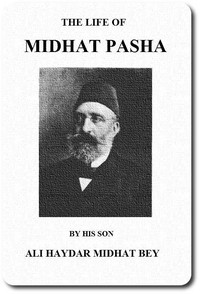
The life of Midhat Pasha; a record of his services, political reforms, banishment, and judicial murder
Download Formats:
Excerpt
A RECORD OF HIS SERVICES,
POLITICAL REFORMS, BANISHMENT,
AND JUDICIAL MURDER
DERIVED FROM PRIVATE DOCUMENTS AND
REMINISCENCES
LONDON
JOHN MURRAY, ALBEMARLE STREET, W.
1903
As the Son of Midhat Pasha I was for fifteen years compelled to reside
as an exile in Smyrna, but finding the physical and moral sufferings to
which I was there subjected greater than I could endure, I succeeded
in quitting the territories of the Sultan, and came to take up my
residence in this...
Read the Full Text
— End of The life of Midhat Pasha; a record of his services, political reforms, banishment, and judicial murder —
Book Information
- Title
- The life of Midhat Pasha; a record of his services, political reforms, banishment, and judicial murder
- Author(s)
- Ali Haydar Mithat
- Language
- English
- Type
- Text
- Release Date
- February 17, 2016
- Word Count
- 99,716 words
- Library of Congress Classification
- DR
- Bookshelves
- Browsing: Biographies, Browsing: History - European, Browsing: History - General
- Rights
- Public domain in the USA.