Project Gutenberg's The Life Of George Washington, by John Marshall
This eBook is for the use of anyone anywhere at no cost and with
almost no restrictions whatsoever. You may copy it, give it away or
re-use it under the terms of the Project Gutenberg License included
with this eBook or online at www.gutenberg.org
Title: The Life Of George Washington
A Linked Index to the Project Gutenberg Editions
Author: John Marshall
Editor: David Widger
Release Date: May 18, 2009 [EBook #28859]
Language: English
Character set encoding: ISO-8859-1
*** START OF THIS PROJECT GUTENBERG EBOOK THE LIFE OF GEORGE WASHINGTON ***
Produced by David Widger
THE LIFE OF
GEORGE WASHINGTON
By John Marshall (1755-1835)
AN INDEX
Edited by David Widger
Project Gutenberg Editions
CONTENTS
## Volume I.
## Volume II.
## Volume III.
## Volume IV.
## Volume IV.
VOLUMES, CHAPTERS AND STORIES
LIFE OF WASHINGTON, Volume I.
CONTENTS
CHAPTER I.
Commission of Cabot.... His voyage to America.... Views of discovery
relinquished by Henry VII.... Resumed by Elizabeth.... Letters patent to
Sir Humphry Gilbert.... His voyages and death.... Patent to Sir Walter
Raleigh.... Voyage of Sir Richard Grenville.... Colonists carried back
to England by Drake.... Grenville arrives with other colonists.... They
are left on Roanoke Island.... Are destroyed by the Indians.... Arrival
of John White.... He returns to England for succour.... Raleigh assigns
his patent.... Patent to Sir Thomas Gates and others.... Code of laws
for the proposed colony drawn up by the King.
CHAPTER II.
Voyage of Newport.... Settlement at Jamestown.... Distress of
colonists.... Smith.... He is captured by the Indians.... Condemned to
death, saved by Pocahontas.... Returns to Jamestown.... Newport arrives
with fresh settlers.... Smith explores the Chesapeake.... Is chosen
president.... New charter.... Third voyage of Newport.... Smith sails
for Europe.... Condition of the colony.... Colonists determine to
abandon the country.... Are stopped by Lord Delaware.... Sir Thomas
Dale.... New charter.... Capt. Argal seizes Pocahontas.... She marries
Mr. Rolf.... Separate property in lands and labour.... Expedition
against Port Royal.... Against Manhadoes.... Fifty acres of land for
each settler.... Tobacco.... Sir Thomas Dale.... Mr. Yeardley.... First
assembly.... First arrival of females.... Of convicts.... Of African
slaves.... Two councils established.... Prosperity of the colony....
Indians attempt to massacre the whites.... General war.... Dissolution
of the company.... Arbitrary measures of the crown.... Sir John
Harvey.... Sir William Berkeley.... Provincial assembly restored....
Virginia declares in favour of Charles II.... Grant to Lord
Baltimore.... Arrival of a colony in Maryland.... Assembly composed
of freemen.... William Claybourne.... Assembly composed of
representatives.... Divided into two branches.... Tyrannical
proceedings.
CHAPTER III.
First ineffectual attempts of the Plymouth company to settle the
country.... Settlement at New Plymouth.... Sir Henry Rosewell and
company.... New charter.... Settlements prosecuted vigorously....
Government transferred to the colonists.... Boston founded.... Religious
intolerance.... General court established.... Royal commission for the
government of the plantations.... Contest with the French colony of
Acadié.... Hugh Peters.... Henry Vane.... Mrs. Hutchison.... Maine
granted to Gorges.... Quo warranto against the patent of the colony....
Religious dissensions.... Providence settled.... Rhode Island
settled.... Connecticut settled.... War with the Pequods.... New Haven
settled.
CHAPTER IV.
Massachusetts claims New Hampshire and part of Maine.... Dissensions
among the inhabitants.... Confederation of the New England colonies....
Rhode Island excluded from it.... Separate chambers provided for the
two branches of the Legislature.... New England takes part
with Parliament.... Treaty with Acadié.... Petition of the
non-conformists.... Disputes between Massachusetts and Connecticut....
War between England and Holland.... Machinations of the Dutch at
Manhadoes among the Indians.... Massachusetts refuses to join the
united colonies in the war.... Application of New Haven to Cromwell for
assistance.... Peace with the Dutch.... Expedition of Sedgewic against
Acadié.... Religious intolerance.
CHAPTER V.
Transactions succeeding the restoration of Charles II.... Contests
between Connecticut and New Haven.... Discontents in Virginia....
Grant to the Duke of York.... Commissioners appointed by the crown....
Conquest of the Dutch settlements.... Conduct of Massachusetts to the
royal commissioners.... Their recall.... Massachusetts evades a summons
to appear before the King and council.... Settlement of Carolina....
Form of government.... Constitution of Mr. Locke.... Discontents in
the county of Albemarle.... Invasion from Florida.... Abolition of
the constitution of Mr. Locke.... Bacon's rebellion.... His death....
Assembly deprived of judicial power.... Discontents in Virginia....
Population of the colony.
CHAPTER VI.
Prosperity of New England.... War with Philip.... Edward Randolph
arrives in Boston.... Maine adjudged to Gorges.... Purchased by
Massachusetts.... Royal government erected in New Hampshire....
Complaints against Massachusetts.... Their letters patent cancelled....
Death of Charles II.... James II. proclaimed.... New commission for the
government of New England.... Sir Edmond Andros.... The charter of Rhode
Island abrogated.... Odious measures of the new government.... Andros
deposed.... William and Mary proclaimed.... Review of proceedings in New
York and the Jerseys.... Pennsylvania granted to William Penn....
Frame of government.... Foundation of Philadelphia laid.... Assembly
convened.... First acts of the legislature.... Boundary line with Lord
Baltimore settled.
CHAPTER VII.
New charter of Massachusetts.... Affairs of New York.... War with
France.... Schenectady destroyed.... Expedition against Port Royal....
Against Quebec.... Acadié recovered by France.... Pemaquid taken....
Attempt on St. Johns.... Peace.... Affairs of New York.... Of
Virginia.... Disputes between England and France respecting boundary in
America.... Recommencement of hostilities.... Quotas of the respective
colonies.... Treaty of neutrality between France and the five
nations.... Expedition against Port Royal.... Incursion into
Massachusetts.... Plan for the invasion of Canada.... Port Royal
taken.... Expedition against Quebec.... Treaty of Utrecht.... Affairs
of New York.... Of Carolina.... Expedition against St. Augustine....
Attempt to establish the Episcopal church.... Invasion of the colony....
Bills of credit issued.... Legislature continues itself.... Massacre in
North Carolina by the Indians.... Tuscaroras defeated.... Scheme of a
Bank.
CHAPTER VIII.
Proceedings of the legislature of Massachusetts.... Intrigues of
the French among the Indians.... War with the savages.... Peace....
Controversy with the governor.... Decided in England.... Contests
concerning the governor's salary.... The assembly adjourned to Salem....
Contest concerning the salary terminated.... Great depreciation of the
paper currency.... Scheme of a land bank.... Company dissolved by act
of Parliament.... Governor Shirley arrives.... Review of transactions in
New York.
CHAPTER IX.
War with the southern Indians.... Dissatisfaction of Carolina with
the proprietors.... Rupture with Spain.... Combination to subvert the
proprietary government.... Revolution completed.... Expedition from
the Havanna against Charleston.... Peace with Spain.... The proprietors
surrender their interest to the crown.... The province divided....
Georgia settled.... Impolicy of the first regulations.... Intrigues of
the Spaniards with the slaves of South Carolina.... Insurrection of the
slaves.
CHAPTER X.
War declared against Spain.... Expedition against St. Augustine....
Georgia invaded.... Spaniards land on an island in the Alatamaha....
Appearance of a fleet from Charleston.... Spanish army re-embarks....
Hostilities with France.... Expedition against Louisbourg.... Louisbourg
surrenders.... Great plans of the belligerent powers.... Misfortunes of
the armament under the duke D'Anville.... The French fleet dispersed
by a storm.... Expedition against Nova Scotia.... Treaty of Aix la
Chapelle.... Paper money of Massachusetts redeemed.... Contests between
the French and English respecting boundaries.... Statement respecting
the discovery of the Mississippi.... Scheme for connecting Louisiana
with Canada.... Relative strength of the French and English colonies....
Defeat at the Little Meadows.... Convention at Albany.... Plan of
union.... Objected to both in America and Great Britain.
CHAPTER XI.
General Braddock arrives.... Convention of governors and plan of
the campaign.... French expelled from Nova Scotia, and inhabitants
transplanted.... Expedition against fort Du Quêsne.... Battle of
Monongahela.... Defeat and death of General Braddock.... Expedition
against Crown Point.... Dieskau defeated.... Expedition against
Niagara.... Frontiers distressed by the Indians.... Meeting of the
governors at New York.... Plan for the campaign of 1756.... Lord Loudoun
arrives.... Montcalm takes Oswego.... Lord Loudoun abandons offensive
operations.... Small-pox breaks out in Albany.... Campaign of 1757
opened.... Admiral Holbourne arrives at Halifax.... Is joined by the
earl of Loudoun.... Expedition against Louisbourg relinquished.... Lord
Loudoun returns to New York.... Fort William Henry taken.... Controversy
between Lord Loudoun and the assembly of Massachusetts.
CHAPTER XII.
Preparations for the campaign of 1758.... Admiral Boscawen and General
Amherst arrive at Halifax.... Plan of the campaign.... Expedition
against Louisbourg, Ticonderoga, and Crown Point.... General Abercrombie
repulsed under the walls of Ticonderoga.... Fort Frontignac taken....
Expedition against Fort Du Quêsne.... Preparations for the campaign of
1759.... General Amherst succeeds General Abercrombie.... Plan of the
campaign.... Ticonderoga and Crown Point taken.... Army goes into winter
quarters.... French repulsed at Oswego.... Defeated at Niagara....
Niagara taken.... Expedition against Quebec.... Check to the English
army.... Battle on the Plains of Abraham.... Death of Wolfe and
Montcalm.... Quebec capitulates.... Garrisoned by the English under the
command of General Murray.... Attempt to recover Quebec.... Battle
near Sillery.... Quebec besieged by Monsieur Levi.... Siege raised....
Montreal capitulates.... War with the southern Indians.... Battle near
the town of Etchoe.... Grant defeats them and burns their towns....
Treaty with the Cherokees.... War with Spain.... Success of the
English.... Peace.
CHAPTER XIII.
Opinions on the supremacy of parliament, and its right to tax the
colonies.... The stamp act.... Congress at New York.... Violence in the
towns.... Change of administration.... Stamp act repealed.... Opposition
to the mutiny act.... Act imposing duties on tea, &c., resisted in
America.... Letters from the assembly of Massachusetts to members of
the administration.... Petition to the King.... Circular letter to
the colonial assemblies.... Letter from the Earl of Hillsborough....
Assembly of Massachusetts dissolved.... Seizure of the Sloop Liberty....
Convention at Fanueil Hall.... Moderation of its proceedings.... Two
British regiments arrive at Boston.... Resolutions of the house of
Burgesses of Virginia.... Assembly dissolved.... The members form an
association.... General measures against importation.... General court
convened in Massachusetts.... Its proceedings.... Is prorogued....
Duties, except that on tea, repealed.... Circular letter of the earl of
Hillsborough.... New York recedes from the non-importation agreement in
part.... Her example followed.... Riot in Boston.... Trial and acquittal
of Captain Preston.
CHAPTER XIV.
Insurrection in North Carolina.... Dissatisfaction of Massachusetts....
Corresponding-committees.... Governor Hutchinson's correspondence
communicated by Dr. Franklin.... The assembly petition for his
removal.... He is succeeded by General Gage.... Measures to enforce the
act concerning duties.... Ferment in America.... The tea thrown into
the sea at Boston.... Measures of Parliament.... General enthusiasm in
America.... A general congress proposed.... General Gage arrives....
Troops stationed on Boston neck.... New counsellors and judges....
Obliged to resign.... Boston neck fortified.... Military stores seized
by General Gage.... Preparations for defence.... King's speech....
Proceedings of Parliament.... Battle of Lexington.... Massachusetts
raises men.... Meeting of Congress.... Proceedings of that body....
Transactions in Virginia.... Provincial congress of South Carolina....
Battle of Breed's hill.
NOTES
Footnotes
ILLUSTRATIONS
General Washington
Ruins of the Old Brick Church Built at Jamestown In 1639
Plymouth, Massachusetts, in 1622
Penn Seeking Freedom for Imprisoned Friends
Great Meadows and the Site of Fort Necessity
General Braddock's Grave
The Death of Wolfe on the Plains Of Abraham
The Boston Tea Party
LIFE OF WASHINGTON, Volume II.
CONTENTS
CHAPTER I.
Birth of Mr. Washington.... His mission to the French on the Ohio....
Appointed Lieutenant Colonel of a regiment of regular troops....
Surprises Monsieur Jumonville.... Capitulation of fort Necessity.... Is
appointed aid-de-camp to General Braddock.... Defeat and death of
that general.... Is appointed to the command of a regiment.... Extreme
distress of the frontiers, and exertions of Colonel Washington to
augment the regular forces of the colony.... Expedition against fort
Du Quesne.... Defeat of Major Grant.... Fort Du Quesne evacuated by
the French, and taken possession of by the English.... Resignation of
Colonel Washington.... His marriage.
CHAPTER II.
Colonel Washington appointed commander-in-chief of the American
forces.... Arrives at Cambridge.... Strength and disposition of the
two armies.... Deficiency of the Americans in arms and ammunitions....
Falmouth burnt.... Success of the American cruisers.... Distress of
the British from the want of fresh provisions.... Measures to form a
continental army.... Difficulty of re-enlisting the troops.... Plan for
attacking Boston.... General Lee detached to New York.... Possession
taken of the heights of Dorchester.... Boston evacuated....
Correspondence respecting prisoners.
CHAPTER III.
Invasion of Canada meditated.... Siege of St. John's.... Capture of
fort Chamblée.... Carleton defeated at Longueisle.... St. John's
capitulated.... Montreal surrenders.... Arnold's expedition.... He
arrives before Quebec.... Retires to Point Aux Trembles.... Montgomery
lays siege to Quebec.... Unsuccessful attack on that place.... Death of
Montgomery.... Blockade of Quebec.... General Thomas takes command
of the army.... The blockade raised.... General Sullivan takes the
command.... Battle of the Three Rivers.... Canada evacuated.... General
Carleton constructs a fleet.... Enters lake Champlain.... Defeats the
American flotilla.... Takes possession of Crown Point.... Retires into
winter quarters.
CHAPTER IV.
Transaction in Virginia.... Action at Great Bridge.... Norfolk
evacuated.... Burnt.... Transactions in North Carolina.... Action at
Moore's Creek Bridge.... Invasion of South Carolina.... British fleet
repulsed at Fort Moultrie.... Transactions in New York.... Measures
leading to Independence.... Independence declared.
CHAPTER V.
Lord and Sir William Howe arrive before New York.... Circular letter of
Lord Howe.... State of the American Army.... The British land in force
on Long Island.... Battle of Brooklyn.... Evacuation of Long Island....
Fruitless negotiations.... New York evacuated.... Skirmish on the
heights of Haerlem.... Letter on the state of the army.
CHAPTER VI.
The British land at Frog's Neck.... The American army evacuates York
Island, except fort Washington.... Both armies move towards the White
Plains.... Battle of the White Plains.... The British army returns to
Kingsbridge.... General Washington crosses the North river.... The
lines of fort Washington carried by the British, and the garrison
made prisoners.... Evacuation of fort Lee.... Weakness of the American
army.... Ineffectual attempts to raise the militia.... General
Washington retreats through Jersey.... General Washington crosses the
Delaware.... Danger of Philadelphia.... Capture of General Lee....
The British go into winter quarters.... Battle of Trenton.... Of
Princeton.... Firmness of congress.
CHAPTER VII.
American army inoculated.... General Heath moves to Kingsbridge....
Returns to Peekskill.... Skirmishes.... State of the army....
Destruction of stores at Peekskill.... At Danbury.... Expedition to Sagg
Harbour.... Camp formed at Middlebrook.... Sir William Howe moves out
to Somerset Court House.... Returns to Amboy.... Attempts to cut off
the retreat of the American army to Middlebrook.... Lord Cornwallis
skirmishes with Lord Stirling.... General Prescott surprised and
taken.... The British army embarks.
CHAPTER VIII.
General Washington commences his march to the Delaware.... Takes
measures for checking Burgoyne.... British army land at Elk River....
General Washington advances to Brandywine.... Retreat of Maxwell....
Defeat at Brandywine.... Slight skirmish near the White Horse, and
retreat to French Creek.... General Wayne surprised.... General Howe
takes possession of Philadelphia.... Removal of Congress to Lancaster.
CHAPTER IX.
Measures to cut off the communication between the British army and
fleet.... Battle of Germantown.... Measures to intercept supplies to
Philadelphia.... Attack on fort Mifflin.... On Red Bank.... The Augusta
blows up.... Fort Mifflin evacuated.... Fort Mercer evacuated.... The
British open the communication with their fleet.... Washington urged to
attack Philadelphia.... General Howe marches out to Chestnut Hill....
Returns to Philadelphia.... General Washington goes into winter
quarters.
CHAPTER X.
Inquiry into the conduct of General Schuyler.... Burgoyne appears
before Ticonderoga.... Evacuation of that place,... of Skeensborough....
Colonel Warner defeated.... Evacuation of fort Anne.... Proclamation of
Burgoyne.... Counter-proclamation of Schuyler.... Burgoyne approaches
fort Edward.... Schuyler retires to Saratoga,... to Stillwater....
St. Leger invests fort Schuyler.... Herkimer defeated.... Colonel Baum
detached to Bennington.... is defeated.... Brechman defeated.... St.
Leger abandons the siege of fort Schuyler.... Murder of Miss M'Crea....
General Gates takes command.... Burgoyne encamps on the heights of
Saratoga.... Battle of Stillwater.... Burgoyne retreats to Saratoga....
Capitulates.... The British take forts Montgomery and Clinton.... The
forts Independence and Constitution evacuated by the Americans....
Ticonderoga evacuated by the British.
CHAPTER XI.
Defects in the Commissary departments.... Distress of the army at Valley
Forge.... The army subsisted by impressments.... Combination in congress
against General Washington.... Correspondence between him and General
Gates.... Distress of the army for clothes.... Washington's exertions to
augment the army.... Congress sends a committee to camp.... Attempt to
surprise Captain Lee.... Congress determines on a second expedition to
Canada.... Abandons it.... General Conway resigns.... The Baron Steuben
appointed Inspector General.... Congress forbids the embarkation of
Burgoyne's army.... Plan of reconciliation agreed to in Parliament....
Communicated to congress and rejected.... Information of treaties
between France and the United States.... Complaints of the treatment of
prisoners.... A partial exchange agreed to.
NOTES
Footnotes
ILLUSTRATIONS
Wakefieldthe Birthplace of George Washington
The Washington Family Burial Ground
The Historic Washington Elm at Cambridge, Massachusetts
Independence Hall, Philadelphia
Washington's Headquarters at White Plains
Washington Crossing the Delaware
The Saratoga Battle Monument
Washington's Headquarters at Valley Forge
LIFE OF WASHINGTON, Volume III.
CONTENTS
CHAPTER I.
Incursion into Jersey.... General Lacy surprised.... Attempt on
Lafayette at Barren hill.... General Howe resigns the command of
the British army.... Is succeeded by Sir H. Clinton.... He evacuates
Philadelphia, and marches through the Jerseys.... A council of war
which decides against attacking the British on their march.... Battle of
Monmouth.... General Lee arrested.... Sentenced to be suspended for one
year.... Thanks of Congress to General Washington and his army.
CHAPTER II.
Count D'Estaing arrives with a French fleet.... Meditates an attack on
the British fleet in New York harbour.... Relinquishes it.... Sails
to Rhode Island.... Lord Howe appears off Rhode Island.... Both fleets
dispersed by a storm.... General Sullivan lays siege to Newport....
D'Estaing returns.... Sails for Boston.... Sullivan expresses his
dissatisfaction in general orders.... Raises the siege of Newport....
Action on Rhode Island.... The Americans retreat to the Continent....
Count D'Estaing expresses his dissatisfaction with Sullivan in a letter
to congress.... General Washington labours successfully to heal these
discontents.... Lord Howe resigns the command of the British fleet....
Colonel Baylor's regiment surprised.... Captain Donop defeated by
Colonel Butler.... Expedition of the British against Egg Harbour....
Pulaski surprised.
CHAPTER III.
Arrival of the British commissioners.... Terms of conciliation
proposed.... Answer of congress to their propo[Pg iv]sitions....
Attempts of Mr. Johnson to bribe some members of congress....
His private letters ordered to be published.... Manifesto of the
commissioners, and counter-manifesto of congress.... Arrival of Monsieur
Girard, minister plenipotentiary of France.... Hostilities of the
Indians.... Irruption into the Wyoming settlement.... Battle of
Wyoming.... Colonel Dennison capitulates for the inhabitants....
Distress of the settlement.... Colonel Clarke surprises St. Vincent....
Congress determines to invade Canada.... General Washington opposes the
measure.... Induces congress to abandon it.
CHAPTER IV.
Divisions in Congress.... Letters of General Washington on the state
of public affairs.... Invasion of Georgia.... General Howe defeated by
Colonel Campbell.... Savannah taken.... Sunbury surrenders.... Georgia
reduced.... General Lincoln takes command of the Southern army.... Major
Gardener defeated by General Moultrie.... Insurrection of the Tories
in South Carolina.... They are defeated by Colonel Pickens.... Ash
surprised and defeated.... Moultrie retreats.... Prevost marches
to Charleston.... Lincoln attacks the British at Stono Ferry
unsuccessfully.... Invasion of Virginia.
CHAPTER V.
Discontents in a part of the American army.... Letter from General
Washington on the subject.... Colonel Van Schaick destroys an Indian
settlement.... Expedition against the Indians meditated.... Fort Fayette
surrendered to the British.... Invasion of Connecticut.... General Wayne
storms Stony Point.... Expedition against Penobscot.... Powles Hook
surprised by Major Lee.... Arrival of Admiral Arbuthnot.... Of the Count
D'Estaing.... Siege of Savannah.... Unsuccessful attempt to storm that
place.... Siege raised.... Victory of General Sullivan at Newtown....
Spain offers her me[Pg v]diation to the belligerents.... Declares
war against England.... Letter from General Washington to congress
respecting the annual formation of the army.... The army goes into
winter quarters.
CHAPTER VI.
South Carolina invaded.... The British fleet passes the bar, and
gets possession of the harbour of Charleston.... Opinion of General
Washington on the propriety of defending that place.... Sir Henry
Clinton invests the town.... Tarleton surprises an American corps at
Monk's Corner.... Fort Moultrie surrendered.... Tarleton defeats
Colonel White.... General Lincoln capitulates.... Buford defeated....
Arrangements for the government of South Carolina and Georgia.... Sir
Henry Clinton embarks for New York.... General Gates takes command of
the Southern army.... Is defeated near Camden.... Death of De Kalb....
Success of General Sumpter.... He is defeated.
CHAPTER VII.
Distress in the American camp.... Expedition against Staten Island....
Requisitions on the states.... New scheme of finance.... Committee
of congress deputed to camp.... Resolution to make up depreciation of
pay.... Mutiny in the line of Connecticut.... General Knyphausen
enters Jersey.... Sir Henry Clinton returns to New York.... Skirmish at
Springfield.... Exertions to strengthen the army.... Bank established in
Philadelphia.... Contributions of the ladies.... Farther proceedings of
the states.... Arrival of a French armament in Rhode Island.... Changes
in the quartermaster's department.... Enterprise against New York
abandoned.... Naval superiority of the British.
CHAPTER VIII.
Treason and escape of Arnold.... Trial and execution of Major André....
Precautions for the security of West[Pg vi] Point.... Letter of General
Washington on American affairs.... Proceedings of congress respecting
the army.... Major Talmadge destroys the British stores at Coram.... The
army retires into winter quarters.... Irruption of Major Carleton into
New York.... European transactions.
CHAPTER IX.
Transactions in South Carolina and Georgia.... Defeat of Ferguson....
Lord Cornwallis enters North Carolina.... Retreat out of that state....
Major Wemys defeated by Sumpter.... Tarleton repulsed.... Greene
appointed to the command of the Southern army.... Arrives in camp....
Detaches Morgan over the Catawba.... Battle of the Cowpens.... Lord
Cornwallis drives Greene through North Carolina into Virginia.... He
retires to Hillsborough.... Greene recrosses the Dan.... Loyalists under
Colonel Pyle cut to pieces.... Battle of Guilford.... Lord Cornwallis
retires to Ramsay's mills.... To Wilmington.... Greene advances
to Ramsay's mills.... Determines to enter South Carolina.... Lord
Cornwallis resolves to march to Virginia.
CHAPTER X.
Virginia invaded by Arnold.... He destroys the stores at Westham and
at Richmond.... Retires to Portsmouth.... Mutiny in the Pennsylvania
line.... Sir H. Clinton attempts to negotiate with the mutineers....
They compromise with the civil government.... Mutiny in the Jersey
line.... Mission of Colonel Laurens to France.... Propositions to
Spain.... Recommendations relative to a duty on imported and prize
goods.... Reform in the Executive departments.... Confederation
adopted.... Military transactions.... Lafayette detached to
Virginia.... Cornwallis arrives.... Presses Lafayette.... Expedition
to Charlottesville, to the Point of Fork.... Lafayette forms a junction
with Wayne.... Cornwallis retires to the lower country.... General
Washington's letters are intercepted.... Action near Jamestown.[Pg vii]
CHAPTER XI.
Farther state of affairs in the beginning of the year 1781.... Measures
of Mr. Morris, the superintendent of finances.... Designs of General
Washington against New York.... Count Rochambeau marches to the North
River.... Intelligence from the Count de Grasse.... Plan of operations
against Lord Cornwallis.... Naval engagement.... The combined armies
march for the Chesapeake.... Yorktown invested.... Surrender of Lord
Cornwallis.
NOTES.
Footnotes.
ILLUSTRATIONS
George Washington, by Gilbert Stuart
Martha Washington, by Gilbert Stuart
George Washington, by John Trumbull
The Ruins of Stony PointOn the Hudson
Beverly Robinson Mansion at West Point
Where Washington Stayed During André's Trial
The Moore House at Yorktown, Virginia
LIFE OF WASHINGTON, Volume IV.
CONTENTS
CHAPTER I.
Greene invests Camden.... Battle of Hobkirk's Hill.... Progress of
Marion and Lee.... Lord Rawdon retires into the lower country.... Greene
invests Ninety Six.... Is repulsed.... Retires from that place....
Active movements of the two armies.... After a short repose they resume
active operations.... Battle of Eutaw.... The British army retires
towards Charleston.
CHAPTER II.
Preparations for another campaign.... Proceedings in the Parliament of
Great Britain. Conciliatory conduct of General Carleton.... Transactions
in the south.... Negotiations for peace.... Preliminary and eventual
articles agreed upon between the United States and Great Britain....
Discontents of the American army.... Peace.... Mutiny of a part of the
Pennsylvania line.... Evacuation of New York.... General Washington
resigns his commission and retires to Mount Vernon.
CHAPTER III.
General Washington devotes his time to rural pursuits.... to the duties
of friendship.... and to institutions of public utility.... Resolves of
Congress and of the Legislature of Virginia for erecting statues to
his honour.... Recommends improvement in inland navigation.... Declines
accepting a donation made to him by his native state.... The society of
the Cincinnati.... He is elected President.... The causes which led to
a change of the government of the United States.... Circular letter of
General Washington to the governors of the several states.
CHAPTER IV.
Differences between Great Britain and the United States.... Mr. Adams
appointed minister to Great Britain.... Discontents excited by the
commercial regulations of Britain.... Parties in the United States....
The convention at Annapolis.... Virginia appoints deputies to a
convention at Philadelphia.... General Washington chosen one of them....
Insurrection at Massachusetts.... Convention at Philadelphia.... A form
of government submitted to the respective states, as ratified by eleven
of them.... Correspondence of General Washington respecting the
chief magistracy.... He is elected president.... Meeting of the first
congress.
CHAPTER V.
The election of General Washington officially announced to him.... His
departure for the seat of government.... Marks of affection shown him on
his journey.... His inauguration and speech to Congress.... His system
of intercourse with the world.... Letters on this and other subjects....
Answers of both houses of Congress to the speech.... Domestic and
foreign relations of the United States.... Debates on the impost and
tonnage bills.... On the power of removal from office.... On the policy
of the secretary of the treasury reporting plans of revenue.... On
the style of the President.... Amendments to the constitution....
Appointment of executive officers, and of the judges.... Adjournment of
the first session of congress.... The President visits New England....
His reception.... North Carolina accedes to the union.
CHAPTER VI.
Meeting of congress.... President's speech.... Report of the secretary
of the treasury on public credit.... Debate thereon.... Bill for fixing
the permanent seat of government.... Adjournment of congress.... Treaty
with the Creek Indians.... Relations of the United States with Great
Britain and Spain.... The President visits Mount Vernon.... Session of
congress.... The President's speech.... Debates on the excise.... On a
national bank.... The opinions of the cabinet on the law.... Progress of
parties.... War with the Indians.... Defeat of Harmar.... Adjournment of
congress.
CHAPTER VII.
General St. Clair appointed Commander-in-chief.... The President makes a
tour through the southern states.... Meeting of congress.... President's
speech.... Debate on the bill for apportioning representatives....
Military law.... Defeat of St. Clair.... Opposition to the increase
of the army.... Report of the Secretary of the Treasury for raising
additional supplies.... Congress adjourns.... Strictures on the conduct
of administration, with a view of parties.... Disagreement between
the Secretaries of State and Treasury.... Letters from General
Washington.... Opposition to the excise law.... President's
proclamation.... Insurrection and massacre in the island of St.
Domingo.... General Wayne appointed to the command of the army....
Meeting of congress.... President's speech.... Resolutions implicating
the Secretary of the Treasury, rejected.... Congress adjourns....
Progress of the French revolution, and its effects on parties in the
United States.
NOTES.
Footnotes.
LIST OF ILLUSTRATIONS
George Washington
Livingston Manor, Dobbs Ferry, New York
The Long Room in Fraunces' Tavern, New York City
The Old Senate Chamber at Annapolis, Maryland,
Where Washington Resigned His Commission
The Room in Which the First Constitutional Convention Met in Philadelphia
Washington Taking the Oath of Office
View of the Old City or Federal Hall, New York, in 1789
Tomb of Mary, Mother of Washington
LIFE OF WASHINGTON, Volume IV.
CONTENTS
CHAPTER I.
G. Washington again unanimously elected President.... War between Great
Britain and France.... Queries of the President respecting the
conduct to be adopted by the American government.... Proclamation of
neutrality.... Arrival of Mr. Genet as minister from France.... His
conduct.... Illegal proceedings of the French cruisers.... Opinions
of the cabinet.... State of parties.... Democratic societies.... Genet
calculates upon the partialities of the American people for France, and
openly insults their government.... Rules laid down by the executive to
be observed in the ports of the United States in relation to the powers
at war.... The President requests the recall of Genet.... British order
of 8th of June, 1793.... Decree of the national convention relative to
neutral commerce.
CHAPTER II.
Meeting of congress.... President's speech.... His message on the
foreign relations of the United States.... Report of the Secretary
of State on the commerce of the United States.... He resigns.... Is
succeeded by Mr. Randolph.... Mr. Madison's resolutions founded on the
above report.... Debate thereon.... Debates on the subject of a navy....
An embargo law.... Mission of Mr. Jay to Great Britain.... Inquiry into
the conduct of the Secretary of the Treasury, terminates honourably to
him.... Internal taxes.... Congress adjourns.
CHAPTER III.
Genet recalled.... Is succeeded by Mr. Fauchet.... Gouverneur Morris
recalled, and is succeeded by Mr. Monroe.... Kentucky remonstrance....
Intemperate resolutions of the people of that state.... General Wayne
defeats the Indians on the Miamis.... Insurrection in the western parts
of Pennsylvania.... Quelled by the prompt and vigorous measures of the
government.... Meeting of Congress.... President's speech.... Democratic
societies.... Resignation of Colonel Hamilton.... Is succeeded by Mr.
Wolcott.... Resignation of General Knox.... Is succeeded by Colonel
Pickering.... Treaty between the United States and Great Britain....
Conditionally ratified by the President.... The treaty unpopular....
Mr. Randolph resigns.... Is succeeded by Colonel Pickering.... Colonel
M'Henry appointed secretary at war.... Charge against the President
rejected..... Treaty with the Indians north-west of the Ohio....
With Algiers.... With Spain.... Meeting of congress.... President's
speech.... Mr. Adet succeeds Mr. Fauchet..... The house of
representatives call upon the President for papers relating to the
treaty with Great Britain.... He declines sending them.... Debates upon
the treaty making power.... Upon the bill for making appropriations
to carry into execution the treaty with Great Britain.... Congress
adjourns.... The President endeavours to procure the liberation of
Lafayette.
CHAPTER IV.
Letters from General Washington to Mr. Jefferson.... Hostile measures
of France against the United States.... Mr. Monroe recalled and General
Pinckney appointed to succeed him.... General Washington's valedictory
address to the people of the United States.... The Minister of France
endeavours to influence the approaching election.... The President's
speech to congress.... He denies the authenticity of certain spurious
letters published in 1776.... John Adams elected President, and Thomas
Jefferson Vice President.... General Washington retires to Mount
Vernon.... Political situation of the United States at this period....
The French government refuses to receive General Pinckney as
Minister.... Congress is convened.... President's speech.... Three
envoys extraordinary deputed to France.... Their treatment.... Measures
of hostility adopted by the American government against France....
General Washington appointed Commander-in-chief of the American army....
His death.... And character.
NOTES.
Footnotes.
LIST OF ILLUSTRATIONS
President Washington
Martha Washington
George Washington
George Washington's Bedroom at Mount Vernon
George Washington
Martha Washington's Bedroom at Mount Vernon
Mount Vernon
Resting-Place of George and Martha Washington at Mount Vernon
End of Project Gutenberg's The Life Of George Washington, by John Marshall
*** END OF THIS PROJECT GUTENBERG EBOOK THE LIFE OF GEORGE WASHINGTON ***
***** This file should be named 28859-8.txt or 28859-8.zip *****
This and all associated files of various formats will be found in:
http://www.gutenberg.org/2/8/8/5/28859/
Produced by David Widger
Updated editions will replace the previous one--the old editions
will be renamed.
Creating the works from public domain print editions means that no
one owns a United States copyright in these works, so the Foundation
(and you!) can copy and distribute it in the United States without
permission and without paying copyright royalties. Special rules,
set forth in the General Terms of Use part of this license, apply to
copying and distributing Project Gutenberg-tm electronic works to
protect the PROJECT GUTENBERG-tm concept and trademark. Project
Gutenberg is a registered trademark, and may not be used if you
charge for the eBooks, unless you receive specific permission. If you
do not charge anything for copies of this eBook, complying with the
rules is very easy. You may use this eBook for nearly any purpose
such as creation of derivative works, reports, performances and
research. They may be modified and printed and given away--you may do
practically ANYTHING with public domain eBooks. Redistribution is
subject to the trademark license, especially commercial
redistribution.
*** START: FULL LICENSE ***
THE FULL PROJECT GUTENBERG LICENSE
PLEASE READ THIS BEFORE YOU DISTRIBUTE OR USE THIS WORK
To protect the Project Gutenberg-tm mission of promoting the free
distribution of electronic works, by using or distributing this work
(or any other work associated in any way with the phrase "Project
Gutenberg"), you agree to comply with all the terms of the Full Project
Gutenberg-tm License (available with this file or online at
http://gutenberg.org/license).
Section 1. General Terms of Use and Redistributing Project Gutenberg-tm
electronic works
1.A. By reading or using any part of this Project Gutenberg-tm
electronic work, you indicate that you have read, understand, agree to
and accept all the terms of this license and intellectual property
(trademark/copyright) agreement. If you do not agree to abide by all
the terms of this agreement, you must cease using and return or destroy
all copies of Project Gutenberg-tm electronic works in your possession.
If you paid a fee for obtaining a copy of or access to a Project
Gutenberg-tm electronic work and you do not agree to be bound by the
terms of this agreement, you may obtain a refund from the person or
entity to whom you paid the fee as set forth in paragraph 1.E.8.
1.B. "Project Gutenberg" is a registered trademark. It may only be
used on or associated in any way with an electronic work by people who
agree to be bound by the terms of this agreement. There are a few
things that you can do with most Project Gutenberg-tm electronic works
even without complying with the full terms of this agreement. See
paragraph 1.C below. There are a lot of things you can do with Project
Gutenberg-tm electronic works if you follow the terms of this agreement
and help preserve free future access to Project Gutenberg-tm electronic
works. See paragraph 1.E below.
1.C. The Project Gutenberg Literary Archive Foundation ("the Foundation"
or PGLAF), owns a compilation copyright in the collection of Project
Gutenberg-tm electronic works. Nearly all the individual works in the
collection are in the public domain in the United States. If an
individual work is in the public domain in the United States and you are
located in the United States, we do not claim a right to prevent you from
copying, distributing, performing, displaying or creating derivative
works based on the work as long as all references to Project Gutenberg
are removed. Of course, we hope that you will support the Project
Gutenberg-tm mission of promoting free access to electronic works by
freely sharing Project Gutenberg-tm works in compliance with the terms of
this agreement for keeping the Project Gutenberg-tm name associated with
the work. You can easily comply with the terms of this agreement by
keeping this work in the same format with its attached full Project
Gutenberg-tm License when you share it without charge with others.
1.D. The copyright laws of the place where you are located also govern
what you can do with this work. Copyright laws in most countries are in
a constant state of change. If you are outside the United States, check
the laws of your country in addition to the terms of this agreement
before downloading, copying, displaying, performing, distributing or
creating derivative works based on this work or any other Project
Gutenberg-tm work. The Foundation makes no representations concerning
the copyright status of any work in any country outside the United
States.
1.E. Unless you have removed all references to Project Gutenberg:
1.E.1. The following sentence, with active links to, or other immediate
access to, the full Project Gutenberg-tm License must appear prominently
whenever any copy of a Project Gutenberg-tm work (any work on which the
phrase "Project Gutenberg" appears, or with which the phrase "Project
Gutenberg" is associated) is accessed, displayed, performed, viewed,
copied or distributed:
This eBook is for the use of anyone anywhere at no cost and with
almost no restrictions whatsoever. You may copy it, give it away or
re-use it under the terms of the Project Gutenberg License included
with this eBook or online at www.gutenberg.org
1.E.2. If an individual Project Gutenberg-tm electronic work is derived
from the public domain (does not contain a notice indicating that it is
posted with permission of the copyright holder), the work can be copied
and distributed to anyone in the United States without paying any fees
or charges. If you are redistributing or providing access to a work
with the phrase "Project Gutenberg" associated with or appearing on the
work, you must comply either with the requirements of paragraphs 1.E.1
through 1.E.7 or obtain permission for the use of the work and the
Project Gutenberg-tm trademark as set forth in paragraphs 1.E.8 or
1.E.9.
1.E.3. If an individual Project Gutenberg-tm electronic work is posted
with the permission of the copyright holder, your use and distribution
must comply with both paragraphs 1.E.1 through 1.E.7 and any additional
terms imposed by the copyright holder. Additional terms will be linked
to the Project Gutenberg-tm License for all works posted with the
permission of the copyright holder found at the beginning of this work.
1.E.4. Do not unlink or detach or remove the full Project Gutenberg-tm
License terms from this work, or any files containing a part of this
work or any other work associated with Project Gutenberg-tm.
1.E.5. Do not copy, display, perform, distribute or redistribute this
electronic work, or any part of this electronic work, without
prominently displaying the sentence set forth in paragraph 1.E.1 with
active links or immediate access to the full terms of the Project
Gutenberg-tm License.
1.E.6. You may convert to and distribute this work in any binary,
compressed, marked up, nonproprietary or proprietary form, including any
word processing or hypertext form. However, if you provide access to or
distribute copies of a Project Gutenberg-tm work in a format other than
"Plain Vanilla ASCII" or other format used in the official version
posted on the official Project Gutenberg-tm web site (www.gutenberg.org),
you must, at no additional cost, fee or expense to the user, provide a
copy, a means of exporting a copy, or a means of obtaining a copy upon
request, of the work in its original "Plain Vanilla ASCII" or other
form. Any alternate format must include the full Project Gutenberg-tm
License as specified in paragraph 1.E.1.
1.E.7. Do not charge a fee for access to, viewing, displaying,
performing, copying or distributing any Project Gutenberg-tm works
unless you comply with paragraph 1.E.8 or 1.E.9.
1.E.8. You may charge a reasonable fee for copies of or providing
access to or distributing Project Gutenberg-tm electronic works provided
that
- You pay a royalty fee of 20% of the gross profits you derive from
the use of Project Gutenberg-tm works calculated using the method
you already use to calculate your applicable taxes. The fee is
owed to the owner of the Project Gutenberg-tm trademark, but he
has agreed to donate royalties under this paragraph to the
Project Gutenberg Literary Archive Foundation. Royalty payments
must be paid within 60 days following each date on which you
prepare (or are legally required to prepare) your periodic tax
returns. Royalty payments should be clearly marked as such and
sent to the Project Gutenberg Literary Archive Foundation at the
address specified in Section 4, "Information about donations to
the Project Gutenberg Literary Archive Foundation."
- You provide a full refund of any money paid by a user who notifies
you in writing (or by e-mail) within 30 days of receipt that s/he
does not agree to the terms of the full Project Gutenberg-tm
License. You must require such a user to return or
destroy all copies of the works possessed in a physical medium
and discontinue all use of and all access to other copies of
Project Gutenberg-tm works.
- You provide, in accordance with paragraph 1.F.3, a full refund of any
money paid for a work or a replacement copy, if a defect in the
electronic work is discovered and reported to you within 90 days
of receipt of the work.
- You comply with all other terms of this agreement for free
distribution of Project Gutenberg-tm works.
1.E.9. If you wish to charge a fee or distribute a Project Gutenberg-tm
electronic work or group of works on different terms than are set
forth in this agreement, you must obtain permission in writing from
both the Project Gutenberg Literary Archive Foundation and Michael
Hart, the owner of the Project Gutenberg-tm trademark. Contact the
Foundation as set forth in Section 3 below.
1.F.
1.F.1. Project Gutenberg volunteers and employees expend considerable
effort to identify, do copyright research on, transcribe and proofread
public domain works in creating the Project Gutenberg-tm
collection. Despite these efforts, Project Gutenberg-tm electronic
works, and the medium on which they may be stored, may contain
"Defects," such as, but not limited to, incomplete, inaccurate or
corrupt data, transcription errors, a copyright or other intellectual
property infringement, a defective or damaged disk or other medium, a
computer virus, or computer codes that damage or cannot be read by
your equipment.
1.F.2. LIMITED WARRANTY, DISCLAIMER OF DAMAGES - Except for the "Right
of Replacement or Refund" described in paragraph 1.F.3, the Project
Gutenberg Literary Archive Foundation, the owner of the Project
Gutenberg-tm trademark, and any other party distributing a Project
Gutenberg-tm electronic work under this agreement, disclaim all
liability to you for damages, costs and expenses, including legal
fees. YOU AGREE THAT YOU HAVE NO REMEDIES FOR NEGLIGENCE, STRICT
LIABILITY, BREACH OF WARRANTY OR BREACH OF CONTRACT EXCEPT THOSE
PROVIDED IN PARAGRAPH F3. YOU AGREE THAT THE FOUNDATION, THE
TRADEMARK OWNER, AND ANY DISTRIBUTOR UNDER THIS AGREEMENT WILL NOT BE
LIABLE TO YOU FOR ACTUAL, DIRECT, INDIRECT, CONSEQUENTIAL, PUNITIVE OR
INCIDENTAL DAMAGES EVEN IF YOU GIVE NOTICE OF THE POSSIBILITY OF SUCH
DAMAGE.
1.F.3. LIMITED RIGHT OF REPLACEMENT OR REFUND - If you discover a
defect in this electronic work within 90 days of receiving it, you can
receive a refund of the money (if any) you paid for it by sending a
written explanation to the person you received the work from. If you
received the work on a physical medium, you must return the medium with
your written explanation. The person or entity that provided you with
the defective work may elect to provide a replacement copy in lieu of a
refund. If you received the work electronically, the person or entity
providing it to you may choose to give you a second opportunity to
receive the work electronically in lieu of a refund. If the second copy
is also defective, you may demand a refund in writing without further
opportunities to fix the problem.
1.F.4. Except for the limited right of replacement or refund set forth
in paragraph 1.F.3, this work is provided to you 'AS-IS' WITH NO OTHER
WARRANTIES OF ANY KIND, EXPRESS OR IMPLIED, INCLUDING BUT NOT LIMITED TO
WARRANTIES OF MERCHANTIBILITY OR FITNESS FOR ANY PURPOSE.
1.F.5. Some states do not allow disclaimers of certain implied
warranties or the exclusion or limitation of certain types of damages.
If any disclaimer or limitation set forth in this agreement violates the
law of the state applicable to this agreement, the agreement shall be
interpreted to make the maximum disclaimer or limitation permitted by
the applicable state law. The invalidity or unenforceability of any
provision of this agreement shall not void the remaining provisions.
1.F.6. INDEMNITY - You agree to indemnify and hold the Foundation, the
trademark owner, any agent or employee of the Foundation, anyone
providing copies of Project Gutenberg-tm electronic works in accordance
with this agreement, and any volunteers associated with the production,
promotion and distribution of Project Gutenberg-tm electronic works,
harmless from all liability, costs and expenses, including legal fees,
that arise directly or indirectly from any of the following which you do
or cause to occur: (a) distribution of this or any Project Gutenberg-tm
work, (b) alteration, modification, or additions or deletions to any
Project Gutenberg-tm work, and (c) any Defect you cause.
Section 2. Information about the Mission of Project Gutenberg-tm
Project Gutenberg-tm is synonymous with the free distribution of
electronic works in formats readable by the widest variety of computers
including obsolete, old, middle-aged and new computers. It exists
because of the efforts of hundreds of volunteers and donations from
people in all walks of life.
Volunteers and financial support to provide volunteers with the
assistance they need, are critical to reaching Project Gutenberg-tm's
goals and ensuring that the Project Gutenberg-tm collection will
remain freely available for generations to come. In 2001, the Project
Gutenberg Literary Archive Foundation was created to provide a secure
and permanent future for Project Gutenberg-tm and future generations.
To learn more about the Project Gutenberg Literary Archive Foundation
and how your efforts and donations can help, see Sections 3 and 4
and the Foundation web page at http://www.pglaf.org.
Section 3. Information about the Project Gutenberg Literary Archive
Foundation
The Project Gutenberg Literary Archive Foundation is a non profit
501(c)(3) educational corporation organized under the laws of the
state of Mississippi and granted tax exempt status by the Internal
Revenue Service. The Foundation's EIN or federal tax identification
number is 64-6221541. Its 501(c)(3) letter is posted at
http://pglaf.org/fundraising. Contributions to the Project Gutenberg
Literary Archive Foundation are tax deductible to the full extent
permitted by U.S. federal laws and your state's laws.
The Foundation's principal office is located at 4557 Melan Dr. S.
Fairbanks, AK, 99712., but its volunteers and employees are scattered
throughout numerous locations. Its business office is located at
809 North 1500 West, Salt Lake City, UT 84116, (801) 596-1887, email
[email protected]. Email contact links and up to date contact
information can be found at the Foundation's web site and official
page at http://pglaf.org
For additional contact information:
Dr. Gregory B. Newby
Chief Executive and Director
[email protected]
Section 4. Information about Donations to the Project Gutenberg
Literary Archive Foundation
Project Gutenberg-tm depends upon and cannot survive without wide
spread public support and donations to carry out its mission of
increasing the number of public domain and licensed works that can be
freely distributed in machine readable form accessible by the widest
array of equipment including outdated equipment. Many small donations
($1 to $5,000) are particularly important to maintaining tax exempt
status with the IRS.
The Foundation is committed to complying with the laws regulating
charities and charitable donations in all 50 states of the United
States. Compliance requirements are not uniform and it takes a
considerable effort, much paperwork and many fees to meet and keep up
with these requirements. We do not solicit donations in locations
where we have not received written confirmation of compliance. To
SEND DONATIONS or determine the status of compliance for any
particular state visit http://pglaf.org
While we cannot and do not solicit contributions from states where we
have not met the solicitation requirements, we know of no prohibition
against accepting unsolicited donations from donors in such states who
approach us with offers to donate.
International donations are gratefully accepted, but we cannot make
any statements concerning tax treatment of donations received from
outside the United States. U.S. laws alone swamp our small staff.
Please check the Project Gutenberg Web pages for current donation
methods and addresses. Donations are accepted in a number of other
ways including checks, online payments and credit card donations.
To donate, please visit: http://pglaf.org/donate
Section 5. General Information About Project Gutenberg-tm electronic
works.
Professor Michael S. Hart is the originator of the Project Gutenberg-tm
concept of a library of electronic works that could be freely shared
with anyone. For thirty years, he produced and distributed Project
Gutenberg-tm eBooks with only a loose network of volunteer support.
Project Gutenberg-tm eBooks are often created from several printed
editions, all of which are confirmed as Public Domain in the U.S.
unless a copyright notice is included. Thus, we do not necessarily
keep eBooks in compliance with any particular paper edition.
Most people start at our Web site which has the main PG search facility:
http://www.gutenberg.org
This Web site includes information about Project Gutenberg-tm,
including how to make donations to the Project Gutenberg Literary
Archive Foundation, how to help produce our new eBooks, and how to
subscribe to our email newsletter to hear about new eBooks.
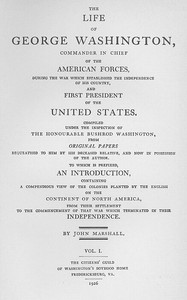
The Life of George Washington: A Linked Index to the Project Gutenberg Editions
Subjects:
Download Formats:
Excerpt
Project Gutenberg's The Life Of George Washington, by John Marshall
This eBook is for the use of anyone anywhere at no cost and with
almost no restrictions whatsoever. You may copy it, give it away or
re-use it under the terms of the Project Gutenberg License included
with this eBook or online at www.gutenberg.org
Title: The Life Of George Washington
A Linked Index to the Project Gutenberg Editions
Read the Full Text
— End of The Life of George Washington: A Linked Index to the Project Gutenberg Editions —
Book Information
- Title
- The Life of George Washington: A Linked Index to the Project Gutenberg Editions
- Author(s)
- Marshall, John
- Language
- English
- Type
- Text
- Release Date
- May 18, 2009
- Word Count
- 7,948 words
- Library of Congress Classification
- E300
- Bookshelves
- Browsing: Biographies, Browsing: History - American
- Rights
- Public domain in the USA.
Related Books
The president's daughter
by Britton, Nan
English
2489h 8m read

White House gossip
by Colman, Edna M. (Edna Mary)
English
2183h 21m read

My life on the plains
by Custer, George A. (George Armstrong)
English
2710h 58m read
Chambers's Journal of Popular Literature, Science, and Art, Index for 1884
by Various
English
42h 52m read
An index to the collected works of William Hazlitt
by Hazlitt, William
English
1330h 15m read
The Ladies of the White House; Or, in the Home of the Presidents - Being a Complete History of the Social and Domestic Lives of the Presidents from Washington to the Present Time—1789–1881
by Holloway, Laura C. (Laura Carter)
English
3215h 3m read