*** START OF THE PROJECT GUTENBERG EBOOK 1164 ***
[Illustration]
The Iron Heel
by Jack London
Contents
FOREWORD
I. MY EAGLE
II. CHALLENGES
III. JACKSON’S ARM
IV. SLAVES OF THE MACHINE
V. THE PHILOMATHS
VI. ADUMBRATIONS
VII. THE BISHOP’S VISION
VIII. THE MACHINE BREAKERS
IX. THE MATHEMATICS OF A DREAM
X. THE VORTEX
XI. THE GREAT ADVENTURE
XII. THE BISHOP
XIII. THE GENERAL STRIKE
XIV. THE BEGINNING OF THE END
XV. LAST DAYS
XVI. THE END
XVII. THE SCARLET LIVERY
XVIII. IN THE SHADOW OF SONOMA
XIX. TRANSFORMATION
XX. A LOST OLIGARCH
XXI. THE ROARING ABYSMAL BEAST
XXII. THE CHICAGO COMMUNE
XXIII. THE PEOPLE OF THE ABYSS
XXIV. NIGHTMARE
XXV. THE TERRORISTS
“At first, this Earth, a stage so gloomed with woe
You almost sicken at the shifting of the scenes.
And yet be patient. Our Playwright may show
In some fifth act what this Wild Drama means.”
THE IRON HEEL
FOREWORD
It cannot be said that the Everhard Manuscript is an important
historical document. To the historian it bristles with errors—not
errors of fact, but errors of interpretation. Looking back across the
seven centuries that have lapsed since Avis Everhard completed her
manuscript, events, and the bearings of events, that were confused and
veiled to her, are clear to us. She lacked perspective. She was too
close to the events she writes about. Nay, she was merged in the events
she has described.
Nevertheless, as a personal document, the Everhard Manuscript is of
inestimable value. But here again enter error of perspective, and
vitiation due to the bias of love. Yet we smile, indeed, and forgive
Avis Everhard for the heroic lines upon which she modelled her husband.
We know to-day that he was not so colossal, and that he loomed among
the events of his times less largely than the Manuscript would lead us
to believe.
We know that Ernest Everhard was an exceptionally strong man, but not
so exceptional as his wife thought him to be. He was, after all, but
one of a large number of heroes who, throughout the world, devoted
their lives to the Revolution; though it must be conceded that he did
unusual work, especially in his elaboration and interpretation of
working-class philosophy. “Proletarian science” and “proletarian
philosophy” were his phrases for it, and therein he shows the
provincialism of his mind—a defect, however, that was due to the times
and that none in that day could escape.
But to return to the Manuscript. Especially valuable is it in
communicating to us the _feel_ of those terrible times. Nowhere do we
find more vividly portrayed the psychology of the persons that lived in
that turbulent period embraced between the years 1912 and 1932—their
mistakes and ignorance, their doubts and fears and misapprehensions,
their ethical delusions, their violent passions, their inconceivable
sordidness and selfishness. These are the things that are so hard for
us of this enlightened age to understand. History tells us that these
things were, and biology and psychology tell us why they were; but
history and biology and psychology do not make these things alive. We
accept them as facts, but we are left without sympathetic comprehension
of them.
This sympathy comes to us, however, as we peruse the Everhard
Manuscript. We enter into the minds of the actors in that long-ago
world-drama, and for the time being their mental processes are our
mental processes. Not alone do we understand Avis Everhard’s love for
her hero-husband, but we feel, as he felt, in those first days, the
vague and terrible loom of the Oligarchy. The Iron Heel (well named) we
feel descending upon and crushing mankind.
And in passing we note that that historic phrase, the Iron Heel,
originated in Ernest Everhard’s mind. This, we may say, is the one moot
question that this new-found document clears up. Previous to this, the
earliest-known use of the phrase occurred in the pamphlet, “Ye Slaves,”
written by George Milford and published in December, 1912. This George
Milford was an obscure agitator about whom nothing is known, save the
one additional bit of information gained from the Manuscript, which
mentions that he was shot in the Chicago Commune. Evidently he had
heard Ernest Everhard make use of the phrase in some public speech,
most probably when he was running for Congress in the fall of 1912.
From the Manuscript we learn that Everhard used the phrase at a private
dinner in the spring of 1912. This is, without discussion, the
earliest-known occasion on which the Oligarchy was so designated.
The rise of the Oligarchy will always remain a cause of secret wonder
to the historian and the philosopher. Other great historical events
have their place in social evolution. They were inevitable. Their
coming could have been predicted with the same certitude that
astronomers to-day predict the outcome of the movements of stars.
Without these other great historical events, social evolution could not
have proceeded. Primitive communism, chattel slavery, serf slavery, and
wage slavery were necessary stepping-stones in the evolution of
society. But it were ridiculous to assert that the Iron Heel was a
necessary stepping-stone. Rather, to-day, is it adjudged a step aside,
or a step backward, to the social tyrannies that made the early world a
hell, but that were as necessary as the Iron Heel was unnecessary.
Black as Feudalism was, yet the coming of it was inevitable. What else
than Feudalism could have followed upon the breakdown of that great
centralized governmental machine known as the Roman Empire? Not so,
however, with the Iron Heel. In the orderly procedure of social
evolution there was no place for it. It was not necessary, and it was
not inevitable. It must always remain the great curiosity of history—a
whim, a fantasy, an apparition, a thing unexpected and undreamed; and
it should serve as a warning to those rash political theorists of
to-day who speak with certitude of social processes.
Capitalism was adjudged by the sociologists of the time to be the
culmination of bourgeois rule, the ripened fruit of the bourgeois
revolution. And we of to-day can but applaud that judgment. Following
upon Capitalism, it was held, even by such intellectual and
antagonistic giants as Herbert Spencer, that Socialism would come. Out
of the decay of self-seeking capitalism, it was held, would arise that
flower of the ages, the Brotherhood of Man. Instead of which, appalling
alike to us who look back and to those that lived at the time,
capitalism, rotten-ripe, sent forth that monstrous offshoot, the
Oligarchy.
Too late did the socialist movement of the early twentieth century
divine the coming of the Oligarchy. Even as it was divined, the
Oligarchy was there—a fact established in blood, a stupendous and awful
reality. Nor even then, as the Everhard Manuscript well shows, was any
permanence attributed to the Iron Heel. Its overthrow was a matter of a
few short years, was the judgment of the revolutionists. It is true,
they realized that the Peasant Revolt was unplanned, and that the First
Revolt was premature; but they little realized that the Second Revolt,
planned and mature, was doomed to equal futility and more terrible
punishment.
It is apparent that Avis Everhard completed the Manuscript during the
last days of preparation for the Second Revolt; hence the fact that
there is no mention of the disastrous outcome of the Second Revolt. It
is quite clear that she intended the Manuscript for immediate
publication, as soon as the Iron Heel was overthrown, so that her
husband, so recently dead, should receive full credit for all that he
had ventured and accomplished. Then came the frightful crushing of the
Second Revolt, and it is probable that in the moment of danger, ere she
fled or was captured by the Mercenaries, she hid the Manuscript in the
hollow oak at Wake Robin Lodge.
Of Avis Everhard there is no further record. Undoubtedly she was
executed by the Mercenaries; and, as is well known, no record of such
executions was kept by the Iron Heel. But little did she realize, even
then, as she hid the Manuscript and prepared to flee, how terrible had
been the breakdown of the Second Revolt. Little did she realize that
the tortuous and distorted evolution of the next three centuries would
compel a Third Revolt and a Fourth Revolt, and many Revolts, all
drowned in seas of blood, ere the world-movement of labor should come
into its own. And little did she dream that for seven long centuries
the tribute of her love to Ernest Everhard would repose undisturbed in
the heart of the ancient oak of Wake Robin Lodge.
ANTHONY MEREDITH
ARDIS,
November 27, 419 B.O.M.
THE IRON HEEL
CHAPTER I.
MY EAGLE
The soft summer wind stirs the redwoods, and Wild-Water ripples sweet
cadences over its mossy stones. There are butterflies in the sunshine,
and from everywhere arises the drowsy hum of bees. It is so quiet and
peaceful, and I sit here, and ponder, and am restless. It is the quiet
that makes me restless. It seems unreal. All the world is quiet, but it
is the quiet before the storm. I strain my ears, and all my senses, for
some betrayal of that impending storm. Oh, that it may not be
premature! That it may not be premature![1]
[1] The Second Revolt was largely the work of Ernest Everhard, though
he coöperated, of course, with the European leaders. The capture and
secret execution of Everhard was the great event of the spring of 1932
A.D. Yet so thoroughly had he prepared for the revolt, that his
fellow-conspirators were able, with little confusion or delay, to
carry out his plans. It was after Everhard’s execution that his wife
went to Wake Robin Lodge, a small bungalow in the Sonoma Hills of
California.
Small wonder that I am restless. I think, and think, and I cannot cease
from thinking. I have been in the thick of life so long that I am
oppressed by the peace and quiet, and I cannot forbear from dwelling
upon that mad maelstrom of death and destruction so soon to burst
forth. In my ears are the cries of the stricken; and I can see, as I
have seen in the past,[2] all the marring and mangling of the sweet,
beautiful flesh, and the souls torn with violence from proud bodies and
hurled to God. Thus do we poor humans attain our ends, striving through
carnage and destruction to bring lasting peace and happiness upon the
earth.
[2] Without doubt she here refers to the Chicago Commune.
And then I am lonely. When I do not think of what is to come, I think
of what has been and is no more—my Eagle, beating with tireless wings
the void, soaring toward what was ever his sun, the flaming ideal of
human freedom. I cannot sit idly by and wait the great event that is
his making, though he is not here to see. He devoted all the years of
his manhood to it, and for it he gave his life. It is his handiwork. He
made it.[3]
[3] With all respect to Avis Everhard, it must be pointed out that
Everhard was but one of many able leaders who planned the Second
Revolt. And we to-day, looking back across the centuries, can safely
say that even had he lived, the Second Revolt would not have been less
calamitous in its outcome than it was.
And so it is, in this anxious time of waiting, that I shall write of my
husband. There is much light that I alone of all persons living can
throw upon his character, and so noble a character cannot be blazoned
forth too brightly. His was a great soul, and, when my love grows
unselfish, my chiefest regret is that he is not here to witness
to-morrow’s dawn. We cannot fail. He has built too stoutly and too
surely for that. Woe to the Iron Heel! Soon shall it be thrust back
from off prostrate humanity. When the word goes forth, the labor hosts
of all the world shall rise. There has been nothing like it in the
history of the world. The solidarity of labor is assured, and for the
first time will there be an international revolution wide as the world
is wide.[4]
[4] The Second Revolt was truly international. It was a colossal
plan—too colossal to be wrought by the genius of one man alone. Labor,
in all the oligarchies of the world, was prepared to rise at the
signal. Germany, Italy, France, and all Australasia were labor
countries—socialist states. They were ready to lend aid to the
revolution. Gallantly they did; and it was for this reason, when the
Second Revolt was crushed, that they, too, were crushed by the united
oligarchies of the world, their socialist governments being replaced
by oligarchical governments.
You see, I am full of what is impending. I have lived it day and night
utterly and for so long that it is ever present in my mind. For that
matter, I cannot think of my husband without thinking of it. He was the
soul of it, and how can I possibly separate the two in thought?
As I have said, there is much light that I alone can throw upon his
character. It is well known that he toiled hard for liberty and
suffered sore. How hard he toiled and how greatly he suffered, I well
know; for I have been with him during these twenty anxious years and I
know his patience, his untiring effort, his infinite devotion to the
Cause for which, only two months gone, he laid down his life.
I shall try to write simply and to tell here how Ernest Everhard
entered my life—how I first met him, how he grew until I became a part
of him, and the tremendous changes he wrought in my life. In this way
may you look at him through my eyes and learn him as I learned him—in
all save the things too secret and sweet for me to tell.
It was in February, 1912, that I first met him, when, as a guest of my
father’s[5] at dinner, he came to our house in Berkeley. I cannot say
that my very first impression of him was favorable. He was one of many
at dinner, and in the drawing-room where we gathered and waited for all
to arrive, he made a rather incongruous appearance. It was “preacher’s
night,” as my father privately called it, and Ernest was certainly out
of place in the midst of the churchmen.
[5] John Cunningham, Avis Everhard’s father, was a professor at the
State University at Berkeley, California. His chosen field was
physics, and in addition he did much original research and was greatly
distinguished as a scientist. His chief contribution to science was
his studies of the electron and his monumental work on the
“Identification of Matter and Energy,” wherein he established, beyond
cavil and for all time, that the ultimate unit of matter and the
ultimate unit of force were identical. This idea had been earlier
advanced, but not demonstrated, by Sir Oliver Lodge and other students
in the new field of radio-activity.
In the first place, his clothes did not fit him. He wore a ready-made
suit of dark cloth that was ill adjusted to his body. In fact, no
ready-made suit of clothes ever could fit his body. And on this night,
as always, the cloth bulged with his muscles, while the coat between
the shoulders, what of the heavy shoulder-development, was a maze of
wrinkles. His neck was the neck of a prize-fighter,[6] thick and
strong. So this was the social philosopher and ex-horseshoer my father
had discovered, was my thought. And he certainly looked it with those
bulging muscles and that bull-throat. Immediately I classified him—a
sort of prodigy, I thought, a Blind Tom[7] of the working class.
[6] In that day it was the custom of men to compete for purses of
money. They fought with their hands. When one was beaten into
insensibility or killed, the survivor took the money.
[7] This obscure reference applies to a blind negro musician who took
the world by storm in the latter half of the nineteenth century of the
Christian Era.
And then, when he shook hands with me! His handshake was firm and
strong, but he looked at me boldly with his black eyes—too boldly, I
thought. You see, I was a creature of environment, and at that time had
strong class instincts. Such boldness on the part of a man of my own
class would have been almost unforgivable. I know that I could not
avoid dropping my eyes, and I was quite relieved when I passed him on
and turned to greet Bishop Morehouse—a favorite of mine, a sweet and
serious man of middle age, Christ-like in appearance and goodness, and
a scholar as well.
But this boldness that I took to be presumption was a vital clew to the
nature of Ernest Everhard. He was simple, direct, afraid of nothing,
and he refused to waste time on conventional mannerisms. “You pleased
me,” he explained long afterward; “and why should I not fill my eyes
with that which pleases me?” I have said that he was afraid of nothing.
He was a natural aristocrat—and this in spite of the fact that he was
in the camp of the non-aristocrats. He was a superman, a blond beast
such as Nietzsche[8] has described, and in addition he was aflame with
democracy.
[8] Friederich Nietzsche, the mad philosopher of the nineteenth
century of the Christian Era, who caught wild glimpses of truth, but
who, before he was done, reasoned himself around the great circle of
human thought and off into madness.
In the interest of meeting the other guests, and what of my unfavorable
impression, I forgot all about the working-class philosopher, though
once or twice at table I noticed him—especially the twinkle in his eye
as he listened to the talk first of one minister and then of another.
He has humor, I thought, and I almost forgave him his clothes. But the
time went by, and the dinner went by, and he never opened his mouth to
speak, while the ministers talked interminably about the working class
and its relation to the church, and what the church had done and was
doing for it. I noticed that my father was annoyed because Ernest did
not talk. Once father took advantage of a lull and asked him to say
something; but Ernest shrugged his shoulders and with an “I have
nothing to say” went on eating salted almonds.
But father was not to be denied. After a while he said:
“We have with us a member of the working class. I am sure that he can
present things from a new point of view that will be interesting and
refreshing. I refer to Mr. Everhard.”
The others betrayed a well-mannered interest, and urged Ernest for a
statement of his views. Their attitude toward him was so broadly
tolerant and kindly that it was really patronizing. And I saw that
Ernest noted it and was amused. He looked slowly about him, and I saw
the glint of laughter in his eyes.
“I am not versed in the courtesies of ecclesiastical controversy,” he
began, and then hesitated with modesty and indecision.
“Go on,” they urged, and Dr. Hammerfield said: “We do not mind the
truth that is in any man. If it is sincere,” he amended.
“Then you separate sincerity from truth?” Ernest laughed quickly.
Dr. Hammerfield gasped, and managed to answer, “The best of us may be
mistaken, young man, the best of us.”
Ernest’s manner changed on the instant. He became another man.
“All right, then,” he answered; “and let me begin by saying that you
are all mistaken. You know nothing, and worse than nothing, about the
working class. Your sociology is as vicious and worthless as is your
method of thinking.”
It was not so much what he said as how he said it. I roused at the
first sound of his voice. It was as bold as his eyes. It was a
clarion-call that thrilled me. And the whole table was aroused, shaken
alive from monotony and drowsiness.
“What is so dreadfully vicious and worthless in our method of thinking,
young man?” Dr. Hammerfield demanded, and already there was something
unpleasant in his voice and manner of utterance.
“You are metaphysicians. You can prove anything by metaphysics; and
having done so, every metaphysician can prove every other metaphysician
wrong—to his own satisfaction. You are anarchists in the realm of
thought. And you are mad cosmos-makers. Each of you dwells in a cosmos
of his own making, created out of his own fancies and desires. You do
not know the real world in which you live, and your thinking has no
place in the real world except in so far as it is phenomena of mental
aberration.
“Do you know what I was reminded of as I sat at table and listened to
you talk and talk? You reminded me for all the world of the scholastics
of the Middle Ages who gravely and learnedly debated the absorbing
question of how many angels could dance on the point of a needle. Why,
my dear sirs, you are as remote from the intellectual life of the
twentieth century as an Indian medicine-man making incantation in the
primeval forest ten thousand years ago.”
As Ernest talked he seemed in a fine passion; his face glowed, his eyes
snapped and flashed, and his chin and jaw were eloquent with
aggressiveness. But it was only a way he had. It always aroused people.
His smashing, sledge-hammer manner of attack invariably made them
forget themselves. And they were forgetting themselves now. Bishop
Morehouse was leaning forward and listening intently. Exasperation and
anger were flushing the face of Dr. Hammerfield. And others were
exasperated, too, and some were smiling in an amused and superior way.
As for myself, I found it most enjoyable. I glanced at father, and I
was afraid he was going to giggle at the effect of this human bombshell
he had been guilty of launching amongst us.
“Your terms are rather vague,” Dr. Hammerfield interrupted. “Just
precisely what do you mean when you call us metaphysicians?”
“I call you metaphysicians because you reason metaphysically,” Ernest
went on. “Your method of reasoning is the opposite to that of science.
There is no validity to your conclusions. You can prove everything and
nothing, and no two of you can agree upon anything. Each of you goes
into his own consciousness to explain himself and the universe. As well
may you lift yourselves by your own bootstraps as to explain
consciousness by consciousness.”
“I do not understand,” Bishop Morehouse said. “It seems to me that all
things of the mind are metaphysical. That most exact and convincing of
all sciences, mathematics, is sheerly metaphysical. Each and every
thought-process of the scientific reasoner is metaphysical. Surely you
will agree with me?”
“As you say, you do not understand,” Ernest replied. “The metaphysician
reasons deductively out of his own subjectivity. The scientist reasons
inductively from the facts of experience. The metaphysician reasons
from theory to facts, the scientist reasons from facts to theory. The
metaphysician explains the universe by himself, the scientist explains
himself by the universe.”
“Thank God we are not scientists,” Dr. Hammerfield murmured
complacently.
“What are you then?” Ernest demanded.
“Philosophers.”
“There you go,” Ernest laughed. “You have left the real and solid earth
and are up in the air with a word for a flying machine. Pray come down
to earth and tell me precisely what you do mean by philosophy.”
“Philosophy is—” (Dr. Hammerfield paused and cleared his
throat)—“something that cannot be defined comprehensively except to
such minds and temperaments as are philosophical. The narrow scientist
with his nose in a test-tube cannot understand philosophy.”
Ernest ignored the thrust. It was always his way to turn the point back
upon an opponent, and he did it now, with a beaming brotherliness of
face and utterance.
“Then you will undoubtedly understand the definition I shall now make
of philosophy. But before I make it, I shall challenge you to point out
error in it or to remain a silent metaphysician. Philosophy is merely
the widest science of all. Its reasoning method is the same as that of
any particular science and of all particular sciences. And by that same
method of reasoning, the inductive method, philosophy fuses all
particular sciences into one great science. As Spencer says, the data
of any particular science are partially unified knowledge. Philosophy
unifies the knowledge that is contributed by all the sciences.
Philosophy is the science of science, the master science, if you
please. How do you like my definition?”
“Very creditable, very creditable,” Dr. Hammerfield muttered lamely.
But Ernest was merciless.
“Remember,” he warned, “my definition is fatal to metaphysics. If you
do not now point out a flaw in my definition, you are disqualified
later on from advancing metaphysical arguments. You must go through
life seeking that flaw and remaining metaphysically silent until you
have found it.”
Ernest waited. The silence was painful. Dr. Hammerfield was pained. He
was also puzzled. Ernest’s sledge-hammer attack disconcerted him. He
was not used to the simple and direct method of controversy. He looked
appealingly around the table, but no one answered for him. I caught
father grinning into his napkin.
“There is another way of disqualifying the metaphysicians,” Ernest
said, when he had rendered Dr. Hammerfield’s discomfiture complete.
“Judge them by their works. What have they done for mankind beyond the
spinning of airy fancies and the mistaking of their own shadows for
gods? They have added to the gayety of mankind, I grant; but what
tangible good have they wrought for mankind? They philosophized, if you
will pardon my misuse of the word, about the heart as the seat of the
emotions, while the scientists were formulating the circulation of the
blood. They declaimed about famine and pestilence as being scourges of
God, while the scientists were building granaries and draining cities.
They builded gods in their own shapes and out of their own desires,
while the scientists were building roads and bridges. They were
describing the earth as the centre of the universe, while the
scientists were discovering America and probing space for the stars and
the laws of the stars. In short, the metaphysicians have done nothing,
absolutely nothing, for mankind. Step by step, before the advance of
science, they have been driven back. As fast as the ascertained facts
of science have overthrown their subjective explanations of things,
they have made new subjective explanations of things, including
explanations of the latest ascertained facts. And this, I doubt not,
they will go on doing to the end of time. Gentlemen, a metaphysician is
a medicine man. The difference between you and the Eskimo who makes a
fur-clad blubber-eating god is merely a difference of several thousand
years of ascertained facts. That is all.”
“Yet the thought of Aristotle ruled Europe for twelve centuries,” Dr.
Ballingford announced pompously. “And Aristotle was a metaphysician.”
Dr. Ballingford glanced around the table and was rewarded by nods and
smiles of approval.
“Your illustration is most unfortunate,” Ernest replied. “You refer to
a very dark period in human history. In fact, we call that period the
Dark Ages. A period wherein science was raped by the metaphysicians,
wherein physics became a search for the Philosopher’s Stone, wherein
chemistry became alchemy, and astronomy became astrology. Sorry the
domination of Aristotle’s thought!”
Dr. Ballingford looked pained, then he brightened up and said:
“Granted this horrible picture you have drawn, yet you must confess
that metaphysics was inherently potent in so far as it drew humanity
out of this dark period and on into the illumination of the succeeding
centuries.”
“Metaphysics had nothing to do with it,” Ernest retorted.
“What?” Dr. Hammerfield cried. “It was not the thinking and the
speculation that led to the voyages of discovery?”
“Ah, my dear sir,” Ernest smiled, “I thought you were disqualified. You
have not yet picked out the flaw in my definition of philosophy. You
are now on an unsubstantial basis. But it is the way of the
metaphysicians, and I forgive you. No, I repeat, metaphysics had
nothing to do with it. Bread and butter, silks and jewels, dollars and
cents, and, incidentally, the closing up of the overland trade-routes
to India, were the things that caused the voyages of discovery. With
the fall of Constantinople, in 1453, the Turks blocked the way of the
caravans to India. The traders of Europe had to find another route.
Here was the original cause for the voyages of discovery. Columbus
sailed to find a new route to the Indies. It is so stated in all the
history books. Incidentally, new facts were learned about the nature,
size, and form of the earth, and the Ptolemaic system went glimmering.”
Dr. Hammerfield snorted.
“You do not agree with me?” Ernest queried. “Then wherein am I wrong?”
“I can only reaffirm my position,” Dr. Hammerfield retorted tartly. “It
is too long a story to enter into now.”
“No story is too long for the scientist,” Ernest said sweetly. “That is
why the scientist gets to places. That is why he got to America.”
I shall not describe the whole evening, though it is a joy to me to
recall every moment, every detail, of those first hours of my coming to
know Ernest Everhard.
Battle royal raged, and the ministers grew red-faced and excited,
especially at the moments when Ernest called them romantic
philosophers, shadow-projectors, and similar things. And always he
checked them back to facts. “The fact, man, the irrefragable fact!” he
would proclaim triumphantly, when he had brought one of them a cropper.
He bristled with facts. He tripped them up with facts, ambuscaded them
with facts, bombarded them with broadsides of facts.
“You seem to worship at the shrine of fact,” Dr. Hammerfield taunted
him.
“There is no God but Fact, and Mr. Everhard is its prophet,” Dr.
Ballingford paraphrased.
Ernest smilingly acquiesced.
“I’m like the man from Texas,” he said. And, on being solicited, he
explained. “You see, the man from Missouri always says, ‘You’ve got to
show me.’ But the man from Texas says, ‘You’ve got to put it in my
hand.’ From which it is apparent that he is no metaphysician.”
Another time, when Ernest had just said that the metaphysical
philosophers could never stand the test of truth, Dr. Hammerfield
suddenly demanded:
“What is the test of truth, young man? Will you kindly explain what has
so long puzzled wiser heads than yours?”
“Certainly,” Ernest answered. His cocksureness irritated them. “The
wise heads have puzzled so sorely over truth because they went up into
the air after it. Had they remained on the solid earth, they would have
found it easily enough—ay, they would have found that they themselves
were precisely testing truth with every practical act and thought of
their lives.”
“The test, the test,” Dr. Hammerfield repeated impatiently. “Never mind
the preamble. Give us that which we have sought so long—the test of
truth. Give it us, and we will be as gods.”
There was an impolite and sneering scepticism in his words and manner
that secretly pleased most of them at the table, though it seemed to
bother Bishop Morehouse.
“Dr. Jordan[9] has stated it very clearly,” Ernest said. “His test of
truth is: ‘Will it work? Will you trust your life to it?’”
[9] A noted educator of the late nineteenth and early twentieth
centuries of the Christian Era. He was president of the Stanford
University, a private benefaction of the times.
“Pish!” Dr. Hammerfield sneered. “You have not taken Bishop
Berkeley[10] into account. He has never been answered.”
[10] An idealistic monist who long puzzled the philosophers of that
time with his denial of the existence of matter, but whose clever
argument was finally demolished when the new empiric facts of science
were philosophically generalized.
“The noblest metaphysician of them all,” Ernest laughed. “But your
example is unfortunate. As Berkeley himself attested, his metaphysics
didn’t work.”
Dr. Hammerfield was angry, righteously angry. It was as though he had
caught Ernest in a theft or a lie.
“Young man,” he trumpeted, “that statement is on a par with all you
have uttered to-night. It is a base and unwarranted assumption.”
“I am quite crushed,” Ernest murmured meekly. “Only I don’t know what
hit me. You’ll have to put it in my hand, Doctor.”
“I will, I will,” Dr. Hammerfield spluttered. “How do you know? You do
not know that Bishop Berkeley attested that his metaphysics did not
work. You have no proof. Young man, they have always worked.”
“I take it as proof that Berkeley’s metaphysics did not work, because—”
Ernest paused calmly for a moment. “Because Berkeley made an invariable
practice of going through doors instead of walls. Because he trusted
his life to solid bread and butter and roast beef. Because he shaved
himself with a razor that worked when it removed the hair from his
face.”
“But those are actual things!” Dr. Hammerfield cried. “Metaphysics is
of the mind.”
“And they work—in the mind?” Ernest queried softly.
The other nodded.
“And even a multitude of angels can dance on the point of a needle—in
the mind,” Ernest went on reflectively. “And a blubber-eating, fur-clad
god can exist and work—in the mind; and there are no proofs to the
contrary—in the mind. I suppose, Doctor, you live in the mind?”
“My mind to me a kingdom is,” was the answer.
“That’s another way of saying that you live up in the air. But you come
back to earth at meal-time, I am sure, or when an earthquake happens
along. Or, tell me, Doctor, do you have no apprehension in an
earthquake that that incorporeal body of yours will be hit by an
immaterial brick?”
Instantly, and quite unconsciously, Dr. Hammerfield’s hand shot up to
his head, where a scar disappeared under the hair. It happened that
Ernest had blundered on an apposite illustration. Dr. Hammerfield had
been nearly killed in the Great Earthquake[11] by a falling chimney.
Everybody broke out into roars of laughter.
[11] The Great Earthquake of 1906 A.D. that destroyed San Francisco.
“Well?” Ernest asked, when the merriment had subsided. “Proofs to the
contrary?”
And in the silence he asked again, “Well?” Then he added, “Still well,
but not so well, that argument of yours.”
But Dr. Hammerfield was temporarily crushed, and the battle raged on in
new directions. On point after point, Ernest challenged the ministers.
When they affirmed that they knew the working class, he told them
fundamental truths about the working class that they did not know, and
challenged them for disproofs. He gave them facts, always facts,
checked their excursions into the air, and brought them back to the
solid earth and its facts.
How the scene comes back to me! I can hear him now, with that war-note
in his voice, flaying them with his facts, each fact a lash that stung
and stung again. And he was merciless. He took no quarter,[12] and gave
none. I can never forget the flaying he gave them at the end:
[12] This figure arises from the customs of the times. When, among men
fighting to the death in their wild-animal way, a beaten man threw
down his weapons, it was at the option of the victor to slay him or
spare him.
“You have repeatedly confessed to-night, by direct avowal or ignorant
statement, that you do not know the working class. But you are not to
be blamed for this. How can you know anything about the working class?
You do not live in the same locality with the working class. You herd
with the capitalist class in another locality. And why not? It is the
capitalist class that pays you, that feeds you, that puts the very
clothes on your backs that you are wearing to-night. And in return you
preach to your employers the brands of metaphysics that are especially
acceptable to them; and the especially acceptable brands are acceptable
because they do not menace the established order of society.”
Here there was a stir of dissent around the table.
“Oh, I am not challenging your sincerity,” Ernest continued. “You are
sincere. You preach what you believe. There lies your strength and your
value—to the capitalist class. But should you change your belief to
something that menaces the established order, your preaching would be
unacceptable to your employers, and you would be discharged. Every
little while some one or another of you is so discharged.[13] Am I not
right?”
[13] During this period there were many ministers cast out of the
church for preaching unacceptable doctrine. Especially were they cast
out when their preaching became tainted with socialism.
This time there was no dissent. They sat dumbly acquiescent, with the
exception of Dr. Hammerfield, who said:
“It is when their thinking is wrong that they are asked to resign.”
“Which is another way of saying when their thinking is unacceptable,”
Ernest answered, and then went on. “So I say to you, go ahead and
preach and earn your pay, but for goodness’ sake leave the working
class alone. You belong in the enemy’s camp. You have nothing in common
with the working class. Your hands are soft with the work others have
performed for you. Your stomachs are round with the plenitude of
eating.” (Here Dr. Ballingford winced, and every eye glanced at his
prodigious girth. It was said he had not seen his own feet in years.)
“And your minds are filled with doctrines that are buttresses of the
established order. You are as much mercenaries (sincere mercenaries, I
grant) as were the men of the Swiss Guard.[14] Be true to your salt and
your hire; guard, with your preaching, the interests of your employers;
but do not come down to the working class and serve as false leaders.
You cannot honestly be in the two camps at once. The working class has
done without you. Believe me, the working class will continue to do
without you. And, furthermore, the working class can do better without
you than with you.”
[14] The hired foreign palace guards of Louis XVI, a king of France
that was beheaded by his people.
CHAPTER II.
CHALLENGES
After the guests had gone, father threw himself into a chair and gave
vent to roars of Gargantuan laughter. Not since the death of my mother
had I known him to laugh so heartily.
“I’ll wager Dr. Hammerfield was never up against anything like it in
his life,” he laughed. “‘The courtesies of ecclesiastical controversy!’
Did you notice how he began like a lamb—Everhard, I mean, and how
quickly he became a roaring lion? He has a splendidly disciplined mind.
He would have made a good scientist if his energies had been directed
that way.”
I need scarcely say that I was deeply interested in Ernest Everhard. It
was not alone what he had said and how he had said it, but it was the
man himself. I had never met a man like him. I suppose that was why, in
spite of my twenty-four years, I had not married. I liked him; I had to
confess it to myself. And my like for him was founded on things beyond
intellect and argument. Regardless of his bulging muscles and
prize-fighter’s throat, he impressed me as an ingenuous boy. I felt
that under the guise of an intellectual swashbuckler was a delicate and
sensitive spirit. I sensed this, in ways I knew not, save that they
were my woman’s intuitions.
There was something in that clarion-call of his that went to my heart.
It still rang in my ears, and I felt that I should like to hear it
again—and to see again that glint of laughter in his eyes that belied
the impassioned seriousness of his face. And there were further reaches
of vague and indeterminate feelings that stirred in me. I almost loved
him then, though I am confident, had I never seen him again, that the
vague feelings would have passed away and that I should easily have
forgotten him.
But I was not destined never to see him again. My father’s new-born
interest in sociology and the dinner parties he gave would not permit.
Father was not a sociologist. His marriage with my mother had been very
happy, and in the researches of his own science, physics, he had been
very happy. But when mother died, his own work could not fill the
emptiness. At first, in a mild way, he had dabbled in philosophy; then,
becoming interested, he had drifted on into economics and sociology. He
had a strong sense of justice, and he soon became fired with a passion
to redress wrong. It was with gratitude that I hailed these signs of a
new interest in life, though I little dreamed what the outcome would
be. With the enthusiasm of a boy he plunged excitedly into these new
pursuits, regardless of whither they led him.
He had been used always to the laboratory, and so it was that he turned
the dining room into a sociological laboratory. Here came to dinner all
sorts and conditions of men,—scientists, politicians, bankers,
merchants, professors, labor leaders, socialists, and anarchists. He
stirred them to discussion, and analyzed their thoughts of life and
society.
He had met Ernest shortly prior to the “preacher’s night.” And after
the guests were gone, I learned how he had met him, passing down a
street at night and stopping to listen to a man on a soap-box who was
addressing a crowd of workingmen. The man on the box was Ernest. Not
that he was a mere soap-box orator. He stood high in the councils of
the socialist party, was one of the leaders, and was the acknowledged
leader in the philosophy of socialism. But he had a certain clear way
of stating the abstruse in simple language, was a born expositor and
teacher, and was not above the soap-box as a means of interpreting
economics to the workingmen.
My father stopped to listen, became interested, effected a meeting,
and, after quite an acquaintance, invited him to the ministers’ dinner.
It was after the dinner that father told me what little he knew about
him. He had been born in the working class, though he was a descendant
of the old line of Everhards that for over two hundred years had lived
in America.[1] At ten years of age he had gone to work in the mills,
and later he served his apprenticeship and became a horseshoer. He was
self-educated, had taught himself German and French, and at that time
was earning a meagre living by translating scientific and philosophical
works for a struggling socialist publishing house in Chicago. Also, his
earnings were added to by the royalties from the small sales of his own
economic and philosophic works.
[1] The distinction between being native born and foreign born was
sharp and invidious in those days.
This much I learned of him before I went to bed, and I lay long awake,
listening in memory to the sound of his voice. I grew frightened at my
thoughts. He was so unlike the men of my own class, so alien and so
strong. His masterfulness delighted me and terrified me, for my fancies
wantonly roved until I found myself considering him as a lover, as a
husband. I had always heard that the strength of men was an
irresistible attraction to women; but he was too strong. “No! no!” I
cried out. “It is impossible, absurd!” And on the morrow I awoke to
find in myself a longing to see him again. I wanted to see him
mastering men in discussion, the war-note in his voice; to see him, in
all his certitude and strength, shattering their complacency, shaking
them out of their ruts of thinking. What if he did swashbuckle? To use
his own phrase, “it worked,” it produced effects. And, besides, his
swashbuckling was a fine thing to see. It stirred one like the onset of
battle.
Several days passed during which I read Ernest’s books, borrowed from
my father. His written word was as his spoken word, clear and
convincing. It was its absolute simplicity that convinced even while
one continued to doubt. He had the gift of lucidity. He was the perfect
expositor. Yet, in spite of his style, there was much that I did not
like. He laid too great stress on what he called the class struggle,
the antagonism between labor and capital, the conflict of interest.
Father reported with glee Dr. Hammerfield’s judgment of Ernest, which
was to the effect that he was “an insolent young puppy, made bumptious
by a little and very inadequate learning.” Also, Dr. Hammerfield
declined to meet Ernest again.
But Bishop Morehouse turned out to have become interested in Ernest,
and was anxious for another meeting. “A strong young man,” he said;
“and very much alive, very much alive. But he is too sure, too sure.”
Ernest came one afternoon with father. The Bishop had already arrived,
and we were having tea on the veranda. Ernest’s continued presence in
Berkeley, by the way, was accounted for by the fact that he was taking
special courses in biology at the university, and also that he was hard
at work on a new book entitled “Philosophy and Revolution.”[2]
[2] This book continued to be secretly printed throughout the three
centuries of the Iron Heel. There are several copies of various
editions in the National Library of Ardis.
The veranda seemed suddenly to have become small when Ernest arrived.
Not that he was so very large—he stood only five feet nine inches; but
that he seemed to radiate an atmosphere of largeness. As he stopped to
meet me, he betrayed a certain slight awkwardness that was strangely at
variance with his bold-looking eyes and his firm, sure hand that
clasped for a moment in greeting. And in that moment his eyes were just
as steady and sure. There seemed a question in them this time, and as
before he looked at me over long.
“I have been reading your ‘Working-class Philosophy,’” I said, and his
eyes lighted in a pleased way.
“Of course,” he answered, “you took into consideration the audience to
which it was addressed.”
“I did, and it is because I did that I have a quarrel with you,” I
challenged.
“I, too, have a quarrel with you, Mr. Everhard,” Bishop Morehouse said.
Ernest shrugged his shoulders whimsically and accepted a cup of tea.
The Bishop bowed and gave me precedence.
“You foment class hatred,” I said. “I consider it wrong and criminal to
appeal to all that is narrow and brutal in the working class. Class
hatred is anti-social, and, it seems to me, anti-socialistic.”
“Not guilty,” he answered. “Class hatred is neither in the text nor in
the spirit of anything I have ever written.”
“Oh!” I cried reproachfully, and reached for his book and opened it.
He sipped his tea and smiled at me while I ran over the pages.
“Page one hundred and thirty-two,” I read aloud: “‘The class struggle,
therefore, presents itself in the present stage of social development
between the wage-paying and the wage-paid classes.’”
I looked at him triumphantly.
“No mention there of class hatred,” he smiled back.
“But,” I answered, “you say ‘class struggle.’”
“A different thing from class hatred,” he replied. “And, believe me, we
foment no hatred. We say that the class struggle is a law of social
development. We are not responsible for it. We do not make the class
struggle. We merely explain it, as Newton explained gravitation. We
explain the nature of the conflict of interest that produces the class
struggle.”
“But there should be no conflict of interest!” I cried.
“I agree with you heartily,” he answered. “That is what we socialists
are trying to bring about,—the abolition of the conflict of interest.
Pardon me. Let me read an extract.” He took his book and turned back
several pages. “Page one hundred and twenty-six: ‘The cycle of class
struggles which began with the dissolution of rude, tribal communism
and the rise of private property will end with the passing of private
property in the means of social existence.’”
“But I disagree with you,” the Bishop interposed, his pale, ascetic
face betraying by a faint glow the intensity of his feelings. “Your
premise is wrong. There is no such thing as a conflict of interest
between labor and capital—or, rather, there ought not to be.”
“Thank you,” Ernest said gravely. “By that last statement you have
given me back my premise.”
“But why should there be a conflict?” the Bishop demanded warmly.
Ernest shrugged his shoulders. “Because we are so made, I guess.”
“But we are not so made!” cried the other.
“Are you discussing the ideal man?” Ernest asked, “—unselfish and
godlike, and so few in numbers as to be practically non-existent, or
are you discussing the common and ordinary average man?”
“The common and ordinary man,” was the answer.
“Who is weak and fallible, prone to error?”
Bishop Morehouse nodded.
“And petty and selfish?”
Again he nodded.
“Watch out!” Ernest warned. “I said ‘selfish.’”
“The average man IS selfish,” the Bishop affirmed valiantly.
“Wants all he can get?”
“Wants all he can get—true but deplorable.”
“Then I’ve got you.” Ernest’s jaw snapped like a trap. “Let me show
you. Here is a man who works on the street railways.”
“He couldn’t work if it weren’t for capital,” the Bishop interrupted.
“True, and you will grant that capital would perish if there were no
labor to earn the dividends.”
The Bishop was silent.
“Won’t you?” Ernest insisted.
The Bishop nodded.
“Then our statements cancel each other,” Ernest said in a
matter-of-fact tone, “and we are where we were. Now to begin again. The
workingmen on the street railway furnish the labor. The stockholders
furnish the capital. By the joint effort of the workingmen and the
capital, money is earned.[3] They divide between them this money that
is earned. Capital’s share is called ‘dividends.’ Labor’s share is
called ‘wages.’”
[3] In those days, groups of predatory individuals controlled all the
means of transportation, and for the use of same levied toll upon the
public.
“Very good,” the Bishop interposed. “And there is no reason that the
division should not be amicable.”
“You have already forgotten what we had agreed upon,” Ernest replied.
“We agreed that the average man is selfish. He is the man that is. You
have gone up in the air and are arranging a division between the kind
of men that ought to be but are not. But to return to the earth, the
workingman, being selfish, wants all he can get in the division. The
capitalist, being selfish, wants all he can get in the division. When
there is only so much of the same thing, and when two men want all they
can get of the same thing, there is a conflict of interest between
labor and capital. And it is an irreconcilable conflict. As long as
workingmen and capitalists exist, they will continue to quarrel over
the division. If you were in San Francisco this afternoon, you’d have
to walk. There isn’t a street car running.”
“Another strike?”[4] the Bishop queried with alarm.
[4] These quarrels were very common in those irrational and anarchic
times. Sometimes the laborers refused to work. Sometimes the
capitalists refused to let the laborers work. In the violence and
turbulence of such disagreements much property was destroyed and many
lives lost. All this is inconceivable to us—as inconceivable as
another custom of that time, namely, the habit the men of the lower
classes had of breaking the furniture when they quarrelled with their
wives.
“Yes, they’re quarrelling over the division of the earnings of the
street railways.”
Bishop Morehouse became excited.
“It is wrong!” he cried. “It is so short-sighted on the part of the
workingmen. How can they hope to keep our sympathy—”
“When we are compelled to walk,” Ernest said slyly.
But Bishop Morehouse ignored him and went on:
“Their outlook is too narrow. Men should be men, not brutes. There will
be violence and murder now, and sorrowing widows and orphans. Capital
and labor should be friends. They should work hand in hand and to their
mutual benefit.”
“Ah, now you are up in the air again,” Ernest remarked dryly. “Come
back to earth. Remember, we agreed that the average man is selfish.”
“But he ought not to be!” the Bishop cried.
“And there I agree with you,” was Ernest’s rejoinder. “He ought not to
be selfish, but he will continue to be selfish as long as he lives in a
social system that is based on pig-ethics.”
The Bishop was aghast, and my father chuckled.
“Yes, pig-ethics,” Ernest went on remorselessly. “That is the meaning
of the capitalist system. And that is what your church is standing for,
what you are preaching for every time you get up in the pulpit.
Pig-ethics! There is no other name for it.”
Bishop Morehouse turned appealingly to my father, but he laughed and
nodded his head.
“I’m afraid Mr. Everhard is right,” he said. “_Laissez-faire_, the
let-alone policy of each for himself and devil take the hindmost. As
Mr. Everhard said the other night, the function you churchmen perform
is to maintain the established order of society, and society is
established on that foundation.”
“But that is not the teaching of Christ!” cried the Bishop.
“The Church is not teaching Christ these days,” Ernest put in quickly.
“That is why the workingmen will have nothing to do with the Church.
The Church condones the frightful brutality and savagery with which the
capitalist class treats the working class.”
“The Church does not condone it,” the Bishop objected.
“The Church does not protest against it,” Ernest replied. “And in so
far as the Church does not protest, it condones, for remember the
Church is supported by the capitalist class.”
“I had not looked at it in that light,” the Bishop said naively. “You
must be wrong. I know that there is much that is sad and wicked in this
world. I know that the Church has lost the—what you call the
proletariat.”[5]
[5] _Proletariat:_ Derived originally from the Latin _proletarii_, the
name given in the census of Servius Tullius to those who were of value
to the state only as the rearers of offspring (_proles_); in other
words, they were of no importance either for wealth, or position, or
exceptional ability.
“You never had the proletariat,” Ernest cried. “The proletariat has
grown up outside the Church and without the Church.”
“I do not follow you,” the Bishop said faintly.
“Then let me explain. With the introduction of machinery and the
factory system in the latter part of the eighteenth century, the great
mass of the working people was separated from the land. The old system
of labor was broken down. The working people were driven from their
villages and herded in factory towns. The mothers and children were put
to work at the new machines. Family life ceased. The conditions were
frightful. It is a tale of blood.”
“I know, I know,” Bishop Morehouse interrupted with an agonized
expression on his face. “It was terrible. But it occurred a century and
a half ago.”
“And there, a century and a half ago, originated the modern
proletariat,” Ernest continued. “And the Church ignored it. While a
slaughter-house was made of the nation by the capitalist, the Church
was dumb. It did not protest, as to-day it does not protest. As Austin
Lewis[6] says, speaking of that time, those to whom the command ‘Feed
my lambs’ had been given, saw those lambs sold into slavery and worked
to death without a protest.[7] The Church was dumb, then, and before I
go on I want you either flatly to agree with me or flatly to disagree
with me. Was the Church dumb then?”
[6] Candidate for Governor of California on the Socialist ticket in
the fall election of 1906 Christian Era. An Englishman by birth, a
writer of many books on political economy and philosophy, and one of
the Socialist leaders of the times.
[7] There is no more horrible page in history than the treatment of
the child and women slaves in the English factories in the latter half
of the eighteenth century of the Christian Era. In such industrial
hells arose some of the proudest fortunes of that day.
Bishop Morehouse hesitated. Like Dr. Hammerfield, he was unused to this
fierce “infighting,” as Ernest called it.
“The history of the eighteenth century is written,” Ernest prompted.
“If the Church was not dumb, it will be found not dumb in the books.”
“I am afraid the Church was dumb,” the Bishop confessed.
“And the Church is dumb to-day.”
“There I disagree,” said the Bishop.
Ernest paused, looked at him searchingly, and accepted the challenge.
“All right,” he said. “Let us see. In Chicago there are women who toil
all the week for ninety cents. Has the Church protested?”
“This is news to me,” was the answer. “Ninety cents per week! It is
horrible!”
“Has the Church protested?” Ernest insisted.
“The Church does not know.” The Bishop was struggling hard.
“Yet the command to the Church was, ‘Feed my lambs,’” Ernest sneered.
And then, the next moment, “Pardon my sneer, Bishop. But can you wonder
that we lose patience with you? When have you protested to your
capitalistic congregations at the working of children in the Southern
cotton mills?[8] Children, six and seven years of age, working every
night at twelve-hour shifts? They never see the blessed sunshine. They
die like flies. The dividends are paid out of their blood. And out of
the dividends magnificent churches are builded in New England, wherein
your kind preaches pleasant platitudes to the sleek, full-bellied
recipients of those dividends.”
[8] Everhard might have drawn a better illustration from the Southern
Church’s outspoken defence of chattel slavery prior to what is known
as the “War of the Rebellion.” Several such illustrations, culled from
the documents of the times, are here appended. In 1835 A.D., the
General Assembly of the Presbyterian Church resolved that: “_slavery
is recognized in both the Old and the New Testaments, and is not
condemned by the authority of God._” The Charleston Baptist
Association issued the following, in an address, in 1835 A.D.: “_The
right of masters to dispose of the time of their slaves has been
distinctly recognized by the Creator of all things, who is surely at
liberty to vest the right of property over any object whomsoever He
pleases._” The Rev. E. D. Simon, Doctor of Divinity and professor in
the Randolph-Macon Methodist College of Virginia, wrote: “_Extracts
from Holy Writ unequivocally assert the right of property in slaves,
together with the usual incidents to that right. The right to buy and
sell is clearly stated. Upon the whole, then, whether we consult the
Jewish policy instituted by God himself, or the uniform opinion and
practice of mankind in all ages, or the injunctions of the New
Testament and the moral law, we are brought to the conclusion that
slavery is not immoral. Having established the point that the first
African slaves were legally brought into bondage, the right to detain
their children in bondage follows as an indispensable consequence.
Thus we see that the slavery that exists in America was founded in
right._”
It is not at all remarkable that this same note should have been
struck by the Church a generation or so later in relation to the
defence of capitalistic property. In the great museum at Asgard
there is a book entitled “Essays in Application,” written by Henry
van Dyke. The book was published in 1905 of the Christian Era. From
what we can make out, Van Dyke must have been a churchman. The book
is a good example of what Everhard would have called bourgeois
thinking. Note the similarity between the utterance of the
Charleston Baptist Association quoted above, and the following
utterance of Van Dyke seventy years later: “_The Bible teaches that
God owns the world. He distributes to every man according to His
own good pleasure, conformably to general laws._”
“I did not know,” the Bishop murmured faintly. His face was pale, and
he seemed suffering from nausea.
“Then you have not protested?”
The Bishop shook his head.
“Then the Church is dumb to-day, as it was in the eighteenth century?”
The Bishop was silent, and for once Ernest forbore to press the point.
“And do not forget, whenever a churchman does protest, that he is
discharged.”
“I hardly think that is fair,” was the objection.
“Will you protest?” Ernest demanded.
“Show me evils, such as you mention, in our own community, and I will
protest.”
“I’ll show you,” Ernest said quietly. “I am at your disposal. I will
take you on a journey through hell.”
“And I shall protest.” The Bishop straightened himself in his chair,
and over his gentle face spread the harshness of the warrior. “The
Church shall not be dumb!”
“You will be discharged,” was the warning.
“I shall prove the contrary,” was the retort. “I shall prove, if what
you say is so, that the Church has erred through ignorance. And,
furthermore, I hold that whatever is horrible in industrial society is
due to the ignorance of the capitalist class. It will mend all that is
wrong as soon as it receives the message. And this message it shall be
the duty of the Church to deliver.”
Ernest laughed. He laughed brutally, and I was driven to the Bishop’s
defence.
“Remember,” I said, “you see but one side of the shield. There is much
good in us, though you give us credit for no good at all. Bishop
Morehouse is right. The industrial wrong, terrible as you say it is, is
due to ignorance. The divisions of society have become too widely
separated.”
“The wild Indian is not so brutal and savage as the capitalist class,”
he answered; and in that moment I hated him.
“You do not know us,” I answered. “We are not brutal and savage.”
“Prove it,” he challenged.
“How can I prove it . . . to you?” I was growing angry.
He shook his head. “I do not ask you to prove it to me. I ask you to
prove it to yourself.”
“I know,” I said.
“You know nothing,” was his rude reply.
“There, there, children,” father said soothingly.
“I don’t care—” I began indignantly, but Ernest interrupted.
“I understand you have money, or your father has, which is the same
thing—money invested in the Sierra Mills.”
“What has that to do with it?” I cried.
“Nothing much,” he began slowly, “except that the gown you wear is
stained with blood. The food you eat is a bloody stew. The blood of
little children and of strong men is dripping from your very
roof-beams. I can close my eyes, now, and hear it drip, drop, drip,
drop, all about me.”
And suiting the action to the words, he closed his eyes and leaned back
in his chair. I burst into tears of mortification and hurt vanity. I
had never been so brutally treated in my life. Both the Bishop and my
father were embarrassed and perturbed. They tried to lead the
conversation away into easier channels; but Ernest opened his eyes,
looked at me, and waved them aside. His mouth was stern, and his eyes
too; and in the latter there was no glint of laughter. What he was
about to say, what terrible castigation he was going to give me, I
never knew; for at that moment a man, passing along the sidewalk,
stopped and glanced in at us. He was a large man, poorly dressed, and
on his back was a great load of rattan and bamboo stands, chairs, and
screens. He looked at the house as if debating whether or not he should
come in and try to sell some of his wares.
“That man’s name is Jackson,” Ernest said.
“With that strong body of his he should be at work, and not
peddling,”[9] I answered curtly.
[9] In that day there were many thousands of these poor merchants
called _pedlers_. They carried their whole stock in trade from door to
door. It was a most wasteful expenditure of energy. Distribution was
as confused and irrational as the whole general system of society.
“Notice the sleeve of his left arm,” Ernest said gently.
I looked, and saw that the sleeve was empty.
“It was some of the blood from that arm that I heard dripping from your
roof-beams,” Ernest said with continued gentleness. “He lost his arm in
the Sierra Mills, and like a broken-down horse you turned him out on
the highway to die. When I say ‘you,’ I mean the superintendent and the
officials that you and the other stockholders pay to manage the mills
for you. It was an accident. It was caused by his trying to save the
company a few dollars. The toothed drum of the picker caught his arm.
He might have let the small flint that he saw in the teeth go through.
It would have smashed out a double row of spikes. But he reached for
the flint, and his arm was picked and clawed to shreds from the finger
tips to the shoulder. It was at night. The mills were working overtime.
They paid a fat dividend that quarter. Jackson had been working many
hours, and his muscles had lost their resiliency and snap. They made
his movements a bit slow. That was why the machine caught him. He had a
wife and three children.”
“And what did the company do for him?” I asked.
“Nothing. Oh, yes, they did do something. They successfully fought the
damage suit he brought when he came out of hospital. The company
employs very efficient lawyers, you know.”
“You have not told the whole story,” I said with conviction. “Or else
you do not know the whole story. Maybe the man was insolent.”
“Insolent! Ha! ha!” His laughter was Mephistophelian. “Great God!
Insolent! And with his arm chewed off! Nevertheless he was a meek and
lowly servant, and there is no record of his having been insolent.”
“But the courts,” I urged. “The case would not have been decided
against him had there been no more to the affair than you have
mentioned.”
“Colonel Ingram is leading counsel for the company. He is a shrewd
lawyer.” Ernest looked at me intently for a moment, then went on. “I’ll
tell you what you do, Miss Cunningham. You investigate Jackson’s case.”
“I had already determined to,” I said coldly.
“All right,” he beamed good-naturedly, “and I’ll tell you where to find
him. But I tremble for you when I think of all you are to prove by
Jackson’s arm.”
And so it came about that both the Bishop and I accepted Ernest’s
challenges. They went away together, leaving me smarting with a sense
of injustice that had been done me and my class. The man was a beast. I
hated him, then, and consoled myself with the thought that his behavior
was what was to be expected from a man of the working class.
CHAPTER III.
JACKSON’S ARM
Little did I dream the fateful part Jackson’s arm was to play in my
life. Jackson himself did not impress me when I hunted him out. I found
him in a crazy, ramshackle[1] house down near the bay on the edge of
the marsh. Pools of stagnant water stood around the house, their
surfaces covered with a green and putrid-looking scum, while the stench
that arose from them was intolerable.
[1] An adjective descriptive of ruined and dilapidated houses in which
great numbers of the working people found shelter in those days. They
invariably paid rent, and, considering the value of such houses,
enormous rent, to the landlords.
I found Jackson the meek and lowly man he had been described. He was
making some sort of rattan-work, and he toiled on stolidly while I
talked with him. But in spite of his meekness and lowliness, I fancied
I caught the first note of a nascent bitterness in him when he said:
“They might a-given me a job as watchman,[2] anyway.”
[2] In those days thievery was incredibly prevalent. Everybody stole
property from everybody else. The lords of society stole legally or
else legalized their stealing, while the poorer classes stole
illegally. Nothing was safe unless guarded. Enormous numbers of men
were employed as watchmen to protect property. The houses of the
well-to-do were a combination of safe deposit vault and fortress. The
appropriation of the personal belongings of others by our own children
of to-day is looked upon as a rudimentary survival of the
theft-characteristic that in those early times was universal.
I got little out of him. He struck me as stupid, and yet the deftness
with which he worked with his one hand seemed to belie his stupidity.
This suggested an idea to me.
“How did you happen to get your arm caught in the machine?” I asked.
He looked at me in a slow and pondering way, and shook his head. “I
don’t know. It just happened.”
“Carelessness?” I prompted.
“No,” he answered, “I ain’t for callin’ it that. I was workin’
overtime, an’ I guess I was tired out some. I worked seventeen years in
them mills, an’ I’ve took notice that most of the accidents happens
just before whistle-blow.[3] I’m willin’ to bet that more accidents
happens in the hour before whistle-blow than in all the rest of the
day. A man ain’t so quick after workin’ steady for hours. I’ve seen too
many of ’em cut up an’ gouged an’ chawed not to know.”
[3] The laborers were called to work and dismissed by savage,
screaming, nerve-racking steam-whistles.
“Many of them?” I queried.
“Hundreds an’ hundreds, an’ children, too.”
With the exception of the terrible details, Jackson’s story of his
accident was the same as that I had already heard. When I asked him if
he had broken some rule of working the machinery, he shook his head.
“I chucked off the belt with my right hand,” he said, “an’ made a reach
for the flint with my left. I didn’t stop to see if the belt was off. I
thought my right hand had done it—only it didn’t. I reached quick, and
the belt wasn’t all the way off. And then my arm was chewed off.”
“It must have been painful,” I said sympathetically.
“The crunchin’ of the bones wasn’t nice,” was his answer.
His mind was rather hazy concerning the damage suit. Only one thing was
clear to him, and that was that he had not got any damages. He had a
feeling that the testimony of the foremen and the superintendent had
brought about the adverse decision of the court. Their testimony, as he
put it, “wasn’t what it ought to have ben.” And to them I resolved to
go.
One thing was plain, Jackson’s situation was wretched. His wife was in
ill health, and he was unable to earn, by his rattan-work and peddling,
sufficient food for the family. He was back in his rent, and the oldest
boy, a lad of eleven, had started to work in the mills.
“They might a-given me that watchman’s job,” were his last words as I
went away.
By the time I had seen the lawyer who had handled Jackson’s case, and
the two foremen and the superintendent at the mills who had testified,
I began to feel that there was something after all in Ernest’s
contention.
He was a weak and inefficient-looking man, the lawyer, and at sight of
him I did not wonder that Jackson’s case had been lost. My first
thought was that it had served Jackson right for getting such a lawyer.
But the next moment two of Ernest’s statements came flashing into my
consciousness: “The company employs very efficient lawyers” and
“Colonel Ingram is a shrewd lawyer.” I did some rapid thinking. It
dawned upon me that of course the company could afford finer legal
talent than could a workingman like Jackson. But this was merely a
minor detail. There was some very good reason, I was sure, why
Jackson’s case had gone against him.
“Why did you lose the case?” I asked.
The lawyer was perplexed and worried for a moment, and I found it in my
heart to pity the wretched little creature. Then he began to whine. I
do believe his whine was congenital. He was a man beaten at birth. He
whined about the testimony. The witnesses had given only the evidence
that helped the other side. Not one word could he get out of them that
would have helped Jackson. They knew which side their bread was
buttered on. Jackson was a fool. He had been brow-beaten and confused
by Colonel Ingram. Colonel Ingram was brilliant at cross-examination.
He had made Jackson answer damaging questions.
“How could his answers be damaging if he had the right on his side?” I
demanded.
“What’s right got to do with it?” he demanded back. “You see all those
books.” He moved his hand over the array of volumes on the walls of his
tiny office. “All my reading and studying of them has taught me that
law is one thing and right is another thing. Ask any lawyer. You go to
Sunday-school to learn what is right. But you go to those books to
learn . . . law.”
“Do you mean to tell me that Jackson had the right on his side and yet
was beaten?” I queried tentatively. “Do you mean to tell me that there
is no justice in Judge Caldwell’s court?”
The little lawyer glared at me a moment, and then the belligerence
faded out of his face.
“I hadn’t a fair chance,” he began whining again. “They made a fool out
of Jackson and out of me, too. What chance had I? Colonel Ingram is a
great lawyer. If he wasn’t great, would he have charge of the law
business of the Sierra Mills, of the Erston Land Syndicate, of the
Berkeley Consolidated, of the Oakland, San Leandro, and Pleasanton
Electric? He’s a corporation lawyer, and corporation lawyers are not
paid for being fools.[4] What do you think the Sierra Mills alone give
him twenty thousand dollars a year for? Because he’s worth twenty
thousand dollars a year to them, that’s what for. I’m not worth that
much. If I was, I wouldn’t be on the outside, starving and taking cases
like Jackson’s. What do you think I’d have got if I’d won Jackson’s
case?”
[4] The function of the corporation lawyer was to serve, by corrupt
methods, the money-grabbing propensities of the corporations. It is on
record that Theodore Roosevelt, at that time President of the United
States, said in 1905 A.D., in his address at Harvard Commencement:
“_We all know that, as things actually are, many of the most
influential and most highly remunerated members of the Bar in every
centre of wealth, make it their special task to work out bold and
ingenious schemes by which their wealthy clients, individual or
corporate, can evade the laws which were made to regulate, in the
interests of the public, the uses of great wealth._”
“You’d have robbed him, most probably,” I answered.
“Of course I would,” he cried angrily. “I’ve got to live, haven’t
I?”[5]
[5] A typical illustration of the internecine strife that permeated
all society. Men preyed upon one another like ravening wolves. The big
wolves ate the little wolves, and in the social pack Jackson was one
of the least of the little wolves.
“He has a wife and children,” I chided.
“So have I a wife and children,” he retorted. “And there’s not a soul
in this world except myself that cares whether they starve or not.”
His face suddenly softened, and he opened his watch and showed me a
small photograph of a woman and two little girls pasted inside the
case.
“There they are. Look at them. We’ve had a hard time, a hard time. I
had hoped to send them away to the country if I’d won Jackson’s case.
They’re not healthy here, but I can’t afford to send them away.”
When I started to leave, he dropped back into his whine.
“I hadn’t the ghost of a chance. Colonel Ingram and Judge Caldwell are
pretty friendly. I’m not saying that if I’d got the right kind of
testimony out of their witnesses on cross-examination, that friendship
would have decided the case. And yet I must say that Judge Caldwell did
a whole lot to prevent my getting that very testimony. Why, Judge
Caldwell and Colonel Ingram belong to the same lodge and the same club.
They live in the same neighborhood—one I can’t afford. And their wives
are always in and out of each other’s houses. They’re always having
whist parties and such things back and forth.”
“And yet you think Jackson had the right of it?” I asked, pausing for
the moment on the threshold.
“I don’t think; I know it,” was his answer. “And at first I thought he
had some show, too. But I didn’t tell my wife. I didn’t want to
disappoint her. She had her heart set on a trip to the country hard
enough as it was.”
“Why did you not call attention to the fact that Jackson was trying to
save the machinery from being injured?” I asked Peter Donnelly, one of
the foremen who had testified at the trial.
He pondered a long time before replying. Then he cast an anxious look
about him and said:
“Because I’ve a good wife an’ three of the sweetest children ye ever
laid eyes on, that’s why.”
“I do not understand,” I said.
“In other words, because it wouldn’t a-ben healthy,” he answered.
“You mean—” I began.
But he interrupted passionately.
“I mean what I said. It’s long years I’ve worked in the mills. I began
as a little lad on the spindles. I worked up ever since. It’s by hard
work I got to my present exalted position. I’m a foreman, if you
please. An’ I doubt me if there’s a man in the mills that’d put out a
hand to drag me from drownin’. I used to belong to the union. But I’ve
stayed by the company through two strikes. They called me ‘scab.’
There’s not a man among ’em to-day to take a drink with me if I asked
him. D’ye see the scars on me head where I was struck with flying
bricks? There ain’t a child at the spindles but what would curse me
name. Me only friend is the company. It’s not me duty, but me bread an’
butter an’ the life of me children to stand by the mills. That’s why.”
“Was Jackson to blame?” I asked.
“He should a-got the damages. He was a good worker an’ never made
trouble.”
“Then you were not at liberty to tell the whole truth, as you had sworn
to do?”
He shook his head.
“The truth, the whole truth, and nothing but the truth?” I said
solemnly.
Again his face became impassioned, and he lifted it, not to me, but to
heaven.
“I’d let me soul an’ body burn in everlastin’ hell for them children of
mine,” was his answer.
Henry Dallas, the superintendent, was a vulpine-faced creature who
regarded me insolently and refused to talk. Not a word could I get from
him concerning the trial and his testimony. But with the other foreman
I had better luck. James Smith was a hard-faced man, and my heart sank
as I encountered him. He, too, gave me the impression that he was not a
free agent, and as we talked I began to see that he was mentally
superior to the average of his kind. He agreed with Peter Donnelly that
Jackson should have got damages, and he went farther and called the
action heartless and cold-blooded that had turned the worker adrift
after he had been made helpless by the accident. Also, he explained
that there were many accidents in the mills, and that the company’s
policy was to fight to the bitter end all consequent damage suits.
“It means hundreds of thousands a year to the stockholders,” he said;
and as he spoke I remembered the last dividend that had been paid my
father, and the pretty gown for me and the books for him that had been
bought out of that dividend. I remembered Ernest’s charge that my gown
was stained with blood, and my flesh began to crawl underneath my
garments.
“When you testified at the trial, you didn’t point out that Jackson
received his accident through trying to save the machinery from
damage?” I said.
“No, I did not,” was the answer, and his mouth set bitterly. “I
testified to the effect that Jackson injured himself by neglect and
carelessness, and that the company was not in any way to blame or
liable.”
“Was it carelessness?” I asked.
“Call it that, or anything you want to call it. The fact is, a man gets
tired after he’s been working for hours.”
I was becoming interested in the man. He certainly was of a superior
kind.
“You are better educated than most workingmen,” I said.
“I went through high school,” he replied. “I worked my way through
doing janitor-work. I wanted to go through the university. But my
father died, and I came to work in the mills.
“I wanted to become a naturalist,” he explained shyly, as though
confessing a weakness. “I love animals. But I came to work in the
mills. When I was promoted to foreman I got married, then the family
came, and . . . well, I wasn’t my own boss any more.”
“What do you mean by that?” I asked.
“I was explaining why I testified at the trial the way I did—why I
followed instructions.”
“Whose instructions?”
“Colonel Ingram. He outlined the evidence I was to give.”
“And it lost Jackson’s case for him.”
He nodded, and the blood began to rise darkly in his face.
“And Jackson had a wife and two children dependent on him.”
“I know,” he said quietly, though his face was growing darker.
“Tell me,” I went on, “was it easy to make yourself over from what you
were, say in high school, to the man you must have become to do such a
thing at the trial?”
The suddenness of his outburst startled and frightened me. He ripped[6]
out a savage oath, and clenched his fist as though about to strike me.
[6] It is interesting to note the virilities of language that were
common speech in that day, as indicative of the life, ‘red of claw and
fang,’ that was then lived. Reference is here made, of course, not to
the oath of Smith, but to the verb _ripped_ used by Avis Everhard.
“I beg your pardon,” he said the next moment. “No, it was not easy. And
now I guess you can go away. You’ve got all you wanted out of me. But
let me tell you this before you go. It won’t do you any good to repeat
anything I’ve said. I’ll deny it, and there are no witnesses. I’ll deny
every word of it; and if I have to, I’ll do it under oath on the
witness stand.”
After my interview with Smith I went to my father’s office in the
Chemistry Building and there encountered Ernest. It was quite
unexpected, but he met me with his bold eyes and firm hand-clasp, and
with that curious blend of his awkwardness and ease. It was as though
our last stormy meeting was forgotten; but I was not in the mood to
have it forgotten.
“I have been looking up Jackson’s case,” I said abruptly.
He was all interested attention, and waited for me to go on, though I
could see in his eyes the certitude that my convictions had been
shaken.
“He seems to have been badly treated,” I confessed. “I—I—think some of
his blood is dripping from our roof-beams.”
“Of course,” he answered. “If Jackson and all his fellows were treated
mercifully, the dividends would not be so large.”
“I shall never be able to take pleasure in pretty gowns again,” I
added.
I felt humble and contrite, and was aware of a sweet feeling that
Ernest was a sort of father confessor. Then, as ever after, his
strength appealed to me. It seemed to radiate a promise of peace and
protection.
“Nor will you be able to take pleasure in sackcloth,” he said gravely.
“There are the jute mills, you know, and the same thing goes on there.
It goes on everywhere. Our boasted civilization is based upon blood,
soaked in blood, and neither you nor I nor any of us can escape the
scarlet stain. The men you talked with—who were they?”
I told him all that had taken place.
“And not one of them was a free agent,” he said. “They were all tied to
the merciless industrial machine. And the pathos of it and the tragedy
is that they are tied by their heartstrings. Their children—always the
young life that it is their instinct to protect. This instinct is
stronger than any ethic they possess. My father! He lied, he stole, he
did all sorts of dishonorable things to put bread into my mouth and
into the mouths of my brothers and sisters. He was a slave to the
industrial machine, and it stamped his life out, worked him to death.”
“But you,” I interjected. “You are surely a free agent.”
“Not wholly,” he replied. “I am not tied by my heartstrings. I am often
thankful that I have no children, and I dearly love children. Yet if I
married I should not dare to have any.”
“That surely is bad doctrine,” I cried.
“I know it is,” he said sadly. “But it is expedient doctrine. I am a
revolutionist, and it is a perilous vocation.”
I laughed incredulously.
“If I tried to enter your father’s house at night to steal his
dividends from the Sierra Mills, what would he do?”
“He sleeps with a revolver on the stand by the bed,” I answered. “He
would most probably shoot you.”
“And if I and a few others should lead a million and a half of men[7]
into the houses of all the well-to-do, there would be a great deal of
shooting, wouldn’t there?”
[7] This reference is to the socialist vote cast in the United States
in 1910. The rise of this vote clearly indicates the swift growth of
the party of revolution. Its voting strength in the United States in
1888 was 2068; in 1902, 127,713; in 1904, 435,040; in 1908, 1,108,427;
and in 1910, 1,688,211.
“Yes, but you are not doing that,” I objected.
“It is precisely what I am doing. And we intend to take, not the mere
wealth in the houses, but all the sources of that wealth, all the
mines, and railroads, and factories, and banks, and stores. That is the
revolution. It is truly perilous. There will be more shooting, I am
afraid, than even I dream of. But as I was saying, no one to-day is a
free agent. We are all caught up in the wheels and cogs of the
industrial machine. You found that you were, and that the men you
talked with were. Talk with more of them. Go and see Colonel Ingram.
Look up the reporters that kept Jackson’s case out of the papers, and
the editors that run the papers. You will find them all slaves of the
machine.”
A little later in our conversation I asked him a simple little question
about the liability of workingmen to accidents, and received a
statistical lecture in return.
“It is all in the books,” he said. “The figures have been gathered, and
it has been proved conclusively that accidents rarely occur in the
first hours of the morning work, but that they increase rapidly in the
succeeding hours as the workers grow tired and slower in both their
muscular and mental processes.
“Why, do you know that your father has three times as many chances for
safety of life and limb than has a working-man? He has. The
insurance[8] companies know. They will charge him four dollars and
twenty cents a year on a thousand-dollar accident policy, and for the
same policy they will charge a laborer fifteen dollars.”
[8] In the terrible wolf-struggle of those centuries, no man was
permanently safe, no matter how much wealth he amassed. Out of fear
for the welfare of their families, men devised the scheme of
insurance. To us, in this intelligent age, such a device is laughably
absurd and primitive. But in that age insurance was a very serious
matter. The amusing part of it is that the funds of the insurance
companies were frequently plundered and wasted by the very officials
who were intrusted with the management of them.
“And you?” I asked; and in the moment of asking I was aware of a
solicitude that was something more than slight.
“Oh, as a revolutionist, I have about eight chances to the workingman’s
one of being injured or killed,” he answered carelessly. “The insurance
companies charge the highly trained chemists that handle explosives
eight times what they charge the workingmen. I don’t think they’d
insure me at all. Why did you ask?”
My eyes fluttered, and I could feel the blood warm in my face. It was
not that he had caught me in my solicitude, but that I had caught
myself, and in his presence.
Just then my father came in and began making preparations to depart
with me. Ernest returned some books he had borrowed, and went away
first. But just as he was going, he turned and said:
“Oh, by the way, while you are ruining your own peace of mind and I am
ruining the Bishop’s, you’d better look up Mrs. Wickson and Mrs.
Pertonwaithe. Their husbands, you know, are the two principal
stockholders in the Mills. Like all the rest of humanity, those two
women are tied to the machine, but they are so tied that they sit on
top of it.”
CHAPTER IV.
SLAVES OF THE MACHINE
The more I thought of Jackson’s arm, the more shaken I was. I was
confronted by the concrete. For the first time I was seeing life. My
university life, and study and culture, had not been real. I had
learned nothing but theories of life and society that looked all very
well on the printed page, but now I had seen life itself. Jackson’s arm
was a fact of life. “The fact, man, the irrefragable fact!” of Ernest’s
was ringing in my consciousness.
It seemed monstrous, impossible, that our whole society was based upon
blood. And yet there was Jackson. I could not get away from him.
Constantly my thought swung back to him as the compass to the Pole. He
had been monstrously treated. His blood had not been paid for in order
that a larger dividend might be paid. And I knew a score of happy
complacent families that had received those dividends and by that much
had profited by Jackson’s blood. If one man could be so monstrously
treated and society move on its way unheeding, might not many men be so
monstrously treated? I remembered Ernest’s women of Chicago who toiled
for ninety cents a week, and the child slaves of the Southern cotton
mills he had described. And I could see their wan white hands, from
which the blood had been pressed, at work upon the cloth out of which
had been made my gown. And then I thought of the Sierra Mills and the
dividends that had been paid, and I saw the blood of Jackson upon my
gown as well. Jackson I could not escape. Always my meditations led me
back to him.
Down in the depths of me I had a feeling that I stood on the edge of a
precipice. It was as though I were about to see a new and awful
revelation of life. And not I alone. My whole world was turning over.
There was my father. I could see the effect Ernest was beginning to
have on him. And then there was the Bishop. When I had last seen him he
had looked a sick man. He was at high nervous tension, and in his eyes
there was unspeakable horror. From the little I learned I knew that
Ernest had been keeping his promise of taking him through hell. But
what scenes of hell the Bishop’s eyes had seen, I knew not, for he
seemed too stunned to speak about them.
Once, the feeling strong upon me that my little world and all the world
was turning over, I thought of Ernest as the cause of it; and also I
thought, “We were so happy and peaceful before he came!” And the next
moment I was aware that the thought was a treason against truth, and
Ernest rose before me transfigured, the apostle of truth, with shining
brows and the fearlessness of one of God’s own angels, battling for the
truth and the right, and battling for the succor of the poor and lonely
and oppressed. And then there arose before me another figure, the
Christ! He, too, had taken the part of the lowly and oppressed, and
against all the established power of priest and pharisee. And I
remembered his end upon the cross, and my heart contracted with a pang
as I thought of Ernest. Was he, too, destined for a cross?—he, with his
clarion call and war-noted voice, and all the fine man’s vigor of him!
And in that moment I knew that I loved him, and that I was melting with
desire to comfort him. I thought of his life. A sordid, harsh, and
meagre life it must have been. And I thought of his father, who had
lied and stolen for him and been worked to death. And he himself had
gone into the mills when he was ten! All my heart seemed bursting with
desire to fold my arms around him, and to rest his head on my
breast—his head that must be weary with so many thoughts; and to give
him rest—just rest—and easement and forgetfulness for a tender space.
I met Colonel Ingram at a church reception. Him I knew well and had
known well for many years. I trapped him behind large palms and rubber
plants, though he did not know he was trapped. He met me with the
conventional gayety and gallantry. He was ever a graceful man,
diplomatic, tactful, and considerate. And as for appearance, he was the
most distinguished-looking man in our society. Beside him even the
venerable head of the university looked tawdry and small.
And yet I found Colonel Ingram situated the same as the unlettered
mechanics. He was not a free agent. He, too, was bound upon the wheel.
I shall never forget the change in him when I mentioned Jackson’s case.
His smiling good nature vanished like a ghost. A sudden, frightful
expression distorted his well-bred face. I felt the same alarm that I
had felt when James Smith broke out. But Colonel Ingram did not curse.
That was the slight difference that was left between the workingman and
him. He was famed as a wit, but he had no wit now. And, unconsciously,
this way and that he glanced for avenues of escape. But he was trapped
amid the palms and rubber trees.
Oh, he was sick of the sound of Jackson’s name. Why had I brought the
matter up? He did not relish my joke. It was poor taste on my part, and
very inconsiderate. Did I not know that in his profession personal
feelings did not count? He left his personal feelings at home when he
went down to the office. At the office he had only professional
feelings.
“Should Jackson have received damages?” I asked.
“Certainly,” he answered. “That is, personally, I have a feeling that
he should. But that has nothing to do with the legal aspects of the
case.”
He was getting his scattered wits slightly in hand.
“Tell me, has right anything to do with the law?” I asked.
“You have used the wrong initial consonant,” he smiled in answer.
“Might?” I queried; and he nodded his head. “And yet we are supposed to
get justice by means of the law?”
“That is the paradox of it,” he countered. “We do get justice.”
“You are speaking professionally now, are you not?” I asked.
Colonel Ingram blushed, actually blushed, and again he looked anxiously
about him for a way of escape. But I blocked his path and did not offer
to move.
“Tell me,” I said, “when one surrenders his personal feelings to his
professional feelings, may not the action be defined as a sort of
spiritual mayhem?”
I did not get an answer. Colonel Ingram had ingloriously bolted,
overturning a palm in his flight.
Next I tried the newspapers. I wrote a quiet, restrained, dispassionate
account of Jackson’s case. I made no charges against the men with whom
I had talked, nor, for that matter, did I even mention them. I gave the
actual facts of the case, the long years Jackson had worked in the
mills, his effort to save the machinery from damage and the consequent
accident, and his own present wretched and starving condition. The
three local newspapers rejected my communication, likewise did the two
weeklies.
I got hold of Percy Layton. He was a graduate of the university, had
gone in for journalism, and was then serving his apprenticeship as
reporter on the most influential of the three newspapers. He smiled
when I asked him the reason the newspapers suppressed all mention of
Jackson or his case.
“Editorial policy,” he said. “We have nothing to do with that. It’s up
to the editors.”
“But why is it policy?” I asked.
“We’re all solid with the corporations,” he answered. “If you paid
advertising rates, you couldn’t get any such matter into the papers. A
man who tried to smuggle it in would lose his job. You couldn’t get it
in if you paid ten times the regular advertising rates.”
“How about your own policy?” I questioned. “It would seem your function
is to twist truth at the command of your employers, who, in turn, obey
the behests of the corporations.”
“I haven’t anything to do with that.” He looked uncomfortable for the
moment, then brightened as he saw his way out. “I, myself, do not write
untruthful things. I keep square all right with my own conscience. Of
course, there’s lots that’s repugnant in the course of the day’s work.
But then, you see, that’s all part of the day’s work,” he wound up
boyishly.
“Yet you expect to sit at an editor’s desk some day and conduct a
policy.”
“I’ll be case-hardened by that time,” was his reply.
“Since you are not yet case-hardened, tell me what you think right now
about the general editorial policy.”
“I don’t think,” he answered quickly. “One can’t kick over the ropes if
he’s going to succeed in journalism. I’ve learned that much, at any
rate.”
And he nodded his young head sagely.
“But the right?” I persisted.
“You don’t understand the game. Of course it’s all right, because it
comes out all right, don’t you see?”
“Delightfully vague,” I murmured; but my heart was aching for the youth
of him, and I felt that I must either scream or burst into tears.
I was beginning to see through the appearances of the society in which
I had always lived, and to find the frightful realities that were
beneath. There seemed a tacit conspiracy against Jackson, and I was
aware of a thrill of sympathy for the whining lawyer who had
ingloriously fought his case. But this tacit conspiracy grew large. Not
alone was it aimed against Jackson. It was aimed against every
workingman who was maimed in the mills. And if against every man in the
mills, why not against every man in all the other mills and factories?
In fact, was it not true of all the industries?
And if this was so, then society was a lie. I shrank back from my own
conclusions. It was too terrible and awful to be true. But there was
Jackson, and Jackson’s arm, and the blood that stained my gown and
dripped from my own roof-beams. And there were many Jacksons—hundreds
of them in the mills alone, as Jackson himself had said. Jackson I
could not escape.
I saw Mr. Wickson and Mr. Pertonwaithe, the two men who held most of
the stock in the Sierra Mills. But I could not shake them as I had
shaken the mechanics in their employ. I discovered that they had an
ethic superior to that of the rest of society. It was what I may call
the aristocratic ethic or the master ethic.[1] They talked in large
ways of policy, and they identified policy and right. And to me they
talked in fatherly ways, patronizing my youth and inexperience. They
were the most hopeless of all I had encountered in my quest. They
believed absolutely that their conduct was right. There was no question
about it, no discussion. They were convinced that they were the
saviours of society, and that it was they who made happiness for the
many. And they drew pathetic pictures of what would be the sufferings
of the working class were it not for the employment that they, and they
alone, by their wisdom, provided for it.
[1] Before Avis Everhard was born, John Stuart Mill, in his essay, _On
Liberty_, wrote: “Wherever there is an ascendant class, a large
portion of the morality emanates from its class interests and its
class feelings of superiority.”
Fresh from these two masters, I met Ernest and related my experience.
He looked at me with a pleased expression, and said:
“Really, this is fine. You are beginning to dig truth for yourself. It
is your own empirical generalization, and it is correct. No man in the
industrial machine is a free-will agent, except the large capitalist,
and he isn’t, if you’ll pardon the Irishism.[2] You see, the masters
are quite sure that they are right in what they are doing. That is the
crowning absurdity of the whole situation. They are so tied by their
human nature that they can’t do a thing unless they think it is right.
They must have a sanction for their acts.
[2] Verbal contradictions, called _bulls_, were long an amiable
weakness of the ancient Irish.
“When they want to do a thing, in business of course, they must wait
till there arises in their brains, somehow, a religious, or ethical, or
scientific, or philosophic, concept that the thing is right. And then
they go ahead and do it, unwitting that one of the weaknesses of the
human mind is that the wish is parent to the thought. No matter what
they want to do, the sanction always comes. They are superficial
casuists. They are Jesuitical. They even see their way to doing wrong
that right may come of it. One of the pleasant and axiomatic fictions
they have created is that they are superior to the rest of mankind in
wisdom and efficiency. Therefrom comes their sanction to manage the
bread and butter of the rest of mankind. They have even resurrected the
theory of the divine right of kings—commercial kings in their case.[3]
[3] The newspapers, in 1902 of that era, credited the president of the
Anthracite Coal Trust, George F. Baer, with the enunciation of the
following principle: “_The rights and interests of the laboring man
will be protected by the Christian men to whom God in His infinite
wisdom has given the property interests of the country._”
“The weakness in their position lies in that they are merely business
men. They are not philosophers. They are not biologists nor
sociologists. If they were, of course all would be well. A business man
who was also a biologist and a sociologist would know, approximately,
the right thing to do for humanity. But, outside the realm of business,
these men are stupid. They know only business. They do not know mankind
nor society, and yet they set themselves up as arbiters of the fates of
the hungry millions and all the other millions thrown in. History, some
day, will have an excruciating laugh at their expense.”
I was not surprised when I had my talk out with Mrs. Wickson and Mrs.
Pertonwaithe. They were society women.[4] Their homes were palaces.
They had many homes scattered over the country, in the mountains, on
lakes, and by the sea. They were tended by armies of servants, and
their social activities were bewildering. They patronized the
university and the churches, and the pastors especially bowed at their
knees in meek subservience.[5] They were powers, these two women, what
of the money that was theirs. The power of subsidization of thought was
theirs to a remarkable degree, as I was soon to learn under Ernest’s
tuition.
[4] _Society_ is here used in a restricted sense, a common usage of
the times to denote the gilded drones that did no labor, but only
glutted themselves at the honey-vats of the workers. Neither the
business men nor the laborers had time or opportunity for _society_.
_Society_ was the creation of the idle rich who toiled not and who in
this way played.
[5] “Bring on your tainted money,” was the expressed sentiment of the
Church during this period.
They aped their husbands, and talked in the same large ways about
policy, and the duties and responsibilities of the rich. They were
swayed by the same ethic that dominated their husbands—the ethic of
their class; and they uttered glib phrases that their own ears did not
understand.
Also, they grew irritated when I told them of the deplorable condition
of Jackson’s family, and when I wondered that they had made no
voluntary provision for the man. I was told that they thanked no one
for instructing them in their social duties. When I asked them flatly
to assist Jackson, they as flatly refused. The astounding thing about
it was that they refused in almost identically the same language, and
this in face of the fact that I interviewed them separately and that
one did not know that I had seen or was going to see the other. Their
common reply was that they were glad of the opportunity to make it
perfectly plain that no premium would ever be put on carelessness by
them; nor would they, by paying for accident, tempt the poor to hurt
themselves in the machinery.[6]
[6] In the files of the _Outlook_, a critical weekly of the period, in
the number dated August 18, 1906, is related the circumstance of a
workingman losing his arm, the details of which are quite similar to
those of Jackson’s case as related by Avis Everhard.
And they were sincere, these two women. They were drunk with conviction
of the superiority of their class and of themselves. They had a
sanction, in their own class-ethic, for every act they performed. As I
drove away from Mrs. Pertonwaithe’s great house, I looked back at it,
and I remembered Ernest’s expression that they were bound to the
machine, but that they were so bound that they sat on top of it.
CHAPTER V.
THE PHILOMATHS
Ernest was often at the house. Nor was it my father, merely, nor the
controversial dinners, that drew him there. Even at that time I
flattered myself that I played some part in causing his visits, and it
was not long before I learned the correctness of my surmise. For never
was there such a lover as Ernest Everhard. His gaze and his hand-clasp
grew firmer and steadier, if that were possible; and the question that
had grown from the first in his eyes, grew only the more imperative.
My impression of him, the first time I saw him, had been unfavorable.
Then I had found myself attracted toward him. Next came my repulsion,
when he so savagely attacked my class and me. After that, as I saw that
he had not maligned my class, and that the harsh and bitter things he
said about it were justified, I had drawn closer to him again. He
became my oracle. For me he tore the sham from the face of society and
gave me glimpses of reality that were as unpleasant as they were
undeniably true.
As I have said, there was never such a lover as he. No girl could live
in a university town till she was twenty-four and not have love
experiences. I had been made love to by beardless sophomores and gray
professors, and by the athletes and the football giants. But not one of
them made love to me as Ernest did. His arms were around me before I
knew. His lips were on mine before I could protest or resist. Before
his earnestness conventional maiden dignity was ridiculous. He swept me
off my feet by the splendid invincible rush of him. He did not propose.
He put his arms around me and kissed me and took it for granted that we
should be married. There was no discussion about it. The only
discussion—and that arose afterward—was when we should be married.
It was unprecedented. It was unreal. Yet, in accordance with Ernest’s
test of truth, it worked. I trusted my life to it. And fortunate was
the trust. Yet during those first days of our love, fear of the future
came often to me when I thought of the violence and impetuosity of his
love-making. Yet such fears were groundless. No woman was ever blessed
with a gentler, tenderer husband. This gentleness and violence on his
part was a curious blend similar to the one in his carriage of
awkwardness and ease. That slight awkwardness! He never got over it,
and it was delicious. His behavior in our drawing-room reminded me of a
careful bull in a china shop.[1]
[1] In those days it was still the custom to fill the living rooms
with bric-a-brac. They had not discovered simplicity of living. Such
rooms were museums, entailing endless labor to keep clean. The
dust-demon was the lord of the household. There were a myriad devices
for catching dust, and only a few devices for getting rid of it.
It was at this time that vanished my last doubt of the completeness of
my love for him (a subconscious doubt, at most). It was at the
Philomath Club—a wonderful night of battle, wherein Ernest bearded the
masters in their lair. Now the Philomath Club was the most select on
the Pacific Coast. It was the creation of Miss Brentwood, an enormously
wealthy old maid; and it was her husband, and family, and toy. Its
members were the wealthiest in the community, and the strongest-minded
of the wealthy, with, of course, a sprinkling of scholars to give it
intellectual tone.
The Philomath had no club house. It was not that kind of a club. Once a
month its members gathered at some one of their private houses to
listen to a lecture. The lecturers were usually, though not always,
hired. If a chemist in New York made a new discovery in say radium, all
his expenses across the continent were paid, and as well he received a
princely fee for his time. The same with a returning explorer from the
polar regions, or the latest literary or artistic success. No visitors
were allowed, while it was the Philomath’s policy to permit none of its
discussions to get into the papers. Thus great statesmen—and there had
been such occasions—were able fully to speak their minds.
I spread before me a wrinkled letter, written to me by Ernest twenty
years ago, and from it I copy the following:
“Your father is a member of the Philomath, so you are able to come.
Therefore come next Tuesday night. I promise you that you will have the
time of your life. In your recent encounters, you failed to shake the
masters. If you come, I’ll shake them for you. I’ll make them snarl
like wolves. You merely questioned their morality. When their morality
is questioned, they grow only the more complacent and superior. But I
shall menace their money-bags. That will shake them to the roots of
their primitive natures. If you can come, you will see the cave-man, in
evening dress, snarling and snapping over a bone. I promise you a great
caterwauling and an illuminating insight into the nature of the beast.
“They’ve invited me in order to tear me to pieces. This is the idea of
Miss Brentwood. She clumsily hinted as much when she invited me. She’s
given them that kind of fun before. They delight in getting
trustful-souled gentle reformers before them. Miss Brentwood thinks I
am as mild as a kitten and as good-natured and stolid as the family
cow. I’ll not deny that I helped to give her that impression. She was
very tentative at first, until she divined my harmlessness. I am to
receive a handsome fee—two hundred and fifty dollars—as befits the man
who, though a radical, once ran for governor. Also, I am to wear
evening dress. This is compulsory. I never was so apparelled in my
life. I suppose I’ll have to hire one somewhere. But I’d do more than
that to get a chance at the Philomaths.”
Of all places, the Club gathered that night at the Pertonwaithe house.
Extra chairs had been brought into the great drawing-room, and in all
there must have been two hundred Philomaths that sat down to hear
Ernest. They were truly lords of society. I amused myself with running
over in my mind the sum of the fortunes represented, and it ran well
into the hundreds of millions. And the possessors were not of the idle
rich. They were men of affairs who took most active parts in industrial
and political life.
We were all seated when Miss Brentwood brought Ernest in. They moved at
once to the head of the room, from where he was to speak. He was in
evening dress, and, what of his broad shoulders and kingly head, he
looked magnificent. And then there was that faint and unmistakable
touch of awkwardness in his movements. I almost think I could have
loved him for that alone. And as I looked at him I was aware of a great
joy. I felt again the pulse of his palm on mine, the touch of his lips;
and such pride was mine that I felt I must rise up and cry out to the
assembled company: “He is mine! He has held me in his arms, and I, mere
I, have filled that mind of his to the exclusion of all his
multitudinous and kingly thoughts!”
At the head of the room, Miss Brentwood introduced him to Colonel Van
Gilbert, and I knew that the latter was to preside. Colonel Van Gilbert
was a great corporation lawyer. In addition, he was immensely wealthy.
The smallest fee he would deign to notice was a hundred thousand
dollars. He was a master of law. The law was a puppet with which he
played. He moulded it like clay, twisted and distorted it like a
Chinese puzzle into any design he chose. In appearance and rhetoric he
was old-fashioned, but in imagination and knowledge and resource he was
as young as the latest statute. His first prominence had come when he
broke the Shardwell will.[2] His fee for this one act was five hundred
thousand dollars. From then on he had risen like a rocket. He was often
called the greatest lawyer in the country—corporation lawyer, of
course; and no classification of the three greatest lawyers in the
United States could have excluded him.
[2] This breaking of wills was a peculiar feature of the period. With
the accumulation of vast fortunes, the problem of disposing of these
fortunes after death was a vexing one to the accumulators. Will-making
and will-breaking became complementary trades, like armor-making and
gun-making. The shrewdest will-making lawyers were called in to make
wills that could not be broken. But these wills were always broken,
and very often by the very lawyers that had drawn them up.
Nevertheless the delusion persisted in the wealthy class that an
absolutely unbreakable will could be cast; and so, through the
generations, clients and lawyers pursued the illusion. It was a
pursuit like unto that of the Universal Solvent of the mediæval
alchemists.
He arose and began, in a few well-chosen phrases that carried an
undertone of faint irony, to introduce Ernest. Colonel Van Gilbert was
subtly facetious in his introduction of the social reformer and member
of the working class, and the audience smiled. It made me angry, and I
glanced at Ernest. The sight of him made me doubly angry. He did not
seem to resent the delicate slurs. Worse than that, he did not seem to
be aware of them. There he sat, gentle, and stolid, and somnolent. He
really looked stupid. And for a moment the thought rose in my mind,
What if he were overawed by this imposing array of power and brains?
Then I smiled. He couldn’t fool me. But he fooled the others, just as
he had fooled Miss Brentwood. She occupied a chair right up to the
front, and several times she turned her head toward one or another of
her _confrères_ and smiled her appreciation of the remarks.
Colonel Van Gilbert done, Ernest arose and began to speak. He began in
a low voice, haltingly and modestly, and with an air of evident
embarrassment. He spoke of his birth in the working class, and of the
sordidness and wretchedness of his environment, where flesh and spirit
were alike starved and tormented. He described his ambitions and
ideals, and his conception of the paradise wherein lived the people of
the upper classes. As he said:
“Up above me, I knew, were unselfishnesses of the spirit, clean and
noble thinking, keen intellectual living. I knew all this because I
read ‘Seaside Library’[3] novels, in which, with the exception of the
villains and adventuresses, all men and women thought beautiful
thoughts, spoke a beautiful tongue, and performed glorious deeds. In
short, as I accepted the rising of the sun, I accepted that up above me
was all that was fine and noble and gracious, all that gave decency and
dignity to life, all that made life worth living and that remunerated
one for his travail and misery.”
[3] A curious and amazing literature that served to make the working
class utterly misapprehend the nature of the leisure class.
He went on and traced his life in the mills, the learning of the
horseshoeing trade, and his meeting with the socialists. Among them, he
said, he had found keen intellects and brilliant wits, ministers of the
Gospel who had been broken because their Christianity was too wide for
any congregation of mammon-worshippers, and professors who had been
broken on the wheel of university subservience to the ruling class. The
socialists were revolutionists, he said, struggling to overthrow the
irrational society of the present and out of the material to build the
rational society of the future. Much more he said that would take too
long to write, but I shall never forget how he described the life among
the revolutionists. All halting utterance vanished. His voice grew
strong and confident, and it glowed as he glowed, and as the thoughts
glowed that poured out from him. He said:
“Amongst the revolutionists I found, also, warm faith in the human,
ardent idealism, sweetnesses of unselfishness, renunciation, and
martyrdom—all the splendid, stinging things of the spirit. Here life
was clean, noble, and alive. I was in touch with great souls who
exalted flesh and spirit over dollars and cents, and to whom the thin
wail of the starved slum child meant more than all the pomp and
circumstance of commercial expansion and world empire. All about me
were nobleness of purpose and heroism of effort, and my days and nights
were sunshine and starshine, all fire and dew, with before my eyes,
ever burning and blazing, the Holy Grail, Christ’s own Grail, the warm
human, long-suffering and maltreated but to be rescued and saved at the
last.”
As before I had seen him transfigured, so now he stood transfigured
before me. His brows were bright with the divine that was in him, and
brighter yet shone his eyes from the midst of the radiance that seemed
to envelop him as a mantle. But the others did not see this radiance,
and I assumed that it was due to the tears of joy and love that dimmed
my vision. At any rate, Mr. Wickson, who sat behind me, was unaffected,
for I heard him sneer aloud, “Utopian.”[4]
[4] The people of that age were phrase slaves. The abjectness of their
servitude is incomprehensible to us. There was a magic in words
greater than the conjurer’s art. So befuddled and chaotic were their
minds that the utterance of a single word could negative the
generalizations of a lifetime of serious research and thought. Such a
word was the adjective _Utopian_. The mere utterance of it could damn
any scheme, no matter how sanely conceived, of economic amelioration
or regeneration. Vast populations grew frenzied over such phrases as
“an honest dollar” and “a full dinner pail.” The coinage of such
phrases was considered strokes of genius.
Ernest went on to his rise in society, till at last he came in touch
with members of the upper classes, and rubbed shoulders with the men
who sat in the high places. Then came his disillusionment, and this
disillusionment he described in terms that did not flatter his
audience. He was surprised at the commonness of the clay. Life proved
not to be fine and gracious. He was appalled by the selfishness he
encountered, and what had surprised him even more than that was the
absence of intellectual life. Fresh from his revolutionists, he was
shocked by the intellectual stupidity of the master class. And then, in
spite of their magnificent churches and well-paid preachers, he had
found the masters, men and women, grossly material. It was true that
they prattled sweet little ideals and dear little moralities, but in
spite of their prattle the dominant key of the life they lived was
materialistic. And they were without real morality—for instance, that
which Christ had preached but which was no longer preached.
“I met men,” he said, “who invoked the name of the Prince of Peace in
their diatribes against war, and who put rifles in the hands of
Pinkertons[5] with which to shoot down strikers in their own factories.
I met men incoherent with indignation at the brutality of
prize-fighting, and who, at the same time, were parties to the
adulteration of food that killed each year more babes than even
red-handed Herod had killed.
[5] Originally, they were private detectives; but they quickly became
hired fighting men of the capitalists, and ultimately developed into
the Mercenaries of the Oligarchy.
“This delicate, aristocratic-featured gentleman was a dummy director
and a tool of corporations that secretly robbed widows and orphans.
This gentleman, who collected fine editions and was a patron of
literature, paid blackmail to a heavy-jowled, black-browed boss of a
municipal machine. This editor, who published patent medicine
advertisements, called me a scoundrelly demagogue because I dared him
to print in his paper the truth about patent medicines.[6] This man,
talking soberly and earnestly about the beauties of idealism and the
goodness of God, had just betrayed his comrades in a business deal.
This man, a pillar of the church and heavy contributor to foreign
missions, worked his shop girls ten hours a day on a starvation wage
and thereby directly encouraged prostitution. This man, who endowed
chairs in universities and erected magnificent chapels, perjured
himself in courts of law over dollars and cents. This railroad magnate
broke his word as a citizen, as a gentleman, and as a Christian, when
he granted a secret rebate, and he granted many secret rebates. This
senator was the tool and the slave, the little puppet, of a brutal
uneducated machine boss;[7] so was this governor and this supreme court
judge; and all three rode on railroad passes; and, also, this sleek
capitalist owned the machine, the machine boss, and the railroads that
issued the passes.
[6] _Patent medicines_ were patent lies, but, like the charms and
indulgences of the Middle Ages, they deceived the people. The only
difference lay in that the patent medicines were more harmful and more
costly.
[7] Even as late as 1912, A.D., the great mass of the people still
persisted in the belief that they ruled the country by virtue of their
ballots. In reality, the country was ruled by what were called
_political machines_. At first the machine bosses charged the master
capitalists extortionate tolls for legislation; but in a short time
the master capitalists found it cheaper to own the political machines
themselves and to hire the machine bosses.
“And so it was, instead of in paradise, that I found myself in the arid
desert of commercialism. I found nothing but stupidity, except for
business. I found none clean, noble, and alive, though I found many who
were alive—with rottenness. What I did find was monstrous selfishness
and heartlessness, and a gross, gluttonous, practised, and practical
materialism.”
Much more Ernest told them of themselves and of his disillusionment.
Intellectually they had bored him; morally and spiritually they had
sickened him; so that he was glad to go back to his revolutionists, who
were clean, noble, and alive, and all that the capitalists were not.
“And now,” he said, “let me tell you about that revolution.”
But first I must say that his terrible diatribe had not touched them. I
looked about me at their faces and saw that they remained complacently
superior to what he had charged. And I remembered what he had told me:
that no indictment of their morality could shake them. However, I could
see that the boldness of his language had affected Miss Brentwood. She
was looking worried and apprehensive.
Ernest began by describing the army of revolution, and as he gave the
figures of its strength (the votes cast in the various countries), the
assemblage began to grow restless. Concern showed in their faces, and I
noticed a tightening of lips. At last the gage of battle had been
thrown down. He described the international organization of the
socialists that united the million and a half in the United States with
the twenty-three millions and a half in the rest of the world.
“Such an army of revolution,” he said, “twenty-five millions strong, is
a thing to make rulers and ruling classes pause and consider. The cry
of this army is: ‘No quarter! We want all that you possess. We will be
content with nothing less than all that you possess. We want in our
hands the reins of power and the destiny of mankind. Here are our
hands. They are strong hands. We are going to take your governments,
your palaces, and all your purpled ease away from you, and in that day
you shall work for your bread even as the peasant in the field or the
starved and runty clerk in your metropolises. Here are our hands. They
are strong hands!’”
And as he spoke he extended from his splendid shoulders his two great
arms, and the horseshoer’s hands were clutching the air like eagle’s
talons. He was the spirit of regnant labor as he stood there, his hands
outreaching to rend and crush his audience. I was aware of a faintly
perceptible shrinking on the part of the listeners before this figure
of revolution, concrete, potential, and menacing. That is, the women
shrank, and fear was in their faces. Not so with the men. They were of
the active rich, and not the idle, and they were fighters. A low,
throaty rumble arose, lingered on the air a moment, and ceased. It was
the forerunner of the snarl, and I was to hear it many times that
night—the token of the brute in man, the earnest of his primitive
passions. And they were unconscious that they had made this sound. It
was the growl of the pack, mouthed by the pack, and mouthed in all
unconsciousness. And in that moment, as I saw the harshness form in
their faces and saw the fight-light flashing in their eyes, I realized
that not easily would they let their lordship of the world be wrested
from them.
Ernest proceeded with his attack. He accounted for the existence of the
million and a half of revolutionists in the United States by charging
the capitalist class with having mismanaged society. He sketched the
economic condition of the cave-man and of the savage peoples of to-day,
pointing out that they possessed neither tools nor machines, and
possessed only a natural efficiency of one in producing power. Then he
traced the development of machinery and social organization so that
to-day the producing power of civilized man was a thousand times
greater than that of the savage.
“Five men,” he said, “can produce bread for a thousand. One man can
produce cotton cloth for two hundred and fifty people, woollens for
three hundred, and boots and shoes for a thousand. One would conclude
from this that under a capable management of society modern civilized
man would be a great deal better off than the cave-man. But is he? Let
us see. In the United States to-day there are fifteen million[8] people
living in poverty; and by poverty is meant that condition in life in
which, through lack of food and adequate shelter, the mere standard of
working efficiency cannot be maintained. In the United States to-day,
in spite of all your so-called labor legislation, there are three
millions of child laborers.[9] In twelve years their numbers have been
doubled. And in passing I will ask you managers of society why you did
not make public the census figures of 1910? And I will answer for you,
that you were afraid. The figures of misery would have precipitated the
revolution that even now is gathering.
[8] Robert Hunter, in 1906, in a book entitled “Poverty,” pointed out
that at that time there were ten millions in the United States living
in poverty.
[9] In the United States Census of 1900 (the last census the figures
of which were made public), the number of child laborers was placed at
1,752,187.
“But to return to my indictment. If modern man’s producing power is a
thousand times greater than that of the cave-man, why then, in the
United States to-day, are there fifteen million people who are not
properly sheltered and properly fed? Why then, in the United States
to-day, are there three million child laborers? It is a true
indictment. The capitalist class has mismanaged. In face of the facts
that modern man lives more wretchedly than the cave-man, and that his
producing power is a thousand times greater than that of the cave-man,
no other conclusion is possible than that the capitalist class has
mismanaged, that you have mismanaged, my masters, that you have
criminally and selfishly mismanaged. And on this count you cannot
answer me here to-night, face to face, any more than can your whole
class answer the million and a half of revolutionists in the United
States. You cannot answer. I challenge you to answer. And furthermore,
I dare to say to you now that when I have finished you will not answer.
On that point you will be tongue-tied, though you will talk wordily
enough about other things.
“You have failed in your management. You have made a shambles of
civilization. You have been blind and greedy. You have risen up (as you
to-day rise up), shamelessly, in our legislative halls, and declared
that profits were impossible without the toil of children and babes.
Don’t take my word for it. It is all in the records against you. You
have lulled your conscience to sleep with prattle of sweet ideals and
dear moralities. You are fat with power and possession, drunken with
success; and you have no more hope against us than have the drones,
clustered about the honey-vats, when the worker-bees spring upon them
to end their rotund existence. You have failed in your management of
society, and your management is to be taken away from you. A million
and a half of the men of the working class say that they are going to
get the rest of the working class to join with them and take the
management away from you. This is the revolution, my masters. Stop it
if you can.”
For an appreciable lapse of time Ernest’s voice continued to ring
through the great room. Then arose the throaty rumble I had heard
before, and a dozen men were on their feet clamoring for recognition
from Colonel Van Gilbert. I noticed Miss Brentwood’s shoulders moving
convulsively, and for the moment I was angry, for I thought that she
was laughing at Ernest. And then I discovered that it was not laughter,
but hysteria. She was appalled by what she had done in bringing this
firebrand before her blessed Philomath Club.
Colonel Van Gilbert did not notice the dozen men, with passion-wrought
faces, who strove to get permission from him to speak. His own face was
passion-wrought. He sprang to his feet, waving his arms, and for a
moment could utter only incoherent sounds. Then speech poured from him.
But it was not the speech of a one-hundred-thousand-dollar lawyer, nor
was the rhetoric old-fashioned.
“Fallacy upon fallacy!” he cried. “Never in all my life have I heard so
many fallacies uttered in one short hour. And besides, young man, I
must tell you that you have said nothing new. I learned all that at
college before you were born. Jean Jacques Rousseau enunciated your
socialistic theory nearly two centuries ago. A return to the soil,
forsooth! Reversion! Our biology teaches the absurdity of it. It has
been truly said that a little learning is a dangerous thing, and you
have exemplified it to-night with your madcap theories. Fallacy upon
fallacy! I was never so nauseated in my life with overplus of fallacy.
That for your immature generalizations and childish reasonings!”
He snapped his fingers contemptuously and proceeded to sit down. There
were lip-exclamations of approval on the part of the women, and hoarser
notes of confirmation came from the men. As for the dozen men who were
clamoring for the floor, half of them began speaking at once. The
confusion and babel was indescribable. Never had Mrs. Pertonwaithe’s
spacious walls beheld such a spectacle. These, then, were the cool
captains of industry and lords of society, these snarling, growling
savages in evening clothes. Truly Ernest had shaken them when he
stretched out his hands for their moneybags, his hands that had
appeared in their eyes as the hands of the fifteen hundred thousand
revolutionists.
But Ernest never lost his head in a situation. Before Colonel Van
Gilbert had succeeded in sitting down, Ernest was on his feet and had
sprung forward.
“One at a time!” he roared at them.
The sound arose from his great lungs and dominated the human tempest.
By sheer compulsion of personality he commanded silence.
“One at a time,” he repeated softly. “Let me answer Colonel Van
Gilbert. After that the rest of you can come at me—but one at a time,
remember. No mass-plays here. This is not a football field.
“As for you,” he went on, turning toward Colonel Van Gilbert, “you have
replied to nothing I have said. You have merely made a few excited and
dogmatic assertions about my mental caliber. That may serve you in your
business, but you can’t talk to me like that. I am not a workingman,
cap in hand, asking you to increase my wages or to protect me from the
machine at which I work. You cannot be dogmatic with truth when you
deal with me. Save that for dealing with your wage-slaves. They will
not dare reply to you because you hold their bread and butter, their
lives, in your hands.
“As for this return to nature that you say you learned at college
before I was born, permit me to point out that on the face of it you
cannot have learned anything since. Socialism has no more to do with
the state of nature than has differential calculus with a Bible class.
I have called your class stupid when outside the realm of business.
You, sir, have brilliantly exemplified my statement.”
This terrible castigation of her hundred-thousand-dollar lawyer was too
much for Miss Brentwood’s nerves. Her hysteria became violent, and she
was helped, weeping and laughing, out of the room. It was just as well,
for there was worse to follow.
“Don’t take my word for it,” Ernest continued, when the interruption
had been led away. “Your own authorities with one unanimous voice will
prove you stupid. Your own hired purveyors of knowledge will tell you
that you are wrong. Go to your meekest little assistant instructor of
sociology and ask him what is the difference between Rousseau’s theory
of the return to nature and the theory of socialism; ask your greatest
orthodox bourgeois political economists and sociologists; question
through the pages of every text-book written on the subject and stored
on the shelves of your subsidized libraries; and from one and all the
answer will be that there is nothing congruous between the return to
nature and socialism. On the other hand, the unanimous affirmative
answer will be that the return to nature and socialism are
diametrically opposed to each other. As I say, don’t take my word for
it. The record of your stupidity is there in the books, your own books
that you never read. And so far as your stupidity is concerned, you are
but the exemplar of your class.
“You know law and business, Colonel Van Gilbert. You know how to serve
corporations and increase dividends by twisting the law. Very good.
Stick to it. You are quite a figure. You are a very good lawyer, but
you are a poor historian, you know nothing of sociology, and your
biology is contemporaneous with Pliny.”
Here Colonel Van Gilbert writhed in his chair. There was perfect quiet
in the room. Everybody sat fascinated—paralyzed, I may say. Such
fearful treatment of the great Colonel Van Gilbert was unheard of,
undreamed of, impossible to believe—the great Colonel Van Gilbert
before whom judges trembled when he arose in court. But Ernest never
gave quarter to an enemy.
“This is, of course, no reflection on you,” Ernest said. “Every man to
his trade. Only you stick to your trade, and I’ll stick to mine. You
have specialized. When it comes to a knowledge of the law, of how best
to evade the law or make new law for the benefit of thieving
corporations, I am down in the dirt at your feet. But when it comes to
sociology—my trade—you are down in the dirt at my feet. Remember that.
Remember, also, that your law is the stuff of a day, and that you are
not versatile in the stuff of more than a day. Therefore your dogmatic
assertions and rash generalizations on things historical and
sociological are not worth the breath you waste on them.”
Ernest paused for a moment and regarded him thoughtfully, noting his
face dark and twisted with anger, his panting chest, his writhing body,
and his slim white hands nervously clenching and unclenching.
“But it seems you have breath to use, and I’ll give you a chance to use
it. I indicted your class. Show me that my indictment is wrong. I
pointed out to you the wretchedness of modern man—three million child
slaves in the United States, without whose labor profits would not be
possible, and fifteen million under-fed, ill-clothed, and worse-housed
people. I pointed out that modern man’s producing power through social
organization and the use of machinery was a thousand times greater than
that of the cave-man. And I stated that from these two facts no other
conclusion was possible than that the capitalist class had mismanaged.
This was my indictment, and I specifically and at length challenged you
to answer it. Nay, I did more. I prophesied that you would not answer.
It remains for your breath to smash my prophecy. You called my speech
fallacy. Show the fallacy, Colonel Van Gilbert. Answer the indictment
that I and my fifteen hundred thousand comrades have brought against
your class and you.”
Colonel Van Gilbert quite forgot that he was presiding, and that in
courtesy he should permit the other clamorers to speak. He was on his
feet, flinging his arms, his rhetoric, and his control to the winds,
alternately abusing Ernest for his youth and demagoguery, and savagely
attacking the working class, elaborating its inefficiency and
worthlessness.
“For a lawyer, you are the hardest man to keep to a point I ever saw,”
Ernest began his answer to the tirade. “My youth has nothing to do with
what I have enunciated. Nor has the worthlessness of the working class.
I charged the capitalist class with having mismanaged society. You have
not answered. You have made no attempt to answer. Why? Is it because
you have no answer? You are the champion of this whole audience. Every
one here, except me, is hanging on your lips for that answer. They are
hanging on your lips for that answer because they have no answer
themselves. As for me, as I said before, I know that you not only
cannot answer, but that you will not attempt an answer.”
“This is intolerable!” Colonel Van Gilbert cried out. “This is insult!”
“That you should not answer is intolerable,” Ernest replied gravely.
“No man can be intellectually insulted. Insult, in its very nature, is
emotional. Recover yourself. Give me an intellectual answer to my
intellectual charge that the capitalist class has mismanaged society.”
Colonel Van Gilbert remained silent, a sullen, superior expression on
his face, such as will appear on the face of a man who will not bandy
words with a ruffian.
“Do not be downcast,” Ernest said. “Take consolation in the fact that
no member of your class has ever yet answered that charge.” He turned
to the other men who were anxious to speak. “And now it’s your chance.
Fire away, and do not forget that I here challenge you to give the
answer that Colonel Van Gilbert has failed to give.”
It would be impossible for me to write all that was said in the
discussion. I never realized before how many words could be spoken in
three short hours. At any rate, it was glorious. The more his opponents
grew excited, the more Ernest deliberately excited them. He had an
encyclopaedic command of the field of knowledge, and by a word or a
phrase, by delicate rapier thrusts, he punctured them. He named the
points of their illogic. This was a false syllogism, that conclusion
had no connection with the premise, while that next premise was an
impostor because it had cunningly hidden in it the conclusion that was
being attempted to be proved. This was an error, that was an
assumption, and the next was an assertion contrary to ascertained truth
as printed in all the text-books.
And so it went. Sometimes he exchanged the rapier for the club and went
smashing amongst their thoughts right and left. And always he demanded
facts and refused to discuss theories. And his facts made for them a
Waterloo. When they attacked the working class, he always retorted,
“The pot calling the kettle black; that is no answer to the charge that
your own face is dirty.” And to one and all he said: “Why have you not
answered the charge that your class has mismanaged? You have talked
about other things and things concerning other things, but you have not
answered. Is it because you have no answer?”
It was at the end of the discussion that Mr. Wickson spoke. He was the
only one that was cool, and Ernest treated him with a respect he had
not accorded the others.
“No answer is necessary,” Mr. Wickson said with slow deliberation. “I
have followed the whole discussion with amazement and disgust. I am
disgusted with you gentlemen, members of my class. You have behaved
like foolish little schoolboys, what with intruding ethics and the
thunder of the common politician into such a discussion. You have been
outgeneralled and outclassed. You have been very wordy, and all you
have done is buzz. You have buzzed like gnats about a bear. Gentlemen,
there stands the bear” (he pointed at Ernest), “and your buzzing has
only tickled his ears.
“Believe me, the situation is serious. That bear reached out his paws
tonight to crush us. He has said there are a million and a half of
revolutionists in the United States. That is a fact. He has said that
it is their intention to take away from us our governments, our
palaces, and all our purpled ease. That, also, is a fact. A change, a
great change, is coming in society; but, haply, it may not be the
change the bear anticipates. The bear has said that he will crush us.
What if we crush the bear?”
The throat-rumble arose in the great room, and man nodded to man with
indorsement and certitude. Their faces were set hard. They were
fighters, that was certain.
“But not by buzzing will we crush the bear,” Mr. Wickson went on coldly
and dispassionately. “We will hunt the bear. We will not reply to the
bear in words. Our reply shall be couched in terms of lead. We are in
power. Nobody will deny it. By virtue of that power we shall remain in
power.”
He turned suddenly upon Ernest. The moment was dramatic.
“This, then, is our answer. We have no words to waste on you. When you
reach out your vaunted strong hands for our palaces and purpled ease,
we will show you what strength is. In roar of shell and shrapnel and in
whine of machine-guns will our answer be couched.[10] We will grind you
revolutionists down under our heel, and we shall walk upon your faces.
The world is ours, we are its lords, and ours it shall remain. As for
the host of labor, it has been in the dirt since history began, and I
read history aright. And in the dirt it shall remain so long as I and
mine and those that come after us have the power. There is the word. It
is the king of words—Power. Not God, not Mammon, but Power. Pour it
over your tongue till it tingles with it. Power.”
[10] To show the tenor of thought, the following definition is quoted
from “The Cynic’s Word Book” (1906 A.D.), written by one Ambrose
Bierce, an avowed and confirmed misanthrope of the period: “Grapeshot,
_n. An argument which the future is preparing in answer to the demands
of American Socialism._”
“I am answered,” Ernest said quietly. “It is the only answer that could
be given. Power. It is what we of the working class preach. We know,
and well we know by bitter experience, that no appeal for the right,
for justice, for humanity, can ever touch you. Your hearts are hard as
your heels with which you tread upon the faces of the poor. So we have
preached power. By the power of our ballots on election day will we
take your government away from you—”
“What if you do get a majority, a sweeping majority, on election day?”
Mr. Wickson broke in to demand. “Suppose we refuse to turn the
government over to you after you have captured it at the ballot-box?”
“That, also, have we considered,” Ernest replied. “And we shall give
you an answer in terms of lead. Power you have proclaimed the king of
words. Very good. Power it shall be. And in the day that we sweep to
victory at the ballot-box, and you refuse to turn over to us the
government we have constitutionally and peacefully captured, and you
demand what we are going to do about it—in that day, I say, we shall
answer you; and in roar of shell and shrapnel and in whine of
machine-guns shall our answer be couched.
“You cannot escape us. It is true that you have read history aright. It
is true that labor has from the beginning of history been in the dirt.
And it is equally true that so long as you and yours and those that
come after you have power, that labor shall remain in the dirt. I agree
with you. I agree with all that you have said. Power will be the
arbiter, as it always has been the arbiter. It is a struggle of
classes. Just as your class dragged down the old feudal nobility, so
shall it be dragged down by my class, the working class. If you will
read your biology and your sociology as clearly as you do your history,
you will see that this end I have described is inevitable. It does not
matter whether it is in one year, ten, or a thousand—your class shall
be dragged down. And it shall be done by power. We of the labor hosts
have conned that word over till our minds are all a-tingle with it.
Power. It is a kingly word.”
And so ended the night with the Philomaths.
CHAPTER VI.
ADUMBRATIONS
It was about this time that the warnings of coming events began to fall
about us thick and fast. Ernest had already questioned father’s policy
of having socialists and labor leaders at his house, and of openly
attending socialist meetings; and father had only laughed at him for
his pains. As for myself, I was learning much from this contact with
the working-class leaders and thinkers. I was seeing the other side of
the shield. I was delighted with the unselfishness and high idealism I
encountered, though I was appalled by the vast philosophic and
scientific literature of socialism that was opened up to me. I was
learning fast, but I learned not fast enough to realize then the peril
of our position.
There were warnings, but I did not heed them. For instance, Mrs.
Pertonwaithe and Mrs. Wickson exercised tremendous social power in the
university town, and from them emanated the sentiment that I was a
too-forward and self-assertive young woman with a mischievous penchant
for officiousness and interference in other persons’ affairs. This I
thought no more than natural, considering the part I had played in
investigating the case of Jackson’s arm. But the effect of such a
sentiment, enunciated by two such powerful social arbiters, I
underestimated.
True, I noticed a certain aloofness on the part of my general friends,
but this I ascribed to the disapproval that was prevalent in my circles
of my intended marriage with Ernest. It was not till some time
afterward that Ernest pointed out to me clearly that this general
attitude of my class was something more than spontaneous, that behind
it were the hidden springs of an organized conduct. “You have given
shelter to an enemy of your class,” he said. “And not alone shelter,
for you have given your love, yourself. This is treason to your class.
Think not that you will escape being penalized.”
But it was before this that father returned one afternoon. Ernest was
with me, and we could see that father was angry—philosophically angry.
He was rarely really angry; but a certain measure of controlled anger
he allowed himself. He called it a tonic. And we could see that he was
tonic-angry when he entered the room.
“What do you think?” he demanded. “I had luncheon with Wilcox.”
Wilcox was the superannuated president of the university, whose
withered mind was stored with generalizations that were young in 1870,
and which he had since failed to revise.
“I was invited,” father announced. “I was sent for.”
He paused, and we waited.
“Oh, it was done very nicely, I’ll allow; but I was reprimanded. I! And
by that old fossil!”
“I’ll wager I know what you were reprimanded for,” Ernest said.
“Not in three guesses,” father laughed.
“One guess will do,” Ernest retorted. “And it won’t be a guess. It will
be a deduction. You were reprimanded for your private life.”
“The very thing!” father cried. “How did you guess?”
“I knew it was coming. I warned you before about it.”
“Yes, you did,” father meditated. “But I couldn’t believe it. At any
rate, it is only so much more clinching evidence for my book.”
“It is nothing to what will come,” Ernest went on, “if you persist in
your policy of having these socialists and radicals of all sorts at
your house, myself included.”
“Just what old Wilcox said. And of all unwarranted things! He said it
was in poor taste, utterly profitless, anyway, and not in harmony with
university traditions and policy. He said much more of the same vague
sort, and I couldn’t pin him down to anything specific. I made it
pretty awkward for him, and he could only go on repeating himself and
telling me how much he honored me, and all the world honored me, as a
scientist. It wasn’t an agreeable task for him. I could see he didn’t
like it.”
“He was not a free agent,” Ernest said. “The leg-bar[1] is not always
worn graciously.”
[1] _Leg-bar_—the African slaves were so manacled; also criminals. It
was not until the coming of the Brotherhood of Man that the leg-bar
passed out of use.
“Yes. I got that much out of him. He said the university needed ever so
much more money this year than the state was willing to furnish; and
that it must come from wealthy personages who could not but be offended
by the swerving of the university from its high ideal of the
passionless pursuit of passionless intelligence. When I tried to pin
him down to what my home life had to do with swerving the university
from its high ideal, he offered me a two years’ vacation, on full pay,
in Europe, for recreation and research. Of course I couldn’t accept it
under the circumstances.”
“It would have been far better if you had,” Ernest said gravely.
“It was a bribe,” father protested; and Ernest nodded.
“Also, the beggar said that there was talk, tea-table gossip and so
forth, about my daughter being seen in public with so notorious a
character as you, and that it was not in keeping with university tone
and dignity. Not that he personally objected—oh, no; but that there was
talk and that I would understand.”
Ernest considered this announcement for a moment, and then said, and
his face was very grave, withal there was a sombre wrath in it:
“There is more behind this than a mere university ideal. Somebody has
put pressure on President Wilcox.”
“Do you think so?” father asked, and his face showed that he was
interested rather than frightened.
“I wish I could convey to you the conception that is dimly forming in
my own mind,” Ernest said. “Never in the history of the world was
society in so terrific flux as it is right now. The swift changes in
our industrial system are causing equally swift changes in our
religious, political, and social structures. An unseen and fearful
revolution is taking place in the fibre and structure of society. One
can only dimly feel these things. But they are in the air, now, to-day.
One can feel the loom of them—things vast, vague, and terrible. My mind
recoils from contemplation of what they may crystallize into. You heard
Wickson talk the other night. Behind what he said were the same
nameless, formless things that I feel. He spoke out of a superconscious
apprehension of them.”
“You mean . . . ?” father began, then paused.
“I mean that there is a shadow of something colossal and menacing that
even now is beginning to fall across the land. Call it the shadow of an
oligarchy, if you will; it is the nearest I dare approximate it. What
its nature may be I refuse to imagine.[2] But what I wanted to say was
this: You are in a perilous position—a peril that my own fear enhances
because I am not able even to measure it. Take my advice and accept the
vacation.”
[2] Though, like Everhard, they did not dream of the nature of it,
there were men, even before his time, who caught glimpses of the
shadow. John C. Calhoun said: “_A power has risen up in the government
greater than the people themselves, consisting of many and various and
powerful interests, combined into one mass, and held together by the
cohesive power of the vast surplus in the banks_.” And that great
humanist, Abraham Lincoln, said, just before his assassination: “_I
see in the near future a crisis approaching that unnerves me and
causes me to tremble for the safety of my country. . . . Corporations
have been enthroned, an era of corruption in high places will follow,
and the money-power of the country will endeavor to prolong its reign
by working upon the prejudices of the people until the wealth is
aggregated in a few hands and the Republic is destroyed._”
“But it would be cowardly,” was the protest.
“Not at all. You are an old man. You have done your work in the world,
and a great work. Leave the present battle to youth and strength. We
young fellows have our work yet to do. Avis will stand by my side in
what is to come. She will be your representative in the battle-front.”
“But they can’t hurt me,” father objected. “Thank God I am independent.
Oh, I assure you, I know the frightful persecution they can wage on a
professor who is economically dependent on his university. But I am
independent. I have not been a professor for the sake of my salary. I
can get along very comfortably on my own income, and the salary is all
they can take away from me.”
“But you do not realize,” Ernest answered. “If all that I fear be so,
your private income, your principal itself, can be taken from you just
as easily as your salary.”
Father was silent for a few minutes. He was thinking deeply, and I
could see the lines of decision forming in his face. At last he spoke.
“I shall not take the vacation.” He paused again. “I shall go on with
my book.[3] You may be wrong, but whether you are wrong or right, I
shall stand by my guns.”
[3] This book, “Economics and Education,” was published in that year.
Three copies of it are extant; two at Ardis, and one at Asgard. It
dealt, in elaborate detail, with one factor in the persistence of the
established, namely, the capitalistic bias of the universities and
common schools. It was a logical and crushing indictment of the whole
system of education that developed in the minds of the students only
such ideas as were favorable to the capitalistic regime, to the
exclusion of all ideas that were inimical and subversive. The book
created a furor, and was promptly suppressed by the Oligarchy.
“All right,” Ernest said. “You are travelling the same path that Bishop
Morehouse is, and toward a similar smash-up. You’ll both be
proletarians before you’re done with it.”
The conversation turned upon the Bishop, and we got Ernest to explain
what he had been doing with him.
“He is soul-sick from the journey through hell I have given him. I took
him through the homes of a few of our factory workers. I showed him the
human wrecks cast aside by the industrial machine, and he listened to
their life stories. I took him through the slums of San Francisco, and
in drunkenness, prostitution, and criminality he learned a deeper cause
than innate depravity. He is very sick, and, worse than that, he has
got out of hand. He is too ethical. He has been too severely touched.
And, as usual, he is unpractical. He is up in the air with all kinds of
ethical delusions and plans for mission work among the cultured. He
feels it is his bounden duty to resurrect the ancient spirit of the
Church and to deliver its message to the masters. He is overwrought.
Sooner or later he is going to break out, and then there’s going to be
a smash-up. What form it will take I can’t even guess. He is a pure,
exalted soul, but he is so unpractical. He’s beyond me. I can’t keep
his feet on the earth. And through the air he is rushing on to his
Gethsemane. And after this his crucifixion. Such high souls are made
for crucifixion.”
“And you?” I asked; and beneath my smile was the seriousness of the
anxiety of love.
“Not I,” he laughed back. “I may be executed, or assassinated, but I
shall never be crucified. I am planted too solidly and stolidly upon
the earth.”
“But why should you bring about the crucifixion of the Bishop?” I
asked. “You will not deny that you are the cause of it.”
“Why should I leave one comfortable soul in comfort when there are
millions in travail and misery?” he demanded back.
“Then why did you advise father to accept the vacation?”
“Because I am not a pure, exalted soul,” was the answer. “Because I am
solid and stolid and selfish. Because I love you and, like Ruth of old,
thy people are my people. As for the Bishop, he has no daughter.
Besides, no matter how small the good, nevertheless his little
inadequate wail will be productive of some good in the revolution, and
every little bit counts.”
I could not agree with Ernest. I knew well the noble nature of Bishop
Morehouse, and I could not conceive that his voice raised for
righteousness would be no more than a little inadequate wail. But I did
not yet have the harsh facts of life at my fingers’ ends as Ernest had.
He saw clearly the futility of the Bishop’s great soul, as coming
events were soon to show as clearly to me.
It was shortly after this day that Ernest told me, as a good story, the
offer he had received from the government, namely, an appointment as
United States Commissioner of Labor. I was overjoyed. The salary was
comparatively large, and would make safe our marriage. And then it
surely was congenial work for Ernest, and, furthermore, my jealous
pride in him made me hail the proffered appointment as a recognition of
his abilities.
Then I noticed the twinkle in his eyes. He was laughing at me.
“You are not going to . . . to decline?” I quavered.
“It is a bribe,” he said. “Behind it is the fine hand of Wickson, and
behind him the hands of greater men than he. It is an old trick, old as
the class struggle is old—stealing the captains from the army of labor.
Poor betrayed labor! If you but knew how many of its leaders have been
bought out in similar ways in the past. It is cheaper, so much cheaper,
to buy a general than to fight him and his whole army. There was—but
I’ll not call any names. I’m bitter enough over it as it is. Dear
heart, I am a captain of labor. I could not sell out. If for no other
reason, the memory of my poor old father and the way he was worked to
death would prevent.”
The tears were in his eyes, this great, strong hero of mine. He never
could forgive the way his father had been malformed—the sordid lies and
the petty thefts he had been compelled to, in order to put food in his
children’s mouths.
“My father was a good man,” Ernest once said to me. “The soul of him
was good, and yet it was twisted, and maimed, and blunted by the
savagery of his life. He was made into a broken-down beast by his
masters, the arch-beasts. He should be alive to-day, like your father.
He had a strong constitution. But he was caught in the machine and
worked to death—for profit. Think of it. For profit—his life blood
transmuted into a wine-supper, or a jewelled gewgaw, or some similar
sense-orgy of the parasitic and idle rich, his masters, the
arch-beasts.”
CHAPTER VII.
THE BISHOP’S VISION
“The Bishop is out of hand,” Ernest wrote me. “He is clear up in the
air. Tonight he is going to begin putting to rights this very miserable
world of ours. He is going to deliver his message. He has told me so,
and I cannot dissuade him. To-night he is chairman of the I.P.H.,[1]
and he will embody his message in his introductory remarks.
[1] There is no clew to the name of the organization for which these
initials stand.
“May I bring you to hear him? Of course, he is foredoomed to futility.
It will break your heart—it will break his; but for you it will be an
excellent object lesson. You know, dear heart, how proud I am because
you love me. And because of that I want you to know my fullest value, I
want to redeem, in your eyes, some small measure of my unworthiness.
And so it is that my pride desires that you shall know my thinking is
correct and right. My views are harsh; the futility of so noble a soul
as the Bishop will show you the compulsion for such harshness. So come
to-night. Sad though this night’s happening will be, I feel that it
will but draw you more closely to me.”
The I.P.H. held its convention that night in San Francisco.[2] This
convention had been called to consider public immorality and the remedy
for it. Bishop Morehouse presided. He was very nervous as he sat on the
platform, and I could see the high tension he was under. By his side
were Bishop Dickinson; H. H. Jones, the head of the ethical department
in the University of California; Mrs. W. W. Hurd, the great charity
organizer; Philip Ward, the equally great philanthropist; and several
lesser luminaries in the field of morality and charity. Bishop
Morehouse arose and abruptly began:
[2] It took but a few minutes to cross by ferry from Berkeley to San
Francisco. These, and the other bay cities, practically composed one
community.
“I was in my brougham, driving through the streets. It was night-time.
Now and then I looked through the carriage windows, and suddenly my
eyes seemed to be opened, and I saw things as they really are. At first
I covered my eyes with my hands to shut out the awful sight, and then,
in the darkness, the question came to me: What is to be done? What is
to be done? A little later the question came to me in another way: What
would the Master do? And with the question a great light seemed to fill
the place, and I saw my duty sun-clear, as Saul saw his on the way to
Damascus.
“I stopped the carriage, got out, and, after a few minutes’
conversation, persuaded two of the public women to get into the
brougham with me. If Jesus was right, then these two unfortunates were
my sisters, and the only hope of their purification was in my affection
and tenderness.
“I live in one of the loveliest localities of San Francisco. The house
in which I live cost a hundred thousand dollars, and its furnishings,
books, and works of art cost as much more. The house is a mansion. No,
it is a palace, wherein there are many servants. I never knew what
palaces were good for. I had thought they were to live in. But now I
know. I took the two women of the street to my palace, and they are
going to stay with me. I hope to fill every room in my palace with such
sisters as they.”
The audience had been growing more and more restless and unsettled, and
the faces of those that sat on the platform had been betraying greater
and greater dismay and consternation. And at this point Bishop
Dickinson arose, and with an expression of disgust on his face, fled
from the platform and the hall. But Bishop Morehouse, oblivious to all,
his eyes filled with his vision, continued:
“Oh, sisters and brothers, in this act of mine I find the solution of
all my difficulties. I didn’t know what broughams were made for, but
now I know. They are made to carry the weak, the sick, and the aged;
they are made to show honor to those who have lost the sense even of
shame.
“I did not know what palaces were made for, but now I have found a use
for them. The palaces of the Church should be hospitals and nurseries
for those who have fallen by the wayside and are perishing.”
He made a long pause, plainly overcome by the thought that was in him,
and nervous how best to express it.
“I am not fit, dear brethren, to tell you anything about morality. I
have lived in shame and hypocrisies too long to be able to help others;
but my action with those women, sisters of mine, shows me that the
better way is easy to find. To those who believe in Jesus and his
gospel there can be no other relation between man and man than the
relation of affection. Love alone is stronger than sin—stronger than
death. I therefore say to the rich among you that it is their duty to
do what I have done and am doing. Let each one of you who is prosperous
take into his house some thief and treat him as his brother, some
unfortunate and treat her as his sister, and San Francisco will need no
police force and no magistrates; the prisons will be turned into
hospitals, and the criminal will disappear with his crime.
“We must give ourselves and not our money alone. We must do as Christ
did; that is the message of the Church today. We have wandered far from
the Master’s teaching. We are consumed in our own flesh-pots. We have
put mammon in the place of Christ. I have here a poem that tells the
whole story. I should like to read it to you. It was written by an
erring soul who yet saw clearly.[3] It must not be mistaken for an
attack upon the Catholic Church. It is an attack upon all churches,
upon the pomp and splendor of all churches that have wandered from the
Master’s path and hedged themselves in from his lambs. Here it is:
“The silver trumpets rang across the Dome;
The people knelt upon the ground with awe;
And borne upon the necks of men I saw,
Like some great God, the Holy Lord of Rome.
“Priest-like, he wore a robe more white than foam,
And, king-like, swathed himself in royal red,
Three crowns of gold rose high upon his head;
In splendor and in light the Pope passed home.
“My heart stole back across wide wastes of years
To One who wandered by a lonely sea;
And sought in vain for any place of rest:
‘Foxes have holes, and every bird its nest,
I, only I, must wander wearily,
And bruise my feet, and drink wine salt with tears.’”
[3] Oscar Wilde, one of the lords of language of the nineteenth
century of the Christian Era.
The audience was agitated, but unresponsive. Yet Bishop Morehouse was
not aware of it. He held steadily on his way.
“And so I say to the rich among you, and to all the rich, that bitterly
you oppress the Master’s lambs. You have hardened your hearts. You have
closed your ears to the voices that are crying in the land—the voices
of pain and sorrow that you will not hear but that some day will be
heard. And so I say—”
But at this point H. H. Jones and Philip Ward, who had already risen
from their chairs, led the Bishop off the platform, while the audience
sat breathless and shocked.
Ernest laughed harshly and savagely when he had gained the street. His
laughter jarred upon me. My heart seemed ready to burst with suppressed
tears.
“He has delivered his message,” Ernest cried. “The manhood and the
deep-hidden, tender nature of their Bishop burst out, and his Christian
audience, that loved him, concluded that he was crazy! Did you see them
leading him so solicitously from the platform? There must have been
laughter in hell at the spectacle.”
“Nevertheless, it will make a great impression, what the Bishop did and
said to-night,” I said.
“Think so?” Ernest queried mockingly.
“It will make a sensation,” I asserted. “Didn’t you see the reporters
scribbling like mad while he was speaking?”
“Not a line of which will appear in to-morrow’s papers.”
“I can’t believe it,” I cried.
“Just wait and see,” was the answer. “Not a line, not a thought that he
uttered. The daily press? The daily suppressage!”
“But the reporters,” I objected. “I saw them.”
“Not a word that he uttered will see print. You have forgotten the
editors. They draw their salaries for the policy they maintain. Their
policy is to print nothing that is a vital menace to the established.
The Bishop’s utterance was a violent assault upon the established
morality. It was heresy. They led him from the platform to prevent him
from uttering more heresy. The newspapers will purge his heresy in the
oblivion of silence. The press of the United States? It is a parasitic
growth that battens on the capitalist class. Its function is to serve
the established by moulding public opinion, and right well it serves
it.
“Let me prophesy. To-morrow’s papers will merely mention that the
Bishop is in poor health, that he has been working too hard, and that
he broke down last night. The next mention, some days hence, will be to
the effect that he is suffering from nervous prostration and has been
given a vacation by his grateful flock. After that, one of two things
will happen: either the Bishop will see the error of his way and return
from his vacation a well man in whose eyes there are no more visions,
or else he will persist in his madness, and then you may expect to see
in the papers, couched pathetically and tenderly, the announcement of
his insanity. After that he will be left to gibber his visions to
padded walls.”
“Now there you go too far!” I cried out.
“In the eyes of society it will truly be insanity,” he replied. “What
honest man, who is not insane, would take lost women and thieves into
his house to dwell with him sisterly and brotherly? True, Christ died
between two thieves, but that is another story. Insanity? The mental
processes of the man with whom one disagrees, are always wrong.
Therefore the mind of the man is wrong. Where is the line between wrong
mind and insane mind? It is inconceivable that any sane man can
radically disagree with one’s most sane conclusions.
“There is a good example of it in this evening’s paper. Mary McKenna
lives south of Market Street. She is a poor but honest woman. She is
also patriotic. But she has erroneous ideas concerning the American
flag and the protection it is supposed to symbolize. And here’s what
happened to her. Her husband had an accident and was laid up in
hospital three months. In spite of taking in washing, she got behind in
her rent. Yesterday they evicted her. But first, she hoisted an
American flag, and from under its folds she announced that by virtue of
its protection they could not turn her out on to the cold street. What
was done? She was arrested and arraigned for insanity. To-day she was
examined by the regular insanity experts. She was found insane. She was
consigned to the Napa Asylum.”
“But that is far-fetched,” I objected. “Suppose I should disagree with
everybody about the literary style of a book. They wouldn’t send me to
an asylum for that.”
“Very true,” he replied. “But such divergence of opinion would
constitute no menace to society. Therein lies the difference. The
divergence of opinion on the parts of Mary McKenna and the Bishop do
menace society. What if all the poor people should refuse to pay rent
and shelter themselves under the American flag? Landlordism would go
crumbling. The Bishop’s views are just as perilous to society. Ergo, to
the asylum with him.”
But still I refused to believe.
“Wait and see,” Ernest said, and I waited.
Next morning I sent out for all the papers. So far Ernest was right.
Not a word that Bishop Morehouse had uttered was in print. Mention was
made in one or two of the papers that he had been overcome by his
feelings. Yet the platitudes of the speakers that followed him were
reported at length.
Several days later the brief announcement was made that he had gone
away on a vacation to recover from the effects of overwork. So far so
good, but there had been no hint of insanity, nor even of nervous
collapse. Little did I dream the terrible road the Bishop was destined
to travel—the Gethsemane and crucifixion that Ernest had pondered
about.
CHAPTER VIII.
THE MACHINE BREAKERS
It was just before Ernest ran for Congress, on the socialist ticket,
that father gave what he privately called his “Profit and Loss” dinner.
Ernest called it the dinner of the Machine Breakers. In point of fact,
it was merely a dinner for business men—small business men, of course.
I doubt if one of them was interested in any business the total
capitalization of which exceeded a couple of hundred thousand dollars.
They were truly representative middle-class business men.
There was Owen, of Silverberg, Owen & Company—a large grocery firm with
several branch stores. We bought our groceries from them. There were
both partners of the big drug firm of Kowalt & Washburn, and Mr.
Asmunsen, the owner of a large granite quarry in Contra Costa County.
And there were many similar men, owners or part-owners in small
factories, small businesses and small industries—small capitalists, in
short.
They were shrewd-faced, interesting men, and they talked with
simplicity and clearness. Their unanimous complaint was against the
corporations and trusts. Their creed was, “Bust the Trusts.” All
oppression originated in the trusts, and one and all told the same tale
of woe. They advocated government ownership of such trusts as the
railroads and telegraphs, and excessive income taxes, graduated with
ferocity, to destroy large accumulations. Likewise they advocated, as a
cure for local ills, municipal ownership of such public utilities as
water, gas, telephones, and street railways.
Especially interesting was Mr. Asmunsen’s narrative of his tribulations
as a quarry owner. He confessed that he never made any profits out of
his quarry, and this, in spite of the enormous volume of business that
had been caused by the destruction of San Francisco by the big
earthquake. For six years the rebuilding of San Francisco had been
going on, and his business had quadrupled and octupled, and yet he was
no better off.
“The railroad knows my business just a little bit better than I do,” he
said. “It knows my operating expenses to a cent, and it knows the terms
of my contracts. How it knows these things I can only guess. It must
have spies in my employ, and it must have access to the parties to all
my contracts. For look you, when I place a big contract, the terms of
which favor me a goodly profit, the freight rate from my quarry to
market is promptly raised. No explanation is made. The railroad gets my
profit. Under such circumstances I have never succeeded in getting the
railroad to reconsider its raise. On the other hand, when there have
been accidents, increased expenses of operating, or contracts with less
profitable terms, I have always succeeded in getting the railroad to
lower its rate. What is the result? Large or small, the railroad always
gets my profits.”
“What remains to you over and above,” Ernest interrupted to ask, “would
roughly be the equivalent of your salary as a manager did the railroad
own the quarry.”
“The very thing,” Mr. Asmunsen replied. “Only a short time ago I had my
books gone through for the past ten years. I discovered that for those
ten years my gain was just equivalent to a manager’s salary. The
railroad might just as well have owned my quarry and hired me to run
it.”
“But with this difference,” Ernest laughed; “the railroad would have
had to assume all the risk which you so obligingly assumed for it.”
“Very true,” Mr. Asmunsen answered sadly.
Having let them have their say, Ernest began asking questions right and
left. He began with Mr. Owen.
“You started a branch store here in Berkeley about six months ago?”
“Yes,” Mr. Owen answered.
“And since then I’ve noticed that three little corner groceries have
gone out of business. Was your branch store the cause of it?”
Mr. Owen affirmed with a complacent smile. “They had no chance against
us.”
“Why not?”
“We had greater capital. With a large business there is always less
waste and greater efficiency.”
“And your branch store absorbed the profits of the three small ones. I
see. But tell me, what became of the owners of the three stores?”
“One is driving a delivery wagon for us. I don’t know what happened to
the other two.”
Ernest turned abruptly on Mr. Kowalt.
“You sell a great deal at cut-rates.[1] What have become of the owners
of the small drug stores that you forced to the wall?”
[1] A lowering of selling price to cost, and even to less than cost.
Thus, a large company could sell at a loss for a longer period than a
small company, and so drive the small company out of business. A
common device of competition.
“One of them, Mr. Haasfurther, has charge now of our prescription
department,” was the answer.
“And you absorbed the profits they had been making?”
“Surely. That is what we are in business for.”
“And you?” Ernest said suddenly to Mr. Asmunsen. “You are disgusted
because the railroad has absorbed your profits?”
Mr. Asmunsen nodded.
“What you want is to make profits yourself?”
Again Mr. Asmunsen nodded.
“Out of others?”
There was no answer.
“Out of others?” Ernest insisted.
“That is the way profits are made,” Mr. Asmunsen replied curtly.
“Then the business game is to make profits out of others, and to
prevent others from making profits out of you. That’s it, isn’t it?”
Ernest had to repeat his question before Mr. Asmunsen gave an answer,
and then he said:
“Yes, that’s it, except that we do not object to the others making
profits so long as they are not extortionate.”
“By extortionate you mean large; yet you do not object to making large
profits yourself? . . . Surely not?”
And Mr. Asmunsen amiably confessed to the weakness. There was one other
man who was quizzed by Ernest at this juncture, a Mr. Calvin, who had
once been a great dairy-owner.
“Some time ago you were fighting the Milk Trust,” Ernest said to him;
“and now you are in Grange politics.[2] How did it happen?”
[2] Many efforts were made during this period to organize the
perishing farmer class into a political party, the aim of which was to
destroy the trusts and corporations by drastic legislation. All such
attempts ended in failure.
“Oh, I haven’t quit the fight,” Mr. Calvin answered, and he looked
belligerent enough. “I’m fighting the Trust on the only field where it
is possible to fight—the political field. Let me show you. A few years
ago we dairymen had everything our own way.”
“But you competed among yourselves?” Ernest interrupted.
“Yes, that was what kept the profits down. We did try to organize, but
independent dairymen always broke through us. Then came the Milk
Trust.”
“Financed by surplus capital from Standard Oil,”[3] Ernest said.
[3] The first successful great trust—almost a generation in advance of
the rest.
“Yes,” Mr. Calvin acknowledged. “But we did not know it at the time.
Its agents approached us with a club. “Come in and be fat,” was their
proposition, “or stay out and starve.” Most of us came in. Those that
didn’t, starved. Oh, it paid us . . . at first. Milk was raised a cent
a quart. One-quarter of this cent came to us. Three-quarters of it went
to the Trust. Then milk was raised another cent, only we didn’t get any
of that cent. Our complaints were useless. The Trust was in control. We
discovered that we were pawns. Finally, the additional quarter of a
cent was denied us. Then the Trust began to squeeze us out. What could
we do? We were squeezed out. There were no dairymen, only a Milk
Trust.”
“But with milk two cents higher, I should think you could have
competed,” Ernest suggested slyly.
“So we thought. We tried it.” Mr. Calvin paused a moment. “It broke us.
The Trust could put milk upon the market more cheaply than we. It could
sell still at a slight profit when we were selling at actual loss. I
dropped fifty thousand dollars in that venture. Most of us went
bankrupt.[4] The dairymen were wiped out of existence.”
[4] Bankruptcy—a peculiar institution that enabled an individual, who
had failed in competitive industry, to forego paying his debts. The
effect was to ameliorate the too savage conditions of the
fang-and-claw social struggle.
“So the Trust took your profits away from you,” Ernest said, “and
you’ve gone into politics in order to legislate the Trust out of
existence and get the profits back?”
Mr. Calvin’s face lighted up. “That is precisely what I say in my
speeches to the farmers. That’s our whole idea in a nutshell.”
“And yet the Trust produces milk more cheaply than could the
independent dairymen?” Ernest queried.
“Why shouldn’t it, with the splendid organization and new machinery its
large capital makes possible?”
“There is no discussion,” Ernest answered. “It certainly should, and,
furthermore, it does.”
Mr. Calvin here launched out into a political speech in exposition of
his views. He was warmly followed by a number of the others, and the
cry of all was to destroy the trusts.
“Poor simple folk,” Ernest said to me in an undertone. “They see
clearly as far as they see, but they see only to the ends of their
noses.”
A little later he got the floor again, and in his characteristic way
controlled it for the rest of the evening.
“I have listened carefully to all of you,” he began, “and I see plainly
that you play the business game in the orthodox fashion. Life sums
itself up to you in profits. You have a firm and abiding belief that
you were created for the sole purpose of making profits. Only there is
a hitch. In the midst of your own profit-making along comes the trust
and takes your profits away from you. This is a dilemma that interferes
somehow with the aim of creation, and the only way out, as it seems to
you, is to destroy that which takes from you your profits.
“I have listened carefully, and there is only one name that will
epitomize you. I shall call you that name. You are machine-breakers. Do
you know what a machine-breaker is? Let me tell you. In the eighteenth
century, in England, men and women wove cloth on hand-looms in their
own cottages. It was a slow, clumsy, and costly way of weaving cloth,
this cottage system of manufacture. Along came the steam-engine and
labor-saving machinery. A thousand looms assembled in a large factory,
and driven by a central engine wove cloth vastly more cheaply than
could the cottage weavers on their hand-looms. Here in the factory was
combination, and before it competition faded away. The men and women
who had worked the hand-looms for themselves now went into the
factories and worked the machine-looms, not for themselves, but for the
capitalist owners. Furthermore, little children went to work on the
machine-looms, at lower wages, and displaced the men. This made hard
times for the men. Their standard of living fell. They starved. And
they said it was all the fault of the machines. Therefore, they
proceeded to break the machines. They did not succeed, and they were
very stupid.
“Yet you have not learned their lesson. Here are you, a century and a
half later, trying to break machines. By your own confession the trust
machines do the work more efficiently and more cheaply than you can.
That is why you cannot compete with them. And yet you would break those
machines. You are even more stupid than the stupid workmen of England.
And while you maunder about restoring competition, the trusts go on
destroying you.
“One and all you tell the same story,—the passing away of competition
and the coming on of combination. You, Mr. Owen, destroyed competition
here in Berkeley when your branch store drove the three small groceries
out of business. Your combination was more effective. Yet you feel the
pressure of other combinations on you, the trust combinations, and you
cry out. It is because you are not a trust. If you were a grocery trust
for the whole United States, you would be singing another song. And the
song would be, ‘Blessed are the trusts.’ And yet again, not only is
your small combination not a trust, but you are aware yourself of its
lack of strength. You are beginning to divine your own end. You feel
yourself and your branch stores a pawn in the game. You see the
powerful interests rising and growing more powerful day by day; you
feel their mailed hands descending upon your profits and taking a pinch
here and a pinch there—the railroad trust, the oil trust, the steel
trust, the coal trust; and you know that in the end they will destroy
you, take away from you the last per cent of your little profits.
“You, sir, are a poor gamester. When you squeezed out the three small
groceries here in Berkeley by virtue of your superior combination, you
swelled out your chest, talked about efficiency and enterprise, and
sent your wife to Europe on the profits you had gained by eating up the
three small groceries. It is dog eat dog, and you ate them up. But, on
the other hand, you are being eaten up in turn by the bigger dogs,
wherefore you squeal. And what I say to you is true of all of you at
this table. You are all squealing. You are all playing the losing game,
and you are all squealing about it.
“But when you squeal you don’t state the situation flatly, as I have
stated it. You don’t say that you like to squeeze profits out of
others, and that you are making all the row because others are
squeezing your profits out of you. No, you are too cunning for that.
You say something else. You make small-capitalist political speeches
such as Mr. Calvin made. What did he say? Here are a few of his phrases
I caught: ‘Our original principles are all right,’ ‘What this country
requires is a return to fundamental American methods—free opportunity
for all,’ ‘The spirit of liberty in which this nation was born,’ ‘Let
us return to the principles of our forefathers.’
“When he says ‘free opportunity for all,’ he means free opportunity to
squeeze profits, which freedom of opportunity is now denied him by the
great trusts. And the absurd thing about it is that you have repeated
these phrases so often that you believe them. You want opportunity to
plunder your fellow-men in your own small way, but you hypnotize
yourselves into thinking you want freedom. You are piggish and
acquisitive, but the magic of your phrases leads you to believe that
you are patriotic. Your desire for profits, which is sheer selfishness,
you metamorphose into altruistic solicitude for suffering humanity.
Come on now, right here amongst ourselves, and be honest for once. Look
the matter in the face and state it in direct terms.”
There were flushed and angry faces at the table, and withal a measure
of awe. They were a little frightened at this smooth-faced young
fellow, and the swing and smash of his words, and his dreadful trait of
calling a spade a spade. Mr. Calvin promptly replied.
“And why not?” he demanded. “Why can we not return to the ways of our
fathers when this republic was founded? You have spoken much truth, Mr.
Everhard, unpalatable though it has been. But here amongst ourselves
let us speak out. Let us throw off all disguise and accept the truth as
Mr. Everhard has flatly stated it. It is true that we smaller
capitalists are after profits, and that the trusts are taking our
profits away from us. It is true that we want to destroy the trusts in
order that our profits may remain to us. And why can we not do it? Why
not? I say, why not?”
“Ah, now we come to the gist of the matter,” Ernest said with a pleased
expression. “I’ll try to tell you why not, though the telling will be
rather hard. You see, you fellows have studied business, in a small
way, but you have not studied social evolution at all. You are in the
midst of a transition stage now in economic evolution, but you do not
understand it, and that’s what causes all the confusion. Why cannot you
return? Because you can’t. You can no more make water run up hill than
can you cause the tide of economic evolution to flow back in its
channel along the way it came. Joshua made the sun stand still upon
Gibeon, but you would outdo Joshua. You would make the sun go backward
in the sky. You would have time retrace its steps from noon to morning.
“In the face of labor-saving machinery, of organized production, of the
increased efficiency of combination, you would set the economic sun
back a whole generation or so to the time when there were no great
capitalists, no great machinery, no railroads—a time when a host of
little capitalists warred with each other in economic anarchy, and when
production was primitive, wasteful, unorganized, and costly. Believe
me, Joshua’s task was easier, and he had Jehovah to help him. But God
has forsaken you small capitalists. The sun of the small capitalists is
setting. It will never rise again. Nor is it in your power even to make
it stand still. You are perishing, and you are doomed to perish utterly
from the face of society.
“This is the fiat of evolution. It is the word of God. Combination is
stronger than competition. Primitive man was a puny creature hiding in
the crevices of the rocks. He combined and made war upon his
carnivorous enemies. They were competitive beasts. Primitive man was a
combinative beast, and because of it he rose to primacy over all the
animals. And man has been achieving greater and greater combinations
ever since. It is combination _versus_ competition, a thousand
centuries long struggle, in which competition has always been worsted.
Whoso enlists on the side of competition perishes.”
“But the trusts themselves arose out of competition,” Mr. Calvin
interrupted.
“Very true,” Ernest answered. “And the trusts themselves destroyed
competition. That, by your own word, is why you are no longer in the
dairy business.”
The first laughter of the evening went around the table, and even Mr.
Calvin joined in the laugh against himself.
“And now, while we are on the trusts,” Ernest went on, “let us settle a
few things. I shall make certain statements, and if you disagree with
them, speak up. Silence will mean agreement. Is it not true that a
machine-loom will weave more cloth and weave more cheaply than a
hand-loom?” He paused, but nobody spoke up. “Is it not then highly
irrational to break the machine-loom and go back to the clumsy and more
costly hand-loom method of weaving?” Heads nodded in acquiescence. “Is
it not true that that known as a trust produces more efficiently and
cheaply than can a thousand competing small concerns?” Still no one
objected. “Then is it not irrational to destroy that cheap and
efficient combination?”
No one answered for a long time. Then Mr. Kowalt spoke.
“What are we to do, then?” he demanded. “To destroy the trusts is the
only way we can see to escape their domination.”
Ernest was all fire and aliveness on the instant.
“I’ll show you another way!” he cried. “Let us not destroy those
wonderful machines that produce efficiently and cheaply. Let us control
them. Let us profit by their efficiency and cheapness. Let us run them
for ourselves. Let us oust the present owners of the wonderful
machines, and let us own the wonderful machines ourselves. That,
gentlemen, is socialism, a greater combination than the trusts, a
greater economic and social combination than any that has as yet
appeared on the planet. It is in line with evolution. We meet
combination with greater combination. It is the winning side. Come on
over with us socialists and play on the winning side.”
Here arose dissent. There was a shaking of heads, and mutterings arose.
“All right, then, you prefer to be anachronisms,” Ernest laughed. “You
prefer to play atavistic rôles. You are doomed to perish as all
atavisms perish. Have you ever asked what will happen to you when
greater combinations than even the present trusts arise? Have you ever
considered where you will stand when the great trusts themselves
combine into the combination of combinations—into the social, economic,
and political trust?”
He turned abruptly and irrelevantly upon Mr. Calvin.
“Tell me,” Ernest said, “if this is not true. You are compelled to form
a new political party because the old parties are in the hands of the
trusts. The chief obstacle to your Grange propaganda is the trusts.
Behind every obstacle you encounter, every blow that smites you, every
defeat that you receive, is the hand of the trusts. Is this not so?
Tell me.”
Mr. Calvin sat in uncomfortable silence.
“Go ahead,” Ernest encouraged.
“It is true,” Mr. Calvin confessed. “We captured the state legislature
of Oregon and put through splendid protective legislation, and it was
vetoed by the governor, who was a creature of the trusts. We elected a
governor of Colorado, and the legislature refused to permit him to take
office. Twice we have passed a national income tax, and each time the
supreme court smashed it as unconstitutional. The courts are in the
hands of the trusts. We, the people, do not pay our judges
sufficiently. But there will come a time—”
“When the combination of the trusts will control all legislation, when
the combination of the trusts will itself be the government,” Ernest
interrupted.
“Never! never!” were the cries that arose. Everybody was excited and
belligerent.
“Tell me,” Ernest demanded, “what will you do when such a time comes?”
“We will rise in our strength!” Mr. Asmunsen cried, and many voices
backed his decision.
“That will be civil war,” Ernest warned them.
“So be it, civil war,” was Mr. Asmunsen’s answer, with the cries of all
the men at the table behind him. “We have not forgotten the deeds of
our forefathers. For our liberties we are ready to fight and die.”
Ernest smiled.
“Do not forget,” he said, “that we had tacitly agreed that liberty in
your case, gentlemen, means liberty to squeeze profits out of others.”
The table was angry, now, fighting angry; but Ernest controlled the
tumult and made himself heard.
“One more question. When you rise in your strength, remember, the
reason for your rising will be that the government is in the hands of
the trusts. Therefore, against your strength the government will turn
the regular army, the navy, the militia, the police—in short, the whole
organized war machinery of the United States. Where will your strength
be then?”
Dismay sat on their faces, and before they could recover, Ernest struck
again.
“Do you remember, not so long ago, when our regular army was only fifty
thousand? Year by year it has been increased until to-day it is three
hundred thousand.”
Again he struck.
“Nor is that all. While you diligently pursued that favorite phantom of
yours, called profits, and moralized about that favorite fetich of
yours, called competition, even greater and more direful things have
been accomplished by combination. There is the militia.”
“It is our strength!” cried Mr. Kowalt. “With it we would repel the
invasion of the regular army.”
“You would go into the militia yourself,” was Ernest’s retort, “and be
sent to Maine, or Florida, or the Philippines, or anywhere else, to
drown in blood your own comrades civil-warring for their liberties.
While from Kansas, or Wisconsin, or any other state, your own comrades
would go into the militia and come here to California to drown in blood
your own civil-warring.”
Now they were really shocked, and they sat wordless, until Mr. Owen
murmured:
“We would not go into the militia. That would settle it. We would not
be so foolish.”
Ernest laughed outright.
“You do not understand the combination that has been effected. You
could not help yourself. You would be drafted into the militia.”
“There is such a thing as civil law,” Mr. Owen insisted.
“Not when the government suspends civil law. In that day when you speak
of rising in your strength, your strength would be turned against
yourself. Into the militia you would go, willy-nilly. Habeas corpus, I
heard some one mutter just now. Instead of habeas corpus you would get
post mortems. If you refused to go into the militia, or to obey after
you were in, you would be tried by drumhead court martial and shot down
like dogs. It is the law.”
“It is not the law!” Mr. Calvin asserted positively. “There is no such
law. Young man, you have dreamed all this. Why, you spoke of sending
the militia to the Philippines. That is unconstitutional. The
Constitution especially states that the militia cannot be sent out of
the country.”
“What’s the Constitution got to do with it?” Ernest demanded. “The
courts interpret the Constitution, and the courts, as Mr. Asmunsen
agreed, are the creatures of the trusts. Besides, it is as I have said,
the law. It has been the law for years, for nine years, gentlemen.”
“That we can be drafted into the militia?” Mr. Calvin asked
incredulously. “That they can shoot us by drumhead court martial if we
refuse?”
“Yes,” Ernest answered, “precisely that.”
“How is it that we have never heard of this law?” my father asked, and
I could see that it was likewise new to him.
“For two reasons,” Ernest said. “First, there has been no need to
enforce it. If there had, you’d have heard of it soon enough. And
secondly, the law was rushed through Congress and the Senate secretly,
with practically no discussion. Of course, the newspapers made no
mention of it. But we socialists knew about it. We published it in our
papers. But you never read our papers.”
“I still insist you are dreaming,” Mr. Calvin said stubbornly. “The
country would never have permitted it.”
“But the country did permit it,” Ernest replied. “And as for my
dreaming—” he put his hand in his pocket and drew out a small
pamphlet—“tell me if this looks like dream-stuff.”
He opened it and began to read:
“‘Section One, be it enacted, and so forth and so forth, that the
militia shall consist of every able-bodied male citizen of the
respective states, territories, and District of Columbia, who is more
than eighteen and less than forty-five years of age.’
“‘Section Seven, that any officer or enlisted man’—remember Section
One, gentlemen, you are all enlisted men—‘that any enlisted man of the
militia who shall refuse or neglect to present himself to such
mustering officer upon being called forth as herein prescribed, shall
be subject to trial by court martial, and shall be punished as such
court martial shall direct.’
“‘Section Eight, that courts martial, for the trial of officers or men
of the militia, shall be composed of militia officers only.’
“‘Section Nine, that the militia, when called into the actual service
of the United States, shall be subject to the same rules and articles
of war as the regular troops of the United States.’
“There you are gentlemen, American citizens, and fellow-militiamen.
Nine years ago we socialists thought that law was aimed against labor.
But it would seem that it was aimed against you, too. Congressman
Wiley, in the brief discussion that was permitted, said that the bill
‘provided for a reserve force to take the mob by the throat’—you’re the
mob, gentlemen—‘and protect at all hazards life, liberty, and
property.’ And in the time to come, when you rise in your strength,
remember that you will be rising against the property of the trusts,
and the liberty of the trusts, according to the law, to squeeze you.
Your teeth are pulled, gentlemen. Your claws are trimmed. In the day
you rise in your strength, toothless and clawless, you will be as
harmless as any army of clams.”
“I don’t believe it!” Kowalt cried. “There is no such law. It is a
canard got up by you socialists.”
“This bill was introduced in the House of Representatives on July 30,
1902,” was the reply. “It was introduced by Representative Dick of
Ohio. It was rushed through. It was passed unanimously by the Senate on
January 14, 1903. And just seven days afterward was approved by the
President of the United States.”[5]
[5] Everhard was right in the essential particulars, though his date
of the introduction of the bill is in error. The bill was introduced
on June 30, and not on July 30. The _Congressional Record_ is here in
Ardis, and a reference to it shows mention of the bill on the
following dates: June 30, December 9, 15, 16, and 17, 1902, and
January 7 and 14, 1903. The ignorance evidenced by the business men at
the dinner was nothing unusual. Very few people knew of the existence
of this law. E. Untermann, a revolutionist, in July, 1903, published a
pamphlet at Girard, Kansas, on the “Militia Bill.” This pamphlet had a
small circulation among workingmen; but already had the segregation of
classes proceeded so far, that the members of the middle class never
heard of the pamphlet at all, and so remained in ignorance of the law.
CHAPTER IX.
THE MATHEMATICS OF A DREAM
In the midst of the consternation his revelation had produced, Ernest
began again to speak.
“You have said, a dozen of you to-night, that socialism is impossible.
You have asserted the impossible, now let me demonstrate the
inevitable. Not only is it inevitable that you small capitalists shall
pass away, but it is inevitable that the large capitalists, and the
trusts also, shall pass away. Remember, the tide of evolution never
flows backward. It flows on and on, and it flows from competition to
combination, and from little combination to large combination, and from
large combination to colossal combination, and it flows on to
socialism, which is the most colossal combination of all.
“You tell me that I dream. Very good. I’ll give you the mathematics of
my dream; and here, in advance, I challenge you to show that my
mathematics are wrong. I shall develop the inevitability of the
breakdown of the capitalist system, and I shall demonstrate
mathematically why it must break down. Here goes, and bear with me if
at first I seem irrelevant.
“Let us, first of all, investigate a particular industrial process, and
whenever I state something with which you disagree, please interrupt
me. Here is a shoe factory. This factory takes leather and makes it
into shoes. Here is one hundred dollars’ worth of leather. It goes
through the factory and comes out in the form of shoes, worth, let us
say, two hundred dollars. What has happened? One hundred dollars has
been added to the value of the leather. How was it added? Let us see.
“Capital and labor added this value of one hundred dollars. Capital
furnished the factory, the machines, and paid all the expenses. Labor
furnished labor. By the joint effort of capital and labor one hundred
dollars of value was added. Are you all agreed so far?”
Heads nodded around the table in affirmation.
“Labor and capital having produced this one hundred dollars, now
proceed to divide it. The statistics of this division are fractional;
so let us, for the sake of convenience, make them roughly approximate.
Capital takes fifty dollars as its share, and labor gets in wages fifty
dollars as its share. We will not enter into the squabbling over the
division.[1] No matter how much squabbling takes place, in one
percentage or another the division is arranged. And take notice here,
that what is true of this particular industrial process is true of all
industrial processes. Am I right?”
[1] Everhard here clearly develops the cause of all the labor troubles
of that time. In the division of the joint-product, capital wanted all
it could get, and labor wanted all it could get. This quarrel over the
division was irreconcilable. So long as the system of capitalistic
production existed, labor and capital continued to quarrel over the
division of the joint-product. It is a ludicrous spectacle to us, but
we must not forget that we have seven centuries’ advantage over those
that lived in that time.
Again the whole table agreed with Ernest.
“Now, suppose labor, having received its fifty dollars, wanted to buy
back shoes. It could only buy back fifty dollars’ worth. That’s clear,
isn’t it?
“And now we shift from this particular process to the sum total of all
industrial processes in the United States, which includes the leather
itself, raw material, transportation, selling, everything. We will say,
for the sake of round figures, that the total production of wealth in
the United States in one year is four billion dollars. Then labor has
received in wages, during the same period, two billion dollars. Four
billion dollars has been produced. How much of this can labor buy back?
Two billions. There is no discussion of this, I am sure. For that
matter, my percentages are mild. Because of a thousand capitalistic
devices, labor cannot buy back even half of the total product.
“But to return. We will say labor buys back two billions. Then it
stands to reason that labor can consume only two billions. There are
still two billions to be accounted for, which labor cannot buy back and
consume.”
“Labor does not consume its two billions, even,” Mr. Kowalt spoke up.
“If it did, it would not have any deposits in the savings banks.”
“Labor’s deposits in the savings banks are only a sort of reserve fund
that is consumed as fast as it accumulates. These deposits are saved
for old age, for sickness and accident, and for funeral expenses. The
savings bank deposit is simply a piece of the loaf put back on the
shelf to be eaten next day. No, labor consumes all of the total product
that its wages will buy back.
“Two billions are left to capital. After it has paid its expenses, does
it consume the remainder? Does capital consume all of its two
billions?”
Ernest stopped and put the question point blank to a number of the men.
They shook their heads.
“I don’t know,” one of them frankly said.
“Of course you do,” Ernest went on. “Stop and think a moment. If
capital consumed its share, the sum total of capital could not
increase. It would remain constant. If you will look at the economic
history of the United States, you will see that the sum total of
capital has continually increased. Therefore capital does not consume
its share. Do you remember when England owned so much of our railroad
bonds? As the years went by, we bought back those bonds. What does that
mean? That part of capital’s unconsumed share bought back the bonds.
What is the meaning of the fact that to-day the capitalists of the
United States own hundreds and hundreds of millions of dollars of
Mexican bonds, Russian bonds, Italian bonds, Grecian bonds? The meaning
is that those hundreds and hundreds of millions were part of capital’s
share which capital did not consume. Furthermore, from the very
beginning of the capitalist system, capital has never consumed all of
its share.
“And now we come to the point. Four billion dollars of wealth is
produced in one year in the United States. Labor buys back and consumes
two billions. Capital does not consume the remaining two billions.
There is a large balance left over unconsumed. What is done with this
balance? What can be done with it? Labor cannot consume any of it, for
labor has already spent all its wages. Capital will not consume this
balance, because, already, according to its nature, it has consumed all
it can. And still remains the balance. What can be done with it? What
is done with it?”
“It is sold abroad,” Mr. Kowalt volunteered.
“The very thing,” Ernest agreed. “Because of this balance arises our
need for a foreign market. This is sold abroad. It has to be sold
abroad. There is no other way of getting rid of it. And that unconsumed
surplus, sold abroad, becomes what we call our favorable balance of
trade. Are we all agreed so far?”
“Surely it is a waste of time to elaborate these A B C’s of commerce,”
Mr. Calvin said tartly. “We all understand them.”
“And it is by these A B C’s I have so carefully elaborated that I shall
confound you,” Ernest retorted. “There’s the beauty of it. And I’m
going to confound you with them right now. Here goes.
“The United States is a capitalist country that has developed its
resources. According to its capitalist system of industry, it has an
unconsumed surplus that must be got rid of, and that must be got rid of
abroad.[2] What is true of the United States is true of every other
capitalist country with developed resources. Every one of such
countries has an unconsumed surplus. Don’t forget that they have
already traded with one another, and that these surpluses yet remain.
Labor in all these countries has spent its wages, and cannot buy any of
the surpluses. Capital in all these countries has already consumed all
it is able according to its nature. And still remain the surpluses.
They cannot dispose of these surpluses to one another. How are they
going to get rid of them?”
[2] Theodore Roosevelt, President of the United States a few years
prior to this time, made the following public declaration: “_A more
liberal and extensive reciprocity in the purchase and sale of
commodities is necessary, so that the overproduction of the United
States can be satisfactorily disposed of to foreign countries._” Of
course, this overproduction he mentions was the profits of the
capitalist system over and beyond the consuming power of the
capitalists. It was at this time that Senator Mark Hanna said: “_The
production of wealth in the United States is one-third larger annually
than its consumption._” Also a fellow-Senator, Chauncey Depew, said:
“_The American people produce annually two billions more wealth than
they consume._”
“Sell them to countries with undeveloped resources,” Mr. Kowalt
suggested.
“The very thing. You see, my argument is so clear and simple that in
your own minds you carry it on for me. And now for the next step.
Suppose the United States disposes of its surplus to a country with
undeveloped resources like, say, Brazil. Remember this surplus is over
and above trade, which articles of trade have been consumed. What,
then, does the United States get in return from Brazil?”
“Gold,” said Mr. Kowalt.
“But there is only so much gold, and not much of it, in the world,”
Ernest objected.
“Gold in the form of securities and bonds and so forth,” Mr. Kowalt
amended.
“Now you’ve struck it,” Ernest said. “From Brazil the United States, in
return for her surplus, gets bonds and securities. And what does that
mean? It means that the United States is coming to own railroads in
Brazil, factories, mines, and lands in Brazil. And what is the meaning
of that in turn?”
Mr. Kowalt pondered and shook his head.
“I’ll tell you,” Ernest continued. “It means that the resources of
Brazil are being developed. And now, the next point. When Brazil, under
the capitalist system, has developed her resources, she will herself
have an unconsumed surplus. Can she get rid of this surplus to the
United States? No, because the United States has herself a surplus. Can
the United States do what she previously did—get rid of her surplus to
Brazil? No, for Brazil now has a surplus, too.
“What happens? The United States and Brazil must both seek out other
countries with undeveloped resources, in order to unload the surpluses
on them. But by the very process of unloading the surpluses, the
resources of those countries are in turn developed. Soon they have
surpluses, and are seeking other countries on which to unload. Now,
gentlemen, follow me. The planet is only so large. There are only so
many countries in the world. What will happen when every country in the
world, down to the smallest and last, with a surplus in its hands,
stands confronting every other country with surpluses in their hands?”
He paused and regarded his listeners. The bepuzzlement in their faces
was delicious. Also, there was awe in their faces. Out of abstractions
Ernest had conjured a vision and made them see it. They were seeing it
then, as they sat there, and they were frightened by it.
“We started with A B C, Mr. Calvin,” Ernest said slyly. “I have now
given you the rest of the alphabet. It is very simple. That is the
beauty of it. You surely have the answer forthcoming. What, then, when
every country in the world has an unconsumed surplus? Where will your
capitalist system be then?”
But Mr. Calvin shook a troubled head. He was obviously questing back
through Ernest’s reasoning in search of an error.
“Let me briefly go over the ground with you again,” Ernest said. “We
began with a particular industrial process, the shoe factory. We found
that the division of the joint product that took place there was
similar to the division that took place in the sum total of all
industrial processes. We found that labor could buy back with its wages
only so much of the product, and that capital did not consume all of
the remainder of the product. We found that when labor had consumed to
the full extent of its wages, and when capital had consumed all it
wanted, there was still left an unconsumed surplus. We agreed that this
surplus could only be disposed of abroad. We agreed, also, that the
effect of unloading this surplus on another country would be to develop
the resources of that country, and that in a short time that country
would have an unconsumed surplus. We extended this process to all the
countries on the planet, till every country was producing every year,
and every day, an unconsumed surplus, which it could dispose of to no
other country. And now I ask you again, what are we going to do with
those surpluses?”
Still no one answered.
“Mr. Calvin?” Ernest queried.
“It beats me,” Mr. Calvin confessed.
“I never dreamed of such a thing,” Mr. Asmunsen said. “And yet it does
seem clear as print.”
It was the first time I had ever heard Karl Marx’s[3] doctrine of
surplus value elaborated, and Ernest had done it so simply that I, too,
sat puzzled and dumbfounded.
[3] Karl Marx—the great intellectual hero of Socialism. A German Jew
of the nineteenth century. A contemporary of John Stuart Mill. It
seems incredible to us that whole generations should have elapsed
after the enunciation of Marx’s economic discoveries, in which time he
was sneered at by the world’s accepted thinkers and scholars. Because
of his discoveries he was banished from his native country, and he
died an exile in England.
“I’ll tell you a way to get rid of the surplus,” Ernest said. “Throw it
into the sea. Throw every year hundreds of millions of dollars’ worth
of shoes and wheat and clothing and all the commodities of commerce
into the sea. Won’t that fix it?”
“It will certainly fix it,” Mr. Calvin answered. “But it is absurd for
you to talk that way.”
Ernest was upon him like a flash.
“Is it a bit more absurd than what you advocate, you machine-breaker,
returning to the antediluvian ways of your forefathers? What do you
propose in order to get rid of the surplus? You would escape the
problem of the surplus by not producing any surplus. And how do you
propose to avoid producing a surplus? By returning to a primitive
method of production, so confused and disorderly and irrational, so
wasteful and costly, that it will be impossible to produce a surplus.”
Mr. Calvin swallowed. The point had been driven home. He swallowed
again and cleared his throat.
“You are right,” he said. “I stand convicted. It is absurd. But we’ve
got to do something. It is a case of life and death for us of the
middle class. We refuse to perish. We elect to be absurd and to return
to the truly crude and wasteful methods of our forefathers. We will put
back industry to its pre-trust stage. We will break the machines. And
what are you going to do about it?”
“But you can’t break the machines,” Ernest replied. “You cannot make
the tide of evolution flow backward. Opposed to you are two great
forces, each of which is more powerful than you of the middle class.
The large capitalists, the trusts, in short, will not let you turn
back. They don’t want the machines destroyed. And greater than the
trusts, and more powerful, is labor. It will not let you destroy the
machines. The ownership of the world, along with the machines, lies
between the trusts and labor. That is the battle alignment. Neither
side wants the destruction of the machines. But each side wants to
possess the machines. In this battle the middle class has no place. The
middle class is a pygmy between two giants. Don’t you see, you poor
perishing middle class, you are caught between the upper and nether
millstones, and even now has the grinding begun.
“I have demonstrated to you mathematically the inevitable breakdown of
the capitalist system. When every country stands with an unconsumed and
unsalable surplus on its hands, the capitalist system will break down
under the terrific structure of profits that it itself has reared. And
in that day there won’t be any destruction of the machines. The
struggle then will be for the ownership of the machines. If labor wins,
your way will be easy. The United States, and the whole world for that
matter, will enter upon a new and tremendous era. Instead of being
crushed by the machines, life will be made fairer, and happier, and
nobler by them. You of the destroyed middle class, along with
labor—there will be nothing but labor then; so you, and all the rest of
labor, will participate in the equitable distribution of the products
of the wonderful machines. And we, all of us, will make new and more
wonderful machines. And there won’t be any unconsumed surplus, because
there won’t be any profits.”
“But suppose the trusts win in this battle over the ownership of the
machines and the world?” Mr. Kowalt asked.
“Then,” Ernest answered, “you, and labor, and all of us, will be
crushed under the iron heel of a despotism as relentless and terrible
as any despotism that has blackened the pages of the history of man.
That will be a good name for that despotism, the Iron Heel.”[4]
[4] The earliest known use of that name to designate the Oligarchy.
There was a long pause, and every man at the table meditated in ways
unwonted and profound.
“But this socialism of yours is a dream,” Mr. Calvin said; and
repeated, “a dream.”
“I’ll show you something that isn’t a dream, then,” Ernest answered.
“And that something I shall call the Oligarchy. You call it the
Plutocracy. We both mean the same thing, the large capitalists or the
trusts. Let us see where the power lies today. And in order to do so,
let us apportion society into its class divisions.
“There are three big classes in society. First comes the Plutocracy,
which is composed of wealthy bankers, railway magnates, corporation
directors, and trust magnates. Second, is the middle class, your class,
gentlemen, which is composed of farmers, merchants, small
manufacturers, and professional men. And third and last comes my class,
the proletariat, which is composed of the wage-workers.[5]
[5] This division of society made by Everhard is in accordance with
that made by Lucien Sanial, one of the statistical authorities of that
time. His calculation of the membership of these divisions by
occupation, from the United States Census of 1900, is as follows:
Plutocratic class, 250,251; Middle class, 8,429,845; and Proletariat
class, 20,393,137.
“You cannot but grant that the ownership of wealth constitutes
essential power in the United States to-day. How is this wealth owned
by these three classes? Here are the figures. The Plutocracy owns
sixty-seven billions of wealth. Of the total number of persons engaged
in occupations in the United States, only nine-tenths of one per cent
are from the Plutocracy, yet the Plutocracy owns seventy per cent of
the total wealth. The middle class owns twenty-four billions.
Twenty-nine per cent of those in occupations are from the middle class,
and they own twenty-five per cent of the total wealth. Remains the
proletariat. It owns four billions. Of all persons in occupations,
seventy per cent come from the proletariat; and the proletariat owns
four per cent of the total wealth. Where does the power lie,
gentlemen?”
“From your own figures, we of the middle class are more powerful than
labor,” Mr. Asmunsen remarked.
“Calling us weak does not make you stronger in the face of the strength
of the Plutocracy,” Ernest retorted. “And furthermore, I’m not done
with you. There is a greater strength than wealth, and it is greater
because it cannot be taken away. Our strength, the strength of the
proletariat, is in our muscles, in our hands to cast ballots, in our
fingers to pull triggers. This strength we cannot be stripped of. It is
the primitive strength, it is the strength that is to life germane, it
is the strength that is stronger than wealth, and that wealth cannot
take away.
“But your strength is detachable. It can be taken away from you. Even
now the Plutocracy is taking it away from you. In the end it will take
it all away from you. And then you will cease to be the middle class.
You will descend to us. You will become proletarians. And the beauty of
it is that you will then add to our strength. We will hail you
brothers, and we will fight shoulder to shoulder in the cause of
humanity.
“You see, labor has nothing concrete of which to be despoiled. Its
share of the wealth of the country consists of clothes and household
furniture, with here and there, in very rare cases, an unencumbered
home. But you have the concrete wealth, twenty-four billions of it, and
the Plutocracy will take it away from you. Of course, there is the
large likelihood that the proletariat will take it away first. Don’t
you see your position, gentlemen? The middle class is a wobbly little
lamb between a lion and a tiger. If one doesn’t get you, the other
will. And if the Plutocracy gets you first, why it’s only a matter of
time when the Proletariat gets the Plutocracy.
“Even your present wealth is not a true measure of your power. The
strength of your wealth at this moment is only an empty shell. That is
why you are crying out your feeble little battle-cry, ‘Return to the
ways of our fathers.’ You are aware of your impotency. You know that
your strength is an empty shell. And I’ll show you the emptiness of it.
“What power have the farmers? Over fifty per cent are thralls by virtue
of the fact that they are merely tenants or are mortgaged. And all of
them are thralls by virtue of the fact that the trusts already own or
control (which is the same thing only better)—own and control all the
means of marketing the crops, such as cold storage, railroads,
elevators, and steamship lines. And, furthermore, the trusts control
the markets. In all this the farmers are without power. As regards
their political and governmental power, I’ll take that up later, along
with the political and governmental power of the whole middle class.
“Day by day the trusts squeeze out the farmers as they squeezed out Mr.
Calvin and the rest of the dairymen. And day by day are the merchants
squeezed out in the same way. Do you remember how, in six months, the
Tobacco Trust squeezed out over four hundred cigar stores in New York
City alone? Where are the old-time owners of the coal fields? You know
today, without my telling you, that the Railroad Trust owns or controls
the entire anthracite and bituminous coal fields. Doesn’t the Standard
Oil Trust[6] own a score of the ocean lines? And does it not also
control copper, to say nothing of running a smelter trust as a little
side enterprise? There are ten thousand cities in the United States
to-night lighted by the companies owned or controlled by Standard Oil,
and in as many cities all the electric transportation,—urban, suburban,
and interurban,—is in the hands of Standard Oil. The small capitalists
who were in these thousands of enterprises are gone. You know that.
It’s the same way that you are going.
[6] Standard Oil and Rockefeller—see footnote [10]
“The small manufacturer is like the farmer; and small manufacturers and
farmers to-day are reduced, to all intents and purposes, to feudal
tenure. For that matter, the professional men and the artists are at
this present moment villeins in everything but name, while the
politicians are henchmen. Why do you, Mr. Calvin, work all your nights
and days to organize the farmers, along with the rest of the middle
class, into a new political party? Because the politicians of the old
parties will have nothing to do with your atavistic ideas; and with
your atavistic ideas, they will have nothing to do because they are
what I said they are, henchmen, retainers of the Plutocracy.
“I spoke of the professional men and the artists as villeins. What else
are they? One and all, the professors, the preachers, and the editors,
hold their jobs by serving the Plutocracy, and their service consists
of propagating only such ideas as are either harmless to or
commendatory of the Plutocracy. Whenever they propagate ideas that
menace the Plutocracy, they lose their jobs, in which case, if they
have not provided for the rainy day, they descend into the proletariat
and either perish or become working-class agitators. And don’t forget
that it is the press, the pulpit, and the university that mould public
opinion, set the thought-pace of the nation. As for the artists, they
merely pander to the little less than ignoble tastes of the Plutocracy.
“But after all, wealth in itself is not the real power; it is the means
to power, and power is governmental. Who controls the government
to-day? The proletariat with its twenty millions engaged in
occupations? Even you laugh at the idea. Does the middle class, with
its eight million occupied members? No more than the proletariat. Who,
then, controls the government? The Plutocracy, with its paltry quarter
of a million of occupied members. But this quarter of a million does
not control the government, though it renders yeoman service. It is the
brain of the Plutocracy that controls the government, and this brain
consists of seven[7] small and powerful groups of men. And do not
forget that these groups are working to-day practically in unison.
[7] Even as late as 1907, it was considered that eleven groups
dominated the country, but this number was reduced by the amalgamation
of the five railroad groups into a supreme combination of all the
railroads. These five groups so amalgamated, along with their
financial and political allies, were (1) James J. Hill with his
control of the Northwest; (2) the Pennsylvania railway group, Schiff
financial manager, with big banking firms of Philadelphia and New
York; (3) Harriman, with Frick for counsel and Odell as political
lieutenant, controlling the central continental, Southwestern and
Southern Pacific Coast lines of transportation; (4) the Gould family
railway interests; and (5) Moore, Reid, and Leeds, known as the “Rock
Island crowd.” These strong oligarchs arose out of the conflict of
competition and travelled the inevitable road toward combination.
“Let me point out the power of but one of them, the railroad group. It
employs forty thousand lawyers to defeat the people in the courts. It
issues countless thousands of free passes to judges, bankers, editors,
ministers, university men, members of state legislatures, and of
Congress. It maintains luxurious lobbies[8] at every state capital, and
at the national capital; and in all the cities and towns of the land it
employs an immense army of pettifoggers and small politicians whose
business is to attend primaries, pack conventions, get on juries, bribe
judges, and in every way to work for its interests.[9]
[8] _Lobby_—a peculiar institution for bribing, bulldozing, and
corrupting the legislators who were supposed to represent the people’s
interests.
[9] A decade before this speech of Everhard’s, the New York Board of
Trade issued a report from which the following is quoted: “_The
railroads control absolutely the legislatures of a majority of the
states of the Union; they make and unmake United States Senators,
congressmen, and governors, and are practically dictators of the
governmental policy of the United States._”
“Gentlemen, I have merely sketched the power of one of the seven groups
that constitute the brain of the Plutocracy.[10] Your twenty-four
billions of wealth does not give you twenty-five cents’ worth of
governmental power. It is an empty shell, and soon even the empty shell
will be taken away from you. The Plutocracy has all power in its hands
to-day. It to-day makes the laws, for it owns the Senate, Congress, the
courts, and the state legislatures. And not only that. Behind law must
be force to execute the law. To-day the Plutocracy makes the law, and
to enforce the law it has at its beck and call the police, the army,
the navy, and, lastly, the militia, which is you, and me, and all of
us.”
[10] Rockefeller began as a member of the proletariat, and through
thrift and cunning succeeded in developing the first perfect trust,
namely that known as Standard Oil. We cannot forbear giving the
following remarkable page from the history of the times, to show how
the need for reinvestment of the Standard Oil surplus crushed out
small capitalists and hastened the breakdown of the capitalist system.
David Graham Phillips was a radical writer of the period, and the
quotation, by him, is taken from a copy of the _Saturday Evening
Post_, dated October 4, 1902 A.D. This is the only copy of this
publication that has come down to us, and yet, from its appearance and
content, we cannot but conclude that it was one of the popular
periodicals with a large circulation. The quotation here follows:
“_About ten years ago Rockefeller’s income was given as thirty
millions by an excellent authority. He had reached the limit of
profitable investment of profits in the oil industry. Here, then,
were these enormous sums in cash pouring in—more than $2,000,000 a
month for John Davison Rockefeller alone. The problem of
reinvestment became more serious. It became a nightmare. The oil
income was swelling, swelling, and the number of sound investments
limited, even more limited than it is now. It was through no
special eagerness for more gains that the Rockefellers began to
branch out from oil into other things. They were forced, swept on
by this inrolling tide of wealth which their monopoly magnet
irresistibly attracted. They developed a staff of investment
seekers and investigators. It is said that the chief of this staff
has a salary of $125,000 a year.
“The first conspicuous excursion and incursion of the Rockefellers
was into the railway field. By 1895 they controlled one-fifth of
the railway mileage of the country. What do they own or, through
dominant ownership, control to-day? They are powerful in all the
great railways of New York, north, east, and west, except one,
where their share is only a few millions. They are in most of the
great railways radiating from Chicago. They dominate in several of
the systems that extend to the Pacific. It is their votes that make
Mr. Morgan so potent, though, it may be added, they need his brains
more than he needs their votes— at present, and the combination of
the two constitutes in large measure the ‘community of interest.’
“But railways could not alone absorb rapidly enough those mighty
floods of gold. Presently John D. Rockefeller’s $2,500,000 a month
had increased to four, to five, to six millions a month, to
$75,000,000 a year. Illuminating oil was becoming all profit. The
reinvestments of income were adding their mite of many annual
millions.
“The Rockefellers went into gas and electricity when those
industries had developed to the safe investment stage. And now a
large part of the American people must begin to enrich the
Rockefellers as soon as the sun goes down, no matter what form of
illuminant they use. They went into farm mortgages. It is said that
when prosperity a few years ago enabled the farmers to rid
themselves of their mortgages, John D. Rockefeller was moved almost
to tears; eight millions which he had thought taken care of for
years to come at a good interest were suddenly dumped upon his
doorstep and there set up a-squawking for a new home. This
unexpected addition to his worriments in finding places for the
progeny of his petroleum and their progeny and their progeny’s
progeny was too much for the equanimity of a man without a
digestion. . . .
“The Rockefellers went into mines—iron and coal and copper and
lead; into other industrial companies; into street railways, into
national, state, and municipal bonds; into steamships and
steamboats and telegraphy; into real estate, into skyscrapers and
residences and hotels and business blocks; into life insurance,
into banking. There was soon literally no field of industry where
their millions were not at work. . . .
“The Rockefeller bank—the National City Bank—is by itself far and
away the biggest bank in the United States. It is exceeded in the
world only by the Bank of England and the Bank of France. The
deposits average more than one hundred millions a day; and it
dominates the call loan market on Wall Street and the stock market.
But it is not alone; it is the head of the Rockefeller chain of
banks, which includes fourteen banks and trust companies in New
York City, and banks of great strength and influence in every large
money center in the country.
“John D. Rockefeller owns Standard Oil stock worth between four and
five hundred millions at the market quotations. He has a hundred
millions in the steel trust, almost as much in a single western
railway system, half as much in a second, and so on and on and on
until the mind wearies of the cataloguing. His income last year was
about $100,000,000— it is doubtful if the incomes of all the
Rothschilds together make a greater sum. And it is going up by
leaps and bounds._”
Little discussion took place after this, and the dinner soon broke up.
All were quiet and subdued, and leave-taking was done with low voices.
It seemed almost that they were scared by the vision of the times they
had seen.
“The situation is, indeed, serious,” Mr. Calvin said to Ernest. “I have
little quarrel with the way you have depicted it. Only I disagree with
you about the doom of the middle class. We shall survive, and we shall
overthrow the trusts.”
“And return to the ways of your fathers,” Ernest finished for him.
“Even so,” Mr. Calvin answered gravely. “I know it’s a sort of
machine-breaking, and that it is absurd. But then life seems absurd
to-day, what of the machinations of the Plutocracy. And at any rate,
our sort of machine-breaking is at least practical and possible, which
your dream is not. Your socialistic dream is . . . well, a dream. We
cannot follow you.”
“I only wish you fellows knew a little something about evolution and
sociology,” Ernest said wistfully, as they shook hands. “We would be
saved so much trouble if you did.”
CHAPTER X.
THE VORTEX
Following like thunder claps upon the Business Men’s dinner, occurred
event after event of terrifying moment; and I, little I, who had lived
so placidly all my days in the quiet university town, found myself and
my personal affairs drawn into the vortex of the great world-affairs.
Whether it was my love for Ernest, or the clear sight he had given me
of the society in which I lived, that made me a revolutionist, I know
not; but a revolutionist I became, and I was plunged into a whirl of
happenings that would have been inconceivable three short months
before.
The crisis in my own fortunes came simultaneously with great crises in
society. First of all, father was discharged from the university. Oh,
he was not technically discharged. His resignation was demanded, that
was all. This, in itself, did not amount to much. Father, in fact, was
delighted. He was especially delighted because his discharge had been
precipitated by the publication of his book, “Economics and Education.”
It clinched his argument, he contended. What better evidence could be
advanced to prove that education was dominated by the capitalist class?
But this proof never got anywhere. Nobody knew he had been forced to
resign from the university. He was so eminent a scientist that such an
announcement, coupled with the reason for his enforced resignation,
would have created somewhat of a furor all over the world. The
newspapers showered him with praise and honor, and commended him for
having given up the drudgery of the lecture room in order to devote his
whole time to scientific research.
At first father laughed. Then he became angry—tonic angry. Then came
the suppression of his book. This suppression was performed secretly,
so secretly that at first we could not comprehend. The publication of
the book had immediately caused a bit of excitement in the country.
Father had been politely abused in the capitalist press, the tone of
the abuse being to the effect that it was a pity so great a scientist
should leave his field and invade the realm of sociology, about which
he knew nothing and wherein he had promptly become lost. This lasted
for a week, while father chuckled and said the book had touched a sore
spot on capitalism. And then, abruptly, the newspapers and the critical
magazines ceased saying anything about the book at all. Also, and with
equal suddenness, the book disappeared from the market. Not a copy was
obtainable from any bookseller. Father wrote to the publishers and was
informed that the plates had been accidentally injured. An
unsatisfactory correspondence followed. Driven finally to an
unequivocal stand, the publishers stated that they could not see their
way to putting the book into type again, but that they were willing to
relinquish their rights in it.
“And you won’t find another publishing house in the country to touch
it,” Ernest said. “And if I were you, I’d hunt cover right now. You’ve
merely got a foretaste of the Iron Heel.”
But father was nothing if not a scientist. He never believed in jumping
to conclusions. A laboratory experiment was no experiment if it were
not carried through in all its details. So he patiently went the round
of the publishing houses. They gave a multitude of excuses, but not one
house would consider the book.
When father became convinced that the book had actually been
suppressed, he tried to get the fact into the newspapers; but his
communications were ignored. At a political meeting of the socialists,
where many reporters were present, father saw his chance. He arose and
related the history of the suppression of the book. He laughed next day
when he read the newspapers, and then he grew angry to a degree that
eliminated all tonic qualities. The papers made no mention of the book,
but they misreported him beautifully. They twisted his words and
phrases away from the context, and turned his subdued and controlled
remarks into a howling anarchistic speech. It was done artfully. One
instance, in particular, I remember. He had used the phrase “social
revolution.” The reporter merely dropped out “social.” This was sent
out all over the country in an Associated Press despatch, and from all
over the country arose a cry of alarm. Father was branded as a nihilist
and an anarchist, and in one cartoon that was copied widely he was
portrayed waving a red flag at the head of a mob of long-haired,
wild-eyed men who bore in their hands torches, knives, and dynamite
bombs.
He was assailed terribly in the press, in long and abusive editorials,
for his anarchy, and hints were made of mental breakdown on his part.
This behavior, on the part of the capitalist press, was nothing new,
Ernest told us. It was the custom, he said, to send reporters to all
the socialist meetings for the express purpose of misreporting and
distorting what was said, in order to frighten the middle class away
from any possible affiliation with the proletariat. And repeatedly
Ernest warned father to cease fighting and to take to cover.
The socialist press of the country took up the fight, however, and
throughout the reading portion of the working class it was known that
the book had been suppressed. But this knowledge stopped with the
working class. Next, the “Appeal to Reason,” a big socialist publishing
house, arranged with father to bring out the book. Father was jubilant,
but Ernest was alarmed.
“I tell you we are on the verge of the unknown,” he insisted. “Big
things are happening secretly all around us. We can feel them. We do
not know what they are, but they are there. The whole fabric of society
is a-tremble with them. Don’t ask me. I don’t know myself. But out of
this flux of society something is about to crystallize. It is
crystallizing now. The suppression of the book is a precipitation. How
many books have been suppressed? We haven’t the least idea. We are in
the dark. We have no way of learning. Watch out next for the
suppression of the socialist press and socialist publishing houses. I’m
afraid it’s coming. We are going to be throttled.”
Ernest had his hand on the pulse of events even more closely than the
rest of the socialists, and within two days the first blow was struck.
The _Appeal to Reason_ was a weekly, and its regular circulation
amongst the proletariat was seven hundred and fifty thousand. Also, it
very frequently got out special editions of from two to five millions.
These great editions were paid for and distributed by the small army of
voluntary workers who had marshalled around the _Appeal_. The first
blow was aimed at these special editions, and it was a crushing one. By
an arbitrary ruling of the Post Office, these editions were decided to
be not the regular circulation of the paper, and for that reason were
denied admission to the mails.
A week later the Post Office Department ruled that the paper was
seditious, and barred it entirely from the mails. This was a fearful
blow to the socialist propaganda. The _Appeal_ was desperate. It
devised a plan of reaching its subscribers through the express
companies, but they declined to handle it. This was the end of the
_Appeal_. But not quite. It prepared to go on with its book publishing.
Twenty thousand copies of father’s book were in the bindery, and the
presses were turning off more. And then, without warning, a mob arose
one night, and, under a waving American flag, singing patriotic songs,
set fire to the great plant of the _Appeal_ and totally destroyed it.
Now Girard, Kansas, was a quiet, peaceable town. There had never been
any labor troubles there. The _Appeal_ paid union wages; and, in fact,
was the backbone of the town, giving employment to hundreds of men and
women. It was not the citizens of Girard that composed the mob. This
mob had risen up out of the earth apparently, and to all intents and
purposes, its work done, it had gone back into the earth. Ernest saw in
the affair the most sinister import.
“The Black Hundreds[1] are being organized in the United States,” he
said. “This is the beginning. There will be more of it. The Iron Heel
is getting bold.”
[1] The Black Hundreds were reactionary mobs organized by the
perishing Autocracy in the Russian Revolution. These reactionary
groups attacked the revolutionary groups, and also, at needed moments,
rioted and destroyed property so as to afford the Autocracy the
pretext of calling out the Cossacks.
And so perished father’s book. We were to see much of the Black
Hundreds as the days went by. Week by week more of the socialist papers
were barred from the mails, and in a number of instances the Black
Hundreds destroyed the socialist presses. Of course, the newspapers of
the land lived up to the reactionary policy of the ruling class, and
the destroyed socialist press was misrepresented and vilified, while
the Black Hundreds were represented as true patriots and saviours of
society. So convincing was all this misrepresentation that even sincere
ministers in the pulpit praised the Black Hundreds while regretting the
necessity of violence.
History was making fast. The fall elections were soon to occur, and
Ernest was nominated by the socialist party to run for Congress. His
chance for election was most favorable. The street-car strike in San
Francisco had been broken. And following upon it the teamsters’ strike
had been broken. These two defeats had been very disastrous to
organized labor. The whole Water Front Federation, along with its
allies in the structural trades, had backed up the teamsters, and all
had been smashed down ingloriously. It had been a bloody strike. The
police had broken countless heads with their riot clubs; and the death
list had been augmented by the turning loose of a machine-gun on the
strikers from the barns of the Marsden Special Delivery Company.
In consequence, the men were sullen and vindictive. They wanted blood,
and revenge. Beaten on their chosen field, they were ripe to seek
revenge by means of political action. They still maintained their labor
organization, and this gave them strength in the political struggle
that was on. Ernest’s chance for election grew stronger and stronger.
Day by day unions and more unions voted their support to the
socialists, until even Ernest laughed when the Undertakers’ Assistants
and the Chicken Pickers fell into line. Labor became mulish. While it
packed the socialist meetings with mad enthusiasm, it was impervious to
the wiles of the old-party politicians. The old-party orators were
usually greeted with empty halls, though occasionally they encountered
full halls where they were so roughly handled that more than once it
was necessary to call out the police reserves.
History was making fast. The air was vibrant with things happening and
impending. The country was on the verge of hard times,[2] caused by a
series of prosperous years wherein the difficulty of disposing abroad
of the unconsumed surplus had become increasingly difficult. Industries
were working short time; many great factories were standing idle
against the time when the surplus should be gone; and wages were being
cut right and left.
[2] Under the capitalist régime these periods of hard times were as
inevitable as they were absurd. Prosperity always brought calamity.
This, of course, was due to the excess of unconsumed profits that was
piled up.
Also, the great machinist strike had been broken. Two hundred thousand
machinists, along with their five hundred thousand allies in the
metalworking trades, had been defeated in as bloody a strike as had
ever marred the United States. Pitched battles had been fought with the
small armies of armed strike-breakers[3] put in the field by the
employers’ associations; the Black Hundreds, appearing in scores of
wide-scattered places, had destroyed property; and, in consequence, a
hundred thousand regular soldiers of the United States had been called
out to put a frightful end to the whole affair. A number of the labor
leaders had been executed; many others had been sentenced to prison,
while thousands of the rank and file of the strikers had been herded
into bull-pens[4] and abominably treated by the soldiers.
[3] _Strike-breakers_—these were, in purpose and practice and
everything except name, the private soldiers of the capitalists. They
were thoroughly organized and well armed, and they were held in
readiness to be hurled in special trains to any part of the country
where labor went on strike or was locked out by the employers. Only
those curious times could have given rise to the amazing spectacle of
one, Farley, a notorious commander of strike-breakers, who, in 1906,
swept across the United States in special trains from New York to San
Francisco with an army of twenty-five hundred men, fully armed and
equipped, to break a strike of the San Francisco street-car men. Such
an act was in direct violation of the laws of the land. The fact that
this act, and thousands of similar acts, went unpunished, goes to show
how completely the judiciary was the creature of the Plutocracy.
[4] _Bull-pen_—in a miners’ strike in Idaho, in the latter part of the
nineteenth century, it happened that many of the strikers were
confined in a bull-pen by the troops. The practice and the name
continued in the twentieth century.
The years of prosperity were now to be paid for. All markets were
glutted; all markets were falling; and amidst the general crumble of
prices the price of labor crumbled fastest of all. The land was
convulsed with industrial dissensions. Labor was striking here, there,
and everywhere; and where it was not striking, it was being turned out
by the capitalists. The papers were filled with tales of violence and
blood. And through it all the Black Hundreds played their part. Riot,
arson, and wanton destruction of property was their function, and well
they performed it. The whole regular army was in the field, called
there by the actions of the Black Hundreds.[5] All cities and towns
were like armed camps, and laborers were shot down like dogs. Out of
the vast army of the unemployed the strike-breakers were recruited; and
when the strike-breakers were worsted by the labor unions, the troops
always appeared and crushed the unions. Then there was the militia. As
yet, it was not necessary to have recourse to the secret militia law.
Only the regularly organized militia was out, and it was out
everywhere. And in this time of terror, the regular army was increased
an additional hundred thousand by the government.
[5] The name only, and not the idea, was imported from Russia. The
Black Hundreds were a development out of the secret agents of the
capitalists, and their use arose in the labor struggles of the
nineteenth century. There is no discussion of this. No less an
authority of the times than Carroll D. Wright, United States
Commissioner of Labor, is responsible for the statement. From his
book, entitled “The Battles of Labor,” is quoted the declaration that
“_in some of the great historic strikes the employers themselves have
instigated acts of violence;_” that manufacturers have deliberately
provoked strikes in order to get rid of surplus stock; and that
freight cars have been burned by employers’ agents during railroad
strikes in order to increase disorder. It was out of these secret
agents of the employers that the Black Hundreds arose; and it was
they, in turn, that later became that terrible weapon of the
Oligarchy, the agents-provocateurs.
Never had labor received such an all-around beating. The great captains
of industry, the oligarchs, had for the first time thrown their full
weight into the breach the struggling employers’ associations had made.
These associations were practically middle-class affairs, and now,
compelled by hard times and crashing markets, and aided by the great
captains of industry, they gave organized labor an awful and decisive
defeat. It was an all-powerful alliance, but it was an alliance of the
lion and the lamb, as the middle class was soon to learn.
Labor was bloody and sullen, but crushed. Yet its defeat did not put an
end to the hard times. The banks, themselves constituting one of the
most important forces of the Oligarchy, continued to call in credits.
The Wall Street[6] group turned the stock market into a maelstrom where
the values of all the land crumbled away almost to nothingness. And out
of all the rack and ruin rose the form of the nascent Oligarchy,
imperturbable, indifferent, and sure. Its serenity and certitude was
terrifying. Not only did it use its own vast power, but it used all the
power of the United States Treasury to carry out its plans.
[6] _Wall Street_—so named from a street in ancient New York, where
was situated the stock exchange, and where the irrational organization
of society permitted underhanded manipulation of all the industries of
the country.
The captains of industry had turned upon the middle class. The
employers’ associations, that had helped the captains of industry to
tear and rend labor, were now torn and rent by their quondam allies.
Amidst the crashing of the middle men, the small business men and
manufacturers, the trusts stood firm. Nay, the trusts did more than
stand firm. They were active. They sowed wind, and wind, and ever more
wind; for they alone knew how to reap the whirlwind and make a profit
out of it. And such profits! Colossal profits! Strong enough themselves
to weather the storm that was largely their own brewing, they turned
loose and plundered the wrecks that floated about them. Values were
pitifully and inconceivably shrunken, and the trusts added hugely to
their holdings, even extending their enterprises into many new
fields—and always at the expense of the middle class.
Thus the summer of 1912 witnessed the virtual death-thrust to the
middle class. Even Ernest was astounded at the quickness with which it
had been done. He shook his head ominously and looked forward without
hope to the fall elections.
“It’s no use,” he said. “We are beaten. The Iron Heel is here. I had
hoped for a peaceable victory at the ballot-box. I was wrong. Wickson
was right. We shall be robbed of our few remaining liberties; the Iron
Heel will walk upon our faces; nothing remains but a bloody revolution
of the working class. Of course we will win, but I shudder to think of
it.”
And from then on Ernest pinned his faith in revolution. In this he was
in advance of his party. His fellow-socialists could not agree with
him. They still insisted that victory could be gained through the
elections. It was not that they were stunned. They were too cool-headed
and courageous for that. They were merely incredulous, that was all.
Ernest could not get them seriously to fear the coming of the
Oligarchy. They were stirred by him, but they were too sure of their
own strength. There was no room in their theoretical social evolution
for an oligarchy, therefore the Oligarchy could not be.
“We’ll send you to Congress and it will be all right,” they told him at
one of our secret meetings.
“And when they take me out of Congress,” Ernest replied coldly, “and
put me against a wall, and blow my brains out—what then?”
“Then we’ll rise in our might,” a dozen voices answered at once.
“Then you’ll welter in your gore,” was his retort. “I’ve heard that
song sung by the middle class, and where is it now in its might?”
CHAPTER XI.
THE GREAT ADVENTURE
Mr. Wickson did not send for father. They met by chance on the
ferry-boat to San Francisco, so that the warning he gave father was not
premeditated. Had they not met accidentally, there would not have been
any warning. Not that the outcome would have been different, however.
Father came of stout old _Mayflower_[1] stock, and the blood was
imperative in him.
[1] One of the first ships that carried colonies to America, after the
discovery of the New World. Descendants of these original colonists
were for a while inordinately proud of their genealogy; but in time
the blood became so widely diffused that it ran in the veins
practically of all Americans.
“Ernest was right,” he told me, as soon as he had returned home.
“Ernest is a very remarkable young man, and I’d rather see you his wife
than the wife of Rockefeller himself or the King of England.”
“What’s the matter?” I asked in alarm.
“The Oligarchy is about to tread upon our faces—yours and mine. Wickson
as much as told me so. He was very kind—for an oligarch. He offered to
reinstate me in the university. What do you think of that? He, Wickson,
a sordid money-grabber, has the power to determine whether I shall or
shall not teach in the university of the state. But he offered me even
better than that—offered to make me president of some great college of
physical sciences that is being planned—the Oligarchy must get rid of
its surplus somehow, you see.
“‘Do you remember what I told that socialist lover of your daughter’s?’
he said. ‘I told him that we would walk upon the faces of the working
class. And so we shall. As for you, I have for you a deep respect as a
scientist; but if you throw your fortunes in with the working
class—well, watch out for your face, that is all.’ And then he turned
and left me.”
“It means we’ll have to marry earlier than you planned,” was Ernest’s
comment when we told him.
I could not follow his reasoning, but I was soon to learn it. It was at
this time that the quarterly dividend of the Sierra Mills was paid—or,
rather, should have been paid, for father did not receive his. After
waiting several days, father wrote to the secretary. Promptly came the
reply that there was no record on the books of father’s owning any
stock, and a polite request for more explicit information.
“I’ll make it explicit enough, confound him,” father declared, and
departed for the bank to get the stock in question from his
safe-deposit box.
“Ernest is a very remarkable man,” he said when he got back and while I
was helping him off with his overcoat. “I repeat, my daughter, that
young man of yours is a very remarkable young man.”
I had learned, whenever he praised Ernest in such fashion, to expect
disaster.
“They have already walked upon my face,” father explained. “There was
no stock. The box was empty. You and Ernest will have to get married
pretty quickly.”
Father insisted on laboratory methods. He brought the Sierra Mills into
court, but he could not bring the books of the Sierra Mills into court.
He did not control the courts, and the Sierra Mills did. That explained
it all. He was thoroughly beaten by the law, and the bare-faced robbery
held good.
It is almost laughable now, when I look back on it, the way father was
beaten. He met Wickson accidentally on the street in San Francisco, and
he told Wickson that he was a damned scoundrel. And then father was
arrested for attempted assault, fined in the police court, and bound
over to keep the peace. It was all so ridiculous that when he got home
he had to laugh himself. But what a furor was raised in the local
papers! There was grave talk about the bacillus of violence that
infected all men who embraced socialism; and father, with his long and
peaceful life, was instanced as a shining example of how the bacillus
of violence worked. Also, it was asserted by more than one paper that
father’s mind had weakened under the strain of scientific study, and
confinement in a state asylum for the insane was suggested. Nor was
this merely talk. It was an imminent peril. But father was wise enough
to see it. He had the Bishop’s experience to lesson from, and he
lessoned well. He kept quiet no matter what injustice was perpetrated
on him, and really, I think, surprised his enemies.
There was the matter of the house—our home. A mortgage was foreclosed
on it, and we had to give up possession. Of course there wasn’t any
mortgage, and never had been any mortgage. The ground had been bought
outright, and the house had been paid for when it was built. And house
and lot had always been free and unencumbered. Nevertheless there was
the mortgage, properly and legally drawn up and signed, with a record
of the payments of interest through a number of years. Father made no
outcry. As he had been robbed of his money, so was he now robbed of his
home. And he had no recourse. The machinery of society was in the hands
of those who were bent on breaking him. He was a philosopher at heart,
and he was no longer even angry.
“I am doomed to be broken,” he said to me; “but that is no reason that
I should not try to be shattered as little as possible. These old bones
of mine are fragile, and I’ve learned my lesson. God knows I don’t want
to spend my last days in an insane asylum.”
Which reminds me of Bishop Morehouse, whom I have neglected for many
pages. But first let me tell of my marriage. In the play of events, my
marriage sinks into insignificance, I know, so I shall barely mention
it.
“Now we shall become real proletarians,” father said, when we were
driven from our home. “I have often envied that young man of yours for
his actual knowledge of the proletariat. Now I shall see and learn for
myself.”
Father must have had strong in him the blood of adventure. He looked
upon our catastrophe in the light of an adventure. No anger nor
bitterness possessed him. He was too philosophic and simple to be
vindictive, and he lived too much in the world of mind to miss the
creature comforts we were giving up. So it was, when we moved to San
Francisco into four wretched rooms in the slum south of Market Street,
that he embarked upon the adventure with the joy and enthusiasm of a
child—combined with the clear sight and mental grasp of an
extraordinary intellect. He really never crystallized mentally. He had
no false sense of values. Conventional or habitual values meant nothing
to him. The only values he recognized were mathematical and scientific
facts. My father was a great man. He had the mind and the soul that
only great men have. In ways he was even greater than Ernest, than whom
I have known none greater.
Even I found some relief in our change of living. If nothing else, I
was escaping from the organized ostracism that had been our increasing
portion in the university town ever since the enmity of the nascent
Oligarchy had been incurred. And the change was to me likewise
adventure, and the greatest of all, for it was love-adventure. The
change in our fortunes had hastened my marriage, and it was as a wife
that I came to live in the four rooms on Pell Street, in the San
Francisco slum.
And this out of all remains: I made Ernest happy. I came into his
stormy life, not as a new perturbing force, but as one that made toward
peace and repose. I gave him rest. It was the guerdon of my love for
him. It was the one infallible token that I had not failed. To bring
forgetfulness, or the light of gladness, into those poor tired eyes of
his—what greater joy could have blessed me than that?
Those dear tired eyes. He toiled as few men ever toiled, and all his
lifetime he toiled for others. That was the measure of his manhood. He
was a humanist and a lover. And he, with his incarnate spirit of
battle, his gladiator body and his eagle spirit—he was as gentle and
tender to me as a poet. He was a poet. A singer in deeds. And all his
life he sang the song of man. And he did it out of sheer love of man,
and for man he gave his life and was crucified.
And all this he did with no hope of future reward. In his conception of
things there was no future life. He, who fairly burnt with immortality,
denied himself immortality—such was the paradox of him. He, so warm in
spirit, was dominated by that cold and forbidding philosophy,
materialistic monism. I used to refute him by telling him that I
measured his immortality by the wings of his soul, and that I should
have to live endless aeons in order to achieve the full measurement.
Whereat he would laugh, and his arms would leap out to me, and he would
call me his sweet metaphysician; and the tiredness would pass out of
his eyes, and into them would flood the happy love-light that was in
itself a new and sufficient advertisement of his immortality.
Also, he used to call me his dualist, and he would explain how Kant, by
means of pure reason, had abolished reason, in order to worship God.
And he drew the parallel and included me guilty of a similar act. And
when I pleaded guilty, but defended the act as highly rational, he but
pressed me closer and laughed as only one of God’s own lovers could
laugh. I was wont to deny that heredity and environment could explain
his own originality and genius, any more than could the cold groping
finger of science catch and analyze and classify that elusive essence
that lurked in the constitution of life itself.
I held that space was an apparition of God, and that soul was a
projection of the character of God; and when he called me his sweet
metaphysician, I called him my immortal materialist. And so we loved
and were happy; and I forgave him his materialism because of his
tremendous work in the world, performed without thought of soul-gain
thereby, and because of his so exceeding modesty of spirit that
prevented him from having pride and regal consciousness of himself and
his soul.
But he had pride. How could he have been an eagle and not have pride?
His contention was that it was finer for a finite mortal speck of life
to feel Godlike, than for a god to feel godlike; and so it was that he
exalted what he deemed his mortality. He was fond of quoting a fragment
from a certain poem. He had never seen the whole poem, and he had tried
vainly to learn its authorship. I here give the fragment, not alone
because he loved it, but because it epitomized the paradox that he was
in the spirit of him, and his conception of his spirit. For how can a
man, with thrilling, and burning, and exaltation, recite the following
and still be mere mortal earth, a bit of fugitive force, an evanescent
form? Here it is:
“Joy upon joy and gain upon gain
Are the destined rights of my birth,
And I shout the praise of my endless days
To the echoing edge of the earth.
Though I suffer all deaths that a man can die
To the uttermost end of time,
I have deep-drained this, my cup of bliss,
In every age and clime—
“The froth of Pride, the tang of Power,
The sweet of Womanhood!
I drain the lees upon my knees,
For oh, the draught is good;
I drink to Life, I drink to Death,
And smack my lips with song,
For when I die, another ‘I’ shall pass the cup along.
“The man you drove from Eden’s grove
Was I, my Lord, was I,
And I shall be there when the earth and the air
Are rent from sea to sky;
For it is my world, my gorgeous world,
The world of my dearest woes,
From the first faint cry of the newborn
To the rack of the woman’s throes.
“Packed with the pulse of an unborn race,
Torn with a world’s desire,
The surging flood of my wild young blood
Would quench the judgment fire.
I am Man, Man, Man, from the tingling flesh
To the dust of my earthly goal,
From the nestling gloom of the pregnant womb
To the sheen of my naked soul.
Bone of my bone and flesh of my flesh
The whole world leaps to my will,
And the unslaked thirst of an Eden cursed
Shall harrow the earth for its fill.
Almighty God, when I drain life’s glass
Of all its rainbow gleams,
The hapless plight of eternal night
Shall be none too long for my dreams.
“The man you drove from Eden’s grove
Was I, my Lord, was I,
And I shall be there when the earth and the air
Are rent from sea to sky;
For it is my world, my gorgeous world,
The world of my dear delight,
From the brightest gleam of the Arctic stream
To the dusk of my own love-night.”
Ernest always overworked. His wonderful constitution kept him up; but
even that constitution could not keep the tired look out of his eyes.
His dear, tired eyes! He never slept more than four and one-half hours
a night; yet he never found time to do all the work he wanted to do. He
never ceased from his activities as a propagandist, and was always
scheduled long in advance for lectures to workingmen’s organizations.
Then there was the campaign. He did a man’s full work in that alone.
With the suppression of the socialist publishing houses, his meagre
royalties ceased, and he was hard-put to make a living; for he had to
make a living in addition to all his other labor. He did a great deal
of translating for the magazines on scientific and philosophic
subjects; and, coming home late at night, worn out from the strain of
the campaign, he would plunge into his translating and toil on well
into the morning hours. And in addition to everything, there was his
studying. To the day of his death he kept up his studies, and he
studied prodigiously.
And yet he found time in which to love me and make me happy. But this
was accomplished only through my merging my life completely into his. I
learned shorthand and typewriting, and became his secretary. He
insisted that I succeeded in cutting his work in half; and so it was
that I schooled myself to understand his work. Our interests became
mutual, and we worked together and played together.
And then there were our sweet stolen moments in the midst of our
work—just a word, or caress, or flash of love-light; and our moments
were sweeter for being stolen. For we lived on the heights, where the
air was keen and sparkling, where the toil was for humanity, and where
sordidness and selfishness never entered. We loved love, and our love
was never smirched by anything less than the best. And this out of all
remains: I did not fail. I gave him rest—he who worked so hard for
others, my dear, tired-eyed mortalist.
CHAPTER XII.
THE BISHOP
It was after my marriage that I chanced upon Bishop Morehouse. But I
must give the events in their proper sequence. After his outbreak at
the I. P. H. Convention, the Bishop, being a gentle soul, had yielded
to the friendly pressure brought to bear upon him, and had gone away on
a vacation. But he returned more fixed than ever in his determination
to preach the message of the Church. To the consternation of his
congregation, his first sermon was quite similar to the address he had
given before the Convention. Again he said, and at length and with
distressing detail, that the Church had wandered away from the Master’s
teaching, and that Mammon had been instated in the place of Christ.
And the result was, willy-nilly, that he was led away to a private
sanitarium for mental disease, while in the newspapers appeared
pathetic accounts of his mental breakdown and of the saintliness of his
character. He was held a prisoner in the sanitarium. I called
repeatedly, but was denied access to him; and I was terribly impressed
by the tragedy of a sane, normal, saintly man being crushed by the
brutal will of society. For the Bishop was sane, and pure, and noble.
As Ernest said, all that was the matter with him was that he had
incorrect notions of biology and sociology, and because of his
incorrect notions he had not gone about it in the right way to rectify
matters.
What terrified me was the Bishop’s helplessness. If he persisted in the
truth as he saw it, he was doomed to an insane ward. And he could do
nothing. His money, his position, his culture, could not save him. His
views were perilous to society, and society could not conceive that
such perilous views could be the product of a sane mind. Or, at least,
it seems to me that such was society’s attitude.
But the Bishop, in spite of the gentleness and purity of his spirit,
was possessed of guile. He apprehended clearly his danger. He saw
himself caught in the web, and he tried to escape from it. Denied help
from his friends, such as father and Ernest and I could have given, he
was left to battle for himself alone. And in the enforced solitude of
the sanitarium he recovered. He became again sane. His eyes ceased to
see visions; his brain was purged of the fancy that it was the duty of
society to feed the Master’s lambs.
As I say, he became well, quite well, and the newspapers and the church
people hailed his return with joy. I went once to his church. The
sermon was of the same order as the ones he had preached long before
his eyes had seen visions. I was disappointed, shocked. Had society
then beaten him into submission? Was he a coward? Had he been bulldozed
into recanting? Or had the strain been too great for him, and had he
meekly surrendered to the juggernaut of the established?
I called upon him in his beautiful home. He was woefully changed. He
was thinner, and there were lines on his face which I had never seen
before. He was manifestly distressed by my coming. He plucked nervously
at his sleeve as we talked; and his eyes were restless, fluttering
here, there, and everywhere, and refusing to meet mine. His mind seemed
preoccupied, and there were strange pauses in his conversation, abrupt
changes of topic, and an inconsecutiveness that was bewildering. Could
this, then, be the firm-poised, Christ-like man I had known, with pure,
limpid eyes and a gaze steady and unfaltering as his soul? He had been
man-handled; he had been cowed into subjection. His spirit was too
gentle. It had not been mighty enough to face the organized wolf-pack
of society.
I felt sad, unutterably sad. He talked ambiguously, and was so
apprehensive of what I might say that I had not the heart to catechise
him. He spoke in a far-away manner of his illness, and we talked
disjointedly about the church, the alterations in the organ, and about
petty charities; and he saw me depart with such evident relief that I
should have laughed had not my heart been so full of tears.
The poor little hero! If I had only known! He was battling like a
giant, and I did not guess it. Alone, all alone, in the midst of
millions of his fellow-men, he was fighting his fight. Torn by his
horror of the asylum and his fidelity to truth and the right, he clung
steadfastly to truth and the right; but so alone was he that he did not
dare to trust even me. He had learned his lesson well—too well.
But I was soon to know. One day the Bishop disappeared. He had told
nobody that he was going away; and as the days went by and he did not
reappear, there was much gossip to the effect that he had committed
suicide while temporarily deranged. But this idea was dispelled when it
was learned that he had sold all his possessions,—his city mansion, his
country house at Menlo Park, his paintings, and collections, and even
his cherished library. It was patent that he had made a clean and
secret sweep of everything before he disappeared.
This happened during the time when calamity had overtaken us in our own
affairs; and it was not till we were well settled in our new home that
we had opportunity really to wonder and speculate about the Bishop’s
doings. And then, everything was suddenly made clear. Early one
evening, while it was yet twilight, I had run across the street and
into the butcher-shop to get some chops for Ernest’s supper. We called
the last meal of the day “supper” in our new environment.
Just at the moment I came out of the butcher-shop, a man emerged from
the corner grocery that stood alongside. A queer sense of familiarity
made me look again. But the man had turned and was walking rapidly
away. There was something about the slope of the shoulders and the
fringe of silver hair between coat collar and slouch hat that aroused
vague memories. Instead of crossing the street, I hurried after the
man. I quickened my pace, trying not to think the thoughts that formed
unbidden in my brain. No, it was impossible. It could not be—not in
those faded overalls, too long in the legs and frayed at the bottoms.
I paused, laughed at myself, and almost abandoned the chase. But the
haunting familiarity of those shoulders and that silver hair! Again I
hurried on. As I passed him, I shot a keen look at his face; then I
whirled around abruptly and confronted—the Bishop.
He halted with equal abruptness, and gasped. A large paper bag in his
right hand fell to the sidewalk. It burst, and about his feet and mine
bounced and rolled a flood of potatoes. He looked at me with surprise
and alarm, then he seemed to wilt away; the shoulders drooped with
dejection, and he uttered a deep sigh.
I held out my hand. He shook it, but his hand felt clammy. He cleared
his throat in embarrassment, and I could see the sweat starting out on
his forehead. It was evident that he was badly frightened.
“The potatoes,” he murmured faintly. “They are precious.”
Between us we picked them up and replaced them in the broken bag, which
he now held carefully in the hollow of his arm. I tried to tell him my
gladness at meeting him and that he must come right home with me.
“Father will be rejoiced to see you,” I said. “We live only a stone’s
throw away.
“I can’t,” he said, “I must be going. Good-by.”
He looked apprehensively about him, as though dreading discovery, and
made an attempt to walk on.
“Tell me where you live, and I shall call later,” he said, when he saw
that I walked beside him and that it was my intention to stick to him
now that he was found.
“No,” I answered firmly. “You must come now.”
He looked at the potatoes spilling on his arm, and at the small parcels
on his other arm.
“Really, it is impossible,” he said. “Forgive me for my rudeness. If
you only knew.”
He looked as if he were going to break down, but the next moment he had
himself in control.
“Besides, this food,” he went on. “It is a sad case. It is terrible.
She is an old woman. I must take it to her at once. She is suffering
from want of it. I must go at once. You understand. Then I will return.
I promise you.”
“Let me go with you,” I volunteered. “Is it far?”
He sighed again, and surrendered.
“Only two blocks,” he said. “Let us hasten.”
Under the Bishop’s guidance I learned something of my own neighborhood.
I had not dreamed such wretchedness and misery existed in it. Of
course, this was because I did not concern myself with charity. I had
become convinced that Ernest was right when he sneered at charity as a
poulticing of an ulcer. Remove the ulcer, was his remedy; give to the
worker his product; pension as soldiers those who grow honorably old in
their toil, and there will be no need for charity. Convinced of this, I
toiled with him at the revolution, and did not exhaust my energy in
alleviating the social ills that continuously arose from the injustice
of the system.
I followed the Bishop into a small room, ten by twelve, in a rear
tenement. And there we found a little old German woman—sixty-four years
old, the Bishop said. She was surprised at seeing me, but she nodded a
pleasant greeting and went on sewing on the pair of men’s trousers in
her lap. Beside her, on the floor, was a pile of trousers. The Bishop
discovered there was neither coal nor kindling, and went out to buy
some.
I took up a pair of trousers and examined her work.
“Six cents, lady,” she said, nodding her head gently while she went on
stitching. She stitched slowly, but never did she cease from stitching.
She seemed mastered by the verb “to stitch.”
“For all that work?” I asked. “Is that what they pay? How long does it
take you?”
“Yes,” she answered, “that is what they pay. Six cents for finishing.
Two hours’ sewing on each pair.”
“But the boss doesn’t know that,” she added quickly, betraying a fear
of getting him into trouble. “I’m slow. I’ve got the rheumatism in my
hands. Girls work much faster. They finish in half that time. The boss
is kind. He lets me take the work home, now that I am old and the noise
of the machine bothers my head. If it wasn’t for his kindness, I’d
starve.
“Yes, those who work in the shop get eight cents. But what can you do?
There is not enough work for the young. The old have no chance. Often
one pair is all I can get. Sometimes, like to-day, I am given eight
pair to finish before night.”
I asked her the hours she worked, and she said it depended on the
season.
“In the summer, when there is a rush order, I work from five in the
morning to nine at night. But in the winter it is too cold. The hands
do not early get over the stiffness. Then you must work later—till
after midnight sometimes.
“Yes, it has been a bad summer. The hard times. God must be angry. This
is the first work the boss has given me in a week. It is true, one
cannot eat much when there is no work. I am used to it. I have sewed
all my life, in the old country and here in San Francisco—thirty-three
years.
“If you are sure of the rent, it is all right. The houseman is very
kind, but he must have his rent. It is fair. He only charges three
dollars for this room. That is cheap. But it is not easy for you to
find all of three dollars every month.”
She ceased talking, and, nodding her head, went on stitching.
“You have to be very careful as to how you spend your earnings,” I
suggested.
She nodded emphatically.
“After the rent it’s not so bad. Of course you can’t buy meat. And
there is no milk for the coffee. But always there is one meal a day,
and often two.”
She said this last proudly. There was a smack of success in her words.
But as she stitched on in silence, I noticed the sadness in her
pleasant eyes and the droop of her mouth. The look in her eyes became
far away. She rubbed the dimness hastily out of them; it interfered
with her stitching.
“No, it is not the hunger that makes the heart ache,” she explained.
“You get used to being hungry. It is for my child that I cry. It was
the machine that killed her. It is true she worked hard, but I cannot
understand. She was strong. And she was young—only forty; and she
worked only thirty years. She began young, it is true; but my man died.
The boiler exploded down at the works. And what were we to do? She was
ten, but she was very strong. But the machine killed her. Yes, it did.
It killed her, and she was the fastest worker in the shop. I have
thought about it often, and I know. That is why I cannot work in the
shop. The machine bothers my head. Always I hear it saying, ‘I did it,
I did it.’ And it says that all day long. And then I think of my
daughter, and I cannot work.”
The moistness was in her old eyes again, and she had to wipe it away
before she could go on stitching.
I heard the Bishop stumbling up the stairs, and I opened the door. What
a spectacle he was. On his back he carried half a sack of coal, with
kindling on top. Some of the coal dust had coated his face, and the
sweat from his exertions was running in streaks. He dropped his burden
in the corner by the stove and wiped his face on a coarse bandana
handkerchief. I could scarcely accept the verdict of my senses. The
Bishop, black as a coal-heaver, in a workingman’s cheap cotton shirt
(one button was missing from the throat), and in overalls! That was the
most incongruous of all—the overalls, frayed at the bottoms, dragged
down at the heels, and held up by a narrow leather belt around the hips
such as laborers wear.
Though the Bishop was warm, the poor swollen hands of the old woman
were already cramping with the cold; and before we left her, the Bishop
had built the fire, while I had peeled the potatoes and put them on to
boil. I was to learn, as time went by, that there were many cases
similar to hers, and many worse, hidden away in the monstrous depths of
the tenements in my neighborhood.
We got back to find Ernest alarmed by my absence. After the first
surprise of greeting was over, the Bishop leaned back in his chair,
stretched out his overall-covered legs, and actually sighed a
comfortable sigh. We were the first of his old friends he had met since
his disappearance, he told us; and during the intervening weeks he must
have suffered greatly from loneliness. He told us much, though he told
us more of the joy he had experienced in doing the Master’s bidding.
“For truly now,” he said, “I am feeding his lambs. And I have learned a
great lesson. The soul cannot be ministered to till the stomach is
appeased. His lambs must be fed bread and butter and potatoes and meat;
after that, and only after that, are their spirits ready for more
refined nourishment.”
He ate heartily of the supper I cooked. Never had he had such an
appetite at our table in the old days. We spoke of it, and he said that
he had never been so healthy in his life.
“I walk always now,” he said, and a blush was on his cheek at the
thought of the time when he rode in his carriage, as though it were a
sin not lightly to be laid.
“My health is better for it,” he added hastily. “And I am very
happy—indeed, most happy. At last I am a consecrated spirit.”
And yet there was in his face a permanent pain, the pain of the world
that he was now taking to himself. He was seeing life in the raw, and
it was a different life from what he had known within the printed books
of his library.
“And you are responsible for all this, young man,” he said directly to
Ernest.
Ernest was embarrassed and awkward.
“I—I warned you,” he faltered.
“No, you misunderstand,” the Bishop answered. “I speak not in reproach,
but in gratitude. I have you to thank for showing me my path. You led
me from theories about life to life itself. You pulled aside the veils
from the social shams. You were light in my darkness, but now I, too,
see the light. And I am very happy, only . . .” he hesitated painfully,
and in his eyes fear leaped large. “Only the persecution. I harm no
one. Why will they not let me alone? But it is not that. It is the
nature of the persecution. I shouldn’t mind if they cut my flesh with
stripes, or burned me at the stake, or crucified me head-downward. But
it is the asylum that frightens me. Think of it! Of me—in an asylum for
the insane! It is revolting. I saw some of the cases at the sanitarium.
They were violent. My blood chills when I think of it. And to be
imprisoned for the rest of my life amid scenes of screaming madness!
No! no! Not that! Not that!”
It was pitiful. His hands shook, his whole body quivered and shrank
away from the picture he had conjured. But the next moment he was calm.
“Forgive me,” he said simply. “It is my wretched nerves. And if the
Master’s work leads there, so be it. Who am I to complain?”
I felt like crying aloud as I looked at him: “Great Bishop! O hero!
God’s hero!”
As the evening wore on we learned more of his doings.
“I sold my house—my houses, rather,” he said, “all my other
possessions. I knew I must do it secretly, else they would have taken
everything away from me. That would have been terrible. I often marvel
these days at the immense quantity of potatoes two or three hundred
thousand dollars will buy, or bread, or meat, or coal and kindling.” He
turned to Ernest. “You are right, young man. Labor is dreadfully
underpaid. I never did a bit of work in my life, except to appeal
aesthetically to Pharisees—I thought I was preaching the message—and
yet I was worth half a million dollars. I never knew what half a
million dollars meant until I realized how much potatoes and bread and
butter and meat it could buy. And then I realized something more. I
realized that all those potatoes and that bread and butter and meat
were mine, and that I had not worked to make them. Then it was clear to
me, some one else had worked and made them and been robbed of them. And
when I came down amongst the poor I found those who had been robbed and
who were hungry and wretched because they had been robbed.”
We drew him back to his narrative.
“The money? I have it deposited in many different banks under different
names. It can never be taken away from me, because it can never be
found. And it is so good, that money. It buys so much food. I never
knew before what money was good for.”
“I wish we could get some of it for the propaganda,” Ernest said
wistfully. “It would do immense good.”
“Do you think so?” the Bishop said. “I do not have much faith in
politics. In fact, I am afraid I do not understand politics.”
Ernest was delicate in such matters. He did not repeat his suggestion,
though he knew only too well the sore straits the Socialist Party was
in through lack of money.
“I sleep in cheap lodging houses,” the Bishop went on. “But I am
afraid, and never stay long in one place. Also, I rent two rooms in
workingmen’s houses in different quarters of the city. It is a great
extravagance, I know, but it is necessary. I make up for it in part by
doing my own cooking, though sometimes I get something to eat in cheap
coffee-houses. And I have made a discovery. Tamales[1] are very good
when the air grows chilly late at night. Only they are so expensive.
But I have discovered a place where I can get three for ten cents. They
are not so good as the others, but they are very warming.
[1] A Mexican dish, referred to occasionally in the literature of the
times. It is supposed that it was warmly seasoned. No recipe of it has
come down to us.
“And so I have at last found my work in the world, thanks to you, young
man. It is the Master’s work.” He looked at me, and his eyes twinkled.
“You caught me feeding his lambs, you know. And of course you will all
keep my secret.”
He spoke carelessly enough, but there was real fear behind the speech.
He promised to call upon us again. But a week later we read in the
newspaper of the sad case of Bishop Morehouse, who had been committed
to the Napa Asylum and for whom there were still hopes held out. In
vain we tried to see him, to have his case reconsidered or
investigated. Nor could we learn anything about him except the
reiterated statements that slight hopes were still held for his
recovery.
“Christ told the rich young man to sell all he had,” Ernest said
bitterly. “The Bishop obeyed Christ’s injunction and got locked up in a
madhouse. Times have changed since Christ’s day. A rich man to-day who
gives all he has to the poor is crazy. There is no discussion. Society
has spoken.”
CHAPTER XIII.
THE GENERAL STRIKE
Of course Ernest was elected to Congress in the great socialist
landslide that took place in the fall of 1912. One great factor that
helped to swell the socialist vote was the destruction of Hearst.[1]
This the Plutocracy found an easy task. It cost Hearst eighteen million
dollars a year to run his various papers, and this sum, and more, he
got back from the middle class in payment for advertising. The source
of his financial strength lay wholly in the middle class. The trusts
did not advertise.[2] To destroy Hearst, all that was necessary was to
take away from him his advertising.
[1] _William Randolph Hearst_—a young California millionaire who
became the most powerful newspaper owner in the country. His
newspapers were published in all the large cities, and they appealed
to the perishing middle class and to the proletariat. So large was his
following that he managed to take possession of the empty shell of the
old Democratic Party. He occupied an anomalous position, preaching an
emasculated socialism combined with a nondescript sort of petty
bourgeois capitalism. It was oil and water, and there was no hope for
him, though for a short period he was a source of serious apprehension
to the Plutocrats.
[2] The cost of advertising was amazing in those helter- skelter
times. Only the small capitalists competed, and therefore they did the
advertising. There being no competition where there was a trust, there
was no need for the trusts to advertise.
The whole middle class had not yet been exterminated. The sturdy
skeleton of it remained; but it was without power. The small
manufacturers and small business men who still survived were at the
complete mercy of the Plutocracy. They had no economic nor political
souls of their own. When the fiat of the Plutocracy went forth, they
withdrew their advertisements from the Hearst papers.
Hearst made a gallant fight. He brought his papers out at a loss of a
million and a half each month. He continued to publish the
advertisements for which he no longer received pay. Again the fiat of
the Plutocracy went forth, and the small business men and manufacturers
swamped him with a flood of notices that he must discontinue running
their old advertisements. Hearst persisted. Injunctions were served on
him. Still he persisted. He received six months’ imprisonment for
contempt of court in disobeying the injunctions, while he was
bankrupted by countless damage suits. He had no chance. The Plutocracy
had passed sentence on him. The courts were in the hands of the
Plutocracy to carry the sentence out. And with Hearst crashed also to
destruction the Democratic Party that he had so recently captured.
With the destruction of Hearst and the Democratic Party, there were
only two paths for his following to take. One was into the Socialist
Party; the other was into the Republican Party. Then it was that we
socialists reaped the fruit of Hearst’s pseudo-socialistic preaching;
for the great Majority of his followers came over to us.
The expropriation of the farmers that took place at this time would
also have swelled our vote had it not been for the brief and futile
rise of the Grange Party. Ernest and the socialist leaders fought
fiercely to capture the farmers; but the destruction of the socialist
press and publishing houses constituted too great a handicap, while the
mouth-to-mouth propaganda had not yet been perfected. So it was that
politicians like Mr. Calvin, who were themselves farmers long since
expropriated, captured the farmers and threw their political strength
away in a vain campaign.
“The poor farmers,” Ernest once laughed savagely; “the trusts have them
both coming and going.”
And that was really the situation. The seven great trusts, working
together, had pooled their enormous surpluses and made a farm trust.
The railroads, controlling rates, and the bankers and stock exchange
gamesters, controlling prices, had long since bled the farmers into
indebtedness. The bankers, and all the trusts for that matter, had
likewise long since loaned colossal amounts of money to the farmers.
The farmers were in the net. All that remained to be done was the
drawing in of the net. This the farm trust proceeded to do.
The hard times of 1912 had already caused a frightful slump in the farm
markets. Prices were now deliberately pressed down to bankruptcy, while
the railroads, with extortionate rates, broke the back of the
farmer-camel. Thus the farmers were compelled to borrow more and more,
while they were prevented from paying back old loans. Then ensued the
great foreclosing of mortgages and enforced collection of notes. The
farmers simply surrendered the land to the farm trust. There was
nothing else for them to do. And having surrendered the land, the
farmers next went to work for the farm trust, becoming managers,
superintendents, foremen, and common laborers. They worked for wages.
They became villeins, in short—serfs bound to the soil by a living
wage. They could not leave their masters, for their masters composed
the Plutocracy. They could not go to the cities, for there, also, the
Plutocracy was in control. They had but one alternative,—to leave the
soil and become vagrants, in brief, to starve. And even there they were
frustrated, for stringent vagrancy laws were passed and rigidly
enforced.
Of course, here and there, farmers, and even whole communities of
farmers, escaped expropriation by virtue of exceptional conditions. But
they were merely strays and did not count, and they were gathered in
anyway during the following year.[3]
[3] The destruction of the Roman yeomanry proceeded far less rapidly
than the destruction of the American farmers and small capitalists.
There was momentum in the twentieth century, while there was
practically none in ancient Rome.
Numbers of the farmers, impelled by an insane lust for the soil,
and willing to show what beasts they could become, tried to escape
expropriation by withdrawing from any and all market-dealing. They
sold nothing. They bought nothing. Among themselves a primitive
barter began to spring up. Their privation and hardships were
terrible, but they persisted. It became quite a movement, in fact.
The manner in which they were beaten was unique and logical and
simple. The Plutocracy, by virtue of its possession of the
government, raised their taxes. It was the weak joint in their
armor. Neither buying nor selling, they had no money, and in the
end their land was sold to pay the taxes.
Thus it was that in the fall of 1912 the socialist leaders, with the
exception of Ernest, decided that the end of capitalism had come. What
of the hard times and the consequent vast army of the unemployed; what
of the destruction of the farmers and the middle class; and what of the
decisive defeat administered all along the line to the labor unions;
the socialists were really justified in believing that the end of
capitalism had come and in themselves throwing down the gauntlet to the
Plutocracy.
Alas, how we underestimated the strength of the enemy! Everywhere the
socialists proclaimed their coming victory at the ballot-box, while, in
unmistakable terms, they stated the situation. The Plutocracy accepted
the challenge. It was the Plutocracy, weighing and balancing, that
defeated us by dividing our strength. It was the Plutocracy, through
its secret agents, that raised the cry that socialism was sacrilegious
and atheistic; it was the Plutocracy that whipped the churches, and
especially the Catholic Church, into line, and robbed us of a portion
of the labor vote. And it was the Plutocracy, through its secret agents
of course, that encouraged the Grange Party and even spread it to the
cities into the ranks of the dying middle class.
Nevertheless the socialist landslide occurred. But, instead of a
sweeping victory with chief executive officers and majorities in all
legislative bodies, we found ourselves in the minority. It is true, we
elected fifty Congressmen; but when they took their seats in the spring
of 1913, they found themselves without power of any sort. Yet they were
more fortunate than the Grangers, who captured a dozen state
governments, and who, in the spring, were not permitted to take
possession of the captured offices. The incumbents refused to retire,
and the courts were in the hands of the Oligarchy. But this is too far
in advance of events. I have yet to tell of the stirring times of the
winter of 1912.
The hard times at home had caused an immense decrease in consumption.
Labor, out of work, had no wages with which to buy. The result was that
the Plutocracy found a greater surplus than ever on its hands. This
surplus it was compelled to dispose of abroad, and, what of its
colossal plans, it needed money. Because of its strenuous efforts to
dispose of the surplus in the world market, the Plutocracy clashed with
Germany. Economic clashes were usually succeeded by wars, and this
particular clash was no exception. The great German war-lord prepared,
and so did the United States prepare.
The war-cloud hovered dark and ominous. The stage was set for a
world-catastrophe, for in all the world were hard times, labor
troubles, perishing middle classes, armies of unemployed, clashes of
economic interests in the world-market, and mutterings and rumblings of
the socialist revolution.[4]
[4] For a long time these mutterings and rumblings had been heard. As
far back as 1906 A.D., Lord Avebury, an Englishman, uttered the
following in the House of Lords: “_The unrest in Europe, the spread of
socialism, and the ominous rise of Anarchism, are warnings to the
governments and the ruling classes that the condition of the working
classes in Europe is becoming intolerable, and that if a revolution is
to be avoided some steps must be taken to increase wages, reduce the
hours of labor, and lower the prices of the necessaries of life._” The
_Wall Street Journal_, a stock gamesters’ publication, in commenting
upon Lord Avebury’s speech, said: “_These words were spoken by an
aristocrat and a member of the most conservative body in all Europe.
That gives them all the more significance. They contain more valuable
political economy than is to be found in most of the books. They sound
a note of warning. Take heed, gentlemen of the war and navy
departments!_”
At the same time, Sydney Brooks, writing in America, in Harper’s
Weekly, said: “_You will not hear the socialists mentioned in
Washington. Why should you? The politicians are always the last
people in this country to see what is going on under their noses.
They will jeer at me when I prophesy, and prophesy with the utmost
confidence, that at the next presidential election the socialists
will poll over a million votes._”
The Oligarchy wanted the war with Germany. And it wanted the war for a
dozen reasons. In the juggling of events such a war would cause, in the
reshuffling of the international cards and the making of new treaties
and alliances, the Oligarchy had much to gain. And, furthermore, the
war would consume many national surpluses, reduce the armies of
unemployed that menaced all countries, and give the Oligarchy a
breathing space in which to perfect its plans and carry them out. Such
a war would virtually put the Oligarchy in possession of the
world-market. Also, such a war would create a large standing army that
need never be disbanded, while in the minds of the people would be
substituted the issue, “America _versus_ Germany,” in place of
“Socialism _versus_ Oligarchy.”
And truly the war would have done all these things had it not been for
the socialists. A secret meeting of the Western leaders was held in our
four tiny rooms in Pell Street. Here was first considered the stand the
socialists were to take. It was not the first time we had put our foot
down upon war,[5] but it was the first time we had done so in the
United States. After our secret meeting we got in touch with the
national organization, and soon our code cables were passing back and
forth across the Atlantic between us and the International Bureau.
[5] It was at the very beginning of the twentieth century A.D., that
the international organization of the socialists finally formulated
their long-maturing policy on war. Epitomized their doctrine was:
“_Why should the workingmen of one country fight with the workingmen
of another country for the benefit of their capitalist masters?_”
On May 21, 1905 A.D., when war threatened between Austria and
Italy, the socialists of Italy, Austria, and Hungary held a
conference at Trieste, and threatened a general strike of the
workingmen of both countries in case war was declared. This was
repeated the following year, when the “Morocco Affair” threatened
to involve France, Germany, and England.
The German socialists were ready to act with us. There were over five
million of them, many of them in the standing army, and, in addition,
they were on friendly terms with the labor unions. In both countries
the socialists came out in bold declaration against the war and
threatened the general strike. And in the meantime they made
preparation for the general strike. Furthermore, the revolutionary
parties in all countries gave public utterance to the socialist
principle of international peace that must be preserved at all hazards,
even to the extent of revolt and revolution at home.
The general strike was the one great victory we American socialists
won. On the 4th of December the American minister was withdrawn from
the German capital. That night a German fleet made a dash on Honolulu,
sinking three American cruisers and a revenue cutter, and bombarding
the city. Next day both Germany and the United States declared war, and
within an hour the socialists called the general strike in both
countries.
For the first time the German war-lord faced the men of his empire who
made his empire go. Without them he could not run his empire. The
novelty of the situation lay in that their revolt was passive. They did
not fight. They did nothing. And by doing nothing they tied their
war-lord’s hands. He would have asked for nothing better than an
opportunity to loose his war-dogs on his rebellious proletariat. But
this was denied him. He could not loose his war-dogs. Neither could he
mobilize his army to go forth to war, nor could he punish his
recalcitrant subjects. Not a wheel moved in his empire. Not a train
ran, not a telegraphic message went over the wires, for the
telegraphers and railroad men had ceased work along with the rest of
the population.
And as it was in Germany, so it was in the United States. At last
organized labor had learned its lesson. Beaten decisively on its own
chosen field, it had abandoned that field and come over to the
political field of the socialists; for the general strike was a
political strike. Besides, organized labor had been so badly beaten
that it did not care. It joined in the general strike out of sheer
desperation. The workers threw down their tools and left their tasks by
the millions. Especially notable were the machinists. Their heads were
bloody, their organization had apparently been destroyed, yet out they
came, along with their allies in the metal-working trades.
Even the common laborers and all unorganized labor ceased work. The
strike had tied everything up so that nobody could work. Besides, the
women proved to be the strongest promoters of the strike. They set
their faces against the war. They did not want their men to go forth to
die. Then, also, the idea of the general strike caught the mood of the
people. It struck their sense of humor. The idea was infectious. The
children struck in all the schools, and such teachers as came, went
home again from deserted class rooms. The general strike took the form
of a great national picnic. And the idea of the solidarity of labor, so
evidenced, appealed to the imagination of all. And, finally, there was
no danger to be incurred by the colossal frolic. When everybody was
guilty, how was anybody to be punished?
The United States was paralyzed. No one knew what was happening. There
were no newspapers, no letters, no despatches. Every community was as
completely isolated as though ten thousand miles of primeval wilderness
stretched between it and the rest of the world. For that matter, the
world had ceased to exist. And for a week this state of affairs was
maintained.
In San Francisco we did not know what was happening even across the bay
in Oakland or Berkeley. The effect on one’s sensibilities was weird,
depressing. It seemed as though some great cosmic thing lay dead. The
pulse of the land had ceased to beat. Of a truth the nation had died.
There were no wagons rumbling on the streets, no factory whistles, no
hum of electricity in the air, no passing of street cars, no cries of
news-boys—nothing but persons who at rare intervals went by like
furtive ghosts, themselves oppressed and made unreal by the silence.
And during that week of silence the Oligarchy was taught its lesson.
And well it learned the lesson. The general strike was a warning. It
should never occur again. The Oligarchy would see to that.
At the end of the week, as had been prearranged, the telegraphers of
Germany and the United States returned to their posts. Through them the
socialist leaders of both countries presented their ultimatum to the
rulers. The war should be called off, or the general strike would
continue. It did not take long to come to an understanding. The war was
declared off, and the populations of both countries returned to their
tasks.
It was this renewal of peace that brought about the alliance between
Germany and the United States. In reality, this was an alliance between
the Emperor and the Oligarchy, for the purpose of meeting their common
foe, the revolutionary proletariat of both countries. And it was this
alliance that the Oligarchy afterward so treacherously broke when the
German socialists rose and drove the war-lord from his throne. It was
the very thing the Oligarchy had played for—the destruction of its
great rival in the world-market. With the German Emperor out of the
way, Germany would have no surplus to sell abroad. By the very nature
of the socialist state, the German population would consume all that it
produced. Of course, it would trade abroad certain things it produced
for things it did not produce; but this would be quite different from
an unconsumable surplus.
“I’ll wager the Oligarchy finds justification,” Ernest said, when its
treachery to the German Emperor became known. “As usual, the Oligarchy
will believe it has done right.”
And sure enough. The Oligarchy’s public defence for the act was that it
had done it for the sake of the American people whose interests it was
looking out for. It had flung its hated rival out of the world-market
and enabled us to dispose of our surplus in that market.
“And the howling folly of it is that we are so helpless that such
idiots really are managing our interests,” was Ernest’s comment. “They
have enabled us to sell more abroad, which means that we’ll be
compelled to consume less at home.”
CHAPTER XIV.
THE BEGINNING OF THE END
As early as January, 1913, Ernest saw the true trend of affairs, but he
could not get his brother leaders to see the vision of the Iron Heel
that had arisen in his brain. They were too confident. Events were
rushing too rapidly to culmination. A crisis had come in world affairs.
The American Oligarchy was practically in possession of the
world-market, and scores of countries were flung out of that market
with unconsumable and unsalable surpluses on their hands. For such
countries nothing remained but reorganization. They could not continue
their method of producing surpluses. The capitalistic system, so far as
they were concerned, had hopelessly broken down.
The reorganization of these countries took the form of revolution. It
was a time of confusion and violence. Everywhere institutions and
governments were crashing. Everywhere, with the exception of two or
three countries, the erstwhile capitalist masters fought bitterly for
their possessions. But the governments were taken away from them by the
militant proletariat. At last was being realized Karl Marx’s classic:
“The knell of private capitalist property sounds. The expropriators are
expropriated.” And as fast as capitalistic governments crashed,
cooperative commonwealths arose in their place.
“Why does the United States lag behind?”; “Get busy, you American
revolutionists!”; “What’s the matter with America?”—were the messages
sent to us by our successful comrades in other lands. But we could not
keep up. The Oligarchy stood in the way. Its bulk, like that of some
huge monster, blocked our path.
“Wait till we take office in the spring,” we answered. “Then you’ll
see.”
Behind this lay our secret. We had won over the Grangers, and in the
spring a dozen states would pass into their hands by virtue of the
elections of the preceding fall. At once would be instituted a dozen
cooperative commonwealth states. After that, the rest would be easy.
“But what if the Grangers fail to get possession?” Ernest demanded. And
his comrades called him a calamity howler.
But this failure to get possession was not the chief danger that Ernest
had in mind. What he foresaw was the defection of the great labor
unions and the rise of the castes.
“Ghent has taught the oligarchs how to do it,” Ernest said. “I’ll wager
they’ve made a text-book out of his ‘Benevolent Feudalism.’”[1]
[1] “Our Benevolent Feudalism,” a book published in 1902 A.D., by W.
J. Ghent. It has always been insisted that Ghent put the idea of the
Oligarchy into the minds of the great capitalists. This belief
persists throughout the literature of the three centuries of the Iron
Heel, and even in the literature of the first century of the
Brotherhood of Man. To-day we know better, but our knowledge does not
overcome the fact that Ghent remains the most abused innocent man in
all history.
Never shall I forget the night when, after a hot discussion with half a
dozen labor leaders, Ernest turned to me and said quietly: “That
settles it. The Iron Heel has won. The end is in sight.”
This little conference in our home was unofficial; but Ernest, like the
rest of his comrades, was working for assurances from the labor leaders
that they would call out their men in the next general strike.
O’Connor, the president of the Association of Machinists, had been
foremost of the six leaders present in refusing to give such assurance.
“You have seen that you were beaten soundly at your old tactics of
strike and boycott,” Ernest urged.
O’Connor and the others nodded their heads.
“And you saw what a general strike would do,” Ernest went on. “We
stopped the war with Germany. Never was there so fine a display of the
solidarity and the power of labor. Labor can and will rule the world.
If you continue to stand with us, we’ll put an end to the reign of
capitalism. It is your only hope. And what is more, you know it. There
is no other way out. No matter what you do under your old tactics, you
are doomed to defeat, if for no other reason because the masters
control the courts.”[2]
[2] As a sample of the decisions of the courts adverse to labor, the
following instances are given. In the coal- mining regions the
employment of children was notorious. In 1905 A.D., labor succeeded in
getting a law passed in Pennsylvania providing that proof of the age
of the child and of certain educational qualifications must accompany
the oath of the parent. This was promptly declared unconstitutional by
the Luzerne County Court, on the ground that it violated the
Fourteenth Amendment in that it discriminated between individuals of
the same class—namely, children above fourteen years of age and
children below. The state court sustained the decision. The New York
Court of Special Sessions, in 1905 A.D., declared unconstitutional the
law prohibiting minors and women from working in factories after nine
o’clock at night, the ground taken being that such a law was “class
legislation.” Again, the bakers of that time were terribly overworked.
The New York Legislature passed a law restricting work in bakeries to
ten hours a day. In 1906 A.D., the Supreme Court of the United States
declared this law to be unconstitutional. In part the decision read:
“_There is no reasonable ground for interfering with the liberty of
persons or the right of free contract by determining the hours of
labor in the occupation of a baker._”
“You run ahead too fast,” O’Connor answered. “You don’t know all the
ways out. There is another way out. We know what we’re about. We’re
sick of strikes. They’ve got us beaten that way to a frazzle. But I
don’t think we’ll ever need to call our men out again.”
“What is your way out?” Ernest demanded bluntly.
O’Connor laughed and shook his head. “I can tell you this much: We’ve
not been asleep. And we’re not dreaming now.”
“There’s nothing to be afraid of, or ashamed of, I hope,” Ernest
challenged.
“I guess we know our business best,” was the retort.
“It’s a dark business, from the way you hide it,” Ernest said with
growing anger.
“We’ve paid for our experience in sweat and blood, and we’ve earned all
that’s coming to us,” was the reply. “Charity begins at home.”
“If you’re afraid to tell me your way out, I’ll tell it to you.”
Ernest’s blood was up. “You’re going in for grab-sharing. You’ve made
terms with the enemy, that’s what you’ve done. You’ve sold out the
cause of labor, of all labor. You are leaving the battle-field like
cowards.”
“I’m not saying anything,” O’Connor answered sullenly. “Only I guess we
know what’s best for us a little bit better than you do.”
“And you don’t care a cent for what is best for the rest of labor. You
kick it into the ditch.”
“I’m not saying anything,” O’Connor replied, “except that I’m president
of the Machinists’ Association, and it’s my business to consider the
interests of the men I represent, that’s all.”
And then, when the labor leaders had left, Ernest, with the calmness of
defeat, outlined to me the course of events to come.
“The socialists used to foretell with joy,” he said, “the coming of the
day when organized labor, defeated on the industrial field, would come
over on to the political field. Well, the Iron Heel has defeated the
labor unions on the industrial field and driven them over to the
political field; and instead of this being joyful for us, it will be a
source of grief. The Iron Heel learned its lesson. We showed it our
power in the general strike. It has taken steps to prevent another
general strike.”
“But how?” I asked.
“Simply by subsidizing the great unions. They won’t join in the next
general strike. Therefore it won’t be a general strike.”
“But the Iron Heel can’t maintain so costly a programme forever,” I
objected.
“Oh, it hasn’t subsidized all of the unions. That’s not necessary. Here
is what is going to happen. Wages are going to be advanced and hours
shortened in the railroad unions, the iron and steel workers unions,
and the engineer and machinist unions. In these unions more favorable
conditions will continue to prevail. Membership in these unions will
become like seats in Paradise.”
“Still I don’t see,” I objected. “What is to become of the other
unions? There are far more unions outside of this combination than in
it.”
“The other unions will be ground out of existence—all of them. For,
don’t you see, the railway men, machinists and engineers, iron and
steel workers, do all of the vitally essential work in our machine
civilization. Assured of their faithfulness, the Iron Heel can snap its
fingers at all the rest of labor. Iron, steel, coal, machinery, and
transportation constitute the backbone of the whole industrial fabric.”
“But coal?” I queried. “There are nearly a million coal miners.”
They are practically unskilled labor. They will not count. Their wages
will go down and their hours will increase. They will be slaves like
all the rest of us, and they will become about the most bestial of all
of us. They will be compelled to work, just as the farmers are
compelled to work now for the masters who robbed them of their land.
And the same with all the other unions outside the combination. Watch
them wobble and go to pieces, and their members become slaves driven to
toil by empty stomachs and the law of the land.
“Do you know what will happen to Farley[3] and his strike-breakers?
I’ll tell you. Strike-breaking as an occupation will cease. There won’t
be any more strikes. In place of strikes will be slave revolts. Farley
and his gang will be promoted to slave-driving. Oh, it won’t be called
that; it will be called enforcing the law of the land that compels the
laborers to work. It simply prolongs the fight, this treachery of the
big unions. Heaven only knows now where and when the Revolution will
triumph.”
[3] James Farley—a notorious strike-breaker of the period. A man more
courageous than ethical, and of undeniable ability. He rose high under
the rule of the Iron Heel and finally was translated into the oligarch
class. He was assassinated in 1932 by Sarah Jenkins, whose husband,
thirty years before, had been killed by Farley’s strike-breakers.
“But with such a powerful combination as the Oligarchy and the big
unions, is there any reason to believe that the Revolution will ever
triumph?” I queried. “May not the combination endure forever?”
He shook his head. “One of our generalizations is that every system
founded upon class and caste contains within itself the germs of its
own decay. When a system is founded upon class, how can caste be
prevented? The Iron Heel will not be able to prevent it, and in the end
caste will destroy the Iron Heel. The oligarchs have already developed
caste among themselves; but wait until the favored unions develop
caste. The Iron Heel will use all its power to prevent it, but it will
fail.
“In the favored unions are the flower of the American workingmen. They
are strong, efficient men. They have become members of those unions
through competition for place. Every fit workman in the United States
will be possessed by the ambition to become a member of the favored
unions. The Oligarchy will encourage such ambition and the consequent
competition. Thus will the strong men, who might else be
revolutionists, be won away and their strength used to bolster the
Oligarchy.
“On the other hand, the labor castes, the members of the favored
unions, will strive to make their organizations into close
corporations. And they will succeed. Membership in the labor castes
will become hereditary. Sons will succeed fathers, and there will be no
inflow of new strength from that eternal reservoir of strength, the
common people. This will mean deterioration of the labor castes, and in
the end they will become weaker and weaker. At the same time, as an
institution, they will become temporarily all-powerful. They will be
like the guards of the palace in old Rome, and there will be palace
revolutions whereby the labor castes will seize the reins of power. And
there will be counter-palace revolutions of the oligarchs, and
sometimes the one, and sometimes the other, will be in power. And
through it all the inevitable caste-weakening will go on, so that in
the end the common people will come into their own.”
This foreshadowing of a slow social evolution was made when Ernest was
first depressed by the defection of the great unions. I never agreed
with him in it, and I disagree now, as I write these lines, more
heartily than ever; for even now, though Ernest is gone, we are on the
verge of the revolt that will sweep all oligarchies away. Yet I have
here given Ernest’s prophecy because it was his prophecy. In spite of
his belief in it, he worked like a giant against it, and he, more than
any man, has made possible the revolt that even now waits the signal to
burst forth.[4]
[4] Everhard’s social foresight was remarkable. As clearly as in the
light of past events, he saw the defection of the favored unions, the
rise and the slow decay of the labor castes, and the struggle between
the decaying oligarchs and labor castes for control of the great
governmental machine.
“But if the Oligarchy persists,” I asked him that evening, “what will
become of the great surpluses that will fall to its share every year?”
“The surpluses will have to be expended somehow,” he answered; “and
trust the oligarchs to find a way. Magnificent roads will be built.
There will be great achievements in science, and especially in art.
When the oligarchs have completely mastered the people, they will have
time to spare for other things. They will become worshippers of beauty.
They will become art-lovers. And under their direction and generously
rewarded, will toil the artists. The result will be great art; for no
longer, as up to yesterday, will the artists pander to the bourgeois
taste of the middle class. It will be great art, I tell you, and wonder
cities will arise that will make tawdry and cheap the cities of old
time. And in these cities will the oligarchs dwell and worship
beauty.[5]
[5] We cannot but marvel at Everhard’s foresight. Before ever the
thought of wonder cities like Ardis and Asgard entered the minds of
the oligarchs, Everhard saw those cities and the inevitable necessity
for their creation.
“Thus will the surplus be constantly expended while labor does the
work. The building of these great works and cities will give a
starvation ration to millions of common laborers, for the enormous bulk
of the surplus will compel an equally enormous expenditure, and the
oligarchs will build for a thousand years—ay, for ten thousand years.
They will build as the Egyptians and the Babylonians never dreamed of
building; and when the oligarchs have passed away, their great roads
and their wonder cities will remain for the brotherhood of labor to
tread upon and dwell within.[6]
[6] And since that day of prophecy, have passed away the three
centuries of the Iron Heel and the four centuries of the Brotherhood
of Man, and to-day we tread the roads and dwell in the cities that the
oligarchs built. It is true, we are even now building still more
wonderful wonder cities, but the wonder cities of the oligarchs
endure, and I write these lines in Ardis, one of the most wonderful of
them all.
“These things the oligarchs will do because they cannot help doing
them. These great works will be the form their expenditure of the
surplus will take, and in the same way that the ruling classes of Egypt
of long ago expended the surplus they robbed from the people by the
building of temples and pyramids. Under the oligarchs will flourish,
not a priest class, but an artist class. And in place of the merchant
class of bourgeoisie will be the labor castes. And beneath will be the
abyss, wherein will fester and starve and rot, and ever renew itself,
the common people, the great bulk of the population. And in the end,
who knows in what day, the common people will rise up out of the abyss;
the labor castes and the Oligarchy will crumble away; and then, at
last, after the travail of the centuries, will it be the day of the
common man. I had thought to see that day; but now I know that I shall
never see it.”
He paused and looked at me, and added:
“Social evolution is exasperatingly slow, isn’t it, sweetheart?”
My arms were about him, and his head was on my breast.
“Sing me to sleep,” he murmured whimsically. “I have had a visioning,
and I wish to forget.”
CHAPTER XV.
LAST DAYS
It was near the end of January, 1913, that the changed attitude of the
Oligarchy toward the favored unions was made public. The newspapers
published information of an unprecedented rise in wages and shortening
of hours for the railroad employees, the iron and steel workers, and
the engineers and machinists. But the whole truth was not told. The
oligarchs did not dare permit the telling of the whole truth. In
reality, the wages had been raised much higher, and the privileges were
correspondingly greater. All this was secret, but secrets will out.
Members of the favored unions told their wives, and the wives gossiped,
and soon all the labor world knew what had happened.
It was merely the logical development of what in the nineteenth century
had been known as grab-sharing. In the industrial warfare of that time,
profit-sharing had been tried. That is, the capitalists had striven to
placate the workers by interesting them financially in their work. But
profit-sharing, as a system, was ridiculous and impossible.
Profit-sharing could be successful only in isolated cases in the midst
of a system of industrial strife; for if all labor and all capital
shared profits, the same conditions would obtain as did obtain when
there was no profit-sharing.
So, out of the unpractical idea of profit-sharing, arose the practical
idea of grab-sharing. “Give us more pay and charge it to the public,”
was the slogan of the strong unions.[1] And here and there this selfish
policy worked successfully. In charging it to the public, it was
charged to the great mass of unorganized labor and of weakly organized
labor. These workers actually paid the increased wages of their
stronger brothers who were members of unions that were labor
monopolies. This idea, as I say, was merely carried to its logical
conclusion, on a large scale, by the combination of the oligarchs and
the favored unions.
[1] All the railroad unions entered into this combination with the
oligarchs, and it is of interest to note that the first definite
application of the policy of profit-grabbing was made by a railroad
union in the nineteenth century A.D., namely, the Brotherhood of
Locomotive Engineers. P. M. Arthur was for twenty years Grand Chief of
the Brotherhood. After the strike on the Pennsylvania Railroad in
1877, he broached a scheme to have the Locomotive Engineers make terms
with the railroads and to “go it alone” so far as the rest of the
labor unions were concerned. This scheme was eminently successful. It
was as successful as it was selfish, and out of it was coined the word
“arthurization,” to denote grab-sharing on the part of labor unions.
This word “arthurization” has long puzzled the etymologists, but its
derivation, I hope, is now made clear.
As soon as the secret of the defection of the favored unions leaked
out, there were rumblings and mutterings in the labor world. Next, the
favored unions withdrew from the international organizations and broke
off all affiliations. Then came trouble and violence. The members of
the favored unions were branded as traitors, and in saloons and
brothels, on the streets and at work, and, in fact, everywhere, they
were assaulted by the comrades they had so treacherously deserted.
Countless heads were broken, and there were many killed. No member of
the favored unions was safe. They gathered together in bands in order
to go to work or to return from work. They walked always in the middle
of the street. On the sidewalk they were liable to have their skulls
crushed by bricks and cobblestones thrown from windows and house-tops.
They were permitted to carry weapons, and the authorities aided them in
every way. Their persecutors were sentenced to long terms in prison,
where they were harshly treated; while no man, not a member of the
favored unions, was permitted to carry weapons. Violation of this law
was made a high misdemeanor and punished accordingly.
Outraged labor continued to wreak vengeance on the traitors. Caste
lines formed automatically. The children of the traitors were
persecuted by the children of the workers who had been betrayed, until
it was impossible for the former to play on the streets or to attend
the public schools. Also, the wives and families of the traitors were
ostracized, while the corner groceryman who sold provisions to them was
boycotted.
As a result, driven back upon themselves from every side, the traitors
and their families became clannish. Finding it impossible to dwell in
safety in the midst of the betrayed proletariat, they moved into new
localities inhabited by themselves alone. In this they were favored by
the oligarchs. Good dwellings, modern and sanitary, were built for
them, surrounded by spacious yards, and separated here and there by
parks and playgrounds. Their children attended schools especially built
for them, and in these schools manual training and applied science were
specialized upon. Thus, and unavoidably, at the very beginning, out of
this segregation arose caste. The members of the favored unions became
the aristocracy of labor. They were set apart from the rest of labor.
They were better housed, better clothed, better fed, better treated.
They were grab-sharing with a vengeance.
In the meantime, the rest of the working class was more harshly
treated. Many little privileges were taken away from it, while its
wages and its standard of living steadily sank down. Incidentally, its
public schools deteriorated, and education slowly ceased to be
compulsory. The increase in the younger generation of children who
could not read nor write was perilous.
The capture of the world-market by the United States had disrupted the
rest of the world. Institutions and governments were everywhere
crashing or transforming. Germany, Italy, France, Australia, and New
Zealand were busy forming cooperative commonwealths. The British Empire
was falling apart. England’s hands were full. In India revolt was in
full swing. The cry in all Asia was, “Asia for the Asiatics!” And
behind this cry was Japan, ever urging and aiding the yellow and brown
races against the white. And while Japan dreamed of continental empire
and strove to realize the dream, she suppressed her own proletarian
revolution. It was a simple war of the castes, Coolie versus Samurai,
and the coolie socialists were executed by tens of thousands. Forty
thousand were killed in the street-fighting of Tokio and in the futile
assault on the Mikado’s palace. Kobe was a shambles; the slaughter of
the cotton operatives by machine-guns became classic as the most
terrific execution ever achieved by modern war machines. Most savage of
all was the Japanese Oligarchy that arose. Japan dominated the East,
and took to herself the whole Asiatic portion of the world-market, with
the exception of India.
England managed to crush her own proletarian revolution and to hold on
to India, though she was brought to the verge of exhaustion. Also, she
was compelled to let her great colonies slip away from her. So it was
that the socialists succeeded in making Australia and New Zealand into
cooperative commonwealths. And it was for the same reason that Canada
was lost to the mother country. But Canada crushed her own socialist
revolution, being aided in this by the Iron Heel. At the same time, the
Iron Heel helped Mexico and Cuba to put down revolt. The result was
that the Iron Heel was firmly established in the New World. It had
welded into one compact political mass the whole of North America from
the Panama Canal to the Arctic Ocean.
And England, at the sacrifice of her great colonies, had succeeded only
in retaining India. But this was no more than temporary. The struggle
with Japan and the rest of Asia for India was merely delayed. England
was destined shortly to lose India, while behind that event loomed the
struggle between a united Asia and the world.
And while all the world was torn with conflict, we of the United States
were not placid and peaceful. The defection of the great unions had
prevented our proletarian revolt, but violence was everywhere. In
addition to the labor troubles, and the discontent of the farmers and
of the remnant of the middle class, a religious revival had blazed up.
An offshoot of the Seventh Day Adventists sprang into sudden
prominence, proclaiming the end of the world.
“Confusion thrice confounded!” Ernest cried. “How can we hope for
solidarity with all these cross purposes and conflicts?”
And truly the religious revival assumed formidable proportions. The
people, what of their wretchedness, and of their disappointment in all
things earthly, were ripe and eager for a heaven where industrial
tyrants entered no more than camels passed through needle-eyes.
Wild-eyed itinerant preachers swarmed over the land; and despite the
prohibition of the civil authorities, and the persecution for
disobedience, the flames of religious frenzy were fanned by countless
camp-meetings.
It was the last days, they claimed, the beginning of the end of the
world. The four winds had been loosed. God had stirred the nations to
strife. It was a time of visions and miracles, while seers and
prophetesses were legion. The people ceased work by hundreds of
thousands and fled to the mountains, there to await the imminent coming
of God and the rising of the hundred and forty and four thousand to
heaven. But in the meantime God did not come, and they starved to death
in great numbers. In their desperation they ravaged the farms for food,
and the consequent tumult and anarchy in the country districts but
increased the woes of the poor expropriated farmers.
Also, the farms and warehouses were the property of the Iron Heel.
Armies of troops were put into the field, and the fanatics were herded
back at the bayonet point to their tasks in the cities. There they
broke out in ever recurring mobs and riots. Their leaders were executed
for sedition or confined in madhouses. Those who were executed went to
their deaths with all the gladness of martyrs. It was a time of
madness. The unrest spread. In the swamps and deserts and waste places,
from Florida to Alaska, the small groups of Indians that survived were
dancing ghost dances and waiting the coming of a Messiah of their own.
And through it all, with a serenity and certitude that was terrifying,
continued to rise the form of that monster of the ages, the Oligarchy.
With iron hand and iron heel it mastered the surging millions, out of
confusion brought order, out of the very chaos wrought its own
foundation and structure.
“Just wait till we get in,” the Grangers said—Calvin said it to us in
our Pell Street quarters. “Look at the states we’ve captured. With you
socialists to back us, we’ll make them sing another song when we take
office.”
“The millions of the discontented and the impoverished are ours,” the
socialists said. “The Grangers have come over to us, the farmers, the
middle class, and the laborers. The capitalist system will fall to
pieces. In another month we send fifty men to Congress. Two years hence
every office will be ours, from the President down to the local
dog-catcher.”
To all of which Ernest would shake his head and say:
“How many rifles have you got? Do you know where you can get plenty of
lead? When it comes to powder, chemical mixtures are better than
mechanical mixtures, you take my word.”
CHAPTER XVI.
THE END
When it came time for Ernest and me to go to Washington, father did not
accompany us. He had become enamoured of proletarian life. He looked
upon our slum neighborhood as a great sociological laboratory, and he
had embarked upon an apparently endless orgy of investigation. He
chummed with the laborers, and was an intimate in scores of homes.
Also, he worked at odd jobs, and the work was play as well as learned
investigation, for he delighted in it and was always returning home
with copious notes and bubbling over with new adventures. He was the
perfect scientist.
There was no need for his working at all, because Ernest managed to
earn enough from his translating to take care of the three of us. But
father insisted on pursuing his favorite phantom, and a protean phantom
it was, judging from the jobs he worked at. I shall never forget the
evening he brought home his street pedler’s outfit of shoe-laces and
suspenders, nor the time I went into the little corner grocery to make
some purchase and had him wait on me. After that I was not surprised
when he tended bar for a week in the saloon across the street. He
worked as a night watchman, hawked potatoes on the street, pasted
labels in a cannery warehouse, was utility man in a paper-box factory,
and water-carrier for a street railway construction gang, and even
joined the Dishwashers’ Union just before it fell to pieces.
I think the Bishop’s example, so far as wearing apparel was concerned,
must have fascinated father, for he wore the cheap cotton shirt of the
laborer and the overalls with the narrow strap about the hips. Yet one
habit remained to him from the old life; he always dressed for dinner,
or supper, rather.
I could be happy anywhere with Ernest; and father’s happiness in our
changed circumstances rounded out my own happiness.
“When I was a boy,” father said, “I was very curious. I wanted to know
why things were and how they came to pass. That was why I became a
physicist. The life in me to-day is just as curious as it was in my
boyhood, and it’s the being curious that makes life worth living.”
Sometimes he ventured north of Market Street into the shopping and
theatre district, where he sold papers, ran errands, and opened cabs.
There, one day, closing a cab, he encountered Mr. Wickson. In high glee
father described the incident to us that evening.
“Wickson looked at me sharply when I closed the door on him, and
muttered, ‘Well, I’ll be damned.’ Just like that he said it, ‘Well,
I’ll be damned.’ His face turned red and he was so confused that he
forgot to tip me. But he must have recovered himself quickly, for the
cab hadn’t gone fifty feet before it turned around and came back. He
leaned out of the door.
“‘Look here, Professor,’ he said, ‘this is too much. What can I do for
you?’
“‘I closed the cab door for you,’ I answered. ‘According to common
custom you might give me a dime.’
“‘Bother that!’ he snorted. ‘I mean something substantial.’
“He was certainly serious—a twinge of ossified conscience or something;
and so I considered with grave deliberation for a moment.
“His face was quite expectant when I began my answer, but you should
have seen it when I finished.
“‘You might give me back my home,’ I said, ‘and my stock in the Sierra
Mills.’”
Father paused.
“What did he say?” I questioned eagerly.
“What could he say? He said nothing. But I said, ‘I hope you are
happy.’ He looked at me curiously. ‘Tell me, are you happy?’” I asked.
“He ordered the cabman to drive on, and went away swearing horribly.
And he didn’t give me the dime, much less the home and stock; so you
see, my dear, your father’s street-arab career is beset with
disappointments.”
And so it was that father kept on at our Pell Street quarters, while
Ernest and I went to Washington. Except for the final consummation, the
old order had passed away, and the final consummation was nearer than I
dreamed. Contrary to our expectation, no obstacles were raised to
prevent the socialist Congressmen from taking their seats. Everything
went smoothly, and I laughed at Ernest when he looked upon the very
smoothness as something ominous.
We found our socialist comrades confident, optimistic of their strength
and of the things they would accomplish. A few Grangers who had been
elected to Congress increased our strength, and an elaborate programme
of what was to be done was prepared by the united forces. In all of
which Ernest joined loyally and energetically, though he could not
forbear, now and again, from saying, apropos of nothing in particular,
“When it comes to powder, chemical mixtures are better than mechanical
mixtures, you take my word.”
The trouble arose first with the Grangers in the various states they
had captured at the last election. There were a dozen of these states,
but the Grangers who had been elected were not permitted to take
office. The incumbents refused to get out. It was very simple. They
merely charged illegality in the elections and wrapped up the whole
situation in the interminable red tape of the law. The Grangers were
powerless. The courts were in the hands of their enemies.
This was the moment of danger. If the cheated Grangers became violent,
all was lost. How we socialists worked to hold them back! There were
days and nights when Ernest never closed his eyes in sleep. The big
leaders of the Grangers saw the peril and were with us to a man. But it
was all of no avail. The Oligarchy wanted violence, and it set its
agents-provocateurs to work. Without discussion, it was the
agents-provocateurs who caused the Peasant Revolt.
In a dozen states the revolt flared up. The expropriated farmers took
forcible possession of the state governments. Of course this was
unconstitutional, and of course the United States put its soldiers into
the field. Everywhere the agents-provocateurs urged the people on.
These emissaries of the Iron Heel disguised themselves as artisans,
farmers, and farm laborers. In Sacramento, the capital of California,
the Grangers had succeeded in maintaining order. Thousands of secret
agents were rushed to the devoted city. In mobs composed wholly of
themselves, they fired and looted buildings and factories. They worked
the people up until they joined them in the pillage. Liquor in large
quantities was distributed among the slum classes further to inflame
their minds. And then, when all was ready, appeared upon the scene the
soldiers of the United States, who were, in reality, the soldiers of
the Iron Heel. Eleven thousand men, women, and children were shot down
on the streets of Sacramento or murdered in their houses. The national
government took possession of the state government, and all was over
for California.
And as with California, so elsewhere. Every Granger state was ravaged
with violence and washed in blood. First, disorder was precipitated by
the secret agents and the Black Hundreds, then the troops were called
out. Rioting and mob-rule reigned throughout the rural districts. Day
and night the smoke of burning farms, warehouses, villages, and cities
filled the sky. Dynamite appeared. Railroad bridges and tunnels were
blown up and trains were wrecked. The poor farmers were shot and hanged
in great numbers. Reprisals were bitter, and many plutocrats and army
officers were murdered. Blood and vengeance were in men’s hearts. The
regular troops fought the farmers as savagely as had they been Indians.
And the regular troops had cause. Twenty-eight hundred of them had been
annihilated in a tremendous series of dynamite explosions in Oregon,
and in a similar manner, a number of train loads, at different times
and places, had been destroyed. So it was that the regular troops
fought for their lives as well as did the farmers.
As for the militia, the militia law of 1903 was put into effect, and
the workers of one state were compelled, under pain of death, to shoot
down their comrade-workers in other states. Of course, the militia law
did not work smoothly at first. Many militia officers were murdered,
and many militiamen were executed by drumhead court martial. Ernest’s
prophecy was strikingly fulfilled in the cases of Mr. Kowalt and Mr.
Asmunsen. Both were eligible for the militia, and both were drafted to
serve in the punitive expedition that was despatched from California
against the farmers of Missouri. Mr. Kowalt and Mr. Asmunsen refused to
serve. They were given short shrift. Drumhead court martial was their
portion, and military execution their end. They were shot with their
backs to the firing squad.
Many young men fled into the mountains to escape serving in the
militia. There they became outlaws, and it was not until more peaceful
times that they received their punishment. It was drastic. The
government issued a proclamation for all law-abiding citizens to come
in from the mountains for a period of three months. When the proclaimed
date arrived, half a million soldiers were sent into the mountainous
districts everywhere. There was no investigation, no trial. Wherever a
man was encountered, he was shot down on the spot. The troops operated
on the basis that no man not an outlaw remained in the mountains. Some
bands, in strong positions, fought gallantly, but in the end every
deserter from the militia met death.
A more immediate lesson, however, was impressed on the minds of the
people by the punishment meted out to the Kansas militia. The great
Kansas Mutiny occurred at the very beginning of military operations
against the Grangers. Six thousand of the militia mutinied. They had
been for several weeks very turbulent and sullen, and for that reason
had been kept in camp. Their open mutiny, however, was without doubt
precipitated by the agents-provocateurs.
On the night of the 22d of April they arose and murdered their
officers, only a small remnant of the latter escaping. This was beyond
the scheme of the Iron Heel, for the agents-provocateurs had done their
work too well. But everything was grist to the Iron Heel. It had
prepared for the outbreak, and the killing of so many officers gave it
justification for what followed. As by magic, forty thousand soldiers
of the regular army surrounded the malcontents. It was a trap. The
wretched militiamen found that their machine-guns had been tampered
with, and that the cartridges from the captured magazines did not fit
their rifles. They hoisted the white flag of surrender, but it was
ignored. There were no survivors. The entire six thousand were
annihilated. Common shell and shrapnel were thrown in upon them from a
distance, and, when, in their desperation, they charged the encircling
lines, they were mowed down by the machine-guns. I talked with an
eye-witness, and he said that the nearest any militiaman approached the
machine-guns was a hundred and fifty yards. The earth was carpeted with
the slain, and a final charge of cavalry, with trampling of horses’
hoofs, revolvers, and sabres, crushed the wounded into the ground.
Simultaneously with the destruction of the Grangers came the revolt of
the coal miners. It was the expiring effort of organized labor.
Three-quarters of a million of miners went out on strike. But they were
too widely scattered over the country to advantage from their own
strength. They were segregated in their own districts and beaten into
submission. This was the first great slave-drive. Pocock[1] won his
spurs as a slave-driver and earned the undying hatred of the
proletariat. Countless attempts were made upon his life, but he seemed
to bear a charmed existence. It was he who was responsible for the
introduction of the Russian passport system among the miners, and the
denial of their right of removal from one part of the country to
another.
[1] Albert Pocock, another of the notorious strike-breakers of earlier
years, who, to the day of his death, successfully held all the
coal-miners of the country to their task. He was succeeded by his son,
Lewis Pocock, and for five generations this remarkable line of
slave-drivers handled the coal mines. The elder Pocock, known as
Pocock I., has been described as follows: “A long, lean head,
semicircled by a fringe of brown and gray hair, with big cheek-bones
and a heavy chin, . . . a pale face, lustreless gray eyes, a metallic
voice, and a languid manner.” He was born of humble parents, and began
his career as a bartender. He next became a private detective for a
street railway corporation, and by successive steps developed into a
professional strikebreaker. Pocock V., the last of the line, was blown
up in a pump-house by a bomb during a petty revolt of the miners in
the Indian Territory. This occurred in 2073 A.D.
In the meantime, the socialists held firm. While the Grangers expired
in flame and blood, and organized labor was disrupted, the socialists
held their peace and perfected their secret organization. In vain the
Grangers pleaded with us. We rightly contended that any revolt on our
part was virtually suicide for the whole Revolution. The Iron Heel, at
first dubious about dealing with the entire proletariat at one time,
had found the work easier than it had expected, and would have asked
nothing better than an uprising on our part. But we avoided the issue,
in spite of the fact that agents-provocateurs swarmed in our midst. In
those early days, the agents of the Iron Heel were clumsy in their
methods. They had much to learn and in the meantime our Fighting Groups
weeded them out. It was bitter, bloody work, but we were fighting for
life and for the Revolution, and we had to fight the enemy with its own
weapons. Yet we were fair. No agent of the Iron Heel was executed
without a trial. We may have made mistakes, but if so, very rarely. The
bravest, and the most combative and self-sacrificing of our comrades
went into the Fighting Groups. Once, after ten years had passed, Ernest
made a calculation from figures furnished by the chiefs of the Fighting
Groups, and his conclusion was that the average life of a man or woman
after becoming a member was five years. The comrades of the Fighting
Groups were heroes all, and the peculiar thing about it was that they
were opposed to the taking of life. They violated their own natures,
yet they loved liberty and knew of no sacrifice too great to make for
the Cause.[2]
[2] These Fighting groups were modelled somewhat after the Fighting
Organization of the Russian Revolution, and, despite the unceasing
efforts of the Iron Heel, these groups persisted throughout the three
centuries of its existence. Composed of men and women actuated by
lofty purpose and unafraid to die, the Fighting Groups exercised
tremendous influence and tempered the savage brutality of the rulers.
Not alone was their work confined to unseen warfare with the secret
agents of the Oligarchy. The oligarchs themselves were compelled to
listen to the decrees of the Groups, and often, when they disobeyed,
were punished by death—and likewise with the subordinates of the
oligarchs, with the officers of the army and the leaders of the labor
castes.
Stern justice was meted out by these organized avengers, but most
remarkable was their passionless and judicial procedure. There were
no snap judgments. When a man was captured he was given fair trial
and opportunity for defence. Of necessity, many men were tried and
condemned by proxy, as in the case of General Lampton. This
occurred in 2138 A.D. Possibly the most bloodthirsty and malignant
of all the mercenaries that ever served the Iron Heel, he was
informed by the Fighting Groups that they had tried him, found him
guilty, and condemned him to death—and this, after three warnings
for him to cease from his ferocious treatment of the proletariat.
After his condemnation he surrounded himself with a myriad
protective devices. Years passed, and in vain the Fighting Groups
strove to execute their decree. Comrade after comrade, men and
women, failed in their attempts, and were cruelly executed by the
Oligarchy. It was the case of General Lampton that revived
crucifixion as a legal method of execution. But in the end the
condemned man found his executioner in the form of a slender girl
of seventeen, Madeline Provence, who, to accomplish her purpose,
served two years in his palace as a seamstress to the household.
She died in solitary confinement after horrible and prolonged
torture; but to-day she stands in imperishable bronze in the
Pantheon of Brotherhood in the wonder city of Serles.
We, who by personal experience know nothing of bloodshed, must not
judge harshly the heroes of the Fighting Groups. They gave up their
lives for humanity, no sacrifice was too great for them to
accomplish, while inexorable necessity compelled them to bloody
expression in an age of blood. The Fighting Groups constituted the
one thorn in the side of the Iron Heel that the Iron Heel could
never remove. Everhard was the father of this curious army, and its
accomplishments and successful persistence for three hundred years
bear witness to the wisdom with which he organized and the solid
foundation he laid for the succeeding generations to build upon. In
some respects, despite his great economic and sociological
contributions, and his work as a general leader in the Revolution,
his organization of the Fighting Groups must be regarded as his
greatest achievement.
The task we set ourselves was threefold. First, the weeding out from
our circles of the secret agents of the Oligarchy. Second, the
organizing of the Fighting Groups, and outside of them, of the general
secret organization of the Revolution. And third, the introduction of
our own secret agents into every branch of the Oligarchy—into the labor
castes and especially among the telegraphers and secretaries and
clerks, into the army, the agents-provocateurs, and the slave-drivers.
It was slow work, and perilous, and often were our efforts rewarded
with costly failures.
The Iron Heel had triumphed in open warfare, but we held our own in the
new warfare, strange and awful and subterranean, that we instituted.
All was unseen, much was unguessed; the blind fought the blind; and yet
through it all was order, purpose, control. We permeated the entire
organization of the Iron Heel with our agents, while our own
organization was permeated with the agents of the Iron Heel. It was
warfare dark and devious, replete with intrigue and conspiracy, plot
and counterplot. And behind all, ever menacing, was death, violent and
terrible. Men and women disappeared, our nearest and dearest comrades.
We saw them to-day. To-morrow they were gone; we never saw them again,
and we knew that they had died.
There was no trust, no confidence anywhere. The man who plotted beside
us, for all we knew, might be an agent of the Iron Heel. We mined the
organization of the Iron Heel with our secret agents, and the Iron Heel
countermined with its secret agents inside its own organization. And it
was the same with our organization. And despite the absence of
confidence and trust we were compelled to base our every effort on
confidence and trust. Often were we betrayed. Men were weak. The Iron
Heel could offer money, leisure, the joys and pleasures that waited in
the repose of the wonder cities. We could offer nothing but the
satisfaction of being faithful to a noble ideal. As for the rest, the
wages of those who were loyal were unceasing peril, torture, and death.
Men were weak, I say, and because of their weakness we were compelled
to make the only other reward that was within our power. It was the
reward of death. Out of necessity we had to punish our traitors. For
every man who betrayed us, from one to a dozen faithful avengers were
loosed upon his heels. We might fail to carry out our decrees against
our enemies, such as the Pococks, for instance; but the one thing we
could not afford to fail in was the punishment of our own traitors.
Comrades turned traitor by permission, in order to win to the wonder
cities and there execute our sentences on the real traitors. In fact,
so terrible did we make ourselves, that it became a greater peril to
betray us than to remain loyal to us.
The Revolution took on largely the character of religion. We worshipped
at the shrine of the Revolution, which was the shrine of liberty. It
was the divine flashing through us. Men and women devoted their lives
to the Cause, and new-born babes were sealed to it as of old they had
been sealed to the service of God. We were lovers of Humanity.
CHAPTER XVII.
THE SCARLET LIVERY
With the destruction of the Granger states, the Grangers in Congress
disappeared. They were being tried for high treason, and their places
were taken by the creatures of the Iron Heel. The socialists were in a
pitiful minority, and they knew that their end was near. Congress and
the Senate were empty pretences, farces. Public questions were gravely
debated and passed upon according to the old forms, while in reality
all that was done was to give the stamp of constitutional procedure to
the mandates of the Oligarchy.
Ernest was in the thick of the fight when the end came. It was in the
debate on the bill to assist the unemployed. The hard times of the
preceding year had thrust great masses of the proletariat beneath the
starvation line, and the continued and wide-reaching disorder had but
sunk them deeper. Millions of people were starving, while the oligarchs
and their supporters were surfeiting on the surplus.[1] We called these
wretched people the people of the abyss,[2] and it was to alleviate
their awful suffering that the socialists had introduced the unemployed
bill. But this was not to the fancy of the Iron Heel. In its own way it
was preparing to set these millions to work, but the way was not our
way, wherefore it had issued its orders that our bill should be voted
down. Ernest and his fellows knew that their effort was futile, but
they were tired of the suspense. They wanted something to happen. They
were accomplishing nothing, and the best they hoped for was the putting
of an end to the legislative farce in which they were unwilling
players. They knew not what end would come, but they never anticipated
a more disastrous end than the one that did come.
[1] The same conditions obtained in the nineteenth century A.D. under
British rule in India. The natives died of starvation by the million,
while their rulers robbed them of the fruits of their toil and
expended it on magnificent pageants and mumbo-jumbo fooleries.
Perforce, in this enlightened age, we have much to blush for in the
acts of our ancestors. Our only consolation is philosophic. We must
accept the capitalistic stage in social evolution as about on a par
with the earlier monkey stage. The human had to pass through those
stages in its rise from the mire and slime of low organic life. It was
inevitable that much of the mire and slime should cling and be not
easily shaken off.
[2] _The people of the abyss_—this phrase was struck out by the genius
of H. G. Wells in the late nineteenth century A.D. Wells was a
sociological seer, sane and normal as well as warm human. Many
fragments of his work have come down to us, while two of his greatest
achievements, “Anticipations” and “Mankind in the Making,” have come
down intact. Before the oligarchs, and before Everhard, Wells
speculated upon the building of the wonder cities, though in his
writings they are referred to as “pleasure cities.”
I sat in the gallery that day. We all knew that something terrible was
imminent. It was in the air, and its presence was made visible by the
armed soldiers drawn up in lines in the corridors, and by the officers
grouped in the entrances to the House itself. The Oligarchy was about
to strike. Ernest was speaking. He was describing the sufferings of the
unemployed, as if with the wild idea of in some way touching their
hearts and consciences; but the Republican and Democratic members
sneered and jeered at him, and there was uproar and confusion. Ernest
abruptly changed front.
“I know nothing that I may say can influence you,” he said. “You have
no souls to be influenced. You are spineless, flaccid things. You
pompously call yourselves Republicans and Democrats. There is no
Republican Party. There is no Democratic Party. There are no
Republicans nor Democrats in this House. You are lick-spittlers and
panderers, the creatures of the Plutocracy. You talk verbosely in
antiquated terminology of your love of liberty, and all the while you
wear the scarlet livery of the Iron Heel.”
Here the shouting and the cries of “Order! order!” drowned his voice,
and he stood disdainfully till the din had somewhat subsided. He waved
his hand to include all of them, turned to his own comrades, and said:
“Listen to the bellowing of the well-fed beasts.”
Pandemonium broke out again. The Speaker rapped for order and glanced
expectantly at the officers in the doorways. There were cries of
“Sedition!” and a great, rotund New York member began shouting
“Anarchist!” at Ernest. And Ernest was not pleasant to look at. Every
fighting fibre of him was quivering, and his face was the face of a
fighting animal, withal he was cool and collected.
“Remember,” he said, in a voice that made itself heard above the din,
“that as you show mercy now to the proletariat, some day will that same
proletariat show mercy to you.”
The cries of “Sedition!” and “Anarchist!” redoubled.
“I know that you will not vote for this bill,” Ernest went on. “You
have received the command from your masters to vote against it. And yet
you call me anarchist. You, who have destroyed the government of the
people, and who shamelessly flaunt your scarlet shame in public places,
call me anarchist. I do not believe in hell-fire and brimstone; but in
moments like this I regret my unbelief. Nay, in moments like this I
almost do believe. Surely there must be a hell, for in no less place
could it be possible for you to receive punishment adequate to your
crimes. So long as you exist, there is a vital need for hell-fire in
the Cosmos.”
There was movement in the doorways. Ernest, the Speaker, all the
members turned to see.
“Why do you not call your soldiers in, Mr. Speaker, and bid them do
their work?” Ernest demanded. “They should carry out your plan with
expedition.”
“There are other plans afoot,” was the retort. “That is why the
soldiers are present.”
“Our plans, I suppose,” Ernest sneered. “Assassination or something
kindred.”
But at the word “assassination” the uproar broke out again. Ernest
could not make himself heard, but he remained on his feet waiting for a
lull. And then it happened. From my place in the gallery I saw nothing
except the flash of the explosion. The roar of it filled my ears and I
saw Ernest reeling and falling in a swirl of smoke, and the soldiers
rushing up all the aisles. His comrades were on their feet, wild with
anger, capable of any violence. But Ernest steadied himself for a
moment, and waved his arms for silence.
“It is a plot!” his voice rang out in warning to his comrades. “Do
nothing, or you will be destroyed.”
Then he slowly sank down, and the soldiers reached him. The next moment
soldiers were clearing the galleries and I saw no more.
Though he was my husband, I was not permitted to get to him. When I
announced who I was, I was promptly placed under arrest. And at the
same time were arrested all socialist Congressmen in Washington,
including the unfortunate Simpson, who lay ill with typhoid fever in
his hotel.
The trial was prompt and brief. The men were foredoomed. The wonder was
that Ernest was not executed. This was a blunder on the part of the
Oligarchy, and a costly one. But the Oligarchy was too confident in
those days. It was drunk with success, and little did it dream that
that small handful of heroes had within them the power to rock it to
its foundations. To-morrow, when the Great Revolt breaks out and all
the world resounds with the tramp, tramp of the millions, the Oligarchy
will realize, and too late, how mightily that band of heroes has
grown.[3]
[3] Avis Everhard took for granted that her narrative would be read in
her own day, and so omits to mention the outcome of the trial for high
treason. Many other similar disconcerting omissions will be noticed in
the Manuscript. Fifty-two socialist Congressmen were tried, and all
were found guilty. Strange to relate, not one received the death
sentence. Everhard and eleven others, among whom were Theodore
Donnelson and Matthew Kent, received life imprisonment. The remaining
forty received sentences varying from thirty to forty-five years;
while Arthur Simpson, referred to in the Manuscript as being ill of
typhoid fever at the time of the explosion, received only fifteen
years. It is the tradition that he died of starvation in solitary
confinement, and this harsh treatment is explained as having been
caused by his uncompromising stubbornness and his fiery and tactless
hatred for all men that served the despotism. He died in Cabañas in
Cuba, where three of his comrades were also confined. The fifty- two
socialist Congressmen were confined in military fortresses scattered
all over the United States. Thus, Du Bois and Woods were held in Porto
Rico, while Everhard and Merryweather were placed in Alcatraz, an
island in San Francisco Bay that had already seen long service as a
military prison.
As a revolutionist myself, as one on the inside who knew the hopes and
fears and secret plans of the revolutionists, I am fitted to answer, as
very few are, the charge that they were guilty of exploding the bomb in
Congress. And I can say flatly, without qualification or doubt of any
sort, that the socialists, in Congress and out, had no hand in the
affair. Who threw the bomb we do not know, but the one thing we are
absolutely sure of is that we did not throw it.
On the other hand, there is evidence to show that the Iron Heel was
responsible for the act. Of course, we cannot prove this. Our
conclusion is merely presumptive. But here are such facts as we do
know. It had been reported to the Speaker of the House, by
secret-service agents of the government, that the Socialist Congressmen
were about to resort to terroristic tactics, and that they had decided
upon the day when their tactics would go into effect. This day was the
very day of the explosion. Wherefore the Capitol had been packed with
troops in anticipation. Since we knew nothing about the bomb, and since
a bomb actually was exploded, and since the authorities had prepared in
advance for the explosion, it is only fair to conclude that the Iron
Heel did know. Furthermore, we charge that the Iron Heel was guilty of
the outrage, and that the Iron Heel planned and perpetrated the outrage
for the purpose of foisting the guilt on our shoulders and so bringing
about our destruction.
From the Speaker the warning leaked out to all the creatures in the
House that wore the scarlet livery. They knew, while Ernest was
speaking, that some violent act was to be committed. And to do them
justice, they honestly believed that the act was to be committed by the
socialists. At the trial, and still with honest belief, several
testified to having seen Ernest prepare to throw the bomb, and that it
exploded prematurely. Of course they saw nothing of the sort. In the
fevered imagination of fear they thought they saw, that was all.
As Ernest said at the trial: “Does it stand to reason, if I were going
to throw a bomb, that I should elect to throw a feeble little squib
like the one that was thrown? There wasn’t enough powder in it. It made
a lot of smoke, but hurt no one except me. It exploded right at my
feet, and yet it did not kill me. Believe me, when I get to throwing
bombs, I’ll do damage. There’ll be more than smoke in my petards.”
In return it was argued by the prosecution that the weakness of the
bomb was a blunder on the part of the socialists, just as its premature
explosion, caused by Ernest’s losing his nerve and dropping it, was a
blunder. And to clinch the argument, there were the several Congressmen
who testified to having seen Ernest fumble and drop the bomb.
As for ourselves, not one of us knew how the bomb was thrown. Ernest
told me that the fraction of an instant before it exploded he both
heard and saw it strike at his feet. He testified to this at the trial,
but no one believed him. Besides, the whole thing, in popular slang,
was “cooked up.” The Iron Heel had made up its mind to destroy us, and
there was no withstanding it.
There is a saying that truth will out. I have come to doubt that
saying. Nineteen years have elapsed, and despite our untiring efforts,
we have failed to find the man who really did throw the bomb.
Undoubtedly he was some emissary of the Iron Heel, but he has escaped
detection. We have never got the slightest clew to his identity. And
now, at this late date, nothing remains but for the affair to take its
place among the mysteries of history.[4]
[4] Avis Everhard would have had to live for many generations ere she
could have seen the clearing up of this particular mystery. A little
less than a hundred years ago, and a little more than six hundred
years after her death, the confession of Pervaise was discovered in
the secret archives of the Vatican. It is perhaps well to tell a
little something about this obscure document, which, in the main, is
of interest to the historian only.
Pervaise was an American, of French descent, who in 1913 A.D., was
lying in the Tombs Prison, New York City, awaiting trial for
murder. From his confession we learn that he was not a criminal. He
was warm-blooded, passionate, emotional. In an insane fit of
jealousy he killed his wife—a very common act in those times.
Pervaise was mastered by the fear of death, all of which is
recounted at length in his confession. To escape death he would
have done anything, and the police agents prepared him by assuring
him that he could not possibly escape conviction of murder in the
first degree when his trial came off. In those days, murder in the
first degree was a capital offense. The guilty man or woman was
placed in a specially constructed death-chair, and, under the
supervision of competent physicians, was destroyed by a current of
electricity. This was called electrocution, and it was very popular
during that period. Anaesthesia, as a mode of compulsory death, was
not introduced until later.
This man, good at heart but with a ferocious animalism close at the
surface of his being, lying in jail and expectant of nothing less
than death, was prevailed upon by the agents of the Iron Heel to
throw the bomb in the House of Representatives. In his confession
he states explicitly that he was informed that the bomb was to be a
feeble thing and that no lives would be lost. This is directly in
line with the fact that the bomb was lightly charged, and that its
explosion at Everhard’s feet was not deadly.
Pervaise was smuggled into one of the galleries ostensibly closed
for repairs. He was to select the moment for the throwing of the
bomb, and he naively confesses that in his interest in Everhard’s
tirade and the general commotion raised thereby, he nearly forgot
his mission.
Not only was he released from prison in reward for his deed, but he
was granted an income for life. This he did not long enjoy. In 1914
A.D., in September, he was stricken with rheumatism of the heart
and lived for three days. It was then that he sent for the Catholic
priest, Father Peter Durban, and to him made confession. So
important did it seem to the priest, that he had the confession
taken down in writing and sworn to. What happened after this we can
only surmise. The document was certainly important enough to find
its way to Rome. Powerful influences must have been brought to
bear, hence its suppression. For centuries no hint of its existence
reached the world. It was not until in the last century that
Lorbia, the brilliant Italian scholar, stumbled upon it quite by
chance during his researches in the Vatican.
There is to-day no doubt whatever that the Iron Heel was
responsible for the bomb that exploded in the House of
Representatives in 1913 A.D. Even though the Pervaise confession
had never come to light, no reasonable doubt could obtain; for the
act in question, that sent fifty-two Congressmen to prison, was on
a par with countless other acts committed by the oligarchs, and,
before them, by the capitalists.
There is the classic instance of the ferocious and wanton judicial
murder of the innocent and so-called Haymarket Anarchists in
Chicago in the penultimate decade of the nineteenth century A.D. In
a category by itself is the deliberate burning and destruction of
capitalist property by the capitalists themselves. For such
destruction of property innocent men were frequently
punished—“railroaded” in the parlance of the times.
In the labor troubles of the first decade of the twentieth century
A.D., between the capitalists and the Western Federation of Miners,
similar but more bloody tactics were employed. The railroad station
at Independence was blown up by the agents of the capitalists.
Thirteen men were killed, and many more were wounded. And then the
capitalists, controlling the legislative and judicial machinery of
the state of Colorado, charged the miners with the crime and came
very near to convicting them. Romaines, one of the tools in this
affair, like Pervaise, was lying in jail in another state, Kansas,
awaiting trial, when he was approached by the agents of the
capitalists. But, unlike Pervaise, the confession of Romaines was
made public in his own time.
Then, during this same period, there was the case of Moyer and
Haywood, two strong, fearless leaders of labor. One was president
and the other was secretary of the Western Federation of Miners.
The ex-governor of Idaho had been mysteriously murdered. The crime,
at the time, was openly charged to the mine owners by the
socialists and miners. Nevertheless, in violation of the national
and state constitutions, and by means of conspiracy on the parts of
the governors of Idaho and Colorado, Moyer and Haywood were
kidnapped, thrown into jail, and charged with the murder. It was
this instance that provoked from Eugene V. Debs, national leader of
the American socialists at the time, the following words: “_The
labor leaders that cannot be bribed nor bullied, must be ambushed
and murdered. The only crime of Moyer and Haywood is that they have
been unswervingly true to the working class. The capitalists have
stolen our country, debauched our politics, defiled our judiciary,
and ridden over us rough-shod, and now they propose to murder those
who will not abjectly surrender to their brutal dominion. The
governors of Colorado and Idaho are but executing the mandates of
their masters, the Plutocracy. The issue is the Workers versus the
Plutocracy. If they strike the first violent blow, we will strike
the last._”
CHAPTER XVIII.
IN THE SHADOW OF SONOMA
Of myself, during this period, there is not much to say. For six months
I was kept in prison, though charged with no crime. I was a _suspect_—a
word of fear that all revolutionists were soon to come to know. But our
own nascent secret service was beginning to work. By the end of my
second month in prison, one of the jailers made himself known as a
revolutionist in touch with the organization. Several weeks later,
Joseph Parkhurst, the prison doctor who had just been appointed, proved
himself to be a member of one of the Fighting Groups.
Thus, throughout the organization of the Oligarchy, our own
organization, weblike and spidery, was insinuating itself. And so I was
kept in touch with all that was happening in the world without. And
furthermore, every one of our imprisoned leaders was in contact with
brave comrades who masqueraded in the livery of the Iron Heel. Though
Ernest lay in prison three thousand miles away, on the Pacific Coast, I
was in unbroken communication with him, and our letters passed
regularly back and forth.
The leaders, in prison and out, were able to discuss and direct the
campaign. It would have been possible, within a few months, to have
effected the escape of some of them; but since imprisonment proved no
bar to our activities, it was decided to avoid anything premature.
Fifty-two Congressmen were in prison, and fully three hundred more of
our leaders. It was planned that they should be delivered
simultaneously. If part of them escaped, the vigilance of the oligarchs
might be aroused so as to prevent the escape of the remainder. On the
other hand, it was held that a simultaneous jail-delivery all over the
land would have immense psychological influence on the proletariat. It
would show our strength and give confidence.
So it was arranged, when I was released at the end of six months, that
I was to disappear and prepare a secure hiding-place for Ernest. To
disappear was in itself no easy thing. No sooner did I get my freedom
than my footsteps began to be dogged by the spies of the Iron Heel. It
was necessary that they should be thrown off the track, and that I
should win to California. It is laughable, the way this was
accomplished.
Already the passport system, modelled on the Russian, was developing. I
dared not cross the continent in my own character. It was necessary
that I should be completely lost if ever I was to see Ernest again, for
by trailing me after he escaped, he would be caught once more. Again, I
could not disguise myself as a proletarian and travel. There remained
the disguise of a member of the Oligarchy. While the arch-oligarchs
were no more than a handful, there were myriads of lesser ones of the
type, say, of Mr. Wickson—men, worth a few millions, who were adherents
of the arch-oligarchs. The wives and daughters of these lesser
oligarchs were legion, and it was decided that I should assume the
disguise of such a one. A few years later this would have been
impossible, because the passport system was to become so perfect that
no man, woman, nor child in all the land was unregistered and
unaccounted for in his or her movements.
When the time was ripe, the spies were thrown off my track. An hour
later Avis Everhard was no more. At that time one Felice Van Verdighan,
accompanied by two maids and a lap-dog, with another maid for the
lap-dog,[1] entered a drawing-room on a Pullman,[2] and a few minutes
later was speeding west.
[1] This ridiculous picture well illustrates the heartless conduct of
the masters. While people starved, lap-dogs were waited upon by maids.
This was a serious masquerade on the part of Avis Everhard. Life and
death and the Cause were in the issue; therefore the picture must be
accepted as a true picture. It affords a striking commentary of the
times.
[2] _Pullman_—the designation of the more luxurious railway cars of
the period and so named from the inventor.
The three maids who accompanied me were revolutionists. Two were
members of the Fighting Groups, and the third, Grace Holbrook, entered
a group the following year, and six months later was executed by the
Iron Heel. She it was who waited upon the dog. Of the other two, Bertha
Stole disappeared twelve years later, while Anna Roylston still lives
and plays an increasingly important part in the Revolution.[3]
[3] Despite continual and almost inconceivable hazards, Anna Roylston
lived to the royal age of ninety-one. As the Pococks defied the
executioners of the Fighting Groups, so she defied the executioners of
the Iron Heel. She bore a charmed life and prospered amid dangers and
alarms. She herself was an executioner for the Fighting Groups, and,
known as the Red Virgin, she became one of the inspired figures of the
Revolution. When she was an old woman of sixty-nine she shot “Bloody”
Halcliffe down in the midst of his armed escort and got away
unscathed. In the end she died peaceably of old age in a secret refuge
of the revolutionists in the Ozark mountains.
Without adventure we crossed the United States to California. When the
train stopped at Sixteenth Street Station, in Oakland, we alighted, and
there Felice Van Verdighan, with her two maids, her lap-dog, and her
lap-dog’s maid, disappeared forever. The maids, guided by trusty
comrades, were led away. Other comrades took charge of me. Within half
an hour after leaving the train I was on board a small fishing boat and
out on the waters of San Francisco Bay. The winds baffled, and we
drifted aimlessly the greater part of the night. But I saw the lights
of Alcatraz where Ernest lay, and found comfort in the thought of
nearness to him. By dawn, what with the rowing of the fishermen, we
made the Marin Islands. Here we lay in hiding all day, and on the
following night, swept on by a flood tide and a fresh wind, we crossed
San Pablo Bay in two hours and ran up Petaluma Creek.
Here horses were ready and another comrade, and without delay we were
away through the starlight. To the north I could see the loom of Sonoma
Mountain, toward which we rode. We left the old town of Sonoma to the
right and rode up a canyon that lay between outlying buttresses of the
mountain. The wagon-road became a wood-road, the wood-road became a
cow-path, and the cow-path dwindled away and ceased among the upland
pastures. Straight over Sonoma Mountain we rode. It was the safest
route. There was no one to mark our passing.
Dawn caught us on the northern brow, and in the gray light we dropped
down through chaparral into redwood canyons deep and warm with the
breath of passing summer. It was old country to me that I knew and
loved, and soon I became the guide. The hiding-place was mine. I had
selected it. We let down the bars and crossed an upland meadow. Next,
we went over a low, oak-covered ridge and descended into a smaller
meadow. Again we climbed a ridge, this time riding under red-limbed
madronos and manzanitas of deeper red. The first rays of the sun
streamed upon our backs as we climbed. A flight of quail thrummed off
through the thickets. A big jackrabbit crossed our path, leaping
swiftly and silently like a deer. And then a deer, a many-pronged buck,
the sun flashing red-gold from neck and shoulders, cleared the crest of
the ridge before us and was gone.
We followed in his wake a space, then dropped down a zigzag trail that
he disdained into a group of noble redwoods that stood about a pool of
water murky with minerals from the mountain side. I knew every inch of
the way. Once a writer friend of mine had owned the ranch; but he, too,
had become a revolutionist, though more disastrously than I, for he was
already dead and gone, and none knew where nor how. He alone, in the
days he had lived, knew the secret of the hiding-place for which I was
bound. He had bought the ranch for beauty, and paid a round price for
it, much to the disgust of the local farmers. He used to tell with
great glee how they were wont to shake their heads mournfully at the
price, to accomplish ponderously a bit of mental arithmetic, and then
to say, “But you can’t make six per cent on it.”
But he was dead now, nor did the ranch descend to his children. Of all
men, it was now the property of Mr. Wickson, who owned the whole
eastern and northern slopes of Sonoma Mountain, running from the
Spreckels estate to the divide of Bennett Valley. Out of it he had made
a magnificent deer-park, where, over thousands of acres of sweet slopes
and glades and canyons, the deer ran almost in primitive wildness. The
people who had owned the soil had been driven away. A state home for
the feeble-minded had also been demolished to make room for the deer.
To cap it all, Wickson’s hunting lodge was a quarter of a mile from my
hiding-place. This, instead of being a danger, was an added security.
We were sheltered under the very ægis of one of the minor oligarchs.
Suspicion, by the nature of the situation, was turned aside. The last
place in the world the spies of the Iron Heel would dream of looking
for me, and for Ernest when he joined me, was Wickson’s deer-park.
We tied our horses among the redwoods at the pool. From a cache behind
a hollow rotting log my companion brought out a variety of things,—a
fifty-pound sack of flour, tinned foods of all sorts, cooking utensils,
blankets, a canvas tarpaulin, books and writing material, a great
bundle of letters, a five-gallon can of kerosene, an oil stove, and,
last and most important, a large coil of stout rope. So large was the
supply of things that a number of trips would be necessary to carry
them to the refuge.
But the refuge was very near. Taking the rope and leading the way, I
passed through a glade of tangled vines and bushes that ran between two
wooded knolls. The glade ended abruptly at the steep bank of a stream.
It was a little stream, rising from springs, and the hottest summer
never dried it up. On every hand were tall wooded knolls, a group of
them, with all the seeming of having been flung there from some
careless Titan’s hand. There was no bed-rock in them. They rose from
their bases hundreds of feet, and they were composed of red volcanic
earth, the famous wine-soil of Sonoma. Through these the tiny stream
had cut its deep and precipitous channel.
It was quite a scramble down to the stream bed, and, once on the bed,
we went down stream perhaps for a hundred feet. And then we came to the
great hole. There was no warning of the existence of the hole, nor was
it a hole in the common sense of the word. One crawled through
tight-locked briers and branches, and found oneself on the very edge,
peering out and down through a green screen. A couple of hundred feet
in length and width, it was half of that in depth. Possibly because of
some fault that had occurred when the knolls were flung together, and
certainly helped by freakish erosion, the hole had been scooped out in
the course of centuries by the wash of water. Nowhere did the raw earth
appear. All was garmented by vegetation, from tiny maiden-hair and
gold-back ferns to mighty redwood and Douglas spruces. These great
trees even sprang out from the walls of the hole. Some leaned over at
angles as great as forty-five degrees, though the majority towered
straight up from the soft and almost perpendicular earth walls.
It was a perfect hiding-place. No one ever came there, not even the
village boys of Glen Ellen. Had this hole existed in the bed of a
canyon a mile long, or several miles long, it would have been well
known. But this was no canyon. From beginning to end the length of the
stream was no more than five hundred yards. Three hundred yards above
the hole the stream took its rise in a spring at the foot of a flat
meadow. A hundred yards below the hole the stream ran out into open
country, joining the main stream and flowing across rolling and
grass-covered land.
My companion took a turn of the rope around a tree, and with me fast on
the other end lowered away. In no time I was on the bottom. And in but
a short while he had carried all the articles from the cache and
lowered them down to me. He hauled the rope up and hid it, and before
he went away called down to me a cheerful parting.
Before I go on I want to say a word for this comrade, John Carlson, a
humble figure of the Revolution, one of the countless faithful ones in
the ranks. He worked for Wickson, in the stables near the hunting
lodge. In fact, it was on Wickson’s horses that we had ridden over
Sonoma Mountain. For nearly twenty years now John Carlson has been
custodian of the refuge. No thought of disloyalty, I am sure, has ever
entered his mind during all that time. To betray his trust would have
been in his mind a thing undreamed. He was phlegmatic, stolid to such a
degree that one could not but wonder how the Revolution had any meaning
to him at all. And yet love of freedom glowed sombrely and steadily in
his dim soul. In ways it was indeed good that he was not flighty and
imaginative. He never lost his head. He could obey orders, and he was
neither curious nor garrulous. Once I asked how it was that he was a
revolutionist.
“When I was a young man I was a soldier,” was his answer. “It was in
Germany. There all young men must be in the army. So I was in the army.
There was another soldier there, a young man, too. His father was what
you call an agitator, and his father was in jail for lese majesty—what
you call speaking the truth about the Emperor. And the young man, the
son, talked with me much about people, and work, and the robbery of the
people by the capitalists. He made me see things in new ways, and I
became a socialist. His talk was very true and good, and I have never
forgotten. When I came to the United States I hunted up the socialists.
I became a member of a section—that was in the day of the S. L. P. Then
later, when the split came, I joined the local of the S. P. I was
working in a livery stable in San Francisco then. That was before the
Earthquake. I have paid my dues for twenty-two years. I am yet a
member, and I yet pay my dues, though it is very secret now. I will
always pay my dues, and when the cooperative commonwealth comes, I will
be glad.”
Left to myself, I proceeded to cook breakfast on the oil stove and to
prepare my home. Often, in the early morning, or in the evening after
dark, Carlson would steal down to the refuge and work for a couple of
hours. At first my home was the tarpaulin. Later, a small tent was put
up. And still later, when we became assured of the perfect security of
the place, a small house was erected. This house was completely hidden
from any chance eye that might peer down from the edge of the hole. The
lush vegetation of that sheltered spot make a natural shield. Also, the
house was built against the perpendicular wall; and in the wall itself,
shored by strong timbers, well drained and ventilated, we excavated two
small rooms. Oh, believe me, we had many comforts. When Biedenbach, the
German terrorist, hid with us some time later, he installed a
smoke-consuming device that enabled us to sit by crackling wood fires
on winter nights.
And here I must say a word for that gentle-souled terrorist, than whom
there is no comrade in the Revolution more fearfully misunderstood.
Comrade Biedenbach did not betray the Cause. Nor was he executed by the
comrades as is commonly supposed. This canard was circulated by the
creatures of the Oligarchy. Comrade Biedenbach was absent-minded,
forgetful. He was shot by one of our lookouts at the cave-refuge at
Carmel, through failure on his part to remember the secret signals. It
was all a sad mistake. And that he betrayed his Fighting Group is an
absolute lie. No truer, more loyal man ever labored for the Cause.[4]
[4] Search as we may through all the material of those times that has
come down to us, we can find no clew to the Biedenbach here referred
to. No mention is made of him anywhere save in the Everhard
Manuscript.
For nineteen years now the refuge that I selected had been almost
continuously occupied, and in all that time, with one exception, it has
never been discovered by an outsider. And yet it was only a quarter of
a mile from Wickson’s hunting-lodge, and a short mile from the village
of Glen Ellen. I was able, always, to hear the morning and evening
trains arrive and depart, and I used to set my watch by the whistle at
the brickyards.[5]
[5] If the curious traveller will turn south from Glen Ellen, he will
find himself on a boulevard that is identical with the old country
road seven centuries ago. A quarter of a mile from Glen Ellen, after
the second bridge is passed, to the right will be noticed a barranca
that runs like a scar across the rolling land toward a group of wooded
knolls. The barranca is the site of the ancient right of way that in
the time of private property in land ran across the holding of one
Chauvet, a French pioneer of California who came from his native
country in the fabled days of gold. The wooded knolls are the same
knolls referred to by Avis Everhard.
The Great Earthquake of 2368 A.D. broke off the side of one of
these knolls and toppled it into the hole where the Everhards made
their refuge. Since the finding of the Manuscript excavations have
been made, and the house, the two cave rooms, and all the
accumulated rubbish of long occupancy have been brought to light.
Many valuable relics have been found, among which, curious to
relate, is the smoke-consuming device of Biedenbach’s mentioned in
the narrative. Students interested in such matters should read the
brochure of Arnold Bentham soon to be published.
A mile northwest from the wooded knolls brings one to the site of
Wake Robin Lodge at the junction of Wild-Water and Sonoma Creeks.
It may be noticed, in passing, that Wild- Water was originally
called Graham Creek and was so named on the early local maps. But
the later name sticks. It was at Wake Robin Lodge that Avis
Everhard later lived for short periods, when, disguised as an
agent-provocateur of the Iron Heel, she was enabled to play with
impunity her part among men and events. The official permission to
occupy Wake Robin Lodge is still on the records, signed by no less
a man than Wickson, the minor oligarch of the Manuscript.
CHAPTER XIX.
TRANSFORMATION
“You must make yourself over again,” Ernest wrote to me. “You must
cease to be. You must become another woman—and not merely in the
clothes you wear, but inside your skin under the clothes. You must make
yourself over again so that even I would not know you—your voice, your
gestures, your mannerisms, your carriage, your walk, everything.”
This command I obeyed. Every day I practised for hours in burying
forever the old Avis Everhard beneath the skin of another woman whom I
may call my other self. It was only by long practice that such results
could be obtained. In the mere detail of voice intonation I practised
almost perpetually till the voice of my new self became fixed,
automatic. It was this automatic assumption of a rôle that was
considered imperative. One must become so adept as to deceive oneself.
It was like learning a new language, say the French. At first speech in
French is self-conscious, a matter of the will. The student thinks in
English and then transmutes into French, or reads in French but
transmutes into English before he can understand. Then later, becoming
firmly grounded, automatic, the student reads, writes, and _thinks_ in
French, without any recourse to English at all.
And so with our disguises. It was necessary for us to practise until
our assumed roles became real; until to be our original selves would
require a watchful and strong exercise of will. Of course, at first,
much was mere blundering experiment. We were creating a new art, and we
had much to discover. But the work was going on everywhere; masters in
the art were developing, and a fund of tricks and expedients was being
accumulated. This fund became a sort of text-book that was passed on, a
part of the curriculum, as it were, of the school of Revolution.[1]
[1] Disguise did become a veritable art during that period. The
revolutionists maintained schools of acting in all their refuges. They
scorned accessories, such as wigs and beards, false eyebrows, and such
aids of the theatrical actors. The game of revolution was a game of
life and death, and mere accessories were traps. Disguise had to be
fundamental, intrinsic, part and parcel of one’s being, second nature.
The Red Virgin is reported to have been one of the most adept in the
art, to which must be ascribed her long and successful career.
It was at this time that my father disappeared. His letters, which had
come to me regularly, ceased. He no longer appeared at our Pell Street
quarters. Our comrades sought him everywhere. Through our secret
service we ransacked every prison in the land. But he was lost as
completely as if the earth had swallowed him up, and to this day no
clew to his end has been discovered.[2]
[2] Disappearance was one of the horrors of the time. As a motif, in
song and story, it constantly crops up. It was an inevitable
concomitant of the subterranean warfare that raged through those three
centuries. This phenomenon was almost as common in the oligarch class
and the labor castes, as it was in the ranks of the revolutionists.
Without warning, without trace, men and women, and even children,
disappeared and were seen no more, their end shrouded in mystery.
Six lonely months I spent in the refuge, but they were not idle months.
Our organization went on apace, and there were mountains of work always
waiting to be done. Ernest and his fellow-leaders, from their prisons,
decided what should be done; and it remained for us on the outside to
do it. There was the organization of the mouth-to-mouth propaganda; the
organization, with all its ramifications, of our spy system; the
establishment of our secret printing-presses; and the establishment of
our underground railways, which meant the knitting together of all our
myriads of places of refuge, and the formation of new refuges where
links were missing in the chains we ran over all the land.
So I say, the work was never done. At the end of six months my
loneliness was broken by the arrival of two comrades. They were young
girls, brave souls and passionate lovers of liberty: Lora Peterson, who
disappeared in 1922, and Kate Bierce, who later married Du Bois,[3] and
who is still with us with eyes lifted to to-morrow’s sun, that heralds
in the new age.
[3] Du Bois, the present librarian of Ardis, is a lineal descendant of
this revolutionary pair.
The two girls arrived in a flurry of excitement, danger, and sudden
death. In the crew of the fishing boat that conveyed them across San
Pablo Bay was a spy. A creature of the Iron Heel, he had successfully
masqueraded as a revolutionist and penetrated deep into the secrets of
our organization. Without doubt he was on my trail, for we had long
since learned that my disappearance had been cause of deep concern to
the secret service of the Oligarchy. Luckily, as the outcome proved, he
had not divulged his discoveries to any one. He had evidently delayed
reporting, preferring to wait until he had brought things to a
successful conclusion by discovering my hiding-place and capturing me.
His information died with him. Under some pretext, after the girls had
landed at Petaluma Creek and taken to the horses, he managed to get
away from the boat.
Part way up Sonoma Mountain, John Carlson let the girls go on, leading
his horse, while he went back on foot. His suspicions had been aroused.
He captured the spy, and as to what then happened, Carlson gave us a
fair idea.
“I fixed him,” was Carlson’s unimaginative way of describing the
affair. “I fixed him,” he repeated, while a sombre light burnt in his
eyes, and his huge, toil-distorted hands opened and closed eloquently.
“He made no noise. I hid him, and tonight I will go back and bury him
deep.”
During that period I used to marvel at my own metamorphosis. At times
it seemed impossible, either that I had ever lived a placid, peaceful
life in a college town, or else that I had become a revolutionist
inured to scenes of violence and death. One or the other could not be.
One was real, the other was a dream, but which was which? Was this
present life of a revolutionist, hiding in a hole, a nightmare? or was
I a revolutionist who had somewhere, somehow, dreamed that in some
former existence I have lived in Berkeley and never known of life more
violent than teas and dances, debating societies, and lecture rooms?
But then I suppose this was a common experience of all of us who had
rallied under the red banner of the brotherhood of man.
I often remembered figures from that other life, and, curiously enough,
they appeared and disappeared, now and again, in my new life. There was
Bishop Morehouse. In vain we searched for him after our organization
had developed. He had been transferred from asylum to asylum. We traced
him from the state hospital for the insane at Napa to the one in
Stockton, and from there to the one in the Santa Clara Valley called
Agnews, and there the trail ceased. There was no record of his death.
In some way he must have escaped. Little did I dream of the awful
manner in which I was to see him once again—the fleeting glimpse of him
in the whirlwind carnage of the Chicago Commune.
Jackson, who had lost his arm in the Sierra Mills and who had been the
cause of my own conversion into a revolutionist, I never saw again; but
we all knew what he did before he died. He never joined the
revolutionists. Embittered by his fate, brooding over his wrongs, he
became an anarchist—not a philosophic anarchist, but a mere animal, mad
with hate and lust for revenge. And well he revenged himself. Evading
the guards, in the nighttime while all were asleep, he blew the
Pertonwaithe palace into atoms. Not a soul escaped, not even the
guards. And in prison, while awaiting trial, he suffocated himself
under his blankets.
Dr. Hammerfield and Dr. Ballingford achieved quite different fates from
that of Jackson. They have been faithful to their salt, and they have
been correspondingly rewarded with ecclesiastical palaces wherein they
dwell at peace with the world. Both are apologists for the Oligarchy.
Both have grown very fat. “Dr. Hammerfield,” as Ernest once said, “has
succeeded in modifying his metaphysics so as to give God’s sanction to
the Iron Heel, and also to include much worship of beauty and to reduce
to an invisible wraith the gaseous vertebrate described by Haeckel—the
difference between Dr. Hammerfield and Dr. Ballingford being that the
latter has made the God of the oligarchs a little more gaseous and a
little less vertebrate.”
Peter Donnelly, the scab foreman at the Sierra Mills whom I encountered
while investigating the case of Jackson, was a surprise to all of us.
In 1918 I was present at a meeting of the ’Frisco Reds. Of all our
Fighting Groups this one was the most formidable, ferocious, and
merciless. It was really not a part of our organization. Its members
were fanatics, madmen. We dared not encourage such a spirit. On the
other hand, though they did not belong to us, we remained on friendly
terms with them. It was a matter of vital importance that brought me
there that night. I, alone in the midst of a score of men, was the only
person unmasked. After the business that brought me there was
transacted, I was led away by one of them. In a dark passage this guide
struck a match, and, holding it close to his face, slipped back his
mask. For a moment I gazed upon the passion-wrought features of Peter
Donnelly. Then the match went out.
“I just wanted you to know it was me,” he said in the darkness. “D’you
remember Dallas, the superintendent?”
I nodded at recollection of the vulpine-faced superintendent of the
Sierra Mills.
“Well, I got him first,” Donnelly said with pride. “’Twas after that I
joined the Reds.”
“But how comes it that you are here?” I queried. “Your wife and
children?”
“Dead,” he answered. “That’s why. No,” he went on hastily, “’tis not
revenge for them. They died easily in their beds—sickness, you see, one
time and another. They tied my arms while they lived. And now that
they’re gone, ’tis revenge for my blasted manhood I’m after. I was once
Peter Donnelly, the scab foreman. But to-night I’m Number 27 of the
’Frisco Reds. Come on now, and I’ll get you out of this.”
More I heard of him afterward. In his own way he had told the truth
when he said all were dead. But one lived, Timothy, and him his father
considered dead because he had taken service with the Iron Heel in the
Mercenaries.[4] A member of the ’Frisco Reds pledged himself to twelve
annual executions. The penalty for failure was death. A member who
failed to complete his number committed suicide. These executions were
not haphazard. This group of madmen met frequently and passed wholesale
judgments upon offending members and servitors of the Oligarchy. The
executions were afterward apportioned by lot.
[4] In addition to the labor castes, there arose another caste, the
military. A standing army of professional soldiers was created,
officered by members of the Oligarchy and known as the Mercenaries.
This institution took the place of the militia, which had proved
impracticable under the new regime. Outside the regular secret service
of the Iron Heel, there was further established a secret service of
the Mercenaries, this latter forming a connecting link between the
police and the military.
In fact, the business that brought me there the night of my visit was
such a trial. One of our own comrades, who for years had successfully
maintained himself in a clerical position in the local bureau of the
secret service of the Iron Heel, had fallen under the ban of the
’Frisco Reds and was being tried. Of course he was not present, and of
course his judges did not know that he was one of our men. My mission
had been to testify to his identity and loyalty. It may be wondered how
we came to know of the affair at all. The explanation is simple. One of
our secret agents was a member of the ’Frisco Reds. It was necessary
for us to keep an eye on friend as well as foe, and this group of
madmen was not too unimportant to escape our surveillance.
But to return to Peter Donnelly and his son. All went well with
Donnelly until, in the following year, he found among the sheaf of
executions that fell to him the name of Timothy Donnelly. Then it was
that that clannishness, which was his to so extraordinary a degree,
asserted itself. To save his son, he betrayed his comrades. In this he
was partially blocked, but a dozen of the ’Frisco Reds were executed,
and the group was well-nigh destroyed. In retaliation, the survivors
meted out to Donnelly the death he had earned by his treason.
Nor did Timothy Donnelly long survive. The ’Frisco Reds pledged
themselves to his execution. Every effort was made by the Oligarchy to
save him. He was transferred from one part of the country to another.
Three of the Reds lost their lives in vain efforts to get him. The
Group was composed only of men. In the end they fell back on a woman,
one of our comrades, and none other than Anna Roylston. Our Inner
Circle forbade her, but she had ever a will of her own and disdained
discipline. Furthermore, she was a genius and lovable, and we could
never discipline her anyway. She is in a class by herself and not
amenable to the ordinary standards of the revolutionists.
Despite our refusal to grant permission to do the deed, she went on
with it. Now Anna Roylston was a fascinating woman. All she had to do
was to beckon a man to her. She broke the hearts of scores of our young
comrades, and scores of others she captured, and by their heart-strings
led into our organization. Yet she steadfastly refused to marry. She
dearly loved children, but she held that a child of her own would claim
her from the Cause, and that it was the Cause to which her life was
devoted.
It was an easy task for Anna Roylston to win Timothy Donnelly. Her
conscience did not trouble her, for at that very time occurred the
_Nashville Massacre_, when the Mercenaries, Donnelly in command,
literally murdered eight hundred weavers of that city. But she did not
kill Donnelly. She turned him over, a prisoner, to the ’Frisco Reds.
This happened only last year, and now she had been renamed. The
revolutionists everywhere are calling her the “Red Virgin.”[5]
[5] It was not until the Second Revolt was crushed, that the ’Frisco
Reds flourished again. And for two generations the Group flourished.
Then an agent of the Iron Heel managed to become a member, penetrated
all its secrets, and brought about its total annihilation. This
occurred in 2002 A.D. The members were executed one at a time, at
intervals of three weeks, and their bodies exposed in the labor-ghetto
of San Francisco.
Colonel Ingram and Colonel Van Gilbert are two more familiar figures
that I was later to encounter. Colonel Ingram rose high in the
Oligarchy and became Minister to Germany. He was cordially detested by
the proletariat of both countries. It was in Berlin that I met him,
where, as an accredited international spy of the Iron Heel, I was
received by him and afforded much assistance. Incidentally, I may state
that in my dual rôle I managed a few important things for the
Revolution.
Colonel Van Gilbert became known as “Snarling” Van Gilbert. His
important part was played in drafting the new code after the Chicago
Commune. But before that, as trial judge, he had earned sentence of
death by his fiendish malignancy. I was one of those that tried him and
passed sentence upon him. Anna Roylston carried out the execution.
Still another figure arises out of the old life—Jackson’s lawyer. Least
of all would I have expected again to meet this man, Joseph Hurd. It
was a strange meeting. Late at night, two years after the Chicago
Commune, Ernest and I arrived together at the Benton Harbor refuge.
This was in Michigan, across the lake from Chicago. We arrived just at
the conclusion of the trial of a spy. Sentence of death had been
passed, and he was being led away. Such was the scene as we came upon
it. The next moment the wretched man had wrenched free from his captors
and flung himself at my feet, his arms clutching me about the knees in
a vicelike grip as he prayed in a frenzy for mercy. As he turned his
agonized face up to me, I recognized him as Joseph Hurd. Of all the
terrible things I have witnessed, never have I been so unnerved as by
this frantic creature’s pleading for life. He was mad for life. It was
pitiable. He refused to let go of me, despite the hands of a dozen
comrades. And when at last he was dragged shrieking away, I sank down
fainting upon the floor. It is far easier to see brave men die than to
hear a coward beg for life.[6]
[6] The Benton Harbor refuge was a catacomb, the entrance of which was
cunningly contrived by way of a well. It has been maintained in a fair
state of preservation, and the curious visitor may to-day tread its
labyrinths to the assembly hall, where, without doubt, occurred the
scene described by Avis Everhard. Farther on are the cells where the
prisoners were confined, and the death chamber where the executions
took place. Beyond is the cemetery—long, winding galleries hewn out of
the solid rock, with recesses on either hand, wherein, tier above
tier, lie the revolutionists just as they were laid away by their
comrades long years agone.
CHAPTER XX.
A LOST OLIGARCH
But in remembering the old life I have run ahead of my story into the
new life. The wholesale jail delivery did not occur until well along
into 1915. Complicated as it was, it was carried through without a
hitch, and as a very creditable achievement it cheered us on in our
work. From Cuba to California, out of scores of jails, military
prisons, and fortresses, in a single night, we delivered fifty-one of
our fifty-two Congressmen, and in addition over three hundred other
leaders. There was not a single instance of miscarriage. Not only did
they escape, but every one of them won to the refuges as planned. The
one comrade Congressman we did not get was Arthur Simpson, and he had
already died in Cabañas after cruel tortures.
The eighteen months that followed was perhaps the happiest of my life
with Ernest. During that time we were never apart. Later, when we went
back into the world, we were separated much. Not more impatiently do I
await the flame of to-morrow’s revolt than did I that night await the
coming of Ernest. I had not seen him for so long, and the thought of a
possible hitch or error in our plans that would keep him still in his
island prison almost drove me mad. The hours passed like ages. I was
all alone. Biedenbach, and three young men who had been living in the
refuge, were out and over the mountain, heavily armed and prepared for
anything. The refuges all over the land were quite empty, I imagine, of
comrades that night.
Just as the sky paled with the first warning of dawn, I heard the
signal from above and gave the answer. In the darkness I almost
embraced Biedenbach, who came down first; but the next moment I was in
Ernest’s arms. And in that moment, so complete had been my
transformation, I discovered it was only by an effort of will that I
could be the old Avis Everhard, with the old mannerisms and smiles,
phrases and intonations of voice. It was by strong effort only that I
was able to maintain my old identity; I could not allow myself to
forget for an instant, so automatically imperative had become the new
personality I had created.
Once inside the little cabin, I saw Ernest’s face in the light. With
the exception of the prison pallor, there was no change in him—at
least, not much. He was my same lover-husband and hero. And yet there
was a certain ascetic lengthening of the lines of his face. But he
could well stand it, for it seemed to add a certain nobility of
refinement to the riotous excess of life that had always marked his
features. He might have been a trifle graver than of yore, but the
glint of laughter still was in his eyes. He was twenty pounds lighter,
but in splendid physical condition. He had kept up exercise during the
whole period of confinement, and his muscles were like iron. In truth,
he was in better condition than when he had entered prison. Hours
passed before his head touched pillow and I had soothed him off to
sleep. But there was no sleep for me. I was too happy, and the fatigue
of jail-breaking and riding horseback had not been mine.
While Ernest slept, I changed my dress, arranged my hair differently,
and came back to my new automatic self. Then, when Biedenbach and the
other comrades awoke, with their aid I concocted a little conspiracy.
All was ready, and we were in the cave-room that served for kitchen and
dining room when Ernest opened the door and entered. At that moment
Biedenbach addressed me as Mary, and I turned and answered him. Then I
glanced at Ernest with curious interest, such as any young comrade
might betray on seeing for the first time so noted a hero of the
Revolution. But Ernest’s glance took me in and questioned impatiently
past and around the room. The next moment I was being introduced to him
as Mary Holmes.
To complete the deception, an extra plate was laid, and when we sat
down to table one chair was not occupied. I could have cried with joy
as I noted Ernest’s increasing uneasiness and impatience. Finally he
could stand it no longer.
“Where’s my wife?” he demanded bluntly.
“She is still asleep,” I answered.
It was the crucial moment. But my voice was a strange voice, and in it
he recognized nothing familiar. The meal went on. I talked a great
deal, and enthusiastically, as a hero-worshipper might talk, and it was
obvious that he was my hero. I rose to a climax of enthusiasm and
worship, and, before he could guess my intention, threw my arms around
his neck and kissed him on the lips. He held me from him at arm’s
length and stared about in annoyance and perplexity. The four men
greeted him with roars of laughter, and explanations were made. At
first he was sceptical. He scrutinized me keenly and was half
convinced, then shook his head and would not believe. It was not until
I became the old Avis Everhard and whispered secrets in his ear that
none knew but he and Avis Everhard, that he accepted me as his really,
truly wife.
It was later in the day that he took me in his arms, manifesting great
embarrassment and claiming polygamous emotions.
“You are my Avis,” he said, “and you are also some one else. You are
two women, and therefore you are my harem. At any rate, we are safe
now. If the United States becomes too hot for us, why I have qualified
for citizenship in Turkey.”[1]
[1] At that time polygamy was still practised in Turkey.
Life became for me very happy in the refuge. It is true, we worked hard
and for long hours; but we worked together. We had each other for
eighteen precious months, and we were not lonely, for there was always
a coming and going of leaders and comrades—strange voices from the
under-world of intrigue and revolution, bringing stranger tales of
strife and war from all our battle-line. And there was much fun and
delight. We were not mere gloomy conspirators. We toiled hard and
suffered greatly, filled the gaps in our ranks and went on, and through
all the labour and the play and interplay of life and death we found
time to laugh and love. There were artists, scientists, scholars,
musicians, and poets among us; and in that hole in the ground culture
was higher and finer than in the palaces of wonder-cities of the
oligarchs. In truth, many of our comrades toiled at making beautiful
those same palaces and wonder-cities.[2]
[2] This is not braggadocio on the part of Avis Everhard. The flower
of the artistic and intellectual world were revolutionists. With the
exception of a few of the musicians and singers, and of a few of the
oligarchs, all the great creators of the period whose names have come
down to us, were revolutionists.
Nor were we confined to the refuge itself. Often at night we rode over
the mountains for exercise, and we rode on Wickson’s horses. If only he
knew how many revolutionists his horses have carried! We even went on
picnics to isolated spots we knew, where we remained all day, going
before daylight and returning after dark. Also, we used Wickson’s cream
and butter,[3] and Ernest was not above shooting Wickson’s quail and
rabbits, and, on occasion, his young bucks.
[3] Even as late as that period, cream and butter were still crudely
extracted from cow’s milk. The laboratory preparation of foods had not
yet begun.
Indeed, it was a safe refuge. I have said that it was discovered only
once, and this brings me to the clearing up of the mystery of the
disappearance of young Wickson. Now that he is dead, I am free to
speak. There was a nook on the bottom of the great hole where the sun
shone for several hours and which was hidden from above. Here we had
carried many loads of gravel from the creek-bed, so that it was dry and
warm, a pleasant basking place; and here, one afternoon, I was
drowsing, half asleep, over a volume of Mendenhall.[4] I was so
comfortable and secure that even his flaming lyrics failed to stir me.
[4] In all the extant literature and documents of that period,
continual reference is made to the poems of Rudolph Mendenhall. By his
comrades he was called “The Flame.” He was undoubtedly a great genius;
yet, beyond weird and haunting fragments of his verse, quoted in the
writings of others, nothing of his has come down to us. He was
executed by the Iron Heel in 1928 A.D.
I was aroused by a clod of earth striking at my feet. Then from above,
I heard a sound of scrambling. The next moment a young man, with a
final slide down the crumbling wall, alighted at my feet. It was Philip
Wickson, though I did not know him at the time. He looked at me coolly
and uttered a low whistle of surprise.
“Well,” he said; and the next moment, cap in hand, he was saying, “I
beg your pardon. I did not expect to find any one here.”
I was not so cool. I was still a tyro so far as concerned knowing how
to behave in desperate circumstances. Later on, when I was an
international spy, I should have been less clumsy, I am sure. As it
was, I scrambled to my feet and cried out the danger call.
“Why did you do that?” he asked, looking at me searchingly.
It was evident that he had no suspicion of our presence when making the
descent. I recognized this with relief.
“For what purpose do you think I did it?” I countered. I was indeed
clumsy in those days.
“I don’t know,” he answered, shaking his head. “Unless you’ve got
friends about. Anyway, you’ve got some explanations to make. I don’t
like the look of it. You are trespassing. This is my father’s land,
and—”
But at that moment, Biedenbach, ever polite and gentle, said from
behind him in a low voice, “Hands up, my young sir.”
Young Wickson put his hands up first, then turned to confront
Biedenbach, who held a thirty-thirty automatic rifle on him. Wickson
was imperturbable.
“Oh, ho,” he said, “a nest of revolutionists—and quite a hornet’s nest
it would seem. Well, you won’t abide here long, I can tell you.”
“Maybe you’ll abide here long enough to reconsider that statement,”
Biedenbach said quietly. “And in the meanwhile I must ask you to come
inside with me.”
“Inside?” The young man was genuinely astonished. “Have you a catacomb
here? I have heard of such things.”
“Come and see,” Biedenbach answered with his adorable accent.
“But it is unlawful,” was the protest.
“Yes, by your law,” the terrorist replied significantly. “But by our
law, believe me, it is quite lawful. You must accustom yourself to the
fact that you are in another world than the one of oppression and
brutality in which you have lived.”
“There is room for argument there,” Wickson muttered.
“Then stay with us and discuss it.”
The young fellow laughed and followed his captor into the house. He was
led into the inner cave-room, and one of the young comrades left to
guard him, while we discussed the situation in the kitchen.
Biedenbach, with tears in his eyes, held that Wickson must die, and was
quite relieved when we outvoted him and his horrible proposition. On
the other hand, we could not dream of allowing the young oligarch to
depart.
“I’ll tell you what to do,” Ernest said. “We’ll keep him and give him
an education.”
“I bespeak the privilege, then, of enlightening him in jurisprudence,”
Biedenbach cried.
And so a decision was laughingly reached. We would keep Philip Wickson
a prisoner and educate him in our ethics and sociology. But in the
meantime there was work to be done. All trace of the young oligarch
must be obliterated. There were the marks he had left when descending
the crumbling wall of the hole. This task fell to Biedenbach, and,
slung on a rope from above, he toiled cunningly for the rest of the day
till no sign remained. Back up the canyon from the lip of the hole all
marks were likewise removed. Then, at twilight, came John Carlson, who
demanded Wickson’s shoes.
The young man did not want to give up his shoes, and even offered to
fight for them, till he felt the horseshoer’s strength in Ernest’s
hands. Carlson afterward reported several blisters and much grievous
loss of skin due to the smallness of the shoes, but he succeeded in
doing gallant work with them. Back from the lip of the hole, where
ended the young man’s obliterated trial, Carlson put on the shoes and
walked away to the left. He walked for miles, around knolls, over
ridges and through canyons, and finally covered the trail in the
running water of a creek-bed. Here he removed the shoes, and, still
hiding trail for a distance, at last put on his own shoes. A week later
Wickson got back his shoes.
That night the hounds were out, and there was little sleep in the
refuge. Next day, time and again, the baying hounds came down the
canyon, plunged off to the left on the trail Carlson had made for them,
and were lost to ear in the farther canyons high up the mountain. And
all the time our men waited in the refuge, weapons in hand—automatic
revolvers and rifles, to say nothing of half a dozen infernal machines
of Biedenbach’s manufacture. A more surprised party of rescuers could
not be imagined, had they ventured down into our hiding-place.
I have now given the true disappearance of Philip Wickson, one-time
oligarch, and, later, comrade in the Revolution. For we converted him
in the end. His mind was fresh and plastic, and by nature he was very
ethical. Several months later we rode him, on one of his father’s
horses, over Sonoma Mountains to Petaluma Creek and embarked him in a
small fishing-launch. By easy stages we smuggled him along our
underground railway to the Carmel refuge.
There he remained eight months, at the end of which time, for two
reasons, he was loath to leave us. One reason was that he had fallen in
love with Anna Roylston, and the other was that he had become one of
us. It was not until he became convinced of the hopelessness of his
love affair that he acceded to our wishes and went back to his father.
Ostensibly an oligarch until his death, he was in reality one of the
most valuable of our agents. Often and often has the Iron Heel been
dumbfounded by the miscarriage of its plans and operations against us.
If it but knew the number of its own members who are our agents, it
would understand. Young Wickson never wavered in his loyalty to the
Cause. In truth, his very death was incurred by his devotion to duty.
In the great storm of 1927, while attending a meeting of our leaders,
he contracted the pneumonia of which he died.[5]
[5] The case of this young man was not unusual. Many young men of the
Oligarchy, impelled by sense of right conduct, or their imaginations
captured by the glory of the Revolution, ethically or romantically
devoted their lives to it. In similar way, many sons of the Russian
nobility played their parts in the earlier and protracted revolution
in that country.
CHAPTER XXI.
THE ROARING ABYSMAL BEAST
During the long period of our stay in the refuge, we were kept closely
in touch with what was happening in the world without, and we were
learning thoroughly the strength of the Oligarchy with which we were at
war. Out of the flux of transition the new institutions were forming
more definitely and taking on the appearance and attributes of
permanence. The oligarchs had succeeded in devising a governmental
machine, as intricate as it was vast, that worked—and this despite all
our efforts to clog and hamper.
This was a surprise to many of the revolutionists. They had not
conceived it possible. Nevertheless the work of the country went on.
The men toiled in the mines and fields—perforce they were no more than
slaves. As for the vital industries, everything prospered. The members
of the great labor castes were contented and worked on merrily. For the
first time in their lives they knew industrial peace. No more were they
worried by slack times, strike and lockout, and the union label. They
lived in more comfortable homes and in delightful cities of their
own—delightful compared with the slums and ghettos in which they had
formerly dwelt. They had better food to eat, less hours of labor, more
holidays, and a greater amount and variety of interests and pleasures.
And for their less fortunate brothers and sisters, the unfavored
laborers, the driven people of the abyss, they cared nothing. An age of
selfishness was dawning upon mankind. And yet this is not altogether
true. The labor castes were honeycombed by our agents—men whose eyes
saw, beyond the belly-need, the radiant figure of liberty and
brotherhood.
Another great institution that had taken form and was working smoothly
was the Mercenaries. This body of soldiers had been evolved out of the
old regular army and was now a million strong, to say nothing of the
colonial forces. The Mercenaries constituted a race apart. They dwelt
in cities of their own which were practically self-governed, and they
were granted many privileges. By them a large portion of the perplexing
surplus was consumed. They were losing all touch and sympathy with the
rest of the people, and, in fact, were developing their own class
morality and consciousness. And yet we had thousands of our agents
among them.[1]
[1] The Mercenaries, in the last days of the Iron Heel, played an
important rôle. They constituted the balance of power in the struggles
between the labor castes and the oligarchs, and now to one side and
now to the other, threw their strength according to the play of
intrigue and conspiracy.
The oligarchs themselves were going through a remarkable and, it must
be confessed, unexpected development. As a class, they disciplined
themselves. Every member had his work to do in the world, and this work
he was compelled to do. There were no more idle-rich young men. Their
strength was used to give united strength to the Oligarchy. They served
as leaders of troops and as lieutenants and captains of industry. They
found careers in applied science, and many of them became great
engineers. They went into the multitudinous divisions of the
government, took service in the colonial possessions, and by tens of
thousands went into the various secret services. They were, I may say,
apprenticed to education, to art, to the church, to science, to
literature; and in those fields they served the important function of
moulding the thought-processes of the nation in the direction of the
perpetuity of the Oligarchy.
They were taught, and later they in turn taught, that what they were
doing was right. They assimilated the aristocratic idea from the moment
they began, as children, to receive impressions of the world. The
aristocratic idea was woven into the making of them until it became
bone of them and flesh of them. They looked upon themselves as
wild-animal trainers, rulers of beasts. From beneath their feet rose
always the subterranean rumbles of revolt. Violent death ever stalked
in their midst; bomb and knife and bullet were looked upon as so many
fangs of the roaring abysmal beast they must dominate if humanity were
to persist. They were the saviours of humanity, and they regarded
themselves as heroic and sacrificing laborers for the highest good.
They, as a class, believed that they alone maintained civilization. It
was their belief that if ever they weakened, the great beast would
ingulf them and everything of beauty and wonder and joy and good in its
cavernous and slime-dripping maw. Without them, anarchy would reign and
humanity would drop backward into the primitive night out of which it
had so painfully emerged. The horrid picture of anarchy was held always
before their child’s eyes until they, in turn, obsessed by this
cultivated fear, held the picture of anarchy before the eyes of the
children that followed them. This was the beast to be stamped upon, and
the highest duty of the aristocrat was to stamp upon it. In short, they
alone, by their unremitting toil and sacrifice, stood between weak
humanity and the all-devouring beast; and they believed it, firmly
believed it.
I cannot lay too great stress upon this high ethical righteousness of
the whole oligarch class. This has been the strength of the Iron Heel,
and too many of the comrades have been slow or loath to realize it.
Many of them have ascribed the strength of the Iron Heel to its system
of reward and punishment. This is a mistake. Heaven and hell may be the
prime factors of zeal in the religion of a fanatic; but for the great
majority of the religious, heaven and hell are incidental to right and
wrong. Love of the right, desire for the right, unhappiness with
anything less than the right—in short, right conduct, is the prime
factor of religion. And so with the Oligarchy. Prisons, banishment and
degradation, honors and palaces and wonder-cities, are all incidental.
The great driving force of the oligarchs is the belief that they are
doing right. Never mind the exceptions, and never mind the oppression
and injustice in which the Iron Heel was conceived. All is granted. The
point is that the strength of the Oligarchy today lies in its satisfied
conception of its own righteousness.[2]
[2] Out of the ethical incoherency and inconsistency of capitalism,
the oligarchs emerged with a new ethics, coherent and definite, sharp
and severe as steel, the most absurd and unscientific and at the same
time the most potent ever possessed by any tyrant class. The oligarchs
believed their ethics, in spite of the fact that biology and evolution
gave them the lie; and, because of their faith, for three centuries
they were able to hold back the mighty tide of human progress—a
spectacle, profound, tremendous, puzzling to the metaphysical
moralist, and one that to the materialist is the cause of many doubts
and reconsiderations.
For that matter, the strength of the Revolution, during these frightful
twenty years, has resided in nothing else than the sense of
righteousness. In no other way can be explained our sacrifices and
martyrdoms. For no other reason did Rudolph Mendenhall flame out his
soul for the Cause and sing his wild swan-song that last night of life.
For no other reason did Hurlbert die under torture, refusing to the
last to betray his comrades. For no other reason has Anna Roylston
refused blessed motherhood. For no other reason has John Carlson been
the faithful and unrewarded custodian of the Glen Ellen Refuge. It does
not matter, young or old, man or woman, high or low, genius or clod, go
where one will among the comrades of the Revolution, the motor-force
will be found to be a great and abiding desire for the right.
But I have run away from my narrative. Ernest and I well understood,
before we left the refuge, how the strength of the Iron Heel was
developing. The labor castes, the Mercenaries, and the great hordes of
secret agents and police of various sorts were all pledged to the
Oligarchy. In the main, and ignoring the loss of liberty, they were
better off than they had been. On the other hand, the great helpless
mass of the population, the people of the abyss, was sinking into a
brutish apathy of content with misery. Whenever strong proletarians
asserted their strength in the midst of the mass, they were drawn away
from the mass by the oligarchs and given better conditions by being
made members of the labor castes or of the Mercenaries. Thus discontent
was lulled and the proletariat robbed of its natural leaders.
The condition of the people of the abyss was pitiable. Common school
education, so far as they were concerned, had ceased. They lived like
beasts in great squalid labor-ghettos, festering in misery and
degradation. All their old liberties were gone. They were labor-slaves.
Choice of work was denied them. Likewise was denied them the right to
move from place to place, or the right to bear or possess arms. They
were not land serfs like the farmers. They were machine-serfs and
labor-serfs. When unusual needs arose for them, such as the building of
the great highways and air-lines, of canals, tunnels, subways, and
fortifications, levies were made on the labor-ghettos, and tens of
thousands of serfs, willy-nilly, were transported to the scene of
operations. Great armies of them are toiling now at the building of
Ardis, housed in wretched barracks where family life cannot exist, and
where decency is displaced by dull bestiality. In all truth, there in
the labor-ghettos is the roaring abysmal beast the oligarchs fear so
dreadfully—but it is the beast of their own making. In it they will not
let the ape and tiger die.
And just now the word has gone forth that new levies are being imposed
for the building of Asgard, the projected wonder-city that will far
exceed Ardis when the latter is completed.[3] We of the Revolution will
go on with that great work, but it will not be done by the miserable
serfs. The walls and towers and shafts of that fair city will arise to
the sound of singing, and into its beauty and wonder will be woven, not
sighs and groans, but music and laughter.
[3] Ardis was completed in 1942 A.D., Asgard was not completed until
1984 A.D. It was fifty-two years in the building, during which time a
permanent army of half a million serfs was employed. At times these
numbers swelled to over a million—without any account being taken of
the hundreds of thousands of the labor castes and the artists.
Ernest was madly impatient to be out in the world and doing, for our
ill-fated First Revolt, that had miscarried in the Chicago Commune, was
ripening fast. Yet he possessed his soul with patience, and during this
time of his torment, when Hadly, who had been brought for the purpose
from Illinois, made him over into another man[4] he revolved great
plans in his head for the organization of the learned proletariat, and
for the maintenance of at least the rudiments of education amongst the
people of the abyss—all this of course in the event of the First Revolt
being a failure.
[4] Among the Revolutionists were many surgeons, and in vivisection
they attained marvellous proficiency. In Avis Everhard’s words, they
could literally make a man over. To them the elimination of scars and
disfigurements was a trivial detail. They changed the features with
such microscopic care that no traces were left of their handiwork. The
nose was a favorite organ to work upon. Skin-grafting and
hair-transplanting were among their commonest devices. The changes in
expression they accomplished were wizard-like. Eyes and eyebrows,
lips, mouths, and ears, were radically altered. By cunning operations
on tongue, throat, larynx, and nasal cavities a man’s whole
enunciation and manner of speech could be changed. Desperate times
give need for desperate remedies, and the surgeons of the Revolution
rose to the need. Among other things, they could increase an adult’s
stature by as much as four or five inches and decrease it by one or
two inches. What they did is to-day a lost art. We have no need for
it.
It was not until January, 1917, that we left the refuge. All had been
arranged. We took our place at once as agents-provocateurs in the
scheme of the Iron Heel. I was supposed to be Ernest’s sister. By
oligarchs and comrades on the inside who were high in authority, place
had been made for us, we were in possession of all necessary documents,
and our pasts were accounted for. With help on the inside, this was not
difficult, for in that shadow-world of secret service identity was
nebulous. Like ghosts the agents came and went, obeying commands,
fulfilling duties, following clews, making their reports often to
officers they never saw or cooperating with other agents they had never
seen before and would never see again.
CHAPTER XXII.
THE CHICAGO COMMUNE
As agents-provocateurs, not alone were we able to travel a great deal,
but our very work threw us in contact with the proletariat and with our
comrades, the revolutionists. Thus we were in both camps at the same
time, ostensibly serving the Iron Heel and secretly working with all
our might for the Cause. There were many of us in the various secret
services of the Oligarchy, and despite the shakings-up and
reorganizations the secret services have undergone, they have never
been able to weed all of us out.
Ernest had largely planned the First Revolt, and the date set had been
somewhere early in the spring of 1918. In the fall of 1917 we were not
ready; much remained to be done, and when the Revolt was precipitated,
of course it was doomed to failure. The plot of necessity was
frightfully intricate, and anything premature was sure to destroy it.
This the Iron Heel foresaw and laid its schemes accordingly.
We had planned to strike our first blow at the nervous system of the
Oligarchy. The latter had remembered the general strike, and had
guarded against the defection of the telegraphers by installing
wireless stations, in the control of the Mercenaries. We, in turn, had
countered this move. When the signal was given, from every refuge, all
over the land, and from the cities, and towns, and barracks, devoted
comrades were to go forth and blow up the wireless stations. Thus at
the first shock would the Iron Heel be brought to earth and lie
practically dismembered.
At the same moment, other comrades were to blow up the bridges and
tunnels and disrupt the whole network of railroads. Still further,
other groups of comrades, at the signal, were to seize the officers of
the Mercenaries and the police, as well as all Oligarchs of unusual
ability or who held executive positions. Thus would the leaders of the
enemy be removed from the field of the local battles that would
inevitably be fought all over the land.
Many things were to occur simultaneously when the signal went forth.
The Canadian and Mexican patriots, who were far stronger than the Iron
Heel dreamed, were to duplicate our tactics. Then there were comrades
(these were the women, for the men would be busy elsewhere) who were to
post the proclamations from our secret presses. Those of us in the
higher employ of the Iron Heel were to proceed immediately to make
confusion and anarchy in all our departments. Inside the Mercenaries
were thousands of our comrades. Their work was to blow up the magazines
and to destroy the delicate mechanism of all the war machinery. In the
cities of the Mercenaries and of the labor castes similar programmes of
disruption were to be carried out.
In short, a sudden, colossal, stunning blow was to be struck. Before
the paralyzed Oligarchy could recover itself, its end would have come.
It would have meant terrible times and great loss of life, but no
revolutionist hesitates at such things. Why, we even depended much, in
our plan, on the unorganized people of the abyss. They were to be
loosed on the palaces and cities of the masters. Never mind the
destruction of life and property. Let the abysmal brute roar and the
police and Mercenaries slay. The abysmal brute would roar anyway, and
the police and Mercenaries would slay anyway. It would merely mean that
various dangers to us were harmlessly destroying one another. In the
meantime we would be doing our own work, largely unhampered, and
gaining control of all the machinery of society.
Such was our plan, every detail of which had to be worked out in
secret, and, as the day drew near, communicated to more and more
comrades. This was the danger point, the stretching of the conspiracy.
But that danger-point was never reached. Through its spy-system the
Iron Heel got wind of the Revolt and prepared to teach us another of
its bloody lessons. Chicago was the devoted city selected for the
instruction, and well were we instructed.
Chicago[1] was the ripest of all—Chicago which of old time was the city
of blood and which was to earn anew its name. There the revolutionary
spirit was strong. Too many bitter strikes had been curbed there in the
days of capitalism for the workers to forget and forgive. Even the
labor castes of the city were alive with revolt. Too many heads had
been broken in the early strikes. Despite their changed and favorable
conditions, their hatred for the master class had not died. This spirit
had infected the Mercenaries, of which three regiments in particular
were ready to come over to us _en masse_.
[1] Chicago was the industrial inferno of the nineteenth century A.D.
A curious anecdote has come down to us of John Burns, a great English
labor leader and one time member of the British Cabinet. In Chicago,
while on a visit to the United States, he was asked by a newspaper
reporter for his opinion of that city. “Chicago,” he answered, “is a
pocket edition of hell.” Some time later, as he was going aboard his
steamer to sail to England, he was approached by another reporter, who
wanted to know if he had changed his opinion of Chicago. “Yes, I
have,” was his reply. “My present opinion is that hell is a pocket
edition of Chicago.”
Chicago had always been the storm-centre of the conflict between labor
and capital, a city of street-battles and violent death, with a
class-conscious capitalist organization and a class-conscious workman
organization, where, in the old days, the very school-teachers were
formed into labor unions and affiliated with the hod-carriers and
brick-layers in the American Federation of Labor. And Chicago became
the storm-centre of the premature First Revolt.
The trouble was precipitated by the Iron Heel. It was cleverly done.
The whole population, including the favored labor castes, was given a
course of outrageous treatment. Promises and agreements were broken,
and most drastic punishments visited upon even petty offenders. The
people of the abyss were tormented out of their apathy. In fact, the
Iron Heel was preparing to make the abysmal beast roar. And hand in
hand with this, in all precautionary measures in Chicago, the Iron Heel
was inconceivably careless. Discipline was relaxed among the
Mercenaries that remained, while many regiments had been withdrawn and
sent to various parts of the country.
It did not take long to carry out this programme—only several weeks. We
of the Revolution caught vague rumors of the state of affairs, but had
nothing definite enough for an understanding. In fact, we thought it
was a spontaneous spirit of revolt that would require careful curbing
on our part, and never dreamed that it was deliberately
manufactured—and it had been manufactured so secretly, from the very
innermost circle of the Iron Heel, that we had got no inkling. The
counter-plot was an able achievement, and ably carried out.
I was in New York when I received the order to proceed immediately to
Chicago. The man who gave me the order was one of the oligarchs, I
could tell that by his speech, though I did not know his name nor see
his face. His instructions were too clear for me to make a mistake.
Plainly I read between the lines that our plot had been discovered,
that we had been countermined. The explosion was ready for the flash of
powder, and countless agents of the Iron Heel, including me, either on
the ground or being sent there, were to supply that flash. I flatter
myself that I maintained my composure under the keen eye of the
oligarch, but my heart was beating madly. I could almost have shrieked
and flown at his throat with my naked hands before his final,
cold-blooded instructions were given.
Once out of his presence, I calculated the time. I had just the moments
to spare, if I were lucky, to get in touch with some local leader
before catching my train. Guarding against being trailed, I made a rush
of it for the Emergency Hospital. Luck was with me, and I gained access
at once to comrade Galvin, the surgeon-in-chief. I started to gasp out
my information, but he stopped me.
“I already know,” he said quietly, though his Irish eyes were flashing.
“I knew what you had come for. I got the word fifteen minutes ago, and
I have already passed it along. Everything shall be done here to keep
the comrades quiet. Chicago is to be sacrificed, but it shall be
Chicago alone.”
“Have you tried to get word to Chicago?” I asked.
He shook his head. “No telegraphic communication. Chicago is shut off.
It’s going to be hell there.”
He paused a moment, and I saw his white hands clinch. Then he burst
out:
“By God! I wish I were going to be there!”
“There is yet a chance to stop it,” I said, “if nothing happens to the
train and I can get there in time. Or if some of the other
secret-service comrades who have learned the truth can get there in
time.”
“You on the inside were caught napping this time,” he said.
I nodded my head humbly.
“It was very secret,” I answered. “Only the inner chiefs could have
known up to to-day. We haven’t yet penetrated that far, so we couldn’t
escape being kept in the dark. If only Ernest were here. Maybe he is in
Chicago now, and all is well.”
Dr. Galvin shook his head. “The last news I heard of him was that he
had been sent to Boston or New Haven. This secret service for the enemy
must hamper him a lot, but it’s better than lying in a refuge.”
I started to go, and Galvin wrung my hand.
“Keep a stout heart,” were his parting words. “What if the First Revolt
is lost? There will be a second, and we will be wiser then. Good-by and
good luck. I don’t know whether I’ll ever see you again. It’s going to
be hell there, but I’d give ten years of my life for your chance to be
in it.”
The Twentieth Century[2] left New York at six in the evening, and was
supposed to arrive at Chicago at seven next morning. But it lost time
that night. We were running behind another train. Among the travellers
in my Pullman was comrade Hartman, like myself in the secret service of
the Iron Heel. He it was who told me of the train that immediately
preceded us. It was an exact duplicate of our train, though it
contained no passengers. The idea was that the empty train should
receive the disaster were an attempt made to blow up the Twentieth
Century. For that matter there were very few people on the train—only a
baker’s dozen in our car.
[2] This was reputed to be the fastest train in the world then. It was
quite a famous train.
“There must be some big men on board,” Hartman concluded. “I noticed a
private car on the rear.”
Night had fallen when we made our first change of engine, and I walked
down the platform for a breath of fresh air and to see what I could
see. Through the windows of the private car I caught a glimpse of three
men whom I recognized. Hartman was right. One of the men was General
Altendorff; and the other two were Mason and Vanderbold, the brains of
the inner circle of the Oligarchy’s secret service.
It was a quiet moonlight night, but I tossed restlessly and could not
sleep. At five in the morning I dressed and abandoned my bed.
I asked the maid in the dressing-room how late the train was, and she
told me two hours. She was a mulatto woman, and I noticed that her face
was haggard, with great circles under the eyes, while the eyes
themselves were wide with some haunting fear.
“What is the matter?” I asked.
“Nothing, miss; I didn’t sleep well, I guess,” was her reply.
I looked at her closely, and tried her with one of our signals. She
responded, and I made sure of her.
“Something terrible is going to happen in Chicago,” she said. “There’s
that fake[3] train in front of us. That and the troop-trains have made
us late.”
[3] False.
“Troop-trains?” I queried.
She nodded her head. “The line is thick with them. We’ve been passing
them all night. And they’re all heading for Chicago. And bringing them
over the air-line—that means business.
“I’ve a lover in Chicago,” she added apologetically. “He’s one of us,
and he’s in the Mercenaries, and I’m afraid for him.”
Poor girl. Her lover was in one of the three disloyal regiments.
Hartman and I had breakfast together in the dining car, and I forced
myself to eat. The sky had clouded, and the train rushed on like a
sullen thunderbolt through the gray pall of advancing day. The very
negroes that waited on us knew that something terrible was impending.
Oppression sat heavily upon them; the lightness of their natures had
ebbed out of them; they were slack and absent-minded in their service,
and they whispered gloomily to one another in the far end of the car
next to the kitchen. Hartman was hopeless over the situation.
“What can we do?” he demanded for the twentieth time, with a helpless
shrug of the shoulders.
He pointed out of the window. “See, all is ready. You can depend upon
it that they’re holding them like this, thirty or forty miles outside
the city, on every road.”
He had reference to troop-trains on the side-track. The soldiers were
cooking their breakfasts over fires built on the ground beside the
track, and they looked up curiously at us as we thundered past without
slackening our terrific speed.
All was quiet as we entered Chicago. It was evident nothing had
happened yet. In the suburbs the morning papers came on board the
train. There was nothing in them, and yet there was much in them for
those skilled in reading between the lines that it was intended the
ordinary reader should read into the text. The fine hand of the Iron
Heel was apparent in every column. Glimmerings of weakness in the armor
of the Oligarchy were given. Of course, there was nothing definite. It
was intended that the reader should feel his way to these glimmerings.
It was cleverly done. As fiction, those morning papers of October 27th
were masterpieces.
The local news was missing. This in itself was a masterstroke. It
shrouded Chicago in mystery, and it suggested to the average Chicago
reader that the Oligarchy did not dare give the local news. Hints that
were untrue, of course, were given of insubordination all over the
land, crudely disguised with complacent references to punitive measures
to be taken. There were reports of numerous wireless stations that had
been blown up, with heavy rewards offered for the detection of the
perpetrators. Of course no wireless stations had been blown up. Many
similar outrages, that dovetailed with the plot of the revolutionists,
were given. The impression to be made on the minds of the Chicago
comrades was that the general Revolt was beginning, albeit with a
confusing miscarriage in many details. It was impossible for one
uninformed to escape the vague yet certain feeling that all the land
was ripe for the revolt that had already begun to break out.
It was reported that the defection of the Mercenaries in California had
become so serious that half a dozen regiments had been disbanded and
broken, and that their members with their families had been driven from
their own city and on into the labor-ghettos. And the California
Mercenaries were in reality the most faithful of all to their salt! But
how was Chicago, shut off from the rest of the world, to know? Then
there was a ragged telegram describing an outbreak of the populace in
New York City, in which the labor castes were joining, concluding with
the statement (intended to be accepted as a bluff[4]) that the troops
had the situation in hand.
[4] A lie.
And as the oligarchs had done with the morning papers, so had they done
in a thousand other ways. These we learned afterward, as, for example,
the secret messages of the oligarchs, sent with the express purpose of
leaking to the ears of the revolutionists, that had come over the
wires, now and again, during the first part of the night.
“I guess the Iron Heel won’t need our services,” Hartman remarked,
putting down the paper he had been reading, when the train pulled into
the central depot. “They wasted their time sending us here. Their plans
have evidently prospered better than they expected. Hell will break
loose any second now.”
He turned and looked down the train as we alighted.
“I thought so,” he muttered. “They dropped that private car when the
papers came aboard.”
Hartman was hopelessly depressed. I tried to cheer him up, but he
ignored my effort and suddenly began talking very hurriedly, in a low
voice, as we passed through the station. At first I could not
understand.
“I have not been sure,” he was saying, “and I have told no one. I have
been working on it for weeks, and I cannot make sure. Watch out for
Knowlton. I suspect him. He knows the secrets of a score of our
refuges. He carries the lives of hundreds of us in his hands, and I
think he is a traitor. It’s more a feeling on my part than anything
else. But I thought I marked a change in him a short while back. There
is the danger that he has sold us out, or is going to sell us out. I am
almost sure of it. I wouldn’t whisper my suspicions to a soul, but,
somehow, I don’t think I’ll leave Chicago alive. Keep your eye on
Knowlton. Trap him. Find out. I don’t know anything more. It is only an
intuition, and so far I have failed to find the slightest clew.” We
were just stepping out upon the sidewalk. “Remember,” Hartman concluded
earnestly. “Keep your eyes upon Knowlton.”
And Hartman was right. Before a month went by Knowlton paid for his
treason with his life. He was formally executed by the comrades in
Milwaukee.
All was quiet on the streets—too quiet. Chicago lay dead. There was no
roar and rumble of traffic. There were not even cabs on the streets.
The surface cars and the elevated were not running. Only occasionally,
on the sidewalks, were there stray pedestrians, and these pedestrians
did not loiter. They went their ways with great haste and definiteness,
withal there was a curious indecision in their movements, as though
they expected the buildings to topple over on them or the sidewalks to
sink under their feet or fly up in the air. A few gamins, however, were
around, in their eyes a suppressed eagerness in anticipation of
wonderful and exciting things to happen.
From somewhere, far to the south, the dull sound of an explosion came
to our ears. That was all. Then quiet again, though the gamins had
startled and listened, like young deer, at the sound. The doorways to
all the buildings were closed; the shutters to the shops were up. But
there were many police and watchmen in evidence, and now and again
automobile patrols of the Mercenaries slipped swiftly past.
Hartman and I agreed that it was useless to report ourselves to the
local chiefs of the secret service. Our failure so to report would be
excused, we knew, in the light of subsequent events. So we headed for
the great labor-ghetto on the South Side in the hope of getting in
contact with some of the comrades. Too late! We knew it. But we could
not stand still and do nothing in those ghastly, silent streets. Where
was Ernest? I was wondering. What was happening in the cities of the
labor castes and Mercenaries? In the fortresses?
As if in answer, a great screaming roar went up, dim with distance,
punctuated with detonation after detonation.
“It’s the fortresses,” Hartman said. “God pity those three regiments!”
At a crossing we noticed, in the direction of the stockyards, a
gigantic pillar of smoke. At the next crossing several similar smoke
pillars were rising skyward in the direction of the West Side. Over the
city of the Mercenaries we saw a great captive war-balloon that burst
even as we looked at it, and fell in flaming wreckage toward the earth.
There was no clew to that tragedy of the air. We could not determine
whether the balloon had been manned by comrades or enemies. A vague
sound came to our ears, like the bubbling of a gigantic caldron a long
way off, and Hartman said it was machine-guns and automatic rifles.
And still we walked in immediate quietude. Nothing was happening where
we were. The police and the automobile patrols went by, and once half a
dozen fire-engines, returning evidently from some conflagration. A
question was called to the fireman by an officer in an automobile, and
we heard one shout in reply: “No water! They’ve blown up the mains!”
“We’ve smashed the water supply,” Hartman cried excitedly to me. “If we
can do all this in a premature, isolated, abortive attempt, what can’t
we do in a concerted, ripened effort all over the land?”
The automobile containing the officer who had asked the question darted
on. Suddenly there was a deafening roar. The machine, with its human
freight, lifted in an upburst of smoke, and sank down a mass of
wreckage and death.
Hartman was jubilant. “Well done! well done!” he was repeating, over
and over, in a whisper. “The proletariat gets its lesson to-day, but it
gives one, too.”
Police were running for the spot. Also, another patrol machine had
halted. As for myself, I was in a daze. The suddenness of it was
stunning. How had it happened? I knew not how, and yet I had been
looking directly at it. So dazed was I for the moment that I was
scarcely aware of the fact that we were being held up by the police. I
abruptly saw that a policeman was in the act of shooting Hartman. But
Hartman was cool and was giving the proper passwords. I saw the
levelled revolver hesitate, then sink down, and heard the disgusted
grunt of the policeman. He was very angry, and was cursing the whole
secret service. It was always in the way, he was averring, while
Hartman was talking back to him and with fitting secret-service pride
explaining to him the clumsiness of the police.
The next moment I knew how it had happened. There was quite a group
about the wreck, and two men were just lifting up the wounded officer
to carry him to the other machine. A panic seized all of them, and they
scattered in every direction, running in blind terror, the wounded
officer, roughly dropped, being left behind. The cursing policeman
alongside of me also ran, and Hartman and I ran, too, we knew not why,
obsessed with the same blind terror to get away from that particular
spot.
Nothing really happened then, but everything was explained. The flying
men were sheepishly coming back, but all the while their eyes were
raised apprehensively to the many-windowed, lofty buildings that
towered like the sheer walls of a canyon on each side of the street.
From one of those countless windows the bomb had been thrown, but which
window? There had been no second bomb, only a fear of one.
Thereafter we looked with speculative comprehension at the windows. Any
of them contained possible death. Each building was a possible
ambuscade. This was warfare in that modern jungle, a great city. Every
street was a canyon, every building a mountain. We had not changed much
from primitive man, despite the war automobiles that were sliding by.
Turning a corner, we came upon a woman. She was lying on the pavement,
in a pool of blood. Hartman bent over and examined her. As for myself,
I turned deathly sick. I was to see many dead that day, but the total
carnage was not to affect me as did this first forlorn body lying there
at my feet abandoned on the pavement. “Shot in the breast,” was
Hartman’s report. Clasped in the hollow of her arm, as a child might be
clasped, was a bundle of printed matter. Even in death she seemed loath
to part with that which had caused her death; for when Hartman had
succeeded in withdrawing the bundle, we found that it consisted of
large printed sheets, the proclamations of the revolutionists.
“A comrade,” I said.
But Hartman only cursed the Iron Heel, and we passed on. Often we were
halted by the police and patrols, but our passwords enabled us to
proceed. No more bombs fell from the windows, the last pedestrians
seemed to have vanished from the streets, and our immediate quietude
grew more profound; though the gigantic caldron continued to bubble in
the distance, dull roars of explosions came to us from all directions,
and the smoke-pillars were towering more ominously in the heavens.
CHAPTER XXIII.
THE PEOPLE OF THE ABYSS
Suddenly a change came over the face of things. A tingle of excitement
ran along the air. Automobiles fled past, two, three, a dozen, and from
them warnings were shouted to us. One of the machines swerved wildly at
high speed half a block down, and the next moment, already left well
behind it, the pavement was torn into a great hole by a bursting bomb.
We saw the police disappearing down the cross-streets on the run, and
knew that something terrible was coming. We could hear the rising roar
of it.
“Our brave comrades are coming,” Hartman said.
We could see the front of their column filling the street from gutter
to gutter, as the last war-automobile fled past. The machine stopped
for a moment just abreast of us. A soldier leaped from it, carrying
something carefully in his hands. This, with the same care, he
deposited in the gutter. Then he leaped back to his seat and the
machine dashed on, took the turn at the corner, and was gone from
sight. Hartman ran to the gutter and stooped over the object.
“Keep back,” he warned me.
I could see he was working rapidly with his hands. When he returned to
me the sweat was heavy on his forehead.
“I disconnected it,” he said, “and just in the nick of time. The
soldier was clumsy. He intended it for our comrades, but he didn’t give
it enough time. It would have exploded prematurely. Now it won’t
explode at all.”
Everything was happening rapidly now. Across the street and half a
block down, high up in a building, I could see heads peering out. I had
just pointed them out to Hartman, when a sheet of flame and smoke ran
along that portion of the face of the building where the heads had
appeared, and the air was shaken by the explosion. In places the stone
facing of the building was torn away, exposing the iron construction
beneath. The next moment similar sheets of flame and smoke smote the
front of the building across the street opposite it. Between the
explosions we could hear the rattle of the automatic pistols and
rifles. For several minutes this mid-air battle continued, then died
out. It was patent that our comrades were in one building, that
Mercenaries were in the other, and that they were fighting across the
street. But we could not tell which was which—which building contained
our comrades and which the Mercenaries.
By this time the column on the street was almost on us. As the front of
it passed under the warring buildings, both went into action again—one
building dropping bombs into the street, being attacked from across the
street, and in return replying to that attack. Thus we learned which
building was held by our comrades, and they did good work, saving those
in the street from the bombs of the enemy.
Hartman gripped my arm and dragged me into a wide entrance.
“They’re not our comrades,” he shouted in my ear.
The inner doors to the entrance were locked and bolted. We could not
escape. The next moment the front of the column went by. It was not a
column, but a mob, an awful river that filled the street, the people of
the abyss, mad with drink and wrong, up at last and roaring for the
blood of their masters. I had seen the people of the abyss before, gone
through its ghettos, and thought I knew it; but I found that I was now
looking on it for the first time. Dumb apathy had vanished. It was now
dynamic—a fascinating spectacle of dread. It surged past my vision in
concrete waves of wrath, snarling and growling, carnivorous, drunk with
whiskey from pillaged warehouses, drunk with hatred, drunk with lust
for blood—men, women, and children, in rags and tatters, dim ferocious
intelligences with all the godlike blotted from their features and all
the fiendlike stamped in, apes and tigers, anaemic consumptives and
great hairy beasts of burden, wan faces from which vampire society had
sucked the juice of life, bloated forms swollen with physical grossness
and corruption, withered hags and death’s-heads bearded like
patriarchs, festering youth and festering age, faces of fiends,
crooked, twisted, misshapen monsters blasted with the ravages of
disease and all the horrors of chronic innutrition—the refuse and the
scum of life, a raging, screaming, screeching, demoniacal horde.
And why not? The people of the abyss had nothing to lose but the misery
and pain of living. And to gain?—nothing, save one final, awful glut of
vengeance. And as I looked the thought came to me that in that rushing
stream of human lava were men, comrades and heroes, whose mission had
been to rouse the abysmal beast and to keep the enemy occupied in
coping with it.
And now a strange thing happened to me. A transformation came over me.
The fear of death, for myself and for others, left me. I was strangely
exalted, another being in another life. Nothing mattered. The Cause for
this one time was lost, but the Cause would be here to-morrow, the same
Cause, ever fresh and ever burning. And thereafter, in the orgy of
horror that raged through the succeeding hours, I was able to take a
calm interest. Death meant nothing, life meant nothing. I was an
interested spectator of events, and, sometimes swept on by the rush,
was myself a curious participant. For my mind had leaped to a star-cool
altitude and grasped a passionless transvaluation of values. Had it not
done this, I know that I should have died.
Half a mile of the mob had swept by when we were discovered. A woman in
fantastic rags, with cheeks cavernously hollow and with narrow black
eyes like burning gimlets, caught a glimpse of Hartman and me. She let
out a shrill shriek and bore in upon us. A section of the mob tore
itself loose and surged in after her. I can see her now, as I write
these lines, a leap in advance, her gray hair flying in thin tangled
strings, the blood dripping down her forehead from some wound in the
scalp, in her right hand a hatchet, her left hand, lean and wrinkled, a
yellow talon, gripping the air convulsively. Hartman sprang in front of
me. This was no time for explanations. We were well dressed, and that
was enough. His fist shot out, striking the woman between her burning
eyes. The impact of the blow drove her backward, but she struck the
wall of her on-coming fellows and bounced forward again, dazed and
helpless, the brandished hatchet falling feebly on Hartman’s shoulder.
The next moment I knew not what was happening. I was overborne by the
crowd. The confined space was filled with shrieks and yells and curses.
Blows were falling on me. Hands were ripping and tearing at my flesh
and garments. I felt that I was being torn to pieces. I was being borne
down, suffocated. Some strong hand gripped my shoulder in the thick of
the press and was dragging fiercely at me. Between pain and pressure I
fainted. Hartman never came out of that entrance. He had shielded me
and received the first brunt of the attack. This had saved me, for the
jam had quickly become too dense for anything more than the mad
gripping and tearing of hands.
I came to in the midst of wild movement. All about me was the same
movement. I had been caught up in a monstrous flood that was sweeping
me I knew not whither. Fresh air was on my cheek and biting sweetly in
my lungs. Faint and dizzy, I was vaguely aware of a strong arm around
my body under the arms, and half-lifting me and dragging me along.
Feebly my own limbs were helping me. In front of me I could see the
moving back of a man’s coat. It had been slit from top to bottom along
the centre seam, and it pulsed rhythmically, the slit opening and
closing regularly with every leap of the wearer. This phenomenon
fascinated me for a time, while my senses were coming back to me. Next
I became aware of stinging cheeks and nose, and could feel blood
dripping on my face. My hat was gone. My hair was down and flying, and
from the stinging of the scalp I managed to recollect a hand in the
press of the entrance that had torn at my hair. My chest and arms were
bruised and aching in a score of places.
My brain grew clearer, and I turned as I ran and looked at the man who
was holding me up. He it was who had dragged me out and saved me. He
noticed my movement.
“It’s all right!” he shouted hoarsely. “I knew you on the instant.”
I failed to recognize him, but before I could speak I trod upon
something that was alive and that squirmed under my foot. I was swept
on by those behind and could not look down and see, and yet I knew that
it was a woman who had fallen and who was being trampled into the
pavement by thousands of successive feet.
“It’s all right,” he repeated. “I’m Garthwaite.”
He was bearded and gaunt and dirty, but I succeeded in remembering him
as the stalwart youth that had spent several months in our Glen Ellen
refuge three years before. He passed me the signals of the Iron Heel’s
secret service, in token that he, too, was in its employ.
“I’ll get you out of this as soon as I can get a chance,” he assured
me. “But watch your footing. On your life don’t stumble and go down.”
All things happened abruptly on that day, and with an abruptness that
was sickening the mob checked itself. I came in violent collision with
a large woman in front of me (the man with the split coat had
vanished), while those behind collided against me. A devilish
pandemonium reigned,—shrieks, curses, and cries of death, while above
all rose the churning rattle of machine-guns and the put-a-put,
put-a-put of rifles. At first I could make out nothing. People were
falling about me right and left. The woman in front doubled up and went
down, her hands on her abdomen in a frenzied clutch. A man was
quivering against my legs in a death-struggle.
It came to me that we were at the head of the column. Half a mile of it
had disappeared—where or how I never learned. To this day I do not know
what became of that half-mile of humanity—whether it was blotted out by
some frightful bolt of war, whether it was scattered and destroyed
piecemeal, or whether it escaped. But there we were, at the head of the
column instead of in its middle, and we were being swept out of life by
a torrent of shrieking lead.
As soon as death had thinned the jam, Garthwaite, still grasping my
arm, led a rush of survivors into the wide entrance of an office
building. Here, at the rear, against the doors, we were pressed by a
panting, gasping mass of creatures. For some time we remained in this
position without a change in the situation.
“I did it beautifully,” Garthwaite was lamenting to me. “Ran you right
into a trap. We had a gambler’s chance in the street, but in here there
is no chance at all. It’s all over but the shouting. Vive la
Revolution!”
Then, what he expected, began. The Mercenaries were killing without
quarter. At first, the surge back upon us was crushing, but as the
killing continued the pressure was eased. The dead and dying went down
and made room. Garthwaite put his mouth to my ear and shouted, but in
the frightful din I could not catch what he said. He did not wait. He
seized me and threw me down. Next he dragged a dying woman over on top
of me, and, with much squeezing and shoving, crawled in beside me and
partly over me. A mound of dead and dying began to pile up over us, and
over this mound, pawing and moaning, crept those that still survived.
But these, too, soon ceased, and a semi-silence settled down, broken by
groans and sobs and sounds of strangulation.
I should have been crushed had it not been for Garthwaite. As it was,
it seemed inconceivable that I could bear the weight I did and live.
And yet, outside of pain, the only feeling I possessed was one of
curiosity. How was it going to end? What would death be like? Thus did
I receive my red baptism in that Chicago shambles. Prior to that, death
to me had been a theory; but ever afterward death has been a simple
fact that does not matter, it is so easy.
But the Mercenaries were not content with what they had done. They
invaded the entrance, killing the wounded and searching out the unhurt
that, like ourselves, were playing dead. I remember one man they
dragged out of a heap, who pleaded abjectly until a revolver shot cut
him short. Then there was a woman who charged from a heap, snarling and
shooting. She fired six shots before they got her, though what damage
she did we could not know. We could follow these tragedies only by the
sound. Every little while flurries like this occurred, each flurry
culminating in the revolver shot that put an end to it. In the
intervals we could hear the soldiers talking and swearing as they
rummaged among the carcasses, urged on by their officers to hurry up.
At last they went to work on our heap, and we could feel the pressure
diminish as they dragged away the dead and wounded. Garthwaite began
uttering aloud the signals. At first he was not heard. Then he raised
his voice.
“Listen to that,” we heard a soldier say. And next the sharp voice of
an officer. “Hold on there! Careful as you go!”
Oh, that first breath of air as we were dragged out! Garthwaite did the
talking at first, but I was compelled to undergo a brief examination to
prove service with the Iron Heel.
“Agents-provocateurs all right,” was the officer’s conclusion. He was a
beardless young fellow, a cadet, evidently, of some great oligarch
family.
“It’s a hell of a job,” Garthwaite grumbled. “I’m going to try and
resign and get into the army. You fellows have a snap.”
“You’ve earned it,” was the young officer’s answer. “I’ve got some
pull, and I’ll see if it can be managed. I can tell them how I found
you.”
He took Garthwaite’s name and number, then turned to me.
“And you?”
“Oh, I’m going to be married,” I answered lightly, “and then I’ll be
out of it all.”
And so we talked, while the killing of the wounded went on. It is all a
dream, now, as I look back on it; but at the time it was the most
natural thing in the world. Garthwaite and the young officer fell into
an animated conversation over the difference between so-called modern
warfare and the present street-fighting and sky-scraper fighting that
was taking place all over the city. I followed them intently, fixing up
my hair at the same time and pinning together my torn skirts. And all
the time the killing of the wounded went on. Sometimes the revolver
shots drowned the voices of Garthwaite and the officer, and they were
compelled to repeat what they had been saying.
I lived through three days of the Chicago Commune, and the vastness of
it and of the slaughter may be imagined when I say that in all that
time I saw practically nothing outside the killing of the people of the
abyss and the mid-air fighting between sky-scrapers. I really saw
nothing of the heroic work done by the comrades. I could hear the
explosions of their mines and bombs, and see the smoke of their
conflagrations, and that was all. The mid-air part of one great deed I
saw, however, and that was the balloon attacks made by our comrades on
the fortresses. That was on the second day. The three disloyal
regiments had been destroyed in the fortresses to the last man. The
fortresses were crowded with Mercenaries, the wind blew in the right
direction, and up went our balloons from one of the office buildings in
the city.
Now Biedenbach, after he left Glen Ellen, had invented a most powerful
explosive—“expedite” he called it. This was the weapon the balloons
used. They were only hot-air balloons, clumsily and hastily made, but
they did the work. I saw it all from the top of an office building. The
first balloon missed the fortresses completely and disappeared into the
country; but we learned about it afterward. Burton and O’Sullivan were
in it. As they were descending they swept across a railroad directly
over a troop-train that was heading at full speed for Chicago. They
dropped their whole supply of expedite upon the locomotive. The
resulting wreck tied the line up for days. And the best of it was that,
released from the weight of expedite, the balloon shot up into the air
and did not come down for half a dozen miles, both heroes escaping
unharmed.
The second balloon was a failure. Its flight was lame. It floated too
low and was shot full of holes before it could reach the fortresses.
Herford and Guinness were in it, and they were blown to pieces along
with the field into which they fell. Biedenbach was in despair—we heard
all about it afterward—and he went up alone in the third balloon. He,
too, made a low flight, but he was in luck, for they failed seriously
to puncture his balloon. I can see it now as I did then, from the lofty
top of the building—that inflated bag drifting along the air, and that
tiny speck of a man clinging on beneath. I could not see the fortress,
but those on the roof with me said he was directly over it. I did not
see the expedite fall when he cut it loose. But I did see the balloon
suddenly leap up into the sky. An appreciable time after that the great
column of the explosion towered in the air, and after that, in turn, I
heard the roar of it. Biedenbach the gentle had destroyed a fortress.
Two other balloons followed at the same time. One was blown to pieces
in the air, the expedite exploding, and the shock of it disrupted the
second balloon, which fell prettily into the remaining fortress. It
couldn’t have been better planned, though the two comrades in it
sacrificed their lives.
But to return to the people of the abyss. My experiences were confined
to them. They raged and slaughtered and destroyed all over the city
proper, and were in turn destroyed; but never once did they succeed in
reaching the city of the oligarchs over on the west side. The oligarchs
had protected themselves well. No matter what destruction was wreaked
in the heart of the city, they, and their womenkind and children, were
to escape hurt. I am told that their children played in the parks
during those terrible days and that their favorite game was an
imitation of their elders stamping upon the proletariat.
But the Mercenaries found it no easy task to cope with the people of
the abyss and at the same time fight with the comrades. Chicago was
true to her traditions, and though a generation of revolutionists was
wiped out, it took along with it pretty close to a generation of its
enemies. Of course, the Iron Heel kept the figures secret, but, at a
very conservative estimate, at least one hundred and thirty thousand
Mercenaries were slain. But the comrades had no chance. Instead of the
whole country being hand in hand in revolt, they were all alone, and
the total strength of the Oligarchy could have been directed against
them if necessary. As it was, hour after hour, day after day, in
endless train-loads, by hundreds of thousands, the Mercenaries were
hurled into Chicago.
And there were so many of the people of the abyss! Tiring of the
slaughter, a great herding movement was begun by the soldiers, the
intent of which was to drive the street mobs, like cattle, into Lake
Michigan. It was at the beginning of this movement that Garthwaite and
I had encountered the young officer. This herding movement was
practically a failure, thanks to the splendid work of the comrades.
Instead of the great host the Mercenaries had hoped to gather together,
they succeeded in driving no more than forty thousand of the wretches
into the lake. Time and again, when a mob of them was well in hand and
being driven along the streets to the water, the comrades would create
a diversion, and the mob would escape through the consequent hole torn
in the encircling net.
Garthwaite and I saw an example of this shortly after meeting with the
young officer. The mob of which we had been a part, and which had been
put in retreat, was prevented from escaping to the south and east by
strong bodies of troops. The troops we had fallen in with had held it
back on the west. The only outlet was north, and north it went toward
the lake, driven on from east and west and south by machine-gun fire
and automatics. Whether it divined that it was being driven toward the
lake, or whether it was merely a blind squirm of the monster, I do not
know; but at any rate the mob took a cross street to the west, turned
down the next street, and came back upon its track, heading south
toward the great ghetto.
Garthwaite and I at that time were trying to make our way westward to
get out of the territory of street-fighting, and we were caught right
in the thick of it again. As we came to the corner we saw the howling
mob bearing down upon us. Garthwaite seized my arm and we were just
starting to run, when he dragged me back from in front of the wheels of
half a dozen war automobiles, equipped with machine-guns, that were
rushing for the spot. Behind them came the soldiers with their
automatic rifles. By the time they took position, the mob was upon
them, and it looked as though they would be overwhelmed before they
could get into action.
Here and there a soldier was discharging his rifle, but this scattered
fire had no effect in checking the mob. On it came, bellowing with
brute rage. It seemed the machine-guns could not get started. The
automobiles on which they were mounted blocked the street, compelling
the soldiers to find positions in, between, and on the sidewalks. More
and more soldiers were arriving, and in the jam we were unable to get
away. Garthwaite held me by the arm, and we pressed close against the
front of a building.
The mob was no more than twenty-five feet away when the machine-guns
opened up; but before that flaming sheet of death nothing could live.
The mob came on, but it could not advance. It piled up in a heap, a
mound, a huge and growing wave of dead and dying. Those behind urged
on, and the column, from gutter to gutter, telescoped upon itself.
Wounded creatures, men and women, were vomited over the top of that
awful wave and fell squirming down the face of it till they threshed
about under the automobiles and against the legs of the soldiers. The
latter bayoneted the struggling wretches, though one I saw who gained
his feet and flew at a soldier’s throat with his teeth. Together they
went down, soldier and slave, into the welter.
The firing ceased. The work was done. The mob had been stopped in its
wild attempt to break through. Orders were being given to clear the
wheels of the war-machines. They could not advance over that wave of
dead, and the idea was to run them down the cross street. The soldiers
were dragging the bodies away from the wheels when it happened. We
learned afterward how it happened. A block distant a hundred of our
comrades had been holding a building. Across roofs and through
buildings they made their way, till they found themselves looking down
upon the close-packed soldiers. Then it was counter-massacre.
Without warning, a shower of bombs fell from the top of the building.
The automobiles were blown to fragments, along with many soldiers. We,
with the survivors, swept back in mad retreat. Half a block down
another building opened fire on us. As the soldiers had carpeted the
street with dead slaves, so, in turn, did they themselves become
carpet. Garthwaite and I bore charmed lives. As we had done before, so
again we sought shelter in an entrance. But he was not to be caught
napping this time. As the roar of the bombs died away, he began peering
out.
“The mob’s coming back!” he called to me. “We’ve got to get out of
this!”
We fled, hand in hand, down the bloody pavement, slipping and sliding,
and making for the corner. Down the cross street we could see a few
soldiers still running. Nothing was happening to them. The way was
clear. So we paused a moment and looked back. The mob came on slowly.
It was busy arming itself with the rifles of the slain and killing the
wounded. We saw the end of the young officer who had rescued us. He
painfully lifted himself on his elbow and turned loose with his
automatic pistol.
“There goes my chance of promotion,” Garthwaite laughed, as a woman
bore down on the wounded man, brandishing a butcher’s cleaver. “Come
on. It’s the wrong direction, but we’ll get out somehow.”
And we fled eastward through the quiet streets, prepared at every cross
street for anything to happen. To the south a monster conflagration was
filling the sky, and we knew that the great ghetto was burning. At last
I sank down on the sidewalk. I was exhausted and could go no farther. I
was bruised and sore and aching in every limb; yet I could not escape
smiling at Garthwaite, who was rolling a cigarette and saying:
“I know I’m making a mess of rescuing you, but I can’t get head nor
tail of the situation. It’s all a mess. Every time we try to break out,
something happens and we’re turned back. We’re only a couple of blocks
now from where I got you out of that entrance. Friend and foe are all
mixed up. It’s chaos. You can’t tell who is in those darned buildings.
Try to find out, and you get a bomb on your head. Try to go peaceably
on your way, and you run into a mob and are killed by machine-guns, or
you run into the Mercenaries and are killed by your own comrades from a
roof. And on the top of it all the mob comes along and kills you, too.”
He shook his head dolefully, lighted his cigarette, and sat down beside
me.
“And I’m that hungry,” he added, “I could eat cobblestones.”
The next moment he was on his feet again and out in the street prying
up a cobblestone. He came back with it and assaulted the window of a
store behind us.
“It’s ground floor and no good,” he explained as he helped me through
the hole he had made; “but it’s the best we can do. You get a nap and
I’ll reconnoitre. I’ll finish this rescue all right, but I want time,
time, lots of it—and something to eat.”
It was a harness store we found ourselves in, and he fixed me up a
couch of horse blankets in the private office well to the rear. To add
to my wretchedness a splitting headache was coming on, and I was only
too glad to close my eyes and try to sleep.
“I’ll be back,” were his parting words. “I don’t hope to get an auto,
but I’ll surely bring some grub,[1] anyway.”
[1] Food.
And that was the last I saw of Garthwaite for three years. Instead of
coming back, he was carried away to a hospital with a bullet through
his lungs and another through the fleshy part of his neck.
CHAPTER XXIV.
NIGHTMARE
I had not closed my eyes the night before on the Twentieth Century, and
what of that and of my exhaustion I slept soundly. When I first awoke,
it was night. Garthwaite had not returned. I had lost my watch and had
no idea of the time. As I lay with my eyes closed, I heard the same
dull sound of distant explosions. The inferno was still raging. I crept
through the store to the front. The reflection from the sky of vast
conflagrations made the street almost as light as day. One could have
read the finest print with ease. From several blocks away came the
crackle of small hand-bombs and the churning of machine-guns, and from
a long way off came a long series of heavy explosions. I crept back to
my horse blankets and slept again.
When next I awoke, a sickly yellow light was filtering in on me. It was
dawn of the second day. I crept to the front of the store. A smoke
pall, shot through with lurid gleams, filled the sky. Down the opposite
side of the street tottered a wretched slave. One hand he held tightly
against his side, and behind him he left a bloody trail. His eyes roved
everywhere, and they were filled with apprehension and dread. Once he
looked straight across at me, and in his face was all the dumb pathos
of the wounded and hunted animal. He saw me, but there was no kinship
between us, and with him, at least, no sympathy of understanding; for
he cowered perceptibly and dragged himself on. He could expect no aid
in all God’s world. He was a helot in the great hunt of helots that the
masters were making. All he could hope for, all he sought, was some
hole to crawl away in and hide like any animal. The sharp clang of a
passing ambulance at the corner gave him a start. Ambulances were not
for such as he. With a groan of pain he threw himself into a doorway. A
minute later he was out again and desperately hobbling on.
I went back to my horse blankets and waited an hour for Garthwaite. My
headache had not gone away. On the contrary, it was increasing. It was
by an effort of will only that I was able to open my eyes and look at
objects. And with the opening of my eyes and the looking came
intolerable torment. Also, a great pulse was beating in my brain. Weak
and reeling, I went out through the broken window and down the street,
seeking to escape, instinctively and gropingly, from the awful
shambles. And thereafter I lived nightmare. My memory of what happened
in the succeeding hours is the memory one would have of nightmare. Many
events are focussed sharply on my brain, but between these indelible
pictures I retain are intervals of unconsciousness. What occurred in
those intervals I know not, and never shall know.
I remember stumbling at the corner over the legs of a man. It was the
poor hunted wretch that had dragged himself past my hiding-place. How
distinctly do I remember his poor, pitiful, gnarled hands as he lay
there on the pavement—hands that were more hoof and claw than hands,
all twisted and distorted by the toil of all his days, with on the
palms a horny growth of callous a half inch thick. And as I picked
myself up and started on, I looked into the face of the thing and saw
that it still lived; for the eyes, dimly intelligent, were looking at
me and seeing me.
After that came a kindly blank. I knew nothing, saw nothing, merely
tottered on in my quest for safety. My next nightmare vision was a
quiet street of the dead. I came upon it abruptly, as a wanderer in the
country would come upon a flowing stream. Only this stream I gazed upon
did not flow. It was congealed in death. From pavement to pavement, and
covering the sidewalks, it lay there, spread out quite evenly, with
only here and there a lump or mound of bodies to break the surface.
Poor driven people of the abyss, hunted helots—they lay there as the
rabbits in California after a drive.[1] Up the street and down I
looked. There was no movement, no sound. The quiet buildings looked
down upon the scene from their many windows. And once, and once only, I
saw an arm that moved in that dead stream. I swear I saw it move, with
a strange writhing gesture of agony, and with it lifted a head, gory
with nameless horror, that gibbered at me and then lay down again and
moved no more.
[1] In those days, so sparsely populated was the land that wild
animals often became pests. In California the custom of rabbit-driving
obtained. On a given day all the farmers in a locality would assemble
and sweep across the country in converging lines, driving the rabbits
by scores of thousands into a prepared enclosure, where they were
clubbed to death by men and boys.
I remember another street, with quiet buildings on either side, and the
panic that smote me into consciousness as again I saw the people of the
abyss, but this time in a stream that flowed and came on. And then I
saw there was nothing to fear. The stream moved slowly, while from it
arose groans and lamentations, cursings, babblings of senility,
hysteria, and insanity; for these were the very young and the very old,
the feeble and the sick, the helpless and the hopeless, all the
wreckage of the ghetto. The burning of the great ghetto on the South
Side had driven them forth into the inferno of the street-fighting, and
whither they wended and whatever became of them I did not know and
never learned.[2]
[2] It was long a question of debate, whether the burning of the South
Side ghetto was accidental, or whether it was done by the Mercenaries;
but it is definitely settled now that the ghetto was fired by the
Mercenaries under orders from their chiefs.
I have faint memories of breaking a window and hiding in some shop to
escape a street mob that was pursued by soldiers. Also, a bomb burst
near me, once, in some still street, where, look as I would, up and
down, I could see no human being. But my next sharp recollection begins
with the crack of a rifle and an abrupt becoming aware that I am being
fired at by a soldier in an automobile. The shot missed, and the next
moment I was screaming and motioning the signals. My memory of riding
in the automobile is very hazy, though this ride, in turn, is broken by
one vivid picture. The crack of the rifle of the soldier sitting beside
me made me open my eyes, and I saw George Milford, whom I had known in
the Pell Street days, sinking slowly down to the sidewalk. Even as he
sank the soldier fired again, and Milford doubled in, then flung his
body out, and fell sprawling. The soldier chuckled, and the automobile
sped on.
The next I knew after that I was awakened out of a sound sleep by a man
who walked up and down close beside me. His face was drawn and
strained, and the sweat rolled down his nose from his forehead. One
hand was clutched tightly against his chest by the other hand, and
blood dripped down upon the floor as he walked. He wore the uniform of
the Mercenaries. From without, as through thick walls, came the muffled
roar of bursting bombs. I was in some building that was locked in
combat with some other building.
A surgeon came in to dress the wounded soldier, and I learned that it
was two in the afternoon. My headache was no better, and the surgeon
paused from his work long enough to give me a powerful drug that would
depress the heart and bring relief. I slept again, and the next I knew
I was on top of the building. The immediate fighting had ceased, and I
was watching the balloon attack on the fortresses. Some one had an arm
around me and I was leaning close against him. It came to me quite as a
matter of course that this was Ernest, and I found myself wondering how
he had got his hair and eyebrows so badly singed.
It was by the merest chance that we had found each other in that
terrible city. He had had no idea that I had left New York, and, coming
through the room where I lay asleep, could not at first believe that it
was I. Little more I saw of the Chicago Commune. After watching the
balloon attack, Ernest took me down into the heart of the building,
where I slept the afternoon out and the night. The third day we spent
in the building, and on the fourth, Ernest having got permission and an
automobile from the authorities, we left Chicago.
My headache was gone, but, body and soul, I was very tired. I lay back
against Ernest in the automobile, and with apathetic eyes watched the
soldiers trying to get the machine out of the city. Fighting was still
going on, but only in isolated localities. Here and there whole
districts were still in possession of the comrades, but such districts
were surrounded and guarded by heavy bodies of troops. In a hundred
segregated traps were the comrades thus held while the work of
subjugating them went on. Subjugation meant death, for no quarter was
given, and they fought heroically to the last man.[3]
[3] Numbers of the buildings held out over a week, while one held out
eleven days. Each building had to be stormed like a fort, and the
Mercenaries fought their way upward floor by floor. It was deadly
fighting. Quarter was neither given nor taken, and in the fighting the
revolutionists had the advantage of being above. While the
revolutionists were wiped out, the loss was not one-sided. The proud
Chicago proletariat lived up to its ancient boast. For as many of
itself as were killed, it killed that many of the enemy.
Whenever we approached such localities, the guards turned us back and
sent us around. Once, the only way past two strong positions of the
comrades was through a burnt section that lay between. From either side
we could hear the rattle and roar of war, while the automobile picked
its way through smoking ruins and tottering walls. Often the streets
were blocked by mountains of debris that compelled us to go around. We
were in a labyrinth of ruin, and our progress was slow.
The stockyards (ghetto, plant, and everything) were smouldering ruins.
Far off to the right a wide smoke haze dimmed the sky,—the town of
Pullman, the soldier chauffeur told us, or what had been the town of
Pullman, for it was utterly destroyed. He had driven the machine out
there, with despatches, on the afternoon of the third day. Some of the
heaviest fighting had occurred there, he said, many of the streets
being rendered impassable by the heaps of the dead.
Swinging around the shattered walls of a building, in the stockyards
district, the automobile was stopped by a wave of dead. It was for all
the world like a wave tossed up by the sea. It was patent to us what
had happened. As the mob charged past the corner, it had been swept, at
right angles and point-blank range, by the machine-guns drawn up on the
cross street. But disaster had come to the soldiers. A chance bomb must
have exploded among them, for the mob, checked until its dead and dying
formed the wave, had white-capped and flung forward its foam of living,
fighting slaves. Soldiers and slaves lay together, torn and mangled,
around and over the wreckage of the automobiles and guns.
Ernest sprang out. A familiar pair of shoulders in a cotton shirt and a
familiar fringe of white hair had caught his eye. I did not watch him,
and it was not until he was back beside me and we were speeding on that
he said:
“It was Bishop Morehouse.”
Soon we were in the green country, and I took one last glance back at
the smoke-filled sky. Faint and far came the low thud of an explosion.
Then I turned my face against Ernest’s breast and wept softly for the
Cause that was lost. Ernest’s arm about me was eloquent with love.
“For this time lost, dear heart,” he said, “but not forever. We have
learned. To-morrow the Cause will rise again, strong with wisdom and
discipline.”
The automobile drew up at a railroad station. Here we would catch a
train to New York. As we waited on the platform, three trains thundered
past, bound west to Chicago. They were crowded with ragged, unskilled
laborers, people of the abyss.
“Slave-levies for the rebuilding of Chicago,” Ernest said. “You see,
the Chicago slaves are all killed.”
CHAPTER XXV.
THE TERRORISTS
It was not until Ernest and I were back in New York, and after weeks
had elapsed, that we were able to comprehend thoroughly the full sweep
of the disaster that had befallen the Cause. The situation was bitter
and bloody. In many places, scattered over the country, slave revolts
and massacres had occurred. The roll of the martyrs increased mightily.
Countless executions took place everywhere. The mountains and waste
regions were filled with outlaws and refugees who were being hunted
down mercilessly. Our own refuges were packed with comrades who had
prices on their heads. Through information furnished by its spies,
scores of our refuges were raided by the soldiers of the Iron Heel.
Many of the comrades were disheartened, and they retaliated with
terroristic tactics. The set-back to their hopes made them despairing
and desperate. Many terrorist organizations unaffiliated with us sprang
into existence and caused us much trouble.[1] These misguided people
sacrificed their own lives wantonly, very often made our own plans go
astray, and retarded our organization.
[1] The annals of this short-lived era of despair make bloody reading.
Revenge was the ruling motive, and the members of the terroristic
organizations were careless of their own lives and hopeless about the
future. The Danites, taking their name from the avenging angels of the
Mormon mythology, sprang up in the mountains of the Great West and
spread over the Pacific Coast from Panama to Alaska. The Valkyries
were women. They were the most terrible of all. No woman was eligible
for membership who had not lost near relatives at the hands of the
Oligarchy. They were guilty of torturing their prisoners to death.
Another famous organization of women was The Widows of War. A
companion organization to the Valkyries was the Berserkers. These men
placed no value whatever upon their own lives, and it was they who
totally destroyed the great Mercenary city of Bellona along with its
population of over a hundred thousand souls. The Bedlamites and the
Helldamites were twin slave organizations, while a new religious sect
that did not flourish long was called The Wrath of God. Among others,
to show the whimsicality of their deadly seriousness, may be mentioned
the following: The Bleeding Hearts, Sons of the Morning, the Morning
Stars, The Flamingoes, The Triple Triangles, The Three Bars, The
Rubonics, The Vindicators, The Comanches, and the Erebusites.
And through it all moved the Iron Heel, impassive and deliberate,
shaking up the whole fabric of the social structure in its search for
the comrades, combing out the Mercenaries, the labor castes, and all
its secret services, punishing without mercy and without malice,
suffering in silence all retaliations that were made upon it, and
filling the gaps in its fighting line as fast as they appeared. And
hand in hand with this, Ernest and the other leaders were hard at work
reorganizing the forces of the Revolution. The magnitude of the task
may be understood when it is taken into.[2]
[2] This is the end of the Everhard Manuscript. It breaks off abruptly
in the middle of a sentence. She must have received warning of the
coming of the Mercenaries, for she had time safely to hide the
Manuscript before she fled or was captured. It is to be regretted that
she did not live to complete her narrative, for then, undoubtedly,
would have been cleared away the mystery that has shrouded for seven
centuries the execution of Ernest Everhard.
*** END OF THE PROJECT GUTENBERG EBOOK 1164 ***
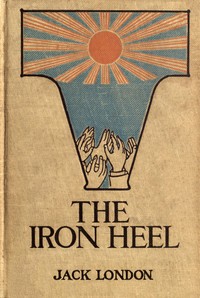
Excerpt
FOREWORD
I. MY EAGLE
II. CHALLENGES
III. JACKSON’S ARM
IV. SLAVES OF THE MACHINE
V. THE PHILOMATHS
VI. ADUMBRATIONS
VII. THE BISHOP’S VISION
VIII. THE MACHINE BREAKERS
IX. THE MATHEMATICS OF A DREAM
X. THE VORTEX
XI. THE GREAT ADVENTURE
XII. THE BISHOP
XIII. THE GENERAL STRIKE
XIV. THE BEGINNING OF THE END
XV. LAST DAYS
XVI. THE END
XVII. THE SCARLET LIVERY
XVIII. IN THE SHADOW OF SONOMA
XIX. TRANSFORMATION
XX. A LOST OLIGARCH
XXI. THE ROARING...
Read the Full Text
— End of The iron heel —
Book Information
- Title
- The iron heel
- Author(s)
- London, Jack
- Language
- English
- Type
- Text
- Release Date
- May 3, 2006
- Word Count
- 88,561 words
- Library of Congress Classification
- PS
- Bookshelves
- Browsing: Literature, Browsing: Politics, Browsing: Science-Fiction & Fantasy, Browsing: Fiction
- Rights
- Public domain in the USA.
Related Books
The crystal planetoids
by Coblentz, Stanton A. (Stanton Arthur)
English
441h 21m read

Terror out of the past
by Gallun, Raymond Z., Gallun, Raymond Z. (Raymond Zinke)
English
247h 56m read
Corsairs of the cosmos
by Hamilton, Edmond
English
152h 39m read
The incredible slingshot bombs
by Williams, Robert Moore
English
96h 4m read
The young naval captain
by Stratemeyer, Edward
English
700h 5m read
De verdwijn-machine
by Valkenstein, Kees
Dutch
973h 38m read