The Project Gutenberg eBook, The History of Whittington, by William Davies
This eBook is for the use of anyone anywhere in the United States and most
other parts of the world at no cost and with almost no restrictions
whatsoever. You may copy it, give it away or re-use it under the terms of
the Project Gutenberg License included with this eBook or online at
www.gutenberg.org. If you are not located in the United States, you'll have
to check the laws of the country where you are located before using this ebook.
Title: The History of Whittington
Author: William Davies
Release Date: May 16, 2020 [eBook #62142]
Language: English
Character set encoding: UTF-8
***START OF THE PROJECT GUTENBERG EBOOK THE HISTORY OF WHITTINGTON***
Transcribed from the 1810? E. Edwards edition by David Price, email
[email protected]
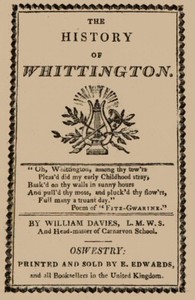
[Picture: Book cover]
THE
HISTORY
OF
_WHITTINGTON_,
[Picture: Decorative graphic]
* * * * *
“Oh, Whittington, among thy tow’rs
Pleas’d did my early Childhood stray,
Bask’d on thy walls in sunny hours
And pull’d thy moss, and pluck’d thy flow’rs,
Full many a truant day.”
Poem of “FITZ-GWARINE.”
* * * * *
BY WILLIAM DAVIES, L.M.W.S.
And Head-master of Carnarvon School.
* * * * *
_OSWESTRY_:
PRINTED AND SOLD BY E. EDWARDS,
and all Booksellers in the United Kingdom.
* * * * *
~~~~~~~~~~~~~~~~~~~~~~~~~
TO
_R. POOLE_,
_Master of Malden School_, _Essex_,
THIS HISTORY IS INSCRIBED,
_By his sincere_,
_faithful_,
_and affectionate Friend_,
_THE AUTHOR_.
~~~~~~~~~~~~~~~~~~~~~~~~~
THE
_History of Whittington_, _&c._
THOUGH local descriptions and circumstances are seldom productive of any
high degree of interest, yet when they become connected with the
adventurous, active, and surprising career of any remarkable individual,
even the most trivial assumes a degree of importance, excites a lively
curiosity, and seldom tails to gratify the expectation it has awakened.
As the ruins of the castle at this place are in an eminent degree
picturesque and beautiful, and its being the birthplace and residence of
one of the Barons to whom we owe the blessing of the MAGNA CHARTA, as
well as the scene of many of his surprising adventures; even the short
account I propose to offer, cannot be wholly devoid of entertainment and
instruction.
It is the opinion of learned antiquarians, that this was the place so
famed by the name of Drev-Wen, or the White Town, by the illustrious
Welsh poet Lowarch Hen, who lived in the year 590. He says that a prince
of his country named Cynddylan was defeated and fell here, in opposing
the progress of the Irish who had invaded the country. This ancient bard
expresses the rage of the battle in such an energetic manner, that if I
attempt to describe it, I shall fall far short of the original; therefore
I content myself with quoting his own words.
“Y {4} Drêv uen ym mron y koed
Yseu yn y hervas eiryoed
A uyneb y guelht y guaed
Y Drêv uen yn yd hŷmyr
Y hervas y-Llâs vyver
Y guared ydan draed y gwŷr.”
A.D. 843.
In the time of Roderick the Great, king of all Wales, Ynyr ap Cadfarch, a
British nobleman, built the Castle of Whittington; to which he was
succeeded by his son Tudor Trevor, who altho’ possessed of many palaces,
with rich and extensive domains, made this his chief residence. By right
of his father he obtained the lordships of both Maelors, Whittington,
Chirk, Oswestry, Ewais, and Urchenfield; and by right of his mother
Rhiengar, the earldom of Hereford. His mother was grand-daughter to
Caradoc Freichfas, who fell in the field of battle at Rhuddlan, A.D. 795,
gloriously maintaining the cause of the Britons against their Pagan
invaders, the Saxons.
The descendants of Tudor continued possessed of the Castle for several
generations; and many families both in this neighbourhood and North
Wales, boast their origin from him.
A.D. 1060.
At the Conquest, Whittington became the property of Pain Peverel, who
having no issue, on his decease it was seized by Roger earl of
Shrewsbury. This place was called in Doomsday Book, Wititone; and
consisted at that time of eight corn farms, twelve ox-stalls, and a very
extensive wood; the cows yielded five shillings per annum, and all Welsh
residents were obliged to pay twenty shillings rent among them.
The castle and lordship of Whittington next passed into the hands of
Hugh, and afterwards of his brother Robert, sons of the late earl of
Shrewsbury. Upon the defeat and forfeiture of Robert by Henry I. it was
restored to the Peverels in the person of Sir William, a sister’s son of
Pain Peverel.—This Sir William is famed in history for his noble and
valiant enterprizes, in one of which it is stated that he was mortally
wounded, but was miraculously recovered by eating the shield of a wild
boar; and that to testify his gratitude to Heaven for his preservation he
built three churches.
A.D. 1083.
He had two daughters, the youngest of which was named Mellet: she with
the spirit of an Amazon, resolved to wed no one but the knight of most
consummate valour. Her father published this declaration, and promised
the Castle of Whittington as her dower. Several distinguished combatants
assembled at Peverel’s place in the Peak, Derbyshire, to contend for the
fair prize; and among whom were, a son of the king of Scotland, Baron
Burgoyne, and a noble Lorrainer, Guarine De Metz, (sheriff of Shropshire,
and chief counsellor to the earl of Shrewsbury;) the latter of whom came
with a shield of silver, and a proud peacock upon his crest; and having
overthrown his rivals, obtained the beautiful Mellet.
As chivalry was the greatest accomplishment in these times, the progeny
of this famed couple could hardly avoid being eminently distinguished by
feats of arms, and the consequence was, that their names occupied very
great portions in romances both at home and abroad.
I must not forget to state, that Guarine De Metz was a great benefactor
to the Monks: one remarkable instance of which is this; after a conflict
he had with the Welsh, led by their prince Jorwerth, (in which action the
latter was discomfited with all his host) our hero founded the New Abbey,
better known by the name of Alberbury.
The posterity of this great man for nine generations assumed the
Christian name of Fulk; they continued possessed of the castle from the
end of the reign of Henry I. till the time of Henry VIII. a period of
near four hundred years. Their common name was Fitz-Gwarine. Mr.
Dovaston in his poem, thus expresses himself on this subject:
“Sires were his from days of yore,
Who all the same distinction bore
Of title and of name;
A name that valour’s blazon’d blade
In feats of chivalry had made
The favourite of fame.”
Guarine De Metz died in the reign of Henry I. at Alberbury, where he was
interred; his wife and his son Fulk Fitz-Gwarine being present on the
occasion.
We have mentioned that Guarine De Metz first exerted his valour in the
cause of love, and that great commendation was bestowed on him in
consequence; this was exactly the case with his son; he became
desperately enamoured with Hawys, daughter of Sir Joos, of Normandy, who
had been appointed guardian of the hero in question. Fitz-Gwarine
observing Hawys to be frequently in great sorrow, desired to know the
cause of it, and was informed that it proceeded from the dangerous
situation of her father, being at that time in the hands of Walter Lacy
and Sir Arnold de Lis, two of his inveterate enemies. Upon hearing this,
Fulk resolved to rescue him, and being supplicated by her whom he adored,
he set off immediately and arrived in time just to save the head of Joos
from the fatal stroke that would instantly have severed it from the body.
The consequences were, Lacy and Arnold were taken prisoners and confined
in Ludlow castle; Joos was snatched from the most perilous situation to a
most happy one; and to crown all, Fulk and Hawys were joined together,
and harmony again reigned in both families.
A.D. 1122.
Fulk Fitz-Gwarine acted the hero in all his enterprizes with such vigour,
capacity, and celerity, that Henry I. knighted him, made him steward of
his house, and conferred on him the arduous office of Lieutenant of the
Marches; it was this that gave him the name of Fulco or Fulk, signifying
Lieutenant. In this department his sword did not long remain undrawn;
the Cambrian Prince, Gryffydd ap Cynan, according to the general practice
of his countrymen, made a descent upon the lordship of Whittington, and
the surrounding country. These incursions were made so frequently, and
attended with such pernicious effects, that the power of the Lords’
Marchers was often necessary to repel their progress: indeed this was
their sole office, and a very useful one it was. In the present case,
Fitz-Gwarine nobly conducted himself, by wounding the Welsh king in the
shoulder, and completely routing his army. The Welsh however returned
soon after, drove Fulk from the Castle of Whittington, and gained
possession of the lordship; and it appears from a peace made by Henry II.
with Owen Gwynedd, the succeeding prince of Wales, that it was kept by
the latter, and bestowed on one of his favourites, of the name of Roger;
Fulk had the manor of Alston, in Gloucestershire as a recompence.
It is recorded that Fulk Fitz-Gwarine, and John son to Henry II.
afterwards King John, were playing at chess together, when it happened
that they disagreed, and the prince gave Fulk a severe blow upon the head
with the board, which the latter returned in such a violent manner, as
almost to kill the young prince; a circumstance, had it happened, not
much to be regretted, were it not in consideration of the glorious Magna
Charta afterwards obtained from him.
Mr. Dovaston in speaking of the noble actions of Fitz-Gwarine, mentions
Fulk and John’s quarrel in the following manner:
“Enough to name our last affray,
The prince his temper lost at play,
The chess-board swung with coward sway
And hurl’d my head upon.
Ill could the wrong my bosom brook,
I sent him first a furious look,
Then firm with knuckles clench’d I strook
The pate of royal John.”
Fulk Fitz-Gwarine was succeeded by his eldest son, who bore the same
name. He raised the glory and dignity of his family beyond any thing it
had yet attained to, by numerous and valourous actions, hereafter
respectively to be recorded. At the time, his father died, he was
actively engaged in Lombardy, where he conducted himself with such
ability and vigour, that king
A.D. 1189.
Richard I. just before he went on the Crusades, made him Lord Marcher of
Wales, an office that required all the exertion and capacity that could
possibly exist in one man.
In the beginning of king John’s reign, Whittington was in the hands of
Maurice, brother to the person to whom Owen Gwynedd presented it. Fulk
Fitz-Gwarine made application to John for this place, the ancient
property and residence of his family; but Maurice by means of his
opulence and well-timed presents had sufficient influence over the king,
to retain the possessions he so much desired: nevertheless, Fitz-Gwarine
had a steady and judicious friend in one John of Raumpayne, a minstrel,
whom he made his trusty spy over the conduct of Maurice at Whittington.
In those times when men considered the sword a better instrument of
revenge or defence, than the laws of their country, and when one Baron
insulted another, a petty war ensued between them, often attended with
much bloodshed, and generally concluded with the demolition, or at least
capture of the castle of one party by the other. It was the failing of
our hero to have recourse to this method of gaining possession, to what
he thought himself fairly entitled; any other means would have been
considered in a very dishonourable light by those turbulent barons and
knights, who were his friends. I hope that this action, or to express it
in the language of that age, this _feat_ of arms of Fulk, will not
dispossess the reader of that kindness he has shown to Fitz-Gwarine and
his historian, by favouring him so far with an attentive and indulgent
perusal. All I can say of the battle made by Fulk upon Maurice is, that
the latter was slain, and the king of Wales gave Fulk the Castle of
Whittington, by which it appears, that prince espoused his cause. But
the English king made Wrenoc (son to Maurice) Lord of Whittington, and
sent privily to the prince of Wales to behead Fulk, who avoided the
policy of king John by flying into France, with the assumed name of Sir
Amice, a wandering knight. He was so admired by the French King for his
honourable and chivalrous conduct, that he offered him a barony of
France, which Fulk politely declined.—By some means it happened that
Lewis, the French king, discovered Fitz-Gwarine; upon which, the latter
fled into Brittainy, where his deeds of chivalry were so applauded, that
a celebrated French author collected and published them, forming a work
universally read by the chevaliers and ladies of that age. The title
given to the English translation is, “The Feates of Gwarine and his
Sunnes.”
Fitz-Gwarine formed a resolution of leaving France, and returning to his
own country: he accordingly embarked, and landed at Dover, with a full
determination to see king John. For fear of discovery, Fulk exchanged
clothes with a peasant: in this habit, attended by his brethren and other
followers who had gone with him to France, and followed his fortunes home
again, he repaired to Windsor forest, where he found the king hunting,
and what was more advantageous to Fulk’s purpose, John happened to be
alone. He asked Fulk whether he saw or could find any game? who
answered, that if he would come with him, he should have game in
abundance. John was led to Fulk’s brethren, and Fulk having the king in
his power, menaced him severely for the treatment he (Fitz-Gwarine) had
received from him; and obliged the captive king to grant to him the
Castle of Whittington, which that monarch readily agreed to, for
willingly would he sacrifice almost any thing to gain his liberty;
several instances of which may be seen in English history.
The poem of Fitz-Gwarine, thus describes the subject last treated of.
“For woodman’s garb I chang’d my cloak,
In Windsor’s wood of ancient oak
We found a safe retreat;
The king I knew there chas’d the deer,
And with my faithful comrades there
I conn’d a cunning feat.
“One day the King alone appear’d,
When scarce the distant horn was heard
Our hiding place hard by;
And as across my way he came,
Know’st thou (quoth he) of any game?
Aye—game enough, (quoth I).
“Ride to yon briery dingle rough
Trust me, I’ll rouse ye game enough,
My bugle then I sounded,
My comrades heard the blast I blew,
Obey’d the signal that they knew,
And soon the King surrounded.
“Cow’d was the King with speechless fear,
Yet stammer’d out, Who have we here?
I flung my bonnet from my brow,
Know’st thou (quoth I) Fitz-Gwarine now?
I took a sword and o’er him swung it,
Then at his feet contemptuous flung it,
And turning to my comrade class,
Open, (I cried,) and let him pass.
Now go, Sir King, in freedom go,
And copy courage from a foe.
I’ll grant (he cried,) a pardon free,
Fitz-Gwarine unto thine and thee,
And I’ll restore to thee anon
The franchise fair of Whittington.”
John, however, disregarded his promise, for as soon as he got home, he
sent fifteen knights after Fulk, either to capture or kill him. Fulk
acted his part with such valour, that the knights were entirely
discomfited, and their leader taken prisoner. Soon after this, John sent
Randolph, earl of Chester, with a numerous retinue to take Fulk, but the
latter fled to sea, on board a ship belonging to Madour of the Mount, a
true friend of Fitz-Gwarines’: while lying in channel, Fulk observed a
knight in disguise coming to kill him; but the courage of our hero did
not forsake him on this occasion, for in the laudable act of self
defence, he slew the concealed assassin, and sailed to Orkney. Here he
released a damsel from captivity; and by some noble exploit, won his
celebrated hauberk of hard steel, which with other ancient pieces of
armour belonging to his family, hung till Cromwell’s time in the church
of Whittington.
The stay of Fitz-Gwarine at Orkney was short, for we soon after find him
driven by tempests to the coast of Barbary. In contemplation upon this
dreary part of the globe, he formed a resolution of seeing Carthage, the
city that produced such invincible heroes, whose courage defended that
small republic for a considerable time, against the powerful arms of the
Roman empire. But when he saw this once opulent and populous city
crumbled nearly to dust, he felt strong emotions of pity mixed with
veneration. Here! he exclaimed, was born and educated, Hanibal the
greatest general in ancient history, who made the Romans tremble at their
own capital! In these streets, what patriotism prevailed among all
classes of people! Here commerce flourished; and great improvement was
made in its concomitant navigation. Wrapt in enthusiasm, Fitz-Gwarine
set sail for England, full of hearty desires that his own country might
one day thrive by trade in as conspicuous a manner as Carthage had done.
Upon his arrival, he had the good fortune to obtain a pardon for himself
and followers, together with the restoration of Whittington castle, and
all its appendages. I have mentioned that John gave this place to
Wrenoc, but he held it for the service of being interpreter between the
Welsh and English; and when the king gave Whittington to Fulk, Wrenoc had
certain estates in the neighbourhood, given him in compensation.
The splendour Fitz-Gwarine lived in, is described by Mr. Dovaston in such
a striking manner, that I cannot refrain from quoting the words he uses
to such advantage.
“Other guests than yon lone bird,
And other musick here was heard,
In times of better days;
Festive revelry went round,
The board with blushing goblets crown’d,
And costly carpets clad the ground,
Where now yon cattle graze.
“Days were those of splendor high,
Days of hospitality,
When to his rich domain
Welcom’d many a crested knight,
Welcom’d many a lady bright,
Fitz-Gwarine of Lorraine.”
A.D. 1207.
The next laudable action of Fitz-Gwarine, of which we have any authentic
account is, his going on an expedition into Ireland, in the service of
the English king. He behaved with such intrepidity and loyalty, that
after his return to England, he received the title of THE GREAT: an
appellation more frequently conferred on the destroyers of the human
race, than on those who contribute to the real welfare of mankind, by the
discoveries in the arts and sciences. {19}
A.D. 1215.
Upon the dissatisfaction and rebellion of the Barons against king John,
Fulk joined with them; for we find his name among the number that were
excommunicated by the Pope, for extorting from John that firm basis of
English liberty, called MAGNA CHARTA.
A.D. 1219.
In the succeeding reign, viz. that of Henry III., Fitz-Gwarine procured a
grant of his estates, to him and his heirs for ever; for which he gave
the king two coursers, and two hundred and sixty-two pounds, an enormous
sum in that age, and which gives us an idea of the wealth of
Fitz-Gwarine. The same monarch also granted him the liberty of a fair on
St. Luke’s day, and a market on Wednesday, at Whittington; but on account
of its proximity to Oswestry and Ellesmere, both market and fair are now
quite lost. There were, however, fairs on the last Thursdays in April,
July, and November, in the memory of several of the present inhabitants;
but in want of sufficient attendance, they were discontinued. They
consisted chiefly of horses, oxen, sheep and swine, that were, in a great
measure, furnished from the extensive common of Babin’s wood: upon the
inclosure of which, great part of the land that before had reared cattle,
sheep, &c. was converted to arable purposes, and consequently the fairs
were but ill supplied with those useful animals, which defect was the
principal cause of the putting a stop to the fairs.
Strange, lord of Knockin, and possessor of the castle there, had several
conflicts or wars with Fitz-Gwarine, during the agitated reign of John.
In some of these skirmishes they threw down, or considerably damaged each
others castle; for we find grants given by Henry III. to each of these
Barons to repair and fortify them. Whittington castle was so completely
fortified by Fitz-Gwarine, that we never after hear of its being taken
from its possessors. Out of the refuse materials Fitz-Gwarine built a
chapel that soon became the parish church, and of which, I shall say more
hereafter.
In a tower in the gateway was till very lately a figure on horseback,
representing Fitz-Gwarine painted in a course manner, under which were
the following lines, alluding to his fortifying the castle:
“This was Sir Foulke Fitz-Warine late a great and valiant knight,
Who kept the Britons still in awe and oft times put to flight;
He of this castle owner was, and kept it by command,
Of Henry late surnam’d the Third, then king of all this land.
His grandfather, a Lorrainer, by fame was much befriended,
Who Peverley’s daughter took to wife, from whom this Fulk descended;
His ancient acts of chivalry in annals are recorded,
Our king of England afterwards him baron made and lorded.”
Fulk Fitz-Gwarine had the misfortune to be stricken with blindness in his
old age. Upon his death, he was buried in the porch of Whittington
church; and his remains were found there in an oak coffin three inches
thick, by digging a grave in the year, 1796.
He had a daughter named Eva, who was second wife to Llewelyn, king of
Wales; and it was through her that Fitz-Gwarine came to know of John’s
private message to Llewelyn, which I omitted to mention in its right
place.
I state from very good authority, that this Fulk, or to avoid confusion
Fulk the second, was married to Clarice of Abbourville, but of what
family she was, or when they were married, I have not been able to
discover. Fitz-Gwarine, it is stated, went generally by the appellation
of Proudhome, as a mark of respect to his nobility.
He left behind him a son, who enjoyed his father’s estates and titles,
but for no considerable time. He followed king Henry III. through all
that prince’s adverse fortune, and righting in his behalf at the battle
of Lewes, had the irreparable misfortune of being drowned in the act of
crossing a river; leaving behind him a young son, the fourth
Fitz-Gwarine.
Dugdale states, that it was Fitz-Gwarine the second who was drowned at
Lewes; but though, a most excellent historian, he is certainly wrong in
this particular, for the following reasons: When Fitz-Gwarine the second
was appointed Lieutenant of the Marches in the first year of Richard I.
he at least must have been of age; and from that time to the battle of
Lewes was 75 years, consequently he must have been near 100 years old; an
age, at which it is highly improbable he could have been found in the
field of battle. Besides, we are informed, that the Fulk who fell at
Lewes, left a son in his minority, which is very unlikely to have been
the case with Fulk the second at such an advanced age. Another, though
not so strong as the two preceding proofs, is the certainty of
Fitz-Gwarine the second being buried at Whittington; a circumstance that
could hardly have taken place, if Dugdale’s statement had been correct.
Though this might have happened, yet the other two are sufficient
arguments to prove that the son is the person whom that author has
mistaken for the father.
Immediately after the battle, (the events of which must be known to every
person who has read the English history) the earl of Leicester created
Peter de Montford, one of his chief accomplices, governor of Whittington
castle. Leicester also obliged the captive king to deliver Whittington
with several other bordering castles, into the hands of Llewelyn ap
Gryffydd, king of Wales, by a writ dated from Hereford, June 22, 1265.
That cruel earl likewise, in Henry’s name, gave Llewelyn the entire
sovereignity of Wales, and homage of all the barons under him. Henry,
after he regained his liberty, confirmed those grants, but for what
reason I have not been able to make apparent, unless money was his
object, as it was done in consideration of Llewelyn giving him 30,000
marks as a recompense.
A.D. 1281.
Fulk the fourth having arrived at years of maturity, made proof of his
age to Edward I. who invested him with all his patrimonial estates except
Whittington, which he also obtained upon his accompanying the English
monarch on his expedition against the Welsh. He behaved with such
intrepid bravery, that Edward, in reward for his meritorious conduct,
allowed him the liberty of a _Free Warren_ on his lands in this manor,
and likewise forgave him two hundred pounds that Fulk owed to the
exchequer.
A.D. 1300.
This year the king used his influence in reconciling Fitz-Gwarine and
Richard, earl of Arundel, in consequence of a quarrel prevailing at that
time between these two powerful and predominant barons; but the breach
was amicably adjusted by the interposition of Edward’s good offices.
Fitz-Gwarine died in the reign of Edward leaving a son, at that time
engaged in the war prosecuted by that king against France: his lady
Eleanor, had permission to use livery for this manor, until her husband
could return to do homage. He performed very considerable services for
the king in sundry campaigns, particularly in Flanders and Scotland,
where, by his gallant conduct, he made himself as much renowned as any of
his predecessors.
A.D. 1329.
Edmund earl of Kent, uncle to the king, being suspected of circulating
reports, that Edward II. was then alive, he accused Fitz-Gwarine of
promising him aid, in case Kent could bring about a rebellion, for which
our hero was deprived of the castle of Whittington; but some of his
friends, who had influence with Edward obtained it back for him in the
following year, the king being perfectly convinced of his loyalty.
A.D. 1350.
In this year, or the twenty-third of Edward III., Fitz-Gwarine the fifth
departed this life; and was succeeded by his son, Fulk the sixth; who,
four years before had the honour of signalizing himself at the memorable
battle of Cressy, the first great action that convinced the French of
that undaunted courage which existed, and still continues to exist,
amongst the inhabitants of this fair isle. Fitz-Gwarine, likewise,
accompanied the Black Prince into Gascoigne, when that young prince
carried his successful arms into that quarter of France;
A.D. 1356.
and was at the illustrious battle of Poictiers, where the whole army
gained universal applause:—headed by a general, whose noble and generous
conduct shone with meridian splendour, not only in this, but in every
other campaign he was engaged in; and whose whole life was one continued
scene of invincible courage, adorned with all that clemency and nobleness
of soul, so much to be admired in a prince.
A.D. 1374.
Fitz-Gwarine, for the important services he rendered to his country, was,
upon his return there, created BARON MARCHER of Wales; this is the last
well-grounded anecdote that we have of him, except the date of his death,
which took place in the forty-seventh of Edward III.
The next Fulk was only seven years old at the death of his father. He
became possessed of a greater extent of property than any of his
ancestors, but did not long enjoy it: he was cut off at the early age of
twenty-five; and by will, ordered that his body should be interred in the
chancel of Whittington church. The greatest part of his possessions lay
in other counties, but he considered Whittington the most eligible place
for his sepulture, as it had been the general residence of his family for
several generations. It appears that he also left a minor son, for his
will appoints J. Audley, guardian over the young prince.
The only account we have of this Fulk, is the following humane action:
when Owen Glyndwr carried his arms into these borders, on purpose to meet
Percy, earl of Northumberland at Shrewsbury, several in this manor joined
with that potent rebel; but Fitz-Gwarine, by solicitations to Henry IV.
procured for them a general pardon. His son and successor was the ninth
and last Fulk Fitz-Gwarine: he died in his minority, and the male line of
this noble and distinguished race, closes; though the title of
Fitz-Gwarine, or Fitz-Warine was assumed for a few generations
afterwards.
Elizabeth, only sister and heiress to Fulk the 9th, was married to one
Richard Haukford, who dying, left all his possessions to his only
daughter Thomasine, who married sir William Bourchier, brother to Henry,
first earl of Essex. The title of lord Fitz-Warine was given to sir
William in consequence of his marriage. John, third in descent from him,
exchanged Whittington with Henry VIII. for other landed property. This
John was the first earl of Bath, and his posterity preserved the title of
Fitz-Warine till the race became extinct, which took place at the death
of Henry, fifth earl of Bath.
And here it may not be improper to take a general view of this
illustrious and warlike race, that flourished through such a number of
reigns, and retained their estates, titles, honours, acquisitions, and
privileges, until nearly their final termination of the race.—In whatever
light war is considered in the present day, no period of history ever
discountenanced it; to be skilled in arms has been always considered the
highest and most honourable acquisition, that an individual could attain
to, in all ages and amongst all nations, though it must be confessed this
is chiefly to be accounted for from the slow progress of civilization, as
the encouragement of war must necessarily decrease in proportion to the
extension of humanity; and it must be allowed by all, that amidst the
myriads of beings who have distinguished themselves herein, the
Fitz-Gwarines deserve an eminent rank, not so much for their petty and
incessant skirmishes with the Welsh, as for the readiness with which they
fought for their king, in divers engagements and campaigns, greatly to
their honour and the glory of the English arms.
But though war has been the prevailing accomplishment throughout sacred
and prophane history, yet with what ecstasy do we contemplate that
portion of time which providence has allotted us: free from the
intolerable recounters produced by the broils and dissentions of those
turbulent, inflexible, and ambitious barons, who so disturbed England
during the reigns of the Normans and Plantagenets; and likewise delivered
from the well known calamities of intestine commotions, so productive of
civil wars; the evils of which can be better conceived than described.
On the subject of war I have said more than my limits will allow to say
of any thing else concerning this family; but, who can help admiring that
loftiness of sentiment and nobleness of soul, which shone in so
conspicuous a degree upon the whole race. Their fidelity to the
government, and their readiness to serve it, are convincing proofs of the
advantages England derived from them, during the long course of time in
which they lived; flourishing with fewer restraints than are commonly
attendant on men in such elevated stations.
That religion was held in great veneration by this race, is very
conspicuous from the number of public and private edifices built by them,
and devoted to pious uses: almost all the churches and abbies in this
neighbourhood were founded by some of the family, and though the latter
are not now in existence, yet the churches will preserve the memory of
their establishers till time shall be no more.
I have stated that this castle passed into the hands of Henry VIII.; we
hear nothing further concerning it till the following reign, when the
king presented the place in question to Henry Grey, duke of Suffolk, who
forfeited it in consequence of the conviction of several crimes imputed
to him. This took place in the reign of Mary, and shortly after it was
by that queen granted to Fitz-Alan, last earl of Arundel: he mortgaged it
to a number of London citizens, who obtained the place in default of
payment from him. William Albany chief man among the number was, by the
joint consent and approbation of the rest, put in sole possession of it.
By the marriage of his great grand daughter with Thomas Lloyd, of Aston,
esq. Whittington passed into the hands of the worthy family who enjoy it
at the present time.
Having given some account of the possessors of Whittington castle, I
think it my duty to attempt laying before the reader, a short account of
this structure, and proceed to shew, that it must have underwent
fortification soon after its original establishment: placed on the border
of Wales, it must have been alternately in the hands of the Welsh and
Saxons; for the latter of whom it formed a key of great utility in their
attacks open the former, and consequently so useful an inlet, must have
been strongly defended. Indeed its founder could not have chosen a place
in which nature contributed more to its security; finding the innumerable
springs of water so advantageously situated for his designs, he converted
it to the best purpose, and surrounded the castle with several moats and
intrenchments, still discernable. The annexed plan of the castle {32}
gives the reader a better idea of the exact situations of the trenches
and other out-works, than can be expressed by words.
The keep was the place of last resort in times of great danger, and was
in consequence defended with the utmost precaution. In the present case,
it was fortified with five round towers, each forty feet in diameter, an
hundred in height, and the walls twelve in thickness. I have not been
able to discover what time the keep fell into a state of delapidation,
but undoubtedly for a great number of years, as an aged mulbery is
growing in it.
About the year 1760, the eastern tower fell into the moat after a severe
frost, and some years afterwards, one of the northern towers and the
western wall were taken down to repair the roads leading from Whittington
to Halston bridge. The northern tower that now remains was undermined
for the same purpose. In 1809, a smaller tower, used many years as a
pidgeon house, was taken down to repair the exterior gateway, which is
still inhabited.
The keep is now used as a garden, at an even depth under which is a
pavement of free-stone; at the north corner is a well, which was
discovered and opened in 1809, when there was found the handle of the
bucket, a pair of large iron fetters for the legs, a large jug, the
remains of stags’ heads and swords; and upon removing some rubbish about
the same time, there appeared a curious carved stone head, and likewise
some highly gilt glass bottles.
Within the trenches are some very fine tall wych elm and ash trees, that
add greatly to the beauty of the ruins. The ancient and present state of
the castle, is beautifully contrasted by Mr. Dovaston, in the following
manner:
“In ancient days of high renown
Not always did yon castle frown
With ivy-crested brow;
Nor were its’ walls with moss embrown’d,
Nor hung the lanky weeds around
That fringe its’ ruins now.
Other hangings deck’d the wall
Where now the nodding foxgloves tall
Their spotty hoods unfold;
Harebells there with bugloss vie,
And gilliflowers of yellow dye,
Seem now, to musing Fancy’s eye,
To mock the mimic tapestry
That flaunted there of old.”
It is situated amid fine and fertile meadows, through which a rapid
stream having commenced a subterraneous course about a mile above, here
emerging, playfully undulates, having its border shaded with poplars,
till it enters the castle moat, where encompassing the walls, whose ruins
are richly fringed with ivy, and hung with elegant traces of wild flowers
and woodbine, it enters the Perry amid the meadows below, formerly the
site of an extensive lake. The ancient fosses and intrenchments may yet
very visibly be traced to a surprising distance beyond the castle,
westward, from where the lake terminated, in some fields still called
“_The Runtings_.”
The internal scenery, where the aged elms expand their immense arms among
the now gloomy ruins, formerly the place of hilarity and carousing, is,
perhaps, not surpassed by any on the border.
A court leet and court baron are annually holden by the Lord of the Manor
in a room in the castle, to which the inhabitants are summoned to pay
_one penny_ each, and upon non-attendance are fined _sixpence_.
Chief-rents are paid to the Lord.
In the township of Daywell in the parish of Whittington, Watt’s Dyke
makes its appearance, extending from a place called Gobowen, adjoining
the parish of Selattyn, into that of St. Martins. The extent between
this Dyke and Offa’s (which crosses the hills above Selattyn) is about
four miles. These Dykes point north and south, and the intervening space
is said to have been a common mart, where the English and Welsh met to
carry on a commercial intercourse, with each other; but, if either party
transgressed these bounds, they were exposed to the severities of war.
Upon Watt’s Dyke, at a place called Brynycastle, near to Gobowen, is the
site of an old _Watch-fort_, and another a little further on towards St.
Martins.
_The Village of Whittington_.
THE village is on the great London and Holyhead road, and also, on the
turnpike road leading from Oswestry to Ellesmere. It consists of a
considerable collection of houses thinly scattered, a church, a school
for each sex, and the remains of the castle before mentioned. In ancient
records we find it called _Chwytunton_, _Wititone_, _Whittentonne_, and
_Vica Alba_. It is situated in latitude 52° 55′ 30″ north, and longitude
2° 57′ 30″ west. The church is a rectory, valued in the king’s books at
£25. 4s.; it was originally designed, as before stated, as a chapel to
the castle, and was dedicated to St. John the Baptist. The body of the
church was rebuilt in 1806, from a design of Mr. Harrison, of Chester; it
is a large brick building of sixty feet by fifty, and cost £1500.: to
lessen the expense, two briefs were procured that raised £703. 15s. 1d.
but of this sum, only £42. 2s. 1d. was received for the intended purpose.
It is much to be regretted that this evil is not amended, a grievance so
universally complained of, and so frequently practised, should not be
tolerated by such an enlightened legislature as that of the English, but
still it remains a nuisance to the very interests of religion itself. In
the body of the church are three aisles and six rows of seats, all faced
with Dantzic oak; the ceiling is neatly executed, being made of wood, and
consequently very pleasant to the officiating minister. In the gallery
stands a barrel organ, placed there by subscription, in 1810; it was
built by _England_, and is considered a good instrument.
In 1761, the church-yard contained several venerable yew trees, which Mr.
Roberts, the then rector, had the bad taste to destroy and replace with
lime trees. In the garden at the Rectory is an uncommonly fine yew tree;
it is seventeen and a half feet in circumference at the distance of four
feet from the ground, about forty feet in height, and the space of ground
under the branches is one hundred and forty-two feet and a half in
circumference: it is very healthy and in a growing state. Evelyn says,
that the reason yew trees were so universally planted in church-yards
was, doubtless, from its being thought a symbol of immortality, the tree
being so lasting and always green.
In 1810, the church-yard wall being in bad repair, was rebuilt with
stone, and the gates removed opposite to the entrance to the steeple.
_In the Register we find the following curious Epitaphs_:
March 13th, 1766, died,
THOMAS EVANS,
Parish Clarke, aged 72.
“Old Sternhold’s lines, or Vicar of Bray,
Which he tun’d best ’twas hard to say.”
* * * * *
SAMUEL PEATE,
of Whittington Castle died,
aged 84.
“Here lies Governor Peate
Whom no man did hate,
At the age of four-score
And four years more,
He pretended to wrestle
With Death for his Castle;
But was soon out of breath
And surrender’d to Death,
Who away did him take,
At the eve of our wake,
One morn about seven
To keep wake in heaven.”
ANDREW WILLIAMS,
WAS
Born A.D. 1690, and died April, 18, 1776,
Aged 84.
OF WHICH TIME HE LIVED UNDER
The Aston Family as Decoyman 60 Years.
“Here lies the Decoyman who liv’d like an otter,
Dividing his time betwixt land and water!
His hide he oft soak’d in the waters of Perry, {39}
Whilst Aston old beer his spirits kept cheery;
Amphibious his trim, Death was puzzle’d they say,
How to dust to reduce such well-moisten’d clay.
So Death turned Decoyman and decoy’d him to land,
Where he fix’d his abode ’till quite dried to the hand;
He then found him fitting for crumbling to dust,
And here he lies mouldering as you and I must.”
“He retired to Whittington upon a freehold he had purchased with the
perquisites of his place for a few years before his death.”
1783.
“A severe winter,—the frost set in the day before Christmas-day, and
continued to introduce the new year.”
“And I may here add, as there is a vacancy, that the frost continued
till March, 1784.”
“I sore forebode these frosty times
Will nip my nob; and then my rhymes
In puff complete, in richness big,
And full and flowery as my wig,
Will future bards and priests explore,
Till Taste and Talent are no more.
While dull, tho’ disembodied I
Jump up a Gnome ’twixt earth and sky;
Perch on the pen of rhyming elf,
And squat a squabby rhyme myself.
A brat I boast, hight Pudding Billy,
Whom tho’ the witless world calls silly,
And tho’ but lame in hie hæc hoe
Is a right chip of the old block.”
_W. Roberts_, _Rector_.
N.B. Mr. Roberts died a few months after writing this epitaph on
himself.
The Registers are quite complete from the year 1591, to the present time,
with the exception of that of marriages, from the 1654, to 1659.
The following is a copy of the Terrier of 1630, mentioned by Mr. Pennant,
excepting the part of it which relates to the glebe lands:
“We find all the tythes falling within the forest of Bafin’s Wood are
* * * * * * * * {40} _Itm_ an English bible, a Welsh bible, a
communion silver patara, a prayer-book in English, and a prayer-book
in Welsh, a homely {41} book in English, and a homely book in Welsh,
_Itm_ a linen cloth and napkin, two surplices, two chests, a velvet
cushion and hangings for the pulpit, three pair of armour, two pikes
and two head pieces, a flagon, a pewter plate, and a stone font.”
(Signed)
_Edward Williams_, _Rector_.
_Edward Edwards_,
_John Rogers_,
_Edward ap Thomas_,
_Hugh ap John Lewis_,
_John Benion_,
_Richard ap Edd_.
* * * * *
FINIS.
[Picture: Decorative graphic of crown]
Edwards, Printer, Oswestry.
FOOTNOTES.
{4} The Welsh call it Dre Wen to this day; a certain proof that this is
the place the poet speaks of.
{19} The reader cannot but admire the satyric and appropriate wit of
Fielding, in his bestowing that title on Jonathan Wilde.
{32} There is no annexed plan in the edition transcribed.—DP.
{39} A river near Whittington so named.
{40} Here a few words have been torn off in the original.
{41} Homily.
***END OF THE PROJECT GUTENBERG EBOOK THE HISTORY OF WHITTINGTON***
******* This file should be named 62142-0.txt or 62142-0.zip *******
This and all associated files of various formats will be found in:
http://www.gutenberg.org/dirs/6/2/1/4/62142
Updated editions will replace the previous one--the old editions will
be renamed.
Creating the works from print editions not protected by U.S. copyright
law means that no one owns a United States copyright in these works,
so the Foundation (and you!) can copy and distribute it in the United
States without permission and without paying copyright
royalties. Special rules, set forth in the General Terms of Use part
of this license, apply to copying and distributing Project
Gutenberg-tm electronic works to protect the PROJECT GUTENBERG-tm
concept and trademark. Project Gutenberg is a registered trademark,
and may not be used if you charge for the eBooks, unless you receive
specific permission. If you do not charge anything for copies of this
eBook, complying with the rules is very easy. You may use this eBook
for nearly any purpose such as creation of derivative works, reports,
performances and research. They may be modified and printed and given
away--you may do practically ANYTHING in the United States with eBooks
not protected by U.S. copyright law. Redistribution is subject to the
trademark license, especially commercial redistribution.
START: FULL LICENSE
THE FULL PROJECT GUTENBERG LICENSE
PLEASE READ THIS BEFORE YOU DISTRIBUTE OR USE THIS WORK
To protect the Project Gutenberg-tm mission of promoting the free
distribution of electronic works, by using or distributing this work
(or any other work associated in any way with the phrase "Project
Gutenberg"), you agree to comply with all the terms of the Full
Project Gutenberg-tm License available with this file or online at
www.gutenberg.org/license.
Section 1. General Terms of Use and Redistributing Project
Gutenberg-tm electronic works
1.A. By reading or using any part of this Project Gutenberg-tm
electronic work, you indicate that you have read, understand, agree to
and accept all the terms of this license and intellectual property
(trademark/copyright) agreement. If you do not agree to abide by all
the terms of this agreement, you must cease using and return or
destroy all copies of Project Gutenberg-tm electronic works in your
possession. If you paid a fee for obtaining a copy of or access to a
Project Gutenberg-tm electronic work and you do not agree to be bound
by the terms of this agreement, you may obtain a refund from the
person or entity to whom you paid the fee as set forth in paragraph
1.E.8.
1.B. "Project Gutenberg" is a registered trademark. It may only be
used on or associated in any way with an electronic work by people who
agree to be bound by the terms of this agreement. There are a few
things that you can do with most Project Gutenberg-tm electronic works
even without complying with the full terms of this agreement. See
paragraph 1.C below. There are a lot of things you can do with Project
Gutenberg-tm electronic works if you follow the terms of this
agreement and help preserve free future access to Project Gutenberg-tm
electronic works. See paragraph 1.E below.
1.C. The Project Gutenberg Literary Archive Foundation ("the
Foundation" or PGLAF), owns a compilation copyright in the collection
of Project Gutenberg-tm electronic works. Nearly all the individual
works in the collection are in the public domain in the United
States. If an individual work is unprotected by copyright law in the
United States and you are located in the United States, we do not
claim a right to prevent you from copying, distributing, performing,
displaying or creating derivative works based on the work as long as
all references to Project Gutenberg are removed. Of course, we hope
that you will support the Project Gutenberg-tm mission of promoting
free access to electronic works by freely sharing Project Gutenberg-tm
works in compliance with the terms of this agreement for keeping the
Project Gutenberg-tm name associated with the work. You can easily
comply with the terms of this agreement by keeping this work in the
same format with its attached full Project Gutenberg-tm License when
you share it without charge with others.
1.D. The copyright laws of the place where you are located also govern
what you can do with this work. Copyright laws in most countries are
in a constant state of change. If you are outside the United States,
check the laws of your country in addition to the terms of this
agreement before downloading, copying, displaying, performing,
distributing or creating derivative works based on this work or any
other Project Gutenberg-tm work. The Foundation makes no
representations concerning the copyright status of any work in any
country outside the United States.
1.E. Unless you have removed all references to Project Gutenberg:
1.E.1. The following sentence, with active links to, or other
immediate access to, the full Project Gutenberg-tm License must appear
prominently whenever any copy of a Project Gutenberg-tm work (any work
on which the phrase "Project Gutenberg" appears, or with which the
phrase "Project Gutenberg" is associated) is accessed, displayed,
performed, viewed, copied or distributed:
This eBook is for the use of anyone anywhere in the United States and
most other parts of the world at no cost and with almost no
restrictions whatsoever. You may copy it, give it away or re-use it
under the terms of the Project Gutenberg License included with this
eBook or online at www.gutenberg.org. If you are not located in the
United States, you'll have to check the laws of the country where you
are located before using this ebook.
1.E.2. If an individual Project Gutenberg-tm electronic work is
derived from texts not protected by U.S. copyright law (does not
contain a notice indicating that it is posted with permission of the
copyright holder), the work can be copied and distributed to anyone in
the United States without paying any fees or charges. If you are
redistributing or providing access to a work with the phrase "Project
Gutenberg" associated with or appearing on the work, you must comply
either with the requirements of paragraphs 1.E.1 through 1.E.7 or
obtain permission for the use of the work and the Project Gutenberg-tm
trademark as set forth in paragraphs 1.E.8 or 1.E.9.
1.E.3. If an individual Project Gutenberg-tm electronic work is posted
with the permission of the copyright holder, your use and distribution
must comply with both paragraphs 1.E.1 through 1.E.7 and any
additional terms imposed by the copyright holder. Additional terms
will be linked to the Project Gutenberg-tm License for all works
posted with the permission of the copyright holder found at the
beginning of this work.
1.E.4. Do not unlink or detach or remove the full Project Gutenberg-tm
License terms from this work, or any files containing a part of this
work or any other work associated with Project Gutenberg-tm.
1.E.5. Do not copy, display, perform, distribute or redistribute this
electronic work, or any part of this electronic work, without
prominently displaying the sentence set forth in paragraph 1.E.1 with
active links or immediate access to the full terms of the Project
Gutenberg-tm License.
1.E.6. You may convert to and distribute this work in any binary,
compressed, marked up, nonproprietary or proprietary form, including
any word processing or hypertext form. However, if you provide access
to or distribute copies of a Project Gutenberg-tm work in a format
other than "Plain Vanilla ASCII" or other format used in the official
version posted on the official Project Gutenberg-tm web site
(www.gutenberg.org), you must, at no additional cost, fee or expense
to the user, provide a copy, a means of exporting a copy, or a means
of obtaining a copy upon request, of the work in its original "Plain
Vanilla ASCII" or other form. Any alternate format must include the
full Project Gutenberg-tm License as specified in paragraph 1.E.1.
1.E.7. Do not charge a fee for access to, viewing, displaying,
performing, copying or distributing any Project Gutenberg-tm works
unless you comply with paragraph 1.E.8 or 1.E.9.
1.E.8. You may charge a reasonable fee for copies of or providing
access to or distributing Project Gutenberg-tm electronic works
provided that
* You pay a royalty fee of 20% of the gross profits you derive from
the use of Project Gutenberg-tm works calculated using the method
you already use to calculate your applicable taxes. The fee is owed
to the owner of the Project Gutenberg-tm trademark, but he has
agreed to donate royalties under this paragraph to the Project
Gutenberg Literary Archive Foundation. Royalty payments must be paid
within 60 days following each date on which you prepare (or are
legally required to prepare) your periodic tax returns. Royalty
payments should be clearly marked as such and sent to the Project
Gutenberg Literary Archive Foundation at the address specified in
Section 4, "Information about donations to the Project Gutenberg
Literary Archive Foundation."
* You provide a full refund of any money paid by a user who notifies
you in writing (or by e-mail) within 30 days of receipt that s/he
does not agree to the terms of the full Project Gutenberg-tm
License. You must require such a user to return or destroy all
copies of the works possessed in a physical medium and discontinue
all use of and all access to other copies of Project Gutenberg-tm
works.
* You provide, in accordance with paragraph 1.F.3, a full refund of
any money paid for a work or a replacement copy, if a defect in the
electronic work is discovered and reported to you within 90 days of
receipt of the work.
* You comply with all other terms of this agreement for free
distribution of Project Gutenberg-tm works.
1.E.9. If you wish to charge a fee or distribute a Project
Gutenberg-tm electronic work or group of works on different terms than
are set forth in this agreement, you must obtain permission in writing
from both the Project Gutenberg Literary Archive Foundation and The
Project Gutenberg Trademark LLC, the owner of the Project Gutenberg-tm
trademark. Contact the Foundation as set forth in Section 3 below.
1.F.
1.F.1. Project Gutenberg volunteers and employees expend considerable
effort to identify, do copyright research on, transcribe and proofread
works not protected by U.S. copyright law in creating the Project
Gutenberg-tm collection. Despite these efforts, Project Gutenberg-tm
electronic works, and the medium on which they may be stored, may
contain "Defects," such as, but not limited to, incomplete, inaccurate
or corrupt data, transcription errors, a copyright or other
intellectual property infringement, a defective or damaged disk or
other medium, a computer virus, or computer codes that damage or
cannot be read by your equipment.
1.F.2. LIMITED WARRANTY, DISCLAIMER OF DAMAGES - Except for the "Right
of Replacement or Refund" described in paragraph 1.F.3, the Project
Gutenberg Literary Archive Foundation, the owner of the Project
Gutenberg-tm trademark, and any other party distributing a Project
Gutenberg-tm electronic work under this agreement, disclaim all
liability to you for damages, costs and expenses, including legal
fees. YOU AGREE THAT YOU HAVE NO REMEDIES FOR NEGLIGENCE, STRICT
LIABILITY, BREACH OF WARRANTY OR BREACH OF CONTRACT EXCEPT THOSE
PROVIDED IN PARAGRAPH 1.F.3. YOU AGREE THAT THE FOUNDATION, THE
TRADEMARK OWNER, AND ANY DISTRIBUTOR UNDER THIS AGREEMENT WILL NOT BE
LIABLE TO YOU FOR ACTUAL, DIRECT, INDIRECT, CONSEQUENTIAL, PUNITIVE OR
INCIDENTAL DAMAGES EVEN IF YOU GIVE NOTICE OF THE POSSIBILITY OF SUCH
DAMAGE.
1.F.3. LIMITED RIGHT OF REPLACEMENT OR REFUND - If you discover a
defect in this electronic work within 90 days of receiving it, you can
receive a refund of the money (if any) you paid for it by sending a
written explanation to the person you received the work from. If you
received the work on a physical medium, you must return the medium
with your written explanation. The person or entity that provided you
with the defective work may elect to provide a replacement copy in
lieu of a refund. If you received the work electronically, the person
or entity providing it to you may choose to give you a second
opportunity to receive the work electronically in lieu of a refund. If
the second copy is also defective, you may demand a refund in writing
without further opportunities to fix the problem.
1.F.4. Except for the limited right of replacement or refund set forth
in paragraph 1.F.3, this work is provided to you 'AS-IS', WITH NO
OTHER WARRANTIES OF ANY KIND, EXPRESS OR IMPLIED, INCLUDING BUT NOT
LIMITED TO WARRANTIES OF MERCHANTABILITY OR FITNESS FOR ANY PURPOSE.
1.F.5. Some states do not allow disclaimers of certain implied
warranties or the exclusion or limitation of certain types of
damages. If any disclaimer or limitation set forth in this agreement
violates the law of the state applicable to this agreement, the
agreement shall be interpreted to make the maximum disclaimer or
limitation permitted by the applicable state law. The invalidity or
unenforceability of any provision of this agreement shall not void the
remaining provisions.
1.F.6. INDEMNITY - You agree to indemnify and hold the Foundation, the
trademark owner, any agent or employee of the Foundation, anyone
providing copies of Project Gutenberg-tm electronic works in
accordance with this agreement, and any volunteers associated with the
production, promotion and distribution of Project Gutenberg-tm
electronic works, harmless from all liability, costs and expenses,
including legal fees, that arise directly or indirectly from any of
the following which you do or cause to occur: (a) distribution of this
or any Project Gutenberg-tm work, (b) alteration, modification, or
additions or deletions to any Project Gutenberg-tm work, and (c) any
Defect you cause.
Section 2. Information about the Mission of Project Gutenberg-tm
Project Gutenberg-tm is synonymous with the free distribution of
electronic works in formats readable by the widest variety of
computers including obsolete, old, middle-aged and new computers. It
exists because of the efforts of hundreds of volunteers and donations
from people in all walks of life.
Volunteers and financial support to provide volunteers with the
assistance they need are critical to reaching Project Gutenberg-tm's
goals and ensuring that the Project Gutenberg-tm collection will
remain freely available for generations to come. In 2001, the Project
Gutenberg Literary Archive Foundation was created to provide a secure
and permanent future for Project Gutenberg-tm and future
generations. To learn more about the Project Gutenberg Literary
Archive Foundation and how your efforts and donations can help, see
Sections 3 and 4 and the Foundation information page at
www.gutenberg.org
Section 3. Information about the Project Gutenberg Literary
Archive Foundation
The Project Gutenberg Literary Archive Foundation is a non profit
501(c)(3) educational corporation organized under the laws of the
state of Mississippi and granted tax exempt status by the Internal
Revenue Service. The Foundation's EIN or federal tax identification
number is 64-6221541. Contributions to the Project Gutenberg Literary
Archive Foundation are tax deductible to the full extent permitted by
U.S. federal laws and your state's laws.
The Foundation's principal office is in Fairbanks, Alaska, with the
mailing address: PO Box 750175, Fairbanks, AK 99775, but its
volunteers and employees are scattered throughout numerous
locations. Its business office is located at 809 North 1500 West, Salt
Lake City, UT 84116, (801) 596-1887. Email contact links and up to
date contact information can be found at the Foundation's web site and
official page at www.gutenberg.org/contact
For additional contact information:
Dr. Gregory B. Newby
Chief Executive and Director
[email protected]
Section 4. Information about Donations to the Project Gutenberg
Literary Archive Foundation
Project Gutenberg-tm depends upon and cannot survive without wide
spread public support and donations to carry out its mission of
increasing the number of public domain and licensed works that can be
freely distributed in machine readable form accessible by the widest
array of equipment including outdated equipment. Many small donations
($1 to $5,000) are particularly important to maintaining tax exempt
status with the IRS.
The Foundation is committed to complying with the laws regulating
charities and charitable donations in all 50 states of the United
States. Compliance requirements are not uniform and it takes a
considerable effort, much paperwork and many fees to meet and keep up
with these requirements. We do not solicit donations in locations
where we have not received written confirmation of compliance. To SEND
DONATIONS or determine the status of compliance for any particular
state visit www.gutenberg.org/donate
While we cannot and do not solicit contributions from states where we
have not met the solicitation requirements, we know of no prohibition
against accepting unsolicited donations from donors in such states who
approach us with offers to donate.
International donations are gratefully accepted, but we cannot make
any statements concerning tax treatment of donations received from
outside the United States. U.S. laws alone swamp our small staff.
Please check the Project Gutenberg Web pages for current donation
methods and addresses. Donations are accepted in a number of other
ways including checks, online payments and credit card donations. To
donate, please visit: www.gutenberg.org/donate
Section 5. General Information About Project Gutenberg-tm electronic works.
Professor Michael S. Hart was the originator of the Project
Gutenberg-tm concept of a library of electronic works that could be
freely shared with anyone. For forty years, he produced and
distributed Project Gutenberg-tm eBooks with only a loose network of
volunteer support.
Project Gutenberg-tm eBooks are often created from several printed
editions, all of which are confirmed as not protected by copyright in
the U.S. unless a copyright notice is included. Thus, we do not
necessarily keep eBooks in compliance with any particular paper
edition.
Most people start at our Web site which has the main PG search
facility: www.gutenberg.org
This Web site includes information about Project Gutenberg-tm,
including how to make donations to the Project Gutenberg Literary
Archive Foundation, how to help produce our new eBooks, and how to
subscribe to our email newsletter to hear about new eBooks.
The History of Whittington
Download Formats:
Excerpt
The Project Gutenberg eBook, The History of Whittington, by William Davies
This eBook is for the use of anyone anywhere in the United States and most
other parts of the world at no cost and with almost no restrictions
whatsoever. You may copy it, give it away or re-use it under the terms of
the Project Gutenberg License included with this eBook or online at
www.gutenberg.org. If you are not located in the United States, you'll have
to check the laws of the country where you are...
Read the Full Text
— End of The History of Whittington —
Book Information
- Title
- The History of Whittington
- Author(s)
- Davies, William, Head-master of Carnarvon School
- Language
- English
- Type
- Text
- Release Date
- May 16, 2020
- Word Count
- 10,407 words
- Library of Congress Classification
- DA
- Bookshelves
- Browsing: History - British, Browsing: History - General
- Rights
- Public domain in the USA.