The Project Gutenberg EBook of The Great Round World and What Is Going On
In It, Vol. 1, No. 36, July 15, 1897, by Various
This eBook is for the use of anyone anywhere at no cost and with
almost no restrictions whatsoever. You may copy it, give it away or
re-use it under the terms of the Project Gutenberg License included
with this eBook or online at www.gutenberg.org
Title: The Great Round World and What Is Going On In It, Vol. 1, No. 36, July 15, 1897
A Weekly Magazine for Boys and Girls
Author: Various
Editor: Julia Truitt Bishop
Release Date: May 7, 2005 [EBook #15789]
Language: English
Character set encoding: ISO-8859-1
*** START OF THIS PROJECT GUTENBERG EBOOK THE GREAT ROUND WORLD ***
Produced by Juliet Sutherland and the Online Distributed
Proofreading Team.(www.pgdp.net)
_FIVE CENTS._
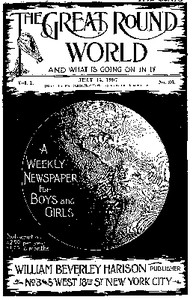
THE GREAT ROUND WORLD
AND WHAT IS GOING ON IN IT
Vol. 1 JULY 15, 1897 No. 36.
[Entered at Post Office, New York City, as second class matter]
[Illustration: A
WEEKLY
NEWSPAPER
FOR
BOYS AND
GIRLS]
Subscription
$2.50 per year
$1.25 6 months
WILLIAM BEVERLEY HARISON. PUBLISHER
NO. 3 AND 5 WEST 18TH ST. NEW YORK CITY
=Copyright, 1897, by WILLIAM BEVERLEY HARISON.=
* * * * *
[Illustration: Books]
To any subscriber securing for us
... ...1 NEW SUBSCRIPTION
_we will send post-paid any one of the following books. Printed on
extra laid paper, bound in red buckram, gilt top._
Andersen's Fairy Tales. By Hans Andersen.
Allan Quatermain. By H. Rider Haggard.
Auld Lang Syne. By W. Clark Russell.
Adam Bede. By George Eliot.
Abbé Constantin. By Ludovic Halévy.
Ardath. By Marie Corelli.
Big Bow Mystery. By I. Zangwill.
Bondman. By Hall Caine.
Beyond the City. By A. Conan Doyle.
Black Beauty. By Anna Sewell.
Beatrice. By H. Rider Haggard.
Baron Munchausen. By Rudolph Raspe.
Bryant's Poems. By William Cullen Bryant.
Chouans. By Honoré de Balzac.
Cloister Wendhusen. By W. Heimburg.
Country Sweetheart. By Dora Russell.
Change of Air. By Anthony Hope.
Cowper's Poems. By William Cowper.
Cleopatra. By H. Rider Haggard.
Deerslayer. By J. Fenimore Cooper.
Desperate Remedies. By Thomas Hardy.
Danira. By E. Werner.
Duchess. By The Duchess.
Dorothy's Double. By G.A. Henty.
Diana of the Crossways. By George Meredith.
Doctor Rameau. By Georges Ohnet.
David Copperfield. By Charles Dickens.
Dombey & Son. By Charles Dickens.
Elsie. By W. Heimburg.
Evolution of Dodd. By William Hawley Smith.
Fromont Jr. and Risler Sr. By Alphonse Daudet.
Flower of France. By Marah Ellis Ryan.
Great Keinplatz Experiment. By A. Conan Doyle.
Gladiators. By C.J. Whyte-Melville.
Grimm's Fairy Tales.
House of the Wolf. By Stanley Weyman.
Harlequin Opal. By Fergus Hume.
Hortense. By W. Heimburg.
Heir of Redcliffe. By Charlotte M. Yonge.
Han of Iceland. By Victor Hugo.
Ironmaster. By Georges Ohnet.
In All Shades. By Grant Allen.
Jane Eyre. By Charlotte Brontë.
Kings in Exile. By Alphonse Daudet.
Kidnapped. By Robert Louis Stevenson.
Little Rebel. By The Duchess.
Last of the Mohicans. By J. Fenimore Cooper.
Light that Failed. By Rudyard Kipling.
Light of Asia. By Sir Edwin Arnold.
THE GREAT ROUND WORLD
3 AND 5 WEST 18TH ST. NEW YORK CITY
* * * * *
=The Second Bound Volume=
OF
=THE GREAT ROUND WORLD=
(Containing Nos. 16 to 30)
=IS NOW READY=
Handsomely bound in strong cloth, with title on side and back.
Price, postage paid, $1.25. Subscribers may exchange their numbers
by sending them to us (express paid) with 35 cents to cover cost of
binding, and 10 cents for return carriage.
Address
=_3 and 5 West 18th Street, · · · · · · New York City_=
* * * * *
=LIBRARIANS=
will please note that the subscription price of THE GREAT ROUND WORLD--to
libraries--is $1.75 per year.
* * * * *
Do you Cover your Books?
THE "ONE PIECE"
ADJUSTABLE BOOK COVERS
are made of the strongest and best book-cover paper obtainable. This paper
is made in large quantities especially for these book covers and will
protect books perfectly. The book covers themselves are a marvel of
ingenuity, and, although they are in one piece and can be adjusted to fit
perfectly any sized book without cutting the paper, they are also so
simple that any boy or girl can use them; as they are already gummed they
are always ready for use.
A sample dozen will be mailed to any address for 20 cents (or ten two-cent
stamps) if you write
WILLIAM BEVERLEY HARISON
3 and 5 West 18th Street, New York City
* * * * *
ILLINOIS STATE NORMAL UNIVERSITY.
NORMAL, ILL. June 16, 1897.
To whom it may concern:--
I have examined the publication "The Great Round World". It seems
to me to be admirable in its design and also in its execution. It
abandons the formal style of the newspaper in the narration of
events, substituting instead a style that is at once conversational
and free. I commend it to the consideration of school men.
[Illustration: handwritten signature, John W. Cook.]
* * * * *
="The Great Round World" PRIZE CONTEST=
THE GREAT ROUND WORLD is now over six months old, and it feels some
anxiety to know just how much interest its readers have taken in the
news and how much information they have gained from its pages. To
ascertain this, it has been decided to offer ten prizes for the best
answers to the following:
=Name ten of the most important events that have been mentioned in
"The Great Round World" in the first 30 numbers, that is, up to
number of June 3d.=
_In mentioning these events give briefly reasons for considering
them important._
This competition will be open to subscribers only, and any one desiring
to enter the competition must send to this office their name and the
date of their subscription; a number will then be given them.
All new subscribers will be furnished with a card entitling them to
enter the competition.
In making the selection of important events, remember that wars and
political events are not necessarily the most important. If, for
instance, the air-ship had turned out to be a genuine and successful
thing, it would have been most important as affecting the history of the
world. Or if by chance the telephone or telegraph had been invented in
this period, these inventions would have been _important_ events.
Prizes will be awarded to those who make the best selection and who
mention the events in the best order of their importance. Answers may be
sent in any time before September 1st.
The Great Round World does not want you to hurry over this contest, but
to take plenty of time and do the work carefully. It will be a pleasant
occupation for the summer months.
We would advise you to take the magazines starting at No. 1, look them
over carefully, keep a note-book at your side, and jot down in it the
events that seem to you important; when you have finished them all, No.
1 to 30, look over your notes and select the ten events that seem to you
to be the most important, stating after each event your reason for
thinking it important.
For instance: suppose you decide that the death of Dr. Ruiz was one of
these important events, you might say, "The killing of Dr. Ruiz in the
prison of Guanabacoa--because it brought the cruelties practised on
American citizens to the attention of our Government," etc., etc.
In sending your answers put your number and the date only on them, for
the judges are not to know names and addresses of the contestants, that
there may be no favoritism shown.
It is important to put date on, for if two or more are found of similar
standing, the one first received will be given preference.
Address all letters to REVIEW PRIZE CONTEST DEPARTMENT,
GREAT ROUND WORLD, 3 and 5 West 18th Street, New York City.
_Write answer on one side of the paper only_
=Prizes will be selections from the premium catalogue=
No. 1. Premiums as given for 15 Subscriptions
No. 2. " " " " 12 "
No. 3. " " " " 10 "
No. 4. " " " " 9 "
No. 5. " " " " 8 "
No. 6. " " " " 7 "
No. 7. " " " " 5 "
No. 8. " " " " 5 "
No. 9. " " " " 5 "
No. 10. " " " " 5 "
* * * * *
[Illustration: THE GREAT ROUND
WORLD
AND WHAT IS GOING ON IN IT.]
VOL. 1 JULY 15, 1897. NO. 36
It is reported from Thessaly that the Turks are ruining the country.
The correspondent who sent the news, having managed to escape the notice
of the Turkish officials, claims to have made a personal examination of
the state of affairs in the city of Larissa.
He found that all the houses, except those inhabited by Mohammedans, had
been stripped of their contents, and he was informed on the best
authority that many car-loads of plunder had been sent by the soldiers
to the Turkish town of Elassonna.
In Turnavo, another city of Thessaly, the same condition of affairs
exists as in Larissa. Here, however, the inhabitants had some warning of
the coming of the Turks, and had time to remove many of their valuables
before the enemy arrived.
The condition of Thessaly is desperate. The harvests are rotting in the
fields. The peasants dare not attempt to gather them in, for fear of the
Turkish soldiers, who, under pretence of seeking for arms, beat them
unmercifully until they hand over what money or valuables they have.
* * * * *
The governorship of Crete has been offered to Monsieur Droz, the
ex-president of Switzerland.
It is said that he has accepted on condition that he is first to be
given an opportunity of seeing how he can get along with the Cretans.
* * * * *
The latest report from Cuba is that General Gomez has been wounded, and
some say killed.
There was a fight in the province of Puerto Principe, and during the
action General Gomez's horse was killed under him and the old soldier
wounded.
The whole story comes from the Spanish side, and so the Cubans, before
being disturbed by the news, are waiting for it to be confirmed.
The insurgents have been very active during the last few days.
It is reported that they have had the good fortune to intercept a couple
of valuable Spanish expeditions, securing in one a prize of $200,000,
and in the other $3,000 in cash, $1,700 worth of medicines and two carts
laden with provisions.
We are, however, sorry to tell you that the Cubans are beginning to
adopt the same cruel methods toward the Spaniards that the Spaniards
have been using against them.
A coach full of travellers was journeying with the expedition that
carried the medicines and provisions. The Cubans outnumbered the party,
and took them all prisoners. A woman and a little child who were of the
party were treated kindly and set at liberty, but every Spanish soldier
and every man with the expedition was put to death.
If the Cubans continue to practise these cruelties they will lose the
strong sympathy which their bravery has so far gained for them.
Many Spanish soldiers are still deserting to the Cuban lines. The
deserters say that life is unbearable in the Spanish army. The soldiers
are roughly treated, have scarcely anything to eat, and receive their
pay in worthless paper money.
One entire battalion mutinied a short while ago, and refused to accept
this paper money. The colonel had to give the soldiers his solemn
promise that their pay should be given them half in gold and half in
silver before they would consent to return to duty.
It is stated that the sum of $50,000,000 is needed for the payment of
the soldiers, and that there is little hope of getting it from Spain,
because the Rothschilds will not lend the Government any more money
unless Spain sacrifices the income of the famous Almaden quicksilver
mines for twenty years.
The Rothschilds are the greatest and richest bankers in the world.
This firm has branch houses in all the great capitals in Europe, and has
probably lent money to every government on the continent.
If a war is contemplated, and a nation needs a large sum of ready money
to make preparations, it is to the Rothschilds that its government
generally turns.
When good security is offered there is never any trouble in getting
money from them, but if the security is not of the best they never find
themselves in a position to lend the money.
In 1870, Spain, needing money, applied to the Rothschilds and obtained
what she needed because she offered as security for the repayment of the
loan a lease of the Almaden mines for a term of thirty years.
These mines are said to be the greatest quicksilver mines in the world,
and yield an immense profit.
The Rothschilds worked the mines and realized their profits, the Spanish
Government receiving a royalty of so much money for each flask of
quicksilver sold.
This royalty, in the twenty-six years the bankers have been working the
mines, has amounted to thirty-six millions of dollars.
The contract with the Spanish Government expires in 1900, and so when
Spain needed money for the Cuban war and applied to the Rothschilds for
it, the bankers were very willing to lend it, asking in return that
their lease of the mines be extended for another term of twenty years.
This, Spain was unwilling to do.
She had been informed by her engineers that if she could get the control
of the mines into her own hands, she could realize a yearly income from
them of $6,000,000.
The Government therefore decided that the lease could not be granted,
and the Rothschilds on their part said that they could not accommodate
Spain with the required money, and so the last loan for the Cuban war
had to be obtained from other sources.
Spain is again in need of money. If she decides to grant a new lease of
the mines she can obtain it readily.
If she does not make this arrangement, it is said that she will be
obliged to come to terms with Cuba for lack of funds to fight her.
A plan to raise money for Cuba has been started in this country.
A silver coin has been struck off, which is to be sold in the United
States, and the proceeds used to buy arms for Cuba.
The coin is about the size of a silver dollar, one side bearing the head
of the Goddess of Liberty, and the reverse the arms of Cuba. Its price
will be one dollar.
Ten thousand of these coins are to be ready during the first week in
July, and the Cubans have made arrangements for a further three millions
to be coined if they are required.
* * * * *
The fate of Gen. Rius Rivera is not absolutely decided.
He was tried by court-martial in the Cabanas fortress and was condemned
to be shot.
A cablegram was received by General Weyler from Madrid, ordering him to
delay the execution on account of the feeling in the United States.
General Weyler is said to have cabled back that the United States should
not interfere with prisoners who are not Americans, and to have
requested that he be allowed to carry out the sentence of the court,
because the punishing of General Rivera would have a very desirable
effect on the insurgents.
A Cabinet council has been called in Madrid, and the question is being
carefully discussed. The decision is anxiously awaited.
A letter has been received from General Lee saying that food purchased
with the Relief Fund is being distributed to the needy Americans.
* * * * *
The _Dauntless_ is certainly a very lucky little vessel.
We told you last week how she had been captured by the cutter _McLean_,
in consequence of an accident to her machinery.
The crew of the _Dauntless_ were of course arrested with her, and were
brought to Key West for trial.
To everybody's surprise they have been discharged on the ground that
there was no evidence to prove they were engaged in fitting out a
filibustering expedition.
The Madrid newspapers are saying very bitter things about the United
States for not punishing the persons connected with these affairs. They
declare that we make a pretence of taking them prisoners to satisfy
Spain, and then set them at liberty to please ourselves.
* * * * *
It would seem that the reports from the Philippine Islands are as
unreliable as those from Cuba.
It was only last week that we heard that the rebellion was on a stronger
footing than ever, and that there was little chance that it would soon
be put down.
This week a steamer from Japan brings the news that the Governor-General
of the Philippines has issued a proclamation that the rebellion is at an
end, and announcing that Spanish rule had been re-established.
It will be interesting to know whether this is really true or merely a
statement of the same kind as those General Weyler has been making for
so many months.
* * * * *
A curious experiment is being tried in Tennessee.
A co-operative town has been established by a few workingmen, and from
all accounts it seems to be a great success.
The town is called Ruskin, and at the present time has seventy families
in it.
In this town all men are considered equal, every man, and woman too,
receiving the same amount of wage for his labor, whether it be skilled
or unskilled. The school teacher receives the same pay as the day
laborer; all stand on an equal footing.
When a man wishes to go and live in Ruskin, he has first to ask for
permission to settle there. The Ruskinites own their town, and are
careful not to allow any people to settle in it who are not likely to be
agreeable to them.
To every person who wishes to join them they send a list of questions,
asking the would-be settler what his ideas are on certain points.
If the answers are unsatisfactory, the applicant is told that there is
no room for him in Ruskin.
If, however, his ideas agree with those of the rest of the community,
his name is put up for membership, and he is elected by ballot, as he
would be to a club.
When elected, the new member is obliged to pay an initiation fee of $500
toward the general funds of the town, and he and his family are then
welcome to join the settlement as soon as they see fit.
When they arrive they are given a house and lot rent free. There are no
taxes to pay in Ruskin; everything is free but furniture and food.
Schools and school-books, doctors, medicines, all are free; the family
washing is even undertaken by the community free of charge.
In return for these advantages the family is required to work.
The father must be willing to do any task that is assigned to him,
without complaint. It does not matter if he has never handled a spade in
his life, he must dig if required to, and dig to the best of his
ability.
The payment in Ruskin is not in dollars and cents, but hours' labor,
notes of one, five, and ten hours' value being printed, and passing for
currency in the town.
The community allows each man the value of fifty hours' labor a week,
his wife the same amount, and his children twenty hours each.
The husband is required to work the full time for the community; the
wife is allowed four hours of the day to work for her home, and need
only give five hours to the general good. The four hours that she spends
in her housework are, however, credited to her as hours of labor,
because she is benefiting the community by keeping an orderly home.
In the same way the twenty hours' weekly labor for which the children
are paid are the hours they spend in school. By going to school and
learning they, too, are benefiting the community, so that their labor is
also for the general good.
When school is over, children who wish to do so can wait on table in the
community dining-hall, and then they earn more time-checks.
These checks can be exchanged at the general store for goods, the prices
of articles not being reckoned at so many cents but at so many hours of
labor.
The Ruskin people seem to be hopeful that they have solved the problem
of living.
A similar experiment is to be tried under the management of Eugene Debs.
He is the man who led the strikers in Chicago, got into trouble with the
authorities, and was finally sent to prison.
Debs proposes to start a co-operative town in the West, taking one
hundred thousand men and women along with him to settle it.
He is going to build factories and start all kinds of industries, which
are to belong to all the people in common, the profits and the losses to
be shared by all the citizens alike.
Peace and prosperity are promised to all who will enter this ideal town.
It will be interesting to watch the experiment and see just what results
can be achieved.
* * * * *
Foreign governments are beginning to be heard from on the subject of the
annexation of Hawaii.
A member of the English House of Commons has asked the Government
whether it intends to allow this very important coaling-station to pass
out of its reach without protest.
The Secretary of the Foreign Office replied that no decision had as yet
been reached by the United States, and therefore the Government did not
see that any action was necessary at present.
The Secretary went on to state that the English ministers would be
careful that none of the rights of British subjects were interfered
with.
Russia, on her part, has stated that she thinks that the annexation of
Hawaii may be followed by the seizure of Cuba, and considers it a step
very dangerous to Europe. She will not, however, join with Japan in her
protest.
A report was circulated that Spain and Japan were forming an alliance to
resist the annexation of the Sandwich Islands, but this report has been
denied.
The German Emperor is said to have declared that he fears the
interference of the United States with European affairs if she is
allowed to extend her territory in this way.
With all these more or less unfriendly comments there has been but the
one serious objection to the project, and that has come from Japan.
The State Department has replied to the protest from the Japanese
minister. The Department refuses to allow the claim that the treaty
between Japan and Hawaii was a perpetual treaty. The refusal was based
on the grounds that we gave you last week.
The Japanese protest also declares that there are twenty-five thousand
of her people resident in the Sandwich Islands who have earned the right
to become citizens, and our Government is asked what it proposes to do
about these people in case the treaty is ratified.
In replying to this point the State Department refused to give any
definite answer, saying that it was a matter to be settled by Congress
or the courts.
This reply was sent to the Japanese minister, who immediately cabled it
to his Government.
The next step in this matter must be taken by Japan, and there is a good
deal of anxiety as to what it will be.
The arrival of the steamer from Honolulu was eagerly watched for, as it
was thought that the news from Hawaii might give some idea of the temper
of the Japanese.
Every one was therefore very delighted to learn that the Japanese had
taken no aggressive steps.
The steamer brought news of a slight alarm in Honolulu, but it had
amounted to nothing.
A report had been spread that the Japanese warship _Naniwa_ was about to
land her marines and take possession of the Hawaiian Government
buildings and custom-house.
The news soon reached Admiral Beardslee, who is in command of the
cruiser _Philadelphia_.
Since the _Philadelphia_ has been in port the Admiral has held weekly
drills of the crews of his own ship, and also of the _Marion_, which has
long been on the Hawaiian station.
At the time the news reached him, the crews were ashore drilling.
The Admiral sent an order for them to hurry back to their ships and be
in readiness to prevent any such action on the part of the Japanese.
When the Japanese minister heard of the matter, he made light of it, and
declared that there had never been any idea of landing marines from the
Japanese warship.
The people of Honolulu say that the report was true nevertheless, and
that the prompt action of Admiral Beardslee prevented it from being
carried out.
It seems that the Japanese minister in Hawaii is maintaining that he has
not yet received any reply to his letter to the Hawaiian Government.
He absolutely declines to regard Mr. Cooper's letter, which was
published in the papers before it reached him, as a reply to his
official communication.
* * * * *
Prince Henry of Orleans has arrived safely at the court of Menelik of
Abyssinia, and has been received by him.
Menelik is described by Prince Henry as an intelligent, good-humored
man, of about forty years of age. His skin is dark, but not nearly so
black as has been stated.
The Prince found him an agreeable person, much interested in foreign
affairs, and he asked so many intelligent questions about the government
of foreign countries that his visitor was astonished. This savage
monarch knew all about the struggle between Japan and China, and
realized the immense progress the Japanese had made since the war.
Menelik questioned the Prince about the French President, and seemed
fully acquainted with everything concerning him. He had also heard of
the Prince's voyages, and was extremely interested in his Chinese trip,
asking many questions about the way the people lived in China, their
manufactures and their food.
This information is particularly interesting when we realize that
Menelik is the king of a savage nation. There are no schools or books in
his country, no manufactories or railroads,--indeed, little civilization
of any kind.
In the heart of the wilderness this man has made himself familiar with
the doings of the outer world, and has made his power felt among the
great nations.
The friendship of this savage is necessary to the great Powers of
Europe, and he is well aware of this fact, and is striving to make his
knowledge of practical value for the advancement of his people.
[Illustration]
It is toward Africa that the Powers of Europe are turning their
attention at the present day. England, France, Germany, and Italy are
all seeking to plant colonies there, and gather its riches for
themselves.
For years the various countries have had their way in Africa and have
pursued their conquests practically unchecked.
The few savage tribes that have resisted have been mastered with more or
less difficulty, and the country has been settled by the conquerors.
No nation had been met with that was strong enough to check the onward
march of Europe, until Menelik, Negus of Abyssinia, defeated the
Italians at the battle of Adowa, and showed Europe that he, at least,
intended to bring the conquerors to terms.
Since this battle all the nations interested in Africa have been seeking
the friendship of this swarthy monarch.
England finds it necessary to make a friend of him, lest in her wars
with the Mahdi's followers, in the Soudan, she have Menelik also against
her.
France and Italy both need the alliance of this powerful king, else they
will not be able to maintain the colonies they have already established.
Most of the African rulers have been won over with presents of beads and
gaudy ornaments, but Menelik belongs to a different class. He has
studied and tried to fathom the intricacies of European government, and
if he gives his friendship to the nations that are suing for it, it will
be in exchange for benefits much more substantial than the Europeans
have been accustomed to give.
* * * * *
Steady progress has been made with the Tariff Bill, and it is expected
that it will be passed within a very few days.
An attempt has been made to put a provision against Trusts in the bill.
The proposed clause would make it unlawful for people to combine
together to restrain free competition or to increase the market price of
materials. All materials unfairly increased in price are to be forfeited
to the United States, and it is to be the duty of the Attorney-General
to enforce all laws against Trusts, and to do all in his power to
suppress them.
It is thought that it will be difficult to add this clause to the bill,
but every effort will be made to accomplish it.
Mr. Sherman expressed himself very strongly on the subject of Trusts the
other day.
He said that in his belief the question of Trusts was the most important
one before the nation to-day.
He said that the Trust Law was not strong enough in its present form,
and that he was in favor of making all combinations that restrained
trade unlawful.
He declared that even if the effect of Trusts was to lower prices, he
considered them injurious to the public good, because they prevented
competition and drove the smaller men out of business.
The Tobacco Trust trial has resulted in a disagreement of the jury.
* * * * *
A wonderful diving-bell is being tried in the Great Lakes.
We described the method of using diving-bells in a previous number, but
this new invention is built on an entirely different plan, and can
accomplish results never before dreamed of.
The kind formerly made could not withstand the pressure of the water at
any very great depth. No machine had been invented capable of bearing
this strain until the new Smith bell was tried.
This bell has worked successfully in two hundred feet of water, and it
is claimed can withstand the pressure at a much greater depth.
The most remarkable thing about the bell is that it can move about under
the water, instead of merely being let down to remain in one place like
an ordinary diving-bell.
Attached to its cage are four long arms, which can be moved about at
will by the persons in the bell.
With the aid of these arms the huge machine can move from place to place
like a great spider.
The arms can also be drawn together like pincers, and made to grip
objects and carry them up to the surface.
The interior of the bell is lighted by electricity. Outside it carries a
large headlight, which enables those in the bell to see around them for
a distance of a hundred feet.
Experiments have been made in the Great Lakes with this bell, and its
first practical work has been to locate the exact position of the
steamer _Pewabic_, which was wrecked in Lake Michigan thirty-two years
ago.
Many attempts have been made to find this steamer because she was laden
with a cargo of copper ingots, and had besides a large sum of money on
board, the two together amounting to about $140,000.
All attempts had, however, been unsuccessful until the Smith bell was
used. The steamer was found lying in one hundred and sixty feet of
water.
To prove the truth of the find, portions of the wreck were brought to
the surface.
The success in Lake Michigan has determined the owner of the diving-bell
to try and raise the North German Lloyd steamer _Elbe_, which was
wrecked off the coast of England in 1895.
The owners of the _Elbe_ have already spent about fifty thousand dollars
in efforts to recover their vessel.
The position of the ship was located by divers, who, at a depth of one
hundred and seventy-one feet, found the upper works of the steamer.
These men, however, declare that it is utterly impossible to raise the
ship.
The _Elbe_ had a valuable cargo and a large amount of gold on board. The
owners of the diving-bell are determined to make the effort to raise her
and secure for themselves the immense reward offered.
They intend to remove the cargo first and then raise the hull, if it is
possible to do so.
They are very hopeful of success, and say that the task does not appear
to them any more difficult than the raising of the cargo of the
_Pewabic_ which latter task they are sure of accomplishing.
* * * * *
On the 24th of June there was a celebration in Halifax, Nova Scotia, of
the four hundredth anniversary of the discovery of the mainland of
America.
A tablet was placed in the Parliament building in honor of John Cabot,
who four hundred years ago sailed from Bristol, England, and finally
reached the shores of Newfoundland.
An endeavor was made to make the celebration a general one throughout
Canada and the United States, but this was found to be impracticable.
Cabot's voyage could not be made of the same importance as that of
Columbus.
The foundation-stone of a monument to Cabot was laid in his native town
of Bristol on the same day that the celebration took place in Halifax.
* * * * *
Lieutenant Peary has started on another Polar expedition, and feels
hopeful that this time he will be able to reach the Pole.
His plans for his trip are much the same as those of Dr. Nansen; that is
to say, he will establish little colonies of Eskimos at certain
distances along his route, leaving supplies with each colony, which he
can fall back on in case of need.
He intends to keep up a constant communication with these settlements by
means of dogs and sledges, so that he will not be entirely cut off from
the world as previous explorers have been.
Lieutenant Peary has obtained five years' leave of absence from the Navy
Department. He will therefore have plenty of time for his experiment. He
says that if he fails the first time he will keep on trying until he
succeeds in reaching the Pole.
There is a story that one of the men who expect to go north with
Lieutenant Peary has a scheme for reaching the Pole on a bicycle.
This seems to be the strangest use thus far suggested for the bicycle.
Mr. Lee, who is the inventor of this novel plan, was with Lieutenant
Peary on his last trip.
He says that there are miles and miles of smooth surface in the Polar
regions that could easily be covered on a wheel.
According to his statement the water freezes smoothly, and the salt
crystals that form on the top of the ice make the surface like a
gravelled path, and there is consequently no danger that the wheel would
slip.
He says that where the snow covers the ice it is pounded so hard by the
winds that the crust is quite solid enough to bear the weight of a man.
In his opinion a wheelman would find no difficulty in travelling over
it.
He thinks wheeling to the Pole is the simplest and most practical plan
that has yet been proposed.
If he goes with Lieutenant Peary, Mr. Lee declares that he will take his
wheel along with him and make the experiment. He thinks that a man could
wheel to the Pole and back from the north of Greenland in one week.
The great difficulty in the way of his scheme is that it would not be
safe for one man to make the trip alone.
He thinks that at least half a dozen ought to start together. In those
far northern lands the fewer white men there are in a party the better
its chance of success, because they require so much more food than the
Eskimos, and it has to be of a more dainty character. Where provisions
are so scarce, this is a serious consideration.
Mr. Lee says that the present pneumatic tires would not be of the
slightest use, as rubber cracks and splits with the extreme cold. He has
a plan for a new kind of tire that could withstand the climate.
* * * * *
We saw an account the other day of a new sport for the wheel, which is
being indulged in by the cyclists of England and France.
It is called bicycle duelling, and consists of fighting mock duels on
the wheel.
It is said by those who have witnessed it to be a very interesting
sport.
The contestants are masked; use foils with buttons on the points, and
fight according to the strict rules of fencing. The game is won by
touching the adversary over the heart with the sheathed point of the
foil.
In fencing, a man has to keep his eye closely on his adversary, and
dares not allow his attention to be distracted for a moment. It is
therefore absolutely necessary that those who engage in a bicycle duel
should be expert riders.
The mimic battle begins by the two riders circling slowly round each
other, waiting for an opportunity to dash in and strike a blow.
This circling continues for a few moments until one darts forward--the
foils clash, and the aggressor passes swiftly on, only to turn and
recommence the circling until he sees another opportunity.
They fight in this way, back and forth, round and round, until the final
touch is given; then the cyclist who is touched is obliged to dismount,
as a sign that he has been defeated.
This pastime is particularly popular in France, where fencing forms a
part of every young man's education.
* * * * *
We have had several inquiries about the George Junior Republic at
Freeville, and are pleased to say that the young citizens are being
received there in as large numbers as the funds will permit.
It might interest our readers to know that any one sending $15 to Mr.
A.G. Agnew, Treasurer of the George Junior Republic, 7 Nassau Street,
New York, can give a ten-weeks' holiday to one poor little lad of the
streets.
It is a very small amount of money to do so much good with, and it is to
be hoped that people who have $15 to spare will send it to the Junior
Republic to help the good work along.
G.H. ROSENFELD.
INVENTION AND DISCOVERY.
RECORDING THERMOMETER.--This is a very interesting little machine,
especially so at this time of year when the temperature is a constant
subject for thought.
[Illustration: Thermometer]
It is a recording thermometer, and consists of a thermometer and a
recording disk. By means of cleverly arranged mechanism the rise and
fall of the mercury is used as the motor power, and registers the
changes in temperature on an indicator card. Other simple mechanism
works a rotary drum by which this indicator card is carried.
[Illustration: Pencil Sharpener]
PENCIL SHARPENER.--This is another helpful little contrivance, a pencil
sharpener. There are already numberless things of the kind, some of
which answer for a time, some not at all, and all being made for the
purpose of sharpening the pencil to a kind of regulation point. For my
own part I have always preferred a good sharp knife, or the simple
reason that I could then make exactly the kind of point suited to the
work to be done. The purpose of the new pencil sharpener is evidently
the same. This contrivance is a small and handy block for holding the
pencil in position for the knife, and has a cutting guide which will be
a joy to people who are awkward in using the knife.
COLORED PHOTOGRAPHY.--The State Department has received a specimen from
Paris of Mr. Villedieu Chassaigne's work in colored photography.
The claim made by Mr. Chassaigne is that he can photograph objects in
their exact colors.
The coloring process is applied after the picture has been developed and
the print made.
A colorless liquid is then applied to the print, and after that it is
washed again in blue, green, and red liquids. After each application the
print is wiped dry. The various parts of the picture choose their
original colors, and the result is an exact representation of the object
photographed.
Several pictures have been brought over by Mr. Anthony, of New York.
Among them were several portraits in which the flesh tints and the
colors of the clothing were beautifully rendered. A view of the _Jardin
d'Acclimatation_ in Paris showed a group of storks, the red coloring of
their legs and beaks being distinctly visible.
The liquids which produce these results are to be put on the market on
July 1st.
It is but fair to say that there are some doubts as to the success of
this process.
A Chassaigne photograph was sent to the State Department, which persons
who have seen it claim is a very crude affair, and cannot be pronounced
a success, as it only resembles a very poorly tinted photograph.
These persons declare that the Chassaigne photographs are not nearly as
fine as those of Kurz, of New York. These latter are obtained by making
three negatives of a subject--one which photographs only the yellows,
one the reds, and the third the blues in a picture.
By carefully printing the three negatives, one on the top of the other,
excellent colored pictures can be produced.
KITCHEN CABINET.--A new cabinet for the kitchen has been designed which
is a very handy thing for use.
It is arranged to contain all the sugars and spices and various nice
things that are required in cooking.
On one side is a large receptacle for coffee, with a mill fixed half-way
down, so the coffee is not only stored, but is always ready for
grinding.
On the other side is another bin for flour, which is provided with a
sifter.
By turning a handle the flour falls to the drawer at the bottom, sifted
and ready for use.
There are handy drawers for sugars and tea, and at the bottom a large
place for bread.
A clock is fixed into the top of the cabinet, and completes the very
useful little case.
G.H.R.
* * * * *
* * * * *
THE GREAT ROUND WORLD
NATURAL HISTORY
STORIES.
A Series of True Stories
BY
JULIA TRUITT BISHOP.
Attractively Illustrated by Barnes.
* * * * *
These stories will be issued in parts. Price, 10 cents each. Subscription
price (12 numbers), $1.00. Part 1. issued as supplement to GREAT ROUND
WORLD NO. 20.
* * * * *
=Author's Preface.=
The stories published in this little volume have been issued
from time to time in the Philadelphia _Times_, and it is at the
request of many readers that they now greet the world in more
enduring form. They have been written as occasion suggested,
during several years; and they commemorate to me many of the
friends I have known and loved in the animal world. "Shep" and
"Dr. Jim," "Abdallah" and "Brownie," "Little Dryad" and
"Peek-a-Boo." I have been fast friends with every one, and have
watched them with such loving interest that I knew all their
ways and could almost read their thoughts. I send them on to
other lovers of dumb animals, hoping that the stories of these
friends of mine will carry pleasure to young and old.
* * * * *
=WILLIAM BEVERLEY HARISON,=
=3 & 5 West 18th Street.=
* * * * *
=KLEMMS'=
=RELIEF PRACTICE MAPS.=
* * * * *
=LIST OF MAPS.=
Small size, 9-1/2 x 11 { Plain, 5 cents each.
{ With Waterproofed surface 10 " "
Europe, Asia, Africa; North America, South America, East Central
States, New England, Middle Atlantic States, South Atlantic
States, Palestine, Australia.
Large size, 10 x 15 { Plain, 10 cents each.
{ With Waterproofed Surface, 15 " "
United States, British Isles, Roman Empire, Western Europe,
North America, South America, Asia.
(POSTAGE ON SINGLE MAPS, 5 CENTS.)
* * * * *
"I would advise =Sunday-school teachers= to use, in connection with the
lessons of 1897, =Klemm's Relief Map of the Roman Empire=. Every scholar
who can draw should have a copy of it. Being blank, it can be beautifully
colored: waters, blue; mountains, brown; valleys, green; deserts, yellow;
cities marked with pin-holes; and the journeys of Paul can be traced upon
it."--MRS. WILBUR F. CRAFTS, _President International Union of
Primary Sabbath-School Teachers of the United States_.
* * * * *
=DESCRIPTION OF THE MAPS.=
These maps are made in two forms, both with beautifully executed relief
(embossed)--the cheaper ones of plain stiff paper similar to drawing paper
(these are to be substituted for and used as outline map blanks), the
others covered with a durable waterproof surface, that can be quickly
cleaned with a damp sponge, adapted to receive a succession of markings
and cleansings. Oceans, lakes, and rivers, as well as land, appear in the
same color, white, so as to facilitate the use of the map as a
=_geographical slate_=.
* * * * *
=WILLIAM BEVERLEY HARISON
_3 & 5 W. 18th St. ··· New York City_=
* * * * *
=How the United States Has Grown=
* * * * *
Several years ago a modest little volume called "The Evolution of an
Empire" set forth, with a lucidity that was as remarkable as its
brevity, the beginnings and growth of Germany; its author, Mary Platt
Parmele, has since followed the same methods in treating France and
England, and now brings out a fourth volume in the noteworthy series, a
somewhat larger book, called in full, "The Evolution of an Empire: A
Brief Historical Sketch of the United States," published, as were the
others, by William Beverley Harison (New York). In an interesting
preface Mrs. Parmele boldly explains her chief intention, which is to
disclose, in so vivid a light that he who runs may read, the fundamental
causes and their resulting events which have formed and are still
shaping our life. She places the study of history upon a moral basis, as
it shows "the great lines of tendency which make for righteousness and
justice and human freedom." "To comprehend is higher than to remember,"
is her text, and she adds some valuable advice to the teacher of
children: "With the growing complexity of life and events it is becoming
an impossible task for the memory to carry the increasing burden of
details; and even if it succeeds in performing this feat, it is at the
expense of a clear and intelligent comprehension of the meaning of the
whole. We may succeed in reducing the mental structure to a mere
storehouse. But if in achieving this the mind has lost the power to
grasp, and to combine, its acquisitions have been dearly purchased."
Mindful of Huxley's definition of culture, that it "must consist of
criticism and comparison," Mrs. Parmele sweeps away all secondary
details, all the less important incidents, and proceeds to her narrative
of Columbus's discovery, the colonial period, the founding of our
Republic, and its subsequent life down to the present year, with the
simple directness of a dramatist; there is no halting in her impetuous
relation; it is infused throughout with the same degree of philosophical
ardor, and one follows as one does a wonder tale the rapid sequence of
events, tracing with an awakened interest the national issues, which,
presented in this new, concise, imaginative way, take on a fresh, an
enchanting charm. Nothing could be clearer to the mind of a child eager
to know the reason of things, nor to that of a grown person, fatigued by
the jostling memories of both important and useless events, than this
return to the fundamental, the philosophical, the moral causes which
underlie the life of the Republic. The tortuous channels by which the
currents bore us into the war of 1812 are described with such surprising
simplicity that one almost fails to realize how admirable a piece of
condensation the single chapter is; and the annexation of Texas is told
with equal precision. The earliest traces of our present policies, such
as the Monroe Doctrine, the protective tariff and free-silver issues,
are explained so clearly and impartially that the author's brevity helps
rather than mars the effect upon the mind.
"The history of America should be an inspiration, not a task. It ought
to be known in its grand, simple lines by every child in the nation. Let
it be so acquired first in its utmost brevity, then enlarged, and
enlarged, and again, gradually approaching to a nearer view of the
multiplicity of detail. Pleased at finding new truths which fit
precisely into those already familiar, there will be no difficulty in
keeping alive the interest, nor in remembering. It will be grafting on
to the living, not on to the dead." This is good advice, and Mrs.
Parmele proves it may make good reading as well.--_Republican_,
Springfield, Mass.
* * * * *
A Good Agent
Wanted
In Every Town
for
"The Great Round World"
* * * * *
[Illustration:
WOODEN PUTTER
BRASSIE SPOON
BRASSIE NIBLICK
DRIVER
CLEEK
IRON
LOFTING IRON
MASHIE
NIBLICK
IRON PUTTER]
=To any one sending us 2 new subscribers=
we will send, express paid, any one of the golf sticks shown in
cut...
=These are the most approved shapes and styles and are made in the best
possible manner=
* * * * *
=2= special golf balls may be had for
... =1= new subscription
* * * * *
=THE GREAT ROUND WORLD=
=3 AND 5 WEST 18TH ST. NEW YORK CITY=
* * * * *
=PREMIUM LIST=
In connection with our offer of any BICYCLE you wish for 100 new
subscriptions, we have prepared a
=Premium Catalogue=
This contains a list of selected articles which will be given to
those who may obtain a smaller number of subscriptions
* * * * *
Those who fail to secure the necessary number for the bicycle may make
selection from this catalogue.
* * * * *
=Copy mailed on receipt of 5c.=
* * * * *
=THE GREAT ROUND WORLD=
=3 & 5 West 18th St, New York City=
End of the Project Gutenberg EBook of The Great Round World and What Is
Going On In It, Vol. 1, No. 36, July 15, 1897, by Various
*** END OF THIS PROJECT GUTENBERG EBOOK THE GREAT ROUND WORLD ***
***** This file should be named 15789-8.txt or 15789-8.zip *****
This and all associated files of various formats will be found in:
https://www.gutenberg.org/1/5/7/8/15789/
Produced by Juliet Sutherland and the Online Distributed
Proofreading Team.(www.pgdp.net)
Updated editions will replace the previous one--the old editions
will be renamed.
Creating the works from public domain print editions means that no
one owns a United States copyright in these works, so the Foundation
(and you!) can copy and distribute it in the United States without
permission and without paying copyright royalties. Special rules,
set forth in the General Terms of Use part of this license, apply to
copying and distributing Project Gutenberg-tm electronic works to
protect the PROJECT GUTENBERG-tm concept and trademark. Project
Gutenberg is a registered trademark, and may not be used if you
charge for the eBooks, unless you receive specific permission. If you
do not charge anything for copies of this eBook, complying with the
rules is very easy. You may use this eBook for nearly any purpose
such as creation of derivative works, reports, performances and
research. They may be modified and printed and given away--you may do
practically ANYTHING with public domain eBooks. Redistribution is
subject to the trademark license, especially commercial
redistribution.
*** START: FULL LICENSE ***
THE FULL PROJECT GUTENBERG LICENSE
PLEASE READ THIS BEFORE YOU DISTRIBUTE OR USE THIS WORK
To protect the Project Gutenberg-tm mission of promoting the free
distribution of electronic works, by using or distributing this work
(or any other work associated in any way with the phrase "Project
Gutenberg"), you agree to comply with all the terms of the Full Project
Gutenberg-tm License (available with this file or online at
https://gutenberg.org/license).
Section 1. General Terms of Use and Redistributing Project Gutenberg-tm
electronic works
1.A. By reading or using any part of this Project Gutenberg-tm
electronic work, you indicate that you have read, understand, agree to
and accept all the terms of this license and intellectual property
(trademark/copyright) agreement. If you do not agree to abide by all
the terms of this agreement, you must cease using and return or destroy
all copies of Project Gutenberg-tm electronic works in your possession.
If you paid a fee for obtaining a copy of or access to a Project
Gutenberg-tm electronic work and you do not agree to be bound by the
terms of this agreement, you may obtain a refund from the person or
entity to whom you paid the fee as set forth in paragraph 1.E.8.
1.B. "Project Gutenberg" is a registered trademark. It may only be
used on or associated in any way with an electronic work by people who
agree to be bound by the terms of this agreement. There are a few
things that you can do with most Project Gutenberg-tm electronic works
even without complying with the full terms of this agreement. See
paragraph 1.C below. There are a lot of things you can do with Project
Gutenberg-tm electronic works if you follow the terms of this agreement
and help preserve free future access to Project Gutenberg-tm electronic
works. See paragraph 1.E below.
1.C. The Project Gutenberg Literary Archive Foundation ("the Foundation"
or PGLAF), owns a compilation copyright in the collection of Project
Gutenberg-tm electronic works. Nearly all the individual works in the
collection are in the public domain in the United States. If an
individual work is in the public domain in the United States and you are
located in the United States, we do not claim a right to prevent you from
copying, distributing, performing, displaying or creating derivative
works based on the work as long as all references to Project Gutenberg
are removed. Of course, we hope that you will support the Project
Gutenberg-tm mission of promoting free access to electronic works by
freely sharing Project Gutenberg-tm works in compliance with the terms of
this agreement for keeping the Project Gutenberg-tm name associated with
the work. You can easily comply with the terms of this agreement by
keeping this work in the same format with its attached full Project
Gutenberg-tm License when you share it without charge with others.
1.D. The copyright laws of the place where you are located also govern
what you can do with this work. Copyright laws in most countries are in
a constant state of change. If you are outside the United States, check
the laws of your country in addition to the terms of this agreement
before downloading, copying, displaying, performing, distributing or
creating derivative works based on this work or any other Project
Gutenberg-tm work. The Foundation makes no representations concerning
the copyright status of any work in any country outside the United
States.
1.E. Unless you have removed all references to Project Gutenberg:
1.E.1. The following sentence, with active links to, or other immediate
access to, the full Project Gutenberg-tm License must appear prominently
whenever any copy of a Project Gutenberg-tm work (any work on which the
phrase "Project Gutenberg" appears, or with which the phrase "Project
Gutenberg" is associated) is accessed, displayed, performed, viewed,
copied or distributed:
This eBook is for the use of anyone anywhere at no cost and with
almost no restrictions whatsoever. You may copy it, give it away or
re-use it under the terms of the Project Gutenberg License included
with this eBook or online at www.gutenberg.org
1.E.2. If an individual Project Gutenberg-tm electronic work is derived
from the public domain (does not contain a notice indicating that it is
posted with permission of the copyright holder), the work can be copied
and distributed to anyone in the United States without paying any fees
or charges. If you are redistributing or providing access to a work
with the phrase "Project Gutenberg" associated with or appearing on the
work, you must comply either with the requirements of paragraphs 1.E.1
through 1.E.7 or obtain permission for the use of the work and the
Project Gutenberg-tm trademark as set forth in paragraphs 1.E.8 or
1.E.9.
1.E.3. If an individual Project Gutenberg-tm electronic work is posted
with the permission of the copyright holder, your use and distribution
must comply with both paragraphs 1.E.1 through 1.E.7 and any additional
terms imposed by the copyright holder. Additional terms will be linked
to the Project Gutenberg-tm License for all works posted with the
permission of the copyright holder found at the beginning of this work.
1.E.4. Do not unlink or detach or remove the full Project Gutenberg-tm
License terms from this work, or any files containing a part of this
work or any other work associated with Project Gutenberg-tm.
1.E.5. Do not copy, display, perform, distribute or redistribute this
electronic work, or any part of this electronic work, without
prominently displaying the sentence set forth in paragraph 1.E.1 with
active links or immediate access to the full terms of the Project
Gutenberg-tm License.
1.E.6. You may convert to and distribute this work in any binary,
compressed, marked up, nonproprietary or proprietary form, including any
word processing or hypertext form. However, if you provide access to or
distribute copies of a Project Gutenberg-tm work in a format other than
"Plain Vanilla ASCII" or other format used in the official version
posted on the official Project Gutenberg-tm web site (www.gutenberg.org),
you must, at no additional cost, fee or expense to the user, provide a
copy, a means of exporting a copy, or a means of obtaining a copy upon
request, of the work in its original "Plain Vanilla ASCII" or other
form. Any alternate format must include the full Project Gutenberg-tm
License as specified in paragraph 1.E.1.
1.E.7. Do not charge a fee for access to, viewing, displaying,
performing, copying or distributing any Project Gutenberg-tm works
unless you comply with paragraph 1.E.8 or 1.E.9.
1.E.8. You may charge a reasonable fee for copies of or providing
access to or distributing Project Gutenberg-tm electronic works provided
that
- You pay a royalty fee of 20% of the gross profits you derive from
the use of Project Gutenberg-tm works calculated using the method
you already use to calculate your applicable taxes. The fee is
owed to the owner of the Project Gutenberg-tm trademark, but he
has agreed to donate royalties under this paragraph to the
Project Gutenberg Literary Archive Foundation. Royalty payments
must be paid within 60 days following each date on which you
prepare (or are legally required to prepare) your periodic tax
returns. Royalty payments should be clearly marked as such and
sent to the Project Gutenberg Literary Archive Foundation at the
address specified in Section 4, "Information about donations to
the Project Gutenberg Literary Archive Foundation."
- You provide a full refund of any money paid by a user who notifies
you in writing (or by e-mail) within 30 days of receipt that s/he
does not agree to the terms of the full Project Gutenberg-tm
License. You must require such a user to return or
destroy all copies of the works possessed in a physical medium
and discontinue all use of and all access to other copies of
Project Gutenberg-tm works.
- You provide, in accordance with paragraph 1.F.3, a full refund of any
money paid for a work or a replacement copy, if a defect in the
electronic work is discovered and reported to you within 90 days
of receipt of the work.
- You comply with all other terms of this agreement for free
distribution of Project Gutenberg-tm works.
1.E.9. If you wish to charge a fee or distribute a Project Gutenberg-tm
electronic work or group of works on different terms than are set
forth in this agreement, you must obtain permission in writing from
both the Project Gutenberg Literary Archive Foundation and Michael
Hart, the owner of the Project Gutenberg-tm trademark. Contact the
Foundation as set forth in Section 3 below.
1.F.
1.F.1. Project Gutenberg volunteers and employees expend considerable
effort to identify, do copyright research on, transcribe and proofread
public domain works in creating the Project Gutenberg-tm
collection. Despite these efforts, Project Gutenberg-tm electronic
works, and the medium on which they may be stored, may contain
"Defects," such as, but not limited to, incomplete, inaccurate or
corrupt data, transcription errors, a copyright or other intellectual
property infringement, a defective or damaged disk or other medium, a
computer virus, or computer codes that damage or cannot be read by
your equipment.
1.F.2. LIMITED WARRANTY, DISCLAIMER OF DAMAGES - Except for the "Right
of Replacement or Refund" described in paragraph 1.F.3, the Project
Gutenberg Literary Archive Foundation, the owner of the Project
Gutenberg-tm trademark, and any other party distributing a Project
Gutenberg-tm electronic work under this agreement, disclaim all
liability to you for damages, costs and expenses, including legal
fees. YOU AGREE THAT YOU HAVE NO REMEDIES FOR NEGLIGENCE, STRICT
LIABILITY, BREACH OF WARRANTY OR BREACH OF CONTRACT EXCEPT THOSE
PROVIDED IN PARAGRAPH F3. YOU AGREE THAT THE FOUNDATION, THE
TRADEMARK OWNER, AND ANY DISTRIBUTOR UNDER THIS AGREEMENT WILL NOT BE
LIABLE TO YOU FOR ACTUAL, DIRECT, INDIRECT, CONSEQUENTIAL, PUNITIVE OR
INCIDENTAL DAMAGES EVEN IF YOU GIVE NOTICE OF THE POSSIBILITY OF SUCH
DAMAGE.
1.F.3. LIMITED RIGHT OF REPLACEMENT OR REFUND - If you discover a
defect in this electronic work within 90 days of receiving it, you can
receive a refund of the money (if any) you paid for it by sending a
written explanation to the person you received the work from. If you
received the work on a physical medium, you must return the medium with
your written explanation. The person or entity that provided you with
the defective work may elect to provide a replacement copy in lieu of a
refund. If you received the work electronically, the person or entity
providing it to you may choose to give you a second opportunity to
receive the work electronically in lieu of a refund. If the second copy
is also defective, you may demand a refund in writing without further
opportunities to fix the problem.
1.F.4. Except for the limited right of replacement or refund set forth
in paragraph 1.F.3, this work is provided to you 'AS-IS', WITH NO OTHER
WARRANTIES OF ANY KIND, EXPRESS OR IMPLIED, INCLUDING BUT NOT LIMITED TO
WARRANTIES OF MERCHANTIBILITY OR FITNESS FOR ANY PURPOSE.
1.F.5. Some states do not allow disclaimers of certain implied
warranties or the exclusion or limitation of certain types of damages.
If any disclaimer or limitation set forth in this agreement violates the
law of the state applicable to this agreement, the agreement shall be
interpreted to make the maximum disclaimer or limitation permitted by
the applicable state law. The invalidity or unenforceability of any
provision of this agreement shall not void the remaining provisions.
1.F.6. INDEMNITY - You agree to indemnify and hold the Foundation, the
trademark owner, any agent or employee of the Foundation, anyone
providing copies of Project Gutenberg-tm electronic works in accordance
with this agreement, and any volunteers associated with the production,
promotion and distribution of Project Gutenberg-tm electronic works,
harmless from all liability, costs and expenses, including legal fees,
that arise directly or indirectly from any of the following which you do
or cause to occur: (a) distribution of this or any Project Gutenberg-tm
work, (b) alteration, modification, or additions or deletions to any
Project Gutenberg-tm work, and (c) any Defect you cause.
Section 2. Information about the Mission of Project Gutenberg-tm
Project Gutenberg-tm is synonymous with the free distribution of
electronic works in formats readable by the widest variety of computers
including obsolete, old, middle-aged and new computers. It exists
because of the efforts of hundreds of volunteers and donations from
people in all walks of life.
Volunteers and financial support to provide volunteers with the
assistance they need, is critical to reaching Project Gutenberg-tm's
goals and ensuring that the Project Gutenberg-tm collection will
remain freely available for generations to come. In 2001, the Project
Gutenberg Literary Archive Foundation was created to provide a secure
and permanent future for Project Gutenberg-tm and future generations.
To learn more about the Project Gutenberg Literary Archive Foundation
and how your efforts and donations can help, see Sections 3 and 4
and the Foundation web page at https://www.pglaf.org.
Section 3. Information about the Project Gutenberg Literary Archive
Foundation
The Project Gutenberg Literary Archive Foundation is a non profit
501(c)(3) educational corporation organized under the laws of the
state of Mississippi and granted tax exempt status by the Internal
Revenue Service. The Foundation's EIN or federal tax identification
number is 64-6221541. Its 501(c)(3) letter is posted at
https://pglaf.org/fundraising. Contributions to the Project Gutenberg
Literary Archive Foundation are tax deductible to the full extent
permitted by U.S. federal laws and your state's laws.
The Foundation's principal office is located at 4557 Melan Dr. S.
Fairbanks, AK, 99712., but its volunteers and employees are scattered
throughout numerous locations. Its business office is located at
809 North 1500 West, Salt Lake City, UT 84116, (801) 596-1887, email
[email protected]. Email contact links and up to date contact
information can be found at the Foundation's web site and official
page at https://pglaf.org
For additional contact information:
Dr. Gregory B. Newby
Chief Executive and Director
[email protected]
Section 4. Information about Donations to the Project Gutenberg
Literary Archive Foundation
Project Gutenberg-tm depends upon and cannot survive without wide
spread public support and donations to carry out its mission of
increasing the number of public domain and licensed works that can be
freely distributed in machine readable form accessible by the widest
array of equipment including outdated equipment. Many small donations
($1 to $5,000) are particularly important to maintaining tax exempt
status with the IRS.
The Foundation is committed to complying with the laws regulating
charities and charitable donations in all 50 states of the United
States. Compliance requirements are not uniform and it takes a
considerable effort, much paperwork and many fees to meet and keep up
with these requirements. We do not solicit donations in locations
where we have not received written confirmation of compliance. To
SEND DONATIONS or determine the status of compliance for any
particular state visit https://pglaf.org
While we cannot and do not solicit contributions from states where we
have not met the solicitation requirements, we know of no prohibition
against accepting unsolicited donations from donors in such states who
approach us with offers to donate.
International donations are gratefully accepted, but we cannot make
any statements concerning tax treatment of donations received from
outside the United States. U.S. laws alone swamp our small staff.
Please check the Project Gutenberg Web pages for current donation
methods and addresses. Donations are accepted in a number of other
ways including including checks, online payments and credit card
donations. To donate, please visit: https://pglaf.org/donate
Section 5. General Information About Project Gutenberg-tm electronic
works.
Professor Michael S. Hart was the originator of the Project Gutenberg-tm
concept of a library of electronic works that could be freely shared
with anyone. For thirty years, he produced and distributed Project
Gutenberg-tm eBooks with only a loose network of volunteer support.
Project Gutenberg-tm eBooks are often created from several printed
editions, all of which are confirmed as Public Domain in the U.S.
unless a copyright notice is included. Thus, we do not necessarily
keep eBooks in compliance with any particular paper edition.
Most people start at our Web site which has the main PG search facility:
https://www.gutenberg.org
This Web site includes information about Project Gutenberg-tm,
including how to make donations to the Project Gutenberg Literary
Archive Foundation, how to help produce our new eBooks, and how to
subscribe to our email newsletter to hear about new eBooks.
*** END: FULL LICENSE ***
The Great Round World and What Is Going On In It, Vol. 1, No. 36, July 15, 1897 - A Weekly Magazine for Boys and Girls
by
Various
Download Formats:
Excerpt
The Project Gutenberg EBook of The Great Round World and What Is Going On
In It, Vol. 1, No. 36, July 15, 1897, by Various
This eBook is for the use of anyone anywhere at no cost and with
almost no restrictions whatsoever. You may copy it, give it away or
re-use it under the terms of the Project Gutenberg License included
with this eBook or online at www.gutenberg.org
Title: The Great Round World and What Is Going On In It, Vol. 1, No. 36, July 15, 1897
A Weekly Magazine for Boys...
Read the Full Text
— End of The Great Round World and What Is Going On In It, Vol. 1, No. 36, July 15, 1897 - A Weekly Magazine for Boys and Girls —
Book Information
- Title
- The Great Round World and What Is Going On In It, Vol. 1, No. 36, July 15, 1897 - A Weekly Magazine for Boys and Girls
- Author(s)
- Various
- Language
- English
- Type
- Text
- Release Date
- May 7, 2005
- Word Count
- 11,137 words
- Library of Congress Classification
- AP; D
- Bookshelves
- The Great Round World And What Is Going On In It, Browsing: Children & Young Adult Reading, Browsing: History - General
- Rights
- Public domain in the USA.
Related Books
Blackwood's Edinburgh Magazine, Vol. 67, No. 415, May, 1850
by Various
English
1403h 23m read
Blackwood's Edinburgh Magazine, Vol. 67, No. 413, March, 1850
by Various
English
1544h 52m read
Chambers's Journal of Popular Literature, Science, and Art, fifth series, no. 149, vol. III, November 6, 1886
by Various
English
285h 2m read
The Delinquent, Vol. IV, No. 8, August, 1914
by Various
English
233h 1m read
Chambers's Journal of Popular Literature, Science, and Art, Fifth Series, No. 148, Vol. III, October 30, 1886
by Various
English
287h 25m read

Trial of the major war criminals before the International Military Tribunal, Nuremburg, 14 November 1945-1 October 1946, volume 18
by Various
English
3940h 53m read