The Project Gutenberg EBook of The First Essay on the Political Rights of
Women, by Jean-Antoine-Nicolas de Caritat Condorcet
This eBook is for the use of anyone anywhere at no cost and with
almost no restrictions whatsoever. You may copy it, give it away or
re-use it under the terms of the Project Gutenberg License included
with this eBook or online at www.gutenberg.org
Title: The First Essay on the Political Rights of Women
Author: Jean-Antoine-Nicolas de Caritat Condorcet
Translator: Alice Drysdale Vickery
Release Date: March 8, 2010 [EBook #31550]
Language: English
Character set encoding: UTF-8
*** START OF THIS PROJECT GUTENBERG EBOOK POLITICAL RIGHTS OF WOMEN ***
Produced by Meredith Bach, Irma Spehar and the Online
Distributed Proofreading Team at https://www.pgdp.net (This
file was produced from images of public domain material
generously made available by The Online Library of Liberty.)
THE FIRST ESSAY
ON
The Political Rights of Women.
A Translation of CONDORCET’S Essay “_Sur l’admission
des femmes au droit de Cité_” (On the Admission
of Women to the Rights of Citizenship).
--_Collected Writings_, 1789.
BY
DR. ALICE DRYSDALE VICKERY.
(WITH PREFACE AND REMARKS.)
LETCHWORTH:
GARDEN CITY PRESS LIMITED.
=Price Twopence.=
Preface.
More than one hundred years have passed away since, in 1789, the
Marquis de Condorcet wrote his “_Esquisse sur l’Admission des Femmes
au Droit de Cité_,” and yet the problem of women’s enfranchisement
still awaits an equitable solution. Those of us who are old enough to
remember the inauguration of the popular movement for the extension of
the franchise to women (which may be dated from the day in which our
late noble leader, JOHN STUART MILL, addressed the House of Commons on
this subject, in May, 1867), feel that our lives are passing away
while wearily awaiting the dilatory educational development of mankind
in this question.
The essential principles of our claim have been reiterated again and
again. We form one-half of the human race, and need recognition by the
law as much as the other half of the race. But, as long as our
law-makers are not directly responsible to us for their conduct in
Parliament, they may, and do, safely neglect our interests, and pass
laws which jeopardise our liberties and subordinate our just rights of
person, property, and offspring to the supposed interests of the men
whom they represent.
The spirit which animates Parliament pervades the whole of our social
life; and women suffer from lack of educational facilities, and from
obstacles to success in industrial and professional life, in ways
which have no parallel in the case of men. All these things have been
urged again and again until we are weary of repeating them; and we ask
ourselves, as we mentally review our position, Where shall we find
some new argument wherewith to arrest the attention, and compel the
action, of those who have the power, but seem to lack the will, to do
justice? It is curious to note that the great point on which the mass
of men seem united is their _sex_. Prejudices of race, of caste, of
colour may be overcome; but the pride of sex remains. Rights of
citizenship are accorded to the small shopkeeper, artisan, lodger,
agricultural labourer, and to the illiterate who knows no difference
between one party and the other, either as to tendencies or methods of
government. The Anglo-Saxon confers rights of citizenship upon the
foreigner, upon the negro (as in the United States), upon the Maori
(as in New Zealand)--the last of whom, sitting in the New Zealand
House of Representatives, helped to maintain this glorious prerogative
of sex by giving their casting-votes against a measure intended to
meet the claims of the Anglo-Saxon women in New Zealand.[1]
[1] The Parliamentary Franchise was conferred on the women of
New Zealand in 1893, the same year in which the above was
printed. In 1907 the Hon. R. Oliver, late member of the
Legislative Council, writes: “The interest now taken by women
in New Zealand in the politics of the country is remarkable,
and is regarded as a decided gain to the community.”
And all this despite the admitted fact that the social and economic
problems, which are coming more and more into the field of
parliamentary labours, are all but incapable of solution without the
help of enfranchised women.
Must women, then, following the example of men, learn to put sex in
the first place and regard all other interests as secondary? Is this
really what men wish to force women to do? One would think not. At
present women have not adopted any such principle of action. They are
divided rather than otherwise, according to the relations they occupy
with regard to men. The married woman, on the one hand, seems opposed
to the claims of the widowed and single, on the other--and _vice
versâ_; and both together combine to ostracise some of their own sex.
It seems probable, however, that we women will have to learn to drop
all such rivalries, and determine to form one vast organisation, which
shall include within its ranks all sorts and conditions of women, and
shall extend over the whole of the United Kingdom, if we would not see
this nineteenth century completed without Woman’s Emancipation
becoming an accomplished fact.
(DR.) ALICE VICKERY.
On the Admission of Women to the Rights of Citizenship.
BY THE MARQUIS DE CONDORCET.
Custom may familiarise mankind with the violation of their natural
rights to such an extent, that even among those who have lost or been
deprived of these rights, no one thinks of reclaiming them, or is even
conscious that they have suffered any injustice.
Certain of these violations (of natural right) have escaped the notice
of philosophers and legislators, even while concerning themselves
zealously to establish the common rights of individuals of the human
race, and in this way to lay the foundation of political institutions.
For example, have they not all violated the principle of the equality
of rights in tranquilly depriving one-half of the human race of the
right of taking part in the formation of laws by the exclusion of
women from the rights of citizenship? Could there be a stronger proof
of the power of habit, even among enlightened men, than to hear
invoked the principle of equal rights in favour of perhaps some 300 or
400 men, who had been deprived of it by an absurd prejudice, and
forget it when it concerns some 12,000,000 women?
To show that this exclusion is not an act of tyranny, it must be
proved either that the natural rights of women are not absolutely the
same as those of men, or that women are not capable of exercising
these rights.
But the rights of men result simply from the fact that they are
rational, sentient beings, susceptible of acquiring ideas of morality,
and of reasoning concerning those ideas. Women having, then, the same
qualities, have necessarily the same rights. Either no individual of
the human species has any true rights, or all have the same; and he or
she who votes against the rights of another, whatever may be his or
her religion, colour, or sex, has by that fact abjured his own.
It would be difficult to prove that women are incapable of exercising
the rights of citizenship. Although liable to become mothers of
families, and exposed to other passing indispositions, why may they
not exercise rights of which it has never been proposed to deprive
those persons who periodically suffer from gout, bronchitis, etc.?
Admitting for the moment that there exists in men a superiority of
mind, which is not the necessary result of a difference of education
(which is by no means proved, but which should be, to permit of women
being deprived of a natural right without injustice), this inferiority
can only consist in two points. It is said that no woman has made any
important discovery in science, or has given any proofs of the
possession of genius in arts, literature, etc.; but, on the other
hand, it is not pretended that the rights of citizenship should be
accorded only to men of genius. It is added that no woman has the same
extent of knowledge, the same power of reasoning, as certain men; but
what results from that? Only this, that with the exception of a
limited number of exceptionally enlightened men, equality is absolute
between women and the remainder of the men; that this small class
apart, inferiority and superiority are equally divided between the two
sexes. But since it would be completely absurd to restrict to this
superior class the rights of citizenship and the power of being
entrusted with public functions, why should women be excluded any more
than those men who are inferior to a great number of women? Lastly,
shall it be said that there exists in the minds and hearts of women
certain qualities which ought to exclude them from the enjoyment of
their natural rights? Let us interrogate the facts. Elizabeth of
England, Maria Theresa, the two Catherines of Russia--have they not
shown that neither in courage nor in strength of mind are women
wanting?
Elizabeth possessed all the failings of women. Did these failings work
more harm during her reign than resulted from the failings of men
during the reign of her father, Henry VIII., or her successor, James
I.? Have the lovers of certain empresses exercised a more dangerous
influence than the mistresses of Louis XIV., of Louis XV., or even of
Henry IV.?
Will it be maintained that Mistress Macaulay would not have expressed
her opinions in the House of Commons better than many representatives
of the British nation? In dealing with the question of liberty of
conscience, would she not have expressed more elevated principles than
those of Pitt, as well as more powerful reasoning? Although as great
an enthusiast on behalf of liberty as Mr. Burke could be on behalf of
its opposite, would she, while defending the French Constitution, have
made use of such absurd and offensive nonsense as that which this
celebrated rhetorician made use of in attacking it? Would not the
adopted daughter of Montaigne have better defended the rights of
citizens in France, in 1614, than the Councillor Courtin, who was a
believer in magic and occult powers? Was not the Princesse des Ursins
superior to Chamillard? Could not the Marquise de Chatelet have
written equally as well as M. Rouillé? Would Mme. de Lambert have made
laws as absurd and as barbarous as those of the “garde des Sceaux,” of
Armenouville, against Protestants, invaders of domestic privacy,
robbers and negroes? In looking back over the list of those who have
governed the world, men have scarcely the right to be so very
uplifted.
Women are superior to men in the gentle and domestic virtues; they, as
well as men, know how to love liberty, although they do not
participate in all its advantages; and in republics they have been
known to sacrifice themselves for it. They have shown that they
possess the virtues of citizens whenever chance or civil disasters
have brought them upon a scene from which they have been shut out by
the pride and the tyranny of men in all nations.
It has been said that women, in spite of much ability, of much
sagacity, and of a power of reasoning carried to a degree equalling
that of subtle dialecticians, yet are never governed by what is called
“reason.”
This observation is not correct. Women are not governed, it is true,
by the reason (and experience) of men; they are governed by their own
reason (and experience).
Their interests not being the same (as those of men) by the fault of
the law, the same things not having the same importance for them as
for men, they may, without failing in rational conduct, govern
themselves by different principles, and tend towards a different
result. It is as reasonable for a woman to concern herself respecting
her personal attractions as it was for Demosthenes to cultivate his
voice and his gestures.
It is said that women, although superior in some respects to man--more
gentle, more sensitive, less subject to those vices which proceed from
egotism and hardness of heart--yet do not really possess the sentiment
of justice; that they obey rather their feelings than their
conscience. This observation is more correct, but it proves nothing;
it is not nature, it is education, it is social existence which
produces this difference.
Neither the one nor the other has habituated women to the idea of what
is just, but only to the idea of what is “honnête,” or respectable.
Excluded from public affairs, from all those things which are judged
of according to rigorous ideas of justice, or according to positive
laws, the things with which they are occupied and which are affected
by them are precisely those which are regulated by natural feelings of
honesty (or, rather, propriety) and of sentiment. It is, then, unjust
to allege as an excuse for continuing to refuse to women the enjoyment
of all their natural rights motives which have only a kind of reality
because women lack the experience which comes from the exercise of
these rights.
If reasons such as these are to be admitted against women, it will
become necessary to deprive of the rights of citizenship that portion
of the people who, devoted to constant labour, can neither acquire
knowledge nor exercise their reason; and thus, little by little, only
those persons would be permitted to be citizens who had completed a
course of legal study. If such principles are admitted, we must, as a
natural consequence, renounce the idea of a liberal constitution. The
various aristocracies have only had such principles as these for
foundation or excuse. The etymology of the word is a sufficient proof
of this.
Neither can the subjection of wives to their husbands be alleged
against their claims, since it would be possible in the same statute
to destroy this tyranny of the civil law. The existence of one
injustice can never be accepted as a reason for committing another.
There remain, then, only two objections to discuss. And, in truth,
these can only oppose motives of expediency against the admission of
women to the right of voting; which motives can never be upheld as a
bar to the exercise of true justice. The contrary maxim has only too
often served as the pretext and excuse of tyrants; it is in the name
of expediency that commerce and industry groan in chains; and that
Africa remains afflicted with slavery: it was in the name of public
expediency that the Bastille was crowded; that the censorship of the
press was instituted; that accused persons were not allowed to
communicate with their advisers; that torture was resorted to.
Nevertheless, we will discuss these objections, so as to leave nothing
without reply.
It is necessary, we are warned, to be on guard against the influence
exercised by women over men. We reply at once that this, like any
other influence, is much more to be feared when not exercised openly;
and that, whatever influence may be peculiar to women, if exercised
upon more than one individual at a time, will in so far become
proportionately lessened. That since, up to this time, women have not
been admitted in any country to absolute equality; since their empire
has none the less existed everywhere; and since the more women have
been degraded by the laws, the more dangerous has their influence
been; it does not appear that this remedy of subjection ought to
inspire us with much confidence. Is it not probable, on the contrary,
that their special empire would diminish if women had less interest in
its preservation; if it ceased to be for them their sole means of
defence, and of escape from persecution?
If politeness does not permit to men to maintain their opinions
against women in society, this politeness, it may be said, is near
akin to pride; we yield a victory of no importance; defeat does not
humiliate when it is regarded as voluntary. Is it seriously believed
that it would be the same in a public discussion on an important
topic? Does politeness forbid the bringing of an action at law against
a woman?
But, it will be said, this change will be contrary to general
expediency, because it will take women away from those duties which
nature has reserved for them. This objection scarcely appears to me
well founded. Whatever form of constitution may be established, it is
certain that in the present state of civilisation among European
nations there will never be more than a limited number of citizens
required to occupy themselves with public affairs. Women will no more
be torn from their homes than agricultural labourers from their
ploughs, or artisans from their workshops. And, among the richer
classes, we nowhere see women giving themselves up so persistently to
domestic affairs that we should fear to distract their attention; and
a really serious occupation or interest would take them less away than
the frivolous pleasures to which idleness, a want of object in life,
and an inferior education have condemned them.
The principal source of this fear is the idea that every person
admitted to exercise the rights of citizenship immediately aspires to
govern others. This may be true to a certain extent, at a time when
the constitution is being established, but the feeling can scarcely
prove durable. And so it is scarcely necessary to believe that because
women may become members of national assemblies, they would
immediately abandon their children, their homes, and their needles.
They would only be the better fitted to educate their children and to
rear men. It is natural that a woman should suckle her infant; that
she should watch over its early childhood. Detained in her home by
these cares, and less muscular than the man, it is also natural that
she should lead a more retired, a more domestic life. The woman,
therefore, as well as the man in a corresponding class of life, would
be under the necessity of performing certain duties at certain times
according to circumstances. This may be a motive for not giving her
the preference in an election, but it cannot be a reason for legal
exclusion. Gallantry would doubtless lose by the change, but domestic
customs would be improved by equality in this as in other things.
Up to this time the manners of all nations have been more or less
brutal and corrupt. I only know of one exception, and that is in
favour of the Americans of the United States, who are spread, few in
number, over a wide territory. Up to this time, among all nations,
legal inequality has existed between men and women; and it would not
be difficult to show that, in these two phenomena, the second is one
of the causes of the first, because inequality necessarily introduces
corruption, and is the most common cause of it, if even it be not the
sole cause.
I now demand that opponents should condescend to refute these
propositions by other methods than by pleasantries and declamations;
above all, that they should show me any natural difference between men
and women which may legitimately serve as foundation for the
deprivation of a right.
The equality of rights established between men by our new constitution
has brought down upon us eloquent declamations and never-ending
pleasantries; but up till now no one has been able to oppose to it one
single reason, and this is certainly neither from lack of talent nor
lack of zeal. I venture to believe that it will be the same with
regard to equality of rights between the two sexes. It is sufficiently
curious that, in a great number of countries, women have been judged
incapable of all public functions yet worthy of royalty; that in
France a woman has been able to be regent, and yet that up to 1776 she
could not be a milliner or dressmaker (“marchande des modes”) in
Paris, except under cover of her husband’s name;[2] and that, lastly,
in our elective assemblies they have accorded to rights of property
what they have refused to natural right. Many of our noble deputies
owe to ladies the honour of sitting among the representatives of the
nation. Why, instead of depriving of this right women who were owners
of landed estates, was it not extended to all those who possessed
property or were heads of households? Why, if it be found absurd to
exercise the right of citizenship by proxy, deprive women of this
right, rather than leave them the liberty of exercising it in person?
[2] Before the suppression of “jurandes,” in 1776, women
could neither carry on a business of a “marchande des modes”
(milliner and dressmaker) nor of any other profession
exercised by them, unless they were married, or unless some
man lent or sold them his name for that purpose.--_See_
preamble of the Edict of 1776.
REMARKS.
Although I am not aware of any previous translation of the foregoing
essay, and do not remember to have seen anywhere any allusion to this
first publication on the subject of woman’s emancipation, yet I have
been struck by the close similarity of the arguments used by J. S.
Mill and by those who have succeeded him in the advocacy of women’s
electoral freedom to those used by the Marquis de Condorcet in this
essay. It could not, indeed, well be otherwise, since the fundamental
principle of equal rights, and equal claim to protection in the
exercise of these rights, must present itself in the same forcible
light to any really intelligent person who is truly anxious to lay
down just and fair principles of government. That it should be within
the reach of every individual of the human race to attain to the power
of influencing the Government under which he or she lives, follows
inevitably to logical minds, and the only exceptions which can fairly
be made are those of the immature and the failures.
The immature, indeed, can scarcely be called exceptions, since
maturity succeeds immaturity--the child becomes the adult; and as
physical, moral, and intellectual powers are acquired, civil rights
must be accorded.
The failures, then, include all those who can with due regard to just
principles be entirely excluded; and these are the idiot, who never
reaches maturity; the lunatic, who, becoming diseased, loses the
mental and moral characteristics of maturity; and the criminal, who is
coming more and more to be looked upon as partaking of the character
of the idiot and the lunatic. I venture to think, then, that the real
issue is narrowing itself down to this: that the opponents of women’s
emancipation really regard all women either as perpetually immature
(to whom they will accord more or less protection, privilege, or even
adoration, just as they admire the innocence of childhood), or as the
perpetual failures of the race.
If women continue to be excluded from electoral functions, it will be
because a majority of men in their secret hearts relegate them to one
or other of these classes. But there are, happily, increasing numbers
of men who are perfectly aware of, and sympathise with the indignation
of women at the affront thus put upon them. These men cannot but feel
that the insult thus publicly affixed to all women affects them also.
They say: “We are the sons of women, and may in our turn also become
fathers of women. Are we, then, sons of slaves, and shall we in turn
create slaves to hinder the development and lower the morality of our
sons? No! we believe that women ought to be free and equal before the
law, so that they may become mothers of free and equal sons and
daughters, helping in each other’s development, ennobling and no
longer enslaving each other.”
If the issue narrows down, looked at from first principles, it
broadens out indefinitely as the details of its applications and
effects come before us. These are wide and far-reaching, and space
fails for entering upon them here. But in the struggles of the
labouring classes, in the societies for reform of evils, for the
spread of improvements, in the work of the County Council, etc., we
find that women’s help is needed, and that it either cannot be given
at all, or is miserably curtailed in its power for good and useful
work, because it is not accompanied by the electoral powers which back
up men’s endeavours. So it must remain till the power of the vote is
granted, and so does the Nemesis of injustice and inequality before
the law daily work out its revenge.
TRANSCRIBER'S NOTE:
Original spelling and punctuation have been preserved. Two printer's
errors have been fixed: on page 3, the year 1879 has been changed to
1789. On page 5, the second and third lines were reversed. The proper
word order has been restored.
End of the Project Gutenberg EBook of The First Essay on the Political
Rights of Women, by Jean-Antoine-Nicolas de Caritat Condorcet
*** END OF THIS PROJECT GUTENBERG EBOOK POLITICAL RIGHTS OF WOMEN ***
***** This file should be named 31550-0.txt or 31550-0.zip *****
This and all associated files of various formats will be found in:
https://www.gutenberg.org/3/1/5/5/31550/
Produced by Meredith Bach, Irma Spehar and the Online
Distributed Proofreading Team at https://www.pgdp.net (This
file was produced from images of public domain material
generously made available by The Online Library of Liberty.)
Updated editions will replace the previous one--the old editions
will be renamed.
Creating the works from public domain print editions means that no
one owns a United States copyright in these works, so the Foundation
(and you!) can copy and distribute it in the United States without
permission and without paying copyright royalties. Special rules,
set forth in the General Terms of Use part of this license, apply to
copying and distributing Project Gutenberg-tm electronic works to
protect the PROJECT GUTENBERG-tm concept and trademark. Project
Gutenberg is a registered trademark, and may not be used if you
charge for the eBooks, unless you receive specific permission. If you
do not charge anything for copies of this eBook, complying with the
rules is very easy. You may use this eBook for nearly any purpose
such as creation of derivative works, reports, performances and
research. They may be modified and printed and given away--you may do
practically ANYTHING with public domain eBooks. Redistribution is
subject to the trademark license, especially commercial
redistribution.
*** START: FULL LICENSE ***
THE FULL PROJECT GUTENBERG LICENSE
PLEASE READ THIS BEFORE YOU DISTRIBUTE OR USE THIS WORK
To protect the Project Gutenberg-tm mission of promoting the free
distribution of electronic works, by using or distributing this work
(or any other work associated in any way with the phrase "Project
Gutenberg"), you agree to comply with all the terms of the Full Project
Gutenberg-tm License (available with this file or online at
https://gutenberg.org/license).
Section 1. General Terms of Use and Redistributing Project Gutenberg-tm
electronic works
1.A. By reading or using any part of this Project Gutenberg-tm
electronic work, you indicate that you have read, understand, agree to
and accept all the terms of this license and intellectual property
(trademark/copyright) agreement. If you do not agree to abide by all
the terms of this agreement, you must cease using and return or destroy
all copies of Project Gutenberg-tm electronic works in your possession.
If you paid a fee for obtaining a copy of or access to a Project
Gutenberg-tm electronic work and you do not agree to be bound by the
terms of this agreement, you may obtain a refund from the person or
entity to whom you paid the fee as set forth in paragraph 1.E.8.
1.B. "Project Gutenberg" is a registered trademark. It may only be
used on or associated in any way with an electronic work by people who
agree to be bound by the terms of this agreement. There are a few
things that you can do with most Project Gutenberg-tm electronic works
even without complying with the full terms of this agreement. See
paragraph 1.C below. There are a lot of things you can do with Project
Gutenberg-tm electronic works if you follow the terms of this agreement
and help preserve free future access to Project Gutenberg-tm electronic
works. See paragraph 1.E below.
1.C. The Project Gutenberg Literary Archive Foundation ("the Foundation"
or PGLAF), owns a compilation copyright in the collection of Project
Gutenberg-tm electronic works. Nearly all the individual works in the
collection are in the public domain in the United States. If an
individual work is in the public domain in the United States and you are
located in the United States, we do not claim a right to prevent you from
copying, distributing, performing, displaying or creating derivative
works based on the work as long as all references to Project Gutenberg
are removed. Of course, we hope that you will support the Project
Gutenberg-tm mission of promoting free access to electronic works by
freely sharing Project Gutenberg-tm works in compliance with the terms of
this agreement for keeping the Project Gutenberg-tm name associated with
the work. You can easily comply with the terms of this agreement by
keeping this work in the same format with its attached full Project
Gutenberg-tm License when you share it without charge with others.
1.D. The copyright laws of the place where you are located also govern
what you can do with this work. Copyright laws in most countries are in
a constant state of change. If you are outside the United States, check
the laws of your country in addition to the terms of this agreement
before downloading, copying, displaying, performing, distributing or
creating derivative works based on this work or any other Project
Gutenberg-tm work. The Foundation makes no representations concerning
the copyright status of any work in any country outside the United
States.
1.E. Unless you have removed all references to Project Gutenberg:
1.E.1. The following sentence, with active links to, or other immediate
access to, the full Project Gutenberg-tm License must appear prominently
whenever any copy of a Project Gutenberg-tm work (any work on which the
phrase "Project Gutenberg" appears, or with which the phrase "Project
Gutenberg" is associated) is accessed, displayed, performed, viewed,
copied or distributed:
This eBook is for the use of anyone anywhere at no cost and with
almost no restrictions whatsoever. You may copy it, give it away or
re-use it under the terms of the Project Gutenberg License included
with this eBook or online at www.gutenberg.org
1.E.2. If an individual Project Gutenberg-tm electronic work is derived
from the public domain (does not contain a notice indicating that it is
posted with permission of the copyright holder), the work can be copied
and distributed to anyone in the United States without paying any fees
or charges. If you are redistributing or providing access to a work
with the phrase "Project Gutenberg" associated with or appearing on the
work, you must comply either with the requirements of paragraphs 1.E.1
through 1.E.7 or obtain permission for the use of the work and the
Project Gutenberg-tm trademark as set forth in paragraphs 1.E.8 or
1.E.9.
1.E.3. If an individual Project Gutenberg-tm electronic work is posted
with the permission of the copyright holder, your use and distribution
must comply with both paragraphs 1.E.1 through 1.E.7 and any additional
terms imposed by the copyright holder. Additional terms will be linked
to the Project Gutenberg-tm License for all works posted with the
permission of the copyright holder found at the beginning of this work.
1.E.4. Do not unlink or detach or remove the full Project Gutenberg-tm
License terms from this work, or any files containing a part of this
work or any other work associated with Project Gutenberg-tm.
1.E.5. Do not copy, display, perform, distribute or redistribute this
electronic work, or any part of this electronic work, without
prominently displaying the sentence set forth in paragraph 1.E.1 with
active links or immediate access to the full terms of the Project
Gutenberg-tm License.
1.E.6. You may convert to and distribute this work in any binary,
compressed, marked up, nonproprietary or proprietary form, including any
word processing or hypertext form. However, if you provide access to or
distribute copies of a Project Gutenberg-tm work in a format other than
"Plain Vanilla ASCII" or other format used in the official version
posted on the official Project Gutenberg-tm web site (www.gutenberg.org),
you must, at no additional cost, fee or expense to the user, provide a
copy, a means of exporting a copy, or a means of obtaining a copy upon
request, of the work in its original "Plain Vanilla ASCII" or other
form. Any alternate format must include the full Project Gutenberg-tm
License as specified in paragraph 1.E.1.
1.E.7. Do not charge a fee for access to, viewing, displaying,
performing, copying or distributing any Project Gutenberg-tm works
unless you comply with paragraph 1.E.8 or 1.E.9.
1.E.8. You may charge a reasonable fee for copies of or providing
access to or distributing Project Gutenberg-tm electronic works provided
that
- You pay a royalty fee of 20% of the gross profits you derive from
the use of Project Gutenberg-tm works calculated using the method
you already use to calculate your applicable taxes. The fee is
owed to the owner of the Project Gutenberg-tm trademark, but he
has agreed to donate royalties under this paragraph to the
Project Gutenberg Literary Archive Foundation. Royalty payments
must be paid within 60 days following each date on which you
prepare (or are legally required to prepare) your periodic tax
returns. Royalty payments should be clearly marked as such and
sent to the Project Gutenberg Literary Archive Foundation at the
address specified in Section 4, "Information about donations to
the Project Gutenberg Literary Archive Foundation."
- You provide a full refund of any money paid by a user who notifies
you in writing (or by e-mail) within 30 days of receipt that s/he
does not agree to the terms of the full Project Gutenberg-tm
License. You must require such a user to return or
destroy all copies of the works possessed in a physical medium
and discontinue all use of and all access to other copies of
Project Gutenberg-tm works.
- You provide, in accordance with paragraph 1.F.3, a full refund of any
money paid for a work or a replacement copy, if a defect in the
electronic work is discovered and reported to you within 90 days
of receipt of the work.
- You comply with all other terms of this agreement for free
distribution of Project Gutenberg-tm works.
1.E.9. If you wish to charge a fee or distribute a Project Gutenberg-tm
electronic work or group of works on different terms than are set
forth in this agreement, you must obtain permission in writing from
both the Project Gutenberg Literary Archive Foundation and Michael
Hart, the owner of the Project Gutenberg-tm trademark. Contact the
Foundation as set forth in Section 3 below.
1.F.
1.F.1. Project Gutenberg volunteers and employees expend considerable
effort to identify, do copyright research on, transcribe and proofread
public domain works in creating the Project Gutenberg-tm
collection. Despite these efforts, Project Gutenberg-tm electronic
works, and the medium on which they may be stored, may contain
"Defects," such as, but not limited to, incomplete, inaccurate or
corrupt data, transcription errors, a copyright or other intellectual
property infringement, a defective or damaged disk or other medium, a
computer virus, or computer codes that damage or cannot be read by
your equipment.
1.F.2. LIMITED WARRANTY, DISCLAIMER OF DAMAGES - Except for the "Right
of Replacement or Refund" described in paragraph 1.F.3, the Project
Gutenberg Literary Archive Foundation, the owner of the Project
Gutenberg-tm trademark, and any other party distributing a Project
Gutenberg-tm electronic work under this agreement, disclaim all
liability to you for damages, costs and expenses, including legal
fees. YOU AGREE THAT YOU HAVE NO REMEDIES FOR NEGLIGENCE, STRICT
LIABILITY, BREACH OF WARRANTY OR BREACH OF CONTRACT EXCEPT THOSE
PROVIDED IN PARAGRAPH F3. YOU AGREE THAT THE FOUNDATION, THE
TRADEMARK OWNER, AND ANY DISTRIBUTOR UNDER THIS AGREEMENT WILL NOT BE
LIABLE TO YOU FOR ACTUAL, DIRECT, INDIRECT, CONSEQUENTIAL, PUNITIVE OR
INCIDENTAL DAMAGES EVEN IF YOU GIVE NOTICE OF THE POSSIBILITY OF SUCH
DAMAGE.
1.F.3. LIMITED RIGHT OF REPLACEMENT OR REFUND - If you discover a
defect in this electronic work within 90 days of receiving it, you can
receive a refund of the money (if any) you paid for it by sending a
written explanation to the person you received the work from. If you
received the work on a physical medium, you must return the medium with
your written explanation. The person or entity that provided you with
the defective work may elect to provide a replacement copy in lieu of a
refund. If you received the work electronically, the person or entity
providing it to you may choose to give you a second opportunity to
receive the work electronically in lieu of a refund. If the second copy
is also defective, you may demand a refund in writing without further
opportunities to fix the problem.
1.F.4. Except for the limited right of replacement or refund set forth
in paragraph 1.F.3, this work is provided to you 'AS-IS' WITH NO OTHER
WARRANTIES OF ANY KIND, EXPRESS OR IMPLIED, INCLUDING BUT NOT LIMITED TO
WARRANTIES OF MERCHANTIBILITY OR FITNESS FOR ANY PURPOSE.
1.F.5. Some states do not allow disclaimers of certain implied
warranties or the exclusion or limitation of certain types of damages.
If any disclaimer or limitation set forth in this agreement violates the
law of the state applicable to this agreement, the agreement shall be
interpreted to make the maximum disclaimer or limitation permitted by
the applicable state law. The invalidity or unenforceability of any
provision of this agreement shall not void the remaining provisions.
1.F.6. INDEMNITY - You agree to indemnify and hold the Foundation, the
trademark owner, any agent or employee of the Foundation, anyone
providing copies of Project Gutenberg-tm electronic works in accordance
with this agreement, and any volunteers associated with the production,
promotion and distribution of Project Gutenberg-tm electronic works,
harmless from all liability, costs and expenses, including legal fees,
that arise directly or indirectly from any of the following which you do
or cause to occur: (a) distribution of this or any Project Gutenberg-tm
work, (b) alteration, modification, or additions or deletions to any
Project Gutenberg-tm work, and (c) any Defect you cause.
Section 2. Information about the Mission of Project Gutenberg-tm
Project Gutenberg-tm is synonymous with the free distribution of
electronic works in formats readable by the widest variety of computers
including obsolete, old, middle-aged and new computers. It exists
because of the efforts of hundreds of volunteers and donations from
people in all walks of life.
Volunteers and financial support to provide volunteers with the
assistance they need are critical to reaching Project Gutenberg-tm's
goals and ensuring that the Project Gutenberg-tm collection will
remain freely available for generations to come. In 2001, the Project
Gutenberg Literary Archive Foundation was created to provide a secure
and permanent future for Project Gutenberg-tm and future generations.
To learn more about the Project Gutenberg Literary Archive Foundation
and how your efforts and donations can help, see Sections 3 and 4
and the Foundation web page at https://www.pglaf.org.
Section 3. Information about the Project Gutenberg Literary Archive
Foundation
The Project Gutenberg Literary Archive Foundation is a non profit
501(c)(3) educational corporation organized under the laws of the
state of Mississippi and granted tax exempt status by the Internal
Revenue Service. The Foundation's EIN or federal tax identification
number is 64-6221541. Its 501(c)(3) letter is posted at
https://pglaf.org/fundraising. Contributions to the Project Gutenberg
Literary Archive Foundation are tax deductible to the full extent
permitted by U.S. federal laws and your state's laws.
The Foundation's principal office is located at 4557 Melan Dr. S.
Fairbanks, AK, 99712., but its volunteers and employees are scattered
throughout numerous locations. Its business office is located at
809 North 1500 West, Salt Lake City, UT 84116, (801) 596-1887, email
[email protected]. Email contact links and up to date contact
information can be found at the Foundation's web site and official
page at https://pglaf.org
For additional contact information:
Dr. Gregory B. Newby
Chief Executive and Director
[email protected]
Section 4. Information about Donations to the Project Gutenberg
Literary Archive Foundation
Project Gutenberg-tm depends upon and cannot survive without wide
spread public support and donations to carry out its mission of
increasing the number of public domain and licensed works that can be
freely distributed in machine readable form accessible by the widest
array of equipment including outdated equipment. Many small donations
($1 to $5,000) are particularly important to maintaining tax exempt
status with the IRS.
The Foundation is committed to complying with the laws regulating
charities and charitable donations in all 50 states of the United
States. Compliance requirements are not uniform and it takes a
considerable effort, much paperwork and many fees to meet and keep up
with these requirements. We do not solicit donations in locations
where we have not received written confirmation of compliance. To
SEND DONATIONS or determine the status of compliance for any
particular state visit https://pglaf.org
While we cannot and do not solicit contributions from states where we
have not met the solicitation requirements, we know of no prohibition
against accepting unsolicited donations from donors in such states who
approach us with offers to donate.
International donations are gratefully accepted, but we cannot make
any statements concerning tax treatment of donations received from
outside the United States. U.S. laws alone swamp our small staff.
Please check the Project Gutenberg Web pages for current donation
methods and addresses. Donations are accepted in a number of other
ways including including checks, online payments and credit card
donations. To donate, please visit: https://pglaf.org/donate
Section 5. General Information About Project Gutenberg-tm electronic
works.
Professor Michael S. Hart was the originator of the Project Gutenberg-tm
concept of a library of electronic works that could be freely shared
with anyone. For thirty years, he produced and distributed Project
Gutenberg-tm eBooks with only a loose network of volunteer support.
Project Gutenberg-tm eBooks are often created from several printed
editions, all of which are confirmed as Public Domain in the U.S.
unless a copyright notice is included. Thus, we do not necessarily
keep eBooks in compliance with any particular paper edition.
Most people start at our Web site which has the main PG search facility:
https://www.gutenberg.org
This Web site includes information about Project Gutenberg-tm,
including how to make donations to the Project Gutenberg Literary
Archive Foundation, how to help produce our new eBooks, and how to
subscribe to our email newsletter to hear about new eBooks.
The first essay on the political rights of women
Subjects:
Download Formats:
Excerpt
The Project Gutenberg EBook of The First Essay on the Political Rights of
Women, by Jean-Antoine-Nicolas de Caritat Condorcet
This eBook is for the use of anyone anywhere at no cost and with
almost no restrictions whatsoever. You may copy it, give it away or
re-use it under the terms of the Project Gutenberg License included
with this eBook or online at www.gutenberg.org
Title: The First Essay on the Political Rights of Women
Read the Full Text
— End of The first essay on the political rights of women —
Book Information
- Title
- The first essay on the political rights of women
- Author(s)
- Condorcet, Jean-Antoine-Nicolas de Caritat, marquis de
- Language
- English
- Type
- Text
- Release Date
- March 8, 2010
- Word Count
- 7,150 words
- Library of Congress Classification
- JF
- Bookshelves
- Browsing: Gender & Sexuality Studies, Browsing: Politics
- Rights
- Public domain in the USA.
Related Books
Enfranchisement of women
by Mill, Harriet Hardy Taylor
English
176h 52m read
Woman free
by Ethelmer, Ellis
English
954h 21m read
Woman in Political Evolution
by McCabe, Joseph
English
554h 38m read
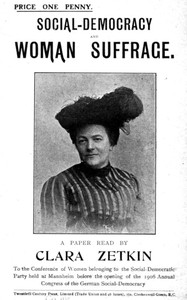
Social-Democracy and Woman Suffrage - A Paper Read by Clara Zetkin to the Conference of Women Belonging to the Social-Democratic Party Held at Mannheim, Before the Opening of the Annual Congress of the German Social-Democracy
by Zetkin, Klara
English
227h 17m read
Woman's Profession as Mother and Educator, with Views in Opposition to Woman Suffrage
by Beecher, Catharine Esther
English
746h 25m read
Suffrage snapshots
by Harper, Ida Husted
English
373h 9m read