The Project Gutenberg eBook of The Fantasy Fan, Volume 2, Number 4, December
1934, by Various
This eBook is for the use of anyone anywhere in the United States and
most other parts of the world at no cost and with almost no restrictions
whatsoever. You may copy it, give it away or re-use it under the terms
of the Project Gutenberg License included with this eBook or online at
www.gutenberg.org. If you are not located in the United States, you will
have to check the laws of the country where you are located before using
this eBook.
Title: The Fantasy Fan, Volume 2, Number 4, December 1934
The Fan's Own Magazine
Author: Various
Editor: Charles D. Hornig
Release Date: Mar 30, 2021 [eBook #64961]
Language: English
Produced by: Greg Weeks, Mary Meehan and the Online Distributed
Proofreading Team at http://www.pgdp.net
*** START OF THE PROJECT GUTENBERG EBOOK THE FANTASY FAN, VOLUME 2,
NUMBER 4, DECEMBER 1934 ***
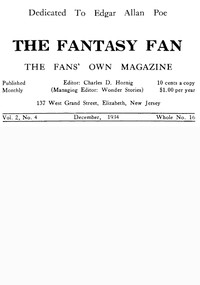
Dedicated To Edgar Allan Poe
THE FANTASY FAN
THE FANS' OWN MAGAZINE
Published
Monthly
Editor: Charles D. Hornig
(Managing Editor: Wonder Stories)
10 cents a copy
$1.00 per year
137 West Grand Street,
Elizabeth, New Jersey
Volume 2
December, 1934
Number 4
Whole No. 16
[Transcriber's Note: Extensive research did not uncover any
evidence that the U.S. copyright on this publication was renewed.]
NOTICE
Due to increased printing costs, we find it no longer possible to
continue our covers.
* * * * *
OUR READERS SAY
We hope that this issue will give you a better appreciation of that
father of the weird tale, Edgar Allan Poe. H. P. Lovecraft's article
brings out many points in the ability of this immortal which have never
been mentioned in his biographies.
"The issues have been consistently pleasing. The September had the
edge over the October number on account of variety."--Lester Anderson,
Hayward, Calif.
"I wish you to know that the idea of dedicating each issue is a very
fine one. I hope you can keep on giving us such fine material that has
never before seen print."--F. Lee Baldwin, Asotin, Wash.
"Oh--hurray and other such expletives! It just tickled me pink to find
some more of H. P. Lovecraft's works 'Fungi from Yuggoth,' 'Tis many a
long year I've been waiting to find more of them."--Gertrude Hemken,
Chicago, Ill.
"I am extremely glad to see the new TFF, which manages to hold much
of interest despite the space I use up. As I said before, I surely
appreciate the courtesy of the dedication. I shall be anxious to see
the coming Smith and Poe numbers."--H. P. Lovecraft, Providence, R. I.
"Congratulations on the new and greatly improved appearance of TFF. The
new cover adds its dignity."--Richard Ely Morse, Washington, D. C.
* * * * *
WEIRD WHISPERINGS
by Schwartz and Weisinger
_Horror Stories_, a companion weird magazine to _Terror Tales_, will
appear in the middle of December.... The Winford Publications' weird
magazine forecast in this column some months ago made its bow in
November under the title, _Mystery Novels Magazine, Weird! Strange!!
Unusual!!!_ To judge from the first issue there will appear a complete
book-length novel in each number, to be accompanied by three or four
weird-mystery yarns.... Edmond Hamilton deserts science fiction in
the February _Weird Tales_ for a crime story, called "Murder in the
Grave".... Clark Ashton Smith does a lot of drawing for his own
amusement, mostly heads of supernatural creatures. One very good one
shows an old man with an elephant's trunk for a nose, ending in the
head of a snake.
A strange and unusual twist to stories about radio will be given in
a new story by the author of "Vampires of the Moon," A. W. Bernal,
titled "The Man who was Two Men".... _Tales of Magic and Mystery_, a
short lived weird magazine, published a few yarns by Frank Owen, and an
exceptionally good H. P. Lovecraft story, "Cool Air".... An ingenious
tale of the distant future, dealing with mechanical companions and
synthetic love, written by Frank Belknap Long, Jr., and entitled "The
Body Masters," will be one of the highlights of the February WT.
For the past few years the Philip Allan & Co., Ltd., of London, has
been publishing a collection of weird tale books under the title, The
Creeps Series, a Collection of Uneasy Tales. Included in the series
so far are: "Powers of Darkness," "Panics," "Monsters," "Nightmares,"
"Mysteries of Asia," (by Achmed Abdullah), "Quakes," "Horrors,"
"Terrors," "Devil's Drums," "Veils of Fear," "The Strange Papers of Dr.
Blayre," and now in preparation, "Tales of the Grotesque." The books
contain about 12 stories, each of a distinctly weird nature by such
authors as Tod Robbins, Elliott O'Donnell, H. R. Wakefield, Douglas
Newton, and others. Every year, too, appears a "Not at Night" series,
edited by Christine Campbell Thomson, containing a collection of the
best weird stories published during the year, the majority being from
_Weird Tales_.
Paul Ernst's three part novel, "Rulers of the Future," relating what
the world will be like millions of years from now, and carrying the
heroes of the story thru the whole universe with the speed of light,
will be published starting with the January _Weird Tales_.... "The
Red Room," by H. G. Wells, is the most often plagiarized weird story,
according to Farnsworth Wright, and "The Damned Thing," by Bierce is
another plot often seized upon.... In the February _Weird_ will appear
the first of Seabury Quinn's new series dealing with Thomas Eldridge
Carter, investigator for the Grand Central Life Assurance Company,
called "The Web of Living Death."
* * * * *
SUPERNATURAL HORROR IN LITERATURE
by H. P. Lovecraft
(copyright 1927 by W. Paul Cook)
Part Fifteen
VII. Edgar Allan Poe
In the eighteen-thirties occurred a literary dawn directly affecting
not only the history of the weird tale, but that of short fiction as
a whole; and indirectly moulding the trends and fortunes of a great
European aesthetic school. It is our good fortune as Americans to be
able to claim that dawn as our own, for it came in the person of our
illustrious and unfortunate fellow-countryman Edgar Allan Poe. Poe's
fame has been subject to curious undulations, and it is now a fashion
amongst the "advanced intelligentsia" to minimise his importance both
as an artist and as an influence; but it would be hard for any mature
and reflective critic to deny the tremendous value of his work and the
pervasive potency of his mind as an opener of artistic vistas. True,
his type of outlook may have been anticipated; but it was he who first
realized its possibilities and gave it supreme form and systematic
expression. True also, that subsequent writers may have produced
greater single tales than his; but again we must comprehend that it
was only he who taught them by example and precept the art which they,
having the way cleared for them and given an explicit guide, were
perhaps able to carry to greater lengths. Whatever his limitations, Poe
did that which no one else ever did or could have done; and to him we
owe the modern-story in its final and perfected state.
Before Poe the bulk of weird writers had worked largely in the dark;
without an understanding of the psychological basis of the horror
appeal, and hampered by more or less of conformity to certain empty
literary conventions such as the happy ending, virtue rewarded, and in
general a hollow moral didacticism, acceptance of popular standards and
values, and striving of the author to obtrude his own emotions into the
story and take sides with the partisans of the majority's artificial
ideals. Poe, on the other hand, perceived the essential impersonality
of the real artist; and knew that the function of creative fiction
is merely to express and interpret events and sensations as they
are, regardless of how they tend or what they prove--good or evil,
attractive or repulsive, stimulating or depressing, with the author
always acting as a vivid and detached chronicler rather than as a
teacher, sympathiser, or vendor of opinion. He saw clearly that all
phases of life and thought are equally eligible as subject matter for
the artist, and being inclined by temperament to strangeness and gloom,
decided to be the interpreter of those powerful feelings and frequent
happenings which attend pain rather than pleasure, decay rather than
growth, terror rather than tranquility, and which are fundamentally
either adverse or indifferent to the tastes and traditional outward
sentiments of mankind, and to the health, sanity, and normal expansive
welfare of the species.
Poe's spectres thus acquired a convincing malignity possessed by none
of their predecessors, and established a new standard of realism in
the annals of literary horror. The impersonal and artistic intent,
moreover, was aided by a scientific attitude not often found before;
whereby Poe studied the human mind rather than the usages of Gothic
fiction, and worked with an analytical knowledge of terror's true
sources which doubled the force of his narratives and emancipated
him from all the absurdities inherent in merely conventional
shudder-coining. This example having been set, later authors were
naturally forced to conform to it in order to compete at all; so that
in this way a definite change began to affect the main stream of
macabre writing. Poe, too, set a fashion in consummate craftmanship;
and although today some of his own work seems slightly melodramatic
and unsophisticated, we can constantly trace his influence in such
things as the maintenance of a single mood and achievement of a single
impression in a tale, and the rigorous paring down of incidents to such
as have a direct bearing on the plot and will figure prominently in
the climax. Truly may it be said that Poe invented the short story in
its present form. His elevation of disease, perversity, and decay to
the level of artistically expressible themes was likewise infinitely
far-reaching in effect; for avidly seized, sponsored, and intensified
by his eminent French admirer Charles Pierre Baudelaire, it became the
nucleus of the principal aesthetic movements in France, thus making Poe
in a sense the father of the Decadents and the Symbolists.
Poet and critic by nature and supreme attainment, logician and
philosopher by taste and mannerism, Poe was by no means immune from
defects and affectations. His pretence to profound and obscure
scholarship, his blundering ventures in stilted and laboured
pseudo-humorous, and his often vitriolic outbursts of critical
prejudices must all be recognized and forgiven. Beyond and above them,
dwarfing them to insignificance, was a master's vision of the terror
that stalks about and within us, and the worm that writhes and slavers
in the hideously close abyss. Penetrating to every festering horror in
the gaily painted mockery called existence, that vision had power to
project itself in marvelous crystallisations and transmutations; till
there bloomed in the sterile America of the thirties and forties such a
moon-nourished garden of gorgeous poison fungi as not even the nether
slope of Saturn had known in the days of the unutterable blasphemies.
Verses and tales alike sustain the burden of cosmic panic. The raven
whose noisome beak pierces the heart, the ghouls that toll iron bells
in pestilential steeples, the vault of Ulalume in the black October
night, the shocking spires and cones under the sea, the "wild, weird
clime that lieth, sublime, out of Space--out of Time"--all these
things and more leer at us amidst maniacal rattlings in the seething
nightmare of the poetry. And in the prose there yawn open for us the
very jaws of the pit--inconceivable abnormalities slyly hinted into
a horrible half-knowledge by words whose innocence we scarcely doubt
till the cracked tension of the speaker's hollow voice bids us fear
their nameless implications; demoniac patterns and presences slumbering
noxiously till waked for one phobic instant into a shrieking revelation
that cackles itself to sudden madness or explodes in memorable and
cataclysmic echoes. A Witches' Sabbath of horror flinging off decorous
robes is flashed before us--a sight the more monstrous because of the
scientific skill with which every particular is marshalled and brought
into an easy apparent relation to the known gruesomeness of material
life.
Poe's tales, of course, fall into several classes; some of which
contain a purer essence of spiritual horror than others. The tales of
logic and ratiocination, forerunners of the modern detective story, are
not to be included at all in weird literature; whilst certain others,
probably influenced considerably by Hoffman, possess an extravagance
which relegates them to the borderline of the grotesque. Still a third
group deal with abnormal psychology and monomania in such a way as to
express terror but not weirdness. A substantial residuum, however,
represents the literature of supernatural horror in the acutest form;
and give their author a permanent and unassailable place as deity
and fountain-head of all modern diabolic fiction. Who can forget the
terrible swollen ship poised on the billow-chasm's edge in "Ms. Found
in a Bottle"--the dark intimations of her unhallowed age and monstrous
growth, her sinister crew of unseeing greybeards, and her frightful
southward rush under full sail thru the ice of the Antarctic night,
sucked onward by some resistless devil-current toward a vortex of
eldritch enlightenment which must end in destruction?
Then there is the unutterable "M. Valdemar," kept together by hypnotism
for seven months after his death, and uttering frantic sounds but a
moment before the breaking of the spell leaves him "a nearly liquid
mass of loathsome, of detestable putrescence." In the "Narrative of
A. Gordon Pym" the voyagers reach first a strange south polar land of
murderous savages where nothing is white and where vast rocky ravings
have the form of titanic Egyptian letters spelling terrible primal
arcana of earth; and thereafter a still more mysterious realm where
everything is white, and where shrouded giants and snowy-plumed birds
guard a cryptic cataract of mist which empties from immeasurable
celestial heights into a torrid milky sea. "Metzengerstein" horrifies
with its malign hints of a monstrous metempsychosis--the mad nobleman
who burns the stable of his hereditary foe; the colossal unknown horse
that issues from the blazing building after the owner has perished
therein; the vanishing bit of ancient tapestry where was shown the
giant horse of the victim's ancestor in the Crusade's; the madman's
wild and constant riding on the great horse, and his fear and hatred
of the steed; the meaningless prophecies that brood obscurely over the
warring houses; and finally, the burning of the madman's palace and
the death therein of the owner, borne helpless into the flames and
up the vast staircase astride the beast he has ridden so strangely.
Afterward the rising smoke of the ruins takes the form of a gigantic
horse. "The Man of the Crowd," telling of one who roams day and night
to mingle with streams of people as if afraid to be alone, has quieter
effects, but implies nothing less of cosmic fear. Poe's mind was
never far from terror and decay, and we see in every tale, poem, and
philosophical dialogue, a tense eagerness to fathom unplumbed wells of
night, to pierce the veil of death, and to reign in fancy as lord of
the frightful mysteries of time and space.
Certain of Poe's tales possess an almost absolute perfection of
artistic form which makes them veritable beacon-lights in the province
of the short story. Poe could, when he wished, give to his prose a
richly poetic cast; employing that archaic and Orientalised style with
jeweled phrase, quasi-Biblical repetition, and recurrent burthen so
successfully used by later writers like Oscar Wilde and Lord Dunsany;
and in the cases where he has done this we have an effect of lyrical
phantasy almost narcotic in essence--an opium pageant of dream in the
language of dream, with every unnatural colour and grotesque image
bodied forth in a symphony of corresponding sound. "The Masque of the
Red Death," "Silence, a Fable," and "Shadow, a Parable," are assuredly
poems in every sense of the word save the metrical one and owe as much
of their power to aural cadence as to visual imagery. But it is in two
of the less openly poetic tales, "Ligeia," and "The Fall of the House
of Usher,"--especially the latter--that one finds those very summits
of artistry whereby Poe takes his place at the head of fictional
miniaturists. Simple and straight-forward in plot, both of these tales
owe their supreme magic to the cunning development which appears in the
selection and collocation of every least incident. "Ligeia" tells of
a first wife of lofty and mysterious origin, who after death returns
through a preternatural force of will to take possession of the body of
a second wife; imposing even her physical appearance on the temporary
reanimated corpse of her victim at the last moment. Despite a suspicion
of prolixity and topheaviness, the narrative reaches its terrific
climax with relentless power. "Usher," whose superiority in detail
and proportion is very marked, hints shudderingly of obscure life in
inorganic things, and displays an abnormally linked trinity of entities
at the end of a long and isolated family history--a brother, his twin
sister, and their incredibly ancient house all sharing a single soul
and meeting one common dissolution at the same moment.
These bizarre conceptions, so awkward in unskillful hands, become under
Poe's spell living and convincing terrors to haunt our nights; and
all because the author understood so perfectly the very mechanics and
physiology of fear and strangeness--the essential details to emphasise,
the precise incongruities and conceits to select as preliminaries or
concomitants to horror, the exact incidents and allusions to throw
out innocently in advance as symbols or prefigurings of each major
step toward the hideous denouement to come, the nice adjustments of
cumulative force and the unerring accuracy in linkage of parts which
make for faultless unity throughout and thunderous effectiveness at the
climactic moment, the delicate nuances of scenic and landscape value to
select in establishing and sustaining the desired mood and vitalising
the desired illusion--principles of this kind, and dozens of obscurer
ones too elusive to be described or even fully comprehended by any
ordinary commentator. Melodrama and unsophistication there may be--we
are told of one fastidious Frenchman who could not bear to read Poe
except in Baudelaire's urbane and Gallically modulated translation--but
all traces of such things are wholly overshadowed by a potent and
inborn sense of the spectral, the morbid, and the horrible which gushed
forth from every cell of the artist's creative mentality and stamped
his macabre work with the ineffaceable mark of supreme genius. Poe's
weird tales are _alive_ in a manner that few others can ever hope to be.
Like most fantaisistes, Poe excels in incidents and broad narrative
effects rather than in character drawing. His typical protagonist is
generally a dark, handsome, proud, melancholy, intellectual, highly
sensitive, capricious, introspective, isolated, and sometimes slightly
mad gentleman of ancient family and opulent circumstances; usually
deeply learned in strange lore, and darkly ambitious of penetrating to
forbidden secrets of the universe. Aside from a high-sounding name,
this character obviously derives little from the early Gothic novel;
for he is clearly neither the wooden hero nor the diabolical villain
of Radcliffian or Ludovician romance. Indirectly, however, he does
possess a sort of genealogical connexion; since his gloomy, ambition
and anti-social qualities savour strongly of the typical Byronic
hero, who in turn is definitely an off-spring of the Gothic Manfreds,
Montonis, and Ambrosios. More particular qualities appear to be derived
from the psychology of Poe himself, who certainly possessed much of the
depression, sensitiveness, mad aspiration, loneliness, and extravagant
freakishness which he attributes to his haughty and solitary victims of
Fate.
(Part Sixteen next month deals with the eighth section of this article,
"The Weird Tradition in America," dealing mostly with Nathaniel
Hawthorne and his comparison with Poe. Don't miss it.)
* * * * *
THE FAVORITE WEIRD STORIES OF CLARK ASHTON SMITH
(Courtesy of H. Koenig)
"The Yellow Sign" by Chambers
"The House of Sounds" by Shiel
"The Willows" by Blackwood
"A View from a Hill" by James
"The Death of Halpin Frayser" by Bierce
"The House of Usher" by Poe
"The Masque of Red Death" by Poe
"The White Powder" by Machen
"The Call of Cthulhu" by Lovecraft
"The Colour out of Space"
* * * * *
WILLIAM HOPE HODGSON
by H. Koenig
A few years ago Faber and Faber published an anthology of ghost
stories chosen by Colin de la Mare under the title "They Walk Again."
Most of the stories included in this splendid anthology were by
well-known writers such as Blackwood, Dunsany, and Bierce and many of
the stories were familiar ones--"The Monkey's Paw," "Green Tea" and
"The Ghost Ship." However, one new story was included in the book; one
comparatively new face appeared among all the old familiar ones. The
story was "The Voice in the Night" a horrifying and yet pathetic tale
of human beings turned into a fungoid growth; the author is William
Hope Hodgson.
Except perhaps for a few of the older readers of weird stories, the
name of Hodgson will mean nothing, and yet twenty-five years ago
Hodgson wrote a number of books which compare very favorably with any
of our modern weird stories, books which rank high in the fantasy
field and which deserve more popularity and publicity than they ever
received. Five of his books should be read by all weird story lovers:
"The Boats of the Glen Carrig" 1907, "The House on the Borderland"
1908, "The Night Land" 1912, and "Carnacki, The Ghost Finder" 1913.
The first three books form (in Hodgson's words) "what perhaps may be
termed a trilogy; for though very different in scope, each of the
three books deals with certain conceptions that have an elemental
kinship." A few chapter headings will give some idea of the treat in
store for fantasy fans fortunate enough to locate these books--"The
Thing that Made Search," "The Island in the Weed," "The Noise in the
Valley," "The Weed Men," "The Thing in the Pit," "The Swing Things,"
etc.
"The Night Land" is one of the longest fantastic romances ever written,
running close to six hundred pages. It is a story of the world in the
future when the sun has died and the "Last Millions" are living in a
large redoubt, a huge pyramid of gray metal nearly eight miles high
and five miles around the base. Beyond the pyramid were mighty races
of terrible creatures, half-beast and half-man, night hounds monstrous
slugs, and other horrible monsters. As a protection against all these
evils a great electric circle was put about the pyramid and lit from
the Earth Current. It bounded the pyramid for a mile on each side and
none of the monsters were able to cross it due to a subtle vibration
which affected their brains.
"Carnacki, The Ghost Finder" is a series of six short ghost stories in
which Carnacki investigates ghostly phenomena in various homes. One or
two of the tales are somewhat weakened by a natural explanation of the
ghosts, but each of the stories is well worth reading.
Hodgson's tales may well have served as source books for many of the
stories now being read in our present day pulp magazines. The whole
range of weird and fantastic plots appears to have been covered in the
five books listed previously--pig-men, elementals, human trees, ghosts,
sea of weeds, thought-transference, intelligent slugs, and in "The
Night Land" the men are equipped with a hand weapon called a Diskos.
This consists of a disk of gray metal which spins in the end of a metal
rod, is charged from earth currents and capable of cutting people in
two.
Unfortunately, there is practically no bibliographical data concerning
Hodgson available. Even his old publishers are unable to supply
any information except a meager list of some of his books and the
regrettable fact that he was killed during the war.
* * * * *
The Sorcery of Aphlar
by Duane W. Rimel
The council of twelve seated on the jeweled celestial dais ordered that
Aphlar be cast from the gates of Bel-haz-en. He sat too much alone,
they decreed, and brooded when toil should have been his lot. And
in his obscure and hidden delvings he read all too frequently those
papyri of Elder æons which reposed in the Gothic shrine and were to be
consulted only for rare and special purposes.
The twilight city of Bel-haz-en had climbed backward in its knowledge.
No longer did philosophers sit upon street corners speaking wise words
to the populace, for stupid ignorance ruled within the crumbling
and immemorially ancient walls. Where once the wisdom of the stars
abounded, only feebleness and desolation now lay upon the place;
spreading like a monstrous blight and sucking foul nurture from the
stupid dwellers. And out of the waters of the Oll that meandered from
the mountains of Azlakka to pass by the aged city, there rose often
great clouds of pestilence that racked the people sorely, leaving them
pale and near to dying. All this their loss of wisdom brought. And now
the council had sent their last and greatest wise man from them.
Aphlar wandered to the mountains far above the city and built a cavern
for protection from the summer heat and winter chill. There he read his
scrolls in silence and his mighty wisdom to the wind about the crags
and to the swallows on the wing. All day he sat and watched below or
drew queer drawings on small bits of stone and chanted to them, for he
knew that some day men would seek the cave and slay him. The cunning
of the twelve did not mislead him. Had not the last exiled wiseman's
screams rent the night two moon-rounds before when people thought him
safely gone?
Had not his own eyes seen the priest's sword-slashed form floating by
in the poison waters? He knew no lion had killed old Azik, let the
council say what they might. Does a lion slash with a sword and leave
his prey uneaten?
Through many seasons Aphlar sat upon the mountain, gazing at the muddy
Oll as it wound into the misty distance to the land where none ever
ventured. He spoke his words of wisdom to the snails that worked in the
ground by his feet. They seemed to understand, and waved their slimy
feelers before they sank beneath the sand again. On moonlight nights
he climbed the hill above his cave and made strange offerings to the
moon-God Alo; and when the night-birds heard the sound they drew close
and listened to the whispering. And when queer winged things flapped
across the darkened sky and loomed up dimly against the moon Aphlar was
content. Those which he had addressed had heeded his beckoning. His
thoughts were always far away, and his prayers were offered to the pale
fancies of dusk.
Then one day past noontide Aphlar rose from his earthen chair and
strode down the rock mountain-side. His eyes, heeding not the rotten,
stone-walled city, held steadfastly to the river. When he drew near
its muddy brink he paused and looked up the bosom of the stream. A
small object floated near the rushes, and this Aphlar rescued with
tender and curious care. Then, wrapping the thing in the folds of his
robe, he climbed up again to his cave in the hills. All day he sat and
gazed upon the object; rummaging now and then in his musty chronicles,
and muttering awful syllables as he drew faint figures on a piece of
parchment.
That night the gibbous moon rose high, but Aphlar did not climb above
his dwelling. Queer night-birds flew past the cavern's mouth, chirped
eerily, and fled away into the shadows.
Many days passed before the council sent their messengers of murder;
but at last the time was thought ripe, and seven dark-browned men
stole away to the hills. Yet when that grim seven ventured within the
cave they saw not the wise man Aphlar. Instead, small blades of grass
were sprouting in his natural chair of earth. All about lay papyri dim
and musty, with faint figures drawn upon them. The seven shuddered
and left forthwith when they beheld these things, but as the last man
tremblingly withdrew he saw a round and unknown thing lying on the
ground. He picked it up, and his fellows drew close in curiosity; but
they saw upon it only alien symbols which they could not read, yet
which made them shrink and quaver without knowing why. Then he who
had found it cast it quickly over the steep precipice beside him, but
no sound came from the slope below whereon it should have fallen. And
the thrower trembled, fearing many things that are not known but only
whispered about. Then, when he told how the sphere he had held was
without the weight a thing of stone should have; how it was like to
have floated on air as the thistledown floats; he and the six with him
slunk as one from the spot and swore it was a place accursed.
But after they had gone a snail crawled slowly from a sandy crevice and
slid intently over to where the blades of grass were growing. And when
it reached the spot, two slimy feelers stretched forth and bent oddly
downward, as if eager to watch forever the winding river.
The End
* * * * *
Subscribe to
THE FANTASY FAN
only a dollar a year
Insure yourself of your copy;
only a limited number are printed
and the supply does not last long.
Tell Your Friends About TFF
Help to increase our circulation.
* * * * *
PROSE PASTELS
by Clark Ashton Smith
_5. The Passing of Aphrodite_
In all the lands of Illarion, from mountain-valleys rimmed with
unmelting snow, to the great cliffs of sand whose reflex darkens a
sleepy, tepid sea, were lit as of old the green and amethyst fires
of summer. Spices were on the wind that mountaineers had met in the
high glaciers; and the eldest wood of cypress, frowning on a sky-clear
bay, was illumined by scarlet orchids.... But the heart of the poet
Phaniol was an urn of black jade overfraught by love with sodden ashes.
And because he wished to forget for a time the mockery of myrtles,
Phaniol walked alone in the waste bordering upon Illarion; in a place
that great fires had blackened long ago, and which knew not the pine
or the violet, the cypress or the myrtle. There, as the day grew old,
he came to an unsailed ocean, whose waters were dark and still under
the falling sun, and bore not the memorial voices of other seas. And
Phaniol paused, and lingered upon the ashen shore; and dreamt awhile of
that sea whose name is Oblivion.
Then, from beneath the westering sun, whose bleak light was prone on
his forehead, a barge appeared and swiftly drew to the land: albeit
there was no wind, and the oars hung idly on the foamless wave. And
Phaniol saw that the barge was wrought of ebony fretted with curious
anaglyphs, and carved with luxurious forms of gods and beasts, of
satyrs and goddesses and women; and the figurehead was a black Eros
with full unsmiling mouth and implacable sapphire eyes averted, as if
intent upon things not lightly to be named or revealed. Upon the deck
of the barge were two women, one pale as the northern moon, and the
other swart as equatorial midnight. But both were clad imperially, and
bore the mien of goddesses or of those who dwell near to the goddesses,
without word or gesture, they regarded Phaniol; and, marvelling, he
inquired, "What seek ye?"
Then, with one voice that was like the voice of hesperian airs among
palms at evening twilight in the Fortunate Isles, they answered, saying:
"We wait the goddess Aphrodite, who departs in weariness and sorrow
from Illarion, and from all the lands of this world of petty loves and
pettier mortalities. Thou, because thou art a poet, and hast known the
great sovereignty of love, shall behold her departure. But they, the
men of the court, the market-place and the temple, shall receive no
message nor sign of her going-forth, and will scarcely dream that she
is gone.... Now, O Phaniol, the time, the goddess and the going-forth
are at hand."
Even as they ceased, One came across the desert; and her coming was
a light on the far hills; and where she trod the lengthening shadows
shrunk, and the grey waste put on the purple asphodels and the deep
verdure it had worn when those queens were young, that now are a
darkening legend and a dust of mummia. Even to the shore she came and
stood before Phaniol, while the sunset greatened, filling sky and
sea with a flush as of new-blown blossoms, or the inmost rose of that
coiling shell which was consecrate to her in old time. Without robe or
circlet or garland, crowned and clad only with the sunset, fair with
the dreams of man but fairer yet than all dreams: thus she waited,
smiling tranquilly, who is life or death, despair or rapture, vision or
flesh, to gods and poets and galaxies unknowable. But, filled with a
wonder that was also love, or much more than love, the poet could find
no greeting.
"Farewell, O Phaniol," she said, and her voice was the sighing of
remote waters, the murmur of waters moon-withdrawn, forsaking not
without sorrow a proud island tall with palms. "Thou hast known me
and worshipped all thy days till now, but the hour of my departure is
come: I go, and when I am gone, thou shalt worship still and shalt
not know me. For the destinies are thus, and not forever to any man,
to any world or to any god, is it given to possess me wholly. Autumn
and spring will return when I am past, the one with yellow leaves, the
other with yellow violets; birds will haunt the renewing myrtles; and
many little loves will be thine. Not again to thee or to any man will
return the perfect vision and the perfect flesh of the goddess."
Ending thus, she stepped from that ashen strand to the dark prow of the
barge; and even as it had come, without wafture of wind or movement of
oar, the barge put out on a sea covered with the fallen, fading petals
of sunset. Quickly it vanished from view, while the desert lost those
ancient asphodels and the deep verdure it had worn again for a little.
Darkness, having conquered Illarion, came slow and furtive on the path
of Aphrodite; shadows mustered innumerably to the grey hills; and the
heart of the poet Phaniol was an urn of black jade overfraught by love
with sodden ashes.
* * * * *
AN INTERVIEW WITH E. HOFFMANN PRICE
by Fred Anger & Louis C. Smith
Author, linguist, world-traveller, automobile mechanic and cook--that,
fantasy fans, is a fairly representative picture of E. Hoffmann Price!
The Syrian quarters of Chicago and New York and the Old French Quarter
of New Orleans are no strange places to this prolific author of weird
stories and detective yarns; he is equally at home in the Philippines
and in certain little-known sections of France. He is--but wait!--let's
go about this in an orderly manner.
Contrary to popular belief, E. Hoffmann Price did _not_ have his first
story published in Weird Tales; his first was sold to "Droll Stories,"
and brought him the magnificent sum of twenty-four dollars (he chuckles
over it now). His first story in Weird Tales was "The Rajah's Gift"
which appeared in January 1925; and from this time on, until his job
as manager of an acetylene plant petered out, Price wrote exclusively
for Weird Tales and Oriental Stories. Since the spring of 1932 he has
devoted all his time to fictioneering.
"The Sultan's Jest" his third story in the "Unique Magazine" was later
reprinted in "The Sovereign Magazine" published in London.
"The Lord of the Fourth Axis," in Weird Tales last year was revised
three times before Farnsworth Wright accepted it. The strange, unique
design for the rug which played so prominent part in this latter tale
was suggested by a Turkestan prayer rug of unusual shape now hanging in
the Chicago home of Editor Wright.
The locale of the Pierre d'Artois stories is authentic: there is the
city of Bayonne, France, and there Price lived for some time, visiting
the underground chambers, soaking in the atmosphere of the place.
Also in France, he visited the city of Lourdes where he obtained from
several old legends, material for "Tarbis of the Lake."
To "Strange Detective Stories" Price sold one of the Pierre d'Artois
stories, which he considers the wildest story he has ever written.
Material for "The Prophet's Grand-children" (W. T. October 1925) was
picked up in the Philippines.
Having sold every story in which a peacock was mentioned, Price quite
naturally considers this beautiful bird the best of good luck emblems.
But enough for the writings of E. Hoffmann Price! For the man himself:
His favorite smoke is the _nargileh_ or water pipe; though on
occasions he does relish a cigar or a cigarette rolled from Bull
Durham tobacco.
He speaks German, mangles French and Spanish, and gargles a smattering
of Arabic.
While in Oklahoma this spring, he salvaged sheet metal from an
abandoned smokestack--welded the pieces together to make an automatic
feed acetylene generator for a friend who owned a repair shop.
He lived several years in "Le Vieux Carre"--that's creole for "Old
French Quarter"--of New Orleans, which accounts for his frequent use
of Crescent City atmosphere. He has been in the Philippines, Japan,
Hawaii, Mexico, has covered France from end to end, and is at home in
most parts of the States.
Favorite dishes: Chili con Carne, East Indian Curry, and on state
occasions, a capon stuffed with pistachios and basted with sherry
until, when completely roasted, the fowl is coated with a high glaze
of deep walnut color: the result being called "Varnished Vulture" by
the crew of fictioneers who make Weird Tales Editorial Rooms their
headquarters. And a close second to the foregoing is turtle stew,
prepared according to an old Creole recipe.
And, there, in a fragmentary, woefully incomplete way, you have E.
Hoffmann Price: swell spinner of tall yarns, linguist, mechanic, cook
par excellence--and in general a hell of a good fellow.
Selah!
* * * * *
The Laughter of a Ghoul
by Robert Bloch
Have you ever heard the laughter of a ghoul? Shrill and high, it
rises and ululates with the cadence of a song from the Pit. Hearing
it brings the soul closer to strange terrors and gives the listener
vague glimpses into half-opened door-ways thru which no man should peer
too closely. Once I heard that mocking laughter in the silence of the
night, and since that evil-fated day the night has held neither silence
nor surcease from the haunting memory of that mirth or madness. Ever it
lurks and lingers in the shadows of my brain, till only thru expression
of my torment can I hope to maintain my sanity in a world made hideous
by the Nemesis of inescapable memory.
In all the Rood-mass realms of Nightmare, there is nothing equalling in
foulness that grim and fearful monster known to legend as the Ghoul.
Accursed is he, and accursed the land burdened by his presence. In such
a land I dwelt, lord of an ancient, remote line.
Slithering secrets dwelt within the archaic avenues of the vast and
sombre forest near my manor in the hills--secrets black and hideous,
haunting and unspeakable, such as demonian presences mumble nightly in
the aeon-dead abysses beyond the light of stars. Here in this forlorn
realm of trickling tarns and baleful solitude my newly-wedded and
beloved bride chanced one day to wander, as in rustic holiday. All
unbeknowning, I spent the day in town, returning only as even-tide drew
near. But she, my beloved, did not return, even with the coming of
darkness.
Then it was that the frightened servants who met me at the gate babbled
that which sent me racing off, torch in hand, into the depths of the
dream-wood looming so loathesomely in the unholy luminance of the
autumn moon. Shrieking and cursing I went on, gibbering threats to the
skies; but more dreadful still was my silence when at last I reached
the end of my quest. Do not ask me how or where I found her. She was
not dead, but she would have been better so after what It had done. She
never spoke after I found her, and I do not think that she knew me. I
pray that she did not. I carried her back to the manor and delivered
her to the care of the servants. Then, with a score of retainers I
returned again to the forest to do that which must be done, and to
eradicate certain discoveries whose very existence was an insult to
sanity. There were bloated trees to cut down, and creepers to be torn
from the depths of nameless graves. There were curious holes to be
blocked with massive stones and certain tracks and monstrous footprints
over which the good curé must pronounce exorcism. There was another
shrub-hidden cavern in the swamps containing grisly but unmistakable
evidences of tenancy. One such place I entered alone and performed a
deed with the long sword my grand-sire had wielded in the Orient. Then
I collapsed, and was carried home upon a hastily-improvised litter of
birchen branches, to toss for many weeks thereafter in the delirious
agony of mocking, cacodemoniacal memory.
After that I spent many days poring unceasingly over disquieting bits
of ancient legendry concerning the forest and its ghastly presences,
whilst awaiting the birth of my wife's child--for she, in a condition
of unsensibility precluding her removal from the manor, was about to
become a mother. And so slowly passed the dreary months of waiting and
expectancy, whilst over all hung the shadow of an impinging dread.
At last the day arrived when, as I brooded in my study, poring over the
chronicle of a woodsman who had heard the pipes of Pan, the mid-wife
came and gently touched me on the shoulder. In faltering accents she
whispered that my wife was dead. I sat there dully for five endless
minutes; then in a voice sepulchrally muted, I asked after my child.
She led me silently into the room where dead mother and living infant
lay.
Yes, the child was alive, still is alive, but I will say no more. May
the Ultimate Powers consign it--and the Fate that produced it--to
everlasting torment! For it was when I entered that room where the dead
mother and the living infant lay that I heard for the first time The
LAUGHTER OF A GHOUL!
The End
* * * * *
LOST EXCERPTS
by Robert Nelson
_II. The Feast of the Centaurs_
The enormous chamber was aflare with a myriad lamps. There were long
tables covered with seemingly endless varieties of meats, wines,
cheeses, birds, and other viands and edibles. Drunken centaurs carried
other intoxicated centaurs across the tables trampling everything
that came their way, causing both wrath and mirth to others. Wine was
spilled heavily all about; and centaurs fell and grappled with one
another on the lubricious earth. Two there were who fought for the
possession of a fried grasshopper; and three belabored each other's
heads with weighty stools. Some threw great platters of food from the
tables and demanded more wine. And the exhalation that arose from the
food and creatures became heavier; and the rejoicing and the swearing
and debating of tongues increased.
There were huge mirrors of multiplied convexity in the vast room and
these seemed to enhance and sharpen the ebbing and flowing luminosity
from the immense wax lights and bright vases. The mirrors caused much
confusion among the inebriated and over-gorged creatures, for they
crashed and careened with one another against the mirrors and cut
themselves, and laughed and cursed at their own grotesque and misshapen
likenesses.
* * * * *
SEABURY QUINN
A Brief Note
While it is not generally known to his readers, many of whom believe
him to be a physician, Seabury Quinn, author of the Jules de Grandin
stories which have been popular with the readers of Weird Tales for
ten years, holds the degrees of Bachelor and Master of Laws, being
graduated from the National University Law School, Washington, D. C.,
in 1910. From 1910 until his entry into the U. S. Army at the outbreak
of the World War (Second Lieutenant, Infantry attached Intelligence
Service) he practised law in the National Capital, specializing in
criminal and personal injury cases, in which he acted principally as
medico-legal consultant to other attorneys.
* * * * *
ADVERTISEMENTS
Rates: one cent per word
Minimum Charge, 25 cents
Back Numbers of _The Fantasy Fan_: September, 1933, out of print; Oct.,
Dec., 1933--Jan., Feb., Mar., May, June, Aug., Sept., Oct., 1934, 10
cents each. Nov., 1933--Apr., July, 1934, 20 cents each.
* * * * *
CLARK ASHTON SMITH presents THE DOUBLE SHADOW AND OTHER FANTASIES--a
booklet containing a half-dozen imaginative and atmospheric
tales--stories of exotic beauty, horror, terror, strangeness, irony and
satire. Price: 25 cents each (coin or stamps). Also a small remainder
of EBONY AND CRYSTAL--a book of prose-poems published at $2.00, reduced
to $1.00 per copy. Everything sent postpaid. Clark Ashton Smith,
Auburn, California.
* * * * *
A. MERRITT'S New Fantasyarn, "The Drone," Donald Wandrei's short
weirdthriller, "The Chuckler," Francis Flagg's glamorous "Moon
Voyager's Speech," "The Horde of Elo Hava," by L. A. Eshbach. All for
10 cents! SFDCOff, 87-36--162nd Street, Jamaica, N. Y.
* * * * *
WANTED: Announcement circulars of _Unusual Stories_; September 1933
_Fantasy Fan_. 50 Cents each. S-F Syndicate, 509 West 26th St., Austin,
Texas.
* * * * *
A CHRISTMAS GIFT! Why not give your fantasy-loving friends something
for Christmas that they will long remember? Give them a subscription to
THE FANTASY FAN! They will think of you as they receive their copies
each month of the year.
*** END OF THE PROJECT GUTENBERG EBOOK THE FANTASY FAN, VOLUME 2, NUMBER
4, DECEMBER 1934 ***
Updated editions will replace the previous one--the old editions will
be renamed.
Creating the works from print editions not protected by U.S. copyright
law means that no one owns a United States copyright in these works, so
the Foundation (and you!) can copy and distribute it in the United
States without permission and without paying copyright royalties.
Special rules, set forth in the General Terms of Use part of this
license, apply to copying and distributing Project Gutenberg-tm
electronic works to protect the PROJECT GUTENBERG-tm concept and
trademark. Project Gutenberg is a registered trademark, and may not be
used if you charge for an eBook, except by following the terms of the
trademark license, including paying royalties for use of the Project
Gutenberg trademark. If you do not charge anything for copies of this
eBook, complying with the trademark license is very easy. You may use
this eBook for nearly any purpose such as creation of derivative works,
reports, performances and research. Project Gutenberg eBooks may be
modified and printed and given away--you may do practically ANYTHING in
the United States with eBooks not protected by U.S. copyright law.
Redistribution is subject to the trademark license, especially
commercial redistribution.
START: FULL LICENSE
THE FULL PROJECT GUTENBERG LICENSE
PLEASE READ THIS BEFORE YOU DISTRIBUTE OR USE THIS WORK
To protect the Project Gutenberg-tm mission of promoting the free
distribution of electronic works, by using or distributing this work (or
any other work associated in any way with the phrase "Project
Gutenberg"), you agree to comply with all the terms of the Full Project
Gutenberg-tm License available with this file or online at
www.gutenberg.org/license.
Section 1. General Terms of Use and Redistributing Project
Gutenberg-tm electronic works
1.A. By reading or using any part of this Project Gutenberg-tm
electronic work, you indicate that you have read, understand, agree to
and accept all the terms of this license and intellectual property
(trademark/copyright) agreement. If you do not agree to abide by all the
terms of this agreement, you must cease using and return or destroy all
copies of Project Gutenberg-tm electronic works in your possession. If
you paid a fee for obtaining a copy of or access to a Project
Gutenberg-tm electronic work and you do not agree to be bound by the
terms of this agreement, you may obtain a refund from the person or
entity to whom you paid the fee as set forth in paragraph 1.E.8.
1.B. "Project Gutenberg" is a registered trademark. It may only be used
on or associated in any way with an electronic work by people who agree
to be bound by the terms of this agreement. There are a few things that
you can do with most Project Gutenberg-tm electronic works even without
complying with the full terms of this agreement. See paragraph 1.C
below. There are a lot of things you can do with Project Gutenberg-tm
electronic works if you follow the terms of this agreement and help
preserve free future access to Project Gutenberg-tm electronic works.
See paragraph 1.E below.
1.C. The Project Gutenberg Literary Archive Foundation ("the Foundation"
or PGLAF), owns a compilation copyright in the collection of Project
Gutenberg-tm electronic works. Nearly all the individual works in the
collection are in the public domain in the United States. If an
individual work is unprotected by copyright law in the United States and
you are located in the United States, we do not claim a right to prevent
you from copying, distributing, performing, displaying or creating
derivative works based on the work as long as all references to Project
Gutenberg are removed. Of course, we hope that you will support the
Project Gutenberg-tm mission of promoting free access to electronic
works by freely sharing Project Gutenberg-tm works in compliance with
the terms of this agreement for keeping the Project Gutenberg-tm name
associated with the work. You can easily comply with the terms of this
agreement by keeping this work in the same format with its attached full
Project Gutenberg-tm License when you share it without charge with
others.
1.D. The copyright laws of the place where you are located also govern
what you can do with this work. Copyright laws in most countries are in
a constant state of change. If you are outside the United States, check
the laws of your country in addition to the terms of this agreement
before downloading, copying, displaying, performing, distributing or
creating derivative works based on this work or any other Project
Gutenberg-tm work. The Foundation makes no representations concerning
the copyright status of any work in any country other than the United
States.
1.E. Unless you have removed all references to Project Gutenberg:
1.E.1. The following sentence, with active links to, or other immediate
access to, the full Project Gutenberg-tm License must appear prominently
whenever any copy of a Project Gutenberg-tm work (any work on which the
phrase "Project Gutenberg" appears, or with which the phrase "Project
Gutenberg" is associated) is accessed, displayed, performed, viewed,
copied or distributed:
This eBook is for the use of anyone anywhere in the United States
and most other parts of the world at no cost and with almost no
restrictions whatsoever. You may copy it, give it away or re-use it
under the terms of the Project Gutenberg License included with this
eBook or online at www.gutenberg.org. If you are not located in the
United States, you will have to check the laws of the country where
you are located before using this eBook.
1.E.2. If an individual Project Gutenberg-tm electronic work is derived
from texts not protected by U.S. copyright law (does not contain a
notice indicating that it is posted with permission of the copyright
holder), the work can be copied and distributed to anyone in the United
States without paying any fees or charges. If you are redistributing or
providing access to a work with the phrase "Project Gutenberg"
associated with or appearing on the work, you must comply either with
the requirements of paragraphs 1.E.1 through 1.E.7 or obtain permission
for the use of the work and the Project Gutenberg-tm trademark as set
forth in paragraphs 1.E.8 or 1.E.9.
1.E.3. If an individual Project Gutenberg-tm electronic work is posted
with the permission of the copyright holder, your use and distribution
must comply with both paragraphs 1.E.1 through 1.E.7 and any additional
terms imposed by the copyright holder. Additional terms will be linked
to the Project Gutenberg-tm License for all works posted with the
permission of the copyright holder found at the beginning of this work.
1.E.4. Do not unlink or detach or remove the full Project Gutenberg-tm
License terms from this work, or any files containing a part of this
work or any other work associated with Project Gutenberg-tm.
1.E.5. Do not copy, display, perform, distribute or redistribute this
electronic work, or any part of this electronic work, without
prominently displaying the sentence set forth in paragraph 1.E.1 with
active links or immediate access to the full terms of the Project
Gutenberg-tm License.
1.E.6. You may convert to and distribute this work in any binary,
compressed, marked up, nonproprietary or proprietary form, including any
word processing or hypertext form. However, if you provide access to or
distribute copies of a Project Gutenberg-tm work in a format other than
"Plain Vanilla ASCII" or other format used in the official version
posted on the official Project Gutenberg-tm website (www.gutenberg.org),
you must, at no additional cost, fee or expense to the user, provide a
copy, a means of exporting a copy, or a means of obtaining a copy upon
request, of the work in its original "Plain Vanilla ASCII" or other
form. Any alternate format must include the full Project Gutenberg-tm
License as specified in paragraph 1.E.1.
1.E.7. Do not charge a fee for access to, viewing, displaying,
performing, copying or distributing any Project Gutenberg-tm works
unless you comply with paragraph 1.E.8 or 1.E.9.
1.E.8. You may charge a reasonable fee for copies of or providing access
to or distributing Project Gutenberg-tm electronic works provided that:
* You pay a royalty fee of 20% of the gross profits you derive from the
use of Project Gutenberg-tm works calculated using the method you
already use to calculate your applicable taxes. The fee is owed to the
owner of the Project Gutenberg-tm trademark, but he has agreed to donate
royalties under this paragraph to the Project Gutenberg Literary Archive
Foundation. Royalty payments must be paid within 60 days following each
date on which you prepare (or are legally required to prepare) your
periodic tax returns. Royalty payments should be clearly marked as such
and sent to the Project Gutenberg Literary Archive Foundation at the
address specified in Section 4, "Information about donations to the
Project Gutenberg Literary Archive Foundation."
* You provide a full refund of any money paid by a user who notifies you
in writing (or by e-mail) within 30 days of receipt that s/he does not
agree to the terms of the full Project Gutenberg-tm License. You must
require such a user to return or destroy all copies of the works
possessed in a physical medium and discontinue all use of and all access
to other copies of Project Gutenberg-tm works.
* You provide, in accordance with paragraph 1.F.3, a full refund of any
money paid for a work or a replacement copy, if a defect in the
electronic work is discovered and reported to you within 90 days of
receipt of the work.
* You comply with all other terms of this agreement for free
distribution of Project Gutenberg-tm works.
1.E.9. If you wish to charge a fee or distribute a Project Gutenberg-tm
electronic work or group of works on different terms than are set forth
in this agreement, you must obtain permission in writing from the
Project Gutenberg Literary Archive Foundation, the manager of the
Project Gutenberg-tm trademark. Contact the Foundation as set forth in
Section 3 below.
1.F.
1.F.1. Project Gutenberg volunteers and employees expend considerable
effort to identify, do copyright research on, transcribe and proofread
works not protected by U.S. copyright law in creating the Project
Gutenberg-tm collection. Despite these efforts, Project Gutenberg-tm
electronic works, and the medium on which they may be stored, may
contain "Defects," such as, but not limited to, incomplete, inaccurate
or corrupt data, transcription errors, a copyright or other intellectual
property infringement, a defective or damaged disk or other medium, a
computer virus, or computer codes that damage or cannot be read by your
equipment.
1.F.2. LIMITED WARRANTY, DISCLAIMER OF DAMAGES - Except for the "Right
of Replacement or Refund" described in paragraph 1.F.3, the Project
Gutenberg Literary Archive Foundation, the owner of the Project
Gutenberg-tm trademark, and any other party distributing a Project
Gutenberg-tm electronic work under this agreement, disclaim all
liability to you for damages, costs and expenses, including legal fees.
YOU AGREE THAT YOU HAVE NO REMEDIES FOR NEGLIGENCE, STRICT LIABILITY,
BREACH OF WARRANTY OR BREACH OF CONTRACT EXCEPT THOSE PROVIDED IN
PARAGRAPH 1.F.3. YOU AGREE THAT THE FOUNDATION, THE TRADEMARK OWNER, AND
ANY DISTRIBUTOR UNDER THIS AGREEMENT WILL NOT BE LIABLE TO YOU FOR
ACTUAL, DIRECT, INDIRECT, CONSEQUENTIAL, PUNITIVE OR INCIDENTAL DAMAGES
EVEN IF YOU GIVE NOTICE OF THE POSSIBILITY OF SUCH DAMAGE.
1.F.3. LIMITED RIGHT OF REPLACEMENT OR REFUND - If you discover a defect
in this electronic work within 90 days of receiving it, you can receive
a refund of the money (if any) you paid for it by sending a written
explanation to the person you received the work from. If you received
the work on a physical medium, you must return the medium with your
written explanation. The person or entity that provided you with the
defective work may elect to provide a replacement copy in lieu of a
refund. If you received the work electronically, the person or entity
providing it to you may choose to give you a second opportunity to
receive the work electronically in lieu of a refund. If the second copy
is also defective, you may demand a refund in writing without further
opportunities to fix the problem.
1.F.4. Except for the limited right of replacement or refund set forth
in paragraph 1.F.3, this work is provided to you 'AS-IS', WITH NO OTHER
WARRANTIES OF ANY KIND, EXPRESS OR IMPLIED, INCLUDING BUT NOT LIMITED TO
WARRANTIES OF MERCHANTABILITY OR FITNESS FOR ANY PURPOSE.
1.F.5. Some states do not allow disclaimers of certain implied
warranties or the exclusion or limitation of certain types of damages.
If any disclaimer or limitation set forth in this agreement violates the
law of the state applicable to this agreement, the agreement shall be
interpreted to make the maximum disclaimer or limitation permitted by
the applicable state law. The invalidity or unenforceability of any
provision of this agreement shall not void the remaining provisions.
1.F.6. INDEMNITY - You agree to indemnify and hold the Foundation, the
trademark owner, any agent or employee of the Foundation, anyone
providing copies of Project Gutenberg-tm electronic works in accordance
with this agreement, and any volunteers associated with the production,
promotion and distribution of Project Gutenberg-tm electronic works,
harmless from all liability, costs and expenses, including legal fees,
that arise directly or indirectly from any of the following which you do
or cause to occur: (a) distribution of this or any Project Gutenberg-tm
work, (b) alteration, modification, or additions or deletions to any
Project Gutenberg-tm work, and (c) any Defect you cause.
Section 2. Information about the Mission of Project Gutenberg-tm
Project Gutenberg-tm is synonymous with the free distribution of
electronic works in formats readable by the widest variety of computers
including obsolete, old, middle-aged and new computers. It exists
because of the efforts of hundreds of volunteers and donations from
people in all walks of life.
Volunteers and financial support to provide volunteers with the
assistance they need are critical to reaching Project Gutenberg-tm's
goals and ensuring that the Project Gutenberg-tm collection will remain
freely available for generations to come. In 2001, the Project Gutenberg
Literary Archive Foundation was created to provide a secure and
permanent future for Project Gutenberg-tm and future generations. To
learn more about the Project Gutenberg Literary Archive Foundation and
how your efforts and donations can help, see Sections 3 and 4 and the
Foundation information page at www.gutenberg.org
Section 3. Information about the Project Gutenberg Literary
Archive Foundation
The Project Gutenberg Literary Archive Foundation is a non-profit
501(c)(3) educational corporation organized under the laws of the state
of Mississippi and granted tax exempt status by the Internal Revenue
Service. The Foundation's EIN or federal tax identification number is
64-6221541. Contributions to the Project Gutenberg Literary Archive
Foundation are tax deductible to the full extent permitted by U.S.
federal laws and your state's laws.
The Foundation's business office is located at 809 North 1500 West, Salt
Lake City, UT 84116, (801) 596-1887. Email contact links and up to date
contact information can be found at the Foundation's website and
official page at www.gutenberg.org/contact
Section 4. Information about Donations to the Project Gutenberg
Literary Archive Foundation
Project Gutenberg-tm depends upon and cannot survive without widespread
public support and donations to carry out its mission of increasing the
number of public domain and licensed works that can be freely
distributed in machine-readable form accessible by the widest array of
equipment including outdated equipment. Many small donations ($1 to
$5,000) are particularly important to maintaining tax exempt status with
the IRS.
The Foundation is committed to complying with the laws regulating
charities and charitable donations in all 50 states of the United
States. Compliance requirements are not uniform and it takes a
considerable effort, much paperwork and many fees to meet and keep up
with these requirements. We do not solicit donations in locations where
we have not received written confirmation of compliance. To SEND
DONATIONS or determine the status of compliance for any particular state
visit www.gutenberg.org/donate
While we cannot and do not solicit contributions from states where we
have not met the solicitation requirements, we know of no prohibition
against accepting unsolicited donations from donors in such states who
approach us with offers to donate.
International donations are gratefully accepted, but we cannot make any
statements concerning tax treatment of donations received from outside
the United States. U.S. laws alone swamp our small staff.
Please check the Project Gutenberg web pages for current donation
methods and addresses. Donations are accepted in a number of other
ways including checks, online payments and credit card donations. To
donate, please visit: www.gutenberg.org/donate
Section 5. General Information About Project Gutenberg-tm electronic works
Professor Michael S. Hart was the originator of the Project Gutenberg-tm
concept of a library of electronic works that could be freely shared with
anyone. For forty years, he produced and distributed Project Gutenberg-tm
eBooks with only a loose network of volunteer support.
Project Gutenberg-tm eBooks are often created from several printed
editions, all of which are confirmed as not protected by copyright in
the U.S. unless a copyright notice is included. Thus, we do not
necessarily keep eBooks in compliance with any particular paper edition.
Most people start at our website which has the main PG search
facility: www.gutenberg.org
This website includes information about Project Gutenberg-tm, including
how to make donations to the Project Gutenberg Literary Archive
Foundation, how to help produce our new eBooks, and how to subscribe to
our email newsletter to hear about new eBooks.
Excerpt
The Project Gutenberg eBook of The Fantasy Fan, Volume 2, Number 4, December
1934, by Various
This eBook is for the use of anyone anywhere in the United States and
most other parts of the world at no cost and with almost no restrictions
whatsoever. You may copy it, give it away or re-use it under the terms
of the Project Gutenberg License included with this eBook or online at
www.gutenberg.org. If you are not located in the United States, you will
have to check the laws of the country where...
Read the Full Text
— End of The Fantasy Fan, Volume 2, Number 4, December 1934 —
Book Information
- Title
- The Fantasy Fan, Volume 2, Number 4, December 1934
- Author(s)
- Various
- Language
- English
- Type
- Text
- Release Date
- March 30, 2021
- Word Count
- 10,552 words
- Library of Congress Classification
- PN
- Bookshelves
- Browsing: Literature, Browsing: Science-Fiction & Fantasy
- Rights
- Public domain in the USA.
Related Books
Blackwood's Edinburgh Magazine, Vol. 67, No. 415, May, 1850
by Various
English
1403h 23m read
Blackwood's Edinburgh Magazine, Vol. 67, No. 413, March, 1850
by Various
English
1544h 52m read
Chambers's Journal of Popular Literature, Science, and Art, fifth series, no. 149, vol. III, November 6, 1886
by Various
English
285h 2m read
The Delinquent, Vol. IV, No. 8, August, 1914
by Various
English
233h 1m read
Chambers's Journal of Popular Literature, Science, and Art, Fifth Series, No. 148, Vol. III, October 30, 1886
by Various
English
287h 25m read

Trial of the major war criminals before the International Military Tribunal, Nuremburg, 14 November 1945-1 October 1946, volume 18
by Various
English
3940h 53m read