*** START OF THE PROJECT GUTENBERG EBOOK 74507 ***
THE EAST.
[Illustration: JERUSALEM—ANCIENT TEMPLE COURT WALL.]
THE EAST:
BEING
A NARRATIVE OF PERSONAL IMPRESSIONS
OF
A Tour in Egypt, Palestine, and Syria.
BY
WILLIAM YOUNG MARTIN.
[Illustration: MOUNT MORIAH—DOME OF THE ROCK.]
LONDON:
TINSLEY BROTHERS, 8, CATHERINE STREET, STRAND.
1876.
THE EAST:
BEING
A NARRATIVE OF PERSONAL IMPRESSIONS
OF
A TOUR IN EGYPT, PALESTINE, AND SYRIA,
WITH NUMEROUS REFERENCES TO
THE MANNERS AND PRESENT CONDITION OF THE
TURKS AND TO CURRENT EVENTS.
BY
WILLIAM YOUNG MARTIN.
“The domestic life of Turkey is still best illustrated by
‘Bluebeard and his Wives;’ the great curved scimitar, somewhat
stained, is nowadays hung overhead, suspended by a thread.
Sister Ann is silent for she sees nobody coming, and the whilom
gallant Knight St. George is amissing.”
LONDON:
TINSLEY BROTHERS, 8, CATHERINE STREET, STRAND.
1876.
[_All rights of Translation and Reproduction are reserved._]
LONDON:
SAVILL, EDWARDS AND CO., PRINTERS, CHANDOS STREET,
COVENT GARDEN.
PREFACE.
At present any new book on the East will naturally be looked upon as got
up in view of the existing excitement on the subject of the “Turkish
Atrocities.” Hence a few lines of preface may be necessary.
This book was originally written more than a year ago, and was in the
publishers’ hands before the Bulgarian massacres were made public; but
I have since had time to add a Chapter and several Notes still farther
illustrating Turkish character, as well as Mahomedan domestic, religious,
and political life. I think that in the present crisis every little
fact and observation, even of an ordinary Eastern tourist, may add to
a knowledge of what has I fear been too long—not intentionally, but
inadvertently—concealed from the general reader.
Prominence is given to the _inevitable results_ of Moslem domestic
life—the slavery and imprisonment of women. Industry, art, and patriotism
have disappeared, as also national probity, and even the fertility of
the land! Turkey has no Shakspeare, no Burns, no Béranger, because the
sentiment of tenderness, in which all poetry has its root, is extinct.
Need we be very much surprised if such a people should become fiendlike?
In view of the important events now transpiring in Eastern Europe, I
have not hesitated to express an opinion of the Turkish Government and
the condition of that unhappy country, but have been careful to avoid a
political tone. To act otherwise would, I feel, be entirely out of place;
and besides, I think that either both political parties are to blame for
the present condition of Turkey, or that neither party really is so.
Except the securing by Government open navigation and the freedom of
commerce, the only duty that seems imposed upon Great Britain now, is to
fulfil her treaty obligation of twenty years ago—namely, the seeing that
complete protection and religious liberty be secured, not only to the
Greek Church, but to all sects alike—Christian and Jew. This may prove no
easy task, however, and requires unanimity. There is very great danger
that, in befriending Turkey, Great Britain may unintentionally strengthen
her in evil, and this it now appears was pointed out by the late Prince
Consort. It is remarkable that of all our statesmen he was the one who
some twenty years ago foresaw and pointed out this danger; and every new
revelation we obtain of his life shows more and more the enlightened
character of that great Prince, who seems to have lived in advance of his
age.
W. Y. M.
_October 16th, 1876._
CONTENTS.
CHAP. PAGE
I. EGYPT AND THE OUTWARD JOURNEY 1
II. PALESTINE, JUDEA, JERUSALEM, &C. 49
III. PALESTINE, BETHLEHEM, DEAD SEA, JORDAN, &C. 91
IV. PALESTINE, SAMARIA, TENT LIFE, &C. 133
V. SYRIA, DAMASCUS, BALBEC, BEYROUT, HOMEWARD JOURNEY, &C. 172
VI. POSTSCRIPT.—RECENT EVENTS 238
NOTES—NEW ROUTE TO INDIA—DOMESTIC LIFE IN TURKEY 265
[Illustration]
THE EAST.
CHAPTER I.
EGYPT.
The subject of my little book is “THE EAST”—one on which more books have
been written, and more lectures given, than any other perhaps which could
be named.
Nothing therefore could be easier than to write a lecture in the
usual style out of such an immense mass of material—to build, as it
were, a beautiful house, with stones already shaped and polished. For
that very reason, however, I do not propose to lecture at all, in the
ordinary acceptation of that term, but to give, in a number of personal
recollections, the impressions produced on my own mind by what I saw
and felt in the course of a recent tour. They have no pretension to any
merit except that of genuineness; not a note was written during my tour;
and as it was entered upon somewhat hastily, no book on the subject was
consulted, nor did I carry any with me, for nothing was farther from my
intention than writing on this subject. Perhaps these circumstances were
not altogether disadvantageous; for if my impressions be sometimes at
fault, they ought to be original and fresh, because often obtained from a
new stand-point.
I need not describe the journey South, which is already familiar to all
who travel. Leaving Forfarshire in the beginning of January, with snow
falling and ice on the ground, we passed through France in weather such
as the French are inclined to call “English.” It was raining when we
entered the Cenis Tunnel, and when we emerged in Italy at the other end
it was snowing; and during the journey southwards, and especially during
our short stay in Turin and Milan, the weather was very nearly as cold
as in Scotland—although certainly much more bright. These two are fine
models of Western cities, and altogether, Northern Italy showed ample
signs of life and progress with great agricultural wealth, but there was
a plethora of paper money and a sad scarcity of coin everywhere evident.
It is unnecessary to detain the reader with any attempted description
of the art treasures of Bologna and Florence and Rome, where also
the weather, although pleasant, was by no means warm. Rome is not
disappointing: it is really grand. Its churches, with St. Peter’s at
their head, are extremely rich, and beautified with all manner of
precious stones, and gold, and silver, and mosaics, and pictures in
abundance; but still its ancient ruins are by far the grandest of all.
St. Peter’s, like every building I think which is highly finished, is at
first disappointing as to size, and rendered still further so, perhaps,
by the wide-spreading base of the Vatican and other buildings forming
its approach. Its vastness is however apparent when seen at a distance,
towering high above all the buildings of the city. Inside St. Peter’s
there is again the same unconsciousness of its vast height. Every part
is so perfect in proportion and finish that, as has been often remarked,
it is only realized by comparison with the height of the human figures
moving about on its paved floor. Perhaps there is also an architectural
reason which in a large degree accounts for this difference between
apparent and actual height. Thus in St. Paul’s, London—of a style
somewhat similar—I have felt it impossible to realize its well-known
great dimensions of altitude. The _horizontal_ lines of its walls inside
are so numerous and so strictly carried along the entire fabric, that no
single pier, column, or _upright_ line is left bold or unbroken on which
the eye can rest.
Of course I could not appreciate Michael Angelo nor the merits of the
“Grand Pictures,” but a few of them did impress me as really great.
I may instance as such Guido’s “Aurora,” a beautiful fresco painted
upon the ceiling of a gallery, and especially Leonardo’s fresco of the
“Last Supper,” painted upon the wall of an old convent, at Milan, and
which I was surprised to find in a most deplorable state of decay.
But notwithstanding, nothing in Art has impressed me so much with its
greatness as this work, except indeed the equally defaced Sphinx of the
Egyptian Pyramids. Of the Paintings, I came to appreciate in some measure
“The Transfiguration,” “The St. Agnes,” one of the “Madonnas,” and the
“Ecce Homo”—Guido’s I think. Of Sculpture the Greek Statuary was, I
thought, very beautiful. In works of Art the wealth of Italy is enormous.
Naples, where we stayed for a week, appeared a much larger city than I
had supposed—much the largest in Italy—and for the first time I was
struck by the changed aspect of everything around—mosquito netting for
our beds, a temperature which felt warm even in January, and already
everything beginning to assume an Eastern aspect.
All are familiar with the surroundings of Naples—Vesuvius, Pompeii,
Herculaneum, the celebrated Bay of Naples, Capri, Sorrento—altogether a
landscape which has excited the rivalry of poets to describe. Of these,
the ruins of Pompeii are peculiarly interesting, and the jealous care
with which they are protected from pilfering relic-seekers, by the
Italian soldiers in charge, is a model of watchfulness as remarkable as
it is rare.
The Neapolitans seem a pleasure-loving and still somewhat a lawless
people, especially those living in the district south-west of Vesuvius.
We witnessed a visitation ceremonial by the Archbishop, in the large
Cathedral—imposing for its show if not interesting from its teachings.
Its once famous, or rather infamous, dungeons are no longer in use for
political offences. The Neapolitans owe much to William Gladstone, as
well as to Garibaldi.
Our point of embarkation for the East proper was Brindisi, a small
ancient-looking town near the heel of the “Boot,” with a good pier and a
new hotel, and amply supplied with churches—old, dusty, and gloomy. Here
being joined by the Overland India passengers and mails, we sailed for
Egypt on the 1st February, on board the P. & O. steamer, embarking during
a wonderful evening sky phenomenon, prognosticating a storm.
The voyage to Alexandria is nearly 1000 miles. Our first morning at sea
showed the rocky coast of Greece on the left, and soon afterwards the
Island of Crete in the distance—all barren, and white, and lifeless, as
the rocks in the Mediterranean seem to be. This is occasioned partly
by the nature of the rock—which is (like almost all the mountains we
saw in the East) of limestone formation, more or less pure—and by the
fact that there are no tides in the Mediterranean, and consequently no
marine vegetation except under the surface. The voyage, which lasts three
or four days, was, except on the second one, moderately pleasant. The
Mediterranean is by no means as smooth as a lake. Storms somewhat violent
arise suddenly, but rarely last over a day or two.
Our first glimpse of Africa was far from pleasing—nothing but dreary
barren sand, or rather mud-looking mounds, formed its frontier, with very
few traces of habitation except numerous windmills on the hilltops—which
are of no great elevation. Vegetation there appeared to be none.
By-and-by, however, we entered upon the magnificent Bay of Alexandria,
for shipping one of the largest and finest in the world.
Here all is life, bustle, and excitement. A hundred vessels—many of them
steamers of large size—crowded the bay—where they lay at anchor for
the purpose of unloading and loading cargo. This is carried by lighters
betwixt them and the quays, along side of which only small craft lie—I
suppose in consequence of the silting of the mud from the many mouths of
the Nile rendering the water there insufficiently deep. In the bay, and
surrounding us on all sides, were steamers of the five Maritime Powers
who compete for the navigation of the Mediterranean—viz., the P. & O.
(British), the Austrian Lloyd’s (perhaps the most numerous, and all
bearing names of the heathen gods, from Jupiter down to Mercury), the
French, the Russian, and the Egyptian. I have put them down in the order
of their merit, I think, although not of their numbers. I understand,
however, that the French steamer service (Messageries Maritimes) has very
recently been greatly improved in every respect, and that now the P. & O.
require to look to their laurels in the East generally. The confusion
of landing is, as almost everywhere else, apt to end in a scramble, and
sometimes in a fight for possession of the luggage by the porters of the
hotels, or by the Arabs on their own account for the sake of “Bakshish”—a
word we heard for the first time, but which we were not allowed to forget.
Viewed from the deck of the steamer the appearance of Alexandria is fine.
The grand modern breakwater on the left forms its northern boundary; the
quays themselves are immediately in front, and the shore or beach of
the city on the right side—forming nearly a semicircle of great extent.
The ancient Pharos no longer exists. The buildings, which appear more
prominently in view, being regular and of a whitish coloured stone
or cement, have a somewhat French appearance. Alexandria is indeed
the Liverpool of the Mediterranean, and here are to be met with ships
and flags of all countries, and men of all costumes. As everywhere
else under Turkish rule, the custom-house business is conducted by
the officers with a good deal of state and formality. A boat from the
shore with the Egyptian flag, rowed by half a dozen or more Arabs, and
containing half as many Turks—sitting in the stern seats, richly dressed,
and wearing the inevitable red fez cap—boarded us. No communication
whatever was allowed to be held with any of the surrounding boats until
they had examined the ship’s papers, and declared us to have a clean
bill of health. I was struck by the dignified appearance of these Turks,
who somewhat resembled Englishmen, both in personal appearance and that
dignified reserve of which, with rare exceptions, the Arabs are devoid.
Rain had fallen heavily for two days previous to our landing, but now the
sun shone out brightly. We put up at Abbat’s Oriental Hotel, one of, if
not the largest in the city, and found at the table-d’hôte an assembly
of travellers of all nations, of whom perhaps the best-looking, and
certainly the best-dressed, were the Greeks. The inhabitants consist
of Turks, Arabs in great variety, Copts, Jews and Greeks, and other
Europeans. The Copts claim to be the only Egyptians. One of them, whom
I found well read in Ancient History and English Literature, told me so
with evident pride—the Arabs, he added, were there only by conquest. The
Copts are, however, a small portion of the inhabitants—resembling, I
think, the gentle-looking Hindoos—somewhat “sicklied o’er with the pale
cast of thought”—and physically inferior to the Arabs. Their religion is
a kind of mongrel Christianity.
Some of the business parts of Alexandria present a European appearance,
but the other parts are crowded, narrow, and decidedly Eastern. The most
remarkable feature in the city is, I think, the number and excellence
of the donkeys—and the Egyptian donkey is really an interesting and
wonderful quadruped. Their speed is excellent, and they are extremely
sure-footed; occasionally, however, some very amusing scenes occur in the
streets, in which the English sailors, turned equestrians, form prominent
actors.
Pompey’s Pillar stands on the sand outside the walls. It is a finely
executed obelisk of red granite, nearly one hundred feet high, on a
pedestal. It seemed about nine feet in diameter, and is covered with
hieroglyphics. Cleopatra’s Needle lies flat upon the sand near to the sea
margin. It is similar to Pompey’s Pillar, but seemed rather smaller, and
is a painful picture of fallen greatness utterly neglected.
There are some European open carriages, but few or no carts or waggons,
almost the whole traffic, both equestrian and of goods, being carried
on the donkeys’ backs, of which the number in the city must be very
large indeed. Passing along one of the streets, I observed a train of
donkeys carrying corn in bags to the harbour for shipment. Except a
very narrow strip at one edge, the street, being entirely formed of mud,
was, in consequence of the recent rains, a perfect puddle. A large bag
filled with corn having fallen from the back of a donkey not so big as
itself, it so bespattered the poor animal with mud right over one eye
that it presented a most ludicrous appearance to the passers-by—standing
stock-still beside the bag, and quite beyond the reach of the boy who
always attends them. The next following donkey and boy passed on,
perfectly regardless of the difficulty, and there the poor donkey stood,
nearly up to his nose in the slime, with a scorching sun overhead, which
quickly dried the mud that bespattered its head to a white colour just
like a great plaster. I never witnessed, even in a pantomime, a more
comic picture. The scene was entirely Egyptian, where no one seems to
consider it necessary to help another in a difficulty; and how long
the poor donkey stood there I cannot tell. It besides exhibited the
extraordinary patience of the Egyptians—donkeys and people. I may here
mention, once for all, that these Eastern donkeys are worthy of a better
name. They are as much superior to the obstinate and stupid donkeys of
this country in breeding as the celebrated Arab horse is to an English
dray one; and though smaller in size—at least those of Egypt—they carry
a much greater burden without complaining. I am surprised that these
animals are not introduced into this country. If acclimatized, they would
be extremely useful in carrying equestrians and traffic generally on
hilly roads, or equally well where there are no roads at all. They are
generally of a light mouse colour, and the boys who have charge of them
pride themselves in keeping their hair cut short and in curious figured
patterns, somewhat in imitation of damask.
Here almost every article is to be had, in the shops near the harbour,
which an Englishman can desire, not excepting “Bass’s Beer” and “Scotch
Whisky,” which I observed nowhere else in the East except at Port Said.
The government of Egypt is thoroughly despotic, and the Arabs, who
form the great bulk of the population, appear to hold a very humble
position—little above that of slavery. All departments of the government
seem to be carried on by command, and in many of them foreigners exercise
control. There are no newspapers, and no public opinion—with the Moslem
Arabs “whatever is, is right,” and nothing seems to occasion resistance,
complaint, or even surprise. Their misfortunes are by the will of
Allah—it is vain to resist fate.
There is a very good story told in the hotels, which, whether true or
not, illustrates this submissive nature well. The railway is much used
by the Arabs and common people. One afternoon a train, when on the eve
of starting from the Alexandria Station for Cairo, was, to make way
for a special train required for some official purpose, temporarily
shunted out of the station into a waggon shed to clear the line. There,
out of sight, it was quickly forgotten, in the bustle of the other
station business of the day. The poor Arabs, by no means unaccustomed
to treatment of this kind, waited patiently till night fell without
complaining, and, submitting to their fate, after duly performing their
sunset devotions, composed themselves to sleep as they best could for the
night—very likely without any supper. Next morning they were discovered
by the railway officials, who meantime had received a telegram from Cairo
asking what had become of that afternoon’s train! Can we imagine such an
absurdity occurring at an English railway station? I suppose here the
station-master would have been made acquainted with the oversight within
as many minutes as the poor Arabs waited hours, and that by a clamour
which he would never have forgotten. There, such a thing _might_ have
happened and no one but the poor passengers have known or inquired,
except perchance some stray traveller in the hotel.
Alexandria has a good English Church, a neat Presbyterian one, and
several Protestant schools. There is an excellent hospital for sick
sailors and others, under the protection of Prussia, and conducted by the
German Protestant Sisters. One of these ladies (Sister Gertrude) visited
England and Scotland a few years ago and made several friends. Having
an introduction forwarded to me from home, I visited the house—a very
good well-aired building, about a mile out of the city. Sister Gertrude
had left for the well-known Fatherland Head Institution, but I received
a welcome from the matron at the head of the establishment, who assured
me that her Sister had spoken with pleasure of the reception she had
received. It was a warm day, and I enjoyed the coolness of the hospital
and its extreme cleanliness after my dusty ride. Such a retreat must
be a real oasis in the desert to many a sick and solitary stranger. I
may here mention that all the Prussian Consulates in the East appear to
foster schools as well as hospitals.
The French influence is evidently suffering an eclipse since the
Franco-German war—perhaps because heretofore too much asserted. The young
everywhere were, I was told, now preferring to learn English instead of
the French language, which hitherto had been taught in almost all classes
of schools along with the native language of the place. Indeed, I saw
many indications that our national popularity in the East generally was
steadily rising—probably because England has always shown the greatest
deference and consideration to the Turkish governments, or perhaps I
should rather say Turkish misrule.
In returning to our hotel I was addressed (somewhat aside) by a
middle-aged, sailor-looking Arab. He spoke a few broken English and
French words, which I did not well comprehend, nor he mine; but I
understood he wished me to engage as a servant for my travels a young man
about eighteen, with a fine open face, very black, but not negro, who
stood a few paces off. He was dressed in a blue cotton sailor’s jacket,
but otherwise like an Arab, and I think he was said to be from Nubia.
On mentioning this circumstance to a gentleman at the hotel, he said
the man was a slave dealer from the south, who was trying to _sell_ me
some of his stolen property! This certainly had not occurred to me at
the time, but it is possible, because such things are, I was told, still
occasionally done—privately of course.
By rail to Cairo, along the Nile Valley, is 130 miles—a most interesting
journey. The engines and plant are English or French make, the fuel being
artificial coal. The villages, “highways,” and irrigation works are
specially novel. In the distance the former seem like large-sized square
huts clustered in groups. They are built of sun-dried bricks, which are
quite as black as and not unlike Scotch peat. This locality is thickly
populated, and we saw in the distance several considerable towns and
numerous villages.
In this delta the Nile is broken into numerous branches. Standing north
and south is a beautiful long line of palms so remarkably uniform as to
give the idea of a vast line of columns of singular architectural merit.
Seen from a distance the illusion was in my eyes perfect, and I have no
doubt the famous Moorish Arch was originally suggested by some such row
of palm trees, not only in its form, but even in its details.
Egypt gets drier and more healthy as we travel inland. There no rain
falls; the soil is sandy, and the temperature so high that vegetable or
animal matters not devoured by the dogs get so quickly dried up that
putrefaction or fermentation is rarely seen. Otherwise the country
would not enjoy the high hygienic repute it does. The Nile water tastes
pleasantly, but after a time many travellers find it necessary to drink
it sparingly.
We stayed about a fortnight in the Grand New Hotel, a very fine
stone building, of great size, and conducted quite in the Parisian
style—cooking somewhat inferior, as also the viands—and here, at the
large table-d’hôte, a citizen of the world is quite at home. The only
other great hotel is Shepherd’s—equally well known. In such a ménagerie
of travellers, one occasionally meets with most desirable company, but
caution and selection are needful, and in this matter our party was
fortunate. The dinner table was too large for general conversation, but
it was carried on partially in groups; and I noticed that while the
adventures of the day—the Nile, the Pyramids, the bazaars, the opera,
and the circus—were all freely discussed, and the dishes of the table
occasionally (but with bated breath), politics, social questions, and
religion were carefully avoided. Just recently the postal system in
Egypt has been made excellent, but then complaints were many and loud.
“I thought I heard you say, sir, that the mails were in this morning.”
“Yes, so they are, for I came from Brindisi along with them.”
“Then we must go and ask for letters at the Consul’s.”
“No,” a third would say, “you need not: the Consul, or his Vice, or
perhaps his Cavasse, or somebody, has got a headache, so the mail bags
cannot be opened till he gets better—I intend inquiring again to-morrow.”
“Any news going? What about Sir Roger?”
“Oh, the case is in court, you know. But I heard in Alexandria last night
that the Governor has resigned, and that the Ministry will be out-voted.”
“Oh! indeed! Ah, well!—a bad job—a telegram—but of course it won’t be
true, you know;” and so on.
Several gentlemen seemed to live there for months spending the time
in a state of luxurious ease, subsisting, as it were, in a “Castle of
Indolence,” and breathing with lazy enjoyment the balmy Egyptian air.
They were to be seen often sauntering under the piazzas, or witnessing
the trick of some conjuror in the outer courtyard, or lounging on
cushions in the large vestibule of the hotel, or listening to the brass
band in the Viceroy’s music garden opposite.
“I say, Jones, just close that curtain another inch, will you? don’t you
see the sun is taking the shine out of me?”
“No, thank you, old boy; I am not lazy, you know, but I was born ‘tired.’”
“Ah! just so, and I suppose you have now got a bone in your arm too;” and
so on, with similar bits of small wit.
The very air of Egypt here suggests repose, and some travellers—after
“doing the Pyramids” and climbing the citadel, where the finest view of
Cairo is to be had—often thus saunter away day after day. Some lounge
in the bazaars, probably on a donkey or in an open carriage, bargaining
for half an hour over some purchase of a few francs’ value, and when
completed all the cheapening is pretty sure to be lost in getting small
change for a sovereign. Gold seems with these Easterns the one supremely
precious thing in the world; and when you despair of obtaining any
article at your offer, the presentation of your purse of gold coins
will sometimes carry the day. To change and exchange other coins _for
gold_ seems a passion with all bankers, bazaar keepers, dragomans, hotel
people, and barbers, as well as the money changers, who sit at almost
every street corner with their case of coins of all nations freely
displayed.
Of course we visited all the “Lions.” Of these the chief are the
Pyramids, which are at first disappointing, as all great things appear
to be, especially when first seen from a distance. But the nearer they
are approached and the longer looked at they seem to swell in size, and
with each new visit their vastness more and more impresses the mind.
There are seventy Pyramids in all, but most of them are of sun-burnt
brick of inferior size and considerably decayed. Seven are situated at
Ghizeh, some seven miles south-west of Cairo on the west of the Nile. The
finest is that of Cheops, of sandstone or limestone, and is evidently
more destroyed by the builders of Cairo than by time, notwithstanding its
immense age. Its height is 480 feet with a square base line of 764 feet;
its sides front to the four cardinal points, and the opening is on its
north face, as indeed is the case with all the Pyramids.[1]
The ascent of the great Pyramid is very exciting and amusing, and by
no means difficult. I think it was our ladies who were first on the
top. The view from its summit is very fine, especially southward, up
the course of that hitherto mysterious Nile as far as the eye can
reach—and that a very small part certainly of its fifteen hundred miles
of sparkling water. The Nile river is unique; instead of increasing in
volume like other rivers as it flows downward, it gradually decreases,
because it receives no additional streams, while—besides its annual
inundation—it constantly enriches with its water all its thirsty banks,
and the hot atmosphere refreshes itself all along that vast length with
its evaporation. On the east the Nile valley is bounded by the white
range of hills bordering the Red Sea, and on the west is a similar range
bordering upon the great African desert of Sahara. In the foreground
of the vast panorama is Cairo, and northward the Delta. How refreshing
the green verdure was to the eye beside the rich warm tints of all else
within its range! The Sphinx, which stands below on the south distant
about 300 feet, is a colossal and very wonderful piece of art, apparently
rising out of the sand, and standing sixty feet high. It should if
possible be seen at sundown when the stars begin to peep out. The face,
with an absorbed mystic expression, gazes _afar off_ up the Nile, and
notwithstanding that it is barbarously defaced by violence, and effaced
by forty centuries of time, the expression of this prince of statues is
altogether most memorable—a singular personification of oracular Wisdom,
Majesty, and Repose.[2]
The numerous mosques of Cairo are interesting, but in general have an
air of dilapidation and decay I did not expect in this great centre.
They have a peculiar picturesque appearance, from their exterior walls
being red and white in horizontal stripes, about ten inches wide. Inside
there is shade, with quietude and repose well befitting the tombs of
royalty—richly gilded—which some of them contain. Our guide Josef,
reverentially approaching a small pedestal, gently moved aside a little
faded silk curtain which covered its sacred surface, and, kneeling down,
devoutly kissed it. This was a piece of rock on which the great prophet
had stood, and he showed me the black mark of his foot, which of course
remains in proof of the fact.
When we got outside I only remarked that Mahomet must have had a very
large and _very hot_ foot! Josef, when I accused him of having neglected
both his noon and sunset prayers on the previous day, explained that the
priest told him that when on duty in our service he might postpone his
devotions till next occasion, if he then performed them in duplicate or
triplicate, which he seriously assured me he had since done! Although a
man approaching to forty, and married, he had, along with the peculiar
cunning of his tribe, the apparent simplicity and openness of a
schoolboy.
The Egyptians are an abstemious people: a pennyworth of rice, and a
“joint” of sugar-cane costing a halfpenny, with perhaps an orange,
and Nile water to drink, may suffice for the day. There is a very
superior orange, somewhat costly, always supplied at the hotel table,
called “Loose Jacket.” It is similar to, but not quite so small as, the
“Mandarin” of Eastern Asia. The bazaar people appear to subsist by slowly
sipping coffee, almost black, out of toy-sized cups, and smoking with
placid enjoyment the never-absent Nargile pipe.
Driving through Cairo in an open carriage and pair is a favourite
enjoyment with English and American travellers. The speed is high for a
city, and before the carriage there runs a tall Arab in his white calico
dress—somewhat scant—flourishing his long arms and a still longer white
rod, and crying aloud to all natives to make way for the man the Pasha
delights to honour; or if not that, something not very dissimilar I
suppose. This is more ludicrous than pleasant, but costs nothing extra;
and in vain you assure your driver that you are in no hurry, and prefer
dispensing with so noisy an “avant coureur.” Even in the bazaars—which
are narrow streets, and always very crowded—every one stands aside, and
a way opens up for your carriage in a marvellously sudden and systematic
way. The same honour does not seem given to riders on horseback, no
matter how well mounted. If you drive out beyond the city, your Arab
footman falls off at the city walls; and when you return—it may be many
hours after—there again he will reappear and probably resume his race and
cry as energetically as before.
Having, by virtue of an order from the Consul (given only for certain
hours one day a week), procured admission into the private gardens of the
Khedive, we obtained a view of the Palace of the Harem. It is a plain
building, of moderate size, with closely latticed windows, and having
a fairy-like erection at some distance behind, into which we entered
through a lofty open arch. In the centre of its quadrangle is a small
lake with a gondola, and at the four corners are luxuriously furnished
rooms or divans, evidently for the use of his Highness and ladies of his
harem. All was built and paved with pure white marble, and in the bright
sunlight presented a scene more like a dream than an everyday reality.
Surrounding the whole was a large garden of beautiful flowers and plants,
gently flowing fountains for irrigation, singing birds in hundreds, and
everything to delight the eye and the ear.
I thought here of Sardanapalus, Mark Antony, and Cleopatra, as well as of
Haroun-al-Raschid. Had I not at last realized the wonders of the “Arabian
Nights’ Entertainments!” But yet the scene was unsatisfactory. Everything
was artificial and confined, and I doubt if the poor ladies within were
as happy amidst this luxurious ease as their sisters in our own land.
After all, the only true type of civilization is the Christian, and its
best evidence the perfect freedom of the gentler sex. As to the beauty of
Eastern females, I believe it is almost all fable. These Cairo beauties
have recently obtained some freedom; they drive through the city in
carriages with glass fronts or curtains—under guard, no doubt—but we got
frequent glimpses of portions of their faces. They seemed insipid—without
character or individuality—and distinguishable mainly by height and age.
They sometimes showed an interest in looking after the English ladies in
our party, and I imagined would willingly have exchanged places. These
Eastern ladies seem to paint their eyebrows and tint their eyelids with
a very faint black shade, evidently with a view of giving the white eyes
more brilliancy by contrast. But we see at home more brilliant eyes
without paint, and certainly more homely, honest, and comely faces.
A Moslem holiday, somewhat akin to Christmas, is celebrated annually
in February. The Khedive or Viceroy drove through the streets in a
grand open carriage; his harem ladies accompanied in another, but were
protected from observation by curtains. There was more than the usual
expenditure of gunpowder on the occasion.
We also gained admission to the Khedive’s Zoological Gardens. The
animals were rare, but not numerous. The ostriches, of which there were
about a dozen, were to us the most interesting. The size of these birds
surprised me, and I can now believe some of the wonderful stories of
their extraordinary swiftness, and even the possibility of their carrying
a rider, if a skilful jockey of sufficient lightness could be found. They
had a very nude appearance, with skin of a much fairer colour than that
of the bipeds of Egypt. Perhaps they had lately lost their feathers,
which are now of great mercantile value.
The city itself is very large, and its bazaars extremely novel and
interesting to a European. They are always crowded, and seem to serve
as a daily social as well as business Exchange, frequented by both
males and matrons. There are several interesting manufactures in silk
and mixed textile fabrics at moderate prices, but I think less so than
those at Damascus, which are somewhat similar but more Eastern. A number
of buildings, with a few fine shops in the Paris style, indicate the
prevalence of French fashions. The Cairo Museum contains many very
curious objects of fabulous antiquity, including a statue of Adam in wood!
The Mosque of the dancing dervishes we visited, and, arriving early, were
received in a large upper room, and entertained with a cup of coffee.
There were in the chapel more than a hundred visitors—mostly strangers.
The worship consisted in the usual devotions, with singing, bowings, and
dancing. Fourteen dervishes or priests I suppose in the centre of the
church commenced to _spin round_ upon their toes and heels, and generally
with outspread arms, at the same time revolving round the fence or ring
on the floor. This they did to music, consisting of pipes, drums, and
I think some stringed instruments. It was monotonous and simple. The
speed at first seemed steadily to increase till the dancers became pale
or livid, and after about twenty minutes they dropped off, evidently
only when nature was perfectly exhausted. They were of various ages—from
twelve to sixty.
The whole ceremonial concluded with prayers, and then genuflexions to
the high priest or sheik, who presided standing upon a bit of carpet on
the margin of the ring, near the prayer-niche in the wall, with his face
towards Mecca. The affair did not excite laughter, as I had expected. It
was in some sense dignified throughout, but left a painful impression
upon the mind. The female worshippers were kept apart in a gallery,
as usual in the Mahomedan churches, and protected from observation
by a latticed screen. The motion of the dancers was twofold, as if
in imitation of that of the planets, one round their own axis, and
one around the ring centre. Whether intentional or not, their several
velocities of revolution were different, as also seemed to be the
diameters of the orbits of their several dances. They threw their heads
back, and were evidently blind as in a trance, although their eyelids
were open, and yet while apparently imminent I noticed no collision.
I presume their worship has no intentional reference to the sun, but
may it not possibly be the remains of some very ancient religious
ceremonial—probably descended from that of the original worship in the
“Temples of the Sun”—evidently the oldest of idolatries?
The hundred mosques and multitudes of minarets of this large city—the
famous bucket well on the citadel—the Nileometer—the Nile bridge—the
Khedive’s wonderful stud of horses—the snake charmers[3]—and all the
other well-known sights—I need not describe.
By rail we visited the site of the ancient royal city of Memphis, about
nine miles south of Cairo. We took good donkeys with us, and were ferried
across the Nile in a passage boat. The well-known wood of palm trees and
the great colossal image of Rameses are the only objects of interest
now remaining of this the former residence of the Egyptian kings. This
ancient statue—perhaps the finest in Egypt—is a beautifully finished
piece of sculpture, sixty feet high, in bluish black granite, and lies
prostrate in the mud, but in perfect preservation, as fresh looking as if
finished the previous day!
Returning by the western bank of the Nile, we—with several other
travellers from our hotel—had a most amusing donkey race upon the sands
northwards viâ the Pyramids of Ghizeh to Cairo. This valley seems one
vast graveyard: numerous finely built tombs have been, and are still from
time to time being uncovered; and near the locality is the famous temple
containing “the tombs of the sacred bulls.” It is a large underground
cavern cut out of the soft rock, and contains empty sarcophagi—I think
about ten in number, each large enough to contain a live prize ox—cut
out of an immense block of black granite, beautifully polished and
covered with hieroglyphics. Even in this nineteenth century, with all our
appliances, these would be considered works of high art and engineering
skill. As to labour, the expenditure must have been immense.
Heliopolis stands north of Cairo, and about eighteen miles distant from
Memphis. The drive from Cairo is along a fine wide road, lined on both
sides with large healthy trees, carefully irrigated, whose branches meet
overhead, and form the longest and finest natural arch I have ever seen.
It reminded me of a similar one at Drummond Castle in Scotland, but this
seemed much wider and loftier.
Heliopolis is said to be the site of the most ancient city of Egypt. It
is otherwise called On and sometimes Noph; but nothing remains of it
except a fine obelisk of granite covered with hieroglyphics, and about
sixty-five feet high: perhaps there is no column still standing erect
of greater antiquity. There was here a great Temple of the Sun, and
the patriarch Joseph’s wife is mentioned as a daughter of a priest or
prince of On. In New Testament times it is said to have been the retreat
of Joseph and Mary with the infant Jesus. A very aged tree—I think a
sycamore, of large size—and a well of excellent water, are still shown in
connexion with that event. The country around seemed rich and fertile.
I do not propose giving any general description of Egypt and the Nile,
although the subject is an extremely rich and interesting one. But before
leaving it, I must remark that one is very much struck by the evidence
everywhere around of progress and improvement, mercantile, agricultural,
mechanical, and social, although probably not all judiciously carried
on. The Khedive is Egypt, and Egypt is the Khedive—the claim of Turkey
to the sovereignty being now very little more than a name. The present
Viceroy is an impulsive man of extraordinary energy, and evidently aims
at making Cairo an Eastern Paris, which he will very soon do if money
do not fail him. But Egypt has less need of French opera-dancers and
experimental engineers than of sugar-crushing machinery and irrigation
works, neither of which, however, it must be allowed, has he neglected.
But it appeared to me that by an ample and judicious extension of the
latter the rich crops of the Nile valley might be doubled, and especially
of sugar-cane, flax, and cotton.
The irrigation works are extremely important and admit of indefinite
extension. When the Nile falls below the “high level” the country assumes
the appearance of being cut up by a series of narrow irregular canals of
different levels. The irrigation is carried on by numerous water mills or
pumps which are worked by oxen, donkeys, and camels. Their construction
is remarkably primitive and defective. Their snail, treadmill-like pace
is a picture of waste, and the work done seemed not to exceed one-third
of the power expended. This is inexcusable, because mechanical power of
advanced construction is in general use by the Egyptian Government in
almost all other departments. Much of the irrigation, however, is done by
water-drawers whose energetic and efficient action it is pleasant to see,
being just the reverse of that of the quadrupeds. With a light bucket
having two cords attached, two young Arabs by alternate plunges and
upward jerks raised water nearly ten feet, from a lower channel level to
the higher, and seemed to continue with singular steadiness at the rate
of some twenty bucketfuls a minute, even with a scorching sun overhead.
Ladies of the middle and upper classes are never seen unless veiled—all
except the eyes and part of the nose—in a most unbecoming fashion. They
are enveloped in a loose robe of pure black or white, covering the head
and partially fastened at the neck; under this they seem to wear some
kind of jacket or dress of rich-looking silk, green or other bright
colour, and this, with loose leather slippers, constitutes their outward
dress. Most frequently they ride on donkeys, and consequently on the
dusty roads their feet appear in disadvantageous contrast with their
spotless dress otherwise. They seem notable housewives at bargain-making
in the bazaars, otherwise I never noticed them speak to a male, and no
male speaks to them in public. Generally speaking I saw no “beautiful old
women” anywhere after crossing the English Channel eastward—such as are
frequently met with at home. The Bedouin women are rarely veiled, the
girls are employed in degrading menial work, such as serving as mason’s
labourers; and I was very much shocked to see a number of them carrying
wet mortar on their backs up to a building in a piece of cloth, with the
water running down their dress, which consisted apparently of only a
frock of blue cotton cloth.
The handsomeness of the Bedouin women has often been noticed—brought our
very much by their habit of carrying water jars upon their heads, and
also frequently upon their shoulders. The married women frequently so
carry their babies from a very early age. Sitting astride the mother’s
shoulder, and holding on by resting one arm upon her head, they quickly
learn to sit with safety and extreme freedom. This habit gives excellent
training to the eye, the muscles, and the lungs, and in the open air
of Egypt the little ones seem to thrive immensely. Besides, the mother
does not appear much hampered in her movements, and carries on her daily
avocations with singular facility.
We would gladly have visited Upper Egypt and its ruins. Besides
steamboats there are excellent commodious vessels from Cairo which go
south as far as the first cataracts, but as the voyage often takes about
six weeks, we found that this might detain us too late, and interfere
with our other plans. The voyage is tiresome to some travellers, but to
sportsmen very enjoyable, and I believe those who study ease and care
for a good table may make it more pleasant than the new hotel.
Here we were beset with overtures from dragomans for our Palestine and
Syria travels, and after an amusing amount of talk, pro and con., we
agreed upon terms with a Syrian, named Braham, who spoke English, French,
Turkish, Syrian, and Arabic, and, I think, Italian, all as printed upon
his card—and then his testimonials, which he insisted upon our reading,
showed him to be a man of matchless ability, probity, and good fortune.
With him, travellers were safe from all evils, and then his equipments
were in a style of unequalled completeness and perfection. Were not his
referees Sir Moses Montefiore, bankers from America and England, and had
he not conducted even a marquis and his spiritual director, Monsignor
Capel? The terms and conditions of a treaty of travel were accordingly
drawn up, and again read over to both parties, and signed and sealed
with all the formalities of a national league, by and in presence of
H.B.M. Consul at Cairo. Everything new—new tents and new beds, horses
and donkeys, with harness, provisions, hotel bills, and bakshish were
provided—everything necessary, in short, for a consideration—somewhat
heavy—and payable in gold. We agreed upon a fixed sum per week for our
party of four for a specified time, commencing on our arrival at Jaffa,
and ending on our embarkation homewards, but leaving us to determine at
pleasure our own routes and mode of travel anywhere in Palestine and
Syria. In short, we were to have the fullest power—to have our own choice
in everything. Braham was only to hear and obey!
It really was so throughout the journey. We found him all he professed;
but when we differed in opinion, Braham always showed us—and convinced
us against our will—that our plan was either impracticable or highly
dangerous, and, in point of fact, we found that his way was always the
best. Although the terms of the treaty were strictly carried out by both
the contracting parties, the choice so left with us was in practice very
much a dead letter. On the whole, however, I can safely recommend our
Syrian as an A 1 dragoman in every respect. Dressed in his turban, his
professional Damascus striped shawl, with the orthodox tassels, and Cairo
divining-rod in hand, he looked quite the character. The business of
dragoman is a special one, requiring education and habits of a superior
order. Braham stood high in his profession, and, although careful not to
show it, was, I think, a man of substance.
After a residence in Cairo of about a fortnight, we proceeded to
Palestine, viâ Port Said, which is the new shipping port of the Suez
Canal upon the Mediterranean, and presents a somewhat lively scene.
During our stay there we sailed up the Canal a short distance, for the
purpose of inspection; however undoubted the utility of this great Canal,
it is entirely devoid of beauty, the banks being high mounds of mud
and sand, without a single spot of vegetation, and from the deck of our
boat they entirely concealed the country on both sides. Sporting in the
Canal, we saw a good many fish somewhat resembling our porpoises in their
gambols, and which the sailors called “Black Jacks”—I understood they had
come up from the Red Sea.
In now leaving Egypt I did so with considerable hope of her future.
Recent events have proved the sad waste of money, but unlike Turkey there
is something to show in the shape of improvements and public works of
utility which more or less tend to enrich the country. Nothing seems
wanting except honest administration of the revenue and a personal
supervision by the Khedive of his expenditure. The Government if despotic
is supreme, and there is not only safety for all, but even a considerable
degree of religious liberty.
[Illustration]
CHAPTER II.
PALESTINE.
From Port Said we sailed for Jaffa, the ancient Joppa of Scripture;
and the landing here was the most novel and exciting scene I had yet
witnessed in that way. So difficult is the landing sometimes that
passengers are always conditionally booked for Jaffa, and to be landed,
at the option of the captain, at Beyrout. In our case it was resolved to
land, but after some hesitation. The eastern border of the Mediterranean
although low is generally rocky, and is extremely subject to sudden and
violent storms of waves and breakers on the coast, and no place so much
so as Jaffa. There is no harbour, and passengers and goods are landed
on the beach; in front is a barrier of three low rocks, the passage
between which is only wide enough to admit a boat; the surf often runs
very high, and the least deviation would inevitably result in boat-wreck.
The pilotage of the boat few but a practised Arab would undertake, and
the excitement and bustle on the beach on such occasions are something
extraordinary. When we landed, nearly a thousand Arabs, all of the lower
class, and not overburdened with garments, congregated ready to fish us
out in the event of such an accident.
The moment our boat touched the beach, a crowd of these fellows—who
seem all legs and arms—rushed forward, up to the chest in the water,
and seized me, one by each limb, bearing me aloft to the shore without
leave asked, and carrying on all the while a violent quarrel amongst
themselves as to whom I belonged—each of them claiming me as his salvage.
The ladies certainly were treated with some measure of respect; but all
the other passengers and every article of our luggage passed through the
same ordeal, and notwithstanding the violence of the surf we were all
landed wonderfully dry—but still in custody of at least four clamorous
proprietors, each vociferously demanding payment for our rescue. How we
escaped with our luggage safe is wonderful: I presume it could not have
been managed but for our dragoman and his lieutenant. The clamour was
somewhat more than amusing; but on this as on numerous similar occasions
I remarked that, however threatening these Arab quarrels are, I never
saw one _seriously_ wound or strike another, even where I was prepared
by violence of language and fierceness of gesticulation, to see a murder
perpetrated. When no weapon is at hand, they arm themselves with large
stones, which are certainly plentiful everywhere.
The hotel, occupied I think by a Frenchman, is situated about a mile
beyond the town, beside an orange grove and a few new buildings
entirely in the European style. The town itself has a fine appearance
from a distance. It is walled and very old, of small size, but extremely
crowded, and built upon a rock rising almost out of the sea; the
streets—narrow, filthy, and crooked—are besides, generally speaking,
very steep. The buildings look as if they had been meant each for a
fort, with nothing pleasant-looking about them except the roofs, on
which the families appeared chiefly to live. The people at the bazaars
seemed a very bustling mixed class, and of a lower morale than any we had
met—blacklegs, gamblers, showmen, loafers, and waifs of many lands.
Here, as elsewhere, we found travellers of all nationalities—the
Americans perhaps the most numerous. Ladies formed no small fraction
of the number, and were in general—at least the Americans—the most
thoroughly in earnest, and best equipped. With many of them every
possible nook and corner must be explored, and while others were content
to see the tombs of patriarchs and saints, Pharaohs and sacred bulls,
some preferred to climb into and at least temporarily occupy the empty
sarcophagus or cell—often under circumstances of difficulty. As for
Eastern relics, I think America—if not England also—must now contain
waggon-loads of them.
We sometimes met the same faces again and again in our wanderings. Among
others here was an English lady from Cornwall whom we had met in the
drawing-room at Cairo. There she had told me she was obliged to travel a
second tour to take care of her nephew—a strong, handsome-looking youth,
apparently fit for the Life Guards—whose health, she assured me, was
suffering from overwork. He certainly became his illness remarkably well,
as half the invalids in Egypt do.
“I was,” said she, “first told, ‘Go to Cairo and die!’ and I went; then I
am told, ‘Go to Jerusalem and die!’ and so I am en route now.”
About a month later, as we rode up the beautiful valley of the Lebanons
to Balbec, we passed her party riding down—she was an excellent rider and
well mounted.
“Go to Damascus and die!” she cried.
She has been to Damascus, but I trust has not died even yet; and hope she
may live long enough to “Go to Livingstonia and die!”
Of course we visited the house and stood upon the roof said to be that
from which Peter saw the wonderful vision of the net let down from
Heaven. I did not believe the story, because the house could not be
more than a few hundred years old at the most; but it is by no means
improbable that it is built upon the site—the description answers so
well. In the neighbourhood of Jaffa, and not far from the hotel, is
a colony founded several years ago by a party of Latter Day Saints
from America. Although this proved a painful failure, and the parties
subsequently returned to their own country, they spent both money and
labour in the building of a few good houses, and introduced important
agricultural improvements, traces of which are yet visible.
I cannot leave Jaffa without making mention of the “Jaffa oranges,” which
are famous all the East over for their extraordinary size and excellence.
I should say that, on an average, each is nearly as large as four
ordinary oranges, and it was a very pleasant sight to see this splendid
yellow fruit hanging overhead in passing along the groves, which are all
irrigated artificially. Here the crop of fruits generally seemed rich,
and prepared us to expect many such gardens in our after journey in the
land of milk and honey. How great the disappointment was we shall see.
After a night’s rest, we found ourselves on horseback, en route for
Jerusalem. The Jaffa horses are Arabians, of small size, spirited, but
very sure-footed; and mine was one of the surest-footed of the lot—a
little vicious, but I afterwards found its skin was sadly broken under
the saddle, and so am now not surprised that he was frequently somewhat
restless. In fairness to our dragoman, however, it should be mentioned
that a German prince had started two days before us, who, with his large
suite, had taken all the best horses in the place. The Jaffa horse “boys”
are, I think, a somewhat mongrel class of Arabs—cruel and cunning, and
seemed to delight in mischief of every description.
Almost every one breaks the journey at Ramleh, which lies only an easy
journey south-eastwards, and is said to have been the property of Joseph
of Arimathea. Here there is a tower somewhat similar to the old Norman
square towers at home, and it did not appear to be much more ancient.
From its summit we obtained an extensive view of the country. On the
west, and northward along the coast, lay the once fertile plains of
Sharon, which we had just crossed; on the southward, the country of
the Philistines—Gaza, Askelon, Gath—the scene of Samson’s exploits and
sufferings, and of David’s victory over Goliath; and, later on, along the
plain south-west was the Ethiopian eunuch’s carriage stopped to take up
Philip the Evangelist. On the east was the “hill country of Judea,” which
we had already partly ascended.
Instead of erecting our tents, we put up in one of the convents, of which
there are two always ready to receive strangers—the Russian and the
French—both of which have very much the appearance of fortresses, and may
have been founded during the Crusades. We were not asked to join in any
religious service in the convent, which seemed to be almost deserted at
the time.
Next morning, after an early breakfast, we were again in the saddle, and
from this point upwards to Jerusalem the ascent was very considerable
almost all the way, and rendered even more steep by a very deep wady
or ravine in our route. Hitherto the road had been partly made, but
now we lost for a time all trace of it, other than the usual Palestine
bridle-track over hill and gully, and along paths which it is difficult
to describe, and which are in some places barely discernible.
Being our first day’s long journey, we gladly stopped at noon for lunch,
which, as on most other occasions, consisted of wheaten loaves, cold
fowl, fruit, and wine; the donkeys carrying the tents in the meantime
moved on, as they travel somewhat more slowly. The ascent had become
extremely wearisome both for horse and rider before we came in sight of
the great city, and, as in the case of the Crusaders of old, many an
eager outlook was made for Mount Sion before it actually came in sight.
But we had tarried so much on the way that the sun was rapidly sinking
in the west as we approached the walls of Jerusalem. The gates were just
being shut, and our first sight of it was therefore very imperfect.
Entering by the Jaffa gate, which fronts the south-west, we found
ourselves suddenly involved in darkness so great that our party lost
sight of each other before we reached the hotel. This was the Hotel
Damas, or Damascus Hotel, the only other good one being the Mediterranean
Hotel, which was occupied entirely by the Grand Duke Mecklenburg and
suite. A very large portion of travellers, however, obtain lodgings in
the several convents and hospices of the various religious houses.
How shall I describe Jerusalem? With its form all are familiar, but no
description which I can give would, I think, convey a correct idea of the
place; at least all the descriptions I previously read had completely
failed to do so to me. No doubt these descriptions are literally true
more or less, but there was an awful sense of desolation which seemed
to hang over the whole scene that no words can describe; and I can only
express my own feelings, which were those of absolute pain.
The Jerusalem of to-day is in no sense, except its site, the Jerusalem
of the Bible—Salem the Peaceful—Mount Moriah—Mount Sion—Calvary—names
which awaken by their very sound ideas of grandeur and victory! Jerusalem
the Golden—compassed about by the everlasting hills—beautiful for
situation, the joy of the whole earth—the city of the Great King!
Instead of these, there was only the idea of desolation and defeat.
“Is this the city that men call the perfection of beauty?”—a confused
mass of shapeless, dirty, half ruinous houses, built without plan, and
almost resembling the wreck of a conquered citadel. Yet every spot has a
history: here the house of Pilate—there the Temple site—yonder the tomb
of David; and deep in the chasms on the east and south the brook Kedron
and Gethsemane, with the tombs of Absalom and those of the Prophets, the
valleys of Jehoshaphat and Hinnom, of Gihon and the Field of Blood—all
really one vast overcrowded graveyard.
Much vain effort has no doubt been made to re-gild the departed glory,
but the illusion did not satisfy my mind, and I found it impossible
to realize the enthusiastic feelings of sanctity generally attached
to these or to the so-called “Holy Places.” I felt that many of them
were obviously false, and almost all of them improbable; indeed, it is
perhaps well that such is the case. Jerusalem the beautiful now sits in
the dust, _and how indeed should we expect it to be otherwise_ when we
read its foretold fatal doom, or consider that even since the beginning
of the Christian era the city has been destroyed four times after long
sieges—that of Titus being a complete destruction? Josephus gives upwards
of 450 acres as the area within the walls then—now it is only 213. The
very streets we walked through are evidently formed of the rubbish of
fallen houses, the original streets being probably in many cases ten
to fifty feet beneath the present surface. For here it is emphatically
true that “as the tree falls so it must lie,” and so of the fallen
houses—nothing is removed, and the new one is erected literally upon the
ruins of the old. And yet no question arises as to the identity of the
chosen city. The mountains still stand round about Jerusalem, but her
glory is gone, and there remains merely the skeleton of her former beauty
and comeliness.
There are very few Jews in Palestine, but in Jerusalem, which contains
only 20,000 inhabitants, about 5000 are Jews, the balance consisting
one-half of Arabs and Turks; the other of Armenians, Greeks, and Roman
Catholics—Latin Christians, as the latter are called; besides Maronites,
Copts, Druses, and others of less importance. Each of these has a church
of its own, and all vie with each other in rivalry for a precedence
by no means Christian. The Jews are poor and uninfluential; they have
seven small synagogues—very mean-looking buildings—once there were
several hundreds. However, under some unseen influence the Jews are by
immigration at present rapidly increasing. By far the largest and finest
erection in the city is the Mosque of Omar, and second is the El Aska,
both erected upon the Haram or Court of the ancient Temple, and partly
upon the original walls. These are beautiful buildings, and are rendered
more so by their site, than which a finer cannot be imagined. Worthy,
indeed, I think it must have been even of that magnificent Temple which
Solomon built upon it.
The Mosque of Omar is an octagonal building, about 180 feet in diameter.
Its marginal roof, nearly flat, but having a drum and large dome over
its centre, resting upon its inner row of marble columns. The walls
are covered externally and internally with marble, and higher up with
Persian tiles of porcelain, the blue and white giving a very fine effect.
There is round the frieze (written in large characters of gold upon
blue) texts from the Koran, and the small windows in the roof are of
beautifully variegated coloured glass of peculiarly subdued tints, but
without figures, which Mahomedans and Jews alike reject in their places
of worship as savouring of idolatry—they shed a pleasant light very
grateful to the eye when all outside is bathed in bright sunshine. The
outer circle of inside columns are of marble or granite, somewhat mixed,
I thought, in colour and design. This building is of doubtful age. Some
suppose it may have been originally erected for a Christian church. It
is evidently of Byzantine design, although its architecture is somewhat
of mixed character, and by no means of solid workmanship. The linings of
marble and porcelain tiles are a kind of mosaic ornamentation more rich
and beautiful than substantial and enduring. Suspended from the dome by
a long chain is a large crystal candelabrum over the centre of the rock,
the gift of a former sultan, and there are, as usual, numerous silver
lamps so suspended. There is an elegant marble pulpit, with columns and
arches of Arabic design, and altogether the interior is richly but not
showily ornamented. The marble mosaic floor is partly covered with
straw matting. Near the prayer niche in the wall I noticed several very
ancient-looking copies of the Koran, which Braham told us infidels were
not welcome to handle. This building may be called beautiful, but I
think the word “grand” is not applicable, and I doubt if it is so to any
Byzantine or Moorish architecture. Compared even with the second temple
or its successor, that of Herod, whose site it partially occupies, I
presume it would appear flimsy. With the grandeur and material glory of
that of Solomon, of course, it need not be named.
Standing here on the site of Solomon’s Temple, how crowded is the mind
with sacred associations! For it is probable that either on this spot or
on Mount Sion adjoining was Salem the Peaceful, the seat of Melchisedek’s
priesthood. And there seems no reason to doubt that this is the summit of
that same Mount Moriah where God provided Abraham and Isaac with a lamb
for a burnt-offering—typical of that Lamb “prepared from the foundation
of the world,” and to be offered up near the same spot nearly nineteen
centuries afterwards.
The building next in importance is the Church of the Holy Sepulchre,
a large, circular, domed building, erected upon what is supposed
with far less certainty to be Mount Calvary. The present is quite a
modern erection, as are also many of its contents, and of very poor
architectural merit, but the original erection was very old, probably
of the third century. It has been destroyed again and again by violence
and fire. Within its walls are the sites of the “Holy Cross,” a small
hole or socket cut into the rock, with those of the two thieves. Also
the Tomb of Christ, enclosed in the Rotunda, a small unseemly tabernacle
under the dome. This is the great object of veneration, where yearly
is performed at Easter that holy-fire miracle so long scandalous to
Christendom, and near it is a pillar marking the centre of the world!
Indeed, the objects of interest are so very numerous that, excepting
perhaps to a devotee, they become very confusing. The whole place is
overlaid with artificial trappings and ornaments, and monster-size wax
candles, silver lamps, jewels, polished marbles, and woodwork, wholly
incongruous with the ideas of a cross or a sepulchre. All is under lock
and key, and a Turkish soldier opens and shuts the gate at his good
pleasure, in a way very tantalizing and insulting to all the sects. This
is only tolerated because of their mutual jealousy—frequently breaking
out in quarrels and fights—in all which this Moslem must be the arbiter.
His manner of showing his authority scarcely conceals his contempt for
Christianity, and with such examples of it as are practised before
him—such masquerades, and fights, and holy fires, and other incredible
wonders and superstition—need we be surprised?
The Tomb of David is situate on Mount Sion, enclosed in a large plain
stone building, which is in possession of the Government, and is guarded
with much care. It is regarded with great veneration by all parties,
and especially so by the Mahomedans. No admission can be in ordinary
circumstances obtained into its interior, but it is said there are inside
upon its floor two very curiously constructed and ornamented tombs.
There is a small English Church on Mount Sion, which we attended on
Sunday, and enjoyed an excellent sermon from Bishop Gobat. Here, as
elsewhere in the East, Sabbath is scarcely different from other days.
The Mahomedans observe Friday, the Jews Saturday, and the Christians the
first day of the week; but all of these days seem only partially observed
at the best.
Outside the walls, of course, and on the south of the city, is the small
cluster of “Houses of the Lepers.” There seems always some inhabiting
them. No one appears to visit them except at some distance. The sight is
in no sense a pleasant one.
It is calculated that there are about 10,000 pilgrims visiting Jerusalem
per annum; of these, of course, our party was reckoned, but the real
pilgrims, I think, are the Jews, who come from all parts of the world.
They are chiefly elderly people, of both sexes, venerable-looking, and
evidently very much in earnest. Weekly, on Fridays, a number of them
may always be seen at the “Wailing Place,” which is situated in a quiet
alley, bounded on the one side by a portion of the walls of the ancient
Temple Court—a few courses of the large stones of which are generally
admitted to be of the original building. Here they stand with their
faces to the wall in the attitude of prayer, apparently unconscious of
the presence of straggling on-lookers like ourselves. A few of those we
saw were evidently educated Jews, furnished with manuscript copies of
the Law and the Prophets. They read earnestly, in a low tone of voice,
each for himself, alternately kissing the stones, smiting their breast,
and weeping. Some of them were seated on the ground, a few feet distant,
apparently exhausted by fatigue. It was impossible to laugh in such a
presence, and indeed even the Arabs seemed in pity to pay them an outward
respect.
The Mahomedan pilgrims, although they allow Christ was a true prophet,
did not appear to visit the sepulchre at all; their devotions were
performed in the Mosque of St. Omar, the sacredness of which is held
second only to that of Mecca. This is because of the famous vision
related by Mahomet, in which he declares that in one night he was carried
by the angel Gabriel from Mecca to Jerusalem, to the summit of a rock on
Mount Moriah, and from thence he ascended on a winged pegasus to heaven,
returning back to Mecca the same day laden with new inspirations! The
mark of his presence he _of course_ left behind on the rock in the shape
of a large hole, and hence the Moslems call St. Omar the “Dome of the
Rock.” This rock is supposed by some to have formed the great altar of
burnt-offering of Solomon’s Temple, and over it is now built this temple
of the False Prophet!
The rock is of great size, covering a space of about fifty feet diameter,
but is irregular in shape, and may be about six feet high, and, in
accordance with Moslem ideas, is strictly watched and enclosed. It is
also partly veiled, and rests, they say, upon nothing. To my eyes,
it palpably rested on its own edges, inasmuch as there is a hollow
excavation cut out under it, communicating, as some suppose, with the
underground drains by which the blood and water of the sacrifices may
have been washed away.
Although the followers of Mahomet look with contempt upon the credulous
superstition of other religions, there is nothing too absurd for the
devout Moslem to believe in connexion with his own, however contrary
to the evidence of his senses; many curious instances of this I
might relate, did space permit. But some Christians are not much more
enlightened. There is a very crooked street called the “Via Dolorosa,”
because that by which the Saviour walked from Pilate’s Judgment Hall to
Calvary. Here the monks show a built-up arch in a wall where once stood
the now famous “Holy Stair” by which Jesus descended from the hall. This
stair we were shown at Rome, whence it was transported, some say by
miracle, and is now erected in St. Giovanni, one of the churches there.
When in Rome we witnessed several female devotees climbing painfully
up its steps upon their bare knees, while some who proposed walking up
upon their feet were prohibited. Farther north in Via Dolorosa is shown
the “Ecce Homo” Arch, also the house of Dives, with the stone on which
Lazarus sat; and there is shown an indentation in the stone wall made by
Jesus in leaning there to rest, wearied with His heavy cross; and so on,
with many other interesting spots equally authentic!
Amongst travellers generally the subject of religion is very seldom
introduced, although the Bible narrative is evidently in most men’s
thoughts as these scenes pass before the eye. Here in Jerusalem we were
privately informed, on very good authority, that a well-known wealthy
Scotch marquis, probably to confirm his recent conversion, or perversion,
was, through some very potent influence, permitted to remain within
the Church of the Holy Sepulchre all night, which he either passed in
religious devotions or slept in the so-called Saviour’s grave! He was
attended only by his religious director and his dragoman, and I am not
aware that such liberty has ever been accorded by the Turkish Government
in any other instance. The story I believe to be quite true, and probably
somewhat reveals the secret working of his mind at the time.
The Hall of Pilate, subsequently called the Castle of Antonia, was
situated adjoining the Haram or Temple Court on the north, an eminence
commanding that portion of the city, and on its site now stands the
Turkish barracks. The Pasha until of recent years was subsidiary to the
Governor of Syria. There is a telegraphic wire connecting Jerusalem
with Damascus, Nabulous, and other centres, very necessary for military
purposes.
The inhabitants of Jerusalem consist largely of Arabs, who appear to be
rather more domesticated than we had hitherto seen them. They are, as
well as the Turks (of whom the chief men are the governing class), all
strict Mahomedans. The Arabs are, like the Jews, descendants of Abraham,
and are probably—next to them—the most remarkable people on the globe.
They are, as it were, the Anglo-Saxons of the East, occupying only the
fertile and tropical, as the latter do the more temperate and arctic
portions of the world, and both possessing in a high degree the faculty
of displacing other races. Physically they are a fine race, living
generally in the open air, and having a high degree of elasticity and
muscle. I think no other nation could long compete with them in running
a race. They seem governed by numerous sheiks, and are formed into
clans, very much like the Scotch Highlanders of old. They frequently
look and act like boys set free for the holidays—noisy, restless, and
quarrelsome as boys are. Mentally they do not appear to rank high; and
yet this people have overrun all others with whom they came in contact,
and occupy the places of the most renowned ancient races. The Assyrians,
Babylonians, Medes, and Egyptians have disappeared, with many others,
and Arabs fill their place. They have supplied kings for vacant thrones
in abundance; and although at present largely governed by Turks (whom
even now they maintain by their swords upon the Byzantine throne of the
Cæsars) they are to be found swarming with semi-independence from Syria
and the Great Valley of the Euphrates on the north to the islands in the
Indian Ocean. Dr. Livingstone found them in Central Africa, the real
although not the nominal masters. To describe them in the mass, I know
no way of doing so better than saying that they are simple and purely
_practical_ in character, and extremely migratory in habits. Under no
king, nor government, nor army, nor fortification, nor priesthood, except
his own sheik (unless by force), each is a king, a priest, a government
to himself; and so he declares no wars, but lets other potentates fight
to clear the way for his own occupation and profit, or that of his sheik.
Between them and the Jews there is, I think, a remarkable resemblance as
well as contrast. Both are descended from Abraham, and both inherited
the temporal blessings promised to his seed, but with Isaac only was the
spiritual covenant established. “As for Ishmael, I will multiply him
exceedingly; twelve princes shall he beget, and I will make him a great
nation. But my covenant will I establish with Isaac.” The Jews were
confined within the narrow compass of an extremely rich and fertile
land, whose “defence was the munition of rocks.” The Arabs, while “living
in presence of their brethren,” and indeed nearly surrounding the Holy
Land, were at the same time scattered far and wide, and the Desert and
Wilderness everywhere around has been their home—their hand against every
man and every man’s hand against them. By them the Eastern slave trade is
even yet carried on in defiance of all laws; and yet Arabia, their native
home, has never been really violated by foreign step, but preserved
intact for forty centuries—I think a fact unparalleled in the history of
the world! And still it remains a sealed country; we know really far less
of Arabia than of Japan. Like the Jews, they seem almost impervious to
religious teaching; and while all other races are in some degree being
Christianized, we never hear of any real breach made amongst the Arabs.
We saw no manufactures in Jerusalem except a little pottery work, some
hand-spinning of wool and cotton for home use, and the making of
numerous articles for pilgrims, such as beads, crosses, little olive-wood
boxes, and the like, which I found were of very poor material and
workmanship. There is quite a market for the sale of such articles on
the paved outer court of the Church of the Sepulchre, where are two rows
of sellers, chiefly monks, daily watching for buyers, and almost every
visitor becomes one. There are also many articles of lace and fine sewed
work to be obtained at one of the Latin religious houses, called “The
Sisters of Sion.”
One day we endeavoured to walk round the city on the top of the walls,
which are about twelve feet wide, and, commencing on the north, we
obtained a very good view of the interior of the city, but the walls
were so filthy that we were obliged to give up our walk. The houses have
generally flat roofs, or otherwise dome-shaped. The gates are large,
and arched over—the spacious porches just inside would still do for
holding Courts of Justice as of old. The finest one—the Golden Gate,
on the east—is built up because of some Moslem superstition that the
Christians are at some future day to take the Holy City, entering by the
Golden Gate! The walls have, of course, been rebuilt again and again.
There are several remains of the original to be seen, especially the deep
foundation of the south-east corner, and the remains of an ancient arch
at the south-west angle of the Haram wall. These indicate a noble and
very different style of building from the present.
There are no scavengers in Jerusalem—nor, indeed, in any of the cities
of the Turks—except dogs, which have a sort of sacred respect paid them;
and the Arabs, who practise cruelty to all the brute creation otherwise,
respect the dog. In a state of semi-wildness, they seem the property of
no one; but each street appears to belong to one or more of these dogs by
a sort of prescriptive right, and woe betide the intruder who seeks to
invade their domain! They are one of the pests of the place, and often
snarl at strangers as they ride through the streets. Their colour is
generally brown, and their size nearly that of our shepherd’s collie.
Unlike Cairo, carriages of any kind are rarely seen—the streets, in
fact, being very unsuitable for them. The city is largely undermined.
Under the Temple Court is a fine subterranean arched building, generally
called Solomon’s stables, into which we descended, and near them are some
water cisterns of great extent, also underground. The storage of spring
and also of rain water seems to have been a very important matter, and
the remains of such cisterns and aqueducts are very numerous, chiefly
underground.
Entering by a simple hole under the walls near the Damascus Gate on the
north, we were each provided with a lighted candle, and crept rather than
walked in a distance of 100 feet or so, when we found ourselves in an
underground vault, or series of vaults, of great extent. They vary in
height from five to thirty feet, looking like natural overhead archways
of limestone rock, with here and there a pillar left for support. It is
supposed they were excavated for supplying building stones for the city
in ancient times, and the impression conveyed to my mind, after exploring
this vast and dark range of caverns, was the instability of some portions
of the city overhead.
The excavations being made by the London Palestine Exploration Society,
of which the Earl of Shaftesbury is President, have led to important
discoveries underground in Jerusalem, and no doubt will yet throw much
light upon its ancient history, as well as that of the land of Palestine
throughout, which seems mainly a land of ruins. Indeed, indications
have already been obtained that the whole country is very much one vast
sepulchre of ancient cities, buried under the stones and rubbish of
their own ruins, the débris of hills, and the dust of ages. If so, many
doubts frequently expressed as to the excessive population of the land,
as indicated in the Bible records, will be removed. I called upon the
secretary (a medical gentleman), whom I found professionally engaged at
the fever hospital of the city; but he mentioned that the operations of
the Society were at that time in abeyance; they have since been resumed,
however.
We generally dined about six o’clock, at the table d’hôte, which was
served after the French fashion. I wish to give, if I can, a description
of the building of this hotel, as it is characteristic of very many
houses in Jerusalem and other cities of Palestine. Situated in a street
about twenty feet wide, we enter by an inside narrow and steep flight
of stone steps, strong and solid looking, but not finer than that
by which we would approach a hay-loft in this country. The landing
consists of a platform, which also forms the roof of the ground flat
of the building—how occupied I could not find out. Surrounding this
landing—which looked like a paved or asphalted court in the open air—is a
range of houses forming the second story of the erection, and containing
also a third story above it, ascended by an inner flight of open stone
steps. Here were the dining-room and parlour of the hotel—plainly
furnished rooms, with windows looking into the inner court or platform,
and others looking down into the street. The other rooms were variously
occupied for bedrooms and other purposes. Mine was a full-sized room,
about ten feet high, with a roof in the form of a very flat arch. The
building was thus almost completely fireproof, perhaps the reason being
that there are almost no timber trees in Palestine worthy of the name,
nor indeed much wood of any kind.
In the little parlour adjoining I one day noticed an English gentleman
sitting alone, evidently sorely wounded, and very unwell—like the man
who fell among thieves. I found he was from England—a partner in a highly
respectable and well-known mercantile house, and in fact a correspondent
of my own. He had, as I afterwards found, a clerk as travelling companion
to take charge of him. A man of excellent business talents, he had
recently fallen one more victim to intemperance, and was now making this
tour to be out of temptation’s reach. So far, I understood, it was quite
a failure. Alexandria and the steamers had proved too potent trials for
him; and at Ismailia, notwithstanding his being strictly watched, he
had—to get at the beer shops at the harbour—escaped during the night by
the window of his bedroom, but, falling in the descent, had broken his
arm and created some scenes amongst the Arabs, which his attendant had
got settled up at some trouble and cost. Fortunately there is no Bow
Street there, and no penny-a-liners. He said he was not enjoying his
journey; indeed his getting up to Jerusalem at all had proved a tedious
and most trying difficulty. I pitied him, and his companion too. He
talked very sagely, but took no interest in anything around, and so there
seemed little hope for him; and so soon as able to sit on horseback, he
proposed to return. Although his condition was painfully obvious to all,
he told me quite confidentially that he had met with an accident in his
journey. He seemed a sad wreck morally, mentally, and physically—the
first perhaps includes all; but having been “a man of mind” once, let us
hope he has “come to himself” ere now. I mention this incident because I
have been told that sending such cases to travel in Egypt and Palestine
is—when the expense is not a barrier—by no means very uncommon.
Jerusalem is best seen from the Mount of Olives, the summit of which is
about 100 feet higher than the city walls. It is separated from the city
by a deep gorge—extremely steep, especially on the Jerusalem side—called
the Valley of Jehoshaphat; flowing through it is the Brook Kedron, which
we found almost dry, although the rains had only ceased falling the
previous week. From this brook on the east of Jerusalem commences the
ascent of the Mount; and here also, I confess, my disappointment was
extreme. The Mount of Olives was associated in my mind with the ideas of
beauty, of rich verdure, shady groves, and stately trees, but instead
there were barren rock, almost no soil, and here and there a few trees
stunted in height, with their trunks hollow, and wrinkled with age,
growing out of the dry ground. There was very little verdure of any kind
other than the leaves of the few very aged evergreen olive trees, which
afforded a partial shade from the sun, then shining brightly overhead;
but where were the luxuriant fig and the palm trees? My life-long
pleasant illusions were completely dispelled. More especially was this
the case in the garden of Gethsemane, or what is now called such. This
is a roughly walled-in corner of the lower margin of the Mount, in
possession I think of the Latin Church. There have been some attempts
made at giving it the appearance of a garden—a few rudely-made walks,
lined with a shabby low wooden fence, and some efforts at cultivation
made—but with poor success. The enclosure contains some seven olive
trees, large and spreading but not proportionally lofty, centuries old,
propped up to keep them from falling, and having their large hollow
trunks filled with loose stones; also two or three modern cypresses. A
few paltry pictures of devotional subjects are affixed to the enclosing
wall, not artistically superior to the children’s halfpenny pictures of
a dozen years ago. The Mount being then, as is generally understood,
unenclosed and bounded by the public road, it is very difficult to
suppose that Jesus could here have retired for privacy, as we read He did
on that eventful evening.
Indeed, this consideration suggests doubts as to this being the site
of Gethsemane at all, or if it is, shows that the Mount of Olives of
the present day must be but the shrunk-up skeleton of the richly wooded
Olivet of the New Testament. And yet, of all the sacred places, as they
are called, none satisfies the mind of the traveller for its undoubted
genuineness more than this Mount of Olives. These remarks apply to
Oliphet as seen fronting to Jerusalem, but there are a number of trees
at its summit and north-west, but they are disappointing in size and
luxuriance. Except by contrast with the surrounding barrenness, they
could not boast of much beauty or comeliness.
Passing outward from Jerusalem by the St. Stephen’s or eastern gate of
the city—inside of which is the pool of Bethesda, substantially built of
stone, large and deep but empty and uncared for—we pass through a crowd
of Moslem tombstones, then by the spot of St. Stephen’s martyrdom, from
which in a steep slanting direction we descend a narrow roadway down to
and across the small bridge of the Kedron. Here, at the corner of the
wall of Gethsemane, commences the ascent over the Mount of Olives in the
direction of Bethany, and being also the main road from Jerusalem to
Jericho, it is a good deal frequented.
Over the mountain, and a short way down its eastern slope, is the little
village of Bethany, which was, perhaps more than any other, the home
of our Saviour during His residence in Judea. This road must have been
traversed by Him daily to and from Jerusalem, very probably accompanied
by His friend Lazarus; and few travellers fail to stand upon the summit
of Olivet, and imagine themselves on the spot from which He beheld the
city and wept over it, and from which perhaps were uttered the words,
“O Jerusalem, Jerusalem, thou that killest the prophets!” The barren
fig tree[4] imagination can very easily supply, and the whole view is
calculated to bring many incidents of Scripture so strongly before the
mind as never again to be forgotten. One feels certain of the truth of
the history, as certain as any fact can be—then not being really acted
out before the bodily eye.
I sat down and looked once more upon the city. I thought of the Jews’
Wailing Place, now almost opposite, and then of that other wailing place
by the river of Babylon, where they hanged their harps upon the willows
and wept when they remembered Sion. And as I sat in silence an historical
mental retrospect arose unbidden—profound and solemn, but tinged with a
beauty, somewhat sad, yet indescribably pensive and pleasing.
We were to leave Jerusalem on the morrow for a journey down to the Dead
Sea, but returning in two or three days for a final sight of the ancient
city.
[Illustration]
CHAPTER III.
PALESTINE.
The journey to the Dead Sea is one undertaken by almost all
travellers—notwithstanding the dangers, more imaginary than real, by
which it is foreshadowed. Our dragoman was careful that our party
left their gold and watches with the banker, as there were Tumours of
an incursion of Bedouins from beyond Jordan. Indeed only some days
previously, as we subsequently learned, an English clergyman and his
companion had been seized at the eastern bank of the river and carried
captive into Moab, where they were held prisoners several days for a
heavy ransom.
Remounting our horses, we left the city in a southerly direction, to
see the Pools of Solomon, about seven miles distant from the city. These
consist of three large open reservoirs, from which the water supply of
Jerusalem seems to have been obtained, and is so yet to some extent. They
are very substantially built of stone. The water flows by gravitation
along a small and very circuitous aqueduct on the surface of the hill
sides, and covered merely with rough stones to protect it from the sun
and from being soiled by the camels. To bring water by such means so long
a distance, and along such a hilly country, is no mean engineering feat.
It is done here in a manner remarkable for it’s simplicity and apparent
efficiency. The aqueduct seemed to me very small in capacity—little more
than that of a 12-inch pipe—and being so, its great age proves how very
scientifically its fall and diameter had been mutually calculated, so
as, without creating any pressure, to exactly meet all the requirements
of the laws of hydraulics. Near this locality the path branches down
towards the Frank Mountain, where is the famous Cave of Adullam, which,
however, we did not visit.
From this we proceeded eastward to Bethlehem. I looked anxiously for
the celebrated plains of Bethlehem, but no plains were visible—on the
contrary, Bethlehem stands on high ground, on the eastern promontory
of what is called tableland, although by no means level. It looked
somewhat like a fortress in the distance, the most prominent object
being the Church of the Nativity, built over what is asserted to be
the manger in which our Saviour was laid, and clustering round it are
several monasteries, chapels, and religious houses of the Latins and
the other competing Christian sects. The church, which is I believe the
most ancient Christian church in the world, having been built by the
Princess Helena in the fourth century, is at present in a state of good
preservation. The rafters of the roof seem fresh timbers, although these
may have been oftener than once renewed since her day, but the double row
of fine Grecian columns of reddish-streaked grey marble are evidently
ancient.
Near the inner threshold is a marble star which we were once more told
marked the centre of the world. This church, like that of the Holy
Sepulchre, is in charge of the Turks, who divide its use equally to the
Latins, the Greeks, and the Armenians. Descending a stair of sixteen
steps from the north corner of the church, we enter a grotto or vault
probably nine to twelve feet high, and lighted by numerous silver
lamps, casting a gloom over the place much more like a sepulchre than
a birthplace. This vault is long and tortuous in shape, and contains
numerous cells or divisions, such as the Chapel of St. Jerome, Chapel of
the Innocents, Tombs of Jerome and Eusebius, Scene of the Vision, the
Magi’s Altar, and so on. But the principal is the Chapel of the Nativity,
an oblong crypt about thirty-six feet long, paved, and its walls lined
with polished marbles. The Recess, or Sacred Spot, is lighted by six
Greek silver lamps, five Armenian and four Latin, continually burning! (I
think a somewhat similar distribution of honours is made in the Church of
the Holy Sepulchre at Jerusalem.) Opposite is the Chapel of the Manger.
It is of white marble, and is claimed I think by the Latins. The jewels
and other ornaments and drapery in this vault are rich in the extreme.
There is a large silver star, with a Latin inscription, to mark the exact
spot of the nativity, and the veneration of the attendants and most
of the “pilgrims” is apparently quite as great as in the Sepulchre at
Jerusalem.
There has been a great deal of controversy about the genuineness of this
site of the Nativity. It is hewn out of the rock, as indeed is the whole
vault; and although caverns and grottoes are quite common in the East,
and probably were often used as stables, the shape and entrance to this
particular one seem peculiarly ill adapted for such a purpose. Little
or nothing, however, can be seen of the rock, as it is faced with marble
and concealed by the drapery, the silver and other ornaments. Farther
to the eastward, and at various distances beyond, are other buildings
and “holy places,” such as the “Milk Cavern,” another grotto of great
and miraculous virtue. Still farther eastward is shown the “Field of the
Shepherds” and the ruins of the “House of Joseph’s Dream;” and continuing
the descent eastward is shown the Field of Boaz, and beyond is a group
of olive trees in which is the Grotto of the Shepherds where the angels
first appeared to them. But many of these are contradictory; some are
openly disputed even there, and few of them are well founded even in
tradition.
I cannot say that I could ever feel enthusiastic interest in sights of
this kind, although they seem greatly to affect many visitors to the
Shrines. Altogether, I fear I made a very indifferent “Pilgrim” in the
East; and here I may mention, once for all, that the Arabs, as well
as the Jews and Christians of all sects, assume that all travellers
are bonâ fide “Pilgrims” travelling from religious motives to perform
devotions at particular shrines of their own church. Now I doubt if it
is right—in Protestants at least, is it not hypocritical?—to encourage
that misconception by offering acts of religious devotion at holy places
so called, or to relics. So far as possible therefore, without being
offensively singular, I endeavoured to do nothing indicating a desire
to be considered a religious pilgrim in any sense. It seems to me that
devotion of this kind always appears either silly or superstitious in
the eyes of a different religionist, and only tends to make him the more
highly value the imagined superior enlightenment of his own. I was glad
to observe that our party generally seemed to take a somewhat similar
view of this matter.
Much of the history of Palestine has come down to us from Jerome, well
known as an eminent Father of the Church. He was a man of extraordinary
energy, and seems to have left Rome towards the end of the fourth
century, to spend the remaining years of his life at Bethlehem. Here
he was followed by Paula, a wealthy widow lady of Rome, and her
daughter; they sought to retire from the world, like many other hermits
then, who entered convents, monasteries, and cells, from religious
motives—evidently sincere, however mistaken. The tombs of both are seen
in the chapel, and also a painting of Jerome and his lion.
There are several educational establishments in Bethlehem, nearly all of
them connected with religious houses. One is a German Protestant school,
with about fifty boys and girls attending.
Bethlehem is a most interesting country, and perhaps no place in
Palestine has been rendered more so by the events it has witnessed.
“And thou Bethlehem, the fruitful, art not the least among the princes
of Judah; for out of thee shall come a governor, that shall rule my
people Israel.” Here was the threshing-floor of Boaz, vividly recalling
the exquisitely beautiful story of Ruth and Naomi, and yonder in the
distance, over the vast gulf of the Dead Sea, were the Mountains of Moab,
nearly twenty miles distant, but looking almost at hand, so bright and
pure is the atmosphere.
These Mountains of Moab, once seen, impress the mind very strongly,
because of their peculiar formation and colour. I forget whether Mr.
Ruskin has seen them—I imagine he would thoroughly appreciate and enjoy
this scene. Rising almost precipitously from the borders of the Dead
Sea, they have, seen in the blaze of the afternoon sun, a peculiar
warm purply-tinged orange colour—perfectly bare, being without the
appearance of a shrub or living thing. This also was the locality of
Jesse’s inheritance: here David was brought up, and, in the wilderness
immediately to the south, this boy shepherd watched his father’s flocks,
slaying the lion and the bear: and here Samuel anointed him King over
Israel. Near this also is the well of which he so anxiously desired to
drink when fleeing from Saul, and hiding in the many caves which abound
in the vicinity—besides many other Bible scenes and incidents familiar to
all of us. And here undoubtedly our Saviour was born into the world. Of
course, the _exact_ spot of each scene and incident is as usual pointed
out.
Whatever quibbles or doubts may arise thereon, this seems certain, that
here within range of the eye they were once acted out, and that over
these plains, as they are called, was heard the heavenly song, “Peace
on earth and good-will to men;” alas! how soon to be followed by that
bitter cry of Rachel weeping for her murdered children. Bordering this,
on the north, is the field in which Jacob buried his beloved Rachel, and
her tomb “is shown at this day.” The tombs of the Patriarchs, however,
are at Hebron, the Royal City and the capital of Judea before the days
of David. It is situated at Mamre, about twenty miles farther south
upon the high land, west of the Dead Sea. So Jacob relates upon his
death-bed—“Bury me with my fathers in the cave that is in the field of
Machpelah, which is before Mamre, which Abraham bought for a possession
of a burying-place. There they buried Abraham and Sarah his wife; there
they buried Isaac and Rebekah his wife; and there I buried Leah.”
The Moslems hold these Tombs in extreme veneration—second only to those
of the Prophets’ Mosque at Mecca, and all attempts to enter their
enclosures and vaults are looked upon as highly sacrilegious.
There once stood Abram’s tent, from which he looked and beheld the smoke
of the burning “cities of the plain,” which now lie overwhelmed by the
bituminous salt water of the Dead Sea, to mark Heaven’s detestation of
their crimes; and perhaps also of war. For that now submerged valley was
probably the first battlefield of the world, where were slain the Kings
of Sodom and Gomorrah, when Lot was made prisoner and carried off to the
north by the conquering Kings Chederlaomer and his confederates, but soon
to be delivered by the brave little army of Abraham.
The inhabitants of Bethlehem are good-looking—more so than any other I
saw in the East, and chiefly Christians, there being very few Mahomedans
in the place. The faces of the women generally are uncovered, and
altogether the people have a more homely look than any other we came
amongst in our journey. Instead of the weary-looking, peering faces with
which we had been so long accustomed, the open countenances and uncovered
faces showed a different state of civilization, at least so far as the
women are concerned, and for which I hope Christianity is to be credited.
The so-called “veil” now in use in Eastern countries must, I think, be a
Mahomedan invention—very different from that of Rebekah, who could never
have worn anything so ugly.
There is a good deal of wine made at Bethlehem, and it is said to be
the best in Palestine, which, however, is no great boast. Many little
articles, and vases of stinkstone from the Dead Sea, are also made for
pilgrims.
From Bethlehem, we again re-mounted on our journey eastward for Mara
Saba, which lies half-way down the rapid descent to the Dead Sea. Mara
Saba, which we reached in the afternoon, in good time to erect our tents,
is a “Convent,” as it is called, but in the East this word I found is by
no means confined to houses of nuns, but seems to include monasteries as
well. Originally it consisted of both—the Kedron stream between—but owing
to a serious scandal which arose, the nuns’ convent was suppressed. It
is a huge structure, built on the brow of a steep rock—fit site for an
eagle’s nest rather than a human habitation. Here the river Kedron leaps
in its course downward to the Dead Sea, but by this time its channel was
almost dry. The Convent is always readily opened for the reception of
travellers, but is walled and guarded most carefully, from fear of attack
by the Bedouins, and no communication can be made except by a basket
let down from the wall over the gate, by which introductory letters and
other articles are conveyed into the Convent. Unfortunately, or rather
I ought to say fortunately, our party consisted partly of ladies, whom
the monks do not appear to appreciate as they deserve, for no female is
admitted within the walls on any consideration. And those who have read
the travels of Madame Pfeiffer round the world will remember that she had
to sleep outside alone in an old tower, although all the other members of
her party were admitted within the walls—certainly a lonely post for a
lady to occupy.
But we were provided with our travelling tents, and were therefore
independent; besides, we were amply protected, having been followed
on this day’s journey by a Turkish escort—obtained through the English
Consul—consisting of the Sheik’s son and two Arab soldiers, besides our
own servants—by no means a weak party. The young Sheik—a handsome man
and very handsomely dressed—was mounted on one of the finest Arabian
horses I have seen, but the whole affair of the guard appears to me
very much of a farce, for I think that the Bedouins—_always seen in the
distance_—against whom these precautions were taken, are merely used for
the purpose of frightening strangers from travelling east of the Jordan,
and to prevent them from dispensing with costly guards, dragomans, and
the like.
However, our Sheik guard behaved very gallantly, showing us his wonderful
horsemanship and the powers of his Arabian, which far surpassed anything
I ever saw at a circus.
The figures of these Arab horsemen are familiar to all, from pictures
at least. The gun, nearly six feet long, slung on their back, with the
long tasselled spear in hands, are drawn to the life; and when the young
chief actually galloped his horse up hilly mounds very steep, fencing
dexterously the while with his Turkish scimitar, the sight was very
picturesque. And then, when he returned to make his salaams before the
ladies, which he did in purely Eastern style, it was evident he was a man
of some breeding.
The males of us visited the Convent, introduced by our dragoman, and
here we found the establishment in full operation. It was founded by a
religious recluse, named Saba, about the end of the fifth century, and
must, from the peculiarity of the site and the strength of the walls,
have cost a great amount of money and labour in its erection. Seen
from below it has a very imposing appearance, and to stand on its east
balcony and look down its rocky foundation—a sheer declivity of more
than 500 feet—require a clear head and an eagle eye. Saba seems to
have been a prince of anchorites, a man of extraordinary sanctity, and,
as his historian shows, a worker of miracles. He drew around him many
followers, and must have been a person of considerable importance in the
Greek Church, to which he belonged. On taking possession of the place,
he found a small den scooped out in the rock, occupied by a lion; but
the lion reverentially vacated, and left the saint in possession of the
cell, which he occupied as his bed. Whether the noble animal remained his
attendant, as in the similar case of Jerome, is not related. The cell is
yet shown, and is certainly more fit for a lion than a man. His other
miracles consisted in creating a well of excellent water at the Convent,
and in planting a palm tree, whose fruit is a talismanic cure for the
sick matrons of Judea; but as it grows within the walls, and no dealings
whatever are tolerated with their sex, it is difficult to see how its
virtues can be availed of. But cell, well, and tree are all to be seen
at this day; and, therefore, is it possible to doubt the truth of either
of them?
Saba died at the advanced age of ninety-four. The Convent’s history
has not been altogether a peaceful one; indeed it may well be called a
fortress convent. It was attacked by the Persian General in the seventh
century, when forty-four of the monks were killed, and it formed a point
of some importance during the struggles of the Crusaders, besides being
frequently menaced by the Bedouins, who are still supposed to watch
continually for an opportunity of carrying off its treasures—said to
be great. The building consists of a great number of cells, galleries,
courts, and stairs; within, its tiny chapel is literally covered with
silver. There is a tomb of Saba, but it is empty, his bones having been
carried off to Venice. The monks are—about seventy in number—a poor
and a very unintellectual-looking set of men, somewhat plainly and
shabbily dressed; many of them seem never to stir beyond the walls of
the Convent, and their lives are strictly ascetic. Their whole time
is occupied in religious services, in the washing and cooking of the
establishment, and making walking canes and strings of beads, crosses,
and shells—for which there is a large demand by travellers. All these
are valued as curiosities, but are really worthless for any practical
use. They have a library with some MSS., said to be valuable, which
they neither seem to read nor allow others to do so. The washing tubs,
I remember, were of hewn stone; and I daresay were ladies admitted,
they would notice in the housekeeping many things very defective and
ridiculous—altogether the whole place had a very primitive and sleepy
appearance. In a recess of one of the walls of the chapel is shown a heap
of skulls, said to be those of “the 10,000 martyrs—cross-bearers of a
former age.” I should think the recess would not hold above a hundredth
part of that number.
Next morning found us in the saddle for the Dead Sea and the Jordan, and
here we began a descent of more than four hours’ ride, down one of the
wildest and steepest ravines in the East. In this locality are hundreds
of cells cut in the face of the rocks, presently inhabited by jackals.
They seem to have been originally selected by hermits of all nations in
the Middle Ages, who, disgusted with themselves or the world, settled
there under the hope of living holy and meritorious lives. How sincerely
well meant, but how vain the attempt, and how pregnant with future evils
to the Church and the world, history can tell! How unlike to the poor,
hiding, persecuted Christians of the Waldenses and of Scotland! They too
were content to live in caves, but were hunted like partridges upon the
mountains—“they lived unknown till persecution dragged them into fame,
and chased them up to heaven!”[5] Deep down, and very frequently in view
during the journey, lay the Dead Sea, glancing in the sunbeams as I
thought at one time like lead, and at another like silver. The scene was
altogether barren in the extreme.
The Dead Sea is forty miles long, and about eight in width. On its north
and west shore is a pebbly and muddy beach without shell or trace of
living creature, so far as I observed; no vegetation surrounds it, and
for our usual noonday lunch we could obtain no shade from the sun: I had
to use my umbrella, and can now better understand Jonah’s complaint over
his withered Gourd, and the beauty of the prophet’s figure—“The shadow
of a great rock in a weary land!” On its banks near its junction with
the Jordan are a number of reeds, but they were perfectly withered and
brittle, probably irrigated, however, by some stray streams from that
river at the period of its annual overflow. Altogether the scene was the
wildest and most death-like of any I have ever seen, and had an extremely
depressing effect on the spirits, for which no doubt an unwonted
atmosphere was also to blame. So intense was the heat at this level, the
lowest spot on the earth’s surface—being 1300 feet under the level of
the Mediterranean Sea, and more than 3700 under that of Jerusalem—that
three of our party who had made a tour of the world, said they had never
experienced heat so intolerable, not even under the equator, nor yet on
the Red Sea voyage.
It seems obvious that the Dead Sea water surface was at no very
distant era several hundred feet higher in level. This fact, I think,
incidentally indicates the former fertility of Palestine, because a
luxurious vegetation would produce more rain, and consequently a larger
volume of water supply by the Jordan and its tributaries than in modern
times.
Some say a miasma rises from the slime beds of the Dead Sea which induces
depression of spirits and excessive fatigue. This is possible, but
probably imagination has something to do with the feeling. True it is,
however, that neither man nor living thing tarries many hours in its
vicinity; nor is boat seen on its silent solitary waters, although from
their high specific gravity everything floatable swims on its surface
with remarkable buoyancy. Even the naval officer who undertook to survey
its boundaries and sound its depths has done so very imperfectly, driven
off, if I remember aright, by sickness. The waters of the Dead Sea
contain nearly a fourth part of solid matter, of which one-half is common
salt. It is said the bottom or bed of the sea is of asphalt, and lumps
of bitumen are frequently seen thrown up on its shores, as also some
Hakes of sulphur. The sense of solitude is awful, nor can I imagine any
punishment more severe than to be left here alone for even a single week.
The Valley of the Dead Sea is surely the most extraordinary fact of
geography. Its waters have been sounded, and found 1320 feet deep, so
that its bottom is nearly a mile lower than Jerusalem! Ever filling, and
without egress, yet it is never full—assuredly no unfit type of the
“valley of the shadow of death!”
Bathing our hands in its waters, a disagreeable feeling remained until we
had afterwards washed them in the Jordan, further on in the afternoon.
Without spending the whole hour usually allotted for mid-day lunch, we
resumed our journey, gradually ascending to the north, along the deep
Jordan valley, until we reached what is usually called the Ford of the
Jordan, said to be the spot crossed by Joshua, and where the waters
retired before the Ark.
This south position of the Jordan valley is extremely barren. Rising very
precipitously on its west boundary is a mountain, in the upper portion of
which are numerous cells, which in the early Christian era were inhabited
by many hermits of the most self-denying class. This locality seems to
have been chosen because practically inaccessible, unless by using ropes.
In the valley are remains of one or two monasteries, and a church of St.
John. Here was the scene of John the Baptist’s preaching, and of his
baptising in the Jordan; and here at different points on the river the
rival sects now have periodical gatherings for the same purpose. Gilgal
must have been in this locality.
All are so familiar with pictures of the Jordan that I need scarcely
attempt to describe it here. We were somewhat disappointed with its size,
but then the water had fallen at that time within the level of the lower
bank of the stream. However, when the river is in flood and overflows
even its upper bank, the volume of water it throws into the Dead Sea must
be very great, its velocity being high, owing to the great declivity of
its course, which, while nearly in line, is extremely serpentine. Seen
as we saw it, the feat of crossing the Jordan looked easy, but I can now
imagine why the sacred penman lays so great stress upon the bravery of
the eleven shepherd men of Gad, who so nobly came to the help of David.
“Men of might, men of war fit for the battle, whose faces were like the
faces of lions, and were swift as the roes upon the mountains.” “These
are they that went over Jordan, even in the first month, when it had
overflown all his banks.” And seen at such a time, the force and beauty
of the prophet’s language must have deeply impressed the mind. “If thou
hast run with the footmen and they have wearied thee, then how canst thou
contend with horses?” And, “If in the land of peace they wearied thee,
then how wilt thou do in the swellings of Jordan?” Here we partially
bathed in its stream, and found it deliciously refreshing after the
journey of the forenoon.
The valley of the Jordan rises gradually towards the north, and it is
difficult to conceive a spot more combining all the requirements of a
“Garden of the Lord.” The climate is tropical, the soil loamy, with ample
means of perfect irrigation, of course quite neglected, and although
protected from stormy winds by the surrounding amphitheatre of hills,
it is little better than a waste. A few good vines were visible, and
here and there an attempt at cultivation, generally ludicrous from its
failure, presented itself to the eye.
The lower bank of the Jordan is covered with trees, but I was
disappointed greatly with their size—probably the best are cut down by
charcoal burners—while otherwise the scene was more like a wilderness
than a garden. No habitations visible, except a few straggling mud huts
amidst a thicket of hedges, and surrounded with an ample vegetation of
thorns and briars, with some gum and balsam plants and apples of Sodom.
We reached them after three hours’ ride, just as the sun was going
down—and this was Jericho! Situated about six miles westward of the
Jordan, it consists of only one stately ruin, stone-built, somewhat like
an old khan, recently converted into a lodge for travellers. It is of
course the house which concealed the spies of Joshua, and from which
the scarlet thread was displayed; but we, for good reasons, preferred
sleeping in our own tents.
After eating our usual dinner, we threw ourselves upon our beds,
thoroughly fatigued, for this was to me by far the most trying day of
our travels; and those only who have passed through similar experience
can imagine how very sweet rest was. It was too early to sleep—indeed,
my enjoyment of _rest_, pure and simple, was too great to permit it;
but we had not so reclined for half an hour when we heard a concert in
our immediate neighbourhood, for which we certainly were not prepared.
This consisted of music and dancing, or rather two dances, of which the
Arabs formed one, and their women formed the other at some distance. The
evening was totally dark, but numerous pine or pitch torches were held
up, and the scene presented was more extraordinary than pleasing. To a
quick monotonous pipe and drum kind of music and clapping of hands,
the men, forming a large circle, danced in pairs and otherwise, while
the Chief, armed with a very large scimitar, exactly like that in the
picture-books, with which Blue Beard beheaded his unfortunate wives,
danced round the ring.
By way of honour to the “Pilgrims,” he, as he finished each circuit,
aimed a blow at the tip of our noses alternately, which, however, he
made a point of missing, with more dexterity on his part than enjoyment
on ours. The women’s dance, which I did not happen to see, was still
more boisterous, and was enjoyed by another party of travellers—chiefly
Germans—whom we had met at the Jordan banks in the afternoon. Both
women and men evidently belonged to the Bedouin Arabs, swarthy and
dark-coloured, with bright eyes and prominent teeth. I observed an
encampment of tents on the north—probably theirs; these tents are woven
of camels’ hair, and seen from a distance may well be described “black as
the tents of Kedar.”
Each party of us was separately informed through his dragoman that
this exhibition was a very high distinction indeed, and got up for our
special honour—the meaning of which was—bakshish. In the glare of the
torchlight these Arabs had more the appearance of wild Indians than any
we had met with as yet, and I rather think they had come from the eastern
side of the Jordan. The Bedouin women are not often veiled. All classes
of maidens in Palestine—Christians included—generally wear a string of
silver and gold coins round their brow, said to be their “fortune,” and
in some instances these would be in value about three pounds sterling.
They sometimes tint their nails with a vermilion colour, of a very fine
shade—how procured I am uncertain.
I regret we did not spend another day at Jericho to inspect this
naturally rich valley. It appears from remains of ancient aqueducts and
irrigation works to have at one time been remarkably fertile; but as
everywhere under Turkish rule, even the most fertile and finest portions
of the world have become, like this, a wilderness.
Next morning we resumed our journey up to Jerusalem—this time by
ascending the mountain path to Bethany, celebrated in Gospel history
as the road of the man who fell among thieves, and certainly the way
gradually became wilder and wilder, and more and more rocky, each hour
of our journey. Near the bottom of our ascent was a large fountain, or
rather its remains, with ample proofs of fertility, and with very little
culture there was some show of verdure amidst the wilderness around.
This is supposed, I think without much reason, to have been the scene of
Elijah’s retreat during the years of famine, when—by the ravens—bread
was given him and his water was sure. Caves abound there, and at the
bottom of a ravine, much farther up on our path, was said to be the brook
Cherith, identified with the history of this prophet. There was upon
our upward journey almost no appearance of human dwellings, except a few
ruins of houses and a solitary, ruinous khan, of considerable extent,
which of course is the inn to which the good Samaritan carried the
wounded man; and if you doubt it, you can still see the trough at which
his beast was watered.
There must at one time have been a considerable traffic on this road,
because it is the only practicable one between Jericho and Jerusalem;
and if one were trying to picture a scene in keeping with the story, it
would be difficult to describe a better than this. Although a Russian
princess is said to have recently sent a thousand pounds to repair the
road—she having been dismounted in making the journey down—it is still
scarcely worthy of the name, and safe only for an Eastern beast of
burden. It ascends along the side of a precipitous mountain range, and is
bounded on the right hand by wadies and deep gorges, dividing, I think,
Judea from the hills of Samaria beyond, and on which I could perceive it
utterly vain to attempt the capture of thieves, even although in sight of
them.
Here, as elsewhere in Judea, the mountain sides are burrowed with caverns
of all sizes and shapes, affording excellent hiding-places, similar to
the celebrated cave of Adullam, farther south. About mid-day the sky
became overcast, a thunderstorm came on, and our waterproofs were, for
the first time in our journey, unfolded. Under a cave, open in front,
we rested for half an hour, until the storm had passed over; but the
atmosphere had become very much cooler, and formed an extraordinary
contrast to the temperature of the previous day on the banks of the Dead
Sea.
Towards afternoon we approached, or rather our horses climbed up (without
our stopping to kiss the “stone of rest”) into the village of Bethany,
which is nestled within less than a mile of the summit of the Mount of
Olives, over which the road passes, but is on the eastern slope of the
mountain, and therefore quite unseen from Jerusalem.
Bethany is associated with many beautiful and tender events in the life
of our Saviour; and we were scarcely pleased to find that so interesting
a spot consisted only of a few ordinary buildings, crowded together,
with, however, a few trees—olive, fig, and almond, and by no means
answering to my preconceived notions of the village. Its site indeed
is undoubtedly very fine; eastward over the Jordan Valley, the Land of
Bashan and the mountains of Moab were seen, with Mount Pisgah in the
distance; while northward stretched the green foliage of the Jordan
banks, and parallel therewith in the east the long barren range of the
mountains of Ephraim. From this point also must be visible the spot
from which our Lord ascended to His Father. No doubt the monks show the
traditional “Mount of the Ascension” on the opposite slope of Olivet,
and there as usual they have erected an imposing tower with several
chapels or shrines over the spot. It is a most improbable one, being in
full view of the city, whereas we read that He led His disciples over the
Mount of Olives “as far as Bethany;” and there, in bidding them farewell,
a cloud received Him out of their sight. On the extreme north of the view
towered Mount Hermon, capped with its bonnet of snow. This mountain,
indeed, is seen from almost every eminence in Palestine and Syria, and is
a strikingly grand object from all of them. It appeared near, as indeed
distant objects all do, to a remarkable degree, in the singularly pure
atmosphere of Palestine—even more so than in Egypt—and, to an unpractised
eye, the distance of such objects seems only a day’s journey, when in
reality it may be four or five.
We were of course shown the house of Martha and Mary, and the grave of
Lazarus—the latter a low stone erection in the limestone rock on the
roadside, covered with rubbish in front of the opening of the tomb. It is
in possession of the Turks, who venerate Lazarus, and they have a small
mosque adjacent. Near is a ruinous tower, called the Castle of Lazarus,
possibly older than the Crusades.
On arriving at the summit of Olivet we had again a view of Jerusalem at
its best, lighted up as it then was by the sinking sun, which gilded its
numerous minarets and domes, and its every coigne of vantage. We reached
our old quarters at the hotel by sunset.
Like most other Eastern cities, Jerusalem is divided into religious
“Quarters”—the Jewish (recently getting crowded), the Mahomedan, the
Armenian, and the Christian; and there has recently been built what
may be called a Russian Quarter, of imposing appearance and extent,
outside the walls on the west. Our hotel was in the Christian quarter.
The principal sects of the Christians are the Greeks, the Armenians,
and the Latins, as the Roman Catholics are called. Each of these has
a Church, abutting upon the Church of the Holy Sepulchre. With the
Roman Catholic Churches most readers are familiar, the Greek Churches
are somewhat similar; but not so exquisitely finished as the Latin or
Roman Catholic ones; more pictures, but few or no images are there. The
Armenian Churches are plainer than either of the other two, and seemed
well attended. Besides these there are several other smaller sects, such
as the Maronites and Druses.
Jerusalem seems to have originally stood upon three hills, Mount Moriah
on the south; Mount Sion, the City of David, on the west (these were
once separated by the Tyropean Valley), and Bezatha, or north town. It
was strongly defended by walls and towers, especially toward the north.
Time and war have, however, filled up the valleys, and now the city may
be described as built upon an elevated plateau, surrounded on all sides
by deep wadies or valleys, except on the north, where it is almost level
with the mountains of Benjamin. Within its present walls it is difficult
to account for the large population of ancient Jerusalem, but I think
it is evident that the long-descending slope on the south of Mount Sion
had once been thickly populated, and that otherwise, more especially on
the north-west, the population had overflowed largely beyond the present
walls. The name Sion appears in prophetic Scripture to have sometimes
included Mount Moriah; indeed, the topography of the city is involved in
much obscurity and endless controversy.
Jerusalem is nearly, if not entirely, surrounded with tombs. Perhaps
no city in the world presents evidence of so vast a congregation of
the dead—altogether disproportionate to its present size. The Moslem
population does not mix with the Jewish or Christian even in the grave.
Its great Valley of Jehoshaphat is a vast graveyard, or rather two,
for its western slope surrounding the city walls downward is nearly
covered with the well-known Moslem tombs, while the larger eastern and
southern slopes of the valley are crowded with countless multitudes of
the “Ancient People.” Both parties—Jew and Moslem—look with superstitious
interest upon Jehoshaphat valley as the seat of that Grand Assize where
the Supreme Ruler is to judge the world. It is large and spacious, but
seems small for so vast a gathering. To meet this objection, they believe
that the valley is on that day to be widened out by a great earthquake,
so that every man shall both see and hear the dread sentences pronounced!
Modern Jerusalem is a city of religious buildings, chiefly
Christian—Greek, Armenian, and Roman Catholic. The last named are least
numerous, but have the finest churches. They are by no means liked by
the other sects; perhaps because formerly too zealously patronized by
the French Imperial Government. There are about forty monasteries, with
numerous churches, chapels, mosques, synagogues, &c., besides hospices,
hospitals, and other charitable institutions, with two Protestant and a
few nunnery schools. Notwithstanding a sad want of cleanliness, Jerusalem
is generally healthy, owing to its fine site and pure atmosphere.
The tabernacles of the Jews in Palestine are simple in the extreme. With
four bare walls, generally whitewashed, a portion of the floor somewhat
elevated, and a plain desk or pulpit, they form a perfect contrast to the
richly and perhaps somewhat finically and over-decorated churches of the
Christians.
The mosques, on the other hand, although often looking somewhat decayed,
have a quiet air of age and stately grandeur about them which none of the
others can approach, arising more from simple architectural beauty and
size than rich and costly ornamentation. Large, lofty, and open, heavily
carpeted on the floors, and lighted generally from high up in the walls
or cupola by small windows of exquisitely coloured glass—not, however, in
great glaring masses of colour as with us—they have always an atmosphere
gratefully refreshing in the warm climate. There is an appearance of
extreme reverence and quietude about the worshippers, who kneel in small
groups of four or five, with their faces towards Mecca, always indicated
by a small niche recess in the wall, and repeat their prayers audibly
with frequent bowings to the ground—contrasting favourably with the
pompous ceremonial and sensuous worship of the Christians in the churches
around them.
As to Protestant Christians, they appear to be quite unknown to the
Moslems, who despise Christians as a class, considering them ignorant and
superstitious—idolatrous and “hating one another.” And yet they who, like
Mahomet, preach Charity as the foundation of all religion, are themselves
in practice the most cruel and intolerant of all—and are indeed the chief
upholders of slavery in the East. I fear indeed that intolerance will so
continue until all parties begin to teach Charity—not in _words as now_,
“but in _deed_ and in _truth_.”
One great source of disappointment to our party, here as elsewhere during
our journey, was the non-receipt of letters. There is no English Post
Office, but three others; however no delivery is made. Although our
letters were addressed to one of the two bankers in the city, he assured
us that there was nothing but uncertainty as to delivery, and everywhere
we found it so, for in the East, Egypt now excepted, nothing seems so
unimportant as letters, and although you may not discover where your
own are, you may on payment of the postage often get as many of other
people’s as you choose to take at the numerous so-called “Post Offices!”
[Illustration]
CHAPTER IV.
PALESTINE.
After spending a day or two more in this desolate but interesting city,
we resumed our journey on horseback, northward to Samaria, our exit being
by the Damascus Gate on the north. Outside of the city at a very short
distance are the “Tombs of the Kings”—a building with a stone front quite
underground, containing several chambers, but all empty. The entrance is
a very fine and rare specimen of what seems to be old Hebrew workmanship,
and is cut in the solid rock. Their history is somewhat doubtful, but
they seem to be very ancient. If permitted to hazard a conjecture I would
say this locality was probably Calvary.
Passing the upper end of the Kedron and along Mount Scopus, from which
eminence we had our farewell look at the Holy City, we descended along
the sloping pathway of the Mountain of Benjamin. Our first day’s journey
brought us to Bethel, where we found an open somewhat elevated plain full
of stones, on one of which “of course” Jacob had rested his head, but
the pillar he had set up cannot be recognised. It is a very retired spot
indeed, and there was certainly nothing to disturb communication with
the Heavens above. Looking out of our tents after sundown the multitude
of constellations in the deep blue empyrean were remarkably brilliant.
Here at a yet earlier period Abram had set up his tent, and here also at
a later date the Kings of Israel defiled the plains by erecting an altar
to Baal. The modern name of the place is Betin, a mere village. The ruins
of the ancient town (originally Luz-thar Bethel—“the House of God”) are
scarcely traceable. Joshua gave it to the tribe of Benjamin as their
northern border, adjoining to Ephraim. In it was one of Samuel’s Courts
of Judgment, and here the Ark was deposited for some time. Ai, which once
so withstood Joshua, is about six miles distant.
As we had now commenced a journey of some duration, travelling by day and
sleeping in tents, it may be well here to describe our cavalcade. Our
own party consisted only of four, each riding on horseback, as did also
our dragoman, but our tents, our beds, our whole luggage and provisions,
were carried on donkeys’ backs—the burdens generally being much more
bulky than the animals which carried them, and were accompanied by the
dragoman’s assistants and our Arab “muleteer boys,” who rode and walked
alternately. But we had been joined at Jaffa by a very agreeable party
of four, with whom we mutually agreed that it would be advantageous and
pleasant to travel in company, although they were also already provided
with a dragoman and attendants of their own—bipeds and quadrupeds—quite
as numerous as ours. Including the _two_ French cooks, therefore, with
their travelling kitchens, our joint cavalcade consisted of no fewer
than twenty-eight horses and donkeys, and travelling in single file, as
we generally did, presented, as may be supposed, a somewhat formidable
appearance. Our traveller friends consisted of an American party—a
gentleman, his wife, and his son, who had resided some time in China, and
another young gentleman, his friend. No home friends could have been more
agreeable.
As before mentioned, the horses which we rode were spirited Arabians,
and of small size. They almost never stumble, and my chief care was
not to slip over their ears or their tail, as their alternating up and
down course was as often at an angle of forty-five degrees or more as
otherwise. In fact, I again confess my inability to give any idea of
the roughness and unevenness of the roads, the word road indeed being
entirely inapplicable to the “highways” or pathways of Judea generally,
and the same remark applies to many portions of Samaria.
Among the other illusions of Eastern story is the care the Arab has for
his horse. Instead of being kindly treated and tended, as I had always
read, they are neither treated with kindness nor tended with ordinary
care. Instead of kindly calling his horse by name when he has got loose,
he chases him with a very large stone, which, when sufficiently near, he
throws with force enough to seriously injure the animal. The horse, quite
prepared for this, very dexterously eludes the missile, and this kind of
hunt is sometimes a serious loss of time. I noticed several instances of
their slyly pricking the horses with a short thick needle; whether from
sheer cruelty or to serve some object of their own I could not ascertain.
As to the saddlery, it was quite a delusion—often broken, and as often
mended with cords, on the strength of which depended in many situations
the safety of the rider. With us, fortunately, no mishap of any note
occurred; but I would advise any lady going the journey to provide an
English saddle and girth at starting (which can be done at Alexandria),
and not trust to the assurances of dragomans on this point. Fortunately,
most of our party and all of the ladies were excellent riders; but in
truth, the most inexperienced rider has not much difficulty in making the
journey under ordinary circumstances if he is at all careful of his seat.
We generally rose daily soon after the sun, which was about six in the
morning; and although it at first felt sensational to put our feet down
on a cold stone, or in some cases on a few blades of grass, we soon liked
the change, and, Mark Twain notwithstanding, we never once required to
empty our boots of stray lizards! After performing our ablutions and
breakfasting, the tents were struck, and we started on our journey for
the day. The rest at noon for lunch was always most enjoyable—that is,
if we got under a shade, which, however, was by no means always the
case, for at noon the sun is high in the heavens, and trees are now few
and far between in the land of Canaan; but even eaten in the sunshine we
relished the oranges, the dates, and the figs as “pleasant fruit,” and
very refreshing.
A day’s journey consisted of from twenty to thirty miles, which often
occupied us seven or eight hours in the saddle, because our speed was
slow, and the roads, if they must be called such, neither level nor
straight. The distances are therefore generally described by hours’ ride
instead of miles, for in some cases we might travel over three miles for
one of forward progress. On reaching our journey’s end for the day, we
generally found our tents erected and our dinner-table set out, graced
with a pair of wax candles in tall silver candlesticks, and the dinner
cooking in the distance upon a charcoal fire.
In the East no coal is seen, nor is wood used as fuel, but charcoal made
of burnt wood. It is very portable, being carried in a brazen vessel,
of basin shape, and, being lighted, gives out an intense heat, without
either flame or smoke. It appeared to me to burn without attention for
a very long time. Round about it the Arabs sleep, and watch, and sing,
by turns continuously during the night, in the open air surrounding our
tents, and the horses and donkeys are picketed immediately adjoining them.
An excellent dinner was served, consisting generally of soup and fowls,
or meat of some kind—occasionally mutton—a few glasses of claret, and
sometimes a cup of tea. These last the dragomans do not provide, and I
believe they cannot well be obtained in Palestine. We owed them to a
fortunate circumstance, and I found them the most refreshing and safest
of beverages. Thus altogether we were provided with better dinners, and
as superbly cooked, as any we had eaten since leaving Alexandria. This is
a point of very great rivalry amongst dragoman cooks. Extremely simple
and abstemious themselves, the Arabs must imagine that the Englishman’s
god is his belly. Our table was served by the lieutenant of the dragoman,
whom, as is usual, we observed to be the tallest and finest-looking Arab
of the party—thoroughly trained, and, of course, politely ignorant of
English.
Our evenings were very pleasantly spent in visiting each other in our
tents on alternate evenings, when conversation, both interesting and
amusing, filled up the time most pleasantly till eleven o’clock, when
we generally retired to bed. Here we learned to sleep with enjoyment,
notwithstanding the noises of the night, consisting almost invariably of
the songs of the Arabs, monotonous in the extreme, but amply relieved by
the howling of the jackals, the neighing of the horses, the braying of
the donkeys, and, if we were near to a village, the barking of the dogs.
Once only we had a wakeful night. A storm of wind threatened, but did
not quite blow down our tents; and a still more exciting scene—if scene
it can be called in total darkness—arising from our horses having broken
loose. I had no idea that even Arab horses and men could have made such
a Babel of noise and confusion. I am not sure that it was not done, or
at least prolonged on purpose, for to me it seemed that nothing is so
enjoyed by an Arab as noise, confusion, and mischief of whatever kind.
We found our travelling companions remarkably agreeable, well informed,
and intelligent, and our evenings were greatly enlivened with home
stories. The party, although Americans, were of Scotch families, and,
to enliven the time, we occasionally got up a lecture or a recitation.
The senior (Mr. Dickson of Scranton, Pa.—a gentleman who, I have since
ascertained, is well known and highly respected in America) being well up
in Burns and Scott, the former of whom he seemed to have nearly by heart,
was the life of our party. Altogether the addition of these friends was
a great acquisition to us in every respect. They had left the United
States in the previous September for a voyage and journey round the
world, travelling westward; and had now so far completed the circuit—for
which they had allowed themselves twelve months; and I may here mention
that I subsequently learned they really accomplished this to a day.
Passing from Judea into Samaria, as we now were, it may be well to say
a few words upon the general aspect of the country as it appeared in
my eyes, and without reference to the opinions of other travellers. I
had of course understood from them generally that the country was no
longer one flowing with milk and honey, but the reverse, still one-half
of its desolation and barrenness had not been told, or at least not
realized in my mind. Three things struck me forcibly. There are really
no timber trees in Judea worthy the name; there is scarcely any soil
upon the mountains (and Judea is very mountainous), and almost the whole
land is covered with loose stones, not in heaps, but spread nearly all
over the surface—in many places it might be called a land of stones. No
doubt these facts have been stated by the historians, but I think must
have been so in a way too much qualified, otherwise I would have been
better prepared for the deplorable aspect everywhere around. Perhaps the
pictures which illustrate the books on Palestine are more at fault than
the letterpress, for they are almost all—whether true or not—made very
picturesque, and generally contain one or two beautiful palms or other
trees in the foreground; whereas I do not think I saw even one fine palm
in Judea, and I fear they are as rare as orange trees are in this country.
The only trees one meets are the olives, which, however, are by no means
plentiful in Judea, and mostly old and stunted-looking. In Samaria we
saw several considerable plantations of them, but yet that country is
also sadly deficient in trees. Where now is the oak tree on which
Absolom hung by his bushy locks? There is, I believe, only one remaining
sufficiently large for this; and yet we read that the “Wood of Ephraim,”
where he was defeated, destroyed more men than did the sword. And where
is the sycamore tree up which Zaccheus climbed? I doubt if there be one
such within many miles; and yet we know that Jericho was once richly
clothed with trees and verdure, and called the “City of Palms.” Indeed,
that Palestine generally was once extremely fertile, and rich in woods
and verdure, is evident from the meaning of many of the Scripture proper
names.[6]
The words grass, mown grass, and green grass, which frequently occur in
Scripture, show that the country must have been rich in pastures. Then we
read of the “High Places” and of the altars of Baal and Ashtaroth being
built in the “woods” and “groves” on every high hill, and again of their
being “burned down.” No doubt there are some trees left, but they are
found in deep ravines, and generally very sparsely even there. However,
that valuable fruit tree the olive—I presume the most important source of
wealth in Palestine—is cultivated in some parts, especially in Samaria,
although far too sparingly, but even this tree is by no means so grand as
I had expected, and rarely seems twenty feet high. The leaf is of a very
dark green, with a light grey coloured under-side, and when moved by the
wind has a peculiar appearance.
There is along almost every little water-course a number of what are
called trees, but they are generally willows or mere copse or brushwood.
A tree of any description, of size sufficient to make an ordinary beam
for building purposes, is quite a rarity—such are only to be found miles
apart. The vine, so much alluded to in the Bible, is somewhat rarely
seen; but that it was extensively grown is evident by the traces of
terraces upon the steepest hills still abundantly visible.
Then as to flowers—“The Rose of Sharon” and the “Lily of the Valley”
cannot be found. There are many wild flowers certainly, but generally
they grow out of a “dry ground,” and have, with very good blossom, almost
no green foliage. “Thorns and briers” are abundant, but with very little
foliage also, and seem useful only for burning. The fig trees even are
few and far between, and the orange, apricot, and almond still more so.
The fields are not enclosed, except in some rare cases, where a wise
husbandman has gathered the loose stones into piles around his border.
Hedges are rare, but when seen they are generally formed of large cacti
covered with dust, and having in the twilight a somewhat weird look.
Cultivated lands in Judea are very rare, and even in Samaria are much
covered with stones, making ploughing with the miserable piece of crooked
wood a very superficial operation.
We felt surprised and ashamed oftener than once to see our dragoman
(who frequently rode considerably in advance) lead his followers right
through a field of growing corn, without the slightest compunction or any
consideration for the husbandman, merely to save a few minutes’ time in
going to see some object or reach some desired path. The inhabitants seem
so accustomed to submission under any and every Turkish oppression that
no complaint nor opposition was offered. We seldom met the inhabitants
in the country, and when we did I fear their muttered words were oftener
curses than blessings. Our dragoman acknowledged this; only once he
willingly gave us the translation, and on that occasion it was a very
rich blessing, I think won by giving a woman with a donkey the pathway
instead of monopolizing it, as is too much the rule both with Turks and
other travellers.
The wild birds mentioned in Scripture are still to be seen, and small
ones are numerous, as also are bees; but we rarely heard the singing
of birds in the land. Wild beasts—the lion, the bear, and leopard—are
almost never seen, except perhaps in Galilee and in the vicinity of
Carmel, notwithstanding that the population is now very sparse. Another
proof this, I think, that the country must formerly have afforded much
greater cover amongst its trees and rank vegetation for those animals so
frequently mentioned in Scripture (even though the multitude of its caves
was as great as now), seeing the population was then so large.
Of rivers, streams, and fountains we find frequent mention, but now
these are, with a few exceptions, dry as Kedron, except during the rainy
season, consequent on the destruction of the trees, and so barrenness is
the result. Still there are several springs even in Judea, and Samaria is
better watered generally, but in neither are they utilized as they ought
to be.
Never before did the immense importance of trees adequately impress
itself upon my mind. In our country they certainly ameliorate the
climate, but in lower latitudes they are really _invaluable_. Without
them the rains wash away the soil from off the stony ground; but once
planted wherever they can live, they by their own falling leaves
gradually make soil out of the disintegration of the rocks. They attract
rain, and by themselves and the vegetation which grows around they retain
it for weeks, instead of its rushing down the bare hills in a single
day, carrying off every loose grain of soil as at present. The same
important purposes are served—to some extent—by snow, when the mountains
are sufficiently high to retain it during the summer months, as Hermon
does. Trees and vegetation generally are intimately connected with water
and are mutually dependent, for if water fails they suffer, and if they
are destroyed rain fails—a very obvious truth, but not appreciated by the
Turks.
Even in our own country, I think every man who cuts down a tree should
be bound to plant two young ones; but in the East generally, and even
in Spain, the enormous evils resulting from an opposite policy are now
apparent, and remind one of the men who, during the storm, are said to
“pull down the rooftree of their house to feed the fire.” And so with the
Turks. Instead of encouraging the rearing of trees, they tax the patriot
who plants them! Truly some writers have well described this Government
as “desolating.” The once learned and wise Caliphs have now degenerated
into perhaps the worst Governors that exist, destroying the finest and
fairest portion of the East, and as locusts eating up every green thing.
With vegetation, the “shepherd” of the Scriptures and his flocks have
nearly disappeared. In our journeyings I did not notice over two dozen
flocks, and they would at home be reckoned small ones. These consisted
partly of sheep and partly of goats, and they did not intermingle, for
the one seemed to keep to the right hand and the other to the left.
One-half of the sheep are black and the other of a whitish-brown colour;
and, as of old, they follow the shepherd and seem to know his voice. The
common domestic fowls are pretty plentiful, but camels, horses, asses,
and oxen by no means so; mules are now more rarely seen.
I have dwelt on these matters somewhat more than travellers generally do,
because I think it is well that to its fullest extent the _magnificent
desolation_ of the land of Canaan should be fully acknowledged. I do
not say that writers conceal the facts, but they generally dwell, I
think, too much upon whatever is good and beautiful and fertile. From
a pardonable sentimental feeling they unconsciously throw a poetic
veil over the sad scene, so that readers I fear are not fully aware
of the ruined condition of that grand old land physically, morally,
and politically. But the unwelcome truth needs no apology, for it
corresponds too well with the Scriptural predictions. And if these have
proved so true to the letter, much more may we believe will its promised
restoration to more than pristine beauty, fertility, and size. I once or
twice noticed a tendency to sneer at this desolation, and I have since
seen a letter from one of a small party of probably very young naval
officers who, having obtained leave of absence from their commanding
officer off Jaffa to go up to Jerusalem, reported the Holy City and the
“whole thing a sell, equal to any of Barnum’s.” When reading over the
grand old Book, let us hope they may yet come to see this matter in its
true light, as I believe all candid men must who seriously consider it.
And thus, as already described, we journeyed on from day to day, further
details of which are unnecessary. Our next point of interest was Jacob’s
Well. It is situated at the foot of Mount Gerizim, distant from the city
of Sychar, the capital of Samaria, about a mile. Here we dismounted, and
sat down by the mouth of this famous well, wearied with our journey.
Considering the circumstances of Jacob, and the difficulty of the work
of digging a well so very deep, and in a manner which would do credit to
any builder of the present day, it is no wonder that the woman of Samaria
looked back with feelings of thankfulness to her father Jacob, “who gave
us the well.”
This water seems to have been of rarely excellent quality, and whatever
the Easterns consider as peculiarly valuable or sacred, they veil by
erecting a dome or a tabernacle or other covering over it, as witness
the holy sepulchre, the dome of the rock, the tombs of the prophets in
the valley of Jehoshaphat, and hundreds of other instances elsewhere
throughout Palestine. Here, accordingly, a small dome, or tabernacle, had
been built by the Moslems, who venerate Moses and the prophets, but in
course of years it had fallen down, filling up the well considerably, and
as usual some rubbish remains, partially blocking up its mouth, with the
aid of a number of the large stones, so that it is difficult to see into
it. Moreover, every passing traveller seems to consider it necessary to
pitch a stone into it. Notwithstanding all this it is still about eighty
feet deep, and seven feet in diameter, with still a foot or so of water
in the bottom. It is therefore extremely probable that originally the
well had been _very deep_, as indeed the woman of Samaria states it to
have been in her day—eighteen hundred years ago. In another century I
believe it will be filled with stones up to the brim.
Seated round the well, just under the shadow of Mount Gerizim and in view
of Joseph’s tomb adjacent, we listened with great interest to the 4th
chapter of St. John’s Gospel, which Mr. Smith (one of our party) read,
and the thrilling interest of the narrative will not soon be forgotten
by any of us. “If,” said the Great Master, “thou knewest the gift of
God, and who it is that saith to thee, Give me to drink, thou wouldest
have asked of him, and he would have given thee living water. The woman
saith unto him, Sir, I perceive that thou art a prophet. Our fathers
worshipped in this mountain. And Jesus saith unto her, Woman, believe
me, the hour cometh, when ye shall neither in this mountain, nor yet at
Jerusalem, worship the Father. Ye worship ye know not what. But the hour
cometh, and now is, when the true worshippers shall worship the Father
in spirit and in truth: for the Father seeketh such to worship him. God
is a Spirit: and they that worship him must worship him in spirit and
in truth.” “This mountain” to which she referred now towered right over
our heads, and was at that time the Holy Mount of the Samaritans. What a
wonderful sermon—and then the Preacher!—and the audience was _one_ poor
woman, and she a Samaritan and “a sinner!”
Remounting, we rode up to Sychar, no doubt by the same path taken by the
woman with her waterpots. Its modern name is Nabulous, one of the most
important towns of Palestine, having a Turkish garrison and numerous
manufactories of soap, which is made from the fruit of the olives. It
is seated near the west-end of the narrow valley lying between the
mountains of Gerizim and Ebal, called in Scripture respectively the mount
of blessing and the mount of cursing. This city was the most crowded
we saw in Palestine—the houses are piled up in a confused fashion over
dark arches, and the narrow streets looked dirty, although well whited
externally. The people seemed to be fierce and fanatical sons of the
Prophet. Here we encamped for the night in an open space beyond the
city, beside a pretty stream of water flowing down from Gerizim, but not
of good quality. There is along its course a show of verdure and small
trees pleasant to behold, and all around are fields partially, but for
Palestine well cultivated.
Next morning we were visited by the Patriarch or Chief of the
Samaritans—now a very small body—I think he said 120 in all, and fast
dying out. They have a small tabernacle in the city, which we visited,
and saw the celebrated manuscript of the Samaritan Pentateuch, which he
stated was the oldest MS. in the world. It is preserved upon two rollers,
in a brass case, and watched with great and jealous care. He seemed
poor, and had a book for visitors’ names, with the small money gifts
of each. He sat in the door of our tent for an hour, and seemed anxious
for English news, being pretty well acquainted with our leading men in
English ecclesiastical matters. He was attended by his “purse-bearer!”
a lad who carried his Nargile pipe, which he smoked at intervals, and
sipped a glass of our claret. On leaving he gave an invitation to sup
with him, which, however, we found it not convenient to accept.
Gerizim contains on its summit remains of temples connected with the
religious worship of Israel after the days of Jeroboam. There the small
body of Samaritans now remaining perform sacrifices and other religious
ceremonies in imitation of those instituted by Moses connected with the
Passover. Those of our party who climbed the mountain, stated that the
view from its summit was very extensive.
Next day we rode on to the City of Samaria, generally called “Sabaste,”
which stands upon a fine rising ground north-eastward, with a very
fertile-looking soil. Southward along the coast lies the Valley of
Sharon, bounded on the west by the Mediterranean. The city now consists
of a few houses of modern appearance, and some rows of ancient stone
columns and other ruins, evidently of Roman erection, probably of the
days of Herod. It seems to have been a royal residence, and once the
capital of the kingdom of Samaria. It commands a fine and extensive
view; on the north but distant horizon the range of Mount Carmel, north
and east the great plains of Esdraelon, the battlefields of most of the
great wars of Judah and Israel with their foreign invaders, and under its
surface lie the bones of countless combatants with their weapons of war;
beyond, Galilee in the distance with Mount Tabor; and eastward the hills
of Samaria.
Camels and dromedaries are not now used in Palestine for travelling, but
as beasts of burden. We occasionally met them carrying large building
stones and heavy goods generally. As the path or track was too narrow for
our passing them, I noticed that the camels, heavily laden as they were,
always stepped aside, giving place to the far less noble quadrupeds—no
doubt from habit. Indeed everything native must give precedence to the
superior Turk and his friends, whether English or American. We oftener
than once saw the skeletons of the dead camels picked clean by the
vultures, and bleaching in the sun, exactly as shown in pictures. This
noble-looking animal, sorely oppressed as he is, works on till he dies
at his post—a picture of loyal endurance; but I think he does so under
protest—expressed in his looks although not in word. One day I saw in
Samaria a man and boy striking with a stick two camels, which they had
just unmercifully overloaded. One of them seemed unable to rise, and when
the blow was repeated the dumb creature turned round his head to look at
his load, and then he looked his master in the face! The look struck me
as almost human—a dignified rebuke and appeal as it were of instinct to
reason—against a monstrous injustice! I thought of Balaam’s ass, and
that if this poor camel could have spoken he would have been equally
eloquent. The East has many great wants, and one of them is the want of
an Eastern Baroness Burdett Coutts and her Society for the Prevention of
Cruelty to Animals.
In our wanderings through the land we saw many of the “High Places” of
Scripture, where, amidst the groves and oaks, the idolatrous kings of
both Judah and Israel again and again erected altars to the gods of the
heathen around them. It seems very natural to believe that the first
idolatrous religion had been the worship of the Sun, and it is certainly
possible to conceive that to the great architect of the Tower of Babel
and the advanced thinkers of that age among the proud and intelligent
descendants of Ham, the worship of the heavenly bodies would not only
appear consonant with the highest reason and true natural science, but
such a religion may originally have been celebrated by them in a manner
at once sensuous, æsthetic, and refined. However, like every evil and
falsehood, this idolatry appears to have gradually become more and more
senseless, absurd, and cruel as the centuries rolled on, and as it spread
over the face of the earth, so true it is that “that which is born of
error ever begets evil.”
Pre-eminent amongst idolaters were the Canaanites, who seem to have
reached its very lowest depth. Greece had not yet fully concealed
this Baal or Sun worship under its absurd although beautiful poetical
mythology. Egypt had debased it to the worship of golden calves,
“four-footed beasts and creeping things,” but the Canaanites had
developed the evil into the worship of gods, the very personification of
cruelty and abomination beyond expression. And so the decree went forth
to Joshua that they had filled up their cup, and must now be rooted out
of the land.
And yet the remnant of these spared peoples not only proved thorns in
the side of the Hebrews in their every time of weakness, but gradually
corrupted their worship, even seducing them from their allegiance to
their King Jehovah, to Baal and Ashtaroth, and Dagon and Moloch! Surely
nothing is more unaccountable amongst the many perversities of these
Israelites than this hankering after the gods of their enemies—and such
gods too!
Of the exact nature of the various ancient idolatrous worship there is
much uncertainty, but it must have been very ensnaring when even so
perfect a man as Job alludes to the possibility of his falling into
this sin. “If,” said he, “I beheld the sun when it shined or the moon
walking in brightness, and my heart had been secretly enticed, or my
mouth had kissed my hand: This also were an iniquity to be punished
by the judge; for I should have denied the God that is above.” And it
certainly contained much of the æsthetic and sensuous when so wise a man
as Solomon fell under its enticements. For the Jews indeed it, must
have had some peculiar and powerful temptation that they were beguiled
into it so willingly, notwithstanding the heavy punishments it brought
upon them again and again, and the awful warnings and denunciations of
their Prophets. From Moses downwards they were continually being reminded
that their King was a “jealous God”—and both by awful threatening and
gracious promises that on their true allegiance to Him depended their
prosperity, and even their existence as a nation. And yet nothing seemed
sufficient to eradicate this plague spot until after nearly a thousand
years of alternate temporary punishments and repentings—all unavailing.
The doom long foretold fell—the dispersion of the Israelites as a nation
and the seventy years’ captivity of the Jews. These calamities certainly
completely cured them, and ever since idolatry has, I believe, been held
by the Jews in great detestation.
It is a somewhat curious coincidence that the Arabs, the descendants of
Ishmael, who also fell into gross idolatry, now hold it in the same
detestation. This at least was one good work Mahomet did—Moslems and
Jews, hating each other, agree in this and in believing that they alone
of all the world—not excepting the “Christians”—are free of idolatry.
This detestation of idolatry I believe to be the chief ground of the
Moslem’s contempt and dislike to the religion of the “Christians.” Of
Protestant Christianity indeed they are wholly ignorant, nor do they
anywhere, so far as I observed, come into contact with it.
During the last few years immense additional materials have been and
still are being discovered of extreme antiquity, and in both hemispheres,
all more or less seeming to confirm the veracity of Moses. The present
generation has been putting the grand old prophet upon his trial, and now
year by year witnesses dusty with antiquity are rising from their graves
to bear him witness. Like Banquo’s ghost, they rise with forty hoary
centuries on their crowns to push from their stools the camp followers
of the modern “men of culture.”
There certainly are and always have been a few honest doubters—sometimes
men of the highest culture—and generally distinguished by a silence
eminently golden. Much learning and research have already been expended
in speculations bearing upon the subject, but to use the language of Mr.
Ruskin, “absolutely right no one can be in such matters; nor does a day
pass without convincing every honest student of antiquity of some partial
error, and showing him better how to think, and where to look. But I
knew that there was no hope of my being able to enter with advantage on
the fields of history opened by the splendid investigation of recent
philologists; though I could qualify myself, by attention and sympathy,
to understand, here and there, a verse of Homer’s, as the simple people
did for whom he sung.” And again, “Let me ask pardon of all masters in
physical science, for any words of mine, that may ever seem to fail in
the respect due to their great powers of thought, or in the admiration
due to the far scope of their discovery. But I will be judged by
themselves, if I have not bitter reason to ask them to teach us more than
they have yet taught.”
Since then we have been receiving some strange theories certainly, but
no “teachings,” and plain people have yet more “bitter reason” to ask
anew for teaching in the direction of tracing all the facts of antiquity
with these recent discoveries, and with the hieroglyphics and writings
of the oldest historians, without, as hitherto, omitting Moses. If this
were done in the line of the most ancient Idolatries, after the manner
and spirit of Max Müller in the line of Language, perhaps some traces
might be obtained more valuable than volumes of theory, although less
sensational.
This, indeed, is a matter in which we must wait. No authority exists in
any one whatever to decide as umpire amongst the endless decisions which
only “more embroil the fray,” and “make confusion worse confounded.” The
different theories of so-called scientific experts only prove that they
really know nothing with certainty more than “the simple people” who sit
at their feet. If any one will take the trouble to collate the hundred
and one different theories—scientific, philosophical, and literary—of
the self-named “advanced thinkers” even of this generation, perhaps he
would be better cured of doubts, if he has any, than by any elaborate
“vindications” of the old Book. Surely a humble teachable spirit like
the great Newton’s is more likely to see the way than that of some
self-confident philosophers of our day, who, like the lost sheep of the
parable, climb up to the mountain top and there from its uppermost peak
gaze up into the blue empyrean, and demand, as it were, of the great
Creator, to give an account of His actings for their review!
If not ridiculous, surely such presumption (even in the interest of
so-called science) is sublime![7] What if there be in these questions
something in which science can have no standing, unless perhaps to
shed by the reflection of its little tapers just enough light to make
the darkness visible? It may be that much of the present confusion
and conflict of opinion arises out of _words_, and I will close this
digression by again quoting “Athena.” “On heat and force, life is
inseparably dependent; and I believe, also, on a form of substance which
the philosophers call ‘protoplasm.’ I wish they would use English instead
of Greek words. When I want to know why a leaf is green, they tell me it
is coloured by ‘chlorophyll,’ which at first _sounds very instructive_;
but if they would only say plainly that a leaf is coloured green by a
thing which is called ‘green leaf,’ we should see more precisely _how far
we had got_.”
Our journey from Sabaste with its Romanesque ruins[8] was now southward
through the great plains of Sharon to Jaffa. The soil was rich-looking,
and we passed several small streams, but, as elsewhere, stones were too
abundant, and the cultivation very defective. The barley crop was just
coming into ear, but seemed very poor for such a soil.
Here we re-embarked for Beyrout by a steamer of the Austrian Lloyd’s
fleet—a very comfortable vessel in every respect: the cabin arrangements
were especially so, and I observed her engines were made in this country.
The weather was moderate, and so we had no difficulty in embarking. Our
passage money was paid by Braham, as he had discharged our horses and
retinue, which otherwise he would have had to take all the way through
Galilee and the Hauran to Damascus and back to Jaffa. He seemed quite
willing that we should go by this sea route and diligence journey
instead, although a longer circuit, so that I presume it had not cost him
more. To us it was an agreeable change, although we had enjoyed our tent
life very much indeed. The weather had been excellent and dry, and as to
temperature, we had experienced all varieties between a tropical and a
coolness quite bracing.
And so we bade a tender and silent adieu to the “Holy Land”—interesting
exceedingly even in its ruins.
“Still ’mid its relics lives a nameless charm,
By age unwithered, and in ruin warm.”
[Illustration]
[Illustration]
CHAPTER V.
SYRIA.
Sailing off Jaffa, we “of course” passed over the spot where Jonah
was thrown overboard; but here at least nothing remained except the
seething water to prove the fact, and so I felt quite at liberty to
doubt it—that is, so far as the exact locality was concerned. Westward
in the Mediterranean, and distant I think about two miles, we had a view
of a rarely fine waterspout. The sky was overcast, and it evidently
rained heavily in its vicinity. The appearance was just as shown in the
pictures: a dark cloud was over it, gradually tapering downwards like a
great inverted dome, and terminating in a long dark tube-looking shape
very similar to an elephant’s trunk. This reached down to the sea, which
swelled upwards in a conical form to meet it. It gradually disappeared in
the distance as our vessel advanced northward—of course we were too far
off to hear its rushing sound.
Sailing along the coast of Palestine and Phœnicia, we passed Cæsarea, the
elevated promontory of Mount Carmel, and the sites of Tyre and Sidon, so
famous in ancient history. The island of Cyprus was just sighted in the
distance on the left.
Beyrout, where we landed next day, is evidently a flourishing commercial
city, the shipping port of the Lebanons and of Damascus, and is mentioned
in the Bible as Berothath. It was bombarded by the British fleet in
1840, and showed marks of the war in some small demolished towers.
Its population seemed about 80,000, and it is equally remarkable for
its commercial activity and its educational establishments—chiefly
Protestant. There are several large and excellent schools and higher
seminaries, very liberally maintained by the Americans, Prussians, and
English and Scotch, which we visited; and, whether considering the number
or excellence of these schools, I know no place out of Scotland, and not
many in it, so amply supplied. There are a number of Jews and Christians,
and of course Arabs and Turks, besides other natives. The mercantile
community consists of English, French, Germans, Greeks, Italians, and
others; and many Consulates are established, showing flags of almost
all nations. Beyrout promises to be a very important city; its exports
are wool, silk, and olive oil, and it wants only a better harbour and
good water to make it rival Alexandria. The shipping lies in the open
bay, cargo being carried to and from by large boats. The aspect of the
town is European and Eastern combined. Almost every one of the better
class rides, and the horses seemed numerous and excellent. About a mile
north-east, near the base of the Lebanon, is a small wood of pine trees
similar to one variety of our Scotch firs—to us a welcome and rare sight.
There is a considerable sponge fishery on the coast of Asia Minor, but
chiefly farther to the north.
After a short stay, we in the early morning, some hours before dawn,
commenced our journey over the great mountain range of the Lebanon,
ascending till we reached the region of snow, and thence descending, we
crossed eastward the rich and picturesque Lebanon Valley. It is about 100
miles long from south to north, but only about eight miles broad.
Crossing this valley we recommenced the ascent on the Anti-Lebanon
range, nearly parallel and not quite so high, but more bare and rugged.
The descent eastward was again through a region equally wild, until
we emerged in the great Syrian Valley, with Damascus below and only
a few miles distant. This road over the Lebanons, with its six-horse
diligences, is one of the modern wonders of the East; and, like the Suez
Canal, it was carried out by a French Company. The whole service is a
marvel of excellence, and, considering its great steepness and length,
the speed is wonderful—even down the steep mountain roads generally at
a gallop pace, where oftener than once I found the drags almost at red
heat. The journey by road is said to be 100 miles, and is accomplished in
14 hours, with as much punctuality as some English railway journeys are!
We reached our hotel before sundown. It was the only good one in the
city, I think; and, with the exception of the dining-room, seemed Eastern
in style and furnishing. In the large drawing-rooms or divans several of
the guests sat cross-legged; but we seated ourselves in home fashion upon
the rich cushions around the walls, and enjoyed our coffee, but without
pipes, listening to the gentle murmur of the fountain just outside the
open door leading from the inner court.
Having obtained an introduction to the English Consul, we called and
received a very polite reception, with the usual pipes and coffee. His
house was not large, but new, and with richly ornamented rooms in a
curious mirrored Arabesque style. He advised us not to leave our hotel
after sunset, as some political or religious uneasiness seemed to be felt
at the time in the city, as indeed there too often is.
Damascus is the oldest city in the world, founded it is supposed by
Noah’s grandson, and still remains an important one—geographically,
religiously, politically, and commercially. Its history is long,
eventful, and bloody; and even yet it is distinguished by religious and
national bigotry beyond its compeers. Saul came hither breathing out
threatenings and slaughter, and was himself let down by the wall in a
basket to escape being killed. The Governor of Syria, whose appointment
was then recent, we saw driving through the principal streets in an
English-looking carriage, with splendid horses, and attended by a
large guard of cavalry. He was a rich Turk from Constantinople, from
whose government, we were told, much had been at first expected, as
he was supposed to be wealthy enough to be independent of selling his
subordinate offices for gold—the bane of Turkish government. A vigorous
and efficient administration of justice had been looked for, and for a
month or two the unruly were over-awed, but this did not continue. We
heard it whispered in the hotel that on the previous day there had been
a fight in the street, in which four were killed and three wounded. Such
was Damascus; and so, because no British or other foreign subject had
suffered, nothing more was heard of the affair.
We ascended a hill on the north, on which is built what is called
Mahomet’s Tower—from this point, says the legend, he viewed the beautiful
scene below. “There can only be one Paradise,” he said, “and as mine is
above, I will not even enter this one”—and so he forthwith retraced
his steps. Had he entered, perhaps he would have somewhat modified his
opinion. The valley extends as far as the eye can reach, and, so far
as discernible from this elevation, it seems almost deserving of the
Mahomedan’s praise of it—“beautiful beyond compare.”
The river Abana, sparkling in the sunbeams—save where it is partially
concealed by a narrow belt of slender willow trees, which serves to shade
it from the sun—flows down from the mountains and south-eastward along
the plain. This, as well as the Pharpar, a smaller stream from Hermon
on the south, falls into an inland lake far eastward in the valley. The
Abana flows along the north border of Damascus, and, considering the
coolness and fertilizing qualities of these rivers, it was somewhat
natural that the Syrian general’s—Naaman—pride was hurt at being told—“Go
wash in the Jordan.” Still, with all their beauty, the Syrian rivers
certainly cannot be compared with the grander Jordan.
The houses of the city are plain-looking outside, the windows fronting
the narrow streets are few in number, and, with their iron bars and
fastenings, give somewhat a prison look. They are stone-built for the
most part, but many seem of concrete or mud, cemented; inside, however,
they show wealth and elegance entirely unexpected. The better class
have always an inner paved court, and generally a marble fountain,
with a few small trees; and the Arabesque decorations—sometimes with
inlaid mother-of-pearl—and the furnishing of the rooms are very rich and
luxurious-looking.
The veteran Emir chief, Abd-el-Kader, formerly Governor of Algiers,
resided there in a kind of honourable banishment. He deserved the
respect of the Christians for his exertions in saving them during the
awful massacres which took place in 1860, when six thousand were cruelly
murdered and their houses destroyed. I met him one morning at our hotel,
when he called to see the Prussian Consul, who had come from Beyrout
to meet the Duke of Mecklenburg, who was expected to arrive that day
from Jerusalem. The chief was still a good-looking, soldierly man. The
manners of the Easterns generally are very ceremonious, and the greetings
appeared warm and cordial: in the Emir’s case they were courtly as well.
Being performed in the open courtyard of the hotel—beside the beautiful
orange and citron trees and the cool marble fountains—several of the
inmates shared in the scene, and in the adieus of the once kingly chief.
He has recently died, so will no more trouble France.
Since the massacre, of which traces are yet to be seen in the Christian
quarter, all English—and indeed all foreigners—are well protected by
Consuls, and security is felt in Syria by the condition then imposed on
the Sultan that one of the Pashas should be a Christian. The result has
been that schools of all kinds are now tolerated, or at least _nominally_
so. The degraded and semi-captive condition of women is being very
slightly ameliorated, and this must eventually loose the bonds of their
servitude, which, although not a legal, is one of fashion—always the most
despotic and impervious to improvement. Slavery has long been legally
abolished; but it is said that young girls are yet frequently, though not
publicly, sold for the harems of those who are able to pay for them, in
most of the Moslem cities. Nor can I see how this monstrous trade can be
eradicated, unless by the spread of Christian education amongst parents
and children themselves. So long as profit is to be made, there will be
found dealers to evade the law, especially if the judge is as guilty
as the culprit; for there, if anywhere, gold is king, and bakshish is
his prophet. For what could be expected when—as was then hinted—the new
Governor had just introduced a harem of unusual magnitude, and indulged
in all the luxurious pleasures of Mahomet’s paradise, besides something
which is forbidden therein, as also to Good Templars at home?
But I must add that truth, or correct information on any subject, seems
unattainable in the East generally. Moreover, this people disliked the
Turks, and had become so accustomed to misgovernment, that any rumour
in that direction found ready credence. _They believed in no promises
or professions of justice in any department whatever._ Except in the
Prophet, they individually seemed to believe in nothing but bakshish,
and measured by the same rule every act of their Governor, from his
appointment of a district Pasha to the avenging the poor widow of her
adversary, or even to his protecting the lives of any number of Arabs,
unless indeed under the protection of some of the religious sects or
foreign consuls. The country appeared ripe for a change, and any change
would, I think, be popular. The whole anxiety of the Porte now seems to
be to avoid giving offence to foreign Powers, and to raise sufficient
taxes for the Government. Improvement, therefore, is not to be looked for.
Damascus is rich in manufactures of silk, wool, and cotton, and gold
and silver work. Its once famous steel “Damascus blades” are now only a
myth, the secret of their manufacture having been lost. The work of the
looms is excellent, but seems very far from uniformly so. Silk “Damasks”
(the name, I presume, is given by “Damascus”), in manifold rich designs,
differing from those both of Cashmere and Cairo, are the leading tissues,
and gold and silver threads are largely introduced into some of them.
The colours of the dyes are generally remarkably fine. I find that the
green shade in a dragoman’s striped silk kerchief which I brought home,
is as fine seen with gaslight as in that of the sun. The dresses of the
men, especially the silk shawls or kerchiefs for the head and waist and
the slippers for the feet, and even the saddles of the horses, have
an extremely rich effect—altogether out of keeping with their general
condition otherwise.
We witnessed the arrival of the royal cavalcade of the Grand Duke of
Mecklenburg travelling from Jerusalem overland. The Duke, his Duchess, I
presume, and the Syrian Governor, were in an open carriage, and Damascus
showed in its holiday attire. The crowds had some difficulty in keeping
orderly, the streets being narrow avenues or lanes. The Turkish troops
are not exactly like our 72nd, and the irregular cavalry are certainly
described by their name, but they had stood in waiting some seven hours
exposed to the hot sun.
On the whole the scene was rather showy, and the mien and bearing of the
Arab population was fine. Although by no means commendable in detail,
their general appearance was far superior to that of an English crowd,
and, while free of awkwardness or vulgarity, was really picturesque.
Females are seldom seen, but—fortunately for us—an unusual number of
them were on this occasion abroad. Dressed generally in large pure white
robes, with faces wholly or partially covered with an ugly coloured
kerchief, they looked like so many ghosts. No doubt glances are
occasionally obtained, and on that gala day I saw a few good faces; but
the popular idea of Eastern beauties is, in England, one of the many
Oriental romances which a journey sadly dispels. The boys and very young
girls have generally fine eyes; but, as in Egypt, most of the adult
females looked as if they had sore eyes or squinted, while many of the
men there as well as in Egypt seemed blind of one eye.
This city is intensely Moslem. There are a number of Jews of very ancient
Damascus settlers, having eight or ten small synagogues, and who have
maintained their distinct nationality for many centuries. They are more
willingly tolerated than the Greeks, Roman Catholics, and other Christian
sects, who have all churches in the city, but are not numerous, or
locally influential, and are tolerated only by protection of the Western
Powers. The great Mosque is one of the largest in Turkey. On entering, we
of course had taken off our shoes, and wore instead red Morocco slippers
(as usual much too large for easy walking), which we had borrowed from
an adjoining stall for a trifling consideration. I had removed my white
travelling hat quite inadvertently—perhaps feeling warm—forgetting at
the moment that I was not entering a church but a Mosque, and that no
greater insult can be offered a Moslem than uncovering the head in their
“holy places.” Braham was behind me, and with more haste than ceremony
he instantly seized and replaced the hat on my head, whispering that
it was fortunate no Moslem had observed what, he said, would certainly
have been resented as an intentional insult by the English infidel. This
is probably true, for almost everywhere in Mahomedan countries, and
especially about the Mosques, one meets with scowling faces and fierce
vindictive glances. The Mosque is a range of buildings surrounding a
large open quadrangle. The floors are of marble, covered with rich
Persian carpets of great thickness. The Mosque carpets seem to be objects
of special sacredness, and I suppose are brought from Mecca with great
ceremony, as those for some of the Cairo Mosques at least are, and then
received by a royal guard of honour in a public procession.
As usual in the great Mosques, there are many large and beautiful
Corinthian columns, and the piers of the walls contain several fine
specimens of various coloured marbles: in the roof are some small windows
of beautiful coloured glass in small Arabesque patterns. Some portions of
the buildings shown are of great antiquity, indicating that originally
it had been a heathen temple, then a Christian church, and now it is
a Moslem Mosque of the very strictest class. We climbed its highest
minaret, from which we obtained an excellent view of the city. I was
informed once more that on the opposite minaret Christ and Mahomet are to
alight when they come to judge the world.
The population of the city is very variously estimated, but it appeared
to contain about 150,000 inhabitants, nearly all Mahomedans, with 250
Mosques and Moslem chapels and schools. It was once an important seat of
learning, but is now greatly degenerated. There are still many Arabic
schools, but all education is now fostered only in connexion with their
religion, which has in recent years become ultra-intolerant. Surrounding
it on almost all sides are miles of trees, chiefly fruit trees, giving
the appearance of a vast orchard—the olive with its dark green leaves,
the oranges and lemons with their large yellow fruit, the fig, the
walnut, and mulberry putting forth their leaves. The apricot and almond
were in full bloom; their leaves were yet unopened, and as these trees
were very numerous, the appearance in the bright sunlight was beautiful
in the extreme. So richly loaded were these with blossom—almost pure
white—that but for the evident incongruity they would, from a distance,
have suggested a plantation just after a fall of snow!
A good many jokes have been made about “the street which is called
Straight;” but it was evident to me, looking out from the lofty minaret,
that it really had originally been one of the finest streets I have
ever seen—long, very wide, level, and straight, running nearly east and
west, and terminating in the principal gateway of the city in its east
wall. This gateway is evidently of Roman architecture, but the street or
roadway seems covered some five or ten feet deep with the rubbish and
dust of centuries. The great street itself has been encroached upon on
both sides by paltry buildings, set down without regard to either line
or level. The consequence is, as Mark Twain describes it, the great
street Straight is now a narrow zigzag road—although not exactly like
a corkscrew—the original street being hidden, but can still be traced
by the eye from certain elevated points such as this, and Mahomet’s
Tower hill on the north-west of the city. Outside this eastern gate
is an immense mound of earth or rubbish, as high as the walls, and
already almost blocking up the entrance into the gate. This is the
ever-increasing rubbish of the city, which here is ordered outside the
walls, but not a foot more is it carried than absolutely required to meet
the letter of the law—Turkish all over!
The walls show three distinct eras in their history. The oldest parts
may be the foundations, which, however, are not exposed, but the lower
portions above ground are, as well as portions of the gates, evidently
Roman, over which, and including the towers, is Arabic work of their best
days, and now the upper portions are Turkish.
We stood on the road, west of the city, pointed out as the spot of Saul’s
conversion. The house of Judas, where he received his sight, and that
part of the walls from which he was let down in a basket are also pointed
out. Possibly they are correct as to mere locality, but, as usual in
almost every such case, the materialistic part of the story is in point
of age sadly at variance with the historical, and so both can scarcely
be affirmed. There is a tree sometimes called a cedar, but it seems a
sycamore, of very large size and very old, growing in one of the streets,
which it almost blocks up. Of course it will not compare with the Cedars
of Lebanon, but seemed more than thirty-five feet in circumference, and
was partially hollow by decay. Many of the gardens in the suburbs are
enclosed by walls, made of concrete taken from the roads, and shaped in
wood moulds of the simplest construction, which the sun soon dries. Many
also have hedges of the large cactus or prickly pear plant: these have a
singular appearance, but form an efficient fence.
The Bazaars are long, narrow streets, about twenty feet wide, having
small shops along both sides almost open into the roadway. They are
frequently covered across with branches of trees for protection from the
sunshine. The buyers stand on the roadway, and the seller generally sits
upon the raised floor of his little shop. They are divided into Quarters,
such as Goldsmiths’ Quarter, Leatherdealers’ Quarter, Cloth Quarter, and
so on. The former have their workshops in a large open building adjacent,
full of working benches and smelting furnaces, where I observed that
much of the goldsmiths’ jewellery work was of silver, dipped in molten
gold, which looked very well indeed. The latter have a very large central
building, with galleries, where wholesale business seems carried on, and
gives some idea of the immense variety of wares made and imported into
Damascus, and there used, or perhaps more extensively distributed among
the surrounding provinces and other countries. In one of the Bazaars
we saw the famous Damascus “Otto of Roses”—a single drop of which on
my handkerchief gave out its rich perfume for many months afterwards;
also the henna with which the females tint their finger-nails a fine red
colour. At the corners of the Bazaars and along their sides, are charcoal
fires for cooking cakes, sweetmeats, and roasting coffee and peas, &c.;
the former are sometimes as thin as a sheet of brown paper, and very
tasteless. There are sherbet sellers and water sellers, moving about
with their liquids in full-sized goats’ skin “bottles” carried on their
backs. These Bazaars were larger and more businesslike than those of
Cairo—extremely Eastern and novel, although not so continuously crowded.
Amongst the mass of goods exposed for sale I was glad to recognise
several articles of English manufacture, also those of Italy, France,
Switzerland, Austria, Russia, Constantinople, and other markets; but the
most interesting were those of Persia, Bagdad, and the East. Of course
the principal were those of Damascus manufacture, consisting of silks,
woollens, and cottons, table-covers of peculiar patterns, saddlery,
coppersmith work, and drugs. There is a very large sale of fruits and
vegetables of excellent quality, confections, and bottles of curious
liqueurs and preserved fruits, honey, grape-syrup, butter, and other
good things. These eatables are carried about, the sellers keeping up a
ceaseless hum of street calls, which, mingling with the other noises of
a crowded city and the five times a day musical calls to prayer from the
numerous minarets, have a peculiar and exciting effect upon the ear of a
stranger. “Allah is great! I proclaim that there is no god but Allah, and
Mahomet is his prophet.”
The pertinacity of some of the Bazaar dealers is extraordinary, and
sometimes ludicrous. If an offer is made, or the least indication be
given that you think of buying an article, you will probably find the
dealer with his wares sitting at the door of your bedroom waiting an
opportunity to renew the negotiation the next morning. They and the
dragoman and the hotel waiters seem to have a business understanding.
But, speaking generally, a judicious buyer finds the prices of many goods
extremely moderate, and travellers often purchase as many Damascus wares
as they can afford to carry along with them.
Altogether Damascus is a most interesting city for a European, and is
deserving of more time than travellers usually allow themselves for its
inspection. It cannot be said to be prospering, and notwithstanding its
great fertility, there are Dervishes and other beggars who proclaim their
wants. Strangers generally give to get quit of them, and frequent acts of
charity are shown by a few of the Moslems. One is a custom deserving of
being made known and imitated at home. When desirous of doing an act of
charity, a Moslem will pay a water seller for the whole contents of his
large leather bottle or waterskin, and then order him to dispense it free
to all who need; and so perhaps occasionally with other articles of food.
Of all these retail pedlars each urges his own peculiar claim on the
public attention. “In the name of the Prophet—Figs!” is not altogether
fabulous, as I supposed. The cry of the water or sherbet seller may be,
“O thirsty one, come!”—that of the seller of beetroot and cucumbers,
“Buy, O father of a family!” But the best cry I have heard of is that of
the seller of watercresses—“Tender cresses—if an old woman eats them she
will be young again next morning!” Although Braham drew our attention to
these cries, of course we were ignorant of their meaning at the time, and
the populace generally did not seem to regard them as witty, probably
because familiar.
This is the chief city of the Turk in Asia, and until recently the
Governor ruled also over the Pashas of Palestine; now I think it is the
chief Pasha at Beyrout who does so. There is a considerable garrison at
Damascus, and indications are not wanting that it is needed to maintain
order. The soldiers seemed a mixture of Turk, Arab, and Syrian natives.
There are two or three Protestant educational missions in Damascus. We
met the principals of the Scotch Mission, who informed us that the head
of the Irish Mission was then confined to his bed with fever. There
seemed no rivalry between them; indeed, they evidently were on friendly
terms, as they need to be, for mutual sympathy, in the midst of hostile
foes who would attack them if they dared.
Their educational operations occasionally extend to the numerous little
villages of the Anti-Lebanon range, and southward into the country of
the Hauran, situated east of Hermon and north of the land of Bashan.
Here there seems to be a remarkably fine field for schools, which has
been hitherto very much neglected—a field in which a comparatively small
expenditure might produce rich results. At the central points—where
Mahomedanism is strong—little or no progress has been made in
enlightening the Moslem inhabitants, even where ample provision has long
existed, as in Beyrout, and where education is well advanced amongst
the children of Jewish and Christian sects. But in the villages I
refer to, the inhabitants are not so much under direct local Moslem
intimidation—indeed, a large portion of them are Maronite, a sect allied
to the Roman Catholics. Rare opportunities seem to exist for reaching,
at very small cost, the poor people of various sects, who seem very
willing to learn, notwithstanding the occasional opposition of interested
local priests and petty chiefs, especially of the Druses, a singularly
proud and exclusive race, whose religion is a mystery, requiring secret
initiation, but similar to Mahomedanism. In Beyrout, notwithstanding its
large and influential Christian population, I was surprised to be told
that no openly declared convert from Mahomedanism would be tolerated
there—by law he was, but his life would not be safe. Still the influence
of Christian teaching must prevail, and in the Lebanons there is a fine
adjacent field.[9]
From the Prophet’s Tower hill, looking toward the sun rising, the plain
of Damascus and desert beyond lay spread out like a great map. Except
where partially limited by a low ridge of hills, the view was the most
extensive I have ever seen, and bounded only by the power of the eye
to scan it. But when the eye fails, imagination readily fills up the
unseen beyond. Nearly north-east the beautiful ruins of Palmyra or
Tadmor, in the desert; and farther east, between the Upper Euphrates and
Tigris, lay the cradle of the human race—Mesopotamia—and Padan-Aram,
the birthplace of Abram; and still farther beyond lay the once great
kingdom of Assyria; while south of these, Media, Babylonia, and Chaldea,
in the land of Shinar; and still farther south, Persia and Arabia.
What a wealth of historic and sacred interest even in the names! And
what are they now? Palestine is a desolation, yet the skeleton of its
former self remains entire; but the once rich and fertile valley of the
Euphrates is “empty and void, and a waste.” Nineveh—“that exceeding great
city”—and Babylon, “the glory of kingdoms and the beauty of the Chaldees’
excellency”—travellers now describe as great mounds of mud—even their
sites are uncertain. They are “the feeding places of the young lions,”
and there “the voice of the messenger is no more heard.” As with an
overflowing flood they have been utterly wasted. The ruins of Tadmor—said
to have been built by Solomon in the desert—and of Persepolis, the
capital of Cyrus of Persia, remain—like oases in the surrounding waste—to
astonish the traveller with the magnificence of which they yet speak, and
“to show where a garden had been.”
In the distance, travelling southward, we observed a caravan consisting
of a long train of camels en route for Bagdad and the Persian Gulf. There
was wont to be a very important Eastern trade, of which Damascus and
Bagdad were the centres, but of late years it has greatly fallen off,
partly because of most unwise taxation by the Turkish Government and
partly by the opening of the Suez Canal, both for goods and passengers.
Perhaps, however, at no distant day this trade may be much more than
re-established by the construction of a railway from some point on the
west coast of the Mediterranean, such as Sidon or Gaza, or Port Said,
viâ Damascus, to Bagdad and the Persian Gulf.[10] The ground seems
nearly level almost the entire distance, and there would certainly be
very little private property of any value on the line. By this means
Central Asia would be opened up to commerce and Christianity, the great
civilizers, and I believe the shortest practicable route to India and the
East obtained. If this great project be too long delayed, Russia will
have established its rival line southward from the Caspian Sea, and by
creating panic in our Indian empire, occasion a military expenditure
costing vastly more than such a line of railway would.[11] To England it
would be of great national importance, politically and commercially.
From Damascus we resolved to recross the Anti-Lebanon mountains en route
for Balbec. This range is extremely bare and rugged from the action of
the weather upon the friable rock, and probably also from earthquakes.
The mountains are in many places worn or split open by great fissures
into separate lofty and fantastic shapes. In the uncertain grey light
of the early morning we passed under a hundred of these; some of them
stood almost perpendicular, towering high over our heads like weird giant
statues, minarets, and spires of almost every conceivable form, some airy
and elegant, but most wildly grand or grotesque, and threatening to fall
upon the passing traveller. The scene around recalled the lines:
“What are the temples man hath built on earth?
The monumental column, dome, and spire—
His proudest works of art. Did he give birth
To one sublime design? Earth, air, and fire,
His unacknowledged tutors. If amiss
His plan, send him to study temples such as this!”
The absence of vegetation was remarkable: a very few slender willows
were occasionally to be seen in the deeper gorges, but for many miles
desolation and silence reigned supreme, broken perhaps by the occasional
scream of the eagle, for which the range provides numerous eyries. On the
mountains more northward numerous Greek Church monasteries and chapels
have centuries ago been erected, and the hermits who inhabit them have
certainly retired from the world.
We stopped at the half-way station on the diligence road, which is
situated in the Great Lebanon Valley—Cœle-Syria. It consists of a small
inn, with numerous stables and a small farmhouse. Here, on horseback, we
resumed our journey northward along the foot of the Lebanon Mountains.
This valley is well watered by numerous little streams, trickling down
from the mountains, which feed the Leontes, a small river that flows
southward, and eventually falls into the Mediterranean between the ruins
of Tyre and Sidon. This river we had crossed in the diligence by a plain
stone bridge, apparently of French construction.
Along the lower shoulders of the Lebanon there is a considerable
population, forming numerous little villages, seated at a small elevation
above the valley, and there is considerable cultivation upon some of the
slopes, consisting of patches of corn, olive and other fruit trees, and
occasionally vines. The population consists of Maronites, Druses, and
Moslems. The latter, however, are the least numerous. These all live
very much apart, especially the Druses, between whom and the Maronites
great jealousy exists. The houses are of stone and mud, of large size,
generally of one, and sometimes of two storeys. Their roofs consist of
mud and branches laid over beams of rough trees. This mud is largely used
all over Syria as cement or concrete, which it somewhat resembles, being
formed of the débris of the limestone and chalk rocks.
Scattered over this locality, and widely apart, are the well-known
“Lebanon Schools.” We visited one of these, and certainly never were
schools built and conducted on more economical principles. This building
was like a large hut, with an earthen floor, having a few plain wooden
seats, a desk, a lot of books and slates, a few maps hung on the walls,
and no superfluities. There was room only for from twenty to thirty
scholars; the teacher, who was a native Syrian, did not speak English,
and therefore I had much difficulty in understanding him. He indicated
that the attendance was good; but, being the dinner hour, we saw only a
few of the scholars. They were healthy-looking boys, with intelligent
countenances, and very plainly but cleanly dressed. Such schools, if well
conducted, seemed calculated to do immense good at very small cost.
On riding through the villages, we were generally met by a somewhat
unfriendly barking of dogs, then the women and children appeared; and
if we chanced to alight for our mid-day lunch, nearly the whole of the
women and children of the village—generally Maronites, I think—stood
in a circle around us, patiently watching our movements with apparent
interest, but always without rudeness. In this journey Braham had brought
no tents, but he found accommodation for us in one of these houses. Our
first night’s experience was by no means encouraging. Our bedroom was
certainly very ample in point of dimensions, and our beds consisted of a
tolerable mattress laid on the earthen floor; the windows were without
glass, and the doors by no means secure, although fastened by a wooden
“lock;” but the atmosphere was extremely warm, for which, or other
reasons, we found sleep by no means inviting. Our morning ablutions were
generally performed in the open air, and were very refreshing.
Our next day’s ride brought us to Balbec. Seen from the distance, the
ruins are picturesque. They are situated on a rising ground in the
valley, near to the Anti-Lebanon range, but their magnificence was
not appreciated until we stood within them. There are, I believe, no
grander architectural ruins in the world, although consisting only of
two great temples; the principal of these is called the “Great Temple,”
of which six magnificent Corinthian columns remain standing entire. With
their pedestals and entablature, they stand about eighty feet high,
and measure upwards of seven feet in diameter. With what is called its
“Courts” and portico this temple had been of very great size. Almost
adjoining on the south, and at a level, about twelve feet lower, is
another temple—apparently of more recent date, and generally called the
“Temple of the Sun,” which, although much smaller in size, is larger
than the Parthenon at Athens. It is very difficult to imagine why these
two magnificent temples should have been erected so huddled together, on
different levels, and without apparent connexion.
Both buildings are of the rough-grained limestone rock of the
Anti-Lebanon mountains adjoining, and the style of architecture in both
is somewhat similar. The original size and form of the buildings are
still traceable by the portions of the walls, in some parts twelve feet
thick, which remain standing, and the pedestals of numerous columns and
capitals which lie prostrate within them. The ornamentation and design of
the Temple of the Sun is rich, and its great eastern doorway—of which
the photograph is familiar to most—seemed to me particularly fine, but
has been very much destroyed by an earthquake. Much uncertainty exists,
indeed nothing is known, as to the age of these temples, which some
attribute to Solomon; but it is evident that they date from three or four
widely different ages. The foundations and portions of the walls date
very far back—probably to the days of that wise king—and contain some
stones of enormous size; but the superstructures seem to belong to the
Greek or early Roman period, while a third portion bears marks of Moslem
work.
There is a legend told by historians that the Emperor Trajan, in order
to test the oracle at Balbec, sent a blank sheet of paper, which he
received back again blank. This confirming his faith in the oracle, he
consulted it a second time, and received in response a few withered twigs
folded up in cloth. Trajan’s death shortly afterwards was deemed a true
interpretation of this oracular answer; and on his body being sent to
Rome for burial, the fame of the oracle was greatly increased.
It was difficult, amongst the confused mass of ruins, to determine what
the original ground level had been. What impressed us greatly was the
size of the huge fallen capitals and entablature—how small even the
tallest of our party looked as we moved amongst them. We descended by a
hole in front of the east gateway into what is now an underground vault
of excellent masonry, and we also passed through a grand archway of great
length and width, apparently a carriage way, but now under the ground
level, and partially dark.
The Syrians have been accused of overturning many of the columns of these
grand temples for the sake of the pieces of metal which formed their
joints, and certainly the fallen pieces bear marks of this spoliation.
The quarry from which these great stones had been taken is distant only
about a mile eastward, and there still remains one of them upon the road,
apparently left in transit, for what reason cannot now be known; but
it indicates some political or other sudden change of circumstances or
government. It measures, I think, about 60 feet in length, 15 in width,
and fully 14 feet in thickness, being only a very little more than the
dimensions of three other similar stones built into the original west
wall of the temple, and, as the perfection of their joinings indicate,
by the hands of a master builder. Even now, and with all the appliances
of modern science, nothing approaching this feat in masonry has been
attempted. The length of the Great Temple seemed to me nearly 1000 feet
over all. Verily there were giants on the earth in those days.
Of Balbec, the great City of the Sun, there are now no other remains
except two much smaller ruins, evidently Roman. There are only a few
hundred inhabitants, who live in the modern Syrian houses such as I have
already described, and in two of these our party lodged for the night,
resuming our journey southward in the morning. The view of this long
valley is fine, with its green cornfields, the river Leontes flowing down
its centre, the Lebanon and Anti-Lebanon mountains on either hand, and
Mount Hermon far south in the distance. The morning sun lighted up the
whole scene, and the mountain tops were brilliantly white or vermilion
and orange tinted. But the mountains were bare of vegetation—the famous
Cedars of Lebanon no longer exist, except about a dozen of almost
fabulous age and size, which, however, are several miles further north.
Balbec was probably the most northern city of the “Land of Promise,”
which is repeatedly described in Scripture as extending “from the
entering in of Hamath” on the north “unto the river of Egypt” on the
south. But, except in the days of Solomon, the Israelites do not seem to
have possessed their inheritance so far north; nor I think did they ever
possess, in its full width eastward, the land promised to their fathers.
Hamath appears to have been a semi-independent province situate in the
centre of this Lebanon valley of Cœle-Syria, of which Toi is mentioned as
the king in the days of David.
Braham took us to view the so-called tomb of Noah, which is at a small
village upon a steep shoulder of the Lebanon range. Entering a very long
narrow stone building we found a tomb rising fully two feet higher than
the floor, and extending the whole length of the building, probably
about seventy feet. It seemed stone-built, white coloured, and lighted
up with numerous oil lamps, which are kept perpetually burning, at, as I
understood, the expense of the Turkish Government. Here and there were
bits of cloth and rags hung over the tomb, which we understood were used
as talismanic charms or given as votive offerings. The keeper explained
as well as he could that the body of Noah lay upon its back the whole
length, and that, as the house over the tomb, long as it was, was still
too short, the legs of the saint from the knees downward were bent down
into a perpendicular hole dug into the ground! Braham said the tomb of
Shem, another antedeluvian of nearly as great length, was to be seen on
the mountain opposite; but we assured him we were quite satisfied with
Noah’s.
I listened with proper decorum to the description, merely remarking that,
“although I always understood Noah had been a very great man, I was not
aware he had been so very tall.” On remounting our horses to ride down
to the valley I asked Braham, who had assisted the keeper in making his
description, with all the gravity of a judge—“Do you believe this story
now—and what did Mr. Buckle say of it?” Braham, who did not at all relish
such questions, answered with great emphasis—“Mr. Buckle, master—Mr.
Buckle, he believed _nothing_, sir.” Two or three years previously, Mr.
Buckle (the eminent historian) had I think, along with his son, travelled
over the same ground, attended by Braham as his dragoman. He took ill of
fever near this spot, and died. He is buried at Damascus, where his grave
may be seen. Braham, who frequently spoke of other eminent men he had
attended, never willingly mentioned Mr. Buckle, perhaps because he may
have stated his opinion of such legends rather freely for Braham (who,
however, was far too intelligent to believe them himself), or perhaps
because this traveller had been so unfortunate as to die while under this
careful dragoman’s guidance. Dragomans generally seem to maintain the
current belief in all legends and “places,” however incredible.
After passing several villages and Zacleh, a small town, we reached
Shtora Inn, where we next day resumed our journey by diligence, and soon
began to ascend the Lebanon range westward. From our road we observed
from time to time donkeys, camels, and horses toiling along the old path,
deep in the mountain gorges, loaded with goods. The French Company have
an excellent service of goods waggons on their road, but the rate is
high, and so the old mode of transport still continues as a competing
route.
Near the highest point of our journey the sky became black, and thunder
peals followed, but it cleared off in the course of two hours, and the
prospect opened up as we proceeded south-westward towards Beyrout. The
mountains became more and more verdant as we descended; we soon obtained
a glimpse of the blue Mediterranean; and the rain having ceased, the
view became grand. Altogether the Lebanon range is both populous and
fertile. Snugly embosomed amongst the lower shoulders of the mountain
were numerous cultivated patches with fruit trees, and even a few palms,
but the mulberry was the chief. There are several of what are called Silk
Factories. These, we were told, were recently introduced by a Scotchman,
and seem to have prospered as well as any manufacturing project may under
Turkish rule. The silkworms are kept in large wooden sheds, where they
are fed on the leaves of the mulberry trees, and not—as many suppose—upon
the growing trees. This explains the stunted appearance of so many trees
in Italy and other silk-producing countries, the top branches being
annually lopped off for the factories.
Beyrout is situated on a gently rising ground, with a good many trees,
and is surrounded by plains—especially southward. These plains are of
red and yellow sands, giving a rich appearance to the scene when the
afternoon sun shines upon it. Here we settled once more in the Grand
Oriental, kept by a tall Greek, a large and only tolerably comfortable
hotel, highly recommended by our dragoman. We here settled up our
accounts in a formal and business style, for Braham was a correct man in
all his ways; and so we parted in a friendly manner, and to our mutual
satisfaction, I trust, for Braham added our “certificates” to his already
ample store of them.[12]
Finding no letters here, as I had expected to do, I telegraphed home—an
operation which was by no means very easy. It occupied me and my guide—a
Turkish official—and a clerk who spoke French—for more than an hour.
I was asked to print it over again in Roman characters. The charge
for twenty-six words was 32_s._ It reached Scotland a sad jumble,
having been translated and transmitted oftener than once, I think.
Fortunately, however, its meaning was guessed at. This guide I had found
standing like a sentry at the foot of the hotel stairs. He was a tall,
reverend-looking, elderly man, dressed in a long robe, like the pictures
we see of the Pharisees of Jerusalem, and so dignified in appearance,
and so very grave and ceremonious, that I hesitated to walk behind him,
as he marched right before me with his turban and his staff through long
streets of the city. He might have sat for a picture of Mordecai, I
think, but with face more sanctimonious no doubt. Next morning, purposing
to have a real Turkish bath, I walked out in search of it; but here again
was my old patriarchal-looking guide unbidden marching before me. The
bath was a very large building, well furnished, and I submitted myself to
a pair of Arabs, who entered upon their duties with the energy and zest
of schoolboys. They talked and laughed loudly as usual during the whole
operation; but the only word I understood was “bakshish.” However, this
bath, which occupied two hours, was, when finished, extremely refreshing.
I ascertained, on settling my hotel bill, that my dignified guide did
not, after all, belong to the hotel, but elected himself as such to all
strangers going into the city, so long as they permitted him, but always
demanded bakshish when “discharged,” at a rate more commensurate with his
dignity than his usefulness. On all other subjects he was a silent man
and a deaf one, unless it suited him to hear.
We visited the principal educational establishments in the city, and
found them in a state of great completeness in every respect. On Sunday
we attended worship in the Scotch Chapel—a neat building, similar to that
at Alexandria. The service was much the same as at home. The congregation
seemed chiefly English, and there was no separation of the sexes, by
curtain or otherwise, as at Alexandria. We felt it to be a privilege to
worship in a Christian church after so long an interval.
We were detained in Beyrout[13] a few days by the equinoctial
gales, which kept back the steamers. We had wished to return home by
Constantinople and the Danube, but rumours of quarantine—and especially
our anxiety to reach home early—decided our course to be viâ Marseilles.
The embarkation on board the French steamer from Constantinople was one
of some danger. The gale from the west raised so much surf on the beach
that considerable dexterity was required in leaping or stepping from a
small rock into the boats just at the proper moment; but the ladies of
our party accomplished the feat very neatly, and we all got on board
dry. In the evening we sailed from the bay southward, bidding adieu to
Syria. There were very few cabin passengers on board; the state rooms and
cabin, however, were half filled with tobacco, in large bales, the odour
of which we had the privilege of inhaling free. Fortunately it was the
Latakia—a Turkish tobacco of very mild quality.
Next day we anchored off Jaffa for unloading and loading cargo; and as
the wind became very high, we witnessed one of the most exciting scenes I
have ever seen as a mere onlooker. There are numerous boatmen, who do all
this transport business each for himself and his own boat. The cargo for
landing was delivered over the lee side of the steamer with comparative
ease, but the cargo for loading was all taken in only from the windward
side; and although not over thirty boats’ load in all, the day was
spent and the sun was getting low without half completing the business.
Many boats had to return with their cargo more or less damaged—some
were upset, some adrift, and others driven on the beach far southward.
Oranges in boxes, and many thousands loose, were floating all around,
with half-sunk boats and young Arabs, some half submerged, some afloat,
but all struggling and screaming as for very life. The scene exhibited
the extraordinary activity of the Arabs, and for some hours the noise of
their quarrels arose above the roar of the winds. There was an utter
absence of any guiding spirit to direct, and so it was a scramble and
fight not only against time, but against winds and waves, and each other.
I must say that I thought a very little aid from our deck might have
prevented this damage and waste of time, but the mate of the steamer made
no effort to mitigate the confusion—perhaps, however, he knew it to be
impossible; and certainly no human voice could be heard amid the general
uproar.
The deck, except the poop, was covered with Moslem pilgrims, chiefly from
Constantinople, en route for Mecca viâ the Red Sea. They were generally
elderly people, but many families, and even children, were amongst them.
They appeared to be Turks of the common people, but several wore rich
clothing and were well provided with excellent cushions. The females were
veiled only partially. Of course their deck fares were very cheap, but
they may have preferred not to go below, as many of them were evidently
not good sailors. They ate their meals—which seemed to be of the simplest
fare—and performed their devotions very regularly, rarely moving about,
and sitting just where they slept. They always seemed to know—even in the
open sea—the direction of Mecca, towards which they prayed.
Our steamer landed the tobacco at Alexandria, and took on board other
cargo, as well as overland, cabin, and other passengers. Amongst these
were a troupe of French opera artistes, whom the Khedive had brought from
France for his new opera, which we witnessed at Cairo, and they were now
returning to Marseilles. They slept on the poop deck during the voyage,
and even the ladies of their party seemed to make themselves comfortable
and at home.
We sailed northward by the east of Sicily. Malta was too distant to be
seen, but we had a fine view of the Sicilian coast, on which Mount Etna
is a very prominent object. Our steamer called for a few busy hours off
Messina—a large city, beautifully situated on the shore, overtopped by a
semicircle of lofty hills. The bay is very large, and the harbour seemed
commodious. We were boarded by numerous boats, full of dealers with
their little wares and articles of vertu, which they spread out on the
steamer’s deck for sale.
Here we parted with our American fellow-travellers with regret. Mr.
Dickson had telegraphed to his Italian courier to meet him here, and here
he was on deck to enter upon his duties. They intended crossing over to
Naples for a tour through Italy, and thence to Paris and England. We had
the pleasure of a call from them at home some months later. I am sorry
to add that the weather on that occasion was so unusually cold and wet
that they must have gone home with a very unfavourable impression of Old
Scotland. We were subsequently glad to hear of their safe arrival in
Pennsylvania—exactly twelve months after their setting out westward—they
having followed the course of the sun round the world.
Passing through the narrow channel—on either side of which is supposed
to be the famous Scylla and Charybdis, the terror of ancient navigators
of Homer’s time and of our schoolboy days—we sailed along the coast of
Italy, passing Capri during the night.
Civita Vecchia was too distant, but Monte Christo was visible, and the
island of Elba barely so, while Corsica lay near on our left. Although we
kept well north toward the French coast, Nice and Cannes were too distant
to be distinctly seen, but we were close in shore off Toulon; and thence
to Marseilles we sailed along miles of white barren rocks, which looked
like a huge irregular wall, behind which La Belle France lay concealed.
The harbour of Marseilles is hid and finely protected by one or two of
such white rocks, but, once entered, it appeared an excellent harbour,
with a fine city beyond it.
We arrived some two days overdue, the wind being generally unfavourable.
Our steamer had brought as cargo several large wooden frames or cages,
filled with quails from Syria. They were nicely arranged along the
bulwarks, and each contained numerous shelves, which enabled the whole
to be regularly fed and watered; latterly each day a good many of them
had died. Those safely landed would, however, be nearly two thousand in
number, and formed a daily subject of interest to our passengers. They
were said to be for the Paris hotels. These birds are migratory, and
easily caught with nets; they are very common all over the East, and form
a considerable article of export from Syria, Palestine, the north coast
of Africa, and the various islands in the Mediterranean. The quail is, in
appearance and size, between a partridge and a lark.
Between Marseilles and Lyons the country is well cultivated, and vines
are trained up to the hilltops. Lyons, where we stopped for a day, is a
large and fine old city, beautifully situated over the west bank of the
Rhone. The soil here gets richer, and altogether this locality seems very
wealthy, both in agriculture and in the silk manufactures.
On the following day we arrived in Paris, where we remained for two days.
Coming out of the Louvre Hotel, we met for a few minutes our commander of
the French steamer. He was a Frenchman of polished manners, rather over
middle age, of whom we heard a somewhat romantic story.
He had, several years before, been a commander in the French navy;
but having an affair of honour (in which it was said his own wife was
interested) with the surgeon of his ship, he was, by the French laws
of marine, prevented giving a challenge, seeing the surgeon was his
own subordinate officer. However, they left the vessel together; and,
landing in a neighbouring country, the challenge was there formally given
and accepted, a duel fought, and the surgeon left dead on the field. For
this he was cashiered—not for murder, but for deserting his ship for a
day without instruction! He subsequently got this mercantile appointment,
through the influence, it was said, of the same Minister who cashiered
him. He was occasionally infirm from gout, was of quiet manners, somewhat
of the old school, and by no means like a fire-eater.
London and Home occupied two days more. Any one who has for the first
time returned from a _daily_ pilgrimage of some months—as ours had very
much been—will understand what is meant by saying that “Home, sweet
Home,” means something more than mere sentiment!
This little book has already swelled far beyond my intention; but
I may be allowed to add, that the journey proved altogether most
pleasant, health-giving, and profitable. I was specially fortunate in
my fellow-travellers, the weather throughout was fine, and my umbrella
was daily unfurled, but only as a parasol. No accident nor illness
ever delayed us for a single hour, and we were free even of the usual
misadventures of which we read, while those trifling ones inseparable
from our mode of travelling were momentary, and almost as quickly
forgotten. The retrospect brings only enjoyment, which in my experience
promises, like good wine, to improve year by year, refusing to be
forgotten; and so I beg leave to recommend my readers to set out on the
like or some similar pilgrimage. I think all would enjoy it—those of
mature years doubly so.
In the reading of the Sacred Record one can—without attaching unwarranted
or religious importance to what are called “holy places”—habitually
recall the scene of its stories, and a vivid and lasting impression
fixes its Truths upon the understanding and the heart.
Wherein the charm of Eastern travel consists,[14] it is more easy to
feel than to describe. I think it largely arises from the extraordinary
development of one of the senses not much exercised by us at home—I mean
that of vision. In this country everything has a sombre, leaden hue, from
the grey sky down to the dingy cottage, and the aspect of our streets to
a southern eye must appear gloomy and cold-looking in the extreme. No
doubt there are exceptions, but these are very occasional and uncertain,
depending almost entirely upon sunshine or clear weather.
In the East everything is changed; the sky is for the most part mellow
and shining from dawn till eventide, and in the lower latitudes of course
the sun mounts higher towards the zenith. The first thing therefore that
strikes a stranger is the almost uniform pre-eminent brightness of the
atmosphere, and warmth of the colour tints of almost every object around,
whether distant or near.
Eastward, beginning at Naples, the houses—by no means so substantial
as with us, and consisting for the most part of bricks or small stones
covered with concrete or cement—have generally an elegant and airy
aspect, and are almost always coloured with light and cheerful tints,
such as yellow, pink, and light brown. The dull bluish _leaden_ tinge
which so prevails in this country is very seldom met with, and for the
first time the eye begins to enjoy the scene in a manner which it rarely
does here—partly from the want of practice in looking abroad. The very
mountains, which with us are usually of a cold cloudy grey or dark violet
tinge, are there almost invariably of a mellow yellowish hue, usually
mixed with slight tints of vermilion and even white.
The main difference certainly lies in the rare atmosphere, which entices
the eye to roam as far as the prospect will permit it to do, and I
think, if nothing else is learned by an Eastern tour, the use of the
eyes is, and becomes a most pleasurable sensation. The prospects and the
landscapes are in general more open than with us, besides being better
lighted up, and I think that one drinks in health at the eyes as well
as all the other senses in travelling by day in the open air, watching
the sunrise as well as the sunsets, and the beautiful ever-varying tints
which these give to the mountain tops around.
Here at home let us all feel more interest than we hitherto have done
in the views and landscapes around us, and possibly we may discover
beauties equally grand, particularly in our gorgeous sunsets—although of
course such occasions may be rare—if we watch, perhaps not so very rare
as we suppose! And then let us look out upon our lovely turfs, meadows,
and lawns, with the grand stately trees and heather-clad hills of our
old country, which remain unrivalled in the East. We need not cultivate
one blue pansy the less, but yellow ones a thousandfold more. Let us
discourage cold gloomy colours—grey and blue—and promote in every way
warm tints—pink, gold, and white—in all our landscapes, cottage gardens,
and street-fronts. Perhaps the effect would soon tell upon the health and
spirits of us all. I think the practice of looking at things—especially
distant objects—is one that will repay all with exquisite pleasure. Even
the rich variety of curves in the landscape, and the simple outlines of
distant mountain tops against the background of sky, become things of
beauty, as John Ruskin points out, and may become to us “a joy for ever,”
as John Keats sings. To neglect them is surely to despise some bounty of
the Great Giver!
The sun, we are told, was set in the heavens to rule the day, and all
inanimate nature seems to acknowledge his sway. His shining brightly or
behind a cloud makes all the difference between a joyful and a gloomy
day. The original idolaters accordingly, in their ignorance of the true
God, bowed down to the great luminary, and erected splendid temples to
this god of fire; while the sacred penmen, although largely referring to
the sun and his effulgence, do so only as types and figures of higher
things.
This general dependence of mute nature upon the sun is a specially
favourite subject with the poets. Thus (from an “Ode to the Sun):”—
All look to thee—aspiring, seek to rise;
The lordly eagle soars in trackless ways
Far above clouds, rejoiced to bathe his eyes
In purest azure streams of thy ethereal rays.
Joyous, upspringing from his morning bed,
The lark—enough to burst his tiny heart—
Proclaims thy welcome:—modestly its head
The lily lifts to thee to kiss, ere thou depart.
On Hermon’s top the snow jewel brightly shines—
Greeting thine advent: and—how richly fraught—
A myriad dewdrops, hung on mountain pines,
Offer up incense! Ocean’s cup presents thy draught.
And then how enjoyable it is to inhale the perfume of a million flowers
from some eminence in the open country! It reminds one of the poet’s
Address to the Morning (from _Blackwood_):—
Oh morn! from countless cups of gold,
Thou liftest reverently on high
More incense fine than earth can hold,
To fill the sky!
[Illustration]
[Illustration]
CHAPTER VI.
POSTSCRIPT.—RECENT EVENTS.
As recent events in the East are at the present time attracting the
attention of the world toward the Turkish Empire, I may be permitted,
while the preceding chapters are passing through the press, to contribute
my mite to the general discussion as to the condition of that Government,
especially in its relation to the East.
Nominally, Turkey is one of the Great Powers, but in reality she is one
of the weakest. With a gross total population of forty-two millions
there are sixteen millions in Europe, but of these nearly six millions
are inhabitants of protectorate States—viz., Roumania, Servia, and
Montenegro. Turkey in Asia is reckoned at sixteen millions, and in Africa
at ten millions, but these last are all merely protectorate, and even
that almost nominally (Egypt, Tripoli, and Tunis), paying some tribute,
but otherwise acting very much as independent Governments. For aggressive
purposes, therefore, Turkey is of little account. Her Government is
essentially a religious one, and however despotic the Sultan may be,
the real power lies with the heads of the Mahomedan clergy. This, while
a source of strength by binding all its Mahomedan subjects together
although of different races, is otherwise its greatest weakness, because
such strength is only that of inertia and obstruction. No improvement or
reform is therefore possible unless under pressure of the very strongest
kind, no matter what the Sultan may wish or even promise to accomplish.
Thus it is that complaints of bad faith are made so frequently against
the Porte by other Powers.
The religion of Mahomet (whether in pretence or reality is disputed)
was one ostensibly founded on Charity, and the wonderful success it
achieved on all hands in the early centuries of its history evinces great
diplomatic talent as well as military skill, even in a period of general
anarchy and the decrepitude of opposing forces. The present Turkish
dynasty (Osmanlis), whose fatherland was the country bordering south and
east of the Caspian Sea, reached the zenith of its greatness between
A.D. 1453, when the Turks stormed Constantinople, and the close of the
sixteenth century. During that period they asserted themselves as one of
the greatest military Powers, and their navy commanded the Mediterranean.
Since then their power has been one of continuous decay, and especially
of late, since their defeat at Navarino.
The earlier Arab dynasty (the Omaiades) was much superior to the Turks.
In the eighth century the Arabs overran southern Europe and conquered
Spain, and have left many monuments of their enlightened policy and
the advanced culture of their caliphs in literature, science, and art,
and were distinguished in those days even for liberality and religious
toleration. I was told, when visiting the Grand Mosque in Damascus, that
when the Mahomedans acquired the command of the city they liberally
shared the use of that building with the Christians. How different the
feeling now!
It is conspicuously evident that instead of being progressive, the Turks
have long been retrograding in every direction. Their prestige is gone;
but instead of realizing this, they omit no opportunity of evincing
their contempt for and superiority over the Christians, even in a manner
the most offensive. I cannot better illustrate this than by quoting a
paragraph I have just seen in a morning paper:—
Mr. Evans, a recent traveller in European Turkey, “had received a safe
conduct from a high Mahomedan functionary to penetrate into Bosnia. He
and his brother were given in charge to a tax-collector. On the arrival
of the party at a tributary of the river Save, the English travellers
waded across, when, to their astonishment, the Zaptieh, or tax-collector,
instead of following their example, stood shivering on the brink.
Looking about him, this valiant and gallant Mahomedan saw a Christian
woman walking on the other bank of the stream, to whom he shouted to
cross and carry him to the other side. Necessarily there was but one
course for the Englishmen to adopt, and that was to forbid such a gross
exhibition of unmanliness. Checkmated so far, the Mussulman beheld an
agricultural Christian coming along, whom he hailed and ‘requisitioned.’
The simple countryman apparently never thought of resistance, and taking
his Mahomedan oppressor on his back, carried him to the other side of
the stream. So well had the poor man become accustomed to that sort
of thing, that he seemed perfectly contented when he received for his
services a handful of tobacco.”
The cool effrontery of the Turk, as all Eastern travellers know, is here
well illustrated, and if such a thing was possible in the presence of
two English travellers we can quite believe the stories now current of
atrocities a hundredfold greater when no restraining eye was looking on.
Perhaps the “requisitioning” may have been in imitation of the English
sailor, of whom a story was told during the Crimean war. Jack, seeing
that donkeys were scarce, thought it was only reasonable that the Turk
should provide other means of transport to the English who were fighting
their battle gratis, and accordingly deemed it perfectly fair that
any “lazy lubber” he met should relieve him of his burden, or even on
occasion carry Jack himself on his back over unsavoury swamps! But then
the British tar never “requisitioned” women, nor showed harshness or
cruelty to the defenceless, while such—even the aged and children—ever
are the principal victims of Turkish cruelties.
In their administration, from the highest official to the lowest
tax-collector, corruption prevails to an extent hopelessly incurable,
for its offices, from almost the apex to the base of the Government, are
_sold_. Extortion and oppression at every point are the consequences, and
even the course of justice is corrupted. Hitherto Egypt has generally
been considered free of this charge, but circumstances have just arisen
which render this questionable in connexion with some Government
mercantile transactions. There the chief judge is appointed by the
Sultan, and I think the chief priest also, but they are both recommended
or “nominated” by the Khedive. Throughout Turkey the result is apparent
in the uncultivated soil and consequent barrenness—the finest climate in
the world notwithstanding. Against the Saracens the same accusations
of destroying trees and vegetation were long ago made, but they had the
excuse of a barbarous age and a war of conquest as some apology, whereas
Turkey has had a long period of peace almost guaranteed to her. Other
evils are following fast; the national expenditure has for years been
enormously in excess of the revenue. No works of any productive nature
can be shown, and now the nation is at length hopelessly bankrupt and
trade paralysed by extortionate taxes.
In such circumstances the “sick man” ought to collapse politically as
well as financially. Surrounded by powerful neighbours long watching
for their opportunity he has been maintained all along by their mutual
jealousy, and by the forbearance and friendly support and advice of
England, an advice which, even when apparently accepted, has not, it
would appear, been honestly acted upon. “The times have been that when
the brains were out the man would die, and there an end, but now they
rise”—these Turks arise and awe the world by deeds, not of military
prowess as of old, but by “thousand murders” and atrocities which make
the ears of modern hearers to tingle, and which must be buried out of
sight—they are the evidence of conscious weakness, of fear, or despair.
And enlightened England by almost unanimous opinion bears the blame!
It is vain to accuse this or that English Ministry; since the battle
of Navarino and Palmerston’s days, his Turkish policy has been tacitly
confirmed and continued by all political parties, and it was once an
apparently wise one in the interests of the _statu quo_ and the peace
of Europe. But the event has now proved the very reverse. We have been
unintentionally defending, encouraging, and morally bolstering up an
iniquitous system and a semi-barbarous people, who, instead of improving
thereby, seem to be the more rapidly retrograding.
And now comes the perplexing question, How is this policy to be altered?
A question easily asked, but very difficult, perhaps impossible, to
answer. Undoubtedly the dread of Russian ascendancy in Europe has been
the _bête noire_ of the other Powers, and her aggressions in Central Asia
have all along been adding to the anxieties of England. These jealousies
led to the Crimean war, which, with an immense loss of brave men and
wasted treasures, resulted in little else than putting off for a few
years more the settlement of the inevitable Eastern question. The time
seems come at last, or is very near at hand.
Perhaps Great Britain should do nothing except show to the Turks—Sultan
and people—in some clear and public manner that she can no longer, even
in appearance, accord to Turkey her moral support. And may it not be that
if let alone the Eastern question will solve itself? But in any case it
is to be hoped that those at the helm of affairs, who know the situation
best, will carry along with them in their policy the national feeling
of the country, for this will generally be found to be on the right,
provided the people have the question correctly and fairly put before
them.
For Britain, however, perhaps the most practically important part of the
Eastern question is that relating to Egypt, Palestine, and Syria, because
with that is connected the question of maintaining and opening up new
communications with India and the far East. To do this in the interest of
commerce would evidently be the best, cheapest, and least offensive way
of checking the stealthy approaches of Russia towards the border land of
our Indian possessions, and of opening up Central Asia generally to the
already halting commerce of this great producing country.[15]
The Turks personally are warlike and greedy of power, but almost
universally are early enervated by luxurious indulgence. They rule their
Arab subjects oppressively, and with a high hand. Those of Syria and
Palestine are ignorant and downtrodden, and, as before shown, naturally
submissive to their master, whoever he may be; but are greatly instigated
and controlled by the Moslem priests, who are bigoted, treacherous, and
cruel in all matters of their religion.
The same may be said of Egypt, but there the priesthood seem less
intolerant, and the Arabs more submissive still than those of Asia.
Under such circumstances it is evident that insurrections are not to
be expected from them. If a revolution come it will be by one of the
courtiers, the military leader, or the chief priest, and from such
revolutions any real or permanent improvement of the country is not to be
expected. This extreme submissiveness of the population really renders
the power of an Eastern ruler extremely unstable, no matter how powerful
and absolute he may be for the time.
In judging of the Turkish Government, therefore, we should bear this
state of things in mind. It may be that the great massacre of the
Christians in Damascus and the Lebanons in 1860 was planned and carried
out with neither the knowledge nor approval of the Sultan, and the same
may be said of the recent massacre at Salonica and those in Bulgaria,
many of the victims of which yet lie unburied; but all of them prove
the uncontrollable fierceness of Moslem fanaticism. England should not
permit the Government or its representatives in Constantinople either
to conceal or deny the facts, but to actively search out and expose
them, which they certainly have not done. To conceal or ignore them will
undoubtedly encourage their repetition, and perhaps convince the Turkish
subjects that England, after all, has some reason for being secretly not
over-much displeased at their occurrence!
But while England may abstain from helping Turkey either with material
aid or encouragement in Europe, might she not render valuable service to
Turkey as well as to humanity and progress by lending her powerful aid in
promoting great improvement works in Asia? I have already[16] pointed out
one of primary importance, both politically and commercially, which seems
to lie very much to her hand.
P.S.—_22nd September, 1876._—Since the above was in print I have read
Earl Derby’s defence of the Government policy towards Turkey. It will
be a serious misfortune if this question be made a party one, for which
there are certainly no good grounds. The present Government seems merely
to have been carrying out the old Palmerstonian policy of maintaining
Turkey, not from any approval of that effete Power, but simply as a
bulwark against Russia’s aggression, for in this policy all political
parties have long acquiesced, and it seems unfair to blame the Government
for the recent deplorable events in the European provinces.
But they have evidently erred in not being the first to see what recent
events have clearly proved, that the Turks are not only bankrupt and
effete, but, as proved by the Bulgarian atrocities, incurably barbarous,
beastly, and cruel. An opportunity has occurred, and that by the fault
of the Turks themselves, for England to free herself from the support of
a people who have broken all promises and whose hands are reeking with
rapine and blood. Surely the Government of Queen Victoria, confessedly
the most benign sovereign the world has ever seen, will not fail to avail
themselves of it. In their anxiety to maintain the “peace of Europe”
they may miss it; but can the peace of Europe be maintained by England
in the face of the world, even if desirable to do so, which it surely
is not? For were England, either alone or with the Great Powers, to
insist upon maintaining the _statu quo_ it would simply be to prevent
(of course by war if necessary) all or any reformation in these States
and provinces, and render any revolution by their wretchedly downtrodden
people impossible. Let us think what that means. How would Scotchmen have
liked such interference in the patriotic uprisings of Wallace and Bruce,
and how would Englishmen have tolerated the interference of the European
Powers with our great revolution of 1688?
The Turks are the same as ever they were, but their military prowess is
gone. They can no longer wage war with their enemies, but can, as of
old, use their scimitars against women and children—their own subjects!
Without going back beyond the present century, Châteaubriand, in his
travels in Eastern Europe (1806), relates several instances of Turkish
government. A Greek girl in the village of St. Paul’s, having lost her
father and mother, and having been left a small fortune, received an
education superior to her neighbours. For this, or other cause, the
villagers became violently prejudiced against her, and resolved to get
rid of her. They first raised a sum fixed by the Turkish law for the
murder of a Christian woman; then they broke by night into the house of
their devoted victim, whom they butchered. Thereon one of them hastened
to the Pasha with the price of blood! Not content with the usual sum,
he the same day despatched two janissaries to “demand an additional
contribution, which caused an extraordinary sensation, not because of
the atrocity of the deed, but of the greediness of the Pasha!” Greece,
although now free, has as a people not much to boast of; perhaps a
long series of years of Turkish oppression may have demoralized them,
but certainly she has obtained a better government, thanks to English
sympathy and aid. Here are other specimens of Turkish government in
Europe in those days. I again use the words of the eloquent Frenchman:
“The Peloponnese is a desert; the Turkish yoke has borne with increased
weight on the Morea, and part of its population has been slaughtered
by the Albanians. Nothing meets the eye but villages destroyed by fire
and sword. Grinding oppression, outrages of every kind, complete the
destruction of agriculture and human life. To drive a peasant from his
cabin, to carry off his wife and children, to put him to death on the
slightest pretext, is mere sport with the Aga of the meanest village.”
“Reduced to misery, the Morean abandons his native land, and repairs
to Asia in quest of a less severe Aga. Vain hope! He cannot escape his
destiny; there he finds other Cadis and other Pashas.” “What had become
of that altar consecrated to Pity which once stood in the midst of the
public place at Athens, and to which her [heathen] votaries suspended
locks of their hair?” This as to the governed; let us see what is the
character and refinement of the governors. “This Disdar, or governor, of
Athens resides in the citadel, filled with the masterpieces of Phidias,
without inquiring what nation left these remains, without deigning to
step beyond the threshold of the paltry habitation he has built for
himself under the ruins of the monuments of Pericles, except very rarely,
when this automaton shuffles to the door of his den, squats cross-legged
on a dirty carpet, and while the smoke from his pipe ascends between the
columns of the temple of Minerva, eyes with vacant stare the shores of
Salamis and the sea of Epidaurus!” Again a heathen “proconsul might be a
monster of lust, of avarice, and of cruelty, but all the proconsuls did
not delight systematically and from a spirit of religion in overthrowing
the monuments of civilization and the arts, in cutting down trees,
in destroying harvests—and this is done by the Turks every day. Is it
conceivable that tyrants should exist so absurd as to oppose every
improvement in things of the first necessity?” “A bridge falls—it is not
built up again. A man repairs his house—he becomes a victim of extortion.”
This refers to 1806; have the Turks changed since? Look at the massacre
of the Christians in Damascus and the Lebanons in 1860, when fifteen
thousand defenceless men, women, and children were treacherously murdered
in cold blood. The European Powers were then roused to indignation,
and a French army was despatched to investigate the case. It was never
fully explained, the Government at Constantinople denied all guilt, even
knowledge of it, and threw the whole blame upon the Druses, a warlike
sect at variance with the Maronites, but it was proved that the signal
for the slaughter was given by the Turkish Governor of Damascus. The
French would not be altogether cajoled, so the Governor was sacrificed,
justly, no doubt, but what reparation can be made for such a hecatomb of
human lives? That the same scene has not occurred again we have perhaps
to thank the visit of the French army and the precautions then enforced
upon Turkey. Then look at the sad loss of human life in Asia Minor last
year from famine. What did the governors do to mitigate it? Nay, would
the sufferings of these wretched people have been known at all could they
have concealed them?
Who shall tell how many perished with hunger? American and English
residents sounded the first alarm and distributed alms—alas, in many
cases too late. The Constantinople Government were shamed into action
at last, but it was said that their tax-gatherers were at the same
time seizing the seed corn of the famishing people, as well as the
half-starved animals they had for tilling their fields! This year we
had the treacherous assassinations at Salonica, remarkable chiefly as
showing the blind and uncontrollable fury of the Moslems, and then even
when engaged in making abject apologies for the crime, and punishing
(under dread of the French and Prussian war-ships) the perpetrators,
their generals were busy committing new atrocities in the Christian
provinces absolutely diabolical—unheard-of for wickedness.
Was ever such an indictment made up against any other Power? The
insolence of Theodore of Abyssinia, the despot of Coomassie, or even this
new mighty highness of Dahomey cannot approach the effrontery of the
Turks, and this too in return for unprecedented kindness and indulgence
on the part of Great Britain, and in the face of solemn promises of
reformation and reform made again and again—only to be shamelessly
broken. History affords no parallel to it, nor is it easy to find even
an illustration of this audacity of the Turks on the one hand, or of the
simplicity and willing blindness of the English Government, their money
lenders, and people on the other. The lying fat knight and the silly dame
of Eastcheap somewhat approach it, but dramatic story is not sufficiently
serious for such a subject. Long suffering is a Christian virtue, and
charity is beautiful—covering a multitude of sins—but when its repetition
again and again only fosters offences into ranker and unspeakable
grossness, even forbearance becomes a crime—in this case against the
world at large.
Disguise it as they may, the Turks are slaveholders. They hold all women,
under whatever name they may call them, slaves. For politic reasons they
are not to be detected selling them, but their traffic in the buying
of them can scarcely be concealed. The slavery formerly existing in
the Southern States of America, against which Englishmen so loudly and
properly declaimed, was less debasing in practice, because the Turkish
women are not only enslaved, but imprisoned in cages of stone. This fact
lies, I believe, at the root of the visible declension of the Turkish
power and the effeminacy of the race, and not only so, but is, I have
no doubt, the producing cause of that abyss of utter worthlessness and
shamelessness of character into which they have sank. The unacknowledged
but most potent influence for good of the gentler sex is lost to them as
a community. They lock up the greatest civilizers of the world, without
whom we must all eventually return to a state worse than that of the
savage. They as it were shut out the light and genial influence of the
sun of their social life, cast away the one earthly sweetener of the
bitter waters of Marah—and so, besides debasing the family affections,
destroy those feelings of compassion and friendship, and consideration
which they owe to their fellow men. It is obvious such an unfeeling state
of mind will qualify them for the committal of almost any crime, and
explains somewhat their surprise that the world should complain of them.
The imprisonment of the women not only occasions the deterioration of
the moral feeling of the community at large but that of the sex as well.
The injury is mutual, and gradually becomes permanent, so that the
mere opening of the prison doors would not at once restore the natural
influence of the gentle sex. This indefinable grace and influence of
women for good and its restraining effects upon the most hardened sinner
is exquisitely portrayed by Milton in his well-known passage on the first
meeting between Satan and Eve—of course here in its highest possible
instance:—
“Her every air
Of gesture or least action, overaw’d
His malice, and with rapine sweet bereav’d
His fierceness of the fierce intent it brought:
That space the Evil One abstracted stood
From his own evil, and for the time remain’d
Stupidly good; of enmity disarm’d
Of guile, of hate, of envy, of revenge;—
Thoughts, whither have ye led me! with what sweet
Compulsion thus transported to forget
What hither brought us! hate, not love.”
Of such sweet compulsion the Turks are and must remain ignorant. Their
whole system of religion and domestic life renders them hopelessly
incurable, and they would evidently sink if let alone under the weight of
their own crimes.
The domestic life of Turkey is still best illustrated by “Bluebeard and
his Wives;” the great curved scimitar, somewhat stained, is nowadays
hung overhead, suspended by a thread. Sister Ann is silent, for she sees
nobody coming, and the whilom gallant knight St. George is amissing.
It is well England is rousing herself at last, and avoiding party
recrimination, seems resolved that this Christian nation shall no longer
act, not merely as the guide, philosopher, and friend, but the patron
of this monstrous system of evil. Omitting political leaders, our best
and wisest have spoken out nobly and well on this subject. Who have a
better right to be heard on such a subject than Earl Russell, Earl of
Shaftesbury, and the Baroness Burdett Coutts? The Bishops of the Church,
the Nonconformist ministers, and the men best known of all parties for
their good deeds have taken the lead, and surely no Government will
refuse to give ear to opinions so publicly expressed. The difficulty of
getting out of a wrong course is sometimes very great, and may in this
case involve us in serious consequences; but we may be assured that if
we proceed in a wrong course our punishment will be still more serious.
Let us have the wisest counsel—let us have clean hands in the matter—and
remember that “to the upright light will arise in the darkness.” The
death of Prince Albert we mourn over yet, and perhaps never till now has
the country fully felt the magnitude of that loss. Just now her Majesty
must miss from her side more than ever the counsels of that great and
wise Prince!
[Illustration]
NOTES.
NOTE A, page 26.—_Ascent of the Pyramids_—_Arab Wives._
The ascent of the Pyramids is sometimes very amusing. Travellers
generally climb only one—Cheops, or the “great pyramid.” Each visitor is
provided by the Sheik in charge with three or four of his Arabs; and as
they are daily so employed, many of them can speak English sufficiently
well to be understood. The sides consist, of course, of large stones,
forming in fact a series of steps which only a giant could walk upon,
being about the height of a table. The method of climbing, therefore, is
this:—Two of your Arabs jump up by aid of their arms; and then, seizing
hold one of each of your hands, pull you up, while one assists you by
pushing from below. The speed is good, but the tugging is so vigorous
that one very soon tires of it, and learns to jump up, without much
assistance, greatly to the dissatisfaction of the over-zealous helps.
Half-way up a rest is made ostensibly for the purpose of viewing the
scene below, and for refreshing the traveller with a draught of water.
Our Arabs had all the while been singing, screaming, and laughing, as
only an Arab can. Frequently it was scraps of nursery rhymes and comic
songs, the meaning of which they seemed somewhat ignorant of, but
travellers had taught them by rote, and they had picked up the words with
singular quickness. They have great tact in finding out the nationality
of their clients, and so becoming complimentary thereon. To an American
it is, “American gentlemans good,”—“Yankee doodle,” with a screaming
chorus of half a dozen words. To one of our party, “Anglais good, ver
good,”—“Jack and Gill went up the hill.” Assuring them we were not
Anglais nor French, but from Scotland, “Ah! Scotland gentlemans good, ver
good,”—“Hey diddle diddle, the cat and the fiddle;” and so on—“Scotland
good,”—“Rickety dickety dock, the mouse ran up the clock.” Here they were
at fault, having forgotten the next line of the rhyme. On being reminded
by us, their joy seemed boundless,—“The clock struck one, and down the
mouse ran, rickety dickety dock.” This rhyme, we learned, had been told
them the previous year by a Scotch lady, but they had forgotten most of
it. Now, however, it was all at once an immense favourite, and twenty
times over the air rang with it, sung by a dozen Arab voices, and with
all the excitement and boisterousness of their tribe just as over a
recovered treasure. Surely they are “children of a larger growth.”
Upon inquiry, we learned that one of them had two wives, and would
soon be able to obtain another; one had only one wife; a third—the
youngest—had none, but was presently negotiating for one. A lady from
our hotel here astonished them with the information that the principal
of our party—although a very “rich man”—had only one wife, and that
another of us, although with grey locks, had not got even one! They all
looked surprised. One seriously expressed his regret that our unfortunate
bachelor friend was not rich enough to obtain a wife; another looked
quite incredulous, and, putting his finger upon the gold watch-chain he
wore, suggested that _there_ were riches quite sufficient to buy one
wife at least. I doubt whether a merrier day has often been passed upon
the grand pyramid of Cheops. Bakshish, of course, formed a subject of
importunity afterwards; but we escaped pretty well by referring all to
our “purse-bearer”—Josef the guide—who awaited us below.
When on the top, the celebrated “flying Arab” exhibited his surprising
agility by actually running down at _full speed_, and nearly as rapidly
running up to the top of the adjacent pyramid—almost as high. He became
gradually smaller every moment as the distance between us increased, and
he appeared to climb the opposite height very much like a rabbit in its
motions, and did not look very much larger. Of course one false step in
his downward race would have been instantly fatal, because it consisted
of a continuous succession of short rapid leaps.
The top is by no means an apex, as it seemed from a distance, but a
rough flat space, of about twenty feet square. The pyramids are solid
masses of mason work, built of largo size stones with lime or cement of
excellent quality. The stones on the top are covered over with initials
of visitors, so that there is scarcely room for more. To an Arab who,
with a large nail and hammer, offered to cut mine, I said it was quite
unnecessary, because I could point out the letters of it as already
cut several times, which quite stopped his importunity. Several of the
pyramids have had their “steps” built up with rubble and cement, making
their sides quite smooth surfaces, and probably all were so originally.
There was a slight breeze of wind—quite bracing indeed—and we took
ample time to enjoy the scene spread out below. The minarets of Cairo
are numerous and lofty, and with the citadel formed the most prominent
features in the city. Fronting westward is the bare rock and parapet over
which leaped on horseback the desperate Mameluke soldier, to escape that
awful massacre of his splendid company of cavalry by Mahomed Ali in 1811.
The Nile divides Grand Cairo from the much more ancient city of Old Cairo
on its west bank—a locality occupied by the lower class of Arabs. It is
built of black mud or sun-burnt brick, like all the villages we had seen
in our journey from Alexandria. The population is not considerable, and
I think is included in the 350,000 generally given as the population of
Cairo. Egypt has about 500 miles of railway centring in Cairo, but the
lines are scarcely traceable from this pyramid. Our descent was quite
as amusing, and almost as exciting, as our ascent had been, and I think
neither more easy nor more rapid.
On the north side of the pyramid is an opening, cut at an elevation of
about forty feet from the ground. It leads by a channel (so small that we
could not walk in it) in a downward, sloping direction; then it ascends
by another channel, leading into a chamber in the heart of the pyramid.
Here is a granite sarcophagus empty, supposed to have contained the mummy
of the King Cheops, but some say the real coffin was deeper down, cut
into the solid rock over which the pyramid was built, and that it was
originally approached by a long shaft, now choked up. We did not go in
far, as it is dark, and not pleasant in any way.
NOTE B, page 28.—_The Sphinx._
Most of the pictures and photographs I have seen of this Sphinx seem
caricatures, and I think all of them are failures, with one remarkable
exception, and that one was a cartoon in _Punch_ many years ago, in which
the very ideal of the original appears reproduced. The sculptor of the
Sphinx and the artist of that cartoon were brothers in genius, although
separated in time by forty centuries.
NOTE C, page 37.—_Snake Charmers._
Snake charmers are frequently to be seen, especially at Cairo. They carry
the snake in a common cloth bag, and whenever an audience can be got,
turn it out on the ground, and go through the usual performance. Serpents
generally are said not to have a quick sense of hearing, and yet music
exercises an extraordinary effect upon them. The mode of charming seems
to consist in playing a pipe, the performer sitting very near to the
reptile. Apparently asleep, it gradually erects itself, revolving slowly
into a peculiar beautiful convolute or shell spiral form; gradually
assuming an offensive appearance, its neck and head swell greatly,
its eyes assume a fierce glare, and altogether it acquires the very
personification of malignity. Just when ready to spring on its keeper,
with open mouth and projecting fang, the music stops, and the charmer
disarms it of its evil intent by a sudden touch. Instantly it falls
prostrate, apparently deprived of all fighting power, and is quietly
returned to its bag, of enmity disarmed. It is said the bite of these
snakes is highly poisonous, but it is supposed their poison sac has been
previously extracted.
NOTE D, page 89.—_The Barren Fig Tree_—_Tree Fruits._
Fig trees are now rarely seen in Palestine, but there are a few. Their
time of ripe fruit, judging from the appearance of those I noticed, would
be about June; but I remember of seeing two full-sized figs upon a tree
at Alexandria in the month of February. This tree was richly clad with
large leaves, which no other fig tree I met with in our tour was, so far
as I observed. Orange, lemon, and citron trees, on the other hand, we saw
in South Italy, Egypt, and Palestine and Syria, loaded with ripe fruit in
the months of January, February, and March respectively.
We did not see green figs at any of the hotels on our route; they were
not then in season, but there was plenty of fruit generally. The most
luscious green fruit was, I think, the dates with which, and especially
at Beyrout, the table was daily supplied. It seems too rich a fruit
unless eaten in great moderation; the safest fruit eaten from the tree I
found to be the orange, if fully ripe, and of these we ate several daily
throughout the journey, and freely also of old, or half-dried dates.
Of all the trees the foliage of the fig is the largest and finest; its
colour a deep rich green. Of trees in the East, the palm in certain of
its varieties is the most graceful, but in Palestine handsome palms I did
not see. It differs in appearance from other trees, as the Scotch larch
does at home, and the two are somehow always associated in my mind.
NOTE E, page 110.—_Cross Bearers_—_Pilgrimages_—_Sensuous Worship._
Here the poet, in these fine lines, speaks only of the “unknown,” but not
less has persecution dragged down, _or tried to drag down_, some of the
greatest men from fame to infamy; both alike, however, it “chased up to
Heaven.” Thomas Carlyle, as usual, has discovered the true secret of the
Martyrs’ strength. Thus he writes:—
“To such readers as have reflected, what can be called reflecting,
on man’s life, and happily discovered, in contradiction to much
Profit-and-Loss Philosophy, speculative and practical, that Soul is _not_
synonymous with stomach; who understand, therefore, ‘that, for man’s
well-being, Faith is properly the one thing needful; _how, with it,
Martyrs, otherwise weak, can cheerfully endure the shame and cross_; and
without it, Worldlings puke-up their sick existence, by suicide, in the
midst of luxury:’ to such it will be clear that, for a pure moral nature,
the loss of his religious Belief was the loss of everything.”
Several names will occur to the reader of eminent and great men in our
own country whom persecution has dragged into higher fame. Take two
contemporaries: Milton, who died of studied insult and neglect; and the
Marquis of Argyle, who was beheaded. The creatures of Charles II. thus
“chased them up to Heaven,” and tried to make their great names infamous,
but in vain. They succeeded instead in driving their Master’s family
for ever from the throne of England, giving us—happy day!—Victoria the
Beloved (with Albert the Wise) in exchange for James the Tyrant. Milton
was a peaceable subject, and Argyle in heart a truer and safer friend of
the king by far than were his unprincipled persecutors.
One great cause of the unfortunate position of Christianity in the
East is the idea cherished by each sect that they are “Cross Bearers,”
witnessing and suffering persecution for the truth. Each of them claims
protection for itself only, and several of the greater ones are protected
by some one of the Great Powers; the Greek Church by the whole power of
Russia, the Roman Catholic by that of France, the Protestant Episcopal
Church by Prussia. By some understanding the Jews and the small Christian
sects look to England. The Armenians and Maronites are separate native
races, powerful by their numbers, and the Druses are too much feared to
be seriously injured. The Turkish Government, therefore, do not persecute
these churches; the chief ones are watched over with jealous care by
their own head or patriarch, who is officially recognised. But it seems
evident that the Turks “persecute” by encouraging their mutual strife
and jealousy. This evinces itself chiefly in what we would consider
trifles, but to which these ritualistic churches attach a ludicrous
importance generally connected with “Holy Places” and pilgrimages and
sensuous public display. Blood has frequently been shed in the struggle
as to precedence, and especially in obtaining some advantage over the
others by the exhibition of the symbols and imposing ceremonial of their
own church. The small sects who have no recognised head in Turkey are
persecuted by the petty pachas in many ways. But Christians of all names
are bitterly hated by the Moslems, and persecuted beyond endurance,
not as churches, but individually as subjects, and mainly through the
Government tax-collectors. This practice of pilgrimage, whether amongst
Mahomedans, Jews, or Christians of the various sects, is deserving of
more attention than it seems to have received, not only from its almost
universal prevalence, but also from its effects. Obviously it leads to
an important distribution of wealth and circulation of gold coin; it
greatly promotes commerce and manufactures by spreading the knowledge of
trade articles and wares as between different countries, and it supports
numerous systems of transport for general use which otherwise would not
be kept up.
But its effects in a political, religious, and social point of view
are, I think, of vastly greater importance. In all these respects it
might indeed be productive of much good by the interchange of ideas,
and friendly discussion of opinions. But I think that, as conducted,
pilgrimages instead of good are productive of great evils. They are
carefully and strictly confined to religious and sectarian objects, and
the encouragement of superstition by the traffic in relics and the like.
Instead of being personal and free, they are communities disciplined and
led by priests, and cunningly guarded from any influences calculated to
open their eyes or minds by the perception or reception of any truth
beyond the narrow views in which they have been carefully instructed.
Consequently bigotry and intolerance are fostered, and each avoids
contact with the other, as if all were plague-stricken.
This condition of matters could not be continued very long were
printing-presses and newspapers introduced to publish their proceedings;
but the most profound ignorance of all truths and principles other than
those of their own creed and ceremonial is strictly maintained. I think
the only instance in which I observed a Bible in the hands of an Eastern
during our journey was one day while sailing along the coast of Phœnicia,
when a Greek priest came with a Greek Testament open in his hand and sat
down on the large chair on deck beside me. He read and pointed out the
opening verses of St. John’s Epistles. I could only reply by pointing out
the corresponding passage in my English version which lay beside him. He
shook his head and I mine, to express regret at our mutual linguistic
ignorance. After sitting together and trying to evince our mutual respect
we parted with the usual ceremony. He was a fine looking young man in
the usual well known priest’s dress, with the tall cylindrical black
hat. As a rule the making of proselytes is an object kept altogether
subservient to that of avoiding and preventing discussions, so keeping
their followers ignorant of the real tenets of their rivals. Politically,
the practice is very much the same at least as regards the Turks, who
I am satisfied could not exist as a government but for the support
they receive from their religion, and these pilgrimages are evidently
used to cement in one body the numerous nationalities which hold the
faith of the great Prophet, and to foster a spirit of resistance to the
so-called “Infidelity,” their great opponent. The champion of the faith
is personified to them in the Turkish Government and that of the enemy
in Christianity. Probably also such pilgrimages afford opportunities
for inculcating the political or priestly ideas of the time among the
various peoples, or it may create centres of disaffection for party
leaders—perhaps be made a focus for concocting plots or even massacres.
The Christian pilgrims of all sects in the East are similarly guarded,
not so much from Jewish and Mahomedan opinions as from those of each
other, and it is a curious fact that Roman Catholic influence is much
more friendly towards Moslem or Jew than to the Greek or Armenian
Christian.
Hermit monks, crusaders, and pilgrimages have found their most eloquent
eulogist in Châteaubriand. I am just reading his travels in the East
(1806), and it is difficult to understand how a man of the world so
highly educated and accomplished, could see so much that was excellent
in all three, and he so blind to their evils. In his eyes the monks
who merely “watched over” the birthplace and grave of the Saviour were
Christian heroes and martyrs! But wherein lies the merit of affecting
to idly watch a manger and a sepulchre both empty, and neither of them
real, it does not appear to him necessary to point out, nor to show that
such watching was inculcated either by reason or revelation. In point of
fact both have been in the “keeping” of the Moslems for centuries. The
angel said to Mary, “Come, see the place where the Lord lay,” but this
evidently was just to convince her of the fact and make her a witness of
His resurrection. Had it been an injunction for all believers to “see
the place,” undoubtedly the place would have been clearly obvious to all
sincere worshippers, whereas Providence has carefully obliterated every
evidence of its site.
Châteaubriand relates his own experience in a singularly ingenuous
spirit, showing a loving confidence in his religion and all its ways,
which is in these days of doubt, and questioning, and cavilling, very
beautiful to mark. By his own showing, it seems evident he was very
carefully guided throughout his travels—waited on by monks at every
point, wisely advised and carefully passed on from one monastery to
another, or one “Religious” to another, all which attentions he lovingly
accepted as only new proofs of their tender kindness and affection for
himself. The story shows how at an early period the Latin Church had
established a complete chain of outworks in the East.
And he certainly a thousandfold repaid their little attentions by
his eloquent pen—the very reward, no doubt, which they expected and
desired. It is almost impossible to help liking the man, and difficult
to judge very rigidly his opinions. His unquestioning faith, and
apparent truthfulness, and life-long advocacy, have done more to
cover the “multitude of sins” of his Church than any other of her
defenders I have read. His devotion, which in other men would be called
superstition, is presented in a spirit so beautifully sentimental that I
can now understand how, trained as young people, from marquises down to
commoners, nowadays are, so many have recently been “converted” to his
Church.
As to the Crusades of the Middle Ages, it cannot be denied that many men
entered upon them in a noble spirit, and at first they were carried out
largely with most self-denying courage and devotion; but they did no
good, because they were founded upon no solid basis or principle further
than a sentimental feeling which ended without results.
Pilgrimages as at the present time carried out in the East chiefly
consist of Mahomedans from Constantinople and Asia Minor, who travel
by the steamers to the Arabian ports on the Red Sea, or join the great
caravans of pilgrims overland from Damascus and by other overland routes,
all centring in Mecca. The amount of personal discomfort and fatigue
which they endure is fatal to a large number of them, especially the
aged, of whom they seemed to me largely to consist. Indeed, I believe
among the chief promoters of plague, both physical and moral, are these
annual pilgrimages, and yet they continue as much as ever to be one
of the main obstructions to the spread of civilization and liberty in
the Eastern hemisphere. The pilgrimages of the Jews and of the several
Christian sects centre in Jerusalem, and of the Roman Catholics a
large portion in Rome, all chiefly at the Easter season, and the same
remarks to a great extent apply to them. All are efficient supports of
superstition and enemies of controversy; indeed, crusades and pilgrimages
have always been prominent examples and promoters of the sensuous and
ceremonial in religion as opposed to the inward and intellectual.
Superstition could not long survive discussion and controversy if openly
and fairly conducted in a spirit of charity, and hence all systems not
founded in truth are instinctively jealous of it. Mahomedanism, although
perhaps less vulnerable because less inconsistent with itself in the
abstract than the religion of many of the Christian sects, is less able
to bear the light of day without external support. A richly sensuous
or ceremonial religion has great attraction for the vulgar, and if
only artistically performed, equally great charms for the fashionable
and refined, simply because the education of the eye and the ear is
much more easy and pleasant than that of the understanding—hence the
strength and influence of such religions. For if once the sensuous is
admitted as an element in any degree whatever as rendering our worship
more acceptable to God, it obviously follows that worship ought to be
made as highly sensuous or ceremonial as is possible. In this view the
Church of Rome undoubtedly bears the palm of merit over all others,
Moslem and Christian, and defies with amazing success the criticisms
of its opponents, however well founded in truth. No doubt the religion
of Judaism was sensuous and ceremonial, but this was minutely defined
and strictly limited from every human addition. The Divine Teacher
emphatically tells us that the Father is no more to be worshipped in holy
places as such, nor with sensuous service, but in spirit and in truth,
for He seeketh only such to worship Him. All ceremonies whatever which
any Church may prescribe or habitually practise as a _necessary_ part of
worship must render that worship a Judaising one, and is a rag or relic
of a system which we are emphatically told is “abolished” and “vanished
away.” Whether priests are by any Church religiously required to wear a
white or a black or a red gown, or whether they be religiously forbidden
to do so, are, I think, alike breaches of the Divine precept—the only
one circumstance which seems to be enjoined is that “all things be done
decently and in order.”
NOTE F, page 145.—_Meaning of Proper Names_—_Original Fertility and
Beauty._
Mr. Blunt in his “Undesigned Coincidences” (a very interesting book)
has shown how important the most insignificant fact or allusion may
be if quite incidental and undesigned in confirming the veracity of
the historian. Applying this test as to the reality of the original
fertility and beauty of the Promised Land, I think these points so often
questioned nowadays are satisfactorily established. Taking the proper
names of persons and places alone a very large portion of them mean
“Brook,” “Fountain,” and the like; “Trees,” “Flowers,” “Fruit,” “Sheep,”
and the like; “Fruitful Field,” “Plantation,” “Green Herb,” “Thicket,”
“Pleasantness,” “Grape Clusters,” “Pomegranate,” “Honeycomb,” “Married
Land,” and the like. These I give merely as specimens. Besides this there
are also very numerous direct allusions made to these things unconnected
with names. For instance, I have seen it stated in an old scripture
catalogue of subjects and objects that words connected with Agriculture
(including such words as Planting, Fencing, Granary, and the like) occur
in the Bible more than two hundred times.
NOTE G, page 169.—_Philosophers_—_Sublime Presumption_—_Carlyle._
To me this digression appears to arise naturally out of our subject,
and will, I hope, so appear to my reader. There are Philosophers and
Philosophers, but all will listen with respect to the words of the
profound Sage of Chelsea in that wonderful book—his “Sartor Resartus”—a
perfect mine of intellectual golden nuggets:—
“Who am I; what is this ME? A Voice, a Motion, an Appearance;—some
embodied, visualised Idea in the Eternal Mind? _Cogito, ergo sum._
Alas, poor Cogitator, this takes us but a little way. Sure enough, I am;
and lately was not; but Whence? How? Whereto? The answer lies around,
written in all colours and motions, uttered in all tones of jubilee and
wail, in thousand-figured, thousand-voiced, harmonious Nature: but where
is the cunning eye and ear to whom that God-written Apocalypse will
yield articulate meaning? We sit as in a boundless Phantasmagoria and
Dream-grotto; boundless, for the faintest star, the remotest century,
lies not even nearer the verge thereof: sounds and many-coloured visions
flit round our sense; but Him, the Unslumbering, whose work both Dream
and Dreamer are, we see not; except in rare half-waking moments, suspect
not. This Dreaming, this Somnambulism, is what we on Earth call Life;
wherein the most indeed undoubtingly wander, as if they knew right hand
from left; yet _they only are wise who know that they know nothing_.
“What are your Axioms, and Categories, and Systems, and Aphorisms?
_Words, words._ High Air-castles are cunningly built of Words, the Words
well bedded also in good Logic-mortar; wherein, however, no knowledge
will come to lodge.” (Book I. Chap. 8.)
“My kind Mother, for as such I must ever love the good Gretchen, did
me one altogether invaluable service: she taught me, less indeed by
word than by act and daily reverent look and habitude, her own simple
version of the Christian Faith.” ... “Such things, especially in infancy,
reach inwards to the very core of your being; mysteriously does a Holy
of Holies build itself into visibility in the mysterious deeps; and
Reverence, the divinest in man, springs forth.” (Book II. Chap. 2.)
“But indeed Conviction, were it never so excellent, is worthless till it
convert itself into Conduct. Nay, properly Conviction is not possible
till then; inasmuch as _all Speculation is by nature endless, formless,
a vortex amid vortices_, only by a felt indubitable certainty of
Experience does it find any centre to revolve round, and so fashion
itself into a system. Most true is it, as a wise man teaches us, that
‘Doubt of any sort cannot be removed except by Action.’ On which ground,
too, let him who gropes painfully in darkness or uncertain light, and
prays vehemently that the dawn may ripen into day, lay this other precept
well to heart, which to me was of invaluable service: ‘_Do the Duty which
lies nearest thee_,’ which thou knowest to be a Duty! Thy second Duty
will already have become clearer.” (Chap. 9.)
“Deep significance of Miracles. Littleness of human Science: Divine
incomprehensibility of Nature. Custom blinds us to the miraculousness
of daily-recurring miracles; so do Names. Space and Time, appearances
only; forms of human Thought: A glimpse of Immortality. How Space hides
from us the wondrousness of our commonest powers; and Time, the divinely
miraculous course of human history.” (Book III. Chap. 8, Summary.)
NOTE H, page 170.—_Sabaste_—_Ancient History_—_Ruins_—_Herod_—_Crusaders._
Sabaste, which stands about three hours’ ride north-westward of Nabulous,
was in ancient times called Samaria, the capital city of the kingdom of
Israel, and was the head-quarters of the idolatry so solemnly denounced
by Isaiah; and here was the scene of Elijah’s sacrifice and destruction
of Baal’s prophets. It was captured after a three years’ siege and
destroyed by the Assyrians, B.C. 721, and the Israelites carried away
captive into that country. Seven centuries afterwards Herod the Great
restored and beautified the city, and Philip preached there. The remains
of a light colonnade, said to have been a thousand yards long, are still
to be seen very much decayed, and may probably have been the work of
Herod. There are some fine ruins (Romanesque) evidently of the age of
the Crusaders, especially the Church of St. John, now a Mosque, and
the Knights of St. John had a residence here. St. John the Baptist is
said to be buried here, but this is uncertain. From some points of this
rising ground the view of the Mediterranean is fine; numerous villages
are visible, with some terebinths and a very few palm-trees, and in the
district there are several places of interest, especially northwards,
where are the mountains of Gilboa, also Dothan, where it is said Joseph
was sold by his brethren. The soil is a rich black loam, watered by the
blood of many a battle, as indeed is the great plain by which foreign
foes generally invaded Palestine, and variously called the plains of
Esdraelon, of Jezreel, and of Megiddo. Southward is the plain of Sharon,
with an excellent soil extending as far as Jaffa, but there the sand
blown from the sea-beach seems gradually encroaching upon the cultivated
black soil—an evil which except under a Turkish Government might easily
be prevented.
NOTE I, page 199.—_Turkish “Toleration”_—_Inevitable
Decadence_—_Diplomacy._
The toleration secured for the Christian Faith in Syria is, if even
observed in the letter, certainly not so in the spirit. From a letter,
dated Damascus, 9th March, 1875, which I have seen, it may be inferred
that there at least the Governors “keep the word of promise to the ear
and break it to the hope.” It may be that the Sultan believes that his
government is tolerant—I think he likely does—but at Damascus “it is a
far cry” to Constantinople. I annex an extract of interest:—
“Of the £6, I have given Ps. 40 to assist _a converted Bedouin to escape_
to Egypt, and Ps. 25 each to four converted Misairiyeh, who were pressed
into the army _because they were converts and are not clothed and paid as
the others_. The remainder I shall disburse as occasion may arise.”
The religion of modern Mahomedans seems to be radically and utterly
intolerant, and whatever toleration may be evinced is entirely forced
from them by the exigences of government. As a nation they are evidently
in their last stage of decay, and as a government only await an
executioner. Without arts, manufactures, or agriculture, their revenues
only another name for plunder, and all the energy and industry of the
country dead, so far as the Turks are concerned, they rely solely upon
the political sufferance of their subject races. The industry of the
country is now dependent upon these; the Armenians and the Maronites
if united could any day dissolve the Empire. Almost the only industry
remaining in the land seems to rest with them, the Jews, and some
sections of the Arabs. But they are without ambition, only glad to be let
alone. The Druses are a very warlike sect, and seem liberally treated by
the Turks, probably used to keep the Maronites, their enemies, in check.
And so this overgrown Empire, although existing as formidable-looking as
ever, is really incapable and without resources, except external aid. It
may be again propped up for a year or two; but its rate of decadence—the
inevitable and the natural result of its social system—is too rapid to
enable even European diplomatists with the great powers of England at
their back any longer to say, “Let us have peace in our day and after
that—the deluge.” The Turkish Government plays off the Powers against
each other, as it has long done the Churches; but the Turks are now
otherwise utterly effete—nothing remains but their talent of diplomacy in
its worst meaning, and the one great statesman who foresaw this seems to
have been Prince Albert!
NOTE J, pages 202, 248, and 251.—_New Overland Route to
India_—_Bagdad_—_Trebizonde Route_—_Russian Trade_—_War._
The acquisition of the Suez Canal shares by the English Government, in
itself a doubtful advantage, has been hailed with no little satisfaction
by the public generally, showing, I think, how popular would be any
increased facilities for connecting India with this country, and
developing our trade therewith, and especially with Central Asia. Looking
at the map we find the Turkish possessions extend as far as the borders
of Persia, a country with which England is on friendly terms. Even in the
time of the present generation a large overland trade existed between
Europe and Bagdad through Syria, the centre point of the traffic being
Damascus. Caravans of which we have all read, consisting of long trains
of camels, carried on a large transit traffic chiefly in goods. From
Bagdad as a centre access was no doubt obtained to many countries, to
Persia on the east, as well as Turkestan on the north and Arabia on the
south. Bagdad is situated on the Tigris, and all of us have a vivid and
picturesque conception of its grandeur from reading in our younger days
the “Arabian Nights’ Entertainments;” a book which, however fabulous it
is, gives in the main, I think, a better description of Eastern Mahomedan
manners at their best than any other with which I am acquainted. This
trade has, however, during the present generation been greatly destroyed
by the grasping rapacity of the Turkish Government, which, either
directly or by their provincial Pashas, imposed heavy taxes upon this
traffic, which seems year by year diminishing.
The Pashalic of Bagdad was the original country of the Saracens. It is
500 miles in length by 350 in breadth, containing a population of about
two millions. It is watered by the rivers Euphrates and Tigris, which
unite their waters 150 miles south of the city, and afterwards fall
into the Persian Gulf. The inhabitants of the city at the present time
number nearly 50,000, principally Turks and Arabs, the others being Jews,
Armenians, Afghans, Persians, and Hindoos. The city is enclosed by a
wall nearly five miles in circumference, and its two parts are connected
by a bridge of boats across the Tigris. There are, travellers tell us,
numerous groves of date trees, and the city has a fine appearance from
the outside, but inside the streets are dirty, crowded, and unpaved,
somewhat like Damascus; there are few windows fronting the streets, which
have a very poor appearance, while the interiors are frequently very
richly decorated with mouldings and inlaid mirrors, and massive gilded
ceilings, generally vaulted, and in some sense recall the glories of the
good Haroun-al-Raschid. It is said to contain about one hundred mosques
and religious houses with numerous khans and bazaars, besides the Palace
of the Governor. The domes and minarets some travellers describe as
beautifully decorated, and even finer than those of Constantinople. In
the bazaars are shown the products of both Persia and Damascus, as well
as various European goods. This commerce has recently decreased since
Persia began to trade by direct caravans with Trebizonde, a flourishing
city on the Black Sea, and by ships per the Persian Gulf on the south.
Of late years Trebizonde has begun to rival even Alexandria’s commercial
importance, and its position has made it a great entrepot of commerce
between Eastern Europe, Russia, and the Black Sea on the one hand, and
Central Asia on the other. European goods (including some English, for
which, however, this route is very unfavourable) are carried by regular
steamers from Constantinople and the Danube, and those from Central
Asia come north by the return caravans. It is surprising that so very
little is known by our Chambers of Commerce of this important commerce.
Notwithstanding these facts, and the wretched Turkish Government,
Bagdad still carries on a valuable trade with Aleppo and Damascus in
manufactures of silks, red and yellow leather, and cotton and other
goods. Several steamers ply on the Tigris to and from Bagdad, and there
is one of the chief stations of the Anglo-Indian Telegraph.
If, as I have previously mentioned,[17] a railway were constructed to
connect the Mediterranean Sea with Bagdad, or rather with Basra below
the junction of the Tigris and the Euphrates, near the Persian Gulf,
a much shorter route to Bombay would be secured than by the Red Sea,
probably by six hundred miles, and considerably more in time would be
saved in the transit, because substituting railway for steamer the heavy
expenses of the Suez Canal would be avoided, as well as the dangers and
discomforts of the Red Sea voyage. But irrespective altogether of Indian
trade we would probably open up a valuable connexion with Arabia—that
important but hitherto sealed and unknown country—as well as with
Persia, Turkestan, and Central Asia generally. At present the Tigris and
Euphrates are navigable for hundreds of miles, even by vessels of 500
tons, and for much greater distances by smaller steamers and other craft.
Looking at the map it will be seen that Bagdad occupies an important
central position, situate about 250 miles inland from the Persian Gulf,
about 400 miles from the Caspian Sea—in possession of the Russians—and
about 800 miles from the Mediterranean; it is, or may be, in direct
commercial relations with all three.
A railway communication with the Mediterranean would probably not be
a bolder project than was the cutting of the Suez Canal, but it is
one not likely to be undertaken altogether by private enterprise. But
to England, in a national and political sense, it would probably be
both a bold and a wise undertaking, if promoted either directly or by
guarantees. Certainly under no other control could it be constructed so
well or so cheaply. If I remember aright, England recently spent eight
millions sterling to punish a madman in Abyssinia without grudging, and
surely as much would be well laid out where the prospect of a return in
commercial advantages, if not in revenue and great political benefit,
seem so apparent! I cannot speak as to the engineering difficulties
of such a line as I have already indicated, but I think few lines of
railway could be suggested more free of them. It cannot be doubted that
by such an undertaking the dominions of Turkey in Asia would be immensely
benefited; and her financial difficulties are become so very urgent, that
what from prejudice may hitherto have been impracticable may now become
possible. I think it might be found economical to have nearly the whole
plant finished in this country and ready for laying down, for there is
no timber in the East; but, of course, this is a question which could be
determined by careful survey.
The country in the route is in the occupation of Bedouin Arabs of
several petty tribes, nominally subject to Turkey, but more independent
in fact than our Highland clans were in their most powerful days. For
a very moderate “black-mail, paid in gold,” their protection might be
secured for the rails. As a class, they seem to be much less bigoted and
intolerant than the Moslems of the cities are, but yet very tenacious of
their territorial rights.
The scheme would of course be met with a thousand difficulties, as all
such schemes are, but English engineers would, I think, overcome those
which were real, and the imaginary ones would disappear, as in the
case of the Suez Canal. The Porte should be glad to sell the land for
money, and the Shah of Persia would perhaps find it his interest to
encourage it, nay, even to extend the rails to his capital and beyond
it. The European Powers, except perhaps Russia, would have no interest
in opposing it, for it could be made neutral ground for all nations,
as the Suez Canal is. The heavy goods traffic to India would not be
diverted from the Canal, although I think eventually most of the Bombay
passengers would be so. But the new line of rails would of course open
up a new goods traffic with Central Asia in both directions, which would
prove of immense importance to England, and such new openings for our
manufactures seem at present an absolute necessity for this country, if
we are to maintain our commercial position.
I think Mr. Reuter obtained a concession from the Shah to construct a
railway from the Caspian Sea through Persia, and I am not sure but this
work is quietly being carried out by the Czar. When completed, it will
draw Russian commerce from Astracan into Persia, and may eventually be
used in case of war against British India. This, if so, is only another
strong reason for England opening up such proposed line of railway from
the Mediterranean, say Port Said, to Bagdad and the Persian Gulf viâ
Damascus. Such an undertaking would dazzle the Asiatic mind, and raise
England to a position pre-eminent and commanding, and by a new link bind
Great Britain still closer to her great Indian Empire.
NOTE K, page 219.—_Dragomans’ Certificates._
These are not very dissimilar to such certificates at home. Mine,
I fear, was not quite so warmly expressed as customary. However, I
must say Braham seemed well known everywhere, and appeared to be held
in estimation. At Railway platforms, and in Bazaars, his embraces
of turbaned Easterns were numerous and warm. Dignified Egyptians,
Syrians, and Turks alike shared his friendship—not excepting even the
green-turbaned Moslems—so distinguished, either as descendants of the
Prophet’s family or as of peculiar sanctity from their performance of
certain devotions at the Kaaba in Mecca. Wherever these appeared, they
were invariably treated with great outward consideration and respect.
In bidding adieu to Braham we did so only in the English fashion by
staking of hands, but to a Syrian this would seem a somewhat cold and
unceremonious style of saying farewell. I once observed a traveller in
parting at Jerusalem with his donkey boy of the humblest Arab class,
present him, at his request, with a small broken cotton umbrella, utterly
valueless. Mosé was profuse in his thanks, and stooping down, “kissed the
hem of his garment.” Ceremony seems natural and easy to Easterns of all
ranks.
NOTE L, page 221.—_Beyrout Society_—_Seclusion of Females._
In the East generally we found banks, merchants’ offices, and post
offices the least prominent objects; indeed, they had often to be
searched out diligently. Bankers seemed carefully to conceal their money,
and to obtain gold for a draft was generally an hour’s occupation, for
it was literally “hid treasure.” There were a few exceptions, however,
and Beyrout certainly is far in advance of other Eastern cities in this
respect, as well as in several others. It has succeeded the once greatly
grander Tyre and Sidon—the royal cities of Phœnicia—as the shipping port
of Damascus, and is, indeed, partly built of stones transported from
their ruins. Few travellers now visit them: so little remains to be seen.
The old convent residence near Sidon of that singular Englishwoman,
Lady Hester Stanhope—whose sad romantic history once excited so much
interest—we did not visit.
Society at Beyrout is much better than in any other city we stopped at.
It is a healthy and pleasant residence, and many of the educated classes,
many foreign consuls and mercantile Europeans live there. The houses are
light and airy, and are more European in construction and convenience
than elsewhere. In our hotel the rooms were large and comfortable, but
with some Eastern inconveniences. There are no bells in the houses, and
our only method of summoning a servant was by clapping our hands from the
stair landing. There is so large an admixture of Christians that the
women of the Jews, and even of the Moslems, are, I think, less strictly
veiled than in Damascus or Jerusalem. The bazaars are well supplied with
European articles.
Our party had several introductions, and we had some opportunity of
seeing the houses and social life of the educated classes. They are very
European in manners in many respects, but generally partook of Eastern
fashions as well, and their intercourse, except that of the Exchange, was
chiefly domestic, public amusements being very rare. I saw no evidence of
intercourse between the ladies of the Christian residents and those of
the Moslem, and here I would have expected it if anywhere.
The habit of seclusion of the females is, I believe, partly one of
fashion, but, I think, is not by any means really liked or preferred by
many of them. One day when in Egypt, a fellow-traveller of our hotel,
just as he had finished dressing for dinner in his room, hearing a
peculiar sound in the street, looked down from his window. It was an
Egyptian funeral, which he had only once before seen. The body was placed
upon a bier, a flat, oblong board, and covered with a pall, not a black
one. This was borne aloft by four Arabs; six walked before it, and as
many women followed singing a kind of wailing chant. At the same time,
just opposite to him on the second floor of a superior clans of house,
a lady pushed open the latticed casement of her room window, no doubt
to see the funeral procession pass. When it did he, in retiring from
his position at the window, naturally looked across the street at the
opposite window. All at once, as if she had not observed him before, she
thrust up her veil with unnecessary haste, with probably more of coquetry
than offended modesty, for which there seemed no occasion. A very similar
incident occurred to me at Damascus on the occasion of the procession of
the governor with a German prince through the city. On that occasion
a Moslem lady opened her lattice to enable her children and herself to
view the crowd. The sun was shining into her room, whereas I was in the
shade, not over seventeen feet distant, so I obtained an excellent view
of her room, which seemed an Eastern parlour rather than a harem. It was
richly furnished, and the couches and pillows were luxurious-looking. On
a low table or cushion a piece of bright green silk was spread as if she
had been sewing. Her dress and that of the children, two girls and a boy,
were also very pretty. I saw no reason for leaving my position; but when
my presence was pointed out by one of the children, she suddenly closed
the lattice, probably having no veil at hand. I think, however, by this
time the procession had passed. On another occasion, when driving out of
Cairo, we stopped to pay the toll of the new iron bridge on the Nile.
Two of us who were seated on the off side of the carriage observed the
wife of the toll collector (who seemed to be in waiting with her lord’s
dinner) deliberately remove her veil for our benefit, and she certainly
improved her appearance very much thereby. No one else could have seen
her movement, and the moment the carriage again started the veil was
quickly replaced. These incidents appeared to me to evince that the veil
is really no favourite with the wearers. Paying toll, or any other money
transaction in the East, needs time, and probably the jealous Turk might
have been quicker had he known his prisoner was meanwhile revealing her
face to “infidel” eyes.
Beyrout, Sidon, and Tyre were all famous cities of Phœnicia, the
first queen of the sea and centre of commerce and the arts. Except in
Scripture and Homer, her history and literature are lost, but traces of
her greatness are found almost everywhere. Evidently the discovery of
Britain, the Canary Islands, and the first circumnavigation of Africa
were hers. Her ships’ anchors were of silver, and her wealth in all
precious metals and “purple” seems fabulous. Many of the discoveries
and inventions of modern science and art seem to have been known to her
nearly three thousand years ago. Her religion, originally sun or fire
worship, gradually degenerated to that of Moloch! and decadence began
with too much luxury in the days of Solomon. England now seems to have
acquired her maritime pre-eminence.
NOTE M, page 232.—_The Charm of Eastern Travel_—_Progress of the Race._
There is, however, another and higher aspect of this matter. I mean the
moral and spiritual, reaching beyond the visible—although suggested
by, and continually arising out of it—a region in which “the mind that
can wander through eternity” may roam at large, calling up historical
personages and events long ago forgotten; revelling and luxuriating
undisturbed amidst thoughts, feelings, and speculation of other
days—holding converse with one’s own heart, and rehearsing scenes long
since covered over with the mental dust of our working everyday life.
Nor is such retrospection at all unpleasant; on the contrary, one feels
lifted into a higher atmosphere, as it were—holding converse with ancient
worthies, with the sages of our school books and the excellent of the
earth of all ages. Our youthful dreams re-open their grand panoramas, and
we mentally hold converse with “friends in council”—models of Christian
truth, magnanimity, and unselfishness; although, on waking up, we may
find difficulty in meeting such men among the bustling throng which
jostle us in the way; or, if successful, do we not—
“As pilgrims, sigh,
Some cool green spot to meet,
But to pass by!”
The scenes of Eastern travel are continually calling up such mental
pictures, and out of a very little incident or scene the mind readily
spreads out a map of history in motion, which seems to unfold itself
into dimensions all but illimitable. The Sacred Record becomes illumed,
and its scenery indelibly printed upon the mind, leading on to mental
enjoyment of the highest class, surely not unprofitable. I think some
such feeling suggested to the poet his “quiet hermitage,” and if it were
possible, which is very questionable, might almost realize his boast—“My
mind to me a kingdom is.”
A single example will perhaps best illustrate my meaning under this
head:—Standing in “Pilate’s Judgment Hall” at Jerusalem, the mind readily
pictures to itself that most remarkable private interview between
Jesus and Pilate eighteen hundred years ago—between the representative
of earthly government and Him “by whom kings rule and princes decree
justice.” Begun by the regal Epicurean in a half kindly patronizing
way, how completely does their respective positions change—the culprit
calmly assuming the place of the judge, and questioning the questioner!
Evasion is tried in vain. Then comes forth with mysterious solemnity
the gracious but incisive sentence—“For this cause came I into the
world”—and “Every one that is of the Truth heareth My voice.” Brief as
the narrative is, the mind dwells upon the scene, and sees this awed
Roman—the representative of this world’s greatness—thoroughly discomfited
and conscience-stricken, turning away with an affected sneer. Something
here quite beyond all precedent, yet imagination may fill up the blanks
in their most minute details. His wife—his own half-superstitious
dread—that washing of his hands—his secret struggle with his own sense
of justice—his vain resolution to be neutral—his declaration of the
prisoner’s innocence; and then, and then—marvellous inconsistency—his
loss of moral courage to do the right! finally handing over this KING to
his murderers, with an “Ecce Homo.” Alas! poor Pilate was evidently not
“of the Truth.”
And now in bidding adieu to the East and its marvellous ruins, this
thought impressed me, as it had done before when gazing at the Egyptian
Sphinx, perhaps the most ancient of them all—How can we, standing before
her ancient works of art, entertain the idea that the improvement and
civilization of our race have been progressive, and that to trace mankind
backward leads us down to barbarism? Taking the most ancient writers,
Moses and Homer, the same feeling prevails. Is it possible to think of
Joseph the Governor of Egypt, or of the patriarch Job as half-educated
savages? or of Sarah or Rebekah as less noble and refined than the most
educated Sultana of our own day? Improvement is evidently not continuous
nor in a straight line, or, at least, has not been so in the past,
judging from the glimpses we have got of the prehistoric ages. It may
have been in cycles, but neither evident nor continuous.
THE END.
ADDENDA AND ERRATA.
Page 2, line 14, after “stand point,” _add_ “This statement is made
neither with a view to disarm nor to provoke criticism. Some of the
learned may not disdain to look into the ‘PERSONAL IMPRESSIONS’ which the
East—its scenes, its associations, and present condition, made upon even
a common-place English tourist of ordinary intelligence and observation,
if original and honestly expressed. My aim is, so far as I may, to
interest in the East ordinary readers like myself, those especially to
whom time is important, and thus induce them to read the larger works of
the great writers—some, perhaps, in view of undertaking a similar tour,
to see for themselves. I believe that these countries will now more and
more command public attention, and hence my anxiety to make my little
book at least _readable_. If very condensed, and so sententious as _at
first sight to seem_ presumptuous in style, the reader will kindly keep
in view that it neither is nor pretends to be the work of a Historian,
a Traveller, a Philosopher, or a Literateur, but only the personal
impressions of a casual Tourist—not an imitator, but an admirer of all
the four.”
Page 3, line 15, _read_ “Rome is not disappointing, even at first sight,
as most of the Wonders of the World are,”—&c.
Page 5, line 14, _read_, “Of the paintings I came to appreciate
in such measure, I suppose, as an eye uneducated to art may, ‘The
Transfiguration,’ ‘The St Cecilia,’ one of the ‘Madonnas,’ a ‘St Agnes,’
and the ‘Ecce Homo,’—Guido’s, I think.”
Page 12, line 20, _for_ “The most remarkable feature of the city,” _read_
“To a stranger just landed from England, the most novel feature of the
streets is, I think,” &c.
Page 13.—“Pompey’s Pillar.”—This paragraph should _read_ thus:—“Neither
the Pompey’s Pillar nor the Cleopatra Needle of our schooldays exists.
The very fine pillar, formerly misnamed ‘Pompey’s’ is a Corinthian
monolith of red granite, standing upon a small elevated rock,
considerably outside the modern city on the south, and is the most
prominent object in the landscape, and a landmark for ships. It was
erected in honour, not of Pompey, but of the Emperor Diocletian, as
appears from a Greek inscription upon its base. The so called “Needle”
obelisk, which lies prostrate on the margin of the Mediterranean
waves and its erect companion adjacent, are also granite monoliths,
considerably smaller—about seven feet on the side, at the base. It
has been ascertained that they date many centuries before the days of
Cleopatra, and probably as far back as the ancient Pharaohs.”
Page 39, last line, after “otherwise,” _read_ “called On, and sometimes
Aven (as in Ezekiel, where also Memphis is called Noph)” &c.
Page 77, last sentence, after “the Arabs,” _add_ “In Arabia there is
no national government; but the country is held by several States or
Tribes, powerful and independent; and while of these the Wahabees are the
strictest and most intolerant of all Moslems, the others are generally in
religion just the reverse—indeed, it appears that of all Moslem countries
Arabia, the birthplace of Mahomet, is at heart the least Mahomedan! The
people are ready to receive new ideas; but despising all idolatry, and
extremely jealous of foreigners, especially of Europeans. The consequence
being that this, in part extremely fertile country is shut against the
world, and barred against all progress and even internal improvement.”
Page 114, line 13, _for_ “position” _read_ “portion.”
Page 124, line 19, _for_ “east” _read_ “west.”
Page 136, line 16, after “was” _read_ “I somedays thought like riding
over a stone quarry or alternately climbing and descending great stair
steps—as often at an angle of thirty-five degrees or more as otherwise.”
Page 158, last line, _for_ “north-eastward” _read_ “north-westward.”
Page 169, line 5, after “visible.” _add_ “At all events, we the mere
scholars, should, I think, wait with patience until our great masters of
science (not their apprentices) have discussed and agreed generally upon
some system which we can at least study with deliberation.”
Page 238, line 9, after “East.” _add_ “Not a politician certainly, but a
very private citizen, I wish to ask my readers to consider whether Great
Britain has not been all along inadvertently maintaining a monstrous
incubus of delusion and tyranny upon many millions of oppressed peoples.
Two Napoleons tried to act the part of a Providence to France; we know
the result! Is there no risk of the Turks supposing that our great
country is so acting and must continue so to act for them—no matter what
our professions to the contrary, or even our wishes, may be?”
Page 249, line 3, after “indulgence” _add_ “Their bravery and
fearlessness of death in the field of battle frequently noticed, is, as
has been remarked, not surprising when we consider that every sincere
Moslem is assured that, if he falls in battle, fighting for the true
faith, he is immediately admitted into paradise—a paradise, too, exactly
suited to his taste. Some other religious give a similar assurance, but
then there is the fear of some dread purgatory to pass through! This
assurance formerly made the Moslem armies almost invincible, but now if,
as many think, their soldiers are no longer unanimously inspired with
the old strong faith and zeal, they will probably prove less formidable
warriors in the future.”
⁂ Had the rapidly rising excitement about Turkish affairs been foreseen,
some of the foregoing pages would not have been published in so
“off-hand” a style, or without some corroborative evidence—not because
they are untrue or were then unwarranted; but simply because, to some
readers who do not observe their date, they may seem very uncalled for,
and the presumptuous attempt of a non-literary pen to enter the lists in
a great controversy in which the ablest minds and pens on both sides will
be employed. So, to strengthen and confirm the several assertions he has
made regarding Turkish oppressions and misrule and their causes, he begs
reference to “_Palgrave’s Arabia_,” Macmillan, 1866.[18] That book he has
not seen till now, and is gratified to find how very much that great work
agrees with this little tourist book, confirming its views especially
on that subject, most amply; and perhaps no one has had better means of
observation than this accomplished English Traveller and Eastern Linguist.
[Illustration]
FOOTNOTES
[1] See Note A.
[2] See Note B.
[3] See Note C.
[4] See Note D.
[5] See Note E.
[6] See Note F.
[7] See Note G.
[8] See Note H.
[9] See Note I.
[10] See Note J.
[11] See Chapter vi.—Postscript.
[12] See Note K.
[13] See Note L.
[14] See Note M.
[15] See Note J.
[16] See Note J.
[17] Page 202.
[18] Vol. I pp. 24, 31, 128, 175, 276, 299, 369, 377, 433, 435. Vol. II
pp. 9, 157, 168, 184, 291, 309.
TINSLEY BROTHERS’ NEW PUBLICATIONS.
English Female Artists. By MISS ELLEN C. CLAYTON, Author of “Queens of
Song,” &c. 2 vols. 8vo, price 30s.
The Life of Thomas, Lord Lyttelton (known as “The Wicked Lord
Lyttelton”). By THOMAS FROST, Author of “The Old Showman,” “Circus Life
and Circus Celebrities.” 1 vol. 8vo, price 15s.
In 2 vols. demy 8vo, 900 pages, 35 Full-Page Illustrations, 300
Illustrations in the Text.
Berlin under the New Empire: its Institutions, Inhabitants, Industry,
Monuments, Manners, Amusements, Misery, and Crime. By HENRY VIZETELLY,
Author of “The Story of the Diamond Necklace,” &c.
Wildfire: a Collection of Erratic Essays. By CHARLES J. DUNPHIE. 1 vol.
crown 8vo, price 7s. 6d.
Vagrant Verses, and a Play. By GEORGE STAUNTON BRODIE. With Illustrations
by Wallas Mackay and the Author. 1 vol. cloth, gilt edges, price 5s.
The Secret Societies of the European Revolution. By THOMAS FROST, Author
of “The Wicked Lord Lyttelton,” &c. In 2 vols.
On the Track of the Pilgrim Fathers. By J. EWING RITCHIE, Author of “The
Night Side of London,” &c. In 1 vol.
Essays on some Modern Works, chiefly Biographical. By W. M. TARTT,
F.S.S., and of the Royal Historical Society. 2 vols. crown 8vo, price 21s.
Curiosities of Travel. By CHARLES A. WILKINS. In 2 vols. crown 8vo.
Vulgarian Horrors: the Question of the West. Dedicated to the Right Hon.
W. E. Gladstone, M.P., &c. By H. RICHARD BELWARD. Price 6d.
Cold Scraps made into Dainty Dishes. By a LADY HELP. Price 1s.
The Annals of St. Helen’s, Bishopsgate, London. Edited by the Rev. JOHN
EDMUND COX, D.D. (of All Souls’ College, Oxford), Vicar in Charge. In 1
vol. royal 8vo. With several Illustrations, &c.
New Novels by well-known Authors.
_Now Ready at every Library in the United Kingdom._
Maud Blount, Medium. In 1 vol.
Her Father’s Name. By FLORENCE MARRYAT, Author of “Fighting the Air,”
“Her Lord and Master,” &c. In 3 vols.
The Leaguer of Lathom. By WILLIAM HARRISON AINSWORTH, Author of “Old St.
Paul’s,” “Crichton,” &c. In 3 vols.
The Golden Butterfly. By the Authors of “This Son of Vulcan,” &c. In 3
vols. Reprinted from the _World_.
Did She Love Him? By JAMES GRANT, Author of “The Romance of War,” “Under
the Red Dragon,” &c. In 3 vols.
A Woman’s Victory. By the Author of “Elsie: a Lowland Sketch.” In 3 vols.
Fallen Fortunes. By JAMES PAYN, Author of “Lost Sir Massingberd,”
“Murphy’s Master,” “Found Dead,” “Cecil’s Tryst,” “A Woman’s Vengeance,”
“Walter’s Word,” &c. 3 vols.
Maggie. By FRANK BARRETT, Author of “Fantoccini.” In 3 vols.
In Manbury City. By DAVID SIME. In 3 vols.
The Capel Girls. By EDWARD GARRETT, Author of “By Still Waters,”
“Occupations of a Retired Life,” &c. In 2 vols.
A Woman Scorned. By E. OWENS BLACKBURNE, Author of “Dean Swift’s Ghost,”
“Philosopher Push,” &c. 3 vols.
For Name and Fame. By Mrs. A. B. CHURCH, Author of “Greymore,” “Measure
for Measure,” &c. In 3 vols.
Thereby Hangs a Tale. By GEORGE MANVILLE FENN, Author of “Ship Ahoy,”
“Bent, not Broken,” &c. 3 vols.
Eunice. By Mrs. JULIUS POLLOCK, Author of “Lissadel,” &c. 3 vols.
Playing for Love. By ELLEN C. CLAYTON, Author of “English Female
Artists,” “Queens of Song,” &c. 3 vols.
TINSLEY BROTHERS, 8, CATHERINE STREET, STRAND.
*** END OF THE PROJECT GUTENBERG EBOOK 74507 ***
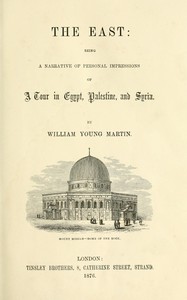
The East
Subjects:
Download Formats:
Excerpt
[Illustration: JERUSALEM—ANCIENT TEMPLE COURT WALL.]
THE EAST:
BEING
A NARRATIVE OF PERSONAL IMPRESSIONS
OF
A Tour in Egypt, Palestine, and Syria.
BY
WILLIAM YOUNG MARTIN.
LONDON:
TINSLEY BROTHERS, 8, CATHERINE STREET, STRAND.
1876.
THE EAST:
BEING
A...
Read the Full Text
— End of The East —
Book Information
- Title
- The East
- Author(s)
- Martin, William Young
- Language
- English
- Type
- Text
- Release Date
- October 3, 2024
- Word Count
- 54,620 words
- Library of Congress Classification
- DS; DT
- Bookshelves
- Browsing: Culture/Civilization/Society, Browsing: Travel & Geography
- Rights
- Public domain in the USA.
Related Books
Au pays de Jésus
by Serao, Matilde
French
1357h 45m read

Matkamuistelmia Egyptistä, Siinailta ja Palestiinasta 1859-1860
by Beskow, G. E. (Gustaf Emanuel)
Finnish
1496h 2m read
From Berlin to Bagdad and Babylon
by Zahm, J. A. (John Augustine)
English
3011h 46m read
A journey to Central Africa
by Taylor, Bayard
English
2578h 26m read

Travels in Africa, Egypt, and Syria, from the year 1792 to 1798
by Browne, William George
English
2047h 27m read

Travels of Lady Hester Stanhope, Volume 3 (of 3)
by Stanhope, Hester, Lady
English
1847h 8m read