The Project Gutenberg eBook, The Divided Sabbath, by William Jowett
This eBook is for the use of anyone anywhere in the United States and most
other parts of the world at no cost and with almost no restrictions
whatsoever. You may copy it, give it away or re-use it under the terms of
the Project Gutenberg License included with this eBook or online at
www.gutenberg.org. If you are not located in the United States, you'll have
to check the laws of the country where you are located before using this ebook.
Title: The Divided Sabbath
remarks concerning the Crystal Palace now erecting at Sydenham
Author: William Jowett
Release Date: May 23, 2020 [eBook #62203]
Language: English
Character set encoding: UTF-8
***START OF THE PROJECT GUTENBERG EBOOK THE DIVIDED SABBATH***
Transcribed from the 1852 Seeleys edition by David Price, email
[email protected]
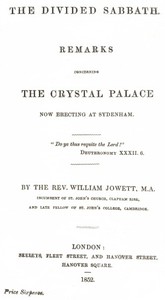
[Picture: Pamphlet cover]
THE DIVIDED SABBATH.
* * * * *
REMARKS
CONCERNING
THE CRYSTAL PALACE
NOW ERECTING AT SYDENHAM.
~~~~~~~~~~
“_Do ye thus requite the Lord_!”
DEUTERONOMY XXXII. 6.
~~~~~~~~~~
BY THE REV. WILLIAM JOWETT, M.A.
INCUMBENT OF ST. JOHN’S CHURCH, CLAPHAM RISE,
AND LATE FELLOW OF ST. JOHN’S COLLEGE, CAMBRIDGE.
* * * * *
LONDON:
SEELEYS, FLEET STREET, AND HANOVER STREET,
HANOVER SQUARE.
1852.
_Price Sixpence_.
* * * * *
W. M. WATTS, CROWN COURT, TEMPLE BAR.
* * * * *
THE DIVIDED SABBATH,
&c. &c.
THE following Report, found in the _Times_ of August 2d, 1852, appears to
be, on one side at least, demi-official. It has given occasion to the
Remarks contained in this pamphlet.
“We are happy to be able to state, that so far as the Government are
concerned, no impediment will be thrown in the way, and that there is
now no fear of the people’s losing their palace on the day on which
they can best avail themselves of its many means of elevation and
refinement. When the Directors of the Crystal Palace Company applied
some few weeks since to Lord Derby for a Charter, they communicated
to his Lordship the terms upon which they proposed to open the
building and grounds on Sundays. They were of opinion, that until
after one o’clock no trains should run from London, and the Crystal
Palace itself should be strictly closed. After that hour they
proposed to throw open the Park and the Winter-Garden, but not to
exhibit those departments of the building, which will partake
exclusively of a manufacturing and commercial character, the
intention being to devote a certain portion of the space to specimens
of manufactures, &c., which the public will be invited, upon certain
conditions, to display. In the third place, the Directors undertook
that on Sunday no spirituous liquors should be sold in their grounds.
On Monday last Lord Derby requested an interview with the Directors,
who, with Sir J. Paxton, waited upon the Premier and the Home
Secretary in Downing Street. At this meeting his Lordship acquiesced
in the stipulations proffered by the Crystal Palace Company,
suggested a few trifling variations, and promised to grant the
required Charter.”
An article in the _Times_, four days later, Aug. 6th, gives a full
account of the ceremony of erecting the first column of the New Crystal
Palace.
* * * * *
With every desire that the best interests of my Countrymen should be
promoted, and with sincere respect for those who entertain a similar
wish, I have felt it my duty as an Englishman, and still more as a
Clergyman, to submit the following considerations to my Queen and my
Country.
* * * * *
The Crystal Palace now erecting at Sydenham is designed to be the most
splendid display of national greatness in the earth. No objection can
exist to its grandeur, its beauty, the marvellous exotics to be exhibited
in it, or to the display of ingenious manufactures. Some things it is
intended to expose, which may prove decidedly objectionable: I refer to
the sculpture-department. But I will not enter into details. The one
great evil characterising the plan, is this—That it is designed to open
the building to visitors during one half of the Lord’s Day.
* * * * *
Observe—the people of London and its suburbs, that is, four millions, are
invited to mutilate the Sabbath, by a plan which allows the first half to
be given to God’s worship, but allures them to spend the second half in
worldly amusement. The favourers of the scheme virtually say—“Resort to
the House of God in the morning, and to the Temple of Pleasure the rest
of the day.” This is a scheme far more artful, than if the enemy of
mankind had said, “Give _the whole day_ to me:” that would have shocked
us at once: but—“Let half be given to God, and the second half to
Pleasure”—this is plausible: and it is therefore so much the more
dangerous.
I have said, four millions are thus invited. But consider the Counties
involved in this invitation—the many watering-places in those counties,
which have Excursion-trains in connection with London the whole of
Sunday—the near neighbourhood of France and other Continental
countries—the habits of those countries in making Sunday an open day for
every kind of diversion. Taking all these points into consideration,
there is something more to be contemplated, than the mere erection of a
Crystal Palace.
* * * * *
Let us reflect how the plan will work. I have used a decent term,
“Pleasure.” And the favourers of the scheme may adopt terms yet more
reputable: inviting people to the study of Nature, in all the wonderful
productions of native and foreign plants, leading them “from Nature up to
Nature’s God.” This sounds well: but after all, the thing is, not what
an elegant writer may describe it, but what the Million will make it. A
poet, or an artist, may disguise a subject in a thousand ways: but this
Temple of Pleasure will infallibly become, in the hands of the Million, a
Focus of Dissipation.
Analyse a little this divided Sabbath, this Lord’s Day divided into two
halves: not indeed perfectly equal halves; for the nominal date of
recreation commences precisely one hour after mid-day: then the rush of
railway carriages from the London terminus is to commence, Divine Service
having at most Churches in and about London ended at one o’clock. Then,
and in the hours following, the twenty, or the fifty thousand men, women
and children, are to be set in motion. They will find no intoxicating
drinks sold on the premises of the Crystal Palace! But will not the
surrounding localities offer them, under the name of refreshments,
whatever they please?
Look to the first part of the day. Does any man suppose that one half of
these many thousands will have been worshipping God in the family and in
the Church? Is it in the least degree likely? Does a single favourer of
the scheme imagine it probable? I think not.
But then it will be pleaded, that the scheme is purposely so arranged,
that people _might_, if they wished, go to Church with their families in
the forenoon. I have even heard it gravely said, “The people _need not_
break the Sabbath: they _may_ go to Church in the morning; and if they do
not, it is their own fault.” To this argument silence might be the best
reply. And I hope truly, that the _Conscience of the Nation_ will
repudiate such sophistry.
I speak of Conscience: and I remember that the conscience of a Child is
as much honoured and protected by God, as the conscience of any other
individual. _Take heed that ye offend not one of these little ones_.
Better for a man to have a millstone hanged about his neck, and he be
cast into the sea, than that the moral sense of a young person be
perverted. Suppose, now, a father or mother to take some of their
children to Church, and hear the Commandments read: then imagine an
ingenuous boy or girl, on the way to the Crystal Palace, saying, “The
Minister read the words, _Remember that thou keep holy the Sabbath-day_;”
and they ask father or mother to reconcile the words of the command, and
their excursion of amusement: the parents hush up the matter, by saying,
“Children must not be particular; it is enough to keep holy _half the
Sabbath Day_, and spend the rest of it pleasantly.” What a comment would
this be!
This then is the sin, the one sin, at which I take aim. I do not pursue
this part of the subject, by showing what multitudes of Railway servants,
Publicans, Policemen, and others, will inevitably be absorbed during the
entire Sabbath for miles and miles around, by this scheme. Here is the
one crime, a divided Sabbath: here is the focus and centre of it, the
Crystal Palace at Sydenham!—If any do not see the evil, or are determined
to blink it, it will not be difficult to draw up a Sketch (not an
exaggerated Sketch, but a very simple one, and so much the more
convincing:) taking into view—1. London and its suburbs: 2. The
circumjacent Counties: 3. The infection of the Continental Sabbath: 4.
The state of the families of the industrial classes during the six
week-days: and, 5. Their probable condition from Saturday Evening to
Monday Evening, _forty-eight hours_, resulting from this scheme of a
Divided Sabbath. But I hope that no such Tract will ever have to be
written.
* * * * *
The projected _Aggression of Pleasure_ in 1853 is to me a greater object
of dread, than the _Aggression of Popery_ in 1850: because it falls in
with the taste of the vast majority of mankind. The danger of Popery I
do not under-estimate. It is a scheme adapted to fall in with the
Formalism and Self-Righteousness of Man’s heart. There was also
treachery in the camp of the Church of England, at the time when Popery
took aim at the Royal Supremacy, and asserted its claim to be Lord of the
consciences of all mankind: England, of course, included. But England
repelled that aggression. The _Aggression of Pleasure_ is more subtle,
more extensive, more congenial. It is a subject, therefore, on which I
must expatiate with the honest and affectionate freedom of a Clergyman.
* * * * *
Let me then observe, first, that it is a very difficult task _To move
great masses of people in a right direction_. In a wrong direction, it
is not so difficult. To rouse them to revolution, and then screw them
down by despotism, has been the work of a short time, in some
neighbouring countries. But to draw them back from an evil purpose, and
lead them into a right channel of feeling and action, is a hard work:—a
consideration this, which makes it the more imperative to check at once
this flagrant scheme of Sabbath-breaking before it begins. Once broken
out, what human hand can turn back the torrent?
But is it not equally difficult _Rightly to move the heart even of one
individual_? We speak of “The Million:” but that million is composed of
units. To lead any one individual, be he rich or poor, to feel the value
of his own soul, is a work worthy the labours and sacrifices of a whole
life. To move that one heart, however, is not man’s work. _With man
this is impossible_: _but with God all things are possible_.
Hence appears the importance of the _Prayer of faith_. Christ is the
Strong One, stronger than Satan, in whose name prayer is to be offered to
the Father: and in answer to believing prayer, the Holy Spirit is poured
forth, on individuals, on Churches, on Nations, on the whole World. Who
can overpower the Almighty Spirit, when it pleases Him to work? Without
his influence, nothing, even under the most favourable circumstances, can
be effected: with His influence, every good work, under most unfavourable
circumstances, may and will be effected. _Not by power_, _not by might_,
_but by my Spirit_, _saith the Lord of Hosts_. _Who art thou_, _O great
mountain_! _before Zerubbabel_, _thou shalt become a plain_. By the
power of the Spirit, every difficulty presented by the Million shall
vanish. The heart of the Million shall be bowed, as the heart of one
man. This will be in answer to prayer; whether secret prayer; or both
secret and social prayer.
Another consideration deeply affecting to my mind, is this. Among the
various means for the promotion and preservation of a nation’s welfare,
there is not one of higher importance than the exercise of _A faithful
Gospel-Ministry_. I am, on principle, a Clergyman of the Church of
England: but I honour Ministers of every Communion, who with simplicity
and godly sincerity preach Christ. In the present eventful crisis, we
need the aid of all. Here is no question of Church and Dissent: the
question is, whether or not Popery and Pleasure shall over-run the
land—whether we shall uphold the Law of God, and Christ’s Gospel; or
violate both.
There is a great Duty now lying before us: namely—_To make the Lord’s Day
profitable and interesting to the People_. By the Crystal Palace scheme
the People are invited to Pleasure: at least for the second half of the
day. The favourers of this scheme expressly undertake to teach the
People “to amuse themselves:” and Sunday, from one o’clock till
night-fall, is selected for the purpose of promoting this object among
the working classes. As Ministers of Christ, then, are we not now
brought to the test? “Will we endeavour to make the Lord’s Day—the whole
of it—interesting and useful to the Million? How likewise may we put the
people into the way of making this day interesting to themselves?”
I feel the difficulties of this part of the subject: nor can I remove
them by proposing so many more Sermons, Services, Sabbath-Schools, &c.,
although works of such kind would naturally form a part of any plan of
extending usefulness. But I feel, and long have felt that there is one
great, vital measure; which, if God should bless us in the universal
promotion of that measure, will diffuse spiritual health and happiness
through all classes of society.
To render the Lord’s Day interesting, Religion itself must become
interesting to a People. Every-day Religion is the only thing that can
make a Sunday-Religion profitable and interesting. The one topic of
pre-eminent importance in this point of view is—_The General introduction
of Family Prayer_. Domestic Worship is among the greatest of earthly
blessings, both to the Rich and to the Poor. We say in England, “Every
man’s house is his Castle.” For all domestic purposes, let every man’s
house be also his Church! In setting up this standard, the Ministers of
Christ have a noble task before them. Our public Congregations on the
Lord’s Day will not be diminished by the multiplication of these Domestic
Sanctuaries during the week: these, on the contrary, will render our
every-day Religion interesting, and thus make also the Sabbath a delight.
They will fill our Churches, and thin the throng of Sabbath-breakers,
please God, to nothing!
As to the notion that this violation of the Sabbath will give rest and
mental refinement to the people, it is an utter delusion. Last year I
was conversing about the Excursion-trains with an aged relative, who has
since been removed to the eternal world. When under twenty years of age
he was for a while engaged in mercantile business, in one of the most
active and opulent of our manufacturing towns: but from pure love to the
work of the Ministry he relinquished very flattering worldly prospects,
and for more than forty years was a burning and a shining light in the
parish and in the county where he laboured. Referring to his early days,
and viewing with alarm the threatening abuses of the Railways, he
remarked to me—“They quite mistake the idea of Sunday-rest, who suppose
that it consists in pleasure-taking. When I was engaged in business,
early and late on all the week-days—very often so tired out that I
scarcely knew what to do with myself—Sunday was the greatest possible
refreshment to me. The mere act of ceasing from work, together with
reading my Bible and going to Church, was rest. But then,” he added,
“this implies a change of heart; a different taste from what the world
has.”
* * * * *
I have thus written from the fulness of my heart, and from the deepest
convictions of my judgment, believing that a crisis of great danger to
our beloved country is closely impending. If a Royal Charter has been
promised, specifically authorising the opening of the Crystal Palace on
any part of Sunday, then the Poor are in the fair way to be robbed of
their real Rest, by the substitution of an imaginary recreation, so
arranged that it cannot be enjoyed without sin. If the Royal sanction
were actually given, I would yet look to “The Million,” Englishmen as
they are, and Bible-men, to reject the proffered amusement. How may the
threatened evil be averted? Whether deliverance shall be sent from some
very humble quarter; or whether it shall be the hand of a Queen, more
wary than Darius, that shall refuse to sign the writing and the decree,
God alone knoweth! My earnest hope and prayer, is, that the rumour of
such a Charter may die away to nothing. As Englishmen, may we be roused
from our dreams of amusement to a higher standard of duty! May History
never have to record, that in the nineteenth century it was sought to
erect—and in Britain, too—a People’s happiness on the basis of God’s
broken law!
* * * * *
THE END.
***END OF THE PROJECT GUTENBERG EBOOK THE DIVIDED SABBATH***
******* This file should be named 62203-0.txt or 62203-0.zip *******
This and all associated files of various formats will be found in:
http://www.gutenberg.org/dirs/6/2/2/0/62203
Updated editions will replace the previous one--the old editions will
be renamed.
Creating the works from print editions not protected by U.S. copyright
law means that no one owns a United States copyright in these works,
so the Foundation (and you!) can copy and distribute it in the United
States without permission and without paying copyright
royalties. Special rules, set forth in the General Terms of Use part
of this license, apply to copying and distributing Project
Gutenberg-tm electronic works to protect the PROJECT GUTENBERG-tm
concept and trademark. Project Gutenberg is a registered trademark,
and may not be used if you charge for the eBooks, unless you receive
specific permission. If you do not charge anything for copies of this
eBook, complying with the rules is very easy. You may use this eBook
for nearly any purpose such as creation of derivative works, reports,
performances and research. They may be modified and printed and given
away--you may do practically ANYTHING in the United States with eBooks
not protected by U.S. copyright law. Redistribution is subject to the
trademark license, especially commercial redistribution.
START: FULL LICENSE
THE FULL PROJECT GUTENBERG LICENSE
PLEASE READ THIS BEFORE YOU DISTRIBUTE OR USE THIS WORK
To protect the Project Gutenberg-tm mission of promoting the free
distribution of electronic works, by using or distributing this work
(or any other work associated in any way with the phrase "Project
Gutenberg"), you agree to comply with all the terms of the Full
Project Gutenberg-tm License available with this file or online at
www.gutenberg.org/license.
Section 1. General Terms of Use and Redistributing Project
Gutenberg-tm electronic works
1.A. By reading or using any part of this Project Gutenberg-tm
electronic work, you indicate that you have read, understand, agree to
and accept all the terms of this license and intellectual property
(trademark/copyright) agreement. If you do not agree to abide by all
the terms of this agreement, you must cease using and return or
destroy all copies of Project Gutenberg-tm electronic works in your
possession. If you paid a fee for obtaining a copy of or access to a
Project Gutenberg-tm electronic work and you do not agree to be bound
by the terms of this agreement, you may obtain a refund from the
person or entity to whom you paid the fee as set forth in paragraph
1.E.8.
1.B. "Project Gutenberg" is a registered trademark. It may only be
used on or associated in any way with an electronic work by people who
agree to be bound by the terms of this agreement. There are a few
things that you can do with most Project Gutenberg-tm electronic works
even without complying with the full terms of this agreement. See
paragraph 1.C below. There are a lot of things you can do with Project
Gutenberg-tm electronic works if you follow the terms of this
agreement and help preserve free future access to Project Gutenberg-tm
electronic works. See paragraph 1.E below.
1.C. The Project Gutenberg Literary Archive Foundation ("the
Foundation" or PGLAF), owns a compilation copyright in the collection
of Project Gutenberg-tm electronic works. Nearly all the individual
works in the collection are in the public domain in the United
States. If an individual work is unprotected by copyright law in the
United States and you are located in the United States, we do not
claim a right to prevent you from copying, distributing, performing,
displaying or creating derivative works based on the work as long as
all references to Project Gutenberg are removed. Of course, we hope
that you will support the Project Gutenberg-tm mission of promoting
free access to electronic works by freely sharing Project Gutenberg-tm
works in compliance with the terms of this agreement for keeping the
Project Gutenberg-tm name associated with the work. You can easily
comply with the terms of this agreement by keeping this work in the
same format with its attached full Project Gutenberg-tm License when
you share it without charge with others.
1.D. The copyright laws of the place where you are located also govern
what you can do with this work. Copyright laws in most countries are
in a constant state of change. If you are outside the United States,
check the laws of your country in addition to the terms of this
agreement before downloading, copying, displaying, performing,
distributing or creating derivative works based on this work or any
other Project Gutenberg-tm work. The Foundation makes no
representations concerning the copyright status of any work in any
country outside the United States.
1.E. Unless you have removed all references to Project Gutenberg:
1.E.1. The following sentence, with active links to, or other
immediate access to, the full Project Gutenberg-tm License must appear
prominently whenever any copy of a Project Gutenberg-tm work (any work
on which the phrase "Project Gutenberg" appears, or with which the
phrase "Project Gutenberg" is associated) is accessed, displayed,
performed, viewed, copied or distributed:
This eBook is for the use of anyone anywhere in the United States and
most other parts of the world at no cost and with almost no
restrictions whatsoever. You may copy it, give it away or re-use it
under the terms of the Project Gutenberg License included with this
eBook or online at www.gutenberg.org. If you are not located in the
United States, you'll have to check the laws of the country where you
are located before using this ebook.
1.E.2. If an individual Project Gutenberg-tm electronic work is
derived from texts not protected by U.S. copyright law (does not
contain a notice indicating that it is posted with permission of the
copyright holder), the work can be copied and distributed to anyone in
the United States without paying any fees or charges. If you are
redistributing or providing access to a work with the phrase "Project
Gutenberg" associated with or appearing on the work, you must comply
either with the requirements of paragraphs 1.E.1 through 1.E.7 or
obtain permission for the use of the work and the Project Gutenberg-tm
trademark as set forth in paragraphs 1.E.8 or 1.E.9.
1.E.3. If an individual Project Gutenberg-tm electronic work is posted
with the permission of the copyright holder, your use and distribution
must comply with both paragraphs 1.E.1 through 1.E.7 and any
additional terms imposed by the copyright holder. Additional terms
will be linked to the Project Gutenberg-tm License for all works
posted with the permission of the copyright holder found at the
beginning of this work.
1.E.4. Do not unlink or detach or remove the full Project Gutenberg-tm
License terms from this work, or any files containing a part of this
work or any other work associated with Project Gutenberg-tm.
1.E.5. Do not copy, display, perform, distribute or redistribute this
electronic work, or any part of this electronic work, without
prominently displaying the sentence set forth in paragraph 1.E.1 with
active links or immediate access to the full terms of the Project
Gutenberg-tm License.
1.E.6. You may convert to and distribute this work in any binary,
compressed, marked up, nonproprietary or proprietary form, including
any word processing or hypertext form. However, if you provide access
to or distribute copies of a Project Gutenberg-tm work in a format
other than "Plain Vanilla ASCII" or other format used in the official
version posted on the official Project Gutenberg-tm web site
(www.gutenberg.org), you must, at no additional cost, fee or expense
to the user, provide a copy, a means of exporting a copy, or a means
of obtaining a copy upon request, of the work in its original "Plain
Vanilla ASCII" or other form. Any alternate format must include the
full Project Gutenberg-tm License as specified in paragraph 1.E.1.
1.E.7. Do not charge a fee for access to, viewing, displaying,
performing, copying or distributing any Project Gutenberg-tm works
unless you comply with paragraph 1.E.8 or 1.E.9.
1.E.8. You may charge a reasonable fee for copies of or providing
access to or distributing Project Gutenberg-tm electronic works
provided that
* You pay a royalty fee of 20% of the gross profits you derive from
the use of Project Gutenberg-tm works calculated using the method
you already use to calculate your applicable taxes. The fee is owed
to the owner of the Project Gutenberg-tm trademark, but he has
agreed to donate royalties under this paragraph to the Project
Gutenberg Literary Archive Foundation. Royalty payments must be paid
within 60 days following each date on which you prepare (or are
legally required to prepare) your periodic tax returns. Royalty
payments should be clearly marked as such and sent to the Project
Gutenberg Literary Archive Foundation at the address specified in
Section 4, "Information about donations to the Project Gutenberg
Literary Archive Foundation."
* You provide a full refund of any money paid by a user who notifies
you in writing (or by e-mail) within 30 days of receipt that s/he
does not agree to the terms of the full Project Gutenberg-tm
License. You must require such a user to return or destroy all
copies of the works possessed in a physical medium and discontinue
all use of and all access to other copies of Project Gutenberg-tm
works.
* You provide, in accordance with paragraph 1.F.3, a full refund of
any money paid for a work or a replacement copy, if a defect in the
electronic work is discovered and reported to you within 90 days of
receipt of the work.
* You comply with all other terms of this agreement for free
distribution of Project Gutenberg-tm works.
1.E.9. If you wish to charge a fee or distribute a Project
Gutenberg-tm electronic work or group of works on different terms than
are set forth in this agreement, you must obtain permission in writing
from both the Project Gutenberg Literary Archive Foundation and The
Project Gutenberg Trademark LLC, the owner of the Project Gutenberg-tm
trademark. Contact the Foundation as set forth in Section 3 below.
1.F.
1.F.1. Project Gutenberg volunteers and employees expend considerable
effort to identify, do copyright research on, transcribe and proofread
works not protected by U.S. copyright law in creating the Project
Gutenberg-tm collection. Despite these efforts, Project Gutenberg-tm
electronic works, and the medium on which they may be stored, may
contain "Defects," such as, but not limited to, incomplete, inaccurate
or corrupt data, transcription errors, a copyright or other
intellectual property infringement, a defective or damaged disk or
other medium, a computer virus, or computer codes that damage or
cannot be read by your equipment.
1.F.2. LIMITED WARRANTY, DISCLAIMER OF DAMAGES - Except for the "Right
of Replacement or Refund" described in paragraph 1.F.3, the Project
Gutenberg Literary Archive Foundation, the owner of the Project
Gutenberg-tm trademark, and any other party distributing a Project
Gutenberg-tm electronic work under this agreement, disclaim all
liability to you for damages, costs and expenses, including legal
fees. YOU AGREE THAT YOU HAVE NO REMEDIES FOR NEGLIGENCE, STRICT
LIABILITY, BREACH OF WARRANTY OR BREACH OF CONTRACT EXCEPT THOSE
PROVIDED IN PARAGRAPH 1.F.3. YOU AGREE THAT THE FOUNDATION, THE
TRADEMARK OWNER, AND ANY DISTRIBUTOR UNDER THIS AGREEMENT WILL NOT BE
LIABLE TO YOU FOR ACTUAL, DIRECT, INDIRECT, CONSEQUENTIAL, PUNITIVE OR
INCIDENTAL DAMAGES EVEN IF YOU GIVE NOTICE OF THE POSSIBILITY OF SUCH
DAMAGE.
1.F.3. LIMITED RIGHT OF REPLACEMENT OR REFUND - If you discover a
defect in this electronic work within 90 days of receiving it, you can
receive a refund of the money (if any) you paid for it by sending a
written explanation to the person you received the work from. If you
received the work on a physical medium, you must return the medium
with your written explanation. The person or entity that provided you
with the defective work may elect to provide a replacement copy in
lieu of a refund. If you received the work electronically, the person
or entity providing it to you may choose to give you a second
opportunity to receive the work electronically in lieu of a refund. If
the second copy is also defective, you may demand a refund in writing
without further opportunities to fix the problem.
1.F.4. Except for the limited right of replacement or refund set forth
in paragraph 1.F.3, this work is provided to you 'AS-IS', WITH NO
OTHER WARRANTIES OF ANY KIND, EXPRESS OR IMPLIED, INCLUDING BUT NOT
LIMITED TO WARRANTIES OF MERCHANTABILITY OR FITNESS FOR ANY PURPOSE.
1.F.5. Some states do not allow disclaimers of certain implied
warranties or the exclusion or limitation of certain types of
damages. If any disclaimer or limitation set forth in this agreement
violates the law of the state applicable to this agreement, the
agreement shall be interpreted to make the maximum disclaimer or
limitation permitted by the applicable state law. The invalidity or
unenforceability of any provision of this agreement shall not void the
remaining provisions.
1.F.6. INDEMNITY - You agree to indemnify and hold the Foundation, the
trademark owner, any agent or employee of the Foundation, anyone
providing copies of Project Gutenberg-tm electronic works in
accordance with this agreement, and any volunteers associated with the
production, promotion and distribution of Project Gutenberg-tm
electronic works, harmless from all liability, costs and expenses,
including legal fees, that arise directly or indirectly from any of
the following which you do or cause to occur: (a) distribution of this
or any Project Gutenberg-tm work, (b) alteration, modification, or
additions or deletions to any Project Gutenberg-tm work, and (c) any
Defect you cause.
Section 2. Information about the Mission of Project Gutenberg-tm
Project Gutenberg-tm is synonymous with the free distribution of
electronic works in formats readable by the widest variety of
computers including obsolete, old, middle-aged and new computers. It
exists because of the efforts of hundreds of volunteers and donations
from people in all walks of life.
Volunteers and financial support to provide volunteers with the
assistance they need are critical to reaching Project Gutenberg-tm's
goals and ensuring that the Project Gutenberg-tm collection will
remain freely available for generations to come. In 2001, the Project
Gutenberg Literary Archive Foundation was created to provide a secure
and permanent future for Project Gutenberg-tm and future
generations. To learn more about the Project Gutenberg Literary
Archive Foundation and how your efforts and donations can help, see
Sections 3 and 4 and the Foundation information page at
www.gutenberg.org
Section 3. Information about the Project Gutenberg Literary
Archive Foundation
The Project Gutenberg Literary Archive Foundation is a non profit
501(c)(3) educational corporation organized under the laws of the
state of Mississippi and granted tax exempt status by the Internal
Revenue Service. The Foundation's EIN or federal tax identification
number is 64-6221541. Contributions to the Project Gutenberg Literary
Archive Foundation are tax deductible to the full extent permitted by
U.S. federal laws and your state's laws.
The Foundation's principal office is in Fairbanks, Alaska, with the
mailing address: PO Box 750175, Fairbanks, AK 99775, but its
volunteers and employees are scattered throughout numerous
locations. Its business office is located at 809 North 1500 West, Salt
Lake City, UT 84116, (801) 596-1887. Email contact links and up to
date contact information can be found at the Foundation's web site and
official page at www.gutenberg.org/contact
For additional contact information:
Dr. Gregory B. Newby
Chief Executive and Director
[email protected]
Section 4. Information about Donations to the Project Gutenberg
Literary Archive Foundation
Project Gutenberg-tm depends upon and cannot survive without wide
spread public support and donations to carry out its mission of
increasing the number of public domain and licensed works that can be
freely distributed in machine readable form accessible by the widest
array of equipment including outdated equipment. Many small donations
($1 to $5,000) are particularly important to maintaining tax exempt
status with the IRS.
The Foundation is committed to complying with the laws regulating
charities and charitable donations in all 50 states of the United
States. Compliance requirements are not uniform and it takes a
considerable effort, much paperwork and many fees to meet and keep up
with these requirements. We do not solicit donations in locations
where we have not received written confirmation of compliance. To SEND
DONATIONS or determine the status of compliance for any particular
state visit www.gutenberg.org/donate
While we cannot and do not solicit contributions from states where we
have not met the solicitation requirements, we know of no prohibition
against accepting unsolicited donations from donors in such states who
approach us with offers to donate.
International donations are gratefully accepted, but we cannot make
any statements concerning tax treatment of donations received from
outside the United States. U.S. laws alone swamp our small staff.
Please check the Project Gutenberg Web pages for current donation
methods and addresses. Donations are accepted in a number of other
ways including checks, online payments and credit card donations. To
donate, please visit: www.gutenberg.org/donate
Section 5. General Information About Project Gutenberg-tm electronic works.
Professor Michael S. Hart was the originator of the Project
Gutenberg-tm concept of a library of electronic works that could be
freely shared with anyone. For forty years, he produced and
distributed Project Gutenberg-tm eBooks with only a loose network of
volunteer support.
Project Gutenberg-tm eBooks are often created from several printed
editions, all of which are confirmed as not protected by copyright in
the U.S. unless a copyright notice is included. Thus, we do not
necessarily keep eBooks in compliance with any particular paper
edition.
Most people start at our Web site which has the main PG search
facility: www.gutenberg.org
This Web site includes information about Project Gutenberg-tm,
including how to make donations to the Project Gutenberg Literary
Archive Foundation, how to help produce our new eBooks, and how to
subscribe to our email newsletter to hear about new eBooks.
The Divided Sabbath - remarks concerning the Crystal Palace now erecting at Sydenham
Subjects:
Download Formats:
Excerpt
The Project Gutenberg eBook, The Divided Sabbath, by William Jowett
This eBook is for the use of anyone anywhere in the United States and most
other parts of the world at no cost and with almost no restrictions
whatsoever. You may copy it, give it away or re-use it under the terms of
the Project Gutenberg License included with this eBook or online at
www.gutenberg.org. If you are not located in the United States, you'll have
to check the laws of the country where you are located...
Read the Full Text
— End of The Divided Sabbath - remarks concerning the Crystal Palace now erecting at Sydenham —
Book Information
- Title
- The Divided Sabbath - remarks concerning the Crystal Palace now erecting at Sydenham
- Author(s)
- Jowett, William
- Language
- English
- Type
- Text
- Release Date
- May 23, 2020
- Word Count
- 5,922 words
- Library of Congress Classification
- BV
- Bookshelves
- Browsing: Philosophy & Ethics, Browsing: Religion/Spirituality/Paranormal
- Rights
- Public domain in the USA.
Related Books
Mutiny
by Perowne, John
English
160h 54m read
A Few Words on the Crystal Palace Question
by Vaughan, C. J. (Charles John)
English
70h 56m read
A Second Letter on the late Post Office Agitation
by Vaughan, C. J. (Charles John)
English
108h 1m read
A Reply to Dr. Vaughan's "Letter on the Late Post-Office Agitation"
by Pears, James Roberts
English
89h 32m read
A Letter on the Late Post Office Agitation
by Vaughan, C. J. (Charles John)
English
40h 14m read
An Apology for the Colouring of the Greek Court in the Crystal Palace
by Jones, Owen
English
273h 37m read