THE ADVENTURES OF HARRY ROCHESTER
This eBook is for the use of anyone anywhere at no cost and with almost
no restrictions whatsoever. You may copy it, give it away or re-use it
under the terms of the Project Gutenberg License included with this
eBook or online at http://www.gutenberg.org/license.
Title: The Adventures of Harry Rochester
A Tale of the Days of Marlborough and Eugene
Author: Herbert Strang
Release Date: December 05, 2013 [EBook #44362]
Language: English
Character set encoding: UTF-8
*** START OF THIS PROJECT GUTENBERG EBOOK THE ADVENTURES OF HARRY
ROCHESTER ***
Produced by Al Haines.
[Illustration: Cover art]
[Illustration: The Fight in the Castle Yard]
The Adventures of
Harry Rochester
A Tale of the
Days of Marlborough and Eugene
BY
HERBERT STRANG
AUTHOR OF "TOM BURNABY" "BOYS OF THE LIGHT BRIGADE"
"KOBO: A STORY OF THE RUSSO-JAPANESE WAR"
Illustrated by William Rainey, R.I.
NEW YORK
G. P. PUTNAM’S SONS
27 AND 29 WEST 230 STREET
1905
"Honour hath three things in it: the vantage-ground to do good; the
approach to kings and principal persons; and the raising of a man’s own
fortunes."
—_Bacon_.
_My dear Tom,_
_You received my former books so kindly that I feel assured you will not
object to have this volume inscribed with your name. I am not the less
convinced of this because you know well the country in which my opening
scenes are laid, and I had the pleasure last year of playing cricket
with you within a few miles of the village here disguised as Winton St.
Mary._
_I hope you will bear with me for one minute while I explain that in
writing this book I had three aims. First, to tell a good story: that
of course. Secondly, to give some account of the operations that
resulted in one of the most brilliant victories ever gained by our
British arms. Thirdly, to throw some light—fitful, it may be, but as
clear as the circumstances of my story admitted—on life and manners two
hundred years ago. History, as you have no doubt already learnt, is not
merely campaigning; and I shall be well pleased if these pages enlarge
your knowledge, in ever so slight a degree, of an interesting period in
our country’s annals. And if you, or any other Christ’s Hospital boy,
should convict me of borrowing a week from the life of a great
personage, or of antedating by a little a development in our national
pastime—well, I shall feel complimented by such evidence of careful
reading, and not be in the least abashed._
_I take the opportunity of this open letter to acknowledge my
indebtedness to the monumental "Mémoires militaires rélatifs à la
succession d’Espagne" issued by the French General Staff; to Mr. Austin
Dobson for a detail which only his perfect knowledge of the 18th century
could so readily have supplied; and to Lord Wolseley’s brilliant life of
Marlborough, which every student of military history must hope so
competent a hand will continue and complete._
_Yours very sincerely,_
_HERBERT STRANG._
_Michaelmas Day, 1905._
*Contents*
_Chapter_ I
The Queen’s Purse-Bearer
_Chapter_ II
Sherebiah Shouts
_Chapter_ III
Master and Man
_Chapter_ IV
Mynheer Jan Grootz and Another
_Chapter_ V
A Message from the Squire
_Chapter_ VI
My Lord Marlborough makes a Note
_Chapter_ VII
Snared
_Chapter_ VIII
Flotsam
_Chapter_ IX
Monsieur de Polignac Presses his Suit
_Chapter_ X
Bluff
_Chapter_ XI
The Battle of Lindendaal
_Chapter_ XII
Harry is Discharged
_Chapter_ XIII
Concerning Sherebiah
_Chapter_ XIV
Harry Rides for a Life
_Chapter_ XV
The Water of Affliction
_Chapter_ XVI
Knaves All Three
_Chapter_ XVII
In the Dusk
_Chapter_ XVIII
A Little Plot
_Chapter_ XXI
Marlborough’s March to the Danube
_Chapter_ XX
The Castle of Rauhstein
_Chapter_ XXI
Across the Fosse
_Chapter_ XXII
The Fight in the Keep
_Chapter_ XXIII
Blenheim
_Chapter_ XXIV
The Wages of Sin
_Chapter_ XXV
A Bundle of Letters
_Chapter_ XXVI
The New Squire
_Chapter_ XXVII
Visitors at Winton Hall
*List of Illustrations*
_Plate_ I
The Fight in the Castle Yard . . . . . . _Frontispiece_
_Plate_ II
Harry makes a Diversion
_Plate_ III
My Lord Marlborough
_Plate_ IV
At the Last Gasp
_Plate_ V
"Mon Colonel, we are surrounded!"
_Plate_ VI
The Stroke of Eight
_Plate_ VII
"Fire and Fury!" shouted Aglionby
_Plate_ VIII
Mein Wirth is Surprised
*Map And Plan*
Map of the Low Countries in 1703
Plan of the Battle of Blenheim
*CHAPTER I*
*The Queen’s Purse-Bearer*
Winton St. Mary—Cricket: Old Style—Last Man In—Bowled—The Gaffer
Explains—More Explanations—Parson Rochester—"The Boy"—Cambridge in the
Field—Village Batsmen—Old Everlasting makes One—The Squire—An
Invitation—Lord Godolphin is Interested—An Uphill Game—Young Pa’son—The
Winning Hit
"Stap me, Frank, if ever I rattle my old bones over these roads again!
Every joint in me aches; every wrinkle—and I’ve too many—is filled with
dust; and my wig—plague on it, Frank, my wig’s a doormat. Look at
it—whew!"
My lord Godolphin took off his cocked hat, removed his full periwig, and
shook it over the side of the calash, wrying his lips as the horse of
one of his escort started at the sudden cloud. My lord had good excuse
for his petulance. It was a brilliant June day, in a summer of glorious
weather, and the Wiltshire roads, no better nor worse than other English
highways in the year 1702, were thick with white dust, which the autumn
rains would by and by transform into the stickiest of clinging mud. The
Lord High Treasurer, as he lay back wearily on his cushions, looked,
with his lean, lined, swarthy face and close-cropt grizzled poll, every
day of his fifty-eight years. He was returning with his son Francis, now
nearly twenty-three, from a visit to his estates in Cornwall. Had he
been a younger man he would no doubt have ridden his own horse; had he
been of lower rank he might have travelled by the public coach; but
being near sixty, a baron, and lord of the Treasury to boot, he drove in
his private four-horsed calash, with two red-coated postilions, and four
sturdy liveried henchmen on horseback, all well armed against the perils
of footpads and highwaymen.
It was nearing noon on this bright, hot morning, and my lord had begun
to acknowledge to himself that he would barely complete his journey to
London that day.
"Where are we now, Dickory?" he asked languidly of the nearest rider on
the off-side.
"Nigh Winton St. Mary, my lord," replied the man. "Down the avenue
yonder, my lord; then the common, and the church on the right, and the
village here and there bearing to the left, as you might say, my lord."
"Look ’ee, Frank, we’ll draw up at Winton St. Mary and wet our whistles.
My lady Marlborough expects us in town to-night, to be sure; but she
must e’en be content to wait. Time was——eh, my boy?—but now, egad, I’ll
not kill myself for her or any woman."
"’Twould be a calamity—for the nation, sir," said Frank Godolphin with a
grin.
"So it would, i’ faith. Never fear, Frank, I’ll not make way for you
for ten years to come. But what’s afoot yonder? A fair, eh?"
The carriage had threaded a fine avenue of elms, and come within sight
of the village common, which stretched away beyond and behind the
church, an expanse of rough turf now somewhat parched and browned,
broken here by a patch of shrub, there by a dwindling pond, and bounded
in the distance by the thick coverts of the manor-house. My lord’s
exclamation had been called forth by the bright spectacle that met his
eyes. At the side of the road, and encroaching also on the grass, were
ranged a number of vehicles of various sizes and descriptions, from the
humble donkey-cart of a sherbet seller to the lofty coach of some county
magnate. Between the carriages the travellers caught glimpses of a
crowd; and indeed, as they drew nearer to the scene, their ears were
assailed by sundry shoutings and clappings that seemed to betoken
incidents of sport or pastime. My lord Godolphin, for all his coldness
and reserve in his official dealings, was in his moments a keen
sportsman; from a horse-race to a main of cock-fighting or a
sword-match, nothing that had in it the element of sport came amiss to
him; and as he replaced his wig and settled his hat upon it his eyes lit
up with an anticipation vastly different from his air of weary
discontent.
"Split me, Frank," he cried in a more animated tone than was usual with
him; "whatever it is, ’twill cheer us up. John," he added to the
postilion, "drive on to the grass, and stop at the first opening you
find in the ring. Odsbodikins, ’tis a game at cricket; we’ll make an
afternoon of it, Frank, and brave your mother-in-law’s anger, come what
may."
The postilions whipped up their horses, wheeled to the right, and drove
with many a jolt on to the common, passing behind the row of vehicles
until they came to an interval between one of the larger sort and a dray
heaped with barrels of cider. There they pulled up sideways to the
crowd, over whose heads the occupants of the calash looked curiously
towards the scene of the game. It was clearly an exciting moment, for
beyond a casual turning of the head the nearest spectators gave no heed
to the new-comers. A space was roped in at some distance in front of
the church, and within the ring the wickets were pitched—very primitive
compared with the well-turned polished apparatus of to-day. The stumps
were two short sticks forked at the top, stuck at a backward slant into
the turf about a foot apart, with one long bail across them. Nothing had
been done to prepare the pitch; the grass was short and dry and stubby,
with a tuft here and there likely to trip an unwary fielder headlong.
There was no crease, but a hole in the ground. Nor was there any
uniformity of attire among the players: all had the stockings and
pantaloons of daily wear, and if there was any difference in their
shirts, it was due merely to their difference in rank and wealth.
"Over" had just been called as Lord Godolphin and his son drove up, and
something in the attitude of the crowd seemed to show that the game was
at a crisis. The umpires, armed with rough curved bats somewhat like
long spoons, had just taken their new places, and the batsman who was to
receive the first ball of the new over was taking his block. A tall,
loose-limbed young fellow, he held his bat with an air of easy
confidence.
"Egad, sir, ’tis Gilbert Young," said Frank Godolphin to his father. "I
knew him at Cambridge: a sticker. Who’s the bowler? I don’t know him."
The bowler was a youth, a mere stripling of some sixteen or seventeen
years, who stood at his end of the wicket, ball in hand, awaiting the
word to "play". His loose shirt was open at the neck; his black hair,
not yet cropt for a wig, fell in a strong thick mass over his brow; and
as he waited for the batsman to complete his somewhat fastidious
preparations, he once or twice pushed up the heavy cluster with his left
hand.
"Gibs was ever a tantalising beast," said Frank aside. "Hi, you fellow!"
he shouted to a broad-shouldered yokel who stood just in front of him by
the rope, "how stands the score?"
The man addressed looked over his shoulder, and seeing that the speaker
was one of the "quality" he doffed his cap and replied:
"’Tis ninety-four notches, your honour, and last man in. Has a’ready
twenty-vive to hisself, and the Winton boys can’t get un out."
"Play!" cried the umpire. The batsman stood to his block, and looked
round the field with a smile of confidence. The bowler gave a quick
glance around, took a light run of some three yards, and delivered the
ball—underhand, for round-arm bowling was not yet invented. The ball
travelled swiftly, no more than two or three feet above the ground,
pitched in front of the block-hole, and was driven hard to the off
towards a thick-set, grimy-looking individual—the village smith. He,
bending to field the ball, missed it, swung round to run after it, and
fell sprawling over a tussock of grass, amid yells of mingled derision
and disappointment.
"Pick theeself up, Lumpy!" roared the man to whom Frank Godolphin had
spoken. But the ball had already been fielded by Long Robin the tanner,
running round from long-on. Sir Gilbert meanwhile had got back to his
end of the wicket, and the scorer, seated near the umpire, had cut two
notches in the scoring stick.
Again the ball was bowled, with an even lower delivery than before. The
batsman stepped a yard out of his ground and caught the ball on the
rise; it flew high over the head of the remotest fieldsman, over the
rope, over the crowd, and dropped within a foot of the lych-gate of the
church. Loud cheers from a party of gentlemen mounted on coaches in
front of a tent greeted this stroke; four notches were cut to the credit
of the side, bringing the score to a hundred. There was dead silence
among the crowd now; it was plain that their sympathies lay with the out
side, and this ominous opening of the new bowler’s over was a check upon
their enjoyment.
Sir Gilbert once more stood to his block. For his third ball the bowler
took his run on the other side of the wicket. His delivery this time
was a little higher: the ball pitched awkwardly, and the batsman seemed
to be in two minds what to do with it. His hesitation was fatal. With a
perplexing twist the ball slid along the ground past his bat, hit the
off stump, and just dislodged the bail, which fell perpendicularly and
lay across between the sticks. Sir Gilbert looked at it for a moment
with rueful countenance, then marched towards the tent, while the crowd
cheered and, the innings being over, made for the stalls and carts, at
which ale and cider and gingerbread were to be had.
"Egad, ’twas well bowled," ejaculated Lord Godolphin; "a cunning ball, a
most teasing twist; capital, capital!"
"I’ll go and speak to Gibs," said Frank. "Will you come, sir?"
"Not I, i’ faith. ’Tis too hot. Bring him to me. I’ll drink a glass
of cider here and wait your return."
There was a cider cart near at hand, and his man Dickory brought my lord
a brimming bumper drawn from the wood. He winced as the tart liquor
touched his palate, unaccustomed to such homely drink; but it was at
least cool and refreshing, and he finished the bumper. As he gave it
back he noticed an old man slowly approaching, leaning with one hand
upon a stout knobby stick of oak, and holding in the other a rough
three-legged stool, which he placed between my lord’s calash and the
rope. He was a fine-looking old man, dressed in plain country homespun;
his cheeks were seamed and weather-beaten, but there was still a
brightness in his eyes and an erectness in his figure that bespoke
health and the joy of life. He sat down on the stool, took off his hat
and wiped his brow, then, resting both hands on his stick, looked
placidly around him. There was no one near to him; the space was clear,
for players and spectators had all flocked their several ways to get
refreshment, and for some minutes the old man sat alone. Then Lord
Godolphin, to ease his limbs and kill time, stepped out of his carriage
and went towards the veteran.
"Well, gaffer," he said, "have ye come out to get a sunning?"
The old man looked up.
"Ay sure, your honour," he said, "and to zee the match. You med think
me too old; true, I be gone eighty; come Martinmas I shall be
eighty-one, and I ha’n’t a wamblen tooth in my head—not one, old as I
be. A man’s as old as he feels, says my boy—one o’ the wise sayens he
has: I ha’n’t felt no older this twenty year, nay, nor twenty-vive year
neither."
"By George! I wish I could say the same. What’s the match, gaffer?"
"Well, they do say ’tis for a wager; ’tis all ’I’ll lay ye this’ and
’I’ll lay ye that’ in these days. I don’t know the rights on’t, but
’tis said it all come about at a supper up at Squire’s.—Do ’ee know
Squire? Eh well, there be the house, yonder among the trees. Squire’s
son be hot wi’ his tongue, and at this same supper—I tell ’ee as I yeard
it—he wagered young Master Godfrey of the Grange he’d bring eleven young
gen’lmen from Cambridge college as would beat our village players at the
cricket. A hunnerd guineas was the wager, so ’tis said. Master Godfrey
he ups and says ’Done wi’ ’ee’, and so ’tis come about. The Cambridge
younkers be all high gentry, every man on ’em; our folks, as your honour
med see, be just or’nary folks in the main: there’s Long Robin the
tanner and Lumpy the smith—he that turned topsy-turvy a-hunten the ball
by there; and Honest John the miller: Old Everlasten they calls un,
’cause he never gets cotched out nor bowled neither: ay, a good stick is
Old Everlasten, wi’ a tough skin of his own. And there be Soapy Dick
the barber, and Tom cobbler, and more of the village folk; and the only
gentry among ’em is Master Godfrey hisself and pa’son’s son, and he
don’t count for gentry wi’ some. Do ’ee know pa’son? a good man, saven
your honour, ay, a right good man is Pa’son Rochester, and stands up to
old Squire like a game-cock, so he do—a right good man is pa’son, ay
sure. And his son Harry—well, to tell ’ee the truth, I’m main fond of
the lad; main fond; ’tis a well-favoured lad, well spoken too, and he
thinks a deal o’ me, he do, and I thinks a deal o’ he. Why, ’twas he
bowled that artful ball as put out t’ last man from Cambridge
college.—There, my old tongue runs on; I don’t offend your honour?"
"Not a whit," said my lord. "The young bowler is the parson’s son, eh?
Bred for a parson too, I suppose?"
"He’s over young yet, your honour, but a month gone seventeen. He said
to me only yesterday: ’Gaffer,’ says he, ’what’ll ’ee do ’ithout me when
I go up to Oxford?’ He be gwine come October, a’ believe. ’Twas at
Oxford college they made his feyther a pa’son, so belike the lad’ll put
on the petticoats too, though sure he’s fit for summat better. But
he’ll make a good pa’son if he takes arter his feyther. Bless ’ee,
Pa’son Rochester be the only man in the parish as a’n’t afeard o’
Squire. I be afeard o’ Squire, I be, though ’ee med not think it. Ah!
he’s a hard man, is Squire. A’ fell out with pa’son first ’cause he
wouldn’t be his chaplain—goo up t’ hall an’ say grace and eat the mutton
and turmuts, an’ come away wi’out pudden. Wi’out pudden!—I wouldn’t goo
wi’out pudden for no man; that’s why I first took a fancy for pa’son.
Then Squire, he wanted to fence in a big slice of this common land, as
ha’ belonged to the folks of Winton Simmary time wi’out mind; and pa’son
stood up to ’n, and told ’n flat to his face ’twas agen the law, an’ he
had the law on ’m, he did; an’ the wise judges up in Lun’on town said as
how Squire were wrong. But Lor’ bless ’ee, Squire be as obstinate as a
pig; he don’t care nowt for judges; he ups and ’peals to King Willum
hisself. Then King Willum dies, poor feller, an’ Queen Anne sits proud
on the gold throne, an’ there ’tis; ’twill take a time for her poor
woman’s mind to understand the rights o’ the matter; her don’t know
pa’son so well as we."
"Or she might make him a bishop, eh? Perhaps I can put in a word for
him," said my lord jestingly.
The old man stared.
"And who med ’ee be, your honour, if I mebbe so bold to axe?" he said
slowly.
"I? Oh—well, I have care of the Queen’s purse."
"There now, and I’ve been talken to ’ee just as if ’ee were a knight or
squire, when I med ha’ known ’ee by your cut for one of the mighty o’
the earth. But ’ee’ll forgive a old man—ay, gone eighty year. I was
born three year afore Scotch Jamie died; no sart of a king was Jamie, a
wamblen loon, so I’ve yeard tell. And Charles One, he was well-favoured
before the Lord, true, but not a man of his word. Nay, Noll Crum’ell
was the right sart o’ king; I mind un well. I was a trooper in his
regiment, and we was as fine a set o’ men as ever trod neat’s leather,
true, we was. I rode wi’ un to Marston Moor in ’44, nigh zixty year
back. Ay, a right king was old Noll. And I fought in Flanders when
Noll was friends with the French king; but I left that line o’ life when
Charles Two come back with his French madams; and now we be a-fighten
the French, so ’tis said; ’twas what us Englishmen was born for, to be
sure; ay, that ’tis."
Here my lord’s attention was attracted towards a group of villagers
approaching. They were led by a short well-set-up fellow with a
humorous cast of face; his thumbs were stuck into his arm-pits, and as
he walked he was singing to the accompaniment of a flute played by the
man at his side. The old man looked towards him and smiled
affectionately.
"’Tis my boy a-comen," he said. "Was born in ’59, your honour, the year
afore Charles Two coom back; and I chrisomed un Sherebiah
Stand-up-and-bless out of Nehemiah nine; a good boy, though wilful."
The boy of forty-three was singing lustily:
"’Twas on a jolly summer’s morn, the twenty-first of May,
Giles Scroggins took his turmut-hoe, and with it trudged away.
For some delights in hay-makin’, and some they fancies mowin’,
But of all the trades as I likes best, give I the turmut hoein’.
For the fly, the fly, the fly is on the turmut;
And ’tis all my eye for we to try, to keep fly off the
turmut."
"Mum, boy, mum!" said his father. "The boy has a sweet breast, your
honour," he added, turning to Godolphin, "and ’tis my belief ’twill lead
un into bad company in the days o’ his youth. He _will_ sing ’Sir Simon
the King’ and ’Bobbing Joan’, and other sinful ditties. Ah! I had a
good breast in my time; and you should ha’ yeard Noll’s men sing as we
marched into Preston fight; I could sing counter to any man.—Boy, doff
your hat to the Queen’s purse-bearer.—Ay, ’twas psa’ms an’ hymns an’
speritual songs in my time, as the Book says."
"Sarvant, yer honour," said the new-comer, bobbing to Godolphin.
"Feyther been taken away my good name? ’Tis a wise feyther knows his
own child; feyther o’ mine forgot that when he named me Sherebiah
Stand-up-and-bless. Beant the fault o’ my name I ha’n’t took to bad
courses. But there, he’s a old ancient man, nigh ready for
churchyard—bean’t ’ee, dad?"
"Not till I make a man on ’ee, boy."
"May I present my friend Sir Gilbert Young, sir?" said Frank Godolphin,
coming up at this moment through the gathering crowd.
My lord bowed and swept off his hat in the courtly fashion of the day,
in response to a still lower salutation from the young Cambridge man.
"I am honoured, my lord," said Sir Gilbert.
"My lard, i’ fecks!" ejaculated Sherebiah’s father, with a startled
look. "My lard,—an’ I ha’n’t even pulled my forelock! Boy, doff your
cap to my lard! And the Book says, ’They shall stand afore princes’,
and I’m a-sitten!"
The old fellow began to struggle to his feet with the aid of his staff,
but Godolphin laid his hand on his arm, and pressed him down.
"Sit fast, gaffer," he said. "See, the players are coming out again. I
am pleased to have met one of Noll’s veterans so hale and hearty, and I
hope your son will turn out as great a comfort to you as mine."
He put his arm fondly through Frank’s, and returned to his carriage.
The crowd was collecting about the rope, and the Cambridge men were
already taking their places in the field. Their score of a hundred was
higher than the average in those days, and the villagers were eagerly
discussing the chances of their team excelling it. They had seen nothing
of the other side’s bowling powers, but as they compared notes on the
various merits as batsmen of Honest John, and Long Robin, and Lumpy, and
the rest, many of them shook their heads and looked rather down in the
mouth.
The first pair of batsmen came to the wickets. They were Old
Everlasting and Soapy Dick. The former took the first over, bowled by
Gilbert Young, the captain of the team, and calmly blocked every ball of
the four, giving a wink to his friends in the crowd when over was
called. Soapy Dick, at the other wicket, was a little man with very red
hair brushed up into a sort of top-knot in front. He handled his bat in
a nervous manner, and was made still more nervous by the cries of the
crowd.
"Hit un, Soapy!" cried one yokel. "Doan’t be afeard, man."
"Gi’t lather, Soapy!" shouted another, whose cheeks cried out for the
barber’s attentions.
Dick grinned mirthlessly, and fixed his eyes on the bowler at the other
end. The ball came towards him—a slow, tempting lob that was too easy
to let pass. Dick lifted his bat and smote; the ball returned gently to
the bowler’s hands, and a roar of derision sped the shame-faced little
barber back to the tent. One wicket down, and no notches!—a bad
beginning for Winton St. Mary.
Lumpy was the next to appear. He waddled across the grass turning up
his sleeves—a fat little fellow with bandy legs, and arms as thick as
most men’s thighs. As he stood to take his block, he seemed to handle
the bat with contemptuous surprise, as though wondering what use that
was to a man accustomed to wield the sledgehammer at the anvil.
Satisfied with his position, he planted his feet firmly, drew his left
hand across his mouth, and glared fiercely at the bowler. He was not to
be so easily tempted as poor Soapy Dick had been. He waited for the
ball, and as it rose brought his bat down upon it with a perpendicular
blow that appeared to drive it into the turf, where it lay dead. The
Cambridge men roared with laughter, the crowd applauded vigorously, and
Lumpy once more wiped his mouth on the back of his hand. The third ball
of the over came, pitching slightly to leg. Lumpy jumped completely
round as the ball reached him, and with a tremendous swipe sent it high
over long-stop’s head into a patch of gorse, whence it was not recovered
until he had had three notches cut to his credit. The last ball of the
over thus came to Old Everlasting, who solemnly blocked it, and beamed
upon the spectators with his usual smug smile.
Lumpy had but a short life, after all. There was no cunning about him;
if he hit a ball it was bound to travel far, but he struck out every
time with the same violence, and when he missed could hardly recover his
balance. In twenty minutes he had scored eleven notches, Old
Everlasting having consistently done nothing but block the balls that
fell to him; then, in hitting out, Lumpy, never too steady on his bow
leg’s, overbalanced himself and fell flat, and the long bail was
promptly knocked off by the wicket-keeper. Two wickets down for eleven.
After this, disaster followed disaster in such rapid succession that the
villagers looked blue. Long Robin the tanner was caught second ball,
and was afterwards heard complaining bitterly of the bad leather the
ball was made of. Tom the cobbler came to the wicket with a bat of his
own—one that he kept hanging behind his kitchen door, and took down
every week for a thorough greasing. He scored six notches, then hit a
ball into his wicket, and in the tent afterwards explained to his
cronies that another week’s greasing would have prevented the accident.
Four wickets were now down for seventeen, and Godfrey Fanshawe himself
came in, amid a great outburst of cheers from the crowd, with whom he
was very popular, and who looked to him, as the originator of the match
and the captain of the team, to retrieve the fortunes of the day. He
snicked his first ball for one; then Old Everlasting evoked intense
enthusiasm by poking a ball between slip and point, and scoring his
first notch. The score rose slowly to thirty-one, Fanshawe making all
the runs, and then he ran himself out in trying to snatch an extra from
an overthrow. The fifth wicket was down. Fanshawe was reputed the best
batsman in the team, and Winton St. Mary was still sixty-nine behind.
There was much shaking of the head among the villagers, and they waited
in glum silence for the next man to appear.
"Look ’ee!" exclaimed the old trooper suddenly, "beant that old Squire
a-comen down-along by covert fence?"
"True, Gaffer Minshull," said a by-stander; "what eyes ’ee’ve got, for a
old ancient soul! ’Tis old Squire sure enough, and young Squire and the
Cap’n wi’ un."
Old Minshull leant forward on his stick, and with pursed lips peered at
the three figures approaching. One was a burly man in the prime of
life, dressed in semi-military garb—a feathered hat, long red coat
marked with many stains and wanting some buttons, leather breeches, and
spurred boots. His features were coarse and red, his eyes prominent and
blood-shot; he walked with a swagger, his left hand on his sword-hilt.
The second was a youth of some twenty years, dressed in the extremity of
foppishness. A black hat, looped up and cocked over one eye, crowned a
full auburn wig fastidiously curled. The coat was blue, the waistcoat
purple, open to display a fine holland shirt. A laced steinkirk was
tucked in at the breast. The breeches matched the vest, the stockings
were of red silk, the shoes had high red heels and large silver buckles.
In Mr. Piers Berkeley’s mouth was a toothpick; from one of the buttons
of his coat dangled an amber-headed cane.
The third figure was a striking contrast to the others. He was tall and
thin and bent, with pale wrinkled cheeks and bushy white eyebrows that
ill matched his dark wig. He scarcely lifted his eyes from the ground as
he moved slowly along, leaning heavily upon a silver-knobbed stick. His
dress was fusty and of a bygone mode; to a Londoner the old man must
have resembled a figure out of a picture of Charles the Second’s time.
"Who’s this queer old put ambling along, Frank?" asked my lord. "The
rascals there avoid him as he had the plague."
"On my life I don’t know, sir," replied Mr. Godolphin. "The fellow with
him might stand for Bobadil himself."
"Or for Captain Bluffe in Mr. Congreve’s play."
"And the young sprig wants a kicking."
"Sarvant, my lord," put in Sherebiah, who was standing by; "’tis old
Squire, and young Squire, and—— No, I won’t say ’t; a wise head keeps a
still tongue; I won’t say ’t, leastways when a fowl o’ the air med carry
it where ’twould do me and feyther o’ mine no manner o’ good."
The crowd parted with a kind of sullen unwilling respect to make way for
the new-comers. Suddenly the squire paused, as the elder of his two
companions addressed him; flashing an angry glance at him, he said a few
vehement words in a low tone that no one else could hear. Captain Ralph
Aglionby laughed aloud, shrugged carelessly, and sauntered across the
common towards the tent. The squire followed him with a dark glance for
a moment, then resumed his slow progress with his son, and came to
within a few feet of Lord Godolphin’s carriage.
"Your lordship’s servant," he said with a profound bow, copied with
elaborate elegance by his son. His voice was thin and hard, a voice
that set the teeth on edge. "I heard your lordship was on the ground,
and made bold to come and pay my duty to your lordship."
"I am vastly beholden to you, Mr.——"
"Berkeley, my lord, Nicolas Berkeley of Winton Hall; and would your
lordship but favour me, I should be proud, when the match is over, to
offer your lordship a cover at my table—poor country fare, I fear, but
such as it is, freely at your lordship’s disposal."
"’Tis handsome of you, Mr. Berkeley, but I fear our business will not
permit us to accept of your hospitality.—Ah! I perceive the next batsman
is coming to the wicket. I hope you’re as keen a sportsman as I am
myself, and will forgive me if I fix my attention on the game."
Mr. Berkeley bowed again with expressionless face, and after a moment’s
irresolution moved away. Gaffer Minshull might have been observed to
lick his old lips with appreciation at this the very courtliest of cold
shoulders. Piers Berkeley, the young squire, stayed for a minute or two,
gazing with silly face at my lord; then, finding that he remained
unnoticed, he stuck the head of his cane into his mouth and walked away
sucking it.
The game was resumed. For an hour it was tedious watching. The new
batsman snatched a run now and then, while Old Everlasting blocked every
ball that came to him with the same want of enterprise and the same
boundless self-satisfaction. At length his partner was caught in the
long field; the sixth wicket had fallen, and the score was no more than
forty-five.
"Give you three to one against the rustics, Frank," said Lord Godolphin.
"I’ll take you, sir, though ’tis a risk. Who’s our next man?"
"’Tis our bowler friend, the young sprig of a parson, unless I mistake,"
said my lord. "What’s the lad’s name, gaffer?"
"’Tis Henry Winterborne Rochester, my lard, by the water o’ baptism; too
rich a name for poor folks like we. Young pa’son we calls un mostly."
"A limber youth. I like his looks, eh, Frank? Does he bat as well as
he bowls?"
"Middlen, my lord, middlen," said Sherebiah. "Has a good eye, but a
deal o’ growen to do afore he can smite the ball as it should. But
there, my lord, he as can’t do what he would must do what he can, as you
med say."
"Nothen truer, boy," said his father approvingly. "Ay, ’tis a pretty
lad. Gi’ un a cheer, souls."
"Mum, feyther," expostulated Sherebiah. "Old Squire’s comen back-along
this way; little sticks kindle fires, as you med say."
"True. I be a timbersome man, afeard o’ Squire, though you med n’t
think it. Well!"
But though Gaffer Minshull forbore to cheer, the rest of the crowd had
no scruples, and the warmth of their greeting brought a flush to the new
batsman’s honest face. He stood at the wicket with quiet ease and
watched Old Everlasting block the last ball of the over; then he glanced
around, stooped to his bat, and fixed his gray eyes steadily on the
bowler.
The rest of the afternoon provided an unfailing subject for gossip in
the village for six months afterwards. Playing at first with patient
wariness, Harry never let a ball pass his bat, but treated all with a
respectful consideration that was as noticeable as his graceful style.
He played two overs without getting a notch; then, after another
excellent blocking performance by his partner, came a change. The first
ball of the next over was rather loose; Lord Godolphin, who, perhaps
alone of the spectators, kept his gaze fixed on the batsman’s face, saw
his lips come together with a slight pressure and his eyes suddenly
gleam—and there was the ball, flying straight over the bowler’s head,
passing between two coaches into the road. Gaffer Minshull was on the
point of raising his stick to wave it, but was stopped by his son with a
"Mind old Squire, feyther o’ mine."
"Varty-vive and vour makes varty-nine," muttered the old man. "I could
do a bit o’ cipheren in my time. Ay, varty-nine."
Nothing came of the next ball, but the third rose most happily to
Harry’s bat, and with a neat little cut he sent it under the rope among
the crowd, who nimbly parted to let it roll. Three notches were cut to
his credit. Old Everlasting complacently blocked the next ball, and
Harry treated the bowler at the other end with great respect till the
fourth ball, which he snicked away for a single. Getting back thus to
the wicket at which he had started, he delighted the spectators by
driving every ball of the over, at the close of which the score had
risen to sixty-three.
"’Tis the eye doos it," said the old man delightedly; "Master Harry
has’n clear an’ steady. Ay sure, a’ would ha’ made a good captain for
Noll Crum’ell; if so be he’s a pa’son, all the use he can make o’ his
eye, ’twill be to tarrify poor sinners like you an’ me, my lard."
But misfortune was in store for the Winton St. Mary men. Old
Everlasting had the first ball of the next over, delivered by a new
bowler, a lanky fellow with a tremendous pace, for whom two long-stops
were placed. The batsman was taken by surprise; he missed the ball, the
stumps went flying, and Old Everlasting walked away scratching his poll,
rejoicing in the magnificent score of one. Harry accompanied him to the
tent, and held a short conversation with the next man. The fruit of
this was seen as soon as they reached the wickets. The first ball
missed bat, stumps, wicket-keeper, and both long-stops; Harry called his
partner for a bye, and though there was plenty of time for a second run
he was contented with a single, thus securing the next ball. This he
hit round to leg, a stroke that ought to have made two, but his partner
was somewhat bulky, and suffered for his misfortune by being promptly
run out after one run had been scored.
Eight wickets were now down, and the score was sixty-five—thirty-five
behind that of the Cambridge eleven. A restlessness was observable in
the crowd; it seemed impossible that the home team could win; and there
was general despondency when it was noticed that the incoming batsman
was a spindle-legged fellow known as Soft Jemmy, who did odd jobs about
the village. Only Sherebiah still appeared full of confidence.
"A fight bean’t lost till it be won," he said. "Keep up your sperits,
souls."
Soft Jemmy never got a chance to miss the ball. Such scheming was never
seen on a cricket-field before. Harry had privately instructed Jemmy to
do just as he was told, and the half-witted youth at least knew how to
obey. When Harry called him he ran; when told to stand in his ground he
remained fixed like a post; and so, snatching byes, blocking, hitting
when it was safe, Harry defied all the bowling, and the score rose by
ones and twos and threes. A change came over the attitude of the
spectators. From dejection they passed to almost delirious joy. Every
hit was cheered to the echo; every little manoeuvre of "young pa’son"
added to their delight. The effect on the out side was equal and
opposite. They became irritated at the altered aspect of the game.
Bowlers bowled wildly; fieldsmen fielded loosely, and got in one
another’s way; and the more agitated they became, the more coolly and
confidently did Harry ply his bat. At last, stepping out to a full
pitch, he made a magnificent drive over the bowler’s head, and brought
the total to a hundred and two.
The cheer that rose from the crowd might have been heard a mile away.
Some of the men made a rush for Harry, and bore him shoulder-high to the
tent. Others flew to secure their winnings, and celebrate the famous
victory in cider or home-brewed ale. Gaffer Minshull was with
difficulty dissuaded from whirling his hat round on the top of his
stick, and nothing could check his gleeful exclamation:
"A flick to young Squire; a terrible douse, ay sure!"
"By George, a notable match!" said Godolphin. "Your young parson is a
lad of mettle, gaffer; he’ll be a sportsman an he lives long enough.
Here, man, drink his health, and tell him from me that the Lord
Treasurer loves pretty play. Come, Frank, we’ll drive on."
He flung a coin to the old man, remounted his carriage, and drove off.
Gaffer looked at the money, then after the calash.
"Ah, ’tis a mighty fine thing to hold the Queen’s purse, my lads, mighty
fine! There be a power o’ these same shinen bright ones in the Queen’s
purse; eh, lads?"
A shout came from the distance, and the eyes of the small group around
old Minshull were turned towards the road. Lord Godolphin’s carriage
had broken down. The axle had snapped in two; the horses were plunging,
and my lord and his son were clinging to the sides of the vehicle. A
score of sturdy fellows rushed to lend a hand, and Gaffer Minshull was
left to himself.
*CHAPTER II*
*Sherebiah Shouts*
An Angling Story—Old Izaak—Landed—Breakfast—Marlborough’s Smile—The
Story of a Potticary—Dosed—On the Horizon—Highwaymen—A Man of
Peace—Behind the Scenes—Nos Duo—Promises—Black John Simmons—Sherebiah is
Troubled
"’Tis here or hereabouts, baten years ha’n’t tooken my memory. True,
feyther o’ mine calls me boy, and so I be to a old aged man like him;
but when a man’s comen on forty-four, and ha’ seen summat o’ the
world—well,
"’Man’s life is but vain, for ’tis subject to pain
An’ sorrow, an’ short as a bubble;
’Tis a hodge-podge o’ business, an’ money, an’ care,
An’ care, an’ money, an’ trouble.’
Ay, ’tis so, ’tis so!"
Sherebiah sighed, but the sigh ill became his round, jolly face; it was
merely to chime with the words of the song. He was walking, about six
o’clock on the morning after the cricket-match, along the bank of a
little hill-stream, rod in hand, yet not expecting to halt for a while,
for he took no pains to moderate his voice. He was not alone. His
companion was the youth who had won the match for Winton St. Mary on the
previous day—Harry Rochester, the parson’s son. Each carried a rod—the
huge clumsy rod of those days, nearly seventeen feet in length; each was
laden with wallet, landing-net, and other apparatus; and in fact they
had already had an hour’s sport with ground-bait, having risen from
their beds soon after three on this ideal angler’s morning. A haze lay
over the ground, and a light rain was falling.
Sherebiah was several yards ahead, scanning the banks. His voice sank a
little as he repeated the lines:
"’Tis a hodge-podge o’ business, an’ money, an’ care,
An’ care, an’ money, an’ trouble."
"Cheer up!" said Harry, behind him. "I like the second verse best,
Sherry:
"’But we’ll take no care when the weather proves fair,
Nor will we vex now though it rain—
He was interrupted by the sudden halt of Sherebiah. The man had swung
round; his lips were shot out in the motion of shooing, a warning finger
was held up. Harry’s voice died away, and he hastened to his
companion’s side.
"Yonder’s the spot," said Sherebiah in a whisper, pointing to a large
pool, shaded with willows, some thirty yards ahead. "Mum’s the word!
They be sharp-eared, they trouts. ’Tis there I took ten lusty nibblers,
ten year agoo come Michaelmas. Faith, ’twas all I could do to carry
’em; ay, and I shouldn’ ha’ got ’em home but for Tom Dorrell, t’ carrier
from Salisbury, who came trundlen along in his wagon. He be dead an’
gone, poor soul, as must we all."
"And what did you do with them?" asked Harry with a smile.
Sherebiah was famous for his angling stories, and they had perhaps as
much foundation as most. No one in the country-side knew the ways of
the trout as he did; but he was equally at home in trolling for jack or
pike, roving for perch, and sniggling for eels. None could match his
knowledge of the flies in their several seasons: the hour of the day at
which each is most killing; the merits of the silver twist hackle and
the lady-fly, whether for dapping or whipping; when to use the black
gnat, when the blue; under what conditions of the evening sky the shyest
trout will rise to a red spinner. And who could tie a fly like
Sherebiah Minshull? Many a time Harry had examined his rich store of
materials—as varied as the contents of a witch’s cauldron: feathers of
every bird that flies, manifold silks and wires and hooks, wax and
needles, hog’s down and squirrel’s fur. Many a time had he watched him
dress a fly and thread a bait, and admired his dexterous whipping of the
streams.
"What did I do wi’ ’em?" Sherebiah had sat down with legs far apart,
and was carefully selecting a fly from his case. He spoke always in a
whisper. "Well, ’tis ten year since, and my memory bean’t what it was;
but now I mind on’t, I gi’ one to Tom carrier for his lift, and a couple
to miller up by Odbury, and one to Susan Poorgrass at Sir Godfrey’s—I
was a-courten then; her wouldn’t ha’ me, thank the Lord!—and a couple to
Ned Greenhay, Sir Godfrey’s keeper as was, for a brace o’ leverets; and
to please feyther o’ mine I took three up to the Hall. Zooks! and small
thanks I got, for old Squire hisself come to the door, and gi’ me a
douse, he did; said if I didn’t find summat better to do than go
traipsen the country-side, poachen or wuss, he’d commit me for a rogue
and vagabond. An’ th’ old curmudgeon kept the fish; ay, he did so!—Ah!
ha’ got it; ’tis a fly that cost me more time in the maken than a dozen
others; a beauty, to be sure; eh, Master Harry?"
He proceeded to put it on his hook. It was an artificial oak-fly, blue,
green, brown, and orange so cunningly mingled that no trout could fail
to be deceived.
"We’ll now see some sport," continued Sherebiah, still in a whisper, as
he prepared to cast. "I can’t abide bait-fishen; sport, i’ faith! ’tis
mere bludgeon-play. True, it fills the pot, but there’s no pleasure in
’t. ’Tis no pastime for a true bob."
"Why, Sherry, ’twas only yestere’en I was reading in a most excellent
book of angling by Master Izaak Walton, and he, it seems, held little to
the fly. His discourse is in the main of bait."
"Why, there ’tis. I met Master Walton once, a-fishen in the Itchen
above Winchester—a quaint man, with a good breast for a song, for all he
was ripe for the grave. Myself I was but twenty or so, he a man of
fourscore and upward; ay, a fine hale old man, wi’ a store o’ memories.
We fell into talk; a’ told me how a’ once rid to Lunnon wi’ a rich jewel
o’ King Charles’s in his doublet; ay, he was a royal man, wi’ a jolly
red face, but no harm in un, not a whit; and learned, too—but no angler.
No, faith, no angler, for a’ talked o’ fishen down stream, a’ did, when
ne’er a child but knows fish lie wi’ their heads up stream. Ye cotch
fish as ’ee do Frenchmen, from behind! Now, hook’s ready. Mum, Master
Harry, while I cast."
He dropped his fly deftly into the still pool, watching it with keen
eyes and pursed lips. Meanwhile Harry had chosen an orle fly, and made
his cast a little lower down. The anglers were silent for some minutes.
"What’s that?" asked Harry suddenly, looking up as a distant sound of
wood-chopping reached his ears.
"Mum, boy!" whispered Sherebiah in reply. "There, I beg pardon, Master
Harry, but you’ve scared away a samlet just as he opened his jaws.
That? ’Tis Simon forester, belike, fellen Sir Godfrey’s timber. Now, a
still tongue——"
He broke off, rose, and followed his line stealthily for a yard or two.
The surface of the water was disturbed, and Harry caught a glimpse of a
gleaming side. There was a splash; the rod bent; then Sherebiah
hastened his steps as the fish went away with a rush.
"He’s a-showen fight," whispered Sherry. "Whoa! he’s sounded, Master
Harry; a big un. Pray the tackle may hold! Ah! he’s clear, and off
again! Whoa! whoa! Nay, my pretty, ’ee may fight, but I’ll land ’ee."
For ten minutes the contest continued; then the angler got in his line
slowly, and beckoned to Harry to assist him. The fish was carefully
drawn in; Harry stooped with his net at the critical moment, and with a
sudden heave landed a fine four-pounder, which he slipped into
Sherebiah’s creel.
"That’s the way on’t, Master Harry," said Sherebiah contentedly. "Had
no luck yourself, eh? What be ’ee a-fishen wi’?"
"An orle."
"Ah, ’tis an hour or two too early in the day for that, mebbe. Still,
these waters of Sir Godfrey bean’t often fished since young Master
Godfrey went to Cambridge college, and the trout mayn’t be over
squeamish. Stick to ’t!"
An hour passed, and both anglers were well satisfied. Sherebiah’s fly
proved irresistible, either from its cunning make or the wary skill with
which he whipped the stream. Four fat trout had joined the first in his
basket; two had rewarded Harry’s persistence; then he laid down his rod
and watched with admiration the delicate casts of his companion.
Sherebiah landed his sixth. The haze having now disappeared, and the
sun growing hot, he wound up his line and said:
"Rain afore seven, fine afore ’leven. I be mortal peckish, Master
Harry; what may ’ee have in your basket, now?"
"Powdered beef, I think, Sherry; and Polly put in a cate or two and some
radishes, and a bottle of cider; plain fare, you see."
"Well, hunger’s the best saace, I b’lieve. We poor folks don’t need to
perk up our appetites. I warrant, now, that mighty lord we saw
yesterday would turn up his nose at powdered beef. Fine kickshawses a’
had at Sir Godfrey’s, no doubt. To think o’ such a mighty lord, the
Queen’s purse-bearer an’ all, bein’ kept in a little small village by
rust or dry-rot, just like a ordinary man! Old Squire would ha’ liked
to gi’ him a bed, I reckon; but Sir Godfrey were aforehand, an’ there he
lies till this mornen: axle was to be mended by six, if Lumpy had to
work all night to finish the job. Med I axe ’ee a question, Master
Harry? Do ’ee think that shinen piece a’ flung to feyther were his own,
or out o’ Queen’s purse?"
Harry laughed.
"Lord Godolphin doesn’t go about the country with the Queen’s purse
slung at his waist, Sherry. What he meant was that he was Lord
Treasurer, the Queen’s chief minister, the man who rules the country,
you know."
"Well, now, if I didn’t think it’d be folly to carry the Queen’s purse
loose about the country! Then ’tis Lord Godolphin says we’re to fight
the French?"
"Yes, he and my lord Marlborough between them."
"Ah! there ’tis. My lord Marlborough bean’t free with his money like
t’other lord. _He_ wouldn’t ha’ given old feyther o’ mine nothen. Why,
I was at Salisbury in ’88 when my lord—Lord Churchill he was then, to be
sure—was there to meet King Willum, and I held his horse for ’n, and he
gi’ me—what do ’ee think he gi’ me, Master Harry?"
"Well?"
"Nowt but a smile! What med ’ee think o’ that for a lord? ’Thank ’ee,
my man,’ says he, and puts his foot in the stirrup and shows his teeth
at me, and rides off! Lord! Now t’other one, the Lord Godolphin, he is
a lord, to be sure, a fine free-handed gentleman, though he ha’n’t got
such fine teeth. I like a lord to be a lord, I do."
"My lord Marlborough is indeed rather close-fisted, they say."
"Ay, but I ha’ knowed a wuss. Did ever I tell ’ee of Jacob Spinney the
potticary? I was a growen lad, and feyther o’ mine wanted to put me to
a trade. So he bound me prentice to Jacob Spinney, that kept a
potticary’s shop by Bargate at S’thampton. Zooks! Jacob was a
deceiver, like his namesake in the Book. A’ promised feyther he’d gi’
me good vittles and plenty on ’em, bein’ a growen lad; but sakes, I
never got no meat save at third boilen; ’twas like eatin’ leather. A’
said I was growen too fast, a’ did, and he’d keep me down. Pudden—I
never put my lips to pudden for two year, not once. I took down
shutters at zix i’ the mornen, and put ’em up at eight o’ nights;
betwixt and between I was pounden away at drugs, and carryen parcels,
and scrubben floors and nussen mistress’ babby: ay, what med ’ee think
o’ that? If so happened I broke a bottle, or overslept five
minutes—oons! there was master a-strappen me to a hook in the wall he
kept o’ purpose, and layen a birch over my shoulders and keepen me on
bread and water or turmuts not fit for a ox. I dwindled crossways to a
shadder, Master Harry, I did so, and every week th’ old villain made me
write a letter to feyther, sayen as how I was fat and flourishen like a
green bay tree. Do what a’ would, however, I growed and growed, at
fourteen a long slip of a feller all arms and legs. Two mortal year I
put up wi’ un; then I got tired. One day, mistress was out, and I was
rollen pills in the little back shop, when master come in. He was in a
terrible passion, goodness alone knows what about. He pitched into me
for wasten his drugs and eatin’ up all his profits, and hit me with his
cane, and sent me spinnen agen the table, and knocked off his best
chiney mortar, and there ’twas on the floor, smashed to atomies. Bein’
his own doen, it made his temper wuss, it did, and he caught me by the
hair and said he’d skin me. I’ fecks, I were always a man o’ peace,
even as a boy, but I’d had long sufferen enough, and now my peaceful
blood was up. I wriggled myself free—and there he was, flat on the
floor, and me a-sitten on him. He hollered and cussed, for all he was a
Puritan; and, haven respect unto my neighbours, I stuffed a handkercher
into his mouth. There I sits, a-thinken what to do wi’ un. ’Twas in
for a penny in for a pound wi’ me then; I’d have to run, ’dentures or no
’dentures, and it seemed fair to have my pen’orth afore I went. There
was that hook I knowed so well, and that strap hangen still and loose:
’I’ll gi’ un a taste o’ the birch he be so uncommon fond on,’ thinks I.
So I hoists un up, and soon has un strapped ready; but looken at un I
thinks to myself: ’You be a poor wamblen mortal arter all, skinny for
all the pudden you eat. I’ll ha’ mercy on your poor weak flesh.’
Besides, I had another notion. So I casts un loose and sits un on a
chair and straps un to chair-back, hands to sides.
"You med have heard of Jacob Spinney’s famous mixture for pimples?
Well, ’twas knowed all over Hants and Wilts. ’Twas a rare sight o’
market days to see the farmers’ wives a-troopen into the shop for
bottles o’ the mixture. But th’ odd thing was, Spinney hisself was
owner of a fair pimpled face, yet never did I know un take a dose o’ his
own firm cure. ’I pity ’ee,’ says I to un, as he sat strapped to the
chair; ’poor feller, wi’ all those pimples. Shall have a dose, poor
soul.’ Many’s the bottle I’d made up: ’twas brimstone and powder o’
crab and gentian root in syrup. Well, I mixed a dose all fresh afore
his eyes, and got a long wooden spoon, and slipped the handkercher out
o’ his mouth and the dose in. The ungrateful feller spets it out and
begins to holler again; so in goes the handkercher, and says I: ’Ye
don’t know what’s for your own good. Bean’t it tasty enough? Ah,
Master Spinney, often and often ’ee’ve physicked me; what’s good for me
without pudden will be better for ’ee with; you shall have a dose.’ So
I made un a dose o’ senna and jalap and ipecacuan, but I was slow with
the handkercher, and afore I could get the spoon in he had his teeth
clinched tight. But I hadn’t nussed the babby for nothen. I ups with
finger and thumb and pinches his nose; he opens his mouth for breath,
and in goes spoon, and sputter as he med he had to swaller, he did.
"Ah, I was wild and headstrong in they young coltish days. I bean’t so
fond o’ pudden now. Not but what they mixtures did Jacob Spinney a
world o’ good, for his next prentice had a easier time nor me, steppen
into his master’s business when he was laid in churchyard. _I_ got no
good on ’em, to be sure, for I had to run away and try another line o’
life, and ha’ been a rollen-stone ever since. Ay well, ’tis all one to a
man o’ peace."
During his narrative the breakfast had been finished.
"Well, Sherry, when I’m out of sorts I’ll come to you," said Harry,
rising. "Now, while you pack up, I’ll go a stroll up the hillside;
there’ll be a good view now the day is clearing, and maybe I’ll get a
glimpse of Salisbury spire."
He left the river-bank and strolled leisurely up a gentle ascent, which
gradually became steeper until it terminated somewhat suddenly in a
stretch of level ground. Fifty yards from the edge rose a long grassy
mound, a well-known landmark in the neighbourhood. It was, in fact, a
barrow, dating centuries back into the dim ages—the burial place,
perhaps, of British warriors who had fought and fallen in defence of
their country against the Roman invader. Harry had always felt a
romantic interest in these memorials of the past, and more than once had
stood by such a barrow, alone in the moonlight of a summer night, while
his imagination called up visions of far-off forgotten things.
He sat down now with his back to the mound, and allowed his eyes to rove
over the prospect. Tradition said that three counties were visible from
this elevated spot, and on a clear morning like this it seemed likely
enough that report said true. Far to the left, peeping over the bare
contour of Harnham Hill, rose the graceful spire of Salisbury Cathedral,
at least fifteen miles away as the crow flies. His eye followed the
winding course of the little stream below him, losing it here and there
behind some copse or knoll, tracing it again to its junction with a
larger stream, till this in its turn was lost to view amid the distant
elm-bordered meadows. Nearer at hand he saw the old Roman road,
grass-grown and silent now, bounding the park of Sir Godfrey Fanshawe,
crossing the stream by an ancient bridge, and running into the London
road at some invisible point to the right. It was a very pleasing
prospect, brilliant beneath the cloudless sky, and freshened by the
early morning showers.
As he looked along the forsaken highway, once trodden perhaps by the
legions of Constantine the Great, his glance was momentarily arrested by
a small moving speck in the distance. "Some wagon from one of Sir
Godfrey’s home farms," he thought. It was approaching him, for it
passed out of sight into a clump of trees, then reappeared, and was
again hidden by an intercepting ridge. The road was downhill; in
fifteen or twenty minutes, perhaps, the wagon would pass beneath him, at
a point nearly three-quarters of a mile away, where the highway skirted
a belt of trees perched on the side of a steep declivity. Between him
and the road lay a ditch which, as he knew, was apt in winter-time to
overflow on to the meadows and the lower parts of the track, making a
sticky swamp of the chalky soil. But it was dry now, and the floodings
were only indicated by the more vivid green of the grass and the tall
reeds that filled the hollow on this side. On the other side a strong
stone wall edged the road, marking the boundary of Sir Godfrey’s park;
it was overhung with elms, from which at this moment Harry saw a
congregation of rooks soar away.
Thus idly scanning the roadway, all at once his eye lit upon the figure
of a horseman half concealed by the belt of reeds in the hollow. He was
motionless; his back was towards Harry, his horse’s head pointing
towards the road, from which he was completely screened by the reeds and
the willows.
"What is he doing there?" thought Harry. He rose, and walked towards
the edge of the descent. Narrowly scanning the brake, he now descried
two other horsemen within a few yards of the first, but so well
concealed that but for his quickened curiosity he would probably never
have discovered them. For all he knew, there might be others. "What is
their game?" His suspicion was aroused; the vehicle he had seen
approaching was perhaps not a wagon; it might be a chaise belonging to
Sir Godfrey; it might be—— "Why, ’tis without a doubt Lord Godolphin
himself on his way to London, and coming by the shortest cut." There
was no need for further speculation; in those days the inference was
sure: a carriage in the distance, a party of horsemen lurking in a copse
by the roadside—— "’Tis highway robbery—ah! the Queen’s purse!"
Harry unconsciously smiled at the thought. His first impulse was to
warn the approaching travellers. But the carriage was at present out of
sight; he could not make signals, and before he could reach the stretch
of road between the ambuscade and their prey, the travellers would
certainly be past, while he himself might be seen by the waiting
horsemen, and headed off as he crossed a tract of open country. Moving
downwards all the time, he in a flash saw all that it was possible to
do. The stream passed under the roadway some twenty yards beyond the
spot where the horsemen were lying in wait; the banks were reedy, and
might screen an approach to the copse beyond the wall. There was a bare
chance, and Harry took it.
He raced downhill towards Sherebiah, who was sitting on the bank still,
placidly smoking his pipe; landscape had no charm for him.
"Sherry," said Harry in jerks, "Lord Godolphin or someone is driving
down the road; highwaymen hiding in the reeds; in five or six
minutes—come, come, we have no time to lose."
"Then we’ll go home along," said Sherry, putting his pipe in his pocket
as he rose.
"Nonsense! we can’t slink away and leave them to be robbed." Harry took
Sherry by the arm to drag him along.
"What be the good? Fishen-rods bean’t no match for pistols, and bein’ a
man o’ peace——"
"Come, I can’t wait. I’ll go alone, then."
He released the man’s arm and stepped into the stream. Sherebiah
hesitated for a moment; then, seeing that Harry was in earnest, he
dropped his tackle and strode forward, saying:
"Zooks, not if I knows it! I’m a man o’ peace, sure enough, but
fairplay’s a jewel. Have at the villains!"
He followed Harry into the water. Side by side they raced on, dodging
the weeds, scrambling over occasional rocks, slipping on the chalky
bottom, making at top speed for the bridge. As they approached this
they went more slowly, to avoid being heard. Fortunately, at the point
where the road crossed the stream there was a line of rocks, over which
the water plunged with a rustle and clatter, drowning the sound of their
footsteps. They had to stoop low to avoid the moss-grown masonry of the
arch; as they emerged on the farther side they heard a muffled
exclamation from one of the horsemen, and climbing the steep face of the
tree-covered slope towards the wall they heard a shot, then another,
mingled with shouts and the dull thuds of horses’ hoofs on the
turf-covered road.
On the way Harry had explained his plan in panting whispers. Running
along now under cover of the wall, they came opposite to the scene of
the ambush.
"Now, Sherry, do your best," said Harry, as he prepared to mount the
wall.
Instantly a new clamour was added to the uproar in the road.
"This way!"
"Shoot ’em!"
"Lash the noddy peaks!"
"Pinch their thropples!"
"Quoit ’em down!"
"Haick! haick!"
By this time Harry was on the wall, by favour of Sherebiah’s strong arm.
A slug whizzed past his head and sank with a thud into the trunk of a
tree just behind; next moment the horse-pistol from which it had been
discharged followed the shot, the butt grazing Harry’s brow. There was
no time to take in the details of the scene. Harry made a spring for
the masked horseman who had fired at him, two yards from the wall; but
the fellow, alarmed by the various shouts and the sudden appearance of
Sherebiah at Harry’s side, dug the spurs into his steed’s flanks and
galloped off down the road, over the bridge, and out of sight. One of
his companions lay motionless on the road; the others had ridden away at
the first alarm from the wall.
Harry mopped his brow and looked about him. Lord Godolphin stood
upright in the carriage, his lips grimly set, a smoking pistol in his
hand. His son was on foot with drawn sword; a postilion was crawling
out of the ditch all bemired, pale and trembling.
"Odzooks!" cried my lord, "a welcome diversion!"
[Illustration: Harry makes a Diversion]
He was perfectly cool and collected, though his hat was off and his wig
awry. "A thousand thanks, my men. Whew! ’twas in the nick of time.
Where are the rest of you?"
"There are no more, my lord," said Harry, lifting his cap.
"No more! But the shouts, then?—I heard a dozen shouting, at least.
Are the rest on the other side of the wall?"
"All on this side, my lord," said Harry with a smile. "Here is the mob."
He indicated Sherebiah, who touched his cap and bobbed to his lordship.
Godolphin stared, then chuckled and guffawed.
"Egad! ’tis a rare flam. Frank, this fellow here did it all, shouted
for a dozen; by George, ’twas a mighty neat trick! And, by George, I
know your face; I saw you yesterday, I believe! What’s your name, man?"
"Sherebiah Stand-up-and-bless Minshull, my lord," said Sherry, "by the
water o’ baptism, your honour, for I was born while old Rowley were in
furren parts. If a’d been born two year arter, my lord, I med ha’ been
chrisomed wi’ less piety."
"I remember you, and the old gaffer your father—a fine old fellow.
Well, my man, your name suits me better; ’tis for us to stand up and
bless, eh, Frank? And here’s a guinea for you."
Sherebiah put his hands behind him and looked down at the coin in my
lord’s hand.
"Nay, nay, my lord," he said slowly. "True, I did the shouten, or most
on’t, but ’twas Master Harry his notion. Pa’son’s son, you see, my lord;
know’d all the holy story o’ Gideon; says to me, ’Sherry,’ says he,
’shout high and low, bass and tribble, give it tongue,’ says he; and I
gi’d it tongue, so I did."
Both gentlemen laughed heartily.
"I recognize you now," said my lord, turning to Harry, who looked
somewhat embarrassed. "Surely you are the hero of yesterday’s cricket
match? You swing a straight bat, my lad, and, stap me! you’ve a quick
wit if you devised this late surprise. How came you on the scene?"
"We’d been fishing yonder, my lord, and I chanced to spy your carriage
and the villains waiting here, almost at the same time. It was clear
what they were about, and as there was no time to warn you we came along
the stream, and—Sherry shouted."
His smile as he said the last words met an answering smile on Lord
Godolphin’s face.
"A mighty clever trick indeed—eh, Frank? We’re beholden to you. ’Twas
a mere chance that I sent my mounted escort on ahead by the highway to
arrange a change of horses, never thinking to be waylaid at this time o’
day."
"Ay, ’twas the Queen’s purse, my lord," struck in Sherebiah. "To know
Queen’s purse-bearer were a-comen along old road like a common mortal,
’twere too much for poor weak flesh and blood."
"The ignorant bumpkins mistook your meaning," said Frank.
"So it appears. But come, you’re the parson’s son, I believe. I forget
your name?"
"Harry Rochester, my lord."
"Going to be a parson yourself, eh?"
"I am going up to Oxford in October, my lord; my father wishes me to
take orders."
"Ah! And your own wish, eh?"
Harry hesitated.
"Come, out with it, my lad."
"I had thought, my lord, I should like to carry the Queen’s colours; but
’tis a vain thought; my father’s living is small, and——"
"And commissions in the Queen’s army sell high. ’Tis so, indeed. Well,
I heard something of your father last night at Sir Godfrey’s; you can’t
do better than follow his example. And hark ’ee, if ever you want a
friend, when you’ve taken your degrees, you know, come and see me; I owe
you a good turn, my lad; and maybe I’ll have a country vicarage at my
disposal."
"Thank you, my lord!"
"And now we must get on. Dickory, you coward, help these two friends of
ours to remove that tree. The villains laid their ambush well; you see
they felled this larch at an awkward part of the road."
"And I thowt ’twas Simon forester a-choppen," said Sherebiah, as he
walked towards the tree.
"What shall we do with this ruffian on the road?" said Frank Godolphin.
"He appears to be stone dead. ’Twas a good shot, sir."
"Leave the villain. You’ll lay an information before Sir Godfrey or
another of your magistrates, young master parson. Did you recognize any
of the gang?"
"No, my lord. I only saw the masked man. Perhaps Sherry was more
fortunate."
"Not me neither," said Sherebiah hastily. He had gone to the fallen
man, looked in his face, and turned him over. "’Twas all too quick and
sudden, and my eyes was nigh dazed wi’ shouten."
"Well, well, Sir Godfrey’s is near at hand; go and inform him, and he
will scour the country. We must push on."
The tree was removed; the bedraggled and crestfallen postilions resumed
their saddles, and with a parting salutation my lord drove off. Harry
stood looking thoughtfully after the departing carriage.
"Master Harry," said Sherebiah, coming up to him, "this be a bad
business. The man bean’t dead."
"He’s saved for the hangman, then."
"Ay, and who med ’ee think he be?"
"You do know him, then! What does this mean, Sherry?"
"Well, I be a man o’ peace, and there’s mischief to come o’ this day’s
piece o’ work, sure as I’m Sherebiah Stand-up-and-bless. ’Tis black
John Simmons, Cap’n Aglionby’s man."
"A scoundrel his master may well be rid of."
"Ay, if the man were dead! But he be alive; the lord didn’t shoot’n at
all; ’a fell off his horse and bashed his nob; an’ he’s got a tongue,
Master Harry."
"Well, what then? If he rounds on his fellows, so much the better.
What are you afraid of, Sherry?"
"I bean’t afeard, not I; but the Cap’n——"
He paused, and Harry looked at him enquiringly. Sherebiah turned away.
"Ah! little sticks kindle fires, little sticks kindle fires, they do."
*CHAPTER III*
*Master and Man*
A Midnight Summons—A Warm Reception—Righteous Indignation—Aglionby
Retorts—The Berkeley Arms—A Village Sensation—The Constable’s
Story—Aspersions—Unimpeachable References—Waylaid—Squaring Accounts—The
Captain Rides Away
The clock of St. Mary’s church had just chimed the first quarter after
midnight, and the deep note of the lowest bell was dying away over the
tree-tops, when the sound was intercepted by the distant clink and
clatter of iron-shod hoofs on the hard road, approaching from the
direction of Salisbury. The horse’s pace was slow, and there was
something in the fall of the hoofs that betokened a jaded steed. It was
a clear calm night; the air carried every sound distinctly; and nothing
broke the stillness save the footfalls of the horse, an occasional
murmur from the birds in the trees, and the whirr of wings as a solitary
owl, disturbed by the nocturnal rider, left its search for food and
rustled back to its nook in the tower.
The horseman came presently to the church, wheeled round to the right,
and urged his flagging beast along the road leading to the manor house.
Arriving at the park, he flung himself from the saddle, hitched the
bridle over his left arm, and turned the handle of the massive iron
gate. But there was no yielding to his push: the gate was locked. The
man shook and rattled the handle impatiently, to assure himself that he
was not mistaken, then turned aside with an inarticulate rumble of
anger, and went to the lodge, a low ivy-grown cottage abutting on the
road. He tapped on the small latticed window with the butt of his
riding-whip; there was no reply. The horse by his side hung its head
and breathed heavily; it was jaded to the point of exhaustion. Again he
rapped on the glass, growling between his teeth; and when his summons
still met with no response he dealt so smart a blow that one of the
thick square panes fell in with a crash. A moment later a voice was
heard from within.
"Away wi’ ’ee! Who be you, a-breaken an honest man’s rest at this
fearsome time o’ night?"
A night-capped head appeared at the hole, just visible in the faint
illumination of the clear summer sky.
"Open the gate, Dick," said the rider impatiently. "Ods my life, will
you keep me waiting here, will you?"
"Be it you, Cap’n?"
"Zounds, man, must I tell you my name? Ha’ ye never seen me before!
Stir your old stumps, or by the lord Harry——"
"Squire give orders t’ gate were to be locked and kep’ locked; not a man
to come in, not a soul. They’s my orders, ay sure, Cap’n."
"Orders! orders!" cried the other in a burst of passion. "Adslidikins,
if you’re not at the gate with the key inside of two minutes I’ll put a
slug through your jolt head, you mumper, you miching rogue you!"
And indeed Captain Aglionby displayed a monstrous blunderbuss, and
pointed it full in the face of the scared lodge-keeper. For an instant
the man hesitated; then, muttering to himself, he disappeared from the
window, and soon afterwards emerged from the side door within the
palings, his night-gown showing beneath a heavy driving coat. He came
towards the gate with the key—a bent old man, tottering and mumbling.
"I shall lose my place; Squire give orders, a’ did, not a soul to come
in; to drag a aged man from his nat’ral sleep an’ lose him his place an’
all; well, I was forced; no man can zay as I warn’t forced; mumper as I
be, I vallies my little bit o’ life, and——"
"Hold your tongue, you old flap-eared dotard, and make haste, or I’ll
pink your soul. Don’t you see the jade’s dead-beat; ’tis time I stabled
her."
The man turned the key and slowly opened the gate. With a grunt the
captain led his horse through, and, without so much as a glance at the
lodge-keeper, proceeded up the quarter-mile drive leading to the house.
"Old Nick’s not abed," he said to himself as he cast his eye over the
house front. A light shone from a window in the turret over the porch.
"The old nightbird! Lock me out! Oons!"
He threw the bridle over an iron post at the side of the entrance, and
walked round a projecting wing of the building till he came to a small
door in the wall. He turned the iron ring, pushed, rattled; the door
was fast shut. Cursing under his breath, he was proceeding towards the
servants’ quarters when he heard the creak of a key turning, and,
wheeling round, came to the postern just as it was opened by Squire
Berkeley himself, his tall, lean, bent figure enwrapped from neck to
heel in a black cassock-like garment, a skull-cap of black velvet
covering his head. He held a lighted candle; his piercing eyes flashed
in the darkness.
"Hey, Squire!" cried the captain in a tone of forced good-humour, "I had
much ado to rouse old Dick. ’Tis late to be sure; but if you’ll give me
the key of the stables I’ll settle Jenny for the night and get to bed."
He made as if to enter, but Mr. Berkeley spread himself across the
narrow doorway.
"Who are you, sirrah," he said, "to break into my park against my
express orders?"
There was contempt in his cold incisive tones, and anger with difficulty
curbed.
"Why now——" Aglionby began.
"Who are you, I say? And what am I, that my orders are defied, and my
house made a common inn, a toping house for you and your toss-pot
ruffians? Go—go, I say!"
The captain was for a moment staggered; the old man’s manner left no
room for doubt that he was in earnest. But Aglionby was too old a
campaigner to cry off so easily. In a tone half-conciliatory,
half-aggrieved he said—
"Fair and softly, Squire! this is but scurvy treatment of a tired man.
Look you, I’ve been in the saddle this livelong day; the mare’s
well-nigh foundered; and for myself—gads so, I could eat an ox and drink
a hogshead. To-morrow, in a few hours, I’ll bid ye good-bye—for a time,
if ye want a change; but to-night—no, Squire, ’tis not hospitable of
you, ’tis not indeed."
"You dally with me!" cried the squire, the hand that held the candle
shaking with passion. "You set no foot within this door—now, nor ever
again. Begone, while there is time."
"While there is time! Look ye, Master Berkeley, I will not brook
insults from you. Yesterday you must put an affront on me in the
presence of my lord Godolphin, shoving me out of the way as I were a
leper, and at the very moment, stap me! when I might ha’ paid court to
his lordship, and got the chance o’ my life. Adsbud, I was not good
enough to approach my lord, to accost him, have speech with him——"
"An omission you have since repaired," interjected the old man with a
meaning look. The captain started, and there was a perceptible interval
before he resumed, in a tone still more blusterous—
"Ods my life, what mean you now? You took care I should not meet my
lord in your company; and, i’ faith, he showed he wanted none of that
neither."
"Hold your peace and begone!" cried the squire in a fury. "You think I
know nothing of your villainies? How many times have I harboured you—ay,
saved you perchance from the gallows! How many times have you eat my
food, rid my horses, browbeat my servants, roistered it in my house,
till I could bear with you no longer, and then betaken yourself to your
evil practices abroad, consorted with villains, run your neck well-nigh
into the hangman’s noose, and then come back with contrite face and vows
of amendment, to fawn and bluster and bully again? Out upon you! Your
rapscallion of a servant is even now laid by the heels, and to-morrow
will have to answer to the charge of waylaying the Lord Treasurer. He’s
a white-livered oaf, and his tongue will wag, and you’ll companion him
before Fanshawe, and you’ll swing on the same gibbet."
At the mention of his man’s plight the captain’s face had fallen; but
when Mr. Berkeley’s tirade was ended he broke into a laugh.
"Ha! ha! Squire, now I come to understand you. ’Tis your own skin you
have a care for! Ha! ha! I might have known it. I am to be haled
before Sir Godfrey, am I? and to hold my tongue, am I? and to be mum
about certain little affairs in the life of Master Nicolas Berkeley—that
paragon of virtue, that pampered, patched old interloper, am I? By the
lord Harry, if I stand in manacles before Sir Godfrey, you shall bear me
company, you painted pasteboard of a saint!"
Berkeley’s pale face blanched with fury. For a moment he was incapable
of speech. Then he stepped forward a pace; the hand holding the candle
shook so, that the grease sputtered upon his gown. His voice came in
vehement passionate whispers:
"You threaten me! Do your worst—I defy you!—Back to your wallow,
bully!—begone!"
He suddenly withdrew within the doorway, slammed the door, and bolted
it.
"Whew!" whistled the captain, left standing outside. "’Tis the worst
passion ever I saw him in. Defies me! Well, Master Nicolas, would I
could afford to take you at your word! A plague on Simmons! I thought
he was dead. He’ll split, sure enough, and there’s an end of Ralph
Aglionby. Jenny, my dear, you’re a sorry jade, but you’ll have to bear
my carcase till we’re out of harm’s way. We have five or six hours
before the world’s astir. Do your best, my girl, and we’ll cheat ’em
yet."
Captain Aglionby led his tired steed down the drive to the gate, roused
Dick the lodge-keeper with scant ceremony, and in a few minutes was
riding slowly towards the village. As he came into the principal
street, he was surprised to notice that the only inn was lit up, a most
unusual circumstance at that time of night. The door stood open, and
there were lights in several of the rooms on the ground floor. A
feeling of apprehension seized upon him; he could not but connect these
lively signs with the events of the morning, and especially with the
capture of his man. Could the fellow have blabbed already? He was just
making up his mind to spur the mare past the inn, over the bridge, on to
the London road, when two persons came to the door and caught sight of
him. One was Mistress Joplady, the buxom hostess; the other William
Nokes, the village constable. It was too late to evade them: indeed he
heard the hostess exclaim, "Well, I never! ’tis the Cap’n hisself,
sure." Resolving like a wise man to make the best of it, he rode up to
the door, dismounted, and, swaggering, with his usual air of assurance
said:
"Egad, mistress, I’m glad to find you afoot. My mare’s dead-beat, has
carried me nigh forty miles this day; send Tom ostler to stable her,
like a good soul; and give me a bite and a bed. I didn’t care about
disturbing the squire at this time o’ night."
The captain was no favourite with good Mistress Joplady, but she
received him now with something more than her usual urbanity.
"Come away in, Cap’n Aglionby," she said. "Sure your name was in our
very mouths. Strange things be doing—ay, strange things in Winton
Simmary; bean’t it so, William Nokes? Take the cap’n into the parlour,
William; a few souls be there, Cap’n, not fit company for the likes o’
you, to be sure, but they’ll tell ’ee summat as’ll stir your blood, they
will so. Tom’ll see to Jenny, so be easy."
Captain Aglionby followed the constable into the parlour, where a group
of the village worthies were assembled. They were neither smoking nor
drinking, a sure sign that they had something momentous to talk about.
A silence fell upon the company as the captain clanked into the room,
and one or two of the more active-minded of them threw a quick glance at
each other, which the new-comer did not fail to note.
"A fine night, men," said the captain jovially.
"Ay, ’tis so."
"And a late hour to find the Berkeley Arms open."
"Ay, ’tis latish, sure enough."
"Any news from the army in Flanders? A post from London, eh?"
"Nay, not ’zackly that."
"Odzooks! speak up, men," cried the captain impatiently. "Why are they
all mumble-chopped to-night, mistress?" he asked, turning to the
hostess, who had followed him with bread and cheese and beer.
"Ah, they be pondering strange things," returned Mrs. Joplady. "Tell
the cap’n all the long story, William Nokes."
The constable, fingering the hat in his hand, looked for sympathy into
the stolid faces of his fellows, cleared his throat, and began:
"Cap’n, your sarvant. Eight o’clock this mornin’, or mebbe nine—’twixt
eight and nine, if the truth was told—comes Long Tom from the Grange,
Sir Godfrey’s man, as ye med know, Cap’n. Says he to me, ’Constable,’
says he, ’Sir Godfrey commands ’ee as a justice o’ the peace to bring
your staff and irons and other engines,’ says he, ’up along to Grange,
wi’out remorse or delay, and arrest a prisoner in the Queen’s name.’
You may think what a turn it gi’ me, souls, so early in the mornin’.
’Be he voilent?’ says I. ’Can I arrest the villain all alone by
myself?’ ’Ay sure,’ says he; ’there’s no knowin’ what a tough job
’twould be an he were sound and hearty, but he’s dazed, so he be, wi’ a
crack in the nob, and won’t give no trouble to no mortal constable, not
a bit,’ says he. ’A crack in the nob,’ says he; didn’t he, souls?"
A murmur of assent came from the group.
"So I ups and goos wi’ Long Tom hotfoot to the Grange, and Tom he tells
me by the way the longs and shorts on’t. Seems ’twas Sherry Minshull as
cracked his nob, leastways he picked un up, he and young master pa’son
betwixt ’em, an’ hoisted him on a cart o’ Farmer Leake’s, an’ so carried
un to Grange and laid un afore Sir Godfrey. ’Twas highway robbery,
Cap’n, a-took in the very act, a-stoppen the carriage o’ the high lard
as come this way yesterday, or day afore, as ’ee med say, seein’ ’tis
mornin’ now by the rights on’t. And Sir Godfrey commits un, he do,
dazed as he were wi’ the crack in the nob, and hands un over to the law,
and says, ’Constable,’ says he, ’keep the knave fast in the lock-up, an’
hold un till I gets word from my Lard Godolphin in Lun’on.’ They be his
words, Cap’n."
"Well, well, cut your story short, man. Adsheart, ye’ve more words than
matter."
"Ay, but wait to th’ end, wait to th’ end," put in a voice.
"The end of a rope ’twill be, and not for one neither," added another.
The constable looked a little uncomfortable.
"So I had un fast in the lock-up, Cap’n," he went on, "and ’twas the
talk o’ the village all day long. Squire himself heard on’t, and down
he come, so he do, and bein’ hisself a justice o’ the peace he goos into
the lock-up and zees the man, and axes un questions, not for my ears, me
bein’ a constable; nay, I stood guard at the door; and when Squire coom
out he says to me, ’Constable,’ says he, ’keep a good guard on un; he
deserves hangen, ay, and his mates too.’ Never seed I Squire so
mad-like; ’twas ’cos it was a lard, maybe, and on his own ground, as ’ee
med say."
"Ay, and nearer nor that," said a voice.
The captain put down the tankard from which he was quaffing, and glared
round the faces. They were blank as the wall behind them.
"And now what’ll he say?" pursued the constable. "He were mad afore, ay
sure; now he’ll ramp and roar worse nor the lion beast at Salisbury
Fair. Ye med not believe it, Cap’n, but ’tis true for all that; the
godless villain ha’ dared Squire an’ Sir Godfrey an’ me an’ all; ha’
broke his bonds an’ stole away, like a thief i’ the night, as the Book
says."
"What!" cried the captain, leaning forward and thumping the table.
"Escaped, has he?"
"A’ has so, like a eel off the hook."
"Ha! ha! Stap me! eels are slippery things. But ’tis a rub for you,
master constable. You’ll lose your place, i’ faith, you will."
"Why now, it be no sin o’ mine. I left un snug in lock-up, I did, door
double-locked and bar up, an’ went to take my forty winks like a honest
poor man; an’ no sooner my back turned than out skips the pris’ner, like
Simon Peter in the story. There be witchcraft in’t, an’ that ’ee ought
to know, Cap’n, seein’ as the villain be your own sarvant."
"Eh, fellow?"
"Sakes alive, I thowt as ’ee knowed that all the time! Sure ’twas John
Simmons, your honour’s own body-slave, so to speak. An’ I was main glad
to see ’ee, Cap’n, ’cause now ’ee know un for what he is, ’ee’ll help me
to cotch un, in the Queen’s name."
"Knows where he be, I’ll be bound," said one of the group in a low tone.
The captain sprang from his chair, ran round the table, and, before the
speaker could defend himself, he caught him by the throat and hurled him
to the floor.
"Zounds, loon!" he cried in a passion, "what do you mean? Will you
affront me, eh? will you mouth your cursed insults to my very face?
Odzooks, I’ll slit your weazand, hound, and any man of you that dares a
hint o’ the sort, so ’ware all!"
The men looked abashed and uncomfortable; the hostess was pale with
apprehension, and the constable edged away from the irate captain. His
burst of passion over, he turned to Mrs. Joplady and spoke in quieter
tones.
"I brook no insolence, mistress. I don’t answer for my servant’s deeds
behind my back. I’ve been away all day, as poor Jenny will bear me
witness; was I to know my fool of a servant would play highwayman in my
absence? ’Tis a useful fellow, civil, too, beyond most; I picked him up
in London; he was in truth commended to me by no less than his grace the
Duke of Ormond, who tapped me on the shoulder in the Piazza at Covent
Garden, and said, ’Aglionby, my bawcock, you want a servant; I know the
very man for you!’ Could I suspect a man after that? How he got mixed
up in this business beats me. And as for helping master constable to
repair his carelessness—adsbud, ’tis not likely. The man in truth is no
longer servant of mine. I am on my way to serve the Queen in Flanders,
and this very day arranged with my friend Sir Rupert Verney to take the
fellow off my hands. You may hang him, for me!"
"There now, Sam," said the hostess, turning to the man who had been
felled, and was now at the door glowering; "your tongue runs away wi’
’ee. Beg the cap’n’s pardon, and don’t go for to make a ninny o’
yourself."
"Never mind, my good woman," said Aglionby loftily. "The yokel knows no
better. Now, I’m tired out; give me a bed, good soul, for I must away
at sunrise—and egad, ’tis past one o’clock! Good-night to ’ee, men; and
I hope Sir Godfrey will forgive you, constable."
He went from the room, and soon afterwards the hostess bade the
villagers get to their beds, and closed the inn for the short remnant of
the night.
Before seven o’clock next morning the captain was on horseback. The
ground was wet; it had been drizzling for several hours, but a misty sun
was now struggling up the sky, and Tom ostler foretold a fine day. The
captain rode off, answering with a bold stare the suspicious and
lowering glances of the few villagers who were on the spot. He was in
high spirits; the anxieties of the past night were gone; and as he rode
he hummed a careless tune. He had ridden but little more than a mile
when, from an intersecting lane, a man stepped out and gripped the
horse’s reins.
"Get off that there horse!" he said bluntly.
"Gads so, Sherry, you gave me quite a turn," said the captain with
unusual mildness. "Don’t hinder me, man; I’m off to Flanders, and, i’
faith, that’s where you ought to be yourself, if all was known. Come,
what’s the meaning o’t?"
"Get off that there horse!" repeated Sherebiah. "I’m a man o’ peace, I
be, and I settles all scores prompt."
There was a look of determination in his eyes, and in his right hand he
grasped a knobby cudgel.
"Right! but we’ve no accounts to settle.—What!" he cried, as he saw
Sherebiah’s cudgel raised, "you play the bully, eh? Gadzooks, I’ll ferk
ye if——"
He was drawing his sword, but the cudgel fell with a resounding whack
upon his knuckles, and with a cry of pain he scrambled to the ground and
stood, a picture of sullen rage, before his intercepter.
"I’ll thank ’ee for your pistols," said Sherebiah, removing them from
the holsters as he spoke. "Nay, don’t finger your sword; I be a man o’
peace, and you know my play with the quarterstaff. Jenny, old girl,
crop your fill by the roadside while I have a reckonen wi’ Cap’n
Aglionby." He laid a curious stress upon the title. "Now, Ralph, you
be comen wi’ me into wood yonder. ’Tis there we’ll settle our score."
Seizing the captain with his left hand, he led him down the lane,
through a gap in the hedge, into a thin copse of larches, until he came
to a narrow glade. Aglionby assumed an air of jocular resignation; but
that he was ill at ease was proved by the restless glances he gave
Sherebiah out of the corner of his eye.
"Off wi’ your coat!" said Sherebiah, having reached the centre of the
glade. "Off wi’t! I be gwine to pound ’ee; you can defend yourself,
but you’m gwine to be pounded whether or no."
"Confound you, man, what have I done to you? Why the——"
"Off wi’t, off wi’t! Least said soonest mended. Great barkers be no
biters, so it do seem; doff your coat, Cap’n Aglionby!"
"Well, if you will!" cried the captain, with a burst of passion. "I’ll
comb your noddle, I’ll trounce you, for an insolent canting runagate
booby!"
He flung his coat on the wet grass; Sherebiah laid down the cudgel and
followed his example.
"Come on, Cap’n Aglionby!" he said. "’Tis not, as ’ee med say, a job to
my liken, trouncen a big grown man like you; but ’t ha’ got to be done,
for your good and my own peace o’ mind. So the sooner ’tis over the
better."
To a casual onlooker the two would have seemed very unequally matched.
The captain stood at least a head taller than his opponent, and was
broad in proportion. But he was puffy and bloated; Sherebiah, on the
other hand, though thick-set, was hard and agile.
As if anxious to finish an uncongenial task with the least delay, he
forced matters from the start. The captain had no lack of bull-dog
courage, and he still possessed the remnant of great physical strength.
To an ordinary opponent he would have proved even yet no mean
antagonist; and when, after a few sharp exchanges, Sherebiah’s punishing
strokes roused him to fury, he rained upon the smaller man a storm of
blows any one of which, had it got home, might have felled an ox. But
Sherebiah parried with easy skill, and continued to use his fists with
mathematical precision. Once or twice he allowed the captain, now
panting and puffing, to regain his wind, and when the burly warrior
showed a disposition to lengthen the interval he brought him back to the
business in hand with a cheery summons.
"Now, Cap’n Aglionby," he would say, "let’s to ’t again. Come, man,
’twill soon be over!"
At last, beside himself with rage, the captain attempted to close with
and throw his opponent. He could scarcely have made a more unfortunate
move. For a few moments the two men swung and swayed; then Aglionby
described a semicircle over Sherebiah’s shoulder, and fell with a
resounding thud to the ground. Neither combatant was aware that for
some time a spectator had been silently watching them. Harry Rochester,
coming whistling through the trees, had halted in surprise, at the edge
of the glade, as his eyes took in the scene.
"There now, ’tis over and done," said Sherebiah, stooping to pick up his
coat. "That score’s wiped off. Stand on your feet, man! And I’ll
trouble ’ee for your sword."
The captain staggered to his feet. He was in no condition to refuse the
victor’s demand.
Sherebiah took the weapon and broke it across his knee. From his own
pocket he then took the captain’s pistols. He carefully drew their
charges, and handed them back.
"Now, hie ’ee to Flanders," he said. "You’ve done more fighten this
mornin’ than you’ll ever do there. You’ll find Jenny on the road."
The captain glared at him, and seemed about to reply. But he thought
better of it, and with a vindictive glare walked slowly away.
"What’s it all about, Sherry?" said Harry, stepping forward when
Aglionby had disappeared.
"Ah, that be ’ee, sir? ’Twas only a little small matter o’ difference
’twixt Cap’n Aglionby and me. We’re quits now."
"You’ll have to get Mistress Joplady to give you a raw steak for your
eye."
"Ay sure, Cap’n did get in a hit or two," replied Sherebiah placidly.
"I didn’t know you were such a fighter."
Sherebiah gave him a quick look out of his uninjured eye.
"Nay, I bean’t a fighter, not me," he said. "I’m a man o’ peace; I be
so."
*CHAPTER IV*
*Mynheer Jan Grootz and Another*
The Gaffer Chops Logic—In Print—The London Coach—Simple Annals—A Village
Hampden—Bereft—An Offer of Service—A Hearty Send-off—Outside
Passengers—Introductions—Contractor to the Forces—Followed—The Man on
the Road—Sherebiah Muses
It was a dull, damp day towards the end of November, a little more than
four months after Captain Aglionby’s unhappy departure from Winton St.
Mary. There was again great bustle at the Berkeley Arms; Mistress
Joplady’s ample face was red with exertion, and her voice, when she gave
directions to her servants, was raised to an acrimonious pitch far from
usual with her. The whole village appeared to be gathered either within
or without the inn. Gaffer Minshull was there, seated with his back to
the wall and leaning on his inseparable staff. Lumpy, Soapy Dick, Long
Robin the tanner, Old Everlasting the miller, stood in a group about the
door, talking to the ostler, who stood guard, with arms akimbo, over
four brimming pails of water ranged along the wall.
Soft Jemmy was standing a yard or two away, watching with open mouth a
man who, straddling across a step-ladder, was smearing the ancient
sign-board with daubs of black paint, obliterating every trace of the
crude heraldic design that had marked the inn’s connection with the lord
of the manor. When the board was one unbroken black, the painter
descended the ladder with his brush and can, winked at Jemmy, and went
into the inn to "mix the flavours", as he said in passing. The
half-witted youth contemplated his handiwork for some minutes in mild
surprise; then he walked towards old Minshull and addressed him
timorously:
"Gaffer, I’m afeard my poor yead won’t stand the wonder on’t, but it med
do me good to know why John painter ha’ covered that noble pictur wi’
the colour o’ sut."
"Why, boy, black’s for sorrow, as ’ee med know wi’out tellen an ’ee
weren’t so simple, and ’tis a black day for Winton Simmary, so ’tis."
"Why be it more black to-day than ’tis a-Sunday?" asked the youth.
"’Tis Tuesday, gaffer, bean’t it? and new pa’son didn’t holler it in
church for a holy day."
"Boy, your poor yead won’t stand high things, ’tis true, but ’ee know
young pa’son be off to Lun’on town to-day, an’ that’s why all the souls
be here, to see the last on un."
Jemmy looked up again at the defaced sign-board, puzzling his poor
brains to find some connection between it and the departure of "young
pa’son".
"’Tis a shame, gaffer," said Honest John, "to deceive the poor lad, when
you know the sign bean’t painted out for no such thing."
"Why, there now," returned old Minshull, "bean’t it all one? I axe ’ee
that, souls. Young pa’son be a-gwine to Lun’on ’cause his poor
feyther’s dead an’ gone; Pa’son Rochester be dead an’ gone ’cause o’ the
fight; an I weren’t afeard on un, I’d say the fight were all along o’
Squire; and Mis’ess Joplady ha’ changed the ancient sign of th’ inn
’cause her can’t abear to think on’t. Bean’t that gospel truth, souls
all?"
The group looked impressed with the old man’s logic. Mistress Joplady,
coming for a moment to the door, had overheard his concluding sentences.
"’Tis true," she said, wiping away a tear. "I never liked Squire;
nobody never did as I ever heerd on; but when pa’son died I couldn’t
abear him. One thing I’m thankful for from the bottom o’ my heart, and
that is, that my house is college property, like the church, and I can
snap my vingers at Squire, and I do." She suited the action to the
word. "Has been the Berkeley Arms for a hunnerd years, but ’twill be so
no longer. When paint’s dry, up goos the yead o’ Queen Annie, bless
her! a poor soul as ha’ lost all her childer, like myself, and the
Queen’s Head it’ll be for ever more."
"Ay, things be main different in village now, sure," said Lumpy. "To
think what mighty changes come in a little time! Zeems only a few days
sin’ young pa’son won that noble match—you mind, souls, the day the
lord’s carriage broke under the weight of the Queen’s purse—ay, the day
afore he were stopped in old road. I never understood the rights o’
that bit o’ work. Gaffer, hav ’ee got that printed paper ye read, where
the Lun’on talk be given like the words of a book?"
Old Minshull slowly drew from his pocket a folded sheet, rather dirty,
worn at the edges, and falling apart at the folds. He opened it out
with great care, and spread it on his knees.
"That’s he," said Lumpy. "Gaffer, you be a scholard; read it out loud
to us again."
"Ay, an’ don’t need spectacles neither," said Minshull proudly; "well,
listen, souls."
Very slowly, and with as much deliberation as though he were reading it
for the first instead of the hundredth time, and moving his forefinger
along the line, the old man began to read the account of the attempted
robbery of Lord Godolphin which the _Daily Courant_ presented to the
London public a week after the event. The names of the principal
persons concerned appeared with a dash between the initial and final
letters, and Godolphin’s was read by Minshull as "Lard G line n". After
briefly relating the incident, the writer of the paragraph added:
"’Tis said the Prisoner that broke jail was a Servant of a Captain A——y,
a Guest at that time of Esq. N——s B——y. The gallant Captain’s Commission
(as it is credibly reported) is not under the seal of her Gracious
Majestie, or King William lately Deceas’d of Noble Memorie, but of the
Czar of Muscovy. ’Tis vouch’d by some ’twas none other than the Great
Cham."
"Ay, that’s print," said Soapy Dick at the conclusion of the reading.
"The ’Cap’n A line y’ was Cap’n Aglionby sure enough, an’ some did zay
as how ’twas he let the pris’ner out o’ lock-up, and so brought shame to
Will’m Nokes."
"Ay, an’ some did say as how the Cap’n hisself made one o’ the cut-purse
rogues as waylaid the lard," said Honest John.
"Old wives’ tales," said Minshull. "My boy Sherry be wise for his
years, an’ he says Cap’n couldn’t ha’ let prisoner out, ’cause a’ were
miles away at the time. And as for Cap’n bein’ on the road—why, when
Sir Godfrey coom in all the might o’ the law to ’stablish the truth,
Squire up and said as how Cap’n was abed and asleep on that early mornen
when the deed was done."
"Ay true, Squire said so; but did a’ take his dyin’ oath like a common
man? Tell me that, souls."
At this moment the conversation was interrupted, and the villagers were
thrilled into excitement by the distant tootle of a horn.
"Here be coach at last," cried the ostler. "Ten minutes behind time,
and no sign of young Master Rochester. Giles coachman won’t wait, not
he."
But as the coach came in sight at a bend of the road, two figures were
seen hastening along from the direction of the rectory. One was a tall
youthful form clad in black from his low felt hat to his buckle shoes.
His steinkirk was black, and its fringed ends were tucked into a black
waistcoat. Black were his plain drugget coat and breeches, black also
his woollen stockings. Nothing redeemed the sable hue of his garments
save his cambric shirt, the white front of which was much exposed, in
the fashion of the time. Harry Rochester’s face was pale, its
expression sad.
His companion, a head shorter than himself, was Sherebiah Minshull, clad
in the sober brown of ordinary country wear, and trudging along steadily
under the weight of a fair-sized valise. Winter or summer, his
appearance never varied: his firm round cheeks were always ruddy, his
blue eyes always bright; and his expression, now as always, was that of
placid self-content, well becoming "a man of peace".
The two drew nearer to the inn, where the group had by this time been
enlarged by the accession of the greater part of the village population,
women and children, workers and loafers, mingled in one interested
throng. As Giles Appleyard was at that moment explaining to the
passenger at his side, he had never seen such a crowd at Winton St. Mary
before, though he had driven the coach, good weather and bad, for
fifteen years come Christmas. It reminded him of the crowd at Salisbury
Fair.
"And seein’ as how I’ve been laid up wi’ a bad leg for two months," he
added, "I’m behind the times, I be; news travels slow to them as don’t
drive coaches, and, i’ feck, I know no more than the dead what this
mortal big crowd do mean, i’ feck I don’t."
But many voices were ready to tell him when, having pulled up his four
steaming horses at the inn door, he descended with grave deliberation
from his perch, saluted Mistress Joplady with the gallantry of the road,
and entered her house "to warm his nattlens", as he said, with a tankard
of her home-brewed. Young pa’son was a-gwine to Lun’on town! It seemed
a slight cause for such an unwonted scene; in reality it was a momentous
event in the life of Harry Rochester and in the history of his village.
Small things bulk large in the imagination of rustic folk; a journey to
London came within the experience of few of them; and the departure of
young pa’son, following so closely upon two such notable events as the
cricket match and the attack on the Lord High Treasurer, had already
furnished unfailing material for gossip, and would be the theme of
comment and speculation for a year to come.
It was all along of old Squire, they said; and the coachman, for the
first and only time in his career, delayed his departure for some
minutes after the horses had been watered, in order to listen to the
story. A few days after Lord Godolphin’s flying visit, Squire Berkeley
had fenced in a piece of land which time out of mind had been regarded
as part of the village common. Old Gaffer Minshull, whose memory went
back fifty years, was called up to tell how in the year ’53, just before
Christmas, the then parson had held a prayer-meeting on that very spot
to celebrate the making of Noll Crum’ell Lord Protector; he remembered
it well, for it lasted five hours, and old Jenny Bates fainted on the
ground and took to her bed from that day.
"Ay, ’twas a holy spot, an’ Squire med ha’ feared to touch un, as the
old ancient folk feared to lay hands on the Lord’s holy ark; but, bless
’ee, Squire bean’t afeard o’ nothen, nay, not o’ the still small voice
pa’son do zay be inside on us all."
When the ground was fenced in the good parson was disposed to carry the
matter to law. But though he had already won one case (a matter of
right of way) in the courts, the only result was that the squire had
carried it to appeal, trusting in the power of the purse. The angry
villagers therefore determined to take the law into their own hands.
Without consulting the rector, they assembled one evening towards the
end of October, and hastening in a body to the disputed space, began to
make short work of the new fencing. But the squire had got wind of
their intention, by some witchcraft of his own, they believed: he soon
appeared on the scene at the head of a gang of his own men. There was a
fight; heads were broken, and the squire’s party were getting badly
mauled when the rector suddenly arrived and rushed between the
combatants.
"Ay, poor pa’son, I zee un now, I do," said Gaffer Minshull feelingly,
"goen headlong into the rout wi’ all his petticoats flyen! A fine
upstanden man was pa’son, as ought to ha’ been a man o’ war. A’ stood
in the eye of Squire, an’ Squire opened on un, gave tongue to a deal o’
hot an’ scorchen words, a’ did. But pa’son took no heed to’n, not he:
he spoke up fair an’ softly to Squire’s men, and wi’ that way o’ his a’
made ’em feel all fashly like; a’ had a won’erful way wi’ ’n, had
pa’son; an’ they made off wi’ their broken heads, they did; an’ Squire
was left a-frothen an’ cussen as he were a heathen Frenchman or Turk.
Ah, poor pa’son! Such a fine sperit as he had, his frame were not built
for ’t; wi’ my own aged eyes I seed un go blue at the lips, and a’ put
his hand on his bosom, a’ did, an’ seemed as if all the breath was
blowed out of his mortal body; and a’ went home-along a stricken soul,
and two days arter his weak heart busted, an’ young pa’son had no
feyther—ay, poor soul, no feyther, an’ my boy Sherebiah be nigh
varty-vour, and here I be. ’Tis strange ways Them above has wi’ poor
weak mortals—strange ways, ay sure!"
Mr. Berkeley took advantage of the rector’s death to pay off old scores.
The legal actions which Mr. Rochester had taken, on behalf of his flock,
collapsed for want of further funds; he had already seriously
impoverished himself by his open-hearted generosity; and when the squire
came down on the dead man’s estate for the law costs, Harry found that,
after all debts were paid, he was possessed of some twenty guineas in
all wherewith to start life.
His project of going to Oxford was necessarily abandoned. He was at a
loss to find a career. Educated by his father with a view to entering
the Church, he was fairly well grounded in classics and mathematics, and
had in addition a good acquaintance with French, and a great stock of
English poetry; but his knowledge was not marketable. He was too young
for a tutor’s place, and had no influence to back him; friendless and
homeless, he was at his wits’ end.
Then one day he bethought him of Lord Godolphin’s promise. It had been
frank and apparently sincere. My lord, it was true, had spoken of a
country benefice when Harry’s Oxford days were over; but Harry reflected
that the slight service he had rendered was not likely to appear greater
with the lapse of time, while his need was actual and urgent. Why not
take the Lord Treasurer at his word, journey to London, and put his case
before the man who, in all the kingdom, was the most able to help him if
he would?
He mentioned the matter to Gaffer Minshull, rather expecting that the
sturdy veteran would pour cold water on his idea. To his surprise the
old man urged him to carry it out, and overbore the objections which
every high-spirited lad, even in those days of patronage, must have had
to soliciting favours from the great. His eagerness was partially
explained to Harry when the old fellow added a suggestion of his own.
He was seriously concerned about his boy Sherebiah. In spite of strict
injunctions to have nothing to do with the expedition against the
squire’s fencing, Sherebiah, man of peace as he was, had been attracted
to the scene as a moth to a candle. At first he had watched events from
a distance, among other interested spectators; but when he saw the fight
at its beginning go against the villagers, owing to the superior
training of the squire’s men, many of whom were old soldiers, he could
contain himself no longer. At the head of the waverers he dashed into
the affray, and set such an example of valour that it would have gone
hardly with the enemy but for the opportune arrival of the rector.
From that moment Sherebiah was a marked man. Whatever reasons the father
had for fearing Mr. Berkeley were strengthened when it became evident
that the squire had marked and would resent the son’s action. Sherebiah
had been doing no good in the village since he suddenly returned to it,
from no one knew where, a few years before. His father was anxious that
he should go away for a time, at least until the squire’s anger had
cooled. He welcomed the opportunity afforded by the approaching
departure of Harry.
"Let un goo wi’ ’ee," he said. "’Tis a knowen boy, handy, with a head
full o’ wise things he’s larned in the world. He’d be proud to sarve
’ee, ay, that he would."
"But, gaffer, I can’t afford a servant. Twenty guineas are all I have,
and I know not what may happen. If Lord Godolphin fails me, my money
will soon be gone, and then there’ll be two poor fellows instead of
one."
"Never fear. I bean’t afeard for ’ee. And what does the Book say?
Why, ’twas the holy King David as said it hisself: ’Once I were young,’
says he, ’and now I be old; but never ha’ I knowed the righteous
forsaken, nor his seed a-beggen bread neither.’ That’s what he said,
and he knowed a thing or two, so he did."
"Perhaps he didn’t know everything, gaffer. Well, you’re set on it, I
see. Sherry would certainly be better out of the squire’s way; so he
can come with me, and as soon as I find something to do he had better
look for employment, and London ought to be a good place for that."
Thus it happened that, on this November morning, the two passengers who
had booked places in the Salisbury coach for London were Harry Rochester
and Sherebiah Minshull.
The story took a long time in the telling in the parlour of the inn, and
Giles Appleyard was somewhat perturbed when he saw by the big clock in
the corner that his departure was overdue. He drained his tankard,
wiped his mouth with the back of his hand, and went out, calling loudly
to the passengers to take their places. Harry shook hands all round;
every man had something to say to him that was intended to be pleasant
and encouraging, but was in many cases the reverse. His heart was full
as he thought of leaving the good folk among whom he had lived and whose
kindly feeling for him was so evident. When, last of all, Mistress
Joplady flung her arms round his neck and hugged him to her ample bosom,
and then wiped her eyes with the corner of her apron, he felt a lump in
his throat, and was glad to escape and mount to his place on the roof of
the coach.
"All right, Bill?" shouted the coachman over his shoulder.
"Ay."
"Let goo, ostler."
And gathering up the reins he cracked his whip, and with a clatter and
rumble the heavy vehicle, amid a volley of cheers, lurched forward on
the way to London.
The journey of nearly seventy miles was not likely to be pleasant. The
stage-coaches of those days were large and clumsy structures, with hard
springs. The inside passengers were jolted and jostled; the outside
passengers had no proper seats, but found what sitting room they could
among the packages and bundles. On this morning, there was only one
other passenger on the roof of the coach, a stout broad-faced man
dressed in brown clothes much like Sherebiah’s. He had retained his
seat during the scene of farewell, and sat solemnly munching a thick
sausage, scanning the crowd out of shrewd little twinkling eyes that
seemed a size too small for the other features. When his sausage was
finished, he filled a huge pipe and sat puffing in stolid silence.
For some time after the coach started, no word was spoken by the three
passengers. Harry was wrapt in his thoughts, brooding over the past,
dreaming about the future. Sherebiah had lit his pipe as soon as he was
settled, and smoked on contentedly, stealing a glance every now and then
at the broad figure separated from him by a large travelling trunk. He
seemed to find some amusement in these occasional peeps at his
neighbour, who by and by returned his glance.
"Mizzly mornen," said Sherebiah, with a nod.
"Zo," grunted the other. His eyes were resting on Sherebiah’s pipe.
"Tobacco be a great comfort," said the latter, noting the look. "Master
Harry there, he bean’t come to ’t yet; true, ’tis not for babes an’
sucklens; but I took to ’bacca when Susan wouldn’t take me, and ’tis
better nor any wife."
"Where you get dat pipe?" asked the stranger, in a slow pleasant voice
with a foreign accent.
"This pipe! Why, over in Amesbury; see, ’tis marked wi’ the gauntlet,
sure token of a Amesbury pipe, an’ there’s no better in the land. Why
med ’ee axe such a feelen question, now?"
"Once I zaw a pipe like it, wid de mark on it—de gauntlet, you zay."
"Oh! I say, master, what part o’ the land med ’ee hail from? Your
tongue makes me think ’ee med be a Dutchman, though I wouldn’t say so to
your face."
The man looked at his interrogator without replying. He stuffed the
tobacco down into his pipe with a fat forefinger which exactly fitted
the bowl.
"You know Amsterdam, my vrient?" he said.
"Ha’ been there, mynheer; so ’tis Amsterdam you hail from! Well, I ha’
been in wuss places. Ay, ha’ seed summat o’ the world, I have, and I
knowed ’ee by your cut for a Dutchman."
There was silence again for a space. Both the men sat smoking, heedless
of all things around them. They finished their pipes at the same
moment, and, moved by a mutual impulse, each handed his pouch to the
other.
"Virginia," said Sherebiah laconically.
"Ah! Barbados," returned the other. "My name, Jan Grootz."
"And it becomes ’ee," said Sherebiah. "Now mine bean’t so good a match;
’tis over long for one o’ my inches, and over proud for a man so meek:
Sherebiah Stand-up-and-bless Minshull in the church book, but plain
Sherry to them as I takes to, like young pa’son there."
Harry was roused from his reverie at hearing himself mentioned. He
looked for the first time at his fellow-passenger, who at that moment
lifted his podgy right hand and pointed to a windmill in full sail a
little distance from the road.
"Ay sure, minds ’ee of home; your country’s full of mills, to be sure.
Mebbe you be a miller, now?"
The Dutchman waited to blow a great cloud from his mouth before he
answered.
"A sailor," he said; "but I have mills."
"A skipper," rejoined Sherry, looking over his costume. "’Tis not for me
to say, but to mortal eye you be more like a varmer.—’Tis a skipper from
Holland," he added, including Harry in the conversation, "that has a
mill or two to his name and smokes ’bacca out o’ Barbados."
"Jan Grootz," said the Dutchman.
Harry acknowledged the introduction, and remarked on the slowness of
their progress over the rough road. On this Mynheer Grootz volunteered
the remark that, having come all the way from Bristol, he would be glad
when the journey was ended. By degrees he became still more
communicative; and when the coach pulled up at Basingstoke for the
mid-day meal, Harry had learnt that the Dutchman had been to Bristol to
inspect a vessel of which he was part-owner, and which had come most
fortunately to port after being first knocked about by a French
privateer, then badly damaged by a storm. It was to the storm that she
owed her escape from the Frenchman, and to her captain’s seamanship her
escape from the storm. Grootz was particularly gratified at her safe
arrival, for she represented a large amount not only to him personally,
but to others who could ill afford to lose on a venture upon which he
had persuaded them to embark.
When the journey was resumed, the conversation became still more
friendly. Harry liked the look of the Dutchman. His broad face with
its wide nose and little eyes was not handsome, but its expression
inspired confidence; and the careful slowness of his speech, and his
habit of pointing with his forefinger when he wished to be emphatic,
were a little amusing. He asked no questions, but Harry by and by found
himself explaining his own position and relating the events that had led
to it, and told him of his projected visit to Lord Godolphin. At this
up came the forefinger.
"Ah, my young vrient, you are de son of a minister: ver’ well: you know
de good Book: ver’ well: ’Put not your drust in princes;’ de words are
drue. I tell you dis; besides my mills and my ships, I do oder dings; I
supply food for de men and horses of de English and Dutch armies; and I
have met princes; yes—I, Jan Grootz. I tell you dis; wid a good honest
merchant of London or of Amsterdam, I care not, man knows where he
stand; his foot is on de solid rock; but wid dukes and grand-dukes and
oder princes—ah! man tread a quicksand. Dey promise, but do dey pay?
You are good boy, I dink; mind you, I do not say I know, for outside do
not always speak drue; de apple may be red, and all de time a maggot at
core. I tell you dis; seven year ago I make contract over hay wid young
captain of Bavarian Elector; it was in Namur campaign; he look good, he
speak good, I am well content; but donder! my hay I lose, and 3242
thalers 3 groschen beside. Dis den I tell you; avoid arms and de law,
drive some honest trade: zo you respect yourself, and oder people dey
respect you. You owe noding; nobody owe you; you are a man."
Ever since the departure from Basingstoke, Sherebiah, sitting just
behind Harry, had taken no part in the conversation, but appeared to
find something curiously interesting in the road behind, for after once
or twice looking over his shoulder he at last faced round altogether,
and sat with his back to the horses. Just as the Dutchman finished his
speech—the longest to which he had yet given utterance, and one that his
slow delivery lengthened beyond its natural extent—Sherebiah turned
round, tapped Harry on the shoulder, and in a low tone said:
"Summat’s i’ the wind."
"What do you mean, Sherry?"
"Wind yourself about and look down the road behind."
"Well, I see nothing—stay, there’s a horseman just topping the hill, a
good mile behind us: what of that?"
"Why, ’tis like this. He always is a mile behind: that’s where ’tis. I
seed him afore we come to Basingstoke; but he didn’t come to the inn to
eat his vittles, not he. I seed him again when we was a mile this side
o’ Basingstoke; what had he been doen, then, while we eat and drank? We
stop, he falls behind; when we trot, he trots; ’tis as if he were a bob
at th’ end of a line, never nearer never vurther."
"You think we are being followed?"
"That’s what I do think, sure enough."
"A highwayman?"
"Mebbe, mebbe not; most like not, for ’tis not dark enough, and he’s
always in sight."
"Perhaps he thinks he can’t be seen."
"Not reckonen on the height of the coach roof? But I seed him, I did,
two hours an’ more agoo."
"Why should he follow the coach, I wonder? He may belong to someone
inside."
"Mebbe, mebbe not; ’tis curious anyways."
"Well, the fellow is clearly dogging the coach; if your curiosity
troubles you, suppose you slip off a mile before we reach the next
post-house and try to get a nearer look at him as he passes? You can
catch up the coach while they change horses."
"Ay, I will, sure. We be nigh the river now; over the bridge and we
come to Hounslow heath, a fearsome place for highwaymen. We change at
the Bull and Gate, then run straight into Lun’on: oh, I know the road."
It was late in the afternoon by the time the coach reached the inn where
the last change of the journey was made. Ten minutes before, Sherebiah
nimbly slipped down, crept through a gap in the hedge, and waited for
the pursuer to appear. Presently he heard the clatter of hoofs; the
sound grew louder, but all at once began to diminish. Scrambling back
into the road, he was just in time to see the horseman strike off at
full speed along a by-road to his left, which led, as Sherebiah knew, to
London by a course only a mile or two longer than the main highway. The
man must evidently have changed his horse somewhere on the road, and
could only have taken the detour in a desire to arrive in London ahead
of the coach.
Sherebiah stared long and earnestly at the retreating figure. He
frowned and looked puzzled as he set off to overtake the coach. The
driver was mounting the box as he came up.
"Well, what do you make of it?" asked Harry.
"He be gone off by a side road," replied Sherebiah.
"So your curiosity is not to be satisfied after all?"
"Well, he rid away hard to the left, wi’ his back towards me, an’ ’tis
growen duskish, an’ nowt but a owl could see clear."
But when Sherebiah clambered to his place he wore a sober look which did
not escape the clear little eyes of Jan Grootz, who silently extended
his pouch to him. Sherebiah refilled and puffed away, every now and then
removing the pipe from his mouth and staring contemplatively at the
bowl.
*CHAPTER V*
*A Message from the Squire*
The Old White Hart—A Letter for the Captain—Visions—Aglionby gives
Instructions—The Watch—Half-Truths—Ways and Means—Hard Thinking
Sherebiah sat very silent for the rest of the journey. The coach jolted
on rapidly towards the great city: passed the market-gardens of
Hammersmith, the open fields of Kensington, along Piccadilly, where the
first street-lamps shed a dim oily light, through Holborn, at last
pulling up at the Angel and Crown in Threadneedle Street. It was past
nine o’clock, dull and murky, and few people were about. But a small
crowd was gathered at the door of the inn to meet the coach, and
Sherebiah, as he shouldered the luggage and moved towards the door, shot
a keen but unobtrusive glance at the faces of the men. His movements
were somewhat too slow for Harry, who, eager to ease his limbs after a
whole day’s stiffness and discomfort, entered the hostelry first. All
at once Sherebiah quickened his step, hastened into the lobby, set the
luggage down at the foot of the stairs, and then, making a mumbled
excuse to Harry, slipped out behind one of the inn servants, and looked
narrowly at the diminishing crowd. He was just in time to see a man,
whom he had already noticed on the outskirts of the group, saunter away
in the direction of London Bridge. Appearances are deceptive, and
Sherebiah was not sure that he was right, but he thought the man bore a
resemblance to the rider whom he had seen following the coach, and of
whom he had caught one nearer glimpse as he turned into the by-road. He
followed the man, stepping as quietly as his heavy shoes allowed,
accommodating his pace to that of the man in front, and taking advantage
of the shadow afforded by the penthouse fronts of the closed shops. The
man quickened his steps as he approached the bridge. Sherebiah pursued
him at a discreet distance over the narrow roadway, beneath the rickety
four-story houses that towered above the bridge over almost its entire
length, through Traitor’s Gate, and on into Southwark. The man went
along one narrow street, and at last passed under a low archway.
Walking even more stealthily, Sherebiah still followed, and found
himself in the spacious yard of the Old White Hart Inn. This famous
three-storied hostelry was built about three sides of a square. Along
two sides of the upper story ran a balustraded gallery, with wooden
pillars supporting the sloping roof. All was quiet. Sherebiah, keeping
in the shadow of the arch, peeped round and saw the man he followed
standing at the door waiting for an answer to his summons at the bell,
which hung on the outer wall under a gabled cover. After a little time
the door opened and the porter appeared.
"Be Cap’n Aglionby within?" said the man.
"Ay, and abed and asleep. What do you want wi’ him?"
"I want to see un."
"A pretty time o’ night! House was shut up an hour ago—no business
doin’ these hard times. Why didn’t you come sooner?"
"A good reason, ’cause I be only just come to Lun’on. I has a message
for Cap’n Aglionby."
"Well, needs must, I s’pose," grumbled the servant. "I’ll go up and wake
the captain, and be cursed horrible for my pains. Who shall I say wants
him?"
"Tell un a friend from the country."
The porter went into the inn, and soon reappeared in the gallery at the
top of the house, where he tapped at the door of one of the bedrooms
opening from it. He tapped once, twice, thrice, and received no answer;
then to his fourth knock came a response the tone of which, though not
the words, could be heard in the yard below. A colloquy ensued, of
which only the share of the inn servant was distinctly audible to
Sherebiah.
"A man from the country, Cap’n, to see you."
Mumble from within.
"So I told him, but here he bides."
More mumbling.
"Didn’t tell me his name; a man from the country was all he said, and I
knows no more."
The answering mumble was of higher and impatient mood. Then the man
came slowly downstairs, grumbling under his breath all the way.
"You’re to go up," he said to the stranger. "’Tis number thirty-two.
And fine tantrums he be in, waked out of sleep; as if I ain’t waked out
of sleep or kept from it day and night, and all year long."
The man entered the inn after the servant, and began to ascend.
Sherebiah meanwhile, looking around, had espied another stairway at the
opposite angle of the courtyard. Darting across on tiptoe, he mounted
quickly, quietly, and reached the gallery above in time to see the
messenger disappear into the captain’s room. He hurried along, and,
relying on the porter’s complaint of the paucity of business, he opened
the door of the adjacent room and slipped in, leaving the door ajar.
Through the thin partition he heard the murmur of voices in the next
room, but could not catch a word distinctly. In a few moments, however,
there was a crash as of a chair being overthrown, followed by a torrent
of execrations from the captain. Then the door of the next room opened,
and Aglionby came out on to the gallery accompanied by his visitor.
"Hang you and the squire too!" said the angry warrior. "The tinder’s
wet, and I can’t light my candle. Give me the letter and I’ll read it
by the light of the lantern yonder, and catch my death o’ cold withal."
Shrinking back into the darkness of his room, Sherebiah caught sight of
Captain Aglionby as he passed the half-open door on his way to the
single lantern that feebly lit up the gallery. He had pulled on his
breeches and stockings, but for the rest was in night attire. The
lantern swung from a hook at the corner of the gallery, three rooms
beyond that into which Sherebiah had ventured. Standing beneath it, the
captain broke the seal of the letter given him by the visitor, and read
rapidly under his breath. The reading finished, he stuffed the paper
into his pocket and chuckled.
"Stap me, he begs and prays me now!" he exclaimed. "See, Jock, tell me
what ye know of this. Ye ha’n’t read the letter, ha’ ye? By the Lord
Harry, I’ll slit—"
"Nay, nay, Cap’n," interrupted the man; "I know nought o’ the letter.
I’ll tell ’ee how it all come about. I was openen the gate for Squire,
when—"
"Speak lower, man; your brazen throat’ll wake the house."
"I was openen the gate for Squire," resumed the fellow in a lower tone,
which was, however, still audible to Sherebiah’s straining ears, "when
who should come by but young master popinjay dressed all in his black.
He never bobbed to Squire, not he; never so much as cast eyes on un; but
when Squire saw the young swaggerer he stopped still as a stone, and
looked after un dazed like. Then he put his arm on the gate, a’ did,
and leant heavy on it, thinken mortal hard; ’twas a matter o’ five
minutes afore he lifted his head again, and never seed I a stranger look
on any man’s face than I seed then on Squire’s. A’ jumped when his eyes
fell on me; ’What be staren at, fool?’ says he, in one of his rages.
’Shall I run for doctor?’ says I; ’you do look mortal bad.’ ’Nay,’ says
he, ’’tis nothen; a little faintness; ’twill pass.’ I touched my cap,
as becomes me, and Squire went into park and shut gate behind un. But a’
hadn’t walked more nor three steps when a’ stops, swings about, and
’Jock!’ says he, ’order post-horses for Hungerford road to-morrer. And
come up to hall inside of an hour; I shall ha’ a job for ’ee.’
"Well, I went up to hall after I’d ordered horses, and Squire give me
this letter. ’You’ll ride to Lun’on to-morrer, and take this letter to
Cap’n Aglionby at White Hart, South’ark. And you’ll tell the cap’n
where young Master Rochester be stayen.’ ’How’ll I know that, Squire?’
says I. ’Pon that he burst into one of his terr’ble rages again. ’How,
fool!’ says he; ’why, keep the coach in sight, and see that ’ee make no
mistake.’ So here I be, Cap’n, and young Master Rochester he’s at Angel
and Crown in Threadneedle Street."
"Thank ’ee, Jock; I know the house. And is the young springald alone?"
"Not he; has Sherry Minshull with un, a-carryen his belongens."
"Zounds and thunder! did Sherry see you?"
"No, i’ feck; I kept too far from coach to be seen for sarten, and at
Angel and Crown Sherry was too heavy laden to spy me."
"Well for you, well for you! Jock, you’ll come and take up your
quarters here; there’s plenty of room. I’ll tell ’em to gi’ ye a bed."
"What about the horse, Cap’n? I left un at Angel and Crown."
"Let him bide till morning; then you can bring him here too."
"But Squire, Cap’n,—won’t he expect us back, me and horse?"
"Not he; ’tis here written; I’m to keep you if there’s any work for you,
and odzooks! I’ll ha’ some work for you, never fear. Jock, if your
story has made you as dry as it has made me you’re main thirsty; go down
and bring up beer for two, and a lighted candle. I’ll ring and wake
that rascal by the time you get to the foot of the stairs."
The man went down by the way he had come, and the captain returned to
his room. As soon as the coast was clear, Sherebiah slipped out into
the gallery, carrying his shoes to avoid noise, ran down the outer
staircase, stood for a few moments at the foot to make sure that all was
safe, then darted across the yard and out at the gate. The street was
quite deserted, and Sherebiah, secure from molestation, walked slowly
along towards London Bridge, deep in thought. His friend Harry had been
followed to London at the orders of the squire; what was the meaning of
that? Surely Mr. Berkeley did not intend to wreak vengeance on the son
for the baffled opposition of the father? What had Captain Aglionby to
do with the matter? Rumour the omniscient had informed the village that
the captain’s departure had been occasioned by a violent quarrel with
the squire; yet it was plain that the squire knew the captain’s
whereabouts and was enlisting his aid in some project. Sherebiah wished
that he could get a sight of Mr. Berkeley’s letter; he was puzzled to
account for the old man’s shock as Harry passed the gate; but try as he
might to piece these strange circumstances together, all his cogitation
suggested no clue.
So absorbed was he, so mechanical his movements, that he started
convulsively when, just as he had passed through Traitor’s Gate, a man
stepped suddenly before him from a narrow entry and bade him stop in the
Queen’s name. Looking up, he saw that his way was barred by a corpulent
constable in cocked hat and laced coat, with a staff two feet longer
than himself, and half a dozen ancient and decrepit watchmen with
lanterns and staves.
"Stand!" cried the constable. "Give an account of yourself."
Sherebiah took his measure.
"Not so, neither, master constable. Out o’ my way; ’tis a late hour,
and I ought to be abed."
He made to move on, but the constable stood full in his path, and the
watchmen grouped themselves behind their superior.
"You may be a villain for aught I know," said the constable, "or even a
vagrom or thief. Why abroad at this hour o’ night?"
"I’m as sober as a judge," replied Sherebiah, "and neither thief nor
vagrom. Stand aside, master constable."
"Well, ’tis dry and thirsty work watching o’ nights, and there be seven
of us, and a shilling don’t go far in these war times; we’ll take a
shilling to let ye pass; eh, men?"
The watchmen mumbled assent. Sherebiah laughed.
"A shilling? ’Tis a free country, master constable, and a sober
countryman don’t carry shillings to buy what’s his. And seems to me, so
it does, as ye’ve had drink enough a’ready; out o’ my way, I say!"
"Arrest him, men!" cried the constable, angry at being disappointed of
his expected tip.
The words were scarcely out of his mouth when with sudden energy
Sherebiah threw himself against him, at the same time placing a leg
behind his knee. As the constable fell, Sherebiah dashed at the
watchmen, toppled two of them over, their fall being accompanied by the
crash of their lanterns, scattered the rest, and ran rapidly across the
bridge. This unexpected onset from one whom they had taken for a simple
and timid country bumpkin was too much for the watch. They made no
attempt to pursue the fugitive, but returned surly and crestfallen to
their lair.
"Where on earth have you been, Sherry?" asked Harry, as his man
re-entered the inn.
"Payen a visit to a cousin o’ mine, Master Harry. And I was nigh put in
lock-up, I was. Was stopped by the watch, but I toppled un over, I did.
I’m a man o’ peace."
"If you are let alone," said Harry, laughing. "I feared some harm had
happened to you. Our Dutch friend tells me London is an ill place at
night for a stranger."
"Ay, and by day too, Master Harry," rejoined Sherebiah earnestly. "If I
med make so bold, I’d say, get ’ee to-morrow a good cane,—none of your
little small amber-tipt fancies as fine gentlemen swing in their dainty
fingers, but a stout length of oak or birch, fit to crack a pate."
"I have a sword, Sherry, and can use it, thanks to you."
"Ay, but ’tis not always easy to draw a sword in time in a street brawl,
and there be light-fingered gentry as can coax a sword from the scabbard
and the wearer none the wiser till it be too late. Be it your poor
feyther’s sword you ha’ brought, sir?"
"Yes, the silver-hilted one; I showed it you once, Sherry."
"Well, ’tis right for a gentleman to wear a sword, though I marvel, I
do, at a holy man o’ peace like pa’son haven such a deadly piece o’
furniture."
"Ay, and I’ve often wondered how a man of peace like yourself is able to
handle a sword so well. You made a swordsman of me, Sherry; how did you
become one yourself?"
"Ah, sir, ’tis a many things a man o’ peace has to know in the way o’
dressens. I believe in peace with a cudgel in your hand. Them as wants
peace be most like to get it an they be ready for war."
"You remind me of what Master Butler says:
’There’s but the twinkling of a star
Betwixt the man of peace and war’.
But the hour is late, Sherry, and I must be up betimes in the morning,
for my visit to Lord Godolphin."
"You bean’t gwine to see the high lard to-morrer, sir? Better larn to
find your way about this tangle o’ busy streets first. ’Tis as easy as
sucken eggs to lose your way."
"I have made up my mind to go to-morrow. You see, I must lose no time.
I have only twenty guineas, as you know, and by to-morrow two of those
will be gone. And I sha’n’t rest till I have tried my luck.
Good-night, Sherry! Wake me at seven."
Left to himself, Sherebiah ordered a pint of small beer, and sat for an
hour longer, ruminating, with knit brows and compressed lips. More than
once he got up and walked round the deal table, stopping to take a pull
at the tankard, heaving a sigh, then going on again. He was disquieted.
The sudden discovery that the squire’s animosity was pursuing Harry no
less perplexed than disturbed him. Harry and Mr. Berkeley had never met
at close quarters; there had been no intercourse between hall and
parsonage. A personal cause of offence was, as it seemed to Sherebiah,
out of the question; yet it was strange that the squire’s hatred of the
father should extend to the son. At length, muttering "No one can tell
what’s what with the likes o’ old Squire," Sherebiah brought his big
fist down on to the table with a bang that made the pewter jump and
rattle, and fetched the drawer from his place in the bar.
"What d’ye lack?" said the man.
"Nothen, sonny, nothen. ’Tis a way o’ mine to hit out when I be
a-thinken, a bold way for a man o’ peace, true. Bacon at half arter
seven, drawer,—and we be country eaters, mind ’ee. Good-night!"
*CHAPTER VI*
*My Lord Marlborough makes a Note*
London Streets—A Chair!—A Great Man’s Portals—An Effort of
Memory—Patronage—Marlborough—A Step in the Peerage—A Memorandum—A Friend
in London—A Dinner at Locket’s—Mr. Colley Cibber—Great Expectations—A
Thick Stick—Prevarication
Harry was awake long before Sherebiah tapped at his door next morning.
His projected visit to Lord Godolphin gave him some concern. He had no
tremors of shyness at the thought of meeting the Lord Treasurer; but,
ignorant as he was of London ways, he knew not how to time his visit,
and could hope for no counsel on that point from Sherebiah. He was too
much excited to do justice to the crisp rashers which were placed before
him at the breakfast-table, and felt little disposed to converse with
Jan Grootz the Dutchman opposite. Sherebiah had taken upon himself to
wait at table, but, as a privileged servitor, did not think it
unbecoming to throw in a word here and there. He gave Grootz his views
on the price of oats and the policy of King Louis of France with equal
assurance.
"Know ye where de lord live?" asked the Dutchman suddenly.
Harry had forgotten that he had mentioned his errand to his
fellow-passenger, and for the moment repented his confidence. Before he
could reply, Grootz went on:
"He live over against the Queen’s Wood Yard, by Thames-side, leading to
Scotland Yard. My vrient John Evelyn built de house. I have been
dere."
"Oh!" exclaimed Harry. "Then can you tell me the best time to visit
him?"
"Ja! De best time, it is ten o’clock, before he go to de palace. He
rise late; he has many visitors; I zee him myself in his dressing-gown
before his zervant have curled his wig, and I wait my turn two hours.
And when you zee him, you zall lose no time; he like man to speak out,
mark you."
The Dutchman spoke very slowly, not interrupting his meal, and wagging
his fat finger as he concluded.
"And how shall I go? Shall I walk?"
"I’ feck, no," said Sherebiah from behind. "The night have been rainy,
and the streets be mushed wi’ mud; you’d be spattered from head to heel,
Master Harry. Nay; you med walk as far as the Exchange and buy ’ee a
pair o’ gloves there for seemliness, and then get your shoes brushed by
one o’ the blackguards at the corner. Then you can take a chair; ’tis a
shilling a mile, and easier goen nor the hackneys, for the chairmen walk
on the pavement, and you won’t get jolted nor splashed so bad."
"Ja, and I tell you dis," added the Dutchman. "Short poles, and short
men; zo, dey take not zo much room, and if dey upzet you, why, you do
not fall zo much."
"Ay, and don’t let ’em chouse ’ee out o’ more than their due," said
Sherebiah. "I know they men. If they think a man be up from country,
they look at un and then at the shilling, up and down, and miscall un
wi’ such brazen tongues that he’ll pay anything to save his ears. A
shilling a mile, Master Harry, no more."
"Zo! De counsel is good. But I give you a better: go not at all.
Lords! I tell you dis before: an honest merchant is worth two, dree, no
man zay how many lords; and de Book zay, ’Put not your drust in
princes’. Still, I wish you good luck, my young vrient, Jan Grootz; zo!"
He squeezed Harry’s hand in his own great fist, and then, having
demolished his mountain of food, filled his pipe and set forth for the
Custom House on Thames bank. Two hours later, Harry left the inn under
Sherebiah’s guidance, and for the first time in his life trod the
streets of London. Filled though his mind was with the approaching
interview, which might mean so much to him, he was yet able to take an
interest in the strange scenes that opened before his inexperienced
eyes: the brilliant shops, each with its sign of painted copper, pewter,
or wood hanging from iron branches; the taverns and coffee-houses,
already crowded with people eager to hear and discuss the news, and
perhaps to get a peep at the morning’s _Courant_; the court and
porticoes of the Royal Exchange, to which merchants were flocking; the
crowds of money-dealers in Change Alley, looking for clients. He went
up to the gallery on the first floor of the Exchange, and bought a pair
of gloves from a neat and pretty girl at one of the booths; then
strolled along, admiring the rich and dazzling display of silks and
jewellery which a few hours later would attract all the fine ladies in
town.
Descending to the street again, he passed up Cheapside and through St.
Paul’s Churchyard, down Ludgate Hill and through Ludgate, where he
beheld impaled on stakes a row of hideous heads of traitors, one of
which, Sherebiah told him with indignation, was that of Noll Crum’ell.
Then skirting the Fleet Ditch, once navigable, but now a noisome slimy
sewer, he came into Fleet Street, through Temple Bar to the Strand, and
at length arrived at Charing Cross, where he was nearly overturned by a
hasty chair-man, whose "By your leave!" was not yet familiar to his
ears. At Charing Cross stood a number of boys with boxes before them on
the pavement, and cries of "Clean your shoes!" "London fucus!" "Best
Spanish blacking!" came in eager competing tones. Sherebiah selected
one whose stand was in front of a barber’s shop.
"Here’s the blackguard for ’ee, Master Harry," he said. "He’ll shine
your shoes while barber shaves my stubble. A penny; no more."
When the shoes were polished and the stubble mown, Sherebiah called up a
couple of chairmen who were sitting on their poles near by.
"Do ’ee know my Lord Godolphin’s noble house?" he asked.
"Ay; servant, sir."
"Well then, carry my young master to that very house, and see ’ee don’t
jolt ’n, or drop ’n, or let ’n get splashed. ’Tis under a mile, Master
Harry," he whispered at parting.
Harry would rather have walked. The men took what care they could, but
the press of people was so great that they had to dodge at every few
steps, and their fare gripped the seat to prevent himself from being
knocked against first one side, then the other, of the conveyance. At
the corner of Whitehall, as they turned into Scotland Yard, a passing
dray splashed up a shower of liquid mud, and Harry felt a moist dab upon
his nose. Fortunately the spot was soon removed with his handkerchief;
and when, after crossing by the Charcoal House and through the Wood
Yard, the chairmen at length set him down at the door of Godolphin’s
house, he would have felt no anxiety about his personal appearance, if
he had been sufficiently self-conscious to think about it. He had put
on his best coat, silk stockings, and buckle shoes; at his side he wore
the sword about which he had spoken to Sherebiah. He sprang alertly up
the steps, and looked about him with a keen quick gaze that bespoke a
definite purpose.
The great entrance-hall was thronged. Servants, officers, government
officials, men about town, stood in groups or moved here and there in
pursuit of their several objects of business or pleasure. No one
appeared to remark the presence of the new-comer, who walked quietly
through the throng towards the broad staircase. At the foot a
gorgeously-dressed flunkey was standing, to whom one or two gentlemen
had already applied for information. As Harry was about to address him,
his attention was attracted by a woolly-pated wide-grinning black boy,
who at that moment ran down the stairs. He carried a silver tray, on
which a cup and jug of fine porcelain jingled as he ran.
"Done, Sambo?" asked the tall flunkey at the stair-foot.
"Yussir!" replied the boy with a white grin. "My lord jolly dis mornin;
oh yes; drink him chocolate without one cuss. Gwine to begin work now;
oh yes."
"Can I see the Lord Godolphin?" asked Harry, stepping up to the servant
as Sambo disappeared.
The man gave Harry a stare, but answered respectfully: "My lord’s levee
is over, sir. The nigger brings down the tray when the last visitor has
gone."
"I have come specially to see my lord, and——"
"Have you an appointment, sir?"
"I think if you will take my name to my lord he will see me."
Harry spoke quietly; he was determined not to be turned from his purpose
by mere formality or red tape. The man eyeing him saw nothing but
self-possession and confidence in his air.
"My lord is now engaged with his correspondence," he said. "He does not
brook interruption."
"My name is Harry Rochester; I will answer for it that you will do no
wrong in acquainting his lordship."
After a moment’s hesitation the man beckoned to a fellow-servant, and
gave him Harry’s message. He went upstairs, and returning in a few
minutes said:
"What is your business with my lord, sir? His lordship does not
remember your name."
There was the suggestion of a sneer in the man’s voice. With hardly a
perceptible pause Harry replied:
"Tell his lordship I am from Winton St. Mary, at his invitation."
A faint smile curled the lips of the two flunkeys. The second again
mounted the stairs. When he descended, his face wore its usual
expression of deference and respect.
"Be so good as to wait upon his lordship," he said, and led the way.
In a few minutes Harry found himself, hat in hand, making his bow to
Lord Godolphin in a large wainscoted apartment. Four large candles
burnt upon the mantel-piece, daylight being kept out by the heavy
curtains on either side of the narrow window. A huge log fire filled
the chimney-place; beyond it stood a broad table littered with papers,
which at that moment a young man was sorting by the light of a shaded
candle. Lord Godolphin was in dressing-gown and slippers.
"Well, sir?" he said.
"My name is Rochester, my lord."
"I am aware of that. I do not recall it. Well?"
My lord’s tone was cold and uninviting.
"Your lordship will permit me to mention a little incident on the Roman
road by Sir Godfrey Fanshawe’s park, when——"
"Stay, I remember now. You are the lad they called the young parson,
eh? I have a poor head for names. When my man spoke of Winton St. Mary
I supposed you might be a messenger from the gentleman who entertained
us there."
Now that Harry was actually face to face with the Lord Treasurer, he
felt some diffidence in opening the subject of his visit. My lord, in
spite of his deshabille, seemed far less approachable than he had been
on the old Roman road. Then he was the country sportsman; now he was
the chief minister of the Queen.
"Your shouting friend with the scriptural name—how is he?" he asked in a
somewhat more cordial tone.
"He is well, my lord; he is with me in London."
"And your father: has he won his case against the squire? I heard
something of him at Sir Godfrey Fanshawe’s, I think."
"My father is dead, my lord."
"Indeed! Pray accept my condolences. And now, tell me what brings you
here."
"Your lordship may remember, after the scene with the highwaymen——"
"Yes, yes; you did me a service, you and your man; what then?"
"It was but a slight service, my lord; I do not presume on it; but you
were so good as to say that if, at some future time, I should find
myself in need of assistance, I was to come to your lordship."
"Why, I did speak of a country parsonage, I believe. But you,"—he
smiled—"why, I really may not venture to set you up in a cure of souls.
You have to take your degrees yet."
"That is impossible, my lord. My father impoverished himself in his
feuds with Mr. Berkeley; when his affairs were settled I found myself
possessed of but a poor twenty guineas. I have given up all thought of
going to Oxford; I must seek a livelihood."
"H’m!"
Lord Godolphin looked him up and down, as though estimating his chances
of making his way in the world.
"You wear a sword," he said. "Rochester—you are no connection of the
earl’s?—no, of course not, he is a Wilmot. Where do you spring from?"
"My grandfather was a soldier, my lord; I have heard that he died young,
but my father seldom spoke of these matters; we have no relatives."
"H’m! I bethink me now, you yourself have an itch for martial life.
All boys have, I suppose. Young Lord Churchill was cut to the heart a
few months ago because my lady Marlborough would not permit him to
follow his father to Flanders. Well, to be frank with you, I see no way
of helping you. With twenty guineas you can no more buy a commission
than you can enter yourself at a college. To enlist as a common soldier
would be a last resource to one of your breeding. There are too many
young scions of good stocks for the lesser places at court to go round
among them. Yet I would fain do something for you."
He began to saunter up and down the room, his hands clasped behind him,
stopping for a moment to listen as the sound of cheers came from the
street. Suddenly the door was opened, and the voice of the servant was
heard announcing a visitor.
"My lord Marlborough."
Harry looked with eager curiosity as the great soldier entered the room.
He saw a tall, singularly handsome man, with short curved upper lip,
firm chin, long almond-shaped eyes, and a calm benignity of expression.
John Churchill, Earl of Marlborough, was at this time fifty-two years of
age. As captain-general of the English forces, in the summer of this
year, 1702, he had opened in concert with the Dutch a campaign in
Flanders against Louis the Fourteenth of France,—a new campaign in the
great war of the Spanish Succession which the policy of William the
Third had bequeathed to his sister-in-law. Venloo and other towns had
been captured by the confederate armies, Liège had been reduced, and the
forces having gone into winter quarters, Marlborough had returned to
England to support the Occasional Conformity Bill. He was a close
personal friend of Godolphin, and allied to him by the marriage of
Francis Godolphin to his daughter Henrietta.
"Welcome, my dear lord!" said Godolphin, starting forward to meet the
earl. "I did not know you had arrived."
"I am but just come from waiting on the Queen," said Marlborough. "I
arrived late last night."
"You are welcome indeed. All men’s mouths are full of your praises."
"Ay," returned Marlborough with a smile; "your Londoners have lusty
throats. And I have a piece of news for you." He dropped his voice:
the secretary had vanished through a further door: Harry stood in a
quandary, the noblemen both seeming to ignore his presence. "The Queen
has been pleased to express her wish to make me a duke."
Godolphin laid his hand on his friend’s arm, and said cordially: "I
congratulate you, Jack, with all my heart. Why, this very morning I have
a letter from Churchill at Cambridge; there are shrewd wits there; he
says ’tis whispered you are to be raised in the peerage, and the boy,
young dog, begs me to tell him what his own title will be then."
"Ah! ’tis over soon to talk of it. I must acquaint my lady first, and
methinks she will object."
"Stap me, Jack! ’tis few women would hesitate to exchange countess for
duchess.—God bless me, I’d forgotten the boy! My lord, this is the hero
of the little adventure at Winton St. Mary I writ you of. ’Twas he that
inspired the stout fellow to shout, and scared the highwaymen out of
their five wits."
[Illustration: My Lord Marlborough]
Marlborough looked towards Harry, who flushed and bowed. An idea seemed
to strike Godolphin. Linking his arm with the earl’s, he led him slowly
to the other end of the room, and stood there talking earnestly to him
in tones too low for Harry to catch a word. Once or twice both glanced
at the tall youthful figure standing in some natural embarrassment near
the door. Once Marlborough shook his head and frowned, upon which
Godolphin took him by a button of his laced coat and spoke more
earnestly than before. At length Marlborough smiled, laid a hand on
Godolphin’s shoulder, and spoke a few words in his ear. Then he turned
about, and coming slowly towards Harry, said, in his clear bell-like
tones:
"My lord Godolphin tells me you have lost your father and are all but
penniless. ’Tis an unfortunate situation for a lad of your years. You
would serve the Queen?"
"Ay, my lord."
"You have a quick wit, my lord says. I may make some use of you. Write
your name on a piece of paper, and the name of your lodging."
Godolphin motioned him to the table, where he found paper and a pencil.
He wrote his name and the name of his inn, and handed the paper to
Marlborough, who said, as he folded it and placed it in his pocket:
"I will send for you, Master Rochester, if I can serve you."
"My lord, I am much beholden to you—" began Harry.
Marlborough interrupted him.
"’Tis my lord Godolphin you should thank for his good word."
"’Faith, my lord," said Godolphin, "’tis due to Master Rochester that
the Queen is served by her present Lord Treasurer. I am glad, my lad,
that my friend Lord Marlborough chanced to come upon us here, and I hope
you will have reason to be glad also. Now, you will excuse us; we have
matters of state to speak of; I wish you well."
Harry murmured his thanks and bowed himself out. His nerves were
a-tingle with his unexpected good fortune. To have seen and spoken with
the greatest man in the kingdom was itself an unforeseen privilege; and
the prospect of assistance from such a powerful and august personage
filled him with elation. The earl had shown no great cordiality, it was
true; but Harry was inclined to draw good augury from the few words he
had uttered. They were probably more sincere than a warm volubility
would have been. He left the house with a sparkling eye and a springy
gait, and looked eagerly around to see if Sherebiah were near at hand to
hear his news. But Sherebiah was nowhere to be seen. Having no
particular business, now that his great errand was accomplished, Harry
walked through Whitehall into St. James’s Park, in the hope that he
might catch a glimpse of Queen Anne herself. The guard had just been
changed at St. James’s Palace, and a stream of people met him as he
strolled along the Mall. He was interested in watching them—the fine
ladies with their hoops and patches, the beaux with their many-coloured
coats, canes dangling at their buttons, toothpicks between their teeth,
and snuff-boxes in frequent use. So absorbed was he that he was
startled when all at once a hand struck him a hearty blow on the
shoulder, and a voice exclaimed:
"Hey, Harry, what make you, ogling the ladies?"
He turned and saw his friend Godfrey Fanshawe, the captain of the
cricket team to whose victory he had so much contributed. The two young
fellows shook hands heartily.
"What brings you to London?" continued Fanshawe.
"I’ve come in search of fortune, like Dick Whittington. You heard of my
father’s death?"
"Ay, but nothing since. They seldom write letters at home."
Harry then explained the course of events which had brought him to
London, concluding with his recent interview with Marlborough and
Godolphin.
"Egad, man!" exclaimed Fanshawe, "you’re in luck’s way indeed. Would
that I stood so well with the two greatest men in England. My lord
Marlborough will gazette you an ensign of foot or a cornet of horse; and
my cornetcy, I may tell you, cost my father a pretty penny. What luck,
Harry, if we make the next campaign together! The earl will surely go
back to Flanders when the winter is over."
"I should like nothing better."
"Where are you staying?"
"At the Angel and Crown, in Threadneedle Street."
"You must leave that and come westward. Are you alone?"
"Sherry Minshull is with me at present; but he’ll get work for himself
as soon as I am settled."
"Sherry’s a handy fellow; egad, I know no better! He’ll tie a fly with
any man, and is as good with sword or quarterstaff as he is with his
fists. Well now, ’tis drawing towards dinner-time; come and dine with
me; the people of fashion here dine at four, but I stick to country
habits. We’ll go to Locket’s at Charing Cross; you’re my guest to-day.
And we’ll go to the play this evening; the first time, I warrant you,
you’ve seen a play. Come! I stand well with the people at Locket’s, and
the sharp air this morning has given me an appetite."
It was but five minutes’ walk to Locket’s tavern. Entering, Fanshawe
bowed with elaborate courtesy to the fair dame in charge, and called for
the card.
"There’s boiled beef and carrots, I see, and a goose, and look, a calf’s
head. I adore calf’s head. What say you? Yes? Boy, bring calf’s head
for two, and quickly."
With calf’s head and cabbage and a wedge of Cheshire cheese, the two
young fellows appeased their unjaded appetites. Fanshawe sat for some
time finishing his bottle of wine, Harry contenting himself with small
beer. Then, as there still remained a few hours to while away before
theatre time, Fanshawe proposed a row on the river. Harry eagerly
assented; they sallied forth, took boat at Westminster stairs and rowed
up to Chelsea, returning to Westminster in time for the performance of
Mr. Colley Cibber’s new play, "She would and she would not", by Her
Majesty’s Servants at Drury Lane. Harry was delighted with his first
visit to the theatre. He was tickled at the unabashed impertinence of
Trappanti the discarded servant, played by Mr. Penkethman, one of the
best comedians in London, as Fanshawe informed him; and fell in love
with Hypolita the heroine, a part which suited Mrs. Mountford to
perfection. But he was perhaps most interested in Mr. Colley Cibber
himself, who played the part of Don Manuel the irascible father. His
pleasure was complete when, after the performance, Fanshawe took him to
the Bull’s Head tavern, and showed him Mr. Cibber with his paint washed
off, surrounded by a circle of actors, soldiers, lords, and even
clergymen. He had never seen an author before. Mr. Cibber had no
presence to boast of, with his thick legs, lean face, and sandy hair;
but the liveliness of his conversation gave him a sort of pre-eminence
among his coterie, and made a considerable impression on a youth ready
to admire and wonder at anything.
Fanshawe appeared quite at home among the company. He was indeed a
frequent visitor at the Bull’s Head after the play, where all were
welcome on condition of providing their quota towards the general
hilarity. Fanshawe was the lucky possessor of a fine baritone voice,
and his spirited singing of west-country songs had won him instant
popularity. On this night, in response to the usual call, he began—
"Tom Pearce, Tom Pearce, lend me thy grey mare,
All along, down along, out along lee;
For I want for to go to Widdicombe Fair,
Wi’ Bill Brewer, Jan Stewer, Peter Gurney, Peter Davy,
Dan Whiddon, Harry Hawk,
Old uncle Tom Cobleigh, and all";
and by the time he reached the end of the third of the eight stanzas,
the whole company were ready to join him in trolling the chorus,
"Old uncle Tom Cobleigh and all".
It was late when Harry reached the Angel and Crown. Sherebiah was
marching up and down before the tavern, blowing great clouds from his
pipe.
"Hey now, Master Harry," he said, with an expression of mingled wrath
and relief; "’tis a mighty scurvy trick you have played me, i’ feck ’tis
so. Here we are, your second day in London, and you must go off along
by your lone self on who knows what errand o’ foolery. Ay, ’tis strong
words for me, and a man o’ peace and all, but not too strong, seee’n as
I knows the wicked ways o’ the town and you be unfledged. Zooks, sir,
I’ve been in a terrible way, thinken all manner of awsome an’ gashly
things, as how you med ha’ been trepanned, or slit by the Scourers, or
trampled by some high lard’s horses, or rifled and beat by footpads, or
’ticed into a dicing den by sweetners always on the look-out for a
country gudgeon, or——"
"Hold, Sherry, you forget yourself," said Harry, who was, however, not
displeased to find the honest fellow so solicitous about him. "In
truth, I forgot all about you. I can take care of myself, I think. I
dined with Mr. Godfrey Fanshawe, whom I chanced to meet, and we went to
the play afterwards, and I never laughed so much in my life. Mrs.
Mountford’s a beauty, Sherry, and Mr. Cibber—when he doesn’t squeak—has
the pleasantest voice ever I heard—nay, not that, after all; ’tis not so
pleasant as my lord Marlborough’s. What d’ye think, Sherry? I met the
earl himself at Lord Godolphin’s, and he has my name on a scrap of
paper, and to-morrow or next day I shall hold the queen’s commission,
and then off with the troops to Flanders, and I shall make my fortune,
man, and then——"
"Huh!" put in a voice from the doorway. "Haastige spoed is zelden
goed."
Harry’s excitement was dashed by the slow drawl of Mynheer Grootz, whose
little eyes were twinkling as he puffed at his big pipe.
"Ay, a true word," said Sherebiah. "’More haste, less speed,’ as the
Dutch words mean put into rightful language. ’Counten chickens afore
they be hatched,’ as ye med say."
Though he was a little nettled, Harry had too much good sense not to see
that his elation had carried him too far. He could laugh at himself—an
excellent virtue in man or boy.
"I am an ass, Mr. Grootz," he said; "but really I did not expect such
good luck. My lord Godolphin was very kind, and so was the earl, and as
he used but few words I do think he meant what he said. I am sorry my
absence made you uneasy, Sherry; but I don’t understand why you should
imagine all manner of harm."
"An ye knew——" began Sherebiah; but he paused, hemmed, and changed his
sentence. "All’s well as ends well, Master Harry; I axe your pardon for
my free words; and here be a fine stout piece of ash I bought in Fleet
Street for your hand. Feel un; ’twill crack a pate as quick as speaken,
and I’ll be more easy in mind knowen you have such a good staff in
company."
"Thanks, Sherry!" said Harry with a laugh, weighing in his hand the
stick with which the man presented him. "But I’m a man of peace, you
know, eh?—at present. Now let’s to bed."
As they went from the room Harry remarked, "By the way, Sherry, how is
it that you know Dutch?"
"Me know Dutch? Why, sir, what makes ye think I know that outlandish
tongue?"
"Why, didn’t you tell me just now the meaning of what Mynheer Grootz
said to me?"
"Ay, so I did, now. It must ha’ been as a dog knows his master’s
speech, or just as I knowed the meanen o’ the holy things your good
feyther was used to speak in the high pulpit, for egad, word by word I
knowed no more than the dead what a’ said, not I."
The explanation struck Harry as rather lame, but he merely said, with a
laugh:
"Well, you’ll make a very faithful watch-dog, Sherry. Good-night! I
shall sleep well;—if I don’t dream too much of battle and glory."
*CHAPTER VII*
*Snared*
Hope Deferred—Motes in the Sunbeam—Mynheer makes an Offer—Sherebiah on
Guard—New Quarters—Tumblers—Solvitur Ambulando—Doubling—Sick at
Heart—Too Late—A Debit Balance—Gloom—Cold Streets—Three Sailors—Muffled
Several days passed—days of unfailing happiness for Harry. Though he
spent hours in roaming the town, there was always something fresh to
see, something novel to capture his interest. He saw the state entrance
of the new Venetian ambassador. He visited the Tower, the Abbey, and
St. Paul’s, saw Winstanley’s water-works in Piccadilly near Hyde Park,
and witnessed a football match at Covent Garden. He accompanied
Fanshawe several times to the theatre, and somewhat offended that
sparkish young gentleman by constantly refusing to join him in
card-parties and night escapades in the streets. He saw a back-sword
match at the Bear Garden in Hockley in the Hole, and a billiard match at
the Greyhound Coffee-house near Monmouth Street. Apart from these public
sights, he found endless diversion in the ordinary street scenes: the
markets, the itinerant vendors, the acrobats, or posture-masters as they
were then called, who performed their dancing and tumbling in squares
remote from the traffic. It amused Harry that Sherebiah never tired of
these mountebank tricks, but would stand and watch them with unflagging
interest by the hour, applauding every neatly executed feat, and
criticising with unsparing severity every instance of clumsiness or
bungling. Soldiers, on the other hand, apparently did not interest
Sherebiah. Harry liked to watch them drilling on the Horse Guards’
parade or in Hyde Park; but on these occasions Sherebiah always strolled
away, waiting with impatience until his young master had satisfied his
curiosity.
"They won’t kill you, Sherry," said Harry once, laughing as the man
sheered off. "Their muskets are not loaded."
"True. But ’tis no pleasure to me to see such men o’ war. Feyther o’
mine were a trooper; he be always talken on it; I be a man o’ peace, I
be."
Every day when he came down to breakfast, and when he returned in the
evening, Harry eagerly looked for a message from Lord Marlborough. But
the days passed; a week flew by; and still no message came. After the
second day he made no reference to the matter; Sherebiah and Grootz
considerately forbore to allude to it. But they watched him with shrewd
eyes, and saw, through all the curiosity and pleasure he took in his new
life, a growing sense of disappointment and anxiety. He had built high
hopes upon the interview at Godolphin’s; as boys will, he had allowed
his fancy to outstrip his judgment, and had added a good deal of
embroidery to the simple facts. Already in imagination he saw himself
carrying the Queen’s colours, performing heroic deeds in the field,
winning golden opinions from the general, coming home laden with honour
and substantial rewards, perhaps to gain, as the acme of bliss, an
approving smile from the Queen herself. And he would wake from these
day-dreams to the sober reality—-that the desired message from
Marlborough had not come, and meanwhile time was fleeting by, and every
day saw his little stock of money diminished.
He had resisted Fanshawe’s recommendation to change his lodging.
Charges were higher, Sherebiah informed him, in the more fashionable
parts, and he knew that he could not afford to run risks. At first he
had not been parsimonious; he was not extravagant by nature, but he had
not hesitated to buy a trifle that pleased him, to give largesse to the
ballad-singers and street musicians, to pay his eighteenpence for a seat
in the pit at Drury Lane or Lincoln’s Inn Fields. But he gave all this
up, and thought twice about spending a penny. He bought only the
strictest necessaries, and for his amusement depended on the sights of
the streets, the parks, and the river, and such entertainment as could
be had at the coffee-houses, where for a penny he could obtain a dish of
coffee, read the _Daily Courant_ with its manuscript supplement, or
Dawks’s _News Letter_, and hear all the news of the day discussed with
more heat than information by arm-chair politicians.
One day the _Courant_ announced that the Queen had been pleased to
confer the dignity of a dukedom upon the Earl of Marlborough, and that
the House of Commons would be asked to grant him an annual pension to
match his new rank. Harry remembered what he had heard pass between
Marlborough and Godolphin, and when the coffee-house gossips
supplemented the official intimation with the rumour that the Countess
Sarah had been violently opposed to her husband’s elevation in the
peerage, he understood the meaning of the peculiar tone in which
Marlborough had spoken of acquainting her ladyship. The new duchess was
the theme of much conversation and many jests in these free-spoken
assemblies. Marlborough was a very great general; everybody was agreed
on that; but it was doubted whether he was master in his own house; some
said he was henpecked; one plain blunt fellow declared in Harry’s
hearing that the duke was as much afraid of his missis as any Thames
bargee. Harry was not interested in Marlborough’s domestic affairs, but
his heart sank when he reflected on his own insignificance beside the
great man whom the Queen was delighting to honour. After all, how could
he expect a man of such eminence, immersed in state affairs, with all
the responsibility for conducting a great campaign, to remember a
country youth whom he had seen once, and who had made, perhaps, as deep
an impression on him as a fly might make on a lion.
That night Harry was eating his supper, somewhat moodily, when Mynheer
Grootz, sitting opposite, made him a sudden proposition.
"I tell you dis," he said. "I go back to my country zoon. I have
business wid de armies; I sell hay for de horses, meal for de men. You
are quick, I see dat; you speak French, enough for my purpose; I give
you good wages if you come and help me in my business."
Harry flushed. The Dutchman dipped a hunk of bread into his soup and
filled his mouth with it, looking down at the bare deal board the while.
"I thank you, Mynheer," said Harry with some constraint. "I have
another purpose, as you know."
Up came the fat forefinger, moist with gravy.
"I speak plain to you. You have pride; I alzo. But I have mills, and
ships, and vields; dey are mine; I am rich—ja, rich; I, Jan Grootz. My
fader, he was a poor weaver in Dort; he work hard and die poor; I work
hard, and grow rich. I have what for to be proud. You are a gentleman;
dat is zo; it is good to be a gentleman; it is not good to be poor. And
more, it is not good to zee money go every day, every day, and wait for
some prince to fill de empty purse. You have pride; for what? For
white hands, and by and by an empty stomach. My hands, dey are not
white, naturlik; but my stomach is full, and I stand up before any
prince; Jan Grootz; zo!"
He spread his broad hands before Harry, as though he were proud even of
their horny skin. The action brought a smile to the lad’s gloomy face
and dulled the edge of his irritation.
"I won’t debate the matter with you," he said. "I’m not afraid of work,
I hope, and maybe my white hands may be red enough before long. I won’t
despair of my lord Marlborough yet; and I know your intention is
friendly, Mynheer."
The Dutchman grunted, and applied himself again to his meal.
Great as were Harry’s anxieties, Sherebiah’s were perhaps even greater.
He also was disappointed by the forgetfulness or neglect of Marlborough,
and concerned at the constant drain upon his young master’s purse; but
he had further causes of trouble of which Harry was unaware. Ever since
their arrival in London Sherebiah had been possessed by a dread of
impending ill. He had always in mind the interview between Captain
Aglionby and the squire’s man at the White Hart tavern, and day by day
expected it to bear fruit to Harry’s harm; but for reasons of his own he
hesitated to tell him the plain truth. He stuck like a leech to Harry
when he went walking, and many times when the lad would rather have been
alone with his dismal thoughts he found Sherebiah at his heel, like the
watch-dog to which he had compared him. He did not know that even when
he succeeded in eluding his too solicitous henchman, it was only in
appearance; for Sherebiah, armed with a stout ash cudgel, was seldom
many yards behind. Many a night after Harry had gone disconsolate to
his bed, the man wended his way to Southwark in the hope of making a
further discovery; but he never saw the captain or anyone whom he knew
to be connected with him, and when at last he found an opportunity of
making a discreet enquiry at the hostelry, he was more alarmed than
pleased to find that Captain Aglionby had departed some time before, and
that nothing had since been heard of him.
One morning, when they had been for about a month in London, when
Parliament had been prorogued, and a new year had opened, Sherebiah
surprised Harry by suggesting that they should remove to an inn near
Leicester fields.
"Why, you were against it when Mr. Fanshawe proposed it. How is it that
you have changed your mind, Sherry?"
"Well, sir, ’tis this way, if I med be so bold. Your money be gwine
fast, and ’twould never do to begin a more humble way o’ liven here.
Nay, what I say is, if you must pare and scrape, go where you bean’t so
well known, and then nobody’ll think the worse on ’ee for’t."
"Hang me, who talked of paring and scraping, Sherry?" cried Harry
impatiently.
"I axe your pardon, sir," said Sherebiah earnestly, "but I were not born
yesterday. Here are we, four weeks in Lun’on, and you know yourself how
many golden guineas you brought wi’ ’ee, and how many be left. Sure I
bean’t a great eater myself, but even my little small morsel ha’ got to
be paid for. Master Harry, ’twill be best for ’ee to do as I say. Ay,
an’ if I knowed ’ee wouldn’t up and rate me, I’d say another thing, I
would so."
"Well—what’s that?"
"Why, I’d say, hand over your purse to me. Nay, sir, don’t be angry;
ye’re not wasteful, no; but if we go to another house, I can save ’ee
many a penny here and penny there in ways you wouldn’t so much as dream
on. I know Lun’on folk, you see; ay, I know ’em well."
In the upshot, Sherebiah had his way on both points. The reason for his
change of front was that on the previous afternoon he had seen the
squire’s man Jock hanging about the inn, and had found out subsequently
that Captain Aglionby had returned to his old quarters at the White
Hart. It was just as well, he thought, to take one step further from
danger by changing their lodging. When this was done, and Sherebiah
kept the purse, Harry was amazed to find how much further his money
went. It would not have surprised him if the weekly bill had been
reduced by a small amount; but when he discovered that, though he fared
quite as well, the expenses were not half what they had been, he began
to think that Sherebiah possessed some talisman against the cupidity of
London innkeepers. He found, too, that he was left much more to
himself, and wondered why, with the change of lodging, Sherebiah’s
watchfulness appeared to have diminished.
He was walking with Godfrey Fanshawe one cold January afternoon by Pye
Corner, when he was attracted by a crowd of people gazing at a street
show that, to judge by their laughter and applause, was exceedingly
entertaining. Elbowing their way through the stragglers on the
outskirts, the two young fellows arrived at a position whence they could
see what was going on. A group of posture-masters were performing, and
at the moment of Harry’s arrival, a short thickset man, dressed in
fantastic costume, and with painted face, was dancing on his knees with
his toes in his hands, keeping time to the music of a flute and a
violin. The tune was a merry one, and the movements of the acrobat
irresistibly funny, so that every member of the crowd roared with
laughter.
"Adzooks!" exclaimed Fanshawe, "the fellow’s face is the funniest part
of the performance. Look’ee, Harry, ’tis as sober as a judge’s on
assize; one would think ’twere a hanging matter."
Harry had been so tickled by this odd mode of dancing that he had not
noticed the performer’s features. He glanced at them now, started with
a sudden gasp, and cried:
"By the Lord Harry, ’tis——"
"’Tis what?" said Fanshawe, looking at him in surprise.
"Oh, nothing!"
"Come, I scent a mystery. Unravel, sir!"
"’Tis nothing. See, Fanshawe, the dance is over. Let us go on."
Without waiting for his companion, he pushed his way back through the
crowd.
"Faith, I don’t understand you of late, Rochester," said Fanshawe in a
half-vexed tone, when he overtook him. "You’re moody, full of whimsies,
all starts and surprises. Would to Heaven that the duke would bethink
him of that paper you gave him! You need settling in life. Why don’t
you go to him, or to Lord Godolphin again? ’Tis few suitors but would
show more perseverance."
"Not I. ’Twas against the grain to beg even one favour. I’d rather
earn my bread by scraping a fiddle, or dancing on my knees like—like the
poor fellow there."
"Well, let me tell you, you’ll rue your independence. Adsbud, who would
get on in this world if he didn’t pay court to the great! Your
starveling poet writes a flattering dedication to a lord—for pay! Your
snivelling parson toadies to the lord of the manor—for a meal! I except
your father, Harry; he was a rare one. ’Tis the way o’ the world; we
must all do it, or pay the penalty."
"Be the penalty what it will, I’ll pay it rather than play lick-spittle
to any man."
Fanshawe shrugged. "By the way," he said, "Mr. Berkeley is in town—to
pay his court to someone, I swear. ’Tis said he is buying a commission
for that cub his son; pray Heaven it be not in my regiment! That’s the
way o’ the world again. Here’s Piers Berkeley, the young popinjay, all
grins and frippery, like to carry the Queen’s colours in a fine regiment
because his father has a long purse, and you, a deal more fit for it,
kicking your heels for want of a rich father or a richer patron. I fear
’tis all up with your chances now; but I wish you luck. I go to
Flanders in a week; home to-morrow to say good-bye; who knows when we
may meet again!"
The two friends bade each other a cordial farewell; then Harry returned
sadly to his lodging. Some two hours later Sherebiah came back.
"What do ’ee think, Master Harry?" he said. "I ha’ seed old Squire."
"I knew he was in town," replied Harry. "And what do you think I’ve
seen, Sherry?"
Detecting a something strange in his tone, Sherebiah gave him a hard
look.
"I never was no good at guessen," he said. "Mebbe the German giant at
Hercules’ Pillars, or the liven fairy in Bridges Street."
"No, ’twas no giant and no fairy, but a short man—about your height,
Sherry—with a round face—just as round as yours—and a solemn look—like
yours at whiles; and what think you he was doing? He was dancing on his
knees, with a crowd of numskulls round him grinning at his capers,
and——"
"There now, ’twas sure to be found out, I knowed it. ’Twas me—I don’t
deny it, ’cos bean’t no good."
"Now I know why you wanted to keep the purse, you old dissembler. You
eke out my little store with the pence your antics fetch. Sherry, I
love thee; I do indeed. But how did you learn those fantastic tricks
with your knees?"
"Oh, I ha’ done a bit o’ tumblen in my time; ay sure."
"You seem to have done a bit of everything. But when? and why? You
must tell me all about it."
"Some day mebbe. Ha’ led a motley life for a man o’ peace; so ’tis.
’Twould make old feyther o’ mine drop all his old bones in a heap if so
be as he knowed all my lines o’ life. The time’ll come to tell ’ee,
sir, but ’tis not yet, no."
That was the end of Sherebiah’s acrobatic performances. From that day he
stuck to Harry more closely than ever; and the weekly bills increased.
They had been in town now for nearly two months, and by dint of the
greatest economy Sherebiah thought that the money might last for a
fortnight longer. Then the wolf would be at the door. Harry had not
told his man of Jan Grootz’s offer, though he surmised, from a word
Sherebiah let fall, that he knew of it. Hoping against hope, he waited
and longed for some sign from the duke. Every day Sherebiah went to the
Angel and Crown to see if a letter had come, and every day he came back
disappointed. He had not given the host his new address, for reasons of
his own; and when on one of his visits he learnt that a man had enquired
for the present whereabouts of Mr. Harry Rochester, he hugged himself on
his prudence. He would not have been so well pleased if he had known
that on the very next day, when he returned from the Angel and Crown by
a roundabout way to his inn in Leicester Fields, he was shadowed by a
man who had waited for several hours for the opportunity. And he would
undoubtedly have counselled a second change of abode if he had known
that the spy, after assuring himself that Harry Rochester was a guest of
the inn, had gone hotfoot to Captain Aglionby.
Another week went by. On Saturday night Sherebiah counted up the
contents of his purse, and found that by the end of the next week he
would have spent the uttermost farthing.
"I give it back to ’ee, sir," he said. "Come Monday morn, I go to find
work."
"Not so fast, Sherry. We share alike; when you go to find work, I go
too. The duke may send for me even at the eleventh hour."
"A plague on the duke! I wish I may never hear of dukes again to th’
end o’ my mortal days. A duke’s a bubble, and that’s the truth on’t.
Better be an honest man, as Mynheer Grootz says."
"’Tis mere forgetfulness, I am sure, Sherry. He has mislaid the paper,
I suspect, and his mind being filled with weightier matters, has
forgotten that even so insignificant a person as myself exists."
"’Tis my belief he never did a kindness to man, woman, or child in all
his born days. Why, all the chairmen and hackney coachmen know un; ay,
and madam his duchess too. My lady will haggle with an oyster-wench
over a ha’penny, and the only thing my lord gives away for nowt is his
smile. Hang dukes and duchesses, say I!"
"Well, Sherry, I can’t gainsay you, because I don’t know. We’ll give
him three days’ grace, and then——"
He sighed. The world looked black to him. He knew no trade, had
practised no art, had no means to enter a profession. He turned over in
his mind the possible openings. He could not apprentice himself to a
merchant or handicraftsman, for that needed money. He might perhaps get
a clerkship in a goldsmith’s or a warehouse; Sir Godfrey Fanshawe, no
doubt, would vouch for his respectability! He almost envied the footmen
of gentlemen of quality, who wore a livery, earned six pounds a year,
and a crown a week extra for gloves and powder. He writhed on his
sleepless bed that night as he contrasted his present circumstances with
his former prospects and his recent imaginings. A clergyman,—an officer
of the Queen’s, forsooth! he was a pauper, a beggar, with nothing but
his health and his wits. Then he rated himself for his despondency.
"Fancy snivelling," he said to himself, "because a duke hasn’t the grace
or the time to remember a promise! What would my father think of me?
Here have I wasted precious time waiting on a duke’s pleasure when I
might have been turning the weeks to some profit. And I was too proud
to accept the Dutchman’s friendly offer. Egad, I’ll go to him on Monday
and beg him to give me employment; sink my pride for good and all."
So possessed was he by his determination that Sunday passed all too
slowly. On Monday morning he walked early to the Angel and Crown and
asked for Mynheer Grootz. The landlord replied that Mynheer Grootz had
left the inn on Friday, removing all his baggage. He was about to sail
for Holland, and, as the wind favoured, it was probable that his ship
had already left the Thames. This news was a terrible damper. Harry
had built confidently on the anticipated interview. Mingled with his
gratitude for the coming favour, he even felt a pleasant glow at his
condescension in accepting service so much beneath him. And now this new
house of cards was toppled down! He turned gloomily away, and wandered
aimlessly through the streets, disposed, under the first sting of the
disappointment, to believe that fate had indeed a spite against him. He
was glad he had said nothing to Sherebiah of his intention, being in no
mood to endure condolences, in word or look. "What a useless loon I
am!" he said to himself bitterly. "Sherry can earn his living by
tumbling in the streets, and maybe in dozens of other ways; I can do
nothing. Even Piers Berkeley has a commission in the army—that puppy!"
But Harry was never long in the dumps. He was only a boy, and the
misfortunes that had befallen him so suddenly were sufficient excuse for
his passing fits of moodiness; but his was naturally a sanguine temper,
and by the time he reached the inn his brow had cleared and he was able
to eat his dinner with good appetite.
"The last but one, Sherry," he said with a smile. "After to-morrow the
purse will be all but dry, and then I shall have to earn my bread. What
do you say? Will you teach me to stand on my head, to begin with?"
"Zooks, sir, dont’ee put it so terrible low. Look’ee, now, I ha’ some
score o’ guineas behind my belt; ye’re welcome to the loan on ’em till
your ship do come home."
"You’re a good fellow, Sherry, but I couldn’t think of it. Do you want
to make me still more ashamed of myself?"
"Well then, sir, why not go to my lord Marlborough’s noble house and
walk up and down outside till the duke comes out, and stand full in his
path and catch his eye—or mebbe his missis’; her med be taken wi’ ’ee
and command her good man to remember ’ee, for by all accounts she——"
"Hold your tongue, sirrah!" cried Harry with a touch of anger. "Hang
about a great man’s door, like Lazarus waiting for the offal! No
indeed. Nay. To-morrow we shall be adrift; pray God a fair breeze will
carry us into port. Sherry, you had better go and tell the landlord we
shall leave him to-morrow. Ask for the reckoning; we will pay the score
and begin the morning at least free men."
In half an hour Sherebiah returned with the bill. Harry pulled a long
face as he glanced at it. He untied the purse-strings and laid his
money out on the table.
"’Tis worse than I thought," he said ruefully. "In some unconscionable
fashion the bill mounts higher this week; I am ten shillings short
without vails to the servants."
"Ah, I know Lun’on folk, I do. But don’t let that trouble ’ee, sir; ten
shillens won’t make a great hole in my store."
"But I won’t have your money. Nay, Sherry, call it a whim of mine; ’tis
our last day; the charges are mine; to-morrow we must start afresh. I
have some trinkets in my box; their worth I know not; but you can take
one or two to a goldsmith’s and place them with him until the luck
turns. You will do that better than I."
He left the room and came back with a miniature set in gold and a brooch
of antique make. Sherebiah looked at them with a deliberative air.
"Baubles like these sell for next to nowt," he said. "’Tis not all gold
that glitters. But I’ll take ’em, sir, and cheapen ’em as best I may.
Be I to pledge ’em in my name or yours?"
"It doesn’t matter—whichever you like. I’ll sit by the fire and read
while you are gone."
"Ay, ’tis a raw and nippen afternoon, and there be true comfort in a log
fire."
He flung his cloak over his shoulders and was gone. Harry went to his
room and brought down a volume of his father’s containing Mr. John
Milton’s poem of "Samson Agonistes". In the dark afternoon he read for
some time by the light of the fire, finding a certain melancholy
pleasure in fitting Samson’s woeful laments to his own case.
"So much I feel my genial spirits droop,
My hopes all flat",
he murmured, and then closed the book over his finger and gazed into the
ruddy cavern of the fire till his eyes ached. Sherebiah seemed a long
time gone; a feeling of restlessness stole upon Harry. He let the book
fall from his hand, rose, and paced about the room, stopping once or
twice at the narrow window to look out into the street. The air was
misty, the pavement sticky with mud; every passing horse stepped under a
blanket of vapour; the wayfarers were muffled about their necks and
walked as though bent under a load. Harry fidgeted, wondering why
Sherebiah was so long. His reading had not cheered him; his musing did
but increase his gloom. At last, unable to endure inaction longer, he
put on his cloak and hat, took up the cudgel without which, in deference
to Sherebiah’s advice, he seldom went abroad, and sallied forth into the
street, to walk off his fit of the dumps, if that might be.
By the flickering light above the door he saw three sailors lurching up
the street. He passed them, giving them but a casual glance, turned
into the Strand, and spent some time looking listlessly into the lighted
shops. At the door of a coffee-house he noticed a group gathered about a
newspaper pasted on the wall. A manuscript supplement had just been
affixed to it. When he could get near enough to see the writing, he
felt a momentary interest in the announcement he read.
"The Duke of Marlborough has rid post to Cambridge, call’d thither by
the desperate state of the Marquis of Blandford. It is now ’stablish’d
beyond doubt that the young Lord is suffering from the Small-Pox."
Even the great duke had his troubles. Lord Blandford was, as Harry
knew, Marlborough’s only son; he was the Lord Churchill who had written
to Godolphin with boyish curiosity to know what his title would be when
his father became a duke. Harry passed on, more than ever convinced
that the great man, beset by cares public and domestic, could have no
time to think of the small concerns of a country parson’s son.
He turned into the Savoy and came by and by to the Temple Gardens,
forlorn and desolate in the chill February evening. Not far behind him
three sailors were sauntering in the same direction, on their way
perhaps to rejoin their vessel in the Thames. The damp cold air struck
Harry to the bone; he shivered and drew his cloak closer around him, and
was on the point of turning to retrace his steps when there suddenly
stood before him a woman, thin-clad, bare-headed, with a whining child
in her arms.
"Spare a penny, kind sir, to buy bread. My lips have not touched food
the livelong day, and my little boy is fair starved. Oh, sir, have pity
on a poor lone woman; spare a penny, kind sir."
Harry stopped and looked at the thin haggard cheeks, the dark-rimmed
eyes, the hair hanging in loose damp wisps over the brow. The child’s
feeble moans stabbed him like a knife; its poor pinched wizened face was
a speaking tale of woe. Loosening his cloak, the woman all the while
continuing her monotonous complaint, he untied his purse. It contained
a guinea and one crown piece. At that moment the three sailors passed
him, talking loudly, and laughing coarsely as they jostled the woman in
their path.
"The poor creature’s need is greater than mine," he thought. "Sherry
will bring back some money. Here you are," he said, handing her the
guinea. "And for God’s sake take your little one out of the damp and
cold! Good-night!"
Harry moved on, impressed by the spectacle of a misery deeper than his
own, and pursued by the voluble thanks of the poor woman. He had
forgotten his purpose to turn back; and was only recalled to it by the
sight of the three sailors rolling on ahead. They were walking arm in
arm, and from their gait Harry concluded that the middle one of the
three was intoxicated, and needed the support of his comrades. One of
them glanced back over his shoulder just as Harry was turning. The next
moment there was a heavy thud; the drunken sailor was on the ground, the
others bending over him. A hoarse cry for help caused Harry to hasten
to the group.
"What is amiss?" he asked.
"Be you a surgeon, mate?" replied the man, a thickset and powerful salt.
"Bill be taken wi’ a fit, sure enough. A’s foaming at the mouth."
"No, I’m not a surgeon. I thought he was drunk."
"Not him. Belay there; let the gentleman see."
Harry went to the man’s head and leant over, peering into his face.
Instantly the fallen sailor flung his arms round Harry’s legs and pulled
them violently towards him. Unable to recover himself Harry fell
backward, and before he could cry out a cloak was flung over his head
and a brawny hand had him by the throat. Through the folds of cloth he
heard the men with many oaths congratulate themselves on the ease with
which they had accomplished their job. For a few moments he struggled
violently, until he felt that resistance was hopeless. Then the cloak
was tied about his neck, and he felt himself carried by two of the
three, one having him by the head, the other by the heels. They walked
swiftly along, and, not troubling to keep step, jolted him unpleasantly.
There was a singing in his ears; he gasped for breath; and soon his
physical discomfort and his fears were alike annihilated. He had lost
consciousness.
*CHAPTER VIII*
*Flotsam*
Under the Leads—A Thames-side Attic—A Man of Law—A Matter of Form—A
Question of Identity—A Fine Mesh—A Dash for Freedom—Help in Need—For the
Plantations—Visitors on Board—Ned Bates—In the Foc’sle—Sailor’s Knots—An
Old Coat—Odds and Ends—A Soft Answer—Overboard—A Dead Heat—A Sea
Lawyer—Grootz Protests—A Stern Chase—Sherry’s Story—To the Low Countries
When Harry recovered his senses he found himself tied hand and foot, and
with a cloth gag between his teeth. It was pitch dark; he could hear
nothing save a faint scratching near at hand; mice were evidently at
their nocturnal work. He lay still perforce; he found it impossible
even to wriggle over on to his side. Here was indeed a culmination of
his misfortunes.
He tried to think, but the sudden attack and his subsequent
unconsciousness had left his brain in a whirl. Gradually the sequence of
events came back to him: his walk through the streets towards
Blackfriars, the beggar woman, the three sailors, the pretended fit.
What was the meaning of it? Had he been marked by the press-gang, and
trepanned to serve Her Majesty on the high seas? Had he been kidnapped,
to be robbed or held to ransom? Hardly the former, for a knock on the
head would have served the kidnappers’ ends. Hardly the latter, for no
one could have taken the pains to waylay for such a purpose a penniless
youth with no friends.
Suddenly he remembered the vague uneasiness shown at times by Sherebiah;
his earnest warnings; the cudgel which after all had proved useless.
Sherebiah, it seemed, had had more definite reasons for alarm than he
had avowed; why then had the silly fellow not spoken his mind freely?
Who was the enemy? What motive could any person in the wide world have
for kidnapping one who was even yet a boy and had, so far as he knew,
done no harm to a living soul? The more he thought, the more he was
puzzled.
He was in pain. The cords cut into his flesh; his throat was parched;
he could not swallow. How long was this torture to continue? Where was
he? Where were his capturers? He longed for a light, so that he might
at least see the prison in which he was confined, and so diminish even
by one his terrible uncertainties. But no light came, no voice or
footfall sounded gratefully upon his ear; and presently a lethargy stole
upon his mind and all things were again in oblivion.
He was roused by a light flashed in his eyes. Dazed and still only half
conscious, he saw an unknown face bending towards him, and a hand
holding a candle. The man grunted as though with relief to find the
captive still alive; then, setting the candle upon the floor, he removed
the gag. Harry tried to speak, but no word issued from his lips. The
man went from the room, leaving the candle still burning. By its light
Harry saw that he was in a narrow attic, with rough beams supporting a
slanting roof, and whitewashed walls. There was a sky-light above him;
he could hear the first patters of a shower of hail.
Presently the man returned bearing a can and a hunk of bread. Lifting
Harry, he held the can to his lips. The prisoner drank the beer
greedily.
"Where am I?" he asked, recovering his voice.
"Hold your jaw!" was the surly answer. "You are where you are."
"Why am I brought here? What is to be done with me?"
"Hold your jaw, I say! Ye’ll get nothing out of me. Keep a still
tongue; for if ye raise your voice someone I know will find means to
quiet ye."
"But I insist on knowing," cried Harry in indignation. "Why was I dogged
and attacked in the streets, and brought captive to——"
"Stow it! Least said soonest mended. Behave wi’ sense and ye’ll be
treated according; otherways—well, I won’t answer for’t."
"Loose my arms then."
"Well, I’ll do that for ’ee, and legs too; don’t think ye can run away,
’cos ye can’t. Here’s your supper; dry, but ’tis drier where there’s
none. I’ll leave ye to’t."
Untying the cords, the man gave the bread into Harry’s hand, took up the
candle, and went out, locking the door behind him. Harry could not eat;
his limbs were cramped with his long immobility; when he stood his knees
hardly supported him. But it was pleasant to be able to use arms and
legs once more, and after a time his aching pains abated. He groped
round the room, shook the door, and found it fast. He could just touch
the sky-light with his outstretched hand, and he felt that the glass was
loose; but he could not remove it unless he stood higher, and groping
failed to find any chair or stool. Escape was impossible; he could but
wait for the morning.
He lay awake the greater part of the night, but was sound asleep when
the same man re-entered with his meagre breakfast. The morning brought
no comfort. A gray dawn struggled through the grimy sky-light,
revealing the nakedness of the room. Cobwebs festooned the beams; the
boards of the floor were dirty and mouldered; the walls in places were
green with damp. Harry took silently the food offered him; he was not
encouraged by the previous night’s experience to question his taciturn
jailer. The morning passed slowly, irksomely; when the man returned
with another meal at noon, Harry ventured to address him.
"How long am I to remain caged here?"
"I can’t tell ’ee, ’cos I don’t know."
"You’re not one of the sailors who trapped me?"
"Lord, no. I wouldn’t be a dirty swab for nothing ’cept to ’scape the
gallows."
"Who employs you in this turnkey business?"
"That’s my business."
"Don’t be surly. I’ve done nothing to you."
"Well, that’s true. You ha’n’t done nothing to me. That’s true enough."
"Will you do something for me, then? You’re a good fellow, I’m sure."
"Nay, nay, you don’t come over me, young master. Soft speeches ain’t no
good for a tough un like me. When I goes out I locks ye in, and if ye
holler till ye bust, ’tis no good, not at all."
"I didn’t mean that. ’Tis dull as death lying on these rotten boards
with nothing to do; bring me the morning’s paper and I’ll thank you."
"Well, that’s harmless enough, to be sure. Gi’ me twopence and I’ll buy
ye a _Courant_."
"’Tis only a penny."
"True; t’other penny’s for me."
Harry smiled and felt for his purse. It was gone.
"Plucked clean, eh?" chuckled the man. "Trust your Wapping swab for
that. All the same you shall have the paper."
He returned with the morning’s _Courant_, already well thumbed. Harry
ran his eye over the meagre half-sheet; there was nothing that
interested him except the announcement of Lord Blandford’s death at
Cambridge.
"The duke has lost his heir," he thought. "He was a little older than
myself. Perhaps it is my turn next."
The day wore on. In the afternoon the door opened and a stranger
entered along with the custodian. By his cut Harry guessed him to be a
lawyer’s clerk. His movements were soft and insinuating; his face was
wreathed into an artificial smile.
"Good-morning, sir!" he said softly, bowing. "I have waited upon you to
complete a little matter of business; a mere formality. The document is
quite ready; I have here inkhorn and quill; I have only to ask you to
write your name at the foot."
He unrolled the paper he carried, and signed to his companion to bring
the writing materials.
"Ah! there is no table, I see. You can hardly write on the floor, sir;
James, fetch a table from below.—Your furniture is scanty, sir," he
continued as the man went out; "in truth, there is nothing to recommend
your situation but its loftiness. You are near the sky, sir, and very
fortunately so, for ’tis murky and damp in the street.—Thank you, James!
Now, sir, everything is in order; you will, if you please, sign your
name where I place my finger, there."
Harry took the pen offered him, and dipped it in the inkhorn. He gave
no sign of his amazement.
"Yes," he said, "with pleasure—when I have read the paper."
"Surely, sir, at this stage it is unnecessary. Why delay? I assure you
that the document is perfectly in order, and the phraseology of us men
of law is—well, sir, you understand that a scrivener is paid so much a
folio, and he has no temptation to be unduly brief: he! he!"
"Still, if you do not object I will read the paper. It is merely a
form, as you say."
"Very well, sir," said the man with a patient shrug.
He lifted his hand from the paper, and Harry bent over the table to read
it. The writing was clerkly and precise; the sentences were long and
involved, with no support from punctuation; but, unfamiliar as he was
with legal diction, Harry had no difficulty in making out the gist of
the document so obligingly placed before him. His heart was thumping
uncomfortably, for all his cool exterior; and he deliberately read down
the close lines slowly in order to gain time to collect his thoughts.
The request to sign the paper had been surprising enough, but his
bewilderment was increased tenfold when he found what it was that he was
asked to sign.
Stripped of its verbiage, the document stated that whereas Christopher
Butler, gentleman, lately residing in Jermyn Street over against the
Garter Coffee-house, had been acquitted of all his debts by the good
offices of John Feggans, merchant of the City of London, the said
Christopher Butler hereby entered into an indenture to serve the said
John Feggans in his Plantations in the island of Barbados for a period
of five years. There were qualifications and provisos and penalties
which Harry passed over; then, having read the principal articles again,
he looked up and said:
"Why should I sign this?"
"Sir!" said the attorney in surprise.
"Why should I sign this? What have I to do with Christopher Butler or
John Feggans?"
The lawyer looked round at the other man as though asking whether he had
heard aright.
"I am at a loss to give you better reasons than you know already. Who
should sign it if not you?"
"I am afraid I must trouble you to explain. See, I find that
Christopher Butler, having incurred debts to a large amount, has
assigned these debts to John Feggans, who has paid them, and that
Christopher Butler indentures himself a slave to John Feggans, to win
his release by working in the Plantations. I ask you, what have I to do
with all this?"
"Christopher Butler asks that?"
"Who? What did you say?"
"Christopher Butler—yourself."
Harry laughed, so great was his sense of relief. It was all a mistake,
then; he had been seized by mistake for some poor wretched fellow who
had lost all his money and been forced to adopt this, the last resource
of impecunious spendthrifts.
"Pardon me," he said. "There has been a mistake. My name is not
Christopher Butler."
He smiled in the attorney’s face. The little man looked staggered.
"Not Christopher Butler?"
"Certainly not. My name is——"
Harry stopped. Some instinct of caution warned him not to disclose his
real name at present.
"My name is neither Butler nor Christopher," he added. "Now, pray let me
go."
"Sir, I have my instructions. I must make enquiries. This is unlooked
for, most perplexing. Pray excuse me for one moment."
He hurried from the room, leaving the door open. The surly custodian,
who had followed the colloquy with evident interest, showed that he was
not a bad fellow at bottom.
"I’m right glad, that I am," he said. "’Twas my own thought you was too
young to be such a wild dog, or else you was a most desperate wild one."
Harry did not reply. Through the open door he heard loud voices
proceeding from a room below. He could not catch the words, but there
was something in the tone of the loudest voice that sounded familiar.
He had no opportunity of forming a conclusion on the matter, for the
speaker’s tone was instantly moderated, as though in response to a
warning. Immediately afterwards the attorney returned, accompanied by a
low-browed fellow in a lackey’s livery. The lawyer’s smile was as bland
as ever as he came into the room.
"’Tis not unusual for a man to change his mind, Mr. Butler, but in this
case I fear ’t will be a little awkward. I am instructed that you are
the Christopher Butler named in this indenture, and have to insist on
your affixing your signature to it."
"Nonsense!" said Harry impatiently. "I tell you my name is not Butler,
and I refuse to sign the paper. ’Tis a preposterous error. I never was
in debt in my life; I know nothing of Feggans; indeed, know hardly a
soul in London; why, I never was in London till a month or two ago."
"My dear sir, my dear sir," said the lawyer, as though expostulating
with a hardened liar. Turning to the lackey, he asked: "You see this
young gentleman?"
"Ay, ay, I do so."
Harry started. The accent was pure Wiltshire, and fell on his ears like
a message from home. He scanned the man’s features, but did not
recognize him.
"What is his name?" went on the lawyer.
"Butler; ay, ’tis Butler, sure enough."
"Where did you see him last?"
"In the Fleet prison, to be sure, ay, and on the common side, too."
"You are sure of this?"
"Ay, faith, sure enough. I seed the gentleman often at maister’s;
many’s the time I called a hackney for’n in the darkest hour o’ night,
thinken as them as goo fast won’t goo long."
"And you were present with your master when this little matter of
business was arranged?"
"I was so, ay."
The lawyer looked with his eternal smile at Harry.
"Now, sir," he said, "you will no longer delay to put your hand to this
document."
Harry had been thinking rapidly. He gave up the hypothesis of error;
the lawyer’s visit was clearly part of a deliberate plot; it mattered
little whether he was privy to it, or was innocently carrying out his
instructions. No doubt there was a _Christopher Butler_ who had thus
sold himself to pay his debts, but somebody had determined to substitute
Harry for the real man. He had noticed that the name Christopher Butler
was written in pencil every time it occurred in the document, all else
being in ink; and it suddenly flashed upon him that the object had been
to entrap him into signing his real name, which would then be
substituted for the name pencilled in. He gave the lawyer a long look,
put his hands behind his back, and said:
"It is waste of time. I refuse."
Again the lawyer smiled and shrugged.
"’Tis immaterial, sir. This is but a duplicate; the original was signed
three days ago in the Fleet. I have now to——"
"Liar!" shouted Harry, springing forward, his face aflame. The door
stood open; only the lackey was in a direct line between the prisoner
and freedom. Before the man’s slow rustic mind had accommodated itself
to the situation, he was sent reeling against the wall by a straight
blow between the eyes. Harry was already out of the room, at the top of
the staircase, when the little attorney seized him from behind and
shouted for help. The taciturn jailer stood looking on. There were
cries from below and a stampede of feet, and before Harry, with the
lawyer clinging to him, had descended more than four steps he was met by
the three sailors. Swearing hearty oaths they threw themselves upon
him, and in five minutes he was back in the attic securely trussed up.
Even his surly jailer, bringing him food, looked at him with a touch of
sympathy. Harry’s haggard eyes met his with a mute appeal for help.
"Odsbud!" exclaimed the man, "’tis hard on a mere stripling. If your
name bean’t Christopher Butler, what be it?"
"My name is Harry Rochester. ’Tis a vile plot. You believe me?"
"Ay, I believe ye. Tain’t in reason that a boy should ha’ got ocean
deep in debt."
"Will you help me? You see what a snare is about me. Will you go to
the Star and Garter in Leicester fields and ask for Sherebiah Minshull?
Tell him where I am, and what they are going to do with me."
"But what’d be the good, mister?"
"He would find a way to help me. You would know that if you knew him."
"And how much might ye be willing to pay, now?"
"I haven’t a penny, as you know, but he had some money. Lose no time;
pray go now, at once."
"Well, the truth on’t is I’m paid by t’other party."
"Who is it? What is the name of the man who has hired you?"
"Faith, I don’t know, but he have a fine long purse, and ’tis a fine
swashing gentleman. Howsomever, I’ll go to the Star and Garter as you
say, and see your man—what be his name? Minshull; good; I’ll go soon,
and—Coming, sir, coming," he added in answer to a hail from below.
"I’ll go afore ’tis dark, ’struth, I will."
He left the room, and Harry felt a momentary glow of hope. It was
dulled immediately. The three sailors re-entered. Without ado they
again bound his arms, which had been loosed to allow of his lifting his
food, and carried him downstairs. Daylight was fading. At the door
Harry looked eagerly around for some person whom a cry might bring to
his rescue. Alas! the house was in a blind alley, and no one but his
captors was in sight. He did raise his voice and give one resounding
call. A gag was instantly slipped into his mouth, and he was hurried to
the open end of the alley, where a hackney coach stood waiting. Into
this he was thrown; two of the sailors got in with him, the third
mounted to a place beside the driver, and the vehicle rumbled and jolted
over the rough cobbles.
Some twenty minutes later it pulled up at the Tower Wharf, where Harry
had vainly sought for Jan Grootz a few days before. It was now night,
and as he was lifted out and borne towards the wharf side, Harry saw by
the light of naphtha torches a busy scene. Sailors, lightermen,
stevedores were moving hither and thither; the ground was strewn with
bales and packages; the last portions of a cargo were being transferred
to the hold of a barque that lay alongside. No one paid attention to
the not unusual spectacle of a young fellow going unwillingly to a
vessel bound for the Plantations. Harry’s captors, joking, chewing,
spitting, shoved him with no tender hands on to the gangway. At the
other end of it stood a dark-featured, beetle-browed old seaman, the
captain of the vessel, bawling orders to this and that member of his
crew.
"Ha!" he cried, as he saw the new-comer hauled along in the sailors’
arms; "this be the springald? Zooks! ye are none too soon: tide turns
in half an hour."
"Here we be, sir, true; and this be Christopher Butler, mark you, for
the Plantations."
"Papers?" roared the captain, spitting into the river.
"All taut, sir," replied the man, producing the document that Harry had
refused to sign; it bore a signature now.
"Obstropolous, eh?"
"Changed his mind, sir, it seems, since signing on; ha’ give us some
trouble."
"Oons! We’ll cure that. All aboard! Stow the cockerel in the foc’sle;
strap un to a plank; we’ll have no ’tarnal tricks."
As Harry was lugged forward he noticed two figures standing beneath a
lamp swinging to one of the yards. He started, and involuntarily
increased his weight upon his bearers. One of the two came forward a
step towards the captain and, tapping a snuff-box, said:
"Whom have we here, captain?"
"A young puppy as ha’ run through a duke’s fortune and goes as
redemptioner where I’ve carried many a man before him."
"Indeed! So young! ’Tis sad, the wastefulness of young men in this
age."
He took a pinch of snuff and stepped back again. Harry had scanned his
features and heard what he said. His heart almost stopped beating with
surprise, for the speaker was Mr. Berkeley, the squire, and his
companion was Captain Aglionby. "Did they not recognize me?" he
thought. Surely if he could appeal to the squire he might even yet, at
the last moment, be saved. He struggled with his captors, but they
tightened their hold upon him and wrenched his limbs with brutal
callousness. He was carried to the sailors’ quarters in the foc’sle.
His bonds were loosed for a moment; then he was laid on a plank and
lashed to it. There was a sudden commotion. The captain roared an order
to his men, then went to the side to meet a custom-house officer who had
just come aboard with two men. An observer would have noticed that Mr.
Berkeley hastily turned his back and retreated into the shadow.
"Thought you’d forgot us, sir," said the captain.
"No, no. But we won’t keep you long; you want to catch the tide."
The rummaging crew began a perfunctory inspection of the vessel. When
they were out of sight Mr. Berkeley came forward and spoke in a low tone
to the captain.
"Right, sir," he replied, and sent a man forward with orders to place
Harry in a bunk in the darkest part of the foc’sle and cover him up.
Consequently, when the custom-house officer reached the sailors’
quarters, where several of the crew were lolling about, Harry lay
hidden, half-stifled beneath a tarpaulin.
"What’s this?" asked the officer.
"That!" cried the ship’s mate with an oath. "That’s Ned Bates, come
aboard mad drunk after a spree. ’Tis the same every voyage, and the
medicine’s a dose of rope’s end to-morrow."
The officer laughed and passed on. The inspection was soon completed;
the officer accepted a pinch of the captain’s snuff and left the vessel
with his crew, watched by Mr. Berkeley and Captain Aglionby from the
corner of a shed on the wharf. In a few minutes the ropes were cast
off, and with creakings and heavings the ship moved into the current and
began to float down on the ebb-tide towards the sea.
The tarpaulin was pulled off Harry by a man who took the opportunity to
curse him. The gag was removed from his mouth; then he was left to
himself. He thought he had reached the lowest depths of misery.
Something he had learnt of the awful fate in store for him in the
Plantations. Many such poor wretches as himself had sailed across the
seas in the hope of redeeming themselves from debt by years of
unremitting toil. On their arrival they had become, body and soul, the
property of their masters. Treated as no better than convicts, they were
put to the most degrading labour, and their employers contrived to keep
them, even as labourers, so deeply in debt for clothes and the common
necessaries of life that the day of redemption never dawned for them,
and they lived and died in abject slavery. This was to be his fate!
What a declension from the bright destiny that seemed to be before him
but a few months ago!
The foc’sle was dark and noisome. The smell of bilge water and the reek
of the lamp affixed to the side nauseated Harry. Physically and
mentally, he was desperately wretched. And through all his misery he
was overcome by sheer puzzlement. Hitherto he had surmised that, being
young and strong, he had been marked as an easy prey by the professional
kidnappers who prowled the streets of London, trepanning unfortunate
young men likely to fetch a good price with shipmasters or unscrupulous
colonial merchants. But the unexpected sight of Mr. Berkeley in Captain
Aglionby’s company on deck had startled him into a new theory. Many
things recurred to his mind. He remembered the bitter feud that had
subsisted between his father and the squire; the disappearance of
Captain Aglionby after a quarrel, as village gossip said, with Mr.
Berkeley; the horseman riding after the coach; the strange warnings he
had received from Sherebiah. He could not but feel that these incidents
were in some way connected; he began to be convinced that his present
situation was due ultimately to the enmity of the squire—the gaunt,
sinister old man who was indirectly responsible for his father’s death.
But though this was his conclusion, he was none the less puzzled. Why
should the malignity of the squire pursue the son, now that the father
was removed? What harm had _he_ ever done, or could he ever do, to the
lord of the manor? Was the squire so unrelenting, was his malice so
remorseless, that he must bring black ruin upon a boy in vengeance for
his baulked will? It seemed inconceivable. Yet what other motive could
he have? The more he thought of it, the more puzzled Harry became.
The vessel was slowly threading its way down the river among the many
vessels, large and small, that lay at their moorings. At times it
stopped altogether, and from the deck resounded shouts and oaths at the
obstacles that checked its course. By and by some of the sailors came
forward for a spell of sleep, and Harry, kept wide awake by his hunger
and discomfort, saw them tumble into their bunks and soon heard their
snores.
It would take several hours to reach the open sea. Was there a chance
that, before the vessel left the Thames, he might even yet escape? To
make the attempt was mere instinct with a high-spirited boy. The odds
seemed all against him. To begin with, he was bound hand and foot to a
plank, so that it was impossible even to bend his body. Suppose he rid
himself of his bonds, there would be many of the crew on deck while the
vessel threaded the crowded water-way, and he would be seen if he sprang
overboard; and how could he free himself from the ropes? The idea had
not come to him for the first time. When he was being trussed up he had
remembered an old trick taught him by Sherebiah, acquired during his
mountebank days, when he had mystified rustic spectators by escaping
from ropes tied by the most expert hands in the village. He had so
stiffened his muscles that he could wriggle out of any ordinary knot.
But the situation was rendered more difficult by the plank. He could
not lift himself, nor turn on his side. Lying on his back, he tried to
ease the pressure of the ropes by the muscular movements he had
practised with Sherebiah in sport. But he found, not to his surprise,
that sailors were more skilful than anyone who had previously
experimented with him. The tension was so great that he had the barest
margin to work upon. Force was useless; it would only have the effect of
cutting into his flesh and causing his hands and wrists to swell. But
his whole mind was now bent upon one desperate venture, and, while the
men snored around him, he began to strain on the ropes.
For some time all his straining was of no avail. At last he felt the
rope about his wrists give a little. Taking advantage of the slackened
tension, he contrived, after what seemed an hour to him, to turn his
joined wrists outwards, and in a few more minutes they were free. They
ached intolerably; he felt as if all power was gone from them,—as if he
could never grip anything firmly again. He waited until the numbing pain
was abated, then set to work to free his elbows. These had been
separately tied, and after many unsuccessful efforts he almost
despaired. At length, however, he managed to shift his elbows down over
the edges of the plank, which he was then able to use as fulcrums.
Pressing as hard as possible, he forced the ropes slightly slack, then
jerked himself sideways and almost on to his face. In doing so he more
than once interrupted the snores of the man beneath him, and once
desisted in alarm as the fellow growled out an oath. At last his elbows
were free, and he lay panting with exertion and hope.
But now that the upper part of his body was unbound, he found himself
confronted by an unexpected difficulty. The board to which he was
strapped extended down to his heels, and the knot being tied at the far
end, he was unable to reach it. A man is never so agile with his ankles
as with his wrists, and the plank had effectually prevented Harry from
making use of Sherebiah’s trick in regard to his feet. It was
impossible to reach the knots with his hands, for the roof of the
foc’sle was so low that he could not rise to an upright posture in the
bunk. He worked away at the upper part of the rope, but it was so taut
that he could not ease it appreciably. He found himself making even
more noise than before, and dreaded lest one of the crew should awaken
too soon. Breathless with his exertions, he lay still to think. Was he
to be baffled after all? Some hours must have passed since the vessel
left her moorings, and though her progress had been interrupted and was
always slow, yet she was drawing nearer and nearer to the mouth of the
river, bringing him nearer and nearer to his doom.
A dull dazed hopelessness was gaining possession of him. He lay with
wide-open eyes, staring at nothing; then caught himself following the
slight pendulous motion of a seaman’s coat that hung from a nail in one
of the beams. To and fro it swung, with a regularity that became at
last desperately annoying. But all at once that rough stained garment
became to him the most interesting and important thing in the world. It
seemed to shed a bright ray of hope. Never a seaman but had a knife;
fervently did Harry pray that the owner of this coat had not emptied its
pockets. Stealthily he bent over. The right-hand pocket was easily
within reach. He put his hand in, and drew out one after another a
pipe, a pouch, a flint, a steel, a tinder-box, a string of beads, a
corner of mouldy biscuit, a horn snuff-box, a tattered letter, a plug of
black tobacco, a broken comb, a red handkerchief, and a nutmeg; but no
knife. He could only just touch the left-hand pocket; he could not put
his hand in. He pulled at the coat, and held it with one hand, bringing
the pocket within reach; then he plunged the other hand into its depths.
He touched a metal case; it clicked against something, and he held his
breath, hoping the sound had not been heard. No one spoke or moved. He
felt further; his heart gave a great leap for joy, for he could not
mistake the touch of the rugged handle of a clasp-knife. Eagerly he
drew it out; to cut the rope was the work of an instant; he was free.
But he was not yet out of danger. His limbs were loosed, but he was
still imprisoned in an outward-bound ship. There was only one way of
reaching safety: to gain the deck, spring overboard, and swim to land.
He knew nothing about ships; he could row and swim, but till he came to
London he had seen no vessel larger than a rowing boat. He guessed that
while the barque was still in the Thames only a small portion of the
crew would be on duty; but he did not know at what part of the ship they
would be, nor where he would run least danger of detection. It was
still dark; he might easily stumble as he moved about amid unfamiliar
surroundings, and there was the risk that, even if he reached the
bulwarks safely and sprang over, he might never succeed in reaching land
alive. He did not know the width of the stream; he had been so long
without food and had expended so much energy during the last few hours
that he was in no condition to endure long fatigue. It would perhaps be
better to rest for a little, and seize a moment as day was breaking,
when there would be light enough to guide his steps.
His body was still tingling from the strain of the ropes, but with the
passing minutes his physical ease increased, and he was able to think
more and more calmly. He heard the clang of a bell. Immediately
afterwards a sailor came into the foc’sle, woke the man below Harry,
and, when he had tumbled grumbling out of his berth, lay down in his
place. It was a change of watch.
"Where are we, Bill?" asked the man who had been roused.
"Opening up Gravesend," was the reply; "and a dirty night. Raining
hard, a following wind; we’ll make a good run out."
The man was asleep as soon as he had finished the sentence, and Harry
was reassured by his snores. Gravesend, he supposed, was a river-side
village; if he could make his dive there he might find helping hands on
shore. He wondered what the time was; the bells that he heard at
intervals conveyed no information to him. He raised himself on his
elbow and glanced round. It seemed to him that, in the opening to his
left, the darkness was thinning; and the vessel was heaving to. The
time had come for his venture.
He sat up as high as his confined quarters allowed and surveyed his
position. There were five men within the narrow space, all asleep,
snoring in various keys. From above came now and then the sound of a
voice and the tramp of feet; nothing else was to be heard. Slipping his
leg over the side of the bunk, Harry paused for a moment, then slid to
the floor. His knee knocked the edge of the bunk below; the seaman
turned over with a grunt and asked sleepily, "Be it time already?" It
was better to answer than to remain silent, thought Harry. Making his
voice as gruff as possible, he said quickly:
"No; keep still, you lubber."
"Lubber yourself; I’ll split your——"
His threat ended with a snore. Harry waited a moment to assure himself
that all was quiet again; then, divesting himself of his long coat,
which he knew would be a serious encumbrance in the water, he groped
cautiously towards the opening, now showing as a gray patch in the
gloom. Rain and sleet beat in upon him as he halted for a moment and
threw a quick glance around before emerging on to the deck. In the
waist of the vessel on the port side two men were hauling up casks,
probably belated provisions, from a river craft lashed alongside; three
or four seamen were high up in the rigging, and the mate was bellowing
to them hoarse commands in what to Harry’s landsman’s ears was a foreign
tongue. Harry felt that it was now or never; but, even as he prepared
to spring, there was a heavy footfall above, and a man dropped from the
foc’sle deck and alighted a couple of yards away. He swung on his heel
to enter the foc’sle, and the two stood face to face.
Harry recognized the broad coarse features of the sailor to whose
feigned fit his easy capture was due. The man’s first impression was
evidently that Harry was one of the crew; he quickly saw his mistake,
but before his thought could translate itself into action Harry, who had
the advantage of being strung up for just such a meeting, sprang upon
him as a bolt from a bow. Reeling under a deftly planted blow the man
slipped and fell heavily to the deck. Harry was past him in an instant,
gained the side of the vessel, and, vaulting lightly on to the bulwark,
had dived into the river before the astonished seaman could recover his
breath to shout an alarm. In a few seconds Harry rose to the surface,
shook the water from his face, and struck out for the shore.
Behind him he heard the angry shouts of the sailors, and afterwards the
click of oars working in the row-locks. A boat was evidently in
pursuit. No doubt the craft alongside had been cast loose, for there
could not have been time to lower a boat. Could he reach land in time?
His dive had been so hasty that he had not had time to look around and
select his course. But now, through the pelting rain, he gazed ahead to
find the nearest way to safety. Judging by the noise of the oars, the
boat was rapidly overhauling him, for although he had left his coat
behind, he made but slow progress in his water-logged clothes. His view
of the shore was intercepted by a few small one-masted vessels lying at
anchor, and by a large brig moored about a hundred yards off the clump
of trees that formed the western boundary of Gravesend. If he could
gain the other side of the brig he thought he might dodge his pursuers.
But he doubted whether his strength and speed could be sustained so
long. The seamen were pulling with a will; the master himself was in
the boat urging them on with oaths and execrations.
Harry swam on gamely, changing his stroke in the effort to husband his
strength. But he had only had a couple of minutes’ start, and looking
over his shoulder he saw that with the best will in the world he must
soon be overtaken. Only twenty yards separated him from the boat; he
had just come opposite the poop of the stationary brig; he wondered
whether a shout would bring anyone to his assistance, when a small skiff
appeared from round the stern of the vessel, only a few feet distant
from him. It had just put off from the brig and was swinging round
towards the shore. Harry gave a hail; the men in the boat rested on
their oars; collecting his remaining strength in a few desperate strokes
he got alongside, and clutched the gunwale just as he felt himself at
his last gasp. At the same moment the pursuing boat came up, and the
man at the tiller had some ado to avoid a collision.
[Illustration: At the Last Gasp]
"Back water!" roared the master.
The way on the boat was checked; it came to a stop a few yards beyond
the skiff and nearer the shore. Meanwhile Harry had been dragged on
board the skiff, and lay drenched, shivering, gasping across the
thwarts.
"Cotched, the villain!" cried the ship’s master exultantly. "Pull
alongside, men."
A few strokes brought the two boats together.
"I’ll thank ye to hand un over," said the master. "Zooks! he shall pay
for this."
He received no reply, but instead a voice which Harry, half dead as he
was from cold and fatigue, recognized with a leaping heart, ordered the
crew of the skiff to pull back to the brig.
"Hi!" roared the master, as the boats parted, "are ye deaf or what?
Hand over that there runaway; ’tis a deserter. Pull after ’em, men."
The boat started in pursuit, the master shouting with increasing anger.
The skiff came below the brig’s stern, where a rope ladder was hanging
over the side.
"Gi’ un up, d’ye hear? Gi’ un up, or ’twill be the worse for ye."
"Gif him up! Ja, ja; certainly, but not now, mine vrient; not now, and
not to you. Dat is not my way. We do not dings zo in Holland."
"What in thunder are ye gibbering about?" roared the master—"you dirty
swab of a Dutchman, you! I tell you he is a deserter. Hand un over, or
I’ll have the law of ye."
"De law! Zo, mine vrient. We will talk over dis matter as good
vrients."
Grootz sat down, while the men on the brig prepared to haul Harry, now
limp with utter exhaustion, on deck.
"I, Jan Grootz, find dis young man in de river; ver well. He float in
de river; well again; he is what de law call flotsam—dat is zo. Now,
mine vrient,"—here Grootz’s fat forefinger began to waggle—"flotsam, say
de law, belong to de sovereign, dat is, to de lady Queen Anne. What is
for me to do in such a case—for me, Jan Grootz? I render to Cæsar—who
is de Queen—dat which is Cæsar’s—dat which belong to de gracious majesty
Queen Anne. Derefore I gif up dis young man to de Queen’s officer at
Gravesend—perhaps, when he is dry. Zo!"
While this speech was being delivered in the Dutchman’s slow drawl, with
a placid persuasiveness suited to a discussion between friends who did
not see quite eye to eye, the master had been growing purple with rage.
He was about to explode into invective when he saw that Harry was being
swung up.
"Give way, men!" he shouted. "Run her alongside."
He held himself in readiness to board the skiff as soon as he came
within leaping distance. But Grootz, with an activity little to be
expected in so burly a frame, seized an oar that had been shipped by one
of his men now lending a hand in hoisting Harry on board, and, springing
to his feet, with a shrewd thrust sent the master spinning over the side
of his boat into the river. He came up nearly a dozen yards away; his
crew pulled towards him, and when he was at last hauled into the boat he
was fifty yards down the river. He had evidently shipped a good deal of
water, for Grootz’s blow must have knocked the breath out of his body;
the purple hue of his cheeks had given place to a mottled sickliness.
He gasped and puffed and swore; but Harry was by this time safe on board
the brig; to take him by main force was clearly impossible; and the
discomfited master had no alternative but to regain his own vessel.
Harry was carried to the cabin, his wet clothes were taken off, he was
wrapped in blankets and forced to swallow a good bumper of cordial
before the Dutchman would allow him to speak.
"Zo!" exclaimed Grootz when he was comfortable.
"You saved my life, sir," said Harry warmly. "I was nearly done."
"Zo!"
"They were taking me to the Plantations. I never heard from Lord
Marlborough. They trapped me. All my money was gone. I went to the
Angel and Crown to find you, to ask you to give me work; you had
sailed."
"Zo! talk no more. Flotsam! Gunst! I tell you dis, my vrient; put not
your drust in princes: every man learn dis zoon or late: better zoon.
Zo!"
The honest Dutchman left Harry to sleep while he resumed his interrupted
journey to the shore. But he had barely reached the deck when he heard
himself hailed by a stentorian voice from a wherry sweeping by under
full sail and the rapid ply of oars.
"Ahoy there! Ha’ ye seed a ship named the _Merry Maid_ a-sailen
down-along this way?"
"Ja, ja!" cried Grootz, chuckling; "what for you ask?"
But the man gave him no answer; only called to the two men rowing the
wherry to pull more lustily.
"Hi!" shouted the Dutchman in his turn; and though his voice was usually
low he could roar at need. "Hi! you be too late!"
The man did not turn his head.
"Hi! she is two mile ahead!"
Sherebiah gave no sign. He was rapidly passing out of earshot.
"Hi!" shouted Grootz still more loudly. "Sherebiah, stop! Mynheer
Harry is here!"
Sherebiah jumped up so violently that, heavy as the wherry was, he
almost upset it.
"Master Harry?" he roared.
"Ja! I tell you."
The wherry slewed round and headed toward the brig. Grootz lit his pipe
and watched, his little eyes twinkling with amusement. Sherebiah looked
positively aggrieved when he came aboard.
"Oons! ’tis sinful to tear a poor mortal man’s heart out, ’tis so. Here
be I, a-chasen a villanous creature, the _Merry Maid_ by name, thinken
as Master Harry were a forsaken prisoner aboard on her, and ’tis all
much ado about nothen, and he a-laughen in his sleeve along o’ your
cargo! I wouldn’ ha’ thowt it, not I. Where be the deceiven
trickster?"
"Asleep," said Grootz, with a puff of smoke. "Flotsam!" He chuckled
and guffawed; it was a joke that would last his lifetime.
"What your meanen may be I don’t know, Mynheer; but ’tis me as ought to
be sleepen. No sleep ha’ I had, not a wink, since Master Harry played
this trick on me; ay, ’twas sinful. And I’ll punch Ralph Aglionby’s
costard, I will so, first chance I gets."
"Tell me about it," said Grootz.
Sherebiah related how, on returning to his inn with the money for which
he had pledged Harry’s trinkets, he was surprised to find his young
master absent. As time passed on, and he did not make his appearance,
Sherebiah became thoroughly alarmed. About seven o’clock in the evening
he hurried off to Southwark, and enquired of the porter at the White
Hart whether Captain Aglionby was within. The captain had left a week
before, said the porter, in company with a tall, bent, shabby old
gentleman. Sherebiah’s worst fears were realized. For weeks he had
expected the stroke, and now it had fallen suddenly, and at a time when
he was not at hand to parry it. He hastened at once to the house in
which, as he had made it his business to know, Mr. Berkeley was staying.
Neither the squire nor Captain Aglionby was at home. Sherebiah
thereupon took his station at a convenient spot near the house whence he
could see without being seen, and some time after midnight was rewarded.
The two men he sought returned together. Allowing a little time to
elapse, he went to the house and asked to see Captain Aglionby, giving
the servant a vague message which he believed would bring the captain to
the door. Instead of him, however, Mr. Berkeley himself appeared. To
Sherebiah’s question as to what had become of Harry, the squire replied
coldly that he knew nothing about him, and shut the door in his
questioner’s face.
"Ay, I were a fool to ask un," admitted Sherebiah ruefully. "I had
ought to ha’ thowt o’ poor old feyther o’ mine."
Sherebiah was determined to have his question answered somehow. He was
early at his post next morning, keeping a careful eye upon the door of
the house. He saw the squire and Captain Aglionby issue forth together
and visit a lawyer up four flights of stairs in a house near Holborn
Bars. He followed all three to a house in a blind alley farther east,
never suspecting that Harry was there confined. He shadowed them when
they left, saw them enter a coffee-house, followed them when they came
out, and then lost sight of them. Returning to his own inn to enquire
whether anything had been heard of Harry, he found that a man had called
an hour before and left a message for him, asking him to call without
delay at an address in Smithfield. Hastening there at once, he learnt
from Harry’s late jailer how he had been kidnapped and shipped off to
the Plantations. At full speed he rushed to the wharf, only to learn
that the _Merry Maid_, William Shovel master, had just taken the tide
and was now on her way to the sea.
"You med ha’ knocked me down wi’ a feather. I sat me down on a box
under a gashly torch, and thinks I, ’Rafe Aglionby be too much for ’ee
this time, Sherebiah Stand-up-and-bless.’ I stood up, I did; time an’
tide waits for no man; ’twas a sudden thought; I seed a sailen wherry
alongside wharf, and two big swabs hangen round. I showed ’em a crown
a-piece, and said there’s more to foller, and mebbe summat out o’ the
Queen’s purse too; and here I be, all my poor mortal flesh a-wamblen
like a aspen. ’Tis tooken a year off my life, ay, ’tis so."
Jan Grootz smiled.
"Mine good vrient," he said, "I tell you dis. You will come ashore with
me; we will go to your inn and fetch your goods. It will delay us, but
only one day. Den my ship sails; Amsterdam; you will come?"
"Sakes! What about Master Harry, then?"
"He alzo."
"Oons! Be that th’ order o’ the day? Well, ’tis a long lane has no
turnen. Will there be time for me to go and ha’ a few words wi’ Rafe
Aglionby?"
"No."
"Well, I’ll save ’em up. A rod bean’t none the wuss for bein’ salted.
Ay, and I were not always a man o’ peace!"
*CHAPTER IX*
*Monsieur de Polignac Presses his Suit*
Scenes in Holland—Feeding an Army—A Tulip Bulb—On the Road—The Captain’s
Man—A Break-Down—Double Dutch—The Captain Again—A Diversion—An Entry—An
Exit—Hospitality—Confidences—Rejected Addresses—Palmam qui
Meruit—Persuaded—Adèle
"Hundred barrels pork, tousand quarters flour, five hunderdweight
sausages, twenty gallon schnapps, for de garrison of Breda. Ver well,
Monsieur de Tilly, de order shall be done."
Mynheer Jan Grootz put down the paper from which he had been
translating, and pushed a pair of horn spectacles up his brow.
"Mynheer Harry," he continued, "you will see to dis. Such an order
yesterday could not have been met—no. But wid Peter Kolp’s man coming
from Helmund it is to-day anoder ding. In Helmund, wid Peter Kolp, dere
is pork, flour—plenty; yes, my poor vrient Kolp dink dere is too much;
he alzo would supply de army. ’Grootz,’ he say, ’ask too high prices.
As for me, Kolp, I am a cheap man. But Grootz, he is a sad rascal.’
But I tell you dis: dey say my poor vrient Kolp forget his measures and
weights, he dink fourteen ounces weigh one pound, and sometimes, dey
say, he dink ten barrel bad pork make twelve good; so my poor vrient is
not now permitted to contract no more; and he sell me his stores.
Truly, he is a cheap man! Zo!"
There was a chuckle of satisfaction in the concluding word.
"You will start early in de morning, Mynheer Harry," he resumed, "wid
ten carts; Helmund is twenty mile beyond Tilburg, and Tilburg fifteen
beyond Breda. You will get de stores from Kolp at Helmund and return
wid dem to Breda and hand dem over to the commissary dere. Take wid you
your man Sherebiah, and Piet Brinker to show you de road; he will pick
drivers for de carts. We hear noding of forayers lately; zo I hope you
have a safe journey, And, Mynheer Harry, never forget dat poor Kolp
cannot count, and do not know good pork from bad, and mistake chalk for
flour. You will examine dese little matters wid much care; zo?"
The merchant replaced his glasses on his nose and proceeded to dictate
an invoice to one of his clerks. He sat at a desk in a low-pitched room
next to the roof of a gabled house near the Gevangen Poort in
Bergen-op-Zoom. The lower floors were devoted to the living apartments;
the warehouse and offices were at the top, goods being raised and
lowered by means of a crane-like apparatus that projected from the wall
like a yard-arm. It was not Mynheer Grootz’s home; that was at the
Hague; but Bergen-op-Zoom at the head of the eastern arm of the Scheldt
was for the present his business head-quarters, conveniently situated in
regard to the scattered armies whose wants he had to supply.
[Illustration: Map of Part of the LOW COUNTRIES in 1703.]
It was early in the month of June. For more than three months Harry
Rochester had been engaged with the worthy Dutchman, who was kept busy
morning, noon, and night in provisioning the allied forces now entering
upon a new campaign. He found his employment very much to his taste,
and his employer the best of friends. Grootz never alluded to the time
when his offer of employment had been slighted, and Harry often smiled
as he remembered the pride with which, in the days of his high
expectations, he had refused to cast in his lot with a mere merchant.
The novelty of the scenes amid which he found himself on his arrival in
Holland had banished his ambitions for the time. The flat country, with
its dunes and dykes, its endless canals and innumerable windmills; its
quaint towns, in which chimneys and steeples and masts seemed so
curiously jumbled; the stolid, hospitable people—the men with their big
pipes and snuff-boxes, the women with their characteristic head-dress,
the girls with the riband of maidenhood at their right brow; the strange
customs—the _spionnen_ at the windows, an arrangement of mirrors by
which from the upper rooms all that passed in the street below could be
seen within; the placard at the door when a child was born; the
incessant scrubbing that went on indoors and out; the _trekschuiten_ and
_pakschuiten_ that conveyed goods and passengers along the canals, drawn
sometimes by horses, more often by a stout mynheer and his vrouw; the
storks nesting among the chimney-pots; the stiff formal gardens with
their beds of tulips—everything interested him; his low spirits vanished
into thin air, and he enjoyed life with a zest he had never known
before.
His duties had taken him into many parts of the country. In March he was
at the Hague when the Duke of Marlborough returned to resume command of
the forces, and he did not even feel a pang when, a humble member of the
crowd, he saw the great soldier whose forgetfulness or insincerity had
so woefully disappointed him. He knew the potteries of Delft, and the
cheese-factories of Gouda; he had heard the great organ of Haarlem, and
the sweet carillons of Antwerp, and practised skating for the first time
on a frozen arm of the Y. Finding it difficult to get on without a
knowledge of Dutch, the only language understood by his teamsters and
the country people, he had thrown himself energetically into the study
of the language; and he had, besides, picked up a smattering of everyday
German phrases from one of his men, a German Swiss. After his natural
British diffidence in adventuring on a foreign tongue had worn off, he
delighted to air his new accomplishment with the comely juffrouws whom
he met in the course of his journeys. He dropped into the routine of
the business so rapidly that Mynheer Grootz once told him he was a born
merchant—a compliment which, to his own surprise, did not give the least
shock to his dignity.
His intelligence and energy completely won the old Dutchman’s
confidence, and more than once he had been entrusted with the delivery
of supplies to the army in the field. It was not always possible for
the military authorities to furnish convoys for these consignments, and
they were therefore usually accompanied by well-armed men to guard
against the danger of surprise by robbers and freebooters. Many small
bands of outlaws were abroad in Holland and Germany, taking advantage of
the disturbed state of the country to prey upon the inhabitants, under
the pretence of making requisitions for one or other of the contending
forces. These marauders terrorized the remoter districts. Hitherto
Harry had been fortunate in avoiding any danger of this character.
Grootz was as phlegmatic and silent as ever, but he showed in his quiet
way that he was pleased with the lad’s unvarying diligence and success.
Harry woke early. The sun was bright but the air cool, and he felt full
of vigour, eager to set off on this the longest expedition he had yet
taken. Mynheer Grootz was a bachelor, and his breakfast-table was
served by a buxom old housekeeper who, after a brief season of jealousy,
had capitulated to Harry’s cheerfulness and courtesy. At breakfast the
merchant in his slow, ponderous manner repeated his customary warnings
to Harry to guard against surprise, and to be punctilious about getting
a formal receipt for his supplies from the commissary of the force to
which they were to be delivered.
"Here is de paper," he said, handing it to Harry. "Make him sign it; he
may be a count or marquis or someding of de sort, and I trust none of
dem."
Harry laughed. "Put not your trust in princes" seemed to be the prime
motto of his host’s business career.
"Very well, Mynheer," he said.
"And here is a packet I wish you to deliver. Not for de army, dis; no;
it is for a vrient of mine dat live a few miles dis side of Helmund. I
promised her a tulip bulb; dis is it."
He handed to Harry a small packet, on which the address was written.
"The Comtesse de Vaudrey," he read aloud. "That is a French name?"
"Ja! De lady is French, a widow, of a family dat had to leave France
because of the persecutions. She is French, but a vrient alzo. If you
need help, she will give it."
"I hope she is not a very great lady. I have met no lady here higher in
rank than a burgomaster’s vrouw, and I thought she rather looked down on
me."
"The comtesse is mine vrient," repeated Grootz in a tone that implied
there was no more to be said.
A few minutes afterwards they left the breakfast-room. At the outer door
ten empty wagons were already waiting with their drivers, and as Harry
prepared to mount to his place on the foremost, Sherebiah came up with
the remains of his breakfast in his hand. Grootz repeated his warnings;
Harry smiled and waved his good-bye to Gretel the housekeeper, who stood
at the door with her hands folded in front of her ample person, and the
line of carts moved off.
The Harry Rochester in charge of the convoy was a different being from
the pale thin youth who had left England four months before. His work
had had the effect of hardening his muscles and developing his physique;
and constant exposure to the air and sun had browned his cheeks and
brightened his eye. But Sherebiah presented a still greater contrast.
From the moment of landing on Dutch soil he had ceased to shave, with
the result that his lips and cheeks and chin were now covered with a
thick growth of stiff brown hair. Harry did not like the change, but
when he asked the reason of this departure from old habit Sherebiah
merely said that he had concluded shaving to be a waste of time. The
reply was hardly satisfactory, but Sherebiah was never communicative
unless he wished to be so, and Harry let the matter drop.
The roads were heavy, and the horses were of the large-limbed variety
that spell endurance rather than pace. Empty as the wagons were, only
twenty miles were made that day, and Harry decided to stay for the night
at the Crown Inn at Breda. The town was garrisoned by four battalions
of infantry, four regiments of cavalry, and a regiment of dragoons, and
it was for these that the supplies were required. Harry sought out the
commissary, and promising to deliver the goods within two days, went for
a stroll through the town, leaving Sherebiah to bespeak supper at the
inn. He roamed through the winding streets, one of which ended with a
windmill; admired the warm-toned old house-fronts; William the Third’s
chateau, encircled by the river Merk; and the fine Hervormde Kerk, with
its lofty octagon tower and bulbous spire. On returning to the inn he
was met by Sherebiah in some excitement.
"What med ’ee think, sir? Who’d ’ee believe I ha’ seed?"
"Well?"
"John Simmons, sir, large as life."
"Captain Aglionby’s man—the man who got a crack on the head on the Roman
road?"
"The very same."
"I have often wondered how he managed to escape from old Nokes the
constable. ’Twas whispered that the captain himself had a hand in it.
I suppose he came to this country for safety."
"Ay, not for riches, so ’twould seem," replied Sherebiah rather
hurriedly. "A’ was down at heel, more like a ragged vagrom than the
smart soul as drank his pint at the Berkeley Arms. Mother Joplady
couldn’ abide un."
"Did he see you?"
"Not him. Nor I don’t want to see un, the mumpen cockney.—Supper’s
ready, sir."
Next morning Harry proceeded with his convoy along the Eyndhoven road
and arrived late at his destination, Helmund. Almost the whole of the
following day was occupied in loading his wagons and procuring extra
carts to carry the stores collected by Grootz’s client, Peter Kolp. At
his first interview with that "poor friend" of Mynheer Grootz, Harry
made it clear that, as a matter of form, the provisions would be
carefully tested in quality and quantity, with the result that they were
found to be excellent and full weight. It was four o’clock before he
was ready to start for Breda. He followed a different route on his
return journey. Madame de Vaudrey’s house, Lindendaal, lay on the upper
road toward Boxtel—a safer road to travel, as a report had come in that
the French had made their appearance near Turnhout, to the south, and
were coming apparently in the direction of Eyndhoven.
Unluckily, the convoy had proceeded only a few miles on its return to
Breda when, as it was crossing the Aa river, one of the horses took
fright and toppled the cart into the water. Fortunately the stream was
sluggish and shallow, but Harry saw that it would take some time to
extricate the wagon from the mud and collect what part of its load was
worth saving. Leaving Piet Brinker in charge of the work, he decided to
push on himself with the remainder of the convoy, deliver the packet he
carried for Madame de Vaudrey, and wait for the rescued wagon to
overtake him. He knew that, with the hospitality universal in Holland,
the countess would not allow him to proceed unrefreshed, and he was in
truth not a little glad of the opportunity of seeing the lady whom
Grootz had so emphatically called his friend. He therefore drove on.
The wagon wheels ploughed deep furrows in the heavy sandy roads, and the
big Dutch horses plodded on steadily but slowly. The road wound by and
by through avenues of elms, pruned of their branches in the Dutch way,
and looking to Harry’s English eyes very starved and ugly. At length he
came to a wall on the right that appeared to enclose a park of some
considerable size. A peasant was passing, whom he hailed, asking in
Dutch whether this was the house of Madame de Vaudrey. The man looked
stolidly at him without replying. Sherebiah repeated the question,
using a different phrase. The Hollander answered at once that this
certainly was Lindendaal, the chateau of the French lady. Harry sprang
from his wagon, ordered the drivers to draw up by the side of the road,
which was here parallel with a narrow canal, and entered the gate
accompanied by Sherebiah.
"I’ll tell you one thing that puzzles me, Sherry," he remarked, as they
passed up an avenue bounded on both sides by a breast-high balustrade of
stone. "You and I have been in this country the same time, and seen
each as much as the other of the people, and yet you have beat me
altogether in picking up the language, hard as I have worked at it. I
don’t understand it."
"Ah well, Master Harry," said Sherebiah, "’tis like that sometimes, so
’tis. You be a scholard, with book larnen and all that; I be, true, a
poor common mortal, but mebbe my ear be quicker ’n some."
"Still, the time is rather short for you to have learnt to speak the
language so well as you do. Your knowledge has grown as quickly as your
beard."
"True now, mebbe so; Samson in the Holy Book growed amazen clever wi’
his locks; but I never thowt afore as how it med be the same in these
days."
Harry laughed.
"It looks very English, doesn’t it?" he said, pointing to the house. It
was square, with a veranda painted blue, under which were several
windows opening to the ground. In front was an open semicircular space,
around which were parterres of brilliant flowers; these were separated
from the park and orchard by a prolongation of the balustrades that
lined the drive. There were dormer windows in the roof, and at one
angle rose a kind of belfry surmounted by a weathercock.
"Give me the packet, Sherry; you had better remain at the door while I
go in."
"Ay, or mebbe I med find my lone way to the kitchen?"
"No, no; remain at the door until I have seen Madame de Vaudrey. I
can’t have you coquetting with her maids."
Harry went to the door, which stood open, the afternoon having been
warm. A spare, anxious-looking man-servant came in answer to his ring.
"Is Madame de Vaudrey within?" he asked in Dutch.
The man’s accent when he replied in the affirmative left no doubt that
he was a Frenchman. Harry explained his errand in French, whereupon the
man said in the same language that his mistress was for the moment
engaged, but that if Monsieur would wait no doubt she would see him
shortly. He led Harry through the wide hall, up a handsome oak
staircase into a little ante-room, where, begging him to be seated, he
shut the door upon the visitor.
Harry was immediately aware of voices engaged in conversation on the
other side of the folding-doors that formed one wall of the room. At
first the sounds came to him as murmurs in different tones, but after a
time they became louder, and though he could not distinguish the words
it was plain that one at least of the speakers was very angry. At
length he heard the fierce clanging of a bell below; a few moments
after, the manservant came running into the ante-room and threw open the
folding-doors. Harry, looking into what was evidently the drawing-room,
saw a group of four. One was clearly the lady of the house, short,
stout, dressed in a costume little resembling the Dutch housewife’s
usual attire. She was very angry, talking vehemently, and gesticulating
with her plump white hand. By her side stood a younger lady, half a
head taller, slim and graceful, perfectly still and collected, though
her cheeks were flushed. Opposite to the two ladies, their backs to the
four windows which lit the other end of the room, were two men, one very
tall and lean, with thin lips. The other was but little shorter and a
good deal stouter. Harry’s attention had been at first attracted to the
ladies; the burlier of the two men was the last of the four to be
noticed; and it was with a shock of amazement that he recognized in his
figure and blotched red face no other than Captain Aglionby.
"Allez-vous-en, allez-vous-en!" the elder lady was repeating. "Quittez
ma maison, tout de suite; je vous l’ordonne, je l’exige, je le veux
absolument; retirez-vous, messieurs, d’ici, et au plus vite!"
Aglionby laughed. None of the four had yet caught sight of Harry
standing back in the darker ante-room. The lady turned to the manservant
and ordered him to eject the unwelcome visitors. The servant hesitated
to attempt a task clearly beyond his strength. Aglionby put his hand on
his sword, and then laughed again brutally as he recognized that he had
nothing to fear. All the time the taller man stood quietly watching the
scene, occasionally moistening his lips; and the girl remained in the
same tense immobility, her eyes never leaving the face of Aglionby.
Harry felt it was time to intervene.
"Perhaps I may be allowed—" he began. At the first word the captain
swung round as if on a pivot and stared. His puffed crimson face turned
a sea-green as he saw advancing towards him, fresh, lithe, confident,
the youth whom he fondly imagined by this time leading a slave’s life in
a Barbados plantation. The other man did not stir; but the two ladies
looked towards the speaker with a sort of startled surprise. Stepping
towards the elder, Harry continued:
"Perhaps I may be allowed to offer my services. If Madame will be so
good as to retire, I will—reason with these gentlemen."
Madame de Vaudrey clasped her hands and looked indecisively at the
new-comer, as though doubting the propriety of accepting the
intervention of a stranger. Harry was on the point of explaining who he
was, when the matter was settled in an unexpected way. The girl moved
to her mother’s side and took her by the hand. Then, turning to Harry,
she said in clear, cold tones:
"If Monsieur will rid the house of these two men he will do my mother a
great service. Come, Mamma!" And then, without another glance at any
of the three, she led Madame de Vaudrey, still half-resisting, from the
room.
The colour had been gradually returning to Aglionby’s face, and when the
ladies had disappeared his purple hue was deeper than ever. But the
surprise of Harry’s presence was so great that for the moment the
doughty captain was nonplussed; his anger was at boiling-point, but he
was clearly at a loss what course to take. His companion stood
expectant, a slight smile still on his face—a smile rendered peculiarly
disagreeable by a twitching of the mouth that drew one corner
perceptibly upwards towards the left ear.
The interval of silence seemed longer than it really was.
"I am sure, gentlemen," said Harry with great urbanity, "you will see
the propriety of at once relieving Madame de Vaudrey of your presence."
Then the storm broke. Glaring with rage, unable to stand still,
stuttering in his speech, Aglionby roared:
"You insolent puppy, you low-born cully, you—how dare you speak to me!
What are you doing here? Stap me, I’ll run you through the midriff and
rid the world of a bit of vermin!"
"I shall be delighted to give you an opportunity—outside," said Harry
quietly. "Meanwhile, the door is open, and by making your exit you will
please not Madame de Vaudrey only, but me and, it appears, yourself."
"Adsbud, I’ll—I’ll——" stuttered Aglionby, half drawing his sword. Harry
had his right hand on the hilt of his own weapon, the third man was
still watching the scene, when an unlooked-for diversion occurred.
Harry was between the two rooms, the two men opposite him with their
backs to the drawing-room windows, which were open. It happened that a
flight of steps led up from the garden to a balcony beneath these
windows. At this critical moment a fourth man came suddenly into the
room from the outside. Before any of the three could perceive what was
happening, the new-comer, with a long acrobatic spring, simultaneously
imprisoned in his arms the necks of Aglionby and his companion, and
half-throttling them dragged them past Harry, through the ante-room,
into the corridor, and down the staircase. Harry followed, himself
somewhat amazed at their helter-skelter progress—bumping down the
stairs, struggling vainly in Sherebiah’s vice-like grip, swaying against
the balusters first on one side then on the other, the wood-work
creaking and groaning under the pressure. Half-way down the men lost
their feet altogether, and were incapable of resisting the rush with
which their captor hauled them across the vestibule and through the open
door, where he pulled up with a sudden jerk and shot them down the
flight of shallow steps on to the drive in front. The whole proceeding
scarcely occupied more than half a minute, so sudden had been the onset,
so helpless were the two men, gasping half-strangled in Sherebiah’s
merciless hug.
Harry ran down the stairs, expecting to find his man engaged in a battle
royal before the house. But when he reached the door he saw Aglionby
and the Frenchman already halfway down the drive towards the road. They
had not waited, then, to demand satisfaction of him. Smiling at his
recollection of their headlong descent, he went upstairs again, and was
met by Madame de Vaudrey, who had come from another room at the sound of
scuffling. She was very pale.
"They are gone, Madame," said Harry at once, to reassure her.
"Oh, Monsieur, I thank you, I thank you with good heart! Your help at
the precise moment was so precious. I cannot thank you too much."
"It was my servant, Madame—a very useful fellow. He did it all himself.
I am glad we happened to be at hand. This unforeseen incident has
prevented me, Madame, from explaining my presence here. I have called
to leave a packet entrusted to me by Mynheer Grootz, a friend of yours,
I think."
"Oh! it is my tulip bulb. Mynheer Grootz promised to send it me. Yes,
he is a friend of mine indeed. But are those men really gone? Will
they not overpower your brave servant? They are bad men—oh, they are
bad! I fear them."
"I saw them going down the drive. And my man knows how to take care of
himself," said Harry. "They will not trouble you again at present. And
now, Madame, as I have Mynheer Grootz’s packet in the ante-room, if you
will allow me to place it in your hands I will take my leave and proceed
on my way."
"Mon Dieu, non!" cried the lady. "You must allow me to give you some
refreshment, and your brave man too—if he is really safe! Jean," she
called to the servant, "bring wine and cakes and fruit to the
drawing-room. But first see if this gentleman’s servant is safe."
"He is, Madame," replied the man at once. "The men from the stables and
the garden were coming to the door: Mademoiselle had fetched them: and
they were too many for Monsieur de Polignac and the other."
"How thankful I am! Bring the brave man up with you. Now, Monsieur—I
do not know your name?"
"It is Harry Rochester, Madame; I am English."
"Indeed! Come into the drawing-room and rest. Jean will bring
something to eat and drink immediately."
She led the way into the room, gave Harry a comfortable chair, and sat
opposite to him, folding her plump hands on her lap, and heaving a sigh
of satisfaction and relief. The servant soon reappeared with a tray,
and when Madame de Vaudrey had seen Harry supplied with drink and food
that pleased him, she dismissed her man, read the letter Mynheer Grootz
had enclosed with his gift, and began to talk.
"You are English? That is interesting. My dear husband’s mother was
English, so that my daughter has a little—a very little, of
course—English blood in her. I cannot tell you how thankful I am that
you came when you did. That is also another debt I owe to Mynheer
Grootz. He writes very amiable things of you. I was at my wits’ end,
Monsieur Rochestair; I will tell you about it.—Do you like that wine?"
"Thank you, it is excellent."
"I am so glad! You speak French very well for an Englishman. My
daughter wishes to learn English. She takes after her father, not after
me. I wonder where she is?"
Harry followed her glance to the door; he too had wondered what had
become of the tall girl who had shown so much decisiveness of character
at an awkward moment. But she did not appear.
"Well," continued the amiable hostess, "let me tell you all about it."
Mynheer Grootz’s recommendation was clearly a passport to her favour.
She leant back in her high chair, and in her clear, well-modulated voice
told Harry what he was, it must be confessed, curious to hear. It was
three years since her husband, the Comte de Vaudrey, died. He was a
student, not a man of affairs; and his fortune suffered through his lack
of business-like qualities. The estate, a small one, purchased by his
father when as a Huguenot he fled from France at the revocation of the
Edict of Nantes, was now much encumbered. Monsieur de Vaudrey had
bought the best perspective glasses and other expensive scientific
instruments, had spent large sums on rare books and specimens, and had
so embarrassed himself that he had to apply to the Amsterdam bankers,
who advanced him money on a mortgage of the estate. Not long afterwards
he died.
"It is only a year ago," continued Madame de Vaudrey, "that we learnt
that we were to have a neighbour. The estate adjoining our own had been
in the market for many years, and we heard that it had at last been
purchased by a Monsieur de Polignac, a Frenchman, and a Huguenot like
ourselves. We were rejoiced at the news; a neighbour of our own race
and faith would be so charming, we thought. And so indeed he was, at
first. I thought his visits to his estate too few; he was so often at
the Hague; when he came to see us he was so debonair, so gracious, that
I liked him well. With my daughter, quite the contrary. It was
prejudice, I told her; but from the first she looked on him coldly.
Then all at once he became a more frequent visitor, and I saw—yes, a
mother’s eyes are keen—that he had pretensions to my daughter’s hand. I
did not oppose him; he was rich, noble, a Huguenot; but Adèle—certes,
Monsieur Rochestair, no maiden could ever have given less encouragement.
The first time he was refused he smiled—he does not look well when he
smiles, think you?—and said that he would still hope. But though I
thought the match a good one, I would not persuade my daughter: she is
all I have, Monsieur, and so young. He went away; then a few days ago I
am astonished to see him reappear in company with Captain Aglionby, who
is visiting him. Now first I begin really to dislike Monsieur de
Polignac."
"Did you know Captain Aglionby before, then?" asked Harry in surprise.
"Yes; that is why. I know him, and I think no friend of his can be a
good man. Captain Aglionby stayed for a month in this house some five
years ago. No, he was not a welcome guest; he was brought here to
recover from a wound he had received in a skirmish near by; ah,
Monsieur, he is an odious man! I hate his loud voice, his turbulence,
his rodomontade; imagine, three times, Monsieur, three times he
intoxicated himself in my house, and excused himself with the plea that
he had done so many times with the Czar of Muscovy. He used to force
himself into my husband’s study, meddle with his things, spoil his
scientific experiments—my husband was discovering a plan to get gold
from sea-water, and we should have been so rich! But the odious captain
ruined all. I am sure he did, for the experiments came to nothing."
"Why did you put up with it?"
"Alas! what could we do? My husband was a man of tranquil soul who had
lived so long with his books that he could not deal with men. As for
me—you see me, a poor helpless woman! and Adèle was then only eleven!
judge then my surprise and alarm when I see Captain Aglionby in company
with Monsieur de Polignac. Still more to-day, when Monsieur de Polignac
comes once more to urge his suit. Adèle refuses him with scorn. And
then—oh, the villain!—he tells me he has bought from the Jews of
Amsterdam the mortgage on this estate, and if Adèle will not be his
wife, then he turns us out—think of it, Monsieur; turns two defenceless
women out. This it is that changes me, a weak woman, into a fury, as you
see."
Harry forbore to smile at Madame de Vaudrey’s placid impersonation of a
fury.
"They are a couple of villains indeed," he said. "It was truly
fortunate that I came with Sherebiah at the right moment."
"Yes, indeed; a thousand thanks! And only think of it: just before you
came Captain Aglionby, odious man, had dared to hint that when we were
thrust out of our home he would do me the honour to marry me. Truly an
honour! No, I never forget my dear husband; no, never! Ah, this is the
dear brave man, your servant?"
The door had opened, and Sherebiah came in awkwardly, turning his hat
between his hands. Madame de Vaudrey rose and, smiling upon him, said:
"I give you a thousand thanks. You are a hero; how strong! how bold!"
Sherebiah bobbed.
"Madame de Vaudrey thanks you," said Harry.
"’Tis handsome of the lady, sir, and I’m obleeged, and axes you to put
my sarvices into French lingo, sir."
He bobbed again.
"What about Captain Aglionby?" asked Harry.
"Well, sir, I reckon he be madder than a March hare. Nigh to bust
hisself, and hot as pepper. Would ha’ slashed me, man o’ peace as I be,
if ’tweren’t for half a dozen Dutch coofs wi’ pitchforks and other
articles o’ warfare drawn up below, wi’ the young lady at their head.
Ay, she be a warrior bold, sure enough: I never seed such a piece of
female manliness all my life long. ’Twas with a flashen eye and a pink
rose on each pretty cheek her stood and ordered ’em out. Ay, an
uncommon upstanden piece o’ womankind her be, to be sure."
Harry was glad that Madame de Vaudrey’s ignorance of English could not
fathom this plain-spoken tribute to her daughter’s charms.
"They are really gone, then?" he said.
"Why, yes, both on ’em; the long beetle chap as well. He be a next-door
neighbour, it seems, and a mighty unpleasant neighbour he must be.—Thank
’ee kindly, mum," he added, as Madame de Vaudrey offered him a glass of
wine, "but if ’ee don’t mind, I’d rather wet my whistle with a mug of
beer in the kitchen."
The lady smiled when this was interpreted.
"You English are like the Hollanders in that," she said. "Certainly.
Jean, take the brave man to the kitchen and treat him well."
Sherebiah pulled his forelock and departed with alacrity.
"We must shortly be going on our way, Madame," said Harry. "I have a
convoy of provisions for the garrison at Breda, and my wagoners are even
now growing impatient, I doubt not."
"But, Monsieur, I cannot hear of it. You cannot reach Breda to-night;
and suppose those odious men return? You must be tired. Do me the
favour to stay here for the night; and we can find a bed for your man
also."
"But the wagons?"
"Let them go on to the village; it is but half a league away. They can
remain at the inn there. Monsieur, I insist; and besides, I have to
write a letter of thanks to my friend Mynheer Grootz."
Harry had no reason for refusing an invitation so cordial. Madame de
Vaudrey beamed when he accepted, and, begging to be excused, went off to
make arrangements with her servants. Left to himself, Harry looked
round the room. It was richly furnished; the tables, cabinets, and
chairs were of French make, in highly polished rose-wood; chairs and
sofas were covered with crimson velvet, and two cabinets were filled
with beautiful porcelain and Dutch china. The pictures upon the walls
were all French, except one—a portrait, evidently by a Dutch hand and of
a comparatively recent date. It represented a man’s head, with dark
complexion and wistful melancholy eyes. Harry was attracted to it by a
slight resemblance to his father; not in the features, which were quite
unlike, but in the curious sadness of the expression. His thoughts were
carried back to his old home at Winton St. Mary, and the quiet life with
his father there; a mist came before his eyes, and he fell into a
reverie, standing thus before the picture.
So rapt was he in recollection that he did not hear the door open behind
him, nor turn to see the entrance of Adèle de Vaudrey. For a moment the
girl stood in the doorway, holding the handle. An onlooker would have
seen a strange shifting of expression upon her face as she paused in
hesitation whether to advance or retire, to speak or to remain silent.
It was but for a moment; her lips softened, her long lashes drooped down
upon her eyes; and closing the door as noiselessly as she had opened it
she slipped away.
*CHAPTER X*
*Bluff*
A Stroll—A Fair Cook—Love and Duty—An Arrival—General van
Santen—Raiders—A Dozen all Told—Rallying the Peasants—Desperate
Counsels—The Masqueraders—Strategy—A Ruse de Guerre—Stage Effects—Final
Touches—In Sight—At the Door—Ransom—A Turn of the Screw—Phantom
Forces—Dilemma—Discretion—Courtesies
"Ah, my dear Monsieur Rochestair, pardon me for leaving you so long. I
have been to prepare your room."
"Thank you indeed, Madame!"
"You were looking at the portrait? It is my dear husband. Is it not a
fine head? Can you imagine, after seeing it, that I could put that
odious captain in his place? Not that I should think every man bad
unless he resembled my husband. No, that would be unjust. But come and
see my garden, Monsieur Rochestair. It is beautiful outside now that
the sun is going down."
"I shall be delighted. I have noticed how the scent of the flowers
comes to us here through the windows."
"Yes, I love flowers. Mynheer Grootz knows that."
Madame conducted Harry through the grounds. They were laid out with
more freedom than was usual in Holland, and reminded him at many a turn
of well-tended parks at home. The house was surrounded by its garden;
beyond this was an expanse of lawn and thin park bounded by a wall.
Beyond this again, Madame de Vaudrey explained, lay the orchard
belonging to the far larger estate now owned by Monsieur de Polignac.
At a considerable distance from the house on the eastern side Harry
remarked a large open stretch of ground, roughly circular in shape,
covered with grass that grew wild and was left uncropt, Across the
middle of it ran a ditch, now apparently dry, passing under the garden
wall and the road, and evidently connected with the canal. Near to the
spot where the ditch disappeared beneath the wall stood a large
dilapidated building, like the storehouse usually attached to a Dutch
mill.
"You wonder at our neglect of this part of the grounds," said the lady
with a smile. "But that is our skating pond. In winter we open the
sluices at the canal end of the ditch; it fills, the water overflows,
and thus we flood the field. Then comes the frost, and we have, I think,
the finest skating pond in Holland, and quite safe. We used to hold
tournaments, people came from miles around; but alas! since this
terrible war has recommenced we have almost forgotten those pleasant
sports of winter. I do hope it will soon come to an end. I never could
understand what men are fighting about. My dear husband used to speak
of the balance of power; the French king wishes to rule everybody, he
told me; certainly King Louis is a bad man; he has behaved disgracefully
to us poor Huguenots; and I dare say you English are quite right in
helping the Dutch to punish him. But war is so terrible. My dear
husband was trying to invent something that would enable one army to
make another army senseless without killing them; I know nothing about
it, but the idea was excellent; and if the truth were known I dare say
it was that odious Captain Aglionby who spoilt that too."
Thus the good lady kept chattering to Harry as she conducted him over
her little estate. The evening was drawing rapidly in; a light mist was
rising, and Madame shivered a little as she turned back towards the
house. A moment afterwards her daughter met her.
"Mother," she said, "you should not be out in the damp air. You know it
is bad for you."
"Yes, my dear," replied Madame de Vaudrey, submitting to be enwrapped in
a large woollen shawl which her daughter’s fair hands wound about her
head and shoulders. "I have been showing Monsieur Rochestair our little
property—alas! soon to be ours no more. I told Monsieur why, Adèle."
The girl’s cheeks flushed, but she said nothing.
"I did not tell you, Madame," said Harry, "that I happen to know
something of Captain Aglionby."
"Indeed! nothing but what is perfectly odious, I am sure."
"I have reason to believe that he was concerned in an attempt to ship me
to our plantations in Barbados. My man tells me——"
"Monsieur," interrupted the girl, "my mother is subject to chills. You
are staying with us to-night; will you hasten to the house with my
mother and tell us the story at supper?"
"With pleasure, Mademoiselle."
Harry felt a little in awe of this very decisive young lady, with her
scornful lip and clear uncompromising tones. She hurried in advance to
the house, and was waiting in the panelled dining-room when the others
appeared. The table looked very inviting with its spotless napery,
shining plate, and vases of flowers, and Harry found the meal much to
his taste after the plain fare of Dutch hostelries. Besides such staple
viands as Westphalian ham and bag-puddings—one variety of these, filled
with raisins and spices, was excellent—there were dainty French
dishes—confections of fruit and cream which surprised even Madame la
Comtesse.
"Ah, you rogue!" she exclaimed; "I see now where you hid yourself this
afternoon."
"Mademoiselle likes cooking?" Harry ventured to say.
"By no means, Monsieur, I dislike it exceedingly."
"Oh!"
"I knew we had nothing ready, Mamma," added the girl, "and you would not
have liked Monsieur to think little of your hospitality."
During the meal Harry gave the ladies an account of himself, speaking of
his early hopes and ambitions, his disappointments, the vain waiting for
a message from Marlborough, the strange animus of the squire, the
kidnapping, the interposition of Mynheer Grootz. His hearers were
deeply interested; even Mademoiselle, though she said little, and seemed
to curl her pretty lip when her mother’s curiosity or indignation showed
itself in little vivacious exclamations,—Mademoiselle kept her eyes
fixed on Harry as he spoke, though whenever he happened to glance
towards her she was looking away and appeared unconcerned.
"Ah, there now!" cried the comtesse, when Harry mentioned, without a
trace of bitterness, Marlborough’s failure to keep his promise; "that is
my lord duke’s character. He is mean, he is selfish, he loves no one but
himself."
"And the duchess," put in Harry.
"But that is his duty. It is his duty to love his wife. I did not say
he was a monster."
"Did you love papa from duty?" asked Adèle simply.
"I never said that, Adèle. Of course it is a woman’s duty to love her
husband, but your dear father was so good, so kind, so fond of me that
no one could help loving him."
"Mynheer Grootz is good and kind, but you don’t love him."
Madame de Vaudrey flushed.
"You say such odd things, Adèle. I can’t think how it is. I never said
such things when I was a girl. Mynheer Grootz is good, and kind; you
are right; and if it were my duty——"
"Oh, Mamma," cried Adèle, "do forget the word duty! I am sure none of us
either loves or hates from duty.—Would Monsieur like some strawberries
and cream?"
Harry went to bed that night very well pleased with himself, his
hostess, and her daughter. He liked the little, simple, talkative
countess; he was piqued by Adèle’s reserve, coolness, indifference—he
hardly knew what to call it; the something which seemed to indicate that
Harry Rochester was a creature far too insignificant for the notice of
Mademoiselle Adèle de Vaudrey. "And she is clever, too," he thought.
"Faith, how she sent Aglionby to the right-about! Polignac is a
scoundrel; what will they do if he turns them out? And how did he come
across Aglionby? She will not marry him, at any rate; that’s one
comfort."
It is very unromantic, but the truth must be told. Thoughts of Adèle did
not keep Harry one instant from sleep. His bed was a dark
mysterious-looking box, with brown damask curtains drawn closely round
it. Withdrawing the curtains, he saw a magnificent quilt of crimson
satin, snowy sheets, a lace-trimmed pillow. He scrambled up, barking
his legs against the high boards composing the sides, and the moment he
laid his head on the pillow forgot Aglionby, Marlborough, Adèle, and
duty.
When Madame de Vaudrey bade good-night to her daughter she said:
"Eh bien, fillette; je l’aime, le bel Anglais. Il est brave,
intelligent, modeste, parfaitement aimable, n’est-ce pas?"
"Oh, petite maman, que voulez-vous? Est-ce que je _dois_ l’aimer, moi
aussi?"
And kissing her mother on both cheeks Adèle ran off laughing.
Harry was awakened in the morning by the loud singing of the birds. He
had left his window wide open, and the scent of flowers and perfume from
the fir wood at the extremity of the estate gave him fragrant greeting.
He sprang out of bed, and stood at the window inhaling the luscious
odours, listening to the song of the birds and the incessant hoarse
croak of the frogs, gazing at the grass glistening with dew. "I should
like a week’s holiday here," he thought. "Ay me! it is breakfast, and
then for Breda!"
But he had only just left his room when he heard below a violent
clanging of the bell, followed by a strange voice speaking in the hall,
and a hasty running to and fro. Hurrying downstairs, he met Adèle de
Vaudrey at the foot of the staircase.
"Come with me, Monsieur," she said the moment she saw him. "Mamma is
not down yet."
She preceded him through the hall door, at which he now saw a light
calash drawn up, and behind it ten horses, nine of them sat by Dutch
dragoons, the tenth being the steed of the soldier who stood at the
door, and whose voice it was that Harry had heard. From the horses,
clouds of vapour rose into the fresh morning air; the pace had evidently
been forced. In the calash were two men: the elder, in the uniform of a
Dutch officer of high rank, reclined on the cushions, half-supported by
a young aide-de-camp seated at his side. He was deathly pale; his eyes
were closed.
As Mademoiselle de Vaudrey, followed by Harry, came to the door of the
carriage, the aide-de-camp without changing his position addressed her
in Dutch.
"It is as you see, mejjuffrouw. It is General van Santen; he is
desperately wounded. We hoped to reach Breda, but the general swooned a
few minutes ago and I dare not drive farther."
"Bring him in at once," said Adèle. "The soldiers can lift him. Never
mind about explanations now. One of the soldiers must ride on to the
village for the meester; it is only half a league. Monsieur," she
added, addressing Harry in her quick, decisive tones, "assist; I will
warn Mamma."
She ran back into the house. The inanimate general was carefully
carried into the hall. He was a fine soldierly man, with a strong
rugged face of English rather than Dutch cast. Harry remembered that
Mynheer Grootz had mentioned General van Santen as a friend of his, and
one of the ablest and most trusted of the lieutenants of William of
Orange. Madame de Vaudrey had by this time come from above, and stood
in pale expectation. The general was laid upon a sofa in the
reception-room, and Adèle had already provided a basin of water and a
bottle of smelling-salts with which she endeavoured to revive the
wounded officer.
"What is it?" cried Madame de Vaudrey, who had left these ministrations
to the hands of her capable daughter.
The aide-de-camp explained that General van Santen had left the Duke of
Marlborough’s camp late at night on his way to the Hague. In the faint
dawn he had suddenly come upon a French raiding-party which had
apparently made a dash from Lierre. It was known that Tserclaes had
advanced from the main French army in order to protect Antwerp. The
general had dashed through with his men, but not rapidly enough to
escape a bullet which had lodged in his groin. With great difficulty he
had kept the saddle as far as the next village; but there, exhausted by
the effort and by loss of blood, he had been placed in a hastily
prepared carriage and driven on in the hope of arriving at Breda in time
to warn the garrison. His wound had proved even more serious than was
supposed; he had lost consciousness, and his aide-de-camp had deemed it
necessary to halt at the first house and ask for assistance.
"In what direction are the raiders coming?" asked Harry.
"In this direction, Mynheer," replied the aide-de-camp.
"And how far away were they when this happened?"
"About ten miles."
"So they may be here within an hour?"
"If they ride on at once, but they will probably stop to plunder."
"Can they be checked?"
"Alas, Mynheer! there is no force near at hand."
"Surely they will raise the country?"
"But they are mounted, and the country people cannot cope with them.
Even if the news is carried to Helmund there are none but burghers
there, and they are useless against cavalry, except behind their own
walls."
"And how many do the raiders number?"
"More than a hundred, as I judge, Mynheer."
Madame de Vaudrey stood in agitated silence while this rapid colloquy
was in progress. Adèle was still bathing the wounded man’s temples; no
one present had sufficient knowledge to attempt more than the roughest
of means to bind the wound. In a few minutes the general opened his
eyes.
"Where am I?" he asked, feebly.
"In the house of Madame de Vaudrey," said that lady.
"How far from where I was shot?"
"Only a few miles," replied the aide-de-camp.
"Then someone must ride to Breda for help, and take my despatches. They
must be at the Hague to-night."
"I will write a note to the commandant," said the aide-de-camp, "and
send one of the troopers."
"No, no, lieutenant, you must ride yourself. I can’t trust the
despatches to a trooper."
"But I do not care to leave you, general."
"It is my wish. The enemy can only capture me, but they may do
unheard-of mischief around. Delay no longer: ride fast."
The exertion of talking was too much for him, and he swooned again.
Loth as he was to go, the aide-de-camp could not ignore the general’s
express instructions. Before leaving he took Harry aside and asked him
to consider himself in command of the troopers.
"You’re not strong enough to beat off the enemy," he said, "but it will
be well for the men to have someone to look to in emergency. Don’t let
the general fall into the enemy’s hands if you can help it."
Harry hesitated. His first duty was undoubtedly to secure the safety of
the convoy, for the sake both of the Breda garrison and Mynheer Grootz.
On the other hand, he scouted the idea of deserting the ladies in their
predicament. Further, the raiding-party were upon the road behind him;
they had clearly swept round Eyndhoven, avoiding Helmund, and in all
probability were on the heels of the general. Even if he got his convoy
safely away from the village it could only move at a walking pace. In
an hour or two it must be overtaken, and he would thus do no good either
for himself or the ladies by instant flight. He therefore made up his
mind to remain at Lindendaal, and assured the aide-de-camp that he would
do his best. But when the lieutenant had ridden off, and Harry
reflected on the position of the ladies, he thought it worth while to
suggest that they should start at once for Breda in order to be out of
harm’s way. Adèle answered at once for her mother.
"Impossible, Monsieur! We cannot leave the general; we will not leave
the house. Consult your own duty."
Her tone was not to be gainsaid. Harry went into the hall, wondering
what he could do for the best. He met Sherebiah at the door.
"Eh, sir, ’tis a pretty pickle o’ fish."
"What are we to do, Sherry?"
"As a man o’ peace, I say cut and run."
"Can’t we defend the house?"
"Wi’ ten Dutch dragoons and a gardener and a maid or two? And two
hundred French, so ’tis said!"
"But men will come in from the villages round."
"Ay, on foot, and with pitchforks and flails. Not much good against
swords and carbines."
At that moment a man galloped up from a village some eight miles down
the road, with news that the French were already sacking and burning.
They had first demanded a ransom, and the sum required not being
forthcoming within the short time allowed, they had begun their ruthless
work. A few moments afterwards one of Harry’s teamsters rode up on a
cart-horse. He had heard the news from the aide-de-camp as he passed
through the village where the convoy had put up for the night, and come
back to ask for orders. Harry caught at the chance of delay. The
French, it appeared, first demanded a ransom; could they be put off and
time be gained for relief to arrive? The question suggested a plan that
might be tried in default of a better.
"Ride back, Piet," said Harry, "and bring up the wagons as fast as you
can, and as many of the villagers as you can muster—with arms, if they
have them."
His idea was to barricade the road; every minute’s delay was a minute
gained, and as the news spread he believed that the Hollanders had
courage and spirit enough to strike a blow in defence of their homes.
In point of fact, Piet had hardly departed to fulfil his errand when
Dutchmen came up in ones and twos and threes, some on great lumbering
farm-horses, others on foot, all hastening towards Breda in the hope of
escaping the devouring French behind them. A few had firelocks, some
had bills, others staggered along under the burden of household
valuables they hoped to save from ruin. Harry set Sherebiah to
intercept them all as they came up and to bring them within the grounds,
and as their number swelled he reverted to his original idea of
defending the house.
It was a counsel of desperation. The house had several entrances, each
one of which must be manned; it was too large to be held by so small a
garrison. The outhouses would afford cover to an attacking force.
Including the ten dragoons, there were only at present fourteen
well-armed men among the ever-growing crowd; he could not improvise
arms, and little effective work was to be expected from an untrained
rabble, however courageous, pitted against regular troops. Further, to
defend the house from within would inevitably lead to its being fired
and blown up, and Madame de Vaudrey would profit not a jot. If the
house was to be saved it must be by preventing the enemy from reaching
it. What chance was there of effectually barring the road against the
raiders? He went out to investigate.
As he reached the park gate he was met by two men who had just come on
foot from the village. One was a yeoman, the other a soldier belonging
to some infantry regiment—a man probably on furlough. Harry was struck
by the similarity of their costumes. Their hats were almost alike;
their doublets and knee-breeches of similar dark materials; but for the
red collar and the bands around the sleeves, there was very little at a
distance to distinguish the soldier from the civilian. A sudden notion
flashed through Harry’s mind. It was a chance in a thousand; the risks
were great; the odds were all against success; but on the other side
there was the imminent danger of destruction to the house, ruin to the
owners, the capture of the Dutch general, and the subsequent burning of
the village.
"We’ll try it," he said to himself. "Sherry, send every man up to the
house, and let me know the instant our wagons appear."
"Ay, I will, sir.—’Tis a pretty ticklish time o’ day for a man o’
peace," he muttered under his breath.
Harry ran back to the house. The doctor from the village overtook him
on horseback, and they entered together. Mademoiselle de Vaudrey showed
some surprise when she saw Harry, but she made no comment.
"Mademoiselle," said Harry, "the general is in good hands now. May I
ask your assistance?"
She gave him a keen glance, rose at once from her knees, and followed
him from the room.
"Mademoiselle," continued Harry eagerly, "have you any red ribbon, silk,
stuff, anything, in the house?"
"Perhaps. Why do you ask?"
"Will you find all that you can, and with your maids sew red bands round
the collars and cuffs of the men?"
"To make them look like soldiers—is that what you mean?"
"Yes," replied Harry, delighted that she seized his meaning so quickly.
"I will do so at once. Send the men to the hall."
Harry next called up old Jean, and bade him fetch the gardener. When
the man appeared, Harry asked him to gather as many sticks as he could,
by preference wood with the bark on, about five feet in length, and
stack them at the back door. A few minutes afterwards a message reached
him from Sherebiah that the wagons had arrived. He ran upstairs and,
regardless of ceremony, called out: "Mademoiselle de Vaudrey!"
Adèle came out of a room, holding a strip of red ribbon.
"Mademoiselle," said Harry, "I must go to the gate. Will you make every
unarmed man look as much like a soldier as possible, and see that each
is provided with one of the sticks that the gardener is now collecting?"
"Yes. Is there anything else?"
"Is it possible to run up a flag on the belfry-tower?"
"If you say it is to be done, it shall be done."
"I do not want the flag hoisted at present; but if you will prepare to
do so——’
"Very well," interrupted the girl.
Harry thanked her with a look, and ran downstairs three steps at a time.
He called to one of the dragoons to accompany him, and hastened again to
the gate, meeting on the way several men whom, in obedience to his
instructions, Sherebiah had sent up from the road.
"Sherry," he said, "ask this fellow if a cavalry troop on the march is
preceded by an advance guard. He won’t understand my Dutch."
"I can tell ’ee that," said Sherebiah instantly. "They do so. A patrol
goos ahead, mebbe a quarter of a mile."
"Oh! Now, mark my plan. Mademoiselle de Vaudrey is making some of the
Dutchmen look like soldiers; we’ve no muskets for them, but at a
distance I hope sticks may serve as well. I am going to post these
make-believe soldiers around the wall of the estate among the trees; it
will look as if the orchard and woods are manned. They will remain
concealed until a flag appears on the tower; then their sudden
appearance will, I trust, make an impression."
"Ay, sir, ’tis famous. But if the patrol gets much past the house,
’twill be labour lost, for they will be near enough to see ’tis all my
eye."
"Yes, that must be avoided. What can be done?"
"I tell ’ee, sir. Leave three o’ the wagons on the road, half a mile or
so towards the village, where the road bends; I reckon Piet and Hans and
me can keep any French patrol a-diddle-daddlen until the flag runs up.
Then—do ’ee see, sir?—dragoons slip out of copse and trounce the
Frenchmen, Piet and me and Hans draws the wagons across the road: and
there be a barricade."
"A capital notion! I will leave that to you, then.—Ah! here is a man
from the other direction. He may have news of the enemy."
A countryman, with his wife and family, had just driven up in a cart.
From him Harry learnt that the French were sacking isolated farms on the
road, and might be expected within the hour. Harry at once went back to
the house, ran up the stairs, and again called for mademoiselle.
"May I go up to the roof and see if I can descry the enemy?" he asked.
"I will take you."
She led the way to the turret stair, and in a few moments Harry stood
upon the roof, whence on fine days a clear prospect for many miles could
have been obtained. The morning was somewhat overcast, and the haze
limited his view. But in one quarter he seemed to see a blackness that
could only arise from the smoke of burning houses. Between him and the
cloud appeared the gables of a house larger than Madame de Vaudrey’s
chateau.
"That belongs to Monsieur de Polignac," said Adèle in reply to his
question.
"The French will come to that first; that will gain a little time for
us."
At that moment his eye caught the large barn-like building at the
extremity of the Vaudrey estate, just beyond the ditch running into the
canal. In a flash a new idea set his pulse leaping. Hitherto his only
aim had been to delay or daunt the enemy until help could arrive from
Breda or some nearer point. But the recollection of what he had seen
when going round the estate on the previous evening suggested a daring
scheme which made him tingle with excitement. Adèle looked at him in
silent curiosity as he stood for a few moments pondering the situation.
Then he turned suddenly to her.
"Mademoiselle, who opens the sluices of the ditch when you make your
skating-pond?"
"Jacques the gardener."
"Thank you! I will go to him."
He turned at once to descend. As he came to the head of the staircase
he noticed a mass of coloured stuff lying at the foot of the belfry.
"Ah, the flag!" he said. "Thank you, Mademoiselle!"
A glance upward assured him that the running-line was in order; then
without another word he went down. Finding the gardener, he hurried
with him to the park entrance. His wagons were drawn up outside. He
ordered three of his teamsters to drive their carts into the thicket
beyond the outbuilding down the road.
"The enemy will have a rearguard," he said. "As soon as that has well
passed, bring your wagons into the road and block it between the wall
and the canal. I will send a dozen men and two of the dragoons to
remain in hiding with you. Now, Jacques, go to the ditch and open the
sluices. How long will it take to flood the field to a depth of seven
or eight inches?"
"Not more than half an hour, Monsieur."
"Very well. Stay; have you a boat anywhere on the estate?"
"A punt, Monsieur. I go to market in it on the canal."
"Where is it?"
"In the old barn yonder, Monsieur."
"Bring it out and float it in the ditch half-way across the field. Moor
it so that it doesn’t drift."
The man hurried away.
"’Tis all ready, sir," said Sherebiah, coming up. "The road is blocked
towards the bend, and the men be hidden in the wood. Med I ask, sir, if
shouten would be any use?"
Harry smiled.
"We found it useful once, eh, Sherry? Certainly; when you see the flag
go up, the more noise you make the better, especially if you can make a
din with garden tools, or anything of steel."
"Trust me, sir; I ha’n’t served wi’ a travellen show for nothen. I’ll
show ’em the way, ay sure."
"Mind, not a movement till you see the flag. Now, to your places."
He returned once more to the house. Adèle met him at the door.
"I have done all you said. Is there anything more that I can do?"
"Thank you, Mademoiselle! nothing, I think. I wish to see Madame de
Vaudrey now."
They went together into the reception-room. The general had recovered
consciousness, and lay prone on the couch. The doctor was at the window
talking to Madame de Vaudrey, who was clearly in a state of intense
agitation.
"Oh, Monsieur Rochestair," she said as Harry entered, "have they sent
help to us yet?"
"No, Madame, I fear there has scarcely been time."
"What shall we do? what shall we do? I fear we shall all be ruined."
"Pray calm yourself, Madame," said Harry quietly. "Doctor, is it
possible to remove the general to another room?"
"I do not advise it. He is comfortable; I hope he will sleep."
"Meester, let us take him to the dining-room," said Adèle in Dutch.
"It would be a pity, and——"
"Do you wish it, Monsieur?" she interrupted, turning to Harry.
"Yes, Mademoiselle."
"Then he shall be removed. Meester, be so good as to have the general
removed at once. The men can lift sofa and all."
Adèle herself called four men in from the front of the house, and the
general was quickly carried across the hall into the dining-room. Harry
was left with the two ladies.
"Madame," he said, "will you remain here with Mademoiselle? Be seated;
take up your needle-work; try to look as though there were nothing to
fear."
"How can I? how can I? when every moment I fear to see my house in
flames."
"Mamma," said Adèle, "it is necessary. Monsieur is planning to save us;
we must help him. Come, I will fetch your spinning-wheel. Monsieur, we
will do our best, I give my promise."
"Thank you, Mademoiselle! When the French arrive, an officer will
enter; I will bring him in here; show no concern; leave the rest to me."
He went out, sent into the woods all the men who were still about the
house save two of the dragoons, whom he placed in a cloak-room off the
hall. Then he ran up again to the roof.
Looking eagerly down the road, he caught sight of four horsemen
approaching at a trot. They were about a mile away. Beyond them the
road was concealed from view by a clump of trees. He saw at a glance
that Jacques had fulfilled his instructions to the letter. Where half
an hour before had been a bare field there was now what appeared to be a
broad lake, with a solitary punt floating at about the middle of its
surface. Scanning the boundaries of the estate he failed to descry a
single human figure. He drew a long breath; all his preparations were
complete; what would be the outcome?
The four riders were drawing nearer, and behind them he now saw the
helmets and lances of the main body. They were as yet too far away for
him to estimate their number. Taking care to keep out of sight himself,
he watched the patrol of four, and saw two of them dismount at the old
barn and enter.
"They have left Monsieur de Polignac for the present," he said to
himself. "I wonder why."
After a few minutes the two horsemen emerged from the building,
remounted, and rode on with their companions. Then Harry slipped down
the stairs, instructed old Jean, who was trembling in the hall, to
conduct to the reception-room any soldier who came to the door, and then
walked quietly in and rejoined the ladies.
"They are coming?" said Adèle.
"Yes. They will be here in a minute."
Madame de Vaudrey gave a gasp and let her hands fall to her sides.
Adèle jumped up, slipped a skein of wool over her mother’s hands, sat on
a stool opposite her, and began to wind the wool into a ball. A few
seconds later the clatter of hoofs and the clank of sabres came from
without. Then a heavy tread was heard in the hall, and a loud voice
called for the master of the house. There was a moment’s pause; Jean
opened the door, stood on one side, and in a quavering voice announced:
"Madame, Monsieur demande——"
His voice broke, he could say no more. The ladies looked up, Madame de
Vaudrey with pale cheeks and twitching lips, Adèle with unmoved
countenance and stony stare. After one glance she placidly resumed her
winding; Harry, with his hands in his pockets, strolled over from the
window.
"Well, my man, what do you want?" he said.
The sergeant involuntarily saluted. He looked by no means comfortable.
His eyes went from one to another of the silent group.
"Monsieur—Mesdames——" he began; then, recovering his self-possession and
putting on a swaggering air, he continued: "To resist is vain. The
commandant will decide. I have warned you, Mesdames—Monsieur."
"It is very good of you," said Harry blandly. "Your boots are marking
the carpet; perhaps you will wait outside."
The man’s cheeks purpled; without another word he abruptly turned and
went out. At the front door he stationed two of his companions, and
rode back to meet the advancing troop, the sounds of whose approach were
now echoed from the surrounding woods. From the window Harry saw the
sergeant make his report to the officer at their head. The commandant
smiled and rode on. Two minutes later his spurs rang on the stone steps,
and Jean showed him into the room.
"Madame, voilà encore un visiteur."
In obedience to a hint from Adèle, Madame de Vaudrey rose and made a
curtsy. Harry smiled as he saw Adèle’s low mocking obeisance. The
officer doffed his cocked hat, laid it with both hands upon his heart,
and bowed.
"Madame—Mademoiselle—Monsieur," he said.
He was a tall, stout, florid man of some forty years, with large nose
and bloated cheeks. His costume was very rich, plentifully bedecked
with gold lace and decorations, spick and span in all its appointments.
"More like a courtier than a soldier," was Harry’s first impression. His
few words of salutation had been uttered in a strong German accent.
"Madame, Monsieur," he said, "I have the honour to be a colonel of
dragoons in the service of his highness the Elector of Cologne, who, as
you are doubtless aware, is in alliance with His Majesty of France. I
regret exceedingly to have to discommode you; it is a painful duty; but
what would you?—war is war. My duty, Madame, Monsieur, is to levy
contributions on the enemy’s country. Alas! that I am obliged to treat
you, Madame, Monsieur, Mademoiselle, as enemies, but duty is duty. Not
for all the world would I render it more disagreeable than necessary to
such charming ladies, and to your excellent son, Madame; but I must
request you to hand over to me five thousand florins—that, I am sure,
you will regard as a most modest estimate of the value of your
delightful house. I regret that I can allow only five minutes for the
completion of this little transaction; in five minutes, Madame,
Monsieur, with five thousand florins I pass on with my men. It pains me
to say it, but if the money, or its equivalent—in plate or jewels,
Madame, what you please—is not forthcoming within five minutes, I must
with the very greatest regret take what I can find and burn the place.
The notice is short, it is true; but Madame will understand; we soldiers
have no time to spare, and my orders are positive; every house that is
not ransomed is to be burned. Ah!" he ejaculated as he caught sight
through the window of smoke in the distance, "I fear my men have already
set fire to your barn. It is an excess of zeal, but, as the proverb
says, the appetite grows with eating; we have had to light many such
bonfires of late!"
This speech had been delivered with the greatest deference. At its
conclusion the colonel lugged out a big timepiece, and held it open in
his left hand.
"From now five minutes, Madame, Monsieur."
Madame de Vaudrey had listened with terror in her eyes. She was
beginning to speak, but Adèle called suddenly "Mamma!" in a warning
tone, and the lady sank back in her chair, looking at Harry as he
advanced a step or two towards the officer. Harry’s throat felt
somewhat dry; his heart was thumping unpleasantly; but he was to all
appearance perfectly self-possessed as he said:
"Mademoiselle, will you see what can be done?" adding in an undertone
the two words, "the flag!"
Adèle nodded.
"Pardon, Monsieur." She curtsied to the officer as she went past him
into the hall.
"Before discussing the amount of our contribution, Monsieur le Colonel,"
said Harry, "may I enquire by what right you make this demand?"
The officer looked him up and down.
"Certainly, you may enquire, Monsieur. I answer: by the right of a
hundred sabres, and the practice of war. In my turn, may I beg of you to
let this explanation suffice. Time presses. But for the presence of
Madame"—he bowed to Madame de Vaudrey—"I should have regarded your
question as a mere impertinence, and treated it—and you—accordingly."
Madame de Vaudrey looked anxiously from one to the other, and heaved a
sigh of relief as Adèle returned and resumed her seat by her mother’s
side.
"I marvel, Monsieur," said Harry, after a quick exchange of glances with
the younger lady, "that a soldier of your rank and experience,
acquainted with the practice of war, should, in your unfortunate
position, permit himself such language."
"Comment! My unfortunate position!" The big man swelled, his red
cheeks empurpled. Turning to the ladies he said: "Is the young man
mad?"
"You shall judge, Monsieur," said Harry quietly. "Do me the favour to
place yourself at the window."
He had just caught sight of one of the colonel’s dragoons galloping up
the drive towards the house.
"That is one of your hundred sabres, I presume. He is hastening to
inform you that he has met Dutch troops belonging to General van Santen
half a mile up the road. In the other direction—this way, Monsieur—you
can just see our men barring your retreat. You observed, no doubt, a
canal on your left as you rode along; it is twenty feet deep; and if you
will condescend to come to the back windows"—the captain followed him as
in a daze—"you will see a large Dutch force occupying yonder woods,
which, save the lake on our right, are your only line of retreat."
The colonel’s astonishment was no greater than Madame de Vaudrey’s. She
rose from her chair and moved towards the window, but was checked by
Adèle’s restraining hand. The girl’s eyes were shining, a spot of red
burned on either cheek. The colonel stared and stared at Harry, who
stood with a slight smile upon his lips, at the ladies, at the figures
which appeared among the trees beyond the wall—heads and shoulders, with
cocked hats and red collars, and at every shoulder a musket.
"Comment! comment!" he spluttered; then without another word he hurried
from the room, followed by Harry, just in time to meet the dragoon at
the outer door. The man saluted.
"Mon Colonel," he said in a fluster, "there is a barricade at the bend
in the road half a mile beyond us held by Dutch troops. My comrade
Gustave was knocked off his horse by——"
"Donnerwetter!" cried the colonel, relapsing into his native language.
He sprang heavily into his saddle on the charger held in waiting by one
of his troopers.
"I suppose, Monsieur le Colonel," said Harry carelessly at his elbow,
"you are counting the cost of resistance?"
The officer was looking anxiously and indecisively about him, clearly at
a loss what course to take, but as clearly eager to make a fight of it.
"I must warn you, Monsieur," added Harry, "that the least resistance
will rob you of all chance of quarter. The whole countryside is roused
to fury by the news of your exploits. My general has with him not only
his own men but a large force of peasants from the villages. If it
comes to a fight, he may not have the power, even if he had the
inclination, to protect you from their vengeance. They are barbarous in
their methods, these peasants; but then, as you know, Monsieur, they
have been provoked."
At this moment there was a sharp report. A cornet of the French horse,
seeing the barricade of carts suddenly run across the road by the barn,
had sent a party of his men back to investigate. One of the troopers as
they approached was shot from behind the barricade and fell from his
horse. The echo of the shot had hardly died away when there came two
reports from the barricade up the road, accompanied by a faint shout.
The colonel gathered up the reins; a dragoon came galloping up the drive
crying:
"Mon Colonel, we are surrounded!"
[Illustration: "Mon Colonel, we are surrounded!"]
"You see, Monsieur," continued Harry, "you are in a ring fence. It is
for you to make your choice, and at once, between surrender
and—annihilation."
Harry had not misjudged his man. Utterly bewildered, the colonel gazed,
like a caged animal, helplessly around him. At the end of the drive his
men could be seen rigid and expectant. Behind him, beyond the wall, he
saw the figures as he supposed of Dutch troops armed, and with all the
advantage of position. The sun, breaking through the clouds, glinted
upon steel which, at the distance, he could not be expected to recognize
as bill-hooks, pruning-knives, and whatever other implements the
premises had afforded. At a little distance down the road he saw,
through gaps between the trees that lined the wall, his patrol galloping
back to the main body. Trying to collect himself, he at length set off
at a slow trot towards the gate. Harry at once signed to the two Dutch
soldiers hidden in the cloak-room to come out, and ordered them to stand
at attention one on either side of the door. The leader of the French
patrol pulled his horse up on its haunches at the road end of the drive.
"The road is blocked, mon Colonel," he said, "with a barricade of carts
and beams held by a strong force of the enemy. We cannot estimate their
numbers; they keep under cover; but one of the men is killed by their
fire, and by their shouts there must be at least a hundred."
Without a word the colonel rode across to the brink of the canal. The
lowness of the water and the height of the bank showed at a glance that
any attempt to swim his horses across would be disastrous; they could
never scramble up the opposite side. The men might cross and crawl up,
but a moment’s reflection showed what the fate of a small body of men
would be, retreating on foot through a hostile country. The colonel
looked down the road; the blazing barn inspired uncomfortable thoughts.
He had seen many such conflagrations of late, and knew well that the
peasants would take a full toll of revenge if he fell into their power.
Wheeling round, he for the first time caught sight of the two Dutch
soldiers standing behind Harry on the steps of the house. This seemed
to bring home to him the hopelessness of his position; muttering a curse
he walked his horse slowly up the avenue. Harry came forward to meet
the scowling officer.
"It is the fortune of war, Monsieur. I see you have chosen the wiser
course. You surrender to superior numbers. I am authorized by my
general to accept your surrender. You will receive honourable
treatment; he knows how to appreciate a gallant warrior; but the
peasants——"
The colonel tried to smile.
"I am concerned—I say it frankly—for the safety of my men. With your
troops,"—he shrugged—"we might take our chance; but your peasants, your
burghers—parbleu! we know them; they are savages, they are tigers. To
whom, Monsieur, have I the honour of yielding my sword?"
"Immediately, Monsieur, to me; my name is Harry Rochester, an Englishman
at present in the—in the Dutch service; ultimately to General van
Santen, to whom I shall have the honour to introduce you in a few
minutes. Now, Monsieur le Colonel, you will direct your men to ride up
the avenue, dismount, stack their arms in front of the house, and fasten
their horses to the garden palings behind. Sergeant," he added, turning
to one of the sentinel dragoons, "ride at once to the general and
acquaint him that Monsieur le Colonel——"
"Baron von Schummelpincken."
"That the Baron von Schummelpincken has surrendered. Send a dozen men to
take charge of the horses. In twenty minutes we shall be in camp."
*CHAPTER XI*
*The Battle of Lindendaal*
A Hitch—A Charge in Flank—Irregular Warfare—Called Off—A
Suggestion—Compliments—Thanks—Adieux—Luck—After the Fair—A Triumph
To his credit, Colonel the Baron von Schummelpincken did his best to put
a good face on the predicament in which he found himself. He rode back
to his men to inform them of the arrangement. The moment he had gone,
Adèle de Vaudrey came out, her face aglow with excitement.
"Monsieur," she said, "General van Santen asks what the uproar, the
firing, means; shall I tell him?"
"As you please, Mademoiselle."
"It is as you please, Monsieur."
"The day is not ended yet, Mademoiselle."
"I will say nothing, Monsieur." She went into the house.
The sergeant had spurred across the meadow behind, through a gate in the
wall, into the orchard and wood. In a few minutes he reappeared with his
comrades, who came at a trot towards the house. Their pace was
leisurely, but a keener observer than the colonel, who at this moment
was half-way up the avenue at the head of his troops, might have noticed
that the horses’ flanks were heaving violently. The men had in fact
galloped at full speed from the horns of the position in obedience to
the sergeant’s signals, and only checked the pace in response to a
suggestion of Sherebiah, who had made the best of his way after them.
Harry ordered the ten dragoons to draw up in line at right angles to the
house.
"Sherry," he said, as the man came up puffing, "bring me one of the
dragoons’ horses."
He mounted just as the colonel emerged from the avenue. Sherry stood by
his side at the nearer end of the line of dragoons.
The colonel, some dozen yards ahead of his men, came to Harry and handed
him his sword. Harry politely returned it, a compliment which the
officer courteously acknowledged.
"Monsieur," said Harry, "we understand the arrangement? Your men will
pile arms in front of the house, file off to right and left, tie their
horses to the palings, then pass round on foot to the rear of the
house."
"Certainly, Monsieur."
Harry watched eagerly as the troopers came two by two up the drive and
did his bidding with the precision of automata. Events had crowded so
thickly that he had scarcely had time to think; but now he could hardly
sit still on his horse, so intense was his anxiety to get the whole
scene over. Everything appeared to be answering to his wishes; his
arrangement for the French dragoons to file off in opposite directions
was a precaution to divide the force; they began to pass behind the
house one by one. About half of the troop had thus piled their arms and
fastened their horses; the clock in the belfry-tower struck the first
note of noon, and Harry was already congratulating himself that almost
by the time the last of the leisurely Dutch chimes was ended his ruse
would have been completely successful, when a loud voice was heard from
the road.
"Mon Colonel! mon Colonel! they are only peasants and burghers. It is a
trick, a trick!"
There was an instant halt. Harry’s heart was in his mouth; Sherebiah
muttered, "Zooks! ’tis hot ’taties now!" The colonel, his face aflame,
spurred his horse from the pillar at the end of the avenue, and, drawing
his sword, vociferated:
"A moi! à moi!"
For a moment Harry felt that all was lost. But only for a moment, for
in that instant he saw that with his handful of men in line he had the
advantage of the troopers debouching two by two from the balustraded
drive. Turning to the dragoons at his side he shouted "Charge!" and
dashed straight at the enemy. It was in the nick of time. A few
seconds later they would have been ready; at this precise moment they
were awkwardly placed. Half a dozen men of the nearer file were leading
their horses towards the palings; beyond them the armed and mounted men
were approaching from the drive, and eight files presented their flank
to Harry’s little force of ten. As he charged, the dismounted men
scattered like hares before him, and the sixteen armed troopers had
barely time to wheel round to meet the onslaught before Harry and his
Dutchmen were upon them. All the advantage of impetus and direct attack
was with the Dutch. Harry, grasping his sword, came full tilt upon a
burly Alsatian. Almost before he had realized it he had passed over the
dragoon and his horse, and, parrying a swinging cut from the man behind,
had shortened his arm and thrust him through the shoulder. The man
dropped his sabre and fell from his horse, which wheeled round and
plunged madly through the dismounted men on the farther side.
In a trice Harry was through the mellay, and bringing his horse up on
its haunches, wrenched it round so that he might take stock of the new
situation. He found that the majority of his Dutch troopers had stuck
close to him, and with the readiness of old campaigners were already
wheeling round to face the discomfited enemy. A dozen men were on the
ground, including the portly colonel; several horses were careering
wildly through the small open space, impeding the movements of the
dismounted men who had made a dash for the piles of arms in front of the
porch. The French troopers were still filing up the drive, but the
sudden uproar had startled the horses. The riders were too much
occupied with their steeds and too closely packed to make effective use
of their pistols; the one or two who fired aimed erratically, and no one
was hurt. But Harry saw that the only course open to him was to charge
again and again until the peasants, summoned by the noise of the fray,
could come to his assistance. It was fortunate that the remainder of
the enemy’s troop could only debouch two by two from the drive; the
stone balustrade on each side of it prevented them from deploying until
they entered the open space in front of the house. Two horses that had
been rolled over near the entrance to the drive were plunging and
kicking, hindering the advance of the leading troopers, who were now
being pressed by the men behind. Once more the little band of Dutchmen
hurled themselves at the head of the enemy’s force, and with the same
result, though Harry was instinctively aware, when he again emerged from
the mellay, that his followers were fewer in number. Among them,
however, he noticed Sherebiah, who had possessed himself of a sword and
pistol from the stand of arms and a horse from the palings, and was
comporting himself as though, so far from being a man of peace, he had
as much experience of warfare as any trooper present. Two of Madame de
Vaudrey’s gardeners also had appropriated weapons, and were holding at
bay a group of the disarmed enemy who hovered round, trying to dash in
and recover their arms.
Harry saw little of this, however. He wheeled his horse once more to
repeat the charge. He was followed now by only six men; at least a
dozen fresh troopers had debouched from the drive, but, like their
comrades, they had not time to form before the dauntless seven were upon
them. The odds were heavier now; only two succeeded in getting through;
the rest were checked. Then ensued a series of fierce duels, the little
group of Dutch being broken up and driven back by the weight of the
files pressing through as rapidly as they might into the open space.
Harry, engaged with a stout trooper, felt with a sinking heart that the
game was up; his arm was wrung with hacking and thrusting; his opponent,
fresh to the fight, closed with him, leant over his saddle, and tried to
grip him by the throat. At this moment there was a fierce shout,
followed by a perfect babel of cries. The trooper fell from his horse,
transfixed in the nick of time by Sherebiah’s sword; and when Harry
after a few seconds was able once more to take in what was happening, he
saw the place thick with burghers and peasants who were falling upon the
enemy from both balustrades. Some had leapt on to the coping and were
dealing heavy blows at the dragoons and their horses with sticks, hooks,
scythes, and all kinds of strange implements; others were jabbing
through the interstices of the balustrades; all were shouting, smiting,
felling with a fierce vehemence that brooked no resistance. A panic
seized upon the enemy; the unarmed men bolted to the stables behind the
house and barricaded themselves there; the last files of the dragoons
threw down their arms and begged for quarter; and, turning to Sherebiah,
Harry bade him cry to the peasants, with the full force of his lungs, to
hold their hands.
A lull succeeded the turmoil. A crowd of the Dutch were hastening
towards the stables to burst open the doors and make short work of the
men sheltered there. To them Harry galloped up.
"Men," he said, "halt! in the name of General van Santen. The victory
is ours. We must await the general’s orders."
The mob hesitated, then, with obedience compelled by their young
leader’s mien, stood in sullen silence. Harry rode back to the opening
of the drive, stationed two of the Dutch dragoons there, and addressed
the colonel, who, with a lacerated cheek and contused shoulder, leant
against the palings, a picture of chagrin, pain, and baffled rage.
"Monsieur, ’twas not well done. Your parole was given. But you are
hurt; go to the house—you will find tendance there."
At this moment another horseman suddenly appeared on the scene,
galloping up from behind the house. Wheeling his horse in some
surprise, Harry found himself face to face with Madame de Vaudrey’s
neighbour, Monsieur de Polignac. He looked greatly perturbed; his mouth
was twitching; the air of cynical detachment he had worn in Madame de
Vaudrey’s drawing-room had quite disappeared.
"Monsieur, what is this, what is this?" he cried.
"As you see, Monsieur—a skirmish," replied Harry. "We have captured a
raiding-party—and doubtless saved your house from the flames."
"But—but—do you not see your peril? You are not a soldier; these men
are not soldiers, the most of them; to wage war is for you quite
irregular; if caught by the French—and I hear, Monsieur, rumours of a
general advance in this direction—you will all be hanged."
"I will take my chance of that," said Harry. "I thank you,
nevertheless, for your warning, Monsieur."
"Bah! I counsel you to release your prisoners—without arms, it is
understood—and send them back to their lines."
"That is a matter for General van Santen, Monsieur. Would you care to
repeat your advice to him?"
Polignac gave him a savage look, opened his mouth to speak, thought
better of it, and, setting spurs to his horse, galloped away.
The scene of this tempestuous little fight differed greatly from its
appearance a short half-hour before. Thirty men, of whom twenty-four
were French, lay killed or wounded, with a few horses. The stone
balustrades were broken in several places; the flower-beds were
trampled; the gravel was ploughed up; shattered muskets, swords,
scabbards, pistols, hats, cloaks, strewed the ground.
"Carry the dead to the garden," said Harry. "Take the wounded to the
outbuildings and attend to them; there is a doctor in the house. A
dozen of you take arms from the pile there and guard the prisoners; lock
them up in the stables. Sherebiah, I leave you in charge."
Then, hot, weary, hatless, his coat showing several rents, Harry
followed the wounded colonel into the house.
"Monsieur," said Adèle, meeting him, "the general insists on seeing you.
He was with difficulty restrained from rising and taking part in the
fray. You are weary; a cup of wine will refresh you."
Harry gladly quaffed at the cup she presented to him. Then he followed
her into the dining-room. The general frowned when he saw him.
"I want to see the leader," he exclaimed testily.
"This is he, Monsieur," said Ad<ble.
"You, Monsieur!—Mademoiselle, a youth, a boy—absurd!"
"It has been my good fortune, Monsieur," said Harry.
The general looked blank with astonishment. He half-raised himself on
his cushions, sinking back with a groan.
"They would tell me nothing, save that the French were discomfited.
Explain, from the beginning."
Harry gave a rapid narrative of the late events. He spoke always of
"we", seeming to include Adèle, the general himself, and even Madame de
Vaudrey, who had joined them, among those who had planned the ruse.
Every now and then the general broke into his story with exclamations of
surprise and pleasure and praise.
"A daring, a clever scheme," he said as Harry concluded. "You are an
Englishman, they tell me; a soldier, I presume?"
"No, Monsieur le General, I have not that honour."
"That is the army’s loss. You have shown great quickness, great skill,
and no less courage. I compliment you, Monsieur."
"I did what I could, of course, Monsieur; but things would have ended
very differently but for the peasants’ bold attack at the last."
"Bah! I know them; they would have done nothing without a leader, but
with a leader they will fight—yes, and well. I doubt whether, in point
of military honour, the French colonel—whom I will tax on the subject
presently—did right to reassume command after he had yielded his sword;
still, much may be forgiven him; naturally he was chagrined and
perturbed; and he is moreover wounded, as I hear."
The general spoke with difficulty; he was very weak.
"You have saved your convoy; that is well. You will wish to take it to
Breda. I fear I cannot move. Madame la Comtesse, I shall be your
patient for a time——"
"Monsieur, I am honoured," said the lady.
"But the prisoners must be carried to Breda also. Monsieur, that
duty—that honour—must be yours. You have laid many under an obligation:
Mynheer Grootz, your excellent employer; the garrison at Breda; Madame
la Comtesse, whose house you have saved; and myself—especially myself,
for without doubt you preserved me from capture, and in my wounded state
capture might very well have finished me."
"I hope for your speedy recovery, Monsieur."
"I thank you. Now, you will take six of my troopers with you; armed
burghers will serve for the remainder of your escort. I marvel that
help has not ere this reached us from Breda; you will report to my
aide-de-camp, whom you will doubtless meet there or on the road. Your
name, Monsieur, is——"
"Harry Rochester, Monsieur."
"Mademoiselle will note it down for me. My friend Mynheer Grootz will
have a visit from me. I am fatigued; Mademoiselle, a little cordial
from your fair hand. Monsieur, I bid you farewell."
Harry bowed and left the room, tingling with pleasure at the general’s
praise. He went to the reception-room and gladly stretched his weary
limbs on a low couch there. Madame de Vaudrey followed him.
"How can I thank you!" she exclaimed. "I do thank you, from my heart, a
thousand times. How brave! I trembled, I wept when I heard the horrid
sounds; I could not look; Adèle looked and told me; I thought you would
be killed; I was overcome, I could only pray. Oh! Monsieur, what can I
say? I can say nothing; I can only—yes; tiens! I kiss you."
At another time Harry might have been embarrassed; he was now so tired
that he could but accept passively all the motherly cares lavished on
him by the comtesse. She brought him food with her own hands, smoothed
his hair, begged him vainly to accept a ring as a token of her
admiration and gratitude; offered to give him a coat of her late
husband’s to replace his own torn garment. Harry stood it all as long as
he could; at last, parrying another kiss, he sprang up and declared it
was time he set off with his prisoners and the convoy.
The prisoners capable of marching numbered eighty-five. The remainder
were too badly wounded to be moved. Gathering his escort, he had the
stable door unlocked and the prisoners paraded, and sent Sherebiah to
marshal the convoy. All was at length ready. It was half-past one when
he stood at the door to take leave of Madame de Vaudrey.
"Adieu, Monsieur Harry!" she said. "Au revoir!—that is what I mean.
You will come and see us again?"
"Nothing would delight me more, Madame."
"And stay; convey my thanks to Mynheer Grootz for the tulip bulb; you
will remember that? and yourself take the thanks of a mother and
daughter. Adèle!" she called, "Monsieur Rochestair is departing. Come
and bid him farewell."
"Adieu, Monsieur!" said Adèle, coming forward. "I add my thanks to
Mamma’s for the great service you have done us."
"I could have done little, Mademoiselle, without your aid."
A flicker of pleasure passed over the girl’s face; then, with a return
to her wonted coldness, she said:
"You are pleased to flatter, Monsieur. But I see there are still
knights-errant in the world. Adieu!"
There were tears in Madame de Vaudrey’s eyes as she put her arms up and
kissed Harry on the cheek. He bowed over her hand, then sprang on to
the horse of one of the captured dragoons, and cantered after the line
of wagons and men already moving up the road. As he reached them he had
the impulse to turn for a last look at the chateau. The turret was just
visible above the tree-tops, and upon it he saw a female figure
motionless.
"One of the maids hauling down the flag, I suppose," he thought.
Then he set his face towards Breda; it was Adèle who stood there
watching until he was out of sight.
"What a lucky dog I am, Sherry!" he remarked to his sturdy henchman as
they rode side by side.
"Ay sure, Master Harry, ’tis better to be born lucky nor rich. But
speaken for myself, I doan’t zackly see there be much luck about it."
"Oh yes! there is. ’Twas merely luck that Mynheer Grootz had to send me
this way; mere luck that he had promised Madame de Vaudrey a tulip; mere
luck that the French chose that very day to come raiding; mere luck that
the place lent itself so easily to a trick——"
"Ay, and mere luck that ’ee happened to be born wi’ a headpiece; mere
luck that ’ee can handle a sword and sit a horse; mere luck that ’ee’ve
got sojer’s blood a-rompen through your veins. Daze me, if all that be
luck—well, Them above med as well ha’ no finger in poor mortal pies at
all."
"Well, well, Sherry! But confess, ’twas odd to come upon Captain
Aglionby again, and in that house; what do you say to that?"
"Say! I say ’tis old Satan hisself playen pranks, and we’ll ha’ to keep
an eye on the villain."
"I laughed to see their heads in chancery; ’twas well done, Sherry, to
haul them down the stairs as you did. What has become of the captain
to-day, I wonder?"
"Trust me, he be doen mischief somewheres. I knows Cap’n, ay, I do."
From the stout Baron von Schummelpincken downwards the prisoners wore a
crest-fallen air. Save for the colonel and his subalterns they all
marched on foot, the horses being tied head to tail as Harry had often
seen at English country fairs. They had been marching for about an hour
when the head of the convoy met General van Santen’s aide-de-camp
galloping at breakneck speed. He reined up when he noticed soldiers
among the men. Harry cantered to his side. Explanations were rapidly
exchanged. The Dutchman laughed heartily when he heard how the enemy
had been fooled.
"To tell the truth," he said, "I should never have thought the general
capable of such a stratagem."
"Indeed!" said Harry.
"I wish I had been there. It would have been more fitting that I should
take the prisoners to Breda than you, a sutler, I suppose you call
yourself."
"I don’t think it necessary to call anybody names, Mynheer, myself least
of all. The general expected assistance; why has it not accompanied
you, Mynheer?"
The officer explained that on reaching Breda he had found that
practically the whole garrison was engaged in a reconnaissance in force
towards Antwerp, where General de Bedmar was showing signs of activity
that gave the confederate generals some concern. Only two troops of
horse had been retained in the town, and these had strict orders not to
leave the place. Infantry would be of little use against the French
raiders, and indeed it was impossible that they should reach Madame de
Vaudrey’s house in time. The aide-de-camp had been accordingly provided
with a fresh mount and sent on to the main body, from which a squadron
had at once been detached. But the corps, when he overtook it, was a
good ten miles beyond Breda, and the relief squadron could not start for
the Helmund road until the afternoon. It was now some twenty minutes
behind the aide-de-camp, who had ridden forward to convey to the general
the news of the coming reinforcement.
He continued his journey, and Harry cantered on to overtake the convoy,
which had moved on while the conversation took place. Some minutes
later a cloud of dust in the distance heralded the approaching force.
When the two bodies met, Harry had reluctantly to tell his story over
again. The commander of the squadron pressed him for more details than
the general’s aide-de-camp had done, and being a shrewd man he soon put
two and two together.
"The honour of the day is yours, my friend," he said to Harry, "and by
my soul you shall ride into Breda at the head of the column."
Harry protested; he did not relish the idea of heading a sort of circus
procession. But the Dutchman insisted; General van Santen had laid the
duty upon Harry, and he saw no reason to relieve him of it. He sent a
couple of his troopers on in advance to announce the event. Thus it
happened that when, in the dusk, Harry headed his convoy through the
gates, he was met by a great concourse of the populace, men, women, and
children huzzaing and waving hats and kerchiefs with vast enthusiasm.
All the pretty girls of the town, in their quaint bonnets and short
skirts, pressed around the horse to see the young Englishman, and a
comical little Dutch boy, with a toy drum slung over his shoulder,
placed himself in front of Harry’s horse and proudly tattooed him
through the streets to the burgomaster’s house. The burgomaster himself
made a very flowery speech of congratulation, to which Harry returned
the best acknowledgment he could; and he was heartily glad when the tide
of compliments ebbed and he had leisure to make formal delivery of his
prisoners.
He had not yet escaped, however. He was resting in his inn when a
messenger entered with an invitation to an impromptu banquet organized
at the burgomaster’s. In vain Harry pleaded that he was in no trim for
fine company. The burgomaster’s own tailor undertook to make him
presentable; he had to sit through a long Dutch feast and respond to the
toast of his health. Even then his labours were not ended. After the
banquet the company adjourned to the council chamber, where all the
beauty of the town was assembled. Harry had to lead off the dance with
the burgomaster’s wife, a stout vrouw of forty-five years and fifteen
stone. He did his duty manfully, dancing the stately dances of the day
with unflagging spirit, and winning universal praise by the modesty with
which he wore his honours. The assembly broke up at a late hour; Harry
was dog-tired, and went to bed convinced that it was mighty hard work to
be a popular hero.
*CHAPTER XII*
*Harry is Discharged*
Rheum and Rum—Gall—Without Ceremony—A Question of Precedence—Res
Angustae—The Raw—To Scheveningen—Punctuality and Despatch—From the Dutch
Side—Temptation—Renunciation—Gretel—Misgivings
"Atchew!—confusion! This pestilent country—atchew!—will be the death of
me. ’Tis one eternal—-atchew!—rheum! Stap my vitals! I wish I were
dead. Atchew! atchew!"
Captain Aglionby sat in the topmost room of a high house in one of the
less savoury quarters of the Hague. His nose was redder than ever; his
cheeks more puffed; his eyes looked like boiled oysters. A thick
woollen comforter swathed his neck. Though it was the height of summer,
a big log fire blazed in the hearth; window and door were fast shut; and
in a temperature of something over eighty degrees the captain was doing
his best, according to his lights, to cure a cold.
He was seated at a table drawn close to the fire. Upon the table stood
a bottle nearly empty, a beaker, a basin of sugar, an inkhorn, a
table-book of writing-paper, and a sheath containing quills. A kettle
sang on the fire. When his sneezing fit was over, the captain poured
the last of his rum into the beaker, sugared it, filled up with boiling
water, and gulped half of the mixture into a throat inured to fiery
passengers. Water streamed from his eyes, and his blotched brow broke
into a profuse perspiration. He wiped his face with a large red
handkerchief, smacked his lips, and, bending over the table, selected a
quill.
"Hang writing!" he muttered. "I never writ a letter but I rued it.
Atchew! And with this cursed cold! Well, the sooner begun, the sooner
done; so here’s to it. Atchew!"
He cut his quill, dipped it in the ink, and began:
"Mr. BARKLEY. Sir."
It would have been quite evident to an onlooker that the captain was not
a practised penman. He wrote very laboriously, frowning at every
stroke, and licking his lips often. Like most illiterate people, he
repeated half aloud the words as he wrote them, and being so unused to
giving visible expression to his thoughts, he commented as he went
along. He was never at a loss how to spell a word, for in those days
men spelt as they pleased, and bad spelling might almost have been
regarded as one of the marks of a gentleman.
"Sir. This will, I hope, finde you well. For myself, I am afflicted
[atchew!] with a voilent Rheum, the wch I feare will turne to an
inflamatn of the Longs. [Egad! that’ll please the old niggard!] I
command the sarvices of the best Potticary in the place, but finding his
nostrums vain, for three dayes have eate nought but Water Gruel. ’Tis
said that Rumm is a speedie Cure, but that I eschew. [Atchew!] My
Hande shakes with the feaver, & I shd not rite to you now had I not
Surprizing Nuse to give. You must knowe that, visitting at the house of
Mme de Vodray, where your he sarvant is ever an honour’d guest, [that’s
worth fifty guineas to me!] what was my vaste Amazement to finde there
that yonge Cockerell H—— R—— swaggering it as one of the beste. It
passes my wit to divine how he escap’d from the _Merrie Maide_, & hope y
may recover the Passage Money, the wch methinks will be difficult.
[Atchew! He won’t get a penny o’t.] ’Tis passing strange the boy is
here, not lesse that he is acquaint with the Vodrays; & moreover with
him is my pestilent cozn S—— M——, of whom more hereafter, ’twill be
easie to deal with him, whereto I have already things _in Traine_. H——
R—— is employ’d with one Grootz, a merchant of Substance, & one that
hath large Contracks with the confederate armies. The boy being out of
yr way, y have belike no further cause against him, & wd wish no further
stepps taken, comming & going is like at any time to Cooke his Goose,
but if I mistake in this ’twould be well to sende 100 Guineas by the
same Hande as wont, & I wd endevour to bring the matter to a safe and
speedie End, in wch case I wd make bold to aske for a further Summe of
200 Guineas for to requite my Zeale in the sarvice of my honour’d Frende
& Patron."
"Atchew! Writing is plaguily dry work," he muttered, breaking off at
this point, "and the bottle’s empty."
He tugged at a bell-pull, and resumed his letter.
"’Twill be no light Taske, seeing the yonge man hath captured of late a
Partie of above 100 French in an Affaire near Breda, the wch I doubte
not will give him some Consekence with the Dutch no less than himselfe,
of the wch Affaire ’tis like an Account will be printed in the
_Courant_. [Sure ’twill give Nick a start.] I must add that Living is
_verie Deare_ here. For my Creditt sake and the furtherance of youre
Ends, I have hired a Magnifficent Appartment, for the wch I have to paye
a sweete Rent. Hence it is verie nessessarie I have the Guineas without
delai. Waiting yr commands & so subscribe myself yr ever humble and
obediant
RALPH AGLIONBY, Captain."
"Atchew! There, ’tis done, and writ fair." He flung his pen on the
table. "And I’d fain know what the squire has against the knave; ’tis
more than pique, I promise you. Where’s Simmons, confound him!"
He sanded the wet paper, folded it, sealed it with yellow wax, and wrote
the superscription:
_For Nicolas Barkley Esqre_
_at his house_
_Winton St. Mary_
_nr Salisbury, England_
This done, he tugged again at the bell-pull, blew his nose with sounding
ferocity, and stuck his legs into the hearth with the air of a man who
had successfully achieved a stupendous task.
The door opened, and John Simmons entered.
"Hang you, sirrah! why don’t you answer my bell at the very moment, sir?
Go get me a bottle of rum."
Simmons, pallid, frowsy, scared-looking, stood hesitating in the
doorway.
"Are you deaf, clodpoll?" roared the captain. "A bottle of rum, and
instantly!"
"Yes, Captain, and the—and the money, sir?"
"The money, you dog! Where is the crown-piece I gave you this morning?"
"I had to buy the dinner, sir, and——"
"Zounds! You’ll answer me, will you? You’re the most pestilent knave
man ever had to serve him. ’Tis money, money, all day with you. Would
that Sherry Minshull had left you to the hangman! Begone, sirrah!
and——"
"Pardon!" said a voice in French from the door. "If I am in the way——"
"Come in, Monsieur," said Aglionby, springing to his feet. "And you,
booby, be off and do my bidding."
Simmons vanished precipitately. Monsieur de Polignac gasped as he
entered the overheated room.
"Phew! It would roast an ox."
"Shut the door. I am nursing a pestilent rheum."
"So it appears. You are in an ill humour, my friend; I fear my news
will not cheer you."
"Spit it out and have done with it, then."
"Well, this is it. A commission has been made out, I hear, appointing
your young Englishman a cornet in the Anspach dragoons."
"What young Englishman?"
"The young man whom we met at Madame de Vaudrey’s."
The captain swore a hearty British oath.
"Where learnt you that?"
"A la bonne heure! It is true. I have it on authority I cannot doubt.
Van Santen pressed it; his influence prevailed. There were several
vacancies in the regiment; it lost heavily in the action at Eckeren a
few weeks ago. This boy gets the senior cornetcy. We owe it to
ourselves, Monsieur le Capitaine, that the junior cornets get an early
step."
"Peste! We do owe it to ourselves; or, I should rather say, we owe it
to yourself. For me, I have knocked about the world too long to take
umbrage easily; and look you, Monsieur, my family, although gentle,
indeed I may say noble, cannot compare with yours in quartet-ings and
such fal-lals. I understand your sentiments; as you say, something must
be done."
"And at once, for which end I have come to see you. My position, as you
perceive, is delicate; for myself, I would seek a quarrel with the
bantling and spit him on my rapier without remorse. But affairs of
state—you understand me; that alters the case. I must not appear. I
propose to you this: to affront the boy, provoke him to a duel; you a
veteran, he a tyro; it will be a matter of seconds. Voilà!"
The captain gazed steadily at Polignac for a few moments, then said:
"Look you, Polignac, no man ever accused Ralph Aglionby, late captain in
the Preobrashenski Grenadiers, of lack of courage—no man, that is to
say, that lived to tell of it. Had you made the proposition twenty
years ago, I should by this time have been half-way down the stairs on
the way to kill this young springald. But twenty years make a
difference. My courage is the same, look you; but the years have
enlarged my girth—and my discretion. On the point of honour I am as
sensitive as ever I was, but I have learnt to have patience—and
consideration. Say I engage this peddling fool; what happens? I kill
him and baulk you of your revenge. Where are you, my friend? Or
suppose, by some vile contrivance, he kills me; where am I? No, no,
Monsieur; the right of place belongs to you. Who am I, a broken
soldier, a poor unnecessary captain of grenadiers, to take precedence of
you?"
"You have most admirable patience," sneered Polignac, "and I am
overwhelmed by your consideration. I thank you, Monsieur le Capitaine,
and bid you adieu."
"Stay, my friend; why this haste? I have consideration, as you say.
Would the world be better for the loss of you or me? are there not more
ways of getting even with a man than making one’s self a target for his
pistol or a sheath for his sword? You remember Marillier, and Aubin,
eh? Sit down, and let us talk this over like reasonable men."
Polignac sat on one of the rickety chairs in silence.
"Your memory is jogged, eh? You remember the dark lane, and the light
in the window, and——"
"Enough!" exclaimed the other impatiently. "My memory is as good as
yours. This is different. I must be circumspect. Were we in
Paris—then! But here at the Hague, I am not my own master; I have
weightier interests to consider. An incautious step, even a chance
word, may ruin a dynasty. My own life—I do not consider it; but when
one is playing for a crown one has duties, responsibilities. If you see
your way—well, I am not one to dissuade you; and if a few guilders——"
Aglionby’s red eyes gleamed.
"Well, Monsieur, as you put it so, I own ’tis in a measure a question of
money. In truth ’tis desperate hard lines that I, who have ruffled it
with the best and got drunk with the Czar of Muscovy himself, should be
so hard driven as that I cannot offer due hospitality to a friend. Look
at this wretched lodging; was ever gentleman, by no fault of his own,
mark you, reduced to such straits!"
Polignac, glancing at the mean furniture and the empty bottle, agreeably
assented, but concealed a smile.
"Well," he said, "might I ask leave to send out for a bottle of wine?"
Aglionby jumped up with alacrity.
"You say so? ’Tis the mark of a true friend." He pulled hard at the
bell-rope. "My man will be here instantly; and, Monsieur, let it be
sack—sack, as you love me."
Simmons reappeared without delay, and was despatched for a bottle of
sack. With the energy of pleasurable anticipation the captain pursued:
"Now, my dear Polignac, mark—before attempting the house ’tis well to
poison the dog; aha! that is only my way of putting it, eh?"
"Of course. A figure of speech; but from the life!"
Aglionby flung him a suspicious glance; at times he had an uneasy
feeling that Polignac was quizzing him. But after a momentary pause he
went on as before.
"The dog in this case—and a low cur it is—is the young cockerel’s
servant—the same that embraced you so cordially at Madame de Vaudrey’s.
Ha! ha! I can relish the comical side of it e’en though he embraced me
also!—and before the charming mademoiselle too!"
He guffawed uproariously. He felt that he was now getting tit for tat
for Polignac’s covert sneers, often rather suspected than understood.
But he was not a little startled by the effect of his words and
laughter. Polignac flushed purple with rage; his mouth took a very
decided twist towards his left eye. Springing up suddenly he cried:
"Morbleu, Monsieur, a truce to your pleasantries! and keep the lady’s
name out of it, or by the——"
"No offence, no offence, my dear fellow," interposed the captain
hastily. "I’m but a plain soldier—just an honest, bluff, outspoken old
campaigner; we blades don’t pick and choose our words like you fine
gentlemen of the courts; though in truth when I was in Russia my manners
were as good as the best."
Polignac resumed his seat reluctantly without a word. After a short,
strained silence Aglionby went on:
"The first thing, as I was saying, is to get this dog out of the way.
Burn him! he follows his master like a shadow. The man removed, the
rest is easy. A week from now, and he shall lie his length in six feet
of good Dutch soil, or my name isn’t Ralph Montacute Aglionby. Leave it
to me, Monsieur; there will be necessary expenses; say fifty guilders, a
small sum, and at one time——"
"Send to my chambers; you shall have the money. And by the way, here is
a packet for Captain Rudge of the _Skylark_. He sails with this
evening’s tide. Bid him have the greatest care of it; should he run
into danger he must destroy it.—It is arranged, then? I shall hear from
you?"
"Within a week, on the word of a gentleman."
"Then for the time, adieu!"
When Polignac had gone, Aglionby looked curiously at the packet
entrusted to him. The address ran:
_For Mistress Consterdine_
_to be left at the coffee-house,_
_by the Cockpitt, Whitehall, London._
It was carefully but not conspicuously sealed. The captain turned it
over and over in his dirty hands; they itched to open it. "To judge by
his rage," he muttered, "he’s certainly smit with Mademoiselle de
Vaudrey. ’Tis not merely his interest is engaged." He sat musing for a
moment. Then his eye fell on a broadsheet, marked with many circular
stains, that lay on one of the chairs. He took it up and searched for a
passage which he had clearly already read. Lighting upon it, he read:
"The report goes that Coy’s Horse embark at Harwich for Ostend on Friday
the 16th current. They will join the forces now operating under General
Lumley in Dutch Flanders."
"With a fair wind they’ll make port to-morrow. Then, Sherebiah
Minshull, my sweet coz, we shall begin to square accounts,—you and I."
Stuffing the two packets into his capacious pocket, he clapped on his
hat, flung a cloak over his shoulders, wound the comforter more tightly
about his neck, and made his way out, sneezing half a dozen times as he
met the cooler air of the street. He walked along the Lange Pooten, the
chief business thoroughfare, into an open space known as the Plein. As
he was crossing this he caught sight of a figure hastening into one of
the larger houses, and almost involuntarily he stepped aside into a
doorway until all danger of being seen was past.
"What is the puppy doing here?" he muttered, passing on his way to the
old road to Scheveningen. After a pleasant woodland walk of two miles
he reached that little fishing village, and found, as he expected,
Captain Rudge, owner and skipper of the sloop _Skylark_, a fast sailer
which ran to and fro between Scheveningen and Harwich. To him Aglionby
confided his own letter and Polignac’s. Then he retraced his steps, and
at the Hague took horse for Rotterdam. It was near midnight when he
returned and wearily climbed the lofty stair to his attic room; but
though he was fatigued, and his cold perceptibly worse, he seemed well
satisfied with himself, and chuckled many a time before he had drained
to the dregs the bottle of sack he had broached with Monsieur de
Polignac.
The person from whose sight he had shrunk in the afternoon was Harry
Rochester himself, who had just returned from a visit to Marlborough’s
camp at Hanneff. Mynheer Grootz was up to his eyes in business, and the
wide area over which the confederate forces were spread taxed his
resources to the utmost. He had now come to the Hague to confer with a
committee of the States General and arrange further contracts, and had
instructed Harry to meet him there on the completion of his own errand.
"Well, my boy," said Grootz on his arrival, "I did not expect you zo
zoon." They were now on such friendly and familiar terms that the
Dutchman had dropped the formal address. "How have you fared?"
"Excellently, Mynheer," replied Harry. "The commissary was well content
with your arrangements, and said—’tis no harm to repeat it—that were all
Dutchmen like Jan Grootz he would be spared a peck of trouble."
"Dat is goot," said Grootz, evidently well pleased. "Dat is how I do my
business; always in time, always ready, always sure."
"I had hoped to catch a glimpse of my lord Marlborough himself, but
’twas not to be. Whatever may be said of his meanness and selfishness,
Mynheer, ’tis certain he is adored by his army. The soldiers are full
of courage, confident in my lord’s genius, and all afire to meet the
French. They say, indeed, that if my lord were but free of restraint,
not bound to take counsel with your politicians here, one campaign would
see the end of the war."
"Dey zay!—Yes, well, it may be zo. My lord is a fine soldier—none would
deny it—for all he dink little of de rules of war. But as for de field
deputies—my countrymen—dey alzo have reason. To Lord Marlborough and
you English, my boy, a defeat mean much; dat is zo; but to my
country—ah! much more. To us it mean ruin, every village and town
overrun, our polders spoiled, our homes destroyed, everywhere black
misery. Dis poor country know it all too well; we have suffered—ah yes!
we have suffered before too often. For my lord, it is a game wherein he
can noding lose but glory; for us it is a struggle of life and death.
True, for myself, I zay in war, as in business, to follow a bold course
is best; but I do not derefore blame our statesmen dat dey move zlowly;
no, I do not blame dem."
Harry had seen more than once lately that beneath the stolid exterior of
the merchant beat a heart warm toward his fatherland and his friends.
He could not but recognize much to sympathize with in the Dutch point of
view, and began to realize what it meant to the Hollanders to have their
country turned into a cockpit for the political contentions of rival
monarchs.
A slight pause followed Grootz’s earnest speech; then suddenly, with a
change of tone, he said:
"Now, Mynheer Harry, I have a ding to zay. Dere are reasons why I find
it now necessary to discharge you from my business."
Harry gasped and looked very blank. The merchant nodded solemnly; up
came his fat forefinger; and he continued with even more deliberation
than usual:
"Dat is zo. I tell you dis; I find no fault wid you; none in de world;
but all de same, I zay dat it is necessary you go."
Harry was so much taken aback that he found it difficult to speak.
"Why—’tis sudden—what can—surely—" his tongue stumbled over half a dozen
questions before, with an effort to command himself, he said: "Of
course, Mynheer, if there is nothing more for me to do, I must perforce
seek other work. You have been very kind to me; ’tis but poor thanks I
can give you for what you have done."
"What I have done! Gunst! it is noding. And you: it needs not to zeek
oder work; it is found. Hearken to dis."
He took up an official-looking paper that lay at his hand and read in
Dutch:
"Mynheer Henry Rochester is appointed to a cornetcy in the Anspach
dragoons in succession to Mynheer Lodewyk van Monnen deceased."
Harry flushed to the eyes.
"’Tis a mistake, Mynheer, surely. I have not sought this; I know
nothing of it."
"A mistake! Not at all. General van Santen come to me and zay,
’Grootz, you have in your business a young man dat has no business to be
in your business; he is a soldier, noding less, and we have need of
such;’ dat is what he zay, and more, and he go straight off to put down
your name for a commission. And here it is, in de gazette. Dat is why
I discharge you, before—" (Mynheer Grootz made a brave attempt to be
jocular)—"before you discharge yourself."
Harry was silent. His nerves were tingling, his blood sang in his
veins. Here was the opening to a career after his own heart. All his
earlier longings came back to him; the inward struggle with which he had
acquiesced in his father’s desire that he should enter the Church; the
light of hope that shone on him at his interview with Marlborough; the
agonizing dissolution of his castle in the air. And now, unsought, what
he had sought in vain had come to him, the aspiration of his boyhood was
about to be fulfilled. All this flashed through his mind in a moment of
time,—and there was Jan Grootz, smiling out of his kindly little eyes.
Jan Grootz!—what he owed to him! But for Jan Grootz he might now be a
hapless slave in the Plantations, with no ray of light upon the endless
vista of the years. To Jan Grootz he owed his health and freedom, his
training in dealing with men; more than all, he had met in Jan Grootz a
man whose character compelled his respect and admiration, and whom
indeed he had begun to love. Would it not be the worst of ingratitude
to leave him now?
The temptation was strong, the inward struggle sharp. But it was only a
few moments after the staggering announcement when he bent forward and
said:
"Mynheer, I cannot accept this offer—this splendid offer. ’Tis
exceeding kind of General van Santen; I owe him my hearty thanks; but
’tis not to be thought of, save you yourself wish to be rid of me, and
that I must doubt, since ’tis but a week since you told me I was useful
to you. I will see the general, and explain to him the reason why I
decline this commission; I must do so at once."
He made towards the door, as though eager to avoid dalliance. Grootz’s
broad plain face was transfigured by delight and pride and
gratification. Catching Harry by the arm, he drew him back, laid his
hand on his shoulder, and said:
"No, Harry, my dear lad, I tell you dis; you must not do dis ding. I do
not zay I shall not feel your loss"—there was an unusual note of
tenderness in his voice—"true, it is not long dat we have worked
togeder, but already I regard you—jawohl, regard you as a son, and to
miss your bright face, your willing service——hoot! by den donder, I am
not myself to-day."
"’Tis too kind of you, Mynheer."
"Nay, nay; I am not zo weak. I am at one wid General van Santen: you
are made for a soldier. ’Tis de work you yourself would have chosen;
now ’tis de tide of fortune, dat you dare not miss. I tell you dis; I
am made up in my mind, fixed, noding can move me. I salute you, Mynheer
Rochester, cornet in de Anspach dragoons."
"Indeed, ’tis too good of you, Mynheer."
"Not zo. And dis I tell you alzo. You know me, Jan Grootz; I
prosper—God prospers me. I regard you as my son: well, ’tis a fader’s
pleasure to provide for his son at de beginning of dings, just as ’tis a
skipper’s pleasure to zee his ship sail taut and trim. You will have
heavy charges: clothes, equipment, a horse to buy. Dose charges, you
will permit me, zall be mine. ’Tis but right you should take your place
wid de best. I have no kith nor kin, nor like to have; de pay for
dragoons is little enough; I add a hundred guilders a month; dat will
suffice, dink you?"
"But, Mynheer——"
"Poof! no buts. I zall do as please me. Now, I am hungry: let us go to
de parlour. And dere is your man to tell; he will, no doubt, continue
to be your servant."
They went from the room, Grootz keeping his hand affectionately on
Harry’s shoulder. The table in the parlour was already laid, and in
answer to the bell old Gretel appeared with a tureen of soup.
"Gretel," said the merchant, "Mynheer Harry is about to leave us."
"There! Something inside told me, Mynheer, you would not keep him
long."
"’Tis not of my own will, Gretel," said Harry at once.
"No," added Grootz. "The lad was not eager. He is to be an officer of
dragoons."
The old woman curtsied and grunted.
"A rare exchange!" she said. "To my mind ’tis better to sell corn than
to stand up to be shot at, and a deal safer. But I wish you good luck,
Mynheer."
"Thanks, Gretel, for that and for all your kindness to me. Is Sherry
downstairs?"
"Ja, Mynheer."
"Send him up, if you please. I must tell him the news."
"Oh! he will not be pleased. He has a scorn of soldiers, never a good
word to say for them. He is in the right."
Harry smiled as the privileged old housekeeper hobbled out. Sherebiah
soon appeared.
"Sherry," said Harry, "I have a thing to tell you. General van Santen
has recommended me to the heads of the Dutch army, and I am made an
officer of dragoons."
"Zooks!" was the man’s astonished exclamation.
"We shall still be together, you and I. I shall want a man, of course;
and you will not object to the place?"
"Well, sir," said Sherebiah slowly, looking down at his boots, "’tis an
awk’ard matter for a man o’ peace. ’Tis a line o’ life I ha’ no love
for. To be sarvant to a man o’ war is next to bein’ a man o’ war
yourself. Not but what I’d be proud to sarve ’ee, Master Harry; no man
more; but them as take the sword shall fall by the sword, as the Book
says, and I take that for a warnen to have none on ’t."
"A lame argument, Sherry."
"True, sir, haven no larnen I feel it so. And will ’ee go shoulder to
shoulder with our English sojers?"
There was a note of anxiety in his voice.
"That I can’t say. I hope that my regiment won’t be left out in the
cold."
"Well, sir, there’s a providence in’t. Them above knows what they’re
about, to be sure, in a general way, and I bean’t agwine to set up for
knowen better. I’ll sarve ’ee, sir, polish your breastplate, currycomb
your horse, oil your boots, clean your pistols, keep an eye on the
sutlers, and——"
"You seem to have a good notion of your new duties," said Harry,
laughing.
"Pretty good, sir, for a man o’ peace," said Sherebiah imperturbably.
"And when do ’ee mount your horse as a sojer, Master Harry?"
"Zoon," put in Grootz. "General van Santen himself will introduce him
to his broder officers; he tell me zo."
"Ay, so. Well, ’tis a world o’ changes. For you, sir, ’tis a change
for the better, barren ’ee bean’t killed; for me,—well, the truth on’t
is, I fear ’tis the beginnen o’ the end for Sherebiah
Stand-up-and-Bless."
*CHAPTER XIII*
*Concerning Sherebiah*
A Summons—Coy’s Horse—Vain Search—A Clue—Sentenced—Confession—A Quiet
Mind—A Friend in Camp—The Informer—Intercession—Who Goes There?—Hit—The
Mantle of Night—In a Ditch
One evening, a few days after he had received news of his commission,
Harry returned home somewhat later than usual from his customary stroll.
He was fond of walking through the pleasant woods to Scheveningen, and
watching the herring-boats as they sailed out for the night’s work. He
would chat with the fishermen, and had indeed by his frank manner, and
perhaps an occasional gift of tobacco, established himself as a
favourite with them.
On this evening, feeling a little tired, he threw himself into a chair
in the parlour, and sat musing, gazing into the glowing sky as the sun
went down. By and by old Gretel entered and began to lay the supper.
She had gone in and out two or three times in silence before Harry
bethought himself and said:
"Why, Gretel, how is it Sherry is not helping you to-night?"
"By den donder, Mynheer, you may well ask! He seems bewitched since the
great news. Not half so helpful to my poor old bones as he was."
"But where is he?"
"He has not returned yet."
"Returned from where?"
"Why, Mynheer, he went out at once after receiving your message, and——"
"My message!"
"Ja, Mynheer, the message sent by the boy."
"What boy? Come, Gretel, I sent no message. I know nothing about a
boy. Tell me all you know."
"It was about four o’clock, Mynheer, a boy of twelve or so came to the
door—a stranger to me. He asked for Sherry Minshull—no mynheer to his
tongue. I called to Sherry, and heard the boy say, ’Mynheer Rochester
wishes you to come——’ then the big bell of the Groote Kerk tolled, and I
heard no more. But Sherry reached down his hat and said he was going to
you, and he and the boy went away together."
Harry was puzzled, and a little uneasy. He rose from his chair.
"Are you sure you heard the boy mention my name?"
"Quite sure. And Sherry must have thought there was need for haste, for
he left his dish of coffee half full, and he is too fond of mocha to do
that without a reason."
Just then Mynheer Grootz came in to supper. When Harry had informed him
of the strange message and Sherebiah’s continued absence, he was at
first disposed to make light of the matter.
"Gretel is growing hard of hearing," he said. "Maybe she mistook de
name."
"Don’t you think, Mynheer, ’twould be well to make enquiry before it is
dark? I am strangely uneasy about Sherry."
The merchant consented to accompany Harry into the streets. Everybody
knew him and answered his questions readily enough; but none of the
porters of the neighbouring houses, or the watchmen who patrolled the
streets, had seen Sherebiah or the boy, though some of them owned that
they knew the former well by sight. By and by, however, they came upon
an old soldier smoking his evening pipe outside his cottage—the lodge to
one of the larger houses in Gedempte Spui. Grootz put the usual
question.
"Did you see an Englishman—stout, with a beard, and his hat on one side,
pass by a few hours ago with a boy of twelve or thereabouts?"
The soldier removed his long pipe, spat, and appeared to meditate before
replying.
"Yes—now I think of it; I believe I did see a man of that cut, though I
would not be sure. He might not have been an Englishman. He was stout,
certainly, and had a beard; as for his hat, I didn’t notice it, for the
truth is, I had been looking at some other Englishmen, a party of Coy’s
Horse; my old corps served side by side with them in ’97. Yes, and
there was a man among them I knew too; a paymaster—Robins, I mind, was
his name—donder! what a temper he had! It was a curse and a blow with
him. Ay, it is a hard life, the soldier’s. They halted at the inn over
by there, and I was just going over to drink a glass with them for old
times’ sake when the Baron’s coach came up and I had to open the gates.
A lodge-keeper, see you, is a sentry with no change of guard."
"Ja, ja! But the Englishman and the boy—which way did they go?"
"Which way? Let me see. They might have gone down the road: no, now I
bethink me, I believe they went up the road; but there, I can’t be sure.
The sight of the English horse, men I fought side by side with in ’97,
before I got my wound——"
"Ja, ja! Thank you!"
They escaped his further reminiscences by walking on, past the inn, past
a row of cottages with the inevitable bright green shutters, until they
came to the watch-house at the cross-roads. Grootz put the same
question to the watchman.
"No," he replied. "I saw no Englishman with a boy. But I saw a party of
English horse; they had come in from Rotterdam, and I heard afterwards
at the inn they were on the track of a deserter."
It was now almost dark; to continue the search further would be vain.
They returned home to their belated supper, Grootz promising to set
exhaustive enquiries on foot in the morning.
That night, for the first time for many months, Harry was unable to
sleep. He was oppressed by perplexity and uneasiness. From whatever
point of view he looked at Sherebiah’s disappearance it seemed equally
inexplicable. He could divine no motive for a message sent to Sherebiah
in his name; the man appeared to be on very good terms with Dutchmen and
was unlikely to have private enemies. Harry was almost forced to the
conclusion that Gretel had been mistaken, after all, and that Sherebiah
would by and by return with a simple explanation of his absence. He
might have met a friend, and be spending a convivial evening with him.
Perhaps—the thought came like an illumination—one of the English
troopers from Rotterdam was a friend of his—a Wiltshire man, possibly.
The suggestion allayed his uneasiness, and he fell asleep half expecting
to be called by Sherebiah as usual next morning.
But Sherebiah did not return that night. It happened next day that
Mynheer Grootz was early summoned to a conference with a committee of
the States General, and when after a prolonged discussion he was
released he had to start at once for Leyden on important business. It
was late before he returned. Harry meanwhile had lost no time in
pursuing enquiries in every likely quarter, but in vain. Sherebiah had
not returned; nothing had been heard of him; and there was nothing for
it but to wait yet another day.
He was again wakeful, and his thoughts turned to the errand on which the
party of English horse had come. He pitied the unfortunate wretch for
whom they were in search—some poor fellow, perhaps, who had escaped in
the hope that he would be less easily tracked in a foreign land. The
punishment for desertion had become much more stringent and summary of
late owing to the prevalence of the offence. Harry himself remembered
one bleak morning in London when, having gone early into Hyde Park, he
had been the unwilling spectator of the shooting of a deserter. Had
they caught the man? he wondered. "I hope——" he thought, then suddenly
a strange suspicion flashed upon him. Surely it was impossible; yet——
In a moment slumbering recollections awoke. He remembered that many
times, when approaching English soldiers in London, Sherebiah had sidled
away and disappeared. He remembered how, more than once, Sherry had
shown a knowledge of military matters singularly intimate for a
civilian; how insistently he had always proclaimed himself a man of
peace; how hardily he had behaved in the fight at Lindendaal. These
facts, and many a slight hint scarcely regarded before, combined to
convert a chance surmise, almost dismissed as absurd, into a strong
presumption little short of certainty.
He sprang out of bed, dressed quickly, ran downstairs with his slippers
in his hands, and, noiselessly drawing the bolts, hurried along the
silent street towards the inn on the Rotterdam Road at which the patrol
had halted. Though it was late, the people of the inn were still up.
He asked for the landlord, and had not conversed with him for more than
a minute before he was convinced, from what was said of the prisoner,
that it was indeed Sherebiah. The troopers had brought with them a led
horse; on this they had mounted the deserter, strapping him on each side
to a dragoon, and then ridden off at once towards Rotterdam, _en route_
for Breda. Returning to the house, Harry woke Mynheer Grootz, told him
of what he had learnt, and proposed to start at once for Breda to allay
or confirm his suspicion. From this the merchant dissuaded him. A
night ride would be attended with difficulty and danger; if he started
early in the morning, he might still overtake the dragoons before they
reached Breda. Accordingly he went back to bed for a few hours. At
dawn he rose, and by five o’clock was galloping towards Rotterdam on the
best horse in Grootz’s stables.
At Rotterdam he learnt that a body of English horse, consisting of units
of several regiments, had left for Breda on the previous afternoon.
Waiting for an hour to rest and bait his horse he pushed on to Breda,
arriving there about one o’clock in the afternoon. Without delay he
sought out the officer to whom he had delivered his convoy of provisions
a few weeks before, and enquired whether he knew of the arrest of an
English deserter.
"Ay, and a notorious character, it appears. ’Twas not merely desertion
they had against him, but mutiny, and a murderous attack on an officer.
He fought like a cat when he was arrested; ’twas a foolish trick, for
they were ten to one, and in a little he was overpowered. He was tried
by court-martial this morning at nine, and the trial was short."
"Was sentence pronounced?"
"Of course; he had no defence; he was sentenced to be shot."
"There is no appeal?"
"None. The sentence will be laid before my lord Marlborough for
confirmation; a matter of form. But pray why do you take so much
interest in the man?"
"He is my servant, comes from my village, has done me right faithful
service. Good God! to think that he should come to this end!"
The officer shrugged.
"Unhappy chance indeed. ’Tis seven years or more since he deserted;
doubtless he felt secure. I am sorry for you. He’ll get no more than
he deserves."
"Could I see him?"
"Certainly; he is confined in the town-house; I will take you to him
myself."
In a few minutes Harry was ushered into a dark room in the basement of
the town-house. A candle was lit; he was left alone with the prisoner,
and the door was locked behind him.
"Oh, Sherry, my poor fellow, who would have thought you would come to
this!"
"Master Harry, ’tis good of ’ee to come and see me. Ay; poor feller! you
med well say so; but to tell ’ee the truth, ’tis a load off my back."
"Yes, I understand. I know now why you always scouted the soldiers in
London. Why didn’t you tell me? I would never have brought you to this
country, with our soldiers here, there, and everywhere."
"Tell ’ee! Not me. Why, you and me would ’a had to part company that
minute. Besides, ’twarn’t zackly a thing to be proud on, look at it how
’ee will. ’Twas ill-luck I were nabbed, to be sure; but I’ve had nigh
eight year as a man o’ peace, and I s’pose ’twas time the lid were putt
on the copper."
"And they’ll shoot you!"
"Bless ’ee, I bean’t afeard o’ that. I’ve been shot at; ay, many’s the
time: at Sedgemoor, and Walcourt, and other cities o’ destruction. I
can stand fire wi’ any man. Nay, the one thing as troubles me is how
poor old feyther o’ mine’ll take it. The poor ancient soul never dreams
I desarted; and zooks! ’tis that’ll hurt un more’n my bein’ a corpse;
his boy a desarter, and him a trooper of old Noll’s! Ay, that’ll hurt
un, ’twill so. And then there’s you, sir; how be I agwine to leave ’ee,
wi’ old Squire and Rafe Aglionby a-seeken whom they may devour, and no
one you can trust to polish your breastplate and oil your boots? Ay,
the way o’ transgressors is hard; the wages o’ sin is death; many’s the
time I’ve yeard they holy words from the lips of pa’son your good
feyther, never thinken in my feeble mind he were aimen at me."
Harry was at a loss for words. Sherebiah was so perfectly resigned to
his fate that any attempt at consolation would seem an impertinence.
"How came you to desert?" he asked, to gain time.
"Why, I’ll tell ’ee about it. I was a corporal in Coy’s horse; med ha’
been a sergeant long agoo, indeed. But there was a paymaster o’ that
regiment, Robins by name; a good sojer, true, but with his faults, like
any other mortal man. He was hot in his temper, and crooked in his
dealens. Us men was bein’ cheated, right and left; our pay was small
enough, but we never got it: a penny here and a ha’penny there bein’
took off for this or that. Ay, and he was a knowen one, he was. All
done so soft and quiet-like. We stood it a long time; at long last,
’twas more’n Minshull blood could stomach, and one mornen I up and spoke
out; you see, I warn’t a man o’ peace then. Well, Robins bein’ fiery by
nature, he got nettled; I should myself; but ’tis one thing to get
nettled, and another to use yer fist. Robins he used his fist, and not
bein’ zackly meek as Moses, I used mine, and he fell under. Two or
three of my mates standen by saw it all. Robins he raved and called on
’em to arrest me, but they wouldn’t. But ’twas all up wi’ me; I knowed
that well enough; if Robins took a spite agen a man he med as well be a
dead dog. I had no mind to be a dead dog just then, so I bolted; and
that’s how I come to be such a man o’ peace."
"But surely if you explained that, your punishment wouldn’t be so
heavy."
"Explain! Bless ’ee, ’twould be no good in the world. To strike a
officer be mortal sin. Nay, I’ve nowt to say for myself; I must just
take my wages."
"How did you manage to elude them so long?"
"Oh! the regiment was out o’ my way: been quartered this many year in
Ireland. ’Twas just my bad luck that they should ha’ been sent for on
this campaign. Ah, well! a man can die but once; I’ve kep’ the
commandments, and that’s more’n Robins can say; and there’s no
commandment ’Thee shall let a man hit ’ee and say thank ’ee’. I bean’t
afeard o’ Them above, and I’ll meet ’em with head up and eye clear, like
a English sojer."
"When is it to be?"
"They didn’t tell me that. ’Twill not be long, you may be sure. My
lord Marlborough has only got to scribble his name on the paper, and
he’ll never remember ’twas me as held his horse at Salisbury in ’88 and
got nowt but a smile.—Master Harry, belike I sha’n’t see ’ee again in
this world. When you go home-along, you’ll say a word o’ comfort to the
old ancient gaffer, won’t ’ee? Tell un all the truth; tell un I be main
sorry to vex his old gray hairs,—though not for punchen Robins. Gi’ him
my dear love: his boy, he calls me, poor soul: and say as how I were
quite easy in mind and not a bit afeard. He’s a trooper of old Noll’s,
you see."
"I’ll give him your messages," said Harry with a gulp,—"if ever I get
back alive."
"Ay true, ye med not. The corn-dealen was a safer line o’ life.—What!
time’s up."—A sentry had thrown open the door.—"Good-bye, Master Harry;
God bless ’ee! and I hope you’ll get a man as’ll polish your
’coutrements to your mind. This time to-morrow, belike, I shall be a
true man o’ peace."
Harry shook his hand in silence; he could not trust himself to speak.
He was angry at what he thought the essential injustice of the sentence.
Sherebiah had only struck the paymaster in self-defence, and in the
original cause of dissension had right on his side. But Harry knew what
military discipline meant; it was rigid as iron. Still, he could not
help asking himself whether even now it was impossible to get the whole
circumstances considered and the sentence revised. He thought of making
a personal appeal to Marlborough, but soon dismissed the idea, for
Marlborough had doubtless forgotten him, and he had no force of
persuasion to bring to bear. Suddenly, as he walked slowly along the
street, he remembered Godfrey Fanshawe; he was an officer in a companion
regiment, Schomberg’s Horse; he would ask his advice. He enquired for
the quarters of the regiment, found that it was encamped a short
distance out on the Tilburg road, and hastened thither with an anxious
heart.
The troops were under canvas, and Harry found Fanshawe joint occupant of
a tent with a fellow subaltern.
"Hullo!" he cried when he saw Harry. "I wondered when I should run up
against you. I have heard all about your feat—rescuing beauty and all
that. What in the world brought you to this country?"
"’Twould be long in the telling. You shall know all in season. I am
here on a very special errand. You remember Sherry Minshull?"
"As well as I do you. Many’s the trout we’ve caught together. A right
good fellow!"
"At this moment he is lying under sentence of death in the town-house at
Breda. Unknown to me, he had been a soldier, and deserted after
thrashing an officer——"
"D’ye know him, then?" interposed the other lieutenant.
"He is my man."
"Oh! Sorry for you both. I had heard about it from an officer of
Coy’s—Cadogan’s, I should say; their name’s changed."
"Do you know, sir, how he came to be smoked?"
"’Twas an Englishman peached—a soldier of fortune, as it appears, who
wished to be nameless. He met the men of Cadogan’s when they landed at
Rotterdam, and arranged a trick by which they got him alone on the open
road. ’Twas rather cleverly managed."
"And a dirty mean thing to do," said Fanshawe warmly.
"Can’t something be done for him?" asked Harry.
"’Tis hopeless," was Lieutenant Tettefall’s reply. "Robins was very
vindictive; he painted the man in the blackest colours in his evidence
before the court-martial, and not one of the officers of the court knew
your man. He has a double offence to answer for; ’tis certain he’ll be
shot as soon as the forms are completed."
Harry’s face was then the picture of blank despair.
"On my life, ’tis a thousand pities!" said Fanshawe. "I fear there is
not the ghost of a chance for him." His face gloomed for a moment; then
his high spirits asserted themselves. "But come, Harry, ’tis no good
taking on about it; come and forget it over a bottle. I want to hear
your story."
"No, I’m in no humour for racketing. Would to God I could do something
for the poor fellow! Would the colonel intercede if we asked him?"
"Not he. He would laugh and crack a joke. If Sherry were a Dutchman,
now! The duke is very sweet to the Hollanders at this time, and a word
from one of the States might turn him."
"General van Santen!" exclaimed Harry. "I had not thought of him.
’Twas he I happened to be of use to, and Sherry did his share too. Yes,
’twould be no harm to try him. Do you know where he is?"
"At Lillo," said Tettefall, "full thirty miles away."
"I’ll ride there. Fanshawe, can you lend me a horse? Mine brought me
from the Hague, forty miles and more, and is done up."
"I’ll lend you mine. I’d like to save Sherry, but ’tis a poor chance.
Leave your horse; I’ll send him and another to meet you on the way back,
in case you have to ride for it."
"’Tis good of you. Do you know the road?"
"The easiest for you is by Bergen-op-Zoom. You are less likely to be
interrupted that way than by the Antwerp road; our forces are camped at
Calmpthout on that road, and you might be delayed in passing through the
lines, to say nothing of falling in with the French beyond."
"Thanks and thanks again!"
"You’ll have to ride hard," added Tettefall. "The duke’s at Thielen,
twenty miles east of Lillo; and there’s no time to lose."
"No, I will start at once."
"And good luck go with you!"
Harry was soon riding at a smart pace along the road to Bergen-op-Zoom,
whence he made due south for Lillo, reaching that small fortified place
about seven o’clock in the evening. To his intense disappointment he
found that General van Santen was at the British head-quarters at
Thielen. He had been absent all day, but was expected to return before
night. Had it not been so late Harry would have started to meet him on
the road, but he did not care to risk missing him. He waited
impatiently; the general arrived soon after nine, and when he had heard
Harry’s story he consented at once to write to Marlborough, mentioning
that the bearer of the letter had earned some consideration by his
excellent stratagem at Lindendaal, where the condemned man also had done
good service. Armed with the letter, Harry set off at ten, hoping to
cover the twenty miles to Thielen before the duke had retired to rest.
Before starting, General van Santen warned him that parties of French
horse were out observing the movements of the confederate army. Finding
that he was not familiar with the road, the general sent one of his own
orderlies with him, warmly wishing him success.
The two riders struck across the fields and by narrow bridle paths
almost due east, and passing through one or two ruined villages—among
them Eckeren, the scene of the Dutch defeat on June 30th—came to the
site of the French camp, vacated and burnt on the approach of
Marlborough some ten days before. The air was murky, the sky dark, and
Harry was glad of his companion. He was oppressed by the louring
prospect of Sherebiah’s fate, and the heaviness of the night was not apt
to lighten his care. They had ridden for about a third of the distance,
and had just left the highway for a cross-road that saved a mile, when
all at once, from behind a hedge, there came a sharp challenge in
French.
"Who goes there?"
"A friend," said Harry, and, pulling up, walked his horse slowly
forward.
"Halt, and give the countersign!" said the voice peremptorily, and
dimly, a few yards before him, Harry saw a horseman come into the road.
"Now for a dash; keep close!" whispered Harry to the orderly.
Setting spurs to his horse, he rode straight at the piquet, hoping that
when the inevitable shot was fired it would miss him in the darkness.
As the horse sprang forward there was a report and a blinding flash, and
a choking sob behind. Harry closed with the Frenchman. There was no
time to draw his sword, and he did not wish to raise a further alarm by
discharging his pistols. Forcing his horse against the flank of the
enemy’s, he struck the man with all the weight of his fist, and, taking
him by surprise, knocked him from his saddle. He turned to look for his
companion; he was prone on the ground, and his startled steed had taken
flight. Dismounting in haste, Harry found in a moment that the man was
dead, killed by the shot intended for himself. At the same instant he
heard a sound of hoofs from behind on his right. Springing on to his
horse he set him at the gallop across a flat grassy plain, bearing, as
nearly as he could judge, due east. Suddenly he heard the thud of more
hoofs, still on his right, but this time in front of him. Evidently he
was being headed off by another party approaching from the south-east.
He swerved to the left, intending to make a detour; as he did so, there
was the report of a carbine from behind a hedge a few yards away. He
felt his horse quiver, but it galloped on, the man who had fired
plunging through the hedge in hot pursuit.
Harry’s nerves were now at high tension. It was clear that he had
stumbled upon a piquet or patrol, or even a more numerous party of the
enemy, and the odds were in favour of his meeting the same fate as the
poor fellow his guide. Unhappily his horse was beginning to flag.
Bending forward to encourage it, and patting its neck, he felt that his
hand was covered with blood. The horse had been struck. Harry
remembered how it had quivered. The wound accounted for its laboured
breathing; it was a good horse, and, not having as yet been seriously
pressed, could have held its own with those of the troopers behind. But
it was plain to Harry that, with the horse severely wounded, the race
must now be short, and the result inevitable. The distance between
himself and his pursuers was already lessening; a glance behind showed
him four dark figures close upon his heels; a few seconds would decide
his fate.
At the moment of danger, some men lose their heads, others are braced to
the quickest exercise of their faculties. Harry, fortunately for
himself, was of the latter class. He saw that to ride on must mean
speedy capture; the only chance of escape was to dismount and slip away
on foot. But the country here was quite open, he would instantly be
seen. He peered anxiously ahead; yes, there, against the indigo sky,
was a dense mass of black; it was a plantation of some kind; could he
but gain that, there was a bare possibility. He dug his spurs into his
panting steed, with pity for the poor wounded beast carrying him so
gallantly; but he dared not spare it; apart from his own fate, another
life hung in the balance. A brief effort was needed; the horse nobly
responded, and by the time it reached the edge of the wood had slightly
increased the gap between pursuer and pursued. Pulling up suddenly,
Harry sprang from the saddle, struck the trembling animal with his
scabbard, and as he slipped among the trees heard it dash forward.
Being wounded, Harry argued, the horse would certainly slacken its pace
when no longer urged by the voice and spur of its rider, and must soon
be overtaken. The enemy would immediately guess his device, and if the
wood should be of no great extent, they would probably surround it, wait
till morning, and capture him at their leisure. He waited breathlessly
for the coming of the enemy; he saw them sweep past, bending low in
their saddles, two men abreast, like phantom horsemen, so quietly did
they ride on the turf. His heart gave a jump when he estimated them as
at least half a troop. When they were past he left the wood, and ran
across the open plain at right angles to his previous line of flight.
As he expected, his manoeuvre was soon discovered. He heard the
Frenchmen call to one another; then the thud of returning hoofs on his
right, and in a few minutes he saw several dark forms approaching. They
were spreading out fanwise. Only the men at the right of the line were
directly approaching him at a trot, searching the ground as they rode.
The sky was lightening behind them; the moon was rising; fortunately,
Harry being on foot, the pursuers could not see him so clearly as he saw
them.
In a moment he perceived that it was a race between him and the man at
the end of the line. If he could get beyond the point at which the
trooper’s present line of march would intersect his own path, he had a
reasonable chance of safety. To his dismay he noticed that the man was
edging still farther from his comrades, as though suspecting that he was
not taking a sufficiently wide sweep. Harry was now panting with his
exertions, and in a bath of sweat; he could run no faster over the heavy
ground; he felt that the game was up, wondering indeed that the "view
halloo!" had not already been given. Plunging blindly, despairingly,
on, he was almost at his last gasp when he suddenly fell headlong. He
had stumbled into an irrigation ditch. It was overgrown with weeds; in
the stress of war the culture of the fields had been neglected; the
bottom was dry. The weeds grew high on either side; Harry scrambled on
hands and knees into the rank vegetation, and lay still, his flanks
heaving, his breath coming and going in quick pants which he felt must
be audible yards away.
For some seconds he heard nothing but his deep breathing and the
thumping of his heart; then the beat beat of hoofs drawing nearer. A
horseman passed within a few yards of him, luckily on the right.
Another few seconds, and the Frenchman ejaculated an angry "Nom d’un
tonnerre!" as his horse struck the ditch and stumbled. He called to his
left-hand man, and Harry, cautiously peering through the enveloping
weeds, saw him alight and begin to examine the ditch. But he moved away
from the fugitive. As soon as he was at a safe distance, Harry, who had
by this time recovered his breath, crept out and stealthily crawled
along the watercourse on hands and knees. For some minutes he continued
this arduous progress, rejoicing to hear the men’s voices receding
moment by moment. Then, judging it safe, he rose and broke into a trot,
left the ditch by and by, and continued to pound over fields and paths,
through hedges and over ditches, for what seemed to him miles. Then he
stopped. All sounds had now ceased save the chirp of crickets, the
raucous cry of the corn-crake, and the croak of frogs. He had lost his
way; he knew not whether he was near a highway; he was dead tired, his
knees trembling under him. But he remembered Sherebiah spending his
lonely vigil in the town-house of Breda, waiting for the dawn of his
last day, and he set his lips and breathed a vow that the faithful
fellow should not die if the last ounce of energy would save him.
*CHAPTER XIV*
*Harry Rides for a Life*
The Hour before Dawn—A Trivial Interruption—Recollections—Another
Memorandum—The Road to Breda—The Town Clock—Seven Minutes—Against
Time—Orange Wins
Years afterwards, when Harry was a father and a grandfather, and the
children came about his knees clamouring for a story, nothing held them
more entranced, nothing caused them such delicious creepiness, as his
account of the hours that followed his escape from the French.
"There was I," he would say, "in the dead of night, a white mist rising
from the fields, growing thicker moment by moment—and I knew not where I
was, knew not but an unlucky step might bring me again among the enemy.
My knees were trembling under me; my mouth was parched; my breast like
to burst with the striving of my breath; I was ready to drop and sleep
as I fell. But the thought of my faithful servant in that prison; of
his being led out and blindfolded, and standing up helpless to be the
mark of bullets; of his poor old father that doted on him—ah! my boys,
those thoughts were like a goad to me; ’twas as if I was urged on by
some unseen power.
"I could not now see the stars, so thick was the mist. I could not
choose my way. I could but go forward at a venture, praying that my
steps might be directed aright. I staggered into slimy ditches; forced
my way through quickset hedges, waded weedy streams; once I came full
upon a river that I must needs swim. There was never a cottage light to
guide me, for though I crossed many a field of corn and flax, many a
broad space of pasture land, I came nowhere near a house or farm, and
durst not turn aside, feeling as if some strange power bade me go on and
on. I know not for how many hours I struggled on thus, taking no count
of time; nor did I feel conscious of my great fatigue, but moved on as
though I was a soul without body.
"It grew darker and darker. The night seemed to press upon me, the mist
was like cold clammy hands seizing me to hold me back. Then all at
once, going blindly as I did, I well-nigh struck my head against a low
wall, and was immediately conscious of the smell of tobacco. ’Twas like
a breath of heaven to me, boys. I cried aloud, and the echo of my voice
seemed that of a startled ghost. A rough voice answered me; I stood
still, my heart thumping against my ribs. Footsteps drew near, and I
saw the blessed light of a lantern, and in a moment a man had me by the
sleeve, and drew back his hand with a cry, for my garments were cold and
wet, and the light was flashed in my face, and I saw a big Dutch farmer,
who took his pipe from his mouth and bade me tell whence I had come and
what was my business.
"What I said I know not now, boys, but soon I was wrapped in a cloak,
lying upon hay in the bottom of a jolting wain, and my new-found friend
driving through the dawn towards Thielen. I fell asleep, and when the
farmer’s heavy hand stirred me, I was in Thielen, and all around me were
soldiers and horses and wagons; ’twas the great duke’s camp. The
village clock was striking four; the sky was already bright; the camp
was astir, for the duke purposed that day to bridge the Nette.
"What figure I cut you may imagine. Wet, cold, dishevelled, my face and
hands and clothes all bemired, I crawled as best I might from the cart,
and staggered to the house where the duke was quartered. There was a
sentry at the door: when I said I wished to see the duke he flouted me,
laughed in my face, and was for turning me away. But I was in no mood
to be delayed. I took from my tunic the sodden letter of General van
Santen, and showed it to the fellow, bidding him on peril of his life to
stay me. ’Twas enough: he called to a servant; they talked together,
eyeing me as though I were some sorry cur: then the man roughly bade me
follow him, and within a little I stood in a small chamber, looking with
dazed eyes at the man seated at a table there: ’twas my lord Marlborough
himself."
"A letter from General van Santen, my lord."
Marlborough looked up as the servant spoke, but did not straighten
himself from his bent position at the table, nor remove his hands from
the pair of compasses that were stretched on the map there outspread.
Several officers were grouped about him; at a smaller table sat a
gentleman dealing with a mass of correspondence.
"Mr. Cardonnel," said the duke briefly; then resumed his discussion with
the officers.
The secretary turned sideways and took the letter. He broke the seal,
ran his eye hurriedly over the paper, then laid it on the table.
"It shall be looked to," he said, and bent again to his writing.
Harry stood for a moment; all his blood seemed to run cold. Then, his
whole body a-tingle, he stepped forward.
"Pardon me, sir, the matter is most urgent; ’tis a case of life or
death. If you would be so good as to lay the letter at once before my
lord——"
Mr. Cardonnel turned and stared with a sort of scornful wonder at the
dishevelled, bedraggled object who addressed him in an English and a
cultivated accent.
"’Tis too late. My lord’s despatch left last night; the man will be
shot in a few hours; the matter must e’en take its course."
"Sir, may I beg of you——" Harry’s voice, unknown to himself, was raised
to a tone of passionate entreaty. "My lord——"
"What is it, Mr. Cardonnel?" asked Marlborough.
"General van Santen, my lord, asks the pardon of the deserter Minshull,
sentenced by court-martial to be shot. ’Tis too late."
"Write and tell the general so, and be done with it."
"My lord," broke in Harry, "do but read the general’s letter. I have
rid and run all night to deliver it; the execution will not yet have
taken place, and I know well——"
"Who are you, sir?"
The duke looked puzzled at the discrepancy between the tone of voice and
the disreputable appearance of the youth before him.
"My name is Rochester, my lord, the letter—I entreat your lordship to
read it—will tell the rest."
Marlborough signed to the secretary, received the letter from his hand,
and read it quickly. It was not long, and the last paragraph read as
follows:—
"Perchance, my lord, you may feel that the man’s gallantry in the affair
at the Comtesse de Vaudrey’s may be set against his offence, which
though heinous was not unprovoked and is now some years old. If your
lordship can reconcile it with the demands of discipline to pardon this
unfortunate man, you will I trust find that your clemency is not
ill-bestowed."
Marlborough fixed his eyes upon Harry. "I understand from this letter
that the man is your servant?"
He spoke in the low pleasant tone that never varied, whether he
addressed peer or peasant.
"Yes, my lord, a very true and faithful servant."
"And your name is Rochester? Have I not met you before?"
"Yes, my lord, well-nigh a year ago."
"Where?"
"At my lord Godolphin’s."
"At my lord Godolphin’s?" A slight ruffle marked his broad white brow.
He looked keenly at Harry. All at once his expression changed. "I
remember. I had clean forgotten it. You are the young fellow who
intervened in my lord’s roadside adventure? Ah! and now I bethink me,
’twas your man that did the shouting. The same man?"
"Yes, my lord."
"That is enough.—Mr. Cardonnel, make out at once an order pardoning the
man—what is his name?—and discharging him from the army.—The man whose
lungs saved the Lord Treasurer has decidedly a claim to indulgence. But
I fear, Mr. Rochester, you are late. These little matters are usually
determined by eight o’clock in the morning. It is near five: ’twill be
some little time before I can despatch an orderly, and there are fifty
odd miles to ride."
"With your leave, my lord, I will go myself."
"So be it. Mr. Cardonnel will give you the pardon and discharge. It
rests with you. I hope you will be in time. Don’t spare your horses."
"I thank you, my lord, from the bottom of my heart."
"There, no more: get to horse. Yet one moment: did I not—I seem to
remember it—did I not promise to do something for you?"
"’Twas not a promise, my lord."
Marlborough smiled, and looked at the boy with approval.
"But I intended it as such. I wrote your name, I recollect; papers have
a trick of losing themselves: I should have done something for you but
for sheer forgetfulness.—Mr. Cardonnel, will you please make a note?
Mr.—your full name, sir!"
"Henry Winterborne Rochester."
"Mr. Henry Winterborne Rochester for an ensigncy.—I had heard of the
ruse at the Comtesse de Vaudrey’s: naturally I did not connect it with
you. You are with Grootz the contractor, I believe?"
"I was, my lord, but I have just been commissioned cornet in the Anspach
dragoons."
Marlborough and the group of officers laughed outright.
"Begad, my lord, you’re behind the fair," cried Colonel Cadogan, a big
burly Irishman of twenty-eight, Marlborough’s quartermaster-general.
"Ay, indeed, an angel has stirred the pool. But I am delaying you, Mr.
Rochester; you must ride hard. Good-bye!"
Harry had been itching to get away. Every moment was of importance.
Bowing himself out, he hurried to the inn where Fanshawe had promised to
stable a horse. It was there ready saddled, in charge of a trooper of
Fanshawe’s regiment, who said that Harry’s own charger Orange was
awaiting him half-way to Breda. Harry leapt to the saddle, flung a coin
to the man, and in less than two minutes was making his way at a sharp
trot among the press of villagers and soldiers thronging the street.
Clear of the village he went at a canter through the camp, where all was
bustle in preparation for the day’s march: then, gaining the free
highroad, he set his steed to the gallop. Some minutes later he heard a
village clock strike five.
Two hours after Harry started on his ride, Godfrey Fanshawe left his
tent in company with Lieutenant Tettefall, and mounted his horse to ride
into Breda. He had passed a sleepless and anxious night, his mind
haunted by the impending fate of Sherebiah, with whom he had spent many
a pleasant day on the banks of the Avon, or in the coverts of his
father’s estate. The execution had been fixed for eight by the clock of
the Hervormde Kerk near the market-place, Marlborough’s despatch
confirming the sentence having arrived late on the previous evening.
Fanshawe had seen the major in command, explaining that Harry had gone
to see the duke with a view to a remission of the sentence. The major
had laughed at the idea, swearing that he would not delay the execution
a moment.
Galloping into Breda, Fanshawe’s first care was to enquire whether Harry
had arrived, or whether any message had come from Marlborough
countermanding the execution. But nothing had been heard of the one or
the other. Fanshawe made a last appeal to the major, but Robins had
that officer’s ear, and had convinced him that the condemned prisoner
was a rascal of whom the army would be well rid.
At a quarter after seven the regiment was paraded and marched to the
castle park, where the execution was to take place. Fanshawe meanwhile
paced moodily up and down, watching the inexorable clock. Suddenly, as
he looked at its face for the tenth time, he remembered a legend of the
Civil War, which his father had told him: the story of a Royalist
trooper who, condemned to die at the ringing of the curfew, had been
saved by the heroism of his sweetheart, who climbed the belfry tower,
caught the clapper of the bell, and with her delicate hands had
prevented the fatal sound. His recollection suggested an idea. There
was still forty minutes to spare.
At the park gate a knot of idlers had gathered to see the condemned man
pass to his doom. Singling out from among these a likely youth,
Fanshawe held with him a rapid conversation in whispers; and the two
hurried away.
They went straight to the sacristan of the Hervormde Kerk, whose cottage
was known to the Dutch youth. By the aid of this interpreter Fanshawe
explained to the old man that, being much interested in church clocks,
he would like to climb the tower and see the mechanism, at the same time
slipping a coin into the man’s hand. The sacristan was a feeble,
tottering old fellow, and was persuaded without difficulty to hand over
the key of the tower, on the promise of the English officer to return it
within an hour. Armed with the key, Fanshawe then hurried under the
boy’s guidance to the chief clock-maker’s in the town. His shop was not
yet open for business, but when he learnt that a clock was in urgent
need of attention he agreed to send a young apprentice to oblige the
Englishman. At twenty minutes to eight Fanshawe with the young
clock-maker ascended the church tower. The boy remained at the door.
The clock chimed the three-quarters.
"Pray God Harry arrive in time!" was Fanshawe’s thought as he returned
to the park gate.
The clock was too far off for any movement of the hands to be noted.
Had it been nearer, a close observer comparing with his own watch might
have seen that from this time the long hand of the clock advanced one
minute for every two.
It still marked ten minutes to eight when Sherebiah, with bound wrists,
came up under guard. He smiled serenely when, entering the park, he saw
Fanshawe, whose pale anxious looks betrayed his suffering.
"Don’t ’ee take on, now, Master Godfrey," he said. "Let ’em aim well and
ha’ done wi’t. Bless ’ee, I bean’t afeard. But, Master Godfrey, where
be Master Harry? To say good-bye, I mean."
"He—he couldn’t come, Sherry."
"Ah! Well, ’tis no sight for a man o’ peace, and he ha’n’t donned the
breastplate yet. Gi’ un my love and respect, an ’ee please, sir; and
axe un to remember the old gaffer." Fanshawe gripped his hand, and he
passed into the park. "Nay, I won’t ha’ my eyes tied up," he said to
one of the firing squad who approached to bandage him. "Must, must I?
Well, I’m not one to go agen the law at the last. Got a clean firelock,
mate? Ah! there’s the bell a-dingen. Tell Robins—nay, I was gwine to
forgive un, but I won’t; I’ll leave that for Them above."
By this time he was standing, with eyes bandaged, against the wall. He
ceased to speak; the last stroke of eight had already sounded from
several steeples; but the clock of the Hervormde Kerk still wanted seven
minutes of the hour. Fanshawe’s eyes were riveted on the hands; the
soldiers stood at ease, waiting.
Meanwhile, what of Harry?
The road through Turnhout to Breda passes through a wide moorland region
and crosses the river Merk. It was a somewhat heavy road at the best,
and the recent passage of troops and baggage wagons had made it rutty
and uneven. Harry had started at a stiff gallop; his horse was fresh,
and seemed to catch the infection of his eagerness. On he went,
scarcely varying his pace, his head low, his ears bent back for his
rider’s encouraging words. At that hour the road was free; Harry met
with no obstruction. He dashed through Turnhout, crossed the river to
Hoogstraaten, and there found his own black charger awaiting him. He
was not quite half-way to Breda.
"Orange, my beauty, you must go as you never went before," he cried, as
he set the animal at a gallop. The horse pricked his ears in response.
He galloped on for mile after mile, scattering dust around him, getting
many a stare of wonderment from the peasants at work in the fields. As
the miles slipped by, Harry anxiously watched his gallant steed. Great
flakes of foam fell from the animal’s quivering lips; his nostrils were
distended wide; his white eye-sockets were rimmed with red; and still he
galloped, panting, striving nobly to respond to the caressing pats and
cheering words of his master.
"Twenty minutes more, old fellow!" whispered Harry in the beast’s ear.
"Twenty minutes; if you can only hold out!"
He was nearing the end of his ride, but the poor horse was in distress.
Spots of blood crimsoned the white foam; Harry fancied that he saw
despair in the animal’s starting eyes; and when, still a mile on the
wrong side of Ginneken, he heard the little church clock strike eight,
his heart sank within him. He dared not press the horse further; he
might urge it to a short spurt, but the effort would probably be its
last; and he had still three miles to go!
"Well done, Orange, my beauty!" he cried, patting its ear. "Good horse!
Near home now; a few minutes more, old fellow, and then——"
Thus he rode on, inspiriting words on his lips, black despair at his
elbow. He knew what military punctuality meant; his ears were strained
to catch the sharp rattle of musketry. How far could a volley be heard?
He could not pause to speculate on the question; all he could hear was
the ringing of his flagging steed’s hoofs.
He was a mile from Breda. He saw the whole of the little town before
him, smoke rising from the chimneys; he overtook a few carts slowly
wending towards the market, and heard the wondering exclamations of the
wagoners as his blood-flecked steed flashed by. His eyes were straining
towards the church tower; pray God the Ginneken clock was fast! But he
was too far away to see the hands. On he rode; he came to the open
gate; the sentry challenged him, but he was gone before the man had
finished the phrase. Now he dug his spurs into the horse’s heaving
flanks for a last spurt; he clattered through the ill-paved street,
shouting to the pedestrians to make way; into the busy little
market-place, cumbered with the stalls of apple-women, poulterers, and
other purveyors. Boys scurried like rabbits out of his path; women
raised shrill cries as stalls were thrown down and apples rolled wide;
dogs barked and girls shrieked; but he was past; the church clock said
one minute to eight! Out of the market-square, round the corner,—and
there was Tettefall, hastening to meet him.
"To the park!" cried the lieutenant.
Harry shouted in the horse’s ear. In half a minute he was in at the
park gate, and saw as in a mist the red uniforms of the firing-party,
the solitary figure of the condemned man, and the officer in advance of
the line with his eyes on the clock.
"Saved!" he cried, flinging the duke’s order into the air. In a moment
he was off the horse, which sank a trembling, heaving heap upon the
ground.
"Just in time—thank God!" gasped Harry, as he sat with the horse’s head
between his knees.
And upon his dazed ear there fell the first chimes of the beneficent
clock, mingled with the loud curt tones of the officer in command as he
gave his squad the order to march.
[Illustration: The Stroke of Eight]
*CHAPTER XV*
*The Water of Affliction*
The New Cornet—A Visit to Lindendaal—Fanshawe is Presented—The Family
Skeleton—Madame Protests—Mademoiselle Insists—Mynheer is Mysterious—A
Silent House—The Law Allows It—Not in the Bond—In the Canal—Sherebiah
Owns Up
By his famous ride from Thielen to Breda Harry became doubly a popular
hero. Neither citizens nor soldiers, Dutch or English, felt any
particular concern with Sherebiah; but Harry’s feat, coming before the
memory of his former exploit at Lindendaal had died out, raised him to a
pitch of estimation that might well have made him vain, but which in
truth he found only embarrassing. Fanshawe, on the other hand, whose
ready device with the clock had, as Harry was the first to acknowledge,
really been the means of saving Sherebiah, was regarded with cold
unfriendliness and even dislike by the townsfolk. To tamper with the
town clock they regarded as a monstrous and unpardonable offence, and
there was some talk of laying a formal complaint before the Duke of
Marlborough. The proposal was warmly debated in the borough council,
and the burgomaster had to exercise all his tact to prevent the hotter
heads from carrying the day.
As for Sherebiah, he was a different man. By his formal discharge from
the army the cloud that had pressed upon him for nearly nine years was
dissolved; and now that he had become by official licence, as it were, a
man of peace in good earnest, he developed, not merely an unexpected
lightness of spirits, but a surprising partiality for the company of
soldiers. Every leisure moment he now spent in camp or barrack,
retailing endless anecdotes of his former experiences as a man of war,
and basing on these a right to criticise and instruct which younger men
admitted with humility, to the immense disgust and chagrin of Robins.
A few days after the incident, Harry’s regiment marched into quarters at
Breda, and General van Santen himself paid a flying visit to the town in
order to introduce the new cornet to his messmates. Harry was welcomed
with open arms, less through the general’s sponsorship than through the
fame of his own exploits and the proof he had given of courage and
daring. One little fact also, which leaked out in course of time, did
much to consolidate Harry’s reputation as a thoroughly good fellow. He
made it his business to find out the relatives of the man who had been
killed during the night ride from Lillo. The poor fellow had left a
wife and six children, the eldest a boy of sixteen—a slow, earnest,
dogged youth who was overcome with shyness when Harry, at the interview
with his tearful mother, asked to see him. Harry liked the look of the
boy, and offered to apprentice him to an armourer. The mother gladly
accepted; and Mynheer Grootz further undertook, at Harry’s persuasion,
to provide employment for the widow and those of her children who were
of age to work. This solicitude of Harry for the family of a man who
after all had only been killed by the fortune of war, and had no claim
upon him, made an impression on the officers of his regiment; and though
it was never mentioned in his presence at mess, it doubtless accounted
in large measure for his popularity with officers and men.
For some weeks Harry was fully occupied in learning his new duties,
practising with sword and rapier, and improving his knowledge of Dutch:
Sherebiah’s command of the language was of course no longer a mystery.
Schomberg’s Horse, to which Fanshawe belonged, being likewise quartered
outside Breda, Harry often had opportunities of conversation with his
friend. Naturally Fanshawe was amazed to hear of the strange enmity of
Mr. Berkeley, and shrewdly guessed that the soldier of fortune who had
informed on Sherebiah was Captain Aglionby.
"And mark my words," he said, "’twas another move against you. Sherry
seems to have been a sort of watchdog to you; him out of the way, so
much the less difficulty in aiming at you. Though what cause the squire
has to wish you ill it passes my wit to divine."
"And mine too. ’Tis a desperate revenge on me for being my father’s
son."
"Have a care, Harry. Having gone so far they will not easily be
baulked, and in these cut-and-thrust times a blow in the dark, eh?—exit
Harry Rochester."
"I’ll be on my guard, never fear; and I still have Sherry."
Harry had not forgotten his friends at Lindendaal. He rode over one
free afternoon some three weeks after joining his regiment, and found
that the ladies had heard of his promotion, and of his ride, from
Mynheer Grootz. Madame de Vaudrey was ecstatic in her congratulations,
and only deplored that his new coat was not more brilliant.
"It suits you well, mon ami," she said, "but for myself I should like
better the red than the blue."
"Indeed, Madame," replied Harry with a laugh, "I hadn’t given it a
thought. There’s one advantage in a dull garb: it presents a less
conspicuous mark to the enemy."
"A point, Monsieur, to which also you had not given a thought till this
moment," said Adèle.
Harry laughed; then, changing the subject, he added: "Have you heard or
seen anything more of Monsieur de Polignac and his friend?"
"Nothing, Monsieur Harry," said the comtesse. "And indeed we do not
wish to. I only fear lest his silence augurs no good for us. As for
his friend, that odious captain——prrrut!"
Madame’s indignation was too great for articulate expression. The idea
of Aglionby daring to pay his addresses to her was too monstrous. As
was her wont in this mood, she prattled away about her late husband,
Harry listening sympathetically and wondering at the half-smile on
Adèle’s face. When taking his leave, he said:
"An old friend of mine, an English officer, is in camp at Breda. May I
bring him, Madame, to call on you one day?"
"I shall be charmed, mon cher ami."
"Fanshawe speaks little French, I fear, but——"
"Ah bah!" interrupted the lady, "that matters nothing at all. Adèle
shall teach him."
"I shall be charmed, as Mamma says," said Adèle.
Harry smiled; nevertheless the suggestion set him thinking as he rode
back, and he felt a shade of annoyance when Fanshawe, to whom he
mentioned the circumstance, laughed heartily and quoted:
"’Amo, amas, I love a lass’. Is she pretty, Harry? By George! I like
the notion."
The two rode out together in the following week; Fanshawe made a good
impression on Madame de Vaudrey, and his stammering French and
good-humoured laughter at his own mistakes appeared to form a bond of
union between him and Adèle, for she was soon chatting and smiling with
a friendliness and freedom quite different from her reserved attitude
towards Harry. Fanshawe talked and laughed gaily all the way back;
Harry on the contrary was decidedly glum; and when Sherebiah came to him
at night as usual for orders his master’s unaccustomed moodiness did not
escape him.
"What med be the meanen o’ this?" he muttered as he went away.
"’Yanker didee dudel down
Dida dudel launter——’
I must ride out-along to Lindendaal one o’ these fine days, and putt a
question to Katrinka—ay sure."
One afternoon in the second week of September Harry, having finished his
duties for the day, paid a visit by himself to Madame de Vaudrey. He
found the good lady in tears, and Adèle with very pale cheeks and a
suspicious redness about her eyes.
"Oh, Monsieur Harry!" cried the comtesse as he was shown in, "how glad I
am to see you! This is a moment when I need a friend. Look at this
letter from that odious Monsieur de Polignac. My poor dear husband! I
am glad—it is horrible to say it—but yes, I am glad he did not live to
see this terrible day. Read it, cher ami."
Harry looked at the letter. It was a curt and formal note from Polignac
intimating that, failing compliance with his suit, he was resolved to
foreclose his mortgage on the estate one month from the date of the
letter, as the terms of the deed provided. He still offered
Mademoiselle his hand and heart; did she accept him as a husband he
would immediately destroy the mortgage; he gave her a week to decide.
"The villain!" ejaculated Harry.
"He is within his right, Monsieur," said Adèle.
"Right! Legal right, yes; no doubt it is so; but who but a villain
would put the matter in this way!"
"What I do not understand," said Madame de Vaudrey, "is his motive. If
Adèle were a great heiress, I can understand that he should press his
suit; but she is not; this poor little estate would not tempt an
ambitious man; and as for herself, she has shown her aversion so
plainly——"
"I hate him!" cried the girl, with a vehemence that surprised Harry, so
unlike was it to her usual cold self-contained air.
"It is wrong to hate," said her mother; "but the dear girl has no liking
for him, and how should a man desire for a wife one to whom he is so
indifferent?"
"Tell me," said Harry, "is the mortgage for a large sum?"
"Alas! yes, for several thousand guilders; that is for the estate alone:
the house is separately mortgaged, and the mortgagee in that case is
content to receive his interest."
"Have you no relatives who would advance the money?"
"Not one. We are poor exiles, and have not, I believe, one relative in
the wide world."
Harry was greatly distressed. It was clear that Adèle would never
consent to marry Polignac, even if her mother wished it; and there was
no escape from the dilemma save by raising the money.
"Are you quite sure you are so fully in the man’s power?" he asked.
"I know it too well. There is no flaw in the documents; my dear
husband’s lawyer is a good man; we have no way of escape."
"Of course you have consulted him?"
"Yes; he can do nothing. It is law, he tells me; we have no other
property the sale of which might pay off the mortgage; I have nothing
but my jewels, the gifts of my dear comte, and they would not bring
one-tenth of the sum we need. The income from the estate would enable
us to pay off the mortgage in ten years if we were given time."
A ray of light struck suddenly upon Harry.
"Does Mynheer Grootz know?" he asked.
"Oh no! Mynheer Grootz is indeed a friend, but he could do
nothing—nothing."
"I am not sure of that. I think he should be told. It is a matter of
business; he is a shrewd man of business; he may be able to see a way
out of the difficulty that we are ignorant of; with your leave I will
put the case to him."
"No, Monsieur Harry, I forbid it. I prefer that Mynheer Grootz should
not know. He has enough to do, I am sure, without being troubled with a
poor woman’s affairs. I do not say he has not a good heart; he has; he
knows how fond I am of rare tulips, and has so kindly given me bulbs;
but no, I could not seek other favours from him, I could not indeed.
Besides, the lawyer has said, nothing can be done; Mynheer Grootz can do
nothing against the law."
"True, Madame; and yet—it is a chance; it can surely do no harm——"
"You do not understand, Monsieur; it may do the very greatest harm."
Harry was mystified, especially as he fancied he detected the glimmer of
a smile on Adèle’s face.
"I do not understand——" he began.
"Mother cannot explain," said Adèle quietly. "I do not agree with her;
I think she is quite mistaken; certainly Mynheer Grootz should be told."
"Adèle, you are a child; one cannot expect you to understand."
"Maman chérie, do you think so? You are a goose, petite Maman.
Monsieur, believe me, it will be the very best thing in the world to
consult Mynheer Grootz."
"Adèle!"
"It will, Mamma. It is a poor chance, I fear, but ought we to neglect
even the least? and you do not wish me to marry Monsieur de Polignac?"
"Mon Dieu, non! A thousand times no! The odious man!"
"Then, Madame," said Harry, "I will venture to see Mynheer Grootz as
soon as I can,—or perhaps write to him."
"Eh bien! it is against my will. I protest; I can do no more. You will
tell him I protested?"
"Certainly, I shall not forget. I will let you know what he says;
perhaps he will come himself. Madame, have a good heart; why, if all
else fails, there is my man Sherry; you remember how he embraced the
gentlemen?"
Adèle laughed, but the comtesse was too much distressed to see any
humour in the situation. Harry was surprised at the flutter into which
his simple suggestion had thrown her, and rode away feeling puzzled at
the strange ways of women.
He was spared the necessity of writing to Mynheer Grootz, for on
reaching his quarters he learnt that the merchant had called during the
evening, and had left word that he might be seen next afternoon after
his business with the commissary was concluded. He heard Harry’s story
quietly.
"Leave it to me, Harry," he said, his little eyes twinkling. "I will
promise dis Monsieur de Polignac a little surprise. He is a noble; zo I
guess by de name. Dey are all de same, dese nobles; and I promise
Monsieur de Polignac zall be made to know dat dis is Holland, not
France, and moreover dat one honest Dutchman is match for a score of
rascal French. Dis man dink he have only a woman to deal wid; well, he
zall be undeceive."
"Will you see Madame de Vaudrey, then, or write to her?"
"No, neider will I zee her, nor write to her. But you—you will tell her
by no means to answer dis Monsieur de Polignac. He will foreclose in a
month, you zay? Very well. He zall meet wid a surprise. Now tell me
one ding. Madame la Comtesse—did she ask you to come to me?"
"Quite the contrary, Mynheer; she did not wish it, I did not understand
why; the reasons she gave were somewhat lame."
Then for the first time in Harry’s knowledge of the Dutch merchant he
saw him excited.
"By den donder!" he exclaimed, slapping his thigh. Noting Harry’s glance
of astonishment he chuckled again, adding: "I tell you dis; you alzo
zall zee someding." He wagged his forefinger knowingly.
"You have told me nothing," said Harry with a smile.
"No, dat is true. In good time. You do not yet know me, Jan Grootz."
Harry gave Madame de Vaudrey the Dutchman’s message, and after that
found only one opportunity of visiting her for nearly a month. On that
occasion she showed him a final letter from Polignac, announcing that on
a specified day he would attend at the house to receive payment of his
mortgage, or, in default, possession of the property. The comtesse had
heard nothing from Grootz, and was in great distress, refusing to be
comforted when Harry assured her that all would be well. On his return
to Breda he wrote to Grootz informing him of Polignac’s letter, and next
day received a reply asking him to arrange if possible to keep the day
named free.
Early on the morning of that September day, Grootz with Harry,
Sherebiah, and two men with large bags slung at their saddles, rode out
from Breda to Lindendaal. When the door was opened by old Jean, and they
had entered, Grootz bade him close it and slip one of the bolts half-way
into its socket. After a short conversation with the servant he went
into the reception-room, had the bags laid on the table, threw himself
into the biggest chair, and calmly lit his pipe.
"Madame abhors tobacco, Mynheer," Harry ventured to say.
"Huh! Zo I now remember. It is a pity; I must put out my pipe, even
though she be not here."
"She is gone from home, then? I fancied so by the manner of your
entering."
"Ja! At dis moment she and de juffrouw are, as I suppose, fast asleep
in Breda. Dey come dere last night."
"Oh! And we receive Monsieur de Polignac?"
"Dat is zo; we receive Monsieur de Polignac."
Deprived of the solace of his pipe, Grootz settled himself to sleep in
his chair. An hour or more later he was wakened by Harry.
"Here they are, Mynheer!"
"Zo!"
He was up in a moment, and from the window saw Polignac, accompanied by
Aglionby and two sturdy henchmen, walking up the drive towards the
house.
"Zooks!" exclaimed Sherebiah, "here be Rafe Aglionby again. ’Twill be
no cuddle this time if I lay hands on him. No thanks to he I be not a
dead corpse to-day."
"Sherebiah, it is my turn," said Grootz solemnly.
"Zackly, Mynheer, all fair and no favour."
The four men came to the door, and the bell gave forth a resounding
clang. All was silent within the house, and Jean at Grootz’s orders
paid no heed to the appeal. Again the bell sounded; again there was no
response. Then Aglionby with an oath began to hammer on the door with
his riding-whip. Even this noisy summons being disregarded, after a
moment’s consultation Polignac ordered one of his men to burst in the
door. It yielded easily to his force, and the four trooped in—to find
themselves confronted by Grootz, with Harry and Sherebiah behind him.
At the same moment six of the men about the estate came quietly from
behind the house and arranged themselves in two parties on both sides of
the entrance, outside, and out of view from within. Jean had fulfilled
his instructions.
Polignac halted in some embarrassment when he saw Grootz, and Aglionby
looked far from comfortable at this unexpected meeting with the two men
he had injured.
"Messieurs, I ask you," began Grootz in slow, halting French, "what is
the meaning of this forcible entry?"
"Pardon, Monsieur," replied Polignac, recovering his sang-froid
instantly. "I have not the pleasure. I came to see Madame la Comtesse
de Vaudrey."
"Zo? And permit me to ask, what is your business with Madame la
Comtesse de Vaudrey?"
"Before I reply, permit me to ask by what right you question me, and
what you are doing here?"
"Decidedly, Monsieur. My name is Jan Grootz; I am here by the power of
attorney I hold from Madame de Vaudrey. I beg you see it is in due
form."
He exhibited a roll of parchment which Polignac glanced at; he was
patently annoyed; his mouth twitched towards his left ear. Aglionby
meanwhile had edged towards him, evidently with the intention of
whispering something; but Sherebiah noted the movement and exclaimed:
"Keep a still tongue, Rafe Aglionby, ’ee were best, I tell ’ee."
"You are aware, then, Monsieur," said Polignac, "that I come according
to due notice as required by law to demand payment of a bond, or
possession of this estate, as provided in the deed?"
"Yes; I know it; what is the amount payable under the bond?"
"Fourteen thousand guilders, Monsieur."
Grootz pointed through the open doorway of the reception-room to the
bags upon the table.
"There is the money, Monsieur. You will please to count it, and give me
a quittance, and hand the bond to me to be destroyed."
With disappointment and rage written upon his face, Polignac proceeded
to count the money with Aglionby’s assistance. It was a longish
process, and neither of the men felt quite at ease under the gaze of the
onlookers. At last it was finished; Polignac wrote a receipt, and gave
the cancelled bond to Grootz. Not a word was spoken while these
formalities were complied with. Harry noticed that Sherebiah had placed
himself between Aglionby and the door.
"Zo!" said Grootz. "Wait one minute, Monsieur." He unrolled the deed,
ran his eye over it, then looked up and said with deliberate gravity:
"Permit me to draw your attention to the fact that the property named in
this document is the land belonging to the estate. It does not include
the house and its appurtenances. Wherefore it appears, Monsieur, that
you, with a band of ruffian hirelings, have violently broken into the
private house of a lady who enjoys the protection of the Dutch flag.
That is, permit me to observe, Monsieur, a breach of the law, and
subjects you to a penalty—heavy, no doubt; I do not know the law. But
for the present, since the law moves somewhat slowly, it would not
surprise me if the servants of Madame la Comtesse, who are devoted to
their mistress, should prefer to anticipate the sentence. They may be
disposed to do what every honest and indignant Hollander would certainly
do in the circumstances."
At a signal the half-dozen Dutch servants moved to the door and blocked
the entrance.
"Men," said Grootz to them, "these gentlemen, who are not Hollanders,
have broken into your mistress’s house. I do not give you any advice;
but for myself I do not think it would be a breach of the law if you
should throw these gentlemen into the canal yonder.—Do not be alarmed,
gentlemen; it is cold, I fear, and dirty, but as honest Hollanders
Madame de Vaudrey’s servants will not allow you to drown, for all their
indignation."
Half-way through this speech Polignac and Aglionby had both made to draw
their swords; but the six Hollanders seized upon them; in a trice they
were overpowered. Their two men looked on, trembling. Polignac, white
to the lips, held his peace; but Aglionby, after wriggling vainly in the
hands of his captors, turned his head towards Sherebiah and cried:
"Zounds, Sherry, you will not stand by and see your own cousin so
misused. ’Tis a vile plot. I have done nothing; what are the ladies to
me? what is Polignac to me? Sherry, unhand these boors; I shall catch
my death of cold; Sherry, I say, blood is thicker than water——"
"Ay sure, but it bean’t so cold."
"Od rat you!" shouted the enraged captain as he was hauled with Polignac
out of the house. He kept up his clamorous entreaties and oaths until
the very moment when, with a sounding splash, he was heaved into the
canal, and with spluttering breathlessness struck out with Polignac for
the other side. A moment’s observation sufficed to show the Hollanders
that their victims could swim; they watched the scene with Dutch
stolidity, Grootz placidly smoking his long-deferred pipe.
"Ay, ’tis the water of affliction, as the Book says," remarked Sherebiah
sententiously as he watched the swimmers gain the farther bank, clamber
up, and slink away, Aglionby obviously pouring out the vials of his
wrath upon the miserable Frenchman. "’Tis the fust time for many a day
cold water have gone down Rafe’s throat, and mebbe he’s changed his mind
by now about blood bein’ thicker ’n this water."
"I admire your strategy, Mynheer," said Harry to Grootz.
"Zo! We must send dis money to Polignac; his house is near at hand.
Dere is one ding to zay: de house is mine, after all. I paid off de
mortgage last week—let us zay, for a friend. Dat is all dat Madame need
know: Grootz has paid de bonds—both bonds, house and land—for a friend:
a matter of business; you understand."
"Very well, Mynheer; I will be diplomatic if she asks for more
information."
But Harry was as much puzzled by Grootz’s attitude as he had been by the
lady’s.
"So Captain Aglionby is your cousin?" he said to Sherebiah later in the
day.
"Ay, to be sure: old feyther’s sister’s son. A fine loven feller for a
coz, bean’t he, sir?"
"He has got off too lightly, Sherry."
"Mebbe, but he’ll come to his reckonen some day. You mind seein’ me
trounce un the day arter I shouted for the noble lord?"
"Yes, and you would not tell me the reason."
"Nay, I was ’shamed for my blood. Folks thowt ’twas Rafe as loosed John
Simmons. ’Twarn’t him; ’twas me."
"You!"
"Ay. I knowed as the highway business were a trick o’ Rafe’s, and I
knowed as how Simmons would split on un. Fat’ll be in fire then, thinks
I. Rafe’ll go to hangman, and poor old feyther o’ mine’ll die o’ shame
at such a kicken end for his own sister’s child. I couldn’t stand that,
sir, so when Willum Nokes was a-snoren I took down keys from the nail
and had Simmons out in a twink."
"But that doesn’t explain why you fought the captain."
"Ay, but it do. Here was I, goen agen the law, diddlen Sir Godfrey and
other high justices, cheaten hangman and all—and what for, I axe ’ee?
’Cos Minshull blood was cussed wi’ mixen wi’ Aglionby’s. Aglionby blood
had got to pay, someways, and so it did, to be sure, for I took a
half-pint or so out of Rafe that mornen."
*CHAPTER XVI*
*Knaves all Three*
Labour Lost—Elegant Extracts—Hard Hit—A New Departure—Fishing—County
Families—Sack
Captain Aglionby sanded the paper he had just written upon, and leant
back in his chair with a sigh of satisfaction. He heard the sound of
footsteps on the stairs.
"Here, Mynheer," said the voice of his landlord.
With an instinctive movement he covered the letter, and turned on his
chair, in time to see the door open and a visitor enter. He stared for
a moment in speechless amazement; then, attempting clumsily to shove the
letter entirely out of sight beneath a plate containing the crumbs of a
fish pâté, he got up and said:
"Why, Mr. Berkeley; adzooks! ’tis the last man I could have expected to
see, the last man—though a pleasant surprise, an uncommonly pleasant
surprise."
"Humph!" grunted the old man, with a glance round the mean room. "I
feared you would resent my too abrupt entry. After what I had learnt in
your letters about your magnificent, expensive, modish apartment, I
could not suppose I was walking straight into your parlour—h’m! study;
h’m! bedroom and—pantry, h’m!"
"No apologies, my friend, I beg. You take me at a disadvantage, having
but just consumed my modest repast——"
"Fish! My nose informs me. ’Tis the fortieth smell that has offended
my senses within a quarter of an hour. ’Twas somewhat difficult to
discover your—mansion. You are not, it appears, so well known at the
Hague as you give out; and when I named you at my inn, with your
address, I was advised to bring an escort. I came alone——"
"Ah! Nicolas Berkeley knows how to take care of himself—eh, Squire?"
"But had I known to what an ordeal, to what a series of ordeals, my
nostrils would be exposed, I doubt I could not have plucked up the
courage."
"’Twas ill done to come upon me so suddenly. The smells—hang me,
Squire, I have smelt worse when I was the guest of the Czar of Muscovy.
But had you given me a week’s, a day’s notice, I would have made ready
an entertainment worthy of you, my old friend."
"No doubt, no doubt——"
"And indeed I was on the point of writing you when you entered."
"Ay, on the point of; you write to me twice a day, do you? for unless I
mistake, you have already writ once to-day. Under the plate, Captain
Aglionby—surely I see writ on the paper there some semblance of my
name."
"’Tis so; what eyes you have for your age, Squire! I was just trying a
new pen, and so full were my thoughts of my generous friend and patron
that the pen ran of its own accord, mark you, into the familiar curves.
And as I know how you abhor a letter, I will e’en tear up the paper
and——"
"Stay!" cried the old man, taking a sudden step forward; "knowing the
pains you take in writing, ’tis pity they should be wasted. I set out
designing to conduct my son to the army: I find I am embarked on a
voyage of discovery; give me the paper."
The command was uttered in a tone that broke down Aglionby’s bravado.
He drew the letter from below the plate, and handed it in sullen silence
to the squire. The old man pressed his lips grimly together as he
unfolded the yet unsealed paper. Aglionby stuck out his legs wide
apart, thrust his hands into his breeches pockets, and hung his head in
moody dudgeon.
"’Tis excellent pen-work; your hand grows fluent. ’_I thank you for the
hundred guineas received_’"—Mr. Berkeley read aloud with deliberation
and a dry emphasis that made Aglionby wince—"’_and trust the two hundred
for which I beseeched you in my last will not tarry._’ To pay your
landlord, I take it, for this—magnificent apartment."
"A man must live," said the captain sullenly.
"Ay, eat and drink, and sponge upon his betters for his cakes and ale."
"Oons! Squire, ’tis rum."
"A foul-smelling liquor.—What is this?—’_do violence to natural
affection in the service of a munificent patron—inform on a
cousin—Sherebiah Minshull condemned to be shot—my lord Marlborough—young
Mr. Rochester—rid up in the nick of time._’"—Mr. Berkeley’s brow
darkened as he read.—"Let me come to the end of it. ’_A visit to the
Comtesse de Vaudrey in the interest of my patron—violent assault—in the
mellay stumbled into a canal—costume totally ruined and cannot be
replaced under ten guineas_’—I observe ’tis shrunk at the sleeve; I
thought maybe you had grown, to match your magnificent apartment! Now,
sirrah, how much of this precious epistle do you expect me to believe?
A fine story, in truth, of the ills you suffer in your constant zeal for
your ’munificent patron’: is it all of a piece with your ’magnificent
apartment’? What have you done with, and for, my hundred guineas?—what,
sirrah, your answer!"
Aglionby felt that he was being wronged; he had, in fact, done all in
his power; it was not his fault that failure had dogged him.
Undoubtedly appearances were against him, and the biting emphasis of the
old man’s delivery, the cold sneer that lurked in every repetition of
his pet phrases, robbed him of speech. He writhed under the lash.
Standing over him, the squire gave rein to his temper.
"You take me for a fool, do you, with your cock-and-bull stories!—you
flam me off, rat me! with your ’magnificent apartment’, your ’munificent
patron’, your ’constant zeal’, which I—I, you swashbuckling villain—am
to pay for! Where are the two hundred guineas paid to the captain of
the _Merry Maid_?—the fifty guineas to your footpad friends in
Wapping?—the hundred sent you but a few weeks past? How has your zeal
furthered my interest? Zeal, forsooth! there’s a many of your cut-throat
gossips would sink you as a disgrace to the craft, for at least they
hold to their bargains and are not swindlers as well as——"
"Fire and fury!" shouted Aglionby, springing to his feet and drawing his
sword. "’Tis not to be borne! Clap a bridle on your canting tongue or
I’ll run your bloodless carcass through!—as I’ve done with many a better
man. D’ye hear, you old Pharisee! Your white hairs under your wig
sha’n’t preserve you if Rafe Aglionby is roused. And where would you
be, rot you—Squire Berkeley of Winton Hall—you and your guineas—if I
told what I know?"
[Illustration: "Fire and Fury!" shouted Aglionby]
Mr. Berkeley had drawn at the same moment, and the two stood glaring at
each other over the chair. The old man, his face livid with passion,
was in nowise daunted by the other’s threats; Aglionby’s cheeks were
purple, and the veins on his brow stood up like whipcord. For some
moments both stood tense, each leaning towards the other; then the
squire dropped his sword back into the sheath, gulped, and said:
"Well, well, maybe I was hasty. But you have a great deal to explain,
Aglionby—a very great deal to explain."
"As I could have done, had you but given me time instead of treating me
as you would a common pickpocket. By George! Mr. Berkeley, Rafe
Aglionby is not the man to stand that mode of dealing, as you well know,
for all the luck has been against me these late years. Who could have
supposed that young Rochester, sink him! would escape from the _Merry
Maid_? Was that my fault, pray? By what I can make out he jumped
overboard off Gravesend and got aboard a Dutch brig, and the rascally
Hollander—one Grootz, a smug corn-dealer—refused to give him up. Could
I help that? Then, when I had my snivelling cousin Sherebiah fast in
the net, could I prevent my lord Marlborough from signing his discharge
and undoing all my work? Could I? I’ve had the worst of luck all
through; and foul words won’t mend matters. And, beshrew me, you were
not over successful yourself with the cockerel’s father, for all your
guineas. The youngster’s a chip of the old block, and a precious hard
chip too, rot him! But I’ve vowed to carry the thing through; besides
your affair, I’ve now one or two private accounts to square with him;
and if you have patience and a trifle more courtesy—by George! you’ll
have no cause to complain of Rafe Aglionby."
The words came from him in a torrent. He felt that he had a real
grievance, and, as often with rogues, the possession of a grievance lent
him words if not eloquence. But the squire still looking doubtful,
Aglionby picked up a stained copy of the _Amsterdam Courier_ that lay on
a chair, and pointed to a paragraph giving in French an account,
somewhat distorted but substantially accurate, of Harry’s exploit on
behalf of Sherebiah. As the old man read it he pressed his thin lips
together in vindictive rage.
"There for you!" pursued the captain. "’Tis the talk of the town. The
youngster is making friends on all sides; he owns a commission in the
Dutch army——"
"What!"
"’Tis true; a booby general got him the commission, and the lubber
Grootz pays. ’Tis becoming more and more difficult to get at him; but I
have a scheme—a pretty scheme, egad!—that can scarcely fail this time.
All I need is a small sum to go on with—rat me, Squire, will you still
sneer? On my soul, I——"
"Tut, Captain, your skin is surely thinner than it was."
"And yours would be thin had ye not your guineas to line it with. Hang
me, Berkeley, a word from me——"
"Come, come," said the squire quickly, "’tis not for old friends to fall
out. You were talking of your scheme."
"I was saying that all I need is a small sum in advance—the rest may
wait till the thing is done."
"And what is your scheme? You do not expect me—no offence, Aglionby—to
buy a pig in a poke this time."
"’Twere better, maybe——" Aglionby was beginning, but just then a
footstep was heard on the stairs. He evidently recognized it.
Hesitating for a second he lowered his voice and continued hurriedly:
"’Tis one of the men engaged in the job. I will call on you later at
your inn. ’Twould be amiss were he to know you had any concern in it."
Berkeley looked suspiciously at the captain, but, unable to fathom his
embarrassment, he picked up his hat and slowly moved towards the door.
It opened in his face, and Polignac appeared. He stepped back
courteously to allow the older man to pass. They bowed to each other,
with a mutual glance of keen scrutiny. The squire bade Aglionby
good-day, refusing his attendance; and as he passed down the stairs
Polignac entered the room.
"Who is your visitor, captain?" he asked. "An English milord, by his
appearance."
"Yes; a friend from England—an old friend of my family: a neighbour: in
fact, our estates join—or all but, for ’tis but a narrow trout-stream
divides ’em."
Aglionby’s manner was still a little flurried. His mind was not very
quick, and took time to adjust itself. Polignac threw his hat upon the
table, sat astride of a chair, and went on with admirable gravity:
"And the fishing—it is often, without doubt, what we Frenchmen call an
apple of discord. I have known so many disputes."
"The fishing! oh!—yes!—well, that arranges itself. It is quite simple:
we take one day, he takes the next."
"Tour à tour. Admirable! You English are the people for transactions!
I must make the acquaintance of your so accommodating friend and
neighbour. Is he—how shall I say it?—one of us?"
"No. He takes no part in affairs. He cultivates his estate. His call
now is merely in way of friendship."
"Ah! that is indeed amiable. Parbleu, he has the look! And what is he
doing in this country?"
Aglionby was growing restive under the cross-examination. He had the air
of a witness who fears that he may be enticed into an admission against
his will. But he had not the wit to fence with his visitor.
"Nothing," he replied curtly. "He comes with his son, that is in the
army, and now joins his regiment."
"He has a son in the army? My dear friend, certainly you shall present
me. I desire of all things to extend my acquaintance among your
countrymen—in furtherance, it is understood, of my cause—of our cause,
pardon me."
"I fear you will find little encouragement with him. He hates your
countrymen as one hates a toad."
"The amiable man!"
Aglionby’s constrained manner had betrayed him to his astute visitor,
whose curiosity was now effectually aroused.
"Then, my good captain," he continued, "it shall be my pleasing task to
convert him. Indeed, you must present me. He shall be a recruit—a
little aged, perhaps, but what matters that? In truth, it is an
advantage, if his estates are as large as you say."
"I did not say his estates were large."
"But they march with your family’s—is it not so? And unless I deceive
myself, the D’Aglionbys are—how do you say it?—milords of the manor of
half the comté of Viltshire. You remark, my dear captain, what a memory
I have, even for your barbarous English geography."
The captain, more and more restive, fidgeted on his chair.
"Parbleu, monsieur," he said doggedly, "you must allow me to be the
judge who among my friends is likely to be of use to us. This one, I
say, is not; you must be content with that."
Polignac, seeing that nothing was to be gained by pressing the matter in
the captain’s present mood, adroitly changed the conversation.
"Eh bien! As you will, my good captain. You know my zeal in the cause,
and Tout fait nombre, as we say in France. Now, my friend, how goes our
affair—yours and mine, I mean?"
Aglionby’s face cleared. He was now on surer ground.
"Admirably, admirably, monsieur. Look you, I have arranged with some
six stout fellows—every one to be depended on. Nothing remains but to
choose the hour and the place. And besides, I have set Simmons on the
watch: he comes here to report at five o’clock."
"And it is now half-past two. If it pleases you, mon brave,—there is
time—we will have in a bottle of sack and drink success to our
enterprise."
"If it pleases me! Parbleu, Polignac, I’ve drunk nothing but rum since
Berk——since the last remittance from my agent was spent. A bottle of
sack! Many I’ve emptied with the Czar of Muscovy, whose head, mark you,
is not as strong as mine. Certainly, a bottle of sack—the money, my
friend?"
Some two hours later, Aglionby left the inn at which Mr. Berkeley was
putting up. His mood and mien were jovial; his rubicund cheeks even
more ruddy than usual. He was too old and tough a campaigner, and too
well seasoned by his experiences in Russia, to allow himself to be
overtaken in liquor; but he was certainly in an unusually buoyant
humour, and trod the street with a confident swing. As he passed along,
he jingled the money in his pocket, and appeared to take an uncommon
pleasure in the sound. His brow was clear, his eye bright, and he held
half-audible communion with his thoughts.
"’Tis a hard world, Rafe my boy; odso, ’tis a hard world. ’Tis not
often a man gets paid for doing what he would gladly do for nothing.
Ay, and ’tis less often he gets paid twice, begad! Rafe, my bully boy,
you’re in luck. Stap me, we’ll break another bottle of sack and drink
to your success. Nay, nay; hold a little: business before pleasure. A
draft from our Hebrew friend—egad, they’re the one good thing I know in
Amsterdam; that is easily got; then a letter to the Elector’s
chamberlain; oons! ’tis more difficult, but to be faced; I’m no
scholard, hang it, but I can pay some poor scrivener that is, whether
’tis to be Latin or French; and to be Captain Rafe once more’s worth a
dollar or two for pen-work. Then for a bottle at the Goudenhoof’d. And
to-morrow, my friend Rochester and my excellent coz with the scripture
name—to-morrow, by the lord Harry, our final reckoning!"
*CHAPTER XVII*
*In the Dusk*
Katrinka—Filial—Fine Feathers—A Practical Joke—Up a Tree—A Trap—In
Waiting—The Last Minute—A Bolt from the Blue—Ad Misericordiam—A
Theory—With Thanks
Harry had for some time been itching for an opportunity of active
service in his new calling. Garrison life, with its drilling and
exercising, was all very well, and he had much to learn; but the
business of a soldier was to fight, and he was eager to take his share
in the campaign, on the issue of which so many important interests
depended. His chance came at last, and though the result was too tame
for his active spirit, he felt that it was at least a beginning.
At the end of the first week in September his regiment received orders
to join a corps forming under General Brulau to begin the investment of
Limburg, a little hill-town south-east of Breda. On the 10th the force
of twenty-four squadrons encamped before the town, cutting off all
access, and occupying the approaches and the lower town without
resistance. Some ten days later the Duke of Marlborough arrived with
his main force; batteries played night and day on the upper town, and
made so wide a breach that orders were given for a grand assault. At
this point, however, the French commander, seeing the futility of
resistance and the hopelessness of relief from the outside, beat a
parley, and in less than twenty-four hours agreed to surrender. On the
28th the garrison of 1400 men laid down their arms and marched out. The
duke, having taken possession of the place, announced that the campaign
was closed, and the army would at once go into winter quarters. Harry
therefore returned to Breda without having drawn his sword, and had to
reconcile himself to the thought of a long winter of inaction.
One morning a messenger came to him from Mynheer Grootz, bearing a
present of tea and Japanese ware from the merchant to Madame de Vaudrey,
part of a cargo from the east which had eluded the French warships and
privateers that scoured the narrow seas. Since the incident of
Polignac’s discomfiture at Lindendaal, Grootz had been assiduous in
paying little attentions of this kind to the ladies, and often sought
Harry’s aid in conveying his presents. Harry was somewhat amused at
this amiable side of his former employer’s character; Grootz was not on
the surface a likely squire of dames. No doubt, Harry thought, he was
anxious about the welfare of the ladies in their solitary position, with
no master of the house, but only a number of faithful though not too
intelligent servants. He was nothing loth to be the medium through whom
these gifts reached Madame de Vaudrey, and he found that Fanshawe was
always very ready to accompany him on these and other occasions.
It happened that on this day Harry was on duty, and saw no opportunity
of getting away until the evening. Having been absent from Breda for
nearly three weeks, he was anxious to learn how things were at
Lindendaal. The proximity of Polignac always gave him some uneasiness,
and though that gentleman’s hold on the ladies had been effectually
snapped, Harry felt by no means sure that he would accept his rebuffs as
final. He therefore sent for Sherebiah, and ordered him to ride over
with Mynheer Grootz’s parcel. Sherebiah’s eagerness to set off amused
his master.
"You want to see Katrinka—is that it?" he said.
"Well, sir, her do have a good hand at griddle-cakes, and I ha’n’t
tasted ne’er a one for three weeks."
"’Tis cupboard love, eh, Sherry?"
"The truth on’t is, Master Harry, I be a-thinken o’ old gaffer at home.
He’s had a deal of trouble wi’ maids and housekeepers; can’t get ne’er a
one to cook his bacon to his mind, and besides has a sweet tooth for
griddle-cakes. Katrinka be a rare buxom wench; not a beauty, sure,
though handsome is as handsome doos; and when I found out her tidy ways
and light hand wi’ the kickshawses—well, says I, she be the right maid
to keep old feyther o’ mine above-ground for another ten year."
"Oh! and have you put the matter to Katrinka?"
"There’s the rub, sir. Her be in the main willen, but there’s a worm in
th’ apple. The truth on’t is, sir, her have high notions."
"Indeed! She wants to be something better than a nurse-cook, eh?"
"Not zackly that, sir; her notions be husband high, sir; her won’t make
griddle-cakes for feyther o’ mine not unless her be his darter, which is
a backward way o’ sayen, marry me."
"That’s terrible, Sherry."
"It med be wuss, Master Harry. I ha’n’t no fears myself, but ’tis old
feyther I be thinken on. ’Ee see, I’m his boy; though I be forty-five
by nature, to his old aged life I be but a younker yet; and I be afeard
he’d think me a forrard youth did I venture a word about marryen."
Harry laughed outright.
"Take my advice, Sherry," he said. "If Katrinka’s a good girl, get the
knot tied; we sha’n’t be home again for a year at least; you can break
it gently to the old man, and sing the praises of your wife in respect
of bacon and girdle-cakes and other housewifely virtues."
"Thank ’ee, sir; and ’ee won’t mind if I be a bit late back, ’cos ’twill
take a good time to talk over all that wi’ Katrinka; her be terrible
slow wi’ her mind, sir."
"All right! Get along; and you may give her a kiss from me. ’Tis the
chubby one, isn’t it?"
"True, sir; a apple face, wi’ a dimple in the chin, and eyes as blue as
her chiney, and hair this side o’ red, and——"
"There, there. You’re in a bad way, Sherry; go and get it over, man."
Not long after Sherebiah’s departure, Fanshawe came in.
"What do you think?" shouted Harry. "That old oddity Sherry is in love
with Katrinka, one of the maids at Lindendaal, but was afraid to pop the
question lest his father thought him too young. He has gone over to
Lindendaal to-day; I fancy ’twill be a settled thing by the time he
returns."
"Oh!" Fanshawe appeared somewhat constrained. "The fact is, Harry, I am
riding to Lindendaal myself, and I came to see—to ask—that is, have you
any message for the ladies?"
"No; as it happens, Sherry is taking them a parcel from Mynheer
Grootz.—You’ve got a new coat, surely?"
"Ay; you see my old one was faded; things bleach soon in this country——"
"And a new hat, I declare!"
"The old one was too vexatious shabby. Then you have no message?"
"No; Sherry conveys my regards. You’ll have his company back; I suppose
you will be rather late, and ’twill be no bad thing to have a companion;
there have been one or two robberies by night on the Helmund road."
Until the evening Harry was fully occupied. The regimental
riding-master had begged his assistance in training a number of
recruits, and, since example is better than precept, he had been for
several hours on horseback, showing the Dutch youths the manage of their
steeds. When this was finished he had a turn at the foils with the
quarter-master, who had taken a fancy to him, and was wont to declare
him one of the best swordsmen in the army. After his evening meal he
felt he should like to stretch his legs, and, guessing that Fanshawe and
Sherebiah would soon be on the way home, decided to walk out and meet
them. It was a fine still evening, the road was dry, and a spin of a
couple of miles, as far as a big chestnut-tree that marked the limit of
the Sunday promenaders, would pleasantly end the day.
The sun was going down as he left the walls of Breda behind him,
throwing a long shadow on the road. He did not hurry his pace, but
ambled easily along, musing as a walker will, and paying little heed to
things around him. His thoughts were bright and clear, for he was in the
pink of physical health, and he felt that Providence was very good to
him. It was just a year ago that his father had died, and all the
prospect looked black. How strangely things had turned out! The very
event that had seemed to fling a pall over his life had really proved
the entrance to the career nearest to his heart. He was already
impatient for the winter to be over; surely with the next spring the war
would be prosecuted more vigorously, and the Dutch authorities would not
hang like a drag upon the wheels of Marlborough’s plans! He was
ambitious, as every young officer must be, to distinguish himself; and
in his ambition there was a spice of _amour propre_; he felt that he
should dearly like to prove to the great duke himself that he would have
done no discredit to his sponsor if his commission had been an English
one. But a Dutch cornet, he thought, would have little chance of coming
under Marlborough’s personal notice; and, after all, what did it matter?
Duty was duty, wherever and for whomsoever it was done.
Thus weaving a chain of imaginings, he came to the big solitary tree
before he was aware of it. He halted; Fanshawe and Sherebiah were not
in sight; the dusk was thickening, and he did not care to walk farther;
yet, having come so far, he was loth to go back without them. Surely
they could not be long now! Opposite the tree there was a gate into a
field. He climbed on to that, and sat with his feet tucked below one of
its bars, intending to wait their arrival. From his higher position he
now descried two figures in the distance; in another moment he saw that
they were horsemen. "Here they are at last!" he thought.
A whimsical idea flashed into his head. They would not expect to see
him; he felt sportive, the boyish instinct for fun asserting itself.
What if he could surprise the two—dart out on them unawares and make
them jump? The tree opposite overhung the road for several yards, its
foliage was still fairly thick, for the season had been mild; the autumn
frosts and gales had not yet begun; and it would provide ample shelter.
He sprang off the gate, ran across the road, leapt the ditch at the
side, scaled the trunk with an agility bred of long practice in
Wiltshire, and was soon hidden among the leaves, some fourteen feet
above the road. He filled his pocket with burrs he found still clinging
to the branches, laughing inwardly as he pictured Fanshawe’s
consternation when he should receive one of those prickly missiles on
his head.
Soon he heard the measured beat of the approaching horses. Peering
between the leaves, he was disappointed to notice that the riders were
not Fanshawe and Sherebiah after all. One of them, a bulky man, had a
familiar appearance, the other was masked; but in the first Harry
recognized Captain Aglionby, and the second in figure and bearing
unmistakably recalled Monsieur de Polignac. Harry wondered what was the
meaning of the mask; knowing his men, he had little doubt that some
villainy was afoot. His wonder gave way to uneasiness when he found
that, instead of passing the tree, they dismounted and stood exactly
beneath him. They opened the gate on which he had been seated a few
minutes before, and led their horses through into the field, along the
stone dike at the edge, and at some distance from the gate, as Harry
could just see in the gathering darkness, secured them to the wall,
after some difficulty in finding anything to hitch them to. Then they
returned to the road, talking in low tones, and looking expectantly up
and down.
"’Sdeath!" muttered Aglionby, "what has become of them?"
"Raté encore une fois?" sneered Polignac, inferring the other’s meaning
from his tone.
"Parbleu!" growled Aglionby, adding in French: "They ought to have been
here a quarter of an hour ago. They cannot be long now."
Harry’s curiosity was growing. The two men were clearly expecting
somebody; for a moment he wondered whether Aglionby was meditating
another attempt on Sherebiah, but it could hardly be that, for the
captain had looked towards Breda as he spoke, not in the other
direction. He listened with all his ears.
"They may as well stay away altogether if the others are here before
them. We are only ten minutes ahead."
"Nearer twenty, if you believe me. They were riding slowly when we saw
them—a mile behind; and we saved several minutes by the short cut
through the wood. There is time yet."
As he spoke, three figures could be dimly seen coming along the road
from the direction of Breda. Aglionby and his friend at once shrank
back behind the dike, but after a moment’s scrutiny, being apparently
satisfied, came out again and stood waiting by the side of the road.
The three men approaching caught sight of them and hastened their steps,
to be received with curses when they reached the spot. One of the men,
an Englishman, sullenly defended himself.
"It is all due to that confounded church clock. It has never gone right
since Mr. Fanshawe tampered with it. But we are in time, Captain."
"No thanks to you," growled Aglionby. "Where is the rope?"
One of the other men opened a sack he carried, and produced a stout rope
some thirty feet long.
"Take one end," said Aglionby, "and fix it to the gatepost; at the top,
fool, not the bottom. You, Simmons, take the other end and loop it once
round the tree. And quickly, do you hear?"
While the men were obeying his order, Aglionby put on a mask, not, as in
Polignac’s case, as a precaution against recognition by the hirelings,
but by the victims.
By this time Harry’s uneasiness had become real alarm. Motionless in the
tree, he durst not rustle the leaves to make a peep-hole; he could only
judge of what was going on below by the words he heard. It was clear
that a carefully planned attack was to be made upon someone; he could
not doubt that the someone was Sherebiah; both Polignac and the captain
had heavy scores to pay off. Fanshawe would be involved in the same
peril. His notion of playing a trick was forgotten; there was serious
work for him to do.
"Let the rope lie on the road," he heard Aglionby say, "and you men
remain at the tree ready to raise it and draw it taut at my signal."
Harry saw through the scheme in a flash. The rope was to be pulled taut
across the road to stop the progress of the horsemen, and in the
confusion the victim was doubtless to be attacked, every advantage being
on the side of the ambuscaders. And at this moment his ears
distinguished the faint distant beat of hoofs on the road.
"Captain," said one of the men, "what if I were to climb the tree and
pick them off from above?"
Crouching against the stem Harry felt his heart-beats quicken. The
suggestion if promptly acted on would be fatal to the project he had
already formed to turn the tables upon the unsuspecting party beneath.
There was a moment’s pause. Then another voice in low tones
interjected:
"I hear horses on the road."
"No," interposed Polignac, replying rapidly to the man’s proposal. "We
must have two men at the rope if they are riding abreast; that leaves
only three when we stop them; it is easy to miss in this dark night, and
they are both ready with their weapons. Remember, there must be no
noise; one volley, then cold steel, lest we have the Breda garrison upon
us."
Harry wore his sword, and had with him the pistol without which he never
stirred abroad. He had been rapidly deciding upon his course. If he
was to be of any use, he must warn his friends before they came within
range of the ambuscade; yet he durst not fire too soon, for the only
result would be to bring them up at a gallop, and they would then almost
certainly fall victims. Now that almost complete darkness had fallen,
he ventured to make an opening in the foliage and to peer cautiously
down.
He saw Aglionby and Polignac on the other side of the road crouching
behind the gate-posts. Two men had concealed themselves behind the
tree’s thick trunk, holding the slack end of the rope; the third waited
near them, pistol in hand. Though Harry could not see weapons in the
hands of Polignac and Aglionby, he had no doubt that they too had
pistols, ready to be used as soon as the riders were brought to a
stand-still. On the side overhanging the road, the tree had been lopped
of one or two lower branches, but a fairly thick bough ran out on the
other side just above the man holding the pistol. Quickly, for time
pressed, yet with great caution in order to avoid the slightest noise,
Harry crept from his perch over the road, sliding backward down the
branch until he reached the trunk. Then, holding his sword lest it
clinked against the tree, he straightened himself and turned round,
steadying himself with his free hand. One careful step brought him to
the fork of the horizontal stem and the parent trunk. He heard the
hoof-beats coming very near; the riders could be but a few hundred yards
away; fortunately the growing sound was loud enough to drown the slight
rustle he could not avoid; and besides, the men below were too much
preoccupied with their stratagem to have wits for anything but their
advancing victims.
Harry’s feet were now wedged somewhat awkwardly; he felt by no means
secure, and was for an instant perplexed how to dispose of his sword,
for in drawing his pistol with the right hand he would need the left to
maintain his equilibrium. He hit on a solution. Grasping the lower
part of the scabbard with his knees he prevented it from rattling
against the tree trunk; then, resting on his left hand, he bent over to
get as clear a view as the circumstances afforded of the man immediately
beneath. For a second he hesitated. It went against the grain to fire
at the unsuspecting wretch; but the sound of the hoof-beats now
certainly within musket-shot banished his hesitation and clinched his
resolve. It was life against life: the lives of Fanshawe and Sherebiah
against those of the villains ambushing them. Taking careful aim he
fired. The cry of the wounded man was smothered by his own shout:
"Stop, Fanshawe! Jump the ditch and make for the tree!"
Without waiting to learn the result of his warning, he sprang round,
heedless now of what noise he made, and, swinging by a branch to his
right, dropped to the ground just behind the two other men, who had let
go of the rope in their alarm and were transfixed with terror and
amazement, staring into the black depths of the tree above them. One of
them faced round as he heard the thud of Harry’s descent. Without
pausing to draw his sword Harry hurled himself at the man, hit out at
him with all his strength, and felled him to the ground. The other, the
first moment of paralysis past, whipped out a pistol and snapped it
before Harry had time to recover himself. It missed fire; Harry closed
with the man. There was a brief, sharp struggle; in the midst came
Sherebiah’s voice:
"Where bist, sir, where bist?"
"Here; by the tree; get a grip of this knave!"
At the sound of Sherebiah’s voice Harry felt his opponent’s efforts
relax; the man tried to free himself; but Sherebiah had ridden his horse
up to the tree, and bending low from the saddle to distinguish between
the combatants, he brought the butt of his pistol down on the man’s
head. He fell without a groan.
Now Fanshawe dashed up. His horse had slipped at the ditch, thus giving
Sherebiah a slight start.
"Two men on the other side of the road," panted Harry. "Follow me!"
Springing across the ditch he gained the other side of the road, and
vaulted the gate. Fanshawe and Sherebiah had to dismount to follow him,
for the road was too narrow to allow of their leaping the gate.
Aglionby and his companion had not waited; discovering that their plan
had failed, they had hurried away towards their horses. But they had
not gone far. Harry heard a noise ahead; there was a chance of
overtaking them before they gained their saddles. He dashed on over the
stubble, and soon descried a broad figure lumbering along; from its
stertorous breathing he guessed it to be Aglionby, an opinion confirmed
immediately by the mingled oaths and entreaties which the captain sent
after Polignac, who being lighter of foot had far outstripped his
fellow-conspirator. Hearing Harry’s step just behind him, Aglionby at
length halted, swung round, and fired his pistol. But hard running and
breathlessness flurried him and spoilt his aim; the ball whistled
harmlessly past. So impetuous had been Harry in pursuit that he had had
no time to draw his sword. He struck out at Aglionby, who only half
warded the blow, staggering backward and endeavouring to parry this
lively attack. Seeing his opportunity, Harry closed and tripped the big
man up with a favourite fall taught him by Sherebiah; and Fanshawe
coming up with Sherebiah at this moment, Aglionby was secured in a
trice.
"That cursed coward!" he spluttered, as they led him back to the road.
"Odsnigs! I’ll be even with him for this."
"Nay," said Sherebiah, who had him grimly by the collar, "’ee’ll never
be _even_ wi’ un, Rafe Aglionby. Your carcass’ll need a longer rope."
"’Tis all a mistake, coz, on my honour," pleaded the captain.
"Don’t ’ee coz me, I disown ’ee. I’ll see a villain hung; and that’ll
be no mistake."
"Leave him to me, Sherry," said Harry, "and go and see to the man we
hit."
A short examination proved that the man Harry had shot was less
seriously wounded than he who had fallen to Sherebiah’s pistol-butt.
The third man whom Harry had knocked down had escaped in the darkness.
The other two, injured as they were, were unable to walk, so Harry had
them hoisted on to the horses, where they were held up by Fanshawe and
Sherebiah. With Aglionby in his own keeping Harry led the march to
Breda. On arriving there, all three prisoners were handed over to the
Dutch authorities, and Harry asked Fanshawe to his rooms to talk over
this adventure of the road.
"Faith," said Fanshawe, when Harry had explained his presence on the
spot, "’twas a mercy you had the thought to walk out. But it passes my
understanding why that fellow Aglionby should have been minded to waylay
me."
"’Twas not you, ’twas Sherry that was the intended victim. I told you
of the neat way he bundled the captain out of Madame de Vaudrey’s house;
that was only one of several affronts the bully has had to suffer. And
I rather suspect that you were mistaken for me."
"How so?"
"’Twas part of the scheme of old Berkeley’s to get rid of me; of that I
am sure. And the other fellow, the Frenchman, must be pretty sore at
his two discomfitures."
"You will, of course, inform against him."
"’Twould be little use, I fear. He was masked; I knew him only by his
voice, and my testimony would not suffice to convict him on that ground
alone."
"Did Aglionby say nothing as you walked into the town?"
"Nothing. I plied him with questions, but he held an obstinate silence;
scarce opened his mouth except to say ’twas all a mistake."
"I am not sure you are right. Don’t you think it may have been the
Frenchman’s plan—to get rid of me?"
"Why of you?"
"Well, you told me he is a suitor for Mademoiselle’s hand——"
"What then?"
"He may have looked on me as a rival."
"Come, that’s a good joke. You’ve known Mademoiselle for little better
than a month."
"Ah! One can see you’re young, Harry, and fancy free; I wish I were.
But your Monsieur de Polignac might have spared his pains."
"You’re talking in riddles, Fanshawe; speak plain English, man."
"Well, ’twas true."
"What was true?"
"She wouldn’t have me."
Harry stared in puzzlement. Then a light dawned, and he smiled.
"You don’t mean to say you’ve been on your knees to Mademoiselle Adèle?"
"Indeed I have! By George, Harry! isn’t she a splendid creature? But
she wouldn’t have me: that’s all over; life isn’t worth living now: I
don’t care how soon a bullet puts an end to my miserable existence."
Fanshawe sighed lugubriously; Harry laughed.
"Poor fellow! is it so bad as that? She didn’t fall a victim to your
new coat, then?"
"’Tis all very well for you to laugh. Wait till you suffer just such a
rebuff."
"Tell me what you said."
"How do I know what I said? I only know what she said. She dropt me a
curtsy, the hussy, and thanked me for the honour, and said she had no
mind to a husband and would never wed, but stay with her mother. And
then she opened the harpsichord and said: ’Don’t let us be children,
Monsieur. Sing me that amusing song of yours and be amiable.’ And ’pon
my word, Harry, I couldn’t resist; she has a masterful way; and when her
mother came in there was I trolling ’Widdicombe Fair’ as if there’d been
never a word of love betwixt us."
"Cheer up! you were too sudden. Wait a few months and then try your
luck again."
"Never! I know she won’t look at me. And take my advice, Harry. If
ever you fall in love with a girl, don’t make yourself cheap and sing
cheerful songs. Egad, if I’d sung dying ditties and sighed like a
furnace I might have had a different tale to tell. I’ll go to quarters;
but I sha’n’t sleep; I know I sha’n’t; good-night!"
*CHAPTER XVIII*
*A Little Plot*
Father and Son—A Message from Breda—An Afternoon Call—When Greek meets
Greek—The Tug of War—Pourparlers—The Merk—Two Men and a Sack—Snatched
from the River—Cousin Rafe—Scant Gratitude—A Ray of Light
One afternoon Squire Berkeley sat solitary in his inn at the Hague,
warming his lean, withered hands in the blaze of a log fire. The air
was cold, and it had been raining heavily for hours. The old man had
laid aside his wig; a black velvet skull-cap covered his white hair to
the ears; and, clad in the long cassock-like garment of rusty black that
he always wore indoors, he might have passed, with his thin haggard
cheeks, for an ascetic dignitary of the Church rather than the
prosperous lord of an English manor.
He sat in a high-backed chair, staring into the fire. His lips moved as
he communed with himself, and the expression of his face showed that his
thoughts were none too pleasant. Once or twice he clenched his teeth
and brought his closed fist heavily down upon the arm of the chair; he
sighed often, and looked the very image of a sad, anxious, embittered
man.
Presently the door opened noisily and, with a gust of keen air that made
the squire shiver, a young man entered the room. It was Piers Berkeley,
the squire’s son. He was dressed as usual in the height of fashion, but
presented a bedraggled woebegone aspect now, his finery effectually
ruined by the rain.
"Split me, father," he cried in a peculiarly high and affected tone of
voice, "I’m verily the most wretched man on earth."
"What is the matter?" said the old man, turning half round. "Why have
you left your regiment?"
"Why! Stap my vitals, ’tis what I wish to know. I’ve rid post from
Breda through the most villainous rain ever I saw. Look, I’m splashed
to the eyes; my third best wig is utterly ruined; the colour of my
waistcoat has run; ’twas a heavenly puce, and I’ll be even with the
tailor, hang him! that swore the colour was fast. As for my new
jack-boots—look ’ee, they’re not fit for a ploughman. And why! You may
well ask."
"Well, you have a reason, I suppose. You want more money for your
drunken orgies—is that it?"
"Hark to that, now! Was ever poor wretch so scurvily used by his own
father! Why——"
"Come, a truce to your prating. Your reason, sir, and at once."
"A warm welcome, egad! Well, sir, I’ve a something for you, a
billet-doux; ha! ha!"
The squire sprang up with an agility surprising in a man of his years.
There was a look of expectancy, almost of joy, in his eyes, and he held
forth his hand eagerly.
"Give it me," he said.
"You will deal handsomely by me," said the youth; "consider, ’tis not
every son would ride through pelting rain and spoil his garments withal
for——"
"Give it me, I say," cried the old man passionately.
Piers took from an inner pocket a letter, sealed with a big red seal.
The squire’s eyes gleamed as he took it and saw the handwriting of the
address; his hand trembled as he tore away the seal and unfolded the
paper. Then came a sudden change. The pallor of his cheeks became a
deathly white, his features were distorted with rage, he muttered a
curse and flung the letter to the floor.
"Gadzooks, ’tis not a billet-doux, then," piped his son, stooping to
pick up the paper.
"Let it lie!" shouted the old man. "Lay not a finger on it, you—you
puppy!"
"Why, there now," said the youth in an aggrieved tone. "That is all the
thanks I get for adventuring myself in the fury of the elements, and
ruining past cure as fine a coat as ever was seen in Spring Garden."
"Silence! Hold your foolish tongue! You’re a useless fool! You’re a
scented fop, the mock of every farthing playwright in the kingdom.
Heavens! what have I done that I should be cursed with a brainless,
senseless coxcomb that can do nothing but squander good money in
fal-lals and worse!"
"Odsnigs! ’tis most villainous injustice. I can do many things, egad.
I can make a good leg, and trounce a watchman, and pink a cit, and——"
"Out of my sight, out of my sight!" cried the exasperated father,
stepping forward with uplifted hand as though to strike the poor fool.
"Zoons! I protest this——"
But he left the sentence perforce unfinished, for the squire caught him
by the shoulders and exerting all his strength thrust him from the room,
turning the key, and standing for a moment with hand on heart to recover
his breath. Then he suddenly opened the door again, caught the young
man before he had gone three steps, swung him round, and holding him in
a firm grip said:
"See that you say nothing of this. You know nothing of that man, that
Aglionby, except that you met him on the packet-boat; you hear me?
Presuming on that acquaintance he sought your assistance; you have wit
enough to remember that? And you are not to go near him again."
"Egad, I’ve no wish to. Once is enough. A prison cell is no place for
me. I had to hold my nose; and egad, to use a whole bottle of scent
afterwards."
The old man pushed him contemptuously away, returned to his room, and
again locked the door. He picked up the letter, sat down in his chair,
and, crouching there, seemed to have shrunk even to less than his former
meagre bulk. He read the letter again. It ran:—
"SIR,
"Fate is against me. In pursuit of the Businesse you wot of, I am at
this present layd by the heels, in Jail, under sentence to be Hang’d.
Young Rochester & my Cozen have done it. ’Tis nessessarie for you to
pulle me out of this Hole, & speedilie, or _I’ll tell All I knowe_. The
Meanes I leave to you; I advize to comunicate with Mr de Poliniac at his
house in the Plein; he will helpe: he has _Goode Reasone_, for at a
Worde from me he’ll _swing too_. No more at this Present from yr humble
"RALPH AGLIONBY.
"P.S.—I knew your Sonne was in Breda. He _knowes Nothing_."
The squire tore up the paper and flung the pieces on the fire. For a
few moments he sat in thought; then he rose and went into an ante-room,
returning soon in his outdoor attire—wig, cocked hat, and long cloak. A
few minutes later he was walking at a brisk pace through the rain
towards the house mentioned in Aglionby’s letter. He knocked at the
door; there was no answer; the green shutters were closed, the house had
the appearance of being shut up for the season. He knocked again, and
yet again, with growing vehemence, attracting the attention of
passers-by. At length the door was opened for a few inches. Mr.
Berkeley pushed it, but it was on the chain.
"Qu’est-ce que Monsieur demande?" said a voice.
"Monsieur de Polignac."
"Monsieur is not within," said the same voice in English, the speaker
having detected the squire’s nationality by his accent.
"Where is he?"
"Pardon, Monsieur, I am not sure where my master is at this moment; but
if Monsieur will leave a message——"
Something in the man’s manner assured Mr. Berkeley that he was lying.
"Look ’ee, my man," he said sternly, "I counsel you to bethink yourself.
I will walk for five minutes, in the rain; you will have time to
acquaint your master that an English gentleman whose name is probably
unknown to him desires to see him on a very urgent matter—in the
interest, mark you, of himself. An urgent matter, mark you. In five
minutes I will return."
On returning Mr. Berkeley was instantly admitted. The manservant,
cowering beneath his stern look, led him meekly to a room off the hall,
where he found Polignac in long cloak and jack-boots, evidently on the
point of departing on a journey. The squire gave him a keen glance, and
was not surprised to find that it was the same man whom he had met at
the door of Aglionby’s attic some months before.
"Monsieur de Polignac?" he said.
"That is my name, Monsieur."
"My name is Berkeley. I met you at Aglionby’s. It is for him I come.
I desire a word with you."
"I am at your service, Monsieur. Shall we be private?"
"It will doubtless be better so."
Polignac shut the door, and offered Mr. Berkeley a seat.
"Thank you, I will stand; I need not detain you long."
"As you please, Monsieur."
"You have heard, Monsieur, of the plight into which our friend Captain
Aglionby has fallen?—I say _our_ friend."
"I will not dispute the phrase, Monsieur. I had heard, as you surmise."
"Pardon me—as he is our friend—am I right in assuming that the news may
have some little connection with your purposed journey?"
"Since, as you say, he is _our_ friend, I do not deny it, Monsieur."
"So that it will be, let us say, not disagreeable to you if some means
of—of cheating the hangman—I am a plain blunt man, Monsieur—should be
discovered?"
"Pardon me, Monsieur, I do not follow you."
Mr. Berkeley looked at him keenly.
"I have had a letter from our friend," he said slowly.
"And I also, Monsieur."
"He solicits my assistance."
"And mine."
"I came at once to see you."
"And I, Monsieur, leave at once for Paris."
"Ah!"
Polignac, leaning against the window-frame, had an inscrutable smile
upon his face.
"I will sit down," said Mr. Berkeley, placing a chair with its back to
the door; "I find our interview will last a little longer than I looked
for."
"As you please, Monsieur. You will permit me?"
Polignac seated himself at the table.
"It appears, Monsieur," said the squire, "that I should have said _my_
friend."
"Again, Monsieur, I will not dispute the phrase. His family estates
join yours, I understand?"
"What?"
"I do not know; I only repeat what your friend told me."
"Yes, I understand," said Mr. Berkeley hurriedly, feeling that by his
unguarded exclamation he had lost one point in the game. "Not precisely
adjoin, but the phrase is sufficiently exact: we are neighbours."
"And naturally you are concerned at the hapless situation into which
your neighbour’s evil star has brought him."
"That is so, Monsieur."
"Especially seeing that his evil star’s influence extends also to you;
is it not so?"
"As a neighbour and friend, you mean, Monsieur?"
"No, I do not mean that. I cannot say, like you, Monsieur, that I am a
plain blunt man, but I think with small effort you will understand my
meaning. I put myself in your place. Suppose, I tell myself, a
neighbour of mine, whom I had found useful, had in the course of some
enterprise on my behalf been so unlucky as to come into the grip of the
law; naturally I should feel deeply concerned in his fate, and certainly
I should do all in my power to save him, especially if I knew that the
said enterprise was one that the law would look unkindly on. Such would
be my sentiments, Monsieur, and I do not suppose myself different from
other men."
"The case is so well put, Monsieur, that it would seem to fit your
situation to a nicety."
"Appearances are then deceitful, Monsieur. Strange to say, I had the
same thought with regard to you. Your friend the captain is not a hero,
certainly not a martyr, and even though a few vindictive words at the
last would not save his neck, yet to a man of his disposition it would
sweeten his end to know that another shared his fate."
Mr. Berkeley had been growing visibly restive. How much did this
suavely malicious Frenchman know? He dared not question him plainly.
"You speak, Monsieur, of a few vindictive words. It is clear to me that
Aglionby has threatened you——"
"And I care not a jot for his threats," interrupted Polignac. "As you
are aware, I am about to depart for Paris; eh bien! Monsieur le
Capitaine’s threats will not reach me there."
"But if I save him, Monsieur?"
Polignac’s mouth twitched.
"He is a vengeful man," pursued the squire. "I should have no object in
concealing from him your notions of the obligations of friendship; and
since it appears that you, on your side, permit yourself to talk of an
’enterprise’ and ’the grip of the law’, does it not occur to you that
the captain, and I myself as his friend, might make things—well, very
unpleasant for you? And remember, you are not in Paris yet."
There was a moment’s silence, taking advantage of which Mr. Berkeley
leant forward and, tapping Polignac’s knee, added:
"Come, Monsieur, let us understand one another. It is to my interest
that Captain Aglionby should not die—by the hangman; it is to your
interest—correct me if I am wrong—that he should not live, or you will
find this country shut to you. Our interests appear to clash; but is it
not possible—I throw out the suggestion—to reconcile them—to gain both
our ends?"
Polignac smiled.
"Let us talk as friends, Monsieur," he said.
An hour passed before Mr. Berkeley left the house. It was still
raining, but his gloomy expression had given place to one of fierce
satisfaction. Polignac bade him a cordial adieu at the door, and as
soon as he was gone called his servant.
"Antoine," he said, "unsaddle my horse. I do not ride to-day."
One evening, at dusk, Harry Rochester, whom no experience could cure of
his habit of taking solitary strolls, was seated on a bridge spanning
the Merk at a short distance outside Breda. His thoughts were anything
but pleasant. Aglionby and his associates, though defended by the
sharpest criminal lawyer in Holland, had been condemned to death, and
the execution had been fixed for the morrow. Harry knew that the
captain richly deserved his fate; his action in betraying his cousin
Sherebiah in itself put him beyond the pale of pity, to say nothing of
his persistent offences against Sherebiah’s master, which Harry was more
ready to forgive. But despicable as the man was, Harry, almost in spite
of himself, felt a certain compassion for him. He had learnt from
Sherebiah something of his history. His mother, old Gaffer Minshull’s
sister, had died when Ralph was very young, heart-broken by her husband,
one of Cromwell’s Ironsides, yet a hypocrite of the most brutal type.
Aglionby had received a fair education, but had run wild from boyhood,
and as a mere youth had decamped or been driven from his father’s house
and gone out into the world to seek his fortune. Sherebiah had lost
sight of him for years; suddenly he had reappeared at Winton St. Mary,
seared with travel and hard faring, and full of stories of adventure and
prowess in all parts of Europe, especially in the service of the Czar of
Muscovy. Harry knew as much as Sherebiah of his subsequent career, and
shared the surprise of the whole village at the strangely close
acquaintanceship between the captain and the squire.
This was the man who was to die next day, and Harry, sitting on the
bridge, one hand clasping his knee, almost wished that he had let the
villain go. He had been brought up in the worst school; all his life
long he had been an Ishmael, his hand against every man, every man’s
hand against him. His mother had been a Minshull: surely there was some
seed of good in him; mayhap his villainies were only the desperate
expedients of a man who had no means of livelihood; certainly he could
have no cause of enmity against Harry, and his machinations must be put
down to the man who employed him. His approaching fate weighed also
upon Sherebiah, who had for days gone about with restlessness and
anxiety printed upon his usually jocund face. Certainly the good fellow
had no reason to love Aglionby, but after all they were of the same
blood, and Sherry appeared to fear keenly the shame and disgrace.
Looking over the glooming river, idly watching the rolling water and the
scattered buildings upon the bank, Harry suddenly perceived a small door
open in the face of a store or warehouse some few yards to his left.
The door was some thirty feet above the river, and gave upon a narrow
platform to which goods were hoisted by a crane from barges below. As
the door opened, inwards, a head appeared. The owner looked for some
time up and down the river, over which darkness was fast falling. All
was quiet; no traffic was passing; no craft indeed was to be seen save
one small boat, moored to a post on the bank some yards on the other
side of the bridge.
The head disappeared, but immediately afterwards two men emerged from
the doorway, coming sideways through the narrow opening. Between them
they carried a large sack which their exertions showed to be heavy.
They came to the edge of the platform; they laid their burden down;
then, giving a quick look around, with one push they toppled it over,
and it fell with a sounding plump into the water. It disappeared below
the surface; after a moment the two men returned into the warehouse, and
the door was shut.
The rivers were such common receptacles of rubbish that Harry would not
have given a second thought to this incident but for a certain
furtiveness in the manner of the two men. He wondered what the sack
contained. All at once he saw it reappear on the surface, several yards
nearer to him; the stream was flowing fast in his direction.
"’Tis maybe a superfluous dog," he thought, for only an animal was
likely to rise after such an immersion. Yet it was large for a dog.
The sack came steadily towards him: it was about to pass under the
single arch of the bridge: he leant over to watch it: and with a start
of amazement saw dimly a white human face. At that same moment the
bundle sank again. Harry could not know whether it was man or woman,
whether alive or dead, but without an instant’s hesitation he ran to the
other parapet, sprang on it, and dived into the river. A drowning man
rises three times, he had heard; perhaps there was a chance to save this
poor wretch, whoever it might be, and foil his murderers.
Coming to the surface with a gasp, he looked around for any sign of the
dark bundle, fearing lest in the blackness of the encroaching night he
might lose it altogether. For some seconds he saw nothing; then, a few
yards away, it bobbed up. Three or four vigorous strokes brought the
swimmer to it just as it was going down once more. He seized it with
his left hand and, supporting the head above the water, made for the
bank, luckily no more than seven or eight yards distant. He hauled the
heavy object up the sodden slope, stooped down to examine it, and saw
that it was a man tied up to the neck, and with a gag about his mouth.
It was the work of a moment to tear away the gag. He placed his hand
over the man’s heart: did it still beat? He could not tell; all feeling
seemed to be deadened within him by his excitement and strain. The man
made no sound or movement. Harry shivered and thought he must be dead;
of the means to resuscitate a half-drowned man he knew nothing.
A few seconds passed; then he heard hasty footsteps behind him, and
turned just as Sherebiah sprang down the slope. The faithful fellow had
been again playing his part of watch-dog; he had seen Harry’s plunge
into the river, and raced round the embankment in alarm.
"Fecks, you give me a jump, sir," he panted. "What’s amiss?"
"Ah! Sherry, look; ’tis a man, in a sack; the poor wretch is drowned, I
fear."
"’Tis murder then. Let’s see, sir."
He stooped down, cut the fastenings of the sack, and pulled it off the
body.
"Now sir, lend a hand. Fust thing is to pour the water out of un."
"He was gagged, Sherry."
"Then that saves our time. A gagged man can’t ship many gallons o’
water. Leave un to me, sir."
He quickly opened the man’s coat and vest, bent over him, and pressed
heavily beneath his lower ribs. Then he sprang back, and again bent
forward and pressed. After repeating these movements several times, he
went to the man’s head, took his arms and pulled them back till they met
behind, then jerked them forward upon his breast. A gurgling sound came
from the man’s lips.
"He be alive, sir," cried Sherebiah. "Another minute or two and we’ll
have un on his feet."
A great sigh escaped from the prostrate form.
"Well done, master," said Sherebiah, ceasing from his exertions.
"You’ve got your breath again, thanks be. Now, take your time, and don’t
get up till ’ee feel disposed: only bein’ drippen wet the sooner you be
dry the better, so——Sakes alive! Master Harry, ’tis my good-for-nothen
cousin Rafe Aglionby, and no one else."
"Good heavens!"
"Rafe, man, can ’ee open your eyes? ’Tis me and Mr. Rochester; you be
safe."
Both Harry and Sherebiah were now stooping over the captain. His eyes
opened; the same choking sound came from his lips. For some minutes he
lay gasping, wriggling, endeavouring vainly to rise, the others watching
him the while with mixed feelings. His recovery of consciousness was
slow: at last his movements ceased, he heaved a great sigh and looked up
with intelligence.
"How be’st come to this?" asked Sherebiah. "Thowt ’ee was ripe for
hangman this time, coz."
"Rot you!" spluttered the captain, struggling to his feet. "Hands off!
Shall I never be quit of you!"
"Zooks! That’s your thanks! Come, Rafe, blood’s thicker nor water, as
’ee said yourself: you’ve broke prison sure enough, but they’ll be after
’ee afore mornen. Mr. Rochester ha’ saved ’ee from drownen, but you must
put a few miles betwixt ’ee and hangman afore you can rest easy. How
be’st come to this, man?"
"Let me go, I tell you."
"But you be drippen wet, Rafe; you’ll cotch your death o’ cold;—and
faith, so will Master Harry. Better get home, sir, and change your
things."
"No hurry, Sherry. Captain Aglionby, believe me, you must make yourself
scarce. You’ve done me many an ill turn, for what reason I know not.
But that’s past now; I have no wish to give you up to the hangman.
There’s a boat moored to the bank a few yards down: you had better take
that, and row through the night. Sherry, you’re dry; change clothes with
the captain."
"I’ll have none of his clothes. I’ll take the boat. Out of my way!"
Escaping from Sherebiah’s grasp, Aglionby stumbled away in the direction
of the boat, the other two watching him in silence until the darkness
swallowed him.
"Unthankful viper!" muttered Sherebiah.
"To save a foe’s life is an injury never forgiven," said Harry with a
shrug. "I’m shivering, Sherry: let us get back."
"Ay sure. But I’d like to know what be the true meanen o’ this. To be
saved out o’ jail and then chucked into river—why, in a manner o’
speaken ’tis out o’ fryen-pan into fire. One thing ’tis sure: my coz
Rafe bean’t born to be hanged nor drownded neither: question is, will it
be pison or a dagger-end? But you be mortal cold, true; we’ll
home-along, sir."
They returned to the city, and were passing a large inn in the
market-place when Harry suddenly touched Sherebiah on the arm.
"Sherry, you see that man at the door of the coach there? ’Tis one of
the men I saw fling Aglionby into the river. I know him by his cap."
"I’ feck, we’ll have a nearer sight on un, and see who he be speaken to
in coach. Keep close, sir, and we’ll take a peep at ’em unbeknown."
Crossing to the other side of the street, and keeping well in the
darkness, they quickly made their way towards the coach, and reached a
position whence, by the light of the inn lamp, they could see into it
without being seen. Each turned to the other in silence, astonishment
and conviction in their eyes. The occupants of the coach were two: Mr.
Berkeley and Monsieur de Polignac. It was to the latter that the man at
the door was speaking. They were clearly at the end of their
conversation; the man touched his cap and withdrew, and as the coach
drove off, a look of gratification shone in the faces of its two
occupants.
"What do you make of that, Sherry?"
"Make on’t! ’tis plain as a pikestaff. Dead men tells no tales; that’s
what I make on’t, sir. Rafe Aglionby knows a mort too much for they two
high-liven villains; that’s where ’t is: they got un out o’ jail to stop
his tongue at scaffold foot, and then pitched un in the river to cool it
for ever. ’Tis a mortal pity we let un go, sir, for’t seems to me we
ought to know what he knows, and get to the bottom o’ the squire’s
desperate work agen you. But you always was a tender-hearted Christian,
like your feyther afore ’ee."
"I couldn’t let murder be done before my very eyes, Sherry."
"Ah, you’ll have to see wuss now you be a man o’ war, sir. Well, ’tis
heapen coals of fire on his yead, as the Book says, and mebbe Them
above’ll reward ’ee for’t; ay, so."
*CHAPTER XIX*
*Marlborough’s March to the Danube*
A Foreigner at the Hall—War Again—Good-bye!—Comparisons—Up the Rhine—A
Bold Stroke—Marlborough’s Way—Despatches—A Mission to Eugene—Fanshawe
Missing—The Road to Innsprück—Zum Grauen Bären—Mein Wirth—Breakfast at
Three—The Second-best Room—A Trap-Door—Midnight Visitors—A Hasty
Toilet—A Sound on the Stairs—Through the Copse—Stampede—The Lieutenant
of the Guard—At Obermiemingen—The Little Abbé—Max Berens—A Surprise
Visit—Mein Wirth Explains—Injured Innocence—In the Net—Hobson’s
Choice—The Missing Messengers—In Terrorem
No soldier worth his salt ever endured the long idleness of winter
quarters patiently, and Harry Rochester was not an exception to the
rule. As the weary months passed slowly by, he grew tired of the
endless drilling and exercising, varied by marching and sham fights. He
was very popular with his captain, Willem van der Werff, and the other
officers of the regiment, but found himself unable to take much interest
in their amusements. Beer-drinking was not to his taste; the Dutch
comedies performed at the theatres were dull, and the paternal
government prohibited the performance of lighter French pieces. As the
winter drew on he had opportunities of skating, and became so proficient
as to win a prize at a regimental match; but the frost was not of long
duration. He was not a fellow to allow time to hang on his hands. He
practised broadsword and sabre with Sherebiah, read a great deal of
Dutch, studied all the military histories on which he could lay hands,
and spent many an hour poring over maps until he had the geography of
all central Europe at his finger-ends.
No great news came from the outside world. In November the Netherlands
suffered in some degree from the fierce storm that swept through the
Channel, strewing the English shores with wrecks, ripping off trees at
the roots, blowing down churches and houses. In the same month also the
Archduke Charles passed through Holland _en route_ for England and
Spain, to assume in the latter country the sovereignty which was the
bone of contention between his father the Emperor and King Louis of
France.
Almost the only relaxations in Harry’s life were his visits to Madame de
Vaudrey’s house, where both he and Fanshawe were always welcome guests.
They formed with Mynheer Grootz a little house-party there during the
New Year week. It happened that on the last day of the year 1703
Sherebiah received a letter from his father: a rare event. One piece of
news it contained was much discussed at Madame de Vaudrey’s table.
"And now I must tell you," wrote old Minshull, "as Squire hev had a
Visiter for a matter of munths. ’Tis a tall blacke Frenchman by his
looks and Spache, a tarrible fine gentleman, with a Smile & a twitching
Mouthe. Squire & he be alwaies together, moste particler Frendes it do
seeme. None of us soules can’t abide him, nor the Qualitie neither.
For myself, I don’t like his Lookes, not me, & ’tis luckie he can’t
understand English, for being a Man to speake my Minde I say things nowe
and again as would turne his blacke Hair white."
Harry had already mentioned having seen Polignac drive away from Breda
in company with the squire.
"The odious man!" cried Madame de Vaudrey, when Harry translated the
gaffer’s letter. "I only wonder that the other man, that insolent
captain, is not with them. I wonder where he is?"
"I don’t know," said Harry, who had kept his own counsel regarding the
last he had seen of Aglionby.
"I hope he will never cross my path," said Mynheer Grootz. "He is truly
a villain, a dastard: to inform on his cousin, and to plan the attack on
Harry, and to have the insolence to pay court to Madame la Comtesse!"
"Yes, indeed," said the lady, "and my dear husband not four years dead!
Who is the squire that your old friend writes of, Harry?"
"He is lord of the manor at my old home, Madame. His son is in one of
our foot regiments, and Mr. Berkeley came over to Holland with him: it
was then he met Monsieur de Polignac."
"Qui se ressemble s’assemble. What is the name of the bad old man,
Harry?"
"Berkeley."
"Berkeley!" Madame de Vaudrey puckered her brow and appeared to be
reflecting.
"How ugly your English names are!" exclaimed Adèle, "and how difficult
to say! I cannot even yet say Rochestair properly."
"You say it better than you say my name," said Fanshawe gloomily.
"But then I have known Monsieur Rochestair longer," returned Adèle.
"Shall we go into the drawing-room, Mamma? I do so want to hear
Monsieur Fanshawe sing that amusing song of his again."
Fanshawe glowered. He knew that Adèle was teasing him, and wished with
all his heart that he could recall the luckless moment when he had first
amused her with the song of "Widdicombe Fair". Harry’s eyes twinkled.
"Yes," said Madame de Vaudrey, "you young people can precede us to the
drawing-room. I have a little matter of business to talk over with our
good friend Mynheer Grootz."
Then Adèle’s eyes caught Harry’s, and they both smiled as at some secret
known to them alone.
Time passed away, and at length, when the winter was gone, and the gray
Dutch sky was rifted with the blue of spring, came the welcome news that
Marlborough had arrived at the Hague and that a great campaign was to
open. No one knew what the duke’s plans were, but there was a general
feeling that stirring events were preparing, and a universal hope that
the long series of small engagements, sieges, marches and
counter-marches would be brought to an end by a decisive pitched battle.
Mynheer Grootz was working night and day at commissariat business, and
for weeks there was a continual bustle of preparation: the cleaning of
arms, the testing of harness, a thousand-and-one details that employed
countless people beside the soldiers.
At length a day came when, all preparations completed, the eager troops
were ready to march out. Harry and Fanshawe, accompanied by Sherebiah,
rode over to Lindendaal one evening to take farewell of the ladies.
Fanshawe was in the dolefullest of dumps. Notwithstanding Adèle’s
refusal of him, he had still nursed a hope that time might prove on his
side, but found every hint of a sentimental nature adroitly parried, and
now feared that with his absence his last chance would disappear. His
spirits were raised a little by the warmth, and indeed effusiveness,
with which she bade him good-bye.
"I shall hope to hear great things of you, Monsieur," she said, "and to
learn that you have come through the campaign unscathed."
"Your good wishes shall be my talisman, Mademoiselle," said Fanshawe
gallantly, bowing over her hand.
Harry meanwhile had taken leave of Madame de Vaudrey, who held both his
hands and spoke to him with a quite motherly tenderness. Then he turned
to say good-bye to Adèle. She had disappeared. Fanshawe had already
gone out to the front of the house to see that his horse’s girth was
rightly strapped, and Harry followed, thinking that Mademoiselle had
perhaps accompanied him to the door. But as he passed through the hall,
he saw through the open door of the dining-room that Adèle was there,
standing at the window with her back to him.
"There you are, Mademoiselle," he said, entering the room; "I was
looking for you. It is a longer good-bye this time."
She turned round slowly, and her back being to the sunset glow he could
scarcely see her features. She held out her hand, and said slowly, with
perhaps a little less cordiality than he had unconsciously expected:
"Adieu, Monsieur Harry!"
He took her hand, hesitated for a moment, and then was gone.
As he left the porch he saw Sherebiah coming round from the garden with
his arm unblushingly about the waist of Katrinka, the prettiest
maidservant of the house. The honest fellow led the girl up to his
master.
"I’ve done it, sir," he said. "Her’ve said it. Feyther o’ mine may
think what a’ will, but, an’t please Them above to bring me through, by
next winter there’ll be a Mistress Minshull once more to comfort his old
aged soul. Eh, Katrinka, lass?"
The girl looked shyly up and dropt a curtsy.
"’Pon my soul, Sherry, you’re a lucky fellow," said Harry. "My old
friend will be pleased, I promise you. And look ’ee, I’ll give you five
minutes to say good-bye to Katrinka while Mr. Fanshawe and I ride on."
"Thank ’ee, sir! I’ll catch ’ee up, soon as her be done."
"Sherry has had better luck than you, Fanshawe," said Harry with a
smile, as they rode off.
"Yes, confound him! But hang it, Harry, I’ll not give up hope yet. She
was very kind to me when she said good-bye, and, by George! if I only
escape a Frenchman’s bullet and can manage to come off with flying
colours and a neat little sabre-cut—who knows? she may be Mistress
Godfrey Fanshawe yet."
Harry was silent. He felt a little surprised, perhaps a little hurt,
that Adèle should have shown more warmth to Fanshawe, a friend of later
date. He did not know what he had expected; he could not, indeed, have
put his thoughts into words; but the coldness of Mademoiselle’s
farewell, so strongly contrasting with Madame’s affectionate manner, had
left him vaguely dissatisfied and made him disinclined to talk.
Fanshawe, however, was in high spirits, and chattered freely as they
went side by side at a walking pace along the road to Breda. Sherebiah
by and by overtook them, and kept a few yards behind. He too was in
capital spirits, and, having no one to converse with, was humming as he
rode:
"So Tom Pearce he got to the top o’ the hill,
All along, down along, out along lee;
And he seed his old mare a-maken her will,
Wi’ Bill Brewer, Jan Stewer, Peter Gurney, Peter Davy, Dan
Whiddon, Harry Hawk, old Uncle Tom Cobleigh and all,
Old Uncle Tom Cobleigh and all.
"So Tom Pearce’s old mare, her took sick an’ died,
All along, down along, out along lee,
And Tom, he sat down on a stone, an’ he cried,
Wi’ Bill Brewer, Jan Stewer, Peter Gurney, Peter——"
"Confound you, Sherry!" cried Fanshawe, who had been so busy talking
that not till this moment had he recognized the song. "Hanged if you
are not always singing that wretched ’Widdicombe Fair’!"
"Beg pardon, sir. No offence. ’Tis a favourite ditty o’ mine, and,
axin’ your pardon, I thowt ’twas one o’ yourn too."
"Nay; anything else, anything else, my good fellow, not that, as you
love me."
"Very good, sir. I be in a mind to troll a ditty, ’tis true, and if my
tenor tones don’t offend ’ee, I’ll try a stave o’ ’Turmut-hoein’."
Next morning, under a bright May sun, the troops in Breda marched out to
join the Duke of Marlborough at Ruremond. As Harry’s troop passed
Lindendaal, and he caught a glimpse of fluttering handkerchiefs at the
windows, he could not help wondering whether he should see those kind
friends again.
At Ruremond the troops were reviewed by the duke himself; thence they
marched to Juliers and Coblentz, where they halted for two days to allow
the Prussian and Hanoverian levies in British pay to unite with them.
Everybody had expected that the march would be continued up the Moselle,
with the purpose of coming to grips with the French army under Marshal
Villeroy. But to the general astonishment orders were given to cross
that river by the stone bridge, and then the Rhine by two bridges of
boats, and to proceed through the principality of Hesse-Cassel. The new
orders were eagerly discussed by the officers of all the corps, but
Marlborough had kept his own counsel, and indeed at this time his plan
was known to scarcely anyone but Lord Godolphin, with whom he had talked
it over in outline before leaving England, and Prince Eugene of Savoy,
to whom he had entrusted it in correspondence.
The plan must have seemed hazardous, even reckless, to soldiers who held
by the old traditions; but it was one that displayed Marlborough’s
military genius to the full. He had divined the true meaning of the
recent movements of the French armies, and determined on a great effort
to defeat the aim of King Louis so shrewdly guessed at. Relying on his
ally, the Elector of Bavaria, the French king had resolved to make a
strenuous attack upon the Emperor in the heart of his own dominions,
Vienna. If Austria were crushed in one great battle, Louis had reason
to expect a general rising of the Hungarians, by which the empire would
be so much weakened that he could enforce peace and secure the triumph
of his policy on his own terms. Already a French army under Marshal
Marsin had joined forces with the Elector of Bavaria; other armies were
rapidly advancing to reinforce them, and the combined host would be more
than a match for any army that the emperor could put in the field
against it.
Marlborough saw only one way to save the empire: he must prevent if
possible the junction of the several French armies, or, if that were
impossible, defeat them in a pitched battle. But he knew that the
States of Holland would shrink from the risk of an expedition so far
from their own borders; he therefore gave out that his campaign was to
be conducted along the Moselle, and only when he was well on his way,
and it was too late to oppose him, did he reveal his full design.
Fortunately the Dutch Government rose to the opportunity; they sent him
the reinforcements and supplies he asked for, and were satisfied with
the detachment of one or two small forces to keep watch on Villeroy, who
had crossed the Meuse and was threatening Huy. For himself, Marlborough
intended to press forward with all speed towards the Danube, join Prince
Louis of Baden and Prince Eugene of Savoy, and give battle to the
combined French and Bavarians on ground of his own choosing.
For Harry this famous march was attended with endless novelty and
excitement. Every morning at dawn camp was struck, and for five or six
hours, with occasional halts, the troops marched, covering twelve or
fifteen miles, and bivouacking about nine o’clock, thus completing the
day’s work before the sun grew hot. All along the route supplies for
man and beast were furnished by commissaries, whose duties were so well
organized that everything was on the ground before the troops arrived,
and they had nothing to do but pitch their tents, boil their kettles,
and lie down to rest. Everything was arranged and carried out with
matchless regularity and order; Marlborough himself had a thorough grasp
of the details, and showed such consideration for his men that on
personal grounds he won their admiration and confidence. The passage of
so large and miscellaneous a force, consisting of English, Dutch,
Prussians, Danes, and levies from several of the minor German states,
might well have been attended by many disorders; but Marlborough always
displayed great humanity in his dealings with the people of the country
through which he passed, and in these matters an army takes its cue from
the commander-in-chief.
After quitting Coblentz, the duke went forward a day’s march with the
cavalry, leaving the artillery and foot to follow under the command of
his brother, General Charles Churchill. Unfortunately rainy weather set
in towards the end of May, and the roads were rendered so difficult that
Churchill’s force lost ground, and by the time Marlborough reached
Ladenburg, on June 2, was four or five days behind. This delay gave the
duke some little cause for anxiety, for he had learnt that Prince Louis
of Baden, a brave but sluggish general of the old school, had allowed
reinforcements to reach the Elector of Bavaria, and failed to seize an
excellent opportunity of defeating the combined force. Marlborough,
wishing on this account to hurry his advance, sent back two troops of
Dutch horse to assist his brother with the cannon. One of these
happened to be Harry’s. The heavy Flemish horses were serviceable in
dragging the guns, but the rains were so persistent and the soft roads
so cut up that when Churchill reached Maintz he was still some five
days’ march behind the duke.
Late on the night of June 3, when the camp was silent, a courier reached
Maintz with the following despatch from Marlborough at Ladenburg:—
"I send this by express on purpose to be informed of the condition you
are in, both as to the troops and the artillery, and to advise you to
take your march with the whole directly to Heidelberg, since the route
we have taken by Ladenburg will be too difficult for you. Pray send
back the messenger immediately, and let me know by him where you design
to camp each night, and what day you propose to be at Heidelberg, that I
may take my measures accordingly."
General Churchill was roused from sleep to receive the despatch. He at
once wrote his reply, but on sending it out to the messenger learnt that
he had been suddenly seized with illness, and was unable to ride.
Churchill then sent for Captain van der Werff, and asked him, since he
had already ridden the Ladenburg road with his troop, to despatch the
letter by one of his subalterns. The captain, who knew of Harry’s
relations with Marlborough, pleased himself with the thought of bringing
the two together again, and, to Harry’s unbounded delight, ordered him
to ride at once to Ladenburg. Before he went he was summoned to the
bedside of General Churchill, and saw the tall, thin, battered form of
that excellent soldier in the unheroic attire of night-shirt and cap.
From him he learnt, in case of accident, the gist of the message, which
was that Churchill undertook to arrive at Heidelberg on June 7. Harry
started before dawn, and reached the camp at Ladenburg early. He had
crossed the Neckar by the bridge of boats used by Marlborough’s troops
on the previous day, and found the army encamped along the river-side
opposite the town. The usual daily march had been pretermitted, in
order to allow time for the infantry to make up something of the ground
it had lost.
When Harry was taken into the presence of the commander-in-chief,
Marlborough was engaged in conversation with Count Wratislaw, the
emperor’s agent, Colonel Cadogan, his quartermaster-general, and other
officers of his staff. The duke had learnt that Prince Eugene of Savoy
was on his way to join him, and was anxious that the meeting should take
place as soon as possible, so that the plan outlined in their
correspondence might be discussed in full detail. He had sent two
messengers with letters to meet Prince Eugene, informing him of his
whereabouts and urging him to hasten his coming; but neither had
returned, and he could not but fear that some mischance had befallen
them. But it was a characteristic of Marlborough’s that, whatever his
difficulties and anxieties, he preserved always the same outward
appearance of settled calm—a great factor in his power over men.
He received General Churchill’s letter from Harry’s hand with a pleasant
smile and word of thanks, and bade him wait, to see if it demanded an
answer. Then he resumed his conversation, which was conducted in
French. Before long Harry, though he remained at a distance too great to
allow of his hearing what passed, judged from the glances thrown
occasionally in his direction that something was being said about him.
Presently Marlborough beckoned him forward.
"Mr. Rochester," he said, "I have an errand for you. I wish to
communicate with Prince Eugene of Savoy; two of my officers whom I sent
to him have apparently miscarried; I wish to try a third. You have had
experience in getting about the country, and I know from one or two
incidents in your late career that you have your wits about you and can
make good speed. You will carry a letter from me to Prince Eugene. I
will inform your colonel that I have employed you on special duty.—Mr.
Cardonnel, be good enough to write from my dictation."
He dictated a short note to his secretary.
"You understand French, of course, Mr. Rochester?"
"Yes, my lord."
"Then I need not repeat my message. You will keep it in mind in case
circumstances should require you to destroy the letter. You may meet
with danger on the road; otherwise I am at a loss to know why I am
without a reply to my two former letters. You must therefore be on your
guard. You will use all dispatch, hiring fresh horses wherever it may
be necessary—without, of course, incurring needless expense. I opine
that you may meet Prince Eugene at Innsprück; Colonel Cadogan will
furnish you with a map; your best road will lie through Heidelberg,
Wisloch, and the Swabian Alb. When you reach the prince you will
doubtless be fatigued; his reply may be sent by another messenger, to
whom you will give such hints for his guidance as your own journey may
suggest. In that case you need not unduly hurry your own return, and on
your way back you may find it possible to make enquiries regarding the
fate of my missing messengers: they were Lieutenant Fanshawe of the Duke
of Schomberg’s Horse, and Lieutenant Buckley of Colonel Cadogan’s. Do
you know either of them?"
"Lieutenant Fanshawe is an old friend of mine, my lord," said Harry,
"but I don’t know Lieutenant Buckley."
"Very well. His Excellency Count Wratislaw here will, I doubt not,
favour you with a letter of safety which will avail you with any of the
civil authorities whose assistance you may need _en route_; but since
’tis advisable to attract as little attention as possible, I counsel you
to make no use of the letter except on emergency. ’Twill be common
knowledge along the road whether the prince has passed on his way to the
army, so that you should meet with no difficulty in finding him.
Perhaps, the two lieutenants having apparently come to grief, ’twould be
well for you to ride incognito. What is your opinion, Colonel Cadogan?"
"Faith, my lord, let him go as a young English milord making the grand
tour."
"But he would then need a servant and baggage."
"Give out that his servant has broken his leg or is laid up with the
colic, and he is riding post to Venice; his wits will invent a reason."
"I think, sir, I would rather go as I am," said Harry. "My errand would
not then be complicated."
"The simpler way is often the best," said the duke. "Very well. Here is
the letter; I will send you Count Wratislaw’s shortly; you will then set
off at once."
Harry bowed and withdrew, feeling highly elated at being entrusted with
this mission. It was an expedition on which he would gladly have had
the company of Sherebiah; but there was no time to send for him;
besides, one might go more safely than two. An hour later, furnished
with a supply of money by Colonel Cadogan, he rode off on a fresh horse,
passed through Heidelberg without delay, by favour of Count Wratislaw’s
safe-conduct, and struck into the long straight road that led due south
through Leimen and Wisloch.
What had become of Fanshawe, he wondered. It was a friendly country;
the enemy were, so far as he could gather, no nearer than Ulm on the
Danube, so that it was little likely that Fanshawe had fallen in with
French or Bavarian troops. On the other hand, the country was infested
with spies, and here and there in out-of-the-way spots bands of outlaws
were said to have fixed their haunts, whence they made depredations on
neighbouring villages. But it was useless to speculate on what might
have happened, and Harry took care not to awaken curiosity or suspicion
by any premature enquiries. Stopping merely to change horses at posting
inns and to snatch a light meal, he reached Stuttgart about six o’clock
in the afternoon, having ridden sixty miles since he left Ladenburg.
This, with his previous ride from Maintz, had made him stiff and sore;
but, tired as he was, he determined to push on after a short rest, and
reach, if possible, the little town of Urach that night.
Soon after leaving Stuttgart he entered the district known as the
Swabian Alb, a country of wooded mountains and picturesque, well-watered
valleys, now in all their midsummer glory. The road became steeper
after he had crossed the river Neckar, and as his horse was labouring
somewhat he began to wish that he had remained to sleep in Stuttgart.
He was still some miles short of Urach when he came suddenly upon an
inn, standing back from the high-road, and nestling among a group of
tall, full-leaved beeches. It bore the sign "Zum grauen Bären". The
pleasant situation and the warm colours of this Swabian hostelry were
very inviting to a tired man. His mouth was parched with thirst; his
horse was panting and steaming; and a short rest would do both of them
good. A moment’s hesitation; then he wheeled to the left, and was met
by the landlord, who rose from a bench before the inn, where he was
smoking his evening pipe along with a squat companion looking like a
farmer. The landlord was not so attractive in appearance as his inn, but
he gave Harry a suave greeting in German, and asked how he could serve
the noble Herr. Harry had picked up a word or two of German in Holland,
and asked in that tongue for the refreshment he desired; but at the
first word the landlord gave him a sharp yet furtive look, immediately
effaced by his wonted bland smile. He went into the inn, and soon
returned with a cup of wine, while an ostler brought a pail of water for
the horse.
Harry was glad to rest his aching limbs on the bench, and to sip the
cool Rhenish. The landlord, standing by him, showed a desire to be
conversational.
"The noble Herr is for Urach? He will scarcely get there to-night."
He spoke now in a mixture of German and bad French.
"Why, is it so far?" said Harry. "I thought I was nearly there."
"True, Excellency, it is not very far; but the town council has become
somewhat timid since the French and Bavarians came prowling along the
Danube, and the gates are shut at half-past seven."
"A solitary horseman will not scare them," said Harry with a smile.
"They will surely open to me."
"Not so, Excellency. The order is stern. Why, only yesterday a
Rittmeister passing to join the forces of the Prince of Baden was
refused admittance just after the clock had struck, and had to come back
to this very inn. Donner, was he not angry, the noble Herr! But anger
cannot pierce stone walls; the gentleman uttered many round oaths, but
he came back all the same. Was it not so, Hermann?"
His thickset companion assented with a rough "Jawohl!"
"Well, I can but try," said Harry, thinking of Count Wratislaw’s letter
as his open sesame. "I shall ride on in a minute or two."
The landlord lifted his eyebrows.
"The noble Herr has perhaps more persuasion than the Herr Rittmeister.
But if you find it as I say,—well, there is good accommodation within."
He went into the inn with his companion, leaving Harry on the bench.
Harry reflected. It was absurd to tire himself needlessly; he had
ridden with brief intervals for nearly eighteen hours since he left
Maintz, and felt by no means eager to get into the saddle again.
Perhaps it would be best to close with the man’s offer, sleep at the
inn, and start fresh early in the morning. Yet he hesitated; there was
something about the landlord that he did not like; he felt for him one
of those unaccountable antipathies that spring up at a word, a look, a
touch. But the feeling was vague and unsubstantial; after a moment he
dismissed it as unreasonable, and concluded that his best course would
be to take his rest now rather than run the risk of having it deferred
for some hours.
He went into the inn.
"The noble Herr decides to stay?" said the landlord. "Well! I would not
persuade, but I think you are right, Excellency. Johann, take the
gentleman’s horse to the stable. I will see then that a room is
prepared. And you will like supper, Excellency?"
"Yes. Anything will do."
He accompanied the ostler to the stable and saw the horse well rubbed
and fed.
"Whose horse is that?" he asked, noticing a sorrel in the next stall.
"He belongs, Excellency, to the gentleman now with the host, by name
Hermann Bart, a farmer of the district."
"Oh! he looks a strong beast—the horse, I mean. I shall want to be off
at dawn; you’ll see that my horse is ready?"
Returning to the inn, he ate the plain supper brought him by an old
woman as deaf as a post. While he sat at table the landlord stood
opposite him, attentively anticipating his wants.
"I can have a light breakfast at three, landlord?"
"Certainly, Excellency; we are early birds here, though in these times
there are few travellers along the road, more’s the pity."
"Ah! Is there any news of the armies hereabouts?"
"Why yes. Only yesterday—so it is said—the Elector of Bavaria crossed
the river at Ulm, and the Prince of Baden, who ’tis to be hoped will
beat him, stands somewhat higher up at Ehingen across the mountains
yonder."
"You have not been troubled yourself by the soldiers?"
"Never a whit, Excellency. And I trust I never shall be. They march,
you see, along the rivers, and my little place is out of their route.
You are travelling far, mein Herr?"
"Not a great distance," replied Harry, thinking it prudent to give no
information. The landlord made no attempt to press him, but kept up a
desultory conversation until he had finished his supper.
"I will go and take a look at my horse, and then turn in."
He went out to the stable, and noticed that the second horse was gone.
"Your friend the farmer has gone home then?" he said to the ostler.
"Yes, Excellency, some time ago."
"My horse is comfortable, I see; good-night!"
As he left the stable he heard the man behind him whistling as he gave
the cobbles a final sweeping for the night. The tune seemed familiar,
but Harry was not sufficiently interested to give another thought to it.
The landlord met him at the door with a lighted candle and led the way
to his room.
"It is a small room, Excellency," he explained apologetically; "not such
a room as befits a gentleman of your rank. But the truth is, the heavy
rains of late have found out a weak spot in the roof, and my large
guest-chamber is consequently very damp. The small room here to the
left is, however, very comfortable; it was last occupied by an Austrian
nobleman who slept through the night without turning an eyelid."
"Then it will suit me very well," said Harry.
"Breakfast at daybreak, you said, Excellency?"
"Yes."
"You will want nothing more to-night?"
"Nothing. Good-night, landlord!"
Harry shut the door and shot the bolt. He thought the Austrian nobleman
must have been easily satisfied. The room was about twelve feet by
seven, and contained nothing but a bed and a chair. There was one small
window opening on to the courtyard some thirty feet below, the view of
the yard being partially obstructed by a projecting wing of the house
immediately beneath. The air of the room being very stuffy, he opened
the window wide; then he undressed, blew out the light, and got into
bed, pulling out the blanket, which seemed somewhat frowsy, and finding
enough warmth in the light coverlet.
But he found it impossible to sleep. He was in fact overtired, and
bodily fatigue often makes the mind only more active. He fell a-musing,
and wondered what it was in the landlord’s manner that he disliked.
Through the window came the sound of the stableman’s whistle as he
locked the yard gate, and Harry tried in vain to recollect where he had
heard the tune before. The ostler was a happy fellow, evidently;
perhaps his master was better than he appeared. The whistling ceased, a
door banged, presumably the man had gone to bed; "and he’ll sleep as
sound as a top," thought Harry. He turned over on to his back and
stared at the ceiling, which consisted of thick beams with rough boards
between. By and by he noticed a dark square outline in the planking
just above him. He could not see it distinctly, for the beams of the
rising moon did not fall upon it directly, but across the bed, making
the room itself fairly light. For a time he looked idly at the square;
it was evidently a trap-door. He began to be curious about it, then was
aware of an indefinable, inexplicable sense of uneasiness, of
insecurity. He felt that he could neither withdraw his gaze from the
trap-door nor put it from his thoughts. He turned on to his right side,
away from the window, but in a few moments was on his back again,
staring up as before.
"This is ridiculous," he said to himself impatiently. "I wonder whether
the thing has a bolt."
He rose, and, standing on the bed, found that with outstretched hand he
could just reach the boards. Exploring the edge of the trap-door with
his fingers he soon discovered that there was no bolt, though there had
evidently been one at some time, for on a second search he felt an iron
socket let into one of the adjacent joists. He raised himself on
tiptoes and gently pushed at the door. It rose slightly; clearly it was
not fastened above. No glimmer of moonlight came through the small gap
between the trap and the ceiling; therefore it did not give directly
upon the roof, but probably opened into an attic or loft. There was
nothing more to be discovered, and indeed he scarcely felt that he
needed to discover more, for his uneasiness had already been largely
dissipated by action. He lay down again, and tried to sleep.
This time he was successful. How long he slept he did not know. He
suddenly awoke, and at the first moment of consciousness remembered the
ostler’s tune; he identified it now; it was something like Fanshawe’s
song of "Widdicombe Fair". He was not enough of a musician to decide
how close was the resemblance; country songs of different nations were,
he supposed, often alike. Glad that his puzzlement was gone, he settled
himself once more to sleep.
All at once his senses were roused to full activity by the sound of two
or more horses approaching the inn, at a walk, as he knew by the fall of
the hoofs. It was very late for travellers; besides, travellers would
probably have ridden up at a trot; he wondered who the riders could be,
and listened intently. In a few moments the sounds ceased; then through
the open window came the murmur of low voices. Springing quietly out of
bed, he went to the window and peeped cautiously out. Five men were
leading their horses into the copse immediately opposite to the inn.
The short squat figure of one of them reminded him of the farmer whom he
had seen with the landlord a few hours before; he seemed the shorter by
contrast with the next man, a tall massive figure. They went quietly,
and disappeared into the copse; soon afterwards four of them emerged
from the trees and approached the inn. Not a word was spoken; the men
were apparently walking on tiptoe; but there came the slight sound of a
door opening and closing, then dead silence again.
By this time Harry was as wide-awake as ever he had been in his life.
His uneasiness returned in full force, and was now magnified into
suspicion. The landlord’s furtive look and unsatisfactory manner; the
story of the closing of the gates of Urach; his lame explanation about
the room; the absence of a fastening to the trap-door; the disappearance
of the landlord’s forbidding companion; the reappearance of the same man
with a number of others; their stealthy movements, and the fact that
they had tied their horses up in the copse instead of bringing them into
the courtyard—all these were links in a chain of suspicious
circumstance, of little significance singly, but disturbing when taken
together. And the stableman’s tune—what did that mean? Was it actually
the tune of "Widdicombe Fair", and not merely one resembling it? Had
the ostler heard it from Fanshawe’s lips? Was he on the track of the
explanation of the disappearance of one of Marlborough’s messengers?
Quickly and noiselessly Harry slipped on his clothes. His first duty
was, of course, to deliver the duke’s letter; nothing must interfere
with that. His suspicions might be utterly groundless, but on the other
hand they might be only too well justified. He must be on the safe
side; it was necessary to put himself out of harm’s way.
Only one staircase led to his room: it sprang from the narrow
entrance-hall of the inn, on each side of which were the doors of the
rooms on the ground floor. He could scarcely hope to be able to pass
down, however stealthily, without being discovered; and even if he did
succeed in this and left the inn, he would be immediately seen by the
fifth man, who, he guessed, had been left in the copse to keep watch on
the front door. The staircase being given up, there remained only the
window and the trap-door. By placing the chair upon the bed and
mounting it he might manage to swing himself up through the trap-door;
but it flashed upon him that if any mischief were intended the midnight
visitors would certainly approach through the attic or loft above. He
remembered passing, at the head of the stairs, a door which he had taken
to be that of a cupboard; it might be the entrance to a stair leading to
the loft, and if he tried that exit he would certainly be in an even
worse trap.
A glance from the window determined his choice. There was a drop of
about fifteen feet from it to the roof of the outbuilding. In the
moonlight he caught sight of what appeared to be the top of a drain-pipe
from the roof of this lower building to the ground. The drain-pipe
would form an easy means of descent could he gain the roof. There was
only one way to do that: to descend by aid of a rope. Without hesitation
he drew the thin coverlet from the bed, and tore it across the middle.
Knotting the two pieces together he rolled up a clumsy but serviceable
rope. The window was only two feet from the bed-post. He tied the rope
to this, slung his boots round his neck, wrapped his scabbard in a
corner cut from the blanket, to prevent its clanking, and prepared to
descend.
It was fortunate that the window was already open, for the creaking of
the frame might have attracted attention. There was a risk that the man
in the copse might see him as he got through the window; but the moon
was now above the house, and the overhanging roof cast a deep shadow
over all below.
He had his hand on the broad window-sill, preparing to begin the
descent, when an idea gave him pause. How ridiculous he must appear if
his suspicions turned out to be baseless, and he had slunk like a thief
from the house! How humiliating would be his situation if he were caught
in the act and treated as a doubtful character! He could not be
suspected of stealing; there was nothing to steal; but he might be
thought to be running away without paying. He could prevent that, at
any rate. He put a gold piece on the chair.
"That’s double pay," he thought.
But still he hesitated. No man cares to look a fool, and he would
certainly look very foolish if his imagination proved to have run away
with him. But what is that? A slight creak on the stairs, then another.
Now a faint rustle outside the door. Holding his breath he listens.
Yes, the supposed cupboard door is being opened; a moment, then he hears
the faint but unmistakable creak of footsteps on the crazy stairs
leading to the attic. He hesitates no longer. In two minutes at the
most the intruders will have come through the trap-door into the room.
Throwing one leg over the window-sill, he grasps his rope with one hand
and the sill with the other; over goes the other leg, and now he is
hanging by the frail rope. He feels the soft material yield to his
weight; it is stretched to its full extent; it holds! He needs it for
only a few feet. Down he glides: his feet touch the slates of the
outhouse; now he is in full view from the copse save that a
chimney-stack on the roof throws a black shadow all around him. Will he
escape notice? Keeping the chimney between him and the copse he crawls
slowly over the slates and finds as he had hoped that the rain-water
pipe is out of sight. He slips over, grasps the pipe, and is half-way
down when there is a noise in the room above; and as his feet at last
touch the ground he sees two faces at the open window and hears loud
shouts.
He had already resolved on a risky experiment; it appeared his only
chance of escape. He had noticed that the country around, though hilly,
was bare of vegetation except about the inn, where trees had been
planted to tempt wayfarers. He knew that as soon as he got away from
the buildings his figure would be seen in the bright moonbeams, and he
was bound to be ridden down. The shouts from the window might be
expected for the moment to hold the attention of the man on the watch.
Relying on this, Harry darted across the road in the shadow of the
outbuildings and dived into the copse some twenty or thirty yards from
the place where the men had entered with the horses. Bending low,
moving rapidly, yet with all possible caution, among the trees, he bore
to the left towards the single watcher, whom he could now hear on the
road shouting in answer to the men in the house. Harry could not
distinguish their words, but judged from the vehemence of their tone and
his own consciousness of his design that they were bawling to the
sentinel to return to the horses he had left. It was a question which
should reach them first. The copse was almost dark; a glint of light
from the moon filtered through the foliage here and there. Running in
his stockings Harry made no noise; but he could already hear the heavy
trampling of the man as he plunged through the trees somewhere to his
left.
Suddenly he came to a narrow clearing; on the other side he saw the
horses tethered to the trees. Keeping just within the edge of the copse
he ran round at his utmost speed towards the animals, and just before he
reached them saw that their guardian had arrived at the end of the
clearing nearest to the road and had stopped in the attitude of
listening. There was much hubbub from the direction of the inn, and by
the sounds Harry knew that several men were crossing the road towards
the copse. The horses were between him and the solitary sentinel.
Coming to the nearest, he cast off its bridle, then, vaulting to the
saddle, he drew his sword and cut the bridles of the others, which were
standing head to head, loosely attached to the projecting branch of a
small tree. The man gave a shout and rushed forward when he saw Harry
on the horse. It was a moment for quick decision. Smartly hitting the
four intervening horses with the flat of his sword, Harry set them
scampering through the edge of the copse. The man could not evade them,
and in a moment he was knocked down. Harry meanwhile, trusting to the
darkness, followed on the heels of two horses which were heading through
the clearing towards the inn. At the outer edge of the copse he was
encountered by two men who attempted to catch his rein. Toppling one
over and cutting at the other he gained the highway; then set his
borrowed steed to a gallop and rode on towards Urach. "A near shave!" he
thought. He stopped a few hundred yards from the walls to put on his
boots, then rode up to the gate.
It was shut, and he had some difficulty in rousing the gatekeeper. When
the man came at length to his summons, he refused point-blank to allow
the rider to enter.
"I can’t wait," cried Harry. "Seek the officer of the watch; I’ll not
answer for what may happen if you delay me."
The gatekeeper went away grumbling and returned with the lieutenant of
the town guard, who held a pistol and asked Harry’s business.
"I am on a mission for my lord Marlborough," said Harry. "This letter
from his Excellency Count Wratislaw will satisfy you."
The officer tried to read the letter by the light of the moon, but
finding this impossible, waited until the gate-keeper had lit his horn
lantern. Then, having read the letter, he ordered the man to open the
gate.
"Will you ride farther to-night, Monsieur?" he asked.
"No, I am dog tired," replied Harry. "Will you direct me to a lodging?"
"Permit me to offer you the hospitality of my own quarters. The inns
are all closed, of course; you are a very late traveller, Monsieur."
"Yes, I have been somewhat delayed on the road. If you will give me
sleeping quarters for a few hours I shall be obliged to you."
In less than a quarter of an hour he was fast asleep. At four he was
wakened, according to instructions given before he turned in. Stiff and
sore as he was, he meant to ride on at once, for the sooner his mission
was completed the sooner would he have the opportunity of seeking an
explanation with the innkeeper, which he promised himself should be a
thorough one. The lieutenant of the guard, a pleasant fellow, had a
light breakfast ready, and was eager to give information about the road.
From him Harry learnt that the highway to Biberach would lead through
the lines of Prince Louis of Baden. Though he had no instructions to
avoid the prince’s army, he thought it very probable that he would best
serve the duke by preventing gossip. So, finding that by diverging
somewhat to the right and taking the road by Riedlingen he would pass
outside Prince Louis’s lines and lose little time, he decided to adopt
this course. Thanking his entertainer, and promising to call on him on
the way back, he set off on his ride. Not a word had he said about his
adventure at the inn. It would be time to deal with that when his duty
was done.
Harry rode a hundred miles that day, reaching the town of Immenstadt in
the evening. He met with no adventure on the way; he found ready
service at the inns at which he stopped to change horses, rest, and eat.
But at the day’s end he felt all but worn out. The sun had shone
brilliantly, scorching his face, neck, and hands, and causing much
discomfort to his horses. They suffered, however, less than he, for
while the steeds were changed at short stages, the rider was always the
same. He got some little relief by walking up the steepest hills along
the road. His physical state and his preoccupation made him oblivious
of the scenes through which he passed; afterwards he had but the vaguest
recollections of hill ridges, bosky dells, blue lakes, and dark masses
of rock, with a miry road winding among them, and here and there inns
where he was thankful to rest awhile.
He slept that night at Immenstadt, rose reluctantly early next morning,
and started for what he hoped was the last stage of his journey. About
ten o’clock he arrived at the little village of Obermiemingen. As he
rode in, he noted signs of excitement in the street. The whole
population seemed to be gathered about the inn. At the door stood a
heavy travelling coach with four horses, two of them saddled for
postilions. His arrival diverted the attention of some of the peasants
to himself, and they parted to make way for him. Dismounting stiffly he
went to the inn-door and called for the host. After some time a servant
came to him and explained that mine host was engaged at that moment with
his Excellency Prince Eugene of Savoy, who had driven up shortly before
attended by two officers and thirty troopers.
"Then I am in luck’s way," said Harry. "I have a letter to his
Excellency: conduct me to his room."
Two minutes later he found himself in the presence of the renowned
soldier: the man who, mocked at in the French court as the "little abbé"
and refused employment by King Louis, had ever since lived for nothing
else but to prove himself a thorn in that monarch’s side. He was of
somewhat less than the middle height, dark-complexioned, with refined
though not small features, and large flashing eyes. Harry presented his
letter; the prince having read it, laughed and said:
"My lord Marlborough is anxious, Monsieur. But a few hours ago I
received a message from him—dated several days back, it is true: you
have had better fortune than the first messenger. The letter was
brought to me at Innsprück by a farmer from the Swabian Alb; the
courier, an officer of my lord Marlborough, had fallen from his horse,
it appears, and being conveyed to a cottage the children had made free
with his wallet while he himself lay insensible and their elders were
attending upon him. For myself, I suspect it was the elders who were
curious. But the letter contained no more than this one you have
brought, so their curiosity reaped but little gratification.—Now, are
you to carry my answer to my lord?"
"If your Excellency wishes," said Harry, "but my lord duke told me I
might use another hand if I were fatigued."
"And that you certainly are. You must have come at great speed, and I
will not tax you further. Very well. I am proceeding to Immenstadt;
there I shall await a communication from Vienna, and then go directly
forward to my meeting with the duke. I will acquaint him of my design
by a messenger of my own. Pray refresh yourself now, Monsieur."
In a few minutes the prince drove off with his escort, and Harry enjoyed
a sort of reflected importance. He was given the best the inn could
afford, and provided, after some delay and difficulty—his request was
almost incomprehensible to the landlord—with the luxury of a bath. He
remained in Obermiemingen until the heat of the day had spent itself,
then cantered easily back to Immenstadt, where for the first time for
many days he slept the round of the clock. Reporting himself to Prince
Eugene next morning, he learnt that the expected messenger from Vienna
had not yet arrived, and having nothing to detain him there he started
on the road back. There was no need for hurry; that day he rode seventy
miles, to Riedlingen; then next morning he went on to Urach, where he at
once looked up the amiable lieutenant of the guard who had treated him
so well on his way through.
"You are back then, Monsieur?" said the lieutenant, greeting him
heartily. "I did not tell you before, but the truth is I was not at all
sure you would reach your destination safely."
"And you didn’t wish to frighten me! But why, Monsieur?"
"There are bands of marauders in the hills; deserters, broken men, and
what not, ready to snap up any unsuspecting traveller who promises to be
worth it. They have done much damage in the neighbourhood, robbing and
plundering undefended farms and hamlets, and though we are strong enough
here to beat them off we cannot risk an expedition against them, and
Prince Louis of Baden is too much occupied, I suppose, to give any heed
to our requests for assistance."
"Well, Monsieur," said Harry, "I was not ignorant of what you have told
me. And indeed I want to ask your help in a matter not unconnected with
it. Two messengers from my lord Marlborough’s army have disappeared
somewhere in these parts; I think I have a clue to their fate, and wish
to follow it up. Can you procure me the services of a stout, sensible
fellow to ride with me?—a man thoroughly to be depended on, and one who
will face danger if need be."
"I know the very man," said the officer instantly; "one Max Berens, who
was servant to a French officer until the beginning of the war, but,
refusing to fight against his own people, is now out of employment. He
is a young fellow, strong, honest, intelligent; I know him well. I will
send for him."
Harry liked the look of Max Berens when he appeared. He reminded him not
a little of Sherebiah, of whom he might have been a younger and a
slighter copy. Max readily accepted Harry’s offer of a week’s service,
and promised to be ready with horses at seven o’clock that same evening.
At that hour the two rode north towards the wayside inn. On the way
Harry asked Max if he knew anything of the landlord.
"Little enough, Monsieur. He’s a sly fellow, and demands high prices;
but there, the same could be said of any innkeeper."
As they drew near the inn they made a detour, and, entering the copse
from the farther side, tied up their horses and came through the trees.
Dusk had already fallen, and as the sky was overcast the evening was
blacker than is usual at the time of year. The inn was in darkness
except for a light in the kitchen. Followed by Max, Harry emerged from
the copse, crossed the road, and rapped smartly on the closed door. It
was opened almost immediately by the landlord himself, who, seeing two
men on foot, and not recognizing Harry in the darkness, said:
"Come in, gentlemen. What are your commands? I will bring a light in a
moment."
Returning with a candle, he now saw who the first of his visitors was,
and looked very uncomfortable.
"I have very little in the house, Excellency——" he began deprecatingly.
Harry cut him short.
"Pray don’t be distressed. I left hurriedly—you remember me,
landlord?—and we have a little reckoning to make together. It need not
take long.—Max, stand at the door, and see that our good host and I are
not disturbed.—Now, landlord, we will have a little talk." The kitchen
door was open and the room empty. "This will do quite well; I repeat,
we shall not remain long."
The man looked relieved, Harry thought; but he said nothing, merely
brushing a chair for his visitor. Harry sat down, removed his hat, and
leant back, stretching his legs for comfort after his ride.
"Yes, landlord, I left your house somewhat hurriedly, I fear, and at an
unseemly hour."
The man shot a quick glance at him; but, having now had time to collect
his wits, assumed an air of friendly concern, and began to speak with
great volubility.
"The noble Herr had indeed a miraculous escape. Your excellency will
remember—I told you of the marauders. They are dangerous knaves; they
stick at nothing; only the other day they sacked and burnt a farmhouse
in the hills, and killed all the inmates—man, wife, three children, and
a dozen servants. Glad indeed was I to find that your excellency had
eluded them. They must have spied upon your coming; yes, dangerous
villains, I say. We should have had troops to protect us, but his
highness Prince Louis—whom God defend!—cannot spare a man, it is said,
so hard is he pressed by the French; and we poor Swabians are at the
mercy of these robbers, the offscourings of all the armies. Ah, your
excellency, these are bad times for us poor folk, bad times indeed; not
that it becomes me to complain when our noble rulers think it necessary
to make war; but it is the poor who suffer. It is we who are taxed to
keep the soldiers afoot; the bread is taken out of our children’s
mouths; we are murdered and robbed, our houses are plundered and
burned——"
"Except in your case, mein Wirth," said Harry, interrupting the man’s
hurried, nervous, inconsequent speech. "You seem very comfortable here;
I see no signs of plunder or burning."
"No, your excellency, they—they—they were disturbed."
"Disturbed!"
"Did I say disturbed? I meant alarmed—alarmed, mein Herr. Your
excellency’s escape—for which Heaven be thanked!—caused them to hurry
off;—yes, to hurry off, for, of course, they feared the guard from
Urach; that is how it was: your excellency understands?"
"Perfectly. And which way did they go?"
"Which way, your excellency?" The man’s tone was expressive of the
greatest surprise: he was gaining confidence. "How should I know? They
galloped away; that was all I knew——"
"Ah! And where did they get the horses?"
"The horses! the horses! Ah yes! the horses." Mine host was now
floundering desperately. "Why, of course, they caught the horses and
then galloped away—you understand?"
"Excellently. And my horse—you have that in your stable still?"
"Your horse! Yes, of course; it must be there; I will go and saddle it
myself for your excellency."
"Not so fast. There is no hurry, my friend. They caught the horses and
galloped away. And where are they now?"
"What strange questions, Excellency! Where are they now? How should I
know! It is announced they went away towards Ulm: one can never tell
with such wretches: they are here to-day and gone to-morrow. To look
for them would be like looking for a needle in a haystack."
"That’s a pity, landlord; I fear you must make up your mind for a long
search."
"A search! I, Excellency?"
"Yes, you. And we will, if you please, start at once."
Harry said this in the same quiet matter-of-fact tone in which he might
have said, "I will have breakfast at eight". The landlord looked
dumbfounded, his head hanging forward, his eyes fixed in a wild stare
upon the face of the visitor. Harry sat up in his chair and spoke very
slowly and distinctly, leaving time for the words to sink in.
"I have come, landlord, either to find our midnight disturbers, or to
deliver you in their stead to the magistrates of Urach. Which it is to
be depends entirely on you. No; it is useless to protest"—the man was
rubbing his hands nervously together, and stammering an expostulation—"I
have the strongest proof that you were associated with the villains in
the trap set for me three nights ago. You can make your choice between
returning with me to Urach, where there is plenty of rope and a
serviceable gallows-frame in the market square; and yielding me sincere
and instant help in the little enquiry I am about to make. I do not
wish to hurry you: you shall have a few minutes to think it over. Bring
me a cup of wine."
The man moved to the cupboard as in a dream. Harry took the cup he
offered, and as he sipped it, watched the landlord return the bottle
mechanically to its place on the shelf, take up a plate and put it down
again, cut half through a loaf of bread and leave the knife in it, flick
imaginary crumbs from the clear table. He looked like a rat in a trap.
He glanced at the window, then at the door, and appeared for a moment to
measure his chances in a struggle. But Harry’s air of confident
self-possession, and the knowledge that a sturdy henchman held the door
within a few feet of him, daunted any impulse to active resistance. At
length, drawing a napkin nervously through his fingers, and trying to
assume an air of dignified forbearance, he said:
"I am in your excellency’s hands. I protest; but since you doubt me, I
am willing to accompany your excellency to Urach, and prove my innocence
to the magistrates. I am well known in Urach, and permit me to say, I
shall require good compensation when you are forced to admit your
mistake."
"Your expectation shall not be disappointed," said Harry quietly. "We
will, then, start at once."
"But it will be near midnight when we arrive, your excellency being on
foot——"
"You have my horse in your stable, I thought?"
"I was mistaken,—a moment’s forgetfulness, mein Herr. The horse—the
other day—I mean——"
"Yes, I understand. Nevertheless, we will start at once."
"But, Excellency, nothing can be done until the morning. If you will
wait——"
"For another visit from your friends? no."
"Not my friends, Excellency. I am an honest man. But as you will. I
will awaken the ostler and leave him in charge of the inn."
He made quickly towards the door, but Harry, who had seen through all
his attempts to gain time and make an opportunity to get away,
interposed.
"Ring your bell there: that will waken him. But you will not leave him
in charge of the house: he will come with us, and your servant also.
The inn shall be shut up, and I doubt not your good fortune in escaping
the attentions of the marauders will still hold. I will give you five
minutes to get ready."
The landlord, seeing that his last hope of communicating with his
friends was gone, recognized that the game was up. His assurance
collapsed; he became merely sullen.
"What is it that your excellency wishes me to do?"
"As I said: first to choose between complying with my demands and facing
a public trial for treason at Urach."
"What are your excellency’s demands?"
"First make your choice."
"Your excellency will guarantee my safety if I comply?"
"I cannot answer for that; but I will do what I can."
The man’s face gave signs of a final mental struggle; then he said:
"I will do as your excellency wishes."
"A wise choice: it gives you a chance of saving your neck; there is none
at all the other way. A few questions first. How many travellers—let
us say officers of the English army—have you trapped as you tried to
trap me?"
The man hesitated.
"Quick!" cried Harry, "no paltering now. You know the alternative."
"One, your excellency," was the reluctant, sullen admission.
"And what became of the other?"
"He was waylaid on the road."
"The first, or the second?"
"The second."
"And the officer captured here—what was he like? Was he tall or short?"
"He was tall, Excellency, with fair hair and blue eyes. He was always
whistling."
"These officers—where were they taken to?"
"To the hills."
"In what direction?"
"Towards Geislingen."
"Where are they now?"
The man dropped his eyes and fidgeted. He had been growing restive
under this examination; his tone had become more and more sullen.
"I—I don’t know, Excellency," he stammered.
"Come, refresh your memory. Remember—they have to be found; I must have
an answer, and an exact description of the spot: out with it!"
The landlord could hardly have looked more uncomfortable if a
thumb-screw had been applied. For a few moments he strove with himself;
then muttered:
"I don’t know: the castle of Rauhstein—when I last heard."
"And when was that?"
"Yesterday."
"The castle will not have moved, eh? Where is it?"
"About ten miles away."
"Who owns it?"
"Nobody: it is a ruin. The land belongs to the Graf von Rauhstein."
"But it is not so much a ruin that it cannot shelter your friends. How
many do they number?"
"Two hundred or more."
"What are they?"
"All kinds: soldiers, outlaws—French, Bavarian, Swabian."
"And who commands them?"
"A Bavarian captain: by his speech, a foreigner born."
"That is enough, I think. We will prepare to start."
"To start, Excellency! Whither?"
"For the castle."
"But—but, Excellency," stammered the man, "you do not mean it? You
would not venture there, you and I and two men? You—we—they would
murder us all."
"We must risk that. As for you, your risk will be equally great, or
greater, if you stay here: if the two officers are not safe in Urach by
to-morrow night, a detachment will be sent to arrest you. You
understand?"
The landlord was chapfallen and pallid with mingled fears. On the one
hand, the vengeance of the associates he had been constrained to betray;
on the other, the retribution of the burghers of Urach.
"Excellency," he said falteringly, "I have given you information. You
have promised to guarantee my safety——"
"No," interrupted Harry; "I said I would do what I could."
"I trust to you, Excellency: you will have mercy upon a poor man; in
these days it is hard to live; I did not mean any harm to the officers;
I insisted their persons should not be injured: I was under compulsion,
fearing——"
"Enough!" said Harry, to whom the man’s cringing and whining were more
distasteful than his former attitude. "Give my man the key of your
stable: he will saddle your horse. We shall not need to awaken your
servant, after all. You will lead the way to the castle. And one word
before we start: try to mislead us or play us false, and you will be
immediately shot. I give you my word for that. Now, put on your hat."
*CHAPTER XX*
*The Castle of Rauhstein*
The Hidden Way—In the Fosse—Below the Dungeons—Out of the Depths—A
Sleeping Castle—The Stairway in the Keep—Counting the Chickens—The
Battlements—A Breakneck Descent—A Friendly Shower—A Narrow Margin—Eugene
Laughs—A Bold Stroke—Eugene’s Double—"Our Good Prince Eugene"—Mein Wirth
as Postilion—An Empty Pistol
It was about nine o’clock, and a dark night, when Harry with his two
companions set off on horseback towards the castle of Rauhstein. When
Harry mentioned their destination to Max, the man said that he had known
the district from boyhood, and was well acquainted with the castle and
its precincts, so that it was unnecessary to take the landlord as guide.
But the latter could not be left to himself except under lock and key,
and Harry decided that it would be at once safer and more convenient to
have him with them. Max led the way along a horse-track that zigzagged
over the limestone hills, Harry followed with the landlord, their horses
being securely linked together. Harry had unbuttoned his holsters,
displaying two pistols; the sight of them, he felt, would keep the
landlord on his good behaviour.
The track was tortuous, skirting rugged spurs of rock, crossing narrow
ravines, and here and there a mountain brook, passing through black
clumps of beech forest that dotted the slope. The riders were
surrounded by a vast silence, broken only by the cries of night birds
and the croak of frogs in the pools. The horses’ shoes clicked on the
hard ground; it would clearly not be safe to approach too close to the
castle on horseback, and as they rode Harry quietly asked the landlord
how the ruin was situated, and whether there was any cover within a
secure distance. He learnt that the castle was built against the
hill-side, so that it was inaccessible from the rear; it was almost
wholly in ruins, but the keep and one or two adjacent parts had been
recently made habitable by the marauders. There was a fosse, now dry;
the drawbridge had disappeared, and was replaced by a rough bridge of
planks. The landlord knew of no entrance but this; it was guarded day
and night, but no watch was kept on any other part of the building.
There were no trees in the immediate neighbourhood of the castle, but
about half a mile before it was reached an extensive plantation of beech
covered a valley to the right of the track, and in this the horses could
be left.
It was past eleven before the three riders reached the beech plantation.
There alighting, they tied their horses to trees well within the clump,
and proceeded on foot. It occurred to Harry that if the animals chanced
to whinny they might be heard by any member of the garrison who happened
to be without the walls; but Max told him that the two tracks leading to
the castle from the Urach highroad were both a considerable distance to
right and left of the hill path by which they had come, so that there
was little fear of such an untoward accident.
They climbed up the path in silence, the darkness being so deep that
they could not distinguish the outline of anything more than a few yards
away. It was therefore almost unawares that Max himself, for all his
knowledge of the country, came upon the main road into which the track
ran, about a quarter of a mile from the castle. Here he stopped.
"Monsieur," he said, "I heard what the landlord said to you. It is all
true; but though he speaks only of the entrance by the plank bridge, I
know, and he may know too, of another—one that I discovered by chance,
rambling here with some comrades many years ago. It is a small broken
doorway opening from the fosse, much overgrown with bush and trees, and
indeed so well hidden that I almost doubt whether I could find it after
this long time."
"Well, Max, you must try. I don’t want you to go into the castle
yourself: I suppose you have not seen it since the marauders have
sheltered there?"
"No, Monsieur."
"Then I must go myself. The fosse is dry, you say?"
"Yes, Monsieur."
"Then we can all three go down into it, and the landlord and I will
remain hidden while you search for the secret entrance. Whither does it
lead?"
"To a tunnel that rises gradually up the hill, and enters the castle
near the dungeons below the keep."
"Lead on, then. We will go to the left, and walk warily to escape the
ears of the sentry at the gate."
In a few minutes they came to the edge of the fosse. They clambered
carefully down, assisting their steps by the young trees which thickly
covered the steep side. When they reached the bottom, Max went forward
by himself to explore. His movements caused a rustle, but being
followed by the scurrying of rabbits disturbed in the brake, such slight
customary noises were not likely to alarm the sentry, even if he should
near them.
Harry had his hand on the landlord’s wrist as they waited minute after
minute. Max was gone a long time. All was silent now save for the
murmurs of birds and the chirping of insects. At length, after what
seemed to Harry’s impatience hours of delay, the man groped his way
back, and whispered:
"I have found it, Monsieur."
"That is well. Now lead us to it."
"You will not take me into the castle, Excellency?" murmured the
landlord in affright.
"Have no fear. Be silent."
The three went into the tangled mass of tree and shrub, and Max had no
difficulty now in taking a pretty direct path to the opening of the
tunnel. When the bushes were pulled aside, they revealed to the
touch—for to see was impossible—an arch of crumbling brickwork not more
than five feet high. Evidently a man could not walk upright through the
tunnel.
"Did you ever get into the castle this way?" asked Harry.
"Yes, Monsieur, but it was fifteen years ago."
"So that the tunnel may be blocked now?"
"Certainly."
"Or it may be the haunt of wild beasts?"
"Nothing wilder than rabbits, I should think."
"Well, it is not too pleasant a task to crawl through there in the dark,
but it must be done. Now, Max, you will return to the place where we
left our horses; the landlord will go with you. Here is one of my
pistols; you know what to do with it if need be. Wait for me there: if
I do not come to you within say a couple of hours, ride to Urach, and
tell the lieutenant of the guard what has happened."
Max hesitated.
"Let me go, Monsieur," he said. "Why should you run into the jaws of
danger? They are desperate men, these brigands."
"Thank you, Max! but it is my task. Do my bidding, my good fellow; I
have counted the cost."
He waited until the two men had crept away; then, crushing the feeling
of eeriness that affected him in spite of himself, he bent his head and
went forward into the tunnel. There was at once a scurry of animals
past his legs; he felt the furry coats and tails of rabbits brush his
hands; but he went slowly forward, touching the wall at his right to
guide himself, and wondering how long the tunnel was, and whether there
was enough air to carry him through to the end. The atmosphere was
stuffy, with mingled smells so nauseating that Harry quickened his pace,
eager to escape into purer air again. He had not thought to count his
steps when he first entered the tunnel, but began to do so after taking
about a dozen. At the fortieth of his counting the wall to his right
came to an end. He stopped, and, raising his hand above his head, found
that it was not obstructed by the roof: he had evidently come to the end
of the passage. He stood upright and listened; he could hear nothing.
Extending his arms, he found that he was in a narrow passage. Max had
said that the tunnel led below the keep: there must, then, be a
staircase somewhere. Harry went cautiously forward, stopping at every
few steps to listen, and placing his feet with great care to avoid
coming unawares upon some obstacle. At length his foot touched what
felt like a stone step in front of him; another moment, and he was sure
he had come to the expected staircase. It was pitch dark; he mounted
carefully, and found that the stairs wound round and round. He had just
counted fifteen steps, when his head came into violent contact with
something above. The blow brought tears to his eyes, and he rubbed his
head vigorously, as he had been wont to do after a knock in his childish
days.
Feeling with his hands, he discovered that the staircase was roofed over
with stone. It appeared to be a slab let down into sockets; yet no, on
the left side there was a space of about a finger-width between the
stone and the wall, on the right there was no such space. He paused;
the stone was so broad that to lift it was clearly impossible; it had
never been intended to be moved from below. He bent his head, hitched
his left shoulder, and shoved hard against the stone. It did not yield
by the smallest interval. For a moment he was puzzled. Then a possible
explanation of the space between the stone and the wall at the left
occurred to him. Perhaps the stone moved on a pivot? He went to the
other side and set his right shoulder to it. At first he felt no
yielding; but exerting all his strength he shoved again, the stone
slowly gave, and with continued pressure moved over until it came to a
vertical position, leaving space enough for his body to pass through.
He ascended, keeping his hand on the stone to prevent it from falling
back noisily into its place, clambered on to the floor above, let the
stone carefully down, and stood up to collect himself before proceeding
farther.
Now that he had come thus far, he felt a chill shrinking from what lay
before him. He was alone in a strange place, within a few feet of
desperate and unscrupulous ruffians, who would kill him with no more
compunction than they would spit a hare. The unknown peril might well
give the bravest pause. But a thought of his duty stilled his tremors.
He had a duty of service to Marlborough, and a duty of friendship to
Fanshawe; remembering them, he steeled his soul.
If his hazardous visit was to prove of any service he must discover the
nature and position of the defences. He knew little about the
construction of castles, but Max had said that the entrance led to the
keep, which was the only part of the ruin still habitable. The inmates
must therefore be somewhere near him, and it behoved him to move warily.
He was apparently in a stone-flagged passage. He took off his boots and
slung them round his neck; then went forward a few steps, and came upon
another passage at right angles, the farther end being faintly lit as
from a distance. Stealing down this, he saw on his right hand the
arched entrance to what was clearly the great hall of the keep, a long
bare chamber illuminated by two or three smoky candles. Along the walls
lay a number of men, sleeping on mattresses, cloaks, bundles of straw.
At the farther end was a large table, at which two men were seated,
bending forward with heads on their crossed arms, as though dozing. The
table was covered with pots and tankards and metal plates. Taking this
in at one swift glance, Harry turned to see what lay in the other
direction.
A few feet from him was the bottom of another winding stair, which, he
conjectured, led to the top of the keep. In the wall to his right there
was a narrow opening giving on the courtyard, where he heard the
movements of many horses. He was wondering whether, finding the doorway
into the courtyard, he might venture to steal across it and explore the
other side, when he heard voices from the hall behind him. Quick as
thought he slipped back into the dark passage he had first entered, and
waited there with beating heart. Peeping round the corner, he saw two
men—doubtless the two who had been bending over the table—pass as if
towards the staircase. He heard their spurred boots ringing on the
stones, and knew by the sounds that they were ascending the stairs, to
relieve guard, he guessed, at the top of the keep. There was evidently
nothing to be discovered by remaining where he was; if he followed the
men he might find a means of exploring the upper part of the fortress.
He ran lightly along the passage, and began the ascent of the winding
stair, finding himself soon in total darkness. But after about a dozen
steps the staircase began to be faintly illuminated from above. Harry
paused for a moment to listen. He heard nothing but the footsteps of
the men who had preceded him, and was just going on when, through a
loophole in the wall to his right, he heard the clatter of a horse’s
hoofs and the shout of a man. He held his breath and stood still. The
horse had evidently just come over the bridge and through the archway
into the courtyard. There were now sounds of many voices below; the
hoof-beats suddenly ceased, and shortly afterwards Harry heard hurried
footsteps on the stone passage he had lately left, and voices growing in
volume and echoing in the circular space of the winding stair. Several
men were ascending. If he remained where he was he must inevitably be
detected; his only course was to continue his ascent. But he had not
taken three steps before he heard footsteps above him; the sentry who
had been relieved was coming down. His heart was in his mouth. But the
men below were the nearer; there was just a chance that if he went
higher he might come upon some temporary hiding-place, and in his
stocking feet he made no sound that would betray him.
Up then he went; the light was becoming stronger; and a turn of the
staircase brought him opposite the doorway through which it shone. The
door was gone. He hesitated but for a moment; below and above him the
footsteps were perilously near; on the wall of the room he saw two long
military cloaks hanging to the floor; they would conceal him. Peeping
into the room, he noted with one rapid glance a smoky guttering candle
and a figure recumbent on a mattress. He went in on tiptoe, and slipped
behind the cloaks. The slight rustle he made disturbed the slumbering
man.
"Qui va la?" came the sleepy question.
Harry stood still as a stone, and felt his heart thumping against his
ribs.
"Qui va la?" repeated the voice in a louder tone, and by the increased
light in the narrow crack between the cloak and the wall Harry guessed
that the man had risen on his elbow and snuffed the candle. An
answering voice came from the doorway.
"Sebald Schummel, mon capitaine."
"Ah! Bien! Donnez-moi de vos nouvelles."
Harry felt a cold shiver down his back, and an impulse to pull aside the
cloak and confirm by sight the evidence of his hearing. The voice was
the voice of Captain Aglionby. Here was a discovery indeed. But he had
scarcely time even to be surprised, for he was listening intently to a
conversation that absorbed all his thought.
"The prince has arrived in Urach," said the new-comer. "He leaves at
five in the morning on his way to Stuttgart. He travels by coach."
"Ah! what is his escort?"
"Two aides-de-camp and thirty dragoons, mon capitaine."
"A bagatelle! The game is ours!"
"Yes, mon capitaine," said another voice; "he will not easily escape
us."
"Parbleu! He shall not. You are sure of the hour, Sebald?"
"Yes, Monsieur; and I have left a trusty man to send us word if it is
altered."
"He is not likely to change his route?"
"There is no reason for it, mon capitaine, and our men are watching
every road."
"Good! Your news is welcome, Sebald. Go and eat; I will consult with
Monsieur le Lieutenant here; you shall have your orders by and by."
Two or three men left the room, and the captain was alone with his
lieutenant and Harry. The latter had already heard enough to set all
his wits on the alert. The conversation that ensued, though carried on
by both the speakers in continuance of a former discussion, gave Harry
little trouble to understand. It was evident that the marauders under
Captain Aglionby’s lead were planning to intercept Prince Eugene on his
way to meet Marlborough, and Harry listened with a flutter at the heart
as all the details were arranged. The ambuscaders, divided into three
bands, were to station themselves at a point about two miles north of
the wayside inn, where the road narrowed. Two of the bands were to
conceal themselves in the woods on either side of the road, the third
some distance behind them, towards the inn, to cut off any escape
rearwards.
"Monsieur le Prince will sleep hard to-morrow," said Aglionby with a
chuckle, when he had arranged the composition of the bands. "Now, as we
must start in an hour or two, do you go down and rouse the men; I will
follow in a minute and give them their orders. What sort of night is
it?"
"Dull, with a threat of rain."
"Ah! we shall want our cloaks. Well, rouse the men; our bird will have
his feathers clipped long ere this to-morrow."
Harry had gone cold at the mention of the cloaks, and gripped his
pistol. But the lieutenant went from the room without disturbing him,
and Aglionby shortly afterwards followed. Harry heaved a silent sigh of
relief, waited until the sound of his footsteps had quite died away,
then left his hiding-place and hastened to the staircase.
He was in no doubt what to do. To descend, now that the garrison was
awakened, would be to court instant detection. The alternative was to
go higher up the keep, and endeavour to find some way of escape over the
ruined battlements. He mounted a few steps; the moon had risen, and her
light, fitfully shining between masses of flying scud in the sky, lit up
the staircase through the narrow openings at intervals in the wall. A
few steps more, and on his right Harry saw a low doorway, this also
without a door, leading directly on to the battlements. He peered up the
outer wall of the keep, and saw that a sentinel at the top must almost
certainly descry a figure moving along below. But escape he must;
Prince Eugene must be warned in time, and Urach was several miles away.
He longed for a friendly cloud to obscure the moon while he made a dash;
and, pat to his wish, a dark mass of thunderous density cut off every
gleam. Without another moment’s delay Harry sprang on to the broken
masonry, and, taking sure foothold in his stocking feet, ran towards a
tower at the left-hand corner of the enceinte, hoping there to find an
exit. The upper part of the tower was almost wholly in ruins, but the
lower part was in good preservation, and to his disappointment Harry
found that the only doorway led into the courtyard, in which he already
heard the bustle of preparation. There was nothing for it but to pursue
his way along the battlements to the tower at the right-hand rear
corner. Entering this, he discovered a postern on the outer wall. It
was twenty feet above the summit of a steep slope leading to the level
ground a hundred yards away. Harry looked out, and saw that below the
postern the masonry had crumbled and fallen, and was now covered with
undergrowth and ivy clinging to the tower wall. To make his descent
here he would have to risk a broken limb, perhaps a broken neck, but
there was no other means of exit that he could discover, and it was
necessary that he should get quickly away with Max and the landlord
before the marauding band rode out. Clinging to a strong tendril of
ivy, he leapt on to a precarious corner of broken brickwork, lost his
footing, checked his fall by clutching at a shrub, found a firmer
foothold a little below, and so made the complete descent to the edge of
the slope, where he stayed his progress by again grasping the ivy.
The air was warm and close, foreboding thunder, and by this time Harry
was bathed in sweat. He rested for a few moments at the foot of the
wall. The jagged masonry had cut holes in his stockings and made his
feet bleed. Between him and level ground was a steep declivity of
almost bare rock, so precipitous that to walk down it was impossible, to
run dangerous. He pulled on his boots, lay on his back, and slid down
feet foremost, with some bumps and bruises, but with more serious injury
to his apparel. As he reached the level a loud rumble of thunder broke
above him, and he felt the first large spots of a shower. He was far
from the place where he had left his companions, and to reach it he
would have to cross the direct road to the castle gate. To avoid
discovery it seemed best to creep down into the dry overgrown fosse, and
steal his way along until he gained the spot on the other side of the
plank bridge where he had descended to find the tunnel. Even under the
bridge the vegetation was rank and thick enough to conceal him, and he
had no fear of his movements being heard, for the rain was now pattering
fast. This, then, he did; in a few minutes he came to the place where
he had parted with Max, and, scrambling up the side of the fosse, struck
into the road and hastened towards the trees. He wandered for some time
among them without finding the men of whom he was in search, and at
length risked a low call.
"Is that you, Monsieur?" came the reply in Max’s voice from near at
hand.
"Ah! I was afraid I had lost you. Have you the landlord safe?"
"Yes, Monsieur. I had almost given you up."
"Lead out the horses. We must get to Urach as quickly as possible. And
not by the road: do you know a way across the hills?"
"Yes, but it will be difficult to find in the dark, and hark to the
rain!"
"Yes, it is raining hard, but you must try to find the way; I dare not
risk the road. Lead on, Max; I will follow you with the landlord."
Max led his horse through the wood, the others close behind him.
Crossing the road, he entered a narrow ravine, left this at a cleft on
the right, and taking a tortuous course, rising continually, he came
after some twenty minutes to the crest of a rocky hill.
"It is all right, Monsieur," he said. "The way is easier now and we can
mount. The rain is over, too."
"Well for us! Now, Max, at your best pace, provided it is not
neck-breaking."
The three set off, the landlord uttering many groans and lamentations as
he jolted in his saddle. Harry did not address him; he had too much to
think of. If, as Aglionby’s messenger had said, there were spies in
Urach and around, it was likely that the entrance of three riders into
the town at so late an hour would be noticed, and might awaken
suspicion. Harry’s wish was not merely to foil the ambuscade, but to
turn the tables on the ambuscaders. As he rode he decided what to do.
"Max," he said, riding alongside of the man where a difficult part of
the track caused a slackening of the pace; "Max, tell me when we come
within about half a mile of the town; we will halt there."
"We leave the hills and strike the road at that distance, Monsieur."
"Very well; we will stop before we reach the road."
It was two o’clock in the morning when the three riders came to a halt
within a little dell concealed from the road by an intervening hillock.
"Remain here with the landlord and my horse, Max," said Harry. "I am
going on foot to the town."
At the gate-house he gave the password and was at once admitted. He
went to the lodging of the lieutenant of the guard, woke him, and told
him in a few words what he had discovered.
"Mon Dieu!" cried the lieutenant, "you are just in time. The prince
decided last night to hasten his going; he sets off at four. He will
have to remain here, or go back, for his escort are no match for these
brigands, even with our burgher guard, who in any case are not permitted
to leave the town. The prince must either wait here until he can get a
force from Prince Louis of Baden, or try another road."
"The roads are watched. But I think the prince had better carry out his
original intention and leave here at five."
"But he will certainly be captured."
"Not certainly. I should like to see him. I left Max and that rascal
of a landlord half a mile out. The town is quiet; do you think it will
be safe to send for them?"
"Oh yes! I will do that. You will find the prince at the Rathhaus."
"Will you lend me a change of things while mine are drying?"
"Of course! The sleeves of my coat will be short for you, I fear, but
you will not need it long."
To change was but the work of a few minutes; then Harry hastened to the
Rathhaus. The guard made some demur to admitting him at such an hour,
but yielded when he assured them that his message was urgent, and he was
conducted to an aide-de-camp, who on hearing his story in outline did
not scruple to awaken the prince. Harry was not prepared for the
reception his news met with. The prince broke into a roar of laughter.
"A right tit-for-tat for the Duke de Vendôme," he said. "Two can play at
coney-catching! You are surprised at my levity, young sir; but the
truth is, I tried to play the same game on the duke two years ago:
attempted to seize him in his house at Rivalto on the banks of the Lake
of Mantua. I sent fifty men in boats to capture him; but they killed
the sentinel instead of carrying him off, as I intended; the noise drew
the guard to the spot, and my men had to re-embark to save their skins.
Well, in war let him trick the other who can: I am obliged to you for
your warning. Un homme averti en vaut deux: we’ll be even with the
tricksters. What shall we do, lieutenant?"
"It would seem that we must take another road, Monsieur le Prince," said
the aide-de-camp.
"Ma foi, non; we’ll cut our way through them. I never turned back on my
enemy yet."
"They are too many, your highness. Your thirty men could not cut their
way through two hundred."
"Then we must go another way."
"They have spies on the roads, Monsieur," said Harry. "Your highness
would have to make a wide detour, and that would give the brigands
plenty of time to sweep round and intercept you. If I might suggest a
plan that occurred to me——"
"Go on."
"It is that your highness’s coach should set off at the time arranged,
attended by a portion of your escort——"
"Empty?"
"Not so, Monsieur. A man might take your highness’s place. The
brigands would imagine their scheme was prospering; the scouts would be
drawn off; and after an interval your highness with the remainder of the
escort could safely take the western road and be well on the way to
Stuttgart before the trick was discovered."
"Aha! And who is to personate me? Not yourself? You have too great an
advantage of me in inches."
"My ambition is less, your highness. I have a man of about your height;
if you would deign to let him wear your wig, hat, and cloak for a few
hours, I think he would make a personable copy of your highness."
The prince laughed.
"Well, you have a ready wit, my lad. But it would be running into the
jaws of the wolves; I should lose half my escort and my coach, and you
and your man your lives. They would not spare you when they learnt how
you had tricked them."
"It would be a cheap purchase of your highness’s safety. Besides, I
think we might manage to escape the wolves, as your highness is pleased
to call them."
"Indeed! Come, you are a young strategist; what have you in your mind?"
"To get into the castle, Monsieur le Prince, while the greater part of
the brigands are absent, and to hold it until a force can be sent from
Stuttgart to our assistance."
"A bold scheme, by my faith! What reason have you to suppose you could
surprise the castle? It will not be left unguarded."
Then Harry gave a rapid narrative of what had happened since his
adventure at the inn. Prince Eugene listened with close attention, his
eyes lighting up with excitement and pleasure as he heard the details of
the plan Harry had thought out as he rode from the castle.
"Parbleu!" he exclaimed at the end, "a bold scheme indeed, one after my
own heart; I should like of all things to be with you in it. And you
think my cousin Marlborough’s two messengers are now in the castle?"
"I have no doubt of it, your highness; and as one of them is an old
friend of my own, I have a strong personal reason for making the
attempt."
"Well, I will not stay you. Rather I will say, Good luck to you! You
deserve to succeed. I make no doubt that I shall be able to send you
from Stuttgart a squadron or two of Prince Louis of Baden’s horse, and
if you and they can annihilate this pestilent band of outlaws you will
do a service to the Emperor—a service that I shall take care is not
forgotten. Time is pressing; my valet shall give you the suit I wore
yesterday; I shall not need to trouble your man to lend me his in
exchange, as I have another with me—a plain costume that will tell no
tales. Ma foi! I could wish that for the next twelve hours he were
Eugene of Savoy and I—what is his name?"
"Max Berens, Monsieur."
"Write his name, Lieutenant; if he were a courtier he would doubtless be
content with the bare honour of filling my clothes for the nonce, but
being a sensible man he will prefer a more tangible recompense. I shall
see to it. Well, you have woke me from sleep, Monsieur; now I will ask
you to leave me while I dress. And as we must be secret about this
disguise, lest there be spies in the town, I shall not see you again
until I meet you, as I hope to do, in my lord Marlborough’s camp. Send
your man here; I will take care that he is treated with the deference
becoming his rank. Ha! ha! it is an excellent joke."
Harry went away delighted with the readiness with which the prince had
entered into the spirit of his scheme. It was full of danger; he was
under no illusion as to that; but this lent an additional zest to the
adventure; he had thought out his plan carefully, and reckoned on
finding an invaluable coadjutor in the landlord.
At five o’clock, in the cool of a fine morning, the prince’s gilded
coach drew up at the door of the Rathhaus, with fifteen dragoons in full
riding trim. A carpet was spread from the entrance across the path to
the coach, and one of the town officials stood in waiting to show the
great man to his seat. By and by a figure in cocked hat, full wig,
laced coat, and corslet came out with a fair counterfeit of Eugene’s
active gait; he gave a somewhat stiff acknowledgment of the salutes of
the soldiers and the respectful obeisance of the local magnates and the
crowd of interested townspeople, and stepped quickly into the coach.
Harry followed him. The door was shut, the word given to the two
postilions, and amid the cheers of all Urach the vehicle rattled over
the stones, out at the gate, into the open highway. No one but the
principals in the little drama, and the fifteen picked men of the
escort, knew that the man to whom they had just shown such deference was
not Eugene of Savoy, a prince of a sovereign house, but Max Berens, the
simple son of a shoemaker.
Harry had been at the pains to drill his companions in the part they
were to play. He had learnt from Max that there were two roads leading
from the main highway to the castle. Of these the one nearest to Urach
was the better; it branched off about a mile on the town side of the
inn. The other was a more circuitous and difficult track across the
hills, leaving the highroad at a point rather more distant from the inn
on the farther side, and only a few yards from the spot chosen for the
ambuscade. Between the two cross-roads the highway took a somewhat
irregular course, and while it was visible from point to point, only a
few yards of the intervening portion could be seen from either of the
by-roads, owing to its windings and the undulations of the ground. When
the coach, therefore, should arrive at the first road it would be
descried by the ambuscaders, but would then disappear from their view,
not becoming visible again until a short distance before it reached
them. On this fact Harry reckoned for the successful accomplishment of
the first part of his scheme.
A mile out of Urach, Harry found the landlord awaiting him in charge of
one of the town guard. He was taken into the coach, which then drove
rapidly on. On arriving at the cross-road, instead of going straight
forward towards the inn and the ambush, it swung round to the right, and
at Harry’s orders the postilions whipped up the horses and drove at a
headlong pace towards the castle. The actual turning could not be seen
from the place of the ambuscade, and Harry confidently expected that the
brigands, having caught sight of the coach the moment before it left the
road, would await its coming without suspicion. Its non-appearance
after a time would surprise them; they might suppose it had stopped at
the inn to bait the horses; they would allow for this, and a
considerable time would elapse before they discovered the truth. This
interval would, he hoped, give him so long a start that he would have
ample time to play his trick upon the garrison.
About half a mile from the castle, Harry ordered the postilions and
escort to halt at a spot where they were hidden from the garrison by a
stretch of rising ground. He then dismounted four of the dragoons, bade
them get into the coach, and made the landlord change places with the
postilion on one of the sear horses. In his hand he placed an empty
pistol.
"When we drive on," he said, "you will point that at the back of the
postilion in front of you, and look as grim as you please. When we come
within earshot of the sentry at the bridge—I will give the word—you will
shout to him to let us through quickly: ’Here we are!’ you will cry. I
have let down the window, you observe; Berens will be a few feet behind
you with a loaded pistol: you understand?"
Then turning to the eleven dragoons who were still on horseback, he
said:
"Now, men, you know your part. Wait till we are over the bridge, then
gallop up at full speed with sabres drawn and pistols cocked, ready for
anything."
"What about the four horses, Herr Capitan?" asked one of the troopers.
"We must leave them. Tie their heads together and string them to that
tree yonder: we may get them by and by; if not, the coach horses will
serve. Now; all ready! Drive on, landlord."
The two postilions—the foremost a stalwart dragoon—whipped up the
horses, which dashed forward at a furious gallop towards the castle. It
was a tight squeeze in the coach—Harry, Max, and the four big troopers
jammed together in a narrow space.
"Level your pistol, landlord!" cried Harry.
The pale perspiring landlord held his harmless weapon in his left hand,
covered by the loaded pistol of Max in the coach. On they drove,
ploughing up the soil heavy with last night’s rain, the horses straining
at the traces. They were within thirty yards of the bridge.
"Shout, landlord!" said Harry in a loud whisper through the open window.
"Here we are! here we are!" cried the man.
"Louder!"
"Here we are!" He almost shrieked the words.
"The others are behind!" prompted Harry.
"The others are behind!" cried the landlord.
The sentry at the farther end of the bridge gave an answering shout; the
boards that served for a gate were removed; the coach clattered and
rumbled over the rocking creaking planks, and the postilions pulled up
their reeking horses in the courtyard of the castle.
*CHAPTER XXI*
*Across the Fosse*
Shoulder to Shoulder—Wrecking the Bridge—Well Found—The Dungeons of
Rauhstein—The Castle Cook—The Enemy’s Plan—Unwilling Help—A Parley—The
Bridge Builders—At Short Range—Supper—Counsel—Fireworks—Long Odds—A
Rush—From a Sling—A Covered Way—Firing the Train—Shambles
The shouting and the clatter of the coach had drawn the garrison into
the courtyard. From these twenty men, the remnant of the brigand band,
a great cheer went up, and they pressed forward eagerly to see the
princely captive. Two or three of them were unarmed, but the rest, with
the habit of seasoned warriors, had their swords in their belts and
carbines slung at their shoulders.
"Well done, Otto!" cried one, slapping the landlord on the back.
But at that moment both doors of the coach were flung open, and out of
each sprang a man with a pistol in the left hand and a sword in the
right. These were followed by others, and before the astonished
garrison realized the situation, six fully armed men were among them,
and one, a tall, dark, lissom young fellow, all fire and energy, was
calling on them to surrender. A few, cowed by the pistols pointed
within a foot of their heads, and taken utterly aback by this astounding
change of scene, flung down their carbines from sheer inability to
think; but the more nimble-witted, and those on the outskirts of the
little group, scurried away, under cover of their comrades, out of
range, unslinging their carbines and drawing their swords as they ran.
Meanwhile the foremost postilion, in obedience to orders previously
given by Harry, whipped up his horses and drove them at a gallop round
the courtyard, narrowly escaping a bullet from the carbine of one of the
garrison, until he came opposite the gateway, where he drew up so as to
present the side of the coach to the opening, and cut the traces. The
garrison, having by this time perceived by how small a body they were
confronted, came forward in a compact mass against the little band.
Carbines cracked, pistols flashed, steel rang on steel, and with shouts
and oaths the two bands engaged. Harry was not in this mellay, for in
the confusion he had slipped away and rushed through the archway, just
in time to see the sentry striving with might and main to hurl the
planks of the bridge into the fosse. He had caught sight of eleven
dragoons in Austrian uniform galloping up from the valley half a mile
away. The man turned as he heard Harry’s approach, snatched up his
sword, which he had dropped for his work with the planks, and threw
himself into his guard in the nick of time to meet the attack. Harry
felt that it was not a moment for fine sword-play; the man was a burly
fellow, clumsy, and to appearance dull of wits. Running a risk which
would be fatal if his opponent were a keen swordsman, Harry gave him an
opening. It was instantly accepted, but the thrust was parried with
lightning rapidity, and before the man could recover himself Harry’s
sword had ploughed a deep furrow in his forearm, and with a yell of pain
he let his own weapon fall to the ground. Stepping back at the same
moment with the instinct of self-preservation, he tumbled headlong into
the fosse.
Immediately Harry wheeled round and dashed back to the support of his
men, now engaged in a desperate and unequal battle. Their backs to the
coach, they were facing dauntlessly thrice their number of infuriated
brigands, who had discarded their firearms and came to the attack with
swords flashing in ever-narrowing circles. One of the dragoons had
already fallen; but his comrades were all tough soldiers tried on many a
battle-field, recking nothing of the odds, every man with full
confidence in himself and his fellows. They were ranged in a quarter
circle against the coach, with just enough space between them to allow
free play with their weapons. Twice already had they beaten back the
enemy; a third and more determined onslaught had somewhat broken their
formation, and two men had been wounded and forced back, exposing the
flank of the others. Harry sprang through the coach just in time to
close the gap. He hurled himself into the fray with a shout; the enemy,
taking him for the advance-guard of reinforcements, fell back for a
moment; and before they could recover and return to the charge there was
a thunderous clatter on the bridge, the eleven troopers flung themselves
from their steeds, and scrambling man by man through the coach gave
threefold strength to the hard-pressed line.
"Charge!" shouted Harry in his clear, ringing voice.
The men surged forward with a roar of exultation, scattering the
brigands to the limits of the courtyard. Two or three bolted like
rabbits into the keep; the rest cried for quarter and flung down their
arms; the din of battle suddenly ceased, and some seventeen
panic-stricken prisoners were the prize of the victors.
"Max, go into the keep, up the stairs to the top, and tell me what you
see."
From the parapet of the keep Max shouted that he saw a large troop of
horse not a mile away, galloping amain towards the castle.
"Men, with me!" cried Harry.
Twelve dragoons sprang through the coach after him, and with haste
helped him to draw the planks of the bridge within the archway. They
had completed their task save for the last plank when the foremost files
of the enemy galloped up, checking their horses at the very brink when
they saw the unbridged gap before them; no horse could cross on a
two-foot plank. Harry withdrew his men just in time to escape the
bullets fired at them by the baulked and enraged brigands. At the last
moment he himself stooped, lifted the end of the plank, and hurled it
into the fosse. A slug whizzed past his head; he dashed back under the
archway, through the coach, breathless but safe.
As he stepped through the coach into the courtyard he heard a groan.
His wounded men had been carried into the keep; at the moment no trooper
was near. Bending down, he looked beneath the coach, and saw the
landlord lying flat on his face, his head buried in his arms, groaning
dismally.
"Are you hit, landlord?" asked Harry.
"Lord have mercy on my soul!" groaned the man.
"Never mind your soul; are your limbs sound? Come out, and let me look
at you."
A palpitating mass crawled from beneath the vehicle. Dirty, chap-fallen,
and dishevelled, but unhurt, the landlord stood in trembling and pitiful
cowardice.
"Where are you hurt? Come, I’ve no time to waste. Why," he added, as he
turned the man round and examined him, "you haven’t a scratch. You’re a
pretty consort of ruffians! Get away into the keep and make yourself
useful, or——"
The man scrambled away in limp despair, and Harry smiled grimly as he
went about his pressing task.
He knew that he was safe for a time. The two hundred men outside were
completely cut off from their quarters. "If they want their castle they
must come and take it," thought Harry. They could only enter by one of
three ways: the main entrance, if they repaired the bridge—but that
could be prevented by marksmen within; the tunnel—but that could be
blocked up; the tower by which he himself had escaped—but one or two men
there could easily prohibit access by the slope and postern. Harry set
a sentinel at each point, and then made a rapid survey of the position.
He found that the castle contained, besides a huge quantity of plunder,
a plentiful stock of provisions, arms, and ammunition. There were
indeed many bags of powder ranged carelessly around the walls of the
courtyard, and these Harry had removed to a more secure place in one of
the towers, and covered with sacking. He then went up on the
battlements to see what the enemy were about. They had withdrawn to a
knoll at some distance and dismounted, and an exciting discussion
appeared to be going on among their leaders. Harry called to Max to
remain on the look-out and report any fresh movement among them; then he
prepared to visit the dungeons.
The prisoners had been secured in the hall of the keep.
"Which of you acts as warder?" asked Harry, entering the hall.
"Zooks! if it an’t young Mr. Rochester!" said an amazed voice in
English. "I be the warder, Mr. Rochester."
"You, John Simmons! Now, answer me quickly: are there any prisoners
below?"
"There be two, sir, certainly, and I was against it—that’s the truth,
sir; I was against it, but the capt’n he would cool their courage, he
said, and what could I do, sir?—though it did cut me to the heart to
serve Mr. Fanshawe so——"
"Hold your tongue, knave! Take me to the place at once."
"I was against it," muttered the man, as he led the way out of the hall,
through the stone passage, into a room near the spot at which Harry had
ascended from the tunnel. Here he lifted a slab in the floor, and let
down a rope ladder, coiled beneath it, into a pit of blackness.
"They are there?" exclaimed Harry in horror, as he peered down, and
found himself unable to discern anything.
"I was against it," murmured Simmons again.
"The inhuman fiends!" cried Harry. "Fanshawe, are you there?" he called
into the mouth of the dungeon, his voice echoing strangely from the
hollow.
"Yes," came the faint answer. "Who are you?"
"’Tis Harry Rochester, old fellow. We’ll have you out in a trice,—and
Lieutenant Buckley, too; is he with you?"
"Ay. Is the ladder down?"
"Yes. Come along; we’re all friends here."
Soon Fanshawe’s fair head appeared above the hole. Harry caught his arm
and helped him to step on to the floor.
"God bless you, Harry!" he said feebly. His cheeks were drawn and pale;
his eyes sunken and haggard; his hair was dank and disordered; and he
tottered and would have fallen but for Harry’s sustaining arm. After
him came a young officer whom Harry did not know. He, too, showed signs
of suffering, but his incarceration was shorter by several days than
Fanshawe’s, and he was not so much overcome by the sudden return to
light and liberty.
"Poor old fellow!" said Harry, linking his arm in Fanshawe’s. "Come and
let me make you comfortable. I’ll tell you all about things by and by,
and hear what you have to tell. We must get you right first. Aglionby
shall pay for this!"
The two luckless prisoners were taken to the hall and given food.
"I’ve fed ’em twice a day reg’lar," said Simmons. "They ha’n’t wanted
for nothing, and I was against keeping ’em shut in that there damp and
foul hole."
"Silence, fellow! Go and bury the men killed in the fight. Then come
to me."
Having made Fanshawe and Buckley as comfortable as possible, Harry
selected one of his own men to act as store-keeper, and then, as a
sudden idea struck him, called for the landlord. The man could not at
first be found, but after some search was discovered and hauled with
many gibes into Harry’s presence.
"Cease whimpering and listen to me," said Harry. "You must do something
to earn your food. You shall be cook. Doubtless you know the
arrangements of this place; go and prepare a good meal for the men, and
do your best; it will be to your interest."
Ascending then to the top of the keep, he sent Max down to get some
breakfast, and looked around. The enemy were not in sight. They had
evidently withdrawn into the copse about half a mile distant; perhaps
under cover of it they had drawn off altogether. But knowing their
leader, and imagining the fury with which he must have seen the
frustration of his carefully-laid plans, Harry could not believe that he
would tamely accept the check as final. Aglionby, whatever his faults,
did not lack courage. He was not likely to throw up the game at the
loss of the first trick. He would probably assume that it was Prince
Eugene himself who had stolen a march upon him; in that case he would
suppose that he had the prince caged in the castle; and whatever
advantage he had expected to derive from the capture of the prince would
induce him to strain every nerve to prevent him from escaping. His aim,
Harry supposed, had been to hand Prince Eugene over to the Elector of
Bavaria, and reap much credit as well as a more tangible recompense. In
order to entrap the prince he had sent on Fanshawe’s letter by another
hand. If he returned to the Elector’s army without his prize, when the
odds had seemed all in his favour, he would become the laughing-stock of
the camp. Harry therefore felt certain that he would attempt to retake
the castle at whatever cost.
If he should succeed, Harry knew that he himself need expect no mercy.
Aglionby had a long account against him; time after time his plans had
been foiled; the sole item on the credit side, the saving of his life at
Breda, was likely, in a man of his disposition, only to deepen his
rancour.
He would, of course, sooner or later find out his mistake in regard to
Prince Eugene; and when the discovery was made he would expect the
prince to send a force at the first opportunity to relieve the men,
whoever they were, who had captured the castle, or at any rate to avenge
their fate. In either case Aglionby would lose no time, but would hasten
by all the means in his power any attack he might meditate. So far as
Harry could judge, he had nearly three hundred men under his command; it
would not be long before he learnt, if indeed he did not already know,
that the present holders of the castle did not number more than a score.
In the circumstances he would almost certainly attempt to take the place
by assault, and the obvious point of attack was the gateway. The bridge
was broken down; the fosse was too deep to be filled up; the attackers
would therefore have to construct another bridge, and the fosse being
little more than twenty feet wide, they could easily rig up a portable
platform strong enough to carry them to the assault. There was plenty
of timber in the neighbourhood; with the force at his disposal Aglionby
might make a serviceable bridge in a few hours.
Meanwhile, what was Harry to do with the prisoners? The question gave
him some trouble. He had plenty of provisions; there would be no
difficulty in feeding them; but if he kept them in the castle they would
require a guard of at least one man day and night, so that of his own
little band two men would practically be lost for effective defence.
If, on the other hand, he let them loose, he would add eighteen men,
fourteen of whom were unhurt, to the enemy’s strength. Deciding that on
the whole it would be best to keep them, he went down to settle their
fate without loss of time.
He gave them one by one the option of making himself useful in the
defence of the castle, or of being lowered into the dungeon whence
Fanshawe and Buckley had just been released. With one consent the men
elected to avoid the dungeon. Harry at once set some of them to collect
stones from the more ruinous parts of the castle, and to pile them up
across the gateway, leaving loopholes for musketry fire. Others he
ordered to take a supply of heavy stones to the summit of the keep, and
to stack them there out of sight from the distant copse. Three armed
men accompanied each squad to prevent treachery. In pursuance of the
plan of defence that was forming in his mind, Harry went himself to the
most dilapidated of the three towers, and selecting two or three
specially large blocks of stone, weighing at a guess about a
hundred-weight each, he had them loosened from the debris and carried up
the winding stair of the keep. In the courtyard he saw a number of
stout poles, for which a use at once suggested itself. As they would
not go up the winding stair, he got one of the men to splice several
lengths of rope, and the long rope thus formed was let down from the top
of the keep and knotted to one end of the poles, which were then drawn
up the tower on the side facing the courtyard.
When these tasks had been completed, the prisoners were placed in the
ground-floor room of one of the towers, and a man was set over them,
with orders to shoot any who should attempt to move from the place.
Harry divided his garrison into watches as on board ship, each watch to
be on duty for four hours. Every man had his post, and, entering into
their young leader’s spirit, the dragoons accepted readily the duties
laid upon them, and showed themselves full of a light-hearted confidence
that augured well for their success. One and all they were hugely
delighted with the trick, and discussed it among themselves with much
merriment, exasperating Max, however, by the mock deference they still
paid to him as Prince Eugene.
As soon as he had a spare moment, Harry got from Fanshawe and Buckley an
account of their experiences. As he had guessed, Fanshawe had been
captured at dead of night in the inn, his captors coming through the
trap-door. Buckley had been misdirected by the landlord, and, losing his
way, had fallen into an ambush. Both had been kept in the dungeon day
and night, and fed twice a day. In his turn Harry related the chain of
adventures which had ended so happily for them, and when he told them
something of his plans for the future they both declared themselves well
enough to assist him. This, however, he would not allow for the
present, promising to avail himself of their help as soon as they had
had time to recover from the effects of their confinement.
Just before noon, the man on the look-out at the gateway announced that
one of the enemy was approaching with a flag of truce. Harry climbed up
to the battlements to the left of the keep, and as soon as the man was
within earshot demanded his business. Speaking in French, the messenger
said that he had come at his captain’s order to say that if Prince
Eugene surrendered, he would be granted honourable treatment, and
conducted to the camp of his highness the Elector of Bavaria, his men
being allowed to go free. If these terms were rejected, the castle
would be stormed and every member of the garrison would be put to the
sword. The decision must be made in half an hour. Harry smiled.
"You may take our answer now," he said. "Tell your captain that
soldiers of the confederate army do not yield to brigands and
cut-throats."
The messenger rode back to the copse, and for some hours there was no
further sign of the enemy, except for a few men who were noticed moving
about a stretch of marshy ground about a mile from the castle. Harry
wondered what their object could be, and calling Max to him, asked what
there was on the marsh that they were likely to find useful.
"There is nothing there, Monsieur, but mud and reeds."
"Reeds! Of course. They are cutting reeds to bind together lengths of
timber for a bridge. I heard the sound of chopping from the copse this
morning. Well, Max, I think we are prepared for them."
Soon after three o’clock a body of about two hundred men was seen
approaching on foot in open order. When within musket-shot they took
what cover the irregularities of the ground and the scattered shrubs
afforded, and opened fire on every embrasure. Among them Harry had no
difficulty in recognizing the burly figure of Aglionby. Word was passed
round among the defenders to make no reply. The enemy were at present
too far off to do much damage, or for the fire of the garrison to be
effective. A few minutes later Harry, who had posted himself on the
keep, so that while invisible himself he could see everything, observed
a small body of men emerge from the copse, bearing a number of narrow
palisades, consisting, as he discovered on their nearer approach, of
thin logs roughly bound together. When they had come within about two
hundred yards of the castle, the main body of the enemy directed a more
continuous fire upon the battlements and loopholes, many advancing close
up to the edge of the fosse. Still there was no reply from the
defenders. The bridge-bearers came up at a slow run.
Harry had disposed of his little force as follows. Three men were
stationed on the top of the keep, four at loopholes on the stairways
half-way up each side, five behind the barricade of stones in the
gateway, and one to carry orders from his own position on the keep to
the men below. As soon as he saw the bridge-bearers approaching he
instructed his dragoons to fire when he gave the word, but only at the
men carrying the palisades. The extemporized bridge was in four
sections, each about two feet across, and carried by six men.
The twenty-four came on, halted at the brink of the gully, and prepared
to raise their palisades. Then Harry gave the word. The troopers below
had been instructed to fire at the left-hand sections, those above at
the right-hand sections. At the word they sprang up, thrust their
muzzles through the embrasures and loopholes, and, undeterred by the
patter of the enemy’s bullets around them, took deliberate aim. The
effect was all that Harry had hoped. The range was short; the men were
old campaigners of iron nerve, and almost every shot told. Two or three
men in each section of the bridge-bearers fell; the rest, dismayed by
the fate of their comrades, loosened their hold on the palisades, which
dropped back on to the farther side of the fosse. There was a rush
among the bolder spirits to supply their places, and Aglionby himself,
his red face purple with fury and excitement, threw himself at the head
of his men, who strove with desperate haste to raise the palisades once
more. But there was no cessation of the fire from the walls. Harry had
taken the precaution of collecting from the stock of arms four muskets
for each man, so that they needed to waste no time in reloading. No
sooner had the palisades begun to rise again than a second fusillade
burst forth from the castle; again the unwieldy poles fell clattering to
the ground; again the men who had survived rushed back out of range.
Aglionby and one or two others at first refused to budge, and took
shelter behind the timber; but when they found themselves deserted they
at length scoured away after the rest, and the whole force drew off.
"Fire no more," cried Harry. "Let them look to their wounded."
Finding that the firing from the castle had ceased, a party of the enemy
ventured to the edge of the fosse and removed the hapless men there,
some stark dead, others wounded more or less severely. Half a dozen men
remained on watch at points surrounding the castle; the rest withdrew to
the copse; and the members of the garrison, not one of whom was hurt,
rejoiced in the repulse of this first assault, and went in relays to eat
the meal which Otto the landlord had prepared for them.
No further movement of the enemy was observable. Max suggested that they
had encamped in a large open glade within the wood. As night drew on, a
slight glow above the tree-tops and thin columns of smoke proclaimed
that camp fires had been lighted. Evidently, then, the enemy had not
relinquished their hope of recapturing the castle. They were, of
course, aware that its present garrison could not escape, for the plank
bridge could not be collected and replaced unobserved; without it the
inmates could only leave on foot, and they would thus easily be
overtaken by the horsemen.
Harry sat down with Fanshawe and Buckley to eat his supper and discuss
the situation. He was most apprehensive of a night-attack.
"They would have far better chances than by day," he said, "for their
numbers would tell against us, and we should have to divide our force so
as to guard points that might be threatened at any moment."
"But the battlements are inaccessible," said Fanshawe.
"The tower by which I escaped, you remember, is not. ’Tis difficult of
approach, indeed, but not impossible to resolute men. I should have to
leave at least one man to guard the postern. Of course, I shall block
up the underground entrance by the tunnel; a few stones piled on the
trap will prevent it from being lifted from below. But in the darkness
’twill not be so easy to hinder the enemy from throwing a bridge across
the fosse: that is most to be feared."
"Defend it with a mine," suggested Buckley.
"A good thought!"
"And easy to do. The soil at the edge of the fosse will be soft: dig a
hole and bury half a bag of powder in it. Pack it tightly with earth and
stones; you can lead a train of powder through the barricade into the
courtyard."
"Take care it is out of the reach of stray sparks from the men’s
matches," said Fanshawe, "or there’ll be an explosion too soon and all
spoilt."
"You’re good counsellors, both of you. We’ll make something of this
defence among us."
Harry waited until dusk before carrying out Buckley’s suggestion, in
order that his movements might not be seen by the enemy. Having removed
several stones from the barricade, he set two men to dig a hole near the
gateway, filled it with a large charge of powder, and rammed down the
earth upon it, taking care that several large stones were placed near
the surface. Then the barricade was restored, and the garrison
rearranged, only two men being now left in the keep, the rest being
ordered to take up their position in the courtyard.
These arrangements had only just been completed, and those of the
dragoons who were not on watch had just turned in, when a body of men
was heard approaching. The garrison was instantly called to arms, and
Harry went up to a coign of safety in the battlements to await events.
It was almost pitch-dark: he dimly saw black masses moving about on the
farther side of the fosse; but he had resolved not to waste powder and
shot by opening fire with uncertain aim, and the enemy, finding their
progress unmolested, came, as his ears told him, right up to the fosse.
He wished he had some means of throwing a light on the scene, but knew
of nothing in the castle sufficiently inflammable for the purpose.
After a time the noise outside, strikingly in contrast with the absolute
silence in the castle itself, increased; the sound was like that of men
slowly moving forward with heavy loads. Harry heard the clank of stone
against stone, low whispers from across the fosse, less guarded commands
from a short distance farther back, where work of some kind was
evidently in progress. As Harry listened, his uncertainty as to what
was going on at length became intolerable, and racking his brains to
devise some means of making a light he at last hit upon an idea. The
cushions of the coach were probably stuffed with hay; that would burn,
and if smeared with grease might give a blaze strong enough to illumine
the scene for a few moments. He immediately had the cushions ripped up,
and found that their stuffing was as he had guessed. There was a good
stock of candles in the store-room; some of these were melted down and
the grease poured into the long bundle of hay made from the cushions.
The mass was carried to the top of the keep, weighted with a stone,
kindled, and thrown down. It fell steadily, the flame increasing as it
gained impetus, casting a yellow glare upon the walls of the castle and
its surroundings. Its appearance caused a sensation among the enemy: as
it reached the ground several men rushed forward and stamped it out; but
it had already fulfilled its purpose, and Harry had seen all that he
wished to see.
At the brink of the fosse the enemy had constructed a low parapet: a
large supply of stones was stacked about thirty yards to the rear, and
men were still adding to the store from the scattered debris in the
fosse and at the base of the ruined walls. The intention was clear:
protected by the parapet, the enemy hoped to throw their bridge across
the fosse in safety. With this knowledge Harry’s fear of a night-attack
was removed, for if the enemy intended to assault in the darkness the
parapet would be unnecessary. They had apparently not cared to risk
such an enterprise. The bridge would be none too wide even in daylight
for the passage of a body of men rushing pell-mell over it. The attack,
then, was probably to be deferred until dawn. Having completed their
task the enemy by and by drew off, and in anticipation of desperate work
on the morrow Harry went to snatch a brief sleep, leaving Max as
responsible head of the watch.
In the cool glimmering dawn of that June morning Harry was awakened by
Max with the news that the brigands were moving from the copse. He
hastened at once to his post, and saw that the parapet extended for some
twenty yards along the farther side of the fosse, with a gap in the
centre protected by a traverse. The enemy came forward rapidly, took up
the palisades they had vainly endeavoured to throw across the fosse on
the previous day, and under cover of the parapet began to rear them. As
Harry had feared, musketry fire from the castle was almost wholly
ineffectual: only the men on the top of the keep got an occasional
chance as the besiegers incautiously moved away from their breastwork,
thus exposing the upper part of their bodies. The long palisades were
slowly reared on end, and lowered as slowly across the fosse, till the
end nearer to Harry rested on the base of the barricade beneath the
archway. When the last section was in its place, the fosse was spanned
by a bridge wide enough to allow four men to cross it abreast.
Harry felt a tightening at the heart as he realized the magnitude of the
task he had set himself. His force, reduced by his losses to eighteen,
including himself and the two English officers, who were scarcely
effectives, was outnumbered by nearly eighteen to one. And the enemy
were no feather-bed warriors. Looking at their motley array, he
recognized that he had to contend with some of the fiercest, most
desperate, least scrupulous men of war that Europe could produce. Their
nationalities were as varied as their costumes. His inexperienced eye
could not distinguish their types: but he saw small men and big men, men
fair, men dark, old and young; some were born dandies, as their attempts
at decoration in adverse circumstances showed; others born
tatterdemalions, who even in affluence would have held the decencies of
costume in derision. About a hundred seemed to be regular soldiers of
the Elector of Bavaria’s army. Only one bond held them together: a
common love of lawlessness and rapine. He felt a new respect for
Aglionby; only a man of some moral force, however perverted, could have
imposed his leadership on such a heterogeneous crew.
At the moment Aglionby was in consultation with a few others at some
distance, and out of range of the clumsy firearms of those days. Among
the little group Harry singled out two men as of more consequence than
the rest: a tall fellow matching the captain in height and bulk, wearing
a red sash—the same man he had seen approaching the inn,—and a small
active man in whose cap a peacock’s feather was jauntily stuck. They
were evidently discussing with great animation their plan of attack.
As nearly as Harry could judge, about a hundred men were crouching
behind the parapet. A body nearly two hundred strong was held in
reserve near the leaders. Against these Harry had five men in the
gateway, three at the summit of the keep, three half-way up, and Max as
lieutenant and aide-de-camp.
Suddenly the group of leaders parted, a bugle rang out, and
simultaneously with a fierce discharge of musketry from the parapet two
men dashed forward from each end of the gap on to the bridge. At a
second’s interval these were followed by another four, while several men
rushed from the reserve towards the far end of the parapet to fill their
places. Three fell under the first volley from the defenders, but the
rest sprang forward unhurt, and gaining the other side began to clamber
up the barricade, to tear down the stones, or, thrusting their muskets
through the loopholes, to discharge them hap-hazard at the garrison
within. But three of the defenders of the gate had held their fire,
and, boldly mounting a low platform of stones just inside the barricade,
they discharged their pieces point-blank into the mass of men now
crowding with shouts across the bridge. The brigands, Harry noticed,
were headed by the big red-sashed Croatian he had seen in consultation
with Aglionby. They recoiled but for a second, then surged forward
again, and, yelling with fury, hurled themselves against the breastwork.
Eugene’s troopers, led by Max, held their ground in silence, save for a
muttered exclamation when one of their adversaries fell reeling into the
fosse.
It was not long before the weight of numbers began to tell; portions of
the barricade had been pulled down; the gallant defenders were hard
beset. Calling to the two men in the keep, Harry rushed down and flung
himself into the fray, shouting to Max to go to the top of the keep and
carry out orders he had previously received. Max hurried away, and Harry
lost count of time as he engaged in a desperate hand-to-hand fight
across the fast crumbling barricade. Standing upon their platform the
defenders still had the advantage of position, and Harry and his two men
being fresh, the enemy for some few minutes gained but little. Then, as
the attackers were once more beginning to make headway, there was a
terrible crash on the bridge. The fighting ceased as by magic; all was
still. A huge mass of stone, swung outwards from the top of the keep,
had broken with terrific force through the light palisades, leaving only
one section intact, and carrying with it into the fosse nearly a dozen
men. The survivors on the castle side, seeing themselves almost cut
off, were seized with panic and made a simultaneous rush for safety, the
big Croatian pushing his weaker and wounded comrades into the fosse in
his reckless haste to regain the opposite bank.
Harry gave a gasp of thankfulness and relief,—and turned to see Fanshawe
and Buckley, who, weak as they were, had come up unknown to him towards
the close of the fight to bear a hand.
"Thank you, old fellow!" he said to Fanshawe, "we have scored one."
But he turned again, and, leaning on the barricade, anxiously scanned
the field. The leaders of the enemy were once more in earnest
consultation. They must have lost at least twenty men in the short
sharp struggle; but the defeat seemed only to have enraged them. During
the first part of the fight Max had been full in their view, and as he
still wore the prince’s costume the brigands were no doubt convinced
that Eugene himself was the head and front of the defence, and were
buoyed up by the hope of capturing him. For some minutes the discussion
among the leaders continued; then, as having come to a decision, they
moved off with their men towards the copse, and, save for half a dozen
who remained to watch the castle, were seen no more for some hours.
Their absence gave Harry an opportunity of attending to his wounded. He
found that three were somewhat seriously hurt, and one was rendered hors
de combat. His total force was now reduced to fourteen, including
himself, his brother officers, and the two men on guard.
Towards mid-day, under a broiling sun, the enemy again appeared. This
time, in addition to palisades freshly made, they carried with them a
number of rough frameworks penthouse shaped, fashioned from stout
saplings bound together, like the bridge, with withies from the marsh.
Evidently there was a man of resource among them. Each of the frames
formed a kind of wooden tent, two yards long, some three to four wide,
and six feet high, requiring the united strength of half a dozen men to
carry. But there was no lack of men, and the bearers, protected from
bullets from above by the roof of these shelters, came safely almost to
the edge of the fosse. The new palisades were thrown across, but this
time the materials were stronger. One of the sheds, its end closed with
light logs, was rushed across the bridge by a dozen strong men. A
second was joined to it, then a third, and so on until a continuous
corridor stretched across the fosse. The lashings holding the logs
together at the inner end being cut, from out of this testudo sprang
brigand after brigand, who came impetuously up to the barricade and
instantly engaged the defenders in a furious hand-to-hand combat. Max,
whose marksmanship with his huge sling had been so effective before,
hurled stone after stone down upon the testudo, but they were turned off
by the sloping roof, and though the bridge creaked and groaned under the
impact it did not give way.
It was fortunate for the defenders that only a few men at a time could
make their way through the shed, and the space at the end was too narrow
to allow of a great accession of numbers unless the foremost could scale
the barricade. The enemy had again lost heavily at their first onset,
but as soon as one man fell his place was supplied, and no respite was
given to the little band within. Shoulder to shoulder Eugene’s men
formed a wall of steel across the gateway: again and again they beat
back the enemy at the breastwork. But against such odds they could not
hope to escape unscathed; there were no reserves; and of the enemy there
was still a host ready and eager to fill the gaps. One man and then
another of the troopers fell, this one to rise no more, that to crawl
away and stanch his wound. Seven men were now all that was left of the
fighting line, and when Fanshawe and Buckley came up and insisted on
sharing their comrades’ peril, Harry felt that he dared no longer delay
the playing of what might prove his last card. With a word to Max to
keep up the fight, he slipped for a moment out of the press, struck a
flint, kindled some tinder he had kept in readiness, and then, shouting
to his men to make for the keep, and waiting till they had begun to run,
he lit the train.
At the last moment a trooper fell, so badly hurt that he could not move.
Harry sprang forward, caught the man by the belt, and dragged him into
the courtyard towards the keep. The enemy, astonished at the sudden
flight of the garrison, hesitated for a moment before charging across
the obstacle which so far had held them off. Then, just as they leapt
forward over the barricade, now an irregular heap of stones, there was a
blinding flash behind them, and a deafening roar. The ground rocked;
fragments of the dilapidated walls fell inwards and outwards; a dense
cloud of dust and smoke bellied over the scene, and the air was rent by
the cries of men in agony.
Disregarding the falling stone-work, Harry ran forward to the archway,
his eyes smarting with the fumes. As the cloud gradually settled, he
saw crowds of the enemy huddled together on the farther side of the
fosse, their eyes aghast intently fixed on the archway. But of the
bridge, and the sheds, and the stream of men who a minute before had
been pressing forward exultantly across the fosse, not a vestige
remained. Wood and men lay an indistinguishable mass at the bottom.
*CHAPTER XXII*
*The Fight in the Keep*
Soldiers All—The Silent Watches—Twice a Traitor—The Oubliette—The
Horizon—Fanshawe Volunteers—A Powder Barrel—Nearing the End—Allies—Von
Stickstoff—More Stickstoff—The Confederate Camp—The Anspach Dragoons—At
the Sword Point—A Brief Respite—The Fight on the Stairs—The Last
Stand—The Anspachers
Harry was sick at heart when he came to examine his losses. Three of
his men were dead, nine badly wounded, there was not one but bore marks,
in bruise or cut or strain, of the desperate strife in which they had
played such manful parts. He arranged for the burial of the three
gallant troopers; then, heavy-hearted as he was, set to work with
indomitable pluck to repair the damage done to the defences. The
prisoners were pressed into the service; the barricade was restored, and
another mine was dug, though from the crack that showed in the masonry
of the archway Harry feared that a second explosion would bring half the
keep tumbling about his ears.
Having done all that could be done, and shared a meal with his devoted
men, Harry went with Fanshawe and Buckley to the top of the keep to
discuss the future.
"Our state is parlous, Fanshawe," he said. "Another assault will wipe
us out."
"We have a breathing-space. The brigands have had enough for the
present. Their ill-success must have daunted them."
"But Aglionby will not give up yet. He is playing for a high
stake.—What is doing yonder?"
In the distance he saw two wagons and a band of some fifty men making
their way across the hills towards the copse in which the enemy were
encamped.
"Reinforcements, it appears," said Buckley. "Perhaps food; they will
raid every farmhouse round."
"We must say nothing of this to the men," said Harry. "’Twould
dishearten them."
"It seems you have no choice but surrender," remarked Buckley.
"Never—unless you and Fanshawe as my superior officers take the
responsibility."
"Not I," said Fanshawe. "’Tis absurd to think of! The men are devoted
to you; and Prince Eugene put you in command; you have done wonders, and
whatever be the end, we’d be fools to interfere—eh, Buckley?"
"Certainly."
"Then I won’t surrender. Say we make terms, think you the enemy would
hold to them, finding the prince not here? They would wreak vengeance
on us for their disappointment and their losses. They are in the main
freebooters, the scum of the French and Bavarian armies, as near savages
as men can be. We could expect no mercy at their hands. Besides,
Aglionby will by and by discover, if he have not already done so, that I
am here; and he has too many scores to pay off to deal very tenderly
with me or my men. We can but hold out to the last, and hope that help
may come in time."
"The prince must by this be in our camp," said Fanshawe. "What if we
tell the enemy they are on the wrong scent?"
"’Twould avail us nothing. Aglionby would not believe the story, or, if
he believed it, would scout it publicly so as to keep his men together.
He would be the more deeply embittered against us."
"You are in the right," said Fanshawe. "Pray God help comes to us,
then."
"We can still hold the keep," said Harry. "One man on the winding stair
can hold many at bay; we must fight against time."
That night Harry could not sleep for the harassing problem of the
continued defence of the castle. True, his object had been gained;
Prince Eugene had got off in safety; he himself had fought a good fight;
but it was clear that unless help came soon his defence must be broken
through by sheer force of numbers. He was resolved to die rather than
fall a captive into Aglionby’s hands; but the longing for life was
strong within him. He thought of all that had passed during the two
years since his meeting with Lord Godolphin: the strange vicissitudes,
the ups and downs of fortune; the inexplicable enmity of Mr. Berkeley;
his pleasant relations with Mynheer Grootz and the ladies of Lindendaal;
the chances which had served him so well and brought him so near the
realization of his dearest longings. It was hard to think that at this
moment, when the confederate army under the greatest generals of the age
was moving towards events of high moment, he should be cut off in this
obscure spot and robbed of the opportunity to which he had looked
forward so eagerly.
He did not think only of himself. He remembered his
companions—Fanshawe, Buckley, the faithful Max, the brave troopers whose
fate was linked with his. Their lot was worse than his, for they had
ties—parents, children, relatives, to whom they were dear: he himself
was alone in the world. Apart from Mynheer Grootz, who he knew loved
him; Madame de Vaudrey, whose feeling for him was warm; Sherebiah, whose
affection was perhaps the closest of all; there was no one to be
interested in his welfare. Thinking of Madame de Vaudrey he thought of
her daughter, and was dimly conscious that he would have liked to stand
well in her eyes—to break through that cold reserve of manner she had
always shown to him, and win from her one look or word of approval.
Fanshawe, he knew, still nourished a hope of winning her; it seemed to
depend on him whether Fanshawe should have another chance.
He lay awake, thus musing, and gazing at a star that shone through the
loophole in the wall. By and by he felt a strange uneasiness,
unconnected with his previous train of thought. All was quiet; not even
the hoot of an owl broke the stillness. Unable to account for his
feeling, he rose and went to the top of the keep.
"Is all well?" he asked the sentry there.
"All is well, Monsieur."
"You have seen or heard nothing?"
"Nothing, Monsieur, but the scurry of rabbits in the fosse."
"Good-night!"
He returned to his bed and lay down again. But still he felt uneasy;
again he was impelled to rise. This time he went down into the
courtyard. Max was on duty there. The horses were ranged round the
walls; the coach stood in the corner to which it had been hauled;
everything was as it had been. He went into the large hall: the
prisoners were all asleep, the sentry on guard. Something led him to
continue his round; he was determined to allay his restlessness by
examining every nook and cranny of the castle. Taking a lighted candle,
he made his way into the lower part of the keep. He arrived at length
at the chamber to which there was access from the tunnel. He started,
and stopped short in amazement and consternation. The stones which had
been heaped on the trap-door had been removed. With a muttered
imprecation on the man who he supposed had carried the stones up the
keep for use with the sling, he was turning to order someone to replace
them when he noticed that several stones were piled in a corner near at
hand. He stood still, puzzled at this strange meddling with his work.
At this moment he heard a slight sound beneath him, and saw a tremor in
the stone trap-door. Could he believe his eyes? One end of the stone
was rising. Quick as thought he blew out his candle, and backing behind
a pillar drew a pistol from his belt. His fascinated eyes were fixed on
the slowly moving stone. There was now a ray of light at its edge; he
heard whispering voices. Steadily the heavy slab was pushed into a
vertical position; then appeared the head, the shoulders, the body of a
man. By the light of the sputtering candle he carried Harry recognized
Otto the landlord. Now he saw the meaning of all that had puzzled him.
The man, alarmed for his safety if, as must seem inevitable, the
brigands captured the castle and found him there, apparently an
accomplice in the trick played upon them, had sought to purchase his
peace by leading them through the secret passage. Harry felt a keen
pang of self-reproach that he should not have foreseen this development
and taken steps to prevent it.
[Illustration: Mein Wirth is surprised]
But he was instinctively bracing his muscles for the impending struggle.
The landlord was now through the opening; he stepped on to the floor of
the room and bent down to assist the next man. Slipping the pistol back
into his belt, Harry made two bounds and was beside the stooping figure.
The man heard his footfall and instantly straightened himself; but even
as he raised the hand holding the candle to ward off the imminent blow,
Harry struck him full upon the chin, and with a stifled gasp he fell
headlong to the stone floor. Then Harry, throwing all his weight
against the slab, hurled it with a crash into its place. The landlord’s
candle was guttering, still feebly alight, on the floor. By its glimmer
Harry hauled from the corner one after another of the stones that had
been removed, and piled them with desperate haste upon the trap until
the way was again effectually blocked.
Then, picking up the candle, he examined the prostrate body. The man
was stunned. Harry, for all his anger, could not help pitying the poor
craven wretch. But only one course was open to him. The crashing sound
had already brought Max and two other men to the spot.
"Lower him into the dungeon," cried Harry.
And the dark hole in which Fanshawe and Buckley had spent nights and
days now received the senseless body of the traitorous landlord.
Sleep was banished for the rest of the night. The alarm had gone
through the garrison, and every man was on the alert. It was clearly
imperative to provide against a possible attack by way of the
underground passage. Such an attack was, in truth, not very likely.
Only one man could pass the slab at one time from below, and save by
mining operations the enemy could scarcely force a way through the ton
of stones which Harry now caused to be heaped above it. But it was
necessary to set a watch at this point, and as he could not spare
another man from his already too much diminished force he decided to
withdraw the man from the tower by which he had escaped from the castle,
and to release the prisoners.
Before he did this, however, he resolved to employ them once more in
strengthening his defences. It was pretty evident that the result of
another assault would be to drive him into the keep. The entrance to
this from the courtyard was without a door; it was necessary to block it
up, leaving only a narrow gap that could be easily closed. He employed
the prisoners to pile the largest stones that could be found flush with
the doorway, in such a manner that the enemy, approaching from the
outside, should be unable to get a hold upon them or push them away. A
narrow opening was left, and heavy stones were placed on the inside,
near at hand, to block it up when the time should come. At the same
time a large supply of missiles was conveyed to the top of the keep.
It was clear from the movements of the enemy during the day that they
were far from abandoning the siege. No doubt they had been encouraged by
the arrival of reinforcements. Sections for a new bridge were brought
in the afternoon and placed close to the fosse, together with the
sections of a second testudo. These were certain indications of another
attempt on the gateway.
Many times during the day Harry went up the keep and looked anxiously
northward for the expected succour, always to be disappointed. He could
not believe that Prince Eugene had left him to his fate; something must
have happened to detain the relieving force, and Harry thought with
anguish of heart that it might arrive too late. Then an idea struck
him. Why not send out a messenger to hasten the troops if they were
indeed on the road? There was one serious objection: the garrison could
not safely spare a man. He mentioned his idea to Fanshawe.
"Let me go," said his friend instantly. "I am of little use as a
fighting man; my strength is not equal to a fight so desperate as the
last. But if I can get away, I might find a horse in a neighbouring
hamlet, and I could at least keep my seat in the saddle. And an officer
would prove a better messenger than a trooper."
Harry accepted the offer. Fanshawe might fall into the hands of the
enemy, but he was willing to face the risk, and under cover of night
there was a reasonable hope that he might elude them. About ten o’clock
he clambered along the battlements towards the rearmost tower, and
there, assisted by a rope, he made his exit by the postern, slid down
the slope more riskily ventured by Harry on his first visit to the
castle, and, taking a wide sweep, disappeared into the darkness.
When Harry returned to the keep, he was informed by the sentry that he
had heard dull movements beneath the trap-door. The sounds had now
ceased. Harry’s conclusion was that the enemy had been searching for a
weak spot in the passage, and having failed had finally given up any
notion of effecting an entrance there. He arranged with Buckley to take
the watch from midnight till dawn.
With the first glimmers of daylight Harry carried out his resolve to
release the prisoners. The odds were so heavy against him that one man
inside was now worth thirty out, and with no prisoners to guard he could
add one to his effective force. Rapidly marshalling them, he led them
to the ruined tower, and let them down by a rope as Fanshawe had been
let down in the night. The movement was seen by one of the enemy’s
scouts, and before the prisoners had all reached the ground a crowd of
their comrades had gathered at the foot of the slope to meet them.
Their appearance seemed to create great astonishment; they were
surrounded and eagerly plied with questions. One result of their release
was that a new point of attack was disclosed to the enemy, who had
apparently not dreamt hitherto of making an attempt by the postern.
Harry saw a small body detach themselves from the main force and
approach the slope; but knowing the difficulty of an assault uphill upon
such a narrow opening he doubted whether they would push an attack home;
still, it would have the effect of engaging one at least of his men.
It was very early in the morning; the enemy had everything ready; but
they appeared to be waiting for something. Once more Harry scanned the
horizon vainly for sign of helmet or lance. Suddenly there was a deep
rumbling roar from the interior of the keep; an exultant shout rose from
the enemy’s ranks, and rushing forward at full speed they began to throw
their new bridge across the fosse. Shouting to his men to hold the
gateway to the death, Harry hastened down to the entrance of the keep,
where he was met by stifling fumes of gunpowder. Then he rushed up the
winding stair to the first floor, and saw Buckley staggering towards
him.
"I had just been relieved," panted Buckley. "The explosion occurred the
moment after I left the spot. It stunned me for a few seconds. The
poor fellow who took my place must have been blown to atoms."
"They laid a charge last night, ’tis clear," said Harry. "But they can’t
follow up at once; they must wait until the fumes have cleared away, and
that will take time: there are no vent holes. Remain at the top of the
stair; with your musket and pistol you can hold several off for a time.
They are assaulting the gateway; I must go."
Harry, having proved the futility of dropping missiles upon the testudo,
had concentrated his whole force, save Buckley and the man in the tower,
at the gateway. He noticed that the new bridge was higher at the
farther side of the fosse than at the end near the castle. The reason
was soon evident. The testudo this time was not blocked up by logs, and
Harry behind his barricade could see through its entire length. A
screen of saplings was suddenly raised over the farther end of the
bridge; it was as suddenly removed; and down the inclined plane rolled a
small keg of powder, with a burning fuse attached.
"Back, men, back!" he shouted.
The command was only just in time. They were but a few yards from the
barricade when there came a roar like thunder, followed by a second as
Harry’s own mine was exploded, and through the swirling smoke fierce and
derisive cheers. Holding his breath and stooping low, Harry rushed back
to see what damage was done. The barricade had disappeared; the archway
was in ruins; and the enemy were flinging another bridge across the
fosse to replace that destroyed by the explosion. So far as the defence
of the gateway was concerned, Harry saw that the game was up. At the
best he could but delay the enemy for a few minutes, and even then he
would risk having his men cut off from the keep. Recalling the man from
the farther tower, he collected his little band, ordered them to fire
one volley into the advancing ranks, and then withdrew through the
barricaded doorway into his last defence.
At that moment he heard the dull sound of a shot above. Buckley must be
beset! Giving Max orders to hold the courtyard entrance, and sending a
man to hurl down stones from the roof upon the enemy crowding below, he
took two men with him to assist Buckley, whom he found hard pressed near
the head of the other stairway. Sword in hand, he was holding the
narrow winding passage against the big red-sashed Croatian, who was
making a desperate thrust at him with a half-pike, the head of which had
been severed by the Englishman’s blade.
"Steady, Buckley! I am here!" shouted Harry.
He drew his pistol from his belt, slipped under Buckley’s arm, and just
as the Croatian hurled himself up the last step intervening between
himself and his foe, Harry fired point-blank at his heart, and he fell
back upon his comrades. The narrow stairway was choked with men; the
din of their shouts echoed and re-echoed from the winding walls, and
above all the uproar Harry distinguished the tones of Aglionby, yelling
to his men to make way for him to pass.
When Fanshawe left the castle he walked steadily on for some hours,
making a wide circuit round the enemy’s position, guiding himself by the
north star. His progress was difficult over the hills in the darkness.
He had to scale bluffs, to creep up rocks, to spring across ravines, to
wade through swamps at the risk of being engulfed, to skirt patches of
wood—though in one case, finding that he was being taken too far out of
his course, he plunged boldly into a copse, trusting to his good fortune
to bring him safely out at the other side. Thus delayed, it was long
before he felt sure that he was safe.
At last he struck into a narrow pathway leading north-west. Proceeding
more rapidly along this, he was brought, after walking for some four
hours, into what was apparently the highroad along which he had passed
with Marlborough’s letter about ten days earlier. He was very tired,
but resolved to press on until he reached a village. Another hour’s walk
brought him to a hamlet with a modest Gasthaus. He knocked up the
landlord, and with some difficulty persuaded the suspicious man to
provide him with a horse. No troops, he learnt, had passed through.
The landlord had been told that firing had been heard among the hills in
the direction of Rauhstein; he did not understand what it could be, for
the castle was in the possession of brigands, and he did not think the
prince’s men were near enough.
Staying at the inn but to eat a little food, Fanshawe rode on, and
suddenly, some little while before dawn, came on a picket of four men
upon the road. He was challenged; the speaker was evidently a German,
and of German Fanshawe knew not enough to frame a sentence. He tried
French; but that raised the sergeant’s suspicions; he mentioned the
names of Marlborough and Prince Eugene, with no better success; and he
was marched off under guard into the neighbouring village.
His escort halted at a small cottage, and the sergeant entered. Colonel
von Stickstoff was in bed. He was awakened, but the colonel was nothing
if not a stickler for etiquette, and he declined to see Fanshawe until
he had made some preparations. When Fanshawe was marched in, therefore,
he found himself confronted by a short, stout, pompous little officer,
with his tunic buttoned tight, a rug across his knees, which were
guiltless of breeches, and a large flaxen wig set awry over his
nightcap. The quarter-master was summoned, and an interrogation began.
"Who are you, sir, and what have you to say for yourself?" asked the
officer in German.
Fanshawe tried to explain in French, of which he had obtained a
smattering.
"Ha! You are a Frenchman! Take that down, quartermaster. Everything
must be done in order."
This was somewhat embarrassing. Fanshawe might understand the German’s
French, but he must necessarily be ignorant of what was said to the
quarter-master in German.
"I am an officer in my lord Marlborough’s army," he said haltingly.
"Take that down, quarter-master. A Frenchman in Lord Marlborough’s
army. In what regiment, Monsieur?"
"In Schomberg’s Horse."
"Take that down. Now, Monsieur, explain to me how it is that you, a
Frenchman in Lord Marlborough’s army, are here, ten miles from his camp
at Gros Heppach."
This was good and unexpected news. Fanshawe at once proceeded to make
it clear that he was an Englishman, then explained in as few words as
possible whence he had come and the urgency of his mission.
"Take that down," said the colonel, translating to the quarter-master.
The man wrote slowly, and Fanshawe was growing more and more restive.
"I beg you to note, Monsieur," he said, "that while we are talking
Prince Eugene’s men are possibly being massacred by the brigands. They
are at least forty to one."
"Ha! Take that down. The enemy is in force; we must adopt every
precaution. No doubt they are an advance-guard of the Elector’s army.
How many do the enemy number?"
"Some three hundred."
"Three hundred!—And I have only two hundred and eighty-three. We are
outnumbered. Take that down. We must arrange a _postirung_, according
to rule, quartermaster; note that, strictly according to rule. I will
write you the instructions. Lieutenant Spitzkopf will advance with ten
men three hundred and twenty paces in front of our position; Lieutenant
the Baron von Blindwurm will post himself with five men two hundred and
sixty paces on our right flank—or is it two hundred and forty? Hand me
my manual, quarter-master."
"There is a swamp there, Excellency," suggested the quarter-master
doubtfully.
"Then they must post themselves in the swamp. A _postirung_ is a
_postirung_; let there be no mistake about that. Let me see; yes, here
it is: page one hundred and nine: ’Superior force: detachment in
presence of, what steps to take’. Yes, it is quite clear; we must
secure our position and send for reinforcements. ’Send for
reinforcements’: that is it. You will at once send a messenger to
Stuttgart; I will write a despatch to the general while he is saddling
up."
Then turning to Fanshawe he said:
"I regret, Monsieur, that, having failed to give the countersign, you
must consider yourself under arrest until your bona fides is
established. Quarter-master, take the prisoner away; see that things
are done in order, and be sure to wake me up when the enemy are
sighted."
Fanshawe protested, but the colonel was evidently impatient to get back
to bed, and waved him peremptorily away. He was led out and deprived of
his arms, boiling with anger, and, feeling that every moment was of
importance, in a state of desperation. This was the officer to whom
Prince Eugene had entrusted the urgent task of relieving his hard-beset
troopers! The confederate camp was only ten miles distant; if only he
could find some means of sending word thither of the dire straits in
which Harry was!
As he passed along the street with his escort, he saw a number of horses
approaching, apparently from being watered. The first, a fine charger
lighter in build than the average cavalry horse of the period, was led
by a groom, who at this moment tethered the animal to a post a few yards
from his commandant’s cottage. The trooper into whose custody Fanshawe
had been confided was marching on his right hand, carrying not only his
own carbine but the prisoner’s sword and pistols. Fanshawe saw a bare
chance of escape and unhesitatingly took it. With a sudden movement he
deftly tripped the man up, sprang to the post, unhitched the reins, and
before the onlookers could collect their scattered wits was on the
horse’s back and twenty yards down the road. There was a great hubbub
behind him; fortunately none of the troopers was at that time armed.
Suddenly he bethought him of the vedette whom the extreme caution of the
commandant had doubtless caused to be posted in the rear of his force.
He might come upon him at any moment. Taking the first turning to the
right he set spurs to his steed, dashed along a lane, leapt a fence, and
plunged into an orchard. From his study of the map previous to his ride
with Marlborough’s message he remembered that Gros Heppach lay on the
Göppingen road, to the north-east of his present position. If he could
strike this by a path over the hills he might yet succeed. He spurred
on, the rising sun enabling him to choose the easiest ground, and by and
by came upon a rough country track leading in the right direction. He
galloped along at break-neck pace, and gaining a little eminence, his
eyes were gladdened by the sight of white tents dotting the valley some
three miles below him.
He sped down the hill, and soon came plump upon a Dutch outpost, which
had evidently seen him from afar and prepared to stop him. Reining up,
he asked to be taken at once to Lord Marlborough. The Dutchman did not
insist on explanations, recognizing him as an English officer, but sent
a man at once to conduct him to headquarters. He had but just reached
the outer circle of the camp, when he saw Colonel Cadogan riding slowly
along in company with another officer whom he did not recognize. Without
hesitation he rode up to the colonel, saluted, and begged to be allowed
a word with him. His explanation was soon made, and to his surprise
Cadogan burst into a great laugh and cried in French:
"This concerns your highness. The troopers who played the trick on the
brigands, and that young daredevil Rochester, are trapped in a castle."
"Nom d’un tonnerre!" cried Prince Eugene. "Are they not relieved? I
ordered a detachment of Würtembergers to ride out to them two days ago
as I passed through Stuttgart. What has become of them?"
"It appears," said Cadogan, still laughing, "that they are on the road,
but the colonel is learned in the art of war and is advancing by
strategical moves."
"Sacrebleu! He must be one of Baden’s men. That young countryman of
yours, Colonel, must be saved."
"Yes, though he is a Dutchman now. Mr. Fanshawe, your friend’s regiment
is close by; you had better take a squadron and ride out at once. I
suppose a troop or two of Dutch dragoons will be a match for the
brigands?"
"Certainly, sir,—of the Anspach dragoons."
"Very well, lose no time. I will mention the matter to the duke, to
whom you will, of course, report yourself at the earliest opportunity.
Good luck to you!"
Fanshawe rode off, and within a quarter of an hour was leading some two
hundred of Harry’s troopers, Captain van der Werff at their head, and
Sherebiah among them, along the shortest road to the castle of
Rauhstein.
The winding staircase of the keep was ampler than in most castles of the
kind. Two men could mount abreast, but it was only possible for one to
find room for sword-play. The attackers soon adapted their tactics to
the conditions. One man pushed to the front with sword and pistol;
another just behind supported him with pistol and pike. Not long after
Harry came upon the scene, Buckley, all but sinking under the strain,
had to be assisted up the staircase. This gave the brigands a momentary
advantage, for Harry was left with only one swordsman to stem the rush.
There was no room for his companion by his side; he therefore sent him
aloft to bring large stones to hurl upon the mob. Not for the first
time he had reason to congratulate himself on the hours he had spent
with Sherebiah and the Dutch instructor of his regiment in practising
with sabre and rapier. His was the advantage of position, but the enemy
were always two to one, and had they had patience to recharge their
pistols after the failure of their first flurried snap-shots, or
boldness enough to press forward regardless of the loss of the first few
men, they could have borne him down with ease.
Only a few minutes had elapsed after Harry’s arrival at the stairhead
when he heard a well-known voice storming below. The enemy gave back
for a moment, then Captain Aglionby pressed upward and engaged Harry
hand to hand. Harry was sufficiently occupied in parrying the captain’s
vengeful attack without the necessity of guarding against the pike that
threatened every moment to impale him. This he could only turn aside;
he had no time for a sweeping cut to sever its head. Fortunately for
him the captain and his supporter impeded each other on the stairway.
Yet Harry saw that the struggle could not last long, and fervently hoped
that the man he had sent for missiles would return in time. The clang
of weapons and the shouts of men rang through the stone-walled spaces.
Aglionby had learnt from the released prisoners of the trick that had
been played upon him, and his fury found expression in the violence of
his onslaught and the venom of the curses he hurled upon his
nimble-wristed opponent. Harry said never a word, but kept his eye
steadily upon the captain, turning aside stroke and thrust.
At length he heard a footstep behind him. A stone as large as a man’s
head struck the wall immediately below him on his left. Narrowly
missing Aglionby, it rebounded from the curved surface and struck the
pikeman below him with a terrible thud. With the steadiness of an old
campaigner the captain did not so much as wince, but continued his
attack with still more savage energy. When, however, another stone
hurtled down the stairway, maiming two other men below him, the rest of
his followers turned tail and fled helter-skelter to the foot. A third
stone grazed Aglionby’s arm; then, seeing himself deserted, he backed
slowly down the stairs.
The attack having been thus for a time repulsed, Harry left two men on
the stairs with pistols ready charged and a supply of stones, and
hurried across to the other staircase to find how things had gone there.
It was with unutterable relief he saw that the assault of the enemy on
the entrance to the keep had so far been beaten off by the combined fire
from the doorway and the hurling of heavy blocks of stone from the top
of the building. But the enemy were preparing another move. Finding
that they could not force the obstacle, nor approach near enough to tear
it down, they were about to try the effect of an explosion. A keg of
powder had been rolled to the entrance by a lucky rush between the
falling of two of the dreaded stones from above; now, hugging the wall
so as to avoid the fire of the defenders, they were laying a train.
Harry saw that it was only a matter of minutes before the barricade at
the entrance to the keep would be blown in. He utilized the time by
bringing down a further supply of stones from the battlements and
storing them within easy reach of the inner stairway. He could not
prevent the explosion, or raise further obstacles to the progress of the
besiegers; he could but defend every inch of the staircase, and retreat,
if it must be so, step by step to the top of the keep. Almost
despairing now of relief, he was prepared to fight to the end, and,
looking round on his little group of stalwarts, he saw no sign of
wavering on their part. Eugene’s men were worthy of their master.
Half an hour passed; the pause lengthened itself to an hour; yet the
train had not been fired, the attack had not been renewed. Had the
enemy some still more desperate device in preparation? Instinctively he
looked far out over the country; but through the sun-shot haze he
descried no sign of a friendly force. Then the watchman whom he had
left on the roof saw a thin ribbon of flame dart from the outer gateway,
along the wall, to the barred doorway of the keep. There was a
deafening roar, followed by the crash of ruining stone-work and the
vociferations of the exultant forayers, who swarmed forward to clear
away the rubbish. Their ingenuity was inexhaustible. When the mingled
smoke and dust had eddied away, Harry saw that they bore with them stout
shields of wood, each carried by two men, intended to ward off the
missiles he was preparing to launch upon them as they mounted the
winding stairs. This was the explanation of their long stillness.
Running down, he heard from his left the din of fierce strife in the
stairway leading to the dungeons. The enemy were attacking at both
points simultaneously.
Then began the last bitter struggle: the besiegers pushing relentlessly
before them the long upright shields that occupied almost the whole
height and breadth of the stairway; the besieged contesting every step,
hacking and thrusting, splitting the shields with the jagged boulders
from the ramparts, lunging with sword and pike through the narrow spaces
at the sides, yet moment by moment losing ground as fresh men from below
came up to replace their wounded or exhausted comrades. A din
compounded of many separate noises filled the narrow space—the crash of
stones, the creak of riven wood, the clash of steel upon steel or stone,
the crack of pistols, the cries of men in various tongues—cries of pain,
of triumph, of encouragement, of revenge. Desperately fought the little
garrison, every man loyal, resolute, undismayed. They had no reserves
to draw upon; theirs but to stand staunch against fearful odds, and, if
it must be, die with courage and clear minds. With labouring breath,
drenched with sweat, sickened by the reek, battle-worn and weary, they
plied their weapons, hurled their missiles, grimly gave blow for blow.
Back and ever back they were driven by the remorseless shields; forced
from the lower stairways they are now collected—a little band of
seven—on the single one above; Harry and Max in front, two pikemen
behind, and behind these, three who turn by turn smite the mass
thronging below, over the heads of their own comrades, with cyclopean
masses which only the strength of despair enables them to lift and hurl.
Now a stone crashes clean through one shield, ay, through two, making
its account of the bearers, and giving pause to the brigands. Now a
pike transfixes a limb, a sword cleaves a red path, a bullet carries
death. But the enemy press on and up; like an incoming tide they roll
back a little after every upward rush, rising, falling, yet ever
creeping higher, soon to sweep all before them.
Now only six men hold the narrow stair. The dimness of the scarce lit
space below is illumined from above; a yell of triumph breaks from the
brigands’ throats as they realize that they are nearing the top of the
turret. The cry is like a knell to the hearts of Harry Rochester and
his devoted five. Only a few steps, and they must be forced upon the
roof, driven against the parapet, at bay to the horde of wolvish outlaws
already exulting in their victory. Aglionby has gone, sore hurt by a
thrust from a pike; but a doughty leader is still left, the lithe
Frenchman whose peacock’s feather flickers hither and thither in the
van. Mechanically the defenders wield their weapons, cast their last
stones; the force is gone from their strokes, their dints fall ever
feebler and feebler upon the steel-edged wooden wall that thrusts them
upward without mitigation or remorse. Never a man dreams of yielding;
Buckley falteringly whispers a word of final cheer; there is no mercy
for such obstinate fighters from the savage outlaws, afire with the lust
of blood, infuriated by the checks and losses of the past desperate
days.
They are at the upmost turn of the stairway now, their heads already in
the pure clear air of the bright June morning. The imminence of the end
nerves them for a last despairing rally. Through the gaping joints of
the battered shields they make so sudden and trenchant an attack on the
foe that for a brief moment the upward movement is checked. A rebound:
already the feathered Frenchman leaps upward as on the crest of a wave,
when a confused shout reverberates through the hollow turret, a message
is sped with the rapidity of lightning from base to summit; all is
hushed to a sudden silence; then, while the six stand in amazed
stillness, the Frenchman swings round and, amid the clatter of wood and
weapons, flees headlong down the stairs at the heels of his scurrying
comrades. Bewilderment for a moment possesses the six, as, with the
vision of death before their eyes, they rest heavily on their weapons.
Then Buckley, nearest to the parapet, with a shout that breaks into a
sob, cries:
"They flee! they flee!"
Three bounds bring Harry to his side. With elbows on the parapet he
gazes hungrily into the open. The four press about him. Between the
castle and the copse men are scampering like scared animals, a few on
horseback, most of them on foot. And yes—in the distance, moving across
the hills from the north-west,—what is it that causes Harry’s heart to
leap, his blood to sing a song of tempestuous joy in every vein? One
look is enough; he cannot be deceived; in the horsemen galloping amain
towards him he recognizes his own regiment, the Anspach dragoons. One
moment of self-collection: then he turns to his men.
"We are saved, my men," he says quietly.
And from the parched throats of the five war-scarred warriors on that
ancient keep rises a hoarse thin cheer, that floats away on the breeze,
and meets the faint blare of a bugle.
*CHAPTER XXIII*
*Blenheim*
Compromising Papers—A Jacobite Agent—Praise from Eugene—A
Contrast—Sherebiah Resigns—Foreign Ways—A Divided Command—The Duke’s
Day—The Field of Battle—"The Doubtful Day"—A Famous Victory—A
Fugitive—Coals of Fire—A Revelation—Warnings—Silence—A Soft
Impeachment—Down the Rhine
Never a more cordial meeting took place between friends than the meeting
of Harry with Godfrey Fanshawe. The latter, with Sherebiah, rode
straight for the castle, while Captain van der Werff and his dragoons
swept upon the scattered forayers, exacting a terrible retribution from
all within reach of their sabres. The moment when the friends met in
the courtyard was too tense for speech. Buckley, weaker than the others
after his imprisonment, almost sobbed; Eugene’s three dragoons sat down
on the flagstones and, resting their heads on their crossed arms, sought
the blessed oblivion of sleep. Harry’s overwrought body was all
a-quiver; his trembling lips stammered out broken and inconsequent
phrases; and Fanshawe wisely left him to Sherebiah’s tendance.
It was not till much later in the day that the story of the siege was
told. Harry’s fellow-officers were unstinted in their admiration of his
pluck and resourcefulness. He on his side was provoked to mirth by
Fanshawe’s story of the methodical Colonel von Stickstoff, though he was
serious enough when, turning to his friend, he thanked him earnestly for
what he had done to hasten the relief.
When Captain van der Werff arrived, he made a thorough search through
the castle, and discovered in the cellars a large and motley collection
of plunder gathered by the outlaws. There were costly church ornaments,
bullion, pictures, pieces of tapestry, jewelry, arms, clothes, articles
of furniture, but no plate; this, he concluded, had been melted down to
avoid the risk of discovery. In the dungeon was found the shattered
body of the landlord of the Zum grauen Bären, killed by the explosion
engineered by his own friends. Harry could not but reflect on the
nemesis which had pursued this man of crooked ways.
Preparations were made in the late afternoon for riding back to the
confederate camp. Many of the stricken brigands had surrendered to
Captain van der Werff’s dragoons, and were escorted into Urach to be
dealt with by the civil authorities. At Harry’s suggestion the bodies
of the slain were examined by Sherebiah, to see if Aglionby was among
them; but he was not recognized; it was probable that he had escaped.
Before the castle was finally deserted, Aglionby’s room was searched.
In a wallet beneath his bed a large number of papers was found,
consisting of letters, tavern bills, private memoranda, gazettes, and a
parchment conferring the rank of captain in the dragoons of the Elector
of Bavaria upon Ralph Aglionby, late of the Preobrashenski regiment of
his imperial majesty of Muscovy.
Harry looked through all these papers himself, hoping to find some clue
to the inveterate animosity of Mr. Berkeley. But though he was
disappointed in this, he discovered three papers which seemed to him of
particular interest, and which he kept carefully apart from the others.
The first was a brief note in French from Monsieur de Polignac, written
from the head-quarters of Marshal Tallard, congratulating Aglionby on
his commission in the Bavarian forces, and asking him to meet the writer
as soon as circumstances permitted. From this Harry concluded either
that Polignac had not been concerned in the attempt to drown Aglionby in
the Merk, or that he was a man of consummate and unblushing duplicity.
The second was a letter from Mr. Berkeley himself, written long before.
The squire spoke of enclosing money, and referred to the matter of H——
R——, hoping that the captain would make a better job of this commission
than with the M—— M——, by which Harry understood the name of the vessel
that had carried him down the Thames. The letter continued:
"I shall require of you cleare proofe of your profess’d Zeale in my
service before I despatch any further Remittance. It will beseeme you
to send me an Attested Copie of such _Forme of Certificate_ as is usual
in Holland. Let nothing stande in the way of this moste necessarie
Document; I doubt not that among the _Notable People_ with whom you at
present consorte there will be founde a _respectable_ Attorney to whom
the Businesse may be with suretie confided."
This letter left no possibility of doubt that Mr. Berkeley was prepared
to stick at nothing to remove Harry; but it threw no light on his
motive, and Harry was as much perplexed as ever.
The third of the papers was a letter from a certain Anne Consterdine in
Westminster, addressed to Aglionby at the Hague.
"This is to advise you", it ran, "that the Packett from M. de P——
despatch’d by the hands of the Honnest Captin came safely to my hands.
The Gratification that you use to recieve will be pay’d to you at the
same Place as afore. I am bid by the _Friende_ at St. J—— to say that
besides this your Name & Services have been noted with a speciall Marke,
& will be _rewarded_ with all Rightfull Diligence when the _Good Shippe_
you wot of comes safe to Port."
To Harry this letter was a mere enigma; it bore no special significance;
but he gained enlightenment when he showed it to Fanshawe. That young
man was three years older than Harry, and had moved in a more varied
society.
"By Jove!" he exclaimed, on reading the letter, "your friend Aglionby
has many irons in the fire. ’Tis clear he is a go-between, and the
correspondence, being betwixt Westminster and the Hague, can mean but
one thing. The ’good ship’, too—what can that be but the ship that is to
convey the Pretender to England to assume his father’s crown? Your
Aglionbys and Polignacs are Jacobites, Harry; there will be another bone
to pick with them."
The plunder was packed into Prince Eugene’s coach; the wounded dragoons
were set on horseback and taken into Urach for treatment. Then, after
the destruction of what ammunition remained in the castle, Harry rode
with his comrades and Eugene’s three dragoons from the memorable scene,
and before sundown entered the confederate camp at Gros Heppach. The
news of their coming had been already spread by a man riding in advance,
and their entry was made amid the clamour of thousands of shouting men
and drums and fifes. In a sort of triumph Harry was escorted to
head-quarters, where, in the presence of Marlborough and Eugene and
officers of their staffs, he had to tell over the story of the ruse and
the subsequent siege. He remembered afterwards how differently the two
great generals had heard him. Prince Eugene ever and anon broke into
exclamations, slapped the table, crossed and uncrossed his legs, was up
and down, restless and excited. Marlborough listened throughout with the
same tranquil attentiveness, scarce moving, saying never a word. When
the story was ended, Eugene cried impetuously:
"Ma foi, my lord, this is a lad of mettle. He has done right worthily,
and merits much at our hands. For myself, I beg him to accept at once
this ring; you did me a gallant service, Monsieur, and it will not
displease you to wear as a token of my thanks a ring from the finger of
Eugenio von Savoye."
"I add my thanks to his Excellency’s," said Marlborough quietly. "If I
mistake not, my secretary already has your name on a list for
advancement; it is a long list, but no name has more merit than yours.
You will see to it, Mr. Cardonnel, that Mr. Rochester is not
overlooked."
"Parbleu, my lord!" exclaimed Eugene, "I am for speedier measures. The
lad is an officer of Dutch dragoons, I believe. I ask for his services
as aide-de-camp to myself; and, ma foi, I give him a commission in my
own hussars. Monsieur, you will not object to the transfer?"
"Your Excellency does me too much honour," said Harry, his breath almost
taken away by such good fortune.
"That is settled then, with my Lord Marlborough’s consent?"
"I have no objection, your Excellency. And the young man could not be
in better hands."
"Then I will see your colonel, Monsieur, and the matter shall be
arranged as speedily as possible."
Harry felt some natural elation at this surprising change in his
fortunes. He was a little amused, too, to think that this was the third
time he had come under Marlborough’s notice, and each time the
benevolent intentions of the duke had been anticipated. He could not
but contrast Prince Eugene’s impetuous generosity with Marlborough’s
placid goodwill; it was not till long afterwards that he understood what
obstacles lay in the duke’s way. Marlborough was continually being
pestered with applications from people of importance at home on behalf
of their friends and connections; and in the then state of politics he
could not afford to set aside the requests of those whose support he was
so deeply concerned in retaining. Harry never had reason to doubt the
kindness of Marlborough’s feeling towards him, and as he gained
knowledge of the complex intrigues in which the public men of those days
were enmeshed, he thought of the duke without bitterness.
Before many days he was gazetted captain in the Imperial service, and
left his regiment to join Prince Eugene. His departure was signalized by
a banquet got up by his fellow-officers, at which he was embarrassed by
the many complimentary things said of him. He parted from his old
comrades with regret, tempered by delight at the prospect of close
service with the great general who had so highly honoured him.
Since his return to camp, he had remarked a strange and unaccustomed
moodiness in Sherebiah. The worthy fellow went about his duties with
his usual care and punctuality, but he was abnormally silent, seldom
smiled or hummed country songs as he had been wont to do, and appeared
to be in a state of chronic antagonism to Max Berens, whom Harry had
taken as additional servant since their adventure together. Harry
affected to ignore Sherebiah’s change of manner; but in reality it
amused him, and he was in constant expectation of something that would
bring matters to a crisis.
One morning Max came to him in a state of exaltation. Prince Eugene,
unwilling that a man who had worn his clothes to such good purpose
should remain unrewarded, had not only presented him with the suit, but
had purchased for him the Zum grauen Bären on the Urach road. Max said
he was loth to leave his new master, but could not throw away so good a
chance of settling in life, and added that as Mr. Rochester’s Englishman
apparently disliked him, the prince’s gift had come most opportunely.
Max had hardly left Harry’s presence when Sherebiah entered. He doffed
his cap and fingered it uncomfortably, his usually cheery face wearing a
portentously lugubrious look.
"Well, Sherry, what is it?" asked Harry.
"Well, ’tis like this, sir. ’Tis a sayen, a’ b’lieve, when in Rome do
as the rum uns do. These be furren parts, and there be furren ways o’
doen things. Seems like now as if I bean’t no more use, and I’ve been
a-chawen of it over, and the end on’t is, I be come to axe ’ee kindly to
gi’ me my discharge, sir."
"Indeed, Sherry! you surprise me."
"You see, sir, I be nowt but a Englishman,—a poor honest Wiltshire man;
you can’t make a silk purse out o’ a sow’s ear, and nothen’ll make a
furrener out of a home-spun countryman."
"That’s true enough, Sherry, but you’re right as you are."
"Nay, sir, axen your pardon. True, I ha’ still got a bit o’ muscle, and
can handle a sword featly; but I’m afeard I can’t brush a coat nor fold
a pair of breeches like a furrener, let alone wearen on ’em. Zooks!
suppose a man do get inside of a high prince’s goodly raiment, do it
make un a whit the better man?—I axe ’ee that, sir. Many’s the time
I’ve seed a noble coat on a scarecrow in a turmut-field, sir."
Harry remembered that of late Max had made the care of his clothes his
special province.
"Furren ways and furreners," continued Sherebiah, "I can’t abide ’em,
and but for bein’ a man o’ peace I’d find it main hard to keep my hands
off ’em, be they in prince’s fine linen or their own nat’ral smalls,
sir."
"You don’t like foreigners, eh?—Katrinka, eh?"
Sherebiah was nonplussed for a moment, but recovered himself with his
usual readiness.
"Ay, but there’s a deal in the bringen up, sir. You can break a colt,
and tame wild beasts, and make summat o’ crabs wi’ graften. Katrinka be
a young wench, and teachable; bless ’ee, I’ve teached her how to fry a
rasher and make a roly-poly; her be half Wiltshire a’ready, and sings
the song o’ turmut-hoein’ like a bird. And ’tis my thought, sir, bein’
discharged, to have our names cried and do the lifelong deed, and goo
home-along and bide wi’ feyther."
"Well, if your mind’s set on it, I suppose I must be content to lose you
both."
Sherebiah ceased twiddling his cap and looked startled.
"Both, sir!—did I rightly hear ’ee say both?"
"Yes, you and Max."
"Hoy! be it the holy state o’ matrimony wi’ he too?"
"I shouldn’t wonder. Prince Eugene has made him a present of the Zum
grauen Bären inn, and he’ll want a wife to help him."
Sherebiah looked thoughtfully at the floor.
"The striplen be a good enough feller," he said slowly. "Barren his
furren blood, which he couldn’t help, poor soul, he bean’t a bad feller.
He looks uncommon spry in the prince’s noble garments—ay, he do so."
Sherebiah paused, and began to twiddle his cap again. Harry waited
patiently.
"I’m a-thinken, sir, ’twould be onbecomen in a Wiltshire man to let his
duty goo by, in furren parts an’ all. Bean’t in reason for both to take
our discharge all o’ a heap, and if the young man Max goos, I bides,
leastways till ’ee set eyes on a plain Wiltshire man as ’ee’ll fancy
better."
"Well, that’s all right, Sherry. Now I think the best thing you can do
is to go and wish Max good luck."
He could not help smiling at Sherebiah’s obvious relief at the turn
things had taken. Sherebiah heaved a deep sigh; then, as he observed
Harry’s amused expression, a broad grin overspread his features, and he
moved away.
With the arrival of Prince Eugene the campaign entered upon a new phase.
Dissimilar as they were in character and temperament, the prince and the
duke at once became fast friends. Eugene not merely fell under the
spell of Marlborough’s personal force of character; he recognized his
transcendent genius, and threw himself with enthusiasm into his plans.
Unluckily, the Prince of Baden was a man of a different stamp. He was a
soldier of the old school, brave as a lion, but wanting in judgment,
cautious, methodical, a stickler for form. He joined the others in
counsel at Gros Heppach, and being the eldest in rank expected that they
would yield him the chief command. But the execution of their plan, so
daringly conceived, demanded qualities he did not possess, and
Marlborough had to exercise all the tact and patience of which he was so
consummate a master. With much difficulty he persuaded the prince to
share the command with him on alternate days, but not all his diplomacy
availed to induce him to depart for the Rhine army. He insisted on
remaining with Marlborough on the Danube, and Eugene had reluctantly to
accept the other charge. On the 14th of June, therefore, Eugene left
for Philipsburg, to watch Marshal Tallard, who was marching along the
Rhine to join forces with the Elector of Bavaria. Harry accompanied
him.
Then began a fortnight of wearisome marching, in cold and rainy weather.
The Elector of Bavaria was by this time aware that Marlborough’s design
was to attack him, and in order to cover his dominions and check the
confederate army until the expected reinforcements reached him he sent
General D’Arco to occupy the Schellenberg, a height commanding
Donauworth, on the north bank of the Danube. Hearing from Eugene that
Tallard and Villeroy were at Strasburg organizing these reinforcements,
Marlborough decided immediately to attack the Schellenberg. It happened
to be his turn of command; he knew that if the day was allowed to pass
Baden would find reasons for postponing the attempt, and after a hard
march he threw his weary troops upon the position and carried it with
heavy loss against an obstinate defence.
A diplomatic attempt to detach the Elector from his alliance with France
having failed, Bavaria, now open to the confederates, was put to fire
and sword. Marlborough, one of the humanest generals that ever lived,
refused to allow his own forces to engage in the work of burning and
pillage, and did his utmost to restrain the excesses of the German
soldiery.
Eugene meanwhile, having failed to prevent the junction of Tallard with
Marsin and the Elector of Bavaria, paid a hurried visit to Marlborough
at his camp at Sandizell to concert operations against the now
formidable enemy. Luckily, Prince Louis of Baden agreed to lay siege to
Ingolstadt, and his colleagues were relieved of the presence of one
whose captious temper was a continual stumbling-block.
During Eugene’s absence news reached his camp that the enemy were
hastening towards Lauingen with a design to cross the Danube. Harry was
despatched to Sandizell with this important information. He met the
prince on the road back; the latter immediately returned to Marlborough,
who decided to reinforce him, and moved his own camp to Schönefelt,
nearer the Danube, in order to be able to co-operate with him should
occasion arise. Late at night on Sunday, August 10, Eugene sent word to
Marlborough that the enemy had crossed the river at Lauingen. Marching
out at once he joined the prince, and early on Tuesday morning they went
towards Hochstadt, where they intended to make their camp. On a hill
two miles east of that town they caught sight of some squadrons of the
enemy. Not knowing whether this was merely a reconnoitring party or the
advance-guard of the main force, the two generals mounted the church
tower of Dapfheim, and through their glasses saw that the whole army of
the enemy was in full march in their direction, and that a camp was
being marked out on the very ground chosen by themselves. They
instantly determined to attack.
On the north bank of the Danube, at the head of a loop of the river,
lies the little village of Blindheim, or, as it was spelt by
Marlborough, Blenheim. At the eastern extremity of the loop the Danube
is joined by the brook Nebel, shallow and narrow, formed by many
rivulets flowing from a range of wooded hills three miles to the north.
In those days the ground between these various branches was an undrained
swamp. The Nebel flows through two villages, Unterglau a mile above
Blenheim, Oberglau three-quarters of a mile farther north.
[Illustration: Battle of Blenheim, 13th August, 1704.]
Tuesday night was spent in preparation for the coming battle. At three
o’clock on Wednesday morning the confederate army moved slowly out. A
light mist hung over the ground, but after three hours’ march they came
in sight of the enemy, and the cannon opened fire while the troops
deployed into line.
The enemy, west of the Nebel, were in two main divisions, the right
under Tallard resting on Blenheim, the left under Marsin and the Elector
of Bavaria higher up the brook, occupying the villages of Oberglau and
Unterglau, the rear being in the village of Lutzingen. On the
confederate side, Eugene commanded the right, opposite Marsin, while
Marlborough was opposed to Tallard.
The confederate troops, composed of English, Germans, Dutch, and Danes,
were all in the highest spirits. The victory of the Schellenberg had
heartened them; they had unbounded confidence in their generals. As he
mounted his horse that morning Marlborough said quietly, "This day I
conquer or die," and officers and men alike caught the infection of his
brave, calm spirit.
The ground on which Prince Eugene’s division was to be posted was broken
by branches of the Nebel and became uneven as it rose towards the hills.
For this reason it took the prince some time to get his men into
position. Marlborough’s force was earlier posted, and he occupied the
interval until he should hear from Eugene that all was ready by having
prayers read at the head of each regiment. About twelve o’clock a
message came from Eugene that he was prepared. "Now, gentlemen, to your
posts," cried Marlborough to the officers with whom he had been
breakfasting. Up sprang the big Lord Cutts, deputed to open the attack
on Blenheim—a gallant leader, nicknamed Salamander from his careless
daring under fire. Up sprang General Churchill, and galloped off towards
Unterglau, already set on fire by the cannonade. Up sprang General
Lumley, hero of the cavalry charge at the Schellenberg. From brigadier
to bugler, every man was determined to "conquer or die".
Blenheim was filled with French, seventeen battalions of Tallard’s best
troops hampering each other’s movements there. So strongly was the
village defended that the English troops were twice compelled to retire.
Marlborough’s foreseeing eye marked the urgency of the moment. The
enemy must be prevented from pursuing their advantage. In spite of
artillery fire in flank and cavalry charges in front he got his horse
across the stream and the intervening marshes. Tallard was late in
meeting the movement. He allowed the first line of English to form up
on his own side of the brook before he ordered a strenuous attack. Then
Marlborough reinforced his lines, and having assured himself that they
could hold their own, galloped to the left to see how things were faring
toward Blenheim.
Meanwhile on the right Eugene had fought with varying success. A
dashing cavalry charge broke the enemy’s front line, but from the second
his horse recoiled, and he brought up his Prussian infantry to stem the
tide. At Oberglau also the Prince of Holstein’s division was thrown
into confusion by the gallant Irish brigade, which flung itself upon the
Germans with the fierce valour for which these exiles were renowned.
Here, too, Marlborough’s all-seeing eye marked the crisis. Galloping to
the point of danger, he ordered up battalions and squadrons that had not
yet been engaged, and in his turn threw the Irish into confusion.
The summer afternoon was drawing on; for five hours the battle had
raged, and neither side had yet gained a substantial advantage. But
soon after five, having seen all his cavalry across the Nebel, the duke
rode along the front, and gave orders to sound the charge. At the
trumpets’ blare 8000 horsemen, splendidly mounted, moved up the slope in
two lines towards the enemy, first at a gentle trot, quickening their
pace until it became a gallop. One slight check from the terrible fire
of the French musketeers, then they swept forward irresistibly. The
enemy recoiled, broke, fell into disorder, and fled, the infantry
towards Hochstadt, the cavalry towards Sondersheim, on the river bank.
Then was seen Tallard’s fatal mistake in crowding so many men into the
narrow streets of Blenheim. Catching the panic from their flying
comrades, they turned hither and thither, not knowing how to find
safety. Some plunged into the river, only to be borne away on its swift
current and drowned. Others sought to escape towards Hochstadt, but
every avenue was blocked. In rage and despair they maintained a
stubborn fight until the evening dusk descended, and the hopelessness of
their plight counselled surrender.
At the head of his shouting cavalry Marlborough himself had chased
thirty squadrons down the steep bank of the Danube to destruction. He
had but just returned when he was met by an aide-de-camp with a prisoner
no less notable than Marshal Tallard himself. The duke put him into his
own coach, and sat down to pencil that famous note to his duchess which
gave England the first tidings of this glorious victory.
The victorious army bivouacked on the field, taking possession of the
enemy’s standing tents, with a great store of vegetables and a hundred
fat oxen ready skinned for the pot.
During this great action Harry had been hither and thither in all parts
of the field, bearing Eugene’s orders to his divisional commanders. Of
the details of the fight he saw little, but was well pleased at the
close of the day when the prince thanked him in the presence of his
staff, and invited him to his own supper table.
During the next few weeks the troops marched towards the Rhine, the
duke’s objective being Landau, which he hoped to take before the close
of the campaign. One afternoon Harry went on in advance with Sherebiah
from Langenhandel to Weissembourg, to secure quarters for Prince Eugene.
His errand accomplished, he was sitting at dinner in the inn when
through the open window came the sound of hubbub in the street.
"What is it, Sherry?" he asked.
"’Pears to be a crowd of Germans a-setten on to a wounded Frenchman,
sir. He have his arm strapped, and——why, sakes alive! ’tis black John
Simmons hisself."
"Indeed!" cried Harry, rising. "Then the captain will be near at hand.
Out and bring the fellow in."
Sherebiah issued forth and shouldered his way through the growing crowd.
When Simmons caught sight of him, his jaw dropped and he turned to make
away; but Sherebiah was at his heels in a twinkling, and soon he dragged
him through the throng and into the inn. The man looked even more
woebegone than when Harry had last seen him, and his drawn face
betokened keen suffering.
"Cotched again!" said Sherebiah. "Stand there afore Master Harry and
speak your mind."
"How come you here, Simmons?" asked Harry.
The man explained that after the rout at the castle he had escaped with
his master to the Elector’s camp and been with the army at the battle of
Blenheim. He had ridden out of the fight with Aglionby, but being
wounded had fallen from his horse and been callously left to his fate by
the captain. Contriving to evade capture, he had wandered from village
to village, and, reaching Weissembourg, had been sheltered there by a
cottager until all his money was gone. Then he was turned out neck and
crop, and was being hustled out of the village when Sherebiah
intervened. His wound had not been properly treated, and he was in a
sorry plight.
Harry could not help pitying the poor wretch whose service had been so
ill-requited by his master. Properly he was a prisoner of war—one of
the 13,000 who had fallen into the hands of the victors. But he was a
fellow-countryman after all, and possibly had been an honest fellow
until he came under Aglionby’s sinister influence. Harry had not the
heart to let him go to his fate.
"Sherry, look to his arm," he said. "Let us see what sort of a leech
Jacob Spinney made of you. Then give him some food and find him a
lodging."
Several days passed, and Harry, in the bustle of camp life, had almost
forgotten the incident, when one morning Simmons presented himself and
asked to be allowed to speak a word. His arm was nearly healed, and he
looked a cleaner, trimmer fellow.
"Ah, Simmons!" said Harry, "you’re better, I see. What have you got to
say?"
"First to thank you, sir, for your kindness, which I know I don’t
deserve. Sherebiah Minshull has treated me well."
"I’m glad of that. Now is there anything else I can do for you?"
"I’ve been thinkin’, these few days, sir, and ponderin’ on my past life;
and there’s a thing I believe you ought to know."
"Well, speak up, man."
"’Tis summat I heard pass between Cap’n Aglionby and the Frenchman,
sir."
"That’s enough: I’m not interested in the doings of your rascally
employer."
"But you are, sir, unless I be much mistaken. The matter concerns the
French lady near Breda, and the young mistress—partickler the young
mistress, sir."
Harry was now all attention.
"Speak on then, and use few words."
Simmons then related that, some few days before the battle of Blenheim,
Monsieur de Polignac had come secretly into the camp and paid a visit to
Aglionby. (Harry remembered the letter making the appointment he had
found in the castle.) The opening of the interview had been stormy;
Aglionby had accused Polignac of being a party to the attempt on his
life at Breda, and at first refused to accept his assurances that he
knew nothing whatever of the matter. But Polignac spoke him fairly,
declaring that his connection with Mr. Berkeley had been limited to
planning Aglionby’s rescue from prison. The Captain’s suspicions being
at last lulled, Polignac opened up the subject of his visit. Of the
remainder of the interview Simmons had but hazy ideas: he had listened
through a hole in Aglionby’s tent, and the conversation being conducted
in low tones and in French, of which he had only a smattering, he had
missed a good deal of it. But he had heard enough to know that the
Mademoiselle of whom the two spoke was Mademoiselle de Vaudrey, and that
Polignac was bargaining with Aglionby to aid him in an attempt to get
possession of the young lady.
"One thing I heard plain, sir," said Simmons in conclusion, "and that
was that the cap’n was to get a good bit o’ gold when the Frenchman
married the lady, and a good bit more when he came into the estates."
"What estates?"
"That I can’t tell you, sir; ’the estates’ was all I heard—_terres_ was
the word as was used."
"Oh! And why do you betray your master?"
"Well, sir, he’ve led me a dog’s life for years; holds over me that
hangin’ business on the old road; and then after I’d served him faithful
leaves me to shift for myself with a bullet in my arm. I don’t owe him
no thanks."
Harry stood in thought for a few moments.
"You’re a Londoner, I think, Simmons?" he said at length.
"Ay, sir."
"What trade were you bred to?"
"A joiner, sir."
"Well, if you’ll promise me to go straight back to London and work at
your trade, I’ll contrive to send you down the Rhine with the prisoners,
and give you a little money to start you."
"Thank ’ee kindly, sir!"
"Very well. Sherebiah shall take you to Hanau and see you safely
lodged. Remember, you’ve your character to build up afresh. If you
stick to your trade, and keep out of the way of folk who want to use you
for dirty work, you may become a decent citizen yet."
"On my soul I’ll try, sir. ’Tisn’t every one would give a poor fellow a
chance, and I thank ’ee true, sir."
Harry dismissed the man in Sherebiah’s care. He was greatly disturbed
by his news. It was clear that Polignac, having failed to win
Mademoiselle de Vaudrey by fair means, and by the attempt to bring
pressure to bear, so happily frustrated by Mynheer Grootz, was now
determined to resort to desperate measures. Something must be done at
once to put Madame de Vaudrey on her guard. He would have liked to
convey the warning himself, but felt the impossibility of asking from
Prince Eugene leave of absence for so long a journey until the campaign
was ended. The only other means open to him was to write. Couriers were
constantly going backwards and forwards between the armies and the Hague
and other towns; he might avail himself of one of these to send his
urgent message.
Harry lost no time in putting his decision into effect. He wrote both
to Madame de Vaudrey and to Mynheer Grootz, telling them that Aglionby
and Polignac were scheming to abduct Mademoiselle, and also that they
were in league with the Jacobites in France and England. This latter
fact would give Grootz a free hand in dealing with them, even if he
detected them in no overt act against Mademoiselle de Vaudrey. It was
two days before Harry could send off his letters, which for greater
safety he entrusted to an official despatch-rider, by permission of
Prince Eugene. The post would take several days; it would be towards
the end of the first week in October before a reply could be expected.
Time passed away, and Harry was anxiously waiting, when, two days before
the earliest date on which a letter could be received from Grootz, he
was unexpectedly sent by Prince Eugene on an urgent private errand to
Vienna. He was accompanied by Sherebiah, now again his constant
companion. They made as much speed as possible, but nearly a month
elapsed before Harry was able to report the success of his mission to
the Prince, then in the confederate camp before Landau. As soon as he
had seen the prince, he enquired whether a letter had arrived for him
during his absence, and felt a great sense of relief when a packet was
given him addressed in Grootz’s big business hand.
But his feeling was changed to the keenest anxiety when he found that
the letter, though written more than a week after the date at which
Grootz might reasonably be supposed to have received his letter, made no
reference to the news he had sent, and had clearly been despatched in
entire ignorance of the threatening danger. Long afterwards he learnt
that the courier had been accidentally drowned in crossing a river at
night, and his letters had been lost. He dreaded to think what might
have happened in the interval. He wrote another urgent letter to
Mynheer Grootz, and despatched it by a special messenger; but the bare
possibility of a mishap alarmed him, and he could never put the subject
from his thoughts. He woke at night under the pressure of his anxiety;
if only he could himself go to Lindendaal to see that all was safe! But
while the siege was still being prosecuted, and the prince had constant
need of his services, he could not bring himself to ask for leave.
His difficulty was solved for him by the prince himself. His evident
preoccupation, and a slight mistake he made in noting down a message,
attracted that astute gentleman’s attention. He spoke to Harry on the
matter; by this time they were on such terms that Harry felt no
difficulty in opening his mind; and he explained that having become
aware of a plot likely to injure some friends of his, and fearing that
his letter of warning had miscarried, he was in considerable anxiety on
their behalf.
"Naturally," said the prince. "Who are these friends of yours?"
"A French refugee lady and her daughter, Monseigneur, who live near
Breda."
"Ah! What is their name?"
"De Vaudrey, Monseigneur."
"Are they relatives of yours?"
"No, Monseigneur."
"A mere matter of friendship, eh?" The prince’s eyes twinkled. "Now,
my boy, confess: you are in love."
"No, indeed, Monseigneur."
"Well, the symptoms are not unusual. You ought to know best, of course;
but in any case you had better get the matter off your mind. This weary
siege cannot last more than a few days longer; we hear that the enemy
are on the point of surrender; we shall go into winter quarters
immediately, I suppose, and I shall be able to dispense with your
services until the spring. Pack off to Breda and see your—friends,
holding yourself in readiness, of course, to come back to me when
summoned."
Harry was too much pleased at the opportunity of assuring himself that
all was well to think it necessary to make any protestation about his
motives. Thanking the prince, he finished off one or two small duties
and went to arrange with Sherebiah for their journey. Before he left he
came across Fanshawe in camp, and, without disclosing his reasons, told
him where he was going.
"Then will you do something for me?" asked Fanshawe eagerly. "Will you
carry a letter for me? I love that girl, Harry. I can’t get over it.
I made a mistake last time. I ought to have known that our English ways
would not answer with French ladies. I spoke to Adèle herself; I ought
to have spoken to her mother. If you will take it, I will write a
letter to Madame de Vaudrey asking permission to pay my addresses to her
daughter; that may give me a chance; don’t you think so, Harry?"
"I don’t know," said Harry. He felt strangely unsympathetic with
Fanshawe at that moment. "I will take your letter if you are not long
about it: I ride for Maintz to-night."
"Thanks, old fellow! Wait till you’re in love; then you’ll know how a
fellow feels; I shall have no peace of mind till I know my fate."
A few hours after this, Harry left the camp with Sherebiah, carrying the
letter on which Fanshawe’s fate depended. To save time he had decided
to take boat at Maintz, and sail night and day down the Rhine. Ten
hours later he had bought a big boat, engaged a man who knew the river,
and begun his journey. With the aid of the stream and oars, and
proceeding continuously, he could save a day or two on the land journey.
His plan was to engage fresh crews at every important stopping-place, so
as to have relays of sturdy oarsmen and to get out of them all the work
of which they were capable. The Germans were naturally not so eager as
himself, and grumbled a good deal at the exertions demanded of them.
"Unerhört! unerhört!" was the exclamation he frequently heard from their
lips. But he never relaxed his determination, and found liberal pay a
ready stimulus.
Thus, without mitigation of pace, the boat rushed down the river. As
one after another the river-side towns were passed, Harry felt a
satisfaction mingled with an impatience too great to allow of his taking
much interest in the scenes. The ugly, dirty garrison town of St. Goar,
the fortress of Hesse-Rheinfels, the famous Rat tower of the Hatto
legend, Coblentz, Cologne, Düsseldorf, were only so many stages of his
uneventful journey.
*CHAPTER XXIV*
*The Wages of Sin*
Promenade à Berlin—A Sudden Stop—Grootz Chuckles—Place aux Dames—The
Last Two Miles—Polignac Pays the Penalty—Zo!
About four o’clock on a November afternoon, fine for the time of year,
two horsemen rode up to the inn at Eyndhoven. Huge clouds of steam rose
from their horses into the cold air; the panting of the beasts told of a
forced pace. Dismounting, the riders called for refreshment and a
change of horses: they were anxious to push on at once.
When their hasty meal was finished, while the master was paying the
bill, the man went into the inn yard and tried to enter into
conversation with a servant standing there in charge of a large empty
travelling carriage.
"Whose carriage is that?" he asked.
"Monsieur de Polignac’s," was the surly answer.
The man started slightly, but no one would have suspected anything but
pure curiosity from the tone of his next question.
"Who is it waiting for?"
"Monsieur de Polignac."
The reply was still more surly.
"The roads will be heavy for travelling. Bad enough for horsemen, worse
for coaches. Maybe the gentleman is not going far?"
"Maybe not."
"The Breda road?"
"What is that to you?"
"No offence, comrade. A man may ask a question, to pass the time. Bid
you good-day!"
Seeing that he was unlikely to get any further information he sauntered
off, but disappeared as quickly as possible into the inn.
"Mounseer’s coach is in yard, sir," he said quietly, "and a-waiten for
Mounseer."
"Ah! Are we in time, Sherry? Call the ostler."
When the man appeared, Harry slipt a coin into his hand.
"Monsieur de Polignac is making a journey. Tell me all you know about
it."
The man replied that the coach had been sent to the inn two days before.
Monsieur de Polignac was expected at any moment. He had recently sold
his estate and was leaving for Germany. It was thought that he wished
to take his departure quietly, for he had always been unpopular with his
tenants, and he ran the risk of a hostile demonstration if the time of
his setting out were known. He probably intended to slip secretly away
from his house and make his real start from Eyndhoven. A large quantity
of his baggage had passed through the town a few days before; but,
strangely enough, a carter coming in had reported that Monsieur’s wagons
were going south, which was certainly not towards Berlin, the alleged
destination. On the road they had taken there was great danger of their
falling into the hands of the French, for it was not more than five or
six leagues from Marshal Villeroy’s lines, and Monsieur as a Huguenot
refugee would meet with scant consideration from his countrymen.
"Has Monsieur de Polignac himself been to Eyndhoven lately?" asked
Harry.
"No, Mynheer; the arrangements were made for him by an English officer
who fought at Blenheim, where the great duke gave the French such a
drubbing a few months back. He was a masterful man; gave orders that
the horses were to be ready at a moment’s notice and to be kept in good
condition. Only this morning a messenger came with instructions for the
coach to be ready by eight o’clock to-night, with a stock of wine and
provisions which Monsieur will take with him."
Harry was perturbed at this news. It was clear that Polignac intended
to depart in haste; but whether on political grounds, having found his
character as spy detected, or in pursuance of the plot hinted at by
Simmons, it was impossible to know. If the latter, there was certainly
not a moment to lose, and it behoved to push on with all speed to
Lindendaal. Fresh horses had been waiting for some minutes. Harry and
Sherebiah were soon in the saddle, and set off at a gallop along the
miry road, into the gathering night.
Some hours previously a traveller approaching Lindendaal from the
opposite direction had passed through Breda. He had found it impossible
there to get a change of team for his coach; all the horses in the town
were out, conveying to their homes the gentry of the countryside who had
come into Breda for a grand ball given the night before by the officers
of the garrison, the finale of a week of entertainments. Not even
Mynheer Grootz’s liberal offers sufficed to secure a team at once. The
motive of his journey was clearly urgent, for instead of waiting a few
hours until some of the hacks returned, he pushed on at once with his
tired animals to Tilburg, four leagues farther on the road. There he
succeeded in hiring fresh horses, and without delay continued his
journey.
He was himself very much fatigued, having risen from a sick bed on
receiving the letter sent him by Harry from Landau. As he drew out of
Oerschot, where the team was again changed, he pulled up the wooden slat
blinds, and settled himself in the corner of his seat for a short nap.
So much exhausted was he that he was still sound asleep when, nearly two
hours later, the coach reached the end of the park wall of Lindendaal.
It was now growing dark. All at once Grootz was roused from sleep by
the stopping of the coach. In his half-awake condition he thought that
he was at his journey’s end, and was rising to lower the blinds when
there was a shout and the report of a pistol-shot. Wide-awake in an
instant he groped in the darkness for his own pistol. But just as he
laid his hand upon it the coach jolted on again, throwing him back into
his seat. It was rattling and swaying from side to side, the horses
being urged to their utmost speed. His first impulse was to let down
the blinds and endeavour to get a shot at one of the men who had waylaid
him. Then he hesitated; a sudden thought had occurred to him; he gave a
quiet chuckle, and peeped through the slats of the blinds, first on one
side, then on the other. He could just see that a horseman was riding
at each side of the carriage, and through the small window at the back
he saw a third following. He smiled grimly, and, holding his pistol
ready, waited for what he suspected must happen before long.
His own postilion, he guessed, had been killed or wounded by the
pistol-shot he had heard, and the coach was now driven by a stranger.
He was thus one against four. He might shoot one of them, but would
clearly be at the mercy of the three others. It was a lonely road;
there was nothing for the present to be gained by resistance, and
besides, he had a further reason for biding his time. Delay would not
worsen his own situation; while if his suspicions were correct the
longer he remained passive the better his purpose would be served.
After a headlong, rattling, bumping flight of about two miles, as it
seemed to Grootz, he heard the horseman on his right shout an order to
the postilion. The coach was pulled up; the horseman threw himself from
the saddle, and wrenching open the door peered in.
"I regret, Madame, the necessity——"
He started back, for in the waning light he had just become aware that
there was but one figure in the carriage, and that clearly the figure of
a man.
"Triché, morbleu!" he cried in fury. "Someone shall pay for this. Come
out, or I will empty this pistol into you!"
The only answer was the click of a pistol within the coach, and a flash
from the corner. Grootz’s weapon had missed fire. Whipping his own
pistol from his belt Polignac fired; and the Dutchman fell back, hit in
the shoulder. With a cry to his companions Polignac sprang on his
horse, and galloped furiously back along the road he had come, the other
two horsemen hard at his heels. Immediately afterwards the postilion cut
the traces and set off in haste after his employer, leaving Grootz, the
coach, and one horse to themselves.
Five minutes later, from the Eyndhoven direction, up rode two horsemen
at speed. It was now almost totally dark; the coach could barely be
discerned in the middle of the road, and Harry, who was foremost, pulled
up only just in time to save his horse’s knees. In a moment he was out
of the saddle; Sherebiah was by his side, and while the man held the
horses, Harry, anxiety tearing at his heart, looked into the coach.
There was a huddled heap upon the floor.
"Steel and tinder!" he cried to Sherebiah.
A light was struck.
"Good heavens! it is Mynheer Grootz."
He bent down and touched the wounded man’s hand, fearing he might be
already dead. The touch revived Grootz from his swoon.
"On to Lindendaal!" he said faintly and brokenly. "Leave me! Ladies in
danger. Take care. Desperate men: four; at once!"
Loth as Harry was to leave his friend in so ill a plight, the imminence
of the peril to which the ladies were exposed was predominant.
"I will send a man back to you, Mynheer," he said. "Sherebiah, we must
hasten."
The short halt had given the horses time to recover their wind. They
had not travelled far, nor had they far to go. The two sprang to their
saddles, and as they rode off into the darkness there was a look on
Harry’s face that boded ill for Polignac or any of his party. Never
before, even when carried bound on board the _Merry Maid_, even when his
own life had been attempted, had he felt the overmastering desire for
vengeance that burnt within him now. The sight of his friend and
benefactor wounded and helpless had quickened his indignation with
Polignac and his crew into a fury of resentment, and at the back of his
consciousness there was another and a subtler feeling which he did not
pause to analyse. With eyes staring into the distance, ears strained to
catch the slightest sound, every sense on the alert, he led the way over
the heavy miry road, Sherebiah a short length behind. If anyone could
have seen the riders’ faces he would have been struck by the contrast
between their expressions. Harry’s was grim and tense with white rage;
Sherebiah’s round cheeks wore their settled look of cheerful
placidity—the unruffled carelessness of a man of peace.
It was a furious gallop, over the two miles from the halted coach to the
gates of Lindendaal. Harry’s eager eyes at length caught a twinkle of
light ahead to the right of the road. A moment later the faint sound of
a shout came down the wind, then the crack of a pistol-shot. Digging his
spurs into his steed’s heaving flanks he drew his sword; it was a matter
of seconds now. He flew past the ruined barn, standing bare and black
on the right; and there, before him on the road, shone a light, from a
carriage lamp as he supposed. Now mingled with shouts and oaths he
heard the clash of steel; in a moment there loomed up before him at the
entrance to the balustraded avenue a dark still mass, and in the yellow
glare of the lamp he perceived two men on foot fighting desperately. He
was still some yards away when he saw the man farthest from him shorten
his sword and run his opponent through the body, then with lightning
speed prepare to meet the horseman, whether friend or foe, whose coming
the ring of hoofs had announced. As he dashed forward, Harry recognized
in the sinister features and the wry mouth the evil face of Polignac.
Leaning low over his horse’s neck he made a sweeping blow with his heavy
cavalry sabre that would have cut the Frenchman’s spare frame into
halves had he not with rare presence of mind sunk on one knee and
allowed the blade to swish harmlessly over his head.
Harry was carried on for some yards before he could check the impetus of
his horse, and then he found himself in the thick of a fight in which he
could distinguish neither friend nor foe. A fierce oath on his right,
however, proclaimed the identity of one of the group, and, turning, he
saw the bulky form of Captain Aglionby on horseback outlined against the
light from the distant house. Leaving Polignac for the moment Harry
made straight for his elder enemy, who was wheeling to deal with the
new-comer. It was no moment for nice sword-play on either side; cut and
thrust, lunge and parry—thus the two engaged in the dark. Blade clashed
on blade, horse pressed against horse, their hoofs struck sparks;
nothing to choose between the combatants except that Aglionby was
between Harry and the light.
Suddenly the captain made a supreme effort to quell his assailant by
main force for good and all. Rising in his saddle, he brought his sword
down with the full weight of his arm. But, thanks to the friendly light
from Lindendaal, Harry saw the movement in time. Parrying the swashing
blow with ease, he replied with a thrust that tumbled the captain
groaning from his saddle. The horse plunged and galloped madly into the
night. Harry did not wait to discover the full effect of his blow, but
wheeled round to find Polignac, the duel on his left having terminated
in the flight of one of the parties and pursuit by the other.
At the moment of wheeling he heard the voice of Sherebiah at his elbow.
"Hold, sir! ’Tis done. Mounseer ha’ paid his score."
"You have killed him?"
"My sword went through un. He be on ground: no risin’ for he."
"Then secure Aglionby. He fell from his horse a few yards up the road."
He himself sprang from the saddle and ran to the door of the coach.
Wrenching it open, he saw by the light of the lamp Adèle de Vaudrey
erect on the seat, supporting the unconscious form of her mother. The
girl’s cheeks were the colour of death; her lips were ashen; upon her
face was the fixed look of resigned despair.
"Mademoiselle," cried Harry breathlessly, "all is well. You are safe."
A sob broke from the girl’s dry lips; tears welled in her eyes.
"Mother has swooned," she said in a whisper.
Harry darted to the canal side, stuck his handkerchief on the point of
his sword and let it down to the water, returning with it dripping wet
to the coach. Bathing the lady’s temples they revived her, and Adèle
whispered the news that they were safe. Madame’s nerves were quite
unstrung; incapable of heeding what was said to her she wept and laughed
alternately, to Harry’s great alarm.
"We must get her home," said Adèle.
"Yes; I will find a man to lead the coach. You will not mind my going:
Mynheer Grootz is wounded two miles away."
"Oh, Monsieur Harry, go then at once. I can take care of Mother."
Harry ran back to the road to find Sherebiah, who in his absence had
made an examination of the ground with the aid of the carriage lamp.
Polignac was stone dead; his body lay at the very brink of the canal.
There was no sign of Aglionby or of the other two men, though traces of
blood were found on the spot where the captain had fallen. Of the house
party two men were badly wounded; these Harry despatched to the house
for ministration while himself with Sherebiah hurried back at full speed
to Mynheer Grootz. The coach stood undisturbed where they had left it.
Grootz lay on the seat, conscious but very weak.
"Well?" he said, as they appeared.
"Well, thank God!" replied Harry. "The ladies are safe, Polignac is
dead, Aglionby and the rest have fled."
"Zo!"
Quite content, the merchant said no more. He was taken at a walking
pace to Lindendaal.
*CHAPTER XXV*
*A Bundle of Letters*
Jealousy—Hard Facts—A Special Plea—Family History—Brother and
Sister—Marriage Lines—A Fair Claimant—Air Castles
Some hours later, when Madame de Vaudrey had been composed to sleep, and
the three patients made as comfortable as possible pending the arrival
of the doctor, who had been summoned from the village, Adèle left her
mother’s bed-side and joined Harry in the dining-room.
"I must thank you," she said, advancing to him with outstretched hands.
"We have always to thank you. It seems to be fated that you should save
us from that bad man."
"He will trouble you no more, Mademoiselle."
Adèle looked a question.
"Yes, he is dead."
The girl shuddered, and looked involuntarily towards the sword at
Harry’s side.
"No, it was not I; it was my man."
There was a look of relief in Adèle’s face.
"How thankful to God we must be that you came in time, Monsieur!"
"Did Madame not get my letter?"
"Did you write a letter?"
"Yes; I learnt some time ago that this plot was hatching, and I wrote
twice. The first letter, I know, must have miscarried, but the
second—it should have reached you, for I am sure Mynheer Grootz must
have received a letter written at the same time. That is why he is here
now."
"We have been away from home: stay, Monsieur, I will enquire."
She soon returned with the letter unopened.
"It came three days ago," she said. "We have been for a week in Breda;
there were festivities given by the officers of the garrison, and the
servants did not think to send the letter, knowing that we should soon
return. M. de——he must have found out the time of our departure, and so
planned to waylay us. But we were late in starting; Mother was
fatigued; and I see how it happened. Mynheer Grootz’s coach was taken
for ours; when the—the man found that it was not, he thought it had been
sent on in front to deceive him. Oh, Monsieur Harry, but for your
letter to Mynheer Grootz, and your coming so soon yourself——"
"Think no more of it, Mademoiselle. I cannot say how glad I am that I
happened to be able to serve you. Forgive me; you are worn out; it will
not do to have another invalid, you know——"
Adèle smiled in answer.
"Yes, I will go to bed," she said, "and I do thank you for Mother and
myself."
She clasped his hands again, then ran from the room. Harry had never
seen her so much moved. Hitherto she had always been so cold, so
reserved, seeming to grudge the few words that courtesy demanded. Even
when something claimed her active help, as in the stratagem by which
Lindendaal had been saved from the raiders nearly eighteen months
before, she had acted, indeed, with decision and courage, as a good
comrade, but had at once relapsed into her former attitude of aloofness,
almost disdain. With Fanshawe, on the contrary, she had been frank and
gay, ready with quip and jest, gently correcting his French, merrily
laughing at her own attempts to speak English, never wearying of
accompanying on the harpsichord his west-country songs, which she
quickly picked up by ear. Fanshawe was thoroughly in love with her—and
Harry remembered with a pang that he bore a letter from Fanshawe to her
mother, once more urging his suit.
"Confound him!" he thought, and, his hands tight clasped behind him, he
strode up and down the room with compressed lips and lowering brow.
He had no doubt now of the relationship in which he stood to Fanshawe;
he was both his rival and friend. He tried to face the situation calmly.
Fanshawe was a good fellow, an officer in the English army, and heir to
a baronetcy and a fine estate. He could sell out at any moment, and
doubtless enjoy by the liberality of his father an income sufficient to
maintain a wife in something more than comfort. It gave Harry a pang to
contrast his own position. He had no property, no family influence,
nothing beyond his pay and the income so generously allowed by Mynheer
Grootz. True, he was now in the service of Prince Eugene, and the
circumstances in which he had joined the Austrian service gave him a
good prospect of ultimate advancement; but it might be many years before
he could venture to ask a lady to share his fortunes. Besides, if
Mademoiselle de Vaudrey was indeed heiress to an estate, as Simmons had
reported, a poor man could not seek her hand without incurring the
suspicion of being a fortune-hunter: the mere suggestion brought a hot
flush to Harry’s cheeks. No; he could but stand aside. Fanshawe had
failed once; he might yet succeed; and if it should so turn out, Harry
could but wish his friend joy and go his way.
"Heigh ho! Some fellows are lucky!" he thought, and, heaving a
tremendous sigh, he went to bed.
A good night’s rest, and the knowledge that Polignac could never disturb
her again, cured Madame de Vaudrey’s hysteria, and she came down next
morning somewhat pale, but in her usual health. After breakfast Harry
took the first opportunity of finding his hostess alone, to deliver
Fanshawe’s letter. She smiled as she took it and noticed the
handwriting.
"From that dear Monsieur Fanshawe, is it not?" she said.
"Yes, Madame."
"What can he have to write about, I wonder? Do you know, Harry?"
"Fanshawe told me, and—well, he asked me—that is, I promised to put in a
word for him."
"Vraiment! Then I think I guess the subject of his letter. Come, mon
ami, what have you to say for him, then?"
The comtesse watched Harry with a twinkle of enjoyment. Her mother’s eye
had penetrated the state of the case.
"Godfrey is a good fellow, Madame; amiable—you know that; he will be
rich some day; he—sings a good song; he—in short, Madame, he is very
fond of Mademoiselle, and—and——"
"And would make a good husband, you think? Well, my dear Harry, I shall
tell Adèle that he has written to me, and repeat what you have said in
his behalf; but you know her: she has a mind of her own; and I can only
give her my advice."
And she left Harry in a tormenting perplexity as to what her advice
would be.
It was a week or two before Mynheer Grootz was well enough to leave his
room, and during those days his kind attendants were careful to avoid
all but the most necessary references to what had happened. He was told
that Polignac was dead and the hue and cry was out after Aglionby, and
his convalescence was not retarded by any fears on the ladies’ behalf.
One morning, when the doctor allowed him to come downstairs, he sent
Harry to find Madame de Vaudrey. It was time, he said, that the motive
of Polignac’s recent attempt should be seriously considered.
"Madame," he said in French, when with Harry they were closeted in the
reception-room, "it has not yet been told you, but we have reason to
believe that Polignac urged his suit upon Adèle because he had
information that she is heiress to some estates."
"As she is—heiress to Lindendaal."
"Yes, but the estates in question must be of greater value. Your little
estate here is not of so much worth as to account for Polignac promising
large sums to Aglionby, first on his marriage with Adèle, secondly on
her succession to her property. Tell me, Madame, know you of anything
that could give colour to the beliefs of these wretches?"
"Nothing, my friend. My husband, as you know well, was a refugee, an
exile: his family estates in France were confiscated long ago. As for
me, I had nothing but my poor little dowry. No relatives of mine are
owners of estates."
"But on Monsieur le Comte’s side: his mother: she was an Englishwoman, I
believe?"
"Yes. I know little of her; she died very soon after the birth of her
only child, my dear husband."
"What was her name?"
"I do not remember. Certainly I have heard it, but it is many years
ago, and English names are so difficult to keep in mind."
"But Monsieur le Comte—had he not some souvenir of his mother?—some
portrait, or heirloom, or family papers?"
"I never saw any. But I have upstairs a box in which I treasure many
little things that were his: perhaps you would like to see it?"
"Certainly. It would be as well."
Madame de Vaudrey sent a servant to a private room in the turret, whence
he returned presently with a leather-covered brass-studded box. After
some search the key was discovered, the box was opened, and the comtesse
took out, one after another, various memorials of her dead husband.
Among them was a bundle of papers tied up with ribbon; this she laid
with trembling hands before her friend.
"You permit me, Madame?" he said.
She nodded through her tears.
Grootz untied the ribbon, and unfolded the topmost paper. A cursory
glance showed that it threw no light on the subject all had at heart.
Several other papers were examined with a like result; then, nearly at
the bottom of the bundle, Grootz came upon a smaller packet separately
tied. The outer wrapper bore, in a faded, delicate handwriting, the
words: "Dernières letters de la famille de feu ma chère femme". Harry
got up and leant towards him in some excitement.
"Wait, my son," said Grootz; "let us proceed with quietness."
He opened the topmost letter, and read it slowly through.
"It tells us nothing," he said. "It begins ’My dear sister’, and ends
’Eustace’. We go to the next."
Unfolding this, he saw at the top the date June 12, 1659, and an address
in London.
"This is in the same hand," he said. "It is cramped; Harry, your eyes
are young; read it, my boy, aloud."
Harry took the letter and read:
"MY DEARE SISTER,
"It will please you to heare the Affaire goes according to our hopes.
The people are well dispos’d to the Gentleman you wot of, & the rule of
the Saintes is abhorr’d of the moste. But businesse of State holds
lesse in your Estimation than the fortunes of your brother, and I have a
peece of Newes that will put your gentle heart all in a Flutter. What
do ’ee think, sweete? You never had a sister: will you thanke me if I
give you one? There! not to keepe you on tenterhooks, I designe—now is
yr heart going pit-a-pat—to wed: ay, Mary, your brother has met his
fate. This daye weeke the Knot is to be ty’d. I knowe the questions
that at this Newes flocke into your mind: is she black or faire, tall or
short, of court or cottage? I am not carefull to answer; you shall love
her, my sweet; ’tis the fairest, dearest ladie lucky man ever wonne,
yonge, freshe, winsome as you could wishe. I dare not, as you may
beleeve, wed in my owne name; ’tis too perilous as yet, my Businesse
being what it is; indeede, Lucy herselfe knows not of my family, for
being so yonge and simple, she might let fall in an unwatch’d moment
what might bring me to the block. She shall knowe all in due season. I
have not open’d my Designe to our brother, for in truthe I find no
reason to truste him; his warm professions of Zeale for us seeme to me
but Flams. I feare he has play’d throughout a Double Game. He stands
exceeding well with the Godly Partie, & having been at Paines to enquire
thro’ a sure friend I can heare of nothing done in our behalfe, but
rather of endeavors to feather his owne nest. But enough of that; if
our hopes are crown’d, as praye God they may be speedilie, Nicolas will
have——"
Harry paused as he read the name.
——"Nicolas will have no choice but to quitte the Hall, and make what
Profitte he may of his owne farmes. Ask in yr prayers that the Happie
Daie be hasten’d. And now no more from your righte loving Brother
EUSTACE."
Harry laid the letter down, and looked at Mynheer Grootz.
"Why did you pause?" asked the Dutchman.
"’Twas a thought I had, Mynheer. It may be vain. Before I say more,
will you look at the next paper?"
"Hé!" exclaimed Madame de Vaudrey, "I am becoming curious."
Mynheer Grootz with the same imperturbable calm unfolded the next paper
of the bundle.
"This," he said, scanning it over his spectacles, "is not a letter; it
is a document. It records the marriage, in the Huguenot church in
Paris, on May 2, 1658, of Louis Marie Honoré, Comte de Vaudrey, aged 34,
with Mary Berkeley,"—he pronounced the name in three syllables, foreign
fashion—"aged 22, daughter of John Berkeley Esquire of Winton Hall, in
the county of Wiltshire, England."
"’Tis found!" cried Harry, springing up in excitement. "We call the name
Barkley in England; Madame, Monsieur le Comte was the son of Mr.
Berkeley’s sister; he is the squire of my own village Winton St. Mary;
without a doubt it is his estates to which Mademoiselle is heiress. What
a discovery we have made!"
"Stay, Harry," said Mynheer Grootz quietly; "did you not tell me that
your squire has a son?"
"Yes, yes, but now I remember: at home I have heard it said that Mr.
Berkeley was lord of the manor only by default of other heirs: yes, it
comes back to me now: the villagers did not like him; they grudged him
his estate; he was stepson of the former squire, and step-brother of the
lady who became Comtesse de Vaudrey."
"Still I do not understand. The lady had a brother—the gentleman whose
name was Eustace; being employed in state business, to do with the
restoration of your King Charles, I think, he was doubtless the elder of
the two: he would be his father’s heir, and his children after him. The
letter, you see, announces his approaching marriage."
"You are right, Mynheer. I heard him talked of, too; he was killed in a
fray with highwaymen on the Dover road, when he was returning from
France, after King Charles came back, to claim his estates. Yes, the
squire’s family history is well known in the village; but I never heard
of a Mistress Eustace Berkeley; perhaps the marriage did not take place
after all."
"It would seem so."
"It must be so," cried Harry. "Do you not now see Captain Aglionby’s
part? When he stayed with you, Madame, six years ago, he must have
discovered Monsieur le Comte’s relationship with Mr. Berkeley; that
explains his hold over the squire; it explains also the scheme arranged
between him and Monsieur de Polignac. Indeed, it is clear as daylight:
the captain bled Mr. Berkeley on pretence of keeping his secret; and he
sold that secret to Polignac."
"The odious man!" exclaimed Madame de Vaudrey, who sat in a state of
perfect amazement as link after link was added to the chain.
"A very villain!" said Grootz, smiting the table. "Madame, it appears
that Adèle is indeed the rightful owner of the estates now held by this
miscreant Berkeley, and I, Jan Grootz, will make it my business, as soon
as I am recovered, to see that right is done."
"And it is to Harry that we owe it all! Oh, my dear Harry, Adèle shall
thank you! If only my dear husband could have lived to bless you too!"
"Zo!" exclaimed Grootz. "But, Madame, I have a thing to say. Adèle
shall thank Harry; yes; but I say tell her nothing until I have been to
London, and with the aid of English law have overthrown the villain
Berkeley. It will be best; yes, it will be best."
"Very well, my friend. Dear Adèle! to think of her as lady of an
English manor! She has thought much of her English grandmother: she
will love to live in England; I have no English blood in me, and I dread
the sea; but I must live with her, of course I must."
Grootz compressed his lips.
"Il ne faut pas vendre la peau de l’ours avant de l’avoir tué," he said
sententiously.
*CHAPTER XXVI*
*The New Squire*
Jonahs—Step-brothers—Whose Gain?—The Female Line—The End of the
Story—Treason—The Fleet—In Italy with Eugene—Home—Adèle Studies
Geography—Lady Bountiful—Minshull Remembers—A Warning from Mr. Tape—Mr.
Tape at Hungerford—Exit Harry Rochester—At the Gate—A Royal Feast—What’s
in a Name?—A Rustic Moralist—Wedding Bells
Giles Appleyard, giving a flick to the off leader, scraped his
well-rasped chin over the stiff collar of his coat and addressed the
outside passenger who had just mounted his coach at Basingstoke.
"Why, Willum Nokes," he said, "’tis many a long day since I set eyes on
your noble frame. How’s the wicked world sarven ’ee, Willum?"
"Fairish, Giles coachman, on’y fairish. A’ve never bin the same man
since that tarrible day when John Simmons gi’ me the go-by. Ay, I were
constable then, a-sarven the Queen and Sir Godfrey, and wi’ the bodies
of all the souls in Winton Simmary under me. Now I be on’y parish
beadle at Basingstoke, sarvant to pa’son, and rulen over none but the
misbehaven childer in church."
He sighed and shook his head.
"Ay, and th’ on’y thing as keeps me above ground is a journey once a
year to th’ old place, where I wanders round a-thinken deep things o’
the noble line o’ life as used to be."
"Ay, poor soul, ’ee did truly make a gashly fool o’ yerself that day,
Willum. Well, better a live fool than a dead ’oss, as you med say."
"An’ yerself, Giles—you looks hale an’ hearty as ever I seed ’ee."
"Ay, Willum, I goos up an’ down the world rain or shine, merry as a
grig."
"’Ee must see a powerful deal o’ life, Giles; all sarts an’ perditions
o’ men, as pa’son sings in church. Who med be your insides to-day, if I
med axe so homely a quest’on?"
"Only two to-day, Willum. There be little travellen for a week or two
arter Christmas. One on ’em be a Dutch skipper; I mind I carried un
once afore; ay, ’twas the same day as young pa’son Rochester and Sherry
Minshull rode a-top, all agwine to Lun’on. Young pa’son be now a sojer,
so ’tis said, an’ hob-a-nob wi’ the mighty o’ the earth. The way o’ the
world, Willum; some goos up, like young pa’son; some goos down, like
Willum Nokes; some goos steady, like Giles Appleyard; eh, soul?"
"Ay, ’tis constables goos down, a’ b’lieve. But who be your other
inside, coachman?"
"Why, no one an’t telled me, but I’d take my affidavy afore any justice
o’ peace ’tis a limb o’ the law. I knows they sart. They ought to pay
double; for why? ’cause bean’t safe to carry; last time I carried a
lawyer fore off wheel broke as we trundled through Winterslow. When I
seed this chap at Angel and Crown this marnen, says I to myself,
’Zooks!’ says I, ’what poor mortal soul be agwine to suffer now?’"
For the rest of the journey coachman and passenger exchanged gossip on
their common acquaintances. William Nokes alighted at the Queen’s Head,
at Winton St. Mary, and shook his head in sympathy with Mistress Joplady
when he saw the two inside passengers descend from the coach and enter
the inn.
"One a furrener, t’other a lawyer!" he muttered. "Ah! what tarrible
things some poor souls ha’ got to putt up wi’!"
Mistress Joplady, however, welcomed both her guests with her wonted
heartiness, and with her own hands plied the warming-pan for their beds.
At ten o’clock next morning the two strangers left the inn together.
One of them carried a small portfolio. They went through the village,
across the common, and, entering the park gates of Winton Hall, walked
up the long drive to the porch and asked whether Mr. Berkeley was at
home. After a few minutes’ delay they were invited to step in, and
conducted to a little room in the turret, where they found the squire in
cassock and skull-cap, warming his withered hands at the fire.
"Mr. Berkeley?" said the elder of the two.
"That is my name. What is your business?"
"My name, sir, Jan Grootz. My friend Mr. Swettenham Tape, of Lincoln’s
Inn."
"Well?"
"You will permit me to take a chair; dank you! And my friend Mr. Tape;
dank you!"
At the mention of his name, Mr. Berkeley flashed a shrewd glance under
his bushy white eyebrows at the Dutchman, then gripped the arms of his
chair, and waited.
"Mr. Berkeley, my business will not hold you long. You will pardon if I
begin at de beginning and tell you a little history?"
The squire kept his eyes fixed on his visitor, but said nothing. Taking
his silence as permission to proceed, Grootz settled himself in his
chair, with his plump right hand ready to punctuate his sentences.
"Dis history dat I tell you, sir, I hope you will find it interesting.
It is ver much about yourself; you are old man, but of dose old men,
pardon me, who regard demselves as de most interesting subjeck in de
world; zo! De history begin long ago; zixty-vive year indeed, when your
shadow first zink over dis place." Grootz’s hand made a comprehensive
sweep. "You were den Nicolas Heller, an eleven-year boy; your moder, a
widow, she had married Mr. John Berkeley, a widower, wid two children,
one"—here the forefinger wagged—"Eustace Berkeley, a nine-year boy; de
oder, Mary, a child four year. On your moder Mr. Berkeley settle de
farms of—of——"
"Winton Chase and Odbury," said Mr. Swettenham Tape, speaking for the
first time.
"Zo; de farms of Winton Chase and Odbury; you took de name Berkeley, and
after your moder dese farms should become yours. Dree years go, your
moder die; Mr. John Berkeley is again a widower, and never marry no
more. War had broke out, he take part wid de king and fight in de vield,
your step-broder alzo whenever he is of age to bear arms. But Nicolas,
poor boy! is not strong, he is always at home to care for de estates;
besides, he do not love de king; no, Nicolas never love nobody—nobody
but himself."
Grootz paused and bent a little forward in his chair; the squire had not
moved a muscle.
"De king is killed, Oliver Cromwell is ruler in de land, and after de
battle of Worcester, Mr. John Berkeley, his son and daughter, go for
safety to France. But Nicolas—he find dat he is a Puritan, a saint in
heart; he give money—it was not his to give—to de Parliament side, and
he speak of his stepfader—of de man, mark you, to whom he owe
everyding—as a traitor, a malignant. At same time he write letters to
de traitor in France telling how he work to keep his estate for him, if
chance come he zall return and enjoy his own. How kind is Nicolas! zo!
"Time flows; de chance come; King Charles wears his fader’s crown, but
Mr. John Berkeley is not alive to return alzo. In 1658 he die. But his
son, Nicolas’ stepbroder Eustace, what of him? In June 1660 he come
back to claim his inheritance, but he never see his home. No, on de road
he is set upon and murdered."
Still the old man sat rigid in grim silence.
"De murder of Eustace Berkeley, whom do it profit? De men who killed
him?—not zo; dey stay not to empty his pockets. It profit nobody but
Nicolas Berkeley. Dink you not dat is singular? To me it is very
singular. Zo!"
The Dutchman spoke always with the same careful deliberation. His tone
now became stern.
"I come now, Mr. Berkeley, to someding dat interest you more. Mr. John
Berkeley had, not only a son, but alzo a daughter." The keen-eyed
Dutchman noticed a slight twitching of the squire’s brow. "Ah, I
thought dat would interest you! De daughter, Mary, marry in Paris de
Comte de Vaudrey, a nobleman, a Huguenot; dat is not long before King
Charles come back. Her broder Eustace risk his life to come to England
on service for his sovereign; he write letters to his sister;
interesting letters; I take leave to read you someding he said."
He took the portfolio from the lawyer’s hands, selected a paper from it,
and read the following passage:—
"’I feare he has play’d throughout a Double Game. He stands exceeding
well with the Godly Partie, & having been at Paines to enquire thro’ a
sure friend I can heare of nothing done in our behalfe, but rather of
endeavors to feather his owne nest. But enough of that; if our hopes
are crown’d, as praye God they may be speedilie, Nicolas will have no
choice but to quitte the Hall, and make what Profitte he may of his owne
farmes.’
"Zo! dis letter, and oders, was received by Madame la Comtesse de
Vaudrey—dat is, Mary Berkeley—when her husband was absent from Paris.
He return; de poor lady is dying; she leave a little boy. He write to
Eustace from Paris; he get no reply; he write again, dree times in all;
still no reply, and he dink his wife’s friends English and care not any
more. As for him, he has pride and keep silence, and believe Eustace
Berkeley is now lord of Winton Hall.
"Zo time pass. Den come trouble to de Huguenots in France, and de Comte
de Vaudrey take refuge wid his son in Holland. He read no English; but
he keep dings dat belong to his wife, among dem de letters of Eustace.
His son Louis marry in Holland a Huguenot lady. Fader, son, both are
dead, but"—he wagged his forefinger impressively—"but Louis Comte de
Vaudrey leave a daughter, Adèle, and it is on behalf of Mademoiselle
Adèle de Vaudrey I wait upon you to-day. I know well dese dings are not
new to you; I know dat. It is now some years when Captain Aglionby—an
adventurer, a cut-droat—discover how Mademoiselle Adèle is related to de
house of Berkeley. Already he know someding of you; he have an uncle
Minshull dat live on your estate. He see a chance to feader his very
bare nest, and he take it. You are de squire, he dink; a rich man; you
will pay well to keep de secret. He come to you; you do pay well; you
become his generous patron, and he do your dirty work. But sometimes
you lose temper, and give him hard words and close your purse. Perhaps,
dink he, he may find yet anoder rich man who will buy de secret. Such a
man is Monsieur de Polignac. Your Aglionby take money from you, and
bargain wid Polignac to get more money when he become by marriage owner
of dis estate and turn you out. But de plan is found out; we have
settle with Polignac; he is dead; we search for Aglionby; he hide
himself; and now, Mr. Berkeley, it is your turn. I come to you to
demand, on behalf of Mademoiselle Adèle de Vaudrey, possession of her
property in seven days from dis present day. My friend Mr. Tape of
Lincoln’s Inn have copies of all de papers; he will show dem, at proper
time, to your lawyer. De history is now at end, Mr. Berkeley. I dank
you for your zo-patient hearing. It is now to you; zo!"
Mr. Berkeley had spoken never a word. For a few moments he remained
motionless in his chair; then, lengthening his arm, he pulled a
bell-rope at his side. A servant entered.
"Thomas," said the squire in his thin hard voice, "show these gentlemen
to the door."
Grootz and the lawyer glanced at each other. The latter gave a slight
shrug and began to tie up his portfolio. Grootz rose.
"I have de honour, Mr. Berkeley, to wish you good-day."
And with his companion he left the room.
An hour later the village was startled by the news that the squire had
had a stroke. A man had ridden to Salisbury for the physician, and the
gossips at the Queen’s Head were already discussing the expected
succession of "young squire" to the estates. But in the afternoon the
report was contradicted. The squire had merely been seized with a
fainting fit; he had recovered and was to all appearance his usual self.
A week passed; Mr. Berkeley had received from Mr. Swettenham Tape of
Lincoln’s Inn a formal demand for the surrender of the property, to
which he made no reply. At the end of the week Mr. Tape filed a suit in
chancery. But the mills of the law grind slowly. Grootz had returned
to Holland, a new campaign had opened, and Harry Rochester was with
Prince Eugene in northern Italy before Mr. Swettenham Tape had all his
affidavits sworn.
A few weeks before the case was to be opened before Lord Chancellor
Cowper, a bailiff armed with a warrant, and accompanied by two strong
tipstaves, appeared at the house of a Mistress Consterdine near the
Cockpit, Whitehall. The bailiff gained admittance, and when after some
time he returned to the street he was accompanied by a tall bulky man in
semi-military garb, with whom he and the tipstaves entered a hackney
coach and were driven to Newgate. The prisoner was at once brought
before the magistrate and charged under the name of Ralph Aglionby with
entering into a treasonable conspiracy on behalf of the exiled Stuarts.
In addition to the letters taken in his lodging, other papers that had
been brought from Germany were put in by the Crown, proving Aglionby to
have been in the service of Her Majesty’s enemies; and a man Simmons, a
joiner in London, who had received a free pardon, gave evidence that
Aglionby had fought with the Bavarians at Blenheim and elsewhere,
holding a commission in the Elector of Bavaria’s forces. His papers
were found to include letters from Mr. Nicolas Berkeley of Winton Hall,
forwarding sums of money to Aglionby in Holland. The sequel to this
discovery was the arrest of Mr. Berkeley at his inn in Soho, and his
inclusion in the indictment for conspiracy.
The trial came on in due course. Captain Aglionby’s connection with the
Jacobites was fully established, and he was sentenced to be transported
to the Plantations for twenty years. Mr. Berkeley’s complicity was not
so clearly shown, though he could bring no evidence to prove his
statement that the sums remitted to his fellow-prisoner were payment for
private services totally unconnected with the Jacobite cause. The
circumstances were suspicious, and the judge considered that he showed
great lenience in condemning Mr. Berkeley to pay a fine of £500.
Although he had for years enjoyed a large income, he had but little
ready money at command. He had spent large sums in purchasing lands
adjoining the Winton property, and the extravagance of his son had been
a constant drain upon his purse. With the civil action de Vaudrey _v._
Berkeley pending in the court of chancery, he found some difficulty in
borrowing sufficient money to pay his fine.
The chancery suit came on for hearing. The claimants had engaged the
highest counsel of the day, and brought a great array of evidence,
documentary and oral, from Holland. Mr. Berkeley’s case was ably
argued, but the evidence was irresistible; the decision was given
against him; he was ordered to produce the title deeds of the property,
and to render an account of all that he had derived from the estates
since his illegal usurpation of them forty-five years before. He wished
to appeal; but, discredited by the result of the trial for conspiracy,
he was unable to raise the necessary funds. He was moving heaven and
earth to overcome his difficulties when payment was demanded of the sum
he had borrowed to meet the fine, and as the money was not forthcoming
he was arrested and thrown into the debtors’ prison in the Fleet.
It was December before the case was finally decided. As soon as Mynheer
Grootz was released from his business cares by the armies going into
winter quarters, he accompanied Madame de Vaudrey with Adèle and part of
their household to England, and saw them installed in Winton Hall. At
Adèle’s wish, Mr. Berkeley was not pressed for the costs of the suit he
had lost; but his other creditors were relentless, and determined to
keep him in the Fleet prison until the income from the farms he
inherited from his mother should have enabled him to pay his debts.
It was many months before Harry learnt of the success of Grootz’s
efforts on behalf of Adèle. In March, 1705, he left Austria with Prince
Eugene for Italy, where the prince’s cousin, Victor Amadeus the Second
of Savoy, was maintaining a difficult struggle against Marshal Vendôme.
He was with the prince at the indecisive battle of Cassano in August,
and spent the winter in Turin. There letters reached him from England
telling how Adèle had taken up her residence at Winton as lady of the
manor, and when he wrote his warm letter of congratulation he said to
himself that his fate was now sealed. At Turin also he received a
letter from Fanshawe reporting his father’s death and his own
determination to sell out and live on his estate. This news gave Harry
a fresh pang, for, though he knew that Fanshawe’s suit had been again
rejected, he felt that as next-door neighbours Adèle and he would see
much of each other, and their constant companionship might at length end
in a match which on many grounds must be considered excellent.
Next year he served Prince Eugene as aide-de-camp at the battle of
Calcinate in April, and again five months later at the brilliant victory
of Turin, when the prince, by his total defeat of the Duke of Orleans
and Marshal Marsin, finally saved Savoy from the clutches of King Louis.
His own services did not go unrewarded. The prince gave him the
colonelcy of an imperial dragoon regiment, and held out hopes that if he
remained in the emperor’s service he might before long gain an estate
and a title of nobility. But a few days after the battle, he received
from England a letter which altered the whole course of his life. It
was a short note from Madame de Vaudrey, written at Winton nearly three
months before. Certain circumstances had come to light, wrote the lady,
that rendered his presence at Winton desirable as soon as he could
obtain leave. It was nearly four years since the black day on which he
had left his home so sadly; he was hungry for a sight of the old scenes
and the old faces, and felt something more than curiosity to see Adèle
de Vaudrey as lady bountiful of the parish. He went at once to Prince
Eugene with the letter; the prince drew from him the whole story of his
connection with the family of Lindendaal, and with a twinkling eye
consented to his immediate departure for England.
"The French will give us no more trouble here," he said. "My next
battle will be fought on other soil. I said before, you remember, that
you were in love. You thought not. We shall see. Go home; but the war
is not over. I shall hope to see you at the head of your regiment in
the next campaign."
Sherebiah was as much delighted as his master at the thought of seeing
home again.
"To tell ’ee the truth, sir," he said, when Harry ordered him to make
preparations for departure, "I be a-thinken o’ Katrinka. I don’t feel
happy in my mind at the notion o’ her at Winton Simmary wi’out me. Why,
old feyther o’ mine, ancient soul as he be, if he knows what a hand
her’ve got for griddle-cakes—zooks! sir, he’ll be a-marryen her hisself,
never thinken as I be more’n a boy."
One October day Harry and Sherebiah embarked at Leghorn for the voyage
home. Their vessel made quick sailing as far as Gibraltar, where Sir
George Rooke had planted the flag of England two years before; but was
beset by contrary winds in the Atlantic, beat about for days in the Bay
of Biscay, and reached Southampton sadly buffeted six weeks after
leaving Leghorn. The travellers lost no time in taking horse, and rode
up to Winton Hall late one November evening. Harry was received with a
warmth of greeting that made him glow with pleasure. Even Adèle welcomed
him with more frankness than she had ever before shown him, though he
detected a different constraint, a something new in her manner, that
puzzled him. The evening was spent in talking over old times and the
strange events that had happened since their last meeting. Mynheer
Grootz, Harry learnt, had visited Winton more than once since he had
installed Adèle in her property nearly a year before, and was coming
over to spend Christmas with them. Godfrey Fanshawe, now Sir Godfrey,
was a frequent visitor and had been the means of introducing them to
many of the best people in the county, who had welcomed Adèle with open
arms. Madame afterwards told Harry privately that Sir Godfrey had once
more proposed to Adèle, and been finally refused. Adèle herself looked
older and more womanly. She had acquired considerable fluency in
English, and was fond of going about among the villagers, taking the
keenest interest in ways of life and thought so novel to her.
"But the dear girl is not happy," said Madame with a sigh. "No, she is
not happy. I fear she is home-sick. We have sold Lindendaal and repaid
Mynheer Grootz’s friend who so generously bought up that odious man’s
mortgages. But Adèle was happier at Lindendaal than she is here. She
has been restless ever since we came to England, and you would be
surprised to know, Harry, how she throws herself lately into the details
of this horrible war. The _Courant_ comes to us every day by the coach
from London, and the house is littered, perfectly littered, mon ami,
with maps of Italy. Decidedly she is a changed creature."
"Mamma," interrupted Adèle, "don’t give Monsieur Harry a wrong idea. I
am happy enough, but——"
"Hé! voila!" exclaimed Madame with a little gesture. "She is happy,
but——"
"And what is this business that required my presence?" said Harry, to
relieve the girl of her manifest embarrassment.
"Oh! Adèle must explain that. It has been her affair always."
"Really, Mamma, I think you should explain. You wrote to Monsieur
Harry."
"Eh bien! but it was you who told me what to say. No, I leave it to you:
I have no head for affairs, especially for affairs so complicated. But
it is growing late, and Harry must be tired. We will let him have a
good night’s rest: then to-morrow, ma chérie, you can have a whole
morning together."
The morning turned out bright, and after breakfast Adèle proposed a walk
round the grounds. Harry was nothing loth, and when Madame did not
offer to accompany them, he concluded that, living in England, she had
decided to conform to English ways. In the course of that ramble Harry
heard a story that amazed him.
During the past year Adèle had made many friends among the villagers,
and one friend in particular, old Gaffer Minshull. She had been
specially gracious to him for the sake of Katrinka, who, however quick
she might be in learning how to cook Wiltshire bacon and to sing
Wiltshire songs, was certainly slow in learning Wiltshire English. The
Lady Squire, as he called her, had become a great favourite with the old
man, and, as she grew accustomed to his dialect, he talked to her freely
about the village, the late parson, and the late squire, of whom he was
no longer "afeard". Adèle, like everyone else, had always been puzzled
about Mr. Berkeley’s hatred of Harry, and she asked the old man whether
he knew of any reason for it beyond his being the son of the squire’s
sturdy opponent, Parson Rochester. Minshull confessed that he was as
much perplexed as she. The old squire’s man Jock had told him of the
incident witnessed at the park gate on the day of Harry’s departure for
London, when, seeing him walk by, Mr. Berkeley had looked as if he had
had a shock; and he remembered that Squire had left the Hall in a
post-chaise the next day, though whither they went Jock never would
tell.
This set Adèle thinking. She made further enquiries of the old man.
Had not the squire a brother? At the question Minshull looked hard at
her, and replied with some hesitation that such was the case; he had a
brother, or rather a step-brother. Adèle enquired what had become of
him; she knew, for Grootz had made no secret of his discovery; but she
asked in order to get more information. He died, said the old man, on
the Dover road; a fine young man, though he did hold to that false
Charles One and his light son Charles Two. Then insensibly the old man
was led on to talk at large; he seemed anxious to ease his mind of a
burden; and with the garrulity of old age, and being no longer "afeard"
of the squire, he at length poured out the whole pitiful story.
Forty-seven years before, in ’59, when he was a Republican trooper and
his regiment was stationed at Blackheath, he was passing one morning
through London on his way back to camp after—he was ashamed to confess
it—a riotous night. Suddenly he was called into a church to witness a
marriage. No one was present save the clergy, bride and bridegroom, and
the other witness, apparently a lady’s-maid. In his half-fuddled state
he had no clear recollection of anything beyond the facts that he signed
his name and came away with a guinea.
About a year later, after the Restoration, when his regiment was
gloomily expecting the order for disbandment, he was strolling one
evening in the direction of Shooter’s Hill, and attracted by a crowd
about an inn door. A young gentleman had been discovered a few miles
down the road, lying unconscious, and severely wounded. He had been
brought to the inn, and soon afterwards his servant appeared, a
Frenchman, who had fled when his master was attacked by footpads. From
him it was learnt that the name of the wounded man was Berkeley, and
that he was on his way to Winton St. Mary to take possession of the
family estates. Minshull, out of sheer curiosity, asked with many other
bystanders to be shown the unfortunate gentleman, and to his amazement
he recognized him as the bridegroom whose wedding he had witnessed
nearly a year before. A message was sent to Winton St. Mary, and two
days later Mr. Nicolas Berkeley appeared on the scene. Minshull
meanwhile had hung about, partly out of curiosity, partly out of
interest in the man whose murder had followed so quickly upon his
marriage.
The wounded man never recovered consciousness. He died soon after his
brother’s arrival. Minshull found an opportunity of speaking to the
squire, and condoled with him on the loss of so handsome a brother, and
on the sad plight of the young widow left to mourn his loss. Mr.
Berkeley had appeared surprised at the mention of a widow, and asked the
trooper to tell him all he knew. This was very little; he could not
remember the church where the marriage had been performed, nor the name
of the bride; all he was sure of was the identity of the bridegroom; he
did not even remember the name Berkeley. The squire had shaken his head
and frowned: a secret marriage!—there was something suspicious in that;
his brother had some reason to be ashamed of his alliance: he would look
into it; but for the present it was best to drop the curtain on the
episode. He had then offered the trooper a situation at the Hall, which
Minshull, with no settled livelihood after nearly twenty years’ military
service, eagerly accepted. He received good wages, and by and by a
cottage on the estate. He was well aware that the squire treated him
thus generously to keep his mouth shut, and though many times he had
felt the prick of conscience, he was so comfortable, and, as time went
on, so much afraid of the squire, that he had never broken the tacit
pact between them.
Old Minshull’s story worked so powerfully upon Adèle’s imagination that
she became at length ill at ease. What had become of the bride whose
marriage he had witnessed? Adèle remembered how Eustace Berkeley had
spoken of her in his letters to Mary de Vaudrey; she remembered, too,
that he had married under a feigned name. Her uneasiness grew so
intolerable that she persuaded her mother, not without difficulty, to
put the facts before the same lawyer whom Mynheer Grootz had
employed—Mr. Swettenham Tape of Lincoln’s Inn. He warned her that
enquiry might result in the loss of her property, but she insisted on an
investigation, and as it promised to be an interesting enquiry, the
attorney took it up with enthusiasm.
One of his first steps was to interrogate Mr. Berkeley’s man Jock, who
had driven with his master to Hungerford on that November day three
years before. As the result of the interview, the lawyer himself made a
journey to Hungerford, where he called at the parsonage and had a
conversation with the vicar, enquiring particularly about his
predecessors in the living. He learnt that the former rector had died
in 1680 at the age of sixty-eight, leaving a grandson, his only
daughter’s child, a young man of twenty-one who had just taken deacon’s
orders. The grandson’s name was Rochester. Did the vicar know anything
of the young man’s father? Nothing but the vaguest rumours; it was
generally understood that Lucy Rochester’s husband had deserted her a
few months after their marriage, and that was naturally a subject on
which the family would say nothing. Was the lady still living? She had
died ten years before her father. If Mr. Tape desired further details,
there was one person who might gratify him if she wished: the wife of
the landlord of the Bear Inn, who had been lady’s-maid to Mistress
Rochester.
The attorney hastened to the inn, engaged a room for the night, and took
the first opportunity of having a gossip with Mrs. Pemberton, the
hostess, a comely, pleasant old dame of near seventy years. She had the
keenest recollection of the one romantic incident of her life. Mistress
Lucy!—of course she remembered the sweet pretty creature. She had been
with her in London the year before the King came back, when she was
visiting her aunt. And Mr. Rochester, too—ah! such a handsome young
gentleman; but a wicked deceiver, she feared. He had protected Mistress
Lucy from footpads one evening: that was the beginning of it, and the
end was a marriage, and a sad end it was, for Mr. Rochester went away to
France three months afterwards, on some urgent business which he did not
explain, and he never returned. Mrs. Rochester remained for nearly a
year in London, then returned to her father at Hungerford with her
infant son, a bonny boy who grew up a blessing to her, and became a
parson, and died only three years back at Winton St. Mary, she had
heard.
Mr. Tape asked whether she remembered the church in which the wedding
had taken place. To be sure she did; it was St. Andrew’s Undershaft;
she remembered how dark it looked, and how awed the other witness had
appeared to be, a rough soldier who was fetched in from the street, and
was a little overtaken with liquor. And, strange to say, this was the
second time she had been asked about this incident of long ago, a
miserable-looking old gentleman having called upon her three years
before; after talking with her, he had left the house without so much as
asking for a tankard of her home-brewed.
On returning to London, the attorney examined the register of St.
Andrew’s Undershaft, and made a copy of the entry of a marriage on June
19, 1659, between Eustace Rochester, bachelor, of St. Andrew’s parish,
and Lucy Fleming, spinster, of Hungerford. The information given by
Gaffer Minshull and Mrs. Pemberton was then embodied in affidavits, and
the whole case being complete, Mr. Tape laid the result of his
investigations before Madame de Vaudrey and her daughter, and asked for
their instructions.
Harry had listened to Adèle’s story, as they rambled round and round the
park, with a strange mixture of emotions. Astonishment was perhaps the
dominant one, but there was also the happiness of knowing something
about his family, and dismay at the knowledge that he, and not Adèle,
was the rightful owner of the Berkeley estates.
"Why, then you are my cousin, Adèle!" he said.
"Yes, Harry,—and you are head of the family."
"How plain it makes everything! And do you know, I pity the wretched
old man who has lived for nearly fifty years with these crimes on his
conscience. He must have led a miserable life."
"That is why I am glad all is discovered. I should lead a miserable
life too if I found I was enjoying what did not belong to me."
"But that is nonsense, Adèle. You don’t imagine I shall take the
estates? Not I. The good folks here adore you already; I won’t take
from them their lady squire."
"You must."
"No, no! Only weak or foolish sovereigns abdicate, Adèle: you are not
weak or foolish. Besides, I have my career. I am on the high road to
preferment. Prince Eugene has given me a regiment, and—I didn’t mean to
tell you this—promises me an estate and a title in Austria."
"And you know perfectly well that you would rather be plain Mr.
Berkeley, an English squire, than count or prince or royal highness in
Austria. No; I will not listen to you: if you insist on being an
Austrian—well, I shall give up the estates to the crown: Queen Anne
shall be lady of the manor."
"You cannot: you are not of age, and Madame would never hear of it."
"Mr. Henry Berkeley, I have only two years to wait."
They had come round to the gate leading from the park to the graveyard.
"Come and see the monument the people put up in the church to your
father, Harry," said Adèle, with a change of tone. He opened the gate
for her; she passed through, then turned, and said: "It is you or Queen
Anne, Mr. Berkeley."
Harry was on the other side of the gate. They looked into each other’s
eyes. He knew her strength of character: he had no doubt that she would
do anything to which she had made up her mind. He was troubled, and,
resting his arms on the upper bar of the gate, stood thus pondering.
"Adèle," he said presently, "but for me you would stay at the Hall?"
"If I were the rightful owner, certainly; but now it is clearly
impossible."
"Not quite impossible, Adèle, even so."
He waited for an answer, but she was unexpectedly silent, her eyes cast
down.
"Not quite impossible, Adèle. If you will not stay for any other
reason—tell me, Adèle, will you not stay for my sake?"
Still she made no answer, only looked up with a shy startled glance.
But in that look Harry found courage to repeat his question.
* * * * *
"Never did I ply my fark at such a roaren dinner—never in my born days;
I tells ’ee true, souls."
"Ay, I seed ’ee myself, Lumpy, a-scoopen chidlens an’ plum-pudden an’
furmenty into your thropple till I thowt ’ee’d bust. ’Twere noble
eatin’, to be sure."
"Ay, Soapy, an’ cost a pretty penny, I warrant. Squire Harry be a
different sart o’ feller to old Squire as was. Never did he gi’ us a
warmen-up, nor never would, if there’d ha’ bin farty weddens."
"Why bean’t every day a marryen day? ’T’ould keep all our innards warm
an’ cosy ’ithout us doen a hand’s turn."
"’T’ould be the ruin of a poor stunpoll like ’ee, Jemmy. I’m afeard
’ee’ll never be a man, an’ if ’ee got your vittles so easy ’ee’d be more
like a fatted calf ’n ever."
"Ah! I knows my dumb brain be weak by natur’. I mind how dazed I were
the black day young pa’son went to Lun’on, and John painter made Mis’ess
Joplady’s pictur’ the colour o’ sut."
"An’ it’ll be the colour o’ sut to-morrer, souls, I gi’ my word for
that. They tells me ’tis treason, but John painter do blot out Queen’s
yead to-morrer, and inn turns to Berkeley Arms again."
"Like a ’ooman, changes her name at a wedden.—Ah! here be neighbour
Minshull; a scantling o’ cheese and a mug o’ old stingo for gaffer,
Mistress Joplady; he’ll want a summat to comfort un, poor aged soul,
this night o’ fearsome joy."
"True, Tom cobbler, I be gone eighty-vive. I ha’ seed un home-along,
souls; my boy Sherebiah be a man at last, an’ I be proud as a
grandfeyther a’ready. Never did I think my boy an’ young pa’son ’d say
the awful words in church the same day. ’I take thee, Addle,’ says
Master Harry in a feelin’ key, and ’I take thee, Katrinka,’ says my boy
when the gentry was done; and they little small words do have a world o’
better or wuss in ’em."
"Ay, gaffer; ’ee can sing ’Now lettest thou thy sarvant depart’, wi’ a
honest mind, hey!"
"Hoy! Not me! I bean’t got no vurther ’n ’My soul doth magnify’ yet.
I’ll bide a bit longer afore I goos to churchyard, trust me. My boy as
was do say there’ll be another wedden afore long; the Dutchman and
Mis’ess Addle’s mother be a-comen to’t. He’ve been sweet on her, a’
b’lieve, for many a forlorn day. My boy ha’ carried many a noble gift
from the man to th’ ’ooman."
"Two furreners makes a better match nor one o’ one sart, t’other o’
t’other. Mistress Addle be a goodly maid, nesh as a ripe apple; but her
be French; that you cannet deny; and French and English be like oil and
vinegar."
"And what do mix better in a sallet-dressen?—tell me that, souls."
"Ay, Mistress Joplady, we cannet gainsay ’ee on a matter o’ that
homeliness; but what med ’ee say o’ the name? Addle! it bean’t a very
coaxen name for a squire’s lady, be jowned if it be."
"Dear lamb! to take her name in vain! You, Soapy Dick you, we all knows
’ee for a addle-pate; else your hair wouldn’ grow so fiery red. What do
a bide-at-home like ’ee know o’ high names an’ titles? Addle be the
true French for a bloomy cheek—Sherry Minshull telled me so hisself.
Bean’t that the true meanen on’t, gaffer?"
"Sherry’s yead be full o’ rare knowledge, Mis’ess. But daze me, name or
no name, ’tis all one: French her were, English her be; and if any
twanken feller do say her bean’t good, and comely, and a comforten wife
for young Squire—why, old as I be I’ll try the thickness of his poll, I
will so."
"I’ll help ’ee, gaffer. My weak head cannet make no goodness out o’
Addle, but her gi’ me a zilver zixpence for choppen wood, her did, and
if I cracks a poll wi’ ’ee, mebbe her’ll gi’ me another."
"Ay, hers be a good heart, ’tis true. Why, her went along to Grange and
begged and prayed young Sir Godfrey to putt poor Willum Nokes back into
’s ancient place o’ constable. And Sir Godfrey he can’t refuse her
nothen, for all her have refused he, as ’tis said; and so wi’ noo year
poor Willum’ll be back in his little small cottage, a-rulen over parish
in the Queen’s name once more."
"Such changes as the world do see! Look ’ee, souls, I be eighty-vive,
and I’ve seed a mort o’ things in my time. I ha’ growed like a oak from
boy well-nigh to grandfeyther, an’ seed six high and mighty sovrans goo
to yearth: two Jameses, two Charleses, Noll Crum’ell, and Dutch Willum
to end the tale. Ay, the world be full o’ ups and downs. To think, now,
that old Squire—him as once I were so tarrible afeard on—be now eatin’
the bread and water of affliction in a Lun’on prison-house! And they do
say as how his son Piers be joined in matrimony to a Dutch ’ooman o’
great tonnage, full o’ years an’ goold pieces. An he were a right youth
a’d pay his old feyther’s debts an’ set the captive free; but not he, I
warrant: he’ll lay out all the goold th’ old wife gies un on wigs and
furbelows. And there be Squire Harry—young pa’son as was: who’d a thowt,
when his poor feyther went under ground, ’twas a rightful squire Bill
sexton had dug for, and the boy a-droppen warm tears into his holler
grave ought to ha’ been squire that minute in his place? Ay, I mind the
sermon as pa’son spoke out in church fust Sunday arter news come o’
Master Harry bein’ true squire. I seed un climb pulpit steps, and I
know’d by the spread o’ his petticoats summat awful for poor sinners was
a-comen, an’ I felt all leery down the small o’ my back. ’God is the
judge,’ says pa’son in his slow, tarrifyen way: ’he putteth down one,
and setteth up another.’ That were the holy text, out of Thy sarvant
David’s psa’ms, and daze me if pa’son didn’t scarify old Squire as if
’twas pa’son hisself was choused out o’ his rightful proputty. ’Twas a
powerful bit o’ preachen; every ’ooman there was took wi’ a longen to
let the water-drops tummle, but none on ’em durst begin till Mis’ess
Addle’s mother set the key. Then ’twas a little Noah’s flood; you mind,
souls?—such a fall o’ tears bean’t seed in Winton Simmary since pa’son
told us Princess Henrietta were dead in France."
"And be Squire Harry a-gwine to gi’ up the trade o’ killen, and bide at
home wi’ poor peaceful folks like we as never slays nowt but pigs and
other beasts o’ the field?"
"Ay, ’tis so. My boy do zay he med ha’ been a knight or lard at a word
wi’ Prince Eugene; but bless ’ee, he’ve got his lands to look arter, and
we poor folks besides, and like his feyther afore un he have a true
heart for home an’ friends. Why, he wouldn’ gi’ up the charge o’ we
poor souls, not to be the Lord’s anointed."
"Hark ’ee, Gaffer Minshull; bean’t they the bells at last?"
"Ay, ’tis so. Pa’son commanded a peal at zeven o’clock by way o’ holy
consolation to bride an’ bridegroom. Old Everlasten ha’ took his coat
off; ’tis he do call the changes; and i’ feck, the bells ’ll romp
through a rare randy afore he’ve done wi’ ’em. Now, sonnies, what d’ye
say to wenden out-along an’ callen choir and orchestry together? Then
we’ll march up t’ Hall, and sing ’em a lively ditty as ’ll cheer ’em up
arter the Christian doens o’ the day. Sackbut, psalteery, an’ all sarts
o’ music, says the Book; we cannet muster they holy instruments, to be
sure, but wi’ fiddle and bass-viol and serpent, and a little bit o’
tribble an’ bass, we’ll make a shift to raise a goodish randy toon.
What d’ye say, sonnies?"
"Be jowned if it bean’t a fine notion for such a old aged martal. Ay,
let’s out-along and make all the nise we can."
"A thimbleful afore ’ee goos, souls. Mugs all, an’ lift up your hearts
in a noble cheer for Squire an’ Lady Squire, wishen ’em long life an’ a
happy end. All together now; spet it out o’ your wynd-pipes; hurray!
hurray! hurray!"
*CHAPTER XXVII*
*Visitors at Winton Hall*
Weather-bound—A Home Circle—Marlborough Unbends—Of Princes—A Certain
Harry Rochester
One January evening, in the year 1712, a little group was gathered in
the turret-room of Winton Hall. The wind was roaring without; snow had
been falling steadily all day; but within all was warmth and peace. A
big wood fire blazed on the open hearth, lighting up with its ruddy
glare as charming a scene as any English country-house could show. It
was the children’s hour; little Eustace Berkeley, a sturdy boy of five,
stood by his mother’s knee on one side of the hearth, and on the other,
Mary, two years younger, nestled in her father’s arms.
Squire Berkeley looked up from his copy of the _Courant_.
"The duke is dismissed from all his offices, Adèle."
"What that mean, Faver?" said the boy instantly.
"The Queen has sent away the great man who fought her battles so
bravely; he will hang up his sword and perhaps never use it again."
"Why did the naughty Queen send the great duke away, Faver?"
"Why naughty tween send dute away?" echoed Mary, a golden-haired fairy,
the image, as Mevrouw Grootz was wont to declare, of Adèle at the same
age.
"Because the Queen does not like him as she used to do. She likes
somebody else better, and there are unkind people who whisper in her ear
stories about him that are very likely not true. He is a great man,
Eustace, and there are always little men to say unkind things about the
great."
"Are you a great man, Faver?"
"No, my son; I am a plain English squire, that would rather live here
with you all than in any king’s palace."
"But your father might have been a great man," said Mistress Berkeley.
"A great prince——"
"Nay, nay, my dear," interrupted the squire, "leave that story till the
children are older. It is bed-time now, my chicks. Hark how the wind
roars! Think of the little birds out in the cold; they have no warm
cosy cots like yours. In the morning, remember, we are to make a figure
of the great duke in the snow.—But what is that?"
The deep-toned house-bell had clanged in the hall below.
"’Tis late for a visitor, and in this snowstorm too!"
He threw open the door, and stood waiting. In a few moments a man
appeared.
"An’t please ’ee, sir, a coach be snowed up a hunnerd yards or so beyond
church, an’ the travellers be come afoot to axe if ’ee’ll give ’em
shelter."
"Of course! I will come down. Tell Dick to take a couple of horses and
haul the coach out of the drift, and ask Sherebiah to prepare some hot
cordial."
He followed the man downstairs. Just within the doorway stood two white
figures muffled up to the ears in long cloaks. They doffed their
snow-laden hats as Harry appeared, and the elder came forward.
"I crave your pardon, sir," he said in smooth mellow tones that revived
old memories and quickened Harry’s pulse—"I crave your pardon for
troubling you at such an unseasonable hour, but my coach is blocked in a
drift a hundred yards or so beyond the church, and as my friend Lord
Godolphin is far from well, I have come to ask your hospitality until we
can free the coach and return to the inn. I am the Duke of
Marlborough."
"Your grace is heartily welcome. But pray do me the honour to accept
beds for the night. The inn is near a mile away, and you are cold and
wet. Let me remove your things. I have already sent a man to bring
your coach to my stables, and there is a good fire above."
"I thank you. I cannot resist your invitation. To whom are we indebted
for our welcome?"
"Henry Berkeley, my lord; this is Winton Hall."
"Ah! I remember the name. There was some little romance, if I mistake
not, about the inheritance a few years since. Thank you, Mr. Berkeley!
this is indeed a haven of refuge to worn-out travellers."
Divested of their outer garments and provided with slippers, the two
noblemen preceded their host up the stairs. At the door of the
turret-room he advanced a few paces.
"My dear, his grace the Duke of Marlborough and Lord Godolphin. They
are our guests to-night."
Mistress Berkeley rose and made a sweeping curtsy, blushing prettily,
and throwing a half-startled, half-amused glance at her husband. The
children made round eyes of wonder.
"Madame, ’tis a charming welcome. We were driving to my lord Pembroke’s
at Wilton Park, and were besnowed. ’Tis indeed a delightful
transformation."
He patted the children’s cheeks playfully. Lord Godolphin, who was
evidently ill, had already thrown himself wearily into a chair.
"Well, my little man, what is your name?" asked Marlborough of the boy.
"Eustace Berkeley, sir."
"A pretty name, egad. And what would you like to be when you are a man,
eh?"
"A soldier, and wear a red coat, and a sword, and fight for the Queen."
"A proper answer, indeed. Well, if you grow strong, and do what your
father and mother tell you, you may be a soldier one day, and
perhaps—who knows?—a great man."
"I do not want to be a great man."
"Why not, my boy?"
"Faver says people are not kind to great men, and the Queen likes
somebody else better, and sends them away."
"A little philosopher already, Mr. Berkeley," said my lord, smiling at
the child. "Well, well, my little fellow, be a good man; not even the
Queen could wish you better than that."
"’Tis the children’s bed hour, my lord," said Mistress Berkeley. "I
pray you excuse me."
As mother and children left the room, Sherebiah, who as butler at Winton
Hall had settled down as a very comfortable man of peace, entered with a
tray on which were silver tankards of mulled wine. The good fellow
looked not a day older than when he had led Katrinka to the altar six
years before. He placed the tray on a table and silently withdrew. The
guests sipped the grateful liquor and sat in tired silence gazing into
the fire.
Presently Mistress Berkeley returned.
"Supper is served, my lords," she said.
"A sweet word to famished men."
The duke offered her his arm and led the way to the supper room,
followed by Lord Godolphin and Harry. At the table he kept up an
animated conversation with his hostess, yielding as all men did to the
charm of a rarely gracious personality. Lord Godolphin was as little
inclined to talk as to eat. When the cloth was removed, and Sherebiah
had placed bottles on the table and left the gentlemen to themselves,
Marlborough crossed his knees and said:
"Egad, Mr. Berkeley, you are a lucky man, with such a wife and such
children. We could not have fared more happily—eh, my lord?"
"Nay indeed," replied Godolphin, thawing a little. "We could never have
reached Wilton to-night. The wind, hark you, is gaining in fury—a sorry
night for travellers."
"Ay; that poor wretch at Basingstoke is well quit of his troubles. A
sad case, Mr. Berkeley; but too common, I fear. ’Twas a broken soldier;
they had clapt him in the stocks as a vagrant; never in my life saw I a
more piteous object. He was outside the inn, and hailed me as we
alighted to dine and change horses. Had fought at Blenheim, he told me,
captain in a Hanoverian regiment, Aglionby by name, and lately returned
from the Indies. We had him released; but the poor fellow was even worse
than he seemed; for he died of a sudden before we left the inn. He was
on his way to this very village to see a cousin, I bethink me he said.
’Tis thus we serve the men who have fought our battles."
There was a note of bitterness in Marlborough’s voice.
"Your pity, I fear, was ill-deserved, my lord," said the Squire. "I
know the man. He fought at Blenheim, indeed, but on the other side, and
for treasonable practices was sent some six years ago on a long term to
the Plantations. He must have escaped."
"Poor wretch! He had a miserable end. In spite of what you tell me,
Mr. Berkeley, I pity him. Such is the fate of too many loyal soldiers
also, the innocent victims of war. You who live a quiet country life
have certainly chosen the better part. The prizes of court and camp are
in the end but Dead-Sea fruit. ’Put not your trust in princes’: ’tis
the truest of warnings, as we old stagers—eh, my lord?—have reason to
know."
A cheerful fire, good fare, and a fine vintage of much-travelled Madeira
had completed the good impression made by the host. The elder men began
to talk freely, with none of the constraint which the presence of a
younger man and a stranger might in other circumstances have produced.
Harry was amused to find that the passage of years had altered him
beyond recognition, and wondered when a suitable opportunity would occur
of recalling himself to the recollection of his guests. All at once
Lord Godolphin said:
"’Tis strange, Mr. Berkeley, that I am for the second time detained in
this village by an accident. My host on that occasion was, I think, a
Mr. Fanshawe. Is he still living? It was ten years ago."
"Sir Godfrey Fanshawe is dead, my lord; his son now owns the Grange."
"It all comes back to me. We were travelling to London—Frank and I,
Jack—and our coach broke down as we left a cricket match. Sir Godfrey
Fanshawe was good enough to give us beds for the night, and we had gone
but a few miles on the road next morning when we were pulled up by a
fallen tree, and in a trice were looking down the muzzles of
half-a-dozen horse pistols. I had sent some of my young men ahead to
arrange a change of horses; the others bolted, and there we were in the
midst of the gang. ’Twas an uncommonly tight place; Frank, always handy
with his pistol, got in a shot, but in another half-minute we should
have been stripped or worse when there came from the wall at our left a
wild hullabaloo worse than a dozen Thames bargemen touting for a fare.
The rascals turned tail and bolted; over the wall sprang a man and a
boy, and egad, I remember now how I laughed when they told me they’d
done the trick betwixt ’em. ’Twas a rare flam. And the boy——"
"I think, my lord——" began Harry, feeling somewhat uncomfortable; but
Marlborough, setting his glass down on the table, bent forward and
interrupted.
"Egad, Godolphin, you bring things back to me. The boy—we were always
going to do something for him. He found his way to the Low Countries,
and showed himself a lad of mettle. I came across him once or twice;
noted him—for the second time, by the way—for an ensigncy, and found
that he was already a cornet in a Dutch regiment. He did well with
Eugene, I believe. Rochester—that was his name—Harry Rochester. I
wonder what became of him! Certainly he owed nothing to patronage—yours
or mine. Wasn’t he the son of the parson here? Mr. Berkeley, has he
ever revisited these parts? ’Pon my soul, I should like to meet him
again."
"I was about to explain, your grace, that—I am that Harry Rochester."
* * * * * * * *
*A Selection from the Catalogue of*
*G. P. PUTNAM’S SONS*
*Complete Catalogues sent
on application*
*The Light Brigade
in Spain*
*or*
*The Last Fight of Sir John Moore*
*By Herbert Strang*
Author of "Tom Burnaby," etc.
With a Preface by Lieut.-Col. WILLOUGHBY VERNER.
Illustrated by William Rainey, R.I. 12mo. $1.50
"In ’Boys of the Light Brigade’ Mr. Strang draws upon the resources of
the Peninsular War, and succeeds in extracting much freshness from
well-worn themes, as Moore’s retreat to Corunna and the heroic defence
of Saragossa. The personal interest of the story is kept at a high
tension.... It is a book which no boy will be able to put down when
once started. The volume is provided with excellent maps and plans of
the scenes in which the incidents take place."—_The Standard_.
"This author has fairly earned the right to be accepted as the
legitimate successor of the late George A. Henty in furnishing
entertainment for youth. Like Henty, Strang manages to galvanize the
dry bones of history into a close semblance of glorious life.... The
present volume contains vivid and spirited descriptions of campaign life
in Spain ... with many rare and interesting episodes.... This is good
reading for young and old."—_Chicago Post_.
"The author describes graphically with truth to history the last fight
of the British commander, Sir John Moore. It is a stirring military
story in the manner of those written by the late George A. Henty, but
really with more authenticity."—_Philadelphia Press_.
"An interesting story, with extra good measure in its incidents and
character ... and with some pretty little love passages."—_Cleveland
Leader_.
* * * * * * * *
_BY THE SUCCESSOR TO HENTY_
*KOBO*
*A Story of the Russo-Japanese War*
*By HERBERT STRANG*
Author of "The Light Brigade in Spain," etc.
_Illustrated by William Rainey, R.I. 12mo, $1.50_
"It is a dashing romance for boys, founded on the Russo-Japanese War and
worthy of the late Mr. Henty at his best. A story that every schoolboy
will enjoy and one that will be read with much pleasure and profit by
many older readers as well."—_Cleveland Leader_.
"The story throughout bristles with adventures, it is well written and
the author shows intimate knowledge of Japanese character and
customs."—_San Francisco Bulletin_.
"In one respect Mr. Strang’s tale is even better than many of the late
G. A. Henty’s. It has more dash and dialogue. These are strong points
in the work of this writer, who is destined to fill the place vacated by
the lamented author of ’Under Drake’s Flag,’ and ’With Clive in
India.’"—_The Dundee Advertiser_.
"For vibrant actuality there is nothing to come up to Mr. Strang’s
’Kobo.’"—_The Academy_.
"A great amount of actual military history is incorporated with an
exciting and romantic plot."—_The Westminster Gazette_.
* * * * * * * *
*By ELBRIDGE S. BROOKS*
Historic Boys. Their Endeavors, Their Achievements and Their Times.
With 29 full-page illustrations. 8vo, pp. viii + 259.
Historic Girls. Stories of Girls Who Have Influenced the History of
Their Times. 8vo, illustrated, pp. viii + 225.
Chivalric Days and Youthful Deeds. Stirring Stories, presenting
faithful pictures of historic times. Illustrated, 8vo. $1.25
Heroic Happenings. Told in Verse and Story. Illustrated, 8vo. $1.25
Great Men’s Sons. Stories of the Sons of Great Men from Socrates to
Napoleon. Fully illustrated, 8vo. $1.25
Including the Sons of Socrates, Alexander, Cicero, Marcus Aurelius,
Mahomet, Charlemagne, Alfred, William the Conqueror, Saladin, Dante,
Tamerlane, Columbus, Luther, Shakespeare, Cromwell, Peter the Great,
Napoleon.
The Long Walls. An American Boy’s Adventures in Greece. A Story of
Digging and Discovery, Temples and Treasures. By E. S. Brooks and John
Alden. Illustrated by George Foster Barnes. 8vo. $1.25
* * * * * * * *
*FOR YOUNG PEOPLE*
*ROYAL ROGUES*
By ALBERTA BANCROFT. With Illustrations by Louis Betts. 12mo. $1.25
There are few healthy-minded folk, whatever their time of life, who will
not confess to a fondness for fairy tales of the right sort. "Royal
Rogues" has that quality which makes a children’s book win the hearts of
grown-ups. The heroes are merry twin rogues, king’s sons of course, but
with a strain of fairy blood in their veins. Wildly strange and
delightful are their explorations in the realms of fairyland.
"A charming story ... must be accounted one of the prettiest and
cleverest of modern fairy stories."—_Worcester Spy_.
*ON BOARD A WHALER*
An Adventurous Cruise through Southern Seas. By THOMAS WEST HAMMOND.
With 16 full-page illustrations by HARRY GEORGE BURGESS. 12mo. $1.25
"Thrilling throughout.... In the name of American youth, we thank Mr.
Hammond for resuscitating a memory that had slumbered so long."—_Com.
Advertiser_.
"The yarn he spins of that and other trips in search of oil is one of
the best I ever read. It is indeed a thrilling, exciting, dangerous
story of the sea, a tale of personal experience put into book form by as
brave a sailor as ever chased whales, and it is full of that local color
which makes a fellow’s blood tingle as he turns the pages. The
illustrations are excellent."—HENRY HAYNIE in _The Boston Times_.
*G. P. PUTNAM’S SONS
NEW YORK LONDON*
* * * * * * * *
*By HERBERT STRANG*
The Adventures of Harry Rochester: A Tale of the Days of Marlborough and
Eugene.
The Light Brigade in Spain; or, The Last Fight of Sir John Moore.
Kobo. A Story of the Russo-Japanese War.
*** END OF THIS PROJECT GUTENBERG EBOOK THE ADVENTURES OF HARRY
ROCHESTER ***
A Word from Project Gutenberg
We will update this book if we find any errors.
This book can be found under: http://www.gutenberg.org/ebooks/44362
Creating the works from public domain print editions means that no one
owns a United States copyright in these works, so the Foundation (and
you!) can copy and distribute it in the United States without permission
and without paying copyright royalties. Special rules, set forth in the
General Terms of Use part of this license, apply to copying and
distributing Project Gutenberg™ electronic works to protect the Project
Gutenberg™ concept and trademark. Project Gutenberg is a registered
trademark, and may not be used if you charge for the eBooks, unless you
receive specific permission. If you do not charge anything for copies of
this eBook, complying with the rules is very easy. You may use this
eBook for nearly any purpose such as creation of derivative works,
reports, performances and research. They may be modified and printed and
given away – you may do practically _anything_ with public domain
eBooks. Redistribution is subject to the trademark license, especially
commercial redistribution.
The Full Project Gutenberg License
_Please read this before you distribute or use this work._
To protect the Project Gutenberg™ mission of promoting the free
distribution of electronic works, by using or distributing this work (or
any other work associated in any way with the phrase “Project
Gutenberg”), you agree to comply with all the terms of the Full Project
Gutenberg™ License available with this file or online at
http://www.gutenberg.org/license.
Section 1. General Terms of Use & Redistributing Project Gutenberg™
electronic works
*1.A.* By reading or using any part of this Project Gutenberg™
electronic work, you indicate that you have read, understand, agree to
and accept all the terms of this license and intellectual property
(trademark/copyright) agreement. If you do not agree to abide by all the
terms of this agreement, you must cease using and return or destroy all
copies of Project Gutenberg™ electronic works in your possession. If you
paid a fee for obtaining a copy of or access to a Project Gutenberg™
electronic work and you do not agree to be bound by the terms of this
agreement, you may obtain a refund from the person or entity to whom you
paid the fee as set forth in paragraph 1.E.8.
*1.B.* “Project Gutenberg” is a registered trademark. It may only be
used on or associated in any way with an electronic work by people who
agree to be bound by the terms of this agreement. There are a few things
that you can do with most Project Gutenberg™ electronic works even
without complying with the full terms of this agreement. See paragraph
1.C below. There are a lot of things you can do with Project Gutenberg™
electronic works if you follow the terms of this agreement and help
preserve free future access to Project Gutenberg™ electronic works. See
paragraph 1.E below.
*1.C.* The Project Gutenberg Literary Archive Foundation (“the
Foundation” or PGLAF), owns a compilation copyright in the collection of
Project Gutenberg™ electronic works. Nearly all the individual works in
the collection are in the public domain in the United States. If an
individual work is in the public domain in the United States and you are
located in the United States, we do not claim a right to prevent you
from copying, distributing, performing, displaying or creating
derivative works based on the work as long as all references to Project
Gutenberg are removed. Of course, we hope that you will support the
Project Gutenberg™ mission of promoting free access to electronic works
by freely sharing Project Gutenberg™ works in compliance with the terms
of this agreement for keeping the Project Gutenberg™ name associated
with the work. You can easily comply with the terms of this agreement by
keeping this work in the same format with its attached full Project
Gutenberg™ License when you share it without charge with others.
*1.D.* The copyright laws of the place where you are located also govern
what you can do with this work. Copyright laws in most countries are in
a constant state of change. If you are outside the United States, check
the laws of your country in addition to the terms of this agreement
before downloading, copying, displaying, performing, distributing or
creating derivative works based on this work or any other Project
Gutenberg™ work. The Foundation makes no representations concerning the
copyright status of any work in any country outside the United States.
*1.E.* Unless you have removed all references to Project Gutenberg:
*1.E.1.* The following sentence, with active links to, or other
immediate access to, the full Project Gutenberg™ License must appear
prominently whenever any copy of a Project Gutenberg™ work (any work on
which the phrase “Project Gutenberg” appears, or with which the phrase
“Project Gutenberg” is associated) is accessed, displayed, performed,
viewed, copied or distributed:
This eBook is for the use of anyone anywhere at no cost and with
almost no restrictions whatsoever. You may copy it, give it away
or re-use it under the terms of the Project Gutenberg License
included with this eBook or online at http://www.gutenberg.org
*1.E.2.* If an individual Project Gutenberg™ electronic work is derived
from the public domain (does not contain a notice indicating that it is
posted with permission of the copyright holder), the work can be copied
and distributed to anyone in the United States without paying any fees
or charges. If you are redistributing or providing access to a work with
the phrase “Project Gutenberg” associated with or appearing on the work,
you must comply either with the requirements of paragraphs 1.E.1 through
1.E.7 or obtain permission for the use of the work and the Project
Gutenberg™ trademark as set forth in paragraphs 1.E.8 or 1.E.9.
*1.E.3.* If an individual Project Gutenberg™ electronic work is posted
with the permission of the copyright holder, your use and distribution
must comply with both paragraphs 1.E.1 through 1.E.7 and any additional
terms imposed by the copyright holder. Additional terms will be linked
to the Project Gutenberg™ License for all works posted with the
permission of the copyright holder found at the beginning of this work.
*1.E.4.* Do not unlink or detach or remove the full Project Gutenberg™
License terms from this work, or any files containing a part of this
work or any other work associated with Project Gutenberg™.
*1.E.5.* Do not copy, display, perform, distribute or redistribute this
electronic work, or any part of this electronic work, without
prominently displaying the sentence set forth in paragraph 1.E.1 with
active links or immediate access to the full terms of the Project
Gutenberg™ License.
*1.E.6.* You may convert to and distribute this work in any binary,
compressed, marked up, nonproprietary or proprietary form, including any
word processing or hypertext form. However, if you provide access to or
distribute copies of a Project Gutenberg™ work in a format other than
“Plain Vanilla ASCII” or other format used in the official version
posted on the official Project Gutenberg™ web site
(http://www.gutenberg.org), you must, at no additional cost, fee or
expense to the user, provide a copy, a means of exporting a copy, or a
means of obtaining a copy upon request, of the work in its original
“Plain Vanilla ASCII” or other form. Any alternate format must include
the full Project Gutenberg™ License as specified in paragraph 1.E.1.
*1.E.7.* Do not charge a fee for access to, viewing, displaying,
performing, copying or distributing any Project Gutenberg™ works unless
you comply with paragraph 1.E.8 or 1.E.9.
*1.E.8.* You may charge a reasonable fee for copies of or providing
access to or distributing Project Gutenberg™ electronic works provided
that
- You pay a royalty fee of 20% of the gross profits you derive from
the use of Project Gutenberg™ works calculated using the method you
already use to calculate your applicable taxes. The fee is owed to
the owner of the Project Gutenberg™ trademark, but he has agreed to
donate royalties under this paragraph to the Project Gutenberg
Literary Archive Foundation. Royalty payments must be paid within 60
days following each date on which you prepare (or are legally
required to prepare) your periodic tax returns. Royalty payments
should be clearly marked as such and sent to the Project Gutenberg
Literary Archive Foundation at the address specified in Section 4,
“Information about donations to the Project Gutenberg Literary
Archive Foundation.”
- You provide a full refund of any money paid by a user who notifies
you in writing (or by e-mail) within 30 days of receipt that s/he
does not agree to the terms of the full Project Gutenberg™ License.
You must require such a user to return or destroy all copies of the
works possessed in a physical medium and discontinue all use of and
all access to other copies of Project Gutenberg™ works.
- You provide, in accordance with paragraph 1.F.3, a full refund of
any money paid for a work or a replacement copy, if a defect in the
electronic work is discovered and reported to you within 90 days of
receipt of the work.
- You comply with all other terms of this agreement for free
distribution of Project Gutenberg™ works.
*1.E.9.* If you wish to charge a fee or distribute a Project Gutenberg™
electronic work or group of works on different terms than are set forth
in this agreement, you must obtain permission in writing from both the
Project Gutenberg Literary Archive Foundation and Michael Hart, the
owner of the Project Gutenberg™ trademark. Contact the Foundation as set
forth in Section 3. below.
*1.F.*
*1.F.1.* Project Gutenberg volunteers and employees expend considerable
effort to identify, do copyright research on, transcribe and proofread
public domain works in creating the Project Gutenberg™ collection.
Despite these efforts, Project Gutenberg™ electronic works, and the
medium on which they may be stored, may contain “Defects,” such as, but
not limited to, incomplete, inaccurate or corrupt data, transcription
errors, a copyright or other intellectual property infringement, a
defective or damaged disk or other medium, a computer virus, or computer
codes that damage or cannot be read by your equipment.
*1.F.2.* LIMITED WARRANTY, DISCLAIMER OF DAMAGES – Except for the “Right
of Replacement or Refund” described in paragraph 1.F.3, the Project
Gutenberg Literary Archive Foundation, the owner of the Project
Gutenberg™ trademark, and any other party distributing a Project
Gutenberg™ electronic work under this agreement, disclaim all liability
to you for damages, costs and expenses, including legal fees. YOU AGREE
THAT YOU HAVE NO REMEDIES FOR NEGLIGENCE, STRICT LIABILITY, BREACH OF
WARRANTY OR BREACH OF CONTRACT EXCEPT THOSE PROVIDED IN PARAGRAPH 1.F.3.
YOU AGREE THAT THE FOUNDATION, THE TRADEMARK OWNER, AND ANY DISTRIBUTOR
UNDER THIS AGREEMENT WILL NOT BE LIABLE TO YOU FOR ACTUAL, DIRECT,
INDIRECT, CONSEQUENTIAL, PUNITIVE OR INCIDENTAL DAMAGES EVEN IF YOU GIVE
NOTICE OF THE POSSIBILITY OF SUCH DAMAGE.
*1.F.3.* LIMITED RIGHT OF REPLACEMENT OR REFUND – If you discover a
defect in this electronic work within 90 days of receiving it, you can
receive a refund of the money (if any) you paid for it by sending a
written explanation to the person you received the work from. If you
received the work on a physical medium, you must return the medium with
your written explanation. The person or entity that provided you with
the defective work may elect to provide a replacement copy in lieu of a
refund. If you received the work electronically, the person or entity
providing it to you may choose to give you a second opportunity to
receive the work electronically in lieu of a refund. If the second copy
is also defective, you may demand a refund in writing without further
opportunities to fix the problem.
*1.F.4.* Except for the limited right of replacement or refund set forth
in paragraph 1.F.3, this work is provided to you ‘AS-IS,’ WITH NO OTHER
WARRANTIES OF ANY KIND, EXPRESS OR IMPLIED, INCLUDING BUT NOT LIMITED TO
WARRANTIES OF MERCHANTABILITY OR FITNESS FOR ANY PURPOSE.
*1.F.5.* Some states do not allow disclaimers of certain implied
warranties or the exclusion or limitation of certain types of damages.
If any disclaimer or limitation set forth in this agreement violates the
law of the state applicable to this agreement, the agreement shall be
interpreted to make the maximum disclaimer or limitation permitted by
the applicable state law. The invalidity or unenforceability of any
provision of this agreement shall not void the remaining provisions.
*1.F.6.* INDEMNITY – You agree to indemnify and hold the Foundation, the
trademark owner, any agent or employee of the Foundation, anyone
providing copies of Project Gutenberg™ electronic works in accordance
with this agreement, and any volunteers associated with the production,
promotion and distribution of Project Gutenberg™ electronic works,
harmless from all liability, costs and expenses, including legal fees,
that arise directly or indirectly from any of the following which you do
or cause to occur: (a) distribution of this or any Project Gutenberg™
work, (b) alteration, modification, or additions or deletions to any
Project Gutenberg™ work, and (c) any Defect you cause.
Section 2. Information about the Mission of Project Gutenberg™
Project Gutenberg™ is synonymous with the free distribution of
electronic works in formats readable by the widest variety of computers
including obsolete, old, middle-aged and new computers. It exists
because of the efforts of hundreds of volunteers and donations from
people in all walks of life.
Volunteers and financial support to provide volunteers with the
assistance they need, is critical to reaching Project Gutenberg™’s goals
and ensuring that the Project Gutenberg™ collection will remain freely
available for generations to come. In 2001, the Project Gutenberg
Literary Archive Foundation was created to provide a secure and
permanent future for Project Gutenberg™ and future generations. To learn
more about the Project Gutenberg Literary Archive Foundation and how
your efforts and donations can help, see Sections 3 and 4 and the
Foundation web page at http://www.pglaf.org .
Section 3. Information about the Project Gutenberg Literary Archive
Foundation
The Project Gutenberg Literary Archive Foundation is a non profit
501(c)(3) educational corporation organized under the laws of the state
of Mississippi and granted tax exempt status by the Internal Revenue
Service. The Foundation’s EIN or federal tax identification number is
64-6221541. Its 501(c)(3) letter is posted at
http://www.gutenberg.org/fundraising/pglaf . Contributions to the
Project Gutenberg Literary Archive Foundation are tax deductible to the
full extent permitted by U.S. federal laws and your state’s laws.
The Foundation’s principal office is located at 4557 Melan Dr.
S. Fairbanks, AK, 99712., but its volunteers and employees are scattered
throughout numerous locations. Its business office is located at 809
North 1500 West, Salt Lake City, UT 84116, (801) 596-1887, email
[email protected]. Email contact links and up to date contact
information can be found at the Foundation’s web site and official page
at http://www.pglaf.org
For additional contact information:
Dr. Gregory B. Newby
Chief Executive and Director
[email protected]
Section 4. Information about Donations to the Project Gutenberg Literary
Archive Foundation
Project Gutenberg™ depends upon and cannot survive without wide spread
public support and donations to carry out its mission of increasing the
number of public domain and licensed works that can be freely
distributed in machine readable form accessible by the widest array of
equipment including outdated equipment. Many small donations ($1 to
$5,000) are particularly important to maintaining tax exempt status with
the IRS.
The Foundation is committed to complying with the laws regulating
charities and charitable donations in all 50 states of the United
States. Compliance requirements are not uniform and it takes a
considerable effort, much paperwork and many fees to meet and keep up
with these requirements. We do not solicit donations in locations where
we have not received written confirmation of compliance. To SEND
DONATIONS or determine the status of compliance for any particular state
visit http://www.gutenberg.org/fundraising/donate
While we cannot and do not solicit contributions from states where we
have not met the solicitation requirements, we know of no prohibition
against accepting unsolicited donations from donors in such states who
approach us with offers to donate.
International donations are gratefully accepted, but we cannot make any
statements concerning tax treatment of donations received from outside
the United States. U.S. laws alone swamp our small staff.
Please check the Project Gutenberg Web pages for current donation
methods and addresses. Donations are accepted in a number of other ways
including checks, online payments and credit card donations. To donate,
please visit: http://www.gutenberg.org/fundraising/donate
Section 5. General Information About Project Gutenberg™ electronic
works.
Professor Michael S. Hart is the originator of the Project Gutenberg™
concept of a library of electronic works that could be freely shared
with anyone. For thirty years, he produced and distributed Project
Gutenberg™ eBooks with only a loose network of volunteer support.
Project Gutenberg™ eBooks are often created from several printed
editions, all of which are confirmed as Public Domain in the U.S. unless
a copyright notice is included. Thus, we do not necessarily keep eBooks
in compliance with any particular paper edition.
Each eBook is in a subdirectory of the same number as the eBook’s eBook
number, often in several formats including plain vanilla ASCII,
compressed (zipped), HTML and others.
Corrected _editions_ of our eBooks replace the old file and take over
the old filename and etext number. The replaced older file is renamed.
_Versions_ based on separate sources are treated as new eBooks receiving
new filenames and etext numbers.
Most people start at our Web site which has the main PG search facility:
http://www.gutenberg.org
This Web site includes information about Project Gutenberg™, including
how to make donations to the Project Gutenberg Literary Archive
Foundation, how to help produce our new eBooks, and how to subscribe to
our email newsletter to hear about new eBooks.
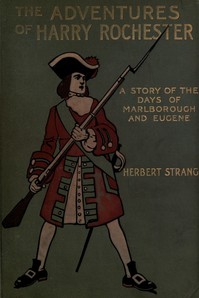
The Adventures of Harry Rochester: A Tale of the Days of Marlborough and Eugene
Download Formats:
Excerpt
This eBook is for the use of anyone anywhere at no cost and with almost
no restrictions whatsoever. You may copy it, give it away or re-use it
under the terms of the Project Gutenberg License included with this
eBook or online at http://www.gutenberg.org/license.
Title: The Adventures of Harry Rochester
A Tale of the Days of Marlborough and Eugene
Author: Herbert Strang
Release Date: December 05, 2013 [EBook #44362]
Language: English
Character set encoding: UTF-8
Read the Full Text
— End of The Adventures of Harry Rochester: A Tale of the Days of Marlborough and Eugene —
Book Information
- Title
- The Adventures of Harry Rochester: A Tale of the Days of Marlborough and Eugene
- Author(s)
- Strang, Herbert
- Language
- English
- Type
- Text
- Release Date
- December 5, 2013
- Word Count
- 148,764 words
- Library of Congress Classification
- PZ
- Bookshelves
- Browsing: Children & Young Adult Reading, Browsing: History - Warfare, Browsing: Fiction
- Rights
- Public domain in the USA.
Related Books
Martin of old London
by Strang, Herbert
English
865h 29m read
The long trail: A story of African adventure
by Strang, Herbert
English
1019h 20m read
The Cruise of the Gyro-Car
by Strang, Herbert
English
882h 42m read
Kobo: A Story of the Russo-Japanese War
by Strang, Herbert
English
2005h 7m read
Brown of Moukden: A Story of the Russo-Japanese War
by Strang, Herbert
English
1988h 26m read
Boys of the Light Brigade: A Story of Spain and the Peninsular War
by Strang, Herbert
English
2536h 25m read