The Project Gutenberg EBook of St. Paul's, by Elizabeth W. Grierson
This eBook is for the use of anyone anywhere at no cost and with
almost no restrictions whatsoever. You may copy it, give it away or
re-use it under the terms of the Project Gutenberg License included
with this eBook or online at www.gutenberg.org/license
Title: St. Paul's
Tales of English Minsters
Author: Elizabeth W. Grierson
Release Date: March 10, 2019 [EBook #59044]
Language: English
Character set encoding: UTF-8
*** START OF THIS PROJECT GUTENBERG EBOOK ST. PAUL'S ***
Produced by David E. Brown and The Online Distributed
Proofreading Team at http://www.pgdp.net (This file was
produced from images generously made available by The
Internet Archive)
[Illustration: ST. PAUL’S CATHEDRAL.
FROM LUDGATE HILL.]
TALES OF ENGLISH MINSTERS
ST. PAUL’S
BY
ELIZABETH GRIERSON
AUTHOR OF
“THE CHILDREN’S BOOK OF EDINBURGH,” “CHILDREN’S TALES
FROM SCOTTISH BALLADS,” ETC.
WITH
TWO FULL-PAGE ILLUSTRATIONS
IN COLOUR
AND FOUR IN BLACK AND WHITE
LONDON
ADAM AND CHARLES BLACK
1910
TALES OF ENGLISH MINSTERS SERIES
EACH CONTAINING TWO FULL-PAGE ILLUSTRATIONS IN COLOUR AND FOUR IN BLACK
AND WHITE
DURHAM
LINCOLN
ST. ALBANS
YORK
ELY
ST. PAUL’S
CANTERBURY
PUBLISHED BY
A. AND C. BLACK. SOHO SQUARE. LONDON
AGENTS
AMERICA THE MACMILLAN COMPANY
64 & 66 FIFTH AVENUE, NEW YORK
AUSTRALASIA OXFORD UNIVERSITY PRESS
205 FLINDERS LANE, MELBOURNE
CANADA THE MACMILLAN COMPANY OF CANADA, LTD.
ST. MARTIN’S HOUSE, 70 BOND STREET, TORONTO
INDIA MACMILLAN & COMPANY, LTD.
MACMILLAN BUILDING, BOMBAY
309 BOW BAZAAR STREET, CALCUTTA
LIST OF ILLUSTRATIONS
IN COLOUR
ST. PAUL’S CATHEDRAL FROM LUDGATE HILL _Frontispiece_
FACING PAGE
SIGNING MAGNA CHARTA 8
IN BLACK AND WHITE
PREACHING AT PAUL’S CROSS 17
SIR CHRISTOPHER WREN 24
NELSON’S MONUMENT 40
THE NAVE 48
ST. PAUL’S CATHEDRAL
‘The Church of the Citizens.’
I
I am sure that there is no one who goes to London for the first time,
no matter how hurried he may be, who does not try to visit at least
three places--the Tower, Westminster Abbey, and St. Paul’s Cathedral.
Of these three places, two are churches; but they are churches that are
so connected with the history of our nation that they almost seem to
stand at the heart of the Empire.
Their stories are linked together in a curious way, and yet they are
quite distinct. As someone has said, ‘Westminster Abbey was ever the
Church of the King and Government; St. Paul’s was the Church of the
Citizens.’
When we come to study the history of Cathedrals, we find the way in
which they came to be built is pretty much the same in most cases.
A little church was raised to the glory of God, and a monastery was
founded beside it, which became the home of a community of monks or
nuns, ruled over by an Abbot or Abbess; and the church was known as the
Abbey Church.
Then by-and-by, sometimes not till quite late, as at St. Albans, a
‘Bishop’s Stool’ was placed there, and the Abbey became a Cathedral.
But in the case of St. Paul’s Cathedral it is quite different. It was
built for a Cathedral from the first. Its builder, instead of adding a
monastery to it, as was usually done, built a monastery having its own
Abbey on a little Island which stood in some marshy ground on the banks
of the Thames, about a mile away.
This Island was called ‘Thorney Island,’ and the Abbey Church was
dedicated to St. Peter, but soon it began to be spoken of as the ‘West
Minster,’ or Westminster Abbey, by which name we know it to-day.
This was how it all came about. In the time of the early Britons
there were Christian churches scattered up and down the land, and it
is almost certain, from stones that were dug up when the foundations
of the present Cathedral of St. Paul were being laid, that in those
far bygone days a little church stood on the Hill of Ludgate, in the
centre of Roman London. But, as you know, the Roman legions were
recalled to Rome in A.D. 410 to help the soldiers there to drive back
the vast hoards of Goths and barbarians who were pouring down from the
north-west upon Italy; and when they were withdrawn from Britain, there
were not enough fighting-men left to protect her shores from the next
enemies who threatened her.
These were the Jutes, the Angles, and the Saxons, fierce and heathen
warriors who came from Jutland and from Germany, and landed on our
coasts.
They conquered the British, and rapidly forced their way inland,
ravaging and pillaging wherever they went; and in the confusion and
misery that followed, Christianity was completely swept away for a
time, to come again with St. Augustine and St. Columba some two hundred
years later. You know too, perhaps, that when St. Augustine came to
Canterbury and began to preach the Gospel there, the King of Kent,
Ethelbert by name, soon became a Christian. This King Ethelbert was a
very powerful monarch, and he was Overlord of the King of the East
Saxons, who chanced to be his nephew, and who lived in what we now call
Essex. Now, while St. Augustine preached to the men of Kent, a friend
of his, named Milletus, preached to the East Saxons. And when at last
their King became a Christian, his uncle Ethelbert suggested that, as
Kent had its Bishop of Canterbury, with his Cathedral Church, it would
be a good thing for the Kingdom of the East Saxons to have a Bishop of
its own who would have his Cathedral Church also.
So, as London was the Capital of the East Saxons, he proposed to help
King Siebert to build a church there; and Augustine, only too glad to
find that the Faith was spreading, said that Milletus should be its
first Bishop.
It was in this way that the first Cathedral of St. Paul was built,
and, as we have seen, Siebert also founded the church and monastery of
Westminster.
[Illustration: KING JOHN SIGNING MAGNA CHARTA. PAGE 18.
AFTER THE PAINTING BY ERNEST NORMAND IN THE ROYAL EXCHANGE, LONDON
_By permission of the artist._]
Now, although their King had been baptized, and had built two churches
in their midst, the people of London did not want to become Christians;
they were pagans, and were quite content to worship Thor and Odin,
the gods of the tribes of the North. So for a long time the good
Bishop Milletus preached to them in vain; and far away in Rome, Pope
Gregory, who had hoped that the new Cathedral in London would become
what we call the ‘Metropolitan Church’ of England--that is, the church
where the Archbishop has his throne--was sadly disappointed, and had
to become accustomed to the idea of Canterbury, which was a far less
important place than London, having that honour.
Indeed, for a time it seemed as though, in spite of Church and Bishops,
the new religion would be driven out. Ethelbert died, and so did his
nephew Siebert, and the Kings who succeeded them either went back
altogether to their pagan worship, or tried, as an East Anglian King
did, to worship Thor and Odin and Christ all at the same time. I will
tell you just one story about those troubled days, and it will show you
what a terrible struggle went on between Paganism and Christianity, and
how much we owe to these brave men, priests, and Abbots, and Bishops,
whose names are almost unknown to us, on whom rested the responsibility
of maintaining the Faith in England, and of whom, to their honour be it
said, hardly one failed.
One day Bishop Milletus was administering the Holy Communion in his
church to the little congregation of Christians who still remained
true to what he had taught them. It is probable that the altar stood
then just where the high-altar in St. Paul’s stands to-day. Only the
church would be much smaller and plainer, and the door would be locked
to prevent unbelieving pagans entering and disturbing the service by
irreverent jeering and laughter. Suddenly a loud knocking was heard,
then the crash of falling wood. The young King and his friends had
chanced to be passing, and, in a moment of heedless excitement, had
determined to visit the Christian’s church, and see what amusement they
could get there. Angry at finding the door locked against them, they
had broken it down without further delay. Up the aisle strode the King,
followed by his mocking companions, to where the old Bishop was engaged
in distributing the consecrated Bread to the kneeling communicants. In
those days white bread was a rarity, most of it being dark-coloured and
unwholesome; and this white bread that was used for the Holy Communion
was the whitest and purest of all; for, in order that it should be
so, pious people, even the clergy themselves, used to grind the meal
carefully with their own hands, and bake it into loaves, and bring it
to the church as their offering.
‘Give me some of that white bread,’ cried the young King, stretching
out his hand. ‘You gave it to my father Siebert; give it also to me.’
Perhaps he thought in his reckless insolence that the Bishop would
obey. But King Siebert had been a baptized Christian, his son was
a pagan and an unbeliever; so, King though he was, he could not be
allowed to join with the Christians in their solemn Feast. And the
brave old Bishop told him so, knowing full well that the refusal might
cost him his life. The young King did not put him to death, however,
though he was very angry--perhaps he was ashamed to do so--but it cost
him his Bishopric, for he was driven out of the Kingdom, and had to
leave to seeming ruin all the work that was so dear to his heart.
But it was only _seeming_ ruin. He had done his work faithfully; he
had laid the foundations, as it were; and, as has ever happened in
the history of the Church, God saw to it that there were other men
ready to step in, and build upon these foundations. Other Bishops were
appointed--Bishop Cedd and Bishop Erkenwald--and in their days the
Christian Faith began to take root again, and spread among the citizens
of London, and they improved and beautified their Cathedral until it
became famed for its riches and grandeur. Indeed, Bishop Erkenwald was
such a famous preacher, and did so much for his church, that when he
died he was buried in a golden shrine which people came to see, just
as they visited the shrine of St. Cuthbert at Durham, and St. Thomas
at Canterbury. As for stout old Bishop Milletus, although he was
driven into exile for a time, he became in after-years Archbishop of
Canterbury, and his bones lie in the Cathedral there.
Now, it is a curious thing how often those old churches that we are
talking about were destroyed, either wholly or in part, by fire. And if
there was one church that was fated to suffer more than another in this
way, it was St. Paul’s. It was partly burned down in A.D. 951. By that
time the Normans were in the country, and they set to work at once to
rebuild it. When it was finished, it was a very splendid church indeed;
but once more it suffered severely from a fire which broke out in the
City, and destroyed everything from London Bridge to the Church of St.
Clement Danes, which stands in the Strand.
Let us see what this Cathedral of the Middle Ages was like. It was the
largest church in England, and was shaped like a cross, and, instead
of having a dome, as the present Cathedral has, it had a great square
tower in the centre, with a wooden spire, four hundred and sixty feet
high. It stood in the middle of a churchyard, which was surrounded by
a high wall. We still talk about ‘St. Paul’s Churchyard,’ although it
is long years since anyone was buried there; but if we are in London,
and take a bus along the crowded Strand, and up Ludgate Hill, we shall
arrive at this old churchyard, and then we shall see the ‘St. Paul’s’
of to-day, and shall be better able to picture to ourselves the ‘St.
Paul’s’ of the Middle Ages.
When we leave our bus, we find ourselves in an open space bounded
on all sides by busy streets and fine shops. In the centre of this
open space stands an immense church, with a huge dome rising from its
centre, and on the top of the dome, standing clearly out against the
sky, so far up that it can be seen from nearly all parts of London,
is an immense gilded cross. In front of the church there are two
great flights of steps, which lead down into a broad paved space, only
separated from the street by a row of low stone pillars, while round
at the sides lie pleasant gardens, with flagged walks, where pigeons
flutter about, and where, in summer, hundreds of busy clerks, and
shop-girls, and message-boys, come and sit in their lunch-hour, and get
a breath of fresh air and a little sunshine.
‘But where is the old churchyard?’ you ask, looking round in amazement.
I will tell you. These gardens, and the great space in front of the
church, stand to-day where St. Paul’s Churchyard stood long ago, only
there is no longer a wall round them, and although the name remains,
the gravestones have long since disappeared. Let us try, however,
to think that we are back in the Middle Ages, and imagine ourselves
standing among the graves in the old churchyard. In front would be the
great church, bigger than that which now rises before us, with its
square tower and wooden steeple. At the north-east corner of it we
should see a curious erection like a low, eight-sided tower, with a
stone cross on the top of it. That was called ‘Paul’s Cross,’ and it
was almost as important a place as the Cathedral itself.
As I said at the beginning, St. Paul’s Church was the Church of the
Citizens. The Monarchs of the land might be crowned or buried at
Westminster, but it was to St. Paul’s that the people crowded when
they wanted to meet together and stand up for their rights. So there
was a great bell in the Cathedral belfry, like the bell in St. Giles’s
Cathedral in Edinburgh, which was rung whenever a question arose which
concerned the burghers of the city, and when its deep tones were heard,
the people ran out of their houses, and thronged into the churchyard
through the six gates which pierced its encircling wall, and crowded
round Paul’s Cross; and the Aldermen, ascending by steps to the top
of the eight-sided tower, stood under the Cross, and spoke to them.
Here royal proclamations were made, quarrels were settled, grievances
stated, and put to rights. Here, also, sermons were preached in the
open air by famous preachers.
Indeed, I think that I may safely say that ‘Paul’s Cross’ was the
centre of the public life of London. It has long since been pulled
down, however; but if we go to the north-west corner of the gardens,
we can still see the place where it stood, clearly marked on the
pavement.
The Bishop’s Palace also stood within the wall, and two little
churches, one of which was founded by Gilbert à Becket, father of
Thomas of Canterbury, who was a silk-mercer in Cheapside; while the
other was a parish church--the Church of St. Faith--which was pulled
down in after-years, and the people who went to Service there were
allowed to worship in the crypt of the Cathedral instead.
It would only weary you to attempt to describe the interior of the
old church. It would be very like the other Cathedrals of that time,
which were all more richly adorned before the Reformation than they
are now. All the accounts which we read of it show us that it was very
magnificent, with rich carvings, and stained glass, and no less than
seventy side-chapels and chantries, each with its own altar, and,
richer than all others, the great Shrine of St. Erkenwald, with its
ornaments and jewels.
[Illustration: PREACHING AT ST. PAUL’S CROSS.]
I think that it will be much more interesting to talk of some of the
scenes that took place there in these far-off days. Let us go back,
for instance, almost eight hundred years, to the day when the news
arrived in London that the King of England, Henry I., lay dead in
France. He and his brother, William Rufus, were, as you know, sons of
the great Norman Conqueror, and during their reigns the country had
been well governed and prosperous. But when Henry died, no one quite
knew what to do next. For the rightful heir to the throne was Henry’s
daughter Maud, who had married a French Count of Anjou, who, as you
remember, was the first of his race to be called ‘Plantagenet,’ because
he was in the habit, as he rode along, of plucking a piece of broom
(_Planta genista_) and sticking it in the front of his cap. Now, the
English people did not love this Geoffry of Anjou, who was a greedy and
selfish man, and they had no wish to have him for their King, as they
would certainly have to do if his wife became Queen. So their thoughts
turned to Maud’s cousin, Count Stephen of Blois, who, although his
father was a Frenchman, had an English mother, and who had been brought
up in England at his uncle’s Court. Most people wished to have him as
their King; but no one dare suggest it until the citizens of London
took matters into their own hands.
‘The country needed a Monarch,’ they said, ‘and if the Barons would
not take the responsibility of electing one, they would.’ And without
more ado the Portreve (or Lord Mayor) and Aldermen caused the great
bell of St. Paul’s to be rung, summoning the burghers to a ‘Folk-mote’
or council; and when they had all gathered round the Cross in the
churchyard, the matter was discussed, and it was agreed that it would
be better for England that Stephen should be King rather than that Maud
should be Queen; and straightway the city gates were thrown open to the
Count, and the citizens swore allegiance to him, and he was crowned
King of England.
Perhaps, after all, it would have been better if the citizens had
chosen Maud, for, as history shows, Stephen did not turn out to be a
very good King.
Another great decision that was made at a public meeting at St. Paul’s
was the framing of Magna Charta--that great Charter which secured, for
all time to come, justice and liberty to English freemen.
In these old days, especially after the Normans came into the country,
Kings were apt to think that might was right, and that they could do
what they chose with their subjects. If a man displeased the King, or
if he wanted to seize his land, he could simply throw him into prison
and keep him there, sometimes until he died, without giving him even
a trial. Then, too, if the Monarch wanted money, he simply forced the
people to give it to him, and no one had any security that what was his
to-day might not be the King’s to-morrow.
When Henry I. came to the throne, he wanted to please the people,
because he had an elder brother living, who had gone to the Crusades,
and he was afraid that unless he gained the affection of his subjects
before his brother came back, they might choose the latter to be King
instead of him. So he granted them a Charter, promising not to seize
any of their property, nor to tax them unduly, nor to touch any of the
lands belonging to the Church. He did not keep those promises very
well, however, and his successors, Stephen, and Henry, and Richard,
and John, did not keep them at all; and by the middle of King John’s
reign the country was in a very bad state indeed. No heed was given
to the advice or wishes of the great nobles, who ought to have had
a voice in the government of the country, while the common people
were so oppressed and down-trodden that they were ready to rise in
rebellion. And they would have done so if it had not been for the
wisdom and prudence of two great men--Stephen Langton, Archbishop of
Canterbury, and William Marshal, eldest son of the Earl of Pembroke.
Stephen Langton was a foreigner, whom the Pope had sent to Canterbury,
but he was a good man, a real ‘Father in God’ to his people, and he
believed that he was set over them to look after their bodies as well
as their souls. When he found out how down-trodden the poor folk of
England were, he made up his mind that such a state of things should
not continue. So he began to inquire into the laws, and he found out
about this old Charter, which had been granted by Henry I., but had
never been kept, and had long since been forgotten. The wise Archbishop
did not say anything, but he quietly set to work to find a copy of this
Charter. After some trouble he discovered one, hidden away among the
papers of an old monastery. He then summoned all the chief people in
the country to meet him at St. Paul’s Cathedral. That was one of the
most memorable assemblies in English history. All the powerful Nobles
and Barons, all the stately Bishops and Priors, all the sober Aldermen
of the great city, met together and listened with deep interest while
the Archbishop read aloud to them the promises which had been made by
Henry I., and recorded on the parchment which he held in his hand; then
pointed out to them that these promises had never been kept, and that
the people of England had a right to demand that they should be kept.
He finished his speech by calling upon his listeners to band themselves
together, and never rest satisfied till they had obtained redress from
the grievous wrongs which had pressed upon them, and upon their poorer
brethren.
The Archbishop’s words were not in vain. Nobles and Barons crowded
round him, and, laying their hands upon their swords, took a solemn
oath that they would insist upon the principles of Henry’s Charter
being maintained, and would do their best to protect the liberties of
the people.
This was just before Christmas-time, and when the King came to hold
his Christmas Court in London, these same Nobles, armed to the teeth,
and accompanied by the Churchmen and the principal citizens, appeared
before him, and demanded that he should listen to their requests, and
make proper laws to guard their liberties.
King John was frightened, but he did not want to give in; so, like
the weak man that he was, he did not return a direct answer, but said
that he would think over the matter, and meet them again at Easter. He
thought that in this way he could put them off, and never give them an
answer at all. But the people were determined, and formed themselves
into an army, which they called the ‘Army of God, and of Holy Church,’
and all the clergy, and all the citizens of London, and Exeter, and
Lincoln, supported them, and the King was obliged to yield.
So it came about that one June day a great assembly of people met on
the banks of the Thames near Windsor. On one side was encamped the
King, with a handful of followers, and on the other the great army of
Barons, and nobles, and citizens had pitched their tents on a piece of
marshy land known by the name of Runnymede. In the middle of the river
was a small island, and on this island a few men chosen by the King,
and a few men chosen by the Nobles, met to discuss matters; at least,
they pretended to discuss matters, for everyone knew what the end would
be. The King was powerless to resist the wishes of the great concourse
of people gathered across the river, and before nightfall ‘Magna
Charta,’ the ‘Great Charter,’ had been drawn up and signed.
I cannot tell you all the good things that were secured to Englishmen
by this great deed, but there was one thing which, above all others,
it gained for them--and gained for us as well--Justice. It is one
of our proudest boasts that, by English law, no man, be he ever so
poor or degraded, is condemned unheard; that every man is counted
innocent till, by a fair trial, he is proved to be guilty. And the very
foundation of our freedom rests on some words that were written that
day on that old parchment: ‘_We will sell to no man, we will not delay
nor deny to any man, justice or right_.’
But if the great bell of St. Paul’s could call the citizens to fight
for their liberty as Englishmen against the oppression of the King, it
could also summon them to fight for their liberty as Churchmen against
the oppression of the Pope. We must always remember that when first
Christianity was brought to England, in the time of the Romans, and the
ancient British Church was formed, it did not owe allegiance to the
Bishops of Rome as it did in later days. It was only after it had been
swept away by the invasion of the Angles and Saxons, and then brought
back again to the South of England by St. Augustine, who came direct
from Pope Gregory of Rome, that the belief arose that it was right that
the Church of England should be ruled by the Pope.
[Illustration: SIR CHRISTOPHER WREN
From a painting by Sir G. Kneller in the National Portrait Gallery,
London
(_Page 38_)]
Up in the North, on the other hand, in Scotland and in Northumbria,
where Christianity had been brought by St. Columba and his followers,
who, as you remember, came from Ireland, it was a very much longer
time before the Church would admit the Papal claims, though at last it
did so. And St. Aidan and St. Cuthbert, who founded the Northumbrian
Church, being missionaries from the ancient British Church, which St.
Columba represented, did not feel obliged to obey the Pope in the same
way that St. Augustine did. It would take me too long to tell you
about the differences that existed between the Church in the North and
that in the South, the chief of which was that they did not keep
the festival of Easter on the same day. The Church of St. Augustine,
following the example of Rome, kept it on one day; the Church of St.
Columba, following the example of the British and Eastern Churches,
observed it some ten days later, as the Russians and Greeks do still.
But as time went on the rule of the Pope began to weigh heavily upon
the English people. They thought that they had the right to elect their
own Bishops and Archbishops, while the Pope thought that he had the
right to do so, and at first he very often sent foreigners to fill the
English Sees.
Sometimes, indeed very often, they were good men. The saintly Bishop
Hugh of Lincoln came from Savoy. Archbishop Theodore of Canterbury was
a Greek, who came from far-away Tarsus, the city of St. Paul. But some
of them were bad men, haughty and insolent, who wanted to override
English laws and English freedom. And when this happened the people
were apt to rebel, and declare that only English Bishops should rule in
the Church of England.
Things came to a crisis when, in the thirteenth century, a great many
Italians came over to England, and were given some of the highest
offices in the country. Among them were two brothers of good birth,
Peter of Savoy and his brother Boniface. Peter, who had a grand house
in the Strand, called Savoy House, was made a Privy Councillor, and was
given the chief seat at the King’s Council Board. Boniface, who was a
priest, was, by the wish of the Pope, made Archbishop of Canterbury.
Now, Boniface of Savoy had mistaken his vocation. He was young, and
handsome, and full of roistering spirits; he would have made a good
soldier, and doubtless his men would have admired him for his reckless
daring; but he was haughty, and insolent, and overbearing, and sadly
lacking in common sense--not fit to be placed in the great position in
which he found himself.
He brought with him a band of armed retainers, who, when they rode
through the streets of London, robbed the stalls in the market-places
as though they had been wild marauders, instead of the servants of a
Christian Bishop. Their Master behaved no better than they did. There
was in the City a monastery called St. Bartholomew’s, in Smithfield.
He resolved to visit it, and, appearing at the gate with his men,
demanded an entrance. For some reason the Prior resented this--perhaps
Boniface’s insolent manner made him angry; perhaps he felt that it
was the Bishop of London’s place to inspect his monastery, and not
the Archbishop of Canterbury’s. At any rate, he refused to admit the
Prelate.
And what do you think happened? Without more ado the Archbishop
clenched his fist, and knocked the Prior to the ground. It was a
foolish as well as a wicked act, for of course the news of what had
been done spread through London, and the citizens began to say to each
other that a man who could do a deed like that was not fit to be an
Archbishop.
A little time afterwards, Boniface determined to visit St. Paul’s
Cathedral, and call upon the Bishop of London for his tithes or
first-fruits. He may have been acting quite within his rights to do
this: I do not know; but the citizens, at any rate, made up their minds
that, if he came with his demands to their Cathedral Church, he would
find out what they thought of him. So the big bell was rung, and they
gathered round the Cross in their thousands. Archbishop Boniface heard
of this in his Palace at Lambeth, and, although he would not be turned
from his purpose, he put on a suit of armour under his robes before he
ventured near the Cathedral. When he arrived there, he found, to his
rage, that the citizens had closed the gates against him, and instead
of being awed by his angry remonstrances, they jeered and hooted at
him, and even threatened him with violence, so that at last he thought
it wise to go home.
But worse was to follow. Now that an Italian Archbishop sat on the
throne of Canterbury, a great many Italian priests came over, and were
given the best livings in the Church. Their manners were no better than
those of their countryman, and the citizens became so enraged at the
behaviour of these foreigners, and at the unjust way in which the Pope
had forced them upon them, that they determined that not one of them
should set foot in the church that they looked on as especially their
own.
And they were in such deadly earnest that it actually came about that,
when two of these priests attempted to enter the precincts one day, the
people crowded into the churchyard and killed them on the spot. After
this they rushed to Lambeth, and besieged the Palace there, uttering
such threats that Boniface, the ‘Handsome Archbishop’, as they called
him, was glad to escape as best he could, and fly abroad for safety.
He never came back, and we can fancy that the Pope was more careful in
future whom he sent to England, for the citizens of London had taught
him a lesson, and shown him that he could not lord it over them with
impunity.
Just one more story about these old days, and then we must come to the
St. Paul’s that we know.
It was in the reign of King Edward III., and the Church of England had
lost its first purity, and grown rich and corrupt. Many of the Bishops
and clergy had forgotten what they had been made ministers of God for,
and, instead of thinking about the needs of their people, they thought
only of how much wealth they could heap up for themselves, and how
luxuriously they could live.
The Reformation was yet a long way off, but there were two men in the
country who wanted to put an end to this state of affairs, and they
wanted to do so for two very different reasons. You have all heard of
John Wyclif, the earliest of the English Reformers. He was one of those
two men, and he wanted to weaken the power of Rome, because he saw that
the poor people of this country were being robbed, in order to enrich
the Pope and his favourites, who, as we have seen, were put into high
places in the Church. So he began to point out the abuses that existed,
and to urge people not to submit to them any longer.
The other man was a powerful Noble, ‘John of Gaunt--Time-honoured
Lancaster,’ as Shakespeare calls him; and I am afraid that the reason
why he wanted the power taken from the clergy was, that he hoped that
when they could no longer collect great sums of money from the common
people, he and his brother Nobles might be able to do so instead.
So when, one day, Wyclif was summoned to appear before the Bishop of
London, Bishop Courtenay, to answer for the heretical notions which it
was reported that he was spreading, the Duke of Lancaster espoused his
cause, and stood by his side.
It must have been a curious scene--the grave Bishop in his robes,
seated on his throne, with his advisers round him; the thin, worn
priest from Lutterworth, with his pale, studious face and black gown;
and the proud Noble, who was, at that time, one of the most powerful
men in the country.
Some of the citizens had crept into the church, to hear what the monk
had to say, but they did not hear him say very much, for the Duke of
Lancaster soon began to wrangle with the Bishop. He hated the clergy,
because he was envious of their position and the power that they had
over the simple folk, and his pride could not brook the questions that
the Bishop put to his friend. At last he lost his temper altogether,
and, after speaking very rudely to the Prelate, he threatened to drag
him out of the church by the hair of his head. In an instant, the
listening citizens sprang to their feet. They were not very interested
in Wyclif’s reforms--probably, at that time, they did not know very
much about them--but this powerful Duke was no friend of theirs,
and they were enraged at the thought that he dared come into their
Cathedral and threaten their Bishop. With one accord they rushed to the
belfry and tolled the great bell, and when, as was their duty, crowds
of other citizens gathered in the churchyard to see what had happened,
they told them, in excited tones, that John of Gaunt was in the church
with his followers, and threatening to lay hands on the Bishop.
Then a perfect tempest arose. Some of the crowd rushed into the
church, declaring that they would murder the Duke; others went off to
his Palace in the Strand, determined to break into it and pillage it,
in order to punish him for his insolence. And they were in such deadly
earnest that they would have carried out both threats had not Bishop
Courtenay himself interfered, and saved his enemy from their violence.
Just before the Reformation the great church was at the very height
of its glory--from an outward point of view, at least. We read that
there were no less than one hundred and thirty clergy who were supposed
to minister there, and that there were so many people connected with
it--schoolmasters, schoolboys, singing-men, choir-boys, bedesmen,
bookbinders, sextons, gardeners, bell-ringers, etc.--that employment
must have been given to more than a thousand people. It all seems
very grand and glorious; but if we read further, we find that it had
grown just like the Temple in our Lord’s time: there was a great deal
of outward magnificence, and yet the very purpose that the church had
been built for--the Service and Worship of God, was in danger of being
forgotten. Instead of being kept as God’s house, entirely for His
Worship, we find that the great nave was the fashionable meeting-place
of the good folk of London, and they used it as we should use a
promenade to-day.
Francis Osborne, an old historian, writes: ‘It was the fashion in those
days ... for the principal Gentry, Lords and Courtiers, and men of all
professions, to meet in S. Paul’s by eleven of the clock ... and walk
in the middle aisle till twelve, and after dinner from three till six,
during which time some discoursed of business, and others of news.’
Then came the Reformation; and, as always happens when a great change
like that is taking place, people were so zealous to sweep away all
the abuses that had crept in, that they ‘lost their heads,’ as we say,
and did many wrong and unseemly things. It was right and needful that
the Church should be reformed; but it was not right nor needful that
all the splendid carving, and decorated stonework, and beautifully
illuminated books, and gold and silver altar vessels, which had been
given for the Service of God by pious men and women, should be broken
by hammers, or burned, or carried away and melted down, to fill the
pockets of worthless noblemen.
It was right that the nave should no longer be the place of resort
for all the fashionable loungers in the city; but it did not improve
matters when the same nave was turned into cavalry barracks for Oliver
Cromwell’s soldiers, and the rough men were allowed to play games and
behave in any way that they liked in the church.
No, the history of that time is not pleasant reading; and we feel
almost glad when we hear that, first of all, the wooden spire was
struck by lightning, and set on fire, and then that the whole church
was burned down by the Great Fire that devastated London in September,
1666; for then a new beginning could be made, and those unhappy old
stories forgotten.
II
You all know about the Great Fire of London: how it came after the
Plague, and how it seemed such a calamity at the time, but proved,
after all, a blessing in disguise, for it burned down all the old
plague-infested, unhealthy wooden houses, which were so crowded
together that the streets were narrow and dark, and made room for
better buildings and wider streets, and brought in a healthier mode of
living altogether.
Just before the Fire broke out, a proposal had been made to restore the
old Cathedral, and a famous architect, Sir Christopher Wren, had been
called on to discuss the matter. He had agreed to undertake the work,
and was prepared to do so, when the Great Fire took place, and when it
was over, there was nothing left of the church but the blackened walls.
Then people shook their heads, and said that it would be impossible to
restore it. A new Cathedral might be built somewhere else, but the St.
Paul’s that they had known on Ludgate Hill had gone for ever.
But Sir Christopher Wren differed from them. ‘It would be impossible
to restore the church,’ he said, ‘or even to rebuild it on its old
foundation, but there was no reason why a new foundation should not be
laid, and a new church built upon it.’
‘That was all very well,’ answered the objectors to the scheme; but
how did Dr. Wren propose to take down the walls and level the old
foundations?
He suggested gunpowder; and with a little care he could have blown down
the walls quite safely, but a stupid master-builder thought that he
could do the work himself, without the architect superintending, and he
set to work one morning, and used such a big charge of the explosive
that a great many of the half-ruined houses in the neighbourhood fell
with the force of the explosion, and people got such a fright that they
objected to gunpowder being used at all.
The famous architect was not dismayed, however, at this opposition. He
believed in the proverb that says, ‘Where there’s a will, there’s a
way.’ So he procured a great beam of wood, forty feet long, and had it
covered at both ends with iron. Then he slung this beam up in a wooden
erection, something like a triangle, and used it as a battering-ram to
break down the walls. At first it appeared as if it would be in vain.
The workmen battered at the walls for a whole day, and not a stone
fell. But Wren persevered, and the next day he was rewarded, for the
great buttresses fell at last with a crash, and he was able to proceed
with his work.
And this he did most thoroughly. Someone has said of him that he ‘built
for eternity,’ and, as far as any man can do so, the saying is true.
Everyone knows that the security of a building depends greatly upon
the kind of foundation it rests upon. No matter how well built it is,
no matter how showy the walls may be, if the foundation is not firm and
solid, sooner or later it must fall to pieces, unless something is done
to repair it.
Christopher Wren knew of this danger, and the first thing that he set
his workmen to do was to dig down forty feet into the earth to find
out if the ground on which he intended to build was quite solid and
secure. Doubtless many people laughed at him, and said that he was too
particular, but he did not care, and they stopped laughing when it was
discovered that right down at the north-east corner there was a pit,
and if the new Cathedral had been built over this, sooner or later the
ground would have sunk, and the wall of the building have cracked, and
in all probability fallen to pieces. However, Dr. Wren made his workmen
dig deeper, till they got to the bottom of this pit; then he filled it
up with a pier of solid stone. It took him a whole year to do this, but
at the end of that time he was ready to begin the church, knowing that
underneath it was a foundation that was absolutely secure.
Then arose the great Cathedral that we see to-day. It took some thirty
years to build, and when it was finished, the highest stone in the
lantern that rests on the dome was laid in its place by Sir Christopher
Wren’s son.
But now we learn something about Sir Christopher that shows that he was
a good as well as a clever man. Do you remember what is said in the
Bible about people who can rule their own spirits, and are slow to be
angry? That they are really greater than the men who conquer cities,
and whom the world admires. Tried by this standard, Sir Christopher
was a really great man. For he was not only clever enough to build St.
Paul’s Cathedral, but he could rule his own spirit, and not vex himself
over the way in which his enemies treated him.
The story of Sir Christopher Wren’s life--for he was knighted as a
reward for his work--is as interesting as any of the stories connected
with St. Paul’s Cathedral. He was the son of a Wiltshire clergyman,
and his love of architecture dated from a time when the roof of his
father’s church had grown so old that it threatened to fall down. And,
as often happens in a country parish, there were not very many rich men
living there who could give money to pay for the building of a new
one. So the Vicar determined that, instead of paying for an architect,
he would draw the plans, and superintend the building of the roof
himself.
And we can imagine how little Christopher would hear all about the
new church roof, and how he would look over his father’s shoulder and
watch him when he was drawing the plans, and how he would spend all his
play-time in the church, looking at the joiners putting up the wooden
beams, and the other workmen working on the walls, while his father
went up and down, superintending everything, and very likely lending a
helping hand himself. Perhaps it was in these early days that the boy
determined that he, too, would build churches when he was grown up.
Then he had an ‘Uncle Matthew,’ who was Bishop of Ely, and as he grew
older he would go and visit him, and would wander across from the
Palace into Queen Etheldreda’s beautiful Minster Church, and stand
and look up in wonder at the Lantern Tower; and his uncle would tell
him the story of how it once fell, and how Alan de Walsingham built
it up again, and perhaps it was that which gave him the idea, which
he carried out afterwards at St. Paul’s, of a great church with an
enormous dome in the centre of it, under which thousands of people
could assemble, as they do on Sunday afternoons at St. Paul’s to-day,
and listen to the sermon of some great preacher.
He did something else first, however, for he was very fond of watching
the stars, and when he went to Oxford he watched them so closely, and
learned so much about them, that he was made Professor of Astronomy.
But although he was made Professor of Astronomy, he seems to have gone
on all the time studying architecture, and drawing plans of churches,
and at last King Charles heard of him, and asked him to draw some plans
of churches for him. In this way he became known as a clever architect,
and when the Great Fire took place, and a large part of London had to
be rebuilt, he not only built a new Cathedral, but forty-two other
churches as well; besides which he built Marlborough House, and a great
part of Greenwich Hospital.
[Illustration:
_Photochrom Co., Ltd._
ST. PAUL’S CATHEDRAL: NELSON’S MONUMENT
(_Page 59_)]
So you see that he had a useful, busy life, and it was a very long
one as well, for he lived till he was an old man of ninety-one. He
was not very kindly treated towards the end of his life, and this
was because of what is called ‘political jealousy.’ It had been the
Stuart Kings who had brought him into notice, and given him the post of
Surveyor-General; but when the House of Hanover came into power, their
followers said, ‘Oh, we cannot have any of the friends of the Stuarts
holding good posts; we must take them from them, and give them to those
of our own party.’
And so Sir Christopher Wren’s office was taken from him, and given to
another man, and something else was done that vexed him quite as much
as losing his post.
He had meant his great Cathedral to stand as it stands to-day, with
an open space all round it. Someone suggested that it would look
much better if it were enclosed by a wall. And, in spite of Sir
Christopher’s remonstrances, a wall was built, which quite spoilt the
effect in his eyes.
He might have gone up and down the world trying to prove to everyone
that his idea was best, and he might have made himself and his friends
very unhappy over the unkindness and injustice that had been shown him,
but, instead of this, he only shrugged his shoulders when he looked
at the unsightly wall, and said, with a little laugh, that ‘ladies
thought nothing looked well without an edging.’ Then he retired quietly
to Hampton Court, where he had a house, and occupied himself until he
died with his old hobby of Astronomy, and with reading Theology and
Philosophy.
We read that occasionally the old man would ‘give himself a treat,’
and do you know what that treat was? He would come to London, and walk
quietly up the Strand to St. Paul’s Churchyard, and stand and look for
a while at the great and beautiful Cathedral that he had built, and
then he would go home feeling quite content and happy, for he knew that
it would stand for long centuries after the ugly wall had been pulled
down again, and that future generations would forget all the unkind and
untrue things that people had said about him, while they would always
remember that it was he, Christopher Wren, who was the builder of St.
Paul’s.
And there was something else, I think, which must have made him very
happy towards the close of his life. In those days people were not
above taking bribes--that is, they would take money, let us say, from
a timber merchant, and promise that they would use his timber, whether
it was good or bad; or from a stonemason, and use his stones, no
matter how badly they were hewn. But Wren had never done this; his
hands were clean, and he left such a splendid name for uprightness and
honesty behind him that after his death someone wrote of him, ‘In a
corrupt age, all testimonies leave him spotless.’
Now let us go inside the Cathedral, and walk round it, although it is
so full of monuments that it is impossible to tell you the story of
each.
As we look at them we realize that St. Paul’s still keeps its character
of the Citizens’ Church.
In Westminster Abbey, Kings, and poets, and writers lie buried, or have
monuments put up to their memory, but here, in St. Paul’s, most of the
monuments are those of national heroes, of men who have lived and died
for the Empire.
We will just look at one or two. If, as we walk up the nave, we keep to
our right hand, we come, on the north side, to a recumbent statue of
bronze, and we are almost certain to find one or two people standing
looking at it, and perhaps someone has laid a tiny bunch of flowers
against the slab on which the figure rests. For this is the monument
erected to General Gordon, and there is no man who has died in recent
years whose memory is held more in honour by the people of England.
For he died in the attempt to save women and children from deadly
peril; and these poor people were not English--they had not even white
skins--but were Soudanese, who lived in far-away Khartoum. I expect
that most of you have read the life of this great man, but for the sake
of those who have not, I will tell you a little about him. To begin
with, he was what we call ‘unique’--that is, there is no one else who
is quite like him, and no one can read the story of his life without
thinking of two words, ‘Hero’ and ‘Saint.’
Somehow he reminds us of a strong climber, who spends his days toiling
up a great mountain, and always getting higher and higher, and nearer
and nearer Heaven, while most of us are content to remain down in the
valley, where life is not so hard, but where the air is less pure, and
the roads are dusty.
And just as we read in the old stories about heroes having one
possession that kept them strong, such as a magic sword, or shield, or
helmet, so we can clearly see one thing in General Gordon’s life that
made him what he was--something that enabled him to be brave, and
chivalrous, and modest; to care absolutely nothing about praise, or
blame, or reward, or even money (the thing that so many people care so
much about)--and that one thing was absolute faith in God and in God’s
Providence.
Most of us live our lives as something that belongs to ourselves; and
we make our own plans, and choose our own careers, and we think twice
before we do this or that, trying to see what the consequences of our
act will be.
To General Gordon life was simply a time that was given to him to do
God’s will--and he was certain that whatever came to him was God’s
will--so it was all the same to him whether the days brought joy or
sorrow, praise or blame, riches or poverty, life or death.
He was a good soldier of the Queen--for Queen Victoria was living
then--but he was also a good soldier of Jesus Christ; perhaps one
of the best that has ever enlisted in that great army, for he took
his orders, and carried them out to the best of his power, never
questioning, never grumbling, quite certain, whatever the consequences
turned out to be, that everything was right.
And it was this great faith that made him go, promptly and fearlessly,
into danger that other men might have shrunk from, and with reason. He
is sometimes called ‘Chinese Gordon,’ because once, when there was a
rebellion in China, the Emperor asked for a British officer to help to
quell it, and Gordon was sent. The rebels had entrenched themselves in
forts, and Gordon used to lead bands of soldiers to storm these forts,
carrying only a little cane in his hand, with which he pointed out to
the men what he wanted them to do. And the Chinese were so amazed that
they thought that the little cane was enchanted, and they called it his
‘magic wand,’ and believed that it protected him from all harm.
After the rebellion was quelled he came home, and was stationed at
Gravesend, where he was employed in constructing forts. He might have
been puffed up by the reputation that he had earned in China, and have
become proud and self-conscious; but instead of that, he lived very
quietly, visiting infirmaries and ragged schools in his leisure time.
And he so interested himself in the poor boys whom he found in the
streets that he would take them into his own house, and keep them there
until he found an opportunity to send them to sea, and thus give them
a fresh start in life.
Now comes the story of the Soudan. If you look at a map of Africa, you
will see, south of Egypt, a tract of country bearing that name. I have
not time to tell you how it came to be under British protection, but it
did, and the natives, who had been very badly treated before, settled
down to live quietly and peacefully under British rule.
Then a man arose, called the Mahdi, who gathered together thousands
of Arabs and raided the Soudan, vanquishing the Egyptian troops who
tried to fight against them. The Mahdi became very powerful, and it was
felt that it would take too many of our soldiers to hold the country
against him, so the British Government determined to give it up. But
we could not leave all the poor Soudanese people to be massacred by
the Arabs, so it was determined to try to get them safely out of the
country into Egypt, and Gordon was sent out from England to do this. He
was accompanied by a friend of his, Colonel Stewart, and they went to
Khartoum, which, if you look at the map, you will see is the Capital of
the Soudan, and stands on the banks of the Nile, surrounded by deserts.
They succeeded in sending 2,500 people away in safety; then the Mahdi
and his followers hemmed them in. Colonel Stewart tried to escape up
the Nile, and summon help from Egypt, but his boat was wrecked, and he
was murdered. And then Gordon was left alone, the only Englishman in
Khartoum.
It is very sad, and yet it is grand, to read how that lonely soldier
defended the city, for almost a year, with no one to help him except
natives, and with a howling mob of Arabs outside the walls. He lived in
what was called the ‘Palace,’ and day after day he used to go up to the
roof, and look in vain down the river, and all over the desert, for the
help which he expected would be sent from England, and which never came.
It did not come in time, at least, for it was too late in being sent;
and when, at last, after much danger, a relieving force did reach the
city, it was only to find that it had fallen into the hands of the
Arabs two days before, and that its brave defender, along with the rest
of the inhabitants, had been killed.
[Illustration:
_Valentine and Sons, Ltd._
ST. PAUL’S CATHEDRAL: THE NAVE]
Can you imagine the thrill of horror and regret that swept over England
when the news came home? It was felt to be such a terrible thing
that one of our countrymen should have been sent out to attempt such a
dangerous and difficult task, and then left alone for months fighting
against such overpowering odds, and that, when at last help was sent,
we should have to confess that it was sent ‘too late.’
And yet, to General Gordon, facing death alone in that far-off
Soudanese town, it was not terrible; it was simply a bit of God’s will.
Listen to the words that he wrote just ten days before the end came,
when he knew quite well that if succour did not come speedily, it need
not come at all.
After writing ‘Good-bye’ to all his friends, he adds, ‘I am quite
happy, thank God; and, like Lawrence, I have tried to do my duty.’
These are not the words of a man who sees death coming, and is afraid;
they are the words of one who was ‘quite happy,’ because he had done
his life-work as well as he could, and was content to go home to God,
no matter if the way thither were very rough and very lonely.
His body was never found; probably it was hacked in pieces by the
Mahdi’s wild followers; and yet he had a ‘funeral.’
For although Englishmen may be slow to act, they act surely; and
fourteen long years after Gordon’s death, the Soudan was retaken, and
after the great Battle of Omdurman, Lord Kitchener, with his victorious
army, entered Khartoum one peaceful Sunday morning, and what do you
think was the first thing that he did?
He took his troops, British and Egyptian, into the open space in front
of the ruined Palace where Gordon had fallen, and formed them into
three sides of a square, while he and his generals stood in the centre.
And then, after the British and Egyptian flags had been run up to the
roof of the Palace, and a Royal Salute had been fired, a little group
of clergymen stepped forward. They represented all parts of the Church,
for soldiers of all creeds wished to take part in Gordon’s ‘funeral.’
Then, while solemn minute-guns were fired, a Presbyterian minister
read the seventeenth Psalm, which tells how God’s people, whenever or
however they die, will behold His ‘Face in righteousness,’ and how they
will be ‘satisfied’ when they ‘awake in His likeness.’
Then an English clergyman said the Lord’s Prayer, and an old Roman
Catholic Priest, with snow-white hair, said a memorial prayer for
Gordon and those who had fallen with him. Then the Scottish pipers
wailed out a dirge, and the dark Egyptian band played Gordon’s
favourite hymn, ‘Abide with Me.’ After that the soldiers were dismissed
from their ranks, and were at liberty to wander up and down, and
everybody, down to the youngest bugler, had a glad feeling in his
heart, that, although they did not know the exact spot where General
Gordon’s bones were resting, they had done their best, after fourteen
years, to give him Christian burial.
There are many more memorials here of men about whom we could tell the
most interesting stories, had we only the time. Here is a monument to
Sir John Moore, who was killed at Corunna; and who, as doubtless you
have learned at school, was ‘buried darkly at dead of night,’ before
the defeated English army took to their boats.
And here is one to Sir John Howard, the great prison reformer. See,
he carries a key in his hand, to show us how he unlocked the prison
doors, and brought help and comfort to the wretched inmates, far more
hopeless and neglected in his day than they are in ours.
And here is a representation of a Bishop blessing little black
children. That is Bishop Heber, first Bishop of Calcutta, who wrote a
great many hymns, some of which I am sure you know--‘Holy, Holy, Holy,
Lord God Almighty,’ ‘From Greenland’s icy mountains,’ and ‘Brightest
and best of the sons of the morning.’
Here is a beautiful memorial--a bronze angel stooping to lift the
figure of a wounded yet crowned warrior. Let us read the inscription
under it, for it tells of forty-three thousand men, sons of the Empire,
who flocked from our Colonies--from Australia, India, Ceylon, New
Zealand, and South Africa--to help us to fight against the Boers, and
who ‘Gave their Lives for the Motherland.’
Near by is a great window, representing our Lord healing the sick,
which was placed there as a thanksgiving for the recovery of our King
from a very dangerous illness when he was Prince of Wales.
Look up to the Dome. Do you see the paintings there? They are so far
above us that we can hardly see them properly; but if we were nearer
we should see that they are scenes from the life of St. Paul. They were
painted by an artist called Sir John Thornhill, and he almost lost his
life when he was painting them. Indeed, he would have done so had it
not been for the promptitude of a friend of his. A great scaffold had
been erected for him to stand on while he was painting, and it makes
us almost giddy to think of the height that it must have been from the
floor. One day he was up there, working busily, and, luckily, a friend
was with him; for he stepped back to see the effect of his work, and
went so near the edge of the scaffold that another step would have
taken him over, to be dashed to pieces on the floor below.
His friend saw his danger, and, seizing a wet paint-brush, flung it at
the painting. The artist rushed forward to intercept the brush, and so
his life was saved.
Now let us enter the choir, and look at this wonderful carving on the
stalls. This was done by a famous wood-carver, named Grinling Gibbons,
whose story is as well worth knowing as that of Sir Christopher Wren.
He was partly English and partly Dutch, and was born in Rotterdam. He
was very fond of carving, and he used to copy all the things that he
saw growing outside--fruits, and flowers, and sprays of leaves, and
berries--and he became a very clever carver indeed.
He came to England, and made up his mind to work hard at his art, and,
in order to have time and quietness to do so, he hired a tiny house at
Deptford, and went and lived there. After he had been there some time,
he determined to do a really great piece of work.
He was very fond of a wonderful picture of the Crucifixion, which had
been painted by a Venetian artist named Tintoretto, and he made up
his mind that he would copy this in wood, and frame it in a wreath of
carved fruits and flowers.
It was a very ambitious thing to do, but he succeeded beautifully,
although it took him a long while, and cost him a great deal of time
and work.
Now it chanced that near his little cottage there was a great mansion
called Sayes Court, in which lived a very wise, rich, and cultured man
named John Evelyn. We know all about him, because he did what perhaps
some of you do:--he kept a diary, which has been preserved, and which
we can read to-day.
And, luckily for Grinling Gibbons, John Evelyn got to know him, and was
a very good friend to him. If we read Evelyn’s ‘Diary,’ we learn how it
came about.
He tells us how one day he was walking, ‘by mere accident,’ in a field
near Sayes Court, when he noticed a ‘poore solitary thatched house.’ He
thought he would like to see who lived there, and he went and knocked,
but the door was shut, so he looked in at the window.
And he saw the young artist working at his beautiful piece of carving,
which was almost finished. Evelyn was so astonished at finding such a
skilful craftsman living so humbly that he asked him if he might come
in and speak to him.
Gibbons opened the door quite civilly, and Evelyn tells us that when
he saw the work close at hand he was quite amazed at its beauty and
delicacy. He asked the young carver why he lived in such a lonely spot,
and Gibbons told him that he wanted to have time ‘to work hard at his
profession without interruption.’
Then Evelyn, who was always ready to do a kind action and to help
people, volunteered to introduce him to some ‘great man,’ who might,
perhaps, buy the piece of carving, and asked the sum for which Gibbons
would sell it.
The craftsman replied modestly that ‘he was but a beginner, but he
thought that the carving was worth a hundred pounds.’
Mr. Evelyn thought that it was quite worth a hundred pounds too, and so
the very next time that he went to Court he told King Charles about it,
and asked him if he might invite the young artist to bring the piece of
work to Whitehall when it was finished, in order that the King might
see it.
King Charles said ‘Yes,’ and kind-hearted John Evelyn was delighted,
for he felt certain that as soon as the King saw it he would buy it.
But, alas! his expectations were dashed to the ground by a French
‘peddling woman,’ who sold ‘petticoats and fauns and baubles out of
France’ to the Queen and the ladies of her Court. And this was how it
happened.
When the piece of carving was brought to the Palace, the King admired
it very much, and would have bought it, but he thought that he would
ask his wife first how she liked it. So he gave orders that it was to
be carried into the Queen’s apartments, so that she could see it. She
also admired it, and was anxious that the King should buy it; but an
old Frenchwoman chanced to be in the room--the ‘peddling woman,’ as
Evelyn calls her--who was in the habit of bringing over gloves, and
fans, and things of that sort, from France, and selling them to the
Court ladies. When she heard the price that Charles proposed to give
for the carving, she was afraid that the Queen would run short of
money, and so would not be able to buy so many things from her as she
usually did.
So, when the King left the room, she began to criticize the carving,
and to find fault with it, and the foolish Queen believed that what she
said was true, and when the King came back, she persuaded him not to
buy it. So poor Grinling had to carry it back to his little cottage at
Deptford, and he afterwards sold it to a nobleman for eighty pounds.
But, although his first attempt at helping Grinling Gibbons had not
succeeded very well, kind Mr. Evelyn did not give it up. He happened to
know Sir Christopher Wren, and as Sir Christopher was busy at that time
over the building of the new Cathedral, he went and saw him, and told
him about his protégé, and asked him if he could not give him something
to do.
And Sir Christopher, who was looking about for someone to carve the
woodwork of the stalls, went down and saw Gibbons’ work, and was so
pleased with it that he engaged him at once to come and help him. And
of course, when Gibbons did this, he soon became famous, and had no
more trouble in obtaining orders.
Now perhaps you may feel inclined to ask if all the monuments in St.
Paul’s Cathedral are erected to the memory of men who died far away in
other lands. It looks like it, does it not? for we have seen Gordon’s
monument, who died at Khartoum; and Moore’s, who died in Spain; and
Bishop Heber’s, who died in India; and that of the Colonial soldiers,
who died in South Africa; and if we go on looking, we shall find
very many more, to the memory of soldiers and sailors who fought our
battles, and guarded our shores, but whose bones are resting in foreign
lands, or, mayhap, under the rolling waves of the sea.
But if we go down to the crypt, we shall find that there are some
graves there. Two of them I am sure that you would like to look at for
a moment, because they are the graves of two men whose memory will be
kept green as long as the English nation lasts. One of them was her
greatest soldier, and the other her greatest sailor. I need not tell
you their names, need I?--Arthur, Duke of Wellington--‘The Iron Duke,’
as men called him--and Horatio, Lord Nelson, who died at Trafalgar, on
board the _Victory_.
There are two monuments erected to them, upstairs, in the great
church. That to Wellington is enormous, and stands just across the
aisle from General Gordon’s. Nelson’s monument is on the other side of
the Cathedral, just at the corner of the south transept, and is more
interesting to look at than that of Wellington, for it represents the
famous Admiral standing with one sleeve empty--for, as you remember,
his right arm was shot away at the Battle of Teneriffe--while
underneath are carved the names of his greatest sea-fights, Copenhagen,
Nile, and Trafalgar. Lower still is the British Lion, emblem of the
land he fought for, and the figure of Britannia, pointing out the great
sailor to two little middies, and telling them to follow in his steps.
But when, in 1805, Nelson died on board his battleship, the English
people felt that it was not enough that a monument should be put up to
his memory in the Citizen Church of their Capital. They wanted his
body to rest amongst them; so it was brought home, and, amid general
lamentation, was buried in this still and silent crypt.
Forty-seven years passed; and once more the whole nation was mourning,
for the Duke of Wellington was dead. He had not died in action, as did
Nelson, but had fought his fights, and won his victories, and conquered
Napoleon, and had lived to come home, and enter Parliament, and serve
his country as a politician as well as a soldier.
And when the question arose as to where he should be buried, it was
felt to be fitting that he--‘The Greatest Soldier,’ as Tennyson calls
him--should be brought and laid beside ‘The Greatest Sailor,’ and that
the
‘Sound of those he wrought for,
And the feet of those he fought for,’
Should ‘Echo round his bones for evermore.’
Do you know how his body was brought through the streets of London?
Look at this enormous funeral car standing under this dark arch, and
you will see. It looks so strange and fantastic that at first sight you
hardly know what it is meant for; but you must remember that it was
not made out of ordinary wood, like carts and waggons. It was made
out of iron--out of old cannon which had done their part in the great
soldier’s victories. Look at the names of these victories, twenty-four
of them, engraved upon the body of the car.
You can think what a solemn procession it must have been, as the mighty
soldier and prudent statesman was borne upon it, through more than a
million silent onlookers, to his last long rest in St. Paul’s.
Here is another grave that we must look at ere we leave the Crypt. ‘It
cannot be an important one,’ you say, ‘for there is no monument over
it, only an inscription.’
Ah yes, but read the inscription--‘Lector, Si Monumentum Requiris,
Circumspice.’[A] That tells us at once whose grave it is. It is
Christopher Wren’s. And, as we do his bidding, and look around and
above us, and as we ascend the stairs once more, and enter the
magnificent Cathedral and walk down the nave to the great west door, we
feel that no smaller monument could have been erected to the man whose
marvellous skill planned it all.
FOOTNOTE:
[A] ‘Reader, if thou requirest a monument, look around.’
TRANSCRIBER’S NOTES:
Italicized text is surrounded by underscores: _italics_.
Obvious typographical errors have been corrected.
End of the Project Gutenberg EBook of St. Paul's, by Elizabeth W. Grierson
*** END OF THIS PROJECT GUTENBERG EBOOK ST. PAUL'S ***
***** This file should be named 59044-0.txt or 59044-0.zip *****
This and all associated files of various formats will be found in:
http://www.gutenberg.org/5/9/0/4/59044/
Produced by David E. Brown and The Online Distributed
Proofreading Team at http://www.pgdp.net (This file was
produced from images generously made available by The
Internet Archive)
Updated editions will replace the previous one--the old editions
will be renamed.
Creating the works from public domain print editions means that no
one owns a United States copyright in these works, so the Foundation
(and you!) can copy and distribute it in the United States without
permission and without paying copyright royalties. Special rules,
set forth in the General Terms of Use part of this license, apply to
copying and distributing Project Gutenberg-tm electronic works to
protect the PROJECT GUTENBERG-tm concept and trademark. Project
Gutenberg is a registered trademark, and may not be used if you
charge for the eBooks, unless you receive specific permission. If you
do not charge anything for copies of this eBook, complying with the
rules is very easy. You may use this eBook for nearly any purpose
such as creation of derivative works, reports, performances and
research. They may be modified and printed and given away--you may do
practically ANYTHING with public domain eBooks. Redistribution is
subject to the trademark license, especially commercial
redistribution.
*** START: FULL LICENSE ***
THE FULL PROJECT GUTENBERG LICENSE
PLEASE READ THIS BEFORE YOU DISTRIBUTE OR USE THIS WORK
To protect the Project Gutenberg-tm mission of promoting the free
distribution of electronic works, by using or distributing this work
(or any other work associated in any way with the phrase "Project
Gutenberg"), you agree to comply with all the terms of the Full Project
Gutenberg-tm License (available with this file or online at
http://gutenberg.org/license).
Section 1. General Terms of Use and Redistributing Project Gutenberg-tm
electronic works
1.A. By reading or using any part of this Project Gutenberg-tm
electronic work, you indicate that you have read, understand, agree to
and accept all the terms of this license and intellectual property
(trademark/copyright) agreement. If you do not agree to abide by all
the terms of this agreement, you must cease using and return or destroy
all copies of Project Gutenberg-tm electronic works in your possession.
If you paid a fee for obtaining a copy of or access to a Project
Gutenberg-tm electronic work and you do not agree to be bound by the
terms of this agreement, you may obtain a refund from the person or
entity to whom you paid the fee as set forth in paragraph 1.E.8.
1.B. "Project Gutenberg" is a registered trademark. It may only be
used on or associated in any way with an electronic work by people who
agree to be bound by the terms of this agreement. There are a few
things that you can do with most Project Gutenberg-tm electronic works
even without complying with the full terms of this agreement. See
paragraph 1.C below. There are a lot of things you can do with Project
Gutenberg-tm electronic works if you follow the terms of this agreement
and help preserve free future access to Project Gutenberg-tm electronic
works. See paragraph 1.E below.
1.C. The Project Gutenberg Literary Archive Foundation ("the Foundation"
or PGLAF), owns a compilation copyright in the collection of Project
Gutenberg-tm electronic works. Nearly all the individual works in the
collection are in the public domain in the United States. If an
individual work is in the public domain in the United States and you are
located in the United States, we do not claim a right to prevent you from
copying, distributing, performing, displaying or creating derivative
works based on the work as long as all references to Project Gutenberg
are removed. Of course, we hope that you will support the Project
Gutenberg-tm mission of promoting free access to electronic works by
freely sharing Project Gutenberg-tm works in compliance with the terms of
this agreement for keeping the Project Gutenberg-tm name associated with
the work. You can easily comply with the terms of this agreement by
keeping this work in the same format with its attached full Project
Gutenberg-tm License when you share it without charge with others.
1.D. The copyright laws of the place where you are located also govern
what you can do with this work. Copyright laws in most countries are in
a constant state of change. If you are outside the United States, check
the laws of your country in addition to the terms of this agreement
before downloading, copying, displaying, performing, distributing or
creating derivative works based on this work or any other Project
Gutenberg-tm work. The Foundation makes no representations concerning
the copyright status of any work in any country outside the United
States.
1.E. Unless you have removed all references to Project Gutenberg:
1.E.1. The following sentence, with active links to, or other immediate
access to, the full Project Gutenberg-tm License must appear prominently
whenever any copy of a Project Gutenberg-tm work (any work on which the
phrase "Project Gutenberg" appears, or with which the phrase "Project
Gutenberg" is associated) is accessed, displayed, performed, viewed,
copied or distributed:
This eBook is for the use of anyone anywhere at no cost and with
almost no restrictions whatsoever. You may copy it, give it away or
re-use it under the terms of the Project Gutenberg License included
with this eBook or online at www.gutenberg.org/license
1.E.2. If an individual Project Gutenberg-tm electronic work is derived
from the public domain (does not contain a notice indicating that it is
posted with permission of the copyright holder), the work can be copied
and distributed to anyone in the United States without paying any fees
or charges. If you are redistributing or providing access to a work
with the phrase "Project Gutenberg" associated with or appearing on the
work, you must comply either with the requirements of paragraphs 1.E.1
through 1.E.7 or obtain permission for the use of the work and the
Project Gutenberg-tm trademark as set forth in paragraphs 1.E.8 or
1.E.9.
1.E.3. If an individual Project Gutenberg-tm electronic work is posted
with the permission of the copyright holder, your use and distribution
must comply with both paragraphs 1.E.1 through 1.E.7 and any additional
terms imposed by the copyright holder. Additional terms will be linked
to the Project Gutenberg-tm License for all works posted with the
permission of the copyright holder found at the beginning of this work.
1.E.4. Do not unlink or detach or remove the full Project Gutenberg-tm
License terms from this work, or any files containing a part of this
work or any other work associated with Project Gutenberg-tm.
1.E.5. Do not copy, display, perform, distribute or redistribute this
electronic work, or any part of this electronic work, without
prominently displaying the sentence set forth in paragraph 1.E.1 with
active links or immediate access to the full terms of the Project
Gutenberg-tm License.
1.E.6. You may convert to and distribute this work in any binary,
compressed, marked up, nonproprietary or proprietary form, including any
word processing or hypertext form. However, if you provide access to or
distribute copies of a Project Gutenberg-tm work in a format other than
"Plain Vanilla ASCII" or other format used in the official version
posted on the official Project Gutenberg-tm web site (www.gutenberg.org),
you must, at no additional cost, fee or expense to the user, provide a
copy, a means of exporting a copy, or a means of obtaining a copy upon
request, of the work in its original "Plain Vanilla ASCII" or other
form. Any alternate format must include the full Project Gutenberg-tm
License as specified in paragraph 1.E.1.
1.E.7. Do not charge a fee for access to, viewing, displaying,
performing, copying or distributing any Project Gutenberg-tm works
unless you comply with paragraph 1.E.8 or 1.E.9.
1.E.8. You may charge a reasonable fee for copies of or providing
access to or distributing Project Gutenberg-tm electronic works provided
that
- You pay a royalty fee of 20% of the gross profits you derive from
the use of Project Gutenberg-tm works calculated using the method
you already use to calculate your applicable taxes. The fee is
owed to the owner of the Project Gutenberg-tm trademark, but he
has agreed to donate royalties under this paragraph to the
Project Gutenberg Literary Archive Foundation. Royalty payments
must be paid within 60 days following each date on which you
prepare (or are legally required to prepare) your periodic tax
returns. Royalty payments should be clearly marked as such and
sent to the Project Gutenberg Literary Archive Foundation at the
address specified in Section 4, "Information about donations to
the Project Gutenberg Literary Archive Foundation."
- You provide a full refund of any money paid by a user who notifies
you in writing (or by e-mail) within 30 days of receipt that s/he
does not agree to the terms of the full Project Gutenberg-tm
License. You must require such a user to return or
destroy all copies of the works possessed in a physical medium
and discontinue all use of and all access to other copies of
Project Gutenberg-tm works.
- You provide, in accordance with paragraph 1.F.3, a full refund of any
money paid for a work or a replacement copy, if a defect in the
electronic work is discovered and reported to you within 90 days
of receipt of the work.
- You comply with all other terms of this agreement for free
distribution of Project Gutenberg-tm works.
1.E.9. If you wish to charge a fee or distribute a Project Gutenberg-tm
electronic work or group of works on different terms than are set
forth in this agreement, you must obtain permission in writing from
both the Project Gutenberg Literary Archive Foundation and Michael
Hart, the owner of the Project Gutenberg-tm trademark. Contact the
Foundation as set forth in Section 3 below.
1.F.
1.F.1. Project Gutenberg volunteers and employees expend considerable
effort to identify, do copyright research on, transcribe and proofread
public domain works in creating the Project Gutenberg-tm
collection. Despite these efforts, Project Gutenberg-tm electronic
works, and the medium on which they may be stored, may contain
"Defects," such as, but not limited to, incomplete, inaccurate or
corrupt data, transcription errors, a copyright or other intellectual
property infringement, a defective or damaged disk or other medium, a
computer virus, or computer codes that damage or cannot be read by
your equipment.
1.F.2. LIMITED WARRANTY, DISCLAIMER OF DAMAGES - Except for the "Right
of Replacement or Refund" described in paragraph 1.F.3, the Project
Gutenberg Literary Archive Foundation, the owner of the Project
Gutenberg-tm trademark, and any other party distributing a Project
Gutenberg-tm electronic work under this agreement, disclaim all
liability to you for damages, costs and expenses, including legal
fees. YOU AGREE THAT YOU HAVE NO REMEDIES FOR NEGLIGENCE, STRICT
LIABILITY, BREACH OF WARRANTY OR BREACH OF CONTRACT EXCEPT THOSE
PROVIDED IN PARAGRAPH 1.F.3. YOU AGREE THAT THE FOUNDATION, THE
TRADEMARK OWNER, AND ANY DISTRIBUTOR UNDER THIS AGREEMENT WILL NOT BE
LIABLE TO YOU FOR ACTUAL, DIRECT, INDIRECT, CONSEQUENTIAL, PUNITIVE OR
INCIDENTAL DAMAGES EVEN IF YOU GIVE NOTICE OF THE POSSIBILITY OF SUCH
DAMAGE.
1.F.3. LIMITED RIGHT OF REPLACEMENT OR REFUND - If you discover a
defect in this electronic work within 90 days of receiving it, you can
receive a refund of the money (if any) you paid for it by sending a
written explanation to the person you received the work from. If you
received the work on a physical medium, you must return the medium with
your written explanation. The person or entity that provided you with
the defective work may elect to provide a replacement copy in lieu of a
refund. If you received the work electronically, the person or entity
providing it to you may choose to give you a second opportunity to
receive the work electronically in lieu of a refund. If the second copy
is also defective, you may demand a refund in writing without further
opportunities to fix the problem.
1.F.4. Except for the limited right of replacement or refund set forth
in paragraph 1.F.3, this work is provided to you 'AS-IS' WITH NO OTHER
WARRANTIES OF ANY KIND, EXPRESS OR IMPLIED, INCLUDING BUT NOT LIMITED TO
WARRANTIES OF MERCHANTABILITY OR FITNESS FOR ANY PURPOSE.
1.F.5. Some states do not allow disclaimers of certain implied
warranties or the exclusion or limitation of certain types of damages.
If any disclaimer or limitation set forth in this agreement violates the
law of the state applicable to this agreement, the agreement shall be
interpreted to make the maximum disclaimer or limitation permitted by
the applicable state law. The invalidity or unenforceability of any
provision of this agreement shall not void the remaining provisions.
1.F.6. INDEMNITY - You agree to indemnify and hold the Foundation, the
trademark owner, any agent or employee of the Foundation, anyone
providing copies of Project Gutenberg-tm electronic works in accordance
with this agreement, and any volunteers associated with the production,
promotion and distribution of Project Gutenberg-tm electronic works,
harmless from all liability, costs and expenses, including legal fees,
that arise directly or indirectly from any of the following which you do
or cause to occur: (a) distribution of this or any Project Gutenberg-tm
work, (b) alteration, modification, or additions or deletions to any
Project Gutenberg-tm work, and (c) any Defect you cause.
Section 2. Information about the Mission of Project Gutenberg-tm
Project Gutenberg-tm is synonymous with the free distribution of
electronic works in formats readable by the widest variety of computers
including obsolete, old, middle-aged and new computers. It exists
because of the efforts of hundreds of volunteers and donations from
people in all walks of life.
Volunteers and financial support to provide volunteers with the
assistance they need, are critical to reaching Project Gutenberg-tm's
goals and ensuring that the Project Gutenberg-tm collection will
remain freely available for generations to come. In 2001, the Project
Gutenberg Literary Archive Foundation was created to provide a secure
and permanent future for Project Gutenberg-tm and future generations.
To learn more about the Project Gutenberg Literary Archive Foundation
and how your efforts and donations can help, see Sections 3 and 4
and the Foundation web page at http://www.pglaf.org.
Section 3. Information about the Project Gutenberg Literary Archive
Foundation
The Project Gutenberg Literary Archive Foundation is a non profit
501(c)(3) educational corporation organized under the laws of the
state of Mississippi and granted tax exempt status by the Internal
Revenue Service. The Foundation's EIN or federal tax identification
number is 64-6221541. Its 501(c)(3) letter is posted at
http://pglaf.org/fundraising. Contributions to the Project Gutenberg
Literary Archive Foundation are tax deductible to the full extent
permitted by U.S. federal laws and your state's laws.
The Foundation's principal office is located at 4557 Melan Dr. S.
Fairbanks, AK, 99712., but its volunteers and employees are scattered
throughout numerous locations. Its business office is located at
809 North 1500 West, Salt Lake City, UT 84116, (801) 596-1887, email
[email protected]. Email contact links and up to date contact
information can be found at the Foundation's web site and official
page at http://pglaf.org
For additional contact information:
Dr. Gregory B. Newby
Chief Executive and Director
[email protected]
Section 4. Information about Donations to the Project Gutenberg
Literary Archive Foundation
Project Gutenberg-tm depends upon and cannot survive without wide
spread public support and donations to carry out its mission of
increasing the number of public domain and licensed works that can be
freely distributed in machine readable form accessible by the widest
array of equipment including outdated equipment. Many small donations
($1 to $5,000) are particularly important to maintaining tax exempt
status with the IRS.
The Foundation is committed to complying with the laws regulating
charities and charitable donations in all 50 states of the United
States. Compliance requirements are not uniform and it takes a
considerable effort, much paperwork and many fees to meet and keep up
with these requirements. We do not solicit donations in locations
where we have not received written confirmation of compliance. To
SEND DONATIONS or determine the status of compliance for any
particular state visit http://pglaf.org
While we cannot and do not solicit contributions from states where we
have not met the solicitation requirements, we know of no prohibition
against accepting unsolicited donations from donors in such states who
approach us with offers to donate.
International donations are gratefully accepted, but we cannot make
any statements concerning tax treatment of donations received from
outside the United States. U.S. laws alone swamp our small staff.
Please check the Project Gutenberg Web pages for current donation
methods and addresses. Donations are accepted in a number of other
ways including checks, online payments and credit card donations.
To donate, please visit: http://pglaf.org/donate
Section 5. General Information About Project Gutenberg-tm electronic
works.
Professor Michael S. Hart is the originator of the Project Gutenberg-tm
concept of a library of electronic works that could be freely shared
with anyone. For thirty years, he produced and distributed Project
Gutenberg-tm eBooks with only a loose network of volunteer support.
Project Gutenberg-tm eBooks are often created from several printed
editions, all of which are confirmed as Public Domain in the U.S.
unless a copyright notice is included. Thus, we do not necessarily
keep eBooks in compliance with any particular paper edition.
Most people start at our Web site which has the main PG search facility:
http://www.gutenberg.org
This Web site includes information about Project Gutenberg-tm,
including how to make donations to the Project Gutenberg Literary
Archive Foundation, how to help produce our new eBooks, and how to
subscribe to our email newsletter to hear about new eBooks.
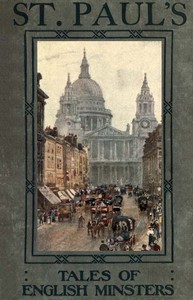
Tales of English Minsters: St. Paul's
Download Formats:
Excerpt
The Project Gutenberg EBook of St. Paul's, by Elizabeth W. Grierson
This eBook is for the use of anyone anywhere at no cost and with
almost no restrictions whatsoever. You may copy it, give it away or
re-use it under the terms of the Project Gutenberg License included
with this eBook or online at www.gutenberg.org/license
Title: St. Paul's
Tales of English Minsters
Read the Full Text
— End of Tales of English Minsters: St. Paul's —
Book Information
- Title
- Tales of English Minsters: St. Paul's
- Author(s)
- Grierson, Elizabeth W. (Elizabeth Wilson)
- Language
- English
- Type
- Text
- Release Date
- March 10, 2019
- Word Count
- 15,483 words
- Library of Congress Classification
- DA
- Bookshelves
- Browsing: History - British, Browsing: History - General
- Rights
- Public domain in the USA.
Related Books

Vivian's Lesson
by Grierson, Elizabeth W. (Elizabeth Wilson)
English
969h 39m read
Views of St. Paul's Cathedral, London
by Sparrow-Simpson, W. J. (William John)
English
62h 37m read
Tales of English Minsters: Hereford
by Grierson, Elizabeth W. (Elizabeth Wilson)
English
160h 34m read

The Scottish Fairy Book
by Grierson, Elizabeth W. (Elizabeth Wilson)
English
1161h 25m read

Tales From Scottish Ballads
by Grierson, Elizabeth W. (Elizabeth Wilson)
English
1291h 59m read

Bell's Cathedrals: The Cathedral Church of Saint Paul - An Account of the Old and New Buildings with a Short Historical Sketch
by Dimock, Arthur
English
796h 11m read