*** START OF THE PROJECT GUTENBERG EBOOK 65858 ***
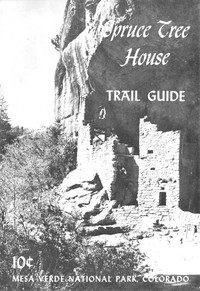
_Spruce Tree House_
TRAIL GUIDE
MESA VERDE NATIONAL PARK, COLORADO
10¢
* * * * * * * *
This guide booklet has been prepared to help you enjoy one of the larger
cliff dwellings in Mesa Verde National Park. The numbered stations along
the front of the dwelling are points of interest which are explained by
the numbered paragraphs and illustrations in this booklet.
You are welcome to use this booklet. Please place it in the box at the
other end of the ruin as you leave. If you wish to purchase the booklet,
please drop 10 cents in the coin box.
Please do not climb or stand on the walls or crawl through any of the
doorways.
* * * * * * * *
COVER: _North end of Spruce Tree House._
[Illustration: _Spruce Tree House from the south end._]
SPRUCE TREE HOUSE
Station 1. Spruce Tree House is the third largest cliff dwelling in
Mesa Verde National Park. It is built in a natural cave 216 feet in
length, 89 feet in greatest depth, and 60 feet in greatest height. The
complete dwelling contained about 114 rooms. Most of these were living
rooms, but there were many storerooms and 8 ceremonial rooms. It is
thought that between 200 and 250 people may have lived in this cliff
house at one time. It was occupied from about A.D. 1200 to, or shortly
before, A.D. 1300.
[Illustration: _The First Court_]
Station 2. Spruce Tree House is typical of the larger cliff dwellings
found in the Mesa Verde. It consists of several groups or blocks of
rooms around open courts. Within each court is an underground ceremonial
room called a kiva (Key-vah). Originally, there were flat roofs on these
kivas. These roofs formed the courtyard floor and provided work space
for daily activities. The rooms around the court were used primarily for
sleeping and storage and for shelter against the cold of winter.
The rooms are generally small, averaging 6 by 8 feet and 5½ feet high.
Floors and roofs of the second and third stories were made of large
poles covered with smaller sticks, then bark or grass, and a thick layer
of clay. A few of the rooms had fireplaces but most were without
interior light or heat. Probably one family occupied a room.
Compare the picture of the First Court with the dwelling to locate the
following:
A. These are unshaped building stones. Most of the building blocks used
in the dwelling were carefully shaped by the Indians before they were
set in place. The walls were built of stone with adobe clay as mortar,
much as we would build with brick. When a wall was finished, it was
often coated with a layer of clay plaster.
B. These were storage rooms.
C. Each room had individual doorways such as these.
D. Some rooms had ventilation openings or “windows” like this one.
Station 3. In the corner of the court to your left are corn grinding
bins. Women knelt with their heels against the wall and ground corn,
dried nuts, berries and roots on the large flat stone, the metate, with
the small hand stone, the mano.
The circular room directly ahead of you is one of two found in this
dwelling. Circular rooms were not common but they have been found in
several ruins.
[Illustration: _The Second Court. Main street section._]
Note the passageway or “street” which provided access to rooms at the
back of the cave in this part of the dwelling.
[Illustration: _Ground plan of a kiva._]
Sipapu
Pilasters
Banquette
Firepit
Deflector
Ventilator Shaft
Step into the courtyard and look into the kiva. The name kiva is a
modern Hopi Indian word meaning ceremonial room. Judging by present day
Pueblo Indian custom, generally only men would be members of kiva
societies which performed religious ceremonies for bringing rain, good
crops and general well-being to the village. Women undoubtedly assisted
in some ceremonies. When no rituals were being held, the kiva probably
was used as a clubroom and workroom by men.
The _ventilator shaft_ brought fresh air into the kiva. The _deflector_
was a baffle to keep the air from blowing directly across the _firepit_
in the floor. The fire provided light and warmth. The _sipapu_
(see-pah-pooh) was a symbolic opening from the underworld of the gods
and spirits. The bench, or _banquette_, was a shelf or storage space.
The _pilasters_, of which there are generally six, were roof supports.
Entrance to the kiva was by means of a ladder through a hatchway in the
roof.
If you want to go into a kiva, climb down the ladder in front of the
next courtyard. Notice the cribbed roof. This is a restoration copied
from originals found in place in other ruins.
Station 4. Behind the rooms in this part of the dwelling is a large
enclosed area which was used as a trash room. The villagers also kept
some of their domesticated turkeys penned up in it. The main village
trash dump was the talus slope on which you are now standing.
The black stain on the cave roof is smoke.
Notice the wall decorations on the second floor room to the left. It was
made by plastering colored clay on the walls. Many rooms were once
decorated inside like this one.
[Illustration: _The Third Court_]
[Illustration: _Ground plan of Spruce Tree House_]
Refuse Room
Kiva (8)
Refuse Area
[Illustration: _Spruce Tree House about A.D. 1260. (Museum
diorama)_]
Station 5. Spruce Tree House 700 years ago was a thriving village. If
you could have visited it you would have seen women busily cooking over
firepits in the courtyards, others grinding corn, weaving baskets or
making pottery. Men who were not tending their mesa-top fields might
have been building a new room, making or mending their tools or
performing an age-old ceremony in one of the kivas. You would have seen
children playing and old people resting against the low wall across the
front of the dwelling as they basked in the warm sun dreaming of their
younger days. There would also be dogs and turkeys wandering through the
village and picking over the trash dump for bits to eat. Unfortunately,
this all came to an end shortly before A.D. 1300.
[Illustration: uncaptioned]
Compare the illustration with the dwelling to locate the following:
A. These are doorways. Some are T-shaped, some are rectangular, but we
don’t know why the two types. Notice that some of the doorways were
closed with stone slabs.
B. These original timbers supported a balcony as well as the floors in
the rooms. Balconies made it easy to get into the upper rooms. Balconies
and rooftops were reached by ladders.
C. Most of the cooking was done outside in the courtyards over firepits
like this one. Very few of the rooms had firepits in them.
D. This was a storage bin made of sandstone slabs.
E. The courtyard was the scene of most of the daily activities—grinding
corn, preparing food, making tools, pottery, etc.
F. The ladders lead to kivas beneath the courtyard. These ladders and
kiva roofs have been restored.
[Illustration: _Spruce Tree House from the north end_]
Station 6. The cliff dwelling was named Spruce Tree House by the
ranchers who first discovered it in 1888. A large tree which they
misidentified as a spruce tree was found growing against the cliff right
in front of the dwelling. It is said that the men first entered the ruin
by climbing down this tree.
This is a good place to take a picture.
IF YOU HAVE NOT PURCHASED THIS BOOKLET PLEASE LEAVE IT IN THE BOX BY THE
TRAIL AS YOU LEAVE.
IF YOU WOULD LIKE TO KEEP IT, PLEASE DROP 10 CENTS IN THE COIN BOX.
Thank you.
GENERAL INFORMATION
Spruce Tree House is the third largest cliff dwelling in Mesa Verde
National Park. It is located in Spruce Tree Canyon, a branch of the much
larger Navajo Canyon. The cave, which is really a very large overhang,
was formed by flaking or spalling of the cliff above a small
seep-spring, and by freezing and thawing during the winter. There is no
evidence that the Indians tried to shape or enlarge the caves; to do so
would have been a tremendous task with their primitive tools.
Spruce Tree House was an Indian village and, like towns and villages
today, it was not all built at one time; rather, it grew section by
section over a period of years. Sometime around A.D. 1200 a group of
Indians—perhaps related families—moved into the cave and built the first
units. Each unit consisted of living and storage rooms clustered about
an open court which contained a kiva. The courtyard and kiva probably
served as a center for the social and religious activities of the group.
New units were added to the structure as other families moved into the
village. When people needed more space, they added new rooms alongside,
in front, in back, or on top of the existing rooms. Shortly before A.D.
1300 when the Indians finally abandoned Spruce Tree House, the village
contained 114 rooms.
The ground plan on Page 6 shows the arrangement of the rooms. Most of
these were in double rows within the cave; in some places there were
three rows. The interior rooms, dark and poorly ventilated, were
probably used for storage. The central portion of the structure was
built three stories high and reached the cave ceiling; most of the
buildings, however, were only two stories in height.
To us these small rooms seem cramped, cold, and dark—quite unsuitable as
living spaces. But these people probably spent little time inside the
rooms, using them mainly for protection against the cold, for sleeping,
and for storage. Most of the time they were probably out in the
courtyards or on the flat rooftops working or carrying on other daily
activities.
It is unlikely that all 114 rooms in Spruce Tree House were in use at
the same time. New rooms were built as older ones fell into decay;
smaller rooms were probably vacated for larger ones as the number of
villagers increased. A conservative guess sets 200 to 250 as the largest
number of people who lived in Spruce Tree House at any one time.
The Indians of the Mesa Verde, like their neighbors in the surrounding
areas, were dry-farmers—depending upon rainfall to water their crops. In
the fields on the mesa tops they grew corn, beans and several varieties
of squash. The rainfall probably averaged about 18 inches a year, just
as it does now, which is more than sufficient for dry-farming. The
Indians supplemented their diet with wild roots, nuts and berries as
well as with meat from large and small game animals.
The period of the cliff dwellings is known as the Classic Period and
marks the climax of Pueblo culture in this region. The Mesa Verde people
made beautiful pottery and decorated it elaborately with geometric and
animal figures in black on a white or light-gray background. They also
made cotton cloth which they often decorated with colored designs. Their
masonry was of exceptional quality with the building blocks beautifully
shaped and carefully laid in clay mortar.
The Classic Period came to an end shortly before A.D. 1300 when the
Indians abandoned their homes in the Mesa Verde and moved away. We can
only guess the reasons for such a move. One suggestion is that the great
drouth, which lasted from A.D. 1276 to A.D. 1299, caused them to leave.
Another suggestion is that this was a period of strife either between
the villages themselves or between these village people and nomadic
groups moving into the area. Whatever the reasons, the cliff dwellings
of the Mesa Verde were empty by A.D. 1300.
It was a rancher from Mancos, named Richard Wetherill, who first
discovered Spruce Tree House—on December 18, 1888. He and his
brother-in-law, Charley Mason, also discovered Cliff Palace that same
day. The men had been looking for lost cattle when they first saw the
cliff ruins.
[Illustration: _Spruce Tree ruin before excavation._]
[Illustration: _And the ruin after excavation and stabilization._]
In 1906 Mesa Verde was set aside as a National Park by Act of Congress
to protect and preserve these dwellings of the prehistoric Indians. In
1908 Dr. Jesse Walter Fewkes of the Smithsonian Institution excavated
Spruce Tree House. He removed the debris of fallen walls and collapsed
roofs and stabilized the dwellings more or less as you see them now. It
has been necessary, of course, to further stabilize the walls from time
to time, but aside from minor repairs and the roofing of the three
kivas, the dwelling is original work done by the Indians some 700 to 800
years ago.
The dating of Spruce Tree House and other ruins in the Mesa Verde has
been done by the study of tree-rings from original roofing timbers. If
you are interested in how archæologists determine the dates, see the
exhibit on tree-ring dating in the museum.
This trail guide booklet is not a government publication and is not
included in your fee to enter Mesa Verde National Park. It is published
and sold by the Mesa Verde Museum Association, a non-profit
organization, whose aims are to help in the understanding and
interpretation of the park story. Your comments and suggestions
concerning this booklet will be appreciated.
CONSERVATION—YOU CAN HELP
If you are interested in the work of the National Park Service, and in
the cause of conservation in general, you can give active expression of
this interest, and lend support by alining yourself with one of the
numerous conservation organizations which act as spokesman for those who
wish our scenic and historic heritage to be kept unimpaired “for the
enjoyment of future generations.”
Names and addresses of conservation organizations may be obtained at the
Information Desk.
MISSION 66
MISSION 66 is a 10 year development program, now in progress, to enable
the National Park Service to help you to enjoy and to understand the
parks and monuments, and at the same time, to preserve their scenic and
scientific values for your children and for future generations.
PUBLICATIONS OF MESA VERDE NATIONAL PARK
The books and cards described below are published by the Mesa Verde
Museum Association, a non-profit organization. All proceeds are used to
further research and interpretation in the Mesa Verde. You can purchase
these items at the sales or information desks in the Museum lobby or
order them from the association, Box 38, Mesa Verde National Park,
Colorado. On mail orders, please include 10 cents postage for each
publication.
INDIANS OF THE MESA VERDE, by Don Watson
This 188 page book with 17 pages of pictures deals with the customs,
ceremonies and daily lives of the Indians who lived in the cliff
dwellings. The origin of the American Indian and the archeology of the
Mesa Verde are also explained.
$1.00
CLIFF DWELLINGS OF THE MESA VERDE, by Don Watson
This 9 × 12 inch, 52 page picture book of the Mesa Verde ruins deals
with the discovery of the cliff dwellings, their early exploration,
architectural details and the reasons why they were built. You can buy
the two books described above as a set for $1.75.
$1.00
THE MESA VERDE STORY, as told by the Mesa Verde Museum Dioramas.
Large color prints of the five dioramas which picture the development
of the Mesa Verde people. Complete descriptive text on the back of
each card. The Fifth Diorama is a scale model of Spruce Tree House.
$ .50
OTHER PUBLICATIONS SOLD BY THE
MESA VERDE MUSEUM ASSOCIATION
The Mesa Verde Museum Association offers a number of publications for
sale which deal with the archeology, ethnology and natural history of
the Four Corners region and the Southwest, as well as selected
children’s books. A descriptive list of publications may be obtained at
the museum desk or by writing the association.
This booklet is published by the
MESA VERDE MUSEUM ASSOCIATION
[Illustration: National Park Service]
Published in cooperation with
The National Park Service
Transcriber’s Notes
—Silently corrected a few typos.
—Retained publication information from the printed edition: this eBook
is public-domain in the country of publication.
—In the text versions only, text in italics is delimited by
_underscores_.
*** END OF THE PROJECT GUTENBERG EBOOK 65858 ***
Spruce Tree House Trail Guide: Mesa Verde National Park, Colorado
Download Formats:
Excerpt
_Spruce Tree House_
TRAIL GUIDE
This guide booklet has been prepared to help you enjoy one of the larger
cliff dwellings in Mesa Verde National Park. The numbered stations along
the front of the dwelling are points of interest which are explained by
the numbered paragraphs and illustrations in this booklet.
You are welcome to use this booklet. Please place it in the box at the
other end of the ruin as you leave. If you wish to purchase the booklet,
please...
Read the Full Text
— End of Spruce Tree House Trail Guide: Mesa Verde National Park, Colorado —
Book Information
- Title
- Spruce Tree House Trail Guide: Mesa Verde National Park, Colorado
- Author(s)
- United States. National Park Service, Mesa Verde Museum Association
- Language
- English
- Type
- Text
- Release Date
- July 17, 2021
- Word Count
- 2,672 words
- Library of Congress Classification
- F786
- Bookshelves
- Browsing: History - American, Browsing: Travel & Geography
- Rights
- Public domain in the USA.
Related Books
At home in the Smokies
by United States. National Park Service, Dykeman, Wilma, Stokely, James
English
648h 8m read
Great Smoky Mountains National Park
by United States. National Park Service
English
109h 40m read
Guide to the Canyon Area
by United States. National Park Service, Yellowstone Library and Museum Association
English
36h 9m read
Crater Lake National Park, Oregon (1958)
by United States. National Park Service
English
74h 50m read
Lee Mansion National Memorial, Arlington, Virginia (1953)
by United States. National Park Service
English
30h 14m read
Point Park, Lookout Mountain and Chattanooga Battlefields - Chickamauga and Chattanooga National Military Park, Georgia and Tennessee
by United States. National Park Service
English
27h 48m read