*** START OF THE PROJECT GUTENBERG EBOOK 62234 ***
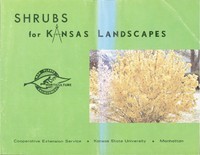
SHRUBS
for Kansas Landscapes
Cooperative Extension Service • Kansas State University • Manhattan
This publication is one of a series of circulars to help you with your
landscape planning. Use this bulletin when selecting shrubs for
particular locations in your yard. Consider each plant for its intended
use, site location, and exposure. Use the plant descriptions listed in
the tables while visiting nurseries. This will help you to realize the
size and performance you may expect from the plants.
All shrubs that will grow in the various sections of Kansas are not
listed. Most of the shrubs mentioned were selected from the various
Kansas retail nursery catalogs. A few shrub varieties are not listed in
these retail catalogs, but your nurseryman can get them from wholesale
nurseries supplying Kansas firms. The varieties listed are the more
common shrubs used for landscaping purposes and will provide you with a
wide assortment of plant material to solve any landscaping need.
GARY L. McDANIEL
Extension Specialist
Landscaping and Environmental Horticulture
The author wishes to thank Larry D. Leuthold for helpful comments
during the preparation of this bulletin and Joe D. Roller for
designing the illustrations used in this publication.
[Illustration: Checklist]
USES FOR WHICH WE WANT PLANT MATERIAL
1. Accent
2. Border
3. Soften Building Appearance
4. Screen poor views
5. Privacy
6. Hold a Soil Bank
7. ground cover
Shrubs are used in landscaping to provide low foliage and flowers that
will compliment the house and trees in your yard. Each shrub used in
your yard should fulfill a specific purpose for the overall design.
Select shrubs that will provide _accent_ for your entryway or border
focal point, _soften_ corners and harsh lines, or provide a low
_transition_ from one point to another. Shrubs are also useful for
dividing spaces by _separating_ use areas in the yard. Shrubs are used
with trees to _screen_ unpleasant views or protect our yards from strong
winds.
^Shrubs as Accent Plants
[Illustration: _Accent end of walk if sidewalk approaches from
driveway._]
Shrubs that create a definite accent must be used with more care in your
landscape than shrubs that soften lines. Two primary areas in your
landscape should be accented. The most important of these is the front
entryway to your home.
If the sidewalk to your front door approaches from the driveway along
the front of the house, the accent area is at the end of the walk. This
will provide a “visual” as well as a “physical” barrier that will point
out the front door. Sidewalks that lead directly from the street to the
door present a different situation. Accent may be created on either side
of the front door, but never make the plantings completely symmetrical
on each side. Create a strong accent to one side and a less dominant
accent on the other side of the entryway. Never use accent plants on the
corners of your house.
Accents may be created by (1) _Height_—taller plants catch the eye
first; (2) _Color_—brightly colored foliage always attracts attention;
(3) _Texture_—coarse leaf or stem textures provide strong contrasts; and
(4) _Form_—pyramidal shrubs or clipping shrubs into unnatural shapes
will create accent.
[Illustration: _Shrubbery should create a stronger accent on one
side of the entryway._]
[Illustration: _A single small upright Juniper can be used to accent
an entry._]
[Illustration: Another accent area for your landscape may be located
in your shrub border. This area could be to the rear of your
property, where it can be viewed from the patio or living room
window. Never place accent plants randomly through the shrub border.
This causes each accent plant to “fight” for dominance.]
ACCENT PLANTS
DECIDUOUS SHRUBS: Tall (10 feet or more in height).
Elder, Golden
Fringe Tree, Red
Privit, Golden
Wayfaring Tree
DECIDUOUS SHRUBS: Medium (between 7 and 10 feet in height).
Burning Bush, Winged
Dogwood, Coral
Dogwood, Redosier
Dogwood, Silky
Dogwood, Yellowtwig
Ninebark, Common
Ninebark, Goldleaf
Sand Cherry, Purpleleaf
Viburnum, Arrowwood
Viburnum, Doublefile
Weigela
DECIDUOUS SHRUBS: Small (between 4 and 6 feet in height).
Barberry, Redleaf
Burning Bush, Dwarf Winged
Weigela, Dwarf
DECIDUOUS SHRUBS: Dwarf (less than 4 feet in height).
Barberry, Crimson Pygmy
Ninebark, Dwarf
BROADLEAF EVERGREEN SHRUBS: Tall (10 feet or more in height).
Holly
Magnolia, Southern
BROADLEAF EVERGREEN SHRUBS: Medium (between 7 and 10 feet in height).
Mahonia, Oregon Grape
Viburnum, Leatherleaf
BROADLEAF EVERGREEN SHRUBS: Small (between 4 and 6 feet in height).
Euonymus, Emerald ’n’ Gold
Holly
Nandina
BROADLEAF EVERGREEN SHRUBS: Dwarf (less than 4 feet in height).
Azalea
Euonymus, Emerald Gaiety
Holly, Dwarf
Mahonia, Compact Oregon Grape
Rhododendron
^Shrubs that Soften the Building
Shrubs that will soften the lines of the house or buildings have a
_round_, _oval_, or _irregular_ shape. These shrubs break the strong
vertical lines at the corners of the house, rather than call attention
to them.
[Illustration: _Shrubs will soften the lines at the corners of your
house. Where windows are close to the corner, select dwarf shrubs
that will not grow higher than the sill._]
Never select shrubs that create an accent for corner plantings. Consider
a brightly colored foliage on shrubs during the summer or fall as an
accent. Do not plant upright-growing pyramidal evergreens, such as
Junipers, for planting at the corners of your home. The shape of these
plants creates an accent which will detract from the foundation
planting. Instead of softening the harsh vertical lines at the corners
of the house, pyramidal-shaped shrubs call attention to them.
[Illustration: _Use small ornamental trees to add a softer
appearance to wall corners. Place these trees far enough away from
the house that the branches will not rub against it when the tree is
fully grown. Place low facer plants in front of the taller shrubs to
give the corner planting more depth._]
[Illustration: _Floor length windows at the corners require low
groundcovers or very dwarf shrubs below them. A small ornamental
tree will assist in softening the corner, if you want some shade on
the window. Extending the groundcover around the tree will make the
mowing much easier._]
TRANSITION PLANTINGS
Plants used as a transition are simply those shrubs or ground covers
that pull together the plantings at the corners or accented entryways.
These shrubs are used to soften the lines of the house, where the walls
meet the ground.
Use shrubs that will not call attention to themselves by having bright
foliage or coarse leaf texture. These shrubs also help to hide any
exposed foundation walls along the house. Transition shrubs should be
low-growing or dwarf in size. If the siding of your house extends to the
ground without leaving the foundation walls exposed, a groundcover may
be all that is required to add depth to the foundation planting.
[Illustration: _Shrubs help hide unsightly construction_]
[Illustration: ... as planted]
[Illustration: _... and soften harsh house lines._]
[Illustration: ... as planted]
CONTINUOUS BLOOM FOR YOUR LANDSCAPE
Whether you are selecting shrubs for the foundation plantings around the
house or for a shrub border in your yard, choose shrubs that will bloom
at different seasons. Most of the flowering shrubs that are available
bloom during the spring. Once some shrubs have finished blooming, they
have no other ornamental features. The interest in your landscape will
be lost, unless you have selected some summer-blooming shrubs. Attempt
to design your landscape so you can have continuous shrub bloom from
early spring through late summer.
SHRUB ORDER OF BLOOM
EARLY SPRING
DECIDUOUS SHRUBS (Medium)
Redbud Chinese
Willow, Pussy
DECIDUOUS SHRUBS (Tall)
Cherry, Nanking
Crabapple, Sargent
Forsythia
Magnolia, Star
DECIDUOUS SHRUBS (Small)
Honeysuckle, Winter (Fragrant)
Quince, Flowering
DECIDUOUS SHRUBS (Dwarf)
Quince, Japanese Flowering
Forsythia, Bronx
BROADLEAF EVERGREEN SHRUBS
Magnolia, Southern
LATE SPRING
DECIDUOUS SHRUBS (Tall)
Cranberrybush
Dogwood, Gray
Honeysuckle, Tatarian
Lilac
Maple, Amur
Olive, Autumn
Pearlbush
Pea Shrub
Plum, Flowering
Snowball
Viburnum
Wayfaring Tree
DECIDUOUS SHRUBS (Medium)
Barberry
Bayberry, Northern
Beautybush
Cotoneaster, Large Flowering
Deutzia, Lemoine
Dogwood
Honeysuckle, Morrow
Honeysuckle, Zabel
Jetbead, Black
Privit
Sand Cherry, Purpleleaf
Scotch Broom
Spirea, Bridalwreath
Spirea, Vanhoutte
Viburnum
DECIDUOUS SHRUBS (Small)
Almond, Flowering
Barberry, Japanese
Cotoneaster, Spreading
Kerria
Lilac, Dwarf Korean
Spirea, Garland
Spirea, Thunberg
Weigela
DECIDUOUS SHRUBS (Dwarf)
Barberry, Crimson Pygmy
Cotoneaster, Cranberry
Deutzia
Pea Shrub, Pygmy
Quince, Japanese Flowering
Spirea, Snowmound
BROADLEAF EVERGREEN SHRUBS
Barberry, Wintergreen
Mahonia, Oregon Grape
Pyracantha
Viburnum, Leatherleaf
EARLY SUMMER
DECIDUOUS SHRUBS (Tall)
Elder, Golden
Fringe Tree, Red
Mockorange, Big Scentless
Privit
Smoke Tree (Purple Fringe)
Tamarisk
DECIDUOUS SHRUBS (Medium)
Deutzia
Lilac, Late
Lilac, Persian
Mockorange
Viburnum
DECIDUOUS SHRUBS (Small)
Beautyberry, Japanese
Hydrangea, Annabelle
Mockorange
Spirea, Anthony Waterer
Spirea, Froebel
Spirea, Redflowering Japanese
BROADLEAF EVERGREEN SHRUBS
Euonymus (Patens)
LATE SUMMER
DECIDUOUS SHRUBS (Tall)
Crapemyrtle
Rose-of-Sharon
Tamarisk
DECIDUOUS SHRUBS (Medium)
Butterfly Bush
Tamarisk, ‘Summer Glow’
DECIDUOUS SHRUBS (Small)
Abelia, Glossy
Hydrangea, A. G.
Mockorange
DECIDUOUS SHRUBS (Dwarf)
Chenault Coralberry
Cinqefoil
Hypericum
Spirea, Anthony Waterer
[Illustration: {uncaptioned}]
SHRUB BLOOM COLOR
DECIDUOUS SHRUBS (Tall)
WHITE
Cranberrybush
Crapemyrtle
Dogwood, Gray
Elder, Golden
Honeysuckle, White Tatarian
Lilac, Common
Lilac, Peking
Pearlbush
Privit
Redbud, Chinese
Rose-of-Sharon
Snowball
Viburnum
PINK
Crapemyrtle
Fringe Tree, Red
Honeysuckle, Red Tatarian
Honeysuckle, Rosy Tatarian
Plum, Flowering
Rose-of-Sharon
Smoke Tree (Purple Fringe)
Tamarisk
Willow, Pussy
YELLOW
Barberry, Mentor
Maple, Amur
Olive, Autumn
Pea Shrub
PURPLE-LILAC
Lilac, Chinese
Lilac, Common
Rose-of-Sharon
DECIDUOUS SHRUBS (Medium)
WHITE
Butterflybush
Crabapple, Sargent
Deutzia, Lemoine
Deutzia, Pride of Rochester
Dogwood
Honeysuckle, Morrow
Jetbead, Black
Magnolia, Star
Mockorange
Privit
Sand Cherry, Purpleleaf
Scotch Broom
Spirea, Bridalwreath
Spirea, Vanhoutte
Viburnum
PINK
Bayberry, Northern
Beautybush
Butterfly Bush
Cherry, Nanking
Cotoneaster, Large Flowering
Crabapple, Sargent
Deutzia, Pride of Rochester
Honeysuckle, Zabel
Lilac, Late
Lilac, Persian
Magnolia, Pink Star
Scotch Broom
Tamarix, ‘Summer Glow’
Weigela
YELLOW
Barberry
Forsythia
Scotch Broom
DECIDUOUS SHRUBS (Small)
WHITE
Almond, Flowering
Honeysuckle, Winter (Fragrant)
Hydrangea, A. G.
Mockorange
Quince, Japanese Flowering
Spirea, Garland
Spirea, Thunberg
Viburnum
PINK
Abelia, Glossy
Almond, Flowering
Beautyberry, Japanese
Cotoneaster, Spreading
Hydrangea
Quince, Japanese Flowering
Weigela
YELLOW
Barberry, Japanese
Kerria
PURPLE
Hydrangea (blue)
Lilac, Dwarf Korean
DECIDUOUS SHRUBS (Dwarf)
WHITE
Deutzia, Slender
Hydrangea, Annabelle
Mockorange, Dwarf
Spirea, Snowmound
PINK
Chenault Coralberry
Cotoneaster, Cranberry
Deutzia, Rosepanicle
Quince, Japanese Flowering (red)
Spirea, Froebel (crimson)
Spirea, Anthony Waterer
Spirea, Redflowering, Japanese
YELLOW
Barberry, Crimson Pygmy
Cinquefoil
Forsythia, Bronx
Hypericum
Pea Shrub, Pygmy
ORANGE
Quince, Japanese Flowering
BROADLEAF EVERGREEN SHRUBS
WHITE
Azalea
Euonymus (Patens)
Magnolia, Southern
Pyracantha
Rhododendron
Viburnum, Leatherleaf
LILAC
Rhododendron
PINK
Azalea
Rhododendron
YELLOW
Azalea
Barberry, Wintergreen
Mahonia, Oregon Grape
^Shrubs for Shady Locations
Most of the plants that are adapted for western Kansas will grow on the
north side if they are planted 3 to 4 feet from the building and out
from the roof overhang. In eastern Kansas it is necessary to consider
shade tolerance when planting on the north side of the house.
Most shrubs will bloom more profusely and produce more fruit when
planted in the sun, even though they may survive quite well in deep
shade. Often shrubs will grow better in shade simply because they are
protected from the southwest winds. If you don’t want to plant dwarf
shrubs 3 to 4 feet out from the foundation of the house, then plant only
shade tolerant shrubs.
What is often thought of as a shade problem is often the result of
competition from the roots of adjoining trees. Apply plant food and
water and thin the tree branches to correct this problem.
The shrubs listed for shady locations may be expected to perform
adequately on the north side of the house or behind fences in deep
shade. Many of these same shrubs will do equally well in strong sunlight
or shade.
DECIDUOUS SHRUBS: Tall (10 feet or more in height).
Mockorange, Big Scentless
Privit, Amur River North
Privit, California
Privit, Common
Viburnum, Cranberrybush
Viburnum, Snowball
Wahoo
DECIDUOUS SHRUBS: Medium (between 7 and 10 feet in height).
Barberry, Mentor
Barberry, Truehedge
Dogwood, Coral
Dogwood, Redozier
Dogwood, Silky
Dogwood, Yellowtwig
Holly, Winterberry
Jetbead, Black
Mockorange, Enchantment
Mockorange, Innocence
Mockorange, Minnesota Snowflake
Mockorange, Sweet
Ninebark
Spirea, Vanhoutte
DECIDUOUS SHRUBS: Small (between 4 and 6 feet in height).
Abelia, Glossy
Barberry, Japanese (green)
Barberry, Kobold
Honeysuckle, Winter (Fragrant)
Hydrangea, A. G.
Hydrangea, Nikko Blue
Indiancurrent Coralberry
Kerria, Japanese
Mockorange, Alberta and Glacier
Mockorange, Belle Etoile
Mockorange, Bouquet Blanc
Snowberry
DECIDUOUS SHRUBS: Dwarf (less than 4 feet in height).
Chenault Coralberry
Hydrangea, Annabelle
Mockorange, Dwarf Minnesota Snowflake
Mockorange, Silver Showers
Mockorange, Dwarf Sweet
Ninebark, Dwarf
BROADLEAF EVERGREEN SHRUBS: Tall (10 feet or more in height).
Holly, American
Holly, Yaupon
Magnolia, Southern
BROADLEAF EVERGREEN SHRUBS: Medium (between 7 and 10 feet in height).
Euonymus, Large Leaf
Euonymus, Manhattan
Holly, Burford
Mahonia, Oregon Grape
Viburnum, Leatherleaf
BROADLEAF EVERGREEN SHRUBS: Small (between 4 and 6 feet in height).
Euonymus, Dupont
Euonymus, Jewel
Euonymus, Medium Leaf
Euonymus, Sarcoxie
Holly, Dwarf Japanese
Holly, Heller’s
Holly, Hetz
Nandina
BROADLEAF EVERGREEN SHRUBS: Dwarf (less than 4 feet in height).
Azalea, Kurume
Azalea, Mollis Hybrid
Boxwood, Edging
Boxwood, Wintergreen
Euonymus, Emerald Cushion
Euonymus, Emerald Gaiety
Euonymus, Small Leaf
Euonymus, Vinca Leaf
Holly, Dwarf Burford
Holly, Dwarf Chinese
Mahonia, Compact Oregon Grape
Rhododendron
SHRUBS HAVING FRUIT THAT WILL ATTRACT BIRDS
DECIDUOUS SHRUBS: Tall (10 feet or more in height).
Cotoneaster, Peking
Cranberrybush, American
Dogwood, Gray
Elder, Golden
Honeysuckle, Tatarian
Olive, Autumn
Privit, California
Privit, Common
Privit, Golden (Vicary)
Viburnum, Nannyberry
Wayfaring Tree
DECIDUOUS SHRUBS: Medium (between 7 and 10 feet in height).
Barberry, Truehedge
Cherry, Nanking
Dogwood, Coral
Honeysuckle, Morrow
Honeysuckle, Zabel
Jetbead, Black
Privit, Border
Privit, Regel
Sand Cherry, Purpleleaf
Viburnum, Arrowwood
Viburnum, Korean Spice
Viburnum, Linden
DECIDUOUS SHRUBS: Small (between 4 and 6 feet in height).
Barberry, Japanese
Beautyberry, Japanese
Cranberrybush, Dwarf American
Honeysuckle, Clavey Dwarf
Honeysuckle, Winter (Fragrant)
Viburnum, Wrights’
DECIDUOUS SHRUBS: Dwarf (less than 4 feet in height).
Chenault Coralberry
Cotoneaster, Cranberry
BROADLEAF EVERGREEN SHRUBS
Holly (female)
Pyracantha
Nandina
Low Maintenance _for your shrubs
HEIGHT AND SPREAD
Consider low maintenance when planning your landscape. When selecting
shrubs for your yard, determine the maximum height and spread you want
from the planting, and then select only from shrubs with those
characteristics.
The shrubs listed in this bulletin have been grouped according to their
mature heights. If you are looking for a shrub that will grow under a
window that is 4 feet from the ground, select from those listed as dwarf
shrubs. You certainly would not select a Tatarian Honeysuckle (10 to 12
feet) for this location.
Never select a shrub that will ultimately grow too high for its location
and expect to keep it shorter by constant clipping. This will only add
to your time in maintaining your landscape.
[Illustration: _Wrong selection of shrubs can be disastrous as shown
by the planting on the right._]
MAINTAINING SHRUB SIZE
Shrubs will require periodic pruning to maintain their proper shape and
size. Many shrubs will grow tall and spindly if not thinned-out
occasionally. Some shrubs will sucker severely at the ground if the
older stems or canes are not removed. This causes the shrub to spread
beyond its normal limits.
The proper method for maintaining shrub shape is to remove all canes
that are larger than one inch in diameter. These should be removed as
close to the ground line as possible. This practice will open the center
of the plant so that more light can penetrate into it. Also, the size of
the shrub will be maintained at the desirable height.
[Illustration: _When removal of a cane has been decided upon, make
the cut as close to the ground as possible (example A). When an old
cane selected for removal has a desirable shoot at its base, make a
cut as shown in example B. Note that the cut is slanted and is
approximately ¼ inch above the shoot._]
ADAPTABILITY AND HARDINESS
Which plants are best suited for your landscape? This will depend on
whether the shrubs will be planted on a farmstead or in a city lot. It
will also depend on whether your yard is exposed to direct southwest
winds, or whether you have some protection.
Plant adaptability has been considered for each shrub listed in this
bulletin. You may plant any shrub that is listed as ‘Hardy’ in an open,
fully exposed location and expect it to survive. Those shrubs that have
an ‘X’ will most likely not survive if planted where they will receive
direct exposure to the hot winds of late summer. If you live in a town
or city, you may have enough wind protection to use these shrubs. This
is most important for homeowners living in the western counties of
Kansas.
Protection from southwest summer winds may be provided by a windbreak,
trees in the city, by planting on the east or north side of the house,
or behind a screen fence. If you have this protection you might be able
to use plants that are not listed for your area. However, if your yard
is exposed to hot summer winds, you had better use only the plant listed
for your section of Kansas.
You will sometimes find plants growing in your area that are not listed
for your particular section of Kansas. It is possible to grow some
plants outside their recommended region, provided these plants receive
adequate protection and care. These shrubs will usually not grow as
large or as tall as they would further south or east. If you are rather
certain that your yard will provide enough protection for these plants,
you might try growing a few.
[Illustration: WINDS SHADE PROTECTION]
VARIETY LISTINGS OF SHRUBS
Common Name Botanical Name Height Spread Adaptability
[1]
DECIDUOUS SHRUBS: Tall (10 feet in height or more)
Cotoneaster, Peking Cotoneaster acutifolia 10-12′ 8-10′ Hardy
Cranberrybush, American Viburnum trilobum 12′ 10-12′ Hardy
Cranberrybush, European Viburnum opulus 8-12′ 10-12′ Hardy
Crapemyrtle Lagerstroemia indica 10-12′ 5′ SE
Dogwood, Gray Cornus racemosa 8-12′ 8-12′ Hardy
Elder, Golden Sambucus canadensis 12′ 10-12′ Hardy
′Aurea’
Fringe Tree, Red Cotonis coggygria 10′ 10-12′ X, P
′rubrifolia’
Honeysuckle, Tatarian Lonicera tatarica 10-12′ 8-10′ Hardy
Hydrangea, P. G. Hydrangea paniculata 10-15′ 10-15′ X, P
′grandiflora’
Lilac, Chinese Syringa chinensis 10-15′ 10-15′ Hardy
(Rothamagensis)
Lilac, Common Syringa vulgaris 12-15′ 12-15′ Hardy
Lilac, Manchurian Syringa amurensis 12-15′ 12-15′ Hardy
Lilac, Peking Syringa pekinensis 10-15′ 10-15′ Hardy
Maple, Amur Acer ginneis 15-20′ 10-12′ X, P
Mockorange, Big Scentless Philadelphus grandiflorus 9-12′ 5-8′ Hardy
Olive, Autumn Eleagnus umbellatus 14-16′ 15-17′ Hardy
Pea Shrub Caragana arborescens 15-18′ 12-15′ Hardy
Pearlbush Exochorda racemosa 10-15′ 10-15′ SC
Plum, Flowering Prunus triloba ′plena’ 12′ 10-12′ X
Privit, Amur River North Ligustrum amurense 10-12′ 5-7′ Hardy
Privit, California Ligustrum ovalifolium 10-12′ 6-8′ X, P
Privit, Common Ligustrum vulgare 10-12′ 6-8′ Hardy
Privit, Golden (Vicary) Ligustrum X vicari 12′ 6-8′ X, P
Redbud, Chinese Cercis chinensis 10-12′ 10-12′ X, P
Rose-of-Sharon (Althea) Hibiscus syriacus 8-12′ 6-10′ Hardy
Smoke Tree (Purple Cotinus coggygria 15′ 8′ X, P
Fringe)
Snowball Viburnum opulus ′sterilis’ 8-12′ 10-12′ Hardy
Sumac, Smooth Rhus giabra 10-12′ 12′ Hardy
Sumac, Staghorn Rhus typhina 20′ 15-20′ Hardy
Tamarisk, Common Tamarix hispida 10-12′ 8-10′ Hardy
Tamarisk, African Tamarix africana 10-12 10′ SE
Viburnum, Arrowwood Viburnum dentatum 8-10′ 10-12′ NC, P
Viburnum, Nannyberry Viburnum lentago 8-12′ 10-12′ Hardy
Viburnum, Siebold Viburnum sieboldi 12-15′ 10-12′ NC
Viburnum, Tea Viburnum setigerum 10′ 8-10′ NC
Wahoo Euonymus atropurpureus 10-15′ 15-18′ Hardy
Wayfaring Tree Viburnum lantana 10-12′ 12′ NC
Willow, Corkscrew Salix matsudana ‘tortuosa’ 12-15′ 12′ X, P
Willow, Pussy Salix discolor 10-12′ 12′ X, P
DECIDUOUS SHRUBS: Medium (between 7 and 10 feet in height)
Barberry, Mentor Berberis mentorensis 6-8′ 5-7′ Hardy
Barberry, Truehedge Berberis thunbergi 6-8′ 4-6′ X, P
‘erecta’
Bayberry, Northern Myrica pennsylvanica 6-8′ 4-6′ Hardy
Beautybush Kolkwitzia amabilis 7-10′ 8-10′ Hardy
Burning Bush, Winged Euonymus alatus 8-10′ 8-10′ X, P
Butterfly Bush Buddleia davidi 6-8′ 6′ NC
Cherry, Nanking Prunus tomentosa ‘Orient’ 9′ 10-12′ Hardy
Cotoneaster, Large Cotoneaster multiflora 8′ 8-12′ Hardy
Flowering
Crabapple, Sargent Malus sargentii 6-8′ 8-10′ Hardy
Deutzia, Lemoine Deutzia X lemoinei 5-7′ 5-7′ NC, P
Deutzia, ‘Pride of Deutzia scabra 6-8′ 4-6′ NC, P
Rochester’
Dogwood, Coral Cornus alba ‘Siberica’ 9′ 8-10′ NC
Dogwood, Redosier Cornus stolonifera 8′ 8-10′ X, P
Dogwood, Silky Cornus ammomum 8-10′ 8-10′ X, P
Dogwood, Yellowtwig Cornus stolonifera 8′ 8-10′ X, P
‘flaviramea’
Forsythia, Beatrix Forsythia x intermedia 6-8′ 6-8′ X, P
Farrand
Forsythia, Golden Bell Forsythia viridissima 6-8′ 5-6′ X, P
Forsythia, ‘Karl Sax’ Forsythia X intermedia 6-8′ 6-8′ X, P
Forsythia, ‘Lynwood Gold’ Forsythia X intermedia 8-10′ 8′ X, P
Forsythia, ‘Showy Border’ Forsythia X intermedia 7-8′ 6-8′ X, P
Forsythia, ‘Siebold’ Forsythia suspensa 8-10′ 10-15′ Hardy
‘Sieboldii’
Forsythia, ‘Spring Glory’ Forsythia X intermedia 7-8′ 6-8′ X, P
Holly, Winterberry Ilex verticillata 6-8′ 3-5′ NC, P
Honeysuckle, Morrow Lonicera morrowi 6-8′ 8-10′ Hardy
Honeysuckle, Zabel Lonicera tatarica 7-10′ 7-10′ Hardy
‘Zabelii’
Jetbead, Black Rhodotypos scandens 5-7′ 6-8′ NC, P
Lilac, Late Syringa villosa 8-10′ 8-10′ Hardy
Lilac, Persian Syringa X persica 6-8′ 7-9′ NC
Magnolia, Star Magnolia stellata 8-12′ 10-12′ SC, P
Mockorange, ‘Enchantment’ Philadelphus X lemoine 8′ 6-8′ Hardy
Mockorange, ‘Innocence’ Philadelphus X lemoine 8′ 6-8′ Hardy
Mockorange, ‘Minnesota Philadelphus X virginalis 8′ 6-8′ Hardy
Snowflake’
Mockorange, Sweet Philadelphus coronarius 8-10′ 6-7′ Hardy
Ninebark, Common Physocarpus opulifolius 7-9′ 8-10′ Hardy
Ninebark, ‘Goldleaf’ Physocarpus opulifolius 8-10′ 8-10′ Hardy
‘luteus’
Privit, Border Ligustrum obtusifolium 8-10′ 9′ X, P
Privit, Regel Ligustrum obtusifolium 5-7′ 6′ Hardy
‘regelium’
Sand Cherry, Purpleleaf Prunus X cistena 7-9′ 8-10′ Hardy
Scotch Broom Cytisus scoparius 6-8′ 6-8′ SC
Spirea, Bridalwreath Spirea prunifolia ‘plena’ 7-9′ 8-10′ NC, P
Spirea, Vanhoutte Spirea X vanhouttei 6-8′ 8-10′ Hardy
Tamarisk, ‘Summer Glow’ Tamarix hispida 8′ 10-12′ Hardy
Viburnum, Doublefile Viburnum plicatum 8-10′ 8-10′ NC, P
‘tomentosum’
Viburnum, Korean Spice Viburnum carlesii 6-8′ 6-8′ Hardy
Viburnum, Linden Viburnum dilatatum 8-10′ 8-12′ NC, P
Weigela, Old Fashioned Weigela florida 6-8′ 8-10′ X, P
DECIDUOUS SHRUBS: Small (between 4 and 6 feet in height)
Abelia, Glossy Abelia X grandiflora 3-5′ 3-5′ SC, P
Almond, Flowering Prunus glandulosa 4-5′ 3-4′ Hardy
(Cherry)
Barberry, Japanese Berberis thunbergii 4-6′ 3-5′ X, P
(Green)
Barberry, Redleaf Berberis thunbergii 4-5′ 3-5′ X, P
‘atropurpurea’
Barberry, Kobold Berberis thunbergii 4-6′ 5-6′ X, P
‘Kobold’
Beautyberry, Japanese Callicarpa japonica 4-5′ 4-5′ NC, P
Burning Bush, Dwarf Euonymus alatus ‘compacta’ 4-5′ 4-5′ X, P
Winged
Cotoneaster, Spreading Cotoneaster divaricata 5-6′ 6-8′ X, P
Cranberry, Compact Viburnum opulus 4-6′ 4-6′ Hardy
European ‘compactum’
Honeysuckle, Clavey’s Lonicera xylosteum 4-6′ 4-6′ Hardy
Dwarf
Honeysuckle, Winter Lonicera fragrantissima 5-7′ 6′ Hardy
(Fragrant)
Hydrangea, A. G. Hydrangea arborescens 3-5′ 5-7′ NC, P
‘grandiflora’
Hydrangea, ‘Nikko Blue’ Hydrangea macrophylla 4-5′ 5-6′ X, P
Indian-current Coralberry Symphoricarpos orbiculatus 3-5′ 4-5′ Hardy
Kerria Kerria japonica 4-6′ 5-7′ X, P
Lilac, Dwarf Korean Syringa oblata 4-6′ 6-8′ NC, P
‘palibiniana’
Mockorange, ‘Albatre’ Philadelphus X virginalis 4-6′ 4-6′ Hardy
Mockorange, ‘Belle Philadelphus X lemoine 6′ 6′ Hardy
Etoille’
Mockorange, ‘Bouquet Philadelphus X virginalis 6′ 6′ Hardy
Blanc’
Mockorange, ‘Glacier’ Philadelphus X virginalis 4-6′ 4-6′ Hardy
Quince, Japanese Chaenomeles lagenaria 5-7′ 6-8′ X, P
Flowering (speciosa)
Snowberry Symphoricarpos albus 4-6′ 4-6′ Hardy
Spirea, Garland Spirea X arguta 5-6′ 5-6′ X, P
Spirea, Thunberg Spirea thunbergi 4-5′ 4-5′ Hardy
Viburnum, Wright’s Viburnum wrighti ‘hessei’ 3-5′ 4-6′ X, P
Weigela, ‘Bristol Ruby’ Weigela X florida 4-6′ 4-6′ X, P
Weigela, ‘Eva Rathke’ Weigela X floribunda 4-6′ 6-8′ X, P
Weigela, ‘Java Red’ Weigela purpurea 5-7′ 6-8′ X, P
DECIDUOUS SHRUBS: Dwarf (less than 4 feet in height)
Barberry, Crimson Pygmy Berberis thunbergi ‘nana’ 1½-2′ 2-3′ X, P
Chenauit Coralberry Symphoricarpos X chenauiti 3-4′ 3-4′ Hardy
Cinquefoil Potentilla fruticosa 2-4′ 2-4′ Hardy
Cotoneaster, Cranberry Cotoneaster apiculata 2-3′ 3-4′ X, P
Deutzia, Rosepanicle Deutzia X rosea ‘eximia’ 3-4′ 4-5′ NC
Deutzia, Slender Deutzia gracilis 2-3′ 3-4′ NC
Forsythia, ‘Bronx’ Forsythia viridissima 1½-2′ 3′ X, P
‘Bronxensis’
Hydrangea, ‘Annabelle’ Hydrangea X arborescens 3-4′ 4-5′ X, P
Mockorange, Silver Philadelphus X lemoine 3-4′ 3-4′ Hardy
Showers
Mockorange, ‘Dwarf Philadelphus X virginalis 2-3′ 2-3′ Hardy
Minnesota Snowflake’ ‘nana’
Mockorange, Dwarf Sweet Philadelphus coronarius 3-4′ 3-4′ Hardy
‘nana’
Ninebark, Dwarf Physocarpus opulitolius 3-4′ 3-4′ Hardy
‘nanus’
Pea Shrub, Pygmy Caragana arborescens 1½-2′ 1½-2′ Hardy
Quince, Dwarf Flowering Chaenomeles meulei 2-3′ 2-3′ X, P
Quince, Japanese Chaenomeles japonica 3-4′ 4-5′ Hardy
Flowering
Quince, Red Japanese Chaenomeles japonica 3-4′ 4-5′ Hardy
‘rubra’
St. Johnswort, Hidcote Hypericum patulum 1½-2′ 1½-2′ X
‘Hidcote’
St. Johnswort, Kalm Hypericum kalmianum 3-4′ 3-4′ Hardy
St. Johnswort, Sungold Hypericum patulum 1½-2′ 1½-2′ Hardy
‘Sungold’
Spirea, Anthony Waterer Spirea X bumalda ‘Anthony 2-3′ 2-3′ X, P
Waterer’
Spirea, Froebel Spirea X bumalda 3-4′ 3-4′ X, P
‘Froebeli’
Spirea, Redflowering Spirea japonica ‘coccinea’ 3-4′ 3-4′ X, P
Spirea, Snowmound Spirea nipponica 3-4′ 3-4′ Hardy
‘Snowmound’
Willow, Dwarf Arctic Blue Salix purpurea ‘nana’ 3-4′ 3-4′ NC
Common Name Botanical Name Height Spread Adaptability
[1]
BROADLEAF EVERGREEN SHRUBS: Tall (10 feet or more in height)
Holly, American Ilex opaca 12-15′ 8-10′ SC, P
Holly, Yaupon Ilex vomitoria 10-15′ 8-10′ SC, P
Magnolia, Southern Magnolia grandiflora 15-20′ 10-12′ SC, P
BROADLEAF EVERGREEN SHRUBS: Medium (between 7 and 10 feet in height)
Euonymus, Large-Leaf Euonymus kiautschovicus 6-8′ 8-10′ Hardy
(Patens)
Euonymus, ‘Manhattan’ Euonymus kiautschovicus 8-10′ 8-12′ Hardy
(Patens)
Mahonia, Oregon Grape Mahonia aquifolium 5-7′ 4-5′ Hardy
Pyracantha, ‘Kasan’ Pyracantha coccinea 6-8′ 6-8′ X, P
‘Kasan’
Pyracantha, ‘Lalandii’ Pyracantha coccinea 5-10′ 8-10′ X, P
‘Lalandii’
Pyracantha, ‘Wyatti’ Pyracantha coccinea 6-8′ 6-8′ X, P
‘Wyatti’
Viburnum, Leatherleaf Viburnum rhytidophylium 8-12′ 8-12′ NC, P
BROADLEAF EVERGREEN SHRUBS: Small (between 4 and 6 feet in height)
Barberry, Wintergreen Berbaris juliana 4-6′ 3-5′ NC, P
Euonymus, Dupont Euonymus kiautschovicus 5-6′ 4-6′ Hardy
(Patens)
Euonymus, ‘Emerald ’n’ Euonymus fortunei 4-5′ 4′ X, P
Gold’ ‘vegetus’
Euonymus, ‘Jewel’ Euonymus kiautschovicus 5-6′ 4-6′ Hardy
(Patens)
Euonymus, Medium Leaf Euonymus kiautschovicus 5-6′ 4-6′ Hardy
(Patens)
Euonymus, ‘Sarcoxie’ Euonymus fortunei 4-5′ 4′ X, P
‘vegetus’
Holly, Dwarf Japanese Ilex crenata ‘compacta’ 4-5′ 4-5′ SC, P
Holly, ‘Hellers’ Japanese Ilex crenata ‘Helleri’ 4′ 5′ SC, P
Holly, Hetz Japanese Ilex crenata ‘Hetzii’ 4′ 5′ SC, P
Holly, Dwarf Yaupon Ilex vomitoria ‘nana’ 4′ 5′ SC, P
Nandina Nandina domestica 4-5′ 4′ SC, P
Pyracantha, ‘Low Boy’ Pyracantha coccinea ‘Low 4-5′ 4-5′ X, P
Boy’
BROADLEAF EVERGREEN SHRUBS: Dwarf (less than 4 feet in height)
Azalea, Kurume Rhododendron obtusum 3′ 2-3′ SC, P
Azalea, Mollis Hybrid Rhododendron X kosterianum 3-4′ 3-4′ SC, P
Boxwood, Edging Buxus sempervirens 2-3′ 2-3′ NC, P
Boxwood, Wintergreen Buxus microphylus 4′ 5′ NC, P
Euonymus, ‘Emerald Euonymus fortunei 3-4′ 3-4′ X, P
Cushion’ ‘vegetus’
Euonymus, ‘Emerald Euonymus fortunei 3-4′ 2-3′ X, P
Gaiety’ ‘vegetus’
Euonymus, Small Leaf Euonymus kiautschovicus 2-3′ 2-3′ Hardy
(Patens)
Euonymus, Vinca Leaf Euonymus kiautschovicus 3-4′ 3-4′ X, P
‘vincafolia’
Holly, Dwarf Burford Ilex cornuta ‘Burfordi 3-4′ 2-3′ Hardy
nana’
Rhododendron Rhododendron catawbiense 4′ 4′ SC, P
[1]Adaptability:
SE—hardy in southeastern Kansas only;
SC—hardy in south central and eastern Kansas;
NC—hardy in central and eastern Kansas only;
P—protect from south west winds;
X—hardiness is doubtful in hotter, drier locations of Kansas;
Hardy—fully hardy in exposed areas of Kansas.
PROBLEMS TO EXPECT
Every shrub species grown in Kansas can be expected to be afflicted with
some problem during its lifetime. The most common problems are insect
and disease attacks. These usually can be controlled by routine
spraying. Knowledge of the problems make it easier to diagnose and
correct before they become severe.
Soil alkalinity or high pH may also limit the use of some plants. Iron
chlorosis is a common problem with some shrubs grown in the western half
of Kansas. This is easily corrected by applying iron sulfate or iron
chelate to the plant or soil.
Your local County Extension Agent can assist you with the diagnosis of
any disease, insect, or cultural problem.
[Illustration: MAN · PLANTS · ENVIRONMENT · HORTICULTURE]
All Kansas Extension educational programs and materials are available
to all individuals without discrimination on the basis of race, color,
national origin, sex, or religion.
Cooperative Extension Service, Kansas State University, Manhattan
C-469 February 1973
Issued in furtherance of Cooperative Extension work, acts of May 8 and
June 30, 1914, in cooperation with U. S. Department of Agriculture.
Robert A. Bohannon, Director of Extension, Kansas State University of
Agriculture and Applied Science.
34-6672 2-73—20M
KANSAS STATE PRINTING PLANT
Transcriber’s Notes
—Silently corrected a few typos.
—Retained publication information from the printed edition: this eBook
is public-domain in the country of publication.
—In the text versions only, text in italics is delimited by
_underscores_.
End of Project Gutenberg's Shrubs for Kansas Landscapes, by Anonymous
*** END OF THE PROJECT GUTENBERG EBOOK 62234 ***
Shrubs for Kansas Landscapes
Subjects:
Download Formats:
Excerpt
SHRUBS
for Kansas Landscapes
Cooperative Extension Service • Kansas State University • Manhattan
This publication is one of a series of circulars to help you with your
landscape planning. Use this bulletin when selecting shrubs for
particular locations in your yard. Consider each plant for its intended
use, site location, and exposure. Use the plant descriptions listed in
the tables while visiting nurseries. This will help you to realize the
size and...
Read the Full Text
— End of Shrubs for Kansas Landscapes —
Book Information
- Title
- Shrubs for Kansas Landscapes
- Author(s)
- McDaniel, Gary L.
- Language
- English
- Type
- Text
- Release Date
- May 26, 2020
- Word Count
- 4,580 words
- Library of Congress Classification
- SB
- Bookshelves
- Browsing: Nature/Gardening/Animals
- Rights
- Public domain in the USA.