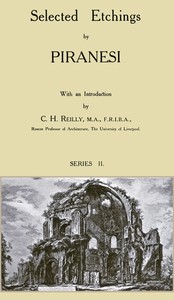
The Project Gutenberg eBook of Selected etchings by Piranesi, by
Charles Herbert Reilly
This eBook is for the use of anyone anywhere in the United States and
most other parts of the world at no cost and with almost no restrictions
whatsoever. You may copy it, give it away or re-use it under the terms
of the Project Gutenberg License included with this eBook or online at
www.gutenberg.org. If you are not located in the United States, you
will have to check the laws of the country where you are located before
using this eBook.
Title: Selected etchings by Piranesi
Editor: Charles Herbert Reilly
Artist: Giovanni Battista Piranesi
Release Date: March 29, 2023 [eBook #70405]
Language: English
Produced by: Tim Lindell, Charlie Howard, and the Online Distributed
Proofreading Team at https://www.pgdp.net (This file was
produced from images generously made available by The
Internet Archive/Canadian Libraries)
*** START OF THE PROJECT GUTENBERG EBOOK SELECTED ETCHINGS BY
PIRANESI ***
Transcriber’s Note: Italic text is enclosed in _underscores_; boldface
text is enclosed in =equals signs=.
Transcriber included the plate numbers in their captions.
SELECTED ETCHINGS BY PIRANESI
SERIES I.
[Illustration]
Selected Etchings
by
PIRANESI
With an Introduction
by
C. H. REILLY, M.A., F.R.I.B.A.,
Roscoe Professor of Architecture, The University of Liverpool.
SERIES I.
TECHNICAL JOURNALS, LTD.
CAXTON HOUSE :: WESTMINSTER
LIST OF PLATES
1. Title-page to the “Vedute di Roma.” (_Pub. Rome 1751._)
2. Composition of Ruins.
3. Bas-relief from the Portico of the Church of the Apostles, Rome.
4. Antique bas-relief from Naples.
5. Trophy of Arms.
DESIGNS.
6. Design for a Grand Staircase.
7. Design for a Sculpture Gallery.
8. Design for the Mausoleum of a Roman Emperor.
9. Sketch Design.
10. Composition.
VIEWS OF ROMAN BUILDINGS.
11. Pyramid of C. Cestius, Appian Way.
12. Temple of Hercules, Cora.
13. Basilica of Maxentius, Rome.
14. The Capitol, Rome.
15. The Capitol, Rome.
16. The Colosseum and the Arch of Constantine, Rome.
17. The Colosseum.
18. Tomb of Hadrian (Castle of St. Angelo).
19. Ponte Molle, Rome.
20. The Temple of Vesta at Tivoli.
21. Interior of the Pantheon.
22. Gallery in Hadrian’s Villa, Tivoli.
23. Ponte St. Angelo.
24. Temple of Concord, Rome.
25. Interior of Santa Maria Maggiore, Rome.
26. Piazza Navona, Rome.
27. View of the Churches of the Madonna di Loreto and Santa Maria,
by Trajan’s Column, Rome.
28. Piazza of St. Peter’s, Rome.
29. Antique Equestrian statues (Castor and Pollux) on the Quirinal,
Rome.
30. The Quirinal, Rome.
IMAGINARY ROMAN PRISONS.
31. Etching from the series of imaginary Roman Prisons.
32. Ditto.
VASES, TRIPODS, &C.
33. Vase from “Vasi Candelabri.” (_Pub. Rome 1778._)
34. Vase from ditto.
35. Vase from ditto.
36. Vase from ditto.
37. Vase and tripod from ditto.
38. Vase and pedestal from ditto.
39. Tripod from “Vasi Candelabri.”
40. Tripod and bas-relief from ditto.
41. Tripod from ditto.
42. Lamp from ditto.
43. Vases from ditto.
44. Altar from ditto.
CHIMNEYPIECES.
45. Design for Chimneypiece from “Diverse Maniere.”
46. Ditto.
47. Ditto.
48. Ditto.
49. Ditto.
50. Design for a Chimneypiece and clock from “Diverse Maniere.”
INTRODUCTION
Architecturally speaking, we live at a time somewhat similar to that
in which the genius of Piranesi first made its impact upon English
designers. In the latter half of the eighteenth century English
architects and patrons were alike growing a little tired of pure
Palladianism. The novelty and spirit of Inigo Jones’s work had given
place to the uninspired correctness of Campbell, Kent, and a host
of lesser disciples. Restrained and elegant as the work of those
architects appears to modern eyes, after the debauch of “free Classic”
from which we are now emerging, it is nevertheless true that, at
that time, the English Palladian formula was nearly exhausted. The
circuses and crescents of Bath, with their unfluted columns and dull
ornament, their endless repetitions of correct features, could not be
indefinitely extended. The early Georgian houses, so comfortable in
the country, began to look a little coarse and provincial in London
streets, particularly to those who had taken the Grand Tour.
What more natural, then, that architects should turn again to the
source and fountainhead from which Palladio had drawn his inspiration,
to see whether it had anything fresh to yield?
The practising architect in England at the end of the eighteenth
century required, however, a cicerone to the remains of the antique
world just as much as his predecessor did in the seventeenth century.
The seventeenth-century architect chose Palladio as his guide;
the architect in the latter part of the eighteenth century chose
Piranesi. Naturally, the lesson taught was somewhat different. The
eighteenth-century architect was much further advanced in scholarship.
Palladio gave the main proportions of the Orders and the principles
of composition. He laid down definite rules and precepts suitable
to beginners. His was the first-year work, to use a school simile.
Piranesi takes the scholars of the later years and initiates them
into all the mysteries of ornament and stylistic character. Offering
no pedantic rules, he makes a direct appeal to the imagination of his
students. He reveals to them not only the power but the intimate spirit
of the Roman world. He offers them whole collections of vases and
candelabra to use or not as they like. He unlocks a treasure-house--a
library full of fresh detail. The detail, too, is rich, complex detail,
safe only in the hands of the discerning. But Piranesi’s students in
England at that time were fit to profit by such a master; among his
more attentive scholars being Robert Adam, Chambers, Dance, and many
other architects of the late eighteenth century, and through these he
influenced the decorative designers from Chippendale to Pergolesi. Mr.
Phene Spiers, not without a certain hyperbole, traces the Empire Style
to Piranesi’s designs for chimneypieces. At any rate it is safe to say
that the new vigour and life which came into English architecture with
the work of Chambers and Adam was derived from a more thorough and
complete knowledge of Roman architecture, and that the chief source
of that knowledge was the vast collection of thirteen hundred or more
engraved plates which Piranesi etched and published at the marvellous
rate of one a fortnight throughout a fairly long life.
Now, if any coherence at all can be seen in the trend of modern English
architecture, we seem at the present moment to be just as dissatisfied
with mere Palladianism as were the architects of the end of the
eighteenth century. Like them, too, we are looking for a more complete
expression of the Classic spirit. To us, therefore, Piranesi may have
a very similar lesson. The unfortunate thing, however, is that his
etchings, a few years ago so easy to obtain, are daily becoming more
rare and expensive. A collection of the best of those issued during the
artist’s lifetime could hardly be made to-day for less than a couple of
hundred pounds. The Paris reprints which his son issued in 1815 might
be obtained for half that sum, but to the ordinary practitioner this
may be considered as half infinity. Even Mr. Keith Young’s massive
volume of reproductions costs several pounds. The days of Robert Adam
were the days when architects were few and patrons were rich. Our own
times are less happy in that respect, but they are nevertheless the
days of unrivalled opportunity. Piranesi is the magician who can show
what opportunities may become; more especially as the process block,
albeit lacking in the marvellous gradations of tone and feeling of the
original etchings, renders it possible to publish at small cost such a
series as are comprised in this volume.
The following are the main facts of Piranesi’s career as far as they
are known:--
Giovanni Battista Piranesi, to give him his full name, was born in
Venice in the year 1720. His father Angelo pursued the honourable
calling of a stonemason, so suited to the progenitor of an architect.
His mother was sister to an engineer and architect named Lucchesi, and
it was to him that young Piranesi was articled. In his early years he
seems to have been something of an _enfant prodigue_ and is reported to
have been able to draw the architecture of Venice at the age of eight.
At eighteen he persuaded his parents to send him to Rome, and ever
after, although signing himself “Venetian Architect,” he remained at
work in that city. At first, in his desire to obtain a firm grasp on
the technique of the graphic arts, he seems to have attached himself
to various masters. The story is told that he threatened one of these
masters, Vasi, with the loss of his life because he imagined that some
secret in the process of etching was being withheld from him. Such a
story, whether true or not, together with the later one that he saw
for the first time and married his wife within the space of one week,
fits in well enough with the impetuous temperament and fine fury of
work which all the etchings exhibit. The numerous controversies in
which he was engaged in later years, sometimes involving the erasure of
names from dedication and title-pages, are all evidence of the same
characteristics--characteristics which may have made him, according to
modern standards, a poor archæologist, but which were not without value
to the artist and teacher of artists.
In 1741, when twenty-one years of age, Piranesi published his first
etchings, four compositions of ruins, afterwards included in his _Opere
Varie_, issued by Bouchard at Rome in 1750. In 1748 he published his
_Antichità Romane de’ Tempi della Repubblica e de’ primi Imperatori,
etc._, containing thirty plates of triumphal arches, amphitheatres,
and other ancient structures, mostly from places other than Rome. The
price of this volume (Mr. Samuel informs us in his admirable book) was
16 paoli, or about 13s. 4d., which shows for how small a contemporary
reward Piranesi had to work. In 1750 Bouchard published his _Opere
Varie_, which contained a number of his imaginative designs for great
halls, staircases and monuments, as well as his famous series of prison
dreams--the _Carceri d’Invenzione_. From this time onwards followed
in quick succession an immense number of etchings grouped somewhat
irregularly in great folio volumes with varying engraved title-pages.
The _Raccolta di Varie Vedute_ (Rome 1751) contains ninety-three small
views and includes work by Israel Silvestre and other etchers. This
volume must not be confused with the _Vedute di Roma_, in two volumes,
containing large title-pages and one hundred and thirty-seven plates,
thirty-four of which were published in 1751, under the title _Le
Magnificenze di Roma le più remarcabili_.
Perhaps Piranesi’s greatest work, in both size and importance, is _Le
Antichità Romane_, in four volumes, containing a varying number of
plates from 216–224. This was first issued in 1756.
In 1761, he etched four plates for Robert Adam illustrating the
latter’s design for Sion House, and in 1769 he published his _Diverse
Maniere d’Adornare_, in which appear the ornate but very stimulating
designs for chimneypieces, referred to above. Of his remaining works,
perhaps the most important to architects is the _Vasi Candelabri Cippi
Sarcofagi Tripodi Lucerne ed ornamenti Antichi_, to give it its full
title, which was published in Rome in 1778--the year of his death. This
contains a series of magnificent drawings of antiques, largely from
his own collection. A great number of these drawings are dedicated
to various English gentlemen, each described as “a lover of the fine
arts,” which is proof of the interest Englishmen were already taking in
Piranesi and his work.
In addition to the foregoing, Piranesi published a number of monographs
on special subjects illustrated with etchings. Among these are the
volumes on Trajan’s Column, the Theatre at Herculaneum, Hadrian’s
Villa, and the Temples at Pæstum, all of which are more noticeable for
the boldness of the draughtsmanship than for the archæological views
they set forth. It must not be imagined, however, because Piranesi was
the interpreter of the romance of the Roman ruins, and through this
very romance fired the imagination of Europe, that he was not when he
liked an exact draughtsman. The cracks on the obelisk shown in the
foreground of his etching of Santa Maria Maggiore tally with those
shown in a photograph taken one hundred and fifty years later.
In April, 1757, Piranesi was elected an honorary Fellow of the Society
of Antiquaries, which is another proof of the esteem in which he was
held in England. He was knighted by Pope Clement XIII. in 1767. He died
in 1778, and is buried in the church of Santa Maria Aventina.
Of his five children, Francesco (b. 1748) and Laura (b. 1750) etched
in their father’s manner and assisted him in his work. After his
death, however, they took to print-selling rather than creative work,
though Francesco still etched plates on his own account. In 1798 he
packed up his father’s copper-plates and took them to Paris. During an
adventurous journey they fell into the hands of an English Admiral,
who, however, knowing the fame of the father, unfortunately restrained
his first impulse to throw the plates overboard. It was unfortunate
because on arrival in Paris Francesco was able, with the help of the
French Government, to republish from the old plates a new edition of
his father’s work, which, from the state of the plates, for many years
did considerable damage to Piranesi’s fame as an etcher. The plates
exist at the present day, and it is believed that prints are still
occasionally struck from them. Now, however, the difference between the
original Roman impressions and the later Paris ones is well understood,
and Piranesi’s renown never stood higher than it does to-day. His son
died in 1810.
The plates here reproduced are from the author’s collection, with the
exception of the designs for chimneypieces, which have been kindly lent
by Mr. Batsford.
C. H. REILLY.
[Illustration: Plate 1:
Title-page to the “Vedute di Roma.” (Pub. Rome 1751.)]
[Illustration: Plate 2:
Composition of Ruins.]
[Illustration: Plate 3:
Bas-relief from the Portico of the Church of the
Apostles, Rome.]
[Illustration: Plate 4:
Antique bas-relief from Naples.]
[Illustration: Plate 5:
Trophy of Arms.]
[Illustration: Plate 6:
Design for a Grand Staircase.]
[Illustration: Plate 7:
Design for a Sculpture Gallery.]
[Illustration: Plate 8:
Design for the Mausoleum of a Roman Emperor.]
[Illustration: Plate 9:
Sketch Design.]
[Illustration: Plate 10:
Composition.]
[Illustration: Plate 11:
Pyramid of C. Cestius, Appian Way.]
[Illustration: Plate 12:
Temple of Hercules, Cora.]
[Illustration: Plate 13:
Basilica of Maxentius, Rome.]
[Illustration: Plate 14:
The Capitol, Rome.]
[Illustration: Plate 15:
The Capitol.]
[Illustration: Plate 16:
The Colosseum and the Arch of Constantine, Rome.]
[Illustration: Plate 17:
The Colosseum.]
[Illustration: Plate 18:
Tomb of Hadrian (Castle of St. Angelo).]
[Illustration: Plate 19:
Ponte Molle, Rome.]
[Illustration: Plate 20:
The Temple of Vesta at Tivoli.]
[Illustration: Plate 21:
Interior of the Pantheon.]
[Illustration: Plate 22:
Gallery in Hadrian’s Villa, Tivoli.]
[Illustration: Plate 23:
Ponte St. Angelo.]
[Illustration: Plate 24:
Temple of Concord, Rome.]
[Illustration: Plate 25:
Interior of Santa Maria Maggiore, Rome.]
[Illustration: Plate 26:
Piazza Navona, Rome.]
[Illustration: Plate 27:
View of the Churches of the Madonna di Loreto and Santa
Maria, by Trajan’s Column, Rome.]
[Illustration: Plate 28:
Piazza of St. Peter’s, Rome.]
[Illustration: Plate 29:
Antique Equestrian Statues (Castor and Pollux) on the
Quirinal, Rome.]
[Illustration: Plate 30:
The Quirinal, Rome.]
[Illustration: Plate 31:
Etching from the Series of Imaginary Roman Prisons.]
[Illustration: Plate 32:
Etching from the Series of Imaginary Roman Prisons.]
[Illustration: Plate 33:
Vase from the “Vasi Candelabri.”]
[Illustration: Plate 34:
Vase from the “Vasi Candelabri.”]
[Illustration: Plate 35:
Vase from the “Vasi Candelabri.”]
[Illustration: Plate 36:
Vase from the “Vasi Candelabri.”]
[Illustration: Plate 37:
Vase and Tripod from the “Vasi Candelabri.”]
[Illustration: Plate 38:
Vase and Pedestal from the “Vasi Candelabri.”]
[Illustration: Plate 39:
Tripod from the “Vasi Candelabri.”]
[Illustration: Plate 40:
Tripod and bas-relief from the “Vasi Candelabri etc.”]
[Illustration: Plate 41:
Tripod from the “Vasi Candelabri.”]
[Illustration: Plate 42:
Lamp from the “Vasi Candelabri.”]
[Illustration: Plate 43:
Vases from the “Vasi Candelabri.”]
[Illustration: Plate 44:
Altar from the “Vasi Candelabri.”]
[Illustration: Plate 45:
Design for Chimneypiece and Grate from the “Diverse
Maniere.”]
[Illustration: Plate 46:
Design for Chimneypiece from the “Diverse Maniere.”]
[Illustration: Plate 47:
Design for Chimneypiece from the “Diverse Maniere.”]
[Illustration: Plate 48:
Design for Chimneypiece from the “Diverse Maniere.”]
[Illustration: Plate 49:
Design for Chimneypiece from the “Diverse Maniere.”]
[Illustration: Plate 50:
Design for Chimneypiece and Clock from the “Diverse
Maniere.”]
SOME INTERESTING PUBLICATIONS
ISSUED BY TECHNICAL JOURNALS, LTD.
CAXTON HOUSE, WESTMINSTER, LONDON
TECHNICAL JOURNALS, LTD.
_Publishers’ Note._
In presenting this list the Publishers would draw attention to the
distinctive character of the works which are described. These cover a
wide field, being of interest not only to those who are professionally
concerned with architecture and building, but also to those who have
a general non-technical interest in such subjects. Thus, the volume
giving an illustrated historical survey of Mediæval and Renaissance
architecture in England, and the volumes dealing with English domestic
and ecclesiastical architecture, garden city houses, and domestic
interior details, appeal alike to the educated layman and to the
architect in practice.
“THE PRACTICAL EXEMPLAR OF ARCHITECTURE” and “STANDARD DETAILS,”
though also of strictly professional interest, are of totally
different character, giving, as they do, carefully measured drawings
and photographs of some of the finest examples of architecture in the
kingdom; while those who are specially concerned with architectural
education from the standpoint of design will find in “THE LIVERPOOL
SKETCH BOOK” a notable collection of students’ drawings.
“WHO’S WHO IN ARCHITECTURE” should be warmly welcomed as a work
occupying a mid-position between the biography and the directory.
As its name implies, it gives biographical particulars of all the
leading men in the profession, and furnishes as well a complete list of
architects in practice.
In addition, particulars are given of “THE ARCHITECTS’ AND BUILDERS’
JOURNAL”--the most up-to-date, the best illustrated, and most widely
read of the architectural and building weeklies--and “THE ARCHITECTURAL
REVIEW,” which, in its new form, has achieved the distinction of
being the finest of all current publications devoted to the art of
architecture.
_A Short Chronological History of British Architecture._
The greatest achievements of British architecture are presented as a
_coup d’œil_ in this attractive volume. Thus, in Section I. we survey
the work of the cathedral builders; in Section II. notable examples
of the Early Renaissance, in Section III. the great buildings of the
Later Renaissance, and a few examples that carry us into the nineteenth
century; the survey concluding with a fine series of illustrations of
work by Sir Aston Webb, Mr. Ernest Newton, Mr. Mervyn Macartney, and
other eminent architects of the present day.
The letterpress accompanying the illustrations is written by
acknowledged authorities, and sets forth in brief order the entire
chronological development, following the succeeding phases of
architectural art, and supplying those essential facts which are
necessary to a proper estimate of the whole.
CONTENTS:
Section I. Summary of ENGLISH MEDIÆVAL ARCHITECTURE (1050–1550). By
EDWARD S. PRIOR, M.A., F.S.A., F.R.I.B.A.
Section II. Summary of EARLY RENAISSANCE ARCHITECTURE (1516–1650). By
J. ALFRED GOTCH, F.S.A., F.R.I.B.A.
Section III. Summary of LATER RENAISSANCE ARCHITECTURE. By MERVYN E.
MACARTNEY, B.A., F.S.A., F.R.I.B.A.
Section IV. INTERESTING EXAMPLES OF WORK by Living Architects.
Section V. List of the PRINCIPAL ARCHITECTS OF THE ENGLISH LATER
RENAISSANCE, and their chief authenticated and reputed works
(with dates).
One Volume. 12¾ in. by 9 in. 150 pages. Art Paper.
PRICE =10/-= NETT.
_The Architectural Review._
_A Magazine for all Lovers of Architecture._
“The Architectural Review,” in the new and enlarged form in which it
is now published, is acknowledged to be the finest of all periodicals
devoted to the art of architecture. The superb series of large plates
which are a feature of every issue are sufficient alone to warrant the
generous praise which the “REVIEW” has received from all quarters. The
illustrations are, indeed, a most striking feature of the “REVIEW,”
but there is also the literary side of the magazine to be taken into
account, the articles which appear in its pages being written by
acknowledged authorities.
In recent years the scope of the “REVIEW” has been largely extended,
so that in its present form it appeals to the educated section of the
general public, as well as to the professional architect.
One has only to glance at the issues which have appeared during the
past year in order to appreciate what a wide range of interesting
subjects are dealt with. The finely illustrated articles on London
Clubs, Georgian interior decoration, large country houses like Sutton
Place and Broughton Castle, the etchings of Méryon, Frank Brangwyn,
&c., afford ample indication of the general attractiveness of the
contents.
Garden design, too, is well represented, beautiful examples being
illustrated by means of photographs reproduced to a large size.
Monthly. 14 in. by 11 in. 90 pages.
PRICE =1/-= NETT.
Can be obtained of all Newsagents and Booksellers.
_Annual Subscription--Post Free Rates_: England, =16/6=;
Canada, =$3.50=; America, =$5=; Abroad, =20/-=.
_Garden City Houses and Domestic Interior Details._
Garden suburbs, or suburbs developed on lines that are far more rural
than is possible in the centre of a town, have sprung up all over the
country, and the architect has been confronted with a new task--the
task of designing a small house which can be erected at moderate cost,
but which, nevertheless, provides accommodation in keeping with the
demands of modern life.
It is of great value to have an illustrated survey of the most
noteworthy houses that have been erected. The present volume gives such
a survey, in the form of special photographs reproduced to a good size,
showing the actual appearance of the houses, accompanied in every case
by carefully drawn plans. The examples include work by all the leading
architects who have devoted special attention to the problem of the
small house, and their solutions are presented in the most attractive
form.
Such illustrations alone would make the book an extremely useful one,
but when to them is added a fine collection of domestic interior
details, the value of the book becomes greatly enhanced. These details
are of an essentially practical character, showing in a complete
manner the design and construction of such features as chimneypieces,
panelling, dressers, servery, and store-room fittings, &c. A typical
specification of a garden city house is also given, accompanied by
working drawings.
_Post Free Rates_: England, =2/6=; Canada, =75 cents=;
America, =75 cents=; Abroad, =3/3=.
_Recent English Domestic Architecture._
Examples selected by
MERVYN E. MACARTNEY, B.A., F.S.A., F.R.I.B.A.
English houses have so long established themselves in the forefront of
domestic architecture that the distinctive qualities which they exhibit
need not be enlarged upon; no houses excel them for quiet dignity,
appropriate treatment, and charm of effect.
English architects have enjoyed a unique legacy in the mansions of the
Tudor and Renaissance periods, and the delightful character of these
examples has been a never-failing inspiration for modern work.
Of great interest and value, therefore, are these volumes dealing with
recent examples of English Domestic Architecture, by architects whose
ability in this branch of work is acknowledged and admired. Great
care has been exercised in the selection of the examples, which are
illustrated by means of photographs reproduced to a large size, and
accompanied by plans and descriptive particulars.
While being of interest equally to the layman as to the architect
in practice, the volumes are no mere picture-books, but substantial
contributions to the subject of English Domestic Architecture. They
are very complete in their scope, embracing not only general exterior
and interior views, but also details of decorative work in the houses
illustrated. Garden design, too, has received adequate attention.
Annual Volumes. 13 in. by 8¾ in. Over 200 pages each.
PRICE =7/6= EACH NETT.
_Practical Notes for Architectural Draughtsmen._
BY A. W. S. CROSS, M.A., F.R.I.B.A., AND
ALAN E. MUNBY, M.A., F.R.I.B.A.
The fact that this Portfolio has now entered upon its second edition,
and that the demand for it is even greater at the present time than
when it was first published, is clear proof of its value to those who
are engaged in the practical application of exact draughtsmanship to
architectural design. It is essential that the draughtsman should be
able to set out “The Orders” in a rapid and precise manner, and such
facility can only be acquired by familiarity with the best methods of
setting up drawings. It is the special object of this volume to show
these methods.
The plates are not confined to “The Orders” proper, but embrace their
application to windows, doorways, arcading, niches, &c., and include
also a number of large illustrations of domes, staircases, and other
constructional features, as well as plates illustrating the best
methods of setting up perspectives and the projection of shadows.
In the new edition several of the drawings have been enlarged in order
to facilitate rapid reference, and the collection has been improved in
other respects.
One Volume. 19 in. by 14 in. 27 Plates.
PRICE =15/-= NETT.
_Standard Details._
_Especially prepared for the use of Students in Technical
Schools, Universities, &c., &c._
This volume has been prepared with the special object of providing very
large plates of exterior and interior details, which, by reason of
their intrinsic excellence, may be regarded as “Standard” details of
their several periods. The selection has been made under the direction
of Mr. Mervyn E. Macartney, B.A, F.S.A., F.R.I.B.A.
The drawings themselves are of superb quality--it would, indeed, be
impossible to excel them as specimens of line draughtsmanship; and
included on the plates are small photographic reproductions of the
actual work.
The scope of the portfolio is best shown by the following annotated
list of the subjects illustrated:--
STAIRCASE AT THORPE HALL (2 plates).
One of the finest examples of a seventeenth-century English
staircase, richly wrought and carved.
PORCH AT RAINHAM (2 plates).
A very graceful design, executed in wood, dating from the late
seventeenth or early eighteenth century.
KING’S BENCH WALK DOORWAYS (3 plates).
By Wren, displaying all his skill in the use of brickwork.
PANELLING AND CHIMNEYPIECE IN NEW RIVER COMPANY’S OFFICES (5 plates).
As an example of the Later English Renaissance, nothing finer
than this room could be conceived. The carved enrichments are in
the manner of Grinling Gibbons.
JUDGE’S HOUSE, SALISBURY (2 plates).
A dignified Georgian house façade, dating from the early years of
the eighteenth century.
EXTERIOR BRICKWORK FROM ENFIELD (2 plates).
Part of a late seventeenth-century house, now in the South
Kensington Museum.
LIBRARY CHIMNEYPIECE, THORPE HALL (1 plate).
An example of the Early Renaissance.
STAIRCASE IN GUILDHALL, ROCHESTER (1 plate).
Of the Wren period--a simple but sturdy design, full of interest.
DINING-ROOM CHIMNEYPIECE, BOURDON HOUSE, LONDON (1 plate).
Executed in the eighteenth century from a design by Inigo Jones,
with a firegrate of the Adam period.
STAIRCASE IN CROMWELL HOUSE, HIGHGATE (4 plates).
The most wonderful staircase of its period--the Cromwellian.
CHIMNEYPIECE ASCRIBED TO SETTIGNANO IN SOUTH KENSINGTON MUSEUM (2
plates).
A Florentine example of the late fifteenth century, finely
executed in marble.
One Volume. 24½ in. by 18 in. 25 Plates with Portfolio.
PRICE =15/-= NETT.
_Specification for Architects._
In all English-speaking countries “SPECIFICATION” is the recognised
Standard Authority on the many subjects with which an Architect must
deal when preparing his Specifications. The work is at once concise and
comprehensive, and so vast a mass of practical information is not to be
found in any other single volume.
Every section has been written by an accredited authority, and the
annual revision comprises the contributions of scores of qualified
specialists of recognised standing in their several departments.
To the Edition for 1914 (No. 16), the following important new features
of topical as well as permanent interest have been contributed:--
THE YEAR’S PROGRESS IN MUNICIPAL ENGINEERING. By W. H. Maxwell,
A.M.Inst.C.E., Borough and Water Engineer, Tunbridge Wells
Corporation.
RECENT DEVELOPMENTS IN ROAD CONSTRUCTION. By W. H. Maxwell. With
about a dozen diagrams of Typical Road Sections.
SURVEYING INSTRUMENTS AND THEIR ADJUSTMENT. By G. A. T. Middleton,
A.R.I.B.A.
PUBLIC LIGHTING. Specially contributed.
SOME WATERPROOFING PROCESSES, LINING AND INTEGRAL.
THE CAUSE AND PREVENTION OF SMOKY CHIMNEYS. With many diagrams.
SCHEDULE OF SELECT PRICES FOR BUILDING WORKS. Compiled by an eminent
Quantity Surveyor.
THE PROBLEM OF SHOP-FRONT DESIGN. Specially contributed.
PLANNING THE SUBURBAN MIDDLE-CLASS HOUSE. With eleven typical plans.
By Edwin S. Gunn, A.R.I.B.A.
ARCHITECT, BUILDER, AND CLIENT: DAY-WORK _v._ CONTRACT. By Paul
Ogden, F.R.I.B.A.
CLOSE TENDERS AND HOW TO GET THEM. By A. G. White, General Secretary
of the National Federation of Building Trades Employers.
THE LOCAL GOVERNMENT BOARD’S NEW MODEL BY-LAWS. By H. D.
Searles-Wood, F.R.I.B.A.
BUILDERS’ HOISTING GEAR. By Henry Adams, M.Inst.C.E., F.S.I., M.S.A.
MODERN ESTATE BUILDINGS. By G. S. Mitchell, F.S.I.
Issued in December of each year. 12¾ in. by 8¾ in. Over 500 pages.
PRICE =3/6= NETT. (Postage 6d. extra inland.)
Can be obtained of all Booksellers and Newsagents.
_English Ecclesiastical Architecture._
The ecclesiastical buildings of the prominent exponents of the Gothic
revival--Pugin, Scott, Butterfield, and the rest--have already been
fully illustrated, but never before has there been brought together
a representative series of photographs of the recent work of English
church architects. The interest and value of this present collection
therefore is self-evident.
Examples of the best modern church work are included, the illustrations
being from specially taken photographs reproduced to a large size.
Much care has been exercised in the selection of the examples, which,
moreover, are not confined to any one style or creed, but embrace
Established, Nonconformist, and Roman Catholic churches in various
phases of Byzantine, Gothic, and Renaissance design.
It is a volume which appeals to all who have an interest in modern
church work.
One Volume. 13 in. by 8¾ in. 250 pages.
_Post Free Rates_: England, =10/6=; Canada, =$2.80=; America, =$2.80=;
Abroad, =11/6=.
_The Practical Exemplar of Architecture._
In order to secure a complete representation of Architecture, it is
necessary to encompass the resources of the photographer and the skill
of the draughtsman. By these means a pictorial record is obtained
showing all the effects of light and shade, of tone and texture,
of weathering and exposure, which make up the total effect of the
original, and at the same time there are ready to hand drawings which
show the design in elevation, plan, and section, together with details
of the enrichment and construction which are not comprehended in the
casual glance.
The drawings, specially prepared for this publication, are themselves
admirable examples of accurate, clear, and artistic draughtsmanship,
and the subjects which they depict have all been specially selected by
Mr. Mervyn E. Macartney, B.A., F.S.A., F.R.I.B.A., as possessing merits
of design and execution which are worthy of study and emulation.
The “PRACTICAL EXEMPLAR” is, indeed, the architect’s _vade mecum_. In
it he finds illustrations of fine examples of chimneypieces, gates,
panelling, doorways, ironwork, staircases, windows, and a score of
other features which he can make practical use of. The illustrations
are also of value as being technical records of notable examples of
architecture which have already been demolished, or which, in the
course of modern improvements, are likely to be swept away.
Four Portfolios. 13½ in. by 9½ in. Over 450 Plates.
PRICE =15/-= EACH NETT.
COMPLETE SET, =£2 10s.= NETT.
Full List of Plates will be sent on application.
_The Architects’ and Builders’ Journal._
Continuous progress has marked “THE ARCHITECTS’ AND BUILDERS’
JOURNAL,” which may now claim to be the most up-to-date, the most
widely read, and the best illustrated of all the architectural and
building weeklies. Every issue includes a set of no fewer than six
large photographic plates of architectural subjects, together with a
double-page plate illustrating a measured or working drawing. Articles
dealing with all phases of architecture and building are contributed
by well-known men in the profession, while editorial notes deal
trenchantly with current topics of professional interest.
Special attention is given to constructional subjects, all important
new works being illustrated by means of photographs and drawings, with
accompanying letterpress. Thus, the practical side of building is
represented equally with the subject of architectural design.
A very complete list of Contracts Open is published every week,
together with full particulars of all projected new works,
competitions, etc.
Two other valuable features are the Special Law Reports, dealing
succinctly with all cases of importance, and “Inquiries Answered,”
under which heading experts furnish advice on various problems raised
by correspondents.
Can be obtained of all Newsagents and Booksellers.
Published Weekly. Price =2d.= Every Wednesday.
About 52 pages weekly. 12½ in. by 8¾ in.
_Annual Subscription--Post Free Rates_: England, =10/10=;
Canada, =$3.20=; America, =$4.75=; Abroad, =19/6=.
_The Liverpool Sketch Book._
“The Liverpool Sketch Book” records a selection of the best designs and
measured drawings executed by students of the School of Architecture
of the Liverpool University. This School of Architecture, under the
direction of Professor C. H. Reilly, M.A., F.R.I.B.A., has become
closely identified with the modern movement for the development of
classical design and the careful study of monumental work. It is
conducted on the most scholarly lines, embodying the best methods of
the French and American schools, and the results achieved have been
approved by all the leading men of the profession.
The illustrations in “THE SKETCH BOOK” are beautifully printed on thick
art paper, and the volumes will be found particularly interesting
and useful to all students. In view of the fact that for the Final
Examination of the R.I.B.A. four testimonies of study are now required,
the designs and details illustrated in these volumes, which show how
similar problems have been dealt with, should be found of the greatest
possible value.
In addition to work by present students of the School, and the work of
the Travelling Scholars, that of its old students, and others connected
with it directly or only sympathetically, is also included, the object
being to present a consistent and definite architectural outlook rather
than a mere collection of drawings.
Vol. I. Out of print. 1910.
Vol. II. PRICE =5/-= NETT. 140 pages (enlarged edn.) 1911.
Vol. III. PRICE =2/6= NETT. 120 pages (enlarged edn.) 1913.
_Who’s Who in Architecture._
This new volume, which makes its first appearance in 1914, will take
its place henceforth as a work of reference for everyone connected
with architecture and building. Perhaps its greatest attraction lies
in the fact that it occupies a sort of midway position between the
biography and the directory, possessing all the personal interest of
the one and all the detailed information of the other. The societies
have their list of members, and the directories give, more or less
correctly, the names and addresses of architects in practice, but the
information thus presented is of the baldest description, and quite
devoid of all personal attraction. “WHO’S WHO IN ARCHITECTURE” is of
far greater interest and value. It gives a succinct account of all
the most notable men in the profession--their training, achievements,
etc.--and not only of the leading men, but also of the many architects
who have done important work without having had the attention of the
profession directed to it. The book also gives addresses, etc., and as
the list of architects is a thoroughly comprehensive one, “WHO’S WHO IN
ARCHITECTURE” thus fulfils a dual purpose as--
(1) A personal record of members of the profession, and
(2) A list of architects practising in the United Kingdom.
Hence it is a volume which every architect needs to have on his shelf.
One Volume. PRICE =10s. 6d.= NETT.
_Some Famous Buildings and their Story._
BY A. W. CLAPHAM, F.S.A., AND W. H. GODFREY.
Buildings that have been the scene of historical events, or have played
a distinctive part in the development of national life, are commonly
dealt with either at length in a most unattractive style, or dismissed
in a few sentences embodying dates and particulars which are frequently
inaccurate. Thus, the general reader finds himself confronted with
two extremes, alike unsatisfactory. It was with the express object of
correcting these deficiencies in respect of certain famous buildings
that the authors compiled the series of short papers which constitute
the volume under notice. They have been at great pains in their task,
and, as the result of much original research, a flood of fresh light
is thrown upon the subjects dealt with, every chapter adding some
new fact to previous knowledge, or reproducing some hitherto unknown
or neglected plan. In this way we have set before us, by means of
description and illustration, the most remarkable of all Henry VIII.’s
palaces--Nonsuch, in Surrey, whose wanton destruction was probably
the heaviest loss which English architecture has suffered since the
Dissolution of the Monasteries.
The Tower of London, dealt with in another chapter, offers a wealth
of interest when critical research and architectural acumen are
brought into play, and in the same way the Royal Palace of Eltham,
Northumberland House, Sir Thomas More’s House at Chelsea, the Fortune
Theatre, Barking Abbey, and other famous buildings are dealt with.
One Volume. =5s.= NETT. 275 pages.
CAXTON HOUSE, WESTMINSTER, LONDON
[Illustration: TECHNICAL JOURNALS LIMITED]
PRINTED BY VACHER AND SONS, LTD., WESTMINSTER HOUSE, LONDON, S.W.
*** END OF THE PROJECT GUTENBERG EBOOK SELECTED ETCHINGS BY
PIRANESI ***
Updated editions will replace the previous one--the old editions will
be renamed.
Creating the works from print editions not protected by U.S. copyright
law means that no one owns a United States copyright in these works,
so the Foundation (and you!) can copy and distribute it in the
United States without permission and without paying copyright
royalties. Special rules, set forth in the General Terms of Use part
of this license, apply to copying and distributing Project
Gutenberg™ electronic works to protect the PROJECT GUTENBERG™
concept and trademark. Project Gutenberg is a registered trademark,
and may not be used if you charge for an eBook, except by following
the terms of the trademark license, including paying royalties for use
of the Project Gutenberg trademark. If you do not charge anything for
copies of this eBook, complying with the trademark license is very
easy. You may use this eBook for nearly any purpose such as creation
of derivative works, reports, performances and research. Project
Gutenberg eBooks may be modified and printed and given away--you may
do practically ANYTHING in the United States with eBooks not protected
by U.S. copyright law. Redistribution is subject to the trademark
license, especially commercial redistribution.
START: FULL LICENSE
THE FULL PROJECT GUTENBERG LICENSE
PLEASE READ THIS BEFORE YOU DISTRIBUTE OR USE THIS WORK
To protect the Project Gutenberg™ mission of promoting the free
distribution of electronic works, by using or distributing this work
(or any other work associated in any way with the phrase “Project
Gutenberg”), you agree to comply with all the terms of the Full
Project Gutenberg™ License available with this file or online at
www.gutenberg.org/license.
Section 1. General Terms of Use and Redistributing Project
Gutenberg™ electronic works
1.A. By reading or using any part of this Project Gutenberg™
electronic work, you indicate that you have read, understand, agree to
and accept all the terms of this license and intellectual property
(trademark/copyright) agreement. If you do not agree to abide by all
the terms of this agreement, you must cease using and return or
destroy all copies of Project Gutenberg™ electronic works in your
possession. If you paid a fee for obtaining a copy of or access to a
Project Gutenberg™ electronic work and you do not agree to be bound
by the terms of this agreement, you may obtain a refund from the
person or entity to whom you paid the fee as set forth in paragraph
1.E.8.
1.B. “Project Gutenberg” is a registered trademark. It may only be
used on or associated in any way with an electronic work by people who
agree to be bound by the terms of this agreement. There are a few
things that you can do with most Project Gutenberg™ electronic works
even without complying with the full terms of this agreement. See
paragraph 1.C below. There are a lot of things you can do with Project
Gutenberg™ electronic works if you follow the terms of this
agreement and help preserve free future access to Project Gutenberg™
electronic works. See paragraph 1.E below.
1.C. The Project Gutenberg Literary Archive Foundation (“the
Foundation” or PGLAF), owns a compilation copyright in the collection
of Project Gutenberg™ electronic works. Nearly all the individual
works in the collection are in the public domain in the United
States. If an individual work is unprotected by copyright law in the
United States and you are located in the United States, we do not
claim a right to prevent you from copying, distributing, performing,
displaying or creating derivative works based on the work as long as
all references to Project Gutenberg are removed. Of course, we hope
that you will support the Project Gutenberg™ mission of promoting
free access to electronic works by freely sharing Project Gutenberg™
works in compliance with the terms of this agreement for keeping the
Project Gutenberg™ name associated with the work. You can easily
comply with the terms of this agreement by keeping this work in the
same format with its attached full Project Gutenberg™ License when
you share it without charge with others.
1.D. The copyright laws of the place where you are located also govern
what you can do with this work. Copyright laws in most countries are
in a constant state of change. If you are outside the United States,
check the laws of your country in addition to the terms of this
agreement before downloading, copying, displaying, performing,
distributing or creating derivative works based on this work or any
other Project Gutenberg™ work. The Foundation makes no
representations concerning the copyright status of any work in any
country other than the United States.
1.E. Unless you have removed all references to Project Gutenberg:
1.E.1. The following sentence, with active links to, or other
immediate access to, the full Project Gutenberg™ License must appear
prominently whenever any copy of a Project Gutenberg™ work (any work
on which the phrase “Project Gutenberg” appears, or with which the
phrase “Project Gutenberg” is associated) is accessed, displayed,
performed, viewed, copied or distributed:
This eBook is for the use of anyone anywhere in the United States and
most other parts of the world at no cost and with almost no
restrictions whatsoever. You may copy it, give it away or re-use it
under the terms of the Project Gutenberg License included with this
eBook or online at www.gutenberg.org. If you are not located in the
United States, you will have to check the laws of the country where
you are located before using this eBook.
1.E.2. If an individual Project Gutenberg™ electronic work is
derived from texts not protected by U.S. copyright law (does not
contain a notice indicating that it is posted with permission of the
copyright holder), the work can be copied and distributed to anyone in
the United States without paying any fees or charges. If you are
redistributing or providing access to a work with the phrase “Project
Gutenberg” associated with or appearing on the work, you must comply
either with the requirements of paragraphs 1.E.1 through 1.E.7 or
obtain permission for the use of the work and the Project Gutenberg™
trademark as set forth in paragraphs 1.E.8 or 1.E.9.
1.E.3. If an individual Project Gutenberg™ electronic work is posted
with the permission of the copyright holder, your use and distribution
must comply with both paragraphs 1.E.1 through 1.E.7 and any
additional terms imposed by the copyright holder. Additional terms
will be linked to the Project Gutenberg™ License for all works
posted with the permission of the copyright holder found at the
beginning of this work.
1.E.4. Do not unlink or detach or remove the full Project Gutenberg™
License terms from this work, or any files containing a part of this
work or any other work associated with Project Gutenberg™.
1.E.5. Do not copy, display, perform, distribute or redistribute this
electronic work, or any part of this electronic work, without
prominently displaying the sentence set forth in paragraph 1.E.1 with
active links or immediate access to the full terms of the Project
Gutenberg™ License.
1.E.6. You may convert to and distribute this work in any binary,
compressed, marked up, nonproprietary or proprietary form, including
any word processing or hypertext form. However, if you provide access
to or distribute copies of a Project Gutenberg™ work in a format
other than “Plain Vanilla ASCII” or other format used in the official
version posted on the official Project Gutenberg™ website
(www.gutenberg.org), you must, at no additional cost, fee or expense
to the user, provide a copy, a means of exporting a copy, or a means
of obtaining a copy upon request, of the work in its original “Plain
Vanilla ASCII” or other form. Any alternate format must include the
full Project Gutenberg™ License as specified in paragraph 1.E.1.
1.E.7. Do not charge a fee for access to, viewing, displaying,
performing, copying or distributing any Project Gutenberg™ works
unless you comply with paragraph 1.E.8 or 1.E.9.
1.E.8. You may charge a reasonable fee for copies of or providing
access to or distributing Project Gutenberg™ electronic works
provided that:
• You pay a royalty fee of 20% of the gross profits you derive from
the use of Project Gutenberg™ works calculated using the method
you already use to calculate your applicable taxes. The fee is owed
to the owner of the Project Gutenberg™ trademark, but he has
agreed to donate royalties under this paragraph to the Project
Gutenberg Literary Archive Foundation. Royalty payments must be paid
within 60 days following each date on which you prepare (or are
legally required to prepare) your periodic tax returns. Royalty
payments should be clearly marked as such and sent to the Project
Gutenberg Literary Archive Foundation at the address specified in
Section 4, “Information about donations to the Project Gutenberg
Literary Archive Foundation.”
• You provide a full refund of any money paid by a user who notifies
you in writing (or by e-mail) within 30 days of receipt that s/he
does not agree to the terms of the full Project Gutenberg™
License. You must require such a user to return or destroy all
copies of the works possessed in a physical medium and discontinue
all use of and all access to other copies of Project Gutenberg™
works.
• You provide, in accordance with paragraph 1.F.3, a full refund of
any money paid for a work or a replacement copy, if a defect in the
electronic work is discovered and reported to you within 90 days of
receipt of the work.
• You comply with all other terms of this agreement for free
distribution of Project Gutenberg™ works.
1.E.9. If you wish to charge a fee or distribute a Project
Gutenberg™ electronic work or group of works on different terms than
are set forth in this agreement, you must obtain permission in writing
from the Project Gutenberg Literary Archive Foundation, the manager of
the Project Gutenberg™ trademark. Contact the Foundation as set
forth in Section 3 below.
1.F.
1.F.1. Project Gutenberg volunteers and employees expend considerable
effort to identify, do copyright research on, transcribe and proofread
works not protected by U.S. copyright law in creating the Project
Gutenberg™ collection. Despite these efforts, Project Gutenberg™
electronic works, and the medium on which they may be stored, may
contain “Defects,” such as, but not limited to, incomplete, inaccurate
or corrupt data, transcription errors, a copyright or other
intellectual property infringement, a defective or damaged disk or
other medium, a computer virus, or computer codes that damage or
cannot be read by your equipment.
1.F.2. LIMITED WARRANTY, DISCLAIMER OF DAMAGES - Except for the “Right
of Replacement or Refund” described in paragraph 1.F.3, the Project
Gutenberg Literary Archive Foundation, the owner of the Project
Gutenberg™ trademark, and any other party distributing a Project
Gutenberg™ electronic work under this agreement, disclaim all
liability to you for damages, costs and expenses, including legal
fees. YOU AGREE THAT YOU HAVE NO REMEDIES FOR NEGLIGENCE, STRICT
LIABILITY, BREACH OF WARRANTY OR BREACH OF CONTRACT EXCEPT THOSE
PROVIDED IN PARAGRAPH 1.F.3. YOU AGREE THAT THE FOUNDATION, THE
TRADEMARK OWNER, AND ANY DISTRIBUTOR UNDER THIS AGREEMENT WILL NOT BE
LIABLE TO YOU FOR ACTUAL, DIRECT, INDIRECT, CONSEQUENTIAL, PUNITIVE OR
INCIDENTAL DAMAGES EVEN IF YOU GIVE NOTICE OF THE POSSIBILITY OF SUCH
DAMAGE.
1.F.3. LIMITED RIGHT OF REPLACEMENT OR REFUND - If you discover a
defect in this electronic work within 90 days of receiving it, you can
receive a refund of the money (if any) you paid for it by sending a
written explanation to the person you received the work from. If you
received the work on a physical medium, you must return the medium
with your written explanation. The person or entity that provided you
with the defective work may elect to provide a replacement copy in
lieu of a refund. If you received the work electronically, the person
or entity providing it to you may choose to give you a second
opportunity to receive the work electronically in lieu of a refund. If
the second copy is also defective, you may demand a refund in writing
without further opportunities to fix the problem.
1.F.4. Except for the limited right of replacement or refund set forth
in paragraph 1.F.3, this work is provided to you “AS-IS”, WITH NO
OTHER WARRANTIES OF ANY KIND, EXPRESS OR IMPLIED, INCLUDING BUT NOT
LIMITED TO WARRANTIES OF MERCHANTABILITY OR FITNESS FOR ANY PURPOSE.
1.F.5. Some states do not allow disclaimers of certain implied
warranties or the exclusion or limitation of certain types of
damages. If any disclaimer or limitation set forth in this agreement
violates the law of the state applicable to this agreement, the
agreement shall be interpreted to make the maximum disclaimer or
limitation permitted by the applicable state law. The invalidity or
unenforceability of any provision of this agreement shall not void the
remaining provisions.
1.F.6. INDEMNITY - You agree to indemnify and hold the Foundation, the
trademark owner, any agent or employee of the Foundation, anyone
providing copies of Project Gutenberg™ electronic works in
accordance with this agreement, and any volunteers associated with the
production, promotion and distribution of Project Gutenberg™
electronic works, harmless from all liability, costs and expenses,
including legal fees, that arise directly or indirectly from any of
the following which you do or cause to occur: (a) distribution of this
or any Project Gutenberg™ work, (b) alteration, modification, or
additions or deletions to any Project Gutenberg™ work, and (c) any
Defect you cause.
Section 2. Information about the Mission of Project Gutenberg™
Project Gutenberg™ is synonymous with the free distribution of
electronic works in formats readable by the widest variety of
computers including obsolete, old, middle-aged and new computers. It
exists because of the efforts of hundreds of volunteers and donations
from people in all walks of life.
Volunteers and financial support to provide volunteers with the
assistance they need are critical to reaching Project Gutenberg™'s
goals and ensuring that the Project Gutenberg™ collection will
remain freely available for generations to come. In 2001, the Project
Gutenberg Literary Archive Foundation was created to provide a secure
and permanent future for Project Gutenberg™ and future
generations. To learn more about the Project Gutenberg Literary
Archive Foundation and how your efforts and donations can help, see
Sections 3 and 4 and the Foundation information page at
www.gutenberg.org
Section 3. Information about the Project Gutenberg Literary
Archive Foundation
The Project Gutenberg Literary Archive Foundation is a non-profit
501(c)(3) educational corporation organized under the laws of the
state of Mississippi and granted tax exempt status by the Internal
Revenue Service. The Foundation's EIN or federal tax identification
number is 64-6221541. Contributions to the Project Gutenberg Literary
Archive Foundation are tax deductible to the full extent permitted by
U.S. federal laws and your state's laws.
The Foundation's business office is located at 809 North 1500 West,
Salt Lake City, UT 84116, (801) 596-1887. Email contact links and up
to date contact information can be found at the Foundation's website
and official page at www.gutenberg.org/contact
Section 4. Information about Donations to the Project Gutenberg
Literary Archive Foundation
Project Gutenberg™ depends upon and cannot survive without
widespread public support and donations to carry out its mission of
increasing the number of public domain and licensed works that can be
freely distributed in machine-readable form accessible by the widest
array of equipment including outdated equipment. Many small donations
($1 to $5,000) are particularly important to maintaining tax exempt
status with the IRS.
The Foundation is committed to complying with the laws regulating
charities and charitable donations in all 50 states of the United
States. Compliance requirements are not uniform and it takes a
considerable effort, much paperwork and many fees to meet and keep up
with these requirements. We do not solicit donations in locations
where we have not received written confirmation of compliance. To SEND
DONATIONS or determine the status of compliance for any particular
state visit www.gutenberg.org/donate
While we cannot and do not solicit contributions from states where we
have not met the solicitation requirements, we know of no prohibition
against accepting unsolicited donations from donors in such states who
approach us with offers to donate.
International donations are gratefully accepted, but we cannot make
any statements concerning tax treatment of donations received from
outside the United States. U.S. laws alone swamp our small staff.
Please check the Project Gutenberg web pages for current donation
methods and addresses. Donations are accepted in a number of other
ways including checks, online payments and credit card donations. To
donate, please visit: www.gutenberg.org/donate
Section 5. General Information About Project Gutenberg™ electronic works
Professor Michael S. Hart was the originator of the Project
Gutenberg™ concept of a library of electronic works that could be
freely shared with anyone. For forty years, he produced and
distributed Project Gutenberg™ eBooks with only a loose network of
volunteer support.
Project Gutenberg™ eBooks are often created from several printed
editions, all of which are confirmed as not protected by copyright in
the U.S. unless a copyright notice is included. Thus, we do not
necessarily keep eBooks in compliance with any particular paper
edition.
Most people start at our website which has the main PG search
facility: www.gutenberg.org
This website includes information about Project Gutenberg™,
including how to make donations to the Project Gutenberg Literary
Archive Foundation, how to help produce our new eBooks, and how to
subscribe to our email newsletter to hear about new eBooks.
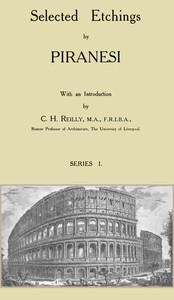
Selected etchings by Piranesi, series 1.
Download Formats:
Excerpt
The Project Gutenberg eBook of Selected etchings by Piranesi, by
Charles Herbert Reilly
This eBook is for the use of anyone anywhere in the United States and
most other parts of the world at no cost and with almost no restrictions
whatsoever. You may copy it, give it away or re-use it under the terms
of the Project Gutenberg License included with this eBook or online at
www.gutenberg.org. If you are not located in the United States, you
will have to check the laws of the country where...
Read the Full Text
— End of Selected etchings by Piranesi, series 1. —
Book Information
- Title
- Selected etchings by Piranesi, series 1.
- Language
- English
- Type
- Text
- Release Date
- March 29, 2023
- Word Count
- 9,061 words
- Library of Congress Classification
- NE
- Bookshelves
- Browsing: Art & Photography
- Rights
- Public domain in the USA.