*** START OF THE PROJECT GUTENBERG EBOOK 52516 ***
[Illustration: MISSION SAN JOSE]
[Illustration: THE ALAMO]
[Illustration: San Antonio, City of Missions]
_San Antonio_
CITY OF MISSIONS
By CLAUDE B. ANIOL
HASTINGS HOUSE
PUBLISHERS NEW YORK
COPYRIGHT, 1942, BY CLAUDE B. ANIOL
PRINTED IN THE U.S.A.
[Illustration: Entrance to the Alamo]
San Antonio
From a village of _Tejas_ Indians has grown the modern city of San
Antonio ... not completely modern, for there still remain many evidences
of the past, even though towering skyscrapers mark the city as
progressive and prosperous. San Antonio is filled with picturesque charm
and interesting contrasts. Off busy downtown streets one will find in
bold relief buildings, as well as customs, that date back to times when
the city was settled by Spanish conquistadors.
The Spanish, fearing encroachment in Texas by the French in the late
seventeenth century, set out to make good their original claims by
establishing forts and missions in East Texas. Captain Don Domingo Teran
de los Rios was named governor of the new Spanish dominion and, in 1691
during a journey across Texas accompanied by Father Damian Massanet,
missionary and explorer, paused here at an Indian Village. Mass was said
on the site, a great many salutes were fired, and the place was named
“San Antonio”.
No permanent settlement was established, however, but later other
expeditions passing this way encamped here. The French explorer and
trader, Louis Juchereau de Saint Dennis, claiming his interest to be the
establishment of trade relations between Louisiana and Mexico, stopped
near the headwaters of the San Antonio River in 1714, admired the charms
of the place, and declared the location to be an ideal spot for founding
a permanent community. St. Dennis’ activity in the area aroused the
Spanish authorities. Rivalry for the possessions of Texas broke out
anew.
In 1718 the Spanish viceroy, desiring a point midway between the East
Texas Missions and the Spanish Presidio of northern Mexico, established
here as a fortress the Royal Presidio of _San Antonio de Bejar_, and
founded the mission _San Antonio de Valero_ (The Alamo).
This step marked the real founding of San Antonio. Within the next
thirteen years the building of four more missions got under way. King
Philip of Spain began colonization of the province, when in 1731 sixteen
Canary Island families arrived and settled in San Antonio. This
settlement was known as the “_Villa de San Fernando_”, and it is on the
site of this original settlement that the Old San Fernando Cathedral
stands today. This little villa in the wilderness formed the nucleus
about which San Antonio gradually developed. Many prominent citizens
today are descendants of these early settlers.
Progress for the community during the next half century was slow, for
San Antonio was on trails seldom traveled and was brought into little
contact with the outside world. The missions established earlier in the
century prospered, expanded and then declined. In 1793-94 they were
secularized and ceased to function as church settlements. Then followed
a period of waning Spanish religious and political influence. In 1811
Mexico revolted against Spain and San Antonio was occupied several
times, alternately by Mexican Revolutionists and Spanish Royalists.
In 1820 Moses Austin, a Connecticut Yankee living in Missouri, left his
home and traveled to San Antonio, seeking permission of the Spanish
authorities, still in power, to establish a colony of Americans in
Texas. After Austin’s death from hardships encountered during his trip,
approval was granted his plan and it was carried out by his son, Stephen
F. Austin. The years 1821 to 1836 saw a flood of Anglo-American
immigration pouring in.
Mexico achieved her independence from Spain in 1821 and San Antonio and
Texas came under the domination of the newly formed Mexican government
which put forth inconsistent confused policies. The earlier liberal
grants to the Anglo-Americans were questioned. Following a series of
revolutions begun in 1829, unscrupulous rulers successfully seized power
in Mexico. Their unjust acts and despotic decrees led to revolution in
Texas. The Texans formed an army, and in November 1835 established a
provisional government.
In 1836, at the former mission San Antonio de Valero, the famous battle
of the Alamo was fought. W. B. Travis, James Bonham, James Bowie, David
Crockett and some 180 Texans held off, from February 23 to March 6, the
Mexican army of more than 5000 troops under General Lopez de Santa Anna.
The Mexicans finally broke over the mission walls on the morning of
March 6 and bayoneted or knifed the entire garrison. Santa Anna was
decisively beaten by Texans under General Sam Houston at the battle of
San Jacinto forty-six days later. Following this San Antonio came under
the rule of the newly formed Republic of Texas.
The year 1845 saw the annexation of Texas to the United States. In 1861,
during the war between the States, Texas seceded from the Union. New
times began in 1865 at the close of the Civil War. San Antonio became
the center of a cattle empire. Longhorns were driven northward up the
trails to market; mile-long wagon trains from Mexico began to come
through the city. The Southern Pacific Railroad was constructed through
this section in 1877. In 1898 the Spanish-American War again stimulated
military activity in San Antonio and Colonel Theodore Roosevelt trained
his Rough Riders at the site now marked by Roosevelt Park.
And so until 1900 San Antonio had a colorful life. Then it settled down
to consistent growth and progress. Oil was discovered near the city.
Hundreds of new families came to make this their home because of the
natural beauty, the mild climate, the healthfulness and business
opportunities. But progress proceeds without dimming the past and it is
the past that draws thousands of visitors to this unique city of
picturesque contrasts.
Today, more than 2,000 acres are included in the city’s 60 parks and
plazas. One of the most complete city park systems in the nation,
Brackenridge Park embraces 320 acres. Among its interesting features is
a Zoo which ranks among the nation’s largest and best.
The San Antonio River which finds its source in numerous flowing springs
just north of Brackenridge Park and winds its way through the business
section of the city, has been transformed into a beautiful Venetian
canal with walkways below the street level along banks lined with
semi-tropical flowers and shrubs.
An important military center since its beginning, San Antonio now
possesses the largest permanent army post of the nation in Fort Sam
Houston, headquarters for the Eighth Corps Area. An arsenal is located
here, Normoyle Quartermaster Depot and Camps Stanley and Bullis. San
Antonio saw the birth of the air corps in 1910 and today are located
here the military flying fields of Randolph, the “West Point of the
Air”; Kelly, Duncan and Brooks.
Thus the past two hundred years have seen much colorful drama enacted
under the flags of France, Spain, Mexico, the Republic of Texas, the
Confederacy, and the United States. Each flag has left mirrored a part
of its own significance. The curious mixture of old and new which is San
Antonio has been recorded in the pages of this book.
Claude B. Aniol
[Illustration: One of the most famed historic shrines in the United
States is the Alamo, the old chapel of _Mission San Antonio de
Valero_, founded in 1718. Here on March 6, 1836, a band of less than
200 Texas patriots valiantly defending the Alamo against more than
5,000 troops of Santa Anna, the Mexican general, were massacred.
“Remember the Alamo!” became the battle-cry of other Texans. Santa
Anna was later defeated by General Sam Houston’s forces at the battle
of San Jacinto.
Most of the earlier history of the Alamo, is shrouded in obscurity. It
was named in honor of St. Anthony of Padua and the Duke of Valero, a
Spanish viceroy. Although the mission was founded in 1718, the
cornerstone of the chapel was not laid until 1744. Founded for the
purpose of Christianizing and educating the Indians, it later became a
fortress and was the scene of many conflicts prior to the immortal
siege of 1836. The ravages of time, of faulty construction, of war and
fire have destroyed all the buildings except the chapel, and even this
has been partially restored. According to some historians, the name
“Alamo” came from a company of soldiers bearing the name who were once
quartered there, and another claims it was derived from a grove of
cottonwood trees nearby, “Alamo” being the Spanish word for
cottonwood.]
[Illustration: Mission Conception, _Nuestra Señora de la Purisima
Conception de Acuna_, was established in 1731. It is probably the best
preserved of the Texas missions, despite the fact that when it was
secularized in 1794 its lands were distributed among the Indians,
settlers and soldiers and it ceased to function as a church
settlement.
Conception and the other missions of the San Antonio area are built of
adobe and porous gray rock called tufa. The walls of this mission are
45 inches thick. The topmost roofs of the twin towers are pyramidical
and of stone, with smaller corner and center cap stones.]
[Illustration: The interior plan of Conception is the cruciform.
Original frescoes of vegetable and mineral dyes are still visible.]
[Illustration: The niche within the triangle above the ornamental
entrance of Conception once held a statue. The coat of arms and
symbols of the Order of St. Francis are carved in the center of the
arch. Here and there can still be seen spots of what were once vivid
frescoes adorning the mission front.]
[Illustration: Conception from the south side presents the Moorish
dome with its wide stone serrations. The walls at the right are all
that remain of the mission kitchen, destroyed during the battle of
Conception in 1835.]
[Illustration: A simple arcade runs south from the entrance of
Conception, connecting at the right and far end with the former living
quarters of the monks.]
[Illustration: Mission San Jose (_San Jose y San Miguel de Aguayo_),
acclaimed “Queen of the Missions”, was established in 1720 by Father
Margil, one of the pioneer missionaries of New Spain. The first chapel
was completed in 1731, and the entire mission plan, in all of its
glory, by 1779. Time and neglect had caused many of the original
mission buildings to crumble away.
As it stands today, with restoration completed, San Jose presents an
interesting picture of the extensiveness of the original mission plan.
It was the most beautiful, the most prosperous and the best fortified
of the missions in New Spain. The mission building itself faces west,
with a frontage of 62 feet, and including the monastery wing, is 241
feet long. The front walls are almost 5 feet thick and the others but
slightly less. The Mission is enclosed in a quadrangle embracing more
than six acres, protected by ramparts forming the outer walls of the
Indian quarters which were a part of the establishment.
Construction of the chapel took ten years, following a slow and
tedious process. As the main walls were built, earth was constantly
hauled in, the level being raised as the stones were piled higher.
When the roof line was reached, dirt for the dome was piled higher and
moulded so that each stone could be locked in place. With the roof
completed, the dirt was dug out from beneath and the balance of the
building finished. The single tower of San Jose rises to the height of
the average seven and one-half story building, and the hemispheric
dome of the church is almost as high.]
[Illustration: The richly ornamented facade of San Jose is considered
one of this Mission’s most notable features. Those parts not
originally covered with carving were decorated with frescoes. The
facade is rich with beautiful stone carving and ornamentation that is
still in an excellent state of preservation despite the vandalism of
relic hunters during the many years the mission was deserted following
secularization.]
[Illustration: The roof, dome and front of the walls of the original
main chapel of San Jose crashed during a storm in 1868. They remained
in a state of disrepair until 1937.]
[Illustration: The lower portion of the facade of San Jose presents
the work of the original sculptors. Above the doors is carved our Lady
of Guadalupe. Figures in niches on each side of the doors, Saint
Joachim and Saint Anne, are no longer intact. The hearts above these
two statues represent the hearts of Mary and Joseph.]
[Illustration: The window is framed in a wreath, above which is a
partially mutilated statue of St. Joseph. Saints Dominic and Francis
of Assisi are represented by statues on the right and left of the
window.]
[Illustration: Two-story cloisters connect with the main building.]
[Illustration: Adjoining the main church at San Jose is a smaller
chapel, which can be entered through this sculptured door. The
original red cedar doors still swing on the old wrought iron hinges.]
[Illustration: Padres of bygone days peacefully fingered their
rosaries in this picturesque cloister.]
[Illustration: The “Rose Window” of the San Jose Sacristy is said to
be the work of one Pedro Huizar who toiled on it for five years.
Legend has it that an unhappy romance caused the artist to pour his
heart and soul into the design.]
[Illustration: This cloister garden at San Jose no doubt abounded in
native trees, flowers and shrubs just as it does today.]
[Illustration: The old Mission Mill (below) has been reconstructed on
its original foundations.]
[Illustration: Lookouts were provided above each of the four gates
entering the plaza at San Jose. Unfriendly Indians, however, seem to
have seldom bothered the mission.]
[Illustration: Around three sides of the plaza are reproduced the
living quarters of the mission Indians.]
[Illustration: MISSION SAN FRANCISCO de la ESPADA
The wrought iron cross atop this mission is said to have been made on
the premises by the founders.]
[Illustration: _Mission San Francisco de la Espada_ was established in
1731, the main church building in a plan including many other
structures, a few of which still remain. But most have long since been
destroyed. One wonders why the Mission, dedicated to St. Francis,
founder of the order of Franciscans, should be referred to as St.
Francis of the Sword. Tradition has it that the tower was built in the
form of the hilt of a sword. One’s imagination is to project the
length of the blade to complete the similarity to the whole weapon.]
[Illustration: A number of the original statues of the Franciscans can
still be seen in the chapel of Mission Espada. These are hand carved
of native wood, with movable limbs. The heads have glass eyes and
separately cut teeth.]
[Illustration: A fortified tower has thirty-six-inch walls. Holes for
cannon muzzles were created near the base. Musket loopholes can be
seen higher.]
[Illustration: The Moorish entrance of Mission Espada. A wooden cross
beside the door is a reminder of the efficacy of prayer.]
[Illustration: Nestled in a thick grove of tall hackberry and pecan
trees, stands Mission San Juan Capistrano. Founded in 1731, this
Mission is less imposing than the others in the area. San Juan
Capistrano followed the plan typical of the other missions, with an
enclosed area containing all the buildings. Although in ruins, the
original boundaries and foundations can still be seen. Unlike other
missions the main buildings formed part of the rampart walls.]
[Illustration: Of the chapel interior of San Juan Capistrano, the
outer walls, the three wooden statues and a few odd items represent
the original mission.]
[Illustration: Looking through the entrance gate into “La Villita”, a
restored settlement of the oldest remaining residential section of the
city. It was started about 1722 shortly after the establishment of the
presidio San Antonio de Bejar.]
[Illustration: The houses in La Villita are built of rock and adobe.
The residents were mostly soldiers, many of whom had intermarried with
the Indians, and their families. A feeling of class distinction was
created in 1731 with the coming of the Canary Islanders, who
considered themselves of noble lineage. The Islanders established
their own settlement and refused to have any relations with those
living in La Villita.]
[Illustration: The Cos House in the Villita settlement is an
outstanding example of an early dwelling in San Antonio. Here General
Perfecto de Cos signed articles of capitulation on December 9, 1835,
after the Texans had captured San Antonio from the Mexican force.]
[Illustration: High walls to give protection as well as privacy,
enclose a patio of the Cos House. The house itself is of adobe with
very thick walls.]
[Illustration: This picturesque old adobe house on Dawson Street is
but a few hundred yards from the Alamo and is typical of hundreds of
similar early homes still to be seen. At the door of this home is a
_metate_ stone, still used by many Mexicans to grind their corn for a
_masa_ mixture used in making tortillas.]
[Illustration: Located in Military Plaza is the Spanish Governors’
Palace, a restoration of the historic building used by the Spanish
governors and vice-governors of the province.]
[Illustration: In the keystone over the entrance is the Hapsburg coat
of arms bearing the date 1749. Philip V of Spain, founder of the
Canary Island settlement in San Antonio was a descendant and heir of
the Spanish Hapsburgs.]
[Illustration: The arrangement and furnishing of the ten rooms in the
Spanish Governors’ Palace give a picture of home life in the better
class Spanish homes of the day. In such homes there was a private
chapel such as this room of the Blessed Virgin.
There are four fireplaces in the Palace, each different. According to
tradition, sticks of wood were placed on end in one corner of the
fireplace and the fair señoritas named each stick for a young señor.
He was worthy of her consideration if the stick burned evenly, but if
it burned in the middle and fell apart, he was not to be trusted.]
[Illustration: This is the living room in the palace.]
[Illustration: This interesting stairway led up to the _despensa_, or
storage pantry, where food was stored.]
[Illustration: In the _cocina_ or kitchen of the Spanish Governors’
Palace the stove is typical of the Spanish kitchen in which charcoal
fanned to flame by bellows, is used.]
[Illustration: This _comedor_ (dining room) in the Governors’ Palace
was the scene of many gay and festive affairs.]
[Illustration: The garden of the Spanish Governors’ Palace, filled
with subtropical shrubbery and flowers, could have been no more
beautiful in the days when Spanish viceroys ruled within its walls.
The pebble mosaic walks form interesting patterns in the patio.]
[Illustration: Moses Austin, born in Connecticut, lost in 1819 the
fortunes he had made in the South and West and two days before
Christmas of the following year arrived in San Antonio seeking
permission from the Spanish authorities to bring 300 families from the
states to found a colony. This bronze statue of Moses Austin, modeled
by Waldine Tauch, stands on the City Hall grounds facing the restored
Spanish Governors’ Palace, from whence came permission to establish
his colony.]
[Illustration: Looking across Main Plaza to the San Fernando
Cathedral. It is here that the original Canary Islanders settled in
1731, naming the spot “Plaza de las Islas”. San Fernando Cathedral was
completed in 1873 after a fire destroyed most of the original 1749
building. Santa Anna used the church as an observation point during
the siege of the Alamo in 1836.]
[Illustration: This Georgia Marble Cenotaph in memory of the heroes of
the Alamo stands opposite the Alamo fortress area. Its sides are
inscribed with the names of all who fell at the Alamo. Pompeo Coppini
was the sculptor. At the left is the Spanish Colonial Post Office, at
the right, the Medical Arts Building.]
[Illustration: This sixteen room mansion built in 1859 for James Vance
of Stebaune, Ireland, stands as a splendid example of the Greek
Revival influence in architecture felt all through the South before
the Civil War. Robert E. Lee was often a guest here. The lumber and
iron railings were brought in from New Orleans and much of the
materials used in its construction were imported. It is said that the
water hydrants were of solid silver.]
[Illustration: The San Antonio River is but a narrow meandering
stream, with headwaters just outside the northern city limits. In the
twists and turns it makes, crossing six miles of street, it passes
beneath 42 bridges. The Indians of the locality used a word that
characteristically describes it as a
“drunken-old-man-going-home-at-night”.
The beautiful San Antonio River is about twenty feet below street
level and the part that winds along twenty-one blocks of the downtown
business section has been beautified and transformed into a
Venetian-like canal. Stairways, each of a different design, lead down
from the bridges to the river walkways lined with trees and shrubs,
many of them semi-tropical. Here one can stop and relax away from the
noise of traffic on the upper street level.]
[Illustration: In the early days, Old St. Mary’s College, established
in 1852, maintained a boat landing here and many of the boys who lived
along the river came to school in their boats.]
[Illustration: On St. Mary’s Street, at a picturesque bend in the
river, has been preserved the home of John Twohig, erected in the
early 1840’s. Because he gave barrels of bread to the poor on each
Saturday, Twohig was given the name of “the breadline banker”.]
[Illustration: One of the several boat landings along the San Antonio
River. Many of the buildings bordering the river have overhanging
balconies and a few street level business houses can be reached from
river bank entrances.]
[Illustration: The Arneson River Theatre, a unique outdoor playhouse,
can be reached through this Villita Street entrance which adjoins the
Cos House, as well as from the river walks. Seen through the arch is a
portion of the stage.]
[Illustration: From the Villita Art Gallery grounds a portion of the
Arneson River Theatre stage with the permanent back drop of a mission
type building and bell arches, can be seen at the right.]
[Illustration: Tiers of grass-covered seats accommodating nearly a
thousand people form the seating arrangement of the Arneson River
Theatre.]
[Illustration: The Municipal Auditorium, built as a memorial to the
World War dead, has a seating capacity of over 6,000.]
[Illustration: The little Block House pictured here was built in 1862
as a defense against the Indians. It is located in San Pedro Park, an
old council ground of the Indians.]
[Illustration: The Pioneers’-Trail Drivers’ Memorial in Brackenridge
Park has many interesting exhibits. The Texas Trail Drivers, an
association of men who made drives up the early cattle trails, have
official headquarters here.]
[Illustration: Thomas Jefferson Senior High School, a modern
adaptation of Spanish Colonial architecture, is the largest of the
city’s several senior schools.]
[Illustration: The longhorn, once a familiar sight on the ranges of
Texas, have probably made more history than any other breed of cattle.
Of Spanish origin, their first appearance in the southwest was
probably with Coronado’s expedition in 1541. These big lanky,
raw-boned animals, with a horn spread sometimes reaching nine feet,
have long since been supplanted by improved beef types. In the
Brackenridge Park Zoo can be seen a number of these picturesque
animals which have now become somewhat of a curiosity.]
[Illustration: In Brackenridge Park Zoo, one of the leading zoological
gardens of the nation, an African panorama with natural pits for the
animals displays the most important specimens in barless areas.]
[Illustration: The Sunken Garden Theatre in Brackenridge Park. Here
during the summer in a magnificent setting are presented light operas
and concerts.]
[Illustration: An abandoned rock quarry was converted into this
Japanese Garden.]
[Illustration: Within the Quadrangle at Fort Sam Houston is the
88-foot clock tower which, when it was constructed in the late
seventies, also served as a watch-tower for the fort.]
[Illustration: Kelly Field, established during World War I, is the
oldest advanced flying training school in the nation. The dull gray
frame hangars and buildings erected at that time still constitute most
of the field’s structures, although in recent years many fine
permanent type buildings like the Cadet Barracks pictured here, have
been erected.]
[Illustration: Most of America’s great aviators of the past quarter
century received their “wings” at Kelly Field. Ground school study at
the field is now carried on in this new Academic Building.]
[Illustration: Randolph Field, “The West Point of the Air”, is one of
the largest military airdromes in the world, embracing a total area of
approximately two miles square with the building area occupying 475
acres of this.
Here are located the primary and basic flying schools of the Air
Corps, U. S. Army. The key structure of the field is the
Administration Building pictured here, which has a tower 175 feet
high, topped by a powerful beacon to help orientate night fliers.]
[Illustration: A portion of Randolph Field looking south from the top
of the Administration Building. The home in the foreground is that of
the commanding officer of the field.]
[Illustration: Randolph Field from the air.]
[Illustration: Two of the Cadet barracks at Randolph Field. The
Spanish type of architecture has been followed consistently in all the
construction at the field, with the exception of the hangars.]
[Illustration: Another Cadet barracks.]
[Illustration: The Randolph Field Post Chapel.]
[Illustration: Sailboats.]
$1.25
_San Antonio_
_City of Missions_
By
CLAUDE B. ANIOL
Travelers who have visited San Antonio remember it as a city with a warm
and personal charm. It is one of the rare places which embody and
symbolize all that is America. Founded by the Spanish in the late
seventeenth century, San Antonio has flown the flags of France, Spain,
Mexico, the Republic of Texas, the Confederacy, and the United States.
In the midst of an important city which is a center of industry and
commerce stand the lovely 200-year-old missions, and the Alamo, whose
defense by Bowie, Crockett and their fellow heroes gave birth to a great
rallying cry of our nation. Nearby are the aviation stations of
Randolph, Kelly, Brooks and Duncan Fields, “the cradle of America’s air
might.”
_Claude B. Aniol, one of America’s foremost photographers, is eminently
qualified by his intimate knowledge of San Antonio, his home, to portray
in superb photographs this dynamic and busy, yet always picturesque
city._
_American Guide Series_
America is being rediscovered today. In every state of the Union, in
large cities, tiny villages, on the open highway, members of Federal
Writers’ Projects are revealing the riches of the land. The American
Guide Series is a heartlifting experiment in co-operative literature.
Field investigators, cartographers, writers, editors, photographers,
business supervisors have contributed to the task of producing guide
books which shall be accurate, timely, convenient, and entertaining.
The primary emphasis in the books is upon the tours. Travelers in cars,
on trains, in busses—campers, hikers, fishermen, hunters—will find here
the information they need. How far to the next town; what kind of road;
are there hotels, campsites; what should we see; are there side trips;
what are the traffic and game laws? These are the first considerations
of travel.
But the book contains more than that. The authors are not Baedekers
descending for a moment on some foreign spot. They are writing also for
the historian today and tomorrow who would know how the states appear to
the people who inhabit them. Sections devoted to the history of the
particular state, the temper of its people, the nature of its resources
and industries, the problems it faces and the way it meets them, endow
the reader—be he tourist, student, or armchair traveler—with an intimate
knowledge of the region. These volumes are an invitation to visit
America.
The volumes in the American Guide Series contain a wealth of information
on the region they cover. Each gives an account of the history and
folklore of the city or state, information concerning the recreational
facilities available, and many tours. Maps and many beautiful
illustrations supplement the text.
Alabama $4.00
Arizona State Guide $4.00
Arkansas State Guide $4.00
California State Guide $4.00
Colorado State Guide $4.00
Delaware State Guide $4.00
Iowa State Guide $4.00
Kansas State Guide $4.00
Kentucky State Guide $4.00
Key West City Guide $2.00
Los Angeles City Guide $4.00
Louisiana State Guide $4.00
Minnesota State Guide $4.00
Mission San Xavier del Bac, Arizona $1.00
Mississippi State Guide $4.00
Montana State Guide $4.00
Mount Hood Guide $2.00
Nebraska State Guide $4.00
New Jersey State Guide $4.00
New Mexico State Guide $4.00
The Oregon Trail $2.00
San Francisco City Guide $4.00
Santa Barbara City Guide $2.00
Tennessee State Guide $4.00
Texas State Guide $4.00
Utah State Guide $4.00
Washington, D. C. Guide $4.00
HASTINGS HOUSE
Publishers New York, 18
Transcriber’s Notes
--Copyright notice provided as in the original—this e-text is public
domain in the country of publication.
--Silently corrected palpable typos; left non-standard spellings and
dialect unchanged.
--Moved some captions closer to the corresponding pictures; exchanged
the captions on pages 32 and 33.
--In the text versions, delimited italicized text by _underscores_.
End of the Project Gutenberg EBook of San Antonio, by Claude B. Aniol
*** END OF THE PROJECT GUTENBERG EBOOK 52516 ***
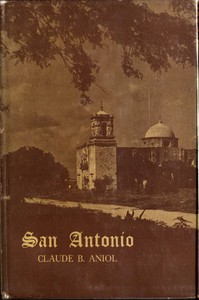
San Antonio: City of Missions
Subjects:
Download Formats:
Excerpt
_San Antonio_
CITY OF MISSIONS
HASTINGS HOUSE
PUBLISHERS NEW YORK
COPYRIGHT, 1942, BY CLAUDE B. ANIOL
PRINTED IN THE U.S.A.
From a village of _Tejas_ Indians has grown the modern city of San
Antonio ... not completely modern, for there still remain many evidences
of the past, even though towering skyscrapers mark the city as
progressive and prosperous. San Antonio is filled with picturesque charm
and...
Read the Full Text
— End of San Antonio: City of Missions —
Book Information
- Title
- San Antonio: City of Missions
- Author(s)
- Aniol, Claude B.
- Language
- English
- Type
- Text
- Release Date
- July 7, 2016
- Word Count
- 4,806 words
- Library of Congress Classification
- F350.5
- Bookshelves
- Browsing: Art & Photography, Browsing: History - American, Browsing: Travel & Geography
- Rights
- Public domain in the USA.
Related Books

Reconstruction in Louisiana after 1868
by Lonn, Ella
English
496h 26m read

Social life in old New Orleans
by Ripley, Eliza
English
1140h 52m read
Captain Bill McDonald, Texas Ranger: A Story of Frontier Reform
by Paine, Albert Bigelow
English
1822h 26m read
Six Years with the Texas Rangers, 1875 to 1881
by Gillett, James B.
English
1197h 40m read

The Valley of Democracy
by Nicholson, Meredith
English
994h 28m read
Conservation Archaeology of the Richland/Chambers Dam and Reservoir
by Moir, Randall W., Raab, L. Mark
English
136h 6m read