The Project Gutenberg EBook of Rustic Chivalry (Cavalleria Rusticana), by
Pietro Mascagni
This eBook is for the use of anyone anywhere in the United States and most
other parts of the world at no cost and with almost no restrictions
whatsoever. You may copy it, give it away or re-use it under the terms of
the Project Gutenberg License included with this eBook or online at
www.gutenberg.org. If you are not located in the United States, you'll have
to check the laws of the country where you are located before using this ebook.
Title: Rustic Chivalry (Cavalleria Rusticana)
Melodrama in One Act
Author: Pietro Mascagni
Translator: J. C. Macy
Release Date: January 17, 2015 [EBook #48007]
Language: English
Character set encoding: UTF-8
*** START OF THIS PROJECT GUTENBERG EBOOK RUSTIC CHIVALRY (CAVALLERIA ***
Produced by Colin Bell, Paul Marshall, Joseph Cooper and
the Online Distributed Proofreading Team at
http://www.pgdp.net
GRAND OPERA
LIBRETTOS
ITALIAN
AND ENGLISH TEXT
AND MUSIC OF THE PRINCIPAL AIRS
CAVALLERIA
RUSTICANA
(RUSTIC CHIVALRY)
BY
MASCAGNI
OLIVER DITSON COMPANY
BOSTON
CHAS. H. DITSON & Co.
_New York_
LYON & HEALY
_Chicago_
OPERA SCORES
All the vocal scores have English text together with the foreign text
mentioned below. Unless otherwise specified, these books are bound in
paper.
GRAND OPERAS
=AÏDA= =Giuseppe Verdi= =2.50=
In four acts. Italian text
=BOHEMIAN GIRL= =Michael W. Balfe= =2.00=
In three acts
=CARMEN= =Georges Bizet= =2.50=
In four acts. French text
=CAVALLERIA RUSTICANA= =Pietro Mascagni= =2.00=
In one act. Italian text
=FAUST= =Charles Gounod= =2.00=
In five acts. French text
=LAKMÉ= =Léo Delibes= =3.00=
In three acts
=MARITANA= =William Vincent Wallace= =2.50=
In three acts
=MIGNON= =Ambroise Thomas= =2.50=
In three acts. Italian text
=SAMSON AND DELILAH= =Camille Saint-Saëns= =2.50=
In three acts
=TROVATORE, IL= =Giuseppe Verdi= =2.00=
In four acts. Italian text
LIGHT OPERAS
=BELLS OF CORNEVILLE, THE;
or, THE CHIMES OF NORMANDY=
In three acts =Robert Planquette= =2.50=
=BILLEE TAYLOR; or, THE REWARD OF VIRTUE=
In two acts =Edward Solomon= =1.50=
=BOCCACCIO; or, THE PRINCE OF PALERMO=
In three acts =Franz von Suppé= =2.50=
=DOCTOR OF ALCANTARA, THE=
In two acts =Julius Eichberg= =1.50=
=FATINITZA= =Franz von Suppé= =2.50=
In three acts. German and Italian text
=MARTHA= =Friedrich von Flotow= =2.50=
In four acts. German and Italian text
=MASCOT, THE= =Edmond Audran= =2.50=
In three acts
=OLIVETTE= =Edmond Audran= =2.00=
In three acts
=PINAFORE, H. M. S.; or, THE LASS THAT
LOVED A SAILOR=
In two acts =Sir Arthur Sullivan= =1.50=
=SORCERER, THE= =Sir Arthur Sullivan= =1.75=
In two acts
=STRADELLA= =Friedrich von Flotow= =2.00=
In three acts
Send for Descriptive Circular P--Oratorios, Cantatas, Operas and
Operettas.
OLIVER DITSON COMPANY
RUSTIC CHIVALRY
(CAVALLERIA RUSTICANA),
MELODRAMA IN ONE ACT.
BY
PIETRO MASCAGNI.
ENGLISH VERSION BY J. C. MACY.
30
BOSTON
OLIVER DITSON COMPANY
NEW YORK CHICAGO
CHAS. H. DITSON & CO. LYON & HEALY
Copyright, MCMXIX, by MARY EMMA S. MACY.
DRAMATIS PERSONÆ.
CHARACTERS.
SANTUZZA, a village girl _Soprano_.
LOLA, wife of Alfio _Mezzo Soprano_.
TURIDDU, a young soldier _Tenor_.
ALFIO, a teamster _Baritone_.
LUCIA, mother of Turiddu _Contralto_.
CHORUS OF PEASANTS AND VILLAGERS.--CHORUS BEHIND THE SCENES.
PLOT OF THE OPERA.
TURIDDU, a young villager, is the son of LUCIA, and the lover of LOLA,
(who is the wife of ALFIO; having married the latter during TURIDDU'S
prolonged absence in military service). TURIDDU wins the affections
of SANTUZZA, whom he wrongs; while, in the meantime, he is intimate
with LOLA. On Easter morning, (the opening of the opera), ALFIO is
incidentally informed, by SANTUZZA, of his wife's unfaithful actions. He
challenges TURIDDU (biting the ear, as was the rustic Sicilian custom).
TURIDDU, though regretting his past evil course, accepts the challenge
and is killed by ALFIO
[** Transcriber Notes:
------------------
The original text is dual column, with English on the left and
Italian on the right, with musical scores interspersed throughout.
In this version, the complete English text for a scene is shown
first, followed by the complete Italian text for the scene.
The musical scores are placed as near as possible to the original
version. **]
RUSTIC CHIVALRY.
TURIDDU. (Behind the scenes.)
O Lo-la, fair as flow'rs in beau-ty smil-ing, ...
Love from thy soul-lit eyes
Soft-ly is glow-ing; ...
He who would kiss thy lips, red and be-guil-ing ...
Bliss-ful and fa-vor'd were he,
Such heav-en know-ing!...
Tho' thy thresh-old blood, crim-son, is stain-ing, ...
Car-ing for naught, I seek thee, scorning to hide me; ...
What tho' I for-feit life, thy pres-ence gain-ing?
What were the joy of heav'n, wert thou de-nied me!
What tho' I for-feit life, thy pres-ence gain-ing,
What were the joy of heav'n wert thou de-nied me.
Ah! ... Ah! ... Ah! ... Ah! ...
O Lo-la, bian-ca co-me fior di spi-no, ...
quan-do t'af-fac-ci te s'affac-(cia il) so-le; ...
Chi t'ha ba-cia-(to il) lab-bro por-po-ri-no ...
Gra-zia più bel-la a Di-o chie-der non vô-le....
C'e scrit-to san-gue so-pra la tua por-ta; ...
Ma di re-star-(ci a) me non me n'in-por-ta; ...
Se per te mo-(jo e) va-(do in) pa-ra-di-so,
Non c'en-tro se ... non ve-do il tuo bel vi-so,
Se per te mo-(jo e) va (do in) pa-ra-di-so
Non c'en-tro se ... non ve-do il tuo bel vi-so.
Ah! ... Ah! ... Ah! ... Ah! ...
(Curtain rises.)
SCENE I.
A public place or square in a Sicilian village. At right, in background,
a church. At left, the inn and dwelling of Mamma Lucia.
Time, Easter morning.
(Peasants, countrymen, country-women, and children, cross the stage.)
(The church doors open and the throng enters.)
(The movement continues until the following:)
INTRODUCTORY CHORUS.
_Chorus of women._
(Behind scenes.)
Ah! Ah!
_Chorus of men._
(Behind scenes.)
Ah! Ah!
_Chorus of women._
(Behind scenes.)
Sweet is the air with the blossoms of oranges;
Sings now the lark from the myrtles in flow'r;
Murmurs of tender song tell of a joyful world,
And of thankful hearts. Ah! gladsome hour!
(The women enter.)
_Chorus of men._
(Behind scenes.)
Your spinning wheels now busily are humming,
O'er fields of golden corn the sound is coming;
We linger where the leafy shade is restful;
Of you we think, and every heart is zestful.
Oh lovely women! Allured by you and enraptured,
Like the bird by the lure held, now are we captured!
(The men enter.)
_Women._
Work in the field now is ended;--
The Holy Mother mild
In ecstasy fondles the Child.
_All._
(Withdrawing from stage.)
Murmurs of tender song tell of a joyful world,
And of thankful hearts.
Ah! gladsome hour!
(Enter, Santuzza, approaching Lucia's dwelling.)
SCENA I.
La scena rappresenta una piazza in un paese della Sicilia. Nel fondo, a
destra, Chiesa con porta practicabile. A sinistra l'osteria e la casa di
Mamma Lucia.
E il giorno Pasqua.
CORO D'INTRODUZIONE.
(Campane interne dalla Chiesa. Si alza la tela. La scena sul principio è
vuota. Albeggia. Paesani, contadini, contadine e ragazzi traversano la
scena. Si apre la chiesa e la folla vi entra. Il movimento del popolo
continua fino al Coro punto in cui rimane la scena vuota.)
_Coro._
(Donne di dentro.)
Ah!
(Uomini di dentro.)
Ah!
(Donne di dentro.)
Gli aranci olezzano sui verdi margini,
Cantan le allodole tra i mirti in fior;
Tempo è si mormori da ognuno il tenero canto che i palpiti--
Raddoppia al cor.
(Le donne entrano in iscena.)
(Uomini di dentro.)
_Coro_.
In mezzo al campo tra le spiche d'oro
Giunge il rumore delle vostre spole,
Noi stanchi riposando dal lavoro
A voi pensiamo, o belle occhidisole.
O belle occhidisole, a voi corriamo,
Come vola l'augelo--al suo richiamo.
(Gli uomini entrano in iscena.)
_Donne._ Cessin le rustiche opre:
La Virgine serena allietasi del Salvator;
Tempo è si mormori da ognuno il
tenero canto che i palpiti--
Raddoppia al cor.
_Uomini._
(Allontanandosi.)
In mezzo al campo, etc.
_Donne._
(Allontanandosi.)
Gli aranci olezzano, etc.
SCENE II.
(Santuzza, Lucia, Alfio, and chorus.)
_Santuzza._ Tell me, mother Lucia--
_Lucia._
(Coming from house.)
It is thou? What wilt thou?
_Sant._ Where is Turiddu?
_Lucia._ For him you ask? For him, my son Turiddu!
_Sant._ Only for him I ask you. Pardon, but answer!
Where is Turiddu?
_Lucia._ Ask me not! I know not; I want no trouble.
_Sant._ Mamma Lucia, with weeping do I pray you!
Even as spake the Saviour to the Magdalen,
Say, in pity say, where is Turiddu!
_Lucia._ He's gone to bring some wine from Francofonte.
_Sant._ No! Last night some within the village saw him.
_Lucia._ What says't thou? Who told it?
Nay, he hath not yet returned.
Enter!
_Sant._ I may not step across your threshold,
I cannot pass it, I, most unhappy outcast!
Excommunicated!
_Lucia._ What of my son? What hast thou to tell me?
_Sant._ Ah! the torture, the heart-pain.
(Cracking of whips and jingling of bells behind scenes.)
(Chorus enters, followed soon by Alfio.)
SCENA II.
Sortita di Alfio.
_Santuzza._
(Entra e si dirige alla casa di Lucia.)
Dite, Mamma Lucia--
_Lucia._
(Sortendo.)
Sei tu? che vuoi?
_Santuzza._ Turiddu ov'è?
_Lucia._ Fin qui vieni a cercare il figlio mio?
_Santuzza._ Voglio saper soltanto,
Perdonatemi voi, dove trovarlo.
_Lucia._ Non lo so, non lo so, non voglio brighe!
_Santuzza._ Mamma Lucia, vi supplico piangendo,
Fate come il Signore a Maddalena,
Ditemi per pietà, dov'è Turiddu.
_Lucia._ E andato per il vino a Francofonte.
_Santuzza._ No! l'han visto in paese ad alta notte.
_Lucia._ Che dici? che dici? se non è tornato a casa!
Entra!
_Santuzza._ Non posso entrare in casa vostra.
Sono scomunicata!
_Lucia._ E che ne sai del mio figliuolo?
_Santuzza._ Quale spina ho in core!
(Dall'interno schiocchi di frusta e tintinnio di sonagli.
Entrano in iscena i coristi indi Alfio.)
ALFIO.
Gay-ly moves the tramp-ing horse,
Joy-ful sound the ring-ing bells;
Snap, now, the lash goes, A-hi!...
Cold may blow the wind to-day,
Rain or snow do what it may,
Naught do I care, not I!...
Gay-ly moves the tramp-ing horse,
Joy-ful sound the ring-ing bells;
Snap, now, the lash goes,
Snap, now, the lash goes! A-hi!...
Snap, now, the lash goes,
Snap, now, the lash goes, A-hi! A-hi!
Snap, now, the lash goes,
Snap, now the lash goes,
CHORUS. TENORS.
Who hath call-ing mer-rier than the life of car-rier?
Where is a jol-lier man?...
Who hath call-ing mer-rier than the life of car-rier?
Where is a jol-lier man? Where is a jol-lier man?
Where is a jol-lier man? Where is a jol-lier man?
Where is a jol-lier man, a jol-lier man than he?
Where is a jol-lier man, a jol-lier man?...
ALFIO.
Il ca-val-lo scal-pi-ta, i so-na-gli squil-la-no,
schioc-chi la fru-sta, Ehi là!...
Sof-(fi il) ven-to ge-li-do, ca-da l'ac(qua o) ne-vi-chi,
a me che co-sa fa?...
Il ca-val-lo scal-pi-ta, i so-na-gli squil-la-no,
schioc-chi la fru-sta, schioc-chi la fru-sta, Ehi-là!...
schioc-chi la fru-sta, schioc-chi la fru-sta, Ehi-là! Ehi-là!
schioc-cha la fru-sta, an-dar di (qua e) di là!
schioc-ca la fru-sta, an-dar di (quà e) di là!
CHORUS. TENORS.
O che bel me-stie-re fa-(re il) car-ret-tie-re an-dar
di (qua e) di là!...
Oh che bel me-stie-re fa-(re il) car-ret-tie-re an-dar
di (quà e) di là! an-dar di (qua e) di là!
an-dar di (quà e) di là!
di (quà e) di là, an-dar di (quà e) di là!
di (quà e) di là....
ALFIO.
My lov-ing Lo-la calls me!
Her gen-tle grace en-thralls me,
Ah! ... faith-ful-ly she calls....
My lov-ing Lo-la calls me,
Her gen-tle grace en-thralls me,
Ah! fond-ly I re-ply....
Gay-ly moves the tramping horse,
Joy-ful sound the ring-ing bells;
(Women of the chorus enter the scene.)
'Tis Eas-ter and home come I!...
'Tis Eas-ter and home come I!... come I!...
A-hi! A-hi! Snap, now, the lash goes, a-hi!
Snap, now, the lash goes,
Snap, now, the lash goes
Who hath call-ing mer-rier,
Than the life of car-rier,
Where is a jol-lier man?
Where is a jol-lier man?
Where is a jol-lier man?
Snap, now, the lash goes,
I come! I'm the mer-ry car-rier! I'm the mer-ry car-rier,
Who hath call-ing mer-rier than the life, the life of car-rier,
than the life, this life of mine,
A hap-pier man than I?... Where is a jol-lier man,
where is a jol-lier man?
'Tis Eas-ter, home come I, ... come I!..
ALFIO.
M'a spet-(ta a) ca-sa Lo-la che m'a ma e mi con-so-la,
ch'è ... tut-ta fe-del-tà....
M'a spet-(ta a) ca-sa Lo-la! che m'ama e mi con-so-la,
ch'è tut-ta fe-del-tà....
Il ca-val-lo scal-pi-ti, i so-na-gli squil-li-no,
è Pas-qua, ed io son quà, ...
è Pas-qua ed io son quà ... son quà! ...
(Women of the chorus enter the scene.)
Ehi-là! Ehi-là! schioc-chi la fru-sta,
Ehi-là! schioc-chi la fru-sta, schioc-chi la fru-sta,
schioc-chi la fru-sta,
O che bel me-stie-re fa-(re il) car-ret-tie-re an-dar di
(quà e) di là, an-dar di (quà e) di là! an-dar
schioc-chi la fru-sta,
Son quà! Oh che bel me-stie-re fa-(re il) car-ret-tie-re,
oh che bel me-stier, an-dar di quà, an-dar di là,
an-dar di quà, an-dar di là!
E Pa (squa ed) io son quà, ... an-dar di (quà e) di là,
an-dar di (quà e) di là,
E Pas-(qua ed) io son qua, ... son qua!...
(Chorus withdraws into the church; others separate in various
directions.)
SCENE III.
SCENE AND PRAYER.
_Lucia._ Blest are you, friendly Alfio!
So favored, ever thus to be gay!
_Alfio._ Mamma Lucia, have you that rare old wine,
The same as ever?
_Lucia._ Not now; Turiddu has gone to buy a plenty.
_Alfio._ No; he is here! I saw him here this morning;
He lingered near my cottage.
_Lucia._
(Surprised.)
What now!
_Santuzza._
(Rapidly, to Lucia.)
Be silent!
_Alfio._ I will not tarry,
_You_ will to church devotedly?
(Exit.)
_Chorus._
(In church.)
Queen of the Heavens, sorrow flieth!
_People._
(External chorus.)
Hallelujah!
_Chorus._
(In church.)
Thy holy Son lives, nor dieth!
_People._ Hallelujah!
_Chorus._
(within.)
From the dead He now hath risen,
Truly hath He risen.
_People._ Hallelujah.
_Chorus._
(External. Grouping in devotional attitudes.)
We will sing of the Lord now victorious!
All the terrors of death were in vain!
Let us sing of the Christ ever glorious;
He is risen, in glory to reign!
_Santuzza._ We will sing of the Lord now victorious;
We will sing of the Christ ever glorious;
Pow'r of death was in vain.
Unto heaven the Lord now riseth,
Now riseth in glory to reign.
_Chorus._ We will sing, of the Lord now victorious!
All the terrors of death were in vain!
Let us sing of the Christ ever glorious;
He is risen, in glory to reign.
Praise the Lord.
(All enter the church, except Santuzza and Lucia.)
(Il Coro esce, alcuni entrano in chiesa, altri prendone direzioni
diverse.)
SCENA III.
_Lucia._ Beato voi, compar Alfio,
Che siete sempre allegro così!
_Alfio._
(Spigliato.)
Mamma Lucia,
N'avete ancora di quel vecchio vino?
_Lucia._ Non so; Turiddu è andato a prov vederne.
_Alfio._ Se è sempre qui!
L'ho visto stamattina vicino a casa mia.
_Lucia._
(Sorpresa.)
Come?
_Santuzza._
(A Lucia rapidamente.)
Tacete.
_Alfio._ Io me ne vado, ite voi altre in chiesa.
(Esce.)
_Coro._
(Interno.)
Regina Cœli, lætare--
Alleluja!
Quia, quem meruisti potare--
Alleluja!
Resusrexit sicut dixit--
Alleluja!
_Coro._
(Esterno.)
(Uomini e donne entrano e si schierano innanzi alla
Chiesa in atteggiamento devoto.)
Inneggiamo, il Signor non è morto!
Ei fulgente ha dischiuso l'avel,
Inneggiamo al Signore risorto
Oggi asceso alla gloria del ciel!
(Tutti entrano in chiesa tranne Santuzza e Lucia.)
SCENE IV.
ROMANZA.
_Lucia._
(To Santuzza.)
And why with signals would you gain my silence?
_Santuzza._ Now shall you know, kind mother:
Ere he went forth as a soldier,
Turiddu pledged his love to Lola,
All his faithfulness renewing
But; ah! homeward returning,
Married he found his Lola!
And, her falsity shaming--
All the old love subduing--
Loved _me_!
And I loved _him_!
With jealousy, hatefully, and with madness,
Scorning wifely duty, envious of my gladness,
Lola, in malice shameful, regains Turiddu!
Fate disgraceful o'ertakes me,
My own Turiddu forsakes me!
Lola and he in joy remain,
Having each other's love again!
Ah me! alone I weep, I weep!
_Lucia._ Grief is upon us!
Such dire and woeful tidings to hear this holy morning.
_Santuzza._ I am accursed! I am accursed!
Good mother, go pray for me unto the Saviour!
Thou'lt beseech Him for me!
I'll seek Turiddu, and pray to him
That he again may love me!
_Lucia._ Holy Mary be with thee--the blessed Mary!
(Lucia enters the church)
SCENA IV.
_Lucia._ Perchè m'hai fatto segno di tacere?
_Santuzza._ Voi lo sapete, o mamma, prima d'andar soldato
Turiddu aveva a Lola eterna fè giurato.
Tornò, la seppe sposa; e con un nuovo amore
Volle spegner la fiamma che gli bruciava il core
M'amò, l'amai, l'amai, ah!
Quell' invida d'ogni delizia mia,
Del suo sposo dimentica, arse di gelosia.
Me l'ha rapito. Priva dell' onor mio,
Dell' onor mio rimango:
Lola e Turiddu s'amano, io piango!
_Lucia._ Miseri noi, che cosa vieni a dirmi
In questo santo giorno?
_Santuzza._ Io son dannata.
Andate, o mamma, ad implorare Iddio,
E pregate per me. Verrà Turiddu,
Vo' supplicarlo un' altra voltra ancora!
_Lucia._ Ajutatela voi, Santa Maria!
(Lucia entra in chiesa.)
SCENE V.
DUET. SANTUZZA AND TURIDDU.
_Turiddu._
(Entering.)
Thou here, Santuzza!
_Santuzza._ Here I await thee.
_Turiddu._ Attending not the service of Easter?
_Santuzza._ Not now! Thee would I speak with.
_Turiddu._ I seek my mother.
_Santuzza._ Thee would I speak with!
_Turiddu._ Not here, not here!
_Santuzza._ From whence dost thou come?
_Turiddu._ Why dost thou ask me?--
From Francofonte.
_Santuzza._ Ah, that is false!
_Turiddu._ Santuzza, believe me!
_Santuzza._ No! thou art lying!
Over yon path I beheld thee approach:
And thou wert seen to-day returning homeward
From the dwelling of Lola!
_Turiddu._ Ah! thou wert spying!
_Santuzza._ No, I do swear it!
Her husband, Alfio, saw thee
Here within the town, and told it me!
_Turiddu._ So thou rewardest the love I gave thee,
What though he slay me!
_Santuzza._ Ah! Tell me not of murder!
_Turiddu._ Leave me, I tell thee! leave me!
The rage within me burning--
My righteous wrath, thou canst not assuage!
_Santuzza._ Then, thou oost love her!
More fair than I is Lola!
False friend! Oh, curses on her!
_Turiddu._ Santuzza!
_Santuzza._ She--vilest woman, steals the love that should be mine!
_Turiddu._ Heed thou!
I am no slave to thy envy
Scornfully showing, jealously showing.
_Santuzza._ Insult and punishment I am unheeding!
Yet do I love thee,
Even though anguish my heart is rending,
E'en though in sorrow my life is ending.
SCENA V.
_Turiddu._
(Entrando.)
Tu qui Santuzza?
_Santuzza._ Qui t'aspettavo.
_Turiddu._ È Pasqua in chiesa non vai?
_Santuzza._ Non vo. Debbo parlarti.
_Turiddu._ Mamma cercavo.
_Santuzza._ Debbo parlarti.
_Turiddu._ Qui no! qui no!
_Santuzza._
(Parlato.)
Dove sei stato?
_Turiddu._
(Parlato.)
Che vuoi tu dire? A Francofonte.
_Santuzza._ No, non è ver.
_Turiddu._ Santuzza credimi.
_Santuzza._ No, non mentire
Ti vidi volgere giù dal sentir.
E stamattina all' alba t'hanno
Scorto presso l'uscio di Lola.
_Turiddu._ Ah! mi hai spiato!
_Santuzza._ No! te lo giuro, a noi l'ha raccontato
Campar Alfio il marito poco fa.
_Turiddu._ Così ricambi l'amor che ti porto?
Vuoi che m'uccida?
_Santuzza._ Oh! questo non lo dire.
_Turiddu._ Lasciami dunque, lasciami invantenti sopire
Il giusto sdegno colla tua pietà.
_Santuzza._ Tu l'ami dunque?
_Turiddu._ No!
_Santuzza._ Assai più bella è Lola!
_Turiddu._ Taci, non l'amo.
_Santuzza._ L'ami, l'ami, Oh! maledetto!
_Turiddu._ Santuzza!
_Santuzza._ Quella cattiva femmina ti tolse a me!
_Turiddu._ Bada, Santuzza, schiavo non sono
Di questa vana tua gelosia.
_Santuzza._
(Con angoscia.)
Battimi, insultami, t'amo e perdono
Ma è troppo forte l'angoscia mia.
(Troncando nel sentire avvicinarsi Lola.)
SCENE VI.
LOLA'S DITTY.
_Lola._
(Behind scenes.)
Bright flower, so radiant!
Angelic thousands stand arrayed in heaven,
Yet none so fair as thou hath yet been given!
(Enters. Pauses suddenly.)
Oh! Turiddu, hast thou seen Alfio?
_Turiddu._ I came but this moment: I have not.
_Lola._ Then at the forge perchance he awaiteth.
Here I must not linger.
And thou?
Is't here in public thou art praying?
_Turiddu._
(Confusedly.)
Santuzza here was telling--
_Santuzza._
I was saying this is Easter!
(Meaningly.)
And the Lord all things beholdeth!
_Lola._
(To Santuzza.)
Thou wilt not go to the service?
_Santuzza._
No, no! None shall attend but those
Who know they are not guilty!
_Lola._
(Vehemently.)
In the grace of the Saviour
I bow before thee!
_Santuzza._
(Bitterly.)
O, well thou speakest!--
Lola!
_Turiddu._
(Embarrassed.)
(To Lola.)
Away then! Come, Lola;
Here there is naught to hold us.
_Lola._
(Ironically.)
Oh, stay thou with _her_!
_Santuzza._
(To Turiddu.)
Yes, stay thou!
(Firmly.)
I have something yet to tell thee:
_Lola._
(Mockingly.)
May the Saviour assist thee!
(Going.)
So, I will leave thee.
(Enters the church.)
SCENA VI.
_Lola._
(Dentra alla scena.)
Fior di giaggiolo
Gli angeli belli stano
A mille in cielo
Ma belli come lui
Ce n'è uno solo.
(Entra in iscena e s'interrompe.)
Oh! Turiddu, e passato Alfio?
_Turiddu._ Son giunto ora in piazza non so.
_Lola._ Forse è rimasto dal maniscalco ma non può tardare!
E voi sentite le funzioni in piazza?
_Turiddu._
(Confuso affret.)
Santuzza mi narrava--
_Santuzza._ Gli dicevo che oggi è Pasqua
E il Signor vede ogni cosa.
_Lola._ Non venite alla messa?
_Santuzza._
(Subito.)
Io no, ci deve andar chi sa
(Con intenzione.)
Di non aver peccato!
_Lola._
(Con forza.)
Io ringrazio il Signore, e bacio in terra!
_Santuzza._
(Esprimendosi.)
Oh! fate bene, fate bene,
(Con amarezza.)
Lola!
_Turiddu._
(A Lola.)
(Impacciato.)
Andiamo, andiamo, Oni non abbiani che fare.
_Lola._
(A Turiddu.)
Oh!
(Con ironia.)
Rimanete.
_Santuzza._
(A Turiddu con fermezza.)
Sì, resta, resta,
Ho da parlarti ancora.
_Lola._
(Sempre ironica.)
E v'assista il Signore,
(Con caricatura.)
Io me ne vado.
(Entra in chiesa.)
SCENE VII.
CONTINUATION OF THE DUET.
_Turiddu._
(To Sant.)
Ah! how foolish! naught availing!
_Santuzza._
(Coldly.)
I have spoken; 'tis well--'tis the truth.
_Turiddu._
(Threateningly.)
Ah! by heaven!
_Santuzza._ My heart is breaking!
_Turiddu._
(Approaching her.)
No!
_Santuzza._
(Warding him away.)
Turiddu, ah! hear me!
_Turiddu._
Go!
(Turns from her.)
_Santuzza._
(Threateningly.)
False! False!
_Turiddu._
(With increased rage.)
Thus I reward thee in my anger.
(Throws her down, and hastens into the church.)
_Santuzza._
(In the height of fury.)
Accurs'd! accurs'd at Easter, thou false one.
(Falls, despairingly.)
SCENA VII.
_Turiddu._
(Con ironia.)
Ah! lo vedi, che hai tu detto?
_Santuzza._
(Fredda.)
L'hai voluto e ben ti sta!
_Turiddu._
(S'avventa.)
Ah! Per Dio!
_Santuzza._ Squarciami il petto.
_Turiddu._
(S'avvia.)
No!
_Santuzza._
(Trattenendolo.)
Turiddu, ascolta!
_Turiddu._ Va!
_Santuzza._
(Minacciosa.)
Bada!
_Turiddu._
(Con moltissima forza.)
Dell'ira tua non mi curo!
(La getta a terra e fugge in chiesa.)
_Santuzza._
(Nel colmo dell'ira.)
A te la mala Pasqua, spergiuro!
(Cade affranta ed angosciata.)
SANTUZZA.
No, no. Tu-rid-du, re-main with me yet, and for-ev-er!
Love me a-gain!
How canst thou for-sake me!
No, no, Tu-rid-du! In-to thine arms ... lov-ing a-gain,
Say thou wilt take ... me!
No, no, Tu-rid-du! Re-main with me yet and for ev-er!
No Tu-rid-du, Tu-rid-du re-main with me ev-er!
TURIDDU.
Why dost thou fol-low me?
Why dost thou watch me?
Why dost thou spy e-ven at the church-door?
Why dost thou fol-low, Why watch me ev-er?
SANTUZZA.
Lo! here thy San-tuz-za now doth im-plore ... thee; ...
Ah! canst thou leave me weep-ing be-fore thee!
Love thy San-tuz-za! No, Tu-rid-du! Stay, I im-plore thee!
Oh! Tu-rid-du! No, Tu-rid-du, re-main, re-main!
No! Tu-rid-du! Ah! ... No, Tu-rid-du,
TURIDDU.
Go! I re-peat it! Go! thou dost weary me!
Vain were all re-pent-ance for such of-fend-ing!
Thou shalt leave me!
Go! Go! Go! Go! ... I ... re-peat-it;
SANTUZZA.
re-main, re-main, I im-plore thee, a-gain!
TURIDDU.
Go, I tell thee; vain were re-pent-ing, vain were re-pent-ing,
for all thy of-fend-ing, all thy of-fend-ing! Go! go! go!
SANTUZZA.
No, no, no! See, thy San-tuz-za
Now doth im-plore thee, Ah! canst thou leave me,
thus weep-ing be-fore thee!
Lo! thy San-tuz-za now doth im-plore thee!
Ah! canst thou leave me? Ah! canst thou leave me?
TURIDDU.
Go! I re-peat it! Go!
Vain were re-pen-tance for such of-fend-ing.
Go! Go!
SANTUZZA.
Wilt thou leave me thus? Ah! ... Then dost thou leave me,
Then dost thou leave ... me?
Ah! No! Tu-rid-du! Re-main with me yet and for-ev-er!
I im-plore thee, do not for-sake me, Tu-rid-du!
TURIDDU.
I re-peat it, Go! Ah! ... Go! I re-peat it, Go! I re-peat ... it!
Go! ... Go! Vain were re-pent-ance for thine of-fend-ing!
Once more do I tell thee, go! And, for-ev-er!
SANTUZZA.
No, no, Tu-rid-du, ri-ma-ni, ri-ma-ni an-co-ra
ab-ban-do-nar-mi dun-que tu vuo-i?
No, no, Tu-rid-du! ri-ma-(ni an)-co-ra,
dun-que tu vuo-i ab-ban-do-nar-mi?
No, no, Tu-rid-du, ri-ma-ni, ri-ma-ni an-co-ra,
no, Tu-rid-du, Tu-rid-du ri-ma-ni an-co-ra.
TURIDDU.
Per-chè se-guir-mi, per-chè spi-ar-mi sul-li-mi-ta-re
fin del-la chie-sa?
Per-chè se-guir-mi per-chè spi-ar-mi?
SANTUZZA.
La! tu-a San-tuz-za pian (ge e) t'im-plo-ra ...
co-me cac-ciar-la co-sì tu puo-i, la tua San-tuz-za! no,
Tu-rid-du! ri-ma-(ni an) co-ra!
Oh! Tu-rid-du! no, Tu-rid-du, ri-ma-(ni an)-cor. no!
Tu-rid-du! Ah! ... no,
TURIDDU.
va ti ri-pe-to, va non te-diar-mi, pen-tir-(si è)
va-no do-po l'of-fe-sa.
non te-diar-mi
va! va! va! va ... ti ...
SANTUZZA.
Tu-rid-du, ri-ma-ni, ri-ma-(ni an)-co-ra, an-cor.
no! no! no! la tua San-tuz-za va-no, do-po - l'of-fe-sa.
pian(ge e) t'im-plo-ra, co-me cac-ciar-la,
co-me cac-ciar-la tu puo-i?
La tua San-tuz-za piange (e e) t'im-plo-ra
co-me cac-ciar-la? co-sì tu puo-i
TURIDDU.
ri-pe-to non te-diar-mi, pen-tir-(si è) va-no,
do-po l'of-fe-sa pen-tir-si è va-no do-po l'of-fe-sa.
va! va! va! va, ti ri-pe-to, va, va! va!
SANTUZZA.
tu puo-i co-sì Ah! ... dun-que tu vuo-i ab-ban-do-nar-mi?
ah! no! Tu-rid-du! ri-ma-ni, ri-ma-ni an-co-ra,
dun-que vuo-i ab-ban-do-nar-mi. Tu-rid-du!
TURIDDU.
ti ri-pe-to va! ah! ... va ti ri-pe-to, va, non te-diar-mi va! ...
Pen-tir-si è va-no do-po l'of-fe-sa,
pen-tir-si è va-no do-po l'of-fe-sa.
SCENE VIII.
DUET, SANTUZZA AND ALFIO.
(Enter, Alfio.)
_Santuzza._
(Calming herself.)
Oh! doth the Saviour send thee, neighbor Alfio?
_Alfio._ At what point is the service?
_Santuzza._ 'T is now at closing.
But I tell thee Lola has gone with Turiddu!
_Alfio._
(Surprised.)
What are you saying?
_Santuzza._ While thou dost labor to earn an honest living,
Lola unfaithfully her love is giving.
_Alfio._ Ah! in the name of heaven, Santuzza, what sayest thou?
_Santuzza._ The truth!
Turiddu forsakes me--and he hath betrayed me!
'T was your wife who enticed him away from me!
_Alfio._
(Threateningly.)
And if thou art lying
I'll have thy heart's blood!
_Santuzza._ Lies, as yet, my lips have never uttered.
Prone to be truthful am I.
_Alfio._
(After a pause.)
Santuzza, I am thankful that you have spoken.
_Santuzza._ But ah! what shame!
And I have told it thee!
_Alfio._
(Suddenly, in fury.)
T'is they who are shameful!
Revenge I'll have upon them!
This day and hour my wrath
Shall fall upon them!
SCENA VIII.
(Sorte Alfio e s'incontra con Santuzza.)
_Santuzza._
(Ad Alfio rianimandosi.)
Oh! Il Signore vi manda, compar Alfio.
_Alfio._
(Tranquillo.)
A che punto è la messa?
_Santuzza._
È tardi ormai, ma per voi
(Con intenzione.)
Lola è andata con Turiddu!
_Alfio._
(Sorpreso.)
Che avete detto?
_Santuzza._ Che mentre correte
All'acqua e al vento a guadagnarvi il pane,
Lola v'adorna il tetto in malo modo!
_Alfio._ Ah! nel nome di Dio, Santa che dite?
_Santuzza._ Il ver. Turiddu mi tolse, mi tolse l'onore,
E vostra moglie lui rapiva a me!
_Alfio._
(Minaccioso.)
Se voi mentite, vo' schiantarvi il core.
_Santuzza._ Uso a mentire il labbro mio, il labbro mio non è!
Per la vergogna mia, pel mio dolore
La trista verità--vi dissi, ahimè!
_Alfio._
(Dopo un poco di pausa.)
Comare Santa, allor grato vi sono.
_Santuzza._ Infame io son che vi partai così!
_Alfio._ Infami loro, ad essi non perdono
Vendetta avrò pria che tramonti il dì!
Io sangue voglio, all'ira m'abbandono,
In odio tutto l'amor mio finì!
(Escono.)
INTERMEZZO 1.
INTERMEZZO 2.
SCENE IX.
CHORUS AND BRINDISI.
(The people enter from the church. Lucia crosses and enters the inn.)
_Chorus of men._
(sotto voce.)
Now homeward, now homeward ye neighbors,
Good cheer is awaiting there;
And wives our joy will share,
Now Easter day shall be for all a time of rest,
Without sorrow or care.
_Chorus of women._
(Lola and Turiddu come from the church.)
_Turiddu._ My pretty Lola! Have you not a greeting,
When honest people we are meeting?
_Lola._ I must leave thee.
I must go and welcome Alfio!
_Turiddu._ Here he will seek thee.
Do not hasten!
(To the people.)
Meanwhile, good friends, come hither.
(All come forward.)
We'll try the merry wine!
(All take cups from the bar of the inn.)
_Chorus._ Welcome!
_Turiddu._
(To Lola.)
To those who love you!
(Drinks.)
_Chorus._ Drink it!
_Lola._
(To Turiddu.)
May fortune give you favor!
(Drinks.)
_Chorus._ Drink it!
_Turiddu._ We will!
_Chorus._ Welcome! and drink!
(All drink.)
Come, let us drink another!
_All._ Come, drink; yes, let us drink another!
Hail! the ruby wine now flowing, etc.
TURIDDU.
Hail! the ru-by wine now flow-ing,
Bright-ly in the cup now show-ing,
Mer-ry spell up-on you throw-ing,
Like a smile from hap-py love
Hail! the ru-by wine now flow-ing,
Bright-ly in the cup now show-ing,
Mer-ry spell around you throw-ing,
Like the smile of hap-py love!
Hail! ah, wine so rich-ly gleam-ing!
In thy crim-son joy is beam-ing!
All thy com-fort lend us,
With thy cheer at-tend us--Hope and love! ...
Hail! ah, wine so rich-ly gleam-ing!
In thy crim-son joy is beam-ing!
All thy com-fort lend us,
With thy cheer at-tend us--Hope and love!
SCENA IX.
(Tutti escono di chiesa. Lucia attraversa la scena ed entra in casa. A
gruppi sotto voce fra loro.)
_Coro._
(Uomini.)
A casa, a casa, amici, ove ci aspettano
Le nostre donne, andiam,
Or che letizia rasserena gli animi.
_Coro._
(Donne.)
A casa, a casa, amiche, ecc.
[Lola e Turiddu escono dalla chiesa.]
_Turiddu._ Comare Lola, ve ne andante via
Senza nemmeno salutare?
_Lola._ Vado a casa; Non ho visto compar Alfio!
_Turiddu._ Non ci pensate, verrà in piazza.
(Rivolgendosi al Coro che s'avvia.)
Intanto, amici, qua,
Beviamone un bicchiere.
(Tutti si avvicinano alla tavola dell' osteria
e prendono in mano i bicchieri.)
_Coro._ Viva, beviam! Rinnovisi la giostra!
_Turiddu._
(A Lola.)
Ai vostri amori!
(Beve.)
_Lola._
(A Turiddu.)
Alla fortuna vostra!
(Beve.)
_Turiddu._ Beviam!
_Lola, Turiddu e Coro._
Beviam, beviam! rinnovisi la giostra!
TURIDDU.
Vi-(va il) vi-no spu-meg-gian-te,
nel bic-chie-re scin-til-lan-te
Come il ri-so dell' A-man-te;
mi-(te in)-fon-(de il) giu-bi-lo.
vi-va il vi-no spu-meg-gian-te,
nel bic-chie-re -scin-til-lan-te
co(me-il) ri-so dell' a-man-te, mi-(te in)-fon-(de il) giu-bi-lo!
Vi-(va il) vi-no ch'è sin-ce-ro che (ci al)-lie-ta o-gni
pen-sie-ro, e (che af)
fo-ga l'u-mor ne-ro nell' eb-brez-za ten-e-ra....
Vi(va il) vi-no ch'è sin-ce-ro che (ci al)-lie-ta o-gni
pen-sie-ro, e (che af)
fo-ga l'u-mor ne-ro nell' eb-brez-za ten-e-ra.
FINALE.
_Alfio._ Unto all of you, greeting!
_Chorus._ Neighbor Alfio, greeting!
_Turiddu._
(To Alfio.)
Hearty welcome!
Now join with us in revel.
(Fills a glass for him.)
Look you! drink you this measure!
_Alfio._ Thank you! but I must refuse the offer!
A cup of deadly poison perhaps you proffer!
_Turiddu._ Then suit your pleasure!
(Throws away the wine.)
_Lola._ Ah me! what now befalls!
(Some of the women consult together, and then approach Lola, saying:)
Neighbor Lola, come, haste away from here!
(Exit, all the women, with LOLA.)
_Turiddu._
(To Alfio.)
Perhaps you have something to tell me!
_Alfio._ I? nothing!
_Turiddu._ Then hear me!
You will find me at your service!
_Alfio._ This moment?
_Turiddu._ This moment!
(They embrace, Turiddu bites Alfio's ear, viciously.)
_Alfio._ Neighbor Turiddu, you give a ready challenge!
And I accept it! you understand me!
_Turiddu._ Neighbor Alfio!
I own thou shouldst have vengeance,
And I admit, in the name that is holy,
That I should be dealt with as a dog, by thee!
But, shouldst thou kill me--if I perish
By thine arm--yes, if I perish,--
Unhappy Santa, she whom I have cherished--
Lone, unhappy Santa, my dagger
Will embed within thy heart!
_Alfio._ Good neighbor, act upon it as may suit you!
You will find me yonder in the orchard.
(Exit.)
_Turiddu._
(Calling.)
My mother!
(Enter LUCIA.)
Mother! the wine-cup too freely passes!
Exciting, crazing!
Too many cups I have been drinking!
----I must leave you, good mother!
But first let me ask for a kindly blessing,
As on that day when I became a soldier.
And, mother, hear me--and heed it:
If I return not, thou unto my Santa
Must be a kindly mother!
Santa, whom I promised I would lead to the altar!
--If I return--
_Lucia._ Why say you this to me?
What is it? tell me!
_Turiddu._ Ha--nothing!
'Tis wine--that I have drunk so freely.
--For me oh! pray to heaven,
That I may be forgiven!
One kiss, one kiss, my mother!
And yet--and yet another!
Farewell!
(Rushes off, desperately.)
_Lucia._ Turiddu! Ah!
(Retires to back of stage, crying.)
(Enter, Santuzza.)
Santuzza!
_Santuzza._ Ah! good mother!
(Throws her arms around Lucia's neck.)
(People crowd upon the stage.)
(Excitement and agitation.)
(Enter a woman in the distance crying, "Neighbor Turiddu is murdered.")
(Several women hastily enter, terrified. One of them shrieks--)
"Neighbor Turiddu is murdered."
(All rush upon the stage.)
_All._ Ah!
(Santuzza falls; swooning. Lucia faints,
and is supported by some of the women.)
THE CURTAIN FALLS RAPIDLY.
FINALE.
(Entra Alfio.)
_Alfio._ A voi tutti salute.
_Coro._ Compar Alfio, salute.
_Turiddu._ Benvenuto! con noi dovete bere,
(Empie un bicchiere.)
Ecco pieno è il bicchiere.
(Troncando.)
_Alfio._ Grazie, ma il vostro vino io non l'accetto,
Diverrebbe veleno entro il mio petto!
_Turiddu._
(Parlato.)
A piacer vostro.
(Getto il vino.)
_Lola._ Ahimè che mai sarà?
(Alcune donne nel Coro si consigliano fra loro poi si av
vicinano a Lola dicendole sotto voce.)
_Coro._ Comare Lola, andiamo via di qua.
(Tutte le donne escono conducendo Lola.)
_Turiddu._ Avete altro a dirmi?
_Alfio._ Io nulla.
_Turiddu._ Allota sono agli ordini vostri--
_Alfio._ Or ora?
_Turiddu._ Or ora!
(Si abbracciano. Turiddu morde l'orecchio destro di Alfio.)
_Alfio._ Compar Turiddu, a vete morso, a buono!
(Con intenzione.)
Cintenderemo bene a quel che pare!
_Turiddu._ Compar Alfio.
Lo so che il torto è mio;
E ve lo giuro nel nome di Dio
Che al par d'un cane mi farei sgozzar--
Ma s'io non vivo,
(Dolorosamente.)
Resta abbandonata povera Santa!
Lei che mi s'è data!
(Con impeto.)
Vi saprò in core il ferro mio piantar!
_Alfio._
(Freddamente.)
Compare fate come più vi piace,
Io v'aspetto qui fuori dietro l'orto.
(Esce.)
_Turiddu._
(Chiamando.)
Mamma--
(Entra Lucia.)
Mamma--quel vino è generoso,
E certo oggi troppi bicchier
Ne ho traccannati--
Vado fuori all' aperto--
Ma prima voglio che mi benedite--
Come quel giorno che partii soldato:
E poi mamma,
Sentite, s'io non tornassi--
Voi dovrete fare da madre a Santa,
Ch'io le avea giurato di condurla all' altare.
_Lucia._ Perchè parli cosi, figliolo mio?
_Turiddu._
(Con disinvoltura.)
Oh! nulla, è il vino che m'ha suggerito!
M'ha suggerito il vino--
Per me pregate Iddio,
Un bacio mamma! un altro bacio
Addio!
(Fugge disperatamente.)
_Lucia._ Turiddu! che vuoi dire!
(Va in fondo alla scena a disperatamente chiama.)
Turiddu! Turiddu! ah!
(Entra Santuzza.)
Santuzza.
_Santuzza._ Oh! madre mia!
(Le getta le braccia al colla. La scena si popolo. L'agitazione si
scorge sul volto di tutti. Che scambievolmente s'interrogano con
terrore. Si ode un mormorio confuso da lontano. Una donna sola,
assai lontano, gridando.)
Hanno ammazzato compare Turiddu!
(Si sentono delle voci confuse più vicine. Alcune donne entrano
atterrite correndo, ed una di esse grida disperatamente.)
Hanno ammazzato compare Turiddu!
(Tutti si precipitano sulla scena.)
_Santuzza, Lucia e Coro._
(Gridando.)
Ah!
(Santuzza cade priva di sensi, Lucia sviene ed è sorretta
dalle donne del Coro. Tutti restano atterriti.)
CALA RAPIDAMENTE LA TELA.
THE A CAPPELLA CHORUS BOOK
_Edited by_ DR. F. MELIUS CHRISTIANSEN AND NOBLE CAIN
FOR MIXED VOICES _Price, in Boards_, $1.00
Outstanding choral compositions of Bach, Brahms, Gibbons, Kopolyoff,
Lassus, Morley, Palestrina, Pearsall, Praetorius, Purcell, Rachmaninoff,
Rimsky-Korsakoff, Sibelius, Tchaikovsky, Vittoria, Wilbye, and
Zolotarieff; a few folk melodies, and a negro spiritual.
This notable collection of twenty-seven choruses, one hundred and
twenty-eight music pages, contains sixteen secular numbers and eleven
sacred. The names of the distinguished editors are a guarantee of the
high quality of the book. Care has been taken to avoid music of more
than average difficulty, or of extreme vocal range.
Every number was chosen because of its intrinsic beauty as well as
singableness. The interesting _Foreword_ by the managing editor records
the development of _a cappella_ music in this country.
Unparalleled in both quality and price.
_Each number is also issued separately_
THE JUNIOR A CAPPELLA CHORUS BOOK
_Edited by_ OLAF C. CHRISTIANSEN AND CAROL M. PITTS
FOR MIXED VOICES _Price, in Boards_, $1.00
Contains one hundred and twenty-eight pages of music, an elaborate and
helpful Foreword, and _Hints for the Singers_ by Dr. Hollis Dann.
Of the fifty-one musical numbers, forty-two are secular and nine are
sacred. More than half are made available in _a cappella_ form for the
first time.
As the best possible preparation for acquiring independent movement
of voices accustomed only to part-songs that move solidly together,
the book opens with fifteen canons, rounds, and catches by Byrd,
Hayes, Haydn, Hilton, Purcell, and others. These are followed by two
canzonets of Morley (two-part) and three-part (S. A. B.) choruses by
Shield and Ford and arrangements of folksongs. The body of the book
consists of four-part madrigals, folksongs, two Negro spirituals, and
other choruses. Several five-part songs are included. Morley, Weelkes,
Pilkington, Bennet, Gevaert, Lully, Praetorius, Mozart, Bortniansky,
Archangelsky, Sibelius, and others are represented.
While the musical standard of the editors is high, pains have been taken
to selectmusic that not only is suitable in range and text for junior
choruses, but is hearty, joyous, and singable.
This truly significant volume will fill a great need, and be the
happiest possible introduction to the art of unaccompanied chorus
singing.
_Each number is also issued separately_
NEW CHORAL WORKS
WRITTEN FOR SCHOOLS
=BIZET, GEORGES=
=Choral Fantasia from Carmen= (Arranged by N. Clifford Page) .50
No opera has more numbers that are known and loved for their piquant
rhythms and exquisite melodies than Bizet's masterpiece. It teems with
color and life. The editor has introduced all the best of these and in
the logical order in which they appear in the score. Solos, trios and
choruses are all present in an easy choral arrangement, which closes
brilliantly with the famous Toreador March.
=GOUNOD, CHARLES=
=Choral Fantasia from Faust= (Arranged by N. Clifford Page) .50
The arranger has cleverly contrived that all the best known solos,
concerted numbers and chorus are included in this fantasia, in the
order in which they appear in the opera. All are treated chorally, and
difficulties are so treated that high schools and popular choruses may
perform the work.
=COERNE, LOUIS ADOLPHE=
=Skipper Ireson's Ride= (Cantata for Mixed Voices) .30
To Whittier's stirring ballad, based on a quaint incident in an old New
England past, the composer has made attractive and ingenious music,
especially adapted for performance by schools and amateur societies.
=HOSMER, E. S.=
=Columbus= (Cantata for Mixed Voices)
(Also issued for Men's Voices) .40
A short and easy work, the music melodious though not without dramatic
touches. It calls for a solo baritone. The part writing makes large use
of unisons, and awkward progressions have been avoided.
(Also issued for men's voices)
_Send for Descriptive Circular "P"--Cantatas, Oratorios, etc._
The Ditson Novelty List is well worth while.
Ask to have your name added to our mailing list.
BOSTON: OLIVER DITSON COMPANY
NEW YORK: CHAS. H. DITSON & CO. CHICAGO: LYON & HEALY
ORDER OF YOUR LOCAL DEALER
The Clippinger Class-Method of Voice Culture
_by_ D. A. CLIPPINGER
An altogether sane, balanced and practical text book by one of America's
eminent authorities on the voice. It contains 132 pages of instructive
text, technical exercises, melodic studies, and carefully chosen songs
and duets.
The author's deep study of the voice together with his long experience
in solving difficult vocal problems in the studio has enabled him to
rid the subject of vagary, mystery, and uncertainty, and state the
principles of voice-training so clearly and simply that they may be
understood by anyone.
A FEW BASIC PRINCIPLES
A tone is _something to hear_. Therefore, to be right it must satisfy
the trained ear.
A good tone is _easily produced_. It is the bad tone that is difficult.
A considerable part of voice-training must be devoted to _getting rid of
resistance_, that is, effort at the wrong point.
Good voice-production is based on the _right idea_ of tone and right
conditions of the instrument.
The study of singing should be _an invigorating and inspiring form_ of
exercise.
To sing _well_ is an accomplishment _well_ worth the time and effort
involved.
AIM OF THE BOOK
An adequate treatment of breath-control, vowel-formation, vowel-color,
tone-quality, resonance, consonants, phonetic spelling, diction, the
head voice.
Ample exercises for flexibility.
An illuminating discussion of interpretation, and how to study a song.
An outline of the principles of interpretation as a basis of criticism.
Purchase of outside material unnecessary.
The book is COMPLETE in itself, with ample text, nearly 150 exercises
and studies, 25 songs and 7 duets.
PRICE, $1.25
For Additional Teaching Material
_Art Songs for School and Studio_ (FIRST YEAR)
EDITED BY MABELLE GLENN and ALFRED SPOUSE
Issued in Two Editions--Medium High--Medium Low--$1.00 each
_Art Songs for School and Studio_ (SECOND YEAR)
_Edited by_ MABELLE GLENN and ALFRED SPOUSE
Issued in two editions--Medium High--Medium Low--$1.00 _each_
Because of the success of the _First Year_ book and the demand for a
second book, a step in advance, this collection has been issued. It
contains twenty-three second-year songs, including two duets, from the
works of Brahms, Densmore, Franz, Fisher, Grieg, Henschel, Jensen,
Manney, Schubert, Schumann, Sinding, Strickland, Tchaikovsky and Watts.
The editors have added helpful notes to each of the songs and the volume
includes hints on Teaching Procedure, Diction, and the Principles of
Singing.
MUSIC APPRECIATION
Based on Methods of Literary Criticism
By CLARENCE G. HAMILTON, A. M.
Music Students Library, with 263 illustrations, diagrams and music cuts.
396 pages, cloth Price, $2.50
The illustrative examples of piano pieces and songs that appear in this
book are issued in a separate volume entitled:
TYPICAL PIANO PIECES AND SONGS
Size, 9½ × 12½; 144 pages; paper Price, $1.50
A thorough and unique textbook for individual use, music clubs, classes,
and educational institutions. Invaluable for those who wish to listen to
music with quickened hearing and real understanding. With twenty-four
portraits, twenty-eight diagrams and over two hundred music cuts.
What Educators have said regarding Professor Hamilton's
MUSIC APPRECIATION
=Sumner Salter=, _Director of Music_, Williams College:
"I am convinced of the skill and thoroughness of treatment and of the
far reaching practical value of the work."
=Walter H. Aiken=, _Director of Music_, Cincinnati, Ohio:
"One of the best, in my opinion, of anything thus far in print leading
to music appreciation through music analysis: telling the pupil what to
study and how."
=Arthur Foote=, Boston, Mass.
"The scheme is a new one and seems to me of much practical value. The
analyses are lucid and just the thing to teach the pupil how to think
and work out such matters for himself."
=H. D. Sleeper=, _Professor of Music_, Smith College:
"Capitally planned and carried out to meet a very definite need--the
awakening of intelligence regarding good music in the minds of young
people of high school and college age."
=Joseph N. Ashton=, _Director of Music_, Abbott Academy, Andover, Mass.,
formerly Professor of Music, Brown University:
"An admirable book. The music selected as a basis of study is such as
the student would be expected to be acquainted with. The scheme avoids
on the one side mechanical dryness and on the other vague and valueless
rhapsody. With this book sterile study is well-nigh impossible."
=Mrs. Frank A. Seiberling=, _President_ National Federation of Music
Clubs:
"The book will be invaluable to use in music clubs as a means of getting
a fundamental understanding of the history of music and the various
forms of compositions. When our next pamphlet goes out to the clubs of
our national federation I shall list the book for use as a reference
manual for the entire season for club study."
=Dr. Percy Goetschius=, Institute of Musical Art, New York City:
"I am _thoroughly delighted_ with the book. It is an original, very
sensible and practical method of approaching this important subject;
it is admirably planned and its comprehensive contents admirably
systematized; and it is written with a delightful mixture of simplicity
and erudition that makes it both easy to use and appealing to the
student."
A List of Victor Record Illustrations to accompany Music Appreciation,
by Clarence C. Hamilton, A. M., Professor of Music at Wellesley College,
has been prepared by the Educational Department of the Victor Talking
Machine Company, and will be sent free to any address, on request, by
Oliver Ditson Company.
BOSTON: OLIVER DITSON COMPANY
NEW YORK: CHAS. H. DITSON & CO. CHICAGO: LYON & HEALY
MADE IN U. S. A.
WILLIAM SHAKESPEARE
The Art of Singing
NEW AND REVISED EDITION, COMPLETE IN ONE BOOK
THE TEXT HAS BEEN ENTIRELY REWRITTEN
Price, $2.25
Postage extra, except in first and second zones from Boston and New York
¶ This work is based upon the principles of the Old Italian
Singing-masters, and deals with Breath Control, Production of Voice, and
Register. The Management of the Breath, the Vocal Organ, the Jaw, Soft
Palate, Lips and Face, Eyes, Attack and Legato Tone, the Three Registers
of the Voice, Force, Intensity, and Expression are illustrated by many
cuts and exercises.
COMMENTS OF THE PRESS
¶ We find a logical, clear, precise, and well ordered system in the work
which must commend it to all who study it.--_Musical Courier_.
¶ This book will be made one of the useful "tools of the trade" by many
intelligent and progressive teachers.--_Philadelphia Public Ledger_.
¶ A careful examination of contents will tend to give any earnest
student an even higher estimate of the worth of Shakespeare and his
famous method.--_Music News_.
¶ Mr. Shakespeare has for so long been regarded as one of the most
capable singing teachers in England that his latest work is entitled to
respect.--_New Music Review_.
¶ William Shakespeare has long been one of the most distinguished
English teachers of singing; and this book in which he has embodied his
method of teaching is highly regarded by singers.--_New York Times_.
¶ It is based on the principles of the old Italian singing-masters and
deals with breath control and production of the voice together with
exercise. A fine book for vocalists.--_The Advance_.
¶ In the midst of so much mystic and cryptic writing about the voice it
is pleasant to come upon a book like this, which treats the topic from
the practical teacher's standpoint.--Louis C. Elson in the _Boston Daily
Advertiser_.
¶ Text-book on the vocal art by a well-known teacher of the old Italian
method. Breath control, voice production, and other technical matters
are lucidly set forth. This is the entirely rewritten edition of a
popular manual.--_St. Louis Globe-Democrat_.
¶ The work in its present form has been entirely rewritten and is a
clear and complete statement of the subject, from both the theoretical
and the practical standpoint.--_New Orleans Daily Picayune_.
¶ The author's aim to make an intelligible and useful record of the old
truths and conditions concerning his art has been ably carried out and
the book will be of great assistance to singers.--_Chicago Daily News_.
The Ditson Novelty List is well worth while.
Ask to have your name added to our mailing list.
BOSTON: OLIVER DITSON COMPANY
ORDER OF YOUR LOCAL DEALER
THE ART OF A CAPPELLA SINGING
_By_ JOHN SMALLMAN AND E. H. WILCOX
_VALUABLE FEATURES_
1. _Advice for organizing_ and conducting groups.
2. _Instruction for the singers_, to promote an artistic ensemble.
3. _Sixteen representative works_ by Bach, Bortniansky, Byrd, Farmer,
Ford, Gascongne, Gibbons, Jannequin, Lassus, Morley, Palestrina,
Praetorius, Purcell, and Tchaikovsky.
4. _Vocal phonetics of the text_ printed with the regular text in
the music. With the right vocal effect in the mind's eye, good voice
production comes naturally, and an artistic choral effect results.
5. _No extremes in vocal range_ are demanded of any voice, careful
provision being made for average young voices.
6. _A special chapter on each of the choruses_ for analysis, technique,
interpretation, and appreciation.
7. _A complete year's course_ in group-singing, plus a repertoire of
outstanding works.
8. _For mixed choruses and classroom use_ in school, college, or
university; or mixed vocal ensembles and choral societies, amateur and
professional.
_Price, in cloth_, $2.00
OLIVER DITSON COMPANY, INC.
Standard Opera Librettos
All librettos have English text. Additional texts are indicated by
Italic letters, as follows: _I_, Italian; _G_, German; _F_, French.
Those marked with (*) contain no music. All the others have the music of
the principal airs.
PRICE, 30 CENTS EACH, NET.
A-G
Title Text Composer
Africaine, L' _I._ _Giacomo Meyerbeer_
Aïda _I._ _Giuseppe Verdi_
Armide _F._ _C. W. von Gluck_
Ballo in Maschera, Un
(The Masked Ball) _I._ _Giuseppe Verdi_
Barbe-Bleue
(Blue Beard) _F._ _Jacques Offenbach_
Barbiere di Siviglia, Il
(Barber of Seville) _I._ _Gioacchino A. Rossini_
Bartered Bride _G._ _Frederich Smetana_
Belle Hélèna, La _F._ _Jacques Offenbach_
Bells of Corneville
(Chimes of Normandy) _Robert Planquette_
*Billee Taylor _Edward Solomon_
*Boccaccio _Franz von Suppé_
Bohemian Girl, The _Michael Wm. Balfe_
do. _I._ do.
Carmen _F._ _Georges Bizet_
do. _I._ do.
Cavalleria Rusticana _I._ _Pietro Mascagni_
Chimes of Normandy
(Bells of Corneville) _Robert Planquette_
Cleopatra's Night _Henry Hadley_
Contes d'Hoffmann, Les
(Tales of Hoffmann) _F._ _Jacques Offenbach_
Crispino e la Comare
(The Cobbler and the Fairy)_I._ _Luigi and F. Ricci_
Crown Diamonds, The _F._ _D. F. E. Auber_
Dame Blanche, La _F. A. Boieldieu_
Damnation of Faust, The _F._ _Hector Berlioz_
Dinorah _I._ _Giacomo Meyerbeer_
*Doctor of Alcantara, The _Julius Eichberg_
Don Giovanni _I._ _W. A. Mozart_
Don Pasquale _I._ _Gaetano Donizetti_
*Dorothy _Alfred Cellier_
Dumb Girl of Portici,
The (Masaniello) _I._ _D. F. E. Auber_
Elisire d'amore, L' _I._ _Gaetano Donizetti_
*Erminie _I._ _Edward Jakobowski_
Ernani _I._ _Giuseppe Verdi_
Etoile du Nord, L' (The
Star of the North) _I._ _Giacomo Meyerbeer_
Fatinitza _Franz von Suppé_
Faust _F._ _Charles Gounod_
do. _I._ do.
Favorita, La _I._ _Gaetano Donizetti_
Fidelio _G._ _L. van Beethoven_
Figlia del Reggimento, La
(Daughter of the Regiment)_I._ _Gaetano Donizetti_
Fille de Madame Angot, La _F._ _Charles Lecocq_
Flauto Magico, Il
(The Magic Flute) _I._ _W. A. Mozart_
do. _G._ do.
Fledermaus, Die (The Bat) _G._ _Johann Strauss_
Flying Dutchman, The _Richard Wagner_
do. _G._ do.
Fra Diavolo. _I._ _D. F. E. Auber_
Freischütz, Der _G._ _Carl Maria von Weber_
do. _I._ do.
*Gillette (_La Belle
Coquette_) _Edmond Audran_
Gioconda, La _I._ _Amilcare Ponchielli_
Giroflé-Girofla _F._ _Charles Lecocq_
Götterdämmerung, Die _G._ _Richard Wagner_
BOSTON: OLIVER DITSON COMPANY
New York: Chas. H. Ditson & Co. Chicago: Lyon & Healy, Inc.
Order of your local dealer
Made in U. S. A.
Standard Opera Librettos
All librettos have English text. Additional texts are indicated by
Italic letters, as follows: _I_, Italian; _G_, German; _F_, French.
Those marked with (*) contain no music. All the others have the music of
the principal airs.
PRICE, 30 CENTS, EACH
PRICES ARE
Postage extra, except in first and second zones from Boston and New York
G-Z
Title Text Composer
Grand Duchess of
Gerolstein, The _F._ _Jacques Offenbach_
*Hamlet _Ambroise Thomas_
Jewess, The _I._ _Jacques F. Halévy_
Königin von Saba
(Queen of Sheba) _G._ _Karl Goldmark_
Lakmé _I._ _Léo Delibes_
Lily of Killarney, The _Sir Jules Benedict_
Linda di Chamounix _I._ _Gaetano Donizetti_
Lohengrin _G._ _Richard Wagner_
do. _I._ do.
*Lovely Galatea, The _Franz von Suppé_
Lucia di Lammermoor _I._ _Gaetano Donizetti_
Lucrezia Borgia _I._ do.
*Madame Favart _Jacques Offenbach_
Manon _F._ _Jules Massenet_
Maritana _Wm. Vincent Wallace_
Marriage of Figaro _I._ _W. A. Mozart_
Martha _I._ _Friedrich von Flotow_
Masaniello (Dumb
Girl of Portici) _I._ _D. F. E. Auber_
*Mascot, The _Edmond Audran_
Masked Ball _I._ _Giuseppe Verdi_
Meistersinger, Die
(The Mastersingers) _G._ _Richard Wagner_
Mefistofele _I._ _Arrigo Boito_
Merry Wives of
Windsor, The _Otto Nicolai_
Mignon _I._ _Ambroise Thomas_
Mikado, The _Sir Arthur S. Sullivan_
*Nanon _Richard Genée_
Norma _I._ _Vincenzo Bellini_
*Olivette _Edmond Audran_
Orpheus _C. W. von Gluck_
Otello _I._ _Giuseppe Verdi_
Pagliacci, I _I._ _R. Leoncavallo_
Parsifal _G._ _Richard Wagner_
Pinafore (H. M. S.) _Sir Arthur S. Sullivan_
Prophète, Le _I._ _Giacomo Meyerbeer_
Puritani, I _I._ _Vincenzo Bellini_
Rheingold, Das (The
Rhinegold) _G._ _Richard Wagner_
Rigoletto _I._ _Giuseppe Verdi_
Robert le Diable _I._ _Giacomo Meyerbeer_
Roméo et Julietta _F._ _Charles Gounod_
Romeo e Giulietta _I._ do.
Ruddigore _Sir Arthur S. Sullivan_
Samson et Dalila _F._ _Camille Saint-Saëns_
Semiramide _I._ _Gioacchino A. Rossini_
Siegfried _G._ _Richard Wagner_
Sonnambula, La _I._ _Vincenzo Bellini_
*Sorcerer, The _Sir Arthur S. Sullivan_
*Spectre Knight, The _Alfred Cellier_
*Stradella _Friedrich von Flotow_
Tannhäuser _G._ _Richard Wagner_
Traviata, La _I._ _Giuseppe Verdi_
Tristan und Isolde _G._ _Richard Wagner_
Trovatore, Il _I._ _Giuseppe Verdi_
Ugonotti, Gli (The
Huguenots) _I._ _Giacomo Meyerbeer_
Verkaufte Braut, Die
(The Bartered Bride) _G._ _Friedrich Smetana_
Walküre, Die _G._ _Richard Wagner_
William Tell _I._ _Gioacchino A. Rossini_
Zauberflöte, Die (The
Magic Flute) _G._ _W. A. Mozart_
Boston: OLIVER DITSON COMPANY: New York
Chicago: LYON & HEALY, Inc. London: WINTHROP ROGERS, Ltd.
Order of your local dealer
Made In U. S. A.
SONGS FROM THE OPERAS
* * * * *
EDITED BY H. E. KREHBIEL
_Bound in paper, cloth back, $2.50 each, net_
_In full cloth, gilt.... 3.50 each, net_
In these volumes of _The Musicians Library_ the editor has presented
in chronological order the most famous arias from operas of every
school. Beginning with songs from the earliest Italian productions,
a comprehensive view of operatic development is given by well-chosen
examples from German, French, and later Italian works, down to
contemporary musical drama.
Each song or aria is given in its original key with the original text,
and a faithful and singable English translation.
Each volume contains an interesting preface by Mr. Krehbiel, with
historic, descriptive, and interpretative notes on each song.
Portraits of the most noted composers represented are given in each
volume.
Size of each volume, 9½ × 12½ inches.
SOPRANO SONGS FROM THE OPERAS
Contains twenty-three numbers by nineteen composers. The music covers
188 pages, the prefatory matter 25 pages. Portraits are given of
Beethoven, Bellini, Gluck, Gounod, Meyerbeer, Mozart, Rossini, Verdi,
and Weber.
MEZZO SOPRANO SONGS FROM THE OPERAS
Contains thirty numbers by twenty-five composers. The music covers 186
pages, the prefatory matter 29 pages. Portraits are given of Auber,
Bizet, Donizetti, Handel, Massenet, Saint-Saëns, Spontini, Thomas, and
Wagner.
ALTO SONGS FROM THE OPERAS
Contains twenty-nine numbers by twenty-two composers. The music covers
176 pages, the prefatory matter 20 pages. Portraits are given of Glinka,
Gluck, Handel, Lully, Meyerbeer, Purcell, Rossini, Thomas, and Verdi.
TENOR SONGS FROM THE OPERAS
Contains twenty-nine numbers by twenty-one composers. The music covers
192 pages, the prefatory matter 27 pages. Portraits are given of
Beethoven, Bizet, Gluck, Gounod, Mascagni, Massenet, Verdi, Wagner, and
Weber.
BARITONE AND BASS SONGS FROM THE OPERAS
Contains twenty-seven numbers by twenty-four composers. The music
covers 188 pages, the prefatory matter 20 pages. Portraits are given of
Bellini, Bizet, Cherubini, Gounod, Halévy, Handel, Mozart, Ponchielli,
and Tchaikovsky.
Boston: OLIVER DITSON COMPANY: New York
Chicago: LYON & HEALY, INC. London: WINTHROP ROGERS, LTD.
_Order of your local dealer_
End of the Project Gutenberg EBook of Rustic Chivalry (Cavalleria Rusticana), by
Pietro Mascagni
*** END OF THIS PROJECT GUTENBERG EBOOK RUSTIC CHIVALRY (CAVALLERIA ***
***** This file should be named 48007-0.txt or 48007-0.zip *****
This and all associated files of various formats will be found in:
http://www.gutenberg.org/4/8/0/0/48007/
Produced by Colin Bell, Paul Marshall, Joseph Cooper and
the Online Distributed Proofreading Team at
http://www.pgdp.net
Updated editions will replace the previous one--the old editions will
be renamed.
Creating the works from print editions not protected by U.S. copyright
law means that no one owns a United States copyright in these works,
so the Foundation (and you!) can copy and distribute it in the United
States without permission and without paying copyright
royalties. Special rules, set forth in the General Terms of Use part
of this license, apply to copying and distributing Project
Gutenberg-tm electronic works to protect the PROJECT GUTENBERG-tm
concept and trademark. Project Gutenberg is a registered trademark,
and may not be used if you charge for the eBooks, unless you receive
specific permission. If you do not charge anything for copies of this
eBook, complying with the rules is very easy. You may use this eBook
for nearly any purpose such as creation of derivative works, reports,
performances and research. They may be modified and printed and given
away--you may do practically ANYTHING in the United States with eBooks
not protected by U.S. copyright law. Redistribution is subject to the
trademark license, especially commercial redistribution.
START: FULL LICENSE
THE FULL PROJECT GUTENBERG LICENSE
PLEASE READ THIS BEFORE YOU DISTRIBUTE OR USE THIS WORK
To protect the Project Gutenberg-tm mission of promoting the free
distribution of electronic works, by using or distributing this work
(or any other work associated in any way with the phrase "Project
Gutenberg"), you agree to comply with all the terms of the Full
Project Gutenberg-tm License available with this file or online at
www.gutenberg.org/license.
Section 1. General Terms of Use and Redistributing Project
Gutenberg-tm electronic works
1.A. By reading or using any part of this Project Gutenberg-tm
electronic work, you indicate that you have read, understand, agree to
and accept all the terms of this license and intellectual property
(trademark/copyright) agreement. If you do not agree to abide by all
the terms of this agreement, you must cease using and return or
destroy all copies of Project Gutenberg-tm electronic works in your
possession. If you paid a fee for obtaining a copy of or access to a
Project Gutenberg-tm electronic work and you do not agree to be bound
by the terms of this agreement, you may obtain a refund from the
person or entity to whom you paid the fee as set forth in paragraph
1.E.8.
1.B. "Project Gutenberg" is a registered trademark. It may only be
used on or associated in any way with an electronic work by people who
agree to be bound by the terms of this agreement. There are a few
things that you can do with most Project Gutenberg-tm electronic works
even without complying with the full terms of this agreement. See
paragraph 1.C below. There are a lot of things you can do with Project
Gutenberg-tm electronic works if you follow the terms of this
agreement and help preserve free future access to Project Gutenberg-tm
electronic works. See paragraph 1.E below.
1.C. The Project Gutenberg Literary Archive Foundation ("the
Foundation" or PGLAF), owns a compilation copyright in the collection
of Project Gutenberg-tm electronic works. Nearly all the individual
works in the collection are in the public domain in the United
States. If an individual work is unprotected by copyright law in the
United States and you are located in the United States, we do not
claim a right to prevent you from copying, distributing, performing,
displaying or creating derivative works based on the work as long as
all references to Project Gutenberg are removed. Of course, we hope
that you will support the Project Gutenberg-tm mission of promoting
free access to electronic works by freely sharing Project Gutenberg-tm
works in compliance with the terms of this agreement for keeping the
Project Gutenberg-tm name associated with the work. You can easily
comply with the terms of this agreement by keeping this work in the
same format with its attached full Project Gutenberg-tm License when
you share it without charge with others.
1.D. The copyright laws of the place where you are located also govern
what you can do with this work. Copyright laws in most countries are
in a constant state of change. If you are outside the United States,
check the laws of your country in addition to the terms of this
agreement before downloading, copying, displaying, performing,
distributing or creating derivative works based on this work or any
other Project Gutenberg-tm work. The Foundation makes no
representations concerning the copyright status of any work in any
country outside the United States.
1.E. Unless you have removed all references to Project Gutenberg:
1.E.1. The following sentence, with active links to, or other
immediate access to, the full Project Gutenberg-tm License must appear
prominently whenever any copy of a Project Gutenberg-tm work (any work
on which the phrase "Project Gutenberg" appears, or with which the
phrase "Project Gutenberg" is associated) is accessed, displayed,
performed, viewed, copied or distributed:
This eBook is for the use of anyone anywhere in the United States and
most other parts of the world at no cost and with almost no
restrictions whatsoever. You may copy it, give it away or re-use it
under the terms of the Project Gutenberg License included with this
eBook or online at www.gutenberg.org. If you are not located in the
United States, you'll have to check the laws of the country where you
are located before using this ebook.
1.E.2. If an individual Project Gutenberg-tm electronic work is
derived from texts not protected by U.S. copyright law (does not
contain a notice indicating that it is posted with permission of the
copyright holder), the work can be copied and distributed to anyone in
the United States without paying any fees or charges. If you are
redistributing or providing access to a work with the phrase "Project
Gutenberg" associated with or appearing on the work, you must comply
either with the requirements of paragraphs 1.E.1 through 1.E.7 or
obtain permission for the use of the work and the Project Gutenberg-tm
trademark as set forth in paragraphs 1.E.8 or 1.E.9.
1.E.3. If an individual Project Gutenberg-tm electronic work is posted
with the permission of the copyright holder, your use and distribution
must comply with both paragraphs 1.E.1 through 1.E.7 and any
additional terms imposed by the copyright holder. Additional terms
will be linked to the Project Gutenberg-tm License for all works
posted with the permission of the copyright holder found at the
beginning of this work.
1.E.4. Do not unlink or detach or remove the full Project Gutenberg-tm
License terms from this work, or any files containing a part of this
work or any other work associated with Project Gutenberg-tm.
1.E.5. Do not copy, display, perform, distribute or redistribute this
electronic work, or any part of this electronic work, without
prominently displaying the sentence set forth in paragraph 1.E.1 with
active links or immediate access to the full terms of the Project
Gutenberg-tm License.
1.E.6. You may convert to and distribute this work in any binary,
compressed, marked up, nonproprietary or proprietary form, including
any word processing or hypertext form. However, if you provide access
to or distribute copies of a Project Gutenberg-tm work in a format
other than "Plain Vanilla ASCII" or other format used in the official
version posted on the official Project Gutenberg-tm web site
(www.gutenberg.org), you must, at no additional cost, fee or expense
to the user, provide a copy, a means of exporting a copy, or a means
of obtaining a copy upon request, of the work in its original "Plain
Vanilla ASCII" or other form. Any alternate format must include the
full Project Gutenberg-tm License as specified in paragraph 1.E.1.
1.E.7. Do not charge a fee for access to, viewing, displaying,
performing, copying or distributing any Project Gutenberg-tm works
unless you comply with paragraph 1.E.8 or 1.E.9.
1.E.8. You may charge a reasonable fee for copies of or providing
access to or distributing Project Gutenberg-tm electronic works
provided that
* You pay a royalty fee of 20% of the gross profits you derive from
the use of Project Gutenberg-tm works calculated using the method
you already use to calculate your applicable taxes. The fee is owed
to the owner of the Project Gutenberg-tm trademark, but he has
agreed to donate royalties under this paragraph to the Project
Gutenberg Literary Archive Foundation. Royalty payments must be paid
within 60 days following each date on which you prepare (or are
legally required to prepare) your periodic tax returns. Royalty
payments should be clearly marked as such and sent to the Project
Gutenberg Literary Archive Foundation at the address specified in
Section 4, "Information about donations to the Project Gutenberg
Literary Archive Foundation."
* You provide a full refund of any money paid by a user who notifies
you in writing (or by e-mail) within 30 days of receipt that s/he
does not agree to the terms of the full Project Gutenberg-tm
License. You must require such a user to return or destroy all
copies of the works possessed in a physical medium and discontinue
all use of and all access to other copies of Project Gutenberg-tm
works.
* You provide, in accordance with paragraph 1.F.3, a full refund of
any money paid for a work or a replacement copy, if a defect in the
electronic work is discovered and reported to you within 90 days of
receipt of the work.
* You comply with all other terms of this agreement for free
distribution of Project Gutenberg-tm works.
1.E.9. If you wish to charge a fee or distribute a Project
Gutenberg-tm electronic work or group of works on different terms than
are set forth in this agreement, you must obtain permission in writing
from both the Project Gutenberg Literary Archive Foundation and The
Project Gutenberg Trademark LLC, the owner of the Project Gutenberg-tm
trademark. Contact the Foundation as set forth in Section 3 below.
1.F.
1.F.1. Project Gutenberg volunteers and employees expend considerable
effort to identify, do copyright research on, transcribe and proofread
works not protected by U.S. copyright law in creating the Project
Gutenberg-tm collection. Despite these efforts, Project Gutenberg-tm
electronic works, and the medium on which they may be stored, may
contain "Defects," such as, but not limited to, incomplete, inaccurate
or corrupt data, transcription errors, a copyright or other
intellectual property infringement, a defective or damaged disk or
other medium, a computer virus, or computer codes that damage or
cannot be read by your equipment.
1.F.2. LIMITED WARRANTY, DISCLAIMER OF DAMAGES - Except for the "Right
of Replacement or Refund" described in paragraph 1.F.3, the Project
Gutenberg Literary Archive Foundation, the owner of the Project
Gutenberg-tm trademark, and any other party distributing a Project
Gutenberg-tm electronic work under this agreement, disclaim all
liability to you for damages, costs and expenses, including legal
fees. YOU AGREE THAT YOU HAVE NO REMEDIES FOR NEGLIGENCE, STRICT
LIABILITY, BREACH OF WARRANTY OR BREACH OF CONTRACT EXCEPT THOSE
PROVIDED IN PARAGRAPH 1.F.3. YOU AGREE THAT THE FOUNDATION, THE
TRADEMARK OWNER, AND ANY DISTRIBUTOR UNDER THIS AGREEMENT WILL NOT BE
LIABLE TO YOU FOR ACTUAL, DIRECT, INDIRECT, CONSEQUENTIAL, PUNITIVE OR
INCIDENTAL DAMAGES EVEN IF YOU GIVE NOTICE OF THE POSSIBILITY OF SUCH
DAMAGE.
1.F.3. LIMITED RIGHT OF REPLACEMENT OR REFUND - If you discover a
defect in this electronic work within 90 days of receiving it, you can
receive a refund of the money (if any) you paid for it by sending a
written explanation to the person you received the work from. If you
received the work on a physical medium, you must return the medium
with your written explanation. The person or entity that provided you
with the defective work may elect to provide a replacement copy in
lieu of a refund. If you received the work electronically, the person
or entity providing it to you may choose to give you a second
opportunity to receive the work electronically in lieu of a refund. If
the second copy is also defective, you may demand a refund in writing
without further opportunities to fix the problem.
1.F.4. Except for the limited right of replacement or refund set forth
in paragraph 1.F.3, this work is provided to you 'AS-IS', WITH NO
OTHER WARRANTIES OF ANY KIND, EXPRESS OR IMPLIED, INCLUDING BUT NOT
LIMITED TO WARRANTIES OF MERCHANTABILITY OR FITNESS FOR ANY PURPOSE.
1.F.5. Some states do not allow disclaimers of certain implied
warranties or the exclusion or limitation of certain types of
damages. If any disclaimer or limitation set forth in this agreement
violates the law of the state applicable to this agreement, the
agreement shall be interpreted to make the maximum disclaimer or
limitation permitted by the applicable state law. The invalidity or
unenforceability of any provision of this agreement shall not void the
remaining provisions.
1.F.6. INDEMNITY - You agree to indemnify and hold the Foundation, the
trademark owner, any agent or employee of the Foundation, anyone
providing copies of Project Gutenberg-tm electronic works in
accordance with this agreement, and any volunteers associated with the
production, promotion and distribution of Project Gutenberg-tm
electronic works, harmless from all liability, costs and expenses,
including legal fees, that arise directly or indirectly from any of
the following which you do or cause to occur: (a) distribution of this
or any Project Gutenberg-tm work, (b) alteration, modification, or
additions or deletions to any Project Gutenberg-tm work, and (c) any
Defect you cause.
Section 2. Information about the Mission of Project Gutenberg-tm
Project Gutenberg-tm is synonymous with the free distribution of
electronic works in formats readable by the widest variety of
computers including obsolete, old, middle-aged and new computers. It
exists because of the efforts of hundreds of volunteers and donations
from people in all walks of life.
Volunteers and financial support to provide volunteers with the
assistance they need are critical to reaching Project Gutenberg-tm's
goals and ensuring that the Project Gutenberg-tm collection will
remain freely available for generations to come. In 2001, the Project
Gutenberg Literary Archive Foundation was created to provide a secure
and permanent future for Project Gutenberg-tm and future
generations. To learn more about the Project Gutenberg Literary
Archive Foundation and how your efforts and donations can help, see
Sections 3 and 4 and the Foundation information page at
www.gutenberg.org
Section 3. Information about the Project Gutenberg Literary Archive Foundation
The Project Gutenberg Literary Archive Foundation is a non profit
501(c)(3) educational corporation organized under the laws of the
state of Mississippi and granted tax exempt status by the Internal
Revenue Service. The Foundation's EIN or federal tax identification
number is 64-6221541. Contributions to the Project Gutenberg Literary
Archive Foundation are tax deductible to the full extent permitted by
U.S. federal laws and your state's laws.
The Foundation's principal office is in Fairbanks, Alaska, with the
mailing address: PO Box 750175, Fairbanks, AK 99775, but its
volunteers and employees are scattered throughout numerous
locations. Its business office is located at 809 North 1500 West, Salt
Lake City, UT 84116, (801) 596-1887. Email contact links and up to
date contact information can be found at the Foundation's web site and
official page at www.gutenberg.org/contact
For additional contact information:
Dr. Gregory B. Newby
Chief Executive and Director
[email protected]
Section 4. Information about Donations to the Project Gutenberg
Literary Archive Foundation
Project Gutenberg-tm depends upon and cannot survive without wide
spread public support and donations to carry out its mission of
increasing the number of public domain and licensed works that can be
freely distributed in machine readable form accessible by the widest
array of equipment including outdated equipment. Many small donations
($1 to $5,000) are particularly important to maintaining tax exempt
status with the IRS.
The Foundation is committed to complying with the laws regulating
charities and charitable donations in all 50 states of the United
States. Compliance requirements are not uniform and it takes a
considerable effort, much paperwork and many fees to meet and keep up
with these requirements. We do not solicit donations in locations
where we have not received written confirmation of compliance. To SEND
DONATIONS or determine the status of compliance for any particular
state visit www.gutenberg.org/donate
While we cannot and do not solicit contributions from states where we
have not met the solicitation requirements, we know of no prohibition
against accepting unsolicited donations from donors in such states who
approach us with offers to donate.
International donations are gratefully accepted, but we cannot make
any statements concerning tax treatment of donations received from
outside the United States. U.S. laws alone swamp our small staff.
Please check the Project Gutenberg Web pages for current donation
methods and addresses. Donations are accepted in a number of other
ways including checks, online payments and credit card donations. To
donate, please visit: www.gutenberg.org/donate
Section 5. General Information About Project Gutenberg-tm electronic works.
Professor Michael S. Hart was the originator of the Project
Gutenberg-tm concept of a library of electronic works that could be
freely shared with anyone. For forty years, he produced and
distributed Project Gutenberg-tm eBooks with only a loose network of
volunteer support.
Project Gutenberg-tm eBooks are often created from several printed
editions, all of which are confirmed as not protected by copyright in
the U.S. unless a copyright notice is included. Thus, we do not
necessarily keep eBooks in compliance with any particular paper
edition.
Most people start at our Web site which has the main PG search
facility: www.gutenberg.org
This Web site includes information about Project Gutenberg-tm,
including how to make donations to the Project Gutenberg Literary
Archive Foundation, how to help produce our new eBooks, and how to
subscribe to our email newsletter to hear about new eBooks.
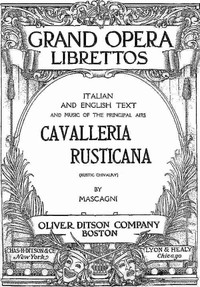
Rustic Chivalry (Cavalleria Rusticana): Melodrama in One Act
Subjects:
Download Formats:
Excerpt
The Project Gutenberg EBook of Rustic Chivalry (Cavalleria Rusticana), by
Pietro Mascagni
This eBook is for the use of anyone anywhere in the United States and most
other parts of the world at no cost and with almost no restrictions
whatsoever. You may copy it, give it away or re-use it under the terms of
the Project Gutenberg License included with this eBook or online at
www.gutenberg.org. If you are not located in the United States, you'll have
to check the laws of the country where...
Read the Full Text
— End of Rustic Chivalry (Cavalleria Rusticana): Melodrama in One Act —
Book Information
- Title
- Rustic Chivalry (Cavalleria Rusticana): Melodrama in One Act
- Language
- English
- Type
- Text
- Release Date
- January 17, 2015
- Word Count
- 12,092 words
- Library of Congress Classification
- ML
- Bookshelves
- IT Musica, Browsing: Music, Browsing: Performing Arts/Film
- Rights
- Public domain in the USA.
Related Books
Pelléas et Mélisande: Drame lyrique en cinq actes - Tiré du théâtre de Maurice Maeterlinck; Musique de Claude Debussy
by Maeterlinck, Maurice
French
180h 25m read
Original Plays, Second Series
by Gilbert, W. S. (William Schwenck)
English
2270h 28m read
![Cover of Original Plays [First Series]](https://www.gutenberg.org/cache/epub/59057/pg59057.cover.medium.jpg)
Original Plays [First Series]
by Gilbert, W. S. (William Schwenck)
English
1181h 22m read
Le Coq d'Or (The Golden Cock): An Opera in Three Acts
English
208h 3m read

La Tétralogie de l'Anneau du Nibelung
by Wagner, Richard
French
3323h 7m read

Ran: En dramatisk dikt
by Peterson-Berger, Wilhelm
Swedish
189h 54m read