*** START OF THE PROJECT GUTENBERG EBOOK 73839 ***
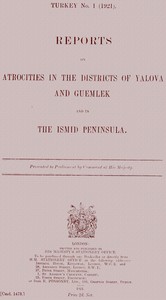
TURKEY No. 1 (1921).
REPORTS
ON
ATROCITIES IN THE DISTRICTS OF YALOVA AND GUEMLEK
AND IN
THE ISMID PENINSULA.
_Presented to Parliament by Command of His Majesty._
[Illustration: [Coat of Arms]]
LONDON:
PRINTED AND PUBLISHED BY
HIS MAJESTY’S STATIONERY OFFICE.
To be purchased through any Bookseller or directly from
H.M. STATIONERY OFFICE at the following addresses:
IMPERIAL HOUSE, KINGSWAY, LONDON, W.C. 2, and
28, ABINGDON STREET, LONDON, S.W. 1;
37, PETER STREET, MANCHESTER;
1, ST. ANDREW’S CRESCENT, CARDIFF;
23, FORTH STREET, EDINBURGH;
or from E. PONSONBY, LTD., 116, GRAFTON STREET, DUBLIN.
1921.
[Cmd. 1478.] _Price 2d. Net._
Reports on Atrocities in the Districts of Yalova and Guemlek and in the
Ismid Peninsula.
(Translation.)
_Report of the Inter-Allied Commission instructed to conduct Enquiries
regarding the Excesses committed against the Turkish Population in
the Regions of Yalova and Guemlek._
The members of the Commission of Enquiry left Constantinople on the 12th
May and arrived at Guemlek in the evening. They immediately communicated
with General Leonardopoulos, commanding the 10th Greek Division and
quartered at Guemlek.
This general officer furnished them with all material means required by
the mission.
2. The region to be visited by the commission includes the larger
portion of the kazas of Yalova and of Guemlek—a hilly peninsula
containing about forty villages, thirty-five of which are exclusively
Turkish. In the adjoining region of Bazarkeui, on the western and
northern shores of the lake of Nicea, there are ten Armenian villages,
some of which (with the exception of the village of Chengeller, which
was burned by the Kemalists in April last) were destroyed by the Turks
during the war and after the armistice.
At Guemlek there are at present 2,000 refugees from these Armenian
villages, as well as 1,500 Moslem refugees from adjoining villages which
have been destroyed, as also some 3,500 Greek refugees from the Greek
localities of Elmalik, Fulajik, Ortakeui and Nicea, which were burned or
destroyed by Kemalists during 1920.
Guemlek, the principal town in the district, had some 6,000 Greek and
1,000 Moslem inhabitants before these events took place.
3. During the last nine months the region has been occupied by weak
detachments of the Greek army, about eight companies in all. The front
line, Yalova-Bazarkeui, is held by five companies and one machine-gun
company. Guemlek is occupied by about two companies. A small detachment
of twenty-six men is at Armudli.
The headquarters of the 10th Greek Division is at Guemlek. The troops
belonging to this division provide cover for the Greek army further
towards the east in the direction of Yeni Shehr.
4. Turkish civilian administration is non-existent throughout this
region. It has not been replaced by any other organisation.
5. The commission carried out its task in the region east of Guemlek and
on the northern shore of the Gulf of Mudania from the 13th to the 20th
May. On the 20th May it proceeded to the region of Yalova and returned
to Constantinople on the 22nd May, having completed its mission.
During this period it carried out the following tasks:—
(_a._) During two days it heard, either at the mayor’s house or at the
Turkish headquarters at Guemlek, all Greek, Armenian and
Moslem inhabitants who had any statements to make with regard
to the events which recently took place in this region.
All these statements, even those concerning occurrences which
took place a long time ago, or in distant localities, were
received.
(_b._) It visited villages which had been burned within the line of
outposts, such as Chengeller (Armenian), and Bazarkeui
(Turkish), as also the Turkish villages of Chitelji and
Gedelek in the rear of this line, which had also been burned.
On the 15th May the commission, having watched from its ship
the burning of villages on the northern shore of the Gulf of
Mudania, proceeded on the 15th, 16th and 17th May to the
Turkish localities known as Narli, Karaja Ali, Kumlar,
Kapakli, and Fistikli, and to that of Armudli, inhabited by
Greeks and Moslems.
It established the fact of the recent passage of armed Greek
and Armenian bands, and noted that Kapakli, Narli and Karaja
Ali were still burning. In these villages, as also in the
neighbourhood of that of Kumlar, the commission found
twenty-eight bodies of old men and women who had been
recently shot or knocked on the head. An infant was also
found alive at Kapakli.
(_c._) The commission collected all the statements concerning recent
events, and more particularly that of the Greek officer
commanding a reconnoitring detachment which had operated
between Guemlek and Armudli on the 13th, 14th and 15th May,
as well as that of the Greek officer in command of the fixed
post of Armudli.
(_d._) The commission assured the embarkation for Constantinople of
the inhabitants of Kumlar and the Moslem refugees of Guemlek
(some 2,300).
(_e._) In the region of Yalova the commission visited Yalova,
Chinarjik, Inguereh and Koja Dereh. It received the
statements of Greek and Turkish inhabitants of Yalova and
those of the Greek inhabitants of Chinarjik.
The commission did not consider it advisable to visit the Turkish
villages of Ak Keui and Samanli, where there were still some 300
Moslems. As it was not sure of being able to help them immediately, the
commission feared that it might be placed in as difficult a position as
that in which it found itself a few days before at Kutchuk-Kumlar, when
the terror-stricken population spontaneously placed itself under its
protection.
The detailed narrative of the work done each day, as well as of the
statements collected, are attached to the present report.
6. In consequence of the statements received, of the observations made
and facts established on the spot, and of their impressions as a whole,
the members of the commission believe that they can set down the
following statement:—
(_a._) All the Moslem villages of the regions visited—with the
exception of Omer Bey, Yalova, Ak Keui and Samanli—are
abandoned, and were mostly looted and burned by Christian
bands less than two months ago.
(_b._) The population of these villages is at present scattered. Some
of the inhabitants assured their own safety by leaving the
district before the destruction of their village. Others were
either able to flee to the mountains when the bands attacked,
or were, according to statements made, carried off by the
assailants. Some have been massacred.
The fate of the majority of the population which took refuge in
the mountains is unknown. No figures can be given with any
accuracy.
(_c._) It has not been possible actually to verify any of the
atrocities properly so-called (men shut up and burned,
children thrown on the fire, women violated and
disembowelled), mentioned in the reports of the Turkish
authorities. It has, however, been definitely established
that women and defenceless old men were shot or knocked on
the head in the villages of Kapakli and Karaja Ali, sometimes
even in their own houses.
(_d._) The Christian population does not appear to have been disarmed,
and it also appears that the Moslem population was able to
keep hidden weapons.
(_e._) In the localities occupied by Greek troops, the Moslem
population complains of molestation and threats. These facts
should not be regarded as anything else but the application
(occasionally somewhat harsh) of police measures connected
with the state of occupation.
(_f._) The Greek authorities who are providing for the maintenance of
Armenian and Greek refugees at Guemlek, give no food and no
medical assistance to Moslem refugees (about 1,500 after the
evacuation of Bazarkeui).
(_g._) Acts of violence and barbarism, as well as massacres on a large
scale, were undoubtedly committed in 1920 by Kemalist bands,
or by soldiers of the regular army, against the Christian
population of the region not occupied by the Greek army, east
of Yalova, north of the lake of Nicea, and in the region of
Nicea.
Statements dealing more particularly with the atrocities
committed in the Greek villages of Elmalik, Fulajik and
Nicea, are attached to the present report, as well as
statements relating to Kemalist excesses in certain
localities of the more distant region of Yeni Shehr.
It has been impossible to check the truth of all these
statements on the spot. They may be exaggerated, in the same
way as the statements made by the Turks, but appear to
contain an element of truth.
(_h._) In the region visited, the Armenian village of Chengeller,
which is situated in advance of the Greek line, was attacked
and burned in April last by a Kemalist band. The population
fled to Bazarkeui, which was then occupied by a Greek
detachment, and from there was sent to Guemlek. Some persons
were killed, but there were no massacres. As a reprisal, the
village of Bazarkeui was burned after it had been evacuated
by the Moslem population, which was ordered by the Greeks to
proceed to Guemlek.
(_i._) Both soldiers and Christian inhabitants have stated that
bands of Turkish brigands were scouring the country, and
that Turkish peasants were committing outrages upon
isolated Christians. A detachment of Greek soldiers, when
reconnoitring at Narli on the 13th May, was said to have
been fired on by a band of Turkish brigands, one soldier
being killed. In the neighbourhood of Armudli, seven Greeks
are also said to have been killed a few days ago. It was
impossible to verify the truth of these statements. On the
12th May, on the other hand, two Greek youths of Guemlek,
who were on their way to Kumlar, were found dead on the
beach. This murder, which was not reported by the Greek
authorities, was brought to the knowledge of the commission
indirectly.
(_j._) Burning and looting of Turkish villages in this region occurred
less than two months ago. This destruction seems systematic,
being carried out by Greek and Armenian bands. It appears to
be proved that detachments of the Greek regular army take
part therein.
(_k._) The Greek Command has not answered any enquiries made by the
commission with regard to its personal impression of the
present state of affairs in the country. That command
apparently affects to attach but little importance to the
destruction being carried out, which it views as reprisals
for isolated attacks or for violence previously committed by
the Turks.
It was only after the events of the 15th May, and late in the evening,
that measures were taken to protect the Moslem population of Kumlar.
One reconnoitring detachment was, it is true, sent to the region between
Guemlek and Armudli between the 12th and 15th May, but this detachment,
whose task was only “to disarm and to clear,” did not prevent the
looting or burnings which took place at the very time of its presence in
the localities of Karaja Ali, Narli, and Kutchuk Kumlar.
7. The commission endeavoured to arrive at the causes which, in less
than two months, brought about the destruction or evacuation of nearly
all the Moslem villages of that part of the kazas of Yalova and Guemlek
which is occupied by the Greeks.
If events which took place at the time of the movements of the Greek
army towards the end of March can explain why the villages near to the
Greek line (Dijan Keui—Reshadie—Soyuljak—Bazar-Keui (Turkish)—Chengeller
(Armenian)) were destroyed or abandoned by reason of attack or as
reprisals, the case is not parallel on the northern shore of the Gulf of
Mudania. These latter villages were burned on the 15th May, when
military operations were but few, and without the Greek Commander having
reported the particular acts of provocation, although the commission had
been at Guemlek since the 12th May.
A sufficient cause is doubtless presented by the age-long hatred
existing between the various races, increased, in so far as the Greek
soldiers and the Greek population of Guemlek are concerned, by the
presence of 2,000 Armenian refugees who suffered greatly at the hands of
the Turks during the war, and by that of 3,600 Greek refugees, many of
whom witnessed the atrocities committed by the Kemalists at Fulajik,
Elmalik and Nicea. But although this hatred can explain the severity of
the treatment suffered by Moslem villages, it does not appear to have
been the determining factor of their destruction on so general and rapid
a scale.
A distinct and regular method appears to have been followed in the
destruction of villages, group by group, for the last two months, which
destruction has even reached the neighbourhood of the Greek
headquarters.
The members of the commission consider that, in the part of the kazas of
Yalova and Guemlek occupied by the Greek army, there is a systematic
plan of destruction of Turkish villages and extinction of the Moslem
population. This plan is being carried out by Greek and Armenian bands,
which appear to operate under Greek instructions and sometimes even with
the assistance of detachments of regular troops.
This destruction of villages and the disappearance of the Moslem
population consequent thereon doubtless has as its object to guard the
flanks and rear of the Greek army against any possible attack by the
population in the event of an early offensive, and perhaps even to
create in this region a political situation favourable to the Greek
Government.
In any event, the commission is of opinion that the atrocities reported
against Christians on the one hand, and Moslems on the other, are
unworthy of a civilised Government, and that in the region occupied by
the Greek army, the Greek authorities, who are alone in authority there,
are responsible, and, in the region under the Kemalist régime, the
Turkish authorities.
8. In view of the conclusions arrived at in the course of its enquiry,
the commission considers that it is not within its terms of reference to
suggest the measures which would remedy the state of affairs in the
region of Guemlek. The dispersion of nearly the whole of the Moslem
population of the kazas of Yalova and Guemlek is already a _fait
accompli_.
In order, however, to avoid the recurrence of similar happenings in the
future in other regions occupied by the Greek army, the commission
proposes that an inter-Allied gendarmerie be introduced into these
regions, or, at any rate, that Allied officers should be attached to the
various Greek commands, for the purposes of surveillance.
Finally, the commission expresses the hope that the 600 Moslems who are
still at Yalova, Ak-Keui and Samanli, should be authorised to take
refuge in Constantinople or its environs and that steps should be taken
to this effect.
_Great Britain._ _Italy._ _France._
G. M. FRANKS, E. ROLLETTO, G. VIEG,
_Major-General_. _Colonel_. _Lieut.-Colonel_.
_May 23, 1921._
DIARY OF THE INTER-ALLIED COMMISSION SENT TO ENQUIRE INTO INCIDENTS IN
THE REGIONS OF GUEMLEK AND YALOVA.
The commission left Constantinople at noon on the 12th May, and arrived
at Guemlek at 4·30. The Greek General Leonardopoulos, commanding the
10th Division, who was found to be at Guemlek, at once came on board and
appeared rather vexed at our arrival, but was quite courteous and even
offered to place two motor cars at the disposal of the commission, in
order that it might visit Bazar Keui on the morrow. The commission
landed at 6 o’clock and found the mayor on the beach, who conducted the
commission to the Greek part of the town. Hundreds of refugees from
Greek and Armenian villages destroyed by the Kemalists were met, more
particularly those from Kiz Derbent, Elmalik, Vizir Han, Hudieh,
Fulajik, Levkeh and Kuplu. The Greek refugees in Guemlek had very bad
quarters, but were fed by the Greek army.
At 9 A.M. on the 13th May, the commission drove out to the Turkish
villages behind the Greek lines, Bazar Keui being reached without any
incident. A crowd of Greek refugees, mostly composed of women, gave a
friendly demonstration when the commission left Guemlek. Bazar Keui was
found to be completely destroyed, with the exception of a few houses
occupied by Greek troops.
The commission was received by the Greek commandant (commander of the
Bazar Keui detachment), who stated that he had not been at Bazar Keui at
the beginning of April, when the village was occupied by the 5th
Infantry Regiment. The present commandant only took over at Bazar Keui
on the 15th April. When the Greek army reached Bilejik a regiment was
left behind to ensure communications. When the retreat commenced,
however, the Turkish population became very excited, and looted and
burnt the Greek and Armenian villages of Kiz Derbent and Chengeller.
Many of the inhabitants of these destroyed villages came to Bazar Keui.
At the same time some Turkish peasants attacked the Greek lines of
communications, and in consequence of this the commandant received the
order to evacuate the Turkish population of various villages within his
sector. This work began on the 16th April, but when the Turkish houses
were left empty, the Greek and Armenian refugees set fire to them in
order to avenge themselves.
After this interview, the commission visited the destroyed village of
Chengeller. It had been razed to the ground, but here and there people
were still living in the ruins. They stated that the village had been
sacked by the Turks, and that many of the inhabitants had been killed in
their houses.
The commission returned to Bazar Keui. This town had been systematically
destroyed by fire. There were no inhabitants and no proofs of explosion,
and no bodies were found.
The commission then visited the village of Cheltikji, which was burning
when it arrived. Four Greek soldiers were surprised whilst taking away
the flooring of houses in the village, and it is probable that they had
fired those houses which were still standing. The inhabitants left their
village when they saw what was happening at Bazar Keui; it was fired
next day. The commission was unable to find any trace of bodies.
The commission visited Gedelek, a village which had been entirely
destroyed, but was unable to find any trace of the twenty-seven people
reported to have been massacred. When the confines of Gedelek were
reached, a crowd of refugees and of soldiers (who had begun by making a
friendly demonstration) suddenly noticed Mulazim Sureyah Effendi, guide
to the commission, and attacked him. He was dragged from the motor, and
was only brought back on board the “Bryony” after great difficulty.
The commission returned on board at 6 o’clock, and the Head of the Greek
Staff came on board the “Bryony” to offer his apologies for the
incident, which had taken place in the afternoon.
At 9 o’clock on the 14th May, the commission sat at the mayor’s house in
order to hear any complaints which Greeks and Armenians might have to
make. The mayor very kindly asked the commission to lunch, but his
invitation was declined.
The first person to lay a complaint gave to the commission a general
summary of the atrocities perpetrated against the Armenians since the
outbreak of war. In this region eighteen villages had been destroyed and
the population reduced from 70,000 to 2,500. When asked how the question
of this mixture of races could be settled, he replied that Christianity
could not exist under a Turkish Government, even if an inter-Allied
gendarmerie were created.
The last Armenian massacre commenced a year ago, _i.e._, at the
beginning of the Kemalist movement, when Anatolia was evacuated by the
Allied troops.
Complaints from Chengeller, Yeni-Keui, Keramet and Murdigheuz were
heard, all referring to the massacres and burnings of August 1915, and
the middle of 1920. More particularly, some women of Fulajik (a Greek
village) were heard. They told us of terrible atrocities, and stated
that the Turkish officer who was guide to the commission was one of the
officers responsible for these massacres.
The commission continued its enquiry at 2 o’clock in the afternoon, in
the house of the mayor. Men and women were heard, some from Vizir-Han,
Kiz Derbent, Elmalik, Soyuljak, Cherkesskeui, Deli-Bazar, and Orta-Keui.
All had more or less the same tale to tell—Kemalists would arrive in
their village from time to time, first asking for money and food, then
taking cattle and horses, and finally, when the village had nothing more
to give, a massacre would take place and the houses would be fired.
On leaving the mayor’s house, the commission called on the Greek general
and took tea with him. It returned to the “Bryony” at 6·30, the “Bryony”
remaining at anchor at Guemlek for the night.
_May 15._—It was the intention of the commission to go to Kumlar to make
an enquiry as to what had occurred.
At 8 o’clock smoke was seen to rise above the village of Narli. The
commission went on board the motor boat, but, unfortunately, it had a
breakdown, and the members had to return to their ship. At 10 o’clock, a
cloud of smoke was observed above Karaja Ali. As the motor boat could
not take us there, orders were given to remain on board, and the
“Bryony” made for the flaming villages. Narli was reached at 2 o’clock.
That village was still a mass of glowing ruins, and it was decided to
land at Karaja Ali, which was burning fiercely, and on the beach corpses
were seen. Twelve old people, one of whom was an aged woman, were found
on the shore. Two men were still alive and were taken on board the
“Bryony” by her doctor. It was impossible to get into the village owing
to the intense heat. The mosque and the school, which were on a slight
elevation, were the only two buildings which had not been fired.
At 4·30 the commission landed at Kutchuk Kumlar, a village about 2½
kilom. from the point of debarkation. The houses on the beach were
entirely destroyed, and one was in flames. Horses had been sent by the
Greek general, who the day before had been informed of our intention to
visit the village.
The Commission made for Kutchuk Kumlar. Several hundreds of
terror-stricken inhabitants, mostly women, were waiting for the
commission to land.
It was difficult to obtain exact information, so great was the panic
among the population, but it was gathered that a detachment of Greek
soldiers and brigands had gone through the village a few days before and
had returned that very morning, passing the Kumlar landing-place. The
commission returned on board, followed by the entire population, which
placed itself under the protection of the Allies and refused to leave
the beach, imploring us to take them to quiet and safety. That end of
the jetty which was nearest to the “Bryony” was most densely covered
with people. A letter was then written to General Leonardopoulos, asking
him to take immediate steps for the protection of the village of Kumlar.
It was only possible to hand him this letter at 6 A.M. next day. The
“Bryony” remained at anchor beyond the landing-place, throwing her
searchlights over the beach and the adjoining hills all night long, in
order to reassure the refugees.
_May 16._—At 9 A.M. the commission landed, in order to collect all
possible information from the refugees on the beach. One wounded and two
dead men were brought along by the natives.
The refugees stated that the day before a group of them, about twenty
strong, tried to get to Guemlek in order to procure bread. They left the
village, and, on arriving at the landing-place, met a detachment of
Greek soldiers and brigands, commanded by a Greek officer. The women
were sent back to the village, and the men were forced to follow the
bandits. On the way some of the men were given the order to return, and
others were killed, the muktar being among the latter.
At 10 o’clock the commission reached the village, which was completely
destroyed. A corporal and ten men sent by General Leonardopoulos (before
the arrival of the letter sent that morning, which he could not have
received) were on guard. The corporal was questioned by the commission.
On returning to the landing-place, a Greek staff officer, sent by the
general commanding the Greek division, was waiting for the commission.
At the request of the latter he assured the refugees that they would be
properly protected, a promise which had no effect on the population.
The commission then made for Kapakli. The village was entirely
destroyed. Two or three terrified inhabitants were found among the
ruins. They told the commission that the natives were hidden in the
mountains, fearing that they would be killed on appearing.
The commission went through the village and found eight corpses, four of
which were those of women. Three of the dead men had been killed a
fortnight before, in a preceding engagement. The five others had been
killed during the morning of the preceding day. The commission found an
infant which had been abandoned and which was taken on board.
The three survivors begged the Commission to take them to a safe spot.
They were told to inform the refugees who were hiding in the mountains,
and that if all assembled on the beach they would be taken to Kutchuk
Kumlar next day.
The commission made for Narli, which village was found to be entirely
destroyed. There were no dead to be seen and there was only one
remaining inhabitant—an old Turk—who said that he was quite happy, and
who made the commission feel that its visit was an intrusion!
The “Bryony” remained anchored outside Kutchuk Kumlar all night, we
having returned to that spot.
_May 17._—At 8·30 A.M. two Greek officers, who were in command of the
detachment, sent to Guemlek on the 11th to search and disarm villagers
between Guemlek and Armudli, were sent on board by one of the Greek
staff officers.
The commission interrogated them. The date when they passed through the
burned villages corresponded exactly with the time when those villages
were found to be in flames. One officer acknowledged that he had had
four Turks shot, but apart from this denied any knowledge of murder or
looting.
At 9·30 we left Kutchuk Kumlar for Fistikli. We towed two caiques, to be
left at Kapakli, to convey the refugees who were able to leave the
mountains in view of the promise made by the commission.
About 200 refugees were found to have assembled on the beach. The
“Bryony” left the caiques, with the necessary escort, and proceeded to
Fistikli. That village appeared to be perfectly quiet. Turkish and Greek
merchants were selling their olives on the landing-place.
An officer was sent ashore to make enquiries. The Turks, terrified at
what was passing in other villages, were selling their goods before
leaving for Armudli. (The price offered by the Greeks was certainly
below the usual standard.)
Armudli was reached at mid-day. The village appeared quiet. An officer
was sent ashore to ask the officer commanding the Greek detachment to
come on board and report if it was necessary for the commission to visit
the village.
It was decided that the commission should interrogate the chief Greek
and Turkish inhabitants at the landing-place at 2 o’clock.
The Greek officer stated that all was quiet and that he had orders to
guard the village only.
He spoke of several cases of brigandage in the adjoining farms.
The representatives of the Greek and Turkish committees appeared to be
living in absolute agreement, but, on being questioned separately,
nevertheless complained of each other.
The commission went back on board the “Bryony” and made for Kapakli, in
order to tow the two caiques, which were brought back full of refugees
to Kutchuk-Kumlar.
On arriving at Kumlar, the representative of the Red Cross stated that
he had spoken with the brigand chief, who had arrived at the
landing-place during the absence of the “Bryony” in order to terrorise
the refugees and boast of his doings. A message was sent to General
Leonardopoulos, advising him of the arrival of the brigand chief.
The “Bryony” remained anchored outside Kutchuk Kumlar during the night.
_May 18._—At 8 o’clock the “Bryony” returned to Guemlek. At 9 o’clock
the commission went ashore and visited the Turkish quarter and a mosque
full of Moslem refugees.
The commission conducted its enquiry at the seat of the Turkish
Administration. All the people were filled with terror, received no food
beyond what they could procure themselves and asked to be taken away and
sent to some quiet place.
On returning on board, the commission received a wireless message at 1
P.M., stating that the “Ineboli” had just left Constantinople to take on
board refugees from Kutchuk Kumlar.
The commission returned to Guemlek, visited the mayor, and informed him
of its intention to take away the Turkish refugees.
At 6·30 we returned to Kutchuk Kumlar. At 9 o’clock the boat arrived and
took the refugees on board, the baby which we had on board being handed
over to the care of a Turkish woman. Embarkation was completed at 2
A.M., and the “Ineboli” left for Constantinople.
_May 19._—The “Bryony” remained anchored beyond Kutchuk Kumlar. Those
refugees for whom there had been no room on board the “Ineboli,” and who
had been left behind, gained confidence, and several returned to the
village to obtain provisions.
At 1 o’clock the brigand chief, Haji Yorghi (who had been met by the
representative of the Red Cross), was brought on board by a staff
officer on the order of the general commanding the Greek troops. He said
that he had been drunk when he boasted the day before, and that in
reality he was guide to the Greek detachment sent to disarm the
villagers.
During the evening the “Ineboli” and three other boats returned to
Kumlar. The remaining refugees were sent off.
_May 20._—At 6·30 the “Bryony” and the boats sent by the Red Crescent
left Kumlar for Guemlek.
The refugees were notified that they were to assemble on the beach in
order to embark. At mid-day the commission went ashore to see what
progress was being made. The Greek officers required that able-bodied
men should be left behind, guaranteeing that they would be properly
treated. This proposal was accepted by the commission.
The commission again went ashore at 3·30 and saw the last refugees
embark. The boats then weighed anchor.
At 4 o’clock the “Bryony” left Guemlek for Tuzla, where she was to wait
instructions by wireless concerning the voyage to Yalova.
_May 21._—The “Bryony” anchored at Yalova at 8 o’clock. An officer was
sent ashore to inform the commander of the Greek detachment that the
Inter-Allied Commission had arrived.
At 9 o’clock the Greek officer commanding the detachment came aboard and
was questioned by the commission. He stated that when he arrived at
Yalova, about a month before, he had found that all the neighbouring
villages had been burned. As far as he knew, there were brigands in the
neighbourhood, but his orders were only to hold Yalova, and his patrols
always kept within a radius of 2½ kilom. of it.
The commission went ashore at 10 o’clock and was met by a crowd of Greek
refugees, mostly women.
The commission sat at the Greek headquarters, and heard complaints made
by Greek refugees, more particularly those from Fulajik.
It asked the Greek officer to withdraw, and the kaïmakam was heard. He
stated that before the war the population of the Yalova district was
one-half Christian and one-half Turkish. Yalova itself was a Turkish
town.
At present there were only 300 Turks in Yalova and a few hundreds in the
distant villages of Samanli and Ak-Keui.
The kaïmakam asked the commission to evacuate the Turkish population to
a place of safety. On leaving the Greek headquarters, the commission
found the Greek refugees raving with anger. The reason for this was that
Hafiz Ahmet (one of the guides of the commission and also one of the
chief men of a neighbouring village, who had gone ashore that morning
with the commission) had been accused by some Greek women of having been
implicated in various massacres which had taken place in the
neighbourhood. It was with the very greatest difficulty, and only by
turning the attention of the crowd on another point, that he was enabled
to enter a boat and return on board. He was pursued by a howling crowd,
which even entered the water while the boat was pushing off with all
speed.
At 2·30 the “Bryony” anchored at Chinejik and the commission at once
went ashore. The Turkish quarter was quite empty, but not destroyed. The
mosque had been looted, but not burned, and no traces were found of the
horrible massacres reported as having taken place at this spot.
The Greek priest showed the commission freshly-turned Turkish graves.
The “Bryony” then left for Enguri. When the commission went ashore, it
was received by the officer commanding the Greek detachment. As far as
he knew, only brigandage had taken place in the neighbourhood.
The commission then made for the twin villages of Kojadereh, which were
entirely destroyed. There were no inhabitants and no bodies were found;
no information was obtained.
The commission returned to the “Bryony,” which remained at anchor off
shore all night.
_May 22._—Returned at 8·30 and arrived at Top-Haneh, Constantinople.
_Report of the Ismid Commission of Enquiry._
To His Excellency,
The British High Commissioner, Constantinople.
Your Excellency,
_Constantinople, June 1, 1921._
We have the honour to submit the following report in accordance with
your instructions and with the terms of reference for the above-named
Commission of Enquiry:—
1. Credible evidence has been produced as to crimes committed during the
last twelve months by both Greeks and Turks. There is no doubt that
there have been a large number of atrocities in the Ismid peninsula, and
it appears that those on the part of the Turks have been more
considerable and ferocious than those on the part of the Greeks.
We attach a résumé of our investigations upon which our opinions are
based; and will prepare a schedule giving full details.
2. The present state of affairs is largely due to racial feeling and
age-long vendetta, now fanned to an intense pitch by exaggerated stories
which promote fear and excitement.
3. Greek regular troops have been implicated in recent excesses, and
both officers and soldiers; more especially lately when the troops have
been on the march.
In the zone which is effectively occupied by the Greek army there is
order, but it appears to be maintained at the cost of oppressing the
Turkish population. This evil is accentuated by the Turkish Civil
Administration, which, particularly in the neighbourhood of Ismid, is
venal and corrupt, and allows itself to be used by the Greeks, to carry
out their policy.
The Greek military authority admits that nothing is done to maintain
order in districts not actually occupied by Greek troops.
4 (_a_). The commission recommend that full advantage should be taken of
the existing Turkish organisation for the maintenance of order and that
this should be expanded and made more powerful. European officers to be
made available to give assistance to the Central Government, and this
especially in the way of control of officials charged with the
administration of justice, such European officers also being made
responsible for reporting to their Government any infringement of
international law by either belligerent.
Also that pressure be brought to bear upon the Greek military
authorities to maintain civil order and justice by means of this
organisation in such portions of Asia Minor as they occupy or can
control.
(_b_ 1.) Where either side is in the ascendancy the survivors of the
other in many cases become fugitive; the men often become brigands. The
estimate given by the Greek Colonel Commandant of the 11th Division at
Ismid was of some 12,000 to 15,000 Christian refugees in Ismid itself,
mostly women and children.
The Greek army have instituted conscription of those Ottoman subjects
who are Christian refugees, who have to leave their families in great
distress.
Moslems who are now in the power of the Greeks are in a state of great
fear and wish to escape or to be given protection. Such Greeks who still
remain in the north of the Ismid peninsula fear an advance by
Nationalist troops and may become fugitives at any time.
(_b_ 2.) The commission recommend that the Christian refugees should be
removed now to a region which is, and will remain, under Greek
Government, or which will be under the protection of the Allies, and
that husbands and fathers who have been taken by conscription from those
dependent on them should be restored to their families. Also that the
Armenians should be removed to an area under the protection of the
Allies.
The members of the commission are under the impression that those
Moslems who have become brigands will return to their homes and to
peaceful pursuits when assured of settled conditions under Moslem
Administration, and that Greek brigands, if offered an amnesty, will
take the opportunity of trusting the Allies in a scheme for colonisation
in a Greek zone. These men appear usually to have become brigands only
when driven from their homes or after desertion from Turkish military
service.
We have, &c.
H. M. FARMAR, _Lieutenant-Colonel_.
TEMPORARY COLONEL VITELLI.
LIEUTENANT-COLONEL WILKONSKY.
O. H. VAN MILLINGEN, _Major_.
EXCESSES OF WHICH THE GREEKS ARE ACCUSED.
The principal excesses of which the Greeks are accused took place after
July 1920, when the Greek military forces occupied the territory.
These excesses are attributed either to the regular troops or to bands.
(A.) When they arrived in the territory (in July and August), the
regular troops attacked various Moslem villages, principally those in
the region east of Beicos. Inhabitants were killed, cattle carried off,
and houses and even whole villages burnt. To this should be added
individual offences on the part of soldiers belonging to Greek
detachments, such as extortion of money, theft, violence and murder. In
the occupied regions the Greek military authorities first made numerous
arrests and caused people to be summarily executed (more particularly at
Beicos-Chibukli).
A good many searches made for hidden weapons gave rise to individual
offences, violence and theft. These individual offences, caused by
insufficient discipline, were not usually stopped.
The attacks against villages became more frequent in March and April,
when the Greek troops were abandoning the eastern part of the peninsula,
and began in the region of Ada-Bazar. Turkish villages between Kudra and
Ada-Bazar were chiefly affected, a large number of the inhabitants being
maltreated and killed, women violated, cattle carried off and houses
fired.
(B.) Greek bands, formed of men who had generally suffered under Turkish
oppression, and who were just as much actuated by a thirst for vengeance
as a desire for loot, carried out depredations during the Greek
occupation with an amount of freedom which leads one to conclude that
the Greek military authorities did not take the necessary steps to
prevent these misdeeds.
In the region of Shileh, it may be even taken as very probable, if not
certain, that the Greek military authorities regarded their formation
and activities with favour.
In the region now occupied by them the Greek forces armed, and used as
auxiliaries, refugees, from Greek villages which had been looted or
burnt by the Turks. By their attacks on Turkish villages situated
outside the effective zone of occupation of the Greek troops, and by the
atrocities committed by them, these bands have revived former hatred and
have brought about the ferocious reprisals of which Greek villages—and
specially those of the region south of Ismid—have been the victims.
The Greeks have also employed as auxiliaries a large number of
Circassians (Moslems from the Caucasus), more than 30,000 of whom had
taken refuge in the region east of Ismid. These have become the enemies
of the Nationalists.
These Circassians furnish excellent semi-regular combatants, but also
form bands whose poorly-controlled activity admits of excesses and thus
helps to perpetuate the régime of continual reprisals which is gradually
ravaging and depopulating the country.
To sum up, the Greeks ensure order in the regions effectively occupied
by their troops, but at the price of oppression suffered by the Moslem
population.
In the regions not effectively occupied by the Greeks the latter favour
the activities of bands of their own countrymen, and are thus partly
responsible for the system of guerilla warfare and atrocities there
existing.
EXCESSES COMMITTED BY THE TURKS.
Attacks on Christians, which had become less numerous since the
armistice, increased in numbers and ferocity—more particularly with
regard to the Greeks—in March 1920, and even more so in June and July
1920 (when preparations were being made for Greek offensives).
Turkish bands of a more or less Kemalist persuasion are scouring the
entire sanjak of Ismid as far as the environs of Scutari (Pashakeui, 20
kilom. east of Scutari).
As often as not, these bands are assisted by the Turkish inhabitants of
neighbouring villages. A large number of villages have thus been looted
or burnt and their decimated population has been obliged to flee.
There should more particularly be mentioned the names of Yeni-Keui,
south of Shileh; about a dozen villages in the region north and
north-east of Ada-Bazar, and some twelve villages in the region south of
Ada-Bazar, amongst them the large village of Orta-Keui, near Gueiveh
(16,000 inhabitants), and several villages south and south-east of
Ismid.
Since July 1920 the Greek military occupation had restricted the
operations of Turkish bands to the eastern and south-eastern part of the
peninsula, but the region of Karamursal (south of the Gulf of Ismid)
still constitutes an impervious Nationalist centre, from which various
bands attack Greek villages in the neighbourhood, aided by the
population of Turkish villages.
Excesses committed by enemy bands are often given as a motive or as a
pretext for these expeditions.
The latter became very numerous in the spring of 1921, and extended as
far as the southern environs of Ismid, bringing about the destruction of
all the Christian villages in this region with the exception of
Bagchejik.
The Greek authorities have submitted a list of thirty-two villages
looted or burnt, with more than 12,000 persons massacred, 2,500 missing,
and the remainder of the population (more than 15,000) living as
refugees at Ismid.
In view of the numerous witnesses examined by it, the commission is of
the opinion that these facts should be accepted as fundamentally true,
notwithstanding a certain amount of exaggeration in the figures.
------------------------------------------------------------------------
TRANSCRIBER’S NOTES
● Typos fixed; non-standard spelling and dialect retained.
● Enclosed italics font in _underscores_.
*** END OF THE PROJECT GUTENBERG EBOOK 73839 ***
Reports on atrocities in the districts of Yalova and Guemlek and in the Ismid Peninsula
Download Formats:
Excerpt
TURKEY No. 1 (1921).
REPORTS
ON
ATROCITIES IN THE DISTRICTS OF YALOVA AND GUEMLEK
AND IN
THE ISMID PENINSULA.
_Presented to Parliament by Command of His Majesty._
LONDON:
PRINTED AND PUBLISHED BY
HIS MAJESTY’S STATIONERY OFFICE.
To be purchased through any Bookseller or directly from
H.M....
Read the Full Text
— End of Reports on atrocities in the districts of Yalova and Guemlek and in the Ismid Peninsula —
Book Information
- Title
- Reports on atrocities in the districts of Yalova and Guemlek and in the Ismid Peninsula
- Author(s)
- Inter-Allied Commission of Enquiry into Atrocities in Yalova and Guemlek
- Language
- English
- Type
- Text
- Release Date
- June 16, 2024
- Word Count
- 7,050 words
- Library of Congress Classification
- DF; DR
- Bookshelves
- Browsing: History - General, Browsing: History - Warfare
- Rights
- Public domain in the USA.