The Project Gutenberg EBook of Reply of the Philadelphia Brigade
Association to the Foolish and Absurd Narrative of Lieutenant Frank A. Haskell, by Various
This eBook is for the use of anyone anywhere at no cost and with
almost no restrictions whatsoever. You may copy it, give it away or
re-use it under the terms of the Project Gutenberg License included
with this eBook or online at www.gutenberg.org
Title: Reply of the Philadelphia Brigade Association to the Foolish and Absurd Narrative of Lieutenant Frank A. Haskell
Author: Various
Release Date: August 30, 2010 [EBook #33585]
Language: English
Character set encoding: ASCII
*** START OF THIS PROJECT GUTENBERG EBOOK REPLY OF THE PHILADELPHIA BRIGADE ***
Produced by The Online Distributed Proofreading Team at
http://www.pgdp.net (This file was produced from images
generously made available by The Internet Archive/American
Libraries.)
The Battle of Gettysburg
How General Meade Turned the
Army of the Potomac over
to Lieutenant Haskell
See Page 10
PUBLISHED BY
THE PHILADELPHIA BRIGADE
ASSOCIATION
BOWERS PRINTING COMPANY
PHILADELPHIA, PA.
REPLY OF THE PHILADELPHIA BRIGADE ASSOCIATION
TO THE FOOLISH and ABSURD NARRATIVE
OF Lieutenant FRANK A. HASKELL
WHICH APPEARS TO BE ENDORSED BY
THE MILITARY ORDER OF THE LOYAL LEGION
COMMANDRY OF MASSACHUSETTS
AND THE WISCONSIN HISTORY COMMISSION
COMPLIMENTS OF THE
PHILADELPHIA BRIGADE ASSOCIATION
MARCH, 1910
HEADQUARTERS,
PHILADELPHIA BRIGADE ASSOCIATION,
S. W. COR. FIFTH AND CHESTNUT STREETS,
PHILADELPHIA, PA.
At the stated meeting of the Survivors of the Philadelphia Brigade, Second
Brigade, Second Division, Second Corps, Army of the Potomac, held at the
above place, Tuesday evening, September 7, 1909, letters were read from
Gen. Alexander S. Webb, who commanded the Philadelphia Brigade at the
Battle of Gettysburg, July 1, 2 and 3, 1863, requesting the consideration
of the Brigade Association to the most astounding misstatements made by
First Lieut. Frank Aretas Haskell, 6th Wisconsin Infantry, in a paper said
to have been written by him under date of July 16, 1863, two weeks after
the Battle of Gettysburg had been fought and addressed to his brother, who
printed it for private circulation about fifteen years afterward.
The letters of Gen. Webb were accompanied by a volume of 94 pages,
containing the most absurd statements as to the action of the Philadelphia
Brigade at the Battle of Gettysburg, which, upon being read, led to the
unanimous adoption of the following preamble and resolution:
"WHEREAS, in the 'Narrative of the Battle of Gettysburg,' by Lieut.
Frank A. Haskell, First Lieut. 6th Wisconsin Infantry, and an aide
upon the staff of Gen. John Gibbon, said to have been written within
a few days after the battle, and reprinted in 1898 as a part of the
history of the Class of 1854, Dartmouth College, and republished in
1908 under the auspices of the Massachusetts Commandery of the
Military Order of the Loyal Legion of the United States, the
Philadelphia Brigade has been recklessly, and shamelessly, and
grossly misrepresented; therefore, with the view of correcting these
wilfull misstatements, it is
"RESOLVED, That a committee consisting of the officers of the
Philadelphia Brigade Association, together with two comrades from
each of the four regiments of the Brigade, be appointed to carefully
consider the matter, and, if deemed advisable by the committee, to
publicly enter its protest against the malicious statements
'reprinted in 1898 as a part of the history of the Class of 1854 of
Dartmouth College,' and again republished by the Loyal Legion of
Massachusetts in 1908, with a degree of recklessness and disregard
for truth unparalleled in any publication relating to the Civil War;
statements so false and malevolent as to be wholly unworthy of a
class of Dartmouth College, or of a Commandery of the Loyal Legion of
the United States; of the name of Capt. Daniel Hall, of General
Howard's staff--who prepared the story for publication--or of 'Chas.
Hunt, Captain U. S. V., Committee on Publication.'"
The committee named under this resolution consists of these Comrades: Wm.
G. Mason, Commander; John Quinton, Vice-Commander; Chas. W. Devitt,
Quartermaster; John W. Frazier, Adjutant; John E. Reilly, Wm. S. Stockton,
Joseph MacCarroll and James Thompson, Trustees, and Edward Thompson and
James Duffy, 69th; John W. Dampman and Edward P. McMahon, 71st; John Reed
and Thos. J. Longacre, 72d; Wm. H. Neiler and Thos. Thompson, 106th
Regiment, Pennsylvania Volunteers.
An examination by the Philadelphia Brigade Association of the records
relating to the "Narrative" written by Lieut. Haskell, discloses these
facts:
First--That Lieut. Haskell entered the service in July, 1861, as First
Lieutenant of the 6th Wisconsin Infantry, and in June, 1862, became an
Aide-de-Camp upon the Staff of Brigadier General John Gibbon, and was
serving as such at the time he wrote his "Narrative" of the Battle of
Gettysburg. On February 9, 1864, Haskell was commissioned Colonel of the
36th Wisconsin Regiment, which at his request was assigned to the First
Brigade, Second Division, Second Corps, Army of the Potomac. The Division
was commanded by Gen. Gibbon, Gen. Hancock commanding the Corps. In the
advance of Gibbon's Division at the Battle of Cold Harbor, against a
strongly intrenched position, Col. Henry McKeen, who commanded the First
Brigade, was killed. Colonel Haskell succeeded to the command, and he,
too, fell mortally wounded under the heavy artillery and musketry fire,
against which his Brigade advanced. Haskell's record as a soldier of the
Civil War is, therefore, an enviable one; but as a writer of events of the
war he was absurd, reckless and unreliable.
Second--The manuscript alleged to have been prepared by Lieut. Haskell, as
stated by him, "At the Headquarters, second Corps D'Armee, Army of the
Potomac, near Harper's Ferry, July 16, 1863," was sent to his brother, who
printed it about fifteen years later in a pamphlet of 72 pages for private
circulation.
Third--The book was reprinted in 1898 as part of the History of the Class
of 1854, Dartmouth College, in honor of Colonel Haskell's memory, but with
certain omissions that severely reflected upon the Eleventh Corps, Gen.
Sickles and President Lincoln, which are explained in a foot-note by Capt.
Daniel Hall, a classmate of Haskell's, who was an Aide upon the Staff of
Gen. O. O. Howard, and who prepared the Haskell story for republication.
Fourth--The pamphlet published in 1878, by Haskell's family for private
circulation, contained 72 pages; the costly volume published in 1908,
under the auspices of the Commandery of Massachusetts, Loyal Legion of
the United States, prepared by Captain Daniel Hall, an Aide upon the Staff
of Gen. Howard, Commander of the Eleventh Corps, with the official
endorsement of "Chas. Hunt, Captain, U. S. V., Committee on Publication"
is a book of 94 pages; therefore, apparently containing much more matter
than was originally published by the Haskell family in 1878.
The charge of cowardice on the part of the Philadelphia Brigade, purported
to have been made by Lieut. Haskell, is printed on pages 60, 61 and 62 of
the volume published by the Loyal Legion of Massachusetts, and is in part
as follows:
"Unable to find my General, I gave up hunting as useless--I was
convinced General Gibbon could not be on the field; I left him
mounted; I could have easily found him now had he so remained, but
now, save myself, there was not a mounted officer near the engaged
lines--and was riding towards the right of the Second Division, with
purpose to stop there, as the most eligible position to watch the
further progress of the battle, then to be ready to take part,
according to my own notions, wherever and whenever occasion
presented. The conflict was tremendous, but I had seen no wavering in
all our line. Wondering how long the rebel ranks, deep though they
were, could stand our sheltered volleys, I had come near my
destination, when--great heavens! were my senses mad?--the larger
portion of Webb's Brigade--my God, it was true--there by the group of
trees and the angles of the wall, was breaking from the cover of the
works, and without orders or reason, with no hand uplifted to check
them, was falling back, a fear-stricken flock of confusion. The fate
of Gettysburg hung upon a spider's single thread. A great magnificent
passion came on me at the instant; not one that overpowers and
confounds, but one that blanches the face and sublimes every sense
and faculty. My sword that had always hung idle by my side, the sign
of rank only, in every battle, I drew, bright and gleaming, the
symbol of command. Was not that a fit occasion and those fugitives
the men on whom to try the temper of the Solingen steel? All rules
and proprieties were forgotten, all considerations of person and
danger and safety despised; for as I met the tide of those rabbits,
the damned red flags of the rebellion began to thicken and flaunt
along the wall they had just deserted, and one was already waving
over the guns of the dead Cushing. I ordered those men to 'halt,' and
'face about,' and 'fire,' and they heard my voice and gathered my
meaning, and obeyed my commands. On some unpatriotic backs, of those
not quick of comprehension, the flat of my sabre fell, not lightly;
and at its touch their love of country returned, and with a look at
me as if I were the destroying angel, as I might have become theirs,
they again faced the enemy. General Webb soon came to my assistance.
He was on foot, but he was active, and did all that one could do to
repair the breach or to avert its calamity."
Colonels O'Kane and Tschudy, of the 69th, were killed in action; Baxter,
of the 72d, wounded and carried off the field; Morehead and his 106th
Regiment had been sent by Gibbon to the support of Howard's Corps, thereby
materially weakening the Brigade; Col. R. Penn Smith, of the 71st, and
Lieut. Col. Theo. Hesser, of the 72d, were with their commands--which they
never left--encouraging their men to even greater deeds of heroism; Webb
is yet living and in a supplemental paper to this Reply will state
specifically where the Commander of the Brigade and his Adjutant were and
what they did.
While Haskell has long been dead--killed in action at Cold Harbor, in
1864, and it seems cruel to speak harshly of the dead, yet duty to the
living, and to the honored dead of the Philadelphia Brigade compels reply.
The unreliability of Lieut. Haskell as a writer of military matters was
equaled only by the egotism of the youthful Lieutenant. Thus this reckless
First Lieutenant wrote of General Howard and General Doubleday, and thus
he maligned the brave men of the Eleventh Corps:
"The two divisions of the Eleventh Corps commanded, by Generals
Schurz and Barlow, making but feeble opposition to the advancing
enemy, soon began to fall back. Back in disorganized masses they fled
into the town, hotly pursued, and in lanes, in barns, in yards and
cellars, throwing away their arms, they sought to hide like rabbits,
and were captured unresisting by hundreds.
"I suppose our losses during the first day would exceed five
thousand, of whom a large number were prisoners. Such usually is the
kind of loss sustained by the Eleventh Corps." (Haskell narrative,
page 6.)
The actual loss of the Eleventh Corps was 153 officers and 2,138 men
killed and wounded, and 62 officers and 1,448 men captured and missing, a
total of 3,801, thereby attesting that at least 2,291 brave men of the
Eleventh Corps did not "hide like rabbits," but that they fell like heroes
facing the enemy.
And thus of General Doubleday as to his action during Pickett's Charge on
the afternoon of the third day:
"Doubleday on the left was too far off, and too slow. On another
occasion I had begged him to send his idle regiments to support
another line, battling with thrice its numbers, and the 'Old Sumter
Hero' had declined." (Haskell narrative, page 62.)
If Haskell, or any other first lieutenant, would dare to have had the
impudence to direct a Major General, and he a graduate of West Point, a
soldier of distinction in the Mexican War, and placed in command of the
First Corps upon the death of Gen. Reynolds, is it not more than likely,
indeed, does it not seem certain that such a presumptuous lieutenant would
have been sent back to his command under guard, if not committed to the
guard house?
And did not Capt. Daniel Hall, an Aide upon General Howard's Staff, who
prepared the Haskell "Narrative" for republication; and the Military Order
of the Loyal Legion, Commandery of Massachusetts, in publishing the
Haskell "Narrative" become responsible for the Haskell slander upon
Generals Howard and Doubleday, and the brave men of the gallant Eleventh
Corps, and of the Philadelphia Brigade?
The egotism and recklessness of Haskell are in evidence upon almost every
page of his book. On page 39 he says:
"I heard General Meade express dissatisfaction at General Geary for
making his attack. I heard General Meade say that he sent an order to
have the fight stopped, but I believe the order was not given to
Geary until after the repulse of the enemy." Is it not clear that if
such an order had been sent and obeyed, the enemy would not have been
repulsed? Is it anywhere upon record that General Meade sent such an
order?
On page 82 of the Haskell "Narrative" of the Battle of Gettysburg appears
this silly statement:
"About six o'clock on the afternoon of the third of July, my duties
done upon the field, I quitted it to go to the General (meaning
Gibbon). My brave horse Dick--poor creature! his good conduct in the
battle that afternoon had been complimented by a brigadier--was a
sight to see. He was literally covered with blood. Struck repeatedly,
his right thigh had been ripped open in a ghastly manner by a piece
of shell, and three bullets were lodged deep in his body, and from
his wounds the blood oozed and ran down his sides and legs, and with
the sweat formed a bloody foam. To Dick belongs the honor of first
mounting that stormy crest before the enemy, not forty yards away,
whose bullets smote him, and of being the only horse there during the
heat of that battle."
Haskell might, with equal truth and egotism, have written: "To Dick and
his rider belong the honor of meeting and repulsing Pickett's Division,"
and who can say that it would not have been accorded equally as generous
consideration by the Loyal Legion of Massachusetts, and the History
Commission of Wisconsin, as was given to all the other nonsense he wrote
of the Battle of Gettysburg.
It has been said of Pickett's Virginians, that accustomed to handling a
gun, or rifle, from boyhood, any one of them could kill a jay bird at a
distance of 150 yards, but not one of Pickett's Division of 4,000 Veterans
could kill that horse or that first lieutenant, and they the only horse
and man in sight, and not forty yards away, parading between Hancock's
Corps of the Union Army and Longstreet's Corps of the Confederate Army.
Oh! Veterans of Pickett's Division, you who killed or wounded 491 of our
Comrades of the Philadelphia Brigade from the time you began one of the
most desperate charges ever recorded in the history of wars, starting from
Seminary Ridge, one mile distant from the Bloody Angle, until you reached
the culminating point where the intrepid Armistead fell mortally wounded
within the lines of the Philadelphia Brigade. You who made such slaughter
in OUR RANKS AT LONG RANGE could not kill First Lieutenant Frank Aretas
Haskell, or his horse, and they not forty yards distant from your firing
line, and he "the one solitary horseman between the Second Division of
Hancock's Corps and Pickett's Division of Longstreet's Corps." And the
Military Order, Loyal Legion, Commandery of Massachusetts, and the History
Commission of Wisconsin, as late as the year 1908 in expensive
publications confirm the Haskell "Narrative" of his wild "Buffalo Bill"
ride between the Union and Confederate lines, and depicting your skill as
marksmen, with a horse and officer as the inviting target not forty yards
distant--defying the bullets of the most skillful marksmen of the
Confederate Army.
Is there a veteran soldier of the Civil War, or even a thoughtful man in
the United States, who believes this part of Haskell's Narrative "of
riding between the lines the one solitary horseman, and he not forty yards
distant from the enemy?" Do Captains Daniel Hall and Charles Hunt, the
Loyal Legion of Massachusetts, and Wisconsin History Commission,
themselves endorsing it, really believe it?
It was on the third day that "Dick" was plugged with enough of Confederate
lead to have warranted Haskell in organizing a Company to mine the lead in
"Dick's" dead body. His horse "Billy" was pumped just as full of lead on
the second day, as this absurd statement on page 37 attests:
"And my horse can hardly move. What can be the reason? I know that he
has been touched by two of their bullets today, but not to wound or
lame him to speak of. I foolishly spurred my horse again. No use--he
would only walk. I dismounted; I could not lead him along. So, out of
temper, I rode him to headquarters, which I reached at last. With a
light I found what was the matter with 'Billy.' A bullet had entered
his chest just in front of my left leg as I was mounted, and the
blood was running down all his side and leg, and the air from his
lungs came out of the bullet hole. I rode him at the Second Bull Run,
and at the First and Second Fredericksburg, and at Antietam after
brave 'Joe' was killed, but I shall never mount him again. 'Billy's'
battles are over."
Just one more instance of the scores of the colossal vanity of Haskell. It
tells how General Meade turned the command of the Army of the Potomac over
to the youthful First Lieutenant of Infantry--Frank Aretas Haskell. It is
to be found on pages 69 and 70 of the Haskell "Narrative." The battle had
ended, and the Napoleon of Gettysburg, while patting himself on the back,
was planting data in his mind for printing in his "Narrative," and thus
Paul planted, and the Apollos of Massachusetts and Wisconsin watered.
"Would to heaven Generals Hancock and Gibbon could have stood where I
did, and have looked upon that field. But they are both severely
wounded and have been carried from the field. One person did come,
and he was no less than Major-General Meade, who rode up accompanied
alone by his son--an escort not large for a commander of such an
army. As he arrived near me he asked, 'How is it going here?' I
answered, 'I believe, General, the army is repulsed.' With a touch of
incredulity he further asked, 'What! IS THE ASSAULT ENTIRELY
REPULSED?' I replied, 'It is, sir.' And then his right hand moved as
if he would have caught off his hat and waved it, but instead he
waved his hand and said, 'Hurrah!' He asked where Hancock and Gibbon
were, but before I had time to answer that I did not know, he
resumed, 'No matter, I will give my orders to You, and YOU will see
them executed.' He then gave directions that the troops should be
reformed as soon as practicable, and kept in their places, as the
enemy might be mad enough to attack again, adding, 'IF THE ENEMY DOES
ATTACK, CHARGE HIM IN THE FLANKS AND SWEEP HIM FROM THE FIELD--do you
understand?' The General then, a gratified man, galloped in the
direction of his headquarters."
Of course, General Meade rode back to his headquarters a gratified man.
Had he not just received the information from First Lieutenant Haskell
that the enemy had been "entirely repulsed?" and had not Meade issued an
order to this Wellington of Lee's Waterloo to sweep the enemy from the
field, if he were mad enough to renew the attack, by charging him on the
flanks? General Meade's order to Haskell was so sedately humorous as to
leave us in doubt as to whether the First Lieutenant and his horse alone
were to charge the enemy's flanks, or for Lieutenant Napoleon Wellington
Haskell to order the First, Eleventh and Twelfth Corps to charge his left
flank, and the Third, Fifth and Sixth Corps his right flank, while Haskell
and Dick swept his centre from the field.
And this is the "narrative" that a Loyal Legion and a History Commission
feel honored in publishing. If the object was to prove that they were just
as vainglorious as Haskell, has not this fact been fully established by
their published books? Vaccinated by the Haskell virus of vanity and
venom, the buffoonery of Haskell has been transmitted by a Military Order
of the Loyal Legion, and the History Commission of a great State, to their
admiring friends and the public. Like Haskell, "A great, magnificent
passion came on them that seemingly sublimed every sense and
faculty--when, great heavens! their senses mad," the Battle of Gettysburg,
by Frank Aretas Haskell, First Lieutenant, Sixth Wisconsin Infantry, was
"published under the auspices of the Commandery of the State of
Massachusetts, Military Order of the Loyal Legion of the United States,
and the Wisconsin History Commission."
General Roy Stone, of Pennsylvania, commanded the Second Brigade, Third
Division, First Corps, at Gettysburg. Upon receiving serious wounds he
was carried from the field, and Colonel Langhorne Wister, of Philadelphia,
commanding the 150th Pennsylvania Regiment, succeeded to the command of
the Brigade, and the Lieutenant-Colonel took command of the Regiment, and
soon after was shot in the leg, remaining in command until his right arm
was shattered. Carried into an adjacent barn, used temporarily as a
hospital, the flow of blood was stopped by a tourniquet, and the arm
bandaged--occupying about thirty minutes--after which he returned to his
regiment and assumed command, maintaining the line held by it until the
excruciating pain and faintness from shock and loss of blood compelled him
to retire. The next day his arm was amputated at the shoulder.
For that--perhaps--unprecedented instance of heroism at Gettysburg the
Lieutenant-Colonel of the 150th Pennsylvania was awarded a Congressional
Medal of Honor; he was promoted for bravery on the field of battle, and
this is what he, General Henry S. Huidekoper, of Philadelphia, a member of
the Loyal Legion, Commandery of Pennsylvania, says of Haskell's book:
"In the first print much of what Haskell said was suppressed, and we
cannot but regret that any of it was made public, for, from a
historical standpoint, the story is inaccurate and misleading, and
from an ethical standpoint it is indecent, venomous, scandalous and
vainglorious."
And this is the "narrative" that the Military Order of the Loyal Legion of
Massachusetts, and the History Commission of Wisconsin, have recently
published in attractive and costly form, giving the same wide circulation,
unmindful of the fact that thereby they are inflicting irreparable injury
to both the living and the heroic dead.
THE PHILADELPHIA BRIGADE.
Colonel Chas. H. Banes, late President of the Market Street National Bank,
was a typical soldier of the Civil War; he was a leading member of the
Baptist Church in Philadelphia, and was as devout as a Christian as he was
heroic as a Volunteer Soldier. In 1876 Colonel Banes published an
interesting volume, entitled, "History of the Philadelphia Brigade." No
man was as competent as he to write such a history, inasmuch as he had
long been the Adjutant of the Brigade and in possession of all its
records. In his preface to that book Colonel Banes says:
"The four regiments of the Brigade were composed chiefly of
Volunteers from the city of Philadelphia, and for that reason might
properly be called the Philadelphia Brigade. It consisted of the
69th, 71st, 72d, and 106th Regiments of Pennsylvania Volunteers. The
command had from the first enrollment until the muster out 350 field,
staff and line officers, and over 6,000 non-commissioned officers and
privates. The officers and men of the regiments were equal in
courage, endurance and discipline to the best commands of the army,
and their soldierly bearing on the march and in battle helped to make
the history of the Army of the Potomac."
As to the charge of cowardice against a Brigade that lost 3,533 in killed,
wounded, deaths from other causes, and missing, made under the auspices of
Dartmouth College, and the Military Order of the Loyal Legion of the
United States, Commandery of Massachusetts, is so positive, so indecent,
so scandalous, so brutal, and so absolutely false, the Philadelphia
Brigade, in formulating a reply to these malicious and infamous
violations of facts, has deemed it proper to submit, as briefly as
possible, extracts from Colonel Banes' "History of the Philadelphia
Brigade," about what the Old Brigade did from the time it received the
order to move from Falmouth, Va., until it met and turned backward the
charge of Pickett's Division at the "Bloody Angle" of Gettysburg, on the
afternoon of July 3, 1863.
BANES VERSUS HASKELL.
That "History of the Philadelphia Brigade," by Colonel Chas. H. Banes,
which records with absolute truthfulness the part taken by the
Philadelphia Brigade from Ball's Bluff to Appomattox, was written with the
calm deliberation and adherence to facts characteristic of the man who
stood foremost among his fellow citizens of Pennsylvania for business
integrity, Christian rectitude, and American manhood and honor, and
sensitive in the highest degree of his honor, and herewith is what that
manly man, comrade and companion, Colonel Chas. H. Banes, Adjutant of the
Philadelphia Brigade, records in his history regarding the battle at the
Bloody Angle of Gettysburg, and the march from Falmouth immediately
preceding that great battle:
"On Sunday, June 14th, our Division was ordered to move at very short
notice. At about midnight the Second Division, the last of the Army,
moved from Falmouth, obstructing the roads behind the column. At
noon, June 15th, the command reached Stafford Court House, where it
halted two hours; then resuming the march bivouacked at night five
miles from Dumfries. The day was very hot, the roads were filled with
dust, and the march of 28 miles was so oppressive that a number of
the men fell from sunstroke and exhaustion.
"At about two A. M., on the 16th, the Brigade started from Dumfries,
where we halted a few hours. After taking up the march through Wolf
Run Shoals, Occoquan Creek, we camped for the night on a fine farm
belonging to an old bachelor named Steele, who was very anxious that
we should raise money to pay for the damage to his crops. He did not
succeed, his uninvited guests being ragged and penniless. On the 17th
we reached Sangster's Station, Orange and Alexandria Railroad. Here
the Corps formed in line of battle, facing towards Bull Run.
"After maneuvering and countermarching the command started on the
20th through Bull Run and Gainesville to Thoroughfare Gap, where we
arrived at midnight. The last part of the march was very severe, and
in the darkness men frequently stumbled over rocks, and into ditches.
"The Second Corps remained at this place guarding the pass until the
morning of June 25th. Two miles below this point there was a less
frequented road, but one easy of access, which was effectually
blocked up for some time to come by a detachment from the Brigade,
who were furnished with axes, with which trees were felled in large
numbers and thrown across the road.
"After leaving Thoroughfare Gap the Division was assailed by a
battery while marching through Hay Market. Before this was silenced a
few of the command were killed and wounded. Passing through Cub Run
the column crossed the Potomac at Edward's Ferry at eleven o'clock on
the night of June 26th.
"The next day the march was continued beyond Barnestown, Maryland;
and on the 28th our Corps arrived two miles from Frederick, where the
Brigade was ordered to establish a picket covering the right of the
Corps near the Monocacy.
"On the day of our arrival at this point General Hooker, at his own
request, was relieved from command, and Major-General George G.
Meade, commanding the Fifth Corps, was designated as
Commander-in-Chief in his stead. There were other changes made of
subordinate commanders at the same time. Among these was the
assignment of Brigadier-General Alexander S. Webb to command the
Second Brigade as successor to Brigadier-General Owen.
"General Webb, although an officer of note in the regular service,
was unknown to the majority of the command, but his force of
character and personal gallantry soon won the regard of the Brigade
to as great an extent as that obtained by any of his predecessors.
"The advance of the Second Corps was begun early on the morning of
June 29th, and, with but few halts, it was continued throughout the
day. After tramping through the stifling dust under a burning sun, in
heavy marching order, a distance of more than 31 miles, Uniontown was
reached, where the troops remained during the 30th. On July 1st the
advance was again resumed until a point four miles from Gettysburg
was reached, where a halt was made."
Thus it was the Philadelphia Brigade reached Gettysburg, after marching
about 170 miles from Falmouth to Gettysburg, in mid-summer, under a
blazing sun, with dust ankle-deep, as the rear guard of the Army of the
Potomac, obstructing roads while on the march, silencing batteries of the
enemy, performing picket duty, and doing the rear-guard work for a great
army, and when on the march making from 20 to 30 miles a day--on June 29th
marching more than 31 miles--and on July 1st marching from Uniontown, 20
miles distant, to within four miles of Gettysburg. On the morning of July
2d, at early dawn, marched a distance of four miles, placed in position at
Cemetery Ridge, and taking part in the second day's battle, as herewith
further described by Colonel Banes:
"On July 2d, at early dawn, the Corps was moved to the front and
placed in position along Cemetery Ridge, connecting on its right with
the left of Howard's Corps; while the Third Corps, under Sickles, was
ordered to connect on the left and extend to Round Top.
"The Philadelphia Brigade, before taking its place in line, was
massed on the edge of a wood, near the Taneytown Road, and a field
return was made by the adjutant of each regiment. Out of the entire
number present for duty when General Webb assumed command at
Frederick, there were but 13 men absent without leave; and some of
these, who had given out on the march, rejoined their comrades before
the action.
"By order of General Gibbon, commanding the Division, the
Philadelphia Brigade was put in position at six and a half o'clock
A. M. on the 2d, on Granite Ridge, on the right of the Division, its
right resting on Cushing's Battery A, Fourth United States Artillery,
and its left on Battery B, First Rhode Island Artillery, Lieutenant
Brown commanding. The 69th Regiment was placed behind a fence, a
little in advance of the ridge, the remaining three regiments of the
Brigade under cover of the hill in the rear.
"Immediately after assuming this position, a detail, ordered from
each regiment, was advanced as skirmishers beyond the Emmettsburg
Road and parallel with the Confederate line of battle on Seminary
Ridge. This disposition was scarcely completed before the enemy
opened with sharpshooters and artillery.
"A few hundred yards in front of our line of battle and towards the
left, a farm house and buildings were located. To prevent these
affording cover to the enemy, they were occupied by the Brigade
pioneers, with orders to destroy them upon a signal from General
Webb. During the fight of Sickles the Brigade skirmishers were
engaged for an hour with those of the enemy, both parties suffering
losses, but neither giving ground. This contest was in full view of
the entire Corps, and the manly bearing of their comrades was a
matter of pride to the men of the Philadelphia Brigade. That portion
of the field lying between Granite and Seminary Ridge being an open
plain without trees or shelter, the contests of our skirmishers were
literally a series of duels fought with rifles at an easy range.
"'The enemy made the assault on the 2d at about six and a half P. M.
Their line of battle advanced beyond one gun of Brown's Battery,
receiving at that point the fire of the 69th, of the 71st, advanced
to the support of the 69th, of the 72d and of the 106th, which had
previously been moved to the left by command of General Hancock.
Colonel Baxter at this time was wounded. The enemy maneuvred and fell
back, pursued by the 106th, 72d and part of the 71st. The 72d and
106th followed them to the Emmettsburg Road, capturing and sending to
the rear about 250 prisoners, among whom were one colonel, five
captains and fifteen lieutenants.'"
"The assault, thus officially reported by Webb, was executed with
much celerity, and when the column of the enemy burst forth from the
woods on Seminary Ridge, it seemed but a few moments before the
Emmettsburg Road was crossed, and our skirmishers driven like leaves
before the wind. As the Confederates advanced, Brown's Battery, with
the exception of one gun, was withdrawn to the rear of the 69th. Over
this piece there was a fierce struggle, but the fire of the Brigade
was terribly severe, causing the enemy to hesitate and then fall
back. Those of the Confederates in the lead threw down their guns and
cried out with an oath: 'Get us out of this; it is too hot here.'
"And now a countercharge was made by the Philadelphia Brigade, along
with those of other Brigades; the assaulting column was rolled back
almost as quickly as it had advanced. The skirmish line was reformed
on its old connection, and shortly after, night coming on, the fight
on our portion of the line was over for the 2d of July.
"The pioneers in their exposed position were made prisoners by the
enemy, and the guard left by the captors remained at the farm house
with their charge, intending to move to the rear as soon as the heavy
firing was over. This decision was fortunate for our detail, but
unfortunate for the enemy, as the advance of Webb's regiments swept
by the improvised guard house and changed the relation of its
occupants.
"The 106th Regiment was ordered to report to General Howard, who
placed it on the right of the Baltimore Pike, near Rickett's Battery,
where it remained until the close of the battle. This regiment was
highly complimented by General Howard.
"On the morning of July 3d the 69th Regiment occupied the same line
at the fence in front of the clump of trees on the ridge that it held
the day before, while the 71st was deployed and connected with its
right. One wing of the 71st was stationed at the fence, while the
other was behind a stone wall to the right and rear. The 72d was held
in reserve, forming a second line to the left of Brown's Battery, and
in the rear of Colonel Hall's Third Brigade.
"After the contest at Culp's Hill there was a momentary pause in the
operations of both armies. This unusual calm was only broken by an
occasional gun, or the discharge of a sharpshooter's rifle. About one
o'clock, when the men were wondering what the next movement would be
in this great battle, a single Whitworth gun was fired from the
extreme left of Seminary Ridge, a distance of three miles. The bolt
just reached the right of our Brigade. Then at intervals along the
entire line solitary shots were fired, as if intended for signal guns
of preparation. These were quickly followed by others, and in a few
moments there burst forth from the whole Confederate line a most
terrific fire of artillery. One hundred and twenty guns concentrated
their fire on that portion of Meade's position held by the Second
Division, Second Corps. Shell, round shot, Whitworth bolts, and
spherical case were flying over and exploding about us at the same
time. Almost every second ten of these missiles were in the air;
each, as it went speeding on its message of death, indicating its
form by a peculiar sound. The shrieking of shells, or the heavy thud
of round shot, were easily distinguished from the rotary whizzing of
the Whitworth bolt.
"When these agents of destruction commenced their horrid work, no
portion of the line, from the front to a point far in the rear of the
Taneytown Road, afforded any protection against their fury. Men who
had been struck while serving the guns and were limping towards the
hospital, were frequently wounded again before they had gone a
hundred yards.
"In spite of the ghastly forms of mangled men and horses, and in
spite of the dismantled guns, exploding limbers, and other scenes of
horror, produced by Lee's attack, the guns of Meade roared back their
defiance; while the infantry, powerless for the moment, rested on
their arms awaiting the bayonet charge they knew was sure to follow.
"Webb reports: 'By a quarter to three o'clock the enemy had silenced
the Rhode Island Battery, all the guns but one of Cushing's Battery,
and had plainly shown, by his concentration of fire on this and the
Third Brigade, that an important assault was to be expected. I had
sent, at two P. M., the Adjutant-General of the Brigade for two
batteries to replace Cushing's and Brown's. Just before the assault,
Captain Wheeler's First New York Artillery had got into position on
the left in the place occupied by the Rhode Island Battery, which
had retired with the loss of all its officers but one.'
"When the New York Battery arrived and went into action, Lieutenant
Cushing had but one of his guns left, and it was served by men of the
71st Regiment. The Lieutenant had been struck by a fragment of shell,
but stood by his piece as calmly as if on parade, and as the
Confederate infantry commenced to emerge from the woods opposite,
Cushing quietly said, 'Webb, I will give them one shot more;
good-bye.' The gun was loaded by the California men, and run down to
the fence near the 69th, and at the moment of the last discharge,
just as the enemy reached the line, the brave Cushing fell mortally
wounded.
"At three o'clock the enemy's line of battle left the woods in our
front, moved in perfect order across the Emmettsburg Road, formed in
the hollow of our immediate front several lines of battle under a
fire of spherical case-shot from Wheeler's Battery and Cushing's gun,
and advanced for the assault.
"The Union batteries increased their fire as rapidly as possible, but
this did not for a moment delay the determined advance. The rude gaps
torn by the shells and case-shot were closed as quickly as they were
made. As new batteries opened, the additional fire created no
confusion in the ranks of the enemy; its only apparent effect was to
mark the pathway over the mile of advance with the dead and dying.
None who saw this magnificent charge of Pickett's column, composed of
thousands of brave men, could refrain from admiring its grandeur. As
they approached the rail fence their formation was irregular, and
near the front and centre were crowded together the regimental colors
of the entire division; the scene strangely illustrated the divine
words, 'Terrible as an army with banners.'
"Now our men close up their ranks and await the struggle. The
Seventy-second, by direction of Webb, is double-quicked from its
position on the left and fills the gap on the ridge where Cushing's
Battery had been in action. Just at this moment Pickett's men reach
the line occupied by the Sixty-ninth and the left companies of the
Seventy-first. General Armistead, commanding the leading brigade,
composed principally of Virginians, in advance of his men, swinging
his hat on his sword, cries out, 'Boys, give them the cold steel!'
Just then the white trefoil on the caps of our men is recognized, and
Armistead's men exclaim, 'The Army of the Potomac! Do they call these
militia?'
"The final effort for success now commences. The advance companies of
the Seventy-first are literally crowded out of their places by the
enemy, and, with one company of the Sixty-ninth, they form with the
remainder of Colonel Smith's command at the stone fence. At the same
instant Colonel Hall's Third Brigade and the regiments of the First
under Devereaux and other officers, as if by instinct, rush to Webb's
assistance, while Colonel Stannard moves two regiments of the Vermont
Brigade to strike the attacking column in the flank.
"And now is the moment when the battle rages most furiously.
Armistead, with a hundred and fifty of his Virginians, is inside our
lines; only a few paces from our Brigade Commander, they look each
other in the face. The artillery of the enemy ceases to fire, and the
gunners of their batteries are plainly seen standing on their
caissons to view the result, hoping for success, while Pettigrew's
Division, failing to support Pickett, halts as if terrified at the
scene. This is the soldiers' part of the fight; tactics and
alignments are thrown to one side. No effort is made to preserve a
formation. Union men are intermingled with the enemy, and in some
cases surrounded by them, but refusing to surrender. Rifles, bayonets
and clubbed muskets are freely used, and men on both sides rapidly
fall.
"This struggle lasts but a few moments, when the enemy in the front
throw down their arms, and rushing through the line of the
Seventy-second, hasten to the rear as prisoners without a guard,
while others of the column who might have escaped, unwilling to risk
a retreat over the path by which they came, surrendered. The battle
is over, the last attack of Lee at Gettysburg is repulsed, and the
highest wave of the Rebellion has reached its farthest limit, ever
after to recede.
"General Armistead, who was in the Confederate front, fell mortally
wounded, close to the colors of the Seventy-second. One of the men of
that regiment, who was near him, asked permission of the writer (Col.
Chas. H. Banes, Adjutant Philadelphia Brigade), to carry him out of
the battle, saying, 'He has called for help as THE SON OF A WIDOW, an
order was given to take him to an ambulance, and when his revolver
was removed from his belt, it was seen that he had obeyed his own
command, 'to give them the cold steel,' as no shot had been fired
from it.
"At the close of Gen. Webb's official report he states, 'The Brigade
captured nearly one thousand prisoners and six battle flags, and
picked up fourteen hundred stand of arms and nine hundred sets of
accoutrements. The loss was forty-three officers and four hundred and
fifty-two men, and only forty-seven were missing. The conduct of this
Brigade was most satisfactory.'"
* * * * *
Compare the calm, temperate, lucid, truthful and dignified statement of
Colonel Banes, who, as the Adjutant of the Philadelphia (Webb's) Brigade,
was more familiar with its every movement than any officer or private
soldier could possibly be; a statement prepared with deliberation by a
man of mature years, and ripened judgment, with that of the raving,
distracted, ridiculous utterances of the youthful Lieut. Haskell, in his
book said to have been hastily written within two weeks after the battle,
written between his hours of duty, while on the march from Gettysburg back
to Harper's Ferry, written by him while not yet fully recovered from the
delirium of excitement that overcame him in the exalted position he claims
to have assumed, that of Supersedeas Commander of the Army of the Potomac
to annihilate the Confederate Army, in the event of its renewing the
attack.
It was the author Haskell who asked this question of Lieut. Haskell:
"Great heavens! were my senses mad?--the larger portion of Webb's
Brigade--my God! it is true, was breaking from the cover of the
works, without order or reason, with no hand uplifted to check them,
was falling back a fear-stricken flock of confusion. A GREAT,
MAGNIFICENT PASSION OVERCAME ME as I met the tide of these rabbits,"
and a lot more of such incoherent, disconnected trash, from the young
Lieutenant so OVERCOME WITH A MAGNIFICENT PASSION that the aberration
of mind which followed while writing that narrative was inevitable.
Col. Banes says, "This struggle lasted but a few moments, when the enemy
in front threw down their arms, and, rushing through the lines of the
Seventy-second hastened to the rear as prisoners without a guard."
It was these men of Pickett's Division hastening to the rear whom Haskell
met, if ever he met any one fleeing to the rear on that occasion; but
"Great heavens! his senses were mad." A "Magnificent Passion" overcame
him. He was in a delirium of vainglory, and he mistook the defeated
Veterans of Pickett's Division, seeking shelter from impending death, for
the victorious Veterans of the Philadelphia Brigade, and the Military
Order, Loyal Legion, Commandery of Massachusetts, and the History
Commission of Wisconsin, also apparently overcome with a "Magnificent
Passion" for book publishing, reprinted his "Narrative" to the world, as
their adopted waif and heir.
* * * * *
It has been asked, what could have been Haskell's object in so perverting
the facts of history relative to the Battle of Gettysburg? Gen. Henry S.
Hindekoper, of Philadelphia, who won high renown in the battle, aptly
answers the question in the statement made by him, wherein he said of
Haskell's "Narrative," that "from a historical standpoint it is inaccurate
and misleading, and from an ethical standpoint it is indecent, venemous,
scandalous and VAINGLORIOUS."
After describing the first day's fight as minutely as though he had
observed it all from the cupola of the Seminary Building on Seminary
Ridge, Haskell thus seeks to acquit himself from all misstatements by
saying: "Of the events of the first day of July I do not speak from
personal knowledge."
At two o'clock in the afternoon of July 1st, Haskell was at Taneytown, 13
miles distant from Gettysburg, and between 8 and 9 o'clock in the evening
the Second Corps was halted four miles south of Gettysburg, where it, and
Lieut. Haskell, biouvacked for the night; therefore--except detracting
from officers and men who rendered heroic service--no glory came to
Haskell on the first day. He "did not see what he thought he saw."
At early dawn on July 2d Hancock's Corps was moved forward about four
miles, and at 6.30 A. M. was placed in position on Cemetery Ridge. The
Third Division (Hayes), on the right, connecting with the left of Howard's
Eleventh Corps; the First Division (Caldwell's), on the left, connecting
with the right of Sickles, Third Corps, and the Second Division (Gibbon),
in the centre, and Haskell started in early on the second day to catch
fame, and thus, according to his own "Narrative," he succeeded:
"A bullet entered the chest of my horse, 'Billy,' just in front of my
left leg; a kick from a hitched horse in the dark that would likely
have broken my ankle if it had not been for a very thick boot, but
which did break my temper, and a bullet from a sharp shooter that
hissed by my cheek so close that I felt the movement of the air
distinctly."
And thus the "Narrative" recites as to the third and last day of the
battle:
"I had been struck upon the thigh by a bullet which I think must have
glanced and partially spent its force upon my saddle. It had pierced
the thick cloth of my trousers, and two thicknesses of underclothing,
but had not broken the skin, leaving me with an enormous bruise, that
for a time benumbed the entire leg. At the time of receiving it, I
heard the thump, and noticed it, and the hole in the cloth into which
I thrust my finger, and I experienced a feeling of relief when I
found that my leg was not pierced."
We shudder when we think what might have happened to that leg, if the
bullet, when it saw Haskell, had not so kindly glanced and spent its force
on his saddle before piercing the thick cloth of his breeches, and the two
thicknesses of his underclothing.
The second and third days brought scant renown to such an ambitious
officer as First Lieut. Haskell, but immortal fame is very chary with her
favors. She tries a man long, and she tries him hard, before wreathing his
brow with the laurel of victory, and fitting him for a niche in the Temple
of Fame. Haskell realized all this at the close of the battle on this
afternoon of July third, and he evidently concluded to create a niche for
himself in the holy of holies by a page or two of romance in his
"Narrative," and so he planned it all out.
Haskell knew--none better than he--that the Philadelphia Brigade met and
repulsed the brunt of the charge of Pickett's Division, but he would
immortalize himself as a hero by recording in his "Narrative," that the
Brigade broke from the "Bloody Angle" without orders or reason, with no
uplifted hand of Webb, or Banes, or Dennis O'Kane, or Martin Tschudy, or
R. Penn Smith, or Theodore Hesser to check them; that he, Haskell, met
them, "a tide of rabbits," and ordered them to halt, to about face, and to
fire, and hearing his voice they obeyed his command, and he led them back
to glorious victory, and that he--as the one solitary horseman between the
lines, only 40 yards from the enemy--repulsed Longstreet's Corps, and
thereby, therein and thereon ended the great conflict at Gettysburg.
It was such a ridiculous page of fiction that if Haskell had survived the
vicissitudes of war, he would have eliminated it, and if he died before
the close of the Civil War--as he did--he would trust to luck; he trusted
aright, for a Loyal Legion concluded to continue the fiction, thereby
placing its laurel on Haskell's brow, crowning HIM the Hero of Gettysburg;
and a State History Commission concluded to fill a niche in the Temple of
the Immortals with the name and fame of First Lieutenant Frank Aretas
Haskell, but not until fifty years after the fiction had been written,
when few were left to refute that romance of the most vainglorious soldier
of the Civil War.
AN OFFICIAL STATEMENT OF THE LOSS OF THE PHILADELPHIA BRIGADE.
The total number of officers and men present for duty of the Philadelphia
Brigade, at the Battle of Gettysburg, was 1,573, and the total loss was
491, given in detail, as to regiments in the annexed tables:
NUMBER PRESENT FOR DUTY
+---------------+----------+------+-------+
| REGIMENTS | OFFICERS | MEN | TOTAL |
+---------------+----------+------+-------+
| General Staff | 4 | -- | 4 |
| 69th | 22 | 312 | 344 |
| 71st | 27 | 366 | 393 |
| 72nd | 26 | 447 | 473 |
| 106th | 30 | 313 | 343 |
| Brigade Band | -- | 16 | 16 |
+---------------+----------+------+-------+
| Totals | 119 | 1454 | 1573 |
+---------------+----------+------+-------+
LOSS OF PHILADELPHIA BRIGADE AND SECOND CORPS AT GETTYSBURG.
-------+----------------+----------------+----------------+--------
| | | Captured or |
No. | No. of Killed | No. of Wounded | Missing | Totals
of +----------+-----+----------+-----+----------+-----+--------
Regt. | Officers | Men | Officers | Men | Officers | Men |
-------+----------+-----+----------+-----+----------+-----+--------
69th | 4 | 36 | 8 | 72 | 2 | 15 | 137
71st | 2 | 19 | 3 | 55 | 3 | 16 | 98
72nd | 2 | 42 | 7 | 139 | -- | 2 | 192
106th | 1 | 8 | 9 | 45 | -- | 1 | 64
-------+----------+-----+----------+-----+----------+-----+--------
Totals | 9 | 105 | 27 | 211 | 5 | 34 | 491
-------+----------+-----+----------+-----+----------+-----+--------
TOTAL LOSS SECOND CORPS.
---------------+-----------------+----------------+-------
| | Captured or |
No. of Killed | No. of Wounded | Missing | Total
---------+-----+----------+------+----------+-----+-------
Officers | Men | Officers | Men | Officers | Men |
---------+-----+----------+------+----------+-----+-------
66 | 731 | 270 | 2923 | 13 | 365 | 4369
---------+-----+----------+------+----------+-----+-------
The following table, furnished by our beloved Comrade, Sylvester Byrne,
was the last letter the Philadelphia Brigade Association ever received
from that noble soul--that Comrade who loved his Regiment and Brigade
with ardent and unfaltering affection. To the very last he was faithful to
and watchful of his Command. The statement was furnished for the purpose
of correcting some errors relative to the actual losses of the
Philadelphia Brigade. The table is printed just as it was given by Comrade
Byrne, and is regarded as his sacred contribution to the Brigade's reply
to Haskell's charge of cowardice:
TABLE SHOWING THE LOSSES OF THE PHILADELPHIA BRIGADE FROM 1861 TO 1865.
+--------+--------+---------+---------+---------+--------------+-------+
| | | | | Died of | Died of | |
| Regt. | Killed | Wounded | Missing | Disease | Other Causes | Total |
+--------+--------+---------+---------+---------+--------------+-------+
| 69th | 178 | 346 | 185 | 91 | 15 | 815 |
| 71st | 140 | 396 | 330 | 91 | 6 | 963 |
| 72nd | 195 | 558 | 165 | 60 | 10 | 988 |
| 106th | 99 | 416 | 157 | 81 | 14 | 767 |
+--------+--------+---------+---------+---------+--------------+-------+
| Totals | 612 | 1716 | 837 | 323 | 45 | 3533 |
+--------+--------+---------+---------+---------+--------------+-------+
The total loss in killed, wounded and missing of the Philadelphia Brigade
at Gettysburg was over 32 per cent., about one soldier slain to every
three engaged in the battle. Call you this "running like rabbits?"
The total loss of the Philadelphia Brigade during the Civil War was 3,533,
of which number 545 were killed, wounded and missing at Antietam, the
remaining loss of nearly three thousand was sustained in the 45
engagements in which the Brigade took part, and yet with the evidence of
this loss, furnished by the United States Government and easily accessible
to all, and on file in the library of the Loyal Legion of Massachusetts,
that Order appears to stand sponsor for a "Narrative" which falsely
proclaimed to the world that the brave men of the Philadelphia Brigade
"ran like rabbits" from Pickett's Division at Gettysburg.
What more need be said to convince this Military Order of the Loyal Legion
that from the beginning to the end, the Philadelphia Brigade was just as
loyal, just as brave, just as heroic, as they, our comrades, and with this
statement of facts the Association of Survivors of the Philadelphia
Brigade calls upon the Military Order of the Loyal Legion, Commandery of
Massachusetts, and the History Commission of Wisconsin, to retract the
statement made in the volumes published by them during the year 1908, as
to cowardice.
In meeting and repulsing the charge of Pickett's Division at the Bloody
Angle of Gettysburg, the High Water Mark of the Civil War, the
Philadelphia Brigade gained imperishable fame that will live in history as
long as our country will exist as a nation, and that renown is so
irrevocably fixed in the annals of the War that it can never be impaired
while time itself shall last.
Since the foregoing reply was formulated, to the charge of cowardice made
under the auspices of the Loyal Legion of Massachusetts, the Philadelphia
Brigade Association has received a book of 185 pages, entitled "The Battle
of Gettysburg, by Frank Aretas Haskell, Wisconsin History Commission,
Reprint No. 1," an edition of 2,500 copies, printed under authority of the
State of Wisconsin. In printing this book these words appear in the
preface:
"The Wisconsin History Commission has, in accordance with its fixed
policy, reverted to the original edition, which is here presented
entire, exactly as first printed."
And this is what that "History Commission" records on pages 9 and 10
regarding the Eleventh Corps:
"Between three and four o'clock in the afternoon the enemy, now in
overwhelming force, resumed the battle with spirit. The portion of
the Eleventh Corps making but feeble opposition to the advancing
enemy, soon began to fall back. Back in disorganized masses they fled
into the town, hotly pursued, and in lanes, in barns, in yards and
cellars, throwing away their arms, they sought to hide like rabbits,
and were captured, unresisting, by hundreds."
The Loyal Legion of Massachusetts hadn't the courage to print that
paragraph in their book.
These regiments formed the Eleventh Corps at Gettysburg: 17th Conn., 82d
Ill., 33d Mass., 41st, 45th, 54th, 58th, 68th, 75th, 119th, 134th, 136th,
154th and 157th New York; 27th, 73d, 74th and 153d Penna.; 25th, 55th,
61st, 73d, 75th, 82d and 107th Ohio, and 26th Wisconsin. How do the
Survivors of these Regiments regard the statement of the History
Commission of Wisconsin, that "they sought to hide like rabbits?" and that
the loss usually sustained by the Eleventh Corps was in prisoners?
And this is how the great State of Wisconsin, through its History
Commission, maligns General Sickles and President Lincoln, who put upon
General Sickles' shoulders the stars of a Major-General. (Pages 40 and
41.) The Loyal Legion of Massachusetts eliminated the slander against Gen.
Sickles and President Lincoln.
"General Sickles commenced to advance his whole corps, from the
general line, straight to the front, with a view to occupy the second
ridge, along and near the road. What his purpose could have been is
past conjecture. It was not ordered by General Meade, as I heard him
say, and he disapproved as soon as it was made known to him. Generals
Hancock and Gibbon, as they saw the move in progress, criticised its
propriety sharply, as I know, and foretold quite accurately what
would be the result. I suppose the truth probably is that General
Sickles supposed he was doing for the best; but he was neither born
nor bred a soldier. But one can scarcely tell what may have been the
motives of such a man, a politician, and some other things, exclusive
of the BARTON KEY affair, a man after show and notoriety, and
newspaper fame, and the adulation of the mob, there is a grave
responsibility on those in whose hands are the lives of ten thousand
men; AND ON THOSE WHO PUT STARS ON MEN'S SHOULDERS, TOO! Bah! I
kindle when I see some things I have to see.
"It is understood in the Army that the President thanked the slayer
of Barton Key for SAVING THE DAY at Gettysburg. Does the country know
any better than the President that Meade, Hancock and Gibbon were
entitled to some little share of such credit?"
It is inconceivable that the great State of Wisconsin would in any way
lend herself to the dissemination of what is not only untrustworthy, but
absolutely scandalous, malevolent and false information, except it was
done in ignorance of facts. It is still more inconceivable that the Loyal
Legion of Massachusetts, soldiers themselves, would act as sponsors or in
any way help, aid or assist in depriving fellow soldiers of the honors
fairly and bravely won in a battle where their loss was 491 of a total of
less than 1,500 men, except they had given no heed to the statements
before publication.
We believe that the State of Wisconsin and the Loyal Legion of
Massachusetts can do no less as American citizens and soldiers than to
promptly disclaim all responsibility for the statements set forth in
Lieut. Haskell's book. For however good Haskell's record as a soldier is,
yet the fact must clearly appear to every intelligent mind that a man who
would speak falsely of his superior officers and even go so far--at least
in one case (Sickles)--as to bring to life out of the long dead past, a
sad, sad epoch, which was no fault of his--displays in such writing a
spirit unworthy of any American; and his self laudation of what he
did--would cause anyone who was ever on a field of battle to use one of
Haskell's expressions, "Bah."
A refusal to make this public disclaimer we feel would place both the
State of Wisconsin and Loyal Legion of Massachusetts in a position which,
to say it very mildly, would be the reverse of creditable, and put them in
the attitude of sharing the ridicule and contempt which the narrative of
Lieutenant Haskell deserves.
NOTES, CORRESPONDENCE AND REMARKS.
NOTE NO. 1.
This letter from General Alex. S. Webb is made a part of this paper:
NEW YORK MONUMENTS COMMISSION
BATTLE FIELDS OF GETTYSBURG AND
CHATANOOGA
RIVERDALE-ON-HUDSON
NEW YORK.
September 7, 1909.
My dear Frazier:
I could not find your address, but I had Dampman's, and wrote to him to
try and obtain action on Haskell's book which is now circulated by the
thousands to take from our Brigade and its Commander all the glory and
reputation we acquired at the Bloody Angle of Gettysburg.
So make it certain that our answer to the Massachusetts Commandery be
strong and clear. What Haskell wrote he wrote in ignorance. He paraded
with the stragglers and prisoners behind a fighting Brigade and thought
he was leading a Division.
Now, Frazier, let this denial of Haskell's claim be strong and yet
courteous. He is dead. Gibbon is dead. Hancock dead. What a time to
proclaim this falsehood.
Sincerely yours,
(Signed) ALEX. S. WEBB,
Brevet Maj. General, U. S. A.
NOTE NO. 2.
WHAT LINCOLN SAID.
It was Abraham Lincoln who said at the dedication of the National Cemetery
at Gettysburg:
"But in a larger sense, we cannot dedicate, we cannot consecrate, we
cannot hallow this ground. The brave men, living and dead, who struggled
here, have consecrated it far above our power to add or detract. The world
will little note nor long remember what we say here, but it can never
forget what they did here."
And yet the Military Order of the Loyal Legion, Commandery of
Massachusetts, and the Wisconsin History Commission, in so far as they
authorized, or are responsible for the publication of the Haskell
"Narrative" of the Battle of Gettysburg, are surely, surely doing what
they can to detract from what the living and the dead did there.
NOTE NO. 3.
FOR CAREFUL CONSIDERATION.
A typewritten copy of this reply of the Philadelphia Brigade Association,
before being placed in the hands of the printer, was sent to the Military
Order of the Loyal Legion, Commandery of Massachusetts; to the Wisconsin
History Commission, and to the Governor of Wisconsin, asking if they had
any explanation to make as to the statements contained in Haskell's
"Narrative," advising them that we would gladly give it in our printed
book.
As yet no reply has been received from the Loyal Legion of Massachusetts,
and for this grave discourtesy we are at a loss to account, unless it be
that after consideration the facts submitted did not warrant them in
defending the position in which they were placed, and to acknowledge
themselves in error would, to some extent, at least, stultify themselves.
The Governor of Wisconsin, who is an ex-officio member of the Wisconsin
History Commission, writes under date of February 24, 1910, scarcely
referring at all to the matter under consideration, i. e., the conduct of
the Philadelphia Brigade in the Battle of Gettysburg. He does, however,
say that the purpose of the Commission is to publish such material as from
considerations of rarity or general excellence it is deemed desirable to
disseminate. Haskell's book certainly comes under one of these classes. We
do not believe that among any writings of either Union men or Confederates
in all the United States, such a rare book as Haskell's can be found. The
Governor of Wisconsin says that Haskell in his story to his brother puts
down in his letter "what he saw, or thought he saw."
It would seem that comment on this is useless. That history should be what
the writer "saw, OR THOUGHT HE SAW," is at least novel.
Chas. E. Estabrook, a Comrade of the Grand Army, and its representative on
the Wisconsin History Commission, and its chairman, under date of February
17, 1910, while writing a somewhat lengthy letter, neglects, also, to
write of the matter under consideration, but says, among other things:
"The subject of the criticism of the Eleventh Corps, by Haskell, in
his account of Gettysburg, was considered by me, and I contemplated
writing notes, OR GIVING THE LATER, AND WHAT I THINK THE MORE
ACCURATE VIEW. I, however, concluded, in view of the rule which we
adopted, to have the other and later account of the Battle of
Gettysburg prepared by a Wisconsin man, from the Wisconsin point of
view, and some months ago asked a staff officer, who served in that
Corps, to write an account of the Eleventh Corps at Gettysburg, which
he consented to do. This will be published as soon as practicable
after the same is delivered to the Commission."
It would seem from this that Chairman Estabrook, Past Department
Commander, of Wisconsin, Grand Army of the Republic, does not believe the
statement made by Haskell in his "Narrative," and that it is necessary to
have another book published to state truthfully what the Eleventh Corps
did. It would seem that it is also needless to make any comment on the
position taken by Comrade Estabrook, Chairman of the Wisconsin History
Commission. It is to be hoped that this staff officer's book will be
written from the stand-point of what he saw, and not from what he thought
he saw.
THE HISTORY COMMISSION'S VIEW.
Reuben G. Thwaites, Secretary and Editor of the Wisconsin History
Commission, speaking for the Commission, writes thus:
"OPINIONS, OR ERRORS OF FACT, on the part of the respective authors
represented, both in original narratives and in reprints issued by
the Commission HAVE NOT, NOR WILL THEY BE MODIFIED BY THE LATTER. For
all statements of whatever character, the author alone is
responsible.
"Could any plainer statement than the foregoing be phrased in the
English language, to indicate that this Commission certainly does
not endorse whatever criticisms may have contemporaneously been
offered by Lieutenant Haskell?"
As the question has been asked us we reply: As Haskell has been dead for
more than 45 years, and the foul slanders were made public by the
Wisconsin History Commission in November, 1908, defaming President
Lincoln, Generals Sickles, Howard, Doubleday, Barlow, Schurz, Geary, Webb,
Banes and other officers, and thousands of brave soldiers, it certainly
does look to the Comrades of the Philadelphia Brigade as though the
Wisconsin History fully endorsed everything that Haskell wrote. Just how
the Corps, Brigade and Regimental Associations, Grand Army Posts, Loyal
Legion Commanderies, public libraries, the newspaper press, and others to
whom this "Reply" will be sent will regard the actions of the Wisconsin
Commission and the Massachusetts Loyal Legion has yet to be determined.
Writing further, Secretary and Editor Thwaites says:
"If Haskell's account was worth reprinting at all (and we thought it
well worth doing), the only course open to us, as historians, was to
present it just as it was originally issued, and not in the
emasculated form adopted by the Dartmouth editor, and the
Massachusetts Loyal Legion; changes of such character in a
contemporary document are unwarranted, and utterly ruin it as
historical material."
As this seems to be a question of ethics between history makers, it is up
to the Dartmouth editor, and the Massachusetts Loyal Legion to satisfy the
Wisconsin Commission why the unwarranted emasculation was made of the
Haskell "Narrative."
The Wisconsin History Commission concludes its letter of explanation and
excuse to the Philadelphia Brigade Association in these words:
"In reprinting various other rare Wisconsin Civil War material, as we
intend to do, it may happen that the original authors thus selected
for treatment have criticised certain commands; it certainly would
not tend to smooth the path of the Commission if each such command
was thereupon to pass condemnatory resolutions. WE shall certainly
hope to be spared such treatment."
In reprinting the Haskell "Narrative" the Wisconsin History Commission
invited the criticism it justly deserves, and must expect to receive; and
in their reprints in the future, if it permits their authors to criticise
other commands--as they intend to do--They cannot escape the condemnatory
resolutions they hope to be spared.
The Man of Nazareth said: Give, and it shall be given unto you; good
measure, pressed down, and running over, shall men give into your bosom.
For with the same measure that ye mete, withal it shall be measured to you
again.
LETTER FROM MAJOR ROBERTS.
The following letter, under date of May 15, 1877, was written by Major
Samuel Roberts, of the 72d Regiment, Pa. Vols., to a Comrade and friend:
"Webb's Brigade was composed of the 69th, 71st, 72d and 106th
Pennsylvania Regiments; the 106th Regiment had been sent to the right
to reinforce Gen. Howard, leaving the other three Regiments of the
Brigade to receive the shock of Pickett's advance.
"The Brigade was not entrenched, nor driven back and rallied by Webb.
The left wing of the 71st Regiment fell back a few yards; the 69th
maintained their position, as did the right wing of the 71st. The
72d, which held a position to the left, and a short distance to the
rear of the Brigade, moved by the right flank about one hundred
yards, and came to a front about sixty yards in front of Armistead's
Confederate Brigade. Armistead fell only a few yards in front of the
72d Regiment.
"With the exception of a slight change of position of the left wing
of the 71st Regiment, the Brigade not only held its position, but
advanced and captured several colors, and the prisoners taken
exceeded in number what was left of the Brigade, which lost nearly
fifty per cent. in killed and wounded--the killed and wounded of the
72d was over fifty per cent.
"Cushing's Battery, which was attached to the Brigade, was served
until men were not left sufficient to work the guns. Cushing obtained
volunteers from the Brigade, who served the guns until Cushing was
killed.
"Webb's Brigade, called the Philadelphia Brigade, was originally
commanded by Col. E. D. Baker, who was killed at Ball's Bluff. It was
the Second Brigade, Second Division, Second Corps, Army of the
Potomac, and forms the prominent feature in Rothermel's painting of
the Battle of Gettysburg."
NOTE NO. 5.
GETTYSBURG BATTLE FIELD DISPATCHES.
From official dispatches sent from Headquarters, Army of the Potomac, to
the War Department, during the progress of the third day's fighting, which
were given out to the Associated Press about midnight, being held back
until assured that the Union Army was victorious.
"Gettysburg, July 3d, 3 P. M.--A great attack is now being made on
our left center by a powerful column of Rebels. We can see them
advancing in hosts. Their lines are half a mile in length. They have
to march a mile before they can strike a line. All of our artillery
has now opened on them and we can see them falling by hundreds. In a
few minutes they will strike our line, and the fight will be at close
quarters."
"Gettysburg, July 3d, 4.30 P. M.--We have won a great victory. The
fight is over and the Rebel lines hurled back in wild disorder.
Longstreet's whole Corps seems to have been swept away, from our
fire. The field is covered with Rebel dead. Wild cheers ring out from
every part of our lines. Thousands of Rebel prisoners are being
brought in. Sheaves of battle flags and thousands of small arms are
being gathered in by our men. The rejoicing among our men is
indescribable."
"Gettysburg, July 3d, 5 P. M.--Our victory is more complete than we
could dare hope for. An immense column of the enemy, at least 20,000
strong, attacked our left center and were utterly destroyed by our
fire. The column consisted of Longstreet's Corps, and but few of them
are left. Nearly all were either killed, wounded, or are now
prisoners in our hands. I hear that Hancock, Gibbon and Webb are
severely wounded. The Philadelphia Brigade is almost destroyed. They
met the most violent rush of the enemy and lost terribly. Col.
O'Kane, of the 69th, is killed, and there is hardly a field officer
left in the Brigade."
"Gettysburg, July 3d, 10 P. M.--Our victory grows more complete as we
get time to realize its magnitude. It looks as though nearly all of
Longstreet's Corps had been destroyed. The field in front of the
Second Corps, where the brunt of the attack fell, is covered with
Rebel dead. In front of the Philadelphia Brigade they lie in great
piles. Hundreds of Rebel officers are among the fallen. Gen.
Armistead, of Pickett's Division, fell within our lines. He was shot
through the body and is now dying. The Rebel Generals Garnet and
Kemper, fell in front of the 69th and 71st Pennsylvania Volunteers.
All the field officers of the former Regiment are killed. The
slaughter on both sides has indeed been frightful. Our men are busy
gathering in the wounded, many of whom must die during the night for
want of proper attention."
NOTE NO. 6.
LETTER FROM AN INTIMATE FRIEND OF LIEUTENANT HASKELL.
Philadelphia, Pa., Feb. 19, 1910.
"I am in receipt of your favor and note what you say about the
extract from the book published by the Wisconsin History Commission
relative to the description of the Battle of Gettysburg, by Col.
Haskell. It confirms what I stated in my letter to the "Public
Ledger" in September last. My daughter, who resides in Milwaukee, has
sent me a copy of the book that you mention. I knew Col. Haskell
intimately and was confident from the intimation that I possessed
that had Col. Haskell lived to see the end of the Civil War he would
have modified his description of the battle, as compared to that
shown in the publication made by the Loyal Legion of Massachusetts.
Yours very truly,
W. YATES SELLECK."
Mr. Selleck was the military agent at Washington for the State of
Wisconsin. The remains of Col. Haskell were forwarded to Mr. Selleck, at
Washington, D. C., who sent them by express, on June 7, 1864, to Haskell's
mother, at Portage City, Wisconsin. In Mr. Selleck's letter to the "Public
Ledger" of Philadelphia, under date of September 21, 1909, he said: "I was
intimately acquainted with Haskell and had several conversations with him
after the Battle of Gettysburg in regard to that battle, and I have good
reason for stating that had Haskell lived until the close of the War the
criticisms contained in his diary would not have been made public."
NOTE NO. 7.
THE CONCLUDING NOTE.
What amusing history makers the Companions of the Loyal Legion of
Massachusetts and the Comrades of the Wisconsin History Commission are.
The State of Wisconsin enacted a law creating a History Commission, and
straightway it begins printing very costly books, which they claim to be
"histories of great battles of the Civil War," one of which "histories"
the Governor of Wisconsin sententiously says: "Is what the author saw, OR
THOUGHT HE SAW"; and because of its inaccuracy the chairman of that
History Commission contemplated correcting by himself, "writing notes
giving the more accurate view," but instead engaged a staff officer, who
really saw what he thought he saw, to write a book correcting the
inaccuracies that Chairman and Comrade Estabrook himself contemplated
doing; and in the meantime the Secretary and Editor of the Commission
"intends reprinting other rare Wisconsin Civil War material," regardless
of the supremely ridiculous opinions or errors of facts of the authors,
thereby continuing to hold the State of Wisconsin responsible for the
ridicule and expense that attach to such so-called histories, one of which
a distinguished officer of the Civil War pithily characterizes as
"inaccurate, misleading, indecent, venomous, scandalous and vainglorious."
* * * * *
CAPT. EDWARD THOMPSON, 69th.
CAPT. JOHN D. ROGERS, 71st.
JOHN W. DAMPMAN, 71st.
THOS. H. EATON, 72d.
FRANK WEIBLE, 72d.
WM. H. NEILER, 106th.
JAMES THOMPSON, 106th.
Committee on Publication.
Transcriber's Notes:
The following misprints have been corrected:
"Haskell'" corrected to "Haskell's" (page 3)
"nitche" corrected to "niche" (page 26)
"criticims" corrected to "criticisms" (page 41)
Other than the corrections listed above, inconsistencies in spelling and
hyphenation have been retained from the original.
End of the Project Gutenberg EBook of Reply of the Philadelphia Brigade
Association to the Foolish and Absurd Narrative of Lieutenant Frank A. Haskell, by Various
*** END OF THIS PROJECT GUTENBERG EBOOK REPLY OF THE PHILADELPHIA BRIGADE ***
***** This file should be named 33585.txt or 33585.zip *****
This and all associated files of various formats will be found in:
http://www.gutenberg.org/3/3/5/8/33585/
Produced by The Online Distributed Proofreading Team at
http://www.pgdp.net (This file was produced from images
generously made available by The Internet Archive/American
Libraries.)
Updated editions will replace the previous one--the old editions
will be renamed.
Creating the works from public domain print editions means that no
one owns a United States copyright in these works, so the Foundation
(and you!) can copy and distribute it in the United States without
permission and without paying copyright royalties. Special rules,
set forth in the General Terms of Use part of this license, apply to
copying and distributing Project Gutenberg-tm electronic works to
protect the PROJECT GUTENBERG-tm concept and trademark. Project
Gutenberg is a registered trademark, and may not be used if you
charge for the eBooks, unless you receive specific permission. If you
do not charge anything for copies of this eBook, complying with the
rules is very easy. You may use this eBook for nearly any purpose
such as creation of derivative works, reports, performances and
research. They may be modified and printed and given away--you may do
practically ANYTHING with public domain eBooks. Redistribution is
subject to the trademark license, especially commercial
redistribution.
*** START: FULL LICENSE ***
THE FULL PROJECT GUTENBERG LICENSE
PLEASE READ THIS BEFORE YOU DISTRIBUTE OR USE THIS WORK
To protect the Project Gutenberg-tm mission of promoting the free
distribution of electronic works, by using or distributing this work
(or any other work associated in any way with the phrase "Project
Gutenberg"), you agree to comply with all the terms of the Full Project
Gutenberg-tm License (available with this file or online at
http://gutenberg.org/license).
Section 1. General Terms of Use and Redistributing Project Gutenberg-tm
electronic works
1.A. By reading or using any part of this Project Gutenberg-tm
electronic work, you indicate that you have read, understand, agree to
and accept all the terms of this license and intellectual property
(trademark/copyright) agreement. If you do not agree to abide by all
the terms of this agreement, you must cease using and return or destroy
all copies of Project Gutenberg-tm electronic works in your possession.
If you paid a fee for obtaining a copy of or access to a Project
Gutenberg-tm electronic work and you do not agree to be bound by the
terms of this agreement, you may obtain a refund from the person or
entity to whom you paid the fee as set forth in paragraph 1.E.8.
1.B. "Project Gutenberg" is a registered trademark. It may only be
used on or associated in any way with an electronic work by people who
agree to be bound by the terms of this agreement. There are a few
things that you can do with most Project Gutenberg-tm electronic works
even without complying with the full terms of this agreement. See
paragraph 1.C below. There are a lot of things you can do with Project
Gutenberg-tm electronic works if you follow the terms of this agreement
and help preserve free future access to Project Gutenberg-tm electronic
works. See paragraph 1.E below.
1.C. The Project Gutenberg Literary Archive Foundation ("the Foundation"
or PGLAF), owns a compilation copyright in the collection of Project
Gutenberg-tm electronic works. Nearly all the individual works in the
collection are in the public domain in the United States. If an
individual work is in the public domain in the United States and you are
located in the United States, we do not claim a right to prevent you from
copying, distributing, performing, displaying or creating derivative
works based on the work as long as all references to Project Gutenberg
are removed. Of course, we hope that you will support the Project
Gutenberg-tm mission of promoting free access to electronic works by
freely sharing Project Gutenberg-tm works in compliance with the terms of
this agreement for keeping the Project Gutenberg-tm name associated with
the work. You can easily comply with the terms of this agreement by
keeping this work in the same format with its attached full Project
Gutenberg-tm License when you share it without charge with others.
1.D. The copyright laws of the place where you are located also govern
what you can do with this work. Copyright laws in most countries are in
a constant state of change. If you are outside the United States, check
the laws of your country in addition to the terms of this agreement
before downloading, copying, displaying, performing, distributing or
creating derivative works based on this work or any other Project
Gutenberg-tm work. The Foundation makes no representations concerning
the copyright status of any work in any country outside the United
States.
1.E. Unless you have removed all references to Project Gutenberg:
1.E.1. The following sentence, with active links to, or other immediate
access to, the full Project Gutenberg-tm License must appear prominently
whenever any copy of a Project Gutenberg-tm work (any work on which the
phrase "Project Gutenberg" appears, or with which the phrase "Project
Gutenberg" is associated) is accessed, displayed, performed, viewed,
copied or distributed:
This eBook is for the use of anyone anywhere at no cost and with
almost no restrictions whatsoever. You may copy it, give it away or
re-use it under the terms of the Project Gutenberg License included
with this eBook or online at www.gutenberg.org
1.E.2. If an individual Project Gutenberg-tm electronic work is derived
from the public domain (does not contain a notice indicating that it is
posted with permission of the copyright holder), the work can be copied
and distributed to anyone in the United States without paying any fees
or charges. If you are redistributing or providing access to a work
with the phrase "Project Gutenberg" associated with or appearing on the
work, you must comply either with the requirements of paragraphs 1.E.1
through 1.E.7 or obtain permission for the use of the work and the
Project Gutenberg-tm trademark as set forth in paragraphs 1.E.8 or
1.E.9.
1.E.3. If an individual Project Gutenberg-tm electronic work is posted
with the permission of the copyright holder, your use and distribution
must comply with both paragraphs 1.E.1 through 1.E.7 and any additional
terms imposed by the copyright holder. Additional terms will be linked
to the Project Gutenberg-tm License for all works posted with the
permission of the copyright holder found at the beginning of this work.
1.E.4. Do not unlink or detach or remove the full Project Gutenberg-tm
License terms from this work, or any files containing a part of this
work or any other work associated with Project Gutenberg-tm.
1.E.5. Do not copy, display, perform, distribute or redistribute this
electronic work, or any part of this electronic work, without
prominently displaying the sentence set forth in paragraph 1.E.1 with
active links or immediate access to the full terms of the Project
Gutenberg-tm License.
1.E.6. You may convert to and distribute this work in any binary,
compressed, marked up, nonproprietary or proprietary form, including any
word processing or hypertext form. However, if you provide access to or
distribute copies of a Project Gutenberg-tm work in a format other than
"Plain Vanilla ASCII" or other format used in the official version
posted on the official Project Gutenberg-tm web site (www.gutenberg.org),
you must, at no additional cost, fee or expense to the user, provide a
copy, a means of exporting a copy, or a means of obtaining a copy upon
request, of the work in its original "Plain Vanilla ASCII" or other
form. Any alternate format must include the full Project Gutenberg-tm
License as specified in paragraph 1.E.1.
1.E.7. Do not charge a fee for access to, viewing, displaying,
performing, copying or distributing any Project Gutenberg-tm works
unless you comply with paragraph 1.E.8 or 1.E.9.
1.E.8. You may charge a reasonable fee for copies of or providing
access to or distributing Project Gutenberg-tm electronic works provided
that
- You pay a royalty fee of 20% of the gross profits you derive from
the use of Project Gutenberg-tm works calculated using the method
you already use to calculate your applicable taxes. The fee is
owed to the owner of the Project Gutenberg-tm trademark, but he
has agreed to donate royalties under this paragraph to the
Project Gutenberg Literary Archive Foundation. Royalty payments
must be paid within 60 days following each date on which you
prepare (or are legally required to prepare) your periodic tax
returns. Royalty payments should be clearly marked as such and
sent to the Project Gutenberg Literary Archive Foundation at the
address specified in Section 4, "Information about donations to
the Project Gutenberg Literary Archive Foundation."
- You provide a full refund of any money paid by a user who notifies
you in writing (or by e-mail) within 30 days of receipt that s/he
does not agree to the terms of the full Project Gutenberg-tm
License. You must require such a user to return or
destroy all copies of the works possessed in a physical medium
and discontinue all use of and all access to other copies of
Project Gutenberg-tm works.
- You provide, in accordance with paragraph 1.F.3, a full refund of any
money paid for a work or a replacement copy, if a defect in the
electronic work is discovered and reported to you within 90 days
of receipt of the work.
- You comply with all other terms of this agreement for free
distribution of Project Gutenberg-tm works.
1.E.9. If you wish to charge a fee or distribute a Project Gutenberg-tm
electronic work or group of works on different terms than are set
forth in this agreement, you must obtain permission in writing from
both the Project Gutenberg Literary Archive Foundation and Michael
Hart, the owner of the Project Gutenberg-tm trademark. Contact the
Foundation as set forth in Section 3 below.
1.F.
1.F.1. Project Gutenberg volunteers and employees expend considerable
effort to identify, do copyright research on, transcribe and proofread
public domain works in creating the Project Gutenberg-tm
collection. Despite these efforts, Project Gutenberg-tm electronic
works, and the medium on which they may be stored, may contain
"Defects," such as, but not limited to, incomplete, inaccurate or
corrupt data, transcription errors, a copyright or other intellectual
property infringement, a defective or damaged disk or other medium, a
computer virus, or computer codes that damage or cannot be read by
your equipment.
1.F.2. LIMITED WARRANTY, DISCLAIMER OF DAMAGES - Except for the "Right
of Replacement or Refund" described in paragraph 1.F.3, the Project
Gutenberg Literary Archive Foundation, the owner of the Project
Gutenberg-tm trademark, and any other party distributing a Project
Gutenberg-tm electronic work under this agreement, disclaim all
liability to you for damages, costs and expenses, including legal
fees. YOU AGREE THAT YOU HAVE NO REMEDIES FOR NEGLIGENCE, STRICT
LIABILITY, BREACH OF WARRANTY OR BREACH OF CONTRACT EXCEPT THOSE
PROVIDED IN PARAGRAPH 1.F.3. YOU AGREE THAT THE FOUNDATION, THE
TRADEMARK OWNER, AND ANY DISTRIBUTOR UNDER THIS AGREEMENT WILL NOT BE
LIABLE TO YOU FOR ACTUAL, DIRECT, INDIRECT, CONSEQUENTIAL, PUNITIVE OR
INCIDENTAL DAMAGES EVEN IF YOU GIVE NOTICE OF THE POSSIBILITY OF SUCH
DAMAGE.
1.F.3. LIMITED RIGHT OF REPLACEMENT OR REFUND - If you discover a
defect in this electronic work within 90 days of receiving it, you can
receive a refund of the money (if any) you paid for it by sending a
written explanation to the person you received the work from. If you
received the work on a physical medium, you must return the medium with
your written explanation. The person or entity that provided you with
the defective work may elect to provide a replacement copy in lieu of a
refund. If you received the work electronically, the person or entity
providing it to you may choose to give you a second opportunity to
receive the work electronically in lieu of a refund. If the second copy
is also defective, you may demand a refund in writing without further
opportunities to fix the problem.
1.F.4. Except for the limited right of replacement or refund set forth
in paragraph 1.F.3, this work is provided to you 'AS-IS' WITH NO OTHER
WARRANTIES OF ANY KIND, EXPRESS OR IMPLIED, INCLUDING BUT NOT LIMITED TO
WARRANTIES OF MERCHANTIBILITY OR FITNESS FOR ANY PURPOSE.
1.F.5. Some states do not allow disclaimers of certain implied
warranties or the exclusion or limitation of certain types of damages.
If any disclaimer or limitation set forth in this agreement violates the
law of the state applicable to this agreement, the agreement shall be
interpreted to make the maximum disclaimer or limitation permitted by
the applicable state law. The invalidity or unenforceability of any
provision of this agreement shall not void the remaining provisions.
1.F.6. INDEMNITY - You agree to indemnify and hold the Foundation, the
trademark owner, any agent or employee of the Foundation, anyone
providing copies of Project Gutenberg-tm electronic works in accordance
with this agreement, and any volunteers associated with the production,
promotion and distribution of Project Gutenberg-tm electronic works,
harmless from all liability, costs and expenses, including legal fees,
that arise directly or indirectly from any of the following which you do
or cause to occur: (a) distribution of this or any Project Gutenberg-tm
work, (b) alteration, modification, or additions or deletions to any
Project Gutenberg-tm work, and (c) any Defect you cause.
Section 2. Information about the Mission of Project Gutenberg-tm
Project Gutenberg-tm is synonymous with the free distribution of
electronic works in formats readable by the widest variety of computers
including obsolete, old, middle-aged and new computers. It exists
because of the efforts of hundreds of volunteers and donations from
people in all walks of life.
Volunteers and financial support to provide volunteers with the
assistance they need, are critical to reaching Project Gutenberg-tm's
goals and ensuring that the Project Gutenberg-tm collection will
remain freely available for generations to come. In 2001, the Project
Gutenberg Literary Archive Foundation was created to provide a secure
and permanent future for Project Gutenberg-tm and future generations.
To learn more about the Project Gutenberg Literary Archive Foundation
and how your efforts and donations can help, see Sections 3 and 4
and the Foundation web page at http://www.pglaf.org.
Section 3. Information about the Project Gutenberg Literary Archive
Foundation
The Project Gutenberg Literary Archive Foundation is a non profit
501(c)(3) educational corporation organized under the laws of the
state of Mississippi and granted tax exempt status by the Internal
Revenue Service. The Foundation's EIN or federal tax identification
number is 64-6221541. Its 501(c)(3) letter is posted at
http://pglaf.org/fundraising. Contributions to the Project Gutenberg
Literary Archive Foundation are tax deductible to the full extent
permitted by U.S. federal laws and your state's laws.
The Foundation's principal office is located at 4557 Melan Dr. S.
Fairbanks, AK, 99712., but its volunteers and employees are scattered
throughout numerous locations. Its business office is located at
809 North 1500 West, Salt Lake City, UT 84116, (801) 596-1887, email
[email protected]. Email contact links and up to date contact
information can be found at the Foundation's web site and official
page at http://pglaf.org
For additional contact information:
Dr. Gregory B. Newby
Chief Executive and Director
[email protected]
Section 4. Information about Donations to the Project Gutenberg
Literary Archive Foundation
Project Gutenberg-tm depends upon and cannot survive without wide
spread public support and donations to carry out its mission of
increasing the number of public domain and licensed works that can be
freely distributed in machine readable form accessible by the widest
array of equipment including outdated equipment. Many small donations
($1 to $5,000) are particularly important to maintaining tax exempt
status with the IRS.
The Foundation is committed to complying with the laws regulating
charities and charitable donations in all 50 states of the United
States. Compliance requirements are not uniform and it takes a
considerable effort, much paperwork and many fees to meet and keep up
with these requirements. We do not solicit donations in locations
where we have not received written confirmation of compliance. To
SEND DONATIONS or determine the status of compliance for any
particular state visit http://pglaf.org
While we cannot and do not solicit contributions from states where we
have not met the solicitation requirements, we know of no prohibition
against accepting unsolicited donations from donors in such states who
approach us with offers to donate.
International donations are gratefully accepted, but we cannot make
any statements concerning tax treatment of donations received from
outside the United States. U.S. laws alone swamp our small staff.
Please check the Project Gutenberg Web pages for current donation
methods and addresses. Donations are accepted in a number of other
ways including checks, online payments and credit card donations.
To donate, please visit: http://pglaf.org/donate
Section 5. General Information About Project Gutenberg-tm electronic
works.
Professor Michael S. Hart is the originator of the Project Gutenberg-tm
concept of a library of electronic works that could be freely shared
with anyone. For thirty years, he produced and distributed Project
Gutenberg-tm eBooks with only a loose network of volunteer support.
Project Gutenberg-tm eBooks are often created from several printed
editions, all of which are confirmed as Public Domain in the U.S.
unless a copyright notice is included. Thus, we do not necessarily
keep eBooks in compliance with any particular paper edition.
Most people start at our Web site which has the main PG search facility:
http://www.gutenberg.org
This Web site includes information about Project Gutenberg-tm,
including how to make donations to the Project Gutenberg Literary
Archive Foundation, how to help produce our new eBooks, and how to
subscribe to our email newsletter to hear about new eBooks.
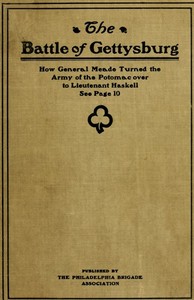
Reply of the Philadelphia Brigade Association to the Foolish and Absurd Narrative of Lieutenant Frank A. Haskell
Subjects:
Gettysburg, Battle of, Gettysburg, Pa., 1863
United States. Army. Pennsylvania Infantry Regiment, 69th (1861-1865)
United States. Army. Pennsylvania Infantry Regiment, 71st (1861-1864)
United States. Army. Pennsylvania Infantry Regiment, 72nd (1861-1864)
United States. Army. Pennsylvania Infantry Regiment, 106th (1861-1864)
Haskell, Franklin Aretas, 1828-1864. Battle of Gettysburg
Download Formats:
Excerpt
The Project Gutenberg EBook of Reply of the Philadelphia Brigade
Association to the Foolish and Absurd Narrative of Lieutenant Frank A. Haskell, by Various
This eBook is for the use of anyone anywhere at no cost and with
almost no restrictions whatsoever. You may copy it, give it away or
re-use it under the terms of the Project Gutenberg License included
with this eBook or online at www.gutenberg.org
Title: Reply of the Philadelphia Brigade Association to the Foolish and Absurd Narrative...
Read the Full Text
— End of Reply of the Philadelphia Brigade Association to the Foolish and Absurd Narrative of Lieutenant Frank A. Haskell —
Book Information
- Title
- Reply of the Philadelphia Brigade Association to the Foolish and Absurd Narrative of Lieutenant Frank A. Haskell
- Author(s)
- Philadelphia Brigade Association
- Language
- English
- Type
- Text
- Release Date
- August 30, 2010
- Word Count
- 15,558 words
- Library of Congress Classification
- E456
- Bookshelves
- US Civil War, Browsing: History - American, Browsing: History - Warfare
- Rights
- Public domain in the USA.
Related Books
Pickett or Pettigrew? An Historical Essay
by Bond, W. R. (William R.)
English
491h 24m read
Gettysburg National Military Park, Pennsylvania
by Tilberg, Frederick
English
248h 21m read
The Battle of Gettysburg: The Country, the Contestants, the Results
by Storrick, W. C. (William Clayton)
English
505h 29m read
The Battle of Gettysburg, 1863
by Drake, Samuel Adams
English
536h 52m read
Lee and Longstreet at High Tide: Gettysburg in the Light of the Official Records
by Longstreet, Helen Dortch
English
1778h 23m read

Chancellorsville and Gettysburg - Campaigns of the Civil War - VI
by Doubleday, Abner
English
1197h 22m read