The Project Gutenberg EBook of Queensland, by
Queensland Government Intelligence and Tourist Bureau
This eBook is for the use of anyone anywhere at no cost and with
almost no restrictions whatsoever. You may copy it, give it away or
re-use it under the terms of the Project Gutenberg License included
with this eBook or online at www.gutenberg.org/license
Title: Queensland
The Rich But Sparsely Populated Country
Author: Queensland Government Intelligence and Tourist Bureau
Release Date: July 21, 2018 [EBook #57563]
Language: English
Character set encoding: UTF-8
*** START OF THIS PROJECT GUTENBERG EBOOK QUEENSLAND ***
Produced by ellinora, Robert Tonsing and the Online
Distributed Proofreading Team at http://www.pgdp.net (This
file was produced from images generously made available
by The Internet Archive)
Sixth Edition
1915
Terse
Information
About
QUEENSLAND
[Illustration]
Queries
and
Replies
[Illustration]
The Queen State
of the
Australian
Commonwealth
Area, 429,120,000 acres
Intelligence and Tourist Bureau
Corner of Queen and George streets, Brisbane
QUEENSLAND
The Rich
but Sparsely
Peopled
Country
[Illustration]
A
Paradise
for
Willing
Workers
CLASSES WHO SHOULD
COME TO QUEENSLAND
Farmers
Agricultural Labourers
Men accustomed to Live Stock
Miners
Domestic Servants
Men, with small capital, accustomed
to outdoor life
Men, without capital, not afraid of
hard work
Young men, without experience, who
are willing to take employment
whilst they learn the methods of
work in Queensland
[Illustration]
Any steady energetic individual from
the above classes should have no
difficulty in earning a good livelihood
and in making a comfortable
home in Queensland
Intelligence and Tourist Bureau
Corner of Queen and George Streets, Brisbane, Queensland, Australia
— _Queensland_ —
_The Rich but Sparsely Peopled Country_
RATES OF WAGES IN QUEENSLAND.
Ordinary Farm Labourers.
20s. to 27s. 6d. per week with board and lodging.
Ploughmen.
20s. to 30s. per week with board and lodging.
Harvest Hands (Wheat).
5s. to 7s. per day with board and lodging.
Ordinary General Labourers.
7s. to 8s. 6d. per day.
Navvies.
8s. to 10s. per day.
Dairy Hands—Men.
20s. to 25s. per week with board and lodging.
Dairy Hands—Boys.
10s. to 20s. per week with board and lodging.
Cane-cutters.
11s. to 12s. per day of eight hours, or 5s. to 7s. 6d. per ton.
Cane Farm Chippers.
37s. to 39s. per week with board and lodging, or 8s. 8d. to 9s.
2d. per day of eight hours without board and lodging.
Boiler Attendants and Engine-drivers.
8s. to 12s. per day.
Fitters and Engineers.
11s. to 14s. per day.
Carpenters and Joiners.
12s. to 14s. per day.
Cabinet-makers.
11s. to 13s. 4d. per day.
Bricklayers.
13s. to 14s. per day.
Wheelwrights.
9s. 4d. to 13s. per day.
Blacksmiths (General).
9s. 4d. to 15s. per day.
Blacksmiths (Engineering).
11s. to 12s. 6d. per day.
Plumbers.
11s. to 13s. per day.
Tinsmiths.
9s. to 11s. per day.
Axemen.
20s. to 35s. per week with board and lodging, 6s. to 8s. per
day.
Sawmill Hands.
8s. to 12s. 4d. per day.
Married Couples.
(Man, farm; Wife, cook) £80 to £120 per annum with board and
lodging. On sheep and cattle stations married couples are provided
with a furnished cottage, rations, and other perquisites to the
value of about £3 per week in addition to their wages.
Stockmen and Boundary Riders.
From 20s. to 35s. per week and found. Where married men are
employed on sheep and cattle stations, they are allowed, in
addition to their wages, a furnished house, rations, and other
perquisites to the value of about £3 per week. Single men similarly
employed get, besides their wages, board and lodging and other
perquisites equivalent to what it would cost them for board and
lodging in the township.
Useful Lads.
10s. to 15s. per week with board and lodging.
Grooms.
15s. to 30s. per week with board and lodging.
Female Domestics.
10s. to 30s. per week with board and lodging.
Cooks (Male and Female).
20s. to 40s. per week with board and lodging.
Gardeners.
6s. to 8s. per day and one meal.
FACTS WORTH KNOWING.
Where is Queensland?
The State of Queensland is situated in the northeast of the
island-continent of Australia, between latitude 29 deg. and 10 deg.
south; longitude 153-1/2 and 138 deg. east.
What is Queensland?
The richest State of the Commonwealth of Australia, with an
area of 429,120,000 acres, over 3,000 miles of coast line, and the
healthiest climate in the world.
How to get to Queensland.
By any of the great steamship companies’ boats that call at
Brisbane (the capital), or by any vessel sailing for Australian
ports.
Where to get Particulars re Passages.
At the Queensland Agent-General’s Office, Marble Hall, 409 and
410 Strand, London, W.C., and Immigration Depôt, Kangaroo Point,
Brisbane.
Free Passages.
These are granted from the United Kingdom to any port of
Queensland to agricultural labourers introduced under contract.
Conditions of Free Passages.
The employer must pay a fee of £7 for each labourer introduced,
provide him with suitable accommodation, and guarantee him a year’s
work at wages approved by the Government.
Approved Immigrants.
Approved immigrants can obtain a passage to any port in
Queensland at the following rates:—Males, 12 years and upwards,
£7; females, 12 years and upwards, £3; immigrants’ children (1 year
and under 12 years), £1 10s. Maximum age: Males, married women, and
widows, 45 years; single women, 35 years.
On What Conditions?
The sum of £1 must be deposited with the Agent-General,
in addition to the prescribed fees. This sum is refunded to the
immigrant on arrival. In the case of families applying for passages
as assisted immigrants, one deposit only covers the whole family.
Nominated Immigrants.
Residents of Queensland with a qualification of at least six
months’ permanent residence therein can obtain passages for their
friends and relatives in Great Britain and Europe =only= at
the rates already stated.
Assisted Passages.
Approved females (between the ages of 18 and 35 years),
prepared to accept domestic service for twelve months, may obtain
passages to Queensland on payment of £1 before sailing, the balance
of the fare (£2) to be paid by monthly instalments within six
months after their arrival in Queensland. Passages may also be
granted to farm lads (between 16 and 20 years of age) on payment of
£1 before sailing, the balance of the passage money (£6) to be paid
by monthly instalments within six months after their arrival in
Queensland. Employment is guaranteed in every case, and the lads
must consent to work on a farm for, at least, twelve months.
What Queensland Offers.
An easy living to any industrious man or woman in the
healthiest climate in the world.
What Queensland Wants.
Thousands of able-bodied men and women to fill up her empty
spaces and develop her resources.
Employment.
Agricultural labourers and domestic servants are in great
demand at good rates of wages. (See wages list at pages 3 to 5.)
Where to get Information in England.
At the office of the Agent-General, Marble Hall, 409 and 410
Strand, London, W.C.
What Population could Queensland Carry?
Queensland could easily carry a population of 50,000,000. At
present she has only about 680,000 people.
Where to get Advice about Work on Arrival.
At the Government Labour Bureau, Edward street, Brisbane, or
any of its branches throughout the State.
Where to get Information of Lands Available.
At the Land Settlement Inquiry Office, Lands Department,
Executive Buildings, George street, Brisbane, or any local
Government Land Agent throughout the State.
Where to get Information re Crops, Soils, etc.
At the Agricultural Department, William street, Brisbane.
Where to get Information about any Part of the Country, Travelling,
and Rate of Living.
At the Government Intelligence and Tourist Bureau, corner of
Queen and George streets, Brisbane.
Tourist Trips.
All information _re_ tourists’ trips—especially the Great
Northern coastal trip and magnificent scenery—can be obtained at
the Government Intelligence and Tourist Bureau.
What can Queensland Produce?
With her immense area and variety of soils and climates
Queensland can produce every crop that is found in the markets of
the world, from barley to cocoa. Her mineral wealth is very great
and scarcely tapped.
Crops.
Sugar-cane, wheat, oats, barley, rye, maize, lucerne, rape,
cotton, tobacco (cigar and pipe), coffee, potatoes, fibres, rubber,
ramie, pumpkins, sisal hemp, mangolds, sorghums, millet, rice,
turnips, cowpea, canary seed, cassava, peanuts, arrowroot, and
others.
Fruits.
Grapes, pineapples, bananas, oranges, lemons, mangoes, apples,
pears, peaches, plums, apricots, cherries, figs, nectarines,
quinces, strawberries, persimmons, passion fruit, almonds,
blackberries, rosellas, custard apples, papaws, cocoanuts, Cape
gooseberries, melons, guavas, loquats, and others.
Vegetables.
Cabbages, cauliflowers, cucumbers, tomatoes, potatoes (English
and sweet), lettuce, cress, mustard, turnips, carrots, parsnips,
beetroot, asparagus, borecole, leeks, rhubarb, beans, chicory,
squashes, onions, capsicums, eschalots, peas, seakale, salsify,
yams, artichokes, choko, chillies, celery, and others, including
herbs of all sorts.
Products.
Wool, leather, hides and skins, tallow, frozen meat, pork,
sugar, molasses, malt, butter, cheese, flour, bran, pollard,
cornflour, wine, condensed milk, jams and preserved fruits,
manufactured timber, biscuits, confectionery, clothing of all
kinds, mineral and aerated waters, &c.
Minerals.
Gold, silver, copper, lead, tin, iron, coal, wolfram, bitumen,
antimony, manganese, bismuth, molybdenite, limestone, ironstone,
scheelite, graphite, &c.
Gems.
Opal, topaz, sapphires, rubies, diamonds, agates, emeralds,
zircon, oriental chrysoberyl, olivines, rock crystal, tourmaline,
cornelian, amethyst, spinel, pleonaste, pyrope, cairngorm, white
and yellow jargoon, carbonado.
What is the Area of Queensland?
429,120,000 acres, or 670,500 square miles.
What Area is under Cultivation?
920,010 acres.
Under Crop, 1913.
Grain—Wheat 132,655 acres.
〃 Barley 8,826 〃
〃 Maize 156,775 〃
English Potatoes 10,085 〃
Sweet Potatoes 3,224 〃
Sugarcane 147,743 〃
Hay 76,469 〃
And various acreages in miscellaneous crops. Total area under
crops, 747,814 acres.
Fruit.
Both tropical, sub-tropical, and deciduous fruits do well.
Thirty years ago out of every 100 cases of oranges imported into
Queensland 95 came from New South Wales. Now the citrus fruit
industry has grown to such an extent that Queensland does not
import 5 per cent., but has become a big exporter to Southern
centres.
Pineapples.
Pineapples grow all the year round in Queensland.
Where are Fruits Principally Grown?
Deciduous fruits principally at Stanthorpe. Bananas, oranges,
mangoes, citrus fruits, tomatoes, &c., in the North. Pineapples,
oranges, and citrus fruit (in large quantities), peaches, bananas,
passion fruit, melons, custard apples, &c., in the South. The
Blackall Range and Cleveland have also become great
strawberry-producing districts.
Where are the Crops and Products Raised?
Cereals, root crops, fodder plants, tobacco, cotton, English
and sub-tropical fruits in the South. Sugar-cane, bananas, coffee,
tobacco, cotton, and tropical products in the North. Wool on the
Darling Downs and the great grazing districts west of the Main
Range.
What is the Mean Annual Rainfall?
It varies considerably. Along the Pacific slope it runs
approximately from 48 inches at Brisbane to 150 inches in the Far
North. West of the Great Dividing Range the rainfall diminishes
from 30 inches to about 10 inches, according to the distance from
the Main Range.
What is the Climate Like?
The climate of Queensland is the most perfect winter season in
the world.
But is not the Heat Great in Summer?
Although there are occasional hot days, the summer season is
not unpleasant. The mean summer temperatures are:—South
Queensland, from 66.5 to 76.7; Central, 80.5; South-western, 80.8;
North, 81.2; North-western, 84.3.
Is it Healthy?
The death-rate in Queensland in 1913 was only 10.39 per 1,000.
But does the Climate Suit English and European People?
Yes. They live to a great age in the genial atmosphere of
Queensland.
What Sort of People are already Settled in Queensland?
Scotch, Irish, English, Welsh, Germans, Danes, Italians,
Swedes, Russians, and other people of White nationalities.
Russians, Swedes, and Danes make splendid colonists, and are warmly
welcomed.
Do People Often Return after Leaving Queensland?
Yes. Men who go home with the intention of spending the rest of
their lives in England are constantly returning to Queensland.
What Openings are there in Queensland for the Investor?
There are numerous avenues of investment in sheep and cattle
stations, farming and dairying on a large scale, city and country
properties, mines and timber, in the development of secondary
industries, and in the growing of rubber.
For the Man with Small Capital on Government Land?
With £150 to £200 a man can start dairying in a small way, and
gradually increase his herd and operations. A good deal, of course,
depends on the man.
Suppose he had £250 or £300?
He could make a good start with that.
Suppose he tried Fruit Growing?
With about £100 he could make a start. He could grow vegetables
and minor crops until his trees grew old enough to bear, which
would be in about three years from planting.
What could a Man do without Capital?
He could work for a station-owner or farmer until he had made
enough to pay his deposit on the land he eventually selects.
Experienced Agricultural Labourers.
There is a great demand for this class.
Inexperienced Men.
Inexperienced men should take some employment and learn the
methods of work in Queensland before sinking their capital in land
or stock.
Domestic Servants.
Domestic servants, especially cooks, are in urgent demand at
wages ranging from 10s. to 30s. per week.
Where Can Government Land be Obtained?
There are fifty-eight Land Agents’ Districts in Queensland, in
all of which vacant Crown lands are still obtainable.
Agricultural Farms.
Agricultural farms vary from 10s. per acre upwards.
At what Age can a Person Select Land?
Over the age of 16 years.
Can a Man with Little Capital acquire Land?
Yes. If he pays the first deposit, the Crown may defer payment
of the next three years’ rent.
When is this Payable?
It is divided over the fifth to the thirteenth year with
interest at 4 per cent. per annum.
Can a Single Woman hold Government Land?
Yes; with the exception of a homestead area, if she is over 16
years.
Can She hold a Homestead Area?
Yes; if she is over 21 years.
What Land may Married Women hold from the Crown?
She may hold any selection not subject to personal residence
conditions.
What Land a Married Woman cannot select from the Crown.
A married woman is not competent to select an agricultural
homestead, a grazing homestead, free homestead, perpetual lease
selection, agricultural farm, or prickly-pear selection, subject to
the conditions of personal residence, unless she has obtained an
order for judicial separation, or an order protecting her separate
property.
Married Women’s Property Act.
Under “_The Married Women’s Property Act, 1890_,” she can
hold any land, which she purchases absolutely, as if she were a
man.
What are the Modes of Tenure?
(1) Agricultural selection—i.e., agricultural farms,
agricultural homesteads, perpetual lease selections, and
free homesteads.
(2) Grazing selections—i.e., grazing farms and grazing
homesteads.
(3) Unconditional selections.
(4) Prickly-pear selections.
Twenty Years’ Purchase without Interest.
Twenty years are allowed in which to pay for an agricultural
farm. No interest is charged.
Annual Instalment.
The annual instalment is 6d. in the £1—that is, 2-1/2 per
cent., or 3d. per acre on 10s. land; 6d. per acre on £1 land; 1s.
per acre on £2 land. The whole of this goes to principal.
Completing the Purchase.
At above rate, in twenty years the farm is half paid for, and
during that time the farmer has had the use of the farm for much
less than a fair rental. At the end of the twenty-first year, he is
expected to pay the remaining half. Taking money as worth 5 per
cent., this is equivalent to selling the land at half the
proclaimed price.
Deposit Money.
On an agricultural farm, agricultural homestead, perpetual
lease selection, grazing selection, and unconditional selection
—one year’s rent, and 1/5th of survey fee; on free homestead—fee
of £1, and 1/5th of survey fee; on prickly-pear selection—full
amount of survey fee.
What is the Deposit on an Agricultural Farm of 160 Acres?
£3 16s., taking the price of the land at 10s. per acre.
When can such a Farm be made Freehold?
In five years.
Freehold Title.
Queensland offers an unencumbered freehold title. The deeds
for an agricultural farm may be obtained at any time after five
years by paying the outstanding balance.
Discount.
If such balance is paid off before it is due, a discount of
2-1/2 per cent. per annum is allowed.
Conditions for Agricultural Farms.
Maximum area, 2,560 acres (this, however, is allowed only in
remote districts); price, from 10s. per acre upwards. The land must
be fenced within five years, or other improvements effected equal
in value to the cost of fencing. Five years’ personal residence or
occupation as the case may require; thereafter, until made
freehold, the condition of occupation must be performed.
Negotiable Leases.
The lease may be obtained as soon as the improvements are
completed, and can be mortgaged, or, with the permission of the
Minister, the land may be subdivided, transferred, or sublet.
Exceptions.
Agricultural homesteads and free homesteads cannot be
mortgaged. Agricultural selections and prickly-pear selections
obtained under five years’ residence priority cannot be mortgaged
during the first five years.
Agricultural Homesteads.
The price for a homestead is 2s. 6d. per acre, the annual rent
3d. per acre, the terms ten years’ personal residence, and the
maximum area 320 acres.
Agricultural Homestead Conditions.
Land must be fenced within five years, or improvements made
equal to value of such fence. When five years of residence have
been performed and improvements effected, the selector may pay up
the remaining rent, so as to make his total payments equal to 2s.
6d. per acre, and obtain deed of grant.
Grazing Farms—Area.
The total area held by one person must not exceed 60,000 acres,
but when the area exceeds 20,000 acres the annual rental at the
notified rental must not exceed £200.
Grazing Farms—Rental, Term, Conditions, &c.
Rental from nil per acre per annum. Term up to twenty-eight
years. The holding must be continuously occupied by the selector or
manager or agent. Within three years the land must be fenced. In
cases where no rental is charged, the land is more or less infested
with prickly pear or noxious weeds.
Grazing Farms—Lease.
As soon as the holding is fenced the lease is issued, which may
be mortgaged or transferred, as stated in the case of agricultural
farms.
Group Residence.
If it is proved to the satisfaction of the Commissioner that
two or more selections, each of which is at a distance not
exceeding five miles from each of the others, are held by members
of one family, _bonâ fide_ in their own separate interests,
the Commissioner may issue a special license enabling the
conditions of personal residence or the conditions of occupation
required to be performed by them in respect of their selections to
be performed by their residence on one of the selections which is
itself held subject to the conditions of personal residence or
conditions of occupation.
Grazing Homesteads—
Similar conditions to grazing farms, except that—
(1) Selector must personally reside on the land for five
years.
(2) Before the expiration of five years from the
commencement of the term, or the death of the original
lessee, whichever first happens, the land cannot be
assigned or transferred, but may be mortgaged with the
consent of the Minister.
Unconditional Selections—
Up to 1,280 acres may be obtained under this tenure, at from
13s. 4d. per acre, payable in twenty annual instalments without
interest. No other conditions.
Purchase of an Unconditional Selection.
A deed of grant may be obtained at any time on payment of the
balance of the purchase price. Two and a-half per cent. per annum
is allowed if the amount is paid before due.
Prickly Pear Selection.
Maximum area, 2,560 acres. This applies to land infested with
prickly-pear. Term, twenty-five years, with a peppercorn rental for
the first period, and an annual rent during the second period equal
to the amount of the purchasing price divided by the number of
years in the second period.
Conditions.
The land must be absolutely cleared of pear during the first
period as notified in the notification opening the land for
selection, and kept clear during the second period.
Freehold of Prickly Pear Selections.
The freehold may be obtained at any time after the expiration
of two years from the beginning of the second period by the payment
of the balance of the purchase money, provided he has obtained a
certificate from the Commissioner that the conditions have been
fulfilled.
Price of Prickly Pear Selections.
The price varies according to the state of infestation from nil
upwards, and in some cases where the land is badly infested a bonus
is given. The purchasing price or bonus is stated in the opening
notification.
Pastoral Holdings.
Pastoral holdings may be obtained on long leases, with
practically no restriction as to area. Terms up to thirty years.
Occupation Licenses.
Large areas may be rented from the Government from year to year
under an occupation license. No limitation to area.
Group Settlement.
Under special conditions families from the same community are
allowed to settle in groups so as to permit of their retaining
their social relations.
Size of Groups.
Groups of from six families to as many as seventy families have
already been successfully formed.
Inspection.
It is a good plan for friends to club together to pay the
expenses of one of their number to go to Queensland to find land
for a “group” to accommodate them all.
Miners’ Homestead Leases.
Under the provisions of “_The Miners’ Homestead Leases Act of
1913_,” homestead leases can be acquired by application, or by
tender or public auction by residents of any mining field
throughout the State, in areas not exceeding 640 acres. During
the first period of thirty years the annual rental on areas up to
40 acres is 1s. per acre, and 6d. for any additional acreage in
excess of this area. This rental does not, of course, apply to
homesteads acquired by tender or sale. After the expiration of the
thirty years’ lease a nominal rental of 1s. only can be demanded.
The minimum annual rental for any homestead is 5s.
Can an Alien select Land in Queensland?
Yes, provided he obtains a certificate to the effect that he
can read and write words in such language as the Minister for Lands
may direct; also provided that he becomes a naturalised British
subject within five years of his selecting the land, failing which
he will forfeit all his right, title, and interest in the land
selected.
What is an Alien?
Any person who is not a British subject. For instance,
Americans, Frenchmen, Swedes, Italians, Russians, &c.
When can an Alien become Naturalised?
After he has been at least two years in the Commonwealth of
Australia, he may take the oath of allegiance, become a Britisher,
and enjoy all the freedom and privileges appertaining thereto.
Where must Applications for Land be Lodged?
At the local Land Office.
How far from the Railway is the Available Land?
Most of the land is not far from existing lines. The policy of
the Government, however, is to build light railway lines (as
feeders to the main lines) to tap agricultural districts, and to
anticipate settlement.
Light Railway Lines Opening Large Areas.
Some of these short lines which it is proposed to build will
open up an immense area of good land.
Crown Lands at Auction.
Crown lands may be acquired in fee-simple by auction purchase
in limited areas as town and suburban lots.
Price.
The minimum purchasing price for land bought at auction is 10s.
per acre.
Terms of Purchase.
Terms up to ten years may be allowed, with interest at 5 per
cent. per annum.
What Assistance does the Government Give the Intending Settler?
The Government issues a railway ticket at half the ordinary
fare to the intending settler desirous of inspecting Crown land
with a view of selecting an area not exceeding 5,120 acres. If the
intending settler subsequently takes up a selection, subject to
personal residence conditions, not exceeding 5,120 acres in area,
the half-fare paid by him is refunded, and his family, self,
ordinary household furniture and effects, agricultural implements,
seed, one dray, and one set of harness are carried free to the
railway station nearest to his selection.
What Other Assistance?
Special reduced rates are granted for the carriage of building
material, fencing wire, and two truckloads of live stock. Wire
netting is also supplied on twenty years’ terms at 5 per cent. per
annum.
Assistance to Obtain Water.
If desired, the State will also sink wells on waterless country,
spreading the cost over the total purchase price of the land over
the term of lease.
What is the Agricultural Bank?
A Government Bank institution established, primarily, for the
purpose of assisting new settlers and also agriculturists and
graziers, to whom it makes advances on the security of freeholds,
licenses, and leases from the Crown, for the purpose of making
improvements on the land or for paying off liabilities, at 5 per
cent. per annum, repayable in twenty-five years or at any time at
the option of the borrower.
What Security is Required?
The applicant for an advance must give a first mortgage on his
holding. The bank advances 12s. in the £1 on the total value of the
land and improvements.
When is it Repayable?
For the first five years only simple interest is charged at 5
per cent. per annum. After five years the borrower must begin to
redeem his advance at the rate of £4 0s. 3d. half-yearly for each
£100 borrowed, inclusive of interest, until the whole has been
paid.
Can the Settler Borrow Money to Buy Stock?
Yes. The Agricultural Bank will advance 12s. in the £1 of the
total value of the land and improvements for the purpose of
purchasing stock, machinery, or implements the selector desires to
purchase, or for relieving the liability on the holding. Advances
at the rate of 13s. 4d. in the £1 on the value of the land and
improvements thereon up to £200 can also be obtained for
unspecified purposes.
Can an Alien Obtain an Advance?
Yes, provided he obtains a certificate to the effect that he
can read and write words in such language as the Minister for Lands
may direct; also provided he becomes a naturalised British subject
within five years of his selecting the land.
Workers’ Dwellings Act.
Under the provisions of this Act the Government make advances,
on easy terms of repayment, for the purpose of enabling persons of
small incomes to erect dwelling-houses as homes for themselves and
their families. The applicant must show that his income does not
exceed £200 per annum, and that he is not the owner of a
dwelling-house in Queensland or elsewhere.
Freeholds Farm.
Plenty of good freehold farms change hands from time to time in
Queensland at from £3 to £20 per acre. Settlers not desirous of
taking up Government land can easily be suited privately.
What is the Nature of the Soil?
It varies with the locality. All of the Northern and Eastern
scrub lands are intensely fertile with vegetable mould. The Darling
Downs contains 4,000,000 acres of magnificent black soil,
principally decomposed basalt. The soil in the Maranoa district is
lighter and more suited to wheat-growing and vines. These
descriptions apply pretty generally to the whole of Queensland,
particularly the Central Districts.
Who are the most Successful Farmers?
Those who carry on mixed farming, such as dairying,
agriculture, sheep, pig and poultry raising, horticulture and
bee-farming, &c.
Do many of the Farmers Keep Sheep?
Yes; many of them now go in for lamb-raising on lucerne. There
are also a number of selectors who have sheep on areas of from 640
to 4,000 acres.
Is Dairying Increasing in Queensland?
Yes, every day; and nearly all the dairy farmers are
independent men.
How much Milk was Obtained in 1913?
90,545,516 gallons. Quantity utilised for making butter,
73,582,041 gallons; for cheese, 5,268,447 gallons; for condensed
milk, 2,131,382 gallons; sold for domestic purposes, 4,178,758
gallons; and 5,384,888 gallons used on farms.
How did these Dairymen Begin?
Most of them began in a very small way, buying a cow now and
again as they could afford it.
Were they all Small Farmers?
Yes, for the most part. The larger farmers have also taken up
dairying in addition to wheat, maize, barley, lucerne, and oat
growing.
What was the Butter Production in Queensland in 1913?
35,199,387 lb., valued at £1,613,305.
Cheese, 1913?
5,395,050 lb., valued at £141,400.
Condensed Milk made in 1913?
8,059,051 lb., valued at £187,536.
What will a Good Average Cow Earn?
From 15s. to 30s. per month.
What is the Price of a Good Cow?
From £5 to £8. Of course some well-bred cows fetch a much
higher figure.
What is the Class of Dairy Herd in Queensland?
Dairy stock have been imported to Queensland from the principal
herds of the world, and a splendid class of cow is now in use,
comprising the following breeds:—Milking Shorthorn, Ayrshire,
Holstein, Guernsey, and Jersey.
How many Cows does the Average Farm Carry?
It all depends on the size of the holding. There are many large
properties in Queensland milking several hundred cows daily
throughout the year. The average herd is about 20, but many farmers
milk from 80 to 150 daily.
How many Cows could you Carry on 160 Acres?
With good land, mixed farming, and by growing crops and
conserving fodder, you could carry 30 to 40 at a low estimate. Some
160 acres cleared scrub farms carry 70 to 80 cows.
Monthly Cheques.
Suppliers to the factories are paid monthly by cheque, and some
draw £100 and over per month for milk and cream.
Pigs.
Pig-raising is now considered to be a part of dairying, and is
very profitable. The climate is particularly suited to pigs, and no
housing is required.
Pig Farms.
On some holdings large mobs of young pigs are grazed on barley
or alfalfa (lucerne), and topped up in batches in large sties.
Market for Pigs.
There is a certain market for pigs in Brisbane, Toowoomba, &c.,
where there are bacon-curing establishments.
Wheat.
Wheat is sown (late maturing varieties) in March and April, and
(quick maturing varieties) in May, June, and July. Harvesting
extends from October to early in December.
Where Wheat is Principally Grown.
In Southern Queensland. It can also be grown in the
Central-western districts of Queensland.
Wheat Yield.
Crops of 20 to 30 bushels to the acre are commonly reaped in
the best wheat-growing districts of Queensland. Forty bushels per
acre have often been obtained in individual instances.
Maize.
Maize is planted in July and August right up to January, and is
fit for harvesting in 120 days. It can be grown all over
Queensland, where the rainfall is sufficient. Two crops a year are
possible in sub-tropical scrub and coastal country.
Maize Yield.
Immense yields of maize, from 40 to 80 bushels per acre, are
frequently obtained on the rich scrub lands. Yields of 120 bushels
per acre have also been obtained.
Barley.
Barley does particularly well on the Darling Downs, where the
quality of the crop for malting purposes is held by English experts
to equal the best Hungarian. Crops of from 30 to 40 bushels are
frequent in a good season.
Sugarcane.
Sugarcane growing is carried on along the coastal area from
Brisbane northwards. It is planted from January to June; 2,085,588
tons of sugarcane were produced in 1913.
Price Paid for Cane.
Prices for cane vary according to its sugar-producing
properties and the locality in which it is grown. These, however,
range from 20s. to 27s. per ton. Crops of from 40 to even 70 tons
per acre have been obtained in the North.
Hay.
Hay averaged about 1-3/4 tons to the acre for the last twenty
years. Individual crops yield much heavier results.
Potatoes.
Both English and sweet potatoes give heavy yields.
A few of Queensland’s Products for 1913.
Wool (in grease) 154,183,114 lb.
Frozen and preserved meats 265,481,423 〃
Meat Extract 520,748 〃
Butter 35,199,387 〃
Cheese 5,395,050 〃
Bacon and Hams 13,709,716 〃
Maize 3,915,376 bush.
Wheat 1,769,432 〃
Barley 115,975 〃
Sugarcane 2,085,588 tons.
Sugar manufactured 242,837 〃
English potatoes 16,548 〃
Sweet potatoes 14,425 〃
Hay 103,935 〃
Oranges 375,544 bush.
Grapes 4,092,531 lb.
Wine 58,897 gals.
Bananas 1,037,936 bunches.
Pineapples 744,906 doz.
Mangoes 156,349 bush.
Strawberries 152,608 quarts
Apples 49,423 bush.
Papaws 32,287 doz.
Peaches 53,579 bush.
Lucerne or Alfalfa.
This is one of the best crops a farmer can grow in Southern
Queensland. Once planted, it lasts from seven to ten years.
Lucerne Crops.
The roots of lucerne have been known to penetrate the soil for
a depth of 30 ft. In a good year five to six cuttings can be
obtained. Ten cuttings per annum are often obtained around Laidley,
Southern Queensland.
Can a Man get any Crop with his First Ploughing?
Yes. Wheat or Maize.
What First Crop can be got off Scrub Land?
The method is to fell the scrub, and, after it has dried, put a
fire through it. Maize is then put in with a hoe between the
stumps. Some crops up to 85 bushels per acre have been garnered in
this way.
State Agricultural College.
There is a State Agricultural College at Gatton, South
Queensland, where students can undergo a three years’ training at a
cost of under £30 per annum.
Are there any other State Experimental Farms?
Yes. At Hermitage, near Warwick; Roma, South-western
Queensland; Warren, near Rockhampton; Gindie, near Emerald; Kairi,
Atherton district (North Queensland); and at Kamerunga, near Cairns
(North Queensland); Sugar Experiment Station and Laboratory, Mackay
(North Queensland); and experimental plots in all the principal
sugar districts.
House and Buildings.
At first a farmer generally erects a rough, cheap building of
materials cut on the place at a cost of a few pounds, and when
matters improve puts up a more suitable dwelling.
Where can Building Materials be Obtained?
Iron and wood can be obtained in any part of Queensland.
Competition among the timber merchants is so keen that timber can
be procured at a small cost. A small comfortable cottage can be
built for about £100 upwards.
Do Droughts Often Occur?
The last drought was in 1902, and even then there were parts of
Queensland not affected by it. Droughts do not, as a rule, affect
the whole country, and with extended railway communication relief
country will be available.
Recuperative Power of the Land.
The recuperative power of the land is marvellous. A fortnight
after summer rain (following a dry spell) the country is waving
with grasses. Owing to the mild climate, the growth is phenomenal.
Local Markets.
Farmers can readily dispose of all they can grow in the local
markets, where competition amongst buyers is keen.
Southern Markets.
There is a certain market in the South for all Queensland
produce.
Oversea Markets.
A certain market for wool, hides, butter, cheese, frozen meat,
and other products exists in Great Britain and Europe. Trade with
the United States and Canada is developing. There are splendid
openings for trade with Java, China, Japan, and the East generally.
What is the Nature of the Trade with Asia?
Cattle, horses, bones, hoofs, leather, butter, cheese, fodder,
fruits, glue pieces and sinews, barley, oats, wheat, bran, pollard,
flour, hay, chaff, honey, refined animal fats, manures, bacon and
hams, beef, mutton, pork, other meat, milk concentrated and
preserved, potatoes, skins and hides, tallow, wool.
Horses.
There were 707,265 horses in Queensland in 1913. A large
remount trade is now done with India, Java, and the East.
What Parts of Queensland are the Best for Cattle?
Cattle do well all over Queensland, and especially on the
Eastern coast lands and the North.
What Number of Cattle are there in Queensland?
5,322,033 for 1913.
Where do Sheep Thrive Best?
On the great central plains of Western Queensland, and in the
country west of the Dividing Range.
Number of Sheep in Queensland.
21,786,600 for 1913.
Increase of Sheep for Ten Years.
13,394,556.
What was the Value of the Wool in 1913?
£6,296,000.
What was the Value of the Imports and Exports in 1913?
Imports (oversea only), £6,714,942; Exports (oversea only),
£12,352,748; total, £19,067,690. The above figures do not, of
course, include interstate transactions. It is reasonable to assume
that the total value of the imports and exports would be, at least,
doubled.
On what Area could a Man Profitably Grow Wool?
On a grazing farm of 20,000 acres, with a capital of £4,000, he
could make a net income of £600 to £1,000 a year.
Are there Larger Areas than this?
Some of the stations carry from 100,000 to 200,000 sheep, and
are over 1,000 square miles in area. One is 5,000 square miles in
area.
Mining Employees.
There are 12,393 men employed in and around mines in
Queensland.
What is the Ordinary Rate for Unskilled Labour in Mines?
From 8s. 3d. to 13s. per shift of eight hours.
At what Age should a Miner Come to Queensland?
Between 20 and 40 years.
What could a Practical Miner do in Queensland?
He could get work in a mine or prospect the country in search
of minerals.
What is the Aggregate Area of the Mining Fields Proclaimed Open?
78,073 square miles.
What was the Total Output of Gold from Queensland Mines to the end of
1913?
17,973,674 fine oz.
What was the Total Value of this Output?
£76,347,265.
What was the Total Value of Minerals other than Gold won from
Queensland Mines to the end of 1913?
£31,419,755. Grand total, all minerals, £107,767,020.
Miner’s Right.
On payment of 5s. a year any man can obtain a miner’s right
authorising him to mine for minerals on any Crown lands.
Rewards for Discovery of New Goldfields.
On certain conditions, rewards, not exceeding £500 in one
instance, and not exceeding £1,000 in another, are given by the
Government for the discovery of new goldfields.
Prospecting.
Prospectors for tin in the North—chiefly about Herberton—do
fairly well.
Claims.
The holder of a miner’s right may by himself or his agent take
up and hold any number of claims or shares in such claims, provided
that such claims or shares are duly worked and represented by the
prescribed number of men.
Seasons.
The spring commences in September, and the summer ends in
February. The winter climate is perfect.
Religious Freedom.
There is no State church in Queensland. All religious
denominations are on an equality, and complete religious liberty
prevails.
Education.
Education is free and compulsory.
Expenditure on Education.
£657,613 were spent by the State on education in 1913.
State Schools.
There are 1,338 State Schools in Queensland, with a total
enrolment of 119,006 scholars, and 3,269 teachers.
Total Schools, including State Schools, 1913.
1,518 schools, with an average daily attendance of 97,852
scholars.
Country Schools.
There are excellent State schools situated throughout the
country districts of Queensland.
Provisional Schools.
Provisional schools are established wherever necessary.
Higher Educational Institutions.
Six High Schools (free), 16 Technical Colleges, 10 Grammar
Schools (boys and girls), a School of Mines at Charters Towers
(North Queensland), and a University.
Education in Sparsely-populated Districts.
Travelling Government teachers periodically visit the more
sparsely settled districts to arrange for the education of the
children so circumstanced. Half-time Schools are also established
on many sheep and cattle stations.
Adult Vote.
Every man and woman in Queensland over the age of twenty-one
years is entitled to a vote.
A Law-abiding Community.
Queensland is one of the most law-abiding countries in the
world.
Orderliness of Crowds.
The orderliness of large crowds is a remarkable feature of
Australian life, and one which generally causes surprise on the
part of the visitor. This orderliness is characteristic of
Queenslanders.
A Notable Fact.
The morning after the assemblage of a crowd of nearly 60,000
people on the opening day of the Brisbane Show in 1914 showed a
complete absence of wrongdoing on the police charge-sheet.
Election Crowds.
There is no rowdy conduct during elections in Queensland. Women
visit the polls and record their votes as easily as attending
church.
Queensland Railways.
The Queensland Railways are the property of the State.
How many Miles of State Railway are Open?
4,856 miles to 31st December, 1914.
Railway Receipts and Expenditure, 1913.
Receipts £3,660,022
Expenditure £2,371,261
———————————
Net profit £1,288,761
Private Railways, to 31st December, 1914.
Only 330 miles.
What was the Value of the Gold produced in Queensland for 1913?
£1,128,768 for 265,735 fine oz.
Other Minerals.
Silver, 604,979 oz. (£68,438); copper, 23,655 tons
(£1,660,178); tin, 3,197 tons (£343,669); coal, 1,037,944 tons
(£403,767); gems and opals, £46,292; other minerals, £206,769.
Total Value of Production of other Minerals, 1913.
£2,729,113.
Public Revenue, 1913-14.
£6,973,258.
Public Expenditure, 1913-14.
£6,962,515.
Government Savings Bank, 1913-14.
176,961 depositors had £9,350,999 to credit in the Government
Savings Bank on 30th June, 1914—an average of £52 16s. 10d. per
head.
Banks.
Eleven banks held assets to the amount of £22,845,949 in 1913.
Factories.
There were in 1913 1,838 factories in Queensland employing
42,363 hands. The value of the plant and machinery was £5,877,387,
and the value of the land and premises £3,923,584. Value of output,
£23,688,789.
Hospitals.
There are eighty-five public hospitals in Queensland, besides
numerous private ones.
Shipping of the State, 1913.
2,247,434 tons entered.
2,251,503 tons cleared.
Timber Sawn for 1913.
Softwoods, 98,620,299 superficial feet, valued at the mill,
£778,084; cedar, 882,092 superficial feet, valued at the mill,
£15,964; hardwoods, 57,131,224 superficial feet, valued at the
mill, £510,967; mouldings, &c., £61,872; 1,101,271 sleepers,
£92,906. In addition, at least an equal quantity was used for
bridges, wharves, fencing, &c. Total value of output of sawmills
only, £1,459,793. The 247 sawmills employed 4,621 hands.
The Meat Industry.
In 1913 there were fourteen meatworks (exclusive of seven bacon
factories), which employed 4,225 hands during the season. Total
value of all meat products (including bacon and hams), £8,576,754.
Steamer Fares to Brisbane
(From America, Canada, South Africa, and India.)
_Union Steamship Company of New Zealand, Limited._
From San Francisco to Brisbane (Single):—
First Saloon $232.08 (£48 7s. 0d.)
Second Saloon $152.40 (£31 15s. 0d.)
Third Class $94.80 (£19 15s. 0d.)
From Chicago to Brisbane (Single):—
First Saloon $291.84 (£60 16s. 0d.)
Second Saloon $202.16 (£42 2s. 4d.)
Third Class $144.56 (£30 2s. 4d.)
From New York to Brisbane (Single):—
First Saloon $309.84 (£64 11s. 0d.)
Second Saloon $218.16 (£45 9s. 0d.)
Third Class $160.56 (£33 9s. 0d.)
The above fares are subject to alteration without notice.
_Canadian-Australian Royal Mail Line._
From Vancouver to Brisbane (Single):—
First Saloon $232.08 (£48 7s. 0d.)
Second Saloon $152.40 (£31 15s. 0d.)
Third Class $94.80 (£19 15s. 0d.)
From Chicago to Brisbane (Single):—
First Saloon $288.96 (£60 4s. 0d.)
Second Saloon $200.40 (£41 15s. 0d.)
Third Class $142.80 (£29 15s. 0d.)
From New York to Brisbane (Single):—
First Saloon $309.96 (£63 19s. 0d.)
Second Saloon $213.36 (£44 9s. 0d.)
Third Class $155.76 (£32 9s. 0d.)
From St. Louis to Brisbane (Single):—
First Saloon $286.44 (£59 13s. 6d.)
Second Saloon $197.88 (£41 4s. 6d.)
Third Class $140.28 (£29 4s. 6d.)
From Montreal to Brisbane (Single):—
First Saloon $303.96 (£63 6s. 6d.)
Second Saloon $211.68 (£44 2s. 0d.)
Third Class $154.08 (£32 2s. 0d.)
All above rates are subject to alteration without notice.
_Children_ (Canadian steamer).—Under 12 and over 5 years,
half rate; under 3 years and over 2 years, quarter rate; one child,
2 years, free; others, quarter rate.
_Baggage._—First Class passengers allowed 40 cubic feet,
or 350 lb. free each adult; Second Class passengers allowed 20
cubic feet, or 175 lb. free each adult; Third Class passengers
allowed 20 cubic feet or 175 lb. free each adult. On coastal
steamer (First Class), 40 cubic feet; (steerage), 20 cubic feet.
Excess baggage charged at the rate of 2s. 6d. (60 cents) per cubic
foot Vancouver to Sydney; and 10s. ($2.40) per ton of 40 cubic feet
Sydney to Brisbane.
_Oceanic Steamship Company._
From Boston to Brisbane (Single):—
First Saloon $310.95 (£64 15s. 8d.)
Second Saloon $219.15 (£45 13s. 2d.)
Third Class $161.15 (£33 13s. 2d.)
From San Francisco to Brisbane (Single):—
First Saloon $232.20 (£48 7s. 6d.)
Second Saloon $152.40 (£31 15s. 0d.)
Third Class $94.80 (£19 15s. 0d.)
From Chicago to Brisbane (Single):—
First Saloon $291.95 (£60 17s. 3d.)
Second Saloon $202.15 (£42 2s. 4d.)
Third Class $144.55 (£30 2s. 4d.)
From New York to Brisbane (Single):—
First Saloon $308.80 (£64 6s. 8d.)
Second Saloon $217.00 (£45 4s. 2d.)
Third Class $159.40 (£33 4s. 2d.)
From Vancouver to Brisbane (Single):—
First Saloon $262.20 (£54 12s. 6d.)
Second Saloon $177.40 (£36 19s. 2d.)
Third Class $104.80 (£21 16s. 8d.)
From St. Louis to Brisbane (Single):—
First Saloon $287.80 (£59 19s. 2d.)
Second Saloon $198.00 (£41 5s. 0d.)
Third Class $140.40 (£29 5s. 0d.)
From Montreal to Brisbane (Single):—
First Saloon $307.75 (£64 2s. 4d.)
Second Saloon $217.00 (£45 4s. 2d.)
Third Class $159.40 (£33 4s. 2d.)
_Family Concessions._—Families consisting of parents and
children only (equal to three adult fares), 10 per cent. off single
rates; (equal to four adult fares or over), 15 per cent. off single
rates; one child, under 2 years of age, free if no separate berth
required; children, 2 years and under 6 years of age, quarter fare;
children, 6 years and under 12 years of age, half fare.
Men only carried in Third Class from San Francisco to Brisbane.
Passengers can travel by train between Sydney and Brisbane. A
reduction of 15s. ($3.60) will be made on the above First Saloon
rates for a first-class railway ticket from Sydney to Brisbane.
_Luggage Allowance on Oceanic Steamers._—First-class, 350
lb., or 40 cubic feet; second and third classes, 175 lb., or 20
cubic feet. Excess baggage, 1-1/2d. (3 cents) per lb., or 1s. 6d.
(36 cents) per cubic foot.
_Aberdeen Line_—
From Capetown to Brisbane:—
Saloon (Single) From £32 upwards
Third Class (Single) From £11 11s.
_White Star Line_—
From Capetown to Brisbane (all one class):—
Single fares from £17 15s.
_The Blue Funnel Line_—
From Capetown to Brisbane:—Fares (Single),
saloon only, £32.
_P. and O. Branch Service_—
From Capetown to Brisbane:—Fares (Single):—
Third Class only, £11 11s.
_P. and O. Line_—
From Bombay and Calcutta to Brisbane (Single):—
First Saloon £41 16s. 0d. (Rupees 627)
Second Saloon £34 2s. 0d. (Rupees 512)
From Colombo to Brisbane (Single):—
First Saloon £38 10s. 0d. (Rupees 578)
Second Saloon £31 18s. 0d. (Rupees 479)
_B.I.S.N. Company, Limited_—
From Calcutta to Brisbane (Single):—
First Class Rupees 473
Second Class Rupees 289
(Allow rate of exchange 1s. 4d. for each rupee.)
Passengers maintain themselves awaiting train or steamer at Sydney.
_Note.—All the above fares include the cost of travelling from
Sydney to Brisbane by one of the Queensland-bound coastal steamers._
_Some Successful Queensland Farmers._
During a recent tour through Queensland the Compiler was enabled to
obtain the practical experiences of a large number of new and old
settlers on the fertile areas in this land of great possibilities and
substantial realities. The cases cited here will serve to illustrate
what the men on the land in the districts visited are doing to
develop the agricultural resources of the country. Despite that the
new settlers were faced with many difficulties at the outset, they,
by indomitable pluck, determination, and perseverance, succeeded in
conquering the dense scrubs and mountain fastnesses, and converting
them into wealth-producing agricultural homesteads. Many of these
settlers started with only a few pounds in their pocket, but they had
what money cannot buy—stout hearts, courage, and energy. To-day quite
a number of these have turned the corner of adversity into the highway
of success, and are reaping the fruits of their labours.
A Successful Mixed Farmer.
In the Springsure district (Central Queensland) Mr. M. T. Bourke is
one of the most successful dairymen and mixed farmers. His dairy herd
consists of pure-bred Shorthorns and pedigreed bulls. On an average he
milks 88 cows once daily during the year, and these are fed on natural
pastures. Last year he obtained 19,094 gallons of milk, and 9,339 lb.
of cream produced 2,649 lb. of commercial butter. In April, 1913,
1,039 lb. of cream sent to one of the Rockhampton factories returned
over 576 lb. of commercial butter. His year’s transactions in pigs
realised £91 12s.; turkeys, £27 3s.; fowls, £2 10s. 8d.; eggs (317
dozen), £16; fat bullocks, 400 at £7 per head; horses (artillery and
draught), £626 10s. Several of the horses brought from £26 to £28 per
head.
What the Daniels Family are Doing.
The Daniels family, which numbers no less than eight distinct
branches, are also very successful mixed farmers in the Gindie
district (Central Queensland). Their operations comprise
wheat-growing, dairying, sheep-breeding, &c. In 1913 they had about
250 acres under wheat.
Mr. T. C. Daniels gives the following particulars in regard to the
cultivation and harvesting of wheat:—“The first ploughing,” he says,
“will cost 15s. per acre, but afterwards it will only be 5s. for the
same area. Other expenditure includes: Seed wheat, about 8s. per acre;
cultivating after first ploughing, 2s. 6d. per acre; harvesting with
reaper and binder, 5s. per acre; carting and stooking, 5s. per acre;
total expenditure, £1 5s. 6d. per acre. The cost of cutting a ton of
chaff is about £1 5s., and bags are 8d. each. His crop averaged 30
cwt. to the acre, and he received £6 10s. per ton for his wheaten
chaff on the rails at Gindie Station.”
Started with £100.
In the course of an interview, Mr. J. Edminstone, of Craigend Farm,
Belmont Pocket, near Rockhampton (Central Queensland), gave some
information which should be invaluable to intending settlers in
Queensland. Mr. Edminstone is, at the present time, one of the most
prosperous dairymen in the State.
“A labouring man,” Mr. Edminstone said, “could easily earn about
£200 a year at farming in Queensland. I have made that myself. I had
experience on a farm in the old country, but that is not absolutely
necessary.
“I consider farming is the best thing for new settlers to turn their
attention to in Queensland.
“I would recommend a man to take up dairy farming. Cows can be bought
for about £4 to £7 each. Then you can buy good dairy land for about
£1 per acre. You have long terms, about twenty years, to pay for
your land, and the payments are not equal to a good rent in the old
country. When a man has got his land he can grow plenty of feed for
his cattle for the few months of the winter, when they have to be fed
on account of the pastures being dry. During the rest of the year his
cattle find their food in the natural grasses of his pastures.
“A man could easily make a good start here with about £150. That money
would be used for paying the first instalment on his land purchase,
buying a few cows, and putting up his house. Of course, a pioneer
doesn’t spend much on his house at first, until he has made some money.
“I began with £100 about fifteen years ago. I have paid for my land
some time since, and I reckon that at the present time I am worth
about £2,000 in land and stock.”
Mr. Edminstone milks, as a rule, 90 cows during the year, and each of
these earn, on an average, 20s. per month. The highest return from one
cow was 27s. per month. The cows are fed on the natural grasses only.
In January last 105 grade Ayrshires, Shorthorns, and Jerseys earned
£121; February—115 cows, £111; March—105 cows, £101; April—100
cows, £104; May—90 cows, £66; June—75 cows, £55; July—60 cows, £58.
Mr. Edminstone has, according to his books, been receiving similar
satisfactory returns from his milking herd for many years past. Pig
raising and general farming also claims a great deal of his attention,
and the annual returns from these sources are highly satisfactory.
New Settlers’ Experiences.
Mr. C. W. L. Bryde, who has taken up a selection in the parish of
Dambulla, near Lake Barrine, Atherton, North Queensland, about
two years ago, is satisfied that his new home has been pitched in
“the garden of Australia.” He was born in Liverpool, England, and,
adopting the sea as a profession, reached the position of chief mate.
Several severe trips between Newcastle and Valparaiso with coal for
the Chilian Government cooled off his ardour for the sea, and, faced
with nervous breakdown, he was attracted to North Queensland. He took
up his selection, and threw himself with enthusiasm into his new
employment. Mr. Bryde says that the soil is extraordinarily rich, and
it is quite clear that the district has a great future. Permanent
creeks abound everywhere, and on his holding there are seven streams
carrying crystal water. Chokos, pumpkins, and piemelons, the seeds
of which were dropped, grew wild, and the scrubs contain scores of
passion-fruit vines. At present the timber does not pay to market,
though it is only eight miles from Kulara, on the Tolga-Johnstone
line; but if the railway from this point to Mobo, via Lake Barrine,
were constructed, cedar patches and other timbers, such as red and
white beech, kauri, and silky oak, would be made available. Mr. Bryde
has seen the Richmond River, and he considers that the land in his
neighbourhood is superior. But he states that it is of no use for any
one to go in for land there unless he is willing to rough it.
A Victorian (Mr. Herbert C. West), who settled at Eurobin Park,
Jandowae, in the Dalby district (Southern Queensland), about two years
ago, is also satisfied with his experiences in Queensland. Writing
to the Department of Lands, he said:—“We have just had a delightful
rainfall, and my lucerne, maize, and other green crops are looking
well. This is a splendid district, and I am more than satisfied with
my adopted country.”
Had a Stout Heart, Strong Pair of Hands, and Plenty of Pluck and
Determination.
Mr. J. McLellan, of Miriam Vale, in the Gladstone district (Central
Queensland), stated that he started as an agriculturist sixteen years
ago with a stout heart, a strong pair of hands, plenty of pluck and
determination, and 6s. per day while he was working on the railway
line. His frugality enabled him to save money out of his wages to buy
a couple of head of cattle at a time. In his spare moments he cleared
his land, and got it ready for its first crop. After a little time
he devoted the whole of his exertions to his farm, with the result
that he soon became independent of outside employment. That he has
become a successful man is abundantly proved by the fact that he is
now enjoying a trip to Scotland. As a dairyman and general farmer, Mr.
McLellan can hold his own with any one in the State.
Successful Efforts from Small Beginnings.
In the Barmoya Scrub, Rockhampton district (Central Queensland), a
good percentage of the recent settlers had very small beginnings, but
now they are fairly well off. Mr. J. Kersey (a carpenter) had a horse
and cart and £7; Mr. A. T. Vaisey (formerly an employee in a New
Zealand flax mill) had £75; Mr. F. W. A. Broszat (a bricklayer), £250;
Mr. Reuben Johnson (a shift boss on Mount Morgan Mine), £100. All are
well satisfied with their lot. The German settlers, of whom there are
a large number, frankly admit that they are contented, and say that
one and all have splendid opportunities to become prosperous, but they
must be prepared to work hard to attain this object.
Mr. R. Johnson is one of the most prosperous settlers in this
district. He was one of the first to settle in the district about
ten years ago, and he has had no reason to regret it. He milks on
an average 42 cows of the grade Jersey strain daily, and each beast
returns him about 15s. per month regularly. The herd includes a
pure-bred Jersey bull and cow. There are 130 acres under Rhodes grass
and 7 acres under maize and pumpkins. Mr. Johnson has done wonders
in the short time that he has been in the district, and his efforts
should prove a strong incentive to others to do likewise.
Started as a Farm Labourer.
In the Bushley district, near Rockhampton (Central Queensland), Mr.
E. Holland has a splendid farm of about 3,000 acres on Sandy Creek.
He states that he started farming with little or no money. Soon after
his arrival from England he found employment as a farm labourer, and
accepted cattle as payment for his work. A year or so later he took
up a 160-acre block at a rental of 2s. 6d. per acre, and then started
dairying. As years went by he acquired further areas, and increased
his operations to such an extent that he is now one of the most
successful settlers in Central Queensland. His dairy herd is made
up of grade Shorthorns and a pedigreed Shorthorn bull, and totals
500. On an average 80 cows are milked once a day during the year.
The young steers are fattened up and sold to the butchers when about
twelve months old. Last year (1913) he sold thirty-six of these at £3
10s. per head. Horses (light draughts and saddle) are also bred. He
also finds time for raising Berkshire and Yorkshire pigs. There are
35 acres under cultivation—4 acres lucerne and 31 acres rotation
crops—wheat, oats, rye, panicum, &c. Mr. Holland is also a maker
of Cheshire cheese of splendid flavour, but his operations in this
respect are only on a small scale.
Had a Horse and Saddle and 3s. 6d.
Mr. J. T. Alexander, of Glenlyon Farm, Dalma, near Rockhampton
(Central Queensland), arrived in Queensland from New South Wales in
1887, with a horse and saddle and 3s. 6d. in his pocket. At first
he engaged in droving, then was a stockman on a station, and later
manager of several cattle runs. Seven years ago he purchased 3,000
acres of the Glenlyon Estate, which consisted of open forest country.
Then he turned his attention to the breeding of dairy and beef cattle
and Border-Leicester sheep. He is getting £5 per head for 2-year-old
steers, £3 for 12-month-old steers, and £4 15s. for 3-year-old
heifers. The area under cultivation totals 14 acres—barley 4 acres,
lucerne 2 acres, maize 2 acres, panicum 4 acres, sweet potatoes 2
acres. He has 150 head of beef cattle, and a small dairy herd of grade
Jerseys.
Fruit-grower Starts with £5.
After paying for his freehold of 21 acres, Mr. A. Neale, of Parkhurst,
North Rockhampton (Central Queensland), had only about £5 in cash,
three horses, and a few agricultural implements. By dint of hard work
he cleared his land of the forest, planted it with fruit trees, and in
a couple of years he gathered his first crops. Later he erected his
present home. To-day he is in a comfortable position, due entirely
to fruit-growing. In all 5 acres are under fruits of different
kinds. Citrus fruits, which number 300 trees, are most generally
grown. Grapes, peaches, papaws, loquats, plums, and mangoes are also
cultivated. In 1913 citrus fruits returned £250, grapes £130, and
other crops, £30. He milks a few cows of the Shorthorn-Hereford cross
for his own wants, and pigs are bred for a like purpose. Poultry and
vegetables are annually raised for market. Mr. Neale is a strong
advocate of dry farming.
Had only a Few Shillings left after Paying the First Year’s
Rent.
Quite a number of the new settlers in the Woodend and Bushley Scrubs,
in the Rockhampton district (Central Queensland), started in a small
way, and are now in very comfortable circumstances. The Lehfeldt
Brothers were formerly employed as labourers at the Mount Morgan
Mine. In 1895 they selected 160 acres, and after paying the first
year’s rent (£5 15s.) had only a few shillings left. When they had
finished fencing the land and clearing portion of it, they arranged to
supply the Mount Morgan Mine with firewood. By this means they made
sufficient money to acquire a further 160 acres for £100 cash, and
effect more substantial improvements on their holdings. Farming was
begun in real earnest in 1906, and since then success has attended
their efforts. Last year the Messrs. Lehfeldt took up another block
of 160 acres at a rental of 20s. per acre. They have 328 acres under
cultivation—20 acres lucerne, 90 acres maize, 170 acres Rhodes grass,
40 acres paspalum, 5 acres panicum, 3 acres English potatoes. Last
year (1913) they averaged 110 bushels of maize to the acre from a
10-acre plot, and annexed the championship for Central Queensland.
Patches of sugarcane and cotton are also grown. The dairy herd
comprises 20 grade Ayrshires and a pure-bred Ayrshire bull. It is
their intention to increase their operations in dairying at an early
date. Pigs are being profitably raised, likewise light draught and
saddle horses. The Messrs. Lehfeldt have one of the best conducted
farms in the State.
Mining Engineer—Now a Successful Fruit-grower, &c.
Mr. J. T. Coates, of Harveston, Rockhampton (Central Queensland), was
formerly a mining engineer before he took up 327 acres on the bank of
the Fitzroy River. He has 10 acres under fruits—1,100 papaws, 150
citrus (including oranges, limes, lemons, cumquots), 500 grape vines,
50 custard apples, 20 mangoes, also figs, bananas, apples, pears,
peaches, quinces, persimmons, pineapples, granadillas, &c. There are
also 30 acres under lucerne, 11 acres of Japanese millet, and 5 acres
of sweet potatoes. White Leghorns and Black Orpingtons of pure strains
are largely raised, the former by the thousands. Mr. Coates also pays
much attention to dairying, and his herd of grade Shorthorns give good
returns monthly. Although his fruit trees only started to bear last
year his returns in this direction amounted to £150. From poultry and
eggs he received £150, dairying £101, chaff £180, and miscellaneous
£35. The total receipts from all sources were £616. Last year Mr.
Coates paid away over £400 in wages.
Inexperience no Obstacle to Success.
Among the new settlers in the Stanwell district (Central Queensland)
are quite a number who started with limited capital, and no previous
experience in farming. Mr. T. P. Connor was a miner, and had £500. Not
only is he dairying, growing crops, and raising pigs, but he is also
breeding beef cattle and horses with much success. Messrs. J. Thomas
(stockman) and J. Todman (miner) started with £250, and are now doing
well out of general farming, dairying, pig-raising, &c. Portion of
the farm is irrigated, the water being lifted by a pump from Neerkol
Creek, and conveyed in galvanised iron piping to the cultivation
areas. They estimate the cost to irrigate an acre at 8s., exclusive of
their own labour. Mr. W. H. Teakel (a Victorian farmer) started with
£400, and says that he is doing better than he did in Victoria. Every
year he is getting good crops of maize, lucerne, wheat, pumpkins,
potatoes, &c. He has a small herd of grade Ayrshires, and a few pigs.
The Plunkett family have been farming for three years, and are
getting splendid returns from their farming operations. They have a
fairly large area under maize, lucerne, potatoes, &c., milk 15 grade
Ayrshires daily, and breed horses and pigs for market. Mr. Plunkett
paid £1,400 for the farm of 411 acres as a going concern for his sons.
Had no Previous Agricultural Experience.
Mr. W. J. Barber selected 640 acres of dense vine scrub and brigalow
country a few miles from Banana (Central Queensland) in 1913 at 10s.
per acre. He came from Young (New South Wales), with £190, and had no
previous experience of agricultural life. About 46 acres of the scrub
have been cleared and planted with Rhodes grass and maize, the latter
being sown with the aid of a hand planter. From 30 to 40 acres more
scrub are being cleared, and will be put under cultivation when it is
ready. The first year’s outlay on the farm amounted to about £190.
Made a Start with £150.
Mr. Peter Jensen started in the Banana district (Central Queensland)
with £150 by taking up 880 acres, a little over a year ago, at 10s.
per acre. The country comprises brigalow scrub and open downs. He has
cleared 50 acres, and put in Rhodes grass and maize. A further 50
acres is to be cleared, and planted with Rhodes grass and maize. Mr.
Jensen’s first crop of maize of 34 acres yielded 900 bushels.
On the High Road to Success.
Mr. Charles Roderick is one of the pioneers of the agricultural
industry in the Banana district, Central Queensland. He has 1,280
acres of land, for which he paid 10s. per acre. In addition to raising
crops, Mr. Roderick is engaging in dairying and pig raising. Last
year he obtained 840 bushels of maize from 33 acres. This year he has
27 acres under maize, and 33 acres of Rhodes grass. Mr. Roderick was
previously a publican.
Landed in the District with £200.
Mr. C. G. Young selected 136 acres at Deeford, in the Dawson Valley
country, Central Queensland, in 1912. Previously he was a commercial
traveller in Sydney. When he landed in the district he had £200. After
clearing the dense vine scrub from his farm, he planted 24 acres with
maize, Rhodes grass, and pumpkins. The price paid for the Crown land
was 50s. per acre. Mr. Young estimates his first year’s expenditure
at slightly over £100. Dairying and pig-raising on a small scale is
carried on. This young farmer stated he was well satisfied with his
prospects.
Tasmanian takes up a Farm with £600.
Mr. E. Stevens, of Deeford, in the Dawson Valley (Central Queensland),
came from Tasmania nearly two years ago, with £600. His farm consists
of 174 acres, of which 65 acres have been cleared of the dense scrub,
and planted with maize and Rhodes grass. He intends to give dairying
some of his attention at an early date. The first year’s operations
involved an expenditure of about £185.
Miner Starts Farming with £50.
Mr. C. F. Holton, who was a miner by occupation, took up 160 acres at
Grantleigh, in the Gogango district (Central Queensland), seven years
ago. At the time he had only £50 in his pocket. For a couple of years
he undertook to cut timber for the Mount Morgan Mine, and also worked
on the selections of several of his neighbours. By this means he made
sufficient money to enable him to start farming on his own account.
To-day he is making a profit of over £100 annually by growing lucerne,
maize, potatoes, &c. Last year he obtained from 65 to 70 bushels to
the acre from his crop of maize, and his lucerne yields from five
to six cuttings annually. Berkshire and Yorkshire pigs are bred on
a small scale. Among other crops grown are Rhodes grass, millets,
barley, cowpea, pumpkins, and grapes. In partnership with Mr. H.
Gates, he has acquired a prickly-pear selection of 640 acres on the
opposite side of the line. The pear, which is very thick, is being
eradicated by burning. It takes two men a day to clear two acres.
About 150 acres of this property is to be planted with wheat, oats,
English potatoes, and fruits
of various kinds.
Queensland—The Finest Agricultural Country in Australia.
Mr. Robert Laver, a Victorian farmer, together with his nine sons,
took up 13,000 acres under the group system in the Gogango Scrub
(Central Queensland) five years ago. They have now 3,000 acres
cleared, and 500 acres under cultivation, 400 acres being under Rhodes
grass. The other crops are:—Maize, 30 acres; lucerne, 50 acres;
cowpea, 5 acres; pumpkins (planted in the same area with the maize),
30 acres. Citrus fruits and grapes are also grown on a small scale.
Last year 10 acres of oats and 9 acres of wheat averaged 2 tons of
hay to the acre. Herefords, crossed by a Devon-Shorthorn strain of
bull, are bred for the butcher every year. The dairy herd is composed
of grade Shorthorns and Ayrshires, crossed by an Illawarra bull. The
return from 20 to 40 cows for the year was 5,649 lb. of commercial
butter. The 60 cows milked daily earn about 15s. per head per month.
All the milking is done by machine. Last year 100 tons of oaten,
wheaten, and lucerne chaff were sold at £4 10s. per ton. The Laver
family also devote much attention to pig raising. A few years ago
they bred pure-bred Lincolns, and in 1912 fattened 27 merinos on an
acre of rape. The land is of a rich chocolate nature, and is watered
by Gogango Creek, several lagoons, and the Fitzroy River. Steps are
to be taken at an early date to irrigate the farms by lifting the
water from the river by means of a pump, and then adopting natural
gravitation. The Laver family, who started with plenty of money, are
in a position to carry on their operations on a large scale. They
estimate the cost of clearing their scrub land at £3 per acre. They
state that Queensland, particularly the Gogango Scrub portion of it,
is the finest agricultural country in the Commonwealth. The climate,
too, cannot be equalled.
A Well-known Grazier’s Opinion.
The testimony of Mr. John Moffat, of Camoola Park, a well-known
grazier in the Longreach district (Central Queensland), is of more
than ordinary interest. Mr. Moffat says:—
“There were never better opportunities than the present in Queensland
for young men and women who have energy and ambition, and are not
frightened of honest work. I came from Scotland when a baby with my
parents (emigrants) during the fifties to Adelaide, South Australia.
My father worked as a blacksmith, and afterwards as a carrier taking
goods to the Victorian goldfields, and subsequently began farming in
New South Wales. I had seven brothers and three sisters.
“I left home without a shilling, and took to shearing during the
season, and did contract work at other times until I had enough
money to select a half section (320 acres) in New South Wales. There
I married, and in time increased my area sufficiently to carry on
sheep-grazing and wheat-growing. In time I sold out to good advantage,
and came to Queensland, where I am now a grazier. My brothers are all
employers of labour. I have reared and educated three sons and two
daughters. If I were a young man now with my usual health, I would not
be afraid to start life again under similar circumstances and present
conditions. I attribute my success to perseverance and ambition, and
using the proceeds judiciously. Australia is a good field for any
industrious man or woman who sets his or her mind to honest work and
tries to give satisfaction, as there are employments to suit nearly
all classes of labour, as also for a man of moderate means, to take
up a small farm in a suitable locality, especially after getting some
experience in one of the State Agricultural Colleges. I have been in
the State now nearly twenty years, and consider it a very good field
for emigrants.”
Started Cane-growing with £147.
Mr. Robert P. Sneesby started sugar-growing on the Maroochy River,
North Coast Line (South Queensland), with only £147. Four years ago
he arrived from the Clarence River (N.S.W.), where he was a dairyman
and maize-grower. He took up 80 acres on the Maroochy River, for
which he paid £8 per acre. This he cleared and cropped, and then
sold for £1,800. Then he purchased his present holding of 153 acres
of dense scrub, the price paid therefor being £4 5s. per acre. Other
expenditure—House, 18 ft. x 24 ft., £30; plough, £4 10s.; harrows,
£4 10s.; scuffler, £2 12s.; hoes, mattocks, spades, &c., £1 10s.; 2
horses, £50; harness, £8; slide for cane haulage, £1; total, £102 2s.
Estimate per acre for getting land ready for first crop—Brushing,
felling, burning, and clearing scrub, £4; holeing with mattock, £1
17s. 6d.; plants, £1; planting, &c., £1; chipping (3), £3 15s.; total,
£11 12s. 6d.
In 1912 he cut 215 tons of cane, and his crop of maize yielded 450
bushels. From 12 acres of cane last season (1913) he harvested 370
tons. The contract for cutting cane and haulage by punt across the
river entailed an expenditure of 6s. 9d. per ton. Mr. Sneesby has
also a dairy herd of twelve, consisting of grade Ayrshires and
Shorthorns. Regularly every week he sends 13 gallons of cream to the
Caboolture Butter Factory. A dairy and separator is also established
on the farm. About 6 acres have been planted with bananas, 2 acres
with pineapples, and 1 acre with citrons.
Another Successful Sugar-cane Grower.
One of the most successful growers in the Johnstone River district
(North Queensland), is Mr. David Hunter, of Goondi. Prior to starting
cane-growing eight years ago, he was overseer of labour for the
Colonial Sugar Refining Company at Goondi. He started with very little
capital, but the terms on which the Colonial Sugar Refining Company
sold him land were so reasonable that he had no difficulty in not only
meeting his engagements, but also making a profit out of his labours.
Good cultivation and manuring with mill refuse were the reasons for
his success. _His first season’s crop in 1906 yielded 1,820 tons, the
net profit therefrom, after paying all liabilities, being 3s. 4d. per
ton. In 1907 he cut 1,910 tons, and realised a net profit of 8s. per
ton; in 1908, 1,861 tons, net profit, 10s. 11d. per ton; in 1909,
2,134 tons, net profit 11s. 6d. per ton; in 1910, 92 acres yielded
2,832 tons, net profit 12s. 5d. per ton._ His average yield per acre
for six years was 28 tons. In addition to mill refuse, he used green
and dry manures to fertilise his land. He paid his permanent field
workers 30s. per week and found. Yields for 1911-12:—1911: 90 acres,
2,423 tons; 1912: 64 acres, 1,365 tons. The best yields per acre were
43 tons in 1910 and 40 tons in 1911.
Arrived with an Empty Pocket.
Mr. H. Denning, in responding to the toast of “The Pioneers,” at a
banquet at Mount Tarampa, in the Lowood district (South Queensland)
in 1913, said:—“It was now 35 years since he became a resident of
the district. He arrived with an empty pocket, and on arrival found
he was compelled to cut a road 1-1/2 miles through scrub to get to
the boundary of his selection. He cleared 2 acres, and after six
months harvested his first crop of maize and sweet potatoes. He hired
a wagon, and took a load into a firm in Ipswich. For the maize he
received 9d. per bushel, and the sweet potatoes realised sufficient
to pay the hire for the wagon, leaving him nothing for his labour.”
He added: “He had seen selectors compelled to walk 4 or 5 miles for
water, and carry it to their holdings in kerosene tins. Numerous times
he had seen children waiting for their father’s return with water so
that they could quench their thirst. Those were the days,” concluded
Mr. Denning, “when the settlers required ‘grit,’ and he could
truthfully say that they had abundance of it.”
Arrived in Queensland with Sixpence—Now a Well-to-do Farmer.
One of the best known identities in the Clifton district (Darling
Downs, South Queensland) is Mr. Maas H. Hinz, J.P., typical pioneer,
and one whose industry and perseverance have done so much to push on
that busy farming place, Clifton. Mr. M. H. Hinz was born in Holstein,
Germany, in January, 1841. After leaving school he worked as a farm
labourer. Left the Fatherland for Queensland on 28th May, 1864, by the
ship “La Rochelle,” and landed in Brisbane on 6th September, the same
year. On landing all he
_Possessed was a Solitary Sixpence!_
After residing two days in the depôt he secured a job with a farmer
named Mr. R. Wilson, of Biley Creek, at 10s. a week. Subsequent to six
months with Mr. Wilson, Mr. Hinz got another job on the construction
work of the Ipswich-Toowoomba Railway line, and later on worked as a
navvy on the Dalby and Warwick lines. In 1867, when wages were very
low, he went across to the Burnett district, and took on shepherding
on Coringa Station. He remained in that district until 1870, and then
returned to the Toowoomba district, where he took up fencing and
other contract work until 1872. The discovery of tin at Stanthorpe
about this time attracted his attention, and he went there to try his
fortune in the tin rush. On 30th December, the same year, he took up
760 acres on Back Plains, about 10 miles from Clifton. Three or four
months after selecting he started working his land. For twelve months
his life was a lonely one. In December, 1873, he married, and, to use
his own words, “the taking up of a farm and the securing of a good
wife I can safely say were the two best things I ever did in my life.”
In 1875 he selected another 320 acres. When he secured the last block
there were no less than thirty-two applicants. His luck was right in
on that occasion. In 1877 he bought from a neighbour 160 acres; and
in 1893, when the Clifton Estate was sold, he purchased 960 acres
adjoining his own property. In 1900 he bought 160 acres from a man
leaving the district, and shortly afterwards purchased another 760
acres of grazing land. It will thus be noticed that while working his
farm land,
_By Hard Work and Indomitable Perseverance,_
he gradually increased his holdings. During the whole of the time he
carried on mixed farming—dairying, maize and wheat growing, and sheep
and horse breeding. Mr. Hinz is a magistrate of many years’ standing,
and was a member of the divisional board for twelve years, once
occupying the position of chairman. He was also chairman of the local
cheese factory, school committee, School of Arts, and several other
bodies.
_Enjoying the Fruits of his Arduous Labours._
His life has been an active as well as useful one, and it is his
privilege now to enjoy the fruits of his arduous labours and early
settlement. Mr. Hinz toured the continent of Europe in 1900, and
visited the Paris Exhibition, as also the earlier scenes of his youth.
He has reared a family of eight children, five girls, and three boys.
On January, 1911, on attaining the age of 70, he gave over the farm
lands to his three sons, who are now working the property on the same
lines as himself, while he and his wife and two daughters are living
privately at Clifton. He and his good wife have worthily earned a
rest, after putting in such good work in developing the district of
Clifton.
Happy and Contented Russian Settlers.
Mr. A. Mendrin, of Wycarbah, Central Queensland, under date 27th
July, 1914, writes as follows:—“In 1912 I visited a large number
of districts, as I intended taking up some land for agricultural
purposes. I finally decided on a place near Rockhampton known as
Wycarbah Scrub, close to the Wycarbah Station, on the Queensland
Central Railway. I decided to start a mixed farm; the climatic and
other conditions being extremely favourable for the growing and
cultivating of maize, cotton, potatoes, and various sorts of citrus
fruits. At the present time I must say that I am highly satisfied
with my land, so also with the terms and conditions offered me by the
Government, and subject to which I received my land. As soon as I had
settled down at Wycarbah, and had started felling and clearing my
land, I received numerous inquiries from a number of my countrymen,
who, knowing that I have a thorough theoretical and practical
knowledge of agriculture in all its branches, requested me to assist
them in choosing land for agricultural and pastoral purposes. To the
majority of them I recommended the district where I had chosen my own
farm. The others whom I had not time to conduct and go round with
personally, I gave introductions to Mr. Harvey, of the Rockhampton
Lands Office, where they were given every attention and courtesy, so
that they did not feel in the least handicapped because of not knowing
the language. I now bring some of the cases of these men before you.
Started with only 100 Roubles (£10.)
“Mr. Jacob Sank, in September, 1913, took over 160 acres of land at
22s. 6d. per acre, with 20 years in which to effect payment, in the
district of Wycarbah, his whole capital at the time being some £10 =
Rs. 100. At the present time he has about 15 acres cleared and mostly
under crop, has built a house, possesses a horse, and intends buying
a cow shortly; he has also various agricultural implements. All this
is very much to Mr. Sank’s credit, as, having no money on hand, he
frequently had to go outside to find work while his various crops were
coming up in order to make a living. Mr. Sank also intends having a
mixed agricultural farm.
Russian Naval Gunner’s Success as a Farmer.
“Mr. P. Hebenko, ex-torpedo-man on a battle cruiser, native of the
Black Sea district of Russia, arrived in Australia towards the end of
July, 1913. He took up 160 acres of land near my farm in September,
1913; it is good chocolate soil, and is under brigalow and light
scrub. Shortly after having taken over his land, Mr. Hebenko got
his wife and three children from Russia, and they arrived here in
November, 1913; whereupon Mr. Hebenko promptly left for his farm. I
last visited his farm in April, 1914. He had by that time cut down,
cleared, and under crop 8 acres, 6 acres being under maize. He had
also built a house, and possessed a horse and various agricultural
implements. Having expended all his ready money, he then set off in
search of work, which he obtained 9 miles from his home at 9s. per
day, leaving his family on the farm well provided for by the various
vegetables and fruits which were growing in the orchard. All his
children visit an English school at Wycarbah Station, about 1-1/2
miles from his farm.
“Both the settlers referred to above have expressed themselves highly
satisfied with everything, and especially with the fate that directed
them to Australia.
“In addition to those mentioned above, the following also took land in
the vicinity of Wycarbah:—Messrs. Bikovsky, Pagin, and Krasnih.
We Do Not Repent having Left our Native Land.
“In order to clearly show what a Russian’s opinion of Queensland
is, I will now give a few extracts from a letter written by a Mr.
Godalov, of Canungra, South Coast line, dated 24th February, 1911,
and published in certain Russian newspapers:—’... and so I am to be
congratulated; 160 acres of superb land, with a healthy beautiful
climate, within 30 miles of the sea, at an elevation of 3,000 feet,
and this for 32s. an acre and 20 years to pay it in. I consider it my
duty to assure you that
_We do not Repent ever having left our Native Land,_
notwithstanding that my present social position is different to the
one I occupied in Russia, and also notwithstanding the fact that the
life here, too, is quite different to life in Russia; nevertheless,
I have never yet thought that I came out here on a wild-goose chase
(to say nothing of the children, who cry when we, jokingly, talk of
returning to Russia), in spite of the fact that my actual income—at
present—is smaller than it was in Russia, life here is in no case
worse. The explanation makes this assertion obvious. I do not have
to pay mad sums of money for the rent of my house, its heating, the
educating and upbringing of my children, expensive warm clothing is
unnecessary, there is no need for you to worry about to-morrow, and
at last, but by no means leastly, for your own freedom and absolute
liberty. All this gives a deep reason why Russians should emigrate to
Australia....’
“As previously stated, the above are extracts from Mr. Godalov’s
open letter, he is well-known by the farmers of his district. Other
characteristic cases are those of Messrs. Danilchenko and Ilyin, in
North Queensland.
“I satisfy myself with mentioning just these few cases, but, of
course, there are a good many other similar cases amongst the Russian
colony in Queensland. I have taken the above cases at random, and
think that they clearly illustrate that a good, honest, and energetic
Russian agriculturist cannot find a country with more favourable
conditions than those offered him by Queensland for applying his
knowledge and labour to.
“In view of my having received a large number of inquiries as to the
shortest space of time in which profit can be obtained from land still
to be cleared, I, in the interests of intending emigrants, would like
to give the following facts, which are based on my own experiences:—
Mr. A. Mendrin’s Experiences.
“We will say, then, that you have gone through the formalities of
obtaining your land (in Queensland they are not complicated). From the
first day of your arrival on your farm you will start cutting down
your trees (these are mostly soft), a normally healthy agricultural
peasant should fell from 2 to 2-1/2 acres of brigalow scrub in a week.
In this way in a month’s time you should have about ten acres of
trees felled, provided you started this during the summer months. You
will want, say 2-1/2 months, for the fallen timber to dry before you
burn it. Having burnt it, you promptly start sowing maize between the
stumps, and while this is taking root you continue felling or putting
up your fence, as the case may be. It will take about 105 days for
your maize to grow. You then pull the cobs, and prepare them for
drying and threshing, which should take about two weeks, at the end
of which time you will be in a position to realise your first crop.
Virgin soil in the district I am speaking of (Wycarbah) will yield
about 60 bushels of maize to the acre; that is, from 10 acres you will
get 600 bushels; the average price is 3s. per bushel, or £90 for the
10 acres you have cleared. In this way seven months have gone by since
the day on which you started work, and you have £90 in your pocket,
less from £10 to £12 for various expenses, such as packing, delivery,
&c. I would like to make it quite clear that I have taken only the
average price of maize above. Lately this article has been quoted at
Rockhampton at from 4s. to 4s. 3d. per bushel.
“Knowing how popular pig and poultry breeding and farming is amongst
Russian peasantry, I can say, with conviction, that these two yield a
very good source of income, as do all other branches of pastoral and
agricultural enterprise, all of which I cannot give details of here in
view of the space such information would take up.
“Finally, I consider it my bounden duty to assert that my two years
of careful study of agricultural and other conditions of life in
Queensland give me good foundation on which to consider this country
as the
_Most Convenient, Favourable, and Attractive Country_
for the average Russian agricultural or other peasant to emigrate to.
“I have to express my thanks to the Lands Department for the kindness
and attention shown by them in all cases when Russian subjects have
approached them requesting advice and assistance.”
_For fuller information in regard to the resources, modes of land
selection, and general description of Queensland, see the booklet,
entitled “Pocket Queensland.”_
Compiled 31st December, 1914.
By Authority: ANTHONY J. CUMMING, Government Printer, Brisbane.
[Illustration: Queensland Statistics, 1913.]
Area of Queensland 429,120,000 acres
Population 660,158
Imports (oversea only) £6,714,942
Exports (oversea only) £12,352,748
Number of Cattle 5,322,033
Number of Sheep 21,786,600
Miles of Railways opened
(Govt. and Private),
31st December, 1914 5,186
Miles of Lines under
Construction 389
Miles of Lines approved 1,723
Death Rate per 1,000 10·39
HEALTHY CLIMATE. MAGNIFICENT SCENERY.
LIBERAL LAND LAWS.
Transcriber’s Notes:
- Text enclosed by underscores is in italics (_italics_).
- Text enclosed by '=' is in bold (=bold=).
- Front and back covers of the brochure contain text and images, so
have been transcribed.
- Page 3: livihood changed to livelihood.
- Page 9: rhubard changed to rhubarb.
- Page 45: Plunket changed to Plunkett.
End of the Project Gutenberg EBook of Queensland, by
Queensland Government Intelligence and Tourist Bureau
*** END OF THIS PROJECT GUTENBERG EBOOK QUEENSLAND ***
***** This file should be named 57563-0.txt or 57563-0.zip *****
This and all associated files of various formats will be found in:
http://www.gutenberg.org/5/7/5/6/57563/
Produced by ellinora, Robert Tonsing and the Online
Distributed Proofreading Team at http://www.pgdp.net (This
file was produced from images generously made available
by The Internet Archive)
Updated editions will replace the previous one--the old editions
will be renamed.
Creating the works from public domain print editions means that no
one owns a United States copyright in these works, so the Foundation
(and you!) can copy and distribute it in the United States without
permission and without paying copyright royalties. Special rules,
set forth in the General Terms of Use part of this license, apply to
copying and distributing Project Gutenberg-tm electronic works to
protect the PROJECT GUTENBERG-tm concept and trademark. Project
Gutenberg is a registered trademark, and may not be used if you
charge for the eBooks, unless you receive specific permission. If you
do not charge anything for copies of this eBook, complying with the
rules is very easy. You may use this eBook for nearly any purpose
such as creation of derivative works, reports, performances and
research. They may be modified and printed and given away--you may do
practically ANYTHING with public domain eBooks. Redistribution is
subject to the trademark license, especially commercial
redistribution.
*** START: FULL LICENSE ***
THE FULL PROJECT GUTENBERG LICENSE
PLEASE READ THIS BEFORE YOU DISTRIBUTE OR USE THIS WORK
To protect the Project Gutenberg-tm mission of promoting the free
distribution of electronic works, by using or distributing this work
(or any other work associated in any way with the phrase "Project
Gutenberg"), you agree to comply with all the terms of the Full Project
Gutenberg-tm License (available with this file or online at
http://gutenberg.org/license).
Section 1. General Terms of Use and Redistributing Project Gutenberg-tm
electronic works
1.A. By reading or using any part of this Project Gutenberg-tm
electronic work, you indicate that you have read, understand, agree to
and accept all the terms of this license and intellectual property
(trademark/copyright) agreement. If you do not agree to abide by all
the terms of this agreement, you must cease using and return or destroy
all copies of Project Gutenberg-tm electronic works in your possession.
If you paid a fee for obtaining a copy of or access to a Project
Gutenberg-tm electronic work and you do not agree to be bound by the
terms of this agreement, you may obtain a refund from the person or
entity to whom you paid the fee as set forth in paragraph 1.E.8.
1.B. "Project Gutenberg" is a registered trademark. It may only be
used on or associated in any way with an electronic work by people who
agree to be bound by the terms of this agreement. There are a few
things that you can do with most Project Gutenberg-tm electronic works
even without complying with the full terms of this agreement. See
paragraph 1.C below. There are a lot of things you can do with Project
Gutenberg-tm electronic works if you follow the terms of this agreement
and help preserve free future access to Project Gutenberg-tm electronic
works. See paragraph 1.E below.
1.C. The Project Gutenberg Literary Archive Foundation ("the Foundation"
or PGLAF), owns a compilation copyright in the collection of Project
Gutenberg-tm electronic works. Nearly all the individual works in the
collection are in the public domain in the United States. If an
individual work is in the public domain in the United States and you are
located in the United States, we do not claim a right to prevent you from
copying, distributing, performing, displaying or creating derivative
works based on the work as long as all references to Project Gutenberg
are removed. Of course, we hope that you will support the Project
Gutenberg-tm mission of promoting free access to electronic works by
freely sharing Project Gutenberg-tm works in compliance with the terms of
this agreement for keeping the Project Gutenberg-tm name associated with
the work. You can easily comply with the terms of this agreement by
keeping this work in the same format with its attached full Project
Gutenberg-tm License when you share it without charge with others.
1.D. The copyright laws of the place where you are located also govern
what you can do with this work. Copyright laws in most countries are in
a constant state of change. If you are outside the United States, check
the laws of your country in addition to the terms of this agreement
before downloading, copying, displaying, performing, distributing or
creating derivative works based on this work or any other Project
Gutenberg-tm work. The Foundation makes no representations concerning
the copyright status of any work in any country outside the United
States.
1.E. Unless you have removed all references to Project Gutenberg:
1.E.1. The following sentence, with active links to, or other immediate
access to, the full Project Gutenberg-tm License must appear prominently
whenever any copy of a Project Gutenberg-tm work (any work on which the
phrase "Project Gutenberg" appears, or with which the phrase "Project
Gutenberg" is associated) is accessed, displayed, performed, viewed,
copied or distributed:
This eBook is for the use of anyone anywhere at no cost and with
almost no restrictions whatsoever. You may copy it, give it away or
re-use it under the terms of the Project Gutenberg License included
with this eBook or online at www.gutenberg.org/license
1.E.2. If an individual Project Gutenberg-tm electronic work is derived
from the public domain (does not contain a notice indicating that it is
posted with permission of the copyright holder), the work can be copied
and distributed to anyone in the United States without paying any fees
or charges. If you are redistributing or providing access to a work
with the phrase "Project Gutenberg" associated with or appearing on the
work, you must comply either with the requirements of paragraphs 1.E.1
through 1.E.7 or obtain permission for the use of the work and the
Project Gutenberg-tm trademark as set forth in paragraphs 1.E.8 or
1.E.9.
1.E.3. If an individual Project Gutenberg-tm electronic work is posted
with the permission of the copyright holder, your use and distribution
must comply with both paragraphs 1.E.1 through 1.E.7 and any additional
terms imposed by the copyright holder. Additional terms will be linked
to the Project Gutenberg-tm License for all works posted with the
permission of the copyright holder found at the beginning of this work.
1.E.4. Do not unlink or detach or remove the full Project Gutenberg-tm
License terms from this work, or any files containing a part of this
work or any other work associated with Project Gutenberg-tm.
1.E.5. Do not copy, display, perform, distribute or redistribute this
electronic work, or any part of this electronic work, without
prominently displaying the sentence set forth in paragraph 1.E.1 with
active links or immediate access to the full terms of the Project
Gutenberg-tm License.
1.E.6. You may convert to and distribute this work in any binary,
compressed, marked up, nonproprietary or proprietary form, including any
word processing or hypertext form. However, if you provide access to or
distribute copies of a Project Gutenberg-tm work in a format other than
"Plain Vanilla ASCII" or other format used in the official version
posted on the official Project Gutenberg-tm web site (www.gutenberg.org),
you must, at no additional cost, fee or expense to the user, provide a
copy, a means of exporting a copy, or a means of obtaining a copy upon
request, of the work in its original "Plain Vanilla ASCII" or other
form. Any alternate format must include the full Project Gutenberg-tm
License as specified in paragraph 1.E.1.
1.E.7. Do not charge a fee for access to, viewing, displaying,
performing, copying or distributing any Project Gutenberg-tm works
unless you comply with paragraph 1.E.8 or 1.E.9.
1.E.8. You may charge a reasonable fee for copies of or providing
access to or distributing Project Gutenberg-tm electronic works provided
that
- You pay a royalty fee of 20% of the gross profits you derive from
the use of Project Gutenberg-tm works calculated using the method
you already use to calculate your applicable taxes. The fee is
owed to the owner of the Project Gutenberg-tm trademark, but he
has agreed to donate royalties under this paragraph to the
Project Gutenberg Literary Archive Foundation. Royalty payments
must be paid within 60 days following each date on which you
prepare (or are legally required to prepare) your periodic tax
returns. Royalty payments should be clearly marked as such and
sent to the Project Gutenberg Literary Archive Foundation at the
address specified in Section 4, "Information about donations to
the Project Gutenberg Literary Archive Foundation."
- You provide a full refund of any money paid by a user who notifies
you in writing (or by e-mail) within 30 days of receipt that s/he
does not agree to the terms of the full Project Gutenberg-tm
License. You must require such a user to return or
destroy all copies of the works possessed in a physical medium
and discontinue all use of and all access to other copies of
Project Gutenberg-tm works.
- You provide, in accordance with paragraph 1.F.3, a full refund of any
money paid for a work or a replacement copy, if a defect in the
electronic work is discovered and reported to you within 90 days
of receipt of the work.
- You comply with all other terms of this agreement for free
distribution of Project Gutenberg-tm works.
1.E.9. If you wish to charge a fee or distribute a Project Gutenberg-tm
electronic work or group of works on different terms than are set
forth in this agreement, you must obtain permission in writing from
both the Project Gutenberg Literary Archive Foundation and Michael
Hart, the owner of the Project Gutenberg-tm trademark. Contact the
Foundation as set forth in Section 3 below.
1.F.
1.F.1. Project Gutenberg volunteers and employees expend considerable
effort to identify, do copyright research on, transcribe and proofread
public domain works in creating the Project Gutenberg-tm
collection. Despite these efforts, Project Gutenberg-tm electronic
works, and the medium on which they may be stored, may contain
"Defects," such as, but not limited to, incomplete, inaccurate or
corrupt data, transcription errors, a copyright or other intellectual
property infringement, a defective or damaged disk or other medium, a
computer virus, or computer codes that damage or cannot be read by
your equipment.
1.F.2. LIMITED WARRANTY, DISCLAIMER OF DAMAGES - Except for the "Right
of Replacement or Refund" described in paragraph 1.F.3, the Project
Gutenberg Literary Archive Foundation, the owner of the Project
Gutenberg-tm trademark, and any other party distributing a Project
Gutenberg-tm electronic work under this agreement, disclaim all
liability to you for damages, costs and expenses, including legal
fees. YOU AGREE THAT YOU HAVE NO REMEDIES FOR NEGLIGENCE, STRICT
LIABILITY, BREACH OF WARRANTY OR BREACH OF CONTRACT EXCEPT THOSE
PROVIDED IN PARAGRAPH 1.F.3. YOU AGREE THAT THE FOUNDATION, THE
TRADEMARK OWNER, AND ANY DISTRIBUTOR UNDER THIS AGREEMENT WILL NOT BE
LIABLE TO YOU FOR ACTUAL, DIRECT, INDIRECT, CONSEQUENTIAL, PUNITIVE OR
INCIDENTAL DAMAGES EVEN IF YOU GIVE NOTICE OF THE POSSIBILITY OF SUCH
DAMAGE.
1.F.3. LIMITED RIGHT OF REPLACEMENT OR REFUND - If you discover a
defect in this electronic work within 90 days of receiving it, you can
receive a refund of the money (if any) you paid for it by sending a
written explanation to the person you received the work from. If you
received the work on a physical medium, you must return the medium with
your written explanation. The person or entity that provided you with
the defective work may elect to provide a replacement copy in lieu of a
refund. If you received the work electronically, the person or entity
providing it to you may choose to give you a second opportunity to
receive the work electronically in lieu of a refund. If the second copy
is also defective, you may demand a refund in writing without further
opportunities to fix the problem.
1.F.4. Except for the limited right of replacement or refund set forth
in paragraph 1.F.3, this work is provided to you 'AS-IS' WITH NO OTHER
WARRANTIES OF ANY KIND, EXPRESS OR IMPLIED, INCLUDING BUT NOT LIMITED TO
WARRANTIES OF MERCHANTABILITY OR FITNESS FOR ANY PURPOSE.
1.F.5. Some states do not allow disclaimers of certain implied
warranties or the exclusion or limitation of certain types of damages.
If any disclaimer or limitation set forth in this agreement violates the
law of the state applicable to this agreement, the agreement shall be
interpreted to make the maximum disclaimer or limitation permitted by
the applicable state law. The invalidity or unenforceability of any
provision of this agreement shall not void the remaining provisions.
1.F.6. INDEMNITY - You agree to indemnify and hold the Foundation, the
trademark owner, any agent or employee of the Foundation, anyone
providing copies of Project Gutenberg-tm electronic works in accordance
with this agreement, and any volunteers associated with the production,
promotion and distribution of Project Gutenberg-tm electronic works,
harmless from all liability, costs and expenses, including legal fees,
that arise directly or indirectly from any of the following which you do
or cause to occur: (a) distribution of this or any Project Gutenberg-tm
work, (b) alteration, modification, or additions or deletions to any
Project Gutenberg-tm work, and (c) any Defect you cause.
Section 2. Information about the Mission of Project Gutenberg-tm
Project Gutenberg-tm is synonymous with the free distribution of
electronic works in formats readable by the widest variety of computers
including obsolete, old, middle-aged and new computers. It exists
because of the efforts of hundreds of volunteers and donations from
people in all walks of life.
Volunteers and financial support to provide volunteers with the
assistance they need, are critical to reaching Project Gutenberg-tm's
goals and ensuring that the Project Gutenberg-tm collection will
remain freely available for generations to come. In 2001, the Project
Gutenberg Literary Archive Foundation was created to provide a secure
and permanent future for Project Gutenberg-tm and future generations.
To learn more about the Project Gutenberg Literary Archive Foundation
and how your efforts and donations can help, see Sections 3 and 4
and the Foundation web page at http://www.pglaf.org.
Section 3. Information about the Project Gutenberg Literary Archive
Foundation
The Project Gutenberg Literary Archive Foundation is a non profit
501(c)(3) educational corporation organized under the laws of the
state of Mississippi and granted tax exempt status by the Internal
Revenue Service. The Foundation's EIN or federal tax identification
number is 64-6221541. Its 501(c)(3) letter is posted at
http://pglaf.org/fundraising. Contributions to the Project Gutenberg
Literary Archive Foundation are tax deductible to the full extent
permitted by U.S. federal laws and your state's laws.
The Foundation's principal office is located at 4557 Melan Dr. S.
Fairbanks, AK, 99712., but its volunteers and employees are scattered
throughout numerous locations. Its business office is located at
809 North 1500 West, Salt Lake City, UT 84116, (801) 596-1887, email
[email protected]. Email contact links and up to date contact
information can be found at the Foundation's web site and official
page at http://pglaf.org
For additional contact information:
Dr. Gregory B. Newby
Chief Executive and Director
[email protected]
Section 4. Information about Donations to the Project Gutenberg
Literary Archive Foundation
Project Gutenberg-tm depends upon and cannot survive without wide
spread public support and donations to carry out its mission of
increasing the number of public domain and licensed works that can be
freely distributed in machine readable form accessible by the widest
array of equipment including outdated equipment. Many small donations
($1 to $5,000) are particularly important to maintaining tax exempt
status with the IRS.
The Foundation is committed to complying with the laws regulating
charities and charitable donations in all 50 states of the United
States. Compliance requirements are not uniform and it takes a
considerable effort, much paperwork and many fees to meet and keep up
with these requirements. We do not solicit donations in locations
where we have not received written confirmation of compliance. To
SEND DONATIONS or determine the status of compliance for any
particular state visit http://pglaf.org
While we cannot and do not solicit contributions from states where we
have not met the solicitation requirements, we know of no prohibition
against accepting unsolicited donations from donors in such states who
approach us with offers to donate.
International donations are gratefully accepted, but we cannot make
any statements concerning tax treatment of donations received from
outside the United States. U.S. laws alone swamp our small staff.
Please check the Project Gutenberg Web pages for current donation
methods and addresses. Donations are accepted in a number of other
ways including checks, online payments and credit card donations.
To donate, please visit: http://pglaf.org/donate
Section 5. General Information About Project Gutenberg-tm electronic
works.
Professor Michael S. Hart is the originator of the Project Gutenberg-tm
concept of a library of electronic works that could be freely shared
with anyone. For thirty years, he produced and distributed Project
Gutenberg-tm eBooks with only a loose network of volunteer support.
Project Gutenberg-tm eBooks are often created from several printed
editions, all of which are confirmed as Public Domain in the U.S.
unless a copyright notice is included. Thus, we do not necessarily
keep eBooks in compliance with any particular paper edition.
Most people start at our Web site which has the main PG search facility:
http://www.gutenberg.org
This Web site includes information about Project Gutenberg-tm,
including how to make donations to the Project Gutenberg Literary
Archive Foundation, how to help produce our new eBooks, and how to
subscribe to our email newsletter to hear about new eBooks.
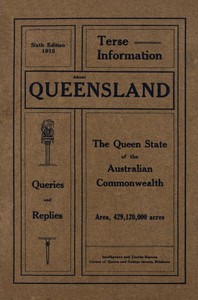
Queensland, the Rich but Sparsely Peopled Country, a Paradise for Willing Workers
Subjects:
Download Formats:
Excerpt
The Project Gutenberg EBook of Queensland, by
Queensland Government Intelligence and Tourist Bureau
This eBook is for the use of anyone anywhere at no cost and with
almost no restrictions whatsoever. You may copy it, give it away or
re-use it under the terms of the Project Gutenberg License included
with this eBook or online at www.gutenberg.org/license
Title: Queensland
The Rich But Sparsely Populated Country
Author: Queensland Government Intelligence and Tourist Bureau
Read the Full Text
— End of Queensland, the Rich but Sparsely Peopled Country, a Paradise for Willing Workers —
Book Information
- Title
- Queensland, the Rich but Sparsely Peopled Country, a Paradise for Willing Workers
- Author(s)
- Queensland Government Intelligence and Tourist Bureau
- Language
- English
- Type
- Text
- Release Date
- July 21, 2018
- Word Count
- 17,092 words
- Library of Congress Classification
- DU; HC
- Bookshelves
- Browsing: Economics, Browsing: History - General, Browsing: Travel & Geography
- Rights
- Public domain in the USA.