*** START OF THE PROJECT GUTENBERG EBOOK 62235 ***
Department of Culture, Recreation and Tourism
Louisiana Archaeological Survey and Antiquities Commission
Anthropological Study No. 5
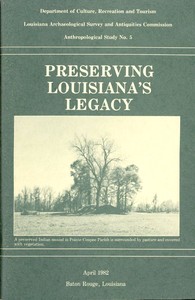
PRESERVING LOUISIANA’S LEGACY
[Illustration: A preserved Indian mound in Pointe Coupee Parish is
surrounded by pasture and covered with vegetation.]
April 1982
Baton Rouge, Louisiana
STATE OF LOUISIANA
David C. Treen
_Governor_
DEPARTMENT OF CULTURE, RECREATION AND TOURISM
Mrs. Lawrence H. Fox
_Secretary_
ARCHAEOLOGICAL SURVEY AND ANTIQUITIES COMMISSION
_Ex-Officio Members_
Dr. Kathleen M. Byrd _State Archaeologist_
Mr. Robert B. DeBlieux _Assistant Secretary_, Office of Program
Development
Mr. Frank P. Simoneaux _Secretary_, Department of Natural Resources
Mr. Linton Ardoin _Secretary_, Department of Urban and Community
Affairs
_Appointed Members_
Mr. William Baker
Mr. Fred Benton, Jr.
Mr. Brian Duhe
Dr. Lorraine Heartfield
Mr. Robert W. Neuman
Mrs. Lanier Simmons
Dr. Clarence H. Webb
This public document was published at an annual cost of $.30 per copy by
Division of Administration, Administrative Services, P.O. Box 44095,
Baton Rouge, Louisiana 70804 to make available to the citizens of
Louisiana through publication information about prehistoric and historic
archaeology under authority of La. R.S. 41:1601-1613. This material was
printed in accordance with the standards for printing by state agencies
established pursuant to RS. 43:31.
PRESERVING LOUISIANA’S LEGACY:
Everyone Can Help
Nancy W. Hawkins
Division of Archaeology
Editor’s Note
Louisiana’s cultural heritage dates back to approximately 10,000 B.C.
when Paleo-Indian hunters entered the region in search of Pleistocene
big game. Since that time, many other groups have settled in the area.
Each of these groups has left evidence of its presence in the
archaeological record. The Anthropological Study series published by the
Department of Culture, Recreation & Tourism provides a readable account
of various activities of these cultural groups.
Nancy Hawkins, outreach coordinator for the Division of Archaeology, is
the author of _Preserving Louisiana’s Legacy_, the fifth volume in the
Anthropological Study series. This volume departs somewhat from the
previous ones in the series in that it does not describe a particular
group of people or archaeological sites. Rather it addresses
archaeological preservation as a whole. In this volume Ms. Hawkins
explains in general terms how an archaeologist studies the past, what
factors affect the preservation of archaeological remains, and how
government, industry, business, landowners, and other groups and
individuals can contribute to the preservation of Louisiana’s
archaeological heritage.
We are pleased to be able to make _Preserving Louisiana’s Legacy_
available and trust that the reader will enjoy this volume.
Kathleen Byrd
_State Archaeologist_
[Illustration: Letter]
STATE OF LOUISIANA
DEPARTMENT OF CULTURE, RECREATION AND TOURISM
OFFICE OF PROGRAM DEVELOPMENT
DAVID C. TREEN
Governor Assistant
ROBERT B. DeBLIEUX
Secretary
MRS. LAWRENCE H. FOX
Secretary
April 20, 1982
CITIZENS OF LOUISIANA
As Louisiana’s State Historic Preservation Officer, I am pleased to introduce
Preserving Louisiana’s Legacy, the fifth volume in the Anthropological
Study series of the Department of Culture, Recreation & Tourism and the
Louisiana Archaeological Survey & Antiquities Commission.
Through my work first in private business and more recently in local and
state government, I have become increasingly impressed with the diversity
and uniqueness of Louisiana’s archaeological remains. There is no question
that many of these archaeological sites should be preserved for the future.
They are Louisiana’s past.
Louisiana has some of the most important sites in the United States. In
fact, one prehistoric archaeological site, Poverty Point in West Carroll
Parish, has been suggested for nomination to the World Heritage List.
This program, in which 45 nations participate, recognizes areas of outstanding
universal value to mankind.
I am proud to live in a state with such a rich archaeological heritage,
and I hope that it can be protected for future generations. However, no
one individual or group working alone can preserve Louisiana’s legacy.
Only through the concerted efforts of government, industry, business, and
individuals can this be accomplished. This volume suggests what you can
do to preserve Louisiana’s archaeological sites. I hope you enjoy this
booklet.
Sincerely,
_Rob DeBlieux_
ROBERT B. DEBLIEUX
STATE HISTORIC PRESERVATION OFFICER
P. O. Box 44247 Baton Rouge, La. 70804 504-342-6682
ACKNOWLEDGEMENTS
Illustrations for this booklet have been generously contributed by
several people. Robert Neuman, Louisiana State University, provided
photographs of Monk’s Mound (cover), a projectile point (p. 1), a vessel
from the Clarence H. Webb Collection (p. 2), a shell midden (p. 2), and
of excavation pits (p. 15). Debbie Woodiel, State Parks, gave permission
to use an illustration from her thesis (p. 5). The American Museum of
Natural History permitted reproduction of the Poverty Point site map (p.
1), and New Orleans East provided the illustration on page 13. All other
photographs are from the files at the Division of Archaeology, and have
been taken by staff archaeologists through the years.
ARCHAEOLOGY IN LOUISIANA
People lived in Louisiana thousands of years before the first Europeans
sailed to the New World. Because of archaeology, the history of even
these early Indians is now being described and understood. All people
leave traces of their activities wherever they cook, build houses, hold
religious ceremonies, make tools, or dump their trash. If these traces
are undisturbed, archaeologists can use them to determine who left them,
when they were left, and what activities were associated with them.
These are a few of the things archaeologists have learned about
Louisiana:
[Illustration: Although many people refer to all stone points as
arrowheads, Indians actually made projectile points for over 10,000
years before they ever used one on an arrow. The point pictured here
would have been used on a spear and could have killed a prehistoric
elephant, called a mastodon.]
[Illustration: In northeastern Louisiana by 1000 B.C., Indians had
built rows of earthen ridges three-quarters of a mile across. As far
as we know, they are the earliest earthworks of their size in North
America. Some archaeologists think they were constructed as an
astronomical observatory because two gaps in the ridges line up with
the winter and summer solstice sunsets.]
[Illustration: Contrary to present day practice, prehistoric
Louisianians preferred marsh clams over crawfish and crabs. They ate
so many clams that large piles of shells can still be found in the
marshes. Over time, the shells have become compressed, and now some
piles are almost rock hard.]
[Illustration: Indians in Louisiana made beautiful and elaborate
pottery without ever using a potter’s wheel. This delicate water
bottle was made in northwestern Louisiana about A.D. 1400.]
[Illustration: European missionaries and explorers who traveled in
Louisiana in the 1600s and 1700s depended on experienced Indian
traders to supply them with food, animal skins, salt, and horses. In
exchange, Europeans gave the Indians beads, crucifixes, guns, metal
pots, knives, and bells like these.]
HOW AN ARCHAEOLOGIST STUDIES THE PAST
Although an archaeologist can gain some information from artifacts that
have been removed from a site, much more information can be gleaned
through careful survey and excavation. During a survey, the
archaeologist examines artifacts remaining on the ground and records
large concentrations as sites. The archaeologist evaluates each site’s
size and age, and determines how it contributes to an overall
understanding of Louisiana’s past.
No two sites exactly duplicate each other, but some are more unusual
than others. Some provide new or important information linking a group
of people with a certain location or activity for the first time. This
means that sometimes a small site, without elaborate or especially
beautiful artifacts, may be more important to the understanding of the
past than another site that is larger. An archaeologist who records an
important site will recommend protection or excavation for it.
The archaeologist will evaluate threats to the site to determine the
possibility of preserving the site intact. Some sites must be protected
to insure that future generations can see unexcavated sites, and so that
future archaeologists with improved techniques will have sites left to
study. Even if an archaeologist excavates a site, he or she will usually
leave parts of it untouched.
Archaeological excavation of a site is meticulous in order to preserve
every piece of information. The archaeologist photographs and draws soil
changes and artifacts as they are uncovered. This provides a permanent
record of the relationships of materials to each other and to other
parts of the site. Samples of charcoal, soil, bones, and decayed plants
are collected for laboratory analysis.
Long months of study and interpretation follow excavations as the
archaeologist and technicians piece together the many bits of
information. Laboratory analysis may indicate what people ate, what
plants were growing around the site, and perhaps even the date the site
was used. Study of the artifacts may tell how the site was used, who
used it, and whether they were trading with other groups.
Relationships of the remains show what parts of the site were used for
butchering game, cooking food, making tools, gardening, building houses,
burying the dead, and conducting ceremonial activities. Artifact
relationships may tell whether men and women worked in different areas,
and whether the site was used repeatedly through the years. An
archaeologist may even be able to discover very detailed information
like whether the people cooked their fish whole or in fillets, what
strains of corn they grew, and what kind of wood they used to build
their houses. This detailed understanding can result only from careful
study of a well-preserved site.
The archaeological sites of Louisiana span the time from the arrival of
the earliest inhabitants, approximately 12,000 years ago, to the 20th
century. These sites are as important in understanding Louisiana’s past
as original journals from early explorers. Each is a unique description
of the land and people from years past. Just as a journal with all its
pages tells more than a single page out of context, a complete site
tells many times more than artifacts on a shelf or a site half-destroyed
by modern-day construction activities.
[Illustration: Excavation of a mound site in Iberville Parish was
meticulous in order to record the relationships of materials and to
collect remains for laboratory analysis (above). Archaeologists were
able to determine that under the mound was a circular house built of
cypress and ash poles that were covered with thatch (right). Inside
were interior support posts and wooden furniture such as beds or
racks, as well as a central fire hearth and four smaller fire pits.
Honey locust seeds, persimmon seeds and bones from four kinds of
fish indicate some of the things these prehistoric people ate.
Radiocarbon dates show that the structure was being used at A. D.
1000.]
Everyone in Louisiana has the right to know about the state’s legacy.
The complete history of Louisiana can be recorded only through careful,
detailed excavation by individuals especially trained in archaeological
techniques. If a site is destroyed before it can be evaluated, that
information is lost forever; it is irreplaceable. Unfortunately, sites
are destroyed every day in Louisiana, both accidentally and
intentionally.
[Illustration: 16 lv 128
PLAN VIEW OF FEATURE THREE, LEVEL FOUR]
Wall Trench
Embankment
Ramp
Post
Fire Hearth
MAJOR IMPACTS ON SITE PRESERVATION
Throughout history, the traces of people who lived before have been
altered by those who followed. Even when Indians camped in places where
their ancestors had camped, they destroyed a piece of the record of
their past. In contrast with this age-old pattern of minor alterations,
however, is the potentially devastating impact of modern-day technology.
In Louisiana today, major types of land modification include energy
exploration and development, timber cutting, agriculture, urban
expansion, waterway modification, and transportation network
construction. These are all likely to disturb archaeological sites if
they are conducted without care.
[Illustration: Heavy machinery can destroy a site in minutes.]
The country’s need for oil, gas, coal, and timber has accelerated the
search for these products in the past decade. As exploration crews cut
roads into otherwise inaccessible areas, previously undetected sites are
exposed and disturbed. When heavy machinery is brought in to begin
logging, drilling, or mining, sites can be gouged or crushed in a few
seconds. Unless the crews are alert, fragile archaeological sites are
destroyed before they are even recorded. In Louisiana’s coastal areas,
oil and gas production has also affected sites. Pipelines are often laid
through piles of shells because they are more stable than the
surrounding land. Unfortunately, a great many of these piles are
man-made; they are actually archaeological sites.
Mechanized agriculture affects sites when plows turn up artifacts,
jumbling the materials. Whenever an area is cultivated for the first
time, sites may be found. In Louisiana, previously undisturbed areas
within the river valleys are now being cleared for large-scale
agriculture. Many buried prehistoric sites along old river channels
could be destroyed. Sites in cultivated fields may be damaged further if
they are plowed more deeply than in the past. Modern subsoilers can cut
three feet into the ground, disturbing even deeply buried materials.
[Illustration: This gas pipeline in southeastern Louisiana’s marsh
was laid directly through an archaeological site.]
Farmers often regard Indian mounds as troublesome when they occur in
areas otherwise ideal for plowing. If farmers do not recognize the value
of these mounds, they may have them removed. For example, a man in
Madison Parish sold the dirt from a large Indian mound on his land for
road fill. The ancient monument was removed so the land could be planted
with soybeans.
[Illustration: Dirt from this mound in Madison Parish was used for a
road foundation ...]
Population growth in Louisiana has led to rapidly expanding cities and
extended transportation networks. Modern cities are often in the same
places that Indians and early Europeans built their settlements, so city
growth is almost certain to disturb archaeological sites. As early as
the turn of the century, archaeologists were charting the destruction of
a mound group in eastern Louisiana. A city was growing up around one of
the largest groups of mounds in the Southeastern United States. In 1931,
an archaeologist wrote about the leveling of one of the mounds, a square
multi-stage one, 80 feet tall and 180 feet on each side. The dirt was
used to build the approach ramps for a bridge. Today, part of only one
mound remains, protected because of the recent cemetery on top.
[Illustration: leaving behind only a few clumps of trees.]
The destruction mentioned above has resulted from a lack of
understanding of the importance of these sites. It has taken
Louisianians a long time to realize the uniqueness and richness of their
state’s cultural heritage. While many people are now joining in the
efforts to conserve the remaining sites, a few continue to willfully
destroy them.
Some individuals dig into sites in order to find artifacts that can be
sold to antiquity dealers. These looters have demolished entire Indian
villages, stealing the story of those sites from all Louisianians. Even
if the artifacts are eventually turned over to an archaeologist, most of
the information has been obliterated. Lost are the records of where the
artifacts originally came from, the relationships of the artifacts to
each other, the samples of materials for laboratory analysis, and
usually the ordinary or broken artifacts that tell the archaeologist
much, but sell for little.
[Illustration: Looters at this archaeological site found artifacts,
but destroyed all the other information archaeologists could have
used to interpret the site.]
[Illustration: Damaged site]
GOVERNMENT HELPS
Although countless sites have been destroyed in Louisiana, many other
sites have been saved by concerned individuals, companies, and
organizations.
Our legislators have been interested enough in Louisiana’s heritage to
draft laws that help protect sites. Without a permit, it is now illegal
to dig into, alter, or take anything from a site on state or federal
land. Recent legislation calls for strict fines or jail sentences for
people collecting materials from federal lands.
Our laws also help protect sites from those land alteration projects
that in the past destroyed so many sites. The locations of proposed
projects are now checked against archaeological records to be sure that
no known sites will be affected. If the project is a large one, or if
the area appears likely to have sites, an archaeological investigation
will be recommended to determine whether sites are in the area.
Because of this process, approximately 400 previously undocumented sites
are now recorded and evaluated by archaeologists in Louisiana each year.
This has resulted in a more complete record of Louisiana’s
archaeological sites and a decrease in the rate of site destruction by
industry. It has also encouraged developers to think about the care of
our past early in the planning stages of their projects.
Both federal and state governments protect archaeological sites as parks
that the public can visit. In Louisiana, the National Park Service has
included the Big Oak Island site near New Orleans as part of Jean
Lafitte National Historical Park. This site dates from the time of
Christ and was seasonally used for shellfish collecting and processing.
The Louisiana Office of State Parks also maintains two prehistoric
archaeological sites that are open to the public and that have
interpretive museums. One is Poverty Point Commemorative Area where the
state’s largest prehistoric earthworks were built 3,000 years ago, and
the other is Marksville State Commemorative Area where Indians built
mounds approximately 2,000 years ago. Archaeological investigations have
also been conducted at many of the commemorative areas associated with
18th, 19th, and 20th century history. These parks give people a chance
to learn more about archaeology and how it contributes to an
understanding of our state’s past.
BUSINESS AND INDUSTRY HELP
Businesses and industries are most likely to deal with archaeological
sites when they plan projects on publicly-owned lands or when projects
require permits. Many developers are sensitive to the need for
preservation of important sites and plan ahead for evaluation of the
project’s impact on these. Businesses and industries whose projects will
affect sites are proving to be creative in their responses. Sometimes, a
minor change, like moving a road 25 feet to one side, may prevent a site
from being destroyed.
Businesses also participate in archaeology because of curiosity about
sites on their land. Some have provided food and lodging for excavators
or have given grants to archaeologists to fund field and lab work. After
analysis is completed, these companies have either donated artifacts to
a museum or have developed small displays for their employees.
Companies are discovering that becoming involved with archaeology can
have tax advantages. If a company donates land with a site on it to a
nonprofit or governmental organization, the donation can be claimed as a
tax deduction. A company also can receive a tax benefit by sponsoring
excavation of a site either on or off its property. One southern
Louisiana company funded 25% of the cost of an excavation and counted
that as a tax deduction. The company owned the land with the site, so by
donating the artifacts, it also could claim their worth as a tax
deduction.
A New Orleans development corporation planned a massive project with an
extremely important site in mind. The company leased land with a site on
it to the Jean Lafitte National Historical Park for $1.00 a year. Rather
than viewing the site as a liability, however, the company saw it as an
asset. Through the lease of the site, the corporation generated positive
community feelings, protected a part of our cultural heritage, and
enhanced the value of the surrounding property. The benefits to the
community and to the corporation will continue into the future.
A Baton Rouge company also was able to use archaeology in public
relations. It developed an outstanding display about prehistoric
Louisiana for the lobby of its main building. The exhibit attracts
visitors and promotes interest not only in archaeology, but also in the
company’s services.
[Illustration: One New Orleans developer is protecting a major site
and is advertising its decision.]
IN BUILDING
NEW ORLEANS EAST,
SOME THINGS ARE MORE SACRED
THAN THE ALMIGHTY DOLLAR.
Once, New Orleans was rich in hidden archeological treasures. Over 600
prehistoric sites were buried throughout the city, but almost all of
them have been destroyed in the name of progress. One of the most
valuable sites, however, has miraculously survived the city’s
development: a prehistoric village of the Tchefuncte Indian Tribe,
dating back to 500 BC. It’s called Big Oak Island and it’s located in
New Orleans East.
In order to preserve this part of our city’s heritage, New Orleans
East has leased this 12-acre site, right in the heart of our
community, to the Jean Lafitte National Historical Park. The cost: one
dollar a year.
Donating this valuable piece of land to the Park Service is just one
example of what makes us different from other developers. Throughout
New Orleans East, we’re leaving additional areas untouched as well, so
that in the future, residents here will have trees to enjoy, birds to
watch, and parks to play in. We’re doing all this because we want New
Orleans East to be a community that everyone in New Orleans can be
proud of.
Building a community with this kind of concern for the environment may
not be the most profitable development plan, but, like the treasures
of Oak Island, it may very well be priceless in the years to come.
PRIVATE LANDOWNERS HELP
People who have archaeological sites on their land have many ways of
protecting the sites. A site covered by natural vegetation usually is
camouflaged and has limited access. As long as the owner does not clear
the land, disturbance to the site will be minimized. A site already in a
cultivated field probably will not suffer significantly from continued
plowing at the same depth. Although initial plowing altered artifact
relationships in the plow zone, the materials beneath remain well
protected.
A landowner who is interested in protecting a site may want to have it
recognized by placing it on the Registry of State Cultural Resource
Landmarks. The Registry is established as an authoritative guide to the
state’s most important archaeological sites. Once a site is placed on
the Registry, there is an agreement between the owner and the State of
Louisiana to help protect it. This process ensures that important sites
will be recognized, preserved, and protected to the maximum extent
possible.
[Illustration: The site in this soybean field has already been
disturbed, but probably will not suffer significantly if plowing is
continued at the same depth.]
[Illustration: Landowners who finance excavations can receive
substantial tax benefits.]
A landowner who is unable to protect a site because of plans to plow
deeper, cultivate an unplowed area, or do construction, should alert the
Division of Archaeology. If he gives enough advance warning, an
archaeologist may be able to evaluate the site before the changes begin.
Recently, the tax advantages available to site owners have been
clarified. One landowner paid half of the excavation cost at a site on
his land and claimed his cost as a tax deduction. Later, he donated the
artifacts from the site and also deducted their worth, equivalent to the
entire cost of the excavation.
Federal tax incentives also apply to the gift of an important
archaeological site to a governmental or nonprofit organization. This
donation can be either an outright gift or an easement (in which the
owner gives up certain control of the land, but retains ownership). In
either case, the transaction qualifies as a charitable contribution for
federal income tax, estate tax, and gift tax purposes.
YOU CAN HELP
Most archaeological sites are first discovered not by professional
archaeologists, but by ordinary people who live or work near the sites.
Usually these people do not know how to report a site to the proper
authorities. If you find a site, you can help protect Louisiana’s
heritage by letting archaeologists know about it. The Division of
Archaeology has prepared a form especially for you to use, and one is in
the center of this booklet.
[Illustration: The first step in recording a site is plotting its
location on a U.S.G.S. topographic quad or other accurate map.]
You should fill out the form as completely as possible, without
attempting to dig in the site. Mark its location on a map, and
photograph the site area. Try to draw the artifacts you see; you don’t
need to be an artist, just trace around them on a piece of paper and
sketch in any designs. If you find artifacts in a protected area where
they are not being disturbed, it is best not to collect them; they may
tell an archaeologist a great deal if they are left in place. If,
however, you do collect something from the site, be sure to store it
carefully with information about exactly where you found it.
Please mail the form, map, photographs, and drawings to the Division of
Archaeology. Your information will be carefully reviewed, and added to
the permanent file stored in Baton Rouge. A staff archaeologist will
write a letter, telling you if the site has been assigned an official
state number, and possibly asking for more information. By reporting a
site, you will be helping to record the history of the state.
If you want to learn more about Louisiana archaeology, you can enroll in
a class at a local university, visit museums, read archaeology books, or
tour one of the state archaeological commemorative areas.
You may also want to join the Louisiana Archaeological Society (LAS).
The Society’s chapters throughout the state have monthly meetings with
programs discussing local and state-wide archaeology. The LAS publishes
a quarterly newsletter with information about current research, and an
annual bulletin with in-depth reports. Often the LAS chapters also are
involved in archaeological survey or excavation. The organization’s
members are both professional and avocational archaeologists who come
together to advance Louisiana archaeology.
You will also find other opportunities to help protect Louisiana’s
heritage throughout the year. You can encourage your elected officials
to support legislation protecting sites. You can help friends record and
preserve sites on their land. Most importantly, you can explain to
others the importance of archaeological sites, and the reasons for
preserving them. By doing these things, you will be working with
concerned people throughout the state to preserve Louisiana’s legacy for
the future.
Your Name ______________________________
Your Address
______________________________
______________________________
Your Telephone Number ______________________________
Date ______________________________
Additional Comments:
______________________________
______________________________
______________________________
______________________________
Please mail this to:
Division of Archaeology
P. O. Box 44247
Baton Rouge, LA 70804
Site Name ______________________________
Parish ______________________________
Instructions for Reaching Site from Nearest Major Road
______________________________
______________________________
Owner’s Name ______________________________
Owner’s Address
______________________________
______________________________
Tenant’s Name ______________________________
Tenant’s Address
______________________________
______________________________
Characteristics of Site:
[_] mound(s),
[_] scatter of artifacts,
[_] shell heap(s),
[_] old building(s),
[_] other ______________________________
General Site Description
______________________________
Site Size ______________________________
Kinds of Artifacts:
[_] projectile points (arrowheads),
[_] stone chips,
[_] Indian pottery pieces,
[_] bones,
[_] shells,
[_] beads,
[_] pieces of old dishes,
[_] old bottles,
[_] other ______________________________
Estimated Number of Artifacts ______________________________
Present Use of Land ______________________________
Type of Erosion, Development, or Other Site Disturbance
______________________________
______________________________
People Who Have Collections from the Site:
Name ______________________________
Address
______________________________
Name ______________________________
Address
______________________________
IF POSSIBLE, PLEASE ACCOMPANY THIS FORM WITH A ROAD MAP WITH THE SITE
MARKED, PHOTOGRAPHS OF THE SITE, AND SKETCHES OF REPRESENTATIVE
ARTIFACTS.
Anthropological Study Series
No. 1 On the Tunica Trail
by Jeffrey P. Brain
No. 2 The Caddo Indians of Louisiana, second edition
by Clarence H. Webb & Hiram F. Gregory
No. 3 The Role of Salt in Eastern North American Prehistory
by Ian Brown
No. 4 El Nuevo Constante
by Charles E. Pearson, et al.
No. 5 Preserving Louisiana’s Legacy
by Nancy W. Hawkins
No. 6 Louisiana Prehistory
by Robert W. Neuman & Nancy W. Hawkins
No. 7 Poverty Point
by Jon L. Gibson
No. 8 Bailey’s Dam
by Steven D. Smith and George J. Castille III
These publications can be obtained by writing:
Division of Archaeology
P. O. Box 44247
Baton Rouge, LA 70804
Transcriber’s Notes
—Silently corrected a few typos.
—Retained publication information from the printed edition: this eBook
is a government public document, and can be freely copied and
distributed.
—In the text versions only, text in italics is delimited by
_underscores_.
End of Project Gutenberg's Preserving Louisiana's Legacy, by Nancy W. Dawkins
*** END OF THE PROJECT GUTENBERG EBOOK 62235 ***
Preserving Louisiana's Legacy: Everyone Can Help
Subjects:
Download Formats:
Excerpt
Department of Culture, Recreation and Tourism
Louisiana Archaeological Survey and Antiquities Commission
Anthropological Study No. 5
[Illustration: A preserved Indian mound in Pointe Coupee Parish is
surrounded by pasture and covered with vegetation.]
April 1982
Baton Rouge, Louisiana
David C. Treen
_Governor_
Mrs. Lawrence H. Fox
_Secretary_
Dr. Kathleen M. Byrd...
Read the Full Text
— End of Preserving Louisiana's Legacy: Everyone Can Help —
Book Information
- Title
- Preserving Louisiana's Legacy: Everyone Can Help
- Author(s)
- Hawkins, Nancy W.
- Language
- English
- Type
- Text
- Release Date
- May 26, 2020
- Word Count
- 4,664 words
- Library of Congress Classification
- E011; F350.5
- Bookshelves
- Browsing: Archaeology, Browsing: Environmental Issues, Browsing: History - American
- Rights
- Public domain in the USA.
Related Books
Reconstruction in Louisiana after 1868
by Lonn, Ella
English
496h 26m read

Social life in old New Orleans
by Ripley, Eliza
English
1140h 52m read
Captain Bill McDonald, Texas Ranger: A Story of Frontier Reform
by Paine, Albert Bigelow
English
1822h 26m read
Six Years with the Texas Rangers, 1875 to 1881
by Gillett, James B.
English
1197h 40m read
The Valley of Democracy
by Nicholson, Meredith
English
994h 28m read
Conservation Archaeology of the Richland/Chambers Dam and Reservoir
by Moir, Randall W., Raab, L. Mark
English
136h 6m read