The Project Gutenberg EBook of USDA Farmers' Bulletin No. 1972:
Poison-ivy, Poison-oak and Poison Sumac: Identification, Precautions and Eradication, by Donald M. Crooks and Leonard W. Kephart
This eBook is for the use of anyone anywhere in the United States and most
other parts of the world at no cost and with almost no restrictions
whatsoever. You may copy it, give it away or re-use it under the terms of
the Project Gutenberg License included with this eBook or online at
www.gutenberg.org. If you are not located in the United States, you'll have
to check the laws of the country where you are located before using this ebook.
Title: USDA Farmers' Bulletin No. 1972: Poison-ivy, Poison-oak and Poison Sumac: Identification, Precautions and Eradication
Author: Donald M. Crooks
Leonard W. Kephart
Release Date: May 19, 2019 [EBook #59555]
Language: English
Character set encoding: ISO-8859-1
*** START OF THIS PROJECT GUTENBERG EBOOK USDA FARMERS' BULLETIN NO. 1972 ***
Produced by Tom Cosmas compiled from images made available
by The Internet Archive.
Transcriber Note
Text emphasis is denoted as: _Italics_ and =Bold=.
POISON-_ivy_
POISON-_oak_
and
POISON _sumac_
IDENTIFICATION
PRECAUTIONS
ERADICATION
Farmers' Bulletin No. 1972
U. S. DEPARTMENT OF AGRICULTURE
POISON-IVY, poison-oak, and poison sumac remind most people of painful
experiences to be avoided, yet many do not know any one of the offending
plants or their equally poisonous relatives. Learning to recognize them
on sight is relatively easy, especially by examining the distinctive
identifying characters described in the pictures and legends of this
bulletin. There is then a good chance to avoid them or, if one must work
among them, to take preventive measures to escape poisoning.
These plants are very common throughout the United States. They are
found in fields and woods, along fence rows, rock walls, and hedges,
in lawns and gardens, and even sometimes vining on houses. Usually in
any one locality it is necessary to be certain of the identity of only
two or three of them. Maps show at a glance where they are likely to
be found. Frequent observation and recognition of the plants as they
are encountered almost daily is the best way to become poison-oak or
poison-ivy conscious. Nonpoisonous sumacs are easily distinguished from
the poisonous species by the seed heads and leaves.
The old proverb, "an ounce of prevention is worth a pound of cure,"
is good advice to everyone, particularly as regards ivy-poisoning.
Previous escape is not proof of immunity when conditions are right, and
after poisoning occurs there is no quick cure known. Some relief may be
obtained and recovery hastened by use of some of the tested remedies. In
case of severe poisoning a physician should be consulted.
Poison-ivy and other poisonous plants growing in grounds frequented by
people should be eradicated. In some places this can be done by careful
grubbing. In others weed-killing chemicals may be better and more
certainly would avert poisoning for most of us.
This bulletin supersedes Farmers' Bulletin 1166, Poison Ivy and Poison
Sumac and Their Eradication.
Washington, D. C. Issued August 1945
POISON-IVY, POISON-OAK, AND POISON SUMAC: IDENTIFICATION, PRECAUTIONS,
ERADICATION
By Donald M. Crooks, _principal horticulturist, Division of Tobacco,
Medicinal, and Special Crops_, and Leonard W. Kephart, _senior
agronomist, Division of Cereal Crops and Diseases, Bureau of Plant
Industry, Soils and Agricultural Engineering, Agricultural Research
Administration_
Contents
Page
A widespread menace to health 1
Forms of poison-ivy and poison-oak 2
Common poison-ivy 2
Oakleaf poison-ivy 9
Western poison-oak 9
Poison sumac 16
Confusion of poisonous and harmless sumacs 19
Introduced poisonous sumac and related species 21
Poisoning 21
Precautions against poisoning 22
Treatment for poisoning 23
Eradication of plants 25
Chemical weed killers 25
Eradication by mechanical means 25
A WIDESPREAD MENACE TO HEALTH
EVERY year sees many adults, and especially children, accidentally
poisoned from contact with plants that they did not know were harmful.
Had the sufferers known how to detect poisonous plants they could
have avoided them and escaped the painful experience of severe skin
inflammations and water blisters. Very few persons have a sufficient
degree of immunity to protect them from poisonous plants, and many do not
recognize them in the various forms that they assume in different parts
of the country.
One or more kinds of poison-ivy--common poison-ivy, oakleaf poison-ivy,
and western poison-oak--occur in abundance in almost every part of the
United States. Poison sumac is of more limited distribution and occurs
chiefly east of the Mississippi River, usually in swampy regions.
Poisoning by these plants is largely preventable. A knowledge sufficient
to identify them in their various forms is easily gained by anyone who
will make a study of pictures and general descriptions and train himself
by a little diligent practice to observe the plants in his locality. It
is important to become poison-oak or poison-ivy conscious. This can be
accomplished only by learning to know the plants by repeated experience
in observing them in their various forms. Persons who learn both to
know and to avoid the plants can save themselves much inconvenience and
discomfort. The simple means of learning to recognize them will pay big
dividends. It is the first step to the prevention of poisoning and to the
eradication of the pests from private grounds and public places.
The most effective method of prevention is to eradicate the plants, and
wherever possible this should be done. They should not be allowed to grow
in lawns or gardens, with ornamental shrubbery, or on houses. Communities
should not countenance the growth of poison-ivy or poison-oak in school
grounds, on public roadways, or in parks, especially those frequented by
children. The cost of medical aid for one season in treating pupils using
an ivy-infested schoolyard is likely to be more than that of eradicating
the plants, to say nothing of the suffering and inconvenience they may
cause.
FORMS OF POISON-IVY AND POISON-OAK
Poison-ivy and poison-oak are known by a number of local names, and
several different kinds of plants are called by these names. The plants
exhibit a good deal of variation throughout the United States, so much
so that even technical botanists cannot agree on the number of species
and names that should be applied to them. They grow in the form of (1)
woody vines attached to trees or objects for support, (2) trailing shrubs
mostly on the ground, or (3) erect woody shrubs entirely without support.
They may flourish in the deep woods, where soil moisture is plentiful,
or they may be found in very dry soil on the most exposed hillsides. The
plants are most frequently abundant along old fence rows and edges of
paths and roadways, and they ramble over rock walls and climb posts or
trees to considerable heights. They often grow with other shrubs or vines
in such ways as to escape notice.
The leaf forms among plants or even on the same plant are as variable
as the habit of growth; however, the leaves always consist of three
leaflets. The old saying, "Leaflets three, let it be," is a reminder of
this consistent leaf character but may lead to undue suspicion of some
harmless plant. Only one three-parted leaf leads off from each node on
the stem. The leaves never occur in pairs along the stem. The wide range
in habit of growth of plants and leaf types may be noted from a glance at
the several pictures of plants and leaves.
The flowers and fruit are always in clusters on slender stems that
originate in the axis of the leaves along the side of the smaller
branches. The fruits usually have a white, waxy appearance and ordinarily
are not hairy, but may be so in some forms. The plants do not always
flower and bear fruit. The white or cream-colored clusters of fruit, when
they occur, are significant identifying characters, especially at the
season after the leaves have fallen.
For convenience, these plants are discussed in this bulletin under three
divisions: (1) Common poison-ivy, (2) oakleaf poison-ivy, and (3) Western
poison-oak. A technical botanist would recognize many species of plants
in what are included as the common poison-ivy, and anyone will recognize
that various forms occur within this grouping.
COMMON POISON-IVY
Some form of the common poison-ivy may be found in almost every part of
the country but the extreme West. The shaded area on the map in figure 1
shows the extensive range where some form of poison-ivy is likely to be
found. The plant is known by various local names--poison-ivy, threeleaf
ivy, poison creeper, climbing sumac, poison-oak, markweed, piery, and
mercury. The most widespread form is classified by botanists under the
botanical name of _Rhus radicans_ or varieties of it; however, many of
the variations are sometimes given other botanical names. The common
poison-ivy may be considered as a vine in its most typical growth habit.
_Figure 1._--The shaded part shows the extensive area where some form of
the common poison-ivy is likely to be found. Other forms also may occur
in parts of the same region.
_Figure 2._--Large poison-ivy vine growing on a tree for support. This is
the usual form of the common poison-ivy in wooded areas.
_Figure 3._--_A_, Common poison-ivy growing in a hedge and on a shade
tree on the edge of a lawn. _B_, Typical vine, showing leaves and the
roots that attach it to the tree.
The vining type most often occurs in wooded areas (fig. 2), where it
depends upon trees for support. Vines often grow for many years, becoming
several inches in diameter and quite woody. Slender vines may run along
the ground, mixed with shrubbery, or take support from a large or
small tree. That a plant growing along the edge of a lawn and into the
shrubbery may be quite inconspicuous as compared with a vine climbing on
a lawn tree is shown in figure 3. The vine readily develops roots when in
contact with the ground or with any object that will support it. When the
vines grow on trees these aerial roots attach the vine securely ( fig. 3.
B). A rank growth of these roots often causes the vines on trees to have
the general appearance of a "fuzzy" rope, which sometimes serves a good
purpose for identification. The vines and roots apparently do not cause
injury to the tree except where growth may be sufficient to cover the
supporting plant and exclude sunlight or break the plant from excessive
weight. The vining nature of the plant makes it well adapted to climbing
over stone walls or on brick and stone houses.
The fact that poison-ivy often becomes mixed in with ornamental shrubbery
and vines often results in its cultivation as an ornamental vine by
people who do not recognize the plant. An ivy plant growing on a house,
as is shown in figure 4, is often prized by an unsuspecting owner. The
vine is attractive and quite effective as an ornamental, but such use
should not be tolerated, as it most certainly will result in cases of
accidental poisoning and serve as propagating stock for more poison-ivy
in the vicinity.
_Figure 4._--Common poison-ivy growing on side of house with ornamental
shrubs. This accidental or intentional use of the attractive vine may
lead to many cases of accidental poisoning.
_Figure 5._--Common poison-ivy growing along fence row. In open sunlight
and over some large areas it is more of a shrub than a vine.
_Figure 4._--Common poison-ivy growing on side of house with ornamental
shrubs. This accidental or intentional use of the attractive vine may
lead to many cases of accidental poisoning.
When poison-ivy becomes mixed in with other vines it is quite difficult
to detect except by one who has carefully trained himself in observing
and recognizing the plant. Also, some other vines and young plants
resemble poison-ivy in many respects. The Virginia creeper and some forms
of the Boston ivy are often confused with it. The Virginia creeper can
always be recognized by its five leaflets radiating from one point of
attachment, as compared with the three leaflets of poison-ivy arranged
in the same manner. The Boston ivy with three leaflets is sometimes
difficult to detect; however, as a rule not all the leaves on the plant
will be divided into three leaflets. By studying a large number of the
leaves it is usually possible to detect on every Boston ivy plant some
leaves that have only one deeply lobed blade or leaflet, while the
poison-ivy always has the three leaflets. A number of other plants are
easily confused with poison-ivy. No specific rule can be observed that
will easily rule out all possibility of confusion. The best policy is to
learn through practiced observation to know poison-ivy on sight and then
to make the determination from observation of all parts of the plant, and
never to judge from a single leaf or part.
_Figure 6._--Leaves of common poison-ivy, about half natural size. These
may occur on the same or different plants: _A_, _B_, _C_ and _F_, less
common; _D_, with even margins, the most common and generally recognized
form; _E_, with lobed margins, nearly nearly as often seen as the shape
in _D_.
_Figure 7._--Common poison-ivy vine with clusters of flowers in the axis
of each leaf.
Common poison-ivy in full sunlight along fence rows or in open fields
grows more in the form of a shrub than a vine. In some localities the
common form is a low-growing shrub from 6 to 30 inches in height.
This form, as well as the vining type, usually has a rather extensive
horizontal system of rootstocks or stems at or just below the ground
level. The vining form under some conditions later becomes a shrub.
Plants of this type are shown in figure 5, where the vine, supported
on the fence, has extended upright stems that are shrublike. In some
localities the growth form over a wide range is consistently either a
vine or a shrub type, while in others what seems to be the same species
may produce either vines or shrubs.
The leaves of the common poison-ivy are extremely variable, the three
leaflets being the only constant character. It is impossible to describe
the great range of variation in the shape or lobing of the leaflets. A
study of the leaf patterns, especially the six shown in figure 6, will
give a fair range of types, although other forms may be found. One plant
may have a large variety of forms of leaves or it may have all leaves of
about the same general character. The most common type of leaf having
leaflets with even margins is shown in figure 6, _D_, and one with
leaflets having slightly lobed margins is shown in figure 6, _E_. The
other forms shown in figure 6 are not quite so widespread, but may be the
usual type throughout some areas.
_Figure 8._--Common poison-ivy, about natural size: _A_, Flowers; _B_,
mature fruit.
Most of the vines or shrubs of poison-ivy produce some flowers that are
always in clusters arising on the side of the stem immediately above a
leaf. The flowers are rather inconspicuous among the leaves, as may be
noted in figure 7, but they are in quite distinct clusters, as shown in
figure 8, _A_. Frequently the flowers do not develop or are abortive and
no fruit is produced. When fruits do develop they serve as a positive way
of identifying the plant. The berries are not easily confused with the
fruits of other plants. They are white and waxy in appearance and have
rather distinct lines marking the outer surface, as the segments appear
in a peeled orange. These lines may be noted in figure 8, _B_, which
shows dense clusters of mature fruit about natural size. Some forms of
the poison-ivy have the fruit covered with fine hair, giving it a kind
of downy appearance; however, in the more common form the fruits are
entirely smooth. The fruit is especially helpful in identifying plants
late in fall, in winter, and early in spring, when the leaves are not
present.
_Figure 9._--The shaded area is the region where the eastern oakleaf form
of poison-ivy is likely to occur. Other forms also may be in the same
region.
OAKLEAF POISON-IVY
Of the several kinds of poison-ivy, the oakleaf form occurring in the
Eastern and Southern States is more distinctive than some other types.
Some people know it as oakleaf ivy while others call it poison-oak,
a name more commonly used for the western species discussed later.
Botanists have not always agreed upon the scientific name to be applied
to this form; however, they now use the name _Rhus toxicodendron_. Some
botanists have used the Latin names _R. quercifolia_, while others used
the name _Toxicodendron quercifolium_, both of which are more descriptive
of the oakleaf form, as the generic name of the oak is _Quercus_. The
area where the oakleaf form may occur, from New Jersey to Texas, is
outlined in the map shown in figure 9. The common poison-ivy also occurs
in some form throughout many parts of this same area.
The oakleaf poison-ivy usually does not climb as a vine, but occurs as
a low-growing shrub. Stems are usually upright in their general growth
habit, as they appear in figure 10. The shrubs usually have rather
slender branches, often covered with a fine pubescence that gives the
plant a kind of downy appearance. The leaflets occur in threes, as in
other ivy, but are lobed, somewhat on the general plan of the leaves of
some kinds of oak. The middle leaflet usually is lobed somewhat alike
on both margins and very much resembles a small oak leaf, while the two
lateral leaflets are often irregularly lobed. The leaves shown in figure
11 are a common form. The lighter color on the under side of one of the
leaves (fig. 11, _A_) is due to the pubescence, or fine hairs, on the
surface. The range in size of leaves varies considerably, even on the
same plant; the leaf shown in figure 11, _B_, however, is about natural
size.
The fruit of oakleaf poison-ivy has the same general appearance as the
fruit of common poison-ivy shown in figure 8, although the individual
fruits and stems are often pubescent, while most of the other forms have
a waxy, smooth, cream-colored fruit.
_Figure 10._--Eastern oakleaf poison-ivy shrub. The upright growth as
a low shrub is common. The three parts of each leaf somewhat resembles
an oak leaf. The gall formations that cause wartlike protuberances are
common on all species.
_Figure 11._--Eastern oakleaf poison-ivy: _A_, Leaves, showing upper deep
green surface and lower lighter colored surface. _B_, Single leaf, about
natural size. The terminal leaflet more nearly resembles an oak leaf than
the two lateral leaflets.
WESTERN POISON-OAK
The western poison-oak (_Rhus diversiloba_) of the Pacific Coast States
is usually known as poison-oak, but is occasionally referred to as
poison-ivy or yeara. It is likely to be found in the region designated
by shading in figure 12, and from central Oregon northward through
Washington may be growing intermixed with common poison-ivy. The term
"poison-oak" is a misnomer, as this species is in no way related to the
oak but is related to poison-ivy. Anyone familiar with either of these
plants in their several forms will likely recognize the other, both as
plants to be avoided.
_Figure 12._--The shaded area is the region where the western poison-oak
is likely to occur. Other forms may also be in the same region.
The most common growth habit of the western poison-oak is in the form of
a rank upright shrub with many small woody stems rising from the ground.
It frequently grows in great abundance along roadsides (see fig. 16) and
in uncultivated fields or on abandoned land.
Sometimes western poison-oak attaches itself to upright objects for
support and takes more or less the form of a vine. A plant of this type
is shown in figure 13, where it is growing on a telephone pole by the
roadside. It may be noted even in this case that the tendency is for
individual branches to continue an upright growth rather than become
entirely dependent upon other objects for support. In some areas,
especially in woodland, poison-oak may grow principally as a vine. Areas
have been noted where 70 to 80 percent of the trees leaves and flowers.
in a wooded area support vines running more than 25 or 30 feet in height,
although the most common form of the plant is the shrub.
_Figure 13._--Western poison-oak on a telephone pole. This vine form is
not uncommon, especially on trees in woods.
_Figure 14._--Western poison-oak: Upright shrub, with fruit, growing in
open pasture field.
_Figure 15._--Western poison-oak, showing common leaf types: _A_, The
more common leaves with irregular margins; _B_, less typical, although
not uncommon, leaves with even margins.
_Figure 16._--Western poison-oak growing alongside roadside. This rank
shrubby growth is typical for most localities.
_Figure 17._--Western poison-oak, showing common leaf types: _A_, Leaves
with thick leathery appearance; _B_, leaves irregular in shape with
much-curled or distorted surfaces; _C_, branch, with leaves and flowers.
In open pasture fields western poison-oak usually grows in spreading
clumps from a few feet to several feet tall (figs. 14 and 16). Where it
develops extensively it greatly reduces the area for grazing and becomes
a serious menace to most people who frequent the area or attend cattle
that come in contact with the plants while grazing.
_Figure 18._--Western poison-oak: _A_, Top of shrub, with leaves and
fruit; _B_, clusters of fruit after leaves have fallen.
Low-growing plants, especially those exposed to full sunlight, are often
quite woody and show no tendency for vining. Low-growing plants with
woody stems are common in pasture areas or along roadsides. Livestock in
grazing do not invade the poison-ivy shrub, and as a rule these plants
continue to spread both by root-stock and seed.
As in other ivy the leaves consist of three leaflets with much
irregularity in the manner of lobing, especially of the two lateral
leaflets. The Latin name _dirersiloba_ refers to the irregularity
occurring in the shapes of the leaves on different plants and on the same
plant or even irregularity in the lobing of leaflets of the same leaf.
Sometimes lobes occur on both sides of a leaflet, thus giving it somewhat
the semblance of an oak leaf. The middle or terminal leaflet is more
likely to be lobed on both sides and resembles an oak leaf more than the
other two. A study of the leaves shown in figures 15 and 17 shows the
variation in lobing. Some plants may have leaflets with an even margin
and no lobing whatsoever, as those in figure 15, _B_. The surface of the
leaves is usually glossy and uneven, so that they have a thick leathery
appearance.
_Figure 19._--A large poison sumac shrub about 15 feet tall, growing on
the edge of a swamp.
The flowers are borne in clusters on slender stems diverging from the
axis of the leaf, as may be noted in figure 17, _C_. The individual
flowers are greenish white and about one-fourth inch across. The cluster
of flowers matures into greenish or creamy-white berrylike fruits about
mid-October. These are about the size of small currants and are much like
other poison-ivy fruits, having a smooth greenish-white glossy surface
striped somewhat like the segments of a peeled orange. Many plants bear
no fruit, although others produce it in abundance, as shown in figure 18,
_A_. The fruits are not always spherical, but sometimes have a somewhat
flattened appearance, as is shown in figure 18, _B_. They remain on the
plants throughout fall and winter and are quite helpful in identifying
poison-oak in seasons after the leaves have fallen.
_Figure 20._--The shaded area shows the region where poison sumac is
likely to occur in bogs or swamps, although isolated plants are sometimes
found in dry soil.
POISON SUMAC
Poison sumac grows as a coarse woody shrub or small tree (fig. 19) and
never in the vinelike form of its poison-ivy relatives. This plant is
known also as swamp sumac, poison elder, poison ash, poison dogwood, and
thunderwood. It does not have variable forms, such as occur in poison-oak
or poison-ivy, and botanists agree to call it _Rhus vernix_. The area in
the Eastern States where it is likely to be found is chiefly eastward
from eastern Minnesota, northeastern Illinois, Indiana, central Kentucky
and Tennessee, and southeastern Texas, as shown on the shaded area of the
map, figure 20. This shrub is usually associated with swamps and bogs,
and the most typical growth occurs along the margin of an area of wet
acid soil.
_Figure 21._--Small branch of poison sumac with six compound leaves.
_Figure 22._--Fruit of poison sumac, one-third natural size. These fruits
somewhat resemble those of poison-ivy. They are always on drooping
slender stems attached at the side of the small branches and are never
terminal as in the species of sumac that are not poisonous.
The plants range in height from 5 or 6 feet to small trees that may
attain a height of 25 feet. The poison sumac shrub shown in figure 19
is growing on the edge of a swamp and is quite typical of the general
appearance of the larger shrubs, which approach a treelike form. As a
rule the shrubs do not have a symmetrical upright treelike appearance.
They are more or less inclined to lean and have branched stems with about
the same diameter from the ground level to the middle height of the shrub.
Occasional isolated plants are found outside of swampy regions.
Apparently these plants are started from seed distributed by birds. The
plants in dry soil usually do not become more than a few feet tall. They
are likely to cause poisoning to unsuspecting individuals, as single
isolated plants are not readily recognized, especially out of their usual
region.
The leaves of the poison sumac are divided into 7 to 13 leaflets,
arranged in pairs with a single leaflet at the end of the midrib (fig.
21).
_Figure 23._--_A_, Smooth sumac and dwarf sumac growing in a mixed stand.
These plants are not poisonous. _B_, Terminal fruiting spike of smooth
sumac, about one-seventh natural size. This form of terminal fruiting
spike is typical of all the species of sumac that are not poisonous.
The leaflets are an elongated oval shape without teeth or serrations on
the margins. They are 3 to 4 inches long and 1 to 2 inches wide, with a
smooth velvetlike texture and bright orange color when they first appear
in spring. Later they become dark green and glossy on the upper surface
and pale green on the lower and have scarlet midribs. Early in fall they
turn to a brilliant red-orange or russet shade.
The small yellowish-green flowers are borne in clusters in slender stems
arising from the axis of leaves along the smaller branches. The slender
clusters of flowers have much the general appearance of the poison-ivy
flower, but hang in much longer clusters. The flowers mature into
ivory-white or green-colored fruits resembling those of poison-oak or
poison-ivy, except that they are usually less compact and hang in loose
clusters that may be 10 to 12 inches in length (fig. 22).
CONFUSION OF POISONOUS AND HARMLESS SUMACS
Because of the same general appearance of several common species of
sumac and the poison sumac, considerable confusion has occurred as to
which one is poisonous. Throughout most of the range where poison sumac
grows, three other species are the only ones that are likely to be
confused. These are the smooth sumac (_Rhus glabra_), staghorn sumac (_R.
typhina_), and dwarf sumac (_R. copallina_). All the nonpoisonous species
have red fruits that together form a distinctive terminal seed head,
as shown in figure 23. These are easily distinguished from the slender
hanging clusters of white fruit of the poison sumac, as shown in figure
22. Sometimes more than one species of the harmless sumac grow together,
as shown in figure 23, _A_.
When seed heads or flower heads occur on the plants it is easy to
distinguish the poisonous from the harmless plants; however, in many
clumps of either kind, flowers or fruit may not develop. Fortunately,
the leaves have some rather distinct characteristics, which can be
easily observed. Figure 24 shows leaves of the three harmless species as
compared with poison sumac.
The leaves of the smooth sumac (fig. 24, _A_) and of the staghorn sumac
(fig. 24, _B_) have many leaflets, which are slender lance-shaped with a
toothed margin. In these species there are usually more than 13 leaflets.
The leaves of the dwarf sumac (fig. 24, _C_) and the poison sumac (fig.
24, _D_) have fewer leaflets, and these are more oval-shaped, with smooth
or even margins.
The dwarf sumac, however, may be readily distinguished from the poisonous
sumac by the winged midrib of the leaf (fig. 24, _E_). There is
considerable variation in the size of the wing margin along the midrib,
which in some cases may be reduced almost to a line between the leaflets.
The winged midrib is more prominent near the terminal leaflet and can
always be detected. The midrib of the poison sumac is never winged. A
little study of the fruit and the leaf characteristics of the poisonous
and harmless species will make it possible to avoid the poisonous one and
utilize the other, which has considerable value as an ornamental plant,
as a source of commercial tannin, and for controlling erosion on waste
hillsides.
_Figure 24._--Leaves of species of sumac that are often confused: _A_,
Smooth sumac; _B_, staghorn sumac; _C_, dwarf sumac; _D_, poison sumac;
_E_, enlarged portion of dwarf sumac leaf from _C_, showing the wing
margin of the midrib. Poison sumac does not have the winged midrib.
INTRODUCED POISONOUS SUMAC AND RELATED SPECIES
The small Japanese lacquer-tree, although uncommon in the United States,
is an introduced species of sumac (_Rhus verniciflua_) that is quite
similar to the native poison sumac. It is native to Japan and China and
is the source of Japanese black lacquer. Cases of poisoning hare been
traced to contact with lacquered articles. Because of its poisonous
properties, this tree should never be planted.
A native shrub or small tree called poison-wood, doctor gum, or coral
sumac is commonly found in the pinelands and hummocks of extreme southern
Florida, the Keys, and the West Indies. It is much like the poison sumac
and closely related to it. Most botanists name it _Metopium toxiferum_,
although previously it was named _Rhus metopium_, and sometimes metopium
is used as its common name. The small tree, or shrub, has the same
general appearance as poison sumac. The leaves have the same general
appearance, except that there are usually only three to seven leaflets,
which are more rounded. The fruits are borne in clusters in the same
manner as those of poison sumac (fig. 22), but individual fruits are
two or three times as large and orange-colored. All parts of the plant
are exceedingly poisonous to the touch and cause the same kind of skin
irritation as poison-ivy or poison sumac.
POISONING
Through experience, many people know that they are susceptible to
poisoning by poison-ivy, poison-oak, or poison sumac, while some others
either have escaped contamination or have a certain degree of immunity.
The extent of immunity appears only relative, and absolute immunity to
the toxic principle apparently does not exist. Persons who have shown
a degree of immunity upon repeated contact with the plants may develop
poisoning on subsequent exposure.
The skin irritant of poison-ivy, poison-oak, and poison sumac is the same
toxic agent. It is a nonvolatile phenolic substance called urushiol and
is found in all parts of the plant, including roots and fruit. It occurs
in great abundance in the plant sap. The danger of poisoning is greatest
in spring and summer, when the sap is abundant, and least late in fall or
in winter.
Poisoning is usually caused by contact with some part of the plant. A
very small quantity of the poisonous substance is capable of producing
severe inflammation of the skin and can easily be transferred from one
object to another. Clothing may become contaminated and is often a source
of such prolonged infection that it is likely to be judged as a case of
poisoning difficult to cure. Dogs and cats frequently touch the plants
and transmit the poison to unsuspecting persons. The poison may remain on
the fur of animals for a considerable period after they have walked or
run through poison-ivy plants. Smoke from burning plants will carry the
toxin and has been reported to cause severe cases of poisoning. Cases of
poisoning of children from eating the fruit have been reported. A local
belief that eating a few leaves of these plants will develop immunity in
the individual is unfounded. It never should be attempted. No part of the
plant should ever be taken internally, as it is a violent irritant and
poisonous to man.
Cattle, horses, sheep, hogs, and other livestock apparently do not suffer
from skin irritation caused by these plants, although they have been
observed to graze upon the foliage occasionally. Bees collect honey from
the flowers, though no reports are on record of any ill effects from the
use of the honey.
The time between contamination of the skin and the first symptoms
varies greatly with individuals and probably with conditions. The first
symptoms of itching or burning sensation may develop in a few hours
or after 5 days or even more. The delay in development of symptoms
is often confusing in attempting to determine the time or location
when contamination occurred. The itching sensation and subsequent
inflammation, which usually develops into water blisters under the skin,
may continue for several days from a single contamination. Persistence
of symptoms over a long period is likely to be due to new contacts with
plants or with previously contaminated clothing or animals. Severe
infection may produce more serious symptoms, which result in much pain
through abscesses, enlarged glands, fever, or complicated constitutional
malfunction. Secondary infections are always a possibility in any break
in the skin, such as is produced by breaking vesicles that have formed as
large water blisters.
PRECAUTIONS AGAINST POISONING
The most effective way to prevent poisoning from the plants is to avoid
contact with them. If it is necessary to work among them, some measure
of prevention can be gained by wearing protective clothing, but it is
necessary to remember that the active poisonous principle can easily be
transferred. Some protection also may be obtained in advance by the use
of protective creams or lotions. They prevent the poison from touching
the skin, or make the active principle easily removed, or neutralize it
to a certain degree.
Various formulas containing ferric chloride and glycerin have been used
more or less effectively as a preventive measure, although there may
be some danger of pigmentation of the skin from the ferric chloride. A
common formula is ferric chloride, 5 parts; glycerin, 25 parts; alcohol,
25 parts; water. 50 parts.
A lotion of this formula applied to the exposed skin prior to contact
with poisonous plants gives effective protection for many people. It
is especially effective if followed by thorough washing with soap and
water. Such washing, even if no protective lotion has been used, is often
effective in preventing poisoning. Proper precaution should be taken
by repeated lathering with a strong alkali soap, followed by thorough
rinsing and repeating the process several times. The water should be
frequently changed, and a shower or flowing water bath is preferable. The
soap probably only emulsifies the active principle, and thorough rinsing
is necessary to avoid spreading the poison to other parts of the body.
The United States Public Health Service reports successful chemical
protection against ivy poisoning by use of an oxidizing agent--sodium
perborate prepared and used fresh as an ointment. Following is a formula
given for the ointment: Cetyl alcohol, 35.1 percent; stearyl alcohol,
5.3; ceresin, 3.5; castor oil. 20.8; mineral oil, 21.9; Duponol WA pure,
1.7; sodium perborate. 10.0; and boric acid, 1.7 percent.
A more recent less oily formula recommended for both mechanical and
chemical protection is given as follows: Shellac, 13 parts; isopropanol,
31; linseed oil, 4; titanium oxide, 12; sodium perborate, 13; talcum, 20;
and carbitol, 3 parts.
Sometimes cottonseed oil, olive oil, or petrolatum is applied as a
protective ointment when contamination is anticipated. Later the oil must
be completely removed by repeated washing.
Clothing, wearing apparel, and tools that have been contaminated are
often difficult to handle without further danger of poisoning. Some
who are more or less immune to poisoning often contaminate others by
carelessness. Contamination on automobile door handles or on a steering
wheel after a trip to the woods often causes prolonged cases of poisoning
of persons who have not been near the plants. One of the most effective
ways for decontaminating articles is by thorough washing through several
changes of strong soap and water. Contaminated clothing should not be
worn again until thoroughly washed. It should not be washed with other
clothes, and care should be taken to rinse thoroughly any implements used
in washing.
Dogs and cats can be decontaminated in the same manner; precaution should
be taken, however, to avoid being poisoned in doing the washing. It is
likely that most "dry cleaning" processes will remove any contaminant;
but there is always danger that clothing sent to commercial cleaners may
cause poisoning to unsuspecting employees.
Certain prophylactic inoculations for the prevention of ivy poisoning
have been developed and used with limited success; such treatment,
however, should be administered by a physician only. The theory that
eating a few leaves of these poisonous plants will confer immunity is
without foundation; it should not be attempted even as an experiment,
because very serious poisoning is likely to result.
TREATMENT FOR POISONING[1]
[1] For a fuller description of treatments for poisoning see: United
States Public Health Service, ivy and sumac poisoning. Pub. Health
Rpts. Sup. 161 (rev.), 8 pp., 1943. For sale by the Superintendent of
Documents, Government Printing Office, Washington 25, D. C. Price, 10
cents.
There seems to be no absolute quick cure for ivy poisoning for all
individuals, even though many studies have been made to devise
effective remedies. Remedies may be helpful in removing the poisonous
principle or rendering it inactive and for giving some relief from the
irritation. Mild poisoning usually subsides within a few days, but if
the inflammation is severe or extensive a physician should be consulted.
Self-treatment also has other dangers, as the symptoms of ivy poisoning
may be confused with those of other conditions and harm may be done by
improper treatment. In all cases the safest procedure is to consult a
physician.
Some tried remedies are effective on certain individuals and ineffective
on others. Sometimes a person will find one remedy effective and later,
to his surprise, get very little relief from it. A large number of patent
medicine remedies of doubtful value are commonly offered for sale. The
following are more or less standard measures that have been advocated by
different individuals and found helpful in certain cases.
The United States Public Health Service recommends a 10 percent alcoholic
solution of tannic acid applied as a lotion. It is stated that in using
it the tops of the blisters should be rubbed off with sterile gauze
saturated with the solution and that any large blisters should be opened
with a sterile instrument. The treatment should be repeated three or four
times at 6-hour intervals. A modified form of this treatment recommends
vigorous rubbing of the lesions with alcohol-soaked gauze to remove
the tops of blisters, followed by application of a 10 percent aqueous
solution of tannic acid as a lotion. Any treatment involving opening
of blisters and the application of alcohol is severe, and many cases
requiring such treatment should be handled by physicians.
One of the oldest well-established remedies is a fresh solution of
one 5-grain tablet of potassium permanganate dissolved in 1 quart of
water; concentrations as much as 5 percent, however, have been used. The
potassium permanganate is apparently active in neutralizing any poison
that may remain on the surface of the skin and it has some therapeutic
properties. This solution may be applied freely to the irritated or
contaminated skin, but the skin should be rinsed with water a few
minutes after the stronger solutions are used. Applications should be
repeated every hour or two. The brown stain it causes on the skin will
in time wear off, or it may be removed with lemon juice. It more or less
permanently stains clothing.
Ferric chloride in combination with several other substances has been
used effectively by many people. One of the most common formulas is that
given under the discussion of precautions against poisoning (p. 22). To
this formula 1 to 3 percent of phenol is frequently added to reduce the
itching; however, not more than 1 percent of phenol should ever be used
without the advice of a physician, on account of the danger of systemic
absorption and poisoning. The solution should be freely applied to the
irritated or contaminated skin every hour or two. Some instances of
persistence of the brown discoloration of the skin have been reported.
For this reason its use is limited, but for most individuals the
discoloration completely disappears after a few days. Stain on clothing
is usually permanent.
Photographer's hypo solution has been used with good results in many
cases. This is a 10-percent solution of sodium thiosulfate in water. The
irritated or contaminated skin should be bathed in it every hour or two.
It does not stain skin or clothing.
A calamine lotion with the addition of about 2 percent of phenol is often
used and in many cases is effective. Frequent applications are necessary.
For some people it is effective in relieving the itching. The pink stain
is not permanent.
It is better to leave inflamed areas exposed to the air rather than cover
them with dressings. If poisoning is so severe that dressings appear
necessary, a physician should be consulted before any home remedies are
applied.
ERADICATION OF PLANTS
Poison-ivy[2] can be killed either by mechanical means, such as digging,
or by applying chemical herbicides. The best modern herbicides are so
deadly to plants that a single treatment kills all the leaves and 90
percent or more of the roots. This is the easiest and least dangerous
way to destroy these poisonous pests. There are places, however,
where chemicals cannot be used, as in hedges and shrubbery where the
poison-ivy is closely mixed with the valuable plants. In such situations,
hand-pulling is the only satisfactory method. At times also chemicals and
spraying equipment are not available, and then the mattock, scythe, or
plow must be resorted to. Even with these simple tools some timing and
handling methods are better than others.
[2] For brevity, the single designation poison-ivy is used under this
heading to apply equally to all poison-ivies and to poison sumac.
CHEMICAL WEED KILLERS
By using care poison-ivy can be destroyed with chemicals without danger
of poisoning to the operator. Except in very heavy growth, one may stand
at a distance from the plants and apply the herbicide without touching
the leaves. Most chemicals are applied as a spray solution, and many
sprayers can be equipped with extension nozzles 2 feet or more in length.
The greatest danger of ivy poisoning occurs from careless handling of
gloves, shoes, and clothing after finishing the work. Garments should be
worn that can either be destroyed after use or washed thoroughly in hot
soda solution and soapsuds.
The chemicals thus far found most satisfactory on poison-ivy are,
in approximate order of effectiveness, ammonium sulfamate, 2,4-D
(2,4-dichlorophenoxyacetic acid), ammonium thiocyanate, borax, carbon
disulfide, coal-tar creosote oil, fuel oil and similar petroleum
distillates, sodium chlorate, and sodium arsenite. Less effective
chemicals include common salt, kerosene, gasoline, calcium cyanamide,
ammonium sulfate, and iron sulfate.
Chemicals other than borax are best applied as a spray to the foliage.
Borax is scattered dry on the soil around the plants. Any field or
garden spray machine or even a sprinkling can is useful for applying
the liquids, but a common knapsack sprayer holding about 2 gallons is
convenient and does not waste the solution, application should be as a
fine spray under moderate pressure rather than a driving mist, since
the object is to wet the leaves of the poison-ivy and avoid wetting the
leaves of desirable plants.
Most chemicals used on poison-ivy are injurious to the foliage of all
kinds of plants and must be applied with caution if the surrounding
vegetation is valuable. During the early part of the growing season the
leaves of the poisonous plants usually tend to stand conspicuously apart
from those of adjacent plants and can be treated separately if sprayed
with care. Later the leaves become intermingled and injury to adjacent
species is unavoidable. Chemicals other than oil are not injurious to the
thick bark of an old tree, and poison-ivy clinging to the trunk can be
safely sprayed with them.
Chemical sprays can be used at any time when poison-ivy is in full leaf,
June and July being perhaps the best months. Ordinarily treatments should
begin not later than August 15, as poison-ivy then begins to go dormant
and sprays are ineffective.
Best results are obtained both with sprays and with dry chemicals when
the soil is moist but not wet at time of treatment. Borax can well be
applied just before a rain, but sprayed chemicals are likely to be washed
off if rain falls within 24 hours. One gallon of spray solution is
sufficient to cover all the leaves on 1 square rod (272 square feet) of
dense poison-ivy, or 2 to 4 square rods of a scattered stand.
Sprays give best results when applied in early morning or late afternoon
when the air is cool and moist. Spraying in the middle of a dry, hot day
is likely to be disappointing unless the plants are in deep shade.
No method of chemical eradication can be depended upon to kill all the
plants in a stand of poison-ivy with one application. Three to four light
retreatments made as soon as the new leaves are fully expanded are always
necessary (1) to destroy plants missed the first time, (2) to treat new
growth from the old roots, and (3) to destroy seedlings. At least three
and sometimes four treatments at intervals of 2 to 8 weeks are necessary
before all plants are dead. These followup treatments do not require
much time or material, but neglect of them may easily lead to serious
reinfestation.
Poison-ivy has an annoying habit of "playing possum." Plants believed
dead sometimes revive after many months. Thus an area under treatment
must be watched closely for at least a year if complete eradication is to
be assured.
Dead foliage and steins remaining after the plants have been killed with
chemicals are only slightly poisonous, but to avoid difficulty the dead
stems should be cut off and burned.
=Ammonium sulfamate.=--This chemical, under a proprietory name, has come
on the market recently as a weed killer and has proved especially useful
against poison-ivy. Ammonium sulfamate is not dangerous to use under
ordinary conditions, is not harmful to the soil, and is not flammable.
It is slowly corrosive to metals, and spray equipment should be washed
thoroughly with a solution of lime or soda immediately after use. Like
salt, ammonium sulfamate absorbs moisture from the air and must be stored
in a dry place.
Ammonium sulfamate is dissolved in water at the rate of 12 ounces per
gallon and sprayed on the leaves until they are wet but not dripping.
The foliage begins to wilt within 21 hours, but the action is slow,
and a week or more may elapse before the leaves die. Some new growth
may be expected after 4 to 8 weeks, and this should be sprayed as soon
as the new leaves are fully expanded. Two or occasionally three such
retreatments are needed before the kill is complete.
=2,4-D (2,4-dichlorophenoxyacetic acid).=--This chemical under the
abbreviated name 2,4-D, or DCP, is a recent addition to the list of
effective weed killers and may become an important weapon for use against
poison-ivy. It should not be confused with DDT or DD, two other new
agricultural chemicals, the first an insecticide and the second used as
a soil fumigant. Under wartime restrictions the use of 2,4-D was very
limited, but its prospective value is so great that those interested in
the control of poison-ivy should be informed about it.
The chemical 2,4-D is one of the so-called "plant hormones," or
"growth regulators." In minute quantities it stimulates some of the
plant functions, but in slightly larger dosage it is toxic. A solution
consisting of one-seventh ounce in 1 gallon of water sprayed on
poison-ivy foliage kills all leaves hit and may kill the roots. In the
concentration used in weed killing 2,4-D is not believed to be harmful
to animal life, but until this point can be thoroughly clarified the
chemical should be used with reasonable caution to avoid poisoning.
2,4-D is not flammable and is not corrosive to spray machinery. If the
sprayer is used also for insecticides and fungicides it must be washed
very thoroughly to remove the slightest trace of the 2,4-D. This is very
difficult, however; it is safer to use another sprayer.
To make a spray solution 2,4-D must be combined with other chemicals,
as it is not soluble in water. A number of substances, including
polyethelene glycols and naphthenic soaps, have been used for this
purpose, but the best solvent has not yet been determined. Commercial
weed killers containing 2,4-D are of varying composition.
=Ammonium thiocyanate.=--This byproduct of the coal-gas industry is one
of the newer herbicides. The crude commercial chemical is a pink or
reddish salt, very soluble in water. It does not keep well, tends to
disintegrate into a red, sludgy mass, and is difficult and disagreeable
to handle. A purer form in clean white crystals is available and is well
worth the slight extra cost. In either form ammonium thiocyanate is
injurious to the skin and to leather articles, and in time it corrodes
metals. The spray solution is made by dissolving 1 to 1½ pounds of
ammonium thiocyanate in 1 gallon of water.
Most annual, plants and some perennials are killed by a single
application of ammonium thiocyanate. Poison-ivy usually requires three
or four treatments. Ammonium thiocyanate has a high content of nitrogen,
much of which remains in the soil and eventually becomes a fertilizer.
Thus an area treated with this chemical is likely to produce a profuse
growth of annual weeds a month or two after treatment.
=Borax.=--Common borax scattered on the soil is deadly to the roots of
many plants. Spread dry at the rate of 10 to 15 pounds per square rod, it
kills poison-ivy slowly over a period of 6 to 8 weeks. A second somewhat
lighter treatment 3 to 5 months later is usually necessary to kill all
plants completely.
Borax is easy to handle, nonpoisonous, and nonflammable, readily
obtainable, and not expensive. It is one of the best chemicals to use
around stone walls, rocky ledges, fences, and other inaccessible places.
Plants differ greatly in their resistance to borax. Some species, as
Virginia creeper and deep-rooted trees, do not seem to be injured, but
others, notably dogwood, are very sensitive to it. Until more complete
information is available as to the effect of borax on other plants,
it should be employed on poison-ivy only where possible damage to
surrounding vegetation is not objectionable.
=Carbon disulfide.=--The fumes of this pungent, volatile liquid are very
poisonous to plants, and the chemical is widely used in the West to kill
deep-rooted perennial weeds. When poison-oak, particularly, is growing
in a mixture with wild morning-glory (bind-weed) or similar noxious
weeds, both plants may often be killed at one operation by treating the
soil with carbon disulfide. Holes ordinarily 6 inches deep and 18 inches
apart in all directions are punched in the soil with a 1-inch iron bar,
and 2 ounces of carbon disulfide are poured in each hole. The openings
are closed immediately with a wooden club. This dosage equals 20 pounds
of the chemical per square rod. Carbon disulfide is likely to be less
effective on shallow-rooted than on deep-rooted plants and is therefore
of limited value against poison-ivy, which is surface-rooted.
=Carbon disulfide is poisonous, and as it is also highly flammable it
should be handled as carefully as gasoline.=
=Coal-tar creosote oil.=--In the fractional distillation of coal, many
oils and oillike substances are obtained, some of which are very toxic to
plants. The most common and usually the cheapest is the creosote used for
wood preservation. This substance has great penetrating power and is an
excellent herbicide on woody plants like poison-ivy. Ordinarily creosote
oil is too expensive to use alone and is therefore mixed with some
kind of petroleum oil. A mixture of 75 percent fuel oil and 25 percent
creosote oil is almost as effective as straight creosote and is made at
one-third the cost. Two applications of this mixture at an interval of
about 6 weeks usually kill a high percentage of poison-ivy. Creosote is
not selective and kills all plants alike.
_Fuel oil (Diesel and similar oils)._--Crude petroleum is refined into
many kinds of oil, and those corresponding to fuel oil. Diesel oil,
stovetop oil, and orchard-heating oil are more injurious to plants
than crude oil itself or the higher distillates, such as gasoline
and kerosene. Fuel oils are widely used for destroying vegetation,
particularly by highway departments in States having oil resources. When
sprayed on poison-ivy, fuel oil brings about a slow but fairly sure death
of the plants. Two or three applications may be necessary before the
roots are killed. Fuel oil, like creosote, must be used with care around
valuable trees and shrubs because it penetrates the bark and kills or
injures all species. As used for poison-ivy spraying there is no injury
to the soil. The oil-soaked vegetation is flammable.
=Sodium chlorate.=--Sodium chlorate is the standard herbicide for killing
deep-rooted perennial weeds like bindweed, but when used as a spray, it
is a dangerous fire hazard, and when applied dry, it sterilizes the soil
for 2 to 4 years. Where sterilization of the soil is desirable or not
objectionable, one application of the dry chemical, evenly at the rate of
3 to 4 pounds per square rod, is sufficient for a complete kill.
If used as a foliage spray on poison-ivy, the chemical is dissolved in
water at the rate of 8 to 12 ounces per gallon. The leaves are killed
within a few hours, but the plants are likely to make a strong new growth
and may require as many as six treatments before they cease to produce
new leaves.
=Sodium chlorate mixed with wood, cloth, or other organic materials
is highly combustible and easily ignited. Shoes and clothing on which
chlorate solution has been allowed to dry are especially dangerous,
for they will ignite and burn with explosive fury. Contaminated
clothing should be kept wet until thoroughly washed in a large
volume of water. Chlorate should be stored only in original metal
containers, as any admixture of chlorate, wet or dry, with straw,
wood, dust, cloth, or leather has properties similar to those of
gunpowder or matches.=
=Sodium arsenite.=--Sodium arsenite is one of the most powerful plant
poisons known and is widely used for sterilizing soil on railroads,
roadways, and other places where no vegetation of any kind is desired. It
is relatively inexpensive. In normal times sodium arsenite is obtainable
in both powder and liquid form. In weak solution (4 to 6 ounces per
gallon of water) the chemical can be used as a spray to destroy
poison-ivy. Like sodium chlorate spray, it kills the leaves but not the
roots, and five or six treatments may be required. The solution kills the
leaves of all plants impartially and will also kill the young tender bark
of shrubs and trees. This may be either an advantage or a disadvantage,
depending upon circumstances.
=All compounds containing arsenic are deadly poisons if taken
internally. Arsenical sprays and chemicals should not be used where
there is any possibility that materials sprayed with them will be
eaten by animals or man. In some communities special permission must
be obtained before arsenical weed killers may be used.=
ERADICATION BY MECHANICAL MEANS
Poison-ivy can be grubbed out by hand quite readily early in spring and
late in fall. When the ground is soft after rains the roots come out in
long pieces. Grubbing when the soil is dry and hard is almost futile,
since the roots break off in the ground, leaving large pieces that later
sprout vigorously. Eradication by grubbing is permanent if well done.
Because of his close contact with the plants, the person doing the
grubbing should have a high degree of immunity to ivy-poisoning. Many
people are not so immune as they believe, and it is common sense to wear
leather gloves with gauntlets and a shirt with long sleeves. If care
is taken to prevent the poison-ivy from touching the face, and if the
clothes, including the gloves, are burned or thoroughly washed after use,
severe poisoning may be avoided.
Poison-ivy vines climbing on trees should be severed at the base and as
much of the vine as possible pulled away from the tree. Often the roots
of the tree and weed are so intertwined that grubbing is impossible
without injury to the tree. Close mowing of the poison-ivy shoots at
frequent intervals is the only remedy. Roots and stems removed in
grubbing should be burned or otherwise destroyed, since the dry material
is almost as poisonous as the fresh. Care must be taken to keep out of
the smoke.
Old plants of poison-ivy produce an abundance of seeds, and these are
freely disseminated, especially by birds. A poison-ivy seedling 2 months
old usually has a root that one mowing will not kill. Seedling plants at
the end of the first year have well-established underground runners that
only grubbing or chemicals will kill. Seedlings are a constant threat as
long as old poison-ivy is in the neighborhood.
Plowing is of little value in combating poison-ivy unless followed by
persistent stirring with a cultivator or harrow, to keep all roots
loosened from the soil. Otherwise plowing merely propagates the weed.
Mowing with a scythe or sickle is a common method of attacking
poison-ivy, but it has little effect on the roots unless frequently
repeated. The number of cuttings required to kill depends upon the age of
the plants and the size of the roots, but is seldom less than four. New
shoots should be cut as soon as the first leaf on each stem is full size.
Cutting either earlier or later delays eradication.
Weed burners are implements resembling oversize blowtorches. Two types
are manufactured, one producing a short, hot, blue flame and the other a
long smoky-yellow flame. Both are useful for destroying foliage. Neither
is likely to kill perennial plants like poison-ivy at one operation, even
though the flame is held on the weeds for a minute or more until leaves
and stems are completely incinerated. The roots are not injured by this,
and new leafy shoots soon develop. A better plan is to "sear" the plants
by passing the flame slowly over the vines just long enough to sear or
wilt the leaves, but not long enough to burn them. The roots appear to
be injured more by "searing" than completely burning the leaves, and the
operation is quicker and cheaper. Three to four searings when the leaves
reach full size usually kill the roots.
U. S. Government Printing Office: 1945--652512
For sale by the Superintendent of Documents, U. S. Government Printing
Office, Washington 25, D. C.
* * * * *
Transcriber Notes
All illustrations were moved so as to not split paragraphs.
End of the Project Gutenberg EBook of USDA Farmers' Bulletin No. 1972:
Poison-ivy, Poison-oak and Poison Sumac: Identification, Precautions and Eradication, by Donald M. Crooks and Leonard W. Kephart
*** END OF THIS PROJECT GUTENBERG EBOOK USDA FARMERS' BULLETIN NO. 1972 ***
***** This file should be named 59555-8.txt or 59555-8.zip *****
This and all associated files of various formats will be found in:
http://www.gutenberg.org/5/9/5/5/59555/
Produced by Tom Cosmas compiled from images made available
by The Internet Archive.
Updated editions will replace the previous one--the old editions will
be renamed.
Creating the works from print editions not protected by U.S. copyright
law means that no one owns a United States copyright in these works,
so the Foundation (and you!) can copy and distribute it in the United
States without permission and without paying copyright
royalties. Special rules, set forth in the General Terms of Use part
of this license, apply to copying and distributing Project
Gutenberg-tm electronic works to protect the PROJECT GUTENBERG-tm
concept and trademark. Project Gutenberg is a registered trademark,
and may not be used if you charge for the eBooks, unless you receive
specific permission. If you do not charge anything for copies of this
eBook, complying with the rules is very easy. You may use this eBook
for nearly any purpose such as creation of derivative works, reports,
performances and research. They may be modified and printed and given
away--you may do practically ANYTHING in the United States with eBooks
not protected by U.S. copyright law. Redistribution is subject to the
trademark license, especially commercial redistribution.
START: FULL LICENSE
THE FULL PROJECT GUTENBERG LICENSE
PLEASE READ THIS BEFORE YOU DISTRIBUTE OR USE THIS WORK
To protect the Project Gutenberg-tm mission of promoting the free
distribution of electronic works, by using or distributing this work
(or any other work associated in any way with the phrase "Project
Gutenberg"), you agree to comply with all the terms of the Full
Project Gutenberg-tm License available with this file or online at
www.gutenberg.org/license.
Section 1. General Terms of Use and Redistributing Project
Gutenberg-tm electronic works
1.A. By reading or using any part of this Project Gutenberg-tm
electronic work, you indicate that you have read, understand, agree to
and accept all the terms of this license and intellectual property
(trademark/copyright) agreement. If you do not agree to abide by all
the terms of this agreement, you must cease using and return or
destroy all copies of Project Gutenberg-tm electronic works in your
possession. If you paid a fee for obtaining a copy of or access to a
Project Gutenberg-tm electronic work and you do not agree to be bound
by the terms of this agreement, you may obtain a refund from the
person or entity to whom you paid the fee as set forth in paragraph
1.E.8.
1.B. "Project Gutenberg" is a registered trademark. It may only be
used on or associated in any way with an electronic work by people who
agree to be bound by the terms of this agreement. There are a few
things that you can do with most Project Gutenberg-tm electronic works
even without complying with the full terms of this agreement. See
paragraph 1.C below. There are a lot of things you can do with Project
Gutenberg-tm electronic works if you follow the terms of this
agreement and help preserve free future access to Project Gutenberg-tm
electronic works. See paragraph 1.E below.
1.C. The Project Gutenberg Literary Archive Foundation ("the
Foundation" or PGLAF), owns a compilation copyright in the collection
of Project Gutenberg-tm electronic works. Nearly all the individual
works in the collection are in the public domain in the United
States. If an individual work is unprotected by copyright law in the
United States and you are located in the United States, we do not
claim a right to prevent you from copying, distributing, performing,
displaying or creating derivative works based on the work as long as
all references to Project Gutenberg are removed. Of course, we hope
that you will support the Project Gutenberg-tm mission of promoting
free access to electronic works by freely sharing Project Gutenberg-tm
works in compliance with the terms of this agreement for keeping the
Project Gutenberg-tm name associated with the work. You can easily
comply with the terms of this agreement by keeping this work in the
same format with its attached full Project Gutenberg-tm License when
you share it without charge with others.
1.D. The copyright laws of the place where you are located also govern
what you can do with this work. Copyright laws in most countries are
in a constant state of change. If you are outside the United States,
check the laws of your country in addition to the terms of this
agreement before downloading, copying, displaying, performing,
distributing or creating derivative works based on this work or any
other Project Gutenberg-tm work. The Foundation makes no
representations concerning the copyright status of any work in any
country outside the United States.
1.E. Unless you have removed all references to Project Gutenberg:
1.E.1. The following sentence, with active links to, or other
immediate access to, the full Project Gutenberg-tm License must appear
prominently whenever any copy of a Project Gutenberg-tm work (any work
on which the phrase "Project Gutenberg" appears, or with which the
phrase "Project Gutenberg" is associated) is accessed, displayed,
performed, viewed, copied or distributed:
This eBook is for the use of anyone anywhere in the United States and
most other parts of the world at no cost and with almost no
restrictions whatsoever. You may copy it, give it away or re-use it
under the terms of the Project Gutenberg License included with this
eBook or online at www.gutenberg.org. If you are not located in the
United States, you'll have to check the laws of the country where you
are located before using this ebook.
1.E.2. If an individual Project Gutenberg-tm electronic work is
derived from texts not protected by U.S. copyright law (does not
contain a notice indicating that it is posted with permission of the
copyright holder), the work can be copied and distributed to anyone in
the United States without paying any fees or charges. If you are
redistributing or providing access to a work with the phrase "Project
Gutenberg" associated with or appearing on the work, you must comply
either with the requirements of paragraphs 1.E.1 through 1.E.7 or
obtain permission for the use of the work and the Project Gutenberg-tm
trademark as set forth in paragraphs 1.E.8 or 1.E.9.
1.E.3. If an individual Project Gutenberg-tm electronic work is posted
with the permission of the copyright holder, your use and distribution
must comply with both paragraphs 1.E.1 through 1.E.7 and any
additional terms imposed by the copyright holder. Additional terms
will be linked to the Project Gutenberg-tm License for all works
posted with the permission of the copyright holder found at the
beginning of this work.
1.E.4. Do not unlink or detach or remove the full Project Gutenberg-tm
License terms from this work, or any files containing a part of this
work or any other work associated with Project Gutenberg-tm.
1.E.5. Do not copy, display, perform, distribute or redistribute this
electronic work, or any part of this electronic work, without
prominently displaying the sentence set forth in paragraph 1.E.1 with
active links or immediate access to the full terms of the Project
Gutenberg-tm License.
1.E.6. You may convert to and distribute this work in any binary,
compressed, marked up, nonproprietary or proprietary form, including
any word processing or hypertext form. However, if you provide access
to or distribute copies of a Project Gutenberg-tm work in a format
other than "Plain Vanilla ASCII" or other format used in the official
version posted on the official Project Gutenberg-tm web site
(www.gutenberg.org), you must, at no additional cost, fee or expense
to the user, provide a copy, a means of exporting a copy, or a means
of obtaining a copy upon request, of the work in its original "Plain
Vanilla ASCII" or other form. Any alternate format must include the
full Project Gutenberg-tm License as specified in paragraph 1.E.1.
1.E.7. Do not charge a fee for access to, viewing, displaying,
performing, copying or distributing any Project Gutenberg-tm works
unless you comply with paragraph 1.E.8 or 1.E.9.
1.E.8. You may charge a reasonable fee for copies of or providing
access to or distributing Project Gutenberg-tm electronic works
provided that
* You pay a royalty fee of 20% of the gross profits you derive from
the use of Project Gutenberg-tm works calculated using the method
you already use to calculate your applicable taxes. The fee is owed
to the owner of the Project Gutenberg-tm trademark, but he has
agreed to donate royalties under this paragraph to the Project
Gutenberg Literary Archive Foundation. Royalty payments must be paid
within 60 days following each date on which you prepare (or are
legally required to prepare) your periodic tax returns. Royalty
payments should be clearly marked as such and sent to the Project
Gutenberg Literary Archive Foundation at the address specified in
Section 4, "Information about donations to the Project Gutenberg
Literary Archive Foundation."
* You provide a full refund of any money paid by a user who notifies
you in writing (or by e-mail) within 30 days of receipt that s/he
does not agree to the terms of the full Project Gutenberg-tm
License. You must require such a user to return or destroy all
copies of the works possessed in a physical medium and discontinue
all use of and all access to other copies of Project Gutenberg-tm
works.
* You provide, in accordance with paragraph 1.F.3, a full refund of
any money paid for a work or a replacement copy, if a defect in the
electronic work is discovered and reported to you within 90 days of
receipt of the work.
* You comply with all other terms of this agreement for free
distribution of Project Gutenberg-tm works.
1.E.9. If you wish to charge a fee or distribute a Project
Gutenberg-tm electronic work or group of works on different terms than
are set forth in this agreement, you must obtain permission in writing
from both the Project Gutenberg Literary Archive Foundation and The
Project Gutenberg Trademark LLC, the owner of the Project Gutenberg-tm
trademark. Contact the Foundation as set forth in Section 3 below.
1.F.
1.F.1. Project Gutenberg volunteers and employees expend considerable
effort to identify, do copyright research on, transcribe and proofread
works not protected by U.S. copyright law in creating the Project
Gutenberg-tm collection. Despite these efforts, Project Gutenberg-tm
electronic works, and the medium on which they may be stored, may
contain "Defects," such as, but not limited to, incomplete, inaccurate
or corrupt data, transcription errors, a copyright or other
intellectual property infringement, a defective or damaged disk or
other medium, a computer virus, or computer codes that damage or
cannot be read by your equipment.
1.F.2. LIMITED WARRANTY, DISCLAIMER OF DAMAGES - Except for the "Right
of Replacement or Refund" described in paragraph 1.F.3, the Project
Gutenberg Literary Archive Foundation, the owner of the Project
Gutenberg-tm trademark, and any other party distributing a Project
Gutenberg-tm electronic work under this agreement, disclaim all
liability to you for damages, costs and expenses, including legal
fees. YOU AGREE THAT YOU HAVE NO REMEDIES FOR NEGLIGENCE, STRICT
LIABILITY, BREACH OF WARRANTY OR BREACH OF CONTRACT EXCEPT THOSE
PROVIDED IN PARAGRAPH 1.F.3. YOU AGREE THAT THE FOUNDATION, THE
TRADEMARK OWNER, AND ANY DISTRIBUTOR UNDER THIS AGREEMENT WILL NOT BE
LIABLE TO YOU FOR ACTUAL, DIRECT, INDIRECT, CONSEQUENTIAL, PUNITIVE OR
INCIDENTAL DAMAGES EVEN IF YOU GIVE NOTICE OF THE POSSIBILITY OF SUCH
DAMAGE.
1.F.3. LIMITED RIGHT OF REPLACEMENT OR REFUND - If you discover a
defect in this electronic work within 90 days of receiving it, you can
receive a refund of the money (if any) you paid for it by sending a
written explanation to the person you received the work from. If you
received the work on a physical medium, you must return the medium
with your written explanation. The person or entity that provided you
with the defective work may elect to provide a replacement copy in
lieu of a refund. If you received the work electronically, the person
or entity providing it to you may choose to give you a second
opportunity to receive the work electronically in lieu of a refund. If
the second copy is also defective, you may demand a refund in writing
without further opportunities to fix the problem.
1.F.4. Except for the limited right of replacement or refund set forth
in paragraph 1.F.3, this work is provided to you 'AS-IS', WITH NO
OTHER WARRANTIES OF ANY KIND, EXPRESS OR IMPLIED, INCLUDING BUT NOT
LIMITED TO WARRANTIES OF MERCHANTABILITY OR FITNESS FOR ANY PURPOSE.
1.F.5. Some states do not allow disclaimers of certain implied
warranties or the exclusion or limitation of certain types of
damages. If any disclaimer or limitation set forth in this agreement
violates the law of the state applicable to this agreement, the
agreement shall be interpreted to make the maximum disclaimer or
limitation permitted by the applicable state law. The invalidity or
unenforceability of any provision of this agreement shall not void the
remaining provisions.
1.F.6. INDEMNITY - You agree to indemnify and hold the Foundation, the
trademark owner, any agent or employee of the Foundation, anyone
providing copies of Project Gutenberg-tm electronic works in
accordance with this agreement, and any volunteers associated with the
production, promotion and distribution of Project Gutenberg-tm
electronic works, harmless from all liability, costs and expenses,
including legal fees, that arise directly or indirectly from any of
the following which you do or cause to occur: (a) distribution of this
or any Project Gutenberg-tm work, (b) alteration, modification, or
additions or deletions to any Project Gutenberg-tm work, and (c) any
Defect you cause.
Section 2. Information about the Mission of Project Gutenberg-tm
Project Gutenberg-tm is synonymous with the free distribution of
electronic works in formats readable by the widest variety of
computers including obsolete, old, middle-aged and new computers. It
exists because of the efforts of hundreds of volunteers and donations
from people in all walks of life.
Volunteers and financial support to provide volunteers with the
assistance they need are critical to reaching Project Gutenberg-tm's
goals and ensuring that the Project Gutenberg-tm collection will
remain freely available for generations to come. In 2001, the Project
Gutenberg Literary Archive Foundation was created to provide a secure
and permanent future for Project Gutenberg-tm and future
generations. To learn more about the Project Gutenberg Literary
Archive Foundation and how your efforts and donations can help, see
Sections 3 and 4 and the Foundation information page at
www.gutenberg.org
Section 3. Information about the Project Gutenberg Literary Archive Foundation
The Project Gutenberg Literary Archive Foundation is a non profit
501(c)(3) educational corporation organized under the laws of the
state of Mississippi and granted tax exempt status by the Internal
Revenue Service. The Foundation's EIN or federal tax identification
number is 64-6221541. Contributions to the Project Gutenberg Literary
Archive Foundation are tax deductible to the full extent permitted by
U.S. federal laws and your state's laws.
The Foundation's principal office is in Fairbanks, Alaska, with the
mailing address: PO Box 750175, Fairbanks, AK 99775, but its
volunteers and employees are scattered throughout numerous
locations. Its business office is located at 809 North 1500 West, Salt
Lake City, UT 84116, (801) 596-1887. Email contact links and up to
date contact information can be found at the Foundation's web site and
official page at www.gutenberg.org/contact
For additional contact information:
Dr. Gregory B. Newby
Chief Executive and Director
[email protected]
Section 4. Information about Donations to the Project Gutenberg
Literary Archive Foundation
Project Gutenberg-tm depends upon and cannot survive without wide
spread public support and donations to carry out its mission of
increasing the number of public domain and licensed works that can be
freely distributed in machine readable form accessible by the widest
array of equipment including outdated equipment. Many small donations
($1 to $5,000) are particularly important to maintaining tax exempt
status with the IRS.
The Foundation is committed to complying with the laws regulating
charities and charitable donations in all 50 states of the United
States. Compliance requirements are not uniform and it takes a
considerable effort, much paperwork and many fees to meet and keep up
with these requirements. We do not solicit donations in locations
where we have not received written confirmation of compliance. To SEND
DONATIONS or determine the status of compliance for any particular
state visit www.gutenberg.org/donate
While we cannot and do not solicit contributions from states where we
have not met the solicitation requirements, we know of no prohibition
against accepting unsolicited donations from donors in such states who
approach us with offers to donate.
International donations are gratefully accepted, but we cannot make
any statements concerning tax treatment of donations received from
outside the United States. U.S. laws alone swamp our small staff.
Please check the Project Gutenberg Web pages for current donation
methods and addresses. Donations are accepted in a number of other
ways including checks, online payments and credit card donations. To
donate, please visit: www.gutenberg.org/donate
Section 5. General Information About Project Gutenberg-tm electronic works.
Professor Michael S. Hart was the originator of the Project
Gutenberg-tm concept of a library of electronic works that could be
freely shared with anyone. For forty years, he produced and
distributed Project Gutenberg-tm eBooks with only a loose network of
volunteer support.
Project Gutenberg-tm eBooks are often created from several printed
editions, all of which are confirmed as not protected by copyright in
the U.S. unless a copyright notice is included. Thus, we do not
necessarily keep eBooks in compliance with any particular paper
edition.
Most people start at our Web site which has the main PG search
facility: www.gutenberg.org
This Web site includes information about Project Gutenberg-tm,
including how to make donations to the Project Gutenberg Literary
Archive Foundation, how to help produce our new eBooks, and how to
subscribe to our email newsletter to hear about new eBooks.
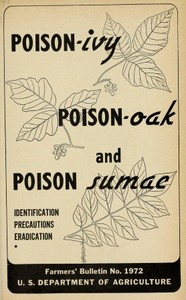
Poison-ivy, Poison-oak and Poison Sumac: Identification, Precautions and Eradication
Subjects:
Download Formats:
Excerpt
The Project Gutenberg EBook of USDA Farmers' Bulletin No. 1972:
Poison-ivy, Poison-oak and Poison Sumac: Identification, Precautions and Eradication, by Donald M. Crooks and Leonard W. Kephart
This eBook is for the use of anyone anywhere in the United States and most
other parts of the world at no cost and with almost no restrictions
whatsoever. You may copy it, give it away or re-use it under the terms of
the Project Gutenberg License included with this eBook or online at...
Read the Full Text
— End of Poison-ivy, Poison-oak and Poison Sumac: Identification, Precautions and Eradication —
Book Information
- Title
- Poison-ivy, Poison-oak and Poison Sumac: Identification, Precautions and Eradication
- Author(s)
- Kephart, Leonard Wheeler, Crooks, D. M. (Donald Mundell)
- Language
- English
- Type
- Text
- Release Date
- May 19, 2019
- Word Count
- 12,889 words
- Library of Congress Classification
- QK; S
- Bookshelves
- Browsing: Nature/Gardening/Animals, Browsing: Science - General
- Rights
- Public domain in the USA.