POEMS AND PARODIES
This eBook is for the use of anyone anywhere at no cost and with almost
no restrictions whatsoever. You may copy it, give it away or re-use it
under the terms of the Project Gutenberg License included with this
eBook or online at http://www.gutenberg.org/license.
Title: Poems and Parodies
Author: T. M. Kettle
Release Date: December 06, 2012 [EBook #38898]
Language: English
Character set encoding: UTF-8
*** START OF THIS PROJECT GUTENBERG EBOOK POEMS AND PARODIES ***
Produced by Al Haines.
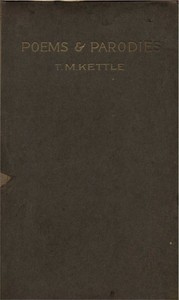
[Illustration: Cover]
[Illustration: T. M. Kettle]
POEMS & PARODIES
BY
T. M. KETTLE
DUBLIN
THE TALBOT PRESS
1916
Printed by
The Educational Company of Ireland
at
THE TALBOT PRESS
89 Talbot St., Dublin
TOM KETTLE
1880-1916
Two simple words, charged now for some of us with sad and infinite
memories. It is not the death of the Professor, nor of the soldier, nor
of the politician--nor even of the poet or the essayist--that causes the
heart-ache that we feel. It is the loss of that rare, charming,
wondrous personality summed up in those two simple words, TOM KETTLE.
A genial cynic, a pleasant pessimist, an earnest trifler, he was made up
of contradictions. A fellow of infinite jest--and infinite sadness.
His prototypes were Hamlet or the Melancholy Jacques. Among the
delightful essays he has left us in that charming little book, _The
Day’s Burden_, is one entitled "A new way of misunderstanding _Hamlet_."
He was himself a veritable Hamlet in this twentieth century Ireland.
One may ask, did he quite understand himself? Master of paradox,
enunciator of enigma, he was a paradox and an enigma in, and to,
himself. Shall we seek now to pluck out the heart of his mystery? The
lines are hackneyed beyond hope, but in this instance they apply in
truth.
The personality of Kettle had in it something subtle; something
essential yet elusive; something not to be defined. He was a great
talker in the Johnsonian sense. As a story-teller, it was not so much
the point of his tale that counted as his telling of it. The
divagations from the text in which he loved to indulge were the delight
of his auditors. With truth it may be said that his rich humour, his
brilliant, mordant wit, caused his listeners to hang upon his words.
And his outlook was so wide, his soul so big, his mind so broad, and a
deep love of humanity so permeated him that his talk, or one might more
fittingly say, his discourse, was educating and uplifting. But he was a
man of moods, descending from heights of Homeric humour to the depths of
a divine despair. Those privileged to hear him thus expounding will
cherish the memory while they live. We, too, as it were, have "seen
Shelley plain." He charmed, he fascinated. This, in truth, describes
him for his spell wrought even on those who actually disliked him.
In the numerous notices printed of him since he died much has been
written of the promise of his career. More appropriate it would be to
write of his performance. He crowded into thirty-six years of life far
more than most men achieve in twice that span. Now the orator is
silent, the brilliant wit has ceased to sparkle, the skilful pen will
ply no more. Tom Kettle knows at last the answer to the riddle that
baffled him, the Riddle of the Universe.
Well may we mourn--
_For Lycidas is dead;_
_Young Lycidas: dead ere his prime,_
_And hath not left his peer._
WILLIAM DAWSON.
CONTENTS
PERSONAL
Dedication Sonnet: To my Wife
To my daughter Betty, the gift of God
On Leaving Ireland
Epigram
EARLY POEMS
To Young Ireland
Sowing
Dreams and Duty
A Song of Vengeance
TRANSLATIONS
1At Achensee, Tirol‘_
1The Monks‘_
MISCELLANEOUS
The Lady of Life
When others see us as we see ourselves
Ennui
Ballad Autumnal
The Lost Ball
POLITICAL
Parnell
The House of Lords: An Epitaph
Reason in Rhyme
Asquith in Dublin
Ulster
To Ireland
WAR POEMS
Paddy
Sergeant Mike O’Leary
A Nation’s Freedom
A Song of the Irish Armies
Permission to reprint several of the poems in this Volume has been
kindly granted by the proprietors of the _Daily Chronicle, Freeman’s
Journal, Cork Examiner,_ Messrs. MAUNSEL & Co., Ltd.. and THE TALBOT
PRESS
PERSONAL
"Memorial I would have
... a constant presence
with those that love me"
DEDICATION SONNET
TO MY WIFE
"Not the sea, only, wrecks the hopes of men,
Look deeper, there is shipwreck everywhere,"
So mourned the exquisite Roman’s rich despair,
Too high in death for that ignoble pen.
Nero, his wrecker, is amply wrecked since then,
And all that Rome’s a whiff of charnel air;
But to subdue Petronius’ mal-de-mer
Have we found drugs? I pray you, What? and When?
Shipwreck, one grieves to say, retains its vogue:
Or let the keel win on in stouter fashion,
And look! your golden lie of Tir-na-n’Og
Is sunset and waste waters, chill and ashen--
Faith lasts? Nay, since I knew your yielded eyes,
I am content with sight .... of Paradise.
TO MY DAUGHTER BETTY,
THE GIFT OF GOD
(ELIZABETH DOROTHY)
In wiser days, my darling rosebud, blown
To beauty proud as was your mother’s prime,
In that desired, delayed, incredible time,
You’ll ask why I abandoned you, my own,
And the dear heart that was your baby throne,
To dice with death. And oh! they’ll give you rhyme
And reason: some will call the thing sublime,
And some decry it in a knowing tone.
So here, while the mad guns curse overhead,
And tired men sigh with mud for couch and floor,
Know that we fools, now with the foolish dead,
Died not for flag, nor King, nor Emperor,
But for a dream, born in a herdsman’s shed,
And for the secret Scripture of the poor.
the field, before Guillemont, Somme,
September 4, 1916.
ON LEAVING IRELAND
(JULY 14, 1916)
The pathos of departure is indubitable.
I never felt my own essay "On saying Good-Bye" so profoundly _aux
tréfonds du coeur_. The sun was a clear globe of blood which we caught
hanging over Ben Edar, with a trail of pure blood vibrating to us across
the waves. It dropped into darkness before we left the deck. Some lines
came to me, suggested by a friend who thought the mood cynical.
As the sun died in blood, and hill and sea
Grew to an altar, red with mystery,
One came who knew me (it may be over-much)
Seeking the cynical and staining touch,
But I, against the great sun’s burial
Thought only of bayonet-flash and bugle-call,
And saw him as God’s eye upon the deep,
Closed in the dream in which no women weep,
And knew that even I shall fall on sleep.
EPIGRAM
If grief, like fire, smoked up against our sight,
The Earth were scarfèd in eternal night.
EARLY POEMS
TO YOUNG IRELAND
(WRITTEN IN 1899)
Dead! art thou dead or sleepest, in this blank, twilight time,
When hearts are sere and pithless? Land of the sword and lyre!
Thy waxen lips are silent, thy brow is bound with rime,
Hast thou late wed with winter, child of earth’s primal fire?
The sheathèd blade rusts foully, through bitter, barren years,
And harp and pen are bond slaves, thralls to thy children’s
shame.
We garner cockle harvests, vain words and little fleers.
From waste lands sown with rancour, search them with proving
flame!
We droop’d, stark sons of warfare, we blushed and slunk from
day,
While Love and Truth and Honour died in mere fretful fume.
Free brain, free brawn, is given us, then sweep we from our way
These shamers of our mother, this idle, noisome spume.
For, lo! an army gathers around a standard clean;
I gird me dinted armour, and press to touch the throng.
Hark! Hark! The minstrels’ war-hymn in very strength serene,
My harp is harsh of utterance, yet take a pupil’s song.
Then stout heart join our battle! who hail an eastern sun,
Our toil shall set this people upon earth’s purest height.
Then faint heart join our battle! and if our sands be run,
At least we caoin a swan-lay upon the edge of night.
SOWING
(WRITTEN IN 1899)
One mocked: "Thy brain is mad with wine;
The fairies spin the threads of night,
And pour their vials of sour blight
About the roots of health, yet thine
And thou, ye garner into verse
Bright flowers to trick a solemn hearse:
The cowslip, maiden-love of spring,
The burning incense of the rose,
The austere lily, her that blows
By winter’s marge--each gracious thing
Past or unborn. Weak, trusting fool!
Old Time shall file thee in his school."
"I know not Time, his last or first;
With master hands I despoil all
His hoarded sweetness and his gall.
I crush the aeons for my thirst,
And so am mad. Pencils of fire
Limn visions of soul-large desire.
In Faith I cast on frozen ground
An obscure life of sweat and tears;
In the far Autumn of the years
Men reap full harvests, springing round,
And judge them gifts of kindly chance,
My deed laughs through each mellow lance."
DREAMS AND DUTY
Life is an inconstant April laughing into May,
Weeping with the aftergust of March storms laid away,
Light o’ love! Her mood is gracious, fondling sunbeams stray
Out across the cloud-smoke purple of her cloud robes gray.
Let us dream among the daisies, troll a roundelay
Where the gorse gold is lavished, and the lilies pray,
Mary’s nuns, whose stainless gift is Heaven’s chaliced ray,
Let us twine a wreath of science, let us play our play,
Ere we fight the fight of ages, one sweet prelude-day.
* * * * *
The stranger heard and mocked us from the usurped throne,
Reeled in his scornful laughter, eater of hearts, blood-blown.
But the Lord God heard and heeded, therefore we do not moan;
For He has whispered to us, ’The secret shuttles fly,
Ye know not warp or weaver, yet neither swerve or sigh,
The eater of hearts shall wither, the drinker of blood shall
die.
I have set you labour, work it; I will give you increase,
For first is winter-ploughing, after, my guerdon, peace;
Ye shall pluck strength from sorrow, ripe when the sorrows
cease;
Ye shall win strength and wisdom to break the stranger’s rule,
But if ye slink and babble ye are but as the fools,
Ye are but as the stranger, fit for the thorny schools."
A SONG OF VENGEANCE
FOR COMMANDANT SCHEEPERS
(Murdered January 18, 1902)
It is done inexpiably; thrust him deep in shameful clay,
Charge his name with every foulness, rule the world’s ear as you
may--
But the shadow at your banquet that you cannot put away!
Weak you thought him, sickness-vanquished, given to your eager
hate.
So you played him and you slew him with your feline shows of
state,
Weak--and lo! the sanctifying touch of death has made him great.
As a seed that broadening splits the rock on which a palace
stands,
As a trickling breach that godlike parts one land in hostile
lands,
Is the memory of Scheepers and his slaying at your hands.
Hill and plain and stream shall guard it, town and fireside,
phrase and song;
Young men’s unsubdued aspiring, old men’s striving wise and
strong;
And though Hope die, Hatred may not for remembrance of his
wrong.
Murdered leader--may God fold you in the mercy of His temple,
Sleep as sleep our unborn children, bravest hero and example--
Float the flag or sink for ever, your red eric shall be ample.
TRANSLATIONS
AT ACHENSEE, TIROL
(From the German of A. Pickler.--Died, 1893)
The old path up, the wood’s ranked gloomy legions,
The lap and the rustle of the lake behind,
And, roused by these, from Death’s more timely regions
The old thoughts fluttering in a lonely mind;
About my way the pine-stems thick and thicker
Huddle, the mossed stone drips abundantly,
And, thro’ the screen of woven branches, flicker
The bright and heaving waves of Achensee.
Pinewood and primrose scents, the air has mixt them;
Poised butterflies, a shining sun-bathed fleet,
Sky’s blue, gaunt granite jags, and buoyed betwixt them,
The cloud-fleece flushing with the day’s defeat.
The spell is on me, nor can aught deliver;
Slowly my spirit fails from life and light,
And Past and Future like a pauseless river,
Slide darkly down into a darker night.
The red glow wans, the blackbird’s trill and quaver
Dies in the sudden gloom, the broad world sleeps;
And, mixed with moon-fire flakes, the billows waver,
As though dead hands tossed vainly in their deeps.
I think of the high dead, and that all-daring
First bard whom Orcus’ self might not withstand,
I think of his vast love, and fruitless faring,
To pluck one rose from Proserpine’s hand.
The Past is an ill riddle, over-subtle,
The Thing-to-Be a rumour of a cloud,
Would know the last weft of Fate’s whirring shuttle?
You _shall_ know, when they wind you in your shroud.
Innsbruck, 18th July, 1904.
THE MONKS
A translation from EMILE VERHAEREN.
Dedicated to Father Benedict, 1905.
I do invoke you here, Monks Apostolical,
Fountains of dawn, torches of faith, wrought candlesticks;
Stars shedding day across the ages mystical;
Builders whose walls for scutcheon bear the Crucifix.
Hermits who sat on white, high mountains for a throne;
Hewn marble quick with will, and strength, and angry truth;
Preachers with arms uplift and long sleeves loosely blown
Over bowed heads, and hearts gnawn of the sateless tooth.
Windows athrob with dawn, rich with all Eastern dyes;
Vases of chastity whose fulness might not cease;
Mirrors whose depths enfold, as lakes the dreaming skies,
Hills where our dreams have breath, fair valleys brimmed with
peace.
Seers whose souls, foreknowing death’s enfranchisement,
Walked secretly where walks the mere flesh of no feet;
Titans whose breath was more than squadroned argument;
Kings strange to Rome set up in Rome’s imperial seat.
Swords hung above the pride of kings and emperors;
Lords of a prouder crown and a more grievious loss;
Warriors whose flag was spread in more tremendous wars,
Slayers of heresy with great blows of the Cross.
Arches and aqueducts of Christian sanctity,
Pillars of silver, channels pouring from the East
Rivers of grace at which the peoples thirstily
Have drunk, and quaffed desire for the unending Feast.
Tocsins with war and wounds in your most sombre roll;
Clarions whose proud, full throats salute the captain Christ;
Towers of the sun, whose crosses wear an aureole
Litten of that far Sun Who was the Sacrificed.
MISCELLANEOUS
THE LADY OF LIFE
I sat with her, and spoke right goldenly
Of love and beauty, and because her hair
Brushed me, I plucked down Sirius like a pear,
To braid it, and had laughter for my fee;
Yea, suing her to heavier slavery.
Had all but plucked the fruitage of her lips,
When, lo! inked clouds and absolute eclipse,
Courteous, but unmistakable ennui.
Then did I mind me of the sorrow wailed
Thro’ poets’ books, and how the streaming torch
Of suns greater than Sirius has failed,
And as I shambled out the menial’s door
I heard new feet sound in the statued porch
And salutations I had heard before.
WHEN OTHERS SEE US AS WE SEE OURSELVES!
Day, with his blotting trumpet, overthrew
My city of dream, and, with his marshalled spears,
My thought that had the unperforming years
Amended and laid the base of heaven true;
But pitying, signed me priest with chrismal dew,
And I went telling of expatriate tears,
Of Hate cast out with all his sworded peers,
And tower-tops spiring to the gods anew.
One gibed, one wept, one with his drowséd air
Chilled me to very stone, but no man hearkened;
So to my love I went--ah! once love darkened
Her eyes, and in that darkness I could hide--
Why should they couch them? In her alien stare
I knew she knew all Christs I had denied.
ENNUI
I saw the loath moon rise,
The sun go sweatily down;
There was famine of sleep in his eyes;
She was a floating frown.
They nodded heavily
Over an ancient roof,
With a pout o’ the shoulders, she,
He with a grind o’ the hoof.
And the moon said to the sun:
"Another day to irk us!"
The sun to the touzled moon,
"Imagine it a circus."
BALLAD AUTUMNAL
(In which Any Old Fool of an idealistic turn, explains--probably without
the palest colour of truth--to Any Other, infected with the same
disease, the failure of their lives, labours, and dreams, and the
triumph of the wise of this world.)
Hair greying, ashen eyes, uncomely ridges,
Autumn of things ill-done, and things undone:
How all that water, slipped beneath the bridges,
Chills the adieux of our defeated sun!
What paltry, unresisted jettison
Of dear hopes held, and there the graveyard West,
With mud, miasma, mastless hulks, and midges!--
We have not lived as wisely as the rest.
That wasteful trick of yours, that gust prodigious
Of dreams too great for their comparison,
Blew stars ablaze, but drowned us in the ditches.
Sad, generous, valiant, tired ephemeron!
Had we but coined the vision when it shone
We, too, had ruled, and mocked the dispossessed.
Well! we have rags, the prudent have the riches--
We have not lived as wisely as the rest.
They squeezed us, and forgot: your Je m’en fiche’s
Struck in too bloodily to pass for fun.
Our bread was nibbled by the water-witches,
All that we have is given, and is gone.
Some penny, wheedled for a currant bun,
Some shirtless, soapless starveling, uncaressed,
Still thanks us for, but not our fed ambitious--
We have not lived as wisely as the rest.
ENVOI
Prince, lift your heart up out of Acheron,
Death bows us gravely to that cleaner test.
Yea! when all books are closed, all races run,
We may have lived as wisely as the rest.
THE LOST BALL
(A golfing rhapsody suggested by "The Lost Chord.")
Playing one day at the seaside, I was topping my balls on the
tees,
And the sand and the bent were littered with fragments of double
D’s;
Piffle supreme I was playing, and varying "slice" with "pull,"
But I hit one ball a wallop like a kick of a Spanish bull.
It whistled its way towards Heaven in a rocket’s magic flight;
It cancelled the crimson sunset like the shroud of a moonless
night;
It knocked the paint off a rainbow and scattered the stars like
bees;
And sped thro’ the stellar spaces as tho’ it would never cease.
It looped the loop like Pégoud in parabolic curves;
It was salve to my wounded feelings and balm to my ruffled
nerves;
It clove my opponent’s gizzard like the stab of a Lascar’s
knife;
And produced the hardest swearing I have ever heard in my life.
I have sought in the bent and the bushes that one magnificent
ball;
It may be Antartic crystals were broken by its fall;
It may be that Death as Caddy may light on the spot it fell;
I may have holed out in Heaven or find myself trapped in Hell.
POLITICAL
PARNELL
(For the unveiling, 1st October, 1911)
Tears will betray all pride, but when ye mourn him,
Be it in soldier wise;
As for a captain who hath gently borne him,
And in the midnight dies.
Fewness of words is best; he was too great
For ours or any phrase.
Love could not guess, nor the slipped hound of hate
Track that soul’s secret ways.
Signed with a sign, unbroken, unrevealed,
His Calvary he trod;
So let him keep, where all world-wounds are healed
The silences of God.
Yet is he Ireland’s too: a flaming coal
Lit at the stars, and sent
To burn the sin of patience from her soul,
The scandal of content.
A name to be a trumpet of attack;
And, in the evil stress,
For England’s iron No! to fling her back
A grim granatic Yes.
He taught us more, this best as it was last:
When comrades go apart
They shall go greatly, cancelling the past,
Slaying the kindlier heart.
Friendship and love, all clean things and unclean,
Shall be as drifted leaves,
Spurned by our Ireland’s feet, that queenliest Queen
Who gives not but receives.
So freedom comes, and comes no other wise;
He gave--"The Chief"--gave well;
Limned in his blood across your clearing skies
Look up and read; Parnell!
THE HOUSE OF LORDS: AN EPITAPH
So you proscribe, and you forbid
Peace, and the trooping ghosts of hate
Enfranchise of the coffin-lid--
Your lordships’ lordship speaks too late.
That word had held when yours, for you,
Thieving and reaving smote us first:
If souls were crooked, swords were true;
They took and kept because they durst.
Still, though the pride of naked swords
Passed to a meaner, stouter hand,
You said, and it was done, my lords,
Yours was the law, and yours the land.
You clove the priest, you robbed the shrine,
With spoil of Paul and Peter fat,
Brimmed altar-cups with altar-wine
To toast your new Magnificat.
The poor, who are the lords of death,
To you were mud in foundered ways;
Your sun was red Elizabeth,
Your noon, the Dutchman’s Penal days.
Hunger and halters, grey despair,
Marah of exile, coastless seas,
Baal for master-minister--
You gave, my lords, and took your ease.
And then, in Paris, patience broke;
"Who is this thing that should oppress?"
Men asked: "And shall we bear his yoke.
This idle whiff of nothingness?"
That was your lordships’ epitaph;
Still might you sell a nation’s soul,
Spit on its tomb, and yawn and laugh,
But, thief to thief, the judgment stole.
This Ireland whom my lords despised--
Languid behind inverted thumbs--
She who believed and agonised
Leads on the loud, victorious drums.
Wave huddled wave, and now the last
Havocs your castle, built of sand--
We take the future, you the past,
Ours is the State, the Flag, the Land.
REASON IN RHYME
Will Watson, of the still unanchored art;
What random gust, what overwhelming sea
Has riven you apart
From us, and from the flagship of the free?
You whose rich phrase, and vibrant, wont to be
Trumpet and drum of onset and attack;
Who, when of Abdul’s ways you stooped to sing,
Would give us just the dire, full-throated thing;
Now, when that much-damned man has got the sack,
You change your tune, and make to pipe us back
From honour, and the task of Liberty!
Why argue, though? The plain position is
You are mistaken in your premises.
You blind your sight with hot, emotional mists,
Your way of thought is greatly too morose
And moist and lachrymose,
For us, a muddled State’s last realists.
We Irish, to be brief,
Are nowise grievers for the sake of grief.
I pray you, dry those sympathetic tears,
They rust the will; and, Will, your nation’s sin
Is no dead shame, meet to be covered in,
But a live fact that sears.
Cancel the past? Soothly when it befalls
That ye amend the present, and are just,
Go knock your head on Dublin Castle walls:
Are they irrelevant, historic dust,
Or a hard present-tense?
Search through the large print of the Statute Book
For your much-valued Lords’ benevolence,
And swept in vision westward, snatch a look
At that dim land, where hunger claims to be
The honoured guest in every family;
And the slain sun writes, in a scribble of shame,
The word of utter Hell, Clanricarde’s name.
Go South and North;
Weep, if you will, along the dismal quays,
Watching the unreturning ships go forth
To fling our seed of strength and hope and worth
In far, untributary ways.
And then the soul is something--at least in verse.
Ours, poet, is to be a thing of straw,
A stained, numb thing, that sits without the law
Of yours, great master of the universe?
Most nobly planned! But, Watson, there’s a text--
Done in stout English in King James’s reign--
Which says that souls are not to be annexed,
Not for the whole world’s gain.
Cancel the past! Why, yes! We, too, have thought
Of conflict crowned and drowned in olives of peace;
But when Cuchullin and Ferdiadh fought
There lacked no pride of warrior courtesies,
And so must this fight end.
Bond, from the toil of hate we may not cease:
Free, we are free to be your friend.
And when you make your banquet, and we come,
Soldier with equal soldier must we sit,
Closing a battle, not forgetting it.
With not a name to hide,
This mate and mother of valiant "rebels" dead
Must come with all her history on her head.
We keep the past for pride:
No deepest peace shall strike our poets dumb:
No rawest squad of all Death’s volunteers,
No rudest man who died
To tear your flag down in the bitter years,
But shall have praise, and three times thrice again,
When at that table men shall drink with men.
ASQUITH IN DUBLIN
(AUGUST, 1912)
You stepped your steps, and the music marched, and the torches
tossed
As you filled your streets with your comic Pentecost,
And the little English went by and the lights grew dim;
We, dumb in the shouting crowd, we thought of Him.
Of Him, too great for our souls and ways,
Too great for laughter or love, praise or dispraise,
Of Him, and the wintry swords, and the closing gloom--
Of Him going forth alone to His lonely doom.
No shouts, my Dublin then! Not a light nor a cry--
You kept them all till now, when the little English go by!
ULSTER
(A REPLY TO RUDYARD KIPLING)
The red, redeeming dawn
Kindled in Easter skies,
Falls like God’s judgment on
Lawyers, and lords, and lies.
What care these evil things,
Though menaced and perplexed,
While Kipling’s banjo strings
Blaspheme a sacred text?
Never did freemen stand,
Never were captains met,
From Dargai to the Rand,
From Parnell to De Wet,
Never, on native sod,
Weak Justice fared the worst,
But Kipling’s Cockney "Gawd"
Most impotently cursed.
So now, when Lenten years
Burgeon, at last, to bless
This land of Faith and Tears
With fruitful nobleness,
The poet, for a coin,
Hands to the gabbling rout
A bucketful of Boyne
To put the sunrise out.
"Ulster" is ours, not yours,
Is ours to have and hold,
Our hills and lakes and moors
Have shaped her in our mould.
Derry to Limerick Walls
Fused us in battle flame;
Limerick to Derry calls
One strong-shared Irish name.
We keep the elder faith,
Not slain by Cromwell’s sword;
Nor bribed to subtler death
By William’s broken word.
Free from those chains, and free
From hate for hate endured,
We share the liberty
Our lavish blood assured.
One place, one dream, one doom,
One task and toil assigned,
Union of plough and loom
Have bound us and shall bind.
The wounds of labour healed,
Life rescued and made fair--
There lies the battlefield
Of Ulster’s holy war.
TO IRELAND
Men so worthy
Suffered for Thee,
Men so poor can die;
Then come gather
All, or rather
Those who ask not why.
WAR POEMS
PADDY
(After Mr. Kipling)
I went into the talkin’ shop to see about the Bill;
The Premier ’e ups and says: "We’re waitin’ ... waitin’ still!"
The Tories grinned, and Balfour strung our gamble Haman-high,
I outs into the street again, and to meself sez I:
O, it’s Paddy this, and Paddy that, an’ "A cattle-driven crew!"
But ’twas "Murphy o’ the Munsters!" when the trump of battle
blew.
When the wind of battle blew, my boys, when the blast of battle
blew,
It was Burke, and Shea and Kelly when we marched to Waterloo.
I looked into a newspaper to see about the land
That bred the man who broke the sin that Bonaparte planned;
They’d room for cricket scores, and tips, and trash of every
kind,
But when I asked of Ireland’s cause, it seemed to be behind.
For it’s Paddy this, and Paddy that, and "Don’t annoy us,
please!"
But it’s "Irish Rifles forward--Fast!" when the bullets talk
like bees,
When the bullets yawn like bees, my boys, when the bullets yawn
like bees,
It’s "Connaught blood is good enough" when they’re chanting
R.I.P’s.
Yes! Sneerin’ round at Irishmen, and Irish speech and ways
Is cheaper--much--than snatchin’ guns from battle’s red amaze:
And when the damned Death’s-Head-Dragoons roll up the ruddy tide
The _Times_ won’t spare a Smith to tell how Dan O’Connell died.
For it’s Paddy this, and Paddy that, and "The Fifth’ll prate and
prance!"
But it’s "Corks and Inniskillings--Front!" when Hell is loose in
France,
When Clare and Kerry take the call that crowns the shrapnel
dance,
O, it’s "Find the Dublin Fusiliers!" when Hell is loose in
France.
We ain’t no saints or scholars much, but fightin’ men and clean,
We’ve paid the price, and three times thrice for Wearin’ o’ the
Green.
We held our hand out frank and fair, and half forgot Parnell,
For Ireland’s hope and England’s too--and it’s yours to save or
sell.
For it’s Paddy this, and Paddy that, "Who’ll stop the Uhlan
blade?"
But Tommy Fitz from Malahide, and Monaghan’s McGlade,
When the ranks are set for judgment, lads, and the roses droop
and fade,
It’s "Ireland in the firin’ line!" when the price of God is
paid.
SERGEANT MIKE O’LEARY
It was Sergeant Mike O’Leary who broke the barricade,
Who took the chance, and won the Cross that crowns the bayonet
trade;
’Twas "M’anam do Dhia," and "How’s your heart," and "How could
we forget?"
But Michael from Inchigeela will fill a ballad yet.
Oh! a fair and pleasant land is Cork for wit and courtesy,
Ballyvourney East and Baile Dubh and Kilworth to the sea:
And when they light the turf to-night, spit, stamp, swear as of
yore,
It’s the Sergeant Mike O’Leary’s ghosts that ward the southern
shore.
A NATION’S FREEDOM
Word of the Tsar! and the drowse malign is broken;
The stone is rolled from the tomb and Poland free,
This is the strong evangel. The guns have spoken;
And the scribble of flame of the guns is Liberty.
Have you not met her, my lords, a-walk in the garden,
Ranging the dawn, even she, the three times dead?
Nay! But in bondage, sundered from light and pardon--
But now the water is wine, and the marriage read.
Word of the Tsar! My lords, I think of another
Crowned with dolour, forbidden the sun abased,
Bloodied, unbroken, abiding--Ah! Queen, my Mother,
I have prayed the feet of the Judgment of God to haste.
Count me the price in blood that we have not squandered,
Spendthrifts of blood from our cradle, wastefully true,
Name me the sinister fields where the Wild Geese wandered,
Lille and Cremona and Landen and Waterloo.
When the white steel-foam swept on the tidal onset,
When the last wave lapsed, and the sea turned back to its sleep,
We were there in the waste and the wreckage, Queen of the
Sunset!
Paying the price of the dreams that cannot sleep.
The altar is set; we uplift again the chalice;
The priest is in purple; the bell booms to the sacrifice.
The trumpets summon to death, and Ireland rallies--
Tool or free? We have paid, and over-paid, the price.
Word of the Tsar! And Russia rises to vision,
Poland and Ireland--thus, my lords, was an augured fate.
The days draw in, and the ways narrow down to decision--
Will they chaffer, and cheapen, and ruin, or yield to be great?
Written in Belgium, August, 1914
A SONG OF THE IRISH ARMIES
A wind blew out of the Prussian plain;
It scourged Liege, and it broke Louvain,
And Belgium shook with the tramp of Cain,
That a Kaiser might be mad.
"Iron is God!"--and they served him well--
"Honour a mark for shot and shell."
So they loosed the devils out of Hell
From Birr to Allahabad.
THE OLD SOLDIERS SING:
But we took them from Mons to the banks of the Marne,
And helped them back on their red return;
We can swim the Rhine if the bridges burn,
And Mike O’Leary’s the lad!
Not for this did our fathers fall;
That truth, and pity, and love, and all
Should break in dust at a trumpet call,
Yea! all things clean and old.
Not to this had we sacrificed:
To sit at the last where the slayers diced,
With blood-hot hands for the robes of Christ,
And snatch at the Devil’s gold.
THE NEW SOLDIERS SING:
To Odin’s challenge we cried Amen!
We stayed the plough, and laid by the pen,
And we shouldered our guns like gentlemen,
That the wiser weak should hold.
Blood on the land, and blood on the sea?
So it stands as ordained to be,
Stamp, and signet, and guarantee
Of the better ways we knew.
Time for the plough when the sword has won;
The loom will wait on the crashing gun,
And the hands of peace drop benison
When the task of death is through.
OLD AND NEW SOLDIERS SING:
Then lift the flag of the Last Crusade!
And fill the ranks of the Last Brigade!
March on to the fields where the world’s re-made,
And the Ancient Dreams come true!
*** END OF THIS PROJECT GUTENBERG EBOOK POEMS AND PARODIES ***
A Word from Project Gutenberg
We will update this book if we find any errors.
This book can be found under: http://www.gutenberg.org/ebooks/38898
Creating the works from public domain print editions means that no one
owns a United States copyright in these works, so the Foundation (and
you!) can copy and distribute it in the United States without permission
and without paying copyright royalties. Special rules, set forth in the
General Terms of Use part of this license, apply to copying and
distributing Project Gutenberg™ electronic works to protect the Project
Gutenberg™ concept and trademark. Project Gutenberg is a registered
trademark, and may not be used if you charge for the eBooks, unless you
receive specific permission. If you do not charge anything for copies of
this eBook, complying with the rules is very easy. You may use this
eBook for nearly any purpose such as creation of derivative works,
reports, performances and research. They may be modified and printed and
given away – you may do practically _anything_ with public domain
eBooks. Redistribution is subject to the trademark license, especially
commercial redistribution.
The Full Project Gutenberg License
_Please read this before you distribute or use this work._
To protect the Project Gutenberg™ mission of promoting the free
distribution of electronic works, by using or distributing this work (or
any other work associated in any way with the phrase “Project
Gutenberg”), you agree to comply with all the terms of the Full Project
Gutenberg™ License available with this file or online at
http://www.gutenberg.org/license.
Section 1. General Terms of Use & Redistributing Project Gutenberg™
electronic works
*1.A.* By reading or using any part of this Project Gutenberg™
electronic work, you indicate that you have read, understand, agree to
and accept all the terms of this license and intellectual property
(trademark/copyright) agreement. If you do not agree to abide by all the
terms of this agreement, you must cease using and return or destroy all
copies of Project Gutenberg™ electronic works in your possession. If you
paid a fee for obtaining a copy of or access to a Project Gutenberg™
electronic work and you do not agree to be bound by the terms of this
agreement, you may obtain a refund from the person or entity to whom you
paid the fee as set forth in paragraph 1.E.8.
*1.B.* “Project Gutenberg” is a registered trademark. It may only be
used on or associated in any way with an electronic work by people who
agree to be bound by the terms of this agreement. There are a few things
that you can do with most Project Gutenberg™ electronic works even
without complying with the full terms of this agreement. See paragraph
1.C below. There are a lot of things you can do with Project Gutenberg™
electronic works if you follow the terms of this agreement and help
preserve free future access to Project Gutenberg™ electronic works. See
paragraph 1.E below.
*1.C.* The Project Gutenberg Literary Archive Foundation (“the
Foundation” or PGLAF), owns a compilation copyright in the collection of
Project Gutenberg™ electronic works. Nearly all the individual works in
the collection are in the public domain in the United States. If an
individual work is in the public domain in the United States and you are
located in the United States, we do not claim a right to prevent you
from copying, distributing, performing, displaying or creating
derivative works based on the work as long as all references to Project
Gutenberg are removed. Of course, we hope that you will support the
Project Gutenberg™ mission of promoting free access to electronic works
by freely sharing Project Gutenberg™ works in compliance with the terms
of this agreement for keeping the Project Gutenberg™ name associated
with the work. You can easily comply with the terms of this agreement by
keeping this work in the same format with its attached full Project
Gutenberg™ License when you share it without charge with others.
*1.D.* The copyright laws of the place where you are located also govern
what you can do with this work. Copyright laws in most countries are in
a constant state of change. If you are outside the United States, check
the laws of your country in addition to the terms of this agreement
before downloading, copying, displaying, performing, distributing or
creating derivative works based on this work or any other Project
Gutenberg™ work. The Foundation makes no representations concerning the
copyright status of any work in any country outside the United States.
*1.E.* Unless you have removed all references to Project Gutenberg:
*1.E.1.* The following sentence, with active links to, or other
immediate access to, the full Project Gutenberg™ License must appear
prominently whenever any copy of a Project Gutenberg™ work (any work on
which the phrase “Project Gutenberg” appears, or with which the phrase
“Project Gutenberg” is associated) is accessed, displayed, performed,
viewed, copied or distributed:
This eBook is for the use of anyone anywhere at no cost and with
almost no restrictions whatsoever. You may copy it, give it away
or re-use it under the terms of the Project Gutenberg License
included with this eBook or online at http://www.gutenberg.org
*1.E.2.* If an individual Project Gutenberg™ electronic work is derived
from the public domain (does not contain a notice indicating that it is
posted with permission of the copyright holder), the work can be copied
and distributed to anyone in the United States without paying any fees
or charges. If you are redistributing or providing access to a work with
the phrase “Project Gutenberg” associated with or appearing on the work,
you must comply either with the requirements of paragraphs 1.E.1 through
1.E.7 or obtain permission for the use of the work and the Project
Gutenberg™ trademark as set forth in paragraphs 1.E.8 or 1.E.9.
*1.E.3.* If an individual Project Gutenberg™ electronic work is posted
with the permission of the copyright holder, your use and distribution
must comply with both paragraphs 1.E.1 through 1.E.7 and any additional
terms imposed by the copyright holder. Additional terms will be linked
to the Project Gutenberg™ License for all works posted with the
permission of the copyright holder found at the beginning of this work.
*1.E.4.* Do not unlink or detach or remove the full Project Gutenberg™
License terms from this work, or any files containing a part of this
work or any other work associated with Project Gutenberg™.
*1.E.5.* Do not copy, display, perform, distribute or redistribute this
electronic work, or any part of this electronic work, without
prominently displaying the sentence set forth in paragraph 1.E.1 with
active links or immediate access to the full terms of the Project
Gutenberg™ License.
*1.E.6.* You may convert to and distribute this work in any binary,
compressed, marked up, nonproprietary or proprietary form, including any
word processing or hypertext form. However, if you provide access to or
distribute copies of a Project Gutenberg™ work in a format other than
“Plain Vanilla ASCII” or other format used in the official version
posted on the official Project Gutenberg™ web site
(http://www.gutenberg.org), you must, at no additional cost, fee or
expense to the user, provide a copy, a means of exporting a copy, or a
means of obtaining a copy upon request, of the work in its original
“Plain Vanilla ASCII” or other form. Any alternate format must include
the full Project Gutenberg™ License as specified in paragraph 1.E.1.
*1.E.7.* Do not charge a fee for access to, viewing, displaying,
performing, copying or distributing any Project Gutenberg™ works unless
you comply with paragraph 1.E.8 or 1.E.9.
*1.E.8.* You may charge a reasonable fee for copies of or providing
access to or distributing Project Gutenberg™ electronic works provided
that
- You pay a royalty fee of 20% of the gross profits you derive from
the use of Project Gutenberg™ works calculated using the method you
already use to calculate your applicable taxes. The fee is owed to
the owner of the Project Gutenberg™ trademark, but he has agreed to
donate royalties under this paragraph to the Project Gutenberg
Literary Archive Foundation. Royalty payments must be paid within 60
days following each date on which you prepare (or are legally
required to prepare) your periodic tax returns. Royalty payments
should be clearly marked as such and sent to the Project Gutenberg
Literary Archive Foundation at the address specified in Section 4,
“Information about donations to the Project Gutenberg Literary
Archive Foundation.”
- You provide a full refund of any money paid by a user who notifies
you in writing (or by e-mail) within 30 days of receipt that s/he
does not agree to the terms of the full Project Gutenberg™ License.
You must require such a user to return or destroy all copies of the
works possessed in a physical medium and discontinue all use of and
all access to other copies of Project Gutenberg™ works.
- You provide, in accordance with paragraph 1.F.3, a full refund of
any money paid for a work or a replacement copy, if a defect in the
electronic work is discovered and reported to you within 90 days of
receipt of the work.
- You comply with all other terms of this agreement for free
distribution of Project Gutenberg™ works.
*1.E.9.* If you wish to charge a fee or distribute a Project Gutenberg™
electronic work or group of works on different terms than are set forth
in this agreement, you must obtain permission in writing from both the
Project Gutenberg Literary Archive Foundation and Michael Hart, the
owner of the Project Gutenberg™ trademark. Contact the Foundation as set
forth in Section 3. below.
*1.F.*
*1.F.1.* Project Gutenberg volunteers and employees expend considerable
effort to identify, do copyright research on, transcribe and proofread
public domain works in creating the Project Gutenberg™ collection.
Despite these efforts, Project Gutenberg™ electronic works, and the
medium on which they may be stored, may contain “Defects,” such as, but
not limited to, incomplete, inaccurate or corrupt data, transcription
errors, a copyright or other intellectual property infringement, a
defective or damaged disk or other medium, a computer virus, or computer
codes that damage or cannot be read by your equipment.
*1.F.2.* LIMITED WARRANTY, DISCLAIMER OF DAMAGES – Except for the “Right
of Replacement or Refund” described in paragraph 1.F.3, the Project
Gutenberg Literary Archive Foundation, the owner of the Project
Gutenberg™ trademark, and any other party distributing a Project
Gutenberg™ electronic work under this agreement, disclaim all liability
to you for damages, costs and expenses, including legal fees. YOU AGREE
THAT YOU HAVE NO REMEDIES FOR NEGLIGENCE, STRICT LIABILITY, BREACH OF
WARRANTY OR BREACH OF CONTRACT EXCEPT THOSE PROVIDED IN PARAGRAPH 1.F.3.
YOU AGREE THAT THE FOUNDATION, THE TRADEMARK OWNER, AND ANY DISTRIBUTOR
UNDER THIS AGREEMENT WILL NOT BE LIABLE TO YOU FOR ACTUAL, DIRECT,
INDIRECT, CONSEQUENTIAL, PUNITIVE OR INCIDENTAL DAMAGES EVEN IF YOU GIVE
NOTICE OF THE POSSIBILITY OF SUCH DAMAGE.
*1.F.3.* LIMITED RIGHT OF REPLACEMENT OR REFUND – If you discover a
defect in this electronic work within 90 days of receiving it, you can
receive a refund of the money (if any) you paid for it by sending a
written explanation to the person you received the work from. If you
received the work on a physical medium, you must return the medium with
your written explanation. The person or entity that provided you with
the defective work may elect to provide a replacement copy in lieu of a
refund. If you received the work electronically, the person or entity
providing it to you may choose to give you a second opportunity to
receive the work electronically in lieu of a refund. If the second copy
is also defective, you may demand a refund in writing without further
opportunities to fix the problem.
*1.F.4.* Except for the limited right of replacement or refund set forth
in paragraph 1.F.3, this work is provided to you ‘AS-IS,’ WITH NO OTHER
WARRANTIES OF ANY KIND, EXPRESS OR IMPLIED, INCLUDING BUT NOT LIMITED TO
WARRANTIES OF MERCHANTABILITY OR FITNESS FOR ANY PURPOSE.
*1.F.5.* Some states do not allow disclaimers of certain implied
warranties or the exclusion or limitation of certain types of damages.
If any disclaimer or limitation set forth in this agreement violates the
law of the state applicable to this agreement, the agreement shall be
interpreted to make the maximum disclaimer or limitation permitted by
the applicable state law. The invalidity or unenforceability of any
provision of this agreement shall not void the remaining provisions.
*1.F.6.* INDEMNITY – You agree to indemnify and hold the Foundation, the
trademark owner, any agent or employee of the Foundation, anyone
providing copies of Project Gutenberg™ electronic works in accordance
with this agreement, and any volunteers associated with the production,
promotion and distribution of Project Gutenberg™ electronic works,
harmless from all liability, costs and expenses, including legal fees,
that arise directly or indirectly from any of the following which you do
or cause to occur: (a) distribution of this or any Project Gutenberg™
work, (b) alteration, modification, or additions or deletions to any
Project Gutenberg™ work, and (c) any Defect you cause.
Section 2. Information about the Mission of Project Gutenberg™
Project Gutenberg™ is synonymous with the free distribution of
electronic works in formats readable by the widest variety of computers
including obsolete, old, middle-aged and new computers. It exists
because of the efforts of hundreds of volunteers and donations from
people in all walks of life.
Volunteers and financial support to provide volunteers with the
assistance they need, is critical to reaching Project Gutenberg™’s goals
and ensuring that the Project Gutenberg™ collection will remain freely
available for generations to come. In 2001, the Project Gutenberg
Literary Archive Foundation was created to provide a secure and
permanent future for Project Gutenberg™ and future generations. To learn
more about the Project Gutenberg Literary Archive Foundation and how
your efforts and donations can help, see Sections 3 and 4 and the
Foundation web page at http://www.pglaf.org .
Section 3. Information about the Project Gutenberg Literary Archive
Foundation
The Project Gutenberg Literary Archive Foundation is a non profit
501(c)(3) educational corporation organized under the laws of the state
of Mississippi and granted tax exempt status by the Internal Revenue
Service. The Foundation’s EIN or federal tax identification number is
64-6221541. Its 501(c)(3) letter is posted at
http://www.gutenberg.org/fundraising/pglaf . Contributions to the
Project Gutenberg Literary Archive Foundation are tax deductible to the
full extent permitted by U.S. federal laws and your state’s laws.
The Foundation’s principal office is located at 4557 Melan Dr.
S. Fairbanks, AK, 99712., but its volunteers and employees are scattered
throughout numerous locations. Its business office is located at 809
North 1500 West, Salt Lake City, UT 84116, (801) 596-1887, email
[email protected]. Email contact links and up to date contact
information can be found at the Foundation’s web site and official page
at http://www.pglaf.org
For additional contact information:
Dr. Gregory B. Newby
Chief Executive and Director
[email protected]
Section 4. Information about Donations to the Project Gutenberg Literary
Archive Foundation
Project Gutenberg™ depends upon and cannot survive without wide spread
public support and donations to carry out its mission of increasing the
number of public domain and licensed works that can be freely
distributed in machine readable form accessible by the widest array of
equipment including outdated equipment. Many small donations ($1 to
$5,000) are particularly important to maintaining tax exempt status with
the IRS.
The Foundation is committed to complying with the laws regulating
charities and charitable donations in all 50 states of the United
States. Compliance requirements are not uniform and it takes a
considerable effort, much paperwork and many fees to meet and keep up
with these requirements. We do not solicit donations in locations where
we have not received written confirmation of compliance. To SEND
DONATIONS or determine the status of compliance for any particular state
visit http://www.gutenberg.org/fundraising/donate
While we cannot and do not solicit contributions from states where we
have not met the solicitation requirements, we know of no prohibition
against accepting unsolicited donations from donors in such states who
approach us with offers to donate.
International donations are gratefully accepted, but we cannot make any
statements concerning tax treatment of donations received from outside
the United States. U.S. laws alone swamp our small staff.
Please check the Project Gutenberg Web pages for current donation
methods and addresses. Donations are accepted in a number of other ways
including checks, online payments and credit card donations. To donate,
please visit: http://www.gutenberg.org/fundraising/donate
Section 5. General Information About Project Gutenberg™ electronic
works.
Professor Michael S. Hart is the originator of the Project Gutenberg™
concept of a library of electronic works that could be freely shared
with anyone. For thirty years, he produced and distributed Project
Gutenberg™ eBooks with only a loose network of volunteer support.
Project Gutenberg™ eBooks are often created from several printed
editions, all of which are confirmed as Public Domain in the U.S. unless
a copyright notice is included. Thus, we do not necessarily keep eBooks
in compliance with any particular paper edition.
Each eBook is in a subdirectory of the same number as the eBook’s eBook
number, often in several formats including plain vanilla ASCII,
compressed (zipped), HTML and others.
Corrected _editions_ of our eBooks replace the old file and take over
the old filename and etext number. The replaced older file is renamed.
_Versions_ based on separate sources are treated as new eBooks receiving
new filenames and etext numbers.
Most people start at our Web site which has the main PG search facility:
http://www.gutenberg.org
This Web site includes information about Project Gutenberg™, including
how to make donations to the Project Gutenberg Literary Archive
Foundation, how to help produce our new eBooks, and how to subscribe to
our email newsletter to hear about new eBooks.
Excerpt
This eBook is for the use of anyone anywhere at no cost and with almost
no restrictions whatsoever. You may copy it, give it away or re-use it
under the terms of the Project Gutenberg License included with this
eBook or online at http://www.gutenberg.org/license.
Title: Poems and Parodies
Author: T. M. Kettle
Release Date: December 06, 2012 [EBook #38898]
Language: English
Character set encoding: UTF-8
Read the Full Text
— End of Poems & Parodies —
Book Information
- Title
- Poems & Parodies
- Author(s)
- Kettle, Tom
- Language
- English
- Type
- Text
- Release Date
- February 16, 2012
- Word Count
- 8,653 words
- Library of Congress Classification
- PR
- Bookshelves
- Punch, Browsing: Literature, Browsing: Poetry
- Rights
- Public domain in the USA.
Related Books
Bog-land studies
by Barlow, Jane
English
385h 47m read
Rambles in Waltham Forest
by Blessington, Marguerite, Countess of
English
98h 53m read
A vision of life
by Figgis, Darrell
English
160h 25m read

Michael Robartes and the dancer
by Yeats, W. B. (William Butler)
English
98h 30m read

The tower
by Yeats, W. B. (William Butler)
English
170h 15m read
The inalienable heritage, and other poems
by Lawless, Emily
English
172h 55m read